• Online security, safety, and ethics
• Internet threats
• Protecting reputations online
• Copyright
• Contextualized online search and
research skills
Rules of Netiquette
At the end of this lesson, the students should be able to:
1. consider one’s and others’ safety when sharing
information using the Internet;
2. consider one’s and others’ reputation when using the
Internet;
3. determine and avoid the dangers of the Internet;
4. be responsible in the use of social networking sites; and
5. browse the Internet efficiently and properly through
proper referencing.
The Internet, truly, is a powerful tool. It
can be used to promote your business,
gain new friends, and stay in touch with
the old ones. It is also a source of
entertainment. But like most things in this
world, there is always “another side of
the coin.” The Internet is one of the most
dangerous places, especially if you do
not know what you are doing.
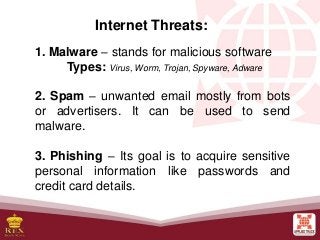
Internet Threats:
1. Malware – stands for malicious software
Types: Virus, Worm, Trojan, Spyware, Adware
2. Spam – unwanted email mostly from bots
or advertisers. It can be used to send
malware.
3. Phishing – Its goal is to acquire sensitive
personal information like passwords and
credit card details.
Think Before You Click
1. Before you post something on the web, ask these questions
to yourself: Would you want your parents or grandparents to see
it? Would you want your future boss to see it? Once you post
something on the web, you have no control of who sees your
posts.
2. Your friends depend on you to protect their reputation online.
Talk to your friends about this serious responsibility.
3. Set your post to “private.” In this way, search engines will
not be able to scan that post.
4. Avoid using names. Names are easy for search engines to
scan.
5. If you feel that a post can affect you or other’s reputation, ask
the one who posted it to pull it down or report it as
inappropriate.
If you create something—an
idea, an invention, a form of
literary work, or a research, you
have the right of how it should
be used by others. This is called
intellectual property.
L2-Rules-of-Netiquette.pptx

  • 1.
    • Online security,safety, and ethics • Internet threats • Protecting reputations online • Copyright • Contextualized online search and research skills Rules of Netiquette
  • 2.
    At the endof this lesson, the students should be able to: 1. consider one’s and others’ safety when sharing information using the Internet; 2. consider one’s and others’ reputation when using the Internet; 3. determine and avoid the dangers of the Internet; 4. be responsible in the use of social networking sites; and 5. browse the Internet efficiently and properly through proper referencing.
  • 3.
    The Internet, truly,is a powerful tool. It can be used to promote your business, gain new friends, and stay in touch with the old ones. It is also a source of entertainment. But like most things in this world, there is always “another side of the coin.” The Internet is one of the most dangerous places, especially if you do not know what you are doing.
  • 5.
    Internet Threats: 1. Malware– stands for malicious software Types: Virus, Worm, Trojan, Spyware, Adware 2. Spam – unwanted email mostly from bots or advertisers. It can be used to send malware. 3. Phishing – Its goal is to acquire sensitive personal information like passwords and credit card details.
  • 6.
    Think Before YouClick 1. Before you post something on the web, ask these questions to yourself: Would you want your parents or grandparents to see it? Would you want your future boss to see it? Once you post something on the web, you have no control of who sees your posts. 2. Your friends depend on you to protect their reputation online. Talk to your friends about this serious responsibility. 3. Set your post to “private.” In this way, search engines will not be able to scan that post. 4. Avoid using names. Names are easy for search engines to scan. 5. If you feel that a post can affect you or other’s reputation, ask the one who posted it to pull it down or report it as inappropriate.
  • 7.
    If you createsomething—an idea, an invention, a form of literary work, or a research, you have the right of how it should be used by others. This is called intellectual property.