EE-321 N
Lecture-12
UJT (Unijunction Transistor)
&
UJT Based Triggering Circuit
Introduction
• Three terminal single junction latching device*
• Different from either diode (due to 3 terminals)
or the transistor (can’t amplify)
• Wide range of applications like oscillators, trigger
circuits, sawtooth generators, phase control
• Overcomes the limitations of previous trigger
circuits like power dissipation & high
dependability on the SCR chatacteristics
• Other variants include CUJT & PUT
31-Oct-12 EE-321N, Lec-12 2
Structure & Symbol
E
B2
B1B1
A
B2
E
RB2
RB1
n-type
p-type
Eta-point
Basic Structure Symbol
31-Oct-12 3EE-321N, Lec-12
Equivalent Circuit
RB2
VBB
+
-
E
B1
RB1 VBB
A
+
-
Ve Ie
B2
Eta-point
V1
VD
Equivalent Circuit of UJT
31-Oct-12 4EE-321N, Lec-12
Characteristics
31-Oct-12 5EE-321N, Lec-12
Ve
VBB
R load line
Vp
Vv
Ie
IvIp0
Peak Point
Cutoff
region
Negative Resistance
Region
Saturation
region
Valley Point
Device Description & Operation
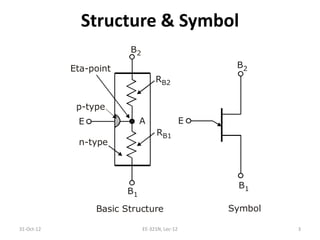
• Consists of a lightly doped n-type Si base to
which heavily doped p-type emitter is
embedded
• At the two ends, there are ohmic contacts
designated as Base 1 & Base 2
• Thus the 3 terminals are: E, B1 & B2
• An interbase resistance RBB = RB1 + RB2|IE = 0
(~5-10 kΩ) exists between the two bases
31-Oct-12 EE-321N, Lec-12 6
Contd...
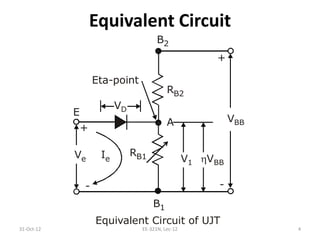
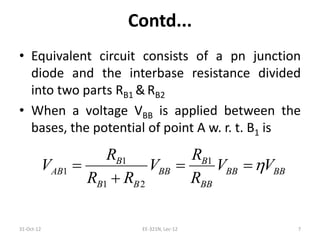
• Equivalent circuit consists of a pn junction
diode and the interbase resistance divided
into two parts RB1 & RB2
• When a voltage VBB is applied between the
bases, the potential of point A w. r. t. B1 is
31-Oct-12 EE-321N, Lec-12 7
1 1
1
1 2
B B
AB BB BB BB
B B BB
R R
V V V V
R R R
  

Contd...
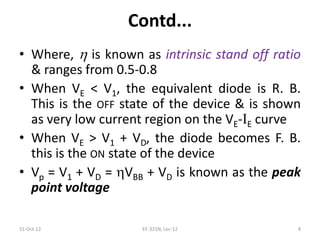
• Where,  is known as intrinsic stand off ratio
& ranges from 0.5-0.8
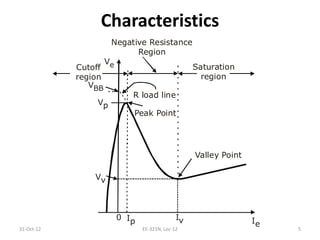
• When VE < V1, the equivalent diode is R. B.
This is the OFF state of the device & is shown
as very low current region on the VE-IE curve
• When VE > V1 + VD, the diode becomes F. B.
this is the ON state of the device
• Vp = V1 + VD = VBB + VD is known as the peak
point voltage
31-Oct-12 EE-321N, Lec-12 8
Contd...
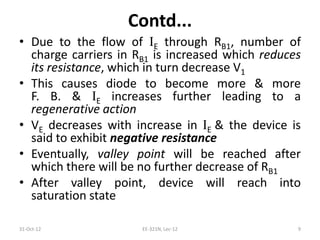
• Due to the flow of IE through RB1, number of
charge carriers in RB1 is increased which reduces
its resistance, which in turn decrease V1
• This causes diode to become more & more
F. B. & IE increases further leading to a
regenerative action
• VE decreases with increase in IE & the device is
said to exhibit negative resistance
• Eventually, valley point will be reached after
which there will be no further decrease of RB1
• After valley point, device will reach into
saturation state
31-Oct-12 EE-321N, Lec-12 9
UJT Relaxation Oscillator
31-Oct-12 EE-321N, Lec-12 10
R R2
VBB
R1
C
E
B2
B1Ve vo
Ve
Vp
VV
Vo
t
t
Capacitor
charging
1=RC


T
V +VBB
VP
2 1=R C
Capacitor
discharging
Vv
Contd...
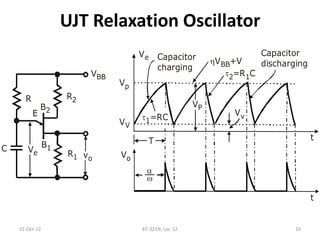
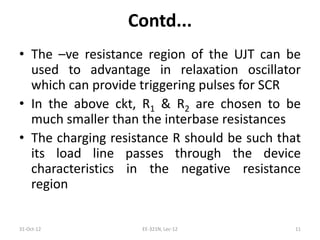
• The –ve resistance region of the UJT can be
used to advantage in relaxation oscillator
which can provide triggering pulses for SCR
• In the above ckt, R1 & R2 are chosen to be
much smaller than the interbase resistances
• The charging resistance R should be such that
its load line passes through the device
characteristics in the negative resistance
region
31-Oct-12 EE-321N, Lec-12 11
Contd...
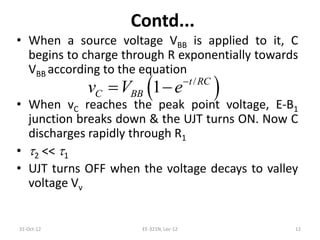
• When a source voltage VBB is applied to it, C
begins to charge through R exponentially towards
VBB according to the equation
• When vC reaches the peak point voltage, E-B1
junction breaks down & the UJT turns ON. Now C
discharges rapidly through R1
• 2 << 1
• UJT turns OFF when the voltage decays to valley
voltage Vv
31-Oct-12 EE-321N, Lec-12 12
 /
1 t RC
C BBv V e
 
Expression for Time Period of
Oscillation
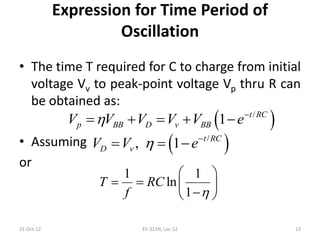
• The time T required for C to charge from initial
voltage Vv to peak-point voltage Vp thru R can
be obtained as:
• Assuming
or
31-Oct-12 EE-321N, Lec-12 13
 /
1 t RC
p BB D v BBV V V V V e 
    
 /
, 1 t RC
D vV V e 
  
1 1
ln
1
T RC
f 
 
   
 
Contd...
• If T is taken as the time pd. of the O/P pulse
duration (neglecting small discharge time),
then firing angle is given by
• Design considerations include selection of R1,
R2 & R
31-Oct-12 EE-321N, Lec-12 14
1
ln
1
T RC  

 
   
 
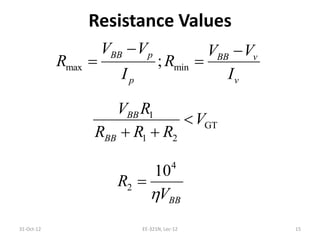
Resistance Values
31-Oct-12 EE-321N, Lec-12 15
max min;
BB p BB v
p v
V V V V
R R
I I
 
 
1
GT
1 2
BB
BB
V R
V
R R R

 
4
2
10
BB
R
V

Further Resources
1. Video lectures on “Basic Electronics & Lab”,
Prof. T. S. Natarajan, Lec-34 UJT
Available on www.nptel.iitm.ac.in,
www.youtube.com/iit
2. Boylestad & Nashelsky, “Electronic Devices &
Circuit Theory”, 7/e, PHI
31-Oct-12 16EE-321N, Lec-12
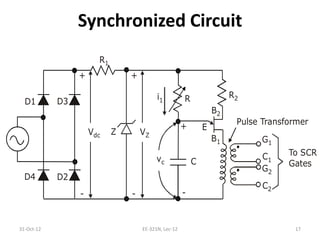
Synchronized Circuit
31-Oct-12 EE-321N, Lec-12 17
R
C
+
-
D1 D3
D4 D2
Vdc
R1
VZ
+
-
Z
i1
vc
+
-
R2
G1
C1
G2
C2
Pulse Transformer
E
B2
B1
To SCR
Gates

L12 ujt based triggering circuit

  • 1.
    EE-321 N Lecture-12 UJT (UnijunctionTransistor) & UJT Based Triggering Circuit
  • 2.
    Introduction • Three terminalsingle junction latching device* • Different from either diode (due to 3 terminals) or the transistor (can’t amplify) • Wide range of applications like oscillators, trigger circuits, sawtooth generators, phase control • Overcomes the limitations of previous trigger circuits like power dissipation & high dependability on the SCR chatacteristics • Other variants include CUJT & PUT 31-Oct-12 EE-321N, Lec-12 2
  • 3.
  • 4.
    Equivalent Circuit RB2 VBB + - E B1 RB1 VBB A + - VeIe B2 Eta-point V1 VD Equivalent Circuit of UJT 31-Oct-12 4EE-321N, Lec-12
  • 5.
    Characteristics 31-Oct-12 5EE-321N, Lec-12 Ve VBB Rload line Vp Vv Ie IvIp0 Peak Point Cutoff region Negative Resistance Region Saturation region Valley Point
  • 6.
    Device Description &Operation • Consists of a lightly doped n-type Si base to which heavily doped p-type emitter is embedded • At the two ends, there are ohmic contacts designated as Base 1 & Base 2 • Thus the 3 terminals are: E, B1 & B2 • An interbase resistance RBB = RB1 + RB2|IE = 0 (~5-10 kΩ) exists between the two bases 31-Oct-12 EE-321N, Lec-12 6
  • 7.
    Contd... • Equivalent circuitconsists of a pn junction diode and the interbase resistance divided into two parts RB1 & RB2 • When a voltage VBB is applied between the bases, the potential of point A w. r. t. B1 is 31-Oct-12 EE-321N, Lec-12 7 1 1 1 1 2 B B AB BB BB BB B B BB R R V V V V R R R    
  • 8.
    Contd... • Where, is known as intrinsic stand off ratio & ranges from 0.5-0.8 • When VE < V1, the equivalent diode is R. B. This is the OFF state of the device & is shown as very low current region on the VE-IE curve • When VE > V1 + VD, the diode becomes F. B. this is the ON state of the device • Vp = V1 + VD = VBB + VD is known as the peak point voltage 31-Oct-12 EE-321N, Lec-12 8
  • 9.
    Contd... • Due tothe flow of IE through RB1, number of charge carriers in RB1 is increased which reduces its resistance, which in turn decrease V1 • This causes diode to become more & more F. B. & IE increases further leading to a regenerative action • VE decreases with increase in IE & the device is said to exhibit negative resistance • Eventually, valley point will be reached after which there will be no further decrease of RB1 • After valley point, device will reach into saturation state 31-Oct-12 EE-321N, Lec-12 9
  • 10.
    UJT Relaxation Oscillator 31-Oct-12EE-321N, Lec-12 10 R R2 VBB R1 C E B2 B1Ve vo Ve Vp VV Vo t t Capacitor charging 1=RC   T V +VBB VP 2 1=R C Capacitor discharging Vv
  • 11.
    Contd... • The –veresistance region of the UJT can be used to advantage in relaxation oscillator which can provide triggering pulses for SCR • In the above ckt, R1 & R2 are chosen to be much smaller than the interbase resistances • The charging resistance R should be such that its load line passes through the device characteristics in the negative resistance region 31-Oct-12 EE-321N, Lec-12 11
  • 12.
    Contd... • When asource voltage VBB is applied to it, C begins to charge through R exponentially towards VBB according to the equation • When vC reaches the peak point voltage, E-B1 junction breaks down & the UJT turns ON. Now C discharges rapidly through R1 • 2 << 1 • UJT turns OFF when the voltage decays to valley voltage Vv 31-Oct-12 EE-321N, Lec-12 12  / 1 t RC C BBv V e  
  • 13.
    Expression for TimePeriod of Oscillation • The time T required for C to charge from initial voltage Vv to peak-point voltage Vp thru R can be obtained as: • Assuming or 31-Oct-12 EE-321N, Lec-12 13  / 1 t RC p BB D v BBV V V V V e        / , 1 t RC D vV V e     1 1 ln 1 T RC f         
  • 14.
    Contd... • If Tis taken as the time pd. of the O/P pulse duration (neglecting small discharge time), then firing angle is given by • Design considerations include selection of R1, R2 & R 31-Oct-12 EE-321N, Lec-12 14 1 ln 1 T RC           
  • 15.
    Resistance Values 31-Oct-12 EE-321N,Lec-12 15 max min; BB p BB v p v V V V V R R I I     1 GT 1 2 BB BB V R V R R R    4 2 10 BB R V 
  • 16.
    Further Resources 1. Videolectures on “Basic Electronics & Lab”, Prof. T. S. Natarajan, Lec-34 UJT Available on www.nptel.iitm.ac.in, www.youtube.com/iit 2. Boylestad & Nashelsky, “Electronic Devices & Circuit Theory”, 7/e, PHI 31-Oct-12 16EE-321N, Lec-12
  • 17.
    Synchronized Circuit 31-Oct-12 EE-321N,Lec-12 17 R C + - D1 D3 D4 D2 Vdc R1 VZ + - Z i1 vc + - R2 G1 C1 G2 C2 Pulse Transformer E B2 B1 To SCR Gates