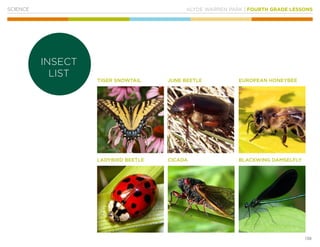
KLYDE WARREN PARK
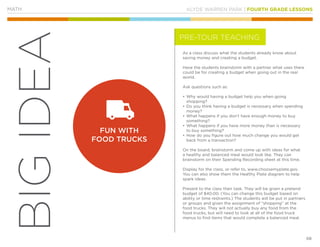
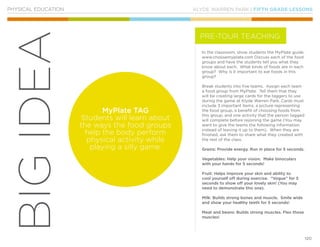
CURRICULUM
KLYDE WARREN PARK
2
Krissi Oden – Editor, Art & Design
Jen Bailey Simpson - Science
Caroline Karl - Math
Tenille Shade - Social Studies
Chelsey Rictor - Physical Education
Produced in partnership withFunded by
With special appreciation to contributing writers:
KLYDE WARREN PARK
3
TABLE OF CONTENTS
DISCIPLINE MAP	 144 TEKS INDEX	 148CAREER CONNECTIONS	 147 ACKNOWLEDGMENTS	 154
THIRD GRADE LESSONS	13
ART & DESIGN	 14 MATH	 20 SCIENCE	 42PHYSICAL EDUCATION	 30 SOCIAL STUDIES	 56
FOURTH GRADE LESSONS	 61
ART & DESIGN	 62 MATH	 67 SCIENCE	 88PHYSICAL EDUCATION	 76 SOCIAL STUDIES	 97
FIFTH GRADE LESSONS	 102
ART & DESIGN	 103 MATH	 109 SCIENCE	 130PHYSICAL EDUCATION	 119 SOCIAL STUDIES	 139
INTRODUCTION	 04
LETTER FROM KWP	 06 A BIT OF HISTORY	 07
KLYDE WARREN PARK
4
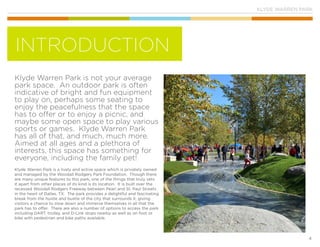
Klyde Warren Park is not your average
park space. An outdoor park is often
indicative of bright and fun equipment
to play on, perhaps some seating to
enjoy the peacefulness that the space
has to offer or to enjoy a picnic, and
maybe some open space to play various
sports or games. Klyde Warren Park
has all of that, and much, much more.
Aimed at all ages and a plethora of
interests, this space has something for
everyone, including the family pet!
Klyde Warren Park is a lively and active space which is privately owned
and managed by the Woodall Rodgers Park Foundation. Though there
are many unique features to this park, one of the things that truly sets
it apart from other places of its kind is its location. It is built over the
recessed Woodall Rodgers Freeway between Pearl and St. Paul Streets
in the heart of Dallas, TX. The park provides a delightful and fascinating
break from the hustle and bustle of the city that surrounds it, giving
visitors a chance to slow down and immerse themselves in all that the
park has to offer. There are also a number of options to access the park
including DART, trolley, and D-Link stops nearby as well as on foot or
bike with pedestrian and bike paths available.
INTRODUCTION
KLYDE WARREN PARK
5
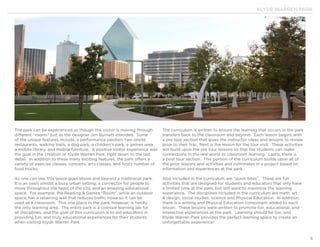
The park can be experienced as though the visitor is moving through
different “rooms” just as the designer Jim Burnett intended. Some
of the unique features include, a performance pavilion, two onsite
restaurants, walking trails, a dog park, a children’s park, a games area,
a mobile library, and mobile furniture. A positive visitor experience was
the goal in the creation of Klyde Warren Park, right down to the last
detail. In addition to these many exciting features, the park offers a
variety of exercise classes, concerts, arts classes, and hosts number of
food trucks.
As one can see, this space goes above and beyond a traditional park.
It is an oasis amidst a busy urban setting, a connector for people to
move throughout the heart of the city, and an amazing educational
space. For example, the Reading & Games “Room”, while an outdoor
space, has a retaining wall that reduces traffic noise so it can be
used as a classroom. This one place in the park, however, is hardly
the only learning area. The entire park is a colossal learning lab for
all disciplines, and the goal of this curriculum is to aid educators in
providing fun, and truly educational experiences for their students
when visiting Klyde Warren Park.
The curriculum is written to ensure the learning that occurs in the park
transfers back to the classroom and beyond. Each lesson begins with
a pre tour section that gives the instructor ideas and lessons to review
prior to their trip. Next is the lesson for the tour visit. These activities
will build upon the pre tour lessons so that the students can make
connections in the real world to classroom learning. Lastly, there is
a post tour section. This portion of the curriculum builds upon all of
the prior lessons and activities and culminates in a project based on
information and experiences at the park.
Also included in the curriculum are “quick bites”. These are fun
activities that are designed for students and educators that only have
a limited time at the park, but still want to maximize the learning
experience. The disciplines included in the curriculum are math, art
& design, social studies, science and Physical Education. In addition,
there is a writing and Physical Education component added to each
lesson. These lessons were written to promote fun, educational, and
interactive experiences at the park. Learning should be fun, and
Klyde Warren Park provides the perfect learning space to create an
unforgettable experience!
KLYDE WARREN PARK
6
LETTER FROM
KLYDE WARREN PARK
When the visionaries behind Klyde Warren Park imagined what
it would be, they pictured a gathering place where people would
congregate and create traditions. After two years and roughly two
million visitors, Klyde Warren Park has become an oasis in the heart of
Dallas, providing connectivity between Downtown and Uptown.
The park has quickly become a popular spot for school groups to
enjoy lunch and burn off energy after visiting one of our Arts District
neighbors. Beyond that, hidden beneath the lush green grass and
behind the butterfly bushes, Klyde Warren Park offers many learning
opportunities for students and teachers to explore. The park is a feat
of engineering and design, providing a unique backdrop for engaging
students of all ages in discussions on topics such as science and
technology, math, visual art and design, social studies, and English/
Language arts.
We are excited to highlight these topics in the following curriculum
developed in partnership with Big Thought and through the generous
support of Exxon Mobil. Our hope is that by providing free access to
TEKS-aligned curriculum, students and teachers will see the park not
only as a place to play, but also as a place to learn. We invite teachers
to use the park as their outdoor classroom for students to exercise
creativity and explore their community.
Tara N. Green
President & CEO
KLYDE WARREN PARK
7
A BIT OF HISTORY
KLYDE WARREN PARK AREA
ABOUT THE
One of the unique features
of Klyde Warren Park is the
freeway that runs underneath
it. Woodall Rodgers Freeway,
originally known as Spur
366, was completed in 1983.
The freeway links Central
Expressway (US 75) and
Stemmons Freeway (I-35E),
and runs through a tunnel
underneath Klyde Warren Park.
Among the many wonderful
attributes that the park brings
to the city, it serves as a
bridge between uptown and
downtown Dallas, creating a
much needed connection.
KLYDE WARREN PARK
8
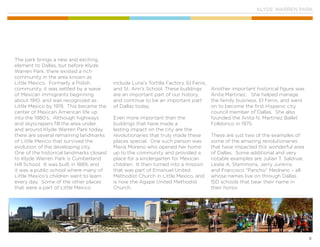
The park brings a new and exciting
element to Dallas, but before Klyde
Warren Park, there existed a rich
community in the area known as
Little Mexico. Formerly a Polish
community, it was settled by a wave
of Mexican immigrants beginning
about 1910, and was recognized as
Little Mexico by 1919. This became the
center of Mexican American life up
into the 1980’s. Although highways
and skyscrapers fill the area under
and around Klyde Warren Park today,
there are several remaining landmarks
of Little Mexico that survived the
evolution of the developing city.
One of the historical landmarks closest
to Klyde Warren Park is Cumberland
Hill School. It was built in 1889, and
it was a public school where many of
Little Mexico’s children went to learn
every day. Some of the other places
that were a part of Little Mexico
include Luna’s Tortilla Factory, El Fenix,
and St. Ann’s School. These buildings
are an important part of our history,
and continue to be an important part
of Dallas today.
Even more important than the
buildings that have made a
lasting impact on the city are the
revolutionaries that truly made these
places special. One such person was
Maria Moreno who opened her home
up to the community and provided a
place for a kindergarten for Mexican
children. It then turned into a mission
that was part of Emanuel United
Methodist Church in Little Mexico, and
is now the Agape United Methodist
Church.
Another important historical figure was
Anita Martinez. She helped manage
the family business, El Fenix, and went
on to become the first Hispanic city
council member of Dallas. She also
founded the Anita N. Martinez Ballet
Folklorico in 1975.
These are just two of the examples of
some of the amazing revolutionaries
that have impacted this wonderful area
of Dallas. Some additional and very
notable examples are Julian T. Saldivar,
Leslie A. Stemmons, Jerry Junkins,
and Francisco “Pancho” Medrano – all
whose names live on through Dallas
ISD schools that bear their name in
their honor.
KLYDE WARREN PARK
9
In addition to Little Mexico, there was another community that had a deep and lasting impact on the city and its
development. During the Jim Crow days of Dallas, on the other side of Pearl Street, northeast from Klyde Warren
Park, was an area known as Freedman’s Town. The community was established in 1869 by freed slaves on what was
then the outskirts of town. Because segregation reigned during this time, African-Americans chose to build their own
infrastructures, including churches and schools, in order to stay away from the white dominated cultural institutions and
governments in the city.
KLYDE WARREN PARK
10
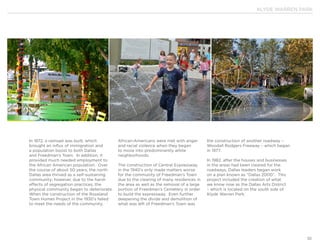
In 1872, a railroad was built, which
brought an influx of immigration and
a population boost to both Dallas
and Freedman’s Town. In addition, it
provided much needed employment to
the African American population. Over
the course of about 50 years, the north
Dallas area thrived as a self-sustaining
community; however, due to the harsh
effects of segregation practices, the
physical community began to deteriorate.
When the construction of the Roseland
Town Homes Project in the 1930’s failed
to meet the needs of the community,
African-Americans were met with anger
and racial violence when they began
to move into predominantly white
neighborhoods.
The construction of Central Expressway
in the 1940’s only made matters worse
for the community of Freedman’s Town
due to the clearing of many residences in
the area as well as the removal of a large
portion of Freedman’s Cemetery in order
to build the expressway. Even further
deepening the divide and demolition of
what was left of Freedman’s Town was
the construction of another roadway –
Woodall Rodgers Freeway – which began
in 1977.
In 1982, after the houses and businesses
in the areas had been cleared for the
roadways, Dallas leaders began work
on a plan known as “Dallas 2000”. This
project included the creation of what
we know now as the Dallas Arts District
– which is located on the south side of
Klyde Warren Park.
KLYDE WARREN PARK
11
KLYDE WARREN PARK
12
Today, several important structures that served the residents of
Freedman’s Town are still in active use in the Arts District. Saint
Paul United Methodist Church was founded in 1873, serving as both
a church and school, providing space for an education that was not
allowed during the days of segregation in the “white only” parts of
Dallas. The current building was completed in 1923, and continues
to be a staple in the community while feeding the homeless and
providing services to those in need. It also became the headquarters
for many of the refugees that fled New Orleans during hurricane
Katrina in 2005.
In 1922, B. T. Washington High School for students of color was opened
in Freedman’s Town; the building was enlarged in 1952 when it was
designated a technical school and again in 1976 when the school
became the Arts Magnet campus for the Dallas Independent School
District. Following an extensive renovation and expansion in 2008,
the restored 1922 building remains the historical core and heart of the
nationally recognized arts high school.
Two blocks east on Flora Street, the Moorland YMCA was the first
YMCA for African-Americans in the Southwest when it was completed
in 1930. Originally equipped with a gymnasium and swimming pool,
the building provided 37 sleeping rooms for use by visitors to Dallas;
because very few hotels were accessible to African-Americans, many
prominent people, from Justice Thurgood Marshall to Muhammad Ali,
stayed at the YMCA while visiting Dallas. Supporters of the YMCA
included Dallas African-American leaders such as Dr. J.J. Rhoads,
Judge George L. Allen, Dr. L. G. Pinkston, and A. Maceo Smith. The
Moorland YMCA became an important cultural, educational and
community center for African-Americans and played a key role as a
neutral meeting place during the Civil Rights Movement. Today the
renovated building serves as home to the renowned Dallas Black
Dance Theatre, providing administrative, rehearsal and teaching
facilities for the company.
On these very grounds some of Dallas’ richest histories were born, as
well as some of the city’s most intriguing and impactful citizens. As
you walk through the beautiful space that is Klyde Warren Park, think
about the historical influences which helped to grow the area in to
what it is today, and what role you can play to make a positive impact
on its future.
References
VVelin, Gabriel. 2010. “Dallas Freedman’s Town: One
Community’s Preservation Within a Gentrified Environment.”
The Eagle Feather 7. doi:10.12794/tef.2010.154.
THIRD GRADE LESSONS | KLYDE WARREN PARK
13
3rd
GRADE
LESSONS
MATH
PHYSICAL EDUCATION
ART & DESIGN
SCIENCE
SOCIAL STUDIES
KLYDE WARREN PARK | THIRD GRADE LESSONS
14
ART &
DESIGN
THIRD GRADE LESSONS | KLYDE WARREN PARK
15
BIGIDEA
ART & DESIGN
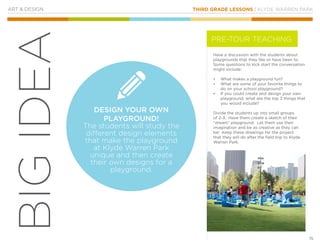
Have a discussion with the students about
playgrounds that they like or have been to.
Some questions to kick start the conversation
might include:
•		 What makes a playground fun?
•		 What are some of your favorite things to
do on your school playground?
•		 If you could create and design your own 	
playground, what are the top 3 things that	
you would include?
Divide the students up into small groups
of 2-3. Have them create a sketch of their
“dream” playground. Let them use their
imagination and be as creative as they can
be! Keep these drawings for the project
that they will do after the field trip to Klyde
Warren Park.
DESIGN YOUR OWN
PLAYGROUND!
The students will study the
different design elements
that make the playground
at Klyde Warren Park
unique and then create
their own designs for a
playground.
PRE-TOUR TEACHING
KLYDE WARREN PARK | THIRD GRADE LESSONS
16
MATERIALS:
SKETCH BOOKS, PENCILS
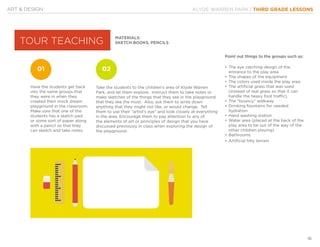
Point out things to the groups such as:
•	The eye catching design of the
entrance to the play area
•	The shapes of the equipment
•	The colors used inside the play area
•	The artificial grass that was used
(instead of real grass so that it can
handle the heavy foot traffic)
•	The “bouncy” walkway
•	Drinking fountains for needed
hydration
•	Hand washing station
•	Water area (placed at the back of the
play area to be out of the way of the
other children playing)
•	Bathrooms
•	Artificial hilly terrain
Have the students get back
into the same groups that
they were in when they
created their mock dream
playground in the classroom.
Make sure that one of the
students has a sketch pad,
or some sort of paper along
with a pencil so that they
can sketch and take notes.
Take the students to the children’s area of Klyde Warren
Park, and let them explore. Instruct them to take notes or
make sketches of the things that they see in the playground
that they like the most. Also, ask them to write down
anything that they might not like, or would change. Tell
them to use their “artist’s eye” and look closely at everything
in the area. Encourage them to pay attention to any of
the elements of art or principles of design that you have
discussed previously in class when exploring the design of
the playground.
ART & DESIGN
01 02
TOUR TEACHING
THIRD GRADE LESSONS | KLYDE WARREN PARK
17
ART & DESIGN
Once you are back at the classroom, have
the students gather in their groups once
more. Pass back the initial sketches that
they created for their “dream playground”.
Instruct them to compare them to the
sketches and notes that they made while at
Klyde Warren Park. Have them talk about
the following questions in their groups:
•	What kinds of things did you find at
Klyde Warren Park that inspired ideas for
your dream playground?
•	What kinds of landscape would you
include in your playground? Why?
•	What colors would you use in your
playground?
•	What shapes would you use in your
playground?
•	What kinds of materials would you use to
build your playground?
•	What would your entrance look like?
Give the students a large sheet of drawing
paper to draw the final version of their
“dream” playground. They can use markers

or colored pencils to add color to their work.
When everyone has completed the project,
allow each group to present their designs
to the class. Encourage the students to ask
questions and make positive comments or
possible suggestions to the groups presenting.
Note: This would be a fun project to do
in a variety of media, depending on the
time that you can allot for it. Creating a
3-D version of the playgrounds would be
a great long term project as well!
01 02
POST-TOUR TEACHING
KLYDE WARREN PARK | THIRD GRADE LESSONS
18
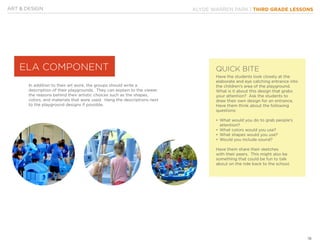
Have the students look closely at the
elaborate and eye catching entrance into
the children’s area of the playground.
What is it about this design that grabs
your attention? Ask the students to
draw their own design for an entrance.
Have them think about the following
questions:
•	What would you do to grab people’s 	
attention?
•	What colors would you use?
•	What shapes would you use?
•	Would you include sound?
Have them share their sketches
with their peers. This might also be
something that could be fun to talk
about on the ride back to the school.
In addition to their art work, the groups should write a
description of their playgrounds. They can explain to the viewer
the reasons behind their artistic choices such as the shapes,
colors, and materials that were used. Hang the descriptions next
to the playground designs if possible.
ART & DESIGN
ELA COMPONENT QUICK BITE
THIRD GRADE LESSONS | KLYDE WARREN PARK
19
ART & DESIGN
Talk to students about the benefits of having playgrounds for children in parks
(i.e., a chance to exercise and release energy). Teach them about the relationship
between heart rate, fitness, and overall wellness. Instruct them on the proper way to
check their pulse and provide them with the information that a healthy heart rate for
people their age is between 127 bpm and 196 bpm (beats per minute). During the
exploration of the Children’s Park, encourage them to sporadically check their heart
rate. If they find that they are below 127 bpm, they should try to move faster in order
to get the most benefits from exercise. If they are above 196 bpm, they should be
sure to take lots of rests so that they don’t overload their hearts.
PERCEPTION
(B) Identify art elements
such as color, texture, form,
line, space, and value and art
principles such as emphasis,
pattern, rhythm, balance,
proportion, and unity in
artworks.
CREATIVE
EXPRESSION/
PERFORMANCE
(A) Create artworks based
on personal observations and
experiences.
RESPONSE/EVALUATION
(A) Identify general intent
and expressive qualities in
personal artworks.
01 02 04
TEKS
PE COMPONENT
KLYDE WARREN PARK | THIRD GRADE LESSONS
20
MATH
THIRD GRADE LESSONS | KLYDE WARREN PARK
21
BIGIDEA
MATH
•	As a class discuss what the students already know
about perimeter and area.
•	Have the students turn to a partner and discuss
how perimeter and area are related to one
another. Make a web on the board to display your
ideas, and have the students add to the web as
they come up with them.
•		 Ask questions such as:
°° What is a unit of measurement?
°° How do we measure the perimeter of a given
shape?
°° How do the sizes of the units of measurement
affect the total perimeter when measuring?
°° What could we use if we didn’t have a ruler to
measure the perimeter of our classroom?
•	As a class decide (take a vote, brainstorm ideas)
what could be used at the park to measure length.
°° Leaves, walking steps, rocks, etc.
•	After coming to a decision have the students
pair up into partners and give each student a
Perimeter Recording Sheet.
•	Students can fill in the ‘unit used to measure
length’ section of the recording sheet.
PERIMETER
IN THE PARK
PRE-TOUR TEACHING
KLYDE WARREN PARK | THIRD GRADE LESSONS
22
MATERIALS:
PERIMETER RECORDING SHEET, CLIPBOARD, PENCIL
•	Discuss what shape you will be measuring. Is this section of the
park shaped like a rectangle? A triangle?
•	Have the students draw a sketch of the borders of the area you
will be measuring.
•	Make sure the students have access to the unit of measurement
they will need to complete their task. Give them time to find a
leaf, rock, etc.
•	Partners will work together to find what they believe is the
perimeter of the park. Students will need to complete the first
page of their recording sheet at this time.
•	The teacher can monitor for understanding and help students
with any questions they may have.
After arriving at the park, take a tour as a class.
Decide on an area of the park that you would be
able to measure.
MATH
TOUR TEACHING
THIRD GRADE LESSONS | KLYDE WARREN PARK
23
MATH
Students will come together as a class to create a dot plot displaying the results of
their perimeter recordings.
•	The teacher can model a dot plot on the board to check for understanding.
Working as a class, the students will compile their data to show the most frequently
found perimeter.
•	Space for working through the problems is found on the third page of the
Perimeter Recording Sheet.
•	A map of the park with measurements is included at the end of this lesson so
students can compare their estimates with actual park dimensions.
Have students write about their experience.
•	On the last page of the Perimeter Recording Sheet there are several questions that
students may answer to expand upon their visit to the park.
•	Working with their partners or independently, students should use complete
sentences and short paragraphs to answer the questions.
•	Teacher may guide students thinking by facilitating a group discussion of the
questions.
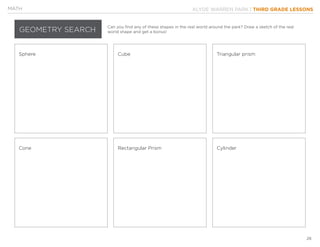
Geometry Search - On the back of the
recording sheet the students have a
geometry search that they can do while
at the park. Students should try and find
as many real world three-dimensional
objects as they can. Once they have
found the shape in real life they are able
to sketch their sighting on the recording
sheet.
POST-TOUR TEACHING
ELA COMPONENT
QUICK BITE
KLYDE WARREN PARK | THIRD GRADE LESSONS
24
Use your own feet to measure length! Walk the perimeter by touching ankle to toe and counting how many steps make up the
perimeter of the area. Remind students to maintain their balance by keeping tummies tight and hands out. For an added physical
challenge, tell students to keep their heads up and eyes forward instead of looking at their feet.
(A) represent one-and two-
step problems involving
addition and subtraction
of whole numbers to 1,000
using pictorial models,
number lines, and equations
(B) determine the perimeter
of a polygon or a missing
length when given perimeter
and remaining side lengths in
problems
(A) summarize a data set
with multiple categories
using a frequency table,
dot plot, pictograph, or bar
graph with scaled intervals
(A) classify and sort two-
and three dimensional
figures, including cones,
cylinders, spheres, triangular
and rectangular prisms, and
cubes, based on attributes
using formal geometric
language
(C) determine the area
of rectangles with whole
number side lengths
in problems using
multiplication related to the
number of rows times the
number of unit squares in
each row
(A) solve with fluency one-
step and two-step problems
involving addition and
subtraction within 1,000
using strategies based on
place value, properties
of operations, and the
relationship between
addition and subtraction
(E) represent multiplication
facts by using a variety
of approaches such as
repeated addition, equal-
sized groups, arrays, area
models, equal jumps on
a number line, and skip
counting
MATH
PE COMPONENT
TEKS
3.4 3.6
3.5 3.7
3.8
THIRD GRADE LESSONS | KLYDE WARREN PARK
25
MATH
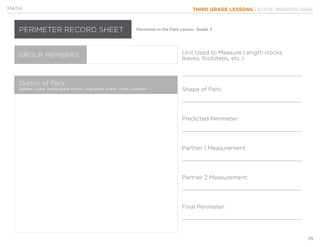
PERIMETER RECORD SHEET Perimeter in the Park Lesson, Grade 3
GROUP MEMBERS:
Sketch of Park:
Sphere, cube, rectangular prism, triangular prism, cone, cylinder
Unit Used to Measure Length (rocks,
leaves, footsteps, etc.):
Shape of Park:
Predicted Perimeter:
Partner 1 Measurement:
Partner 2 Measurement:
Final Perimeter:
KLYDE WARREN PARK | THIRD GRADE LESSONS
26
MATH
GEOMETRY SEARCH
Can you find any of these shapes in the real world around the park? Draw a sketch of the real
world shape and get a bonus!
Sphere
Cone
Cube
Rectangular Prism
Triangular prism
Cylinder
THIRD GRADE LESSONS | KLYDE WARREN PARK
27
MATH
CREATE A DOT PLOT USING DATA Using the data that your class collected, create a dot plot:
What perimeter was found most often?
Were there any outliers in the data?
Using your findings, is there any way that
you could find the exact perimeter in feet
and inches? How so?
KLYDE WARREN PARK | THIRD GRADE LESSONS
28
MATH
THINK AND RESPOND With the class or a partner, answer the following questions using complete sentences.
1.	 Did everyone in the class find
	 the exact same perimeter?
	 Why or why not?
2.	 What do you think would
	 have happened if we chose
	 different units of measurement?
	 Would you have found the same
	 perimeter? Why?
3.	 Is there any way to use the
	 perimeter you found to find the
	 area of the section of the park?
THIRD GRADE LESSONS | KLYDE WARREN PARK
29
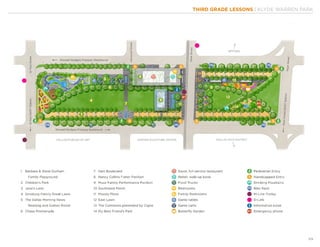
15'-0"
22'-0"
15'-9"
15'-0"
80'-6"
324'-0"
311'-9"
26'-0"
122'-7"
69'-10"
15'-11"
61'-2"
37'-6" 49'-5"
24'-3"
20'-1"
60'-0"
10'-0"
74'-0"
12'-1"
25'-3"
8'-5"
45'-9"
30'-5"
15'-0"
16'-5"
25'-6"
290'-10"
79'-4"
147'-2"
7,517 sf
9,252 sf
9,686 sf
20,235 sf
28'-3"
20'-1"
40'-7"
12'-0"
20'-0"
12'-1"
167'-2"
115'-11"
15'-0"
Company Switch: 100, 200,
400 Amp Power with Color
Coded Twist Lock Connections
19'-0"
1,038'-1"
220'-4"
361'-10"
638'-3"
Klyde Warren Park Site Plan
with Measurements
KLYDE WARREN PARK | THIRD GRADE LESSONS
30
PHYSICAL
EDUCATION
THIRD GRADE LESSONS | KLYDE WARREN PARK
31
BIGIDEA
Ask students to create a table on a piece
of paper; label one side “Things I know
about the Olympics” and label the other
side, “Things I’d like to know about the
Olympics”. Have students brainstorm
in groups to complete the table and
discuss. Show the students a clip from the
Olympics. Instruct students to research
the origin of the Olympics on their phones
or computers and share what they learned
with the class. Allow students to make
Greek costumes such as tunics, cloaks
and crowns to be worn during the relay
(over their clothes preferably). Show
them pictures of ancient Greece to inspire
their designs. Don’t forget to make the
torch to kick off the Opening Ceremony!
Playing music (if you are able) is a great
way to get the students excited too.
PHYSICAL EDUCATION
OLYMPICS RELAY
Students complete
an Olympic Relay
while learning about
Olympic Events.
PRE-TOUR TEACHING
KLYDE WARREN PARK | THIRD GRADE LESSONS
32
PHYSICAL EDUCATION
MATERIALS:
WHISTLE, 5-8 HURDLES, 4-6 FOAM NOODLES, 4-6 BEAN BAGS
OR NERF FOOTBALLS, MEASURING TAPE, STOPWATCH
Break the students into groups
of 4 and place one student at
each station. On the whistle,
the student at station 1
completes the event and runs
to tag his teammate at station
2. This continues until the 4th
teammate crosses the finish
line. The team with the fastest
time wins.
Start all the students at
station 1 and tell them
to go on the whistle.
Each student proceeds
through the events. The
student with the fastest
time wins.
If you have enough supervision,
or mature enough students, run
this activity similar to an actual
track meet in which distance
and times are calculated and a
winner is declared based on his
or her performance in each of
the 4 events.
Set up 4 relay stations (events) around the perimeter
of the Ginsberg Family Great Lawn with several adult
supervisors. Demonstrate or describe what the students
will do at each station (event) before beginning the relay.
Number each station 1-4 so students will know which
station to complete first. You may choose to have an adult
supervisor record distances for students at each station,
or you may choose to create a scorecard so that the
students may keep track of their achievements at each
station. Either way, the students will enjoy knowing how
well they did at each event.
OPTION OPTION OPTION
01 02 03
TOUR TEACHING
THIRD GRADE LESSONS | KLYDE WARREN PARK
33
Hurdles - You may
use several makeshift
hurdles, but be sure
they are not higher
than the average
student’s knees.
Discus - Students
throw a bean bag or
Nerf football as far as
they can in the manner
of Discus.
Javelin - Students throw
a foam noodle as far as
they can in the manner
of a javelin.
Long Jump - Students
complete a two-footed
jump from a starting line
trying to jump as far as
possible. Give them 3
chances and record the
best jump.
PHYSICAL EDUCATION
STATIONS
STATION
STATION STATION
STATION
01
03 04
02
KLYDE WARREN PARK | THIRD GRADE LESSONS
34
PHYSICAL EDUCATION
Hold an awards ceremony. Make 1st, 2nd, 3rd place podiums out of milk crates or
boxes. Award gold, silver, and bronze medals to students whose scores are highest.
For a less competitive option, make a winners circle out of a hula hoop and honor
each participant with a gold medal.
Students can create a poster about what they learned while researching the
origin of the Olympics. Tell them to choose a theme and title for the poster such
as “Ancient Greek Clothing” or “The Olympics: Then and Now”. They should
paraphrase and summarize what they learned, include pictures, and site the
sources they used.
ELA COMPONENT
POST-TOUR TEACHING
THIRD GRADE LESSONS | KLYDE WARREN PARK
35
Physical Activity and Health
(A) Use equipment safely and properly
Movement
(B) Demonstrate proper form and smooth transitions during
combinations of fundamental locomotor and body control skills
such as running and jumping safely in dynamic situations.
(J) Demonstrate key elements in manipulative skills such as
underhand throw, overhand throw, catch and kick such as position
your side to the target.
PHYSICAL EDUCATION
TEKS
3.1
3.5
QUICK BITE
Students may observe the amenities in
the park such as the game tables and
Dog Park. Ask them to invent a new
Olympic Event that could be done right
here in Klyde Warren Park. Tell them
to think about how a winner would be
determined in this event.
KLYDE WARREN PARK | THIRD GRADE LESSONS
36
BIGIDEA
PHYSICAL EDUCATION
Create a free GoNoodle account at
www.gonoodle.com. Choose one of the yoga-
based activities for the students to follow along.
You may choose to have a class discussion before
or after you do the activity. Ask the students
to tell you what they know about yoga. Ask for
volunteers to demonstrate any yoga poses that
they might already know. You will want to compile
and familiarize the children with about 14 yoga
poses before heading to the park. This will be the
“list” mentioned later in the lesson. Students may
use electronic devices or classroom computers
to search for images of yoga poses, or they can
create their own. Tell them that the best way to
remember the poses is to learn or give a name
to each one that makes sense. For example, the
Bridge is when you lie on your back and make
a bridge with your spine. Another way to help
students remember each pose is to have them
draw pictures. Put the students in pairs and have
them draw each other as they attempt to perform the pose. They may take these drawings to the park to help them.
Another option could be for you to print off images ahead of time and give them to the students to memorize and
practice safely in class. There are several readily available handouts online.
Inform the students that all types of Yoga require focus, patience, and the ability to focus on your breathing and clear
your mind. Each pose should be held between 20-30 seconds. Tell them it’s important they have good posture and
keep their stomach muscles taut at all times. Encourage them to persevere. If they lose balance and fall, no problem!
Just get back into the pose and try again. Tell them they will be executing these poses when they get to the park.
Students may need an extrinsic motivator for this one (they may be too shy)-offer a reward for the best Yogi in the
group that day.
YOGA IN THE PARK
Students will
experience the ways
in which yoga reduces
stress and builds
strength.
PRE-TOUR TEACHING
THIRD GRADE LESSONS | KLYDE WARREN PARK
37
MATERIALS:
YOGA MATS FOR EACH STUDENT
Proceed to East Lawn or Ginsburg Family Lawn.
Spread the yoga mats out so that each student has
enough space to move freely without coming into
contact with anybody else. Don’t let them spread
too far, though! You want them to be able to hear
you when you speak in your calm and relaxing “yoga”
voice. You may play soft, slow music if you have the
capability.
Tell the students to sit in Sukhasana (traditional yoga
pose with legs crossed, palms up and thumb and
middle finger slightly touching). Tell them to listen to
the sounds around them, focus on their breathing, and
clear their minds. At this point, either you or another
student can call out a new yoga pose from the “list”
you assembled in class. Poses should be held for
about 20-30 seconds before switching poses.
PHYSICAL EDUCATION
TOUR TEACHING
KLYDE WARREN PARK | THIRD GRADE LESSONS
38
PHYSICAL EDUCATION
Ask students to discuss how they felt before, during, and after Yoga in the
Park. Ask them to determine the benefits of doing an activity like Yoga on a
regular basis. Answers could include stronger muscles and bones, flexibility and
greater range of motion, a strengthening of the immune system, stress relief, and
muscular-skeletal pain relief (i.e. back pain).
During the Post Tour Teaching portion of the lesson, have students make 3
vertical columns on a piece of paper. Label the columns “Before”, “During” and
“After”. Tell the students to use at least two complete sentences to describe how
they felt during each stage of the Yoga in the Park activities. Give the table a
title and hang the tables in the classroom.
Ask students to get in groups and
discuss the various ways in which they
cope with the stress in their lives. Tell
them to examine their answers by
asking themselves the question, “Are
these healthy or unhealthy ways to cope
with stress?”
Physical Activity and Health
(C) Participate in appropriate
exercises for developing
flexibility.
Physical Activity and Health
(D) Identify principles of good
posture and its impact on
physical activity
Social Development
(B) Persevere when not
successful on the first try in
learning movement skills.
TEKS
3.3 3.4 3.7
ELA COMPONENT
POST-TOUR TEACHING QUICK BITE
THIRD GRADE LESSONS | KLYDE WARREN PARK
39
BIGIDEA
In the classroom, introduce the students to
the terms aerobic exercise and anaerobic
exercise. Do this by asking them to compare the
100-meter dash and a marathon race. Which
one would you consider to be more difficult?
You may use a Venn diagram to illustrate
the similarities and differences of these two
activities. Give the students the definitions
below and then refer to the Venn diagram to
make changes or additions.
Aerobic exercise- requires oxygen, and can be
sustained for longer periods of time.
Anaerobic exercise- does not require oxygen,
and causes the heart to beat harder and faster.
Cannot be sustained for a long period of time,
utilizes large muscle groups.
Tell the students that they will participate in two
challenges at Klyde Warren Park and they will
have to decide which is aerobic exercise and
which is anaerobic exercise.
BEANBAGS AT
MIDNIGHT
Students will explore
the differences between
aerobic and anaerobic
fitness.
PHYSICAL EDUCATION
PRE-TOUR TEACHING
KLYDE WARREN PARK | THIRD GRADE LESSONS
40
PHYSICAL EDUCATION
MATERIALS:
ONE BEANBAG FOR EACH STUDENT, MEDIUM SIZED BOX OR BUCKET, CONES
MIDNIGHT
This game is a sprinting game--an
anaerobic activity. It needs high energy in
short bursts.
Proceed to Ginsburg Family Great Lawn
or East Lawn. Create a large, rectangular
perimeter using cones. Designate a child
as ‘it’. This student will chase the other
children. ‘It’ stands on one end line, while
all the other children stand on the other
end line. All the children will yell out to ‘it’,
“What time is it?” ‘It’ may say 5 o’clock.
Since ‘it’ said 5 o’clock, all the children take
5 steps towards ‘it’. Next, the children will
say again, “What time is it?” If it says 8
o’clock, the children will take 8 more steps
towards ‘it.’ Continue with this pattern.
When the children say, “What time is it?”
and ‘it’ says midnight, ‘it’ must chase all
the children back to the starting end line.
Any child tagged now becomes a helper to
‘it’, and will stand on ‘its’ end line to help
chase the other children on the midnight
command.
BEANBAGS
This game is an aerobic activity.
Proceed to Jane’s Lane. Inform the
students that one lap equals once around
the main path on the perimeter of the park.
Tell them they will be running three laps.
Each time they complete a lap, they must
throw their beanbag, using an underhand
throw, at the box in the middle of the park.
After they throw, children must go into the
middle to retrieve their beanbag, pick it
up, and return back to the track all without
stopping their run. Once back on the track,
children should begin running another
lap from the place where they threw their
beanbag. Children should continue in this
pattern until they complete all three laps.
Another option is to award students points
each time they make their beanbag in the
box. Winner receives a small award. A fun,
less competitive alternative is to let the
kids keep their scores private.
TOUR TEACHING
ACTIVITY ACTIVITY
01 02
THIRD GRADE LESSONS | KLYDE WARREN PARK
41
PHYSICAL EDUCATION
Look at the Venn diagram again when you are back in the classroom. Ask students
to tell you which activity completed in the park is aerobic exercise and which is
anaerobic. Split the students into groups and have them create aerobic or anaerobic
games for their classmates.
Ask students to make an Acrostic poem. Have them write the word aerobic or
anaerobic vertically on a piece of paper. Encourage the kids to think about how their
bodies felt after each of the activities in the park. They should choose an adjective
for each letter of the word. They may decorate their poems. These can be hung in
the classroom.
Physical Activity and Health
(B) Distinguish between aerobic and anaerobic activities
TEKS
3.4
ELA COMPONENT
POST-TOUR TEACHING QUICK BITE
Tell the students to list all of the
activities in which people are engaged
at Klyde Warren Park. Tell them to label
each activity as being either aerobic
or anaerobic. Inform them that a good
fitness routine includes both aerobic and
anaerobic exercise. They will probably
notice that the bulk of the activities
on their lists are labeled as aerobic
exercise. Ask them to brainstorm ideas
for activities that could be implemented
in the park that are anaerobic exercises.
One example you could suggest is an
outdoor weightlifting gym.
KLYDE WARREN PARK | THIRD GRADE LESSONS
42
SCIENCE
THIRD GRADE LESSONS | KLYDE WARREN PARK
43
BIGIDEA
SCIENCE
Engage students in a discussion about
the basic parts of a plant and what each
of those parts does to benefit the plant
(Part 1). Then, use the questions in Part
2 to explore how and why plants look and
function differently.
1.	 Parts of a plant
Review the basic parts that most
plants have in common. (Leaves,
stems, roots, seeds, flowers)
•		 Where they are on the plant
•		 Their functions (roots take in water
and nutrients, stem supports plant
and transports waters and nutrients
to and from leaves, leaves are the
solar panels of the plant because they
collect sunlight to turn into energy,
flowers attract pollinators in order to
make seeds, seeds fall to the ground
or are dispersed by animals or wind
to make more plants)
2.	 Talk about how these parts may look
different among plants
Compare and contrast plants from
different ecosystems: Rainforest
plants, aquatic plants, forests and
desert plants, etc.
•		 How are they alike? Reinforce what all
plants have in common. (basic parts
and all need sunlight and water)
FORM &
FUNCTION
Plants and animals in nature are
often shaped the way that they are
in order to do a job. For instance,
squirrels climb trees so they have
specially shaped claws to help
them. Plants have jobs too: they
need to gather sunlight with their
leaves, store and transport water
in their stems and grow seeds to
make more plants. They grow
colorful flowers to attract bees to
help spread their pollen. These
leaves, stems, roots, seeds and
flowers can come in all shapes and
sizes, depending on the habitat
where the plant is found.
The colors are beautiful to our
eyes, but did you know they also
help bees find pollen? Bees use
pollen to make honey, a yummy
food that we enjoy as well! Lots
of flowers are yellow or purple, a
color honey bees find especially
attractive. Some flowers have lines
and patterns on the flower that
help the bee find exactly where the
flower keeps its pollen.
The shapes of leaves are another
example. Trees use sunlight to
help them grow very big. Many
tree leaves are broad and flat. This
broad, flat shape helps them to
gather sunlight so they can grow
many stories tall.
PRE-TOUR TEACHING
KLYDE WARREN PARK | THIRD GRADE LESSONS
44
SCIENCE
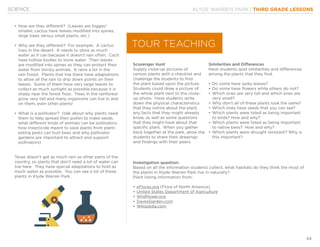
Scavenger Hunt
Supply close-up pictures of
certain plants with a checklist and
challenge the students to find
the plant based upon the picture.
Students could draw a picture of
the whole plant next to the close-
up photo. Have students write
down the physical characteristics
that they notice about the plant,
any facts that they might already
know, as well as some questions
that they might have about that
specific plant. When you gather
back together at the park, allow the
students to share their drawings
and findings with their peers.
Investigation question:
Based on all the information students collect, what habitats do they think the most of
the plants in Klyde Warren Park live in naturally?
Plant listing information from:
•	eFloras.org (Flora of North America)
•	United States Department of Agriculture
•	Wildflower.org
•	DavesGarden.com
•	Wikipedia.com
Similarities and Differences
Have students spot similarities and differences
among the plants that they find.
•	Do some have spiky leaves?
•	Do some have flowers while others do not?
•	Which ones are very tall and which ones are
very small?
•	Why don’t all of these plants look the same?
•	Which ones have seeds that you can see?
•	Which plants were listed as being important
to birds? How and why?
•	Which plants were listed as being important
to native bees? How and why?
•	Which plants were drought resistant? Why is
this important?
•	How are they different? (Leaves are bigger/
smaller, cactus have leaves modified into spines,
large trees versus small plants, etc.)
•	Why are they different? For example: A cactus
lives in the desert. It needs to store as much
water as it can because it doesn’t rain often. Cacti
have hollow bodies to store water. Their leaves
are modified into spines so they can protect their
water from thirsty animals. It rains a lot in the
rain forest. Plants that live there have adaptations
to allow all the rain to drip down points on their
leaves. Some of them have very large leaves to
collect as much sunlight as possible because it is
shady near the forest floor. Trees in the rainforest
grow very tall and many organisms can live in and
on them, even other plants!
•	What is a pollinator? (talk about why plants need
them to help spread their pollen to make seeds,
what different kinds of animals can be pollinators,
how insecticide meant to save plants from plant-
eating pests can hurt bees and why pollinator
gardens are important to attract and support
pollinators)
Texas doesn’t get as much rain as other parts of the
country, so plants that don’t need a lot of water can
live here. They have special adaptations to hold as
much water as possible. You can see a lot of these
plants in Klyde Warren Park.
TOUR TEACHING
THIRD GRADE LESSONS | KLYDE WARREN PARK
45
•	Could we group the plants we found at Klyde Warren Park into
different habitats? What would they be? What else could live in
those habitats?
•	What habitat/ecosystem is Dallas in? Why is it important to save
water by planting plants that don’t need a lot of water?
•	Have students draw a picture or create a big mural of different
ecosystems with appropriate plants. Later you can add animals
to the mural that would live in the ecosystems.
•	Have students use their insect count data from the “Quick Bite”
to create a bar graph of the number of butterflies and bees they
found in different areas of the park. Determine which area had
the highest amount of butterflies and which area had the highest
amount of bees. What could be some reasons that there were
more butterflies or bees in one section of the park than another?
Have students write about their favorite
plant that they learned about at Klyde
Warren Park. They may need to
conduct additional research about the
plant. They could include:
•	Its scientific and common names
•	Where it lives naturally (geographic
location and ecosystem)
•	Is it beneficial to animals? How?
•	Can people use this plant for
something? (Food, clothing, medicine,
etc.)
•	Does it have special adaptations for
surviving in its natural ecosystem?
•	Why they found this plant interesting.
They could present this information in
one of the following forms:
•	A very short story with a fictional plot
that is built around all of the above
information
•	A poem that includes descriptive
words about the plant as well as the
above information
•	An informational report
•	A how-to for birds, animals or
pollinating insects to find the plant
and use it for food, nesting material or
pollination.
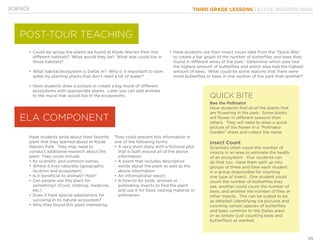
Bee the Pollinator
Have students find all of the plants that
are flowering in the park. Some plants
will flower in different seasons than
others. They will need to draw a quick
picture of the flower in a “Pollinator
Garden” sheet and collect the name.
Insect Count
Scientists often count the number of
insects in an area to estimate the health
of an ecosystem. Your students can
do that too. Have them split up into
groups of three and have each student
in a group responsible for counting
one type of insect. One student could
count the number of butterflies they
see, another could count the number of
bees, and another the number of flies or
other insects. This can be scaled to be
as detailed (identifying via pictures and
counting certain species of butterflies
and bees common to the Dallas area)
or as simple (just counting bees and
butterflies) as wanted.
SCIENCE
QUICK BITE
POST-TOUR TEACHING
ELA COMPONENT
KLYDE WARREN PARK | THIRD GRADE LESSONS
46
Be the Plant
Have the students create a dance that
represents their favorite plant. How
does it stand? Pretend your arms and
legs are parts of the plant. Do they
wave in the breeze? Are they low
to the ground? Are they very, very
tall? Do they have spines stick out to
protect the plant?
Establish one or more “Be the Plant”
stations in the park where students
strike a pose like their favorite plant.
Have an adult take their picture and
tag it with #KWP or #betheplantKWP
to help promote the park and its
curriculum.
(A) plan and implement descriptive investigations, including asking
and answering questions, making inferences, and selecting and using
equipment or technology needed, to solve a specific problem in the
natural world;
(C) construct maps, graphic organizers, simple tables, charts, and bar
graphs using tools and current technology to organize, examine, and
evaluate measured data;
(D) analyze and interpret patterns in data to construct reasonable
explanations based on evidence from investigations;
(F) communicate valid conclusions supported by data in writing, by
drawing pictures, and through verbal discussion.
(A) observe and describe the physical characteristics of environments
and how they support populations and communities within an
ecosystem;
(A) explore how structures and functions of plants and animals allow
them to survive in a particular environment.
SCIENCE
TEKS
2.0
9.0
10.0
PE COMPONENT
THIRD GRADE LESSONS | KLYDE WARREN PARK
47
SCIENCE
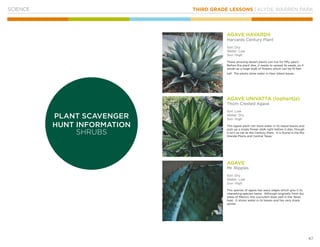
AGAVE HAVARDII
Harvards Century Plant
Soil: Dry
Water: Low
Sun: High
These amazing desert plants can live for fifty years!
Before the plant dies, it needs to spread its seeds, so it
sends up a huge stalk of flowers which can be 15 feet
tall! The plants store water in their lobed leaves.
AGAVE UNIVATTA (lophantja)
Thorn Crested Agave
Soil: Low
Water: Dry
Sun: High
This agave plant can store water in its lobed leaves and
puts up a single flower stalk right before it dies, though
it isn’t as tall as the Century Plant. It is found in the Rio
Grande Plains and Central Texas.
AGAVE
Mr. Ripples
Soil: Dry
Water: Low
Sun: High
This species of agave has wavy edges which give it its
interesting species name. Although originally from dry
areas of Mexico, this succulent does well in the Texas
heat. It stores water in its leaves and has very sharp
spines.
PLANT SCAVENGER
HUNT INFORMATION
SHRUBS
KLYDE WARREN PARK | THIRD GRADE LESSONS
48
SCIENCE
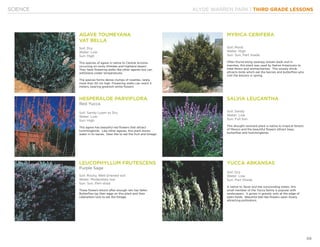
AGAVE TOUMEYANA
VAT BELLA
Soil: Dry
Water: Low
Sun: High
This species of agave is native to Central Arizona
occurring on rocky hillsides and highland desert.
They have flowering stalks like other agaves but can
withstand colder temperatures.
The species forms dense clumps of rosettes, rarely
more than 50 cm high. Flowering stalks can reach 3
meters, bearing greenish-white flowers
MYRICA CERIFERA
Soil: Moist
Water: High
Sun: Sun, Part shade
Often found along swampy stream beds and in
marshes, this plant was used by Native Americans to
treat fevers and stomachaches. This woody shrub
attracts birds which eat the berries and butterflies who
visit the blooms in spring.
HESPERALOE PARVIFLORA
Red Yucca
Soil: Sandy Loam to Dry
Water: Low
Sun: High
This agave has beautiful red flowers that attract
hummingbirds. Like other agaves, this plant stores
water in its leaves. Deer like to eat the fruit and foliage.
SALVIA LEUCANTHA
Soil: Sandy
Water: Low
Sun: Full Sun
This drought resistant plant is native to tropical forests
of Mexico and the beautiful flowers attract bees,
butterflies and hummingbirds.
LEUCOPHYLLUM FRUTESCENS
Purple Sage
Soil: Rocky, Well-Drained soil
Water: Moderately low
Sun: Sun, Part-shad
These flowers bloom after enough rain has fallen.
Butterflies lay their eggs on this plant and their
caterpillars love to eat the foliage.
YUCCA ARKANSAS
Soil: Dry
Water: Low
Sun: Part Shade
A native to Texas and the surrounding states, this
small member of the Yucca family is popular with
landscapers. It grows in gravely soils at the edge of
open fields. Beautiful bell like flowers open slowly
attracting pollinators.
THIRD GRADE LESSONS | KLYDE WARREN PARK
49
SCIENCE
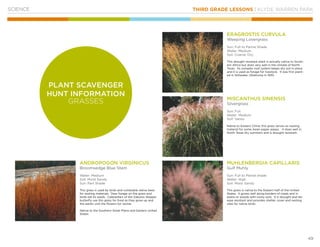
ANDROPOGON VIRGINICUS
Broomsedge Blue Stem
Water: Medium
Soil: Moist Sandy
Sun: Part Shade
This grass is used by birds and vulnerable native bees
for nesting materials. Deer forage on the grass and
birds eat its seeds. Caterpillars of the Zabulon Skipper
butterfly use this grass for food as they grow up and
the adults visit the flowers for nectar.
Native to the Southern Great Plains and Eastern United
States
MUHLENBERGIA CAPILLARIS
Gulf Muhly
Sun: Full to Partial shade
Water: High
Soil: Moist Sandy
This grass is native to the Eastern half of the United
States. It grows well along borders of roads and in
plains or woods with rocky soils. It is drought and dis-
ease resistant and provides shelter, cover and nesting
sites for native birds.
ERAGROSTIS CURVULA
Weeping Lovergrass
Sun: Full to Partial Shade
Water: Medium
Soil: Coarse, Dry
This drought resistant plant is actually native to South-
ern Africa but does very well in the climate of North
Texas. Its complex root system keeps dry soil in place
and it is used as forage for livestock. It was first plant-
ed in Stillwater, Oklahoma in 1935.
MISCANTHUS SINENSIS
Silvergrass
Sun: Full
Water: Medium
Soil: Varies
Native to Eastern China, this grass serves as nesting
material for some Asian paper wasps. It does well in
North Texas dry summers and is drought resistant.
PLANT SCAVENGER
HUNT INFORMATION
GRASSES
KLYDE WARREN PARK | THIRD GRADE LESSONS
50
SCIENCE
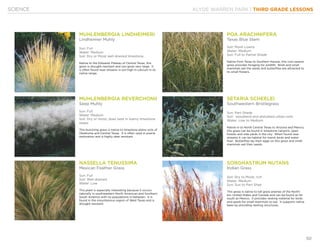
NASSELLA TENUSSIMA
Mexican Feather Grass
Sun: Full
Soil: Well drained
Water: Low
This plant is especially interesting because it occurs
naturally in southwestern North American and Southern
South America with no populations in between. It is
found in the mountainous region of West Texas and is
drought resistant.
MUHLENBERGIA LINDHEIMERI
Lindheimer Muhly
Sun: Full
Water: Medium
Soil: Dry or Moist well drained limestone.
Native to the Edwards Plateau of Central Texas, this
grass is drought resistant and can grow very large. It
is often found near streams in soil high in calcium in its
native range.
POA ARACHNIFERA
Texas Blue Stem
Soil: Moist Loams
Water: Medium
Sun: Full to Partial Shade
Native from Texas to Southern Kansas, this cool season
grass provides foraging for wildlife. Birds and small
mammals eat the seeds and butterflies are attracted to
its small flowers.
MUHLENBERGIA REVERCHONII
Seep Muhly
Sun: Full
Water: Medium
Soil: Dry or moist, does best in loamy limestone
seeps
This bunching grass is native to limestone plains soils of
Oklahoma and Central Texas. It is often used in prairie
restoration and is highly deer resistant.
SETARIA SCHEELEI
Southwestern Bristlegrass
Sun: Part Shade
Soil: woodland and disturbed urban soils
Water: Low to Medium
Native in to North Central Texas to Arizona and Mexico,
this grass can be found in limestone canyons, open
forests and side yards in the city. When found near
streams it can be habitat for marsh birds and water
fowl. Butterflies lay their eggs on this grass and small
mammals eat their seeds.
SORGHASTRUM NUTANS
Indian Grass
Soil: Dry to Moist, rich
Water: Medium
Sun: Sun to Part Shae
This grass is native to tall grass prairies of the North-
ern United States and Canada and can be found as far
south as Mexico. It provides nesting material for birds
and seeds for small mammals to eat. It supports native
bees by providing nesting structures.
THIRD GRADE LESSONS | KLYDE WARREN PARK
51
SCIENCE
PLANT SCAVENGER
HUNT INFORMATION
PERENNIALS
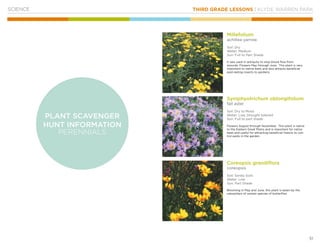
Millefolium
achillea yarrow
Soil: Dry
Water: Medium
Sun: Full to Part Shade
It was used in antiquity to stop blood flow from
wounds. Flowers May through June. This plant is very
important to native bees and also attracts beneficial
pest-eating insects to gardens.
Symphyotrichum oblongifolium
fall aster
Soil: Dry to Moist
Water: Low, Drought tolerant
Sun: Full to part shade
Flowers August through November. This plant is native
to the Eastern Great Plains and is important for native
bees and useful for attracting beneficial insects to con-
trol pests in the garden.
Coreopsis grandiflora
coreopsis
Soil: Sandy Soils
Water: Low
Sun: Part Shade
Blooming in May and June, this plant is eaten by the
caterpillars of certain species of butterflies.
KLYDE WARREN PARK | THIRD GRADE LESSONS
52
SCIENCE
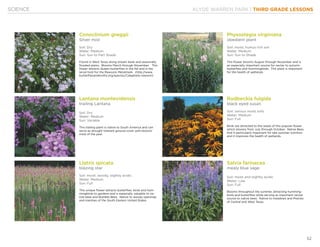
Conoclinium greggii
Silver mist
Soil: Dry
Water: Medium
Sun: Sun to Part Shade
Found in West Texas along stream beds and seasonally
flooded plains. Blooms March through November. This
flower attracts Queen butterflies in the fall and is the
larval host for the Rawsons Metalmark. (http://www.
butterfliesandmoths.org/species/Calephelis-rawsoni)
Physostegia virginiana
obedient plant
Soil: moist, humus rich soil
Water: Medium
Sun: Sun to Shade
This flower blooms August through November and is
an especially important source for nectar to autumn
butterflies and hummingbirds. This plant is important
for the health of wetlands.
Lantana montevidensis
trailing Lantana
Soil: Dry
Water: Medium
Sun: Variable
This trailing plant is native to South America and can
serve as drought tolerant ground cover with blooms
most of the year.
Rudbeckia fulgida
black eyed susan
Soil: various moist soils
Water: Medium
Sun: Full
Birds are attracted to the seeds of this popular flower
which blooms from July through October. Native Bees
find it particularly important for late summer nutrition
and it improves the health of wetlands.
LIatris spicata
blazing star
Soil: moist, woody, slightly acidic
Water: Medium
Sun: Full
This unique flower attracts butterflies, birds and hum-
mingbirds to gardens and is especially valuable to na-
tive bees and Bumble Bees. Native to woody openings
and marshes of the South Eastern United States.
Salvia farinacea
mealy blue sage
Soil: moist and slightly acidic
Water: Low
Sun: Full
Blooms throughout the summer, attracting humming-
birds and butterflies while serving as important nectar
source to native bees. Native to meadows and Prairies
of Central and West Texas.
THIRD GRADE LESSONS | KLYDE WARREN PARK
53
SCIENCE
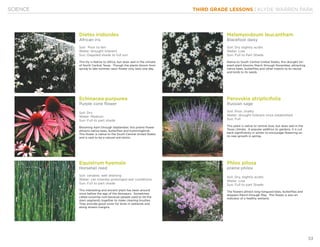
Dietes iridioides
African iris
Soil: Poor to fair
Water: drought tolerant
Sun: Dappled shade to full sun
This lily is Native to Africa, but does well in the climate
of North Central Texas. Though the plants bloom from
spring to late summer, each flower only lasts one day.
Melampodoum leucantham
Blackfoot daisy
Soil: Dry slightly acidic
Water: Low
Sun: Full to Part Shade
Native to South Central United States, this drought tol-
erant plant blooms March through November, attracting
native bees, butterflies and other insects to its nectar
and birds to its seeds.
Echinacea purpurea
Purple cone flower
Soil: Dry
Water: Medium
Sun: Full to part shade
Blooming April through September, this prairie flower
attracts native bees, butterflies and hummingbirds.
This flower is native to the South Central United States
and is said to be a natural anti-biotic.
Perovskia atriplicifolia
Russian sage
Soil: Poor, chalky
Water: drought tolerant once established
Sun: Full
This plant is native to central Asia, but does well in the
Texas climate. A popular addition to gardens, it is cut
back significantly in winter to encourage flowering on
its new growth in spring.
Equistrum hyemale
Horsetail reed
Soil: variable, well draining
Water: can tolerate prolonged wet conditions
Sun: Full to part shade
This interesting and ancient plant has been around
since before the age of the dinosaurs. Sometimes
called scouring rush because people used to tie the
stem segments together to make cleaning brushes.
They provide good cover for birds in wetlands and
along stream margins.
Phlox pilosa
prairie philox
Soil: Dry, slightly acidic
Water: Low
Sun: Full to part Shade
The flowers attract long-tongued bees, butterflies and
skippers March through May. This flower is also an
indicator of a healthy wetland.
KLYDE WARREN PARK | THIRD GRADE LESSONS
54
SCIENCE
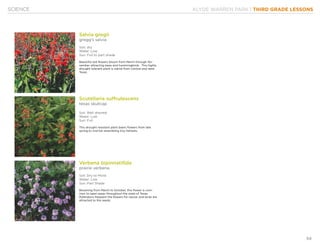
Salvia gregii
gregg’s salvia
Soil: dry
Water: Low
Sun: Full to part shade
Beautiful red flowers bloom from March through No-
vember attracting bees and hummingbirds. This highly
drought tolerant plant is native from Central and west
Texas.
Scutellaria suffrutescens
texas skullcap
Soil: Well drained
Water: Low
Sun: Full
This drought resistant plant bears flowers from late
spring to mid fall resembling tiny helmets.
Verbena bipinnatifida
prairie verbena
Soil: Dry to Moist
Water: Low
Sun: Part Shade
Blooming from March to October, this flower is com-
mon to open areas throughout the state of Texas.
Pollinators frequent the flowers for nectar and birds are
attracted to the seeds.
THIRD GRADE LESSONS | KLYDE WARREN PARK
55
KLYDE WARREN PARK | THIRD GRADE LESSONS
56
SOCIAL
STUDIES
THIRD GRADE LESSONS | KLYDE WARREN PARK
57
BIGIDEA
SOCIAL STUDIES
To introduce the concept of the common
good, read aloud the picture book,
The Promise, by Nicola Davies. As kids listen
and think about the theme of the story, ask
students to reflect on a time in their lives
when they were asked to “pay it forward”
or give back. In small groups, students will
think about ways they can contribute to
the greater good in their own communities.
Focusing on the idea of “planting seeds”
of hope, students will discuss how Klyde
Warren Park represents investing in the
community. They can read a brief article
about the Tree Trust foundation and
compare the article to the picture book.
Twenty-first century learners are expected
to possess the following four skills: critical
thinking, communication, collaboration, and
creativity. Along with these noble goals,
our students need to understand how
these core foundations work together for
the common good of a community.
PRE-TOUR TEACHING
THE FIFTH C
COMMON GOOD
KLYDE WARREN PARK | THIRD GRADE LESSONS
58
SOCIAL STUDIES
The students will participate in a
Common Good Scavenger Hunt.
With a partner or small group, the
children will explore several areas of
the park looking for signs, artifacts,
and designated spaces designed
for the common good of all visitors.
For example, when students come
across the Complimentary First
Aid Kits, they might discuss how
these medical supplies benefit all
park visitors because it prevents
the spread of disease and provides
needed resources in case of
emergency. If students have
devices, they can snap a picture
of these items and record a brief
explanation of how they benefit the
common good of the citizens who
visit the park. If electronics aren’t
permitted, students may sketch the
items in a notebook and write a
caption describing how they relate
to the common good of all park
visitors. Students should document
a minimum of seven items and
justify how each entry illustrates the
concept of the common good.
TOUR TEACHING
THIRD GRADE LESSONS | KLYDE WARREN PARK
59
SOCIAL STUDIES
Each group presents the items they collected representing the common good. They can create a slideshow or I-movie of their items,
narrating how each artifact improves the lives of all visitors at the park. They can also include suggested park improvements such as
complimentary snacks or lemonade. During the presentations, students will give examples of how their collection represents serving the
common good of a community.
Students will create a collage promoting the “Common Good” of a community. They can include famous quotes about citizenship as well
as photos from their field trip to Klyde Warren Park. Each child will write a persuasive paragraph encouraging members of a community to
consider how their choices impact others. They can include examples and suggestions for future park improvements.
Ask the students how the theme of the “Common Good” in communities relates to good sportsmanship in competition. Have the
students brainstorm a list of character traits that a good sport displays. Choose a quick activity such as Red Rover or Freeze Tag and tell
the students that you are looking for your “Good Sports”.
POST-TOUR TEACHING
ELA COMPONENT
PE COMPONENT
KLYDE WARREN PARK | THIRD GRADE LESSONS
60
SOCIAL STUDIES
Citizenship
The student understands the impact of individual
and group decisions on communities in a
constitutional republic.
a.	 Give examples of community changes
that result from individual or group
decisions
b.	 Identify examples of actions individuals
or groups can take to improve the
community
c.	 Identify examples of nonprofit/or civic
organization and explain how they serve
the common good
TEKS
3.12
QUICK BITE
During your lunch break, locate
examples of “Common Good” items
present at Klyde Warren Park. Jot them
down in your notebook and converse
with a partner about why these items
represent the “common good” of the
community. What other things would
you add? Which items are necessary for
an enjoyable park experience? A few
suggestions are listed below to help you
get started.
qq Complimentary Wi-fi		
qq Movable Chairs and tables
qq Concrete and gravel pathways
qq Drinking fountains to quench thirst
qq Performance stages and pavilions
qq Warning Signs: “Caution: Area may
be slippery when wet.”
qq Free books and newspapers from the
Dallas Morning News
qq Posted list of weekly activities
qq Free to Play equipment and game
carts
FOURTH GRADE LESSONS | KLYDE WARREN PARK
61
4th
GRADE
LESSONS
MATH
PHYSICAL EDUCATION
ART & DESIGN
SCIENCE
SOCIAL STUDIES
KLYDE WARREN PARK | FOURTH GRADE LESSONS
62
ART &
DESIGN
FOURTH GRADE LESSONS | KLYDE WARREN PARK
63
ART & DESIGN
BIGIDEA
Review some images of architecture or design that reflect nature
in their appearance. A great example of this is in the work of
famous architect Frank Lloyd Wright. Use the following link to
visit his website and peruse a number of architectural designs that
incorporate nature in a number of ways.
http://www.franklloydwright.org/
Have the students call out or write down the different ways that
they see nature in the architecture and designs of the examples that
you show. Some questions to create discussions might include:
•		 How are these different than our school building or other
buildings that you see each day?
•		 How are they similar?
•		 How is nature reflected in the buildings and spaces that you see
in these examples?
•		 How is nature reflected in the buildings that you see each day?
Remind the students that the design of a space includes the
architecture as well as the landscape around it, such as the trees,
flowers, and other greenery that surrounds buildings. In addition,
ask them to think about all of the senses when looking at nature in
design. What would it smell like? Sound like? Feel like?
After talking with the students about these examples, share with
the students some information about the designer of Klyde Warren
Park, James Burnett. Burnett creates landscape and designs that
appeal to the senses. His goal is to create relationships between
landscape and architecture.
Look at some examples of his work with the students on his
company’s website (http://www.ojb.com/). There are photos of
various projects that the company has done that incorporate nature
in design, including images of Klyde Warren Park.
PRE-TOUR TEACHING
NATURE
IN DESIGN
KLYDE WARREN PARK | FOURTH GRADE LESSONS
64
While looking at the images, particularly
the ones from Klyde Warren Park, start a
conversation with the students about how
Burnett’s designs reflect nature. Some questions
to create discussions might include:
•		 How is nature incorporated or reflected in
these spaces?
•		 What colors do you see?
•		 Do the colors in the buildings reflect nature?
If yes, how?
•		 Do the colors in the furniture reflect nature?
If yes, how?
Take the students on a walk outside of their
school building. Ask them to look for examples
of nature in the architecture of the building as
well as the design of the area around the school.
•		 Are there plants? If yes, what kinds?
•		 What colors are used in the building?
•		 What about the playground?
MATERIALS:
SKETCH BOOKS, PENCILS
Make sure each student has a sketch
book or some paper and a pencil.
Walk the students around the park,
and ask them to keep an eye out for
any examples of nature that they
see incorporated into the design of
Klyde Warren Park. Remind them of
the examples of the park that they
discussed the previous day from
the website of the designer, James
Burnett, and have them keep an eye
out for each of those.
In addition to the many obvious
examples of nature in the design of
the park, talk to the students about
how designers pay attention to the
smallest of details when they have
a theme, such as nature. Some
examples of this to point out at the
park might include:
•	The reflective surfaces of many of
the buildings and forms at the park
such as the chrome that is used in
many of the pillars, buildings, and
the pavilion roof. Their surfaces
literally reflect the grass and plants
that are all around them.
•	In addition to the chrome
reflective surface of the roof of the
performance pavilion, there are
shapes etched within the chrome
that resemble the branches of trees.
•	These same tree shapes are seen in the chairs
at Savor, the restaurant in the park.
•	The furniture in the park, such as the chairs
and tables, are various shades of green –
colors that are associated with nature.
Have the students play a game to see who
can discover the most examples of nature in
design at the park. Make sure they sketch
each example that they find, and write a quick
explanation of what it is that they are referring
to.
If there are a large number of students in the
class, it might be easier to place them in small
groups while they search for examples. If you
want, you could provide a small prize to the
group that finds the most!
ART & DESIGN
TOUR TEACHING
FOURTH GRADE LESSONS | KLYDE WARREN PARK
65
QUICK BITE
Once you are back in the classroom, ask
the students to bring out their sketches
that they created at Klyde Warren Park of
the examples of nature in design that they
found. They will use these as inspiration
and references for the project that they
will create.
Instruct the students that you are going
to give them a large photograph of
their school building. (Make sure the
photograph you provide includes the
building and part of the landscape. It
might be fun to have photos from different
parts of the building as well.)
The students will create a new design for
their school that incorporates nature in
the design. Be sure that they think about
the landscape as well. Have them keep
the same building, but add things to it to
include nature. Encourage them to be as
creative as possible with this – it can even
be fantastical. For example, you might
show them some images of landscape and
design in the work of Dr. Seuss. Remind
them to think about all of the senses when
they create designs for the school and
surrounding landscapes.
This can be done in the medium of your
choice, ranging from a simple colored
pencil drawing to a sculpture, or even
a large class project. Hang the finished
works in the school where others can see
them!
Have the students describe the elements of the designs that they create for their
school building and landscape in a paragraph. Have them answer the following
questions in their writing:
What elements did you add to the school/landscape that include nature?
What are you most proud of in your design?
How were you inspired by your visit to Klyde Warren Park in your design?
What might you do differently next time?
Go on a “texture in nature” scavenger
hunt. Have the students explore the park
and look for different textures that they
see. They can do a quick sketch of the
objects that they find and write the types
of textures that they are. If possible, they
could do some rubbings of some of the
textures to take with them.
ART & DESIGN
POST-TOUR TEACHING
ELA COMPONENT
KLYDE WARREN PARK | FOURTH GRADE LESSONS
66
ART & DESIGN
Play a game called “Statues”. Students dance while music is
playing (or you may use a verbal cue such as “stop” and “go”).
When the music stops, the students must form their bodies into
a “statue”. If anybody moves, giggles, or makes a sound during
the “stop” phase they are out of the game. Tell the students they
should try to make their statues look like the buildings they see
near Klyde Warren Park. If you or the other students can guess
which building the student is imitating, they get one free pass and
get to stay in the game the next time they are supposed to be out.
CREATIVE
EXPRESSION/ PERFORMANCE
(B) design original artworks
HISTORICAL/
CULTURAL HERITAGE
(A) identify simple main ideas
expressed in art;
RESPONSE/EVALUATION
(A) describe intent and form
conclusions about personal
artworks
PE COMPONENT
TEKS
2.0 3.0 4.0
FOURTH GRADE LESSONS | KLYDE WARREN PARK
67
MATH
KLYDE WARREN PARK | FOURTH GRADE LESSONS
68
BIGIDEA
MATH
As a class discuss what the students already know about
saving money and creating a budget.
Have the students brainstorm with a partner what uses there
could be for creating a budget when going out in the real
world.
Ask questions such as:
•	Why would having a budget help you when going
shopping?
•	Do you think having a budget is necessary when spending
money?
•	What happens if you don’t have enough money to buy
something?
•	What happens if you have more money than is necessary
to buy something?
•	How do you figure out how much change you would get
back from a transaction?
On the board, brainstorm and come up with ideas for what
a healthy and balanced meal would look like. They can
brainstorm on their Spending Recording sheet at this time.
Display for the class, or refer to, www.choosemyplate.gov.
You can also show them the Healthy Plate diagram to help
spark ideas.
Present to the class their task. They will be given a pretend
budget of $40.00. (You can change this budget based on
ability or time restraints.) The students will be put in partners
or groups and given the assignment of “shopping” at the
food trucks. They will not actually buy any food from the
food trucks, but will need to look at all of the food truck
menus to find items that would complete a balanced meal.
FUN WITH
FOOD TRUCKS
PRE-TOUR TEACHING
THIRD GRADE LESSONS | KLYDE WARREN PARK
69
MATH
MATERIALS:
SPENDING RECORDING SHEET, CLIPBOARD TO WRITE ON, PENCIL
After arriving at the park, take a tour as
a class. Take a walk past the food trucks
and see what options are available.
•	Have the students look at the menus
and the prices listed.
•	Allow the students to work in their
partners or group, filling out the
Spending Recording Sheet.
•	Have a color copy of the Healthy
Plate diagram with you at the park to
answer any questions they may have.
•	Encourage them to “spend” as much
money as they can without going over
budget.
•	Students must not go over the given
amount in their budget. If they stay
under, they must determine the
amount of change they would receive
in return.
TOUR TEACHING
KLYDE WARREN PARK | THIRD GRADE LESSONS
70
MATH
Students will come together as a class to share the meals that they
created from the food trucks.
Ask questions such as:
•	Was it difficult to find food that was healthy?
•	Was the healthy food more or less expensive than unhealthy food?
•	Were you able to stay within your “budget”?
•	Have the students share with the class how they calculated the
change that they would receive from the food trucks.
Geometry Search
On the back of the recording sheet the
students have a geometry search that
they can do while at the park. Students
should try and find as many real world
lines and angles as they can. If they find
one of the given angles or pairs of lines,
they can record them. Give a reward to
the group who finds the most!
On the last page of the Spending Recording Sheet there are several
questions that students may answer to expand upon their visit to the
park.
•	Working with their partners or independently, students should use
complete sentences and short paragraphs to answer the questions.
•	Teacher may guide students thinking by facilitating a group
discussion of the questions.
POST-TOUR TEACHING
ELA COMPONENT
QUICK BITE
FOURTH GRADE LESSONS | KLYDE WARREN PARK
71
MATH
Students will explore parallel and
perpendicular lines using various
movement patterns. Choose various
landmarks around the park such as My
Best Friend’s Park or Hart Boulevard.
Call out a combination of a movement
pattern and trajectory for the students
to demonstrate. For example, you
could say, “Complete one-footed hops
perpendicular to Hart Boulevard!”
Another example is, “Skip parallel to My
Best Friend’s Park!” The students who
complete the movement correctly get
to stay in the game. Warn the students
that when moving perpendicularly to a
landmark they should be careful to watch
for “traffic”.
4.10
4.6
(A) - apply mathematics to problems arising in everyday life, society, and
the workplace
B) – use a problem-solving model that incorporates analyzing given
information, formulating a plan or strategy, determining a solution,
justifying the solution, and evaluating the problem-solving process and
the reasonableness of the solution;4.1(E) – create and use representations
to organize, record, and communicate mathematical ideas;
(E) - represent decimals, including tenths and hundredths, using concrete
and visual models and money
(B) - calculate profit in a given situation
(C) - compare the advantages and disadvantages of various savings
options
(D) - describe how to allocate a weekly allowance among spending;
saving, including for college; and sharing
(A) - add and subtract whole numbers and decimals to the hundredths
place using the standard algorithm
(A) - identify points, lines, line segments, rays, angles, and perpendicular
and parallel lines
(C) - apply knowledge of right angles to identify acute, right, and obtuse
triangles
(D) - classify two-dimensional figures based on the presence or absence
of parallel or perpendicular lines or the presence or absence of angles of a
specified size.
PE COMPONENT TEKS
4.1
4.4
4.2
KLYDE WARREN PARK | FOURTH GRADE LESSONS
72
MATH
What’son your plate?
Make half your
plate fruits and
vegetables.
Switch to skim
or 1% milk.
Vary your protein
food choices.
Make at least
half your grains
whole.
Before you eat, think about what and how much
food goes on your plate or in your cup or bowl.
Over the day, include foods from all food groups:
vegetables, fruits, whole grains, low-fat dairy
products, and lean protein foods.
ChooseMyPlate.gov
Grains
Dairy
Fruits
Vegetables
Protein
FOURTH GRADE LESSONS | KLYDE WARREN PARK
73
MATH
SPENDING RECORD SHEET Klyde Warren Park Curriculum – Fun with Food Trucks Lesson
GROUP MEMBERS: MONEY BUDGETED:
Brainstorm of a Healthy Diet:
Change Received:
Menu Item Food Truck Name Price
TOTAL:
KLYDE WARREN PARK | FOURTH GRADE LESSONS
74
GEOMETRY SEARCH
Can you find any of these shapes in the real world around the park? Draw a sketch of the real
world shape and get a bonus!
Right Angle Obtuse Angle
Acute Angle Parallel Lines
Perpendicular Lines Line Segment
MATH
FOURTH GRADE LESSONS | KLYDE WARREN PARK
75
THINK AND RESPOND With the class or a partner, answer the following questions using complete sentences.
1.	 Did everyone in class select
	 the same foods to complete
	 their healthy meal? Why or
	 why not?
2.	 Was it difficult for you and
	 your group to stay on 	
	budget?
3. Why do you think having a
	 budget is important in
	 everyday life?
MATH
KLYDE WARREN PARK | FOURTH GRADE LESSONS
76
PHYSICAL
EDUCATION
FOURTH GRADE LESSONS | KLYDE WARREN PARK
77
BIGIDEA
PHYSICAL EDUCATION
In the classroom, give students a team
challenge. The “Marshmallow Challenge”
(easily found if Googled) is a popular
activity for kids so that they can learn
how to communicate and collaborate with
peers. Introduce the words “collaboration”,
“compromise” and “negotiation”. Ask the
students to imagine what the world would be
like if people did not learn to use these skills.
Ask them to identify times in their life in which
they have used these skills with other people
in order to achieve a goal. Inform the students
that they will have to demonstrate those skills
today at the park.
WATER RELAYS
Students learn about
group collaboration
while getting wet.
PRE-TOUR TEACHING
KLYDE WARREN PARK | FOURTH GRADE LESSONS
78
PHYSICAL EDUCATION
MATERIALS:
2 BUCKETS WITH A “FULL” LINE INDICATED, 2 CUPS OR
LARGE SPONGES, 2 LARGE SPOONS.
The bucket is placed behind
the last person in line and
the cup or sponge is given
to the first person in line,
who fills it with water. Tell
the students their goal is
to fill up the bucket first by
passing the cup over their
head to the person behind
them; the next person then
passes it between the legs.
The pattern continues until
the last person dumps the
remaining water in the
bucket. The last person
then takes the empty cup to
the front, replaces the first
person in line and continues
the relay until the bucket
fills. Everyone in line must
back up and occupy the
position behind them.
The same as Relay 1, but
now the cup or sponge is
passed in a different manner.
The first person in line will
pass the cup with both
hands by keeping his feet
in place and rotating his
torso left; the second person
will repeat this process by
rotating her torso to the
right. This pattern continues
until the end.
The same as Relay 2, but
instead of using a cup or
sponge the students use
large spoons. The bucket at
the end of the line must be
replaced with a cup.
Proceed to the fountains near the Moody
Plaza or near the Children’s Park. Split
the students into two teams. Each team
makes a single file line with the front person
within reach of the water. Students must
face forward the whole time and may not
turn around and must follow the rules for
each relay or risk disqualification. It is
recommended that students stand at least
an arm length apart. Use Poly Spots if
you have them. Tell the students there are
3 relays they will complete and the team
with 2 out of 3 wins will be the Water Relay
Champion.
TOUR TEACHING
RELAY RELAY RELAY
01 02 03
FOURTH GRADE LESSONS | KLYDE WARREN PARK
79
PHYSICAL EDUCATION
Provide the students with superlative categories and ask them to nominate team
members. Examples could be “Best Leader” or “Most Enthusiastic”. Be sure to match
the number of superlative categories with the number of students on each team and
instruct the students to choose one student (from their own team) for each category
including his or her own name. Explain to the students that when every person in a
team contributes their strengths to achieve a goal, that is when the best collaboration
takes place. Tally the votes and be sure to award everybody with a superlative. Hold a
small awards ceremony. Ribbons or certificates can be awarded to each team member.
Ask students to keep a journal. Inform
them that it will be kept confidential if
they wish. Instruct them to respond to
the following question, “How well did your
team collaborate during the Water Relays?
What would you have your team do
differently next time? Did you ever feel
frustrated during the relay? If yes, why?
Tell them to support their ideas and write
in complete sentences.
POST-TOUR TEACHING
ELA COMPONENT
KLYDE WARREN PARK | FOURTH GRADE LESSONS
80
PHYSICAL EDUCATION
Movement
(C) combines shapes, levels, pathways, and
locomotor patterns smoothly into repeatable
sequences.
(B) identify ways movement concepts such as
time, space, effort, and relationships can be used to
refine movement skills.
Social Development
(D) demonstrate effective communication,
consideration and respect for the feelings of others
during physical activities such as encourage others,
allow others equal turns, and invite others to
participate.
Students can play a quick game of
“Doctor Doctor” in which the students
form a circle and hold hands. Without
letting go of hands, students tangle
themselves into a knot. The designated
“Doctor” tries to untangle them. This
could be presented as a supplementary
exercise in teamwork.
TEKS
4.1
4.2
4.7
QUICK BITE
FOURTH GRADE LESSONS | KLYDE WARREN PARK
81
BIGIDEA
PHYSICAL EDUCATION
Give the students the definitions for the following words.
*Virus
A microorganism that grows slowly in your body and
can make you sick.
*Bad Bacteria
A microorganism that grows quickly in your body and
can make you sick.
*Antibodies
Chemicals made by white blood cells that destroy or
weaken bad bacteria and viruses.
*Bronchi
A tube by your lungs that may catch germs and cough
them out.
*Good Bacteria
Bacteria in or on the body that does not make you sick.
*Stomach Acid
Acid in the stomach that may kill germs that enter the
mouth.
*Antibiotic
Medicine that will kill bad bacteria in the body.
*White Blood Cells
Cells that fight against germs in the body.
*Villi
Tiny hairs in the nose that catch germs, dust and dirt.
*Skin
The first line of defense for the body.
Tell the students they will
need to know these terms
if they are going to play
the game at Klyde Warren
Park. Have them learn the
definitions with partners
and feel free to implement
fun memory or review
games you might know
to help in this process.
“Memory” is an easy one.
Make flash cards and place
them facedown on a table
in a grid. Have students
match the vocabulary
word with its definition. If
they don’t get a match,
the cards are flipped back
to heir original position
and the next player tries
to make a match. Use any
supplemental visual aids
you might have to show
how the body systems
work together to keep
us well and free from
sickness.
PRE-TOUR TEACHING
IMMUNE SYSTEM
TAG
Students learn
about the
immune system
while practicing
locomotor
movement
patterns.
KLYDE WARREN PARK | FOURTH GRADE LESSONS
82
PHYSICAL EDUCATION
MATERIALS:
WHISTLE, CONES, NOTEPADS AND PENS FOR EACH STUDENT;
TWO RED SIGNS FOR THE BAD GERM TAGGERS (VIRUS AND
BAD BACTERIA); EIGHT GREEN SIGNS FOR THE GOOD TAGGERS
(ANTIBODIES, BRONCHI, GOOD BACTERIA, STOMACH ACID,
ANTIBIOTIC, WHITE BLOOD CELLS, VILLI, AND THE SKIN).
Proceed to Ginsburg Family
Lawn or the East Lawn for this
activity. All the students begin
in a scattered formation in a
defined area using the cones.
Remind them to stay in their
personal space while playing
the game. Remind them to
look where they are going at all
times so that they don’t step on
anybody who is “sick”. Remind
them to tag with two fingers
only on the back or shoulder.
Select at least two students to
carry the red signs. They are
the microorganisms that may
make you sick (virus and bad
bacteria).
The students will perform
a movement chosen by the
teacher (best not to choose
running for this one). When
tagged by a red sign tagger,
the student gets sick and must
lay on the floor. They must
think about what made them
sick and decide which green
sign tagger will make them
well. They then call out for that
green tagger and go back into
the activity when they are well.
Select new taggers after a few
minutes of play and designate
a new locomotor movement.
Examples of locomotor
movement patterns are walking,
hopping, skipping, one-footed
hopping, backwards walking,
etc.
TOUR TEACHING
FOURTH GRADE LESSONS | KLYDE WARREN PARK
83
PHYSICAL EDUCATION
Back in the classroom, put students
in pairs. Have a set of vocab cards
for each pair of students (the words
above). Students will play “Heads Up”
to further cement their understanding
of the terms. Cards are placed face
down in a stack. One student picks up
a card without looking at it and holds
it to her forehead. The other student
must describe the word, but may not
use the term that is written on the
card. One point is awarded for every
correct guess. Students keep track of
their own team’s score. Do not allow
the students more than 2 guesses for
each card. Students may pass if they
get stuck and replace the card on the
bottom of the pile. Provide a small
award for the team with the most
points at the end of 3 minutes.
Students try to use the new vocabulary words in a sentence. Another option
is to create a group sentence in which each student in the room contributes
one word to the sentence as the teacher writes the sentence on the board. The
challenge is to try to use the new terms in the sentence in fun and silly ways
while still being used in the correct context.
POST-TOUR TEACHING
ELA COMPONENT
QUICK BITE
Students compile a list of places in the
park where they think bacteria might
grow and be transmitted to people.
Who can make the longest list in 5
minutes? Allow students to explore
a designated area of the park freely
(such as the Children’s Park) and call
them back using a whistle in exactly 5
minutes.
KLYDE WARREN PARK | FOURTH GRADE LESSONS
84
PHYSICAL EDUCATION
Movement
(A) Demonstrate changes
in speed during straight,
curved, and zig zag
pathways in dynamic
situations.
Movement
(C) Make appropriate
changes in performance
based on feedback
Physical Activity and health
(B) Participate in moderate to
vigorous physical activities on
a daily basis
TEKS
4.1 4.2 4.4
FOURTH GRADE LESSONS | KLYDE WARREN PARK
85
BIGIDEA
PHYSICAL EDUCATION
Find a fun, vintage 80’s workout video on YouTube to show
the students. There are several good ones out there, but
be sure to pre-screen to ensure appropriateness. Tell the
students that each of the components of physical fitness can
be observed in this video. Teach the students the definitions
below and then watch the video again to see if they can
identify them. Ask students to list activities or exercises that
improve each component of fitness.
Muscular Strength: The ability to lift a given amount of weight
exactly one time. An example of an activity that promotes
muscular strength is power lifting, or moving furniture.
Muscular Endurance: The ability of a muscle or group of
muscles to work continuously without tiring. Examples
include sit ups, push ups, pull ups.
Cardiovascular Endurance: The ability of the heart and
lungs to provide oxygen rich blood to the working muscles.
Examples include swimming and jogging.
Flexibility: The ability of the joints in the body to move easily
to allow for muscle movements and stretching.
80’S
WORKOUT VIDEO
Students will learn about
4 components of fitness
while making an 80’s
workout video/skit
Before beginning the
Tour Teaching portion of
the lesson, tell students
that they will be creating
their own 80’s workout
videos today in the park.
Provide them with some
excellent 80’s workout gear
such as headbands and
legwarmers to inspire them.
If you plan ahead, you can
encourage kids to bring
their own costumes from
home. Let them use their
cell phones to record the
video and find appropriate
80’s music. Give them a
specific amount of time
and expect regular check-
ins. Set high expectations
for student conduct while
at the park as this activity
allows the students a lot
of freedom and requires
self-monitoring. Make the
activity a contest and give
an award to the best video.
PRE-TOUR TEACHING
KLYDE WARREN PARK | FOURTH GRADE LESSONS
86
PHYSICAL EDUCATION
MATERIALS:
ANYTHING FROM THE 1980’S ERA SUCH AS
COSTUMES, BOOM BOXES, OR VIDEOTAPES
PLUS CELL PHONES WITH RECORDING
CAPABILITIES (OPTIONAL)
Break students into groups of 3-4. Make sure
each group contains a member with a cell phone
with video recording capabilities. Give the
students about 10 minutes to meet with their
group to make a plan. One idea is to assign each
group one of the components of fitness on which
to focus. Students should use this time to decide
where they are going to film, what music (if any)
they are going to use, which role each person will
play, and what kind of exercises they are going to
include in the video. Encourage students to be
creative. Remind them that as long as they are
moving their bodies, they are improving one or
more of the fitness components. Give students a
specific amount of time and tell them they should
be finished with their video at this time.
TOUR TEACHING
FOURTH GRADE LESSONS | KLYDE WARREN PARK
87
PHYSICAL EDUCATION
Each team can share their video. If possible, have students
upload the videos onto your computer so you can project
them for the class to see. Another idea (if technology is not
agreeable) is to have students perform their 80s video in front
of the class like a skit.
As students are watching
each other’s videos or skits,
have them identify each
group’s assigned fitness
component by writing it
down in a table format. If no
component was assigned,
have students determine
which of the 4 components
was improved the most in the
exercises the group chose
for their video. One of the
columns can be designated
for students to explain why
they chose their answer in
order to promote higher-level
thinking.
Have students look around the park and
observe people doing various types
of exercise. What are current workout
trends such as yoga and CrossFit?
Compare and contrast the ways the
media depicted fitness in the 80’s
and now in the 21st century. What is
different? What is the same? What do
you imagine a “fit” person will look like
in the year 2040? Why?
Physical Activity and Health
(B) Name the components of health-related
fitness such as strength, endurance, and
flexibility
Physical Activity and Health
(C) Identify methods for measuring
cardiovascular endurance, muscular strength
and endurance and flexibility
POST-TOUR TEACHING
ELA COMPONENT
QUICK BITE
TEKS
4.3
4.4
KLYDE WARREN PARK | FOURTH GRADE LESSONS
88
SCIENCE
FOURTH GRADE LESSONS | KLYDE WARREN PARK
89
BIGIDEA
SCIENCE
Ideas in the Classroom
Start thinking about plant and animal relationships, introduce
pollination and life cycles of plants and butterflies. Introduce
the concept of a food web, producers (plants) and consumers
(animals)
Pre-lesson Poll
Have your students come up with a few words as a class
describing how they feel about insects.
Student Brainstorming
What ways do plants and animals interact? Things like birds
build nests in trees, some animals eat plants, bees visit flowers
for pollen, insects can live inside of plants, some plants need
animals to eat their seeds so they get spread around by the
animal’s poop, some plants make seeds that can hitch a ride
on your socks or an animal’s fur to travel to far off places, and
some plants need animals to help spread their pollen around so
they can make seeds.
Introduce real world examples:
Talk about some relationships that
happen in nature between plants and
animals. Animals can use plants for all
types of things: as housing, as food,
to impress a mate, and as a place to
lay their eggs (some butterflies and
moths need a specific kind of plant
on which to lay their eggs). Humans
use plants too: for food of course, but
also for clothing, building materials,
medicine and even some types of
plastic. Plants can use animals as
well, mostly for seed dispersal and
pollination.
What is Pollination?
Pollinators to the rescue! Insects,
birds and even some mammals can
be pollinators! A pollinator is any
animal that helps plants get their
pollen to the right places so they can
make seeds. The great thing is that
pollinators have a pretty “sweet” deal,
because a lot of them are looking for
the flowers anyway so they can eat
some of the pollen or drink the sugary
nectar produced by flowers. So, as
they are going from plant to plant
looking for a nutritious snack, they
are spreading pollen the whole way,
helping all the plants make seeds. The
familiar honeybee has this pollination
thing down to an art. It collects a little
pollen from each flower and takes
it back to the hive to make honey
to feed the whole colony. Humans
benefit from this relationship as well,
as any student who has ever tasted
delicious honey can tell.
There are a lot of very interesting
pollinator relationships out there
including: Orchids shaped like bees,
giant flowers that smell like rotting
meat to attract flies, and tiny pollen
eating mammals in the rainforest.
These are all considered special
PRE-TOUR TEACHING
PLANT AND ANIMAL
RELATIONSHIPS
Students will explore
plant and animal
relationships, including
life cycles of plants and
insects
KLYDE WARREN PARK | FOURTH GRADE LESSONS
90
SCIENCE
adaptations to take advantage of the process of
pollination. Some beetles, butterflies, hummingbirds
and humans can also be considered pollinators!
Once a plant is pollinated, it can produce seeds.
Some plants just let their seeds drop, others need
to find ways to help their seeds get to new places.
It is good for the seeds to travel to new places,
because this means that there will be more plants
growing in more places, instead of a bunch of plants
all growing in one place…but how do they get there?
Plants can’t just grow legs and walk over to a new
place, can they? They have to rely on wind, animals
or humans to help them get there! Lots of seeds
“hitch a ride” on an animal’s fur or your socks. Other
seeds are dispersed when a gust of wind blows
them off of their parent plant. Humans can travel
very far distances very quickly, and often we take
seeds with us without thinking of it, such as our
food (peach pits, apple cores, etc.) or unnoticed on
our clothes.
Food Webs
Animals and plants also have relationships built on
finding a meal. Using a food web, we can track who
eats what in nature. Plants use energy from the
sun to produce their own sugars, so they belong to
the group we call Producers. Animals cannot make
their own food. Instead, they have to consume
(eat) plants, so they belong to the Consumer group.
Practice making simple food webs with familiar
plants and animals.
FOURTH GRADE LESSONS | KLYDE WARREN PARK
91
Scavenger Hunt
Find the flowering plants. Depending on what season you visit Klyde
Warren Park, more or less flowers may be in bloom.
Draw the flowers and the plants that any insects or birds are on and use
some descriptive words to describe them. What are the flowering plants
called? Can you smell the flower (be careful)? What does it smell like?
What kind of animal do you think could pollinate this flower? Did you see
any pollinators like insects or birds visiting this flower?
Find the plants that are producing seeds.
Draw the seeds and the plants that any insects or birds are on and use some
descriptive words to describe them. What are the plants producing seeds
called?
How do you think these seeds could be dispersed?
There should be a closing activity wherein the flowers and seed producing
plants are further discussed. How are their seeds dispersed and how are the
flowers pollinated? Who found the most seed producing plants?
Steps
1.	 Students should be split up into groups
of several students each covering specific
areas (would be helpful if they were
previously enumerated) of the park.
2.	 Students should begin looking for insects
in their area and practice trying to ID
insects for a few minutes with the key
3.	 One student will start the stop watch for a set
amount of time (five to ten minutes should be
more than enough time). Alternatively, the
groups could do two sets of five minutes each.
4.	 The students will attempt to ID and count all of
the insects they see in the allotted amount of time.
5.	 Students will re-group to discuss their results and
compile a group tally of insects. During this time,
students could learn about the certain butterflies
that lay their eggs on specific plants in the park.
Discussion Questions
•		 Which area had the most insects? Why do you
think?
•		 What is the most abundant pollinator in the park?
•		 How could our data be incorrect? (Maybe some of
the same individuals traveled from student group
to student group and were counted more than
once)
Plant Listing Information
eFloras.org (Flora of North America)
United States Department of Agriculture
Wildflower.org
DavesGarden.com
Wikipedia.com
Insect Count
Which area of the park is most attractive to pollinating insects?
Scientists often count how many species of insects they see in a certain area
over a certain amount of time. This can tell them a lot about the health of an
ecosystem. Fourth graders can do this too!
Supplies:
•		 A simple laminated sheet with a visual ID key of some common
butterflies and other insects that visit the park (or are local to Dallas)
should be provided to students.
•		Stopwatch
•		 Pencils or hand held push counters
SCIENCE
TOUR TEACHING
KLYDE WARREN PARK | FOURTH GRADE LESSONS
92
1.	 Have students use their insect count
data to create a bar graph of the
number of certain types of butterflies
and bees they found in different areas
of the park. They could compare and
contrast honeybee counts with other
insect counts. Discussion about the
vulnerability of honey bees could fit
here.
2.	 Post lesson poll: Again, have your
students come up with some words
describing how they feel about insects.
Are the words different? How did
their perceptions change? See ELA
component for a continuation of this
concept.
3.	 Have students do another insect count
at their school or for an assignment at
their house or a nearby park. They can
just count the number of butterflies,
bees and “other” insects to keep it
simple. The instructor could create
a similar simple key to conspicuous
butterflies and insects of North Texas
for the students to use. If the school
has a garden of some sort, that would
be a good setting. The class can
compare the data from the school with
the data from Klyde Warren Park in
the form of bar graphs or pie graphs.
•		 Talk about factors that could influence
the reason why there are more or less
of one type of insect in one of the
locations (Rural versus city locations,
diversity of plants, nearness of water,
etc.).
•		 The class can also upload their results to
an actual online ‘bioblitz” database such
as iNaturalist, thus actually contributing
to scientific data. Introduce the term
“citizen science,” because that’s what
you are doing!
4.	 Have students contribute to a class
flower collection by pressing flowers in
the pages of a heavy book. Students
can also contribute seeds to a seed
collection. They need to try and find
out the name of the plants the flowers
and seeds came from. You could talk
about the concept of a seed bank here,
since you are sort of creating your own!
SCIENCE
POST-TOUR TEACHING
FOURTH GRADE LESSONS | KLYDE WARREN PARK
93
•	Have students write about how their
perception of insects was changed by
their experiences at the park.
•	Have students write a light research
paper about their favorite pollinator.
Include where it lives, what plant it
pollinates, a little bit about the life
history and life cycle of the plant and
the pollinator.
•	Write a short story about a day in the
life of a pollinator. Use descriptive
words and include factual information
the student learned during this section.
•	Write a self-help passage for a plant
that wants to attract a pollinator or
spread its seeds about but isn’t quite
sure how to do it. Suggest versions of
the adaptations learned about during
this section and provide examples.
•	Write a poem describing a relationship
between a plant and an animal that
includes some factual information
learned from the section.
•	Imagine a world far in the future where
plant and animal relationships are
much different than they are today.
Describe a relationship that could
develop between a plant and animal
that would be beneficial to both
organisms.
SCIENCE
QUICK BITEELA COMPONENT
Students will do a quick observation and
draw a picture of all the requirements
they can identify that an organism,
such as a bug, would require to survive.
The students can then compare their
drawings with those of their peers and
see if they thought of something that
their friends might not have!
KLYDE WARREN PARK | FOURTH GRADE LESSONS
94
Food Chain Game!
Explain to the students that they are
going to be playing grasshoppers, frogs
and hawks in a food chain game. Scatter
most of the ping pong balls or other small
items over the area, and explain that the
items represent plants that grasshoppers
eat. Divide the students equally into three
groups, and distribute grasshopper flags
to one group, frog flags to the second
group, and the hawk flags to the third
group.
Give each “animal” one “stomach” or
plastic sack. Explain that when the
game starts, the grasshoppers will try
to eat ping pong plants (put ping pog
balls in their bags), the frogs will try to
eat grasshoppers (by tagging them)
and hawks will try to eat frogs (also
by tagging them). When a frog tags a
grasshopper, it takes the grasshopper’s
“stomach” and the grasshopper player
leaves the game. When a hawk tags a
frog, it takes the frog’s “stomach” and
the frog leaves the game. Emphasize
that grasshoppers can only feed on the
ping pong plants on the ground, and that
frogs can only feed on grasshoppers,
and hawks can only feed on frogs, and
that animals that are eaten must wait on
the sidelines. (Frogs can eat more than
one grasshopper, and hawks can eat
more than one frog.) If a student’s sack
is empty at the end of the round, he or
she is out because they have died from
starvation!
Announce that the round will last until
all of one kind of animal are eaten. Talk
to the students about whether or not
they think this food chain is balanced.
Ask them to record the data from each
round on a data table. If not, ask them
to think about how the game can be
changed to make for a more balanced
and sustainable food chain. Allow the
students to be a different animal after
several rounds.
Remind students that ALL ping pong
balls MUST be picked up when the game
is finished. You could offer a small prize
to the grasshopper who can fill his or her
“stomach” up with the most ping pong
balls while cleaning.
SCIENCE
PE COMPONENT Materials Needed: Flag football belts with three different colors of flags, plastic sacks
for each student, large numbers of ping pong balls or small foam shapes (any small
non-food item that is easily cleaned up which students can pick up to fill their sacks).
FOURTH GRADE LESSONS | KLYDE WARREN PARK
95
SCIENCE
10.0
Scientific investigation and reasoning. The student
uses scientific inquiry methods during laboratory
and outdoor investigations.
(B) collect and record data by observing and
measuring, using the metric system, and using
descriptive words and numerals such as labeled
drawings, writing, and concept maps.
(C) construct simple tables, charts, bar graphs,
and maps using tools and current technology to
organize, examine, and evaluate data.
(D) analyze data and interpret patterns to construct
reasonable explanations from data that can be
observed and measured.
(F) communicate valid, oral, and written results
supported by data.
Organisms and environments. The student knows
and understands that living organisms within an
ecosystem interact with one another and with
their environment.
(A) investigate that most producers need
sunlight, water, and carbon dioxide to make their
own food, while consumers are dependent on
other organisms for food.
(B) describe the flow of energy through food
webs, beginning with the Sun, and predict how
changes in the ecosystem affect the food web
such as a fire in a forest.
supported by data.
Scientific investigation and reasoning. The student
knows how to use a variety of tools, materials,
equipment, and models to conduct science inquiry.
(A) collect, record, and analyze information using
tools, including calculators, microscopes, cameras,
computers, hand lenses, metric rulers, Celsius
thermometers, mirrors, spring scales, pan balances,
triple beam balances, graduated cylinders, beakers,
hot plates, meter sticks, compasses, magnets,
collecting nets, and notebooks; timing devices,
including clocks and stopwatches; and materials to
support observation of habitats of organisms such
as terrariums and aquariums.
Organisms and environments. The student knows
that organisms undergo similar life processes and
have structures that help them survive within their
environment.
(A) explore how adaptations enable organisms
to survive in their environment such as comparing
birds’ beaks and leaves on plants.
(C) explore, illustrate, and compare life cycles
in living organisms such as butterflies, beetles,
radishes, or lima beans.
TEKS
2.0 9.0
4.0
KLYDE WARREN PARK | FOURTH GRADE LESSONS
96
SCIENCE
INSECT
LIST
TIGER SNOWTAIL
LADYBIRD BEETLE
JUNE BEETLE
CICADA
EUROPEAN HONEYBEE
BLACKWING DAMSELFLY
FOURTH GRADE LESSONS | KLYDE WARREN PARK
97
SOCIAL
STUDIES
KLYDE WARREN PARK | FOURTH GRADE LESSONS
98
BIGIDEA
SOCIAL STUDIES
Read aloud the modern picture book,
Voices in the Park by Anthony Browne
or show the students the video on
YouTube. Browne tells this story through
four distinct voices that are intricately
connected. Students should think about
how class, prejudice, control, hope and
friendship determine the perspectives
of the four characters. Lead a class
discussion about point of view and ask
the kids to think about how individual
experiences alter the way we see the
world. Explain to the students that when
they go to Klyde Warren Park they will
be observing human interactions, items
found in nature, and park signage.
Texas is a diverse state full of unique voices.
In an effort to help students understand the
contributions of people of various racial and
ethnic backgrounds, the children will observe
individuals, families, and groups at Klyde
Warren Park. Using Found Poetry, they will
explore the rich cultural heritage of an urban
area.
PRE-TOUR TEACHING
VALUING
the Voices of all Texans
FOURTH GRADE LESSONS | KLYDE WARREN PARK
99
SOCIAL STUDIES
Provide each student with an index card and a pencil for capturing snippets of talk. Tell the students that whenever they hear
or see a word that is unusual, beautiful, funny, or otherwise interesting to write it down on the index card. They could write
down what they hear people saying to each other or words they see written on signs throughout the park. Instruct students to
travel with partners or small groups as they explore various areas including Jane’s Lane, the Reading & Games Courtyard, and
the Children’s Park. Tell them to return to the Storytelling Tree after about 20 minutes of observations. Following the guidelines
outlined on the Read, Write, Think website, instruct students to compose a Found Poem to share with their classmates. If time
allows, have individuals or groups read their poems from the Story Telling tree platform.
*Some students may choose to use an electronic device to capture notes.
TOUR TEACHING
KLYDE WARREN PARK | FOURTH GRADE LESSONS
100
SOCIAL STUDIES
Ask the students to reflect on the various languages, comments, and words spoken throughout Klyde Warren Park. What racial and
ethnic groups did they observe? How do cultural differences make Texas a rich state? What are some events the park could hosts
to help promote cultural celebrations such as Cinco De Mayo, Oktoberfest, or the Strawberry Festival?
Have students individually or collectively write a letter to the Woodall Rodgers Park Foundation recommending cultural
celebration ideas.
Revisit the Found Poem activity in the classroom, allowing students time to further develop
their poems and present them to their classmates.
Tie in the theme of diversity by focusing
on acceptance of individuals with
physical disabilities. Ask students to
think of several different types of physical
disabilities. Then tell them they are
going to do an activity in which they are
blindfolded to mimic individuals who
are blind. Tell students they must make
a square with their bodies by lying on
the ground and they must do this while
blindfolded. Students may communicate
verbally and with light touching, but
they may not see the other students.
It’s a good idea to have a few seeing
“helpers” on the sideline to help guide
the blindfolded students. You should
be patient during this activity. Resist the
urge to step in and fix their mistakes.
Give them a time limit if the activity
begins to take too long. Even if they are
unable to successfully make a square,
they should be able to express empathy
for people who do not have the ability to
see.
PE COMPONENT
ELA COMPONENT
POST-TOUR TEACHING
FOURTH GRADE LESSONS | KLYDE WARREN PARK
101
SOCIAL STUDIES
TEKS
4.19
4.22
QUICK BITE
The student understands the contributions of
people of various racial, ethnic, and religious
groups to Texas.
The student communicates in written, oral, and
visual forms.
C. express ideas orally based on research and
experiences
Below is a list of interesting words or
phrases found on signs throughout
Klyde Warren Park. During your lunch
break, scurry around the park looking
for similar words, phrases, or ideas.
Capture as many words as you can in
five minutes and create a short Haiku
about your visit.
qq Courtesy		
qq Respect 		
qq Cool Swag
qq Botanical		
qq Free To Play	
qq Comply
qq Be Aware
qq Croquet			
qq Smoke Free Zone
qq Health & Wellness
qq No Cost			
qq Prohibited
qq Equipment	
qq Guest Services Staff
qq Performance Pavilion
qq Dedicated		
qq Philanthropy		
qq No High Heels
KLYDE WARREN PARK | FIFTH GRADE LESSONS
102
5th
GRADE
LESSONS
MATH
PHYSICAL EDUCATION
ART & DESIGN
SCIENCE
SOCIAL STUDIES
FIFTH GRADE LESSONS | KLYDE WARREN PARK
103
ART &
DESIGN
KLYDE WARREN PARK | FIFTH GRADE LESSONS
104
BIGIDEA
ART & DESIGN
Have a discussion with the students about
parks that they like or have been to. Some
questions to kick start the conversation might
include:
•	What makes a park fun?
•	What is your favorite thing to do when you
go to the park?
•	If you could create your own park, what are
the top 3 things that you would include?
Show the students some slides from Klyde
Warren Park. There are some great photos on
their website (http://www.klydewarrenpark.
org/). Talk about some of the unique features
of the park as well as the activities that they
offer. Some of the features include:
•	Performance Pavilion
•	Savor and Relish restaurants
•	Walking trails
•	Dog park
•	Children’s park
•	Games area
•	A mobile library
•	Splash areas
Some of the many activities that they offer
include:
•	Yoga and other exercise classes
•	Storytelling
•	Concerts
•	Drawing classes
•	Music classes
•	Science classes
•	Drum circles
There are calendars with lists of different
activities happening throughout the year on the
website as well that you can show the students.
Break the students up into groups of 2-3 and
have them brainstorm what they would include
in their own “dream park”. For now, just have
them write their ideas down. Encourage them
to be as creative as possible. Tell them to think
about features as well as activities, just as you
discussed regarding Klyde Warren Park.
PRE-TOUR TEACHING
DESIGN YOUR
OWN PARK
Students will study the
different design elements
that make Klyde Warren
Park unique, and then
create their own designs
for a park.
FIFTH GRADE LESSONS | KLYDE WARREN PARK
105
ART & DESIGN
Make sure that each student has a
sketch book or some paper as well as
a pencil. Tour the entire park with the
students, stopping at each of the various
“rooms” within the park to allow them to
experience all of the activities. This will,
of course, depend on how much time you
have to spend at the park, but try to take
in as much of the space as possible. As
you tour the park, ask the students to
take notes and make quick sketches of
their favorite parts of the space. Would
they change anything about it? Is there
something that they think should be
added? Does there appear to be a
“theme” to the design?
As you walk around, point out to the
students the way that the park utilizes
the large white arches with the hanging
spheres to highlight the walkway that
surrounds the park. The shapes add a
wonderful visual element, and they also
serve as an important marker that direct
the visitor along the walking pathway.
This part of the lesson should be focused
on the students having fun and truly
experiencing what the park has to offer.
For the project, they will be designing
their own park, so they need to have
a strong understanding of all of the
different things that Klyde Warren Park
has to offer, and how they might go
about building upon those ideas.
TOUR TEACHING
KLYDE WARREN PARK | FIFTH GRADE LESSONS
106
ART & DESIGN
For their project, the students will
design their own “dream” park.
You can either break them back up
into the groups that they were in
during the pre-tour lesson, or have
them work on their own.
Using their sketches from Klyde
Warren Park for inspiration,
instruct the students (or
groups of students) to begin
by brainstorming the features
that they would include in their
park. Would they break it up into
“rooms” like Klyde Warren Park, or
would they go about it a different
way? Would they have separate
areas for smaller kids? Would they
incorporate some sort of design
to help move visitors through
the park like the arches at Klyde
Warren Park?
Encourage the students to be
as creative as possible with
this. Remind them to think
about balance, design, and other
elements and principles that
you have covered with them
throughout the year. The medium
for this project is up to the
instructor, and the time that can
be allotted for it. For example, this
could be as simple as a colored
pencil drawings, or as challenging
as a three dimensional project. If
possible, display the “dream” parks
in the hallway so that other classes
can experience the students’
visions for their spaces!
POST-TOUR TEACHING
FIFTH GRADE LESSONS | KLYDE WARREN PARK
107
ART & DESIGN
In addition to each park design, instruct the students to write a paragraph
that describes their park. What features did they include? What activities
will be offered at their park? What is their favorite part? What was their
biggest obstacle in creating this?
Ask the students to “test” all of the options for physical activity in
Klyde Warren Park such as the game tables and the Children’s Park.
Ask them to record their data on a data sheet ranking the physical
activities in order from most favorite to least favorite. Encourage them
to include their favorite activities in their “dream park”.
PE COMPONENT
ELA COMPONENT QUICK BITE
While at the park, ask the students to
think about a sculpture that they would
design to place in the park. Have them
create a quick sketch of their sculpture
in their sketch books. Instruct them to
think about what the park is used for
and all of the features and activities
that are available in the space when
designing their sculpture. Where would
they want it to be placed? What would
it be made of? What would it look like?
How big would it be?
If possible, when you return to the
classroom, have the students create a
more detailed drawing, painting, or 3-D
model of their sculpture sketch.
KLYDE WARREN PARK | FIFTH GRADE LESSONS
108
ART & DESIGN
PERCEPTION
CREATIVE EXPRESSION/
PERFORMANCE
RESPONSE/EVALUATION
(B) identify in artworks that
color, texture, form, line,
space, and value are basic
art elements and that the
principles such as emphasis,
pattern, rhythm, balance,
proportion, and unity serve
as organizers.
(A) combine information
from direct observation,
experience, and imagination
to express ideas about self,
family, and community.
(B) compare relationships
between design and
everyday life.
(A) analyze personal
artworks to interpret
meaning.
TEKS
1.0 2.0 4.0
FIFTH GRADE LESSONS | KLYDE WARREN PARK
109
MATH
KLYDE WARREN PARK | FIFTH GRADE LESSONS
110
BIGIDEA
MATH
As a class discuss what the students know about
taking a survey and collecting data in the real world.
Have the students turn to a partner and discuss what
they think they might see at the park.
Ask questions such as:
•	What do you expect to see today at the park?
•	Do you think there will be plants and animals at the
park?
•	What living things do you expect to see at the park
today?
•	How could we collect data about what we see at the
park?
Have the students brainstorm as a class while making
notes on their Data Recording Sheet. Try to come up
with as many living things that you might see at the
park.
Some ideas would include different types of animals,
different types of plants, people.
Vote as a class and decide on about 6 different
categories of living things that they will be looking for
at the park.
Divide the students into partners or groups and assign
each group a living organism to be on the lookout for
at the park. Assign them the task of collecting data
by using tally marks to create a frequency chart of the
organisms that they see.
PRE-TOUR TEACHING
DATA OF
THE PARK
FIFTH GRADE LESSONS | KLYDE WARREN PARK
111
MATH
MATERIALS:
DATA RECORDING SHEET, CLIPBOARD TO
WRITE ON, PENCIL
After arriving at the park,
take a tour as a class.
Point out some examples
of living things that the
students see as they walk
around.
Have the students double
check to make sure
they know the assigned
organism that their group
will be on the lookout for.
Allow the students to
work with their partners
or group, filling out the
Data Recording Sheet.
Walk around to monitor
and check that they
are able to find their
assigned organism.
Encourage them to
discuss with their
partner(s) and make
sure they both agree on
the frequency they are
tallying.
TOUR TEACHING
KLYDE WARREN PARK | FIFTH GRADE LESSONS
112
MATH
Students will come together as a class to compile their data into one total
frequency chart. They will use this data to create a bar graph as a class.
Ask questions such as:
•	Did you and your partners agree on the frequency that you saw the living
organisms?
•	What was the most frequently found organism?
•	Was anyone unable to find their assigned organism?
•	After compiling and synthesizing the data, the students will take the information
and create a bar graph.
They can answer the graph and fraction questions that are found on the Data
Recording Sheet.
Have students write about their experience; on the last page of the Data Recording
Sheet there are several questions that students may answer to expand upon their
visit to the park.
Working with their partners or independently, students should use complete
sentences and short paragraphs to answer the questions.
Teacher may guide students thinking by facilitating a group discussion of the
questions.
POST-TOUR TEACHING
ELA COMPONENT
QUICK BITE
Geometry Search: On the back of the
recording sheet the students have a
fraction search that they can do while
at the park. Students can try and find as
many fractions in real life as they can.
They should also be able to reduce the
fraction if it is possible. Give a reward to
the group who finds the most!
FIFTH GRADE LESSONS | KLYDE WARREN PARK
113
MATH
Physical Fraction Challenge! Tell the students that you are going to challenge them to demonstrate an understanding of
fractions through physical activity and word problems. For each “round” choose a different captain who is responsible for
helping the students display the proper fraction. Below are some examples of challenges for each round, but you will have to
modify the numbers given based on the number of students participating. You can award a prize for each round completed
within a given amount of time.
ROUND
01
ROUND
02
ROUND
03
ROUND
04
ROUND
05
½ of the class does jumping
jacks and ½ of the class
completes mountain climbers.
2/3 of the class run in place
and 1/3 of the class should
stand on one foot.
¼ of the class does sit-ups
and ¾ completes push-ups.
1/8 of the class attempts
handstands and 7/8 of the
class tries headstands.
5/5 of the class put your
hands in and we’ll finish with
a cheer!
PE COMPONENT
KLYDE WARREN PARK | FIFTH GRADE LESSONS
114
(A) - apply mathematics
to problems arising in
everyday life, society, and
the workplace
(C) - select tools, including
real objects, manipulatives,
paper and pencil, and
technology as appropriate,
and techniques, including
mental math, estimation,
and number sense as
appropriate, to solve
problems
(D) - communicate
mathematical ideas,
reasoning, and their
implications using multiple
representations, including
symbols, diagrams, graphs,
and language as appropriate
(E) - create and use
representations to organize,
record, and communicate
mathematical ideas
(I) - represent and solve
multiplication of a whole
number and a fraction that
refers to the same whole
using objects and pictorial
models, including area
models
(L) - divide whole numbers
by unit fractions and unit
fractions by whole numbers
(A) - represent categorical
data with bar graphs or
frequency tables and
numerical data, including
data sets of measurements
in fractions or decimals, with
dot plots or stem-and-leaf
plots
(C) - solve one-and two-step
problems using data from
a frequency table, dot plot,
bar graph, stem-and-leaf
plot, or scatterplot
TEKS
5.1 5.3 5.9
MATH
FIFTH GRADE LESSONS | KLYDE WARREN PARK
115
MATH
DATA RECORDING SHEET GROUP MEMBERS:
Brainstorm of Living Things at Park:
Living Organism Frequency Seen
My group is in charge of surveying:
FREQUENCY CHART
KLYDE WARREN PARK | FIFTH GRADE LESSONS
116
MATH
FRACTION SCAVENGER HUNT
Do you see fractions around you? Can you find fractions of people or things in
the park? Ex: 12/20 students in our class are boys, 2/5 squirrels are in the tree,
etc. Can you reduce the fraction? Find four and get a bonus!
Fraction Found:
Fraction Found:
Fraction Found:
Fraction Found:
Picture:
Picture:
Picture:
Picture:
Reduced Fraction:
Reduced Fraction:
Reduced Fraction:
Reduced Fraction:
FIFTH GRADE LESSONS | KLYDE WARREN PARK
117
MATH
CREATE A BAR GRAPH USING DATA
Using the data that your class collected, create a bar graph
displaying your results. If you need more room you can make
the graph on another sheet of paper.
Total number of living organisms observed:
What living organism was found most often?
How could you write this observation as a fraction?
What living organism was found least often?
KLYDE WARREN PARK | FIFTH GRADE LESSONS
118
MATH
THINK AND RESPOND With the class or a partner, answer the following questions using complete sentences.
1.	 Were you surprised by the
	 results of the data collected at 	
	 the park? Why or why not?
2.	 Did you find any living
	 organisms at the park that
	 weren’t on our list?
3.	What circumstances might
	 occur that would change the
	 results of the data?
FIFTH GRADE LESSONS | KLYDE WARREN PARK
119
PHYSICAL
EDUCATION
KLYDE WARREN PARK | FIFTH GRADE LESSONS
120
BIGIDEA
PHYSICAL EDUCATION
In the classroom, show students the MyPlate guide.
www.choosemyplate.com Discuss each of the food
groups and have the students tell you what they
know about each. What kinds of foods are in each
group? Why is it important to eat foods in this
group?
Break students into five teams. Assign each team
a food group from MyPlate. Tell them that they
will be creating large cards for the taggers to use
during the game at Klyde Warren Park. Cards must
include 3 important items; a picture representing
the food group, a benefit of choosing foods from
this group, and one activity that the person tagged
will complete before rejoining the game (You may
want to give the teams the following information
instead of leaving it up to them). When they are
finished, ask them to share what they created with
the rest of the class.
Grains: Provide energy. Run in place for 5 seconds.
Vegetables: Help your vision. Make binoculars
with your hands for 5 seconds!
Fruit: Helps improve your skin and ability to
cool yourself off during exercise. “Vogue” for 5
seconds to show off your lovely skin! (You may
need to demonstrate this one).
Milk: Builds strong bones and muscle. Smile wide
and show your healthy teeth for 5 seconds!
Meat and beans: Builds strong muscles. Flex those
muscles!
PRE-TOUR TEACHING
MyPlate TAG
Students will learn about
the ways the food groups
help the body perform
physical activity while
playing a silly game.
FIFTH GRADE LESSONS | KLYDE WARREN PARK
121
PHYSICAL EDUCATION
MATERIALS:
5 PINNIES OR COLORED ARM BANDS, CONES, MYPLATE
POSTER OR PROJECTION, 5 LARGE CARD STOCK SHEETS,
OR CARDBOARD PREFERABLY IN 5 DIFFERENT COLORS.
Proceed to the Ginsburg Family Great Lawn or the East Lawn
and create boundary lines for the perimeter of the game.
Taggers will be wearing pinnies and carrying the two-sided
cards made in class. One side of the card shows a picture that
represents a food group and the opposite side of the card has
a picture of the benefit, along with the assigned activity. When
the student is tagged, she must stop and perform the activity
shown on the card of the tagger and then return to the game.
Remind students to tag with two fingers only on the back or
shoulders. Talk to your students about good sportsmanship and
following the rules of the game. Change taggers periodically.
After about 10 minutes, take the cards away and see if the
students can complete the game without looking at the cards.
TOUR TEACHING
KLYDE WARREN PARK | FIFTH GRADE LESSONS
122
PHYSICAL EDUCATION
Play a game of four corners. Place the cards in various locations around
the classroom. Tell the students that you will describe each group. They
must move to the corner of the room that most closely matches your
description. Encourage them to think for themselves and not just “follow
the herd”. To make it a competition, break students into two teams and
award points for each individual who moves to the correct corner. The
winners may be given a healthy reward like an apple or orange.
Give the students several blank MyPlate Guides and ask them to create
healthy meals for their families for one or two days. Encourage them
to think about all different types of foods other than what their families
normally eat. Urge them to ask questions and inquire about whether
or not the foods they eat are healthy. Allow them to use the internet or
library for research on this topic.
POST-TOUR TEACHING
ELA COMPONENT
QUICK BITE
Instruct the students to look at the menu
at Savor, the restaurant in Klyde Warren
Park, as well as the food trucks. Remind
them to be respectful to the patrons and
the workers at these places of business.
Ask them to identify how healthy the
meal options are based on the MyPlate
Guide. Are there any food groups that
are served more often than others? Are
there any food groups you didn’t see
represented on these menus? Why do
you think this is the case?
TEKS
5.4
Physical Activity and Health
(F) Identify the relationship
between optimal body function
and a healthy eating plan such
as eating a variety of foods in
moderation according to U. S.
dietary guidelines.
FIFTH GRADE LESSONS | KLYDE WARREN PARK
123
BIGIDEA
PHYSICAL EDUCATION
A fun way to conduct this lesson is
to keep the puzzles hidden from the
students until after you introduce the
theme of teamwork. Emphasize the
concept of teamwork throughout the
Pre-Tour Teaching and tell them that they
will be expected to work together in a
team challenge at KWP (all the while
keeping it a secret). Show them a video
clip entitled, “Kid President-Pep Talk
about teamwork and leadership.” When
the video is finished, ask the students
what the word teamwork means to them.
What do you expect your teammates to
do or not do? How can you be sure that
you are being a good teammate? Ask
the students to make a list of qualities
that a good teammate should have.
Another idea is to split the students into
their teams before leaving to the park so
that they might create a team name or
chant. Encourage them to sit together
on the bus. Tell them this is called “team
bonding.”
PUZZLE CHALLENGE
The students will work
cooperatively to achieve
a goal while focusing on
teamwork!
PRE-TOUR TEACHING
KLYDE WARREN PARK | FIFTH GRADE LESSONS
124
PHYSICAL EDUCATION
MATERIALS:
WHISTLE, 4-5 IDENTICAL PUZZLES WITH
APPROXIMATELY 20-30 PIECES (LARGER PIECES ARE
PREFERABLE TO SMALL PIECES.)
Separate everyone into teams of 5 (or as evenly as you can).
Line each team in parallel lines. At the front of each line at an
even distance, place the puzzles on the lawn.
On your whistle, each person at the front of the line rushes to
his or her team’s puzzle. They will have one minute to try to
arrange as many puzzle pieces as possible. After one minute,
blow the whistle. That teammate’s turn is up and he will run
to the end of the line. The next person in the front of the line
makes the next attempt to arrange the puzzle.
Another idea is to allow two students to work the puzzle
together, or allow for a period of “overlapped” time between
transitions so that the student currently assembling the pieces
can have a few moments to collaborate with the “new” puzzle
piece assembler before returning to the end of the line.
The first team to properly assemble the puzzle wins!
TOUR TEACHING
FIFTH GRADE LESSONS | KLYDE WARREN PARK
125
PHYSICAL EDUCATION
Create a self-evaluation tool for the students to complete. Ask
the students to reflect on the puzzle challenge. Were you a good
teammate during the challenge? What do you wish you could
improve for next time? Did your team communicate well? Remind
them that they are evaluating their own team’s performance during
the activity and not the performance of the other teams. Ask the
students if they discovered a method for success while they working
together. If so, ask them how they were able to discover it? The
answers will probably have to do with communicating with one
another. Tell the students that good communication is the key to a
successful team.
Students can write “Kudos Cards” for one
another. Give the students index cards
or scrap paper and ask them to reflect
again on the puzzle challenge. Did you
see anybody (on any of the teams) do
anything particularly awesome? Did
somebody stand out as a good leader?
Was anybody’s enthusiasm contagious?
Tell the students to write a compliment
in 3-5 sentences on one side of the card
and the person’s name on the other side.
Put all of the Kudo Cards in a basket and
deliver them during lunch one day.
Movement
(L) Demonstrate
combinations of locomotor
and manipulative skills in
complex and/or game-like
situations such as pivoting
and throwing, twisting and
striking, and running and
catching.
Physical Activity and Health
(C) Describe the importance
of taking personal
responsibility for reducing
hazards, avoiding accidents,
and preventing injuries
during physical activity.
QUICK BITE
Have the students explore the park in
teams and identify any examples of
people that are cooperating. Ask them
to guess what the people are trying
to achieve. If two people are playing
foosball or ping pong, is that an example
of cooperation? Why or why not?
TEKS
ELA COMPONENT
5.1
5.5
POST-TOUR TEACHING
KLYDE WARREN PARK | FIFTH GRADE LESSONS
126
BIGIDEA
PHYSICAL EDUCATION
Provide a brief history of how
Independence Day began focusing on
the American Flag’s design and what
each part represents. Ask the student
to form groups and create a “word web”
in which they brainstorm ideas about
what the word freedom means to them.
Ask the students how they celebrate
the 4th of July with their families. If
there are students who do not celebrate
Independence Day in their families, ask
them to share how their families celebrate
special occasions. You may also consider
having the students cut the paper for
Station 3 and blow up the balloons for
Station 2 (see below).
PRE-TOUR TEACHING
FOURTH OF JULY
FITNESS
Students learn about
the importance of
cardiovascular fitness
while celebrating
Independence Day.
FIFTH GRADE LESSONS | KLYDE WARREN PARK
127
PHYSICAL EDUCATION
MATERIALS:
2 LONG JUMP ROPES, A WHISTLE, ONE
BALLOON AND STRING FOR EACH STUDENT,
STRIPS OF RED AND WHITE CREPE PAPER
(ABOUT 2 FEET LONG), RECTANGLES OF
BLUE PAPER, AND A BOX OF WHITE STARS.
There are 3 stations set up. It is recommended to set up these stations on the Ginsburg Family
Great Lawn or the East Lawn. The stations will be numbered 1, 2, 3 and the students will rotate
every 5 minutes when they hear the whistle. You may also use music as the signal if you have the
capability to play it loud enough for the students to hear clearly at all 3 stations.
Jump into July - Students
chant “J-U-L-Y” while
jumping rope. When one
misses on the letter “J”, they
are to jump as high as they
can while the rope continues
turning. If a student misses
on “U”, the rope turners
make it “unders” which
is not swung over head,
but swung low under the
feet. If one misses on “L”,
the jumpers will try to leap
frog between jumps. If
one misses on “Y”, the
rope turners make the rope
“yank” quickly on the ground
(this is also known as hot
peppers).
Firecrackers - Everyone
ties a balloon around their
ankle; each tries to step
on another’s balloons and
break it while keeping theirs
from getting popped. It is
best to create a boundary
line for this station and
require students to remain
in-bounds.
Flag building - Split students
into 2 teams; each team
member will take turns
running up to the container
to get one item of either red
and white paper strips, blue
paper squares or stars. The
student will then run back to
the designated flag-building
area and try to build the
flag. The first team that
builds their flag first is the
winner. A small prize could
be awarded to the teams if
they finish the station. If the
weather is windy, bring glue
and a large piece of butcher
paper and have students
glue the pieces to it.
TOUR TEACHING
STATION STATION STATION
01 02 03
KLYDE WARREN PARK | FIFTH GRADE LESSONS
128
PHYSICAL EDUCATION
After the stations are complete, ask the students which station was the most tiring. Explain to students that
when we move faster than we normally do for an extended period of time, we are improving our cardiovascular
endurance. Explain to them what cardiovascular endurance is and why it’s so important for healthy fitness
levels. Show a diagram of the heart and lungs if you can. Tie in the 4th of July Freedom theme by reminding
them that they have the freedom to choose their favorite fitness activities. As long as they are moving, they
are becoming stronger!
Following the Post Tour discussion, have students write down their fitness goals for themselves, including a list of
the activities they plan to do and how often they plan to do them. Ask them to include a paragraph which explains
which activities will improve their cardiovascular endurance.
POST-TOUR TEACHING
ELA COMPONENT
FIFTH GRADE LESSONS | KLYDE WARREN PARK
129
PHYSICAL EDUCATION
Students can complete an activity
scavenger hunt at the park. Provide
the students with a list of activities one
might see people doing at the park
such as Frisbee, put-put golf, foosball,
playing catch, etc. Tell the students to
put a check next to the item on the list
if they see anybody at the park doing
that activity.
(J) jump a rope using various rhythms
and foot patterns repeatedly.
(B) Identify appropriate personal fitness
goals in each of the components of
health-related fitness.
(A) Relate ways that aerobic exercise
strengthens and improves the efficiency
of the heart and lungs.
(A) Follow rules, procedures, and
etiquette.
TEKS
5.1
5.3
5.4
5.7
QUICK BITE
KLYDE WARREN PARK | FIFTH GRADE LESSONS
130
SCIENCE
FIFTH GRADE LESSONS | KLYDE WARREN PARK
131
BIGIDEA
SCIENCE
Introduce terms such as inherited and learned,
trait and behavior. A trait tends to be some
physical adaptation that is inherited, such as
plumage color. A behavior may be inherited
or learned. A section on animal adaptations
to extreme environments (very cold, very hot,
very high altitude, very deep ocean, etc.) could
be introduced here.
Student Brainstorming
Have the students build a concept map of
examples from nature or their own observation
or reading that could fit in one of the following
categories:
•	Inherited trait
•	Inherited behavior
•	Learned behavior
Introduce real world examples:
Sometimes different groups of organisms find
ways to work together to better the chances of
survival of both of their species. This is called
symbiosis or co-adaptation. Pollination is a
great example. Bees visit flowers and collect
pollen to make honey while spreading pollen
to different flowers so that the plants can make
genetically healthy seeds. The plant’s DNA will
pass on to its seeds the inherited “code” that
makes the pollen that will attract bees. When
the seed grows up, bees will come visit it, just
like its parent plants. When the queen bee in
the bee colony lays her eggs, she passes down
the inherited bee behavior of visiting lots of
flowers. She also passes down the inherited
trait of special pouches to store pollen on the
legs and in the stomach.
There are different kinds of traits.
They can be inherited or learned.
These adaptive traits can help
animals survive in deserts, rain
forests and even the middle of a
large city like Dallas.
As humans continue to build large
cities and change animals’ habitats
in many ways, in what ways may
they change animal behavior? What
kinds of adaptive traits would make
it easier for an animal to fit in in the
big city?
PRE-TOUR TEACHING
ADAPTIVE
TRAITS
Adaptive traits help
organisms survive in
many different
habitats.
KLYDE WARREN PARK | FIFTH GRADE LESSONS
132
SCIENCE
Without these inherited behaviors and traits,
bees wouldn’t be able to pollinate flowers
and they wouldn’t be able to make delicious
honey!
Birds Example:
Birds are often good teaching examples
because they have some shared traits
(feathers, beaks) that have lots of variations
that serve as adaptations to very diverse
environments. A stunning visual resource for
using birds as a learning tool for adaptations is
David Attenborough’s masterpiece: Secret Life
of Birds.
Inherited traits common to all birds:
(have students try to brainstorm these first
and then help them out)
•	Feathers
•	Beaks
•	Eggs
Birds have variations among these common
inherited traits:
•	Types of feathers
°° Ducks have oily water proof feathers to
help them swim
°° Penguins have air trapping, water proof
feathers for insulation against the cold
water
°° Vultures have strong feathers that help
them glide on air currents
•	Types of beaks (introducing the Galapagos
finches here would be fantastic)
°° Crushing beaks for eating nuts (cardinal)
°° Ripping beaks for eating flesh (hawks)
°° Long thin beaks for harpooning fish
(heron)
°° Cross bill beaks for prying open nut
casings (crossbill)
°° Tweezers- like for manipulation (wrens)
°° Chisel like for chipping away wood
(woodpeckers)
°° Some birds have more than one of those
physical adaptations on their beaks, so
they are able to a lot of things with it.
(Crows and grackles)
•	Nest building - nests can be very different
°° Robins
°° Swallows build mud nests under bridges or
in caves
°° Pigeons and doves don’t really build
complicated nests. (Some birders say
white wing doves cross two sticks and
they’re done. Pigeons tend to nest in
crannies of buildings. Many hundreds of
pigeons can live on a sky scraper like the
ones you will see from Klyde Warren Park.)
•	Mate attracting behaviors
°° Songs – although research shows some
birds “learn” songs from listening to their
parents, many of the vocalizations that
birds emit are instinctual
°° Dances – birds may learn some key moves
through their life time, but the instinct to
dance to attract a mate in some birds is
inherited
°° AMAZING EXAMPLE: Barrow birds build
complex structures and arrange tidbits
they find in the forest or from people’s
homes into aesthetically pleasing piles to
impress the females.
Learned traits of birds:
•	Foraging behavior
°° Some birds are better learners than others
°° Finding food in the city
§§ House sparrows and grackles hanging
out at the dumpster or near outside
tables at a patio restaurant.
§§ Using cars at stoplights to crush nuts
•	Finding nesting materials
°° Stuffing, string, etc.
°° Pigeons and other birds use city buildings
much like the “cliffs” they evolved on
Life Cycles: Insects have very interesting life
cycles. Introduce the difference between
complete and incomplete lifecycles.
Butterflies are a great example of complete
life cycles. Adult butterflies lay their eggs on
plants and they hatch into caterpillars. The
caterpillars eat voraciously and grow very
quickly. When they reach a certain size, they
wrap themselves in a chrysalis which they
make out of saliva and leaves. Over many
days they transform slowly into an adult with
three body segments, four wings and six legs.
Once the process is complete, the butterfly
hatches out of the chrysalis and flies away
to find some delicious nectar to eat and a
mate. Talk about the different body parts of
caterpillars and adult butterflies, mentioning
the differences in mouthparts related to the
different foods they eat. Mention that these
complete life cycles with different stages is an
example of an inherited trait, an adaptation
meant to lower the competition between
different life stages of butterflies for the same
food source.
FIFTH GRADE LESSONS | KLYDE WARREN PARK
133
SCIENCE
Full Bioblitz
Supplies:
Laminated sheets with a simple visual ID key of:
Common butterflies, bees and other insects that visit the park (or are
local to Dallas)
Birds common to the park including a few migrants
Stopwatch
Pencils, dry erase markers if laminated sheets have built in tallies or
hand held push counters
Have each group of students
discuss and agree upon a
hypothesis stating which
area they predict will have
the most different kinds
of organisms. They are
going to identify the most
“biodiverse” area of the
park.
Send split groups up into
different areas of the park.
In each group, you will have
students responsible for
different things:
•	Bird count (ID cards
or some pre-teaching
required)
•	Basic insect count (ID
cards or some pre-
teaching required)
•	Plant Identification
•	Time keeping and “extra
eyes”
After tallies have been taken,
students should make a
chart showing how many
of each kind of animal
were in each area of Klyde
Warren Park. Using this
chart, students should be
able to accept or reject
their original hypothesis. It
is important to mention to
the students that even if
their original hypothesis was
rejected, they are still doing
science. Trial and error is
used in order to discover
information with science.
STEP STEPSTEP
01 0302
TOUR TEACHING
KLYDE WARREN PARK | FIFTH GRADE LESSONS
134
SCIENCE
If time permits at the park, a large tally on a white board
over a layout of Klyde Warren Park could be taken and data
recorded later for classroom use. Discussion questions
listed below could be introduced at the park and/or taken
back to the classroom:
Data could also be taken back to the classroom and a chart
created. Students should be able to discern certain types
of information from this chart such as in the following
discussion questions:
Which area had the highest number of a certain organism?
Which area had the lowest number of a certain organism?
Were any organisms found only in one area?
Which area had the most pollinators?
Which area had the most birds?
Were any organisms always found in correlation with
another certain type of organism? (Specific bee and
specific type of plant, specific city bird and area close to
food, etc.)
You can use the data from the park as a jumping
off point to talk about how certain animals are
adapted to use certain resources.
Plant Listing Information
eFloras.org (Flora of North America)
United States Department of Agriculture
Wildflower.org
DavesGarden.com
Wikipedia.com
USING THE DATA
FIFTH GRADE LESSONS | KLYDE WARREN PARK
135
Have students design an experiment they could do to find out
something about animal relationships by using the data from
Klyde Warren Park or gathering new data about plants and
animals around their school, a neighborhood park or at their
home. A list of investigation questions for the student to choose
from may be offered or students may come up with questions on
their own if they are cleared with the teacher. Options for this
include:
Forming groups to design, conduct and present the results of the
experiment. For this project, research questions may need to be
assigned to the groups to offer some guidance.
ELA component option: Have individual students design, conduct
and report results of an experiment. This would be a research
paper.
Have students choose one of the following:
Compile an insect collection. There are many resources to help
guide the student in the proper capture, preservation and display
of insects. Student should provide scientific and common names
of insects and note any interesting adaptations they
Go on a bird walk at a park with your family or during a certain
day designated by the teacher at the school grounds. Count the
different kinds of birds you see. Do research about the birds.
What do they eat? Do they migrate? Where do they live?
Compile a plant collection. You can go to a park or collect from
the school or near your home. Try and identify the plants by
matching pictures online. Give the scientific and common name
of the plant, in which geographic locations they are native and
interesting adaptations they may have.
The class can also upload their results to an actual online ‘bioblitz”
database such as iNaturalist, thus actually contributing to scientific
data. Introduce the term “citizen science,” because that’s what you
are doing!
SCIENCE
POST-TOUR TEACHING
KLYDE WARREN PARK | FIFTH GRADE LESSONS
136
•	Write a poem about a learned or inherited behavior or trait they observed at Klyde Warren Park
•	Write a short story about how an animal might have learned a behavior to help it survive in the city.
•	Write a paper about a household pet listing and comparing/contrasting inherited traits and behaviors their pet exhibits.
•	Do research on a certain adaptation exhibited by a certain animal
Break students into small groups and assign them a species (or let them choose). Tell the students that they will be assigned the task
of acting out the lifecycle of this species in a short performance. Encourage them to be dramatic and utilize their bodies’ ability to twist
and curl and bend. Tell them to experiment with different movement patterns in which they make themselves look both large and small.
Another idea is to make these performances silent and allow the rest of the class to guess which species they are trying to depict such as
in a game of charades. Give the students enough time to plan their performance and practice before showing it to the rest of the class. If
students need more information about their species’ lifecycles, allow them to use electronic devices for research.
SCIENCE
ELA COMPONENT
PE COMPONENT
FIFTH GRADE LESSONS | KLYDE WARREN PARK
137
SCIENCE
2.0
9.0
10.0
(A) describe plan and implement a simple experiment
testing one variable.
(B) formulate testable hypothesis
(C) collect information by detailed observation and
accurate measuring.
TEKS
(A) observe how animals interact with living and
non-living parts of their habitat
(B) describe how the flow of energy from the sun is
transferred through animals
(C) predict effects of change – invasive species, hu-
mans building things, etc.
(A) compare traits different animals have that help
them survive.
(B) inherited and learned traits.
(C) describe the differences between complete and
incomplete life cycles of insects.
QUICK BITE
Animal Behavior Scavenger Hunt
Have students observe animals and
attempt to deduce if the traits that they
notice are inherited or learned.
Have them make a list of animal
behaviors first and then when coming
back to discussion, have the group talk
about whether or not they are inherited
or learned in a group responsible for
counting one type of insect. One student
could count the number of butterflies
they see, another could count the number
of bees, and another the number of flies
or other insects. This can be scaled to be
as detailed (identifying via pictures and
counting certain species of butterflies
and bees common to the Dallas area)
or as simple (just counting bees and
butterflies) as wanted.
KLYDE WARREN PARK | FOURTH GRADE LESSONS
138
SCIENCE
INSECT
LIST
TIGER SNOWTAIL
LADYBIRD BEETLE
JUNE BEETLE
CICADA
EUROPEAN HONEYBEE
BLACKWING DAMSELFLY
FIFTH GRADE LESSONS | KLYDE WARREN PARK
139
SOCIAL
STUDIES
KLYDE WARREN PARK | FIFTH GRADE LESSONS
140
BIGIDEA
SOCIAL STUDIES
Lead a brief discussion about the difference
between rights and responsibilities. Ask kids
to think about their classroom community.
With a partner, students will cut and sort
the cards on page 143 into the categories of
Rights vs. Responsibilities. Students should
justify and defend their reasoning behind
placing the cards in a specific column. Read
the book, What If Everybody Did That?
by Ellen Javernick. You can also view the
text read on YouTube. Ask students to
think about how rights and responsibilities
sometimes overlap. Explain that Klyde
Warren Park is a public urban green space
designed to be shared by all community
members. Tell them that when they visit the
park, they will be observing and thinking
about how the rights and responsibilities of
individuals sometimes impact others in the
community.
RIGHTS &
RESPONSIBILITIES
In a democracy all citizens have rights
and responsibilities. At Klyde Warren
Park, each visitor must consider his or
her role in making sure all guests have
an enjoyable experience at this urban
green space. Students will explore
how individual actions can impact
others in the context of public spaces
like the park.
PRE-TOUR TEACHING
FIFTH GRADE LESSONS | KLYDE WARREN PARK
141
SOCIAL STUDIES
Explain that during a previous visit to the park you
witnessed a young man attempting to fly a kite. As
he ran across the field, the kite did not catch the
wind, and instead of taking flight it hit a few of the
visitors in the head. Ask the kids to think about how
this conflict could have been prevented. Students
will spend about 10 minutes walking around the
park observing human behavior. As they watch the
interaction of other visitors, they should think about
the following questions.
•	How do the choices of an individual affect the group?
•	How do visitors respectfully share the park space?
•	What are the shared responsibilities of all park visitors?
After making some general observations, groups of students will
choose a specific location in the park and create a T-chart of rights and
responsibilities for that specific area. For example, if students visit My
Best Friends Park, they might include the right to bring your dog and the
responsibility to clean up after you pet. The children should consider any
problems that might arise in a certain area and proactively develop a set
of guidelines.
TOUR TEACHING
KLYDE WARREN PARK | FIFTH GRADE LESSONS
142
SOCIAL STUDIES
With a partner, students will write scripts for a three minute skit about rights and
responsibilities. Their skits should include evidence of problem solving and decision
making skills. After groups have had time to practice, the children will act out their
skits, video their performance, and post their short films on a class website.
Students will reflect on their park experience by writing a paragraph about their
observations and newly constructed understanding of rights and responsibilities. To
help students transfer their learning, they will compare the areas of Klyde Warren
Park to specific areas within their school environment. In their reflection, they
should compare and contrast the observations witnessed in the park with common
behaviors displayed in schools.
Talk to students about sportsmanship and conflict as it relates to sports and physical
activity. Ask them to brainstorm ways to solve conflicts in sports. “Rock, Paper,
Scissors” and “Odds and Evens” are good examples of easy conflict resolution
strategies. Discuss the role of the referee in athletic competitions and ask them to
tell you why respecting the referee’s call is so important. Play a classic game such
as Capture The Flag or Kick The Can and tell students that you are expecting them
to solve any conflicts that might arise using the strategies discussed. Play a game
of soccer or field hockey and choose a referee. Tell the students that good sports
always accept the call of the referee whether they agree or not.
There are already several signs posted
throughout the park outlining rules and
encouraging courteous behavior. Locate
the procedures for the Children’s Park
and the park guidelines in front of the
Muse Family Performance Pavilion. See
if you can find civility expectations listed
for the Reading Room, Family Dog Park,
and the Food Truck Area.
QUICK BITE
5.20
5.26
The student understand the
fundamental rights of American
citizens guaranteed in the Bill of
Rights and other amendments
to the U.S. Constitution.
a. describe the fundamental
rights guaranteed by each
amendment in the Bill of Rights
The student uses problem-
solving and decision making
skills, working independently
and with others, in a variety of
settings
TEKS
POST-TEACHING
ELA COMPONENT
PE COMPONENT
FIFTH GRADE LESSONS | KLYDE WARREN PARK
143
Cut out each statement and glue under Right or Responsibility.
Explain why your group decided it was either a Right or Responsibility
Be treated kindly To ask for help
To do my best To complete assignments
To a clean and attractive
classroom
To work in a quiet classroom
Use materials neatly and
return to correct place
To be kind
To learn To tell the teacher
what I am feeling
To be on time to school To follow the teachers
directions
To use my time wisely To be listened to
Not to bully others To not bully others
To listen to others To complete assignments
KLYDE WARREN PARK | FIFTH GRADE LESSONS
144
MAP
Although most of the lessons cover numerous portions of the park, some
parts of the lessons occur in a specific area. Here is a list of some of the
spaces at Klyde Warren Park that have specific portions of lessons tied to
them. The lessons are written in a manner that allows you to choose the
appropriate space for your students. Klyde Warren Park is an amazing learning
environment – take advantage of all that it has to offer, and have fun!
DISCIPLINE
KLYDE WARREN PARK
145
Chase Promenade
•	Art & Design
•	Physical Education
•	Math
•	Science
•	Social Studies
The Botanical Garden
•	Art & Design
•	Math
•	Science
•	Social Studies
Children’s Park
•	Art & Design
•	Social Studies	
Reading & Games Courtyard
•	Art & Design
•	Physical Education
•	Social Studies
Restaurant
•	Art & Design
Muse Family Performance Pavilion
•	Art & Design
East Lawn
•	Physical Education
•	Science
•	Math
•	Social Studies
•	Art & Design
Jane’s Lane
•	Math
•	Social Studies
•	Art & Design
The Commons
•	Art & Design
•	Physical Education
•	Math
•	Science
•	Social Studies
Grand Plaza
•	Math
•	Social Studies
•	Art & Design
•	Physical Education
My Best Friend’s Park
•	Social Studies
Ginsburg Family Great Lawn
•	Art & Design
•	Physical Education
•	Math
•	Science
•	Social Studies
DISCIPLINE MAP
DISCIPLINE MAP
KLYDE WARREN PARK
146
DISCIPLINE MAP
KLYDE WARREN PARK
147
CONNECTIONS
CAREER
Below are possible careers associated with Klyde Warren Park which are connected to the disciplines
within this guide. These career connections include the array of expertise needed at Klyde Warren Park
from its creation to keeping it maintained and successful. Although these are divided by discipline, talk
with the students about how most of these careers require knowledge and understanding of multiple
subject areas. These are just a few ideas – see if your students can come up with even more!
Art & Design
•	Landscape architect
•	Architect
•	Painter
•	Sculptor
•	Graphic Designer
•	Photographer
•	Floral Designer
•	Community Arts Worker
•	Furniture Design
•	Interior and Spatial Designer
•	Web Designer
Math
•	Teacher
•	Engineer
•	Statistician
•	Land Surveyor
•	Environmental Mathematician
•	Accountant
Social Studies
•	Sociologist
•	Anthropologist
•	Lawyer
•	Entrepreneur
•	Administrator
•	Security Guard
•	Public Relations
Physical Education
•	Exercise Physiologist
•	Nutritionist
•	Dietician
•	Health Educator
•	Public Health Administrator
•	Personal Trainer
•	Fitness Instructor
•	Sport Journalist
•	Physical Education Teacher
Science
•	 Biologist
•	Botanist
•	Entomologist
•	Ornithologist
•	Microbiologist
•	Mycologist
•	Dendrologist
•	Ecologist
•	Landscape Scientist
•	Environmental Scientist
•	Chef
•	Florist
•	Gardener
KLYDE WARREN PARK
148
TEKS
INDEX
KLYDE WARREN PARK
149
TEKS INDEX
3rd Grade
Art & Design, Page 14
2 Creative expression/performance.
(B) Design original artworks.
3 Historical/cultural heritage.
(A) Identify simple main ideas expressed in art.
4 Response/evaluation.
(A) Describe intent and form conclusions about personal artworks.
ELA Component:
20 Writing/Expository and Procedural Texts. Students write expository and procedural
or work-related texts to communicate ideas and information to specific audiences for
specific purposes. Students are expected to:
(A) create brief compositions that:
(i) establish a central idea in a topic sentence;
(ii) include supporting sentences with simple facts, details, and explanations; and
(iii) contain a concluding statement;
Math, Page 20
3.4(A) Solve with fluency one-step and two-step problems involving addition and sub-
traction within 1,000 using strategies based on place value, properties of operations, and
the relationship between addition and subtraction.
3.4(E) Represent multiplication facts by using a variety of approaches such as repeated
addition, equal-sized groups, arrays, area models, equal jumps on a number line, and skip
counting.
3.5(A) Represent one-and two-step problems involving addition and subtraction of
whole numbers to 1,000 using pictorial models, number lines, and equations.
3.6(A) Classify and sort two-and three dimensional figures, including cones, cylinders,
spheres, triangular and rectangular prisms, and cubes, based on attributes using formal
geometric language.
3.6(C) Determine the area of rectangles with whole number side lengths in problems
using multiplication related to the number of rows times the number of unit squares in
each row.
3.7(B) Determine the perimeter of a polygon or a missing length when given perimeter
and remaining side lengths in problems.
3.8(A) Summarize a data set with multiple categories using a frequency table, dot plot,
pictograph, or bar graph with scaled intervals.
ELA Component:
17 Writing/Writing Process. Students use elements of the writing process (planning,
drafting, revising, editing, and publishing) to compose text. Students are expected to:
(A) Plan a first draft by selecting a genre appropriate for conveying the intended mean-
ing to an audience and generating ideas through a range of strategies (e.g., brainstorm-
ing, graphic organizers, logs, journals);
(B) Develop drafts by categorizing ideas and organizing them into paragraphs;
Physical Education, Page 30
3.1 Movement
(B) Demonstrate proper form and smooth transitions during combinations of funda-
mental locomotor and body control skills such as running and jumping safely in dynamic
situations.
(J) Demonstrate key elements in manipulative skills such as underhand throw, overhand
throw, catch and kick such as position your side to the target.
3.3 Physical activity and health
(C) Participate in appropriate exercises for developing flexibility.
3.4 Physical activity and health
(B) Distinguish between aerobic and anaerobic activities.
(D) Identify principles of good posture and its impact on physical activity.
3.5 Physical Activity and Health
(A) Use equipment safely and properly.
3.7 Social Development
(B) Persevere when not successful on the first try in learning movement skills.
TEKS INDEX
KLYDE WARREN PARK
150
ELA Component:
4(D) Identify and apply playful uses of language (e.g., tongue twisters, palindromes,
riddles);
6 Reading/Comprehension of Literary Text/Poetry. Students understand, make infer-
ences and draw conclusions about the structure and elements of poetry and provide ev-
idence from text to support their understanding. Students are expected to describe the
characteristics of various forms of poetry and how they create imagery (e.g., narrative
poetry, lyrical poetry, humorous poetry, free verse).
22(A) Use and understand the function of the following parts of speech in the context of
reading, writing, and speaking: verbs (past, present, and future)
25(A) Generate research topics from personal interests or by brainstorming with others,
narrow to one topic, and formulate open-ended questions about the major research
topic
26(C) Take simple notes and sort evidence into provided categories or an
28 Research/Organizing and Presenting Ideas. Students organize and present their ideas
and information according to the purpose of the research and their audience. Students
are expected to draw conclusions through a brief written explanation and create a
works-cited page from notes, including the author, title, publisher, and publication year
for each source used.
Science, Page 42
2 Scientific investigation and reasoning. The student uses scientific inquiry methods
during laboratory and outdoor investigations.
(A) Plan and implement descriptive investigations, including asking and answering ques-
tions, making inferences, and selecting and using equipment or technology needed, to
solve a specific problem in the natural world.
(C) construct maps, graphic organizers, simple tables, charts, and bar graphs using tools
and current technology to organize, examine, and evaluate measured data.
(D) analyze and interpret patterns in data to construct reasonable explanations based
on evidence from investigations.
(F) communicate valid conclusions supported by data in writing, by drawing pictures,
and through verbal discussion.
9 Organisms and environments. The student knows that organisms have characteristics
that help them survive and can describe patterns, cycles, systems, and relationships
within the environments.
(A) observe and describe the physical characteristics of environments and how they
support populations and communities within an ecosystem.
10 Organisms and environments. The student knows that organisms undergo similar life
processes and have structures that help them survive within their environments.
(A) Explore how structures and functions of plants and animals allow them to survive in
a particular environment.
ELA Component:
27 Research/Synthesizing Information. Students clarify research questions and evaluate
and synthesize collected information. Students are expected to improve the focus of re-
search as a result of consulting expert sources (e.g., reference librarians and local experts
on the topic).
Social Studies, Page 56
3.12 Citizenship: The student understands the impact of individual and group decisions
on communities in a constitutional republic.
(A) Give examples of community changes that result from individual or group decisions.
(B) Identify examples of actions individuals or groups can take to improve the
community.
(C) Identify examples of nonprofit/or civic organization and explain how they serve the
common good.
ELA Component:
2(C) Establish purpose for reading selected texts and monitor comprehension, making
corrections and adjustments when that understanding breaks down (e.g., identifying
clues, using background knowledge, generating questions, re-reading a portion aloud).
5(A) Paraphrase the themes and supporting details of fables, legends, myths, or stories;
8(B) Describe the interaction of characters including their relationships and the changes
they undergo;
4th Grade
Art & Design, Page 62
2 Creative expression/performance.
(B) design original artworks.
3 Historical/cultural heritage.
(A) identify simple main ideas expressed in art.
4 Response/evaluation.
(A) Describe intent and form conclusions about personal artworks.
TEKS INDEX
KLYDE WARREN PARK
151
ELA Component:
18 Writing/Expository and Procedural Texts. Students write expository and procedural
or work-related texts to communicate ideas and information to specific audiences for
specific purposes. Students are expected to:
(A) create brief compositions that
(i) establish a central idea in a topic sentence;
(ii) include supporting sentences with simple facts, details, and explanations; and
(iii) contain a concluding statement;
Math, Page 67
4.1(A) Apply mathematics to problems arising in everyday life, society, and the workplace
4.1(B) Use a problem-solving model that incorporates analyzing given information, for-
mulating a plan or strategy, determining a solution, justifying the solution, and evaluating
the problem-solving process and the reasonableness of the solution;
4.1(E) – create and use representations to organize, record, and communicate mathemat-
ical ideas;
4.2(E) Represent decimals, including tenths and hundredths, using concrete and visual
models and money
4.4(A) Add and subtract whole numbers and decimals to the hundredths place using the
standard algorithm
4.6(A) Identify points, lines, line segments, rays, angles, and perpendicular and parallel
lines
4.6(C) Apply knowledge of right angles to identify acute, right, and obtuse triangles
4.6(D) Classify two-dimensional figures based on the presence or absence of parallel or
perpendicular lines or the presence or absence of angles of a specified size.
4.10(B) Calculate profit in a given situation
4.10(C) Compare the advantages and disadvantages of various savings options
4.10(D) Describe how to allocate a weekly allowance among spending; saving, including
for college; and sharing
ELA Component:
29 Listening and Speaking/Teamwork. Students work productively with others in teams.
Students continue to apply earlier standards with greater complexity. Students are ex-
pected to participate in teacher- and student-led discussions by posing and answering
questions with appropriate detail and by providing suggestions that build upon the ideas
of others.
Physical Education, Page 76
4.1 Movement
(A) Demonstrate changes in speed during straight, curved, and zig zag pathways in
dynamic situations.
(C) Combines shapes, levels, pathways, and locomotor patterns smoothly into repeatable
sequences.
4.2 Movement
(B) Identify ways movement concepts such as time, space, effort, and relationships can
be used to refine movement skills.
(C) Make appropriate changes in performance based on feedback.
4.3 Physical activity and health
(B) Name the components of health-related fitness such as strength, endurance, and
flexibility.
4.4 Physical activity and health
(B) Participate in moderate to vigorous physical activities on a daily basis.
(C) Identify methods for measuring cardiovascular endurance, muscular strength and
endurance and flexibility.
4.7 Social Development
(D) Demonstrate effective communication, consideration and respect for the feelings of
others during physical activities such as encourage others, allow others equal turns, and
invite others to participate.
ELA Component:
15(A) Plan a first draft by selecting a genre appropriate for conveying the intended
meaning to an audience and generating ideas through a range of strategies (e.g., brain-
storming, graphic organizers, logs, journals).
17 Writing. Students write about their own experiences. Students are expected to write
about important personal experiences.
20(A) Use and understand the function of the parts of speech in the context of reading,
writing, and speaking.
24 Research/Gathering Sources. Students determine, locate, and explore the full range
of relevant sources addressing a research question and systematically record the infor­
mation they gather. Students are expected to
(A) Follow the research plan to collect information from multiple sources of information
both oral and written, including (iii) visual sources of information (e.g., maps, timelines,
graphs) where appropriate.
(C) Take simple notes and sort evidence into provided categories or an organizer.
TEKS INDEX
KLYDE WARREN PARK
152
Science, Page 88
2 Scientific investigation and reasoning. The student uses scientific inquiry methods
during laboratory and outdoor investigations.
(B) collect and record data by observing and measuring, using the metric system, and
using descriptive words and numerals such as labeled drawings, writing, and concept
maps.
(C) construct simple tables, charts, bar graphs, and maps using tools and current tech-
nology to organize, examine, and evaluate data.
(D) analyze data and interpret patterns to construct reasonable explanations from data
that can be observed and measured.
(F) communicate valid, oral, and written results supported by data.
4 Scientific investigation and reasoning. The student knows how to use a variety of tools,
materials, equipment, and models to conduct science inquiry.
(A) collect, record, and analyze information using tools, including calculators, micro-
scopes, cameras, computers, hand lenses, metric rulers, Celsius thermometers, mirrors,
spring scales, pan balances, triple beam balances, graduated cylinders, beakers, hot
plates, meter sticks, compasses, magnets, collecting nets, and notebooks; timing devices,
including clocks and stopwatches; and materials to support observation of habitats of
organisms such as terrariums and aquariums.
9 Organisms and environments. The student knows and understands that living organ-
isms within an ecosystem interact with one another and with their environment.
(A) investigate that most producers need sunlight, water, and carbon dioxide to make
their own food, while consumers are dependent on other organisms for food.
(B) describe the flow of energy through food webs, beginning with the Sun, and predict
how changes in the ecosystem affect the food web such as a fire in a forest.
10 Organisms and environments. The student knows that organisms undergo similar life
processes and have structures that help them survive within their environment.
(A) explore how adaptations enable organisms to survive in their environment such as
comparing birds’ beaks and leaves on plants.
(C) explore, illustrate, and compare life cycles in living organisms such as butterflies,
beetles, radishes, or lima beans.
ELA Component:
25 Research/Synthesizing Information. Students clarify research questions and evaluate
and synthesize collected information. Students are expected to improve the focus of re-
search as a result of consulting expert sources (e.g., reference librarians and local experts
on the topic).
Social Studies, Page 97
4.19 The student understands the contributions of people of various racial, ethnic, and
religious groups to Texas.
4.22 The student communicates in written, oral, and visual forms.
(C) Express ideas orally based on research and experiences.
ELA Component:
1(A) Read aloud gradelevel stories with fluency (rate, accuracy, expression, appropriate
phrasing) and comprehension.
6(C) Identify whether the narrator or speaker of a story is first or third person.
16(B) Write poems that convey sensory details using the conventions of poetry (e.g.,
rhyme, meter, patterns of verse)
5th Grade
Art & Design, Page 103
1 Perception.
(B) Identify in artworks that color, texture, form, line, space, and value are basic art
elements and that the principles such as emphasis, pattern, rhythm, balance, proportion,
and unity serve as organizers.
2 Creative expression/performance.
(A) Combine information from direct observation, experience, and imagination to ex-
press ideas about self, family, and community.
(B) Compare relationships between design and everyday life.
4 Response/evaluation.
(A) Analyze personal artworks to interpret meaning.
ELA Component:
17 Writing. Students write about their own experiences. Students are expected to write a
personal narrative that conveys thoughts and feelings about an experience.
Math, Page 109
5.1(A) Apply mathematics to problems arising in everyday life, society, and the workplace
5.1(C) Select tools, including real objects, manipulatives, paper and pencil, and technolo-
gy as appropriate, and techniques, including mental math, estimation, and number sense
as appropriate, to solve problems
5.1(D) Communicate mathematical ideas, reasoning, and their implications using multiple
representations, including symbols, diagrams, graphs, and language as appropriate
5.1 (E) Create and use representations to organize, record, and communicate mathemat-
ical ideas
TEKS INDEX
KLYDE WARREN PARK
153
5.3(I) Represent and solve multiplication of a whole number and a fraction that refers to
the same whole using objects and pictorial models, including area models
5.3(L) Divide whole numbers by unit fractions and unit fractions by whole numbers
5.9(A) Represent categorical data with bar graphs or frequency tables and numerical
data, including data sets of measurements in fractions or decimals, with dot plots or
stem-and-leaf plots
5.9(C) Solve one-and two-step problems using data from a frequency table, dot plot, bar
graph, stem-and-leaf plot, or scatterplot
ELA Component:
29 Listening and Speaking/Teamwork. Students work productively with others in teams.
Students continue to apply earlier standards with greater complexity. Students are ex-
pected to participate in student-led discussions by eliciting and considering suggestions
from other group members and by identifying points of agreement and disagreement.
Physical Education, Page 119
5.1 Movement
(J) Jump a rope using various rhythms and foot patterns repeatedly.
(L) Demonstrate combinations of locomotor and manipulative skills in complex and/or
game-like situations such as pivoting and throwing, twisting and striking, and running
and catching.
5.3(B) Identify appropriate personal fitness goals in each of the components of
health-related fitness.
5.4 Physical Activity and health
(A) Relate ways that aerobic exercise strengthens and improves the efficiency of the
heart and lungs.
(F) Identify the relationship between optimal body function and a healthy eating plan
such as eating a variety of foods in moderation according to U. S. dietary guidelines.
5.5 Physical Activity and Health
(C) Describe the importance of taking personal responsibility for reducing hazards,
avoiding accidents, and preventing injuries during physical activity.
5.7 (A) Follow rules, procedures, and etiquette.
ELA Component:
17 Writing. Students write about their own experiences. Students are expected to write a
personal narrative that conveys thoughts and feelings about an experience.
23(B) Generate a research plan for gathering relevant information about the major re-
search question.
26(C) Presents the findings in a consistent format
Science, Page 130
2 Scientific investigation and reasoning. The student uses scientific methods during labo-
ratory and outdoor investigations.
(A) Describe, plan, and implement simple experimental investigations testing one vari-
able.
(B) Formulate testable hypothesis.
(C) Collect information by detailed observation and accurate measuring.
9 Organisms and environments.
(A) Observe how animals interact with living and non-living parts of their habitat
(B) Describe how the flow of energy from the sun is transferred through animals
(C) Predict effects of change – invasive species, humans building things, etc.
10 Organisms and environments. The student knows that organisms undergo similar life
processes and have structures that help them survive within their environments.
(A) Compare traits different animals have that help them survive.
(B) Inherited and learned traits.
(C) Describe the differences between complete and incomplete life cycles of insects.
ELA Component:
25 Research/Synthesizing Information. Students clarify research questions and evaluate
and synthesize collected information. Students are expected to improve the focus of re-
search as a result of consulting expert sources (e.g., reference librarians and local experts
on the topic).
Social Studies, Page 139
5.20 The student understand the fundamental rights of American citizens guaranteed in
the Bill of Rights and other amendments to the U.S. Constitution.
(A) describe the fundamental rights guaranteed by each amendment in the Bill of Rights.
5.26 The student uses problem-solving and decision making skills, working independent-
ly and with others, in a variety of settings.
ELA Component:
1(A) Read aloud grade level stories with fluency (rate, accuracy, expression, appropriate
phrasing) and comprehension.
19(A) Write persuasive essays/scripts for appropriate audiences that establish a posi-
tion and include sound reasoning, detailed and relevant evidence, and consideration of
alternatives.
TEKS INDEX
KWP_Curriculum

KWP_Curriculum

  • 1.
  • 2.
    KLYDE WARREN PARK 2 KrissiOden – Editor, Art & Design Jen Bailey Simpson - Science Caroline Karl - Math Tenille Shade - Social Studies Chelsey Rictor - Physical Education Produced in partnership withFunded by With special appreciation to contributing writers:
  • 3.
    KLYDE WARREN PARK 3 TABLEOF CONTENTS DISCIPLINE MAP 144 TEKS INDEX 148CAREER CONNECTIONS 147 ACKNOWLEDGMENTS 154 THIRD GRADE LESSONS 13 ART & DESIGN 14 MATH 20 SCIENCE 42PHYSICAL EDUCATION 30 SOCIAL STUDIES 56 FOURTH GRADE LESSONS 61 ART & DESIGN 62 MATH 67 SCIENCE 88PHYSICAL EDUCATION 76 SOCIAL STUDIES 97 FIFTH GRADE LESSONS 102 ART & DESIGN 103 MATH 109 SCIENCE 130PHYSICAL EDUCATION 119 SOCIAL STUDIES 139 INTRODUCTION 04 LETTER FROM KWP 06 A BIT OF HISTORY 07
  • 4.
    KLYDE WARREN PARK 4 KlydeWarren Park is not your average park space. An outdoor park is often indicative of bright and fun equipment to play on, perhaps some seating to enjoy the peacefulness that the space has to offer or to enjoy a picnic, and maybe some open space to play various sports or games. Klyde Warren Park has all of that, and much, much more. Aimed at all ages and a plethora of interests, this space has something for everyone, including the family pet! Klyde Warren Park is a lively and active space which is privately owned and managed by the Woodall Rodgers Park Foundation. Though there are many unique features to this park, one of the things that truly sets it apart from other places of its kind is its location. It is built over the recessed Woodall Rodgers Freeway between Pearl and St. Paul Streets in the heart of Dallas, TX. The park provides a delightful and fascinating break from the hustle and bustle of the city that surrounds it, giving visitors a chance to slow down and immerse themselves in all that the park has to offer. There are also a number of options to access the park including DART, trolley, and D-Link stops nearby as well as on foot or bike with pedestrian and bike paths available. INTRODUCTION
  • 5.
    KLYDE WARREN PARK 5 Thepark can be experienced as though the visitor is moving through different “rooms” just as the designer Jim Burnett intended. Some of the unique features include, a performance pavilion, two onsite restaurants, walking trails, a dog park, a children’s park, a games area, a mobile library, and mobile furniture. A positive visitor experience was the goal in the creation of Klyde Warren Park, right down to the last detail. In addition to these many exciting features, the park offers a variety of exercise classes, concerts, arts classes, and hosts number of food trucks. As one can see, this space goes above and beyond a traditional park. It is an oasis amidst a busy urban setting, a connector for people to move throughout the heart of the city, and an amazing educational space. For example, the Reading & Games “Room”, while an outdoor space, has a retaining wall that reduces traffic noise so it can be used as a classroom. This one place in the park, however, is hardly the only learning area. The entire park is a colossal learning lab for all disciplines, and the goal of this curriculum is to aid educators in providing fun, and truly educational experiences for their students when visiting Klyde Warren Park. The curriculum is written to ensure the learning that occurs in the park transfers back to the classroom and beyond. Each lesson begins with a pre tour section that gives the instructor ideas and lessons to review prior to their trip. Next is the lesson for the tour visit. These activities will build upon the pre tour lessons so that the students can make connections in the real world to classroom learning. Lastly, there is a post tour section. This portion of the curriculum builds upon all of the prior lessons and activities and culminates in a project based on information and experiences at the park. Also included in the curriculum are “quick bites”. These are fun activities that are designed for students and educators that only have a limited time at the park, but still want to maximize the learning experience. The disciplines included in the curriculum are math, art & design, social studies, science and Physical Education. In addition, there is a writing and Physical Education component added to each lesson. These lessons were written to promote fun, educational, and interactive experiences at the park. Learning should be fun, and Klyde Warren Park provides the perfect learning space to create an unforgettable experience!
  • 6.
    KLYDE WARREN PARK 6 LETTERFROM KLYDE WARREN PARK When the visionaries behind Klyde Warren Park imagined what it would be, they pictured a gathering place where people would congregate and create traditions. After two years and roughly two million visitors, Klyde Warren Park has become an oasis in the heart of Dallas, providing connectivity between Downtown and Uptown. The park has quickly become a popular spot for school groups to enjoy lunch and burn off energy after visiting one of our Arts District neighbors. Beyond that, hidden beneath the lush green grass and behind the butterfly bushes, Klyde Warren Park offers many learning opportunities for students and teachers to explore. The park is a feat of engineering and design, providing a unique backdrop for engaging students of all ages in discussions on topics such as science and technology, math, visual art and design, social studies, and English/ Language arts. We are excited to highlight these topics in the following curriculum developed in partnership with Big Thought and through the generous support of Exxon Mobil. Our hope is that by providing free access to TEKS-aligned curriculum, students and teachers will see the park not only as a place to play, but also as a place to learn. We invite teachers to use the park as their outdoor classroom for students to exercise creativity and explore their community. Tara N. Green President & CEO
  • 7.
    KLYDE WARREN PARK 7 ABIT OF HISTORY KLYDE WARREN PARK AREA ABOUT THE One of the unique features of Klyde Warren Park is the freeway that runs underneath it. Woodall Rodgers Freeway, originally known as Spur 366, was completed in 1983. The freeway links Central Expressway (US 75) and Stemmons Freeway (I-35E), and runs through a tunnel underneath Klyde Warren Park. Among the many wonderful attributes that the park brings to the city, it serves as a bridge between uptown and downtown Dallas, creating a much needed connection.
  • 8.
    KLYDE WARREN PARK 8 Thepark brings a new and exciting element to Dallas, but before Klyde Warren Park, there existed a rich community in the area known as Little Mexico. Formerly a Polish community, it was settled by a wave of Mexican immigrants beginning about 1910, and was recognized as Little Mexico by 1919. This became the center of Mexican American life up into the 1980’s. Although highways and skyscrapers fill the area under and around Klyde Warren Park today, there are several remaining landmarks of Little Mexico that survived the evolution of the developing city. One of the historical landmarks closest to Klyde Warren Park is Cumberland Hill School. It was built in 1889, and it was a public school where many of Little Mexico’s children went to learn every day. Some of the other places that were a part of Little Mexico include Luna’s Tortilla Factory, El Fenix, and St. Ann’s School. These buildings are an important part of our history, and continue to be an important part of Dallas today. Even more important than the buildings that have made a lasting impact on the city are the revolutionaries that truly made these places special. One such person was Maria Moreno who opened her home up to the community and provided a place for a kindergarten for Mexican children. It then turned into a mission that was part of Emanuel United Methodist Church in Little Mexico, and is now the Agape United Methodist Church. Another important historical figure was Anita Martinez. She helped manage the family business, El Fenix, and went on to become the first Hispanic city council member of Dallas. She also founded the Anita N. Martinez Ballet Folklorico in 1975. These are just two of the examples of some of the amazing revolutionaries that have impacted this wonderful area of Dallas. Some additional and very notable examples are Julian T. Saldivar, Leslie A. Stemmons, Jerry Junkins, and Francisco “Pancho” Medrano – all whose names live on through Dallas ISD schools that bear their name in their honor.
  • 9.
    KLYDE WARREN PARK 9 Inaddition to Little Mexico, there was another community that had a deep and lasting impact on the city and its development. During the Jim Crow days of Dallas, on the other side of Pearl Street, northeast from Klyde Warren Park, was an area known as Freedman’s Town. The community was established in 1869 by freed slaves on what was then the outskirts of town. Because segregation reigned during this time, African-Americans chose to build their own infrastructures, including churches and schools, in order to stay away from the white dominated cultural institutions and governments in the city.
  • 10.
    KLYDE WARREN PARK 10 In1872, a railroad was built, which brought an influx of immigration and a population boost to both Dallas and Freedman’s Town. In addition, it provided much needed employment to the African American population. Over the course of about 50 years, the north Dallas area thrived as a self-sustaining community; however, due to the harsh effects of segregation practices, the physical community began to deteriorate. When the construction of the Roseland Town Homes Project in the 1930’s failed to meet the needs of the community, African-Americans were met with anger and racial violence when they began to move into predominantly white neighborhoods. The construction of Central Expressway in the 1940’s only made matters worse for the community of Freedman’s Town due to the clearing of many residences in the area as well as the removal of a large portion of Freedman’s Cemetery in order to build the expressway. Even further deepening the divide and demolition of what was left of Freedman’s Town was the construction of another roadway – Woodall Rodgers Freeway – which began in 1977. In 1982, after the houses and businesses in the areas had been cleared for the roadways, Dallas leaders began work on a plan known as “Dallas 2000”. This project included the creation of what we know now as the Dallas Arts District – which is located on the south side of Klyde Warren Park.
  • 11.
  • 12.
    KLYDE WARREN PARK 12 Today,several important structures that served the residents of Freedman’s Town are still in active use in the Arts District. Saint Paul United Methodist Church was founded in 1873, serving as both a church and school, providing space for an education that was not allowed during the days of segregation in the “white only” parts of Dallas. The current building was completed in 1923, and continues to be a staple in the community while feeding the homeless and providing services to those in need. It also became the headquarters for many of the refugees that fled New Orleans during hurricane Katrina in 2005. In 1922, B. T. Washington High School for students of color was opened in Freedman’s Town; the building was enlarged in 1952 when it was designated a technical school and again in 1976 when the school became the Arts Magnet campus for the Dallas Independent School District. Following an extensive renovation and expansion in 2008, the restored 1922 building remains the historical core and heart of the nationally recognized arts high school. Two blocks east on Flora Street, the Moorland YMCA was the first YMCA for African-Americans in the Southwest when it was completed in 1930. Originally equipped with a gymnasium and swimming pool, the building provided 37 sleeping rooms for use by visitors to Dallas; because very few hotels were accessible to African-Americans, many prominent people, from Justice Thurgood Marshall to Muhammad Ali, stayed at the YMCA while visiting Dallas. Supporters of the YMCA included Dallas African-American leaders such as Dr. J.J. Rhoads, Judge George L. Allen, Dr. L. G. Pinkston, and A. Maceo Smith. The Moorland YMCA became an important cultural, educational and community center for African-Americans and played a key role as a neutral meeting place during the Civil Rights Movement. Today the renovated building serves as home to the renowned Dallas Black Dance Theatre, providing administrative, rehearsal and teaching facilities for the company. On these very grounds some of Dallas’ richest histories were born, as well as some of the city’s most intriguing and impactful citizens. As you walk through the beautiful space that is Klyde Warren Park, think about the historical influences which helped to grow the area in to what it is today, and what role you can play to make a positive impact on its future. References VVelin, Gabriel. 2010. “Dallas Freedman’s Town: One Community’s Preservation Within a Gentrified Environment.” The Eagle Feather 7. doi:10.12794/tef.2010.154.
  • 13.
    THIRD GRADE LESSONS| KLYDE WARREN PARK 13 3rd GRADE LESSONS MATH PHYSICAL EDUCATION ART & DESIGN SCIENCE SOCIAL STUDIES
  • 14.
    KLYDE WARREN PARK| THIRD GRADE LESSONS 14 ART & DESIGN
  • 15.
    THIRD GRADE LESSONS| KLYDE WARREN PARK 15 BIGIDEA ART & DESIGN Have a discussion with the students about playgrounds that they like or have been to. Some questions to kick start the conversation might include: • What makes a playground fun? • What are some of your favorite things to do on your school playground? • If you could create and design your own playground, what are the top 3 things that you would include? Divide the students up into small groups of 2-3. Have them create a sketch of their “dream” playground. Let them use their imagination and be as creative as they can be! Keep these drawings for the project that they will do after the field trip to Klyde Warren Park. DESIGN YOUR OWN PLAYGROUND! The students will study the different design elements that make the playground at Klyde Warren Park unique and then create their own designs for a playground. PRE-TOUR TEACHING
  • 16.
    KLYDE WARREN PARK| THIRD GRADE LESSONS 16 MATERIALS: SKETCH BOOKS, PENCILS Point out things to the groups such as: • The eye catching design of the entrance to the play area • The shapes of the equipment • The colors used inside the play area • The artificial grass that was used (instead of real grass so that it can handle the heavy foot traffic) • The “bouncy” walkway • Drinking fountains for needed hydration • Hand washing station • Water area (placed at the back of the play area to be out of the way of the other children playing) • Bathrooms • Artificial hilly terrain Have the students get back into the same groups that they were in when they created their mock dream playground in the classroom. Make sure that one of the students has a sketch pad, or some sort of paper along with a pencil so that they can sketch and take notes. Take the students to the children’s area of Klyde Warren Park, and let them explore. Instruct them to take notes or make sketches of the things that they see in the playground that they like the most. Also, ask them to write down anything that they might not like, or would change. Tell them to use their “artist’s eye” and look closely at everything in the area. Encourage them to pay attention to any of the elements of art or principles of design that you have discussed previously in class when exploring the design of the playground. ART & DESIGN 01 02 TOUR TEACHING
  • 17.
    THIRD GRADE LESSONS| KLYDE WARREN PARK 17 ART & DESIGN Once you are back at the classroom, have the students gather in their groups once more. Pass back the initial sketches that they created for their “dream playground”. Instruct them to compare them to the sketches and notes that they made while at Klyde Warren Park. Have them talk about the following questions in their groups: • What kinds of things did you find at Klyde Warren Park that inspired ideas for your dream playground? • What kinds of landscape would you include in your playground? Why? • What colors would you use in your playground? • What shapes would you use in your playground? • What kinds of materials would you use to build your playground? • What would your entrance look like? Give the students a large sheet of drawing paper to draw the final version of their “dream” playground. They can use markers or colored pencils to add color to their work. When everyone has completed the project, allow each group to present their designs to the class. Encourage the students to ask questions and make positive comments or possible suggestions to the groups presenting. Note: This would be a fun project to do in a variety of media, depending on the time that you can allot for it. Creating a 3-D version of the playgrounds would be a great long term project as well! 01 02 POST-TOUR TEACHING
  • 18.
    KLYDE WARREN PARK| THIRD GRADE LESSONS 18 Have the students look closely at the elaborate and eye catching entrance into the children’s area of the playground. What is it about this design that grabs your attention? Ask the students to draw their own design for an entrance. Have them think about the following questions: • What would you do to grab people’s attention? • What colors would you use? • What shapes would you use? • Would you include sound? Have them share their sketches with their peers. This might also be something that could be fun to talk about on the ride back to the school. In addition to their art work, the groups should write a description of their playgrounds. They can explain to the viewer the reasons behind their artistic choices such as the shapes, colors, and materials that were used. Hang the descriptions next to the playground designs if possible. ART & DESIGN ELA COMPONENT QUICK BITE
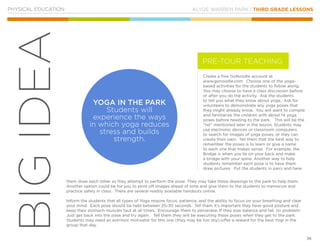
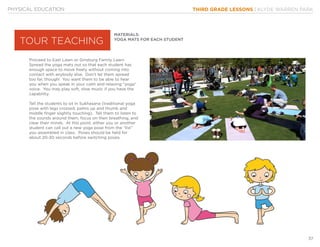
  • 19.
    THIRD GRADE LESSONS| KLYDE WARREN PARK 19 ART & DESIGN Talk to students about the benefits of having playgrounds for children in parks (i.e., a chance to exercise and release energy). Teach them about the relationship between heart rate, fitness, and overall wellness. Instruct them on the proper way to check their pulse and provide them with the information that a healthy heart rate for people their age is between 127 bpm and 196 bpm (beats per minute). During the exploration of the Children’s Park, encourage them to sporadically check their heart rate. If they find that they are below 127 bpm, they should try to move faster in order to get the most benefits from exercise. If they are above 196 bpm, they should be sure to take lots of rests so that they don’t overload their hearts. PERCEPTION (B) Identify art elements such as color, texture, form, line, space, and value and art principles such as emphasis, pattern, rhythm, balance, proportion, and unity in artworks. CREATIVE EXPRESSION/ PERFORMANCE (A) Create artworks based on personal observations and experiences. RESPONSE/EVALUATION (A) Identify general intent and expressive qualities in personal artworks. 01 02 04 TEKS PE COMPONENT
  • 20.
    KLYDE WARREN PARK| THIRD GRADE LESSONS 20 MATH
  • 21.
    THIRD GRADE LESSONS| KLYDE WARREN PARK 21 BIGIDEA MATH • As a class discuss what the students already know about perimeter and area. • Have the students turn to a partner and discuss how perimeter and area are related to one another. Make a web on the board to display your ideas, and have the students add to the web as they come up with them. • Ask questions such as: °° What is a unit of measurement? °° How do we measure the perimeter of a given shape? °° How do the sizes of the units of measurement affect the total perimeter when measuring? °° What could we use if we didn’t have a ruler to measure the perimeter of our classroom? • As a class decide (take a vote, brainstorm ideas) what could be used at the park to measure length. °° Leaves, walking steps, rocks, etc. • After coming to a decision have the students pair up into partners and give each student a Perimeter Recording Sheet. • Students can fill in the ‘unit used to measure length’ section of the recording sheet. PERIMETER IN THE PARK PRE-TOUR TEACHING
  • 22.
    KLYDE WARREN PARK| THIRD GRADE LESSONS 22 MATERIALS: PERIMETER RECORDING SHEET, CLIPBOARD, PENCIL • Discuss what shape you will be measuring. Is this section of the park shaped like a rectangle? A triangle? • Have the students draw a sketch of the borders of the area you will be measuring. • Make sure the students have access to the unit of measurement they will need to complete their task. Give them time to find a leaf, rock, etc. • Partners will work together to find what they believe is the perimeter of the park. Students will need to complete the first page of their recording sheet at this time. • The teacher can monitor for understanding and help students with any questions they may have. After arriving at the park, take a tour as a class. Decide on an area of the park that you would be able to measure. MATH TOUR TEACHING
  • 23.
    THIRD GRADE LESSONS| KLYDE WARREN PARK 23 MATH Students will come together as a class to create a dot plot displaying the results of their perimeter recordings. • The teacher can model a dot plot on the board to check for understanding. Working as a class, the students will compile their data to show the most frequently found perimeter. • Space for working through the problems is found on the third page of the Perimeter Recording Sheet. • A map of the park with measurements is included at the end of this lesson so students can compare their estimates with actual park dimensions. Have students write about their experience. • On the last page of the Perimeter Recording Sheet there are several questions that students may answer to expand upon their visit to the park. • Working with their partners or independently, students should use complete sentences and short paragraphs to answer the questions. • Teacher may guide students thinking by facilitating a group discussion of the questions. Geometry Search - On the back of the recording sheet the students have a geometry search that they can do while at the park. Students should try and find as many real world three-dimensional objects as they can. Once they have found the shape in real life they are able to sketch their sighting on the recording sheet. POST-TOUR TEACHING ELA COMPONENT QUICK BITE
  • 24.
    KLYDE WARREN PARK| THIRD GRADE LESSONS 24 Use your own feet to measure length! Walk the perimeter by touching ankle to toe and counting how many steps make up the perimeter of the area. Remind students to maintain their balance by keeping tummies tight and hands out. For an added physical challenge, tell students to keep their heads up and eyes forward instead of looking at their feet. (A) represent one-and two- step problems involving addition and subtraction of whole numbers to 1,000 using pictorial models, number lines, and equations (B) determine the perimeter of a polygon or a missing length when given perimeter and remaining side lengths in problems (A) summarize a data set with multiple categories using a frequency table, dot plot, pictograph, or bar graph with scaled intervals (A) classify and sort two- and three dimensional figures, including cones, cylinders, spheres, triangular and rectangular prisms, and cubes, based on attributes using formal geometric language (C) determine the area of rectangles with whole number side lengths in problems using multiplication related to the number of rows times the number of unit squares in each row (A) solve with fluency one- step and two-step problems involving addition and subtraction within 1,000 using strategies based on place value, properties of operations, and the relationship between addition and subtraction (E) represent multiplication facts by using a variety of approaches such as repeated addition, equal- sized groups, arrays, area models, equal jumps on a number line, and skip counting MATH PE COMPONENT TEKS 3.4 3.6 3.5 3.7 3.8
  • 25.
    THIRD GRADE LESSONS| KLYDE WARREN PARK 25 MATH PERIMETER RECORD SHEET Perimeter in the Park Lesson, Grade 3 GROUP MEMBERS: Sketch of Park: Sphere, cube, rectangular prism, triangular prism, cone, cylinder Unit Used to Measure Length (rocks, leaves, footsteps, etc.): Shape of Park: Predicted Perimeter: Partner 1 Measurement: Partner 2 Measurement: Final Perimeter:
  • 26.
    KLYDE WARREN PARK| THIRD GRADE LESSONS 26 MATH GEOMETRY SEARCH Can you find any of these shapes in the real world around the park? Draw a sketch of the real world shape and get a bonus! Sphere Cone Cube Rectangular Prism Triangular prism Cylinder
  • 27.
    THIRD GRADE LESSONS| KLYDE WARREN PARK 27 MATH CREATE A DOT PLOT USING DATA Using the data that your class collected, create a dot plot: What perimeter was found most often? Were there any outliers in the data? Using your findings, is there any way that you could find the exact perimeter in feet and inches? How so?
  • 28.
    KLYDE WARREN PARK| THIRD GRADE LESSONS 28 MATH THINK AND RESPOND With the class or a partner, answer the following questions using complete sentences. 1. Did everyone in the class find the exact same perimeter? Why or why not? 2. What do you think would have happened if we chose different units of measurement? Would you have found the same perimeter? Why? 3. Is there any way to use the perimeter you found to find the area of the section of the park?
  • 29.
    THIRD GRADE LESSONS| KLYDE WARREN PARK 29 15'-0" 22'-0" 15'-9" 15'-0" 80'-6" 324'-0" 311'-9" 26'-0" 122'-7" 69'-10" 15'-11" 61'-2" 37'-6" 49'-5" 24'-3" 20'-1" 60'-0" 10'-0" 74'-0" 12'-1" 25'-3" 8'-5" 45'-9" 30'-5" 15'-0" 16'-5" 25'-6" 290'-10" 79'-4" 147'-2" 7,517 sf 9,252 sf 9,686 sf 20,235 sf 28'-3" 20'-1" 40'-7" 12'-0" 20'-0" 12'-1" 167'-2" 115'-11" 15'-0" Company Switch: 100, 200, 400 Amp Power with Color Coded Twist Lock Connections 19'-0" 1,038'-1" 220'-4" 361'-10" 638'-3" Klyde Warren Park Site Plan with Measurements
  • 30.
    KLYDE WARREN PARK| THIRD GRADE LESSONS 30 PHYSICAL EDUCATION
  • 31.
    THIRD GRADE LESSONS| KLYDE WARREN PARK 31 BIGIDEA Ask students to create a table on a piece of paper; label one side “Things I know about the Olympics” and label the other side, “Things I’d like to know about the Olympics”. Have students brainstorm in groups to complete the table and discuss. Show the students a clip from the Olympics. Instruct students to research the origin of the Olympics on their phones or computers and share what they learned with the class. Allow students to make Greek costumes such as tunics, cloaks and crowns to be worn during the relay (over their clothes preferably). Show them pictures of ancient Greece to inspire their designs. Don’t forget to make the torch to kick off the Opening Ceremony! Playing music (if you are able) is a great way to get the students excited too. PHYSICAL EDUCATION OLYMPICS RELAY Students complete an Olympic Relay while learning about Olympic Events. PRE-TOUR TEACHING
  • 32.
    KLYDE WARREN PARK| THIRD GRADE LESSONS 32 PHYSICAL EDUCATION MATERIALS: WHISTLE, 5-8 HURDLES, 4-6 FOAM NOODLES, 4-6 BEAN BAGS OR NERF FOOTBALLS, MEASURING TAPE, STOPWATCH Break the students into groups of 4 and place one student at each station. On the whistle, the student at station 1 completes the event and runs to tag his teammate at station 2. This continues until the 4th teammate crosses the finish line. The team with the fastest time wins. Start all the students at station 1 and tell them to go on the whistle. Each student proceeds through the events. The student with the fastest time wins. If you have enough supervision, or mature enough students, run this activity similar to an actual track meet in which distance and times are calculated and a winner is declared based on his or her performance in each of the 4 events. Set up 4 relay stations (events) around the perimeter of the Ginsberg Family Great Lawn with several adult supervisors. Demonstrate or describe what the students will do at each station (event) before beginning the relay. Number each station 1-4 so students will know which station to complete first. You may choose to have an adult supervisor record distances for students at each station, or you may choose to create a scorecard so that the students may keep track of their achievements at each station. Either way, the students will enjoy knowing how well they did at each event. OPTION OPTION OPTION 01 02 03 TOUR TEACHING
  • 33.
    THIRD GRADE LESSONS| KLYDE WARREN PARK 33 Hurdles - You may use several makeshift hurdles, but be sure they are not higher than the average student’s knees. Discus - Students throw a bean bag or Nerf football as far as they can in the manner of Discus. Javelin - Students throw a foam noodle as far as they can in the manner of a javelin. Long Jump - Students complete a two-footed jump from a starting line trying to jump as far as possible. Give them 3 chances and record the best jump. PHYSICAL EDUCATION STATIONS STATION STATION STATION STATION 01 03 04 02
  • 34.
    KLYDE WARREN PARK| THIRD GRADE LESSONS 34 PHYSICAL EDUCATION Hold an awards ceremony. Make 1st, 2nd, 3rd place podiums out of milk crates or boxes. Award gold, silver, and bronze medals to students whose scores are highest. For a less competitive option, make a winners circle out of a hula hoop and honor each participant with a gold medal. Students can create a poster about what they learned while researching the origin of the Olympics. Tell them to choose a theme and title for the poster such as “Ancient Greek Clothing” or “The Olympics: Then and Now”. They should paraphrase and summarize what they learned, include pictures, and site the sources they used. ELA COMPONENT POST-TOUR TEACHING
  • 35.
    THIRD GRADE LESSONS| KLYDE WARREN PARK 35 Physical Activity and Health (A) Use equipment safely and properly Movement (B) Demonstrate proper form and smooth transitions during combinations of fundamental locomotor and body control skills such as running and jumping safely in dynamic situations. (J) Demonstrate key elements in manipulative skills such as underhand throw, overhand throw, catch and kick such as position your side to the target. PHYSICAL EDUCATION TEKS 3.1 3.5 QUICK BITE Students may observe the amenities in the park such as the game tables and Dog Park. Ask them to invent a new Olympic Event that could be done right here in Klyde Warren Park. Tell them to think about how a winner would be determined in this event.
  • 36.
    KLYDE WARREN PARK| THIRD GRADE LESSONS 36 BIGIDEA PHYSICAL EDUCATION Create a free GoNoodle account at www.gonoodle.com. Choose one of the yoga- based activities for the students to follow along. You may choose to have a class discussion before or after you do the activity. Ask the students to tell you what they know about yoga. Ask for volunteers to demonstrate any yoga poses that they might already know. You will want to compile and familiarize the children with about 14 yoga poses before heading to the park. This will be the “list” mentioned later in the lesson. Students may use electronic devices or classroom computers to search for images of yoga poses, or they can create their own. Tell them that the best way to remember the poses is to learn or give a name to each one that makes sense. For example, the Bridge is when you lie on your back and make a bridge with your spine. Another way to help students remember each pose is to have them draw pictures. Put the students in pairs and have them draw each other as they attempt to perform the pose. They may take these drawings to the park to help them. Another option could be for you to print off images ahead of time and give them to the students to memorize and practice safely in class. There are several readily available handouts online. Inform the students that all types of Yoga require focus, patience, and the ability to focus on your breathing and clear your mind. Each pose should be held between 20-30 seconds. Tell them it’s important they have good posture and keep their stomach muscles taut at all times. Encourage them to persevere. If they lose balance and fall, no problem! Just get back into the pose and try again. Tell them they will be executing these poses when they get to the park. Students may need an extrinsic motivator for this one (they may be too shy)-offer a reward for the best Yogi in the group that day. YOGA IN THE PARK Students will experience the ways in which yoga reduces stress and builds strength. PRE-TOUR TEACHING
  • 37.
    THIRD GRADE LESSONS| KLYDE WARREN PARK 37 MATERIALS: YOGA MATS FOR EACH STUDENT Proceed to East Lawn or Ginsburg Family Lawn. Spread the yoga mats out so that each student has enough space to move freely without coming into contact with anybody else. Don’t let them spread too far, though! You want them to be able to hear you when you speak in your calm and relaxing “yoga” voice. You may play soft, slow music if you have the capability. Tell the students to sit in Sukhasana (traditional yoga pose with legs crossed, palms up and thumb and middle finger slightly touching). Tell them to listen to the sounds around them, focus on their breathing, and clear their minds. At this point, either you or another student can call out a new yoga pose from the “list” you assembled in class. Poses should be held for about 20-30 seconds before switching poses. PHYSICAL EDUCATION TOUR TEACHING
  • 38.
    KLYDE WARREN PARK| THIRD GRADE LESSONS 38 PHYSICAL EDUCATION Ask students to discuss how they felt before, during, and after Yoga in the Park. Ask them to determine the benefits of doing an activity like Yoga on a regular basis. Answers could include stronger muscles and bones, flexibility and greater range of motion, a strengthening of the immune system, stress relief, and muscular-skeletal pain relief (i.e. back pain). During the Post Tour Teaching portion of the lesson, have students make 3 vertical columns on a piece of paper. Label the columns “Before”, “During” and “After”. Tell the students to use at least two complete sentences to describe how they felt during each stage of the Yoga in the Park activities. Give the table a title and hang the tables in the classroom. Ask students to get in groups and discuss the various ways in which they cope with the stress in their lives. Tell them to examine their answers by asking themselves the question, “Are these healthy or unhealthy ways to cope with stress?” Physical Activity and Health (C) Participate in appropriate exercises for developing flexibility. Physical Activity and Health (D) Identify principles of good posture and its impact on physical activity Social Development (B) Persevere when not successful on the first try in learning movement skills. TEKS 3.3 3.4 3.7 ELA COMPONENT POST-TOUR TEACHING QUICK BITE
  • 39.
    THIRD GRADE LESSONS| KLYDE WARREN PARK 39 BIGIDEA In the classroom, introduce the students to the terms aerobic exercise and anaerobic exercise. Do this by asking them to compare the 100-meter dash and a marathon race. Which one would you consider to be more difficult? You may use a Venn diagram to illustrate the similarities and differences of these two activities. Give the students the definitions below and then refer to the Venn diagram to make changes or additions. Aerobic exercise- requires oxygen, and can be sustained for longer periods of time. Anaerobic exercise- does not require oxygen, and causes the heart to beat harder and faster. Cannot be sustained for a long period of time, utilizes large muscle groups. Tell the students that they will participate in two challenges at Klyde Warren Park and they will have to decide which is aerobic exercise and which is anaerobic exercise. BEANBAGS AT MIDNIGHT Students will explore the differences between aerobic and anaerobic fitness. PHYSICAL EDUCATION PRE-TOUR TEACHING
  • 40.
    KLYDE WARREN PARK| THIRD GRADE LESSONS 40 PHYSICAL EDUCATION MATERIALS: ONE BEANBAG FOR EACH STUDENT, MEDIUM SIZED BOX OR BUCKET, CONES MIDNIGHT This game is a sprinting game--an anaerobic activity. It needs high energy in short bursts. Proceed to Ginsburg Family Great Lawn or East Lawn. Create a large, rectangular perimeter using cones. Designate a child as ‘it’. This student will chase the other children. ‘It’ stands on one end line, while all the other children stand on the other end line. All the children will yell out to ‘it’, “What time is it?” ‘It’ may say 5 o’clock. Since ‘it’ said 5 o’clock, all the children take 5 steps towards ‘it’. Next, the children will say again, “What time is it?” If it says 8 o’clock, the children will take 8 more steps towards ‘it.’ Continue with this pattern. When the children say, “What time is it?” and ‘it’ says midnight, ‘it’ must chase all the children back to the starting end line. Any child tagged now becomes a helper to ‘it’, and will stand on ‘its’ end line to help chase the other children on the midnight command. BEANBAGS This game is an aerobic activity. Proceed to Jane’s Lane. Inform the students that one lap equals once around the main path on the perimeter of the park. Tell them they will be running three laps. Each time they complete a lap, they must throw their beanbag, using an underhand throw, at the box in the middle of the park. After they throw, children must go into the middle to retrieve their beanbag, pick it up, and return back to the track all without stopping their run. Once back on the track, children should begin running another lap from the place where they threw their beanbag. Children should continue in this pattern until they complete all three laps. Another option is to award students points each time they make their beanbag in the box. Winner receives a small award. A fun, less competitive alternative is to let the kids keep their scores private. TOUR TEACHING ACTIVITY ACTIVITY 01 02
  • 41.
    THIRD GRADE LESSONS| KLYDE WARREN PARK 41 PHYSICAL EDUCATION Look at the Venn diagram again when you are back in the classroom. Ask students to tell you which activity completed in the park is aerobic exercise and which is anaerobic. Split the students into groups and have them create aerobic or anaerobic games for their classmates. Ask students to make an Acrostic poem. Have them write the word aerobic or anaerobic vertically on a piece of paper. Encourage the kids to think about how their bodies felt after each of the activities in the park. They should choose an adjective for each letter of the word. They may decorate their poems. These can be hung in the classroom. Physical Activity and Health (B) Distinguish between aerobic and anaerobic activities TEKS 3.4 ELA COMPONENT POST-TOUR TEACHING QUICK BITE Tell the students to list all of the activities in which people are engaged at Klyde Warren Park. Tell them to label each activity as being either aerobic or anaerobic. Inform them that a good fitness routine includes both aerobic and anaerobic exercise. They will probably notice that the bulk of the activities on their lists are labeled as aerobic exercise. Ask them to brainstorm ideas for activities that could be implemented in the park that are anaerobic exercises. One example you could suggest is an outdoor weightlifting gym.
  • 42.
    KLYDE WARREN PARK| THIRD GRADE LESSONS 42 SCIENCE
  • 43.
    THIRD GRADE LESSONS| KLYDE WARREN PARK 43 BIGIDEA SCIENCE Engage students in a discussion about the basic parts of a plant and what each of those parts does to benefit the plant (Part 1). Then, use the questions in Part 2 to explore how and why plants look and function differently. 1. Parts of a plant Review the basic parts that most plants have in common. (Leaves, stems, roots, seeds, flowers) • Where they are on the plant • Their functions (roots take in water and nutrients, stem supports plant and transports waters and nutrients to and from leaves, leaves are the solar panels of the plant because they collect sunlight to turn into energy, flowers attract pollinators in order to make seeds, seeds fall to the ground or are dispersed by animals or wind to make more plants) 2. Talk about how these parts may look different among plants Compare and contrast plants from different ecosystems: Rainforest plants, aquatic plants, forests and desert plants, etc. • How are they alike? Reinforce what all plants have in common. (basic parts and all need sunlight and water) FORM & FUNCTION Plants and animals in nature are often shaped the way that they are in order to do a job. For instance, squirrels climb trees so they have specially shaped claws to help them. Plants have jobs too: they need to gather sunlight with their leaves, store and transport water in their stems and grow seeds to make more plants. They grow colorful flowers to attract bees to help spread their pollen. These leaves, stems, roots, seeds and flowers can come in all shapes and sizes, depending on the habitat where the plant is found. The colors are beautiful to our eyes, but did you know they also help bees find pollen? Bees use pollen to make honey, a yummy food that we enjoy as well! Lots of flowers are yellow or purple, a color honey bees find especially attractive. Some flowers have lines and patterns on the flower that help the bee find exactly where the flower keeps its pollen. The shapes of leaves are another example. Trees use sunlight to help them grow very big. Many tree leaves are broad and flat. This broad, flat shape helps them to gather sunlight so they can grow many stories tall. PRE-TOUR TEACHING
  • 44.
    KLYDE WARREN PARK| THIRD GRADE LESSONS 44 SCIENCE Scavenger Hunt Supply close-up pictures of certain plants with a checklist and challenge the students to find the plant based upon the picture. Students could draw a picture of the whole plant next to the close- up photo. Have students write down the physical characteristics that they notice about the plant, any facts that they might already know, as well as some questions that they might have about that specific plant. When you gather back together at the park, allow the students to share their drawings and findings with their peers. Investigation question: Based on all the information students collect, what habitats do they think the most of the plants in Klyde Warren Park live in naturally? Plant listing information from: • eFloras.org (Flora of North America) • United States Department of Agriculture • Wildflower.org • DavesGarden.com • Wikipedia.com Similarities and Differences Have students spot similarities and differences among the plants that they find. • Do some have spiky leaves? • Do some have flowers while others do not? • Which ones are very tall and which ones are very small? • Why don’t all of these plants look the same? • Which ones have seeds that you can see? • Which plants were listed as being important to birds? How and why? • Which plants were listed as being important to native bees? How and why? • Which plants were drought resistant? Why is this important? • How are they different? (Leaves are bigger/ smaller, cactus have leaves modified into spines, large trees versus small plants, etc.) • Why are they different? For example: A cactus lives in the desert. It needs to store as much water as it can because it doesn’t rain often. Cacti have hollow bodies to store water. Their leaves are modified into spines so they can protect their water from thirsty animals. It rains a lot in the rain forest. Plants that live there have adaptations to allow all the rain to drip down points on their leaves. Some of them have very large leaves to collect as much sunlight as possible because it is shady near the forest floor. Trees in the rainforest grow very tall and many organisms can live in and on them, even other plants! • What is a pollinator? (talk about why plants need them to help spread their pollen to make seeds, what different kinds of animals can be pollinators, how insecticide meant to save plants from plant- eating pests can hurt bees and why pollinator gardens are important to attract and support pollinators) Texas doesn’t get as much rain as other parts of the country, so plants that don’t need a lot of water can live here. They have special adaptations to hold as much water as possible. You can see a lot of these plants in Klyde Warren Park. TOUR TEACHING
  • 45.
    THIRD GRADE LESSONS| KLYDE WARREN PARK 45 • Could we group the plants we found at Klyde Warren Park into different habitats? What would they be? What else could live in those habitats? • What habitat/ecosystem is Dallas in? Why is it important to save water by planting plants that don’t need a lot of water? • Have students draw a picture or create a big mural of different ecosystems with appropriate plants. Later you can add animals to the mural that would live in the ecosystems. • Have students use their insect count data from the “Quick Bite” to create a bar graph of the number of butterflies and bees they found in different areas of the park. Determine which area had the highest amount of butterflies and which area had the highest amount of bees. What could be some reasons that there were more butterflies or bees in one section of the park than another? Have students write about their favorite plant that they learned about at Klyde Warren Park. They may need to conduct additional research about the plant. They could include: • Its scientific and common names • Where it lives naturally (geographic location and ecosystem) • Is it beneficial to animals? How? • Can people use this plant for something? (Food, clothing, medicine, etc.) • Does it have special adaptations for surviving in its natural ecosystem? • Why they found this plant interesting. They could present this information in one of the following forms: • A very short story with a fictional plot that is built around all of the above information • A poem that includes descriptive words about the plant as well as the above information • An informational report • A how-to for birds, animals or pollinating insects to find the plant and use it for food, nesting material or pollination. Bee the Pollinator Have students find all of the plants that are flowering in the park. Some plants will flower in different seasons than others. They will need to draw a quick picture of the flower in a “Pollinator Garden” sheet and collect the name. Insect Count Scientists often count the number of insects in an area to estimate the health of an ecosystem. Your students can do that too. Have them split up into groups of three and have each student in a group responsible for counting one type of insect. One student could count the number of butterflies they see, another could count the number of bees, and another the number of flies or other insects. This can be scaled to be as detailed (identifying via pictures and counting certain species of butterflies and bees common to the Dallas area) or as simple (just counting bees and butterflies) as wanted. SCIENCE QUICK BITE POST-TOUR TEACHING ELA COMPONENT
  • 46.
    KLYDE WARREN PARK| THIRD GRADE LESSONS 46 Be the Plant Have the students create a dance that represents their favorite plant. How does it stand? Pretend your arms and legs are parts of the plant. Do they wave in the breeze? Are they low to the ground? Are they very, very tall? Do they have spines stick out to protect the plant? Establish one or more “Be the Plant” stations in the park where students strike a pose like their favorite plant. Have an adult take their picture and tag it with #KWP or #betheplantKWP to help promote the park and its curriculum. (A) plan and implement descriptive investigations, including asking and answering questions, making inferences, and selecting and using equipment or technology needed, to solve a specific problem in the natural world; (C) construct maps, graphic organizers, simple tables, charts, and bar graphs using tools and current technology to organize, examine, and evaluate measured data; (D) analyze and interpret patterns in data to construct reasonable explanations based on evidence from investigations; (F) communicate valid conclusions supported by data in writing, by drawing pictures, and through verbal discussion. (A) observe and describe the physical characteristics of environments and how they support populations and communities within an ecosystem; (A) explore how structures and functions of plants and animals allow them to survive in a particular environment. SCIENCE TEKS 2.0 9.0 10.0 PE COMPONENT
  • 47.
    THIRD GRADE LESSONS| KLYDE WARREN PARK 47 SCIENCE AGAVE HAVARDII Harvards Century Plant Soil: Dry Water: Low Sun: High These amazing desert plants can live for fifty years! Before the plant dies, it needs to spread its seeds, so it sends up a huge stalk of flowers which can be 15 feet tall! The plants store water in their lobed leaves. AGAVE UNIVATTA (lophantja) Thorn Crested Agave Soil: Low Water: Dry Sun: High This agave plant can store water in its lobed leaves and puts up a single flower stalk right before it dies, though it isn’t as tall as the Century Plant. It is found in the Rio Grande Plains and Central Texas. AGAVE Mr. Ripples Soil: Dry Water: Low Sun: High This species of agave has wavy edges which give it its interesting species name. Although originally from dry areas of Mexico, this succulent does well in the Texas heat. It stores water in its leaves and has very sharp spines. PLANT SCAVENGER HUNT INFORMATION SHRUBS
  • 48.
    KLYDE WARREN PARK| THIRD GRADE LESSONS 48 SCIENCE AGAVE TOUMEYANA VAT BELLA Soil: Dry Water: Low Sun: High This species of agave is native to Central Arizona occurring on rocky hillsides and highland desert. They have flowering stalks like other agaves but can withstand colder temperatures. The species forms dense clumps of rosettes, rarely more than 50 cm high. Flowering stalks can reach 3 meters, bearing greenish-white flowers MYRICA CERIFERA Soil: Moist Water: High Sun: Sun, Part shade Often found along swampy stream beds and in marshes, this plant was used by Native Americans to treat fevers and stomachaches. This woody shrub attracts birds which eat the berries and butterflies who visit the blooms in spring. HESPERALOE PARVIFLORA Red Yucca Soil: Sandy Loam to Dry Water: Low Sun: High This agave has beautiful red flowers that attract hummingbirds. Like other agaves, this plant stores water in its leaves. Deer like to eat the fruit and foliage. SALVIA LEUCANTHA Soil: Sandy Water: Low Sun: Full Sun This drought resistant plant is native to tropical forests of Mexico and the beautiful flowers attract bees, butterflies and hummingbirds. LEUCOPHYLLUM FRUTESCENS Purple Sage Soil: Rocky, Well-Drained soil Water: Moderately low Sun: Sun, Part-shad These flowers bloom after enough rain has fallen. Butterflies lay their eggs on this plant and their caterpillars love to eat the foliage. YUCCA ARKANSAS Soil: Dry Water: Low Sun: Part Shade A native to Texas and the surrounding states, this small member of the Yucca family is popular with landscapers. It grows in gravely soils at the edge of open fields. Beautiful bell like flowers open slowly attracting pollinators.
  • 49.
    THIRD GRADE LESSONS| KLYDE WARREN PARK 49 SCIENCE ANDROPOGON VIRGINICUS Broomsedge Blue Stem Water: Medium Soil: Moist Sandy Sun: Part Shade This grass is used by birds and vulnerable native bees for nesting materials. Deer forage on the grass and birds eat its seeds. Caterpillars of the Zabulon Skipper butterfly use this grass for food as they grow up and the adults visit the flowers for nectar. Native to the Southern Great Plains and Eastern United States MUHLENBERGIA CAPILLARIS Gulf Muhly Sun: Full to Partial shade Water: High Soil: Moist Sandy This grass is native to the Eastern half of the United States. It grows well along borders of roads and in plains or woods with rocky soils. It is drought and dis- ease resistant and provides shelter, cover and nesting sites for native birds. ERAGROSTIS CURVULA Weeping Lovergrass Sun: Full to Partial Shade Water: Medium Soil: Coarse, Dry This drought resistant plant is actually native to South- ern Africa but does very well in the climate of North Texas. Its complex root system keeps dry soil in place and it is used as forage for livestock. It was first plant- ed in Stillwater, Oklahoma in 1935. MISCANTHUS SINENSIS Silvergrass Sun: Full Water: Medium Soil: Varies Native to Eastern China, this grass serves as nesting material for some Asian paper wasps. It does well in North Texas dry summers and is drought resistant. PLANT SCAVENGER HUNT INFORMATION GRASSES
  • 50.
    KLYDE WARREN PARK| THIRD GRADE LESSONS 50 SCIENCE NASSELLA TENUSSIMA Mexican Feather Grass Sun: Full Soil: Well drained Water: Low This plant is especially interesting because it occurs naturally in southwestern North American and Southern South America with no populations in between. It is found in the mountainous region of West Texas and is drought resistant. MUHLENBERGIA LINDHEIMERI Lindheimer Muhly Sun: Full Water: Medium Soil: Dry or Moist well drained limestone. Native to the Edwards Plateau of Central Texas, this grass is drought resistant and can grow very large. It is often found near streams in soil high in calcium in its native range. POA ARACHNIFERA Texas Blue Stem Soil: Moist Loams Water: Medium Sun: Full to Partial Shade Native from Texas to Southern Kansas, this cool season grass provides foraging for wildlife. Birds and small mammals eat the seeds and butterflies are attracted to its small flowers. MUHLENBERGIA REVERCHONII Seep Muhly Sun: Full Water: Medium Soil: Dry or moist, does best in loamy limestone seeps This bunching grass is native to limestone plains soils of Oklahoma and Central Texas. It is often used in prairie restoration and is highly deer resistant. SETARIA SCHEELEI Southwestern Bristlegrass Sun: Part Shade Soil: woodland and disturbed urban soils Water: Low to Medium Native in to North Central Texas to Arizona and Mexico, this grass can be found in limestone canyons, open forests and side yards in the city. When found near streams it can be habitat for marsh birds and water fowl. Butterflies lay their eggs on this grass and small mammals eat their seeds. SORGHASTRUM NUTANS Indian Grass Soil: Dry to Moist, rich Water: Medium Sun: Sun to Part Shae This grass is native to tall grass prairies of the North- ern United States and Canada and can be found as far south as Mexico. It provides nesting material for birds and seeds for small mammals to eat. It supports native bees by providing nesting structures.
  • 51.
    THIRD GRADE LESSONS| KLYDE WARREN PARK 51 SCIENCE PLANT SCAVENGER HUNT INFORMATION PERENNIALS Millefolium achillea yarrow Soil: Dry Water: Medium Sun: Full to Part Shade It was used in antiquity to stop blood flow from wounds. Flowers May through June. This plant is very important to native bees and also attracts beneficial pest-eating insects to gardens. Symphyotrichum oblongifolium fall aster Soil: Dry to Moist Water: Low, Drought tolerant Sun: Full to part shade Flowers August through November. This plant is native to the Eastern Great Plains and is important for native bees and useful for attracting beneficial insects to con- trol pests in the garden. Coreopsis grandiflora coreopsis Soil: Sandy Soils Water: Low Sun: Part Shade Blooming in May and June, this plant is eaten by the caterpillars of certain species of butterflies.
  • 52.
    KLYDE WARREN PARK| THIRD GRADE LESSONS 52 SCIENCE Conoclinium greggii Silver mist Soil: Dry Water: Medium Sun: Sun to Part Shade Found in West Texas along stream beds and seasonally flooded plains. Blooms March through November. This flower attracts Queen butterflies in the fall and is the larval host for the Rawsons Metalmark. (http://www. butterfliesandmoths.org/species/Calephelis-rawsoni) Physostegia virginiana obedient plant Soil: moist, humus rich soil Water: Medium Sun: Sun to Shade This flower blooms August through November and is an especially important source for nectar to autumn butterflies and hummingbirds. This plant is important for the health of wetlands. Lantana montevidensis trailing Lantana Soil: Dry Water: Medium Sun: Variable This trailing plant is native to South America and can serve as drought tolerant ground cover with blooms most of the year. Rudbeckia fulgida black eyed susan Soil: various moist soils Water: Medium Sun: Full Birds are attracted to the seeds of this popular flower which blooms from July through October. Native Bees find it particularly important for late summer nutrition and it improves the health of wetlands. LIatris spicata blazing star Soil: moist, woody, slightly acidic Water: Medium Sun: Full This unique flower attracts butterflies, birds and hum- mingbirds to gardens and is especially valuable to na- tive bees and Bumble Bees. Native to woody openings and marshes of the South Eastern United States. Salvia farinacea mealy blue sage Soil: moist and slightly acidic Water: Low Sun: Full Blooms throughout the summer, attracting humming- birds and butterflies while serving as important nectar source to native bees. Native to meadows and Prairies of Central and West Texas.
  • 53.
    THIRD GRADE LESSONS| KLYDE WARREN PARK 53 SCIENCE Dietes iridioides African iris Soil: Poor to fair Water: drought tolerant Sun: Dappled shade to full sun This lily is Native to Africa, but does well in the climate of North Central Texas. Though the plants bloom from spring to late summer, each flower only lasts one day. Melampodoum leucantham Blackfoot daisy Soil: Dry slightly acidic Water: Low Sun: Full to Part Shade Native to South Central United States, this drought tol- erant plant blooms March through November, attracting native bees, butterflies and other insects to its nectar and birds to its seeds. Echinacea purpurea Purple cone flower Soil: Dry Water: Medium Sun: Full to part shade Blooming April through September, this prairie flower attracts native bees, butterflies and hummingbirds. This flower is native to the South Central United States and is said to be a natural anti-biotic. Perovskia atriplicifolia Russian sage Soil: Poor, chalky Water: drought tolerant once established Sun: Full This plant is native to central Asia, but does well in the Texas climate. A popular addition to gardens, it is cut back significantly in winter to encourage flowering on its new growth in spring. Equistrum hyemale Horsetail reed Soil: variable, well draining Water: can tolerate prolonged wet conditions Sun: Full to part shade This interesting and ancient plant has been around since before the age of the dinosaurs. Sometimes called scouring rush because people used to tie the stem segments together to make cleaning brushes. They provide good cover for birds in wetlands and along stream margins. Phlox pilosa prairie philox Soil: Dry, slightly acidic Water: Low Sun: Full to part Shade The flowers attract long-tongued bees, butterflies and skippers March through May. This flower is also an indicator of a healthy wetland.
  • 54.
    KLYDE WARREN PARK| THIRD GRADE LESSONS 54 SCIENCE Salvia gregii gregg’s salvia Soil: dry Water: Low Sun: Full to part shade Beautiful red flowers bloom from March through No- vember attracting bees and hummingbirds. This highly drought tolerant plant is native from Central and west Texas. Scutellaria suffrutescens texas skullcap Soil: Well drained Water: Low Sun: Full This drought resistant plant bears flowers from late spring to mid fall resembling tiny helmets. Verbena bipinnatifida prairie verbena Soil: Dry to Moist Water: Low Sun: Part Shade Blooming from March to October, this flower is com- mon to open areas throughout the state of Texas. Pollinators frequent the flowers for nectar and birds are attracted to the seeds.
  • 55.
    THIRD GRADE LESSONS| KLYDE WARREN PARK 55
  • 56.
    KLYDE WARREN PARK| THIRD GRADE LESSONS 56 SOCIAL STUDIES
  • 57.
    THIRD GRADE LESSONS| KLYDE WARREN PARK 57 BIGIDEA SOCIAL STUDIES To introduce the concept of the common good, read aloud the picture book, The Promise, by Nicola Davies. As kids listen and think about the theme of the story, ask students to reflect on a time in their lives when they were asked to “pay it forward” or give back. In small groups, students will think about ways they can contribute to the greater good in their own communities. Focusing on the idea of “planting seeds” of hope, students will discuss how Klyde Warren Park represents investing in the community. They can read a brief article about the Tree Trust foundation and compare the article to the picture book. Twenty-first century learners are expected to possess the following four skills: critical thinking, communication, collaboration, and creativity. Along with these noble goals, our students need to understand how these core foundations work together for the common good of a community. PRE-TOUR TEACHING THE FIFTH C COMMON GOOD
  • 58.
    KLYDE WARREN PARK| THIRD GRADE LESSONS 58 SOCIAL STUDIES The students will participate in a Common Good Scavenger Hunt. With a partner or small group, the children will explore several areas of the park looking for signs, artifacts, and designated spaces designed for the common good of all visitors. For example, when students come across the Complimentary First Aid Kits, they might discuss how these medical supplies benefit all park visitors because it prevents the spread of disease and provides needed resources in case of emergency. If students have devices, they can snap a picture of these items and record a brief explanation of how they benefit the common good of the citizens who visit the park. If electronics aren’t permitted, students may sketch the items in a notebook and write a caption describing how they relate to the common good of all park visitors. Students should document a minimum of seven items and justify how each entry illustrates the concept of the common good. TOUR TEACHING
  • 59.
    THIRD GRADE LESSONS| KLYDE WARREN PARK 59 SOCIAL STUDIES Each group presents the items they collected representing the common good. They can create a slideshow or I-movie of their items, narrating how each artifact improves the lives of all visitors at the park. They can also include suggested park improvements such as complimentary snacks or lemonade. During the presentations, students will give examples of how their collection represents serving the common good of a community. Students will create a collage promoting the “Common Good” of a community. They can include famous quotes about citizenship as well as photos from their field trip to Klyde Warren Park. Each child will write a persuasive paragraph encouraging members of a community to consider how their choices impact others. They can include examples and suggestions for future park improvements. Ask the students how the theme of the “Common Good” in communities relates to good sportsmanship in competition. Have the students brainstorm a list of character traits that a good sport displays. Choose a quick activity such as Red Rover or Freeze Tag and tell the students that you are looking for your “Good Sports”. POST-TOUR TEACHING ELA COMPONENT PE COMPONENT
  • 60.
    KLYDE WARREN PARK| THIRD GRADE LESSONS 60 SOCIAL STUDIES Citizenship The student understands the impact of individual and group decisions on communities in a constitutional republic. a. Give examples of community changes that result from individual or group decisions b. Identify examples of actions individuals or groups can take to improve the community c. Identify examples of nonprofit/or civic organization and explain how they serve the common good TEKS 3.12 QUICK BITE During your lunch break, locate examples of “Common Good” items present at Klyde Warren Park. Jot them down in your notebook and converse with a partner about why these items represent the “common good” of the community. What other things would you add? Which items are necessary for an enjoyable park experience? A few suggestions are listed below to help you get started. qq Complimentary Wi-fi qq Movable Chairs and tables qq Concrete and gravel pathways qq Drinking fountains to quench thirst qq Performance stages and pavilions qq Warning Signs: “Caution: Area may be slippery when wet.” qq Free books and newspapers from the Dallas Morning News qq Posted list of weekly activities qq Free to Play equipment and game carts
  • 61.
    FOURTH GRADE LESSONS| KLYDE WARREN PARK 61 4th GRADE LESSONS MATH PHYSICAL EDUCATION ART & DESIGN SCIENCE SOCIAL STUDIES
  • 62.
    KLYDE WARREN PARK| FOURTH GRADE LESSONS 62 ART & DESIGN
  • 63.
    FOURTH GRADE LESSONS| KLYDE WARREN PARK 63 ART & DESIGN BIGIDEA Review some images of architecture or design that reflect nature in their appearance. A great example of this is in the work of famous architect Frank Lloyd Wright. Use the following link to visit his website and peruse a number of architectural designs that incorporate nature in a number of ways. http://www.franklloydwright.org/ Have the students call out or write down the different ways that they see nature in the architecture and designs of the examples that you show. Some questions to create discussions might include: • How are these different than our school building or other buildings that you see each day? • How are they similar? • How is nature reflected in the buildings and spaces that you see in these examples? • How is nature reflected in the buildings that you see each day? Remind the students that the design of a space includes the architecture as well as the landscape around it, such as the trees, flowers, and other greenery that surrounds buildings. In addition, ask them to think about all of the senses when looking at nature in design. What would it smell like? Sound like? Feel like? After talking with the students about these examples, share with the students some information about the designer of Klyde Warren Park, James Burnett. Burnett creates landscape and designs that appeal to the senses. His goal is to create relationships between landscape and architecture. Look at some examples of his work with the students on his company’s website (http://www.ojb.com/). There are photos of various projects that the company has done that incorporate nature in design, including images of Klyde Warren Park. PRE-TOUR TEACHING NATURE IN DESIGN
  • 64.
    KLYDE WARREN PARK| FOURTH GRADE LESSONS 64 While looking at the images, particularly the ones from Klyde Warren Park, start a conversation with the students about how Burnett’s designs reflect nature. Some questions to create discussions might include: • How is nature incorporated or reflected in these spaces? • What colors do you see? • Do the colors in the buildings reflect nature? If yes, how? • Do the colors in the furniture reflect nature? If yes, how? Take the students on a walk outside of their school building. Ask them to look for examples of nature in the architecture of the building as well as the design of the area around the school. • Are there plants? If yes, what kinds? • What colors are used in the building? • What about the playground? MATERIALS: SKETCH BOOKS, PENCILS Make sure each student has a sketch book or some paper and a pencil. Walk the students around the park, and ask them to keep an eye out for any examples of nature that they see incorporated into the design of Klyde Warren Park. Remind them of the examples of the park that they discussed the previous day from the website of the designer, James Burnett, and have them keep an eye out for each of those. In addition to the many obvious examples of nature in the design of the park, talk to the students about how designers pay attention to the smallest of details when they have a theme, such as nature. Some examples of this to point out at the park might include: • The reflective surfaces of many of the buildings and forms at the park such as the chrome that is used in many of the pillars, buildings, and the pavilion roof. Their surfaces literally reflect the grass and plants that are all around them. • In addition to the chrome reflective surface of the roof of the performance pavilion, there are shapes etched within the chrome that resemble the branches of trees. • These same tree shapes are seen in the chairs at Savor, the restaurant in the park. • The furniture in the park, such as the chairs and tables, are various shades of green – colors that are associated with nature. Have the students play a game to see who can discover the most examples of nature in design at the park. Make sure they sketch each example that they find, and write a quick explanation of what it is that they are referring to. If there are a large number of students in the class, it might be easier to place them in small groups while they search for examples. If you want, you could provide a small prize to the group that finds the most! ART & DESIGN TOUR TEACHING
  • 65.
    FOURTH GRADE LESSONS| KLYDE WARREN PARK 65 QUICK BITE Once you are back in the classroom, ask the students to bring out their sketches that they created at Klyde Warren Park of the examples of nature in design that they found. They will use these as inspiration and references for the project that they will create. Instruct the students that you are going to give them a large photograph of their school building. (Make sure the photograph you provide includes the building and part of the landscape. It might be fun to have photos from different parts of the building as well.) The students will create a new design for their school that incorporates nature in the design. Be sure that they think about the landscape as well. Have them keep the same building, but add things to it to include nature. Encourage them to be as creative as possible with this – it can even be fantastical. For example, you might show them some images of landscape and design in the work of Dr. Seuss. Remind them to think about all of the senses when they create designs for the school and surrounding landscapes. This can be done in the medium of your choice, ranging from a simple colored pencil drawing to a sculpture, or even a large class project. Hang the finished works in the school where others can see them! Have the students describe the elements of the designs that they create for their school building and landscape in a paragraph. Have them answer the following questions in their writing: What elements did you add to the school/landscape that include nature? What are you most proud of in your design? How were you inspired by your visit to Klyde Warren Park in your design? What might you do differently next time? Go on a “texture in nature” scavenger hunt. Have the students explore the park and look for different textures that they see. They can do a quick sketch of the objects that they find and write the types of textures that they are. If possible, they could do some rubbings of some of the textures to take with them. ART & DESIGN POST-TOUR TEACHING ELA COMPONENT
  • 66.
    KLYDE WARREN PARK| FOURTH GRADE LESSONS 66 ART & DESIGN Play a game called “Statues”. Students dance while music is playing (or you may use a verbal cue such as “stop” and “go”). When the music stops, the students must form their bodies into a “statue”. If anybody moves, giggles, or makes a sound during the “stop” phase they are out of the game. Tell the students they should try to make their statues look like the buildings they see near Klyde Warren Park. If you or the other students can guess which building the student is imitating, they get one free pass and get to stay in the game the next time they are supposed to be out. CREATIVE EXPRESSION/ PERFORMANCE (B) design original artworks HISTORICAL/ CULTURAL HERITAGE (A) identify simple main ideas expressed in art; RESPONSE/EVALUATION (A) describe intent and form conclusions about personal artworks PE COMPONENT TEKS 2.0 3.0 4.0
  • 67.
    FOURTH GRADE LESSONS| KLYDE WARREN PARK 67 MATH
  • 68.
    KLYDE WARREN PARK| FOURTH GRADE LESSONS 68 BIGIDEA MATH As a class discuss what the students already know about saving money and creating a budget. Have the students brainstorm with a partner what uses there could be for creating a budget when going out in the real world. Ask questions such as: • Why would having a budget help you when going shopping? • Do you think having a budget is necessary when spending money? • What happens if you don’t have enough money to buy something? • What happens if you have more money than is necessary to buy something? • How do you figure out how much change you would get back from a transaction? On the board, brainstorm and come up with ideas for what a healthy and balanced meal would look like. They can brainstorm on their Spending Recording sheet at this time. Display for the class, or refer to, www.choosemyplate.gov. You can also show them the Healthy Plate diagram to help spark ideas. Present to the class their task. They will be given a pretend budget of $40.00. (You can change this budget based on ability or time restraints.) The students will be put in partners or groups and given the assignment of “shopping” at the food trucks. They will not actually buy any food from the food trucks, but will need to look at all of the food truck menus to find items that would complete a balanced meal. FUN WITH FOOD TRUCKS PRE-TOUR TEACHING
  • 69.
    THIRD GRADE LESSONS| KLYDE WARREN PARK 69 MATH MATERIALS: SPENDING RECORDING SHEET, CLIPBOARD TO WRITE ON, PENCIL After arriving at the park, take a tour as a class. Take a walk past the food trucks and see what options are available. • Have the students look at the menus and the prices listed. • Allow the students to work in their partners or group, filling out the Spending Recording Sheet. • Have a color copy of the Healthy Plate diagram with you at the park to answer any questions they may have. • Encourage them to “spend” as much money as they can without going over budget. • Students must not go over the given amount in their budget. If they stay under, they must determine the amount of change they would receive in return. TOUR TEACHING
  • 70.
    KLYDE WARREN PARK| THIRD GRADE LESSONS 70 MATH Students will come together as a class to share the meals that they created from the food trucks. Ask questions such as: • Was it difficult to find food that was healthy? • Was the healthy food more or less expensive than unhealthy food? • Were you able to stay within your “budget”? • Have the students share with the class how they calculated the change that they would receive from the food trucks. Geometry Search On the back of the recording sheet the students have a geometry search that they can do while at the park. Students should try and find as many real world lines and angles as they can. If they find one of the given angles or pairs of lines, they can record them. Give a reward to the group who finds the most! On the last page of the Spending Recording Sheet there are several questions that students may answer to expand upon their visit to the park. • Working with their partners or independently, students should use complete sentences and short paragraphs to answer the questions. • Teacher may guide students thinking by facilitating a group discussion of the questions. POST-TOUR TEACHING ELA COMPONENT QUICK BITE
  • 71.
    FOURTH GRADE LESSONS| KLYDE WARREN PARK 71 MATH Students will explore parallel and perpendicular lines using various movement patterns. Choose various landmarks around the park such as My Best Friend’s Park or Hart Boulevard. Call out a combination of a movement pattern and trajectory for the students to demonstrate. For example, you could say, “Complete one-footed hops perpendicular to Hart Boulevard!” Another example is, “Skip parallel to My Best Friend’s Park!” The students who complete the movement correctly get to stay in the game. Warn the students that when moving perpendicularly to a landmark they should be careful to watch for “traffic”. 4.10 4.6 (A) - apply mathematics to problems arising in everyday life, society, and the workplace B) – use a problem-solving model that incorporates analyzing given information, formulating a plan or strategy, determining a solution, justifying the solution, and evaluating the problem-solving process and the reasonableness of the solution;4.1(E) – create and use representations to organize, record, and communicate mathematical ideas; (E) - represent decimals, including tenths and hundredths, using concrete and visual models and money (B) - calculate profit in a given situation (C) - compare the advantages and disadvantages of various savings options (D) - describe how to allocate a weekly allowance among spending; saving, including for college; and sharing (A) - add and subtract whole numbers and decimals to the hundredths place using the standard algorithm (A) - identify points, lines, line segments, rays, angles, and perpendicular and parallel lines (C) - apply knowledge of right angles to identify acute, right, and obtuse triangles (D) - classify two-dimensional figures based on the presence or absence of parallel or perpendicular lines or the presence or absence of angles of a specified size. PE COMPONENT TEKS 4.1 4.4 4.2
  • 72.
    KLYDE WARREN PARK| FOURTH GRADE LESSONS 72 MATH What’son your plate? Make half your plate fruits and vegetables. Switch to skim or 1% milk. Vary your protein food choices. Make at least half your grains whole. Before you eat, think about what and how much food goes on your plate or in your cup or bowl. Over the day, include foods from all food groups: vegetables, fruits, whole grains, low-fat dairy products, and lean protein foods. ChooseMyPlate.gov Grains Dairy Fruits Vegetables Protein
  • 73.
    FOURTH GRADE LESSONS| KLYDE WARREN PARK 73 MATH SPENDING RECORD SHEET Klyde Warren Park Curriculum – Fun with Food Trucks Lesson GROUP MEMBERS: MONEY BUDGETED: Brainstorm of a Healthy Diet: Change Received: Menu Item Food Truck Name Price TOTAL:
  • 74.
    KLYDE WARREN PARK| FOURTH GRADE LESSONS 74 GEOMETRY SEARCH Can you find any of these shapes in the real world around the park? Draw a sketch of the real world shape and get a bonus! Right Angle Obtuse Angle Acute Angle Parallel Lines Perpendicular Lines Line Segment MATH
  • 75.
    FOURTH GRADE LESSONS| KLYDE WARREN PARK 75 THINK AND RESPOND With the class or a partner, answer the following questions using complete sentences. 1. Did everyone in class select the same foods to complete their healthy meal? Why or why not? 2. Was it difficult for you and your group to stay on budget? 3. Why do you think having a budget is important in everyday life? MATH
  • 76.
    KLYDE WARREN PARK| FOURTH GRADE LESSONS 76 PHYSICAL EDUCATION
  • 77.
    FOURTH GRADE LESSONS| KLYDE WARREN PARK 77 BIGIDEA PHYSICAL EDUCATION In the classroom, give students a team challenge. The “Marshmallow Challenge” (easily found if Googled) is a popular activity for kids so that they can learn how to communicate and collaborate with peers. Introduce the words “collaboration”, “compromise” and “negotiation”. Ask the students to imagine what the world would be like if people did not learn to use these skills. Ask them to identify times in their life in which they have used these skills with other people in order to achieve a goal. Inform the students that they will have to demonstrate those skills today at the park. WATER RELAYS Students learn about group collaboration while getting wet. PRE-TOUR TEACHING
  • 78.
    KLYDE WARREN PARK| FOURTH GRADE LESSONS 78 PHYSICAL EDUCATION MATERIALS: 2 BUCKETS WITH A “FULL” LINE INDICATED, 2 CUPS OR LARGE SPONGES, 2 LARGE SPOONS. The bucket is placed behind the last person in line and the cup or sponge is given to the first person in line, who fills it with water. Tell the students their goal is to fill up the bucket first by passing the cup over their head to the person behind them; the next person then passes it between the legs. The pattern continues until the last person dumps the remaining water in the bucket. The last person then takes the empty cup to the front, replaces the first person in line and continues the relay until the bucket fills. Everyone in line must back up and occupy the position behind them. The same as Relay 1, but now the cup or sponge is passed in a different manner. The first person in line will pass the cup with both hands by keeping his feet in place and rotating his torso left; the second person will repeat this process by rotating her torso to the right. This pattern continues until the end. The same as Relay 2, but instead of using a cup or sponge the students use large spoons. The bucket at the end of the line must be replaced with a cup. Proceed to the fountains near the Moody Plaza or near the Children’s Park. Split the students into two teams. Each team makes a single file line with the front person within reach of the water. Students must face forward the whole time and may not turn around and must follow the rules for each relay or risk disqualification. It is recommended that students stand at least an arm length apart. Use Poly Spots if you have them. Tell the students there are 3 relays they will complete and the team with 2 out of 3 wins will be the Water Relay Champion. TOUR TEACHING RELAY RELAY RELAY 01 02 03
  • 79.
    FOURTH GRADE LESSONS| KLYDE WARREN PARK 79 PHYSICAL EDUCATION Provide the students with superlative categories and ask them to nominate team members. Examples could be “Best Leader” or “Most Enthusiastic”. Be sure to match the number of superlative categories with the number of students on each team and instruct the students to choose one student (from their own team) for each category including his or her own name. Explain to the students that when every person in a team contributes their strengths to achieve a goal, that is when the best collaboration takes place. Tally the votes and be sure to award everybody with a superlative. Hold a small awards ceremony. Ribbons or certificates can be awarded to each team member. Ask students to keep a journal. Inform them that it will be kept confidential if they wish. Instruct them to respond to the following question, “How well did your team collaborate during the Water Relays? What would you have your team do differently next time? Did you ever feel frustrated during the relay? If yes, why? Tell them to support their ideas and write in complete sentences. POST-TOUR TEACHING ELA COMPONENT
  • 80.
    KLYDE WARREN PARK| FOURTH GRADE LESSONS 80 PHYSICAL EDUCATION Movement (C) combines shapes, levels, pathways, and locomotor patterns smoothly into repeatable sequences. (B) identify ways movement concepts such as time, space, effort, and relationships can be used to refine movement skills. Social Development (D) demonstrate effective communication, consideration and respect for the feelings of others during physical activities such as encourage others, allow others equal turns, and invite others to participate. Students can play a quick game of “Doctor Doctor” in which the students form a circle and hold hands. Without letting go of hands, students tangle themselves into a knot. The designated “Doctor” tries to untangle them. This could be presented as a supplementary exercise in teamwork. TEKS 4.1 4.2 4.7 QUICK BITE
  • 81.
    FOURTH GRADE LESSONS| KLYDE WARREN PARK 81 BIGIDEA PHYSICAL EDUCATION Give the students the definitions for the following words. *Virus A microorganism that grows slowly in your body and can make you sick. *Bad Bacteria A microorganism that grows quickly in your body and can make you sick. *Antibodies Chemicals made by white blood cells that destroy or weaken bad bacteria and viruses. *Bronchi A tube by your lungs that may catch germs and cough them out. *Good Bacteria Bacteria in or on the body that does not make you sick. *Stomach Acid Acid in the stomach that may kill germs that enter the mouth. *Antibiotic Medicine that will kill bad bacteria in the body. *White Blood Cells Cells that fight against germs in the body. *Villi Tiny hairs in the nose that catch germs, dust and dirt. *Skin The first line of defense for the body. Tell the students they will need to know these terms if they are going to play the game at Klyde Warren Park. Have them learn the definitions with partners and feel free to implement fun memory or review games you might know to help in this process. “Memory” is an easy one. Make flash cards and place them facedown on a table in a grid. Have students match the vocabulary word with its definition. If they don’t get a match, the cards are flipped back to heir original position and the next player tries to make a match. Use any supplemental visual aids you might have to show how the body systems work together to keep us well and free from sickness. PRE-TOUR TEACHING IMMUNE SYSTEM TAG Students learn about the immune system while practicing locomotor movement patterns.
  • 82.
    KLYDE WARREN PARK| FOURTH GRADE LESSONS 82 PHYSICAL EDUCATION MATERIALS: WHISTLE, CONES, NOTEPADS AND PENS FOR EACH STUDENT; TWO RED SIGNS FOR THE BAD GERM TAGGERS (VIRUS AND BAD BACTERIA); EIGHT GREEN SIGNS FOR THE GOOD TAGGERS (ANTIBODIES, BRONCHI, GOOD BACTERIA, STOMACH ACID, ANTIBIOTIC, WHITE BLOOD CELLS, VILLI, AND THE SKIN). Proceed to Ginsburg Family Lawn or the East Lawn for this activity. All the students begin in a scattered formation in a defined area using the cones. Remind them to stay in their personal space while playing the game. Remind them to look where they are going at all times so that they don’t step on anybody who is “sick”. Remind them to tag with two fingers only on the back or shoulder. Select at least two students to carry the red signs. They are the microorganisms that may make you sick (virus and bad bacteria). The students will perform a movement chosen by the teacher (best not to choose running for this one). When tagged by a red sign tagger, the student gets sick and must lay on the floor. They must think about what made them sick and decide which green sign tagger will make them well. They then call out for that green tagger and go back into the activity when they are well. Select new taggers after a few minutes of play and designate a new locomotor movement. Examples of locomotor movement patterns are walking, hopping, skipping, one-footed hopping, backwards walking, etc. TOUR TEACHING
  • 83.
    FOURTH GRADE LESSONS| KLYDE WARREN PARK 83 PHYSICAL EDUCATION Back in the classroom, put students in pairs. Have a set of vocab cards for each pair of students (the words above). Students will play “Heads Up” to further cement their understanding of the terms. Cards are placed face down in a stack. One student picks up a card without looking at it and holds it to her forehead. The other student must describe the word, but may not use the term that is written on the card. One point is awarded for every correct guess. Students keep track of their own team’s score. Do not allow the students more than 2 guesses for each card. Students may pass if they get stuck and replace the card on the bottom of the pile. Provide a small award for the team with the most points at the end of 3 minutes. Students try to use the new vocabulary words in a sentence. Another option is to create a group sentence in which each student in the room contributes one word to the sentence as the teacher writes the sentence on the board. The challenge is to try to use the new terms in the sentence in fun and silly ways while still being used in the correct context. POST-TOUR TEACHING ELA COMPONENT QUICK BITE Students compile a list of places in the park where they think bacteria might grow and be transmitted to people. Who can make the longest list in 5 minutes? Allow students to explore a designated area of the park freely (such as the Children’s Park) and call them back using a whistle in exactly 5 minutes.
  • 84.
    KLYDE WARREN PARK| FOURTH GRADE LESSONS 84 PHYSICAL EDUCATION Movement (A) Demonstrate changes in speed during straight, curved, and zig zag pathways in dynamic situations. Movement (C) Make appropriate changes in performance based on feedback Physical Activity and health (B) Participate in moderate to vigorous physical activities on a daily basis TEKS 4.1 4.2 4.4
  • 85.
    FOURTH GRADE LESSONS| KLYDE WARREN PARK 85 BIGIDEA PHYSICAL EDUCATION Find a fun, vintage 80’s workout video on YouTube to show the students. There are several good ones out there, but be sure to pre-screen to ensure appropriateness. Tell the students that each of the components of physical fitness can be observed in this video. Teach the students the definitions below and then watch the video again to see if they can identify them. Ask students to list activities or exercises that improve each component of fitness. Muscular Strength: The ability to lift a given amount of weight exactly one time. An example of an activity that promotes muscular strength is power lifting, or moving furniture. Muscular Endurance: The ability of a muscle or group of muscles to work continuously without tiring. Examples include sit ups, push ups, pull ups. Cardiovascular Endurance: The ability of the heart and lungs to provide oxygen rich blood to the working muscles. Examples include swimming and jogging. Flexibility: The ability of the joints in the body to move easily to allow for muscle movements and stretching. 80’S WORKOUT VIDEO Students will learn about 4 components of fitness while making an 80’s workout video/skit Before beginning the Tour Teaching portion of the lesson, tell students that they will be creating their own 80’s workout videos today in the park. Provide them with some excellent 80’s workout gear such as headbands and legwarmers to inspire them. If you plan ahead, you can encourage kids to bring their own costumes from home. Let them use their cell phones to record the video and find appropriate 80’s music. Give them a specific amount of time and expect regular check- ins. Set high expectations for student conduct while at the park as this activity allows the students a lot of freedom and requires self-monitoring. Make the activity a contest and give an award to the best video. PRE-TOUR TEACHING
  • 86.
    KLYDE WARREN PARK| FOURTH GRADE LESSONS 86 PHYSICAL EDUCATION MATERIALS: ANYTHING FROM THE 1980’S ERA SUCH AS COSTUMES, BOOM BOXES, OR VIDEOTAPES PLUS CELL PHONES WITH RECORDING CAPABILITIES (OPTIONAL) Break students into groups of 3-4. Make sure each group contains a member with a cell phone with video recording capabilities. Give the students about 10 minutes to meet with their group to make a plan. One idea is to assign each group one of the components of fitness on which to focus. Students should use this time to decide where they are going to film, what music (if any) they are going to use, which role each person will play, and what kind of exercises they are going to include in the video. Encourage students to be creative. Remind them that as long as they are moving their bodies, they are improving one or more of the fitness components. Give students a specific amount of time and tell them they should be finished with their video at this time. TOUR TEACHING
  • 87.
    FOURTH GRADE LESSONS| KLYDE WARREN PARK 87 PHYSICAL EDUCATION Each team can share their video. If possible, have students upload the videos onto your computer so you can project them for the class to see. Another idea (if technology is not agreeable) is to have students perform their 80s video in front of the class like a skit. As students are watching each other’s videos or skits, have them identify each group’s assigned fitness component by writing it down in a table format. If no component was assigned, have students determine which of the 4 components was improved the most in the exercises the group chose for their video. One of the columns can be designated for students to explain why they chose their answer in order to promote higher-level thinking. Have students look around the park and observe people doing various types of exercise. What are current workout trends such as yoga and CrossFit? Compare and contrast the ways the media depicted fitness in the 80’s and now in the 21st century. What is different? What is the same? What do you imagine a “fit” person will look like in the year 2040? Why? Physical Activity and Health (B) Name the components of health-related fitness such as strength, endurance, and flexibility Physical Activity and Health (C) Identify methods for measuring cardiovascular endurance, muscular strength and endurance and flexibility POST-TOUR TEACHING ELA COMPONENT QUICK BITE TEKS 4.3 4.4
  • 88.
    KLYDE WARREN PARK| FOURTH GRADE LESSONS 88 SCIENCE
  • 89.
    FOURTH GRADE LESSONS| KLYDE WARREN PARK 89 BIGIDEA SCIENCE Ideas in the Classroom Start thinking about plant and animal relationships, introduce pollination and life cycles of plants and butterflies. Introduce the concept of a food web, producers (plants) and consumers (animals) Pre-lesson Poll Have your students come up with a few words as a class describing how they feel about insects. Student Brainstorming What ways do plants and animals interact? Things like birds build nests in trees, some animals eat plants, bees visit flowers for pollen, insects can live inside of plants, some plants need animals to eat their seeds so they get spread around by the animal’s poop, some plants make seeds that can hitch a ride on your socks or an animal’s fur to travel to far off places, and some plants need animals to help spread their pollen around so they can make seeds. Introduce real world examples: Talk about some relationships that happen in nature between plants and animals. Animals can use plants for all types of things: as housing, as food, to impress a mate, and as a place to lay their eggs (some butterflies and moths need a specific kind of plant on which to lay their eggs). Humans use plants too: for food of course, but also for clothing, building materials, medicine and even some types of plastic. Plants can use animals as well, mostly for seed dispersal and pollination. What is Pollination? Pollinators to the rescue! Insects, birds and even some mammals can be pollinators! A pollinator is any animal that helps plants get their pollen to the right places so they can make seeds. The great thing is that pollinators have a pretty “sweet” deal, because a lot of them are looking for the flowers anyway so they can eat some of the pollen or drink the sugary nectar produced by flowers. So, as they are going from plant to plant looking for a nutritious snack, they are spreading pollen the whole way, helping all the plants make seeds. The familiar honeybee has this pollination thing down to an art. It collects a little pollen from each flower and takes it back to the hive to make honey to feed the whole colony. Humans benefit from this relationship as well, as any student who has ever tasted delicious honey can tell. There are a lot of very interesting pollinator relationships out there including: Orchids shaped like bees, giant flowers that smell like rotting meat to attract flies, and tiny pollen eating mammals in the rainforest. These are all considered special PRE-TOUR TEACHING PLANT AND ANIMAL RELATIONSHIPS Students will explore plant and animal relationships, including life cycles of plants and insects
  • 90.
    KLYDE WARREN PARK| FOURTH GRADE LESSONS 90 SCIENCE adaptations to take advantage of the process of pollination. Some beetles, butterflies, hummingbirds and humans can also be considered pollinators! Once a plant is pollinated, it can produce seeds. Some plants just let their seeds drop, others need to find ways to help their seeds get to new places. It is good for the seeds to travel to new places, because this means that there will be more plants growing in more places, instead of a bunch of plants all growing in one place…but how do they get there? Plants can’t just grow legs and walk over to a new place, can they? They have to rely on wind, animals or humans to help them get there! Lots of seeds “hitch a ride” on an animal’s fur or your socks. Other seeds are dispersed when a gust of wind blows them off of their parent plant. Humans can travel very far distances very quickly, and often we take seeds with us without thinking of it, such as our food (peach pits, apple cores, etc.) or unnoticed on our clothes. Food Webs Animals and plants also have relationships built on finding a meal. Using a food web, we can track who eats what in nature. Plants use energy from the sun to produce their own sugars, so they belong to the group we call Producers. Animals cannot make their own food. Instead, they have to consume (eat) plants, so they belong to the Consumer group. Practice making simple food webs with familiar plants and animals.
  • 91.
    FOURTH GRADE LESSONS| KLYDE WARREN PARK 91 Scavenger Hunt Find the flowering plants. Depending on what season you visit Klyde Warren Park, more or less flowers may be in bloom. Draw the flowers and the plants that any insects or birds are on and use some descriptive words to describe them. What are the flowering plants called? Can you smell the flower (be careful)? What does it smell like? What kind of animal do you think could pollinate this flower? Did you see any pollinators like insects or birds visiting this flower? Find the plants that are producing seeds. Draw the seeds and the plants that any insects or birds are on and use some descriptive words to describe them. What are the plants producing seeds called? How do you think these seeds could be dispersed? There should be a closing activity wherein the flowers and seed producing plants are further discussed. How are their seeds dispersed and how are the flowers pollinated? Who found the most seed producing plants? Steps 1. Students should be split up into groups of several students each covering specific areas (would be helpful if they were previously enumerated) of the park. 2. Students should begin looking for insects in their area and practice trying to ID insects for a few minutes with the key 3. One student will start the stop watch for a set amount of time (five to ten minutes should be more than enough time). Alternatively, the groups could do two sets of five minutes each. 4. The students will attempt to ID and count all of the insects they see in the allotted amount of time. 5. Students will re-group to discuss their results and compile a group tally of insects. During this time, students could learn about the certain butterflies that lay their eggs on specific plants in the park. Discussion Questions • Which area had the most insects? Why do you think? • What is the most abundant pollinator in the park? • How could our data be incorrect? (Maybe some of the same individuals traveled from student group to student group and were counted more than once) Plant Listing Information eFloras.org (Flora of North America) United States Department of Agriculture Wildflower.org DavesGarden.com Wikipedia.com Insect Count Which area of the park is most attractive to pollinating insects? Scientists often count how many species of insects they see in a certain area over a certain amount of time. This can tell them a lot about the health of an ecosystem. Fourth graders can do this too! Supplies: • A simple laminated sheet with a visual ID key of some common butterflies and other insects that visit the park (or are local to Dallas) should be provided to students. • Stopwatch • Pencils or hand held push counters SCIENCE TOUR TEACHING
  • 92.
    KLYDE WARREN PARK| FOURTH GRADE LESSONS 92 1. Have students use their insect count data to create a bar graph of the number of certain types of butterflies and bees they found in different areas of the park. They could compare and contrast honeybee counts with other insect counts. Discussion about the vulnerability of honey bees could fit here. 2. Post lesson poll: Again, have your students come up with some words describing how they feel about insects. Are the words different? How did their perceptions change? See ELA component for a continuation of this concept. 3. Have students do another insect count at their school or for an assignment at their house or a nearby park. They can just count the number of butterflies, bees and “other” insects to keep it simple. The instructor could create a similar simple key to conspicuous butterflies and insects of North Texas for the students to use. If the school has a garden of some sort, that would be a good setting. The class can compare the data from the school with the data from Klyde Warren Park in the form of bar graphs or pie graphs. • Talk about factors that could influence the reason why there are more or less of one type of insect in one of the locations (Rural versus city locations, diversity of plants, nearness of water, etc.). • The class can also upload their results to an actual online ‘bioblitz” database such as iNaturalist, thus actually contributing to scientific data. Introduce the term “citizen science,” because that’s what you are doing! 4. Have students contribute to a class flower collection by pressing flowers in the pages of a heavy book. Students can also contribute seeds to a seed collection. They need to try and find out the name of the plants the flowers and seeds came from. You could talk about the concept of a seed bank here, since you are sort of creating your own! SCIENCE POST-TOUR TEACHING
  • 93.
    FOURTH GRADE LESSONS| KLYDE WARREN PARK 93 • Have students write about how their perception of insects was changed by their experiences at the park. • Have students write a light research paper about their favorite pollinator. Include where it lives, what plant it pollinates, a little bit about the life history and life cycle of the plant and the pollinator. • Write a short story about a day in the life of a pollinator. Use descriptive words and include factual information the student learned during this section. • Write a self-help passage for a plant that wants to attract a pollinator or spread its seeds about but isn’t quite sure how to do it. Suggest versions of the adaptations learned about during this section and provide examples. • Write a poem describing a relationship between a plant and an animal that includes some factual information learned from the section. • Imagine a world far in the future where plant and animal relationships are much different than they are today. Describe a relationship that could develop between a plant and animal that would be beneficial to both organisms. SCIENCE QUICK BITEELA COMPONENT Students will do a quick observation and draw a picture of all the requirements they can identify that an organism, such as a bug, would require to survive. The students can then compare their drawings with those of their peers and see if they thought of something that their friends might not have!
  • 94.
    KLYDE WARREN PARK| FOURTH GRADE LESSONS 94 Food Chain Game! Explain to the students that they are going to be playing grasshoppers, frogs and hawks in a food chain game. Scatter most of the ping pong balls or other small items over the area, and explain that the items represent plants that grasshoppers eat. Divide the students equally into three groups, and distribute grasshopper flags to one group, frog flags to the second group, and the hawk flags to the third group. Give each “animal” one “stomach” or plastic sack. Explain that when the game starts, the grasshoppers will try to eat ping pong plants (put ping pog balls in their bags), the frogs will try to eat grasshoppers (by tagging them) and hawks will try to eat frogs (also by tagging them). When a frog tags a grasshopper, it takes the grasshopper’s “stomach” and the grasshopper player leaves the game. When a hawk tags a frog, it takes the frog’s “stomach” and the frog leaves the game. Emphasize that grasshoppers can only feed on the ping pong plants on the ground, and that frogs can only feed on grasshoppers, and hawks can only feed on frogs, and that animals that are eaten must wait on the sidelines. (Frogs can eat more than one grasshopper, and hawks can eat more than one frog.) If a student’s sack is empty at the end of the round, he or she is out because they have died from starvation! Announce that the round will last until all of one kind of animal are eaten. Talk to the students about whether or not they think this food chain is balanced. Ask them to record the data from each round on a data table. If not, ask them to think about how the game can be changed to make for a more balanced and sustainable food chain. Allow the students to be a different animal after several rounds. Remind students that ALL ping pong balls MUST be picked up when the game is finished. You could offer a small prize to the grasshopper who can fill his or her “stomach” up with the most ping pong balls while cleaning. SCIENCE PE COMPONENT Materials Needed: Flag football belts with three different colors of flags, plastic sacks for each student, large numbers of ping pong balls or small foam shapes (any small non-food item that is easily cleaned up which students can pick up to fill their sacks).
  • 95.
    FOURTH GRADE LESSONS| KLYDE WARREN PARK 95 SCIENCE 10.0 Scientific investigation and reasoning. The student uses scientific inquiry methods during laboratory and outdoor investigations. (B) collect and record data by observing and measuring, using the metric system, and using descriptive words and numerals such as labeled drawings, writing, and concept maps. (C) construct simple tables, charts, bar graphs, and maps using tools and current technology to organize, examine, and evaluate data. (D) analyze data and interpret patterns to construct reasonable explanations from data that can be observed and measured. (F) communicate valid, oral, and written results supported by data. Organisms and environments. The student knows and understands that living organisms within an ecosystem interact with one another and with their environment. (A) investigate that most producers need sunlight, water, and carbon dioxide to make their own food, while consumers are dependent on other organisms for food. (B) describe the flow of energy through food webs, beginning with the Sun, and predict how changes in the ecosystem affect the food web such as a fire in a forest. supported by data. Scientific investigation and reasoning. The student knows how to use a variety of tools, materials, equipment, and models to conduct science inquiry. (A) collect, record, and analyze information using tools, including calculators, microscopes, cameras, computers, hand lenses, metric rulers, Celsius thermometers, mirrors, spring scales, pan balances, triple beam balances, graduated cylinders, beakers, hot plates, meter sticks, compasses, magnets, collecting nets, and notebooks; timing devices, including clocks and stopwatches; and materials to support observation of habitats of organisms such as terrariums and aquariums. Organisms and environments. The student knows that organisms undergo similar life processes and have structures that help them survive within their environment. (A) explore how adaptations enable organisms to survive in their environment such as comparing birds’ beaks and leaves on plants. (C) explore, illustrate, and compare life cycles in living organisms such as butterflies, beetles, radishes, or lima beans. TEKS 2.0 9.0 4.0
  • 96.
    KLYDE WARREN PARK| FOURTH GRADE LESSONS 96 SCIENCE INSECT LIST TIGER SNOWTAIL LADYBIRD BEETLE JUNE BEETLE CICADA EUROPEAN HONEYBEE BLACKWING DAMSELFLY
  • 97.
    FOURTH GRADE LESSONS| KLYDE WARREN PARK 97 SOCIAL STUDIES
  • 98.
    KLYDE WARREN PARK| FOURTH GRADE LESSONS 98 BIGIDEA SOCIAL STUDIES Read aloud the modern picture book, Voices in the Park by Anthony Browne or show the students the video on YouTube. Browne tells this story through four distinct voices that are intricately connected. Students should think about how class, prejudice, control, hope and friendship determine the perspectives of the four characters. Lead a class discussion about point of view and ask the kids to think about how individual experiences alter the way we see the world. Explain to the students that when they go to Klyde Warren Park they will be observing human interactions, items found in nature, and park signage. Texas is a diverse state full of unique voices. In an effort to help students understand the contributions of people of various racial and ethnic backgrounds, the children will observe individuals, families, and groups at Klyde Warren Park. Using Found Poetry, they will explore the rich cultural heritage of an urban area. PRE-TOUR TEACHING VALUING the Voices of all Texans
  • 99.
    FOURTH GRADE LESSONS| KLYDE WARREN PARK 99 SOCIAL STUDIES Provide each student with an index card and a pencil for capturing snippets of talk. Tell the students that whenever they hear or see a word that is unusual, beautiful, funny, or otherwise interesting to write it down on the index card. They could write down what they hear people saying to each other or words they see written on signs throughout the park. Instruct students to travel with partners or small groups as they explore various areas including Jane’s Lane, the Reading & Games Courtyard, and the Children’s Park. Tell them to return to the Storytelling Tree after about 20 minutes of observations. Following the guidelines outlined on the Read, Write, Think website, instruct students to compose a Found Poem to share with their classmates. If time allows, have individuals or groups read their poems from the Story Telling tree platform. *Some students may choose to use an electronic device to capture notes. TOUR TEACHING
  • 100.
    KLYDE WARREN PARK| FOURTH GRADE LESSONS 100 SOCIAL STUDIES Ask the students to reflect on the various languages, comments, and words spoken throughout Klyde Warren Park. What racial and ethnic groups did they observe? How do cultural differences make Texas a rich state? What are some events the park could hosts to help promote cultural celebrations such as Cinco De Mayo, Oktoberfest, or the Strawberry Festival? Have students individually or collectively write a letter to the Woodall Rodgers Park Foundation recommending cultural celebration ideas. Revisit the Found Poem activity in the classroom, allowing students time to further develop their poems and present them to their classmates. Tie in the theme of diversity by focusing on acceptance of individuals with physical disabilities. Ask students to think of several different types of physical disabilities. Then tell them they are going to do an activity in which they are blindfolded to mimic individuals who are blind. Tell students they must make a square with their bodies by lying on the ground and they must do this while blindfolded. Students may communicate verbally and with light touching, but they may not see the other students. It’s a good idea to have a few seeing “helpers” on the sideline to help guide the blindfolded students. You should be patient during this activity. Resist the urge to step in and fix their mistakes. Give them a time limit if the activity begins to take too long. Even if they are unable to successfully make a square, they should be able to express empathy for people who do not have the ability to see. PE COMPONENT ELA COMPONENT POST-TOUR TEACHING
  • 101.
    FOURTH GRADE LESSONS| KLYDE WARREN PARK 101 SOCIAL STUDIES TEKS 4.19 4.22 QUICK BITE The student understands the contributions of people of various racial, ethnic, and religious groups to Texas. The student communicates in written, oral, and visual forms. C. express ideas orally based on research and experiences Below is a list of interesting words or phrases found on signs throughout Klyde Warren Park. During your lunch break, scurry around the park looking for similar words, phrases, or ideas. Capture as many words as you can in five minutes and create a short Haiku about your visit. qq Courtesy qq Respect qq Cool Swag qq Botanical qq Free To Play qq Comply qq Be Aware qq Croquet qq Smoke Free Zone qq Health & Wellness qq No Cost qq Prohibited qq Equipment qq Guest Services Staff qq Performance Pavilion qq Dedicated qq Philanthropy qq No High Heels
  • 102.
    KLYDE WARREN PARK| FIFTH GRADE LESSONS 102 5th GRADE LESSONS MATH PHYSICAL EDUCATION ART & DESIGN SCIENCE SOCIAL STUDIES
  • 103.
    FIFTH GRADE LESSONS| KLYDE WARREN PARK 103 ART & DESIGN
  • 104.
    KLYDE WARREN PARK| FIFTH GRADE LESSONS 104 BIGIDEA ART & DESIGN Have a discussion with the students about parks that they like or have been to. Some questions to kick start the conversation might include: • What makes a park fun? • What is your favorite thing to do when you go to the park? • If you could create your own park, what are the top 3 things that you would include? Show the students some slides from Klyde Warren Park. There are some great photos on their website (http://www.klydewarrenpark. org/). Talk about some of the unique features of the park as well as the activities that they offer. Some of the features include: • Performance Pavilion • Savor and Relish restaurants • Walking trails • Dog park • Children’s park • Games area • A mobile library • Splash areas Some of the many activities that they offer include: • Yoga and other exercise classes • Storytelling • Concerts • Drawing classes • Music classes • Science classes • Drum circles There are calendars with lists of different activities happening throughout the year on the website as well that you can show the students. Break the students up into groups of 2-3 and have them brainstorm what they would include in their own “dream park”. For now, just have them write their ideas down. Encourage them to be as creative as possible. Tell them to think about features as well as activities, just as you discussed regarding Klyde Warren Park. PRE-TOUR TEACHING DESIGN YOUR OWN PARK Students will study the different design elements that make Klyde Warren Park unique, and then create their own designs for a park.
  • 105.
    FIFTH GRADE LESSONS| KLYDE WARREN PARK 105 ART & DESIGN Make sure that each student has a sketch book or some paper as well as a pencil. Tour the entire park with the students, stopping at each of the various “rooms” within the park to allow them to experience all of the activities. This will, of course, depend on how much time you have to spend at the park, but try to take in as much of the space as possible. As you tour the park, ask the students to take notes and make quick sketches of their favorite parts of the space. Would they change anything about it? Is there something that they think should be added? Does there appear to be a “theme” to the design? As you walk around, point out to the students the way that the park utilizes the large white arches with the hanging spheres to highlight the walkway that surrounds the park. The shapes add a wonderful visual element, and they also serve as an important marker that direct the visitor along the walking pathway. This part of the lesson should be focused on the students having fun and truly experiencing what the park has to offer. For the project, they will be designing their own park, so they need to have a strong understanding of all of the different things that Klyde Warren Park has to offer, and how they might go about building upon those ideas. TOUR TEACHING
  • 106.
    KLYDE WARREN PARK| FIFTH GRADE LESSONS 106 ART & DESIGN For their project, the students will design their own “dream” park. You can either break them back up into the groups that they were in during the pre-tour lesson, or have them work on their own. Using their sketches from Klyde Warren Park for inspiration, instruct the students (or groups of students) to begin by brainstorming the features that they would include in their park. Would they break it up into “rooms” like Klyde Warren Park, or would they go about it a different way? Would they have separate areas for smaller kids? Would they incorporate some sort of design to help move visitors through the park like the arches at Klyde Warren Park? Encourage the students to be as creative as possible with this. Remind them to think about balance, design, and other elements and principles that you have covered with them throughout the year. The medium for this project is up to the instructor, and the time that can be allotted for it. For example, this could be as simple as a colored pencil drawings, or as challenging as a three dimensional project. If possible, display the “dream” parks in the hallway so that other classes can experience the students’ visions for their spaces! POST-TOUR TEACHING
  • 107.
    FIFTH GRADE LESSONS| KLYDE WARREN PARK 107 ART & DESIGN In addition to each park design, instruct the students to write a paragraph that describes their park. What features did they include? What activities will be offered at their park? What is their favorite part? What was their biggest obstacle in creating this? Ask the students to “test” all of the options for physical activity in Klyde Warren Park such as the game tables and the Children’s Park. Ask them to record their data on a data sheet ranking the physical activities in order from most favorite to least favorite. Encourage them to include their favorite activities in their “dream park”. PE COMPONENT ELA COMPONENT QUICK BITE While at the park, ask the students to think about a sculpture that they would design to place in the park. Have them create a quick sketch of their sculpture in their sketch books. Instruct them to think about what the park is used for and all of the features and activities that are available in the space when designing their sculpture. Where would they want it to be placed? What would it be made of? What would it look like? How big would it be? If possible, when you return to the classroom, have the students create a more detailed drawing, painting, or 3-D model of their sculpture sketch.
  • 108.
    KLYDE WARREN PARK| FIFTH GRADE LESSONS 108 ART & DESIGN PERCEPTION CREATIVE EXPRESSION/ PERFORMANCE RESPONSE/EVALUATION (B) identify in artworks that color, texture, form, line, space, and value are basic art elements and that the principles such as emphasis, pattern, rhythm, balance, proportion, and unity serve as organizers. (A) combine information from direct observation, experience, and imagination to express ideas about self, family, and community. (B) compare relationships between design and everyday life. (A) analyze personal artworks to interpret meaning. TEKS 1.0 2.0 4.0
  • 109.
    FIFTH GRADE LESSONS| KLYDE WARREN PARK 109 MATH
  • 110.
    KLYDE WARREN PARK| FIFTH GRADE LESSONS 110 BIGIDEA MATH As a class discuss what the students know about taking a survey and collecting data in the real world. Have the students turn to a partner and discuss what they think they might see at the park. Ask questions such as: • What do you expect to see today at the park? • Do you think there will be plants and animals at the park? • What living things do you expect to see at the park today? • How could we collect data about what we see at the park? Have the students brainstorm as a class while making notes on their Data Recording Sheet. Try to come up with as many living things that you might see at the park. Some ideas would include different types of animals, different types of plants, people. Vote as a class and decide on about 6 different categories of living things that they will be looking for at the park. Divide the students into partners or groups and assign each group a living organism to be on the lookout for at the park. Assign them the task of collecting data by using tally marks to create a frequency chart of the organisms that they see. PRE-TOUR TEACHING DATA OF THE PARK
  • 111.
    FIFTH GRADE LESSONS| KLYDE WARREN PARK 111 MATH MATERIALS: DATA RECORDING SHEET, CLIPBOARD TO WRITE ON, PENCIL After arriving at the park, take a tour as a class. Point out some examples of living things that the students see as they walk around. Have the students double check to make sure they know the assigned organism that their group will be on the lookout for. Allow the students to work with their partners or group, filling out the Data Recording Sheet. Walk around to monitor and check that they are able to find their assigned organism. Encourage them to discuss with their partner(s) and make sure they both agree on the frequency they are tallying. TOUR TEACHING
  • 112.
    KLYDE WARREN PARK| FIFTH GRADE LESSONS 112 MATH Students will come together as a class to compile their data into one total frequency chart. They will use this data to create a bar graph as a class. Ask questions such as: • Did you and your partners agree on the frequency that you saw the living organisms? • What was the most frequently found organism? • Was anyone unable to find their assigned organism? • After compiling and synthesizing the data, the students will take the information and create a bar graph. They can answer the graph and fraction questions that are found on the Data Recording Sheet. Have students write about their experience; on the last page of the Data Recording Sheet there are several questions that students may answer to expand upon their visit to the park. Working with their partners or independently, students should use complete sentences and short paragraphs to answer the questions. Teacher may guide students thinking by facilitating a group discussion of the questions. POST-TOUR TEACHING ELA COMPONENT QUICK BITE Geometry Search: On the back of the recording sheet the students have a fraction search that they can do while at the park. Students can try and find as many fractions in real life as they can. They should also be able to reduce the fraction if it is possible. Give a reward to the group who finds the most!
  • 113.
    FIFTH GRADE LESSONS| KLYDE WARREN PARK 113 MATH Physical Fraction Challenge! Tell the students that you are going to challenge them to demonstrate an understanding of fractions through physical activity and word problems. For each “round” choose a different captain who is responsible for helping the students display the proper fraction. Below are some examples of challenges for each round, but you will have to modify the numbers given based on the number of students participating. You can award a prize for each round completed within a given amount of time. ROUND 01 ROUND 02 ROUND 03 ROUND 04 ROUND 05 ½ of the class does jumping jacks and ½ of the class completes mountain climbers. 2/3 of the class run in place and 1/3 of the class should stand on one foot. ¼ of the class does sit-ups and ¾ completes push-ups. 1/8 of the class attempts handstands and 7/8 of the class tries headstands. 5/5 of the class put your hands in and we’ll finish with a cheer! PE COMPONENT
  • 114.
    KLYDE WARREN PARK| FIFTH GRADE LESSONS 114 (A) - apply mathematics to problems arising in everyday life, society, and the workplace (C) - select tools, including real objects, manipulatives, paper and pencil, and technology as appropriate, and techniques, including mental math, estimation, and number sense as appropriate, to solve problems (D) - communicate mathematical ideas, reasoning, and their implications using multiple representations, including symbols, diagrams, graphs, and language as appropriate (E) - create and use representations to organize, record, and communicate mathematical ideas (I) - represent and solve multiplication of a whole number and a fraction that refers to the same whole using objects and pictorial models, including area models (L) - divide whole numbers by unit fractions and unit fractions by whole numbers (A) - represent categorical data with bar graphs or frequency tables and numerical data, including data sets of measurements in fractions or decimals, with dot plots or stem-and-leaf plots (C) - solve one-and two-step problems using data from a frequency table, dot plot, bar graph, stem-and-leaf plot, or scatterplot TEKS 5.1 5.3 5.9 MATH
  • 115.
    FIFTH GRADE LESSONS| KLYDE WARREN PARK 115 MATH DATA RECORDING SHEET GROUP MEMBERS: Brainstorm of Living Things at Park: Living Organism Frequency Seen My group is in charge of surveying: FREQUENCY CHART
  • 116.
    KLYDE WARREN PARK| FIFTH GRADE LESSONS 116 MATH FRACTION SCAVENGER HUNT Do you see fractions around you? Can you find fractions of people or things in the park? Ex: 12/20 students in our class are boys, 2/5 squirrels are in the tree, etc. Can you reduce the fraction? Find four and get a bonus! Fraction Found: Fraction Found: Fraction Found: Fraction Found: Picture: Picture: Picture: Picture: Reduced Fraction: Reduced Fraction: Reduced Fraction: Reduced Fraction:
  • 117.
    FIFTH GRADE LESSONS| KLYDE WARREN PARK 117 MATH CREATE A BAR GRAPH USING DATA Using the data that your class collected, create a bar graph displaying your results. If you need more room you can make the graph on another sheet of paper. Total number of living organisms observed: What living organism was found most often? How could you write this observation as a fraction? What living organism was found least often? What living organism was found least often?
  • 118.
    KLYDE WARREN PARK| FIFTH GRADE LESSONS 118 MATH THINK AND RESPOND With the class or a partner, answer the following questions using complete sentences. 1. Were you surprised by the results of the data collected at the park? Why or why not? 2. Did you find any living organisms at the park that weren’t on our list? 3. What circumstances might occur that would change the results of the data?
  • 119.
    FIFTH GRADE LESSONS| KLYDE WARREN PARK 119 PHYSICAL EDUCATION
  • 120.
    KLYDE WARREN PARK| FIFTH GRADE LESSONS 120 BIGIDEA PHYSICAL EDUCATION In the classroom, show students the MyPlate guide. www.choosemyplate.com Discuss each of the food groups and have the students tell you what they know about each. What kinds of foods are in each group? Why is it important to eat foods in this group? Break students into five teams. Assign each team a food group from MyPlate. Tell them that they will be creating large cards for the taggers to use during the game at Klyde Warren Park. Cards must include 3 important items; a picture representing the food group, a benefit of choosing foods from this group, and one activity that the person tagged will complete before rejoining the game (You may want to give the teams the following information instead of leaving it up to them). When they are finished, ask them to share what they created with the rest of the class. Grains: Provide energy. Run in place for 5 seconds. Vegetables: Help your vision. Make binoculars with your hands for 5 seconds! Fruit: Helps improve your skin and ability to cool yourself off during exercise. “Vogue” for 5 seconds to show off your lovely skin! (You may need to demonstrate this one). Milk: Builds strong bones and muscle. Smile wide and show your healthy teeth for 5 seconds! Meat and beans: Builds strong muscles. Flex those muscles! PRE-TOUR TEACHING MyPlate TAG Students will learn about the ways the food groups help the body perform physical activity while playing a silly game.
  • 121.
    FIFTH GRADE LESSONS| KLYDE WARREN PARK 121 PHYSICAL EDUCATION MATERIALS: 5 PINNIES OR COLORED ARM BANDS, CONES, MYPLATE POSTER OR PROJECTION, 5 LARGE CARD STOCK SHEETS, OR CARDBOARD PREFERABLY IN 5 DIFFERENT COLORS. Proceed to the Ginsburg Family Great Lawn or the East Lawn and create boundary lines for the perimeter of the game. Taggers will be wearing pinnies and carrying the two-sided cards made in class. One side of the card shows a picture that represents a food group and the opposite side of the card has a picture of the benefit, along with the assigned activity. When the student is tagged, she must stop and perform the activity shown on the card of the tagger and then return to the game. Remind students to tag with two fingers only on the back or shoulders. Talk to your students about good sportsmanship and following the rules of the game. Change taggers periodically. After about 10 minutes, take the cards away and see if the students can complete the game without looking at the cards. TOUR TEACHING
  • 122.
    KLYDE WARREN PARK| FIFTH GRADE LESSONS 122 PHYSICAL EDUCATION Play a game of four corners. Place the cards in various locations around the classroom. Tell the students that you will describe each group. They must move to the corner of the room that most closely matches your description. Encourage them to think for themselves and not just “follow the herd”. To make it a competition, break students into two teams and award points for each individual who moves to the correct corner. The winners may be given a healthy reward like an apple or orange. Give the students several blank MyPlate Guides and ask them to create healthy meals for their families for one or two days. Encourage them to think about all different types of foods other than what their families normally eat. Urge them to ask questions and inquire about whether or not the foods they eat are healthy. Allow them to use the internet or library for research on this topic. POST-TOUR TEACHING ELA COMPONENT QUICK BITE Instruct the students to look at the menu at Savor, the restaurant in Klyde Warren Park, as well as the food trucks. Remind them to be respectful to the patrons and the workers at these places of business. Ask them to identify how healthy the meal options are based on the MyPlate Guide. Are there any food groups that are served more often than others? Are there any food groups you didn’t see represented on these menus? Why do you think this is the case? TEKS 5.4 Physical Activity and Health (F) Identify the relationship between optimal body function and a healthy eating plan such as eating a variety of foods in moderation according to U. S. dietary guidelines.
  • 123.
    FIFTH GRADE LESSONS| KLYDE WARREN PARK 123 BIGIDEA PHYSICAL EDUCATION A fun way to conduct this lesson is to keep the puzzles hidden from the students until after you introduce the theme of teamwork. Emphasize the concept of teamwork throughout the Pre-Tour Teaching and tell them that they will be expected to work together in a team challenge at KWP (all the while keeping it a secret). Show them a video clip entitled, “Kid President-Pep Talk about teamwork and leadership.” When the video is finished, ask the students what the word teamwork means to them. What do you expect your teammates to do or not do? How can you be sure that you are being a good teammate? Ask the students to make a list of qualities that a good teammate should have. Another idea is to split the students into their teams before leaving to the park so that they might create a team name or chant. Encourage them to sit together on the bus. Tell them this is called “team bonding.” PUZZLE CHALLENGE The students will work cooperatively to achieve a goal while focusing on teamwork! PRE-TOUR TEACHING
  • 124.
    KLYDE WARREN PARK| FIFTH GRADE LESSONS 124 PHYSICAL EDUCATION MATERIALS: WHISTLE, 4-5 IDENTICAL PUZZLES WITH APPROXIMATELY 20-30 PIECES (LARGER PIECES ARE PREFERABLE TO SMALL PIECES.) Separate everyone into teams of 5 (or as evenly as you can). Line each team in parallel lines. At the front of each line at an even distance, place the puzzles on the lawn. On your whistle, each person at the front of the line rushes to his or her team’s puzzle. They will have one minute to try to arrange as many puzzle pieces as possible. After one minute, blow the whistle. That teammate’s turn is up and he will run to the end of the line. The next person in the front of the line makes the next attempt to arrange the puzzle. Another idea is to allow two students to work the puzzle together, or allow for a period of “overlapped” time between transitions so that the student currently assembling the pieces can have a few moments to collaborate with the “new” puzzle piece assembler before returning to the end of the line. The first team to properly assemble the puzzle wins! TOUR TEACHING
  • 125.
    FIFTH GRADE LESSONS| KLYDE WARREN PARK 125 PHYSICAL EDUCATION Create a self-evaluation tool for the students to complete. Ask the students to reflect on the puzzle challenge. Were you a good teammate during the challenge? What do you wish you could improve for next time? Did your team communicate well? Remind them that they are evaluating their own team’s performance during the activity and not the performance of the other teams. Ask the students if they discovered a method for success while they working together. If so, ask them how they were able to discover it? The answers will probably have to do with communicating with one another. Tell the students that good communication is the key to a successful team. Students can write “Kudos Cards” for one another. Give the students index cards or scrap paper and ask them to reflect again on the puzzle challenge. Did you see anybody (on any of the teams) do anything particularly awesome? Did somebody stand out as a good leader? Was anybody’s enthusiasm contagious? Tell the students to write a compliment in 3-5 sentences on one side of the card and the person’s name on the other side. Put all of the Kudo Cards in a basket and deliver them during lunch one day. Movement (L) Demonstrate combinations of locomotor and manipulative skills in complex and/or game-like situations such as pivoting and throwing, twisting and striking, and running and catching. Physical Activity and Health (C) Describe the importance of taking personal responsibility for reducing hazards, avoiding accidents, and preventing injuries during physical activity. QUICK BITE Have the students explore the park in teams and identify any examples of people that are cooperating. Ask them to guess what the people are trying to achieve. If two people are playing foosball or ping pong, is that an example of cooperation? Why or why not? TEKS ELA COMPONENT 5.1 5.5 POST-TOUR TEACHING
  • 126.
    KLYDE WARREN PARK| FIFTH GRADE LESSONS 126 BIGIDEA PHYSICAL EDUCATION Provide a brief history of how Independence Day began focusing on the American Flag’s design and what each part represents. Ask the student to form groups and create a “word web” in which they brainstorm ideas about what the word freedom means to them. Ask the students how they celebrate the 4th of July with their families. If there are students who do not celebrate Independence Day in their families, ask them to share how their families celebrate special occasions. You may also consider having the students cut the paper for Station 3 and blow up the balloons for Station 2 (see below). PRE-TOUR TEACHING FOURTH OF JULY FITNESS Students learn about the importance of cardiovascular fitness while celebrating Independence Day.
  • 127.
    FIFTH GRADE LESSONS| KLYDE WARREN PARK 127 PHYSICAL EDUCATION MATERIALS: 2 LONG JUMP ROPES, A WHISTLE, ONE BALLOON AND STRING FOR EACH STUDENT, STRIPS OF RED AND WHITE CREPE PAPER (ABOUT 2 FEET LONG), RECTANGLES OF BLUE PAPER, AND A BOX OF WHITE STARS. There are 3 stations set up. It is recommended to set up these stations on the Ginsburg Family Great Lawn or the East Lawn. The stations will be numbered 1, 2, 3 and the students will rotate every 5 minutes when they hear the whistle. You may also use music as the signal if you have the capability to play it loud enough for the students to hear clearly at all 3 stations. Jump into July - Students chant “J-U-L-Y” while jumping rope. When one misses on the letter “J”, they are to jump as high as they can while the rope continues turning. If a student misses on “U”, the rope turners make it “unders” which is not swung over head, but swung low under the feet. If one misses on “L”, the jumpers will try to leap frog between jumps. If one misses on “Y”, the rope turners make the rope “yank” quickly on the ground (this is also known as hot peppers). Firecrackers - Everyone ties a balloon around their ankle; each tries to step on another’s balloons and break it while keeping theirs from getting popped. It is best to create a boundary line for this station and require students to remain in-bounds. Flag building - Split students into 2 teams; each team member will take turns running up to the container to get one item of either red and white paper strips, blue paper squares or stars. The student will then run back to the designated flag-building area and try to build the flag. The first team that builds their flag first is the winner. A small prize could be awarded to the teams if they finish the station. If the weather is windy, bring glue and a large piece of butcher paper and have students glue the pieces to it. TOUR TEACHING STATION STATION STATION 01 02 03
  • 128.
    KLYDE WARREN PARK| FIFTH GRADE LESSONS 128 PHYSICAL EDUCATION After the stations are complete, ask the students which station was the most tiring. Explain to students that when we move faster than we normally do for an extended period of time, we are improving our cardiovascular endurance. Explain to them what cardiovascular endurance is and why it’s so important for healthy fitness levels. Show a diagram of the heart and lungs if you can. Tie in the 4th of July Freedom theme by reminding them that they have the freedom to choose their favorite fitness activities. As long as they are moving, they are becoming stronger! Following the Post Tour discussion, have students write down their fitness goals for themselves, including a list of the activities they plan to do and how often they plan to do them. Ask them to include a paragraph which explains which activities will improve their cardiovascular endurance. POST-TOUR TEACHING ELA COMPONENT
  • 129.
    FIFTH GRADE LESSONS| KLYDE WARREN PARK 129 PHYSICAL EDUCATION Students can complete an activity scavenger hunt at the park. Provide the students with a list of activities one might see people doing at the park such as Frisbee, put-put golf, foosball, playing catch, etc. Tell the students to put a check next to the item on the list if they see anybody at the park doing that activity. (J) jump a rope using various rhythms and foot patterns repeatedly. (B) Identify appropriate personal fitness goals in each of the components of health-related fitness. (A) Relate ways that aerobic exercise strengthens and improves the efficiency of the heart and lungs. (A) Follow rules, procedures, and etiquette. TEKS 5.1 5.3 5.4 5.7 QUICK BITE
  • 130.
    KLYDE WARREN PARK| FIFTH GRADE LESSONS 130 SCIENCE
  • 131.
    FIFTH GRADE LESSONS| KLYDE WARREN PARK 131 BIGIDEA SCIENCE Introduce terms such as inherited and learned, trait and behavior. A trait tends to be some physical adaptation that is inherited, such as plumage color. A behavior may be inherited or learned. A section on animal adaptations to extreme environments (very cold, very hot, very high altitude, very deep ocean, etc.) could be introduced here. Student Brainstorming Have the students build a concept map of examples from nature or their own observation or reading that could fit in one of the following categories: • Inherited trait • Inherited behavior • Learned behavior Introduce real world examples: Sometimes different groups of organisms find ways to work together to better the chances of survival of both of their species. This is called symbiosis or co-adaptation. Pollination is a great example. Bees visit flowers and collect pollen to make honey while spreading pollen to different flowers so that the plants can make genetically healthy seeds. The plant’s DNA will pass on to its seeds the inherited “code” that makes the pollen that will attract bees. When the seed grows up, bees will come visit it, just like its parent plants. When the queen bee in the bee colony lays her eggs, she passes down the inherited bee behavior of visiting lots of flowers. She also passes down the inherited trait of special pouches to store pollen on the legs and in the stomach. There are different kinds of traits. They can be inherited or learned. These adaptive traits can help animals survive in deserts, rain forests and even the middle of a large city like Dallas. As humans continue to build large cities and change animals’ habitats in many ways, in what ways may they change animal behavior? What kinds of adaptive traits would make it easier for an animal to fit in in the big city? PRE-TOUR TEACHING ADAPTIVE TRAITS Adaptive traits help organisms survive in many different habitats.
  • 132.
    KLYDE WARREN PARK| FIFTH GRADE LESSONS 132 SCIENCE Without these inherited behaviors and traits, bees wouldn’t be able to pollinate flowers and they wouldn’t be able to make delicious honey! Birds Example: Birds are often good teaching examples because they have some shared traits (feathers, beaks) that have lots of variations that serve as adaptations to very diverse environments. A stunning visual resource for using birds as a learning tool for adaptations is David Attenborough’s masterpiece: Secret Life of Birds. Inherited traits common to all birds: (have students try to brainstorm these first and then help them out) • Feathers • Beaks • Eggs Birds have variations among these common inherited traits: • Types of feathers °° Ducks have oily water proof feathers to help them swim °° Penguins have air trapping, water proof feathers for insulation against the cold water °° Vultures have strong feathers that help them glide on air currents • Types of beaks (introducing the Galapagos finches here would be fantastic) °° Crushing beaks for eating nuts (cardinal) °° Ripping beaks for eating flesh (hawks) °° Long thin beaks for harpooning fish (heron) °° Cross bill beaks for prying open nut casings (crossbill) °° Tweezers- like for manipulation (wrens) °° Chisel like for chipping away wood (woodpeckers) °° Some birds have more than one of those physical adaptations on their beaks, so they are able to a lot of things with it. (Crows and grackles) • Nest building - nests can be very different °° Robins °° Swallows build mud nests under bridges or in caves °° Pigeons and doves don’t really build complicated nests. (Some birders say white wing doves cross two sticks and they’re done. Pigeons tend to nest in crannies of buildings. Many hundreds of pigeons can live on a sky scraper like the ones you will see from Klyde Warren Park.) • Mate attracting behaviors °° Songs – although research shows some birds “learn” songs from listening to their parents, many of the vocalizations that birds emit are instinctual °° Dances – birds may learn some key moves through their life time, but the instinct to dance to attract a mate in some birds is inherited °° AMAZING EXAMPLE: Barrow birds build complex structures and arrange tidbits they find in the forest or from people’s homes into aesthetically pleasing piles to impress the females. Learned traits of birds: • Foraging behavior °° Some birds are better learners than others °° Finding food in the city §§ House sparrows and grackles hanging out at the dumpster or near outside tables at a patio restaurant. §§ Using cars at stoplights to crush nuts • Finding nesting materials °° Stuffing, string, etc. °° Pigeons and other birds use city buildings much like the “cliffs” they evolved on Life Cycles: Insects have very interesting life cycles. Introduce the difference between complete and incomplete lifecycles. Butterflies are a great example of complete life cycles. Adult butterflies lay their eggs on plants and they hatch into caterpillars. The caterpillars eat voraciously and grow very quickly. When they reach a certain size, they wrap themselves in a chrysalis which they make out of saliva and leaves. Over many days they transform slowly into an adult with three body segments, four wings and six legs. Once the process is complete, the butterfly hatches out of the chrysalis and flies away to find some delicious nectar to eat and a mate. Talk about the different body parts of caterpillars and adult butterflies, mentioning the differences in mouthparts related to the different foods they eat. Mention that these complete life cycles with different stages is an example of an inherited trait, an adaptation meant to lower the competition between different life stages of butterflies for the same food source.
  • 133.
    FIFTH GRADE LESSONS| KLYDE WARREN PARK 133 SCIENCE Full Bioblitz Supplies: Laminated sheets with a simple visual ID key of: Common butterflies, bees and other insects that visit the park (or are local to Dallas) Birds common to the park including a few migrants Stopwatch Pencils, dry erase markers if laminated sheets have built in tallies or hand held push counters Have each group of students discuss and agree upon a hypothesis stating which area they predict will have the most different kinds of organisms. They are going to identify the most “biodiverse” area of the park. Send split groups up into different areas of the park. In each group, you will have students responsible for different things: • Bird count (ID cards or some pre-teaching required) • Basic insect count (ID cards or some pre- teaching required) • Plant Identification • Time keeping and “extra eyes” After tallies have been taken, students should make a chart showing how many of each kind of animal were in each area of Klyde Warren Park. Using this chart, students should be able to accept or reject their original hypothesis. It is important to mention to the students that even if their original hypothesis was rejected, they are still doing science. Trial and error is used in order to discover information with science. STEP STEPSTEP 01 0302 TOUR TEACHING
  • 134.
    KLYDE WARREN PARK| FIFTH GRADE LESSONS 134 SCIENCE If time permits at the park, a large tally on a white board over a layout of Klyde Warren Park could be taken and data recorded later for classroom use. Discussion questions listed below could be introduced at the park and/or taken back to the classroom: Data could also be taken back to the classroom and a chart created. Students should be able to discern certain types of information from this chart such as in the following discussion questions: Which area had the highest number of a certain organism? Which area had the lowest number of a certain organism? Were any organisms found only in one area? Which area had the most pollinators? Which area had the most birds? Were any organisms always found in correlation with another certain type of organism? (Specific bee and specific type of plant, specific city bird and area close to food, etc.) You can use the data from the park as a jumping off point to talk about how certain animals are adapted to use certain resources. Plant Listing Information eFloras.org (Flora of North America) United States Department of Agriculture Wildflower.org DavesGarden.com Wikipedia.com USING THE DATA
  • 135.
    FIFTH GRADE LESSONS| KLYDE WARREN PARK 135 Have students design an experiment they could do to find out something about animal relationships by using the data from Klyde Warren Park or gathering new data about plants and animals around their school, a neighborhood park or at their home. A list of investigation questions for the student to choose from may be offered or students may come up with questions on their own if they are cleared with the teacher. Options for this include: Forming groups to design, conduct and present the results of the experiment. For this project, research questions may need to be assigned to the groups to offer some guidance. ELA component option: Have individual students design, conduct and report results of an experiment. This would be a research paper. Have students choose one of the following: Compile an insect collection. There are many resources to help guide the student in the proper capture, preservation and display of insects. Student should provide scientific and common names of insects and note any interesting adaptations they Go on a bird walk at a park with your family or during a certain day designated by the teacher at the school grounds. Count the different kinds of birds you see. Do research about the birds. What do they eat? Do they migrate? Where do they live? Compile a plant collection. You can go to a park or collect from the school or near your home. Try and identify the plants by matching pictures online. Give the scientific and common name of the plant, in which geographic locations they are native and interesting adaptations they may have. The class can also upload their results to an actual online ‘bioblitz” database such as iNaturalist, thus actually contributing to scientific data. Introduce the term “citizen science,” because that’s what you are doing! SCIENCE POST-TOUR TEACHING
  • 136.
    KLYDE WARREN PARK| FIFTH GRADE LESSONS 136 • Write a poem about a learned or inherited behavior or trait they observed at Klyde Warren Park • Write a short story about how an animal might have learned a behavior to help it survive in the city. • Write a paper about a household pet listing and comparing/contrasting inherited traits and behaviors their pet exhibits. • Do research on a certain adaptation exhibited by a certain animal Break students into small groups and assign them a species (or let them choose). Tell the students that they will be assigned the task of acting out the lifecycle of this species in a short performance. Encourage them to be dramatic and utilize their bodies’ ability to twist and curl and bend. Tell them to experiment with different movement patterns in which they make themselves look both large and small. Another idea is to make these performances silent and allow the rest of the class to guess which species they are trying to depict such as in a game of charades. Give the students enough time to plan their performance and practice before showing it to the rest of the class. If students need more information about their species’ lifecycles, allow them to use electronic devices for research. SCIENCE ELA COMPONENT PE COMPONENT
  • 137.
    FIFTH GRADE LESSONS| KLYDE WARREN PARK 137 SCIENCE 2.0 9.0 10.0 (A) describe plan and implement a simple experiment testing one variable. (B) formulate testable hypothesis (C) collect information by detailed observation and accurate measuring. TEKS (A) observe how animals interact with living and non-living parts of their habitat (B) describe how the flow of energy from the sun is transferred through animals (C) predict effects of change – invasive species, hu- mans building things, etc. (A) compare traits different animals have that help them survive. (B) inherited and learned traits. (C) describe the differences between complete and incomplete life cycles of insects. QUICK BITE Animal Behavior Scavenger Hunt Have students observe animals and attempt to deduce if the traits that they notice are inherited or learned. Have them make a list of animal behaviors first and then when coming back to discussion, have the group talk about whether or not they are inherited or learned in a group responsible for counting one type of insect. One student could count the number of butterflies they see, another could count the number of bees, and another the number of flies or other insects. This can be scaled to be as detailed (identifying via pictures and counting certain species of butterflies and bees common to the Dallas area) or as simple (just counting bees and butterflies) as wanted.


  • 138.
    KLYDE WARREN PARK| FOURTH GRADE LESSONS 138 SCIENCE INSECT LIST TIGER SNOWTAIL LADYBIRD BEETLE JUNE BEETLE CICADA EUROPEAN HONEYBEE BLACKWING DAMSELFLY
  • 139.
    FIFTH GRADE LESSONS| KLYDE WARREN PARK 139 SOCIAL STUDIES
  • 140.
    KLYDE WARREN PARK| FIFTH GRADE LESSONS 140 BIGIDEA SOCIAL STUDIES Lead a brief discussion about the difference between rights and responsibilities. Ask kids to think about their classroom community. With a partner, students will cut and sort the cards on page 143 into the categories of Rights vs. Responsibilities. Students should justify and defend their reasoning behind placing the cards in a specific column. Read the book, What If Everybody Did That? by Ellen Javernick. You can also view the text read on YouTube. Ask students to think about how rights and responsibilities sometimes overlap. Explain that Klyde Warren Park is a public urban green space designed to be shared by all community members. Tell them that when they visit the park, they will be observing and thinking about how the rights and responsibilities of individuals sometimes impact others in the community. RIGHTS & RESPONSIBILITIES In a democracy all citizens have rights and responsibilities. At Klyde Warren Park, each visitor must consider his or her role in making sure all guests have an enjoyable experience at this urban green space. Students will explore how individual actions can impact others in the context of public spaces like the park. PRE-TOUR TEACHING
  • 141.
    FIFTH GRADE LESSONS| KLYDE WARREN PARK 141 SOCIAL STUDIES Explain that during a previous visit to the park you witnessed a young man attempting to fly a kite. As he ran across the field, the kite did not catch the wind, and instead of taking flight it hit a few of the visitors in the head. Ask the kids to think about how this conflict could have been prevented. Students will spend about 10 minutes walking around the park observing human behavior. As they watch the interaction of other visitors, they should think about the following questions. • How do the choices of an individual affect the group? • How do visitors respectfully share the park space? • What are the shared responsibilities of all park visitors? After making some general observations, groups of students will choose a specific location in the park and create a T-chart of rights and responsibilities for that specific area. For example, if students visit My Best Friends Park, they might include the right to bring your dog and the responsibility to clean up after you pet. The children should consider any problems that might arise in a certain area and proactively develop a set of guidelines. TOUR TEACHING
  • 142.
    KLYDE WARREN PARK| FIFTH GRADE LESSONS 142 SOCIAL STUDIES With a partner, students will write scripts for a three minute skit about rights and responsibilities. Their skits should include evidence of problem solving and decision making skills. After groups have had time to practice, the children will act out their skits, video their performance, and post their short films on a class website. Students will reflect on their park experience by writing a paragraph about their observations and newly constructed understanding of rights and responsibilities. To help students transfer their learning, they will compare the areas of Klyde Warren Park to specific areas within their school environment. In their reflection, they should compare and contrast the observations witnessed in the park with common behaviors displayed in schools. Talk to students about sportsmanship and conflict as it relates to sports and physical activity. Ask them to brainstorm ways to solve conflicts in sports. “Rock, Paper, Scissors” and “Odds and Evens” are good examples of easy conflict resolution strategies. Discuss the role of the referee in athletic competitions and ask them to tell you why respecting the referee’s call is so important. Play a classic game such as Capture The Flag or Kick The Can and tell students that you are expecting them to solve any conflicts that might arise using the strategies discussed. Play a game of soccer or field hockey and choose a referee. Tell the students that good sports always accept the call of the referee whether they agree or not. There are already several signs posted throughout the park outlining rules and encouraging courteous behavior. Locate the procedures for the Children’s Park and the park guidelines in front of the Muse Family Performance Pavilion. See if you can find civility expectations listed for the Reading Room, Family Dog Park, and the Food Truck Area. QUICK BITE 5.20 5.26 The student understand the fundamental rights of American citizens guaranteed in the Bill of Rights and other amendments to the U.S. Constitution. a. describe the fundamental rights guaranteed by each amendment in the Bill of Rights The student uses problem- solving and decision making skills, working independently and with others, in a variety of settings TEKS POST-TEACHING ELA COMPONENT PE COMPONENT
  • 143.
    FIFTH GRADE LESSONS| KLYDE WARREN PARK 143 Cut out each statement and glue under Right or Responsibility. Explain why your group decided it was either a Right or Responsibility Be treated kindly To ask for help To do my best To complete assignments To a clean and attractive classroom To work in a quiet classroom Use materials neatly and return to correct place To be kind To learn To tell the teacher what I am feeling To be on time to school To follow the teachers directions To use my time wisely To be listened to Not to bully others To not bully others To listen to others To complete assignments
  • 144.
    KLYDE WARREN PARK| FIFTH GRADE LESSONS 144 MAP Although most of the lessons cover numerous portions of the park, some parts of the lessons occur in a specific area. Here is a list of some of the spaces at Klyde Warren Park that have specific portions of lessons tied to them. The lessons are written in a manner that allows you to choose the appropriate space for your students. Klyde Warren Park is an amazing learning environment – take advantage of all that it has to offer, and have fun! DISCIPLINE
  • 145.
    KLYDE WARREN PARK 145 ChasePromenade • Art & Design • Physical Education • Math • Science • Social Studies The Botanical Garden • Art & Design • Math • Science • Social Studies Children’s Park • Art & Design • Social Studies Reading & Games Courtyard • Art & Design • Physical Education • Social Studies Restaurant • Art & Design Muse Family Performance Pavilion • Art & Design East Lawn • Physical Education • Science • Math • Social Studies • Art & Design Jane’s Lane • Math • Social Studies • Art & Design The Commons • Art & Design • Physical Education • Math • Science • Social Studies Grand Plaza • Math • Social Studies • Art & Design • Physical Education My Best Friend’s Park • Social Studies Ginsburg Family Great Lawn • Art & Design • Physical Education • Math • Science • Social Studies DISCIPLINE MAP DISCIPLINE MAP
  • 146.
  • 147.
    KLYDE WARREN PARK 147 CONNECTIONS CAREER Beloware possible careers associated with Klyde Warren Park which are connected to the disciplines within this guide. These career connections include the array of expertise needed at Klyde Warren Park from its creation to keeping it maintained and successful. Although these are divided by discipline, talk with the students about how most of these careers require knowledge and understanding of multiple subject areas. These are just a few ideas – see if your students can come up with even more! Art & Design • Landscape architect • Architect • Painter • Sculptor • Graphic Designer • Photographer • Floral Designer • Community Arts Worker • Furniture Design • Interior and Spatial Designer • Web Designer Math • Teacher • Engineer • Statistician • Land Surveyor • Environmental Mathematician • Accountant Social Studies • Sociologist • Anthropologist • Lawyer • Entrepreneur • Administrator • Security Guard • Public Relations Physical Education • Exercise Physiologist • Nutritionist • Dietician • Health Educator • Public Health Administrator • Personal Trainer • Fitness Instructor • Sport Journalist • Physical Education Teacher Science • Biologist • Botanist • Entomologist • Ornithologist • Microbiologist • Mycologist • Dendrologist • Ecologist • Landscape Scientist • Environmental Scientist • Chef • Florist • Gardener
  • 148.
  • 149.
    KLYDE WARREN PARK 149 TEKSINDEX 3rd Grade Art & Design, Page 14 2 Creative expression/performance. (B) Design original artworks. 3 Historical/cultural heritage. (A) Identify simple main ideas expressed in art. 4 Response/evaluation. (A) Describe intent and form conclusions about personal artworks. ELA Component: 20 Writing/Expository and Procedural Texts. Students write expository and procedural or work-related texts to communicate ideas and information to specific audiences for specific purposes. Students are expected to: (A) create brief compositions that: (i) establish a central idea in a topic sentence; (ii) include supporting sentences with simple facts, details, and explanations; and (iii) contain a concluding statement; Math, Page 20 3.4(A) Solve with fluency one-step and two-step problems involving addition and sub- traction within 1,000 using strategies based on place value, properties of operations, and the relationship between addition and subtraction. 3.4(E) Represent multiplication facts by using a variety of approaches such as repeated addition, equal-sized groups, arrays, area models, equal jumps on a number line, and skip counting. 3.5(A) Represent one-and two-step problems involving addition and subtraction of whole numbers to 1,000 using pictorial models, number lines, and equations. 3.6(A) Classify and sort two-and three dimensional figures, including cones, cylinders, spheres, triangular and rectangular prisms, and cubes, based on attributes using formal geometric language. 3.6(C) Determine the area of rectangles with whole number side lengths in problems using multiplication related to the number of rows times the number of unit squares in each row. 3.7(B) Determine the perimeter of a polygon or a missing length when given perimeter and remaining side lengths in problems. 3.8(A) Summarize a data set with multiple categories using a frequency table, dot plot, pictograph, or bar graph with scaled intervals. ELA Component: 17 Writing/Writing Process. Students use elements of the writing process (planning, drafting, revising, editing, and publishing) to compose text. Students are expected to: (A) Plan a first draft by selecting a genre appropriate for conveying the intended mean- ing to an audience and generating ideas through a range of strategies (e.g., brainstorm- ing, graphic organizers, logs, journals); (B) Develop drafts by categorizing ideas and organizing them into paragraphs; Physical Education, Page 30 3.1 Movement (B) Demonstrate proper form and smooth transitions during combinations of funda- mental locomotor and body control skills such as running and jumping safely in dynamic situations. (J) Demonstrate key elements in manipulative skills such as underhand throw, overhand throw, catch and kick such as position your side to the target. 3.3 Physical activity and health (C) Participate in appropriate exercises for developing flexibility. 3.4 Physical activity and health (B) Distinguish between aerobic and anaerobic activities. (D) Identify principles of good posture and its impact on physical activity. 3.5 Physical Activity and Health (A) Use equipment safely and properly. 3.7 Social Development (B) Persevere when not successful on the first try in learning movement skills. TEKS INDEX
  • 150.
    KLYDE WARREN PARK 150 ELAComponent: 4(D) Identify and apply playful uses of language (e.g., tongue twisters, palindromes, riddles); 6 Reading/Comprehension of Literary Text/Poetry. Students understand, make infer- ences and draw conclusions about the structure and elements of poetry and provide ev- idence from text to support their understanding. Students are expected to describe the characteristics of various forms of poetry and how they create imagery (e.g., narrative poetry, lyrical poetry, humorous poetry, free verse). 22(A) Use and understand the function of the following parts of speech in the context of reading, writing, and speaking: verbs (past, present, and future) 25(A) Generate research topics from personal interests or by brainstorming with others, narrow to one topic, and formulate open-ended questions about the major research topic 26(C) Take simple notes and sort evidence into provided categories or an 28 Research/Organizing and Presenting Ideas. Students organize and present their ideas and information according to the purpose of the research and their audience. Students are expected to draw conclusions through a brief written explanation and create a works-cited page from notes, including the author, title, publisher, and publication year for each source used. Science, Page 42 2 Scientific investigation and reasoning. The student uses scientific inquiry methods during laboratory and outdoor investigations. (A) Plan and implement descriptive investigations, including asking and answering ques- tions, making inferences, and selecting and using equipment or technology needed, to solve a specific problem in the natural world. (C) construct maps, graphic organizers, simple tables, charts, and bar graphs using tools and current technology to organize, examine, and evaluate measured data. (D) analyze and interpret patterns in data to construct reasonable explanations based on evidence from investigations. (F) communicate valid conclusions supported by data in writing, by drawing pictures, and through verbal discussion. 9 Organisms and environments. The student knows that organisms have characteristics that help them survive and can describe patterns, cycles, systems, and relationships within the environments. (A) observe and describe the physical characteristics of environments and how they support populations and communities within an ecosystem. 10 Organisms and environments. The student knows that organisms undergo similar life processes and have structures that help them survive within their environments. (A) Explore how structures and functions of plants and animals allow them to survive in a particular environment. ELA Component: 27 Research/Synthesizing Information. Students clarify research questions and evaluate and synthesize collected information. Students are expected to improve the focus of re- search as a result of consulting expert sources (e.g., reference librarians and local experts on the topic). Social Studies, Page 56 3.12 Citizenship: The student understands the impact of individual and group decisions on communities in a constitutional republic. (A) Give examples of community changes that result from individual or group decisions. (B) Identify examples of actions individuals or groups can take to improve the community. (C) Identify examples of nonprofit/or civic organization and explain how they serve the common good. ELA Component: 2(C) Establish purpose for reading selected texts and monitor comprehension, making corrections and adjustments when that understanding breaks down (e.g., identifying clues, using background knowledge, generating questions, re-reading a portion aloud). 5(A) Paraphrase the themes and supporting details of fables, legends, myths, or stories; 8(B) Describe the interaction of characters including their relationships and the changes they undergo; 4th Grade Art & Design, Page 62 2 Creative expression/performance. (B) design original artworks. 3 Historical/cultural heritage. (A) identify simple main ideas expressed in art. 4 Response/evaluation. (A) Describe intent and form conclusions about personal artworks. TEKS INDEX
  • 151.
    KLYDE WARREN PARK 151 ELAComponent: 18 Writing/Expository and Procedural Texts. Students write expository and procedural or work-related texts to communicate ideas and information to specific audiences for specific purposes. Students are expected to: (A) create brief compositions that (i) establish a central idea in a topic sentence; (ii) include supporting sentences with simple facts, details, and explanations; and (iii) contain a concluding statement; Math, Page 67 4.1(A) Apply mathematics to problems arising in everyday life, society, and the workplace 4.1(B) Use a problem-solving model that incorporates analyzing given information, for- mulating a plan or strategy, determining a solution, justifying the solution, and evaluating the problem-solving process and the reasonableness of the solution; 4.1(E) – create and use representations to organize, record, and communicate mathemat- ical ideas; 4.2(E) Represent decimals, including tenths and hundredths, using concrete and visual models and money 4.4(A) Add and subtract whole numbers and decimals to the hundredths place using the standard algorithm 4.6(A) Identify points, lines, line segments, rays, angles, and perpendicular and parallel lines 4.6(C) Apply knowledge of right angles to identify acute, right, and obtuse triangles 4.6(D) Classify two-dimensional figures based on the presence or absence of parallel or perpendicular lines or the presence or absence of angles of a specified size. 4.10(B) Calculate profit in a given situation 4.10(C) Compare the advantages and disadvantages of various savings options 4.10(D) Describe how to allocate a weekly allowance among spending; saving, including for college; and sharing ELA Component: 29 Listening and Speaking/Teamwork. Students work productively with others in teams. Students continue to apply earlier standards with greater complexity. Students are ex- pected to participate in teacher- and student-led discussions by posing and answering questions with appropriate detail and by providing suggestions that build upon the ideas of others. Physical Education, Page 76 4.1 Movement (A) Demonstrate changes in speed during straight, curved, and zig zag pathways in dynamic situations. (C) Combines shapes, levels, pathways, and locomotor patterns smoothly into repeatable sequences. 4.2 Movement (B) Identify ways movement concepts such as time, space, effort, and relationships can be used to refine movement skills. (C) Make appropriate changes in performance based on feedback. 4.3 Physical activity and health (B) Name the components of health-related fitness such as strength, endurance, and flexibility. 4.4 Physical activity and health (B) Participate in moderate to vigorous physical activities on a daily basis. (C) Identify methods for measuring cardiovascular endurance, muscular strength and endurance and flexibility. 4.7 Social Development (D) Demonstrate effective communication, consideration and respect for the feelings of others during physical activities such as encourage others, allow others equal turns, and invite others to participate. ELA Component: 15(A) Plan a first draft by selecting a genre appropriate for conveying the intended meaning to an audience and generating ideas through a range of strategies (e.g., brain- storming, graphic organizers, logs, journals). 17 Writing. Students write about their own experiences. Students are expected to write about important personal experiences. 20(A) Use and understand the function of the parts of speech in the context of reading, writing, and speaking. 24 Research/Gathering Sources. Students determine, locate, and explore the full range of relevant sources addressing a research question and systematically record the infor­ mation they gather. Students are expected to (A) Follow the research plan to collect information from multiple sources of information both oral and written, including (iii) visual sources of information (e.g., maps, timelines, graphs) where appropriate. (C) Take simple notes and sort evidence into provided categories or an organizer. TEKS INDEX
  • 152.
    KLYDE WARREN PARK 152 Science,Page 88 2 Scientific investigation and reasoning. The student uses scientific inquiry methods during laboratory and outdoor investigations. (B) collect and record data by observing and measuring, using the metric system, and using descriptive words and numerals such as labeled drawings, writing, and concept maps. (C) construct simple tables, charts, bar graphs, and maps using tools and current tech- nology to organize, examine, and evaluate data. (D) analyze data and interpret patterns to construct reasonable explanations from data that can be observed and measured. (F) communicate valid, oral, and written results supported by data. 4 Scientific investigation and reasoning. The student knows how to use a variety of tools, materials, equipment, and models to conduct science inquiry. (A) collect, record, and analyze information using tools, including calculators, micro- scopes, cameras, computers, hand lenses, metric rulers, Celsius thermometers, mirrors, spring scales, pan balances, triple beam balances, graduated cylinders, beakers, hot plates, meter sticks, compasses, magnets, collecting nets, and notebooks; timing devices, including clocks and stopwatches; and materials to support observation of habitats of organisms such as terrariums and aquariums. 9 Organisms and environments. The student knows and understands that living organ- isms within an ecosystem interact with one another and with their environment. (A) investigate that most producers need sunlight, water, and carbon dioxide to make their own food, while consumers are dependent on other organisms for food. (B) describe the flow of energy through food webs, beginning with the Sun, and predict how changes in the ecosystem affect the food web such as a fire in a forest. 10 Organisms and environments. The student knows that organisms undergo similar life processes and have structures that help them survive within their environment. (A) explore how adaptations enable organisms to survive in their environment such as comparing birds’ beaks and leaves on plants. (C) explore, illustrate, and compare life cycles in living organisms such as butterflies, beetles, radishes, or lima beans. ELA Component: 25 Research/Synthesizing Information. Students clarify research questions and evaluate and synthesize collected information. Students are expected to improve the focus of re- search as a result of consulting expert sources (e.g., reference librarians and local experts on the topic). Social Studies, Page 97 4.19 The student understands the contributions of people of various racial, ethnic, and religious groups to Texas. 4.22 The student communicates in written, oral, and visual forms. (C) Express ideas orally based on research and experiences. ELA Component: 1(A) Read aloud gradelevel stories with fluency (rate, accuracy, expression, appropriate phrasing) and comprehension. 6(C) Identify whether the narrator or speaker of a story is first or third person. 16(B) Write poems that convey sensory details using the conventions of poetry (e.g., rhyme, meter, patterns of verse) 5th Grade Art & Design, Page 103 1 Perception. (B) Identify in artworks that color, texture, form, line, space, and value are basic art elements and that the principles such as emphasis, pattern, rhythm, balance, proportion, and unity serve as organizers. 2 Creative expression/performance. (A) Combine information from direct observation, experience, and imagination to ex- press ideas about self, family, and community. (B) Compare relationships between design and everyday life. 4 Response/evaluation. (A) Analyze personal artworks to interpret meaning. ELA Component: 17 Writing. Students write about their own experiences. Students are expected to write a personal narrative that conveys thoughts and feelings about an experience. Math, Page 109 5.1(A) Apply mathematics to problems arising in everyday life, society, and the workplace 5.1(C) Select tools, including real objects, manipulatives, paper and pencil, and technolo- gy as appropriate, and techniques, including mental math, estimation, and number sense as appropriate, to solve problems 5.1(D) Communicate mathematical ideas, reasoning, and their implications using multiple representations, including symbols, diagrams, graphs, and language as appropriate 5.1 (E) Create and use representations to organize, record, and communicate mathemat- ical ideas TEKS INDEX
  • 153.
    KLYDE WARREN PARK 153 5.3(I)Represent and solve multiplication of a whole number and a fraction that refers to the same whole using objects and pictorial models, including area models 5.3(L) Divide whole numbers by unit fractions and unit fractions by whole numbers 5.9(A) Represent categorical data with bar graphs or frequency tables and numerical data, including data sets of measurements in fractions or decimals, with dot plots or stem-and-leaf plots 5.9(C) Solve one-and two-step problems using data from a frequency table, dot plot, bar graph, stem-and-leaf plot, or scatterplot ELA Component: 29 Listening and Speaking/Teamwork. Students work productively with others in teams. Students continue to apply earlier standards with greater complexity. Students are ex- pected to participate in student-led discussions by eliciting and considering suggestions from other group members and by identifying points of agreement and disagreement. Physical Education, Page 119 5.1 Movement (J) Jump a rope using various rhythms and foot patterns repeatedly. (L) Demonstrate combinations of locomotor and manipulative skills in complex and/or game-like situations such as pivoting and throwing, twisting and striking, and running and catching. 5.3(B) Identify appropriate personal fitness goals in each of the components of health-related fitness. 5.4 Physical Activity and health (A) Relate ways that aerobic exercise strengthens and improves the efficiency of the heart and lungs. (F) Identify the relationship between optimal body function and a healthy eating plan such as eating a variety of foods in moderation according to U. S. dietary guidelines. 5.5 Physical Activity and Health (C) Describe the importance of taking personal responsibility for reducing hazards, avoiding accidents, and preventing injuries during physical activity. 5.7 (A) Follow rules, procedures, and etiquette. ELA Component: 17 Writing. Students write about their own experiences. Students are expected to write a personal narrative that conveys thoughts and feelings about an experience. 23(B) Generate a research plan for gathering relevant information about the major re- search question. 26(C) Presents the findings in a consistent format Science, Page 130 2 Scientific investigation and reasoning. The student uses scientific methods during labo- ratory and outdoor investigations. (A) Describe, plan, and implement simple experimental investigations testing one vari- able. (B) Formulate testable hypothesis. (C) Collect information by detailed observation and accurate measuring. 9 Organisms and environments. (A) Observe how animals interact with living and non-living parts of their habitat (B) Describe how the flow of energy from the sun is transferred through animals (C) Predict effects of change – invasive species, humans building things, etc. 10 Organisms and environments. The student knows that organisms undergo similar life processes and have structures that help them survive within their environments. (A) Compare traits different animals have that help them survive. (B) Inherited and learned traits. (C) Describe the differences between complete and incomplete life cycles of insects. ELA Component: 25 Research/Synthesizing Information. Students clarify research questions and evaluate and synthesize collected information. Students are expected to improve the focus of re- search as a result of consulting expert sources (e.g., reference librarians and local experts on the topic). Social Studies, Page 139 5.20 The student understand the fundamental rights of American citizens guaranteed in the Bill of Rights and other amendments to the U.S. Constitution. (A) describe the fundamental rights guaranteed by each amendment in the Bill of Rights. 5.26 The student uses problem-solving and decision making skills, working independent- ly and with others, in a variety of settings. ELA Component: 1(A) Read aloud grade level stories with fluency (rate, accuracy, expression, appropriate phrasing) and comprehension. 19(A) Write persuasive essays/scripts for appropriate audiences that establish a posi- tion and include sound reasoning, detailed and relevant evidence, and consideration of alternatives. TEKS INDEX