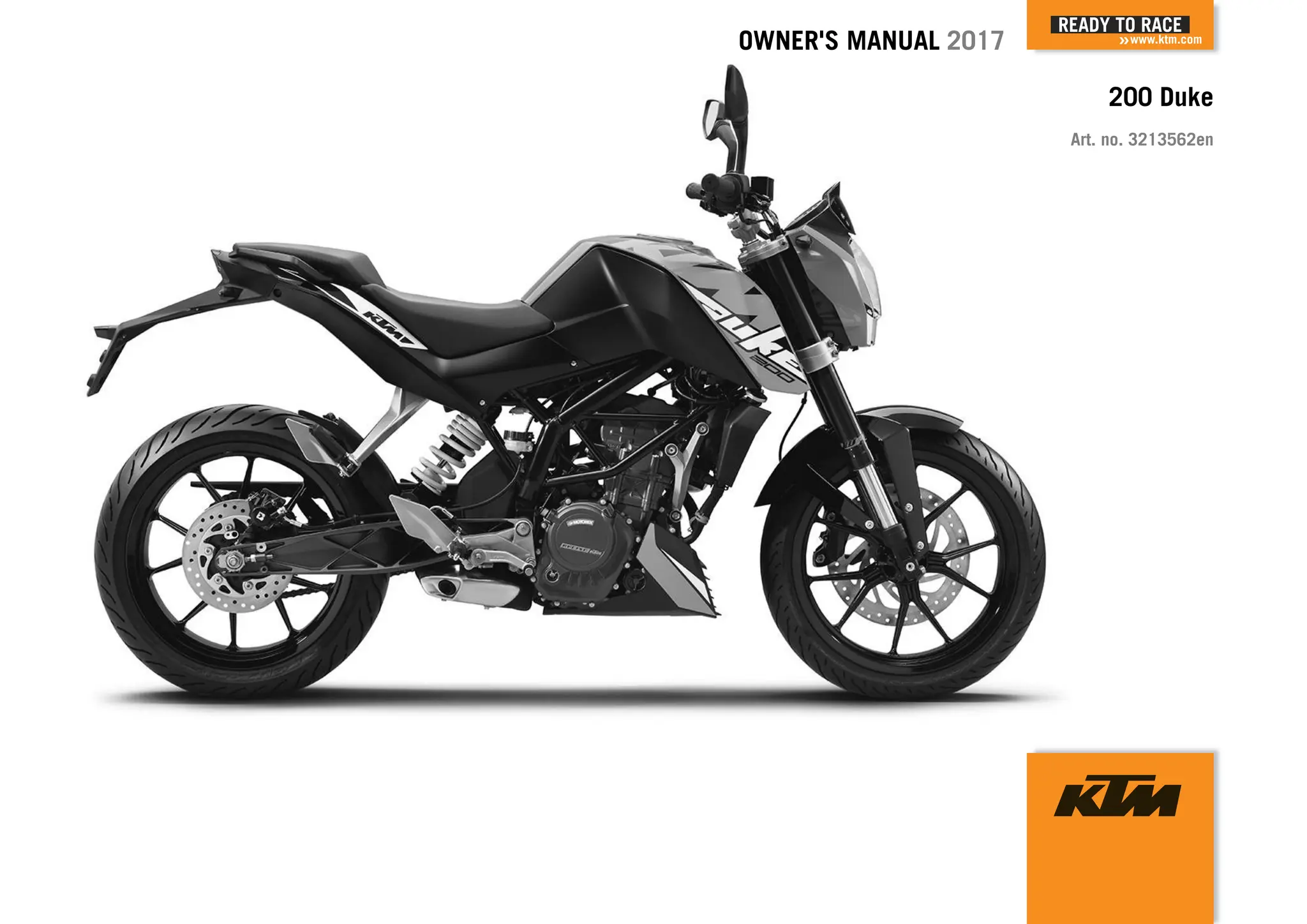
OWNER'S MANUAL 2017
200 Duke
Art. no. 3213562en
DEAR KTM CUSTOMER 1
*3213562en*
3213562en
01/2017
DEAR KTM CUSTOMER
Congratulations on your decision to purchase a KTM motorcycle. You are now the owner of a state-of-the-art sports motorcycle that will
give you enormous pleasure if you service and maintain it properly.
We hope you enjoy your new vehicle!
Enter the serial numbers of your vehicle below.
Chassis number ( p. 20) Dealer's stamp
Engine number ( p. 21)
Key number ( p. 21)
The Owner's Manual contained the latest information for this model series at the time of going to print. However, minor differences due to
further developments in design cannot be ruled out completely.
All specifications are non-binding. KTM Sportmotorcycle GmbH specifically reserves the right to modify or delete technical specifications,
prices, colors, forms, materials, services, designs, equipment, etc., without prior notice and without specifying reasons, to adapt these to
local conditions, as well as to stop production of a particular model without prior notice. KTM accepts no liability for delivery options, devi-
ations from illustrations and descriptions, misprints, and other errors. The models portrayed partly contain special equipment that does not
belong to the regular scope of supply.
© 2017 KTM Sportmotorcycle GmbH, Mattighofen Austria
All rights reserved
DEAR KTM CUSTOMER 2
Reproduction, even in part, as well as copying of all kinds, is permitted only with the express written permission of the copyright owner.
ISO 9001(12 100 6061)
According to the international quality management standard ISO 9001, KTM uses quality assurance processes that lead to
the maximum possible quality of the products.
Issued by: TÜV Management Service
KTM Sportmotorcycle GmbH
5230 Mattighofen, Austria
This document is valid for the following models:
200 Duke EU (F4103Q1, F4103Q2)
200 Duke AR (F4142Q1, F4142Q2)
200 Duke BR (F4140Q1, F4140Q2)
200 Duke MY (F4189Q1, F4189Q2)
200 Duke PH (F4182Q1, F4182Q2)
200 Duke TH (F4183Q4)
TABLE OF CONTENTS 3
TABLE OF CONTENTS
1 MEANS OF REPRESENTATION ........................................ 7
1.1 Symbols used ...................................................... 7
1.2 Formats used....................................................... 8
2 SAFETY ADVICE.............................................................. 9
2.1 Use definition...................................................... 9
2.2 Safety advice....................................................... 9
2.3 Degrees of risk and symbols................................ 10
2.4 Tampering warning............................................. 10
2.5 Safe operation ................................................... 11
2.6 Protective clothing ............................................. 12
2.7 Work rules......................................................... 12
2.8 Environment...................................................... 12
2.9 Owner's Manual ................................................. 13
3 IMPORTANT NOTES...................................................... 14
3.1 Manufacturer and implied warranty...................... 14
3.2 Operating and auxiliary substances ...................... 14
3.3 Spare parts, accessories ..................................... 14
3.4 Service ............................................................. 15
3.5 Figures ............................................................. 15
3.6 Customer service................................................ 15
4 VIEW OF VEHICLE ........................................................ 16
4.1 View of vehicle, front left (example) ..................... 16
4.2 View of vehicle, rear right (example) .................... 18
5 SERIAL NUMBERS ....................................................... 20
5.1 Chassis number ................................................. 20
5.2 Type label ......................................................... 20
5.3 Engine number .................................................. 21
5.4 Key number....................................................... 21
6 CONTROLS................................................................... 22
6.1 Clutch lever....................................................... 22
6.2 Hand brake lever................................................ 22
6.3 Throttle grip ...................................................... 23
6.4 Horn button....................................................... 23
6.5 Light switch ...................................................... 24
6.6 High beam flasher button ................................... 24
6.7 Turn signal switch.............................................. 25
6.8 Emergency OFF switch ....................................... 25
6.9 Electric starter button......................................... 26
6.10 Ignition/steering lock.......................................... 26
6.11 Locking the steering........................................... 27
6.12 Unlocking the steering........................................ 27
6.13 Combination instrument ..................................... 28
6.13.1 Overview ....................................................... 28
6.13.2 Activation and test......................................... 29
6.13.3 Warning notes ............................................... 30
6.13.4 Function buttons ........................................... 33
6.13.5 Indicator lamps ............................................. 34
6.13.6 Display ......................................................... 35
6.13.7 Filling level display of the fuel tank ................. 36
6.13.8 TRIP F display............................................... 37
6.13.9 Coolant temperature indicator ......................... 38
6.13.10 Info display ................................................... 39
6.13.11 Riding time/average speed menu..................... 40
6.13.12 Average speed/average fuel consumption 1
menu............................................................ 40
6.13.13 Average fuel consumption 1/average fuel
consumption 2 menu ..................................... 41
TABLE OF CONTENTS 4
6.13.14 Average fuel consumption 2/service menu........ 42
6.13.15 Service/range menu........................................ 43
6.13.16 Range/riding time menu ................................. 44
6.13.17 Total distance menu ODO............................... 45
6.13.18 Distance menu 1 TRIP 1 ................................ 46
6.13.19 Distance menu 2 TRIP 2 ................................ 46
6.13.20 Setting kilometers or miles ............................. 47
6.13.21 Setting the time............................................. 47
6.13.22 Adjusting the shift speed RPM 1..................... 48
6.13.23 Adjusting the shift speed RPM 2..................... 49
6.14 Opening the filler cap......................................... 50
6.15 Closing the filler cap .......................................... 51
6.16 Seat lock........................................................... 52
6.17 Tool set............................................................. 52
6.18 Grab handles..................................................... 53
6.19 Passenger footrests ............................................ 53
6.20 Shift lever ......................................................... 54
6.21 Foot brake lever ................................................. 55
6.22 Side stand......................................................... 55
7 PREPARING FOR USE................................................... 56
7.1 Advice on first use ............................................. 56
7.2 Running in the engine ........................................ 57
7.3 Loading the vehicle............................................ 58
8 RIDING INSTRUCTIONS................................................ 60
8.1 Checks and maintenance when preparing for
use................................................................... 60
8.2 Starting............................................................. 61
8.3 Starting off........................................................ 62
8.4 Shifting, riding .................................................. 63
8.5 Applying the brakes............................................ 65
8.6 Stopping, parking............................................... 67
8.7 Transport .......................................................... 68
8.8 Refueling .......................................................... 69
9 SERVICE SCHEDULE .................................................... 72
9.1 Additional information........................................ 72
9.2 Required work ................................................... 72
9.3 Recommended work........................................... 74
10 TUNING THE CHASSIS ................................................. 75
10.1 Adjusting the spring preload of the shock
absorber ........................................................ 75
10.2 Adjusting the shift lever...................................... 76
11 SERVICE WORK ON THE CHASSIS................................. 77
11.1 Raising the motorcycle with the rear lifting gear.... 77
11.2 Removing the rear of the motorcycle from the
lifting gear ........................................................ 77
11.3 Lifting the motorcycle with the front lifting gear.... 78
11.4 Taking the motorcycle off of the front wheel
stand ................................................................ 79
11.5 Removing the passenger seat .............................. 80
11.6 Mounting the passenger seat............................... 81
11.7 Removing the seat ............................................. 81
11.8 Mounting the seat.............................................. 82
11.9 Checking for chain dirt accumulation................... 83
11.10 Cleaning the chain ............................................. 83
11.11 Checking the chain tension................................. 84
11.12 Adjusting the chain tension................................. 86
11.13 Checking the chain, rear sprocket, and engine
sprocket............................................................ 88
11.14 Removing the front spoiler .................................. 92
TABLE OF CONTENTS 5
11.15 Fitting front spoiler ............................................ 93
12 BRAKE SYSTEM ........................................................... 94
12.1 Checking the brake discs .................................... 94
12.2 Checking the brake fluid level of the front brake ... 95
12.3 Adding front brake fluid .................................. 96
12.4 Checking the front brake linings .......................... 97
12.5 Checking the free travel of foot brake lever ........... 98
12.6 Adjusting the free travel of the foot brake
lever .............................................................. 99
12.7 Checking the rear brake fluid level..................... 100
12.8 Adding rear brake fluid ................................. 101
12.9 Checking the rear brake linings ......................... 104
13 WHEELS, TIRES ......................................................... 105
13.1 Removing the front wheel .............................. 105
13.2 Installing the front wheel .............................. 105
13.3 Removing the rear wheel ............................... 107
13.4 Installing the rear wheel ................................ 108
13.5 Checking the rear hub rubber dampers ........... 109
13.6 Checking the tire condition ............................... 111
13.7 Checking the tire air pressure............................ 112
14 ELECTRICAL SYSTEM ................................................. 114
14.1 Removing the battery .................................... 114
14.2 Installing the battery ..................................... 115
14.3 Recharging the battery .................................. 116
14.4 Changing the fuses of individual power
consumers....................................................... 119
14.5 Changing the headlight bulb ............................. 121
14.6 Changing the parking light bulb......................... 124
14.7 Checking the headlight setting .......................... 128
14.8 Adjusting the headlight range............................ 129
15 COOLING SYSTEM ...................................................... 132
15.1 Cooling system ................................................ 132
15.2 Checking the antifreeze and coolant level........... 134
15.3 Checking the coolant level ................................ 136
15.4 Draining the coolant ..................................... 138
15.5 Filling/bleeding the cooling system ................. 139
16 TUNING THE ENGINE................................................. 142
16.1 Checking the play in the throttle cable ............... 142
16.2 Adjusting the play in the throttle cable ........... 143
16.3 Checking the clutch lever play........................... 143
16.4 Adjusting play in the clutch lever ................... 144
17 SERVICE WORK ON THE ENGINE ................................ 145
17.1 Checking the engine oil level............................. 145
17.2 Changing the engine oil and oil filter, cleaning
the oil screen ............................................... 145
17.3 Adding engine oil............................................. 148
18 CLEANING, CARE ....................................................... 150
18.1 Cleaning the motorcycle ................................... 150
18.2 Checks and maintenance steps for winter
operation......................................................... 152
19 STORAGE................................................................... 154
19.1 Storage ........................................................... 154
19.2 Preparing for use after storage........................... 155
20 TROUBLESHOOTING .................................................. 156
21 TECHNICAL DATA....................................................... 159
21.1 Engine ............................................................ 159
21.2 Engine tightening torques ................................. 160
TABLE OF CONTENTS 6
21.3 Capacities ....................................................... 162
21.3.1 Engine oil ................................................... 162
21.3.2 Coolant....................................................... 163
21.3.3 Fuel ........................................................... 163
21.4 Chassis ........................................................... 163
21.5 Electrical system.............................................. 164
21.6 Tires............................................................... 165
21.7 Fork................................................................ 165
21.8 Shock absorber................................................ 166
21.9 Chassis tightening torques ................................ 166
22 SUBSTANCES ............................................................ 171
23 AUXILIARY SUBSTANCES ........................................... 175
24 STANDARDS .............................................................. 177
25 LIST OF ABBREVIATIONS............................................ 178
26 LIST OF SYMBOLS...................................................... 179
26.1 Red symbols.................................................... 179
26.2 Yellow and orange symbols................................ 179
26.3 Green and blue symbols.................................... 179
INDEX ............................................................................... 180
1 MEANS OF REPRESENTATION 7
1.1 Symbols used
The meaning of specific symbols is described below.
Indicates an expected reaction (e.g. of a work step or a function).
Indicates an unexpected reaction (e.g. of a work step or a function).
All work marked with this symbol requires specialist knowledge and technical understanding. In the interest of your
own safety, have these jobs performed by an authorized KTM workshop. There, your motorcycle will be optimally
cared for by specially trained experts using the specialist tools required.
Indicates a page reference (more information is provided on the specified page).
Indicates information with more details or tips.
Indicates the result of a testing step.
1 MEANS OF REPRESENTATION 8
1.2 Formats used
The typographical formats used in this document are explained below.
Specific name Identifies a proprietary name.
Name® Identifies a protected name.
Brand™ Identifies a brand available on the open market.
Underlined terms Refer to technical details of the vehicle or indicate technical terms that are explained in the
glossary.
2 SAFETY ADVICE 9
2.1 Use definition
KTM sport motorcycles are designed and constructed to meet the normal demands of regular road operation but not for use on race
courses or offroad.
Info
The motorcycle is authorized for public road traffic in the homologous version only.
2.2 Safety advice
A number of safety instructions need to be followed to operate the vehicle safely. Therefore, read this manual carefully. The safety instruc-
tions are highlighted in the text and are referred to at the relevant passages.
Info
The vehicle has various information and warning labels at prominent locations. Do not remove information/warning labels. If they
are missing, you or others may not recognize dangers and may therefore be injured.
2 SAFETY ADVICE 10
2.3 Degrees of risk and symbols
Danger
Indicates a danger that will immediately and invariably lead to fatal or serious permanent injury if the appropriate measures are not
taken.
Warning
Indicates a danger that is likely to lead to fatal or serious injury if the appropriate measures are not taken.
Caution
Indicates a danger that may lead to minor injuries if the appropriate measures are not taken.
Note
Indicates a danger that will lead to considerable machine and material damage if the appropriate measures are not taken.
Warning
Indicates a danger that will lead to environmental damage if the appropriate measures are not taken.
2.4 Tampering warning
Tampering with the noise control system is prohibited. Federal law prohibits the following acts or the causing thereof:
1 The removal or rendering inoperative by any person other than for purposes of maintenance, repair, or replacement, of any device or
element of design incorporated into any new vehicle for the purpose of noise control prior to its sale or delivery to the ultimate pur-
chaser or while it is in use, or
2 the use of the vehicle after such device or element of design has been removed or rendered inoperative by any person.
Among those acts presumed to constitute tampering are the acts listed below:
2 SAFETY ADVICE 11
1 Removal or puncturing of the main silencer, baffles, header pipes or any other components which conduct exhaust gases.
2 Removal or puncturing of parts of the intake system.
3 Lack of proper maintenance.
4 Replacing moving part of the vehicle, or parts of the exhaust or intake system, with parts other than those specified by the manufac-
turer.
2.5 Safe operation
Danger
Danger of accidents A rider who is not fit to ride poses a danger to him or herself and others.
– Do not operate the vehicle if you are not fit to ride due to alcohol, drugs or medication.
– Do not operate the vehicle if you are physically or mentally impaired.
Danger
Danger of poisoning Exhaust gases are toxic and inhaling them may result in unconsciousness and death.
– Always make sure there is sufficient ventilation when running the engine.
– Use an effective exhaust extraction system when starting or running the engine in an enclosed space.
Warning
Danger of burns Some vehicle components become very hot when the vehicle is operated.
– Do not touch any parts such as the exhaust system, radiator, engine, shock absorber, or brake system before the vehicle parts
have cooled down.
– Let the vehicle parts cool down before you perform any work on the vehicle.
Only operate the vehicle when it is in perfect technical condition, in accordance with its intended use, and in a safe and environmentally
compatible manner.
An appropriate driver's license is needed to ride the vehicle on public roads.
Have malfunctions that impair safety promptly eliminated by an authorized KTM workshop.
Adhere to the information and warning labels on the vehicle.
2 SAFETY ADVICE 12
2.6 Protective clothing
Warning
Risk of injury Missing or poor protective clothing presents an increased safety risk.
– Wear appropriate protective clothing such as helmet, boots, gloves as well as trousers and a jacket with protectors on all rides.
– Always wear protective clothing that is in good condition and meets the legal regulations.
In the interest of your own safety, KTM recommends that you only operate the vehicle while wearing protective clothing.
2.7 Work rules
Special tools are necessary for certain tasks. The tools are not contained in the vehicle but can be ordered under the number in parenthe-
ses. E.g.: bearing puller (15112017000)
During assembly, non-reusable parts (e.g. self-locking screws and nuts, seals and seal rings, O-rings, pins, lock washers) must be replaced
by new parts.
In some instances, a thread locker (e.g. Loctite®) is required. The manufacturer instructions for use must be followed.
After disassembly, clean the parts that are to be reused and check them for damage and wear. Change damaged or worn parts.
After you complete the repair or service work, check the operating safety of the vehicle.
2.8 Environment
If you use your motorcycle responsibly, you can ensure that problems and conflicts do not occur. To protect the future of the motorcycle
sport, make sure that you use your motorcycle legally, display environmental consciousness, and respect the rights of others.
When disposing of used oil, other operating and auxiliary fluids, and used components, comply with the laws and regulations of the
respective country.
Because motorcycles are not subject to the EU regulations governing the disposal of used vehicles, there are no legal regulations that per-
tain to the disposal of an end-of-life motorcycle. Your authorized KTM dealer will be glad to advise you.
2 SAFETY ADVICE 13
2.9 Owner's Manual
It is important that you read this Owner's Manual carefully and completely before making your first trip. The Owner's Manual contains use-
ful information and many tips on how to operate, handle, and maintain your motorcycle. Only then will you find out how to customize the
vehicle ideally for your own use and how you can protect yourself from injury.
Keep the Owner's Manual in an accessible place to enable you to refer to it as needed.
If you would like to know more about the vehicle or have questions on the material you read, please contact an authorized KTM dealer.
The Owner's Manual is an important component of the vehicle and must be handed over to the new owner if the vehicle is sold.
3 IMPORTANT NOTES 14
3.1 Manufacturer and implied warranty
The work specified in the service schedule may only be performed in an authorized KTM workshop and must be recorded in both the
Service & Warranty Booklet and in KTM Dealer.net, otherwise any warranty coverage will become void. Damage or secondary damage caused
by tampering with and/or conversions on the vehicle are not covered by the warranty.
Additional information on the manufacturer or implied warranty and the procedures involved can be found in the Service & Warranty Book-
let.
3.2 Operating and auxiliary substances
Warning
Environmental hazard Improper handling of fuel is a danger to the environment.
– Do not allow fuel to enter the groundwater, the soil, or the sewage system.
Use operating and auxiliary substances (such as fuel and lubricants) as specified in the Owner's Manual.
3.3 Spare parts, accessories
For your own safety, only use spare parts and accessory products that are approved and/or recommended by KTM and have them installed
by an authorized KTM workshop. KTM accepts no liability for other products and any resulting damage or loss.
Certain spare parts and accessory products are specified in parentheses in the descriptions. Your authorized KTM dealer will be glad to
advise you.
The current KTM PowerParts for your vehicle can be found on the KTM website.
International KTM Website: http://www.ktm.com
3 IMPORTANT NOTES 15
3.4 Service
A prerequisite for perfect operation and prevention of premature wear is that the service, care, and tuning work on the engine and chassis
is properly carried out as described in the Owner's Manual. Incorrect adjustment and tuning of the engine and chassis can lead to damage
and breakage of components.
Use of the vehicle under difficult conditions, such in rain, high heat or with a heavy load, can lead to considerably more rapid wear of
components such as the drive train, brake system, or suspension components. For this reason, it may be necessary to inspect or replace
parts before the next scheduled service.
It is imperative that you adhere to the stipulated run-in times and service intervals. If you observe these exactly, you will ensure a much
longer service life for your motorcycle.
3.5 Figures
The figures contained in the manual may depict special equipment.
In the interest of clarity, some components may be shown disassembled or may not be shown at all. It is not always necessary to disassem-
ble the component to perform the activity in question. Please follow the instructions in the text.
3.6 Customer service
Your authorized KTM dealer will be happy to answer any questions you may have on your vehicle and KTM.
A list of authorized KTM dealers can be found on the KTM website.
International KTM Website: http://www.ktm.com
4 VIEW OF VEHICLE 16
4.1 View of vehicle, front left (example)
S00654-10
4 VIEW OF VEHICLE 17
1 Combination instrument
2 Rear mirror
3 Clutch lever ( p. 22)
4 Seat
5 Passenger seat
6 Seat lock ( p. 52)
7 Grab handles ( p. 53)
8 Engine number ( p. 21)
9 Side stand ( p. 55)
10 Shift lever ( p. 54)
4 VIEW OF VEHICLE 18
4.2 View of vehicle, rear right (example)
S00655-10
4 VIEW OF VEHICLE 19
1 Tool set ( p. 52)
2 Light switch ( p. 24)
2 High beam flasher button ( p. 24)
2 Turn signal switch ( p. 25)
2 Horn button ( p. 23)
3 Filler cap
4 Electric starter button ( p. 26)
5 Emergency OFF switch ( p. 25)
6 Hand brake lever ( p. 22)
7 Ignition/steering lock ( p. 26)
8 Chassis number ( p. 20)
8 Type label ( p. 20)
9 Passenger footrests ( p. 53)
10 Foot brake lever ( p. 55)
5 SERIAL NUMBERS 20
5.1 Chassis number
0
0
1
1
402408-10
The chassis number 1 is stamped on the right side of the steering head.
5.2 Type label
0
0
1
1
402174-10
The type label 1 is on the right of the frame behind the steering head.
5 SERIAL NUMBERS 21
5.3 Engine number
402486-10
The engine number 1 is stamped on the left side of the engine under the engine sprocket.
5.4 Key number
402245-10
The key number 1 can be found on the KEYCODECARD.
Info
You need the key number to order a spare key. Keep the KEYCODECARD in a safe
place.
6 CONTROLS 22
6.1 Clutch lever
S00656-10
The clutch lever 1 is fitted on the left side of the handlebar.
6.2 Hand brake lever
S00663-10
The hand brake lever 1 is fitted on the right side of the handlebar.
The front brake is engaged using the hand brake lever.
6 CONTROLS 23
6.3 Throttle grip
S00664-10
The throttle grip 1 is fitted on the right side of the handlebar.
6.4 Horn button
S00660-10
The horn button 1 is fitted on the left side of the handlebar.
Possible states
• Horn button in neutral position
• Horn button pressed – The horn is operated in this position.
6 CONTROLS 24
6.5 Light switch
S00657-10
The light switch 1 is fitted on the left side of the handlebar.
Possible states
Low beam on – The light switch is turned downward. In this position, the
low beam and the tail light are switched on.
High beam on – The light switch is turned upwards. In this position, the
high beam and the tail light are switched on.
6.6 High beam flasher button
S00659-10
The high beam flasher button 1 is fitted on the left side of the handlebar.
Possible states
• High beam flasher button in neutral position
• High beam flasher button pressed – In this position, the headlight flasher (high beam)
is actuated.
6 CONTROLS 25
6.7 Turn signal switch
S00658-10
The turn signal switch 1 is fitted on the left side of the handlebar.
Possible states
Turn signal off
Turn signal, left, on – Turn signal switch pressed to the left. The turn signal
switch returns automatically to the central position after use.
Turn signal, right, on – Turn signal switch pressed to the right. The turn
signal switch returns automatically to the central position after use.
To switch off the turn signal, press the turn signal switch towards the switch case.
6.8 Emergency OFF switch
S00661-10
The emergency OFF switch 1 is fitted on the right side of the handlebar.
Possible states
Emergency OFF switch off – In this position, the ignition circuit is
interrupted, a running engine stops, and a non-running engine cannot be
started.
Emergency OFF switch on – This position is required for operation; the igni-
tion circuit is closed.
6 CONTROLS 26
6.9 Electric starter button
S00662-10
The electric starter button 1 is fitted on the right side of the handlebar.
Possible states
• Electric starter button in basic position
• Electric starter button pressed – In this position, the electric starter is actuated.
6.10 Ignition/steering lock
S00665-10
The ignition/steering lock is in front of the upper triple clamp.
Possible states
Ignition OFF – In this position, the ignition circuit is interrupted, a running
engine stops, and a non-running engine will not start. The ignition key can
be removed.
Ignition ON – In this position, the ignition circuit is closed and the engine
can be started.
Steering locked – In this position, the ignition circuit is interrupted and the
steering locked. The ignition key can be removed.
6 CONTROLS 27
6.11 Locking the steering
Note
Danger of damage The parked vehicle can roll away or fall over.
– Park the vehicle on a firm and level surface.
400732-01
– Park the vehicle.
– Turn the handlebar all the way to the left.
– Insert the key into the ignition/handlebar lock, press in, and turn to the left. Remove
the key.
Steering is no longer possible.
6.12 Unlocking the steering
400731-01
– Insert the key into the ignition/handlebar lock, press in, and turn to the right. Remove
the key.
You can now steer the bike again.
6 CONTROLS 28
6.13 Combination instrument
6.13.1 Overview
401685-10
1 Display ( p. 35)
2 Function buttons ( p. 33)
3 Info display ( p. 39)
4 Indicator lamps ( p. 34)
6 CONTROLS 29
6.13.2 Activation and test
401686-01
Activation
The combination instrument is activated when the ignition is switched on.
Test
The segments of the tachometer and the gear display light up and switch off in sequence.
The speed display counts from 0 to 199 and back.
The remaining display segments outside the info display light up briefly.
The READY TO RACE >> logo appears on the info display.
The display then changes to the last selected mode.
6 CONTROLS 30
6.13.3 Warning notes
401309-01
Low Oil Pressure appears on the info display if the oil pressure is too low.
401310-01
Low Fuel Level appears on the info display if the fuel level reaches the reserve mark.
6 CONTROLS 31
401311-01
High Coolant Temperature appears on the info display if the coolant temperature rises above
the specified value.
Coolant temperature 110 °C (230 °F)
401312-01
Side Stand Down appears on the info display if the side stand is folded down.
401313-01
Low Battery appears on the info display if the battery voltage falls below the specified value.
Battery voltage 10.80 V
6 CONTROLS 32
401461-01
Service Not Reset appears on the info display for 10 seconds when the ignition is switched
on and the distance interval between service appointments has been exceeded or the
service interval display was not reset during a service appointment.
6 CONTROLS 33
6.13.4 Function buttons
401685-12
You can change the display mode with the MODE button 1.
Possible display modes are total distance traveled (TRIP 1), distance 1 (ODO) and
distance 2 (TRIP 2).
Pressing and holding the SET button 2 resets the distance 1 (TRIP 1) and
distance 2 (TRIP 2) functions to 0.0 and briefly pressing the SET button 2 changes the
info display to the next display mode.
Button 3 has no function.
6 CONTROLS 34
6.13.5 Indicator lamps
401686-01
Possible states
The turn signal indicator lamp flashes green simultaneously with the turn
signal – The turn signal is switched on.
Engine diagnosis warning lamp (MIL) lights up yellow – The OBD (on-board
diagnosis) has detected an emission- or safety-critical error.
The shift warning lights up/flashes red – The set shift speed has been
reached.
The idling speed indicator lamp lights up green – The transmission is in
idle.
The high beam indicator lamp lights up blue – The high beam is switched
on.
The immobilizer indicator lamp lights up or flashes red – Status or error
message for immobilizer/alarm system (optional).
The general warning lamp lights up yellow – An operating safety (warning)
message was detected. This is also shown in the info display.
6 CONTROLS 35
6.13.6 Display
401685-11
The speed 1 is shown in kilometers per hour km/h or in miles per hour mph.
The tachometer 2 shows the engine speed in revolutions per minute.
The gear display 3 shows the engaged gear.
The coolant temperature appears in segment 4.
The time appears in segment 5.
The filling level in the fuel tank is displaced in segment 6.
The info display 7 shows additional information.
Info
The time must be reset after the battery was disconnected or the fuse was removed.
The intensity of the LED display depends on the ambient brightness.
6 CONTROLS 36
6.13.7 Filling level display of the fuel tank
401292-01
The filling level display consists of 9 bars. The more bars are lit, the more fuel is in the fuel
tank.
6 CONTROLS 37
6.13.8 TRIP F display
401293-01
If the fuel level drops to the reserve mark, the display mode automatically changes to TRIP F
and starts to count from 0.0, regardless of the previous display mode.
Info
At the same time as the display mode TRIP F, the general warning lamp lights up
and the warning note Low Fuel Level appears on the info display.
6 CONTROLS 38
6.13.9 Coolant temperature indicator
401292-01
The temperature display consists of 13 bars. The more bars that light up, the hotter the
coolant. When all bars light up, the following warning note appears on the info display:
High Coolant Temperature.
Possible states
• Engine cold – Up to three bars light up.
• Engine warm – Four to ten bars light up.
• Engine hot – Eleven to thirteen bars light up.
6 CONTROLS 39
6.13.10 Info display
401291-10
Various warning notes appear on info display 1.
If the general warning lamp lights up, the corresponding warning note is shown on the
info display.
6 CONTROLS 40
6.13.11 Riding time/average speed menu
401334-01
Condition
Alternative 1
• The ignition is on.
• The motorcycle is stationary.
Alternative 2
• The ignition is on.
• The motorcycle is moving.
– Press the SET button briefly and repeatedly until the desired info display appears.
The riding time and average speed are displayed in this menu.
Info
If the ignition was switched off for over 60 minutes, the display is reset to 0.
Press the SET button
briefly.
Next display mode on the info display
6.13.12 Average speed/average fuel consumption 1 menu
401465-01
Condition
Alternative 1
• The ignition is on.
• The motorcycle is stationary.
Alternative 2
• The ignition is on.
• The motorcycle is moving.
– Press the SET button briefly and repeatedly until the desired info display appears.
In this menu, the average speed and the average fuel consumption 1 are displayed in
L/100 km (or L/100 miles).
6 CONTROLS 41
Info
The average fuel consumption 1 is displayed after several 100 meters of travel after
the ignition is switched on.
If the ignition was switched off for over 60 minutes, the display of the average
speed and average fuel consumption 1 is reset to 0.
Press the SET button
briefly.
Next display mode on the info display
6.13.13 Average fuel consumption 1/average fuel consumption 2 menu
401466-01
Condition
Alternative 1
• The ignition is on.
• The motorcycle is stationary.
Alternative 2
• The ignition is on.
• The motorcycle is moving.
– Press the SET button briefly and repeatedly until the desired info display appears.
In this menu, the average fuel consumption 1 in L/100 km (or L/100 miles) and the aver-
age fuel consumption 2 in km/L (or miles/L) are displayed.
Info
The average fuel consumptions 1 and 2 are displayed after several 100 meters of
travel after the ignition is switched on.
If the ignition was switched off for over 60 minutes, the display of the average fuel
consumption 1 and 2 is reset to 0.
Press the SET button
briefly.
Next display mode on the info display
6 CONTROLS 42
6.13.14 Average fuel consumption 2/service menu
401467-01
Condition
Alternative 1
• The ignition is on.
• The motorcycle is stationary.
Alternative 2
• The ignition is on.
• The motorcycle is moving.
– Press the SET button briefly and repeatedly until the desired info display appears.
The average fuel consumption 2 in km/L (or miles/L) and the distance to the next service
are displayed in this menu.
Info
The average fuel consumption 2 is displayed after several 100 meters of travel after
the ignition is switched on.
If the ignition was switched off for over 60 minutes, the display of the average fuel
consumption 2 is reset to 0.
Press the SET button
briefly.
Next display mode on the info display
6 CONTROLS 43
6.13.15 Service/range menu
401468-01
Condition
Alternative 1
• The ignition is on.
• The motorcycle is stationary.
Alternative 2
• The ignition is on.
• The motorcycle is moving.
– Press the SET button briefly and repeatedly until the desired info display appears.
This menu shows the distance to the next service and the range.
Info
The range depends on the average fuel consumption and the fuel quantity in the
fuel tank.
The range is displayed after several 100 meters of travel after the ignition is
switched on.
If the ignition was switched off for over 60 minutes, the display of the range and
riding time is reset to 0.
Press the SET button
briefly.
Next display mode on the info display
6 CONTROLS 44
6.13.16 Range/riding time menu
401469-01
Condition
Alternative 1
• The ignition is on.
• The motorcycle is stationary.
Alternative 2
• The ignition is on.
• The motorcycle is moving.
– Press the SET button briefly and repeatedly until the desired info display appears.
The range and the riding time are displayed in this menu.
Info
The range depends on the average fuel consumption and the fuel quantity in the
fuel tank.
The range is displayed after several 100 meters of travel after the ignition is
switched on.
If the ignition was switched off for over 60 minutes, the display of the range and
riding time is reset to 0.
Press the SET button
briefly.
Next display mode on the info display
6 CONTROLS 45
6.13.17 Total distance menu ODO
401303-01
Condition
Alternative 1
• The ignition is on.
• The motorcycle is stationary.
Alternative 2
• The ignition is on.
• The motorcycle is moving.
– Press the MODE button briefly and repeatedly until ODO appears on the display.
ODO shows the total distance covered.
Info
This value is retained, even if the battery is disconnected from the vehicle and/or
the fuse blows.
Press the MODE but-
ton.
Next display mode on the display
6 CONTROLS 46
6.13.18 Distance menu 1 TRIP 1
401304-01
Condition
Alternative 1
• The ignition is on.
• The motorcycle is stationary.
Alternative 2
• The ignition is on.
• The motorcycle is moving.
– Press the MODE button briefly and repeatedly until TRIP 1 appears on the display.
TRIP 1shows the distance since the last reset, such as between two refueling stops. TRIP 1
is always running and counts up to 999.9.
Press the SET button
for 5 - 10 seconds.
Display of TRIP 1 is reset
Press the MODE but-
ton.
Next display mode on the display
6.13.19 Distance menu 2 TRIP 2
401305-01
Condition
Alternative 1
• The ignition is on.
• The motorcycle is stationary.
Alternative 2
• The ignition is on.
• The motorcycle is moving.
– Press the MODE button briefly and repeatedly until TRIP 2 appears on the display.
TRIP 2shows the distance since the last reset, such as between two refueling stops. TRIP 2
is always running and counts up to 999.9.
6 CONTROLS 47
Press the SET button
for 5 - 10 seconds.
Display of TRIP 2 is reset
Press the MODE but-
ton.
Next display mode on the display
6.13.20 Setting kilometers or miles
Info
Make the country-specific setting.
Condition
The ignition is on.
The motorcycle is stationary.
401303-01
– Press the MODE button briefly and repeatedly until ODO appears on the display.
– Press the MODE button for 5 - 10 seconds.
The display changes from km/h to mph or from mph to km/h.
6.13.21 Setting the time
Condition
The ignition is on.
The motorcycle is stationary.
6 CONTROLS 48
401303-01
– Press the MODE button briefly and repeatedly until ODO appears on the display.
– Press the MODE and SET buttons for 5 - 10 seconds.
The time display begins to flash.
– Set the hours display using the MODE button.
– Set the minutes display using the SET button.
– Press the MODE and SET buttons for 5 - 10 seconds.
The time is set.
6.13.22 Adjusting the shift speed RPM 1
Condition
The ignition is on.
The motorcycle is stationary.
401307-01
– Press the MODE button briefly and repeatedly until TRIP 2 appears on the display.
– Press the MODE button for 5 - 10 seconds.
The display RPM 1 appears.
Info
The engine speed can be set at intervals of 50.
RPM 1 is the engine speed above which the shift warning light starts flashing.
– Set the speed with the MODE and SET buttons.
Info
The MODE button increases the value.
The SET button decreases the value.
– Do not activate the two buttons for approx. 15 seconds.
6 CONTROLS 49
The display RPM 1 goes out and the set speed is stored.
6.13.23 Adjusting the shift speed RPM 2
Condition
The ignition is on.
The motorcycle is stationary.
401308-01
– Press the MODE button briefly and repeatedly until TRIP 2 appears on the display.
– Press the SET button for 5 - 10 seconds.
The display RPM 2 appears.
Info
The engine speed can be set at intervals of 50.
RPM 2 is the engine speed above which the shift warning light lights up con-
stantly.
The speed RPM 2 must always be higher than the speed RPM 1.
– Set the speed with the MODE and SET buttons.
Info
The MODE button increases the value.
The SET button decreases the value.
– Do not activate the two buttons for approx. 15 seconds.
The display RPM 2 goes out and the set speed is stored.
6 CONTROLS 50
6.14 Opening the filler cap
Danger
Fire hazard Fuel is highly flammable.
The fuel in the fuel tank expands when warm and can escape if overfilled.
– Do not refuel the vehicle in the vicinity of open flames or lit cigarettes.
– Switch off the engine for refueling.
– Make sure that no fuel is spilled; particularly not on hot parts of the vehicle.
– If any fuel is spilled, wipe it off immediately.
– Observe the specifications for refueling.
Warning
Danger of poisoning Fuel is poisonous and a health hazard.
– Avoid skin, eye and clothing contact with fuel.
– Immediately consult a doctor if you swallow fuel.
– Do not inhale fuel vapors.
– In case of skin contact, rinse the affected area with plenty of water.
– Rinse the eyes thoroughly with water, and consult a doctor in case of fuel contact with the eyes.
– Change your clothing in case of fuel spills on them.
– Keep fuels correctly in a suitable canister, and out of the reach of children.
Warning
Environmental hazard Improper handling of fuel is a danger to the environment.
– Do not allow fuel to enter the groundwater, the soil, or the sewage system.
6 CONTROLS 51
B00710-10
– Lift the cover 1 of the filler cap and insert the ignition key in the lock.
Note
Danger of damage The ignition key may break if overloaded.
Damaged ignition keys must be replaced.
– Push down on the filler cap to take pressure off the ignition key.
– Turn the ignition key 90° clockwise.
– Open the filler cap.
– Remove the ignition key.
6.15 Closing the filler cap
B00711-01
Warning
Fire hazard Fuel is highly flammable, toxic and a health hazard.
– Check the filler cap is locked correctly after closing.
– Change your clothing in case of fuel spills on them.
– Rinse the affected area immediately with plenty of water in the event of con-
tact with the skin.
– Close the filler cap.
– Push down the filler cap until the lock engages.
6 CONTROLS 52
6.16 Seat lock
B00712-01
The seat lock 1 is located to the left of the seat.
The seat lock can be unlocked using the ignition key.
6.17 Tool set
B00758-10
The tool set 1 is located under the passenger seat.
6 CONTROLS 53
6.18 Grab handles
B00717-10
The grab handles 1 are used for moving the motorcycle around.
If you carry a passenger, the passenger can hold onto the grab handles during the trip.
6.19 Passenger footrests
S00666-10
The passenger footrests can be folded in and out.
Possible states
• Passenger footrests folded up – For operation without a passenger.
• Passenger footrests folded down – For operation with a passenger.
6 CONTROLS 54
6.20 Shift lever
401950-10
Shift lever 1 is mounted on the left side of the engine.
401950-11
The gear positions can be seen in the photograph.
The neutral or idle position is between the first and second gears.
6 CONTROLS 55
6.21 Foot brake lever
402177-10
Foot brake lever 1 is located in front of the right footrest.
The foot brake lever is used to activate the rear brake.
6.22 Side stand
402029-10
The side stand 1 is on the left side of the vehicle.
The side stand is used to park the motorcycle.
Info
The side stand must be folded up during motorcycle use.
Side stand is coupled with the safety start system; see the riding instructions.
Possible states
• Side stand folded out – The vehicle can be leaned on the side stand. The safety start
system is active.
• Side stand folded in – This position is mandatory for all trips. The safety start system
is inactive.
7 PREPARING FOR USE 56
7.1 Advice on first use
Danger
Danger of accidents A rider who is not fit to ride poses a danger to him or herself and others.
– Do not operate the vehicle if you are not fit to ride due to alcohol, drugs or medication.
– Do not operate the vehicle if you are physically or mentally impaired.
Warning
Risk of injury Missing or poor protective clothing presents an increased safety risk.
– Wear appropriate protective clothing such as helmet, boots, gloves as well as trousers and a jacket with protectors on all rides.
– Always wear protective clothing that is in good condition and meets the legal regulations.
Warning
Danger of crashing Different tire tread patterns on the front and rear wheel impair the handling characteristic.
Different tire tread patterns can make the vehicle significantly more difficult to control.
– Make sure that only tires with a similar tire tread pattern are fitted to the front and rear wheel.
Warning
Danger of accidents Non-approved or non-recommended tires and wheels impact the handling characteristic.
– Only use tires/wheels approved by KTM with the corresponding speed index.
Warning
Danger of accidents New tires have reduced road grip.
The contact surface on new tires is not yet roughened.
– Run in new tires with moderate riding at alternating angles.
Running-in phase 200 km (124 mi)
7 PREPARING FOR USE 57
Info
When using your vehicle, remember that others may feel disturbed by excessive noise.
– Make sure that the pre-delivery inspection work has been carried out by an authorized KTM workshop.
You receive a delivery certificate and the Service and Warranty Booklet at vehicle handover.
– Before your first trip, read the entire operating instructions carefully.
– Get to know the controls.
– Get used to handling the motorcycle on a suitable piece of land before making a longer trip. Try also to ride as slowly as possible to get
a better feel for the vehicle.
– Hold the handlebar firmly with both hands and keep your feet on the footrests when riding.
– Run the engine in. ( p. 57)
7.2 Running in the engine
– During the running-in phase, do not exceed the specified engine speed.
Guideline
Maximum engine speed
During the first: 1,000 km (620 mi) 7,500 rpm
Tip
During the running-in phase, set the shift warning light to the specified engine speed.
– Adjust the shift speed RPM 1. ( p. 48)
– Adjust the shift speed RPM 2. ( p. 49)
– Avoid fully opening the throttle!
7 PREPARING FOR USE 58
7.3 Loading the vehicle
Warning
Danger of accidents Total weight and axle loads influence the handling characteristic.
The overall weight consists of: motorcycle ready for operation and with a full tank, driver and passenger with protective clothing
and helmet, and luggage.
– Do not exceed the maximum permissible overall weight or the axle loads.
Warning
Danger of accidents Improper mounting of cases or the tank rucksack impairs the handling characteristic.
– Mount and secure cases and tank rucksack according to the manufacturer's instructions.
Warning
Danger of accidents The luggage system will be damaged if it is overloaded.
– Read the manufacturer information on maximum payload when mounting cases.
Warning
Danger of accidents Luggage which has slipped impairs visibility.
If the tail light is covered, you are less visible to traffic behind you, especially when it is dark.
– Check that your luggage is fixed properly at regular intervals.
Warning
Danger of accidents A high payload alters the handling characteristic and increases the stopping distance.
– Adapt your speed to your payload.
Warning
Danger of accidents Pieces of luggage which have slipped impair the handling characteristic.
– Check that your luggage is fixed properly at regular intervals.
7 PREPARING FOR USE 59
– If you carry any baggage, make sure it is fixed firmly as close as possible to the center of the vehicle and ensure even weight distribu-
tion between the front and rear wheels.
– Do not exceed the overall maximum permitted weight and the axle loads.
Guideline
Maximum permissible overall weight 335 kg (739 lb.)
Maximum permissible front axle load 125 kg (276 lb.)
Maximum permissible rear axle load 210 kg (463 lb.)
8 RIDING INSTRUCTIONS 60
8.1 Checks and maintenance when preparing for use
Info
Before every trip, check the condition of the vehicle and ensure that it is roadworthy.
The vehicle must be in perfect technical condition when used.
– Check the engine oil level. ( p. 145)
– Check the brake fluid level of the front brake. ( p. 95)
– Check the rear brake fluid level. ( p. 100)
– Check the front brake linings. ( p. 97)
– Check the rear brake linings. ( p. 104)
– Check the brake system function.
– Check the coolant level. ( p. 136)
– Check for chain dirt accumulation. ( p. 83)
– Check the chain tension. ( p. 84)
– Check the tire condition. ( p. 111)
– Check the tire air pressure. ( p. 112)
– Check the settings of all controls and ensure that they can be operated smoothly.
– Check the functioning of the electrical equipment.
– Check that baggage is correctly secured.
– Sit on the motorcycle and check the rear mirror setting.
– Check the fuel level.
8 RIDING INSTRUCTIONS 61
8.2 Starting
Danger
Danger of poisoning Exhaust gases are toxic and inhaling them may result in unconsciousness and death.
– Always make sure there is sufficient ventilation when running the engine.
– Use an effective exhaust extraction system when starting or running the engine in an enclosed space.
Caution
Danger of accidents Electronic components and safety devices will be damaged if the battery is discharged or missing.
– Never operate the vehicle with a discharged battery or without a battery.
Note
Engine damage Unfiltered intake air has a negative effect on the service life of the engine.
Dust and dirt will enter the engine without an air filter.
– Never start to use the vehicle without an air filter.
Note
Engine damage High revving speed with a cold engine negatively impacts the lifespan of the engine.
– Always run the engine warm at a low speed.
8 RIDING INSTRUCTIONS 62
B00782-10
– Unlock the steering. ( p. 27)
– Sit on the vehicle, take the weight off of the side stand, and move up all the way.
– Turn the emergency OFF switch to the position .
– Switch on the ignition by turning the ignition key to the position .
After you switch on the ignition, you can hear the fuel pump working for about two
seconds. The function check of the combination instrument is run at the same
time.
– Shift gear to neutral.
The green idling speed indicator lamp N lights up.
– Press the electric starter button .
Info
Do not press the electric starter button until the combination instrument func-
tion check is finished.
When starting, DO NOT open the throttle. If you open the throttle during the start-
ing procedure, fuel is not injected by the engine management system and the
engine cannot start.
Press the starter for a maximum of 5 seconds. Wait for a least 5 seconds before
trying again.
This motorcycle is equipped with a safety starting system. You can only start the
engine if the transmission is in neutral or if the clutch is pulled when a gear is
engaged. If the side stand is folded out and you shift into gear and release the
clutch, the engine stops.
8.3 Starting off
– Pull the clutch lever, engage 1st gear, release the clutch lever slowly, and simultaneously open the throttle carefully.
8 RIDING INSTRUCTIONS 63
Tip
If the engine dies while starting off, only pull the clutch lever and press the electric starter button. You do not need to shift into
neutral.
8.4 Shifting, riding
Warning
Danger of accidents Abrupt load alterations can cause the vehicle to get out of control.
– Avoid abrupt load alterations and sudden braking actions.
– Adapt your speed to the road conditions.
Warning
Danger of accidents If you change down at high engine speed, the rear wheel blocks and the engine races.
– Do not change into a low gear at high engine speed.
Warning
Danger of accidents An incorrect ignition key position causes malfunctions.
– Do not change the ignition key position while driving.
Warning
Danger of accidents Adjustments to the vehicle distract attention from traffic activity.
– Make all adjustments when the vehicle is at a standstill.
Warning
Risk of injury The passenger may fall from the motorcycle if they conduct themselves incorrectly.
– Ensure that the passenger sits correctly on the passenger seat, places his or her feet on the passenger foot rest and holds on to
the rider or the grab handles.
– Note the regulations governing the minimum age of passengers in your country.
8 RIDING INSTRUCTIONS 64
Warning
Danger of accidents A risky riding style constitutes a major risk.
– Comply with traffic regulations and ride defensively and with foresight to detect sources of danger as early as possible.
Warning
Danger of accidents Cold tires have reduced road grip.
– Ride the first miles carefully on every journey at moderate speed until the tires reach operating temperature.
Warning
Danger of accidents New tires have reduced road grip.
The contact surface on new tires is not yet roughened.
– Run in new tires with moderate riding at alternating angles.
Running-in phase 200 km (124 mi)
Warning
Danger of accidents Pieces of luggage which have slipped impair the handling characteristic.
– Check that your luggage is fixed properly at regular intervals.
Warning
Danger of accidents A fall can damage the vehicle more seriously than it may first appear.
– Check the vehicle after a fall as you do when preparing for use.
Note
Engine failure Overheating damages the engine.
– If the coolant temperature warning is displayed, stop immediately and take care not to endanger yourself or other traffic participants in
the process.
– Allow the engine and cooling system to cool down.
– Check and, if necessary, correct the coolant level on the cooling system while it is in a cooled state.
8 RIDING INSTRUCTIONS 65
Info
If you hear unusual noises while riding, stop immediately, switch off the engine and contact an authorized KTM workshop.
401950-11
– When conditions allow (incline, road situation, etc.), you can shift into a higher gear.
– Release the throttle while simultaneously pulling the clutch lever, shift into the next
gear, release the clutch and open the throttle.
Info
You can see the positions of the 6 forward gears in the figure. The neutral or idle
position is between the first and second gears. First gear is used for starting off
or for steep inclines.
The operating temperature is reached when 4 bars of the temperature indicator
light up.
– Accelerate only up to a speed suitable for the road surface and weather conditions. Par-
ticularly in bends, do not shift, and accelerate very carefully.
– To shift down, brake if necessary and close the throttle at the same time.
– Pull the clutch lever and shift into a lower gear, release the clutch lever slowly and open
the throttle or shift again.
– Switch off the engine if you expect to be standing for a long time.
– If the engine diagnosis warning lamp lights up during a trip, stop immediately, switch
off the engine, and contact an authorized KTM workshop.
8.5 Applying the brakes
Warning
Danger of accidents Moisture and dirt impair the brake system.
– Brake carefully several times to dry out and remove dirt from the brake linings and the brake discs.
8 RIDING INSTRUCTIONS 66
Warning
Danger of accidents A spongy pressure point on the front or rear brake reduces braking efficiency.
– Check the brake system and do not continue riding until the problem is eliminated. (Your authorized KTM workshop will be glad
to help.)
Warning
Danger of accidents The brake system fails in the event of overheating.
If the foot brake lever is not released, the brake linings drag continuously.
– Take your foot off the foot brake lever when you are not braking.
Warning
Danger of accidents Higher total weight increases the stopping distance.
– Take the longer stopping distance into account when carrying a passenger or luggage with you.
Warning
Danger of accidents Salt on the roads impairs the brake system.
– Brake carefully several times to remove salt from the brake linings and the brake discs.
Warning
Danger of accidents Excessively forceful application of the brakes blocks the wheels.
– Adjust application of the brakes to the respective riding situation and riding surface conditions.
– When braking, release the throttle and apply the front and rear brakes at the same time.
– On sandy, wet, or slippery surfaces, use the rear brake.
– Braking should always be completed before you go into a bend. Change down to a lower gear appropriate to your road speed.
– On long downhill stretches, use the braking effect of the engine. Change down one or two gears, but do not over rev the engine. In this
way, you have to brake far less and the brakes do not overheat.
8 RIDING INSTRUCTIONS 67
8.6 Stopping, parking
Warning
Risk of injury People who act without authorization endanger themselves and others.
– Do not leave the vehicle unattended if the engine is running.
– Protect the vehicle against access by unauthorized persons.
– Lock the steering and remove the ignition key if you leave the vehicle unattended.
Warning
Danger of burns Some vehicle components become very hot when the vehicle is operated.
– Do not touch any parts such as the exhaust system, radiator, engine, shock absorber, or brake system before the vehicle parts
have cooled down.
– Let the vehicle parts cool down before you perform any work on the vehicle.
Note
Material damage The vehicle may be damaged by incorrect procedure when parking.
Significant damage may be caused if the vehicle rolls away or falls over.
The components for parking the vehicle are designed only for the weight of the vehicle.
– Park the vehicle on a firm and level surface.
– Ensure that nobody sits on the vehicle when the vehicle is parked on a stand.
Note
Fire hazard Hot vehicle components pose a fire hazard and explosion risk.
– Do not park the vehicle near to materials which are highly flammable or explosive.
– Allow the vehicle to cool down before covering it.
– Apply the brakes on the motorcycle.
8 RIDING INSTRUCTIONS 68
– Shift gear to neutral.
– Switch off the ignition by turning the ignition key to the position .
Info
If the engine is switched off with the emergency OFF switch and the ignition remains switched on at the ignition lock, power
continues to flow to most power consumers and the battery will discharge. You should therefore always switch off the engine
with the ignition key – the emergency OFF switch is intended for emergencies only.
– Park the motorcycle on a firm surface.
– Swing the side stand forward with your foot as far as it will go and lean the vehicle on it.
– Lock the steering. ( p. 27)
8.7 Transport
Note
Danger of damage The parked vehicle can roll away or fall over.
– Park the vehicle on a firm and level surface.
Note
Fire hazard Hot vehicle components pose a fire hazard and explosion risk.
– Do not park the vehicle near to materials which are highly flammable or explosive.
– Allow the vehicle to cool down before covering it.
8 RIDING INSTRUCTIONS 69
401448-01
– Switch off the engine and remove the ignition key.
– Use tension belts or other suitable devices to secure the motorcycle against accidents
or falling over.
8.8 Refueling
Danger
Fire hazard Fuel is highly flammable.
The fuel in the fuel tank expands when warm and can escape if overfilled.
– Do not refuel the vehicle in the vicinity of open flames or lit cigarettes.
– Switch off the engine for refueling.
– Make sure that no fuel is spilled; particularly not on hot parts of the vehicle.
– If any fuel is spilled, wipe it off immediately.
– Observe the specifications for refueling.
8 RIDING INSTRUCTIONS 70
Warning
Danger of poisoning Fuel is poisonous and a health hazard.
– Avoid skin, eye and clothing contact with fuel.
– Immediately consult a doctor if you swallow fuel.
– Do not inhale fuel vapors.
– In case of skin contact, rinse the affected area with plenty of water.
– Rinse the eyes thoroughly with water, and consult a doctor in case of fuel contact with the eyes.
– Change your clothing in case of fuel spills on them.
Note
Material damage Inadequate fuel quality causes the fuel filter to quickly become clogged.
In some countries and regions, the available fuel quality and cleanliness may not be sufficient. This will result in problems with the fuel
system.
– Refuel only with clean fuel that meets the specified standards. (Your authorized KTM workshop will be glad to help.)
Warning
Environmental hazard Improper handling of fuel is a danger to the environment.
– Do not allow fuel to enter the groundwater, the soil, or the sewage system.
8 RIDING INSTRUCTIONS 71
B00719-10
– Switch off the engine.
– Open the filler cap. ( p. 50)
– Fill the fuel tank with fuel up to the lower edge 1 of the fuel filler.
Total fuel tank
capacity, approx.
11 l (2.9 US gal) Super unleaded (ROZ 95/RON
95/PON 91) ( p. 173) (200 Duke
EU/AR/MY/PH)
Gasohol 95 E20 (RON 95) ( p. 173)
(200 Duke TH)
Super unleaded, type C (ROZ 95/RON
95/PON 91) ( p. 174) (200 Duke BR)
– Close the filler cap. ( p. 51)
9 SERVICE SCHEDULE 72
9.1 Additional information
Any further work that results from the required work or from the recommended work must be ordered separately and invoiced separately.
Different service intervals may apply in your country, depending on the local operating conditions.
9.2 Required work
Every two years
Every year
every 15,000 km (9,300 mi)
every 7,500 km (4,650 mi)
after 1,000 km (620 mi)
Read out the fault memory using the KTM diagnostics tool. ○ ● ● ● ●
Check that the electrical system is functioning properly. ○ ● ● ● ●
Change the engine oil and oil filter, clean the oil screen. ( p. 145) ○ ● ● ● ●
Check the brake discs. ( p. 94) ○ ● ● ● ●
Check the front brake linings. ( p. 97) ○ ● ● ● ●
Check the rear brake linings. ( p. 104) ○ ● ● ● ●
Check the brake lines for damage and leakage. ○ ● ● ● ●
Check the brake fluid level of the front brake. ( p. 95) ○ ● ● ●
Check the rear brake fluid level. ( p. 100) ○ ● ● ●
Check the tire condition. ( p. 111) ○ ● ● ● ●
Check the tire air pressure. ( p. 112) ○ ● ● ● ●
Check the shock absorber and fork for leaks. ○ ● ● ● ●
Clean the dust boots of the fork legs. ● ●
Check the chain, rear sprocket, and engine sprocket. ( p. 88) ● ● ● ●
9 SERVICE SCHEDULE 73
Every two years
Every year
every 15,000 km (9,300 mi)
every 7,500 km (4,650 mi)
after 1,000 km (620 mi)
Check the chain tension. ( p. 84) ○ ● ● ● ●
Check the coolant level. ( p. 136) ○ ● ● ● ●
Check that the radiator fan is functioning properly. ○ ● ● ● ●
Change the air filter. Clean the air filter box. ● ●
Check that the throttle cables are undamaged, routed without sharp bends, and set correctly. ○ ● ● ● ●
Check the cables for damage and routing without sharp bends. ○ ● ● ● ●
Check the valve clearance. ○
Check the valve clearance, change the spark plugs. ●
Change the front brake fluid. ●
Change the rear brake fluid. ●
Check the play of the steering head bearing. ○ ● ● ● ●
Check the headlight setting. ( p. 128) ○ ● ●
Final check: Check the vehicle is roadworthy and take a test ride. ○ ● ● ● ●
Read out the error memory after the test ride using the KTM diagnostics tool. ○ ● ● ● ●
Reset the service interval display. ○ ● ●
Make the service entry in the KTM Dealer.net and in the Service and Warranty Booklet. ○ ● ● ● ●
○ One-time interval
● Periodic interval
9 SERVICE SCHEDULE 74
9.3 Recommended work
Every four years
Every year
every 30,000 km (18,600 mi)
every 7,500 km (4,650 mi)
after 1,000 km (620 mi)
Check the frame. ●
Check the swingarm. ●
Check the swingarm bearing. ● ●
Check the wheel bearing for play. ● ●
Check the antifreeze. ○ ● ● ●
Change the coolant. ●
Empty the drainage hoses. ○ ● ● ● ●
Check all hoses (e.g. fuel, coolant, bleeder, drainage, etc.) and sleeves for cracking, leaks, and incorrect
routing.
○ ● ● ● ●
Grease all moving parts (e.g., side stand, hand lever, chain, ...) and check for smooth operation. ○ ● ● ● ●
Check the screws and nuts for tightness. ○ ● ● ● ●
○ One-time interval
● Periodic interval
10 TUNING THE CHASSIS 75
10.1 Adjusting the spring preload of the shock absorber
Warning
Danger of accidents Modifications to the suspension settings can seriously alter the vehicle's ride behavior.
– Following modifications, ride slowly at first to get the feel of the new ride behavior.
Info
The spring preload defines the initial situation of the spring process on the shock absorber.
The best spring preload setting is achieved when it is set for the weight of the rider and that of any baggage and a passenger, thus
ensuring an ideal compromise between maneuverability and stability.
B01419-10
– Turn adjusting ring 1 to adjust the spring preload.
Guideline
Spring preload
Standard 3 clicks
Full payload 6 clicks
Hook wrench (T106S)
Info
The spring preload can be set to 10 different positions.
10 TUNING THE CHASSIS 76
10.2 Adjusting the shift lever
Info
The adjustment range of the shift lever is limited.
S00667-10
– Loosen nuts 1.
– Adjust the shift lever by turning shift rod 2.
Guideline
Shift rod adjustment range A 110… 122 mm (4.33… 4.8 in)
Info
Make the same adjustments on both sides.
At least five screw threads must be screwed into the seating.
– Check adjusting angle B.
Guideline
Adjusting angle B shift rod, deflector,
shift lever
90°
– Tighten nuts 1.
Info
After the nuts have been tightened, the bearings of the shift rod must be cen-
trally and identically aligned to each other in order to ensure freedom of move-
ment in the bearing shells.
– Check the shift lever to ensure it is functioning properly and can move freely.
11 SERVICE WORK ON THE CHASSIS 77
11.1 Raising the motorcycle with the rear lifting gear
Note
Danger of damage The parked vehicle can roll away or fall over.
– Park the vehicle on a firm and level surface.
S00682-01
– Mount the supports of the lifting gear.
– Insert the adapter in the rear lifting gear.
Retaining adapter (61029955244)
Lifting gear, rear (69329955000)
– Stand the motorcycle upright, align the lifting gear with the swingarm and the adapters,
and lift the motorcycle.
11.2 Removing the rear of the motorcycle from the lifting gear
Note
Danger of damage The parked vehicle can roll away or fall over.
– Park the vehicle on a firm and level surface.
11 SERVICE WORK ON THE CHASSIS 78
402029-10
– Secure the motorcycle against falling over.
– Remove the rear lifting gear and lean the vehicle on side stand 1.
– Remove bushings kit.
11.3 Lifting the motorcycle with the front lifting gear
Note
Danger of damage The parked vehicle can roll away or fall over.
– Park the vehicle on a firm and level surface.
Preparatory work
– Raise the motorcycle with the rear lifting gear. ( p. 77)
M00005-10
Condition
– Remove protection cap 1.
11 SERVICE WORK ON THE CHASSIS 79
C00197-01
– Move the handlebar to the straight-ahead position. Position the lifting gear.
Mounting pin (69329965030)
Lifting gear, front (69329965000)
Info
Always raise the motorcycle at the rear first.
– Raise the motorcycle at the front.
11.4 Taking the motorcycle off of the front wheel stand
Note
Danger of damage The parked vehicle can roll away or fall over.
– Park the vehicle on a firm and level surface.
B01388-01
Main work
– Secure the motorcycle against falling over.
– Remove the front wheel stand.
11 SERVICE WORK ON THE CHASSIS 80
M00005-10
– Mount protection cap 1.
Finishing work
– Remove the rear of the motorcycle from the lifting gear. ( p. 77)
11.5 Removing the passenger seat
B00712-01
– Insert the ignition key in seat lock 1 and turn it clockwise.
– Raise the rear of the seat, push it towards the rear, and remove it upwards.
– Remove the ignition key from the seat lock.
11 SERVICE WORK ON THE CHASSIS 81
11.6 Mounting the passenger seat
B00724-10
– Attach hooks 1 on the passenger seat to brackets 2 on the subframe, and lower it at
the rear while pushing forward.
– Press down the passenger seat until it clicks into place.
Warning
Danger of accidents The passenger seat can come loose from the anchoring if it
is not mounted correctly.
– After mounting the passenger seat, check that it is locked correctly by
pulling up.
– Finally, check that the passenger seat is correctly mounted.
11.7 Removing the seat
Preparatory work
– Remove the passenger seat. ( p. 80)
B00725-10
Main work
– Remove screws 1.
– Raise the rear of the seat, pull it towards the rear, and remove it upwards.
11 SERVICE WORK ON THE CHASSIS 82
11.8 Mounting the seat
B00727-10
Main work
– Attach seat recesses A at screws 1 and lower at the rear.
– Mount and tighten screws 2.
Guideline
Screw, seat M6 10 Nm (7.4 lbf ft)
Finishing work
– Mount the passenger seat. ( p. 81)
11 SERVICE WORK ON THE CHASSIS 83
11.9 Checking for chain dirt accumulation
400678-01
– Check the chain for coarse dirt accumulation.
» If the chain is very dirty:
– Clean the chain. ( p. 83)
11.10 Cleaning the chain
Warning
Danger of accidents Oil or grease on the tires reduces the road grip.
– Remove the lubricant from the tires using a suitable cleaning agent.
Warning
Danger of accidents Oil or grease on the brake discs reduces the braking effect.
– Always keep the brake discs free of oil and grease.
– Clean the brake discs with brake cleaner when necessary.
Warning
Environmental hazard Hazardous substances cause environmental damage.
– Dispose of oils, grease, filters, fuel, cleaning agents, brake fluid, etc., correctly and in compliance with the applicable regula-
tions.
11 SERVICE WORK ON THE CHASSIS 84
Info
The service life of the chain depends largely on its maintenance.
Preparatory work
– Raise the motorcycle with the rear lifting gear. ( p. 77)
400725-01
Main work
– Clean the chain regularly.
– Rinse off loose dirt with a soft jet of water.
– Remove old grease remains with chain cleaner.
Chain cleaner ( p. 175)
– After drying, apply chain spray.
Chain lube for road use ( p. 175)
Finishing work
– Remove the rear of the motorcycle from the lifting gear. ( p. 77)
11.11 Checking the chain tension
Warning
Danger of accidents Incorrect chain tension damages components and results in accidents.
If the chain is tensioned too much, the chain, engine sprocket, rear sprocket, transmission and rear wheel bearings wear more
quickly. Some components may break if overloaded.
If the chain is too loose, the chain may fall off the engine sprocket or the rear sprocket. As a result, the rear wheel locks or the
engine will be damaged.
– Check the chain tension regularly.
– Set the chain tension in accordance with the specification.
11 SERVICE WORK ON THE CHASSIS 85
Preparatory work
– Raise the motorcycle with the rear lifting gear. ( p. 77)
B00731-10
Main work
– Shift gear to neutral.
– In the area of the chain sliding guard, press the chain upward toward the swingarm and
determine chain tension A.
Info
Upper chain section B must be taut.
Chain wear is not always even, so you should repeat this measurement at differ-
ent chain positions.
Chain tension 5… 7 mm (0.2… 0.28 in)
» If the chain tension does not meet the specification:
– Adjust the chain tension. ( p. 86)
– Remove the rear of the motorcycle from the lifting gear. ( p. 77)
11 SERVICE WORK ON THE CHASSIS 86
11.12 Adjusting the chain tension
Warning
Danger of accidents Incorrect chain tension damages components and results in accidents.
If the chain is tensioned too much, the chain, engine sprocket, rear sprocket, transmission and rear wheel bearings wear more
quickly. Some components may break if overloaded.
If the chain is too loose, the chain may fall off the engine sprocket or the rear sprocket. As a result, the rear wheel locks or the
engine will be damaged.
– Check the chain tension regularly.
– Set the chain tension in accordance with the specification.
Preparatory work
– Raise the motorcycle with the rear lifting gear. ( p. 77)
– Check the chain tension. ( p. 84)
11 SERVICE WORK ON THE CHASSIS 87
S00668-10
Main work
– Loosen nut 1.
– Loosen nuts 2.
– Adjust the chain tension by turning adjusting screws 3 left and right.
Guideline
Chain tension 5… 7 mm (0.2… 0.28 in)
Turn the adjusting screws 3 on the left and right so that the markings on the
left and right chain adjusters 4 are in the same position relative to the reference
marks A. The rear wheel is then correctly aligned.
Info
The upper part of the chain must be taut.
Chain wear is not always even, so you should check the setting at different chain
positions.
– Tighten nuts 2.
– Make sure that chain adjusters 4 are fitted correctly on adjusting screws 3.
– Tighten nut 1.
Guideline
Nut, rear wheel spindle M14x1.5 90 Nm
(66.4 lbf ft)
Finishing work
– Remove the rear of the motorcycle from the lifting gear. ( p. 77)
11 SERVICE WORK ON THE CHASSIS 88
11.13 Checking the chain, rear sprocket, and engine sprocket
Preparatory work
– Raise the motorcycle with the rear lifting gear. ( p. 77)
100132-10
Main work
– Check the rear sprocket and engine sprocket for wear.
» If the rear sprocket and engine sprocket are worn:
– Change the power set.
Info
The engine sprocket, rear sprocket, and chain should always be replaced
together.
11 SERVICE WORK ON THE CHASSIS 89
1 2 3 18 19 20
0
0
0
B
B
0
0
A
A
401288-10
– Shift gear to neutral.
– Pull the lower chain section with specified weight A.
Guideline
Weight, chain wear measurement 15 kg (33 lb.)
– Measure distance B of 20 chain rollers in the lower chain section.
Info
Chain wear is not always even, so you should repeat this measurement at differ-
ent chain positions.
Maximum distance B at the longest
chain section
301.6 mm (11.874 in)
» If distance B is greater than the specified measurement:
– Change the power set.
Info
When the chain is replaced, the rear sprocket and engine sprocket
should also be changed.
New chains wear out faster on old, worn sprockets.
11 SERVICE WORK ON THE CHASSIS 90
S00670-10
– Remove screws 1, 2 and 3. Push the chain guard aside.
C00199-10
– Check the chain sliding guard for wear.
» If the chain sliding guard has lost material due to wear to the extent that, in
area C, drilled hole D is visible from above:
– Change the chain sliding guard.
– Check that the chain sliding guard is firmly seated.
» If the chain sliding guard is loose:
– Tighten the screws on the chain sliding guard.
11 SERVICE WORK ON THE CHASSIS 91
S00670-10
– Position the chain guard and tighten screw 1.
Guideline
Screw, chain guard EJOT PT® 4 Nm (3 lbf ft)
– Tighten screw 2.
Guideline
Screw, chain guard EJOT PT® 4 Nm (3 lbf ft)
– Tighten screw 3.
Guideline
Remaining screws, chassis M5 5 Nm (3.7 lbf ft)
Finishing work
– Remove the rear of the motorcycle from the lifting gear. ( p. 77)
11 SERVICE WORK ON THE CHASSIS 92
11.14 Removing the front spoiler
B00770-10
– Remove screws 1.
B00771-10
– Remove screws 2.
– Take off the front spoiler.
11 SERVICE WORK ON THE CHASSIS 93
11.15 Fitting front spoiler
B00770-10
– Position the front spoiler. Mount screws 1 but do not tighten yet.
B00771-10
– Mount and tighten screws 2.
Guideline
Screw, front spoiler M6 9 Nm (6.6 lbf ft)
– Tighten screw 1.
Guideline
Screw, front spoiler M6 9 Nm (6.6 lbf ft)
12 BRAKE SYSTEM 94
12.1 Checking the brake discs
Warning
Danger of accidents Worn-out brake discs reduce the braking effect.
– Make sure that worn-out brake discs are replaced immediately. (Your authorized KTM workshop will be glad to help.)
400480-10
– Check the thickness of the front and rear brake discs at multiple points on each brake
disc to ensure it is at least thickness A.
Info
Wear will reduce the thickness of the brake disc at contact surface 1 of the
brake linings.
Brake discs - wear limit
Front 3.6 mm (0.142 in)
Rear 3.6 mm (0.142 in)
» If the brake disc thickness is less than the specified value.
– Change the front brake disc.
– Change the rear brake disc.
– Check the front and rear brake discs for damage, cracking, and deformation.
» If the brake disc exhibits damage, cracking, or deformation:
– Change the front brake disc.
– Change the rear brake disc.
12 BRAKE SYSTEM 95
12.2 Checking the brake fluid level of the front brake
Warning
Danger of accidents An insufficient brake fluid level will cause the brake system to fail.
If the brake fluid level drops below the MIN marking, the brake system is leaking or the brake linings are worn down.
– Check the brake system and do not continue riding until the problem is eliminated. (Your authorized KTM workshop will be glad
to help.)
Warning
Danger of accidents Old brake fluid reduces the braking effect.
– Make sure that brake fluid for the front and rear brake is changed in accordance with the service schedule. (Your authorized
KTM workshop will be glad to help.)
C00200-10
– Move the brake fluid reservoir mounted on the handlebar to a horizontal position.
– Check the brake fluid level in viewer 1.
» If the brake fluid level is below the MINmarking:
– Add front brake fluid. ( p. 96)
12 BRAKE SYSTEM 96
12.3 Adding front brake fluid
Warning
Danger of accidents An insufficient brake fluid level will cause the brake system to fail.
If the brake fluid level drops below the MIN marking, the brake system is leaking or the brake linings are worn down.
– Check the brake system and do not continue riding until the problem is eliminated. (Your authorized KTM workshop will be glad
to help.)
Warning
Skin irritation Brake fluid causes skin irritation.
– Keep brake fluid out of the reach of children.
– Wear suitable protective clothing and safety glasses.
– Do not allow brake fluid to come into contact with the skin, the eyes or clothing.
– Consult a doctor immediately if brake fluid has been swallowed.
– Rinse the affected area with plenty of water in the event of contact with the skin.
– Rinse eyes thoroughly with water immediately and consult a doctor if brake fluid comes into contact with the eyes.
– If brake fluid spills on to your clothing, change the clothing.
Warning
Danger of accidents Old brake fluid reduces the braking effect.
– Make sure that brake fluid for the front and rear brake is changed in accordance with the service schedule. (Your authorized
KTM workshop will be glad to help.)
Warning
Environmental hazard Hazardous substances cause environmental damage.
– Dispose of oils, grease, filters, fuel, cleaning agents, brake fluid, etc., correctly and in compliance with the applicable regula-
tions.
12 BRAKE SYSTEM 97
Info
Avoid contact between brake fluid and painted parts. Brake fluid attacks paint!
Use only clean brake fluid from a sealed container.
Preparatory work
– Check the front brake linings. ( p. 97)
C00201-10
Main work
– Move the brake fluid reservoir mounted on the handlebar to a horizontal position.
– Remove screws 1.
– Remove cover 2 with membrane 3.
– Add brake fluid to level A.
Guideline
Level A 5 mm (0.2 in)
Brake fluid DOT 4 / DOT 5.1 ( p. 171)
– Position the cover with the membrane. Mount and tighten the screws.
Info
Clean up overflowed or spilt brake fluid immediately with water.
12.4 Checking the front brake linings
Warning
Danger of accidents Worn-out brake linings reduce the braking effect.
– Ensure that worn-out brake linings are replaced immediately. (Your authorized KTM workshop will be glad to help.)
12 BRAKE SYSTEM 98
Warning
Danger of accidents Damaged brake discs reduce the braking effect.
If the brake linings are not changed in time, the brake lining carriers grind against the brake disc. As a consequence, the braking
effect is greatly reduced and the brake discs are destroyed.
– Check the brake linings regularly.
B00739-10
– Check the brake linings for minimum thickness A.
Minimum thickness A ≥ 1 mm (≥ 0.04 in)
» If the minimum thickness is less than specified:
– Change the front brake linings.
– Check the brake linings for damage and cracking.
» If there is wear or tearing:
– Change the front brake linings.
12.5 Checking the free travel of foot brake lever
Warning
Danger of accidents The brake system fails in the event of overheating.
If there is no free travel on the foot brake lever, pressure builds up in the brake system on the rear brake.
– Set the free travel on the foot brake lever in accordance with the specification.
12 BRAKE SYSTEM 99
S00671-10
– Disconnect spring 1.
– Move the foot brake lever back and forth between the end stop and the contact to the
foot brake cylinder piston and check free travel A.
Guideline
Free travel at foot brake lever 3… 5 mm (0.12… 0.2 in)
» If the free travel does not meet specifications:
– Adjust the free travel of the foot brake lever. ( p. 99)
– Reconnect spring 1.
12.6 Adjusting the free travel of the foot brake lever
Warning
Danger of accidents The brake system fails in the event of overheating.
If there is no free travel on the foot brake lever, pressure builds up in the brake system on the rear brake.
– Set the free travel on the foot brake lever in accordance with the specification.
12 BRAKE SYSTEM 100
S00672-10
– Detach spring 1.
– Release nut 2 and use screw 3 to adjust the specified free travel A.
Guideline
Free travel at foot brake lever 3… 5 mm (0.12… 0.2 in)
Info
The range of adjustment is limited.
– Hold screw 3 and tighten nut 2.
– Attach spring 1.
12.7 Checking the rear brake fluid level
Warning
Danger of accidents An insufficient brake fluid level will cause the brake system to fail.
If the brake fluid level drops below the MIN marking, the brake system is leaking or the brake linings are worn down.
– Check the brake system and do not continue riding until the problem is eliminated. (Your authorized KTM workshop will be glad
to help.)
12 BRAKE SYSTEM 101
Warning
Danger of accidents Old brake fluid reduces the braking effect.
– Make sure that brake fluid for the front and rear brake is changed in accordance with the service schedule. (Your authorized
KTM workshop will be glad to help.)
C00202-10
– Stand the vehicle upright.
– Check the brake fluid level in the brake fluid reservoir.
» If the fluid level reaches the MIN marking 1:
– Add rear brake fluid. ( p. 101)
12.8 Adding rear brake fluid
Warning
Danger of accidents An insufficient brake fluid level will cause the brake system to fail.
If the brake fluid level drops below the MIN marking, the brake system is leaking or the brake linings are worn down.
– Check the brake system and do not continue riding until the problem is eliminated. (Your authorized KTM workshop will be glad
to help.)
12 BRAKE SYSTEM 102
Warning
Skin irritation Brake fluid causes skin irritation.
– Keep brake fluid out of the reach of children.
– Wear suitable protective clothing and safety glasses.
– Do not allow brake fluid to come into contact with the skin, the eyes or clothing.
– Consult a doctor immediately if brake fluid has been swallowed.
– Rinse the affected area with plenty of water in the event of contact with the skin.
– Rinse eyes thoroughly with water immediately and consult a doctor if brake fluid comes into contact with the eyes.
– If brake fluid spills on to your clothing, change the clothing.
Warning
Danger of accidents Old brake fluid reduces the braking effect.
– Make sure that brake fluid for the front and rear brake is changed in accordance with the service schedule. (Your authorized
KTM workshop will be glad to help.)
Warning
Environmental hazard Hazardous substances cause environmental damage.
– Dispose of oils, grease, filters, fuel, cleaning agents, brake fluid, etc., correctly and in compliance with the applicable regula-
tions.
Info
Avoid contact between brake fluid and painted parts. Brake fluid attacks paint!
Use only clean brake fluid from a sealed container.
Preparatory work
– Check the rear brake linings. ( p. 104)
12 BRAKE SYSTEM 103
H01142-10
Main work
Condition
The screw cap is locked.
– Remove screw 1 and take off the screw cap lock.
C00203-11
– Stand the vehicle upright.
– Remove screw cap 2 with membrane 3.
– Add brake fluid to level A.
Brake fluid DOT 4 / DOT 5.1 ( p. 171)
– Mount screw cap with membrane.
Info
Clean up overflowed or spilled brake fluid immediately with water.
H01142-10
Condition
The screw cap is locked.
– Position the screw cap lock and mount and tighten screw 1.
Guideline
Screw, compensating tank cap lock,
rear brake
M5 7 Nm (5.2 lbf ft)
12 BRAKE SYSTEM 104
12.9 Checking the rear brake linings
Warning
Danger of accidents Worn-out brake linings reduce the braking effect.
– Ensure that worn-out brake linings are replaced immediately. (Your authorized KTM workshop will be glad to help.)
Warning
Danger of accidents Damaged brake discs reduce the braking effect.
If the brake linings are not changed in time, the brake lining carriers grind against the brake disc. As a consequence, the braking
effect is greatly reduced and the brake discs are destroyed.
– Check the brake linings regularly.
M00006-10
– Check the brake linings for minimum thickness A.
Minimum thickness A ≥ 1 mm (≥ 0.04 in)
» If the minimum thickness is less than specified:
– Change the rear brake linings.
– Check the brake linings for damage and cracking.
» If there is wear or tearing:
– Change the rear brake linings.
13 WHEELS, TIRES 105
13.1 Removing the front wheel
Preparatory work
– Raise the motorcycle with the rear lifting gear. ( p. 77)
– Lift the motorcycle with the front lifting gear. ( p. 78)
B00743-10
Main work
– Loosen screw 1 by several rotations.
– Release screws 2.
– Press on screw 1 to push the wheel spindle out of the axle clamp.
– Remove screw 1.
Warning
Danger of accidents Reduced braking effect caused by damaged brake discs.
– Always lay the wheel down in such a way that the brake discs are not dam-
aged.
– Holding the front wheel, withdraw the wheel spindle. Take the front wheel out of the
fork.
Info
Do not pull the hand brake lever when the front wheel is removed.
13.2 Installing the front wheel
Warning
Danger of accidents Oil or grease on the brake discs reduces the braking effect.
– Always keep the brake discs free of oil and grease.
– Clean the brake discs with brake cleaner when necessary.
13 WHEELS, TIRES 106
B00744-10
Main work
– Check the wheel bearing for damage and wear.
» If the wheel bearing is damaged or worn:
– Change the wheel bearing.
– Clean and grease the shaft seal rings 1 and mating surfaces A of the spacers.
Long-life grease ( p. 175)
– Insert the spacers.
– Clean the thread of the wheel spindle and screw 2.
– Position the front wheel and insert the wheel spindle.
The brake linings are correctly positioned.
– Mount and tighten screw 2.
Guideline
Screw, front wheel spindle M8 26 Nm
(19.2 lbf ft)
– Operate the hand brake lever repeatedly until the brake linings are in contact with the
brake disc and there is a pressure point.
– Take the motorcycle off of the front wheel stand. ( p. 79)
– Operate the front brake and compress the fork a few times firmly.
The fork legs straighten.
– Tighten screws 3.
Guideline
Screw, fork stub M8 15 Nm
(11.1 lbf ft)
Finishing work
– Remove the rear of the motorcycle from the lifting gear. ( p. 77)
13 WHEELS, TIRES 107
13.3 Removing the rear wheel
Preparatory work
– Raise the motorcycle with the rear lifting gear. ( p. 77)
S00673-10
Main work
– Remove nut 1 and washer.
– Remove chain adjuster 2.
– Hold rear wheel and wheel spindle 3 pull out with washer and chain adjuster 2.
– Push the rear wheel forward as far as possible and take the chain off the rear sprocket.
Warning
Danger of accidents Reduced braking effect caused by damaged brake discs.
– Always lay the wheel down in such a way that the brake discs are not dam-
aged.
– Pull the rear wheel back and take it out of the swingarm.
Info
Do not operate the foot brake lever when the rear wheel is removed.
13 WHEELS, TIRES 108
13.4 Installing the rear wheel
Warning
Danger of accidents Oil or grease on the brake discs reduces the braking effect.
– Always keep the brake discs free of oil and grease.
– Clean the brake discs with brake cleaner when necessary.
Warning
Danger of accidents There is no braking effect to start with at the rear brake after installing the rear wheel.
– Actuate the foot brake several times before going on a ride until you can feel a firm pressure point.
Main work
– Check the rear hub rubber dampers. ( p. 109)
S00676-10
– Check the wheel bearing for damage and wear.
» If the wheel bearing is damaged or worn:
– Change the wheel bearing.
– Clean and grease the shaft seal rings 1 and mating surfaces A of the spacers.
Long-life grease ( p. 175)
– Clean threads of wheel spindle and axle nut.
– Clean the fixing locations on the brake caliper support and swingarm.
– Install the rubber damper and rear sprocket carrier on the rear wheel.
– Position the rear wheel.
The brake linings are correctly positioned.
– Position the rear wheel on the contact surfaces in the swingarm.
– Push the rear wheel as far forward as possible and place the chain on the rear sprocket.
13 WHEELS, TIRES 109
S00673-11
– Pull the rear wheel back and mount wheel spindle 3 with the washer and chain
adjuster 4.
Guideline
Mount the left and right chain adjusters 4 in the same position.
– Mount nut 2 and washer.
– Push the rear wheel forward so that the chain adjusters are on the screws, and tighten
nut 2.
Guideline
In order for the rear wheel to be correctly aligned, the markings on the left and right
chain adjusters must be in the same position relative to the reference marks B.
Nut, rear wheel spindle M14x1.5 90 Nm
(66.4 lbf ft)
Finishing work
– Remove the rear of the motorcycle from the lifting gear. ( p. 77)
– Check the chain tension. ( p. 84)
13.5 Checking the rear hub rubber dampers
Info
The engine power is transmitted from the rear sprocket to the rear wheel via 6 rubber dampers. They eventually wear out during
operation. If the rubber dampers are not changed in time, the rear sprocket carrier and the rear hub will be damaged.
13 WHEELS, TIRES 110
Preparatory work
– Raise the motorcycle with the rear lifting gear. ( p. 77)
– Remove the rear wheel. ( p. 107)
S00677-10
Main work
– Check bearing 1.
» If the bearing is damaged or worn:
– Change the bearing.
– Check the rubber dampers 2 of the rear hub for damage and wear.
» If the rubber dampers of the rear hub are damaged or worn:
– Change all rubber dampers in the rear hub.
S00678-10
– Lay the read wheel on a workbench with the rear sprocket facing upwards and insert the
wheel spindle in the hub.
– To check the play A, hold the rear wheel tight and try to rotate the rear sprocket.
Info
Measure the play on the outside of the rear sprocket.
Play in rubber dampers, rear wheel ≤ 5 mm (≤ 0.2 in)
» If play A is larger than the specified value:
– Change all rubber dampers in the rear hub.
Finishing work
– Install the rear wheel. ( p. 108)
– Remove the rear of the motorcycle from the lifting gear. ( p. 77)
– Check the chain tension. ( p. 84)
13 WHEELS, TIRES 111
13.6 Checking the tire condition
Warning
Danger of accidents If a tire bursts while riding, the vehicle becomes uncontrollable.
– Ensure that damaged or worn tires are replaced immediately. (Your authorized KTM workshop will be glad to help.)
Warning
Danger of crashing Different tire tread patterns on the front and rear wheel impair the handling characteristic.
Different tire tread patterns can make the vehicle significantly more difficult to control.
– Make sure that only tires with a similar tire tread pattern are fitted to the front and rear wheel.
Warning
Danger of accidents Non-approved or non-recommended tires and wheels impact the handling characteristic.
– Only use tires/wheels approved by KTM with the corresponding speed index.
Info
The type, condition, and air pressure of the tires all have a major impact on the handling characteristics of the motorcycle.
Worn tires have a negative effect on handling characteristics, especially on wet surfaces.
13 WHEELS, TIRES 112
400602-10
– Check the front and rear tires for cuts, run-in objects, and other damage.
» If the tires have cuts, run-in objects, or other damage:
– Change the tires.
– Check the tread depth.
Info
Adhere to the legally required minimum tread depth.
Minimum tread depth ≥ 2 mm (≥ 0.08 in)
» If the tread depth is less than the minimum tread depth:
– Change the tires.
H01144-10
– Check the tire age.
Info
The tire date of manufacture is usually contained in the tire label and is indi-
cated by the last four digits of the DOT number. The first two digits indicate the
week of manufacture and the last two digits the year of manufacture.
KTM recommends that the tires be changed after 5 years at the latest, regard-
less of the actual state of wear.
» If the tires are more than 5 years old:
– Change the tires.
13.7 Checking the tire air pressure
Info
Low tire air pressure leads to abnormal wear and overheating of the tire.
Correct tire air pressure ensures optimal riding comfort and maximum tire service life.
13 WHEELS, TIRES 113
400695-01
– Remove the dust cap.
– Check tire air pressure when the tires are cold.
Tire air pressure, solo
Front 2.0 bar (29 psi)
Rear 2.0 bar (29 psi)
Tire air pressure with passenger/full payload
Front 2.0 bar (29 psi)
Rear 2.2 bar (32 psi)
» If the tire air pressure does not meet specifications:
– Correct the tire air pressure.
– Mount the dust cap.
14 ELECTRICAL SYSTEM 114
14.1 Removing the battery
Warning
Risk of injury Battery acid and battery gases cause serious chemical burns.
– Keep batteries out of the reach of children.
– Wear suitable protective clothing and safety glasses.
– Avoid contact with battery acid and battery gases.
– Keep sparks or open flames away from the battery.
– Only charge batteries in well-ventilated rooms.
– Rinse the affected area immediately with plenty of water in the event of contact with the skin.
– Rinse eyes with water for at least 15 minutes and consult a doctor immediately if battery acid and battery gases get into the
eyes.
Preparatory work
– Remove the passenger seat. ( p. 80)
– Remove the seat. ( p. 81)
B00750-10
Main work
– Pull back the negative terminal cover 1.
– Disconnect negative cable 2 from the battery.
14 ELECTRICAL SYSTEM 115
B00751-10
– Pull back the positive terminal cover 3.
– Disconnect positive cable 4 from the battery.
– Detach rubber band 5.
– Pull the battery up and out of the battery holder.
Info
Never operate the motorcycle with a discharged battery or without a battery. In
both cases, electrical components and safety devices can be damaged. The vehi-
cle is therefore no longer roadworthy.
14.2 Installing the battery
B00751-11
Main work
– Position the battery in the battery holder.
Guideline
The terminals of the battery must face upwards.
Battery (FTZ-9) ( p. 164)
– Reconnect rubber band 1.
– Position the positive cable 2 and mount and tighten the screw.
– Position positive terminal cover 3.
14 ELECTRICAL SYSTEM 116
B00750-11
– Position the negative cable 4 and mount and tighten the screw.
– Position the negative terminal cover 5.
Finishing work
– Mount the seat. ( p. 82)
– Mount the passenger seat. ( p. 81)
– Set the clock. ( p. 47)
14.3 Recharging the battery
Warning
Risk of injury Battery acid and battery gases cause serious chemical burns.
– Keep batteries out of the reach of children.
– Wear suitable protective clothing and safety glasses.
– Avoid contact with battery acid and battery gases.
– Keep sparks or open flames away from the battery.
– Only charge batteries in well-ventilated rooms.
– Rinse the affected area immediately with plenty of water in the event of contact with the skin.
– Rinse eyes with water for at least 15 minutes and consult a doctor immediately if battery acid and battery gases get into the
eyes.
14 ELECTRICAL SYSTEM 117
Warning
Environmental hazard Batteries contain environmentally-hazardous materials.
– Do not dispose of batteries as household waste.
– Dispose of batteries at a collection point for used batteries.
Info
Even when there is no load on the battery, it discharges steadily.
The charging level and the method of charging are very important for the service life of the battery.
Rapid recharging with a high charging current shortens the battery's service life.
If the charging current, charging voltage, or charging time is exceeded, electrolyte escapes through the safety valves. This reduces
the battery capacity.
If the battery is depleted from starting the vehicle repeatedly, the battery must be charged immediately.
If the battery is left in a discharged state for an extended period, it will become over-discharged and sulfate, destroying the battery.
The battery is maintenance-free. The acid level does not have to be checked.
Preparatory work
– Switch off all power consumers and switch off the engine.
– Remove the passenger seat. ( p. 80)
– Remove the seat. ( p. 81)
– Disconnect the negative cable of the battery to avoid damage to the onboard electron-
ics.
14 ELECTRICAL SYSTEM 118
M00729-10
Main work
– Connect the battery charger to the battery. Switch on the battery charger.
Battery charger (58429074000)
You can also use the battery charger to test rest potential and start potential of the bat-
tery, and to test the alternator. With this device, you cannot overcharge the battery.
Info
Never remove lid 1.
Charge the battery with a maximum of 10% of the capacity specified on battery
housing 2.
– Switch off the battery charger after charging and disconnect from the battery.
Guideline
The charge current, charge voltage and charge time must not be exceeded.
Charge the battery regularly when the
motorcycle is not in use
3 months
– Position the negative cable and mount and tighten the screw.
– Position the negative terminal cover.
Finishing work
– Mount the seat. ( p. 82)
– Mount the passenger seat. ( p. 81)
– Set the clock. ( p. 47)
14 ELECTRICAL SYSTEM 119
14.4 Changing the fuses of individual power consumers
Info
The fuse box with the main fuse and the fuses of the individual power consumers is located under the passenger seat.
Preparatory work
– Switch off all power consumers and switch off the engine.
– Remove the passenger seat. ( p. 80)
B00753-10
Main work
– Open fuse box cover 1.
B00754-10
– Remove the defective fuse.
Guideline
Fuse 1 - 30 A - main fuse
Fuse 2 - 15 A - combination instrument
Fuse 3 - 10 A - control unit, power relay
Fuse 4 - 15 A - ignition coil, alarm system (OPTIONAL)
Fuse 5 - 15 A - radiator fan
Fuse 6 - 15 A - horn, brake light, turn signal, high beam, low beam, parking light, tail
light, license plate lamp
14 ELECTRICAL SYSTEM 120
Info
A defective fuse is indicated by a burned-out fuse wire A.
Warning
Fire hazard Incorrect fuses overload the electrical system.
– Only use fuses with the required ampere value.
– Do not bypass or repair fuses.
– Use spare fuses with the correct rating only.
Fuse (75011088010) ( p. 164)
Fuse (75011088015) ( p. 164)
Fuse (75011088030) ( p. 164)
Tip
Replace the spare fuse in the fuse box so that it is available if needed.
– Check that the power consumer is functioning properly.
– Close the fuse box cover.
Finishing work
– Mount the passenger seat. ( p. 81)
14 ELECTRICAL SYSTEM 121
14.5 Changing the headlight bulb
Note
Damage to reflector Grease on the reflector reduces the brightness.
Grease on the bulb will evaporate due to the heat and be deposited on the reflector.
– Clean and degrease the bulbs before mounting.
– Do not touch the bulbs with your bare hands.
Preparatory work
– Switch off all power consumers and switch off the engine.
601915-10
Main work
– Remove expanding rivets 1.
14 ELECTRICAL SYSTEM 122
601914-10
– Remove screws 2.
– Lift the headlight mask slightly and swing forward.
B00760-10
– Remove protection cap 3.
– Unplug connector 4.
B00761-10
– Detach retaining clamp 5.
– Remove headlight bulb 6.
– Position the new headlight bulb in the headlight housing.
Guideline
Insert the headlight bulb so that the catches latch into the recesses.
Headlight (H4/socket P43t) ( p. 165)
– Attach retaining clamp 5.
14 ELECTRICAL SYSTEM 123
B00760-10
– Plug in connector 4.
– Mount protection cap 3.
601914-10
– Fold the headlight mask up.
– Mount and tighten screws 2.
Guideline
Screw, headlight mask M6 11 Nm
(8.1 lbf ft)
Loctite® 243™
601915-10
– Mount expanding rivets 1 on both sides.
– Check that the lighting is functioning properly.
14 ELECTRICAL SYSTEM 124
14.6 Changing the parking light bulb
Note
Damage to reflector Grease on the reflector reduces the brightness.
Grease on the bulb will evaporate due to the heat and be deposited on the reflector.
– Clean and degrease the bulbs before mounting.
– Do not touch the bulbs with your bare hands.
Preparatory work
– Switch off all power consumers and switch off the engine.
601915-10
Main work
– Remove expanding rivets 1.
14 ELECTRICAL SYSTEM 125
307324-10
– Remove screws 2.
– Lift the headlight mask slightly and swing forward.
B00762-10
– Remove screws 3.
– Remove cover 4.
14 ELECTRICAL SYSTEM 126
B00763-10
– Pull the socket with bulb 5 out of the housing.
– Remove the bulb.
– Position a new light bulb in the socket.
Parking light (W5W/socket W2.1x9.5d) ( p. 165)
– Position the socket with bulb 5 in the housing.
B00762-10
– Position cover 4.
– Mount and tighten screws 3.
14 ELECTRICAL SYSTEM 127
307324-10
– Fold the headlight mask up.
– Mount and tighten screws 2.
Guideline
Screw, headlight mask M6 11 Nm
(8.1 lbf ft)
Loctite® 243™
601915-10
– Mount expanding rivets 1 on both sides.
– Check that the lighting is functioning properly.
14 ELECTRICAL SYSTEM 128
14.7 Checking the headlight setting
0
0
A
A
0
0
B
B
400726-10
– Position the vehicle upright on a horizontal surface in front of a light wall and make a
mark at the height of the center of the low beam headlight.
– Make another mark at a distance B under the first mark.
Guideline
Distance B 5 cm (2 in)
– Position the vehicle perpendicular to the wall at a distance A from the wall and switch
on the low beam.
Guideline
Distance A 5 m (16 ft)
– The rider, with luggage and passenger if applicable, now mounts the motorcycle.
– Check the headlight setting.
The light-dark boundary must lie exactly on the lower mark when the motorcycle is
ready to operate with the rider mounted along with any luggage and a passenger if
applicable.
» If the boundary between light and dark does not meet specifications:
– Adjust the headlight range. ( p. 129)
14 ELECTRICAL SYSTEM 129
14.8 Adjusting the headlight range
601915-10
Main work
– Remove expanding rivets 1.
601914-10
– Remove screws 2.
– Lift the headlight mask slightly and swing forward.
14 ELECTRICAL SYSTEM 130
B00764-10
– Adjust the beam distance of the headlight by turning screw 3.
Guideline
For a motorcycle with rider, and with luggage and a passenger if applicable, the
light/dark boundary must be exactly on the lower mark (applied in: Checking
headlight adjustment).
Info
Turn clockwise to increase the headlight range; turn counterclockwise to reduce
the headlight range.
601914-10
– Fold the headlight mask up.
– Mount and tighten screws 2.
Guideline
Screw, headlight mask M6 11 Nm
(8.1 lbf ft)
Loctite® 243™
601915-10
– Mount expanding rivets 1 on both sides.
14 ELECTRICAL SYSTEM 131
Finishing work
– Check the headlight setting. ( p. 128)
15 COOLING SYSTEM 132
15.1 Cooling system
B00765-10
Water pump 1 in the engine ensures forced circulation of the coolant.
The pressure resulting from the warming of the cooling system is regulated by a valve in the
radiator cap 2. Heat expansion causes excess coolant to flow into compensating tank 3.
When the temperature falls, this surplus coolant is sucked back into the cooling system.
This ensures that operating the vehicle at the specified coolant temperature will not result
in a risk of malfunctions.
115 °C (239 °F)
15 COOLING SYSTEM 133
401768-10
The coolant is cooled by the air stream and a radiator fan 4, which is controlled by a ther-
moswitch.
The lower the speed, the less the cooling effect. Dirty cooling fins also reduce the cooling
effect.
15 COOLING SYSTEM 134
15.2 Checking the antifreeze and coolant level
Warning
Danger of scalding During motorcycle operation, the coolant gets very hot and is under pressure.
– Do not open the radiator, the radiator hoses or other cooling system components if the engine or the cooling system are at oper-
ating temperature.
– Allow the cooling system and the engine to cool down before you open the radiator, the radiator hoses or other components of
the cooling system.
– In the event of scalding, rinse the area affected immediately with lukewarm water.
Warning
Danger of poisoning Coolant is toxic and a health hazard.
– Keep coolant out of the reach of children.
– Do not allow coolant to come into contact with the skin, the eyes and clothing.
– Consult a doctor immediately if coolant is swallowed.
– Rinse the affected area immediately with plenty of water in the event of contact with the skin.
– Rinse eyes thoroughly with water and consult a doctor immediately if coolant gets into the eyes.
– Change clothing if coolant spills onto your clothing.
Condition
The engine is cold.
15 COOLING SYSTEM 135
B00766-10
– Stand the motorcycle upright on a horizontal surface.
– Remove the cap of the compensating tank 1.
– Check the coolant antifreeze.
−25… −45 °C (−13… −49 °F)
» If the antifreeze in the coolant does not match the specified value:
– Correct the coolant antifreeze.
– Check the coolant level in the compensating tank.
The coolant level must be between MIN and MAX.
» If the coolant level does not match the specified value:
– Correct the coolant level.
Coolant ( p. 171)
– Mount the cap of the compensating tank.
B01552-10
– Remove radiator cap 2.
– Check the coolant antifreeze.
−25… −45 °C (−13… −49 °F)
» If the antifreeze in the coolant does not match the specified value:
– Correct the coolant antifreeze.
– Check the coolant level in the radiator.
The radiator must be completely filled.
» If the coolant level does not match the specified value:
– Correct the coolant level and find out the cause of the loss.
Coolant ( p. 171)
15 COOLING SYSTEM 136
» If you had to add more coolant than the specified amount:
> 0.20 l (> 0.21 qt.)
– Fill/bleed the cooling system. ( p. 139)
– Mount the radiator cap.
15.3 Checking the coolant level
Warning
Danger of scalding During motorcycle operation, the coolant gets very hot and is under pressure.
– Do not open the radiator, the radiator hoses or other cooling system components if the engine or the cooling system are at oper-
ating temperature.
– Allow the cooling system and the engine to cool down before you open the radiator, the radiator hoses or other components of
the cooling system.
– In the event of scalding, rinse the area affected immediately with lukewarm water.
Warning
Danger of poisoning Coolant is toxic and a health hazard.
– Keep coolant out of the reach of children.
– Do not allow coolant to come into contact with the skin, the eyes and clothing.
– Consult a doctor immediately if coolant is swallowed.
– Rinse the affected area immediately with plenty of water in the event of contact with the skin.
– Rinse eyes thoroughly with water and consult a doctor immediately if coolant gets into the eyes.
– Change clothing if coolant spills onto your clothing.
Condition
The engine is cold.
15 COOLING SYSTEM 137
B00766-10
– Stand the motorcycle upright on a horizontal surface.
– Check the coolant level in the compensating tank 1.
The coolant level must be between MIN and MAX.
» If the coolant level does not match the specified value:
– Correct the coolant level.
Coolant ( p. 171)
B01552-10
– Remove the radiator cap 2 and check the coolant level in the radiator.
The radiator must be completely filled.
» If the coolant level does not match the specified value:
– Correct the coolant level and find out the cause of the loss.
Coolant ( p. 171)
» If you had to add more coolant than the specified amount:
> 0.20 l (> 0.21 qt.)
– Fill/bleed the cooling system. ( p. 139)
– Mount the radiator cap.
15 COOLING SYSTEM 138
15.4 Draining the coolant
Warning
Danger of scalding During motorcycle operation, the coolant gets very hot and is under pressure.
– Do not open the radiator, the radiator hoses or other cooling system components if the engine or the cooling system are at oper-
ating temperature.
– Allow the cooling system and the engine to cool down before you open the radiator, the radiator hoses or other components of
the cooling system.
– In the event of scalding, rinse the area affected immediately with lukewarm water.
Warning
Danger of poisoning Coolant is toxic and a health hazard.
– Keep coolant out of the reach of children.
– Do not allow coolant to come into contact with the skin, the eyes and clothing.
– Consult a doctor immediately if coolant is swallowed.
– Rinse the affected area immediately with plenty of water in the event of contact with the skin.
– Rinse eyes thoroughly with water and consult a doctor immediately if coolant gets into the eyes.
– Change clothing if coolant spills onto your clothing.
Condition
The engine is cold.
Preparatory work
– Remove the front spoiler. ( p. 92)
15 COOLING SYSTEM 139
B00768-10
Main work
– Position the motorcycle upright.
– Place a suitable container under the engine.
– Remove screw 1.
– Remove the radiator cap.
– Completely drain the coolant.
– Mount and tighten screw 1 with a new seal ring.
Guideline
Screw plug, water pump drain hole M6 10 Nm (7.4 lbf ft)
15.5 Filling/bleeding the cooling system
Warning
Danger of poisoning Coolant is toxic and a health hazard.
– Keep coolant out of the reach of children.
– Do not allow coolant to come into contact with the skin, the eyes and clothing.
– Consult a doctor immediately if coolant is swallowed.
– Rinse the affected area immediately with plenty of water in the event of contact with the skin.
– Rinse eyes thoroughly with water and consult a doctor immediately if coolant gets into the eyes.
– Change clothing if coolant spills onto your clothing.
15 COOLING SYSTEM 140
B01552-11
Main work
– Remove radiator cap 1.
B01553-10
– Loosen bleeder screw 2.
Guideline
3 turns
– Tilt the vehicle slightly to the right.
– Pour in coolant until it emerges without bubbles at the bleeder screw, and then mount
and tighten the bleeder screw immediately.
Coolant ( p. 171)
– Completely fill the radiator with coolant. Mount the radiator cap.
– Rest the vehicle on the side stand.
Danger
Danger of poisoning Exhaust gases are toxic and inhaling them may result in
unconsciousness and death.
– Always make sure there is sufficient ventilation when running the engine.
– Use an effective exhaust extraction system when starting or running the
engine in an enclosed space.
15 COOLING SYSTEM 141
– Start the engine and let it warm up.
B00766-11
– Stop the engine and allow it to cool down.
– When the engine is cool, check the coolant level in the radiator and, if necessary, add
coolant.
– Remove the cover of compensating tank 3 and top up the coolant level up to
the MAXmarking.
– Mount the cap of the compensating tank.
Finishing work
– Fit the front spoiler. ( p. 93)
16 TUNING THE ENGINE 142
16.1 Checking the play in the throttle cable
400192-11
– Check the throttle grip for smooth operation.
– Move the handlebar to the straight-ahead position. Turn the throttle grip back and forth
slightly and determine the play in throttle cable A.
Throttle cable play A 3… 5 mm (0.12… 0.2 in)
» If the throttle cable play does not meet the specified value:
– Adjust the play in the throttle cable. ( p. 143)
Danger
Danger of poisoning Exhaust gases are toxic and inhaling them may result in
unconsciousness and death.
– Always make sure there is sufficient ventilation when running the engine.
– Use an effective exhaust extraction system when starting or running the
engine in an enclosed space.
– Start the engine and let it run idle. Move the handlebar to and fro over the entire steer-
ing range.
The idle speed must not change.
» If the idle speed changes:
– Check throttle cable routing.
16 TUNING THE ENGINE 143
16.2 Adjusting the play in the throttle cable
M00731-10
– Move the handlebar to the straight-ahead position.
– Push back sleeve 1.
– Loosen lock nut 2.
– Adjust the play in the throttle cable by turning adjusting screw 3.
Guideline
Throttle cable play 3… 5 mm (0.12… 0.2 in)
– Tighten lock nut 2.
– Slide on sleeve 1.
16.3 Checking the clutch lever play
Note
Clutch damage If there is no play on the clutch lever, the clutch will begin to slip.
– Before operating the motorcycle, always check the clutch lever play.
S00681-10
– Check the clutch lever for smooth operation.
– Move the handlebar to the straight-ahead position.
– Pull the clutch lever until resistance is perceptible, and determine the play in the
clutch lever A.
Clutch lever play A 1… 3 mm (0.04… 0.12 in)
» If the clutch lever play does not meet the specified value:
– Adjust play in the clutch lever. ( p. 144)
– Move the handlebar to and fro over the entire steering range.
16 TUNING THE ENGINE 144
The clutch lever play must not change.
» If the clutch lever play changes:
– Check the routing of the clutch cable.
16.4 Adjusting play in the clutch lever
S00683-10
– Move the handlebar to the straight-ahead position.
– Push back sleeve 1.
– Loosen lock nut 2.
– Adjust the play in the clutch level A by turning adjusting screw 3.
Guideline
Clutch lever play A 1… 3 mm (0.04… 0.12 in)
– Tighten lock nut 2.
– Position bellows 1.
17 SERVICE WORK ON THE ENGINE 145
17.1 Checking the engine oil level
Condition
The engine is at operating temperature.
Preparatory work
– Stand the motorcycle upright on a horizontal surface.
S00685-10
Main work
– Check the engine oil level.
Info
After switching off the engine, wait one minute before checking the level.
The engine oil must be between the markings A and B .
» If the engine oil is below the marking A :
– Add the engine oil. ( p. 148)
» If the engine oil is above the marking B :
– Correct the engine oil level.
17.2 Changing the engine oil and oil filter, cleaning the oil screen
Warning
Danger of scalding Engine and gear oil get very hot when the motorcycle is ridden.
– Wear suitable protective clothing and safety gloves.
– In the event of scalding, rinse the area affected immediately with lukewarm water.
17 SERVICE WORK ON THE ENGINE 146
Warning
Environmental hazard Hazardous substances cause environmental damage.
– Dispose of oils, grease, filters, fuel, cleaning agents, brake fluid, etc., correctly and in compliance with the applicable regula-
tions.
Info
Drain the engine oil only when the engine is warm.
Preparatory work
– Remove the front spoiler. ( p. 92)
– Stand the motorcycle on its side stand on a horizontal surface.
S00684-10
Main work
– Place a suitable container under the engine.
– Remove oil drain plug 1 with the O-ring.
– Remove oil screen 2 with the O-ring.
– Completely drain the engine oil.
– Clean the oil drain plug and oil screen thoroughly.
– Position oil screen 2 and mount and tighten oil drain plug 1 with the O-ring.
Guideline
Oil drain plug M24x1.5 15 Nm
(11.1 lbf ft)
17 SERVICE WORK ON THE ENGINE 147
B00775-10
– Remove screws 3. Remove oil filter cover 4 with the O-ring.
– Pull oil filter 5 out of the oil filter housing.
Circlip pliers reverse (51012011000)
– Completely drain the engine oil.
– Thoroughly clean the parts and sealing surface.
B00776-10
– Insert oil filter 5.
– Lubricate the O-ring of the oil filter cover. Mount oil filter cover 6.
– Mount and tighten the screws.
Guideline
Screw, oil filter cover M5 8 Nm (5.9 lbf ft)
Screw, oil filter cover M6 12 Nm (8.9 lbf ft)
Info
Too little engine oil or poor-quality engine oil results in premature wear of the
engine.
17 SERVICE WORK ON THE ENGINE 148
B00773-11
– Remove filler plug 7 and the O-ring from the clutch cover, and fill up with engine oil.
Engine oil 1.5 l (1.6 qt.) External temper-
ature: 0… 50 °C
(32… 122 °F)
Engine oil
(SAE 15W/50)
( p. 172)
External tempera-
ture: −10… 40 °C
(14… 104 °F)
Engine oil
(SAE 10W/40)
( p. 172)
– Install and tighten the oil filler plug with O-ring.
Danger
Danger of poisoning Exhaust gases are toxic and inhaling them may result in
unconsciousness and death.
– Always make sure there is sufficient ventilation when running the engine.
– Use an effective exhaust extraction system when starting or running the
engine in an enclosed space.
– Start the engine and check that it is oil-tight.
Finishing work
– Fit the front spoiler. ( p. 93)
– Check the engine oil level. ( p. 145)
17.3 Adding engine oil
Info
Too little engine oil or poor-quality engine oil results in premature wear to the engine.
17 SERVICE WORK ON THE ENGINE 149
B00773-10
Main work
– Remove the oil filler plug 1 with the O-ring from the clutch cover and fill up with
engine oil.
Engine oil (SAE 15W/50) ( p. 172)
Engine oil (SAE 10W/40) ( p. 172)
Info
For optimal performance of the engine oil, do not mix different types of engine
oil.
If appropriate, change the engine oil.
– Install and tighten the oil filler plug with O-ring.
Danger
Danger of poisoning Exhaust gases are toxic and inhaling them may result in
unconsciousness and death.
– Always make sure there is sufficient ventilation when running the engine.
– Use an effective exhaust extraction system when starting or running the
engine in an enclosed space.
– Start the engine and check that it is oil-tight.
Finishing work
– Check the engine oil level. ( p. 145)
18 CLEANING, CARE 150
18.1 Cleaning the motorcycle
Note
Material damage Components become damaged or destroyed if a pressure cleaner is used incorrectly.
The high pressure forces water into the electrical components, connectors, throttle cables, and bearings, etc.
Pressure which is too high causes malfunctions and destroys components.
– Do not direct the water jet directly on to electrical components, connectors, throttle cables or bearings.
– Maintain a minimum distance between the nozzle of the pressure cleaner and the component.
Minimum clearance 60 cm (23.6 in)
Warning
Environmental hazard Hazardous substances cause environmental damage.
– Dispose of oils, grease, filters, fuel, cleaning agents, brake fluid, etc., correctly and in compliance with the applicable regula-
tions.
Info
If you clean the motorcycle regularly, its value and appearance will be maintained over a long period.
Avoid direct sunshine on the motorcycle during cleaning.
18 CLEANING, CARE 151
401061-01
– Seal the exhaust system to keep water out.
– First remove coarse dirt particles with a gentle spray of water.
– Spray very dirty areas with a normal motorcycle cleaner and then clean with a paint-
brush.
Motorcycle cleaner ( p. 175)
Info
Use warm water containing normal motorcycle cleaner and a soft sponge.
Never apply motorcycle cleaner to a dry vehicle; always rinse the vehicle with
water first.
If the vehicle was operated in road salt, clean it with cold water. Warm water
would enhance the corrosive effects of salt.
– After rinsing the motorcycle with a gentle spray of water, allow it to dry thoroughly.
– Remove the closure of the exhaust system.
Warning
Danger of accidents Moisture and dirt impair the brake system.
– Brake carefully several times to dry out and remove dirt from the brake lin-
ings and the brake discs.
– After cleaning, ride the vehicle a short distance until the engine warms up.
Info
The heat produced causes water at inaccessible locations in the engine and on
the brake system to evaporate.
– Push back the sleeves of the handlebar controls to allow any water that has penetrated
to evaporate.
– After the motorcycle has cooled off, lubricate all moving parts and bearings.
18 CLEANING, CARE 152
– Clean the chain. ( p. 83)
– Treat bare metal parts (except for brake discs and exhaust system) with anti-corrosion
materials.
Preserving materials for paints, metal and rubber ( p. 176)
– Treat all painted parts with a mild paint polish.
Perfect Finish and high gloss polish for paints ( p. 176)
Info
Do not polish parts that were matte when delivered as this would strongly impair
the material quality.
– Treat all plastic parts and powder-coated parts with a mild cleaning and care product.
Special cleaner for glossy and matte paint finishes, metal and plastic surfaces
( p. 176)
– Oil the ignition/steering lock.
Universal oil spray ( p. 176)
18.2 Checks and maintenance steps for winter operation
Info
If the motorcycle is used in the winter, salt can be expected on the roads. Precautions need to be taken against road salt corrosion.
If the vehicle was operated in road salt, clean it with cold water after riding. Warm water would enhance the corrosive effects of
salt.
18 CLEANING, CARE 153
401060-01
– Clean the motorcycle. ( p. 150)
– Clean the brakes.
Info
After EVERY trip on salted roads, thoroughly wash the brake calipers and brake
linings with cold water and dry carefully. This should be done after the parts are
cooled down and while they are installed.
After riding on salted roads, thoroughly wash the motorcycle with cold water and
dry it well.
– Treat the engine, swingarm, and all other bright and zinc-plated parts (except for the
brake discs) with a wax-based corrosion inhibitor.
Info
Corrosion inhibitor is not permitted to come in contact with the brake discs as
this would greatly reduce the braking force.
– Clean the chain. ( p. 83)
19 STORAGE 154
19.1 Storage
Info
If you want to garage the motorcycle for a longer period, take the following steps.
Before storing the motorcycle, check all parts for function and wear. If service, repairs or replacements are necessary, you should
do this during the storage period (less workshop overload). In this way, you can avoid long workshop waiting times at the start of the
new season.
401058-01
– When refueling for the last time before taking the motorcycle out of service, add fuel
additive.
Fuel additive ( p. 175)
– Refuel. ( p. 69)
– Clean the motorcycle. ( p. 150)
– Change the engine oil and oil filter, clean the oil screen. ( p. 145)
– Check the antifreeze and coolant level. ( p. 134)
– Check the tire air pressure. ( p. 112)
– Remove the battery. ( p. 114)
– Recharge the battery. ( p. 116)
Guideline
Storage temperature of battery without
direct sunlight
0… 35 °C (32… 95 °F)
– Store the vehicle in a dry location that is not subject to large fluctuations in tempera-
ture.
Info
KTM recommends jacking up the motorcycle.
– Raise the motorcycle with the rear lifting gear. ( p. 77)
19 STORAGE 155
– Lift the motorcycle with the front lifting gear. ( p. 78)
– Cover the motorcycle with a tarp or similar cover that is permeable to air.
Info
Do not use non-porous materials since they prevent humidity from escaping,
thus causing corrosion.
Avoid running the engine for a short time only. Since the engine cannot warm
up properly, the water vapor produced during combustion condenses and causes
valves and exhaust system to rust.
19.2 Preparing for use after storage
401059-01
– Take the motorcycle off of the front wheel stand. ( p. 79)
– Remove the rear of the motorcycle from the lifting gear. ( p. 77)
– Install the battery. ( p. 115)
– Set the clock. ( p. 47)
– Perform checks and maintenance steps when preparing for use. ( p. 60)
– Take a test ride.
20 TROUBLESHOOTING 156
Faults Possible cause Action
Engine does not crank when the elec-
tric starter button is pressed
Operating error – Go through the steps of starting the engine.
( p. 61)
Battery discharged – Recharge the battery. ( p. 116)
Fuse 1, 3, 4, or 8 is blown – Change the fuses of individual power consumers.
( p. 119)
No ground connection present – Check the ground connection.
Engine turns only if the clutch lever is
drawn
The vehicle is in gear – Shift gear to neutral.
The vehicle is in gear and the side
stand is folded out
– Shift gear to neutral.
Engine turns but does not start Operating error – Go through the steps of starting the engine.
( p. 61)
Fault in fuel injection system – Read out the fault memory using the KTM diag-
nostics tool.
Engine has too little power Air filter is very dirty – Change the air filter.
Fuel filter is very dirty – Check the fuel pressure.
Fault in fuel injection system – Read out the fault memory using the KTM diag-
nostics tool.
Engine overheats Too little coolant in cooling system – Check the cooling system for leakage.
– Check the coolant level. ( p. 136)
Radiator fins very dirty – Clean the radiator fins.
Foam formation in cooling system – Drain the coolant. ( p. 138)
– Fill/bleed the cooling system. ( p. 139)
Thermostat defective – Check the thermostat.
Fuse 5 blown – Change the fuses of individual power consumers.
( p. 119)
20 TROUBLESHOOTING 157
Faults Possible cause Action
Engine overheats Defect in radiator fan system – Check the radiator fan system.
The engine diagnosis warning
lamp (MIL) lights up red
Fault in fuel injection system – Read out the fault memory using the KTM diag-
nostics tool.
Engine dies during the trip Lack of fuel – Refuel. ( p. 69)
Fuse 1, 3, 4, or 8 is blown – Change the fuses of individual power consumers.
( p. 119)
High oil consumption Engine vent hose bent – Route the vent hose without bends or change it if
necessary.
Engine oil level too high – Check the engine oil level. ( p. 145)
Engine oil too thin (low viscosity) – Change the engine oil and oil filter, clean the oil
screen. ( p. 145)
Headlight and parking light are not
functioning
Fuse 6 blown – Change the fuses of individual power consumers.
( p. 119)
Turn signal, brake light, and horn are
not functional
Fuse 6 blown – Change the fuses of individual power consumers.
( p. 119)
Time is not (correctly) displayed Fuse 2 blown – Change the fuses of individual power consumers.
( p. 119)
– Set the clock. ( p. 47)
Battery discharged Ignition was not switched off when
vehicle was parked
– Recharge the battery. ( p. 116)
Battery is not being charged by alter-
nator
– Check the charging voltage.
– Check the open-circuit current.
Combination instrument shows nothing
on the display
Fuse 2 blown – Change the fuses of individual power consumers.
( p. 119)
– Set the clock. ( p. 47)
20 TROUBLESHOOTING 158
Faults Possible cause Action
Speedometer in combination instru-
ment not functioning
Speedometer wiring harness is dam-
aged or plug-in connector is oxidized
– Check the wiring harness and plug-in connector.
21 TECHNICAL DATA 159
21.1 Engine
Design 1-cylinder 4-stroke engine, water-cooled
Displacement 200 cm³ (12.2 cu in)
Stroke 49 mm (1.93 in)
Bore 72 mm (2.83 in)
Compression ratio 11,5:1
Control DOHC, 4 valves controlled via cam lever, chain drive
Valve diameter, intake 28.5 mm (1.122 in)
Valve diameter, exhaust 24 mm (0.94 in)
Valve clearance, intake, cold 0.08… 0.12 mm (0.0031… 0.0047 in)
Valve clearance, exhaust, cold 0.13… 0.17 mm (0.0051… 0.0067 in)
Crankshaft bearing Two ball bearings
Conrod bearing Sleeve bearing
Pistons Cast light alloy
Piston rings 1 compression ring, 1 tapered compression piston ring, 1 oil
scraper ring
Engine lubrication Pressure circulation lubrication with one rotary pump
Primary transmission 22:72
Clutch Clutch in oil bath/mechanically activated
Transmission 6-gear, claw shifted
Transmission ratio
1st gear 12:34
2nd gear 15:31
3rd gear 18:28
21 TECHNICAL DATA 160
4th gear 21:26
5th gear 22:23
6th gear 24:22
Mixture preparation Electronically controlled fuel injection
Ignition Contactless controlled fully electronic ignition with digital ignition
adjustment
Alternator 12 V, 230 W
Spark plug BOSCH Super R6 VR 5 NE
Spark plug electrode gap 0.8 mm (0.031 in)
Spark plug BOSCH Super R6 VR 5 NEW
Spark plug electrode gap 1 mm (0.04 in)
Cooling Water cooling, permanent circulation of coolant by water pump
Idle speed 1,450… 1,550 rpm
Starting aid Electric starter
21.2 Engine tightening torques
Oil nozzle M5 6 Nm (4.4 lbf ft) Loctite® 243™
Screw, engine vent plate M5 7 Nm (5.2 lbf ft) Loctite® 243™
Screw, oil filter cover M5 8 Nm (5.9 lbf ft) –
Screw, retaining bracket M5 6 Nm (4.4 lbf ft) Loctite® 243™
Screw, retaining bracket, stator cable M5 8 Nm (5.9 lbf ft) Loctite® 243™
Screw, stator M5 8 Nm (5.9 lbf ft) Loctite® 243™
Clutch cable retaining bracket screw M6 6 Nm (4.4 lbf ft) Loctite® 243™
Cylinder head screw M6 12 Nm (8.9 lbf ft) –
21 TECHNICAL DATA 161
Nut, water pump impeller M6 10 Nm (7.4 lbf ft) Loctite® 243™
Screw plug, water pump drain hole M6 10 Nm (7.4 lbf ft) –
Screw, alternator cover M6 12 Nm (8.9 lbf ft) –
Screw, bearing retainer M6 12 Nm (8.9 lbf ft) Loctite® 243™
Screw, camshaft bearing support M6 10 Nm (7.4 lbf ft) –
Screw, chain securing guide M6 10 Nm (7.4 lbf ft) Loctite® 243™
Screw, clutch cover M6 12 Nm (8.9 lbf ft) –
Screw, engine case M6x40 12 Nm (8.9 lbf ft) –
Screw, engine case M6x60 12 Nm (8.9 lbf ft) Loctite® 243™
Screw, engine sprocket M6 12 Nm (8.9 lbf ft) –
Screw, freewheel gear retaining bracket M6 12 Nm (8.9 lbf ft) Loctite® 243™
Screw, locking lever M6 12 Nm (8.9 lbf ft) Loctite® 243™
Screw, oil filter cover M6 12 Nm (8.9 lbf ft) –
Screw, oil pump M6 12 Nm (8.9 lbf ft) Loctite® 243™
Screw, retaining bracket M6 12 Nm (8.9 lbf ft) Loctite® 243™
Screw, retaining bracket, shaft seal ring,
clutch cover
M6 12 Nm (8.9 lbf ft) Loctite® 243™
Screw, shift drum locating M6 12 Nm (8.9 lbf ft) Loctite® 243™
Screw, starter motor M6 12 Nm (8.9 lbf ft) –
Screw, timing chain tensioner M6 12 Nm (8.9 lbf ft) –
Screw, timing chain tensioning rail M6 12 Nm (8.9 lbf ft) Loctite® 243™
Screw, valve cover M6 12 Nm (8.9 lbf ft) –
Screw, water pump cover M6 12 Nm (8.9 lbf ft) –
Screw, conrod bearing M7 24 Nm (17.7 lbf ft) –
Nut, exhaust flange M8 22 Nm (16.2 lbf ft) –
21 TECHNICAL DATA 162
Nut, manifold on cylinder head M8 8 Nm (5.9 lbf ft) –
Screw, balancer shaft gear M8 40 Nm (29.5 lbf ft) Loctite® 243™
Screw, camshaft drive sprocket M8 32 Nm (23.6 lbf ft) Loctite® 243™
Screw, return spring, quick shifter M8 20 Nm (14.8 lbf ft) Loctite® 243™
Stud, exhaust flange M8 22 Nm (16.2 lbf ft) –
Oil pressure sensor M10 14 Nm (10.3 lbf ft) –
Rotor screw M10 70 Nm (51.6 lbf ft) Loctite® 243™
Screw, cylinder head M10 Step 1
25 Nm (18.4 lbf ft)
Step 2
50 Nm (36.9 lbf ft)
Thread is oiled, head flat is
greased
Water temperature sensor M10 14 Nm (10.3 lbf ft) –
Spark plug M12 15 Nm (11.1 lbf ft) –
Nut, inner clutch hub M14LH 60 Nm (44.3 lbf ft) Loctite® 243™
Nut, primary gear/timing chain sprocket M14 55 Nm (40.6 lbf ft) Loctite® 243™
Oil drain plug M24x1.5 15 Nm (11.1 lbf ft) –
Nut, drive wheel for balancer shaft M28 60 Nm (44.3 lbf ft) Loctite® 243™
21.3 Capacities
21.3.1 Engine oil
Engine oil 1.5 l (1.6 qt.) External temperature: 0…
50 °C (32… 122 °F)
Engine oil (SAE 15W/50)
( p. 172)
External temperature: −10…
40 °C (14… 104 °F)
Engine oil (SAE 10W/40)
( p. 172)
21 TECHNICAL DATA 163
21.3.2 Coolant
Coolant 1 l (1 qt.) Coolant ( p. 171)
21.3.3 Fuel
Total fuel tank capacity, approx. 11 l (2.9 US gal) Super unleaded (ROZ 95/RON 95/PON 91) ( p. 173) (200 Duke
EU/AR/MY/PH)
Gasohol 95 E20 (RON 95) ( p. 173) (200 Duke TH)
Super unleaded, type C (ROZ 95/RON 95/PON 91) ( p. 174)
(200 Duke BR)
Fuel reserve, approx. 1.5 l (1.6 qt.)
21.4 Chassis
Frame Lattice frame of steel tubes, powder-coated
Fork WP Suspension
Shock absorber WP Suspension
Brake system
Front Disc brake with four-pot brake caliper
Rear Disc brake with single-piston brake caliper, floating
Suspension travel
Front 150 mm (5.91 in)
Rear 150 mm (5.91 in)
Brake discs - diameter
Front 300 mm (11.81 in)
Rear 230 mm (9.06 in)
21 TECHNICAL DATA 164
Brake discs - wear limit
Front 3.6 mm (0.142 in)
Rear 3.6 mm (0.142 in)
Tire air pressure, solo
Front 2.0 bar (29 psi)
Rear 2.0 bar (29 psi)
Tire air pressure with passenger/full payload
Front 2.0 bar (29 psi)
Rear 2.2 bar (32 psi)
Secondary ratio 14:42
Chain 5/8 x 1/4” (520) X-ring
Steering head angle 65°
Wheelbase 1,367±15 mm (53.82±0.59 in)
Seat height, unloaded 800 mm (31.5 in)
Ground clearance, unloaded 170 mm (6.69 in)
Dry weight 129.5 kg (285.5 lb.)
21.5 Electrical system
Battery FTZ-9 Battery voltage: 12 V
Nominal capacity: 8 Ah
Maintenance-free
Fuse 75011088010 10 A
Fuse 75011088015 15 A
Fuse 90111088025 25 A
Fuse 75011088030 30 A
21 TECHNICAL DATA 165
Headlight H4/socket P43t 12 V
60/55 W
Parking light W5W/socket W2.1x9.5d 12 V
5 W
Instrument lights and indicator lamps LED
Turn signal LED
Brake/tail light LED
License plate lamp LED
21.6 Tires
Front tires Rear tires
110/70 R 17 M/C 54S TL
MRF revz FC
150/60 R 17 M/C 66S TL
MRF revz C
The tires specified represent one of the possible series production tires. Additional information is available in the Service section under:
http://www.ktm.com
21.7 Fork
Fork part number 90601000044
Fork WP Suspension
Fork length 736 mm (28.98 in)
Fork oil 450 ml (15.21 fl. oz.) Fork oil (SAE 4) (48601166S1) ( p. 173)
21 TECHNICAL DATA 166
21.8 Shock absorber
Shock absorber part number 90604010000
Shock absorber WP Suspension
Spring preload
Standard 3 clicks
Full payload 6 clicks
Static sag 15 mm (0.59 in)
Riding sag 45… 50 mm (1.77… 1.97 in)
Fitted length 300 mm (11.81 in)
21.9 Chassis tightening torques
Exhaust clamp - 19 Nm (14 lbf ft) –
Helmet holder screw EJOT PT® 3 Nm (2.2 lbf ft) –
Screw, chain guard EJOT PT® 4 Nm (3 lbf ft) –
Screw, headlight EJOT PT® 4 Nm (3 lbf ft) –
Remaining screws, chassis M4 4 Nm (3 lbf ft) –
Screw, EFI control unit M4 5 Nm (3.7 lbf ft) –
Screw, license plate lamp M4 2 Nm (1.5 lbf ft) –
Screw, trim, subframe, bottom M4 5 Nm (3.7 lbf ft) –
Remaining nuts, chassis M5 5 Nm (3.7 lbf ft) –
Remaining screws, chassis M5 5 Nm (3.7 lbf ft) –
Screw, brake line holder, rear M5 7 Nm (5.2 lbf ft) Loctite® 243™
Screw, chain guard M5 4 Nm (3 lbf ft) Loctite® 243™
Screw, fuel pump M5 5 Nm (3.7 lbf ft) –
21 TECHNICAL DATA 167
Screw, fuel tank closure flange M5 5 Nm (3.7 lbf ft) –
Screw, fuel tank cover M5 4 Nm (3 lbf ft) –
Screw, fuel tank trim M5 5 Nm (3.7 lbf ft) –
Screw, license plate holder M5 11 Nm (8.1 lbf ft) –
Screw, rollover sensor M5 6 Nm (4.4 lbf ft) Loctite® 243™
Screw, side stand switch M5 5 Nm (3.7 lbf ft) Loctite® 243™
Screw, spoiler M5 5 Nm (3.7 lbf ft) –
Screw, subframe cover, bottom M5 5 Nm (3.7 lbf ft) –
Screw, tail end lower part M5 6 Nm (4.4 lbf ft) –
Screw, tail light M5 5 Nm (3.7 lbf ft) –
Screw, windshield M5 3 Nm (2.2 lbf ft) –
Clutch cable retaining bracket screw M6 6 Nm (4.4 lbf ft) –
Damping rubber frame screw M6 7 Nm (5.2 lbf ft) –
Nut, foot brake lever adjustment M6 9 Nm (6.6 lbf ft) –
Nut, radiator M6 5 Nm (3.7 lbf ft) –
Remaining nuts, chassis M6 10 Nm (7.4 lbf ft) –
Remaining screws, chassis M6 10 Nm (7.4 lbf ft) –
Screw, air filter box M6 6 Nm (4.4 lbf ft) –
Screw, air filter box lid M6 3 Nm (2.2 lbf ft) –
Screw, brake fluid reservoir of rear brake M6 9 Nm (6.6 lbf ft) –
Screw, cable holder, side stand switch M6 9 Nm (6.6 lbf ft) Loctite® 243™
Screw, chain sliding guard M6 9 Nm (6.6 lbf ft) –
Screw, compensating tank M6 13 Nm (9.6 lbf ft) –
Screw, foot brake cylinder M6 9 Nm (6.6 lbf ft) Loctite® 243™
Screw, front fender M6 11 Nm (8.1 lbf ft) –
21 TECHNICAL DATA 168
Screw, front seat fixing M6 6 Nm (4.4 lbf ft) –
Screw, front spoiler M6 9 Nm (6.6 lbf ft) –
Screw, fuel tank M6 13 Nm (9.6 lbf ft) –
Screw, headlight holder M6 11 Nm (8.1 lbf ft) –
Screw, headlight mask M6 11 Nm (8.1 lbf ft) Loctite® 243™
Screw, ignition coil M6 9 Nm (6.6 lbf ft) –
Screw, license plate holder M6 12 Nm (8.9 lbf ft) Loctite® 243™
Screw, lower rear panel M6 5 Nm (3.7 lbf ft) –
Screw, magnetic holder on side stand M6 5 Nm (3.7 lbf ft) Loctite® 243™
Screw, main silencer M6 10 Nm (7.4 lbf ft) –
Screw, radiator bracket M6 6 Nm (4.4 lbf ft) –
Screw, radiator holder M6 9 Nm (6.6 lbf ft) –
Screw, rear splash protector M6 9 Nm (6.6 lbf ft) –
Screw, rollover sensor holder M6 11 Nm (8.1 lbf ft) –
Screw, seat M6 10 Nm (7.4 lbf ft) –
Screw, shift lever linkage M6 11 Nm (8.1 lbf ft) Loctite® 243™
Screw, tail end lower part, front M6 11 Nm (8.1 lbf ft) –
Screw, voltage regulator M6 10 Nm (7.4 lbf ft) –
Screw, voltage regulator holder M6 11 Nm (8.1 lbf ft) –
Silent block retaining bracket screw M6 7 Nm (5.2 lbf ft) –
Nut, rear sprocket M8 27 Nm (19.9 lbf ft) Loctite® 243™
Remaining nuts, chassis M8 25 Nm (18.4 lbf ft) –
Remaining screws, chassis M8 25 Nm (18.4 lbf ft) –
Screw, bottom triple clamp M8 15 Nm (11.1 lbf ft) –
Screw, engine bearer on engine M8 25 Nm (18.4 lbf ft) –
21 TECHNICAL DATA 169
Screw, engine bearer on frame M8 26 Nm (19.2 lbf ft) –
Screw, foot brake lever M8 16 Nm (11.8 lbf ft) Loctite® 243™
Screw, fork stub M8 15 Nm (11.1 lbf ft) –
Screw, front brake disc M8 30 Nm (22.1 lbf ft) Loctite® 243™
Screw, front wheel spindle M8 26 Nm (19.2 lbf ft) –
Screw, handlebar clamp M8 21 Nm (15.5 lbf ft) Loctite® 243™
Screw, handrail M8 32 Nm (23.6 lbf ft) –
Screw, horn M8 7 Nm (5.2 lbf ft) –
Screw, main silencer M8 24 Nm (17.7 lbf ft) –
Screw, passenger footrest bracket M8 26 Nm (19.2 lbf ft) Loctite® 243™
Screw, rear brake disc M8 30 Nm (22.1 lbf ft) Loctite® 243™
Screw, shift lever M8 16 Nm (11.8 lbf ft) Loctite® 243™
Screw, top triple clamp M8 11 Nm (8.1 lbf ft) –
Screw, front brake caliper M8x1 30 Nm (22.1 lbf ft) Loctite® 204™
Banjo bolt, brake line M10 24 Nm (17.7 lbf ft) –
Fitting side stand M10 35 Nm (25.8 lbf ft) Loctite® 243™
Fitting, engine mounting bracket M10 45 Nm (33.2 lbf ft) –
Nut mirror image left M10 16 Nm (11.8 lbf ft) –
Remaining nuts, chassis M10 45 Nm (33.2 lbf ft) –
Remaining screws, chassis M10 45 Nm (33.2 lbf ft) –
Fitting, bottom shock absorber M10x1.25 45 Nm (33.2 lbf ft) –
Fitting, handlebar support M10x1.25 21 Nm (15.5 lbf ft) –
Nut, mirror, right M10LHx1.25 16 Nm (11.8 lbf ft) –
Nut, turn signal M10x1.25 6 Nm (4.4 lbf ft) –
Screw, front footrest bracket M10x1.25 47 Nm (34.7 lbf ft) Loctite® 243™
21 TECHNICAL DATA 170
Screw, front footrest bracket / engine
bearer
M10x1.25 47 Nm (34.7 lbf ft) –
Screw, side stand bracket M10x1.25 25 Nm (18.4 lbf ft) Loctite® 243™
Screw, top shock absorber M10x1.25 51 Nm (37.6 lbf ft) Loctite® 243™
Stud, rear sprocket M10x1.25 50 Nm (36.9 lbf ft) –
Nut, rear wheel spindle M14x1.5 90 Nm (66.4 lbf ft) –
Nut, swingarm pivot M14x1.5 100 Nm (73.8 lbf ft) –
Screw, top steering head M16x1.5 53 Nm (39.1 lbf ft) Loctite® 243™
Lambda sensor M18x1.5 19 Nm (14 lbf ft) –
Swingarm bearing adjusting ring M22x1 Tighten and ensure that there
is no play
–
Nut, steering head M30x1 Step 1
55 Nm (40.6 lbf ft)
2nd stage (loosen, counter-
clockwise)
2 turns
Step 3
5 Nm (3.7 lbf ft)
–
22 SUBSTANCES 171
Brake fluid DOT 4 / DOT 5.1
Standard/classification
– DOT
Guideline
– Use only brake fluid that complies with the specified standard (see specifications on the container) and that exhibits the corresponding
properties.
Recommended supplier
Castrol
– REACT PERFORMANCE DOT 4
Motorex®
– Brake Fluid DOT 5.1
Coolant
Guideline
– Only use high-grade, silicate-free coolant with corrosion inhibitor additive for aluminum motors. Low grade and unsuitable antifreeze
causes corrosion, deposits and frothing.
– Do not use pure water as only coolant is able to meet the requirements needed in terms of corrosion protection and lubrication proper-
ties.
– Only use coolant that complies with the requirements stated (see specifications on the container) and that has the relevant properties.
Antifreeze protection to at least −25 °C (−13 °F)
The mixture ratio must be adjusted to the necessary antifreeze protection. Use distilled water if the coolant needs to be diluted.
The use of premixed coolant is recommended.
22 SUBSTANCES 172
Observe the coolant manufacturer specifications for antifreeze protection, dilution and miscibility (compatibility) with other coolants.
Recommended supplier
Motorex®
– COOLANT M3.0
Engine oil (SAE 15W/50)
Standard/classification
– JASO T903 MA ( p. 177)
– SAE ( p. 177) (SAE 15W/50)
Guideline
– Use only engine oils that comply with the specified standards (see specifications on the container) and that possess the corresponding
properties.
Partially synthetic engine oil
Recommended supplier
Motorex®
– Formula 4T
Engine oil (SAE 10W/40)
Standard/classification
– JASO T903 MA ( p. 177)
– SAE ( p. 177) (SAE 10W/40)
Guideline
– Use only engine oils that comply with the specified standards (see specifications on the container) and that possess the corresponding
properties.
Partially synthetic engine oil
22 SUBSTANCES 173
Recommended supplier
Motorex®
– Formula 4T
Fork oil (SAE 4) (48601166S1)
Standard/classification
– SAE ( p. 177) (SAE 4)
Guideline
– Use only oils that comply with the specified standards (see specifications on the container) and that exhibit the corresponding proper-
ties.
Gasohol 95 E20 (RON 95)
Standard/classification
– Gasohol 95 E20 (RON 95)
Guideline
– Only use super unleaded fuel that matches or is equivalent to the specifications.
– Super unleaded fuel with an ethanol content of 19 to 20% is permissible.
Info
Do not use fuel made of methanol (e. g. M15, M85, M100).
Do not use fuel with less than 19% ethanol (e. g. E10).
Do not use fuel with more than 20% ethanol (e. g. E30, E85, E100).
Super unleaded (ROZ 95/RON 95/PON 91)
Standard/classification
– DIN EN 228 (ROZ 95/RON 95/PON 91)
Guideline
– Only use unleaded super fuel that matches or is equivalent to the specified fuel grade.
22 SUBSTANCES 174
– Fuel with an ethanol content of up to 10 % (E10 fuel) is safe to use.
Info
Do not use fuel containing methanol (e. g. M15, M85, M100) or more than 10 % ethanol (e. g. E15, E25, E85, E100).
Super unleaded, type C (ROZ 95/RON 95/PON 91)
Standard/classification
– Beschluss Nr. 57 der ANP (Agência Nacional do Petróleo) (ROZ 95/RON 95/PON 91)
Guideline
– Only use super unleaded fuel that matches or is equivalent to the following specifications.
– Super unleaded fuel with an ethanol content of 19 to 27 % is permissible.
Info
Do not use fuel made of methanol (e. g. M15, M85, M100).
Do not use fuel with less than 19 % ethanol (e. g. E10).
Do not use fuel with more than 27 % ethanol (e. g. E30, E85, E100).
23 AUXILIARY SUBSTANCES 175
Chain cleaner
Recommended supplier
Motorex®
– Chain Clean
Chain lube for road use
Guideline
Recommended supplier
Motorex®
– Chainlube Road
Fuel additive
Recommended supplier
Motorex®
– Fuel Stabilizer
Long-life grease
Recommended supplier
Motorex®
– Bike Grease 2000
Motorcycle cleaner
Recommended supplier
Motorex®
– Moto Clean
23 AUXILIARY SUBSTANCES 176
Perfect Finish and high gloss polish for paints
Recommended supplier
Motorex®
– Moto Polish & Shine
Preserving materials for paints, metal and rubber
Recommended supplier
Motorex®
– Moto Protect
Special cleaner for glossy and matte paint finishes, metal and plastic surfaces
Recommended supplier
Motorex®
– Quick Cleaner
Universal oil spray
Recommended supplier
Motorex®
– Joker 440 Synthetic
24 STANDARDS 177
JASO T903 MA
Different technical development directions required a separate specification for 4-stroke motorcycles – the JASO T903 MA standard.
Earlier, engine oils from the automobile industry were used for 4-stroke motorcycles because there was no separate motorcycle specifica-
tion.
Whereas long service intervals are demanded for automobile engines, the focus for motorcycle engines is on high performance at high
engine speeds.
In most motorcycle engines, the transmission and the clutch are lubricated with the same oil.
The JASO MA standard meets these special requirements.
SAE
The SAE viscosity classes were defined by the Society of Automotive Engineers and are used for classifying oils according to their viscos-
ity. The viscosity describes only one property of oil and says nothing about quality.
25 LIST OF ABBREVIATIONS 178
Art. no. Article number
ca. circa
cf. compare
e.g. for example
etc. et cetera
i.a. inter alia
no. number
poss. possibly
26 LIST OF SYMBOLS 179
26.1 Red symbols
Red symbols indicate an error condition that requires immediate intervention.
The immobilizer indicator lamp lights up or flashes red – Status or error message for immobilizer/alarm system
(optional).
26.2 Yellow and orange symbols
Yellow and orange symbols indicate an error condition that requires prompt intervention. Active driving aids are also represented by yellow
or orange symbols.
Engine diagnosis warning lamp (MIL) lights up yellow – The OBD (on-board diagnosis) has detected an emission- or
safety-critical error.
The general warning lamp lights up yellow – An operating safety (warning) message was detected. This is also
shown in the info display.
26.3 Green and blue symbols
Green and blue symbols reflect information.
The turn signal indicator lamp flashes green simultaneously with the turn signal – The turn signal is switched on.
The idling speed indicator lamp lights up green – The transmission is in idle.
The high beam indicator lamp lights up blue – The high beam is switched on.
INDEX 180
INDEX
A
Accessories . . . . . . . . . . . . . . . . . . . . . . . . . . . . . . . . . . . . 14
Antifreeze
checking . . . . . . . . . . . . . . . . . . . . . . . . . . . . . . . . . . 134
Auxiliary substances . . . . . . . . . . . . . . . . . . . . . . . . . . . . . . 14
B
Baggage . . . . . . . . . . . . . . . . . . . . . . . . . . . . . . . . . . . . . . 58
Battery
installing . . . . . . . . . . . . . . . . . . . . . . . . . . . . . . . . . . 115
recharging . . . . . . . . . . . . . . . . . . . . . . . . . . . . . . . . . 116
removing . . . . . . . . . . . . . . . . . . . . . . . . . . . . . . . . . . 114
Brake discs
checking . . . . . . . . . . . . . . . . . . . . . . . . . . . . . . . . . . . 94
Brake fluid
front brake, adding . . . . . . . . . . . . . . . . . . . . . . . . . . . . 96
rear brake, adding . . . . . . . . . . . . . . . . . . . . . . . . . . . 101
Brake fluid level
front brake, checking . . . . . . . . . . . . . . . . . . . . . . . . . . 95
rear brake, checking . . . . . . . . . . . . . . . . . . . . . . . . . . 100
Brake linings
front brake, checking . . . . . . . . . . . . . . . . . . . . . . . . . . 97
rear brake, checking . . . . . . . . . . . . . . . . . . . . . . . . . . 104
Brakes . . . . . . . . . . . . . . . . . . . . . . . . . . . . . . . . . . . . . . . 65
Brakes, applying . . . . . . . . . . . . . . . . . . . . . . . . . . . . . . . . . 65
C
Capacity
coolant . . . . . . . . . . . . . . . . . . . . . . . . . . . . . . . . . . . 163
engine oil . . . . . . . . . . . . . . . . . . . . . . . . . . . . . 148, 162
fuel . . . . . . . . . . . . . . . . . . . . . . . . . . . . . . . . . . 71, 163
Chain
chain dirt accumulation, checking . . . . . . . . . . . . . . . . . 83
checking . . . . . . . . . . . . . . . . . . . . . . . . . . . . . . . . . . . 88
cleaning . . . . . . . . . . . . . . . . . . . . . . . . . . . . . . . . . . . 83
Chain tension
adjusting . . . . . . . . . . . . . . . . . . . . . . . . . . . . . . . . . . . 86
checking . . . . . . . . . . . . . . . . . . . . . . . . . . . . . . . . . . . 84
Chassis number . . . . . . . . . . . . . . . . . . . . . . . . . . . . . . . . . 20
Clutch lever . . . . . . . . . . . . . . . . . . . . . . . . . . . . . . . . . . . . 22
Clutch lever play
checking . . . . . . . . . . . . . . . . . . . . . . . . . . . . . . . . . . 143
Combination instrument
activation and test . . . . . . . . . . . . . . . . . . . . . . . . . . . . 29
average fuel consumption 1/average fuel consumption 2
menu . . . . . . . . . . . . . . . . . . . . . . . . . . . . . . . . . . . . . 41
average fuel consumption 2/service menu . . . . . . . . . . . . 42
average speed/average fuel consumption 1 menu . . . . . . . 40
coolant temperature indicator . . . . . . . . . . . . . . . . . . . . . 38
display . . . . . . . . . . . . . . . . . . . . . . . . . . . . . . . . . . . . 35
display TRIP F . . . . . . . . . . . . . . . . . . . . . . . . . . . . . . . . 37
distance menu 1 TRIP 1 . . . . . . . . . . . . . . . . . . . . . . . . . 46
distance menu 2 TRIP 2 . . . . . . . . . . . . . . . . . . . . . . . . . 46
INDEX 181
filling level display of the fuel tank . . . . . . . . . . . . . . . . . 36
function buttons . . . . . . . . . . . . . . . . . . . . . . . . . . . . . . 33
indicator lamps . . . . . . . . . . . . . . . . . . . . . . . . . . . . . . 34
info display . . . . . . . . . . . . . . . . . . . . . . . . . . . . . . . . . 39
range/riding time menu . . . . . . . . . . . . . . . . . . . . . . . . . 44
riding time/average speed menu . . . . . . . . . . . . . . . . . . . 40
service/range menu . . . . . . . . . . . . . . . . . . . . . . . . . . . . 43
total distance menu ODO . . . . . . . . . . . . . . . . . . . . . . . . 45
warning notes . . . . . . . . . . . . . . . . . . . . . . . . . . . . . . . 30
Coolant
draining . . . . . . . . . . . . . . . . . . . . . . . . . . . . . . . . . . 138
Coolant level
checking . . . . . . . . . . . . . . . . . . . . . . . . . . . . . . 134, 136
Cooling system . . . . . . . . . . . . . . . . . . . . . . . . . . . . . . . . 132
filling/bleeding . . . . . . . . . . . . . . . . . . . . . . . . . . . . . . 139
Customer service . . . . . . . . . . . . . . . . . . . . . . . . . . . . . . . . 15
E
Electric starter button . . . . . . . . . . . . . . . . . . . . . . . . . . . . . 26
Emergency OFF switch . . . . . . . . . . . . . . . . . . . . . . . . . . . . . 25
Engine
running in . . . . . . . . . . . . . . . . . . . . . . . . . . . . . . . . . . 57
Engine number . . . . . . . . . . . . . . . . . . . . . . . . . . . . . . . . . . 21
Engine oil
adding . . . . . . . . . . . . . . . . . . . . . . . . . . . . . . . . . . . 148
changing . . . . . . . . . . . . . . . . . . . . . . . . . . . . . . . . . . 145
Engine oil level
checking . . . . . . . . . . . . . . . . . . . . . . . . . . . . . . . . . . 145
Engine sprocket
checking . . . . . . . . . . . . . . . . . . . . . . . . . . . . . . . . . . . 88
Environment . . . . . . . . . . . . . . . . . . . . . . . . . . . . . . . . . . . . 12
F
Figures . . . . . . . . . . . . . . . . . . . . . . . . . . . . . . . . . . . . . . . 15
Filler cap
closing . . . . . . . . . . . . . . . . . . . . . . . . . . . . . . . . . . . . 51
opening . . . . . . . . . . . . . . . . . . . . . . . . . . . . . . . . . . . . 50
Filling up
fuel . . . . . . . . . . . . . . . . . . . . . . . . . . . . . . . . . . . . . . 69
Foot brake lever . . . . . . . . . . . . . . . . . . . . . . . . . . . . . . . . 55
free travel, adjusting . . . . . . . . . . . . . . . . . . . . . . . . . . . 99
free travel, checking . . . . . . . . . . . . . . . . . . . . . . . . . . . 98
Front spoiler
installing . . . . . . . . . . . . . . . . . . . . . . . . . . . . . . . . . . . 93
removing . . . . . . . . . . . . . . . . . . . . . . . . . . . . . . . . . . . 92
Front wheel
installing . . . . . . . . . . . . . . . . . . . . . . . . . . . . . . . . . . 105
removing . . . . . . . . . . . . . . . . . . . . . . . . . . . . . . . . . . 105
Fuse
individual power consumers, changing . . . . . . . . . . . . . . 119
G
Grab handles . . . . . . . . . . . . . . . . . . . . . . . . . . . . . . . . . . . 53
INDEX 182
H
Hand brake lever . . . . . . . . . . . . . . . . . . . . . . . . . . . . . . . . 22
Headlight adjustment
adjusting . . . . . . . . . . . . . . . . . . . . . . . . . . . . . . . . . . 129
checking . . . . . . . . . . . . . . . . . . . . . . . . . . . . . . . . . . 128
Headlight bulb
changing . . . . . . . . . . . . . . . . . . . . . . . . . . . . . . . . . . 121
High beam flasher button . . . . . . . . . . . . . . . . . . . . . . . . . . . 24
Horn button . . . . . . . . . . . . . . . . . . . . . . . . . . . . . . . . . . . . 23
I
Ignition lock . . . . . . . . . . . . . . . . . . . . . . . . . . . . . . . . . . . 26
Implied warranty . . . . . . . . . . . . . . . . . . . . . . . . . . . . . . . . . 14
Indicator lamps . . . . . . . . . . . . . . . . . . . . . . . . . . . . . . . . . 34
K
Key number . . . . . . . . . . . . . . . . . . . . . . . . . . . . . . . . . . . . 21
Kilometers or miles
adjusting . . . . . . . . . . . . . . . . . . . . . . . . . . . . . . . . . . . 47
L
Light switch . . . . . . . . . . . . . . . . . . . . . . . . . . . . . . . . . . . . 24
Loading the vehicle . . . . . . . . . . . . . . . . . . . . . . . . . . . . . . . 58
M
Motorcycle
cleaning . . . . . . . . . . . . . . . . . . . . . . . . . . . . . . . . . . 150
lifting with front lifting gear . . . . . . . . . . . . . . . . . . . . . . 78
raising with the rear lifting gear . . . . . . . . . . . . . . . . . . . 77
removing the rear from the lifting gear . . . . . . . . . . . . . . . 77
taking off of the front wheel stand . . . . . . . . . . . . . . . . . . 79
O
Oil filter
changing . . . . . . . . . . . . . . . . . . . . . . . . . . . . . . . . . . 145
Oil screen
cleaning . . . . . . . . . . . . . . . . . . . . . . . . . . . . . . . . . . 145
Operating substances . . . . . . . . . . . . . . . . . . . . . . . . . . . . . . 14
Owner's Manual . . . . . . . . . . . . . . . . . . . . . . . . . . . . . . . . . 13
P
Parking . . . . . . . . . . . . . . . . . . . . . . . . . . . . . . . . . . . . . . 67
Parking light bulb
changing . . . . . . . . . . . . . . . . . . . . . . . . . . . . . . . . . . 124
Passenger footrests . . . . . . . . . . . . . . . . . . . . . . . . . . . . . . . 53
Passenger seat
mounting . . . . . . . . . . . . . . . . . . . . . . . . . . . . . . . . . . 81
removing . . . . . . . . . . . . . . . . . . . . . . . . . . . . . . . . . . . 80
Play in the clutch lever
adjusting . . . . . . . . . . . . . . . . . . . . . . . . . . . . . . . . . . 144
Play in throttle cable
adjusting . . . . . . . . . . . . . . . . . . . . . . . . . . . . . . . . . . 143
Preparing for use
advice on first use . . . . . . . . . . . . . . . . . . . . . . . . . . . . 56
after storage . . . . . . . . . . . . . . . . . . . . . . . . . . . . . . . 155
checks and maintenance when preparing for use . . . . . . . . 60
INDEX 183
Protective clothing . . . . . . . . . . . . . . . . . . . . . . . . . . . . . . . 12
R
Rear hub rubber dampers
checking . . . . . . . . . . . . . . . . . . . . . . . . . . . . . . . . . . 109
Rear sprocket
checking . . . . . . . . . . . . . . . . . . . . . . . . . . . . . . . . . . . 88
Rear wheel
installing . . . . . . . . . . . . . . . . . . . . . . . . . . . . . . . . . . 108
Removing . . . . . . . . . . . . . . . . . . . . . . . . . . . . . . . . . 107
Riding . . . . . . . . . . . . . . . . . . . . . . . . . . . . . . . . . . . . . . 63
starting off . . . . . . . . . . . . . . . . . . . . . . . . . . . . . . . . . 62
S
Safe operation . . . . . . . . . . . . . . . . . . . . . . . . . . . . . . . . . . 11
Seat
mounting . . . . . . . . . . . . . . . . . . . . . . . . . . . . . . . . . . 82
removing . . . . . . . . . . . . . . . . . . . . . . . . . . . . . . . . . . . 81
Seat lock . . . . . . . . . . . . . . . . . . . . . . . . . . . . . . . . . . . . . 52
Service . . . . . . . . . . . . . . . . . . . . . . . . . . . . . . . . . . . . . . . 15
Service schedule . . . . . . . . . . . . . . . . . . . . . . . . . . . . . 72-74
Shift lever . . . . . . . . . . . . . . . . . . . . . . . . . . . . . . . . . . . . 54
adjusting . . . . . . . . . . . . . . . . . . . . . . . . . . . . . . . . . . . 76
Shift speed RPM 1
adjusting . . . . . . . . . . . . . . . . . . . . . . . . . . . . . . . . . . . 48
Shift speed RPM 2
adjusting . . . . . . . . . . . . . . . . . . . . . . . . . . . . . . . . . . . 49
Shifting . . . . . . . . . . . . . . . . . . . . . . . . . . . . . . . . . . . . . . 63
Shock absorber
spring preload, adjusting . . . . . . . . . . . . . . . . . . . . . . . . 75
Side stand . . . . . . . . . . . . . . . . . . . . . . . . . . . . . . . . . . . . . 55
Spare parts . . . . . . . . . . . . . . . . . . . . . . . . . . . . . . . . . . . . 14
Starting . . . . . . . . . . . . . . . . . . . . . . . . . . . . . . . . . . . . . . 61
Steering
locking . . . . . . . . . . . . . . . . . . . . . . . . . . . . . . . . . . . . 27
unlocking . . . . . . . . . . . . . . . . . . . . . . . . . . . . . . . . . . 27
Steering lock . . . . . . . . . . . . . . . . . . . . . . . . . . . . . . . . . . . 26
Stopping . . . . . . . . . . . . . . . . . . . . . . . . . . . . . . . . . . . . . . 67
Storage . . . . . . . . . . . . . . . . . . . . . . . . . . . . . . . . . . . . . 154
T
Technical data
capacities . . . . . . . . . . . . . . . . . . . . . . . . . . . . . . . . . 162
chassis . . . . . . . . . . . . . . . . . . . . . . . . . . . . . . . . . . . 163
chassis tightening torques . . . . . . . . . . . . . . . . . . . . . . 166
electrical system . . . . . . . . . . . . . . . . . . . . . . . . . . . . 164
engine . . . . . . . . . . . . . . . . . . . . . . . . . . . . . . . . . . . 159
engine tightening torques . . . . . . . . . . . . . . . . . . . . . . 160
fork . . . . . . . . . . . . . . . . . . . . . . . . . . . . . . . . . . . . . 165
shock absorber . . . . . . . . . . . . . . . . . . . . . . . . . . . . . . 166
tires . . . . . . . . . . . . . . . . . . . . . . . . . . . . . . . . . . . . . 165
Throttle cable play
checking . . . . . . . . . . . . . . . . . . . . . . . . . . . . . . . . . . 142
Throttle grip . . . . . . . . . . . . . . . . . . . . . . . . . . . . . . . . . . . . 23
INDEX 184
Time
adjusting . . . . . . . . . . . . . . . . . . . . . . . . . . . . . . . . . . . 47
Tire air pressure
checking . . . . . . . . . . . . . . . . . . . . . . . . . . . . . . . . . . 112
Tire condition
checking . . . . . . . . . . . . . . . . . . . . . . . . . . . . . . . . . . 111
Tool set . . . . . . . . . . . . . . . . . . . . . . . . . . . . . . . . . . . . . . 52
Transport . . . . . . . . . . . . . . . . . . . . . . . . . . . . . . . . . . . . . 68
Troubleshooting . . . . . . . . . . . . . . . . . . . . . . . . . . . . 156-158
Turn signal switch . . . . . . . . . . . . . . . . . . . . . . . . . . . . . . . . 25
Type label . . . . . . . . . . . . . . . . . . . . . . . . . . . . . . . . . . . . . 20
U
Use definition . . . . . . . . . . . . . . . . . . . . . . . . . . . . . . . . . . . 9
V
View of vehicle
front left . . . . . . . . . . . . . . . . . . . . . . . . . . . . . . . . . . . 16
rear right . . . . . . . . . . . . . . . . . . . . . . . . . . . . . . . . . . . 18
W
Warranty . . . . . . . . . . . . . . . . . . . . . . . . . . . . . . . . . . . . . . 14
Winter operation
checks and maintenance steps . . . . . . . . . . . . . . . . . . . 152
Work rules . . . . . . . . . . . . . . . . . . . . . . . . . . . . . . . . . . . . 12
*3213562en*
3213562en
01/2017
KTM Sportmotorcycle GmbH
5230 Mattighofen/Austria
http://www.ktm.com
Photo: Mitterbauer/KTM

KTM Duke 200 user manual and program.pdf

  • 1.
    OWNER'S MANUAL 2017 200Duke Art. no. 3213562en
  • 3.
    DEAR KTM CUSTOMER1 *3213562en* 3213562en 01/2017 DEAR KTM CUSTOMER Congratulations on your decision to purchase a KTM motorcycle. You are now the owner of a state-of-the-art sports motorcycle that will give you enormous pleasure if you service and maintain it properly. We hope you enjoy your new vehicle! Enter the serial numbers of your vehicle below. Chassis number ( p. 20) Dealer's stamp Engine number ( p. 21) Key number ( p. 21) The Owner's Manual contained the latest information for this model series at the time of going to print. However, minor differences due to further developments in design cannot be ruled out completely. All specifications are non-binding. KTM Sportmotorcycle GmbH specifically reserves the right to modify or delete technical specifications, prices, colors, forms, materials, services, designs, equipment, etc., without prior notice and without specifying reasons, to adapt these to local conditions, as well as to stop production of a particular model without prior notice. KTM accepts no liability for delivery options, devi- ations from illustrations and descriptions, misprints, and other errors. The models portrayed partly contain special equipment that does not belong to the regular scope of supply. © 2017 KTM Sportmotorcycle GmbH, Mattighofen Austria All rights reserved
  • 4.
    DEAR KTM CUSTOMER2 Reproduction, even in part, as well as copying of all kinds, is permitted only with the express written permission of the copyright owner. ISO 9001(12 100 6061) According to the international quality management standard ISO 9001, KTM uses quality assurance processes that lead to the maximum possible quality of the products. Issued by: TÜV Management Service KTM Sportmotorcycle GmbH 5230 Mattighofen, Austria This document is valid for the following models: 200 Duke EU (F4103Q1, F4103Q2) 200 Duke AR (F4142Q1, F4142Q2) 200 Duke BR (F4140Q1, F4140Q2) 200 Duke MY (F4189Q1, F4189Q2) 200 Duke PH (F4182Q1, F4182Q2) 200 Duke TH (F4183Q4)
  • 5.
    TABLE OF CONTENTS3 TABLE OF CONTENTS 1 MEANS OF REPRESENTATION ........................................ 7 1.1 Symbols used ...................................................... 7 1.2 Formats used....................................................... 8 2 SAFETY ADVICE.............................................................. 9 2.1 Use definition...................................................... 9 2.2 Safety advice....................................................... 9 2.3 Degrees of risk and symbols................................ 10 2.4 Tampering warning............................................. 10 2.5 Safe operation ................................................... 11 2.6 Protective clothing ............................................. 12 2.7 Work rules......................................................... 12 2.8 Environment...................................................... 12 2.9 Owner's Manual ................................................. 13 3 IMPORTANT NOTES...................................................... 14 3.1 Manufacturer and implied warranty...................... 14 3.2 Operating and auxiliary substances ...................... 14 3.3 Spare parts, accessories ..................................... 14 3.4 Service ............................................................. 15 3.5 Figures ............................................................. 15 3.6 Customer service................................................ 15 4 VIEW OF VEHICLE ........................................................ 16 4.1 View of vehicle, front left (example) ..................... 16 4.2 View of vehicle, rear right (example) .................... 18 5 SERIAL NUMBERS ....................................................... 20 5.1 Chassis number ................................................. 20 5.2 Type label ......................................................... 20 5.3 Engine number .................................................. 21 5.4 Key number....................................................... 21 6 CONTROLS................................................................... 22 6.1 Clutch lever....................................................... 22 6.2 Hand brake lever................................................ 22 6.3 Throttle grip ...................................................... 23 6.4 Horn button....................................................... 23 6.5 Light switch ...................................................... 24 6.6 High beam flasher button ................................... 24 6.7 Turn signal switch.............................................. 25 6.8 Emergency OFF switch ....................................... 25 6.9 Electric starter button......................................... 26 6.10 Ignition/steering lock.......................................... 26 6.11 Locking the steering........................................... 27 6.12 Unlocking the steering........................................ 27 6.13 Combination instrument ..................................... 28 6.13.1 Overview ....................................................... 28 6.13.2 Activation and test......................................... 29 6.13.3 Warning notes ............................................... 30 6.13.4 Function buttons ........................................... 33 6.13.5 Indicator lamps ............................................. 34 6.13.6 Display ......................................................... 35 6.13.7 Filling level display of the fuel tank ................. 36 6.13.8 TRIP F display............................................... 37 6.13.9 Coolant temperature indicator ......................... 38 6.13.10 Info display ................................................... 39 6.13.11 Riding time/average speed menu..................... 40 6.13.12 Average speed/average fuel consumption 1 menu............................................................ 40 6.13.13 Average fuel consumption 1/average fuel consumption 2 menu ..................................... 41
  • 6.
    TABLE OF CONTENTS4 6.13.14 Average fuel consumption 2/service menu........ 42 6.13.15 Service/range menu........................................ 43 6.13.16 Range/riding time menu ................................. 44 6.13.17 Total distance menu ODO............................... 45 6.13.18 Distance menu 1 TRIP 1 ................................ 46 6.13.19 Distance menu 2 TRIP 2 ................................ 46 6.13.20 Setting kilometers or miles ............................. 47 6.13.21 Setting the time............................................. 47 6.13.22 Adjusting the shift speed RPM 1..................... 48 6.13.23 Adjusting the shift speed RPM 2..................... 49 6.14 Opening the filler cap......................................... 50 6.15 Closing the filler cap .......................................... 51 6.16 Seat lock........................................................... 52 6.17 Tool set............................................................. 52 6.18 Grab handles..................................................... 53 6.19 Passenger footrests ............................................ 53 6.20 Shift lever ......................................................... 54 6.21 Foot brake lever ................................................. 55 6.22 Side stand......................................................... 55 7 PREPARING FOR USE................................................... 56 7.1 Advice on first use ............................................. 56 7.2 Running in the engine ........................................ 57 7.3 Loading the vehicle............................................ 58 8 RIDING INSTRUCTIONS................................................ 60 8.1 Checks and maintenance when preparing for use................................................................... 60 8.2 Starting............................................................. 61 8.3 Starting off........................................................ 62 8.4 Shifting, riding .................................................. 63 8.5 Applying the brakes............................................ 65 8.6 Stopping, parking............................................... 67 8.7 Transport .......................................................... 68 8.8 Refueling .......................................................... 69 9 SERVICE SCHEDULE .................................................... 72 9.1 Additional information........................................ 72 9.2 Required work ................................................... 72 9.3 Recommended work........................................... 74 10 TUNING THE CHASSIS ................................................. 75 10.1 Adjusting the spring preload of the shock absorber ........................................................ 75 10.2 Adjusting the shift lever...................................... 76 11 SERVICE WORK ON THE CHASSIS................................. 77 11.1 Raising the motorcycle with the rear lifting gear.... 77 11.2 Removing the rear of the motorcycle from the lifting gear ........................................................ 77 11.3 Lifting the motorcycle with the front lifting gear.... 78 11.4 Taking the motorcycle off of the front wheel stand ................................................................ 79 11.5 Removing the passenger seat .............................. 80 11.6 Mounting the passenger seat............................... 81 11.7 Removing the seat ............................................. 81 11.8 Mounting the seat.............................................. 82 11.9 Checking for chain dirt accumulation................... 83 11.10 Cleaning the chain ............................................. 83 11.11 Checking the chain tension................................. 84 11.12 Adjusting the chain tension................................. 86 11.13 Checking the chain, rear sprocket, and engine sprocket............................................................ 88 11.14 Removing the front spoiler .................................. 92
  • 7.
    TABLE OF CONTENTS5 11.15 Fitting front spoiler ............................................ 93 12 BRAKE SYSTEM ........................................................... 94 12.1 Checking the brake discs .................................... 94 12.2 Checking the brake fluid level of the front brake ... 95 12.3 Adding front brake fluid .................................. 96 12.4 Checking the front brake linings .......................... 97 12.5 Checking the free travel of foot brake lever ........... 98 12.6 Adjusting the free travel of the foot brake lever .............................................................. 99 12.7 Checking the rear brake fluid level..................... 100 12.8 Adding rear brake fluid ................................. 101 12.9 Checking the rear brake linings ......................... 104 13 WHEELS, TIRES ......................................................... 105 13.1 Removing the front wheel .............................. 105 13.2 Installing the front wheel .............................. 105 13.3 Removing the rear wheel ............................... 107 13.4 Installing the rear wheel ................................ 108 13.5 Checking the rear hub rubber dampers ........... 109 13.6 Checking the tire condition ............................... 111 13.7 Checking the tire air pressure............................ 112 14 ELECTRICAL SYSTEM ................................................. 114 14.1 Removing the battery .................................... 114 14.2 Installing the battery ..................................... 115 14.3 Recharging the battery .................................. 116 14.4 Changing the fuses of individual power consumers....................................................... 119 14.5 Changing the headlight bulb ............................. 121 14.6 Changing the parking light bulb......................... 124 14.7 Checking the headlight setting .......................... 128 14.8 Adjusting the headlight range............................ 129 15 COOLING SYSTEM ...................................................... 132 15.1 Cooling system ................................................ 132 15.2 Checking the antifreeze and coolant level........... 134 15.3 Checking the coolant level ................................ 136 15.4 Draining the coolant ..................................... 138 15.5 Filling/bleeding the cooling system ................. 139 16 TUNING THE ENGINE................................................. 142 16.1 Checking the play in the throttle cable ............... 142 16.2 Adjusting the play in the throttle cable ........... 143 16.3 Checking the clutch lever play........................... 143 16.4 Adjusting play in the clutch lever ................... 144 17 SERVICE WORK ON THE ENGINE ................................ 145 17.1 Checking the engine oil level............................. 145 17.2 Changing the engine oil and oil filter, cleaning the oil screen ............................................... 145 17.3 Adding engine oil............................................. 148 18 CLEANING, CARE ....................................................... 150 18.1 Cleaning the motorcycle ................................... 150 18.2 Checks and maintenance steps for winter operation......................................................... 152 19 STORAGE................................................................... 154 19.1 Storage ........................................................... 154 19.2 Preparing for use after storage........................... 155 20 TROUBLESHOOTING .................................................. 156 21 TECHNICAL DATA....................................................... 159 21.1 Engine ............................................................ 159 21.2 Engine tightening torques ................................. 160
  • 8.
    TABLE OF CONTENTS6 21.3 Capacities ....................................................... 162 21.3.1 Engine oil ................................................... 162 21.3.2 Coolant....................................................... 163 21.3.3 Fuel ........................................................... 163 21.4 Chassis ........................................................... 163 21.5 Electrical system.............................................. 164 21.6 Tires............................................................... 165 21.7 Fork................................................................ 165 21.8 Shock absorber................................................ 166 21.9 Chassis tightening torques ................................ 166 22 SUBSTANCES ............................................................ 171 23 AUXILIARY SUBSTANCES ........................................... 175 24 STANDARDS .............................................................. 177 25 LIST OF ABBREVIATIONS............................................ 178 26 LIST OF SYMBOLS...................................................... 179 26.1 Red symbols.................................................... 179 26.2 Yellow and orange symbols................................ 179 26.3 Green and blue symbols.................................... 179 INDEX ............................................................................... 180
  • 9.
    1 MEANS OFREPRESENTATION 7 1.1 Symbols used The meaning of specific symbols is described below. Indicates an expected reaction (e.g. of a work step or a function). Indicates an unexpected reaction (e.g. of a work step or a function). All work marked with this symbol requires specialist knowledge and technical understanding. In the interest of your own safety, have these jobs performed by an authorized KTM workshop. There, your motorcycle will be optimally cared for by specially trained experts using the specialist tools required. Indicates a page reference (more information is provided on the specified page). Indicates information with more details or tips. Indicates the result of a testing step.
  • 10.
    1 MEANS OFREPRESENTATION 8 1.2 Formats used The typographical formats used in this document are explained below. Specific name Identifies a proprietary name. Name® Identifies a protected name. Brand™ Identifies a brand available on the open market. Underlined terms Refer to technical details of the vehicle or indicate technical terms that are explained in the glossary.
  • 11.
    2 SAFETY ADVICE9 2.1 Use definition KTM sport motorcycles are designed and constructed to meet the normal demands of regular road operation but not for use on race courses or offroad. Info The motorcycle is authorized for public road traffic in the homologous version only. 2.2 Safety advice A number of safety instructions need to be followed to operate the vehicle safely. Therefore, read this manual carefully. The safety instruc- tions are highlighted in the text and are referred to at the relevant passages. Info The vehicle has various information and warning labels at prominent locations. Do not remove information/warning labels. If they are missing, you or others may not recognize dangers and may therefore be injured.
  • 12.
    2 SAFETY ADVICE10 2.3 Degrees of risk and symbols Danger Indicates a danger that will immediately and invariably lead to fatal or serious permanent injury if the appropriate measures are not taken. Warning Indicates a danger that is likely to lead to fatal or serious injury if the appropriate measures are not taken. Caution Indicates a danger that may lead to minor injuries if the appropriate measures are not taken. Note Indicates a danger that will lead to considerable machine and material damage if the appropriate measures are not taken. Warning Indicates a danger that will lead to environmental damage if the appropriate measures are not taken. 2.4 Tampering warning Tampering with the noise control system is prohibited. Federal law prohibits the following acts or the causing thereof: 1 The removal or rendering inoperative by any person other than for purposes of maintenance, repair, or replacement, of any device or element of design incorporated into any new vehicle for the purpose of noise control prior to its sale or delivery to the ultimate pur- chaser or while it is in use, or 2 the use of the vehicle after such device or element of design has been removed or rendered inoperative by any person. Among those acts presumed to constitute tampering are the acts listed below:
  • 13.
    2 SAFETY ADVICE11 1 Removal or puncturing of the main silencer, baffles, header pipes or any other components which conduct exhaust gases. 2 Removal or puncturing of parts of the intake system. 3 Lack of proper maintenance. 4 Replacing moving part of the vehicle, or parts of the exhaust or intake system, with parts other than those specified by the manufac- turer. 2.5 Safe operation Danger Danger of accidents A rider who is not fit to ride poses a danger to him or herself and others. – Do not operate the vehicle if you are not fit to ride due to alcohol, drugs or medication. – Do not operate the vehicle if you are physically or mentally impaired. Danger Danger of poisoning Exhaust gases are toxic and inhaling them may result in unconsciousness and death. – Always make sure there is sufficient ventilation when running the engine. – Use an effective exhaust extraction system when starting or running the engine in an enclosed space. Warning Danger of burns Some vehicle components become very hot when the vehicle is operated. – Do not touch any parts such as the exhaust system, radiator, engine, shock absorber, or brake system before the vehicle parts have cooled down. – Let the vehicle parts cool down before you perform any work on the vehicle. Only operate the vehicle when it is in perfect technical condition, in accordance with its intended use, and in a safe and environmentally compatible manner. An appropriate driver's license is needed to ride the vehicle on public roads. Have malfunctions that impair safety promptly eliminated by an authorized KTM workshop. Adhere to the information and warning labels on the vehicle.
  • 14.
    2 SAFETY ADVICE12 2.6 Protective clothing Warning Risk of injury Missing or poor protective clothing presents an increased safety risk. – Wear appropriate protective clothing such as helmet, boots, gloves as well as trousers and a jacket with protectors on all rides. – Always wear protective clothing that is in good condition and meets the legal regulations. In the interest of your own safety, KTM recommends that you only operate the vehicle while wearing protective clothing. 2.7 Work rules Special tools are necessary for certain tasks. The tools are not contained in the vehicle but can be ordered under the number in parenthe- ses. E.g.: bearing puller (15112017000) During assembly, non-reusable parts (e.g. self-locking screws and nuts, seals and seal rings, O-rings, pins, lock washers) must be replaced by new parts. In some instances, a thread locker (e.g. Loctite®) is required. The manufacturer instructions for use must be followed. After disassembly, clean the parts that are to be reused and check them for damage and wear. Change damaged or worn parts. After you complete the repair or service work, check the operating safety of the vehicle. 2.8 Environment If you use your motorcycle responsibly, you can ensure that problems and conflicts do not occur. To protect the future of the motorcycle sport, make sure that you use your motorcycle legally, display environmental consciousness, and respect the rights of others. When disposing of used oil, other operating and auxiliary fluids, and used components, comply with the laws and regulations of the respective country. Because motorcycles are not subject to the EU regulations governing the disposal of used vehicles, there are no legal regulations that per- tain to the disposal of an end-of-life motorcycle. Your authorized KTM dealer will be glad to advise you.
  • 15.
    2 SAFETY ADVICE13 2.9 Owner's Manual It is important that you read this Owner's Manual carefully and completely before making your first trip. The Owner's Manual contains use- ful information and many tips on how to operate, handle, and maintain your motorcycle. Only then will you find out how to customize the vehicle ideally for your own use and how you can protect yourself from injury. Keep the Owner's Manual in an accessible place to enable you to refer to it as needed. If you would like to know more about the vehicle or have questions on the material you read, please contact an authorized KTM dealer. The Owner's Manual is an important component of the vehicle and must be handed over to the new owner if the vehicle is sold.
  • 16.
    3 IMPORTANT NOTES14 3.1 Manufacturer and implied warranty The work specified in the service schedule may only be performed in an authorized KTM workshop and must be recorded in both the Service & Warranty Booklet and in KTM Dealer.net, otherwise any warranty coverage will become void. Damage or secondary damage caused by tampering with and/or conversions on the vehicle are not covered by the warranty. Additional information on the manufacturer or implied warranty and the procedures involved can be found in the Service & Warranty Book- let. 3.2 Operating and auxiliary substances Warning Environmental hazard Improper handling of fuel is a danger to the environment. – Do not allow fuel to enter the groundwater, the soil, or the sewage system. Use operating and auxiliary substances (such as fuel and lubricants) as specified in the Owner's Manual. 3.3 Spare parts, accessories For your own safety, only use spare parts and accessory products that are approved and/or recommended by KTM and have them installed by an authorized KTM workshop. KTM accepts no liability for other products and any resulting damage or loss. Certain spare parts and accessory products are specified in parentheses in the descriptions. Your authorized KTM dealer will be glad to advise you. The current KTM PowerParts for your vehicle can be found on the KTM website. International KTM Website: http://www.ktm.com
  • 17.
    3 IMPORTANT NOTES15 3.4 Service A prerequisite for perfect operation and prevention of premature wear is that the service, care, and tuning work on the engine and chassis is properly carried out as described in the Owner's Manual. Incorrect adjustment and tuning of the engine and chassis can lead to damage and breakage of components. Use of the vehicle under difficult conditions, such in rain, high heat or with a heavy load, can lead to considerably more rapid wear of components such as the drive train, brake system, or suspension components. For this reason, it may be necessary to inspect or replace parts before the next scheduled service. It is imperative that you adhere to the stipulated run-in times and service intervals. If you observe these exactly, you will ensure a much longer service life for your motorcycle. 3.5 Figures The figures contained in the manual may depict special equipment. In the interest of clarity, some components may be shown disassembled or may not be shown at all. It is not always necessary to disassem- ble the component to perform the activity in question. Please follow the instructions in the text. 3.6 Customer service Your authorized KTM dealer will be happy to answer any questions you may have on your vehicle and KTM. A list of authorized KTM dealers can be found on the KTM website. International KTM Website: http://www.ktm.com
  • 18.
    4 VIEW OFVEHICLE 16 4.1 View of vehicle, front left (example) S00654-10
  • 19.
    4 VIEW OFVEHICLE 17 1 Combination instrument 2 Rear mirror 3 Clutch lever ( p. 22) 4 Seat 5 Passenger seat 6 Seat lock ( p. 52) 7 Grab handles ( p. 53) 8 Engine number ( p. 21) 9 Side stand ( p. 55) 10 Shift lever ( p. 54)
  • 20.
    4 VIEW OFVEHICLE 18 4.2 View of vehicle, rear right (example) S00655-10
  • 21.
    4 VIEW OFVEHICLE 19 1 Tool set ( p. 52) 2 Light switch ( p. 24) 2 High beam flasher button ( p. 24) 2 Turn signal switch ( p. 25) 2 Horn button ( p. 23) 3 Filler cap 4 Electric starter button ( p. 26) 5 Emergency OFF switch ( p. 25) 6 Hand brake lever ( p. 22) 7 Ignition/steering lock ( p. 26) 8 Chassis number ( p. 20) 8 Type label ( p. 20) 9 Passenger footrests ( p. 53) 10 Foot brake lever ( p. 55)
  • 22.
    5 SERIAL NUMBERS20 5.1 Chassis number 0 0 1 1 402408-10 The chassis number 1 is stamped on the right side of the steering head. 5.2 Type label 0 0 1 1 402174-10 The type label 1 is on the right of the frame behind the steering head.
  • 23.
    5 SERIAL NUMBERS21 5.3 Engine number 402486-10 The engine number 1 is stamped on the left side of the engine under the engine sprocket. 5.4 Key number 402245-10 The key number 1 can be found on the KEYCODECARD. Info You need the key number to order a spare key. Keep the KEYCODECARD in a safe place.
  • 24.
    6 CONTROLS 22 6.1Clutch lever S00656-10 The clutch lever 1 is fitted on the left side of the handlebar. 6.2 Hand brake lever S00663-10 The hand brake lever 1 is fitted on the right side of the handlebar. The front brake is engaged using the hand brake lever.
  • 25.
    6 CONTROLS 23 6.3Throttle grip S00664-10 The throttle grip 1 is fitted on the right side of the handlebar. 6.4 Horn button S00660-10 The horn button 1 is fitted on the left side of the handlebar. Possible states • Horn button in neutral position • Horn button pressed – The horn is operated in this position.
  • 26.
    6 CONTROLS 24 6.5Light switch S00657-10 The light switch 1 is fitted on the left side of the handlebar. Possible states Low beam on – The light switch is turned downward. In this position, the low beam and the tail light are switched on. High beam on – The light switch is turned upwards. In this position, the high beam and the tail light are switched on. 6.6 High beam flasher button S00659-10 The high beam flasher button 1 is fitted on the left side of the handlebar. Possible states • High beam flasher button in neutral position • High beam flasher button pressed – In this position, the headlight flasher (high beam) is actuated.
  • 27.
    6 CONTROLS 25 6.7Turn signal switch S00658-10 The turn signal switch 1 is fitted on the left side of the handlebar. Possible states Turn signal off Turn signal, left, on – Turn signal switch pressed to the left. The turn signal switch returns automatically to the central position after use. Turn signal, right, on – Turn signal switch pressed to the right. The turn signal switch returns automatically to the central position after use. To switch off the turn signal, press the turn signal switch towards the switch case. 6.8 Emergency OFF switch S00661-10 The emergency OFF switch 1 is fitted on the right side of the handlebar. Possible states Emergency OFF switch off – In this position, the ignition circuit is interrupted, a running engine stops, and a non-running engine cannot be started. Emergency OFF switch on – This position is required for operation; the igni- tion circuit is closed.
  • 28.
    6 CONTROLS 26 6.9Electric starter button S00662-10 The electric starter button 1 is fitted on the right side of the handlebar. Possible states • Electric starter button in basic position • Electric starter button pressed – In this position, the electric starter is actuated. 6.10 Ignition/steering lock S00665-10 The ignition/steering lock is in front of the upper triple clamp. Possible states Ignition OFF – In this position, the ignition circuit is interrupted, a running engine stops, and a non-running engine will not start. The ignition key can be removed. Ignition ON – In this position, the ignition circuit is closed and the engine can be started. Steering locked – In this position, the ignition circuit is interrupted and the steering locked. The ignition key can be removed.
  • 29.
    6 CONTROLS 27 6.11Locking the steering Note Danger of damage The parked vehicle can roll away or fall over. – Park the vehicle on a firm and level surface. 400732-01 – Park the vehicle. – Turn the handlebar all the way to the left. – Insert the key into the ignition/handlebar lock, press in, and turn to the left. Remove the key. Steering is no longer possible. 6.12 Unlocking the steering 400731-01 – Insert the key into the ignition/handlebar lock, press in, and turn to the right. Remove the key. You can now steer the bike again.
  • 30.
    6 CONTROLS 28 6.13Combination instrument 6.13.1 Overview 401685-10 1 Display ( p. 35) 2 Function buttons ( p. 33) 3 Info display ( p. 39) 4 Indicator lamps ( p. 34)
  • 31.
    6 CONTROLS 29 6.13.2Activation and test 401686-01 Activation The combination instrument is activated when the ignition is switched on. Test The segments of the tachometer and the gear display light up and switch off in sequence. The speed display counts from 0 to 199 and back. The remaining display segments outside the info display light up briefly. The READY TO RACE >> logo appears on the info display. The display then changes to the last selected mode.
  • 32.
    6 CONTROLS 30 6.13.3Warning notes 401309-01 Low Oil Pressure appears on the info display if the oil pressure is too low. 401310-01 Low Fuel Level appears on the info display if the fuel level reaches the reserve mark.
  • 33.
    6 CONTROLS 31 401311-01 HighCoolant Temperature appears on the info display if the coolant temperature rises above the specified value. Coolant temperature 110 °C (230 °F) 401312-01 Side Stand Down appears on the info display if the side stand is folded down. 401313-01 Low Battery appears on the info display if the battery voltage falls below the specified value. Battery voltage 10.80 V
  • 34.
    6 CONTROLS 32 401461-01 ServiceNot Reset appears on the info display for 10 seconds when the ignition is switched on and the distance interval between service appointments has been exceeded or the service interval display was not reset during a service appointment.
  • 35.
    6 CONTROLS 33 6.13.4Function buttons 401685-12 You can change the display mode with the MODE button 1. Possible display modes are total distance traveled (TRIP 1), distance 1 (ODO) and distance 2 (TRIP 2). Pressing and holding the SET button 2 resets the distance 1 (TRIP 1) and distance 2 (TRIP 2) functions to 0.0 and briefly pressing the SET button 2 changes the info display to the next display mode. Button 3 has no function.
  • 36.
    6 CONTROLS 34 6.13.5Indicator lamps 401686-01 Possible states The turn signal indicator lamp flashes green simultaneously with the turn signal – The turn signal is switched on. Engine diagnosis warning lamp (MIL) lights up yellow – The OBD (on-board diagnosis) has detected an emission- or safety-critical error. The shift warning lights up/flashes red – The set shift speed has been reached. The idling speed indicator lamp lights up green – The transmission is in idle. The high beam indicator lamp lights up blue – The high beam is switched on. The immobilizer indicator lamp lights up or flashes red – Status or error message for immobilizer/alarm system (optional). The general warning lamp lights up yellow – An operating safety (warning) message was detected. This is also shown in the info display.
  • 37.
    6 CONTROLS 35 6.13.6Display 401685-11 The speed 1 is shown in kilometers per hour km/h or in miles per hour mph. The tachometer 2 shows the engine speed in revolutions per minute. The gear display 3 shows the engaged gear. The coolant temperature appears in segment 4. The time appears in segment 5. The filling level in the fuel tank is displaced in segment 6. The info display 7 shows additional information. Info The time must be reset after the battery was disconnected or the fuse was removed. The intensity of the LED display depends on the ambient brightness.
  • 38.
    6 CONTROLS 36 6.13.7Filling level display of the fuel tank 401292-01 The filling level display consists of 9 bars. The more bars are lit, the more fuel is in the fuel tank.
  • 39.
    6 CONTROLS 37 6.13.8TRIP F display 401293-01 If the fuel level drops to the reserve mark, the display mode automatically changes to TRIP F and starts to count from 0.0, regardless of the previous display mode. Info At the same time as the display mode TRIP F, the general warning lamp lights up and the warning note Low Fuel Level appears on the info display.
  • 40.
    6 CONTROLS 38 6.13.9Coolant temperature indicator 401292-01 The temperature display consists of 13 bars. The more bars that light up, the hotter the coolant. When all bars light up, the following warning note appears on the info display: High Coolant Temperature. Possible states • Engine cold – Up to three bars light up. • Engine warm – Four to ten bars light up. • Engine hot – Eleven to thirteen bars light up.
  • 41.
    6 CONTROLS 39 6.13.10Info display 401291-10 Various warning notes appear on info display 1. If the general warning lamp lights up, the corresponding warning note is shown on the info display.
  • 42.
    6 CONTROLS 40 6.13.11Riding time/average speed menu 401334-01 Condition Alternative 1 • The ignition is on. • The motorcycle is stationary. Alternative 2 • The ignition is on. • The motorcycle is moving. – Press the SET button briefly and repeatedly until the desired info display appears. The riding time and average speed are displayed in this menu. Info If the ignition was switched off for over 60 minutes, the display is reset to 0. Press the SET button briefly. Next display mode on the info display 6.13.12 Average speed/average fuel consumption 1 menu 401465-01 Condition Alternative 1 • The ignition is on. • The motorcycle is stationary. Alternative 2 • The ignition is on. • The motorcycle is moving. – Press the SET button briefly and repeatedly until the desired info display appears. In this menu, the average speed and the average fuel consumption 1 are displayed in L/100 km (or L/100 miles).
  • 43.
    6 CONTROLS 41 Info Theaverage fuel consumption 1 is displayed after several 100 meters of travel after the ignition is switched on. If the ignition was switched off for over 60 minutes, the display of the average speed and average fuel consumption 1 is reset to 0. Press the SET button briefly. Next display mode on the info display 6.13.13 Average fuel consumption 1/average fuel consumption 2 menu 401466-01 Condition Alternative 1 • The ignition is on. • The motorcycle is stationary. Alternative 2 • The ignition is on. • The motorcycle is moving. – Press the SET button briefly and repeatedly until the desired info display appears. In this menu, the average fuel consumption 1 in L/100 km (or L/100 miles) and the aver- age fuel consumption 2 in km/L (or miles/L) are displayed. Info The average fuel consumptions 1 and 2 are displayed after several 100 meters of travel after the ignition is switched on. If the ignition was switched off for over 60 minutes, the display of the average fuel consumption 1 and 2 is reset to 0. Press the SET button briefly. Next display mode on the info display
  • 44.
    6 CONTROLS 42 6.13.14Average fuel consumption 2/service menu 401467-01 Condition Alternative 1 • The ignition is on. • The motorcycle is stationary. Alternative 2 • The ignition is on. • The motorcycle is moving. – Press the SET button briefly and repeatedly until the desired info display appears. The average fuel consumption 2 in km/L (or miles/L) and the distance to the next service are displayed in this menu. Info The average fuel consumption 2 is displayed after several 100 meters of travel after the ignition is switched on. If the ignition was switched off for over 60 minutes, the display of the average fuel consumption 2 is reset to 0. Press the SET button briefly. Next display mode on the info display
  • 45.
    6 CONTROLS 43 6.13.15Service/range menu 401468-01 Condition Alternative 1 • The ignition is on. • The motorcycle is stationary. Alternative 2 • The ignition is on. • The motorcycle is moving. – Press the SET button briefly and repeatedly until the desired info display appears. This menu shows the distance to the next service and the range. Info The range depends on the average fuel consumption and the fuel quantity in the fuel tank. The range is displayed after several 100 meters of travel after the ignition is switched on. If the ignition was switched off for over 60 minutes, the display of the range and riding time is reset to 0. Press the SET button briefly. Next display mode on the info display
  • 46.
    6 CONTROLS 44 6.13.16Range/riding time menu 401469-01 Condition Alternative 1 • The ignition is on. • The motorcycle is stationary. Alternative 2 • The ignition is on. • The motorcycle is moving. – Press the SET button briefly and repeatedly until the desired info display appears. The range and the riding time are displayed in this menu. Info The range depends on the average fuel consumption and the fuel quantity in the fuel tank. The range is displayed after several 100 meters of travel after the ignition is switched on. If the ignition was switched off for over 60 minutes, the display of the range and riding time is reset to 0. Press the SET button briefly. Next display mode on the info display
  • 47.
    6 CONTROLS 45 6.13.17Total distance menu ODO 401303-01 Condition Alternative 1 • The ignition is on. • The motorcycle is stationary. Alternative 2 • The ignition is on. • The motorcycle is moving. – Press the MODE button briefly and repeatedly until ODO appears on the display. ODO shows the total distance covered. Info This value is retained, even if the battery is disconnected from the vehicle and/or the fuse blows. Press the MODE but- ton. Next display mode on the display
  • 48.
    6 CONTROLS 46 6.13.18Distance menu 1 TRIP 1 401304-01 Condition Alternative 1 • The ignition is on. • The motorcycle is stationary. Alternative 2 • The ignition is on. • The motorcycle is moving. – Press the MODE button briefly and repeatedly until TRIP 1 appears on the display. TRIP 1shows the distance since the last reset, such as between two refueling stops. TRIP 1 is always running and counts up to 999.9. Press the SET button for 5 - 10 seconds. Display of TRIP 1 is reset Press the MODE but- ton. Next display mode on the display 6.13.19 Distance menu 2 TRIP 2 401305-01 Condition Alternative 1 • The ignition is on. • The motorcycle is stationary. Alternative 2 • The ignition is on. • The motorcycle is moving. – Press the MODE button briefly and repeatedly until TRIP 2 appears on the display. TRIP 2shows the distance since the last reset, such as between two refueling stops. TRIP 2 is always running and counts up to 999.9.
  • 49.
    6 CONTROLS 47 Pressthe SET button for 5 - 10 seconds. Display of TRIP 2 is reset Press the MODE but- ton. Next display mode on the display 6.13.20 Setting kilometers or miles Info Make the country-specific setting. Condition The ignition is on. The motorcycle is stationary. 401303-01 – Press the MODE button briefly and repeatedly until ODO appears on the display. – Press the MODE button for 5 - 10 seconds. The display changes from km/h to mph or from mph to km/h. 6.13.21 Setting the time Condition The ignition is on. The motorcycle is stationary.
  • 50.
    6 CONTROLS 48 401303-01 –Press the MODE button briefly and repeatedly until ODO appears on the display. – Press the MODE and SET buttons for 5 - 10 seconds. The time display begins to flash. – Set the hours display using the MODE button. – Set the minutes display using the SET button. – Press the MODE and SET buttons for 5 - 10 seconds. The time is set. 6.13.22 Adjusting the shift speed RPM 1 Condition The ignition is on. The motorcycle is stationary. 401307-01 – Press the MODE button briefly and repeatedly until TRIP 2 appears on the display. – Press the MODE button for 5 - 10 seconds. The display RPM 1 appears. Info The engine speed can be set at intervals of 50. RPM 1 is the engine speed above which the shift warning light starts flashing. – Set the speed with the MODE and SET buttons. Info The MODE button increases the value. The SET button decreases the value. – Do not activate the two buttons for approx. 15 seconds.
  • 51.
    6 CONTROLS 49 Thedisplay RPM 1 goes out and the set speed is stored. 6.13.23 Adjusting the shift speed RPM 2 Condition The ignition is on. The motorcycle is stationary. 401308-01 – Press the MODE button briefly and repeatedly until TRIP 2 appears on the display. – Press the SET button for 5 - 10 seconds. The display RPM 2 appears. Info The engine speed can be set at intervals of 50. RPM 2 is the engine speed above which the shift warning light lights up con- stantly. The speed RPM 2 must always be higher than the speed RPM 1. – Set the speed with the MODE and SET buttons. Info The MODE button increases the value. The SET button decreases the value. – Do not activate the two buttons for approx. 15 seconds. The display RPM 2 goes out and the set speed is stored.
  • 52.
    6 CONTROLS 50 6.14Opening the filler cap Danger Fire hazard Fuel is highly flammable. The fuel in the fuel tank expands when warm and can escape if overfilled. – Do not refuel the vehicle in the vicinity of open flames or lit cigarettes. – Switch off the engine for refueling. – Make sure that no fuel is spilled; particularly not on hot parts of the vehicle. – If any fuel is spilled, wipe it off immediately. – Observe the specifications for refueling. Warning Danger of poisoning Fuel is poisonous and a health hazard. – Avoid skin, eye and clothing contact with fuel. – Immediately consult a doctor if you swallow fuel. – Do not inhale fuel vapors. – In case of skin contact, rinse the affected area with plenty of water. – Rinse the eyes thoroughly with water, and consult a doctor in case of fuel contact with the eyes. – Change your clothing in case of fuel spills on them. – Keep fuels correctly in a suitable canister, and out of the reach of children. Warning Environmental hazard Improper handling of fuel is a danger to the environment. – Do not allow fuel to enter the groundwater, the soil, or the sewage system.
  • 53.
    6 CONTROLS 51 B00710-10 –Lift the cover 1 of the filler cap and insert the ignition key in the lock. Note Danger of damage The ignition key may break if overloaded. Damaged ignition keys must be replaced. – Push down on the filler cap to take pressure off the ignition key. – Turn the ignition key 90° clockwise. – Open the filler cap. – Remove the ignition key. 6.15 Closing the filler cap B00711-01 Warning Fire hazard Fuel is highly flammable, toxic and a health hazard. – Check the filler cap is locked correctly after closing. – Change your clothing in case of fuel spills on them. – Rinse the affected area immediately with plenty of water in the event of con- tact with the skin. – Close the filler cap. – Push down the filler cap until the lock engages.
  • 54.
    6 CONTROLS 52 6.16Seat lock B00712-01 The seat lock 1 is located to the left of the seat. The seat lock can be unlocked using the ignition key. 6.17 Tool set B00758-10 The tool set 1 is located under the passenger seat.
  • 55.
    6 CONTROLS 53 6.18Grab handles B00717-10 The grab handles 1 are used for moving the motorcycle around. If you carry a passenger, the passenger can hold onto the grab handles during the trip. 6.19 Passenger footrests S00666-10 The passenger footrests can be folded in and out. Possible states • Passenger footrests folded up – For operation without a passenger. • Passenger footrests folded down – For operation with a passenger.
  • 56.
    6 CONTROLS 54 6.20Shift lever 401950-10 Shift lever 1 is mounted on the left side of the engine. 401950-11 The gear positions can be seen in the photograph. The neutral or idle position is between the first and second gears.
  • 57.
    6 CONTROLS 55 6.21Foot brake lever 402177-10 Foot brake lever 1 is located in front of the right footrest. The foot brake lever is used to activate the rear brake. 6.22 Side stand 402029-10 The side stand 1 is on the left side of the vehicle. The side stand is used to park the motorcycle. Info The side stand must be folded up during motorcycle use. Side stand is coupled with the safety start system; see the riding instructions. Possible states • Side stand folded out – The vehicle can be leaned on the side stand. The safety start system is active. • Side stand folded in – This position is mandatory for all trips. The safety start system is inactive.
  • 58.
    7 PREPARING FORUSE 56 7.1 Advice on first use Danger Danger of accidents A rider who is not fit to ride poses a danger to him or herself and others. – Do not operate the vehicle if you are not fit to ride due to alcohol, drugs or medication. – Do not operate the vehicle if you are physically or mentally impaired. Warning Risk of injury Missing or poor protective clothing presents an increased safety risk. – Wear appropriate protective clothing such as helmet, boots, gloves as well as trousers and a jacket with protectors on all rides. – Always wear protective clothing that is in good condition and meets the legal regulations. Warning Danger of crashing Different tire tread patterns on the front and rear wheel impair the handling characteristic. Different tire tread patterns can make the vehicle significantly more difficult to control. – Make sure that only tires with a similar tire tread pattern are fitted to the front and rear wheel. Warning Danger of accidents Non-approved or non-recommended tires and wheels impact the handling characteristic. – Only use tires/wheels approved by KTM with the corresponding speed index. Warning Danger of accidents New tires have reduced road grip. The contact surface on new tires is not yet roughened. – Run in new tires with moderate riding at alternating angles. Running-in phase 200 km (124 mi)
  • 59.
    7 PREPARING FORUSE 57 Info When using your vehicle, remember that others may feel disturbed by excessive noise. – Make sure that the pre-delivery inspection work has been carried out by an authorized KTM workshop. You receive a delivery certificate and the Service and Warranty Booklet at vehicle handover. – Before your first trip, read the entire operating instructions carefully. – Get to know the controls. – Get used to handling the motorcycle on a suitable piece of land before making a longer trip. Try also to ride as slowly as possible to get a better feel for the vehicle. – Hold the handlebar firmly with both hands and keep your feet on the footrests when riding. – Run the engine in. ( p. 57) 7.2 Running in the engine – During the running-in phase, do not exceed the specified engine speed. Guideline Maximum engine speed During the first: 1,000 km (620 mi) 7,500 rpm Tip During the running-in phase, set the shift warning light to the specified engine speed. – Adjust the shift speed RPM 1. ( p. 48) – Adjust the shift speed RPM 2. ( p. 49) – Avoid fully opening the throttle!
  • 60.
    7 PREPARING FORUSE 58 7.3 Loading the vehicle Warning Danger of accidents Total weight and axle loads influence the handling characteristic. The overall weight consists of: motorcycle ready for operation and with a full tank, driver and passenger with protective clothing and helmet, and luggage. – Do not exceed the maximum permissible overall weight or the axle loads. Warning Danger of accidents Improper mounting of cases or the tank rucksack impairs the handling characteristic. – Mount and secure cases and tank rucksack according to the manufacturer's instructions. Warning Danger of accidents The luggage system will be damaged if it is overloaded. – Read the manufacturer information on maximum payload when mounting cases. Warning Danger of accidents Luggage which has slipped impairs visibility. If the tail light is covered, you are less visible to traffic behind you, especially when it is dark. – Check that your luggage is fixed properly at regular intervals. Warning Danger of accidents A high payload alters the handling characteristic and increases the stopping distance. – Adapt your speed to your payload. Warning Danger of accidents Pieces of luggage which have slipped impair the handling characteristic. – Check that your luggage is fixed properly at regular intervals.
  • 61.
    7 PREPARING FORUSE 59 – If you carry any baggage, make sure it is fixed firmly as close as possible to the center of the vehicle and ensure even weight distribu- tion between the front and rear wheels. – Do not exceed the overall maximum permitted weight and the axle loads. Guideline Maximum permissible overall weight 335 kg (739 lb.) Maximum permissible front axle load 125 kg (276 lb.) Maximum permissible rear axle load 210 kg (463 lb.)
  • 62.
    8 RIDING INSTRUCTIONS60 8.1 Checks and maintenance when preparing for use Info Before every trip, check the condition of the vehicle and ensure that it is roadworthy. The vehicle must be in perfect technical condition when used. – Check the engine oil level. ( p. 145) – Check the brake fluid level of the front brake. ( p. 95) – Check the rear brake fluid level. ( p. 100) – Check the front brake linings. ( p. 97) – Check the rear brake linings. ( p. 104) – Check the brake system function. – Check the coolant level. ( p. 136) – Check for chain dirt accumulation. ( p. 83) – Check the chain tension. ( p. 84) – Check the tire condition. ( p. 111) – Check the tire air pressure. ( p. 112) – Check the settings of all controls and ensure that they can be operated smoothly. – Check the functioning of the electrical equipment. – Check that baggage is correctly secured. – Sit on the motorcycle and check the rear mirror setting. – Check the fuel level.
  • 63.
    8 RIDING INSTRUCTIONS61 8.2 Starting Danger Danger of poisoning Exhaust gases are toxic and inhaling them may result in unconsciousness and death. – Always make sure there is sufficient ventilation when running the engine. – Use an effective exhaust extraction system when starting or running the engine in an enclosed space. Caution Danger of accidents Electronic components and safety devices will be damaged if the battery is discharged or missing. – Never operate the vehicle with a discharged battery or without a battery. Note Engine damage Unfiltered intake air has a negative effect on the service life of the engine. Dust and dirt will enter the engine without an air filter. – Never start to use the vehicle without an air filter. Note Engine damage High revving speed with a cold engine negatively impacts the lifespan of the engine. – Always run the engine warm at a low speed.
  • 64.
    8 RIDING INSTRUCTIONS62 B00782-10 – Unlock the steering. ( p. 27) – Sit on the vehicle, take the weight off of the side stand, and move up all the way. – Turn the emergency OFF switch to the position . – Switch on the ignition by turning the ignition key to the position . After you switch on the ignition, you can hear the fuel pump working for about two seconds. The function check of the combination instrument is run at the same time. – Shift gear to neutral. The green idling speed indicator lamp N lights up. – Press the electric starter button . Info Do not press the electric starter button until the combination instrument func- tion check is finished. When starting, DO NOT open the throttle. If you open the throttle during the start- ing procedure, fuel is not injected by the engine management system and the engine cannot start. Press the starter for a maximum of 5 seconds. Wait for a least 5 seconds before trying again. This motorcycle is equipped with a safety starting system. You can only start the engine if the transmission is in neutral or if the clutch is pulled when a gear is engaged. If the side stand is folded out and you shift into gear and release the clutch, the engine stops. 8.3 Starting off – Pull the clutch lever, engage 1st gear, release the clutch lever slowly, and simultaneously open the throttle carefully.
  • 65.
    8 RIDING INSTRUCTIONS63 Tip If the engine dies while starting off, only pull the clutch lever and press the electric starter button. You do not need to shift into neutral. 8.4 Shifting, riding Warning Danger of accidents Abrupt load alterations can cause the vehicle to get out of control. – Avoid abrupt load alterations and sudden braking actions. – Adapt your speed to the road conditions. Warning Danger of accidents If you change down at high engine speed, the rear wheel blocks and the engine races. – Do not change into a low gear at high engine speed. Warning Danger of accidents An incorrect ignition key position causes malfunctions. – Do not change the ignition key position while driving. Warning Danger of accidents Adjustments to the vehicle distract attention from traffic activity. – Make all adjustments when the vehicle is at a standstill. Warning Risk of injury The passenger may fall from the motorcycle if they conduct themselves incorrectly. – Ensure that the passenger sits correctly on the passenger seat, places his or her feet on the passenger foot rest and holds on to the rider or the grab handles. – Note the regulations governing the minimum age of passengers in your country.
  • 66.
    8 RIDING INSTRUCTIONS64 Warning Danger of accidents A risky riding style constitutes a major risk. – Comply with traffic regulations and ride defensively and with foresight to detect sources of danger as early as possible. Warning Danger of accidents Cold tires have reduced road grip. – Ride the first miles carefully on every journey at moderate speed until the tires reach operating temperature. Warning Danger of accidents New tires have reduced road grip. The contact surface on new tires is not yet roughened. – Run in new tires with moderate riding at alternating angles. Running-in phase 200 km (124 mi) Warning Danger of accidents Pieces of luggage which have slipped impair the handling characteristic. – Check that your luggage is fixed properly at regular intervals. Warning Danger of accidents A fall can damage the vehicle more seriously than it may first appear. – Check the vehicle after a fall as you do when preparing for use. Note Engine failure Overheating damages the engine. – If the coolant temperature warning is displayed, stop immediately and take care not to endanger yourself or other traffic participants in the process. – Allow the engine and cooling system to cool down. – Check and, if necessary, correct the coolant level on the cooling system while it is in a cooled state.
  • 67.
    8 RIDING INSTRUCTIONS65 Info If you hear unusual noises while riding, stop immediately, switch off the engine and contact an authorized KTM workshop. 401950-11 – When conditions allow (incline, road situation, etc.), you can shift into a higher gear. – Release the throttle while simultaneously pulling the clutch lever, shift into the next gear, release the clutch and open the throttle. Info You can see the positions of the 6 forward gears in the figure. The neutral or idle position is between the first and second gears. First gear is used for starting off or for steep inclines. The operating temperature is reached when 4 bars of the temperature indicator light up. – Accelerate only up to a speed suitable for the road surface and weather conditions. Par- ticularly in bends, do not shift, and accelerate very carefully. – To shift down, brake if necessary and close the throttle at the same time. – Pull the clutch lever and shift into a lower gear, release the clutch lever slowly and open the throttle or shift again. – Switch off the engine if you expect to be standing for a long time. – If the engine diagnosis warning lamp lights up during a trip, stop immediately, switch off the engine, and contact an authorized KTM workshop. 8.5 Applying the brakes Warning Danger of accidents Moisture and dirt impair the brake system. – Brake carefully several times to dry out and remove dirt from the brake linings and the brake discs.
  • 68.
    8 RIDING INSTRUCTIONS66 Warning Danger of accidents A spongy pressure point on the front or rear brake reduces braking efficiency. – Check the brake system and do not continue riding until the problem is eliminated. (Your authorized KTM workshop will be glad to help.) Warning Danger of accidents The brake system fails in the event of overheating. If the foot brake lever is not released, the brake linings drag continuously. – Take your foot off the foot brake lever when you are not braking. Warning Danger of accidents Higher total weight increases the stopping distance. – Take the longer stopping distance into account when carrying a passenger or luggage with you. Warning Danger of accidents Salt on the roads impairs the brake system. – Brake carefully several times to remove salt from the brake linings and the brake discs. Warning Danger of accidents Excessively forceful application of the brakes blocks the wheels. – Adjust application of the brakes to the respective riding situation and riding surface conditions. – When braking, release the throttle and apply the front and rear brakes at the same time. – On sandy, wet, or slippery surfaces, use the rear brake. – Braking should always be completed before you go into a bend. Change down to a lower gear appropriate to your road speed. – On long downhill stretches, use the braking effect of the engine. Change down one or two gears, but do not over rev the engine. In this way, you have to brake far less and the brakes do not overheat.
  • 69.
    8 RIDING INSTRUCTIONS67 8.6 Stopping, parking Warning Risk of injury People who act without authorization endanger themselves and others. – Do not leave the vehicle unattended if the engine is running. – Protect the vehicle against access by unauthorized persons. – Lock the steering and remove the ignition key if you leave the vehicle unattended. Warning Danger of burns Some vehicle components become very hot when the vehicle is operated. – Do not touch any parts such as the exhaust system, radiator, engine, shock absorber, or brake system before the vehicle parts have cooled down. – Let the vehicle parts cool down before you perform any work on the vehicle. Note Material damage The vehicle may be damaged by incorrect procedure when parking. Significant damage may be caused if the vehicle rolls away or falls over. The components for parking the vehicle are designed only for the weight of the vehicle. – Park the vehicle on a firm and level surface. – Ensure that nobody sits on the vehicle when the vehicle is parked on a stand. Note Fire hazard Hot vehicle components pose a fire hazard and explosion risk. – Do not park the vehicle near to materials which are highly flammable or explosive. – Allow the vehicle to cool down before covering it. – Apply the brakes on the motorcycle.
  • 70.
    8 RIDING INSTRUCTIONS68 – Shift gear to neutral. – Switch off the ignition by turning the ignition key to the position . Info If the engine is switched off with the emergency OFF switch and the ignition remains switched on at the ignition lock, power continues to flow to most power consumers and the battery will discharge. You should therefore always switch off the engine with the ignition key – the emergency OFF switch is intended for emergencies only. – Park the motorcycle on a firm surface. – Swing the side stand forward with your foot as far as it will go and lean the vehicle on it. – Lock the steering. ( p. 27) 8.7 Transport Note Danger of damage The parked vehicle can roll away or fall over. – Park the vehicle on a firm and level surface. Note Fire hazard Hot vehicle components pose a fire hazard and explosion risk. – Do not park the vehicle near to materials which are highly flammable or explosive. – Allow the vehicle to cool down before covering it.
  • 71.
    8 RIDING INSTRUCTIONS69 401448-01 – Switch off the engine and remove the ignition key. – Use tension belts or other suitable devices to secure the motorcycle against accidents or falling over. 8.8 Refueling Danger Fire hazard Fuel is highly flammable. The fuel in the fuel tank expands when warm and can escape if overfilled. – Do not refuel the vehicle in the vicinity of open flames or lit cigarettes. – Switch off the engine for refueling. – Make sure that no fuel is spilled; particularly not on hot parts of the vehicle. – If any fuel is spilled, wipe it off immediately. – Observe the specifications for refueling.
  • 72.
    8 RIDING INSTRUCTIONS70 Warning Danger of poisoning Fuel is poisonous and a health hazard. – Avoid skin, eye and clothing contact with fuel. – Immediately consult a doctor if you swallow fuel. – Do not inhale fuel vapors. – In case of skin contact, rinse the affected area with plenty of water. – Rinse the eyes thoroughly with water, and consult a doctor in case of fuel contact with the eyes. – Change your clothing in case of fuel spills on them. Note Material damage Inadequate fuel quality causes the fuel filter to quickly become clogged. In some countries and regions, the available fuel quality and cleanliness may not be sufficient. This will result in problems with the fuel system. – Refuel only with clean fuel that meets the specified standards. (Your authorized KTM workshop will be glad to help.) Warning Environmental hazard Improper handling of fuel is a danger to the environment. – Do not allow fuel to enter the groundwater, the soil, or the sewage system.
  • 73.
    8 RIDING INSTRUCTIONS71 B00719-10 – Switch off the engine. – Open the filler cap. ( p. 50) – Fill the fuel tank with fuel up to the lower edge 1 of the fuel filler. Total fuel tank capacity, approx. 11 l (2.9 US gal) Super unleaded (ROZ 95/RON 95/PON 91) ( p. 173) (200 Duke EU/AR/MY/PH) Gasohol 95 E20 (RON 95) ( p. 173) (200 Duke TH) Super unleaded, type C (ROZ 95/RON 95/PON 91) ( p. 174) (200 Duke BR) – Close the filler cap. ( p. 51)
  • 74.
    9 SERVICE SCHEDULE72 9.1 Additional information Any further work that results from the required work or from the recommended work must be ordered separately and invoiced separately. Different service intervals may apply in your country, depending on the local operating conditions. 9.2 Required work Every two years Every year every 15,000 km (9,300 mi) every 7,500 km (4,650 mi) after 1,000 km (620 mi) Read out the fault memory using the KTM diagnostics tool. ○ ● ● ● ● Check that the electrical system is functioning properly. ○ ● ● ● ● Change the engine oil and oil filter, clean the oil screen. ( p. 145) ○ ● ● ● ● Check the brake discs. ( p. 94) ○ ● ● ● ● Check the front brake linings. ( p. 97) ○ ● ● ● ● Check the rear brake linings. ( p. 104) ○ ● ● ● ● Check the brake lines for damage and leakage. ○ ● ● ● ● Check the brake fluid level of the front brake. ( p. 95) ○ ● ● ● Check the rear brake fluid level. ( p. 100) ○ ● ● ● Check the tire condition. ( p. 111) ○ ● ● ● ● Check the tire air pressure. ( p. 112) ○ ● ● ● ● Check the shock absorber and fork for leaks. ○ ● ● ● ● Clean the dust boots of the fork legs. ● ● Check the chain, rear sprocket, and engine sprocket. ( p. 88) ● ● ● ●
  • 75.
    9 SERVICE SCHEDULE73 Every two years Every year every 15,000 km (9,300 mi) every 7,500 km (4,650 mi) after 1,000 km (620 mi) Check the chain tension. ( p. 84) ○ ● ● ● ● Check the coolant level. ( p. 136) ○ ● ● ● ● Check that the radiator fan is functioning properly. ○ ● ● ● ● Change the air filter. Clean the air filter box. ● ● Check that the throttle cables are undamaged, routed without sharp bends, and set correctly. ○ ● ● ● ● Check the cables for damage and routing without sharp bends. ○ ● ● ● ● Check the valve clearance. ○ Check the valve clearance, change the spark plugs. ● Change the front brake fluid. ● Change the rear brake fluid. ● Check the play of the steering head bearing. ○ ● ● ● ● Check the headlight setting. ( p. 128) ○ ● ● Final check: Check the vehicle is roadworthy and take a test ride. ○ ● ● ● ● Read out the error memory after the test ride using the KTM diagnostics tool. ○ ● ● ● ● Reset the service interval display. ○ ● ● Make the service entry in the KTM Dealer.net and in the Service and Warranty Booklet. ○ ● ● ● ● ○ One-time interval ● Periodic interval
  • 76.
    9 SERVICE SCHEDULE74 9.3 Recommended work Every four years Every year every 30,000 km (18,600 mi) every 7,500 km (4,650 mi) after 1,000 km (620 mi) Check the frame. ● Check the swingarm. ● Check the swingarm bearing. ● ● Check the wheel bearing for play. ● ● Check the antifreeze. ○ ● ● ● Change the coolant. ● Empty the drainage hoses. ○ ● ● ● ● Check all hoses (e.g. fuel, coolant, bleeder, drainage, etc.) and sleeves for cracking, leaks, and incorrect routing. ○ ● ● ● ● Grease all moving parts (e.g., side stand, hand lever, chain, ...) and check for smooth operation. ○ ● ● ● ● Check the screws and nuts for tightness. ○ ● ● ● ● ○ One-time interval ● Periodic interval
  • 77.
    10 TUNING THECHASSIS 75 10.1 Adjusting the spring preload of the shock absorber Warning Danger of accidents Modifications to the suspension settings can seriously alter the vehicle's ride behavior. – Following modifications, ride slowly at first to get the feel of the new ride behavior. Info The spring preload defines the initial situation of the spring process on the shock absorber. The best spring preload setting is achieved when it is set for the weight of the rider and that of any baggage and a passenger, thus ensuring an ideal compromise between maneuverability and stability. B01419-10 – Turn adjusting ring 1 to adjust the spring preload. Guideline Spring preload Standard 3 clicks Full payload 6 clicks Hook wrench (T106S) Info The spring preload can be set to 10 different positions.
  • 78.
    10 TUNING THECHASSIS 76 10.2 Adjusting the shift lever Info The adjustment range of the shift lever is limited. S00667-10 – Loosen nuts 1. – Adjust the shift lever by turning shift rod 2. Guideline Shift rod adjustment range A 110… 122 mm (4.33… 4.8 in) Info Make the same adjustments on both sides. At least five screw threads must be screwed into the seating. – Check adjusting angle B. Guideline Adjusting angle B shift rod, deflector, shift lever 90° – Tighten nuts 1. Info After the nuts have been tightened, the bearings of the shift rod must be cen- trally and identically aligned to each other in order to ensure freedom of move- ment in the bearing shells. – Check the shift lever to ensure it is functioning properly and can move freely.
  • 79.
    11 SERVICE WORKON THE CHASSIS 77 11.1 Raising the motorcycle with the rear lifting gear Note Danger of damage The parked vehicle can roll away or fall over. – Park the vehicle on a firm and level surface. S00682-01 – Mount the supports of the lifting gear. – Insert the adapter in the rear lifting gear. Retaining adapter (61029955244) Lifting gear, rear (69329955000) – Stand the motorcycle upright, align the lifting gear with the swingarm and the adapters, and lift the motorcycle. 11.2 Removing the rear of the motorcycle from the lifting gear Note Danger of damage The parked vehicle can roll away or fall over. – Park the vehicle on a firm and level surface.
  • 80.
    11 SERVICE WORKON THE CHASSIS 78 402029-10 – Secure the motorcycle against falling over. – Remove the rear lifting gear and lean the vehicle on side stand 1. – Remove bushings kit. 11.3 Lifting the motorcycle with the front lifting gear Note Danger of damage The parked vehicle can roll away or fall over. – Park the vehicle on a firm and level surface. Preparatory work – Raise the motorcycle with the rear lifting gear. ( p. 77) M00005-10 Condition – Remove protection cap 1.
  • 81.
    11 SERVICE WORKON THE CHASSIS 79 C00197-01 – Move the handlebar to the straight-ahead position. Position the lifting gear. Mounting pin (69329965030) Lifting gear, front (69329965000) Info Always raise the motorcycle at the rear first. – Raise the motorcycle at the front. 11.4 Taking the motorcycle off of the front wheel stand Note Danger of damage The parked vehicle can roll away or fall over. – Park the vehicle on a firm and level surface. B01388-01 Main work – Secure the motorcycle against falling over. – Remove the front wheel stand.
  • 82.
    11 SERVICE WORKON THE CHASSIS 80 M00005-10 – Mount protection cap 1. Finishing work – Remove the rear of the motorcycle from the lifting gear. ( p. 77) 11.5 Removing the passenger seat B00712-01 – Insert the ignition key in seat lock 1 and turn it clockwise. – Raise the rear of the seat, push it towards the rear, and remove it upwards. – Remove the ignition key from the seat lock.
  • 83.
    11 SERVICE WORKON THE CHASSIS 81 11.6 Mounting the passenger seat B00724-10 – Attach hooks 1 on the passenger seat to brackets 2 on the subframe, and lower it at the rear while pushing forward. – Press down the passenger seat until it clicks into place. Warning Danger of accidents The passenger seat can come loose from the anchoring if it is not mounted correctly. – After mounting the passenger seat, check that it is locked correctly by pulling up. – Finally, check that the passenger seat is correctly mounted. 11.7 Removing the seat Preparatory work – Remove the passenger seat. ( p. 80) B00725-10 Main work – Remove screws 1. – Raise the rear of the seat, pull it towards the rear, and remove it upwards.
  • 84.
    11 SERVICE WORKON THE CHASSIS 82 11.8 Mounting the seat B00727-10 Main work – Attach seat recesses A at screws 1 and lower at the rear. – Mount and tighten screws 2. Guideline Screw, seat M6 10 Nm (7.4 lbf ft) Finishing work – Mount the passenger seat. ( p. 81)
  • 85.
    11 SERVICE WORKON THE CHASSIS 83 11.9 Checking for chain dirt accumulation 400678-01 – Check the chain for coarse dirt accumulation. » If the chain is very dirty: – Clean the chain. ( p. 83) 11.10 Cleaning the chain Warning Danger of accidents Oil or grease on the tires reduces the road grip. – Remove the lubricant from the tires using a suitable cleaning agent. Warning Danger of accidents Oil or grease on the brake discs reduces the braking effect. – Always keep the brake discs free of oil and grease. – Clean the brake discs with brake cleaner when necessary. Warning Environmental hazard Hazardous substances cause environmental damage. – Dispose of oils, grease, filters, fuel, cleaning agents, brake fluid, etc., correctly and in compliance with the applicable regula- tions.
  • 86.
    11 SERVICE WORKON THE CHASSIS 84 Info The service life of the chain depends largely on its maintenance. Preparatory work – Raise the motorcycle with the rear lifting gear. ( p. 77) 400725-01 Main work – Clean the chain regularly. – Rinse off loose dirt with a soft jet of water. – Remove old grease remains with chain cleaner. Chain cleaner ( p. 175) – After drying, apply chain spray. Chain lube for road use ( p. 175) Finishing work – Remove the rear of the motorcycle from the lifting gear. ( p. 77) 11.11 Checking the chain tension Warning Danger of accidents Incorrect chain tension damages components and results in accidents. If the chain is tensioned too much, the chain, engine sprocket, rear sprocket, transmission and rear wheel bearings wear more quickly. Some components may break if overloaded. If the chain is too loose, the chain may fall off the engine sprocket or the rear sprocket. As a result, the rear wheel locks or the engine will be damaged. – Check the chain tension regularly. – Set the chain tension in accordance with the specification.
  • 87.
    11 SERVICE WORKON THE CHASSIS 85 Preparatory work – Raise the motorcycle with the rear lifting gear. ( p. 77) B00731-10 Main work – Shift gear to neutral. – In the area of the chain sliding guard, press the chain upward toward the swingarm and determine chain tension A. Info Upper chain section B must be taut. Chain wear is not always even, so you should repeat this measurement at differ- ent chain positions. Chain tension 5… 7 mm (0.2… 0.28 in) » If the chain tension does not meet the specification: – Adjust the chain tension. ( p. 86) – Remove the rear of the motorcycle from the lifting gear. ( p. 77)
  • 88.
    11 SERVICE WORKON THE CHASSIS 86 11.12 Adjusting the chain tension Warning Danger of accidents Incorrect chain tension damages components and results in accidents. If the chain is tensioned too much, the chain, engine sprocket, rear sprocket, transmission and rear wheel bearings wear more quickly. Some components may break if overloaded. If the chain is too loose, the chain may fall off the engine sprocket or the rear sprocket. As a result, the rear wheel locks or the engine will be damaged. – Check the chain tension regularly. – Set the chain tension in accordance with the specification. Preparatory work – Raise the motorcycle with the rear lifting gear. ( p. 77) – Check the chain tension. ( p. 84)
  • 89.
    11 SERVICE WORKON THE CHASSIS 87 S00668-10 Main work – Loosen nut 1. – Loosen nuts 2. – Adjust the chain tension by turning adjusting screws 3 left and right. Guideline Chain tension 5… 7 mm (0.2… 0.28 in) Turn the adjusting screws 3 on the left and right so that the markings on the left and right chain adjusters 4 are in the same position relative to the reference marks A. The rear wheel is then correctly aligned. Info The upper part of the chain must be taut. Chain wear is not always even, so you should check the setting at different chain positions. – Tighten nuts 2. – Make sure that chain adjusters 4 are fitted correctly on adjusting screws 3. – Tighten nut 1. Guideline Nut, rear wheel spindle M14x1.5 90 Nm (66.4 lbf ft) Finishing work – Remove the rear of the motorcycle from the lifting gear. ( p. 77)
  • 90.
    11 SERVICE WORKON THE CHASSIS 88 11.13 Checking the chain, rear sprocket, and engine sprocket Preparatory work – Raise the motorcycle with the rear lifting gear. ( p. 77) 100132-10 Main work – Check the rear sprocket and engine sprocket for wear. » If the rear sprocket and engine sprocket are worn: – Change the power set. Info The engine sprocket, rear sprocket, and chain should always be replaced together.
  • 91.
    11 SERVICE WORKON THE CHASSIS 89 1 2 3 18 19 20 0 0 0 B B 0 0 A A 401288-10 – Shift gear to neutral. – Pull the lower chain section with specified weight A. Guideline Weight, chain wear measurement 15 kg (33 lb.) – Measure distance B of 20 chain rollers in the lower chain section. Info Chain wear is not always even, so you should repeat this measurement at differ- ent chain positions. Maximum distance B at the longest chain section 301.6 mm (11.874 in) » If distance B is greater than the specified measurement: – Change the power set. Info When the chain is replaced, the rear sprocket and engine sprocket should also be changed. New chains wear out faster on old, worn sprockets.
  • 92.
    11 SERVICE WORKON THE CHASSIS 90 S00670-10 – Remove screws 1, 2 and 3. Push the chain guard aside. C00199-10 – Check the chain sliding guard for wear. » If the chain sliding guard has lost material due to wear to the extent that, in area C, drilled hole D is visible from above: – Change the chain sliding guard. – Check that the chain sliding guard is firmly seated. » If the chain sliding guard is loose: – Tighten the screws on the chain sliding guard.
  • 93.
    11 SERVICE WORKON THE CHASSIS 91 S00670-10 – Position the chain guard and tighten screw 1. Guideline Screw, chain guard EJOT PT® 4 Nm (3 lbf ft) – Tighten screw 2. Guideline Screw, chain guard EJOT PT® 4 Nm (3 lbf ft) – Tighten screw 3. Guideline Remaining screws, chassis M5 5 Nm (3.7 lbf ft) Finishing work – Remove the rear of the motorcycle from the lifting gear. ( p. 77)
  • 94.
    11 SERVICE WORKON THE CHASSIS 92 11.14 Removing the front spoiler B00770-10 – Remove screws 1. B00771-10 – Remove screws 2. – Take off the front spoiler.
  • 95.
    11 SERVICE WORKON THE CHASSIS 93 11.15 Fitting front spoiler B00770-10 – Position the front spoiler. Mount screws 1 but do not tighten yet. B00771-10 – Mount and tighten screws 2. Guideline Screw, front spoiler M6 9 Nm (6.6 lbf ft) – Tighten screw 1. Guideline Screw, front spoiler M6 9 Nm (6.6 lbf ft)
  • 96.
    12 BRAKE SYSTEM94 12.1 Checking the brake discs Warning Danger of accidents Worn-out brake discs reduce the braking effect. – Make sure that worn-out brake discs are replaced immediately. (Your authorized KTM workshop will be glad to help.) 400480-10 – Check the thickness of the front and rear brake discs at multiple points on each brake disc to ensure it is at least thickness A. Info Wear will reduce the thickness of the brake disc at contact surface 1 of the brake linings. Brake discs - wear limit Front 3.6 mm (0.142 in) Rear 3.6 mm (0.142 in) » If the brake disc thickness is less than the specified value. – Change the front brake disc. – Change the rear brake disc. – Check the front and rear brake discs for damage, cracking, and deformation. » If the brake disc exhibits damage, cracking, or deformation: – Change the front brake disc. – Change the rear brake disc.
  • 97.
    12 BRAKE SYSTEM95 12.2 Checking the brake fluid level of the front brake Warning Danger of accidents An insufficient brake fluid level will cause the brake system to fail. If the brake fluid level drops below the MIN marking, the brake system is leaking or the brake linings are worn down. – Check the brake system and do not continue riding until the problem is eliminated. (Your authorized KTM workshop will be glad to help.) Warning Danger of accidents Old brake fluid reduces the braking effect. – Make sure that brake fluid for the front and rear brake is changed in accordance with the service schedule. (Your authorized KTM workshop will be glad to help.) C00200-10 – Move the brake fluid reservoir mounted on the handlebar to a horizontal position. – Check the brake fluid level in viewer 1. » If the brake fluid level is below the MINmarking: – Add front brake fluid. ( p. 96)
  • 98.
    12 BRAKE SYSTEM96 12.3 Adding front brake fluid Warning Danger of accidents An insufficient brake fluid level will cause the brake system to fail. If the brake fluid level drops below the MIN marking, the brake system is leaking or the brake linings are worn down. – Check the brake system and do not continue riding until the problem is eliminated. (Your authorized KTM workshop will be glad to help.) Warning Skin irritation Brake fluid causes skin irritation. – Keep brake fluid out of the reach of children. – Wear suitable protective clothing and safety glasses. – Do not allow brake fluid to come into contact with the skin, the eyes or clothing. – Consult a doctor immediately if brake fluid has been swallowed. – Rinse the affected area with plenty of water in the event of contact with the skin. – Rinse eyes thoroughly with water immediately and consult a doctor if brake fluid comes into contact with the eyes. – If brake fluid spills on to your clothing, change the clothing. Warning Danger of accidents Old brake fluid reduces the braking effect. – Make sure that brake fluid for the front and rear brake is changed in accordance with the service schedule. (Your authorized KTM workshop will be glad to help.) Warning Environmental hazard Hazardous substances cause environmental damage. – Dispose of oils, grease, filters, fuel, cleaning agents, brake fluid, etc., correctly and in compliance with the applicable regula- tions.
  • 99.
    12 BRAKE SYSTEM97 Info Avoid contact between brake fluid and painted parts. Brake fluid attacks paint! Use only clean brake fluid from a sealed container. Preparatory work – Check the front brake linings. ( p. 97) C00201-10 Main work – Move the brake fluid reservoir mounted on the handlebar to a horizontal position. – Remove screws 1. – Remove cover 2 with membrane 3. – Add brake fluid to level A. Guideline Level A 5 mm (0.2 in) Brake fluid DOT 4 / DOT 5.1 ( p. 171) – Position the cover with the membrane. Mount and tighten the screws. Info Clean up overflowed or spilt brake fluid immediately with water. 12.4 Checking the front brake linings Warning Danger of accidents Worn-out brake linings reduce the braking effect. – Ensure that worn-out brake linings are replaced immediately. (Your authorized KTM workshop will be glad to help.)
  • 100.
    12 BRAKE SYSTEM98 Warning Danger of accidents Damaged brake discs reduce the braking effect. If the brake linings are not changed in time, the brake lining carriers grind against the brake disc. As a consequence, the braking effect is greatly reduced and the brake discs are destroyed. – Check the brake linings regularly. B00739-10 – Check the brake linings for minimum thickness A. Minimum thickness A ≥ 1 mm (≥ 0.04 in) » If the minimum thickness is less than specified: – Change the front brake linings. – Check the brake linings for damage and cracking. » If there is wear or tearing: – Change the front brake linings. 12.5 Checking the free travel of foot brake lever Warning Danger of accidents The brake system fails in the event of overheating. If there is no free travel on the foot brake lever, pressure builds up in the brake system on the rear brake. – Set the free travel on the foot brake lever in accordance with the specification.
  • 101.
    12 BRAKE SYSTEM99 S00671-10 – Disconnect spring 1. – Move the foot brake lever back and forth between the end stop and the contact to the foot brake cylinder piston and check free travel A. Guideline Free travel at foot brake lever 3… 5 mm (0.12… 0.2 in) » If the free travel does not meet specifications: – Adjust the free travel of the foot brake lever. ( p. 99) – Reconnect spring 1. 12.6 Adjusting the free travel of the foot brake lever Warning Danger of accidents The brake system fails in the event of overheating. If there is no free travel on the foot brake lever, pressure builds up in the brake system on the rear brake. – Set the free travel on the foot brake lever in accordance with the specification.
  • 102.
    12 BRAKE SYSTEM100 S00672-10 – Detach spring 1. – Release nut 2 and use screw 3 to adjust the specified free travel A. Guideline Free travel at foot brake lever 3… 5 mm (0.12… 0.2 in) Info The range of adjustment is limited. – Hold screw 3 and tighten nut 2. – Attach spring 1. 12.7 Checking the rear brake fluid level Warning Danger of accidents An insufficient brake fluid level will cause the brake system to fail. If the brake fluid level drops below the MIN marking, the brake system is leaking or the brake linings are worn down. – Check the brake system and do not continue riding until the problem is eliminated. (Your authorized KTM workshop will be glad to help.)
  • 103.
    12 BRAKE SYSTEM101 Warning Danger of accidents Old brake fluid reduces the braking effect. – Make sure that brake fluid for the front and rear brake is changed in accordance with the service schedule. (Your authorized KTM workshop will be glad to help.) C00202-10 – Stand the vehicle upright. – Check the brake fluid level in the brake fluid reservoir. » If the fluid level reaches the MIN marking 1: – Add rear brake fluid. ( p. 101) 12.8 Adding rear brake fluid Warning Danger of accidents An insufficient brake fluid level will cause the brake system to fail. If the brake fluid level drops below the MIN marking, the brake system is leaking or the brake linings are worn down. – Check the brake system and do not continue riding until the problem is eliminated. (Your authorized KTM workshop will be glad to help.)
  • 104.
    12 BRAKE SYSTEM102 Warning Skin irritation Brake fluid causes skin irritation. – Keep brake fluid out of the reach of children. – Wear suitable protective clothing and safety glasses. – Do not allow brake fluid to come into contact with the skin, the eyes or clothing. – Consult a doctor immediately if brake fluid has been swallowed. – Rinse the affected area with plenty of water in the event of contact with the skin. – Rinse eyes thoroughly with water immediately and consult a doctor if brake fluid comes into contact with the eyes. – If brake fluid spills on to your clothing, change the clothing. Warning Danger of accidents Old brake fluid reduces the braking effect. – Make sure that brake fluid for the front and rear brake is changed in accordance with the service schedule. (Your authorized KTM workshop will be glad to help.) Warning Environmental hazard Hazardous substances cause environmental damage. – Dispose of oils, grease, filters, fuel, cleaning agents, brake fluid, etc., correctly and in compliance with the applicable regula- tions. Info Avoid contact between brake fluid and painted parts. Brake fluid attacks paint! Use only clean brake fluid from a sealed container. Preparatory work – Check the rear brake linings. ( p. 104)
  • 105.
    12 BRAKE SYSTEM103 H01142-10 Main work Condition The screw cap is locked. – Remove screw 1 and take off the screw cap lock. C00203-11 – Stand the vehicle upright. – Remove screw cap 2 with membrane 3. – Add brake fluid to level A. Brake fluid DOT 4 / DOT 5.1 ( p. 171) – Mount screw cap with membrane. Info Clean up overflowed or spilled brake fluid immediately with water. H01142-10 Condition The screw cap is locked. – Position the screw cap lock and mount and tighten screw 1. Guideline Screw, compensating tank cap lock, rear brake M5 7 Nm (5.2 lbf ft)
  • 106.
    12 BRAKE SYSTEM104 12.9 Checking the rear brake linings Warning Danger of accidents Worn-out brake linings reduce the braking effect. – Ensure that worn-out brake linings are replaced immediately. (Your authorized KTM workshop will be glad to help.) Warning Danger of accidents Damaged brake discs reduce the braking effect. If the brake linings are not changed in time, the brake lining carriers grind against the brake disc. As a consequence, the braking effect is greatly reduced and the brake discs are destroyed. – Check the brake linings regularly. M00006-10 – Check the brake linings for minimum thickness A. Minimum thickness A ≥ 1 mm (≥ 0.04 in) » If the minimum thickness is less than specified: – Change the rear brake linings. – Check the brake linings for damage and cracking. » If there is wear or tearing: – Change the rear brake linings.
  • 107.
    13 WHEELS, TIRES105 13.1 Removing the front wheel Preparatory work – Raise the motorcycle with the rear lifting gear. ( p. 77) – Lift the motorcycle with the front lifting gear. ( p. 78) B00743-10 Main work – Loosen screw 1 by several rotations. – Release screws 2. – Press on screw 1 to push the wheel spindle out of the axle clamp. – Remove screw 1. Warning Danger of accidents Reduced braking effect caused by damaged brake discs. – Always lay the wheel down in such a way that the brake discs are not dam- aged. – Holding the front wheel, withdraw the wheel spindle. Take the front wheel out of the fork. Info Do not pull the hand brake lever when the front wheel is removed. 13.2 Installing the front wheel Warning Danger of accidents Oil or grease on the brake discs reduces the braking effect. – Always keep the brake discs free of oil and grease. – Clean the brake discs with brake cleaner when necessary.
  • 108.
    13 WHEELS, TIRES106 B00744-10 Main work – Check the wheel bearing for damage and wear. » If the wheel bearing is damaged or worn: – Change the wheel bearing. – Clean and grease the shaft seal rings 1 and mating surfaces A of the spacers. Long-life grease ( p. 175) – Insert the spacers. – Clean the thread of the wheel spindle and screw 2. – Position the front wheel and insert the wheel spindle. The brake linings are correctly positioned. – Mount and tighten screw 2. Guideline Screw, front wheel spindle M8 26 Nm (19.2 lbf ft) – Operate the hand brake lever repeatedly until the brake linings are in contact with the brake disc and there is a pressure point. – Take the motorcycle off of the front wheel stand. ( p. 79) – Operate the front brake and compress the fork a few times firmly. The fork legs straighten. – Tighten screws 3. Guideline Screw, fork stub M8 15 Nm (11.1 lbf ft) Finishing work – Remove the rear of the motorcycle from the lifting gear. ( p. 77)
  • 109.
    13 WHEELS, TIRES107 13.3 Removing the rear wheel Preparatory work – Raise the motorcycle with the rear lifting gear. ( p. 77) S00673-10 Main work – Remove nut 1 and washer. – Remove chain adjuster 2. – Hold rear wheel and wheel spindle 3 pull out with washer and chain adjuster 2. – Push the rear wheel forward as far as possible and take the chain off the rear sprocket. Warning Danger of accidents Reduced braking effect caused by damaged brake discs. – Always lay the wheel down in such a way that the brake discs are not dam- aged. – Pull the rear wheel back and take it out of the swingarm. Info Do not operate the foot brake lever when the rear wheel is removed.
  • 110.
    13 WHEELS, TIRES108 13.4 Installing the rear wheel Warning Danger of accidents Oil or grease on the brake discs reduces the braking effect. – Always keep the brake discs free of oil and grease. – Clean the brake discs with brake cleaner when necessary. Warning Danger of accidents There is no braking effect to start with at the rear brake after installing the rear wheel. – Actuate the foot brake several times before going on a ride until you can feel a firm pressure point. Main work – Check the rear hub rubber dampers. ( p. 109) S00676-10 – Check the wheel bearing for damage and wear. » If the wheel bearing is damaged or worn: – Change the wheel bearing. – Clean and grease the shaft seal rings 1 and mating surfaces A of the spacers. Long-life grease ( p. 175) – Clean threads of wheel spindle and axle nut. – Clean the fixing locations on the brake caliper support and swingarm. – Install the rubber damper and rear sprocket carrier on the rear wheel. – Position the rear wheel. The brake linings are correctly positioned. – Position the rear wheel on the contact surfaces in the swingarm. – Push the rear wheel as far forward as possible and place the chain on the rear sprocket.
  • 111.
    13 WHEELS, TIRES109 S00673-11 – Pull the rear wheel back and mount wheel spindle 3 with the washer and chain adjuster 4. Guideline Mount the left and right chain adjusters 4 in the same position. – Mount nut 2 and washer. – Push the rear wheel forward so that the chain adjusters are on the screws, and tighten nut 2. Guideline In order for the rear wheel to be correctly aligned, the markings on the left and right chain adjusters must be in the same position relative to the reference marks B. Nut, rear wheel spindle M14x1.5 90 Nm (66.4 lbf ft) Finishing work – Remove the rear of the motorcycle from the lifting gear. ( p. 77) – Check the chain tension. ( p. 84) 13.5 Checking the rear hub rubber dampers Info The engine power is transmitted from the rear sprocket to the rear wheel via 6 rubber dampers. They eventually wear out during operation. If the rubber dampers are not changed in time, the rear sprocket carrier and the rear hub will be damaged.
  • 112.
    13 WHEELS, TIRES110 Preparatory work – Raise the motorcycle with the rear lifting gear. ( p. 77) – Remove the rear wheel. ( p. 107) S00677-10 Main work – Check bearing 1. » If the bearing is damaged or worn: – Change the bearing. – Check the rubber dampers 2 of the rear hub for damage and wear. » If the rubber dampers of the rear hub are damaged or worn: – Change all rubber dampers in the rear hub. S00678-10 – Lay the read wheel on a workbench with the rear sprocket facing upwards and insert the wheel spindle in the hub. – To check the play A, hold the rear wheel tight and try to rotate the rear sprocket. Info Measure the play on the outside of the rear sprocket. Play in rubber dampers, rear wheel ≤ 5 mm (≤ 0.2 in) » If play A is larger than the specified value: – Change all rubber dampers in the rear hub. Finishing work – Install the rear wheel. ( p. 108) – Remove the rear of the motorcycle from the lifting gear. ( p. 77) – Check the chain tension. ( p. 84)
  • 113.
    13 WHEELS, TIRES111 13.6 Checking the tire condition Warning Danger of accidents If a tire bursts while riding, the vehicle becomes uncontrollable. – Ensure that damaged or worn tires are replaced immediately. (Your authorized KTM workshop will be glad to help.) Warning Danger of crashing Different tire tread patterns on the front and rear wheel impair the handling characteristic. Different tire tread patterns can make the vehicle significantly more difficult to control. – Make sure that only tires with a similar tire tread pattern are fitted to the front and rear wheel. Warning Danger of accidents Non-approved or non-recommended tires and wheels impact the handling characteristic. – Only use tires/wheels approved by KTM with the corresponding speed index. Info The type, condition, and air pressure of the tires all have a major impact on the handling characteristics of the motorcycle. Worn tires have a negative effect on handling characteristics, especially on wet surfaces.
  • 114.
    13 WHEELS, TIRES112 400602-10 – Check the front and rear tires for cuts, run-in objects, and other damage. » If the tires have cuts, run-in objects, or other damage: – Change the tires. – Check the tread depth. Info Adhere to the legally required minimum tread depth. Minimum tread depth ≥ 2 mm (≥ 0.08 in) » If the tread depth is less than the minimum tread depth: – Change the tires. H01144-10 – Check the tire age. Info The tire date of manufacture is usually contained in the tire label and is indi- cated by the last four digits of the DOT number. The first two digits indicate the week of manufacture and the last two digits the year of manufacture. KTM recommends that the tires be changed after 5 years at the latest, regard- less of the actual state of wear. » If the tires are more than 5 years old: – Change the tires. 13.7 Checking the tire air pressure Info Low tire air pressure leads to abnormal wear and overheating of the tire. Correct tire air pressure ensures optimal riding comfort and maximum tire service life.
  • 115.
    13 WHEELS, TIRES113 400695-01 – Remove the dust cap. – Check tire air pressure when the tires are cold. Tire air pressure, solo Front 2.0 bar (29 psi) Rear 2.0 bar (29 psi) Tire air pressure with passenger/full payload Front 2.0 bar (29 psi) Rear 2.2 bar (32 psi) » If the tire air pressure does not meet specifications: – Correct the tire air pressure. – Mount the dust cap.
  • 116.
    14 ELECTRICAL SYSTEM114 14.1 Removing the battery Warning Risk of injury Battery acid and battery gases cause serious chemical burns. – Keep batteries out of the reach of children. – Wear suitable protective clothing and safety glasses. – Avoid contact with battery acid and battery gases. – Keep sparks or open flames away from the battery. – Only charge batteries in well-ventilated rooms. – Rinse the affected area immediately with plenty of water in the event of contact with the skin. – Rinse eyes with water for at least 15 minutes and consult a doctor immediately if battery acid and battery gases get into the eyes. Preparatory work – Remove the passenger seat. ( p. 80) – Remove the seat. ( p. 81) B00750-10 Main work – Pull back the negative terminal cover 1. – Disconnect negative cable 2 from the battery.
  • 117.
    14 ELECTRICAL SYSTEM115 B00751-10 – Pull back the positive terminal cover 3. – Disconnect positive cable 4 from the battery. – Detach rubber band 5. – Pull the battery up and out of the battery holder. Info Never operate the motorcycle with a discharged battery or without a battery. In both cases, electrical components and safety devices can be damaged. The vehi- cle is therefore no longer roadworthy. 14.2 Installing the battery B00751-11 Main work – Position the battery in the battery holder. Guideline The terminals of the battery must face upwards. Battery (FTZ-9) ( p. 164) – Reconnect rubber band 1. – Position the positive cable 2 and mount and tighten the screw. – Position positive terminal cover 3.
  • 118.
    14 ELECTRICAL SYSTEM116 B00750-11 – Position the negative cable 4 and mount and tighten the screw. – Position the negative terminal cover 5. Finishing work – Mount the seat. ( p. 82) – Mount the passenger seat. ( p. 81) – Set the clock. ( p. 47) 14.3 Recharging the battery Warning Risk of injury Battery acid and battery gases cause serious chemical burns. – Keep batteries out of the reach of children. – Wear suitable protective clothing and safety glasses. – Avoid contact with battery acid and battery gases. – Keep sparks or open flames away from the battery. – Only charge batteries in well-ventilated rooms. – Rinse the affected area immediately with plenty of water in the event of contact with the skin. – Rinse eyes with water for at least 15 minutes and consult a doctor immediately if battery acid and battery gases get into the eyes.
  • 119.
    14 ELECTRICAL SYSTEM117 Warning Environmental hazard Batteries contain environmentally-hazardous materials. – Do not dispose of batteries as household waste. – Dispose of batteries at a collection point for used batteries. Info Even when there is no load on the battery, it discharges steadily. The charging level and the method of charging are very important for the service life of the battery. Rapid recharging with a high charging current shortens the battery's service life. If the charging current, charging voltage, or charging time is exceeded, electrolyte escapes through the safety valves. This reduces the battery capacity. If the battery is depleted from starting the vehicle repeatedly, the battery must be charged immediately. If the battery is left in a discharged state for an extended period, it will become over-discharged and sulfate, destroying the battery. The battery is maintenance-free. The acid level does not have to be checked. Preparatory work – Switch off all power consumers and switch off the engine. – Remove the passenger seat. ( p. 80) – Remove the seat. ( p. 81) – Disconnect the negative cable of the battery to avoid damage to the onboard electron- ics.
  • 120.
    14 ELECTRICAL SYSTEM118 M00729-10 Main work – Connect the battery charger to the battery. Switch on the battery charger. Battery charger (58429074000) You can also use the battery charger to test rest potential and start potential of the bat- tery, and to test the alternator. With this device, you cannot overcharge the battery. Info Never remove lid 1. Charge the battery with a maximum of 10% of the capacity specified on battery housing 2. – Switch off the battery charger after charging and disconnect from the battery. Guideline The charge current, charge voltage and charge time must not be exceeded. Charge the battery regularly when the motorcycle is not in use 3 months – Position the negative cable and mount and tighten the screw. – Position the negative terminal cover. Finishing work – Mount the seat. ( p. 82) – Mount the passenger seat. ( p. 81) – Set the clock. ( p. 47)
  • 121.
    14 ELECTRICAL SYSTEM119 14.4 Changing the fuses of individual power consumers Info The fuse box with the main fuse and the fuses of the individual power consumers is located under the passenger seat. Preparatory work – Switch off all power consumers and switch off the engine. – Remove the passenger seat. ( p. 80) B00753-10 Main work – Open fuse box cover 1. B00754-10 – Remove the defective fuse. Guideline Fuse 1 - 30 A - main fuse Fuse 2 - 15 A - combination instrument Fuse 3 - 10 A - control unit, power relay Fuse 4 - 15 A - ignition coil, alarm system (OPTIONAL) Fuse 5 - 15 A - radiator fan Fuse 6 - 15 A - horn, brake light, turn signal, high beam, low beam, parking light, tail light, license plate lamp
  • 122.
    14 ELECTRICAL SYSTEM120 Info A defective fuse is indicated by a burned-out fuse wire A. Warning Fire hazard Incorrect fuses overload the electrical system. – Only use fuses with the required ampere value. – Do not bypass or repair fuses. – Use spare fuses with the correct rating only. Fuse (75011088010) ( p. 164) Fuse (75011088015) ( p. 164) Fuse (75011088030) ( p. 164) Tip Replace the spare fuse in the fuse box so that it is available if needed. – Check that the power consumer is functioning properly. – Close the fuse box cover. Finishing work – Mount the passenger seat. ( p. 81)
  • 123.
    14 ELECTRICAL SYSTEM121 14.5 Changing the headlight bulb Note Damage to reflector Grease on the reflector reduces the brightness. Grease on the bulb will evaporate due to the heat and be deposited on the reflector. – Clean and degrease the bulbs before mounting. – Do not touch the bulbs with your bare hands. Preparatory work – Switch off all power consumers and switch off the engine. 601915-10 Main work – Remove expanding rivets 1.
  • 124.
    14 ELECTRICAL SYSTEM122 601914-10 – Remove screws 2. – Lift the headlight mask slightly and swing forward. B00760-10 – Remove protection cap 3. – Unplug connector 4. B00761-10 – Detach retaining clamp 5. – Remove headlight bulb 6. – Position the new headlight bulb in the headlight housing. Guideline Insert the headlight bulb so that the catches latch into the recesses. Headlight (H4/socket P43t) ( p. 165) – Attach retaining clamp 5.
  • 125.
    14 ELECTRICAL SYSTEM123 B00760-10 – Plug in connector 4. – Mount protection cap 3. 601914-10 – Fold the headlight mask up. – Mount and tighten screws 2. Guideline Screw, headlight mask M6 11 Nm (8.1 lbf ft) Loctite® 243™ 601915-10 – Mount expanding rivets 1 on both sides. – Check that the lighting is functioning properly.
  • 126.
    14 ELECTRICAL SYSTEM124 14.6 Changing the parking light bulb Note Damage to reflector Grease on the reflector reduces the brightness. Grease on the bulb will evaporate due to the heat and be deposited on the reflector. – Clean and degrease the bulbs before mounting. – Do not touch the bulbs with your bare hands. Preparatory work – Switch off all power consumers and switch off the engine. 601915-10 Main work – Remove expanding rivets 1.
  • 127.
    14 ELECTRICAL SYSTEM125 307324-10 – Remove screws 2. – Lift the headlight mask slightly and swing forward. B00762-10 – Remove screws 3. – Remove cover 4.
  • 128.
    14 ELECTRICAL SYSTEM126 B00763-10 – Pull the socket with bulb 5 out of the housing. – Remove the bulb. – Position a new light bulb in the socket. Parking light (W5W/socket W2.1x9.5d) ( p. 165) – Position the socket with bulb 5 in the housing. B00762-10 – Position cover 4. – Mount and tighten screws 3.
  • 129.
    14 ELECTRICAL SYSTEM127 307324-10 – Fold the headlight mask up. – Mount and tighten screws 2. Guideline Screw, headlight mask M6 11 Nm (8.1 lbf ft) Loctite® 243™ 601915-10 – Mount expanding rivets 1 on both sides. – Check that the lighting is functioning properly.
  • 130.
    14 ELECTRICAL SYSTEM128 14.7 Checking the headlight setting 0 0 A A 0 0 B B 400726-10 – Position the vehicle upright on a horizontal surface in front of a light wall and make a mark at the height of the center of the low beam headlight. – Make another mark at a distance B under the first mark. Guideline Distance B 5 cm (2 in) – Position the vehicle perpendicular to the wall at a distance A from the wall and switch on the low beam. Guideline Distance A 5 m (16 ft) – The rider, with luggage and passenger if applicable, now mounts the motorcycle. – Check the headlight setting. The light-dark boundary must lie exactly on the lower mark when the motorcycle is ready to operate with the rider mounted along with any luggage and a passenger if applicable. » If the boundary between light and dark does not meet specifications: – Adjust the headlight range. ( p. 129)
  • 131.
    14 ELECTRICAL SYSTEM129 14.8 Adjusting the headlight range 601915-10 Main work – Remove expanding rivets 1. 601914-10 – Remove screws 2. – Lift the headlight mask slightly and swing forward.
  • 132.
    14 ELECTRICAL SYSTEM130 B00764-10 – Adjust the beam distance of the headlight by turning screw 3. Guideline For a motorcycle with rider, and with luggage and a passenger if applicable, the light/dark boundary must be exactly on the lower mark (applied in: Checking headlight adjustment). Info Turn clockwise to increase the headlight range; turn counterclockwise to reduce the headlight range. 601914-10 – Fold the headlight mask up. – Mount and tighten screws 2. Guideline Screw, headlight mask M6 11 Nm (8.1 lbf ft) Loctite® 243™ 601915-10 – Mount expanding rivets 1 on both sides.
  • 133.
    14 ELECTRICAL SYSTEM131 Finishing work – Check the headlight setting. ( p. 128)
  • 134.
    15 COOLING SYSTEM132 15.1 Cooling system B00765-10 Water pump 1 in the engine ensures forced circulation of the coolant. The pressure resulting from the warming of the cooling system is regulated by a valve in the radiator cap 2. Heat expansion causes excess coolant to flow into compensating tank 3. When the temperature falls, this surplus coolant is sucked back into the cooling system. This ensures that operating the vehicle at the specified coolant temperature will not result in a risk of malfunctions. 115 °C (239 °F)
  • 135.
    15 COOLING SYSTEM133 401768-10 The coolant is cooled by the air stream and a radiator fan 4, which is controlled by a ther- moswitch. The lower the speed, the less the cooling effect. Dirty cooling fins also reduce the cooling effect.
  • 136.
    15 COOLING SYSTEM134 15.2 Checking the antifreeze and coolant level Warning Danger of scalding During motorcycle operation, the coolant gets very hot and is under pressure. – Do not open the radiator, the radiator hoses or other cooling system components if the engine or the cooling system are at oper- ating temperature. – Allow the cooling system and the engine to cool down before you open the radiator, the radiator hoses or other components of the cooling system. – In the event of scalding, rinse the area affected immediately with lukewarm water. Warning Danger of poisoning Coolant is toxic and a health hazard. – Keep coolant out of the reach of children. – Do not allow coolant to come into contact with the skin, the eyes and clothing. – Consult a doctor immediately if coolant is swallowed. – Rinse the affected area immediately with plenty of water in the event of contact with the skin. – Rinse eyes thoroughly with water and consult a doctor immediately if coolant gets into the eyes. – Change clothing if coolant spills onto your clothing. Condition The engine is cold.
  • 137.
    15 COOLING SYSTEM135 B00766-10 – Stand the motorcycle upright on a horizontal surface. – Remove the cap of the compensating tank 1. – Check the coolant antifreeze. −25… −45 °C (−13… −49 °F) » If the antifreeze in the coolant does not match the specified value: – Correct the coolant antifreeze. – Check the coolant level in the compensating tank. The coolant level must be between MIN and MAX. » If the coolant level does not match the specified value: – Correct the coolant level. Coolant ( p. 171) – Mount the cap of the compensating tank. B01552-10 – Remove radiator cap 2. – Check the coolant antifreeze. −25… −45 °C (−13… −49 °F) » If the antifreeze in the coolant does not match the specified value: – Correct the coolant antifreeze. – Check the coolant level in the radiator. The radiator must be completely filled. » If the coolant level does not match the specified value: – Correct the coolant level and find out the cause of the loss. Coolant ( p. 171)
  • 138.
    15 COOLING SYSTEM136 » If you had to add more coolant than the specified amount: > 0.20 l (> 0.21 qt.) – Fill/bleed the cooling system. ( p. 139) – Mount the radiator cap. 15.3 Checking the coolant level Warning Danger of scalding During motorcycle operation, the coolant gets very hot and is under pressure. – Do not open the radiator, the radiator hoses or other cooling system components if the engine or the cooling system are at oper- ating temperature. – Allow the cooling system and the engine to cool down before you open the radiator, the radiator hoses or other components of the cooling system. – In the event of scalding, rinse the area affected immediately with lukewarm water. Warning Danger of poisoning Coolant is toxic and a health hazard. – Keep coolant out of the reach of children. – Do not allow coolant to come into contact with the skin, the eyes and clothing. – Consult a doctor immediately if coolant is swallowed. – Rinse the affected area immediately with plenty of water in the event of contact with the skin. – Rinse eyes thoroughly with water and consult a doctor immediately if coolant gets into the eyes. – Change clothing if coolant spills onto your clothing. Condition The engine is cold.
  • 139.
    15 COOLING SYSTEM137 B00766-10 – Stand the motorcycle upright on a horizontal surface. – Check the coolant level in the compensating tank 1. The coolant level must be between MIN and MAX. » If the coolant level does not match the specified value: – Correct the coolant level. Coolant ( p. 171) B01552-10 – Remove the radiator cap 2 and check the coolant level in the radiator. The radiator must be completely filled. » If the coolant level does not match the specified value: – Correct the coolant level and find out the cause of the loss. Coolant ( p. 171) » If you had to add more coolant than the specified amount: > 0.20 l (> 0.21 qt.) – Fill/bleed the cooling system. ( p. 139) – Mount the radiator cap.
  • 140.
    15 COOLING SYSTEM138 15.4 Draining the coolant Warning Danger of scalding During motorcycle operation, the coolant gets very hot and is under pressure. – Do not open the radiator, the radiator hoses or other cooling system components if the engine or the cooling system are at oper- ating temperature. – Allow the cooling system and the engine to cool down before you open the radiator, the radiator hoses or other components of the cooling system. – In the event of scalding, rinse the area affected immediately with lukewarm water. Warning Danger of poisoning Coolant is toxic and a health hazard. – Keep coolant out of the reach of children. – Do not allow coolant to come into contact with the skin, the eyes and clothing. – Consult a doctor immediately if coolant is swallowed. – Rinse the affected area immediately with plenty of water in the event of contact with the skin. – Rinse eyes thoroughly with water and consult a doctor immediately if coolant gets into the eyes. – Change clothing if coolant spills onto your clothing. Condition The engine is cold. Preparatory work – Remove the front spoiler. ( p. 92)
  • 141.
    15 COOLING SYSTEM139 B00768-10 Main work – Position the motorcycle upright. – Place a suitable container under the engine. – Remove screw 1. – Remove the radiator cap. – Completely drain the coolant. – Mount and tighten screw 1 with a new seal ring. Guideline Screw plug, water pump drain hole M6 10 Nm (7.4 lbf ft) 15.5 Filling/bleeding the cooling system Warning Danger of poisoning Coolant is toxic and a health hazard. – Keep coolant out of the reach of children. – Do not allow coolant to come into contact with the skin, the eyes and clothing. – Consult a doctor immediately if coolant is swallowed. – Rinse the affected area immediately with plenty of water in the event of contact with the skin. – Rinse eyes thoroughly with water and consult a doctor immediately if coolant gets into the eyes. – Change clothing if coolant spills onto your clothing.
  • 142.
    15 COOLING SYSTEM140 B01552-11 Main work – Remove radiator cap 1. B01553-10 – Loosen bleeder screw 2. Guideline 3 turns – Tilt the vehicle slightly to the right. – Pour in coolant until it emerges without bubbles at the bleeder screw, and then mount and tighten the bleeder screw immediately. Coolant ( p. 171) – Completely fill the radiator with coolant. Mount the radiator cap. – Rest the vehicle on the side stand. Danger Danger of poisoning Exhaust gases are toxic and inhaling them may result in unconsciousness and death. – Always make sure there is sufficient ventilation when running the engine. – Use an effective exhaust extraction system when starting or running the engine in an enclosed space.
  • 143.
    15 COOLING SYSTEM141 – Start the engine and let it warm up. B00766-11 – Stop the engine and allow it to cool down. – When the engine is cool, check the coolant level in the radiator and, if necessary, add coolant. – Remove the cover of compensating tank 3 and top up the coolant level up to the MAXmarking. – Mount the cap of the compensating tank. Finishing work – Fit the front spoiler. ( p. 93)
  • 144.
    16 TUNING THEENGINE 142 16.1 Checking the play in the throttle cable 400192-11 – Check the throttle grip for smooth operation. – Move the handlebar to the straight-ahead position. Turn the throttle grip back and forth slightly and determine the play in throttle cable A. Throttle cable play A 3… 5 mm (0.12… 0.2 in) » If the throttle cable play does not meet the specified value: – Adjust the play in the throttle cable. ( p. 143) Danger Danger of poisoning Exhaust gases are toxic and inhaling them may result in unconsciousness and death. – Always make sure there is sufficient ventilation when running the engine. – Use an effective exhaust extraction system when starting or running the engine in an enclosed space. – Start the engine and let it run idle. Move the handlebar to and fro over the entire steer- ing range. The idle speed must not change. » If the idle speed changes: – Check throttle cable routing.
  • 145.
    16 TUNING THEENGINE 143 16.2 Adjusting the play in the throttle cable M00731-10 – Move the handlebar to the straight-ahead position. – Push back sleeve 1. – Loosen lock nut 2. – Adjust the play in the throttle cable by turning adjusting screw 3. Guideline Throttle cable play 3… 5 mm (0.12… 0.2 in) – Tighten lock nut 2. – Slide on sleeve 1. 16.3 Checking the clutch lever play Note Clutch damage If there is no play on the clutch lever, the clutch will begin to slip. – Before operating the motorcycle, always check the clutch lever play. S00681-10 – Check the clutch lever for smooth operation. – Move the handlebar to the straight-ahead position. – Pull the clutch lever until resistance is perceptible, and determine the play in the clutch lever A. Clutch lever play A 1… 3 mm (0.04… 0.12 in) » If the clutch lever play does not meet the specified value: – Adjust play in the clutch lever. ( p. 144) – Move the handlebar to and fro over the entire steering range.
  • 146.
    16 TUNING THEENGINE 144 The clutch lever play must not change. » If the clutch lever play changes: – Check the routing of the clutch cable. 16.4 Adjusting play in the clutch lever S00683-10 – Move the handlebar to the straight-ahead position. – Push back sleeve 1. – Loosen lock nut 2. – Adjust the play in the clutch level A by turning adjusting screw 3. Guideline Clutch lever play A 1… 3 mm (0.04… 0.12 in) – Tighten lock nut 2. – Position bellows 1.
  • 147.
    17 SERVICE WORKON THE ENGINE 145 17.1 Checking the engine oil level Condition The engine is at operating temperature. Preparatory work – Stand the motorcycle upright on a horizontal surface. S00685-10 Main work – Check the engine oil level. Info After switching off the engine, wait one minute before checking the level. The engine oil must be between the markings A and B . » If the engine oil is below the marking A : – Add the engine oil. ( p. 148) » If the engine oil is above the marking B : – Correct the engine oil level. 17.2 Changing the engine oil and oil filter, cleaning the oil screen Warning Danger of scalding Engine and gear oil get very hot when the motorcycle is ridden. – Wear suitable protective clothing and safety gloves. – In the event of scalding, rinse the area affected immediately with lukewarm water.
  • 148.
    17 SERVICE WORKON THE ENGINE 146 Warning Environmental hazard Hazardous substances cause environmental damage. – Dispose of oils, grease, filters, fuel, cleaning agents, brake fluid, etc., correctly and in compliance with the applicable regula- tions. Info Drain the engine oil only when the engine is warm. Preparatory work – Remove the front spoiler. ( p. 92) – Stand the motorcycle on its side stand on a horizontal surface. S00684-10 Main work – Place a suitable container under the engine. – Remove oil drain plug 1 with the O-ring. – Remove oil screen 2 with the O-ring. – Completely drain the engine oil. – Clean the oil drain plug and oil screen thoroughly. – Position oil screen 2 and mount and tighten oil drain plug 1 with the O-ring. Guideline Oil drain plug M24x1.5 15 Nm (11.1 lbf ft)
  • 149.
    17 SERVICE WORKON THE ENGINE 147 B00775-10 – Remove screws 3. Remove oil filter cover 4 with the O-ring. – Pull oil filter 5 out of the oil filter housing. Circlip pliers reverse (51012011000) – Completely drain the engine oil. – Thoroughly clean the parts and sealing surface. B00776-10 – Insert oil filter 5. – Lubricate the O-ring of the oil filter cover. Mount oil filter cover 6. – Mount and tighten the screws. Guideline Screw, oil filter cover M5 8 Nm (5.9 lbf ft) Screw, oil filter cover M6 12 Nm (8.9 lbf ft) Info Too little engine oil or poor-quality engine oil results in premature wear of the engine.
  • 150.
    17 SERVICE WORKON THE ENGINE 148 B00773-11 – Remove filler plug 7 and the O-ring from the clutch cover, and fill up with engine oil. Engine oil 1.5 l (1.6 qt.) External temper- ature: 0… 50 °C (32… 122 °F) Engine oil (SAE 15W/50) ( p. 172) External tempera- ture: −10… 40 °C (14… 104 °F) Engine oil (SAE 10W/40) ( p. 172) – Install and tighten the oil filler plug with O-ring. Danger Danger of poisoning Exhaust gases are toxic and inhaling them may result in unconsciousness and death. – Always make sure there is sufficient ventilation when running the engine. – Use an effective exhaust extraction system when starting or running the engine in an enclosed space. – Start the engine and check that it is oil-tight. Finishing work – Fit the front spoiler. ( p. 93) – Check the engine oil level. ( p. 145) 17.3 Adding engine oil Info Too little engine oil or poor-quality engine oil results in premature wear to the engine.
  • 151.
    17 SERVICE WORKON THE ENGINE 149 B00773-10 Main work – Remove the oil filler plug 1 with the O-ring from the clutch cover and fill up with engine oil. Engine oil (SAE 15W/50) ( p. 172) Engine oil (SAE 10W/40) ( p. 172) Info For optimal performance of the engine oil, do not mix different types of engine oil. If appropriate, change the engine oil. – Install and tighten the oil filler plug with O-ring. Danger Danger of poisoning Exhaust gases are toxic and inhaling them may result in unconsciousness and death. – Always make sure there is sufficient ventilation when running the engine. – Use an effective exhaust extraction system when starting or running the engine in an enclosed space. – Start the engine and check that it is oil-tight. Finishing work – Check the engine oil level. ( p. 145)
  • 152.
    18 CLEANING, CARE150 18.1 Cleaning the motorcycle Note Material damage Components become damaged or destroyed if a pressure cleaner is used incorrectly. The high pressure forces water into the electrical components, connectors, throttle cables, and bearings, etc. Pressure which is too high causes malfunctions and destroys components. – Do not direct the water jet directly on to electrical components, connectors, throttle cables or bearings. – Maintain a minimum distance between the nozzle of the pressure cleaner and the component. Minimum clearance 60 cm (23.6 in) Warning Environmental hazard Hazardous substances cause environmental damage. – Dispose of oils, grease, filters, fuel, cleaning agents, brake fluid, etc., correctly and in compliance with the applicable regula- tions. Info If you clean the motorcycle regularly, its value and appearance will be maintained over a long period. Avoid direct sunshine on the motorcycle during cleaning.
  • 153.
    18 CLEANING, CARE151 401061-01 – Seal the exhaust system to keep water out. – First remove coarse dirt particles with a gentle spray of water. – Spray very dirty areas with a normal motorcycle cleaner and then clean with a paint- brush. Motorcycle cleaner ( p. 175) Info Use warm water containing normal motorcycle cleaner and a soft sponge. Never apply motorcycle cleaner to a dry vehicle; always rinse the vehicle with water first. If the vehicle was operated in road salt, clean it with cold water. Warm water would enhance the corrosive effects of salt. – After rinsing the motorcycle with a gentle spray of water, allow it to dry thoroughly. – Remove the closure of the exhaust system. Warning Danger of accidents Moisture and dirt impair the brake system. – Brake carefully several times to dry out and remove dirt from the brake lin- ings and the brake discs. – After cleaning, ride the vehicle a short distance until the engine warms up. Info The heat produced causes water at inaccessible locations in the engine and on the brake system to evaporate. – Push back the sleeves of the handlebar controls to allow any water that has penetrated to evaporate. – After the motorcycle has cooled off, lubricate all moving parts and bearings.
  • 154.
    18 CLEANING, CARE152 – Clean the chain. ( p. 83) – Treat bare metal parts (except for brake discs and exhaust system) with anti-corrosion materials. Preserving materials for paints, metal and rubber ( p. 176) – Treat all painted parts with a mild paint polish. Perfect Finish and high gloss polish for paints ( p. 176) Info Do not polish parts that were matte when delivered as this would strongly impair the material quality. – Treat all plastic parts and powder-coated parts with a mild cleaning and care product. Special cleaner for glossy and matte paint finishes, metal and plastic surfaces ( p. 176) – Oil the ignition/steering lock. Universal oil spray ( p. 176) 18.2 Checks and maintenance steps for winter operation Info If the motorcycle is used in the winter, salt can be expected on the roads. Precautions need to be taken against road salt corrosion. If the vehicle was operated in road salt, clean it with cold water after riding. Warm water would enhance the corrosive effects of salt.
  • 155.
    18 CLEANING, CARE153 401060-01 – Clean the motorcycle. ( p. 150) – Clean the brakes. Info After EVERY trip on salted roads, thoroughly wash the brake calipers and brake linings with cold water and dry carefully. This should be done after the parts are cooled down and while they are installed. After riding on salted roads, thoroughly wash the motorcycle with cold water and dry it well. – Treat the engine, swingarm, and all other bright and zinc-plated parts (except for the brake discs) with a wax-based corrosion inhibitor. Info Corrosion inhibitor is not permitted to come in contact with the brake discs as this would greatly reduce the braking force. – Clean the chain. ( p. 83)
  • 156.
    19 STORAGE 154 19.1Storage Info If you want to garage the motorcycle for a longer period, take the following steps. Before storing the motorcycle, check all parts for function and wear. If service, repairs or replacements are necessary, you should do this during the storage period (less workshop overload). In this way, you can avoid long workshop waiting times at the start of the new season. 401058-01 – When refueling for the last time before taking the motorcycle out of service, add fuel additive. Fuel additive ( p. 175) – Refuel. ( p. 69) – Clean the motorcycle. ( p. 150) – Change the engine oil and oil filter, clean the oil screen. ( p. 145) – Check the antifreeze and coolant level. ( p. 134) – Check the tire air pressure. ( p. 112) – Remove the battery. ( p. 114) – Recharge the battery. ( p. 116) Guideline Storage temperature of battery without direct sunlight 0… 35 °C (32… 95 °F) – Store the vehicle in a dry location that is not subject to large fluctuations in tempera- ture. Info KTM recommends jacking up the motorcycle. – Raise the motorcycle with the rear lifting gear. ( p. 77)
  • 157.
    19 STORAGE 155 –Lift the motorcycle with the front lifting gear. ( p. 78) – Cover the motorcycle with a tarp or similar cover that is permeable to air. Info Do not use non-porous materials since they prevent humidity from escaping, thus causing corrosion. Avoid running the engine for a short time only. Since the engine cannot warm up properly, the water vapor produced during combustion condenses and causes valves and exhaust system to rust. 19.2 Preparing for use after storage 401059-01 – Take the motorcycle off of the front wheel stand. ( p. 79) – Remove the rear of the motorcycle from the lifting gear. ( p. 77) – Install the battery. ( p. 115) – Set the clock. ( p. 47) – Perform checks and maintenance steps when preparing for use. ( p. 60) – Take a test ride.
  • 158.
    20 TROUBLESHOOTING 156 FaultsPossible cause Action Engine does not crank when the elec- tric starter button is pressed Operating error – Go through the steps of starting the engine. ( p. 61) Battery discharged – Recharge the battery. ( p. 116) Fuse 1, 3, 4, or 8 is blown – Change the fuses of individual power consumers. ( p. 119) No ground connection present – Check the ground connection. Engine turns only if the clutch lever is drawn The vehicle is in gear – Shift gear to neutral. The vehicle is in gear and the side stand is folded out – Shift gear to neutral. Engine turns but does not start Operating error – Go through the steps of starting the engine. ( p. 61) Fault in fuel injection system – Read out the fault memory using the KTM diag- nostics tool. Engine has too little power Air filter is very dirty – Change the air filter. Fuel filter is very dirty – Check the fuel pressure. Fault in fuel injection system – Read out the fault memory using the KTM diag- nostics tool. Engine overheats Too little coolant in cooling system – Check the cooling system for leakage. – Check the coolant level. ( p. 136) Radiator fins very dirty – Clean the radiator fins. Foam formation in cooling system – Drain the coolant. ( p. 138) – Fill/bleed the cooling system. ( p. 139) Thermostat defective – Check the thermostat. Fuse 5 blown – Change the fuses of individual power consumers. ( p. 119)
  • 159.
    20 TROUBLESHOOTING 157 FaultsPossible cause Action Engine overheats Defect in radiator fan system – Check the radiator fan system. The engine diagnosis warning lamp (MIL) lights up red Fault in fuel injection system – Read out the fault memory using the KTM diag- nostics tool. Engine dies during the trip Lack of fuel – Refuel. ( p. 69) Fuse 1, 3, 4, or 8 is blown – Change the fuses of individual power consumers. ( p. 119) High oil consumption Engine vent hose bent – Route the vent hose without bends or change it if necessary. Engine oil level too high – Check the engine oil level. ( p. 145) Engine oil too thin (low viscosity) – Change the engine oil and oil filter, clean the oil screen. ( p. 145) Headlight and parking light are not functioning Fuse 6 blown – Change the fuses of individual power consumers. ( p. 119) Turn signal, brake light, and horn are not functional Fuse 6 blown – Change the fuses of individual power consumers. ( p. 119) Time is not (correctly) displayed Fuse 2 blown – Change the fuses of individual power consumers. ( p. 119) – Set the clock. ( p. 47) Battery discharged Ignition was not switched off when vehicle was parked – Recharge the battery. ( p. 116) Battery is not being charged by alter- nator – Check the charging voltage. – Check the open-circuit current. Combination instrument shows nothing on the display Fuse 2 blown – Change the fuses of individual power consumers. ( p. 119) – Set the clock. ( p. 47)
  • 160.
    20 TROUBLESHOOTING 158 FaultsPossible cause Action Speedometer in combination instru- ment not functioning Speedometer wiring harness is dam- aged or plug-in connector is oxidized – Check the wiring harness and plug-in connector.
  • 161.
    21 TECHNICAL DATA159 21.1 Engine Design 1-cylinder 4-stroke engine, water-cooled Displacement 200 cm³ (12.2 cu in) Stroke 49 mm (1.93 in) Bore 72 mm (2.83 in) Compression ratio 11,5:1 Control DOHC, 4 valves controlled via cam lever, chain drive Valve diameter, intake 28.5 mm (1.122 in) Valve diameter, exhaust 24 mm (0.94 in) Valve clearance, intake, cold 0.08… 0.12 mm (0.0031… 0.0047 in) Valve clearance, exhaust, cold 0.13… 0.17 mm (0.0051… 0.0067 in) Crankshaft bearing Two ball bearings Conrod bearing Sleeve bearing Pistons Cast light alloy Piston rings 1 compression ring, 1 tapered compression piston ring, 1 oil scraper ring Engine lubrication Pressure circulation lubrication with one rotary pump Primary transmission 22:72 Clutch Clutch in oil bath/mechanically activated Transmission 6-gear, claw shifted Transmission ratio 1st gear 12:34 2nd gear 15:31 3rd gear 18:28
  • 162.
    21 TECHNICAL DATA160 4th gear 21:26 5th gear 22:23 6th gear 24:22 Mixture preparation Electronically controlled fuel injection Ignition Contactless controlled fully electronic ignition with digital ignition adjustment Alternator 12 V, 230 W Spark plug BOSCH Super R6 VR 5 NE Spark plug electrode gap 0.8 mm (0.031 in) Spark plug BOSCH Super R6 VR 5 NEW Spark plug electrode gap 1 mm (0.04 in) Cooling Water cooling, permanent circulation of coolant by water pump Idle speed 1,450… 1,550 rpm Starting aid Electric starter 21.2 Engine tightening torques Oil nozzle M5 6 Nm (4.4 lbf ft) Loctite® 243™ Screw, engine vent plate M5 7 Nm (5.2 lbf ft) Loctite® 243™ Screw, oil filter cover M5 8 Nm (5.9 lbf ft) – Screw, retaining bracket M5 6 Nm (4.4 lbf ft) Loctite® 243™ Screw, retaining bracket, stator cable M5 8 Nm (5.9 lbf ft) Loctite® 243™ Screw, stator M5 8 Nm (5.9 lbf ft) Loctite® 243™ Clutch cable retaining bracket screw M6 6 Nm (4.4 lbf ft) Loctite® 243™ Cylinder head screw M6 12 Nm (8.9 lbf ft) –
  • 163.
    21 TECHNICAL DATA161 Nut, water pump impeller M6 10 Nm (7.4 lbf ft) Loctite® 243™ Screw plug, water pump drain hole M6 10 Nm (7.4 lbf ft) – Screw, alternator cover M6 12 Nm (8.9 lbf ft) – Screw, bearing retainer M6 12 Nm (8.9 lbf ft) Loctite® 243™ Screw, camshaft bearing support M6 10 Nm (7.4 lbf ft) – Screw, chain securing guide M6 10 Nm (7.4 lbf ft) Loctite® 243™ Screw, clutch cover M6 12 Nm (8.9 lbf ft) – Screw, engine case M6x40 12 Nm (8.9 lbf ft) – Screw, engine case M6x60 12 Nm (8.9 lbf ft) Loctite® 243™ Screw, engine sprocket M6 12 Nm (8.9 lbf ft) – Screw, freewheel gear retaining bracket M6 12 Nm (8.9 lbf ft) Loctite® 243™ Screw, locking lever M6 12 Nm (8.9 lbf ft) Loctite® 243™ Screw, oil filter cover M6 12 Nm (8.9 lbf ft) – Screw, oil pump M6 12 Nm (8.9 lbf ft) Loctite® 243™ Screw, retaining bracket M6 12 Nm (8.9 lbf ft) Loctite® 243™ Screw, retaining bracket, shaft seal ring, clutch cover M6 12 Nm (8.9 lbf ft) Loctite® 243™ Screw, shift drum locating M6 12 Nm (8.9 lbf ft) Loctite® 243™ Screw, starter motor M6 12 Nm (8.9 lbf ft) – Screw, timing chain tensioner M6 12 Nm (8.9 lbf ft) – Screw, timing chain tensioning rail M6 12 Nm (8.9 lbf ft) Loctite® 243™ Screw, valve cover M6 12 Nm (8.9 lbf ft) – Screw, water pump cover M6 12 Nm (8.9 lbf ft) – Screw, conrod bearing M7 24 Nm (17.7 lbf ft) – Nut, exhaust flange M8 22 Nm (16.2 lbf ft) –
  • 164.
    21 TECHNICAL DATA162 Nut, manifold on cylinder head M8 8 Nm (5.9 lbf ft) – Screw, balancer shaft gear M8 40 Nm (29.5 lbf ft) Loctite® 243™ Screw, camshaft drive sprocket M8 32 Nm (23.6 lbf ft) Loctite® 243™ Screw, return spring, quick shifter M8 20 Nm (14.8 lbf ft) Loctite® 243™ Stud, exhaust flange M8 22 Nm (16.2 lbf ft) – Oil pressure sensor M10 14 Nm (10.3 lbf ft) – Rotor screw M10 70 Nm (51.6 lbf ft) Loctite® 243™ Screw, cylinder head M10 Step 1 25 Nm (18.4 lbf ft) Step 2 50 Nm (36.9 lbf ft) Thread is oiled, head flat is greased Water temperature sensor M10 14 Nm (10.3 lbf ft) – Spark plug M12 15 Nm (11.1 lbf ft) – Nut, inner clutch hub M14LH 60 Nm (44.3 lbf ft) Loctite® 243™ Nut, primary gear/timing chain sprocket M14 55 Nm (40.6 lbf ft) Loctite® 243™ Oil drain plug M24x1.5 15 Nm (11.1 lbf ft) – Nut, drive wheel for balancer shaft M28 60 Nm (44.3 lbf ft) Loctite® 243™ 21.3 Capacities 21.3.1 Engine oil Engine oil 1.5 l (1.6 qt.) External temperature: 0… 50 °C (32… 122 °F) Engine oil (SAE 15W/50) ( p. 172) External temperature: −10… 40 °C (14… 104 °F) Engine oil (SAE 10W/40) ( p. 172)
  • 165.
    21 TECHNICAL DATA163 21.3.2 Coolant Coolant 1 l (1 qt.) Coolant ( p. 171) 21.3.3 Fuel Total fuel tank capacity, approx. 11 l (2.9 US gal) Super unleaded (ROZ 95/RON 95/PON 91) ( p. 173) (200 Duke EU/AR/MY/PH) Gasohol 95 E20 (RON 95) ( p. 173) (200 Duke TH) Super unleaded, type C (ROZ 95/RON 95/PON 91) ( p. 174) (200 Duke BR) Fuel reserve, approx. 1.5 l (1.6 qt.) 21.4 Chassis Frame Lattice frame of steel tubes, powder-coated Fork WP Suspension Shock absorber WP Suspension Brake system Front Disc brake with four-pot brake caliper Rear Disc brake with single-piston brake caliper, floating Suspension travel Front 150 mm (5.91 in) Rear 150 mm (5.91 in) Brake discs - diameter Front 300 mm (11.81 in) Rear 230 mm (9.06 in)
  • 166.
    21 TECHNICAL DATA164 Brake discs - wear limit Front 3.6 mm (0.142 in) Rear 3.6 mm (0.142 in) Tire air pressure, solo Front 2.0 bar (29 psi) Rear 2.0 bar (29 psi) Tire air pressure with passenger/full payload Front 2.0 bar (29 psi) Rear 2.2 bar (32 psi) Secondary ratio 14:42 Chain 5/8 x 1/4” (520) X-ring Steering head angle 65° Wheelbase 1,367±15 mm (53.82±0.59 in) Seat height, unloaded 800 mm (31.5 in) Ground clearance, unloaded 170 mm (6.69 in) Dry weight 129.5 kg (285.5 lb.) 21.5 Electrical system Battery FTZ-9 Battery voltage: 12 V Nominal capacity: 8 Ah Maintenance-free Fuse 75011088010 10 A Fuse 75011088015 15 A Fuse 90111088025 25 A Fuse 75011088030 30 A
  • 167.
    21 TECHNICAL DATA165 Headlight H4/socket P43t 12 V 60/55 W Parking light W5W/socket W2.1x9.5d 12 V 5 W Instrument lights and indicator lamps LED Turn signal LED Brake/tail light LED License plate lamp LED 21.6 Tires Front tires Rear tires 110/70 R 17 M/C 54S TL MRF revz FC 150/60 R 17 M/C 66S TL MRF revz C The tires specified represent one of the possible series production tires. Additional information is available in the Service section under: http://www.ktm.com 21.7 Fork Fork part number 90601000044 Fork WP Suspension Fork length 736 mm (28.98 in) Fork oil 450 ml (15.21 fl. oz.) Fork oil (SAE 4) (48601166S1) ( p. 173)
  • 168.
    21 TECHNICAL DATA166 21.8 Shock absorber Shock absorber part number 90604010000 Shock absorber WP Suspension Spring preload Standard 3 clicks Full payload 6 clicks Static sag 15 mm (0.59 in) Riding sag 45… 50 mm (1.77… 1.97 in) Fitted length 300 mm (11.81 in) 21.9 Chassis tightening torques Exhaust clamp - 19 Nm (14 lbf ft) – Helmet holder screw EJOT PT® 3 Nm (2.2 lbf ft) – Screw, chain guard EJOT PT® 4 Nm (3 lbf ft) – Screw, headlight EJOT PT® 4 Nm (3 lbf ft) – Remaining screws, chassis M4 4 Nm (3 lbf ft) – Screw, EFI control unit M4 5 Nm (3.7 lbf ft) – Screw, license plate lamp M4 2 Nm (1.5 lbf ft) – Screw, trim, subframe, bottom M4 5 Nm (3.7 lbf ft) – Remaining nuts, chassis M5 5 Nm (3.7 lbf ft) – Remaining screws, chassis M5 5 Nm (3.7 lbf ft) – Screw, brake line holder, rear M5 7 Nm (5.2 lbf ft) Loctite® 243™ Screw, chain guard M5 4 Nm (3 lbf ft) Loctite® 243™ Screw, fuel pump M5 5 Nm (3.7 lbf ft) –
  • 169.
    21 TECHNICAL DATA167 Screw, fuel tank closure flange M5 5 Nm (3.7 lbf ft) – Screw, fuel tank cover M5 4 Nm (3 lbf ft) – Screw, fuel tank trim M5 5 Nm (3.7 lbf ft) – Screw, license plate holder M5 11 Nm (8.1 lbf ft) – Screw, rollover sensor M5 6 Nm (4.4 lbf ft) Loctite® 243™ Screw, side stand switch M5 5 Nm (3.7 lbf ft) Loctite® 243™ Screw, spoiler M5 5 Nm (3.7 lbf ft) – Screw, subframe cover, bottom M5 5 Nm (3.7 lbf ft) – Screw, tail end lower part M5 6 Nm (4.4 lbf ft) – Screw, tail light M5 5 Nm (3.7 lbf ft) – Screw, windshield M5 3 Nm (2.2 lbf ft) – Clutch cable retaining bracket screw M6 6 Nm (4.4 lbf ft) – Damping rubber frame screw M6 7 Nm (5.2 lbf ft) – Nut, foot brake lever adjustment M6 9 Nm (6.6 lbf ft) – Nut, radiator M6 5 Nm (3.7 lbf ft) – Remaining nuts, chassis M6 10 Nm (7.4 lbf ft) – Remaining screws, chassis M6 10 Nm (7.4 lbf ft) – Screw, air filter box M6 6 Nm (4.4 lbf ft) – Screw, air filter box lid M6 3 Nm (2.2 lbf ft) – Screw, brake fluid reservoir of rear brake M6 9 Nm (6.6 lbf ft) – Screw, cable holder, side stand switch M6 9 Nm (6.6 lbf ft) Loctite® 243™ Screw, chain sliding guard M6 9 Nm (6.6 lbf ft) – Screw, compensating tank M6 13 Nm (9.6 lbf ft) – Screw, foot brake cylinder M6 9 Nm (6.6 lbf ft) Loctite® 243™ Screw, front fender M6 11 Nm (8.1 lbf ft) –
  • 170.
    21 TECHNICAL DATA168 Screw, front seat fixing M6 6 Nm (4.4 lbf ft) – Screw, front spoiler M6 9 Nm (6.6 lbf ft) – Screw, fuel tank M6 13 Nm (9.6 lbf ft) – Screw, headlight holder M6 11 Nm (8.1 lbf ft) – Screw, headlight mask M6 11 Nm (8.1 lbf ft) Loctite® 243™ Screw, ignition coil M6 9 Nm (6.6 lbf ft) – Screw, license plate holder M6 12 Nm (8.9 lbf ft) Loctite® 243™ Screw, lower rear panel M6 5 Nm (3.7 lbf ft) – Screw, magnetic holder on side stand M6 5 Nm (3.7 lbf ft) Loctite® 243™ Screw, main silencer M6 10 Nm (7.4 lbf ft) – Screw, radiator bracket M6 6 Nm (4.4 lbf ft) – Screw, radiator holder M6 9 Nm (6.6 lbf ft) – Screw, rear splash protector M6 9 Nm (6.6 lbf ft) – Screw, rollover sensor holder M6 11 Nm (8.1 lbf ft) – Screw, seat M6 10 Nm (7.4 lbf ft) – Screw, shift lever linkage M6 11 Nm (8.1 lbf ft) Loctite® 243™ Screw, tail end lower part, front M6 11 Nm (8.1 lbf ft) – Screw, voltage regulator M6 10 Nm (7.4 lbf ft) – Screw, voltage regulator holder M6 11 Nm (8.1 lbf ft) – Silent block retaining bracket screw M6 7 Nm (5.2 lbf ft) – Nut, rear sprocket M8 27 Nm (19.9 lbf ft) Loctite® 243™ Remaining nuts, chassis M8 25 Nm (18.4 lbf ft) – Remaining screws, chassis M8 25 Nm (18.4 lbf ft) – Screw, bottom triple clamp M8 15 Nm (11.1 lbf ft) – Screw, engine bearer on engine M8 25 Nm (18.4 lbf ft) –
  • 171.
    21 TECHNICAL DATA169 Screw, engine bearer on frame M8 26 Nm (19.2 lbf ft) – Screw, foot brake lever M8 16 Nm (11.8 lbf ft) Loctite® 243™ Screw, fork stub M8 15 Nm (11.1 lbf ft) – Screw, front brake disc M8 30 Nm (22.1 lbf ft) Loctite® 243™ Screw, front wheel spindle M8 26 Nm (19.2 lbf ft) – Screw, handlebar clamp M8 21 Nm (15.5 lbf ft) Loctite® 243™ Screw, handrail M8 32 Nm (23.6 lbf ft) – Screw, horn M8 7 Nm (5.2 lbf ft) – Screw, main silencer M8 24 Nm (17.7 lbf ft) – Screw, passenger footrest bracket M8 26 Nm (19.2 lbf ft) Loctite® 243™ Screw, rear brake disc M8 30 Nm (22.1 lbf ft) Loctite® 243™ Screw, shift lever M8 16 Nm (11.8 lbf ft) Loctite® 243™ Screw, top triple clamp M8 11 Nm (8.1 lbf ft) – Screw, front brake caliper M8x1 30 Nm (22.1 lbf ft) Loctite® 204™ Banjo bolt, brake line M10 24 Nm (17.7 lbf ft) – Fitting side stand M10 35 Nm (25.8 lbf ft) Loctite® 243™ Fitting, engine mounting bracket M10 45 Nm (33.2 lbf ft) – Nut mirror image left M10 16 Nm (11.8 lbf ft) – Remaining nuts, chassis M10 45 Nm (33.2 lbf ft) – Remaining screws, chassis M10 45 Nm (33.2 lbf ft) – Fitting, bottom shock absorber M10x1.25 45 Nm (33.2 lbf ft) – Fitting, handlebar support M10x1.25 21 Nm (15.5 lbf ft) – Nut, mirror, right M10LHx1.25 16 Nm (11.8 lbf ft) – Nut, turn signal M10x1.25 6 Nm (4.4 lbf ft) – Screw, front footrest bracket M10x1.25 47 Nm (34.7 lbf ft) Loctite® 243™
  • 172.
    21 TECHNICAL DATA170 Screw, front footrest bracket / engine bearer M10x1.25 47 Nm (34.7 lbf ft) – Screw, side stand bracket M10x1.25 25 Nm (18.4 lbf ft) Loctite® 243™ Screw, top shock absorber M10x1.25 51 Nm (37.6 lbf ft) Loctite® 243™ Stud, rear sprocket M10x1.25 50 Nm (36.9 lbf ft) – Nut, rear wheel spindle M14x1.5 90 Nm (66.4 lbf ft) – Nut, swingarm pivot M14x1.5 100 Nm (73.8 lbf ft) – Screw, top steering head M16x1.5 53 Nm (39.1 lbf ft) Loctite® 243™ Lambda sensor M18x1.5 19 Nm (14 lbf ft) – Swingarm bearing adjusting ring M22x1 Tighten and ensure that there is no play – Nut, steering head M30x1 Step 1 55 Nm (40.6 lbf ft) 2nd stage (loosen, counter- clockwise) 2 turns Step 3 5 Nm (3.7 lbf ft) –
  • 173.
    22 SUBSTANCES 171 Brakefluid DOT 4 / DOT 5.1 Standard/classification – DOT Guideline – Use only brake fluid that complies with the specified standard (see specifications on the container) and that exhibits the corresponding properties. Recommended supplier Castrol – REACT PERFORMANCE DOT 4 Motorex® – Brake Fluid DOT 5.1 Coolant Guideline – Only use high-grade, silicate-free coolant with corrosion inhibitor additive for aluminum motors. Low grade and unsuitable antifreeze causes corrosion, deposits and frothing. – Do not use pure water as only coolant is able to meet the requirements needed in terms of corrosion protection and lubrication proper- ties. – Only use coolant that complies with the requirements stated (see specifications on the container) and that has the relevant properties. Antifreeze protection to at least −25 °C (−13 °F) The mixture ratio must be adjusted to the necessary antifreeze protection. Use distilled water if the coolant needs to be diluted. The use of premixed coolant is recommended.
  • 174.
    22 SUBSTANCES 172 Observethe coolant manufacturer specifications for antifreeze protection, dilution and miscibility (compatibility) with other coolants. Recommended supplier Motorex® – COOLANT M3.0 Engine oil (SAE 15W/50) Standard/classification – JASO T903 MA ( p. 177) – SAE ( p. 177) (SAE 15W/50) Guideline – Use only engine oils that comply with the specified standards (see specifications on the container) and that possess the corresponding properties. Partially synthetic engine oil Recommended supplier Motorex® – Formula 4T Engine oil (SAE 10W/40) Standard/classification – JASO T903 MA ( p. 177) – SAE ( p. 177) (SAE 10W/40) Guideline – Use only engine oils that comply with the specified standards (see specifications on the container) and that possess the corresponding properties. Partially synthetic engine oil
  • 175.
    22 SUBSTANCES 173 Recommendedsupplier Motorex® – Formula 4T Fork oil (SAE 4) (48601166S1) Standard/classification – SAE ( p. 177) (SAE 4) Guideline – Use only oils that comply with the specified standards (see specifications on the container) and that exhibit the corresponding proper- ties. Gasohol 95 E20 (RON 95) Standard/classification – Gasohol 95 E20 (RON 95) Guideline – Only use super unleaded fuel that matches or is equivalent to the specifications. – Super unleaded fuel with an ethanol content of 19 to 20% is permissible. Info Do not use fuel made of methanol (e. g. M15, M85, M100). Do not use fuel with less than 19% ethanol (e. g. E10). Do not use fuel with more than 20% ethanol (e. g. E30, E85, E100). Super unleaded (ROZ 95/RON 95/PON 91) Standard/classification – DIN EN 228 (ROZ 95/RON 95/PON 91) Guideline – Only use unleaded super fuel that matches or is equivalent to the specified fuel grade.
  • 176.
    22 SUBSTANCES 174 –Fuel with an ethanol content of up to 10 % (E10 fuel) is safe to use. Info Do not use fuel containing methanol (e. g. M15, M85, M100) or more than 10 % ethanol (e. g. E15, E25, E85, E100). Super unleaded, type C (ROZ 95/RON 95/PON 91) Standard/classification – Beschluss Nr. 57 der ANP (Agência Nacional do Petróleo) (ROZ 95/RON 95/PON 91) Guideline – Only use super unleaded fuel that matches or is equivalent to the following specifications. – Super unleaded fuel with an ethanol content of 19 to 27 % is permissible. Info Do not use fuel made of methanol (e. g. M15, M85, M100). Do not use fuel with less than 19 % ethanol (e. g. E10). Do not use fuel with more than 27 % ethanol (e. g. E30, E85, E100).
  • 177.
    23 AUXILIARY SUBSTANCES175 Chain cleaner Recommended supplier Motorex® – Chain Clean Chain lube for road use Guideline Recommended supplier Motorex® – Chainlube Road Fuel additive Recommended supplier Motorex® – Fuel Stabilizer Long-life grease Recommended supplier Motorex® – Bike Grease 2000 Motorcycle cleaner Recommended supplier Motorex® – Moto Clean
  • 178.
    23 AUXILIARY SUBSTANCES176 Perfect Finish and high gloss polish for paints Recommended supplier Motorex® – Moto Polish & Shine Preserving materials for paints, metal and rubber Recommended supplier Motorex® – Moto Protect Special cleaner for glossy and matte paint finishes, metal and plastic surfaces Recommended supplier Motorex® – Quick Cleaner Universal oil spray Recommended supplier Motorex® – Joker 440 Synthetic
  • 179.
    24 STANDARDS 177 JASOT903 MA Different technical development directions required a separate specification for 4-stroke motorcycles – the JASO T903 MA standard. Earlier, engine oils from the automobile industry were used for 4-stroke motorcycles because there was no separate motorcycle specifica- tion. Whereas long service intervals are demanded for automobile engines, the focus for motorcycle engines is on high performance at high engine speeds. In most motorcycle engines, the transmission and the clutch are lubricated with the same oil. The JASO MA standard meets these special requirements. SAE The SAE viscosity classes were defined by the Society of Automotive Engineers and are used for classifying oils according to their viscos- ity. The viscosity describes only one property of oil and says nothing about quality.
  • 180.
    25 LIST OFABBREVIATIONS 178 Art. no. Article number ca. circa cf. compare e.g. for example etc. et cetera i.a. inter alia no. number poss. possibly
  • 181.
    26 LIST OFSYMBOLS 179 26.1 Red symbols Red symbols indicate an error condition that requires immediate intervention. The immobilizer indicator lamp lights up or flashes red – Status or error message for immobilizer/alarm system (optional). 26.2 Yellow and orange symbols Yellow and orange symbols indicate an error condition that requires prompt intervention. Active driving aids are also represented by yellow or orange symbols. Engine diagnosis warning lamp (MIL) lights up yellow – The OBD (on-board diagnosis) has detected an emission- or safety-critical error. The general warning lamp lights up yellow – An operating safety (warning) message was detected. This is also shown in the info display. 26.3 Green and blue symbols Green and blue symbols reflect information. The turn signal indicator lamp flashes green simultaneously with the turn signal – The turn signal is switched on. The idling speed indicator lamp lights up green – The transmission is in idle. The high beam indicator lamp lights up blue – The high beam is switched on.
  • 182.
    INDEX 180 INDEX A Accessories .. . . . . . . . . . . . . . . . . . . . . . . . . . . . . . . . . . . 14 Antifreeze checking . . . . . . . . . . . . . . . . . . . . . . . . . . . . . . . . . . 134 Auxiliary substances . . . . . . . . . . . . . . . . . . . . . . . . . . . . . . 14 B Baggage . . . . . . . . . . . . . . . . . . . . . . . . . . . . . . . . . . . . . . 58 Battery installing . . . . . . . . . . . . . . . . . . . . . . . . . . . . . . . . . . 115 recharging . . . . . . . . . . . . . . . . . . . . . . . . . . . . . . . . . 116 removing . . . . . . . . . . . . . . . . . . . . . . . . . . . . . . . . . . 114 Brake discs checking . . . . . . . . . . . . . . . . . . . . . . . . . . . . . . . . . . . 94 Brake fluid front brake, adding . . . . . . . . . . . . . . . . . . . . . . . . . . . . 96 rear brake, adding . . . . . . . . . . . . . . . . . . . . . . . . . . . 101 Brake fluid level front brake, checking . . . . . . . . . . . . . . . . . . . . . . . . . . 95 rear brake, checking . . . . . . . . . . . . . . . . . . . . . . . . . . 100 Brake linings front brake, checking . . . . . . . . . . . . . . . . . . . . . . . . . . 97 rear brake, checking . . . . . . . . . . . . . . . . . . . . . . . . . . 104 Brakes . . . . . . . . . . . . . . . . . . . . . . . . . . . . . . . . . . . . . . . 65 Brakes, applying . . . . . . . . . . . . . . . . . . . . . . . . . . . . . . . . . 65 C Capacity coolant . . . . . . . . . . . . . . . . . . . . . . . . . . . . . . . . . . . 163 engine oil . . . . . . . . . . . . . . . . . . . . . . . . . . . . . 148, 162 fuel . . . . . . . . . . . . . . . . . . . . . . . . . . . . . . . . . . 71, 163 Chain chain dirt accumulation, checking . . . . . . . . . . . . . . . . . 83 checking . . . . . . . . . . . . . . . . . . . . . . . . . . . . . . . . . . . 88 cleaning . . . . . . . . . . . . . . . . . . . . . . . . . . . . . . . . . . . 83 Chain tension adjusting . . . . . . . . . . . . . . . . . . . . . . . . . . . . . . . . . . . 86 checking . . . . . . . . . . . . . . . . . . . . . . . . . . . . . . . . . . . 84 Chassis number . . . . . . . . . . . . . . . . . . . . . . . . . . . . . . . . . 20 Clutch lever . . . . . . . . . . . . . . . . . . . . . . . . . . . . . . . . . . . . 22 Clutch lever play checking . . . . . . . . . . . . . . . . . . . . . . . . . . . . . . . . . . 143 Combination instrument activation and test . . . . . . . . . . . . . . . . . . . . . . . . . . . . 29 average fuel consumption 1/average fuel consumption 2 menu . . . . . . . . . . . . . . . . . . . . . . . . . . . . . . . . . . . . . 41 average fuel consumption 2/service menu . . . . . . . . . . . . 42 average speed/average fuel consumption 1 menu . . . . . . . 40 coolant temperature indicator . . . . . . . . . . . . . . . . . . . . . 38 display . . . . . . . . . . . . . . . . . . . . . . . . . . . . . . . . . . . . 35 display TRIP F . . . . . . . . . . . . . . . . . . . . . . . . . . . . . . . . 37 distance menu 1 TRIP 1 . . . . . . . . . . . . . . . . . . . . . . . . . 46 distance menu 2 TRIP 2 . . . . . . . . . . . . . . . . . . . . . . . . . 46
  • 183.
    INDEX 181 filling leveldisplay of the fuel tank . . . . . . . . . . . . . . . . . 36 function buttons . . . . . . . . . . . . . . . . . . . . . . . . . . . . . . 33 indicator lamps . . . . . . . . . . . . . . . . . . . . . . . . . . . . . . 34 info display . . . . . . . . . . . . . . . . . . . . . . . . . . . . . . . . . 39 range/riding time menu . . . . . . . . . . . . . . . . . . . . . . . . . 44 riding time/average speed menu . . . . . . . . . . . . . . . . . . . 40 service/range menu . . . . . . . . . . . . . . . . . . . . . . . . . . . . 43 total distance menu ODO . . . . . . . . . . . . . . . . . . . . . . . . 45 warning notes . . . . . . . . . . . . . . . . . . . . . . . . . . . . . . . 30 Coolant draining . . . . . . . . . . . . . . . . . . . . . . . . . . . . . . . . . . 138 Coolant level checking . . . . . . . . . . . . . . . . . . . . . . . . . . . . . . 134, 136 Cooling system . . . . . . . . . . . . . . . . . . . . . . . . . . . . . . . . 132 filling/bleeding . . . . . . . . . . . . . . . . . . . . . . . . . . . . . . 139 Customer service . . . . . . . . . . . . . . . . . . . . . . . . . . . . . . . . 15 E Electric starter button . . . . . . . . . . . . . . . . . . . . . . . . . . . . . 26 Emergency OFF switch . . . . . . . . . . . . . . . . . . . . . . . . . . . . . 25 Engine running in . . . . . . . . . . . . . . . . . . . . . . . . . . . . . . . . . . 57 Engine number . . . . . . . . . . . . . . . . . . . . . . . . . . . . . . . . . . 21 Engine oil adding . . . . . . . . . . . . . . . . . . . . . . . . . . . . . . . . . . . 148 changing . . . . . . . . . . . . . . . . . . . . . . . . . . . . . . . . . . 145 Engine oil level checking . . . . . . . . . . . . . . . . . . . . . . . . . . . . . . . . . . 145 Engine sprocket checking . . . . . . . . . . . . . . . . . . . . . . . . . . . . . . . . . . . 88 Environment . . . . . . . . . . . . . . . . . . . . . . . . . . . . . . . . . . . . 12 F Figures . . . . . . . . . . . . . . . . . . . . . . . . . . . . . . . . . . . . . . . 15 Filler cap closing . . . . . . . . . . . . . . . . . . . . . . . . . . . . . . . . . . . . 51 opening . . . . . . . . . . . . . . . . . . . . . . . . . . . . . . . . . . . . 50 Filling up fuel . . . . . . . . . . . . . . . . . . . . . . . . . . . . . . . . . . . . . . 69 Foot brake lever . . . . . . . . . . . . . . . . . . . . . . . . . . . . . . . . 55 free travel, adjusting . . . . . . . . . . . . . . . . . . . . . . . . . . . 99 free travel, checking . . . . . . . . . . . . . . . . . . . . . . . . . . . 98 Front spoiler installing . . . . . . . . . . . . . . . . . . . . . . . . . . . . . . . . . . . 93 removing . . . . . . . . . . . . . . . . . . . . . . . . . . . . . . . . . . . 92 Front wheel installing . . . . . . . . . . . . . . . . . . . . . . . . . . . . . . . . . . 105 removing . . . . . . . . . . . . . . . . . . . . . . . . . . . . . . . . . . 105 Fuse individual power consumers, changing . . . . . . . . . . . . . . 119 G Grab handles . . . . . . . . . . . . . . . . . . . . . . . . . . . . . . . . . . . 53
  • 184.
    INDEX 182 H Hand brakelever . . . . . . . . . . . . . . . . . . . . . . . . . . . . . . . . 22 Headlight adjustment adjusting . . . . . . . . . . . . . . . . . . . . . . . . . . . . . . . . . . 129 checking . . . . . . . . . . . . . . . . . . . . . . . . . . . . . . . . . . 128 Headlight bulb changing . . . . . . . . . . . . . . . . . . . . . . . . . . . . . . . . . . 121 High beam flasher button . . . . . . . . . . . . . . . . . . . . . . . . . . . 24 Horn button . . . . . . . . . . . . . . . . . . . . . . . . . . . . . . . . . . . . 23 I Ignition lock . . . . . . . . . . . . . . . . . . . . . . . . . . . . . . . . . . . 26 Implied warranty . . . . . . . . . . . . . . . . . . . . . . . . . . . . . . . . . 14 Indicator lamps . . . . . . . . . . . . . . . . . . . . . . . . . . . . . . . . . 34 K Key number . . . . . . . . . . . . . . . . . . . . . . . . . . . . . . . . . . . . 21 Kilometers or miles adjusting . . . . . . . . . . . . . . . . . . . . . . . . . . . . . . . . . . . 47 L Light switch . . . . . . . . . . . . . . . . . . . . . . . . . . . . . . . . . . . . 24 Loading the vehicle . . . . . . . . . . . . . . . . . . . . . . . . . . . . . . . 58 M Motorcycle cleaning . . . . . . . . . . . . . . . . . . . . . . . . . . . . . . . . . . 150 lifting with front lifting gear . . . . . . . . . . . . . . . . . . . . . . 78 raising with the rear lifting gear . . . . . . . . . . . . . . . . . . . 77 removing the rear from the lifting gear . . . . . . . . . . . . . . . 77 taking off of the front wheel stand . . . . . . . . . . . . . . . . . . 79 O Oil filter changing . . . . . . . . . . . . . . . . . . . . . . . . . . . . . . . . . . 145 Oil screen cleaning . . . . . . . . . . . . . . . . . . . . . . . . . . . . . . . . . . 145 Operating substances . . . . . . . . . . . . . . . . . . . . . . . . . . . . . . 14 Owner's Manual . . . . . . . . . . . . . . . . . . . . . . . . . . . . . . . . . 13 P Parking . . . . . . . . . . . . . . . . . . . . . . . . . . . . . . . . . . . . . . 67 Parking light bulb changing . . . . . . . . . . . . . . . . . . . . . . . . . . . . . . . . . . 124 Passenger footrests . . . . . . . . . . . . . . . . . . . . . . . . . . . . . . . 53 Passenger seat mounting . . . . . . . . . . . . . . . . . . . . . . . . . . . . . . . . . . 81 removing . . . . . . . . . . . . . . . . . . . . . . . . . . . . . . . . . . . 80 Play in the clutch lever adjusting . . . . . . . . . . . . . . . . . . . . . . . . . . . . . . . . . . 144 Play in throttle cable adjusting . . . . . . . . . . . . . . . . . . . . . . . . . . . . . . . . . . 143 Preparing for use advice on first use . . . . . . . . . . . . . . . . . . . . . . . . . . . . 56 after storage . . . . . . . . . . . . . . . . . . . . . . . . . . . . . . . 155 checks and maintenance when preparing for use . . . . . . . . 60
  • 185.
    INDEX 183 Protective clothing. . . . . . . . . . . . . . . . . . . . . . . . . . . . . . . 12 R Rear hub rubber dampers checking . . . . . . . . . . . . . . . . . . . . . . . . . . . . . . . . . . 109 Rear sprocket checking . . . . . . . . . . . . . . . . . . . . . . . . . . . . . . . . . . . 88 Rear wheel installing . . . . . . . . . . . . . . . . . . . . . . . . . . . . . . . . . . 108 Removing . . . . . . . . . . . . . . . . . . . . . . . . . . . . . . . . . 107 Riding . . . . . . . . . . . . . . . . . . . . . . . . . . . . . . . . . . . . . . 63 starting off . . . . . . . . . . . . . . . . . . . . . . . . . . . . . . . . . 62 S Safe operation . . . . . . . . . . . . . . . . . . . . . . . . . . . . . . . . . . 11 Seat mounting . . . . . . . . . . . . . . . . . . . . . . . . . . . . . . . . . . 82 removing . . . . . . . . . . . . . . . . . . . . . . . . . . . . . . . . . . . 81 Seat lock . . . . . . . . . . . . . . . . . . . . . . . . . . . . . . . . . . . . . 52 Service . . . . . . . . . . . . . . . . . . . . . . . . . . . . . . . . . . . . . . . 15 Service schedule . . . . . . . . . . . . . . . . . . . . . . . . . . . . . 72-74 Shift lever . . . . . . . . . . . . . . . . . . . . . . . . . . . . . . . . . . . . 54 adjusting . . . . . . . . . . . . . . . . . . . . . . . . . . . . . . . . . . . 76 Shift speed RPM 1 adjusting . . . . . . . . . . . . . . . . . . . . . . . . . . . . . . . . . . . 48 Shift speed RPM 2 adjusting . . . . . . . . . . . . . . . . . . . . . . . . . . . . . . . . . . . 49 Shifting . . . . . . . . . . . . . . . . . . . . . . . . . . . . . . . . . . . . . . 63 Shock absorber spring preload, adjusting . . . . . . . . . . . . . . . . . . . . . . . . 75 Side stand . . . . . . . . . . . . . . . . . . . . . . . . . . . . . . . . . . . . . 55 Spare parts . . . . . . . . . . . . . . . . . . . . . . . . . . . . . . . . . . . . 14 Starting . . . . . . . . . . . . . . . . . . . . . . . . . . . . . . . . . . . . . . 61 Steering locking . . . . . . . . . . . . . . . . . . . . . . . . . . . . . . . . . . . . 27 unlocking . . . . . . . . . . . . . . . . . . . . . . . . . . . . . . . . . . 27 Steering lock . . . . . . . . . . . . . . . . . . . . . . . . . . . . . . . . . . . 26 Stopping . . . . . . . . . . . . . . . . . . . . . . . . . . . . . . . . . . . . . . 67 Storage . . . . . . . . . . . . . . . . . . . . . . . . . . . . . . . . . . . . . 154 T Technical data capacities . . . . . . . . . . . . . . . . . . . . . . . . . . . . . . . . . 162 chassis . . . . . . . . . . . . . . . . . . . . . . . . . . . . . . . . . . . 163 chassis tightening torques . . . . . . . . . . . . . . . . . . . . . . 166 electrical system . . . . . . . . . . . . . . . . . . . . . . . . . . . . 164 engine . . . . . . . . . . . . . . . . . . . . . . . . . . . . . . . . . . . 159 engine tightening torques . . . . . . . . . . . . . . . . . . . . . . 160 fork . . . . . . . . . . . . . . . . . . . . . . . . . . . . . . . . . . . . . 165 shock absorber . . . . . . . . . . . . . . . . . . . . . . . . . . . . . . 166 tires . . . . . . . . . . . . . . . . . . . . . . . . . . . . . . . . . . . . . 165 Throttle cable play checking . . . . . . . . . . . . . . . . . . . . . . . . . . . . . . . . . . 142 Throttle grip . . . . . . . . . . . . . . . . . . . . . . . . . . . . . . . . . . . . 23
  • 186.
    INDEX 184 Time adjusting .. . . . . . . . . . . . . . . . . . . . . . . . . . . . . . . . . . 47 Tire air pressure checking . . . . . . . . . . . . . . . . . . . . . . . . . . . . . . . . . . 112 Tire condition checking . . . . . . . . . . . . . . . . . . . . . . . . . . . . . . . . . . 111 Tool set . . . . . . . . . . . . . . . . . . . . . . . . . . . . . . . . . . . . . . 52 Transport . . . . . . . . . . . . . . . . . . . . . . . . . . . . . . . . . . . . . 68 Troubleshooting . . . . . . . . . . . . . . . . . . . . . . . . . . . . 156-158 Turn signal switch . . . . . . . . . . . . . . . . . . . . . . . . . . . . . . . . 25 Type label . . . . . . . . . . . . . . . . . . . . . . . . . . . . . . . . . . . . . 20 U Use definition . . . . . . . . . . . . . . . . . . . . . . . . . . . . . . . . . . . 9 V View of vehicle front left . . . . . . . . . . . . . . . . . . . . . . . . . . . . . . . . . . . 16 rear right . . . . . . . . . . . . . . . . . . . . . . . . . . . . . . . . . . . 18 W Warranty . . . . . . . . . . . . . . . . . . . . . . . . . . . . . . . . . . . . . . 14 Winter operation checks and maintenance steps . . . . . . . . . . . . . . . . . . . 152 Work rules . . . . . . . . . . . . . . . . . . . . . . . . . . . . . . . . . . . . 12
  • 187.
    *3213562en* 3213562en 01/2017 KTM Sportmotorcycle GmbH 5230Mattighofen/Austria http://www.ktm.com Photo: Mitterbauer/KTM