Proceeding - Kuala Lumpur International Business, Economics and Law Conference Vol. 4. 
November 29 - 30, 2014. Hotel Putra, Kuala Lumpur, Malaysia. ISBN 978-967-11350-4-4 
112 
INTERNATIONAL COOPERATION OF BENGKULU DISTRICT GOVERNMENT OF IN THE FIELD OF FISHERIES TO PERFORM FISHERIES SUSTAINABILITY 
Ema Septaria, SH.,MH 
Faculty of Law 
University of Bengkulu, Jl. WR Supratman Kandang Limun Bengkulu, Indonesia 
Email: emaseptaria@gmail.com 
Muhammad Yamani, SH.,M.Hum 
University of Bengkulu, Jl. WR Supratman kandang Limun Bengkulu, Indonesia 
Email: Muhammad.yamani@yahoo.co.id 
ABSTRACT 
Bengkulu is a province of Indonesia, which is directly adjacent to the Indian Ocean. Of 126.217 tones of fishery products of Bengkulu only approximately 19,14% has been utilized. Besides, low infrastructure and facilities for fishing make the most fishing activity is conducted in coastal areas which then led to over fishing, whereas in the territorial sea and EEZ occur illegal fishing by foreign fishing vessels. In addition, many fishermen turn into a coal waste collector since the decreasing number of fish each day. Lack of capital and human resources are two major constraints for this. If this continues hapend, fishing community will not sustain. As a matter of fact, international cooperation between Bengkulu government with foreign parties can be a solution which legally possbile to conduct. Furthermore, in ASEAN Economy Community (AEC) Indonesia has noted that one of the main commodities for intra-ASEAN are fish and fisheries. AEC will make the role of government will fade and be taken over by district government. International cooperation of Bengkulu Government will issue agreements that will it. This study examines what legal basis of Bengkulu Government to conduct such cooperation? With whom it can be conduct? How does the mechanism? Have there been any such cooperation in Bengkulu and whether the existing cooperation follow the mechanisms? This study used normative juridical method with literature searches and statute approaches. Interview with officials from the Ministry of Marine and Fisheries is conducted as a complement. The results showed that in the field of fisheries, there hasn’t been any international cooperation. However there are plans with Korean investors to conduct research on sea cucumber aquaculture and the development of Pulau Baai Harbour, means, Bengkulu Government have to be very careful so that the results of such cooperation will benefit mostly the fishing community and the fisheries sustainability preserves. 
Key words : International cooperation, Bengkulu District Government, Fisheries, Sustainability 
INTRODUCTION 
Sea, as 2/3 of the world’s territory surrounds the most countries all over the world. Only a few states which do not have sea territory and they are referred as land lock countries1 there are also states having sea yet are categorized as geographically disadvantage state2 because resources from the sea is not sufficient to fulfill domestic necessity. 
Lack of capital, facilities and infrastructure of fishermen in Bengkulu Province caused the utilization of sea resource is still very low. Fishing is conducted by less than 5 GT fishing fleet with relatively simple gear and small in quantity.3 These make fishermen cannot exploit the resource not optimally because they can fish for 4 miles as the farthest distance. This emerges over fishing within the coastal area while since the facilities and infrastructure to control the sea is very limited, this condition raises illegal fishing activities by foreign fishing fleet.
Proceeding - Kuala Lumpur International Business, Economics and Law Conference Vol. 4. 
November 29 - 30, 2014. Hotel Putra, Kuala Lumpur, Malaysia. ISBN 978-967-11350-4-4 
113 
Fisheries potential in Bengkulu Province is generally large enough especially sea fisheries. Data from Marine Affairs and Fisheries Department, Bengkulu Province known total production of marine areas in the first trimester of 2014 was 471071 kg with the results of 5.346289 billion rupiahs.4 
Noticing such a very qualified resource, there are foreigner parties come and want to collaborate with Bengkulu Province government. Innovare Development Consulting Company that will invest in Bengkulu is now conducting research and development on sea cucumbers and if it succeeds then the company will invites foreign investor to buy sea cucumbers from Bengkulu. The company has been doing on the research for two years and the result is very prospective. Holothuria scaba, cucheuma cottonil, Scylla Serrata, Baramundi, Cobia are kinds of sea cucumbers they want to breed.5 Furthermore, CV. Lautan Mas, owned by an investor from China wants to export Beledang fish directly from Bengkulu because the productions reach 30 to 40 tones everyday. While before this company bought the fish from Jakarta and there were not fresh fish and it made their consumers complain. Therefore this company wants to incase the fish directly from Bengkulu.6 
On one hand, the potential of this fishery can provide material benefits for district governments and businessman, while on the other hand if it is not managed properly and responsibly then it will lead to unsustainable fisheries where certain fish species decrease or even disappear. In other words, it is not impossible for fish7 as biological resources that is renewable if exploited without conservation then they will extinct. For instance, a few years ago production of sea cucumbers in Bengkulu, particularly in Kaur district was very large in number. Sea cucumbers could be consumed by people around. But now Sea cucumbers are already very scarce.8 Not only sea cucumbers, certain types of fish like Napoleon, Turtle, Dugong, Super Red Arowana, Sea Horse, Amyda cartilaginea, Jardini Arowana, Coral, Sharks, whales, eels, Kima, Terubuk, Lola, has been designated as a threatened species of fish extinct, endangered, endemic and protected until the 2014's. 9 This already shows symptoms that unsustainability has started. 
The next few years the Asean Economic Community (AEC) in which socio-cultural economic relations will be established directly between areas with foreign parties is inevitable. Indonesia has decided that one of primary comodity for intra-ASEAN is fish and fisheries. By 2015, when the AEC is opened, ASEAN will become a single market and a single production-based in which occurs the flow of goods, services, investment and skilled labor, as well as capital more freely ASEAN countries. 10 This era will open opportunities for Bengkulu Province to increase its market share in the ASEAN region. 
Noticed the district autonomy which naturally shaping local government can independently develop the district, while the resource and ability of one district to another is not similar-as we can see this from the original income. One of efforts to increase the original income and society welfare is by collaborating with foreign party. 
Government international cooperation will bring a legally binding agreement for Bengkulu Province Government and its partner. For that reason, every single cooperation needs to be analyzed in order not to disadvantages Bengkulu Government, particularly Bengkulunese. Domestic condition will influence mutual cooperation. Unready in fisheries cooperation will result in losses that will affect economic growth and welfare of the community, especially the fishing community. The readiness can be seen from information and data, maritime boundaries, the strength of legal protection, law enforcement and diplomacy skills. 
This study is aimed to examine about the legal base for Government of Bengkulu in conducting international cooperation in the field of fisheries and how mechanism is carried out. This study is very urgent and closely associated with the University of Bengkulu RIP maritime economy sustainable development and the rule of law. The result Discussion of the results of this study are expected to give birth next research ideas and provide information for decision-makers in the province of Bengkulu related to cooperation in the field of fisheries to be conducted with foreign parties.
Proceeding - Kuala Lumpur International Business, Economics and Law Conference Vol. 4. 
November 29 - 30, 2014. Hotel Putra, Kuala Lumpur, Malaysia. ISBN 978-967-11350-4-4 
114 
METHOD 
This is a normative juridical study that aimed to find out the principles in governing law; laws which have correlation with international cooperation by district government. Main legal source materials used is legislation. interview will be conducted with informant from formal legal officers (whose duties and functions related to international cooperation in the field of fisheries). Required legal material were collected by literature studies both written and unwritten laws of primary and secondary legal materials. The legal materials then analyzed by using interpretation to answer the problems. 
RESULT AND DISCUSSION 
1. District Government 
a. Definition 
According to Act No. 32 Year 2004, District government is the implementation of government affairs by the local government and parliament according to the autonomy and assistance principles at the widest breath and principles of the Unitary State of the Republic of Indonesia as defined in the Constitution of the Republic of Indonesia Year 1945. The local government includes Governor, Regent, or Mayor, and the region as an element of the regional administration. District government of Bengkulu Province within this study is Governor and District Parliament. In this matter, Bengkulu government runs the autonomy to organize and manage government affairs based on autonomy principle and co-administration. 
b. Function of District Government 
Based on Act No. 32 year 2004, function of district government is to organise and manage government affairs based on autonomy and co-administration. These are aimed to increase social welfare, public service and district competitive. In conducting this task the district government has a relation to the government which includes authority, finance, public services, the utilization of natural resources, and other resources. 
c. District Government Affairs 
The government and district government affairs are below : 
a. Government affairs consists of affairs which wholly into government and affairs which are shared between different levels and/or the composition of government. 
b. Affairs which wholly into government as stated in pharagraph 1 includes foreign politic, defence, security, justicial, moneter and national fiscal and religion. 
c. Affairs which are shared together between level and/or government order as stated in paragraph 2 is all affairs which are included in it. It consists of 31 (thirty one) fields one of which is marine and fisheries. This affair is referred as the choice matters which actually have the potential to improve the welfare of the community in accordance with the conditions, peculiarities, and the potential in the regions concerned.
Proceeding - Kuala Lumpur International Business, Economics and Law Conference Vol. 4. 
November 29 - 30, 2014. Hotel Putra, Kuala Lumpur, Malaysia. ISBN 978-967-11350-4-4 
115 
Related to this research, having notices the large potential to fishery in Bengkulu province, the Provincial Government of Bengkulu can develop this field to improve the welfare of the people of Bengkulu, particularly the fishing community. 
2. International Cooperation 
a. Definition 
Literally, cooperation is defined as any activity or business which is done by some people (institutions, government, etc.) to achieve a common goal.11 International cooperation is a form of relationship that is made by a country with other countries that aim to meet the needs of the people and for the interests of the countries in the world. International cooperation, including cooperation in the political, social, defense and security, culture, and economy, based on the foreign policy respectively. 
In Black’s Law Dictionary, international cooperation defined as the voluntary coordinated action of two or more countries occurring under a legal regime and serving a specific objective.12 
Another definition of international cooperation is a group of actions and/or resources exchanged between actors from different countries, voluntarily and according to their own interests and strategies.13 
In regulation of Ministry of Domestic Affairs (Permendagri) No.30/2008, cooperation means a series of activities which occurs due to formal relation between district government and foreign party to obtain a particular purpose in organizing district governance. 
Mochtar Kusumaatmadja stated that relation and cooperation among states appear as the uneven distribution of natural resources and industrial development around the world resulting in interdependence between nations and different countries. Because of this relationship and cooperation occurs continuously, it is essential to maintain and organize them so they can be useful in growing sense of friendship and mutual understanding among the peoples of the world. 
From the definitions of international cooperation it is known the elements of cooperation are: 
a. Activity 
b. Formal relation 
c. Mutual purpose 
In this study, cooperation between district government and foreign party and international cooperation of district government has the same meaning. Because both of them have same elements; cooperation, district government and involve international party. Therefore the two terminologies are deemed to be the same. 
b. Important role of International Cooperation in the field of fisheries in Bengkulu Province 
1) Fisheries Potential in Bengkulu 
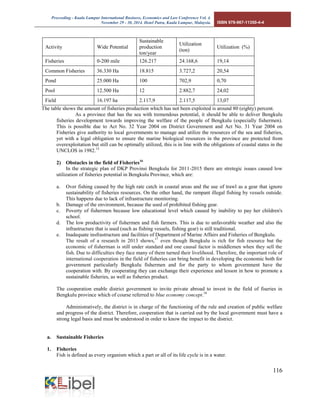
Sea area of Bengkulu Province is 12.335,20 km² and the coast line is 525 km. The sustainable potential is estimates around 126.217 ton. The table below describe data on fisheries potential in Bengkulu.14 
Table 1. Fisheries potential in Bengkulu Province in 2013
Proceeding - Kuala Lumpur International Business, Economics and Law Conference Vol. 4. 
November 29 - 30, 2014. Hotel Putra, Kuala Lumpur, Malaysia. ISBN 978-967-11350-4-4 
116 
Activity 
Wide Potential 
Sustainable production ton/year 
Utilization (ton) 
Utilization (%) 
Fisheries 
0-200 mile 
126.217 
24.168,6 
19,14 
Common Fisheries 
36.330 Ha 
18.815 
3.727,2 
20,54 
Pond 
25.000 Ha 
100 
702,9 
0,70 
Pool 
12.500 Ha 
12 
2.882,7 
24,02 
Field 
16.197 ha 
2.117,9 
2.117,5 
13,07 
The table shows the amount of fisheries production which has not been exploited is around 80 (eighty) percent. 
As a province that has the sea with tremendous potential, it should be able to deliver Bengkulu fisheries development towards improving the welfare of the people of Bengkulu (especially fishermen). This is possible due to Act No. 32 Year 2004 on District Government and Act No. 31 Year 2004 on Fisheries give authority to local governments to manage and utilize the resources of the sea and fisheries, yet with a legal obligation to ensure the marine biological resources in the province are protected from overexploitation but still can be optimally utilized, this is in line with the obligations of coastal states in the UNCLOS in 1982.15 
2) Obstacles in the field of Fisheries16 
In the strategic plan of DKP Provinsi Bengkulu for 2011-2015 there are stretegic issues caused low utilization of fisheries potential in Bengkulu Province, which are: 
a. Over fishing caused by the high rate catch in coastal areas and the use of trawl as a gear that ignore sustainability of fisheries resources. On the other hand, the rampant illegal fishing by vessels outside. This happens due to lack of infrastructure monitoring. 
b. Damage of the environment, because the used of prohibited fishing gear. 
c. Poverty of fishermen because low educational level which caused by inability to pay her children's school. 
d. The low productivity of fishermen and fish farmers. This is due to unfavorable weather and also the infrastructure that is used (such as fishing vessels, fishing gear) is still traditional. 
e. Inadequate insfrastructure and facilities of Department of Marine Affairs and Fisheries of Bengkulu. 
The result of a research in 2013 shows,17 even though Bengkulu is rich for fish resource but the economic of fisherman is still under standard and one causal factor is middlemen when they sell the fish. Due to difficulties they face many of them turned their livelihood. Therefore, the important role of international cooperation in the field of fisheries can bring benefit in developing the economic both for government particularly Bengkulu fishermen and for the party to whom government have the cooperation with. By cooperating they can exchange their experience and lesson in how to promote a sustainable fisheries, as well as fisheries product. 
The cooperation enable district government to invite private abroad to invest in the field of fiseries in Bengkulu province which of course referred to blue economy concept.18 
Administratively, the district is in charge of the functioning of the rule and creation of public welfare and progress of the district. Therefore, cooperation that is carried out by the local government must have a strong legal basis and must be understood in order to know the impact to the district. 
a. Sustainable Fisheries 
1. Fisheries 
Fish is defined as every organism which a part or all of its life cycle is in a water.
Proceeding - Kuala Lumpur International Business, Economics and Law Conference Vol. 4. 
November 29 - 30, 2014. Hotel Putra, Kuala Lumpur, Malaysia. ISBN 978-967-11350-4-4 
117 
Fisheries is every activity which is related to management and utilization of fish resources and its environment ranging from preproduction, production, processing to marketing, which is implemented in a fishing business systems. 
2. Fisheries Sustainability 
When Brundant firstly poured his thought known as Brundant Report in 1987 stating that States should ensure the development and use of their natural resources meets the needs of the present without compromising the ability of the future generations to meet their own needs’,19 that’s when the term of ‘sustainable’ began to use. 
Sustainable fisheries means all activities associated with the management and utilization of fish resources and the environment ranging from preproduction, production, processing to marketing, which is implemented in a fishing business system geared to meet the needs of current generations without compromising future generations to meet needs (fisheries) them. 
Having aware the fact that fisheries are a common property natural resource; anyone can, in principle, fish in the sea. Anyone can enter a particular fishery. If the quantity of fish being caught together with fish lost through natural mortality exceeds the amount of fish being added to the stock through reproduction, then the size of the stock will start to decrease. This phenomenon is known as over-fishing. To prevent it is usually necessary to regulate the amount of fish to be caught.20 
Fisheries sustainability began with conservation paradigm by biology scientists. In this paradigm fisheries sustainability is defined as long term conservation. It means that fisheries activity will be “sustain” if it is able to protect fishery resource from extinction. This concept gave a little attention to human purpose in conducting fishery activity. In 1950s, rationalism paradigm which focused on fishery sustainability that rational from economic point of view and based the argumentation on a concept the achievement of maximum profitability for resource owner appeared. Unfortunately, this concept was challenged by Charles who proposed community paradigm in 2001. He argued that fishery sustainability will be achieved through community approach, which means main concern should be addressed to fishery community sustainability as a community system. Traditional fisheries concepts which proved to be of self control against the catch, appropriate use of technology, high levels of collectivity among fishing communities and traditional knowledge which reflects the resilience of fisheries. Thus, fishery sustainability not solely for the sake of the preservation of the fish itself or for economic benefit (as rents) but more than that to the sustainability of fisheries communities (sustainable community) which is supported by institutional sustainability including the quality of sustainability of regulation devices, policies and organization promoting the achievement of ecology, economic and fishery community sustain.21 
3. Legal Based International Cooperation of District Government in the field of Fisheries 
A. International Treaty 
1. Definition 
Article 2 paragraph (1) a Vienna Convention on the Law of Treaties 1969 provides that a treaty means an international agreement concluded between States in written form and governed by international law, whether embodied in a single instrument or in two or more related instruments and whatever its particular designation. 
Furthermore, Article 26 of the Convention states that each of the applicable agreements bind states parties and must be performed in good faith. This principle is the fundamental basis of contract law and universally recognized and which are part of the common law principles (general principles of law).22
Proceeding - Kuala Lumpur International Business, Economics and Law Conference Vol. 4. 
November 29 - 30, 2014. Hotel Putra, Kuala Lumpur, Malaysia. ISBN 978-967-11350-4-4 
118 
In addition, Article 2 paragraph (1) of the Vienna Convention on the Law of Treaties between States and International Organization 1986 defines a treaty as an international agreement governed by international law and formulated in the form of a written between (a) the or more states and one or more international organizations, or (b) fellow international organizations, either in the form of the instrument of approval or more interrelated and regardless of whatever name. 
From the definition, then the elements of an agreement is the agreement, subject HI, written form, a particular object, subject to or governed by international law.23 
2. International Treaty Making Process 
Mauna Boer argues that the characteristics of an international agreement is that the agreement made by the subject of international law, the making process is governed by international law and it causes a legal effect to the parties concerned.24 Therefore an international treaty can be legal instrument which holds the will and consent of state or other subjects of international law to achieve a common goal. The making process of the agreement can be done in a way that the party will. There is no particular form or procedure. How a treaty formulated and by whom the agreement is signed will depend on the purpose of the agreement of the countries concerned.25 
The next process is adoption of the text which then followed by authentication of the text. After that, a state have to express its agreement to be bound to a treaty which provided in article 11 Vienna Convention on Treaties: 
‘The consent of a State to be bound by a treaty may be expressed by signature, exchange of instruments constituting a treaty, ratification, acceptance, approval or accession, or by any other means if so agreed.’ 
The agreement statement of a state to be bound to a treaty by its representative signing can be determined within the treaty or the states party can agreed that the signature is a statement to be bound to the treaty. 
Article 18 provides that a State is obliged to refrain from acts which would defeat the object and purpose of a treaty when it has signed the treaty or has exchanged instruments constituting the treaty subject to ratification, acceptance or approval, until it shall have made its intention clear not to become a party to the treaty; or it has expressed its consent to be bound by the treaty, pending the entry into force of the treaty and provided that such entry into force is not unduly delayed. 
3. Act No. 37 Year 1999 on Foreign Relation 
According to article 1 paragraph, foreign relation is defines as every activity that related to regional and international aspect which is conducted by central and district government or its body, state body, business entities, political organizations, community organizations, non-governmental organizations, or citizens. 
In the Act of Foreign Relation it is stated that there is a role of district government to do foreign relationship. This is one of consequences of principle that foreign relation is the government affairs and does not belong to district government affairs. The Act of District Government only regulates about internal mechanism on the need of opinion and consideration District Council to District Government to the cooperation plan in the district and district government agreement. 
4. Act No. 24 Year 2000 on International Treaty
Proceeding - Kuala Lumpur International Business, Economics and Law Conference Vol. 4. 
November 29 - 30, 2014. Hotel Putra, Kuala Lumpur, Malaysia. ISBN 978-967-11350-4-4 
119 
Article 5 paragraph (1) State institutions and government agencies, both departmental and non- departmental, national and local level, which has plans to make international agreements, prior consultation and coordination of the plan with the Minister. 
Both acts give a strong legal base to the organizing of foreign relationship, foreign political and international treaty making. These instruments Both of these legal instruments mark the opening of a new paradigm for Indonesia in conducting foreign relations to meet the demands of this fast-moving times. With the new paradigm is, of course, change the understanding that as long as there is that foreign relations is a state monopoly (state actors). For example, the Law on District Government (District Autonomy Act) gives the possibility to hold a Regional relations and cooperation with foreign parties. 
5. Act No. 32 Year 2004 on District Government (herein after referred to as Distric Government Act) 
A. Article 10 provides that District government in organizing the Government holds government affairs under its authority, except for governmental affairs by this Act defined the affairs of government.26 
B. In organizing government affairs under the authority referred to in paragraph (1), district governments holds broad autonomy to organize and manage their own affairs based on the principles of autonomy and assistance. 
C. Government affairs are a matter for the Government as referred to in paragraph (1) include: foreign policy; defense; security; judicial; monetary and national fiscal and religion. 
D. In conducting the affairs of government as described in paragraph (3), the Government organized itself or delegate part of government affairs for the Government or a Government representative in the area or can be assigned to the local government and / or village government. 
E. Article 42 paragraph (1) Parliament has the duty and the authority to consent to the plan of international cooperation undertaken by local governments. 
6. Chapter 3, Article 23 Foreign Ministry Regulation of Republic of Indonesia No.09/A/KP/XII/2006/01 General Guidelines on Procedures for Foreign Relations and Cooperation by District Governments (herein after referred as to Foreign Ministry Regulation) and Ministry of Home Affairs No.3 Year 2008 on Implementation of the District Government Cooperation With Foreign Parties (herein after referred as to Ministry of Home Affairs Regulation) also state the same things that foreign relation and cooperation can be conducted on the initiative of, one of which is District Government. 
7. Act No. 31 Year 2004 on Fisheries provides that for the necessity of international cooperation is able to publish regularly things related to steps of conservation and and management of fish resource. 
Mechanism of International Cooperation in the Field of Fisheries 
As for the kind of international cooperation that is set in the Fisheries Act is the research and development of fisheries and education, training and extension counceling fisheries. These are aimed to produce the required knowledge and technology in the development of fishing effort to be more effective, efficient, economical, highly competitive, and environmentally friendly, the Government set up, encourage, and / or conducting research and development of fisheries. 
RESEARCH 
This research can be carried out by individuals, universities, nongovernmental organizations, and / or research and development institutions and government-owned or private. 
As for government R & D institutions consist of:27
Proceeding - Kuala Lumpur International Business, Economics and Law Conference Vol. 4. 
November 29 - 30, 2014. Hotel Putra, Kuala Lumpur, Malaysia. ISBN 978-967-11350-4-4 
120 
1. Institute of fisheries Research and Development Department 
2. non-departmental Research and Development institutions 
3. Research and Development institutions of District Government 
4. Research and Development institutions of State Owned Enterprises 
5. Research and Development institution of District Institution 
Further described in the Fisheries Research and Development that for Research and Development institutions of district government preferred to applied research and experimental development of fisheries fisheries.28 
In carrying out the research and development of fisheries, such parties can cooperate with implementing research and development, business fishing, fishing associations, and / or agencies of foreign-owned research and development.29 
Fisheries Research and Development Cooperation includes providing expertise, technical assistance and development, providing funding and R & D facilities, education and training and other activities that can accelerate the development of fisheries.30 
Requirements for foreigners can conduct research in the area of fisheries management fisheries of Republic of Indonesia:31 
1. Have to first obtain permission from the government, in this case is the minister who held government affairs in the field of research, development and application of science and technology. 
2. Granting permission shall first obtain the technical considerations of the minister with regard:32 
a. The principle benefit 
b. International obligations related to the field of fisheries 
c. Synchronization between the benefit of science and technology with the strategic plan of the development of fisheries 
d. Technical feasibility standards and principles of science and technology applicable 
e. Mutual equality 
f. Not harm the national interest 
g. Not conflict with governing laws 
h. Solely for peaceful purposes. 
i. 
3. Researchers must include Indonesia. 
4. Must submit their research results to the Government. 
5. In addition, organizers fisheries R & D and / or researchers are obliged to respect the culture and customs prevailing in the local area and preservation of fish resources and the environment.33 
6. Prior to Fisheries Research, Fisheries Research and Development Operator must report his arrival in the territory of Fisheries Research and Development to local officials.34 
7. Having conducted research studies are open to all parties, except for certain research results declared by the Government not to be published.35 The results of the study can be data fisheries, fishery information, products and technologies fisheries fisheries biology. The results of the study can be either side biota, certain water and fishery products.36 The results of the experimental fishery development activities may include industrial products, fisheries policy recommendations and product engineering.37 
8. The results of the study shall be reported to the minister and the minister who held government affairs in the field of research, development and application of science and technology. 
Administrative sanctions for researcher who does not meet the requirements:38 
a. written warning 
b. Temporary suspension of permits Fisheries Research and Development 
c. Revocation of license 
d. Fines.
Proceeding - Kuala Lumpur International Business, Economics and Law Conference Vol. 4. 
November 29 - 30, 2014. Hotel Putra, Kuala Lumpur, Malaysia. ISBN 978-967-11350-4-4 
121 
Education, Training and Counseling of Fisheries 
Education, training and counseling of fisheries. This is regulated in Article 57 through Article 59 of Fisheries Act. The government can cooperate with relevant institutions both nationally and internationally in education, training and counseling fisheries. Furthermore, it is regulated in Government Regulation No.62 Year 2014 on the Implementation of Fisheries Education Training and Couseling. 
For education, Unit fishery secondary education and higher education units fishery may cooperate with other educational units, business, industry, or any other party, both at the national, regional and international level. Cooperative education unit aims to accredited, qualification of teachers, and / or the formation of professional associations. Cooperative education unit referred to in subsection (1) may take the form of academic cooperation and / or collaboration non academic. Cooperation mechanism education units arranged in accordance with the provisions of the legislation. 
For Cooperation Fisheries Training conducted by the Government, Local Government, business or industry, and the Fisheries Training unit at the national, regional, or international. Fisheries Training International cooperation shall be conducted within the framework of pilot training institutes of international fisheries. The Cooperation aims to improve the synergy implementation of human resource development programs fishery. 
For Fisheries Counceling, Government and District Government in carrying out counceling work closely with the relevant agencies, both at the national, regional, or international. Government and Local Government to encourage and facilitate cooperation Key Actors and business communities to implement education and encourage the implementation of fisheries extension formation of functional positions with the relevant institutions. 
From the description it can be seen that all the rules are there to be seen systematically in making an international cooperation for the purpose of all these rules is to realize the creation of an international collaboration that is safe and beneficial for the region as well as maintaining the sustainability of fisheries. If this is true, not only the local economy will increase, the level of economy of fishing communities and other areas will also increase. 
CONCLUSION 
1. Legal base of District Government in conducting international cooperation in the field of fisheries can be found in Acts and Ministries Regulation. The whole acts have to be seen as a whole because all of them is aimed to perform fisheries sustainability. 
2. Even if District Government has its autonomy, still the mechanism in implementing the cooperation should be coordinated with the Government. 
1 For instances Ethiopia, Nepal, Bhutan. 
2 For instances Singapore and Iraq. 
3 Ema Septaria and Muhammad Yamani, Research Report, The Utilization of Fish Landing Port For Fishing Fleet/Fish Transporting Fleet Based on Fishery Law, 2012, p. 22 
4 Monthly Data of Fisheries Production of Marine and Fisheries Department of Bengkulu Province, 2014 
5 http://bengkuluekspress.com/investor-amerika-china-terpikat-teripang-dan-layur/ accessed March 20, 2014 
6 Ibid
Proceeding - Kuala Lumpur International Business, Economics and Law Conference Vol. 4. 
November 29 - 30, 2014. Hotel Putra, Kuala Lumpur, Malaysia. ISBN 978-967-11350-4-4 
122 
7 Based on Act No. 31 year 2004 on Fisheries, Fish is all kind of organism which all or a part of its life cycle is in water. 
8http://bengkuluekspress.com/investor-amerika-china-terpikat-teripang-dan-layur/ accessed March 20, 2014 
9 Marine and Fisheries Dapartment of Bengkulu Province, Reports on Facilitation of Fish Species Conservation Area, presented on Workshop on Fisheries Protection, 2011. 
10http://ditjenkpi.kemendag.go.id/website_kpi/Umum/Setditjen/Buku%20Menuju%20ASEAN%20ECONOMIC%20COMMUNITY%202015.pdf accessed on March 20 2014 
11 http://kkbi.web.id/kerja accessed on Agustus 24, 2014 
12 Bryan A Garner , Black’s Law Dictionary, 7th ed, West Group, USA, 1999, P.336 
13 http://www.southsouth.info/profiles/blogs/international-cooperation accessed April 3, 2014. 
14 Narmoko Prasmadji, “Prospects Indonesian Fishery Product Competitiveness In the Era of Free Trade”, Paper presented at inauguration of FORMIKAN Bengkulu on February 7, 2014. 
15 Indonesia has ratified UNCLOS 1982 by enacted Act No 17 Year 1985 on Ratification of UNCLOS 1982. 
16 Marine and Fisheries Department of Bengkulu Province, Strategic Plan year 2011-2015, P. 25. 
17 Ema Septaria. (2013). From Fisheries Conservation to Community Sustainability. Paper presented at The 3rd International Symposium for Sustainable Humanosphere (ISSH) A Forum of Humanosphere Science School (HSS), 17 -18 September 2013, Bengkulu, Indonesia. 
18 This economic philosophy was first introduced in 1994 by Prof. Gunter Pauli when asked by the United Nations to reflect on the business models of the future. 
19 Sands, PhiliGovernment Regulatione, 1995, Principles of International Environmental Law I, New York: Manchester University Press. P. 198 
20 Churchill and Lowe, 1999, The Law of The Sea, 3rd ed, Mancherster University Press, P. 283 
21 Lucky Adrianto, Implementasi Code of Conduct For Responsible Fisheries Dalam Perspektif Negara Berkembang, International Law Journal, Vol 2 No. 3 April 2005, ISSN: 1693-5594. Jakarta: LPHI FHUI, P. 469. 
22 I wayan Parthiana, International Treaty Law, Bandung: Mandar Maju, 2002, P.1 
23 Ibid. P. 14 
24 Boer Mauna, International Law: Definition, Role and Function in a Global Dynamic Era, Bandung: PT. Alumni, 2008, P.82 
25 Malcom N Shaw, International Law, 4th edition, UK, Cambridge University Press, 2001, P. 636 
26 Government affair covers foreign policy; defense; security; judicial; monetary and national fiscal and religion. 
27 Article 10 Government Regulation No. 30 Year 2008 on Implementation on Fisheries Research and Development 
28 Article 15 Government Regulation No. 30 Year 2008 
29 Article 53 
30 Article 15 Government Regulation No. 15 Year 2008 
31 Article 55 
32 Article 23 Government Regulation No. 30 Year 2008 
33 Article 16 Government Regulation No. 30 Year 2008 
34 Article 17 Government Regulation No. 30 Year 2008 
35 Article 54 Fishery Act 
36 Article 29 Government Regulation No. 30 Year 2008 
37 Article 30 Government Regulation N0. 30 Year 2008 
38 Article 42 Government Regulation No. 30 Year 2008

Klibel5 law 13

  • 1.
    Proceeding - KualaLumpur International Business, Economics and Law Conference Vol. 4. November 29 - 30, 2014. Hotel Putra, Kuala Lumpur, Malaysia. ISBN 978-967-11350-4-4 112 INTERNATIONAL COOPERATION OF BENGKULU DISTRICT GOVERNMENT OF IN THE FIELD OF FISHERIES TO PERFORM FISHERIES SUSTAINABILITY Ema Septaria, SH.,MH Faculty of Law University of Bengkulu, Jl. WR Supratman Kandang Limun Bengkulu, Indonesia Email: emaseptaria@gmail.com Muhammad Yamani, SH.,M.Hum University of Bengkulu, Jl. WR Supratman kandang Limun Bengkulu, Indonesia Email: Muhammad.yamani@yahoo.co.id ABSTRACT Bengkulu is a province of Indonesia, which is directly adjacent to the Indian Ocean. Of 126.217 tones of fishery products of Bengkulu only approximately 19,14% has been utilized. Besides, low infrastructure and facilities for fishing make the most fishing activity is conducted in coastal areas which then led to over fishing, whereas in the territorial sea and EEZ occur illegal fishing by foreign fishing vessels. In addition, many fishermen turn into a coal waste collector since the decreasing number of fish each day. Lack of capital and human resources are two major constraints for this. If this continues hapend, fishing community will not sustain. As a matter of fact, international cooperation between Bengkulu government with foreign parties can be a solution which legally possbile to conduct. Furthermore, in ASEAN Economy Community (AEC) Indonesia has noted that one of the main commodities for intra-ASEAN are fish and fisheries. AEC will make the role of government will fade and be taken over by district government. International cooperation of Bengkulu Government will issue agreements that will it. This study examines what legal basis of Bengkulu Government to conduct such cooperation? With whom it can be conduct? How does the mechanism? Have there been any such cooperation in Bengkulu and whether the existing cooperation follow the mechanisms? This study used normative juridical method with literature searches and statute approaches. Interview with officials from the Ministry of Marine and Fisheries is conducted as a complement. The results showed that in the field of fisheries, there hasn’t been any international cooperation. However there are plans with Korean investors to conduct research on sea cucumber aquaculture and the development of Pulau Baai Harbour, means, Bengkulu Government have to be very careful so that the results of such cooperation will benefit mostly the fishing community and the fisheries sustainability preserves. Key words : International cooperation, Bengkulu District Government, Fisheries, Sustainability INTRODUCTION Sea, as 2/3 of the world’s territory surrounds the most countries all over the world. Only a few states which do not have sea territory and they are referred as land lock countries1 there are also states having sea yet are categorized as geographically disadvantage state2 because resources from the sea is not sufficient to fulfill domestic necessity. Lack of capital, facilities and infrastructure of fishermen in Bengkulu Province caused the utilization of sea resource is still very low. Fishing is conducted by less than 5 GT fishing fleet with relatively simple gear and small in quantity.3 These make fishermen cannot exploit the resource not optimally because they can fish for 4 miles as the farthest distance. This emerges over fishing within the coastal area while since the facilities and infrastructure to control the sea is very limited, this condition raises illegal fishing activities by foreign fishing fleet.
  • 2.
    Proceeding - KualaLumpur International Business, Economics and Law Conference Vol. 4. November 29 - 30, 2014. Hotel Putra, Kuala Lumpur, Malaysia. ISBN 978-967-11350-4-4 113 Fisheries potential in Bengkulu Province is generally large enough especially sea fisheries. Data from Marine Affairs and Fisheries Department, Bengkulu Province known total production of marine areas in the first trimester of 2014 was 471071 kg with the results of 5.346289 billion rupiahs.4 Noticing such a very qualified resource, there are foreigner parties come and want to collaborate with Bengkulu Province government. Innovare Development Consulting Company that will invest in Bengkulu is now conducting research and development on sea cucumbers and if it succeeds then the company will invites foreign investor to buy sea cucumbers from Bengkulu. The company has been doing on the research for two years and the result is very prospective. Holothuria scaba, cucheuma cottonil, Scylla Serrata, Baramundi, Cobia are kinds of sea cucumbers they want to breed.5 Furthermore, CV. Lautan Mas, owned by an investor from China wants to export Beledang fish directly from Bengkulu because the productions reach 30 to 40 tones everyday. While before this company bought the fish from Jakarta and there were not fresh fish and it made their consumers complain. Therefore this company wants to incase the fish directly from Bengkulu.6 On one hand, the potential of this fishery can provide material benefits for district governments and businessman, while on the other hand if it is not managed properly and responsibly then it will lead to unsustainable fisheries where certain fish species decrease or even disappear. In other words, it is not impossible for fish7 as biological resources that is renewable if exploited without conservation then they will extinct. For instance, a few years ago production of sea cucumbers in Bengkulu, particularly in Kaur district was very large in number. Sea cucumbers could be consumed by people around. But now Sea cucumbers are already very scarce.8 Not only sea cucumbers, certain types of fish like Napoleon, Turtle, Dugong, Super Red Arowana, Sea Horse, Amyda cartilaginea, Jardini Arowana, Coral, Sharks, whales, eels, Kima, Terubuk, Lola, has been designated as a threatened species of fish extinct, endangered, endemic and protected until the 2014's. 9 This already shows symptoms that unsustainability has started. The next few years the Asean Economic Community (AEC) in which socio-cultural economic relations will be established directly between areas with foreign parties is inevitable. Indonesia has decided that one of primary comodity for intra-ASEAN is fish and fisheries. By 2015, when the AEC is opened, ASEAN will become a single market and a single production-based in which occurs the flow of goods, services, investment and skilled labor, as well as capital more freely ASEAN countries. 10 This era will open opportunities for Bengkulu Province to increase its market share in the ASEAN region. Noticed the district autonomy which naturally shaping local government can independently develop the district, while the resource and ability of one district to another is not similar-as we can see this from the original income. One of efforts to increase the original income and society welfare is by collaborating with foreign party. Government international cooperation will bring a legally binding agreement for Bengkulu Province Government and its partner. For that reason, every single cooperation needs to be analyzed in order not to disadvantages Bengkulu Government, particularly Bengkulunese. Domestic condition will influence mutual cooperation. Unready in fisheries cooperation will result in losses that will affect economic growth and welfare of the community, especially the fishing community. The readiness can be seen from information and data, maritime boundaries, the strength of legal protection, law enforcement and diplomacy skills. This study is aimed to examine about the legal base for Government of Bengkulu in conducting international cooperation in the field of fisheries and how mechanism is carried out. This study is very urgent and closely associated with the University of Bengkulu RIP maritime economy sustainable development and the rule of law. The result Discussion of the results of this study are expected to give birth next research ideas and provide information for decision-makers in the province of Bengkulu related to cooperation in the field of fisheries to be conducted with foreign parties.
  • 3.
    Proceeding - KualaLumpur International Business, Economics and Law Conference Vol. 4. November 29 - 30, 2014. Hotel Putra, Kuala Lumpur, Malaysia. ISBN 978-967-11350-4-4 114 METHOD This is a normative juridical study that aimed to find out the principles in governing law; laws which have correlation with international cooperation by district government. Main legal source materials used is legislation. interview will be conducted with informant from formal legal officers (whose duties and functions related to international cooperation in the field of fisheries). Required legal material were collected by literature studies both written and unwritten laws of primary and secondary legal materials. The legal materials then analyzed by using interpretation to answer the problems. RESULT AND DISCUSSION 1. District Government a. Definition According to Act No. 32 Year 2004, District government is the implementation of government affairs by the local government and parliament according to the autonomy and assistance principles at the widest breath and principles of the Unitary State of the Republic of Indonesia as defined in the Constitution of the Republic of Indonesia Year 1945. The local government includes Governor, Regent, or Mayor, and the region as an element of the regional administration. District government of Bengkulu Province within this study is Governor and District Parliament. In this matter, Bengkulu government runs the autonomy to organize and manage government affairs based on autonomy principle and co-administration. b. Function of District Government Based on Act No. 32 year 2004, function of district government is to organise and manage government affairs based on autonomy and co-administration. These are aimed to increase social welfare, public service and district competitive. In conducting this task the district government has a relation to the government which includes authority, finance, public services, the utilization of natural resources, and other resources. c. District Government Affairs The government and district government affairs are below : a. Government affairs consists of affairs which wholly into government and affairs which are shared between different levels and/or the composition of government. b. Affairs which wholly into government as stated in pharagraph 1 includes foreign politic, defence, security, justicial, moneter and national fiscal and religion. c. Affairs which are shared together between level and/or government order as stated in paragraph 2 is all affairs which are included in it. It consists of 31 (thirty one) fields one of which is marine and fisheries. This affair is referred as the choice matters which actually have the potential to improve the welfare of the community in accordance with the conditions, peculiarities, and the potential in the regions concerned.
  • 4.
    Proceeding - KualaLumpur International Business, Economics and Law Conference Vol. 4. November 29 - 30, 2014. Hotel Putra, Kuala Lumpur, Malaysia. ISBN 978-967-11350-4-4 115 Related to this research, having notices the large potential to fishery in Bengkulu province, the Provincial Government of Bengkulu can develop this field to improve the welfare of the people of Bengkulu, particularly the fishing community. 2. International Cooperation a. Definition Literally, cooperation is defined as any activity or business which is done by some people (institutions, government, etc.) to achieve a common goal.11 International cooperation is a form of relationship that is made by a country with other countries that aim to meet the needs of the people and for the interests of the countries in the world. International cooperation, including cooperation in the political, social, defense and security, culture, and economy, based on the foreign policy respectively. In Black’s Law Dictionary, international cooperation defined as the voluntary coordinated action of two or more countries occurring under a legal regime and serving a specific objective.12 Another definition of international cooperation is a group of actions and/or resources exchanged between actors from different countries, voluntarily and according to their own interests and strategies.13 In regulation of Ministry of Domestic Affairs (Permendagri) No.30/2008, cooperation means a series of activities which occurs due to formal relation between district government and foreign party to obtain a particular purpose in organizing district governance. Mochtar Kusumaatmadja stated that relation and cooperation among states appear as the uneven distribution of natural resources and industrial development around the world resulting in interdependence between nations and different countries. Because of this relationship and cooperation occurs continuously, it is essential to maintain and organize them so they can be useful in growing sense of friendship and mutual understanding among the peoples of the world. From the definitions of international cooperation it is known the elements of cooperation are: a. Activity b. Formal relation c. Mutual purpose In this study, cooperation between district government and foreign party and international cooperation of district government has the same meaning. Because both of them have same elements; cooperation, district government and involve international party. Therefore the two terminologies are deemed to be the same. b. Important role of International Cooperation in the field of fisheries in Bengkulu Province 1) Fisheries Potential in Bengkulu Sea area of Bengkulu Province is 12.335,20 km² and the coast line is 525 km. The sustainable potential is estimates around 126.217 ton. The table below describe data on fisheries potential in Bengkulu.14 Table 1. Fisheries potential in Bengkulu Province in 2013
  • 5.
    Proceeding - KualaLumpur International Business, Economics and Law Conference Vol. 4. November 29 - 30, 2014. Hotel Putra, Kuala Lumpur, Malaysia. ISBN 978-967-11350-4-4 116 Activity Wide Potential Sustainable production ton/year Utilization (ton) Utilization (%) Fisheries 0-200 mile 126.217 24.168,6 19,14 Common Fisheries 36.330 Ha 18.815 3.727,2 20,54 Pond 25.000 Ha 100 702,9 0,70 Pool 12.500 Ha 12 2.882,7 24,02 Field 16.197 ha 2.117,9 2.117,5 13,07 The table shows the amount of fisheries production which has not been exploited is around 80 (eighty) percent. As a province that has the sea with tremendous potential, it should be able to deliver Bengkulu fisheries development towards improving the welfare of the people of Bengkulu (especially fishermen). This is possible due to Act No. 32 Year 2004 on District Government and Act No. 31 Year 2004 on Fisheries give authority to local governments to manage and utilize the resources of the sea and fisheries, yet with a legal obligation to ensure the marine biological resources in the province are protected from overexploitation but still can be optimally utilized, this is in line with the obligations of coastal states in the UNCLOS in 1982.15 2) Obstacles in the field of Fisheries16 In the strategic plan of DKP Provinsi Bengkulu for 2011-2015 there are stretegic issues caused low utilization of fisheries potential in Bengkulu Province, which are: a. Over fishing caused by the high rate catch in coastal areas and the use of trawl as a gear that ignore sustainability of fisheries resources. On the other hand, the rampant illegal fishing by vessels outside. This happens due to lack of infrastructure monitoring. b. Damage of the environment, because the used of prohibited fishing gear. c. Poverty of fishermen because low educational level which caused by inability to pay her children's school. d. The low productivity of fishermen and fish farmers. This is due to unfavorable weather and also the infrastructure that is used (such as fishing vessels, fishing gear) is still traditional. e. Inadequate insfrastructure and facilities of Department of Marine Affairs and Fisheries of Bengkulu. The result of a research in 2013 shows,17 even though Bengkulu is rich for fish resource but the economic of fisherman is still under standard and one causal factor is middlemen when they sell the fish. Due to difficulties they face many of them turned their livelihood. Therefore, the important role of international cooperation in the field of fisheries can bring benefit in developing the economic both for government particularly Bengkulu fishermen and for the party to whom government have the cooperation with. By cooperating they can exchange their experience and lesson in how to promote a sustainable fisheries, as well as fisheries product. The cooperation enable district government to invite private abroad to invest in the field of fiseries in Bengkulu province which of course referred to blue economy concept.18 Administratively, the district is in charge of the functioning of the rule and creation of public welfare and progress of the district. Therefore, cooperation that is carried out by the local government must have a strong legal basis and must be understood in order to know the impact to the district. a. Sustainable Fisheries 1. Fisheries Fish is defined as every organism which a part or all of its life cycle is in a water.
  • 6.
    Proceeding - KualaLumpur International Business, Economics and Law Conference Vol. 4. November 29 - 30, 2014. Hotel Putra, Kuala Lumpur, Malaysia. ISBN 978-967-11350-4-4 117 Fisheries is every activity which is related to management and utilization of fish resources and its environment ranging from preproduction, production, processing to marketing, which is implemented in a fishing business systems. 2. Fisheries Sustainability When Brundant firstly poured his thought known as Brundant Report in 1987 stating that States should ensure the development and use of their natural resources meets the needs of the present without compromising the ability of the future generations to meet their own needs’,19 that’s when the term of ‘sustainable’ began to use. Sustainable fisheries means all activities associated with the management and utilization of fish resources and the environment ranging from preproduction, production, processing to marketing, which is implemented in a fishing business system geared to meet the needs of current generations without compromising future generations to meet needs (fisheries) them. Having aware the fact that fisheries are a common property natural resource; anyone can, in principle, fish in the sea. Anyone can enter a particular fishery. If the quantity of fish being caught together with fish lost through natural mortality exceeds the amount of fish being added to the stock through reproduction, then the size of the stock will start to decrease. This phenomenon is known as over-fishing. To prevent it is usually necessary to regulate the amount of fish to be caught.20 Fisheries sustainability began with conservation paradigm by biology scientists. In this paradigm fisheries sustainability is defined as long term conservation. It means that fisheries activity will be “sustain” if it is able to protect fishery resource from extinction. This concept gave a little attention to human purpose in conducting fishery activity. In 1950s, rationalism paradigm which focused on fishery sustainability that rational from economic point of view and based the argumentation on a concept the achievement of maximum profitability for resource owner appeared. Unfortunately, this concept was challenged by Charles who proposed community paradigm in 2001. He argued that fishery sustainability will be achieved through community approach, which means main concern should be addressed to fishery community sustainability as a community system. Traditional fisheries concepts which proved to be of self control against the catch, appropriate use of technology, high levels of collectivity among fishing communities and traditional knowledge which reflects the resilience of fisheries. Thus, fishery sustainability not solely for the sake of the preservation of the fish itself or for economic benefit (as rents) but more than that to the sustainability of fisheries communities (sustainable community) which is supported by institutional sustainability including the quality of sustainability of regulation devices, policies and organization promoting the achievement of ecology, economic and fishery community sustain.21 3. Legal Based International Cooperation of District Government in the field of Fisheries A. International Treaty 1. Definition Article 2 paragraph (1) a Vienna Convention on the Law of Treaties 1969 provides that a treaty means an international agreement concluded between States in written form and governed by international law, whether embodied in a single instrument or in two or more related instruments and whatever its particular designation. Furthermore, Article 26 of the Convention states that each of the applicable agreements bind states parties and must be performed in good faith. This principle is the fundamental basis of contract law and universally recognized and which are part of the common law principles (general principles of law).22
  • 7.
    Proceeding - KualaLumpur International Business, Economics and Law Conference Vol. 4. November 29 - 30, 2014. Hotel Putra, Kuala Lumpur, Malaysia. ISBN 978-967-11350-4-4 118 In addition, Article 2 paragraph (1) of the Vienna Convention on the Law of Treaties between States and International Organization 1986 defines a treaty as an international agreement governed by international law and formulated in the form of a written between (a) the or more states and one or more international organizations, or (b) fellow international organizations, either in the form of the instrument of approval or more interrelated and regardless of whatever name. From the definition, then the elements of an agreement is the agreement, subject HI, written form, a particular object, subject to or governed by international law.23 2. International Treaty Making Process Mauna Boer argues that the characteristics of an international agreement is that the agreement made by the subject of international law, the making process is governed by international law and it causes a legal effect to the parties concerned.24 Therefore an international treaty can be legal instrument which holds the will and consent of state or other subjects of international law to achieve a common goal. The making process of the agreement can be done in a way that the party will. There is no particular form or procedure. How a treaty formulated and by whom the agreement is signed will depend on the purpose of the agreement of the countries concerned.25 The next process is adoption of the text which then followed by authentication of the text. After that, a state have to express its agreement to be bound to a treaty which provided in article 11 Vienna Convention on Treaties: ‘The consent of a State to be bound by a treaty may be expressed by signature, exchange of instruments constituting a treaty, ratification, acceptance, approval or accession, or by any other means if so agreed.’ The agreement statement of a state to be bound to a treaty by its representative signing can be determined within the treaty or the states party can agreed that the signature is a statement to be bound to the treaty. Article 18 provides that a State is obliged to refrain from acts which would defeat the object and purpose of a treaty when it has signed the treaty or has exchanged instruments constituting the treaty subject to ratification, acceptance or approval, until it shall have made its intention clear not to become a party to the treaty; or it has expressed its consent to be bound by the treaty, pending the entry into force of the treaty and provided that such entry into force is not unduly delayed. 3. Act No. 37 Year 1999 on Foreign Relation According to article 1 paragraph, foreign relation is defines as every activity that related to regional and international aspect which is conducted by central and district government or its body, state body, business entities, political organizations, community organizations, non-governmental organizations, or citizens. In the Act of Foreign Relation it is stated that there is a role of district government to do foreign relationship. This is one of consequences of principle that foreign relation is the government affairs and does not belong to district government affairs. The Act of District Government only regulates about internal mechanism on the need of opinion and consideration District Council to District Government to the cooperation plan in the district and district government agreement. 4. Act No. 24 Year 2000 on International Treaty
  • 8.
    Proceeding - KualaLumpur International Business, Economics and Law Conference Vol. 4. November 29 - 30, 2014. Hotel Putra, Kuala Lumpur, Malaysia. ISBN 978-967-11350-4-4 119 Article 5 paragraph (1) State institutions and government agencies, both departmental and non- departmental, national and local level, which has plans to make international agreements, prior consultation and coordination of the plan with the Minister. Both acts give a strong legal base to the organizing of foreign relationship, foreign political and international treaty making. These instruments Both of these legal instruments mark the opening of a new paradigm for Indonesia in conducting foreign relations to meet the demands of this fast-moving times. With the new paradigm is, of course, change the understanding that as long as there is that foreign relations is a state monopoly (state actors). For example, the Law on District Government (District Autonomy Act) gives the possibility to hold a Regional relations and cooperation with foreign parties. 5. Act No. 32 Year 2004 on District Government (herein after referred to as Distric Government Act) A. Article 10 provides that District government in organizing the Government holds government affairs under its authority, except for governmental affairs by this Act defined the affairs of government.26 B. In organizing government affairs under the authority referred to in paragraph (1), district governments holds broad autonomy to organize and manage their own affairs based on the principles of autonomy and assistance. C. Government affairs are a matter for the Government as referred to in paragraph (1) include: foreign policy; defense; security; judicial; monetary and national fiscal and religion. D. In conducting the affairs of government as described in paragraph (3), the Government organized itself or delegate part of government affairs for the Government or a Government representative in the area or can be assigned to the local government and / or village government. E. Article 42 paragraph (1) Parliament has the duty and the authority to consent to the plan of international cooperation undertaken by local governments. 6. Chapter 3, Article 23 Foreign Ministry Regulation of Republic of Indonesia No.09/A/KP/XII/2006/01 General Guidelines on Procedures for Foreign Relations and Cooperation by District Governments (herein after referred as to Foreign Ministry Regulation) and Ministry of Home Affairs No.3 Year 2008 on Implementation of the District Government Cooperation With Foreign Parties (herein after referred as to Ministry of Home Affairs Regulation) also state the same things that foreign relation and cooperation can be conducted on the initiative of, one of which is District Government. 7. Act No. 31 Year 2004 on Fisheries provides that for the necessity of international cooperation is able to publish regularly things related to steps of conservation and and management of fish resource. Mechanism of International Cooperation in the Field of Fisheries As for the kind of international cooperation that is set in the Fisheries Act is the research and development of fisheries and education, training and extension counceling fisheries. These are aimed to produce the required knowledge and technology in the development of fishing effort to be more effective, efficient, economical, highly competitive, and environmentally friendly, the Government set up, encourage, and / or conducting research and development of fisheries. RESEARCH This research can be carried out by individuals, universities, nongovernmental organizations, and / or research and development institutions and government-owned or private. As for government R & D institutions consist of:27
  • 9.
    Proceeding - KualaLumpur International Business, Economics and Law Conference Vol. 4. November 29 - 30, 2014. Hotel Putra, Kuala Lumpur, Malaysia. ISBN 978-967-11350-4-4 120 1. Institute of fisheries Research and Development Department 2. non-departmental Research and Development institutions 3. Research and Development institutions of District Government 4. Research and Development institutions of State Owned Enterprises 5. Research and Development institution of District Institution Further described in the Fisheries Research and Development that for Research and Development institutions of district government preferred to applied research and experimental development of fisheries fisheries.28 In carrying out the research and development of fisheries, such parties can cooperate with implementing research and development, business fishing, fishing associations, and / or agencies of foreign-owned research and development.29 Fisheries Research and Development Cooperation includes providing expertise, technical assistance and development, providing funding and R & D facilities, education and training and other activities that can accelerate the development of fisheries.30 Requirements for foreigners can conduct research in the area of fisheries management fisheries of Republic of Indonesia:31 1. Have to first obtain permission from the government, in this case is the minister who held government affairs in the field of research, development and application of science and technology. 2. Granting permission shall first obtain the technical considerations of the minister with regard:32 a. The principle benefit b. International obligations related to the field of fisheries c. Synchronization between the benefit of science and technology with the strategic plan of the development of fisheries d. Technical feasibility standards and principles of science and technology applicable e. Mutual equality f. Not harm the national interest g. Not conflict with governing laws h. Solely for peaceful purposes. i. 3. Researchers must include Indonesia. 4. Must submit their research results to the Government. 5. In addition, organizers fisheries R & D and / or researchers are obliged to respect the culture and customs prevailing in the local area and preservation of fish resources and the environment.33 6. Prior to Fisheries Research, Fisheries Research and Development Operator must report his arrival in the territory of Fisheries Research and Development to local officials.34 7. Having conducted research studies are open to all parties, except for certain research results declared by the Government not to be published.35 The results of the study can be data fisheries, fishery information, products and technologies fisheries fisheries biology. The results of the study can be either side biota, certain water and fishery products.36 The results of the experimental fishery development activities may include industrial products, fisheries policy recommendations and product engineering.37 8. The results of the study shall be reported to the minister and the minister who held government affairs in the field of research, development and application of science and technology. Administrative sanctions for researcher who does not meet the requirements:38 a. written warning b. Temporary suspension of permits Fisheries Research and Development c. Revocation of license d. Fines.
  • 10.
    Proceeding - KualaLumpur International Business, Economics and Law Conference Vol. 4. November 29 - 30, 2014. Hotel Putra, Kuala Lumpur, Malaysia. ISBN 978-967-11350-4-4 121 Education, Training and Counseling of Fisheries Education, training and counseling of fisheries. This is regulated in Article 57 through Article 59 of Fisheries Act. The government can cooperate with relevant institutions both nationally and internationally in education, training and counseling fisheries. Furthermore, it is regulated in Government Regulation No.62 Year 2014 on the Implementation of Fisheries Education Training and Couseling. For education, Unit fishery secondary education and higher education units fishery may cooperate with other educational units, business, industry, or any other party, both at the national, regional and international level. Cooperative education unit aims to accredited, qualification of teachers, and / or the formation of professional associations. Cooperative education unit referred to in subsection (1) may take the form of academic cooperation and / or collaboration non academic. Cooperation mechanism education units arranged in accordance with the provisions of the legislation. For Cooperation Fisheries Training conducted by the Government, Local Government, business or industry, and the Fisheries Training unit at the national, regional, or international. Fisheries Training International cooperation shall be conducted within the framework of pilot training institutes of international fisheries. The Cooperation aims to improve the synergy implementation of human resource development programs fishery. For Fisheries Counceling, Government and District Government in carrying out counceling work closely with the relevant agencies, both at the national, regional, or international. Government and Local Government to encourage and facilitate cooperation Key Actors and business communities to implement education and encourage the implementation of fisheries extension formation of functional positions with the relevant institutions. From the description it can be seen that all the rules are there to be seen systematically in making an international cooperation for the purpose of all these rules is to realize the creation of an international collaboration that is safe and beneficial for the region as well as maintaining the sustainability of fisheries. If this is true, not only the local economy will increase, the level of economy of fishing communities and other areas will also increase. CONCLUSION 1. Legal base of District Government in conducting international cooperation in the field of fisheries can be found in Acts and Ministries Regulation. The whole acts have to be seen as a whole because all of them is aimed to perform fisheries sustainability. 2. Even if District Government has its autonomy, still the mechanism in implementing the cooperation should be coordinated with the Government. 1 For instances Ethiopia, Nepal, Bhutan. 2 For instances Singapore and Iraq. 3 Ema Septaria and Muhammad Yamani, Research Report, The Utilization of Fish Landing Port For Fishing Fleet/Fish Transporting Fleet Based on Fishery Law, 2012, p. 22 4 Monthly Data of Fisheries Production of Marine and Fisheries Department of Bengkulu Province, 2014 5 http://bengkuluekspress.com/investor-amerika-china-terpikat-teripang-dan-layur/ accessed March 20, 2014 6 Ibid
  • 11.
    Proceeding - KualaLumpur International Business, Economics and Law Conference Vol. 4. November 29 - 30, 2014. Hotel Putra, Kuala Lumpur, Malaysia. ISBN 978-967-11350-4-4 122 7 Based on Act No. 31 year 2004 on Fisheries, Fish is all kind of organism which all or a part of its life cycle is in water. 8http://bengkuluekspress.com/investor-amerika-china-terpikat-teripang-dan-layur/ accessed March 20, 2014 9 Marine and Fisheries Dapartment of Bengkulu Province, Reports on Facilitation of Fish Species Conservation Area, presented on Workshop on Fisheries Protection, 2011. 10http://ditjenkpi.kemendag.go.id/website_kpi/Umum/Setditjen/Buku%20Menuju%20ASEAN%20ECONOMIC%20COMMUNITY%202015.pdf accessed on March 20 2014 11 http://kkbi.web.id/kerja accessed on Agustus 24, 2014 12 Bryan A Garner , Black’s Law Dictionary, 7th ed, West Group, USA, 1999, P.336 13 http://www.southsouth.info/profiles/blogs/international-cooperation accessed April 3, 2014. 14 Narmoko Prasmadji, “Prospects Indonesian Fishery Product Competitiveness In the Era of Free Trade”, Paper presented at inauguration of FORMIKAN Bengkulu on February 7, 2014. 15 Indonesia has ratified UNCLOS 1982 by enacted Act No 17 Year 1985 on Ratification of UNCLOS 1982. 16 Marine and Fisheries Department of Bengkulu Province, Strategic Plan year 2011-2015, P. 25. 17 Ema Septaria. (2013). From Fisheries Conservation to Community Sustainability. Paper presented at The 3rd International Symposium for Sustainable Humanosphere (ISSH) A Forum of Humanosphere Science School (HSS), 17 -18 September 2013, Bengkulu, Indonesia. 18 This economic philosophy was first introduced in 1994 by Prof. Gunter Pauli when asked by the United Nations to reflect on the business models of the future. 19 Sands, PhiliGovernment Regulatione, 1995, Principles of International Environmental Law I, New York: Manchester University Press. P. 198 20 Churchill and Lowe, 1999, The Law of The Sea, 3rd ed, Mancherster University Press, P. 283 21 Lucky Adrianto, Implementasi Code of Conduct For Responsible Fisheries Dalam Perspektif Negara Berkembang, International Law Journal, Vol 2 No. 3 April 2005, ISSN: 1693-5594. Jakarta: LPHI FHUI, P. 469. 22 I wayan Parthiana, International Treaty Law, Bandung: Mandar Maju, 2002, P.1 23 Ibid. P. 14 24 Boer Mauna, International Law: Definition, Role and Function in a Global Dynamic Era, Bandung: PT. Alumni, 2008, P.82 25 Malcom N Shaw, International Law, 4th edition, UK, Cambridge University Press, 2001, P. 636 26 Government affair covers foreign policy; defense; security; judicial; monetary and national fiscal and religion. 27 Article 10 Government Regulation No. 30 Year 2008 on Implementation on Fisheries Research and Development 28 Article 15 Government Regulation No. 30 Year 2008 29 Article 53 30 Article 15 Government Regulation No. 15 Year 2008 31 Article 55 32 Article 23 Government Regulation No. 30 Year 2008 33 Article 16 Government Regulation No. 30 Year 2008 34 Article 17 Government Regulation No. 30 Year 2008 35 Article 54 Fishery Act 36 Article 29 Government Regulation No. 30 Year 2008 37 Article 30 Government Regulation N0. 30 Year 2008 38 Article 42 Government Regulation No. 30 Year 2008