Group 3 Presentation
By: Justine Jay Visca
John Deivin Pacelo
Mark Andrew Candido
Prepare Vegetable Dishes
Effects of Cooking Vegetables
1. Changes in texture
Fibers are either softened or toughened.
a. Cellulose and hemicellulose – heating generally
softens fibers.
b. Addition of acid toughen fibers.
c. Addition of alkali like baking soda soften
hemicellulose.
d. Addition of lime causes firmness or delay softening
due to the reaction of calcium from lime (“apog”).
Prepare Vegetable Dishes
Effects of Cooking Vegetables
2. Water is either lost or absorbed.
a. Vegetables contain high amount of water, leafy and
succulent vegetables lose water and become limp.
b. Vegetables with significant amount of starch (dried
beans, root crops, tubers) absorb water because of the
hygroscopic property of starch.
Prepare Vegetable Dishes
Effects of Cooking Vegetables
3. Changes in color
Cooking for a short time, helps maintain color.
4. Changes in nutrients
a. Carbohydrate
b. Protein become more soluble and digestible.
c. Vitamin may be destroyed in heat like vitamin C.
d. Minerals are washed into the cooking liquid or
oxidized.
General Rules of Vegetable Cookery
• Don’t overcook.
• Prepare vegetables as close
to service time as possible
and in small quantities.
General Rules of Vegetable Cookery
• If the vegetable must be cooked ahead,
undercook slightly and chill rapidly.
Reheat at service time.
• Never use baking soda with green
vegetables.
• Cut vegetables uniformily for even
cooking.
• Cook green vegetables and strong
flavored vegetables uncovered.
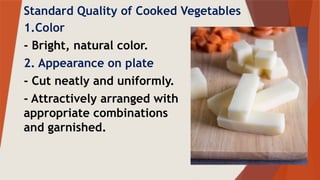
Standard Quality of Cooked Vegetables
1.Color
- Bright, natural color.
2. Appearance on plate
- Cut neatly and uniformly.
- Attractively arranged with
appropriate combinations
and garnished.
Standard Quality of Cooked Vegetables
3. Texture
- Cooked to the right degree of doneness.
Crisp tender, not overcooked and mushy.
Potatoes, squash, sweet potatoes, tomatoes should
be cooked through with smooth texture.
Standard Quality of Cooked Vegetables
4. Flavor
- Natural flavour and sweetness.
- Strong flavoured vegetables should be pleasantly
mild, with no off flavors or bitterness.
5. Seasonings
- Seasonings should not mask the natural flavors.
Standard Quality of Cooked Vegetables
6. Sauces
- Do not use heavily. Vegetable should not be
greasy.
7. Vegetable combinations
- Vegetables should be cooked separately for
different cooking times, and then combined.
- Combine acid vegetables like tomatoes, to green
vegetables just before service to prevent
discoloration of greens.
Cooking Frozen and Canned Vegetables
A.Frozen Vegetables
• Examine all frozen products when received to check
quality.
• Frozen vegetables require shorter time in cooking
because they have been partially cooked.
Cooking Frozen and Canned Vegetables
A.Frozen Vegetables
• Cook from the frozen state; can cook
directly into a steamer or boiling salted
water.
• Corn on the cob and vegetables that
are frozen solidly, like squash, should be
thawed for even cooking.
• Add less salt. Most frozen vegetables
are slightly salted during processing.
Cooking Frozen and Canned Vegetables
B. Canned Vegetables
• Drain vegetables and place
half of the liquid in a cooking
pot, and bring to boil.
• Add vegetables and heat to
serving time. Do not boil for a
long time.
• Season liquid before adding
vegetables to blend flavors of
herbs and spices.
• Use butter to enhance the
flavour of most vegetable.
Terms Used for Vegetables
Here are terms used for an assortment of fresh vegetables
including carrots, turnips, peas, pearl onions, green beans,
cauliflower, asparagus and artichokes that are often used
as garnish or accompaniment to meat dishes.
Bouquetiere - bouquet of vegetables.
Terms Used for Vegetables
Printaniere - spring vegetables
Jardinière - garden vegetables
Primeurs - first spring vegetables.
Terms Used for Vegetables
Clamart - peas
Crecy - carrots
Doria - cucumbers cooked in butter.
Terms Used for Vegetables
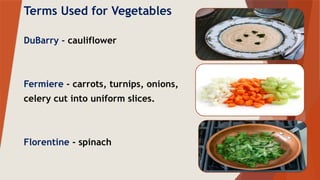
DuBarry - cauliflower
Fermiere - carrots, turnips, onions,
celery cut into uniform slices.
Florentine - spinach
Terms Used for Vegetables
Florestiere - mushrooms
Judic - braised lettuce
Lyonnaise - onions
Terms Used for Vegetables
Nicoise - tomatoes concasse cooked
with garlic.
Parmentier - potatoes
Princesse - asparagus
Provençale - tomatoes with garlic,
parsley and sometimes
mushrooms or olives.
Ways of Cooking Vegetables
1. Boiling and Steaming
2. Sautéing and Pan-Frying
Ways of Cooking Vegetables
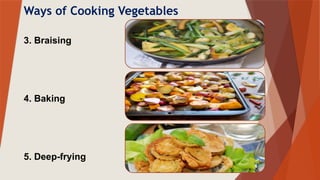
3. Braising
4. Baking
5. Deep-frying
Thank You

Kitchen Essentials and Basic Food Preparation

  • 1.
    Group 3 Presentation By:Justine Jay Visca John Deivin Pacelo Mark Andrew Candido
  • 2.
    Prepare Vegetable Dishes Effectsof Cooking Vegetables 1. Changes in texture Fibers are either softened or toughened. a. Cellulose and hemicellulose – heating generally softens fibers. b. Addition of acid toughen fibers. c. Addition of alkali like baking soda soften hemicellulose. d. Addition of lime causes firmness or delay softening due to the reaction of calcium from lime (“apog”).
  • 3.
    Prepare Vegetable Dishes Effectsof Cooking Vegetables 2. Water is either lost or absorbed. a. Vegetables contain high amount of water, leafy and succulent vegetables lose water and become limp. b. Vegetables with significant amount of starch (dried beans, root crops, tubers) absorb water because of the hygroscopic property of starch.
  • 4.
    Prepare Vegetable Dishes Effectsof Cooking Vegetables 3. Changes in color Cooking for a short time, helps maintain color. 4. Changes in nutrients a. Carbohydrate b. Protein become more soluble and digestible. c. Vitamin may be destroyed in heat like vitamin C. d. Minerals are washed into the cooking liquid or oxidized.
  • 5.
    General Rules ofVegetable Cookery • Don’t overcook. • Prepare vegetables as close to service time as possible and in small quantities.
  • 6.
    General Rules ofVegetable Cookery • If the vegetable must be cooked ahead, undercook slightly and chill rapidly. Reheat at service time. • Never use baking soda with green vegetables. • Cut vegetables uniformily for even cooking. • Cook green vegetables and strong flavored vegetables uncovered.
  • 7.
    Standard Quality ofCooked Vegetables 1.Color - Bright, natural color. 2. Appearance on plate - Cut neatly and uniformly. - Attractively arranged with appropriate combinations and garnished.
  • 8.
    Standard Quality ofCooked Vegetables 3. Texture - Cooked to the right degree of doneness. Crisp tender, not overcooked and mushy. Potatoes, squash, sweet potatoes, tomatoes should be cooked through with smooth texture.
  • 9.
    Standard Quality ofCooked Vegetables 4. Flavor - Natural flavour and sweetness. - Strong flavoured vegetables should be pleasantly mild, with no off flavors or bitterness. 5. Seasonings - Seasonings should not mask the natural flavors.
  • 10.
    Standard Quality ofCooked Vegetables 6. Sauces - Do not use heavily. Vegetable should not be greasy. 7. Vegetable combinations - Vegetables should be cooked separately for different cooking times, and then combined. - Combine acid vegetables like tomatoes, to green vegetables just before service to prevent discoloration of greens.
  • 11.
    Cooking Frozen andCanned Vegetables A.Frozen Vegetables • Examine all frozen products when received to check quality. • Frozen vegetables require shorter time in cooking because they have been partially cooked.
  • 12.
    Cooking Frozen andCanned Vegetables A.Frozen Vegetables • Cook from the frozen state; can cook directly into a steamer or boiling salted water. • Corn on the cob and vegetables that are frozen solidly, like squash, should be thawed for even cooking. • Add less salt. Most frozen vegetables are slightly salted during processing.
  • 13.
    Cooking Frozen andCanned Vegetables B. Canned Vegetables • Drain vegetables and place half of the liquid in a cooking pot, and bring to boil. • Add vegetables and heat to serving time. Do not boil for a long time. • Season liquid before adding vegetables to blend flavors of herbs and spices. • Use butter to enhance the flavour of most vegetable.
  • 14.
    Terms Used forVegetables Here are terms used for an assortment of fresh vegetables including carrots, turnips, peas, pearl onions, green beans, cauliflower, asparagus and artichokes that are often used as garnish or accompaniment to meat dishes. Bouquetiere - bouquet of vegetables.
  • 15.
    Terms Used forVegetables Printaniere - spring vegetables Jardinière - garden vegetables Primeurs - first spring vegetables.
  • 16.
    Terms Used forVegetables Clamart - peas Crecy - carrots Doria - cucumbers cooked in butter.
  • 17.
    Terms Used forVegetables DuBarry - cauliflower Fermiere - carrots, turnips, onions, celery cut into uniform slices. Florentine - spinach
  • 18.
    Terms Used forVegetables Florestiere - mushrooms Judic - braised lettuce Lyonnaise - onions
  • 19.
    Terms Used forVegetables Nicoise - tomatoes concasse cooked with garlic. Parmentier - potatoes Princesse - asparagus Provençale - tomatoes with garlic, parsley and sometimes mushrooms or olives.
  • 20.
    Ways of CookingVegetables 1. Boiling and Steaming 2. Sautéing and Pan-Frying
  • 21.
    Ways of CookingVegetables 3. Braising 4. Baking 5. Deep-frying
  • 22.