IN THE HIGH COURT OF KERALA AT ERNAKULAM
PRESENT
THE HONOURABLE MR. JUSTICE A.MUHAMED MUSTAQUE
&
THE HONOURABLE MR.JUSTICE C.S.DIAS
FRIDAY, THE 09TH DAY OF APRIL 2021 / 19TH CHAITHRA, 1943
Mat.Appeal.No.89 OF 2020
APPELLANT/S:
xxxxxxxxxx
BY ADVS.
SRI.BABU KARUKAPADATH
SMT.M.A.VAHEEDA BABU
SHRI.P.U.VINOD KUMAR
SRI.AVINASH P RAVEENDRAN
SMT.ARYA RAGHUNATH
SMT.SNEHA SUKUMARAN MULLAKKAL
SRI.SHELLY PAUL
RESPONDENT/S:
xxxxxxxxxx
R1 BY ADV. SRI.P.NARAYANAN
R1 BY ADV. SMT.P.SHEEBA
OTHER PRESENT:
ADV.K.I.MAYANKUTTY MATHER(AMICUS CURIAE,
THIS MATRIMONIAL APPEAL HAVING BEEN FINALLY HEARD ON 17.03.2021,
Mat.Appeal.72/2021, OP (FC).372/2020, OP (FC).124/2021, OP
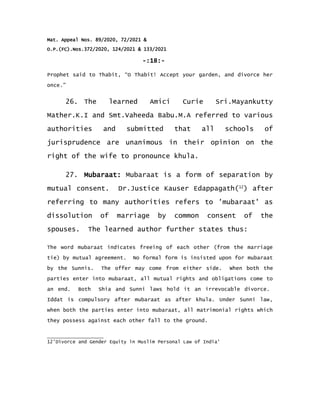
(FC).133/2021, THE COURT ON 09.04.2021 DELIVERED THE FOLLOWING:
IN THE HIGH COURT OF KERALA AT ERNAKULAM
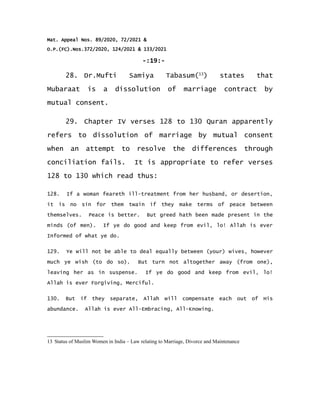
PRESENT
THE HONOURABLE MR. JUSTICE A.MUHAMED MUSTAQUE
&
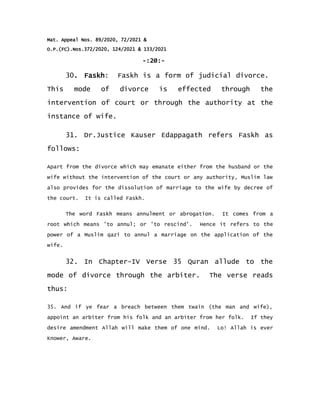
THE HONOURABLE MR.JUSTICE C.S.DIAS
FRIDAY, THE 09TH DAY OF APRIL 2021 / 19TH CHAITHRA, 1943
Mat.Appeal.No.72 OF 2021
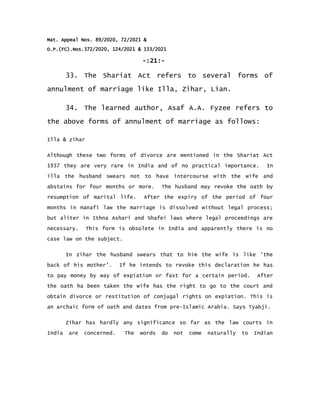
AGAINST THE ORDER/JUDGMENT IN OP.NO. 300/2019 DATED 24-12-2019
OF FAMILY COURT, KALPETTA
APPELLANT/S:
MUHAMMAD MUSTHAFA B.K @ BILAL MUSTHAFA,
AGED 41 YEARS, S/O.BADUVAN KUNHI HAJI,
BILAL MAHAL, ARIKKADIKUNNIL, KUMBALA P.O.,
KASARGODE DISTRICT, PIN - 671 321.
BY ADV. SMT.ATHIRA A.MENON
RESPONDENT/S:
HARSHA M.A.
AGED 30 YEARS
W/O.MUHAMMAD MUSTHAFA B.K. @ BILAL MUSTHAFA,
D/O.AHAMMED KABEER, POOKKANDI HOUSE, CHENDAKKUNI,
MEENANGADI P.O., PURAKKADI VILLAGE, VYTHIRI TALUK,
WAYANAD DISTRICT - 673 576.
R1 BY ADV. SMT.RESMI NANDANAN
THIS MATRIMONIAL APPEAL HAVING BEEN FINALLY HEARD ON 17.03.2021,
Mat.Appeal.89/2020, OP (FC).372/2020, OP (FC).124/2021, OP
(FC).133/2021, THE COURT ON 09.04.2021 DELIVERED THE FOLLOWING:
IN THE HIGH COURT OF KERALA AT ERNAKULAM
PRESENT
THE HONOURABLE MR. JUSTICE A.MUHAMED MUSTAQUE
&
THE HONOURABLE MR.JUSTICE C.S.DIAS
FRIDAY, THE 09TH DAY OF APRIL 2021 / 19TH CHAITHRA, 1943
OP (FC).No.372 OF 2020
AGAINST THE ORDER/JUDGMENT IN O.P.NO.286/2020 OF FAMILY COURT,
MALAPPURAM
PETITIONER/S:
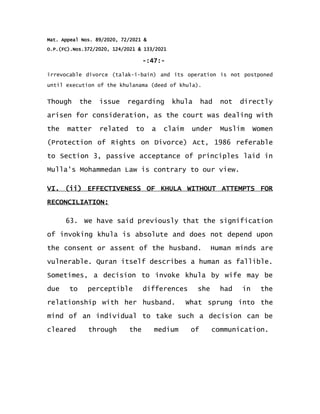
FARHANA, AGED 27 YEARS,
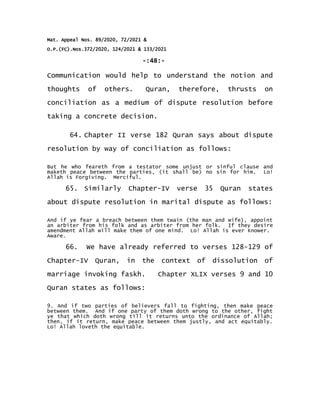
D/O.MANSOOR, PUTHIYEDATHU HOUSE,
VAZHAKKADU P.O., MALAPPURAM-673 640.
BY ADV. SRI.R.RANJITH (MANJERI)
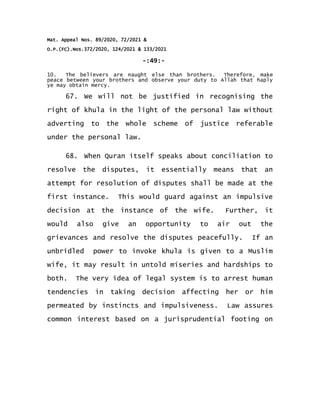
RESPONDENT/S:
NOUFAL.P.P., AGED 34 YEARS,
S/O.MUHAMMED, PUDUKAYIL PUTHIYA MALIKEKKAL HOUSE,
KATTACHIRA ROAD, B.P ANGADI, THIRUR TALUK,
MALAPPURAM DISTRICT-676 102.
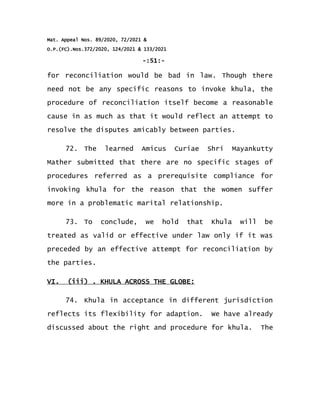
THIS OP (FAMILY COURT) HAVING BEEN FINALLY HEARD ON 17.03.2021,
ALONG WITH Mat.Appeal.89/2020, Mat.Appeal.72/2021, OP
(FC).124/2021, OP (FC).133/2021, THE COURT ON 09.04.2021
DELIVERED THE FOLLOWING:
IN THE HIGH COURT OF KERALA AT ERNAKULAM
PRESENT
THE HONOURABLE MR. JUSTICE A.MUHAMED MUSTAQUE
&
THE HONOURABLE MR.JUSTICE C.S.DIAS
FRIDAY, THE 09TH DAY OF APRIL 2021 / 19TH CHAITHRA, 1943
OP (FC).No.124 OF 2021
AGAINST THE ORDER DATED 23.12.2020 REJECTING THE ORIGINAL
PETITION BY THE FAMILY COURT, ERNAKULAM IN UNNUMBERED O.P. FOR
DIVORCE BY MUTUAL CONSENT
------
PETITIONER/S:
RASEENA PAREEKUNJU,
AGED 29 YEARS, D/O. P. I. PAREEKUNJU,
PULIMOOTTIL HOUSE, KUMARAPURAM, PALLIKKARA,
ERNAKULAM DISTRICT.
BY ADV. SMT.V.K.HEMA
RESPONDENT/S:
MUHAMMED ASIF, AGED 33 YEARS,
S/O. A. K. HUSSAIN, MUKRIYAKATHU HOUSE,
VADANAPPILLI P.O., THRISSUR DISTRICT.
BY ADV. SMT.P.YEMUNA
THIS OP (FAMILY COURT) HAVING BEEN FINALLY HEARD ON 17.03.2021,
Mat.Appeal.72/2021, MAT.APPEAL 89/2020, OP (FC).372/2020, OP
(FC).133/2021, THE COURT ON 09.04.2021 DELIVERED THE FOLLOWING:
IN THE HIGH COURT OF KERALA AT ERNAKULAM
PRESENT
THE HONOURABLE MR. JUSTICE A.MUHAMED MUSTAQUE
&
THE HONOURABLE MR.JUSTICE C.S.DIAS
FRIDAY, THE 09TH DAY OF APRIL 2021 / 19TH CHAITHRA, 1943
OP (FC).No.133 OF 2021
PETITIONER/S:
RASEENA PAREEKUNJU,
AGED 29 YEARS,
D/O. P.I.PAREEKUNJU, PULIMOOTTIL HOUSE,
KUMARAPURAM, PALLIKKARA, ERNAKULAM DISTRICT.
BY ADV. SMT.V.K.HEMA
RESPONDENT/S:
MUHAMMED ASIF, AGED 33 YEARS
S/O. A.K.HUSSAIN, MUKRIYAKATHU HOUSE,
VADANAPPILLI P.O., THRISSUR DISTRICT,
PIN-680614.
R1 BY ADV. SMT.P.YEMUNA
THIS OP (FAMILY COURT) HAVING BEEN FINALLY HEARD ON 17.03.2021,
Mat.Appeal.72/2021, MAT.APPEAL 89/2020, OP (FC).372/2020, OP
(FC).124/2021, THE COURT ON 09.04.2021 DELIVERED THE FOLLOWING:
-:1:-
A.MUHAMED MUSTAQUE & C.S.DIAS, JJ.
-------------------------------------- “CR”
Mat. Appeal Nos. 89/2020, 72/2021
&
O.P.(FC).Nos.372/2020, 124/2021 & 133/2021
--------------------------------------
Dated this the 9th day of April, 2021
J U D G M E N T
A.Muhamed Mustaque, J.
INTRODUCTION: Have Muslim women lost their right to
invoke extra-judicial divorce, after the coming into
force of the Dissolution of Muslim Marriages Act, 1939
is the short and straight forward question rising for
consideration in these cases.
2. These bunch of cases arise out of different
proceedings before the Family Courts seeking varied
reliefs. The issue involved in as above is
inextricably connected to ultimate justice which women
involved in all these cases seek. These cases speak in
abundance about the patriarchal mind-set followed in
Mat. Appeal Nos. 89/2020, 72/2021 &
O.P.(FC).Nos.372/2020, 124/2021 & 133/2021
-:2:-
the Society for decades depriving Muslim women their
right to invoke extra-judicial divorce. While there
was a huge clamour to retain the practice of ‘triple
talaq’, an un-Islamic practice; no such open and
apparent demand seems to exist to restore the right of
Muslim women to invoke extra-judicial divorce. The
above sketch the miseries of women despite the promise
guaranteed under Article 14 of the Constitution of
India.
3. Islam lays great emphasis on the stability of
family. According to the Holy Quran(1
) “God did create
you from dust” then from sperm drop, then he made you
in pairs [Surah (Chapter) XXXV Verse 11]. God's
declaration that men and women are created in pairs is
repeatedly stated in several verses to acknowledge the
spirit of marriage. They are made as a mate to find
comfort and purify their inner soul. It is also stated
that male and female together make a single self, which
1 In the judgment, translation of Quaranic verses are from The Meaning of The Glorious Qur'an – An
explanatory translation by Marmaduke Pickthall
Mat. Appeal Nos. 89/2020, 72/2021 &
O.P.(FC).Nos.372/2020, 124/2021 & 133/2021
-:3:-
symbolises raiment. Chapter II Verse 187 Quran states:
‘you are raiment for her and she is raiment for you’,
which highlights the closeness of a mate, like cloth;
for protection and comfort etc. The spirit of marriage
lies in the closeness and bonding between the partners.
4. Chapter IV Verse 28 Quran states that man was
created weak, to mean that his decisions are
vulnerable. The very concept of institutionalizing
marriage in Islam through a contract is to remind that
the parties to the marriage may error in their decision
and they may fall apart in conflict to remain as
united. Marriage as a contract guarantees both parties
permanent rights and obligations. The Holy Quran,
therefore, recognizes the right to divorce equally for
both men and women. However, the dilemma of Muslim
women, particularly in the State of Kerala, came into
the fore when a learned Single Judge of this Court in
K.C.Moyin v. Nafeesa & Others [1972 KLT 785] negated
the right of Muslim women to invoke extra-judicial
divorce in light of the Dissolution of Muslim Marriages
Mat. Appeal Nos. 89/2020, 72/2021 &
O.P.(FC).Nos.372/2020, 124/2021 & 133/2021
-:4:-
Act, 1939, (in short ‘Act”). It is held that under no
circumstances, a muslim marriage cannot be dissolved
at the instance of wife, except in accordance with the
provisions of the Act.
5. Muslim Personal Law is broadly understood as
Shariah. The word Shariah literally means “a way to
the watering place, or a path apparently to seek
felicity and salvation2
. In Chapter XLV Verse 18 Quran
says: “Thus we put you on the right way of religion.
So follow it and follow not the whimsical desire of
those who have no knowledge”. Shariah primarily and
predominantly relates to ethical values essential for
both worlds. Quran by itself did not promote straight
forward code of law. Many legal rules become part of
Shariah from the life and sayings of the last Prophet
Muhammad (This is called Hadith). After the demise of
the Prophet, Islamic scholars and jurists developed
Rules through legal reasoning (Ijtihad) and using legal
verdict (Fatwa). This is how principles of Islamic
2 Shari'ah Law: An introduction: Mohammad Hashim Kamali:
Mat. Appeal Nos. 89/2020, 72/2021 &
O.P.(FC).Nos.372/2020, 124/2021 & 133/2021
-:5:-
jurisprudence called 'Fiqh' developed. Fiqh is the
corpus of legal principles deducted from the Holy Quran
for implementing Shariah3
. The Holy Quran is neither a
legal document nor a code of law. Most of the ideas in
Holy Quran are interpreted through sayings and the life
of the Prophet. This gave rise for the formation of
different schools of jurisprudence. There are many
scholars of jurisprudence. The four prominent schools
of thought of Sunni Muslim are Hanafi, Maliki, Shafei
and Hanbali. They developed jurisprudence not to
create a separate denomination, but based on knowledge
or enquiry they made. These scholars themselves
declared that if any of their statement contradicts the
Book of Allah, and life of Prophet, then discard their
statement4
.
6. Shariah in general is flexible, especially
related to those matters giving guidance to temporal
affairs of human being. The learned author, Mohammad
3 For more reading on Fiqh, refer outlines of Mohammedan Law by Asaf A.A.Fyzee
4 Refer the Islamic digest of Aquedah and Fiqh by Mahmoud Rida Murad
Mat. Appeal Nos. 89/2020, 72/2021 &
O.P.(FC).Nos.372/2020, 124/2021 & 133/2021
-:6:-
Hashim Kamali in Shariah law, quoted great jurist Ibn
Qayyim al-Jawziyyah, who opined that Shariah are of two
kinds: Firstly, laws which do not change with the
vicissitudes of time and place or the propensities of
Ijtihad. These are matters related to obligatoriness
and matters prescribed as illegal. The matters like
belief, principles of morality etc., falls under the
above category. In second type, the learned jurist
states that such varieties of law are susceptible to
change in accordance with requirements of public
interest and prevailing circumstances such as quantum
and types of punishments. Though, the Holy Quran gives
a clear guidance as to the areas of family law, it does
not by itself constitute a system. While conferring
rights on spouses for divorce, it did not lay down
exhaustive procedure to give effect to dissolution of
marriage. This approach clearly gives an indication
that areas related to divorce are amenable to change
with regard to procedure and process without prejudice
Mat. Appeal Nos. 89/2020, 72/2021 &
O.P.(FC).Nos.372/2020, 124/2021 & 133/2021
-:7:-
to the right conferred on a spouse to separate or
severe the marital knot.
7. We have drawn the above prologue to underscore
the fact that there is a growing tendency to resist
changes being effected upon the Muslim community with
regard to the method and manner of effecting divorce
consistent with the Quranic injunctions. This dilemma
in our country is as old as the Dissolution of Marriage
Act, 1939. The question involved in these cases also
has to be probed on the anvil of the personal law
protected under the statute, 'The Muslim Personal Law
(Shariat) Application Act, 1937'.
8. Considering the substantial questions of law
involved in the matter, we requested Sri.Mayankutty
Mather.K.I and Smt.Vaheeda Babu.M.A to assist the Court
as Amici Curiae. The Kerala Federation of Women Lawyers
through Smt.Shajna.M sought permission to address us,
which we permitted. We also heard the learned counsel
for the parties Sri.Babu Karukapadath, Sri.R.Ranjith
Mat. Appeal Nos. 89/2020, 72/2021 &
O.P.(FC).Nos.372/2020, 124/2021 & 133/2021
-:8:-
Manjeri, Sri.Narayanan.P, Smt.V.K.Hema and Smt.Athira
A.Menon. All the counsel were unanimous regarding the
right of the Muslim women to terminate their marriage
resorting to extra-judicial mode. Nevertheless, the
lawyers had their own views as regards the practice and
procedures to be followed, which we shall advert to at
appropriate stage.
II. FACTS:
9. These cases have been brought to this level in
light of Mat.A.No.89 of 2020, wherein a young woman,
hereinafter referred to as ‘Y’ (name withheld to
protect her privacy) was granted a decree of divorce by
the Family Court, Thalassery. ‘Y’ had instituted the
petition under the Act, on the grounds that her husband
‘X’, was impotent and treated her with cruelty.
‒
Challenging, the decree ‘X’ has preferred the appeal.
10. When the appeal came up for consideration, we
directed the parties to appear in person. ‘Y’ stood
Mat. Appeal Nos. 89/2020, 72/2021 &
O.P.(FC).Nos.372/2020, 124/2021 & 133/2021
-:9:-
firm in her decision to dissolve her marriage with ‘X’.
On the other hand, ‘X’ stated that he is prepared to
subject himself to a potency test to prove the falsity
in ‘Y’ case.
11. Sri.Narayanan.P, the learned Counsel for ‘Y’
contended that it is because of the decision in
K.C.Moyin (supra), ‘Y’ has been made to go through the
ordeal of a long drawn adversarial litigation and is
being prevented to invoke her right for extra-judicial
divorce vis-a-vis Khula, as permitted and recognised
under the personal law. Hence, K.C.Moyin (supra)
requires reconsideration. He also submitted that ‘Y’
may be granted leave to pronounce Khula, so that her
miseries may not get prolonged. If Khula is accepted as
valid, ‘Y’ has no objection in setting aside the
impugned decree on fault grounds and the appeal can be
disposed recording Khula.
12. Accordingly, without prejudice to the rights
of the parties, we granted leave. ‘Y’ pronounced Khula
Mat. Appeal Nos. 89/2020, 72/2021 &
O.P.(FC).Nos.372/2020, 124/2021 & 133/2021
-:10:-
and produced the same as additional evidence in the
appeal, which was accepted on board.
13. Again when the appeal was taken up for
hearing, on 03/03.2021, ‘Y’ stated that she was
prepared to return the dower to ‘X’. However, on
17/03/2021, Sri.Babu Karukapadath submitted that ‘X’
had declined to accept the dower. Be that as it may, we
will discuss about the validity of Khula invoked by ‘Y’
at a later stage.
14. In Mat.A.No.72/2021, Muhammad Musthafa B.K.
challenges the decree of the Family Court Kalpetta in
O.P.No.300/2019. While the above matter was pending,
the parties were referred for mediation. In the
mediation proceeding, Muhammad Musthafa B.K. agreed to
divorce his wife Harsha M.A.
‒ The Family Court based
on the mediation agreement, granted a decree of divorce
on mutual consent. This decree is challenged on the
ground of lack of consent on the part of Muhammad
Musthafa B.K. The validity of divorce granted by the
Mat. Appeal Nos. 89/2020, 72/2021 &
O.P.(FC).Nos.372/2020, 124/2021 & 133/2021
-:11:-
Family Court on mutual consent of the parties under
Islamic law is also questioned.
15. O.P.No.372/2020 is filed by Farhana, the
petitioner before the Family Court, Malappuram, seeking
dissolution of her marriage with her husband Noufal P.P
under the Act. She seeks for an expeditious disposal of
her case. Her counsel submitted that Farhana may be
granted the liberty to invoke extra-judicial divorce
available to a Muslim wife.
16. O.P.Nos.124 and 133 of 2021 are filed by
Raseena Pareekunju challenging the proceedings of the
Family Court, Ernakulam against returning joint
petitions filed with her husband-Mohammed Asif for
dissolution of their marriage by mutual consent and to
declare that their marriage stands dissolved as per
their personal law. According to them, their marriage
has been dissolved by mutual consent invoking Mubaraat,
an extra-judicial form of joint divorce, applicable to
Muslim husband and wife. The Family Court refused to
Mat. Appeal Nos. 89/2020, 72/2021 &
O.P.(FC).Nos.372/2020, 124/2021 & 133/2021
-:12:-
accept their petitions stating that there is no
substantial law to entertain such petitions.
III. DIFFERENT FORMS OF DIVORCE AT THE INSTANCE OF WIFE
UNDER ISLAMIC LAW:
17. Before considering the question on the
legality of wife’s right to pronounce extra-judicial
divorce, we shall advert to various forms of divorce
recognised under Islamic law and Muslim Personal Law
(Shariat) Application Act, 1937 (hereinafter referred
to as the 'Shariat Act 1937') in British India.
18. As seen from the Shariat Act extra-judicial
divorce was in vogue and recognized as legally valid in
British India. Section 2 of the Shariat Act statutorily
recognized the personal law and dissolution of
marriages without intervention of court through talaq,
illa, zihar, lian, khula, and mubaraat etc; There are
four major forms of dissolution of marriages as
recognized under Islamic Law and protected under the
Shariat Act at the instance of the wife, they are ;
Mat. Appeal Nos. 89/2020, 72/2021 &
O.P.(FC).Nos.372/2020, 124/2021 & 133/2021
-:13:-
i. Talaq-e-tafwiz
ii. Khula
iii. Mubara'at
iv. Faskh
19. Talaq-e-tafwiz: This kind of divorce at the
instance of wife is based on a contract. In the
contract, the party can agree the terms upon which
marital life has to be regulated. Dr.Justice Kauser
Edappagath(5
) has stated that if the husband violates
the agreement, the wife is entitled to divorce without
intervention of the Court. Dr.Mufti Samiya Tabasum(6
)
also explains divorce on the same lines. The learned
authors state that the above right can be exercised if
the husband marries another woman without her consent
or neglects or deserts her in violation of the marriage
conditions. Asaf A.A.Fyzee(7
) refers to the above form
5. a sitting Judge of this Court in his book 'Divorce and Gender Equity in
Muslim Personal Law of India', at page 109
6 'Status of Muslim Women in India – Law Relating to Marriage, Divorce and Maintenance at page 164
7 “Outlines of Muhammadan Law” by Asaf A.A.Fyzee (5th
Edn.) edited and revised by Tahir Mahmood at
page 125
Mat. Appeal Nos. 89/2020, 72/2021 &
O.P.(FC).Nos.372/2020, 124/2021 & 133/2021
-:14:-
of divorce as a delegated divorce. According to the
learned author, a stipulation in the contract that on
certain specific conditions the wife can pronounce
divorce is valid, provided that the option is not
absolute and unconditional and the conditions are
reasonable and not opposed to public policy. The
essence of this form of divorce is that the husband
authorizes the wife to divorce him in the event of
breach of any of the conditions agreed at the time of
marriage.
20. Khula: Khula is the form of divorce conferred
upon wife similar to talaq conferred upon the husband.
The recognition of Khula as a form of divorce is
directly available from the Holy Quran. In Chapter II
Verses 228-229, Quran confers rights on both husband
and wife to unilaterally divorce the spouse. It is
apposite to refer to verses 228-229:
C.II V.228: Women who are divorced shall wait, keeping themselves
apart, three (monthly) courses. And it is not lawful for them that
they should conceal that which Allah hath created in their wombs if
Mat. Appeal Nos. 89/2020, 72/2021 &
O.P.(FC).Nos.372/2020, 124/2021 & 133/2021
-:15:-
they are believers in Allah and the Last Day. And their husbands would
do better to take them back in that case if they desire a
reconciliation. And they (Women) have rights similar to those (of men)
over them in kindness, and men are a degree above them. Allah is
Mighty, Wise.
C.II.V229. Divorce must be pronounced twice and then (a woman)
must be retained in honour or released in kindness. And it is not
lawful for you that ye take from women aught of that which ye have
given them; except (in the case) when both fear that they may not be
able to keep within the limits (imposed by) Allah. And if ye fear that
they may not be able to keep the limits of Allah, in that case it is no
sin for either of them if the woman ransom herself. These are the
limits (imposed by) Allah. Transgress them not. For whoso
transgresseth Allah's limits: such are wrongdoers.
21. There are differences in opinion with regard
to the manner in which khula has to be effected. Some
of the authorities state that the consent of the
husband is a pre-requisite for a valid khula. This
aspect, we shall advert to in the later part of the
judgment.
22. Dr.Justice Kauser Edappagath in his book(8
)
refers to wife’s right to resort to 'khula' as an
8'Divorce and Gender Equity in Muslim Personal Law of India'
Mat. Appeal Nos. 89/2020, 72/2021 &
O.P.(FC).Nos.372/2020, 124/2021 & 133/2021
-:16:-
analogous right of the husband to pronounce Talaq, on
being convinced of irretrievable breakdown of marriage.
The learned author states that ‘khula’ is a divorce at
the instance of wife in which she agrees to give a
consideration to her husband for her release from the
marriage tie.
23. Mahmoud Rida Murad in his book(9
) refers to
'khula' as an instant divorcement by which wife redeems
herself from the marriage for a ransom or a
compensation given to the husband. The learned author
further states thus:
The khula' is permissible whether the wife is in her menstrual period,
or not. It is permissible for the husband to remarry the wife whom he
divorced by khula', with her consent after entering a new contract with
new dower.
24. Wael B.Hallaq in his book(10
) refers to khula:
Another form of marital dissolution, apparently more widespread than
talaq is khula. “If a woman dislikes her husband due to his ugly
9'The Islamic Digest of Aqeedah and Fiqh' published by Islamic Cultural Center,
Dammam, Kingdom of Saudi Arabia
10 Sharia Theory Practice Transformations at page 283-284
Mat. Appeal Nos. 89/2020, 72/2021 &
O.P.(FC).Nos.372/2020, 124/2021 & 133/2021
-:17:-
appearance or as a result of discord between the two, and she fears
failure to fulfil her (marital) duties toward him, she may rid herself
of him for consideration. But even though she may not dislike anything
(about him), and they amicably agree to separate (through khula)
without a reason, it is also permissible.” Yet, despite this legal
permissibility, the jurists are unanimous in their view that it is
morally reprehensible to dissolve a marriage for no compelling reason.
Thus, khula is classified by many jurists into three types: permissible
(arising out of discord), reprehensible (without a compelling cause)
and forbidden. The forbidden type is one that arose out of a situation
where a husband deliberately oppressed his wife with a view to
accomplishing dissolution of the marriage through khula and still be
compensated for it. If such an ambition is proven in a court of law,
the dissolution would still took effect, but the husband's compensation
would be forfeit.
25. Dr.Muhammad Muhsin Khan, Islamic University,
in his book(11
)quotes Hadith in Chapter 5 as follows:
1878. Narrated Ibn “Abbas: The wife of Thabit bin Qais came to the
Prophet and said, “O Allah's Messenger! I do not blame Thabit for
defects in his character of his religion, but I, being a Muslim,
dislike to behave in an un-Islamic manner (if I remain with him).” On
that Allah's Messenger said (to her), “Will you give back the garden
which your husband has given you (as Mahr)?” She said, “Yes.” Then the
11 Summarised Sahih Al-Bukhari – 61 The Book of Divorce – Chapter 5.
Mat. Appeal Nos. 89/2020, 72/2021 &
O.P.(FC).Nos.372/2020, 124/2021 & 133/2021
-:18:-
Prophet said to Thabit, “O Thabit! Accept your garden, and divorce her
once.”
26. The learned Amici Curie Sri.Mayankutty
Mather.K.I and Smt.Vaheeda Babu.M.A referred to various
authorities and submitted that all schools of
jurisprudence are unanimous in their opinion on the
right of the wife to pronounce khula.
27. Mubaraat: Mubaraat is a form of separation by
mutual consent. Dr.Justice Kauser Edappagath(12
) after
referring to many authorities refers to 'mubaraat' as
dissolution of marriage by common consent of the
spouses. The learned author further states thus:
The word mubaraat indicates freeing of each other (from the marriage
tie) by mutual agreement. No formal form is insisted upon for mubaraat
by the Sunnis. The offer may come from either side. When both the
parties enter into mubaraat, all mutual rights and obligations come to
an end. Both Shia and Sunni laws hold it an irrevocable divorce.
Iddat is compulsory after mubaraat as after khula. Under Sunni law,
when both the parties enter into mubaraat, all matrimonial rights which
they possess against each other fall to the ground.
12'Divorce and Gender Equity in Muslim Personal Law of India'
Mat. Appeal Nos. 89/2020, 72/2021 &
O.P.(FC).Nos.372/2020, 124/2021 & 133/2021
-:19:-
28. Dr.Mufti Samiya Tabasum(13
) states that
Mubaraat is a dissolution of marriage contract by
mutual consent.
29. Chapter IV verses 128 to 130 Quran apparently
refers to dissolution of marriage by mutual consent
when an attempt to resolve the differences through
conciliation fails. It is appropriate to refer verses
128 to 130 which read thus:
128. If a woman feareth ill-treatment from her husband, or desertion,
it is no sin for them twain if they make terms of peace between
themselves. Peace is better. But greed hath been made present in the
minds (of men). If ye do good and keep from evil, lo! Allah is ever
Informed of what ye do.
129. Ye will not be able to deal equally between (your) wives, however
much ye wish (to do so). But turn not altogether away (from one),
leaving her as in suspense. If ye do good and keep from evil, lo!
Allah is ever Forgiving, Merciful.
130. But if they separate, Allah will compensate each out of His
abundance. Allah is ever All-Embracing, All-Knowing.
13 Status of Muslim Women in India – Law relating to Marriage, Divorce and Maintenance
Mat. Appeal Nos. 89/2020, 72/2021 &
O.P.(FC).Nos.372/2020, 124/2021 & 133/2021
-:20:-
30. Faskh: Faskh is a form of judicial divorce.
This mode of divorce is effected through the
intervention of court or through the authority at the
instance of wife.
31. Dr.Justice Kauser Edappagath refers Faskh as
follows:
Apart from the divorce which may emanate either from the husband or the
wife without the intervention of the court or any authority, Muslim law
also provides for the dissolution of marriage to the wife by decree of
the court. It is called Faskh.
The word Faskh means annulment or abrogation. It comes from a
root which means 'to annul; or 'to rescind'. Hence it refers to the
power of a Muslim qazi to annul a marriage on the application of the
wife.
32. In Chapter-IV Verse 35 Quran allude to the
mode of divorce through the arbiter. The verse reads
thus:
35. And if ye fear a breach between them twain (the man and wife),
appoint an arbiter from his folk and an arbiter from her folk. If they
desire amendment Allah will make them of one mind. Lo! Allah is ever
Knower, Aware.
Mat. Appeal Nos. 89/2020, 72/2021 &
O.P.(FC).Nos.372/2020, 124/2021 & 133/2021
-:21:-
33. The Shariat Act refers to several forms of
annulment of marriage like Illa, Zihar, Lian.
34. The learned author, Asaf A.A. Fyzee refers to
the above forms of annulment of marriage as follows:
Illa & zihar
Although these two forms of divorce are mentioned in the Shariat Act
1937 they are very rare in India and of no practical importance. In
illa the husband swears not to have intercourse with the wife and
abstains for four months or more. The husband may revoke the oath by
resumption of marital life. After the expiry of the period of four
months in Hanafi law the marriage is dissolved without legal process;
but aliter in Ithna Ashari and Shafei laws where legal proceedings are
necessary. This form is obsolete in India and apparently there is no
case law on the subject.
In zihar the husband swears that to him the wife is like 'the
back of his mother'. If he intends to revoke this declaration he has
to pay money by way of expiation or fast for a certain period. After
the oath ha been taken the wife has the right to go to the court and
obtain divorce or restitution of conjugal rights on expiation. This is
an archaic form of oath and dates from pre-Islamic Arabia. Says Tyabji.
Zihar has hardly any significance so far as the law courts in
India are concerned. The words do not come naturally to Indian
Mat. Appeal Nos. 89/2020, 72/2021 &
O.P.(FC).Nos.372/2020, 124/2021 & 133/2021
-:22:-
Muslims. A person wishing deliberately to give his wife a cause of
action for restitution of conjugal righs in India would probably adopt
an easier, more usual and better understood mode of doing so.
35. The learned author further refers to Lian as
follows:
The procedure of lian may be described briefly as follows. A husband
accuses his wife of adultery but is unable to prove the allegation.
The wife in such cases is entitled to file a suit for dissolution of
marriage. It is to be observed that a mere allegation or oath in the
form of an anathema does not dissolve the marriage. A qazi must
intervene – in the Indian law a regular suit has to be filed. At the
hearing of the suit the husband has two alternatives. He may formally
retract the charge; and if this is done at or before the commencement
of the hearing (but not after the close of the evidence or the end of
the trial), the wife is not entitled to a dissolution. If the husband
does not retract and persists in his attitude he is called upon to make
oaths. This was followed by similar oaths of innocence made by the
wife. The four oaths are tantamount to the evidence of four eye
witnesses required for the proof of adultery in Islam. After these
mutual imprecations the judge pronounces that the marriage is
dissolved.
36. It is to be noted that many modes of
dissolution of marriage existed prior to Islam which
Mat. Appeal Nos. 89/2020, 72/2021 &
O.P.(FC).Nos.372/2020, 124/2021 & 133/2021
-:23:-
were accepted by the Prophet with certain refinement
and modifications. The Prophet always had taken a
liberal view in the matter of divorce in the best
interest of the parties.
37. In the matter of Khula, we see that the
Prophet asked the wife to return the garden she
obtained from her husband. The pragmatic approach is
reflected in different Hadiths. Paramount consideration
in such a situation is whether annulment is for
reasonable cause or not and whether an attempt for
reconciliation has been made or not. The legal
implication of the Quranic precepts are pragmatically
aligned to ensure fairness in such form of a divorce.
IV. The legal conundrum that has resulted from K.C.
Moyin's case [1972 KLT 785]:
38. A learned Single Judge of this Court in
unequivocal terms declared that Muslim wife cannot
repudiate a marriage dehors the provisions of the
Dissolution of Muslim Marriages Act. The law laid down
Mat. Appeal Nos. 89/2020, 72/2021 &
O.P.(FC).Nos.372/2020, 124/2021 & 133/2021
-:24:-
as above was in a proceedings arising from a private
complaint filed by the husband against the wife and her
second husband and relatives. Wife and others were
prosecuted under Section 494 of the Indian Penal Code
for an offence of bigamy. The wife defended the
prosecution contending that she had repudiated the
marriage by Faskh. The learned Single Judge was of the
view that unilateral repudiation of marriage by Faskh
without the intervention of court under the Dissolution
of Muslim Marriages Act is opposed to the law of the
land. The learned Single Judge was of the view that
when a particular branch of law is codified, it is not
possible to travel beyond the same and decide the
rights of the parties. We need to examine the law
declared by the learned Judge after adverting to the
object of the scheme of the above enactment.
39. In the first place, we need to ascertain the
meaning and rationale of the law from the circumstances
under which the British Government enacted the
Dissolution of Muslim Marriages Act. As observed
Mat. Appeal Nos. 89/2020, 72/2021 &
O.P.(FC).Nos.372/2020, 124/2021 & 133/2021
-:25:-
earlier, there are followers of different schools of
jurisprudence. One of the leading schools in the
Country, who have large followers, is the follower of
the Hanafi school. The learned author, Dr.Mufti Samiya
Tabasum(14
) illustrates the reasons for the enactment,
stating that Hanafi wife found it difficult to dissolve
the marriage, as there was no provision for her to seek
divorce on the disappearance of the husband, his
imprisonment, neglect of his matrimonial obligation
etc., and this has forced her to get rid of undesired
marital bonds by renouncing her faith. It is
appropriate to refer the statement of objects and
reasons of the aforesaid enactment, which reads as
follows:
There is no provision in the Hanafi Code of Muslim Law
enabling a married Muslim Woman to obtain a decree from the
Court dissolving her marriage in case the husband neglects
to maintain her, makes her life miserable by deserting or
persistently maltreating her or absconds leaving her
14 Status of Muslim Women in India – Law Relating to Marriage, Divorce and Maintenance
Mat. Appeal Nos. 89/2020, 72/2021 &
O.P.(FC).Nos.372/2020, 124/2021 & 133/2021
-:26:-
unprovided for and under certain other circumstances. The
absence of such a provision has entailed unspeakable misery
to innumerable Muslim women in British India. The Hanafi
Jurists, however, have clearly laid down that in cases in
which the application of Hanafi Law causes hardship, it is
permissible to apply the provisions of the "Maliki,Shafi's
or Hambali Law". Acting on this principle the Ulemas have
issued fatwas to the effect that in cases enumerated in
clause 3, Part A of this Bill (now see Section 2 of the Act) a
married Muslim woman may obtain a decree dissolving her
marriage. A lucid exposition of this principle can be
found in the book called “Heelatum Najeza” published by
Maulana Ashraf Ali Sahib who has made an exhaustive study
of the provisions of Maliki law which under the
circumstances prevailing in India may be applied to such
cases. This has been approved by a large number of Ulemas
who have put their seals of approval on the book.
As the courts are sure to hesitate to apply the Maliki
Law to the case of a Muslim woman, legislation recognising
and enforcing the abovementioned principle is called for in
order to relieve the sufferings of countless Muslim women.
Mat. Appeal Nos. 89/2020, 72/2021 &
O.P.(FC).Nos.372/2020, 124/2021 & 133/2021
-:27:-
40. 'Is it the intention of the Legislature, to do
away with extra-judicial divorce otherwise followed by
the followers of different schools?', is the question
to be answered in this case.
V. READING THE DISSOLUTION OF MUSLIM MARRIAGES Act:
41. Shariat Act recognized extra-judicial divorce
as well as judicial divorce. The Shariat Act was
enacted in an attempt to get rid of customary law that
was followed by the Muslims in India. It was observed
in the statement and objects and reasons of the Shariat
Act that the status of Muslim women under the so called
customary law is simple and graceful. The customary law
appears to have affected the rights of Muslim women.
Therefore, it was felt, introduction of Muslim personal
law will automatically bring them to the position to
which they are naturally entitled. Section 2 of the
Shariat Act specifically recognized all modes of
extra-judicial divorce except Faskh. Faskh, as we
noted earlier, is a mode of divorce with the
Mat. Appeal Nos. 89/2020, 72/2021 &
O.P.(FC).Nos.372/2020, 124/2021 & 133/2021
-:28:-
intervention of an authority like Qazi. In Section 5
of the Shariat Act a provision was made to dissolve
marriage by the District Judge on a petition made by
Muslim married women. This would show that the
intention of the Shariat Act is to entrust the mode of
dissolution of marriage by Faskh through the court.
Thus, under the Shariat Act, a Muslim women retained
the right of all modes of extra-judicial divorce
recognized under their personal law Shariat, except
Faskh. Then came the Dissolution of Muslim Marriages
Act. It appears that inspite of Shariat Act, women
belonging to the Hanafi School of Law were not allowed
to obtain decree from the court to dissolve their
marriage. Dissolution of Muslim Marriages Act,
therefore, was enacted to consolidate and clarify the
provisions of the Muslim law relating to the suit for
dissolution of marriage by married Muslim women.
Recitals prelude to the above enactment refers twin
reasons for bringing the legislation of the Dissolution
of Muslim Marriages Act. One to consolidate and
Mat. Appeal Nos. 89/2020, 72/2021 &
O.P.(FC).Nos.372/2020, 124/2021 & 133/2021
-:29:-
clarify the law relating to dissolution of marriage by
Muslim women; the other is to remove the doubt in
regard to the effect of renunciation of Islam by a
married Muslim woman. Consequent to the enactment of
Dissolution of Muslim Marriages Act, Section 5 of the
Shariat Act was repealed. This fortifies the legal
position that, what is consolidated in Dissolution of
Muslim Marriages Act is the law relating to Faskh
alone. The learned counsel Shri Narayanan P. as well
as Smt.Shajna M., rightly pointed out that the
intention of the Dissolution of Muslim Marriages Act is
to extend judicial divorce to all Muslim women
irrespective of the schools they follow. The statutory
provision never intended to do away with the practice
of extra-judicial divorce otherwise available to a
Muslim woman. We also note that reference of other
modes of extra-judicial divorce as referred in Section
2 of the Shariat Act remain untouched in the
Dissolution of Muslim Marriages Act.
Mat. Appeal Nos. 89/2020, 72/2021 &
O.P.(FC).Nos.372/2020, 124/2021 & 133/2021
-:30:-
42. Consolidation of law of Faskh in the
Dissolution of Muslim Marriages Act enumerates the
grounds on which a married muslim woman would be
entitled to divorce. These grounds are illustrative in
nature and, not exhaustive. The specific grounds are
referred in Section 2(i) to 2(viii) of the Act. After
illustrating the grounds of divorce under Sections 2(i)
to 2(viii), a residuary clause is provided under
Section 2(ix) to secure divorce on any ground which is
recognized as valid for the dissolution of marriage
under Muslim law. This has caused some amount of
confusion among scholars, litigant public etc.
Therefore, it is necessary to elucidate the difference
between 'forms of divorce' and 'grounds of divorce'.
The 'forms of divorce' are in the nature of right
conferred on Muslim women to annul their marriage.
Each of the forms have distinct character and
identity. In the form of talaq, khula etc, it
proceeds from the unilateral will of the party, and in
the matter of Mubaraat and Talaq-e-tafwiz the
Mat. Appeal Nos. 89/2020, 72/2021 &
O.P.(FC).Nos.372/2020, 124/2021 & 133/2021
-:31:-
bilateral consent of the couple. On the other hand, in
Faskh, the parties have no role. It is the authority
that decides the fate of the marriage. It is to
impress upon the authority to grant a decree of
divorce, illustrations of the grounds of divorce have
been referred in Section 2 of the Dissolution of Muslim
Marriages Act. Thus, all the grounds including
residuary grounds under Section 2(ix) are required only
for the authority to act upon such matters. Once this
distinction is drawn, it is easy to understand, the
scope and merit of the Dissolution of Muslim Marriages
Act. What was introduced in Dissolution of Muslim
Marriages Act is the same provision conferring right on
the Muslim women under Section 5 of the Shariat Act in
a broader and larger frame encapsulating Faskh with
all its essential elements for the independent
authority to decide.
Mat. Appeal Nos. 89/2020, 72/2021 &
O.P.(FC).Nos.372/2020, 124/2021 & 133/2021
-:32:-
43. The renowned Islamic Law Scholar, Tahir
Mahmood(15
) refers the background of the Dissolution of
Muslim Marriages Act as follows:
Under Muslim law a kazi or court can dissolve the marriage of a woman
on her complaint based on the grounds specified in the Muslim legal
treatises. This is known as faskh-e-nikah [dissolution of marriage].
The various schools of Muslim law differ in regard to its grounds and
procedure .. the most restrictive among them being the Hanafi school to
which a dominant majority of Muslims in this part of the world belong.
In India, as per the judicial practice settled by a Privy Council
decision the courts are however bound to apply in every disputed case
among the Muslims the school of law to which the parties belong. Due
to this judge-made rule the courts cannot apply in any case any of the
other schools of law which are relatively liberal in allowing judicial
divorce at the behest of a wife. Muslim wives desirous of getting rid
of their marriages were thus practically without a remedy until 1939.
The learned author further refers to the “impact on
rights to private divorce” as follows:
The title adopted for the Act was an inaccurate English translation of
the caption of the Kazmi Bill in Urdu – Qanoon-e-Faskh-e-Nikah [law for
judicial divorce]. In Muslim law “faskh” is only one part of the law
of divorce and means termination of marriage by a court on wife's
15 Muslim Law in India and Abroad (Second Edition)
Mat. Appeal Nos. 89/2020, 72/2021 &
O.P.(FC).Nos.372/2020, 124/2021 & 133/2021
-:33:-
request on any ground recognised by Muslim law. It is entirely
different from khula [divorce by husband in wife's demand] and talaq-e-
tafwiz [divorce by wife's own action in terms of her marrige contract],
both of which are different from faskh. The Act was not meant to
abolish those rights of married women and restrict the Muslim law on
their divorce rights to faskh [divorce through court] only.
In a number of cases the courts have rightly explained the aims and
scope of the Act of 1939 in these terms:
(i) the Act is a piece of declaratory legislation and does
not amend all the rules of Muslim law;
(ii) the object of the Act is to ameliorate the lot of
Muslim wives and enlarge their rights, which object must be
given effect by the courts;
(iii) the Act crystallizes only a portion of Muslim law and
should, therefore, be applied in conjunction with the
provisions of the whole of Muslim law.
Fazal Begum v. Hakim Ali AIR 1941 Lah 22; Sofia Begum v.
Syed Zaheer Hasan Rizvi AIR 1947 All 16; Jamila Khatun v.
Kasim Ali AIR 1951 Nag. 375
The confusion that the 1939 Act deprives Muslim women of their right to
get the marriage terminated without the intervention of the court was
created by Clause (ix) of Section 2 of the Act which says that the
court can dissolve a woman's marriage, besides the grounds mentioned in
Mat. Appeal Nos. 89/2020, 72/2021 &
O.P.(FC).Nos.372/2020, 124/2021 & 133/2021
-:34:-
that Section, also “on any other ground recognized as valid for
“dissolution of marriages under Muslim law.” Here again the words
“dissolution of marriage” is an inaccurate translation of the word
faskh [judicial divorce]. These words cannot be interpreted to mean
that the Act was to abolish Muslim women's rights to khula and talaq-e-
tafwiz.
Justice V.Khalid of the Kerala High Court [later elevated to Supreme
Court] once observed that a Muslim woman cannot now get her marriage
dissolved de hors the provisions of this Act “except perhaps in the
case of a talaq-e-tafwiz” – K.C.Moyin v. Nafeesa AIR 1973 Ker 176.
44. A learned single Judge of Allahabad High Court
in Mt.Sofia Begam v. Syed Zaheer Hazzm Rizvi AIR 1947
All 16 referred Dissolution of Muslim Marriages Act as
a distinct endeavour made by the Legislature to
ameliorate the suffering wife.
45. A learned single Judge of Nagpur Bench of the
High Court of Bombay in Jamila Khatun v. Kasim Ali
Abbas Ali [AIR 1951 Nagpur 375] placed reliance on the
Division Bench judgment of the Chief Court of Sind
reported in A.I.R (37) 1950 Sind 8 [Noor Bibi v. Pir
Bux] to hold that Dissolution of Muslim Marriages Act
Mat. Appeal Nos. 89/2020, 72/2021 &
O.P.(FC).Nos.372/2020, 124/2021 & 133/2021
-:35:-
crystalises only a portion of Muslim law and it must be
read in conjunction with whole of the muslim law as it
stands.
46. On an overall analysis of the scheme of the
Shariat Act as well as the Dissolution of Muslim
Marriages Act as above, we are of the considered view
that the Dissolution of Muslim Marriages Act restrict
Muslim women to annul their marriage invoking Faskh
except through the intervention of the Court. All
other forms of extra-judicial divorce as referred in
Section 2 of the Shariat Act are thus available to a
Muslim women. We, therefore, hold that the law
declared in K.C.Moyin's case (supra) is not good law.
VI.(i) KHULA, ITS VALIDITY:
47. The right to invoke khula conferred upon a
married Muslim women is an absolute right; akin to
talaq conferred upon the married Muslim men. In the
matter of other modes of divorce at the instance of
wife, a clear procedure is available to hold its
Mat. Appeal Nos. 89/2020, 72/2021 &
O.P.(FC).Nos.372/2020, 124/2021 & 133/2021
-:36:-
validity. In the matter of khula, there are
differences of opinion in regard to procedures, methods
etc. In the leading case i.e. Mat.A.No.89 of 2020,
consolidated in this judgment, one of the issues is the
validity of khula invoked by 'Y'. 'X' refused to
receive the dower offered by her. The learned Amicus
Curiae Shri Mayankutty Mather submitted that a wife
should have some genuine reason for seeking divorce
from her husband. It is further submitted that like
talaq, there are no specific stages or procedures to be
complied by the wife before seeking divorce invoking
khula. According to the learned Amicus Curiae, the
scholars state that it is the husband who should
divorce his wife when it was sought by the wife
invoking her right of khula. It is also submitted that
the husband cannot refuse to accede to the request of
the wife. The learned Amicus Curiae Smt.Vaheeda Babu
referring to a malayalam authority Islam, Vol 3,
submitted that khula is a form of talaq at the instance
of the wife against the husband; and the husband is
Mat. Appeal Nos. 89/2020, 72/2021 &
O.P.(FC).Nos.372/2020, 124/2021 & 133/2021
-:37:-
entitled to demand from the wife what was given by him
to her. In Quran, in unequivocal terms, the right of
wife to invoke khula is declared in absolute terms
without any fixed conditions. However, the Prophet in a
pragamatic approach directed the wife to return what
she obtained from her husband. Interpretation of the
Quranic precepts resulted in understanding the khula
in different ways. As a result of this, khula and
mubaraat are often misunderstood as the same. A
Division Bench of this Court in Binu P.A. v. Ashla N.A.
[ILR 2017 (2) Kerala 466] declared that the Family
Court can grant divorce on the basis of the agreement
executed between the parties, referring khula and
mubaraat as a divorce based on mutual consent. A
learned Single Judge of this Court in Mohammed v.
Sainaba Umma [1987 (1) KLT 712] recognized khula as a
ground of divorce as referable under Section 2 of the
Dissolution of Muslim Marriages Act. This judicial
declaration also added to the confusion to understand
khula as a ground of divorce.
Mat. Appeal Nos. 89/2020, 72/2021 &
O.P.(FC).Nos.372/2020, 124/2021 & 133/2021
-:38:-
The learned author Dr.Mufti Samiya Tabasum(16
) refers
to the formalities of khula as follows:
There is an offer by the wife to release her from the matrimonial tie.
The offer is made to the husband. The offer for Khula must also be
accepted, the divorce is not complete and it may be revoked by the
wife. But once the offer has been accepted, the divorce is complete
and becomes irrevocable. Offer and acceptance may either be oral or in
writing. The offer and acceptance must be made at one sitting, i.e. at
one place of meeting.
Under Sunni law the presence of witnesses is not necessary. But under
Shia law, the offer and acceptance of Khula must be made in the
presence of two competent witnesses. Further, under Shia law the Khula
is revocable by wife during Iddat.
According to the learned author, once the offer is
accepted, divorce becomes irrevocable.
48. Therefore, it is necessary to elucidate what
is khula; how is it effected; how its legal validity
can be recognised etc.
49. To understand the nature and legal validity of
khula, one needs to understand the general intent of
16 'Status of Muslim Women in India – Law Relating to Marriage, Divorce and Maintenance
Mat. Appeal Nos. 89/2020, 72/2021 &
O.P.(FC).Nos.372/2020, 124/2021 & 133/2021
-:39:-
Quranic precepts and conceptual idea of such precepts.
The idea of justice in Quran is rooted in fairness.
Marriage creates mutual rights and obligation. Chapter
IV verse 1 Quran refers to mutual obligation as
follows:
O mankind! Be careful of your duty to your Lord, Who created you from a
single soul and from it created its mate and from them twain hath
spread abroad a multitude of men and women. Be careful of your duty
toward Allah in Whom ye claim (your rights) of one another, and toward
the wombs (that bare you). Lo! Allah hath been a Watcher over you.
50. In Chapter IV, verse 58 Quaran, Allah commands
you:
Lo! Allah commandeth you that ye restore deposits to their owners, and
if ye judge between mankind that ye judge justly. Lo! comely is this
which Allah admonisheth you. Lo! Allah is ever Hearer, Seer.
51. In Chapter V, verse 8 Quaran, it is stated as
follows:
Oh ye who believe! Be steadfast witnesses for Allah is equity, and let
not hatred of any people seduce you that ye deal not justly. Deal
justly, that is nearer to your duty. Observe your duty to Allah. Lo!
Allah is Informed of what ye do.
52. This idea of fairness has to be followed by
the believer in every sphere of his life. This idea
Mat. Appeal Nos. 89/2020, 72/2021 &
O.P.(FC).Nos.372/2020, 124/2021 & 133/2021
-:40:-
has to be read into the right conferred on the wife to
invoke khula. That does not mean that khula would
depend on the fulfilling of any obligation on the part
of the wife to return what she obtained from her
husband. Quranic verses as referred in verses 228 and
229 in Chapter II in clear terms confers absolute right
on the wife to annul the marriage with her husband.
Husband's consent is not a precondition for essential
validity of khula. Hadith of the prophet in such
circumstances, directing the wife to return or pay
compensation to the husband has to be understood to
ensure fairness of justice. A wife cannot walk away
from the marriage after obtaining material gain from
the husband, on her own volition, without returning
what she obtained. The right of the husband to claim
back what was given in marriage cannot be construed to
mean khula can be effective only when husband consents
to the offer made by the wife. Such an approach would
deny the right conferred upon wife under Quran. If the
wife invokes khula and refuses to return the dower or
Mat. Appeal Nos. 89/2020, 72/2021 &
O.P.(FC).Nos.372/2020, 124/2021 & 133/2021
-:41:-
what she had obtained from the husband, the husband can
very well approach the court of law for the return of
the same.
53. Tahir Mahmood(17
), refers to khula as follows:
In Muslim law the concept of khula by women is the counterpart of talaq
by men. Its law, explained below, is based on two verses of the Quran-
II: 229 which speaks of talaq and khula together, and IV:128 which
speaks only of Khula.
Under Muslim law drawn from these sources a married woman unhappy with
her marriage can decide to put an end to it and ask her husband to
divorce her by talaq. As in talaq, reconciliation attempts must be
made in a case of khula too but, just as in talaq the last word is of
the husband, in khula the last word is of the wife. If a wife finally
opts for khula, the husband cannot compel her to continue in marriage
and has to pronounce talaq which will be irrevocable. He may ask the
wife to forego her unpaid dower which otherwise becomes immediately
payable by the husband in the case of a talaq by the husband. The
Quran [IV:20-21] urges men not do so, but the jurists of the past had
ruled that if a husband insists on foregoing of dower by the wife she
has to agree to his demand.
17 Muslim Law in India and Abroad (Second Edition)
Mat. Appeal Nos. 89/2020, 72/2021 &
O.P.(FC).Nos.372/2020, 124/2021 & 133/2021
-:42:-
54. The learned author also refers to the opinion
of Abul Ala Maududi, a veteran religious scholar of the
subcontinent. It is apposite to quote from page 139
which reads as follows:
The wife's right to Khula is parallel to the man's right of talaq.
Like the latter the former too is unconditional. It is indeed a
mockery of the Shariat that we regard khula as something depending
either on the consent of the husband or on the verdict of the kazi.
The law of Islam is not responsible for the way Muslim women are being
denied their right in this respect.” – Abul Ala Maududi, Huqooq-uz-
Zaujain, 9th
ed, Lahore, 1964 [translated by me from Urdu].
55. Quran conferred a Muslim wife with right of
'khula' to annul the marriage without prescribing a
procedure which indicates to mean that fairness is a
matter relative consideration in a context to be
followed in such course opted by a wife. As adverted
earlier, when the Prophet was approached by a wife to
invoke khula, he advised the wife to return the dower
and garden only to be considered as a part of equity
and fairness. It cannot be treated as a pre-condition
to validate khula. When substantial provisions in
Mat. Appeal Nos. 89/2020, 72/2021 &
O.P.(FC).Nos.372/2020, 124/2021 & 133/2021
-:43:-
unequivocal terms confer a right on a Muslim wife,
procedural equity to be followed cannot override such
substantial right. Insistence to return dower or
payment of compensation, therefore, are to be
understood as husband is legitimately entitled to claim
back what is otherwise due to him on account of
unilateral invocation of khula by wife.
56. Thus it is clear that the right is an
unconditional right conferred upon a muslim women to
invoke khula.
57. It is appropriate to refer some of the
judicial precedents recognizing khula in India --
58. The earliest judgment is that of the Privy
Council decided on 1861 in Moonshee Buzul-Ul-Raheem v.
Luteefut-OOn-Nissa (MANU/PR/0004/1861). Privy council
refers to khula as a form of divorce at the instance of
wife and opined that non payment of consideration by
wife does not invalidate such divorce.
Mat. Appeal Nos. 89/2020, 72/2021 &
O.P.(FC).Nos.372/2020, 124/2021 & 133/2021
-:44:-
59. In Masroor Ahmed v. State (NCT of Delhi) and
Another [2008 (103) DRJ 137], the learned Judge Badar
Durrez Ahmed in a matter arising under Section 482 of
the Criminal Procedure Code, 1973 by a detailed
judgment referred to the right of Muslim wife to seek
divorce outside the court and observed as follows:
Khula, for example, is the mode of dissolution when the
wife does not want to continue with the marital tie. She proposes
to her husband for dissolution of the marriage. This may or may
not accompany her offer to give something in return. Generally,
the wife offers to give up her claim to Mahr (dower). Khula is a
divorce which proceeds from the wife which the husband cannot
refuse subject only to reasonable negotiation with regard to what
the wife has offered to give him in return.
60. The Hon'ble Supreme Court in Juveria Abdul
Majid Patni v. Atif Iqbal Mansoori and another [(2014)
10 SCC 736] considered extra-judicial divorce of khula
in the context of the Protection of Women from Domestic
Violence Act, 2005. The Apex Court recognized khula as
a mode of extra-judicial divorce to decide the issue
Mat. Appeal Nos. 89/2020, 72/2021 &
O.P.(FC).Nos.372/2020, 124/2021 & 133/2021
-:45:-
related to the said Act. The Apex Court in para 13 of
the judgment refers mode of Khula in para.13 as
follows:
From the discussion aforesaid, what we find is that `Khula' is a mode
of dissolution of marriage when the wife does not want to continue with
the marital tie. To settle the matter privately, the wife need only to
consult a Mufti (juris consult) of her school. The Mufti gives his
fatwa or advisory decision based on the Shariat of his school. Further,
if the wife does not want to continue with marital tie and takes mode
of `Khula' for dissolution of marriage, she is required to propose her
husband for dissolution of marriage. This may or may not accompany her
offer to give something in return. The wife may offer to give up her
claim to Mahr (dower). The `Khula' is a mode of divorce which proceeds
from the wife, the husband cannot refuse subject only to reasonable
negotiation with regard to what the wife has offered to give him in
return. The Mufti gives his fatwa or advisory decision based on the
Shariat of his school. However, if the matter is carried to the point
of litigation and cannot be settled privately then the Qazi(Judge) is
required to deliver a qaza (judgment) based upon the Shariat.
61. The validity of khula though germane for
consideration in Mat.A.No.89 of 2020, we have adverted
to its various aspects only to reiterate its validity
does not depend on the acceptance and consent of the
Mat. Appeal Nos. 89/2020, 72/2021 &
O.P.(FC).Nos.372/2020, 124/2021 & 133/2021
-:46:-
husband. The procedural aspect of khula, unless and
until declared through the secular law of this Country,
the court needs to refer to the same only with
reference to the Quran and Hadiths.
62. We notice a learned Single Judge of this
Court in Shihabudheen v. Shybi [2009 (4) KLT 96] placed
reliance on Mulla's Principles of Mohammedan Law,
Chapter 16, wherein 'khula' is referred as follows:
Section 319 of Mahommedan Law deals with khula and mubaraat. Under Sub
section (1) a marriage may be dissolved not only by talak, which is the
arbitrary act of the husband, but also by agreement between the husband
and wife. A dissolution of marriage by agreement may take the form of
khula or mubaraat. Sub Section 2 deals with divorce by khula which is a
divorce at the instance of the wife, in which she gives or agrees to
give a consideration to the husband for her release from the marriage
tie. In such a case, the terms of the bargain are matters of
arrangement between the husband and the wife and the wife, as the
consideration, may release her dyn-mahr (dower) and other rights, or
make any other agreement for the benefit of the husband. Khula is
effected by an offer from the wife to compensate the husband, if he
releases her from her marital ties, and acceptance by the husband of
the offer. Once the offer is accepted it operates as a single
Mat. Appeal Nos. 89/2020, 72/2021 &
O.P.(FC).Nos.372/2020, 124/2021 & 133/2021
-:47:-
irrevocable divorce (talak-i-bain) and its operation is not postponed
until execution of the khulanama (deed of khula).
Though the issue regarding khula had not directly
arisen for consideration, as the court was dealing with
the matter related to a claim under Muslim Women
(Protection of Rights on Divorce) Act, 1986 referable
to Section 3, passive acceptance of principles laid in
Mulla's Mohammedan Law is contrary to our view.
VI. (ii) EFFECTIVENESS OF KHULA WITHOUT ATTEMPTS FOR
RECONCILIATION:
63. We have said previously that the signification
of invoking khula is absolute and does not depend upon
the consent or assent of the husband. Human minds are
vulnerable. Quran itself describes a human as fallible.
Sometimes, a decision to invoke khula by wife may be
due to perceptible differences she had in the
relationship with her husband. What sprung into the
mind of an individual to take such a decision can be
cleared through the medium of communication.
Mat. Appeal Nos. 89/2020, 72/2021 &
O.P.(FC).Nos.372/2020, 124/2021 & 133/2021
-:48:-
Communication would help to understand the notion and
thoughts of others. Quran, therefore, thrusts on
conciliation as a medium of dispute resolution before
taking a concrete decision.
64. Chapter II verse 182 Quran says about dispute
resolution by way of conciliation as follows:
But he who feareth from a testator some unjust or sinful clause and
maketh peace between the parties, (it shall be) no sin for him. Lo!
Allah is Forgiving. Merciful.
65. Similarly Chapter-IV verse 35 Quran states
about dispute resolution in marital dispute as follows:
And if ye fear a breach between them twain (the man and wife), appoint
an arbiter from his folk and as arbiter from her folk. If they desire
amendment Allah will make them of one mind. Lo! Allah is ever Knower.
Aware.
66. We have already referred to verses 128-129 of
Chapter-IV Quran, in the context of dissolution of
marriage invoking faskh. Chapter XLIX verses 9 and 10
Quran states as follows:
9. And if two parties of believers fall to fighting, then make peace
between them. And if one party of them doth wrong to the other, fight
ye that which doth wrong till it returns unto the ordinance of Allah;
then, if it return, make peace between them justly, and act equitably.
Lo! Allah loveth the equitable.
Mat. Appeal Nos. 89/2020, 72/2021 &
O.P.(FC).Nos.372/2020, 124/2021 & 133/2021
-:49:-
10. The believers are naught else than brothers. Therefore, make
peace between your brothers and observe your duty to Allah that haply
ye may obtain mercy.
67. We will not be justified in recognising the
right of khula in the light of the personal law without
adverting to the whole scheme of justice referable
under the personal law.
68. When Quran itself speaks about conciliation to
resolve the disputes, it essentially means that an
attempt for resolution of disputes shall be made at the
first instance. This would guard against an impulsive
decision at the instance of the wife. Further, it
would also give an opportunity to air out the
grievances and resolve the disputes peacefully. If an
unbridled power to invoke khula is given to a Muslim
wife, it may result in untold miseries and hardships to
both. The very idea of legal system is to arrest human
tendencies in taking decision affecting her or him
permeated by instincts and impulsiveness. Law assures
common interest based on a jurisprudential footing on
Mat. Appeal Nos. 89/2020, 72/2021 &
O.P.(FC).Nos.372/2020, 124/2021 & 133/2021
-:50:-
an overreaching principles of idea of justice to
protect all.
69. As we adverted earlier, divorce invoking khula
is recognized as similar right conferred upon the
husband by way of talaq. In Section 2 of Shariat Act,
khula and talaq juxtaposed as similar rights available
to wife and husband.
70. In Shamim Ara v. State of U.P. [(2002) 7 SCC
(Crl.) 1814], the Apex Court held that instantaneous
triple talaq not preceded by the attempt of
reconciliation is bad in law. In the majority decision
of the Constitutional Bench of the apex court in
Shayara Bano v. Union of India and Others [(2017) 9 SCC
1] it was held that triple talaq invoked without any
attempt for reconciliation is arbitrary and violative
of fundamental right contained in Article 14 of the
Constitution.
71. In such circumstances, we have to hold that
any invocation of khula without there being an attempt
Mat. Appeal Nos. 89/2020, 72/2021 &
O.P.(FC).Nos.372/2020, 124/2021 & 133/2021
-:51:-
for reconciliation would be bad in law. Though there
need not be any specific reasons to invoke khula, the
procedure of reconciliation itself become a reasonable
cause in as much as that it would reflect an attempt to
resolve the disputes amicably between parties.
72. The learned Amicus Curiae Shri Mayankutty
Mather submitted that there are no specific stages of
procedures referred as a prerequisite compliance for
invoking khula for the reason that the women suffer
more in a problematic marital relationship.
73. To conclude, we hold that Khula will be
treated as valid or effective under law only if it was
preceded by an effective attempt for reconciliation by
the parties.
VI. (iii) . KHULA ACROSS THE GLOBE:
74. Khula in acceptance in different jurisdiction
reflects its flexibility for adaption. We have already
discussed about the right and procedure for khula. The
Mat. Appeal Nos. 89/2020, 72/2021 &
O.P.(FC).Nos.372/2020, 124/2021 & 133/2021
-:52:-
varied nature of acceptance in different jurisdiction
therefore, may be useful here.
(a). IRAQ(18
) A woman is allowed to seek khula’ if her
husband is infertile and they do not have children. In Iraq
it is stated in the law that infidelity constitutes as a
valid reason for divorce. When a woman is granted khula’
compensation can be greater or less than the dower.
(b). JORDAN, MOROCCO AND SYRIA(19
) In morocco, if a
woman is coerced or harassed by her husband, the husband
has no entitlement to compensation. In Morocco, Syria and
Jordan, compensation other than money can include child
care/ custody. In Jordan a new law been recently passed
that allows a woman to end her marriage by using the
principle of khula’ itself. The courts saw an exponential
increase in khula’ lawsuits, within the first two years of
passing this law. The law has yet to be approved by
parliament, however, and it is still condemned by many
lawyers to this day.
18 Interpretation of khula’ in Iraq available at; http://www.popflock.com/learn?s=khula'
19 Interpretation of khula’ in Jordan, Morocco and Syria available
at:https://en.m.wikipedia.org/wiki/Khul%27
Mat. Appeal Nos. 89/2020, 72/2021 &
O.P.(FC).Nos.372/2020, 124/2021 & 133/2021
-:53:-
(c). LEBANON(20
) Marriage is a contract under Shia,
Sunni, and Druze personal status laws in Lebanon and it can
be terminated by divorce.
(d). MALAYSIA(21
) Khula’ is conducted under section 49
of the Islamic Family Law Act (federal territories), 1984,
which states that if the husband does not agree to
voluntarily pronounce a divorce (talaq), but the parties
agree to a divorce by redemption khula’ the court shall,
after the amount of the payment is agreed upon by the
parties, cause the husband to pronounce a divorce by khula’
and such divorce is irrevocable. In Malaysia, in the case
of redemption (khula’) the Islamic Family Law Act/
Enactments do not expressly state that redemption (khula’)
without the consent of the husband will be affected,
however, it may take place after the couple have gone
through a lengthy and elaborate procedure at the Shariah
court. khula’ in Malaysia is also known as “cerai tebus
20 Interpretation of khula’ in Lebanon is available at:
https://www.hrw.org/report/2015/01/19/unequal-and-unprotected/ womens-rights-
under-lebanese-personal-status-laws
21 Interpretation of khula’ available at: https://www.omicsonline.org/open-
access/judicial-separation-at-the-wifes-initiative-a-study-of-redemption-khulin-islamic-
law-and-contemporary-legislation-in-pakistan-and-2169-0170-1000212.php?
aid=82639#:~:text=In%20Malaysia%20Redemption%20(Khul'),the%20amount%20of
%20the%20payment
Mat. Appeal Nos. 89/2020, 72/2021 &
O.P.(FC).Nos.372/2020, 124/2021 & 133/2021
-:54:-
talaq” this basically involves the wife offering payment to
the husband to pronounce talaq and release her from
marriage. It’s covered under section 49 of the IFLA and the
payment can be as low as RM1, but the Shariah court can
decide on the amount based on the parties’ means under
section 49(3). This divorce is considered permanent and
ruju’ cannot be used to get back together.
(e). NIGERIA(22
) Khula’ is the most common form of
divorce in Northern Nigeria. If a woman can provide enough
compensation on her own or with the help of family it is
likely that she will be able to get out of an unhappy
marriage.
(f). NORTH AMERICA(23
) Imams in North America have
adopted multiple approaches towards khula’. One of the
biggest issues that cause Imams to differ in their views is
whether or not the women should return the mahr to the
husband. Another important issue for women in North America
is getting both a civil decree and religious divorce.
22 Interpretation of khula’ in Nigeria is available at: https://en.m.wikipedia.org/wiki/Khul
%27
23 Interpretation of khula’ in North America is available at:
https://en.m.wikipedia.org/wiki/Khul%27
Mat. Appeal Nos. 89/2020, 72/2021 &
O.P.(FC).Nos.372/2020, 124/2021 & 133/2021
-:55:-
Religious divorce is sought out as “a meaningful personal
and spiritual process” that is attained in addition to a
civil decree. Another important issue is that many women
are unaware of their Islamic right to seek khula’.
(g).PAKISTAN (Based on the works of Muhammad Munir)(24
):
Pakistan practices Judicial Khula’. Unlike India, Pakistan
has over the years developed an impressively progressive
attitude towards khula’ and the muslim women’s right to an
independent divorce. Though there is no enacted law in
Pakistan, the institution of khula’ has been entrusted to
and developed by judicial precedents. In 1959, the Lahore
High Court gave a revolutionary decision in the case of
Mst. Balqis Fatima v. Najm-ul-Ikram Qureshi (PLD 1959
Lahore 566) overruling a decision in a previous case
(Sayeeda Khanam v. Muhammed Sami, PLD 1952 Lahore 113)
which had rejected the plea that incompatibility of
temperament is a ground for dissolution of marriage. This
judgment, for the first time in Pakistan, recognised the
24 Muhammad Munir, Judicial Law Making: An Analysis of case law on khula
in Pakistan SSRN Electronic Journal (2021), available at:
https://www.researchgate.net/publication/
256010706_Judicial_Law_Making_An_Analysis_of_Case_Law_on_khula_in_Pak
istan
Mat. Appeal Nos. 89/2020, 72/2021 &
O.P.(FC).Nos.372/2020, 124/2021 & 133/2021
-:56:-
right of khula’ for a muslim woman without the consent of
her husband.. In this case the court resorted to its own
interpretation of the verse 2:229 of the Quran and the
Hadith with reference to the case of Habibah, wife of Tabit
bin Qays, this decision was endorsed by the Supreme Court
of Pakistan in 1967 in the case of Khurshid Bibi v. Mohd.
Amin, PLD 1967 SC 121. Both of these were landmark
judgments and is followed till date in Pakistan and
Bangladesh.
In Mst. Zubaida v. Muhammad Akram (1988 MLD 2486) it was
held that; “Non payment of khula’ or non fulfilment of
conditions will not render the khula’ decree ineffective;
imposition of conditions merely creates a civil liability
and a decree of khula’ cannot be considered as dependent on
requiring the wife to fulfil the conditions first.”
In Khalid Mahmood v. Anees Bibi (PLD 2007 Lahore 626), the
Lahore High Court held;
“It is established…that court has the power to fix any
amount of compensation being the consideration of khula’ if
it is found after recording evidence that khula’ is not
Mat. Appeal Nos. 89/2020, 72/2021 &
O.P.(FC).Nos.372/2020, 124/2021 & 133/2021
-:57:-
claimed merely on the desire of the wife but the fault of
the husband is also the reason for recourse to khula’.”
(h). SAUDI ARABIA(25
) Women awarded khula’ in Saudi
Arabia are required to financially compensate their
husbands or give away marriage settlements. Sometimes this
may include custody rights to their children.
(i). YEMEN(26
) In Yemen khula’ is recognised as a
judicially supervised annulment. Alcoholism, jail time for
more than three years, impotence, mental feebleness, and
hatred constitute as a valid reason for a woman to seek
khula’.
(j). ZANZIBAR(27
) Judicial khula’ in Zanzibar differs
from judicial khula’ in Arab countries that have recently
introduced it through legislative reform. In Zanzibar’s
Islamic courts, khula’ is used primarily as a judicial
mechanism for ending a marriage. Judges view khula’ as a
right that a woman can exercise to extricate herself from
25 Interpretation of khula’ available at: https://www.wikiwand.com/en/Khula
26 Interpretation of khula’ Yemen is available at: https://en.m.wikipedia.org/wiki/Khul%27
27 https://www.researchgate.net/publication/325586515_It_is_Your_Right_to_Buy_a_Div
orce_Judicial_Khuluu_in_Zanzibar#:~:text=In%20Zanzibar's%20Islamic%20courts
%2C%20khuluu,woman's%20failure%20in%20her%20marriage
Mat. Appeal Nos. 89/2020, 72/2021 &
O.P.(FC).Nos.372/2020, 124/2021 & 133/2021
-:58:-
marriage, a right that judges sometimes encourage in
court.
75. In the absence of any secular law governing
khula, we hold that khula would be valid if the
following conditions are satisfied:
(i). A declaration of repudiation or termination
of marriage by wife.
(ii). An offer to return dower or any other
material gain received by her during marital tie.
(iii). An effective attempt for reconciliation was
preceded before the declaration of khula.
VII. JURISDICTION OF FAMILY COURT IN MATTERS RELATED
TO EXTRA-JUDICIAL DIVORCE:
76. The Family Courts Act, 1984 provides for the
establishment of the Family Courts to exercise the
jurisdiction excercisable by District Courts or any
subordinate civil courts under law in regard to the
matters specifically referred to in Section 7 of the
Mat. Appeal Nos. 89/2020, 72/2021 &
O.P.(FC).Nos.372/2020, 124/2021 & 133/2021
-:59:-
Family Courts Act. Explanation (d) of Section 7(1) of
the Family Courts Act, confers the Family Court with
the jurisdiction to declare the matrimonial status of
any person. Therefore, there is no difficulty for the
Family Court to endorse an extra-judicial divorce to
declare the matrimonial status of a person. In the
matter of talaq, khula, mubaraat, talaq-e-tafwiz, the
Family Courts shall entertain such applications moved
by either of the parties or both parties to declare the
marital status of such parties. In the matter of
unilateral dissolution of marriage, invoking khula and
talaq, the scope of inquiry before the Family Courts is
limited. In such proceedings, the court shall record
the khula or talaq to declare the marital status of
the parties after due notice to other party. If any
person want to contest the effectiveness of khula or
talaq, it is open for such aggrieved person to contest
the same in appropriate manner known under law. In the
matter of mubaraat and talaq-e-tafwiz, on being
satisfied that the dissolution is being effected on
Mat. Appeal Nos. 89/2020, 72/2021 &
O.P.(FC).Nos.372/2020, 124/2021 & 133/2021
-:60:-
mutual consent, the Family Court without further
inquiry shall declare the marital status. We notice
Family Courts are overburdened with large number of
cases. The Family Court therefore, shall restrain from
adjudicating upon such extra-judicial divorce unless it
is called upon to decide its validity in appropriate
manner. The Family Court in such matters shall
endeavour to dispose the cases treating it as
uncontested matter, without any delay by passing a
formal order declaring the marital status.
VIII. RELIEFS:
77. Mat Appeal 89 of 2020: As afore noted, in this
appeal, 'X' challenged the decree of divorce granted on
the grounds of impotency and cruelty as referable under
the Dissolution of Muslim Marriages Act. As already
discussed, pending the appeal we permitted 'Y', the
wife of 'X' to invoke khula to dissolve the marriage.
She invoked khula and has communicated the same to 'X',
which has been accepted in evidence by this Court. 'Y'
Mat. Appeal Nos. 89/2020, 72/2021 &
O.P.(FC).Nos.372/2020, 124/2021 & 133/2021
-:61:-
has expressed her stand that if khula is accepted by
this Court, she is willing to unconditionally withdraw
all allegations in the original petition with respect
to impotency and cruelty and confine her case to
declaration of marital status on the basis of khula
invoked by her. As we already noted, the Family Court
has the necessary power under Explanation (b) of
Section 7(1) of the Family Courts Act to declare the
matrimonial status. Though 'Y' had instituted the
petition to dissolve the marriage under the aforesaid
grounds, in view of the present circumstances, we have
no hesitation to declare that she has validly divorced
'X' on the basis of the khula, as the appeal is a
continuation of the original petition. An attempt for
conciliation was made before this Court as well as
before the Family Court. 'Y' also offered to return
the dower but 'X' was not prepared to accept the same.
In the light of the law declared by us on procedure of
valid khula, we declare that khula invoked by 'Y' is
valid. No doubt, if 'X' wants any compensation, or
Mat. Appeal Nos. 89/2020, 72/2021 &
O.P.(FC).Nos.372/2020, 124/2021 & 133/2021
-:62:-
return of any valuables he gave to 'Y' during the
subsistence of marriage, we reserve the liberty to 'X'
to approach the competent Family Court. Thus, we hold
that marriage between 'Y' and 'X' have come to an end
consequent to the invocation of khula by 'Y'. Thus we
set aside the impugned decree and judgment and dispose
the original petition filed by 'Y' recording the Khula.
The Mat. Appeal is accordingly disposed of.
79. Mat.Appeal No.72/2021: This Mat Appeal is
filed by Muhammad Musthafa B.K. challenging a decree of
divorce granted by the Family Court, Kalpetta, on
mutual consent. In a petition filed by the respondent
wife Harsha M.A., under the Dissolution of Muslim
Marriages Act, the parties were referred for
mediation. In the mediation proceedings, Muhammad
Musthafa agreed to divorce Harsha. It is based on the
said agreement, the Family Court granted a decree of
divorce. Though the Family Court had not adverted to
it as a divorce based on mutual consent (mubaraat) as
recognised under Islamic law, it can be very well seen
Mat. Appeal Nos. 89/2020, 72/2021 &
O.P.(FC).Nos.372/2020, 124/2021 & 133/2021
-:63:-
that such a decree was passed, based on settlement
arrived at between the parties in the mediation. In
such circumstances, there is a bar under Section 19(2)
of the Family Courts Act for this Court to entertain
the appeal from a decree passed on the consent of
parties. Muhammad Musthafa has now contended that his
consent was obtained by committing fraud. However, he
does not dispute the signature in the settlement
agreement. Muhammad Musthafa is a literate person.
We, therefore, are of the considered view that decree
of divorce granted by the Family Court, Kalpetta, have
to be treated as divorce in the form of mubaraat. And
decree granted is only a declaration of status of the
parties based on such extra-judicial divorce.
Accordingly, we dismiss this appeal as not
maintainable. However we make it clear that dismissal
of appeal will not preclude Muhammad Musthafa
challenging the decree in appropriate forum on the
ground of fraud.
Mat. Appeal Nos. 89/2020, 72/2021 &
O.P.(FC).Nos.372/2020, 124/2021 & 133/2021
-:64:-
80. OP (FC) 372/2020 : This original petition was
filed by a Muslim wife seeking for expeditious disposal
of O.P.No.286/2020 instituted by her under the
Dissolution of Muslim Marriages Act. In the light of
the declaration that Muslim women have the right to
invoke extra-judicial divorce, we reserve the liberty
to the petitioner to resort to extra-judicial divorce.
We have already issued necessary guidelines to the
Family Court in regard to disposal of pending matters
through the judgment in O.P.(FC).No.352/2020 and
connected cases dated 23/3/2021. If the petitioner
wants to pursue the case under the Dissolution of
Muslim Marriages Act, the Family Court shall dispose
the case in accordance with the said guidelines. The
original petition is disposed of as above.
81. O.P.(FC).Nos.124/2021 and 133/2021: These
original petitions were filed by same persons, namely,
Raseena Pareekunju. She along with her husband
Muhammed Asif, filed a petition for dissolution of
marriage by Mutual consent under Section 9(2) of the
Mat. Appeal Nos. 89/2020, 72/2021 &
O.P.(FC).Nos.372/2020, 124/2021 & 133/2021
-:65:-
Dissolution of Muslim Marriages Act. The Family Court
refused to entertain the petition stating that there is
no substantial provision under the Muslim law to grant
divorce on mutual consent. That is challenged in O.P.
(FC).No.124/2021. Thereafter, it appears the the
petitioner filed O.P. before the same Family Court for
declaration of marital status based on mubaraat. This
was returned with an endorsement as follows:
Quote the relevant provision of Muslim Marriage. Ad. Refused – 7
days.
The above is challenged in O.P.(FC).No.133/2021. We
have already adverted that mubaraat is a form of an
extra-judicial divorce based on mutual consent under
Islamic law and same is valid as it remains untouched
by the Dissolution of Muslim Marriages Act. The Family
Court in such circumstances is neither called upon to
adjudicate nor called upon to dissolve the marriage by
decree of divorce. On the other hand, the Family Court
only has to declare the marital status by endorsing the
mubaraat invoking jurisdiction under Explanation (b) of
Mat. Appeal Nos. 89/2020, 72/2021 &
O.P.(FC).Nos.372/2020, 124/2021 & 133/2021
-:66:-
Section 7(1) of the Family Courts Act. Once a
declaration of joint divorce invoking mubaraat is
produced before the Family Court, the Family Court has
to pass a decree declaring the matrimonial status of
the parties. The inquiry in such cases is limited to
the extent to find out whether both parties have agreed
upon to dissolve such marriage invoking mubaraat. Once
the Family Court is satisfied that mubaraat is executed
by both the parties, it shall declare the matrimonial
status of such parties. We are therefore, of the
considered view that the Family Court is bound to
entertain a petition for declaration of the status
based on mubaraat. The Family Court shall dispose such
matter, if both the parties have filed petition, after
making a formal inquiry without any further delay
treating it as an uncontested matter in the light of
the guidelines issued by us in the judgment in O.P.
(FC).No.352/2020 and connected cases dated 23/3/2021.
The original petitions are disposed of as above.
Mat. Appeal Nos. 89/2020, 72/2021 &
O.P.(FC).Nos.372/2020, 124/2021 & 133/2021
-:67:-
82. Before parting with the judgment, we place on
record our appreciation for the valuable assistance
rendered by Shri Mayankutty Mather K.I., Smt.Vaheeda
Babu M.A. and Smt.Shajna M. for the commendable
articulation of the legal issues involved.
Sd/-
A.MUHAMED MUSTAQUE, JUDGE
Sd/-
ms
C.S.DIAS, JUDGE
Mat. Appeal Nos. 89/2020, 72/2021 &
O.P.(FC).Nos.372/2020, 124/2021 & 133/2021
-:68:-
APPENDIX OF OP (FC) 372/2020
PETITIONER'S/S EXHIBITS:
EXHIBIT P1 THE TRUE COPY MC NO 267/2018 FILED BEFORE
THE HONOURABLE FAMILY COURT, MALAPPURAM
DATED 5.7.2018
EXHIBIT P2 THE TRUE COPY OF THE OP NO 286/2020 FILED
BEFORE THE HONOURABLE FAMILY COURT,
MALAPPURAM DATED 16.6.2020
APPENDIX OF Mat.Appeal 89/2020
RESPONDENT'S/S EXHIBITS:
EXHIBIT R1(A) COPY OF THE REGISTERED LETTER DATED
17.2.2021 SENT TO THE APPELLANT
EXHIBIT R1(B) COPY OF THE COMMUNICATION SENT TO THE
SECRETARY, VAYALAM JUMA MASJID, MADAPEEDIKA
MAHAL COMMITTEE, THALASSERY
APPENDIX OF Mat.Appeal 72/2021
PETITIONER'S/S EXHIBITS:
ANNEXURE A1 TRUE COPY OF THE AFFIDAVIT SUBMITTED BY THE
APPELLANT BEFORE THE FAMILY COURT, KALPETTA
DATED 24/12/2019.
ANNEXURE A2 CERTIFIED COPY OF THE MEDIATION REPORT IN
O.P.300/2019 BEFORE THE FAMILY COURT,
KALPETTA DATED 23/10/2019.
ANNEXURE A3 TRUE COPY OF THE COMPLAINT DATED 30/01/2020
ALONG WITH RECEIPT PREFERRED BY THE
APPELLANT BEFORE DLSA, WAYYANAD, KALPETTA.
APPENDIX OF OP (FC) 124/2021
PETITIONER'S/S EXHIBITS:
EXHIBIT P1 THE TRUE COPY OF THE MUBARAT NAMA DATED
08.12.2020.
EXHIBIT P2 THE TRUE COPY OF THE RETURNED ORIGINAL
PETITION DATED 11.12.2020 ALONG WITH THE
ORDER DATED 23.12.2020 AND ITS TYPE WRITTEN
VERSION.
EXHIBIT P3 I. A. FOR ADMISSION HEARING FILED BEFORE
THE FAMILY COURT.
EXHIBIT P4 I. A. FOR NUMBERING THE O.P. FILED BEFORE
THE FAMILY COURT.
EXHIBIT P5 DOCKET OF THE O.P.CONTAINING THE ORDER
DATED 23.12.2020 AND ITS TYPE WRITTEN
VERSION.
APPENDIX OF OP (FC) 133/2021
PETITIONER'S/S EXHIBITS:
EXHIBIT P1 THE TRUE COPY OF THE MUBARAT NAMA DATED
8.12.2020.
EXHIBIT P2 THE TRUE COPY OF THE RETURNED ORIGINAL
PETITION DATED 11.12.2020 ALONG WITH THE
ORDER DATED 23.12.2020 AND ITS TYPE WRITTEN
VERSION.
EXHIBIT P3 I.A.FOR ADMISSION HEARING FILED BEFORE THE
FAMILY COURT, DATED 15.12.2020.
EXHIBIT P4 I.A. FOR NUMBERING THE O.P. FILED BEFORE
THE FAMILY COURT DATED 15.12.2020.
EXHIBIT P5 THE TRUE COPY OF THE RETURNED UNNUMBERED
O.P. FOR DECLARATION DATED 5.1.21.
EXHIBIT P6 DOCKET OF THE UNNUMBERED O.P. ALONG WITH
THE ORDER DATED 6.1.2021 AND ITS TYPE
WRITTEN VERSION.

Kerala hc apr 9 judgment

  • 1.
    IN THE HIGHCOURT OF KERALA AT ERNAKULAM PRESENT THE HONOURABLE MR. JUSTICE A.MUHAMED MUSTAQUE & THE HONOURABLE MR.JUSTICE C.S.DIAS FRIDAY, THE 09TH DAY OF APRIL 2021 / 19TH CHAITHRA, 1943 Mat.Appeal.No.89 OF 2020 APPELLANT/S: xxxxxxxxxx BY ADVS. SRI.BABU KARUKAPADATH SMT.M.A.VAHEEDA BABU SHRI.P.U.VINOD KUMAR SRI.AVINASH P RAVEENDRAN SMT.ARYA RAGHUNATH SMT.SNEHA SUKUMARAN MULLAKKAL SRI.SHELLY PAUL RESPONDENT/S: xxxxxxxxxx R1 BY ADV. SRI.P.NARAYANAN R1 BY ADV. SMT.P.SHEEBA OTHER PRESENT: ADV.K.I.MAYANKUTTY MATHER(AMICUS CURIAE, THIS MATRIMONIAL APPEAL HAVING BEEN FINALLY HEARD ON 17.03.2021, Mat.Appeal.72/2021, OP (FC).372/2020, OP (FC).124/2021, OP (FC).133/2021, THE COURT ON 09.04.2021 DELIVERED THE FOLLOWING:
  • 2.
    IN THE HIGHCOURT OF KERALA AT ERNAKULAM PRESENT THE HONOURABLE MR. JUSTICE A.MUHAMED MUSTAQUE & THE HONOURABLE MR.JUSTICE C.S.DIAS FRIDAY, THE 09TH DAY OF APRIL 2021 / 19TH CHAITHRA, 1943 Mat.Appeal.No.72 OF 2021 AGAINST THE ORDER/JUDGMENT IN OP.NO. 300/2019 DATED 24-12-2019 OF FAMILY COURT, KALPETTA APPELLANT/S: MUHAMMAD MUSTHAFA B.K @ BILAL MUSTHAFA, AGED 41 YEARS, S/O.BADUVAN KUNHI HAJI, BILAL MAHAL, ARIKKADIKUNNIL, KUMBALA P.O., KASARGODE DISTRICT, PIN - 671 321. BY ADV. SMT.ATHIRA A.MENON RESPONDENT/S: HARSHA M.A. AGED 30 YEARS W/O.MUHAMMAD MUSTHAFA B.K. @ BILAL MUSTHAFA, D/O.AHAMMED KABEER, POOKKANDI HOUSE, CHENDAKKUNI, MEENANGADI P.O., PURAKKADI VILLAGE, VYTHIRI TALUK, WAYANAD DISTRICT - 673 576. R1 BY ADV. SMT.RESMI NANDANAN THIS MATRIMONIAL APPEAL HAVING BEEN FINALLY HEARD ON 17.03.2021, Mat.Appeal.89/2020, OP (FC).372/2020, OP (FC).124/2021, OP (FC).133/2021, THE COURT ON 09.04.2021 DELIVERED THE FOLLOWING:
  • 3.
    IN THE HIGHCOURT OF KERALA AT ERNAKULAM PRESENT THE HONOURABLE MR. JUSTICE A.MUHAMED MUSTAQUE & THE HONOURABLE MR.JUSTICE C.S.DIAS FRIDAY, THE 09TH DAY OF APRIL 2021 / 19TH CHAITHRA, 1943 OP (FC).No.372 OF 2020 AGAINST THE ORDER/JUDGMENT IN O.P.NO.286/2020 OF FAMILY COURT, MALAPPURAM PETITIONER/S: FARHANA, AGED 27 YEARS, D/O.MANSOOR, PUTHIYEDATHU HOUSE, VAZHAKKADU P.O., MALAPPURAM-673 640. BY ADV. SRI.R.RANJITH (MANJERI) RESPONDENT/S: NOUFAL.P.P., AGED 34 YEARS, S/O.MUHAMMED, PUDUKAYIL PUTHIYA MALIKEKKAL HOUSE, KATTACHIRA ROAD, B.P ANGADI, THIRUR TALUK, MALAPPURAM DISTRICT-676 102. THIS OP (FAMILY COURT) HAVING BEEN FINALLY HEARD ON 17.03.2021, ALONG WITH Mat.Appeal.89/2020, Mat.Appeal.72/2021, OP (FC).124/2021, OP (FC).133/2021, THE COURT ON 09.04.2021 DELIVERED THE FOLLOWING:
  • 4.
    IN THE HIGHCOURT OF KERALA AT ERNAKULAM PRESENT THE HONOURABLE MR. JUSTICE A.MUHAMED MUSTAQUE & THE HONOURABLE MR.JUSTICE C.S.DIAS FRIDAY, THE 09TH DAY OF APRIL 2021 / 19TH CHAITHRA, 1943 OP (FC).No.124 OF 2021 AGAINST THE ORDER DATED 23.12.2020 REJECTING THE ORIGINAL PETITION BY THE FAMILY COURT, ERNAKULAM IN UNNUMBERED O.P. FOR DIVORCE BY MUTUAL CONSENT ------ PETITIONER/S: RASEENA PAREEKUNJU, AGED 29 YEARS, D/O. P. I. PAREEKUNJU, PULIMOOTTIL HOUSE, KUMARAPURAM, PALLIKKARA, ERNAKULAM DISTRICT. BY ADV. SMT.V.K.HEMA RESPONDENT/S: MUHAMMED ASIF, AGED 33 YEARS, S/O. A. K. HUSSAIN, MUKRIYAKATHU HOUSE, VADANAPPILLI P.O., THRISSUR DISTRICT. BY ADV. SMT.P.YEMUNA THIS OP (FAMILY COURT) HAVING BEEN FINALLY HEARD ON 17.03.2021, Mat.Appeal.72/2021, MAT.APPEAL 89/2020, OP (FC).372/2020, OP (FC).133/2021, THE COURT ON 09.04.2021 DELIVERED THE FOLLOWING:
  • 5.
    IN THE HIGHCOURT OF KERALA AT ERNAKULAM PRESENT THE HONOURABLE MR. JUSTICE A.MUHAMED MUSTAQUE & THE HONOURABLE MR.JUSTICE C.S.DIAS FRIDAY, THE 09TH DAY OF APRIL 2021 / 19TH CHAITHRA, 1943 OP (FC).No.133 OF 2021 PETITIONER/S: RASEENA PAREEKUNJU, AGED 29 YEARS, D/O. P.I.PAREEKUNJU, PULIMOOTTIL HOUSE, KUMARAPURAM, PALLIKKARA, ERNAKULAM DISTRICT. BY ADV. SMT.V.K.HEMA RESPONDENT/S: MUHAMMED ASIF, AGED 33 YEARS S/O. A.K.HUSSAIN, MUKRIYAKATHU HOUSE, VADANAPPILLI P.O., THRISSUR DISTRICT, PIN-680614. R1 BY ADV. SMT.P.YEMUNA THIS OP (FAMILY COURT) HAVING BEEN FINALLY HEARD ON 17.03.2021, Mat.Appeal.72/2021, MAT.APPEAL 89/2020, OP (FC).372/2020, OP (FC).124/2021, THE COURT ON 09.04.2021 DELIVERED THE FOLLOWING:
  • 6.
    -:1:- A.MUHAMED MUSTAQUE &C.S.DIAS, JJ. -------------------------------------- “CR” Mat. Appeal Nos. 89/2020, 72/2021 & O.P.(FC).Nos.372/2020, 124/2021 & 133/2021 -------------------------------------- Dated this the 9th day of April, 2021 J U D G M E N T A.Muhamed Mustaque, J. INTRODUCTION: Have Muslim women lost their right to invoke extra-judicial divorce, after the coming into force of the Dissolution of Muslim Marriages Act, 1939 is the short and straight forward question rising for consideration in these cases. 2. These bunch of cases arise out of different proceedings before the Family Courts seeking varied reliefs. The issue involved in as above is inextricably connected to ultimate justice which women involved in all these cases seek. These cases speak in abundance about the patriarchal mind-set followed in
  • 7.
    Mat. Appeal Nos.89/2020, 72/2021 & O.P.(FC).Nos.372/2020, 124/2021 & 133/2021 -:2:- the Society for decades depriving Muslim women their right to invoke extra-judicial divorce. While there was a huge clamour to retain the practice of ‘triple talaq’, an un-Islamic practice; no such open and apparent demand seems to exist to restore the right of Muslim women to invoke extra-judicial divorce. The above sketch the miseries of women despite the promise guaranteed under Article 14 of the Constitution of India. 3. Islam lays great emphasis on the stability of family. According to the Holy Quran(1 ) “God did create you from dust” then from sperm drop, then he made you in pairs [Surah (Chapter) XXXV Verse 11]. God's declaration that men and women are created in pairs is repeatedly stated in several verses to acknowledge the spirit of marriage. They are made as a mate to find comfort and purify their inner soul. It is also stated that male and female together make a single self, which 1 In the judgment, translation of Quaranic verses are from The Meaning of The Glorious Qur'an – An explanatory translation by Marmaduke Pickthall
  • 8.
    Mat. Appeal Nos.89/2020, 72/2021 & O.P.(FC).Nos.372/2020, 124/2021 & 133/2021 -:3:- symbolises raiment. Chapter II Verse 187 Quran states: ‘you are raiment for her and she is raiment for you’, which highlights the closeness of a mate, like cloth; for protection and comfort etc. The spirit of marriage lies in the closeness and bonding between the partners. 4. Chapter IV Verse 28 Quran states that man was created weak, to mean that his decisions are vulnerable. The very concept of institutionalizing marriage in Islam through a contract is to remind that the parties to the marriage may error in their decision and they may fall apart in conflict to remain as united. Marriage as a contract guarantees both parties permanent rights and obligations. The Holy Quran, therefore, recognizes the right to divorce equally for both men and women. However, the dilemma of Muslim women, particularly in the State of Kerala, came into the fore when a learned Single Judge of this Court in K.C.Moyin v. Nafeesa & Others [1972 KLT 785] negated the right of Muslim women to invoke extra-judicial divorce in light of the Dissolution of Muslim Marriages
  • 9.
    Mat. Appeal Nos.89/2020, 72/2021 & O.P.(FC).Nos.372/2020, 124/2021 & 133/2021 -:4:- Act, 1939, (in short ‘Act”). It is held that under no circumstances, a muslim marriage cannot be dissolved at the instance of wife, except in accordance with the provisions of the Act. 5. Muslim Personal Law is broadly understood as Shariah. The word Shariah literally means “a way to the watering place, or a path apparently to seek felicity and salvation2 . In Chapter XLV Verse 18 Quran says: “Thus we put you on the right way of religion. So follow it and follow not the whimsical desire of those who have no knowledge”. Shariah primarily and predominantly relates to ethical values essential for both worlds. Quran by itself did not promote straight forward code of law. Many legal rules become part of Shariah from the life and sayings of the last Prophet Muhammad (This is called Hadith). After the demise of the Prophet, Islamic scholars and jurists developed Rules through legal reasoning (Ijtihad) and using legal verdict (Fatwa). This is how principles of Islamic 2 Shari'ah Law: An introduction: Mohammad Hashim Kamali:
  • 10.
    Mat. Appeal Nos.89/2020, 72/2021 & O.P.(FC).Nos.372/2020, 124/2021 & 133/2021 -:5:- jurisprudence called 'Fiqh' developed. Fiqh is the corpus of legal principles deducted from the Holy Quran for implementing Shariah3 . The Holy Quran is neither a legal document nor a code of law. Most of the ideas in Holy Quran are interpreted through sayings and the life of the Prophet. This gave rise for the formation of different schools of jurisprudence. There are many scholars of jurisprudence. The four prominent schools of thought of Sunni Muslim are Hanafi, Maliki, Shafei and Hanbali. They developed jurisprudence not to create a separate denomination, but based on knowledge or enquiry they made. These scholars themselves declared that if any of their statement contradicts the Book of Allah, and life of Prophet, then discard their statement4 . 6. Shariah in general is flexible, especially related to those matters giving guidance to temporal affairs of human being. The learned author, Mohammad 3 For more reading on Fiqh, refer outlines of Mohammedan Law by Asaf A.A.Fyzee 4 Refer the Islamic digest of Aquedah and Fiqh by Mahmoud Rida Murad
  • 11.
    Mat. Appeal Nos.89/2020, 72/2021 & O.P.(FC).Nos.372/2020, 124/2021 & 133/2021 -:6:- Hashim Kamali in Shariah law, quoted great jurist Ibn Qayyim al-Jawziyyah, who opined that Shariah are of two kinds: Firstly, laws which do not change with the vicissitudes of time and place or the propensities of Ijtihad. These are matters related to obligatoriness and matters prescribed as illegal. The matters like belief, principles of morality etc., falls under the above category. In second type, the learned jurist states that such varieties of law are susceptible to change in accordance with requirements of public interest and prevailing circumstances such as quantum and types of punishments. Though, the Holy Quran gives a clear guidance as to the areas of family law, it does not by itself constitute a system. While conferring rights on spouses for divorce, it did not lay down exhaustive procedure to give effect to dissolution of marriage. This approach clearly gives an indication that areas related to divorce are amenable to change with regard to procedure and process without prejudice
  • 12.
    Mat. Appeal Nos.89/2020, 72/2021 & O.P.(FC).Nos.372/2020, 124/2021 & 133/2021 -:7:- to the right conferred on a spouse to separate or severe the marital knot. 7. We have drawn the above prologue to underscore the fact that there is a growing tendency to resist changes being effected upon the Muslim community with regard to the method and manner of effecting divorce consistent with the Quranic injunctions. This dilemma in our country is as old as the Dissolution of Marriage Act, 1939. The question involved in these cases also has to be probed on the anvil of the personal law protected under the statute, 'The Muslim Personal Law (Shariat) Application Act, 1937'. 8. Considering the substantial questions of law involved in the matter, we requested Sri.Mayankutty Mather.K.I and Smt.Vaheeda Babu.M.A to assist the Court as Amici Curiae. The Kerala Federation of Women Lawyers through Smt.Shajna.M sought permission to address us, which we permitted. We also heard the learned counsel for the parties Sri.Babu Karukapadath, Sri.R.Ranjith
  • 13.
    Mat. Appeal Nos.89/2020, 72/2021 & O.P.(FC).Nos.372/2020, 124/2021 & 133/2021 -:8:- Manjeri, Sri.Narayanan.P, Smt.V.K.Hema and Smt.Athira A.Menon. All the counsel were unanimous regarding the right of the Muslim women to terminate their marriage resorting to extra-judicial mode. Nevertheless, the lawyers had their own views as regards the practice and procedures to be followed, which we shall advert to at appropriate stage. II. FACTS: 9. These cases have been brought to this level in light of Mat.A.No.89 of 2020, wherein a young woman, hereinafter referred to as ‘Y’ (name withheld to protect her privacy) was granted a decree of divorce by the Family Court, Thalassery. ‘Y’ had instituted the petition under the Act, on the grounds that her husband ‘X’, was impotent and treated her with cruelty. ‒ Challenging, the decree ‘X’ has preferred the appeal. 10. When the appeal came up for consideration, we directed the parties to appear in person. ‘Y’ stood
  • 14.
    Mat. Appeal Nos.89/2020, 72/2021 & O.P.(FC).Nos.372/2020, 124/2021 & 133/2021 -:9:- firm in her decision to dissolve her marriage with ‘X’. On the other hand, ‘X’ stated that he is prepared to subject himself to a potency test to prove the falsity in ‘Y’ case. 11. Sri.Narayanan.P, the learned Counsel for ‘Y’ contended that it is because of the decision in K.C.Moyin (supra), ‘Y’ has been made to go through the ordeal of a long drawn adversarial litigation and is being prevented to invoke her right for extra-judicial divorce vis-a-vis Khula, as permitted and recognised under the personal law. Hence, K.C.Moyin (supra) requires reconsideration. He also submitted that ‘Y’ may be granted leave to pronounce Khula, so that her miseries may not get prolonged. If Khula is accepted as valid, ‘Y’ has no objection in setting aside the impugned decree on fault grounds and the appeal can be disposed recording Khula. 12. Accordingly, without prejudice to the rights of the parties, we granted leave. ‘Y’ pronounced Khula
  • 15.
    Mat. Appeal Nos.89/2020, 72/2021 & O.P.(FC).Nos.372/2020, 124/2021 & 133/2021 -:10:- and produced the same as additional evidence in the appeal, which was accepted on board. 13. Again when the appeal was taken up for hearing, on 03/03.2021, ‘Y’ stated that she was prepared to return the dower to ‘X’. However, on 17/03/2021, Sri.Babu Karukapadath submitted that ‘X’ had declined to accept the dower. Be that as it may, we will discuss about the validity of Khula invoked by ‘Y’ at a later stage. 14. In Mat.A.No.72/2021, Muhammad Musthafa B.K. challenges the decree of the Family Court Kalpetta in O.P.No.300/2019. While the above matter was pending, the parties were referred for mediation. In the mediation proceeding, Muhammad Musthafa B.K. agreed to divorce his wife Harsha M.A. ‒ The Family Court based on the mediation agreement, granted a decree of divorce on mutual consent. This decree is challenged on the ground of lack of consent on the part of Muhammad Musthafa B.K. The validity of divorce granted by the
  • 16.
    Mat. Appeal Nos.89/2020, 72/2021 & O.P.(FC).Nos.372/2020, 124/2021 & 133/2021 -:11:- Family Court on mutual consent of the parties under Islamic law is also questioned. 15. O.P.No.372/2020 is filed by Farhana, the petitioner before the Family Court, Malappuram, seeking dissolution of her marriage with her husband Noufal P.P under the Act. She seeks for an expeditious disposal of her case. Her counsel submitted that Farhana may be granted the liberty to invoke extra-judicial divorce available to a Muslim wife. 16. O.P.Nos.124 and 133 of 2021 are filed by Raseena Pareekunju challenging the proceedings of the Family Court, Ernakulam against returning joint petitions filed with her husband-Mohammed Asif for dissolution of their marriage by mutual consent and to declare that their marriage stands dissolved as per their personal law. According to them, their marriage has been dissolved by mutual consent invoking Mubaraat, an extra-judicial form of joint divorce, applicable to Muslim husband and wife. The Family Court refused to
  • 17.
    Mat. Appeal Nos.89/2020, 72/2021 & O.P.(FC).Nos.372/2020, 124/2021 & 133/2021 -:12:- accept their petitions stating that there is no substantial law to entertain such petitions. III. DIFFERENT FORMS OF DIVORCE AT THE INSTANCE OF WIFE UNDER ISLAMIC LAW: 17. Before considering the question on the legality of wife’s right to pronounce extra-judicial divorce, we shall advert to various forms of divorce recognised under Islamic law and Muslim Personal Law (Shariat) Application Act, 1937 (hereinafter referred to as the 'Shariat Act 1937') in British India. 18. As seen from the Shariat Act extra-judicial divorce was in vogue and recognized as legally valid in British India. Section 2 of the Shariat Act statutorily recognized the personal law and dissolution of marriages without intervention of court through talaq, illa, zihar, lian, khula, and mubaraat etc; There are four major forms of dissolution of marriages as recognized under Islamic Law and protected under the Shariat Act at the instance of the wife, they are ;
  • 18.
    Mat. Appeal Nos.89/2020, 72/2021 & O.P.(FC).Nos.372/2020, 124/2021 & 133/2021 -:13:- i. Talaq-e-tafwiz ii. Khula iii. Mubara'at iv. Faskh 19. Talaq-e-tafwiz: This kind of divorce at the instance of wife is based on a contract. In the contract, the party can agree the terms upon which marital life has to be regulated. Dr.Justice Kauser Edappagath(5 ) has stated that if the husband violates the agreement, the wife is entitled to divorce without intervention of the Court. Dr.Mufti Samiya Tabasum(6 ) also explains divorce on the same lines. The learned authors state that the above right can be exercised if the husband marries another woman without her consent or neglects or deserts her in violation of the marriage conditions. Asaf A.A.Fyzee(7 ) refers to the above form 5. a sitting Judge of this Court in his book 'Divorce and Gender Equity in Muslim Personal Law of India', at page 109 6 'Status of Muslim Women in India – Law Relating to Marriage, Divorce and Maintenance at page 164 7 “Outlines of Muhammadan Law” by Asaf A.A.Fyzee (5th Edn.) edited and revised by Tahir Mahmood at page 125
  • 19.
    Mat. Appeal Nos.89/2020, 72/2021 & O.P.(FC).Nos.372/2020, 124/2021 & 133/2021 -:14:- of divorce as a delegated divorce. According to the learned author, a stipulation in the contract that on certain specific conditions the wife can pronounce divorce is valid, provided that the option is not absolute and unconditional and the conditions are reasonable and not opposed to public policy. The essence of this form of divorce is that the husband authorizes the wife to divorce him in the event of breach of any of the conditions agreed at the time of marriage. 20. Khula: Khula is the form of divorce conferred upon wife similar to talaq conferred upon the husband. The recognition of Khula as a form of divorce is directly available from the Holy Quran. In Chapter II Verses 228-229, Quran confers rights on both husband and wife to unilaterally divorce the spouse. It is apposite to refer to verses 228-229: C.II V.228: Women who are divorced shall wait, keeping themselves apart, three (monthly) courses. And it is not lawful for them that they should conceal that which Allah hath created in their wombs if
  • 20.
    Mat. Appeal Nos.89/2020, 72/2021 & O.P.(FC).Nos.372/2020, 124/2021 & 133/2021 -:15:- they are believers in Allah and the Last Day. And their husbands would do better to take them back in that case if they desire a reconciliation. And they (Women) have rights similar to those (of men) over them in kindness, and men are a degree above them. Allah is Mighty, Wise. C.II.V229. Divorce must be pronounced twice and then (a woman) must be retained in honour or released in kindness. And it is not lawful for you that ye take from women aught of that which ye have given them; except (in the case) when both fear that they may not be able to keep within the limits (imposed by) Allah. And if ye fear that they may not be able to keep the limits of Allah, in that case it is no sin for either of them if the woman ransom herself. These are the limits (imposed by) Allah. Transgress them not. For whoso transgresseth Allah's limits: such are wrongdoers. 21. There are differences in opinion with regard to the manner in which khula has to be effected. Some of the authorities state that the consent of the husband is a pre-requisite for a valid khula. This aspect, we shall advert to in the later part of the judgment. 22. Dr.Justice Kauser Edappagath in his book(8 ) refers to wife’s right to resort to 'khula' as an 8'Divorce and Gender Equity in Muslim Personal Law of India'
  • 21.
    Mat. Appeal Nos.89/2020, 72/2021 & O.P.(FC).Nos.372/2020, 124/2021 & 133/2021 -:16:- analogous right of the husband to pronounce Talaq, on being convinced of irretrievable breakdown of marriage. The learned author states that ‘khula’ is a divorce at the instance of wife in which she agrees to give a consideration to her husband for her release from the marriage tie. 23. Mahmoud Rida Murad in his book(9 ) refers to 'khula' as an instant divorcement by which wife redeems herself from the marriage for a ransom or a compensation given to the husband. The learned author further states thus: The khula' is permissible whether the wife is in her menstrual period, or not. It is permissible for the husband to remarry the wife whom he divorced by khula', with her consent after entering a new contract with new dower. 24. Wael B.Hallaq in his book(10 ) refers to khula: Another form of marital dissolution, apparently more widespread than talaq is khula. “If a woman dislikes her husband due to his ugly 9'The Islamic Digest of Aqeedah and Fiqh' published by Islamic Cultural Center, Dammam, Kingdom of Saudi Arabia 10 Sharia Theory Practice Transformations at page 283-284
  • 22.
    Mat. Appeal Nos.89/2020, 72/2021 & O.P.(FC).Nos.372/2020, 124/2021 & 133/2021 -:17:- appearance or as a result of discord between the two, and she fears failure to fulfil her (marital) duties toward him, she may rid herself of him for consideration. But even though she may not dislike anything (about him), and they amicably agree to separate (through khula) without a reason, it is also permissible.” Yet, despite this legal permissibility, the jurists are unanimous in their view that it is morally reprehensible to dissolve a marriage for no compelling reason. Thus, khula is classified by many jurists into three types: permissible (arising out of discord), reprehensible (without a compelling cause) and forbidden. The forbidden type is one that arose out of a situation where a husband deliberately oppressed his wife with a view to accomplishing dissolution of the marriage through khula and still be compensated for it. If such an ambition is proven in a court of law, the dissolution would still took effect, but the husband's compensation would be forfeit. 25. Dr.Muhammad Muhsin Khan, Islamic University, in his book(11 )quotes Hadith in Chapter 5 as follows: 1878. Narrated Ibn “Abbas: The wife of Thabit bin Qais came to the Prophet and said, “O Allah's Messenger! I do not blame Thabit for defects in his character of his religion, but I, being a Muslim, dislike to behave in an un-Islamic manner (if I remain with him).” On that Allah's Messenger said (to her), “Will you give back the garden which your husband has given you (as Mahr)?” She said, “Yes.” Then the 11 Summarised Sahih Al-Bukhari – 61 The Book of Divorce – Chapter 5.
  • 23.
    Mat. Appeal Nos.89/2020, 72/2021 & O.P.(FC).Nos.372/2020, 124/2021 & 133/2021 -:18:- Prophet said to Thabit, “O Thabit! Accept your garden, and divorce her once.” 26. The learned Amici Curie Sri.Mayankutty Mather.K.I and Smt.Vaheeda Babu.M.A referred to various authorities and submitted that all schools of jurisprudence are unanimous in their opinion on the right of the wife to pronounce khula. 27. Mubaraat: Mubaraat is a form of separation by mutual consent. Dr.Justice Kauser Edappagath(12 ) after referring to many authorities refers to 'mubaraat' as dissolution of marriage by common consent of the spouses. The learned author further states thus: The word mubaraat indicates freeing of each other (from the marriage tie) by mutual agreement. No formal form is insisted upon for mubaraat by the Sunnis. The offer may come from either side. When both the parties enter into mubaraat, all mutual rights and obligations come to an end. Both Shia and Sunni laws hold it an irrevocable divorce. Iddat is compulsory after mubaraat as after khula. Under Sunni law, when both the parties enter into mubaraat, all matrimonial rights which they possess against each other fall to the ground. 12'Divorce and Gender Equity in Muslim Personal Law of India'
  • 24.
    Mat. Appeal Nos.89/2020, 72/2021 & O.P.(FC).Nos.372/2020, 124/2021 & 133/2021 -:19:- 28. Dr.Mufti Samiya Tabasum(13 ) states that Mubaraat is a dissolution of marriage contract by mutual consent. 29. Chapter IV verses 128 to 130 Quran apparently refers to dissolution of marriage by mutual consent when an attempt to resolve the differences through conciliation fails. It is appropriate to refer verses 128 to 130 which read thus: 128. If a woman feareth ill-treatment from her husband, or desertion, it is no sin for them twain if they make terms of peace between themselves. Peace is better. But greed hath been made present in the minds (of men). If ye do good and keep from evil, lo! Allah is ever Informed of what ye do. 129. Ye will not be able to deal equally between (your) wives, however much ye wish (to do so). But turn not altogether away (from one), leaving her as in suspense. If ye do good and keep from evil, lo! Allah is ever Forgiving, Merciful. 130. But if they separate, Allah will compensate each out of His abundance. Allah is ever All-Embracing, All-Knowing. 13 Status of Muslim Women in India – Law relating to Marriage, Divorce and Maintenance
  • 25.
    Mat. Appeal Nos.89/2020, 72/2021 & O.P.(FC).Nos.372/2020, 124/2021 & 133/2021 -:20:- 30. Faskh: Faskh is a form of judicial divorce. This mode of divorce is effected through the intervention of court or through the authority at the instance of wife. 31. Dr.Justice Kauser Edappagath refers Faskh as follows: Apart from the divorce which may emanate either from the husband or the wife without the intervention of the court or any authority, Muslim law also provides for the dissolution of marriage to the wife by decree of the court. It is called Faskh. The word Faskh means annulment or abrogation. It comes from a root which means 'to annul; or 'to rescind'. Hence it refers to the power of a Muslim qazi to annul a marriage on the application of the wife. 32. In Chapter-IV Verse 35 Quran allude to the mode of divorce through the arbiter. The verse reads thus: 35. And if ye fear a breach between them twain (the man and wife), appoint an arbiter from his folk and an arbiter from her folk. If they desire amendment Allah will make them of one mind. Lo! Allah is ever Knower, Aware.
  • 26.
    Mat. Appeal Nos.89/2020, 72/2021 & O.P.(FC).Nos.372/2020, 124/2021 & 133/2021 -:21:- 33. The Shariat Act refers to several forms of annulment of marriage like Illa, Zihar, Lian. 34. The learned author, Asaf A.A. Fyzee refers to the above forms of annulment of marriage as follows: Illa & zihar Although these two forms of divorce are mentioned in the Shariat Act 1937 they are very rare in India and of no practical importance. In illa the husband swears not to have intercourse with the wife and abstains for four months or more. The husband may revoke the oath by resumption of marital life. After the expiry of the period of four months in Hanafi law the marriage is dissolved without legal process; but aliter in Ithna Ashari and Shafei laws where legal proceedings are necessary. This form is obsolete in India and apparently there is no case law on the subject. In zihar the husband swears that to him the wife is like 'the back of his mother'. If he intends to revoke this declaration he has to pay money by way of expiation or fast for a certain period. After the oath ha been taken the wife has the right to go to the court and obtain divorce or restitution of conjugal rights on expiation. This is an archaic form of oath and dates from pre-Islamic Arabia. Says Tyabji. Zihar has hardly any significance so far as the law courts in India are concerned. The words do not come naturally to Indian
  • 27.
    Mat. Appeal Nos.89/2020, 72/2021 & O.P.(FC).Nos.372/2020, 124/2021 & 133/2021 -:22:- Muslims. A person wishing deliberately to give his wife a cause of action for restitution of conjugal righs in India would probably adopt an easier, more usual and better understood mode of doing so. 35. The learned author further refers to Lian as follows: The procedure of lian may be described briefly as follows. A husband accuses his wife of adultery but is unable to prove the allegation. The wife in such cases is entitled to file a suit for dissolution of marriage. It is to be observed that a mere allegation or oath in the form of an anathema does not dissolve the marriage. A qazi must intervene – in the Indian law a regular suit has to be filed. At the hearing of the suit the husband has two alternatives. He may formally retract the charge; and if this is done at or before the commencement of the hearing (but not after the close of the evidence or the end of the trial), the wife is not entitled to a dissolution. If the husband does not retract and persists in his attitude he is called upon to make oaths. This was followed by similar oaths of innocence made by the wife. The four oaths are tantamount to the evidence of four eye witnesses required for the proof of adultery in Islam. After these mutual imprecations the judge pronounces that the marriage is dissolved. 36. It is to be noted that many modes of dissolution of marriage existed prior to Islam which
  • 28.
    Mat. Appeal Nos.89/2020, 72/2021 & O.P.(FC).Nos.372/2020, 124/2021 & 133/2021 -:23:- were accepted by the Prophet with certain refinement and modifications. The Prophet always had taken a liberal view in the matter of divorce in the best interest of the parties. 37. In the matter of Khula, we see that the Prophet asked the wife to return the garden she obtained from her husband. The pragmatic approach is reflected in different Hadiths. Paramount consideration in such a situation is whether annulment is for reasonable cause or not and whether an attempt for reconciliation has been made or not. The legal implication of the Quranic precepts are pragmatically aligned to ensure fairness in such form of a divorce. IV. The legal conundrum that has resulted from K.C. Moyin's case [1972 KLT 785]: 38. A learned Single Judge of this Court in unequivocal terms declared that Muslim wife cannot repudiate a marriage dehors the provisions of the Dissolution of Muslim Marriages Act. The law laid down
  • 29.
    Mat. Appeal Nos.89/2020, 72/2021 & O.P.(FC).Nos.372/2020, 124/2021 & 133/2021 -:24:- as above was in a proceedings arising from a private complaint filed by the husband against the wife and her second husband and relatives. Wife and others were prosecuted under Section 494 of the Indian Penal Code for an offence of bigamy. The wife defended the prosecution contending that she had repudiated the marriage by Faskh. The learned Single Judge was of the view that unilateral repudiation of marriage by Faskh without the intervention of court under the Dissolution of Muslim Marriages Act is opposed to the law of the land. The learned Single Judge was of the view that when a particular branch of law is codified, it is not possible to travel beyond the same and decide the rights of the parties. We need to examine the law declared by the learned Judge after adverting to the object of the scheme of the above enactment. 39. In the first place, we need to ascertain the meaning and rationale of the law from the circumstances under which the British Government enacted the Dissolution of Muslim Marriages Act. As observed
  • 30.
    Mat. Appeal Nos.89/2020, 72/2021 & O.P.(FC).Nos.372/2020, 124/2021 & 133/2021 -:25:- earlier, there are followers of different schools of jurisprudence. One of the leading schools in the Country, who have large followers, is the follower of the Hanafi school. The learned author, Dr.Mufti Samiya Tabasum(14 ) illustrates the reasons for the enactment, stating that Hanafi wife found it difficult to dissolve the marriage, as there was no provision for her to seek divorce on the disappearance of the husband, his imprisonment, neglect of his matrimonial obligation etc., and this has forced her to get rid of undesired marital bonds by renouncing her faith. It is appropriate to refer the statement of objects and reasons of the aforesaid enactment, which reads as follows: There is no provision in the Hanafi Code of Muslim Law enabling a married Muslim Woman to obtain a decree from the Court dissolving her marriage in case the husband neglects to maintain her, makes her life miserable by deserting or persistently maltreating her or absconds leaving her 14 Status of Muslim Women in India – Law Relating to Marriage, Divorce and Maintenance
  • 31.
    Mat. Appeal Nos.89/2020, 72/2021 & O.P.(FC).Nos.372/2020, 124/2021 & 133/2021 -:26:- unprovided for and under certain other circumstances. The absence of such a provision has entailed unspeakable misery to innumerable Muslim women in British India. The Hanafi Jurists, however, have clearly laid down that in cases in which the application of Hanafi Law causes hardship, it is permissible to apply the provisions of the "Maliki,Shafi's or Hambali Law". Acting on this principle the Ulemas have issued fatwas to the effect that in cases enumerated in clause 3, Part A of this Bill (now see Section 2 of the Act) a married Muslim woman may obtain a decree dissolving her marriage. A lucid exposition of this principle can be found in the book called “Heelatum Najeza” published by Maulana Ashraf Ali Sahib who has made an exhaustive study of the provisions of Maliki law which under the circumstances prevailing in India may be applied to such cases. This has been approved by a large number of Ulemas who have put their seals of approval on the book. As the courts are sure to hesitate to apply the Maliki Law to the case of a Muslim woman, legislation recognising and enforcing the abovementioned principle is called for in order to relieve the sufferings of countless Muslim women.
  • 32.
    Mat. Appeal Nos.89/2020, 72/2021 & O.P.(FC).Nos.372/2020, 124/2021 & 133/2021 -:27:- 40. 'Is it the intention of the Legislature, to do away with extra-judicial divorce otherwise followed by the followers of different schools?', is the question to be answered in this case. V. READING THE DISSOLUTION OF MUSLIM MARRIAGES Act: 41. Shariat Act recognized extra-judicial divorce as well as judicial divorce. The Shariat Act was enacted in an attempt to get rid of customary law that was followed by the Muslims in India. It was observed in the statement and objects and reasons of the Shariat Act that the status of Muslim women under the so called customary law is simple and graceful. The customary law appears to have affected the rights of Muslim women. Therefore, it was felt, introduction of Muslim personal law will automatically bring them to the position to which they are naturally entitled. Section 2 of the Shariat Act specifically recognized all modes of extra-judicial divorce except Faskh. Faskh, as we noted earlier, is a mode of divorce with the
  • 33.
    Mat. Appeal Nos.89/2020, 72/2021 & O.P.(FC).Nos.372/2020, 124/2021 & 133/2021 -:28:- intervention of an authority like Qazi. In Section 5 of the Shariat Act a provision was made to dissolve marriage by the District Judge on a petition made by Muslim married women. This would show that the intention of the Shariat Act is to entrust the mode of dissolution of marriage by Faskh through the court. Thus, under the Shariat Act, a Muslim women retained the right of all modes of extra-judicial divorce recognized under their personal law Shariat, except Faskh. Then came the Dissolution of Muslim Marriages Act. It appears that inspite of Shariat Act, women belonging to the Hanafi School of Law were not allowed to obtain decree from the court to dissolve their marriage. Dissolution of Muslim Marriages Act, therefore, was enacted to consolidate and clarify the provisions of the Muslim law relating to the suit for dissolution of marriage by married Muslim women. Recitals prelude to the above enactment refers twin reasons for bringing the legislation of the Dissolution of Muslim Marriages Act. One to consolidate and
  • 34.
    Mat. Appeal Nos.89/2020, 72/2021 & O.P.(FC).Nos.372/2020, 124/2021 & 133/2021 -:29:- clarify the law relating to dissolution of marriage by Muslim women; the other is to remove the doubt in regard to the effect of renunciation of Islam by a married Muslim woman. Consequent to the enactment of Dissolution of Muslim Marriages Act, Section 5 of the Shariat Act was repealed. This fortifies the legal position that, what is consolidated in Dissolution of Muslim Marriages Act is the law relating to Faskh alone. The learned counsel Shri Narayanan P. as well as Smt.Shajna M., rightly pointed out that the intention of the Dissolution of Muslim Marriages Act is to extend judicial divorce to all Muslim women irrespective of the schools they follow. The statutory provision never intended to do away with the practice of extra-judicial divorce otherwise available to a Muslim woman. We also note that reference of other modes of extra-judicial divorce as referred in Section 2 of the Shariat Act remain untouched in the Dissolution of Muslim Marriages Act.
  • 35.
    Mat. Appeal Nos.89/2020, 72/2021 & O.P.(FC).Nos.372/2020, 124/2021 & 133/2021 -:30:- 42. Consolidation of law of Faskh in the Dissolution of Muslim Marriages Act enumerates the grounds on which a married muslim woman would be entitled to divorce. These grounds are illustrative in nature and, not exhaustive. The specific grounds are referred in Section 2(i) to 2(viii) of the Act. After illustrating the grounds of divorce under Sections 2(i) to 2(viii), a residuary clause is provided under Section 2(ix) to secure divorce on any ground which is recognized as valid for the dissolution of marriage under Muslim law. This has caused some amount of confusion among scholars, litigant public etc. Therefore, it is necessary to elucidate the difference between 'forms of divorce' and 'grounds of divorce'. The 'forms of divorce' are in the nature of right conferred on Muslim women to annul their marriage. Each of the forms have distinct character and identity. In the form of talaq, khula etc, it proceeds from the unilateral will of the party, and in the matter of Mubaraat and Talaq-e-tafwiz the
  • 36.
    Mat. Appeal Nos.89/2020, 72/2021 & O.P.(FC).Nos.372/2020, 124/2021 & 133/2021 -:31:- bilateral consent of the couple. On the other hand, in Faskh, the parties have no role. It is the authority that decides the fate of the marriage. It is to impress upon the authority to grant a decree of divorce, illustrations of the grounds of divorce have been referred in Section 2 of the Dissolution of Muslim Marriages Act. Thus, all the grounds including residuary grounds under Section 2(ix) are required only for the authority to act upon such matters. Once this distinction is drawn, it is easy to understand, the scope and merit of the Dissolution of Muslim Marriages Act. What was introduced in Dissolution of Muslim Marriages Act is the same provision conferring right on the Muslim women under Section 5 of the Shariat Act in a broader and larger frame encapsulating Faskh with all its essential elements for the independent authority to decide.
  • 37.
    Mat. Appeal Nos.89/2020, 72/2021 & O.P.(FC).Nos.372/2020, 124/2021 & 133/2021 -:32:- 43. The renowned Islamic Law Scholar, Tahir Mahmood(15 ) refers the background of the Dissolution of Muslim Marriages Act as follows: Under Muslim law a kazi or court can dissolve the marriage of a woman on her complaint based on the grounds specified in the Muslim legal treatises. This is known as faskh-e-nikah [dissolution of marriage]. The various schools of Muslim law differ in regard to its grounds and procedure .. the most restrictive among them being the Hanafi school to which a dominant majority of Muslims in this part of the world belong. In India, as per the judicial practice settled by a Privy Council decision the courts are however bound to apply in every disputed case among the Muslims the school of law to which the parties belong. Due to this judge-made rule the courts cannot apply in any case any of the other schools of law which are relatively liberal in allowing judicial divorce at the behest of a wife. Muslim wives desirous of getting rid of their marriages were thus practically without a remedy until 1939. The learned author further refers to the “impact on rights to private divorce” as follows: The title adopted for the Act was an inaccurate English translation of the caption of the Kazmi Bill in Urdu – Qanoon-e-Faskh-e-Nikah [law for judicial divorce]. In Muslim law “faskh” is only one part of the law of divorce and means termination of marriage by a court on wife's 15 Muslim Law in India and Abroad (Second Edition)
  • 38.
    Mat. Appeal Nos.89/2020, 72/2021 & O.P.(FC).Nos.372/2020, 124/2021 & 133/2021 -:33:- request on any ground recognised by Muslim law. It is entirely different from khula [divorce by husband in wife's demand] and talaq-e- tafwiz [divorce by wife's own action in terms of her marrige contract], both of which are different from faskh. The Act was not meant to abolish those rights of married women and restrict the Muslim law on their divorce rights to faskh [divorce through court] only. In a number of cases the courts have rightly explained the aims and scope of the Act of 1939 in these terms: (i) the Act is a piece of declaratory legislation and does not amend all the rules of Muslim law; (ii) the object of the Act is to ameliorate the lot of Muslim wives and enlarge their rights, which object must be given effect by the courts; (iii) the Act crystallizes only a portion of Muslim law and should, therefore, be applied in conjunction with the provisions of the whole of Muslim law. Fazal Begum v. Hakim Ali AIR 1941 Lah 22; Sofia Begum v. Syed Zaheer Hasan Rizvi AIR 1947 All 16; Jamila Khatun v. Kasim Ali AIR 1951 Nag. 375 The confusion that the 1939 Act deprives Muslim women of their right to get the marriage terminated without the intervention of the court was created by Clause (ix) of Section 2 of the Act which says that the court can dissolve a woman's marriage, besides the grounds mentioned in
  • 39.
    Mat. Appeal Nos.89/2020, 72/2021 & O.P.(FC).Nos.372/2020, 124/2021 & 133/2021 -:34:- that Section, also “on any other ground recognized as valid for “dissolution of marriages under Muslim law.” Here again the words “dissolution of marriage” is an inaccurate translation of the word faskh [judicial divorce]. These words cannot be interpreted to mean that the Act was to abolish Muslim women's rights to khula and talaq-e- tafwiz. Justice V.Khalid of the Kerala High Court [later elevated to Supreme Court] once observed that a Muslim woman cannot now get her marriage dissolved de hors the provisions of this Act “except perhaps in the case of a talaq-e-tafwiz” – K.C.Moyin v. Nafeesa AIR 1973 Ker 176. 44. A learned single Judge of Allahabad High Court in Mt.Sofia Begam v. Syed Zaheer Hazzm Rizvi AIR 1947 All 16 referred Dissolution of Muslim Marriages Act as a distinct endeavour made by the Legislature to ameliorate the suffering wife. 45. A learned single Judge of Nagpur Bench of the High Court of Bombay in Jamila Khatun v. Kasim Ali Abbas Ali [AIR 1951 Nagpur 375] placed reliance on the Division Bench judgment of the Chief Court of Sind reported in A.I.R (37) 1950 Sind 8 [Noor Bibi v. Pir Bux] to hold that Dissolution of Muslim Marriages Act
  • 40.
    Mat. Appeal Nos.89/2020, 72/2021 & O.P.(FC).Nos.372/2020, 124/2021 & 133/2021 -:35:- crystalises only a portion of Muslim law and it must be read in conjunction with whole of the muslim law as it stands. 46. On an overall analysis of the scheme of the Shariat Act as well as the Dissolution of Muslim Marriages Act as above, we are of the considered view that the Dissolution of Muslim Marriages Act restrict Muslim women to annul their marriage invoking Faskh except through the intervention of the Court. All other forms of extra-judicial divorce as referred in Section 2 of the Shariat Act are thus available to a Muslim women. We, therefore, hold that the law declared in K.C.Moyin's case (supra) is not good law. VI.(i) KHULA, ITS VALIDITY: 47. The right to invoke khula conferred upon a married Muslim women is an absolute right; akin to talaq conferred upon the married Muslim men. In the matter of other modes of divorce at the instance of wife, a clear procedure is available to hold its
  • 41.
    Mat. Appeal Nos.89/2020, 72/2021 & O.P.(FC).Nos.372/2020, 124/2021 & 133/2021 -:36:- validity. In the matter of khula, there are differences of opinion in regard to procedures, methods etc. In the leading case i.e. Mat.A.No.89 of 2020, consolidated in this judgment, one of the issues is the validity of khula invoked by 'Y'. 'X' refused to receive the dower offered by her. The learned Amicus Curiae Shri Mayankutty Mather submitted that a wife should have some genuine reason for seeking divorce from her husband. It is further submitted that like talaq, there are no specific stages or procedures to be complied by the wife before seeking divorce invoking khula. According to the learned Amicus Curiae, the scholars state that it is the husband who should divorce his wife when it was sought by the wife invoking her right of khula. It is also submitted that the husband cannot refuse to accede to the request of the wife. The learned Amicus Curiae Smt.Vaheeda Babu referring to a malayalam authority Islam, Vol 3, submitted that khula is a form of talaq at the instance of the wife against the husband; and the husband is
  • 42.
    Mat. Appeal Nos.89/2020, 72/2021 & O.P.(FC).Nos.372/2020, 124/2021 & 133/2021 -:37:- entitled to demand from the wife what was given by him to her. In Quran, in unequivocal terms, the right of wife to invoke khula is declared in absolute terms without any fixed conditions. However, the Prophet in a pragamatic approach directed the wife to return what she obtained from her husband. Interpretation of the Quranic precepts resulted in understanding the khula in different ways. As a result of this, khula and mubaraat are often misunderstood as the same. A Division Bench of this Court in Binu P.A. v. Ashla N.A. [ILR 2017 (2) Kerala 466] declared that the Family Court can grant divorce on the basis of the agreement executed between the parties, referring khula and mubaraat as a divorce based on mutual consent. A learned Single Judge of this Court in Mohammed v. Sainaba Umma [1987 (1) KLT 712] recognized khula as a ground of divorce as referable under Section 2 of the Dissolution of Muslim Marriages Act. This judicial declaration also added to the confusion to understand khula as a ground of divorce.
  • 43.
    Mat. Appeal Nos.89/2020, 72/2021 & O.P.(FC).Nos.372/2020, 124/2021 & 133/2021 -:38:- The learned author Dr.Mufti Samiya Tabasum(16 ) refers to the formalities of khula as follows: There is an offer by the wife to release her from the matrimonial tie. The offer is made to the husband. The offer for Khula must also be accepted, the divorce is not complete and it may be revoked by the wife. But once the offer has been accepted, the divorce is complete and becomes irrevocable. Offer and acceptance may either be oral or in writing. The offer and acceptance must be made at one sitting, i.e. at one place of meeting. Under Sunni law the presence of witnesses is not necessary. But under Shia law, the offer and acceptance of Khula must be made in the presence of two competent witnesses. Further, under Shia law the Khula is revocable by wife during Iddat. According to the learned author, once the offer is accepted, divorce becomes irrevocable. 48. Therefore, it is necessary to elucidate what is khula; how is it effected; how its legal validity can be recognised etc. 49. To understand the nature and legal validity of khula, one needs to understand the general intent of 16 'Status of Muslim Women in India – Law Relating to Marriage, Divorce and Maintenance
  • 44.
    Mat. Appeal Nos.89/2020, 72/2021 & O.P.(FC).Nos.372/2020, 124/2021 & 133/2021 -:39:- Quranic precepts and conceptual idea of such precepts. The idea of justice in Quran is rooted in fairness. Marriage creates mutual rights and obligation. Chapter IV verse 1 Quran refers to mutual obligation as follows: O mankind! Be careful of your duty to your Lord, Who created you from a single soul and from it created its mate and from them twain hath spread abroad a multitude of men and women. Be careful of your duty toward Allah in Whom ye claim (your rights) of one another, and toward the wombs (that bare you). Lo! Allah hath been a Watcher over you. 50. In Chapter IV, verse 58 Quaran, Allah commands you: Lo! Allah commandeth you that ye restore deposits to their owners, and if ye judge between mankind that ye judge justly. Lo! comely is this which Allah admonisheth you. Lo! Allah is ever Hearer, Seer. 51. In Chapter V, verse 8 Quaran, it is stated as follows: Oh ye who believe! Be steadfast witnesses for Allah is equity, and let not hatred of any people seduce you that ye deal not justly. Deal justly, that is nearer to your duty. Observe your duty to Allah. Lo! Allah is Informed of what ye do. 52. This idea of fairness has to be followed by the believer in every sphere of his life. This idea
  • 45.
    Mat. Appeal Nos.89/2020, 72/2021 & O.P.(FC).Nos.372/2020, 124/2021 & 133/2021 -:40:- has to be read into the right conferred on the wife to invoke khula. That does not mean that khula would depend on the fulfilling of any obligation on the part of the wife to return what she obtained from her husband. Quranic verses as referred in verses 228 and 229 in Chapter II in clear terms confers absolute right on the wife to annul the marriage with her husband. Husband's consent is not a precondition for essential validity of khula. Hadith of the prophet in such circumstances, directing the wife to return or pay compensation to the husband has to be understood to ensure fairness of justice. A wife cannot walk away from the marriage after obtaining material gain from the husband, on her own volition, without returning what she obtained. The right of the husband to claim back what was given in marriage cannot be construed to mean khula can be effective only when husband consents to the offer made by the wife. Such an approach would deny the right conferred upon wife under Quran. If the wife invokes khula and refuses to return the dower or
  • 46.
    Mat. Appeal Nos.89/2020, 72/2021 & O.P.(FC).Nos.372/2020, 124/2021 & 133/2021 -:41:- what she had obtained from the husband, the husband can very well approach the court of law for the return of the same. 53. Tahir Mahmood(17 ), refers to khula as follows: In Muslim law the concept of khula by women is the counterpart of talaq by men. Its law, explained below, is based on two verses of the Quran- II: 229 which speaks of talaq and khula together, and IV:128 which speaks only of Khula. Under Muslim law drawn from these sources a married woman unhappy with her marriage can decide to put an end to it and ask her husband to divorce her by talaq. As in talaq, reconciliation attempts must be made in a case of khula too but, just as in talaq the last word is of the husband, in khula the last word is of the wife. If a wife finally opts for khula, the husband cannot compel her to continue in marriage and has to pronounce talaq which will be irrevocable. He may ask the wife to forego her unpaid dower which otherwise becomes immediately payable by the husband in the case of a talaq by the husband. The Quran [IV:20-21] urges men not do so, but the jurists of the past had ruled that if a husband insists on foregoing of dower by the wife she has to agree to his demand. 17 Muslim Law in India and Abroad (Second Edition)
  • 47.
    Mat. Appeal Nos.89/2020, 72/2021 & O.P.(FC).Nos.372/2020, 124/2021 & 133/2021 -:42:- 54. The learned author also refers to the opinion of Abul Ala Maududi, a veteran religious scholar of the subcontinent. It is apposite to quote from page 139 which reads as follows: The wife's right to Khula is parallel to the man's right of talaq. Like the latter the former too is unconditional. It is indeed a mockery of the Shariat that we regard khula as something depending either on the consent of the husband or on the verdict of the kazi. The law of Islam is not responsible for the way Muslim women are being denied their right in this respect.” – Abul Ala Maududi, Huqooq-uz- Zaujain, 9th ed, Lahore, 1964 [translated by me from Urdu]. 55. Quran conferred a Muslim wife with right of 'khula' to annul the marriage without prescribing a procedure which indicates to mean that fairness is a matter relative consideration in a context to be followed in such course opted by a wife. As adverted earlier, when the Prophet was approached by a wife to invoke khula, he advised the wife to return the dower and garden only to be considered as a part of equity and fairness. It cannot be treated as a pre-condition to validate khula. When substantial provisions in
  • 48.
    Mat. Appeal Nos.89/2020, 72/2021 & O.P.(FC).Nos.372/2020, 124/2021 & 133/2021 -:43:- unequivocal terms confer a right on a Muslim wife, procedural equity to be followed cannot override such substantial right. Insistence to return dower or payment of compensation, therefore, are to be understood as husband is legitimately entitled to claim back what is otherwise due to him on account of unilateral invocation of khula by wife. 56. Thus it is clear that the right is an unconditional right conferred upon a muslim women to invoke khula. 57. It is appropriate to refer some of the judicial precedents recognizing khula in India -- 58. The earliest judgment is that of the Privy Council decided on 1861 in Moonshee Buzul-Ul-Raheem v. Luteefut-OOn-Nissa (MANU/PR/0004/1861). Privy council refers to khula as a form of divorce at the instance of wife and opined that non payment of consideration by wife does not invalidate such divorce.
  • 49.
    Mat. Appeal Nos.89/2020, 72/2021 & O.P.(FC).Nos.372/2020, 124/2021 & 133/2021 -:44:- 59. In Masroor Ahmed v. State (NCT of Delhi) and Another [2008 (103) DRJ 137], the learned Judge Badar Durrez Ahmed in a matter arising under Section 482 of the Criminal Procedure Code, 1973 by a detailed judgment referred to the right of Muslim wife to seek divorce outside the court and observed as follows: Khula, for example, is the mode of dissolution when the wife does not want to continue with the marital tie. She proposes to her husband for dissolution of the marriage. This may or may not accompany her offer to give something in return. Generally, the wife offers to give up her claim to Mahr (dower). Khula is a divorce which proceeds from the wife which the husband cannot refuse subject only to reasonable negotiation with regard to what the wife has offered to give him in return. 60. The Hon'ble Supreme Court in Juveria Abdul Majid Patni v. Atif Iqbal Mansoori and another [(2014) 10 SCC 736] considered extra-judicial divorce of khula in the context of the Protection of Women from Domestic Violence Act, 2005. The Apex Court recognized khula as a mode of extra-judicial divorce to decide the issue
  • 50.
    Mat. Appeal Nos.89/2020, 72/2021 & O.P.(FC).Nos.372/2020, 124/2021 & 133/2021 -:45:- related to the said Act. The Apex Court in para 13 of the judgment refers mode of Khula in para.13 as follows: From the discussion aforesaid, what we find is that `Khula' is a mode of dissolution of marriage when the wife does not want to continue with the marital tie. To settle the matter privately, the wife need only to consult a Mufti (juris consult) of her school. The Mufti gives his fatwa or advisory decision based on the Shariat of his school. Further, if the wife does not want to continue with marital tie and takes mode of `Khula' for dissolution of marriage, she is required to propose her husband for dissolution of marriage. This may or may not accompany her offer to give something in return. The wife may offer to give up her claim to Mahr (dower). The `Khula' is a mode of divorce which proceeds from the wife, the husband cannot refuse subject only to reasonable negotiation with regard to what the wife has offered to give him in return. The Mufti gives his fatwa or advisory decision based on the Shariat of his school. However, if the matter is carried to the point of litigation and cannot be settled privately then the Qazi(Judge) is required to deliver a qaza (judgment) based upon the Shariat. 61. The validity of khula though germane for consideration in Mat.A.No.89 of 2020, we have adverted to its various aspects only to reiterate its validity does not depend on the acceptance and consent of the
  • 51.
    Mat. Appeal Nos.89/2020, 72/2021 & O.P.(FC).Nos.372/2020, 124/2021 & 133/2021 -:46:- husband. The procedural aspect of khula, unless and until declared through the secular law of this Country, the court needs to refer to the same only with reference to the Quran and Hadiths. 62. We notice a learned Single Judge of this Court in Shihabudheen v. Shybi [2009 (4) KLT 96] placed reliance on Mulla's Principles of Mohammedan Law, Chapter 16, wherein 'khula' is referred as follows: Section 319 of Mahommedan Law deals with khula and mubaraat. Under Sub section (1) a marriage may be dissolved not only by talak, which is the arbitrary act of the husband, but also by agreement between the husband and wife. A dissolution of marriage by agreement may take the form of khula or mubaraat. Sub Section 2 deals with divorce by khula which is a divorce at the instance of the wife, in which she gives or agrees to give a consideration to the husband for her release from the marriage tie. In such a case, the terms of the bargain are matters of arrangement between the husband and the wife and the wife, as the consideration, may release her dyn-mahr (dower) and other rights, or make any other agreement for the benefit of the husband. Khula is effected by an offer from the wife to compensate the husband, if he releases her from her marital ties, and acceptance by the husband of the offer. Once the offer is accepted it operates as a single
  • 52.
    Mat. Appeal Nos.89/2020, 72/2021 & O.P.(FC).Nos.372/2020, 124/2021 & 133/2021 -:47:- irrevocable divorce (talak-i-bain) and its operation is not postponed until execution of the khulanama (deed of khula). Though the issue regarding khula had not directly arisen for consideration, as the court was dealing with the matter related to a claim under Muslim Women (Protection of Rights on Divorce) Act, 1986 referable to Section 3, passive acceptance of principles laid in Mulla's Mohammedan Law is contrary to our view. VI. (ii) EFFECTIVENESS OF KHULA WITHOUT ATTEMPTS FOR RECONCILIATION: 63. We have said previously that the signification of invoking khula is absolute and does not depend upon the consent or assent of the husband. Human minds are vulnerable. Quran itself describes a human as fallible. Sometimes, a decision to invoke khula by wife may be due to perceptible differences she had in the relationship with her husband. What sprung into the mind of an individual to take such a decision can be cleared through the medium of communication.
  • 53.
    Mat. Appeal Nos.89/2020, 72/2021 & O.P.(FC).Nos.372/2020, 124/2021 & 133/2021 -:48:- Communication would help to understand the notion and thoughts of others. Quran, therefore, thrusts on conciliation as a medium of dispute resolution before taking a concrete decision. 64. Chapter II verse 182 Quran says about dispute resolution by way of conciliation as follows: But he who feareth from a testator some unjust or sinful clause and maketh peace between the parties, (it shall be) no sin for him. Lo! Allah is Forgiving. Merciful. 65. Similarly Chapter-IV verse 35 Quran states about dispute resolution in marital dispute as follows: And if ye fear a breach between them twain (the man and wife), appoint an arbiter from his folk and as arbiter from her folk. If they desire amendment Allah will make them of one mind. Lo! Allah is ever Knower. Aware. 66. We have already referred to verses 128-129 of Chapter-IV Quran, in the context of dissolution of marriage invoking faskh. Chapter XLIX verses 9 and 10 Quran states as follows: 9. And if two parties of believers fall to fighting, then make peace between them. And if one party of them doth wrong to the other, fight ye that which doth wrong till it returns unto the ordinance of Allah; then, if it return, make peace between them justly, and act equitably. Lo! Allah loveth the equitable.
  • 54.
    Mat. Appeal Nos.89/2020, 72/2021 & O.P.(FC).Nos.372/2020, 124/2021 & 133/2021 -:49:- 10. The believers are naught else than brothers. Therefore, make peace between your brothers and observe your duty to Allah that haply ye may obtain mercy. 67. We will not be justified in recognising the right of khula in the light of the personal law without adverting to the whole scheme of justice referable under the personal law. 68. When Quran itself speaks about conciliation to resolve the disputes, it essentially means that an attempt for resolution of disputes shall be made at the first instance. This would guard against an impulsive decision at the instance of the wife. Further, it would also give an opportunity to air out the grievances and resolve the disputes peacefully. If an unbridled power to invoke khula is given to a Muslim wife, it may result in untold miseries and hardships to both. The very idea of legal system is to arrest human tendencies in taking decision affecting her or him permeated by instincts and impulsiveness. Law assures common interest based on a jurisprudential footing on
  • 55.
    Mat. Appeal Nos.89/2020, 72/2021 & O.P.(FC).Nos.372/2020, 124/2021 & 133/2021 -:50:- an overreaching principles of idea of justice to protect all. 69. As we adverted earlier, divorce invoking khula is recognized as similar right conferred upon the husband by way of talaq. In Section 2 of Shariat Act, khula and talaq juxtaposed as similar rights available to wife and husband. 70. In Shamim Ara v. State of U.P. [(2002) 7 SCC (Crl.) 1814], the Apex Court held that instantaneous triple talaq not preceded by the attempt of reconciliation is bad in law. In the majority decision of the Constitutional Bench of the apex court in Shayara Bano v. Union of India and Others [(2017) 9 SCC 1] it was held that triple talaq invoked without any attempt for reconciliation is arbitrary and violative of fundamental right contained in Article 14 of the Constitution. 71. In such circumstances, we have to hold that any invocation of khula without there being an attempt
  • 56.
    Mat. Appeal Nos.89/2020, 72/2021 & O.P.(FC).Nos.372/2020, 124/2021 & 133/2021 -:51:- for reconciliation would be bad in law. Though there need not be any specific reasons to invoke khula, the procedure of reconciliation itself become a reasonable cause in as much as that it would reflect an attempt to resolve the disputes amicably between parties. 72. The learned Amicus Curiae Shri Mayankutty Mather submitted that there are no specific stages of procedures referred as a prerequisite compliance for invoking khula for the reason that the women suffer more in a problematic marital relationship. 73. To conclude, we hold that Khula will be treated as valid or effective under law only if it was preceded by an effective attempt for reconciliation by the parties. VI. (iii) . KHULA ACROSS THE GLOBE: 74. Khula in acceptance in different jurisdiction reflects its flexibility for adaption. We have already discussed about the right and procedure for khula. The
  • 57.
    Mat. Appeal Nos.89/2020, 72/2021 & O.P.(FC).Nos.372/2020, 124/2021 & 133/2021 -:52:- varied nature of acceptance in different jurisdiction therefore, may be useful here. (a). IRAQ(18 ) A woman is allowed to seek khula’ if her husband is infertile and they do not have children. In Iraq it is stated in the law that infidelity constitutes as a valid reason for divorce. When a woman is granted khula’ compensation can be greater or less than the dower. (b). JORDAN, MOROCCO AND SYRIA(19 ) In morocco, if a woman is coerced or harassed by her husband, the husband has no entitlement to compensation. In Morocco, Syria and Jordan, compensation other than money can include child care/ custody. In Jordan a new law been recently passed that allows a woman to end her marriage by using the principle of khula’ itself. The courts saw an exponential increase in khula’ lawsuits, within the first two years of passing this law. The law has yet to be approved by parliament, however, and it is still condemned by many lawyers to this day. 18 Interpretation of khula’ in Iraq available at; http://www.popflock.com/learn?s=khula' 19 Interpretation of khula’ in Jordan, Morocco and Syria available at:https://en.m.wikipedia.org/wiki/Khul%27
  • 58.
    Mat. Appeal Nos.89/2020, 72/2021 & O.P.(FC).Nos.372/2020, 124/2021 & 133/2021 -:53:- (c). LEBANON(20 ) Marriage is a contract under Shia, Sunni, and Druze personal status laws in Lebanon and it can be terminated by divorce. (d). MALAYSIA(21 ) Khula’ is conducted under section 49 of the Islamic Family Law Act (federal territories), 1984, which states that if the husband does not agree to voluntarily pronounce a divorce (talaq), but the parties agree to a divorce by redemption khula’ the court shall, after the amount of the payment is agreed upon by the parties, cause the husband to pronounce a divorce by khula’ and such divorce is irrevocable. In Malaysia, in the case of redemption (khula’) the Islamic Family Law Act/ Enactments do not expressly state that redemption (khula’) without the consent of the husband will be affected, however, it may take place after the couple have gone through a lengthy and elaborate procedure at the Shariah court. khula’ in Malaysia is also known as “cerai tebus 20 Interpretation of khula’ in Lebanon is available at: https://www.hrw.org/report/2015/01/19/unequal-and-unprotected/ womens-rights- under-lebanese-personal-status-laws 21 Interpretation of khula’ available at: https://www.omicsonline.org/open- access/judicial-separation-at-the-wifes-initiative-a-study-of-redemption-khulin-islamic- law-and-contemporary-legislation-in-pakistan-and-2169-0170-1000212.php? aid=82639#:~:text=In%20Malaysia%20Redemption%20(Khul'),the%20amount%20of %20the%20payment
  • 59.
    Mat. Appeal Nos.89/2020, 72/2021 & O.P.(FC).Nos.372/2020, 124/2021 & 133/2021 -:54:- talaq” this basically involves the wife offering payment to the husband to pronounce talaq and release her from marriage. It’s covered under section 49 of the IFLA and the payment can be as low as RM1, but the Shariah court can decide on the amount based on the parties’ means under section 49(3). This divorce is considered permanent and ruju’ cannot be used to get back together. (e). NIGERIA(22 ) Khula’ is the most common form of divorce in Northern Nigeria. If a woman can provide enough compensation on her own or with the help of family it is likely that she will be able to get out of an unhappy marriage. (f). NORTH AMERICA(23 ) Imams in North America have adopted multiple approaches towards khula’. One of the biggest issues that cause Imams to differ in their views is whether or not the women should return the mahr to the husband. Another important issue for women in North America is getting both a civil decree and religious divorce. 22 Interpretation of khula’ in Nigeria is available at: https://en.m.wikipedia.org/wiki/Khul %27 23 Interpretation of khula’ in North America is available at: https://en.m.wikipedia.org/wiki/Khul%27
  • 60.
    Mat. Appeal Nos.89/2020, 72/2021 & O.P.(FC).Nos.372/2020, 124/2021 & 133/2021 -:55:- Religious divorce is sought out as “a meaningful personal and spiritual process” that is attained in addition to a civil decree. Another important issue is that many women are unaware of their Islamic right to seek khula’. (g).PAKISTAN (Based on the works of Muhammad Munir)(24 ): Pakistan practices Judicial Khula’. Unlike India, Pakistan has over the years developed an impressively progressive attitude towards khula’ and the muslim women’s right to an independent divorce. Though there is no enacted law in Pakistan, the institution of khula’ has been entrusted to and developed by judicial precedents. In 1959, the Lahore High Court gave a revolutionary decision in the case of Mst. Balqis Fatima v. Najm-ul-Ikram Qureshi (PLD 1959 Lahore 566) overruling a decision in a previous case (Sayeeda Khanam v. Muhammed Sami, PLD 1952 Lahore 113) which had rejected the plea that incompatibility of temperament is a ground for dissolution of marriage. This judgment, for the first time in Pakistan, recognised the 24 Muhammad Munir, Judicial Law Making: An Analysis of case law on khula in Pakistan SSRN Electronic Journal (2021), available at: https://www.researchgate.net/publication/ 256010706_Judicial_Law_Making_An_Analysis_of_Case_Law_on_khula_in_Pak istan
  • 61.
    Mat. Appeal Nos.89/2020, 72/2021 & O.P.(FC).Nos.372/2020, 124/2021 & 133/2021 -:56:- right of khula’ for a muslim woman without the consent of her husband.. In this case the court resorted to its own interpretation of the verse 2:229 of the Quran and the Hadith with reference to the case of Habibah, wife of Tabit bin Qays, this decision was endorsed by the Supreme Court of Pakistan in 1967 in the case of Khurshid Bibi v. Mohd. Amin, PLD 1967 SC 121. Both of these were landmark judgments and is followed till date in Pakistan and Bangladesh. In Mst. Zubaida v. Muhammad Akram (1988 MLD 2486) it was held that; “Non payment of khula’ or non fulfilment of conditions will not render the khula’ decree ineffective; imposition of conditions merely creates a civil liability and a decree of khula’ cannot be considered as dependent on requiring the wife to fulfil the conditions first.” In Khalid Mahmood v. Anees Bibi (PLD 2007 Lahore 626), the Lahore High Court held; “It is established…that court has the power to fix any amount of compensation being the consideration of khula’ if it is found after recording evidence that khula’ is not
  • 62.
    Mat. Appeal Nos.89/2020, 72/2021 & O.P.(FC).Nos.372/2020, 124/2021 & 133/2021 -:57:- claimed merely on the desire of the wife but the fault of the husband is also the reason for recourse to khula’.” (h). SAUDI ARABIA(25 ) Women awarded khula’ in Saudi Arabia are required to financially compensate their husbands or give away marriage settlements. Sometimes this may include custody rights to their children. (i). YEMEN(26 ) In Yemen khula’ is recognised as a judicially supervised annulment. Alcoholism, jail time for more than three years, impotence, mental feebleness, and hatred constitute as a valid reason for a woman to seek khula’. (j). ZANZIBAR(27 ) Judicial khula’ in Zanzibar differs from judicial khula’ in Arab countries that have recently introduced it through legislative reform. In Zanzibar’s Islamic courts, khula’ is used primarily as a judicial mechanism for ending a marriage. Judges view khula’ as a right that a woman can exercise to extricate herself from 25 Interpretation of khula’ available at: https://www.wikiwand.com/en/Khula 26 Interpretation of khula’ Yemen is available at: https://en.m.wikipedia.org/wiki/Khul%27 27 https://www.researchgate.net/publication/325586515_It_is_Your_Right_to_Buy_a_Div orce_Judicial_Khuluu_in_Zanzibar#:~:text=In%20Zanzibar's%20Islamic%20courts %2C%20khuluu,woman's%20failure%20in%20her%20marriage
  • 63.
    Mat. Appeal Nos.89/2020, 72/2021 & O.P.(FC).Nos.372/2020, 124/2021 & 133/2021 -:58:- marriage, a right that judges sometimes encourage in court. 75. In the absence of any secular law governing khula, we hold that khula would be valid if the following conditions are satisfied: (i). A declaration of repudiation or termination of marriage by wife. (ii). An offer to return dower or any other material gain received by her during marital tie. (iii). An effective attempt for reconciliation was preceded before the declaration of khula. VII. JURISDICTION OF FAMILY COURT IN MATTERS RELATED TO EXTRA-JUDICIAL DIVORCE: 76. The Family Courts Act, 1984 provides for the establishment of the Family Courts to exercise the jurisdiction excercisable by District Courts or any subordinate civil courts under law in regard to the matters specifically referred to in Section 7 of the
  • 64.
    Mat. Appeal Nos.89/2020, 72/2021 & O.P.(FC).Nos.372/2020, 124/2021 & 133/2021 -:59:- Family Courts Act. Explanation (d) of Section 7(1) of the Family Courts Act, confers the Family Court with the jurisdiction to declare the matrimonial status of any person. Therefore, there is no difficulty for the Family Court to endorse an extra-judicial divorce to declare the matrimonial status of a person. In the matter of talaq, khula, mubaraat, talaq-e-tafwiz, the Family Courts shall entertain such applications moved by either of the parties or both parties to declare the marital status of such parties. In the matter of unilateral dissolution of marriage, invoking khula and talaq, the scope of inquiry before the Family Courts is limited. In such proceedings, the court shall record the khula or talaq to declare the marital status of the parties after due notice to other party. If any person want to contest the effectiveness of khula or talaq, it is open for such aggrieved person to contest the same in appropriate manner known under law. In the matter of mubaraat and talaq-e-tafwiz, on being satisfied that the dissolution is being effected on
  • 65.
    Mat. Appeal Nos.89/2020, 72/2021 & O.P.(FC).Nos.372/2020, 124/2021 & 133/2021 -:60:- mutual consent, the Family Court without further inquiry shall declare the marital status. We notice Family Courts are overburdened with large number of cases. The Family Court therefore, shall restrain from adjudicating upon such extra-judicial divorce unless it is called upon to decide its validity in appropriate manner. The Family Court in such matters shall endeavour to dispose the cases treating it as uncontested matter, without any delay by passing a formal order declaring the marital status. VIII. RELIEFS: 77. Mat Appeal 89 of 2020: As afore noted, in this appeal, 'X' challenged the decree of divorce granted on the grounds of impotency and cruelty as referable under the Dissolution of Muslim Marriages Act. As already discussed, pending the appeal we permitted 'Y', the wife of 'X' to invoke khula to dissolve the marriage. She invoked khula and has communicated the same to 'X', which has been accepted in evidence by this Court. 'Y'
  • 66.
    Mat. Appeal Nos.89/2020, 72/2021 & O.P.(FC).Nos.372/2020, 124/2021 & 133/2021 -:61:- has expressed her stand that if khula is accepted by this Court, she is willing to unconditionally withdraw all allegations in the original petition with respect to impotency and cruelty and confine her case to declaration of marital status on the basis of khula invoked by her. As we already noted, the Family Court has the necessary power under Explanation (b) of Section 7(1) of the Family Courts Act to declare the matrimonial status. Though 'Y' had instituted the petition to dissolve the marriage under the aforesaid grounds, in view of the present circumstances, we have no hesitation to declare that she has validly divorced 'X' on the basis of the khula, as the appeal is a continuation of the original petition. An attempt for conciliation was made before this Court as well as before the Family Court. 'Y' also offered to return the dower but 'X' was not prepared to accept the same. In the light of the law declared by us on procedure of valid khula, we declare that khula invoked by 'Y' is valid. No doubt, if 'X' wants any compensation, or
  • 67.
    Mat. Appeal Nos.89/2020, 72/2021 & O.P.(FC).Nos.372/2020, 124/2021 & 133/2021 -:62:- return of any valuables he gave to 'Y' during the subsistence of marriage, we reserve the liberty to 'X' to approach the competent Family Court. Thus, we hold that marriage between 'Y' and 'X' have come to an end consequent to the invocation of khula by 'Y'. Thus we set aside the impugned decree and judgment and dispose the original petition filed by 'Y' recording the Khula. The Mat. Appeal is accordingly disposed of. 79. Mat.Appeal No.72/2021: This Mat Appeal is filed by Muhammad Musthafa B.K. challenging a decree of divorce granted by the Family Court, Kalpetta, on mutual consent. In a petition filed by the respondent wife Harsha M.A., under the Dissolution of Muslim Marriages Act, the parties were referred for mediation. In the mediation proceedings, Muhammad Musthafa agreed to divorce Harsha. It is based on the said agreement, the Family Court granted a decree of divorce. Though the Family Court had not adverted to it as a divorce based on mutual consent (mubaraat) as recognised under Islamic law, it can be very well seen
  • 68.
    Mat. Appeal Nos.89/2020, 72/2021 & O.P.(FC).Nos.372/2020, 124/2021 & 133/2021 -:63:- that such a decree was passed, based on settlement arrived at between the parties in the mediation. In such circumstances, there is a bar under Section 19(2) of the Family Courts Act for this Court to entertain the appeal from a decree passed on the consent of parties. Muhammad Musthafa has now contended that his consent was obtained by committing fraud. However, he does not dispute the signature in the settlement agreement. Muhammad Musthafa is a literate person. We, therefore, are of the considered view that decree of divorce granted by the Family Court, Kalpetta, have to be treated as divorce in the form of mubaraat. And decree granted is only a declaration of status of the parties based on such extra-judicial divorce. Accordingly, we dismiss this appeal as not maintainable. However we make it clear that dismissal of appeal will not preclude Muhammad Musthafa challenging the decree in appropriate forum on the ground of fraud.
  • 69.
    Mat. Appeal Nos.89/2020, 72/2021 & O.P.(FC).Nos.372/2020, 124/2021 & 133/2021 -:64:- 80. OP (FC) 372/2020 : This original petition was filed by a Muslim wife seeking for expeditious disposal of O.P.No.286/2020 instituted by her under the Dissolution of Muslim Marriages Act. In the light of the declaration that Muslim women have the right to invoke extra-judicial divorce, we reserve the liberty to the petitioner to resort to extra-judicial divorce. We have already issued necessary guidelines to the Family Court in regard to disposal of pending matters through the judgment in O.P.(FC).No.352/2020 and connected cases dated 23/3/2021. If the petitioner wants to pursue the case under the Dissolution of Muslim Marriages Act, the Family Court shall dispose the case in accordance with the said guidelines. The original petition is disposed of as above. 81. O.P.(FC).Nos.124/2021 and 133/2021: These original petitions were filed by same persons, namely, Raseena Pareekunju. She along with her husband Muhammed Asif, filed a petition for dissolution of marriage by Mutual consent under Section 9(2) of the
  • 70.
    Mat. Appeal Nos.89/2020, 72/2021 & O.P.(FC).Nos.372/2020, 124/2021 & 133/2021 -:65:- Dissolution of Muslim Marriages Act. The Family Court refused to entertain the petition stating that there is no substantial provision under the Muslim law to grant divorce on mutual consent. That is challenged in O.P. (FC).No.124/2021. Thereafter, it appears the the petitioner filed O.P. before the same Family Court for declaration of marital status based on mubaraat. This was returned with an endorsement as follows: Quote the relevant provision of Muslim Marriage. Ad. Refused – 7 days. The above is challenged in O.P.(FC).No.133/2021. We have already adverted that mubaraat is a form of an extra-judicial divorce based on mutual consent under Islamic law and same is valid as it remains untouched by the Dissolution of Muslim Marriages Act. The Family Court in such circumstances is neither called upon to adjudicate nor called upon to dissolve the marriage by decree of divorce. On the other hand, the Family Court only has to declare the marital status by endorsing the mubaraat invoking jurisdiction under Explanation (b) of
  • 71.
    Mat. Appeal Nos.89/2020, 72/2021 & O.P.(FC).Nos.372/2020, 124/2021 & 133/2021 -:66:- Section 7(1) of the Family Courts Act. Once a declaration of joint divorce invoking mubaraat is produced before the Family Court, the Family Court has to pass a decree declaring the matrimonial status of the parties. The inquiry in such cases is limited to the extent to find out whether both parties have agreed upon to dissolve such marriage invoking mubaraat. Once the Family Court is satisfied that mubaraat is executed by both the parties, it shall declare the matrimonial status of such parties. We are therefore, of the considered view that the Family Court is bound to entertain a petition for declaration of the status based on mubaraat. The Family Court shall dispose such matter, if both the parties have filed petition, after making a formal inquiry without any further delay treating it as an uncontested matter in the light of the guidelines issued by us in the judgment in O.P. (FC).No.352/2020 and connected cases dated 23/3/2021. The original petitions are disposed of as above.
  • 72.
    Mat. Appeal Nos.89/2020, 72/2021 & O.P.(FC).Nos.372/2020, 124/2021 & 133/2021 -:67:- 82. Before parting with the judgment, we place on record our appreciation for the valuable assistance rendered by Shri Mayankutty Mather K.I., Smt.Vaheeda Babu M.A. and Smt.Shajna M. for the commendable articulation of the legal issues involved. Sd/- A.MUHAMED MUSTAQUE, JUDGE Sd/- ms C.S.DIAS, JUDGE
  • 73.
    Mat. Appeal Nos.89/2020, 72/2021 & O.P.(FC).Nos.372/2020, 124/2021 & 133/2021 -:68:- APPENDIX OF OP (FC) 372/2020 PETITIONER'S/S EXHIBITS: EXHIBIT P1 THE TRUE COPY MC NO 267/2018 FILED BEFORE THE HONOURABLE FAMILY COURT, MALAPPURAM DATED 5.7.2018 EXHIBIT P2 THE TRUE COPY OF THE OP NO 286/2020 FILED BEFORE THE HONOURABLE FAMILY COURT, MALAPPURAM DATED 16.6.2020
  • 74.
    APPENDIX OF Mat.Appeal89/2020 RESPONDENT'S/S EXHIBITS: EXHIBIT R1(A) COPY OF THE REGISTERED LETTER DATED 17.2.2021 SENT TO THE APPELLANT EXHIBIT R1(B) COPY OF THE COMMUNICATION SENT TO THE SECRETARY, VAYALAM JUMA MASJID, MADAPEEDIKA MAHAL COMMITTEE, THALASSERY
  • 75.
    APPENDIX OF Mat.Appeal72/2021 PETITIONER'S/S EXHIBITS: ANNEXURE A1 TRUE COPY OF THE AFFIDAVIT SUBMITTED BY THE APPELLANT BEFORE THE FAMILY COURT, KALPETTA DATED 24/12/2019. ANNEXURE A2 CERTIFIED COPY OF THE MEDIATION REPORT IN O.P.300/2019 BEFORE THE FAMILY COURT, KALPETTA DATED 23/10/2019. ANNEXURE A3 TRUE COPY OF THE COMPLAINT DATED 30/01/2020 ALONG WITH RECEIPT PREFERRED BY THE APPELLANT BEFORE DLSA, WAYYANAD, KALPETTA.
  • 76.
    APPENDIX OF OP(FC) 124/2021 PETITIONER'S/S EXHIBITS: EXHIBIT P1 THE TRUE COPY OF THE MUBARAT NAMA DATED 08.12.2020. EXHIBIT P2 THE TRUE COPY OF THE RETURNED ORIGINAL PETITION DATED 11.12.2020 ALONG WITH THE ORDER DATED 23.12.2020 AND ITS TYPE WRITTEN VERSION. EXHIBIT P3 I. A. FOR ADMISSION HEARING FILED BEFORE THE FAMILY COURT. EXHIBIT P4 I. A. FOR NUMBERING THE O.P. FILED BEFORE THE FAMILY COURT. EXHIBIT P5 DOCKET OF THE O.P.CONTAINING THE ORDER DATED 23.12.2020 AND ITS TYPE WRITTEN VERSION.
  • 77.
    APPENDIX OF OP(FC) 133/2021 PETITIONER'S/S EXHIBITS: EXHIBIT P1 THE TRUE COPY OF THE MUBARAT NAMA DATED 8.12.2020. EXHIBIT P2 THE TRUE COPY OF THE RETURNED ORIGINAL PETITION DATED 11.12.2020 ALONG WITH THE ORDER DATED 23.12.2020 AND ITS TYPE WRITTEN VERSION. EXHIBIT P3 I.A.FOR ADMISSION HEARING FILED BEFORE THE FAMILY COURT, DATED 15.12.2020. EXHIBIT P4 I.A. FOR NUMBERING THE O.P. FILED BEFORE THE FAMILY COURT DATED 15.12.2020. EXHIBIT P5 THE TRUE COPY OF THE RETURNED UNNUMBERED O.P. FOR DECLARATION DATED 5.1.21. EXHIBIT P6 DOCKET OF THE UNNUMBERED O.P. ALONG WITH THE ORDER DATED 6.1.2021 AND ITS TYPE WRITTEN VERSION.