DR. KENT’S 12
OBSERVATIONS
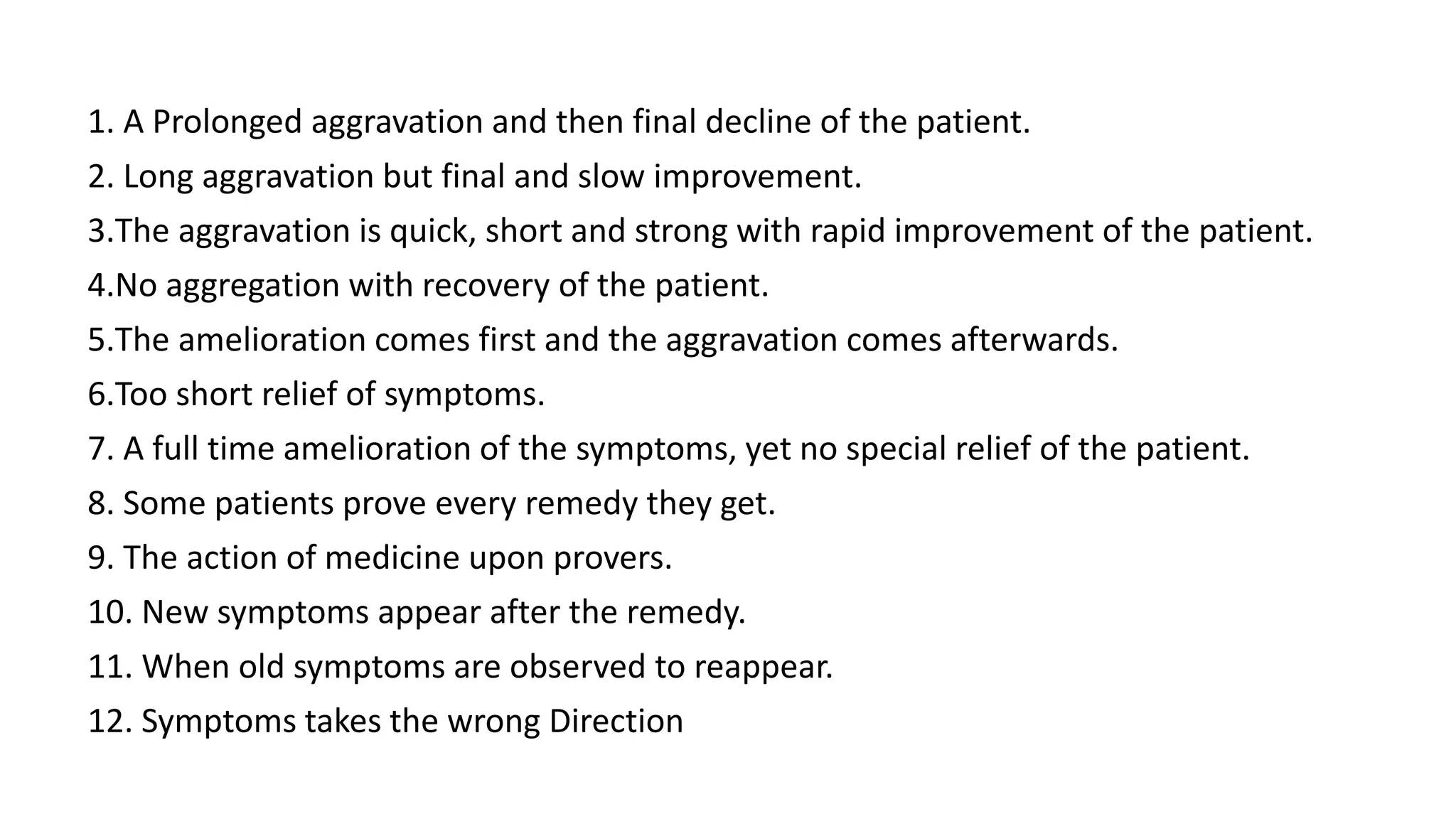
1. A Prolonged aggravation and then final decline of the patient.
2. Long aggravation but final and slow improvement.
3.The aggravation is quick, short and strong with rapid improvement of the patient.
4.No aggregation with recovery of the patient.
5.The amelioration comes first and the aggravation comes afterwards.
6.Too short relief of symptoms.
7. A full time amelioration of the symptoms, yet no special relief of the patient.
8. Some patients prove every remedy they get.
9. The action of medicine upon provers.
10. New symptoms appear after the remedy.
11. When old symptoms are observed to reappear.
12. Symptoms takes the wrong Direction
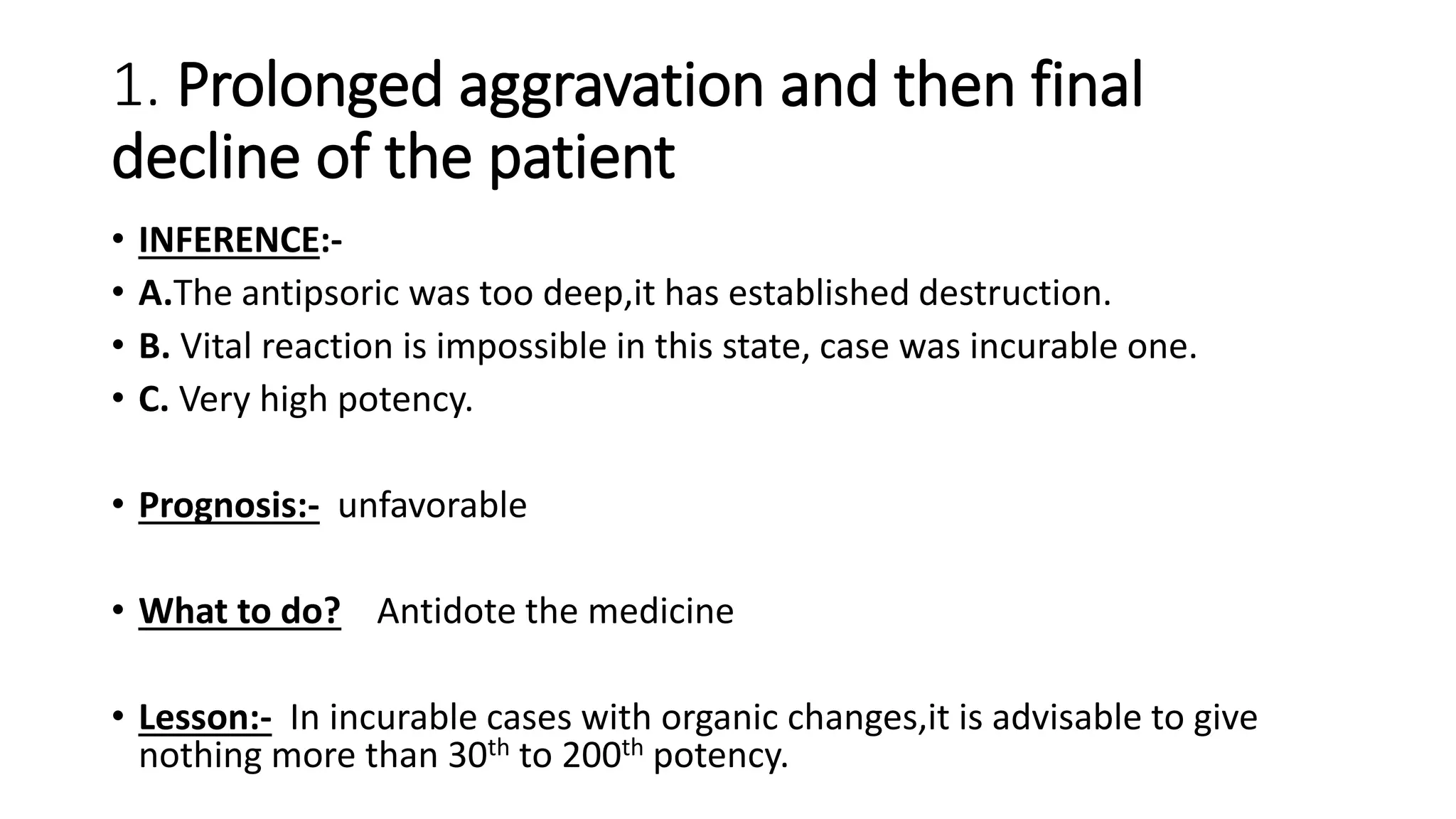
1. Prolonged aggravation and then final
decline of the patient
• INFERENCE:-
• A.The antipsoric was too deep,it has established destruction.
• B. Vital reaction is impossible in this state, case was incurable one.
• C. Very high potency.
• Prognosis:- unfavorable
• What to do? Antidote the medicine
• Lesson:- In incurable cases with organic changes,it is advisable to give
nothing more than 30th to 200th potency.
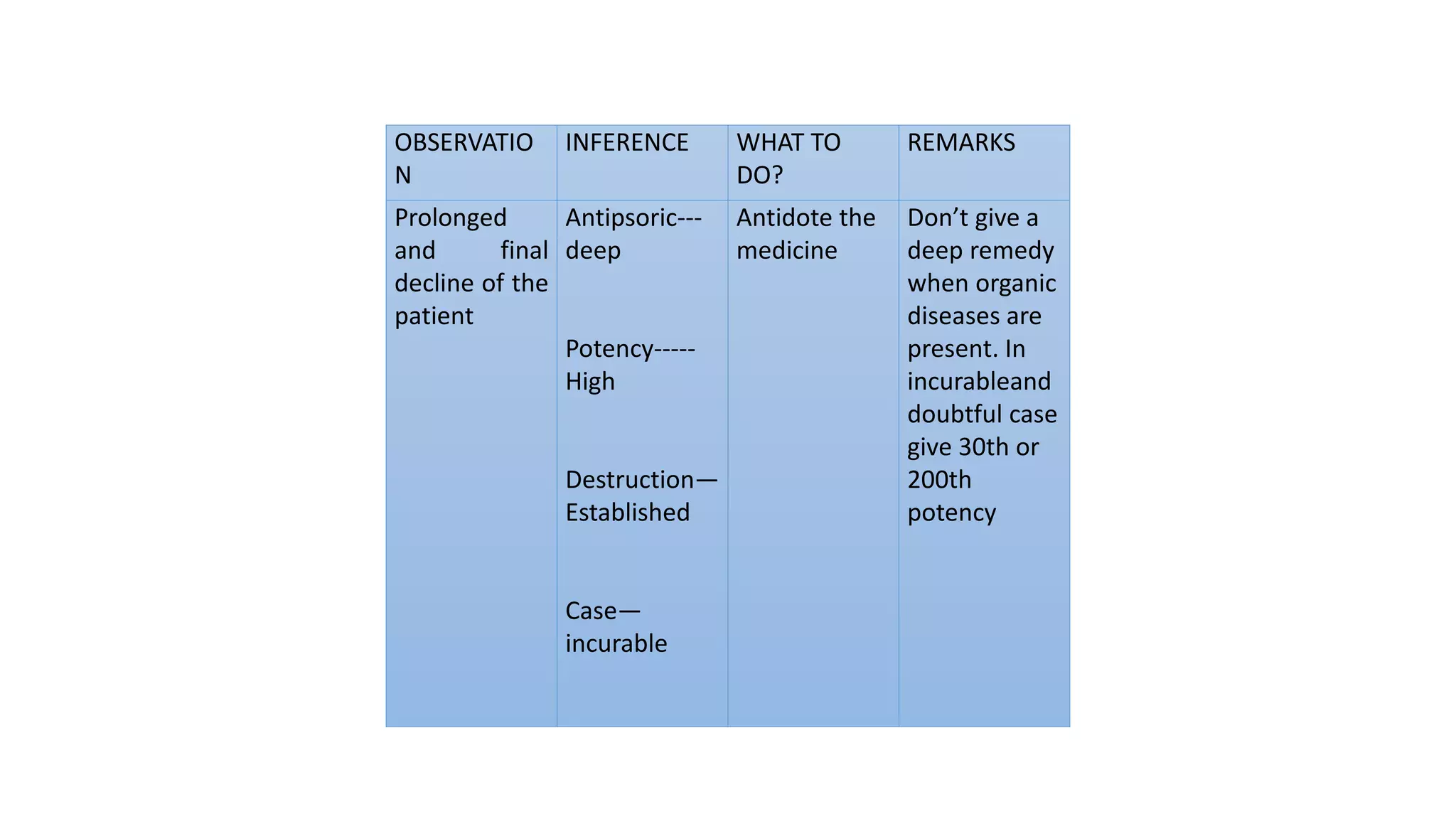
OBSERVATIO
N
INFERENCE WHAT TO
DO?
REMARKS
Prolonged
and final
decline of the
patient
Antipsoric---
deep
Potency-----
High
Destruction—
Established
Case—
incurable
Antidote the
medicine
Don’t give a
deep remedy
when organic
diseases are
present. In
incurableand
doubtful case
give 30th or
200th
potency
2. Long aggravation but final and slow
improvement.
• INFERENCE:-
• • Shows the beginning of somemarked tissue change in some organ.
• • The state of the tissue can be understood.
• • We can make out the prognosis of the case.
• What to do?
Do not disturb the action of the dose
• Prognosis:- Favourable
OBSERVATION INFERENCE WHAT TO DO?
Long aggravation, but
final slow improvement
Beginning of some very
marked tissue changes
in some organ
Prognosis--
favourable
Don’t disturb till the
action of the doses has
completed.
3. The aggravation is quick, short and
strong with rapid improvement of the
patient.
• Inference:-
• The reaction of the economy is vigorous.
• No tendency to structural changes in the vital
• organs.
• The improvement will be marked.
• What to do?
• Do not disturb the action of the dose.
• Lesson:-
• In the case of perfect similimum slight agg of the
• symptoms occurs in the 1st hrs after the remedy in
• an acute sickness or 1st few days in chronic case.
• Prognosis:- Very good.
OBSERVATION INFERENCE WHAT TO DO? REMARKS
aggravation is quick,
short, strong with
rapid improvement
of the patient
In acute disease- one
hour after the
remedy
In chronic disease
–during the first few
days
Remedy—Correct
Reaction-vigorous
Improvement-
marked
No structural changes
prognosis—good
Not to disturb the
action of the
medicine
This type of action is
very reassuring
4. No aggravation with recovery of the
patient.
• Inference:-
• No organic diseases.
• No tendency for organic diseases.
• Right selection of potency.
• Perfect similimum.
• Lesson:-
• It is the highest order of cure in acute affection.
• Prognosis:-
-In acute Cases: Good
- In chronic cases: Doubtful
OBSERVATION INFERENCE WHAT TO DO? REMARKS
No aggravation with recovery of the
patient
Remedy and potency—exactly correct
No organic disease or no tendency to
organic disease
The disease is not of great depth and
belongs to the function of nerves
Prognosis—
in acute case good
In chronic case
--doubtful
Not to disturb the action of the medicine Highest order of cure in acute affection
Yet the physician sometimes will be
more satisfied if in the beginning of his
prescribing he notices a slight
aggravation of symptoms
• Inference:-
• Superficial remedy acted as a palliative.
• Patient was incurable and the remedy was some
• what suitable.
• What to do?
• Retake the case.
• Prognosis:- Unfavorable
5.The amelioration comes first and the
aggravation comes afterwards.
OBSERVATION INFERENCE WHAT TO DO?
Amelioration comes
first and aggravation
afterwards
Either the remedy
was only a superficial
remedy, and could act
only as palliative or
the patient was
incurable and the
remedy was
somewhat
Retake the case and a
more similar
medicine is to be
prescribed
6. Too short relief of the symptoms.
• Inference:-
• Make sure that pt did not do any thing to spoil
• the case.
• In acute cases high grade inflammmatory
• condition.
• In chronic cases presence of structural changes.
• What to do?
• In acute cases medicine to be repeated often.
• In chronic cases a more similar medicine to be
• selected.
• Prognosis:- Bad in chronic cases
OBSERVATION INFERENCE WHAT TO DO?
Too short relief of symptoms Has the patient done something to spoil the action of the
medicine if not, the physician may suspect the following
In acute disease presence of high grade inflammatory reaction
of organs which are threatened by the process going on
In chronic disease there is structural changes and the organs
are destroyed or being destroyed or in a very precarious
condition
Prognosis- Bad
In acute disease medicine has to be repeated much often or a
more similar medicine is selected
In chronic case, if there is no interference of medicine more
similar medicine is to be prescribed.
7. A Full time amelioration of the symptoms,
yet no special relief of the patient.
Inference:-
• Latent conditions or organic changes.
• Lesson:-
• Only palliation possible in such condition.
• Prognosis:- Bad, as a patient is only curable to certain extent.
OBSERVATION INFERENCE REMARKS
Full time amelioration of
symptoms, yet no relief to the
patient
presence of latent conditions,
or latent existing organic
conditions, which prevent
improvement beyond a certain
stage
The remedies act favorably but
the patient is not cured and
never be cured. The patient is
palliated in this instance.
Prognosis- Bad
The patient can never be cured
completely and is curable only
to a certain limit.it is a
suitable palliation for
homeopathic remedies
8. some patients prove every remedy
they get.
• Inference:-
• Pt may be hysterical or oversensitive to all
things.
• Idiosyncratic patients.
• What to do?
• Go for low potencies.
• Prognosis: Bad
OBSERVATION INFERENCE WHAT TO DO? REMARKS
Some patient
prove every
remedy they get
Patient is said to
have an
idiosyncrasy to
every thing
The over
sensitive
patients are
often incurable
Give 30th and
200th to cure
their disease
Such
oversensitive
patients are
good provers
9. The action of medicines on provers.
• Healthy prover is always benefited by proving, if they are
properly conducted.
• It is well to observe carefully the constitutional states of an
individual above to become a prover; and to write these down
and subtract them from proving.
• Master Hahnemann in his Organon of Medicine, from § 105 to §
145 has given instructions regarding drug proving.
• Prognosis:- Favorable
OBSERVATION INFERENCE WHAT TO DO? REMARKS
Action of medicine upon
provers
Proving always benefits
healthy provers, if they are
properly conducted.
observe carefully the
constitutional state of an
individual about to become a
prover, write this down and
subtract them from the
proving
These symptoms will not very
commonly appear during the
proving, if they do note the
change in them.
Such oversensitive patients
are good provers
10. New symptoms appear after the remedy.
• Inference:-
• Greater the array of new symptoms more doubt it
• throws upon the correctness of prescription.
• What to do?
• Retake the case and try to find the similimum.
• Prognosis:- Bad
OBSERVATION INFERENCE WHAT TO DO?
New symptoms
appearing after the
administration of the
remedy
Medicine wrong
Greater the appearance
of new symptoms
coming out after the
administration of the
remedy- wrong
prescription.
c. prognosis- bad
If the symptoms are of
serious nature, antidote
the medicine and select
a more similar medicine
after taking the case
11. Some patients prove every remedy they
get
• Inference:-
• Pt is on the road to recovery
• Cure from center to periphery.
• What to do?
• If the symptoms comes and goes then no need to
• disturb if symptoms remain then repeat the dose
• Prognosis:- very good
OBSERVATION INFERENCE WHAT TO DO? REMARKS
When old
symptoms are
about to
reappear
Medicine-
correct
Disease curable
Symptoms are
disappearing in
the reverse
order of its
appearance
Medicine must
be lat alone
If old symptoms
come back to
stay, then a
repetition of the
dose is
necessary
It is well to say to
the patient that
this is
encouraging
12. symptoms take the wrong direction.
• Inference:-
• Incurable state of patient.
• Wrong prescription.
• Not following Herings law of cure.
• What to do?
• Antidote the medicine.
• Most similar medicine is to be applied.
• Prognosis:- Bad
•
OBSERVATION INFERENCE WHAT TO DO? REMARKS
Symptom take
the wrong
direction
Medicine- wrong
Prognosis- bad
Medicine must
be antidoted at
once otherwise
structural
changes will take
place in that new
site. A similar
medicine is to be
selected and
administered
There is a great
danger in
selecting a
remedy on
external
symptom alone,
ignoring all the
symptoms and
general state of
the patient
• Reference:-
• Organon of Medicine By Dr. Das
• Organon of Medicine By Dr.
• Application: excellent organon
• Represented By:
• Miss Sadhvi B Foujdar
• Miss Sandhya Rupanwar
• Miss kalyani Jadhao
• Miss Snehal

Kent's12OBSERVATION.pptx

  • 1.
  • 2.
    1. A Prolongedaggravation and then final decline of the patient. 2. Long aggravation but final and slow improvement. 3.The aggravation is quick, short and strong with rapid improvement of the patient. 4.No aggregation with recovery of the patient. 5.The amelioration comes first and the aggravation comes afterwards. 6.Too short relief of symptoms. 7. A full time amelioration of the symptoms, yet no special relief of the patient. 8. Some patients prove every remedy they get. 9. The action of medicine upon provers. 10. New symptoms appear after the remedy. 11. When old symptoms are observed to reappear. 12. Symptoms takes the wrong Direction
  • 3.
    1. Prolonged aggravationand then final decline of the patient • INFERENCE:- • A.The antipsoric was too deep,it has established destruction. • B. Vital reaction is impossible in this state, case was incurable one. • C. Very high potency. • Prognosis:- unfavorable • What to do? Antidote the medicine • Lesson:- In incurable cases with organic changes,it is advisable to give nothing more than 30th to 200th potency.
  • 4.
    OBSERVATIO N INFERENCE WHAT TO DO? REMARKS Prolonged andfinal decline of the patient Antipsoric--- deep Potency----- High Destruction— Established Case— incurable Antidote the medicine Don’t give a deep remedy when organic diseases are present. In incurableand doubtful case give 30th or 200th potency
  • 5.
    2. Long aggravationbut final and slow improvement. • INFERENCE:- • • Shows the beginning of somemarked tissue change in some organ. • • The state of the tissue can be understood. • • We can make out the prognosis of the case. • What to do? Do not disturb the action of the dose • Prognosis:- Favourable
  • 6.
    OBSERVATION INFERENCE WHATTO DO? Long aggravation, but final slow improvement Beginning of some very marked tissue changes in some organ Prognosis-- favourable Don’t disturb till the action of the doses has completed.
  • 7.
    3. The aggravationis quick, short and strong with rapid improvement of the patient. • Inference:- • The reaction of the economy is vigorous. • No tendency to structural changes in the vital • organs. • The improvement will be marked. • What to do? • Do not disturb the action of the dose.
  • 8.
    • Lesson:- • Inthe case of perfect similimum slight agg of the • symptoms occurs in the 1st hrs after the remedy in • an acute sickness or 1st few days in chronic case. • Prognosis:- Very good.
  • 9.
    OBSERVATION INFERENCE WHATTO DO? REMARKS aggravation is quick, short, strong with rapid improvement of the patient In acute disease- one hour after the remedy In chronic disease –during the first few days Remedy—Correct Reaction-vigorous Improvement- marked No structural changes prognosis—good Not to disturb the action of the medicine This type of action is very reassuring
  • 10.
    4. No aggravationwith recovery of the patient. • Inference:- • No organic diseases. • No tendency for organic diseases. • Right selection of potency. • Perfect similimum. • Lesson:- • It is the highest order of cure in acute affection.
  • 11.
    • Prognosis:- -In acuteCases: Good - In chronic cases: Doubtful
  • 12.
    OBSERVATION INFERENCE WHATTO DO? REMARKS No aggravation with recovery of the patient Remedy and potency—exactly correct No organic disease or no tendency to organic disease The disease is not of great depth and belongs to the function of nerves Prognosis— in acute case good In chronic case --doubtful Not to disturb the action of the medicine Highest order of cure in acute affection Yet the physician sometimes will be more satisfied if in the beginning of his prescribing he notices a slight aggravation of symptoms
  • 13.
    • Inference:- • Superficialremedy acted as a palliative. • Patient was incurable and the remedy was some • what suitable. • What to do? • Retake the case. • Prognosis:- Unfavorable 5.The amelioration comes first and the aggravation comes afterwards.
  • 14.
    OBSERVATION INFERENCE WHATTO DO? Amelioration comes first and aggravation afterwards Either the remedy was only a superficial remedy, and could act only as palliative or the patient was incurable and the remedy was somewhat Retake the case and a more similar medicine is to be prescribed
  • 15.
    6. Too shortrelief of the symptoms. • Inference:- • Make sure that pt did not do any thing to spoil • the case. • In acute cases high grade inflammmatory • condition. • In chronic cases presence of structural changes. • What to do? • In acute cases medicine to be repeated often. • In chronic cases a more similar medicine to be • selected.
  • 16.
    • Prognosis:- Badin chronic cases
  • 17.
    OBSERVATION INFERENCE WHATTO DO? Too short relief of symptoms Has the patient done something to spoil the action of the medicine if not, the physician may suspect the following In acute disease presence of high grade inflammatory reaction of organs which are threatened by the process going on In chronic disease there is structural changes and the organs are destroyed or being destroyed or in a very precarious condition Prognosis- Bad In acute disease medicine has to be repeated much often or a more similar medicine is selected In chronic case, if there is no interference of medicine more similar medicine is to be prescribed.
  • 18.
    7. A Fulltime amelioration of the symptoms, yet no special relief of the patient. Inference:- • Latent conditions or organic changes. • Lesson:- • Only palliation possible in such condition. • Prognosis:- Bad, as a patient is only curable to certain extent.
  • 19.
    OBSERVATION INFERENCE REMARKS Fulltime amelioration of symptoms, yet no relief to the patient presence of latent conditions, or latent existing organic conditions, which prevent improvement beyond a certain stage The remedies act favorably but the patient is not cured and never be cured. The patient is palliated in this instance. Prognosis- Bad The patient can never be cured completely and is curable only to a certain limit.it is a suitable palliation for homeopathic remedies
  • 20.
    8. some patientsprove every remedy they get. • Inference:- • Pt may be hysterical or oversensitive to all things. • Idiosyncratic patients. • What to do? • Go for low potencies. • Prognosis: Bad
  • 21.
    OBSERVATION INFERENCE WHATTO DO? REMARKS Some patient prove every remedy they get Patient is said to have an idiosyncrasy to every thing The over sensitive patients are often incurable Give 30th and 200th to cure their disease Such oversensitive patients are good provers
  • 22.
    9. The actionof medicines on provers. • Healthy prover is always benefited by proving, if they are properly conducted. • It is well to observe carefully the constitutional states of an individual above to become a prover; and to write these down and subtract them from proving. • Master Hahnemann in his Organon of Medicine, from § 105 to § 145 has given instructions regarding drug proving. • Prognosis:- Favorable
  • 23.
    OBSERVATION INFERENCE WHATTO DO? REMARKS Action of medicine upon provers Proving always benefits healthy provers, if they are properly conducted. observe carefully the constitutional state of an individual about to become a prover, write this down and subtract them from the proving These symptoms will not very commonly appear during the proving, if they do note the change in them. Such oversensitive patients are good provers
  • 24.
    10. New symptomsappear after the remedy. • Inference:- • Greater the array of new symptoms more doubt it • throws upon the correctness of prescription. • What to do? • Retake the case and try to find the similimum. • Prognosis:- Bad
  • 25.
    OBSERVATION INFERENCE WHATTO DO? New symptoms appearing after the administration of the remedy Medicine wrong Greater the appearance of new symptoms coming out after the administration of the remedy- wrong prescription. c. prognosis- bad If the symptoms are of serious nature, antidote the medicine and select a more similar medicine after taking the case
  • 26.
    11. Some patientsprove every remedy they get • Inference:- • Pt is on the road to recovery • Cure from center to periphery. • What to do? • If the symptoms comes and goes then no need to • disturb if symptoms remain then repeat the dose • Prognosis:- very good
  • 27.
    OBSERVATION INFERENCE WHATTO DO? REMARKS When old symptoms are about to reappear Medicine- correct Disease curable Symptoms are disappearing in the reverse order of its appearance Medicine must be lat alone If old symptoms come back to stay, then a repetition of the dose is necessary It is well to say to the patient that this is encouraging
  • 28.
    12. symptoms takethe wrong direction. • Inference:- • Incurable state of patient. • Wrong prescription. • Not following Herings law of cure. • What to do? • Antidote the medicine. • Most similar medicine is to be applied. • Prognosis:- Bad •
  • 29.
    OBSERVATION INFERENCE WHATTO DO? REMARKS Symptom take the wrong direction Medicine- wrong Prognosis- bad Medicine must be antidoted at once otherwise structural changes will take place in that new site. A similar medicine is to be selected and administered There is a great danger in selecting a remedy on external symptom alone, ignoring all the symptoms and general state of the patient
  • 30.
    • Reference:- • Organonof Medicine By Dr. Das • Organon of Medicine By Dr. • Application: excellent organon
  • 31.
    • Represented By: •Miss Sadhvi B Foujdar • Miss Sandhya Rupanwar • Miss kalyani Jadhao • Miss Snehal