Recruiting the Next Generation
of Jail Employees: Does
Generational Relevance or
Agency Size Make
a Difference?
Jeanne B. Stinchcomb & Leslie A. Leip
Tugas Jurnal Individu
Nama : Nasratul Choiria
Nim : 1263620035
Teacher :
Syamsir Abduh, Ir, MM, PhD,
Prof.
Score :
88
Given their multiple functions, inadequate funding,
and generally low visibility, America’s jails have
sustained an ongoing struggle to recruit a sufficient
quantity and quality of applicants to effectively fulfill
their mission. Although the
current economic downturn has temporarily curtailed
turnover, postponed retirements, and intensified job
competition, the cyclical nature of economic
developments assures that jails will once again be
forced into aggressive recruitment rivalry. To
proactively address such upcoming challenges, it is
essential to determine how jails can most
productively target and select the best candidates.
Abstract
Virtually all age groups were in substantial
agreement that the extrinsic attractions of jail
employment—such as salary, benefits, pension
plan, and job stability–were their most important
job consideration factors. Overall, findings point
toward the recruitment benefit that jails may
potentially derive from capitalizing on the
advantages of being a steady rock of dependable
employment, especially in times that are
characterized by job insecurity and economic
hardships.
Keywords Jail . Jail Employees . Recruitment . General Relevance
Generations in the Workplace
 In recent years, a burgeoning literature has emerged in
relation to the issue of generational differences in the
contemporary workplace and how best to accommodate
them in the interest of organizational harmony and
productivity.
 Based on analysis of the historical era in which they were
born and value-impacted, much of this body of literature
focuses on identifying and describing four unique cohorts1 :
1. Veterans (Also Known as Traditionalists,
Born Before 1943)
Strongly influenced by the Great Depression and World War II,
the Veteran group tends to reflect a rational-structural
theoretical framework (Bolman & Deal, 2008) that respects
authority, follows rules, avoids change, is well-disciplined,
and values conformity. Although almost all of these
employees are now retired, the legacy of their strong sense
of duty, concern for order, acceptance of the status quo,
comfort with tradition, and directive, command-and-control
leadership style has left behind a long-term organizational
impact.
Having come of age during the social unrest accompanying
the Vietnam War, civil rights era, and women’s liberation
movement, Baby boomers have continued their lifelong
search for self-fulfillment, personal gratification, civic
involvement, and meaningful lives. As part of the largest
birth cohort that has ever influenced this country, they are
now likewise soon to retire en mass, leaving behind a
leadership/ management void that will be challenging to fill
in organizations that are not actively engaged in
succession planning (Stinchcomb & McCampbell, 2010)
Baby Boomers
(Born Between 1943 and 1964)
Generation Xers
(Born Between 1965 and 1980)
Often the children of working parents, broken marriages,
and/or nontraditional family arrangements, Gen-Xers learned
to fend for themselves as “latch-key kids” (Raines & Hunt,
2000). Early on, they sensed that no one was going to “hand-
hold” them, so it became apparent that “they must take care
of themselves” (Zemke et al., 2000: 94).
As a result, this cohort tends to be self-reliant “survivors” who
view work more as a job than a career, seek greater balance
between their personal and professional lives, and are more
mobile, flexible, and technologically-savvy than any of their
predecessors.
Millennials
(Also Known as Generation Y, Born
Between 1981 and 2000)
As a result, they are marching into the workplace to the
tune of a different drummer—with “tattoos, piercings, no
watch, and a shameless propensity for chatting up to
the boss,” and when it comes to loyalty, the place they
work for is last on the list, behind their families, friends,
co-workers, “and of course, themselves” (Hira, 2007: 38)
For example, what serves as a punishment to
one generation might actually be considered
an incentive to another:
 “Disciplining misbehavior by ordering a day off without pay
might be a tremendous penalty to a thrifty Veteran, whereas
the ‘live for the moment’ orientation of a Millennial might
simply consider it an advantageous time to spend a long-
awaited day at the beach” (McCampbell, 2002: 9).
Critiquing Generational Advocacy
 As even pioneering advocates Strauss and
Howe (1991) themselves admit, the concept of
generational cohorts has been confined to the
shadows of “unproven hypothesis.
 At least one review of the academic literature
apparently concurs, having been unable to locate
any peerreviewed articles on the generation gap
(Smith, 2000).
 the very limited empirical research that has been
conducted on this topic is often a product of focus
group discussions or single-agency surveys,
prompting the conclusion that there are few
rigorous studies, either quantitative or qualitative,
examining the validity of intergenerational
observations (Bender, 2004: 148).
More specifically, it is designed to identify:
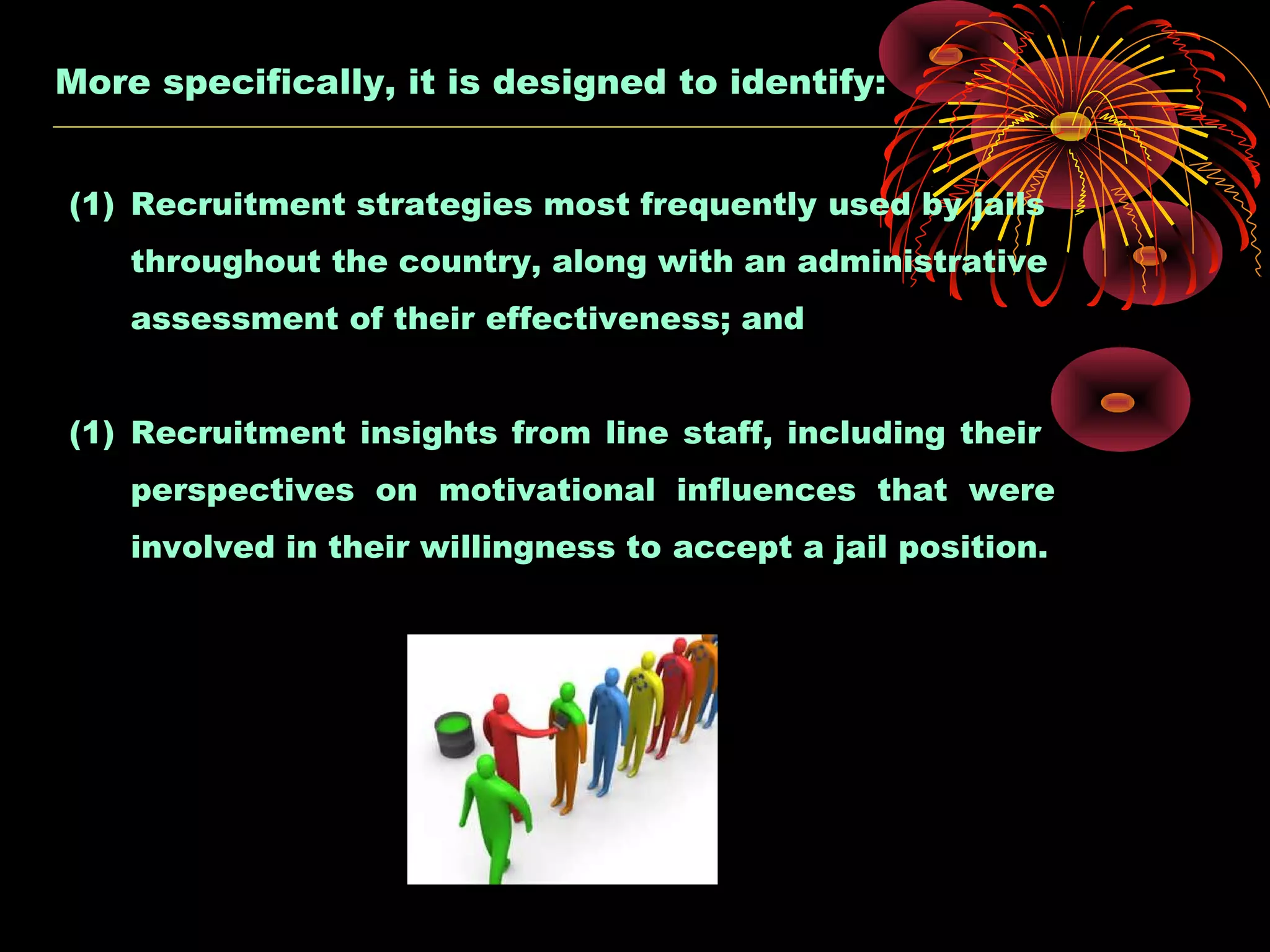
(1) Recruitment strategies most frequently used by jails
throughout the country, along with an administrative
assessment of their effectiveness; and
(1) Recruitment insights from line staff, including their
perspectives on motivational influences that were
involved in their willingness to accept a jail position.
Survey Methodology
Two national surveys were administered :
1. one to jail administrators and,
2. one to operational line staff
Instruments :
a combination of subject matter experts
and on-site pilot-testing
Profile of Respondents
a total of 2,106 line staff (from 46 states),
and an additional 569 administrators (from
48 states), responded with usable surveys,
(primarily through SurveyMonkey, although
some submitted hard copies)
Bivariate Statistics—Recruitment
Results by Age of Respondents
Influential Factors by Generation
Recruitment Strategies by Generation
Selection Processing Experience
Jurnal  recruiting

Jurnal recruiting

  • 1.
    Recruiting the NextGeneration of Jail Employees: Does Generational Relevance or Agency Size Make a Difference? Jeanne B. Stinchcomb & Leslie A. Leip Tugas Jurnal Individu Nama : Nasratul Choiria Nim : 1263620035 Teacher : Syamsir Abduh, Ir, MM, PhD, Prof. Score : 88
  • 2.
    Given their multiplefunctions, inadequate funding, and generally low visibility, America’s jails have sustained an ongoing struggle to recruit a sufficient quantity and quality of applicants to effectively fulfill their mission. Although the current economic downturn has temporarily curtailed turnover, postponed retirements, and intensified job competition, the cyclical nature of economic developments assures that jails will once again be forced into aggressive recruitment rivalry. To proactively address such upcoming challenges, it is essential to determine how jails can most productively target and select the best candidates. Abstract
  • 3.
    Virtually all agegroups were in substantial agreement that the extrinsic attractions of jail employment—such as salary, benefits, pension plan, and job stability–were their most important job consideration factors. Overall, findings point toward the recruitment benefit that jails may potentially derive from capitalizing on the advantages of being a steady rock of dependable employment, especially in times that are characterized by job insecurity and economic hardships. Keywords Jail . Jail Employees . Recruitment . General Relevance
  • 4.
    Generations in theWorkplace  In recent years, a burgeoning literature has emerged in relation to the issue of generational differences in the contemporary workplace and how best to accommodate them in the interest of organizational harmony and productivity.  Based on analysis of the historical era in which they were born and value-impacted, much of this body of literature focuses on identifying and describing four unique cohorts1 :
  • 5.
    1. Veterans (AlsoKnown as Traditionalists, Born Before 1943) Strongly influenced by the Great Depression and World War II, the Veteran group tends to reflect a rational-structural theoretical framework (Bolman & Deal, 2008) that respects authority, follows rules, avoids change, is well-disciplined, and values conformity. Although almost all of these employees are now retired, the legacy of their strong sense of duty, concern for order, acceptance of the status quo, comfort with tradition, and directive, command-and-control leadership style has left behind a long-term organizational impact.
  • 6.
    Having come ofage during the social unrest accompanying the Vietnam War, civil rights era, and women’s liberation movement, Baby boomers have continued their lifelong search for self-fulfillment, personal gratification, civic involvement, and meaningful lives. As part of the largest birth cohort that has ever influenced this country, they are now likewise soon to retire en mass, leaving behind a leadership/ management void that will be challenging to fill in organizations that are not actively engaged in succession planning (Stinchcomb & McCampbell, 2010) Baby Boomers (Born Between 1943 and 1964)
  • 7.
    Generation Xers (Born Between1965 and 1980) Often the children of working parents, broken marriages, and/or nontraditional family arrangements, Gen-Xers learned to fend for themselves as “latch-key kids” (Raines & Hunt, 2000). Early on, they sensed that no one was going to “hand- hold” them, so it became apparent that “they must take care of themselves” (Zemke et al., 2000: 94). As a result, this cohort tends to be self-reliant “survivors” who view work more as a job than a career, seek greater balance between their personal and professional lives, and are more mobile, flexible, and technologically-savvy than any of their predecessors.
  • 8.
    Millennials (Also Known asGeneration Y, Born Between 1981 and 2000) As a result, they are marching into the workplace to the tune of a different drummer—with “tattoos, piercings, no watch, and a shameless propensity for chatting up to the boss,” and when it comes to loyalty, the place they work for is last on the list, behind their families, friends, co-workers, “and of course, themselves” (Hira, 2007: 38)
  • 9.
    For example, whatserves as a punishment to one generation might actually be considered an incentive to another:  “Disciplining misbehavior by ordering a day off without pay might be a tremendous penalty to a thrifty Veteran, whereas the ‘live for the moment’ orientation of a Millennial might simply consider it an advantageous time to spend a long- awaited day at the beach” (McCampbell, 2002: 9).
  • 10.
    Critiquing Generational Advocacy As even pioneering advocates Strauss and Howe (1991) themselves admit, the concept of generational cohorts has been confined to the shadows of “unproven hypothesis.  At least one review of the academic literature apparently concurs, having been unable to locate any peerreviewed articles on the generation gap (Smith, 2000).  the very limited empirical research that has been conducted on this topic is often a product of focus group discussions or single-agency surveys, prompting the conclusion that there are few rigorous studies, either quantitative or qualitative, examining the validity of intergenerational observations (Bender, 2004: 148).
  • 11.
    More specifically, itis designed to identify: (1) Recruitment strategies most frequently used by jails throughout the country, along with an administrative assessment of their effectiveness; and (1) Recruitment insights from line staff, including their perspectives on motivational influences that were involved in their willingness to accept a jail position.
  • 12.
    Survey Methodology Two nationalsurveys were administered : 1. one to jail administrators and, 2. one to operational line staff Instruments : a combination of subject matter experts and on-site pilot-testing
  • 13.
    Profile of Respondents atotal of 2,106 line staff (from 46 states), and an additional 569 administrators (from 48 states), responded with usable surveys, (primarily through SurveyMonkey, although some submitted hard copies)
  • 14.
    Bivariate Statistics—Recruitment Results byAge of Respondents Influential Factors by Generation Recruitment Strategies by Generation Selection Processing Experience