UNIT ONE: GENERALCONSIDERATIONS
What is Jurisprudence
S The word comes from the Latin term juris prudentia, which means "the study, knowledge, or science of law”.
S In modern law jurisprudence is understood as a term that embraces spectrum of questions about the nature and purpose of law and responses made to
them.
S The most prevalent form of jurisprudence is that it seeks to analyze, explain, classify, and criticize entire bodies of law, ranging from contract to tort to
constitutional law. Legal encyclopedias, law reviews, and law school textbooks frequently contain this type of jurisprudential scholarship.
S The second type of jurisprudence compares and contrasts law with other fields of knowledge such as literature, economics, religion, and the social
sciences. The purpose of this interdisciplinary study is to enlighten each field of knowledge by sharing insights that have proved important to
understanding essential features of the comparative disciplines.
s The third type of jurisprudence raises fundamental questions about the law itself. These questions seek to reveal the historical, moral, and cultural
underpinnings of a particular legal concept.
S The fourth and fastest-growing body of jurisprudence focuses on even more abstract questions, including, what is law? What is its relation to justice and
morality? What is the role of a judge? Is a judge more like a legislator who simply decides a case in favor of the most politically preferable outcome?
What is justice? What is liberty and freedom?
> Why we study Jurisprudence
S At the practical level, reading and participating in jurisprudential discussions develops the ability to analyze and to think critically and creatively about
the law. Such skills are always useful in legal practice, particularly when facing novel questions within the law or when trying to formulate and
advocate novel approaches to legal problems.
S At a professional level, jurisprudence is the way lawyers and judges reflect on what they do and what their role is within society.
S Finally, for some, jurisprudence is interesting and enjoyable on its own, whatever its other uses and benefits.
S There will always be some for whom learning is interesting and valuable in itself, even if it does not lead to greater wealth, greater self-awareness, or
greater social progress.
2.
Schools of Jurisprudence
❖Natural Law School: the oldest school of jurisprudence, it upholds that beyond, and superior to the law made by man are certain higher principles, the
principles of natural law. These principles are immutable and eternal. With regard to the highest matter man-made law should be in accord with the
principles of natural law. And to the extent that man-made law conflicts with natural law, it lacks validity: it is not a valid, binding law at all.
❖ Legal Positivism: also called Analytical School of jurisprudence, it holds that there is no higher law than that created by governments, legitimate or self
imposing, and that such law must be obeyed, even if it appears unjust or otherwise at odds with the “natural” law. Unlike the natural law theory, this
one treats law and other values, such as, morality and religion separately.
❖ Historical School: this school of jurisprudence views law as an evolutionary process and concentrates on the origin and history of the legal system. The
law of a nation, like its language, originates in the popular spirit, the common conviction of right, and has already attained a fixed character, peculiar to
that people, before the earliest time to which authentic history extends. In this prehistoric period the laws, language, manners and political constitution
of a people are inseparably united and they are the particular faculties and tendencies of an individual people bound together by their kindred
consciousness of inward necessity.
❖ Sociological School: Unlike the Historical School that conceives a nation’s law as tied to the primitive consciousness of its people, sociological
conception of law locate the law in the present-day institutions of its society. The proponents of sociological jurisprudence seek to view law within a
broad social context rather than as an isolated phenomenon distinct from and independent of other means of social control. The sociological questions in
jurisprudence are concerned with the actual effects of the law upon the complex of attitudes, behavior, organization, environment, skills, and powers
involved in the maintenance of a particular society. They are also concerned with the practical improvement of the legal system and feel that this can be
achieved only if legislation and court adjudications take into account the findings of other branches of learning, particularly the social sciences.
❖ Legal Realism conceives law as judge made and by doing so it puts the court at the center. It contends that positive law cannot be applied in the
abstract; rather, judges should take into account the specific circumstances of each case, as well as economic and sociological realities. The law should
not be static, it must adapt to various social and economic realities.
3.
UNIT TWO: CLASSICALNATURAL LAW THEORY
Unit Two: Classical Natural Law Theory
It generally advocates that some laws are basic and fundamental to human nature and are discover-able by human reason without reference to specific
legislative enactments or judicial decisions. s The concept of natural law originated in Greece and received its most important formulation in Stoicism.
The Stoics believed that the fundamental moral principles that underlie all the legal systems of different nations were reducible to the dictates of natural
law. This idea became particularly important in Roman legal theory, which eventually came to recognize a common code regulating the conduct of all
peoples and existing alongside the individual codes of specific places and times. Christian philosophers such as St. Thomas Aquinas perpetuated this
idea, asserting that natural law was common to all peoples—Christian and non-Christian alike—while adding that revealed law gave Christians an
additional guide for their actions. s In modern times, the theory of natural law became the chief basis for the development by Hugo Grotius of the theory
of international law. Later writers and philosophers continued to consider natural law as the basis of ethics and morality.
s The influence of natural law theory declined greatly in the 19th century under the impact of Positivism. In the 20th century, however, such thinkers as
Lon L. Fuller saw in natural law a necessary intellectual opposition to totalitarian theories.
❖ The Notion of Natural Law
s ‘Natural law’ is not to be understood as meaning the same as the law of nature - in the sense of laws that govern the physical world.
s The word ‘natural’, in natural law, refers to an idea that provides the foundation of natural law - namely the reason why natural law ought to be obeyed.
The idea is this. Man is part of nature. Within nature, man has his own nature. His nature inclines him towards certain ends - to procreate children, to
protect his family, to ensure his survival. To seek such ends is natural to him. s Those things which impede man attaining his natural ends are contrary
to natural law. Thus, if a man-made law obstructs the achievement by man of what has been decreed by nature as his ends, then the law is contrary to
natural law.
4.
> Ancient Greece:Natural Law as Source of Justice and Virtue
> Socrates
S Socrates was one of the famous Greek philosophers who contributed a lot to the western philosophy.
S Socrates was at the age of 70 when he appeared before court to defend himself. He was prosecuted because he was said to be corrupting the youth and
second he did not believe in the gods of the state.
S In Plato’s Apology, Socrates refuted the accusations made by his opponents. Justifying his teaching of philosophy and his consistency in continuing same
work, he importantly said that it was good to obey the law and the order of a commander so long as they are just. But if the command was illegal or the
laws unjust, then no man shall obey the order or the laws. From this argument he had also developed the principle that the command of god is more
pious and just and as a result it is above and beyond any other human laws. Hence, it is wise to obey god’s command than human laws when they are in
conflict. He believed that he was commanded by god to teach people philosophy, to question and convince them whenever he got the chance.
S Just law, for Socrates, is measured based on the perfect laws of the gods. If the laws are unjust and unholy we shall refuse obedience. In the case of Leon
the Salamis, namely his refusal and disobedience of the order to go to arrest Leon of Salamis fall under this conclusion. Under the thirty’s dictatorship
he was ordered, together with others, to arrest and kill this man just for the sake of taking/stealing his property, and Socrates refused to obey the order
since the order by itself was unjust. At this time too there was a government and this government had laws to this effect. Socrates did not say that he
refused because they were not legitimate governments. His disobedience was rather based on the idea that arresting Leon of Salamis with intent of
putting him to death (just to expropriate his wealth) was characterized as unjust and unholy.
S A conflicting, and yet important, idea of law is found in the second writing, Crito. He subscribed that he would obey the laws irrespective of their moral
values, whether they are just or not. Socrates was unsuccessful in his argument and was sent to prison preceding his death.
S Socrates justified the coercive power of the state laws (positive law) and thereby upholding and respecting the decision of the courts on three grounds.
★ First, on moral grounds, in that it is bad and disgraceful to harm or to do injustice to another. He also argued that to do injustice in return for
injustice or in other words, to return harm for harm is also bad. Although the judges sentence him to death, by escaping from prison he harms the laws
since Socrates’ refusal would send a message of disobedience to the laws, which truly would harm them.
★ Secondly, Socrates analogized the power and status of laws to one’s parents, for it was the laws which administer the marriage of his family, ordered
his family about his upbringing and education etc. It is a great evil to make wrong to parents whatever they do to you. Similarly citizens are not justified
5.
to back-harm theircountry whatever harm the country caused to them.
★ Thirdly, there was a tacit agreement between Socrates (and other citizens for that matter) and the state of Athens, stipulating that Socrates either obey
the laws or, when he sees the laws unjust, he should persuade the city to act in a more suitable fashion. If he was not pleased with the laws he could
move to other countries. This means his living in the country shows that he agreed to be governed by the law of the country.
s He summarizes his argument by stating his alternatives and the consequences of each alternative as brought out by his argument:
★ if he chooses to obey the court, he will die wronged (as victim of injustice) not by the laws but by men,
★ but if he escapes, he will disgracefully return injustice for injustice and harm for harm, he will be breaking the contracts and agreements he made with
the laws, and he will be doing harm; to those he must least harm, his friends, his country, and the laws.
★ Thus, he thinks that if he obeys the court he will be suffering but not doing injustice, whereas if he escapes he will be doing injustice and harm.
❖ Plato
s In the restless intellectual and political climate of 5th-century Athens, Plato was concerned to redefine the nature of justice by relating it to something far
more permanent and absolute than the nomos (man-made laws) of the city-state.
s He assigned “reality” to the unchanging archetypal forms—i.e., the ideas—of things rather than to the ephemeral phenomena as superficially and
confusedly perceived by individual men unenlightened by philosophy. He says that what for us are abstractions, example redness, square-ness,
roundness, sharpness, honor, courage, beauty, equality, justice each had a permanent and unvarying existence, an existence that is independent of the
fact that certain things or actions in the world as we know them reflect the qualities themselves. This is Plato’s doctrine of ‘forms’.
s Plato’s forms are transcendental archetypes that exist independently of the physical world, independently of the human mind, independently of space and
time. Thus there is a ‘form’ of beauty, of which things on earth which have the quality of beauty are mere manifestations. Qualities such as justice and
truth exist in their own form, too. All men in this earth can do is to attempt to reproduce them. To reproduce these qualities, men must seek knowledge
of the eternal truths, a quest that is man’s finest endeavor (idealism). It refers to the notion that the idea of a thing has its own existence
S Since for Plato the forms of ‘goodness’, ‘virtue’, ‘honesty’ were eternal and immutable, they constituted moral principles of universal and timeless
validity existing above and unaffected by changing human attitudes or beliefs, moral principles by reference to which all human actions and views must
be judged.
6.
* Aristotle
S Aristotledid not subscribe to Plato's theory of forms. But there was an element in his thinking that contributed a further strand to what was to become
part of natural law doctrine.
S Aristotle was concerned with the world as he saw it existing around him (as opposed to Plato, Aristotle was materialist). He was a zoologist
S From his studies of the natural world he became conscious of the fact that natural phenomena were in a state of perpetual change - the child growing into
an adult; the seed growing into a plant. There was always progress.
S Throughout the living world, Aristotle saw that, in the birth and growth of animals and plants, the earlier stages always lead up to a final development.
Yet we should not think of this end as a termination. The process is constant. Thus, for Aristotle the universe is dynamic, always engaged in the process
of becoming, of moving towards an end immanent within itself from the start.
S For Aristotle, the highest form of human society lay in the Greek city state (a polis). It was the Polis that provided the society in which man could achieve
his culminating fulfillment. Thus from the start of organized human society, from its most primitive forms, through the various stages of agricultural
existence to the building of cities, and the creating of political societies such as that at Athens, mankind was progressing towards that which had been its
end from the beginning.
S Aristotle says, ‘Because it is the completion of associations existing by nature, every polis exists by nature, having itself the same quality as the earlier
associations from which it grew. It is the end to which those associations move and the ‘nature’ of things consists in their end or consummation; what
each thing is when its growth is completed, we call the nature of that thing, whether it be a man or a horse or a family.’
S In his discussion on the nature of justice, Aristotle says: There are two sorts of political justice, one natural and the other legal. The natural is that which
has the same validity everywhere (as fire burns both in Greek and in Persia are the same) and does not depend upon acceptance; the legal is that which
in the first place can take one form or another indifferently, but which once laid down, is decisive: e.g. that the ransom for a prisoner of war is one mina
(Greece money), or that a goat shall be sacrificed to the gods and not two sheep....
S Speaking otherwise, Aristotle has declared that we have two types of laws. One is natural law, and the other man-made. The latter kind of law is not the
same everywhere for the custom and behavior of people of different nations and tribes is different. But with regard to the former one, it is one and same
for it is immutable and beyond human touch.
S In case of conflict between the two, Aristotle tells us to resort to the natural law:
s This kind of thinking makes, hence, Aristotle one of the natural law thinkers. It seems that Aristotle accepted that there is a natural and universal right and
wrong, apart from any human ordinance or convention. For Aristotle and the men of Greek of his time, the existence of higher laws (natural law) is as
7.
sure enough asthe existence of higher beings, which they called ‘gods.’
The Stoics: Natural Law as a Reason
s Law is the highest reason, implanted in nature, which commands what ought to be done and forbids the opposite. True law is right reason in agreement
with nature. To curtail this law is unholy, to amend it illicit, to repeal it impossible. Cicero
s Stoicism existed from the life time of its founder Zeno (during the 3rd
century BC) down to about the fourth century AD. It was thus the prevailing
philosophy during the greater part of the Roman Republic and Empire. The contribution of the Stoic School of Philosophy may be represented by the
writings of Cicero, Seneca, and the Emperor Marcus Aurelius.
s Three important ideas of modern law and legal theory were derived mainly from Stoic philosophy:
> The conception of a universal law for all mankind under which all men are equal;
> The idea of a method of deriving universal principles of law from the observation of the laws of different people;
> And the conception of a law binding upon all states, which have got today the name “international law”.
❖ Cicero
s Cicero was a Roman orator, politician, lawyer and a Stoic philosopher. In his book On Duties he discusses “true law”, transcending the enactments and
customs of particular nations, and identified with “right reason”, which is immanent in nature, in the universe and in the minds of the wisest men.
★ The idea of law of Stoic philosophy: Law is the highest reason, implanted in nature, which commands what ought to be done and forbids the
opposite. True law is right reason in agreement with nature. To curtail this law is unholy, to amend it illicit, to repeal it impossible..The Stoic’s ideal
is to live consistently with nature. Throughout our lives we ought invariably to aim at morally right course of action.
★ Universality and immutability of natural law or “true” law was indicated as: True law is right reason in agreement with nature; it is of universal
application, unchanging and everlasting; it summons to duty by its commands, and averts from wrong doing by its prohibition. And it does not lay
its commands or prohibitions upon good men in vain, though neither have any effect upon the wicked.
S For Cicero, law is the highest product of the human mind which is in tune with the elemental force of nature. The validity of human law depends upon its
harmony with these forces. It was the blending of the ideas of reason and law with nature that contrived to suggest that, while it was possible for rulers
8.
to ignore theconstraints of natural law, such actions ran against the grain of the natural order of things in a way that was unholy and blasphemous.
❖ Seneca
S He wrote: Man is a sprit and his ultimate goal is the perfection of his reason in that sprit. Because man is a rational animal, his ideal state is realized when
he has fulfilled the purpose for which he was born. And what is it that reason demands of him? Something very easy - that he live in accordance with
his own nature. Yet this is turned into something difficult by the madness that is universal among men; we push one another into vices. And how can
people be called back to spiritual well-being when no one is trying to hold them back and the crowd is urging them on?
S Seneca has also emphasized the need for rational approach, i.e. that man shall live in harmony with nature. The principal contribution of Stoic’s was
universality.
S Stoics saw mankind as one brotherhood. They looked outside the city state, outside the Empire and saw the whole of human race as being bound and
united by the brotherly love that the precept of natural law enjoined.
S One can also see that the Stoics added flesh to the bones of natural law. Tolerance, forgiveness, compassion, fortitude, uprightness, sincerity, honesty -
these were the qualities that the Stoics believed that natural law required of men. These were the qualities that man should aspire for in order that he
might live in accordance with what nature had ordained. These qualities in many ways are the bases for the Roman law and thereby the modern western
law.
S Based upon these natural law qualities, historically, compared to the Greeks, the Stoics contributed much to the practical development of the Roman law.
Greek law scarcely survived as a system, because it never developed a class of legal specialists or abandoned to its lay administrators or its popular
tribunals of grotesque size. Roman law, on the other hand, developed through the efforts of expert jurisconsults (learned lawyers) and praetors (judges)
into a permanent heritage of Western society. By its adoption into works such as Cicero's De republica as well as other works of the great jurisconsults,
Stoic speculation concerning reason and nature was brought onto the level of precepts for concrete problem solving. The crude, tribal jus civile (“civil
law”) of the Romans was thus transformed into a natural-law-based jus gentium (law applying to all people), a set of principles common to all nations
and appropriate, therefore, equally applied for foreigners as well as the Romans.
Christianity: Natural Law as Morality
s The parallels between the tenets of Stoicism and the teaching of Christ come readily to mind. But Christianity offered an advantage not made available by
the Stoicism or any other religion of that time competing to fill the place left by the decline of the old state religion of Rome. s Stoicism taught that men
9.
should love oneanother, since this was in accord with nature and thus was man’s duty. Christianity taught - ‘Love one another’, and it added ‘and if you
do, there is a reward - life everlasting. s The teaching of Christ provided a code of conduct, but not a comprehensive theology. The creation of the latter
was the accomplishment of the fathers of the church, principally St. Augustine and St. Thomas Aquinas. Having been born into the Roman world it was
natural that these men should reflect in their writings aspects of the philosophies of Greece and Rome that could be enlisted to give intellectual support
to the teachings of the new church.
1. St. Augustine of Hippo
s The incorporation of natural law into Christian theology was accomplished at a later period, but when St. Augustine wrote ‘if a law be unjust, it is no law
at all’; the idea that if a man-made law conflicts with natural law, it is invalid.
s In the eye of Christian theologists, natural law is anterior in time and superior in hierarchy to the man-made law. s St. Augustine portrayed the human
condition as torn between the attraction of good and evil, with the perfect state being one voluntary submission to the will of God. The will of God is then
seen as the highest law, eternal law, for all people, playing something of Stoic cosmic reason. s Positive law (state created law) is for St. Augustine
relegated to an even less honored place. Indeed, Augustine makes it mandatory for a positive law to rely on the eternal law. Nothing which is just is to be
found in positive law which has not been derived from eternal law. Thus an unjust law is one which does not concord with the higher (divine) reason and
which is thus conceived, or directed, for an improper law. A positive law so devised might, of course, be coercively enforced but could not be argued to
have any moral force. s Hence, in the eye of St. Augustine, to the extent that man-made law ran counter to natural law, it was null and void, and unjust
governments were equated with criminal gangs.
2. St. Thomas Aquinas
s It was in the work of St. Thomas Aquinas, principally in the Summa Theologica, that the final and most complete synthesis of the classic doctrine of
natural law and doctrine of the Christian church was achieved.
S Aquinas proposed that the essential quality setting human beings apart from the rest of the animal world was that of reason. In a development of
Aristotle's theory, Aquinas asserts that all men naturally possess an internalized divine spark of reason, which serves as the guide to an autonomous and
responsible decision making process.
S Aquinas distinguishes four kinds of laws:
10.
★ Eternal Law:is comprised of those laws that govern the nature of an eternal universe; as one writer observed, one can "think of eternal law as
comprising all those scientific (physical, chemical, biological, psychological, etc). ‘Laws’ by which the universe is ordered”.
★ Divine Law: is concerned with those standards that must be satisfied by a human being to achieve eternal salvation. One cannot discover divine law
by natural reason alone; the precepts of divine law are disclosed only through divine revelation.
★ Natural Law: is comprised of those precept of the eternal law that govern the behavior of beings possessing reason and free will. One of the most
basic precepts of the Natural Law is not to commit suicide. On the level we share with all living things, the Natural Law commands that we take
care of our life, and transmit that life to the next generation. Thus, almost as basic as the preservation of our lives, the Natural Law commands us to
rear and care for offspring. On the level that is most specific to humans, the fulfillment of the Natural Law consists in the exercise of those activities
that are unique of humans, i.e. knowledge and love, and in a state that is also natural to human persons, i.e. society. The Natural Law, thus,
commands us to develop our rational and moral capacities by growing in the virtues of intellect (prudence, art, and science) and will (justice,
courage, temperance). Natural law also commands those things that make for the harmonious functioning of society ("Thou shalt not kill," "Thou
shalt not steal”). Human nature also shows that each of us have a destiny beyond this world, too. Man's infinite capacity to know and love shows
that he is destined to know and love an infinite being, God.
★ Human Law: is a dictate of reason from the ruler for the community he rules. This dictate of reason is first and foremost within the reason or
intellect of the ruler. It is the idea of what should be done to insure the well ordered functioning of whatever community the ruler has care for. (It is
a fundamental tenet of Aquinas' political theory that rulers rule for the sake of the governed, i.e. for the good and well-being of those subject to the
ruler). But Aquinas is also a natural law legal theorist. In his view, a human law (i.e., that which is promulgated by human beings) is valid only
insofar as its content conforms to the content of the natural law. As Aquinas puts the point: Every human law has just so much of the nature of law
as is derived from the law of nature. But if in any point it deflects from the law of nature, it is no longer a law but a perversion of law.
Nature of Man and Justification for Law
1. Thomas Hobbes
s Thomas Hobbes, an original thinker and political philosopher, has supported a strong and absolute sovereign that can maintain peace and security. s He
argued that the proper purpose of government and law was primarily to guarantee peace and order. In his work, Leviathan, Hobbes postulates a natural
condition of mankind in order to explain the origin and nature of the state and to show the justifications behind a strong sovereign power. s He imagined
11.
a natural conditionof man, termed as State of Nature, in which there was no law and government. The outstanding character of the state of nature is
War, where every man is enemy to every man. Men compete with each other for the same thing: food, clothing, and so on, but as they have a rough
equality of power to attain their ends, the inevitable result is war and conflict. Furthermore, men are vainglorious creatures who crave for honor and
felicity and this makes matters worse. The result is that man’s life in the state of nature is “solitary, poor, nasty, brutish and short”.
s In the state of nature each man possesses the natural right to do whatever he thinks fit to preserve his life. He is bound also by the law of nature which
forbids a man to do anything which does n’t favor the preservation of his life. By the law of nature he discovers through his reason, man should attempt
to find peace and he can only do so if he renounces his natural right to all things. It is the equal natural rights of all men which make life in the state of
nature so insecure. This means, in the state of nature men are roughly equal physically (an ability to kill each other), intellectually (mainly experience),
and in right. Thus, he declared that man’s only hope to escape from the natural conditions is to make social contract and enter in to a commonwealth
(civil society). To do this they must transfer all their natural rights, except few, to one absolute sovereign (king, Parliament). s He argued that an
unlimited governmental authority is the only alternative to harness the wild and evil nature of mankind. For man by nature is neither social nor political,
civil society is the artificial deterrent to man’s basically antisocial tendencies. He goes on to declare that whatever the sovereign does can not injure his
subjects because it is done with the authority of all. He cannot, therefore, be accused of injustice. Since the sovereign is the ultimate law maker, he is
above all laws and thus he cannot be said illegal and unjust.
2. John Locke
S Locke is also another English, natural right political philosopher who depicted the nature of man and the state of nature in a different way. Unlike
Hobbes, who believes that man by nature is evil and self oriented, Locke started his argument from an opposite premise that claims the human decency.
S The state of nature is, for Locke, a state of perfect freedom and equality. Unlike the Hobbesian picture of man’s natural condition, which was a state of
perpetual warfare, Locke depicts the state of nature as one of peace in which most men respect the lives, liberties, and estates of others.
S These are the natural rights of man, given to him by the law of nature which commands that “no one ought to harm in his life, health, liberty, and
possession”. Hobbes has declared that men were bound by no moral obligation other than their own self-interest. Locke, on the other hand, argued that
the law of nature was a moral precept absolutely binding upon man at all times.
S Of the natural rights of man, none is regarded by Locke as more important than the right to property. Such is its preeminence that at times Locke implies
that the preservation of private property is the main reason for entering into political society.
S According to Locke, originally men possessed the earth and its fruits and the beasts (animals) therein in common. Private property is derived from the
mixing of a person’s labor with land or anything that was originally communally owned.
12.
S As one’sperson (labor of the body or intellect) is indisputably one’s own, anything with which it is blended becomes equally one’s own property. At
first, property appropriated in this way was limited to the amount a person could use. Anything taken beyond that from the common stock belongs to
others. Moreover, the right of appropriation was limited by the necessity of leaving “enough and as good” for others. However, Locke said, the
introduction of money transcended these limitations, and thereby enables men to accumulate property beyond their immediate needs without spoilage.
S In the state of nature men have a further right, which is to judge and punish transgressors of the natural law. As there is no formal authority to enforce the
natural law and protect him, each man must protect his own life, liberty, and property. Each man has also a right to enforce the law by punishing the
wrong doers. This procedure entails several obvious disadvantages; men become “judges in their own cases” and hence their reaction to crimes against
themselves, relatives or friends likely to be extreme and inconsistent. The remedy to protect this problem is to enter into social contract and establish a
government.
S Although Locke admits that the establishment of government is the remedy for the inconveniences of the state of nature, he points out that the arbitrary
government of an absolute monarchy is more intolerable than the natural
state. If government is to be set up to improve man’s natural condition, it must be based upon the consent of the governed.
s To setup a government the people as a political entity must first be established by a social contract. Each individual contracts with others to form a
political community by agreeing to transfer, to the community as a whole, his rights to execute the law of nature. The agreement also involves
obedience to the majority will which is taken to represent the whole community. Such a contract is the only kind which will eventually produce
lawful government.
s Having established the state, men’s first task is to erect the law making body that is the supreme power of the commonwealth. Members will be elected
from among the people. Then an organ to execute these laws will also be established. This government which is established on trust should not
betray this trust. It shall guarantee the protection of the natural rights to life, liberty, and possessions of citizens otherwise the people will have the
right to revolt.
> Kelson’s Criticism on Natural Law Theory
1. Natural law confuses value and reality
s Natural law, he says, obliterates the essential difference between the scientific laws of nature, the rule by which the science of nature describes its
objects, and the rule of ethics, or morality. We may describe certain behaviors that are in conformity with a pre-existing standard as a good, right, or
13.
correct and behaviorthat are not in conformity with the norm as wrong, or incorrect. But these are value judgments. Such value judgments may be
expressed by saying that a person ought or ought not to behave as he does.
s But, and this is the heart of Kelsen’s attack: Value is not imminent in natural reality. Hence value cannot be deduced from reality. It does not follow
from the fact that something is, that is ought to be or to be done, or that is ought not to be or to be done. The fact that in reality big fish swallow
small fish does not imply that the behavior of the fish is good or bad. There is no logical inference from the ‘is’ to the ‘ought’, from natural reality to
moral or legal value.
s He explains that the content of human laws depends on the purpose of the laws, what the laws are designed to achieve. And what they are designed to
achieve depends on the kind of society that the law-making authority wishes to see exist.
2. Good/Bad contradiction
s In a second attack on natural law, Kelson found out another flaw. Natural lawyers justify positive law (man-made or human law) on the ground that
these are needed because of man’s badness. At the same time their doctrine
requires an assumption that man is good, because it is from human nature that the principle of natural law are to be deducted. Thus natural lawyers
entangle themselves in a contradiction.
3. Insincerity
S Next Kelson criticizes natural lawyers on the ground of their insincerity: they fail to carry their doctrine to its logical conclusion. According to their
doctrine, if positive law conflicts with natural law, it is void. But do they, Kelsen asks, abide by the consequences of this test? Where laws of the state
conflicts with natural law do natural lawyers in fact say that a citizen should disobey it? If the answer is in the negative (he examines a lot of natural
lawyers most of whom prefer silence), then as Austin once said that natural law is ‘nothing but a phrase’.
4. Absolute values and Relative values
S That ethical judgments and values are relative with the tenet of Greek philosophers known as Sophists. For them there can be belief, but not knowledge,
in the sense of knowledge of absolute truth. All knowledge is relative to the person seeking it.
S Sophists pointed out that customs and standards of behavior earlier accepted as absolute and universal, and of divine institution, were, in fact local and
relative. Habits abhorrent to one society and time may be accepted as normal elsewhere. The view of the Sophists was reflected by Democritus: ‘....we
know nothing, for truth is in the depth, and either truth does not exist or it is hidden from us.’ The notion of ‘truth’ and ‘knowledge’ are thus illusions.
What seems to each man, is as far as he is concerned. Reality exists only in relation to our own feelings and convictions. Kelsen summarizes, ‘there is
14.
one nature butwe have different systems of law; different beliefs of goodness and badness.’
UNIT THREE: THE REVIVAL OF NATURAL LAW
S During the nineteenth century natural Law was dominated and overshadowed by the positivist school of thought. However, the massive human
delinquencies by the Nazis during the Second World War and the emergence of totalitarian States and dictators stimulate in the 20th
c the rethinking of
natural law theory.
S Jurists raised questions whether positive law is adequate enough to protect mankind. Besides to others, Lon L. Fuller’s theory is the main theory in this
camp. Fuller’s theory is known as ‘procedural naturalism’ that sets out the minimum requirements for a recognizable ‘legal system’. The basis for this
analysis was the perceived weakness of law in the Third Reich and the extent to which it could realistically have been considered to have been ‘law’ in
any meaningful sense. By doing so Fuller wanted to show a point about the nature and function of a legal system. His system is based on the procedural
aspect of law than its substantive one.
15.
1. Procedural NaturalLaw: Lon L. Fuller
s The pivot or at least the common starting-point in the beginning was the attitude taken by Gustav Radbruch (German Professor of law) to the legality of
laws passed during the Nazi era in Germany. Radbruch had originally been positivist, holding that resistance to law was a matter for personal
conscience, the validity of a law depends in no way on its content. However, the atrocities of the Nazi regime compelled him to think again. He noted
the way in which obedience to a posited law by the legal profession had assisted the perpetration of the horrors of the Nazi regime, and reached the
conclusion that no law could be regarded as valid if it contravened with certain basic principles of morality.
s After the war it was this thinking that was followed in the trials of those responsible for war crimes, or who had acted as informers for the former regime.
In 1949 a woman was convicted based on this principle. She denounces her husband and told authorities because he insulted Hitler. The woman in
defense claimed that her action had not been illegal since her husband's conduct had contravened a law prohibiting the making of statements against the
government. The court found that the Nazi statute, being 'contrary to the sound conscience and sense of justice of all decent human beings', did not have
a legality that could support the woman's defense, and she was found guilty.
Morality of Aspiration and of Duty
s Fuller considered that debate upon the morality of law had become confused in part through a failure adequately to distinguish between two levels of
morality which he defined as moralities of ‘aspiration’ and of ‘duty’. Fuller states the distinction between the two moralities in terms of the level of the
demand imposed: The morality of aspiration ...is the morality of the Good Life, of excellence, of the fullest realization of human powers...Where the
morality of aspiration starts at the top of human achievement, the morality of duty starts at the bottom. It lays down the basic rules without which an
ordered society is impossible, or without which an ordered society directed toward certain specific goals must fail of its mark. s The morality of
‘aspiration’ is a goal of excellence, or even perfection, closely related as Fuller points out, to the platonic ideal. It is in a sense a maximum goal. The
morality of ‘duty’ on the other hand is a minimum standard which must be attained before the enterprise can be recognized to have the identity which it
claims at all. One may aspire to excellence but the standard of ‘duty’ is the minimum required for viable social order so that failure to achieve it is not
merely, in some sense or to some degree, a lapse but is actually a wrong. s Fuller contends that the division between these two moralities is not
separating polar extremes, but a point upon a graduated scale. Thus: ...we may conveniently imagine a.scale.which begins...with the most obvious
16.
demand of socialliving and extends upwards to the highest reaches of human aspiration. Somewhere along this scale there is an invisible pointer that marks
the dividing line where the pressure of duty leaves off and the challenge of excellence begins.
Fuller's Law Making Criteria
King Rex’s Law
S Professor Fuller believes that the German courts were correct in their approach. He proposes that a system of government that lacks what he terms ‘inner
morality of law’ cannot constitute a legal system, the system lacking the very characteristic - order - that is a sine qua non of a legal system
S Fuller explains what characteristics a system must show in order to be capable of constituting a legal system. He begins his explanation with an allegory
about ‘the unhappy reign of a monarch who bore the convenient, but not very imaginative and not very regal sounding name of ‘Rex.’ King Rex was
determined to reform his country’s legal system, in which procedures were cumbersome, remedies expensive, the language of the law archaic and the
judges sometimes corrupt.
S His first step was to repeal all existing laws and to set about replacing these with a new code. But, inexperienced in such matters, he found himself
incapable of formulating the general principles necessary to cover specific problems and, disheartened, gave up the attempt.
S Instead he announced that in future he would decide all disputes that arose himself. He accordingly heard numerous cases but it became clear that no
pattern was to be discerned running through the judgments that he handed down.
S Seeking to learn from his mistakes, Rex undertook a course of study on making generalizations. Having completed the course he resumed the task of
providing a code and after much labor produced a lengthy document, and announced that in the future he would be governed by its principles in
deciding cases. But, he decreed, the code was to remain a state secret known only to himself and his scrivener (a scribe or a registrar).
S Next, Rex resolved that reform should be achieved by his deciding at the beginning of each year all the cases that had arisen during the preceding year.
This method would enable him to act with the benefit of hindsight. His ruling would be accompanied by his reasons for making them. But, since his
object was to act with the benefit of hindsight, it was to be understood that reasons given for deciding previous cases were not to be regarded as
necessarily applying to future cases.
S After his subjects (the people) had explained that they needed to know in advance the principles according to which decision would be made, Rex
realized that he had no choice but to publish a code setting out the rules by which future disputes would be determined and after further labors a new
code was published. But when the code was finally published Rex’s subjects were dismayed to find that its obscurity was such that no part could be
understood either by laymen or lawyers.
17.
S To overcomethis defect Rex ordered a team of experts to revise the code so as to leave the substance intact but clarify the wording so that the meaning
was clear to all. However, when this was accomplished it became evident that the code was a mass of contradictions, each provision being nullified by
some other.
S Rex ordered that the code should be revised to remove the previous contradictions and that at the same time the penalties for criminal offences should be
increased, and the list of offences enlarged. Failure to understand, believe in, and correctly profess the doctrine of evolutionary, democratic redemption
was made treason.
S The near revolution that resulted when the code was published caused Rex to order its withdrawal. Once again a revision was undertaken. The new code
was a masterpiece of draftsmanship. It was consistent, clear, required nothing that could not reasonably be complied with, and distributed freely.
However, by the time that the new code came into operation its provisions had been overtaken by events (became obsolete or lagging behind time). To
bring this code into line with current needs, amendments had to be issued daily.
^ The Inner Morality of Law
S Corresponding to the eight defects illustrated by Rex’s mistakes Fuller lists eight qualities of excellence. In a legal system the laws must be:
1. Generality (not made ad hoc or for temporary purpose only)
2. Published
3. Prospective, not retroactive
4. Intelligible (clear or understandable)
5. Consistent
6. Capable of being complied with
7. Endure without undue changes
8. Applied in the administration of the society
S These qualities make up the ‘inner morality of law’.
S What Fuller refers to is the inner character of a legal system, the characteristics without which a system cannot properly be regarded as a legal system.
The phrase also used by Fuller as ‘fidelity to law’, reflects the notion that a citizen can owe a duty to obey only where the features that make up the
inner morality of law are present.
18.
S What wegain from Fuller’s is that the impression that it is not so much the failure to observe the inner morality of law that sticks in Fuller’s throat as the
evil that in practice results from this failure. Be that as it may, what we can say is this: under mainstream natural law thinking a law is not a valid law if
it conflicts with a higher moral code.
s For Fuller a law is not valid if it forms part of a purported legal system that fails to comply with a higher code, the code in Fuller’s case, however, being
one based not on ethical values, but on values stemming from rationality. In this sense, in that he judges a law’s validity by reference to an outside
standard.
^ Criticisms on Fuller
s Hart’s well-known criticism of Fuller’s equally well known eight principles of the ‘inner morality’ of law is one we choose as a criticism on this point.
These principles, which loosely describe requirements of procedural justice, were claimed by Fuller to ensure that a legal system would satisfy the
demands of morality, to the extent that a legal system which adhered to all of the principles would explain the all important idea of ‘fidelity to law’. s
Fuller’s key idea is that evil aims lack ‘logic’ and ‘coherence’ that moral aims have. Thus paying attention to the ‘coherence’ of the laws ensures their
morality. s Hart’s criticism is that we could, equally, have eight principles of the ‘inner morality’ of the poisoner’s art (‘use tasteless, odorless poison’;
‘use poisons that are fully eliminated from the victim’s body’; etc). Or we can improve further. We can talk of principles of the inner morality of
Nazism, for example, or the principles of the inner morality of chess. The point is that the idea of principles in themselves with the attendant
explanation at a general level of what is to be achieved (elimination of non-Aryan races) and consistency is insufficient to establish the moral nature of
such practices. s Kramer provides another version of Hart’s criticism of Fuller. He concludes that, in the end, the idea that Fuller’s theory captures a
moral ‘reciprocity’ between rulers and the ruled ultimately fails. The forces of this idea of reciprocity is that however much we can imagine ‘evil’ legal
systems of a highly efficient kind appear to comply with the ‘inner morality’ of law, evil legal systems built on such lines can still exist.
2. Substantive Natural Law: John Finns
s Unlike Fuller’s concept of procedural natural law the theory of ‘natural rights’ advanced by John Finnis falls unequivocally into the category of naturalist
theory. Finns has almost single-handedly tried to resurrect the natural law tradition in moral philosophy and law since the mid 1960s. s He tries to offer
a "neo-Aquinian" natural law philosophy which does not presuppose a divine being. Instead of speaking, as would Plato, about the Form of the Good,
or seeking the Good, he will speak about human desires to pursue "basic goods" in life. By focusing attention on goods rather than a single Good, Finnis
skillfully articulates what he calls a theory of moral action for our day. Or, in other words, he seeks a theory of how to live well.
19.
^ Finns’ Defenseof Naturalism
s Hart says of Finnis’ restatement of natural law that it is of very great merit. By drawing upon the works of natural lawyers such as Aquinas and Aristotle,
Finnis attempts to dispose of what he regards as two cardinal misconceptions about the theory.
★ Finnis denies that natural law derives from the objectively determinable patterns of behavior, but instead asserts it is ascertainable from inward
knowledge of innate motivations.
★ Natural law does not entail the view that law is not law if it contradicts morality.
s Natural law may be the set of principles of practical reasonableness in ordering human life and human community, but he asserts that they are pre-moral.
By this he means that they are not the product of logical deduction, nor are they merely passions verified with reference to something objectively
regarded as good. The latter position represents the view of the empiricists such as Hume, and is that all moral values are subjective whims that have the
extra force of validity because others accept them as being good. s The goods that Finnis speaks of are not moral goods, but they are necessary objects
of human striving. The peculiar nature of this view is that theses goods are subjective so far as they require no justification from the outside world, but
are really objective since all human must assent to their value. Finnis argues that these are the result of innate (inborn) knowledge. s The major
difference between Finnis’ view of natural law and that of Aquinas is that, for Finnis, the existence of God is only possible explanation for the
comparative order of that he seeks to project on human values, not the necessary reason. Finns instead states that his goods are self-evident. This is
demonstrated by, though not inferred from, the consistency of values that are identified throughout all human societies, such as a respect for human life.
^ The Basic Goods of Human Nature
s The theory may be briefly stated as follows: all rational agents set out to preserve or obtain things they perceive to be good for themselves. Even the most
rational actors, however, can be mistaken. s Finns’ seven basic goods are generally the following:
★ Life, meaning not merely existence but also the capacity for development of potential. Within the category of life and its preservation Finns includes
procreation.
★ Knowledge, not only as a means to an end but as a good in its own right which improves life quality.
★ Play, in essence the capacity for recreational experience and enjoyment.
★ Aesthetic experience, in some ways relate to play but not necessarily so, this is broadly a capacity to experience and relate to some perception of
20.
beauty.
★ Sociability orfriendship, occurring at various levels but commonly accepted as a ‘good’ aspect of social life. One might add that this ‘good’ would
seem to be an essential aspect of human conducts as social creatures, as put by Aristotle.
★ Practical reasonableness, essentially the capacity to shape one’s conduct and attitude according to some ‘intelligent and reasonable’ thought process.
★ Religion, this is not limited to, although it clearly includes, religion in the formal sense of faith and practice centered upon some sense of the divine.
The reference here is to a sense of the responsibility of human beings to some greater order than that of their own individuality.
^ Evaluation
S It may be seen that Finnis’ list is not radically different from the list of other philosophers. The difference Finnis asserts is that these goods are not the
result of speculative reason. They are not goods because of anything, they are just good. The problem is that they are, according to Finnis, ‘primary,
indemonstrable and self-evident.’
S Many jurists simply agree or prefer silence in Finnis approach. Micheal Doherty comments about Finnis’ methodology as follows: By employing the
principle that goods are self-evident, rather than derived from objectively observable facts, Finnis not only avoids being accused of deriving an ‘ought’
from ‘is’, but also deprives us of any attack on his methodology. Since we cannot show precisely where values came from, we are reduced to attacking
the paucity of analogous arguments.
UNIT FOUR: POSITIVISM
S Positivism, also known as analytical jurisprudence is another school of jurisprudence whose advocates believe in basically two concepts:
★ First they consider law as a social fact rather than a set of rules derived from natural law.
★ The second point is that they sharply separate law and morality, and that legal rules do not derive their legitimacy from universal moral
principles.
S A related issue is the separation thesis of “is” and “ought” argument. It says that unlike natural law concept which is based on the belief that all written
laws must follow universal principles of morality, religion, and justice, a theory of law should focus on defining the concept of law as it is rather than
discussing what it ought to be/ moral standards that it needs to meet to be considered as valid.
21.
s The taskof jurisprudents for positivists therefore is analytical, i.e. defining and analyzing the concepts of law and legal system, identifying its essential
features and outlining its meaning from a social, logical and even semantic/linguistic perspective.
s Positivism serves two values.
★First, by requiring that all law be written or somehow communicated to society, it ensures that the government will explicitly apprise the members of
society of their rights and obligations. In a legal system run in strict accordance with positivist tenets, litigants would never be unfairly surprised or
burdened by the government imposition of an unwritten legal obligation that was previously unknown and nonexistent. This argument was basically
propagated by Jeremy Bentham during his attack of the common law.
★Second, positivism reduces the power of the judge to the application of laws, it does not allow judges to make laws. In some cases judges are not
satisfied with the outcome of a case that would be dictated by a narrow reading of existing laws. Positivists believe that the integrity of the law is
maintained through a neutral and objective judiciary that is not guided by subjective notions of equity.
The Command Theory: John Austin’s Positivism
s The word positivism is related to the English word ‘posit’ which means put something firmly, or imposing something on somebody. The idea is that since
positivists believe that law is made by an authority and imposed on the people for obedience, the name positivism stems from this root word. Positivism
is also known in two other names: Imperative, and Analytical Jurisprudence. The main proponent of this school is John Austin who boldly tried to
define law on the bases of state authority. He was influenced by Hobbes and Bentham.
1. Influence of David Hume
s Hume’s fundamental purpose in his philosophical writing was twofold: to challenge the traditional framework of moral philosophy in such a way that
morality and law would be humanized by becoming more relative to human interests; and to undermine the overblown pretensions to knowledge of the
rationalist philosophers of the Enlightenment.
s Hume stipulated two conditions for speaking good sense on any subject.
★ The first - which is known as ‘Hume’s Fork’ - is that all investigation should be confined to the reporting of experimental observation on the one
22.
hand (‘matters offact’) and the rational elucidation of ‘relations between ideas’ (logical connections) on the other.
★ The second condition is that such matters of fact should be understood in complete independence from any subjective evaluation of the factual
subject matter (the much quoted ‘separation of fact and value’ or ‘is’ and ‘ought’). Reasoning which moves from matters of fact to matters of value
results in confusion and nonsense.
S To these two claims, Hume added a third essential point concerning the nature of this reasoning. Contrary to the suppositions of his predecessors, Hume
argued that the faculty of human reason is perfectly inert and morally neutral: ‘It is not contrary to reason to prefer the destruction of the entire world to
the scratching of one’s little finger.’ The idea here is that reason has no bearing on human interests one way or the other. When this idea is applied to
the first two conditions, the Humean implications for the human sciences become clear. If reason is morally neutral, the rational investigation of any
kind of human behavior or institution will make no referencebeyond what is either empirically observable or logically demonstrable. The two cannot be
combined. Second, the investigation will have nothing to reveal about the moral content of its subject matter. The moral worthiness of any human
activity is simply not open to rational analysis.
S Hume is saying reason is merely an instrument. It is about achieving something through the most efficient means. but cannot be used to evaluate the end
itself. Approval or condemnation may be felt by a subjective moral sense, but this is no more than the projection of an inner feeling on to an external
object.
S In effect, it was Hume who first opened the eyes of positivists who challenged the close relationship of law and morality; that law has nothing to do with
morality or religion. Law should be investigated beyond any bias of morality.
2. Jeremy Bentham His attack on the Common Law that was guided by natural law, custom etc
S The beginning of the decline of natural law theory can be dated quite precisely from the time of Bentham’s scathing attack on Blackstone’s (1723-80)
Commentaries on the Laws of England. With hindsight, this can be seen as the historical turning point, the successful launching of modern legal
positivism.
S He regarded much of what happened in the English courts as ‘dog- law’: that is, as the practice of waiting for one’s dog to do something wrong, and then
beating it.
S His low opinion of the doctrine and practice of judicial precedent was illustrated by his likening of the doctrine to a magic vessel from which red or white
wine could be poured, according to taste.
23.
s This ‘doublefountain effect’, whereby the decisions of judges are seen as capricious selection of whichever precedent suits their prejudice, was regarded
by Bentham as the inevitable outcome of a legal system which is not controlled by universal rational legislation. s Bentham’s overriding passion for
legal reform required the kind of clarification which would mercilessly expose the shortcomings, the corruption and obfuscation which he found in the
common law as it existed at the turn of the nineteenth century. This clarity, Bentham believed, could only be achieved with a rigorous separation of law
and morality. What Bentham himself meant by it was reasonably clear. s If the law was to be subjected to systematic criticism in the cause of reform, it
was essential that its workings should first be described in accurate detail. This was a matter of dispassionate factual reporting of the nature and
workings of law, which he termed ‘expository’ jurisprudence. s This was precisely what Bentham accused traditional legal writers of doing. Blackstone,
as one of the most eminent of these writers, was singled out by Bentham as a prime example of one who clothed moral preaching in the language of
law. When law is analyzed in such a way that each law is represented as the embodiment of a Christian moral principle, the result is the kind of
vagueness and indeterminacy which is inherently resistant to radical reform on the basis of the utility of the laws. When, by contrast, law is analyzed
according to Bentham’s expository principles, the way is prepared for a clear-headed ‘censorial’ jurisprudence, subjecting the law to moral criticism,
based on the principles of utility. s Bentham is the leading authority in the utilitarian school of thought that teaches the greater happiness for the greater
part of the society. Utility, hence, requires that law-making and legal institutions be designed to promote the greatest happiness of the greatest number
of people. Utility would replace traditional, selfserving or subjectively moral evaluation with a rational evaluation of the worth of particular practices,
institutions and policies. These would be judged in terms of how far they served the common good, measured in terms of maximization of satisfaction
of the actual desires of the greatest possible number of the population.
3. John Austin on Positivism and Separation thesis s Law is a command of the sovereign
enforced by sanction. Austin
s John Austin was another English jurisprudent who for the first time boldly criticized natural law and gave direct and clear definition of law. Before giving
his definition of law, Austin identified what kind of law it is he is seeking to define.
a. Positive Law and Positive Morality
s From one viewpoint, the most valuable contribution of Austin’s legal theory is its attempt to distinguish clearly Law from other phenomena (for example,
moral rules, social customs) with which it could be confused.
S Strongly influenced by Hume and Bentham, Austin wrote that the starting point for the science of law must be clear analytical separation of law and
morality. The separation would make clear the independent character of legal and moral arguments and the special validity and importance of each.
24.
S So Austin'slecture begins by asserting that the subject-matter of jurisprudence, as he understands it, is positivelaw , ‘law, simply and strictly so called: or
law set by political superiors to political inferiors’. Immediately, law is defined as expression of power. In its wider proper sense, a law is ‘a rule laid
down for the guidance of an intelligent being by an intelligent being having power over him’.
S Austin distinguishes laws ‘properly so called’ from phenomena improperly labeled as law.
S There are two classes of laws properly so called: divine law (set by God for human kind) and human laws (others called them man-made) which are set
by human beings for other human beings.
S The most significant category of human laws comprises what Austin calls Positive law. These are laws set by superior acting as such or by people acting
in pursuance of legal rights conferred on them by political superiors (that is acting as delegates of political superiors in making laws).
S The term positive’ refers to the idea of law placed or laid down in some specific way and, as such, could apply to divine law, which Austin conceives as
God’s command. But he wants to reserve the term positive law for human laws laid down by, or on the authority of, political superiors - the true subject
of legal science. So the word ‘positive’ indicates a positing or setting of rules by human creators.
S The other category of human law consists of rules laid down by persons having power over others but not as political superiors or in pursuance of legal
right. Austin clearly regards rule-making in such cases as significant in shaping the attitudes, opinions or moral sentiments of individuals or groups.
Indeed, it forms part of what he calls positive morality.
S Positive morality also contains another category of rules: those without particular creators but set by the opinion or sentiment of an indeterminate body
of people - that is, by public opinion or community opinion. Austin calls these authorless rules laws ‘by analogical extension’; they are not laws
‘properly so called’ even though we sometimes talk of laws of fashion, etiquette or honor.
S He also mentions one other category of laws ‘improperly so called.’ Scientific laws are not laws in the jurisprudential sense. They are the regularities of
nature which science discovers but which is not laid down as laws. Austin calls them ‘metaphorical laws.’
S For Austin:
★ The term ‘law’ is often improperly applied to rules or regularities that are in no strict sense ‘legal’; but
★ The concept of law can properly embrace more than most lawyers would accept. Like many social scientists writing long after him, Austin
considers that some rules created ‘privately’ outside the particular provisions or procedures of the legal system of the state can usefully be
recognized as law.
★ On the other hand, only positive law is the appropriate concern of jurisprudence and enforced by the state.
25.
b. Austin’s Conceptof law
According to Austin, law is a command of the sovereign enforced by sanction. From this definition we can identify
three essential elements: sovereign, command, and sanction.
Sovereignty
s Sovereignty exists, Austin says, where the bulk of a given political society are in the habit of obedience to a determinate common superior, and that
common superior is not habitually obedient to a determinate superior.
i. Sovereign may be a king or a parliament: The common superior must be ‘determinate’. A body of persons is ‘determinate’ if ‘all the persons who
compose it are determined and assigned’. Determinate bodies are of two kinds. (1) In one kind the ‘body is composed of persons determined
specifically or individually, or determined by characters or descriptions respectively appropriate to themselves’. (In this category would be placed a
sovereign such as the king). (2) In the other kind the body ‘comprises all the persons who belong to a given class.... In other words, every person who
answers to a given generic description.is. a member of the determinate body.’ (In this category could be placed a sovereign such as a supreme
legislative assembly.
ii. Society must obey the sovereign: If obedience is ‘rare or transient and not habitual or permanent’ the relationship of sovereignty and subjection is not
created and no sovereign exists.
iii. Obedience only to Sovereign: ‘.habitual obedience must be rendered by the generality or bulk of the members of a society to.one and the same
determinate person (king) or determinate body of persons (parliament).
iv. Sovereign must be determinate: in order that a given society may form a political society, ‘the generality or bulk of its members must habitually obey
a superior determinate as well as common. for. no indeterminate body is capable of corporate conduct, or is capable, as a body, of positive or negative
deportment.’ In other words, the sovereign must be defined, best known by all the society.
v. Sovereign obeys no one else: the common determinate superior to whom the bulk of the society renders obedience must not himself be habitually
obedient to a determinate human superior. Thus, in the strictest sense of Austin’s sovereignty the prince is not a sovereign for he obeys another human
superior, e.g. the king.
vi. Supreme in power: the power of the sovereign is incapable of legal limitation. Austin says: ‘Supreme power limited by positive law is a flat
26.
contradiction in terms.’A sovereign is subject to no legal limitation. He explains
that whenever there is a conflict between the principles of the constitution and the act of the sovereign, the latter must thwart the former.
Command
S According to Austin, law is a command given by a determinate common superior to whom the bulk of a society is in the habit of obedience and who is
not in the habit of obedience to a determinate human superior, enforced by sanction. The concept of law expressed by Austin is described as ‘the
command theory’ or ‘the imperative theory’ of law.
S Power is again made central to law. Austin states: ‘a command is distinguished from other significations of desire, not by the style in which the desire is
signified, but by the power and purpose of the party commanding to inflict an evil or pain in case the desire be disregarded’. Thus, the power to inflict
punishment (sanction) in case of noncompliance is what makes an expression a command.
S Moral commands are not laws or commands in the Augustinianism sense of the word.
5 This is one aspect of his legal theory, which indicates that his view of law is very different from that of many liberal theories. The latter tend to see law
as a set of rules whose purpose should be to mark out a general sphere of liberty of the individual guaranteed against the risk of arbitrary state power.
Austin, by contrast, sees law as a technical instrument of government or administration, which should, however, be efficient and aimed at the common
good as determined by utility.
Sanction
S Since sanctions are essential for the existence of commands, they are, for Austin, essential to the existence of laws.
S There must be, he said, ‘a power to inflict an evil to the party’ in case of non compliance. There is here an important difference from Bentham’s legal
theory, which also treats sanctions as essential to laws. Bentham (and other writers) saw no reason why legal sanction could not include rewards as well
as penalties. Austin, after considering this, rejects it. A reward held out for compliance would indicate a promise or inducement but not a command, on
the basis of ordinary usage of the word which specifies non-optional conduct.
S Laws, by their nature, provide for sanctions, he said. Sanctions are analytically essential to laws, whether or not they are sociologically necessary. Thus,
any disadvantage formally specified directly or indirectly by a law as to be imposed in case of non-compliance can serve as that law’s sanction. Mere
inconvenience or the fact that a transaction or document is rendered null and void by law would count as sufficient sanction.
27.
S A sanctioncan also be a further legal obligation. Thus, breach of one law (say, a traffic offence) might lead to a further obligation (to appear in court to
answer charges). A chain of legal obligation is possible. At the end of the chain, however, there must be a sanction.
S ‘Imperative laws’, lacking sanctions completely, are not laws in the Austinian sense. Neither are declaratory nor repealing ‘laws’, since they command
nothing.
c. The Separation Thesis
S The existence of law is one thing, its merit or demerit is another... Austin
S Since ancient Greece all the way up to early Christian times, it had been widely considered that a relationship existed between the validity of a law and its
moral content.
S The doctrine that a man-made law is valid only if it does not conflict with a higher law - religious or secular- constitutes a key element of the natural law
theory.
S This notion is totally rejected by Austin. For Austin, a law is valid law if it is set by a sovereign. It is valid if it exists, regardless of its moral content. If it
is commanded by the sovereign, if the law is decreed, placed in position, posited, then it is valid law.
S What he called as ‘positive law’ is a law whatever its source or contents. A positivist is, hence, one who regards a law as being valid not by reference to
some higher law or moral code, but by reason of no more than its existence. Austin clearly declares: The existence of law is one thing, its merit or
demerit is another. Whether it be or be not [i.e. whether law exists or does not exist] is one enquiry; whether it be or be not conformable to an assumed
standard is a different enquiry.
S When we say that human law is good or bad, or is what it ought to be or what it ought not to be, we mean that the law agrees with or differs from
something (E.g. Morality) to which we tacitly refer it to measure or test. He makes a clear separation between the question and what the law ought to be
(it is possible one can make reference to higher laws) and the determination of what the law is.
S ‘Is’ and ‘Ought’ must be kept separate. For Austin, the fact that the law, according to some higher principle, is not what it ought to be is no reason for
saying that it is not. In other words, ought can be identified (to simplify) with criteria for distinguishing between good and bad law. A law might be bad,
but it is still law and must be obeyed by the subjects so long as it is made by the sovereign.
d. Criticism on Austin
28.
S Hart ishimself another positivist who approaches the concept of law from different vantage point. He made a critical criticism on Austin’s concept of law
and his criticisms fall under three main heads.
A. Laws as we know them are not like orders backed by threats There are three reasons why this so.
i. The content of law is not like a series of orders backed by a threat. Some laws, Hart concedes, do resemble orders backed by threats, for example
criminal laws. But there are many types of laws that do not resemble orders backed by threats, For example, laws that prescribe the way in which
valid contracts, wills or marriages are made do not compel people to behave in a certain way (as do laws that, for example, require the wearing of
seat belt in a car). The function of such laws is different. They provide individuals with facilities for realizing their wishes by conferring legal
powers upon them to create, by certain specified procedures and subject to certain conditions, structures of rights and duties.’ Thus, such laws are
laws which simply provide rights. Again, laws of public nature, in the field of constitutional and administrative law, and in the field of procedure,
jurisdiction and judicial process, are not comparable with orders backed by threats. Such laws are better regarded as power-conferring rules.
ii. The range of application of law is not the same as the range of application of an order backed by a threat. In Austin’s scheme the law-maker
(sovereign) is not bound by the command he gives: the order is directed to others, not to himself. It is true, Hart concedes, that in some systems of
government this is what may occur. But in many systems of law legislation has a force that is binding on the body that makes it. So, as a law-maker
can be bound by his own law, the Austinian concept of sovereign - command - obedience - sanction can not be of universal application and so fails.
iii. The mode of origin of law is different from the mode of origin of an order backed by a threat. This means, Austin assumes the sovereign as the only
source of law. But in reality, laws can be created by other bodies outside the law maker. For example, most customary laws that are usually enforced
by courts (in common law) can be good examples. Laws can also be created by an administrative body.
B. Austin’s notion of the habit of obedience is deficient
s To explain the ways in which he finds the notion of the habit of obedience to be deficient Hart tells a story. Suppose, he says, there is a country in which
an absolute monarch has ruled for a long time. The population has generally obeyed the orders of the king, Rex (his name), and are likely to continue to
do so. Rex dies leaving a son Rex II. There is no knowing, on Rex II’s accession, whether the people will obey the orders he begins to give when he
succeeds to the throne. Only after we find that Rex II’s orders have been obeyed for some time can we say that the people are in a habit of obedience to
him. Yet, in practice, if Rex II was Rex I’s legal successor we would regard Rex II’s orders as laws from the start. So the notion of the habit of
obedience fails to account for what our experience tells us in fact happens: it fails to account for the continuity to be seen in every normal legal systems
29.
when one rulersucceeds another.
C. Austin’s notion of sovereignty is deficient
s In Austin’s theory of law, there is no legal limit on a sovereign’s power, since, if he is sovereign, he does not obey any other legislator. Thus, according to
Austin, if law exists within a state, there must exist a sovereign with unlimited power. But when we examine states in which no one would deny that
law exists we find supreme legislatures, the powers of which are far from unlimited. For example, the competence of a legislature may be limited by a
written constitution under which certain matters are excluded from the scope of its competence to legislate upon. If the legislature acts beyond that
competence/power given by the constitution, then usually courts declare it as invalid. We can also add another point at this juncture that Austin’s theory
on sovereignty doesn’t conform to the well accepted principle of separation of power.
4. Pure Theory of Law: Hans Kelsen
s He declares that law must be studied as a pure science independent of other incidents, like morality and justice, which makes him part of the positive
school of jurisprudence.
Pure Theory of Law
s Kelson found out that natural law has flaws and it contaminates law with other standards, which makes it impossible for scientific study of the subject
matter. Hence, instead, Kelson suggested a ‘pure’ theory of law which would avoid contamination of any kind.
s Jurisprudence, Kelson propounded, “characterizes itself as a ‘pure’ theory of law because it aims at cognition focused on the law alone” and this purity
serves as its “basic methodological principle”.
A. The Basic Norm (Grand norm)
s The law, according to Kelson, is a system of norms. Norms are ‘ought’ statements, prescribing certain modes of conduct. Unlike moral norms, however,
Kelson maintained that legal norms are created by acts of will. They are products of deliberate human action. For instance, some people gather in a hall,
speak, raise their hands, count them, and promulgate a string of words. These are actions and events taking place at a specific time and space. To say
that what we have described here is the enactment of a law, is to interpret these actions and events by ascribing a normative significance to them.
30.
s Kelson, however,firmly believed in Hume's distinction between ‘is’ and ‘ought’, and in the impossibility of deriving ‘ought’ conclusions from factual
premises alone. Thus Kelsen believed that the law, which is comprised of norms or ‘ought’ statements, cannot be reduced to those natural actions and
events which give rise to it. The gathering, speaking and raising of hands, in itself, is not the law; legal norms are essentially ‘ought’ statements, and as
such, cannot be deduced from factual premises alone.
S We ascribe a legal ought to such norm-creating acts by, ultimately, presupposing it. Since ‘ought’ cannot be derived from ‘is’, and since legal norms are
essentially ‘ought’ statements, there must be some kind of an ‘ought’ presupposition at the background, rendering the normativity of law intelligible.
S As opposed to moral norms which, according to Kelsen, are typically deduced from other moral norms by syllogism (e.g., from general principles to
more particular ones), legal norms are always created by acts of will. Such an act can only create law, however, if it is in accord with another ‘higher’
legal norm that authorizes its creation in that way. And the ‘higher’ legal norm, in turn, is valid only if it has been created in accordance with yet
another, even ‘higher’ legal norm that authorizes its enactment. Ultimately, Kelsen argued, one must reach a point where the authorizing norm is no
longer the product of an act of will, but is simply presupposed, and this is, what Kelsen called, the Basic Norm or Grundnorm. More concretely, Kelsen
maintained that in tracing back such a ‘chain of validity’ (to use Raz's terminology), one would reach a point where a ‘first’ historical constitution is the
basic authorizing norm of the rest of the legal system, and the Basic Norm is the presupposition of the validity of that first constitution. It is like
constructing a pyramid, starting from wider bases to reach the pick, the apex, i.e. the Grundnorm.
S Kelsen wants to identify a basic legal principle which will ultimately include or define the legal structures of all cultures. The Grundnorm or Basic Norm
is a statement against which all other duty statements can, ultimately, be validated. The Basic Norm is ultimately a sort of act of faith--it is the belief in
a principle beyond which one cannot go and which ends up being the foundational principle for all subsequent legal statements.
You cannot "go beyond" the Grundnorm because it is an unimprovable first step.
S Ultimately it appears that the Grundnorm for Kelsen is a belief that one's respective legal system ought to be complied with. Lots of other principles can
then flow from this basic realization.
S The basic norm, then, is the most general norm which is hypothesized as the norm behind the final authority to which all particular valid norms can be
traced back. This is the only norm which cannot itself be questioned or validated. It is in this sense that its validity is presupposed or tacitly assumed in
any legal activity - for example, the relevant actions of a court official, a police officer, a solicitor, a gaoler - which acknowledges the validity of
particular norms. It should be noticed especially that the basic norm is not the actual constitution - of the USA, UK,
31.
Germany or wherever- which would be the empirical object of political science.
s Kelsen attributed two main explanatory functions to the Basic Norm: It explains both the unity of a legal system and the reasons for the legal validity of
norms. Apparently, Kelsen believed that these two ideas are very closely related, since he seems to have maintained that the legal validity of a norm and
its membership in a given legal system are basically the same thing. Furthermore, Kelsen argued that every two norms which derive their validity from
a single Basic Norm necessarily belong to the same legal system and, vice versa, so that all legal norms of a given legal system derive their validity
from one Basic Norm. It is widely acknowledged that Kelsen erred in these assumptions about the unity of legal systems. Generally speaking, in spite of
the considerable interest in Kelsen's theory of legal systems and their unity that derives from a single Basic Norm, critics have shown that this aspect of
Kelsen's theory is refutable. Although it is certainly true that the law always comes in systems, the unity of the system and its separation from other
systems is almost never as neat as Kelsen assumed.
B. Hart and Kelsen
s There are, of course, clear parallels between Hart’s rule of recognition as the source of legal validity and Kelsen’s basic norm. They both serve the same
vital function in grounding the positivist interpretation of the idea of a legal system.
s The differences, however, are as great as the similarities. Hart’s basic rule is a (secondary) rule of law, not a Kelsen-style norm, or ‘ought-statement’. As
such, it is a social fact, rather than a hypothetical norm which is presupposed by all legal activity. As a social fact and a rule of law, it is itself a part of
the legal system, whereas the Kelsenian basic norm lies outside of the system. s There is also a different reason for its validity being unchallengeable.
For Hart, it is a meaningless question to ask whether or not the rule of recognition is valid. The demand for a demonstration of its validity, he says, is
equivalent to demanding that the standard meter bar in Paris is correct. s Legal validity is measured against this basic rule of law; it cannot be measured
against itself.
5. H L A Hart- The Concept of Law
s Hart (1907-1992) was a Barrister, a professor and well known legal philosopher in England and in the world. The Concept of Law by H L A Hart was
published in 1961. Hart is said to be the leading philosopher in the positivist camp who extensively wrote about the nature of law. His approach is
grouped as soft positivism in which he rejects Austin's command theory but holds on to the separabilty of law and moral thesis.
32.
Hart's Concept ofRules
S Having rejected the command theory of Austin, as discussed in the Austin’s part, Hart develops and rebuilds his own positivist theory of legal validity.
Arguing that what is missing from Austin’s analysis is the concept of an accepted rule Hart unfolds his own analysis which aims at a more
sophisticated understanding of the social practice of following a rule.
S He distinguishes first between social rules which constitute mere regularity from social habits.
A. Social Habits vs. Social Rules
S Habits are not rules. And if someone breaks the habit it will not be regarded as a fault.
S An example of social rule might be a rule that a man should take his hat off in church. If someone breaks the rule, this is regarded as a fault, and renders
the offender liable to criticism. Such criticism is generally regarded as warranted, not only by those who make it but also by the person who is
criticized. Further, for a social rule to exist, at least some members of the group must be aware of the existence of the rule, and must strive to see that
it is followed, as a standard, by the group as a whole.
The internal and external aspects of rules
S This awareness of, and support for, a social rule Hart calls the internal aspect of rule.
S The fact that something is a social rule will be observable by anyone looking at the group from outside. The fact that the rule can be observed to exist
by an outsider is referred to by Hart as the external aspect of the rule.
S A statement about a rule made by an outside observer may be said to be made from an external point of view; a statement made by a member of the
group who accepts and uses the rules as a guide to conduct may be said to be made from an internal point of view.
S Hence internal point of view signifies that the law would be taken as a standard by the citizen to evaluate his own conduct and that it would be taken as
a sufficient reason/justification for an action or omission, and the external point of view emphasizes that the law will be used not only to guide one’s
own conduct but also to evaluate the conduct of others. This is manifested by the conduct of members of society towards an illegal act. social protest.
reprimand or disapproval.
B. Social Rules
S If something is a social rule, then we would find that such words as ‘ought’, ‘must’, ‘should’ are used in connection with it. Social rules are of two
kinds.
i. Those which are no more than social conventions, for example, rules of etiquette or rules of correct speech.
33.
These are morethan habits, as a group strives to see that the rules are observed, and those who break them are
criticized.
ii.Rules which constitute obligations. A rule falls into this second category when there is an insistent demand that
members of the group conform, and when there is great pressure brought to bear on those who break the rule, or
threaten to do so. Are regarded as important because they are believed to be necessary to maintain the very life of the society, or some highly prized aspect
of it. Examples are rules which restrict violence or which require promise to be kept. Rules of this kind often involve some kind of sacrifice on the part of
the person who has to comply with the rule - a sacrifice for the benefit of the others in the society.
C. Obligations
S Rules which constitute obligations may be sub-divided into two categories:
i. Rules which form part of the moral code of the society concerned: these rules are moral obligations. Such obligations may be wholly customary in
origin. There may be no central body responsible for punishing breaches of such rules, the only form of pressure for conformity being a hostile
reaction (stopping short of physical action) towards a person who breaks the rule. The pressure for conformity may take the form of words of
disapproval, or appeals to the individual’s respect for the rule broken. The pressure may rely heavily on inducing feelings of shame, remorse or guilt
in the offender.
ii. Rules which take the form of law - even if a rudimentary or primitive kind of law. A rule will come into this category if the pressure for conformity
includes physical sanctions against a person who breaks the rule - even if the sanctions are applied, not by officials, but by the community at large.
S In both cases, there is serious social pressure to conform to the rule, and it is this which makes the rule an obligation (as opposed to mere social
convention, or even a habit).
D. Primary and Secondary rules
S Primary rules of law are said to be those which are essential for any kind of social existence, those which prescribe, prevent or regulate behavior in every
area with which the law is concerned. These are all the rules constraining anti-social behavior; rules against theft, cheating, violence and so on. As such,
they constitute the great bulk of the positive laws which the legal system consists of. In simple words, primary rules define the rights and duties of
citizens and that the bulk of law including criminal and civil law.or what we call substantive law falls under this category).
S Basically primary rules are rules that govern primitive society. These rules are not legislated or made rather they evolve through the process of practice
and acceptance. Their validity is to be verified by checking whether they are accepted substantially by all members of the community.
34.
S The secondaryrules are fundamentally different in kind from the primary rules. They bring primary rules into being, they revise them, they uphold them,
or they change them completely. In other words, secondary rules are those that stipulate how, and by whom, such primary rules may be formed,
recognized, modified or extinguished. The rules that stipulate how parliament is composed, and how it enacts legislation, are examples of secondary
rules. Rules about forming contracts and executing wills are also secondary rules because they stipulate how very particular rules governing particular
legal obligations (i.e., the terms of a contract or the provisions of a will) come into existence and are changed. Hart argues that the creation of secondary
rules marks the transition from a pre- legal society to a legal system.
The function of secondary rules
S It is possible to imagine a society which does not have a legislature, courts or officials of any kind. Such society is one that lives by primary rules of
obligations alone. For such society to exist, certain conditions must be satisfied. They are as follows:
★ In view of human nature, the primary rules must include rules which contain restrictions on violence, theft, and deception.
★ Although there may be a minority who reject the rules, the majority must accept them.
★ The society must be a small one, with close ties of kinship, common sentiments and beliefs.
★ The society must live in a stable environment.
S If the society was large and there was no relative stability, then, the primary rules would not continue to exist. Specifically the following defects would
show themselves.
★ If doubts arose as to what the primary rules were, there would be no means of resolving the uncertainty. There would be no procedure for
determining what the rules were (e.g. by referring to some authoritative text, or asking guidance from an official whose function it was to decide
such matters).
★ There would be no means of altering the rules according to changing circumstances. The rules would be static.
★ There would be no means of settling a dispute as to whether a rule has been broken. (This is the most serious defect of all).
★ There would be no one with authority to impose punishments for breaches of the rules. Conformity with the rules would only be secured by defuse
social pressure, or by punishments meted out by the group as a whole. This would be an inefficient way of ensuring that the rules were observed.
Unorganized efforts by the group to catch and punish offenders would waste time: punish flexiablity
★ ment inflicted by individuals might lead to vendettas.
35.
S Secondary ruleshave something in common with primary rules and are connected with them. Primary rules are concerned with what people must do or
must not do. Secondary rules are concerned with the primary rules in that they lay down the ways in which primary rules may be introduced, varied,
and abandoned; the way in which primary rules may be ascertained; and the way in which it can be decided whether a primary rule has been broken.
S Secondary rules can provide remedies for the defects listed above. Following are these remedies.
1) The defect of uncertainty as to what the primary rules are, can be remedied by having secondary rules which provide a way of knowing whether a
suggested rule is or is not in fact a rule of the group. There may be more than one way of deciding what the primary rules are. And if there is more
than one way, there
36.
what ultimate argumentthey use to
criticize other officials or institutions.
We can apply no mechanical test, but
there is no danger of our confusing the
rule of recognition of a community with
its rules of morality. The rule of
recognition is identified by the fact that
its province is the operation of the
governmental apparatus of
legislatures, courts, agencies,
policemen, and the rest.
which the authority of all the primary
rules is referred. s The rule of
recognition of a given community may
be relatively simple (‘What the king
enacts is law’) or it may be very
complex (the United States
Constitution, with all its difficulties of
interpretation, may be considered as a
single rule of recognition). The
demonstration that a particular rule is
valid may therefore require tracing a
complicated chain of validity back
may be a means of resolving possible conflicts by having an order of superiority (e.g. a proclamation overriding judicial decisions). A
secondary rule which enables one to know what the primary rules are is referred to by Hart as a ‘rule of recognition’. If a society has a ‘rule of
recognition’ then it has a way of determining whether a law is valid or not.
2) The other defect that the rules are static can be remedied by having secondary rules that provide for ways in which the primary rules can be
changed. Secondary rules of this kind, which are known as ‘rules ofchange’ may specify the persons who are to have power to alter the law,
and lay down the procedure to be followed in order to do so.
3) The third defect mentioned above under (3) can be remedied by having secondary rules which enable any individual to find out whether or not
a primary rule has been broken. Such rules can lay down who is to decide this (e.g. a judge) and any procedure which must be followed. These
rules will be concerned with judges, courts, jurisdiction and judgments. These are rules of adjudication
4) The defect which we set out under (4) above can be remedied by having secondary rules which prohibit individuals from taking into their own
hands the punishment of others for breach of primary rules, and instead provide for an official system of penalties, with maximum penalties,
administered by officials (e.g. a judge). These rules provide the sanctions of the system.
The Rule of Recognition from that particular rule ultimately to
s The most fundamental of these the fundamental rule.
secondary rules. This is the rule to s A rule of recognition cannot itself be
valid, because by hypothesis it is ultimate, and
so cannot meet tests stipulated by a more
fundamental rule. The rule of recognition is the
sole rule in a legal system whose binding force
depends upon its acceptance. If we wish to
know what rule of recognition a particular
community has adopted or follows, E. Hart and legal positivism we must observe how its citizens, s
His concept of law was certainly a and particularly its officials, behave. radical revision of what
had We must observe what ultimate previously been known as arguments they accept as showing
positivism. This was due largely to the validity of a particular rule, and its association with the
theory. Hart firmlybelieved that there was
continuity as well as discontinuity between
himself and the Austinian tradition. What he
objected to in the command theory was that it
concealed the real structure of law as the
interplay between different types of rules, as
revealed by his own analysis. He did not,
however, regard the command theory as a
complete distortion.
S Hart agrees with Austin that valid rules of law
may be created through the acts of officials and
public institutions. But Austin thought that the
authority of these institutions lay only in their
monopoly of power. Hart finds their authority
in the background of constitutional standards
against which they act, constitutional standards
that have been accepted, in the form of a
fundamental rule of recognition, by the
community which they govern. This
background legitimates the decisions of
government and gives them the cast and call of
obligation that the naked commands of
Austin’s sovereign lacks. Thus Hart’s criterion
for the unity of a legal system is more general
than Austin’s.
Dworkin’s criticism on
Hart/Positivism
S As opposed to the separation thesis, the idea that
the conditions of legal validity are at least
partly a matter of the moral content of the
norms is articulated in a sophisticated manner
by Ronald Dworkin's legal theory. Dworkin is
not a classical Natural Lawyer, however, and
he does not maintain that morally acceptable
content is a precondition of a norm's legality.
His core idea is that the very distinction
between facts and values in the legal domain,
between what the law is and what it ought to
be, is much more blurred than Legal Positivism
would have it: Determining what the law is in
particular cases inevitably depends on moral-
political considerations about what it ought to
be. Evaluative judgments partly determine
what the law is.
S Dworkin's legal theory is not based on a general
repudiation of the classical fact-value
distinction, as much as it is based on a certain
conception of legal reasoning. This conception
went through two main stages. In the 1970's
Dworkin S argued that the falsehood of Legal
Positivism resides in the fact that it is incapable of
accounting for the important role that legal principles
play in determining what the law is. Legal positivism
envisaged, Dworkin claimed, that the law consists of
rules only. However, this is a serious mistake,
since in addition to rules, law is partly
determined by legal principles. The distinction
between rules and principles is basically a
logical one. Rules, Dworkin maintained, apply
in an ‘all or nothing fashion’. If the rule applies
to the circumstances, it determines a particular
legal outcome. If it does not apply, it is simply
irrelevant to the outcome. On the other hand,
principles do not determine an outcome even if
they clearly apply to the pertinent
circumstances. Principles basically provide the
judges with a reason to decide the case one
way or the other, and hence they only have a
dimension of weight. That is, the reasons
provided by the principle may be relatively
strong, or weak, but they are never ‘absolute’.
Such reasons, by themselves, cannot determine
an outcome, as rules do.
According to Dworkin's theory, unlike legal
rules, which may or may not
39.
have something todo with morality,
principles are essentially moral in their
content. It is, in fact, partly a moral
consideration which determines whether
a legal principle exists or not.
s Legal principles occupy an intermediary
space between legal rules and moral
principles. Legal rules are posited by
recognized institutions and their validity
derives from their enacted source. Moral
principles are what they are due to their
content, and their validity is purely
content dependent. Legal principles, on
the other hand, gain their validity from a
combination of source-based and
content-based considerations. As
Dworkin put it in the most general terms:
‘According to law as integrity,
propositions of law are true if they figure
in or follow from the principles of
justice, fairness, and procedural due
process that provide the best constructive
interpretation of the community's legal
practice.’ The s validity of a legal
principle then, derives, from a
combination of facts and moral
considerations. The facts concern the
past legal decisions which have taken
place in the relevant domain, and the
considerations of morals and politics concern
the ways in which those past decisions can best
be accounted for by the correct moral principle.
Needless to say, if such an account of legal
principles is correct, the separation thesis can
no longer be maintained. But many legal
philosophers doubt that there are legal
principles of the kind Dworkin envisaged.
There is an alternative, more natural way to
account for the distinction between rules and
principles in the law: the relevant difference
concerns the level of generality, or vagueness,
of the norm-act prescribed by the pertinent
legal norm. Legal norms can be more or less
general, or vague, in their definition of the
norm-act prescribed by the rule, and the more
general or vague they are, the more they tend to
have those quasi-logical features Dworkin
attributes to principles.
In the 1980's Dworkin radicalized his views
about these issues, striving to ground his anti-
positivist legal theory on a general theory of
interpretation, and emphasizing law's profound
interpretative nature. Despite the fact that
Dworkin's interpretative theory of law is
extremely sophisticated and complex, the
essence of his argument from interpretation can
be summarized in a rather simple way. The
main argument consists of two main premises.
The first thesis maintains that determining what
the law requires in each and every particular
case necessarily involves an interpretative
reasoning. Any statement of the form
“According to the law in S, x has a right/duty
etc., to y” is a conclusion of some interpretation
or other. Now, according to the second premise,
interpretation always involves evaluative
considerations. More precisely, perhaps,
interpretation is neither purely a matter of
determining facts, nor is it a matter of
evaluative judgment per se, but an inseparable
mixture of both. Clearly enough, one who
accepts both these theses must conclude that the
separation thesis is fundamentally flawed. If
Dworkin is correct about both theses, it surely
follows that determining what the law requires
always involves evaluative considerations.
Both of Dworkin's two theses are highly
contestable. Some legal
40.
philosophers have deniedthe first premise,
insisting that legal reasoning is not as
thoroughly interpretative as Dworkin
assumes. Interpretation, according to this
view, is an exception to the standard
understanding of language and
communication, rendered necessary only
when the law is, for some reason, unclear.
However, in most standard instances, the
law can simply be understood, and applied,
without the mediation of interpretation.
Other legal philosophers denied the second
premise, challenging Dworkin's thesis that
interpretation is necessarily evaluative.
S Dworkin's legal theory shares certain insights
with the Inclusive version of Legal
Positivism. Note, however, that although
both Dworkin and Inclusive Legal
Positivists share the view that morality and
legal validity are closely related, they differ
on the grounds of this relationship. Dworkin
maintains that the dependence of legal
validity on moral considerations is an
essential feature of law which basically
derives from law's profoundly interpretative
nature. Inclusive Positivism, on the other
hand, maintains that such a
dependence of legal validity on moral
considerations is a contingent matter; it does
not derive from the nature of law or of legal
reasoning as such. Inclusive Positivists claim
that moral considerations affect legal validity
only in those cases which follow from the
social conventions which prevail in a given
legal system. In other words, the relevance of
morality is determined in any given legal
system by the contingent content of that
society's conventions. As opposed to both these
views, traditional, or as it is now called,
Exclusive Legal Positivism maintains that a
norm is never rendered legally valid by virtue
of its moral content. Legal validity, according
to this view, is entirely dependent on the
conventionally recognized factual sources of
law.
It may be worth noting that those legal theories
maintaining that legal validity partly depends
on moral considerations must also share a
certain view about the nature of morality,
namely, they must hold an objective stance with
respect to the nature of moral values.
Otherwise, if moral values are not objective and
legality depends on morality, legality would
also be rendered subjective,
posing serious problems for the question of
how to identify what the law is. Some legal
theories, however, do insist on the
subjectivity of moral judgements, thus
embracing the skeptical conclusions that
follow about the nature of law. According to
these skeptical theories, law is, indeed,
profoundly dependent on morality, but, as
these theorists assume that morality is
entirely subjective, it only demonstrates
how the law is also profoundly subjective,
always up for grabs, so to speak. This
skeptical approach, fashionable in so called
post-modernist literature, crucially depends
on a subjectivist theory of values, which is
rarely articulated in this literature in any
sophisticated way.
Law and Morality: Hart/Devlin debate
S The relationship between law and morality, or
more accurately between legal validity and
moral quality, has posed major questions for
jurisprudence over the centuries.
S The moral criteria for the evaluation of
positive law and the implication of their
have at varioustimes troubled positivists
also.
1. Liberalization and the Wolfenden
Report
s The debate was initiated in 1957, when the
Wolfenden Committee made two
recommendations to the government: (1)
that private prostitution should remain
legal, and public soliciting be outlawed;
and (2) s that male homosexual acts in
private between consenting adults over
the age of 21 should be legalized. s What
was of particular importance was the
Wolfenden view of the function of the
criminal law, which was stated with
exceptional clarity as follows: The
function of the criminal law, as we see it,
is to preserve public order and decency,
to protect the citizen from what is
offensive or injurious, and to provide
safeguards against exploitation and
corruption of others..particularly the
specially vulnerable, the young, weak
and inexperienced.... It is not, in our
view, the function of the law to intervene
in the private lives of citizens, or to seek
to enforce any particular pattern of
behavior. s Their justification for saying
so was: the importance which society
and
the law ought to give to individual freedom
of choice and action insmatter of private
morality. Unless deliberate attempt is to be
made by society, acting through the agency
of s the law, to equate the sphere of crime
with that of sin, there must remain a realm
of private morality which is, in brief and
crude terms, not the law’s business.
Wolfenden was advocating a new spirit of
tolerance. Any private individual activities
that presented no threat to other citizens, or
to the maintenance of public order and
decency, should remain beyond the reach of
the criminal law. It should be noted that the
emphasis of the recommendation was firmly
on the s private sphere; there were no liberal
implications for the publication or public
display of pornography, or any other kind of
public behavior that might be found
offensive. Also the spirit of the report was
morally neutral, in that it passed no
judgment on what was taking place in
private place. It simply declared that it was
none of the law’s business.
2. John Stuart Mill and Liberty
The findings of the Wolfenden Committee
were clearly based on Mill’s classic essay On
Liberty.
In one of the most influential statements in
modern political and legal philosophy, Mill had
declared that: The sole end for which mankind
is warranted, individually or collectively, in
interfering with the liberty of action of any of
their number is self-protection. The only
purpose for which power can be rightfully
exercised over any member of a civilized
community, against his will, is to prevent harm
to others. His own good, either physical or
mental, is not a sufficient warrant.
According to the principle of harm. According
to this principle, there is no justification for the
use of the law (i.e. mankind collectively)
against citizens for any purpose other than the
prevention of harm to other citizens. The law is
limited in its function to the ‘self-defense’ of
society, and is legitimately employed if an
individual’s action is threatening society in
some way. The second point Mill is making is
43.
that the lawshould also be limited to protecting
people against others, not against
44.
themselves. The firstpoint is an argument
against legal moralism,
or the enforcement of moral norms regardless
of whether there is any S danger. The second
point is an argument against paternalism, or the
interference in a person’s freedom of action,
when it is ostensibly for that person’s own
good.
3. Lord Patrick Devlin
S Lord Patrick Devlin, a prominent British High
Court Judge and philosopher, was the first and
foremost to attack the conclusion and the
rationale behind the conclusion of the
Wolfenden Report.
In a lecture entitled The Enforcement of
Morals, Devlin defended society’s right to pass
judgment on all matters of morality, but
especially on what he described as “society’s
constitutive morality”.
On Consent
S One of the conclusions of the committee was
that male homosexual acts in private between
consenting adults over the age of 21 should be
legalized. As far as it is made between
consenting adults, it is none of the law’s
business. Here,
there are two essential elements, namely:
consent and majority (above the age of 21
years).
Devlin’s attack begins and concentrates on the
first element, consent. According to Devlin,
consent is not a sufficient ground for an action
to be private morality and thereby a private
issue, not the law’s (or the society’s) concern.
In effect, it means consent can overcome any
immoral action. Devlin argues that this is
inconsistent with the fundamental principles of
criminal law. The criminal law of England
(and other countries for that matter) has
concerned itself with moral principles. Subject
to certain exceptions inherent in the nature of
particular crimes, the criminal law has never
permitted consent of the victim to be used as a
defense. That is why the victim cannot forgive
the aggressor in a criminal act and require the
prosecutor to drop the case. Consent and
forgiveness are irrelevant. He also mentioned
criminal offences like suicide, attempt to
suicide, euthanasia (killing another at his own
request), incest between brother and sister,
abortion, duel etc. All these may be acts
committed privately and
between consenting adults. But they are
still crimes and prohibited by law. Because,
according to Devlin, ‘it is an offence against
society....there are certain standards of
behavior or moral principles which society
requires to be observed; and the breach of them
is an offence not merely against the person
who is injured but against society as a whole’.
S According to Devlin, that the criminal law is
based on moral grounds and the function of the
law is enforcement of moral principles and
nothing else.
Justifications for Legal Enforcement
of Morality
S In reality, in most of the cases, the law is serving
to enforce morality.
But what is the justification? Why should a
private action be considered as an issue of
public morality that concerns the society?
S In an attempt to answer this question, Lord
Devlin has framed three questions addressed to
himself to answer:
a) Has society the right to pass judgment at
all on matters of morals? Ought there, in
other words, to be a public morality, or
45.
are morals alwaysa matter for private
judgment?
b) If society has the right to pass judgment,
has it also the right to use the weapon of
the law to enforce it?
c) If so, ought it to use the weapon in all cases
or only in some; and if only in some, on
what principles should it distinguish?
s Lord Devlin answers the above questions in the
following way.
a) Regarding the first question his answer is in the
positive. Yes, there b) is a shared morality.
Yes, there is a public morality. Society is a
community of ideas. These ideas could be
moral or political. These ideas are foundations
or bondages to the unity of the society. He
gives marriage as an example. For example, in
the western Christian society marriage is
concluded between one man and one woman.
The moral background which emanated from
Christianity forbids bigamy or polygamy. So
the idea of this morality, which is adopted by
the couple, serves as a base for the continuity
of the marriage institution. One cannot remove
this morality
without bringing down the marriage itself. If one
of the spouses commits adultery (which is
immoral) with another consenting adult, this
immoral act will be felt by the other spouse
and the marriage will collapse. In other words,
‘the institution of marriage would be gravely
threatened if individual judgments were
permitted about the morality of adultery; on
these points there must be a public morality’.
There is such thing as public morality and
society has the right to make judgment on
morality.
In this second part, Devlin answers the next
question: has society the right to pass law to
enforce morality? Lord Devlin says: . if society
has c) the right to make a judgment and has it
on the basis that a recognized morality is
necessary to society as, say, a recognized
government, then society may use the law to
preserve morality in the same way as it uses it
to safeguard anything else that is essential to
its existence. If therefore the first proposition is
securely established with all its implications,
society has a prima facie right to legislate
against immorality as such. why should society
be given this power? Devlin analogizes
morality to
a government, and immorality to treason. An
established government is necessary for the
existence of society. Treason (conspiracy to
overthrow the government) is in effect against
the security of the society. An established
morality is as necessary as a good government
to the welfare of the society. Society
disintegrates within more frequently than they
are broken up by external pressures. Hence,
Devlin concludes that: ‘it is no more possible
to define a sphere of private morality than it is
to define one of private subversive activity.
There are no theoretical limits to the power of
the state to legislate against morality.’
In what circumstances should the state exercise
its power is the third of the framed questions. It
is obvious that the society/government cannot
forbid every kind of immoral act. For example,
refusing to share your wealth with your poor
neighbor may be immoral, but difficult to
incorporate into the criminal law. Thus, Devlin
prefers to be selective. But how are the moral
judgments of society to be ascertained? Who
decides that an act is immoral so as to
condemn it to illegality? In whose eye is an act
to be immoral? What
46.
of feelings thatcan lead us to the Hart’s reply to Devlin
are the clues for the legislature? Devlin takes the
judgment of a reasonable man. A reasonable man
should not be confused with a rational man,
however. A reasonable man is the man in the
street, a man with a right frame of mind. The
reasonable man ‘is not expected to reason about
anything and his judgment may be largely a
matter of feeling’. ‘Immorality then, for the
purpose of law, is what every right- minded
person is presumed to consider being immoral.’
Moreover, it must be ‘capable of affecting
society.'
Restraints
S It may be dismaying that Lord Devlin argues that
any immoral acts can be made illegal if the
reasonable man feels so. Yet, there are about
three guidelines for the legislature to follow
before outlawing a certain immoral act.
1. Nothing should be punished by law that does
not lie beyond the limits of tolerance: Devlin
says an immoral act which is tolerated by the
society need not to be outlawed. Devlin puts
three kinds of conclusion that an action be S
beyond tolerance: intolerance, indignation,
and disgust. Thus, if the man on the street
becomes intolerant, indignant and disgusted
by a certain action, that is a good clue for the
legislature to act. Devlin asks for maximum
tolerance.
2. Laws should be slow in matters of moral:
The human mind always needs greater
freedom of thought. After a time the mind
can become S accustomed to an action and
relaxed. The feeling of society or its moral
standard on a certain matter
is different from generation to generation.
Thus since tolerance can be shifted soon, the
legislature shall act slowly.
3. As far as possible privacy S should be
respected: ‘English man’s home is his
castle.’ This shows that privacy is
something respected. Devlin says for the
sake of respect for privacy, police should
not violate individual privacy unless
a complaint is made for investigation.
In 1963, H. L. A. Hart published the text of three
lectures as Law, Liberty and Morality, in which he
developed a
qualified defense of Mill’s liberalism,
supporting the recommendations of the
Wolfenden Commission and countering
Devlin’s critique of both. His main purpose
was to clarify the issues at stake, and in so
doing to argue that the use of the criminal law
to enforce morals was deeply misguided.
Much more in step than Devlin with the
liberalizing spirit of the early 196Os, Hart set
out to undermine moral conservatism and to
defend the Wolfenden contention that there is
an area of private behavior which should be no
business of the criminal law.
Mindful at the outset of the vulnerability of
Mill’s libertarian position to a criticism of its
dangerous implications, Hart took care to
distinguish between coercion for the sake of
enforcing society’s moral norms, and coercion
for the agent’s own good. According to the
version of liberalism which Hart was
developing in these lectures, it is only the latter
form of state coercion
47.
which is tosome extent defensible. Society
does have the right to prevent its members
from harming themselves as much as from
harming others, but it does not have the right
to enforce conformity with collective moral
standards. s In the name of liberty, Mill had
opposed any state interference into such
activities, but Hart sets a new limit to the ‘no-
harm’ principle, which is in fact a more literal
interpretation of this phrase. What he argues is
s that the proper reach of the criminal law
stops at the point of tangible harm as such - to
self or others - whereas for Mill it stops only at
the point of harm to others. What Hart
endorses in Mill is his defense of the right to
follow one’s own lifestyle; what he rejects is
his insistence that this right has no internal
limits. s One of Devlin’s main complaints
about Devlin’s case against liberty is that he
blurs the distinction between paternalist law
and what Hart now labels ‘legal moralism’.
This is the distinction between laws for
people’s own protection (e.g. to prohibit one
from using drugs for the sake of his safety)
and laws which merely seek to enforce moral
standards (e.g. to prohibit one from
committing private
homosexual activity). It is easy to see how this
distinction can be blurred and the issue
confused. If behavior deemed to be immoral, it
is widely regarded as by definition harmful and
self- destructive; laws prohibiting it will be seen
as paternalistic and defensible. In Devlin’s
view, both are immoral and shall be forbidden;
but in Hart’s view only the first one shall be
included in s the criminal law.
Hart disputes Devlin's thesis saying that ‘it
assumes that immorality jeopardizes society,
when in fact there is no evidence of that
proposition.’ There are no empirical or practical
evidences that show that the change of morality
of a society is followed by its destruction.
While Hart conceded that some shared morality
is essential to the existence of society, he
questioned Devlin's leap from there to the
proposition that a change in society's morality is
tantamount to destroying it-- that society is
equal to its morality-- because that implies that
the morality of a society cannot change, or
rather that if it does, one society is actually
disappearing, and being replaced by another.
According to s Hart, Devlin's argument
amounts to
an assertion that law should preserve existing
morality, not that legal enforcement of morality
is good in and of itself. By contrast, Hart
asserted that society cannot only survive
individual differences in morality but can profit
from them, though he does not specify exactly
how it might profit. The idea is society can live
with its differences. Hart also said that even if
there is a valid argument for the legal
enforcement of morality, Devlin's argument as
to how that morality should be ascertained is
flawed: ". . . no one should think even when
popular morality is supported by an
'overwhelming majority' marked by widespread
' intolerance, indignation, and disgust' that
loyalty to democratic principles requires him to
admit that its imposition on a minority is
justified”. Hart's view of the connection
between society and society's morality is more
flexible than Devlin's. A society's morality can
change without the society disappearing and
democracy does not require the enforcement of
uniform morality, as Devlin suggested.
In place of Devlin's justification for the full
enforcement of morality, Hart
48.
developed his ownargument for the partial
enforcement of morality based on a distinction
he drew between immorality which affronts
public decency and that which merely
'distresses' others based on S the knowledge
that immoral acts are taking place. In Hart's
view, society may, for example, outlaw the
public expression of bigamy or prostitution,
because such could be considered an affront to
public decency, as a nuisance, while it would
not be justifiable to outlaw purely private S
manifestations of these types of behavior, or of
consensual homosexual behavior in private,
even though some might claim to be distressed
by the private behavior as well. At this point,
Hart viewed it as a matter of balancing the
distress from S the knowledge that something
immoral is taking place with individual
liberty: "[n]o social order which values
individual liberty could also value the right to
be protected from this type of distress”.
UNIT FIVE: HISTORICAL AND
SOCIOLOGICAL LEGAL THEORY
S The so called historical school of
the nineteenth century, led by the
different theories of von Savigny and Henry
Maine, shows us that law cannot be fully
understood until its historical and social context
is studied and appreciated.
The sociological school of 1
jurisprudence is
largely a product of the 20th century. Its
approach to the analysis of law differs from that
of the other schools in that it is S concerned less
with the nature and origin of law than with its
actual functions and end results.
The proponents of sociological jurisprudence
seek to view law within a broad social context
rather than as an isolated phenomenon distinct
from and independent of other means of social
control.
The sociological questions in jurisprudence are
concerned with the actual effects of the law
upon the complex of attitudes, behavior,
organization, environment, skills, and powers
involved in the maintenance of a particular
society. They are also concerned with practical
improvement of the legal system and feel that
this can be achieved only if legislation and court
S adjudications take into account the findings of
other branches of
learning, particularly the social sciences. The
main propagators of this school of
jurisprudence are Eugen Ehrlich and Roscoe
Pound.
Historical School
A. The Spirit of the People:
Savigny
The German historical school of jurisprudence
was launched on its way by Savigny’s little
published book. A scholar of the Roman law,
he was a professor and energy to the new
jurisprudential school. His arguments on the
nature and source of law as well as his view of
historical development of law is presented as
follows:
1. Law originates in custom which expresses
national uniqueness. The principles of law
derive from the beliefs of the people.
2. At the next stage, juristic skills are added,
including codification which does no more
than articulate the Volkgeist but adds
technical and detailed expression to it.
3. Decay and sets in.
The first is that the law of a nation, like its
conviction of right,and has already attained a
fixed character, peculiar to that people, before the
earliest time to which authentic history extends.
In this prehistoric period the laws, language,
manners and political constitution of a people are
inseparably united and they are the particular
faculties and tendencies of an individual people
bound together by their kindred consciousness of
inward necessity. This popular spirit (Volksgeist)
is the foundation of all of a nation’s subsequent
legal development. Custom is its manifestation.
The origin of the popular spirit is veiled in
mysticism, and its crude beginnings are colored
with romanticism.
S But Savigny knew that the popular spirit did not
create the complex system of rights in land in
Roman law or in any other advanced culture.
Accordingly, he supplemented his ‘popular spirit’
origin with the theory that the jurists (legal
scholars including professors and judges), who
become legal specialists with the advance of
civilization, are the representatives of the
community spirit and are thus authorized to carry
on the law in its technical aspects. Then after,
law has a
twofold existence: First, as part of the
aggregate life of the community, and,
secondly, as a S distinct branch of knowledge
in the hands of the jurists. Thus legal history
has the ‘holy duty’ of maintaining a lively
connection between a nation’s present and its
primitive state; to lose this S connection will
deprive the people of the best part of their
spiritual life.
S His three stage developmental process is that
fist he sees principles of law deriving from
the S conviction of the people; second, law
reaches its pinnacle, with juristic skills
which he calls the “political element in law”
added to these convections. It is at this stage
that codification is desirable, to retain the
perfection of the system. The third stage is
one of decay.
Evaluation
S The whole concept of Savigny’s S
discussion of the Volksgeist is said to be
obscure. The whole concept of the work, the
spirit of the people, is difficult to accept for
any less than homogenous, or pluralistic,
society.
S
b. The Changing process of Ancient
Law: Henry Maine
The German historical school had a profound
influence upon jurisprudence and legal
scholarship, and even some influence on legal
practice, in England and in the United States.
The chief representative of the historical school
in England was Sir Henry Maine who was for
many years professor of civil law at
Cambridge.
Maine partly accepted Savigny’s view of the
importance of primitive legal institutions when
he said that
the rudimentary ideas of early law are to the
jurist what the primary crusts of the earth are to
the geologist. “They contain,” he said,
“potentially all the forms in which law has
subsequently exhibited itself”. While
Maine departed from Savigny in two important
respects: he believed in stages of legal
evolution, in which the primitive ideas might
be discarded; and he sought to discover by
comparative studies of different systems of law
the ideas which they had in common. His chief
laws of theancient world, Maine comes to the
conclusion that the development of legal systems
followed a pattern of six stages. Static societies
passed through the first three stages; progressive
societies then moved through at least some of the
latter three. s Maine stated that the origins of
legal development can be traced to religion and
ritual. This can be seen in societies that never
developed literacy, at least so far as the majority
of their population are concerned. Their ritual is
used as a means of education in circumstances
where it would be futile to reduce instructions
into writings. Examples of ritual washing may
demonstrate this point. From this initial pool of
ritual and religion flowed the stream of the
development of the law. s The pattern of
development that Maine was so concerned to
identify was as follows.
Royal Judgments: Royal judgments, divinely
inspired, were the first stage. This was a
primitive stage which should not be confused
with the command of a sovereign as it was
not a law making process,
but dispute settlement. An
example is the story of King Solomon and the
two mothers, proposing to divide the live baby
in two as the mothers could not agree on
who was the real mother. There was no rule
or principle that King Solomon was
applying. Within the context of Maine’s
theory it can be observed firstly that it was to
King Solomon that the parties turned for
resolution of the dispute and secondly that
there was divinely inspired in order to draw
out the real mother who could rather have
her child live but away from her than die.
Custom: Custom and the dominion of
aristocracies follow royal judgments; the
prerogative of the king passes to different
types of aristocracies (in the east religious; in
the west, civil or political), which were
universally ★ the depositaries and
administrators of law. What the juristical
oligarchy now claims is to monopolize the
knowledge of the laws, to have exclusive
possession of the principles by which
quarrels are decided. Customs or
observances now
exist as a substantive aggregate, and are
assumed to be precisely known to an
aristocratic order or caste (interestingly in
England it was judges). This is the stage of
unwritten law; knowledge of the principles
is retained by being kept by a limited
number.
Codes: The third stage is the period of codes.
This is when written and published laws
replace usages deposited with the recollection
of a privileged oligarchy. This is not an era of
change, but rather a period at which, because of
the invention of writings, the usage are written
down as a better method of storage. In Roman
law, the Twelve Tables, and in England the
gradual move to written law reports, represent
the code stage. Static societies stop here and
progressive societies move on. The major
difference of the next three stages from the first
three is that they are stages of deliberate
change. Most of the changes in the content of
law in those first stages were the result of
spontaneous development. But to move to the
next step it needed a deliberate act
53.
which according toMaine consists of s the
following three stages.
Legal fictions: That is any assumption which
conceals, or affects to conceal, the fact
that a rule of law has undergone s
alteration, its letter remaining unchanged,
its operation being modified. Examples
would be false allegations in writs to give
a court jurisdiction.
Equity: The development of a separate body
of rules, existing alongside the original
law and claiming superiority over it by
virtue of an inherent sanctity, is a second
mode of progress and change. Such a body
grew up under the Roman praetors, and
the English chancellors.
Legislation: This is the final stage of the
development sequence. It is the enactment
of a legislature in the form of either an 2.
autocrat prince, or a sovereign assembly
(parliament). These encasements are
authoritative s because of the authority of
the body and not, as with equity, because
of something inherent in the content of the
principles.
Criticism
Maine’s contribution to jurisprudence is that his
conclusions have not been proved; his scientific
and empirical method was the forerunner of
much modern jurisprudence and sociology.
Some doubt the sequential development of a
legal system of s which Maine wrote. They
argue that considerable latitude is inherent in the
content of primitive people’s customary
practice. It is not clear that primitive societies
move through the first three stages, nor that they
are static. Some studies of primitive tribes show
use of legislation, for example. Nor is it clear
that the s Anglo-Roman experience of fictions
and equity as the first two progressive stages is
universally experienced. An evolution along the
six-stage pattern should not be expected for
every legal system.
Sociological School
a. Living Law: Eugen Ehrlich
Unlike the Historical School that conceives a
nation’s law as tied to the primitive
consciousness of its people, Ehrlich’s
sociological conception of law located the law in
the present-day institutions of its society. He
points the law’s place in
society:At present as well as at any other time,
the center of gravity of legal development lies
not in legislation, nor in juristic science
(jurisprudence), nor in judicial decision, but in
society itself.
While studying the effects of written law on
the day to day commercial activities, Ehrlich
was led to the conception of the Living Law of
a community. He argued that there was a living
law independent of legal propositions and that
this living law is a proper study of the science
of law:
He noted that earlier legal theories that
recognize law as a sum of statutes and
judgments gave an inadequate view of the legal
reality of a community. He drew a distinction
between norms of decision and social norms or
norms of conduct. The latter actually govern
the life in a society and can be regarded in
popular consciousness, if not necessarily by
lawyers, as law. The point Ehrlich sought to
make was that the "living law" which regulates
social life may be quite different from the
norms for decision applied by courts.
54.
character of law,but developed long
ago before the creation of the positive
law. And he concluded that such inner
order of associations still exists
independent of the positive law, and
hence courts need to consider such
rules during decision giving.
b. Law in Action: Roscoe Pound
S His concern was to examine law in
action as opposed to the topic of law in
books.
All his philosophy (Programs of
Sociological Jurisprudence) is included
and classified in to six main points:
★ The first is the study of the actual
social effects of legal institutions
and legal doctrines.
★ The second is sociological study in
preparation for law making. It is not
enough to study other legislation
analytically. It is much more
important, says this school, to study
its social operation and the effects it
produces when put into action.
★ The third point is study of the means
of making legal rules effective. This
has been neglected almost entirely
in the past. But the life of the law is
in its
S If
S Norms for decision regulate only those disputes
that are brought before a judicial or other
tribunal.
S Living law is a framework for the routine
structuring of social relationships. Its source is
in the many different kinds of social
associations in which people coexist. Its
essence is not dispute and litigation, but peace
and cooperation.
S In his sociological study he observed that what
the law-books said and what actually are
followed by the S people as well as by courts
are different. It is this approach that enabled
him to show that law in his town as in ancient
Rome had none of the qualities that legal
doctrine attributed to it but a host of qualities
on which legal doctrine had nothing to say.
S Ehrlich tried to show these discrepancies by
studying and analyzing ‘social associations’.
He did identify a great number of associations
ranging from family, inheritance, clan, or tribe
to state, nation, or the community of nations.
The associations could be religious, political,
economic or social in character. All these
associations have ‘inner order’ which has a
enforcement, and accordingly Pound considers it
part of the jurist’s work to study the
question of how best to bring about
effective enforcement of law.
★ The fourth point is sociological legal
history, that is, a study not only of how
legal rules have evolved and developed,
but also of how they have worked in
practice and of the social effects they have
produced and of the manner in which they
have produced them.
★ The fifth point is the importance of
reasonable and just decisions in individual
cases. In general this school conceives of
the legal rules as guide to the judge,
leading him toward the just result, but
insists that within wide limits he should be
free to deal with the individual case so as
to meet the demands of justice between the
parties.
★ Finally, the sociological jurists stress the
point that the end of juristic study is to
make effort more effective in achieving the
purposes of law.
we compare sociological jurisprudence
with the concept of the three other (Natural,
Analytical, and
55.
Historical) schools thefollowing
characteristics may be emphasized:
★ It is concerned more with the
working of the law than its abstract
content.
★ It regards the law as a social
institution capable of improvement
by intelligent human effort, and it
considers that it is the sociologist
jurist’s duty to discover the best
means of aiding and directing S
such effort.
★ It emphasizes the social purposes
which law subserves rather than its
sanction.
★ It looks upon legal doctrines, rules
and standards functionally and
regard the form as a matter of
means only.
Legal Education
S He was the first to turn Holmes’
criticisms into complete new program.
S Pound and his school saw a legal system
as being a phenomenon S which
intimately interacts with the S prevalent
political, economic, and social
circumstances in a given society and
which constantly S alters with them in a
living
process of development. They are not
interested in the abstract content of rules or in
the logical and analytical connections which
may exist between them in a particular
system. What they want to discover about
legal rules is what concrete S effects in social
reality they aim to produce as soon as they
become “law in action” by the behavior of
judges or administrative authorities. Thus for
Pound, law is in the first place a means for the
ordering of social interests, and the judge in
balancing out these interests should S be a
“social engineer” who can only perform his
task properly if he has an accurate knowledge
of the actual circumstances on which his
decision will have an effect.
S Pound in his first works attacked the
existing legal education which depended more
on theoretical concepts and only inward
looking.
He insisted that teachers of law should have a
wider knowledge
Theory of Interest
Pound’s theory of interest is said to be by many
the focal point of his philosophy.
He defines an interest as a claim or want or
desire of a human being or
group of human beings which the human being
or group of human beings seeks to satisfy, and
of which, therefore, the ordering of human
relations in civilized society must take account.
The first task of the jurist is to take a census of
the claims and demands actually asserted. The
next is to generalize them in terms of social
interests because the concern of the law, as a
social institution, is strictly only with social
interests.
It is the social interest in securing the
individual interest that determines the law to
secure the latter. The third task confronting the
jurist is to decide on the principles upon which
conflicting interests should be weighed or
balanced in order to determine the extent to
which the respective interests are to be secured.
Thereafter, the jurists must consider the means
by which the law may secure the interests
which it recognizes, and in this connection we
must take account of the limitations upon
effective legal action which preclude the
complete securing of these interests. It is
important to remember, that these interests are
56.
not created bythe law; they exist (2) honor and reputation, determining the nature and extent of
independently of the law. It is the (3) Belief and opinion. the interest in honor Pound stresses
task of the law to take cognizance of s It is clear that there is an individual the importance of distinguishing it
their existence and to secure them, interest in the inviolability of the from the interest in reputation as part
subject to the conditions already physical person. of one's substance. The former is
mentioned. s In this connection three questions the claim of the individual to be
s Pound points out that though the law are pertinent: firstly, what is the secured in his dignity and honor as
is, strictly speaking, concerned only extent of this interest; secondly, how part of his personality. The latter is
with social interests, it is far has this interest been recognized the claim of the individual to be
nevertheless convenient to classify by the law; and thirdly, how far is this secured in his reputation as a part of
interests as individual, public and interest protected by law to-day. In his substance because, in a world in
social. Recognition of individual regard to the extent of the interest which credit plays so large a part
interests follows the recognition of Pound shows that it covers five one's good reputation has a definite
group interests. It is important to points: (1) Immunity of the body from money value.
remember that there is a social direct or indirect injury; (2) s Lastly, there is the individual interest
interest in the securing of individualPreservation and furtherance of in free belief and opinion. There is of
interests with a view to protecting bodily health; (3) Immunity of the will course a social interest in free
the individual moral and social life. from coercion; (4) Immunity of the speech and belief and opinion not
Hence there is not, as Pound shows, mind and the nervous system from merely as guarantees of political
a conflict between individual and injury; ( 5) Preservation and efficiency and instruments of social
social interests. There is a problem furtherance of mental health. The progress but also as furthering the
of balancing the social interest in the first three interests have long been moral and social life of the individual.
individual life with other social recognized by the law and are But this social interest often comes
interests; which is, of course, a very secured by the law to-day. The last in conflict with another very
different thing. two interests present a new problem, important social interest, namely, the
s Pound classifies individual interests and the law thereon is still in a interest in the security of social and
as (1) Interests of personality; (2) process of growth. political institutions, and
57.
Interests in thedomestic s The second interest of personality, consequently it happens that it is
relationships; and (3) Interests of namely, the interest in honor and often not granted that recognition
substance. reputation is equally as important as and protection which we may think it
Interests of personality: These Pound the interest in the inviolability of the deserves.
divides under three heads:- physical person, but it is much more Interests in the domestic
(1) the physical person, difficult to secure legally. In relationships:
58.
S Pound pointsout that one must consider the
individual interests of the individual parties
to these relationships in the maintenance and
integrity thereof and the securing of these
interests both against the world at large and
between the parties. Domestic relationships
are both personal and economic in their
nature and the individual interests therein
therefore involve both the individual
personality and the individual substance.
S There are according to Pound four types of
interests in the domestic relations which the
law is called upon to secure. These are (I)
interests of parents- demands which the
individual makes arising out of parental
relation; (2) interests of children-demands
which the individual makes arising out of the
filial relation; (3) interests of husbands -
demands which the individual makes arising
out of the marital relation; and (4), interests
of wives- demands which the individual
makes arising out of the conjugal relation.
These claims are made both against the other
party to the relationship and against the world
at large.
★ The relation of parent and
child: The claims of parents against the world
at large in respect of their children are
enumerated by Pound under three heads: (1)
the claim of the society of their children and
to their custody and control; (2) the claim to
the chastity of a daughter which is intimately
connected with the honor and mental comfort
of the parent; and (3) the claim to the services
of the child which is, of course, an interest of
substance. The claims of parents against their
children are, firstly, obedience and respect
(an interest of personality); secondly, service
for the profit of the household
(an interest of substance); and thirdly, support
from an adult child in case the parent is poor.
Accordingly the claim of parents to the
custody of their children and to control over
their upbringing has in modern times come to
be greatly limited in order to secure this
social interest. All civilized states have
statutes providing for' the compulsory
education of children and many have laws
making the
detention of children in public institutions
compulsory in all cases where the parents are
not fit to have control of their children.
★ The interests of children: As against the world
at large a child, as Pound points out, has an
interest in the relationship because of the duty
of the parent to support him during infancy or
even after majority if he is unable to support
himself and the parent has sufficient means.
This is an interest of substance recognized
and protected by our law, though not in the
Anglo-American law. The child also has an
interest in the society and affection of the
parent. As against the parent a child has three
claims: (1) support during infancy; (2)
education, as far as the financial position of
the parent allows; and
(3) in the case of indigent adult children
unable to support themselves, maintenance in
as far as the means of the parent permit. All
these interests are recognized and secured by
our law, though not by the Anglo- American
common law.
★ The claims of a husband against the world at
large
59.
arising out ofthe marital relationship: are
classified by Pound under four heads. The first
is his interest in the society of his wife. The
second is his interest in the affection of his
wife. The third is his interest in the chastity of
his wife; and the fourth is his interest in the
services of his wife in the household. The first
three are interests of personality, the fourth is
an interest of substance. In our law the first of
these interests is recognized and protected
either by an action for damages or by a
interdict against the third person who harbors a
man's wife and keeps her away from him. The
third interest is recognized and secured by an
action for damages against an adulterer. This
action is independent of the action for divorce.
As against the wife the claims of the husband
are, as tabulated by Pound, firstly, to her
society and affection, secondly, to her services
for the benefit of the household, and thirdly, in
the case of an indigent husband to support. In
our law the husband acquires the personal
guardianship of the wife
and thus his claim to her society is secured.
The husband as the administrator of the
community has un- fettered control of his
wife's earnings. Our law also recognizes
and secures the third interest, for a wife
may be compelled to maintain her husband
when he is in want.
★ Against the world at large a wife has four
claims arising out of the conjugal
relationship. Pound classifies them as
follows: (1) An interest in the society of
her husband; (2) An interest in the
affection of her husband; (3) An interest in
the chastity and constancy of her husband;
and
(4) an interest of substance in that her
husband supplies her with the necessaries
of life. As against her husband the claims
of a wife are, firstly, a claim to his society
and affection, and, secondly, a claim to
support. The first claim is left by the law to
the protection afforded by morality and
good feeling. The second is fully
recognized and protected by our law.
The law does not recognize and secure all the
interests in the domestic relationships. The
reason for this appears from the following
words of Dean Pound. "Three difficulties,"
says Pound, "are involved in the attempt to
secure these interests. In the first place the
interests which have to be weighed against
them are more numerous and important than in
other cases. There is not only the individual
interest of the other party to the relation, but
there are the social interests in the family as a
social institution, in the protection of
dependent persons, and in the rearing and
training of sound and well-bred citizens for the
future. Again, serious infringements of the
individual interests in the domestic relations,
such as tale bearing and intrigue, are often too
intangible to be reached effectively by legal
machinery. Finally, in 'so far as these interests
are in effect interests of personality, they are
so peculiarly related to the mental and spiritual
life of the individual as to involve in the
highest degree the difficulties incidental to all
legal reparation of injuries to the person”.
60.
UNIT SIX: LEGALREALISM
S Had its origins in the twentieth century.
S The term realism is used in many ways
to characterize intellectual and
philosophical movements.
S In the art of painting, ‘realism’ refers to
portraying a picture exactly as what the
painter saw without idealizing it,
choosing his subject from what was the
ugly and commonplace of everyday life.
S In literature ‘realism’ designates an
approach that attempts to describe life
without idealizing or romantic
subjectivity.
S Similarly, legal realism attempts to
describe the law without idealizing it, to
portray the law as it is - not how it S
should be or how it was depicted in
traditional theories that ignored the
law’s actual day-to-day operation - and
to reform it.
American Realists
1. Pragmatist approach
S Oliver Wondel Holmes and John
Chipman Gray are greatly considered
as the two mental fathers of the
American Legal Realism.
turns towards concreteness and
adequacy, towards facts, towards
actions and towards power. That
means the empiricist temper regnant
and rationalist temper sincerely given
up. It means the open air and the
possibilities of nature, as against
dogma, artificiality, and the pretence of
finality in truth.
In applying the doctrine to law, James
anticipated the realist skepticism of
legal rules as controlling factors in
judicial decisions. He said: how the rule
of law works, not what they are on
paper, is the theme of pragmatic
approach to legal problems.
2. Law as prophesy of the court:
Oliver W. Holmes
• The prophesies of what the court will
do in fact, and nothing more
pretentious, are what I mean by the
law.
• The life of the law has not been
logic, it has been experience Oliver
Wendell Holmes
A. On the Nature of Law
It was the remark of Oliver Wendell
Holmes, a US Supreme Court Judge.
His predictive view of the law
S As with many new attitudes
and schools of thought, the
American brand of realism
was a reaction to an earlier
school. Especially, it was
against school of formalism,
which concentrated on logical
and a priori reasoning, and
was thus thought to be only
theoretical and not practical
or pragmatic. Formalism, so
the realist thought, had no
regard to the S facts of life
experience. Realism
attempted to be both practical
and pragmatic, rejecting
theoretical and analytical
approaches to jurisprudential
questions, and attempting to
look at what it perceived to be
the reality in the question:
how does law work in
practice?
It is always considered that the American legal realism
found its source in the pragmatism of William James.
61.
The pragmatism ofWilliam James, the general
philosophy in the second and third decades of the
twentieth century, was decidedly similar to realism in its
approach. In the words of James: A pragmatist turns
away from the abstraction and insufficiency, from verbal
solutions, S from bad a priori reasons, from fixed
principles, closed systems, and pretended absolute and
origins. He
62.
accused in criminalproceedings or a
litigant, whether plaintiff or defendant,
in a civil action. When the bad man
hires a lawyer, all he wants is to know
the practical consequences of doing a
certain act (which might be considered
illegal). The bad man is pragmatic in
that he wants to know the
consequences not because he is a
moralist, but because he knows there
is what one may call the law, a force he
cannot challenge as applied by courts.
B. On morality
s Legal positivists, such as Austin argued
that without the distinction a.
between
law and morality, legal thinking became
confused. Holmes agreed with the legal
positivists on this point. Indeed, it was
Holmes’s belief that if all words with
moral connotation were eliminated from
the law, the law would gain in
precision.
C. Criticism
The limitation of this notion that the
essence of law consists of predictions
have been well explored.
It has been pointed out for, example,
that:
★ This approach disregards the rules
and laws that establish the judiciary
itself.
★ It also left out multitude rules
particularly in the field of public
administrative law that are properly
described as law but which do not lie
in the field of litigation and therefore
are not a matter of prediction.
3. Centrality of the judge: John
Chipman Gray
The Centrality of the Role of the Judge
s Another strand in American realism,
linked with the first but distinct from it,
is that which emphasizes the
significance of the role of the courts in
any consideration of the nature of law.
It is the role of the judge that is central
to a proper understanding of the law.
s This view was carried to its limit by J. C.
Gray, who regarded all law as judge-
made law. Statutes (legislations made
by parliament) are not laws by virtue of
their
has greatest
influence on
American legal
realism. s
Holmes was a
pragmatist in
that he
recognized the
relevance of
extralegal
factors. s As
early as his
publication in
1881 of The
Common Law
Holmes in a
famous passage
attacked the
view that the
Common Law
was an entirely
valid
manifestation of
higher reason hovering over the troubled waters of
the present, which could be concretized for the
63.
individual case byan act of perception on the part of
an intellectually detached judge operating on logical
and deductive principles: The actual life of the law
has not been logic: it has been experience. The felt
necessities of the times, the prevalent moral and
political theories, institutions of public policy,
avowed or unconscious, even the prejudices which
judges share with their fellow men, have had a good
deal more to do than the syllogism in determining the
rules by which men should be governed. s In
speaking of the ‘bad man’ it is s clear that Holmes
was intending to include any person who is having to
contemplate legal proceedings, whether (as a bad
man) as an
64.
enactment. They onlybecome law when
applied by a decision of the courts. Only then
does a legislative enactment spring to life and
acquire actual force.
S Gray defines law as follows: The law of the state
or of any organized body of men is composed
of the rules which the courts, that is, the
judicial organs of that body, lay down for the
determination of legal rights and duties.
S Legislation is therefore no more than a source of
law.
S Gray distinguishes ‘the law’ from ‘a law’. ‘A
law’ ordinarily means a statute passed by the
legislature of a state. ‘The law’ is the whole
system of rules applied by the courts. Thus,
Gray considered ‘a law’, that is, a statute
passed by the legislature (as well as
precedents, custom, and morality) as source of
the law not the law itself. Thus, statute,
precedent, custom, and morality are on Gray’s
view, the basis for the rules that the courts lay
down for making their decision. This means all
of them are not binding. The judge’s choice is
what matters.
B. On analytical Jurisprudence
Irrespective of the difference on centrality of
the sovereign on Austin’s concept of law, and
the centrality of the judge in Gray’s
philosophy, Gray warmly accepts the sharp
distinction of science of law and other forms of
ideologies. Speaking of the contribution made
by analytical/positivism S
jurisprudence, he says: The great gain in its
fundamental conceptions which jurisprudence
made during the last century was the
recognition of the truth that the law of a state
or other organized body is not an ideal, but
something which actually exists.
It is not that which is in accordance with
religion, or nature, or morality; it is not that
which it ought to be. But that which it is.
S
Criticism
S Gray suggests that until a statute had been
enforced by a court, it was not a rule at all, but
only a source of law. Likewise, the power of an
appellate court to overrule its precedents, and
the power of any court to interpret precedents,
led Gray to a similar conclusion that precedents
are not law but merely sources of law.
Yet he defines law
as “the rules that the courts..........................lay
down for the determination of legal rights and
duties”. Thus he was led to the curious position
that the rules laid down by a court in deciding
a case are “the law” for the case but are only
sources of the law for the “next case”.
By making precedents (and statutes for that
matter) as sources of the law, rather than the
law itself, Gray did not classify or differentiate
them from other lesser sources of law such as,
opinions of legal experts and principle of
morality. To place these latter on the same
plane with the case law of the highest court of
the jurisdiction in which the “next” case is to
be decided, is misleading.(Criticism by
Patterson) Gray’s definition of the law denies
the facilitative function of certain statutes, such
as, for example, the Companies Act (any law
that incorporates a company). One does not go
to a court in order to incorporate a company,
and yet the procedures and requirements for
doing that are prescribed in statute. (Criticism
provided by Michael Doherty)
65.
b. Rule Skepticisms Llewellyn is
described as “rule
skeptic” in that he distrusts rules as
laws. Jerome Frank (another
American jurist) called this aspect of
realism as ‘rule skepticism’ -
skepticism as to whether rules, if they
exist, in practice play the part
traditionally ascribed to them.
For Llewellyn, legal rules do not
describe what the courts are
purporting to do nor do they describe
how individuals concerned with the
law behave. Legal rules as found in
books and emphasized in judicial
decisions do not accord with reality.
Rules, as described in books and
judicial decisions, have essentially
taken on a life of their own, and as
such bear little resemblance to the
actuality of legal process. Legal rules
are not the ‘heavily operative factors’
in producing the decisions of courts
although they appear to be on the
surface. The realist should be
concerned with discovering those
factors that really influence judges,
and judges in return should be more
open about using them.
c. Functions of Law
s The requirement that law must be
evaluated in terms of its
consequences led Llewellyn to
4. Rule Skepticism: Karl Llewellyn
a. On the nature and purpose of law
s Karl Llewellyn is another realist jurist in the
American realism movement.
In his book, The Bramble Bush, he explains
the concept and nature of law in the following
manner: This doing of something about
disputes, this doing of it reasonably, is
thes
business of law. And the people who have
the doing in charge, whether they be judges or
sheriffs or clerks or jailors or lawyers, are
officials of the law. What these officials do
about disputes is, to my mind, the law.
s Holmes and gray gave the power of making law
to the judges of higher courts, but Llewellyn
widens it to all officers of the law.
s Law for Llewellyn was a means for the
achievement of social ends and for this reason
it should not be backward looking for its
development but should be forward looking in
terms of molding the law to fit the current and
future needs of society. Furthermore, realists
should be concerned with the effects of law on
society and he insisted that law should be
evaluated principally in terms of its effects.
developing a sophisticated analysis of the
purpose of law in his later works. In one of his
works, My Philosophy of Law, Llewellyn
described the basic functions of law as ‘law-
jobs.’ He lists them in five groups as follows:
1. The disposition of trouble cases (wrong,
grievance, dispute), which he likened to
garage repair work. The continuous effect
was to be the remarking of the order of
society.
2. The preventive channeling of conduct and
expectations so as to avoid trouble, and
together with it, the effective reorientation
of conduct and expectations in a similar
fashion. This does not mean merely, for
instance, new legislation; it is instead,
what new legislation is about, and is for.
3. The allocation of authority and the
arrangement of procedures which mark
action as being authoritative; which
includes all of any constitution, and much
more.
4. The net organization of society as a whole
so as to provide integration, direction and
incentive.
66.
5. Juristic methodas used in law and the
settlement of disputes.
S The first three jobs ensure society’s survival
and continuation, whilst the latter two
increase efficiency and expectations.
d. Characters of Realism
S By analyzing the realist movement in America,
Llewellyn came up with a list of
characteristics of the American legal realism.
Hence, the realist concept of law can be better
explained in the following ways:
1. The conception of law in flux, of moving
law, and of judicial creation of law.
2. The conception of law as a means to
social ends not as an end in itself; so that
any part needs constantly to be examined
for its purpose, and for its effect, and to
be judged in the light of both and of their
relation to each other.
3. The conception of society in flux, and in
flux typically faster than the law, so that
the probability is always given that any
portion of law needs re-examination to
determine how far it fits the society it
purports to serve.
4. The temporary divorce of Is and Ought for
purpose of study. By this Llewellyn means
that whereas appeal must always be made to
value judgments in order to determine
objectives for inquiry itself into what Is, the
observation, the description, and the
establishment of relations between the things
described are 5
to remain as largely as
possible a. uncontaminated by what the S
observer wishes might be or thinks ought
(ethically) to be.
5. Distrust of traditional rules and S concepts
insofar as they purport to describe what
either courts or people are actually doing.
Here, the emphasis is upon rules as
‘generalized predictions of what courts
will do.’
6. Distrust of the theory that traditional
prescriptive rule- formulations are the
heavily operative factor in producing court
decisions. This involves the tentative
adoption of the theory of rationalization
for the study of options.
7. The belief in the worthwhile-ness S of
grouping cases into narrower categories than
has been the practice in the past.
8. An insistence on evaluation of any part of the
law in terms of its effect, and an insistence on
the worthwhile-ness of attempting to
ascertain these effects.
9. Insistence on sustained and pragmatic attack
on the problems of law along any of these
lines.
Fact Skepticism: Jerome Frank
On Rule skepticism
Judge Jerome Frank categorizes the whole realist
movement into “rule skepticism” and “fact
skepticism”. According to rule skepticism, those
formal rules found in judicial decisions and in
books, were unreliable as guides in the prediction
of decisions. The fact that such a multiplicity of
rules exists and that some can lead to conflicting
results may mean that, in practice, in reaching a
decision a judge does not explore the whole
corpus of the relevant law, the statutes and the
earlier cases, and from these by a process of
distillation find the principle that guides him to
the correct decision.
Frank is saying that he has a doubt if the judge
can do all the research before decision. In the
common law a judge has to read a huge amount
67.
of case booksand maybe also statutes. Jerome
Frank, he himself being one of the federal
judges, is saying that judges in reality do not
go all the way. They decide first based on the
arguments and evidences provided by both
parties, and then search for statute or case to
support his reasoning.
b. On Fact Skepticism
S He has persuasively argued that the greatest
uncertainties of the judicial process are not in
the law-finding but in the fact finding part; or
at least, S primarily in the witness-jury part. He
points out that the assumption that a fat-trial is
intended to bring out “the truth” is contradicted
by the “fight” theory, that the best way to get
the truth out is to have two skilful advocates
hammering away at each other’s witnesses.
The contradiction comes when in their
patrician zeal the advocates distort or cover up
the truth.
S The chief reason why legal rules do not more
adequately perform the principal tasks they are
supposed to do -guide and predict the decisions
S of trial courts-is, he maintains, because of the
uncertainty as to what facts the trier of fact
(especially the jury) will find as the ones to
which the legal rule or principle is to be
applied. A man in possession of real property
has a right to use “reasonable” force in
repelling willful intruders, but how can he tell,
when confronted with an intruder, what a jury
will subsequently find to be “reasonable”
force? Thus, one of the supposedly securest of
legal rights in American law, a basic part of
the ownership of real property, is rendered
insecure by the uncertainty as to what the trier
of fact will find. Frank underlines that in the
lower courts prediction of the outcome
litigation was not possible. The major cause of
uncertainty is not the legal rule, but the
uncertainty of the fact finding process. Much
depends on witness, who can be mistaken as to
their recollections; and on judges and juries,
who bring their own beliefs, prejudices and so
on, into their decisions about witness, party
etc. It is not unusual for the jury to give a
decision (guilty or not-guilty) which is not
expected and sometimes surprising.
The uncertainty can also be found in the
process by which a judge determines a
particular fact to be a material fact. This means
whenever the judge decides a case he weighs
facts and chooses the material which as very
relevant for his decision. Hence, the argument
is that different judges may come to different
outcomes of same case because of application
of different facts.
PART TWO
UNIT SEVEN: RADICAL LEGAL
THEORIES
1. Critical Legal Studies
S The critical legal studies movement, which
initially emerged in the United States in the
1970s in part as a successor to the American
realist movement, is essentially offering a
radical alternative to established legal theories.
S It puts forward the proposition that all other
legal theories are fundamentally flawed in their
belief that sense and order can be discerned
from a reasoned analysis of law and the legal
system
S The main thrust of their attack is against liberal
legal theories, in which they group together as
one target most of the other theories identified
in this material, although their principal targets
are the theories
68.
of positivism presentedby Kelsen and Hart,
in addition to the rights- based theories such
as those put forward by Dworkin, Rawls and
Finnis.
s The critical legal scholars characterize liberal
legal thought as an ideology whose surface
character hides its true nature. Furthermore,
for the critical legal scholars, liberal legal
theory claims to be a politically neutral and
objective way to resolve conflicts. The
critical legal scholars deny this and state that
liberal legal thought is a conflict-ridden
structure beneath its purportedly objective
exterior, an exterior which also conceals the
political judgments and power structures
within the law.
s The critical legal scholars go far beyond
American realism, although they are often
seen as the inheritors of the skeptical
approach. While the realists rejected
formalism they still saw legal reasoning as
distinct. Indeed, the realists were committed
to liberalism.
s The critical scholars share, and indeed take
further a profound skepticism of law in
books, but they reject any attempt, whether
realist or formalist, to present a value-free
model of the law.
s In many respects, the major themes of the
critical legal studies movement are similar
to those ideas developed by the Marxists,
particularly modern Marxist writers such as
Gramsci and Collins. Critical legal scholars
appear to reject the theory of
instrumentalism and the argument that law
is simply a part of the superstructure of
society. Indeed, they see the operations of
law as being essential for the continuation
of liberal society. s The overall aim of
critical theory is to destroy the notion that
there is one single 'truth', and that by
disclosing the all-pervasive power
structures and hierarchies in the law and
legal system, a multitude of other
possibilities will be revealed, all equally
valid. Herein lies the problem for the
critical legal scholars, for while they may
be able to deconstruct the 'truth' of liberal
legalism, they cannot, within the terms of
their own methodology, put forward the
alternative, only an alterative.
The Critique of the Liberal Legal Tradition
s The unifying feature of the realists was their
attack on formalists
modes of reasoning. This is indeed one of the
features of the critical legal studies movement
and is one that links them to early realism
tradition, but it is not the common bond that
unites it. Rather, the uniting feature is a
profound disenchantment with liberal legalism
as a whole. This encompasses not only a
fundamental disbelief that the law has objective
content and is neutral in its operation, but also a
belief that the liberal legal tradition has used
this portrayal of the legal system to mask the
fundamental contradictions inherent in the law.
The law is portrayed as rational, coherent,
necessary and just by liberal legal scholarship,
when in fact, according to the critical legal
scholars, it is arbitrary, contingent, unnecessary
and profoundly unjust. This constitutes a direct
attack on the ideal found embedded in Western
legal and political thought, the rule of law.
Furthermore, critical legal studies is an attack on
Western liberal concepts of basic civil and
political rights which purportedly guarantee, in a
legal sense, the
69.
individual's freedom ofspeech, assembly,
religion, and in a political sense liberal
democracies are based on the concept of the
freedom of the individual. These 1
rights and
freedoms are portrayed in the Western tradition
as being the only true way to self-realization
and freedom of the individual. The critical legal
scholars' aim is to show that these rights and
freedoms, although put forward as essential to
an individual's fulfillment, actually serve the
political and economic requirements of
liberalism.
S
1 This prong of the critical legal
scholars' attack is derived from the
realists' disbelief that formal rules
provide an answer to a dispute.
However, whereas the realists
concentrated their critique of
formalism on this aspect and were
particularly concerned to try to find
the real rules operated by the judge
and jury, the critical legal scholars
seem to take this element as read.
They add little to the realist critique
in this area apart from a few
generalities. Indeed, such is the lack
of detail in this area that the
following
An attack on formalism
criticism of the critical scholars' approach to
formalism appears justified.
It appears from their attack that formalism
is: . . . the CLS [critical legal studies]
caricature of the notion that law is a deductive
and autonomous science that is selfcontained
in the sense that particular decisions follow
from the application of legal principles,
precedents, and rules of procedure without
regard to values, social goals, or political or
economic context.
Indeed, formalism in its strict black- letter
sense is not to be found in legal theory, only in
some law teaching and academic writing and
in legal practice. It seems that the critical
scholars' agenda stretches both to theory and
practice, with the aim of enlightening
practicing lawyers as to the 'wider implications
and consequences of certain courses of action,
and in particular [to] reveal that unless legal
actions are seen in the context of larger
political action, they may well be counter-
productive, at least in the long term'
S However, the lack of a detailed critique of
formalism may be due to the fact that the
thrust of the critical lawyers' attack is on the
wider issue of whether there is in fact a distinct
mode of legal reasoning. If they successfully
demonstrate that there is no separate mode of
legal reasoning at all then it is unnecessary for
them to have to deal directly with formal legal
reasoning as such. Roberto Unger, one of the
leading exponents of critical legal studies,
indicates that this is the real point of the
movement's critique of formalism.
Critique of legal reasoning
S Whereas the realists did recognize that legal
reasoning and rules played a part, albeit a
minor 'one, in the judge's decision, the critical
legal scholars are of the opinion that these
external factors are the sole operative factor in
the judgment.
S A problem with the critical legal studies
approach to legal reasoning is that, like its
critique of formalism, it appears to lack any
detail or precision.
Contradictions in the law
70.
s It isthe critical lawyers' view that liberal
legalism represents the status quo in society
and that it seeks to mask the injustice of the
system. They attempt to seek out the conflict-
ridden substance that is hidden beneath that
apparently smooth surface.
s Kelman proceeds to identify the central
contradictions in liberal thought that have
been identified by the critical lawyers. First
Kelman identifies:. . . the contradiction
between a commitment to mechanically
applicable rules as the appropriate form for
resolving disputes (thought to be associated in
complex ways with the political tradition of
self-reliance and individualism) and a
commitment to situation-sensitive, ad hoc
standards (thought to correspond to a
commitment to sharing and altruism)
s The contradiction between rules and standards is
one that Kelman identifies with the writings of
Duncan Kennedy. Kennedy contrasts the
individualism present in the dominant liberal
legal thinking, in the form of the application of
rigid and precise rules, with the notion of
altruism or collectivism: Altruism denies the
judge the right to apply rules without looking
over his shoulder at the results. Altruism also
denies that the only alternative to the passive
stance is the claim of total discretion as creator
of the legal universe. It asserts that we can
gain an understanding of the values people
have woven into their particular relationships,
and of the moral tendency of their acts. These
sometimes permit the judge to reach a
decision, after the fact, on the basis of all the
circumstances, as a person-in-society rather
than as an individual.
s The second contradiction Kelman identifies in
the critical lawyers' critique of liberalism is: ...
the contradiction between a commitment to the
traditional liberal notion that values or desires
are arbitrary, subjective, individual, and
individuating while facts or reason are
objective and universal and a commitment to
the ideal that we can 'know' social and ethical
truths objectively (through objective knowledge
of true human nature) or to the • hope that one
can transcend the usual distinction between
subjective and objective in seeking moral truth.
s The second contradiction is pointed at one of the
central tenants of positivism - the separation of
law from value judgments. Nevertheless, as
with the first contradiction between
individualism and altruism, this aspect goes
further than simply a critique of writers such as
Kelsen. The main thrust is that both everyday
culture and the liberal theory that supports and
legitimates it downgrade values and beliefs to
the extent that they are simply seen as matters
of taste, peculiar to the individual, whereas
reasoned analysis of facts and laws yields
universal maxims which can guide any
individual's behavior.
s The aim of the critical scholars is to show that
these contradictions are to be found in all legal
concepts and rules, even in the so-called clear
cases where the contradiction has simply been
successfully repressed over a period of time.
The assumption behind this is that within each
contradiction one set of values is paramount in
liberal legal theory,
71.
imagery of fairness,equality and
justice.
Finally an aspect of the
deconstruction process which is
firmly linked to trashing and
delegitimation is 'dereification'. For
critical scholars like Gabel, the law is
characterized by reification, which
involves a gradual process whereby
abstractions, originally tied to
concrete situations, are then
themselves used, and operate,
instead of the concrete situations.
Simply put, the abstraction or concept
takes on the form of a thing. This
process can be seen in the law,
which over the centuries of its
development gradually becomes
divorced from the actual human
relations it is attempting to regulate.
S 'Legal reification is more than just
distortion: it is also a form of coercion
in the guise of passive acceptance of
the existing world within the
framework of capitalism'.
Dereification is simply the recognition
and exposure of such fallacies, to
reveal the law as it really is.
namely individualism over altruism and
objectivism over subjectivism.
Deconstruction: trashing,
delegitimation and dereification
S These are the various techniques the critical
lawyers use to reveal the underlying
contradictions in the law and the deep-rooted
hierarchies of power that are also hidden
beneath the neutral exterior of the law. The
political motivations behind these techniques
must be understood for they too tend to be
obscured in the dense, often incomprehensible,
language of the critical lawyer.
S Deconstruction of law and legal language takes
three main forms. 'Trashing' is essentially
aimed at revealing the illegitimate hierarchies
(power structures) that exist within the law and
society in general. The task of the critical
lawyers is to reveal those hierarchies and
undermine them. The hierarchy of power is
not the simple one envisaged by Marxists, who
see it in terms of classes, but is much more
complex and found at every level, including
universities where there is a power
relationship between lecturer and student. The
purpose of trashing or debunking as explained
by Kelman: We are also engaged in an active,
transformative anarcho- S syndicalist political
project. ... At the workplace level, debunking
is one part of an explicit effort to level, to
reintegrate the communities we live in along
explicitly egalitarian lines rather than along
the rationalised hierarchical lines that
currently integrate them.
S 'Delegitimation' appears from the writings of
the critical scholars to be a slightly different
aspect of the deconstruction process. It is
aimed at exposing what the scholars see as
one of the most important functions of law in
a liberal society, namely the legitimation of
the socio-economic system of that society. To
delegitimate law the scholars attempt to strip
away the veneer of legitimacy to reveal the
ideological underpinnings of the legal system.
To many scholars the legitimacy conferred on
the social system by the law is vitally
important to the continuance of that system
with all its unfairness and exploitation:
S Generally speaking the law serves to mask
exploitation by using the
72.
The constitutive theoryof law
s This final trend in the critical legal studies
movement is not only part of its critique of
the liberal legal tradition, but is also part of
the movement's attempt to escape from the
Marxist shackles of determinism.
s The idea that law plays an important role in
shaping society is part of the wider post-
modernist perspective that ideas, and not the
economic base, constitute (form or make up)
society. It follows from this that if there is to
be some sort of order in society, there must be
a convergence of ideas including ideas and
beliefs about law, in other words a 'shared
world-view'. The critical legal scholars'
critique is therefore directed at 'the analysis of
world-views embedded in modern legal
consciousness'.
s The aim is to attack the shared world-view
embedded in legal consciousness, to reveal its
link to domination in capitalist legal societies,
and to change that consciousness. This is not
an easy task because the constitutive power of
the dominant shared world-view
in society is grounded in that worldview's
claim to be the truth, and since 'every world-
view is hostage to its claim to be true, its
constitutive force can be undermined [only] if
this claim can be refuted'. The shared world-
view that the liberal order is the only true and
natural system can be refuted if it is shown
that there is any number of alternative ways
which would not result in exploitation and
injustice.
2. Critical Legal Studies and Feminist
Legal Theory
s Feminist legal theories represent a s most
important modern development in the analysis
of law, concerned with the treatment of
women by the legal system and the perception,
or lack of perception, of women's experience
and needs in legal provision. In engaging with
this agenda feminist theories not only seek to
identify and counter a traditionally male-
oriented legal s system but also to question
male- oriented theories and ideologies. Part of
this latter element of feminist thought
emphasises a rejection of a search for
objective 'truths' about law and puts in its
place a
contextual understanding of law as a social
construct which is a product of a variety of
influences, some of which are covert or even
unrecognized. It is also suggested in some
feminist theory that a 'male'-oriented
appreciation of law emphasises individualism
and 'rights' at the expense of 'female' emphases
upon interaction and cooperation. This in turn
demands a radical new methodology in legal
theory which is, to a significant extent, found
in the critical legal method.
Feminist theory is by no means limited to the
context of critical legal studies; if it were, that
might be seen as fundamentally inconsistent
with the dynamic of the feminist approach to
legal theory. Anne Bottomley, Susie Gibson
and Belinda Meteyard remark that:
Feminism and critical legal studies are, of
course, two entirely different creatures.
Feminism is only partially and peripherally
concerned with academic theorising. It is
motivated by the dissatisfactions of a wide
spectrum of ... women and by the
73.
everyday experience ofsuch women. In this
context, therefore, critical legal studies
contribute a useful method rather than a
defining context. The method is, however,
important as a means of demonstrating the
explicit and implicit male orientation of law
and legal administration and the resulting
disadvantage and marginalisation often
suffered by women. Katherine T. Bartlett
offers three basic elements which characterise
a feminist legal theory. These are:
(a) asking the 'woman question', i.e the extent
of the presence and recognition of women's
experience in law;
(b) feminist practical reasoning, meaning a
reasoning which proceeds from context and values
difference and the experience of the
unempowered; and
(c) consciousness raising, meaning an
exploration of the collective experience of women
through a sharing of individual experiences.
S Upon these bases feminist legal theory seeks to
articulate women's perspective upon law and
thereby to empower women in the future
development or redevelopment of law.
S From a feminist perspective the expression of
male domination in law may, in common with
other power structures subjected to critical
legal analysis, take both overt and covert, or
even unrecognised, forms. Overt
discrimination against women, as, for example,
in certain historic and sometimes continuing
employment practices, is by definition obvious
when encountered. It is closely similar to race
discrimination and other forms of illegitimate
disadvantage and falls more into the realm of
policy making than theoretical analysis. Covert
or unrecognised bias presents much more
difficult issues in the areas of both theory and
practice.
S The key question here is the extent to which an
inherently 'male' legal mindset implicitly
discriminates against women because it is
framed in terms of male experience which
does not necessarily relate to that of women.
Examples may be found, significantly, even in
some of the legal practices and provisions
which are in principle directed towards
securing gender equality. Equality is often
taken to mean simply the establishment of
identity in thetreatment of women and men. It
must first be said that in a broad range of
situations the establishment of the co-equal
treatment of men and women as people is, of
course, precisely what gender equality does
mean. However, in other issues, where the
needs and experiences of women and men and
their respective experiences are not the same,
such an approach tends to treat women 'as if
they are men with oppressive consequences.
S Women may be disadvantaged even by legal
structures which purportedly seek to take
account of female needs and experience but
which do so on the basis of analogy with
irrelevant, and sometimes outdated, male
experience. An example of this is the treatment
of maternity leave as, in effect, analogous to
the sick leave of a male employee, as well as
the assumption that parenting is an exclusively
female role, shown in the very limited
provision for paternity leave. Other failures of
law to deal adequately with women's
experience may readily be found.
74.
The issue ofdomestic violence and its
treatment by criminal law and law
enforcement agencies is an obvious area of
concern, characterised by the recognition
by English law in R v R [1991] of the
possibility of rape within marriage. Again
in the employment sector, different
retirement ages and pension entitlement for
women and men, which may prejudice
either men or women who might want to
retire earlier or work later, has also been an
issue of concern in the 1990s, with a major
compensation award to three women
workers in the gas industry in June 1996.
The essential point in many, although not
all, of these concerns has been put shortly
by Katherine T. Bartlett in her statement
that the essential 'woman question' in law
is: how the law fails to take into account
the experiences and values that seem more
typical of women than of men, for
whatever reason, or how existing legal
standards and concepts might disadvantage
women.
s The value of critical methodologies in the
display and analysis of such gender
distortions in law and legal administration
should be evident.
The point to be emphasised is perhaps that of
the disadvantaging effect of concealed and
frequently unrealised bias in a legal order
which has for the most part developed from
male rather than female experience. This is not
to assert a 'conspiracy theory' or to claim that
all law discriminates against women. It is also
not necessary to assert a gender- exclusive
model in which there are claimed to be wholly
incompatible 'individualist' male and
'collectivist' female viewpoints. This latter
claim is also sometimes made in relation to
different human cultures and in both cases it
can unwisely be forgotten that we are, in an
Aristotelian sense, social individuals, i.e. each
person, woman or man, is an individual who
lives in association with others in a social
structure. The key endeavour of feminist legal
theory may rather be to identify a fact of
social, political and legal history which in
many important respects fails adequately to
take account of the experience of somewhat
more than half of the human population. This
is expressly a failure to afford mutuality and
recognition not only to women as
members of society but, in fact, a failure to
recognize the mutuality of all society's
members, women and men. Such failures,
based upon whatever form of improper
discriminatory selectivity, generate
alienation and, ultimately, disfunctionality
in the working of a legal order. The ways
in which this has happened and the present
real extent of the problem are the issues
central to the interface between feminist
legal theory and critical legal studies. This
then opens the question of deconstructive
and positive agendas. Much of the critical
legal endeavour is concerned with the
identification of defects and concealed
agendas in law; feminism is at least as
much concerned with establishing proper
recognition of women's experience in
society and law. Nonetheless, the
identification of the sources of
marginalization and alienation may be seen
as at least an important stage in a process
of response.
Postmodern Legal Theory
75.
s Postmodern legaltheory is the latest radical
theory to challenge the liberal orthodoxies
that society has a
76.
modernity's task isto finish the task
that the Enlightenment began.
S The progressives, the Lockeans,
Benthamites, Millians, Social- Darwinists
and most Marxists see S the
Enlightenment as the unleashing of a
great potential for good'.
'The shackles' of superstition 'that
held back political organization,
thought, individual liberty, and
production were overthrown' by the
Enlightenment (
Followers of modernity deride the
postmodern as 'chaotic, catastrophic,
nihilistic' and 'the end of good order'.
Postmodernists, on the other hand,
characterise modernity as 'an iron
cage of bureaucratization,
centralisation and S infinite
manipulation of the psyche by the
"culture industry" and the disciplinary
regimes of power and knowledge',
while portraying postmodernism as
'an exhilarating moment of rapture'.
S The post-Enlightenment concept of
progress, of constant modernisation,
with its overriding sense of movement
towards the truth or 'meta-narratives'
is rejected. In law, modernist theories
such as those S presented by Hart,
Kelsen, Dworkin and Finnis try to
portray law as a
natural structure and that history is simply a
process of evolution towards that truth.
S Liberalism and capitalism are not the end of the
road but are simply the major components of
what the postmodernists call 'modernity'.
Modernity's structures, its laws, its S
literature, its architecture, its art, in fact any of
its products, are all subject to 'deconstruction',
a process which reveals numerous
alternatives. An inherent aspect of S this
process is recognition that society is simply
made up of a complex network of
subjectivities and contains no objective truths
or natural laws upon which it can be
grounded.
S Developing the radical critique promulgated by
the Critical Legal Studies movement in the
1980s, postmodern legal theory offers a more
profound, indeed more disturbing vision of
law and society in the 1990s.
A Critique of the Enlightenment
S Postmodernism groups 'progressive' versions of
history under the label 'Enlightenment'.
Followers of these versions believe that the
'Enlightenment brings "light", and
unified whole, and posit the rule of law as the
method of 'neutral, nonsubjectivist resolution
of value disagreement and social conflict'.
The lineage of postmodernism in law can be
traced back to Legal Realism's fundamental
tenet that law is an instrument of policy, which
was amplified by the Critical Legal Studies
movement's statement that all law is politics.
However, the postmodernist disenchantment
with the rationalist desire to make sense of the
world is much more wide ranging than either
of its predecessors. Its targets are everything
from art to science and beyond.
Postmodernism, then, is the rejection of ...
faith in rationalism, and a recognition that any
argument, no matter how perfectly logical, is
only as good as its presuppositions. Thus the
postmodernist proclaims the death of western
'metanarratives' such as capitalism,
liberalism, and marxism. But along with their
rejection of rationality comes the rejection of
the possibility of truth.
Nevertheless, there is the possibility that
postmodernism, by rejecting many aspects of
modern society,
77.
does have apositive agenda. industrialization of professional cul- communicating, by means of the
Postmodernism has an image ture. 'correct rules', the endemic desire
problem of its own in the sense that LYOTARD AND FOUCAULT for reality with objects and situations
it is viewed as nihilistic, having no s The postmodernist dialectic is capable of gratifying it.
purpose except to undermine. s The
Enlightenment sought to free humanity from
the chains of unthinking tradition and
religious bigotry. It sought to master the
world through science and remake the world
according to the dictates of reason. It sought
to understand and recast society in rational
and scientific terms, and it was confident
about the ability of the human intellect to do
this. s Two centuries later, humanity is
imprisoned by new chains that the
Enlightenment forged for us. These are the
chains created by science, technology, and
rationality, which in the course of liberating
us subjected us to new forms of control,
bureaucracy,
mediaization,
suburbanization, and surveillance. We still
need liberation, we still need emancipation,
but now it is from the products of our
previous emancipation - from computer data
bases, sound bites, political action
committees, voodoo economics, electronic
surveillance,
commodified video images, and the
perhaps too narrowly portrayed as simply a
recipe for relativism when in fact it is a positive
method of forcing individuals to confront and
change the rigid contexts and structures
(including laws) within which they have
arbitrarily confined themselves. In this sense it is
a liberating philosophy. This can be understood
by Lyotard's depiction of the world of the painter
and the writer: If they do not wish to become
supporters (of minor importance) of what exists,
the painter and the writer must refuse to lend
themselves to such therapeutic uses. They must
question the rules of the art of painting or of
narrative as they have learned and received them
from their predecessors. Soon those rules must
appear to them as a means to deceive, to seduce,
and to reassure, which makes it impossible for
them to be 'true'. Under the common name of
painting and literature, an unprecedented split is
taking place. Those who refuse to reexamine the
rules of art pursue successful careers in mass
conformism by
A postmodernist painter or writer is in the
position of a philosopher: the text he writes, the
work he produces are not in principle governed
by preestablished rules, and they cannot be
judged according to a determining judgment, by
applying familiar categories to the text or to the
work. Those rules and categories are what the
work of art itself is looking for. The artist and the
writer, then, are working without rules in order
to formulate the rules of what will have been
done. Hence the fact that work and text have the
78.
characters of anevent; hence also, they always
come too late for their author, or, what amounts
to the same thing, their being put into work, their
realization (mise en oeuvre) always begin too
soon. Post modem would have to be understood
according to the paradox of the future (post)
anterior In essence, postmodernism is not anti-
modernism, for as Lyotard's example illustrates
'a work can only become modern if it is first
postmodern', so that postmodernism
79.
appears to bethe individual who is
outside the system, who is
disadvantaged by it, though with
Foucault in mind this categorization
must necessarily take place at a
macro level, for at a micro level we
are both powerful and powerless. In
the legal sphere the 'other' cannot
assert that the law is on their side
within the current structures since the
system alienates them.
Postmodernism recognizes that they
have an equal claim to consideration
since their assertions are no less
valid than those who are advantaged
by the system, indeed no less valid
than the views of lawyers, judges or
politicians.
S The concept of the 'other' is important
in postmodernism, given that much of
our traditional thinking is based on
presumptions, what the postmodern
feminist would label white, male, and
middle class, thereby excluding lots
of other groups and individuals from
the structures of society. In essence
postmodernism is inclusive in that it
purports to embrace the 'other'.
Indeed, following Foucault, by
embracing the 'other' we are also
embracing ourselves.
is definitely 'a part of the modern', not a
historical period beyond modernity.
S In some ways it is better to view postmodernism
as post-structuralism or post-positivism - a
rejection of the structured, logical and
internally consistent picture of society and law
exemplified in legal theory by Hart's union of
primary and secondary rules, or Kelsen's
pyramid of norms. 'Positivist structuralism . . .
treats the given order as the natural order'
when in reality 'all truths are, in fact, products
of past practices'. Those past practices are
founded upon power (F. Nietzsche)
particularly if power is seen as something
much more than repressive coercion.
S As Michel Foucault points out: . . . power is not
to be taken as a phenomenon of one
individual's consolidated and homogenous
domination over others, or that of one group
or class over others. What, by contrast, should
always be kept in mind is that power, if we do
not take too distant a view of it, is not that
which makes the difference between those who
exclusively possess it and retain it, and those
who do not have it and submit to it.
Power must be analysed as something which
circulates, or rather something which only
functions in the form of a chain. It is never
localised here or there, never in anybody's
hands, never appropriated as a commodity or
a piece of wealth. Power is employed and
exercised through a net-like organisation. And
not only do individuals circulate between its
threads; they are always in the S position of
simultaneously undergoing and exercising this
power. They are not only its inert or
consenting target; they are also the elements
of its articulation. In other words, individuals
are the vehicles of power not the points of
application.
S Foucault's neo-Marxism shares with
postmodernism an emphasis on the 'shifting
relationships between self and other' , in that
at one point a person is exercising power and
in another instance she or he is subject to it.
Identity and the 'Other'
S The postmodernist concern with the 'other'
combats to a certain extent the perception that
it has no ethical content. In simple terms the
'other'
80.
s The rigidstructures of the law have been
variously used to provide an artificial
definition of a 'tribe' and of 'native title' thus
denying land rights to the Mashpee Indians
of Cape Cod in the United States, and the
Yorta Yorta people of Australia. Although
it is inherently unclear as to what a
postmodernist 'result' would be in these
cases, it is contended that the coming
together of 'postmodernism and the Law,
with its stern capital "L" intact, promises to
be a dynamic coupling, postmodernism
offering to put its delirious spin on the rigor
and fixity of the body of the law'.
Presumably then, given postmodernist
concern with the 'other', the law should seek
to accommodate their claims but to what
extent and in what manner cannot be
determined until we have a truly fluid
postmodernist debate in such disputes.
Postmodernism and Fundamental Values
s There appears to be a contradiction at the
heart of the postmodernist concern with the
'other', at least if this concern results in the
elevation of certain 'truths' over other
contrasting ones. In many societies women
and
racial minorities have been disadvantaged,
there is no doubt about that, but the question
remains whether postmodernism can embrace
these 'others' over their oppressors, namely the
sexists and racists still found in great numbers
in society. Hilaire Barnett recognized that
postmodernism presents a problem for
feminism: The implications of the postmodern
critique for feminist jurisprudence are
profound. If ‘grand theory’ is no longer
sufficient to explain women’s condition,
concepts such as patriarchy and gender, the
public and private, loose their explanatory
force, and throw doubt on the potential for a
convincing coherent theoretical understanding
of women’s lives and conditions. In place of
grand theory, there must be developed critiques
which concentrate on the reality of the diversity
of individual women's lives and conditions,
critiques which reject the universalist,
foundation a list philosophical and political
understanding offered by modernism. With the
'age of innocence' lost, in its place there exists
diversity, plurality, competing rationalities,
competing perspectives and uncertainty as to
the potentiality of theory.
s The question, in the radical tradition, is why a
particular individual is oppressed or is the
oppressor. For women the answer is not
always because of male dominance, or at
least that is the implication of
postmodernism. Hilaire Barnett, provides a
way forward for feminism if it is to embrace
the latest radicalism: Feminist theory which
fails to identify the differences between
women, and the impact which those
differences have on women's lives, fails to be
inclusive. The scepticism with gender may be
helpful in so far as it obliges feminist
scholarship to 'demote' gender as an
organising concept, in so far as it has been
the dominant concept in feminist modernist
theory, and to set gender alongside crucial
other factors such as race, class, age, sexual
orientation, the local and specific (as
opposed to the universalising and general)
and so forth. Thus a postmodern feminism
must focus on the specificities of women's
lives, rather than assuming the commonality
of all women's lives. Feminist pluralism must
replace feminist modernism. s Nevertheless,
81.
within the allpervading relativism of
postmodernism there
82.
appears to beno grand theory which explains
why feminism is to be preferred to sexism.
Derrida and Deconstruction
S Poststructuralism is at the heart of postmodernism,
and Jaques Derrida S is commonly seen as its
founder.
S Derrida, Foucault and Lyotard are not
academic lawyers, but their
postmodernist/poststructuralist writing in the
areas of literary S criticism, history, and
philosophy respectively, have made their
impact. Derrida's deconstruction, in
particular, has been tremendously influential,
since law is like literature: Language is a
complex web of signs and, for Derrida, is
metaphorical. ? Metaphor is a figure of speech
in which a word or a phrase is applied to an
object or action that it does not literally denote
in order to imply a resemblance, as in he is a
lion in battle. Language can never mean
literally what it says - language is made up of
metaphors and symbolisms.
S In the use of language, modernism S posits the
belief that language discloses dire relationship
between
the word and the world - the S principal function
of language is representational - it depicts the way
things are. The proposition depicts reality.
The postmodern approach is that there is no
division of language into fact and opinion, all
statements are opinions because language is
inherently indeterminate.
Statements in law are assertions - assertions of
the truth but simply assertions. In choosing
between competing assertions, an individual
will favour those which clash least with
everything else that person takes to be true. In
legal terms the law is self-reinforcing since
individuals agree with the 'right' legal
propositions because they fit into the legal
system which is presumed to be 'right' -the
whole system is based on dominant assertions
which must ultimately be built on pure
ideology or power. In this way the law and the
legal system are self-perpetuating hierarchies.
The overriding postmodernist message is that
the truth is, there is no truth.
Derrida denies that an individual, group or culture
can be identified by adherence to scripture or
moral code, because such codes will always be
contradictory. It might be supposed that the
deconstruction of identity in this way may lead
to a better world, in the sense that a realisation
that such identities are meaningless may result
in a world where individuals do not define
themselves and identify others in terms of race,
ethnicity, religion, or sex, thereby making
persecution of individuals or groups of
individuals on these bases less likely.
However, that (possibly hypothetical) gain
may be argued to be outweighed by the fact
that deconstruction actually seems to
legitimate the beliefs or codes of the
persecutors by placing them at the same level
as those beliefs of the persecuted. Indeed,
Derrida seems to argue that 'like Nazism, all
creeds define themselves by their antipathies'.
Thus, 'Derrida is . . driven to the unacceptable
conclusion that one cannot claim a Jewish
identity as authentically one's own without
becoming a Nazi'
83.
s Individuals withinethnic, religious or other
minorities, whatever our views of their creed,
deserve better protection from persecution
than this
- one such form of protection is the law, for
instance the rights of minorities contained in
Article 27 of the International Covenant on
Civil and Political Rights, and its
accompanying mechanisms.
International law is not posited as a panacea,
but at least it provides a universal, concrete,
and in many ways 'moral' code - a form of jus
gentium. Of course, the texts of international
laws are equally susceptible to the pens of the
deconstructionists.
s Nevertheless, postmodernism contains within it
what has been labelled 'affirmative
postmodernism', where 'not all socio-political
action is decried, not all values are rejected', as
well as 'skeptical postmodernism' which
focuses 'on the negative: the uncertainties and
ambiguities of existence'. Representing the
former stream, Balkin, for instance, makes the
following statement: The deconstruction of
legal concepts, or of the social vision that
informs them, is not nihilistic. Deconstruction
is not a call for us to forget moral certainty,
but to remember aspects of human life that
were pushed into the background by the
necessities of the dominant legal conception
we call into question. Deconstruction is not a
denial of the legitimacy of rules and
principles; it is an affirmation of human
possibilities that have been overlooked or
forgotten in the privileging of particular legal
ideas ... By recalling the elements of human
life relegated to the margin in a given social
theory, deconstructive readings challenge us to
remake the dominant conceptions of our
society.
s The question remains as to where those moral
certainties can be found. That it is wrong to
kill a person for no reason - killing for s
killing's sake - is a moral certainty for
affirmative postmodernists as well as natural
lawyers, but while the latter can point to their
universal, unchanging, rational moral code, all
the former has is a conviction that it is wrong:
'the point is that morality is not a matter of
truth or logical demonstration. It is a matter of
conviction based on experience, emotion and
conversation’. Nevertheless, 'the
positive ethical
thrust of deconstructive theory' is inherent in
its challenges to the dominant conceptions
which govern liberal (legal) orders.
Deconstruction reveals the law's inadequacies.
Often legal language is clearly indeterminate.
Thus a
deconstruction of how it is used to control and
to oppress is clearly ethical. Deconstruction
helps individuals towards liberation upon
realization that the system or society they are
part of has no superior claim than a system or
society they might prefer. Deconstruction may
appear anarchical but it does reveal the
coercive, arbitrary and contingent nature of the
legal system, and the broader societal
structures.
Derrida himself makes the claim that
'deconstruction is justice', and that justice itself
is not susceptible to deconstruction (which
implies that deconstruction has become the
meta-narrative). The logic of deconstruction
does not simply apply to legitimating legal
concepts such as the Rule of Law, or the
constitution, but to much more basic 'truths',
84.
whereby good isgiven priority over evil, and life
over death. Derrida's analysis of these
85.
dichotomies or polaritiesis intended to reveal
that there is no rational process whereby one is
given priority over the other.
UNIT EIGHT: JUSTICE
John Rawls: Justice as Fairness
S
S The most complete argument for the theory of
justice is possibly that provided by Rawls, who
argues for his two principles of justice in
“Theory of Justice” (1972).
S His theory is of justice as fairness, accepting
those principles that would result from an
‘original position’ for the purpose of social
cooperation. In this original position the parties
set out, subject to conditions considered
reasonable (also under veil of ignorance) and
fair, to agree the principles by which their
society should be organized. The original
position is thus a social contract position
(remember natural rights theory?) although the
contract is a hypothetical one. The conditions
to S be fulfilled before the contract are basic
democratic freedoms (also known as pre-
conditions for democracy) such as expression,
demonstration, association, and vote
and to be voted for. The ‘veil of ignorance’
requires parties to temporarily put aside their
backgrounds such as envy, sex and status
(social and economic) because those are
unnecessary for the parties to reach agreement
on reasonable and fair principles for all. Rawls
makes a distinction between the concepts of
justice and conception of justice. He claims
that any theory of justice must deal with both
of these. By a concept of justice, Rawls means
the role of its principles in assigning rights and
duties and in defining the appropriate division
of social advantage. It is essentially an
objective phenomenon. By a conception of
justice, he means the interpretation of the role
of these principles in a particular situation; for
example, equal distribution can be interpreted
in many ways for many particular situations to
provide us conceptions like liberal, utilitarian
and so on.
Rawls’ theory in its own terms is designed to
cope with situations where mutually
disinterested (selfinterested) persons put
forward conflicting claims to a division of
goods and services under conditions
of moderate scarcity. His theory is of no
application in conditions of total scarcity.
S The conception of justice for Rawls can be
stated in the form of two principles as follows:
★ first, each person participating in a practice,
or affected by it, has an equal right to the
most extensive liberty compatible with a like
liberty for all; and
★ Second, inequalities are arbitrary unless it is
reasonable to expect that they will work out
for everyone's advantage (especially for the
least advantaged), and provided the positions
and offices to which they attach, or from
which they may be gained, are open to all.
S The first principle is about providing everyone
with basic human freedoms such as freedom of
thought, religion, belief, expression, etc. This
principle highlights equality of liberty for all,
which means nobody is entitled to more or less
liberty. The liberty referred to here should be
the most extensive that includes all the list of
freedoms and each to its most extent possible
(limitations which do not apply for all are not
allowed on
86.
some). There isno absolute freedom and
therefore all of them have to be limited at
some point in order to make them compatible
with other people’s freedom s The second
principle is about equal distribution of primary
social resources to everyone and inequalities
are arbitrary but incentives should be provided
to the least advantaged without sacrificing the
interest of the rest. The public offices should
be open for all under fair electoral system and
positions should be allocated on the basis of
merit . The parties will choose these principles
since they are rational self-interested people
under the veil of ignorance and the principles
serve the interest of all. The parties also want
the social cooperation to work and therefore,
they want everyone to agree to the principles. s
The first principle has absolute priority over
the second. This means there cannot be a
trade-off of liberty for the sake of distribution
or economic development. However, Rawls
admits that under scarcity or poverty this rule
can be relaxed until a certain level of
economic development is reached because the
question is of survival rather than justice.
Will Kymlicka: Justice and Minority s Rights
s Virtually, all liberal democracies are either
multinational or Polyethnic, or both. The
'challenge of multiculturalism' is to
accommodate these national and ethnic
differences in a stable and morally defensible
way. It is increasingly accepted in many
countries that some forms of cultural
difference can only be accommodated through
special legal or constitutional measures, above
and beyond the common rights of s citizenship.
Some forms of group difference can only be
accommodated if their members have certain
group-specific rights. s There are at least three
forms of group-specific rights: (1) self- s
government rights; (2) polyethnic rights; and
(3) special representation rights.
1. Self-government Rights
The right of national groups to selfdetermination is
given (limited) recognition in international law.
According to the United Nations' Charter, 'all peoples
have the right to self-determination'. However, the
UN has not defined 'peoples', and it has generally
applied the principle of self-determination only to
overseas colonies, not internal national minorities,
even when the latter were subject to the same
sort of colonization and conquest as the former.
They demand certain powers of self-
government which they say were not
relinquished by their (often involuntary)
incorporation into a larger state.
One mechanism for recognizing claims to self-
government is federalism, which divides
powers between the central government and
regional subunits (provinces/ states/ cantons).
Where, national minorities are regionally
concentrated, the boundaries of federal
subunits can be drawn so that the national
minority forms a majority in one of the
subunits. Under these circumstances,
federalism can provide extensive self-
government
87.
for a nationalminority, guaranteeing its ability
to make decisions in certain areas without
being outvoted by the larger society. One
difficulty in a federal system is maintaining the
balance between centralization and
decentralization.
S Similar systems of self-government exist, or are
being sought, by many other indigenous
peoples. A recent international declaration
regarding the rights of indigenous peoples S
emphasizes the importance of political self-
government. In many parts of the world,
however, the hope for political powers is
almost utopian, and the more immediate goal
is simply to secure the existing land base from
further erosion by S settlers and resource
developers. Indeed, a recent study showed that
the single largest cause of ethnic conflict in the
world today is the struggle by indigenous
peoples for the protection of their land rights.'
S Self-government claims, then, typically take the
form of devolving political power to a political
unit substantially controlled by the members of
the national minority, and substantially
corresponding to their historical homeland or
territory. S
It is important to note that these
claims are not seen as a temporary measure, or
as a remedy for a form of oppression that we
might (or ought) someday eliminate. On the
contrary, these rights are often described as
'inherent', and so permanent (which is one
reason why S national minorities seek to have
them entrenched in the constitution).
2. Polyethnic Rights
These group-specific measures are intended to
help ethnic groups and S religious minorities
express their cultural particularity and pride
without it hampering their success in the
economic and political institutions of the
dominant society.
Like self-government rights, these polyethnic
rights are not seen as temporary, because the
cultural differences they protect are not
something we seek to eliminate. But, unlike
self-government rights, polyethnic rights are
usually intended to promote integration into
the larger society, not selfgovernment.
3. Special representation right
While the traditional concern of S national
minorities and ethnic groups has been with either
selfgovernment or polyethnic rights, there has
been increasing interest by these groups, as
well as other non-ethnic social groups, in the
idea of special representation rights. However,
there is increasing interest in the idea that a
certain number of seats in the legislature should
be reserved for the members of disadvantaged
or marginalized groups.
Group representation rights are often defended
as a response to some systemic disadvantage or
barrier in the political process, which makes it
impossible for the group's views and interests
to be effectively represented. In so far as these
rights are seen as a response to oppression or
systemic disadvantage, they are most plausibly
seen as a temporary measure on the way to a
society where the need for special
representation no longer exists - a form of
political 'affirmative action'. Society should
seek to remove the oppression and
disadvantage, thereby eliminating the need for
these rights.
However, the issue of special representation
rights for groups is
88.
complicated, because specialrepresentation is
sometimes defended, not on grounds of
oppression, but as a corollary of self-
government. A minority's right to self-
government would be severely s weakened if
some external body could unilaterally revise or
revoke its powers, without consulting the
minority or securing its consent. Hence it
would seem to be a corollary of self-
government that the national minority be
guaranteed representation on any body which
can interpret or modify its powers of self-
government (e.g. the Supreme Court in USA
hypothetically and the House of Federation in
Ethiopia actually). Since the claims of self-
government are seen as inherent and
permanent, so too are the guarantees of
representation which s flow from it (unlike
guarantees grounded on oppression).
The Equality Argument
s Many defenders of group-specific rights for
ethnic and national minorities insist that they
are needed to ensure that all citizens are treated
with genuine equality. On this view, 'the
accommodation of differences is
the essence of true equality', and group-
specific rights are needed to accommodate our
differences. This argument is correct, within
certain limits.
Group-differentiated rights - such as territorial
autonomy, veto powers, guaranteed
representation in central institutions, land
claims, and language rights - can help rectify
this disadvantage, by alleviating the
vulnerability of minority cultures to majority
decisions. These external protections ensure
that members of the minority have the same
opportunity to live and work in their own
culture as members of the majority. Any
plausible theory of justice should recognize the
fairness of these external protections for
national minorities.
The legitimate scope of these rights will vary
with the circumstances. In North America,
indigenous groups are more vulnerable to
majority decisions than the Quebecois or
Puerto Ricans, and so their external protections
will be more extensive. One of the most
important determinants of whether a culture
survives is whether its language is the
language of government - i.e. the language of
public schooling, courts,
legislatures, welfare agencies, health services,
etc. s Group-differentiated self-government
rights compenstate for unequal circumstances
which put the members of minority cultures at
a systemic disadvantage in the cultural
marketplace; regardless of their personal
choices in life. This is one of many areas in
which true equality requires not identical
treatment, but rather differential treatment in
order to accommodate differential needs.
The Role of Historical Agreements
s A second argument in defence of group-
differentiated rights for national minorities is
that they are the result of historical agreements,
such as the treaty rights of indigenous peoples,
or the agreement by which two or more
peoples agreed to federate. s The equality
argument assumes that the state must treat its
citizens with equal respect. But there is the
prior question of determining which citizens
should be governed by which states. s United
Nations declarations state that all 'peoples' are
entitled to 'self determination' - i.e. an
independent
89.
state. Obviously thisprinciple is not reflected
in existing boundaries, and it would be
destabilizing, and indeed impossible, to fulfil.
Moreover, not all peoples want their own state.
Hence, it is not uncommon for two or more
peoples to decide to form a federation. And if
the two communities are of unequal size, it is
not uncommon for the smaller culture to
demand various group- differentiated rights as
part of the terms of federation. Forming a
federation is one way of exercising a people's
right of self-determination, and the historic
terms of federation reflect the group's
judgment about how best to exercise that right.
S The way in which a national minority was
incorporated often gives rise to certain group-
differentiated rights. If incorporation occurred
through a voluntary federation, certain rights
might be spelled out in the terms of federation
(e.g. in treaties or constitutions), and there are
legal and moral arguments for respecting these
agreements. If incorporation was involuntary
(e.g. colonization), then the national minority
might have a claim of self-determination under
international law, which can be exercised by
renegotiating the terms of federation so as to
make it a more voluntary federation. (Consider
whether FDRE Constitution is the result of
renegotiation).
S Where historical agreements are absent or
disputed, groups are likely to appeal to the
equality argument.
S The historical and equality arguments must
work together.
Rawls Revisited
S Liberals can and should accept a wide range of
group-differentiated rights for national
minorities and ethnic groups, without
sacrificing their core commitments to
individual freedom and social equality.
Kymlicka tried to show how freedom of choice
is dependent on social practices, cultural
meanings, and a shared language. Our capacity
to form and revise a conception of the good is
intimately tied to our membership in a societal
culture, since the context of individual choice
is the range of options passed down to us by
our culture. Deciding how to lead our lives is,
in the first instance, a matter of exploring the
possibilities made available by our culture.
S However, minority cultures in multination states
may need protection from the economic or
political decisions of the majority culture if
they are to provide this context for their
members. For example, they may need self-
governing powers or veto rights over certain
decisions regarding language and culture, and
may need to limit the mobility of migrants or
immigrants into their homelands.
S While these group-differentiated rights for
national minorities may seem discriminatory at
first glance, since they allocate individual
rights and political powers differentially on the
basis of group membership, they are in fact
consistent with liberal principles of equality.
They are indeed required by the view,
defended by Rawls and Dworkin, that justice
requires removing or compensating for
undeserved or 'morally arbitrary'
disadvantages, particularly if these are
'profound and pervasive and present from birth'
(Rawls 1971). Were it not for these group
differentiated rights, the members of minority
cultures would not have the same ability to live
and work in their own language and culture
that the members of majority cultures take for
granted. This can be seen as just as profound
morally arbitrary adisadvantage as the
inequalities in race and class that liberals more
standardly worry about.
s This equality-based argument for group-
differentiated rights for national minorities is
further strengthened by appeals to historical
agreements and the value of cultural s
diversity. And it is confirmed by the way that
liberals implicitly invoke cultural membership
to defend existing state borders and restrictions
on citizenship. Kymlicka has also argued that
polyethnic rights for ethnic groups can be
justified in terms of promoting equality and
cultural diversity within the mainstream
culture.
s Each of these claims is plausible. Anyone who
disputes them would be required to provide
some alternative account of what makes
meaningful choices available to people, or
what justice requires in terms of language
rights, public holidays, political boundaries,
and the division of powers. Moreover, one
would also have to offer an alternative account
of the justification for restricting citizenship to
the members of a particular group, rather than
making it available to anyone who desires it.
It is not enough to simply assert that a liberal
state should respond to ethnic and national
differences with benign neglect. That is an
incoherent position that avoids addressing the
inevitable connections between state and
culture.
The idea that group-differentiated rights for
national and ethnic groups can and should be
accepted by liberals is hardly a radical
suggestion. In fact, many multination liberal
democracies already accept such an obligation,
and provide public schooling and government
services in the language of national minorities.
Many have also adopted some form of
federalism, so that national minorities will
form a majority in one of the federal units
(states, provinces, or cantons). And many
polyethnic liberal states have adopted various
forms of polyethnic policies and group-
specific rights or exemptions for immigrant
groups. Providing a liberal defence of minority
rights does not create a mandate for vast
change. It merely ratifies and explains changes
that have taken place in the absence of theory.
Unit NINE: LIBERTY
s Liberty is generally considered as a concept
of political philosophy that identifies the
condition in which an individual has the ability
to act according to his or her own will.
However, there are two different concepts of
liberty based on ‘ideological’ differences. One
is concerned with the autonomy of the
individual and absence of external interference.
All individual rights are considered to be of
this sort. The second idea of liberty focuses on
people in general and groups but does not rule
out individuals. It is concerned with not only
external interferences but also mostly internal
ones, which means that people may not be
capable of freedom even in the absence of
external interference and thus may need
assistance from the state.
Isaiah Berlin: Two Concepts of
Liberty
1. The Notion of 'Negative'
Freedom
s Berlin states, I am normally said to be free to the
degree to which no man or body of men
interferes with my activity. Political liberty in
this
92.
sense is simplythe area within which a man
can act unobstructed by others. If I am
prevented by others from doing what I could
otherwise do, I am to that degree unfree; and if
this area is invaded by other men beyond a
certain minimum, I can be described as being
coerced, or, it may be, enslaved. Coercion is
not, however, a term that covers every form of
inability. Coercion implies the deliberate
interference of other human beings within the
area in which I could otherwise act. You lack S
political liberty or freedom only if you are
prevented from attaining a goal by human
beings.
S Mere incapacity to attain a goal is not lack of
political freedom. If my poverty were a kind of
disease which prevented me from buying
bread, or paying for the journey round the
world or getting my case heard, (as lameness
prevents me from running) this inability would
not naturally be described as a lack of freedom,
least of all political freedom. It is only because
I believe that my inability to get a given thing
is due to the fact that other human beings have
made arrangements where by I am, whereas
others are not, prevented
from having enough money with which to pay
for it that I think myself a victim of coercion or
slavery. In other words, this use of the term
depends on a particular social and economic
theory about the causes of my poverty or
weakness. The criterion of oppression is the
part to be played by other human beings,
directly or indirectly, with or without S the
intention of doing so, in frustrating my wishes.
The wider the area of non-interference means
that the wider my freedom.
Equally it is assumed, especially by such
libertarians as Locke and Mill in England, and
Constant and Tocqueville in France, that there
ought to exist a certain minimum area of
personal freedom which, must on no account
be violated. For if it is overstepped, the
individual will find himself in an area too
narrow for even that minimum development of
his natural faculties which alone makes it
possible to pursue, and even to conceive, the
various ends which men hold good or right or
sacred. It follows that a frontier must be drawn
between the area of private life and that of
public authority. Where it is to be drawn is
a matter of argument. Men are
largely interdependent, and no man's activity is
so completely private as never to obstruct the
lives of others in any way. The liberty of some
must depend on the restraint of others.
'Freedom for an Oxford don', others have been
known to add, 'is a very different thing from
freedom for an Egyptian peasant.'
It is true that to offer political rights, or
safeguards against intervention by the state, to
men who are half- naked, illiterate, underfed,
and diseased is to mock their condition; they
need medical help or education before they can
understand, or make use of, an increase in their
freedom. What is freedom to those who cannot
make use of it? Without adequate - conditions
for the- use of freedom, what is the value of
freedom? First things come first: there are
situations in which boots are superior to the
works of Shakespeare; individual freedom is
not everyone's primary need. For freedom is
not the mere absence of frustration of whatever
kind; this would inflate the meaning of the
word until it meant too much or too little. The
93.
Egyptian peasant needsclothes or medicine before,
and more than, personal liberty, but the
94.
minimum freedom thathe needs today, and the
greater degree of freedom that he may need
tomorrow, is not some species of freedom
peculiar to him, but identical with that of
professors, artists, and millionaires. s Equality
of liberty; not to treat others as I should not
wish them to treat me; payment of my debt to
those who alone have made possible my liberty
or prosperity or enlightenment; justice, in its
simplest and most universal sense- these are
the foundations of liberal morality. s
Philosophers with an optimistic view of human
nature and a belief in the possibility of
harmonizing interests, such as Locke, Adam
Smith or Mill, believed that social harmony
and progress were compatible with s reserving
a large area for private life over which neither
the state nor any other authority must be
allowed to trespass. Hobbes, and those who
agreed with him, especially conservative or
reactionary thinkers, argued that if men were
to be prevented from destroying one another
and making social life a jungle or a wilderness,
greater safeguards must be instituted to keep
them in their places; he wished
correspondingly to increase the area of
centralized control and decrease that of the
individual. However, both sides agreed that
some portion of human existence must remain
independent of the sphere of social control. To
invade that preserve, however small, would be
despotism. We must preserve a minimum area
of personal freedom if we are not to 'degrade
or deny our nature'. We cannot remain
absolutely free, and must give up some of our
liberty to preserve the rest. But whatever the
principle in terms of which the area of non-
interference is to be drawn, liberty in this sense
means liberty from; absence of interference s
beyond the shifting, but always recognizable,
frontier.
'All the errors which a man is likely to commit
against advice and warning are far outweighed
by the evil of allowing others to constrain him
to what they deem is good.' The defence of
liberty consists in the 'negative' goal of
warding off interference. To threaten a man
with persecution unless he submits to a life in
which he exercises no choices of his goals; to
block before him every door but one, (no
matter how noble the prospect upon which
it
opens, or how benevolent the motives of those
who arrange this), is to sin against the truth
that he is a man, a being with a life of his own
to live. This is liberty, as has been conceived
by liberals in the modern world. Freedom in
this sense is not, at any rate logically,
connected with democracy or self-government.
Selfgovernment may, overall, provide a better
guarantee of the preservation of civil liberties
than other regimes, and has been defended as
such by libertarians. But there is no necessary
connexion between individual liberty and
democratic rule.
" For the 'positive' sense of liberty comes to
light if we try to answer the question, not
'What am I free to do or be?' but 'By whom am
I ruled?' or 'Who is to say what I am, and what
I am not, to be or do?' The connexion between
democracy and individual liberty is weaker
than it seemed, to many advocates of both. The
desire to be governed by myself, or at any rate
to participate in the process by which my life is
to be controlled, may be as deep a wish as that
95.
of a freearea for action, and perhaps historically
older. But it is not a desire for the same thing. So
96.
different is it,indeed, as to have led in the end
to the great clash of ideologies that dominates
our world. For it is this - the 'positive'
conception of liberty: freedom to - to lead one
prescribed form of life - which the adherents of
the 'negative' notion represent as being, at
times, no better than a specious disguise for
brutal tyranny.
2. The Notion of Positive Freedom
S The 'positive' sense of the word 'liberty' derives
from the wish on the part of the individual to
be his own master. I wish my life and
decisions to depend on myself, not on external
forces of whatever kind. I wish to be the
instrument of my own, not of other men's, acts
of will. I wish to be a subject, not an object; to
be moved by reasons, by conscious purposes,
which are my own, not by causes which affect
me from outside. This is at least part of what I
mean when I say that I am rational, and that it
is my reason that distinguishes me as a human
being from the rest of the world. I wish, above
all, to be conscious of myself as a thinking,
willing, active being, bearing responsibility for
my choices and able to explain them by
references to my own ideas and purposes. I
feel free to the degree that I believe this to be
true, and enslaved to the degree that I am made
to realize that it is not.
S The 'positive' conception of freedom as self
mastery has, in fact, and as a matter of history,
of doctrine and of practice, lent itself more
easily to this splitting of personality into two:
the transcendent, dominant controller, and the
empirical bundle of desires and passions to be
disciplined and brought under control. It is this
historical fact that has been influential. This
demonstrates that conceptions of freedom
directly derive from views of what constitutes
a self, a person, and a man. Enough
manipulation with the definition of man and
freedom can be made to mean whatever the
manipulator wishes. Recent history has made it
only too clear that the issue is not merely
academic.
Charles Taylor: What’s wrong with
Negative Liberty?
S Taylor makes an attempt to resolve one of the
issues that separate 'positive' and 'negative'
theories of freedom
S There clearly are theories, widely held in liberal
society, which want to define freedom
exclusively in terms of the independence of
the individual from interference by others, be
they governments, corporations or private
persons; and equally clearly these theories are
challenged by those who believe that freedom
resides at least in part in collective control
over the common life. We unproblematically
recognise theories descended from Rousseau
and Marx as fitting in this (the latter) category.
When people attack positive theories of freedom,
they generally have some Left totalitarian theory
in mind, according to which freedom resides
exclusively in exercising collective control over
one's destiny in a classless society, the kind of
theory which underlies, for instance, official
Communism. This view, in its extreme form,
refuses to recognise the freedoms guaranteed in
other societies as genuine. The destruction of
bourgeois freedoms is no real loss of freedom, and
coercion can be justified in the name of freedom if
it is needed to bring into existence the classless
society
97.
in which alonemen are properly free. On the other side, there is a some deeper differences of Men can, in short, be forced to be corresponding
misrepresented doctrines. free. version of negative freedom, which
tends to come to the forefront. This Even as applied to official is the tough-minded version, going
Isaiah Berlin points out that negative Communism, this portrait is a little back to Hobbes, or in another way to theories are concerned with the area
extreme, although it undoubtedly Bentham, which sees freedom in which the subject should be left expresses the inner logic of this kind simply as the
absence of external without interference, whereas the of theory. But it is an absurd physical or legal obstacles. This positive doctrines are concerned
misrepresentation if applied to the view will have no truck with other with who or what controls. Taylor whole family of positive less immediately obvious
obstacles wants to put the point behind this in conceptions. This includes all those to freedom, for instance, lack of a slightly different way. Doctrines of
views of modern political life which awareness, or false consciousness, positive freedom are concerned with owe something to the ancient or repression, or
other inner factors a view of freedom, which involves republican tradition, according to of this kind. It holds firmly to the essentially the exercising of
control which men's ruling themselves is view that to speak of such inner over one's life. On this view, one is seen as an activity valuable in itself, factors
as relevant to the issue about free only to the extent that one has and not only for instrumental freedom, to speak for instance of effectively determined
oneself and reasons. It includes in its scope someone's being less free because the shape of one's life. The concept thinkers like Tocqueville, and even of
false consciousness, is to abuse of freedom here is an exercise- arguably the J.S. Mill of On words. The only clear meaning, concept.
Representative Government. It has which can be given to freedom, is
no necessary connection with the that of the absence of external By contrast, negative theories can view that freedom consists purely obstacles. rely
simply on an opportunity-
and simply in the collective control concept, where being free is a matter
over the common life, or that there is Now we have to examine more of what we can do, of what it is open no freedom worth the name outside closely,
what is at stake between the to us to do, whether or not we do a context of collective control. And it two views. The negative theories, as anything to
exercise these options. does not therefore generate we saw, want to define freedom in This certainly is the case of the necessarily a doctrine that men can
terms of individual independence crude, original Hobbesian concept. be forced to be free.from others; the positive also want Freedom consists just in there
being
to identify freedom with collective no obstacle. It is a sufficient self-government. But behind this lie
condition of one's being free that But if negative theories can be won't work, that there are some nothing stands in the way. grounded on either an
opportunity- discriminations among motivations
98.
or an exercise-concept,the same is which are essential to the concept of Plainly, this kind of view can't
rely not true of positive theories. The freedom as we use it. Even where we simply on an opportunity-concept. view that freedom involves at least think of
freedom as the absence of We can't say that someone is free, partially collective self-rule is external obstacles, it is not the on a self-realisation view, if he
is essentially grounded on an exercise absence of such obstacles simply, totally unrealised, if for instance he concept, for this view (at least partly) for we
make discriminations is totally unaware of his potential, if identifies freedom with self- between obstacles as representing fulfilling it has never even arisen
as direction, i.e., the actual exercise of more or less serious infringements a question for him, or if he is directing control over one's life. An of freedom.
And we do this, because paralysed by the fear of breaking exercise-concept of freedom we deploy the concept against a with some norm which he has
requires that we discriminate among background understanding that internalised but which does not motivations. If we are free in the certain goals and
activities are more authentically reflect him. Within this exercise of certain capacities, then significant than others. conceptual scheme, some degree of we
are not free, or less free, when
exercise is necessary for a man to these capacities are in some way Thus we could say that my freedom be thought free. Or if we want to unfulfilled or
blocked. But the is restricted if the local authority think of the internal bars to freedom obstacles can be internal as well as puts up a new traffic light at an
as obstacles on all fours with the external. And this must be so, for the intersection close to my home; so external ones, then being in a capacities relevant
to freedom must that where previously I could cross position to exercise freedom, having involve some self-awareness, self- as I liked, consistently with
avoiding the opportunity, involves removing understanding, moral discrimination collision with other cars, now I have the internal barriers; and this is not
and self-control. Otherwise, their to wait until the light is green. In a possible without having to some exercise couldn't amount to freedom philosophical
argument, we might extent realised myself. So, with the in the sense of self-direction; and call this a restriction of freedom, but freedom of self-realisation,
having this being so, we can fail to be free not in a serious political debate. The the opportunity to be free requires because these internal conditions reason
is that it is too trivial, the that I already an exercising freedom. are not realised. activity and purposes inhibited here
A pure opportunity-concept is are not significant. It is not just a
impossible here. There are some considerations one matter of our having made a trade-
can put forward straight off to show off, and considered that a small loss that the pure (negative)
concept of liberty was worth fewer traffic
accidents, or less danger for the made; some restrictions are more the final arbiter of his being children; we are reluctant to speak serious than others, some
are utterly free/unfree, and we are retaining the here of a loss of liberty at all; what trivial. Therefore, some basic concern of the negative theory.
we feel we are trading off is discrimination among motivations Freedom would be modified to read: convenience against safety. seems essential to
99.
our concept ofthe absence of internal or external
freedom. A minute's reflection obstacle to what I truly or By contrast a law which forbids me shows
why this must be so. authentically want. from worshipping according to the Freedom is important to us because
form I believe in is a serious blow to we are purposive beings. But then Taylor asserted that this hybrid or liberty-, even a law which tried to there must be
distinctions in the middle position is untenable, where restrict this to certain times (as the significance of different kinds of we are willing to admit that we
can traffic light restricts my crossing of freedom based on the distinction in speak of what we truly want, as the intersection to certain times) the
significance of different against what we most strongly would be seen as a serious purposes. desire, and of some desires as
restriction. Why this difference obstacles to our freedom, while we
between the two cases? Because, Although we have to admit that there still will not allow for second- we have a background are internal, motivational,
necessary guessing. For to rule this out in understanding of some activities and conditions for freedom, we can principle is to rule out in principle goals as
highly significant for human perhaps still avoid any legitimating that the subject can ever be wrong beings and others as less so. One's of second-guessing
(anticipate or about what he truly wants. And how religious belief is recognised, even predict) of the subject. If our can he never, in principle, be wrong, by
atheists, as supremely important, negative theory allows for strong unless there is nothing to be right or because it is that by which the evaluation, allows
that some goals wrong about in this matter? believer defines himself as a moral are really important to us, and that Well, to resume what we have seen:
being. By contrast, my rhythm of other desires are seen as not fully our attributions of freedom make movement through the city traffic is ours, then can it
not retain the thesis sense against a background sense trivial. We don't want to speak of that freedom is being able to do what of more and less significant
these two in the same way. Freedom I want? That is, what I can identify purposes, for the question of is no longer just the absence of myself as wanting,
where this means freedom/ unfreedom is bound up external obstacle but the absence of not just what I identify as my with the frustration/fulfilment of our
external obstacle to significant strongest desire, but what I identify purposes. Further, our significant action, to what is important to man. as my true,
authentic desire or purposes can be frustrated by our There are discriminations to be purpose. The subject would still be own desires, and where these are
sufficiently based on is such a thing as getting it wrong, exercising self-understanding in
misapprehension, we consider them as we have seen, and the very order to be truly or fully free. We can as not really ours, and experience distinctions of
significance depend no longer understand freedom just them as restraints. A man's freedom on this fact. as an opportunity-concept.
can therefore, be curtailed by
internal, motivational obstacles, as But if this is so, then the crude CHAPTER TEN: EQUALIT
Y well as external ones. A man who is negative view of freedom is
‘Equality’ is a contested concept: driven by malice to jeopardise his untenable. Freedom can't just be the "People who praise it or disparage it most
100.
important relationships, inabsence of external obstacles, for disagree about what they are spite of himself, or who is prevented there may also be internal
ones. And praising or disparaging". Our first by unreasoning fear from taking up nor may the internal obstacles be task is therefore to provide a clear the
career he truly wants, is not just confined to those that the definition of equality in the face of really made freer if one lifts the subject identifies as such, so
that he widespread misconceptions about external obstacles to act on his ill is the final arbiter; for he may be its meaning as a political idea. The feeling or
acting on his fear. Or at profoundly mistaken about his terms "equality", "equal," and best he is liberated into a very purposes and about what he wants
"equally" signify a qualitative impoverished freedom. to repudiate. And if so, he is less relationship. ‘Equality’ (or ‘equal’)
capable of freedom in the signifies correspondence between a Once we see that we make meaningful
sense of the word. Hence group of different objects, persons, distinctions of degree and we cannot maintain the incorrigibility processes or circumstances
that significance in freedoms depending of the subject's judgements about have the same qualities in at least on the significance of the purpose his
freedom, or rule out second- one respect, but not all respects, i.e., fettered/ enabled, how can we deny guessing, as we put it above. And atregarding one
specific feature, with that it makes a difference to the the same time, we are forced to differences in other features. degree of freedom not only whether
abandon the pure opportunity- ‘Equality’ thus needs to be one of my basic purposes is concept of freedom. For freedom distinguished from ‘identity’ --
this frustrated by my own desires but now involves my being able to concept signifying that one and the also whether I have grievously recognise
adequately my more same object corresponds to itself in misidentified this purpose? The only important purposes, and my being all its features: an object
that can be way to avoid this would be to hold able to overcome or at least referred to through various that there is no such thing as getting neutralise my
motivational fetters, as individual terms, proper names, or it wrong, that your basic purpose is well as my being free of external descriptions. For the same
reason, it just what you feel it to be. But there obstacles. I must be actually needs to be distinguished from ‘similarity’ -- the concept of merely descriptive
use of equality, the political philosophy is in general approximate correspondence. Thus, common standard is itself concerned mainly with the following to
say e.g. that men are equal is not descriptive, e.g. two people weigh questions: what kind of equality, if to say that they are identical. the same. A
prescriptive use of any, should be offered, and to whom Equality rather implies similarity but equality is present when a and when? Such is the case in this
not ‘sameness.’ prescriptive standard is applied, i.e., chapter as well.
a norm or rule, e.g. people ought to In distinction to numerical identity, a be equal before the law. The
‘Equality’ and ‘equal’ are incomplete judgment of equality presumes a standards grounding prescriptive predicates that necessarily generate difference
between the things being assertions of equality contain at one question: equal in what respect. compared. According to this least two components. On the
one Equality essentially consists of a definition, the notion of ‘complete’ or hand, there is a descriptive tripartite relation between two (or ‘absolute’
equality is self- component, since the assertions several) objects or persons and one contradictory. Two non-identical need to contain descriptive criteria,
101.
(or several) qualities.Two objects a objects are never completely equal; in order to identify those people to and b are equal in a certain respect they are
different at least in their which the rule or norm applies. The if, in that respect, they fall under the spatiotemporal location. If things do question of this
identification -- who same general terminus. ‘Equality’ not differ they should not be called belongs to which category? -- may denotes the relation between
the ‘equal,’ but rather, more precisely, itself be normative, e.g. to whom do objects that are compared. Every ‘identical,’ as e.g., the morning and the
Ethiopian or U.S. laws apply? On comparison presumes a concrete evening star. Here usage might vary. the other hand, the comparative attribute defining
the respect in Some authors do consider absolute standards contain something which the equality applies -- equality qualitative equality admissible as a
normative -- a moral or legal rule, in thus referring to a common sharing borderline concept. the example, the U.S. laws -- of this comparison-
determining
‘Equality’ can be used in the very specifying how those falling under attribute. This relevant comparative same sense both to describe and the norm are to
be treated. Such a standard represents a ‘variable’ (or prescribe, as with "thin": "you are rule constitutes the prescriptive ‘index’) of the concept of equality
thin" and "you are too thin”. The component. Sociological and that needs to be specified in each approach taken to defining the economic analyses of
(in-)equality particular case; differing standard of comparison for both mainly pose the questions of how conceptions of equality here emerge descriptive
and prescriptive inequalities can be determined and from one or another descriptive or assertions of the concept of equality measured and what their causes
and normative moral standard. There is is very important. In the case of effects are. In contrast, social and another source of diversity as well: various
different standards might be our common humanity, despite equality, understood as an issue of used to measure inequality, with the various differences. In
this sense, social justice, is itself a difficult respect in which people are egalitarians tend to think of philosophical issue but we are compared remaining
constant. The egalitarianism as a single coherent already introduced to the matter difference between a general normative doctrine -- but one in any
through Rawls’ theory of justice. To concept and different specific case embracing a variety of clarify this more, philosophers have conceptions (Rawls
1971) of equality principles. Following the defended a variety of principles and may explain why according to introduction of different principles
conceptions of equality, many of various authors producing ‘equality’ and theories of equality, we will which are mentioned in the following has no
unified meaning -- or even is return in the last section of this discussion. This section introduces devoid of meaning. chapter to the question of how best
four well-known principles of
to define egalitarianism and the equality, ranging from highly general For this reason, it helps to think
of value of equality. and uncontroversial to more specific
the idea of equality or for that matter and controversial.
inequality, understood as an issue of
102.
social justice, notas a single 10.4 Principles of Equality and Through its connection with justice,
principle, but as a complex group of Justice
equality, like justice itself, has
principles forming the basic core of different justitianda, i.e., objects the
today's egalitarianism. Depending Equality in its prescriptive us
age
term ‘just’ or ‘equal’ or their on which procedural principle one h
as
, of co
urse
, a clo
se connection
opposites can
be applied to. These adopts, contrary answers are with
mor
ality
. and justice in g
eneral
are mainly actions, persons, social forthcoming. Both equality and and distri
_butive justice
in pa
rticular
. institutions, and circumstances (e.g. inequality are complex and From antiquity onward
, equality has
distributions). These objects of multifaceted concepts. In
any real been consid
ered
_ a constitutive
justice stand in an internal historical context, it is clear that no f
eature of justice
. Thr
°ugh
°ut
connection and order that can here
single notion of equality can sweep history, people and emancipatory
only be hinted at. The predicates
the field. Many egalitarians concede mo
vements use the language
of
"just" or "unjust" are only applicable that much of our discussion of the justice to denounce ce
rtain
when
voluntary actions implying concept is vague and theoretical. inequalities
. But what exactly is the
responsibility are in question. But they believe that there is also a
con
necti
.on between equality and
Justice is hence primarily related to common underlying strain of justic
e, ie
, what kind of ro
.le does
individual actions.
important moral concerns implicit in equality play in a theory of justice?
it. Above all it serves to remind us of The role
and correct account of
Individual persons are the primary argument of justice in favour of When two persons have equal status bearer of responsibilities (ethical establishing
social institutions and in at least one normatively relevant individualism). Persons have to take fundamental state structures for respect, they must be
treated equally responsibility for their individual political communities with the help with regard to this respect. This is actions and for circumstances they
of such institutions and structures, the generally accepted formal could change through such actions individuals can collectively fulfil equality principle
that Aristotle or omissions. Although people have their responsibility in the best formulated in reference to Plato: responsibility for both their actions
possible manner. If circumstances "treat like cases as like" (Aristotle, and circumstances, there is a moral can be rightly judged to be unjust, all
Nicomachean Ethics, V.3.; Politics, difference between the two persons have the responsibility and III). Of course the crucial question is justitianda, i.e.,
an injustice due to moral duty, both individually and which respects are normatively unjust treatment through an collectively, to change the pertinent
relevant and which are not. Some individual or collective action and an circumstances or distributive authors see this formal principle of injustice due to a
failure to correct schemes into just ones. equality as a specific application of a
unjust circumstances. The rule of rationality: it is irrational,
responsibility people have to treat In the following sections, the objects because inconsistent, to treat equal individuals and groups they affect in of
equality may vary from topic to cases unequally without sufficient a morally appropriate and, in topic. However, as indicated, there is reasons. But most
103.
authors instead particular,even-handed way has a close relationship between the stress that what is here at stake is a hence a certain priority over their
objects. The next three principles of moral principle of justice, basically moral duty to turn circumstances equality hold generally and primarily
corresponding with acknowledgment into just ones through some kind of for all actions and treatment of of the impartial and universalizable equalization.
others and for resulting nature of moral judgments, namely,
circumstances. From the fourth the postulate of formal equality Establishing justice of principle
onward, i.e., starting with demands more than consistency
circumstances (universally and the presumption of equality, this with one's subjective preferences. simultaneously) is beyond any given section is mainly
concerned with What is more important is possible individual's capacities. Hence one distributive justice and the justification vis-a-vis others of the has to
rely on collective actions. In evaluation of distribution. equal or unequal treatment in
order to meet this moral duty, a question -- and this on the sole basis
basic order guaranteeing just of a situation's objective features.
circumstances must be justly 1 0 4 1 Formal Equality
created. This is an essential
10.4.2 Proportional Equality to persons involves at least the that equal output is demanded with
following concepts or variables: Two equal input. Aristocrats, According to Aristotle, there are two or
more persons (P1, P2) and two or perfectionists, and meritocrats all kinds of equality, numerical and more allocations of goods to believe that persons
should be proportional (Aristotle, Nicomachean persons (G) and X and Y as the assessed according to their differing Ethics,cf. Plato, Laws,). A form of quantity
in which individuals have deserts, understood by them in the treatment of others or as a result of the relevant normative quality E. broad sense of fulfilment of some
it a distribution is equal numerically This can be represented as an relevant criterion. And they believe when it treats all persons as equation with fractions or as a
ratio. that reward and punishment, indistinguishable, thus treating them If P1 has E in the amount of X and if benefits and burdens, should be identically or
granting them the P2 has E in the amount Y, then P1 is proportional to such deserts. Since same quantity of a good per capita. due G in the amount of X and
P2 is this definition leaves open who is That is not always just. In contrast, a due G in the amount of Y, so that the due what, there can be great form of treatment
of others or ratio X/Y = X/Y is valid. (N.B. For the inequality when it comes to distribution is proportionalor formula to be usable, the potentially presumed
fundamental (natural) relatively equal when it treats all great variety of factors involved have rights, deserts, and worth -- and relevant persons in relation to the! r to be
both quantifiable in principle such inequality is apparent in both due. Just numericalequality is a and commensurable, i.e., capable of Plato and Aristotle (such as
what special case of proportional equality. synthesis into an aggregate value). slaves and women deserve). Numerical equality is only just under When factors
speak for unequal
104.
special circumstances, viz.when treatment or distribution, because Aristotle's idea of justice as persons are equal in the relevant the persons are unequal in relevant
proportional equality contains a respects so that the relevant respects, the treatment or fundamental insight. The idea offers proportions are equal.
Proportional distribution proportional to these a framework for a rational argument equality further specifies formal factors is just. Unequal claims to
between egalitarian and nonequality; it is the more precise and treatment or distribution must be egalitarian ideas of justice, its focal detailed, hence actually the more
considered proportionally: that is the point being the question of the basis comprehensive formulation of formal prerequisite for persons being for an
adequate equality. Both sides
equality. It indicates what produces considered equally
. accept justice as propo
rtional
an adequate equality. equality. Aristotle's analysis makes
This principle can also be clear that the argument involves the
Proportional equality in the incorporated into hierarchical, features deciding whether two
treatment and distribution of goods inegalitarian theories
. It indicates
persons are to be considered equal certain notion of equality. In order to equality of human beings
before God or unequal in a distributive context. outline their position, egalitarians to a principle: one to be sure not On the formal level of pure must thus
take account of a specific always adhered to later by the conceptual explication, justice and (egalitarian) conception of equality. Christian church. This
important equality are linked through these To do so, they need to identify idea was also taken up both in the principles of formal and proportional
substantive principles of equality, Talmud and in Islam, where it was justice. Justice cannot be explained discussed below. grounded in both Greek and
Hebraic
without these equality principles; the elements in both systems. In the
equality principles only receive their 1 0 4 3 Moral Equality
modern period, starting in the
normative significance in their role seventeenth century, the dominant
as principles of justice. Until the eighteenth century, it was idea was of natural equality in the
assumed that human beings are tradition of natural law and social Formal and proportional equality is
unequal by nature i.e., that there was contract theory. Hobbes (1651) simply a conceptual schema. It a natural human hierarchy. This postulated that in their
natural needs to be made precise -- i.e., its postulate collapsed with the advent condition, individuals possess equal open variables need to be filled out. of
the idea of natural right and its rights, because over time they have The formal postulate remains quite assumption of an equality of natural the same
capacity to do each other empty as long as it remains unclear order among all human beings. harm. Locke (1690) argued that all when or through what
features two Against Plato and Aristotle, the human beings have the same natural or more persons or cases should be classical formula for justice right to
105.
both (self-) ownershipand considered equal. All debates over according to which an action is just freedom. Rousseau (1755) declared the proper
conception of justice, i.e., when it offers each individual his or social inequality to be a virtually over who is due what, can be her due took on a
substantively primeval decline of the human race understood as controversies over egalitarian meaning in the course of from natural equality in a the
question of which cases are time, viz. everyone deserved the harmonious state of nature: a equal and which unequal (Aristotle, same dignity and the same
respect. decline catalyzed by the human urge Politics). For this reason equality This is now the widely held for perfection, property and theorists are correct
in stressing that conception of substantive, universal, possessions. For Rousseau (1755, the claim that persons are owed moral equality. It developed among
1762), the resulting inequality and equality becomes informative only the Stoics, who emphasized the rule of violence can only be when one is told -- what
kind of natural equality of all rational beings, overcome by tying unfettered equality they are owed. Actually, and in early New Testament subjectivity to a
common civil every normative theory implies a Christianity, which elevated the existence and popular sovereignty.
In Kant's moral philosophy (1785), equality means that persons are
the categorical imperative alike in important relevant and To recognize that human beings are formulates the equality postulate of specified respects alone,
and not all equally individuals does not mean universal human worth. His that they are all generally the same having to treat them uniformly in any
transcendental and philosophical or can be treated in the same way. In respects other than those in which reflections on autonomy and self- a now
commonly posed distinction, they clearly have a moral claim to be legislation led to a recognition of the stemming from Dworkin, moral treated alike.
Disputes arise, of same freedom for all rational beings equality can be understood as course, concerning what these as the sole principle of human
prescribing treatment of persons as claims amount to and how they rights. Such Enlightenment ideas equals, i.e., with equal concern and should be
resolved. That is the crux stimulated the great modern social respect, and not the often of the problem to which we now turn. movements and revolutions,
and implausible principle of treating
were taken up in modern persons equally. This fundamental Since "treatment as an equal" is a constitutions and declarations of idea of equal respect for all
persons shared moral standard in human rights. During the French and of the equal worth or equal contemporary theory, present-day Revolution, equality
-- along with dignity of all human beings is philosophical debates are concerned freedom and fraternity -- became a accepted as a minimal standard by with
the kind of equal treatment basis of the Declaration des droits all leading schools of modern normatively required when we de l homme et du citoyen of
1789. Western political and moral culture. mutually consider ourselves persons
Any political theory abandoning this with equal dignity. The principle of The principle of equal dignity
and notion of equality will not be found moral equality is too abstract and respect is now accepted as a plausible today. In a period in which needs to be
made concrete if we are minimum standard throughout metaphysical, religious and to arrive at a clear moral standard. mainstream Western culture. Some
106.
traditional views havelost their Nevertheless, no conception of just misunderstandings regarding moral general plausibility, it appears equality can be
deduced from the equality need to be clarified. To say impossible to peacefully reach a notion of moral equality. Rather, we that men are equal is not to say
they general agreement on common find competing philosophical are identical. The postulate of political aims without accepting that conceptions of equal
treatment equality implies that underneath persons must be treated as equals. serving as interpretations of moral apparent differences, certain As a result,
moral equality equality. These need to be assessed recognizable entities or units exist constitutes the ‘egalitarian plateau’ according to their degree of
fidelity that, by dint of being units, can be for all contemporary political to the deeper ideal of moral equality said to be ‘equal.’ Fundamental theories
(Kymlicka 1990). (Kymlicka 1990). With this we finally switch the
object of equality from distribution, including any existing distribution is, in this view,
to be
treatment to the fair distribution of distributive scheme, has to be justified to all relevantly concerned
goods and ills or bads. impartially justified, i.e., no persons, such that they could in
ownership will be recognized principle agree. Since it is immoral
10.4.4 Presumption of Equality
without justification. Applied to this to force someone to do something of
Many conceptions of equality political domain, the presumption of which he or she does not approve, operate along procedural lines equality requires that
everyone, only reasons acceptable to the other involving a presumption of equality. regardless of differences, should get person can give one the moral
right While more materially concrete, an equal share in the distribution to treat the person in accordance ethical approaches, as described in unless certain
types of differences with these reasons. The impartial the next section below, are are relevant and justify, through justification of norms rests on the
concerned with distributive criteria; universally acceptable reasons, reciprocity and universality of the the presumption of equality, in unequal distribution.
This reasons. Universal norms and rights contrast, is a formal, procedural presumption results in a principle of enforced through inner or external principle
of construction located on prima facie equal distribution for all sanctions are morally justified only a higher formal and argumentative distributable goods.
A strict if, on the one hand, they can be level. What is here at stake is the principle of equal distribution is not reciprocally justified, i.e., if one question of
the principle with which required, but it is morally necessary person asks no more of the other a material conception of justice to justify impartially any
unequal than what he or she is willing to give should be constructed -- particularly distribution. The burden of proof lies (reciprocity), and if, on the other
once the above-described on the side of those who favour any hand, they are justified with respect approaches turn out inadequate. The form of unequal
distribution. to the interests of all concerned
presumption of equality is a prima parties, i.e., if everyone has good
107.
facie principle ofequal distribution The presumption in favour of reasons for accepting them and no for all goods politically suited for the equality can be
justified by the one has a good reason for rejecting process of public distribution. In the principle of equal respect together them (universality). In the end,
only domain of political justice, all with the requirement of universal the concerned parties can members of a given community, and reciprocal
justification; that themselves formulate and advocate taken together as a collective body, requirement is linked to the morality their (true) interests. Equal
respect, have to decide centrally on the fair of equal respect granting each which we reciprocally owe to one distribution of social goods, as well individual
equal consideration in another, thus requires respect for as on the distribution's fair every justification and distribution. the autonomous decisions of each
realization. Any claim to a particular Every sort of public, political non-interchangeable individual.
This procedural approach to moral legitimation
sees the autonomy of the individual as the
standard of justification for universal rules, norms,
rights etc. Only those rules can be considered
legitimate to which all concerned parties can
freely agree on the basis of universal, discursively
applicable, commonly shared reasons. Equal
consideration is thus accorded to all persons and
their interests. In a public distribution anyone who
claims more owes all others an adequate universal
and reciprocal justification. If this cannot be
provided, i.e., if there is no reason for unequal
distribution that can be universally and
reciprocally recognized by all (since, lets assume,
all are by and large equally productive and needy),
then equal distribution is the only legitimate
distribution. How could it be otherwise? Any
unequal distribution would mean that someone
receives less, and another more. Whoever receives
less can justifiably demand a reason for he or she
being disadvantaged. Yet there is no such
justification. Hence, any unequal distribution is
illegitimate in this case. If no convincing reasons
for unequal distribution can be brought forward,
there remains only the option of equal distribution.
Equal distribution is therefore not merely one
among many alternatives, but rather the inevitable
starting point that must be assumed insofar as one
takes the justificatory claims of all to be of equal
weight.
The presumption of equality provides an elegant
procedure for constructing a theory of distributive
justice. The following questions would have to be
answered in order to arrive at a substantial and full
principle of justice.
• What goods and burdens are to be justly
distributed (or should be distributed)?
Which social goods comprise the object of
distributive justice?
• What are the spheres (of justice) into
which these resources have to be grouped?
• Who are the recipients of distribution?
Who has a prima facie claim to a fair
share?
• What are the commonly cited yet in reality
unjustified exceptions to equal
distribution?
• Which inequalities are justified?
• Which approach, conception or theory of
egalitarian distributive justice is therefore
the best?
• What goods and burdens are to be justly
distributed (or should be distributed)?
There are various opinions as to which
social goods comprise the object of
108.
distributive justice.
• Doesdistributive justice apply only to
those goods commonly produced, i.e.,
through social and economic fair
cooperation, or to other goods as well, e.g.
natural resources that are not the result of
common cooperation? (At present, the
former approach is most apparent in Rawls
(1971) and many of his adherents and
critics follow Rawls in this respect).
In the domain of public political distribution, the
goods and burdens to be distributed may be
divided into various categories. Such a division is
essential because reasons that
speak for unequal treatment in one as punishment -- there is no participate fully in the democratic area do not justify unequal treatment justification for any
exceptions. As process. in another. What are the spheres (of follows from the principle of formal
justice) into which these resources equality, all citizens of a society In the social sphere, social positions have to be grouped? In order to must have equal
general rights and equally gifted and motivated citizens reconstruct our understanding of duties. These rights and duties have must have approximately the
same contemporary liberal, democratic to be grounded in general laws chances at offices and positions, welfare states, four categories seem applying to
everyone. This is the independent of their economic or essential: 1. Civil liberties 2. postulate of legal equality. In social class and native endowments.
Opportunities for political addition, the postulate of equal This is the postulate of fair equality participation 3. Social positions and freedom is equally
valid: every of social opportunity. An unequal opportunities 4. Economic rewards. person should have the same outcome has to result from equality
Despite views to the contrary, freedom to structure his or her life, of chances at a position, i.e., liberties and opportunities are seen and this in the most far-
reaching qualifications alone counting, not in this view as objects of manner possible in a peaceful and social background or influences of distribution. For
all four categories, appropriate social order. milieu.
the presumption of equality is the
guiding principle. The results of In the political sphere, the Since the nineteenth century, the applying the presumption to each possibilities for political
political debate has increasingly category can then be codified as participation should be equally centered on the question of rights. distributed. All
citizens have the economic and social inequality (this
same claim to participation in running alongside the question of -After dividing social goods into
forming public opinion, and in the gradually achieved -- equal rights to categories, we must next ask what distribution, control, and exercise of freedom
and political participation). can justify unequal treatment or political power. This is the postulate The main controversy here is unequal distribution in each
-- requiring equal opportunity -- of whether, and if so to what extent, the category. Today the following equal political power sharing. To state should
establish far-reaching postulates of equality are generally ensure equal opportunity, social equality of social conditions for all considered morally required.
institutions have to be designed in through political measures such as
109.
such a waythat persons who are redistribution of income and Strict equality is called for in the
disadvantaged, e.g. have a stutter or property, tax reform, a more equal legal sphere of civil freedoms, since a low income, have an equal chance
educational system, social -- putting aside limitation on freedom to make their views known and to insurance, and positive economic sphere. Most
can be Simple equality, meaning everyone
discrimination. understood as applications of the being furnished with the same
presumption of equality (whether material level of goods and services, The equality required in the
they explicitly acknowledge it or represents a strict position as far as economic sphere is complex, taking not); only a few (like strict equality, distributive
justice is concerned. It is account of several positions that -- libertarianism, and sufficiency) are generally rejected as untenable. each according to the
presumption alternatives to the presumption.
of equality -- justify a turn away from Hence, with the possible exception
equality. A salient problem here is Conceptions of Distributive Equality: of Barbeuf (1796), no prominent what constitutes justified exceptions Equality of
What? author or movement has demanded
to equal distribution of goods -- the strict equality. Since egalitarianism
main sub field in the debate over has come to be widely associated
adequate conceptions of distributive Every effort to interpret the concept
with the demand for economic equality and its currency. The of equality and to apply the
equality and this in
turn with
following sorts of factors are usually principles of equality
_ mentioned
communistic or socialistic ideas, it is considered eligible for justified above demands a precise
measure
important to stress that neither unequal treatment: (a) need or of the parameters of e
quality
. _ We
communism nor socialism -- despite
differing natural disadvantages (e.g. need to know the dimensions within
their protest against poverty and
disabilities); (b) existing rights or which striving for equality is morally
exploitation and their demand for
claims (e.g. private property); (c) rel
evant
. What follows is a brief
social security for all citizens -- calls
differences in the performance of review
of the seven mo
st promin
ent
for absolute economic equality. The
special services (e.g. desert, efforts, conceptio
ns of di
stributive equality
, orthodox Marxist view of economic
or sacrifices); (d) efficiency; and (e) each offeri
ng a different answer to
equality was expounded in the
compensation for direct and indirect o
ne questi
on: in the field of
Critique of the Gotha Program
or structural discrimination (e.g. distributive justice
, what should be
(1 8 7 5 ). Marx here rejects the idea of
110.
affirmative action). equalized
,or what should be the
legal equality, on three grounds. In
parameter or
"currency
" of equality
? the first place, he indicates, equality
These factors play an essential, draws on a merely limited number of
albeit varied, role in the following morally relevant vantages and
10.5.1 Simple Equality and
alternate eg
alrtanan the^s of
Objections to Equality in General n
®gl<
;cts oth
®rs
, thus havin
9 u
"equal
distributive justice. The following J
^ 3
effects; right can never be higher
theories offer different accounts of than the economic structure and
what should be equalized in the cultural development of the society it
111.
(iii)
conditions. In thesecond place, theories of
justice have concentrated excessively on
distribution instead of the basic questions of
production. In the third place, a future
communist society needs no law and no justice,
since social conflicts will have vanished.
As an idea, simple equality fails because of
problems that are raised regards to equality in
general. It is useful to review these problems, as
they require resolution in any plausible
approach to equality.
(i) We need adequate indices for the
measurement of the equality of the goods to
be distributed. Through what concepts
should equality and inequality be
understood? It is thus clear that equality of
material goods can lead to unequal
satisfaction. Money constitutes a usual-
index -although an inadequate one; at the
very least, equal opportunity has to be
conceived in other terms.
(ii) The time span needs to be indicated for
realizing the desired model of equal
distribution. Should we seek to equalize the
goods in question over complete individual
lifetimes, or should we seek to ensure that
various life segments are as equally well off as
possible?
Equality distorts incentives promoting
achievement in the economic field, producing
an inefficiency grounded in a waste of assets
arising from the administrative costs of
redistribution. Equality and efficiency need to
be placed in a balanced relation. Often, pareto-
optimality is demanded in this respect -- for the
most part by economists. A social condition is
pareto-optimal or pareto-efficient when it is not
possible to shift to another condition judged
better by at least one person and worse by none.
A widely discussed alternative to the Pareto
principle is the Kaldor-Hicks welfare criterion.
This stipulates that a rise in social welfare is
always present when the benefits accruing
through the distribution of value in a society
exceed the corresponding costs. A change thus
becomes desirable when the winners in such a
change could compenstate the losers for their
losses and still retain a substantial profit. In
contrast to the Pareto-criterion, the Kaldor-
Hicks criterion contains a compensation rule.
For purposes of economic analysis, such
theoretical models of optimal efficiency make a
great deal of sense. However, the analysis is
always made relative to starting situation that
can be unjust and unequal. A society can thus
be (close to) pareto-optimality -- i.e., no one can
increase his or her material goods or freedoms
without diminishing those of someone else --
while also displaying enormous inequalities in
the distribution of the same goods and
freedoms. For this reason, egalitarians claim
that it may be necessary to reduce pareto-
optimality for the sake of justice if there is no
more egalitarian distribution that is also pareto-
optimal. In the eyes of their critics, equality of
whatever kind should not lead to some people
having to do with less even, though this
equalizing down does not benefit any of those
who are in a worse position.
112.
(iv) Moral objections:A strict and
mechanical equal distribution between all
individuals does not sufficiently take into
account the differences among individuals
and their situations. In essence, since
individuals desire different things, why
should everyone receive the same?
Intuitively, for example, we can recognize
that a sick person has other claims than a
healthy person, and furnishing each with the
same things would be mistaken. With simple
equality, personal freedoms are
unacceptably limited and distinctive
individual qualities insufficiently regarded;
in this manner they are in fact unequally
regarded. Furthermore, persons not only
have a moral right to their own needs being
considered, but a right and a duty to take
responsibility for their own decisions and
their
consequences. Working against the
identification of distributive justice with
simple equality, a basic postulate of virtually
all present-day egalitarians is as follows:
human beings are themselves responsible for
certain inequalities resulting from
their free decisions; aside from minimum aid in
emergencies, they deserve no recompense for
such inequalities. On the other hand, there are
due compensations for inequalities that are not
the result of self-chosen options. For
egalitarians, the world is morally better when
equality of life conditions prevail. This is an
amorphous ideal demanding further
clarification. Why is such equality an ideal, and
equality of what, precisely? By the same token,
most egalitarians presently do not advocate an
equality of outcome, but different kinds of
equality of opportunity, due to their emphasis
on a pair of morally central points: firstly, that
individuals have responsibility for their
decisions; and secondly, that the only things to
be considered objects of equality are things
serving the real interests of individuals. The
opportunities to be equalized between people
can be opportunities for well being (i.e.
objective welfare), or for preference satisfaction
(i.e., subjective welfare), or for resources. It is
not equality of objective or subjective well
being
or resources themselves that should be
equalized, but an equal opportunity to gain
the well-being or resources one aspires to.
Such equality of opportunity (to wellbeing
or resources) depends on the presence of a
realm of options for each individual equal to
the options enjoyed by all other persons, in
the sense of the same prospects for
fulfilment of preferences or the possession
of resources. The opportunity must consist
of possibilities one can really take advantage
of. Equal opportunity prevails when human
beings effectively enjoy equal realms of
possibility.
(v)Simple equality is very often associated with
equality of results (although these are two
distinct concepts). However, to strive only
for equality of results is problematic. To
illustrate the point, let us briefly limit the
discussion to a single action and the event or
state of affairs resulting from it. Arguably,
actions should not be judged solely by the
moral quality of their results as important as
this may be. One also has to take into
consideration the way in which
113.
the events orcircumstances to be evaluated
have come about. Generally speaking, a moral
judgment requires not only the assessment of
the results of the action in question (the
consequentialist aspect) but, first and
foremost, the assessment of the intention of
the actor (the deontological aspect). The
source and its moral quality influence the
moral judgment of the results. For example, if
you strike me, your blow will hurt me; the
pain I feel may be considered bad in itself, but
the moral status of your blow will also depend
on whether you were (morally) allowed such
a gesture (perhaps through parental status,
although that is controversial) or even obliged
to execute it (e.g. as a police officer
preventing me from doing harm to others), or
whether it was in fact prohibited but not
prevented. What is true of individual actions
(or their omission) has to be true mutatis
mutandis of social institutions and
circumstances like distributions resulting
from collective social actions (or their
omission). Hence, social institutions are to be
assessed
not solely on the basis of information
about how they affect individual quality of
life. A society in which people starve on
the streets is certainly marked by
inequality; nevertheless, its moral quality,
i.e., whether the society is just or unjust
with regard to this problem, also depends
on the suffering's caused. Does the society
allow starvation as an unintended but
tolerable side effect of what its members
see as a just distributive scheme? Indeed,
does it even defend the suffering as a
necessary means, e.g. as a sort of Social
Darwinism? Or has the society taken
measures against starvation, which have
turned out insufficient? In the latter case,
whether the society has taken such steps
for reasons of political morality or
efficiency again makes a moral difference.
Hence, even for egalitarians, equality of
results is too narrow and one-sided a
focus.
(vi) Finally, there is a danger of (strict)
equality leading to uniformity, rather than
to a respect for pluralism and democracy.
In the contemporary
debate, this complaint has been mainly
articulated in feminist and multiculturalist
theory. A central tenet of feminist theory is
that gender has been and remains a historical
variable and internally differentiated relation
of domination. The same holds for so called
racial and ethnic differences. These
differences are often still conceived of as
marking different values. The different groups
involved here rightly object to their
discrimination, marginalization, and
domination, and an appeal to equality of
status thus seems a solution. However, as
feminists and multiculturalists have pointed
out, equality, as usually understood and
practiced, is constituted in part by a denial
and ranking of differences; as a result it seems
less useful as an antidote to relations of
domination. "Equality" can often mean the
assimilation to a preexisting and problematic
‘male’ or ‘white’ or ‘middle class’ norm. In
short, domination and a fortiori inequality
often arise out of an inability to appreciate
and nurture differences -- not out of a failure
114.
to see everyoneas the same. To several or all spheres. Against a 10.5.2 Libertarianism recognize these differences theory of simple equality promoting
should however not lead to an equal distribution of dominant Ubertarianism and economicessentialism grounded in sexual goods, hence underestimating the
liberalism represent minimalist or cultural characteristics. In complexity of the criteria at work in positions in relation to distributive contemporary
multiculturalism each given sphere the dominance of justice. Citing Locke, they both and feminism, there is a crucial particular goods needs to be ended.
postulate an original right to debate between those who insist For instance, the purchasing power freedom and property, thus arguing that sexual, racial,
and ethnic in the political sphere through against redistribution and social differences should become means derived from the economic rights and for
the free market irrelevant, on the one hand, and sphere (i.e., money) needs to be (Nozick 1974; Hayek 1960). They those believing that such prevented.
Actually, Walzer's theory assert an opposition between differences, even though of complex equality is not aimed at equality and freedom: the
individual culturally relevant, should not equality but at the separation of (natural) right to freedom can be furnish a basis for inequality: that spheres of
justice, the theory's limited only for the sake of foreign rather one should find designation thus being misleading. and domestic peace. For this reason,
mechanisms for securing Any theory of equality should libertarians consider maintaining equality, despite valued however follow Walzer's advice not
public order the state's only differences. Neither of these to be monistic but recognize the legitimate duty. They assert a natural strategies involves rejecting
complexity of life and the plurality of right to self-ownership (the equality. Rather, the dispute is criteria for justice
. philosophical term for "ownership of
about how equality is to be oneself" -- i.e., one's will, body,
attained (McKinnon 1989, Taylor We thus arrive at the following work, etc). that entitles everybody to
1992)
. desideratum: instead of simple
thus far unowned bits of the external
equality, we need a concept of more world by means of mixing their Proposing a connection between
complex equality: a concept labour with it. All individuals can equality and pluralism, Michael managing to resolve the above thus claim property if
"enough and Walzer's theory (1983) aims at what problems through a distinction of as good" is left over for others he calls "complex equality". various classes of
goods, a (Locke's proviso). Correspondingly, According to Walzer, relevant separation of spheres, and a they defend market freedoms and reasons can only
speak in favour of differentiation of relevant criteria. oppose the use of redistributive distribution of specific types of taxation schemes for the sake of
goods in specific spheres -- not in
social justice as equality. A principal
objection to libertarian theory is that formula at work in every egalitarian interests of all should be treated its interpretation of the Lockean conception of
distributive justice. equally without consideration of proviso -- nobody's situation should Many egalitarians, however, wish for contents of interest or an be
worsened through an initial more -- namely, an equality of (at individual's material situation. For acquisition of property -- leads to an least basic) life
conditions. utilitarianism, this means that all
115.
excessively weak requirementand is enlightened personal interests have
thus unacceptable (Kymlicka 1990). In any event, with a shift away from a to be fairly aggregated. The morally With a broader and more adequate strictly
negative idea of freedom, proper action is the one that interpretation of what it means for economic liberalism can indeed maximizes utility. But this
utilitarian one a situation to be worse than itself point the way to more social conception of equal treatment has another, however, justifying private and
economic equality. For with been criticized as inadequate by appropriation and, a fortiori, all such a shift, what is at stake is not many opponents of
utilitarianism. At further ownership rights, becomes only assuring an equal right to self- least in utilitarianism's classical much more difficult. If the proviso
defense, but also furnishing form -- so the critique reads -- the recognizes the full range of interests everyone more or less the same hoped for moral equality
is flawed: and alternatives that self-owners chance to actually make use of the this because all desires are taken up have, then it will not generate right to
freedom. In other words, by the utilitarian calculation -unrestricted rights over unequal certain basic goods need to be including "selfish" and "external"
amounts of resources. Another furnished to assure the equitable or preferences, all having equal weight, objection is that precisely if one's ‘fair value of the
basic liberties’ even when they diminish the ‘rights’ own free accomplishment is what is (Rawls). and intentions of others. And this, of
meant to count, as the libertarians course, conflicts with our everyday
argue, success should not depend understanding of equal treatment.
strictly on luck, extraordinary natural 1 0 5 3
Utilitarianism
What is here at play is an argument
gifts, inherited property, and status. involving "offensive" and
In other words, equal opportunity It is possible to interpret "expensive" taste: a person cannot also needs to at least be present as a utilitarianism as
concretising moral expect others to sustain his or her counterbalance, ensuring that the equality -- and this in a way meant to desires at the expense of their
own. fate of human beings is determined offer the same consideration to the Rather, according to generally by their decisions and not by interests of all
human beings. From shared conviction, equal treatment unavoidable social circumstances. the utilitarian perspective, since consistently requires a basis of
Equal opportunity thus seems to be everyone counts as one and no one equal rights and resources that the frequently vague minimal as more than one
(Bentham), the cannot be taken away from one person, whatever the desire of consequently be equalizing the level additional serious problem with any
others. of welfare. But taking welfare as welfare-centred concept of equality
what is to be equalized leads into is that it cannot take account of In line with Rawls, many hold that
major difficulties, which resemble either desert or personal justice entails no value to interests those of utilitarianism. If one responsibility for one's own
well- insofar as they conflict with justice. contentiously identifies subjective being, to the extent this is possible According to this view, unjustified welfare
with preference satisfaction, and reasonable. preferences will not distort mutual it seems implausible to count all
116.
claims people haveon each other. individual preferences as equal, 1 0 5 5 Equality of Resources
Equal treatment has to consist of some -- such as the
desire to do
everyone being able to claim a fair others wrong -- being inadmissible Represented above all by both Rawls portion, and not in all interests on grounds of
justice (the offensive (also refer back to ch.8 ) and having the same weight in disposal taste argument). Any welfare-centred Dworkin, resource equality
avoids over my portion. Utilitarians cannot concept of equality grants people such problems (Rawls 1971; Dworkin admit any restrictions on interests with
refined and expensive taste 1981). It holds individuals based on morals or justice. As long more resources -- something responsible for their decisions and
as utilitarian theory lacks a concept distinctly at odds with our moral actions, not, however, for of justice and fair allotment, it must intuitions (the expensive
taste circumstances beyond their control - fail in its goal of treating all as argument) (Dworkin 1981). However, - race, sex, and skin-colour, but also equals.
As Rawls also famously satisfaction in the fulfilment of intelligence and social position -argues, utilitarianism that involves desires cannot serve as a
standard, which thus are excluded as neglecting the separateness of since we wish for more than a simple distributive criteria. Equal persons does not
contain a proper feeling of happiness. A more viable opportunity is insufficient because it interpretation of moral equality as standard for welfare
comparisons does not compenstate for unequal equal respect for each individual. would seem to be success in the innate gifts. What applies for social
fulfilment of preferences. A fair circumstances should also apply for
10.5.4 Equality of Welfare
evaluation of such success cannot such gifts, both these factors being
be purely subjective, rather requiring purely arbitrary from a moral point of The concept of welfare
equality is a standard of what should or could view and requiring adjustment. motivated by an intuition that when it have been achieved. And this itself
comes to political ethics, what is at involves an assumption regarding According to Rawls, human beings stake is the individual's well-being. just
distribution; it is thus no should have the same initial The central criterion for justice must independent criterion for justice. An expectations of "basic
goods," i.e.,
all-purpose goods; this in no way The principle offers a general her talents or circumstances -- all precludes ending up with different assurance of not totally
succumbing products of the natural lottery. quantities of such goods or to the hazards of a free market Finally, the difference principle tends resources, as a
result of personal situation; and everyone does better toward equalizing holdings. economic decisions and actions. than with inevitably inefficient total
When prime importance is accorded equal distribution, whose level of Dworkin's equality of resources an assurance of equal basic well-being is below that
of those stakes a claim to being even more freedoms and rights, inequalities are worse off under the difference ‘ambition-sensitive’ and endowment- just
when they fulfil two provisos. principle. insensitive’ than Rawls' theory.
117.
On the onehand, they have to be Unequal distribution of resources is
linked to offices and positions open Since Rawls' Theory of Justice is the considered fair only when it results to everyone under conditions of fair classical
focal point of present-day from the decisions and intentional equality of opportunity; on the other political philosophy, it is worth actions of those
concerned. Dworkin hand, they have to reflect the famous noting the different ways his theory proposes a hypothetical auction in ‘difference principle’ in
offering the claims to be egalitarian: First, Rawls which everyone can accumulate greatest possible advantage to the upholds a natural basis for equal
bundles of resources through equal least advantaged members of human worth: a minimal capacity for means of payment, so that in the end society.
Otherwise, the economic having a conception of the good and no one is jealous of another's bundle order requires revision. Due to the a sense of justice.
Second, through (the envy test). The auction- argument of the moral arbitrariness the device of the "veil of ignorance," procedure also offers a way to of
talents, the commonly accepted people are conceived as equals in precisely measure equality of criteria for merit (like productivity, the "original position”.
Third, the resources: the measure of resources working hours, effort) are clearly idea of sharing this "original devoted to a person's life is defined
relativized. The difference principle position" presupposes the parties by the importance of the resources only allows the talented to earn more having
political equality, as equal to others (Dworkin 1981). to the extent this raises the lowest participants in the process of
incomes. According to Rawls, with choosing the principles by which In the free market, how the regard to the basic structure of they would be governed.
Fourth, distribution then develops depends society, the difference principle Rawls proposes fair equality of on an individual's ambitions. The should be
opted for under a self- opportunity. Fifth, Rawls maintains inequalities that thus emerge are chosen "veil of ignorance" regarding that all desert must be
institutionally justified, since one has to take personal and historical defined, depending on the goals of responsibility for one's "option luck"
circumstances and similar factors. the society. No one deserves his or in the realm of personal
responsibility. In contrast, accomplishments. Other authors necessary linkage back to the unjustified inequalities based on consider the criterion for
individual perspective: otherwise, different innate provisions and gifts responsibility to be too strong, there is an overlooking of the as well as brute luck
should be indeed inhuman in its person's value. In Arneson's (1989, compenstated for through a fictive consequences, since human beings 1990) concept of
equal opportunity differentiated insurance system: its responsible for their own misery for welfare, the preferences premiums are established behind would
be left alone with their misery determining the measure of Dworkin's own ‘veil of ignorance,’ in (Anderson 1999). individual well-being are meant to
be
order to then be distributed in real conceived hypothetically -- i.e., a
life to everyone and collected in person would decide on them after a
taxes. For Dworkin, this is the key to 1 0 5 6 Equality of
°ppo
rtunity for
118.
process of idealreflection. In order
the natural lottery being balanced Welfare or Advantage
to correspond to the morally central
fairly, preventing a "slavery of the vantage of personal responsibility,
talented" through excessive Approaches based on equality of what should be equalized are not redistribution. opportunity can be read as revisions
enlightened preferences themselves,
of both welfarism and resourcism. but rather real opportunities to Objections to all versions of "brute-
Ranged against welfarism and achieve or receive a good, to the luck egalitarianism" come from two designed to avoid its pitfalls, they extent that it is
aspired to. sides. Some authors criticize its, in incorporate the powerful ideas of
their view, unjustified or excessively choice and responsibility into G.A. Cohen's (1989) broader radical rejection of merit: The various, improved forms of
conception of equality of access to egalitarian thesis of desert only egalitarianism. Such approaches are advantage attempts to link and being justifiably
acknowledged if it meant to equalize outcomes, insofar integrate the perspectives of welfare involves desert "all the way down" as they are the
consequences of equality and resource equality not only destroys the classical, causes beyond a person's control through the overriding concept of everyday
principle of desert, since (i.e., beyond circumstances or advantage. For Cohen, there are two everything has a basis that we endowment), but to allow
differential grounds for egalitarian
ourselves have not created. In the outcomes in so far as they result compensation. Egalitarians will be eyes of such critics, along with the from autonomous
choice or moved to furnish a paralyzed person merit-principle this argument also ambition. But the approaches are with a compensatory wheelchair
destroys our personal identity, since also aimed at maintaining the insight independently of the person's we can no longer accredit ourselves that individual
preferences have to welfare level. This egalitarian with our own capacities and count, as the sole basis for a response to disability overrides
equality of (opportunity to) welfare. means, rather than on what capabilities in order to arrive at a Egalitarians also favour individuals gain with these means
metric for equality. compensation for phenomena such (Sen 1980), For the value goods have
as pain, independent of any loss of for someone depends on objective The problem is intensified by the fact capacity -- for instance by paying for
possibilities, the natural that various moral perspectives are expensive medicine. But, Cohen environment, and individual comprised in the concept of
claims, any justification for such capacities. Hence, in contrast to the capability. Martha Nussbaum (1992, compensation has to invoke the idea resourcist
approach, Amartya Sen 2000) has linked the capability of equality of opportunity to welfare. proposes orientating distribution approach to an Aristotelian,
He thus views both aspects, around "capabilities to achieve essentialistic, "thick" theory of the resources and welfare, as necessary functionings," i.e., the
various things good -- a theory meant to be, as she and irreducible. Much of Roemer's that a person manages to do or be in puts it, "vague," incomplete, and
119.
(1998) more technicalargument is leading a life (Sen 1992). In other open-ended enough to leave place devoted to constructing the scale to words,
evaluating individual well- for individuality and cultural calibrate the extent to which being has to be tied to a capability variations. On the basis of such a
something is the result of for achieving and maintaining "thick" conception of necessary and circumstances. An incurred adverse various precious
conditions and universal elements of a good life, consequence is the result of "functionings" constitutive of a certain capabilities and functionings
circumstances, not choice, precisely person's being, such as adequate can be designated as foundational. to the extent that it is a consequence nourishment,
good health, the ability In this manner, Nussbaum can that persons of one or another to move about freely or to appear in endow the capability approach
with specific type can be expected to public without shame, and so forth. a precision that furnishes an index incur. Also important here is the real of
interpersonal comparison, but at
freedom to acquire well-being -- a some risk: that of not being neutral freedom represented in the
enough regarding the plurality of
10.5.7 Capabilities Approaches
capability to oneself choose forms of personal conceptions of the good, a
achievement and the combination of neutrality normally required by most Theories that limit
themselves to the "functionings”. For Sen, capabilities liberals (most importantly Rawls equal distribution of basic means -- are thus the measure of an
equality 1993). this in the hope of doing justice to of capabilities human beings enjoy the different goals of all human to lead their lives. A problem
beings -- are often criticized as consistently raised with capability 10.6 Equality Among Whom? fetishistic, in that they focus on approaches is the ability to
weigh
Justice is primarily related to equality among people in a single universal morality of equal respect individual actions. Individual society. But there does not
seem to and the principle of equal persons are the primary bearers of be any rationale for that limitation. distribution demand that we responsibility (the key
principle of Can the group of the entitled be consider each person as prima facie ethical individualism). This raises restricted prior to the examination of
equally entitled to the goods, unless two controversial issues in the concrete claims? Many theories reasons for an unequal distribution contemporary
debate. seem to imply this when they can be put forth. It may be that in the
connect distributive justice or the process of justification, reasons will One could regard the norms of
goods to be distributed with social emerge for privileging those who distributive equality as applying to cooperation or production. were particularly
involved in the
groups rather than individuals. It is production of a good. But prima
120.
often groups thatrightfully raise the Those who contribute nothing to facie, there is no reason to exclude issue of an inequality between cooperation, such as
the disabled, from the outset other persons, e.g. themselves and the rest of society -- children, or future generations, those from other countries, from the e.g.
women; racial and ethnic would have to be denied a claim to a process of distribution and groups. The question arises of fair share. The circle of persons
who justification. That may seem most whether inequality among such are to be the recipients of intuitively plausible in the case of groups should be
considered distribution would thus be restricted natural resources (e.g. oil) that morally objectionable in itself, or from the outset. Other theories are
someone discovers by chance on or whether even in the case of groups, less restrictive, insofar as they do beneath the surface of his or her the underlying
concern should be not link distribution to actual social property. Why should such how individuals (as members of collaboration, yet nonetheless do
resources belong to the person who such groups) fare in comparative restrict it, insofar as they bind it to discovers them, or on whose terms. the status of
citizenship. In this view, property they are located?
distributive justice is limited to the Nevertheless, in the eyes of many if Do the norms of distributive
equality individuals within a society. Those not most people, global justice, i.e., (whatever they are) apply to all outside the community have no extending
distributive justice individuals, regardless of where (and entitlement to social justice. Unequal globally, demands too much from when) they live? Or rather,
do they distribution among states and the individuals and their states. The only hold for members of social situations of people outside charge, open, of
course, to communities within states and the particular society could not, in challenge, is one of excessive nations? Most theories of equality this view, be a
problem of social demands being made. deal exclusively with distributive distributive justice. Yet here too, the
121.
10.7 The Valueof Equality: Why
Equality?
s A conception of justice is egalitarian when it
views equality as a fundamental goal of
justice. s L. Temkin has put it as follows: "an
egalitarian is any person who attaches some
value to equality itself (that is, any person that
cares at all about equality, over and above the
extent it promotes other ideals). So, equality
needn't be the only value, or even the
ideal she values most.........................................
Egalitarians have the deep and (for them)
compelling view that it is a bad thing -- unjust
and unfair -
- for some to be worse off than others
through no fault of their own”. In general, the
focus of the modern egalitarian effort to
realize equality is on the possibility of a good
life, i.e., on an equality of life prospects and
life circumstances -- interpreted in various
ways according to various positions in the
"equality of what" debate (see above).
s Many writers maintain the presence of three
sorts of egalitarianism: intrinsic,
instrumental and constitutive. s Intrinsic
egalitarians view equality as an intrinsic good
in itself. As pure egalitarians, they are
concerned solely with equality, most of them
with equality of social circumstances,
according to which it is intrinsically bad if
some people are worse off than others
through no fault of their own. But it is in fact
the case that we do not always consider
inequality a moral evil. Intrinsic egalitarians
regard equality as desirable even when the
equalization would be of no use to any of the
affected parties -- e.g. when equality can only
be produced through depressing the level of
everyone's life. But something can only have
an intrinsic value when it is good for at least
one person, i.e., makes one life better in some
way or another. The following "levelling-
down" objection indicates that doing away
with inequality in fact ought to produce better
circumstances -- it otherwise being unclear
why equality should be desired. Sometimes
inequality can only be ended by depriving
those who are better off of their resources,
rendering them as poorly off as everyone else.
This would have to be an acceptable approach
according to the intrinsic concept. But would it
be morally good if, in a group consisting of both
blind and seeing persons, those with sight were
rendered blind because the blind could not be
offered sight? That would in fact be morally
perverse. Doing away with inequality by bringing
everyone down contains -- so the objection --
nothing good. Such leveling- down objections
would of course only be valid if there were
indeed no better and equally egalitarian
alternatives available; and nearly always there are
such: e.g. those who can see should have to help
the blind, financially or otherwise. In case there
are no alternatives, in order to avoid such
objections, intrinsic egalitarianism cannot be
strict, but needs to be pluralistic. Then intrinsic
egalitarians could say there is something good
about the change, namely greater equality --
although they would concede that much is bad
about it. Pluralistic egalitarians do not
122.
have equality astheir only goal; unequal circumstances often mean not instrumental for this reason, i.e., they also admit other values and considerable
(relative) it is not only valued on account of
principles -- above all the disadvantages and many (absolute) moral equality, but also on its own principle of welfare, according to evils; and as a rule
these (relative) account. Equality stands in relation which it is better when people are disadvantages and (absolute) evils to justice, as does a part to a
whole. doing better. In addition, are the source for our moral The requirement of justification is pluralistic egalitarianism should condemnation of
unequal based on moral equality; and in be moderate enough to not circumstances. But this does not certain contexts, successful always grant equality
victory in mean that inequality as such is an justification leads to the above- the case of conflict between evil. Hence, the argument goes, named
principles of equality, i.e., equality and welfare. Instead, it fundamental moral ideals other than formal, proportional equality and the needs to be able to
accept equality stand behind our aspiring presumption of equality. Thus reductions in equality for the sake for equality. When we are against according
to constitutive of a higher quality of life for all (as inequality on such grounds, we are egalitarianism, these principles and
e. g. with Rawls' difference for equality either as a by product or the resulting equality are justified principle). as a means and not as a goal
or and required by justice, and by the
intrinsic value. In its treatment of same token constitute social justice. At present, many egalitarians are
equality as a derived virtue, the sort We should further distinguish two ready to concede that equality in the of egalitarianism -- if the term is levels of
egalitarianism and nonsense of equality of life actually suitable -- here at play is egalitarianism, respectively. circumstances has no compelling instrumental.
value in itself; but that, in a On a first level, a constitutive
framework of liberal concepts of As indicated, there is also a third, egalitarian presumes that every justice, its meaning emerges in more suitable approach
to the explication of the moral standpoint pursuit of other ideals: universal equality ideal: a constitutive is incomplete without terms such as freedom, full
development of human egalitarianism. According to this ‘equal,’ ‘similarly,’ etc. In contrast, a capacities and the human approach, we aspire to equality on
non-egalitarianism operating on the personality, the mitigation of other moral grounds -- namely, same level considers such terms suffering and defeat of
domination because certain inequalities are misplaced or redundant. On a and stigmatization, the stable unjust. Equality has value, but this is second level,
when it comes to coherence of modern, freely an extrinsic value, since it derives concretizing and specifying constituted societies, and so forth. from
another, higher moral principle conceptions of justice, a constitutive For those who are worse off, of equal dignity and respect. But it is egalitarian gives
equality substantive weight. On this level, we against "patterned principles of As Harry Frankfurt puts it: "It is can find more and less egalitarian justice",
the critique's newer version whether people have good lives, and positions according to the chosen also often can be heard in liberal not how their lives
123.
compare with thecurrency of equality (the criteria by circles. This first-level critique of lives of others”. And again: "The which just equality is measured)
and equality poses the basic question of fundamental error of egalitarianism according to the reasons for unequal why justice should in fact be lies in
supposing that it is morally distributions (exemptions of the conceived relationally and (what is important whether one person has presumption of equality)
the here the same) comparatively. less than another regardless of how respective theories regard as well Referring back to Joel Feinberg's much either of
them has”. grounded. Egalitarianism on the (1974) distinction between
second level thus relates to the kind, comparative and non-comparative From the non-egalitarian vantage, quality and quantity of things to be justice, non-
egalitarians object to the what is really at stake in helping equalized. Because of such moral requirement to treat people as those worse off and improving
their variables, a clear-cut definition of equals and many demands for lot is humanitarian concern, a desire second level egalitarianism cannot justice
emerging from it. They argue to alleviate suffering. Such concern be formulated. In contrast, non- that neither the postulate nor these is understood as not
egalitarian. It is egalitarians on this second level demands involve comparative not centred on the difference advocate a non-relational entitlement principles
-- let alone any equality between those better off and those theory of justice. principles. They reproach first-level worse off as such (whatever the
egalitarians for confusion between applied standard), but on improving Alongside the often-raised
"equality" and "universals”. As the the situation of persons in bad objections against equality non-egalitarians see things, within circumstances. Their
distress mentioned in the section on "simple many principles of justice -- at least constitutes the actual moral equality" there is a different and the especially
important ones -- the foundation. The wealth of those more fundamental critique equality-terminology is redundant. better off only furnishes a means
formulated by first level non- Equality is thus merely a by product that has to be transferred for the egalitarians: that equality does not of the general
fulfilment of actually sake of mitigating the distress, as have a foundational role in the non-comparative standards of long as other, morally negative
grounding of claims to justice. While justice: something obscured through consequences do not emerge in the the older version of a critique of the
unnecessary inserting of an process. The strength of the impetus egalitarianism comes mainly from expression of equality. At least the for more equality lies
in the urgency the right side of the political central standards of dignified human of the claims of those worse off, not spectrum, thus arguing in general life
are not relational but "absolute”. in the extent of the inequality. For this reason, instead of equality the it equality or something else? And concerned parties
can universally non-egalitarian critics favor one or not so much on the outcome -- are and reciprocally agree to. As another entitlement theory of justice,
persons or groups more or less described at some length in the such as Nozick's (1974) equal, according to a chosen metric? pertinent section above, many
libertarianism (cf. 10.4.2. above) and Possibly, the difference is even egalitarians argue that a Frankfurt's (1987) doctrine of deeper, lying in the conception
of presumption in favor of equality sufficiency, according to which morality in general, rather than in follows from this justification "What is important
124.
from the moralequality at all. requirement. In the eyes of such
point of view is not that everyone egalitarians, this is all one needs for
should have the same but that each Egalitarians can respond to the anti- the justification and determination of should have enough. If everyone had
egalitarian critique by conceding the constitutive value of equality. enough, it would be of no moral that it is the nature of some (if
consequence whether some had certainly far from all) essential Secondly, even if -- for the sake of more than others”. Parfit's (1997) norms of morality and
justice to be argument -- the question is left open priority view accordingly calls for concerned primarily with the of whether demands for distribution focus
on improving the situation of adequate fulfilment of the separate according to objective needs (e.g. society's weaker and poorer claims of individuals.
However, alleviating hunger) involve nonmembers and indeed all the more whether a claim can itself be comparative entitlement-claims, it is urgently the
worse off they are, even considered suitable can be nonetheless always necessary to if they can be less helped than ascertained only by asking whether
resolve the question of what we do others in the process. In any case, it can be agreed on by all those owe needy individuals. This is tied in entitlement-
based non-egalitarian affected in hypothetical conditions a basic way to the question of what arguments can result in praxis in an of freedom and equality.
This we owe persons in comparable or equality of outcome as far-reaching justificatory procedure is all the worse situations, and how we need as
egalitarian theories. Hence more needed the less evident -- to invest our scarce resources fulfilling an absolute or non- indeed the more unclear or (money,
goods, time, energy) in light comparative standard for everyone controversial -- it is if what is at of the sum total of our obligations. (e.g. to the effect that
nobody should stake is actually suffering, distress, While the claim on our help may well starve) frequently results in a certain an objective need. In the
view of the appear non-relational, determining equality of outcome, such a standard constitutive egalitarians, all the the kind and extent of the help must
comprising not only a decent living judgments of distributive justice always be relational -- at least in but a good life. Consequently, the should be
approached relationally by circumstances of scarcity (and debate here centres on the basis -- is asking which distributive scheme all resources are always
scarce).
fulfilled, each claim has to be judged Claims are either "satiable" i.e., an in relation to the claims of all
others upper limit or sufficiency level can and all available resources. In be indicated after which each addition, the moral urgency of lifting person's claim
to X has been people above dire poverty cannot be fulfilled, or they are not so. For invoked to demonstrate the moral insatiable claims, to stipulate any
urgency of everyone having enough. level at which one is or ought to be In both forms of scarcity, i.e., with sufficiently satisfied is arbitrary. If satiable and
insatiable claims, the the standards of sufficiency are social right or claim to goods cannot defined as a bare minimum, why be conceived as something
absolute should persons be content with that or non-comparative. Egalitarians minimum? Why should the manner may thus conclude that distributive in
125.
which welfare andresources are justice is always comparative. This distributed above the poverty level would suggest that distributive not also be a
question of justice? If, equality, especially equality of life- by contrast, we are concerned solely conditions, is due a fundamental role with claims that are in
principle in an adequate theory of justice in "satiable," such claims having a particular and of morality in general. reasonable definition of sufficiency, then
these standards of sufficiency will most likely be very high. In Frankfurt's definition, for example, sufficiency is reached only when persons are satisfied
and no longer actively strive for more. Since we find ourselves operating, in practice, in circumstances far beneath such a high sufficiency level, we (of
course) live in (moderate) scarcity. Then the above mentioned argument holds as well -- namely, that in order to determine to what extent it is to be

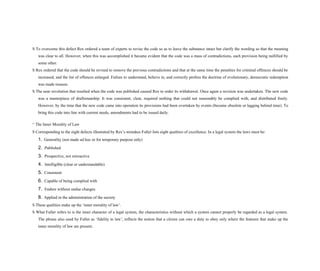
![S A sanction can also be a further legal obligation. Thus, breach of one law (say, a traffic offence) might lead to a further obligation (to appear in court to
answer charges). A chain of legal obligation is possible. At the end of the chain, however, there must be a sanction.
S ‘Imperative laws’, lacking sanctions completely, are not laws in the Austinian sense. Neither are declaratory nor repealing ‘laws’, since they command
nothing.
c. The Separation Thesis
S The existence of law is one thing, its merit or demerit is another... Austin
S Since ancient Greece all the way up to early Christian times, it had been widely considered that a relationship existed between the validity of a law and its
moral content.
S The doctrine that a man-made law is valid only if it does not conflict with a higher law - religious or secular- constitutes a key element of the natural law
theory.
S This notion is totally rejected by Austin. For Austin, a law is valid law if it is set by a sovereign. It is valid if it exists, regardless of its moral content. If it
is commanded by the sovereign, if the law is decreed, placed in position, posited, then it is valid law.
S What he called as ‘positive law’ is a law whatever its source or contents. A positivist is, hence, one who regards a law as being valid not by reference to
some higher law or moral code, but by reason of no more than its existence. Austin clearly declares: The existence of law is one thing, its merit or
demerit is another. Whether it be or be not [i.e. whether law exists or does not exist] is one enquiry; whether it be or be not conformable to an assumed
standard is a different enquiry.
S When we say that human law is good or bad, or is what it ought to be or what it ought not to be, we mean that the law agrees with or differs from
something (E.g. Morality) to which we tacitly refer it to measure or test. He makes a clear separation between the question and what the law ought to be
(it is possible one can make reference to higher laws) and the determination of what the law is.
S ‘Is’ and ‘Ought’ must be kept separate. For Austin, the fact that the law, according to some higher principle, is not what it ought to be is no reason for
saying that it is not. In other words, ought can be identified (to simplify) with criteria for distinguishing between good and bad law. A law might be bad,
but it is still law and must be obeyed by the subjects so long as it is made by the sovereign.
d. Criticism on Austin](https://image.slidesharecdn.com/jurisprudence-250312092858-4dbf11af/85/JURISPRUDENCE-docx-exist-exam-preparation-ques-27-320.jpg)



![developed his own argument for the partial
enforcement of morality based on a distinction
he drew between immorality which affronts
public decency and that which merely
'distresses' others based on S the knowledge
that immoral acts are taking place. In Hart's
view, society may, for example, outlaw the
public expression of bigamy or prostitution,
because such could be considered an affront to
public decency, as a nuisance, while it would
not be justifiable to outlaw purely private S
manifestations of these types of behavior, or of
consensual homosexual behavior in private,
even though some might claim to be distressed
by the private behavior as well. At this point,
Hart viewed it as a matter of balancing the
distress from S the knowledge that something
immoral is taking place with individual
liberty: "[n]o social order which values
individual liberty could also value the right to
be protected from this type of distress”.
UNIT FIVE: HISTORICAL AND
SOCIOLOGICAL LEGAL THEORY
S The so called historical school of
the nineteenth century, led by the
different theories of von Savigny and Henry
Maine, shows us that law cannot be fully
understood until its historical and social context
is studied and appreciated.
The sociological school of 1
jurisprudence is
largely a product of the 20th century. Its
approach to the analysis of law differs from that
of the other schools in that it is S concerned less
with the nature and origin of law than with its
actual functions and end results.
The proponents of sociological jurisprudence
seek to view law within a broad social context
rather than as an isolated phenomenon distinct
from and independent of other means of social
control.
The sociological questions in jurisprudence are
concerned with the actual effects of the law
upon the complex of attitudes, behavior,
organization, environment, skills, and powers
involved in the maintenance of a particular
society. They are also concerned with practical
improvement of the legal system and feel that
this can be achieved only if legislation and court
S adjudications take into account the findings of
other branches of
learning, particularly the social sciences. The
main propagators of this school of
jurisprudence are Eugen Ehrlich and Roscoe
Pound.
Historical School
A. The Spirit of the People:
Savigny
The German historical school of jurisprudence
was launched on its way by Savigny’s little
published book. A scholar of the Roman law,
he was a professor and energy to the new
jurisprudential school. His arguments on the
nature and source of law as well as his view of
historical development of law is presented as
follows:
1. Law originates in custom which expresses
national uniqueness. The principles of law
derive from the beliefs of the people.
2. At the next stage, juristic skills are added,
including codification which does no more
than articulate the Volkgeist but adds
technical and detailed expression to it.
3. Decay and sets in.
The first is that the law of a nation, like its](https://image.slidesharecdn.com/jurisprudence-250312092858-4dbf11af/85/JURISPRUDENCE-docx-exist-exam-preparation-ques-48-320.jpg)


![individual's freedom of speech, assembly,
religion, and in a political sense liberal
democracies are based on the concept of the
freedom of the individual. These 1
rights and
freedoms are portrayed in the Western tradition
as being the only true way to self-realization
and freedom of the individual. The critical legal
scholars' aim is to show that these rights and
freedoms, although put forward as essential to
an individual's fulfillment, actually serve the
political and economic requirements of
liberalism.
S
1 This prong of the critical legal
scholars' attack is derived from the
realists' disbelief that formal rules
provide an answer to a dispute.
However, whereas the realists
concentrated their critique of
formalism on this aspect and were
particularly concerned to try to find
the real rules operated by the judge
and jury, the critical legal scholars
seem to take this element as read.
They add little to the realist critique
in this area apart from a few
generalities. Indeed, such is the lack
of detail in this area that the
following
An attack on formalism
criticism of the critical scholars' approach to
formalism appears justified.
It appears from their attack that formalism
is: . . . the CLS [critical legal studies]
caricature of the notion that law is a deductive
and autonomous science that is selfcontained
in the sense that particular decisions follow
from the application of legal principles,
precedents, and rules of procedure without
regard to values, social goals, or political or
economic context.
Indeed, formalism in its strict black- letter
sense is not to be found in legal theory, only in
some law teaching and academic writing and
in legal practice. It seems that the critical
scholars' agenda stretches both to theory and
practice, with the aim of enlightening
practicing lawyers as to the 'wider implications
and consequences of certain courses of action,
and in particular [to] reveal that unless legal
actions are seen in the context of larger
political action, they may well be counter-
productive, at least in the long term'
S However, the lack of a detailed critique of
formalism may be due to the fact that the
thrust of the critical lawyers' attack is on the
wider issue of whether there is in fact a distinct
mode of legal reasoning. If they successfully
demonstrate that there is no separate mode of
legal reasoning at all then it is unnecessary for
them to have to deal directly with formal legal
reasoning as such. Roberto Unger, one of the
leading exponents of critical legal studies,
indicates that this is the real point of the
movement's critique of formalism.
Critique of legal reasoning
S Whereas the realists did recognize that legal
reasoning and rules played a part, albeit a
minor 'one, in the judge's decision, the critical
legal scholars are of the opinion that these
external factors are the sole operative factor in
the judgment.
S A problem with the critical legal studies
approach to legal reasoning is that, like its
critique of formalism, it appears to lack any
detail or precision.
Contradictions in the law](https://image.slidesharecdn.com/jurisprudence-250312092858-4dbf11af/85/JURISPRUDENCE-docx-exist-exam-preparation-ques-69-320.jpg)
![The constitutive theory of law
s This final trend in the critical legal studies
movement is not only part of its critique of
the liberal legal tradition, but is also part of
the movement's attempt to escape from the
Marxist shackles of determinism.
s The idea that law plays an important role in
shaping society is part of the wider post-
modernist perspective that ideas, and not the
economic base, constitute (form or make up)
society. It follows from this that if there is to
be some sort of order in society, there must be
a convergence of ideas including ideas and
beliefs about law, in other words a 'shared
world-view'. The critical legal scholars'
critique is therefore directed at 'the analysis of
world-views embedded in modern legal
consciousness'.
s The aim is to attack the shared world-view
embedded in legal consciousness, to reveal its
link to domination in capitalist legal societies,
and to change that consciousness. This is not
an easy task because the constitutive power of
the dominant shared world-view
in society is grounded in that worldview's
claim to be the truth, and since 'every world-
view is hostage to its claim to be true, its
constitutive force can be undermined [only] if
this claim can be refuted'. The shared world-
view that the liberal order is the only true and
natural system can be refuted if it is shown
that there is any number of alternative ways
which would not result in exploitation and
injustice.
2. Critical Legal Studies and Feminist
Legal Theory
s Feminist legal theories represent a s most
important modern development in the analysis
of law, concerned with the treatment of
women by the legal system and the perception,
or lack of perception, of women's experience
and needs in legal provision. In engaging with
this agenda feminist theories not only seek to
identify and counter a traditionally male-
oriented legal s system but also to question
male- oriented theories and ideologies. Part of
this latter element of feminist thought
emphasises a rejection of a search for
objective 'truths' about law and puts in its
place a
contextual understanding of law as a social
construct which is a product of a variety of
influences, some of which are covert or even
unrecognized. It is also suggested in some
feminist theory that a 'male'-oriented
appreciation of law emphasises individualism
and 'rights' at the expense of 'female' emphases
upon interaction and cooperation. This in turn
demands a radical new methodology in legal
theory which is, to a significant extent, found
in the critical legal method.
Feminist theory is by no means limited to the
context of critical legal studies; if it were, that
might be seen as fundamentally inconsistent
with the dynamic of the feminist approach to
legal theory. Anne Bottomley, Susie Gibson
and Belinda Meteyard remark that:
Feminism and critical legal studies are, of
course, two entirely different creatures.
Feminism is only partially and peripherally
concerned with academic theorising. It is
motivated by the dissatisfactions of a wide
spectrum of ... women and by the](https://image.slidesharecdn.com/jurisprudence-250312092858-4dbf11af/85/JURISPRUDENCE-docx-exist-exam-preparation-ques-72-320.jpg)
![The issue of domestic violence and its
treatment by criminal law and law
enforcement agencies is an obvious area of
concern, characterised by the recognition
by English law in R v R [1991] of the
possibility of rape within marriage. Again
in the employment sector, different
retirement ages and pension entitlement for
women and men, which may prejudice
either men or women who might want to
retire earlier or work later, has also been an
issue of concern in the 1990s, with a major
compensation award to three women
workers in the gas industry in June 1996.
The essential point in many, although not
all, of these concerns has been put shortly
by Katherine T. Bartlett in her statement
that the essential 'woman question' in law
is: how the law fails to take into account
the experiences and values that seem more
typical of women than of men, for
whatever reason, or how existing legal
standards and concepts might disadvantage
women.
s The value of critical methodologies in the
display and analysis of such gender
distortions in law and legal administration
should be evident.
The point to be emphasised is perhaps that of
the disadvantaging effect of concealed and
frequently unrealised bias in a legal order
which has for the most part developed from
male rather than female experience. This is not
to assert a 'conspiracy theory' or to claim that
all law discriminates against women. It is also
not necessary to assert a gender- exclusive
model in which there are claimed to be wholly
incompatible 'individualist' male and
'collectivist' female viewpoints. This latter
claim is also sometimes made in relation to
different human cultures and in both cases it
can unwisely be forgotten that we are, in an
Aristotelian sense, social individuals, i.e. each
person, woman or man, is an individual who
lives in association with others in a social
structure. The key endeavour of feminist legal
theory may rather be to identify a fact of
social, political and legal history which in
many important respects fails adequately to
take account of the experience of somewhat
more than half of the human population. This
is expressly a failure to afford mutuality and
recognition not only to women as
members of society but, in fact, a failure to
recognize the mutuality of all society's
members, women and men. Such failures,
based upon whatever form of improper
discriminatory selectivity, generate
alienation and, ultimately, disfunctionality
in the working of a legal order. The ways
in which this has happened and the present
real extent of the problem are the issues
central to the interface between feminist
legal theory and critical legal studies. This
then opens the question of deconstructive
and positive agendas. Much of the critical
legal endeavour is concerned with the
identification of defects and concealed
agendas in law; feminism is at least as
much concerned with establishing proper
recognition of women's experience in
society and law. Nonetheless, the
identification of the sources of
marginalization and alienation may be seen
as at least an important stage in a process
of response.
Postmodern Legal Theory](https://image.slidesharecdn.com/jurisprudence-250312092858-4dbf11af/85/JURISPRUDENCE-docx-exist-exam-preparation-ques-74-320.jpg)