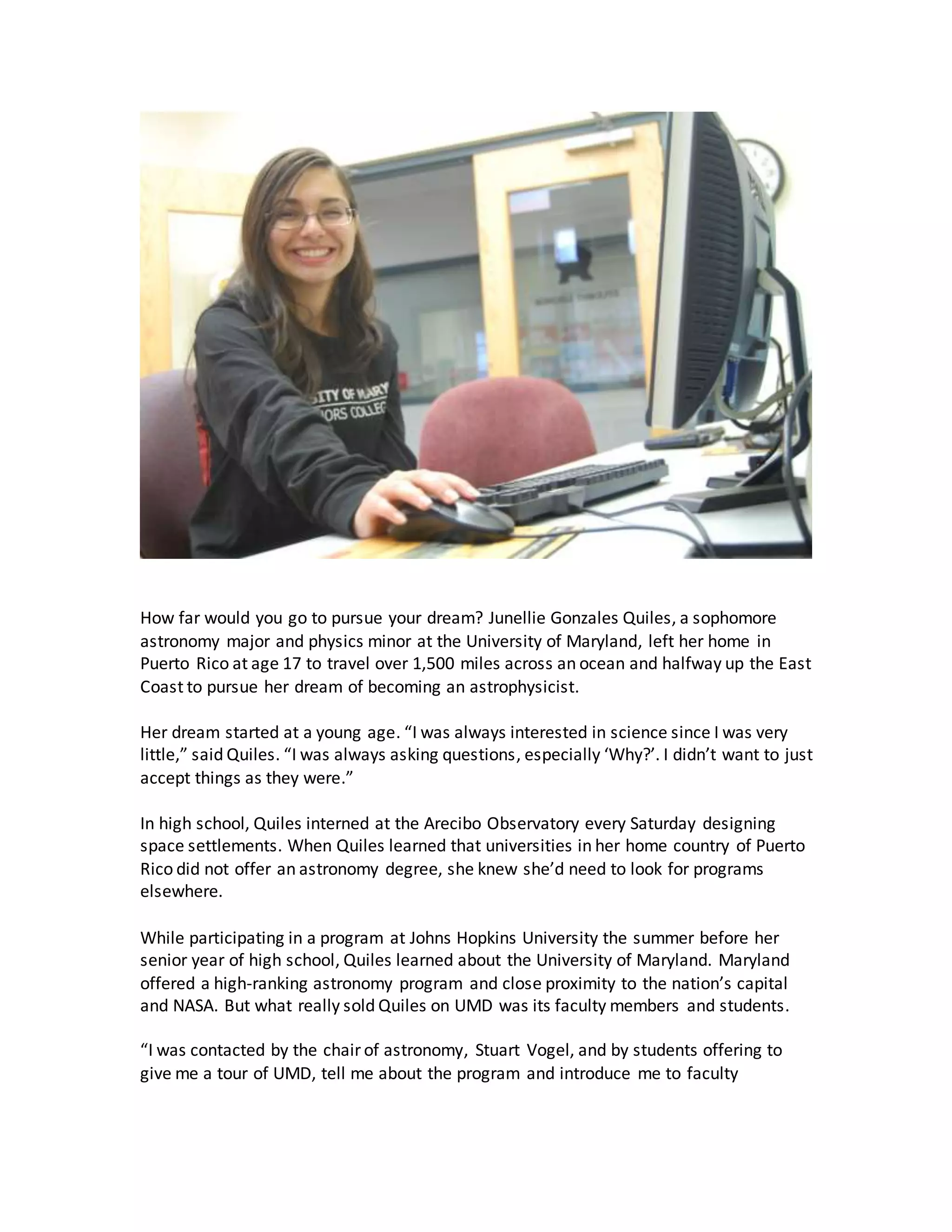
How far would you go to pursue your dream? Junellie Gonzales Quiles, a sophomore
astronomy major and physics minor at the University of Maryland, left her home in
Puerto Rico at age 17 to travel over 1,500 miles across an ocean and halfway up the East
Coast to pursue her dream of becoming an astrophysicist.
Her dream started at a young age. “I was always interested in science since I was very
little,” said Quiles. “I was always asking questions, especially ‘Why?’. I didn’t want to just
accept things as they were.”
In high school, Quiles interned at the Arecibo Observatory every Saturday designing
space settlements. When Quiles learned that universities in her home country of Puerto
Rico did not offer an astronomy degree, she knew she’d need to look for programs
elsewhere.
While participating in a program at Johns Hopkins University the summer before her
senior year of high school, Quiles learned about the University of Maryland. Maryland
offered a high-ranking astronomy program and close proximity to the nation’s capital
and NASA. But what really sold Quiles on UMD was its faculty members and students.
“I was contacted by the chair of astronomy, Stuart Vogel, and by students offering to
give me a tour of UMD, tell me about the program and introduce me to faculty
members,” said Quiles. “During my visit, I immediately felt very welcomed, and I felt like
I was already part of the university; other universities I applied to never did that.”
Quiles was also accepted into the University Honors Program, which allowed for better
discussions in her seminars and more one-on-one interactions with professors.
Quiles’ close relationship with faculty members in the Department of Astronomy and
honors program allowed her to expand her network in the scientific community. With
guidance and recommendations Quiles applied and interned this past summer at NASA’s
Goddard Space Flight Center in Greenbelt, Md.
Over the course of 10 weeks, she visited Congress to hear policymakers’ perspectives on
research and received mentoring on graduate school and problems minority students
may face. She also conducted research, taking theories she learned in class and applying
them to real-life scenarios.
Her expanding network provided her the opportunity this semester to conduct research
on exoplanets. Her hope is to better understand the environment and the conditions in
which exoplanets can form.
In addition to her research interests, music, poetry and art also play a major role in
Quiles’ life. She plays the trombone in the Mighty Sound of Maryland Marching Band.
She loves walking into Byrd Stadium when it’s full of people at a football game and
motivating them to cheer for the Terps.
“I love being involved in arts, it makes me explore another part of myself and get new
perspectives,” she said. “That’s important in physics, too, because you have to try
different methods to get an answer.”
As Quiles continues to pursue her dream of becoming an astrophysicist, she offers one
piece of advice to her fellow students.
“Don’t be afraid to go see professors or try something new,” said Quiles. “If you get help
or meet new people you’ll be guaranteed a great experience.”
Juneile Student Spotlight Edits (2)

Juneile Student Spotlight Edits (2)

  • 1.
    How far wouldyou go to pursue your dream? Junellie Gonzales Quiles, a sophomore astronomy major and physics minor at the University of Maryland, left her home in Puerto Rico at age 17 to travel over 1,500 miles across an ocean and halfway up the East Coast to pursue her dream of becoming an astrophysicist. Her dream started at a young age. “I was always interested in science since I was very little,” said Quiles. “I was always asking questions, especially ‘Why?’. I didn’t want to just accept things as they were.” In high school, Quiles interned at the Arecibo Observatory every Saturday designing space settlements. When Quiles learned that universities in her home country of Puerto Rico did not offer an astronomy degree, she knew she’d need to look for programs elsewhere. While participating in a program at Johns Hopkins University the summer before her senior year of high school, Quiles learned about the University of Maryland. Maryland offered a high-ranking astronomy program and close proximity to the nation’s capital and NASA. But what really sold Quiles on UMD was its faculty members and students. “I was contacted by the chair of astronomy, Stuart Vogel, and by students offering to give me a tour of UMD, tell me about the program and introduce me to faculty
  • 2.
    members,” said Quiles.“During my visit, I immediately felt very welcomed, and I felt like I was already part of the university; other universities I applied to never did that.” Quiles was also accepted into the University Honors Program, which allowed for better discussions in her seminars and more one-on-one interactions with professors. Quiles’ close relationship with faculty members in the Department of Astronomy and honors program allowed her to expand her network in the scientific community. With guidance and recommendations Quiles applied and interned this past summer at NASA’s Goddard Space Flight Center in Greenbelt, Md. Over the course of 10 weeks, she visited Congress to hear policymakers’ perspectives on research and received mentoring on graduate school and problems minority students may face. She also conducted research, taking theories she learned in class and applying them to real-life scenarios. Her expanding network provided her the opportunity this semester to conduct research on exoplanets. Her hope is to better understand the environment and the conditions in which exoplanets can form. In addition to her research interests, music, poetry and art also play a major role in Quiles’ life. She plays the trombone in the Mighty Sound of Maryland Marching Band. She loves walking into Byrd Stadium when it’s full of people at a football game and motivating them to cheer for the Terps. “I love being involved in arts, it makes me explore another part of myself and get new perspectives,” she said. “That’s important in physics, too, because you have to try different methods to get an answer.” As Quiles continues to pursue her dream of becoming an astrophysicist, she offers one piece of advice to her fellow students. “Don’t be afraid to go see professors or try something new,” said Quiles. “If you get help or meet new people you’ll be guaranteed a great experience.”