1
Influence of photodynamicand sonodynamic
disinfection on the bond strength of
caries affected dentin bonded to three different
‑
tooth colored restorative materials: A
‑
comparative study
Sharma A, Raj S, Nikhil V, Mishra P, Ravider R. Influence of photodynamic and sonodynamic
disinfection on the bond strength of caries-affected dentin bonded to three different tooth-
colored restorative materials: A comparative study. Journal of Conservative Dentistry and
Endodontics. 2025 Feb 1;28(2):193-8.
3
INTRODUCTION
Partial cariesremoval (PCR) - total removal of all carious tissues with the
exception of caries affected dentin (CAD) that is close to the pulp.
‑
PCR - mechanical cleaning - remove extremely disorganized and infected
dentin - preserving CAD - remineralize.
PCR - high clinical and radiographic success rate, shortens the follow up
‑
period, and lowers the risk of pulp exposure.
4.
4
Issues withPCR:
may weaken the binding between the restorative material and dentin - solid
bond between the tooth substrate and the restorative materials.
bacterial residues on the cavity wall - cavity disinfectant techniques such as
photodynamic therapy (PDT) and sonodynamic therapy (SDT).
5.
5
AIM
To evaluatethe influence of photodynamic and sonodynamic disinfection on
the bond strength of caries affected dentin bonded to three different
‑
restorative materials, i.e. Cention N, RMGIC, and Synergy D6.
6.
6
NULL HYPOTHESIS
No effectof PDT and SDT with different photo/sonosensitizers on the
bond strength of CAD bonded to three different restorative materials.
7.
7
OBJECTIVES
To evaluatethe shear bond strength of Cention N bonded to caries affected
‑
dentin after using PDT and SDT, using universal testing machine.
To evaluate the shear bond strength of RMGIC bonded to caries affected
‑
dentin after using PDT and SDT, using universal testing machine.
To evaluate the shear bond strength of Synergy D6 bonded to caries affected
‑
dentin after using PDT and SDT, using universal testing machine.
To compare the shear bond strength of Cention N, RMGIC, and Synergy D6
bonded to caries affected dentin
‑ after using PDT and SDT, using universal
testing machine.
8.
8
SAMPLE SIZE
Statisticalmodel - ANOVA model and using the data obtained from
a previous study conducted by Alrahlah et al., and the sample size of
each group was set as 9.
9.
9
SAMPLE SELECTION
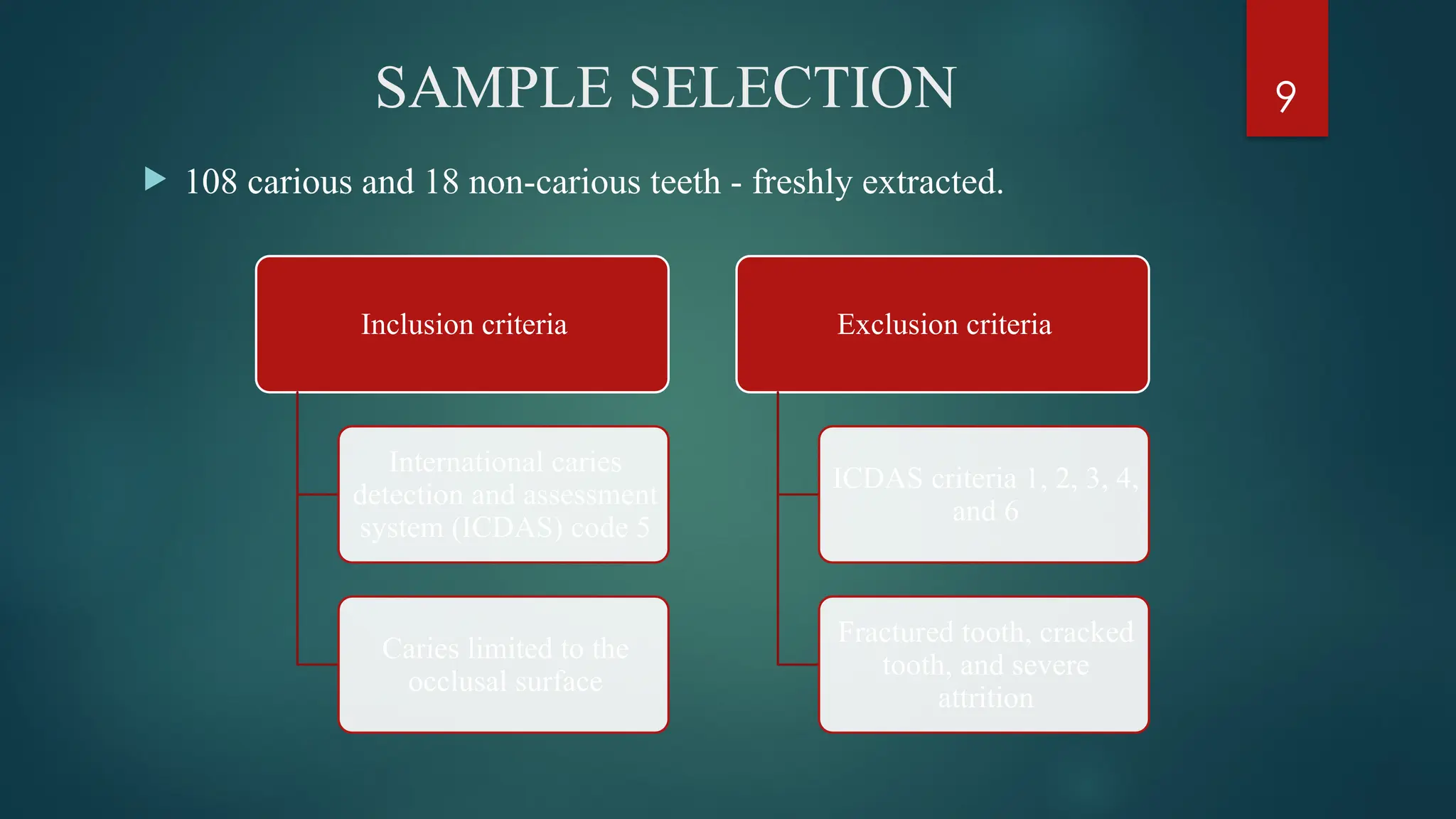
108carious and 18 non-carious teeth - freshly extracted.
Inclusion criteria
International caries
detection and assessment
system (ICDAS) code 5
Caries limited to the
occlusal surface
Exclusion criteria
ICDAS criteria 1, 2, 3, 4,
and 6
Fractured tooth, cracked
tooth, and severe
attrition
13
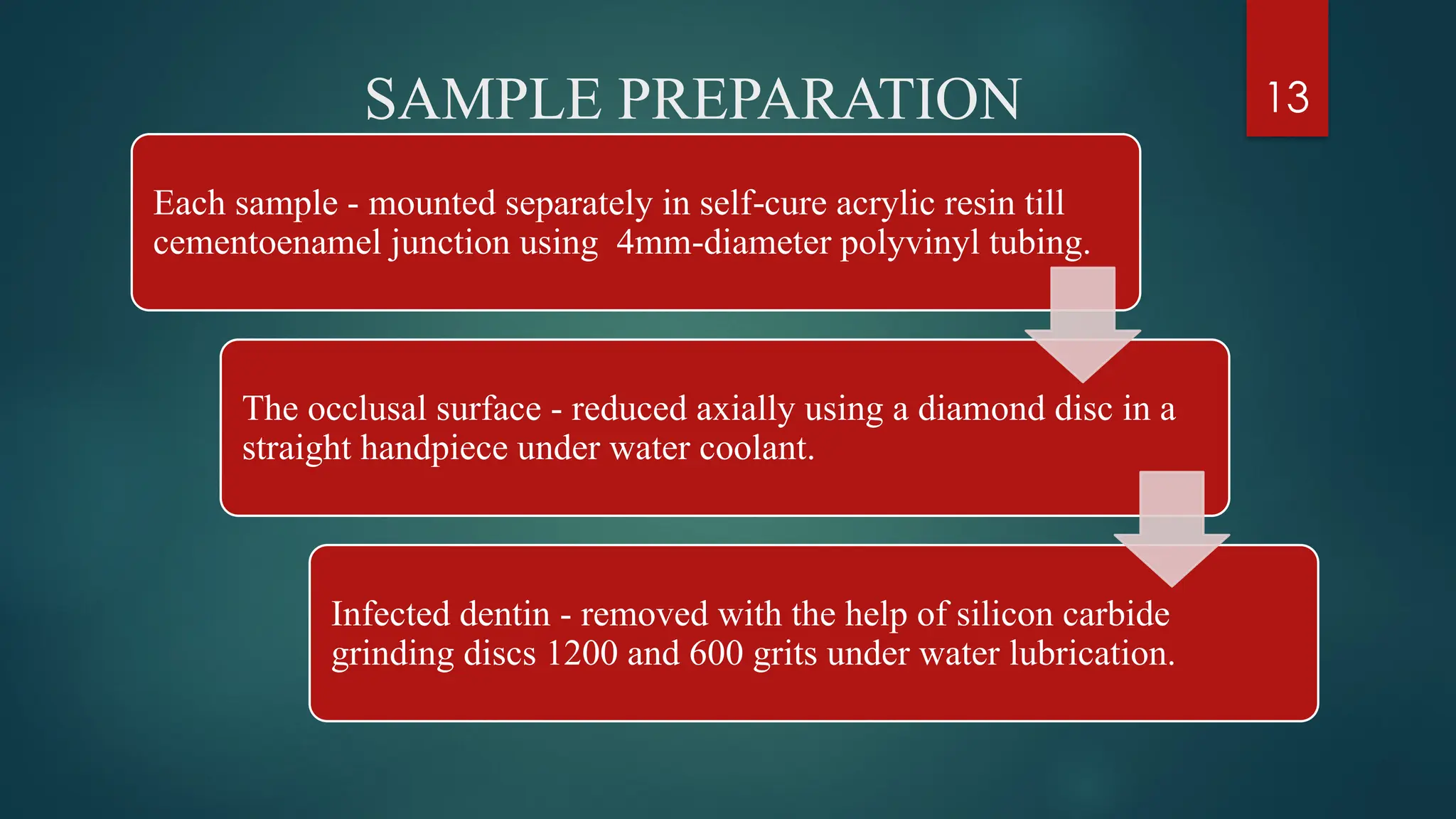
SAMPLE PREPARATION
Each sample- mounted separately in self cure acrylic resin till
‑
cementoenamel junction using 4mm diameter polyvinyl tubing.
‑
The occlusal surface - reduced axially using a diamond disc in a
straight handpiece under water coolant.
Infected dentin - removed with the help of silicon carbide
grinding discs 1200 and 600 grits under water lubrication.
14.
14
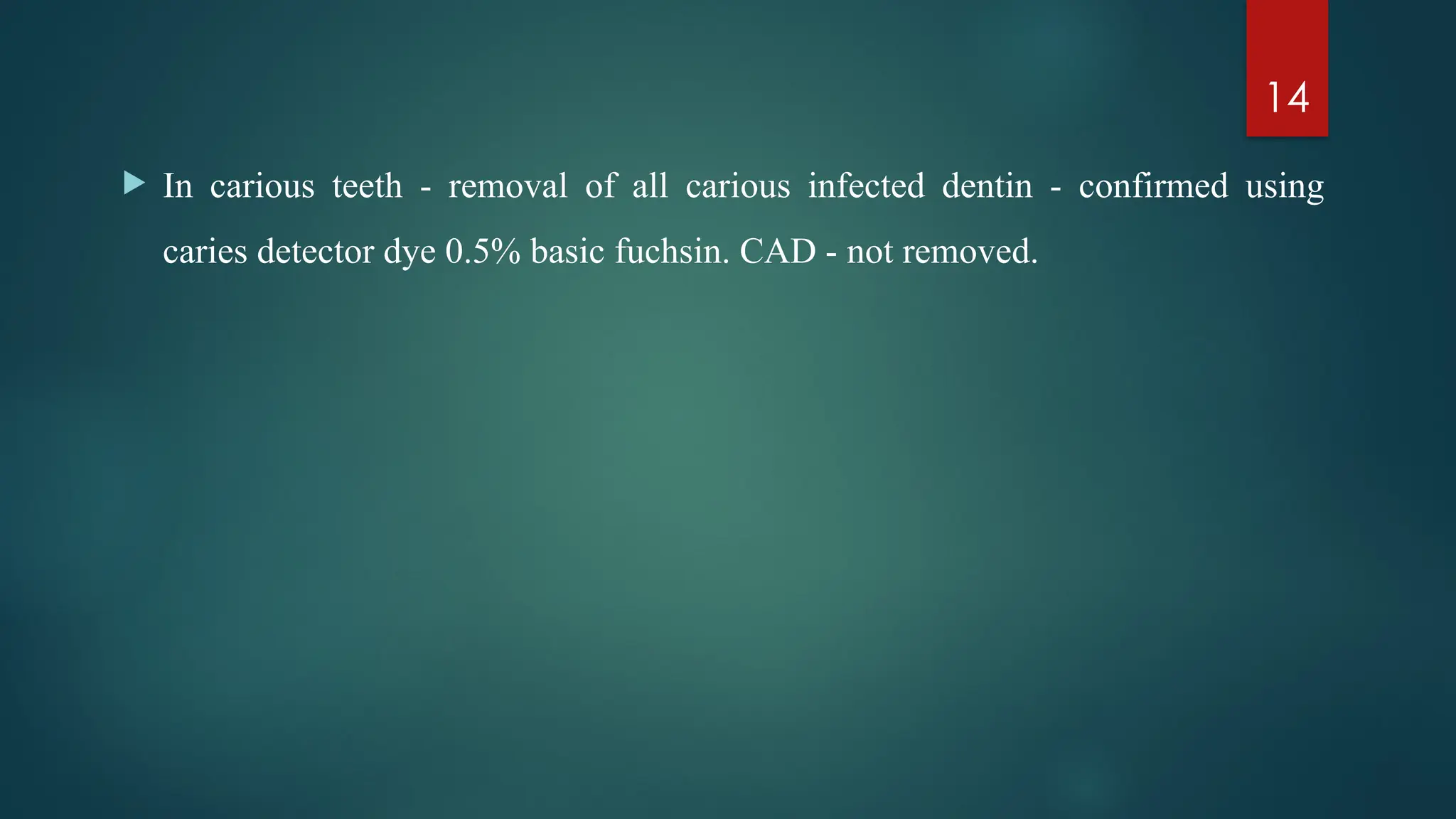
In cariousteeth - removal of all carious infected dentin - confirmed using
caries detector dye 0.5% basic fuchsin. CAD - not removed.
15.
15
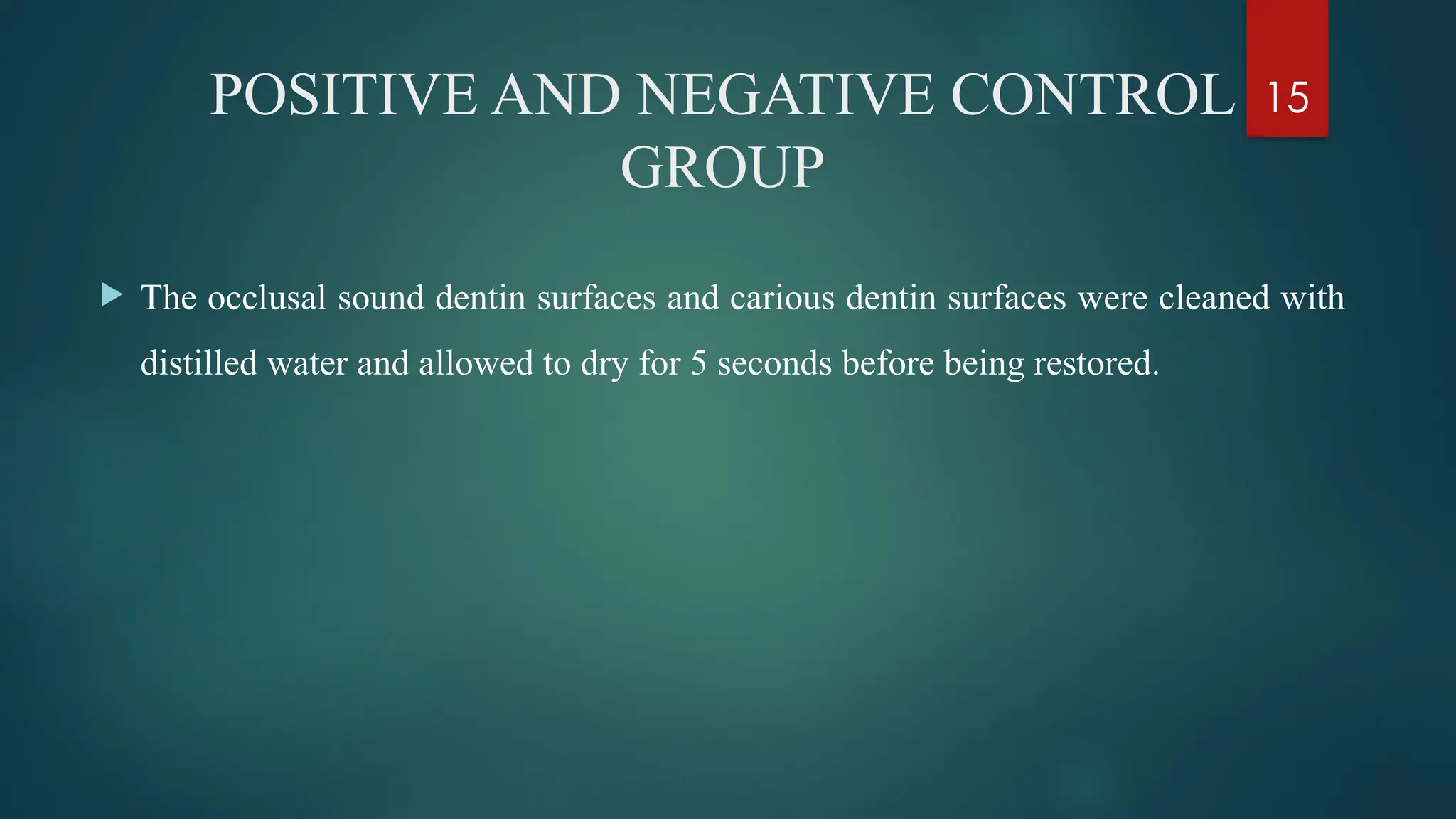
POSITIVE AND NEGATIVECONTROL
GROUP
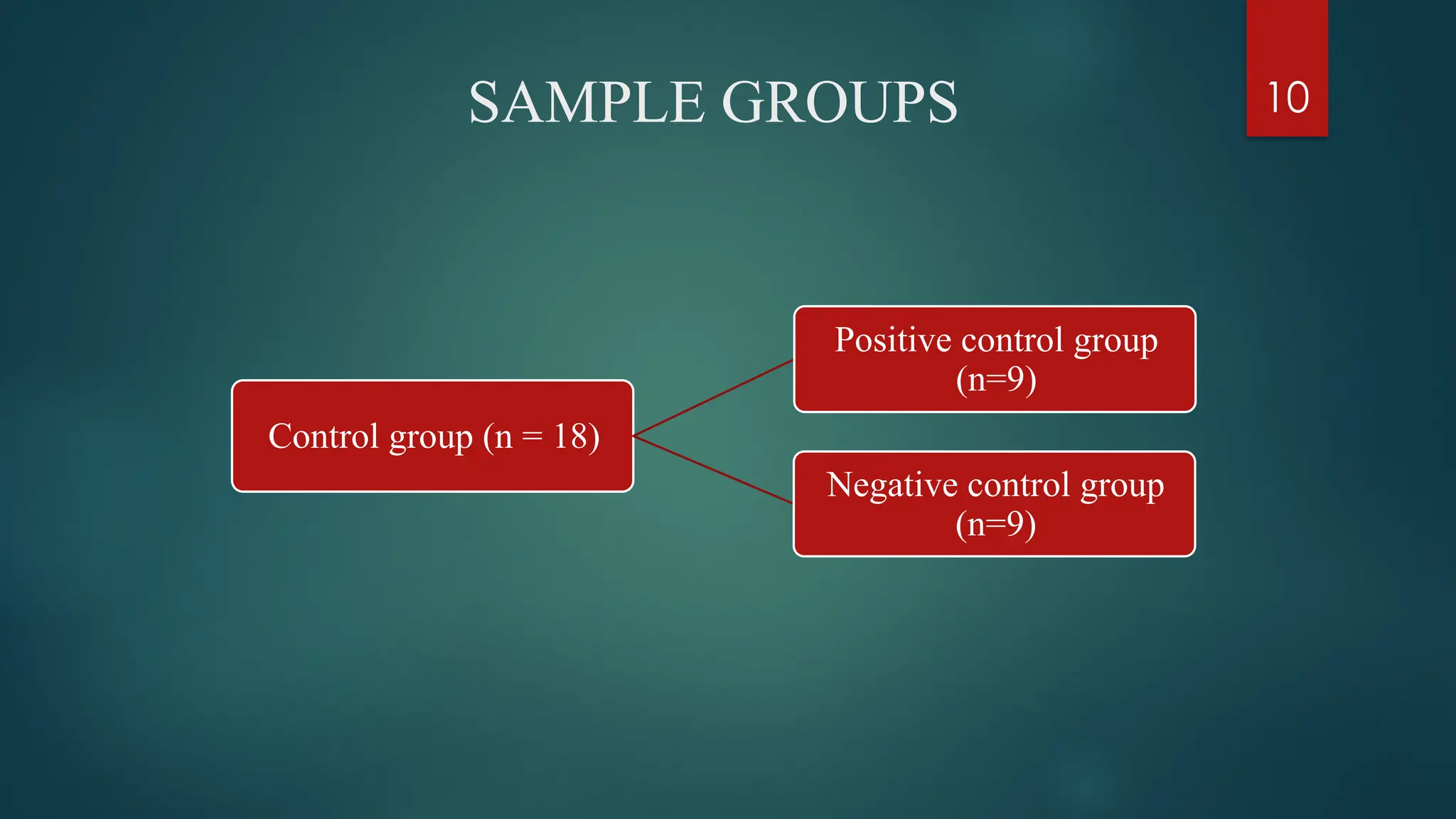
The occlusal sound dentin surfaces and carious dentin surfaces were cleaned with
distilled water and allowed to dry for 5 seconds before being restored.
16.
16
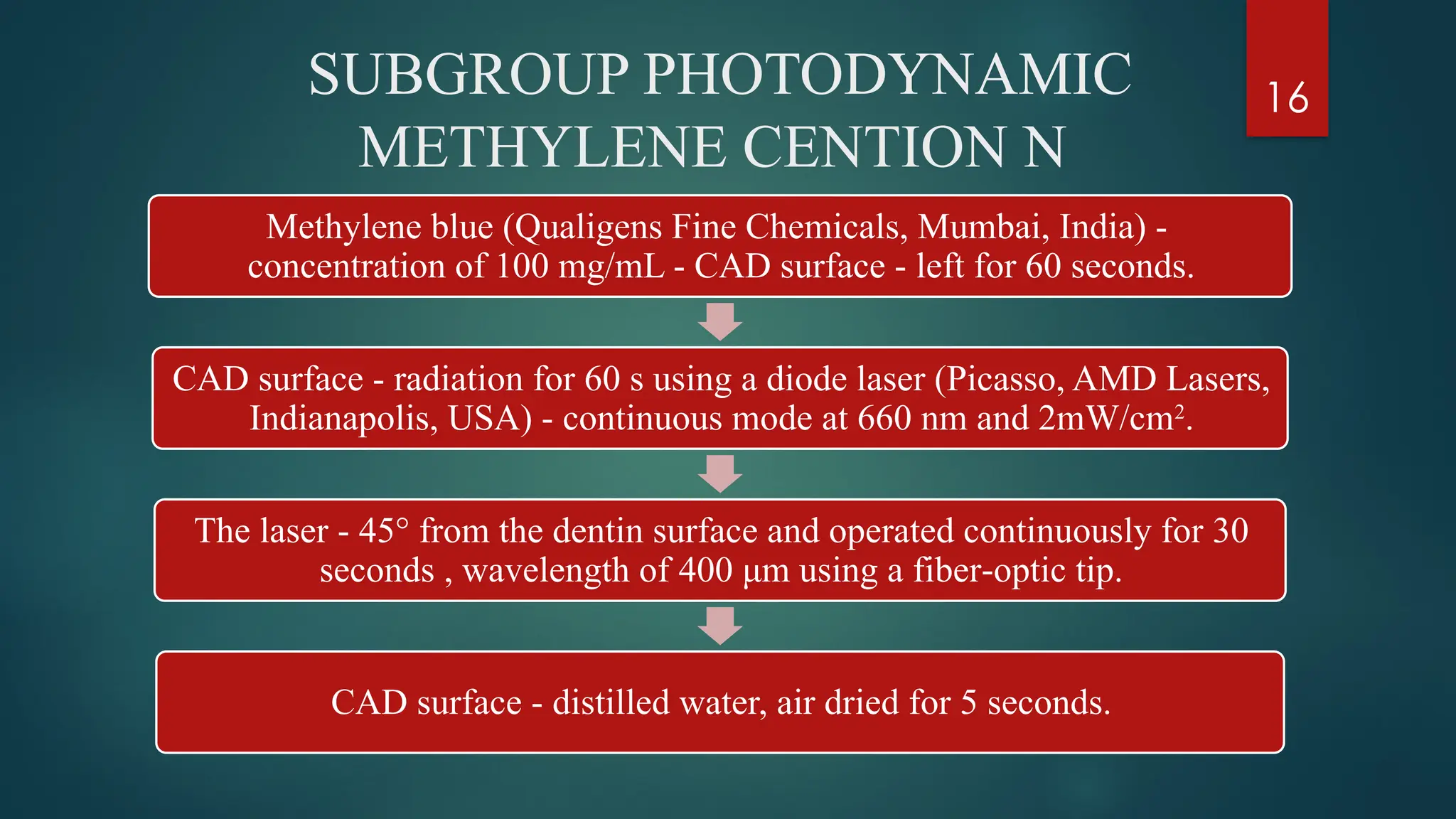
SUBGROUP PHOTODYNAMIC
METHYLENE CENTIONN
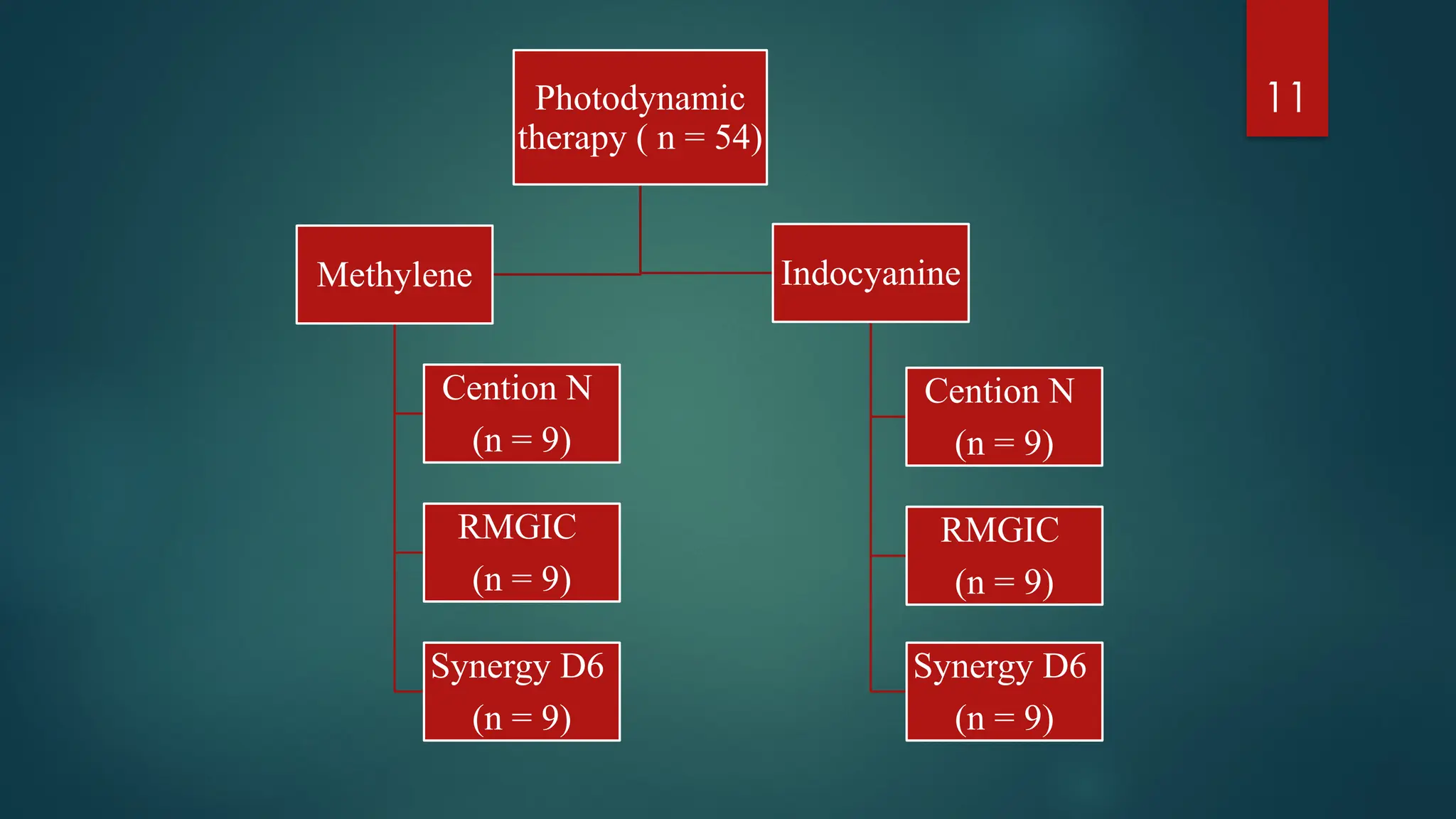
Methylene blue (Qualigens Fine Chemicals, Mumbai, India) -
concentration of 100 mg/mL - CAD surface - left for 60 seconds.
CAD surface - radiation for 60 s using a diode laser (Picasso, AMD Lasers,
Indianapolis, USA) - continuous mode at 660 nm and 2mW/cm2
.
The laser - 45° from the dentin surface and operated continuously for 30
seconds , wavelength of 400 μm using a fiber optic tip.
‑
CAD surface - distilled water, air dried for 5 seconds.
17.
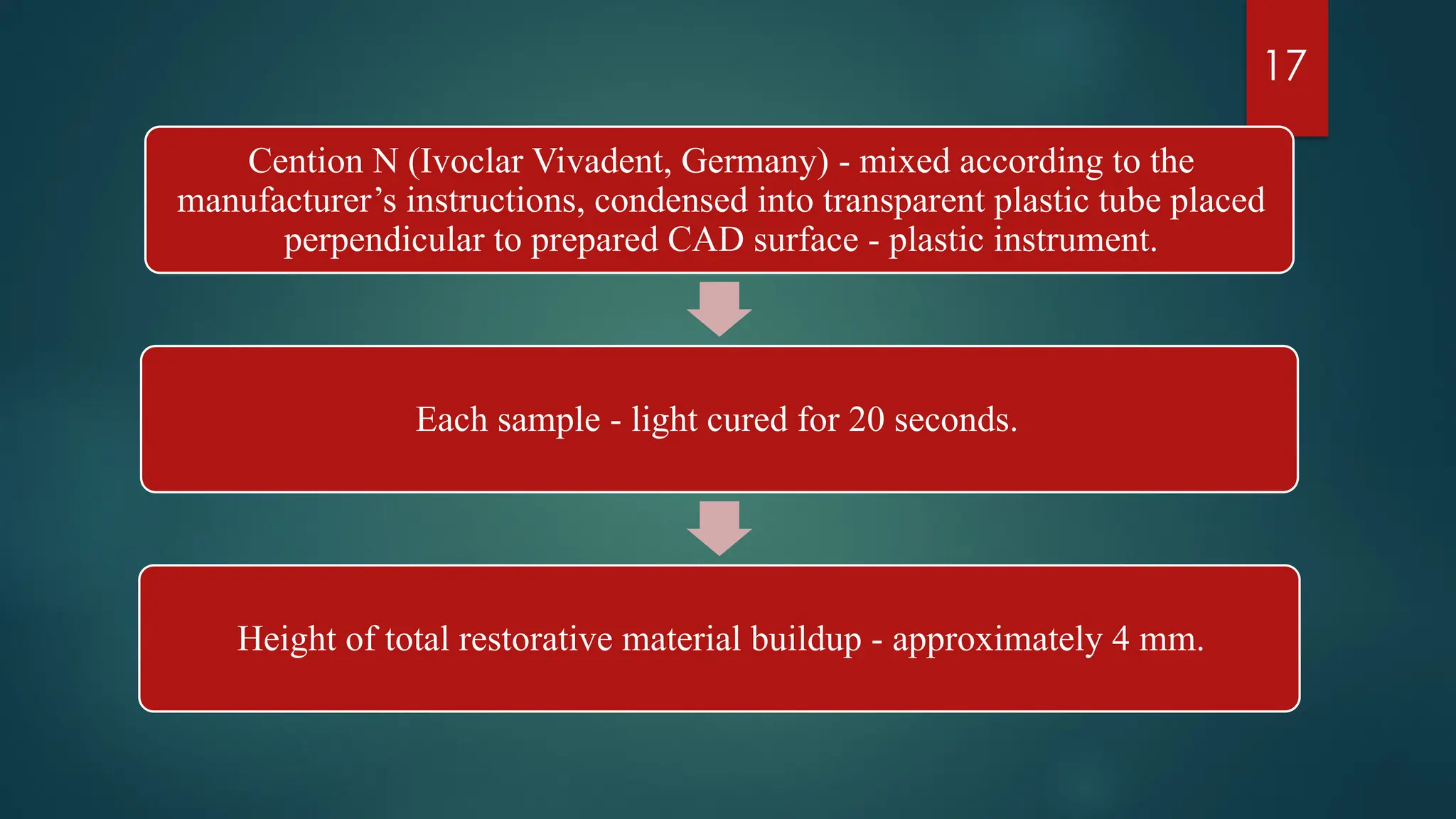
Cention N (IvoclarVivadent, Germany) - mixed according to the
manufacturer’s instructions, condensed into transparent plastic tube placed
perpendicular to prepared CAD surface - plastic instrument.
Each sample - light cured for 20 seconds.
Height of total restorative material buildup - approximately 4 mm.
17
18.
18
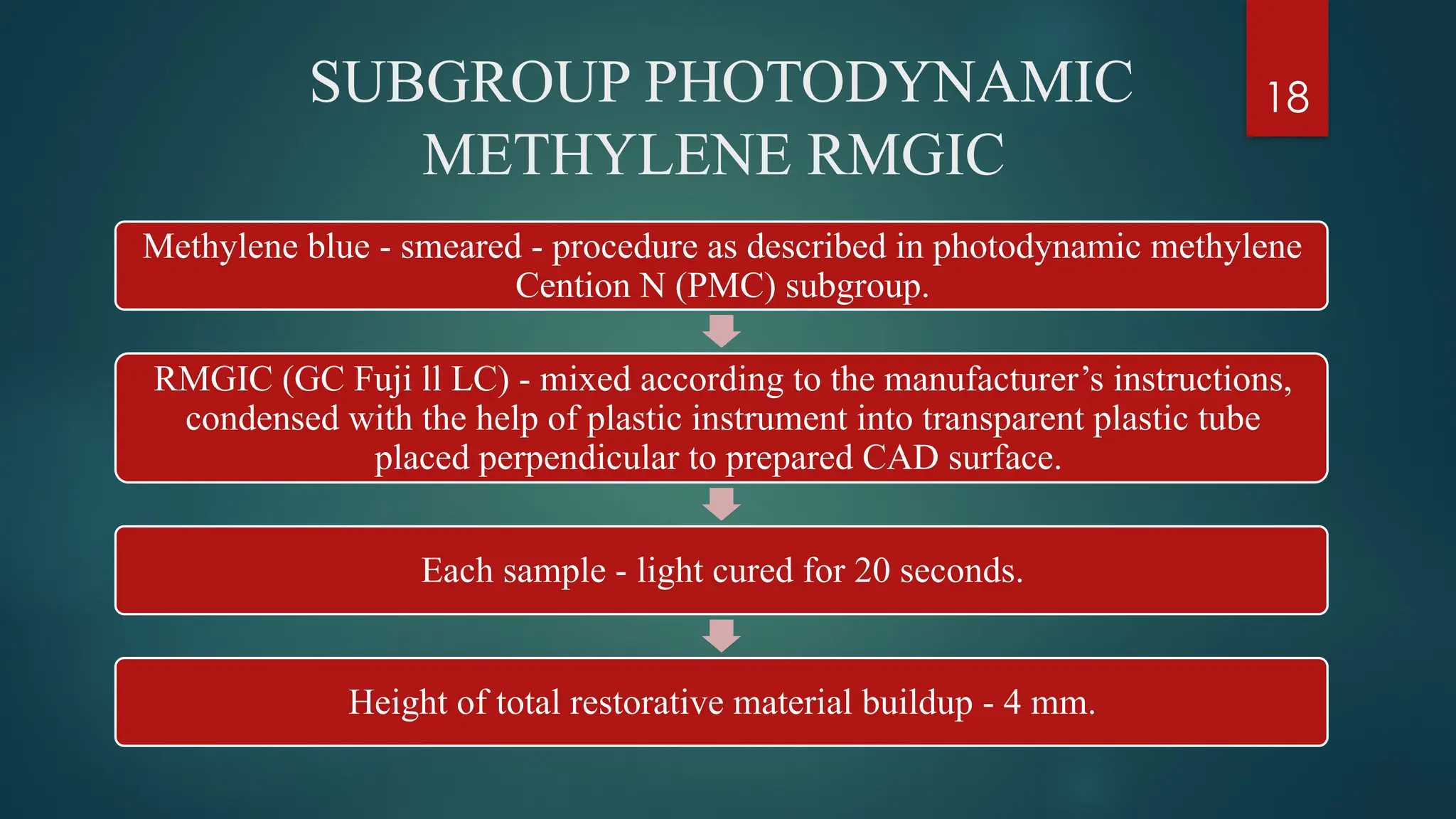
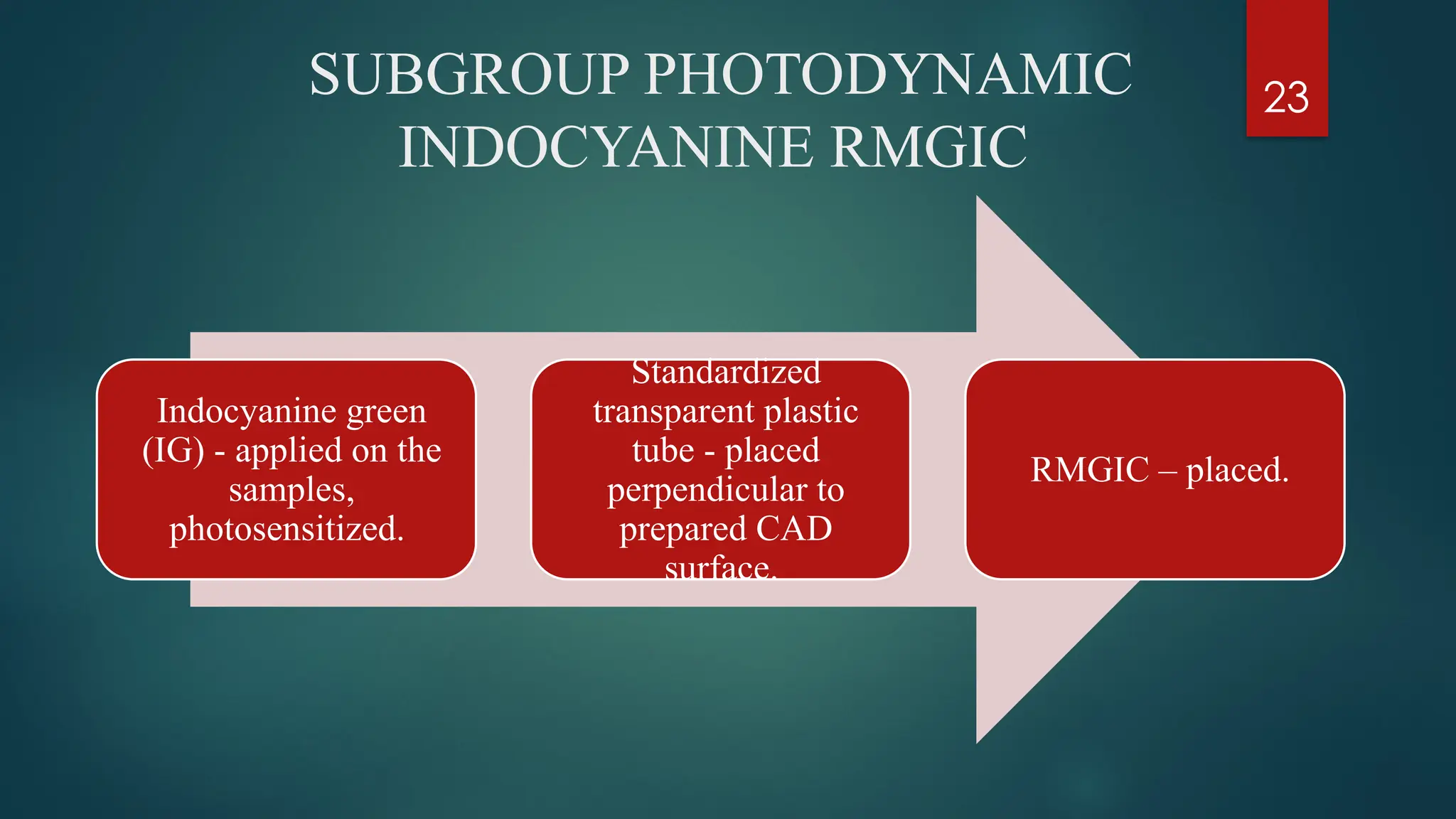
SUBGROUP PHOTODYNAMIC
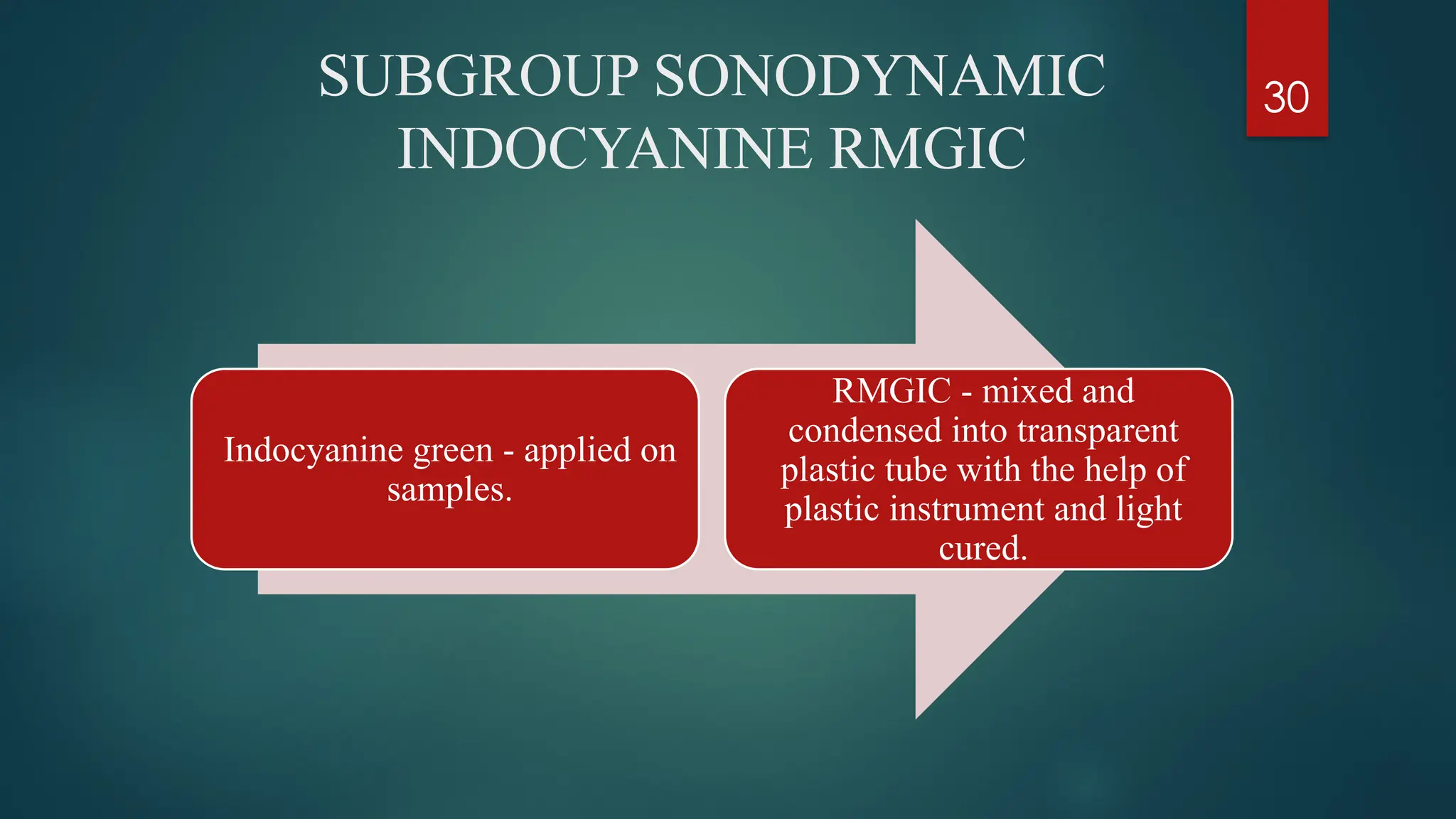
METHYLENE RMGIC
Methyleneblue - smeared - procedure as described in photodynamic methylene
Cention N (PMC) subgroup.
RMGIC (GC Fuji ll LC) - mixed according to the manufacturer’s instructions,
condensed with the help of plastic instrument into transparent plastic tube
placed perpendicular to prepared CAD surface.
Each sample - light cured for 20 seconds.
Height of total restorative material buildup - 4 mm.
19.
19
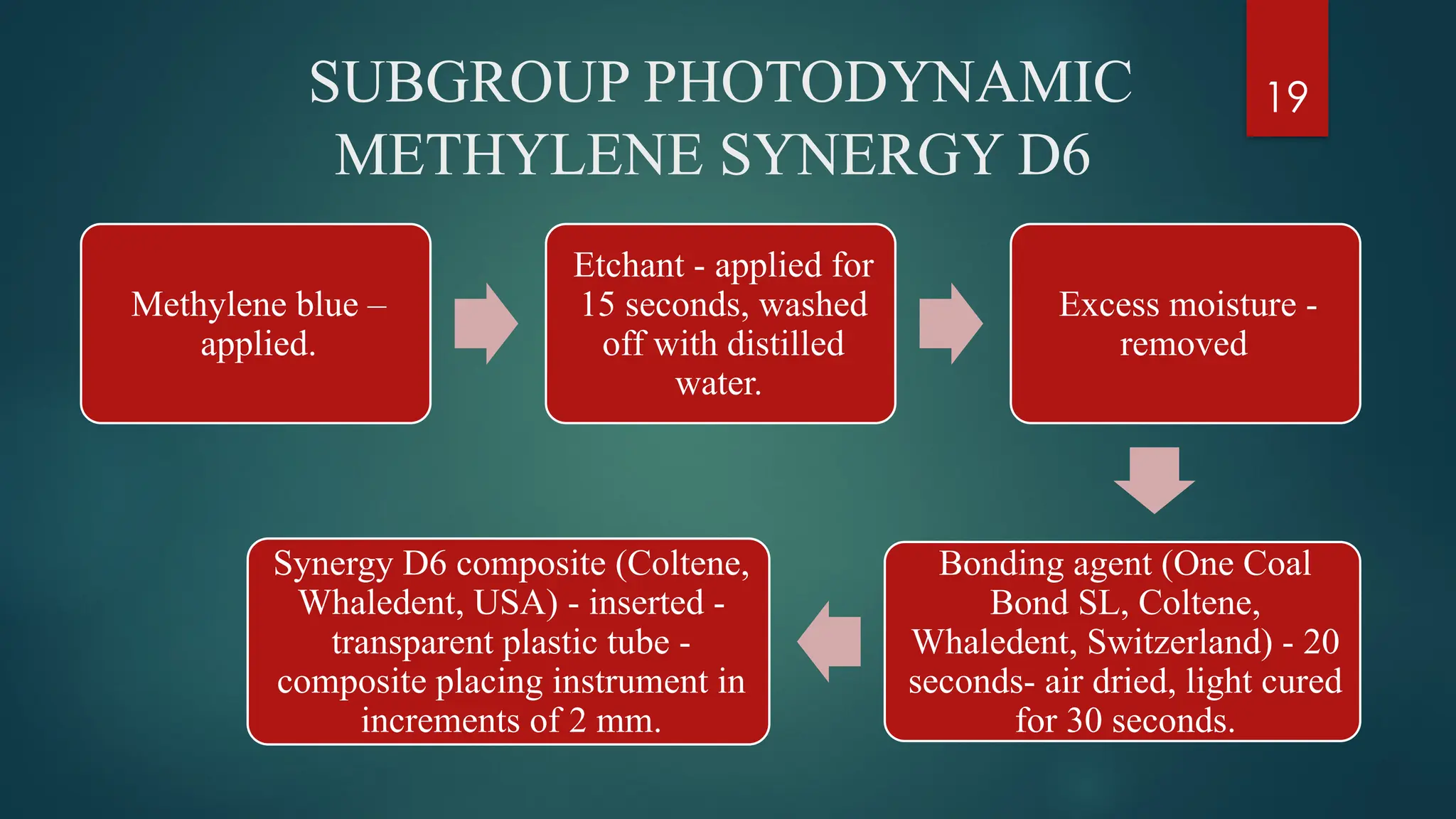
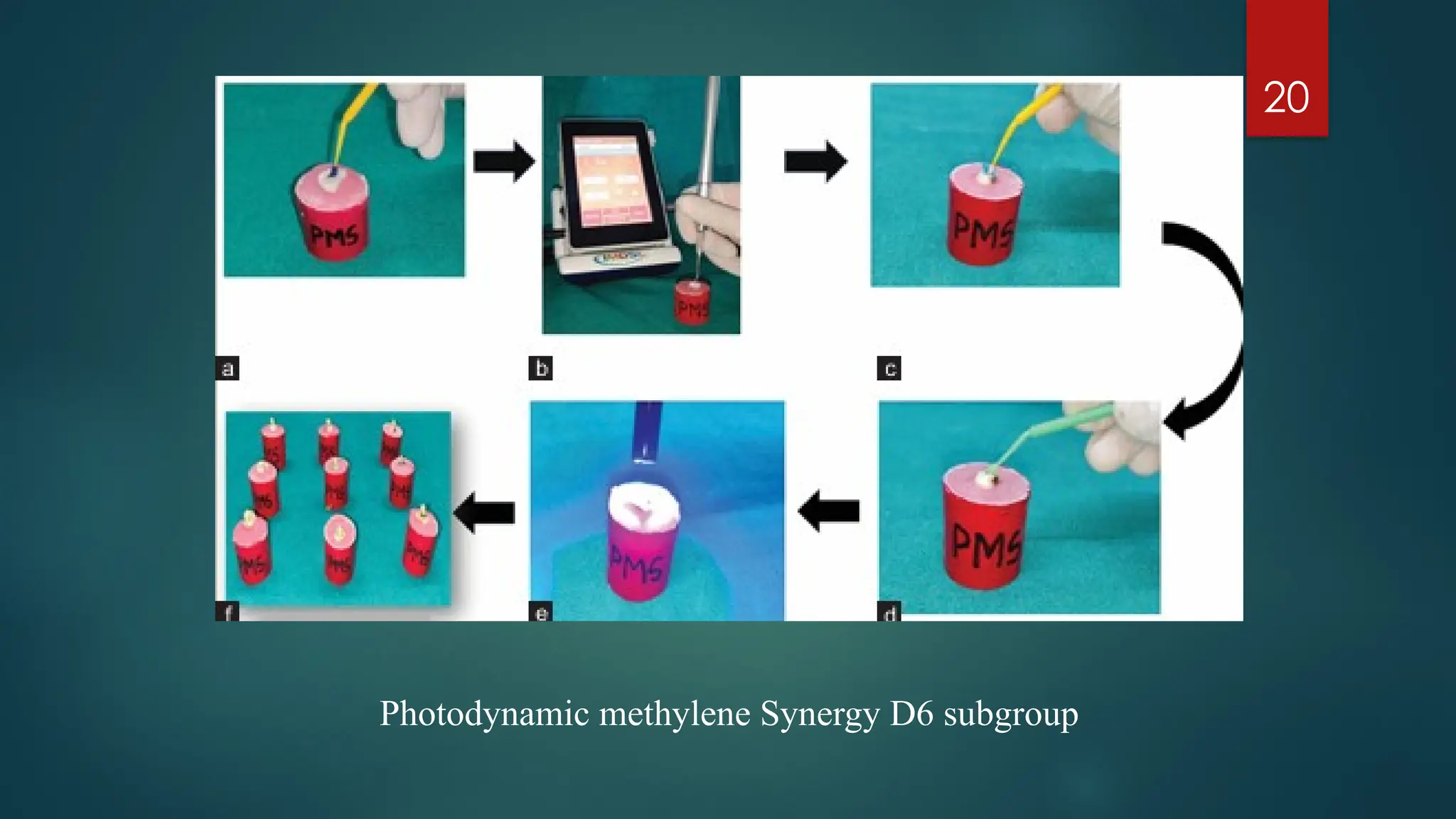
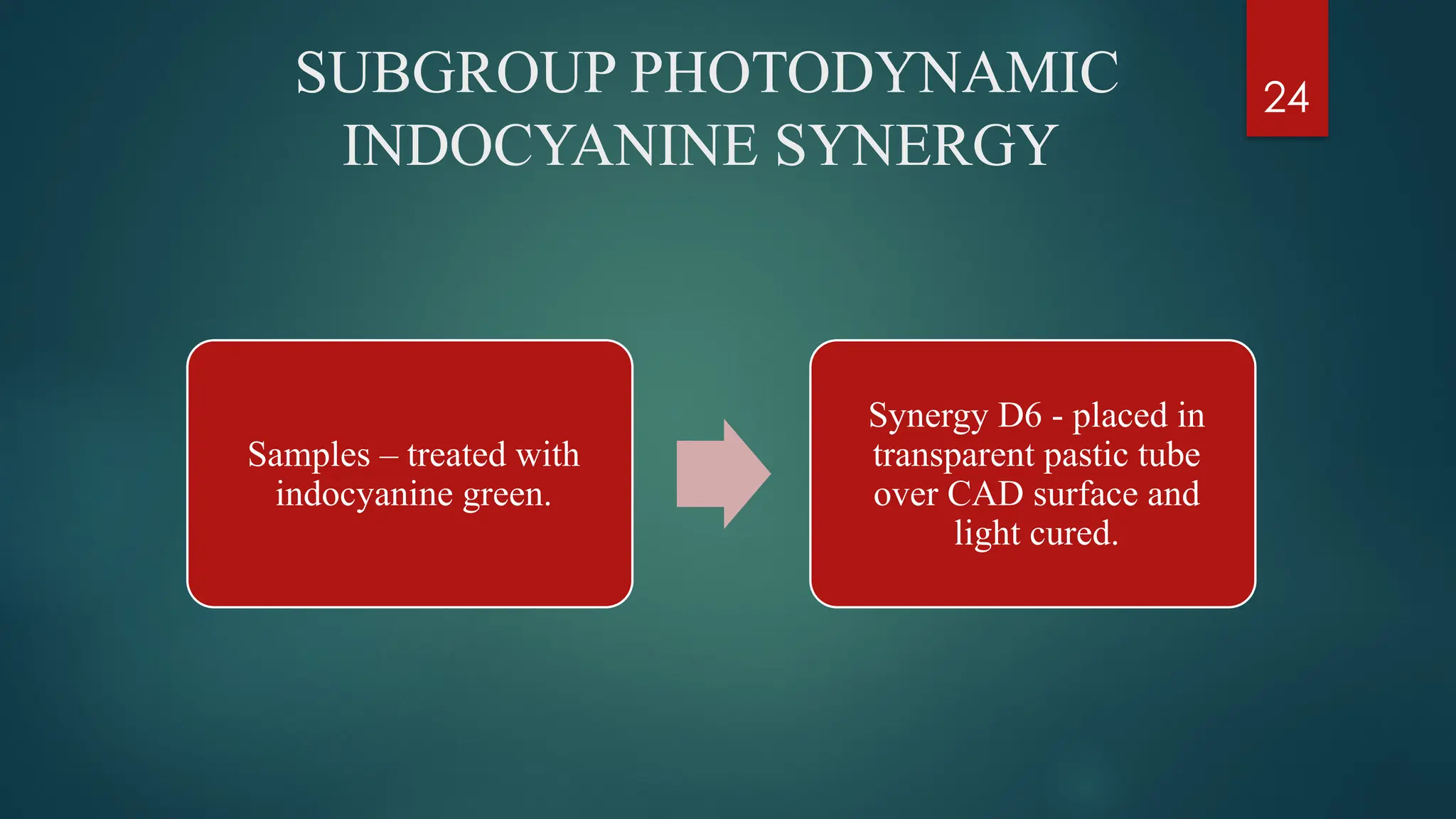
SUBGROUP PHOTODYNAMIC
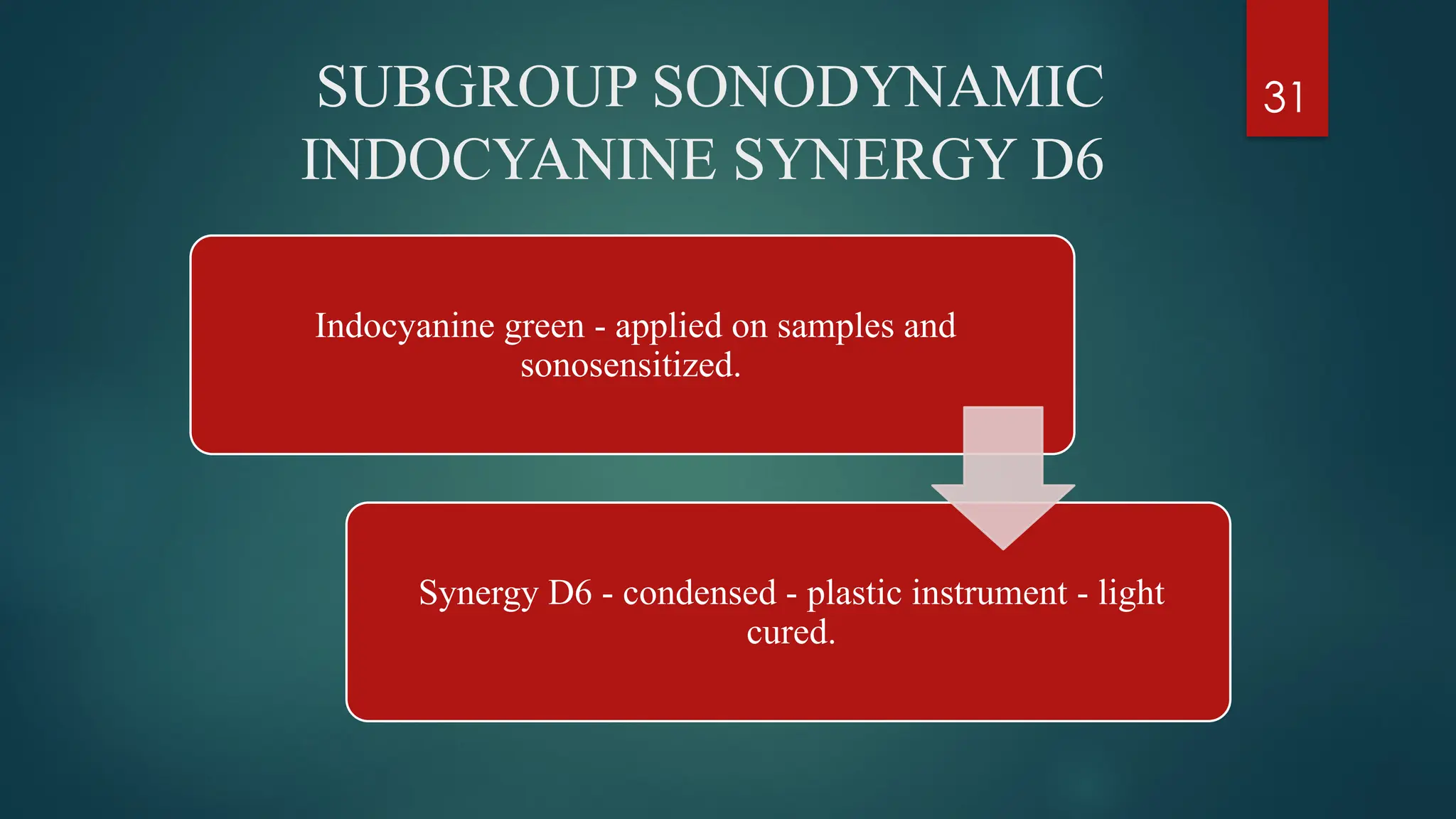
METHYLENE SYNERGYD6
Methylene blue –
applied.
Etchant - applied for
15 seconds, washed
off with distilled
water.
Excess moisture -
removed
Bonding agent (One Coal
Bond SL, Coltene,
Whaledent, Switzerland) - 20
seconds- air dried, light cured
for 30 seconds.
Synergy D6 composite (Coltene,
Whaledent, USA) - inserted -
transparent plastic tube -
composite placing instrument in
increments of 2 mm.
21
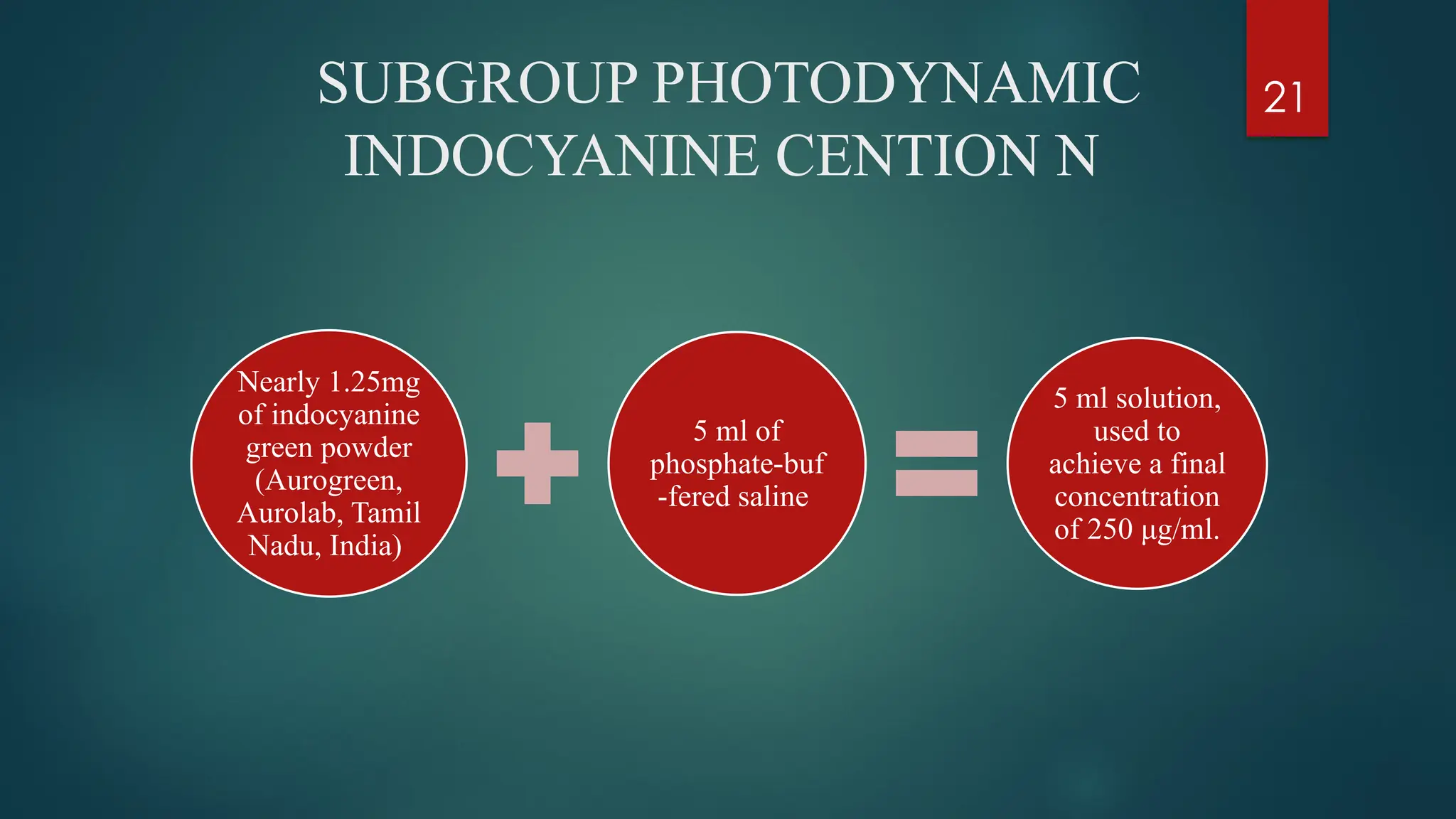
SUBGROUP PHOTODYNAMIC
INDOCYANINE CENTIONN
Nearly 1.25mg
of indocyanine
green powder
(Aurogreen,
Aurolab, Tamil
Nadu, India)
5 ml of
phosphate buf
‑
-fered saline
5 ml solution,
used to
achieve a final
concentration
of 250 μg/ml.
22.
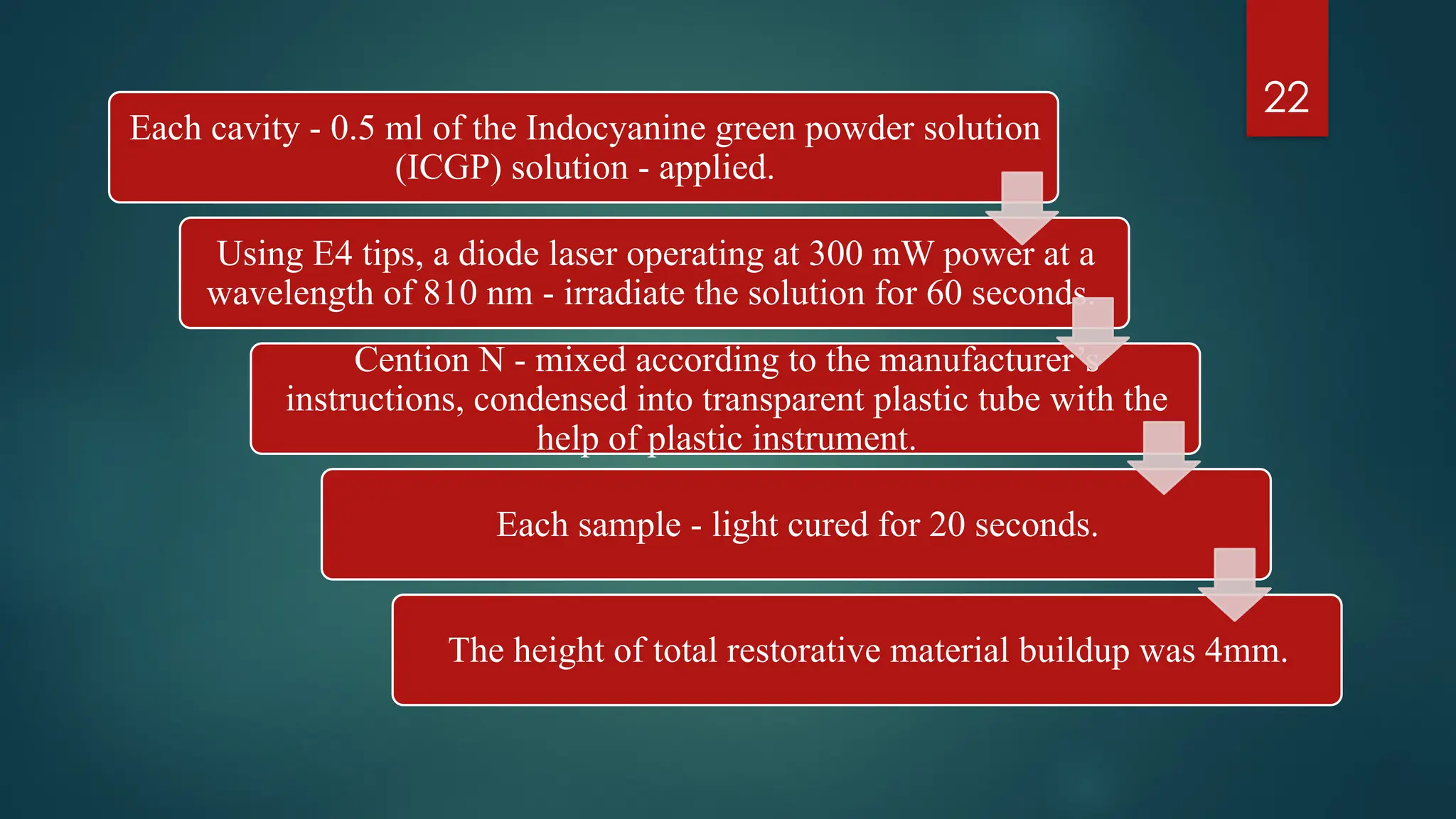
22
Each cavity -0.5 ml of the Indocyanine green powder solution
(ICGP) solution - applied.
Using E4 tips, a diode laser operating at 300 mW power at a
wavelength of 810 nm - irradiate the solution for 60 seconds.
Cention N - mixed according to the manufacturer’s
instructions, condensed into transparent plastic tube with the
help of plastic instrument.
Each sample - light cured for 20 seconds.
The height of total restorative material buildup was 4mm.
25
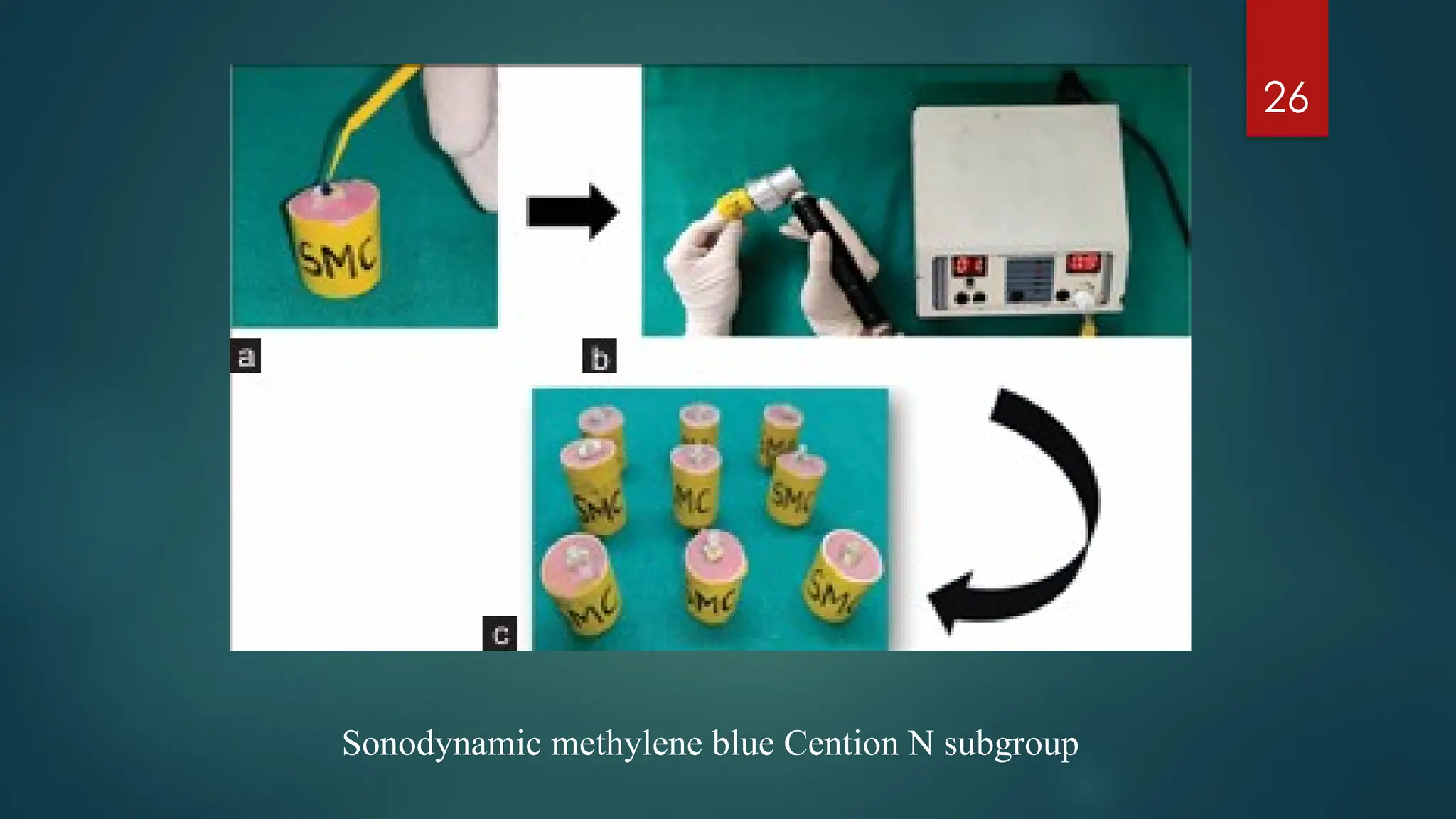
SUBGROUP SONODYNAMIC
METHYLENE CENTIONN
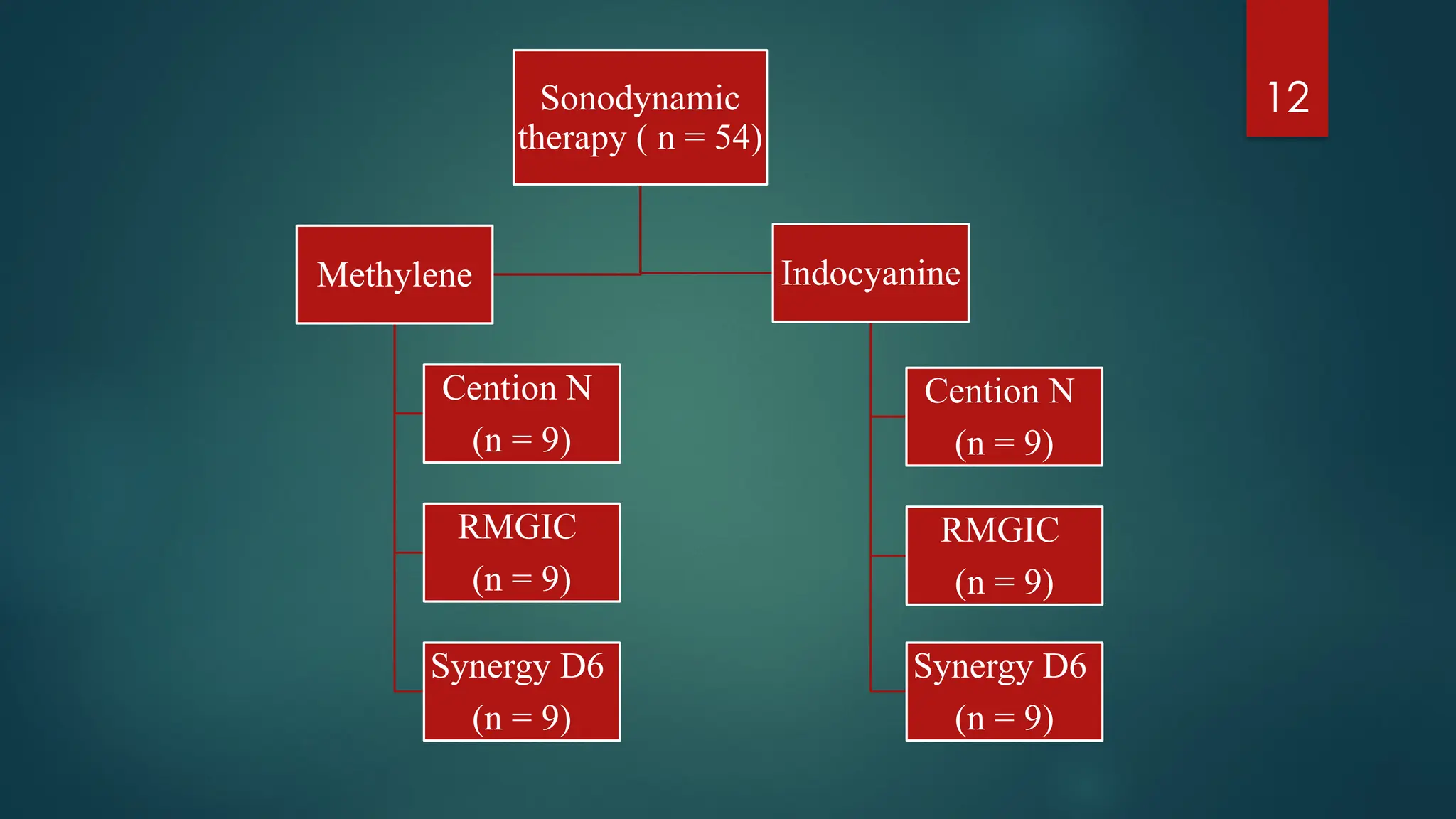
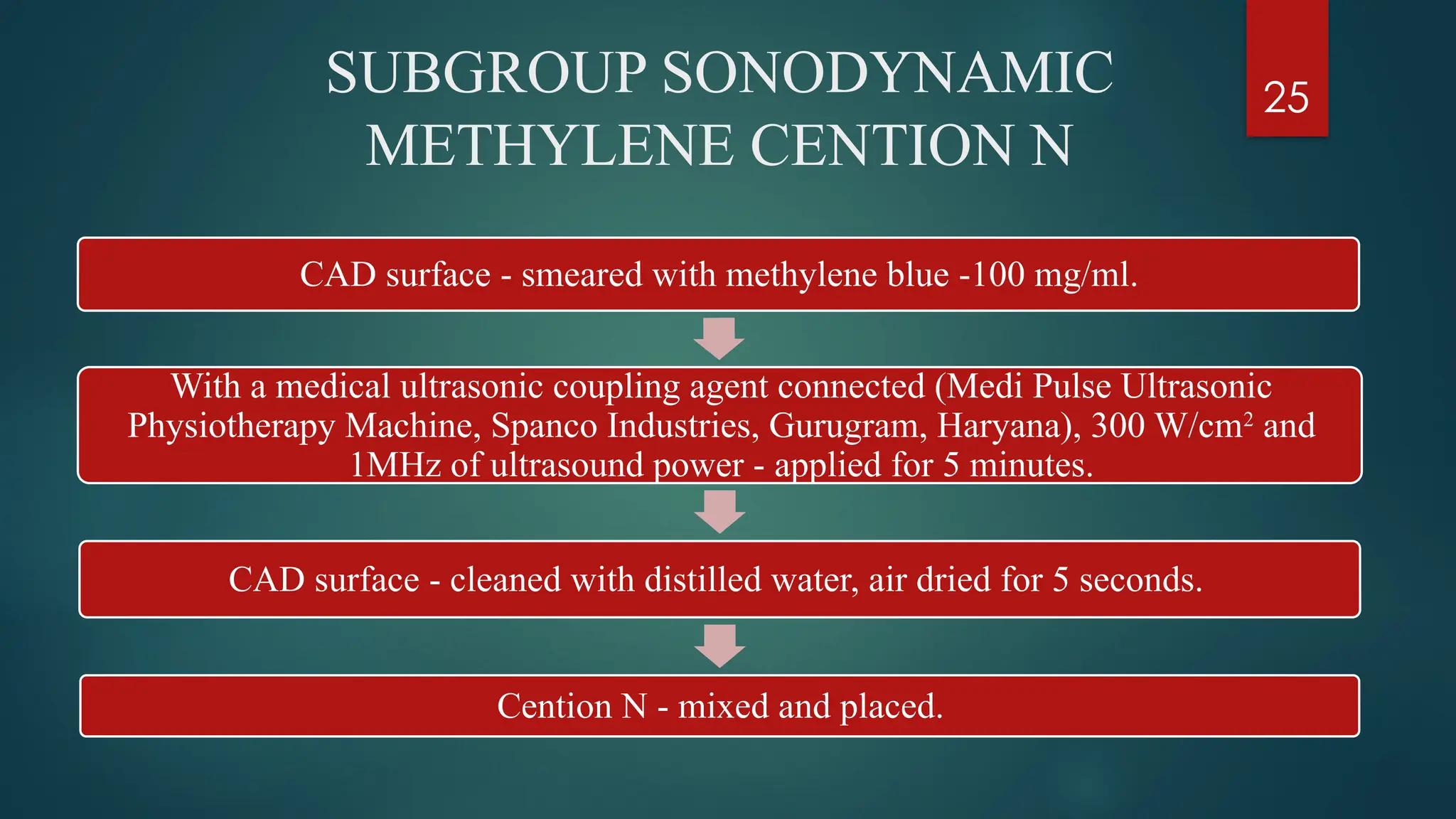
CAD surface - smeared with methylene blue -100 mg/ml.
With a medical ultrasonic coupling agent connected (Medi Pulse Ultrasonic
Physiotherapy Machine, Spanco Industries, Gurugram, Haryana), 300 W/cm2
and
1MHz of ultrasound power - applied for 5 minutes.
CAD surface - cleaned with distilled water, air dried for 5 seconds.
Cention N - mixed and placed.
28
SUBGROUP SONODYNAMIC
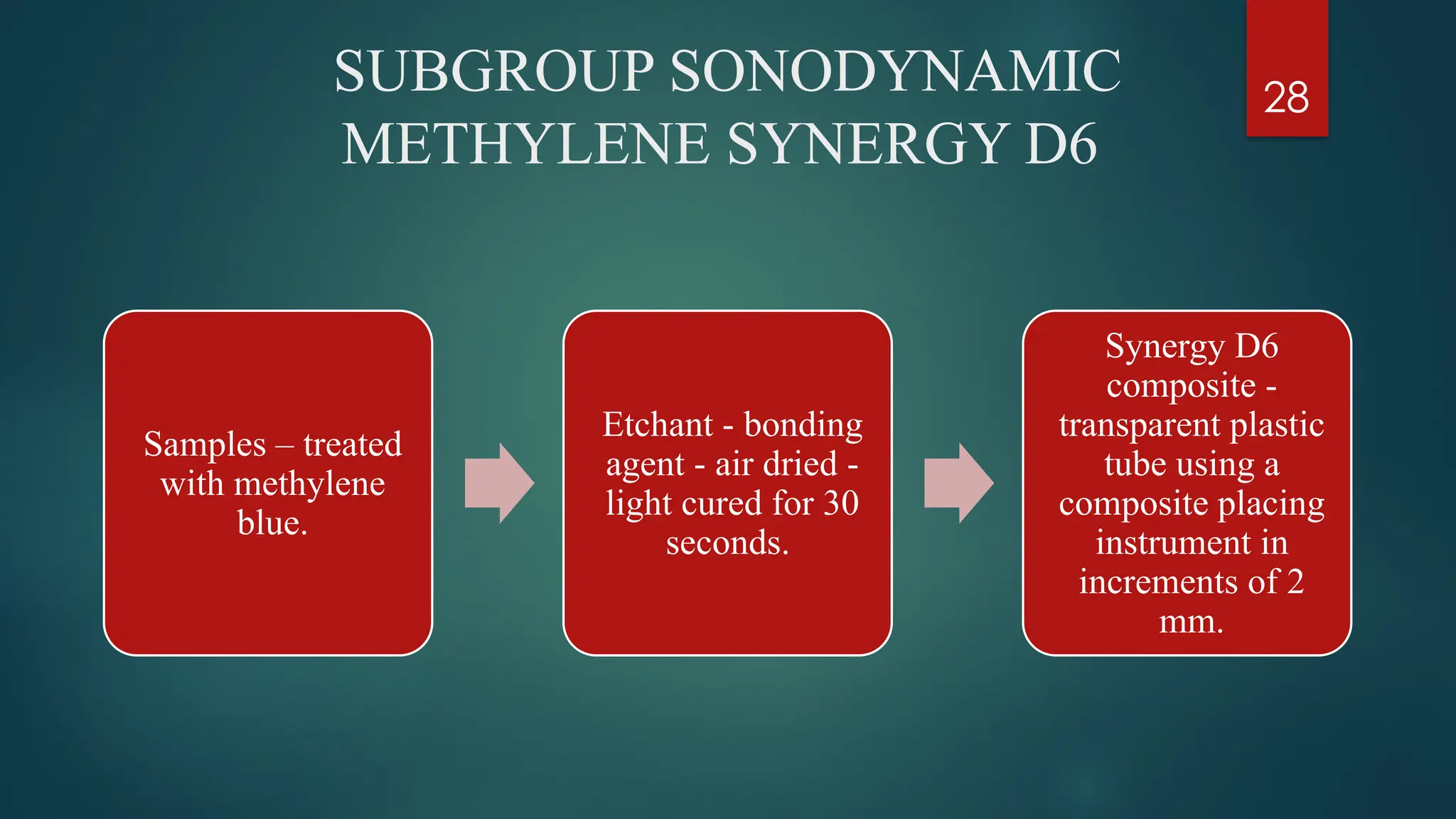
METHYLENE SYNERGYD6
Samples – treated
with methylene
blue.
Etchant - bonding
agent - air dried -
light cured for 30
seconds.
Synergy D6
composite -
transparent plastic
tube using a
composite placing
instrument in
increments of 2
mm.
29.
29
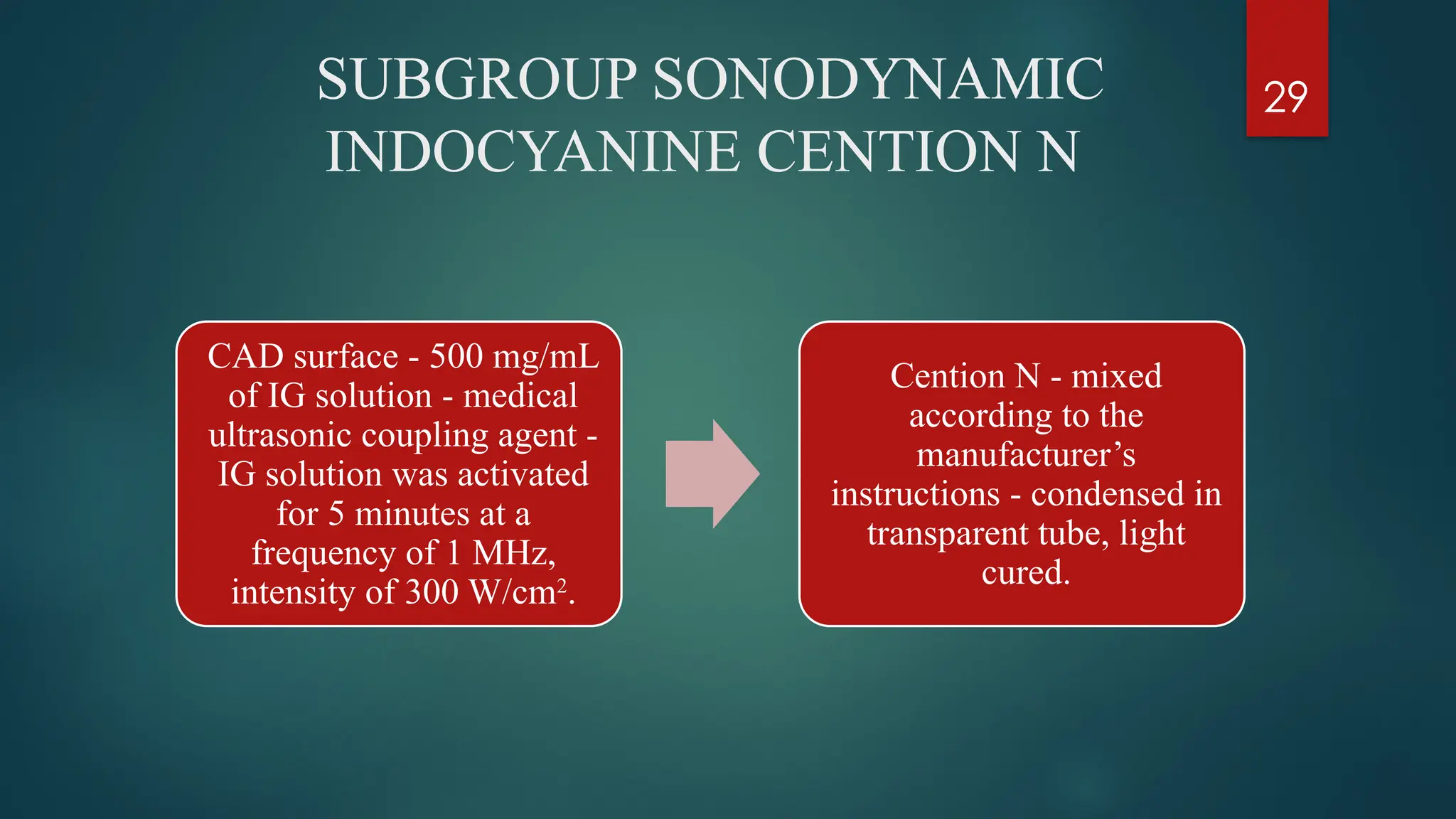
SUBGROUP SONODYNAMIC
INDOCYANINE CENTIONN
CAD surface - 500 mg/mL
of IG solution - medical
ultrasonic coupling agent -
IG solution was activated
for 5 minutes at a
frequency of 1 MHz,
intensity of 300 W/cm2
.
Cention N - mixed
according to the
manufacturer’s
instructions - condensed in
transparent tube, light
cured.
32
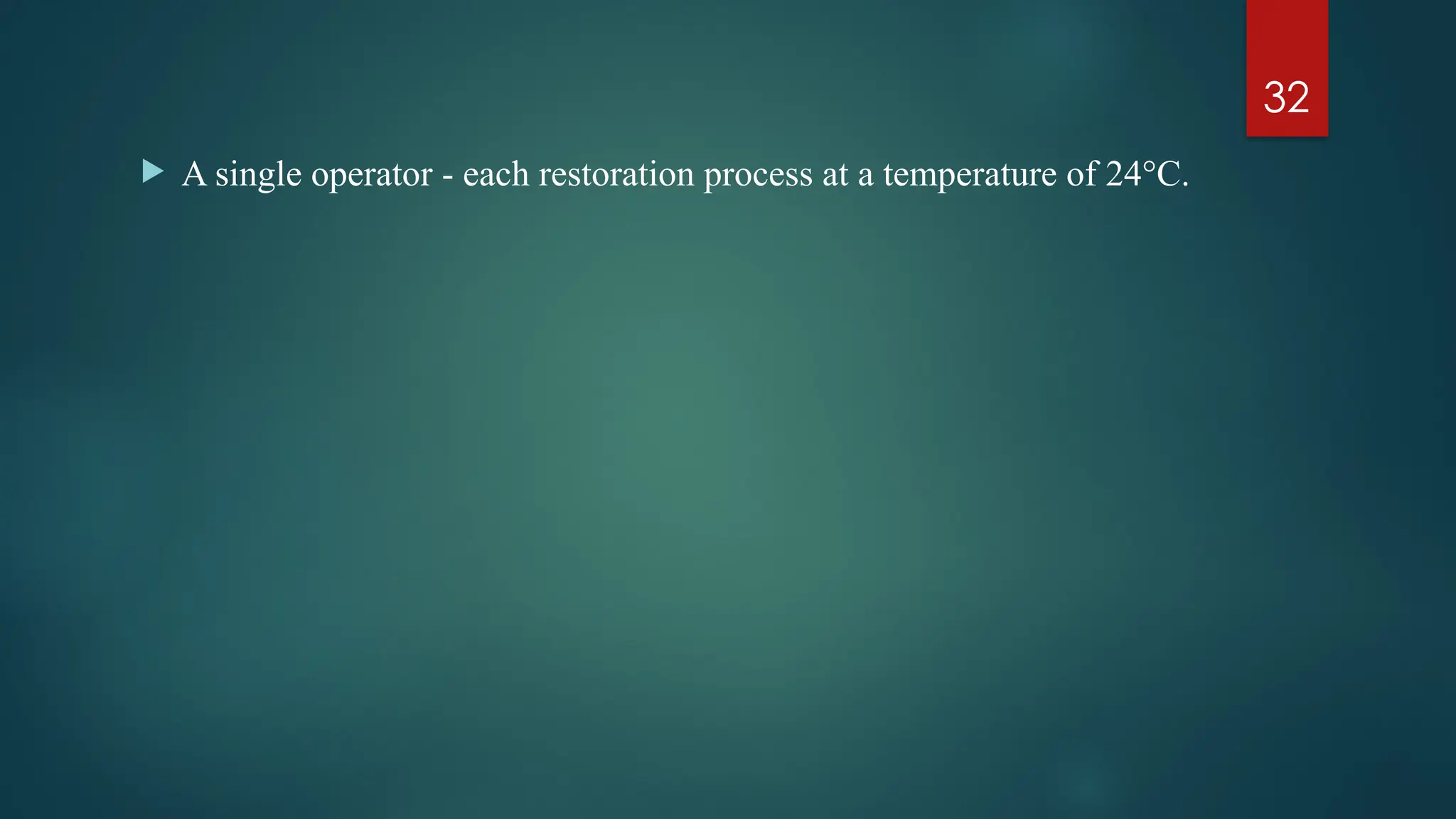
A singleoperator - each restoration process at a temperature of 24°C.
33.
33
EVALUATION OF SHEARBOND
STRENGTH
SBS testing - universal testing machine with a knife edge blade at a
‑
crosshead speed of 0.5 mm/min.
34.
34
STATISTICAL ANALYSIS
Independent“t” test, one way ANOVA test, and post hoc Tukey test
‑
- to find whether or not a significant difference exists in the SBS of
different groups.
P < 0.05 was taken as significant.
35.
RESULTS
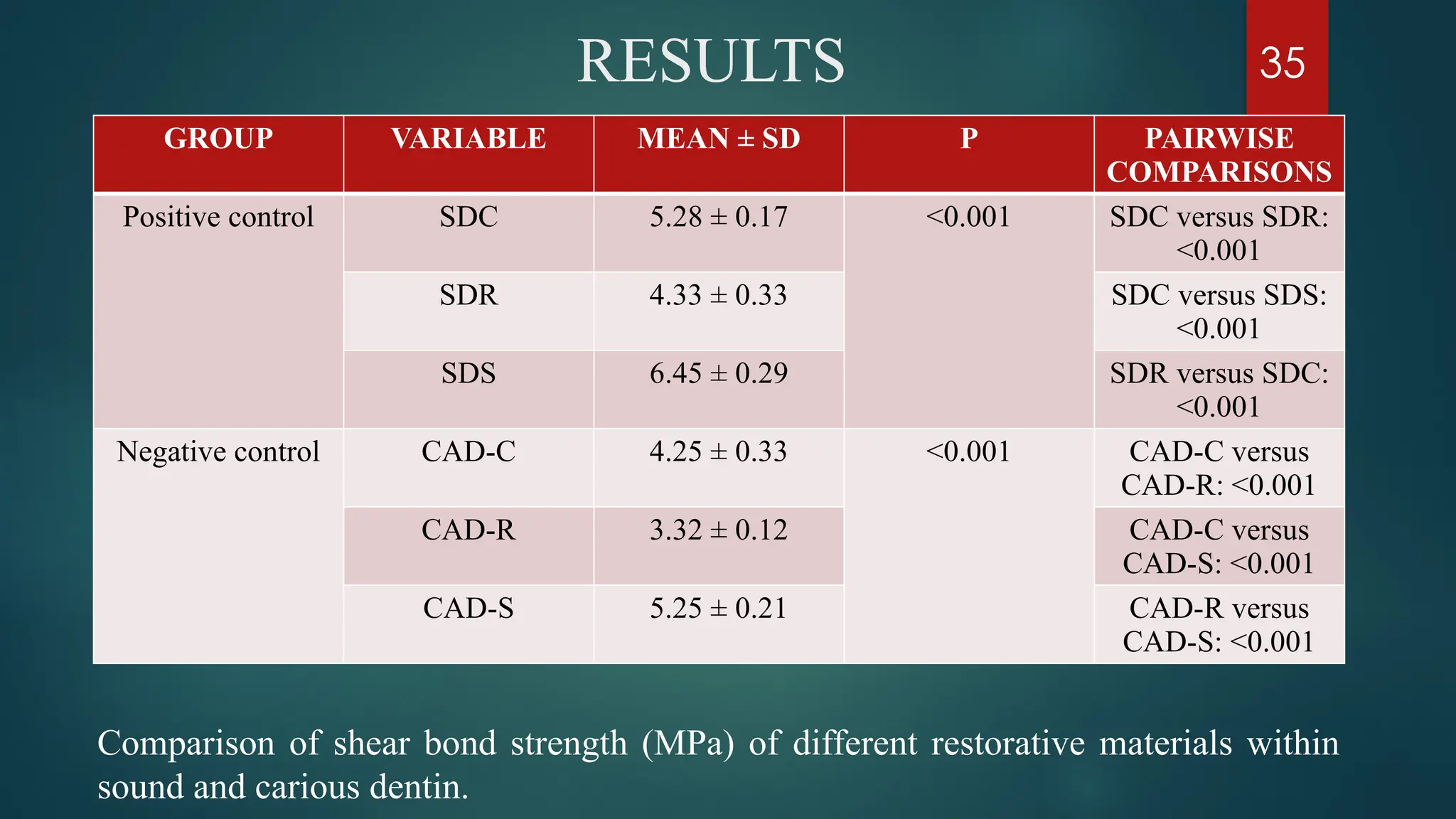
GROUP VARIABLE MEAN± SD P PAIRWISE
COMPARISONS
Positive control SDC 5.28 ± 0.17 <0.001 SDC versus SDR:
<0.001
SDR 4.33 ± 0.33 SDC versus SDS:
<0.001
SDS 6.45 ± 0.29 SDR versus SDC:
<0.001
Negative control CAD-C 4.25 ± 0.33 <0.001 CAD-C versus
CAD-R: <0.001
CAD-R 3.32 ± 0.12 CAD-C versus
CAD-S: <0.001
CAD-S 5.25 ± 0.21 CAD-R versus
CAD-S: <0.001
Comparison of shear bond strength (MPa) of different restorative materials within
sound and carious dentin.
35
36.
36
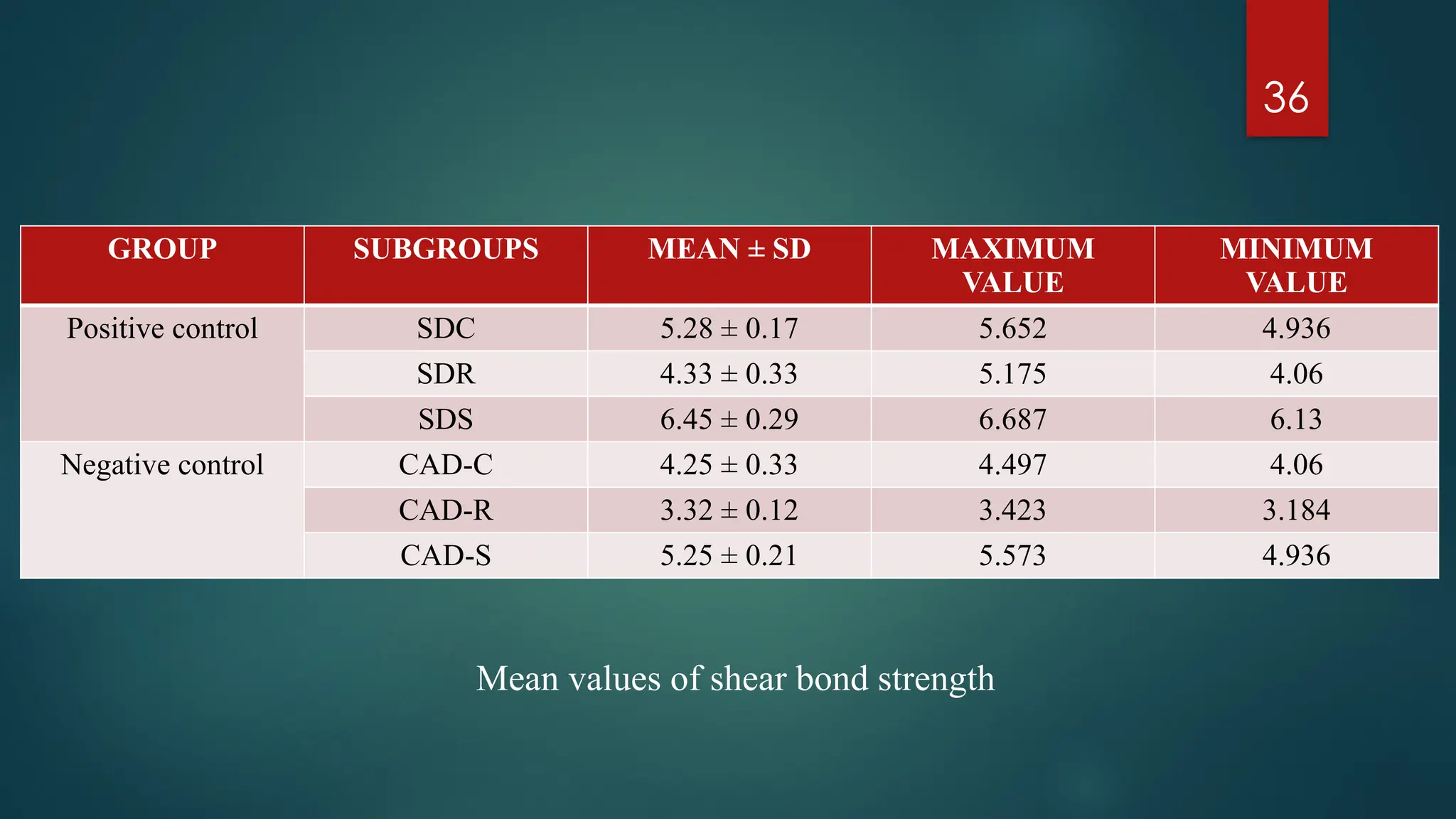
GROUP SUBGROUPS MEAN± SD MAXIMUM
VALUE
MINIMUM
VALUE
Positive control SDC 5.28 ± 0.17 5.652 4.936
SDR 4.33 ± 0.33 5.175 4.06
SDS 6.45 ± 0.29 6.687 6.13
Negative control CAD-C 4.25 ± 0.33 4.497 4.06
CAD-R 3.32 ± 0.12 3.423 3.184
CAD-S 5.25 ± 0.21 5.573 4.936
Mean values of shear bond strength
37.
37
GROUP SUBGROUPS MEAN± SD MAXIMUM
VALUE
MINIMUM
VALUE
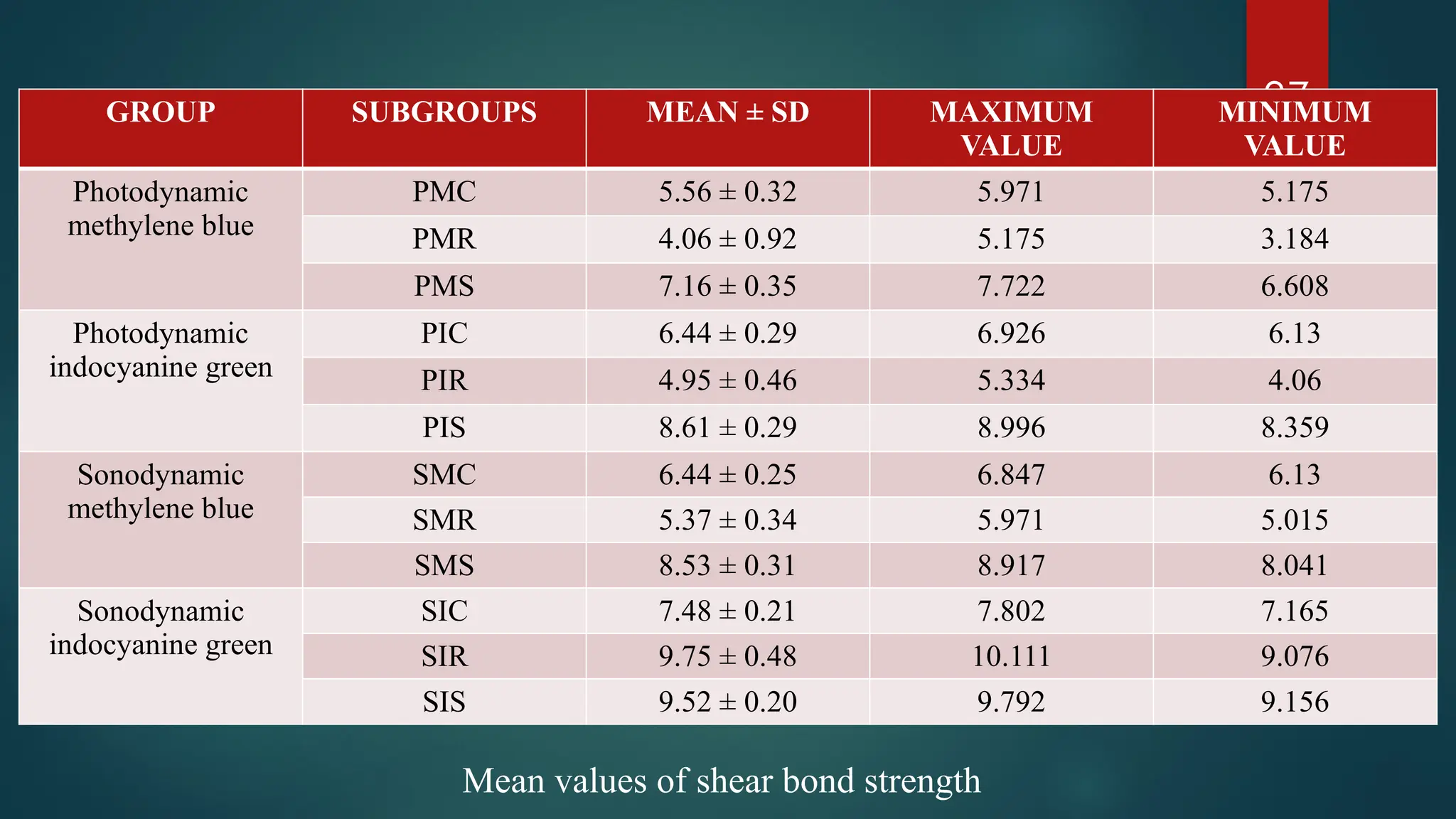
Photodynamic
methylene blue
PMC 5.56 ± 0.32 5.971 5.175
PMR 4.06 ± 0.92 5.175 3.184
PMS 7.16 ± 0.35 7.722 6.608
Photodynamic
indocyanine green
PIC 6.44 ± 0.29 6.926 6.13
PIR 4.95 ± 0.46 5.334 4.06
PIS 8.61 ± 0.29 8.996 8.359
Sonodynamic
methylene blue
SMC 6.44 ± 0.25 6.847 6.13
SMR 5.37 ± 0.34 5.971 5.015
SMS 8.53 ± 0.31 8.917 8.041
Sonodynamic
indocyanine green
SIC 7.48 ± 0.21 7.802 7.165
SIR 9.75 ± 0.48 10.111 9.076
SIS 9.52 ± 0.20 9.792 9.156
Mean values of shear bond strength
38.
38
DISCUSSION
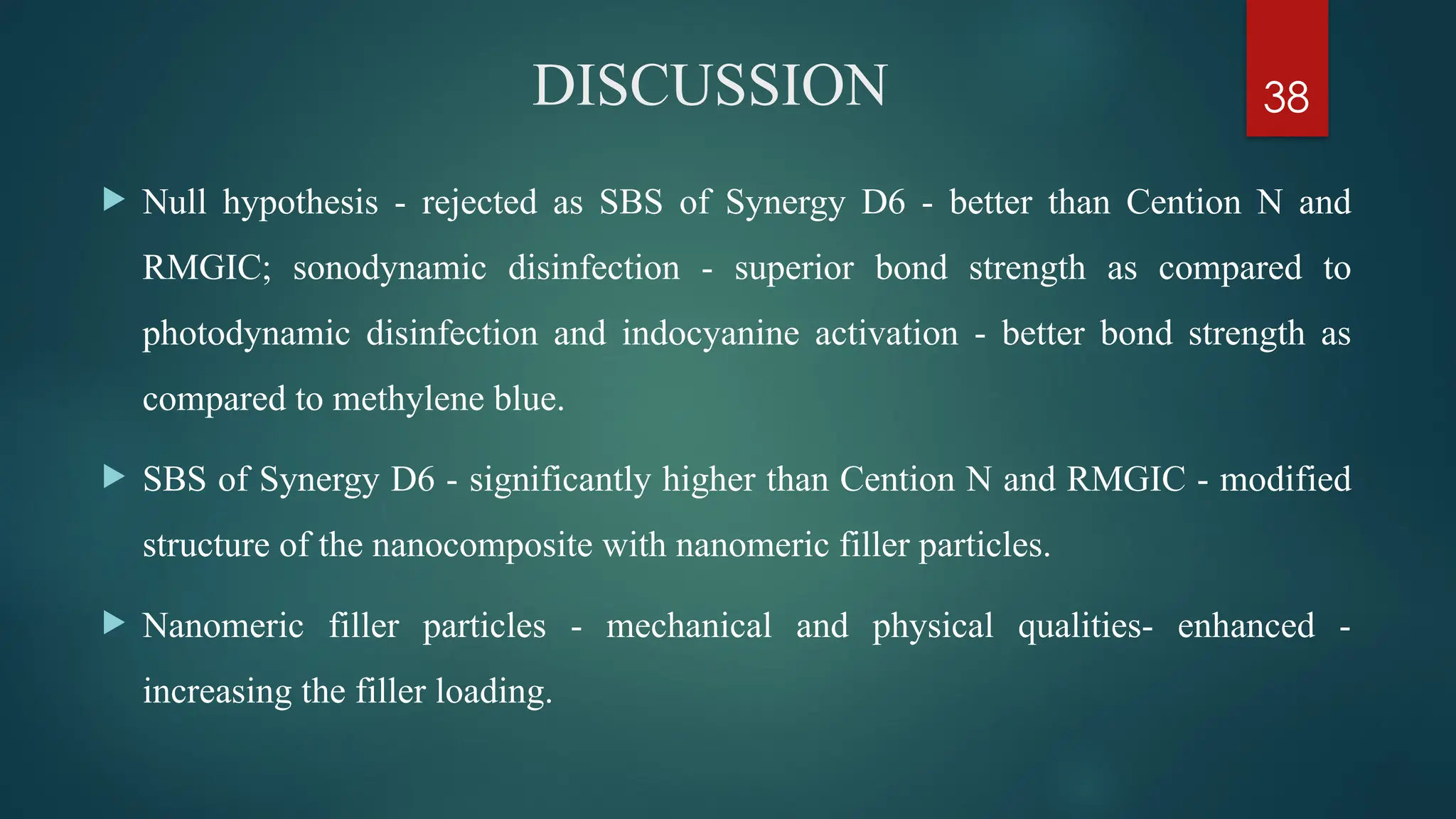
Null hypothesis- rejected as SBS of Synergy D6 - better than Cention N and
RMGIC; sonodynamic disinfection - superior bond strength as compared to
photodynamic disinfection and indocyanine activation - better bond strength as
compared to methylene blue.
SBS of Synergy D6 - significantly higher than Cention N and RMGIC - modified
structure of the nanocomposite with nanomeric filler particles.
Nanomeric filler particles - mechanical and physical qualities- enhanced -
increasing the filler loading.
39.
39
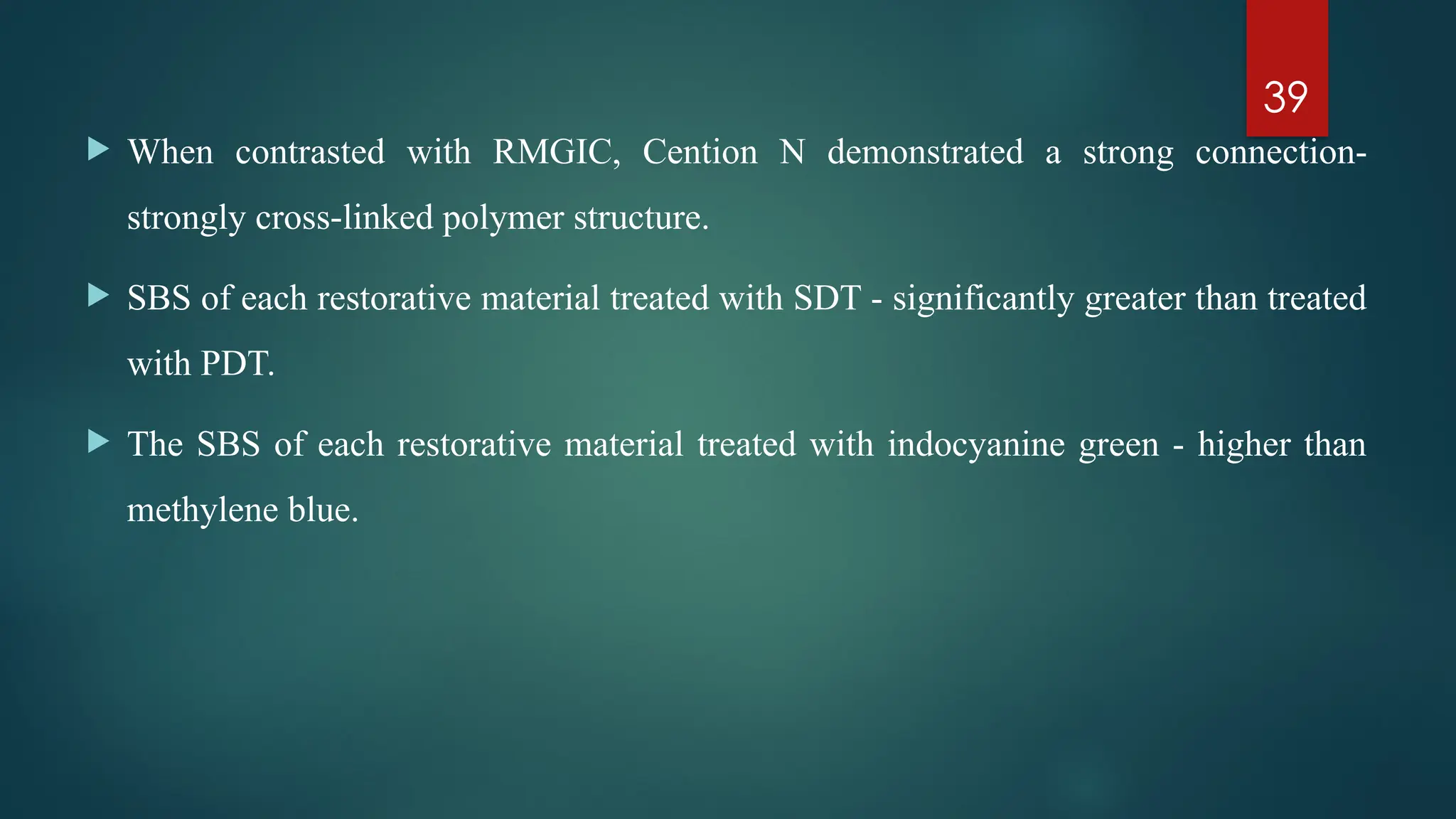
When contrastedwith RMGIC, Cention N demonstrated a strong connection-
strongly cross linked polymer structure.
‑
SBS of each restorative material treated with SDT - significantly greater than treated
with PDT.
The SBS of each restorative material treated with indocyanine green - higher than
methylene blue.
Materials and methodsResult Conclusion
• 30 carious and 10 non-
carious mandibular teeth -
non-traumatic extraction.
• Four groups (n = 10):
Group 1 - non-affected dentin
with no disinfection
Group 2 - caries affected
dentin treated with 2% CHX
Group 3 - affected dentin
disinfected with PDT [100
mg/L methylene blue solution
(MBS) and Diode laser]
Group 4 - affected dentin
treated with ECYL.
• Highest SBS value - group
1 (24.98 ± 1.59 MPa).
• Lowest bond strength -
group 3 (14.22 ± 1.40
MPa).
• Group 4 (15.89 ± 3.22
MPa) - SBS values
comparable to group 3
(14.22 ± 1.40 MPa).
• Group 2 (CHX-18.25 ±
1.29 MPa) - statistically
significant difference
compared to all
experimental groups (p <
0.05).
• Adhesive bond strength
of disinfected carious
dentin was higher with
CHX treatment as
compared to
Photodynamic therapy
and Er,Cr: YSGG laser
treatment.
• Carious dentin showed
lower bond strength to
composite resin as
compared to non-carious
dentin.
Materials and methodsResults Conclusion
• 40 carious mandibular teeth - non-
traumatic extraction.
• Four groups (n = 10):
Group 1 - affected dentin disinfected
with methylene blue (MB) [100
mg/L].
Group 2 - caries affected dentin
disinfected using curcumin
photosensitizer (CP) [500 mg/L].
Group 3 - affected dentin disinfected
with indocyanin green photosensitizer
(ICGP) [0.5 mL] .
Group 4 - affected dentin treated with
3 % H2O2.
• Group 2 dentin disinfection
using CP - highest SBS value
(18.21 ± 1.39 MPa).
• Group 4 (3% H2O2 as cavity
disinfectant) - lowest SBS
values (13.39 ± 1.26 MPa).
• SBS in Group 3 (ICGP) (17.42
± 0.55 MPa) specimens was
comparable to group 2 (p >
0.05).
• Group 1 - disinfected with MB
(15.18 ± 0.39 MPa) -
significantly lower compared to
group 2 and group 3 (p < 0.05)
respectively.
Curcumin and
Indocyanin
green have the
potential to be
used as cavity
disinfectant as
it improves
SBS of caries
affected dentin
to resin
composite.
45
LIMITATIONS
Fails toreplicate the complex oral environment.
Only one photosensitizer concentration has been assessed.
46.
46
CONCLUSION
Adding photo/sonosensitizers- potentiate the antimicrobial action of
antimicrobial photodynamic therapy (aPDT) and antimicrobial sonodynamic
therapy (aSDT), work more effectively on the affected dentin - conservative,
minimally invasive treatment , augment its bond strength.
The SBS of each restorative material treated with indocyanine green and SDT
outperformed those treated with methylene blue dye and PDT.
47.
47
REFERENCES
Thompson V,Craig RG, Curro FA, Green WS, Ship JA. Treatment of deep carious lesions
by complete excavation or partial removal: A critical review. J Am Dent Assoc
2008;139:705 12.
‑
Maltz M, Koppe B, Jardim JJ, Alves LS, de Paula LM, Yamaguti PM, et al. Partial caries
removal in deep caries lesions: A 5 year multicenter randomized controlled trial. Clin
‑
Oral Investig 2018;22:1337 43.
‑
Keskin G, Uçar Gündoğar Z, Yaman M. Bonding of an ion releasing restorative material
‑
to caries affected dentin disinfected with photodynamic therapy, Er, Cr: YSGG laser, and
‑
chemical disinfectants. Photodiagnosis Photodyn Ther 2021;34:102261.
48.
48
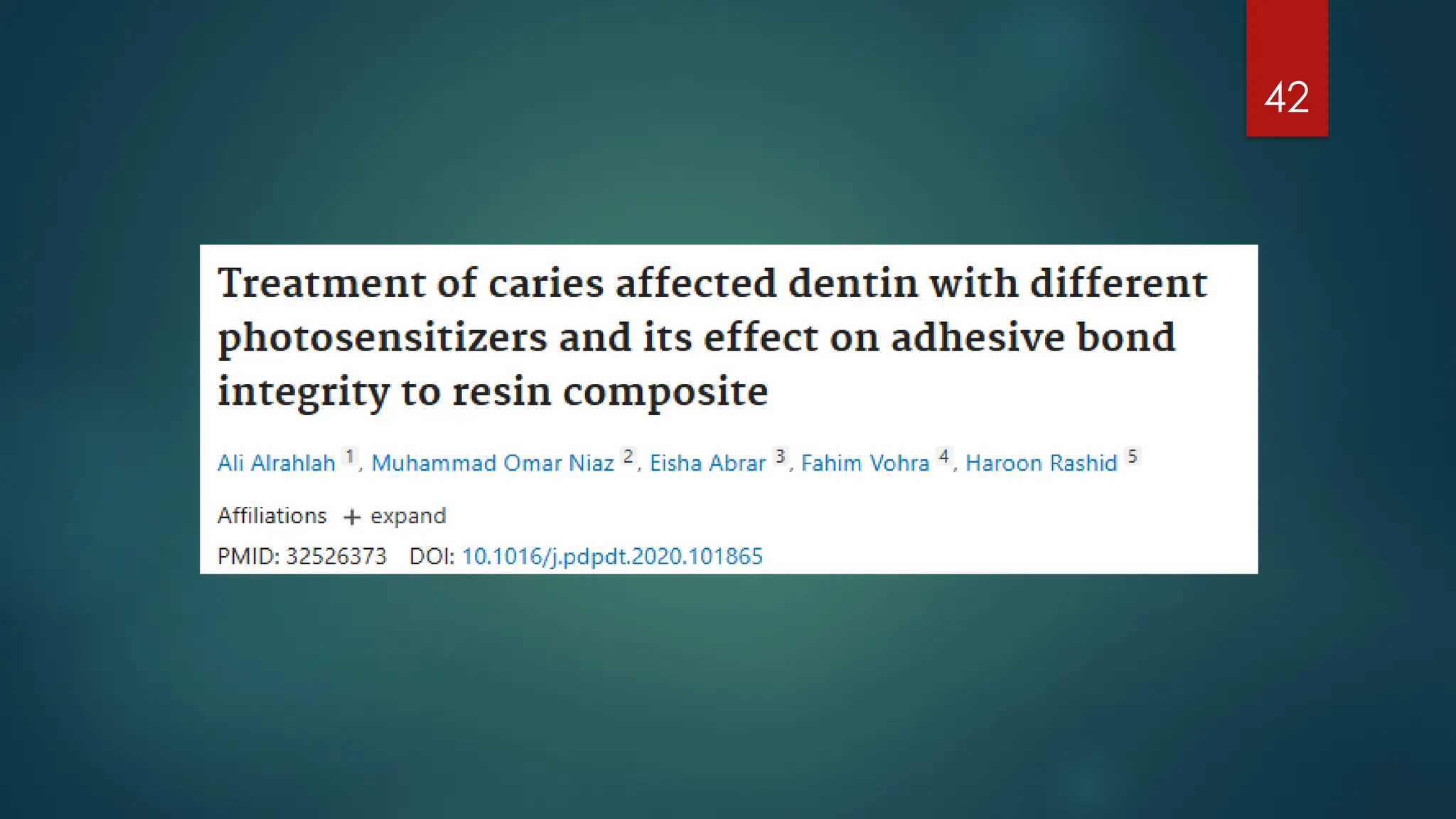
Alrahlah A,Niaz MO, Abrar E, Vohra F, Rashid H. Treatment of caries affected dentin
with different photosensitizers and its effect on adhesive bond integrity to resin
composite. Photodiagnosis Photodyn Ther 2020;31:101865.
Yarlagadda S, Selvakumar RJ, Parashar SR, Arockiam S, Natanasabapathy V.
Comparative evaluation of the antimicrobial efficacy of nanoparticle mediated
‑
photodynamic therapy versus photodynamic therapy and conventional disinfection in
endodontics: A systematic review and meta analysis. J Conserv Dent Endod
‑
2023;26:502 13.
‑
49.
Al DeebL, Bin Shuwaish MS, Abrar E, Naseem M, Al Hamdan RS, Maawadh AM, et
‑ ‑
al. Efficacy of chlorhexidine, Er Cr YSGG laser and photodynamic therapy on the
adhesive bond integrity of caries affected dentin. An in vitro study. Photodiagnosis
‑
Photodyn Ther 2020;31:101875.
Deshmukh S, Nandlal B. Evaluation of the shear bond strength of nanocomposite on
carious and sound deciduous dentin. Int J Clin Pediatr Dent 2012;5:25 8.
‑
Al Deeb L, Bin-Shuwaish MS, Abrar E, Naseem M, Al-Hamdan RS, Maawadh AM, Al
Deeb M, Almohareb T, Al Ahdal K, Vohra F, Abduljabbar T. Efficacy of chlorhexidine,
Er Cr YSGG laser and photodynamic therapy on the adhesive bond integrity of caries
affected dentin. An in-vitro study. Photodiagnosis and Photodynamic Therapy. 2020 Sep
1;31:101875.
![Materials and methods Result Conclusion
• 30 carious and 10 non-
carious mandibular teeth -
non-traumatic extraction.
• Four groups (n = 10):
Group 1 - non-affected dentin
with no disinfection
Group 2 - caries affected
dentin treated with 2% CHX
Group 3 - affected dentin
disinfected with PDT [100
mg/L methylene blue solution
(MBS) and Diode laser]
Group 4 - affected dentin
treated with ECYL.
• Highest SBS value - group
1 (24.98 ± 1.59 MPa).
• Lowest bond strength -
group 3 (14.22 ± 1.40
MPa).
• Group 4 (15.89 ± 3.22
MPa) - SBS values
comparable to group 3
(14.22 ± 1.40 MPa).
• Group 2 (CHX-18.25 ±
1.29 MPa) - statistically
significant difference
compared to all
experimental groups (p <
0.05).
• Adhesive bond strength
of disinfected carious
dentin was higher with
CHX treatment as
compared to
Photodynamic therapy
and Er,Cr: YSGG laser
treatment.
• Carious dentin showed
lower bond strength to
composite resin as
compared to non-carious
dentin.](https://image.slidesharecdn.com/jc4ppt-250919145832-ad5342b0/75/jssjcsjdofjdijfiosdjfisjfosajfosjfiosdjfiosjfsi-41-2048.jpg)
![Materials and methods Results Conclusion
• 40 carious mandibular teeth - non-
traumatic extraction.
• Four groups (n = 10):
Group 1 - affected dentin disinfected
with methylene blue (MB) [100
mg/L].
Group 2 - caries affected dentin
disinfected using curcumin
photosensitizer (CP) [500 mg/L].
Group 3 - affected dentin disinfected
with indocyanin green photosensitizer
(ICGP) [0.5 mL] .
Group 4 - affected dentin treated with
3 % H2O2.
• Group 2 dentin disinfection
using CP - highest SBS value
(18.21 ± 1.39 MPa).
• Group 4 (3% H2O2 as cavity
disinfectant) - lowest SBS
values (13.39 ± 1.26 MPa).
• SBS in Group 3 (ICGP) (17.42
± 0.55 MPa) specimens was
comparable to group 2 (p >
0.05).
• Group 1 - disinfected with MB
(15.18 ± 0.39 MPa) -
significantly lower compared to
group 2 and group 3 (p < 0.05)
respectively.
Curcumin and
Indocyanin
green have the
potential to be
used as cavity
disinfectant as
it improves
SBS of caries
affected dentin
to resin
composite.](https://image.slidesharecdn.com/jc4ppt-250919145832-ad5342b0/75/jssjcsjdofjdijfiosdjfisjfosajfosjfiosdjfiosjfsi-43-2048.jpg)



![Photodynamic therapy in endodontics [Autosaved].pptx](https://cdn.slidesharecdn.com/ss_thumbnails/photodynamictherapyinendodonticsautosaved-250928174448-cd9e341b-thumbnail.jpg?width=640&height=640&fit=bounds)


