JSF Mashups in Action
Hazem Saleh
My Bio
 Nine years of experience in open source technologies and Java Enterprise.
 I worked with many clients in Europe (Sweden), North America (USA and
Canada), Latin America (Peru), Asia (Qatar and Kuwait) and Africa
(Egypt, Morocco and South Africa).
 Apache MyFaces Committer.
 Co-author of “The Definitive Guide to Apache MyFaces” book (Apress).
 Author of “JavaScript Unit Testing” book (Packtpub).
 DeveloperWorks Contributing Author.
 Technical Speaker in (JavaOne San Francisco, CON-FESS Vienna, IBM
Regional Technical Exchange …etc).
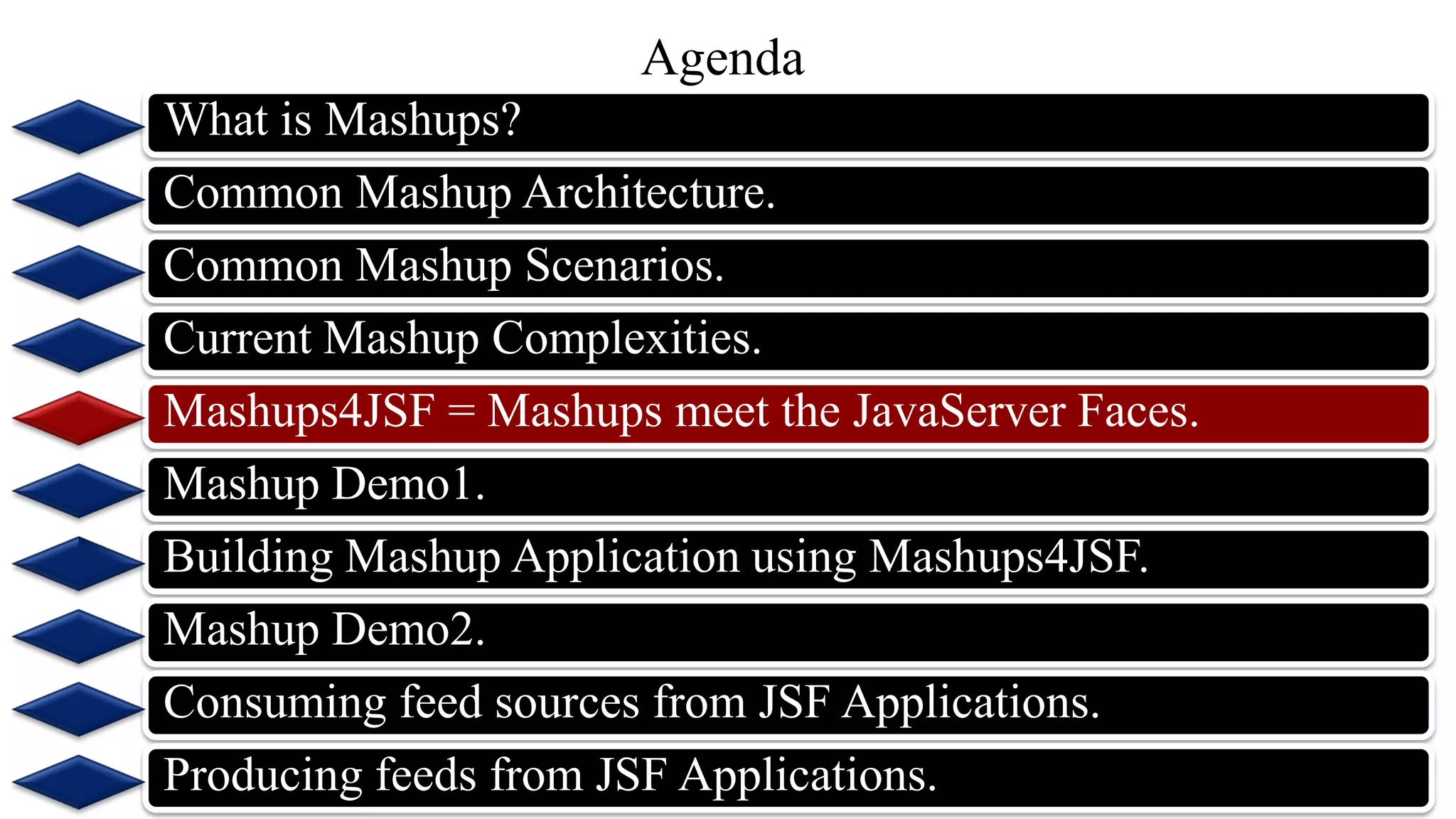
Agenda
What is Mashups?
Common Mashup Architecture.
Common Mashup Scenarios.
Current Mashup Complexities.
Mashups4JSF = Mashups meet the JavaServer Faces.
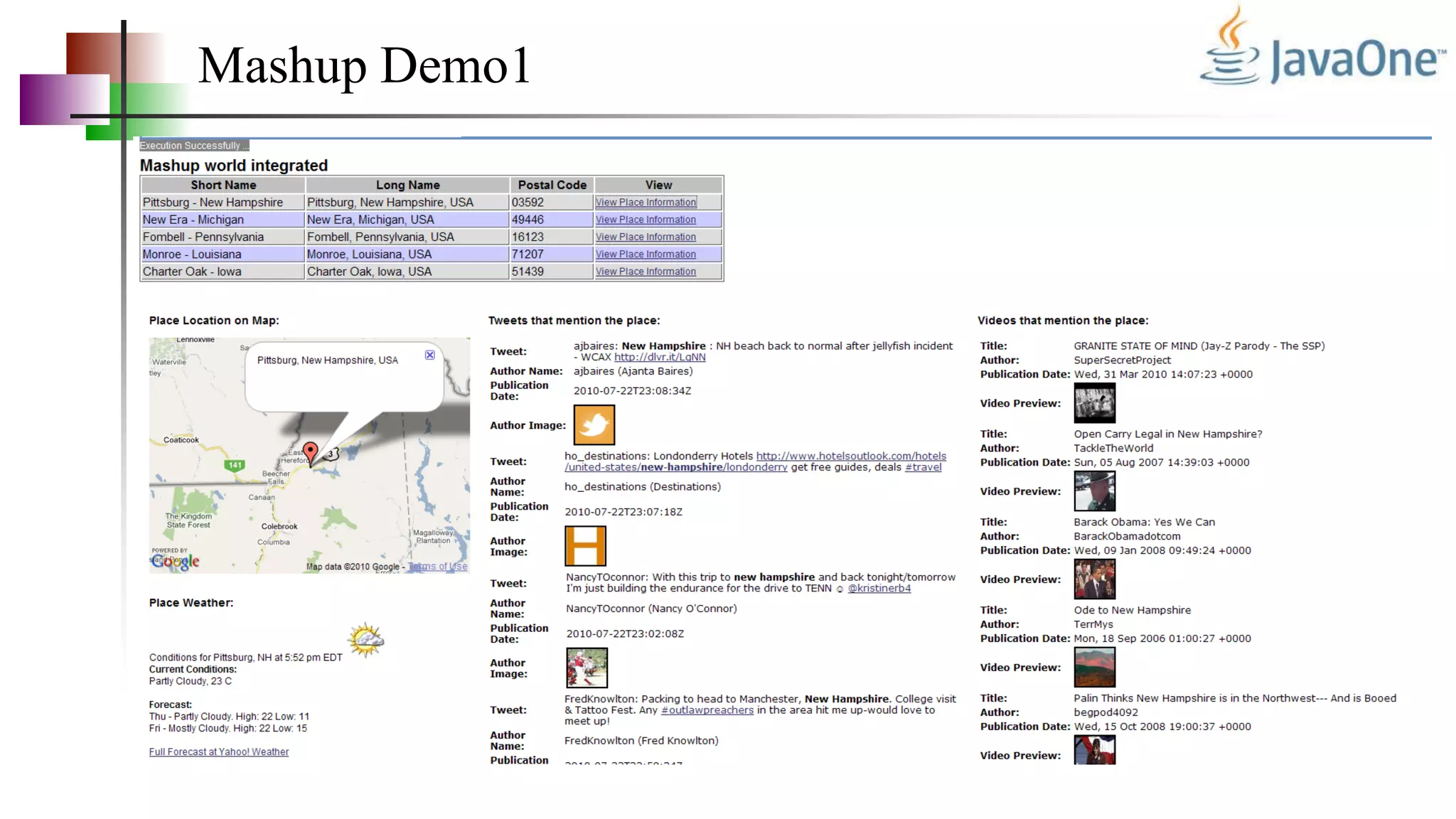
Mashup Demo1.
Building Mashup Application using Mashups4JSF.
Mashup Demo2.
Consuming feed sources from JSF Applications.
Producing feeds from JSF Applications.
Agenda
What is Mashups?
Common Mashup Architecture.
Common Mashup Scenarios.
Current Mashup Complexities.
Mashups4JSF = Mashups meet the JavaServer Faces.
Mashup Demo1.
Building Mashup Application using Mashups4JSF.
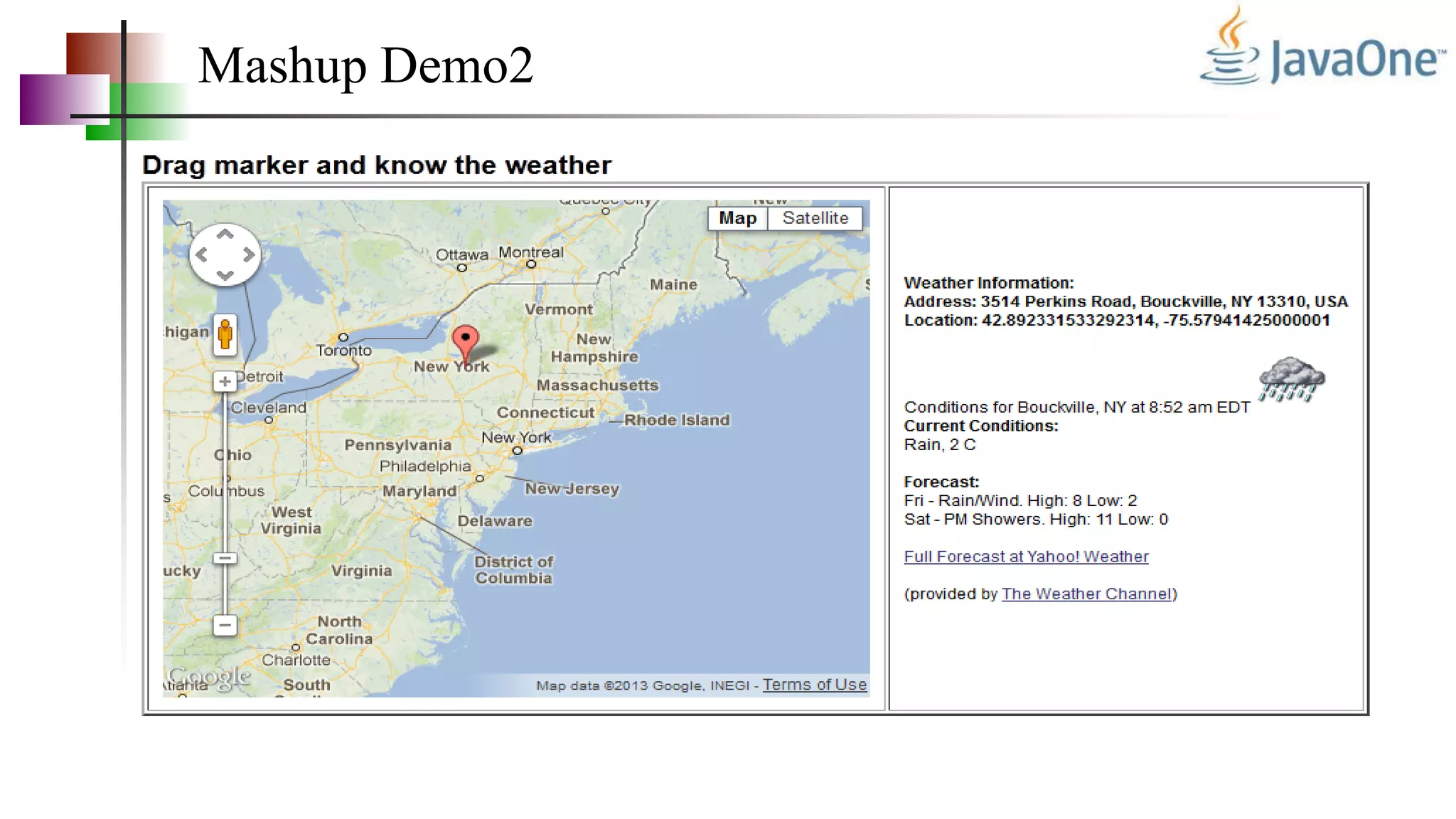
Mashup Demo2.
Consuming feed sources from JSF Applications.
Producing feeds from JSF Applications.
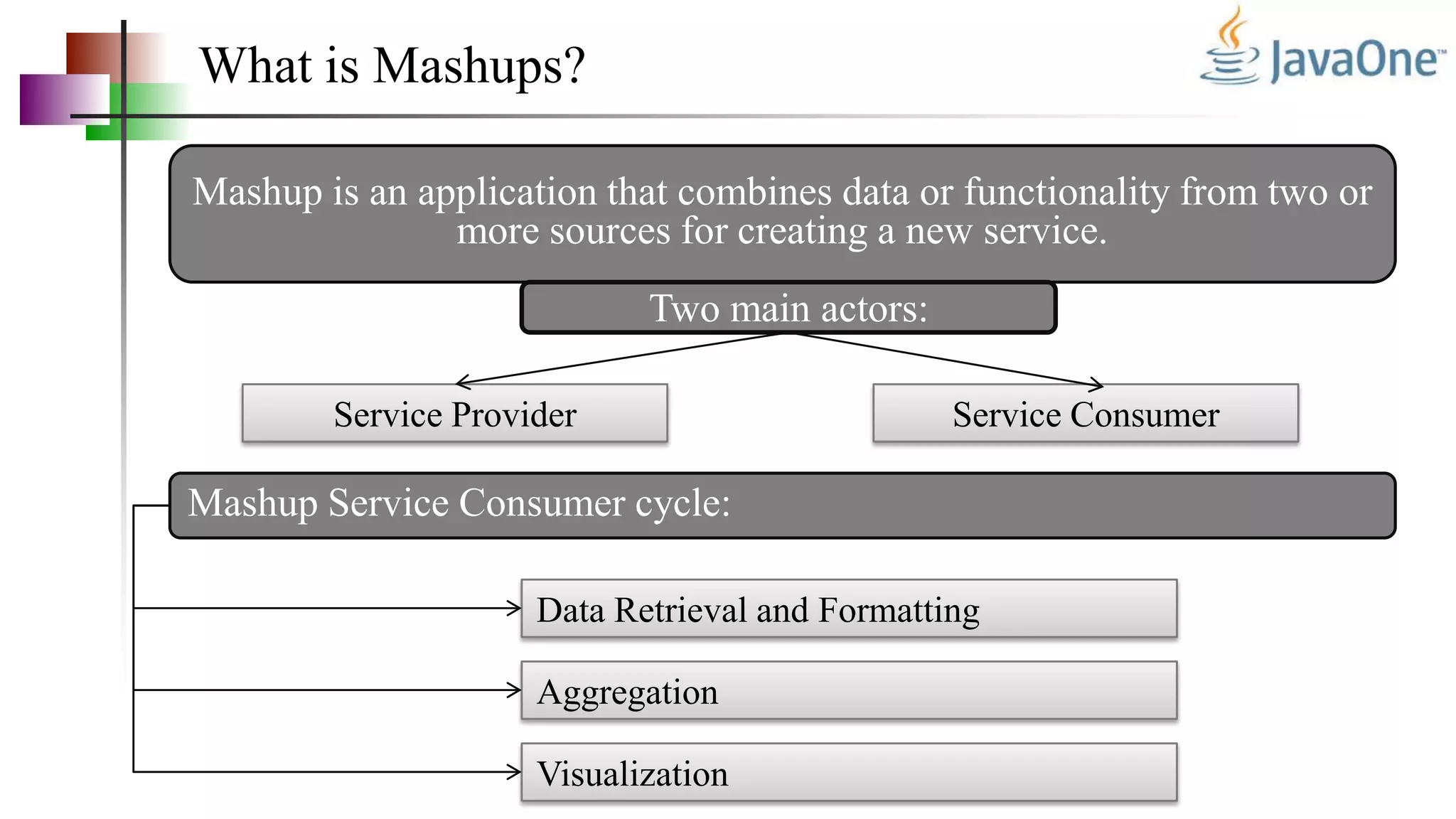
What is Mashups?
Mashup is an application that combines data or functionality from two or
more sources for creating a new service.
Two main actors:
Service Provider Service Consumer
Mashup Service Consumer cycle:
Aggregation
Visualization
Data Retrieval and Formatting
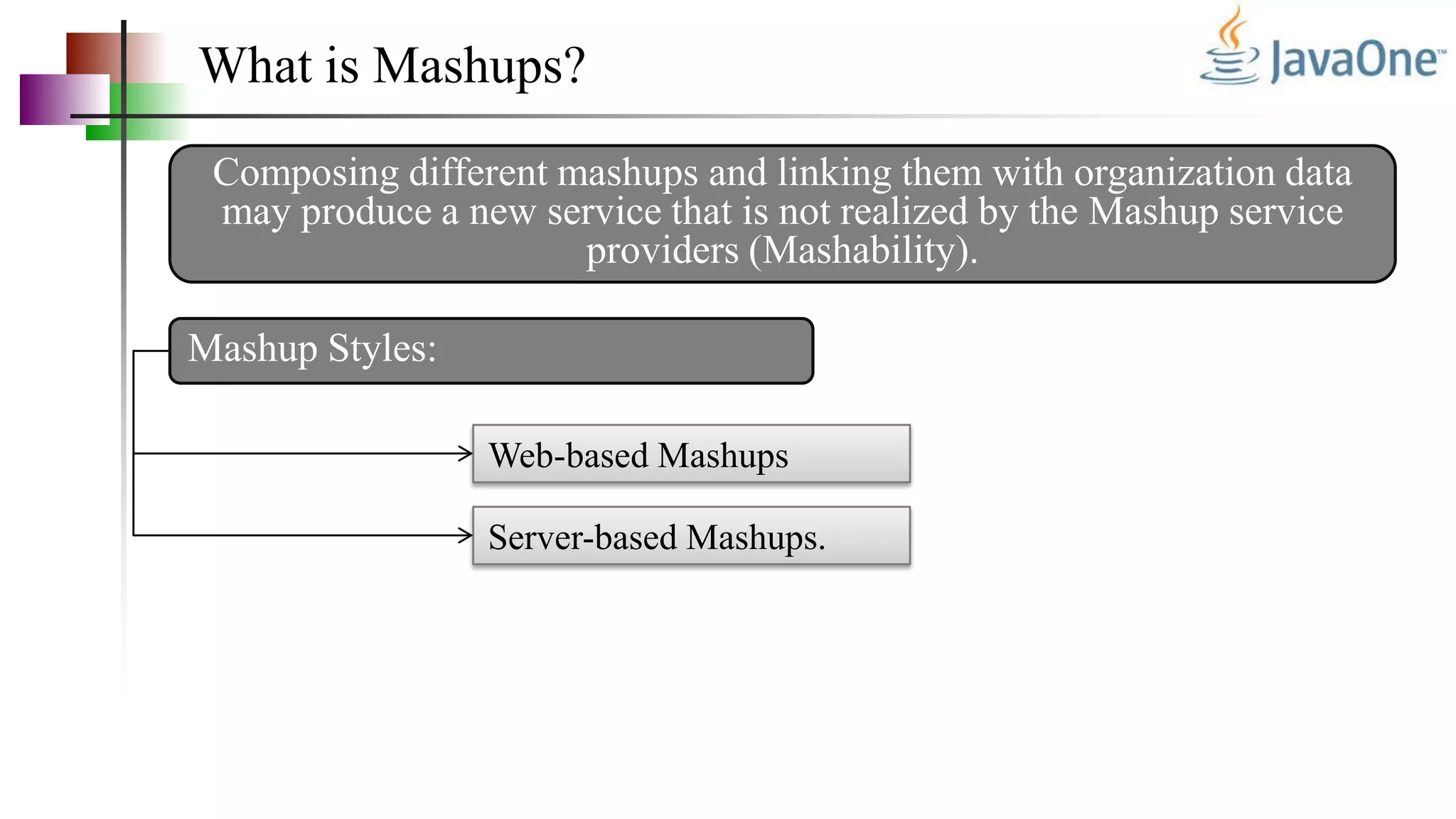
What is Mashups?
Composing different mashups and linking them with organization data
may produce a new service that is not realized by the Mashup service
providers (Mashability).
Mashup Styles:
Server-based Mashups.
Web-based Mashups
What is Mashups?
Common Mashup Architecture.
Common Mashup Scenarios.
Current Mashup Complexities.
Mashups4JSF = Mashups meet the JavaServer Faces.
Mashup Demo1.
Building Mashup Application using Mashups4JSF.
Mashup Demo2.
Consuming feed sources from JSF Applications.
Producing feeds from JSF Applications.
Agenda
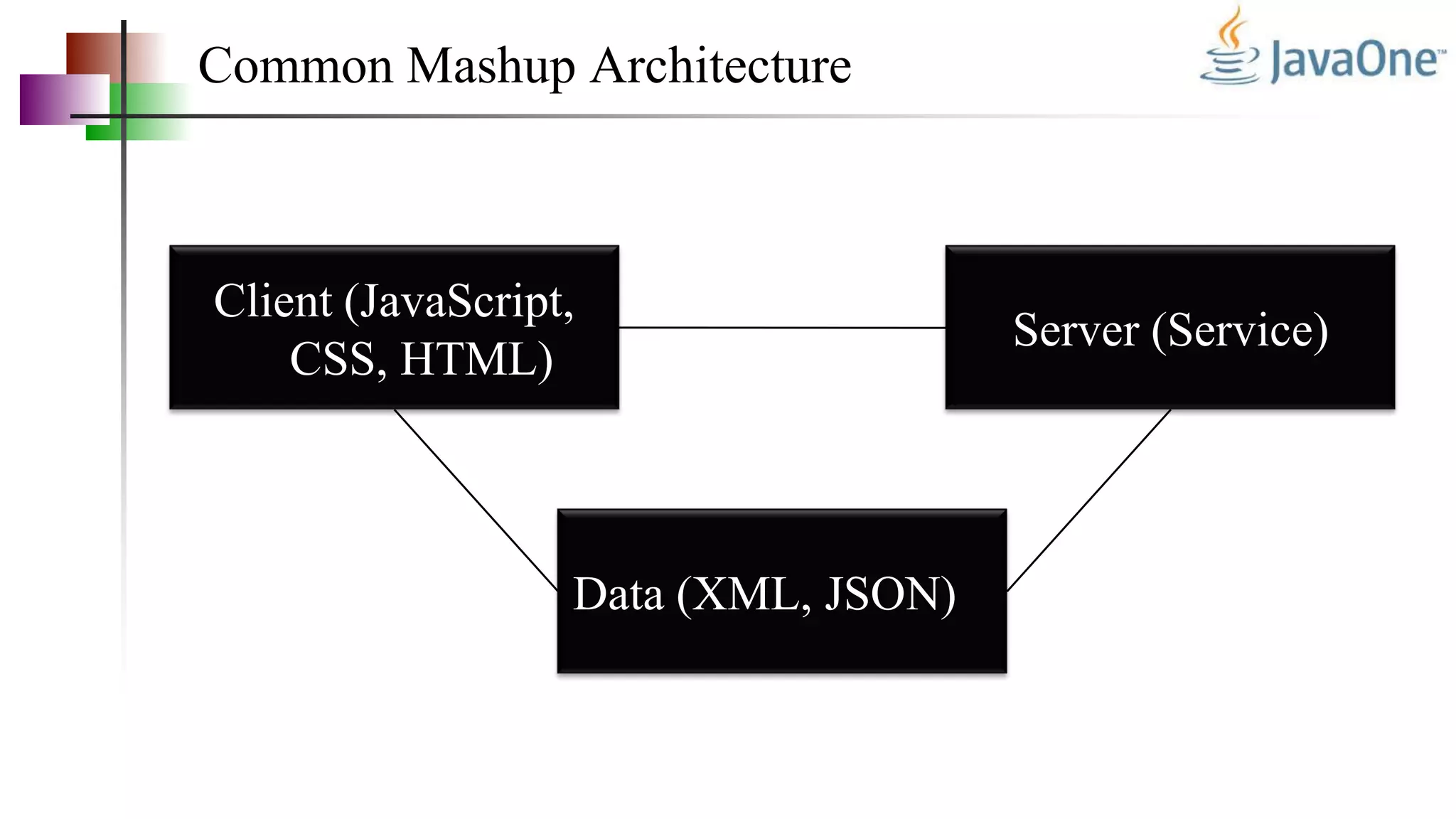
Common Mashup Architecture
Client (JavaScript,
CSS, HTML)
Server (Service)
Data (XML, JSON)
Popular Public Mashup Services
What is Mashups?
Common Mashup Architecture.
Common Mashup Scenarios.
Current Mashup Complexities.
Mashups4JSF = Mashups meet the JavaServer Faces.
Mashup Demo1.
Building Mashup Application using Mashups4JSF.
Mashup Demo2.
Consuming feed sources from JSF Applications.
Producing feeds from JSF Applications.
Agenda
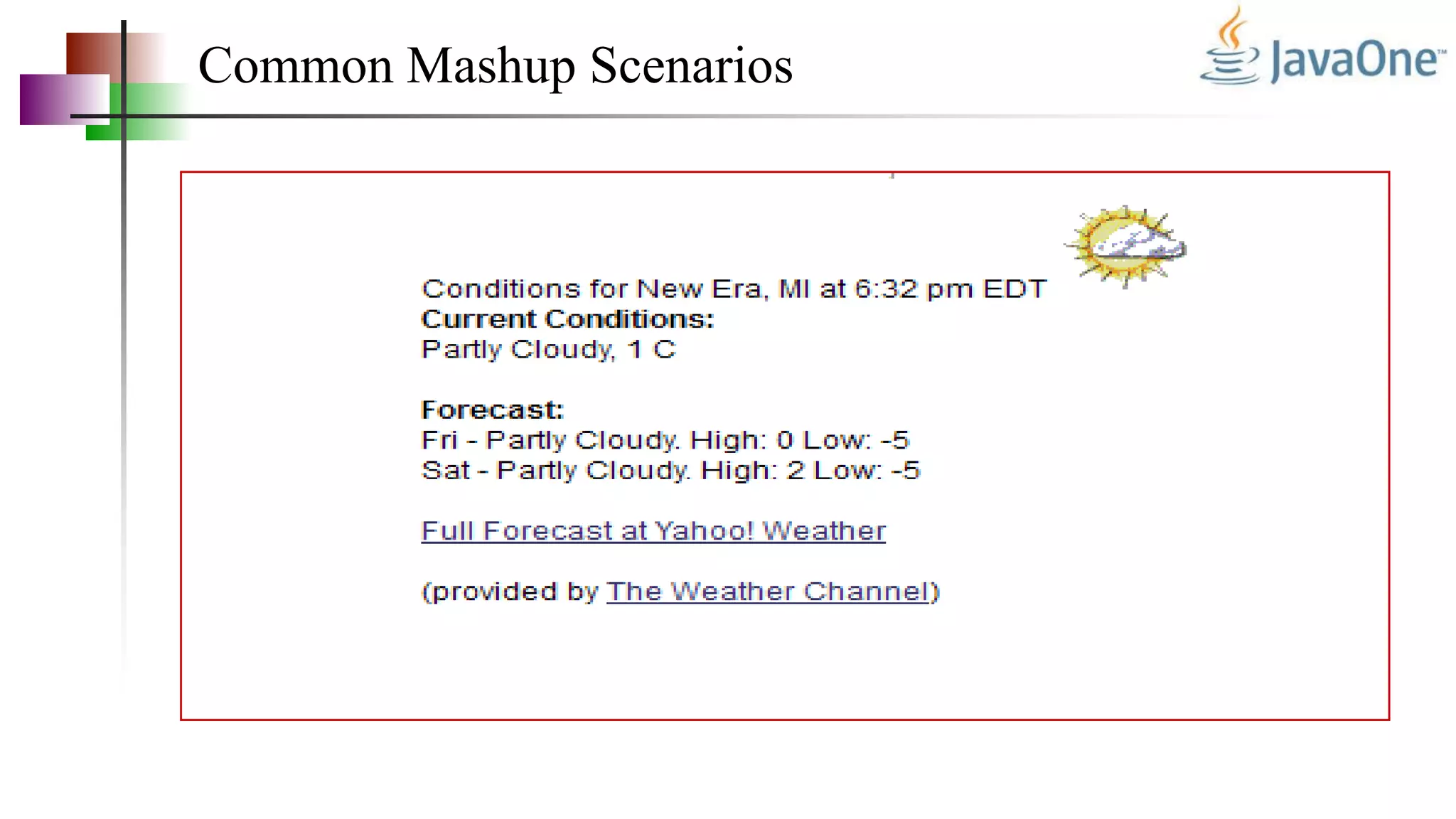
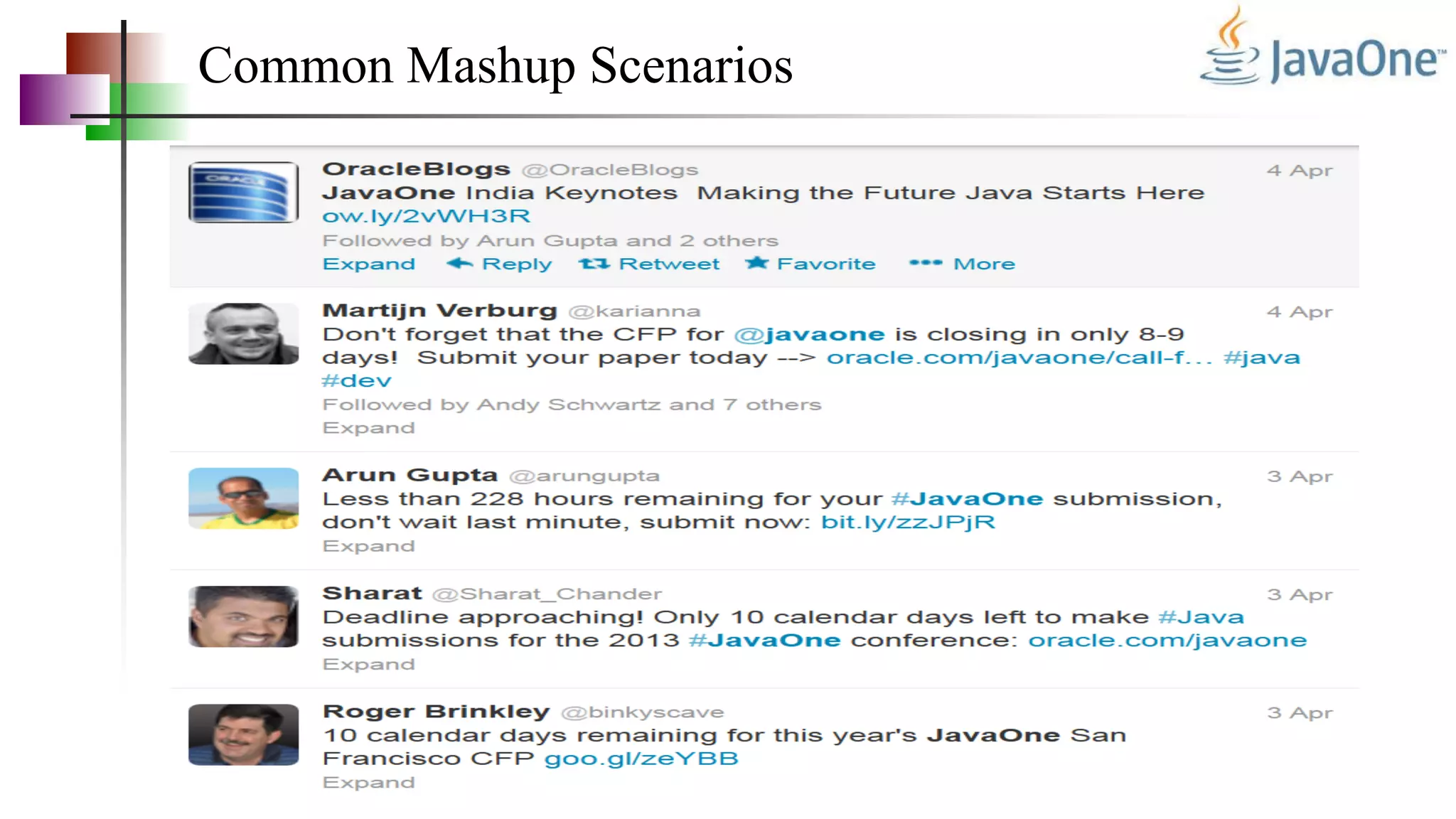
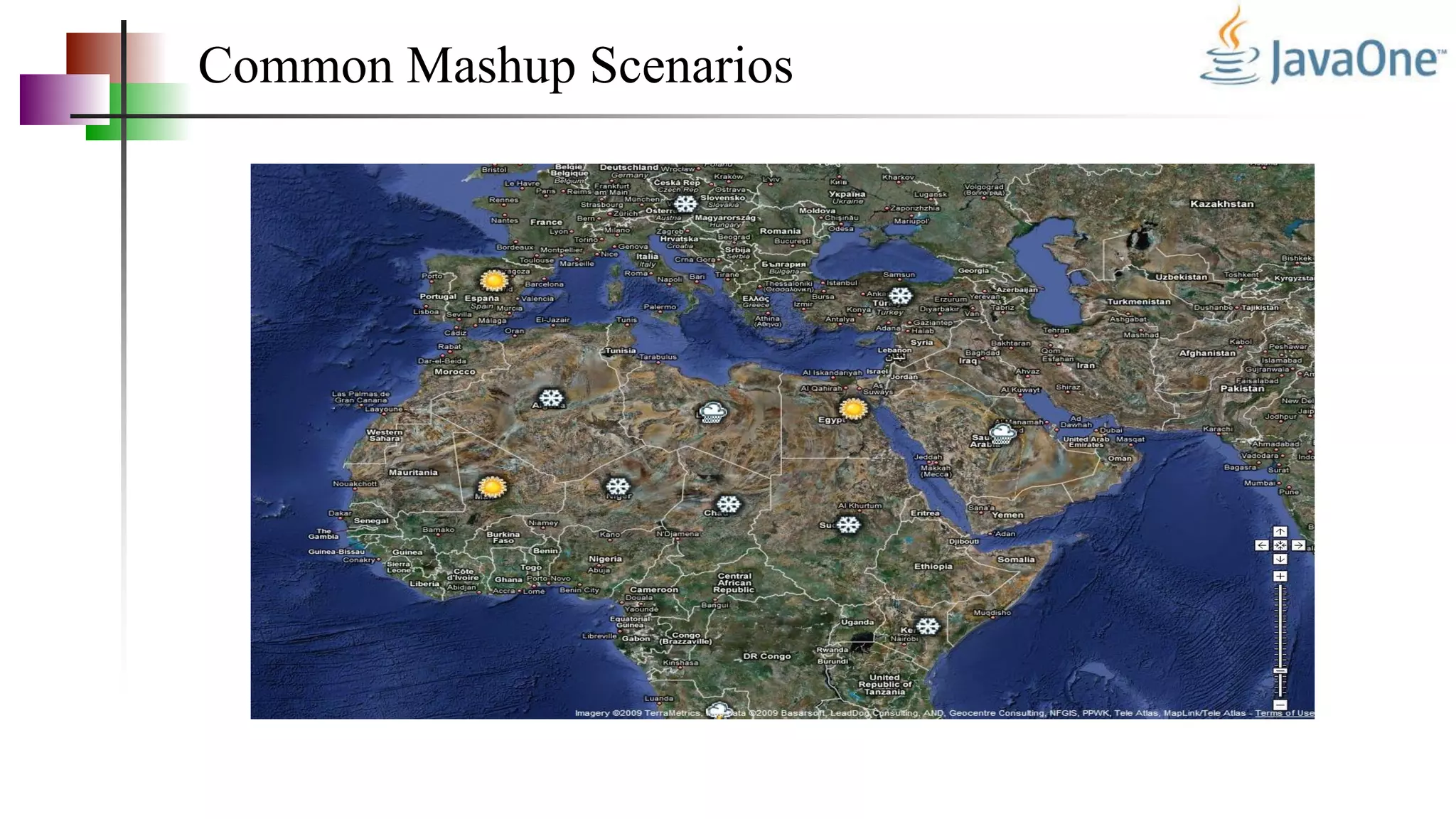
Common Mashup Scenarios
<script type="text/javascript">
…
function getWeatherForecast(map, address) {
var geocoder = new GClientGeocoder();
geocoder.getLatLng(address,
function(location) {
if (!location) {
alert(location + " not found");
} else {
var countryWeatherStatus = Math.floor(Math.random() * 4);
var iconObject = new GIcon(G_DEFAULT_ICON);
iconObject.iconSize = new GSize(45, 45);
iconObject.shadowSize = new GSize(37, 34);
iconObject.iconAnchor = new GPoint(9, 34);
iconObject.infoWindowAnchor = new GPoint(9, 2);
iconObject.image = weatherForecasts[countryWeatherStatus];
var marker = new GMarker(location, {icon: iconObject});
map.addOverlay(marker);
}
}
);
}
function initialize() {
if (GBrowserIsCompatible()) {
var map = new GMap2(document.getElementById("map"));
map.setCenter(new GLatLng(24, 15), 13);
map.setZoom(4);
//get the weather status for countries.
getWeatherForecast(map, "Egypt");
getWeatherForecast(map, "Turkey");
getWeatherForecast(map, "Libya");
getWeatherForecast(map, "Spain");
getWeatherForecast(map, "Algeria");
getWeatherForecast(map, "Mali");
getWeatherForecast(map, "Kenya");
getWeatherForecast(map, "Saudi Arabia");
getWeatherForecast(map, "Niger");
//add the map control.
var mapControlPosition = new GControlPosition(G_ANCHOR_BOTTOM_RIGHT, new GSize(10, 10));
map.addControl(new GLargeMapControl(), mapControlPosition);
}
}
</script>
JavaScript
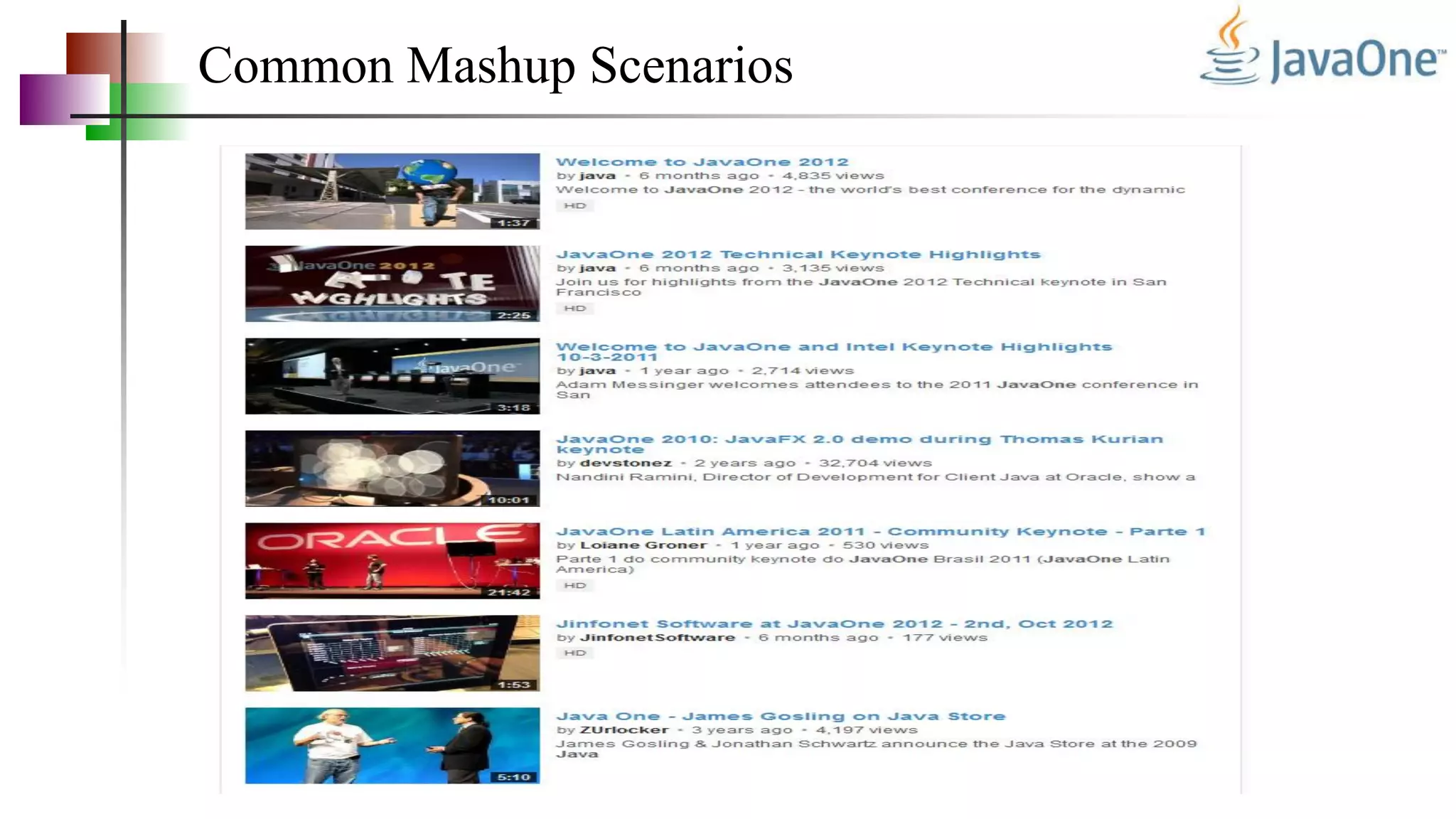
Common Mashup Scenarios
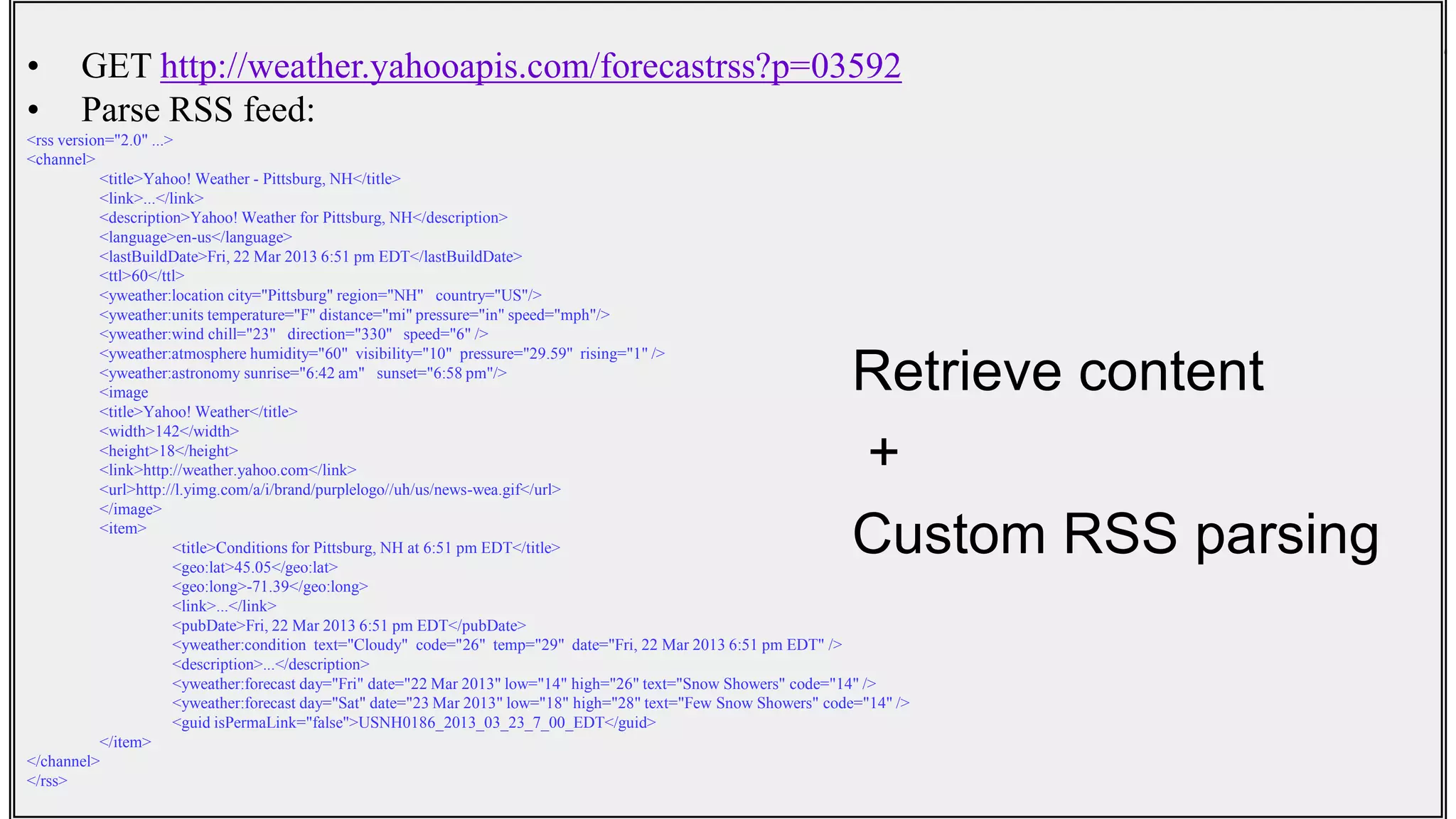
Common Mashup Scenarios• GET http://weather.yahooapis.com/forecastrss?p=03592
• Parse RSS feed:
<rss version="2.0" ...>
<channel>
<title>Yahoo! Weather - Pittsburg, NH</title>
<link>...</link>
<description>Yahoo! Weather for Pittsburg, NH</description>
<language>en-us</language>
<lastBuildDate>Fri, 22 Mar 2013 6:51 pm EDT</lastBuildDate>
<ttl>60</ttl>
<yweather:location city="Pittsburg" region="NH" country="US"/>
<yweather:units temperature="F" distance="mi" pressure="in" speed="mph"/>
<yweather:wind chill="23" direction="330" speed="6" />
<yweather:atmosphere humidity="60" visibility="10" pressure="29.59" rising="1" />
<yweather:astronomy sunrise="6:42 am" sunset="6:58 pm"/>
<image
<title>Yahoo! Weather</title>
<width>142</width>
<height>18</height>
<link>http://weather.yahoo.com</link>
<url>http://l.yimg.com/a/i/brand/purplelogo//uh/us/news-wea.gif</url>
</image>
<item>
<title>Conditions for Pittsburg, NH at 6:51 pm EDT</title>
<geo:lat>45.05</geo:lat>
<geo:long>-71.39</geo:long>
<link>...</link>
<pubDate>Fri, 22 Mar 2013 6:51 pm EDT</pubDate>
<yweather:condition text="Cloudy" code="26" temp="29" date="Fri, 22 Mar 2013 6:51 pm EDT" />
<description>...</description>
<yweather:forecast day="Fri" date="22 Mar 2013" low="14" high="26" text="Snow Showers" code="14" />
<yweather:forecast day="Sat" date="23 Mar 2013" low="18" high="28" text="Few Snow Showers" code="14" />
<guid isPermaLink="false">USNH0186_2013_03_23_7_00_EDT</guid>
</item>
</channel>
</rss>
Retrieve content
+
Custom RSS parsing
Common Mashup Scenarios
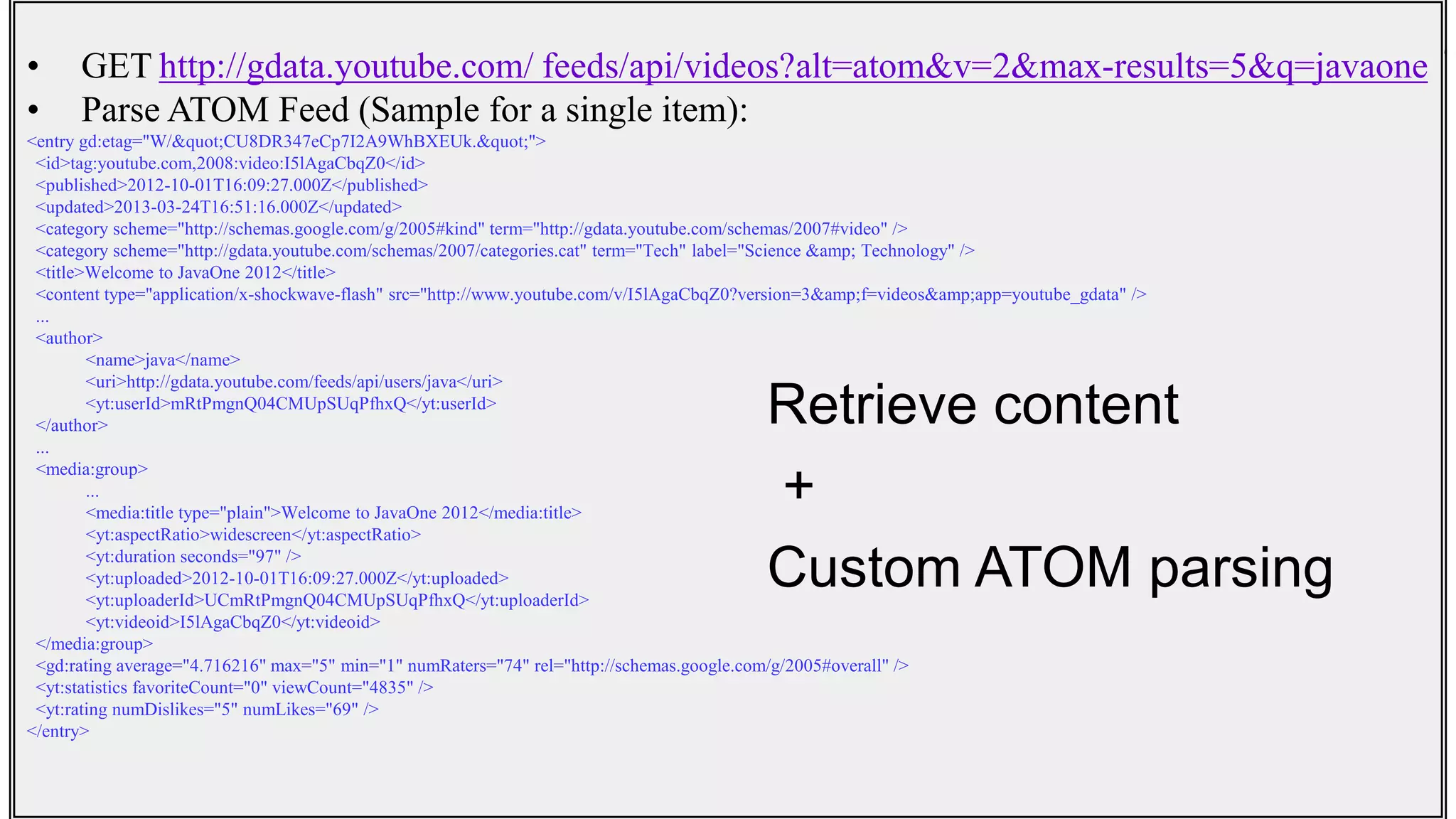
Common Mashup Scenarios• GET http://gdata.youtube.com/ feeds/api/videos?alt=atom&v=2&max-results=5&q=javaone
• Parse ATOM Feed (Sample for a single item):
<entry gd:etag="W/&quot;CU8DR347eCp7I2A9WhBXEUk.&quot;">
<id>tag:youtube.com,2008:video:I5lAgaCbqZ0</id>
<published>2012-10-01T16:09:27.000Z</published>
<updated>2013-03-24T16:51:16.000Z</updated>
<category scheme="http://schemas.google.com/g/2005#kind" term="http://gdata.youtube.com/schemas/2007#video" />
<category scheme="http://gdata.youtube.com/schemas/2007/categories.cat" term="Tech" label="Science &amp; Technology" />
<title>Welcome to JavaOne 2012</title>
<content type="application/x-shockwave-flash" src="http://www.youtube.com/v/I5lAgaCbqZ0?version=3&amp;f=videos&amp;app=youtube_gdata" />
...
<author>
<name>java</name>
<uri>http://gdata.youtube.com/feeds/api/users/java</uri>
<yt:userId>mRtPmgnQ04CMUpSUqPfhxQ</yt:userId>
</author>
...
<media:group>
...
<media:title type="plain">Welcome to JavaOne 2012</media:title>
<yt:aspectRatio>widescreen</yt:aspectRatio>
<yt:duration seconds="97" />
<yt:uploaded>2012-10-01T16:09:27.000Z</yt:uploaded>
<yt:uploaderId>UCmRtPmgnQ04CMUpSUqPfhxQ</yt:uploaderId>
<yt:videoid>I5lAgaCbqZ0</yt:videoid>
</media:group>
<gd:rating average="4.716216" max="5" min="1" numRaters="74" rel="http://schemas.google.com/g/2005#overall" />
<yt:statistics favoriteCount="0" viewCount="4835" />
<yt:rating numDislikes="5" numLikes="69" />
</entry>
Retrieve content
+
Custom ATOM parsing
Common Mashup Scenarios
• GET https://search.twitter.com/search.json?q=javaone&rpp=10
• Parse JSON Feed (Sample for a single item):
{
"completed_in":0.021,
"max_id":320699880265891840,
"max_id_str":"320699880265891840",
"next_page":"?page=2&max_id=320699880265891840&q=javaone&rpp=10",
"page":1,
"query":"javaone",
"refresh_url":"?since_id=320699880265891840&q=javaone",
"results":[
{
"created_at":"Sun, 07 Apr 2013 00:49:44 +0000",
"from_user":"rob_ratcliff",
"from_user_id":265460384,
"from_user_id_str":"265460384",
"from_user_name":"Rob Ratcliff",
"geo":null,
"id":320699880265891840,
"id_str":"320699880265891840",
"iso_language_code":"en",
"metadata":{
"result_type":"recent"
},
"profile_image_url":"http://a0.twimg.com/profile_images/2376270945/rfa2u2nheyb6jj5k9bv8_normal.jpeg",
"profile_image_url_https":"https://si0.twimg.com/profile_images/2376270945/rfa2u2nheyb6jj5k9bv8_normal.jpeg",
"source":"&lt;a href=&quot;http://twitter.com/tweetbutton&quot;&gt;Tweet Button&lt;/a&gt;",
"text":"RT @karianna: Don't forget that the CFP for @javaone is closing in only 8-9 days! Submit your paper today --&gt; http://t.co/6AAWdIf87h #java #dev"
}
...
],
"results_per_page":10,
"since_id":0,
"since_id_str":"0"
}
Retrieve content
+
Custom JSON parsing
Common Mashup Scenarios
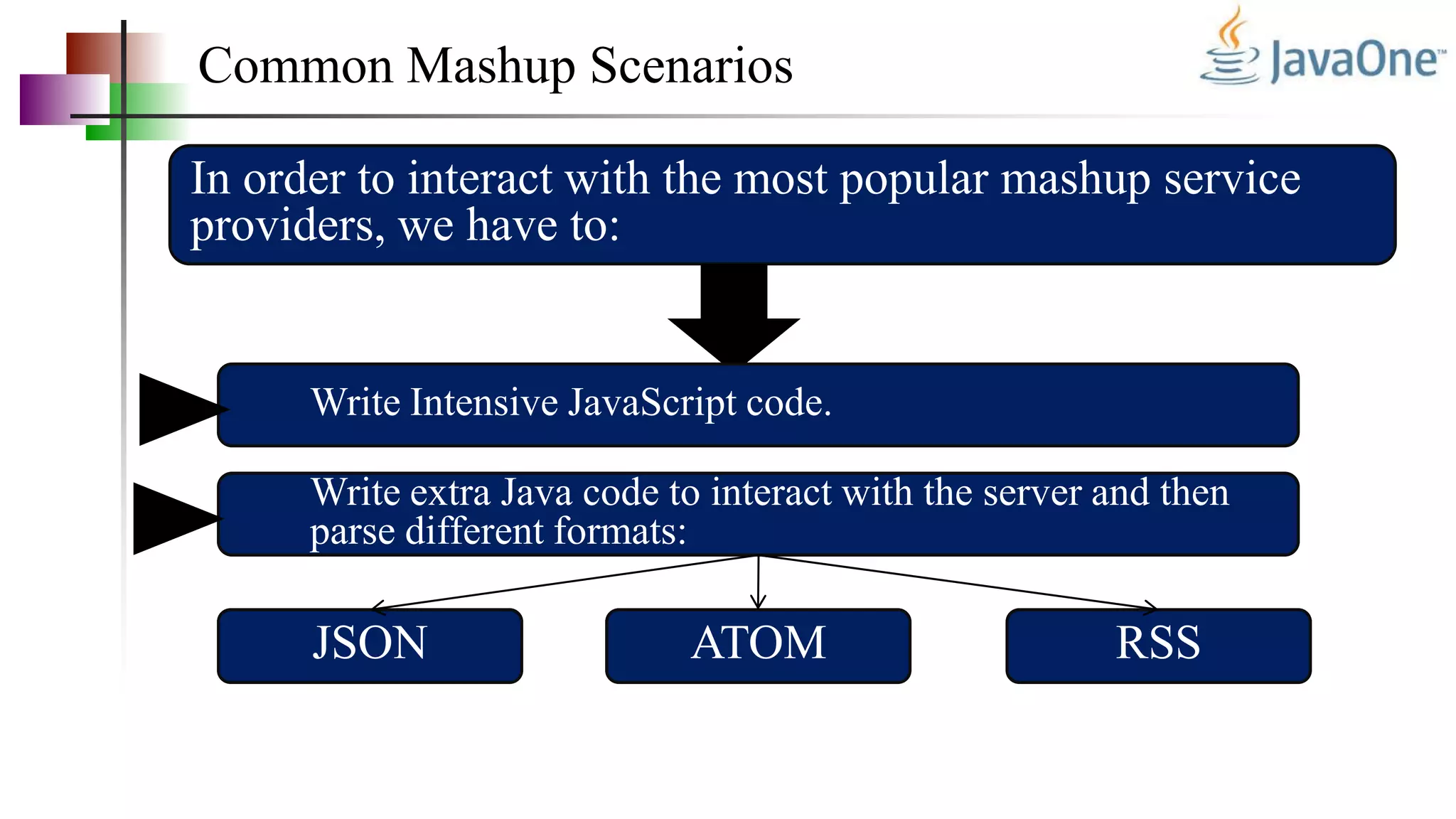
In order to interact with the most popular mashup service
providers, we have to:
Write Intensive JavaScript code.
Write extra Java code to interact with the server and then
parse different formats:
JSON ATOM RSS
So, Developing Mashups is
not an easy task
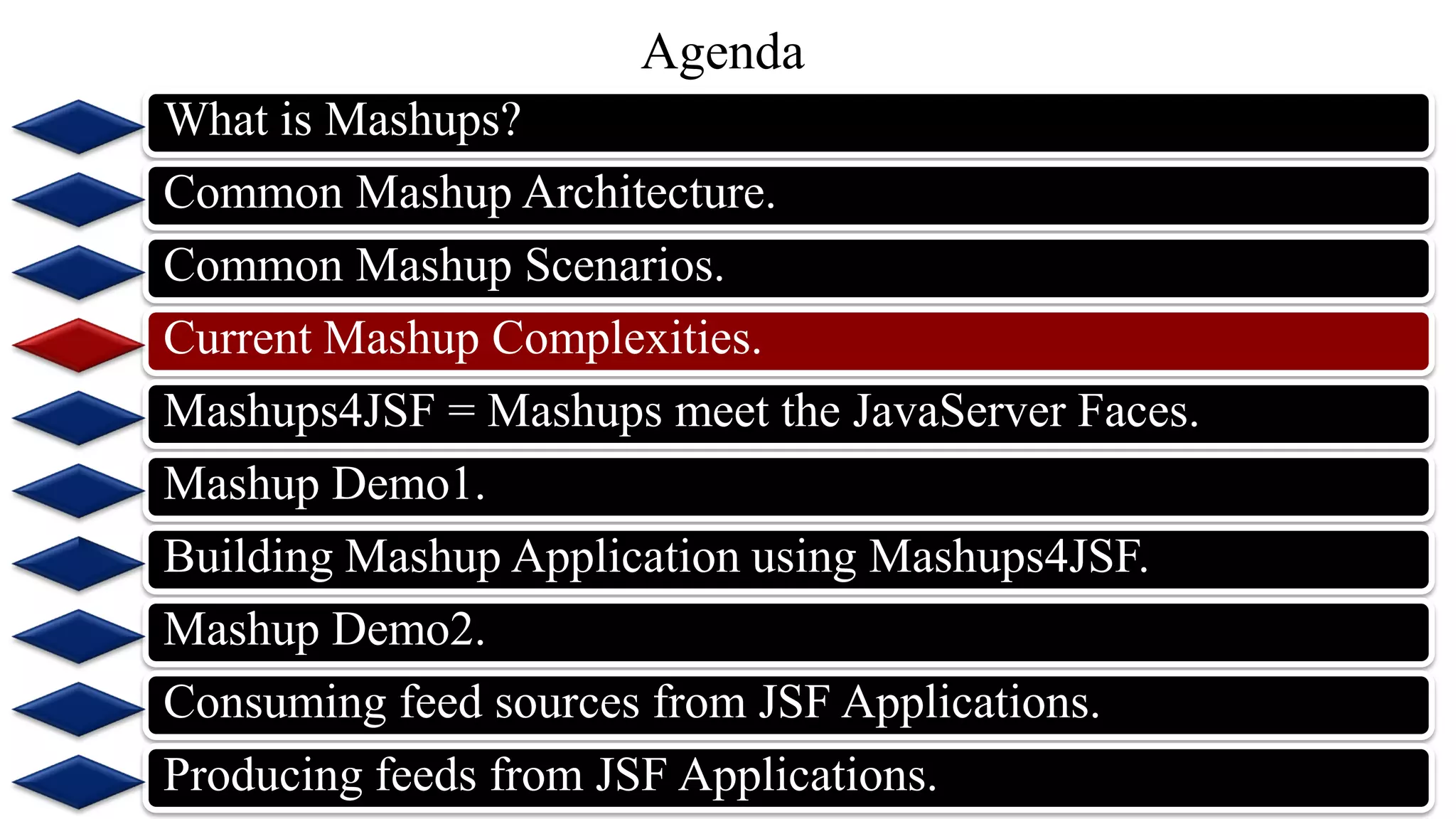
Agenda
What is Mashups?
Common Mashup Architecture.
Common Mashup Scenarios.
Current Mashup Complexities.
Mashups4JSF = Mashups meet the JavaServer Faces.
Mashup Demo1.
Building Mashup Application using Mashups4JSF.
Mashup Demo2.
Consuming feed sources from JSF Applications.
Producing feeds from JSF Applications.
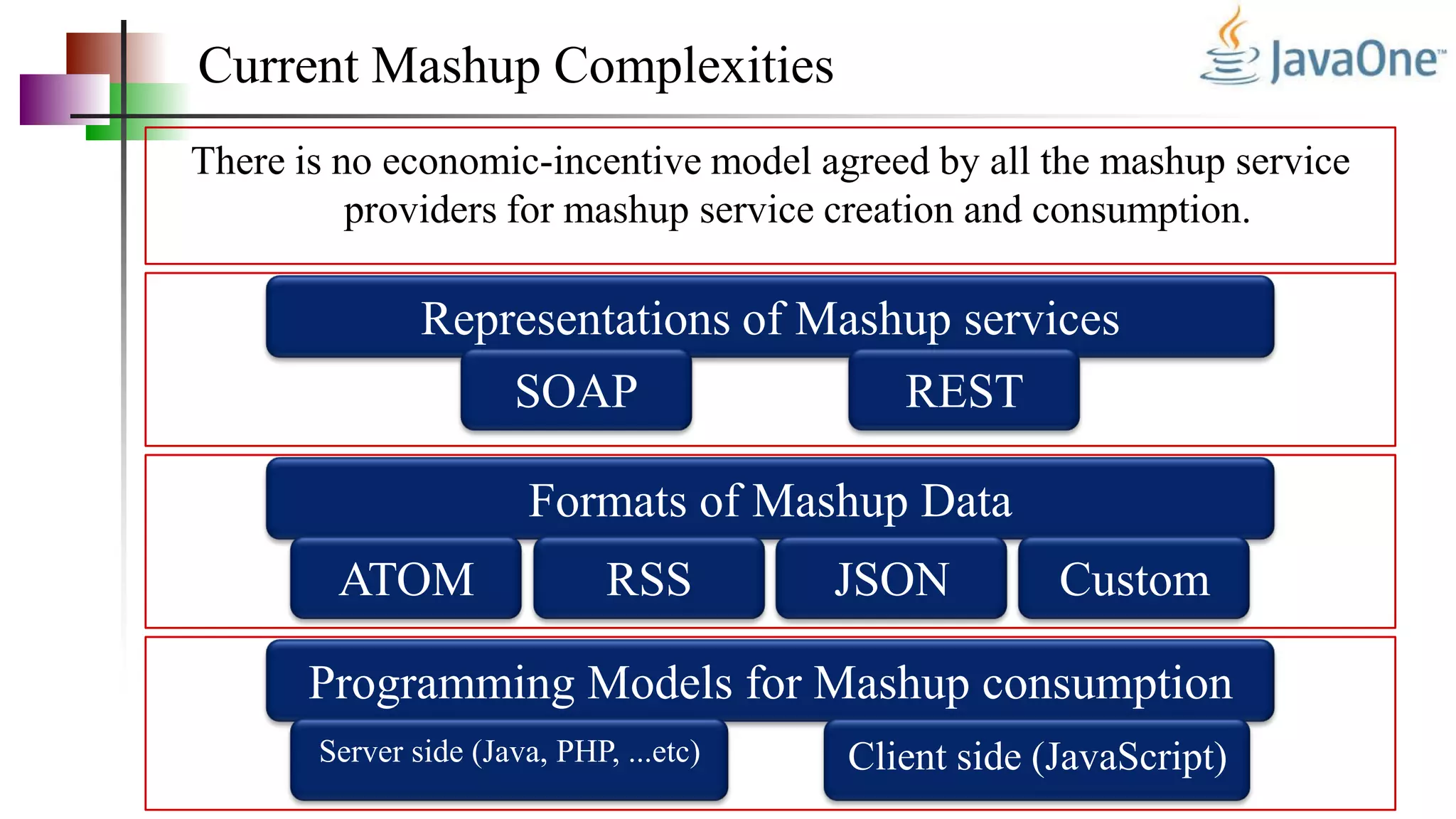
Current Mashup Complexities
There is no economic-incentive model agreed by all the mashup service
providers for mashup service creation and consumption.
Representations of Mashup services
SOAP REST
Formats of Mashup Data
ATOM CustomRSS JSON
Programming Models for Mashup consumption
Server side (Java, PHP, ...etc) Client side (JavaScript)
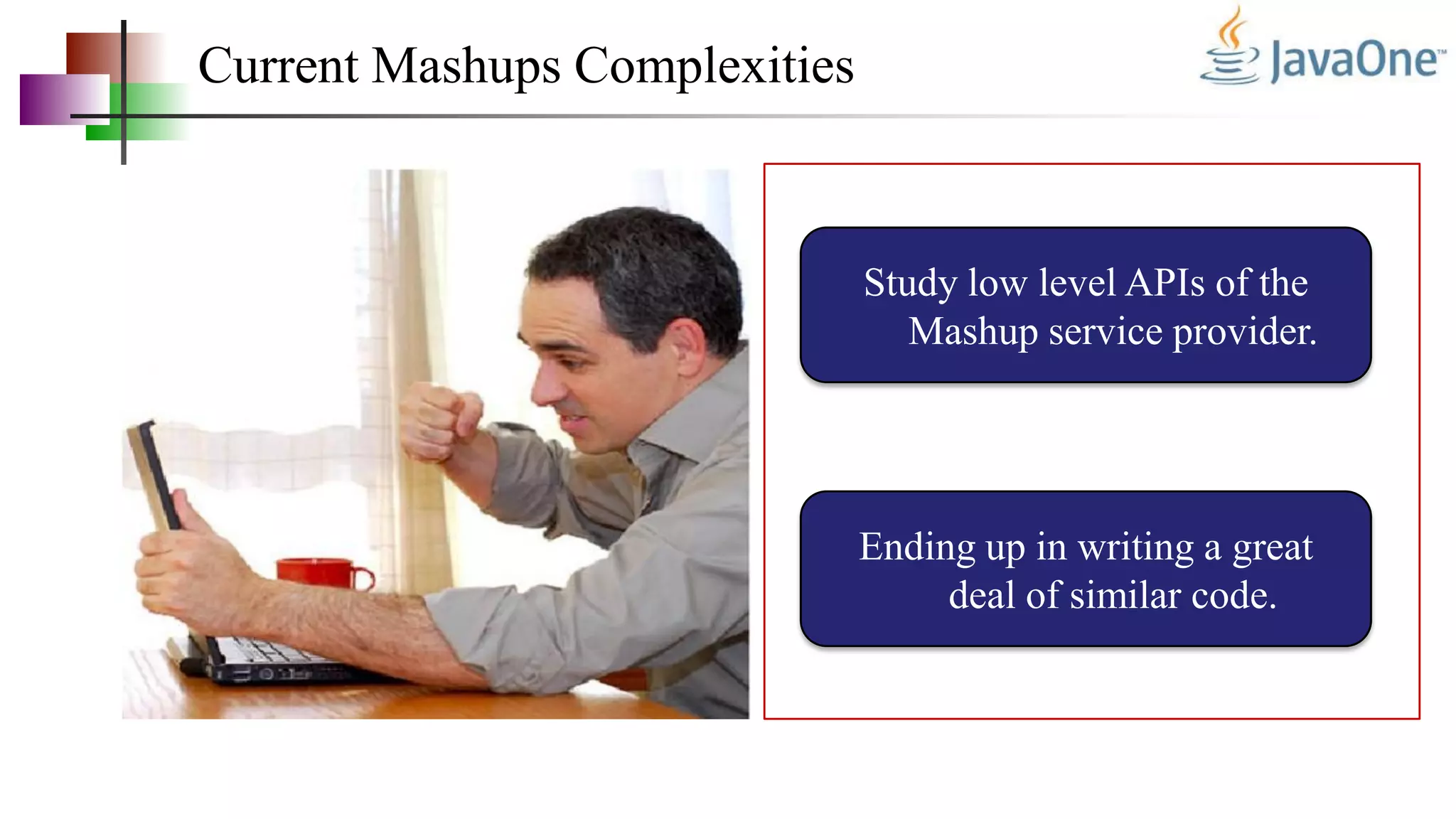
Current Mashups Complexities
Study low level APIs of the
Mashup service provider.
Ending up in writing a great
deal of similar code.
What is Mashups?
Common Mashup Architecture.
Common Mashup Scenarios.
Current Mashup Complexities.
Mashups4JSF = Mashups meet the JavaServer Faces.
Mashup Demo1.
Building Mashup Application using Mashups4JSF.
Mashup Demo2.
Consuming feed sources from JSF Applications.
Producing feeds from JSF Applications.
Agenda
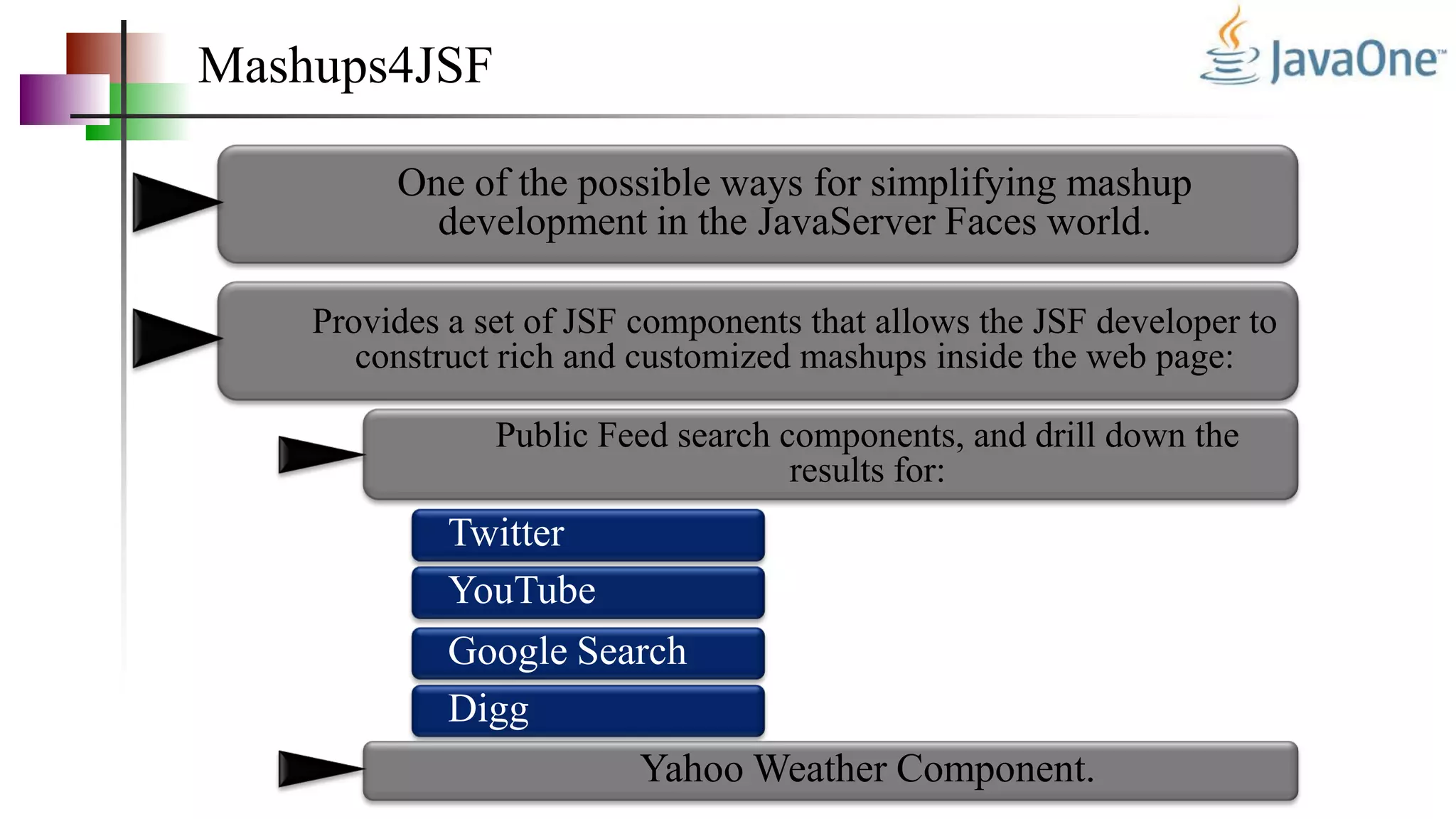
Mashups4JSF
One of the possible ways for simplifying mashup
development in the JavaServer Faces world.
Provides a set of JSF components that allows the JSF developer to
construct rich and customized mashups inside the web page:
Public Feed search components, and drill down the
results for:
Twitter
YouTube
Google Search
Digg
Yahoo Weather Component.
Mashups4JSF
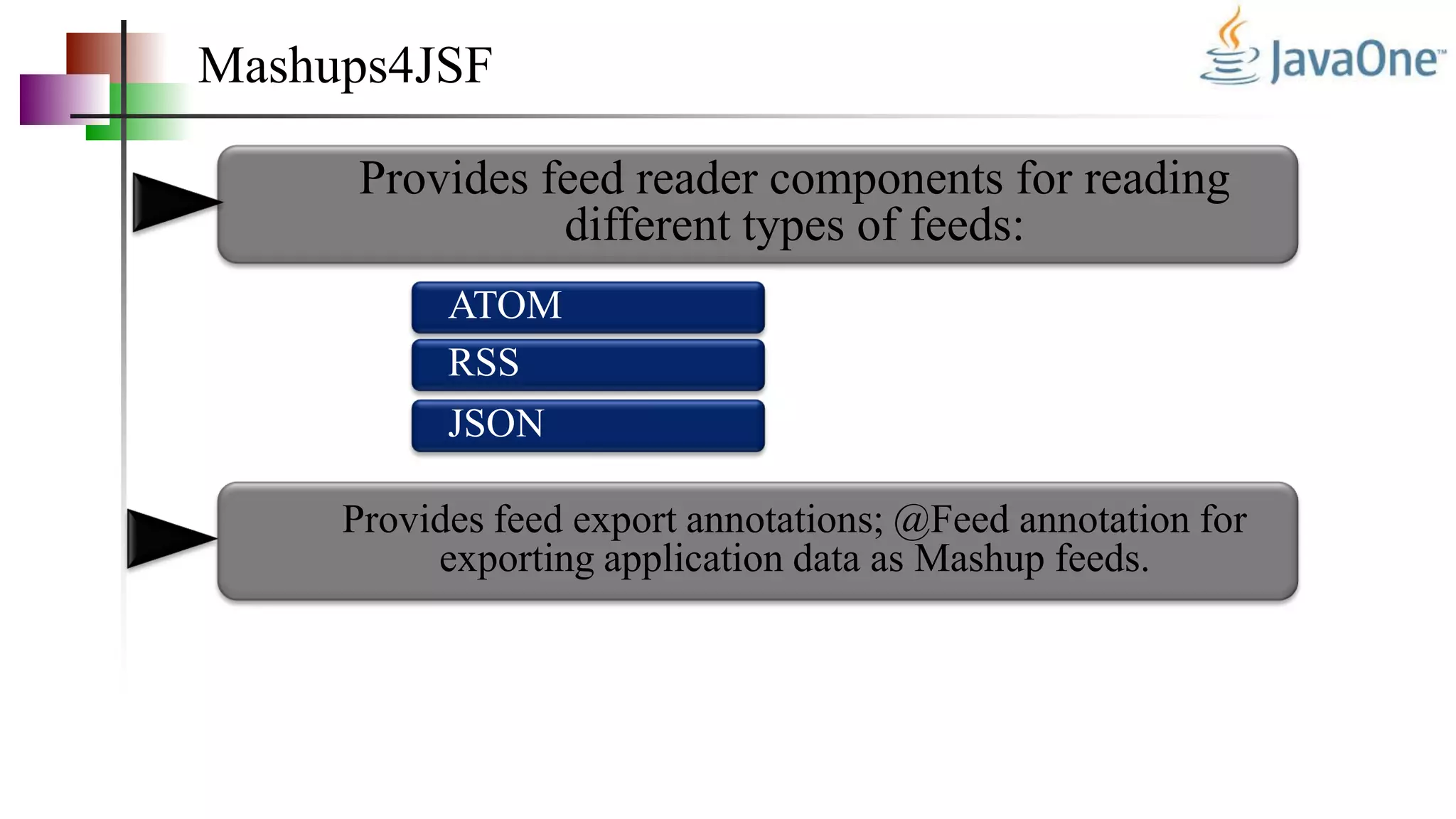
Provides feed reader components for reading
different types of feeds:
Provides feed export annotations; @Feed annotation for
exporting application data as Mashup feeds.
ATOM
RSS
JSON
Mashups4JSF
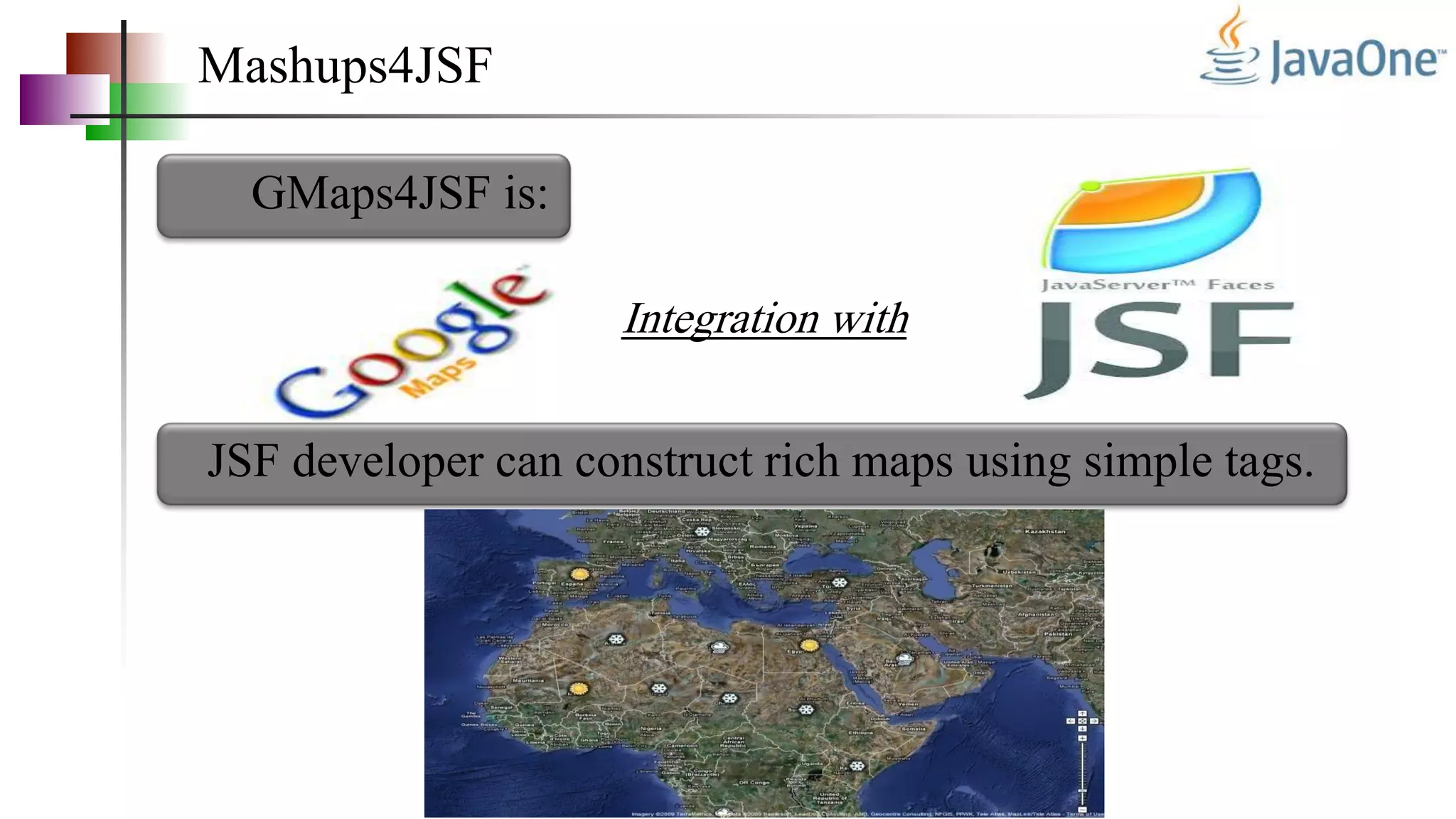
GMaps4JSF is:
Integration with
JSF developer can construct rich maps using simple tags.
Mashups4JSF
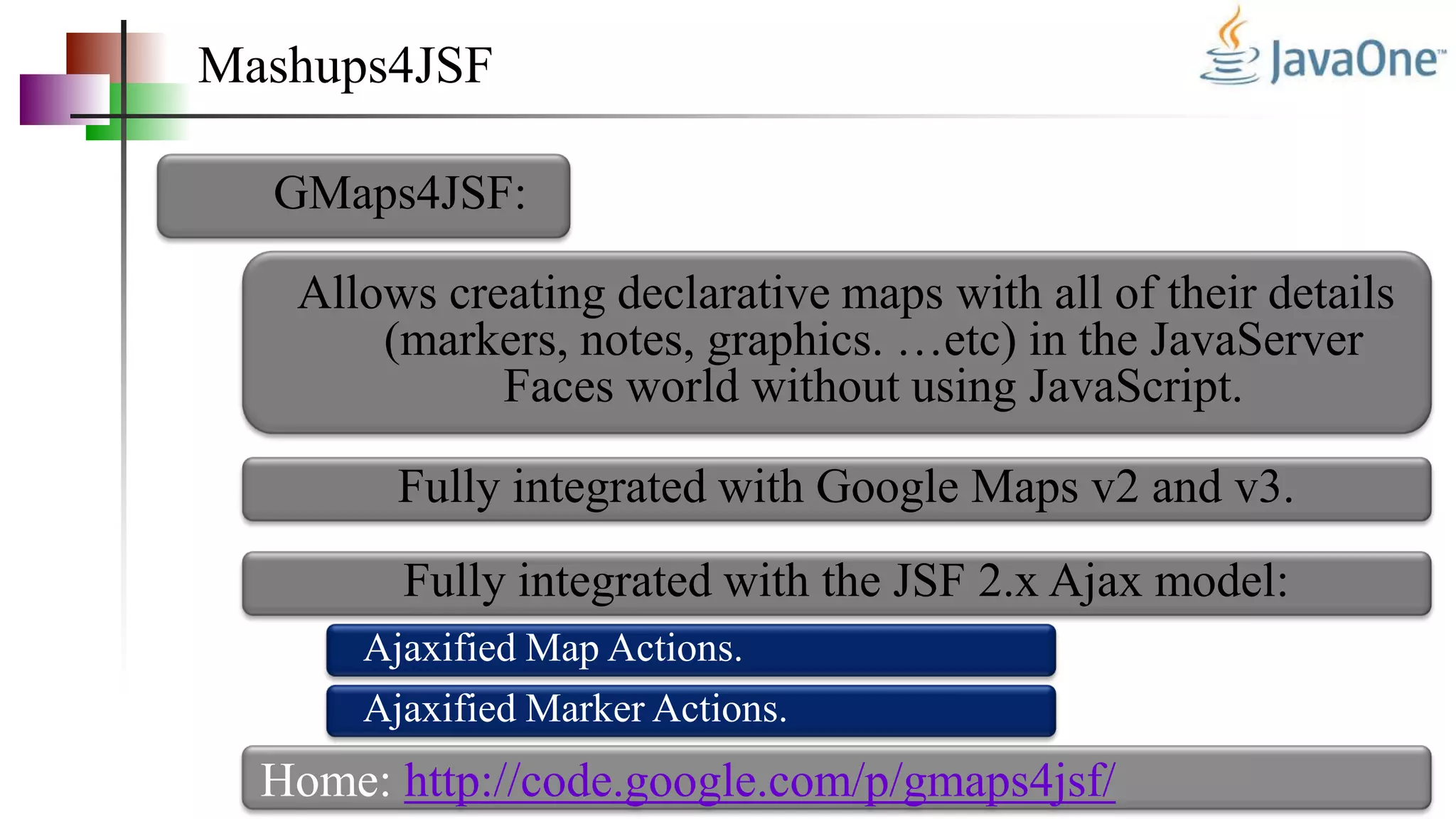
GMaps4JSF:
Allows creating declarative maps with all of their details
(markers, notes, graphics. …etc) in the JavaServer
Faces world without using JavaScript.
Fully integrated with Google Maps v2 and v3.
Fully integrated with the JSF 2.x Ajax model:
Ajaxified Map Actions.
Ajaxified Marker Actions.
Home: http://code.google.com/p/gmaps4jsf/
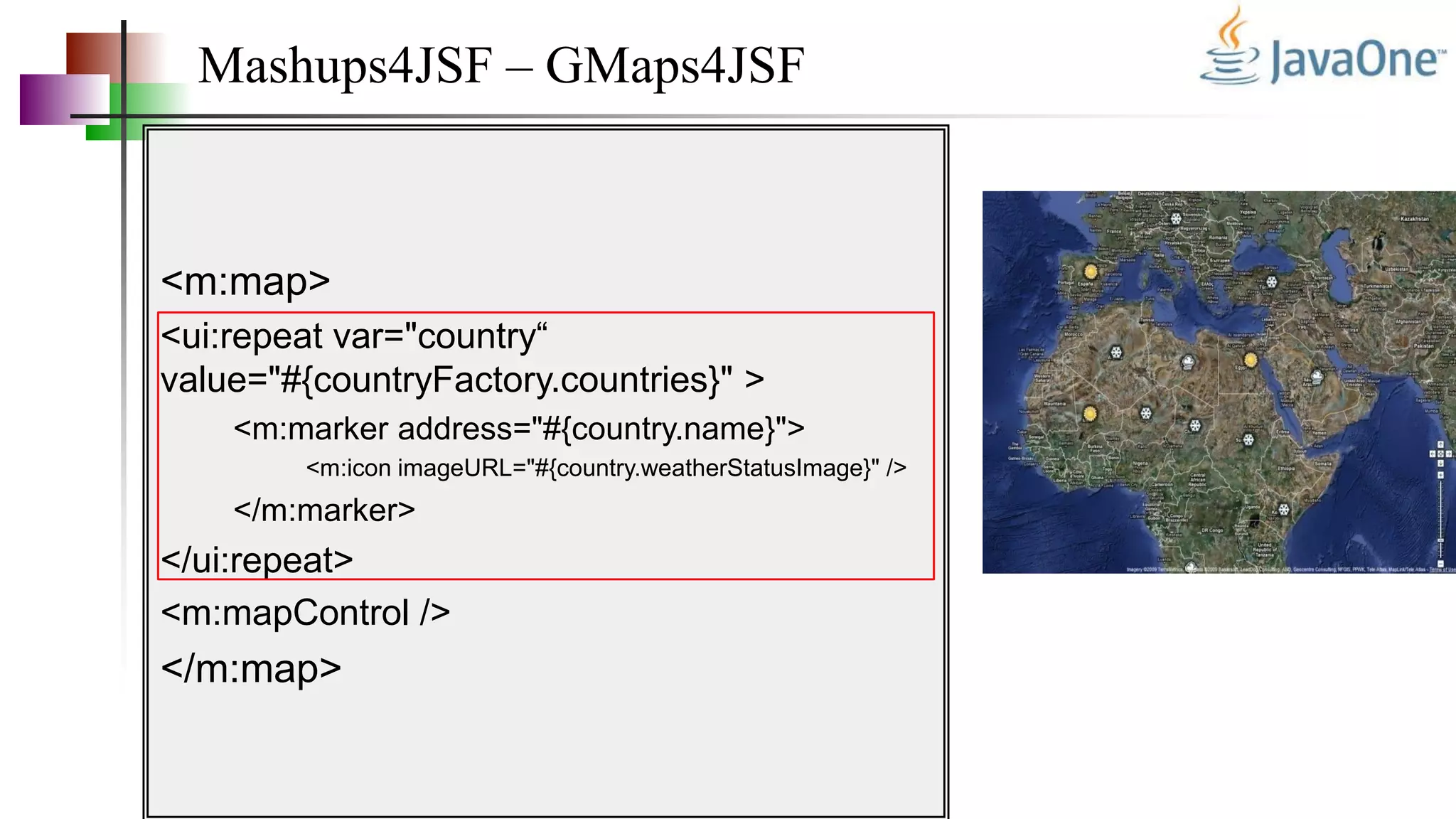
Mashups4JSF – GMaps4JSF
<m:map>
<ui:repeat var="country“
value="#{countryFactory.countries}" >
<m:marker address="#{country.name}">
<m:icon imageURL="#{country.weatherStatusImage}" />
</m:marker>
</ui:repeat>
<m:mapControl />
</m:map>
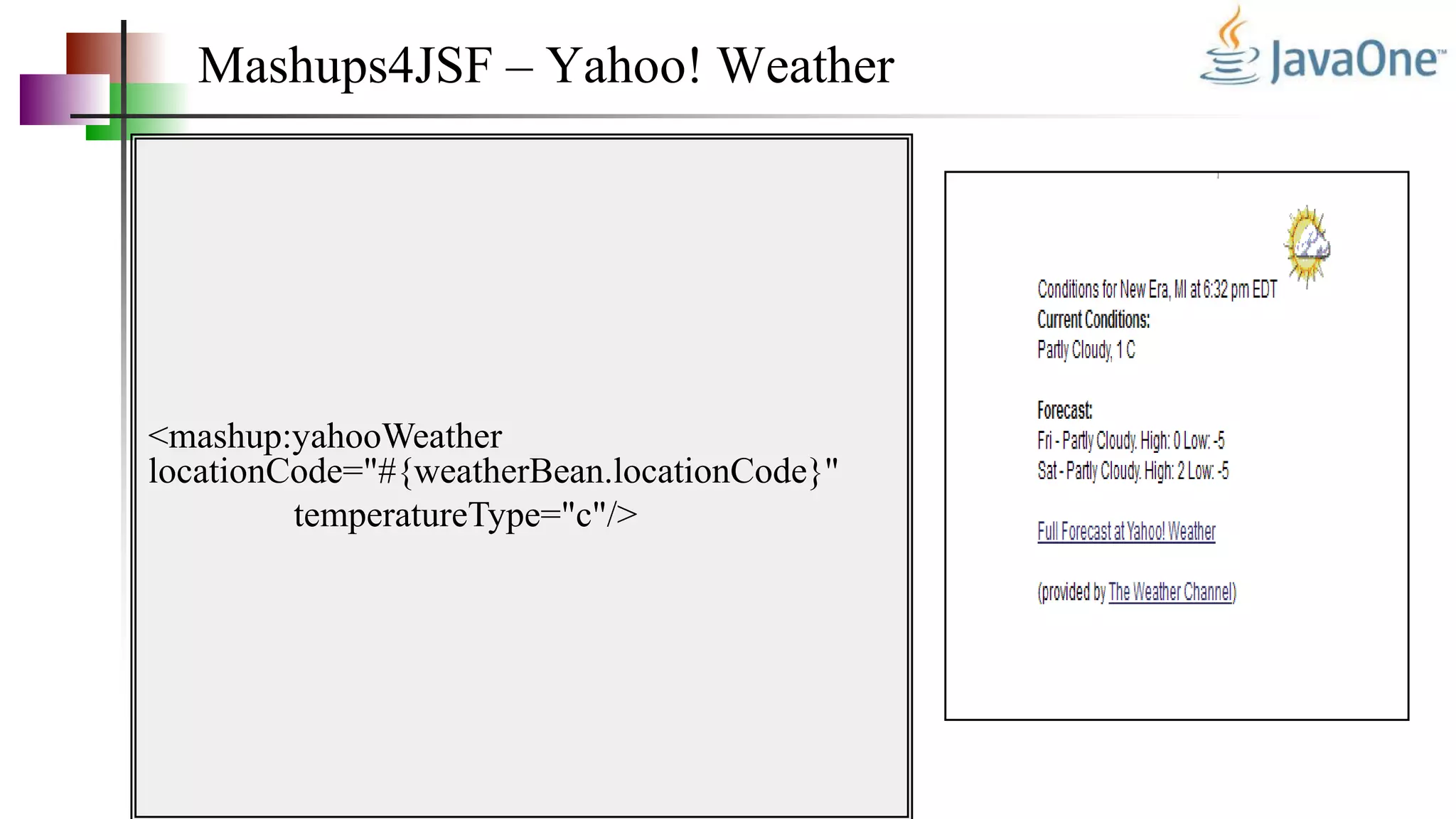
Mashups4JSF – Yahoo! Weather
<mashup:yahooWeather
locationCode="#{weatherBean.locationCode}"
temperatureType="c"/>
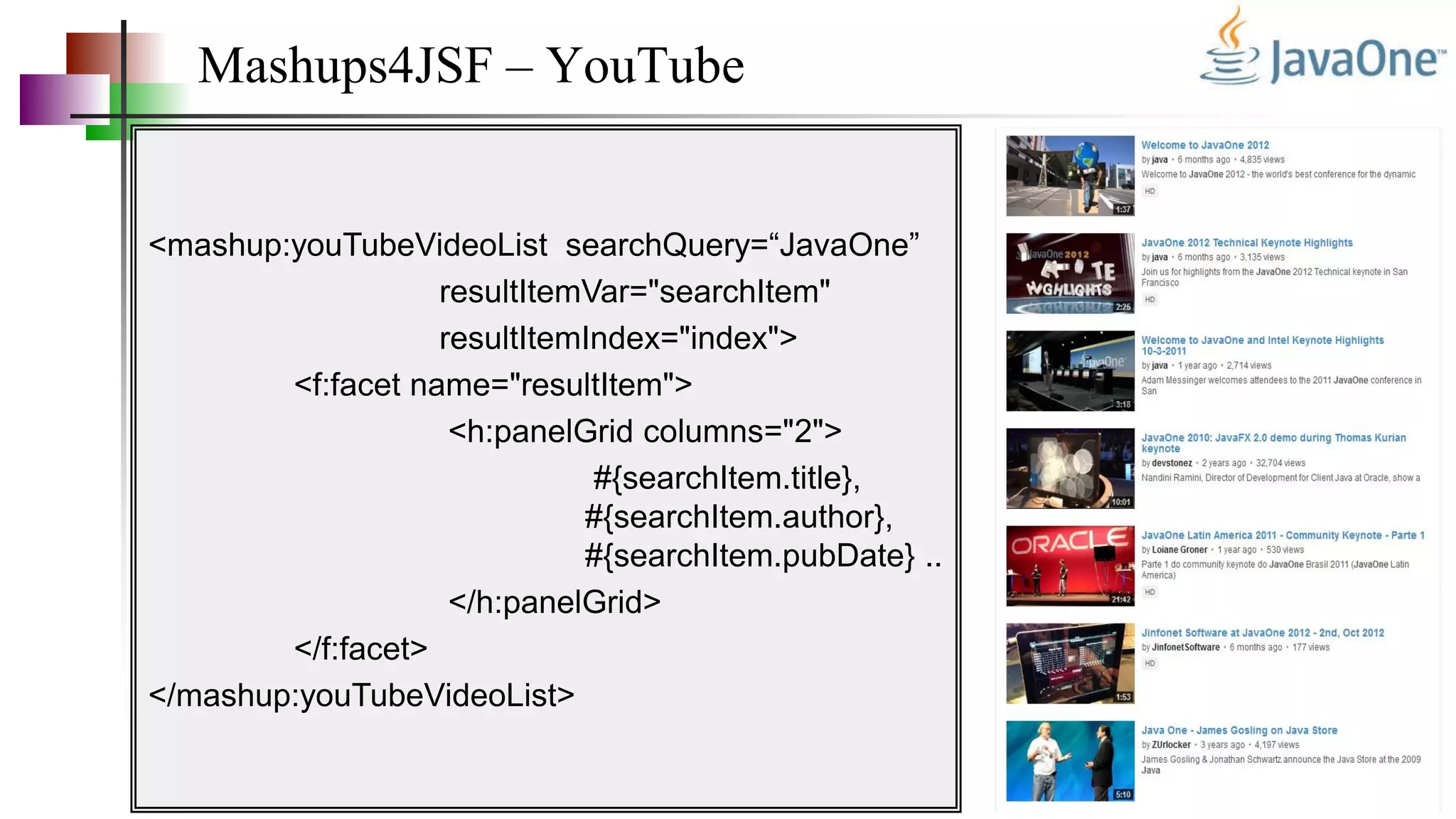
Mashups4JSF – YouTube
<mashup:youTubeVideoList searchQuery=“JavaOne”
resultItemVar="searchItem"
resultItemIndex="index">
<f:facet name="resultItem">
<h:panelGrid columns="2">
#{searchItem.title},
#{searchItem.author},
#{searchItem.pubDate} ..
</h:panelGrid>
</f:facet>
</mashup:youTubeVideoList>
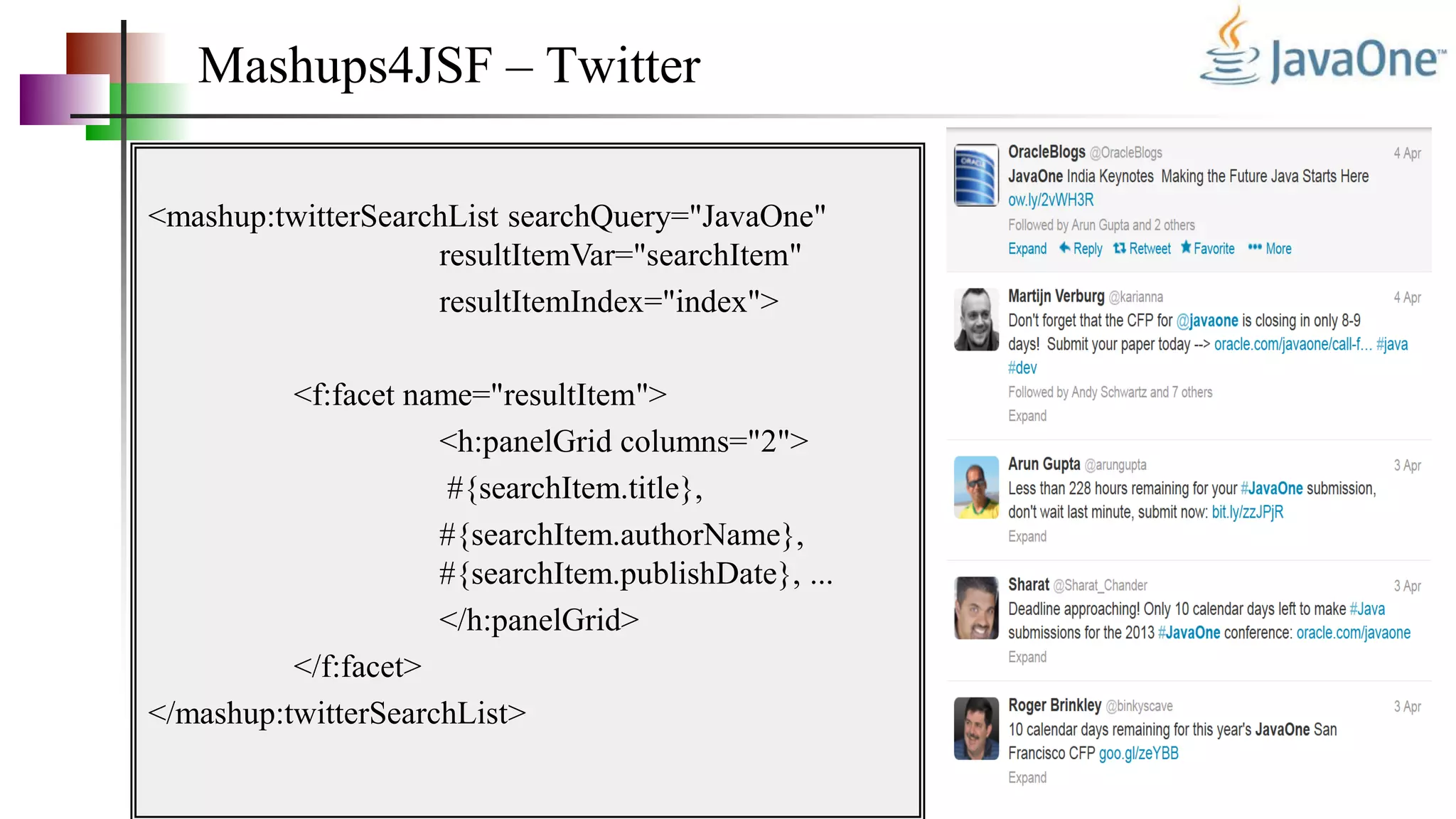
Mashups4JSF – Twitter
<mashup:twitterSearchList searchQuery="JavaOne"
resultItemVar="searchItem"
resultItemIndex="index">
<f:facet name="resultItem">
<h:panelGrid columns="2">
#{searchItem.title},
#{searchItem.authorName},
#{searchItem.publishDate}, ...
</h:panelGrid>
</f:facet>
</mashup:twitterSearchList>
What is Mashups?
Common Mashup Architecture.
Common Mashup Scenarios.
Current Mashup Complexities.
Mashups4JSF = Mashups meet the JavaServer Faces.
Mashup Demo1.
Building Mashup Application using Mashups4JSF.
Mashup Demo2.
Consuming feed sources from JSF Applications.
Producing feeds from JSF Applications.
Agenda
Mashup Demo1
Mashup Demo1
Let’s build Demo1
What is Mashups?
Common Mashup Architecture.
Common Mashup Scenarios.
Current Mashup Complexities.
Mashups4JSF = Mashups meet the JavaServer Faces.
Mashup Demo1.
Building Mashup Application using Mashups4JSF.
Mashup Demo2.
Consuming feed sources from JSF Applications.
Producing feeds from JSF Applications.
Agenda
Mashup Demo2
Mashup Demo2
Let’s build Demo2
What is Mashups?
Common Mashup Architecture.
Common Mashup Scenarios.
Current Mashup Complexities.
Mashups4JSF = Mashups meet the JavaServer Faces.
Mashup Demo1.
Building Mashup Application using Mashups4JSF.
Mashup Demo2.
Consuming feed sources from JSF Applications.
Producing feeds from JSF Applications.
Agenda
Consuming feed sources in JSF
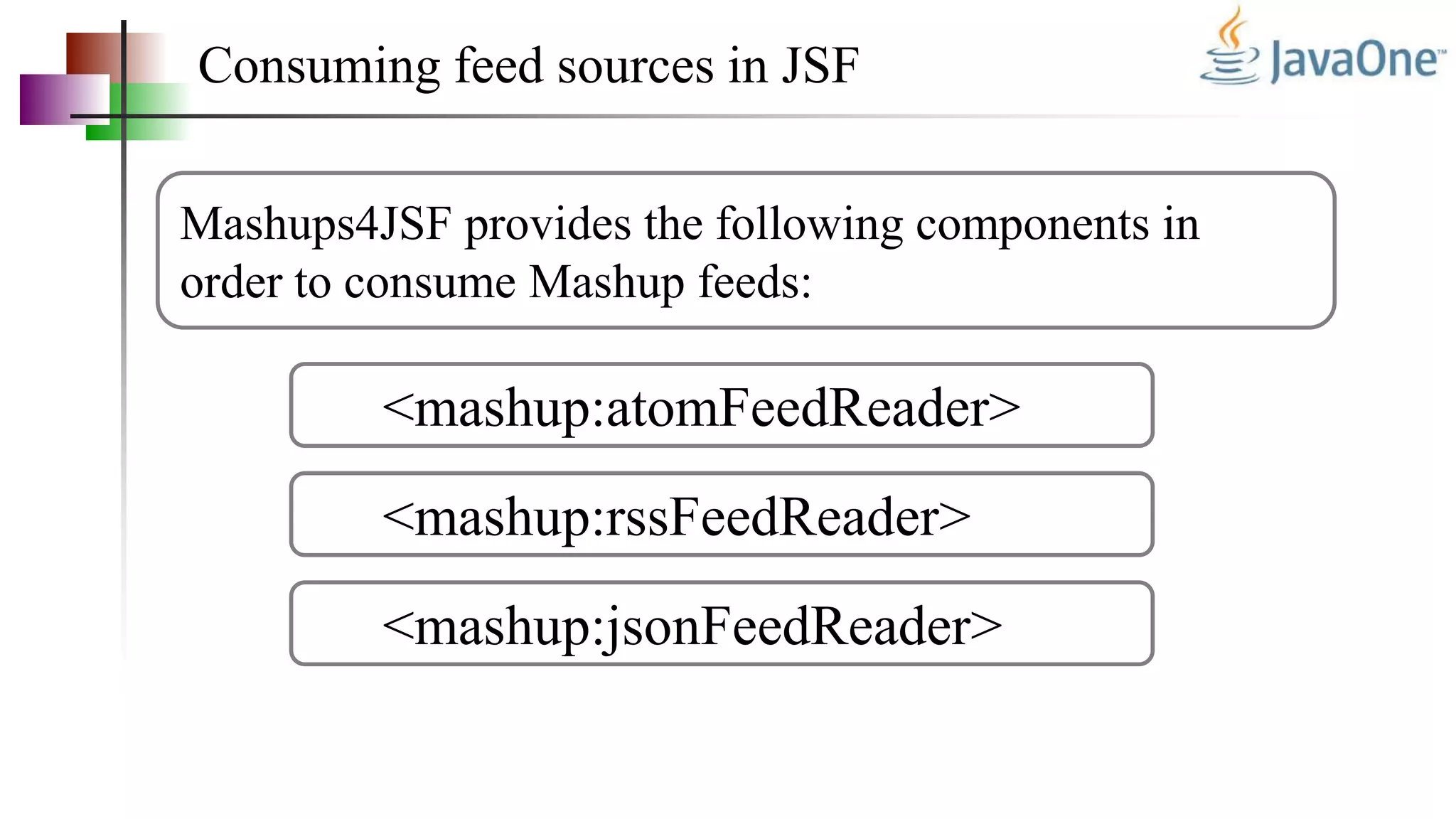
Mashups4JSF provides the following components in
order to consume Mashup feeds:
<mashup:atomFeedReader>
<mashup:rssFeedReader>
<mashup:jsonFeedReader>
Consuming feed sources in JSF
Let’s build an application that
consumes Yahoo! News feed.
What is Mashups?
Common Mashup Architecture.
Common Mashup Scenarios.
Current Mashup Complexities.
Mashups4JSF = Mashups meet the JavaServer Faces.
Mashup Demo1.
Building Mashup Application using Mashups4JSF.
Mashup Demo2.
Consuming feed sources from JSF Applications.
Producing feeds from JSF Applications.
Agenda
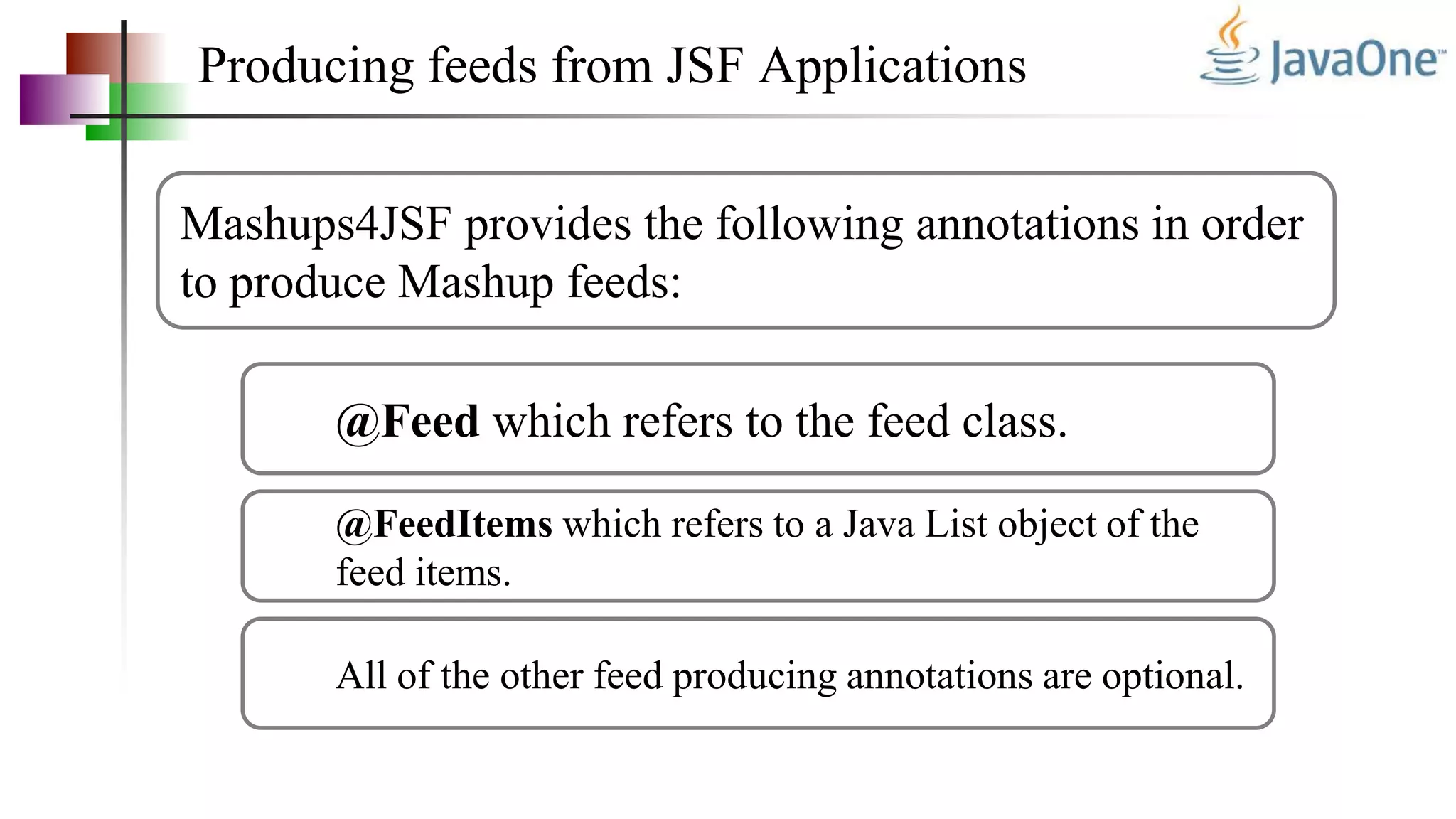
Producing feeds from JSF Applications
Mashups4JSF provides the following annotations in order
to produce Mashup feeds:
@Feed which refers to the feed class.
@FeedItems which refers to a Java List object of the
feed items.
All of the other feed producing annotations are optional.
Producing feeds from JSF Applications
Let’s build the Mashup application.
Conclusion
 Mashups4JSF (including GMaps4JSF) is an open source project
that provides a layer of abstraction to create rich mashup
applications without the need to use JavaScript extensively or
writing a great deal of code.
 Mashups4JSF (including GMaps4JSF) is compliant with the JSF
2.x Ajax model and architecture.
 Mashups4JSF (including GMaps4JSF) is an open source project, so
your contributions and ideas and improvements are welcome:
http://code.google.com/p/gmaps4jsf
http://code.google.com/p/mashups4jsf
Questions

JSF Mashups in Action

  • 1.
    JSF Mashups inAction Hazem Saleh
  • 2.
    My Bio  Nineyears of experience in open source technologies and Java Enterprise.  I worked with many clients in Europe (Sweden), North America (USA and Canada), Latin America (Peru), Asia (Qatar and Kuwait) and Africa (Egypt, Morocco and South Africa).  Apache MyFaces Committer.  Co-author of “The Definitive Guide to Apache MyFaces” book (Apress).  Author of “JavaScript Unit Testing” book (Packtpub).  DeveloperWorks Contributing Author.  Technical Speaker in (JavaOne San Francisco, CON-FESS Vienna, IBM Regional Technical Exchange …etc).
  • 3.
    Agenda What is Mashups? CommonMashup Architecture. Common Mashup Scenarios. Current Mashup Complexities. Mashups4JSF = Mashups meet the JavaServer Faces. Mashup Demo1. Building Mashup Application using Mashups4JSF. Mashup Demo2. Consuming feed sources from JSF Applications. Producing feeds from JSF Applications.
  • 4.
    Agenda What is Mashups? CommonMashup Architecture. Common Mashup Scenarios. Current Mashup Complexities. Mashups4JSF = Mashups meet the JavaServer Faces. Mashup Demo1. Building Mashup Application using Mashups4JSF. Mashup Demo2. Consuming feed sources from JSF Applications. Producing feeds from JSF Applications.
  • 5.
    What is Mashups? Mashupis an application that combines data or functionality from two or more sources for creating a new service. Two main actors: Service Provider Service Consumer Mashup Service Consumer cycle: Aggregation Visualization Data Retrieval and Formatting
  • 6.
    What is Mashups? Composingdifferent mashups and linking them with organization data may produce a new service that is not realized by the Mashup service providers (Mashability). Mashup Styles: Server-based Mashups. Web-based Mashups
  • 7.
    What is Mashups? CommonMashup Architecture. Common Mashup Scenarios. Current Mashup Complexities. Mashups4JSF = Mashups meet the JavaServer Faces. Mashup Demo1. Building Mashup Application using Mashups4JSF. Mashup Demo2. Consuming feed sources from JSF Applications. Producing feeds from JSF Applications. Agenda
  • 8.
    Common Mashup Architecture Client(JavaScript, CSS, HTML) Server (Service) Data (XML, JSON)
  • 9.
  • 10.
    What is Mashups? CommonMashup Architecture. Common Mashup Scenarios. Current Mashup Complexities. Mashups4JSF = Mashups meet the JavaServer Faces. Mashup Demo1. Building Mashup Application using Mashups4JSF. Mashup Demo2. Consuming feed sources from JSF Applications. Producing feeds from JSF Applications. Agenda
  • 11.
  • 12.
    <script type="text/javascript"> … function getWeatherForecast(map,address) { var geocoder = new GClientGeocoder(); geocoder.getLatLng(address, function(location) { if (!location) { alert(location + " not found"); } else { var countryWeatherStatus = Math.floor(Math.random() * 4); var iconObject = new GIcon(G_DEFAULT_ICON); iconObject.iconSize = new GSize(45, 45); iconObject.shadowSize = new GSize(37, 34); iconObject.iconAnchor = new GPoint(9, 34); iconObject.infoWindowAnchor = new GPoint(9, 2); iconObject.image = weatherForecasts[countryWeatherStatus]; var marker = new GMarker(location, {icon: iconObject}); map.addOverlay(marker); } } ); } function initialize() { if (GBrowserIsCompatible()) { var map = new GMap2(document.getElementById("map")); map.setCenter(new GLatLng(24, 15), 13); map.setZoom(4); //get the weather status for countries. getWeatherForecast(map, "Egypt"); getWeatherForecast(map, "Turkey"); getWeatherForecast(map, "Libya"); getWeatherForecast(map, "Spain"); getWeatherForecast(map, "Algeria"); getWeatherForecast(map, "Mali"); getWeatherForecast(map, "Kenya"); getWeatherForecast(map, "Saudi Arabia"); getWeatherForecast(map, "Niger"); //add the map control. var mapControlPosition = new GControlPosition(G_ANCHOR_BOTTOM_RIGHT, new GSize(10, 10)); map.addControl(new GLargeMapControl(), mapControlPosition); } } </script> JavaScript
  • 13.
  • 14.
    Common Mashup Scenarios•GET http://weather.yahooapis.com/forecastrss?p=03592 • Parse RSS feed: <rss version="2.0" ...> <channel> <title>Yahoo! Weather - Pittsburg, NH</title> <link>...</link> <description>Yahoo! Weather for Pittsburg, NH</description> <language>en-us</language> <lastBuildDate>Fri, 22 Mar 2013 6:51 pm EDT</lastBuildDate> <ttl>60</ttl> <yweather:location city="Pittsburg" region="NH" country="US"/> <yweather:units temperature="F" distance="mi" pressure="in" speed="mph"/> <yweather:wind chill="23" direction="330" speed="6" /> <yweather:atmosphere humidity="60" visibility="10" pressure="29.59" rising="1" /> <yweather:astronomy sunrise="6:42 am" sunset="6:58 pm"/> <image <title>Yahoo! Weather</title> <width>142</width> <height>18</height> <link>http://weather.yahoo.com</link> <url>http://l.yimg.com/a/i/brand/purplelogo//uh/us/news-wea.gif</url> </image> <item> <title>Conditions for Pittsburg, NH at 6:51 pm EDT</title> <geo:lat>45.05</geo:lat> <geo:long>-71.39</geo:long> <link>...</link> <pubDate>Fri, 22 Mar 2013 6:51 pm EDT</pubDate> <yweather:condition text="Cloudy" code="26" temp="29" date="Fri, 22 Mar 2013 6:51 pm EDT" /> <description>...</description> <yweather:forecast day="Fri" date="22 Mar 2013" low="14" high="26" text="Snow Showers" code="14" /> <yweather:forecast day="Sat" date="23 Mar 2013" low="18" high="28" text="Few Snow Showers" code="14" /> <guid isPermaLink="false">USNH0186_2013_03_23_7_00_EDT</guid> </item> </channel> </rss> Retrieve content + Custom RSS parsing
  • 15.
  • 16.
    Common Mashup Scenarios•GET http://gdata.youtube.com/ feeds/api/videos?alt=atom&v=2&max-results=5&q=javaone • Parse ATOM Feed (Sample for a single item): <entry gd:etag="W/&quot;CU8DR347eCp7I2A9WhBXEUk.&quot;"> <id>tag:youtube.com,2008:video:I5lAgaCbqZ0</id> <published>2012-10-01T16:09:27.000Z</published> <updated>2013-03-24T16:51:16.000Z</updated> <category scheme="http://schemas.google.com/g/2005#kind" term="http://gdata.youtube.com/schemas/2007#video" /> <category scheme="http://gdata.youtube.com/schemas/2007/categories.cat" term="Tech" label="Science &amp; Technology" /> <title>Welcome to JavaOne 2012</title> <content type="application/x-shockwave-flash" src="http://www.youtube.com/v/I5lAgaCbqZ0?version=3&amp;f=videos&amp;app=youtube_gdata" /> ... <author> <name>java</name> <uri>http://gdata.youtube.com/feeds/api/users/java</uri> <yt:userId>mRtPmgnQ04CMUpSUqPfhxQ</yt:userId> </author> ... <media:group> ... <media:title type="plain">Welcome to JavaOne 2012</media:title> <yt:aspectRatio>widescreen</yt:aspectRatio> <yt:duration seconds="97" /> <yt:uploaded>2012-10-01T16:09:27.000Z</yt:uploaded> <yt:uploaderId>UCmRtPmgnQ04CMUpSUqPfhxQ</yt:uploaderId> <yt:videoid>I5lAgaCbqZ0</yt:videoid> </media:group> <gd:rating average="4.716216" max="5" min="1" numRaters="74" rel="http://schemas.google.com/g/2005#overall" /> <yt:statistics favoriteCount="0" viewCount="4835" /> <yt:rating numDislikes="5" numLikes="69" /> </entry> Retrieve content + Custom ATOM parsing
  • 17.
  • 18.
    • GET https://search.twitter.com/search.json?q=javaone&rpp=10 •Parse JSON Feed (Sample for a single item): { "completed_in":0.021, "max_id":320699880265891840, "max_id_str":"320699880265891840", "next_page":"?page=2&max_id=320699880265891840&q=javaone&rpp=10", "page":1, "query":"javaone", "refresh_url":"?since_id=320699880265891840&q=javaone", "results":[ { "created_at":"Sun, 07 Apr 2013 00:49:44 +0000", "from_user":"rob_ratcliff", "from_user_id":265460384, "from_user_id_str":"265460384", "from_user_name":"Rob Ratcliff", "geo":null, "id":320699880265891840, "id_str":"320699880265891840", "iso_language_code":"en", "metadata":{ "result_type":"recent" }, "profile_image_url":"http://a0.twimg.com/profile_images/2376270945/rfa2u2nheyb6jj5k9bv8_normal.jpeg", "profile_image_url_https":"https://si0.twimg.com/profile_images/2376270945/rfa2u2nheyb6jj5k9bv8_normal.jpeg", "source":"&lt;a href=&quot;http://twitter.com/tweetbutton&quot;&gt;Tweet Button&lt;/a&gt;", "text":"RT @karianna: Don't forget that the CFP for @javaone is closing in only 8-9 days! Submit your paper today --&gt; http://t.co/6AAWdIf87h #java #dev" } ... ], "results_per_page":10, "since_id":0, "since_id_str":"0" } Retrieve content + Custom JSON parsing
  • 19.
    Common Mashup Scenarios Inorder to interact with the most popular mashup service providers, we have to: Write Intensive JavaScript code. Write extra Java code to interact with the server and then parse different formats: JSON ATOM RSS
  • 20.
    So, Developing Mashupsis not an easy task
  • 21.
    Agenda What is Mashups? CommonMashup Architecture. Common Mashup Scenarios. Current Mashup Complexities. Mashups4JSF = Mashups meet the JavaServer Faces. Mashup Demo1. Building Mashup Application using Mashups4JSF. Mashup Demo2. Consuming feed sources from JSF Applications. Producing feeds from JSF Applications.
  • 22.
    Current Mashup Complexities Thereis no economic-incentive model agreed by all the mashup service providers for mashup service creation and consumption. Representations of Mashup services SOAP REST Formats of Mashup Data ATOM CustomRSS JSON Programming Models for Mashup consumption Server side (Java, PHP, ...etc) Client side (JavaScript)
  • 23.
    Current Mashups Complexities Studylow level APIs of the Mashup service provider. Ending up in writing a great deal of similar code.
  • 24.
    What is Mashups? CommonMashup Architecture. Common Mashup Scenarios. Current Mashup Complexities. Mashups4JSF = Mashups meet the JavaServer Faces. Mashup Demo1. Building Mashup Application using Mashups4JSF. Mashup Demo2. Consuming feed sources from JSF Applications. Producing feeds from JSF Applications. Agenda
  • 25.
    Mashups4JSF One of thepossible ways for simplifying mashup development in the JavaServer Faces world. Provides a set of JSF components that allows the JSF developer to construct rich and customized mashups inside the web page: Public Feed search components, and drill down the results for: Twitter YouTube Google Search Digg Yahoo Weather Component.
  • 26.
    Mashups4JSF Provides feed readercomponents for reading different types of feeds: Provides feed export annotations; @Feed annotation for exporting application data as Mashup feeds. ATOM RSS JSON
  • 27.
    Mashups4JSF GMaps4JSF is: Integration with JSFdeveloper can construct rich maps using simple tags.
  • 28.
    Mashups4JSF GMaps4JSF: Allows creating declarativemaps with all of their details (markers, notes, graphics. …etc) in the JavaServer Faces world without using JavaScript. Fully integrated with Google Maps v2 and v3. Fully integrated with the JSF 2.x Ajax model: Ajaxified Map Actions. Ajaxified Marker Actions. Home: http://code.google.com/p/gmaps4jsf/
  • 29.
    Mashups4JSF – GMaps4JSF <m:map> <ui:repeatvar="country“ value="#{countryFactory.countries}" > <m:marker address="#{country.name}"> <m:icon imageURL="#{country.weatherStatusImage}" /> </m:marker> </ui:repeat> <m:mapControl /> </m:map>
  • 30.
    Mashups4JSF – Yahoo!Weather <mashup:yahooWeather locationCode="#{weatherBean.locationCode}" temperatureType="c"/>
  • 31.
    Mashups4JSF – YouTube <mashup:youTubeVideoListsearchQuery=“JavaOne” resultItemVar="searchItem" resultItemIndex="index"> <f:facet name="resultItem"> <h:panelGrid columns="2"> #{searchItem.title}, #{searchItem.author}, #{searchItem.pubDate} .. </h:panelGrid> </f:facet> </mashup:youTubeVideoList>
  • 32.
    Mashups4JSF – Twitter <mashup:twitterSearchListsearchQuery="JavaOne" resultItemVar="searchItem" resultItemIndex="index"> <f:facet name="resultItem"> <h:panelGrid columns="2"> #{searchItem.title}, #{searchItem.authorName}, #{searchItem.publishDate}, ... </h:panelGrid> </f:facet> </mashup:twitterSearchList>
  • 33.
    What is Mashups? CommonMashup Architecture. Common Mashup Scenarios. Current Mashup Complexities. Mashups4JSF = Mashups meet the JavaServer Faces. Mashup Demo1. Building Mashup Application using Mashups4JSF. Mashup Demo2. Consuming feed sources from JSF Applications. Producing feeds from JSF Applications. Agenda
  • 34.
  • 35.
  • 36.
    What is Mashups? CommonMashup Architecture. Common Mashup Scenarios. Current Mashup Complexities. Mashups4JSF = Mashups meet the JavaServer Faces. Mashup Demo1. Building Mashup Application using Mashups4JSF. Mashup Demo2. Consuming feed sources from JSF Applications. Producing feeds from JSF Applications. Agenda
  • 37.
  • 38.
  • 39.
    What is Mashups? CommonMashup Architecture. Common Mashup Scenarios. Current Mashup Complexities. Mashups4JSF = Mashups meet the JavaServer Faces. Mashup Demo1. Building Mashup Application using Mashups4JSF. Mashup Demo2. Consuming feed sources from JSF Applications. Producing feeds from JSF Applications. Agenda
  • 40.
    Consuming feed sourcesin JSF Mashups4JSF provides the following components in order to consume Mashup feeds: <mashup:atomFeedReader> <mashup:rssFeedReader> <mashup:jsonFeedReader>
  • 41.
    Consuming feed sourcesin JSF Let’s build an application that consumes Yahoo! News feed.
  • 42.
    What is Mashups? CommonMashup Architecture. Common Mashup Scenarios. Current Mashup Complexities. Mashups4JSF = Mashups meet the JavaServer Faces. Mashup Demo1. Building Mashup Application using Mashups4JSF. Mashup Demo2. Consuming feed sources from JSF Applications. Producing feeds from JSF Applications. Agenda
  • 43.
    Producing feeds fromJSF Applications Mashups4JSF provides the following annotations in order to produce Mashup feeds: @Feed which refers to the feed class. @FeedItems which refers to a Java List object of the feed items. All of the other feed producing annotations are optional.
  • 44.
    Producing feeds fromJSF Applications Let’s build the Mashup application.
  • 45.
    Conclusion  Mashups4JSF (includingGMaps4JSF) is an open source project that provides a layer of abstraction to create rich mashup applications without the need to use JavaScript extensively or writing a great deal of code.  Mashups4JSF (including GMaps4JSF) is compliant with the JSF 2.x Ajax model and architecture.  Mashups4JSF (including GMaps4JSF) is an open source project, so your contributions and ideas and improvements are welcome: http://code.google.com/p/gmaps4jsf http://code.google.com/p/mashups4jsf
  • 46.