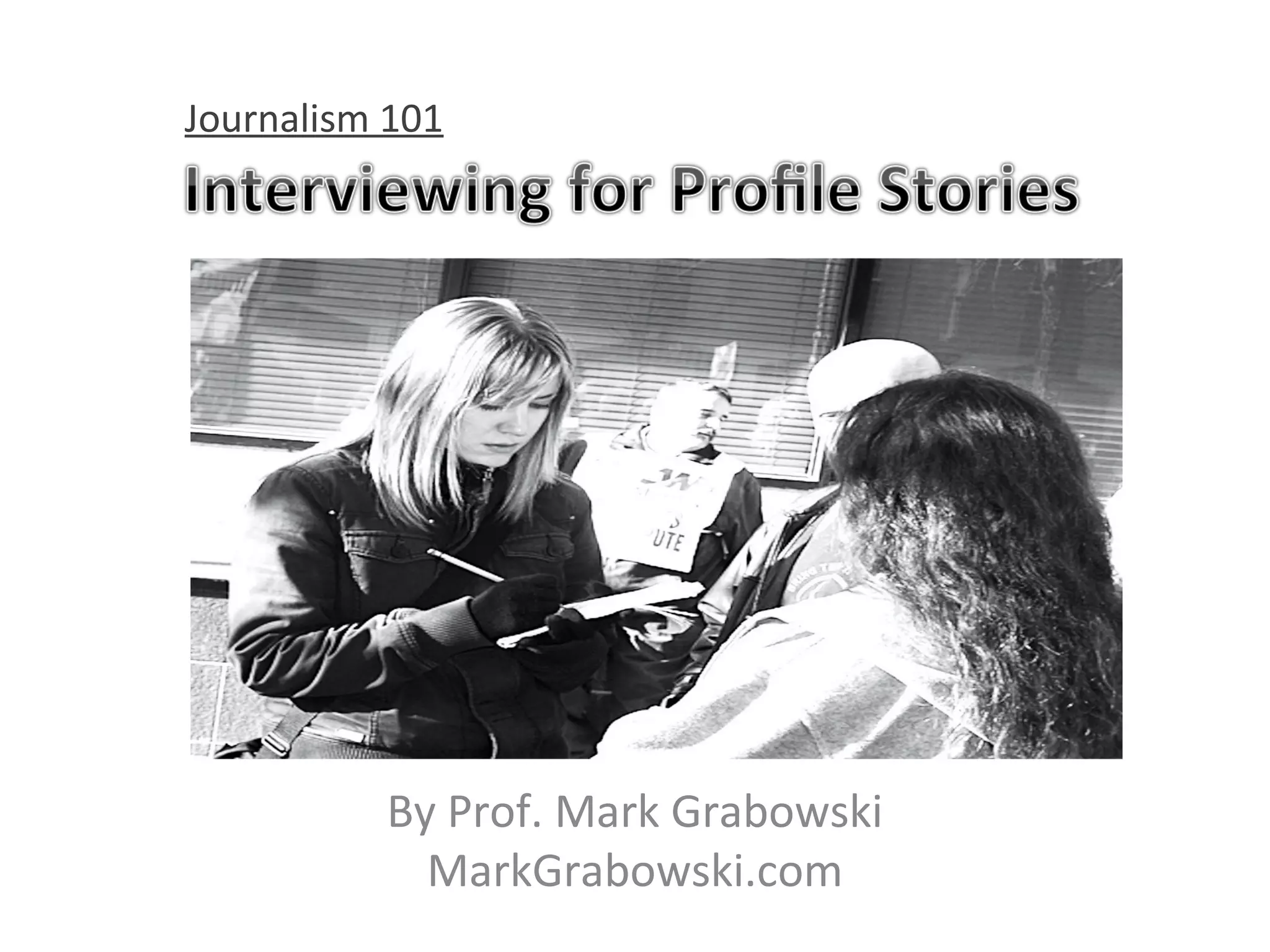

Journalism 101 
By Prof. Mark Grabowski 
MarkGrabowski.com
Ingredients of Profile Story 
• The person’s background (upbringing, education, 
occupation, etc.). 
• Anecdotes and incidents involving the subject. 
• Quotes by the individual relevant to his or her 
newsworthiness. 
• The reporter’s observations. 
• Comments of those who know the interviewee. 
• A news peg, whenever possible.
Importance of interviewing sources 
• Glance at today’s newspaper. Listen carefully 
to tonight’s evening news­cast. 
You will be 
hard ‑pressed to find a story that lacks 
information from an interview. 
• Interviewing sources provides journalists with 
information and credibility. It’s one of the key 
ingredients that separates journalism from 
other forms of writing.
What to do 
before 
interview
Set up interviews 
• Identify yourself as someone who’s writing a 
story. 
• State the purpose of the interview. 
• Make clear that the material will be used in a 
story you plan to publish. 
• Tell the source how much time the interview 
will take.
Setting up the interview 
• Assemble Tools: notepad, tape/digital recorder, 
camera, pens 
• Test tape recorder. At interview, be sure to ask if 
it’s OK to tape record them for accuracy. 
• Meet subject at place s/he is comfortable. If 
possible, meet them where they do the 
job/activity/lifestyle etc. you’re writing about. 
• Meet at time they aren’t too busy. 
• Prepare questions to ask in advance. Group 
questions into categories.
Gather background info 
• Prepare carefully, familiarizing yourself with 
as much background as possible. 
• Research your subject online: Google, Twitter, 
Facebook, LinkedIn. 
• They may have a website or bio on their 
company’s website. 
• Ask for their resume.
Why? 
• It’s a building block for a successful interview 
• This info can help you develop a tentative 
story themes and lead to specific questions. 
• It can provide you with a feel for the subject. 
• It provides useful background.
Why? 
• You may find something interesting in the 
resume. For example, if you’re interviewing a 
teacher, you may find that your subject went 
to private, exclusive, costly schools all her life 
but has chosen to teach at a very poor school. 
What inspired this choice? Why is this 
rewarding for her? Or you may see that she 
has won awards in soccer in college, and you 
didn't know she was a former jock. Do your 
research before you show up!
Determine Story Angle 
• Decide what your angle is: What is interesting or 
unusual about this person? What is this person's 
story? 
• Devise a tentative theme for your story. A major 
purpose of the interview will be to obtain quotes, 
anecdotes and other evidence to support that 
theme. 
• It’s possible your theme may change after talking 
to the person – a more interesting angle may 
develop.
What to do 
during 
interview
Ease into interview 
• The point of an interview is to find out what is 
interesting about the other person and help 
them get comfortable talking to you so they'll 
spill the beans and do it in an interesting, 
quotable, clear way. 
• Initially focus on making the subject comfortable 
as well as getting general background 
information out of the way: involve age, town of 
residence, education, jobs held, family 
information.
Start with small talk 
• Always begin with small talk - develop a 
rapport with the subject. And once you begin 
the official interview, start with the easy 
questions first to get them talking about 
themselves. 
• Almost never plunge in with tough questions 
at the beginning. Instead, break the ice, 
explain who you are, what you are doing, why 
you went to him or her. A touch of flattery 
usually helps.
Give and take 
• Come prepared with several questions, but be let 
a natural conversation develop. A reporter's 
biggest mistake is either to go into an interview 
with no questions or to go into an interview with 
a list of question and not deviate from the list. 
• A good reporter begins an interview with a set of 
questions, but knows when to add impromptu 
questions that will get a subject to continue on a 
train of thought if it sounds interesting.
Example 
• Reporter asks, "What was the goal of the 
fundraiser'?" Subject answers, "We wanted to 
make the club look good; no really the goal was 
to earn enough money to help build a new center 
for migrant worker education" Instead of 
skipping to the next question a good reporter 
follows up on the first part of that answer to find 
out if there was something behind it. "What did 
you mean that you wanted to make the club look 
good'?" the reporter asks next.
Listen 
• Be conversational but let the source do most 
of the talking. Never supply or suggest an 
answer. Be patient and wait for it. 
• Listen and watch attentively 
• Sources are encouraged by the reporter's 
gestures and facial expressions to keep 
talking.
Observe 
• A good reporter also spends a lot of time 
looking at the subject as well as the subject’s 
surroundings. It is a good idea to interview a 
person in their office, classroom or home if 
possible because a reporter will always learn 
more about person by watching him in his 
environment not yours.
Observe 
• Notice details in the subject's environment, 
her personal habits, her appearance, etc.: 
Does she have knitting on a corner of her 
desk? Does she wear a locket every day; 
whose picture is inside? Does she have readily 
visible tattoos; if so, what's the story behind 
them? Does she roar up to work or school or 
wherever on a Harley every day, in a 
Mercedes, or in a hybrid electric/gas car? 
Does she flinch every time she sees someone 
toss a bit of trash on the ground?
Observe 
• Sometimes, sources reveal themselves as 
much, perhaps more so, in their actions as 
they do in their statements. 
• A good story blends together info, quotes, 
anecdotes and observations.
Take notes and record 
• Take notes even if you’re recording. Batteries 
die, tapes get misplaced or stolen, things 
happen. Your notes will provide a backup and 
save you time. Reviewing and transcribing 
your entire interview will take forever. Rather, 
keep notes, review them and figure out which 
quotes you want to use. Then go back and 
listen to the tape to make sure you quote 
them correctly.
Which 
questions 
to ask
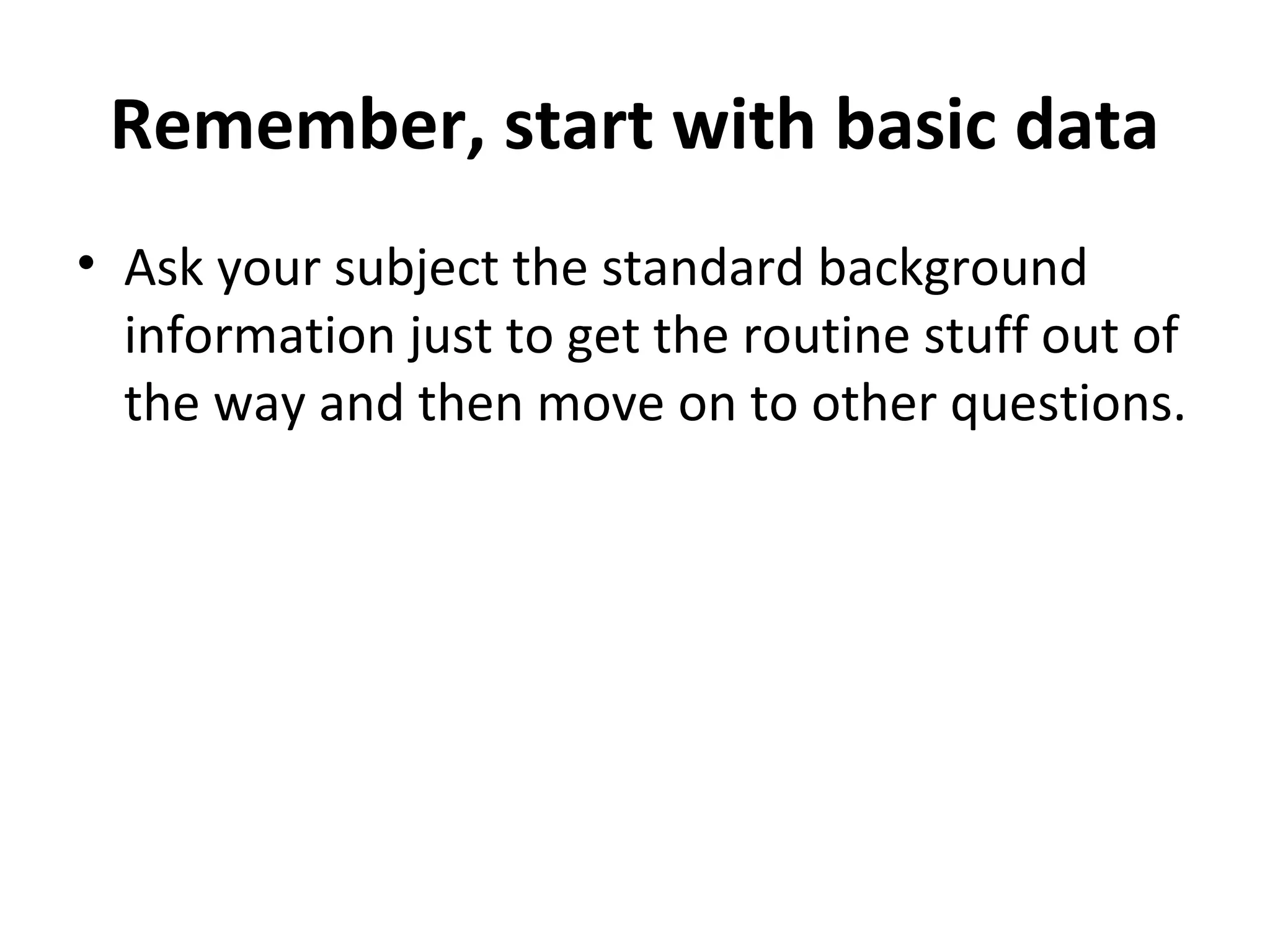
Remember, start with basic data 
• Ask your subject the standard background 
information just to get the routine stuff out of 
the way and then move on to other questions.
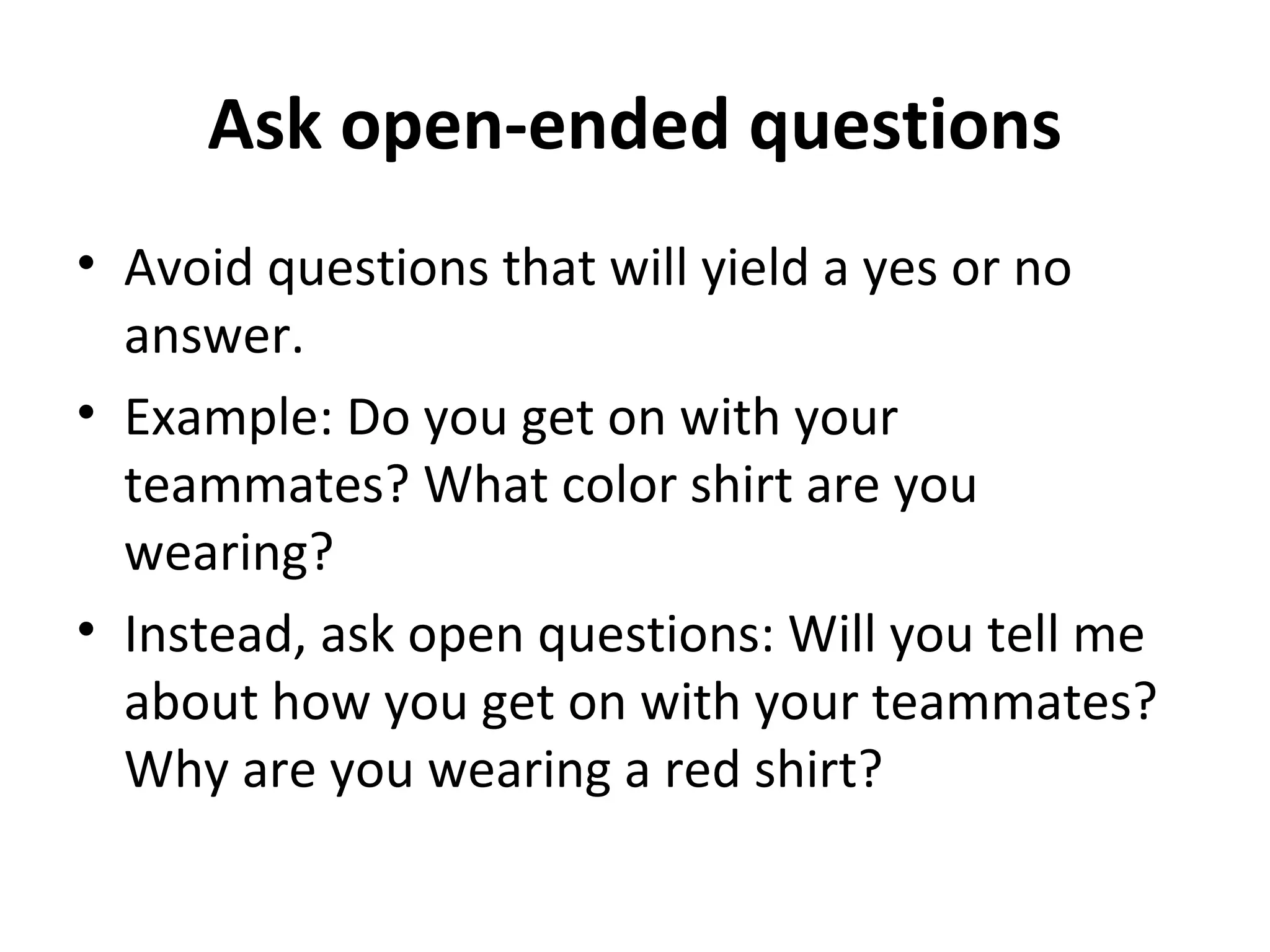
Ask open-ended questions 
• Avoid questions that will yield a yes or no 
answer. 
• Example: Do you get on with your 
teammates? What color shirt are you 
wearing? 
• Instead, ask open questions: Will you tell me 
about how you get on with your teammates? 
Why are you wearing a red shirt?
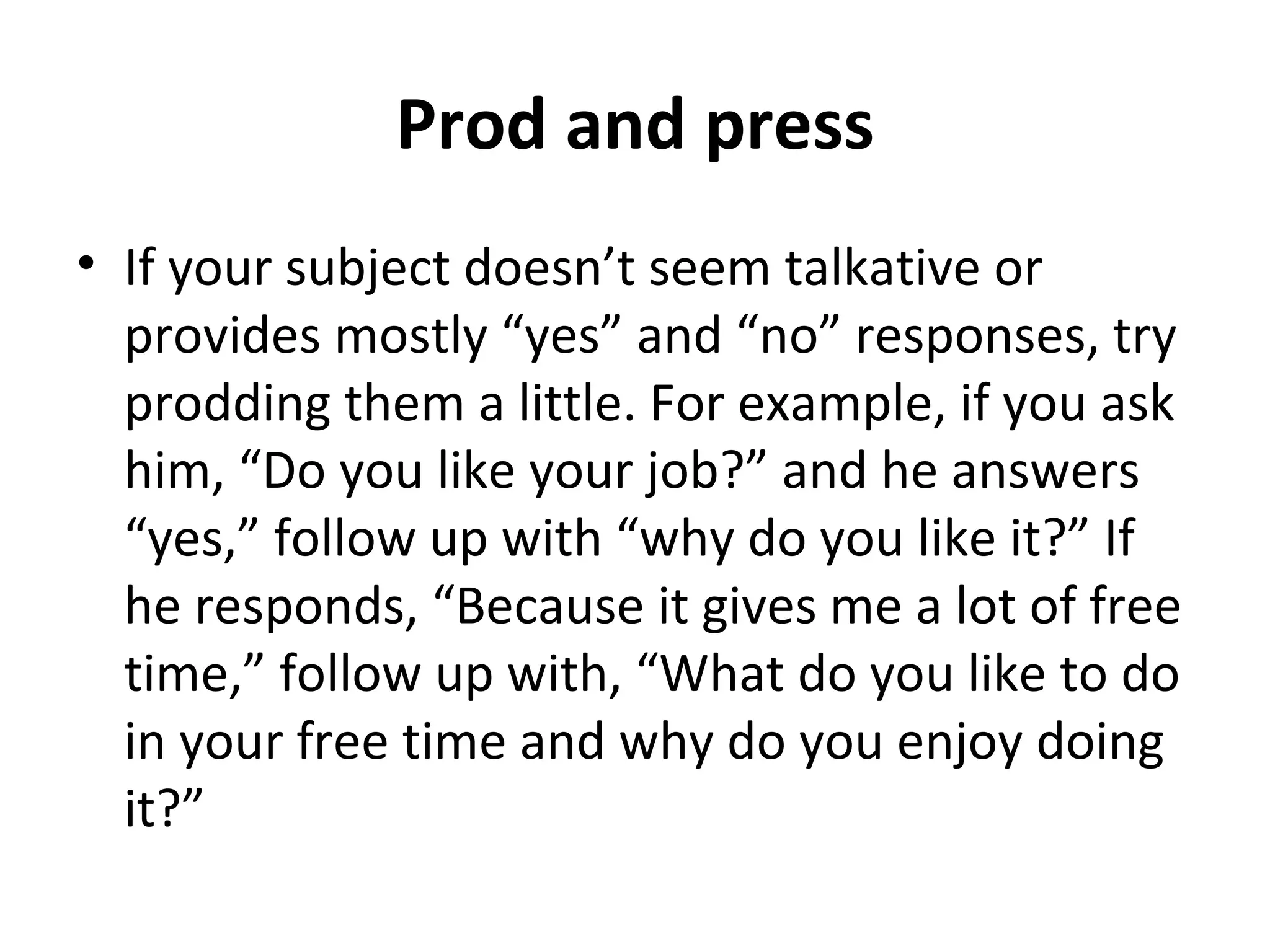
Prod and press 
• If your subject doesn’t seem talkative or 
provides mostly “yes” and “no” responses, try 
prodding them a little. For example, if you ask 
him, “Do you like your job?” and he answers 
“yes,” follow up with “why do you like it?” If 
he responds, “Because it gives me a lot of free 
time,” follow up with, “What do you like to do 
in your free time and why do you enjoy doing 
it?”
Follow-up questions 
• Get in the habit of asking treading‑water 
questions, such as “What do you mean?” or 
“Why's that?” This is an easy way to keep the 
person talking.
More tips 
• Ask about experiences 
• Ask about anecdotes 
• For example, if they say they’re a 
hard worker, ask them for an 
example of their work ethic. 
• Remember to ask questions that 
your readers might want to ask
Don’t assume anything 
• If you don’t know what something means, 
your readers won’t either 
• So, if you don’t understand something, ask the 
person to explain. Underline or circle all 
names, ideas, etc. you’re unsure of so you can 
double check them. 
• Do not be afraid to ask naive questions. 
• Do not be reluctant to ask an embarrassing 
question.
Questions 
• Visit the link below for a list of some of the 
many questions you may want to ask: 
http://cubreporters.org/adelphi_profile_story 
• You should also come up with your own 
questions
Avoid 
• Avoid lecturing the source, arguing or debating. 
• Anonymous sources. Find someone else to 
interview if the person won’t let you quote them 
using their full name. 
• Showing your source your story before you 
publish it. Otherwise, you will be inviting 
censorship. If they ask why they can’t see your 
story before you submit it, you can explain that 
it’s impractical given your tight deadline and that 
your journalism professor prohibits it
After 
interview 
ends
At the end 
• Thank them for their time and ask them if it’s OK 
for you to contact them again if they have 
questions. 
• Ask them if there’s anyone else they should talk 
to about them. 
• Give them a timeline for when you plan to write 
your story and where you hope to publish it, if 
you know. 
• However, do not agree to show them your story 
before you publish it.
Afterward 
• Reflect on the interview and try to list your 
main points of the story. What are the 
highlights? Jot down any ideas you have for 
writing the story. 
• As soon as possible, rewrite your notes so 
they make sense to you. Use tape recorder to 
fill in gaps or clarify things. 
• Contact source again to supply missing info.
Remember: Interview other people 
besides the subject 
• Interviewing only the source will lead to a thin, 
possibly misleading story. 
• To get at the person behind the personality, good 
interviewers talk to the classmates, teammates, 
coworkers, associates, coaches, teachers, 
mentors, bosses and other people who know the 
subject well – both friends and enemies. 
• Get the correct spelling of names and their 
qualifications/titles.
THE END 

Journalism Interviewing

  • 1.
    Journalism 101 ByProf. Mark Grabowski MarkGrabowski.com
  • 2.
    Ingredients of ProfileStory • The person’s background (upbringing, education, occupation, etc.). • Anecdotes and incidents involving the subject. • Quotes by the individual relevant to his or her newsworthiness. • The reporter’s observations. • Comments of those who know the interviewee. • A news peg, whenever possible.
  • 3.
    Importance of interviewingsources • Glance at today’s newspaper. Listen carefully to tonight’s evening news­cast. You will be hard ‑pressed to find a story that lacks information from an interview. • Interviewing sources provides journalists with information and credibility. It’s one of the key ingredients that separates journalism from other forms of writing.
  • 4.
    What to do before interview
  • 5.
    Set up interviews • Identify yourself as someone who’s writing a story. • State the purpose of the interview. • Make clear that the material will be used in a story you plan to publish. • Tell the source how much time the interview will take.
  • 6.
    Setting up theinterview • Assemble Tools: notepad, tape/digital recorder, camera, pens • Test tape recorder. At interview, be sure to ask if it’s OK to tape record them for accuracy. • Meet subject at place s/he is comfortable. If possible, meet them where they do the job/activity/lifestyle etc. you’re writing about. • Meet at time they aren’t too busy. • Prepare questions to ask in advance. Group questions into categories.
  • 7.
    Gather background info • Prepare carefully, familiarizing yourself with as much background as possible. • Research your subject online: Google, Twitter, Facebook, LinkedIn. • They may have a website or bio on their company’s website. • Ask for their resume.
  • 8.
    Why? • It’sa building block for a successful interview • This info can help you develop a tentative story themes and lead to specific questions. • It can provide you with a feel for the subject. • It provides useful background.
  • 9.
    Why? • Youmay find something interesting in the resume. For example, if you’re interviewing a teacher, you may find that your subject went to private, exclusive, costly schools all her life but has chosen to teach at a very poor school. What inspired this choice? Why is this rewarding for her? Or you may see that she has won awards in soccer in college, and you didn't know she was a former jock. Do your research before you show up!
  • 10.
    Determine Story Angle • Decide what your angle is: What is interesting or unusual about this person? What is this person's story? • Devise a tentative theme for your story. A major purpose of the interview will be to obtain quotes, anecdotes and other evidence to support that theme. • It’s possible your theme may change after talking to the person – a more interesting angle may develop.
  • 11.
    What to do during interview
  • 12.
    Ease into interview • The point of an interview is to find out what is interesting about the other person and help them get comfortable talking to you so they'll spill the beans and do it in an interesting, quotable, clear way. • Initially focus on making the subject comfortable as well as getting general background information out of the way: involve age, town of residence, education, jobs held, family information.
  • 13.
    Start with smalltalk • Always begin with small talk - develop a rapport with the subject. And once you begin the official interview, start with the easy questions first to get them talking about themselves. • Almost never plunge in with tough questions at the beginning. Instead, break the ice, explain who you are, what you are doing, why you went to him or her. A touch of flattery usually helps.
  • 14.
    Give and take • Come prepared with several questions, but be let a natural conversation develop. A reporter's biggest mistake is either to go into an interview with no questions or to go into an interview with a list of question and not deviate from the list. • A good reporter begins an interview with a set of questions, but knows when to add impromptu questions that will get a subject to continue on a train of thought if it sounds interesting.
  • 15.
    Example • Reporterasks, "What was the goal of the fundraiser'?" Subject answers, "We wanted to make the club look good; no really the goal was to earn enough money to help build a new center for migrant worker education" Instead of skipping to the next question a good reporter follows up on the first part of that answer to find out if there was something behind it. "What did you mean that you wanted to make the club look good'?" the reporter asks next.
  • 16.
    Listen • Beconversational but let the source do most of the talking. Never supply or suggest an answer. Be patient and wait for it. • Listen and watch attentively • Sources are encouraged by the reporter's gestures and facial expressions to keep talking.
  • 17.
    Observe • Agood reporter also spends a lot of time looking at the subject as well as the subject’s surroundings. It is a good idea to interview a person in their office, classroom or home if possible because a reporter will always learn more about person by watching him in his environment not yours.
  • 18.
    Observe • Noticedetails in the subject's environment, her personal habits, her appearance, etc.: Does she have knitting on a corner of her desk? Does she wear a locket every day; whose picture is inside? Does she have readily visible tattoos; if so, what's the story behind them? Does she roar up to work or school or wherever on a Harley every day, in a Mercedes, or in a hybrid electric/gas car? Does she flinch every time she sees someone toss a bit of trash on the ground?
  • 19.
    Observe • Sometimes,sources reveal themselves as much, perhaps more so, in their actions as they do in their statements. • A good story blends together info, quotes, anecdotes and observations.
  • 20.
    Take notes andrecord • Take notes even if you’re recording. Batteries die, tapes get misplaced or stolen, things happen. Your notes will provide a backup and save you time. Reviewing and transcribing your entire interview will take forever. Rather, keep notes, review them and figure out which quotes you want to use. Then go back and listen to the tape to make sure you quote them correctly.
  • 21.
  • 22.
    Remember, start withbasic data • Ask your subject the standard background information just to get the routine stuff out of the way and then move on to other questions.
  • 23.
    Ask open-ended questions • Avoid questions that will yield a yes or no answer. • Example: Do you get on with your teammates? What color shirt are you wearing? • Instead, ask open questions: Will you tell me about how you get on with your teammates? Why are you wearing a red shirt?
  • 24.
    Prod and press • If your subject doesn’t seem talkative or provides mostly “yes” and “no” responses, try prodding them a little. For example, if you ask him, “Do you like your job?” and he answers “yes,” follow up with “why do you like it?” If he responds, “Because it gives me a lot of free time,” follow up with, “What do you like to do in your free time and why do you enjoy doing it?”
  • 25.
    Follow-up questions •Get in the habit of asking treading‑water questions, such as “What do you mean?” or “Why's that?” This is an easy way to keep the person talking.
  • 26.
    More tips •Ask about experiences • Ask about anecdotes • For example, if they say they’re a hard worker, ask them for an example of their work ethic. • Remember to ask questions that your readers might want to ask
  • 27.
    Don’t assume anything • If you don’t know what something means, your readers won’t either • So, if you don’t understand something, ask the person to explain. Underline or circle all names, ideas, etc. you’re unsure of so you can double check them. • Do not be afraid to ask naive questions. • Do not be reluctant to ask an embarrassing question.
  • 28.
    Questions • Visitthe link below for a list of some of the many questions you may want to ask: http://cubreporters.org/adelphi_profile_story • You should also come up with your own questions
  • 29.
    Avoid • Avoidlecturing the source, arguing or debating. • Anonymous sources. Find someone else to interview if the person won’t let you quote them using their full name. • Showing your source your story before you publish it. Otherwise, you will be inviting censorship. If they ask why they can’t see your story before you submit it, you can explain that it’s impractical given your tight deadline and that your journalism professor prohibits it
  • 30.
  • 31.
    At the end • Thank them for their time and ask them if it’s OK for you to contact them again if they have questions. • Ask them if there’s anyone else they should talk to about them. • Give them a timeline for when you plan to write your story and where you hope to publish it, if you know. • However, do not agree to show them your story before you publish it.
  • 32.
    Afterward • Reflecton the interview and try to list your main points of the story. What are the highlights? Jot down any ideas you have for writing the story. • As soon as possible, rewrite your notes so they make sense to you. Use tape recorder to fill in gaps or clarify things. • Contact source again to supply missing info.
  • 33.
    Remember: Interview otherpeople besides the subject • Interviewing only the source will lead to a thin, possibly misleading story. • To get at the person behind the personality, good interviewers talk to the classmates, teammates, coworkers, associates, coaches, teachers, mentors, bosses and other people who know the subject well – both friends and enemies. • Get the correct spelling of names and their qualifications/titles.
  • 34.