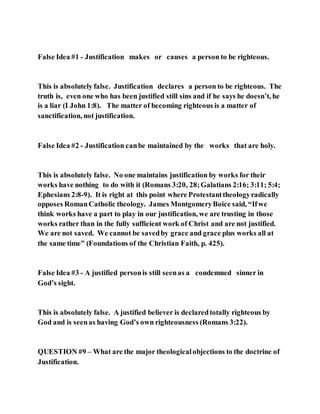
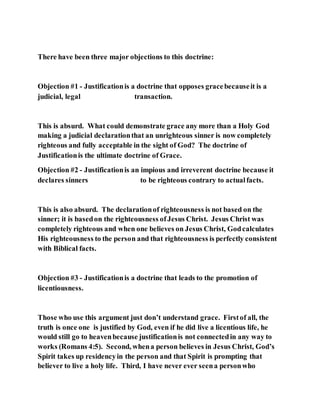
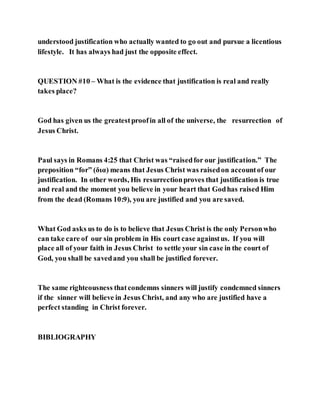
JESUS WAS THE SOURCE OF JUSTIFICATION
EDITED BY GLENN PEASE
ROMANS 3:23-24 There is no difference between Jew
and Gentile, 23 for all have sinned and fall short of the
glory of God, 24 and all are justified freely by his grace
through the redemption that came by Christ Jesus.
BIBLEHUB RESOURCES
Pulpit Commentary Homiletics
A Remedy For A Universal Need
Romans 3:23
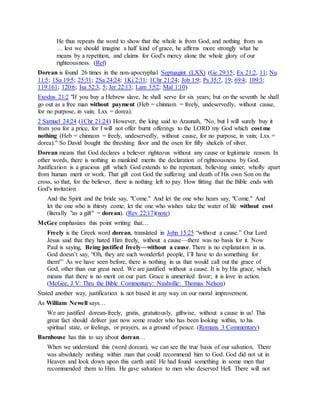
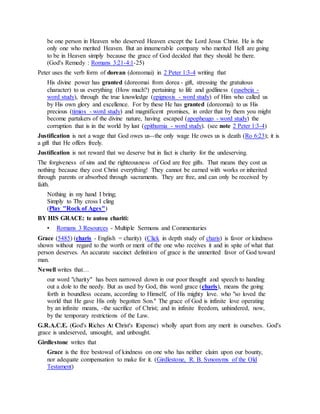
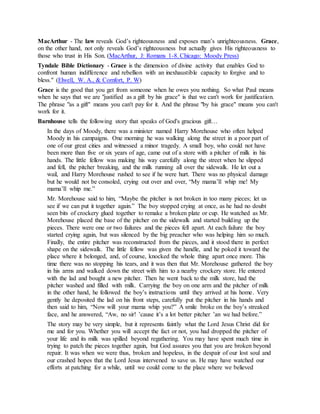
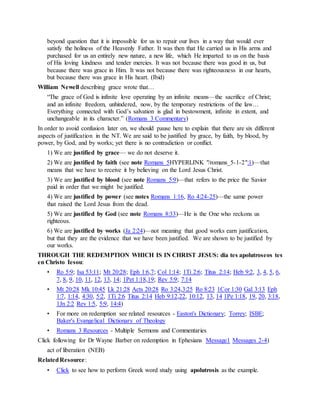
S.R. Aldridge To assert that the righteousness of God manifested in Christ was "apart from the
Law" relegated the Law to its proper position, as the servant, not the master, of religion. And the
apostle's substantiation of his further assertion, that this new method of righteousness was not so
entirely unheard of as that its novelty should be a strong prejudice against its truth, but that, on
the contrary, the Law itself and the prophets contain intimations of such a Divine manifestation, -
this cut the ground entirely from under the feet of objectors jealous of every innovation which
could not be justified by an appeal to the sacred writings. And this righteousness through faith
recognized Jew and Gentile as alike in their need of a gospel, and their freedom of access
thereto.
I. THERE IS NO DISTINCTION AMONGST MEN IN RESPECT OF THEIR NEED OF THE
GOSPEL. Men are declared faulty in two respects.
1. By positive transgression. They "sinned," they have done wrong, and they wander continually
from the right way. They are not adjudged criminal merely on the ground of Adam's fall, but
they themselves cross the line which separates obedience from disobedience. Scripture, history,
and conscience testify to this fact.
2. By defect. They "fall short of the glory of God." Their past behaviour has been blameworthy,
and their present condition is far below what was intended when man was formed in God's
image, to attain to his likeness. Compare the best of men with the example set by the Saviour of
love to God and man, and of conformity to the highest standard discernible. Now, unless perfect,
man cannot claim acquittal at the bar of judgment. Perfection is marred if one feature be
distorted or one limb be missing or weak. This is not to be taken to signify that all men are
equally sinful, that there are no degrees of enormity, and that all are equidistant from the
kingdom of God. But it means that, without exception, all fail in the examination which Divine
righteousness institutes, though some have more marks than others. Left to themselves, all men
would drown in the sea of their iniquity, though some are nearer the surface than their fellows.
The misunderstanding of this truth has done grievous harm to tender minds, fretting because they
had not the same sense of awful misdoing that has been felt by notorious malefactors. We need
not gauge the amount of contrition requisite; it suffices if the heart turn humbly to God for
forgiveness. Thus the gospel does not flatter men. Soothing messages may comfort for a while
till the awakening comes. Then we realize that it is of no use to be in a richly decorated cabin if
the ship is sinking. To reveal the true state is the necessary preliminary to reformation. There is a
down-rightness about the gospel assertions which, like the deep probing of the surgeon's lance,
wounds in order to thorough healing. Alas! that the disease of sin should so frequently produce
lethargy in the sick! they feel no need of a physician! Lax notions of sin lessen our sense of the
necessity of an atonement. We fail to discern a rebellion against the government of God, and an
offence against the moral universe. We treat it as if it only concerned ourselves and our
neighbours. No sprinkling of rose-water can purge away the evil; it can be cleansed only by the
blood of the Lamb.
II. THERE IS NO DISTINCTION IN RESPECT OF THE MEANS OF SALVATION.
1. Justification comes in every case as a gift, not as a prize discovered or earned. "Being justified
freely." Part of the beneficial influence of the gospel is the blow it administers to human notions
of desert, and pride is a chief obstacle to enrichment by this gift of God.
2. To all men the kindness of God is the source of their salvation. God first loved and sought the
sinner, not contrariwise. His "grace" is the fountain of redemption.
3. The same Divine method of deliverance is employed for all. "Through the redemption that is
in Christ Jesus." There is but one way to the Father, whether men walk thereon consciously or
unconsciously, in heathen twilight or gospel noontide, in Jewish anticipation or Christian
realization. The one atonement can cover all transgression.
4. The same human mode of entrance into the kingdom is open to all, viz. by faith. Weakness,
ignorance, degradation, cannot be pleaded as obstacles to salvation. The study of the philosopher
is no nearer heaven than the cottage of the artisan. The capacity of trusting is possessed by every
man; the remedy is not remote, therefore, from the reach of any of the sin-sick race. - S.R.A.
Biblical Illustrator
Being Justified freely by His grace.
Romans 3:24
Justification
Prof. Godet.I. Its MODE — "freely." It is not a matter of wages, it is a free gift.
II. Its ORIGIN — "His grace." God's free good will inclining Him to sinful man to bestow on
him a favour. There is no blind necessity here. We are face to face with a generous inspiration of
Divine love.
III. The MEANS. The deliverance wrought in Jesus Christ.
(Prof. Godet.)
Justification
J. Guyse, D. D.I. THE BENEFIT SPOKEN OF — Justification. In this there is —
1. The forgiveness of sins. "The remission of sins."
2. A restoration to God's favour.
3. A treatment of the pardoned and accepted person as righteous.
II. Its ORIGINAL SPRING, or first moving cause, and the free grace of God (Romans 11:6).
1. By God's grace, which excludes all merit.
2. Freely, which excludes all conceit.
III. Its MERITORIOUS OR PROCURING CAUSE. "The redemption that is in Jesus Christ."
IV. THE ORDINATION OF GOD ABOUT IT. He hath "set Christ forth to be a propitiation."
The word "set forth" signifies that —
1. God hath purposed in Himself that Christ should be a propitiation for sin (Ephesians 1:9; 1
Peter 1:18-20).
2. God has exhibited and proposed Christ to us to be a propitiation.(1) He set Him forth
beforehand, in the promises, types, and prophecies (ver. 21; John 5:46; Acts 10:43).(2) And
when the fulness of time was come, God actually exhibited Him in the flesh (Galatians 4:4,
5).(3) Then the great decree broke forth, and the promised Saviour came to take away sin by the
sacrifice of Himself.(4) He is now set forth as a propitiation in the clear discoveries which are
made of Him in the gospel (1 Peter 1:20; Romans 3:21; Galatians 3:1).(5) And this is proposed to
our faith for the remission of our sins and acceptance with God (Romans 1:17).
3. God has preferred Christ as a propitiation to all things else. The sacrifices under the law could
not possibly take away sin. God did not take any pleasure in them for that purpose; but in Christ
His soul is well pleased, and His offering is of a sweet-smelling savour to God (Ephesians 5:2).
V. THE WAY IN WHICH WE ARE MADE PARTAKERS OF THIS BENEFIT — "through
faith in His blood." Conclusion:
1. This gives us a lively view of the great evil of sin and the exceeding riches of God's grace.
2. Here is no room for any to encourage themselves with hopes of pardon and acceptance with
God while they go on in sin.
3. Here is a blessed ground of relief for poor convinced sinners who are discouraged with fears,
as if there could be no pardon for their sins.
4. Here are the richest consolations and the highest obligations to those who have obtained this
blessing.
(J. Guyse, D. D.)
Of justificationI. WHAT IT IS TO JUSTIFY A SINNER. Justification is a law term taken from
courts of judicature, wherein a person is accused, tried, and, after trial, absolved. Thus it is
opposed to accusation and condemnation (chap. Romans 8:33, 34; Deuteronomy 25:1). And so it
is declared to be a sin to justify the wicked (Proverbs 17:15), not to make them righteous but to
pronounce them righteous. Hence it follows that justification —
1. Is not a real but a relative change of the sinner's state.
2. Is an act done and passed in an instant in the court of heaven, as soon as the sinner believes in
Christ, and not a work carried on by degrees.
II. THE PARTS OF JUSTIFICATION.
1. That we may the more clearly take up this matter, we must view the process of a sinner's
justification.(1) God Himself sits Judge in this process. He gave the law; and as He is the
Lawgiver so He is the Judge. And He only can justify authoritatively and irreversibly. For —
(a)He only is the Lawgiver, and He only has power to save or to destroy, and therefore the
judgment must be left to Him (James 4:12).
(b)Against Him the crime is committed, and He only can pardon it.(2) The sinner is cited to
answer before God's judgment seat by the messengers of God, the ministers of the gospel
(Malachi 3:1). Every sermon is a summons put into the sinner's hand to answer for his sin. But,
alas! sinners are so secure that they slight the summons and will not appear. Some keep
themselves out of the messenger's way; some never read the summons; others tear it in pieces, or
affront the messengers (Matthew 22:6). And so they act till Death bring them under his black rod
before the tribunal in another world, where there is no access to justification.(3) The Judge sends
out other messengers who apprehend the sinner to carry him before the judgment seat. And these
are, the spirit of bondage and an awakened conscience (John 16:8, 9; Proverbs 20:27; Jeremiah
2:27). They apprehended Paul, and left him not till he appeared and submitted himself. But some
when caught are unruly prisoners, and strive against the Spirit and their own consciences (Acts
7:51); they go no farther with them than they are dragged. They get the mastery at length, and get
away to their own ruin; like Cain, Saul, Felix, etc.(4) When at length the prisoner, in chains of
guilt, is brought to the bar (Acts 16:29, 30), what fear and sorrow seize him while he sees a just
Judge on the throne, a strict law laid before him, and a guilty conscience within!(5) Then the
indictment is read, and the sinner is speechless (Romans 3:10-19). And sentence is demanded
agreeable to the law (Galatians 3:10).(6) Then the sinner must plead guilty or not. If he were
innocent he might plead not guilty, and thereupon he would be justified. But this plea is not for
us. For —
(a)It is utterly false (Romans 3:10; Ecclesiastes 7:20; James 3:2).
(b)Falsehood can never bear out before God's judgment seat. There is no want of evidence.
Conscience is as a thousand witnesses, and the Judge is omniscient. The sinner then must needs
plead guilty.(7) The sinner being convicted is put to it to plead, why the sentence should not pass
against him. Shall he plead mercy for mere mercy's sake? Justice interposes that the Judge of all
the earth must do right. The truth of God interposes that the word already gone out must be
accomplished — That without shedding of blood there is no remission. Whither shall the sinner
turn now? Both saints and angels are helpless. So —(8) The despised Mediator, the Advocate at
this court, who takes the desperate causes of sinners in hand, offers Himself now, with His
perfect righteousness, and all His salvation. The sinner by faith lays hold on Him, renounces all
other claims, and betakes himself to His alone merits and suretyship. Now has the sinner a plea
that will infallibly bring him off. He pleads, he is guilty indeed; yet he must not die, for Christ
has died for him. The law's demands were just, but they are all answered already.(9) Hereupon
the judge sustaining the plea passes the sentence of justification on the sinner, according to the
everlasting agreement (Isaiah 53:11), who is now set beyond the reach of condemnation (chap.
Romans 8:1).
2. This great benefit consists of —(1) The pardon of sin (Acts 13:38, 39). Here I shall show —(a)
What pardon is. It is not the taking away the nature of sin; God justifies the stoner, but will never
justify his sin. Nor is it the removing of the intrinsic demerit of sin; it still deserves
condemnation. Nor is it a simple delay of the punishment; a reprieve is no pardon. There are four
things in sin: — Its power, which is broken in regeneration (Romans 6:14); its blot and stain,
which is taken away in sanctification (1 Corinthians 6:11); its indwelling, which is removed in
glorification (Hebrews 12:23); its guilt. Now pardon is the taking away of guilt, the dreadful
obligation to punishment. Pardon cuts the knot whereby guilt ties sin and wrath together, cancels
the bond obliging the sinner to pay his debt, and puts him out of the law's reach.(b) Its properties
— full (Micah 7:19; Colossians 2:13); free; irrevocable (Romans 11:29).(c) Its names
discovering its nature. It is a blotting out of sin (Isaiah 43:25), an allusion to a creditor who,
when he discharges a debt, scores it out of his count book; a not imputing of sin (Psalm 32:2), a
metaphor from merchants, who, when a rich friend undertakes for one of their poor debtors,
charge their accounts no more upon him; a taking of the burden of sin from off the sinner (Psalm
32:1; Hosea 14:2); a washing of him (1 Corinthians 6:11; Psalm 51:2; Isaiah 1:18; 1 John 1:7); a
dismissing or remission of sin (Matthew 6:12; Romans 3:25), as the scapegoat bore away the
iniquities of the people; the dispelling of a thick cloud (Isaiah 44:22), which pardon, like the
shining sun, breaks through and dissolves, or, like a mighty wind, scatters; a casting of sin
behind the Lord's back.(Isaiah 38:17); a casting it into the depth of the sea (Micah 7:19); a
covering of sin (Psalm 32:1); a not remembering of sin (Jeremiah 31:34).(2) The acceptation of
the person as righteous in the sight of God (2 Corinthians 5:2l; Romans 4:6; Romans 5:19).
There is a two-fold acceptation which must be carefully distinguished. First, of a man's works as
righteous (Galatians 3:12). Works in a full conformity to the law are thus accepted. But since
God's judgment is according to truth, He cannot account things to be what really they are not; it
is evident that even a believer's works are not righteous in the eye of the law. So that this
acceptation has no place in our justification. Secondly, of a man's person as righteous (Ephesians
1:6). This may be done, and is done, to the believer. This is an unspeakable benefit; for thereby
—(a) The bar in the way of abounding mercy is taken away, so that the rivers of compassion
may flow towards him (Romans 5:1, etc.; Job 33:24, etc.)(b) He is adjudged to eternal life (2
Thessalonians 1:6, 7; Acts 26:18).(c) The accusations of Satan and the clamours of evil
conscience are hereby to be stilled (Romans 8:33, 34).
(T. Boston, D. D.)
Justification
R. Wardlaw, D. D.There may amongst men be a change of state without any change of character.
A prisoner may be dismissed from the bar, acquitted of the charge; or he may be convicted, but
pardoned; but he may go with all the principles of wickedness as strong as ever within him. His
condition is changed, but not his character. But it is never so in God's dealings with men. In
every case in which there is justification, sanctification accompanies it. Wherever there is the
change of state there is the change of character.
(R. Wardlaw, D. D.)
Justification by grace
C. H. Spurgeon.I. THE REDEMPTION THAT IS IN OR BY CHRIST JESUS. When a prisoner
has been made a slave by some barbarous power, a ransom price must be paid. Now, we being,
by the fall of Adam, virtually guilty, Justice claimed us as his bond slaves forever unless we
could pay a ransom. But we were "bankrupt debtors"; an execution was put into our house; all
we had was sold, and we could by no means find a ransom; it was just then that Christ paid the
ransom price that we might be delivered from the curse of the law and go free. Note —
1. The multitude He has redeemed, "a multitude that no man can number."
2. This ransom was all paid, and all paid at once. The sacrifice of Calvary was not a part
payment. The whole of the demands of the law were paid down there and then. So priceless was
the ransom one might have thought that Christ should pay it by installments. Kings' ransoms
have sometimes run through years. But our Saviour once for all gave Himself a sacrifice, leaving
nothing for Him or us to do.
3. When Christ paid all this ransom He did it all Himself! Simon, the Cyrenian, might bear the
cross, but not be nailed to it. Two thieves were with Him there; not righteous men, lest any
should have said that their death helped the Saviour. He trod the wine press alone.
4. It was accepted. There have been prices offered which never were accepted, and therefore the
slave did not go free. But this was accepted, and the proof of that is —
(1)His resurrection.
(2)His ascension into heaven.
II. THE EFFECT OF THE RANSOM "being justified freely by His grace."
1. What is the meaning of justification? There is no such thing on earth for mortal man, except in
one way — i.e., he must be found not guilty. If you find him guilty, you cannot justify him. The
Queen may pardon him, but she cannot justify him. It remained for the ransom of Christ to effect
that which is an impossibility to earthly tribunals. Now see the way whereby God justifies a
sinner. A prisoner has been tried and condemned to death. But suppose that some second party
could be introduced who could become that man, he, the righteous man, putting the rebel in his
place, and making the rebel a righteous man. We cannot do that in our courts. If I should be
committed for a year's imprisonment instead of some wretch who was condemned yesterday, I
might take his punishment, but not his guilt. Now, what flesh and blood cannot do, that Jesus by
His redemption did. The way whereby God saves a sinner is not by passing over the penalty, but
the putting of another person in the rebel's place. The rebel must die. Christ says, "I will be his
substitute." God consents to it. No earthly monarch could have power to consent to such a
change. But the God of heaven had a right to do as He pleased.
2. Some of the characteristics of this justification.(1) As soon as a repenting sinner is justified,
remember, he is justified for all his sins. The moment he believes in Christ, his pardon at once he
receives, and his sins are no longer his; they are laid upon the shoulders of Christ, and they are
gone.(2) But what is more, he becomes righteous; for in the moment when Christ takes his sins
he takes Christ's righteousness.(3) This is irreversible. If Christ has once paid the debt, the debt is
paid, and it will never be asked for again; if you are pardoned, you are pardoned once forever.
III. THE MANNER OF GIVING THIS JUSTIFICATION.
1. "Freely," because there is no price to be paid for it; "By His grace," because it is not of our
deservings. If you bring in any of your deservings, or anything to pay for it, He will not give it.
Rowland Hill at a fair noticed the chapmen selling their wares by auction; so he said, "I am going
to hold an auction too, to sell wine and milk, without money and without price. My friends over
there find a great difficulty to get you up to their price; my difficulty is to bring you down to
mine." So it is with men. If I could preach justification to be bought, or to be had by walking a
hundred miles, or by some torture, who would not seek it? But when it is offered freely men turn
away. But may I not say, "Lord, justify me because I am not so bad as others"; or "because I go
to church twice a day"; or "because I mean to be better"? No; it is "by His grace." You insult
God by bringing your counterfeit coin to pay for His treasures. What poor ideas men have of the
value of Christ's gospel if they think they can buy it! A rich man, when he was dying, thought he
could buy a place in heaven by building a row of almshouses. A good man said, "How much are
you going to leave?" "Twenty thousand pounds." Said he, "That would not buy enough for your
foot to stand on in heaven; for the streets are made of gold there, and therefore of what value can
your gold be, it would be accounted nothing of, when the very streets are paved with it?"
2. But how is it to be got? By faith. There is a story told of a captain of a man-of-war whose little
boy ran up the mast till at last he got on to the main truck. Then the difficulty was that he was not
tall enough to get down from this main truck, reach the mast, and so descend. He was clinging to
the main truck with all his might, but in a little time he would fall down on the deck a mangled
corpse. The captain shouted, "Boy, the next time the ship lurches, throw yourself into the sea."
The poor boy looked down on the sea; it was a long way; he could not bear the idea of throwing
himself in. So he clung to the main truck, though there was no doubt that he must soon let go and
perish. The father, pointing a gun at him, said, "If you don't throw yourself into the sea, I'll shoot
you!" Over went the boy splash into the sea, and out went brawny arms after him, and brought
him on deck. Now we, like the boy, are in a position of extraordinary danger. Unfortunately, we
have some good works like that main truck, and we cling to them. Christ knows that unless we
give them up, we shall be dashed to pieces. He therefore says, "Sinner, let go thine own trust, and
drop into the sea of My love." We look down, and say, "Can I be saved by trusting in God? He
looks as if He were angry with me, and I could not trust Him." Ah, will not mercy's tender cry
persuade you? — "He that believeth shall be saved." Must the weapon of destruction be pointed
directly at you? Must you hear the dreadful threat — "He that believeth not shall be damned"?
You must let go or perish! That is faith when the sinner lets go his hold, drops down, and so is
saved; and the very thing which looks as if it would destroy him is the means of his being saved.
(C. H. Spurgeon.)
The mode and means of pardon
W. Griffiths.I. JUSTIFICATION.
1. Negatively is not declaring just —(1) By proof that sins so called were no sins; they are as
abominable as ever.(2) By proof that sins in the accusation were never committed; all are proved
and confirmed.(3) By proof that such sins do not involve the sinner in guilt and condemnation;
wrath is revealed against them to the uttermost.
2. Positively. It is a declaring just, while pardoning, by proof that the necessities arising in the
case, for the maintenance of law and exhibition of justice, are satisfactorily met by other means
than the culprit's punishment. Pardon is not slovenly and careless mercy, and it does not come
through the hushing up or cloaking under of the sinner's sin.
II. IS A FREELY GRACIOUS ACT AND GIFT.
1. It is not purchased by the offender.
2. It is not procured by any means that recompense the Pardoner.
3. It is not constrained in Him by any interested motive; He has no peril from the guilty or gain
from the pardoned.
4. It is not begrudged, delayed, sold, or bartered.
III. COMES THROUGH CHRIST'S REDEMPTION, or paying of a price.
1. Not to conciliate Satan or sin.
2. Not to conciliate God in His manner of feeling towards us.
3. Not to give to the Pardoner an equivalent in value for the pardon.
4. But paying down His own life, as that which the Kingly Judge required, ere as a Kingly Father
He could permit His willing mercy to flow — a payment which has all the effect, and something
of the nature, of a ransom price paid for a lawful captive.
IV. THE REDEMPTION IS EFFECTED BY THE SETTING FORTH OF CHRIST A
PROPITIATION (ver. 25). Christ is set forth —
1. In His Divinity, as all in all, and all-sufficient.
2. In His humanity, as one with us in nature, sympathy, and devotion to us.
3. In His spotless purity and innocence, as owing nothing to justice, and having a precious life to
give.
4. In His propitiatory work, as being sacrificed, as accepted of God, as exalted where the
redemption in Him affects all the Divine counsels and administrations. His propitiation does not
appease any ill-will or thirst for vengeance in God, for none existed; it meets those requirements
that justice dictated. Thus God is not made propitious in His feelings; but being already
propitious in Himself, He can now be propitious in His Kingly actions.
V. THIS PROPITIATION IS EFFECTUAL TOWARDS AND UPON US, THROUGH FAITH
IN CHRIST'S BLOOD.
1. That blood is the central thing in the propitiatory work; for the blood is the life, and in it that
life was poured forth which was accepted in the place of our forfeited life.
2. That shed blood is the basis of the promise of pardon.
3. Faith that it has been shed, shed for me, and that it does acceptably propitiate, brings to me the
pardon for which it provides.
VI. THE EXPRESS PURPOSE OF THE PROPITIATION IS THE DECLARATION OF GOD'S
RIGHTEOUSNESS.
1. To show while He pardons that He was in earnest in His condemnation of sin and sentence of
death, and that He has unexceptionable grounds for pardoning sin.
2. To make such exhibition of His justice that sin may not seem to be encouraged or winked at.
3. To justify His seeming leniency in the long suffering and pardon shown towards sinners in the
past, before Christ. To declare in all time present and to come, that while He justifies He is just.
(W. Griffiths.)
Through the redemption that is in Christ Jesus.
Redemption
E. B. Pusey, D. D.By an image, forceful, because true, Holy Scripture speaks of us "as slaves of
sin," "sold under it," "slaves of corruption." We were not under its power only, but under its
curse. From that guilt and power of sin we were redeemed, ransomed, purchased; and the ransom
which was paid was "the Precious Blood of Christ." It has been said, "Scripture is silent, to
whom the ransom was paid, and for what." Scripture says "for what," the forgiveness of sins. "In
whom," i.e., in Jesus, "we have redemption through His Blood, the remission of our sins,
according to the riches of His grace." It says, "from what." For it says, "Christ purchased us out
of the curse of the law." It says to whom when it says, "ye were redeemed by the precious blood
of Christ as of a Lamb without blemish and without spot." For sacrifice was offered to God
alone.
(E. B. Pusey, D. D.)
Redemption
Prof. J. A. Beet.setting free, on payment, or by payment of a price. It combines the ideas of
liberation and price.
1. In some cases the context suggests the liberation of captives on payment of a ransom. But hero
the next verse reminds us that the word was frequently used for those on whom the Mosaic law
had a claim, but whom it released for a price or a substitute. E.g., God claimed the firstborn, but
waved His claim on payment of five shekels apiece (Exodus 13:13; Numbers 18:15). The word
may also be studied in Leviticus 27:27-33; Numbers 3:46-51. Like most words which denote a
combination of ideas, it is sometimes used where only one of the ideas is present, viz., liberation
(Exodus 6:6; Exodus 15:13, etc.) But in the case of those whom the Mosaic law claimed,
liberation was effected only by payment of a price. We therefore inquire whether it is so in this
case. The words which follow, and the teaching of Paul and of the entire New Testament, give a
decisive answer. We are constantly taught that salvation is by purchase; and that the blood and
life of Christ are our ransom (1 Corinthians 6:20; Galatians 3:13; 1 Timothy 2:6; Matthew 20:28;
Revelation 5:9).
2. Again, the idea of a price is that of exchange. The price takes the place of what is bought.
Therefore, that Christ's life is our ransom is explained and confirmed by the passages which
teach that He died in our stead (2 Corinthians 5:21; Galatians 3:13). Paul's words therefore imply
that in Christ there is a setting free brought about by someone or something taking our place. By
this means believers are justified.
(Prof. J. A. Beet.)
The cost of redemption
T. L. Cuyler.Yonder ermine, hung so carelessly over the proud beauty's shoulder, cost terrible
battles with polar ice and hurricane. All choicest things are reckoned the dearest. So is it, too, in
heaven's inventories. The universe of God has never witnessed aught to be reckoned in
comparison with the redemption of a guilty world. That mighty ransom no such contemptible
things as silver and gold could procure. Only by one price could the Church of God be redeemed
from hell, and that the precious blood of the Lamb — the Lamb without blemish or spot — the
Lamb slain from the foundation of the world.
(T. L. Cuyler.)
Redemption: glory of
H. W. Beecher.I can conceive that to the mind of God, looking upon a single soul, and unrolling
it as it shall be disclosed through the cycles of eternity, there may come, in the far perspective,
such a thought of the magnitude of a single soul, as that in the view of God that soul shall
outweigh in importance the sum total of the governments and populations of the globe at any
particular period of time. I can understand that God may sound a soul to a depth greater than
earth ever had a measure to penetrate, and find reasons enough of sympathy to over-measure all
the temporal and earthly interests of mankind. And I can conceive that God should assume to
Himself the right to execute His government of love by suffering for a single soul in such a way
as quite to set aside the ordinary courses of the secular and human idea of justice. This is to my
mind the redemptive idea. I do not believe it is a play between an abstract system of law and a
right of mercy. I think that nowhere in the world is there so much law as in redemption, or so
much justice as in love.
(H. W. Beecher.)
Redemption: gratitude for
H. W. Beecher.Is there anything that is comparable with the love and gratitude of the soul that
feels himself redeemed from death and destruction? With almost an agony of love, such an one
clings to his deliverer. There be those that cling to the minister of Christ who, as an instrument
and representative of the Master, has been the means of opening their eyes, and bringing them
out of darkness into light. And there is nothing more natural or more noble than this instinctive
desire of one that has been saved from ruin to be ever present with his benefactor. And when a
soul is brought back from destruction, how natural it is that it should wish, and that it should
pray, that it might be with Him by whom it has been rescued!
(H. W. Beecher.)
COMMENTARIES
Ellicott's Commentary for English Readers(24) Being justified.—We should more naturally say,
“but now are justified.” The construction in the Greek is peculiar, and may be accounted for in
one of two ways. Either the phrase “being justified” may be taken as corresponding to “all them
that believe” in Romans 3:22, the change of case being an irregularity suggested by the form of
the sentence immediately preceding; or the construction may be considered to be regular, and the
participle “being justified” would then be dependent upon the last finite verb: “they come short
of the glory of God, and in that very state of destitution are justified.”
Freely.—Gratuitously, without exertion or merit on their part. (Comp. Matthew 10:8; Revelation
21:6; Revelation 22:17.)
By his grace.—By His own grace. The means by which justification is wrought out is the death
and atonement of Christ; its ulterior cause is the grace of God, or free readmission into His
favour, which He accords to man.
Redemption.—Literally, ransoming. The notion of ransom contains in itself the triple idea of a
bondage, a deliverance, and the payment of an equivalent as the means of that deliverance. The
bondage is the state of sin and of guilt, with the expectation of punishment; the deliverance is the
removal of this state, and the opening out, in its stead, of a prospect of eternal happiness and
glory; the equivalent paid by Christ is the shedding of His own blood. This last is the pivot upon
which the whole idea of redemption turned. It is therefore clear that the redemption of the sinner
is an act wrought objectively, and, in the first instance, independently of any change of condition
in him, though such a change is involved in the appropriation of the efficacy of that act to
himself. It cannot be explained as a purely subjective process wrought in the sinner through the
influence of Christ’s death. The idea of dying and reviving with Christ, though a distinct aspect
of the atonement, cannot be made to cover the whole of it. There is implied, not only a change in
the recipient of the atonement, but also a change wrought without his co-operation in the
relations between God and man. There is, if it may be so said, in the death of Christ something
which determines the will of God, as well as something which acts upon the will of man. And the
particular influence which is brought to bear upon the counsels of God is represented under the
figure of a ransom or payment of an equivalent. This element is too essentially a part of the
metaphor, and is too clearly established by other parallel metaphors, to be explained away;
though what the terms “propitiation” and “equivalent” can mean, as applied to God, we do not
know, and it perhaps does not become us too curiously to inquire.
The doctrine of the atonement thus stated is not peculiar to St. Paul, and did not originate with
him. It is found also in the Synoptic Gospels, Matthew 20:28 ( = Mark 10:45), “The Son of Man
came to give His life a ransom for many,” and in Hebrews 9:15, “And for this cause He is the
Mediator of the New Testament, that by means of death, for the redemption (ransoming) of the
transgressions that were under the first testament, they which are called might receive the
promise of eternal inheritance.” (Comp. 1John 2:2; 1Peter 1:18-19; 1Peter 2:24, et al.)
Matthew Henry's Concise Commentary3:21-26 Must guilty man remain under wrath? Is the
wound for ever incurable? No; blessed be God, there is another way laid open for us. This is the
righteousness of God; righteousness of his ordaining, and providing, and accepting. It is by that
faith which has Jesus Christ for its object; an anointed Saviour, so Jesus Christ signifies.
Justifying faith respects Christ as a Saviour, in all his three anointed offices, as Prophet, Priest,
and King; trusting in him, accepting him, and cleaving to him: in all these, Jews and Gentiles are
alike welcome to God through Christ. There is no difference, his righteousness is upon all that
believe; not only offered to them, but put upon them as a crown, as a robe. It is free grace, mere
mercy; there is nothing in us to deserve such favours. It comes freely unto us, but Christ bought
it, and paid the price. And faith has special regard to the blood of Christ, as that which made the
atonement. God, in all this, declares his righteousness. It is plain that he hates sin, when nothing
less than the blood of Christ would satisfy for it. And it would not agree with his justice to
demand the debt, when the Surety has paid it, and he has accepted that payment in full
satisfaction.
Barnes' Notes on the BibleBeing justified - Being treated as if righteous; that is, being regarded
and treated as if they had kept the Law. The apostle has shown that they could not be so regarded
and treated by any merit of their own, or by personal obedience to the Law. He now affirms that
if they were so treated, it must be by mere favor, and as a matter not of right, but of gift. This is
the essence of the gospel. And to show this, and the way in which it is done, is the main design
of this Epistle. The expression here is to be understood as referring to all who are justified;
Romans 3:22. The righteousness of God by faith in Jesus Christ, is "upon all who believe," who
are all "justified freely by his grace."
Freely - δωρεὰν dōrean. This word stands opposed to what is purchased, or which is obtained by
labor, or which is a matter of claim. It is a free, undeserved gift, not merited by our obedience to
the Law, and not that to which we have any claim. The apostle uses the word here in reference to
those who are justified. To them it is a mere undeserved gift, It does not mean that it has been
obtained, however, without any price or merit from anyone, for the Lord Jesus has purchased it
with his own blood, and to him it becomes a matter of justice that those who were given to him
should be justified, 1 Corinthians 6:20; 1 Corinthians 7:23; 2 Peter 2:1; 1 Peter 2:9. (Greek). Acts
20:28; Isaiah 53:11. We have no offering to bring, and no claim. To us, therefore, it is entirely a
matter of gift.
By his grace - By his favor; by his mere undeserved mercy; see the note at Romans 1:7.
Through the redemption - διὰ τῆς ἀπολυτρώσεως dia tēs apolutrōseōs. The word used here
occurs only 10 times in the New Testament, Luke 21:28; Romans 3:24; Romans 8:23; 1
Corinthians 1:30; Ephesians 1:7, Ephesians 1:14; Ephesians 4:30; Colossians 1:14; Hebrews
9:15; Hebrews 11:35. Its root (λύτρον lutron) properly denotes the price which is paid for a
prisoner of war; the ransom, or stipulated purchase-money, which being paid, the captive is set
free. The word used here is then employed to denote liberation from bondage, captivity, or evil
of any kind, usually keeping up the idea of a price, or a ransom paid, in consequence of which
the delivery is effected. It is sometimes used in a large sense, to denote simple deliverance by
any means, without reference to a price paid, as in Luke 21:28; Romans 8:23; Ephesians 1:14.
That this is not the sense here, however, is apparent. For the apostle in the next verse proceeds to
specify the price which has been paid, or the means by which this redemption has been effected.
The word here denotes that deliverance from sin, and from the evil consequences of sin, which
has been effected by the offering of Jesus Christ as a propitiation; Romans 3:25.
That is in Christ Jesus - Or, that has been effected by Christ Jesus; that of which he is the author
and procurer; compare John 3:16.
Jamieson-Fausset-Brown Bible Commentary24. justified freely—without anything done on our
part to deserve.
by his grace—His free love.
through the redemption that is in Christ Jesus—a most important clause; teaching us that though
justification is quite gratuitous, it is not a mere fiat of the divine will, but based on a
"Redemption," that is, "the payment of a Ransom," in Christ's death. That this is the sense of the
word "redemption," when applied to Christ's death, will appear clear to any impartial student of
the passages where it occurs.
Matthew Poole's CommentaryBeing justified freely by his grace; i.e. Being in this case, they can
by no means be acquitted and freed from the accusation and condemnation of the law, but in the
way and manner that follows. He mentions the great moving cause of justification first, (which
doth comprehend also the principal efficient), that it is without any cause or merit in us; and by
the free favour of God to undeserving, ill-deserving creatures, Ephesians 1:6,7 2:8 Titus 3:7.
Through the redemption that is in Christ Jesus: the meritorious cause is expressed by a metaphor
taken from military proceedings, where captives taken in war, and under the power of another,
are redeemed upon a valuable price laid down: see Matthew 20:28 Mark 10:45 1 Timothy 2:6
Hebrews 9:12.
Gill's Exposition of the Entire BibleBeing justified freely by his grace,.... The matter of
justification is before expressed, and the persons that share in this blessing are described; here
the several causes of it are mentioned. The moving cause of it is the free grace of God; for by
"the grace of God" here, is not meant the Gospel, or what some men call the terms of the Gospel,
and the constitution of it; nor the grace of God infused into the heart; but the free love and favour
of God, as it is in his heart; which is wonderfully displayed in the business of a sinner's
justification before him: it appears in his resolving upon the justification of his chosen ones in
Christ; in fixing on the method of doing it; in setting forth and pre-ordaining Christ to be the
ransom; in calling Christ to engage herein; in Christ's engaging as a surety for his people, and in
the Father's sending him to bring in everlasting righteousness; in Christ's coming to do it, and in
the gracious manner in which he wrought it out; in the Father's gracious acceptation, imputation,
and donation of it; in the free gift of the grace of faith, to apprehend and receive it; and in the
persons that partake of it, who are of themselves sinners and ungodly. The meritorious cause of
justification is,
the redemption that is in Jesus Christ: redemption supposes a former state of captivity to sin,
Satan, and the law, in which God's elect were by nature, and is a deliverance from it; it is of a
spiritual nature, chiefly respects the soul, and is plenteous, complete, and eternal: this is in and
by Christ; he was called unto it, was sent to effect it, had a right unto it, as being the near
kinsman; and was every way fit for it, being both God and man; and has by his sufferings and
death obtained it: now, as all the blessings of grace come through redemption by Christ, so does
this of justification, and after this manner; Christ, as a Redeemer, had the sins of his people laid
on him, and they were bore by him, and took away; the sentence of the law's condemnation was
executed on him, as standing in their legal place and stead; and satisfaction was made by him for
all offences committed by them, which was necessary, that God might appear to be just, in
justifying all them that believe: nor is this any objection or contradiction to the free grace of God,
in a sinner's justification; since it was grace in God to provide, send, and part with his Son as a
Redeemer, and to work out righteousness; it was grace in Christ, to come and give himself a
sacrifice, and obtain salvation and righteousness, not for angels, but for men, and for some of
them, and not all; and whatever this righteousness, salvation, and redemption cost Christ, they
are all free to men.
Geneva Study Bible{9} Being justified {u} freely by his grace through the redemption that is in
Jesus Christ:
(9) Therefore this righteousness which we gain is altogether freely given, for its foundation is
upon those things which we have not done ourselves, but rather those things which Christ has
suffered for our sakes, to deliver us from sin.
(u) By his free gift, and liberality.
EXEGETICAL (ORIGINAL LANGUAGES)
Meyer's NT CommentaryHYPERLINK "/romans/3-24.htm"Romans 3:24. Δικαιούμενοι] does
not stand for the finite tense (as even Rückert and Reiche, following Erasmus, Calvin and
Melancthon, think); nor is, with Ewald, Romans 3:23 to be treated as a parenthesis, so that the
discourse from the accusative in Romans 3:22 should now resolve itself more freely into the
nominative, which would be unnecessarily harsh. But the participle introduces the accompanying
relation, which here comes into view with the ὑστεροῦνται τῆς δόξης τ. θεοῦ, namely, that of the
mode of their δικαίωσις: so that, in that state of destitution, they receive justification in the way
of gift. Bengel aptly remarks: “repente sic panditur scena amoenior.” The participle is not even
to be resolved into καὶ δικαιοῦνται (Peschito, Luther, Fritzsche), but the relation of becoming
justified is to be left in the dependence on the want of the δόξα Θεοῦ, in which it is conceived
and expressed. Against the Osiandrian misinterpretations in their old and new forms see
Melancthon, Enarr. on Romans 3:21; Kahnis, Dogm. I. p. 599 ff.; and also Philippi,
Glaubenslehre, IV. 2, p. 247 ff.
δωρεάν] gratuitously (comp v. 17, and on the adverb in this sense Polyb. xviii. 17, 7; 1Ma 10:33;
Matthew 10:8; 2 Thessalonians 3:8; 2 Corinthians 11:7) they are placed in the relation of
righteousness, so that this is not anyhow the result of their own performance; comp Ephesians
2:8; Titus 3:5.
Τῇ ΑὐΤΟῦ ΧΆΡ. ΔΙᾺ Τῆς ἈΠΟΛ. Τῆς ἘΝ Χ. Ἰ.] in virtue of His grace through the redemption
that is in Christ Jesus. This redemption is that which forms the medium of the justification of
man taking place gratuitously through the grace of God. By the position of the words τῇ αὐτοῦ
χάριτι, the divine grace, is, in harmony with the notion of ΔΏΡΕΑΝ, emphasised precisely as the
divine, opposed to all human co-operation; comp Ephesians 2:8. In ἈΠΟΛΎΤΡΩΣΙς (comp Plut.
Pomp. 24, Dem. 159, 15) the special idea of ransoming (comp on Ephesians 1:7; 1 Corinthians
6:20; Galatians 3:13) is not to be changed into the general one of the Messianic liberation
(Romans 8:23; Luke 21:28; Ephesians 1:14; Ephesians 4:30; and see Ritschl in the Jahrb. f. d.
Theol. 1863, p. 512); for the λύτρον or ἈΝΤΊΛΥΤΡΟΝ (Matthew 20:28; 1 Timothy 2:6) which
Christ rendered, to procure for all believers remission of guilt and the ΔΙΚΑΙΟΣΎΝΗ ΘΕΟῦ,
was His blood, which was the atoning sacrificial blood, and so as equivalent accomplished the
forgiveness of sins, i.e. the essence of the ἀπολύτρωσις. See Romans 3:25; Ephesians 1:7;
Colossians 1:14; Hebrews 9:15; comp on Matthew 20:28; 1 Corinthians 6:20; Galatians 3:13; 2
Corinthians 5:21. Liberation from the sin-principle (from its dominion) is not the essence of the
ἀπολύτρωσις itself (Lipsius, Rechtfertigungsl. p. 147 f.), but its consequence through the Spirit,
if it is appropriated in faith (Romans 8:2). Every mode of conception, which refers redemption
and the forgiveness of sins not to a real atonement through the death of Christ, but subjectively to
the dying and reviving with Him guaranteed and produced by that death (Schleiermacher,
Nitzsch, Hofmann, and others, with various modifications), is opposed to the N. T.—a mixing up
of justification and sanctification. Comp on Romans 3:26; also Ernesti, Ethik d. Ap. P. p. 27 f.
ἐν Χ. Ἰησοῦ] i.e. contained and resting in Him, in His person that has appeared as the Messiah
(hence the Χριστῷ is placed first). To what extent, is shown in Romans 3:25.
Observe further that justification, the causa efficiens of which is the divine grace (Τῇ ΑὐΤΟῦ
ΧΑΡΊΤΙ), is here represented as obtained by means of the ἈΠΟΛΎΤΡΩΣΙς, but in Romans 3:22
as obtained by means of faith, namely, in the one case objectively and in the other subjectively
(comp Romans 3:25). But even in Romans 3:22 the objective element was indicated in ΠΊΣΤ.
ἸΗΣΟῦ ΧΡΙΣΤΟῦ, and in Romans 3:24 f. both elements are more particularly explained.
Expositor's Greek TestamentHYPERLINK "/romans/3-24.htm"Romans 3:24. δικαιούμενοι:
grammatically, the word is intractable. If we force a connection with what immediately precedes,
we may say with Lipsius that just as Paul has proved the universality of grace through the
universality of sin, so here, conversely, he proves the universal absence of merit in men by
showing that they are justified freely by God’s grace. Westcott and Hort’s punctuation (comma
after τοῦ θεοῦ) favours this connection, but it is forced and fanciful. In sense δικαιούμενοι refers
to πάντας τοὺς πιστεύοντας, and the use of the nominative to resume the main idea after an
interruption like that of Romans 3:23 is rather characteristic than otherwise of the Apostle.
δωρεὰν is used in a similar connection in Galatians 2:21. It signifies “for nothing”. Justification,
we are told here, costs the sinner nothing; in Galatians we are told that if it comes through law,
then Christ died “for nothing”. Christ is all in it (1 Corinthians 1:30): hence its absolute freeness.
τῇ αὐτοῦ χάριτι repeats the same thing: as δωρεὰν signifies that we contribute nothing, τῇ αὐτοῦ
χάριτι signifies that the whole charge is freely supplied by God. αὐτοῦ in this position has a
certain emphasis. διὰ τῆς ἀπολυτρώσεως τῆς ἐν Χ. Ἰ. The justification of the sinful, or the
coming to them of that righteousness of God which is manifested in the Gospel, takes effect
through the redemption that is in Christ Jesus. Perhaps “liberation” would be a fairer word than
“redemption” to translate ἀπολύτρωσις. In Ephesians 1:7, Colossians 1:14, Hebrews 9:15, it is
equal to forgiveness. Ἀπολύτρωσις itself is rare; in the LXX there is but one instance, Daniel
4:29, in which ὁ χρόνος μου τῆς ἀπολυτρώσεως signifies the time of Nebuchadnezzar’s recovery
from his madness. There is here no suggestion of price or cost. Neither is there in the common
use of the verb λυτροῦσθαι, which in LXX represents ‫ג‬ ָּ‫ַא‬‫ל‬ and ‫פ‬ ַ‫ד‬ַ‫,ה‬ the words employed to
describe God’s liberation of Israel from Egypt (Isaiah 43:3 does not count). On the other hand,
the classical examples favour the idea that a reference to the cost of liberation is involved in the
word. Thus Jos., Ant., xii. 2, 3: πλειόνων δὲ ἢ τετρακοσίων ταλάντων τὰ τῆς ἀπολυτρώσεως
γενήσεσθαι φαμένων κ.τ.λ.; and Philo, Quod omnis probus liber, § 17 (of a Spartan boy taken
prisoner in war) ἀπογνοὺς ἀπολύτρωσιν ἄσμενος ἑαυτὸν διεχρήσατο, where it is at least most
natural to translate “having given up hope of being held to ransom”. In the N.T., too, the cost of
man’s liberation is often emphasised: 1 Corinthians 6:20; 1 Corinthians 7:23, 1 Peter 1:18 f., and
that especially where the cognate words λύτρον and ἀντίλυτρον are employed: Mark 10:45, 1
Timothy 2:6. The idea of liberation as the end in view may often have prevailed over that of the
particular means employed, but that some means—and especially some cost, toil or sacrifice—
were involved, was always understood. It is implied in the use of the word here that justification
is a liberation; the man who receives the righteousness of God is set free by it from some
condition of bondage or peril. From what? The answer is to be sought in the connection of
Romans 1:17 and Romans 1:18 : he is set free from a condition in which he was exposed to the
wrath of God revealed from heaven against sin. In Ephesians 1:7, Colossians 1:14, ἀπολύτρωσις
is plainly defined as remission of sins: in Ephesians 1:14, Romans 8:23, 1 Corinthians 1:30, it is
eschatological.
Cambridge Bible for Schools and Colleges24. being justified] A present tense; indicating a
constant procedure, in the case of successive individuals.
freely] Lit. gratis, gift-wise. Same word as John 15:25 (“without a cause,” E. V.); 2 Corinthians
11:7; Galatians 2:21 (“in vain,” E. V.; i.e., “without equivalent result”); 2 Thessalonians 3:8 (“for
nought”); Revelation 21:6; Revelation 22:17.
The word here expresses with all the force possible the entire absence of human merit in the
matter of justification.
grace] The loving favour of God, uncaused by anything external to Himself. For explanatory
phrases specially to the point here, see Romans 5:15; Romans 5:17, Romans 6:14-15; Ephesians
2:8-9.
through the redemption] The Divine Grace, because Divine and therefore holy, acts only in the
channel of the Work of Christ.—“Redemption:”—this word, and the corresponding Gr.,
specially denote “deliverance as the result of ransom.” There are cases where its reference is less
special, e.g. Hebrews 11:35. But the context here makes its strict meaning exactly appropriate;
the sacrifice, the blood, of the Saviour is the ransom of the soul. See for a similar context the
following passages, where the same Gr. word, or one closely cognate, occurs: Matthew 20:28;
Ephesians 1:7; Colossians 1:14; Titus 2:14; Hebrews 9:15; 1 Peter 1:18. See below on Romans
8:23 for another reference of the word.
in Christ Jesus] It resides in Him, as the immediate procuring cause; for He “became unto us
Redemption,” 1 Corinthians 1:30. To Him man must look for it; in Him he must find it.
Bengel's GnomenHYPERLINK "/romans/3-24.htm"Romans 3:24. Δικαιούμενοι, Those who are
justified) Suddenly, a more pleasant scene is thus spread before us.—τῇ αὐτο͂υ χάριτι) by His
own grace, not inherent in us, but has it were inclining of its own accord towards us; which is
evident from the conjugate verbs χαρίζομαι and χαριτόω. Melancthon, instead of grace, often
uses the expression favour and mercy. His own is emphatic. Comp. the following verse.—
ἀπολυτρώσεως)—ἀπολύτρωσις, redemption from sin and misery. Atonement [expiation] or
propitiation (ἱλασμὸς) and ἀπολύτρωσις, redemption, are fundamentally one single benefit and
no more, namely, the restoration of the lost sinner. This is an exceedingly commensurate and
pure idea, and adequately corresponds to the name JESUS. Redemption has regard to enemies
(and on this point the positive theology of Koenig distinctly treats in the passage where he
discusses Redemption), and reconciliation refers to God; and here, again, there is a difference
between the words ἱλασμὸς and καταλλαγὴ. Ἱλασμὸς, propitiation takes away the offence against
God: καταλλαγὴ may be viewed from two sides; it removes (α) God’s indignation against us, 2
Corinthians 5:19; (β) and our alienation from God, 2 Corinthians 5:20.—ἐν Χριστῷ Ἰησο͂ν, in
Christ Jesus) It is not without good reason that the name Christ is sometimes put before Jesus.
According to the Old Testament [From Old Testament point of view], progress is made from the
knowledge of Christ to the knowledge of Jesus; in the experience of present faith [From the New
Testament point of view, the progress is] from the knowledge of Jesus to the knowledge of
Christ. Comp. 1 Timothy 1:15, notes.
Pulpit CommentaryVerses 24-26. - Being justified freely by his grace through the redemption
that is in Christ Jesus: whom God set forth to be a propitiation through faith in his blood.
Δικαιούμενοι agrees with πάντες in ver. 23. "Repente sic panditur scena amaenior" (Bengel).
Δωρεὰν and τῆ αὐτοῦ χάριτι are opposed to the impossible theory of justification by law. And, as
all sinned, so all are so justified potentially, the redemption being for all; cf. especially Romans
5:18. But potential justification only is implied; for the condition for appropriation is further
intimated by διὰ τῆς πίστεως following. The means whereby it becomes objectively possible is
"the redemption that is in Christ Jesus." Here, as throughout St. Paul's Epistles, and in the New
Testament generally, the doctrine of atonement being required for man's justification is
undoubtedly taught, Christ being viewed as not only manifesting God's righteousness in his life,
and reconciling believers through his influence on themselves, but as effecting such
reconciliation by an atoning sacrifice. The word itself (ἀπολύτρωσις) here used may indeed
sometimes denote deliverance only (cf. Romans 8:23; Luke 21:28; Ephesians 1:14; Ephesians
4:30; Hebrews 11:35); but certainly, when used of the redemption of man by Christ, it implies
atonement by the payment of a ransom (λύτρον or ἀντίλυτρον); cf. Ephesians 1:7; 1 Corinthians
6:20; Galatians 3:13; 1 Timothy 2:6; Revelation 5:9; Matthew 20:28; the ransom paid being said
to be himself, or (as in Matthew 20:28) his life; Τὴν ψυχὴν αὐτοῦ λύτρον ἀντὶ πολλῶν. It does
not follow that all conceptions of schools of theology as to how the atonement was efficacious
for its purpose are correct or adequate. It must, from the very nature of the subject, remain to us a
mystery. It may be enough for us to believe that whatever need the human conscience has ever
felt of atonement for sin, whatever human want was expressed by world-wide rites of sacrifice,
whatever especially was signified by the blood required for atonement in the Mosaic ritual, - all
this is met and fulfilled for us in Christ's offering of himself, and that in him and through him we
may now "come boldly to the throne of grace," having need of no other Προέθετο ιν ´ερ. 25 ("set
forth," Authorized Version), may bear here its most usual classical sense of exhibiting to view
("ante omniam oculos possuit," Bengel); i.e. in the historical manifestation of the Redeemer. It
may, however, mean "decreed," or "purposed" (cf. ch. 1:13; Ephesians 1:9). The word
ἱλαστήριον seems best taken as a neuter adjective used substantively, there being no instance of
its application in the masculine to a person. Its ordinary use in the LXX (as also Hebrews 9:5) is
to designate the lid of the ark (i.e. the mercy-seat), the noun ἐπίθεμα (which is added Exodus
25:17; Exodus 37:6) being supposed to be always understood, though the usual designation is
simply τὸ ἱλαστήριον. Hence most commentators, including the Greek Fathers generally,
understood ἱλαστήριον in this sense here, Christ being regarded as the antitype of the mercy-seat,
as being the medium of atonement and approach to God. The main objection to this view is that
it involves an awkward confusion of metaphors, it being difficult to regard him who was at once
the Victim whose blood was offered, and the High Priest who offered his own blood, at the
mercy-seat, as being also the Mercy-seat itself. (Thus, however, Theodoret explains: "The
mercy-seat of old was itself bloodless, being without life, but it received the sprinkling of the
blood of the sacrifice. But the Lord Christ and God is at once Mercy-seat, High Priest, and
Lamb.") The difficulty is avoided if we take the word here in the sense of propitiatory offering,
which in itself it will bear, a noun, such as θῦμα, being supposed to be (cf. 4 Maccabees 17:22;
Josephus, 'Ant.,' 16. c. 7; Dio Chrys., 'Orat.,' 11:1). Whatever its exact meaning, it evidently
denotes a true fulfilment in Christ of the atonement for sin undoubtedly signified by the type; as
does further ἐν τῷ αὐτοῦ αἵματι, which follows. For a distinct enunciation of the significance of
bleed under the ancient ritual, as reserved for and expressing atonement, see especially Leviticus
17:11. The meaning of the whole sacrificial ritual is there expressed as being that the life of man
being forfeit to Divine justice, blood, representing life, must be offered instead of his life for
atonement. Hence, in pursuance of this idea, the frequent references in the New Testament to
Hebrews physical blood-shedding of Christ (cf. Hebrews 9:22, "Without shedding of blood there
is no remission"). It is not, however, implied that the material blood of Christ, shed on the cross,
in itself cleanses the soul from sin, but only that it signifies to us the fulfilment in him of the type
of an atoning sacrifice. As to the construction of ver. 25, it is a question whether ἐν τῷ αὐτοῦ
αἵματι is to be taken in connection with διὰ τῆς πίστεως, meaning "through faith in his blood" (an
unusual expression, though grammatically correct, cf. Ephesians 1:15), or with ἱλαστήριον. The
emphatic position of αὐτοῦ, such as apparently to signify "in his own blood," favours the latter
connection (cf. Hebrews 9:12-25, where the offering of Christ is distinguished from those of the
Law in being διὰ τοῦ ἀδίου αἵματος, not ἐν αἵματι ἀλλοτρίῳ). Thus the meaning will be that he
was set forth (or purposed) as an ἱλαστήριον, available for us through faith, and consisting in the
offering of himself - in, the shedding of his own blood. For showing of his righteousness because
of the passing over of the sins done aforetime in the forbearance of God, in order to the showing
of his righteousness in the time that now is, so that he may be righteous, and justifying (the word
is δικαιοῦντα, corresponding with δικαιωσύνην and δίκαιων preceding) him that is of faith in
Jesus. This translation differs materially from that of the Authorized Version, which is evidently
erroneous, especially in the rendering of διὰ τὴν πάρεσιν by "for the remission." Our translators,
in a way very unusual with them, seem to have missed the drift of the passage, and so been led to
give the above untenable rendering in order to suit their view of it. It is to be observed that two
purposes of the setting forth (or purposing) of Christ Jesus as ἱλαστήριον αρε here declared, both
denoted by the word ἔνδειξιν, which is repeated, being governed in the first clause of the
sentence by εἰς, and in the second by πρὸς. Some say that the preposition is changed with no
intended difference of meaning. But it is not St. Paul's way to use his prepositions carelessly. Αἰς
in the first clause may be taken to denote the immediate purpose of the propitiation, and πρὸς in
the second to have its proper significance of aim or direction, denoting a further intention and
result, consequent on the first. The first purpose, denoted by εἰς, was the vindication of God's
righteousness with regard to the ages past, in that he had so long passed over, or left unvisited,
the sins of mankind. The propitiation of Christ. at length set forth (or, as may be expressed by
προέθετο, all along purposed), showed that he had not been indifferent to these sins, though in
his forbearance he had passed them over. Cf. Acts 17:30, Τοὺς μὲν οῦν χρόνους τῆς ἀγνοίας
ὑπεριδὼν ὁ Θεὸς; also Hebrews 9:15, where the death of Christ, as the Mediator of the new
covenant, is said to have been "for the redemption of the transgressions that were under the first
covenant," the meaning and efficacy of the "death" being thus regarded, in the first place, as
retrospective (cf. also Hebrews 9:26). But then there was a further grand purpose, expressed by
the πρὸς τὴν ἔνδειξιν of the second clause that of providing a way of present justification for
believers now, without derogation of the Divine righteousness. Such appears to be the meaning
of this passage.
Vincent's Word StudiesBeing justified
The fact that they are justified in this extraordinary way shows that they must have sinned.
Freely (δωρεὰν)
Gratuitously. Compare Matthew 10:8; John 15:25; 2 Corinthians 11:7; Revelation 21:6.
Grace (χάριτι)
See on Luke 1:30.
Redemption (ἀπολυτρώσεως)
From ἀπολυτρόω to redeem by paying the λύτρον price. Mostly in Paul. See Luke 21:28;
Hebrews 9:15; Hebrews 11:35. The distinction must be carefully maintained between this word
and λύτρον ransom. The Vulgate, by translating both redemptio, confounds the work of Christ
with its result. Christ's death is nowhere styled λύτρωσις redemption. His death is the λύτρον
ransom, figuratively, not literally, in the sense of a compensation; the medium of the redemption,
answering to the fact that Christ gave Himself for us.
PRECEPR AUSTIN RESOURCES
BRUCE HURT MD
Romans 3:24 Commentary
Romans 3 Resources
Updated: Sun, 01/12/2020 - 15:10 By admin
PREVIOUS NEXT
Romans 3:24 being justified as a gift by His grace through the redemption which is in
Christ Jesus; (NASB: Lockman)
Greek: dikaioumenoi (PPPMPN) dorean te autou chariti dia tes apolutroseos tes en
Christo Iesou:
Amplified: [All] are justified and made upright and in right standing with God, freely
and gratuitously by His grace (His unmerited favor and mercy), through the redemption
which is [provided] in Christ Jesus, (Amplified Bible - Lockman)
KJV: Being justified freely by his grace through the redemption that is in Christ Jesus:
My Expanded Translation: Being declared righteous at no cost to us (sinners) and the
result of no contribution by us (being) freely supplied by God's unmerited favor through
the payment of the ransom price to set the captives free, the full price of which is in
Christ Jesus (His precious blood Eph 1:7 providing a redemption equating with
forgiveness - Col 1:14).
Phillips: Under this divine system a man who has faith is now freely acquitted in the eyes
of God by his generous dealing in the redemptive act of Jesus Christ. (Phillips:
Touchstone)
Wuest: being justified gratuitously by His grace through the redemption which is in
Christ Jesus (Eerdmans)
Young's Literal: and are justified freely by his grace through the redemption that came
by Christ Jesus.
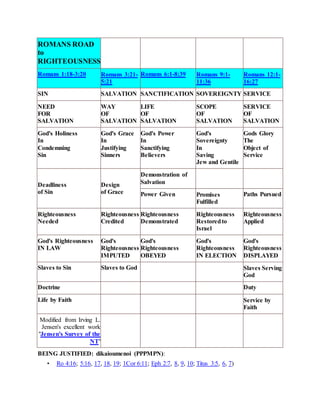
ROMANS ROAD
to
RIGHTEOUSNESS
Romans 1:18-3:20 Romans 3:21-
5:21
Romans 6:1-8:39 Romans 9:1-
11:36
Romans 12:1-
16:27
SIN SALVATION SANCTIFICATION SOVEREIGNTY SERVICE
NEED
FOR
SALVATION
WAY
OF
SALVATION
LIFE
OF
SALVATION
SCOPE
OF
SALVATION
SERVICE
OF
SALVATION
God's Holiness
In
Condemning
Sin
God's Grace
In
Justifying
Sinners
God's Power
In
Sanctifying
Believers
God's
Sovereignty
In
Saving
Jew and Gentile
Gods Glory
The
Object of
Service
Deadliness
of Sin
Design
of Grace
Demonstration of
Salvation
Power Given Promises
Fulfilled
Paths Pursued
Righteousness
Needed
Righteousness
Credited
Righteousness
Demonstrated
Righteousness
Restoredto
Israel
Righteousness
Applied
God's Righteousness
IN LAW
God's
Righteousness
IMPUTED
God's
Righteousness
OBEYED
God's
Righteousness
IN ELECTION
God's
Righteousness
DISPLAYED
Slaves to Sin Slaves to God Slaves Serving
God
Doctrine Duty
Life by Faith Service by
Faith
Modified from Irving L.
Jensen's excellent work
"Jensen's Survey of the
NT"
BEING JUSTIFIED: dikaioumenoi (PPPMPN):
• Ro 4:16; 5:16, 17, 18, 19; 1Cor 6:11; Eph 2:7, 8, 9, 10; Titus 3:5, 6, 7)
• Justification in Holman Bible Dictionary
• Romans 3 Resources - Multiple Sermons and Commentaries
As Morris says, now Paul moves from "From tragedy to triumph." (The Epistle to the Romans)
William Newell - We now come to the greatest single verse in the entire Bible on the manner of
justification by faith: We entreat you, study this verse. We have seen many a soul, upon
understanding it, come into peace. (Romans: Verse by Verse)
Guzik observes that…
Paul develops his teaching about salvation around three themes.
Justification: an image from the court of law
Redemption: an image from the slave market)
Propitiation: an image from the world of religion, appeasing God through sacrifice
Justification solves the problem of man's guilt before a righteous Judge. Redemption
solves the problem of man's slavery to sin, the world, and the devil. Propitiation solves
the problem of offending God our Creator.
Even as all have sinned and fall short of the glory of God is universal, so is the offer of
being justified freely by His grace. It is open to everyone who will believe.
Morris, quoting Moule: "The harlot, the liar, the murderer, are short of it; but so are you.
Perhaps they stand at the bottom of a mine, and you on the crest of an Alp; but you are as
little able to touch the stars as they." Everyone falls short, but everyone can be justified
freely by His grace. (Ref)
Being justified (1344) (dikaioo from dike = right, expected behavior or conformity, not
according to one’s own standard, but according to an imposed standard with prescribed
punishment for nonconformity) (Click for more discussion of dikaioo) primarily means to deem
to be right.
Dikaioo describes the act by which a man is brought into a right state of relationship to God.
Dikaioo is a legal term having to do with the law and the the courtroom, where it represented the
legally binding verdict of the judge. This is the sense in which Paul uses dikaioo in this section
in Romans (Ro 3:21-5:11) in which he unfolds the doctrine of justification.
Dikaioo - 39 times in the NAS, most often in Romans (Mt 11:19; 12:37; Lk. 7:29, 35; 10:29;
16:15; 18:14; Acts 13:38, 39; Ro 2:13; 3:4, 20, 24, 26, 28, 30; 4:2, 5; 5:1, 9; 6:7; 8:30, 33; 1Co
4:4; 6:11; Gal 2:16, 17; 3:8, 11, 24; 5:4; 1Ti 3:16; Titus 3:7; Jas. 2:21, 24, 25) and is translated:
acknowledged… justice, 1; acquitted, 1; freed, 3; justified, 24; justifier, 1; justifies, 2; justify, 4;
vindicated, 3;
Dikaioo is found 28 times in the Septuagint (LXX) (Ge 38:26; 44:16; Ex 23:7; Deut 25:1; 2Sa
15:4; 1Ki 8:32; 2Chr 6:23; Esther 10:3; Job 33:32; Ps 19:9; 51:4; 73:13; 82:3; 143:2; Isa 1:17;
5:23; 42:21; 43:9, 26; 45:25; 50:8; 53:11; Jer 3:11; Ezek 16:51f; 21:13; 44:24; Mic 6:11; 7:9)
The meaning of dikaioo depends on the context and depending on which lexicon you consult
you will come up with a variety of definitions so the following is an attempt as classifying most
of the NT uses, but please be a Berean and do you own study of this word.
(1) To cause someone to be in a proper or right relation with someone else. This use
corresponds to the vitally important truth imputed righteousness and thus means to justify
or to declare righteous, which is only accomplished by faith and not by works as
explained in definition #2.
Romans 3:24 being justified (declared righteous and in proper or right relation to
God) as a gift by His grace through the redemption which is in Christ Jesus
Titus 3:7 (note) that being justified (declared righteous and in proper or right
relation to God) by His grace we might be made heirs according to the hope of
eternal life.
(2) To show to be right or righteous.
Matthew 11:19 "The Son of Man came eating and drinking, and they say,
'Behold, a gluttonous man and a drunkard, a friend of tax-gatherers and sinners!'
Yet wisdom is vindicated (dikaioo - shown to be right, proved to be in the right
and accepted by God) by her deeds."
Luke 7:35 "Yet wisdom is vindicated (dikaioo - shown to be right) by all her
children."
James uses dikaioo in this sense - to show to be righteous. And so we see that Abraham's
works show that he was righteous. He had been declared righteous by faith in Genesis
15:6, but was shown to be righteous in Genesis 22, which is the point that James is
making in the following passages.
James 2:21 (note) Was not Abraham our father justified by works, when he
offered up Isaac his son on the altar? (Note: Do not misunderstand. James is not
using dikaioo in this context to say a Abraham was declared righteous but that he
was shown to be righteous by his work - his willingness to offer Isaac. This
"work" was the visible manifestation to men of the fact that at some point in time
in the past -- Genesis 15:6 -- Abraham had been justified by faith and declared
righteous by God on the basis of his faith, not on the basis of his works. This
verse illustrates why it one has to be very careful to observe the context when
defining any Greek word. Many people read these three passages in James and are
confused because they read them in light of definition #1 above which does not
apply to this context. The New Living Translation does an excellent job of
accurately paraphrasing this passage to give it the intended meaning…
James 2:21 Don't you remember that our ancestor Abraham was shown to be
right with God by his actions when he offered his son Isaac on the altar? (NLT)
James 2:24 (note) You see that a man is justified (shown to be righteous) by
works, and not by faith alone.
James 2:25 (note) And in the same way was not Rahab the harlot also justified
(shown to be righteous) by works, when she received the messengers and sent
them out by another way?
In some cases dikaioo refers to Jesus or God Who are demonstrated to be morally right
(Divine vindication)…
Romans 3:4 (note) May it never be! Rather, let God be found true, though every
man be found a liar, as it is written, "That Thou mightest be justified (shown to
be just) in Thy words, And mightest prevail when Thou art judged." (quoting Ps
51:4)
1Timothy 3:6 (This description refers to Jesus) And by common confession great
is the mystery of godliness: He who was revealed in the flesh, Was vindicated
(dikaioo - shown to be right) in the Spirit, Beheld by angels, Proclaimed among
the nations, Believed on in the world, Taken up in glory.
(3) To make free, liberate, set free or release from the control of . This meaning is
similar to another Greek verb eleutheroo. BDAG explains that the idea is "to cause
someone to be released from personal or institutional claims that are no longer to be
considered pertinent or valid"
Romans 6:7 For he who has died is freed (dikaioo in the passive voice = has been
released) from sin (the power of Sin to which we were enslaved)
Acts 13:39 and through Him everyone who believes is freed (dikaioo - passive
voice = has been set free) from all things, from which you could not be freed
through the Law of Moses.
(4) Acknowledging that someone is just or right.
Luke 7:29 And when all the people and the tax-gatherers heard this, they
acknowledged God's justice, (they acknowledged that God's way was right)
having been baptized with the baptism of John.
(5) Man declaring that he is just or right. This is something man does and based on his
standard of righteousness (self righteousness) not God's standard.
Luke 10:29 But wishing to justify (declare himself righteous) himself, he said to
Jesus, "And who is my neighbor?" (Comment: Notice that this young lawyer is
trying to limit the demand of the law by asking "Who is my neighbor?" and by
limiting it he would then show that he had fulfilled it. In other words this man
would judge himself by his own standard of righteousness -- not God's perfect
standard -- but he would not be justified in the sense of definition #1)
To understand dikaioo, one needs to understand the root work dike which originally meant
manner, tendency and with time came to refer to the designation for the right of established
custom or usage. Stated another way, the basic meaning of dike involves the assertion by human
society of a certain standard expected by its people which, if not kept, can bring forth ensuing
judgment. Thus it can be said that díke is expected behavior or conformity, not according to
one's own standard, but according to an imposed standard (here in Romans it is God's standard of
righteousness) with prescribed punishment for nonconformity.
Dikaioo ends in "-oo" which in Greek brings out that which a person is. Therefore dikaioo
brings out the fact that a person is righteous. It means to declare the rightness of something or
someone.
Leon Morris adds a note on dikaioo writing that…
The word is a forensic or legal term with the meaning “acquit”. It is the normal word to
use when the accused is declared “Not guilty”. We see its significance in an Old
Testament passage:
“When men have a dispute, they are to take it to court and the judges will decide
the case, acquitting (or, justifying) the innocent and condemning the guilty”
(Deut. 25:1).
Here the legal meaning is plain, and this remains with the word throughout the range of
its biblical use. Some argue that it means “to make righteous”, but this cannot be
demonstrated. The impossibility of making righteous is clear when the word is used of
God (Ro 3:4-note). It is plain also in the use of the future tense “will be justified” (Ro
2:13-note), for the reference is to Judgment Day and no one will be “made righteous” on
that day. Moreover, that passage refers to “the doers of law” as “justified”, but by
definition “doers of law” are righteous: they cannot be “made” righteous. The declaratory
meaning is clear. It is to be inferred also from the fact that it stands in opposition to
condemnation. “To condemn” does not mean “to make wicked”, but “to declare guilty”;
similarly, “to justify” means “to declare just” (Morris, L. The Epistle to the Romans. W.
B. Eerdmans; Inter-Varsity Press)
Expositor's Bible Commentary explains dikaioo as follows…
In classical Greek the verb dikaioo was sometimes used to mean "do right by a person,
give him justice." As a result, it could be used in the sense of "condemn." But in its
biblical setting it is used in the opposite sense, namely, "to acquit" (Ex 23:7; Dt 25:1). It
is clear both from the OT and the NT that dikaioo is a forensic term; it is the language of
the law court. But to settle on "acquittal" as the meaning of justification is to express only
a part of the range of the word, even though an important part (Acts 13:39). There is a
positive side that is even more prominent in NT usage--"to consider, or declare to be,
righteous." The word does not mean "to make righteous," that is, to effect a change of
character. Because he considered it ethically deplorable that God should account
righteous those who have been and to some extent continue to be sinful, Goodspeed
defied the linguistic evidence and rendered dikaioo "to make upright." He failed to realize
that the question of character and conduct belongs to a different area, namely,
sanctification, and is taken up by Paul in due course, whereas justification relates to status
and not to condition. (Gaebelein, F, Editor: Expositor's Bible Commentary 6-Volume
New Testament. Zondervan Publishing)
Vine says that dikaioo means
"to show, or declare, to be right.” In the N.T. it mostly signifies “to declare a person to be
righteous before God." (Vine, W. Collected writings of W. E. Vine. Nashville: Thomas
Nelson )
In simple terms dikaioo as used here in Romans means to declare a person to be righteous or
right before God. Only God can declare a man righteous and yet men continually seek ways to
make themselves righteous.
OH SO CLOSE!
Luke 10:25-29 - In the gospels we encounter a certain lawyer (a scribe who was supposedly an
expert in the law of God) approach Jesus to put Him to the test asking
"Teacher, what shall I do to inherit eternal life?" (Lk 10:25).
Jesus responded to the question with another question for this one who knew the Law asking
"What is written in the Law? How does it read to you?" (Lk 10:26)
The lawyer answered Jesus
"You shall love the Lord your God with all your heart, and with all your soul, and with all your
strength, and with all your mind; and your neighbor as yourself." (Lk 10:27)
This was indeed an excellent answer, the lawyer summing up the requirements of the law (Lev
19:18, Dt 6:5) exactly as Jesus Himself had done on another occasion (see Mt 22:37, 28, 29, 40)
And so Jesus responded
"You have answered correctly; do (present imperative - as the habit of your life -
something ultimately only possible in a man or woman who has a supernatural source,
i.e., the Holy Spirit Who is given to all who are justified by faith in Christ) this, and you
will live. (literally in Greek do and live - "poiei kai zoen")" But wishing to justify
(dikaioo) himself, he said to Jesus, “And who is my neighbor?” (Lk 10:28, 29)
"Do… and… live" was indeed the promise of the law (see Lev 18:5, Ezek 20:11). But since no
sinner can obey perfectly, the impossible demands of the law were always meant to drive us to
seek God's mercy (Gal 3:10, 11, 12, 13, 22, 23, 24, 25) and His righteousness in the Righteous
One, the Messiah. The lawyer should have responded with a confession of his guilt, but instead
attempted to justify himself with his question "Who is my neighbor?" The prevailing opinion
among scribes and Pharisees in Jesus' day was that one’s neighbors were the "righteous" (at
least those they considered "righteous"). According to them, the wicked, like tax collectors and
especially Samaritans—were to be hated because they were the enemies of God. They cited (Ps
139:21, 22) to justify their position. Jesus teaching on the familiar passage of the good Samaritan
demolished any hope this lawyer had to make himself righteous (dikaioo).
Being justified is an act of God (Ro 8:33-note) Who takes the initiative (cp Ep 1:4-note, 1Pe
1:2-note, 2Th 2:13) and provides the means through the redemption which is in Christ Jesus. The
sinner who believes in Christ receives God's gift of righteousness (Ro 1:17-note, Ro 5:17-note),
which then enables God to pronounce him righteous (both Just & Justifier - Ro 3:26-note). This
verse is perhaps the most thorough soteriological (dealing with teaching on salvation) passage in
the New Testament.
John MacArthur writes that
Being justified refers back to the “alls” of the previous two verses-all those who have
believed, of whom all were sinful. Just as there is no distinction among those who need
salvation, there is no distinction among those who receive it, because they all are justified
as a gift by His grace.
Dikaioo means to declare the rightness of something or someone. Justification is God’s
declaration that all the demands of the law are fulfilled on behalf of the believing sinner
through the righteousness of Jesus Christ. Justification is a wholly forensic, or legal,
transaction. It changes the judicial standing of the sinner before God. In justification,
God imputes (Ed: reckons, places on one's "account") the perfect righteousness of Christ
to the believer’s account, then declares the redeemed one fully righteous. Justification
must be distinguished from sanctification, in which God actually imparts Christ’s
righteousness to the sinner. While the two must be distinguished, justification and
sanctification can never be separated. God does not justify whom He does not sanctify.
(MacArthur, J: Romans 1-8. Chicago: Moody Press) (Bolding added)
In salvation dikaioo describes the legal act whereby God declares the believing sinner righteous
on the basis of the blood of Christ. Justification is not doled out piecemeal over a period of time
through mediatorial agents and ritual observances. Stated another way, justification is not a
process but is an act that occurs once and need not be repeated. It is something God does, not
man. Justification is not subject to recall so that you have to get it over and over again (as in
Radical Arminian churches). Justification is not a change wrought by God in us, but a change of
our relation to God. Justification describes a person’s status in the sight of the law, not the
condition of his or her character. The condition of one’s character and conduct is that with which
sanctification deals.
Wiersbe - Do not confuse justification and sanctification. Sanctification is the process whereby
God makes the believer more and more like Christ. Sanctification may change from day to day.
Justification never changes. When the sinner trusts Christ, God declares him righteous, and that
declaration will never be repealed. (Wiersbe, W: Bible Exposition Commentary. 1989. Victor)
(Bolding added)
Being justified is once and for all time and as such defines the believers permanent state. Just as
you may not be tried for the same crime again after being acquitted, God's justification means
you will never be tried or condemned by Him again for your sins--past, present, or future. This is
good news indeed.
To reiterate, justification is not an act of God that makes us righteous but is an act of God that
declares us righteous based on what Christ accomplished on Calvary.
Jesus, Thy Bloodand Righteousness
by Nikolaus von Zinzendorf (Bio)
(Play)
Jesus, Thy blood and righteousness
My beauty are, my glorious dress;
’Midst flaming worlds, in these arrayed,
With joy shall I lift up my head.
Bold shall I stand in Thy great day;
For who aught to my charge shall lay?
Fully absolved through these I am
From sin and fear, from guilt and shame.
The holy, meek, unspotted Lamb,
Who from the Father’s bosom came,
Who died for me, e’en me to atone,
Now for my Lord and God I own.
Lord, I believe Thy precious blood,
Which, at the mercy seat of God,
Forever doth for sinners plead,
For me, e’en for my soul, was shed.
Lord, I believe were sinners more
Than sands upon the ocean shore,
Thou hast for all a ransom paid,
For all a full atonement made.
When from the dust of death I rise
To claim my mansion in the skies,
Ev’n then this shall be all my plea,
Jesus hath lived, hath died, for me.
This spotless robe the same appears,
When ruined nature sinks in years;
No age can change its glorious hue,
The robe of Christ is ever new.
Jesus, the endless praise to Thee,
Whose boundless mercy hath for me—
For me a full atonement made,
An everlasting ransom paid.
O let the dead now hear Thy voice;
Now bid Thy banished ones rejoice;
Their beauty this, their glorious dress,
Jesus, Thy blood and righteousness.
MacDonald emphasizes this distinction between "make" and "declare" righteous, writing that…
To justify does not mean to actually make a person righteous. We cannot make God
righteous; He already is righteous. But we can declare Him to be righteous. God does not
make the believer sinless or righteous in himself. Rather, God puts righteousness to his
account. As A. T. Pierson put it,
God in justifying sinners actually calls them righteous when they are not—does
not impute sin where sin actually exists, and does impute righteousness where it
does not exist. (Believer's Bible Commentary)
At God’s Lighthouse Mission in Manhattan the men who attended services in the ’50s were
drilled nightly in Bible verses and in a particular definition of “justified.” Justified, they were
taught to repeat, means “just as if I had never sinned in the sight of God.” I was taught this same
phrase in Men's Bible Study Fellowship - "Justified" ~ "Just As If I Had Never Sinned". This
teaching is not entirely accurate for as discussed above dikaioo, means to be acquitted or to be
pronounced righteous. It is not “just as if I had never sinned” and thus it does not go far enough.
More accurately it is "just as if I had lived as perfect a life as Jesus did!" Once, when my normal
green-tinted sunglasses were lost, I put on a rose-colored pair. And everything I saw through
them was rose colored. Justification is a little like this. God sees you and me through "Christ-
colored glasses." When God looks at the person who believes in His Son, He sees the
righteousness of Jesus Himself.
As someone has well said justification goes beyond acquittal to approval and beyond pardon to
promotion. Acquittal means only that a person is set free from a charge. Justification means that
positive righteousness is imputed. It is important to realize that justification is a reckoning that
takes place in the mind of God. It is not something a believer feels. The believer can be certain it
has taken place because the Bible says so. C I Scofield expressed it this way
Justification is that act of God whereby He declares righteous all who believe in Jesus. It
is something which takes place in the mind of God, not in the nervous system or
emotional nature of the believer.
Dikaioo in other contexts can mean vindicated, proved, pronounced as, declared or shown to be.
For example, Paul in recording part of an early church hymn describes Jesus as
He Who was revealed in the flesh, was vindicated (dikaioo) in the Spirit. (NAS,1Ti 3:16
- note KJV reads "justified in the Spirit" which is somewhat confusing.)
Comment: Vindicated in this context is easier to understand if translated as "declared
(or shown) to be righteous" (with respect to His spiritual nature). The NLT paraphrased
version renders it "shown to be righteous by the Spirit"
Dikaioo is used in this way in Romans 3 where Paul writes
let God be found true, though every man be found a liar, as it is written, “That Thou
mightest be justified (dikaioo - shown to be right, proved to be right) in Thy words" (see
note Romans 3:4)
C H Spurgeon writes
What is justification? A. Justification is an act of God's free grace, wherein he pardons
all our sins (Ro 3:24-note; Eph 1:7-note), and accepts us as righteous in His sight (2Cor
5:21) only for the righteousness of Christ imputed to us (Ro 5:19-note), and received by
faith alone (Gal 2:16; Php 3:9-note).
Note: This discussion is not intended to be an exhaustive treatment of the verb dikaioo or of the
profound doctrine of justification. For a more exhaustive treatment I would highly
recommended Dr Wayne Grudem's work, Systematic Theology: An Introduction to Biblical
Doctrine (IVP; Zondervan, 1994) (or click here for Grudem's work in computer format). The
following quote is taken from his book and emphasizes the crucial importance of an accurate
understanding of dikaioo and the doctrine of justification. Grudem writes that…
A right understanding of justification is absolutely crucial to the whole Christian faith.
Once Martin Luther realized the truth of justification by faith alone, he became a
Christian and overflowed with the new-found joy of the gospel. The primary issue in the
Protestant Reformation was a dispute with the Roman Catholic Church over justification.
If we are to safeguard the truth of the gospel for future generations, we must understand
the truth of justification. Even today, a true view of justification is the dividing line
between the biblical gospel of salvation by faith alone and all false gospels of salvation
based on good works. (Systematic Theology) (Bolding added)
JUSTIFY
by Kenneth Wuest
The words justify, justification, righteous, righteousness, just, right, meet, are all
translations of the same Greek root. The verb justify is dikaióō, the noun righteousness,
dikaiosune, the adjective righteous, dikaios. This means that all these words have a
general meaning that is common to all of them, even though their individual meaning
may differ slightly. This again means that there is a definite and vital connection between
the act of justifying and the righteousness of the individual who has been justified.
We will look first at the usage of these words in pagan Greek literature.
“In pagan Greece the dikaios person is he who does not selfishly nor yet self-for-
gettingly transgress the bounds fixed for him, and gives to everyone his own, yet still
desires what is his, and does not in the least withdraw the assertion of his own claims.”
Paul uses dikaios in its purely classical sense in Ro 5:7 (note). In the biblical sense,
dikaios is “what is right, conformable to right, answering to the claims of usage, custom,
or right… The fundamental idea is that of a state or condition conformable to order, apart
from the consideration whether usage or custom or other factors determine the order or
direction. Thus, dikaios is synonymous with agathos (good -word study), only that
dikaios is a conception of a relation and presupposes a norm, whereas the subject of
agathos is its own norm.”
In understanding the words justify and righteous, as they are used in the New Testament,
it should always be kept in mind that their meaning is not a subjective one but an
objective one. That is, the content of meaning in these words is not to be determined by
each individual Bible expositor. If that were the case, what is righteous one day, may not
be righteous the next. The content of meaning in that case would be dependent upon the
fluctuating standards and ethics of men. With the present trend towards the teaching of
the relativity of all truth, this method of interpretation becomes a most vicious thing.
What is right one day may be wrong the next.
God is the objective standard which determines the content of meaning of dikaios, and at
the same time keeps that content of meaning constant and unchanging, since He is the
unchanging One.
Righteousness in the biblical sense is a condition of rightness the standard of which is
God, which is estimated according to the divine standard, which shows itself in behavior
conformable to God, and has to do above all things with its relation to God, and with the
walk before Him. It is, and it is called dikaiosune theou (righteousness of God) (Ro 3:21-
note, Ro1:17-note), righteousness as it belongs to God, and is of value before Him,
Godlike righteousness, see Eph 4:24 (note); with this righteousness thus defined, the
gospel (Ro 1:17-note) comes into the world of nations which had been wont to measure
by a different standard. Righteousness in the Scripture sense is a thoroughly religious
conception, designating the normal relation of men and their acts, etc., to God.
Righteousness in the profane mind is a preponderatingly social virtue, only with a certain
religious background.”
Justification in the Bible sense therefore is the act of God removing from the believing
sinner, his guilt and the penalty incurred by that guilt, and bestowing a positive
righteousness, Christ Jesus Himself in Whom the believer stands, not only innocent and
uncondemned, but actually righteous in point of law for time and for eternity. The words
justify, justification, righteous, righteousness, as used of man in his relation to God, have
a legal, judicial basis. God is the Judge, man the defendant. God is the standard of all
righteousness. The white linen curtains of the court of the Tabernacle, symbolized the
righteousness which God is, the righteousness which God demands of any human being
who desires to fellowship with Him, and the righteousness which God provides on the
basis of the acceptance on the sinner’s part, of the Lord Jesus who perfectly satisfied the
just demands of God’s holy law which we broke. A just person therefore is one who has
been thus declared righteous (Ro 1:17-note). The word is used in its non-legal sense in
Phil 1:7 (note) and Lk 12:57 for instance, where it speaks of conduct that is conformable
to what is right. (Wuest, K. S. Wuest's Word Studies from the Greek New Testament:)
(This resource is highly recommended if you enjoy Greek word studies)
Gingrich clarifies the meaning of justification emphasizing that it is…
not an executive act of mercy (pardoning) nor an efficient act of power (sanctifying or
making righteous), but is a judicial act of grace (declaring righteous). To pardon means
to mercifully remit punishment without removing the grounds for condemnation. To
sanctify means to make holy and good, to change moral character. To justify means to
declare righteous (or just), to impute righteousness to, to proclaim that one is in right
relationship to God’s holy law, to announce that the demands of justice have been
satisfied, to declare that there are no grounds for condemnation and that punishment
cannot be justly imposed. The opposite of to pardon is to punish; the opposite of to
sanctify is to make unholy; the opposite of to justify is to condemn. Proverbs 17:15,
Isaiah 5:23; Romans 2:13 (note); Ro 3:4 (note) prove that justifying is not pardoning or
sanctifying, but is the judicial proclamation of freedom from condemnation, based, not
upon something done by the sinner, nor upon something done by God in the sinner but
upon something done by Christ for, and then imputed to, the sinner. (Gingrich, R. E. The
Book of Romans)
AS A GIFT: dorean:
• Romans 3 Resources - Multiple Sermons and Commentaries
Awake My Soul To Joyful Lays**
by Samuel Medley, ca 1782
(Play)
Awake, my soul, in joyful lays,
And sing my great Redeemer’s praise;
He justly claims a song from me,
His loving kindness, oh, how free.
Lovingkindness, lovingkindness,
His lovingkindness, O how free!
He saw me ruined in the fall,
And loved me, notwithstanding all.
He saved me from my lost estate,
Lovingkindness, lovingkindness,
His lovingkindness, O how great!
Though numerous hosts of mighty foes,
Though earth and hell my way oppose,
He safely leads my soul along -
His lovingkindness, O how strong!
Lovingkindness, lovingkindness,
His lovingkindness, O how strong!
When trouble, like a gloomy cloud,
Has gathered thick and thundered loud,
He near my soul has always stood -
His lovingkindness, O how good!
Lovingkindness, lovingkindness,
His lovingkindness, O how good!
Often I feel my sinful heart
Prone from my Jesus to depart;
But though I have him oft forgot,
His lovingkindness changes not.
Lovingkindness, lovingkindness,
His lovingkindness changes not.
Soon I shall pass the gloomy vale,
Soon all my mortal powers must fail;
O! may my last expiring breath
His lovingkindness sing in death.
Lovingkindness, lovingkindness,
His lovingkindness sing in death.
Then let me mount and soar away
To the bright world of endless day;
And sing with raptures and surprise,
His lovingkindness in the skies.
Lovingkindness, lovingkindness,
His lovingkindness in the skies.
** Lays = Songs
It is not a matter of wages or merit but is a free gift that originates in the grace of God. It means
being justified without any prior conditions being met. We do not merit justification, but we
enjoy it because of Christ's precious blood given as our ransom price.
Gift is a word which speaks of the great grace of our great God.
Gift (1432) (dorean from dorea = a gift, something bestowed freely, without price, or
compensation, as in Jn 4:10; Ac 2:38; 2Co 9:15,, God is always Giver of dorea) conveys the
basic meaning of "for nothing". It pertains to being freely given, given without charge or without
payment. As a free gift or gratis. Undeserved.
Dorean emphasizes the free character of the gift, given spontaneously and without reference to
human merit.
Here in Romans 3:24 the prominent thought is the grace of the Giver.
In some contexts dorean conveys the idea of needlessly as in Gal 2:21
"I do not nullify the grace of God; for if righteousness comes through the Law, then
Christ died needlessly (or "for nothing", "not without impact").
In other contexts dorean means without a cause or reason (similar use in Lxx of Ge 29:15) or
undeservedly, as when Jesus explained…
"But they have done this (they have both seen and hated Me and My Father as well) in
order that the word may be fulfilled that is written in their Law, 'THEY HATED ME
WITHOUT A CAUSE.' (John 15:25)
Webster says that a gift is something voluntarily transferred by one person to another without
compensation.
Dorean is found 8 times in the NAS
Matthew 10:8 "Heal the sick, raise the dead, cleanse the lepers, cast out demons; freely you
received, freely give.
John 15:25 "But they have done this in order that the word may be fulfilled that is written in their
Law, 'They hated Me without a cause.' (cp use of dorea in Lxx of Ps 35:19, 69:4, 109:3,
119:161, Job 1:9 "for no reason")
Romans 3:24 (note) being justified as a gift by His grace through the redemption which is in
Christ Jesus;
2 Corinthians 11:7 Or did I commit a sin in humbling myself that you might be exalted, because
I preached the gospel of God to you without charge?
Galatians 2:21 "I do not nullify the grace of God; for if righteousness comes through the Law,
then Christ died needlessly (in vain, done without due result, without or for no purpose, cp use in
Lxx of 1Ki 2:31 "without cause")."
Comment: Don't miss what Paul is stating in this verse - His point is that if righeousness can be
obtained by sinful men by keeping the law, then Christ's death on the Cross was of no purpose
and did not need to occur.
2Th 3:8 nor did we eat anyone's bread without paying for it, but with labor and hardship we
kept working night and day so that we might not be a burden to any of you;
Rev 21:6 (note) And He said to me, "It is done. I am the Alpha and the Omega, the beginning
and the end. I will give to the one who thirsts from the spring of the water of life without cost.
Rev 22:17 (note) And the Spirit and the bride say, "Come." And let the one who hears say,
"Come." And let the one who is thirsty come; let the one who wishes take the water of life
without cost.
Guzik writes that…
Freely is the Greek word dorean. The way this word is used in other New Testament passages
helps us understand the word. Matthew 10:8 (Freely you have received, freely give) and
Revelation 22:17 (And whoever desires, let him take the water of life freely) show that the word
means truly free, not just "cheap" or "discounted." Perhaps the most striking use of the ancient
Greek word dorean is in John 15:25: They hated me without a cause (dorean). Even as there was
nothing in Jesus deserving of man's hatred, so there is nothing in us deserving of justification -
all the reasons are in God.
Calvin on the use of both the words freely and grace:
He thus repeats the word to show that the whole is from God, and nothing from us
… lest we should imagine a half kind of grace, he affirms more strongly what he
means by a repetition, and claims for God's mercy alone the whole glory of our
righteousness. (Ref)
Dorean is found 26 times in the non-apocryphal Septuagint (LXX) (Ge 29:15; Ex 21:2, 11; Nu
11:5; 1Sa 19:5; 25:31; 2Sa 24:24; 1Ki 2:31; 1Chr 21:24; Job 1:9; Ps 35:7, 19; 69:4; 109:3;
119:161; 120:6; Isa 52:3, 5; Jer 22:13; Lam 3:52; Mal 1:10)
Exodus 21:2 "If you buy a Hebrew slave, he shall serve for six years; but on the seventh he shall
go out as a free man without payment (Heb = chinnam = freely, undeservedly, without cause,
for no purpose, in vain; Lxx = dorea).
2 Samuel 24:24 (1Chr 21:24) However, the king said to Araunah, "No, but I will surely buy it
from you for a price, for I will not offer burnt offerings to the LORD my God which cost me
nothing (Heb = chinnam = freely, undeservedly, without cause, for no purpose, in vain; Lxx =
dorea)." So David bought the threshing floor and the oxen for fifty shekels of silver.
Dorean means that God declares a believer righteous without any cause or legitimate reason. In
other words, there is nothing in mankind merits the declaration of righteousness by God.
Justification is a gracious gift which God extends to the repentant, believing sinner, wholly apart
from human merit or work. That gift cost God the suffering and death of His own Son on the
cross, so that, for the believer, there is nothing left to pay. How fitting that the Bible ends with
God's invitation
And the Spirit and the bride say, "Come." And let the one who hears say, "Come." And
let the one who is thirsty come; let the one who wishes take the water of life without cost
(literally "as a gift" = dorean). (Rev 22:17)(note)
McGee emphasizes this point writing that…
Freely is the Greek word dorean, translated in John 15:25 “without a cause.” Our Lord
Jesus said that they hated Him freely, without a cause—there was no basis for it. Now
Paul is saying, Being justified freely—without a cause. There is no explanation in us.
God doesn’t say, “Oh, they are such wonderful people, I’ll have to do something for
them!” As we have seen before, there is nothing in us that would call out the grace of
God, other than our great need. We are justified without a cause. It is by His grace, which
means that there is no merit on our part. Grace is unmerited favor; it is love in action.
(McGee, J V: Thru the Bible Commentary: Nashville: Thomas Nelson)
Stated another way, justification is not based in any way on our moral improvement.
As William Newell says…
We are justified dorean-freely, gratis, gratuitously, giftwise, without a cause in us! This
great fact should deliver just now some reader who has been looking within, to his
spiritual state, or feelings, or prayers, as a ground of peace. (Romans 3 Commentary)
Barnhouse has this to say about dorean…
When we understand this (word dorean), we can see the true basis of our salvation. There
was absolutely nothing within man that could recommend him to God. God did not sit in
Heaven and look down upon this earth until He had found something in some men that
recommended them to Him. He gave salvation to men who deserved Hell. There will not
be one person in Heaven who deserved Heaven except the Lord Jesus Christ. He is the
only one who merited Heaven. But an innumerable company who merited Hell are going
to be in Heaven simply because the grace of God decided that they should be there.
(God's Remedy : Romans 3:21-4:1-25)
Peter uses the verb form of dorean (doreomai) in 2 Peter 1:3-4 writing that
His divine power has granted (doreomai from dorea - gift, stressing the gratuitous
character) to us everything (How much?) pertaining to life and godliness (eusebeia -
word study), through the true knowledge (epignosis - word study) of Him who called us
by His own glory and excellence. For by these He has granted (doreomai) to us His
precious (timios - word study) and magnificent promises, in order that by them you might
become partakers of the divine nature, having escaped (apopheugo - word study) the
corruption that is in the world by lust (epithumia - word study). (see note 2 Peter 1:3-4)
Justification is not a wage that God owes us--the only wage He owes us is death (Ro 6:23); it is
a gift that He offers freely.
Justification is not reward that we deserve but in fact is charity for the undeserving.
The forgiveness of sins and the righteousness of God are free gifts. That means they cost us
nothing because they cost Christ everything! They cannot be earned with works or inherited
through parents or absorbed through sacraments. They are free, and can only be received by
faith.
Nothing in my hand I bring;
Simply to Thy cross I cling
(Play "Rock of Ages")
BY HIS GRACE: te autou chariti:
• Romans 3 Resources - Multiple Sermons and Commentaries
Grace (5485) (charis - English = charity) (Click in depth study of charis) is favor or kindness
shown without regard to the worth or merit of the one who receives it and in spite of what that
person deserves. An accurate succinct definition of grace is the unmerited favor of God toward
man.
Newell writes that…
our word "charity" has been narrowed down in our poor thought and speech to handing
out a dole to the needy. But as used by God, this word grace (charis), means the going
forth in boundless oceans, according to Himself, of His mighty love. who "so loved the
world that He gave His only begotten Son." The grace of God is infinite love operating
by an infinite means, -the sacrifice of Christ; and in infinite freedom, unhindered, now,
by the temporary restrictions of the Law.
G.R.A.C.E. (God's Riches At Christ's Expense) wholly apart from any merit in ourselves. God's
grace is undeserved, unsought, and unbought.
Girdlestone writes that
Grace is the free bestowal of kindness on one who has neither claim upon our bounty,
nor adequate compensation to make for it. (Girdlestone, R. B. Synonyms of the Old
Testament)
MacArthur - The law reveals God’s righteousness and exposes man’s unrighteousness. Grace,
on the other hand, not only reveals God’s righteousness but actually gives His righteousness to
those who trust in His Son. (MacArthur, J: Romans 1-8. Chicago: Moody Press)
Tyndale Bible Dictionary - Grace is the dimension of divine activity that enables God to
confront human indifference and rebellion with an inexhaustible capacity to forgive and to
bless." (Elwell, W. A., & Comfort, P. W)
Grace is the good that you get from someone when he owes you nothing. So what Paul means
when he says that we are "justified as a gift by his grace" is that we can't work for justification.
The phrase "as a gift" means you can't pay for it. And the phrase "by his grace" means you can't
work for it.
Barnhouse tells the following story that speaks of God's gracious gift…
In the days of Moody, there was a minister named Harry Morehouse who often helped
Moody in his campaigns. One morning he was walking along the street in a poor part of
one of our great cities and witnessed a minor tragedy. A small boy, who could not have
been more than five or six years of age, came out of a store with a pitcher of milk in his
hands. The little fellow was making his way carefully along the street when he slipped
and fell, the pitcher breaking, and the milk running all over the sidewalk. He let out a
wail, and Harry Morehouse rushed to see if he were hurt. There was no physical damage
but he would not be consoled, crying out over and over, “My mama’ll whip me! My
mama’ll whip me.”
Mr. Morehouse said to him, “Maybe the pitcher is not broken in too many pieces; let us
see if we can put it together again.” The boy stopped crying at once, as he had no doubt
seen bits of crockery glued together to remake a broken plate or cup. He watched as Mr.
Morehouse placed the base of the pitcher on the sidewalk and started building up the
pieces. There were one or two failures and the pieces fell apart. At each failure the boy
started crying again, but was silenced by the big preacher who was helping him so much.
Finally, the entire pitcher was reconstructed from the pieces, and it stood there in perfect
shape on the sidewalk. The little fellow was given the handle, and he poked it toward the
place where it belonged, and, of course, knocked the whole thing apart once more. This
time there was no stopping his tears, and it was then that Mr. Morehouse gathered the boy
in his arms and walked down the street with him to a nearby crockery store. He entered
with the lad and bought a new pitcher. Then he went back to the milk store, had the
pitcher washed and filled with milk. Carrying the boy on one arm and the pitcher of milk
in the other hand, he followed the boy’s instructions until they arrived at his home. Very
gently he deposited the lad on his front steps, carefully put the pitcher in his hands and
then said to him, “Now will your mama whip you?” A smile broke on the boy’s streaked
face, and he answered, “Aw, no sir! ’cause it’s a lot better pitcher ’an we had before.”
The story may be very simple, but it represents faintly what the Lord Jesus Christ did for
me and for you. Whether you will accept the fact or not, you had dropped the pitcher of
your life and its milk was spilled beyond regathering. You may have spent much time in
trying to patch the pieces together again, but God assures you that you are broken beyond
repair. It was when we were thus, broken and hopeless, in the despair of our lost soul and
our crashed hopes that the Lord Jesus intervened to save us. He may have watched our
efforts at patching for a while, until we could come to the place where we believed
beyond question that it is impossible for us to repair our lives in a way that would ever
satisfy the holiness of the Heavenly Father. It was then that He carried us in His arms and
purchased for us an entirely new nature, a new life, which He imparted to us on the basis
of His loving kindness and tender mercies. It was not because there was good in us, but
because there was grace in Him. It was not because there was righteousness in our hearts,
but because there was grace in His heart. (Ibid)
William Newell describing grace wrote that…
“The grace of God is infinite love operating by an infinite means—the sacrifice of Christ;
and an infinite freedom, unhindered, now, by the temporary restrictions of the law…
Everything connected with God’s salvation is glad in bestowment, infinite in extent, and
unchangeable in its character.” (Romans 3 Commentary)
In order to avoid confusion later on, we should pause here to explain that there are six different
aspects of justification in the NT. We are said to be justified by grace, by faith, by blood, by
power, by God, and by works; yet there is no contradiction or conflict.
1) We are justified by grace— we do not deserve it.
2) We are justified by faith (see note Romans 5HYPERLINK "/romans_5-1-2":1)—that
means that we have to receive it by believing on the Lord Jesus Christ.
3) We are justified by blood (see note Romans 5:9)—that refers to the price the Savior
paid in order that we might be justified.
4) We are justified by power (see notes Romans 1:16, Ro 4:24-25)—the same power
that raised the Lord Jesus from the dead.
5) We are justified by God (see note Romans 8:33)—He is the One who reckons us
righteous.
6) We are justified by works (Ja 2:24)—not meaning that good works earn justification,
but that they are the evidence that we have been justified. We are shown to be justified by
our works.
THROUGH THE REDEMPTION WHICH IS IN CHRIST JESUS: dia tes apolutroseos tes
en Christo Iesou:
• Ro 5:9; Isa 53:11; Mt 20:28; Eph 1:6,7; Col 1:14; 1Ti 2:6; Titus 2:14; Heb 9:2, 3, 4, 5, 6,
7, 8, 9, 10, 11, 12, 13, 14; 1Pet 1:18,19; Rev 5:9; 7:14
• Mt 20:28 Mk 10:45 Lk 21:28 Acts 20:28 Ro 3:24,3:25 Ro 8:23 1Cor 1:30 Gal 3:13 Eph
1:7, 1:14, 4:30, 5:2, 1Ti 2:6 Titus 2:14 Heb 9:12,22, 10:12, 13, 14 1Pe 1:18, 19, 20, 3:18,
1Jn 2:2 Rev 1:5, 5:9, 14:4)
• For more on redemption see related resources - Easton's Dictionary; Torrey; ISBE;
Baker's Evangelical Dictionary of Theology
• Romans 3 Resources - Multiple Sermons and Commentaries
Click following for Dr Wayne Barber on redemption in Ephesians Message1 Messages 2-4)
act of liberation (NEB)
RelatedResource:
• Click to see how to perform Greek word study using apolutrosis as the example.
And so Paul teaches that God grace makes Him favorably disposed to do justify sinners, not
because of any merit in them but because He is gracious and chooses to manifest his grace
towards men. But can God do this simply by a decision of his will without any objective action
on his part? Not according to this verse, so that Paul goes on to explain that sinners can be
pronounced righteous because He has acting in providing redemption ("through the
redemption").
Christ Jesus is our "Redeemer" which although not used as a title in the New Testament is found
at least some 19 times in the OT (Ruth 4:14; Job 19:25; Ps 19:14; 78:35; Pr 23:11; Isa 41:14;
43:14; 44:6, 24; 47:4; 48:17; 49:7, 26; 54:5, 8; 59:20; 60:16; 63:16; Jer 50:34)
WHEN I SURVEY THE WONDROUS CROSS
(Play Isaac Watt's hymn)
When I survey the wondrous cross
On which the Prince of Glory died,
My richest gain I count but loss,
And pour contempt on all my pride.
Forbid it, Lord, that I should boast,
Save in the death of Christ my God:
All the vain things that charm me most,
I sacrifice them to his blood.
See, from his head, his hands, his feet,
Sorrow and love flow mingled down:
Did e’er such love and sorrow meet,
Or thorns compose so rich a crown?
His dying crimson, like a robe,
Spread o’er his body on the tree;
Then am I dead to all the globe,
And all the globe is dead to me.
Were the whole realm of nature mine,
That were a present far too small;
Love so amazing, so divine,
Demands my soul, my life, my all.
Through (1223) (dia) is a marker by which something is accomplished, in this case explaining
how "justification" is made available to undeserving sinners. See short study on the phrase
through Him = through Christ.
Spurgeon writes…
Now there comes in a new principle, — the principle of grace, which accomplishes what
the law never could accomplish; that is, the free justification of all the guilty ones who
believe in Jesus. And this justification is a righteous one, seeing that it is based upon “the
redemption that is in Christ Jesus:”
I have heard of Robert Burns, that on one occasion when at church, he sat in a pew with a
young lady whom he observed to be much affected by certain terri-ble passages of
Scripture which the minister quoted in his sermon. The wicked wag scribbled on a piece
of paper a verse which he passed to her. I fear that the sub-stance of that verse has been
whis-pered into many of your ears often:
Fair maid, you need not take the hint,
Nor idle texts pursue;
'Twas only sinners that he meant,
Not angels such as you.
This sermon is meant for those who think themselves angels as well as for those who
know them-selves to be sinners. Cease from all dreamy confidences. Arouse your-selves
from proud self-content, and come to Jesus the Savior, who alone can save from sin and
death.
Particular Redemption is Charles Haddon Spurgeon's initial foray into teaching his young
London flock the "deep things of God." Click the sermon and read his fascinating introduction
and explanation. What is intriguing is that he began his introduction into the "deep things of
God" with this sermon on "the doctrine of Redemption.
"He gave his life a ransom for many." (Mt 20:28)
Spurgeon writes
"But now, since the circumstances are changed, the teaching will be changed also. I shall
not now simply confine myself to the doctrine of faith, or the teaching of believer's
baptism; I shall not stay upon the surface of matters, but shall venture, as God shall guide
me, to enter into those things that lie at the basis of the religion that we hold so dear. I
shall not blush to preach before you the doctrine of God's Divine Sovereignty; I shall not
stagger to preach in the most unreserved and unguarded manner the doctrine of election. I
shall not be afraid to propound the great truth of the final perseverance of the saints; I
shall not withhold that undoubted truth of Scripture, the effectual calling of God's elect; I
shall endeavour, as God shall help me, to keep back nothing from you who have become
my flock. Seeing that many of you have now "tasted that the Lord is gracious," we will
endeavour to go through the whole system of the doctrines of grace, that saints may be
edified and built up in their most holy faith…
The doctrine of Redemption is one of the most important doctrines of the system of
faith. A mistake on this point will inevitably lead to a mistake through the entire system
of our belief." (Bolding added. Excerpt from his sermon Particular Redemption, see
Spurgeon's other sermons Plenteous RedemptionHYPERLINK
"http://www.spurgeon.org/sermons/0351.php", Full Redemption; Redemption Through
Blood, the Gracious ForgiHYPERLINK
"http://www.spurgeon.org/sermons/2207.php"veness of SinsHYPERLINK
"http://www.spurgeon.org/sermons/2207.php"; Bought With a Price) (Click for a similar
thought by John Piper)
Redemption (629)(HYPERLINK "/romans_324-26#redemption 629 apolutrosis"apolutrosis
from apo = marker of dissociation or separation + lutroo = to redeem <> from lutron/lytron =
ransom <> from lúo = loosen what is bound, loose any person tied or fastened) is the payment of
a price to ransom (lutron/lytron = money for a ransom = ransom or price paid for a slave who is
then set free by the one who bought him), to release (of someone from the power of someone
else), to buy back or to deliver one from a situation from in which one is powerless to liberate
themselves from or for which the penalty was so costly that they could never hope to pay the
ransom price. In other words, the idea of redemption is deliverance or release by payment of a
ransom.
Gary Hill on apolutrosis - apolytrōsis ("redemption, re-purchase") emphasizes the distance
("safety-margin") between the rescued person and what previously enslaved them. For
believers, the prefix (apó) looks back to God's effective work of grace which purchased them
from the debt of sin, and bringing them to their new status of being in Christ. Apolytrōsis
("redemption-freedom") is only purchased by the blood of the Lamb – and hence always freely
given by the Lord, through faith. Accordingly faith (4102/pístis) and 629 (apolýtrōsis) are
directly associated in the NT (see Ro 3:22-26; Eph 1:14,15; Heb 11:33-35). (Discovery Bible)
ILLUSTRATION - An uncle took his young nephew to swim in the ocean when the boy
was suddenly attacked by a shark – bitting him so hard it completely severed his leg.
With great courage the uncle grabbed a baseball bat, jumped into the water with the
shark, and clubbed it until the shark released his nephew's detached leg! The uncle then
picked up his nephew and his severed leg and raced to the hospital. Doctors successfully
reattached the leg and his nephew was able to walk again. This provides a picture of
redemption: winning back what was "lost"! Infinitely greater is our redemption by Christ
so we can regain what we have forfeited by our sins! Christ won this back at Calvary by
the price of His own blood.Eph 1:7." (Gary Hill)
Apolutrosis is used only once in the Septuagint in Da 4:19 where it refers to the time of
Nebuchadnezzar's recovery from his madness without any suggestion of price or cost.
Rightemire rightly notes that…
The central theme of redemption in Scripture is that God has taken the initiative to act
compassionately on behalf of those who are powerless to help themselves. The New Testament
makes clear that divine redemption includes God's identification with humanity in its plight, and
the securing of liberation of humankind through the obedience, suffering, death, and resurrection
of the incarnate Son. (Redeem, Redemption - from the well done summary article in Baker's
Evangelical Dictionary)
Spurgeon writes that…
The figure of redemption is very simple, and has been very frequently used in Scripture. When a
prisoner has been taken captive, and has been made a slave by some barbarous power, it has been
usual, before he could be set free, that a ransom price should be paid down. Now, we being, by
the fall of Adam, prone to guiltiness, and, indeed, virtually guilty, we were by the irreproachable
judgment of God given up to the vengeance of the law; we were given into the hands of justice;
justice claimed us to be his bond slaves for ever, unless we could pay a ransom, whereby our
souls could be redeemed. We were, indeed, poor as owlets, we had not wherewith to bless
ourselves. We were, as our hymn hath worded it, "bankrupt debtors;" an execution was put into
our house; all we had was sold; we were left naked, and poor, and miserable, and we could by no
means find a ransom; it was just then that Christ stepped in, stood sponsor for us, and, in the
room and stead of all believers, did pay the ransom price, that we might in that hour be delivered
from the curse of the law and the vengeance of God, and go our way, clean, free, justified by his
blood. (Spurgeon's sermon Justification by Grace)
Apolutrosis is found 10 times in the NT and is translated - redemption, 9; release, 1.
Luke 21:28 "But when these things (Always stop and ask "What things?" - then go back and read
the preceding context - see question posed to Jesus in Lk 21:7 - ) begin to take place, straighten
up and lift up your heads, because your redemption (future tense salvation - glorification, which
marks the consummation and completion of our redemptions - cp Ep 1:14 below) is drawing
near."
Romans 3:24 being justified as a gift by His grace through the redemption which is in Christ
Jesus;
Romans 8:23 And not only this, but also we ourselves, having the first fruits of the Spirit, even
we ourselves groan within ourselves, waiting eagerly for our adoption as sons, the redemption
of our body.
1 Corinthians 1:30 But by His doing you are in Christ Jesus, who became to us wisdom from
God, and righteousness and sanctification, and redemption,
Ephesians 1:7 (note) In Him we have redemption through His blood, the forgiveness of our
trespasses, according to the riches of His grace,
Ephesians 1:14 (note) who is given as a pledge of our inheritance, with a view to the redemption
of God's own possession, to the praise of His glory.
Ephesians 4:30 (note) And do not grieve the Holy Spirit of God, by whom you were sealed for
the day of redemption.
Colossians 1:14 (note) in Whom we have redemption, the forgiveness of sins.
Hebrews 9:15 (note) And for this reason He is the mediator of a new covenant, in order that
since a death has taken place for the redemption of the transgressions that were committed
under the first covenant, those who have been called may receive the promise of the eternal
inheritance.
Hebrews 11:35 (note) Women received back their dead by resurrection; and others were tortured,
not accepting their release, in order that they might obtain a better resurrection;
Thayer - Everywhere in the New Testament this word is used to denote deliverance effected
through the death of Christ from the retributive wrath of a holy God and the merited penalty of
sin.
Ryrie (Ryrie Study Bible) adds that…
Three ideas are involved in the doctrine of redemption:
(1) paying the ransom with the blood of Christ
1Cor 6:20 For you have been bought with a price: therefore glorify God in your
body.
Rev 5:9 And they sang a new song, saying, "Worthy art Thou to take the book,
and to break its seals; for Thou wast slain, and didst purchase for God with Thy
blood men from every tribe and tongue and people and nation.
(2) removal from the curse of the law
Gal 3:13 Christ redeemed us from the curse of the Law, having become a curse
for us-- for it is written, "CURSED IS EVERYONE WHO HANGS ON A TREE"
Gal 4:5 in order that He might redeem those who were under the Law, that we
might receive the adoption as sons.
(3) release from the bondage of sin into the freedom of grace (here and in 1 Peter 1:18).
1Peter 1:18 knowing that you were not redeemed with perishable things like
silver or gold from your futile way of life inherited from your forefathers, (see
note)
Redemption is always through His blood; i.e., through the death of Christ (Col 1:14).
Colossians 1:14 in Whom we have redemption the forgiveness of sins. (see note)
Newell exhorts us - Before you leave verse 24, apply it to yourself, if you are a believer. Say
of yourself: "God has declared me righteous without any cause in me, by His grace, through the
redemption from sin's penalty that is in Christ Jesus." It is the bold believing use for ourselves of
the Scripture we learn, that God desires; and not merely the knowledge of Scripture. (Romans 3
Commentary)
Barclay writes that apolutrosis conveys "In every case the conception (of) the delivering of a
man from a situation from which he was powerless to liberate himself or from a penalty which
he himself could never have paid." He goes on to relate that the Roman philosopher Seneca who
tutored and advised Nero was "full of this kind of feeling of helpless frustration. Men, he said,
were overwhelmingly conscious of their inefficiency in necessary things. He said of himself that
he was a homo non tolerabilis, a man not to be tolerated. Men, he said with a kind of despair,
love their vices and hate them at the same time. What men need, he cried, is a hand let down to
lift them up. The highest thinkers in the pagan world knew that they were in the grip of
something from which they were helpless to deliver themselves. They needed liberation. It was
just that liberation which Jesus Christ brought. It is still true that he can liberate men from
helpless slavery to the things which attract and disgust them at one and the same time." (Barclay,
W: The Daily Study Bible Series, Rev. ed. Philadelphia: The Westminster Press)
Apolutrosis was used was used in secular Greek as a technical term for money paid to buy back
and set free prisoners of war or to emancipate (= to liberate a person from subjection or
domination, to free from restraint, control, or the power of another) slaves from their masters.
Apolutrosis would have been a very meaningful term to the first century reader as there were by
some accounts up to 60 million slaves in the Roman Empire! Many of these slaves became
Christians and fellowshipped in the local assemblies. A slave could purchase his own freedom, if
he could collect sufficient funds or his master could sell him to someone who would pay the
price and set him free. Redemption was a precious thing in Paul's day.
Jesus answering the unbelieving Jews who claimed never to have been enslaved to anyone
(which of course was incorrect historically)
"answered them" declaring "Truly, truly, I say to you, everyone who commits sin is the
slave of sin." (Jn 8:34)
Believers have been ransomed, bought out of slavery to sin, like the redemption of a bondservant
by a kinsman-redeemer (Lev 25:49).
Before redemption we were held captive by Satan to do his will and were enslaved to our old sin
nature inherited from Adam. As noted above a Roman or Grecian slave could be freed with the
payment of money, but no amount of money can set an enslaved sinner free.
The redemption of a sinner is only possible by payment of the ransom price, the blood of
Christ. Peter writes that believers
were not redeemed (lutroo) with perishable things like silver or gold from your futile (a
lifestyle that is without purpose, unfruitful, and useless) way of life inherited from your
forefathers, but with precious blood, as of a lamb unblemished and spotless, the blood of
Christ. (see note 1 Peter 1:18-19, cf 1Co 6:20; Rev 5:9-note)
Jesus explained to His disciples that
"even the Son of Man did not come to be served, but to serve, and to give His life a
ransom (lutron = the ransom price) for many." (Mk 10:45 cf Mt 20:28)
I Gave My Life for Thee
Play Hymn
Frances Ridley Havergal
(Her first hymn!)
I gave My life for thee,
My precious blood I shed;
That thou might ransomed be,
And quickened from the dead.
I gave, I gave, My life for thee,
What hast thou given for Me?
Jamieson comments that…
through the redemption that is in Christ Jesus (is) a most important clause; teaching us that
though justification is quite gratuitous, it is not a mere fiat of the divine will, but based on a
"Redemption," that is, "the payment of a Ransom," in Christ's death. That this is the sense of the
word "redemption," when applied to Christ's death, will appear clear to any impartial student of
the passages where it occurs.
Guzik - The word redemption had its origin in the release of prisoners of war on payment of a
price and was know as the "ransom." As time went on, it was extended to include the freeing of
slaves, again by the payment of a price. The idea of redemption means that Jesus bought us,
therefore we belong to Him. Paul expressed this thought in another letter: For you were bought at
a price; therefore glorify God in your body and in your spirit, which are God's. (1Co 6:20) (Ref)
A dignified looking lady once approached the great preacher Dr. G. Campbell Morgan and said,
“Dr. Morgan, I don’t like to hear about the blood. It is repulsive to me and offends my
esthetic nature."
Dr. Morgan replied,
“I agree with you that it is repulsive, but the only thing repulsive about it is your sin and
mine."
It is repulsive to man, but it is through His blood that we have redemption.
Paul writes that in Christ
"we have redemption through His blood, the forgiveness of our trespasses, according to
the riches of His grace, which He lavished upon us." (Eph 1:7-8-note)
Christ's shed blood is a metonym (figure of speech in which one thing is designated by the
mention of something associated with it) for death, the penalty and the price of sin. Christ’s
death, by the shedding of His blood, was the substitute for our death and the ransom price that
freed us from the bondage and guilt of our old Master "Sin" and introduced us into a life of
liberty.
Paul gives us an interesting "definition" if you will of "redemption" writing that in Christ
"we have redemption (apolutrosis), the forgiveness of sins." (Colossians 1:14-note)
Christ's Blood shed for me for the forgiveness of sins. His death for my life. Redemption results
in the forgiveness of sins.
Paul explains that in regard to our salvation we can never boast about anything but the Lord for
by His doing you are in Christ Jesus, Who became to us wisdom from God, and
righteousness and sanctification, and redemption (apolutrosis)" (1Cor 1:30)
Paul explains that the Holy Spirit
is given as a pledge of our inheritance, with a view to the redemption (apolutrosis) of
God's own possession, to the praise of His glory." (Eph 1:14HYPERLINK
"/ephesians_113-14#1:14"-note) (Comment: This is a reference to our "future"
redemption)
Later in the same letter he makes another reference to our future redemption, admonishing the
saints not to
grieve the Holy Spirit of God, by whom you were sealed for the day of redemption
(apolutrosis)" (Eph 4:30-note)
Comment: Here Paul refers to that future day when our bodies are glorified, that day
when final redemption is realized. It is worth noting therefore that Christ's death on the
cross has purchased not only present but final liberation. This is good news beloved
In Romans he again refers to our future redemption writing
we ourselves, having the first fruits of the Spirit, even we ourselves groan within
ourselves, waiting eagerly for our adoption as sons, the redemption (apolutrosis) of our
body. (Ro 8:23-note)
"Future" redemption is that day when we receive our resurrected glorified body and final
deliverance from the "ills that the flesh is heir to". It refers to the final and complete deliverance
of our earthly bodies not just from the power of Sin (see note) but even the presence of sin and
the pleasure of sin and the resultant tension which we constantly feel as long as we are in these
mortal bodies.
The writer of Hebrews explained that Jesus
is the mediator of a new covenant, in order that since a death has taken place for the
redemption (apolutrosis - Cranfield calls "the innermost meaning of the cross" ) of the
transgressions that were committed under the first covenant (here we see the explanation
of how sinners could have been saved in the OT before Christ was crucified - see same
idea in Ro 3:25-note), those who have been called may receive the promise of the eternal
inheritance. (Heb 9:15HYPERLINK "/hebrews_915-17#9:15"-note)
One of the effects of the apolutrosis procured by the death of Christ was to redeem all those who
had believed in God under the Old Covenant. After Christ died, they saw what had only before
been a promise - it was a certain promise, a guaranteed promise, but until the Messiah’s atoning
death, it was an unfulfilled promise. The point is that Christ’s atoning death was retroactive.
Yom Kippur (the Day of Atonement) also pictured symbolically what Christ’s atonement did
actually, for Yom Kippur was "retroactive". When the high priest sprinkled the blood on the
mercy seat, the unintentional sins of the people were covered for the previous year.
Redemption, Redeem(apolutrosis) - Vine's Greek Lexicon
apolutrosis a strengthened form of lutrosis, lit., "a releasing, for (i.e., on payment of) a
ransom." It is used of…
(a) "deliverance" from physical torture, Heb 11:35, see apolutrosis under DELIVER
(b) the deliverance of the people of God at the coming of Christ with His glorified saints,
"in a cloud with power and great glory," Lk 21:28, a "redemption" to be accomplished at
the "outshining of His Parousia," 2Thes 2:8, i.e., at His second advent;
(c) forgiveness and justification, "redemption" as the result of expiation, deliverance from
the guilt of sins, Ro 3:24, "through the redemption that is in Christ Jesus;" Eph 1:7,
defined as "the forgiveness of our trespasses," RV; so Col 1:14, "the forgiveness of our
sins," indicating both the liberation from the guilt and doom of sin and the introduction
into a life of liberty, "newness of life" (Ro 6:4); Heb 9:15, "for the redemption of the
transgressions that were under the first covenant," RV, here "redemption of" is equivalent
to "redemption from," the genitive case being used of the object from which the
"redemption" is effected, not from the consequence of the transgressions, but from the
transgressions themselves;
(d) the deliverance of the believer from the presence and power of sin, and of his body
from bondage to corruption, at the coming (the Parousia in its inception) of the Lord
Jesus, Ro 8:23; 1Cor 1:30; Eph 1:14; Eph 4:30. See also PROPITIATION. (Vine, W E:
Vine's Complete Expository Dictionary of Old and New Testament Words. 1996. Nelson
To the Jews "redeemed" would bring to mind the picture of God's deliverance from Egyptian
bondage (Ex 6:6, 15:13). Years later the return of the Jewish exiles from Babylon was depicted
in similar terms (Isa 52:3) Jehovah declaring that
You were sold for nothing and you will be redeemed (Hebrew = Ga'al = act as kinsman
redeemer; Lxx = lutroo - word study) without money.
In the Old Testament, redemption involves deliverance from bondage based on the payment of a
price by a kinsman redeemer, a concept beautifully pictured by Boaz's redemption of Ruth which
prefigured the Messiah as Kinsman-Redeemer of all who would receive His free gift by faith.
(Click study on Ruth - with discussion of Goel = Kinsman Redeemer on this website).
REDEMPTION, n. [L. redemptio.] Websters 1828 Dictionary
1. Repurchase of captured goods or prisoners; the act of procuring the deliverance of
persons or things from the possession and power of captors by the payment of an
equivalent; ransom; release; as the redemption of prisoners taken in war; the redemption
of a ship and cargo. (Redeem: To purchase back; to ransom; to liberate or rescue from
captivity or bondage, or from any obligation or liability to suffer or to be forfeited, by
paying an equivalent; as, to redeem prisoners or captured goods; to redeem a pledge. To
repurchase what has been sold; to regain possession of a thing alienated, by repaying the
value of it to the possessor.)
2. Deliverance from bondage, distress, or from liability to any evil or forfeiture, either by
money, labor or other means. (Redeem: To rescue; to recover; to deliver from)
3. Repurchase, as of lands alienated. Lev. 25. Jer. 32.
4. The liberation of an estate from a mortgage; or the purchase of the right to re-enter
upon it by paying the principal sum for which it was mortgaged with interest and cost;
also, the right of redeeming and re-entering.
5. Repurchase of notes, bills or other evidence of debt by paying their value in specie to
their holders.
6. In theology, the purchase of God's favor by the death and sufferings of Christ; the
ransom or deliverance of sinners from the bondage of sin and the penalties of God's
violated law by the atonement of Christ. (Redeem: In theology, to rescue and deliver
from the bondage of sin and the penalties of God's violated law, by obedience and
suffering in the place of the sinner, or by doing and suffering that which is accepted in
lieu of the sinner's obedience. In commerce, to purchase or pay the value in specie, of any
promissory note, bill or other evidence of debt, given by the state, by a company or
corporation, or by an individual. The credit of a state, a banking company or individuals,
is good when they can redeem all their stock, notes or bills, at par.)
Jesus describing the events surrounding the end of this age uses apolutrosis to describe the final
redemption brought about by His triumphant return declaring that
when these things begin to take place, straighten up and lift up your heads, because your
redemption is drawing near. (Lk 21:28)
In this context apolutrosis in suggests not just redemption from slavery to Sin but redemption
from political oppression and establishment of an independent Jewish state. Apolutrosis is found
on a coin struck circa 133-34AD, which reads "First year of the Redemption of Israel".
It cost more to redeem us than to create us. In creation it was but speaking a word. In redemption
the Word became flesh and blood (Jn 1:1,14) and shed of His precious blood (1Pe 1:19 - 1Peter
1:19). Creation was the work of God's fingers (Ps 8:3-Spurgeon's note); redemption was the
work of his arm (Lk 1:51). In creation, God gave us ourselves; in the redemption he gave us
Himself. By creation, we have life in Adam; by redemption, we have life in Christ (Col 3:3-
note). (From The Ten Commandments by Thomas Watson.)
The Gospel is first presented as the bad news to bring one to the point of conviction of personal
sin before it can be understood as the good news of redemption from bondage to sin.
Sermons by Spurgeon related to redemption…
• Exodus 10:26 Full Redemption
• Luke 19:10 The Mission Of The Son Of Man
• Matthew 20:28 Particular Redemption
• Psalm 130:7 Plenteous Redemption
• Ephesians 1:7 Redemption Thru Blood, The Gracious Forgiveness Of Sins
Redemption Defined
The word means to buy back by paying a price, and set free
1. Man’s ruin - Isaiah 52:3; Jn 8:34; Ro 6:20- note
2. Man’s helplessness - Ps 49:7-note; Micah 6:7
3. A redeemer provided - Job 33:24; Ps 111:9 - note
4. Redemption by blood - Eph 1:7 - note; Acts 20:28; He 9:12 - note
5. Redemption by power - Eph 1:13, 14 - note; Eph 4:30-note; Ro 8:23-note
6. Redemption from iniquity - Titus 2:!4 -note; 1Pe 1:18- note
7. Redemption from the curse - Gal 3:3; Ps 103:4 - note
8. Redemption of the body Ro 8:23 - note; Php 3:20 - note
(From the Book of 750 Bible and Gospel Studies, 1909, George W Noble, Chicago)
John Piper speaks about the practical importance that every believer understand this section of
Romans writing that
If you build your life on these verses (Ro 3:23,24) - if the truth of these two verses
becomes the foundation of your life - you will be unshakable in a hundred crises. If these
verses become the sun in the solar system of your life, all your planets will orbit in
harmony around the will of God. But if you put these verses out on the rim of your life
(say near Neptune or Pluto) you need not be surprised if there is confusion and
uncertainty and fear and weakness in your life. There are some truths that are so
foundational and so central that you should memorize them, meditate on them, bind them
to your mind and heart with chains and ropes and every kind of adhesive you can find.
Many professing Christians are very weak, and amble through their days pretty much like
unbelievers, because they don't hold on to these verses the way a drowning man takes
hold of his rescuer's arm. (Read full sermon text The Demonstration of God's
Righteousness)
Below is a Contemporary example of "redemption" taken from the Global Prayer Digest
(01/06/01)…
"The two men stood in the shadowy door of a popular brothel in the heart of Phnom
Penh's red light district. Five hundred dollars was exchanged. This was not the fee for one
night with a prostitute. This "fortune" was paid to redeem a young girl's life from
prostitution. God is opening a better way, and there is new hope. Seten Lee's
organization, Kampuchea for Christ, received a generous gift from the U.S., providing
funds to build a home for these girls on a plot of land close to Phnom Penh. It will
provide housing, food, counseling, and vocational training for these girls as they leave
their degrading lives of prostitution." Do you think they in a human sense could sing the
old hymn "Redeemed how I love to proclaim it". May God's Spirit move that they can
also sing "Redeemed by the blood of the Lamb!"
Nor Silver Nor Gold
by James Gray
Click to play
Nor silver nor gold hath obtained my redemption,
Nor riches of earth could have saved my poor soul;
The blood of the cross is my only foundation,
The death of my Savior now maketh me whole.
Refrain
I am redeemed, but not with silver,
I am bought, but not with gold;
Bought with a price, the blood of Jesus,
Precious price of love untold.
Nor silver nor gold hath obtained my redemption,
The guilt on my conscience too heavy had grown;
The blood of the cross is my only foundation,
The death of my Savior could only atone.
William Newell closes this section writing that…
Before you leave Romans 3:24, apply it to yourself, if you are a believer. Say of yourself:
‘God has declared me righteous without any cause in me, by His grace, through the
redemption from sin’s penalty that is in Christ Jesus.’ It is the bold, believing use for
ourselves of the Scripture we learn, that God desires; and not merely the knowledge of
Scripture. (Romans: Verse by Verse)
Which is in Christ Jesus - Paul reverses the more common name “Jesus Christ” probably to
stress the fact that God provided redemption by supplying the payment in the Person of the
Messiah (Christ) Who was promised in the Old Testament and who was incarnate as the God-
Man Jesus of Nazareth.
Regarding Paul's first use of "In Christ Jesus" Cranfield writes that this phrase…
is naturally explained as intended to indicate that it was in and through Christ Jesus, that
is, in and through His Person and Work, that God accomplished His redeeming action.
The thought, is of the accomplishment of the redeeming action in the past, not of the
availability of redemption in the present through union with Christ. (Cranfield, C. E. B. A
Critical and Exegetical Commentary on the Epistle to the Romans)
Thompson Chain Reference
Redemption
God the Author of
• Psalms 31:5
• Psalms 119:9
• Psalms 130:7
• Isaiah 43:1
• Luke 1:68
• Luke 2:38
• Ephesians 4:30
Through Christ
• Romans 3:24
• 1 Corinthians 1:30
• Galatians 3:13
• Colossians 1:14
• Titus 2:14
• Hebrews 9:12
• 1 Peter 1:18
• Revelation 5:9
Blood of Christ
• Matthew 26:28
• John 6:56
• John 19:34
• Acts 20:28
• Romans 5:9
• Colossians 1:20
• Hebrews 9:14
• 1 Peter 1:18
• 1 Peter 1:19
• 1 John 1:7
• Revelation 1:5
• Revelation 5:9
• Revelation 7:14
• Revelation 12:11
Cross of Christ
• The Doctrine of Preached - 1 Corinthians 1:17
• The Doctrine of Gloried in -Galatians 6:14
• Reconciliation through -Ephesians 2:16
• Enemies of -Philippians 3:18
• Peace made by -Colossians 1:20
• Old Testament ordinances abolished by Colossians 2:14
Of Land and Persons
• Leviticus 25:27
• Leviticus 27:19
• Nehemiah 5:8
Torrey's Topic
Redemption
• Defined -1 Corinthians 6:20; 7:23
• Is of God -Isaiah 44:21-23; 43:1; Luke 1:68
• Is by Christ -Matthew 20:28; Galatians 3:13
• Is by the blood of Christ -Acts 20:28; Hebrews 9:12; 1 Peter 1:19; Revelation 5:9
• Christ sent to effect -Galatians 4:4,5
• Christ is made, to us -1 Corinthians 1:30
IS FROM
• The bondage of the law -Galatians 4:5
• The curse of the law -Galatians 3:13
• The power of sin -Romans 6:18,22
• The power of the grave -Psalms 49:15
• All troubles -Psalms 25:22
• All iniquity -Psalms 130:8; Titus 2:14
• All evil -Genesis 48:16
• The present evil world -Galatians 1:4
• Vain conversation -1 Peter 1:18
• Enemies -Psalms 106:10,11; Jeremiah 15:21
• Death -Hosea 13:14
• Destruction -Psalms 103:4
• Man cannot effect -Psalms 49:7
• Corruptible things cannot purchase -1 Peter 1:18
PROCURES FOR US
• Justification -Romans 3:24
• Forgiveness of sin -Ephesians 1:7; Colossians 1:14
• Adoption -Galatians 4:4,5
• Purification -Titus 2:14
• The present life, the only season for -Job 36:18,19
DESCRIBED AS
• Precious -Psalms 49:8
• Plenteous -Psalms 130:7
• Eternal -Hebrews 9:12
SUBJECTS OF
• The soul -Psalms 49:8
• The body -Romans 8:23
• The life -Psalms 103:4; Lamentations 3:58
• The inheritance -Ephesians 1:14
MANIFESTS THE
• Power of God -Isaiah 50:2
• Grace of God -Isaiah 52:3
• Love and pity of God -Isaiah 63:9; John 3:16; Romans 6:8; 1 John 4:10
• A subject for praise -Isaiah 44:22,23; 51:11
• Old Testament saints partakers of -Hebrews 9:15
THEY WHO PARTAKE OF
• Are the property of God -Isaiah 43:1; 1 Corinthians 6:20
• Are first-fruits to God -Revelation 14:4
• Are a peculiar people -2 Samuel 7:23; Titus 2:14; 1 Peter 2:9
• Are assured of -Job 19:25; Psalms 31:5
• Are sealed to the day of -Ephesians 4:30
• Are Zealous of good works -Ephesians 2:10; Titus 2:14; 1 Peter 2:9
• Walk safely in holiness -Isaiah 35:8,9
• Shall return to Zion with joy -Isaiah 35:10
• Alone can learn the songs of heaven -Revelation 14:3,4
• Commit themselves to God -Psalms 31:5
• Have an earnest of the completion of -Ephesians 1:14; 2 Corinthians 1:22
• Wait for the completion of -Romans 8:23; Philippians 3:20,21; Titus 2:11-13
• Pray for the completion of -Psalms 26:11; 44:26
• Praise God for -Psalms 71:23; 103:4; Revelation 5:9
• Should glorify God for -1 Corinthians 6:20
• Should be without fear -Isaiah 43:1
TYPIFIED
• Israel -Exodus 6:6
• First-born -Exodus 13:11-15; Numbers 18:15
• Atonement-money -Exodus 30:12-15
• Bond-servant -Leviticus 25:47-54
Marred Hands Settled the Issue - The price Jesus paid for our redemption was terrible indeed.
When we think of the extreme suffering He endured to purchase our freedom from sin’s penalty,
our hearts should overflow with love for Him. Leslie B. Flynn told a story that illustrates this
truth.
An orphaned boy was living with his grandmother when their house caught fire. The
grandmother, trying to get upstairs to rescue the boy, perished in the flames. The boy’s cries for
help were finally answered by a man who climbed an iron drainpipe and came back down with
the boy hanging tightly to his neck.
Several weeks later, a public hearing was held to determine who would receive custody of the
child. A farmer, a teacher, and the town’s wealthiest citizen all gave the reasons they felt they
should be chosen to give the boy a home. But as they talked, the lad’s eyes remained focused on
the floor. Then a stranger walked to the front and slowly took his hands from his pockets,
revealing severe scars on them. As the crowd gasped, the boy cried out in recognition. This was
the man who had saved his life. His hands had been burned when he climbed the hot pipe. With a
leap the boy threw his arms around the man’s neck and held on for dear life. The other men
silently walked away, leaving the boy and his rescuer alone. Those marred hands had settled the
issue.
Many voices are calling for our attention. Among them is the One whose nail-pierced hands
remind us that He has rescued us from sin and its deadly consequences. To Him belongs our love
and devotion. -D. C. Egner (Our Daily Bread, Copyright RBC Ministries, Grand Rapids, MI.
Reprinted by permission. All rights reserved)
Winston Churchill - A wealthy English family once invited friends to spend some time at their
beautiful estate. The happy gathering was almost plunged into a terrible tragedy on the first day.
When the children went swimming, one of them got into deep water and was drowning.
Fortunately, the gardener heard the others screaming and plunged into the pool to rescue the
helpless victim. That youngster was Winston Churchill. His parents, deeply grateful to the
gardener, asked what they could do to reward him. He hesitated, then said, “I wish my son could
go to college someday and become a doctor.” “We’ll pay his way,” replied Churchill’s parents.
Years later when Sir Winston was prime minister of England, he was stricken with pneumonia.
Greatly concerned, the king summoned the best physician who could be found to the bedside of
the ailing leader. That doctor was Sir Alexander Fleming, the developer of penicillin. He was
also the son of that gardener who had saved Winston from drowning as a boy! Later Churchill
said, “Rarely has one man owed his life twice to the same person.”
What was rare in the case of that great English statesman is in a much deeper sense a wonderful
reality for every believer in Christ. The Heavenly Father has given us the gift of physical life,
and then through His Son, the Great Physician, He has imparted to us eternal life.
May the awareness that we are doubly indebted to God as our Creator and Redeemer motivate us
to present our bodies a living sacrifice, holy and acceptable unto Him. - D. J. De Haan (Our
Daily Bread, Copyright RBC Ministries, Grand Rapids, MI. Reprinted by permission. All rights
reserved)
Our Daily Bread - Sing Redeemed- A story told by Paul Lee Tan illustrates the meaning of
redemption: When A. J. Gordon was pastor of a church in Boston, he met a young boy in front of
the sanctuary carrying a rusty cage in which several birds fluttered nervously. Gordon inquired,
“Son, where did you get those birds?”
The boy replied, “I trapped them out in the field.”
“What are you going to do with them?”
“I’m going to play with them, and then I guess I’ll just feed them to an old cat we have at home.”
Gordon offered to buy them, and the lad exclaimed, “Mister, you don’t want them, they’re just
little old wild birds and can’t sing very well.”
Gordon replied, “I’ll give you $2 for the cage and the birds.”
“Okay, it’s a deal, but you’re making a bad bargain.”
The exchange was made and the boy went away whistling, happy with his shiny coins. Gordon
walked around to the back of the church property, opened the door of the small wire coop, and
let the struggling creatures soar into the blue.
The next Sunday he took the empty cage into the pulpit and used it to illustrate his sermon about
Christ’s coming to seek and to save the lost—paying for them with His own precious blood.
“That boy told me the birds were not songsters,” said Gordon, “but when I released them and
they winged their way heavenward, it seemed to me they were singing, ‘Redeemed, redeemed,
redeemed!”
You and I have been held captive to sin, but Christ has purchased our pardon and set us at
liberty. When a person has this life-changing experience, he will want to sing, “Redeemed,
Redeemed, Redeemed!” (Our Daily Bread, Copyright RBC Ministries, Grand Rapids, MI.
Reprinted by permission. All rights reserved)
C H Spurgeon asks…
Dear hearers, are you all justified, that is, made just, through the redemption that is in
Christ Jesus? You are certainly all guilty in the sight of God; have you all been made
righteous by faith in the redemption accomplished on the cross by Christ Jesus our Lord?
I beg you to consider this question most seriously; and if you must truthfully answer,
“No,” may God make you tremble, and drive you to your knees in penitence to cry to him
for pardon!
JUSTIFICATION BY GRACE NO. 126
A SERMON DELIVERED ON SABBATHMORNING, APRIL5, 1857, BY
THE REV. C. H. SPURGEON, AT THE MUSIC HALL, ROYAL SURREY
GARDENS.
“Being justified freely by His grace, through the redemption that is in Christ
Jesus.” Romans 3:24.
THE hill of comfort is the hill of Calvary. The house of consolationis built
with the woodof the cross. The temple of heavenly cordials is founded upon
the split rock, split by the spearwhich piercedits side. No scene in sacred
history ever gladdens the soul like the scene onCalvary— “Is it not strange,
the dark hour That ever dawned on sinful earth Should touch the heart with
softerpower Forcomfort, than an angel’s mirth? That to the cross the
mourner’s eyes should turn Soonerthan where the stars of Bethlehem burn?”
Nowhere does the soul everfind such consolationas on that very spot where
misery reigned, where woe triumphed, where agony reachedits climax. There
grace has dug a fountain which always gushes with waters pure as crystal,
eachdrop capable of alleviating the woes and the agonies ofmankind! You
have had your seasons ofwoe, my brothers and sisters in Christ Jesus. And
you will confess it was not at Olivet that you found comfort, not on the hill of
Sinai, nor on Tabor. But Gethsemane, Gabbatha, and Golgotha have been a
means of comfort to you. The bitter herbs of Gethsemane have often taken
awaythe bitters of our life. The scourge ofGabbatha has often scourgedaway
our cares and the groans of Calvary have put all other groans to flight. We
have, this morning, then, a subject which I trust may be the means of
comforting God’s saints, seeing it takes its rise at the cross and from there
runs on in a rich stream of perennial blessing to all believers. You note, we
have in our text, first of all, the redemption of Christ Jesus;secondly, the
justification of sinners flowing from it; and then thirdly, the manner of the
giving of this justification, “freely by His grace.”I. First, then, we have THE
REDEMPTION THAT IS IN OR BY CHRIST JESUS. The figure of
redemption is very simple and has been very frequently used in Scripture.
When a prisoner has been takencaptive and has been made a slave by some
barbarous power, it has been usual, before he could be setfree, that a ransom
price should be paid. Now we, being, by the Fallof Adam, prone to guiltiness,
and indeed virtually guilty, were by the irreproachable judgment of God
given up to the vengeance ofthe law. We were given into the hands of
justice—justice claimedus to be his bond slaves forever, unless we could pay a
ransom, whereby our souls could be redeemed. We were, indeed, poor as
owlets, we had nothing wherewith to bless ourselves. We were, as our hymn
has worded it, “bankrupt debtors.” All we had was sold. We were left naked
and poor and miserable and we could by no means find a ransom. It was just
then that Christ stepped in, stoodSponsorfor us, and in the place of all
believers, paid the ransom price, that we might in that hour be delivered from
the curse of the law and the vengeance ofGod! We could then go on our way,
clean, free and justified by His blood! Let me just endeavorto show you some
qualities of the redemption that is in Christ Jesus. Youwill remember the
multitude He has redeemed. NotI, alone, nor you, alone, but “a multitude that
no man can number.” A number which shall as far exceedthe stars of heaven,
as they exceedall mortal reckoning!Christ has bought for Himself some out
of every kingdom and nation and tongue under heaven! He has
Justificationby Grace Sermon #126
Tellsomeone today how much you love Jesus Christ. Volume 3
2
2
redeemedfrom among men some of every rank, from the highest to the
lowest, some ofevery color— black and white—some ofevery standing in
society, the best and the worst, for some of all sorts has Jesus Christ given
Himself a ransom that they might be redeemed unto Himself! Now,
concerning this ransom, we have to observe that it was all paid and all paid at
once. When Christ redeemedHis people, He did it thoroughly. He did not
leave a single debt unpaid, nor yet one farthing for them to settle afterwards.
God demanded of Christ the payment for the sins of all His people. Christ
stoodforward and to the utmost farthing paid whatever His people owed. The
sacrifice ofCalvary was not a partial payment—it was not a partial
exoneration—itwas a complete and perfect payment and it obtained a
complete and perfect remittal of all the debts of all believers that have lived,
do live, or shall live to the very end of time! On that day when Christ hung on
the cross, He did not leave a single farthing for us to pay as a satisfactionto
God. He did not leave, from a thread even to a shoelacethat He had not
satisfied. The whole of the demands of the law were paid then and there by
JehovahJesus, the greathigh priest of all His people! And blessedbe His
name, He paid it all at once, too!So priceless was the ransom, so princely and
munificent was the price demanded for our souls, one might have thought it
would have been marvelous if Christ had paid it by installments—some ofit
now and some of it then. Kings’ ransoms have sometimes been paid part at
once and part in dues afterwards to run through years. But not so our
Savior—once andfor all He gave Himself as a sacrifice. At once He counted
down the price and said, “It is finished,” leaving nothing for Him to do, nor
for us to accomplish. He did not drivel out a partial payment and then declare
that He would come againto die, or that He would againsuffer, or that He
would again obey. But down upon the nail, to the utmost farthing, the ransom
of all His electwas paid and a full receipt given to them. Christ nailed that
receipt to His cross and said, “It is done, it is done. I have takenaway the
handwriting of ordinances; I have nailed it to the cross. Who is he that shall
condemn My people or lay anything to their charge? ForI have blotted out
like a cloud their transgressionsand like a thick cloud their sins!” And when
Christ paid this ransom, you will notice that He did it all Himself! He was
very particular about that. Simon, the Pyrenean, might bearthe cross but
Simon, the Pyrenean, might not be nailed to it. That sacredcircle of Calvary
was kept for Christ, alone. Two thieves were with Him there, not righteous
men, lestany should have saidthat the death of those two righteous men
helped the Savior. Two thieves hung there with Him, that men might see that
there was majesty in His misery and that He could pardon men and show His
sovereigntyeven when He was dying! There were no righteous men to suffer.
No disciples sharedHis death. Peterwas not draggedthere to be beheaded.
John was not nailed to a cross side by side with Him. He was left there alone!
He says, “I have trodden the winepress alone. And of the people there was
none with Me.” The whole of the tremendous debt was put upon His
shoulders! The whole weight of the sins of all His people was placedupon
Him! Once He seemedto staggerunder it— “Father, if it is possible.” But
againHe stoodupright—“Nevertheless,not My will but Yours be done.” The
whole of the punishment of His people was distilled into one cup—no mortal
lips might give it so much as a solitary sip! When He put it to His own lips, it
was so bitter, He well near spurned it. “Let this cup pass from Me.” But His
love for His people was so strong that He took the cup in both His hands
and— “At one tremendous draught of love He drank damnation dry,” for all
His people!He drank it all, He endured all, He suffered all; so that now and
forever there are no flames of hell for them, no racks oftorment! They have
no eternal woes—Christhas sufferedall they ought to have suffered and they
must, they shall go free! The work was completely done by Himself, without a
helper! And note, againit was accepted. In truth, it was a goodly ransom.
What could equal it? A soul “exceedinglysorrowfuleven unto death”; a body
torn with torture; a death of the most inhuman kind, and an agonyof such a
characterthat tongue cannotspeak of it, nor can even man’s mind imagine its
horror! It was a goodlyprice. But say, was it accepted? There have been
prices paid, sometimes, or rather of
Sermon #126 Justificationby Grace
Volume 3 Tell someone todayhow much you love Jesus Christ.
3
3
fered, which never were acceptedby the party to whom they were offered, and
therefore, the slave did not go free. But this was accepted. I will show you the
evidence. When Christ declaredthat He would pay the debt for all His people,
God sent the officer to arrestHim for it. He arrestedHim in the Garden of
Gethsemane and seizing upon Him, he draggedhim to the bar of Pilate, to the
bar of Herod and to the judgment seatof Caiaphas—the payment was all
made and Christ was put into the grave! He was there lockedup in vile
durance until the acceptance was ratifiedin heaven. He slept there a portion
of three days in His tomb. It was declaredthat the ratificationwas to be this—
the Surety was to go His way as soonas His suretyship engagements hadbeen
fulfilled. Now let your minds picture the buried Jesus. He is in the sepulcher.
‘Tis true He has paid all the debt, but the receiptis not yet given. He slumbers
in that narrow tomb. Fastenedin with a sealupon a giant stone, He sleeps still
in His grave. Not yet has the acceptancebeengiven from God. The angels
have not yet come from heaven to say, “The deed is done. God has accepted
Your sacrifice.” Now is the crisis of this world! It hangs trembling in the
balance. Will God acceptthe ransom, or will He not? We shall see. An angel
comes from heaven with exceeding brightness. He rolls away the stone. And
forth comes the captive, with no manacles upon His hands, with the grave
clothes left behind Him! He is free, never more to suffer, never more to die.
Now— “If Jesus had not paid the debt, He never had been at freedom set.” If
God had not acceptedHis sacrifice, He would have been in His tomb at this
moment! He never would have risen from His grave! But His resurrectionwas
a pledge of God’s accepting Him—He said, “I have had a claim upon You to
this hour. That claim is now paid. Go Your way.” And death gave up his royal
captive, the stone was rolled into the gardenand the conquerorcame forth,
leading captivity captive! And, moreover, Godgave a secondproof of
acceptanceforHe took His only-begotten Son to heaven, and set Him at His
right hand, far above all principalities and powers!And therein He meant to
say to Him, “Sit upon the throne, for You have done the mighty deed. All
Your works and all Your miseries are acceptedas the ransomof men.” O my
beloved, think what a grand sight it must have been when Christ ascended
into glory! What a noble certificate it must have been of His Father’s
acceptanceofHim! Do you not think you see the scene on earth? It is very
simple. A few disciples are standing upon a hill and Christ mounts into the air
in slow and solemn movement, as if an angelsped His wayby gentle degrees,
like mist or exhalation from the lake into the skies. Canyou imagine what is
going on up yonder? Can you for a moment conceive how, when the mighty
conqueror enteredthe gates ofheaven, the angels met Him— “They brought
His chariotfrom on high, To bear Him to His throne, Clapped their
triumphant wings and cried, ‘The glorious work is done!’” Can you think how
loud were the plaudits when He entered the gates ofheaven? Can you
conceive how they pressedon one another to behold how He came conquering
from the flight? Do you see Abraham, Isaac, Jacoband all the redeemed
saints come to behold the Saviorand the Lord? They had desired to see Him
and now their eyes behold Him in flesh and blood, the conquerorover death
and hell! Do you think you see Him, with hell at His chariotwheels, with death
draggedas a captive through the royal streets of heaven? Oh, what a spectacle
was there that day! No Roman warrior ever had such a triumph. None ever
saw such a majestic sight! The pomp of a whole universe, the royalty of entire
creation— cherubim and seraphim and all powers created—did swellthe
show!And God Himself, the Everlasting One, crownedall, when He pressed
His Sonto His bosom and said, “Well done, well done! You have finished the
work which I gave You to do. Resthere forever, My acceptedone.” Ah, but
He never would have had that triumph if He had not paid all the debt. Unless
His Fatherhad acceptedthe ransom, He had never been so honored! But
because it was accepted, therefore did He so triumph. So far, then, concerning
the ransom. II. And now, by the help of God’s Spirit, let me address myself
TO THE EFFECTOF THE RANSOM. Being justified—“justified freely by
His grace through the redemption.”
Justificationby Grace Sermon #126
Tellsomeone today how much you love Jesus Christ. Volume 3
4
4
Now, what is the meaning of justification? Divines will puzzle you, if you ask
them. I must try the best I canto make justification plain and simple—evento
the comprehensionof a child. There is not such a thing as justification to be
had on earth for mortal men except in one way. Justification, you know, is a
forensic term—it is employed always in a legal sense. Aprisoner is brought to
the bar of justice to be tried. There is only one way whereby that prisoner can
be justified—he must be found not guilty and if he is found not guilty, then he
is justified—that is, he is proved to be a just man. If you find that man guilty,
you cannotjustify him. The Queen may pardon him but she cannot justify
him. The deed is not a justifiable one—ifhe is guilty concerning it—he cannot
be justified on accountof it. He may be pardoned. But no royalty, itself, can
ever washthat man’s character. He is as much a realcriminal when he is
pardoned as before. There is no means among men of justifying a man of an
accusationwhichis laid againsthim exceptby his being proved not guilty.
Now, the wonder of wonders is that we are proved guilty and yet we are
justified—the guilty verdict has been brought in againstus—andyet,
notwithstanding, we are justified! Can any earthly tribunal do that? No. It
remained for the ransom of Christ to effectthat which is an impossibility to
any tribunal upon earth! We are all guilty. Readthe 23rd verse, immediately
preceding the text—“Forall have sinned and come short of the glory of God.”
There the verdict of guilty is brought in, and yet we are immediately
afterwards said to be justified freely by His grace!Now, allow me to explain
the waywhereby Godjustifies a sinner. I am about to suppose an impossible
case. A prisoner has been tried and condemned to death. He is a guilty man.
He cannot be justified because he is guilty. But now, suppose for a moment
that such a thing as this could happen—that some secondparty could be
introduced who could take all that man’s guilt upon himself! Who could, in
effect, change places with that man and by some mysterious process, whichof
course is impossible with men, become that man. Or take that man’s
characterupon himself. He, the righteous man, putting the rebel in his place
and making the rebel a righteous man—we cannot do that in our courts. If I
were to go before a judge and he should agree that I should be committed for
a year’s imprisonment instead of some wretch who was condemnedyesterday
to a year’s imprisonment, I could not take his guilt! I might take his
punishment, but not his guilt. Now, what flesh and blood cannot do, Jesus
Christ, by His redemption, did. Here I stand, the sinner; I mention myself as
the representative of you all; I am condemned to die. God says, “I will
condemn that man, I must, I will—I will punish him.” Christ comes in, puts
me aside and stands Himself in my place. When the plea is demanded, Christ
says, “Guilty.” He takes my guilt to be His own guilt! When the punishment is
to be executed, Christ comes forth. “Punish Me,” He says—“Ihave put My
righteousness onthat man and I have taken that man’s sins on Me. Father,
punish Me and considerthat man to have been Me. Let him reign in heaven.
Let Me suffer misery. Let Me endure his curse and let him receive My
blessing.” This marvelous doctrine of the changing of places of Christ with
poor sinners is a doctrine of revelation! It never could have been conceivedby
Nature! Let me, lestI should have made a mistake, explain myself again. The
way whereby God saves a sinner is not, as some say, by passing over the
penalty; no! The penalty has been paid. It is the putting of another person in
the rebel’s place. The rebel must die. God says he must. Christ says, “Iwill be
the Substitute for the rebel. The rebel shall take My place. I will take his.”
God consents to it. No earthly monarch could have powerto consentto such a
change, but the God of heavenhas a right to do as He pleases!In His infinite
mercy He consentedto the arrangement. “Sonof My love,” He said, “You
must stand in the sinner’s place. You must suffer what he ought to have
suffered. You must be accountedguilty just as he was accountedguilty. Only
then will I look upon the sinner in another light. I will look at him as if he
were You. I will accepthim as if he were My only-begottenSon, full of grace
and truth. I will give him a crownin heavenand I will take him to My heart
forever and ever.” This is the way we are saved. “Being justified freely by His
grace, through the redemption which is in Christ Jesus.”And now, let me
further go on to explain some of the characteristics ofthis justification. As
soonas a repenting sinner is justified, remember, he is justified for all his sins.
Here stands a guilty man. The moment he believes in Christ, he receives his
pardon at once and his sins are no longer his. They are cast
Sermon #126 Justificationby Grace
Volume 3 Tell someone todayhow much you love Jesus Christ.
5
5
into the depths of the sea. Theyare laid upon the shoulders of Christ and they
are gone. The man stands a guiltless man in the sight of God, acceptedin the
beloved. “What?” you say. “Do you mean that literally?” Yes I do. That is the
doctrine of justification by faith. Man ceasesto be regarded by divine justice
as a guilty being. The moment he believes on Christ, his guilt is all taken
away. But I will go a stepfurther. The moment the man believes in Christ, he
ceases to be guilty in God’s esteem!And what is more, he becomes righteous,
he becomes meritorious—the moment when Christ takes his sins he takes
Christ’s righteousness, so that when Godlooks upon the sinner who but an
hour ago was dead in sins, He looks upon him with as much love and affection
as He ever lookedupon His Son! Christ Himself has said it—“As the Father
loved Me, so have I loved you.” He loves us as much as His Father loved Him!
Can you believe such a doctrine as that? Does it not pass all thought? Well, it
is a doctrine of the Holy Spirit, the doctrine whereby we must hope to be
saved. Can I to any unenlightened personillustrate this thought better? I will
give him the parable we have given to us in the prophets—the parable of
Joshua the high priest. Joshua comes in, clothed in filthy garments—those
filthy garments representhis sins. Take awaythe filthy garments. That is
pardon. Put a miter on his head. Clothe him in royal raiment— make him
rich and fair—that is justification. But where do these garments come from?
And where do those rags go? Why the rags that Joshua had on go to Christ
and the garments put on Joshua are the garments that Christ wore! The
sinner and Christ do just what Jonathanand David did. Jonathanput his
robes on David. David gave Jonathanhis garments—so Christtakes our
sins—we take Christ’s righteousness andit is by a glorious substitution and
interchange of places, that sinners go free and are justified by His grace!
“But,” says one, “no one is justified like that, till he dies.” Believe me, he is—
“The moment a sinner believes And trusts in his crucified God, His pardon at
once he receives— Salvationin full, through His blood.” If that young man
over there has really believed in Christ this morning, realizing by a spiritual
experience what I have attempted to describe, he is as much justified in God’s
sight right now as he will be when he stands before the throne of God! Not
even the glorified spirits above are more acceptable to God than the poor man
below who is once justified by divine grace!It is a perfect washing, it is perfect
pardon, perfect imputation—we are fully, freely and wholly acceptedthrough
Christ our Lord! Justone more word, here, and then I will leave this matter
of justification. Those who are once justified are justified irreversibly. As soon
as a sinner takes Christ’s place and Christ takes the sinner’s place, there is no
fear of a secondchange!If Christ has once paid the debt, the debt is paid and
it will never be askedfor again! If you are pardoned, you are pardoned once
and forever! God does not give man a free pardon under His ownpromise and
then afterwards retractit and punish the man—far from God to do such a
thing! He says, “I have punished Christ. You may go free.” And after that, we
may “rejoice in hope of the glory of God,” that, “being justified by faith we
have peace with God, through our Lord Jesus Christ.” And now I hear one
cry, “That is an extraordinary doctrine!” Well, so some may think, but let me
say to you, it is a doctrine professedby all Protestantchurches though they
may not preachit! It is the doctrine of the church of England, it is the doctrine
of Luther, it is the doctrine of the Presbyterian church—it is professedlythe
doctrine of all Christian churches—andif it seems strange in your ears, it is
because your ears are estrangedand not because the doctrine is a strange one!
It is the doctrine of holy writ that none cancondemn whom God justifies, and
that none can accusethose for whom Christ has died, for they are totally free
from sin! So that, as one of the prophets has it, God sees no sin in Jacob, nor
iniquity in Israel. In the moment they believe, their sins being imputed to
Christ, the sins ceaseto be theirs and Christ’s righteousness is imputed to
them and accountedtheirs, so that, by God’s grace, they are accepted!III.
And now I close up with the third point, upon which I shall be brief and I
hope very earnest— THE MANNER OF GIVING THIS JUSTIFICATION.
John Bunyan would have it that there are some
Justificationby Grace Sermon #126
Tellsomeone today how much you love Jesus Christ. Volume 3
6
6
whose mouths are seta watering for this greatgift of Justification!Are there
not some here who are saying, “Oh, if I could be justified! But, sir, can I be
justified? I have been a drunkard, I have been a swearer. I have been
everything that is vile. Can I be justified? Will Christ take my black sins and
am I to take His white robes?” Yes, poorsoul, if you desire it. If God has
made you willing, if you confess your sins, Christ is willing to take your rags
and give you His righteousness, to be yours forever. “Well, but how is it to be
obtained?” one asks.“MustI be a holy man for many years and then getit?”
Listen! “Freelyby His grace.”“Freely,” becausethere is no price to be paid
for it! “By His grace,” because we do not deserve it! “But, O sir, I have been
praying and I do not think God will forgive me unless I do something to
deserve it.” I tell you, sir, if you bring in any of your deservings, you shall
never have it! Godgives awayHis Justification freely. If you bring anything to
pay for it, He will throw it in your face and will not give His Justification to
you. He gives it awayfreely. Old RowlandHill once went preaching at a fair.
He noticed the chapmen selling their wares by auction. So Rowland said, “I
am going to hold an auction, too, to sell wine and milk, without money and
without price. My friends over there,” he said, “find a greatdifficulty to get
you up to their price—my difficulty is to bring you down to mine!” So it is
with men. If I could preach Justificationto be bought by you at a sovereigna
piece, who would go out of the place without being justified? If I could preach
Justificationto you by walking a hundred miles, would we not be pilgrims
tomorrow morning, every one of us? If I were to preach Justificationwhich
would consistin whippings and torture, there are very few here who would
not whip themselves and that severely, too! But when it is freely, freely, freely,
men turn away!“What? Am I to have it for nothing at all, without doing
anything?” Yes, sir, you are to have it for nothing, or else not at all. It is
“freely.” “But may I not go to Christ, lay some claim to His mercy and say,
Lord, justify me because I am not as bad as others?” It will not do, sir,
because it is “by His grace.”“Butmay I not indulge a hope, because I go to
church twice a day?” No, sir, it is “by His grace.” “Butmay I not offer this
plea that I mean to be better?” No, sir, it is “by His grace.” Youinsult God by
bringing your counterfeit coin to pay for His treasures! Oh, what poor ideas
men have of the value of Christ’s gospelif they think they canbuy it! God will
not have your rusty farthings to buy heaven with! A rich man once, when he
was dying, had a notion that he could buy a place in heavenby building a row
of almshouses. A goodman stoodby his bedside and said, “How much more
are you going to leave?” “Twenty thousand pounds.” he said “That would not
buy enough for your foot to stand on in heaven, for the streets are made of
gold there, and therefore, of what value can your gold be? It would be
accountednothing when the very streets are paved with it.” No, friends, we
cannot buy heaven with gold nor goodworks, nor prayers, nor anything in the
world! So how can we getit? Why we ask for it! As many of us as know
ourselves to be sinners may have Christ for asking for Him! Do you know that
you need Christ? You may have Christ! “Whoeverwill, let him come and take
of the waterof life freely.” But if you cleave to your own notions and say, “No,
sir, I mean to do a greatmany goodthings, and then I will believe in Christ.”
Sir, you will be damned if you hold onto such delusions!I earnestly warn you,
you cannotbe savedso. “Well, but are we not to do goodworks?”Certainly
you are—but you are not to trust in them! You must trust in Christ wholly
and then do goodworks afterwards. “But,” says one, “I think if I were to do a
few goodworks, it would be a little recommendationwhen I came.” It would
not, sir. They would be no recommendationat all. Let a beggarcome to your
house in white kid gloves and sayhe is very badly off and needs some
charity— would the white kid gloves recommend him to your charity? Would
a goodnew hat that he has been buying this morning recommend him to your
charity? “No,” you would say, “you are a miserable imposter. You do not
need anything and you shall not have anything either! Out with you!” The
best livery for a beggaris rags, and the best livery for a sinner to go to Christ
in is for him to go just as he is—with nothing but sin about him! “But no,” you
say, “I must be a little better and then I think Christ will save me!” You
cannot getany better, try as long as you please. And besides—to use a
paradox—if you were to get better, you would be all the worse, for the worse
you are, the better to come to Christ! If you are all unholy—come to Christ! If
you feelyour sin and renounce it, come to Christ!
Sermon #126 Justificationby Grace
Volume 3 Tell someone todayhow much you love Jesus Christ.
7
7
Though you have been the most debasedand abandoned soul, come to Christ!
If you feel yourself to have nothing about you that canrecommend you, come
to Christ— “Venture on Him, venture wholly; Let no other trust intrude.” I
do not say this to urge any man to continue in sin. God forbid! If you continue
in sin, you must not come to Christ. You cannot. Your sins will hamper you.
You cannot be chained to your galleyoar—the oarof your sins—yet come to
Christ and be a free man. No, sir, it is repentance. It is the immediate leaving
off the sin. But mark you, neither by repentance nor by the leaving of your
sins, can you be saved. It is Christ, Christ, Christ—Christ only! But I know
you will go away, many of you, and try to build up your own Babeltowerto
get to heaven. Some of you will go one way to work and some another. You
will go the ceremonyway—you will lay the foundation of the structure with
infant baptism, build confirmation on it and the Lord’s supper. “I shall go to
heaven,” you say. “Do not I keepGoodFriday and Christmas? I am a better
man than those dissenters!I am a most extraordinary man. Do I not saymore
prayers than anyone?” You will be a long while going up that treadmill before
you getan inch higher—that is not the way to get to the stars!One says, “I
will go and study the Bible, and believe right doctrine, and I have no doubt
that by believing right doctrine I shall be saved.” Indeed you will not! You can
be no more savedby believing right doctrine than you canby doing right
actions!“There,” says another, “Ilike that; I shall go and believe in Christ,
and live as I like.” Indeed you will not! For if you believe in Christ, He will not
let you live as your flesh likes. By His Spirit He will constrain you to mortify
its affections and lusts; if He gives you the grace to make you believe, He will
give you the grace to live a holy life afterwards—ifHe gives you faith, He
gives you goodworks afterwards!You cannot believe in Christ unless you
renounce every fault and resolve to serve Him with full purpose of heart. I
think at last I hear a sinner say, “Is that the only door? And may I venture
through it? Then I will! But I do not quite understand you. I am something
like poor Tiff, in that remarkable book, ‘Dred.’ They talk a greatdeal about a
door, but I cannot see the door. They talk a greatdeal about the way, but I
cannot see the way, for if poor Tiff could see the way, he would take these
children awayby it. They talk about fighting, but I do not see anyone to fight,
or else I would fight.” Let me explain it then. I find in the Bible, “This is a
faithful saying and worthy of all acceptation, that Christ Jesus came into the
world to save sinners.” What have you to do, but to believe this and trust in
Him? You will never be disappointed with such a faith as that! Let me give
you another illustration I have given hundreds of times but I cannot find
another as good, so I must give it again—faithis something like this. There is
a story told of a captain of a man-of-war, whose son—a young lad—was very
fond of running up the rigging of the ship. And one time, running after a
monkey, he ran up the mast till at last he got on to the main truck. Now, the
main truck, you are aware, is like a large round table put onto the mast so
that when the boy was on the maintop. There was plenty of room for him, but
the difficulty was—to use the best explanation I can—thathe could not reach
the mast that was under the table, he was not tall enough to get down from
this maintop, reach the mast and so descend. There he was on the maintop—
he managed to getup there, somehow orother—but down he never could. His
father saw that and he lookedup in horror. What was he to do? In a few
moments his sonwould fall down and be dashed to pieces!He was clinging to
the maintop with all his might, but in a little time he would fall down on the
deck, and there he would be—a mangled corpse. The captain calledfor a
speaking trumpet. He put it to his mouth and shouted, “Boy, the next time the
ship lurches, throw yourself into the sea.” It was, in truth, his only way of
escape. He might be picked up out of the sea, but he could not be rescuedif he
fell on the deck!The poor boy lookeddown on the sea. It was a long way. He
could not bear the idea of throwing himself into the roaring current beneath
him. He thought it lookedangry and dangerous. How could he casthimself
down into it? So he clung to the maintop with all his might, though there was
no doubt that he must soonlet go and perish. The father calledfor a gun and
pointing it up at him, said, “Boy, the next time the ship lurches, throw
yourself into the sea, or I’ll shoot you!” He knew his
Justificationby Grace Sermon #126
Tellsomeone today how much you love Jesus Christ. Volume 3
8
8
father would keephis word. The ship lurched on one side, over went the boy
into the sea and out went brawny arms after him! The sailors rescuedhim and
brought him on deck. Now, we, like the boy, are in a position of extraordinary
danger, by nature, which neither you nor I can possibly escape by ourselves.
Unfortunately, we have gotsome goodworks ofour own, like that maintop,
and we cling to them so fondly that we will never give them up. Christ knows
that unless we give them up, we shall be dashedto pieces, atthe last, for that
rotten trust must ruin us. He, therefore, says, “Sinner, let go of your own trust
and drop into the sea of My love.” We look down and say, “Can I be savedby
trusting in God? He looks as if He is angry with me, and I could not trust
Him.” Ah, will not mercy’s tender cry persuade you?—“He that believes shall
be saved.” Must the weaponof destruction be pointed directly at you? Must
you hear the dreadful threat—“He that believes not shall be damned?” It is
with you now as with that boy—your position is one of imminent peril in itself
and your slighting the Father’s counselis a matter of more terrible alarm—it
makes peril more perilous! You must do it, or else you perish! Let go of your
hold! That is faith when the poor sinner lets go of his hold, drops down and so
is saved! And the very thing which looks as if it would destroy him, is the
means of his being saved!Oh, believe on Christ, poor sinners! Believe on
Christ! You who know your guilt and misery, come!Castyourselves upon
Him! Come and trust my Master, and as He lives, before whom I stand, you
shall never trust Him in vain! No, but you shall find yourselves forgiven and
go your way, by His grace, rejoicing in Christ Jesus!
JUSTIFICATION, PROPITIATION,DECLARATION NO. 3488
A SERMON PUBLISHED ON THURSDAY, DECEMBER2, 1915,
DELIVERED BY C. H. SPURGEON,AT THE METROPOLITAN
TABERNACLE, NEWINGTON, ON LORD’S-DAYEVENING, OCTOBER
9, 1870.
“Being justified freely by His grace through the redemption that is in Christ
Jesus:whom God has set forth to be a propitiation through faith in His blood,
to declare His righteousness forthe remissionof sins that are past through
the forbearance ofGod; To declare, I say, at this time His righteousness:that
He might be just, and the justifier of him who believes in Jesus.” (Romans
3:24-26).
I THINK, dear friends, some of you will be saying, “There is that same old
doctrine againthat we are so continually hearing,” and I am sure if you do say
it I shall not be surprised. Nor, on the other hand, shall I make any sort of
excuse. The doctrine of justification by faith through the substitutionary
sacrifice ofChrist is very much to my ministry what bread and salt are to the
table. As often as everthe table is set, there are those necessarythings. I
regard that doctrine as being one that is to be preached continually, to be
mixed up with all our sermons, even as, under the law of God it was said,
“With all your offerings you shall offer salt.” This is the very salt of the
gospel!Indeed, it is impossible to bring it forward too often. It is the soul-
saving doctrine—it is the foundation doctrine of the gospelof Jesus Christ! It
is that by which God is pleasedto bring many into reconciliationwith
Himself. As the schoolmastertakes careto ground his scholars wellin
grammar, that they may gethold of the very roots of the language, so must we
be rooted and grounded in this fundamental and cardinal truth of God—
justification through the righteousness ofJesus Christ!Martin Luther, who
used to preach this doctrine very vehemently and forcibly, yet declared that
he felt as if he could knock the Bible about the peoples’heads if he could by
any means get this doctrine into them—for as soonafter they had learned it,
they forgot it! Over and over, and over againmust the Christian minister
continue to insist upon this truth—that God was in Christ, reconciling the
world unto Himself, not imputing their trespassesunto them. And forever and
ever, as long as the world stands, must he continue to repeatthe truth of God,
that we are justified through the righteousness ofour Redeemerand not by
any righteousness ofour own! I do not intend at this time to try and preach a
sermon, but rather give an “outline exposition” againof this doctrine. And if
you turn to the text, I think we can very well divide it, and very properly, too,
into three parts, and head it with three words of, justification, propitiation
and declaration. Justification— “Being justified freely by His grace through
the redemption that is in Christ Jesus.” Propitiation—“WhomGod has set
forth to be a propitiation though faith in His blood to declare His
righteousness forthe remissionof sins.” And then we come to the third—the
Declaration—to declareHis righteousness forthe remission of sins that are
past through the forbearance of God! To declare, I say, at this time, His
righteousness, thatHe might be just and the justifier of him who believes in
Jesus!First, then, here is something about— I. JUSTIFICATION. The sense
of this term is, in this place, and in most others, to declare a personto be just.
A person is put on trial, he is brought before the judge. One of two things will
happen—he will either be acquitted or justified, or else he will be condemned.
You and I are all virtually before the judge and we are, at this moment, either
acquitted or condemned, either justified or under condemnation! It is not
possible that any one of us should be acquitted on the grounds of our not
being guilty, for we must all confess thatwe have brokenthe law of God
thousands of times! It is not possible for any of us to be declaredjust on the
ground of our own personalobedience to the law of God, for to be just
through our own obedience we must have
2 Justification, Propitiation, DeclarationSermon#3488
2 Tell someone todayhow much you love Jesus Christ. Volume 61
been perfect—but we have not been perfect! We have broken the law, we still
continue to break it and, by the works of the law, it is clearwe cannotbe
just—cannotbe justified. The Lord, even the God of heavenand earth, has
planned and promulgated a way by which He can be just and yet can declare
the guilty to be just—a way by which, to use the words of our text, He can be
just and yet the justifier of him who believes. That way is simply this, a way of
substitution and imputation. Our sins are takenoff of us and laid upon Christ
Jesus, the innocent Substitute, “ForHe has made Him who knew no sin to be
sin for us.” Then, when this is effected, the righteousness whichwas worked
out by Jesus Christ is takenfrom Him and imputed—reckoned—unto us, so
that the rest of the text comes true, “Thatwe may be made the righteousness
of God in Him.” We are found in Him not having our own righteousness
which is of the law, but the righteousness whichis of God by faith. You see, we
did not keepthe law of God, but broke it. We were, therefore, condemned!
Jesus came and stoodin our place, headed up the whole race that He had
chosen, became their representative, completelykept all the law for them, also
suffered the punishment due for all their breaches of the law, becoming a
substitute, actively and passivelyobeying the law and suffering its penalty!
And now what He did is imputed to us, while what we did by way of sin was of
old imputed to Him and He was made a curse for us—as it is written, “Cursed
is everyone that hangs on a tree.” If you ask me how this can be a just thing to
do, I reply, God has determined it and it is not possible that He should have
determined anything that was not just! But, moreover, there was an original
reasonfor it, for our first ruin came upon us through our first parent, Adam.
Our first fall was not our doing, but the doing of the man who stoodas our
representative!Perhaps had we, eachone of us, at the first separatelyand
distinctly sinned, without any connectionwith him, redemption might have
been as impossible to us as we have reasonto believe it is to fallen angels!But
inasmuch as the first sin was in connectionwith the federal headship of the
first Adam, it became possible and right that there should be a salvation
through a secondfederalheadship, even Jesus Christ, the secondAdam. “As
by man came death, so by man also comes the resurrectionfrom the dead.” As
by man sin came into the world and the race perished, so by the second
glorious man, Christ Jesus, divine grace reigns through righteousness unto
eternal life! But you need not question the justice of the plan. The Sovereign
againstwhom you have offended deigns to acceptit—and what God accepts
we need not hesitate to rely upon! If the offended One is satisfiedto proclaim
us just, we may be perfectly satisfiedwith what He shall do towardus, for if
He justifies, who can condemn? If He acquits, who dare accuse?We may
boldly say, if once we are acquitted, “Who shall lay anything to the charge of
God’s elect?” Now notice whatthe text says of this plan of justification. It
tells us that, as far as we are concerned, it is given to us freely! Being freely
justified, God forgives the sinner’s sins gratis, freely—not on accountof any
repentance of his, meritoriously considered—noton the ground of any
resolutions of his which might bribe the Eternal mind—not on accountof
penance, or suffering endured or to be endued, but He puts sins awayfreely
because He chooses to do it—for nothing! Without money, without merit,
without anything that could move Him but His own grand nature, for He
delights in mercy—“Being freely justified.” And then to make it still clearer,
it is added, by His grace, which is not a tautology, though it is a repetition. We
are justified, not by any debt due to us, not because Godwas bound to justify,
but because outof His own abundant love and rich compassionHe freely
makes the guilty to be pardoned and the unrighteous to be justified by the
righteousness ofChrist! I know it has been said by some that we make out
that there is no such thing as free pardon and free justification because we set
the righteousnessofChrist as the procuring cause of both. I grant you we do!
But we equally strenuously hold the pardon to be free, and the justification to
be free, though it is through the redemption that is in Christ Jesus—freeto us,
free so far as the heart and mercy of God is concerned—andonly through
redemption—because Godmust be just, He must be righteous, He cannot
separate sin from the penalty! He is a Sovereign, but He never, in His
sovereignty, violates righteousness!And it would be a sovereignactof
unrighteousness if He passedby sin without awarding to it the punishment
which He threatened should follow it—an act which it is not possible for God
to do, for He must be just and He has, Himself declaredHe will by no means
clearthe guilty! Still, the justification is free to you, free to every soul that will
have it, free to every man that believes in Jesus!
Sermon #3488 Justification, Propitiation, Declaration3
Volume 61 Tell someone todayhow much you love Jesus Christ. 3
Now note this justification is put before you as being through the redemption,
which is in Christ Jesus. There is a price paid—it is through the redemption.
There is an intervening suffering and an intervening obedience. We are not
justified freely without redemption, nor justified by His grace without the
intervention of the atoning sacrifice. Oh, how men labor to get rid of this!
There are certain persons who think themselves philosophic, who will do all
they can to throw dirt into the face of this doctrine of substitution, but it is the
very soul, head, foundation, corner, and keystone ofthe entire gospel!If it is
left out, I hesitate not to saythat the gospelpreachedis another gospel, which
is not another, but there are some who trouble you— “In vain the guilty
conscienceseeks Some solidground to rest upon. With vain desire the spirit
breaks, Till we apply to Christ alone! Till God in human flesh I see, My
thoughts no comfort find. The holy, just, and sacredThree Are terrors to my
mind! But if Emmanuel’s face appear, My hope, my joy, begins! His grace
forbids my slavish fear, His love removes my sins.” We cannot give up the
doctrine of redemption, the redemption which is in Christ Jesus!This is it,
soul—listento it—you are justified freely, but it costthe Saviordearly! It cost
Him a life of obedience!It costHim a death of shame, of agony, of suffering—
all immeasurable! There was your cup of wrath which you must drink
forever, and which you could never drain to the bottom! It must be drunk by
someone!Jesus drinks it, sets the cup to His lips, and the very first drop of it
makes Him sweatgreatdrops of blood falling to the ground! But He drinks
right on, though head, and hands, and feet are all suffering—drinks right on,
though He cries, “My God, My God, why have You forsakenMe?” Drinks
right on, I say, until not one black drop or dreg could be found within that
cup and, turning it upside down, He cries, “It is finished! It is finished,” as He
gives up the ghost. At one tremendous draught of love, the Lord has drunk
condemnation dry for every one of His people for whom He shed His blood!
“Justifiedfreely by His grace through the redemption which is in Christ
Jesus.” There was a redemption by substitutionary suffering, a redemption by
vicarious obedience, a redemption by interposition of Christ on our behalf—
“To bear, that we might never bear His Father’s righteous ire.” Do you
understand this, sinner? Do you understand this? If you do not, then God help
you to graspit now, for it is a thing of the present—is it not here a present
participle?—being justified freely, that is, now, justified now! O sinner, you
are now condemned, but if you now will look to Jesus standing as the victim in
your place. If you will now trust in Jesus dying in your place—youshall now
be just, your sins shall now be forgiven—the righteousness shallnow be yours
and you shall know the meaning of that text, “There is, therefore, now no
condemnation to them who are in Christ Jesus, who walk not after the flesh,
but after the Spirit.” Do you see, then, what justification means? Oh, may you
enjoy it! It will make you leap for joy if you do! And now the secondword is—
II. PROPITIATION—areferencehere to the mercy seat, the covering in—in
our own words it is a reconciliation, a something by which God is
propitiated—an atonement by which God and man are made one, a
propitiation—a something which vindicates the injured honor of God, which
comes in to make amends to the divine law for human offenses. Now
concerning this propitiation, let us speak, and may the Holy Spirit give us
utterance. You say, O sinner, “How shall I come before God? How shall I
draw near to the MostHigh God?” What would you give to be saved? All that
you have, you would freely present—if you had bullocks and sheepupon a
thousand hills and their blood could cleanse you—youwould pour it out in
rivers! You ask again, “What is the propitiation I can bring?” God tells you.
Here He tells you that He has provided a propitiation in the
4 Justification, Propitiation, DeclarationSermon#3488
4 Tell someone todayhow much you love Jesus Christ. Volume 61
person of His dearSon. And I would have you notice first of all who it was
that provided it—whom God had set forth. Admire the love of this—that the
God who was angered, is the God who finds the propitiation! Against God the
sin was leveled!God Himself finds the wayof being gracious towards sinners.
How safe it must be to accepta propitiation who God, the offended one,
Himself proposes!Notice next that it is said that God has setthis forth. The
margin has it, “Has foreordained it.” The atonementof Christ is not a new
idea—it is an old determination of the MostHigh and it is no close secret!God
has published it—set it forth. By His prophets in His Word—by His preachers
in all your streets—Godhas setforth Christ to be the propitiation for human
sin! It is His own arranging, His own—and the publication to you tonight is by
His own authority! Oh, regard this and you who seek His mercy leap to think
that it comes to you certified in such a way! But then notice that the main
point in this propitiation is the blood. “Christ Jesus, whomGod has setforth
to be a propitiation through faith in His blood.” Some cannot bear to hear
about the blood of Jesus and yet, under the old law it was written, “It is the
blood which shall make atonement for sin.” And again, “Without shedding of
blood there is no remission,” and again, “The blood is the life thereof,” and
again, “When I see the blood, I will pass over you,” that is to say, that which
makes atonementfor human sin is not the life of Christ as an example—nor
the actions ofChrist as a vindication of righteousness—butthe suffering of
Christ—the death of Christ. Everyone knows that this is what is meant by the
blood. In the blood-shedding, Jesus suffered!His body suffered—inwardly His
soul bled, His spirit suffered—His soulsufferings were the soul of His
sufferings! Then came death. Deathwas the penalty of sin. Jesus died, literally
died—and the heart’s blood came forth, mingled with waterfrom His pierced
side. God is pleasedto pardon us because Jesus suffered—andthe main point
of comfort is the cross—the crossofthe crucified, the dying Savior! Do not let
your minds wander awayfrom this, you that are seeking peace withGod.
Your hope is not so much at Bethlehemas at Calvary. Your consolationis not
to be found in the SecondAdvent but in the First Advent—and the death that
closedit. You are not to look to Christ in His glory for your comfort, but to
Christ in His humiliation! Christ in His expiatory sufferings as your only
hope! The blood, the blood, the blood—it is there the propitiation lies—andto
that our faith must turn our eyes. It is so. Yes, it is so— “My sins deserve
Your wrath, my God! Your wrath has fallen on Your Son!” My sins turned
awayYour face—Youhave turned awayYour face from Him. My sins
deserveddeath—He has died. My sins deservedto be spit upon—to be
mocked—to be castout as felons. All this He has endured as if He were my
sin, and is it not so? “He has made Him who knew no sin to be sin for us, that
we might be made the righteousness ofGod in Him.” Brothers and sisters, I
do declare my conscience neverknew any peace until I understood this truth
of God, but ever since then I have no rock I build on but this—Christ in my
place, and I in Christ’s place!I am safe in Him and He was chastened,
bruised, wounded, and slain, instead of me! He it is. Propitiation through the
blood. But the text says, “Throughfaith in His blood.” So, then, this shows
you that no propitiation has had any effectwith regard to us until we have
faith in the blood! I can never know that God has blotted out my sin until I
have faith! And what is faith but trust? And then, when I trust the blood of
Jesus, my sin is all forgiven me in one moment. When I humbly rely upon my
Savior’s finished work, “Thoughsins were as scarlet, they become as wool;
though they were red like crimson, they are whiter than snow.” Do you
know—Ihardly know how to talk about this truth of propitiation. It makes
my heart so leap for joy that I cannotfind words to tell you! I do know that I,
and that you, and that every believer under heaven is as clearbefore God of
every sin as if he or she had never sinned! And is acceptedbefore God as if his
whole life had been perfectobedience—andall because that propitiation blood
and the dear merits of our once crucified, but now glorified redeemer stands
in our place!If I might have a perfectrighteousness ofmy own, I would not—
I would soonerhave my Lord’s, for my righteousness, were itperfect, were
but the righteousness ofa man—but His is the righteousness ofGod and man,
God-man! Oh, it is not merely immaculate and complete—itoverflows with
merit! Truly I sayagain, could we have a righteousness ofour own, it were
wise to leave it and to have the righteousness ofJesus Christwrapped about
us by an act of faith, that we
Sermon #3488 Justification, Propitiation, Declaration5
Volume 61 Tell someone todayhow much you love Jesus Christ. 5
might forever stand not only accepted, but, “acceptedin the Beloved.” Why, it
is the very glory of the acceptance thatthe acceptancecomesto us in Christ!
Thus have I dwelt as wellas our short time allows upon the propitiation. And
now a word about— III. THE DECLARATION. The greatobjective, it
appears, of the redemption, and of the gospel, is to show how God is just and
yet the justifier of such as believe. And Paul very properly divides the effectof
Christ’s death into two parts. First, he says that that death declaredGod’s
righteousness as to the sins that were past, through the forbearance of God.
Before our Savior came into the world, there had passedover the world some
thousands of years. Our chronologytalks about four thousand years. I do not
know that. I never did believe in the chronologywhich is appended by human
judgment to our Bibles. It may be, or it may not be correct. However, it may
be four thousand years. During that time a very large number of sinners lived
and a large number of sinners were saved. The transgressions ofthe
Patriarchs, the transgressions ofIsraelunder the law, were remitted and these
persons were justified by faith, and accepted—buthow? There had been no
offering of blood. True, the bullocks and the lambs were offered, but these
could never put awaysin. These were brought often, as if to show that the
work was not done. The text tells us that this was through the forbearance of
God. In the foresight of the atonement to be offered, God remitted—passed
over, as the word is—the sins of those of His children who lived before Christ
was sent—before the penalty was endured by the Substitute! It is a glorious
thought, this atonement of Christ acting forward, before it was finished,
before it was presented—andmultitudes entering heaven and enjoying
happiness as Abraham, and Isaac, andJacob, and all the saints did, when, as
yet not a drop of that blood which savedthem had been shed, not a pang of
the agonywhich made up the atonementhad yet been endured! Now had God
passedover all this sin, and no atonement was, afterall, presented, His justice
would not have been declared. But our Savior ultimately coming and
suffering, all was a declarationof the righteousness ofGod concerning the sins
that were past. It was proven that He had in His mind’s eye this greatsacrifice
when He passedby sin—that He had not unjustly remitted it without
demanding the penalty. But then the apostle gives us the other half of the
greatresult of Christ’s death! He says, “To declare, Isay, at this time, His
righteousness.”Thatis, today—while we read this passage. “To declare,I say,
at this time, His righteousness, thatstill as for us who live after the Passion,
He might be just and the justifier of him who believes in Jesus.” The atoning
sacrifice ofChrist looks forward, and will look all down the ages till He
comes!— “His precious blood shall never lose its power Till all the ransomed
Church of God Be savedto sin no more.” All the sins of His people, both past
and present and to come, were laid on Christ—the whole mighty mass of all
the sin of all His people that ever have believed, or evershall believe on Him—
all were transferred to His head and laid on Him! And He suffered for them
all. And He made an end of all their transgressions andbrought in everlasting
righteousness forthem all! Here is the grand truth of God, the grandesttruth
of inspiration! Now I shall spend the last few minutes of our time in
reminding you that I have not, beloved, been beating about the bush, nor
preaching to you a doctrine that may or may not be true! I have not been
holding up to you some angle of an eccentric creed. Beholdbefore you that
which will be a savor of life unto life, or of death unto death! Not with words
of man’s wisdom, but in simplicity have I tried to tell you God’s wayof
pardoning and justifying men. At your peril rejectit! As you shall answerfor
it before my Master’s bar in that day when He shall summon you to give an
account, oh, I beseechyou by the living God—acceptthe propitiation which
God sets forth! Here are no harsh terms! Here are no rigorous conditions!
There stand the words, “Believe and live!” As it is written, “He that believes
and is baptized shall be saved: He that believes not shall be damned.” I have
told you what this believing is. It is an unfeigned actof reliance upon the
Incarnate God suffering in your place. If you believe on Him, or trust Him,
that is the indisputable evidence that He was a substitute for you—that the
load of your guilt is
6 Justification, Propitiation, DeclarationSermon#3488
6 Tell someone todayhow much you love Jesus Christ. Volume 61
gone—thatthe stone that lay at the door is removed and you are saved! Go
not about, I pray you, to seek anotherrighteousness. All the righteousness you
need, Christ presents you freely with! Do not saythat you are guilty—it is true
you are—but this mode of salvationwas meant for the guilty! Object not
because you feelunfit. All the fitness that is neededis that you do but confess
you are unfit and take freely what God presents you! No sin of yours shall
ruin you if you believe, but no righteousness ofyours shall save you if you will
not believe! This is God’s wayto save men. Will you setup another? Will you
dare play Antichrist with Christ? He has declared His righteousness in the
substitution of the Savior. Do you fail to see that righteousness, orseeing it,
will you not admire it? Will you not adopt the plan which manifests it? Accept
it, sinner! It is all a brother’s heart and voice cansay, acceptit! Oh, if you
knew the joy it would bring you, you would acceptit now! I bear my witness
personally. Burdened with sin, utterly lost, as much as you, I heard this
gladsome news!I heard the messagewhichsaid, “Look unto Me and be you
saved, all you ends of the earth.” I did look. I was as unfit as you—as
undeserving as you—but the moment my eyes caught sight of the great surety
on the ground of Gethsemane, bleeding for me, and on the cross dying for
me—I saw that if God had punished Him for me, He could be just, and yet
never punish me! No, that if Christ were punished in my place, to punish me
after Christ had died for me would be injustice altogether!And tonight I hide
myself beneaththe wings of Jesus, the greatSurety, and my only shelterin the
storm— “Rock ofAges cleft for me Let me hide myself in Thee.” In His
pierced side my soul does find a shelterfrom the blast of divine wrath. It is
peace now!It is joy now! It is salvationnow with me! Why should not it be so
with you? You did not come here to find Him. No, but God brought you here
to find you! Is it not written, “I will call them a people who were not a people,
and her beloved who was not beloved.” “I am found,” He says, “ofthem that
sought Me not.” Oh, may He be found by you tonight! You did not know the
way to be saved—youdo know it now. Do not add to your guilt by knowing
what you don’t practice, but now, NOW trust Him! Oh, may the Holy Spirit
work faith in you. “‘Tis but a little faith,” says one. Little faith will save you,
but Christ deserves greatfaith! Oh, He is a true Christ—He cannot lie. Oh,
can you not lay hold of Him? Do you see but the hem of His garment? Is it but
a raveled thread that hangs out? Touchit, touch it with your finger and you
shall be made whole!What if you cannot believe as you should? Believe as you
can! Say with him of old, “Lord, I believe; help You my unbelief.” Lift up the
cry of the publican, “God be merciful—be propitiated towards me, a sinner!
Jesus, I will have You! Have me!” The Lord grant it, and may many in this
place be savedtonight, to the praise and the glory of His grace whereinHe has
made us acceptedin the Beloved. Amen and amen!
CHARLES SIMEON
THE JUSTICE OF GOD IN JUSTIFYING SINNERS
Romans 3:24-26. Being justified freely by his grace, through the redemption that is in Christ
Jesus: whom God hath set forth to be a propitiation through faith in his blood, to declare his
righteousness for the remission of sins that are past, through the forbearance of God; to declare,
I say, at this time his righteousness: that he might be just, and the justifier of him which believeth
in Jesus.
THE whole plan of the Gospel takes for granted that we are in a lost and helpless condition. Its
provisions are suited to such, and to such only. Hence the Apostle proves at large that “we all
have sinned and come short of the glory of God;” and then he states, in the plainest and strongest
manner, the method which God has proposed for our restoration to his favour.
The words of the text will lead us to shew,
I. The way of a sinner’s justification before God—
The manner of our justification is here plainly declared—
[There seems indeed a senseless tautology in the expressions of the text; but the words “freely,”
and “by grace,” are of very different import, and are necessary to convey the full meaning of the
Apostle.
We are justified “freely,” that is, without any cause for it in ourselves [Note: δωρεάν. See John
15:25. in the Greek. And for the truth of the assertion, see Titus 3:5.]: no works before our
justification, no repentance or reformation at the time of our justification, no evangelical
obedience after our justification, are at all taken into the account. There is no merit whatever in
any thing we ever have done, or in any thing we ever can do. Our justification is as independent
of any merit in us, as was the gift of that Saviour through whom we are justified.
Our justification also springs from no motive in God, except his own boundless “grace” and
mercy. When speaking merely after the manner of men, we say, that God consults his own glory:
but, strictly speaking, if the whole human race were punished after the example of the fallen
angels, he would be as happy and as glorious as he is at present: just as the sun in the firmament
would shine equally bright, if this globe that is illuminated by it were annihilated. We can neither
add to, nor detract from, God’s happiness or glory in the smallest possible degree. His mercy to
us therefore is mere grace, for grace sake.]
Yet it is of great importance to notice also the means by which we are justified—
[Though our justification is a free gift as it respects us, yet it was dearly purchased by our
blessed Lord, who “laid down his own life a ransom for us.” There was a necessity on the part of
God, as the moral Governor of the world, that his justice should be satisfied for our violations of
his law. This was done through the atoning blood of Jesus; on which account we are said to be
“justified by his blood,” and to he “redeemed to God by his blood.” The Father’s grace is the
source from whence our justification flows; and “the redemption that is in Christ” is the means,
by which God is enabled to bestow it consistently with his own honour.
In this view the text informs us, that “God hath set forth his Son to be a propitiation, or mercy-
seat [Note: ἱλαστήριον. See Hebrews 9:5. the Greek.], through faith in his blood.” The mercy-
seat was the place where God visibly resided, and from whence he dispensed mercy to the
people, as soon as ever the blood of the sacrifices was sprinkled before him [Note: 2 Corinthians
5:19.].” But that typical mercy-seat is accessible no more: Christ is now the true mercy-seat,
where God resides, and from whence he dispenses all his favours of grace and peace. God
requires, however, that we should come with the blood of our Great Sacrifice, and sprinkle it, as
it were, before him, in token of our affiance in it, and as an acknowledgment, that we hope for
mercy only through the blood of atonement.]
But in our contemplation of this subject, we are more particularly called upon to shew,
II. The justice of God as displayed in it—
God had exercised “forbearance” and forgiveness towards sinners for the space of four thousand
years; and was now, in the Apostle’s days, dispensing pardon to thousands and to myriads. That,
in so doing, God acted consistently with his own justice, the Apostle here labours to establish: he
repeats it no less than thrice in the short space of our text. We shall therefore shew distinctly,
how the justice of God is displayed,
1. In the appointment of Christ to be our propitiation—
[If God had forgiven sins without any atonement, his justice, to say the least, would have lain
concealed: perhaps we may say, would have been greatly dishonoured. But when, in order to
satisfy the demands of justice, God sends, not an angel or archangel, but his only dear Son, and
lays on him our iniquities, and exacts of him the utmost farthing of our debt, then indeed the
justice of God is “declared,” yea, is exhibited in the most awful colours. The condemnation of
the fallen angels was indeed a terrible display of this attribute: yet was it no proof of justice in
comparison of that more conspicuous demonstration which was given of it in the death of God’s
co-equal, co-eternal Son.]
2. In requiring us to believe in him as our propitiation—
[God wills that every one should come to “Christ” as a propitiation through faith in his blood, or,
in other words, should express his dependence on that blood that satisfied divine justice. As the
offender under the law, when he put his hand upon the head of his sacrifice, confessed his own
desert of death; and as the high-priest, when he sprinkled the blood of the sacrifices before the
mercy-seat, confessed that the hope of all Israel was derived from that blood [Note: Leviticus
16:2; Leviticus 16:14.]; so when we look to Christ as our sacrifice, or approach him as our
mercy-seat, we must carry, as it were, his blood with us, and sprinkle it on our consciences
before him, as an acknowledgment that by the justice of God we were deservedly condemned,
and that we have no hope of mercy except in such a way as will consist with the immutable
rights of justice. Thus it is not sufficient for Christ to have honoured divine justice once by
enduring its penalties; but every individual sinner must also honour it for himself by an explicit
acknowledgment, that its demands must be satisfied.]
3. In pardoning sinners out of respect to this propitiation—
[That sinners are justified through Christ, may well appear an act of transcendent mercy: but it is
also an act of justice; and the justice of God is as much displayed in it, as it would be in
consigning sinners over to everlasting perdition. It is not an act of mercy, but of justice, to
liberate a man whose debt has been discharged by a surety. But when Christ has paid our debt,
and we, in consequence of that payment, claim our discharge, we may expect it even on the
footing of justice itself. And whereas it is found, that no living creature ever applied to God in
vain, when he pleaded Christ’s vicarious sacrifice, it is manifest, that God has been jealous of his
own honour, and has been as anxious to pay to us what Christ has purchased for us, as to exact of
him what he undertook to pay on our behalf: so that his justice is as conspicuous in pardoniny us,
as it has been in punishing him.]
Infer—
1. How certain is the salvation of believers!
[That which principally alarms those who stand before a human tribunal, is an apprehension that
justice may declare against them. But there is no such cause for alarm on the part of a believer,
seeing that justice is no less on his side than mercy. Let all then look to Christ as their all-
sufficient propitiation, and to God as both “a just God and a Saviour.” Then shall they find “that
God is faithful and just to forgive them their sins [Note: 1 John 1:9.],” yea, is “just in justifying
all that believe.”]
2. How awful will be the condemnation of unbelievers!
[While they slight the united overtures of mercy and justice, what do they but arm both these
attributes against them? Now, if they would seek for mercy, justice, instead of impeding, would
aid, their suit. At the last day, how will matters be reversed! When justice demands the execution
of the law, mercy will have not one word to say in arrest of judgment, but will rather increase the
vengeance by its accusations and complaints. Let this be duly considered by us, that we may
actively glorify God as monuments of his saving grace, and not passively glorify him as objects
of his righteous indignation.]
The Just and the Justifier
• Resource by
John Piper
javascript:;
/authors/john-piper
J o h n P i p e r P h o t o
/authors/john-piper
https://twitter.com/JohnPiper
https://www.desiringgod.org/bookshttps://www.desiringgod.org/books/desiring-
godhttps://www.desiringgod.org/books/why-i-love-the-apostle-paul
/interviews/should-my-husband-pray-with-me-more
/labs/only-god-can-reveal-god
/interviews/should-we-call-female-leaders-pastors
/interviews/who-is-yahweh
/labs/god-must-give-spiritual-sight
/interviews/is-john-piper-popular-because-he-makes-christianity-look-
intelligent/authors/john-piper
• Scripture: Romans 3:21–26 Topic: Justification
This is the third of a three-part message. For the first part, see “The Demonstration of God’s
Righteousness.” For the second part, see “God’s Free Gift of Righteousness”
But now apart from the Law the righteousness of God has been manifested, being
witnessed by the Law and the Prophets, even the righteousness of God through faith in
Jesus Christ for all those who believe; for there is no distinction; for all have sinned and
fall short of the glory of God, being justified as a gift by his grace through the redemption
which is in Christ Jesus; whom God displayed publicly as a propitiation in his blood
through faith. This was to demonstrate his righteousness, because in the forbearance of
God he passed over the sins previously committed; for the demonstration, I say, of his
righteousness at the present time, so that he would be just and the justifier of the one who
has faith in Jesus.
The Wakening of William Cowper’s Soul
l "
Most nights as I tuck Talitha into bed she says, “Sing me a song.” The one we sing most often is
one of my favorites by William Cowper,
God moves in a mysterious way
His wonders to perform;
He plants his footsteps in the sea,
And rides upon the storm.
Ye fearful saints, fresh courage take;
The clouds you so much dread,
Are big with mercy and will break
In blessings on your head.
Judge not the Lord by feeble sense,
But trust him for his grace;
Behind a frowning providence
He hides a smiling face.
His purposes will ripen fast
Unfolding every hour;
The bud may have a bitter taste,
But sweet will be the flower.
Deep in unfathomable mines
Of never-failing skill,
He treasures up his bright designs
And works his sovereign will.
Blind unbelief is sure to err
And scan his work in vain;
God is his own interpreter,
And he will make it plain.
What Talitha doesn’t know, but may learn someday is that, in 1759 when Cowper was 28 years
old, he had a total mental breakdown and tried three different ways to commit suicide. He
became convinced that he was damned beyond hope. In December 1763, he was committed to
St. Alban’s Insane Asylum, where the 58-year-old Dr. Nathaniel Cotton tended the patients. By
God’s wonderful design, Cotton was also an evangelical believer and lover of God and the
gospel.
“It was not God’s delight to destroy.”
Tweet HYPERLINK "javascript:;"Share on Facebook
He loved Cowper and held out hope to him repeatedly in spite of Cowper’s insistence that he
was damned and beyond hope. Six months into his stay, Cowper found a Bible lying (not by
accident) on a bench in the garden. First, he looked at John 11 and saw “so much benevolence,
mercy, goodness, and sympathy with miserable men, in our Saviour’s conduct” that he felt a ray
of hope. Then he turned to Romans 3:25, our text for today. This was a key turning point in his
life.
Immediately I received the strength to believe it, and the full beams of the Sun of
Righteousness shone upon me. I saw the sufficiency of the atonement He had made, my
pardon sealed in His blood, and all the fullness and completeness of His justification. In a
moment I believed and received the gospel.
In June 1765, Cowper left St. Alban’s and lived and ministered 35 more years — not without
great battles with depression, but also not without great fruit for the kingdom, like the hymns,
“There is a Fountain Filled with Blood,” “O for a Closer Walk with God!” and “The Spirit
Breathes upon the Word.”
This has happened in history over and over again. Some great gospel sentence from the book of
Romans has wakened the soul — Augustine, Luther, Wesley. May it be so today as we rivet our
attention on these words. Verses 25–26 are, perhaps, the most central or most important words in
the Bible — especially if you consider them along with verses 23–24, which we looked at last
week.
Vindication of God’s Righteousness
l "
What happens in verses 25–26 is that we penetrate through the issue of “justification” (verse 24)
and through the issue of “redemption” or ransom (verse 24) to what C.E.B. Cranfield calls “the
innermost meaning of the cross” (The Epistle to the Romans, 213). Verses 25–26:
Whom [referring back to Christ] God displayed publicly [or, put forth] as a propitiation
[NIV, “sacrifice of atonement”; in this context the word means “the turning away of . . .
wrath”] in His blood through faith. This was to demonstrate His righteousness [Note: this
is the purpose of Christ’s death that hasn’t been mentioned yet — to demonstrate God’s
righteousness. Now why does God need to demonstrate his righteousness?], because in
the forbearance of God He passed over the sins previously committed; [then he repeats
this aim lest we miss it] for the demonstration, I say, of His righteousness at the present
time, so that He would be just and the justifier of the one who has faith in Jesus.
Boil that down to the most basic problem the death of Christ is meant to solve. God put Christ
forward (he sent him to die) in order to demonstrate his righteousness (or justice). The problem
that needed solving was that God, for some reason, seemed to be unrighteous, and wanted to
vindicate himself and clear his name. Indeed, verse 26 says he would have been unrighteous, or
unjust, in justifying sinners, if Christ had not been put forward as a propitiation by his blood: “so
that he would be just. . . .” That is the basic issue. God’s righteousness is at stake. His name or
reputation or honor must be vindicated. Before the cross can be for our sake, it must be for God’s
sake.
Why Does He Need Vindication?
l "
But what created that problem? Why did God face the problem of needing to give a public
vindication of his righteousness? The answer is in the last phrase of verse 25 and at the end of
verse 26: “Because in his divine forbearance he had passed over the sins previously committed”
and because he is “the justifier of the one who has faith in Jesus.”
“Christ bore the wrath of God for our sins, and turned it away from us.”
Tweet HYPERLINK "javascript:;"Share on Facebook
Now what do those two phrases mean? They mean that now and for centuries God has been
doing what Psalm 103:10 says, “He does not deal with us according to our sins or repay us
according to our iniquities.” He has been passing over thousands of sins. He has been forgiving
them and letting them go and not punishing them.
King David is a good example. In 2 Samuel 12, he is confronted by the prophet Nathan for
committing adultery with Bathsheba and then having her husband killed. Nathan says, “Why
have you despised the word of the Lord?” (2 Samuel 12:9).
David feels the rebuke of Nathan, and in verse 13 he says, “I have sinned against the Lord.” To
this, Nathan responds, “The Lord also has put away your sin; you shall not die.” Just like that!
Adultery and murder are “passed over.” It is almost incredible. Our sense of justice screams out,
“No! You can’t just let it go like that. He deserves to die or be imprisoned for life!” But Nathan
does not say that. He says, “The Lord has put away your sin; you shall not die.”
God Passes over Sins Previously Committed
l "
That is what Paul means in Romans 3:25 by the passing over of sins previously committed. But
why is that a problem? Is it felt as a problem by the secular mindset — that God is kind to
sinners? How many people outside the scope of Biblical influence wrestle with the problem that
a holy and righteous God makes the sun rise on the evil and the good and sends rain on the just
and the unjust (Matthew 5:45)? How many wrestle with the apparent injustice that God is lenient
with sinners? Indeed, how many Christians wrestle with the fact that our own forgiveness is a
threat to the righteousness of God?
The secular mindset does not even assess the situation the way the Biblical mindset does. Why is
that? It’s because the secular mindset thinks from a radically different starting point. It does not
start with the Creator-rights of God — the right to uphold and display the infinite worth of his
glory. It starts with man and assumes that God will conform to our rights and wishes. But in the
context of Romans, the issue is: How has the glory of God been treated and what is God’s
righteous response to that?
Remember what we saw last week in verse 23: “All have sinned and fall short of [or lack] the
glory of God.” What’s at stake in sinning is the glory of God. When Nathan confronts David, he
quotes God as saying, “Why have you despised me?” We could imagine David saying, “What do
you mean, I despised you? I didn’t despise you. I wasn’t even thinking of you. I was just hot
after this bathing woman, and then scared to death that people were going to find out. You
weren’t even in the picture.”
And God would have said, “The Creator of the universe, the designer of marriage, the fountain
of life, the one who holds you in being, the one who made you king — that One, I the Lord, was
not even in the picture! That’s right, David. That’s exactly what I mean. You despised me.” All
sin is a despising of God, before it is a damage to man. All sin is a preference for the fleeting
pleasures of the world over the everlasting joy of God’s fellowship. David demeaned God’s
glory. He belittled God’s worth. He dishonored God’s name. That is the meaning of sin —
failing to love God’s glory above everything else. “All have sinned and ‘exchange’ the glory of
God.”
The Problem: God Appears to Despise His Own Glory
l "
Therefore the problem when God passes over sin is that God seems to agree with those who
despise his name and belittle his glory. He seems to be saying it is a matter of indifference that
his glory is spurned. He seems to condone the low assessment of his worth. That is what the
passing over of sin — forgiving sin, justifying the ungodly (Romans 4:5) communicates: by
itself, God’s glory and his name and worth are of minor value or no value. And that is the
essence of unrighteousness. So God appears to be, and indeed would be unrighteous if he passed
over sin without saving us in a way that demonstrates his infinite passion for his glory — which
is his righteousness.
Apart from divine revelation, the natural mind — the secular mind — does not see or feel the
crisis God was dealing with in the cross. What secular person loses any sleep over the apparent
unrighteousness of God’s kindness to sinners?
But according to Romans, this is the most basic problem that God solved by the death of his Son.
Let’s read it again (verse 25–26): “He did this [put his Son forward to die] to demonstrate his
righteousness, because in his divine forbearance [or patience] he had passed over sins previously
committed; for the demonstration, I say, of his righteousness at the present time, so that he would
be just and the justifier of the one who has faith in Jesus.” God would look and God would be
unrighteous, if he passed over sins as though the value of his glory were nothing.
God could have settled accounts by punishing all sinners with hell. This would have
demonstrated that he does not minimize our falling short of his glory — our belittling his honor.
But it was not God’s delight to destroy. John 3:17 says, “God did not send the Son into the world
to condemn the world, but in order that the world might be saved through him.”
God Is Just and the Justifier
l "
At the end of verse 26, Paul shows what God’s two great goals were in the death of Jesus. Why
did Jesus die? It was “so that [God] would be just and the justifier of the one who has faith in
Jesus.” To be righteous, and to reckon as righteous those who don’t have their own
righteousness. These seem to contradict each other. God’s righteousness would dictate: pour out
your wrath on sinners who exchange your glory for other values — that would be righteous. Or:
have no wrath against the ungodly — that would be unrighteous. But if God wills that he
demonstrate the infinite value of his glory and that he justify the ungodly, then someone —
namely, Jesus Christ — had to bear the wrath of God to show that God does not take lightly the
scorning of his glory. That’s why the word “propitiation” in verse 25 is so important. Christ bore
the wrath of God for our sins, and turned it away from us.
“Behold the beauty of this salvation and embrace it. Trust Jesus.”
Tweet HYPERLINK "javascript:;"Share on Facebook
On the night before his crucifixion, Jesus agonized and triumphed in his love for the glory of
God. In John 12:27–28 he says, “‘Now My soul has become troubled; and what shall I say,
“Father, save Me from this hour”? But for this purpose I came to this hour. Father, glorify Your
name.’ Then a voice came out of heaven: ‘I have both glorified it, and will glorify it again.’”
God glorified himself in the life of Jesus, and he will glorify himself in the death of Jesus. And
so he will show himself to be righteous in justifying the ungodly.
Christ is our propitiation. That is, out of love for the glory of God, he absorbs the wrath of God
that was rightfully ours, so that it might be plain that when we are “justified as a gift by his grace
through the ransoming in Christ Jesus” (verse 24), God will be manifestly just, righteous, in
counting as righteous those who trust in Jesus.
How We Connect with God’s Work
l "
So let’s close by making crystal clear how we get connected with this great work of God in
Jesus. Three times in this short paragraph (verses 21–26) Paul says it. Let’s go backward. You
look at them, and pray that God would do for you what he did for William Cowper.
Verse 26b: “So that he would be just and the justifier of the one who has faith in Jesus.” Faith in
Jesus. Faith in Jesus. Trust Jesus.
Verse 25a: “whom God displayed publicly as a propitiation in his blood through faith.” Do you
want the wrath of God that you deserve to be what Jesus bore, so you don’t have to? If so, behold
the beauty of this salvation and embrace it. Trust Jesus.
Finally, Verse 22: “even the righteousness of God through faith in Jesus Christ for all those who
believe.” The righteousness of God is for all who believe. The righteousness that you do not have
in yourself, but must have for eternal life, is given to you “as a gift, by his grace” through your
faith. Trust him. Trust him. This is what he calls for — not a payment, not works that put him in
your debt, but “trust in him who justifies the ungodly” (Romans 4:5).
God Justified the Ungodly
• Resource by
John Piper
javascript:;
/authors/john-piper
J o h n P i p e r P h o t o
/authors/john-piper
https://twitter.com/JohnPiper
https://www.desiringgod.org/bookshttps://www.desiringgod.org/books/desiring-
godhttps://www.desiringgod.org/books/why-i-love-the-apostle-paul
/interviews/should-my-husband-pray-with-me-more
/labs/only-god-can-reveal-god
/interviews/should-we-call-female-leaders-pastors
/interviews/who-is-yahweh
/labs/god-must-give-spiritual-sight
/interviews/is-john-piper-popular-because-he-makes-christianity-look-
intelligent/authors/john-piper
• Scripture: Romans 3:21–4:8 Topic: Assurance of Salvation
But now the righteousness of God has been manifested apart from law, although the law
and the prophets bear witness to it, the righteousness of God through faith in Jesus Christ
for all who believe. For there is no distinction; since all have sinned and fall short of the
glory of God, they are justified by his grace as a gift, through the redemption which is in
Christ Jesus, whom God put forward as an expiation by his blood, to be received by faith.
This was to show God's righteousness, because in his divine forbearance he had passed
over former sins; it was to prove at the present time that he himself is righteous and that
he justifies him who has faith in Jesus. Then what becomes of our boasting? It is
excluded. On what principle? On the principle of works? No, but on the principle of faith.
For we hold that a man is justified by faith apart form works of law. Or is God the God of
Jews only? Is he not the God of Gentiles also? Yes, of Gentiles also, since God is one;
and he will justify the circumcised on the ground of their faith and the uncircumcised
through their faith. Do we then overthrow the law by this faith? By no means! On the
contrary, we uphold the law. What then shall we say about Abraham, our forefather
according to the flesh? For if Abraham was justified by works, he has something to boast
about, but not before God. For what does the scripture say? "Abraham believed God, and
it was reckoned to him as righteousness." Now to one who works, his wages are not
reckoned as a gift but as his due. And to one who does not work but trusts him who
justified the ungodly, his faith is reckoned as righteousness. So also David pronounces a
blessing upon the man to whom God reckons righteousness apart from works: "Blessed
are those whose iniquities are forgiven, and whose sins are covered; blessed is the man
against whom the Lord will not reckon his sin."
The Vindication of God's Righteousness
l "
Last week I tried to show that the deepest problem being solved by the death of Christ was the
problem that God himself seemed to be unrighteous in passing over so many sins that deserved
condemnation. The whole Old Testament is a testimony to the truth that God is "slow to anger
and abounding in steadfast love and faithfulness, keeping steadfast love for thousands, forgiving
iniquity and transgression and sin" (Exodus 34:6–7).
And I said that we will never really feel this problem until we are God-centered in the way we
think about sin and righteousness.
Sin (Romans 3:23) is not primarily a crime against man. It is a crime against God. "All have
sinned and fall short of God's glory." Sinning is always a valuing of something in the world more
than God. It's a belittling of his glory. It's a dishonoring of his name.
But God's righteousness is his commitment to do what is ultimately right—namely, to uphold the
honor of his name and the worth of his glory. Righteousness is the opposite of sin. Sin belittles
the worth of God by choosing against him; righteousness magnifies the worth of God by
choosing for him.
Therefore when God just passes over sin and lets sinners go without just punishment, he seems
to be unrighteous. He seems to be saying: the scorning of my worth is not significant; the
belittling of my glory is unimportant; the dishonoring of my name doesn't matter. If that were
true, God would be unrighteous. And we would be without hope.
But God did not let it be true. He put forward his Son, Jesus Christ, that through death he might
demonstrate that God is righteous. The death of the Son of God is a declaration of the value that
God places upon his glory, and the hatred that he has for sin, and the love that he has for sinners.
The Justification of the Ungodly
l "
Another word for this passing over sin which made God look unrighteous is "justification"—the
justification of the ungodly (Romans 4:5). That's what I want to talk about today. And not just
the fact that God passed over sins done a long time ago, but that he passed over the sins of his
people which we did yesterday and this morning and will do tomorrow.
Verse 26 says that when Jesus died, two things happened, not just one. "It [the death of Christ]
was to prove that God himself is righteous and that he justifies him who has faith in Jesus." God
is shown to be just, and believers are justified.
Now I don't want to focus today on the subjective act of faith by which we receive justification. I
want to focus on the objective work of God in justifying. Because I think that if we focus on this
great work—on what God does rather than what we do—we will find the faith to receive it
welling up in our hearts.
Let's look at four things that justification means for those who receive the gift through trust in
Jesus.
1. Forgiven for All Our Sins
First, being justified means being forgiven for all our sins.
All Sin—Past, Present, and Future
Look at Romans 4:5–8 where Paul is unpacking the truth of justification by quoting the Old
Testament.
5) To one who does not work but trusts him who justifies the ungodly, his faith is
reckoned as righteousness. 6) So also David pronounces a blessing upon the man to
whom God reckons righteousness apart from works: 7) "Blessed are those whose
iniquities are forgiven, and whose sins are covered; 8) blessed is the man against whom
the Lord will not reckon his sin."
This is right at the heart of justification. Cherish these three great phrases from verses 7–8:
"iniquities are forgiven," "sins are covered," "the Lord does not reckon sin against us."
Notice that Paul does not limit forgiveness to the sins we did before we believed—as though
your past sins are forgiven but your future is up for grabs. There is no limitation like that
mentioned. The blessing of justification is that iniquities are forgiven and sins are covered and
"the Lord will not reckon sin against us." It is stated in a very absolute and unqualified way.
Because Christ Bore Our Sin and Guilt
How can he do that? Romans 3:24 says that we are justified "through the redemption that is in
Christ Jesus." That word "redemption" means freeing or releasing or loosing from some bondage
or imprisonment. So the point is that when Jesus died for us, he freed us from the imprisonment
of our sins. He broke the bonds of guilt that put us under condemnation.
Paul says in Galatians 3:13 that "Christ redeemed us from the curse of the law having become a
curse for us." Peter says (in 1 Peter 2:24), "Christ bore our sins in his body on the tree." Isaiah
said, "The Lord has laid on him the iniquity of us all" (53:6).
So justification—the forgiveness of sins—comes to us because Christ bore our sin, bore our
curse, bore our guilt, and so released us from condemnation. This is what it means that we are
justified "through the redemption in Christ Jesus." We are released from their punishment
because he bore their punishment.
Christ Only Suffered Once
And mark this: he only suffered once. He is not sacrificed again and again in the Lord's Supper
or the Mass as though his first sacrifice were insufficient. Hebrews 9:26 says that "Christ
appeared once for all at the end of the age to put away sin by the sacrifice of himself" (cf.
Hebrews 7:27). And again it says in 9:12, "He entered once for all into the Holy Place, taking not
the blood of goats and calves but his own blood, thus securing an eternal redemption." This is
utterly crucial in order to grasp the glory of what God did for us at the cross.
Do you see the connection between the once for all death of Christ and the totality of your sins
and the sins of all God's people? It isn't some sins, or certain kinds of sins, or past sins only, but
sins and sin absolutely that Christ put away for all his people.
So the forgiveness of justification is the forgiveness of all our sins past, present, and future.
That's what happened when Christ died.
2. Reckoned Righteous with an Alien Righteousness
Being justified means being reckoned righteous with God's righteousness imputed to us, or
counted as ours.
We are not merely forgiven and left with no standing before God. God not only sets aside our
sin, but he also counts us as righteous and puts us in a right standing with himself. He gives us
his own righteousness.
The Righteousness of God Through Faith in Jesus
Look at verses 21–22. Paul just said in verse 20 that no human could ever be justified by works
of the law. You can never have a right standing with God on the basis of legalistic strivings.
Then he says (to show how justification is attained), "But now the righteousness of God has been
manifested apart from law, although the law and the prophets bear witness to it, 22) the
righteousness of God through faith in Jesus Christ for all who believe."
So even though no one can be justified by works of the law, there is a righteousness of God that
you can have through faith in Jesus Christ. This is what I mean when I say being justified means
being reckoned righteous. God's righteousness is counted as ours through faith.
When Jesus dies to demonstrate the righteousness of God, as we saw last week from verses 25–
26, he makes that righteousness available as a gift for sinners. Had Christ not died to demonstrate
that God is righteous in passing over sins, the only way the righteousness of God would have
shown itself is by condemning us. But Christ did die. And so the righteousness of God is now not
a condemnation but a gift of life to all who believe.
2 Corinthians 5:21
2 Corinthians 5:21 is one of the most breathtaking passages about this great gift of imputed
righteousness. "For our sake he [God] made him [Christ] to be sin who knew no sin, so that in
him we might become the righteousness of God."
Christ knew no sin. He was a perfect man. He never sinned. He lived perfectly for the glory of
God all his life and in his death. He was righteous. We, on the other hand have all sinned. We
have belittled the glory of God. We are unrighteous.
But God, who chose us in Christ Jesus before the foundation of the world, ordained that there
would be a magnificent exchange: He would make Christ to be sin—not a sinner, but sin—our
sin, our guilt, our punishment, our alienation from God, our unrighteousness. And he would take
the righteousness of God, that Christ had so awesomely vindicated, and make us bear it and wear
it and own it the way Christ did our sin.
The point here is not that Christ becomes morally a sinner and we become morally righteous.
The point is that Christ bears an alien sin and suffers for it, and we bear an alien righteousness
and live by it.
Justification Precedes Sanctification
Be sure that you see the objective reality of this outside ourselves. This is not yet the reality of
sanctification—the actual process of becoming morally righteous in the way we think and feel
and live. That too is a gift (we will see it in three weeks). But it is based on this one. Before any
of us can make true gospel progress in being righteous partially, we must believe that we are
reckoned righteous totally. Or to put it another way, the only sin that you can overcome
practically in the power of God is a forgiven sin. The great gift of justification precedes and
enables the process of sanctification.
3. Loved by God and Treated with Grace
l "
Being justified means being loved by God and treated with grace.
Christ Proves the Measure of God's Love for Us
If God did not love you, there would have been no problem to solve by the death of his Son. It
was his love for you that made him pass over your sin and that made him look unrighteous. If he
did not love you, he would have solved the sin problem simply by condemning us all to
destruction. That would have vindicated his righteousness. But he didn't do that. And the reason
is because he loves you.
This is most beautifully pictured in Romans 5:6–8.
While we were yet weak, at the right time Christ died for the ungodly. Why one will
hardly die for a righteous man—though perhaps for a good man one will dare even to die.
But God shows his love for us in that while we were yet sinners Christ died for us.
What God is proving in the death of his Son is not only the truth of his righteousness, but also
the measure of his love.
The Free Gift of God
In Romans 3:24 Paul says that we are justified "by his grace as a gift." The love of God for
sinners overflows in gifts of grace—that is, gifts that come from God's bountiful kindness and
not from our works or our worth.
The forgiveness of sins and the righteousness of God are free gifts. That means they cost us
nothing because they cost Christ everything. They cannot be earned with works or inherited
through parents or absorbed through sacraments. They are free, to be received by faith.
Romans 5:17 says it like this:
If, because of one man's trespass, death reigned through that one man, much more will
those who receive the abundance of grace and the free gift of righteousness reign in life
through the one man Jesus Christ.
The forgiveness of sins and the righteousness of God are free gifts of grace that flow from the
love of God.
Being justified means being forgiven, being reckoned righteous, and being loved by God.
4. Secured by God Forever
Finally, being justified means being secured by God forever.
This is the crowning blessing. Paul proclaims it in Romans 8:30. "Those whom he predestined he
also called; and those whom he called he also justified; and those whom he justified he also
glorified."
If you are justified, you will be glorified. You will reach the glory of the age to come and live
forever with God in joy and holiness. Why is this so sure?
It is sure because the effect of the death of God's Son is objective and real and definite and
invincible for God's people. What it achieves it achieves forever. The effect of the blood of
Christ is not fickle—Now saving and now losing and now saving and now losing.
This is the point of verse 32, "He who did not spare his own Son but gave him up for us all, will
he not also give us all things with him?"—that is, will he not also glorify us! Yes! The same
sacrifice that secures our justification secures our glorification.
If you stand justified this morning, you are beyond indictment and condemnation. Verse 33:
"Who shall bring any charge against God's elect? It is God who justifies." Do you see the point:
if God has justified you through the death of his Son, no one—not in heaven or on earth or under
the earth—no one can make a charge stick against you. You will be glorified.
Why? Because you are sinless? No. Because you are justified by the blood of Christ
GOD’S WAY OF SALVATION ROMANS 3:23-24 • TV230A
A television broadcastsermondelivered SUNDAY, SEPTEMBER30TH,
1984 By HENRY T. MAHAN
__________
Transcribed, edited and published MAY 14TH, 2011 HENRY T. MAHAN
TAPE LIBRARY Zebulon Baptist Church 6088 Zebulon Highway Pikeville,
KY 41501
__________
Romans 3:23-24 “Forall have sinned, and come short of the glory of God;
being justified freely by his grace through the redemption that is in Christ
Jesus.”
I would like for you to turn in your Bible with me to the Book of Romans. I’m
going to be speaking from the 3rd chapter of Romans. I will be reading a text
and will be going back and referring to severalverses before this text and a
couple of verses afterthis text.
In Romans 3:23-24, the Scripture says;“Forall have sinned and come short of
the glory of God; being justified freely by God’s grace through the
redemption that is in Christ Jesus.”
Here is my subject: “GOD’S WAY OF SALVATION.”
Men have many ways of salvationand many ways to heaven. Theyhave many
ways to be redeemedand reconciled. Godhas only one way.
The apostle Paulwas so certainof this that he made this statement in
Galatians;“But though we, or an angelfrom heaven, preach any other gospel
unto you than that which we have preached unto
GOD’S WAY OF SALVATION ROMANS 3:23-24 • HENRY T. MAHAN
2
you, let him be accursed. If any man preachany other gospelunto you than
that ye have received, let him be accursed.” Now, thatis dogmatism and that
is confidence. Godhas one Gospel.
Before I begin the message Iwant to make clearand plain what I am not
saying on this televisionprogram. These are some things that I am not saying:
First of all: I am not saying that men are not religious, quite the contrary.
Mosteveryone today is very religious.
Religiontoday is big business. There is big money and entertainment in
religion. Religionis a major part of our political scene, oursociallife, and our
emotional life. Almost everyone has religion.
So, I am not saying, (and please understand); I am not saying that people are
not religious;they are religious. They are like the Jews ofold of whom Paul
said, “Theyhave a zeal for God.” They have an interest in God, an
enthusiasm for God. I don’t doubt that at all.
Secondly: I am not saying that people are not sincere in their religion; most of
them are very sincere, quite sincere.
Saul of Tarsus was so sincere that he would kill people who did not agree with
his tradition and his doctrine. He was so wrapped up in his form and
ceremonyof religion that he destroyedanyone who would get in his way.
The followers ofJim Jones were sincere. Where in the world could you get
that many people to commit suicide in a mass if they were not sincere?
I remember a young lady in Chattanooga, Tennessee, who had religion. She
was very sincere in her religion. In fact, she was reading a Scripture and said
that the Lord told her, “If your right hand offends you cut it off.”
She said that the Lord told her to take an ax and cut her arm off. So, she took
an ax and chopped her arm off. That is sincerity.
So, I am not saying (and I want you to understand this) that people are not
religious. Religionis big business. There is religion everywhere and in every
town, city, hamlet, and countryside, in this nation.
People are religious and they are sincere in their religion. Some of them are
very sincere. Some ofthem are willing to go to jail for their religion.
Thirdly: I am not saying that religious people have no morality, they do have
morality.
I’m not saying that they do not have gooddeeds;they have gooddeeds. These
people are moral, generous and they are kind to others.
GOD’S WAY OF SALVATION ROMANS 3:23-24 • HENRY T. MAHAN
3
Listen to the Pharisee as he stoodin the temple: “God;I thank you that I am
not like other men. I fast; I tithe; I give alms of all that I possess. I’m not an
extortioner; I’m not an adulterer; I’m not unjust. I do all these things.”
This man was moral, sincere, and this man was a man with gooddeeds; he
told God that. Religious people today have orphanages, schools, andrest
homes for old people, rescue missions, and all of these things.
I want you to understand this; I am not saying that people are not religious.
We have more religion today per square foot than we have ever had in the
history of the world. People are religious.
Many of them are sincere. Theyare like the old Crusaders who went to their
death holding a cross up in front of them trying to take new countries for
Jesus;they are sincere. Some are moral people, generous people, and kind
people.
What I am saying is this (I want you to listen to me and listen well); there is a
difference in having religion and having a saving relationship with a living
God. There is a lot of difference betweenhaving religionand having a saving
relationship with the living God.
Our Lord Jesus Christ said in John 17, (talking about the priestly prayer of
the Master), “This is life eternal, (not that you might have religion or even
have sincerity in your religion, morality, and goodworks), this is life eternal
that they might know thee the only true Godand Jesus Christ whom thou hast
sent.”
The apostle Paul, who was Saul of Tarsus before he met Christ, was an expert
on this condition. He was an expert on having religion and not knowing God.
He was an expert on having the traditions, customs, ceremonies,rituals, and
not knowing God.
He was “everlearning but never coming to knowledge oftruth.” He was an
expert on that by personalexperience. Paulwrote in Romans 2:28; “He is not
a Jew who is one outwardly.”
When we use the word “Jew” in the epistle to the Romans, Paulis talking
about a son of Abraham, a true, spiritual son of Abraham. He is talking
about a true Christian, a person who has knowledge ofGod and a right
relationship with God.
This is what he is saying;He’s not a Christian who is one outwardly. He is not
a true son of Christ who is one outwardly. He is a Christian and he is a
believer, a sonof God, who is one inwardly. Do you see whatPaul is saying?
This circumcisionis not of the flesh, but rather it is a spiritual circumcisionof
the heart. Our Lord Jesus Christ said, “You callme Lord with your lips.”
You go through all the routines, all the rituals, and all of the ceremonies of
religion. You tithe, you fast, you quit this and you quit that
GOD’S WAY OF SALVATION ROMANS 3:23-24 • HENRY T. MAHAN
4
and the other. You make a greatprofessionand pretense of piety but “your
hearts are far from me.” That is what I am saying.
There is a lot of difference in having religion, the mechanics of religion, the so-
calledpiety of religion and the zeal of religion. There is a lot of difference in
having religion by tradition, custom, name, and profession.
There is a lot of difference in that and in knowing God Almighty in your
heart, in saving faith. There is much difference. That is what I am saying.
Paul said in 2nd Timothy 3:5; “They have a form of godliness but they deny
the powerthereof.” We have substituted, (you know it and I know it), in our
religious campaigns and revivals, a decisionfor the new birth, instead of a
heart work, a work of grace in the soul.
We have substituted a mechanicalwalk in the aisle and making a professionof
religion. This has been substituted for regeneration, for the new birth.
We have substituted church membership for repentance. Mostreligious
people have never repented toward God. They have never truly embraced
Christ Jesus. Theyhave a form; they are church members and are identified
with some denomination.
Then, we have substituted the activities for worship. You know that this is so.
Our churches are so busy making announcements and counting people. They
are having contests, allsorts of raffles, entertainment and ballgames. We
have substituted much activity for worship.
One of the old writers wrote something about “Much ado about nothing.”
That is what it is; we have all these activities with very little worship, very
little reverence and very little godliness. There is very little coming before
God in prayer, praise, and thanksgiving. We have substituted activities.
Someone askeda member of our church one time, “Whatdo you do for your
young people?” This man replied; “We preach the Gospelto them. They love
the Word of God; they love the Gospel. Theylove to worship God.” Young
people as well as old people need to worship God and call on God.
I’m not saying that people aren’t religious. I’m not saying that people are not
sincere. I’m not saying that they do not have goodworks and morality. What
I am saying is there is a lot of difference in the mechanics of religion in the
outward form and show of religion than having an inward, spiritual, intimate,
relationship with the living God.
That is what Paul said in Romans 2; “He is not a Jew who is one outwardly.
He is a Jew who is one inwardly.”
GOD’S WAY OF SALVATION ROMANS 3:23-24 • HENRY T. MAHAN
5
Watch this, what I am saying is this, (and listen closely);today’s religion; (you
get this and get it well); I’m saying that today’s religion is man-centeredand
not God-centeredatall. That’s exactlyright! Man is the source of it and man
is the goaland intent of it.
Mostof today’s preaching; (now listen to me and think this through); most of
today’s preaching and religious talk is about what you and I should do for
God. Theywill say, “Won’t you give God your heart; won’t you give God
your tithe; won’t you give God your talent; won’t you give God your time?”
They will even say; “Won’t you give God something?”
My friends, God doesn’t need me to do anything for Him. I seriouslyand
solemnly need God to do something for me; that is what I need.
Today’s religion is man-centered. The religion of the Bible is God-centered.
Preachers todayare talking about what you and I need to do for God. The old
writers talkedabout what God needs to do for us. There is a difference. Do
you know the difference?
The Scripture says, “Noahfound grace in the eyes of the Lord.” God did
something for Noah. The Scripture tells us about God calling Abraham out of
Ur of the Chaldees. Godcalledhim out; He said to Abraham; “Go unto a
land that I will show thee; I will make of thee a greatnation.”
What God is saying is this; “I will do it; I will make of you a great nation.
You are not going to make of Me a greatGod; I was a greatGod before I
calledyou; you are a nobody. You are nothing. You are Mr. Nobody from
nowhere. You need Me; I don’t need you.” That is what God is saying to
Abraham.
Jonah, from the belly of the fish, cried; “Salvationis of the Lord.” Salvation
is not something that I do for myself or for what I do for you. It is something
that God does for me. It is a work of His grace, of His power, of His Spirit,
and of His Word.
David didn’t talk about what he had done for God; he talked about what God
had done for him. ReadPsalm23, he said; “He maketh me to lie down in
greenpastures. He leadeth me beside still waters. He restorethmy soul.”
That is all; He did this for me. I have done nothing for God.
Actually, did you ever notice when our Lord Jesus Christ was talking about
the sheepand the goats? He separatedthem, one on the right and one on the
left. When He told the sheepthat they had ministered to Him in prison and
they visited Him. “ForI was an hungred, and ye gave me meat: I was thirsty,
and ye gave me drink: I was a stranger, and ye took me in: naked, and ye
clothed me: I was sick, and ye visited me: I was in prison, and ye came unto
me.”
They said, “Lord; when did we ever see you like that? We don’t remember
doing anything for you.” He said, “In as much as you have done it to the least
of these my brethren, you have done it to me.”
So, these people had to be reminded of what they had done. They didn’t
remember it. They didn’t know that they had done anything for God. They
knew that God had done a whole lot for them.
GOD’S WAY OF SALVATION ROMANS 3:23-24 • HENRY T. MAHAN
6
Listen to what our Lord said to them: “A new heart I will give you, (a new
nature I will give you). I will put my Spirit within you. I will write my Law in
your heart.” That is what we need; we don’t need men doing anything for
God. If God needs anything, He is not God.
God is independent. Before Godmade the worlds, before God made men,
before God made anything, Godwas perfect. He was without any need. We
need Him; He doesn’tneed us. “Forby grace are you savedthrough faith and
that not of yourselves;it is the gift of God. It’s not of works lestany man
should boast. We are His workmanship createdin Christ Jesus unto good
works.”
One day the disciples askedthe Master;“Who canbe saved?” The Master
replied, “With men it is impossible.” Thatis what I am saying. I am saying
that this thing of the new birth, this thing of salvation, this thing of eternal life
is as impossible with you as an Ethiopian changing his skin or a leopard
changing his spots.
Christ added this; “With God all things are possible.” Listento the people in
Matthew 7:22; listen to these folks, “Lord; we castout devils in your name.
We have done many wonderful works in your name. We have preachedin
your name.”
Listen to them; they keeptelling Christ what they did for Him. He just
disownedthem; He literally disowned them.
What did the people around the throne of God in Revelationchapter 1 say?
They didn’t speak ofwhat they had done for God. They spoke ofwhat Christ
had done for them; they said, “Unto Him who loved us and washedus from
our sin in His own precious blood, to Him be the glory both now and forever.”
Then in Revelationchapter 5, “Forthou wastslain and has redeemedus to
God by thy blood out of every kindred, tongue, people and nation under
heaven. Thou hast made us kings and priests unto our God.” What they are
saying is, “You did it; we didn’t do anything for You.”
If you will measure these things and think about them, the Pharisee in the
temple talkedabout what he had done for God; he said, “I fast; I tithe. I do
all these things.”
Mostpreachers today are driving a bargain with their congregationtrying to
get them to do something for God in exchange forGod’s blessings. Thatkind
of God is not worthy of worship; that kind of God will not have the worship of
a true believer.
The Pharisee talkedabout what he had done and what he hadn’t done. The
Publican stoodover there and askedGod to do something for him. He said,
“Lord; be merciful to me the sinner.” “Let Thy blood be propitiation for me
on the mercy seat. He went home justified.”
So, what I am saying and I am trying to say it loud and clear;I’m saying, an
outward form of religion is not an inward relationship with God.
GOD’S WAY OF SALVATION ROMANS 3:23-24 • HENRY T. MAHAN
7
I’m also saying that the big problem with religion today is that we are
exhorting men to do something for God when in reality we all need to shut our
mouths and fall on our knees. We need to open our ears and have our palms
risen as empty beggars and cry for God if He is pleasedin His mercy to do
something for us. That is what we need, a God-centeredreligion.
I will tell you this, the Bible clearly says that “salvationis of the Lord.” That
is what it says. David wrote, “The salvationof the righteous is of the Lord.”
It is of the Lord in its planning. It is of the Lord in its execution. It’s of the
Lord in its application. It’s of the Lord in its sustaining power. It’s of the
Lord in its ultimate perfection. “He is Alpha and Omega;He’s the beginning
and the end” and all in between. “It is the gift of God, not of works lestany
man should boast. It is not of Him that willeth; (that is what the Scripture
says);it is not of him that runneth; it is of God that showethmercy.”
If you will go through the New Testamentand study the qualities of salvation,
how the Bible describes salvation, you will notice that it is describedas a “new
birth.” Salvationis a new birth.
It describes salvationas a “new creation,” something out of nothing; that is
creation. Discoveryis when you find something is alreadythere. Salvationis
a “new creation.”
Salvationis describedas the “true revelation of God,” a knowledge ofGod.
Then, it is described as “a resurrection,” a quickening from the dead.
I will take all four of these things, “the new birth, the new creation, a true
revelation and a resurrection from the dead,” only God can do any of these
things.
Man cannot perform any of these things. The evangelistcan’t and the
preachercan’t. He stands in the pulpit and sings a song at the end of the
service and invites people to come to him and shake his hand and bow before
him.
He cannot help them; he can’t help himself. God is the Saviour. Mercycomes
from God. He is the source and fountain of every saving grace and blessing:
“Come Thy fount of every blessing Tune my heart to sing Thy grace.”
My friends, I am saying this, a man is free to build his hopes for eternity on
whateverfoundation he chooses. You canbuild on the sand of the flesh. You
can build on the sand of religion. You can build on the sand of tradition or
you canbuild on the rock Christ Jesus. That’s right!
You can build on your religious works. You can stand somedaybefore God
and boastand brag of what you did for God, what you gave to God. You can
stand somedayand tell how you served God and later hear Him say;“Depart
from me; I never knew you.”
GOD’S WAY OF SALVATION ROMANS 3:23-24 • HENRY T. MAHAN
8
You can build your hope for salvation on the person, work, and free grace of
Jesus Christ who wrought for us a perfectrighteousness and a perfectholiness
and standing before God’s Law and justice.
If we build on the personof Christ, then we are going to have to turn to the
Scriptures and find out who He is, what He did, why He did it, and where He
is now. We are going to have to forsake our ways and our thoughts.
We are going to have to forsake ourcustoms and traditions. We have been in
this mess a long time. There are no shortcuts out of it.
We have built these false foundations and these false walls of religion. We
have incasedourselves in “a refuge of lies.” “Under falsehoodwe have hid
ourselves.” Itis not easyto get out. We are going to have to go to the
Scriptures.
I want you to turn back to Romans 3. I’m going to give you five, six, or seven
things that I understand from the Scripture.
Here is the first thing that I understand: I understand that I am by birth, by
nature, and by practice, a sinner.
I may be a preacher. I know that I am a preacher; I have been a preacherfor
37 years. I’m still “a sinner savedby the grace of God.”
There are things that I think, say, and do, that I ought not to think, say, and
do. I was born a sinner and by nature and by practice I am a sinner. I need
the cleansing, redeeming blood, of the Son of God, and so do you; the sooner
that you discoverthat you are not a goodperson, the better.
You may be good, comparatively speaking, in reference to other human
beings, but that is just one worm bragging on another worm. I’m talking
about in the sight of God we are sinners. Godis perfect. Godis Holy and
God is perfect love, perfect righteousness,and perfect truth. We are not!
“To offend in one point is to be guilty of the whole Law of God.” The
Scripture says in Romans 3:10; “There is none righteous, no not one.” I’m
talking about being perfectly righteous. “There is none that understandeth;
there is none that seekethafterGod. There is none good, no not one.”
It is the law of God that is the holy standard; not the law of man, but the law
of God, not the law of your religion, but it is the law of God. I’m not talking
about your church with a standard but God’s standard. Your standard won’t
do. It is God’s standard that will judge you.
“What the law saith, it saith to them that are under the Law, that every mouth
may be stopped and all the world, (all the preachers in the pulpit, the deacon
in the pew, the Sunday schoolteachers in the classroom, and all you folks out
yonder) become guilty before God.” Thatis where it is done, before God,
guilty before God. I understand that.
GOD’S WAY OF SALVATION ROMANS 3:23-24 • HENRY T. MAHAN
9
Secondly: I understand this; I understand that by the deeds and the works of
religion, law or morality; I cannotbe justified before God. I do understand
that.
Look at Romans 3:20, now the law tells me I am guilty, so therefore, “by the
deeds of the law, (by the works ofthe law), there shall no flesh be justified
(saved, or redeemed,) in God’s sight.”
That is where the work has to be done, in His sight. You see;“We justify
ourselves before men.” Our Lord Jesus Christ said; “You are they that
justify yourselves before men but that which is highly esteemedamong men is
an abomination to God.”
So, I am saying that by the deeds of the law, no flesh, religious or otherwise,
believer or unbeliever, no flesh, by the deeds of the law, by the works of the
flesh, will be justified in the sight of God.
Thirdly: I understand that Godhas provided us holiness.
I understand that God has provided a righteousness before His law which He
will accept, ofwhich He is satisfiedand which He will give to us and which
does not require me producing, providing, or performing anything.
That is what it says;“By the deeds of the law shall no flesh be justified, but
now, (the holiness of God), the righteousness ofGod without the law, (that is,
without my obedience), is manifested. It is spokenof by the law and the
prophets.”
What is it? It is the righteousness ofGod, and the holiness of God, “which is
by the obedience and faithfulness of Jesus Christand it is free to everyone
who believes in Christ.” Thatis what it says in Romans 3: 19 through 22.
In other words, it is saying; “Christwho knew no sin was made sin for us that
we might be made the righteousness (and holiness)of God in Him.”
God hasn’t changedHis law; it is still perfect. We still have to meet His law. I
cannot meet it; I know that and you can’t either. Christ did; “He was
tempted in all points as we are, yet without sin.”
There was no sin in Him; “He knew no sin.” He was a perfect man. He
walkedon this earth from cradle to grave in perfection. The Father said, “I
am wellpleasedwith Him.” He was a representative man. “By one man’s
disobedience I was made a sinner by another man’s obedience (Christ), I was
made righteous.”
So, there is righteousness;I understand that this holiness, this righteousness,
is free. It is not in exchange for 10%; it is free. It is not in exchange for my
works;it is free. It is free in Christ to all who believe.
GOD’S WAY OF SALVATION ROMANS 3:23-24 • HENRY T. MAHAN
10
Listen to this; “Being freely justified by His grace through the redemption
that is in Christ Jesus forGod hath set forth Christ to be our and propitiation
(righteousness)through His blood by faith.”
There are four things you need to remember:
First of all: Everything God has for sinners He has put in Christ.
Second: It is not in the church, not in the ordinances or not in the law, it is in
Christ. It is ours through a relationship with Christ. That relationship with
Christ comes by faith.
Third: That faith is born from the Word of God; “faith cometh by hearing
and hearing by the Word of God.”
Fourth: It is the Holy Spirit that makes the Word effectual.
Fifth: I understand that this righteousness and justification through Christ is
the only way that a holy and just God canredeem sinners and be a holy and a
just God.
God cannot change. In order to redeem us, He has to be God. Would you
have God change His nature? If you did, you would have no God. Your
salvationwould not be worth anything.
God almighty “setforth Christ to declare His righteousness that He might be
just and justifier of them that believe on Christ.”
Sixth: I understand that there is no room for boasting.
Paul said in verses 26 and 27;“Where is boasting then?” What do you have
to brag about? It is excluded. How? Is it excluded by the law of works? No,
it is excluded by the law of faith.
My friends; this is goodnews! This is not man’s wayof redemption; this is
God’s way. This is goodnews to the guilty and it is a Gospelthat glorifies
God. It is a Gospelthat is true to the Scriptures. It is the Gospelthat meets a
sinner’s need and it is the Gospelthat keeps the sinner saved.
God’s way of salvation is by grace, through faith, in the Lord Jesus Christ.
The whole basis of it and foundation of it is the person and work of Jesus
Christ, our Surety, our Representative and our Substitute. He died that we
might live. He paid our debt and we no longer owe it.
Can you believe? Canyou receive Him?
GREAT IS THY FAITHFULNESS
Incomplete report
My friend Bill had not prepared well for the oral report on newspaperman
JosephPulitzer in one of our college journalism classes.It was supposedto be
a 10-minute presentation, but he only had about three minutes’ worth of
material, much of which was inaccurate. The professor, Dr. Overbeck,
interrupted Bill frequently to correcthim. Bill tried to stretchthe report as
much as possible, but he appeared to run out of material well before the 10-
minute mark. When the professoraskedhim if he was finished, Bill rallied by
mostly going over the same ground he’d already covered, with Dr. Overbeck
interrupting with his customarycorrections. Finally, like a runner collapsing
down the stretch, Bill gave up and said to the professor, “I’m sorry, Dr.
Overbeck, I do not know anything more about JosephPulitzer. Would you
please continue?” The professorfinished the story. Israelgot the story wrong
and couldn’t finish it. As a whole, the Israelites thought their God was for
them and them only. God had partnered with Israelto rescue the world from
sin and death. Would God, like the professor, be able to somehow finish the
story despite the failure of his people? Paul has demonstrated in Romans
1:18-3:20 that all are equal in sin. In Romans 3:21-31, he will demonstrate
that all are equal in salvation. The equality of all, in both sin and salvation,
contributes to Paul’s overallgoalof uniting Jewishand Gentile believers in
Rome. If we have been tracking with Paul up to Romans 3:20, we should be
feeling the weight of our sin. We must feelits weightin order to understand
the strength of God’s grace. No treatment of the passageathand can do
justice to it. Noteven its author did justice to it. The only one who did justice
to it is the one who lived it, our Lord and Savior.
Romans 3:21-31:21Butnow apart from the Law the righteousness ofGodhas
been manifested, being witnessedby the Law and the Prophets, 22eventhe
righteousness ofGod through faith in Jesus Christ for all those who believe;
for there is no distinction; 23forall have sinned and fall short of the glory of
God, 24being justified as a gift by His grace through the redemption which is
in Christ Jesus;25whomGod displayed publicly as a propitiation in His blood
through faith. This was to demonstrate His righteousness, becausein the
forbearance ofGod He passedoverthe sins previously committed; 26forthe
demonstration, I say, of His righteousness atthe present time, so that He
would be just and the justifier of the one who has faith in Jesus. 27Where then
is boasting? It is excluded. By what kind of law? Of works? No, but by a law
of faith. 28Forwe maintain that a man is justified by faith apart from works
of the Law. 29Or is God the God of Jews only? Is He not the Godof Gentiles
also? Yes, of
2
Gentiles also, 30since indeedGod who will justify the circumcised by faith and
the uncircumcisedthrough faith is one. 31Do we then nullify the Law through
faith? May it never be! On the contrary, we establishthe Law.
The faithfulness of God
Paul said in Romans 1:16-17 that the gospel, the story and announcement
concerning the lordship of Jesus Christ, is powerful to save believers because
it reveals the “righteousness ofGod,” the saving activity of God. Paul has left
us hanging since then, waiting for an explanation of this righteousness.
Finally, he gives it to us. God has revealedhis righteousness apartfrom the
law, which he gave to the Jews. If it were not revealed apart from the law, it
would have been for Jews only, and for those who became Jews by coming
under the law. Paul has already shownthat the Jews cannotappealto the law,
for it only demonstrates them to be guilty of sin along with the Gentiles
(Romans 3:20). In fact, the law, along with the rest of the Jewishscriptures,
pointed beyond itself to another solution. The phrase “the law and the
prophets” was a conventional way of speaking ofthe Old Testament(Matthew
5:17, 7:12). In Romans 1:17, Paul said that the righteousnessofGod is
revealed, literally, “out of faith into faith.” God, being faithful to his ancient
promises, reveals his righteousness in the gospel. Such faithfulness comes to
men and women, and they respond to it in faith—and even faithfulness, or
allegiance. Fromfirst to last, faith involves casting oneselfon the mercy of
God. Forsome, the inability of the Jews to bring salvationto the world called
God’s righteousness and faithfulness into question (Romans 3:1-8). The
question, then, is how would God be faithful to address the problem of human
sin if not through the people that he calledto do precisely that? The answer,
according to Paul, is that God’s faithfulness is expressedthrough the
faithfulness of the JewishMessiah, the representative of Israel. Literally, in
verse 22, the righteousness ofGodhas been revealednot through “faith in
Jesus Christ” but through “faith of Jesus Christ.” The faith—or in this case,
faithfulness—ofthe Messiahto the task markedout for Israelbrings salvation
to the world (Romans 5:19). As in Romans 1:17, where the righteousness of
God is revealed“out of faith into faith,” in Romans 3:22, the righteousnessof
God has been revealed, literally, “through faith [faithfulness] of Jesus Christ
into all those who believe.” Faith is the appropriate human response to divine
faithfulness. In Romans, the phrase “all those who believe” means Jewishand
Gentile believers (Romans 1:16). God’s saving activity impacts both Jews and
Gentiles, just as Jews and Gentiles both are guilty of sin and, apart from
God’s saving activity, “fall short of the glory of God.” The glory of God is his
royal presence, whichhumans are createdto reflectas his representatives. In
their rebellion againstGod, humans traded “the glory of the incorruptible
God” for images drawn from creation(Romans 1:23). Salvationinvolves the
restorationof humanity as bearers of God’s image. The salvationthat Paul
speaks ofis in the future for those who in the presentbelieve (Romans 1:16,
5:9). Jews and Gentiles are on equal footing both in their need for salvation
and the means for experiencing it. The salvation that believers anticipate is
guaranteedbecause Godhas “justified” them—meaning, he has declared
them to be his people. This status came about not
3
because they possessedthe Jewishlaw or adhered to it but because God
granted it to them.
Redemption in Christ
God granted it to them just as he granted it to the people of Israel: by means
of redemption, the rescue from slavery. Before God gave the Israelites the law,
he rescuedthem from Egypt, bringing them to himself and calling them his
people (Exodus15:13, 19:4, 20:2). The blood of the Passoverlamb was
instrumental in the Exodus, as the angelof death passedover the Israelites
but killed the firstborn of Egypt. Animal sacrifices continuedas part of God’s
partnership with Israel, particularly on the annual Day of Atonement, when
the blood of a bull was sprinkled on the “mercy seat,” symbolic of God’s
throne, in the tabernacle and later in the temple (Leviticus 16:2, 15). Twelve
loaves of bread, representing the people of Israel, were displayed before God’s
presence in the temple (Leviticus 24:5-9). In the new covenant, God displayed
not bread but the Messiah, representing Israeland the rest of humanity, as a
propitiation (the Greek word for “mercy seat” and “propitiation” are one and
the same:hilasterion). Whereas the old covenantrituals took place inside the
temple, the display of Christ, and his blood, was public. Christ fulfilled the
temple and became the place where God meets not just with Israelbut also
with all humanity. Propitiation involves the placation of God’s wrath, which
was shownto hang over humanity in Romans 1:18-3:20. Through Christ, God
satisfies his own wrath towardhuman rebellion and self-destructiveness.The
first part of verse 25 reads literally, “ … whom God displayed publicly as a
propitiation through faith.” God displayed Christ as a propitiation not, of
course, by means of the faith of believers but by means of the faithfulness of
Christ. Christ, the representative of Israel, thus assumedthe “Suffering
Servant” vocationof Israel, the representative nation.1 Unlike Israel, Jesus
was “obedientto the point of death, even death on a cross” (Philippians 2:8).
Jesus, faithful to God and his plan to rescue the world where Israelwasn’t,
suffered in the place of Israel and for the sake of the world (Isaiah 41:8, 53:4-
6). Justification, the declarationthat identifies believers as the people of God,
takes place through redemption, the rescue from the slaveryof sin, and
involves the once-andforall forgiveness ofsins. The prophet Isaiah anticipated
this kind of forgiveness in the new exodus (Isaiah 40:1-11). In justifying men
and women who believe the gospel, Godis saying, “These are the ones I have
rescuedfrom sin for myself.”
The justice of God
There is anotheraspectto the “righteousnessofGod,” aside from his saving
disposition and activity. It concerns the justice of God, which could be
challengedon the basis of his forbearance if it were not revealed in the gospel
(Romans 2:4). Just because Godis patient and holds back from punishing sin
doesn’t mean he winks at it. If God does not punish sin, he is not righteous.
The gospeldemonstrates the righteousness ofGod in showing that he punishes
sin in the representative flesh of Jesus (Romans 8:3). The gospelthereby
demonstrates, in the present, two aspects ofthe righteousness of God: that he
is just, punishing sin as it deserves, and that he is the justifier, declaring
4
those who believe the gospelto be his people.2 Vindicated in the present,
people who believe the gospelwill be vindicated in the future, just as Paul said
in Romans 2:13, and will be savedfrom the wrath of God in the final
judgment. God vindicates not only his people but also his righteousness, and
he does so in two ways. First, he vindicates the saving aspectof his
righteousness. Second, he vindicates the justice aspectofhis righteousness.He
accomplishes boththrough Christ. He is the righteous covenantpartner and
the righteous judge. God is so beyond us that of course he will seem
contradictory at times. To us, he cannot be just and the justifier. But the
gospelbrings togetherthese two aspects ofGod’s righteousness and shows
them to be congruent, not contradictory. We should therefore expect that the
gospelwill make a sublime picture of all the clashing colors of life.
One God, one family
The conclusionPaul draws from the revelationof God’s righteousness apart
from the Jewishlaw is that it leaves no room for Jewishboasting. Paul will
address Gentile boastfulness in Romans 9-11, particularly Romans 11:17-18.
Paul has alreadyspokenagainstJews who “boastin God” and “boastin the
law” (Romans 2:17, 23). They boastedthat they were God’s people basedon
their possessionofthe law. Faith, not the law, marks out God’s people. Here,
and extending through Romans 4, Paul refers not to divine faithfulness as seen
in the Messiahbut to responsive human faith. God declares people to belong
to him when they respond to him in faith. It matters not whether they adhere
to the Jewishlaw. Some Jews would have assumedthat the law excluded
Gentiles. On the contrary, faith includes Gentiles and excludes racial
privilege. Faith excludes Jewishexclusiveness.The problem, it seems, is not
that the First Century Jews were trying to be God’s people on the basis of
works of the law. They assumedthat they were alreadyGod’s people based on
their possessionofthe law. In their view, their adherence to it marked them
out as God’s people. They weren’tdoing the works of the law in order to get
their sins forgiven; God’s covenantwith them provided for ritual sacrifices
and the forgiveness ofsins. Many Jews who believed the gospelallowedfor the
inclusion of the Gentiles but insisted that they come under the Jewishlaw and
be marked out by its works, principally circumcision(Acts 15:5). If
justification included works of the law, then God’s impartiality could be
impugned, for the law was given only to the Jews. Moreover, God, though he
first partnered with the Jews, is not interested in being solely the God of the
Jews. If a people were to be justified on the basis of the law, then indeed, God
would be “Godof the Jews only”—andindeed, the Jews couldboastall they
wanted about being the privileged people. But God is also the God of the
Gentiles, and he is “one,” not two. Paul evokes the Shema from Deuteronomy
6:4, which summarized the entire Jewishlaw:“The Lord is one.” It
constituted a call to worship the Lord alone insteadof multiple gods. Two
modes of justification would open the door for eachgroup to develop its own
conceptof God and essentiallyworshipdifferent versions of God in isolation
from eachother. As one God, he justifies both Jews and Gentiles in one way,
on the basis of faith. When Paul evokes the Shema in Galatians 3:20, he does
so to proclaim in Galatians 3:28 that “you are all one in Christ Jesus.”The
point of his argument in
5
Romans is identical: Godis one, and he wants one family composedofboth
Jews and Gentiles. Paul will note in Romans 4:17 that God told Abraham, the
first Jew, “A father of many nations I have made you.” A father doesn’t want
his children living in alienation from eachother. In Ephesians, Paulsays that
Christ has made Jews and Gentiles into “one” and has created“one new man”
(Ephesians 2:14-15).3 The goalof justification by faith in Romans, not to
mention Galatians and Ephesians, is to bring togetherJew and Gentile
believers. Paul spoke ofthe law in positive terms through Romans 3:20. Some
may ask if he has contradictedhimself in verses 21-30. Paul’s gospel
apparently provokedthe charge that he was promoting lawlessness, an
allegationthat he will address in Romans 6. So Paul raises the question that
some no doubt would be asking:Does his advocacyof faith over againstworks
of the law amount to nullification of the law? Paul answers by claiming that
faith, in fact, establishes the law. Faith does so in preciselythe way Paul has
been arguing for: It moves beyond the borders of Israel. The law, identifying
sin in Israel, demonstratedthat faith was the wayof covenantmembership
even for the Jew. As Paul noted in verse 21, the law bore witness that both
Jews and Gentiles would respond to the saving activity of God with faith. In
Deuteronomy 4:5-7, Moses declaredthat Jewishobedience to the law would
draw the Gentiles to the Godof Israel. The obedience of the Messiah, which
leads to justification by faith instead of works of the law, does precisely that:
It draws the Gentiles. Faith does what the law wanted to do. The law, when
seenincorrectly as national privilege, separates the Jews from the Gentiles.
The law, when seencorrectlyas fulfilled by faith, unites them.
Where’s the hero?
The dramatic effectof this passage—particularlythe first two words, “But
now”—shouldnot be loston us. Humans rejectedtheir Creatorand chose to
worship other gods. As a result, they experiencedthe dehumanizing effectof
their choices. Theyhave been in the clutches of sin and death with no wayout.
God hinted right from the start, in his words to Eve, that he would rescue the
world from the tyranny of sin and death. He revealedhis plan first to
Abraham and then Abraham’s descendants:He would rescue the world
through the nation of Israel. In fact, he rescuedIsrael from the tyranny of
Egypt so that it would rescue the world. Men and women could hope that God
had not left them to be tortured by their own choices. Butthe rescue operation
crashedin the desert. The cavalrynever made it over the hill. The hero had
clay feet. Israel, humanity’s only hope, proved unequal to the task. By all
appearances,Godhimself had failed. In the First Century, with Israelitself in
the clutches of Rome, another oppressor, a Jewishteacherfrom Galilee began
speaking and acting as if he were, in some sense, Israel. He gathered12
disciples, the same number of tribes in Israel. He retracedthe steps of Israel
by going to Egypt, coming through the water in his baptism and enduring the
wilderness. He retold the stories of Israel, but placed himself in the center of
them. Finally, he climbed the hill that Israel couldn’t climb, carrying on his
back the sins of the world.
6
When it lookedas if sin and death would win, Jesus the Messiahembodiedthe
faithfulness of God and rescuedthe world. He accomplishednot only
forgiveness forsins but also victory over sin, as Paul will explain in Romans 5-
8. Christ finished the story.
Responding to the story
What do you do when you hear a story like that? You believe it. Believing it,
you castyourselfon the mercy of God. You believe it because it was in your
heart before you ever heard it. You were born waiting to hear a story about a
hero who comes to the rescue when all seems lost. God has planted within the
human heart sensitivity for the Messianicstory. That’s why stories that echo
this one are told all over the world, even in Hollywood and pop music.
Considerthese lyrics from “Criminal” by Fiona Apple, who is singing not of
God but of a man she hurt:
I’ve been a bad bad girl I’ve been carelesswith a delicate man And it’s a sad
sad world When a girl will break a boy Just because she canDon’t you tell me
to deny it I’ve done wrong and I want to Suffer for my sins I’ve come to you
’cause I need Guidance to be true And I just don’t know where I canbegin
What I need is a gooddefense ’Cause I'm feelin’ like a criminal And I need to
be redeemed To the one I’ve sinned againstBecausehe’s all I ever knew of
love4
She goes onto sing about the consequencesforher evil deeds and the
need to cleanse herselfuntil she’s goodenough for her man. She worries that
there’s hell to pay. Sometimes, the vocabulary of the gospel, whichcan express
the longing for forgiveness like nothing else, provides the only words that will
suffice, even for those who don’t believe it. Don Richardson, in his book
“Eternity in their Hearts,” reports on more than two dozen primitive cultures
that were strangelywaiting for the gospelstory when missionaries arrived. In
many cases,their own stories resonatedwith the gospel. Richardson’s
conclusionis that God had prepared these cultures for the gospel.5 Jesus
made the story of Israela story for everyone. Not only that, he made it a
better story. When you believe the gospel, the new and better story of Israel
becomes your story. Redemption from Egypt becomes redemption from sin,
made possible by the new PassoverLamb, who is Christ. The Day of
Atonement, with its hidden and perennial rituals, becomes GoodFriday,
openly displaying the blood of Christ for all to see and
7
putting forth the final sacrifice. The temple, where God met with
representatives ofIsrael, becomes Christ, in whom God meets with all
believers. Israel, the unfaithful Suffering Servant, becomes Christ, the faithful
Suffering Servant. When you believe the gospeland trust in God, you become
part of the people of God. Your sins, which twisted and tortured you and
provokedGod’s wrath, are forgiven once and for all. And you setout, along
with your new companions, on a journey through the wilderness ofthis world,
on your way to the new PromisedLand, the new creation, where you will
perfectly bear God’s image and reflecthis glory. Paul will be our guide for
this journey in Romans 5-8.
The greatunifier
Just as the Jews boastedthatthey were God’s people, and soughtto
demonstrate it by adherence to the law, all cultures tend to have
characteristicsthat mark them out as superior. Such attachment to cultural
characteristicsserves to provide a sense of security by excluding those who
are deemedinferior. A culture can be as big as an entire race or as small as a
collectionof friends. Sin is the greatleveler, for all have sinned. The gospelis
the greatunifier. Sin and the gospelleave no room for any kind of superiority
complex that excludes others simply because they’re not like you. The gospel
is so powerful that it not only draws people of different cultures to it but also
binds them togetherin the same family. The gospelis the story we all believe.
The Israelstory is the one we all live. If we are attentive to the gospelstory, in
all its magnificence, with an ear towardhow it inspires unity, we will embrace
the notion that God’s family is marked out by faith and nothing else. Faith
includes all who believe the gospeland excludes exclusiveness basedon
tribalism. Like the father in the ProdigalSon story who wantedboth his sons
togetherin his house, God wants all his children togetherin his family—yes,
and different kinds of children togetherin the same church. Without
compromising the integrity of the gospel, we are compelled to respectand
even celebrate different cultural expressions. It is the road less traveled by. It
is far easierto be a church where uniformity, rather than diversity, is
celebrated. Forevidence of this, count the number of churches that orient
themselves around ethnicity. You’ll be counting for a long time. It is by no
means easyto live side by side with people whose cultures are different from
yours. When you rub elbows with them, they can rub you the wrong way—
and show you that you were far less free of prejudice than you imagined. In
the movie “Crash,” a fascinating morality play, eachcharacter’s racial
prejudices emerge when destiny provokes emotionally charged
confrontations. It is by no means easyto distinguish betweenwhat to reject,
because it compromises the gospel, and what to embrace, because it doesn’t
compromise the gospel. Suchis the challenge before us. But God gave us the
gospel, the book of Romans and the Holy Spirit to help us face into it. A
Benedictine induction ceremony asks anapplicant, “What is it you seek?” It’s
a goodquestion, isn’t it? What, after all, are we seeking, and what are we
looking for in a faith community? The expectedanswergoes like this: “The
mercy of God and fellowship in this community.” The gospelgrants us the
mercy of God. But his mercy beckons us to
8
fellowship in his community. Gospeland community go together. And if it’s a
gospelof mercy, his community is open to all.
Weight of guilt
God has been—astoundingly—faithful. The Messiahgotthe story right and
finished it. In the movie “The Mission,” Rodrico Mendoza, played by Robert
DeNiro, enslaves andkills natives in a South American jungle and even
murders his own brother. Wrackedwith guilt, he tells a priest, played by
Jeremy Irons, “Forme there is no redemption. … There is no penance hard
enough for me.” The priest convinces him to choose his penance, so Rodrico
decides to carry behind him an enormous net containing his armor and
weapons, the instruments of his sins. Along the way, another priest, so
dismayed by Rodrico’s burden, cuts the rope that was attachedto the net, but
the determined penitent reattachesit. Rodrico wades upstream againsta
mighty river and finally scales a cliff, in the face of a waterfall, in order to
reachthe plateau where he had tormented the natives. When he reaches the
top of the falls, the natives recognize him and surround him. One runs to him
and puts a knife to his throat. The chief of the tribe barks an order. Instead of
slashing Rodrico’s throat, the tribesman cuts the rope and rolls the ball of
armor and weapons overthe falls. Rodrico releases his guilt and weeps for
joy. When the priest cut the rope, it had no effecton Rodrico. The chief, the
one he had sinned against, was the only one who could free him.6 It’s over.
The never-ending quest—in which you have attempted to make up for your
sins on the one hand or justify and prove yourself on the other—has come to
an end. The only one worth proving yourself to has already proved himself to
you. If you’ve been carrying around a net of guilt, the gospeltells you that
God himself has cut the rope and rolled it away. Let it go, and weepfor joy.
To God, and to our Lord and SaviorJesus Christ, be the glory.
ScottGrant / 2-12-06
DiscoveryPublishing © 2006, the publications ministry of Peninsula Bible
Church. To receive additional copies of this messageora tape (a complete
catalog is also available)contact:DiscoveryPublishing, 3505 Middelefield
Road, Paul Alto, CA 94306.Phone (650)494-0623. Fax(650)494-1268.
www.pbc.org/dp. We suggesta 50-centdonation per printed messageto help
with this ministry. Scripture quotations are takenfrom the NEW
AMERICAN STANDARD BIBLE (“NASB”), © 1960, 1962,1963, 1968, 1971,
1972, 1973, 1975,1977, 1995, 1996 by the Lockman Foundation. Used by
permission. 1 Paul makes liberal use of Isaiahin
Romans, and the “ServantSong” of Isaiah52:13-53:12 never seems far from
his mind. It appears in an allusion in Romans 4:25, which concludes the first
major sectionin Romans: “he who was delivered over because ofour
transgressions.”2 In verse 26, God justifies, literally, “the one out of the faith
[faithfulness] of Jesus.”Paul, it seems, is speaking ofone whose status derives
from the faithfulness of Jesus. 3 God justifies Jews “outof” faith and Gentiles
“through” faith. In using different prepositions, Paul may be indicating the
sequence offaith, as he does by use of different prepositions in Romans 1:17
and 3:22. The Jews, the original covenant people, believed first, then the
Gentiles. Gentiles are affirmed, and Jews are reaffirmed. 4 Criminal, © 1996
by Fiona Apple. 5 Don Richardson, Eternity in their Hearts, © 1981 by Regal
Books,Ventura, Calif.
3:24 Justification is Free, by God’s Grace,
Through Christ’s Redemption
Previous Next
And are justified freely by his grace through the redemption that came by Christ Jesus.
Romans 3:24
Some sentences are packed with meaning and this is a prime example. These words are a
forceful explanation of what the wonderful truth of God’s justification is all about. Virtually
every word in the sentence is important, even the word ‘and’ that begins the text, “and” linking
justification with the universality and guilt of sin that Paul has set out in the famous previous
verse. We are unrighteous sinners in the sight of God. There seems to be no hope for us, yet Paul
says “and”, not ‘but’. Never stop with man’s depravity for that leads to despair. Depravity must
be joined to the offer of the extraordinary grace of God that freely justifies every favoured sinner
who believes. You might have come here today as low as you’ve ever been in your life, feeling
your sin and guilt, conscious you have sinned against much blessing and knowledge, thinking
that there can be no hope for you. God has brought you here to hear these words; “all have
sinned and fall short of the glory of God and are justified freely by his grace, through the
redemption that came by Christ Jesus” (vv.23&24). Let’s examine these words…
1. JUSTIFICATION IS FREE.
To justify does not mean to make someone righteous; it is not about changing the actual
substance and character of a person. It is not that. It means to declare that someone now has a
new status, a righteous status. When at the climax of a wedding service I pronounce the couple
‘man and wife’ I am not changing their personalities at all. I am simply announcing that
henceforth they have a new status. The word is a forensic and legal term. A criminal is accused
of a wrong-doing. The magistrate hears the evidence, takes every factor into consideration, the
provocation of the event and so on and comes to the conclusion that he will find ‘the accused’
not guilty, that he will declare him to be righteous. He is not making him a good man; he is not
changing his personality. He is removing him from the status of being the accused to a sinner
declared innocent of this particular crime. He is the same person leaving court as the one who
walked to the court that morning, but what has changed is this, he no longer carries the guilt of
what he was said to have done.
Of course with us the situation is different. It is not that we are alleged to have done wrong
things; we’ve done them, many of them, really bad things, but we have come to God in our guilt
and shame and acknowledged that to him. “Here I am Lord, guilty in my eyes let alone in your
sight. I have erred and strayed from your ways like a lost sheep. I have not done the things I
ought to have done and I have done the things I shouldn’t have done. There is no health in me.
Have mercy, Lord, O Lord, forgive. Pardon me freely. Wash me, cleanse me, declare me to be
righteous. Justify me Almighty God. I confess my sins to you and your word says, “If we confess
our sins you are faithful and just to forgive us our sins and cleanse us from all unrighteousness.”
The publican in the Temple cried to you, “God be merciful to me a sinner” and Jesus said that he
walked out of the building justified. May I leave this building justified today! The dying thief
asked Jesus to remember him when he came in his kingdom. “Remember me O Lord,” I pray
today. There are millions in need of you now, praying to you now. You are in charge of the
galaxies of space and you satisfy the needs of every living thing. Please hear little sinful me and
declare me to be righteous. While on others you are casting the garment of the righteousness of
Christ do not pass me by. Naked come to Thee for dress; helpless look to thee for grace. Justify
me Saviour.” So you pray like that, in your own words and persist in praying. You will not let
him go away; you keep speaking to him until he blesses you with his justification.
It is free, the apostle says. We are justified freely. We do not pay something or give something to
be justified. We do not do anything to be justified. It is a free act of God which we simply
receive. There is no barter, and no exchange. It is not that we offer something to God and he then
checks it out and sees if it passes muster and then responds by declaring us righteous. It is
nothing like that. There is nothing in our hands that we bring to the God who justifies to get
imputed righteousness. Do we read that the 3,000 on the Day of Pentecost took an offering
giving it top the church and because of that they received forgiveness for crucifying the Son of
God? Were they told to fast and to crawl around the Temple seven times on their hands and
knees? No. Did the Ethiopian do something to receive pardon, or Lydia to have her heart opened
by God, or there was the Philippian women possessed with a spirit of divination. What was she
asked to do to be delivered? Nothing at all. Or the Philippian jailer? He was asked not to do
something, not to harm himself, and that is all. Paul insists that this word from God about a
justification that changes our status for ever and declares us to be righteous is given without
money and without price.
Maybe there’s a religious ceremony that obtains an alien righteousness? Does baptism get it? No.
The dying thief was not baptized and yet that day he went to paradise. Does speaking in tongue
get it? No. Paul says categorically that not all Christians were given the gift of speaking in a
language they didn’t know. Do the hands of a bishop on your head give you free justification? At
fifteen the man who was later to become an esteemed minister of the gospel in Matfield until his
death in 1981, Douglas Edward Bradford, was confirmed “in his sins” by the Bishop of St.
Albans. He had taken this event very seriously and worked hard to prepare himself for the
ceremony during which the Bishop told him, laying his hands on his head, “You are a child of
God and an inheritor of the Kingdom of God.” Douglas has since that ceremony felt its solemn
deception. Many who were once confirmed soon gave up any desire to believe in God. You can
give all your gifts to the poor and give your body to be burned and yet be a nothing Paul tells the
Christians in Corinth.
This justification is received just one way, in God you must put your trust. It is not given to those
who have faith in faith. No free-floating faith has ever justified anyone. As I often tell you,
“Your faith didn’t die for you. It didn’t bear your sin and guilt. It didn’t rise again on the third
day. In what, in whom are you believing? Our text ends with the words “by Christ Jesus,” by
what he is, and by what he has done for those who trust in him. You accept him as the Son of
God and his finished work as the Lamb of God. You believe that that work of his was adequate,
more than that, that it was super-abundant, once for always, final and all-sufficient for the whole
of eternity. Let no one deceive you about this. To be justified freely by God, to be declared
righteous and know that all your sins have been forgiven – past sins, present sins and future sins
– you must believe upon the Lord Jesus Christ. All your hopes now as well as in the future and
even when you finally stand before him as your Judge – they are focused on our Saviour’s life
and his death and resurrection. He is your all sufficient hope. So there is a free justification.
1. JUSTIFICATION IS BY GOD’S GRACE.
The God who declares righteous a gathering of men and women as numerous as the sands on the
seashore, all of them being justified and all of them heading for transformation into the image of
his Son, Jesus Christ, this God has done something remarkable. He has given over-and-above.
God the Father has given in spite of. He has given his own dearly beloved Son on behalf of men
and women who were his enemies, who showed their enmity by crucifying his Son. They
deserved condemnation in the pit, but he gave them absolutely freely the very righteousness of
his Son because he loved them as he loved his Son and he will share heaven with them as he
shares it with his Son. That is the grace of God. You can define grace as God’s unmerited favour.
It certainly is that, but it is far more. It is omnipotence loving and transforming the most evil
people in the world who repent and trust in the Lord Jesus. God’s grace has reached out to the
vile and unthankful, to the disinterested and bored, to the shameful and the callous, to the cruel
and proud and this grace of God has drawn such men and women in repentance to the Lord. Let
me give you three examples of grace that caused John Newton to append to it the adjective
‘amazing.’
i] The parable of the labourers told by the Lord Jesus. It’s harvest time and the landowner goes
to the farm gate and he hires a group of men to work for him that day, from eight o’clock to four
o’clock for sixty pounds. He hires a few more at midday, and then at 3 o’clock a few layabouts
say to one another, “Fancy an hour of work?” “O.K.” and then they get up and go and ask the
boss if they can do some work for him. He adds them to his labourers and so for one hour they
work at the harvest. Then at four o’clock they all clock off for the day and to each one he gives
sixty pounds, the same wage whether they have worked eight hours or one. The layabouts get the
same money as those who have put in a full day’s work. These men who worked all day in the
sun complain, “It’s not fair that they get the same as us.” “But,” he says, “didn’t you agree to
work eight hours for sixty pounds?” “Yes.” “Then take your money and go. Don’t I have the
right to do what I want with my own money?” (Matt. 20:15). He was not being mean to those
who had worked all day. It was a fair wage. He was being generous to those who had only
worked one hour.
That is grace. The Gentiles had worshipped idols and followed the philosophies of men for
centuries but when they trusted in Jesus Christ for salvation they went to the same glory that
repentant Jews received who’d kept God’s commandments throughout their lives. The converted
Jews had done nothing perfectly. All they had done needed cleansing and forgiveness even as
everything the Gentiles had done needed mercy. Mercy alone takes us to glory. That is the grace
of God.
There is the New York serial killer David Berkowitz (who was nicknamed Son of Sam) who shot
dead six strangers and was convicted of their murders in 1977. In prison he came to understand
the Jesus Christ had become the Lamb of God and that even the worst sinners may find complete
forgiveness by Jesus’ sacrifice. He put his trust in our Lord and since then he has lived a changed
life in prison. His website is full of his faith in the Saviour. He has changed his nickname now to
Son of Hope. Some Christians can grumble; “He doesn’t deserve to go to heaven.” They even
say, “He ought to fry in hell for what he did.” By such words they show that they don’t
understand God’s grace. They think grace is what they deserve for living a religious life, and so
grace is not amazing to them. Think of his status today, that this cruel murderer, David
Berkowitz, is seated in the heavenliness in Jesus Christ with all his sins forgiven, while people
who have lived entirely proper lives but have never seen that they need to be pardoned and
redeemed and adopted into the family of God are as lost as lost can be and that they are going to
hell. That is God’s amazing grace.
ii] The parable of the prodigal son told by Jesus Christ. Two brothers, one behaving as badly as
a son can behave, compelling his father to give him his inheritance and immediately leaving
home and spending the lot on wine, women and song. The other boy stays at home and helps his
father run the farm. Then, finally, friendless and famished, the younger son comes to himself and
thinks of his father and the possibility of getting a job back on the old farm. He goes home to the
most loving fatherly welcome that you can imagine, not to a curt acceptance and a job digging
ditches and shovelling dung while living in the servants’ quarters. No he returns to receive
immediately all the insignia of sonship, and be restored to the home and all the privileges of
being this landowner’s beloved son. The wretched boy is given exactly the same status as his
older brother, the son who had stayed home and been as good as gold, working for his father
faithfully year after year, whom the father had taken for granted. The proper older boy is
unimpressed at his father’s grace to his wretched brother. He was thinking like many of you. We
would never do that. We would say, “You can’t be too careful. Look what once he did. He could
do it again. Put him on probation. Let him come back, but as a labourer, and then if he proves
himself over the next ten years he can be given a few privileges of sonship once again.” It is
nothing like that. The welcome is spontaneous and full hearted. The father’s love is utterly
sincere. The status of sonship is his from the moment his father says, “Put the ring of sonship on
his finger and the sandals of sonship on his feet.” That is grace. From now on he eats with his
father and lives with his father and receives all the blessings of having this man as his loving
father.
iii] The salvation by Jesus Christ of the dying thief. How would you imagine a man had once
behaved if he confessed that being crucified was a fair punishment for what he’d done in his life?
You’d think that he must have been a very wicked man indeed and done the most unspeakable
things. He was getting what he deserved. The prophet Zechariah’s congregation heard his
preaching that God would turn to those who turned to him. We are told that they said, “The
LORD Almighty has done to us what our ways and practices deserve, just as he determined to
do” (Zech. 1:6). What men sow is what they’ll also reap. The dying thief had sown murder and
cruelty and he reaped condemnation and crucifixion.
I am speaking, of course, of the criminal who was crucified alongside our Lord who turned to his
companion, the other condemned criminal who had been shouting angrily at the Lord Jesus,
“Don’t you fear God? We deserve what we are getting, but this man has done nothing wrong.”
Then he called to Christ asking him, “Jesus remember me when you come into your kingdom”
(Lk. 23:42). He simply asked that in the whole administration of his eternal kingdom that Jesus
wouldn’t forget him. He believed that Jesus was coming again, and that he was coming as a
King, no longer as a condemned, humiliated, mocked man, and that he would know all those
who had said a word of trust and repentance to him and also remember those who had hardened
their hearts against him. Here was the omniscient king of the universe. What new faith this
wicked man focused in Christ, at the eleventh hour! If only he had seen this years earlier!
What did Jesus say? Did he tell him that he must first go to purgatory for a thousand years and
have all his guilt and shame purged out of him and that Jesus would encourage masses and
prayers for his soul to be said for him which would shorten his time in that place of purgation?
No, he did not. Jesus said, “Today you will be with me in paradise.” That is, heaven, being where
Jesus was. After his years of terrible evils he simply came to see his own wickedness and shame
and called on King Jesus to show pity to him, and the answer was not, “I won’t forget you.” No.
“You will this day be welcomed by me into Paradise. It all happened that day; he breakfasted in
prison that morning; he hung with Jesus on the cross that noon, and by midnight he was with
Jesus in paradise – it all happened that day. He was condemned by man that morning; he was
punished by man that midday but that night God received him into glory with Jesus . . . “that
where I am there you will be also.” That is grace abounding to the chief of sinners, amazing
grace, from the guttermost to the uttermost, and it is all through the Lord Jesus’ great
achievements. It is that grace that justifies freely evil and hypocritical men and women like
ourselves. Then there is hope for you today! So justification is free and it through God’s grace,
and again . . .
1. JUSTIFICATION IS THROUGH CHRIST’S REDEMPTION.
This is the first time that this word ‘redemption’ is found in this letter. It is in the New Testament
only twice before our text, both appearances in the gospel of Luke, so this is just the third time
it’s found in the New Testament. For us it is very much a religious word, for example we find it
prominently in book titles such as Redemption Accomplished and Applied – the great little book
written by John Murray, or in our hymns, “Redemption, O wonderful story, glad tidings for you
and for me.” But there is also a secular use. Men speak of redeeming something that’s been
pawned, or of redeeming a bond. There is the popular usage when describing a soccer player and
his loss of form. For example, sports writers were grumbling about the inadequate play of the
English striker, Wayne Rooney, but he had a better game the second time England played in the
World Cup. He even scored a goal, so then those journalists wrote that ‘Rooney redeemed
himself with his display.’ I am saying that in the first century when this letter was written this
word was exclusively found in such non-religious contexts. It was spoken by ordinary people in
their ordinary everyday lives. So it was eagerly seized by the apostles as suitable in explaining
the Christian gospel to inquirers.
How did the ordinary man who walked the streets of Rome use the word? Of prisoners who had
been taken captive in a battle who needed to be freed by their families. A ransom had to be paid
and then they were redeemed by that price. The captives were released. They would be in chains
for ever unless the price was paid. Then the word was also used of setting slaves free. Their
masters might set them free, or well-wishers would pay a price for their liberty or they might
save and pay for their redemption. The end result was that they were redeemed from their
slavery. It is interesting to note that the New Testament writers used a more elaborate form of the
word than the common word for ransom, an unusual and a distinctive word selected to emphasise
that our redemption through Jesus Christ the Son of God was no ordinary redemption, not merely
one ransom paid among many that got freedom for the captive. Christ’s great redemption was
different in the extraordinary price paid and in the vast numbers that were redeemed. So the very
word for a redemption price was elaborated in the Greek from lytrosis to apolytrosis, and I am
saying that that word that’s before us in our text was invented by Paul and the New Testament
writers as a good, distinctive word describing the great ransom paid by our Lord. “It came by
Jesus Christ” says Paul in the last words of our text
What is it saying about our new status before God? I think that a good way into understanding
this is to consider the dialogue in John 8. Jesus is speaking to some Jews and he tells them, “If
you hold to my teaching, you are really my disciples. Then you will know the truth, and the truth
will set you free.” That last word ‘free’ really riled his audience. “Free? . . . Free?” They turned
on Jesus and they said, “We are Abraham’s descendants and have never been slaves of anyone.
How can you say that we shall be set free?” Then there came the devastating reply of the Lord
Jesus, “I tell you the truth, everyone who sins is a slave to sin . . . So if the Son sets you free, you
will be free indeed” (vv. 34&36).
Surely you all understand this, how men and women can become slaves to alcohol, and to drugs,
and then to pornography, and to food, and to nicotine, and to gambling, and to spending money
and running up a large debt, and to television, and even to such a simple matter as their tempers.
A man’s outbursts can hurt his whole family. He is sorry and he vows to control it, but there is a
provocation a few months later when he explodes in rage. Do you see that that man, just like the
other addicts, isn’t free? As far as this passion is concerned he is a slave. So it is also with
unbelief. Our town abounds in its number of slaves to unbelief. They do what unbelief tells them.
They ignore Jesus Christ, his word, his Spirit, his day, and his people. That sinful attitude is
simply too strong for them. Everyone knows how to overcome a bad habit for a time. It’s not
easy, but it can be done, but all our wrong attitudes to God and to others and to ourselves so that
we change and love the living God mightily and we love our neighbour as ourselves and we
don’t do evil – we can’t do it. It’s utterly impossible. We are told quite categorically, they that
are in the flesh cannot please God. It is impossible because man are enslaved to their own
pleasures. Again, “The man without the Spirit does not accept the things that come from the
Spirit of God, for they are foolishness to him, and he cannot understand them, because they are
spiritually discerned” (I Cor. 2:14). He cannot understand the things of Jesus Christ because his
sin obfuscates his thinking. In other words he can’t think straight. He can’t think truly. He can’t
break free. To sin in thought and attitude and word and deed is to have become the slave of sin.
Our only hope lies in this, in the loving desire of God to free us from the bondage of sin. Our
strong enemy won’t let us go, but God will pay the price of our deliverance. We can ask the Son
of God why he left heaven and came to this world where all mankind are slaves of sin. He is
anxious for us all to know and he spells it in words of one syllable, “The Son of Man did not
come to be served, but to serve, and to give his life as a ransom for many” (Mk. 10:45). How did
he do this? Paul gives the Galatians the reply, “Christ redeemed us from the curse of the law by
becoming a curse for us, for it is written: ‘Cursed is everyone who is hung on a tree’” (Gals
3:13). He bore the curse that rested on us since the fall of our father Adam. He suffered in our
stead. He took what was coming to us. He bore the curse that sinners incurred, and this is paying
the price. This was an act of redemption. Paul tells the Ephesians, “In him we have redemption
through his blood, the forgiveness of sins” (Ephs. 1:7).
The redemption has been completed. It was perfectly and completely accomplished. Every last
penny was paid. The debt was totally discharged. Nothing is outstanding. Nothing more needs to
be paid. Christ has shed his blood and the Father is satisfied. There are only two parties to the
transaction. What Jesus did and how the Father responded. Nothing else matters. Nothing else is
relevant. All your feelings and thoughts and actions can neither detract from that redemption nor
add to it. It has all been completed once and for all by Jesus Christ. That is why he cried, “It is
finished.” Redemption has been accomplished by the Son of God.
4. THE IMPLICATIONS OF BEING JUSTIFIED BY CHRIST’S REDEMPTION.
i] To those of you who are not yet Christians the implications are clear. Your sin is a very
serious matter. It sets you in opposition to God. You are on a broad road with all the other slaves
of sin and that road has a destination. It leads to a precipice. It is the edge of the bottomless pit
and every day thousands and thousands of slaves walk up to the edge and find there is no return
and over they go, and down and down they fall into hell. There is absolutely no escape from that
destruction if you continue as you are. The Lord Jesus tells us that very plainly in the Sermon on
the Mount. You are hopelessly and irrevocably lost, but you have been brought here today by the
grace of God to hear of the one way that you can be declared righteous and escape that
condemnation.
I speak as the servant of the word of the Lord, and as a servant of the Lord of the word, in order
to tell you what God has revealed to us in his word. A ransom price has been found; a ransom
has been provided; a ransom has been paid that you may be redeemed from the horror of that
slavish walk through life that leads to the lake of fire. That ransom was very costly; it was an
enormous price, the death of the wonderful and beautiful and wise and holy Son of God, Jesus
Christ. How reluctant the Father must have been to pay such a price to justify and redeem sick
sinners, some of whom cried out, “Crucify him!” and mocked Jesus in his torment. Yet God
loved us so much that he did not spare his only Son from that accursed death that by him we
might go at last to heaven.
Here is a check list; tick these boxes honestly; are you redeemed by the blood of the Lord Jesus
Christ? Have you been justified freely by God’s grace? Are all your hopes of everlasting life in
Jesus Christ only, in his cross alone? Do you plead simply the name of Jesus Christ for God to
save you? What do you say? There is nothing automatic about redemption. Christ had died, but
you may still end up in the bottomless pit. Don’t think that God has any obligation to redeem
you, or that at any time in the future you may think you will be closer to God than you are today,
and that then you will feel like doing what you are reluctant to do today, turn from your sin in
repentance and entrust yourself into the arms of Jesus Christ. You may be closer to God now
than you will ever be in all your future years of time, until you are standing on the edge facing
damnation. Deal with God while he may be found, and he can be found here and now where we
gather in his name and he is offering himself to be your Lord and Saviour. He is pleading with
you to be justified by grace. He is beseeching you to be covered by Christ’s great redemption.
Do not delay. Do not listen to Satan’s weasel words that you are too young, that you are too
unprepared, that you are not convinced enough, that you are not ready. The moment you know
you are a sinner then that moment you need a Saviour and the only Saviour is the Lord Jesus
Christ. Take him as he is offered to you in the gospel. Take him now it is the opening of all the
doors of your life to Jesus to be your Lord from this time onwards.
ii] To those of you who are Christians let me read to you some words of Peter. “Live your lives
as strangers here in reverent fear. For you know that it was not with perishable things such as
silver or gold that you were redeemed from the empty way of life handed down to you from your
forefathers, but with the precious blood of Christ, a lamb without blemish or defect” (I Pet. 1:17-
19). There are those opponents of a free justification, and the imputation of Christ’s
righteousness to us, who warn us that such a doctrine will lead to license and antinomianism. “If
Jesus has paid the penalty for all our sins, past, present and future, and we are clothed in the
righteousness of Christ and are going to heaven then that encourages men to give God’s grace
plenty of scope by continuing in sin so that grace may abound. But Peter here tells us what is to
be the tenor and character of our lives if we have been redeemed from our empty traditions with
the blood of Christ. “Live your lives as strangers here in reverent fear.” In other words, all those
who are justified freely by God’s grace through the redemption that came by Christ Jesus, live
their lives conscious they are pilgrims, that they are on the move, that they are heading home to
their Father in glory. We are so like those millions of refugees from the conflicts of Africa and
the middle east, living in camps and under canvas. We are living far from home but we are sure
that that heavenly home is our destination. We shall soon meet there.
I met an old friend this week, a former W.E.C. missionary in Japan whose wife died last year and
I had not seen him to sympathize. “You’ve lost your wife,” I said, “and I am sorry.” “Oh no,” he
said to me quite strongly, “No. I’ve not lost her.” “Oh, I’m sorry,” I said again, “I was
misinformed. I thought you had.” “I haven’t lost her,” he said, “she is with the Lord in the real
world. Ours is just a fantasy world full of shadows. She is in the true world and I will be joining
her.” He had learned about living his life as a stranger.
“Live here in reverent fear,” said Peter. Think of Joseph in the world that was Egypt and there he
was persistently tempted by Potiphar’s wife. How was he living? He was living as a slave
controlled by the reverent fear of God, and that spirit kept him. It saved his life and it saved him
from hell. His reverent fear was the mark of his redemption. You might have expected Peter to
say something like, “Live here in joy because of your free justification and redemption.” No.
Peter is drawing their attention to the total miracle of a free justification and the costly
redemption of Christ. Our sin had brought us into a hopeless position. How could we ever expect
to be delivered from it? You remember the psalmist in Psalm 49 reflecting on how inadequate
money is to get the most important things in life. The rich man who is also like you on that broad
road leading to the bottomless pit, and may be driving along in his Cadillac, he is going to end in
destruction like everyone else. In this psalm we read, “No man can redeem the life of another or
give to God a ransom for him – the ransom for a life is costly, no payment is ever enough” (Psa.
49:7&8).
What’s the going price that will pay for the complete forgiveness of a person’s sins? What is the
price of entry into heaven? What is the price of obtaining likeness to the Son of God for
evermore? A half a million? A million? Ten million? For just one person. What would a man
give for the redemption of his wife, or his daughter, or son? What must he pay as a ransom price
to deliver them from the dominion of sin? The psalmist is right; “The ransom for life is costly; no
payment is ever enough.” It is more than you could afford.
He came! The Son of God, and not to be served but to serve us by fulfilling all righteousness for
us, and dying the death of the cross for us. What a cost! So we are called to live lives of reverent
fear knowing that we were redeemed at such a price.
22nd June 2014 GEOFF THOMAS
ROB SALVATO
Romans 3:21-26 - Justification
Intro Most People I know look forward to payday ! Anticipation & Joy that seems to be
associated w/ that particular day !
A) You work hard all week or perhaps for 2 weeks depending on how you are paid - when that
day arrives you receive a well earned well deserved Check
B) Now imagine going into your bosses office & getting down on your hands & knees & saying
Thank you so much for this undeserved gift
1) Your boss would wonder what is wrong w/ this guy ! Why?
C) For starters it would be weird - but also because your pay check is not a gift ! You earned it /
you deserve it
1) And you get to do whatever you want w/ it ! cash it / spend it / save it / invest it / give it / it is
yours to do what ever you want
D) Now some of you guys are thinking /
No it is not / it belongs to my wife
/ I give it to my wife then I never see it again -
1) Just pretend for the sake of the analogy ! Your Check is yours to do w/ as you wish /
In the workplace a wage is not reckoned as a favor but as what is due ! That which is earned for
the duty or task Performed
A) Well in Roman’s ch. 1,2,3 Paul said Here is what you have earned !
B) Ch. 1:18 For the wrath of God is revealed from heaven against all ungodliness and
unrighteousness of men,
1) Ch. 2:5,6 But in accordance with your hardness and your impenitent
heart you are treasuring up for yourself wrath in the day of wrath and revelation of the righteous
judgment of God,
6 who "will render to each one according to his deeds":
C) And like a Top notch Prosecuting attorney Paul has clearly laid out the universal guilt of Man
1) In Ch. 1 he indicted the Heathen the person who acts like God doesn’t exist
D) Paul said he is guilty because creation around him testifies against him that God exist -
therefore he is w/ out excuse
In First part of Ch. 2 we saw where Paul turned his attention to the Hypocrite - One who talks the
talk but doesn’t walk the walk /
A)One who judges others for that which he does himself/ Paul says in v. 15 concerning the
Hypocrite - that his conscience bears witness against him !
B) Then in the 2nd part of Ch. 2 beginning in v. 17 Paul focuses in on the Hebrew ( The religious
person of that day )
1) Paul points out that the commandments testify against him / because the commandments only
make you righteous if do them !
C) Then in Ch.3 v. 9 Paul moves from the Hebrew to Humanity at Large For we have previously
charged both Jews and Greeks that they are all under sin.
1) Condemned by His character - v.10-12 "There is none righteous, no, not one; There is none
who understands; There is none who seeks after God.
12 They have all turned aside; They have together become unprofitable; There is none who does
good, no, not one."
D) Also by their Conduct V.13-17 13 "Their throat is an open tomb; With their tongues they
have practiced deceit"; "The poison of asps is under their lips";14 "Whose mouth is full of
cursing and bitterness."15 "Their feet are swift to shed blood; 16 Destruction and misery are in
their ways;17 And the way of peace they have not known."
E) The cause
18 "There is no fear of God before their eyes."
Paul sums it up in his closing remarks there in v. 19,20 Where he declares that all the world is
guilty before God
A) Therefore by the deeds of the law no flesh will be justified in His sight, for by the law is the
knowledge of sin.
B) Not a pretty Picture is it ! But that is our earnings - The wages of sin is death !
1) But Praise the Lord - that is not the end of the story ! / Just think if the only part of the Bible
you possessed was Rom. 1:18-3:20 Depressing !
C) But there is more / wonderfully more / beginning in v.21 the tone Changes / ray of hope
shines - as Paul begins to discuss the miracle of Justification
1) In a Jewelry store in order to magnify the brilliance of a Diamond the Jeweler will place the
Diamond on a black cloth / velvet shine light
D) The Diamond's Beauty is magnified by that contrast /And that is what Paul is doing in the
book of Romans .
1) The Beauty of Gods grace is contrasted w/ the darkness of mans sinful condition !
E) Beginning in Ch. 3:21 Paul shines the light upon Gods grace as He discusses the miracle of
Justification-
1) Now we will be looking at v.21-31 on Wed but this morning I want to focus in on v.21-26
note 7 things about Justification
21 But now the righteousness of God apart from the law is revealed, being witnessed by the Law
and the Prophets, 22 even the righteousness of God, through faith in Jesus Christ, to all and on
all who believe. For there is no difference; 23 for all have sinned and fall short of the glory of
God,
24 being justified freely by His grace through the redemption that is in Christ Jesus,25 whom
God set forth as a propitiation by His blood, through faith, to demonstrate His righteousness,
because in His forbearance God had passed over the sins that were previously committed,
26 to demonstrate at the present time His righteousness, that He might be just and the justifier of
the one who has faith in Jesus.
1st What is JUSTIFICATION : Justification means being declared righteous as though we never
sinned at all !
A) Easy to remember Just as if we never sinned !
An English gentleman bought a Rolls Royce on England. and had it shipped across the English
Channel so he could motor through France. In the midst of his tour, however,
the Rolls broke down. So the man called the dealer in London and said, The car I bought is
broken.' / The dealer replied
'We will take care of it immediately,' / within an hour, a team of mechanics flew to France, took
the Rolls apart, repaired it, and returned to England. Following the completion of his tour, the
Englishman returned home and waited for what was sure to be a hefty bill for the repair of his
car. But it never came.
So finally he called the Rolls Royce dealership and said, 'I've been back for several months, but I
haven't got a bill for your services.''A bill for what?' asked the voice on the other end.'A bill for
the repairs you did in France on my car 'Sir, insisted the dealer, 'we have no record whatsoever of
any repairs being done on
any Rolls Royce at any time . Thank you.'
That's justification—just as if it never broke down!
A) Once I have faith in Jesus Christ, God looks at me as being justified—as though I never
sinned at all.
B) So that is what justification is : Now in the remainder of our time this morning I want us to
note 6 things that Paul reveals about Justification
1) Found in these verses that we just read !
1st Justification is apart from the Law v.21 But now the righteousness of God apart from the law
is revealed, being witnessed by the Law and the Prophets,
A) If you’re trying to relate to God by keeping some set of rules& regulations you'll never be
Justified.
B) The Law cannot justify you. It can only bring you to the realization that you are a sinner in
need of a Savior.
2nd Justification is by faith in Jesus Christ / Paul says in v.22 this righteousness of God, is only
through faith in Jesus Christ,
A) Faith = to cling to , to trust in & to rely upon
Our Justification comes from our being linked to the Lord Jesus Christ!
B) Some People say well I believe in God - Isn’t that good enough ? Paul would say No that is
not enough James did say : The Demons even believe !
C) It's not enough for a person to say,
'I believe in God, I go to church.' No, he must believe ( have faith) in the Lord Jesus Christ
1) Must believe in Jesus because the source of our Justification is in His Person & Work . Who
He said He was / What He Did !
3rd Justification is for all mankind - Paul says in v.22
it is for all who believe there is no difference
A) Because all have sinned& fallen short of the glory of God
B) God doesn’t to look at certain individuals & say - he’s a good guy we will make an exception
! He’s smart - she’s pretty -
1) No the good the bad & the ugly - which sums up all of us / We have to put our faith in Jesus
4th Justification is by His grace EXCLUSIVELY v 24 being justified freely by His grace through
the redemption that is in Christ Jesus,
A) What is grace? It is unmerited, undeserved. unearned favor. / God has chosen to deal
favorably w/ you / me even though we didn’t deserve it
B) God’s Riches at Christ Expense ! - Declared us righteous - not on the basis of what we have
done but on the basis of what He did !
C) Been Justified freely which means that it was w/ out cost - Salvation is a free gift from God -
that we just except by faith !
1) When we put our trust in Christ !
5th thing to note is Justification is a continual action : The Phrase Being Justified is in the Aorist
tense which means
A) It is an action which happens continually
B) This is such a great truth - Justification didn't only take place the day we were saved / day we
expressed faith & asked Jesus in our Hearts
1) No we are being Justified this very moment! Right now we are being declared righteous.
C) This is something that many of us constantly forget - we know that we have been saved by
God’s grace - Justified in context of salvation by grace
1) But some how we start thinking that we must perform a certain way to stay in that grace / to
stay in that standing of being declared righteous
D) And when our performance doesn’t live up to the standard we have set - we begin to get
bummed depressed - condemned
1) Because we know we should be praying more / reading more / witnessing more / doing more
E) See that is the problem w/ getting focused on my performance - there is always more ! / Robs
me of the Joy that God wants me to experience in Him
F) If I am going to try to relate to God on the basis of my performance I will constantly be
frustrated
1) Because I can never do enough & there will always be areas where I fall
short / because of the weakness of my flesh.
Example : It's Wed morning - You wake up late / rush to get ready for work
A) In doing so you are short w/ your wife / rude to your kids / as you hurry out the door hoping
you won’t be late / No time read or pray
B) You’re speeding down the freeway / when a guy in a semi truck pulls out in front of you -
which slows you down - become stuck in traffic
1) When you finally get the chance to pass the guy in the semi evil thoughts fill your mind as you
give him a cold stare
C) At the office your uptight& tense / short w/ those you are working w/ and when the project
you are working on gets delayed you explode
1) Driving home you run into more traffic which gets you more upset !
D) Now how do you feel at the end of a day like that - where you have blown it in more ways
than one / given into temptations / blown witness
1) If you are like me you feel extremely condemned
Then Your wife says Honey we are going to Church tonight aren’t we ?
Kids say to you, "Dad we want to go to kids club."
A) What is your attitude ? Do You think to yourself - Why bother ?
B) Do you show up thinking I know God wants to bless me tonight - or do you come hoping the
building doesn’t collapse because you are there
C) Is there an anticipation in your heart about being able to enter into Worship or do you find
yourself thinking - God isn’t going to hear me !
D) I think most of us think when we have had days like that we think we have forfeited our
access to God that we once had ! / God is mad/ given up on us
E) Which thrust us into that mode of thinking the only way I can find favor w/ God again is by
Improving my performance ! / Doing More
1)
But that is not the case at all ! He wants us to stop trying to perform to earn His Favor & realize
we have it / Jesus Performance
F) God is waiting to extend His grace / Pour out His love -
See When I have a day like the one I have just described - I find that I am so thankful that my
relationship w/ Him is not based on my Performance
A) See I know that my Performance is going to be consistently lacking - but I also know that
when I confess my short comings / failings / my sin/
B) That He is Faithful & just to forgive me of all my sin & to cleanse me from all
unrighteousness - My sin is forgiven & forgotten !
1) Put as far as the east is from the west ! My guilt & condemnation are removed
C) So when I come before the Lord the next day & say Lord forgive me again for my bad
attitude yesterday - He says again- what mean again.
1)It is forgiven & forgotten ! You are Justified - Just as if you never
sinned ! WOW SO AWESOME !!!!!!!
D) I know that He in His grace will help me to do better the next day
1) Justification is a continual action - a continual declaration of
righteousness
6th Justification comes at an incredible cost !
A) Now wait a second I thought you said that it was free gift - now you are saying that it is going
to cost me something ! No !
B) But it did cost the Lord - look at v. 24 & 25 again
being justified freely by His grace through the redemption that is in Christ Jesus, 25 whom God
set forth as a propitiation by His blood,
BB) The cost of our redemption was the Perfect sinless blood of Jesus Christ had to be shed !
Peter put it this way in 1Pet.1:18,19
knowing that you were not redeemed with corruptible things, like silver or gold, from your
aimless conduct received by tradition from your fathers, 19 but with the precious blood of Christ,
as of a lamb without blemish and without spot.
C) The word redeem means to purchase or to buy back / the concept of redemption was a
concept that those living in Paul’s day - understood well
1) In the center of every Greek city was the AGORA - which means the place of redemption / it
is where all buying & selling took place
D) It was also the place where slaves were bought & sold !
Now there were 3 words used in the Greek Language to describe the concept of redemption
A) The First word was 'agorazo' which simply meant to purchase something
but that is not the word that Paul uses here / deeper meaning B) There's a second word for
redemption which the Greek reader of Scripture would readily understand: 'Exagorazo', - carries
the idea even further
1)
'the act of purchasing or redeeming never to return'.
C) You see, oftentimes, a man would buy a slave, use him for a season of harvesting or
cultivating, and then return him to be sold again
1) kind of like what we do with cars. '
D) But Exagorazo' spoke of purchasing something to be a permanent possession. But that wasn't
the word Paul used in this verse either
The word Paul used was the Greek word 'Lutroo',/ which was the third Greek word for
redemption,
A) Lutroo speaks of a man going into the agora to purchase a slave for the purpose of setting him
totally and completely free /never to be a slave again
AA) This is what Jesus did for us !
BB) Guys this is so great because our redemption is complete ! we have been purchased by the
Lord. It is agarozo
1) And it's exagorazo—we'll never be sold again.
C) But it’s even more than that / it's lutroo—we were purchased for the purpose of being set free.
1) Jesus said in (John 15:15),
'I no longer call you servants. but friends,'
Jesus said this because He has set us free.
The story of Hosea is one of the most Beautiful stories in all of scripture that illustrates this point
!
A) Hosea was the Prophet who’s wife left him to go & become a harlot !
B) Years of living in this kind of a lifestyle took it’s tool on her / her beauty had faded & she had
become a slave
1) It is at that point the Lord says in Ch. 3 "Go again, love a woman who is loved by a lover and
is committing adultery, just like the love of the LORD for the children of Israel, who look to
other gods
C) SO Hosea went and bought her for fifteen shekels of silver, and one and one-half homers of
barley. Not to be a slave but to be his bride again
1) And Hosea said to her,
"You shall stay with me many days; you shall not play the harlot, nor shall you have a man; so,
too, will I be toward you."
D) As we Picture this scene we get a good picture of what Christ did in redeeming us
He went down into the Slave Market where we stood exposed to the eyes of all of the universe as
slaves to sin lost dead under the curse of God
A) But He bought us w/ the Price of His own Life / He paid for us w/ His own shed blood - not
to make us slaves but to set us free / make us His bride
B) So we could look forward to the Joy of being w/ Him forever !
1) Covers us in His robe of righteousness - beautiful in His sight
Now How do you think Gomer felt ? My guess is for a long time she felt guilty & condemned
A) I bet it took a long time for her to feel comfortable w/ Hosea’s love because she had failed
him so miserably
B) I’m sure it was a while before she really felt forgiven !
C) Guys that is How we feel when we don’t understand Justification! Because Justification
means Just as if I never sinned
D) That means that God has a Unique ability to forgive & forget My sins ! And when He says
they are forgotten they are truly forgotten
1) Because God has chosen to put them out of His memory ! When He says He doesn’t
remember he really doesn’t !
E) It Doesn’t mean he tries to put it out of His mind or that He wrestles w/ those thoughts - No it
is completely gone !
1) The sin it self is gone - the guilt is removed & I experience a great freedom when I begin to
live in that truth !
Listen some of you here have not come into that place of being Justified
A) You are constantly living under condemnation / Plagued by guilt
1) JESUS WANTS TO SET YOU FREE TODAY
B) Free from sin / guilt / Satan / Fear of Death !
1) Wants you to grasp this truth - freedom in Christ - know Truth
set free
C) Jesus said I am the way the truth…… come but by me
1) COME TO HIM TODAY - GIVE HEART
OTHERS : Never experienced the miracle of Justification !
A) Because they are leaning on their own effort
B) Still trying to be justified by keeping the Law / or their own set of rules & regulations
C) But you are tired of striving - QUIT STRIVING & GRAB A HOLD OF GOD’S GIFT !
GIVE YOU AN OPPORTUNITY RIGHT NOW !
Some Important Terms Romans 3:21-26
This entry was posted in Romans (Rayburn) on August 30, 2009 by Rev. Dr. Robert S. Rayburn.
Romans 3:21-26
Download audio
Download sermon
Audio Player
http://media.faithtacoma.org/mp3/fpc-2009-08-30-am-sermon.mp3
00:00
39:40
Use Up/Down Arrow keys to increase or decrease volume.
We come to Romans 3:21-26, a very important paragraph in Paul’s argument. He has just
completed the section that began at 1:18. He has demonstrated the sinfulness of all human beings
and the impossibility of their standing right before God by their own efforts to keep and to
observe God’s law.
Text Comment
v.23 The NEB renders v. 23, “all have sinned and have been deprived of the divine splendour.”
That is, they have been separated from God as a judgment on their sin. They have not been
allowed to enjoy God, the source of every beautiful and wonderful thing. I like that translation
because it dovetails so well with the account in Exodus 34 and then again in 2 Cor. 3 of Israel
being deprived of God’s glory as it shown on the face of Moses. If you remember, Moses would
come out of the Tent of Meeting having spoken to God and God’s glory would be shining on his
face. He would deliver the message God had given him and then he would cover his face. It was
an act of judgment. Israel was being deprived of God’s glory because of her unbelief and
disobedience. She did not deserve to have that extraordinary privilege of looking upon the glory
of God. It was an enactment of the very judgment Paul describes here in v. 23. You cannot bask
in the glory of God as a sinner. It doesn’t sound to modern people like such a terrible punishment
until they began to realize that the glorious presence of God is the source of every good and the
absence of that presence inevitably and finally the bringing to a human life of every bad thing.
v.25 The second half of verse 25 is a difficult statement. It is susceptible to various
interpretations and the longer one thinks about it the more questions rise in the mind. Obviously
God did deal with sin in the ancient epoch. He did forgive sin and he punished sin. But overall
the sense seems to be that God did not fully deal with the sins committed before Christ came into
the world and went to the cross, even among his own people, the people he loved and saved. No
final atonement had been offered yet for their sins. And so it could appear that God was unjust;
that he had failed to deal with the sins of men and of Israel. He was a judge who did not punish
as justice required. But all such questions were put to rest and forever when Christ went to the
cross and made a final and perfect atonement. As the next verse goes on to explain, in view of
the cross there can be no doubt about God’s justice even when he forgives sinners.
We have before us one of the most important paragraphs in the Bible. It sets before us the
relation between the work of Christ, that is, his suffering and death on the cross and his
resurrection from the dead, and the salvation of sinners. In that it is an account of the gospel,
indeed, it is a definition of the gospel which Paul is setting out to give us as he told us way back
in the middle of the first chapter. But it is a Pauline definition. It is not John 3:16, though its
message is the same as that most famous of all verses. “For God so loved the world that he sent
his only Son that whosoever believes in him should not perish but have everlasting life.” Nor is it
Isaiah 53, though again, it gives us the same savior and the same salvation that are described in
that most beautiful of all prophesies. “All of us like sheep have gone astray, we have turned
everyone to his own way and the Lord has laid on him the iniquity of us all.” I heard a minister
once say that at the ordination examinations of young men it was his habit to ask them to give a
detailed explanation of these six verses. If the young man could define Paul’s terms and explain
his argument and follow it from beginning to end, then he knew that this young minister
understood the gospel and could explain it to others.
Paul was a theologian, he was a seminary graduate, he was akin to our professor of theology, and
what we have in these few verses in Romans 3 is high-register theology. And the proof of that is
that these few verses are loaded with technical terminology, or, at least, terminology that has
become the technical terminology of Christian theology because of the use Paul makes of it here
and elsewhere in his letters. T.C. Hammond, an evangelical theologian and preacher of the early
and middle 20th century, used to give this advice to theological students: “Define your terms and
verify your references.”
That is, if you want to be an accurate theologian, make sure you have a firm grasp of the
particular vocabulary of your discipline, the technical terms by which various doctrines are
defined and explained. If you want to know the doctrine of the Trinity, the triunity of God, think
of the terminology that you must master to be able to define and explain: to begin with, “nature”
and “person.” But as you advance into the subject you must gain an understanding of
perichoresis or circumincessio, taxis, filiation, spiration, and the like. All of those terms express
various biblical assertions that are made about the persons of the one, living and true God. And
in the same way, if you want to know about salvation, you must gain an understanding of the
terminology of salvation as it is employed by the Apostle Paul as well as other biblical writers.
As you know, through the ages the teaching of Holy Scripture regarding its great themes has
been clarified in the church’s mind under the pressure of controversy. Initially that controversy
concerned the doctrine of God – as creator against the Gnostics for example, as Triune against
the modalists and the Arians – and there was the controversy concerning the identity of Jesus
Christ as God incarnate, the God-Man. Each of these controversies was, in fact, an argument
about the meaning of words, biblical and theological words, and both sides employed technical
terms, sometimes but not always drawn from the bible, to articulate their viewpoint. Think of the
importance of just two terms – homoiousia and homoousia – in the Arian controversy. Was
Christ’s divine nature like the nature of God the Father or was it the same as the nature of the
Father?
Well, in the same way, the controversies over the nature of Christ’s atonement and the way of
salvation from the 11th century through the Reformation were arguments over the meaning of
biblical words and technical theological terms. It is not overstating the point that the Reformation
happened in some large part because Martin Luther realized what a few words in Romans 1-3
actually meant!
There are a number of such important terms – terms that bear the weight of the Bible’s teaching
about salvation – in the verses we have read. I am going to define the terms for you and, on the
basis of those definitions, I will give you an expanded reading of the text.
1. The first term is “righteousness.”
Like virtually every one of these terms that we will consider, efforts have been made to
understand the word in alternate ways, that is, in ways different than the church has ordinarily
understood it. People who wish to propose alternate interpretations of biblical teaching are faced
with the Bible’s own terminology and so it is necessary to find an alternate meaning for the
words themselves. And so a host of biblical terms have been given different meanings through
the ages. But, you should know that it is almost always the case that sooner or later wiser heads
prevail and there is invariably a return to more straightforward and obvious definitions. Such has
been the history of the word “righteousness.” Recent years have brought a welter of different
interpretations of the word, but it seems now highly unlikely that any of them will supplant the
definition so long fixed in the church’s mind, a definition based on the nature of the word itself
and its biblical usage.
Righteousness means being in the right. A righteous person is one who does what is right and
one who is judged to be in the right. Righteousness is the opposite of sin. All biblical words for
sin are in some way related to the law of God. “Sin” is a term that means falling short of God’s
law. “Iniquity” means a twisting of God’s law and so on. “Sin is lawlessness” says the Apostle
John. And Paul has made a point of defining man’s sin as a violation of God’s law in the
paragraphs before this one in Romans. So, if sin is the breaking of God’s law, righteousness is
keeping God’s law and, the condition of a human being who is judged to have kept that law. A
guilty person is liable to be punished for his law-breaking. A righteous person in the nature of the
case is not liable to punishment. This is the ordinary meaning of the term and it is Paul’s
meaning here.
When in v. 20 he said that no one will be declared righteous in God’s sight by observing the law,
he was saying that man’s behavior is unrighteous, that is, sinful. He cannot be judged to be
righteous so far as his own life and living are concerned because, in fact, he is comprehensively
and persistently sinful. If subjected to a moral judgment, our lives in themselves are not
righteous and will not be judged to be righteous. God will not tell a lie about us and say that we
are righteous when he knows that we are not.
But now, Paul says a righteousness from God, apart from the law has been revealed. In other
words, in some way, we who are unrighteous and sinful can become and be said to have become
righteous and to be said to be righteous by no one less than the judge of all men himself. It won’t
be our law-keepiing that makes us so; it will be something God does that will make us righteous
and cause us to be declared righteous by God.
1. The second term is “faith.”
This righteousness that comes from God, we read in v. 22 comes through faith. Faith is a very
important term in the Bible and in Paul and it is of critical importance in Paul’s exposition of the
way of salvation. Here and throughout Paul’s letters it is set in opposition to works, or self-effort,
or moral achievement. It is not immediately so here, but will be in v. 27 and then throughout
chapter 4. There are, in other words, two competing theories as to how a sinful man can become
righteous and how God can declare a sinful man to be righteous in his sight: one theory is that a
person must perform works of righteousness, acts of obedience to God’s law in sufficient
quantity and then he will be judged righteous before God. The other is that a person must trust or
count on God to give him righteousness that he does not have and cannot produce. The first
theory was widespread in Judaism in Paul’s day – despite what you hear in some quarters, saving
righteousness as human moral performance was indeed the prevailing understanding of salvation
in second temple Judaism – but Paul has already repudiated that understanding as both unbiblical
and dishonest. Man is not righteous and cannot make himself so, no matter how hard he tries.
Legalism – the theory that salvation is earned by moral performance – is futile because it cannot
overcome man’s sinful record or his continuing penchant for sinning still more. As Paul puts it
here famously in v. 23, summing up his argument from chapter 1 through the first half of chapter
3: “all have sinned and fall short of God’s glory.” Man is a moral failure, not a moral success. He
is morally incompetent not competent, incapable, not capable. Man can no more keep God’s law
to God’s satisfaction than he can fly, and so his efforts to do so amount to a willful refusal to
admit his faults.
The second theory is that sinful man becomes righteous and is declared righteous in the sight of
God by faith. It is this understanding that Paul is at pains to assert here. To say that we receive
righteousness by faith – to say that we trust God for it – is simply another way to say that this
righteousness from God is a gift. We receive it; we don’t earn it. As Paul will say in 4:16, to say
that our righteousness comes to us by faith is the same thing as saying that it comes to us by
grace, which is to say, a free gift. That is what faith means. Faith is a receptive posture of the
soul. Faith is the soul receiving something from another. Faith does not accomplish, it accepts it
does not achieve or perform. Faith is putting confidence not in oneself but in another. Faith is
looking away from oneself to another. That is what faith is from the beginning of the Bible to the
end.
And by contrasting faith and works, receiving and doing, gift and accomplishment, Paul poses
the great theological question he is concerned to answer: is our righteousness and our right
standing before God – with all that that means (our membership in God’s family, our inheritance
in heaven) – is it something we earn or something that is freely given to us? And Paul leaves us
in no doubt as to the answer. This righteousness is a gift of God, which is to say, it is received by
faith. This righteousness comes from outside of us not inside. It is a gift of God’s
lovingkindness, not our achievement.
1. The third term is “justify.”
As we read in v. 24, though all of us are sinners and have fallen short of God’s glory, we are
justified nevertheless. As you know, the great argument of the Protestant Reformation concerned
the meaning of this term. And the scholarly debate has been largely over for a long time now.
Even Roman Catholic scholars will now admit that the Protestant thinkers were correct about the
meaning of the term. To justify means “to declare righteous” not “to make righteous.” It is a
forensic or courtroom word in many of its biblical uses and certainly here in Paul. It is what a
judge does for an innocent man at the end of his trial. He declares that man to be innocent, not
guilty, or righteous. The verdict is in: the man is acquitted. That is justification in Paul’s usage.
That is hardly any longer in dispute. What Paul means when he uses the term is that God, as our
judge, declares us righteous. He does not make us righteous as we are going to see we have
already been made righteous in some other fashion. He declares us to be righteous. He
pronounces a verdict of acquittal. He declares us “not guilty.” Indeed, the NIV’s translation of
the verb “to be justified” in 3:20, viz. “to be declared righteous” could be used again in 3:24. We
could read it this way:
“For all have sinned…and are declared righteous freely by his grace…”
Paul’s point is that this declaration of being righteous in the sight of God is made on the strength
of God’s grace; exactly the same point conveyed by the use of the term faith. We are not
declared righteous because we have been or are righteous people; we are not declared righteous
or acquitted because we have somehow transformed ourselves into righteous people and so an
accurate judgment by a just judge would acknowledge the fact. No; as Paul will say in chapter 4,
God justifies the wicked. He acquits and pronounces “not guilty” people who are still in their
living profoundly unrighteous. How can this be? Paul goes on to explain.
1. The fourth term is “redemption.”
This justification, God declaring us righteous when we are not righteous comes through, we read
in v. 24, the redemption that came by Christ Jesus. It is this redemption that explains how God
can justify or declare wicked people to be righteous. Now what is this redemption? Redemption
meant in biblical times what it means today. It is setting a person free from some bondage and
especially the buying of someone out of bondage with a payment, a ransom. Redemption is not
simply deliverance; it is deliverance affected by the payment of a ransom. When I was a boy they
gave you green stamps at the grocery store, more or less stamps depending upon how many
groceries you bought. You then saved those green stamps and stuck them into books given to
you for the purpose. When you collected enough books of green stamps you could exchange
them for merchandise. I got my first .22 rifle with my mother’s green stamps. What I remember
is that the warehouse where they kept all the merchandise you could get with those stamps was
called “the redemption center.” My .22 was in bondage in that warehouse and if I wanted to
deliver it from there I needed to pay the ransom: so many books of green stamps. From there to
Paul we go from the ridiculous to the sublime, but the meaning of the term is the same.
In Greek, unlike English, the terms “ransom” and “redemption” belong to the same word group.
It is obvious by their spelling that redemption and ransom belong together. “Ransom” is the
“redemption price;” the means of effecting the deliverance of someone from some bondage. So
when the Lord Jesus, in Mark 10:45 says,
“The Son of Man came not to be served, but to serve, and to give his life a ransom for many,”
he meant, and everyone would have understood him to mean, that by his offering up of his life
on the cross, he would set people free; he would redeem them or deliver them from bondage. In
the Bible man’s bondage is to sin. He is slave to sin. He cannot escape sin’s power or its
consequences, especially his own guilt, that is, his liability to be punished for his sins. But Jesus
has set us free from that bondage by paying the price of our freedom, viz. by suffering our
punishment in our place, by satisfying the demands of God’s Law on our behalf.
Now we are beginning to understand how God can justify, or declare righteous men and women,
boys and girls, who are still deeply sinful in their behavior. He does it on the basis of what Christ
has done for them. He applies to them the results of Christ’s suffering and death on the cross.
This will become clearer still as Paul proceeds.
1. The fifth term the NIV renders as “sacrifice of atonement.”
Verse 25 explains the statement that was just made in v. 24 about the redemption that came by
Christ Jesus. What was that? What did it do? How did it do it? Well, the NIV says that God
offered Christ as a “sacrifice of atonement.” That is an unfortunate translation. The Greek word
thus translated means “propitiation,” as you have it in the ESV. The NIV’s translation theory was
that the Bible should be accessible to someone with only an 8th grade education and the
translators perhaps rightly assumed that an eighth-grader would not know what propitiation
means. The problem is that nobody knows what “sacrifice of atonement” means. You can look
up propitiation in a dictionary and find out what it means. But you can’t look up “sacrifice of
atonement.”
Propitiation is a noun meaning “the turning away of wrath.” When someone is angry at you and
you take steps to remove the offense, you are propitiating that person; you are engaged in
propitiation. What turns anger away is propitiation. Some years ago, I broke up a fight between
two teenage boys in front of my house. I happened to be watering the grass when the fight broke
out so I stopped it by turning the hose on the two boys. The one who was losing the fight didn’t
seem to mind that I had got him wet, but the one who was winning was angry with me and went
away breathing threats. Well, I didn’t want him to try to get back at me by burning my house
down or throwing a rock through a picture window, so the next day, when I saw him in the
neighborhood I walked up to him and had a conversation; I told him I was sorry to get him wet
but that I didn’t know how else to break up the fight; I told him that I wanted to be friends and so
on. We had a reasonably pleasant conversation and left on good terms. I was engaged in
propitiation. I was turning his anger away from me.
Now, in the Bible God’s anger is not a fit of temper. His wrath, of which Paul has already spoken
in Romans, is his justice in operation. It is the expression of his holiness and his justice. His
wrath is always pure; it is always subject to all of God’s other perfections. His is a perfectly
righteous anger against the sins that ought to make us angry too. And Christ’s sacrificial death is
what turned that anger away, or propitiated it. Now, this is a great deep. You can think for a long
time about this and you will not get to the bottom of it. God is obviously propitiating himself. He
is turning away his own holy anger. The Father sent Jesus, his Son, into the world to suffer and
die for our sins. Jesus himself is God. So it is the Father’s holy anger and the Son’s holy anger
against our sins that were propitiated and turned away when the Son of God went to the cross.
God was angry with us because of our wickedness. He dealt with that wickedness by punishing
it, but in a substitute instead of in us ourselves. Punishment satisfies justice and God’s anger is
simply the expression of his justice. Satisfy justice – which appropriate punishment does – ,
balance the scales, and the righteous anger is removed or turned aside.
So actually we can speak of Christ as redeeming us from bondage to our guilt by suffering and
dying in our place or we can speak of Christ turning God’s righteous anger away from us by
suffering and dying as our substitute. The cross is such a great and mighty event that the Bible
naturally describes it and its effect in different ways. They are not contrary ways of considering
the cross but complementary to one another. Whether redemption or propitiation, both are ways
of describing the same effect: we are delivered from our guilt and made to be at peace with God,
not by what we have done but by what Christ has done in our place bearing our punishment in
our stead. Paul could have left propitiation out. He could have left redemption out, but Paul is not
the sort of person to say just one thing when he might say two.
1. The sixth and last important term Paul employs in this great explanation of the gospel is
“blood.”
We read in v. 25 that God presented Jesus as the propitiation of the holy wrath of God through
faith in his blood. Paul has already said that this righteousness from God, this declaring of being
righteous before God, which is what it means to be justified, comes to those who believe. It is
through faith in Jesus Christ. It is Christ in whom we believe; it is what Christ did as our
redeemer and our propitiator in which we place our hope of being declared righteous and so of
escaping God’s wrath.
Now Paul repeats that thought by saying that the propitiation is effective for those who have faith
in Christ’s blood. There are two distinct moments, two distinct dimensions of salvation described
here, in other words. There is the Lord’s death on the cross, now some 2,000 years ago,
propitiation, redemption. And there is the believing in Jesus that comes to pass in the life history
of an individual human being. Both are essential. Both are how salvation comes to us. Nowadays
our theologians distinguish between the historia salutis, the history of salvation, by which they
mean the saving events that occurred in the life history of Jesus: his incarnation, his suffering, his
death on the cross, and his resurrection from the dead. Salvation happened then. The deed was
done; the die was cast. But there is another dimension that is referred to as ordo salutis, the order
of salvation, by which is meant the obtaining of Christ’s salvation in the life experience of an
individual human being. Sometimes ordo salutis refers to the various stages of the outworking of
salvation in an individual life: the new birth, faith, justification, sanctification, and so on. But the
phrase is often used more generally and simply means the realization of salvation in an
individual human life. He or she believes in Jesus and is saved. So salvation occurs when Jesus
dies on the cross and salvation occurs when a man or woman, boy or girl believes in Jesus.
Salvation requires both and Paul makes that clear by saying that the propitiation that Christ
accomplished on the cross becomes effective when a person believes in Jesus and begins to
count on what Jesus did for him.
That is put in a short form by saying that Christ’s propitiation happens or becomes effective
through faith in his blood. The Bible’s emphasis on blood can be off-putting to people today. It
seems grotesque to them and primitive. We know how often people faint when they see blood.
Back when a quarter of a million dollars was a huge sum of money, Covenant College was
offered that sum if only it would remove from its hymnal William Cowper’s hymn, “There is a
Fountain Filled with Blood.” The potential donor was offended by the concentration on blood.
But in the Bible “blood” is simply a short way of speaking about sacrificial death. Not any kind
of death—most do not die by bleeding out—but the death of a sacrifice. When the blood ran out
of a lamb or goat or bull it died. Its blood sprinkled then on the altar signified that a death had
taken place, a substitutionary death. The sins of the sinner had been punished in the death of a
substitute. And all of that looked forward to and was an enacted prophecy of the death of the
substitute, Jesus Christ, the Son of God, the lamb of God that takes away the sin of the world.
Faith in his blood means simply faith in Christ’s redeeming and propitiating death.
What all of this means, Paul’s reference to Christ’s redemption, and his propitiation, and our
faith in his blood, is that Christ’s death on the cross is the foundation and the principal matter of
the gospel. It is the basis of our salvation. It is God’s greatest act and it explains why the denial
of the cross or a failure to take it seriously must condemn a man or woman to suffering the wrath
of God. If they ignore the stupendous thing that God has done to put sinners right with himself –
the suffering and death of the Son of God in the place of sinners – what hope can there be for
such people?
And what does all of this explain? A righteousness from God, by faith, that results in sinful
people being declared righteous in God’s sight and having removed from them the threat of
God’s wrath and punishment all because of Christ’s redemption and his propitiation of the holy
wrath against sinners, at least those sinners that believe in the power of his death to effect such
results? What does this mean? It explains how God can be both a just and righteous judge and
the one who justifies sinners. It explains how God can declare us righteous when in ourselves we
are not righteous, when our record is not righteous. He can do that because Christ fulfilled the
requirements of God’s justice on our behalf and in our place. Because Christ turned away God’s
holy wrath by receiving that wrath and suffering that punishment in himself and on our behalf.
God must deal with our sin as a just judge and he must deal with it honestly, and he dealt with it
in Christ on the cross as our Savior. This is going to come up again in chapter 4, it is obviously
the great burden of Paul’s explanation: how God can declare wicked people righteous by dealing
with their sin and guilt in their substitute, Jesus Christ.
So we have the terms before us and we can read the text then in this way.
Now a righteousness for us sinners that comes from God has been revealed, the same
righteousness to which the entire Scriptures bear witness. It is a righteous that we obtain by faith
in Jesus Christ. Indeed faith is the only way to obtain this righteousness. We are declared right in
God’s sight because of what Jesus did for us as our redeemer, removing us from this slavery to
sin and guilt and because of what Jesus did for us as our propitiation, turning away God’s holy
wrath that was against us on account of our sin and guilt. We are declared righteous, not guilty,
we are acquitted because of what Christ did for us, in our place, and this happens when we trust
what Christ has done and forsake all hope of earning our peace with God through our own
efforts. This is the only way sinners, Jews and Gentiles alike, can be put right with God because
we are not righteous in ourselves and never shall be as the result of our own efforts and because
God, just judge that he is, must deal justly with our sin and guilt. He cannot declare us righteous
unless in some real sense we have become so. And the only way we can become righteous is for
the righteousness of Christ, his satisfaction of divine justice, his paying the debt of our sin, the
ransom price of our redemption, to be made ours through faith.
There is a righteousness before God, before the judgment of God, for the unrighteous; there is a
deliverance from eternal punishment and it is available to any and every sinner if only he or she
will turn away from the futility of supposing he or she can earn a right standing before God and
instead trust himself or herself to the suffering and death of Jesus Christ in the place and for the
sake of sinners. That is the gospel, that the good news.
RAY PRITCHARD
Where Grace and Wrath Meet: What the
Cross Meant to God
Romans 3:24-26
Easter comes in just six weeks. In order to prepare our hearts we are going to take the five weeks
leading up to Palm Sunday to focus on the cross of Christ. I do not intend to repeat the details of
what happened on Good Friday. Most of us know the story very well. Instead I want to ask what
happened when Jesus died outside the city walls at the place called Skull Hill. We all understand
that the cross is the very heart of the Christian faith, and without the cross we have no faith at all.
What happened on that bloody hill was the single most important event in all history since the
very beginning of the universe. No event can be compared to it. The cross of Jesus stands alone,
in the words of John Bowring, “towering o’er the wrecks of time.”
My goal, my hope and my prayer is that all of us will see the cross in a new perspective. In order
to do that, we will be looking at the cross from five distinct points of view. First, what the cross
meant to God. Second, what it meant to Christ. Third, what it meant to Satan. Fourth, what it
means to the world. Fifth, what it means to the church.
We begin today by asking what happened on the cross from God’s point of view. What did it
mean to God the Father as his Son, the Lord Jesus Christ, died a criminal’s death? In order to
answer that question we will focus on just three verses—Romans 3:24-26. Our text this morning
has been called “the marrow of theology,” and well it should be because this passage contains
the very heart and soul of the Christian gospel. These verses contain three answers to the
question, What did the cross mean to God?
I. The Turning Away of God’s Wrath: 25
The NIV translates the first part of verse 25 this way: “God presented him as a sacrifice of
atonement through faith in his blood.” The phrase “sacrifice of atonement” translates a Greek
word that means “propitiation.” Few people have ever heard the word propitiation, and fewer
still understand what it means. Here’s a simple definition: To turn away wrath by the offering of
a gift. In this context it means that the death of Christ turns away God’s wrath.
I realize that God’s wrath is not a popular topic these days. Many pastors fear to preach on God’s
wrath lest they incur the wrath of the congregation. We’d all rather hear about God’s love than
about his wrath. Yet both are entirely biblical because both wrath and love flow from God’s
basic nature. While it is true that “God is love” (1 John 4:8), it is also true that he hates the
wicked and those who do violence (Psalm 11:5). Sometimes in our attempt to appear
compassionate, we proclaim that God “hates the sin and loves the sinner.” I caution against using
that statement indiscriminately because it is only partly true and can be misleading. Does God
love sinners? Yes, he does because sinners are part of the world Christ came to save (John 3:16).
But as it stands, the statement seems to imply that love is God’s only response to sin. Check out
the book of Psalms and you will discover that God hates sinners and he abhors the wicked
(Psalm 5:4-5; 37:13, 20; 101:7; 119:119). I believe that much modern gospel preaching is anemic
precisely because we preach less than the whole truth to guilty sinners. If all we say to the lost is
“God loves you,” we are in danger of making them think that their continued rebellion doesn’t
matter to God. Instead, we must warn them to flee from the wrath to come (Luke 3:7). [1]
And if we must say, “God hates sin but loves the sinner,” let us at least add this phrase, “And he
warns the sinner to repent before it is too late.” When Jonathan Edwards preached his famous
sermon “Sinners in the Hands of an Angry God,” the listeners held on to the pillars of the
building lest they suddenly slip down into eternal damnation. Can anyone imagine that
happening today?
Lest I be misunderstood, let me say that I believe fervently in God’s love. But God’s love, as
magnificent as it is, cannot cancel God’s holy hatred of sin. There is no conflict between love
and anger. True love is often angry. Ask any wife and she will say (at one time or another) “I’m
angry because the one I love has disappointed me.” Because God is holy, he is angry over our
sin. Because he is love, he provided a means to turn away his own anger by the offering of His
Son.
In pagan religions, the worshipers offer animal sacrifices to appease their gods. Next month
we’re sending a high school team to Haiti to work with Caleb Lucien. As you may know, Haiti is
the land of voodoo. Caleb says that at least 90% of the people practice voodoo to one degree or
another. Sometimes the Haitians will slaughter a chicken and place the blood (with the entrails)
on a dish by the front door, hoping to ward off evil spirits. It is their way of appeasing the god
who stands behind voodoo. That is the pagan idea of propitiation.
On a completely different level, we see propitiation at work when a husband realizes that he has
offended his wife. Hoping to make it up to her, he stops on the way home and buys flowers and
candy and a card. Before she can say a word, he gives her the gifts, hoping to turn away her
wrath and restore a good relationship.
But the greatest illustration comes from the Old Testament Day of Atonement (Yom Kippur)
when the high priest would enter the Holy of Holies with the blood of a goat. Leviticus 16
describes the ritual in exacting detail. It must be the high priest and him alone, and it must
happen on the Day of Atonement—and on no other day. On the Day of Atonement the high
priest would take off his regular clothes and put on a sacred linen tunic. He would sprinkle the
goat blood on the lid of the Ark of the Covenant. That lid—made of beaten gold—was called the
“Mercy Seat.” Inside the Ark was a copy of the Ten Commandments—representing the Law of
God. By the sprinkling of the blood, the sins of the people were “covered.” That covering by
means of blood was called the “atonement.” The sacrifice of blood turned away the wrath of
God. Why is this important? Because God’s justice demands death as the ultimate punishment
for sin.
A Friendly Father, Not an Angry God
What does the symbolism of the Day of Atonement represent? During the other days of the year
when God looked down from heaven, he saw the Ten Commandments inside the Ark. The Ten
Commandments stood as a testimony against the sins of the nation of Israel. But on the Day of
Atonement God saw the blood of the sacrifice which covered the sin of the people of Israel.
The sacrificial system had one major problem. It provided temporary forgiveness because it was
based on the blood of animals. We know that it is impossible for the blood of bulls and goats to
take away sin (Hebrews 10:4). That is why every year, year after year, the high priest would go
in and do it all over again. And when he died, another high priest would take his place and do the
same thing each year on the Day of Atonement. The Old Testament system provided no
permanent forgiveness for sin (Hebrews 7:23-28).
When Jesus died on the cross, the blood that he shed was like the blood on the Mercy Seat. It
turned away the wrath of God and covered the sin of the entire human race. How could that be?
In the Old Testament it is the blood of bulls and goats, in the New Testament it is the eternal
blood of Jesus Christ which has eternal value in the eyes of God. When Jesus hung on the cross,
he cried out, “My God, my God, why have you forsaken me?” (Mark 15:34). In that moment all
the wrath of God was poured out on Jesus. He became sin for us, and all of your sin and all of
mine and the sins of the whole world were poured out on Jesus. In that moment God turned his
face away from his own Son. To call the death of Christ a “propitiation” means that God’s
wounded heart is now satisfied with the death of his Son. When a sinner trusts Christ, God
accepts him on the basis of the bloody sacrifice Christ made when he died on the cross.
Why did God do it this way? Because as an infinite God of infinite holiness, all sins committed
against him are infinite in magnitude. Only a gift of infinite value could turn away the infinite
wrath of God. And only God himself (in the Person of his Son) could make such an infinite gift.
That’s why our piddling efforts to turn aside God’s wrath are doomed to failure. We think that
going to church or being baptized or going to Mass or saying our prayers or being good or
stopping a bad habit or “trying really hard to be better” will somehow turn away the infinite
wrath of God. The wonder of propitiation is that the offended party (God), who has every right to
be angry at sinners himself, offers the gift (the death of Christ) to turn away his own wrath, thus
making it possible for guilty sinners to be forgiven.
Therefore, when we come to God through Christ, we come to a friendly Father and not to an
angry God.
II. A Demonstration of God’s Justice: 25-26
In verse 25 and against in verse 26 Paul says that God set forth Christ as a propitiation for sin “to
demonstrate his justice” so that he might be “just and the one who justifies those who have faith
in Jesus” (verse 26). About a month ago, I filled in for Pastor Donald Cole as the host of “Open
Line” on the Moody Broadcasting Network. During the program we got a call from a man in
Miami who asked why Christ had to die on the cross for our sins. He seemed troubled by this
fact and said that he didn’t believe that Christ had died in our place, standing in our stead, as a
substitute taking our punishment. I tried to answer his question by referring to this text—Romans
3:25-26. What the listeners didn’t know is that while I was answering the question, he was
shouting into the phone. We had taken him off the air but evidently he didn’t realize it or didn’t
care. The very notion of Christ as our substitute seemed to anger him greatly.
Several years ago Phil Donahue (who hosted a popular TV talk show for many years) listed the
various reasons why he had become disillusioned with Christianity. Among them was this: “How
could an all-knowing, all-loving God allow his Son to be murdered on a cross to redeem my
sins?” That’s an excellent question because it goes to the very heart of the gospel. [2]
Why did Jesus have to die? Why would God put his own Son to death, especially to save people
who had rebelled against him? In searching for the answer, it helps me to think of another
question: Since God is both all-powerful and infinitely gracious, why didn’t he simply offer
forgiveness to anyone who says, “I’m sorry"? Many people secretly think that’s what God should
have done. Then we wouldn’t have to deal with the embarrassment of God killing his own Son.
Sin Must be Punished
The answer goes like this. From a human point of view, God had a problem. Because God is
holy, he cannot allow sin to go unpunished. His justice demands that every sin be punished—no
matter how small it may seem to us. If he were to forgive sin without proper punishment, he
would cease to be holy and just. God would no longer be God because he would have denied his
own character. That could not happen. All offenses against God must be punished. That’s why
sinners can’t simply say, “I’m sorry” and instantly be forgiven. Someone has to pay the price.
We follow this same principle in our criminal justice system. Suppose a man is found guilty of
embezzling six million dollars from his employer. Let us further suppose that just before
sentencing, he stands before the judge, confesses his crime, begs for mercy, and promises never
to embezzle money again. How would you react if the judge accepted his apology and released
him with no punishment? Suppose the man had been convicted of rape and then was set free with
no punishment simply because he apologized. Or what if he apologized for murdering a father
and mother in front of their children—and the judge set him free? Let us go further and ask about
a group of terrorists who break into the White House and murder the president. Upon their
capture, trial and conviction, they apologize and promise never to murder a president again, and
are released on a promise of good behavior. What would we do with the judge who set them
free? We would throw that judge in jail for a long time. [3]
Even in this life a price must be paid for breaking the law. When lawbreakers are set free with no
punishment, respect for the law disappears. When assassins are not punished, respect for the
presidency disappears. The same principle applies to raising children. When parents refuse to
discipline with tough love, they end up raising criminals instead of responsible adults.
The same is true in the spiritual realm. When sin is not punished, it doesn’t seem very sinful.
God’s “problem” was to devise a plan of salvation whereby he would remain holy and just, and
still provide a way of forgiveness for guilty sinners. Somewhere, somehow, there had to be a
place where grace and wrath could meet. That place is the cross of Christ.
Back to Phil Donahue for a moment. He asked a second question that deserves an answer: “If
God the Father is so ‘all-loving,’ why didn’t He come down and go to Calvary?” The answer is,
he did. He did! God came down to this earth in the Person of his Son, the Lord Jesus Christ, and
died for our sins.
The paradox of salvation is this: God is a God of love … and therefore wants to forgive sinners.
But he is also a God of holiness … who must not and cannot overlook sin. How could God love
sinners and yet not overlook their sin? No one would ever have dreamed of his answer. God sent
his own Son to die for sinners. In that way, the just punishment for sin was fully met in the death
of Christ, and sinners who trust in Christ could be freely forgiven. Only God could have done
something like that. Thus, Paul says, God is both just (in punishing sin) and the justifier of those
who believe in Jesus.
Think of it. In the death of this One Man, all the sins of the human race are fully paid for—past,
present and future. As a result, those who believe in Jesus find that their sins are gone forever.
This is the heart of the gospel: God’s holiness demands that sin be punished. God’s grace
provides the sacrifice. What God demands, he supplies. Thus salvation is a work of God from
first to last. It is conceived by God, provided by God, and applied by God.
III. An Outpouring of God’s Grace: 24
Verse 24 tells us upon what basis God saves us. “And are justified freely by his grace.” The word
“freely” literally means “without a cause.” Salvation comes “without a cause” in us. That is, God
saves us despite the fact that he can’t find a reason within us to save us. Salvation is a “free gift”
to the human race. There is nothing in us that causes God to want to save us. No good works, no
inner beauty, no great moral attainment, no intellectual merit of any kind. When God saves us, he
does it despite the fact that we don’t deserve it.
This week I read a neat definition of grace: What you need but do not deserve. God declares us
righteous when we have nothing but the sewage of sin in our veins.
This is the doctrine of free grace. God saves people who don’t deserve it! God saves people who
actually deserve condemnation! God saves people in spite of themselves and contrary to their
record. It is “pure, abounding, astounding grace!”
Let me go a step further. When God saves people, he doesn’t do it because of any potential he
sees in them. I think most of us secretly feel (though we would never say it) that there must have
been something in us worth saving. Human pride dies hard. But it’s not as if God saw a musician
and said, “We need a good piano player in the church. I think I’ll save him.” Or “She’s got a lot
of money and we could use some extra cash for world missions.” Or “Those twins would make
excellent ushers. I want them on my team.” No, no, a thousand times no. God doesn’t save on the
basis of your potential. Apart from the grace of God, the only potential you have is the potential
for eternal damnation.
Jesus Stood in My Shoes
When God saves, he saves us by free grace, wholly apart from anything in us or anything we
might “bring to the table” later. This is a shocking truth, hard to hear, but entirely biblical. And
in the end, it is most comforting because it means that anyone, anywhere, at any time can come
to Christ for salvation. No one has any advantage since “there is no difference” because all have
sinned and come short of the glory of God (Romans 3:23).
The story is told about an elderly country woman named Betty who trusted in Christ for
salvation. One of her skeptical friends heard about it, and intending to make fun of her, asked if
she had indeed become one of the saints. “Yes, I have,” she replied. “Well,” said the skeptic,
“are you now an expert in theology?” “I’m no Bible scholar,” Betty replied. “I’m simply positive
that God loves me enough that he’d rather go to hell than have me go there, and that God loves
me enough that he’d rather leave heaven and die than for me not to get to heaven to be with
him.” The skeptic insisted, “Is that all you know about it? Can’t you at least explain what being
saved by grace means—that is one of your central doctrines, isn’t it?” Betty thought for a
moment, then answered with these words: “Jesus stood in my shoes at Calvary, now I’m
standing in his.” It would be hard to find a better explanation of justification by grace. [4]
This is so hard for us to believe. We would prefer to work for our salvation. But God’s gift of
salvation costs us nothing, even though it cost Christ everything. The Lord now says to us, “Take
it by faith! It’s yours for free. I have paid the cost for you.”
William Cowper
Some 220 years ago there was a man in England by the name of William Cowper. He had a
nervous disposition and often struggled with bouts of severe depression. At one point he became
extremely depressed, fearing that he was under the wrath of God. “I flung myself into a chair by
the window and there saw the Bible on the table by the chair. I opened it up and my eyes fell on
Romans 3:25, which says of Christ, ‘Whom God has made a propitiation through faith in his
blood.’ Then and there, I realized what Christ’s blood had accomplished and I realized the
effects of his atonement for me. I realized God was willing to justify me, and then and there, I
trusted Jesus Christ and a great burden was lifted from my soul.”
Looking back on that day, William Cowper wrote a hymn that we still sing today:
There is a fountain filled with blood
Drawn from Immanuel’s veins.
And sinners plunged beneath that flood
Lose all their guilty stain.
Has the blood of Jesus ever been applied to your heart? God’s Son has made propitiation. He has
turned away the wrath of God. He shed his blood and what was a place of judgment is now a
mercy seat for people like you and like me.
Recently a friend told me about a billboard posted near a Chicago freeway advertising the
cardiac services of Christ Hospital in the Oak Lawn area. The billboard reads: “Christ is #1 in
Open Heart Surgeries.” I don’t know about the hospital, but I can vouch for its namesake. Jesus
Christ is indeed #1 in open heart surgery. He has never lost a case yet. When you come to him by
faith, he gives you a brand-new heart.
Because of the cross, salvation is now entirely free. What then must I do to be saved? Must I be
holy? Must I be good? Must I change my ways? Must I promise to clean up my act? Here is
God’s answer: Romans 3:24 says, “Freely by his grace.” But the human hearts cries out, “I must
do something, I must make my contribution.” So we clean up, we go to church, we pay our
money, we go to Mass, we enter the waters of baptism, and on and on. We think God will never
forgive us until we do something to deserve it. But it is not so. God gives his justification away
freely and if you try to pay for it, he will throw it in your face.
Don’t Wait to Get Better
If I said you can be justified for $5, who would not pay? If I said you must walk a hundred miles,
we’d all line up tomorrow morning. If I said God will justify you if you will endure a 20-minute
beating, would we not endure the pain and count it a small cost? But if I say, “Free, free, God’s
grace is free,” something in the human heart rebels against that fact. Either you take it freely or
you don’t take it at all. [5]
How then do we receive God’s gift of salvation? Simply by asking for it. Do you know in your
heart that you want Christ in your life? You may have him today! This is the wonder of the
gospel. Do not say, “I’ll do my best and come to Christ later.” That is the language of hell. You
cannot be saved as long as you hold to your notions of goodness.
“I’ll get better,” you say. No you won’t. You can’t get better, that’s your problem. You’re as
good as you can be right now—and that’s not very good. Sin has gripped your soul and made
you depraved inside and out. Here’s some shocking news. If you somehow got better, you would
be worse off, because the worse you are, the better it is to come to Christ (Luke 5:32). If you are
unholy and you know it, come to Christ. If you are a sinner and wish to be forgiven, come to
Christ. If you feel unworthy, come to Christ. If you feel like a failure, come to Christ. If you
admit that your life is a mess, come to Christ.
I pray that you will run to the cross as your only hope of salvation. But I cannot make you
believe. I do not have the power within me to change your heart. I could preach for hours but I
would be preaching as to the dead unless God should give you life. If you have any stirring in
your heart, any sense of your need, any desire to be saved by grace, that desire has been placed in
your heart by God. May that desire lead you to the cross where Jesus waits to receive you.
Our heavenly father, may your Holy Spirit draw men and women to the Savior. Grant a holy
discomfort to those who do not know Christ. Give them no rest until they find rest in him. I pray
in Jesus’ name, Amen.
Notes
D.A. Carson makes this point in Basics For Believers, p. 38.
The Phil Donahue quotes come from Erwin Lutzer, Why the Cross Can Do What Politics Can’t,
p. 111.
Illustrations suggested by John Piper, “God’s Invincible Purpose: Foundations for Full
Assurance #3” and from a sermon by a Presbyterian pastor in Australia whose name I do not
know.
Gareth Flanery, “What God Did at the Cross of Golgotha.”
Much of the material in the final paragraphs comes from a marvelous message by Charles
Spurgeon, “Justification by Grace”
Justification: A Gift of Grace
Romans 3:24-25
June 15, 2008
Even though I regularly attended a Baptist church in my hometown as a child and teenager, I
don't ever remember hearing a sermon on justification, redemption, or propitiation. It could be
poor memory on my part. Maybe there were a couple of sermons here or there by guest speakers
that addressed these noble gospel truths; I just cannot remember them. It could be that knowing
so well the lack of gospel clarity that seemed so prevalent in that era, that it's likely my memory
serves me accurately. These doctrines were things not discussed. And for what reason? Maybe
they were thought to be too theologically freighted; or that people would not find this kind of
terminology to be of interest or usefulness; or that it seemed unnecessary to go to the trouble of
stretching the mind a little for such explanation.
Ironically, I heard the term "saved," over and over. We sang, "Jesus saves! Jesus saves!" and
"For I'm saved, saved, saved!" That was the key word in Baptist vocabulary—a good word, no
doubt, because it is a biblical word. Yet without some grasp of justification, redemption, and
propitiation, "saved" has little meaning. It might even be misunderstood; it certainly lacks the
precision given in Scripture so that we might walk in full assurance of salvation.
So, I don't want to presume anything with you as we consider our text today. Though you've
heard all of these terms many times in our Bible studies and worship services, and likely in some
discussions, what do they mean? Why are they considered to be the very heart of the gospel?
Why did Martin Luther say of justification, "if that article stands, the church stands; if it falls, the
church falls"? Or why did he call this paragraph that contains these terms "the chief point…of
the whole Bible"? [Quoted by Doug Moo, NICNT: The Epistle to the Romans, 242, from
Luther's Exposition of Ps. 130:4]
Every word that explains the gospel is important and therefore, of necessity, we must pursue
their meaning and application. Some words are especially saturated to assure our hearts of the
sufficiency of Christ in the gospel. Such is the case with our text. Here Paul expounds what it
means to be saved by grace. Our salvation displays the grandeur of God's grace. How is that so?
To help us investigate our text, I want to borrow and adapt a very simple approach and outline to
this text that Martyn Lloyd-Jones used in one of his expositions on this text. We'll consider it
from three questions: (1) what is salvation? (2) how can salvation become ours? (3) how is it
possible that God could save sinners?
1. What is salvation?
Growing up with the term "saved" in reference to salvation, I'm accustomed to the way many
disdain it. As a religious term, it's odd in our vocabulary. We might refer to someone being saved
from a house fire or refer to having saved our money to make a purchase. But singing, "For I'm
saved, saved, saved" begs the question: saved from what? What even makes you think that you
need this condition called "saved"?
You recall the question asked by the Philippian jailer when the earthquake shook the prison
doors loose and he feared that all of his prisoners had escaped (Acts 16). As the jailer prepared to
commit suicide lest he be tortured for losing his prisoners, Paul cried out, "Don't harm yourself!
We're all here." The jailer rushed in with trembling knees and asked, "Sirs, what must I do to be
saved?" What did the jailer understand that he needed to be saved from? He had not attended
church. There was no synagogue in the city so that he might have learned it from Jewish
teaching. What little he knew he grasped from Paul and Silas' praying, singing, and discussions
during the previous night. But much more, by the convicting power of the Spirit, he felt the need
to be "saved" from God's wrath, so much so that he wasted no time right after an earthquake to
discover the truth to his most important question.
We don't know the details of the conversation that ensued but we can be sure that Paul likely
used some of the same terms to explain the meaning of salvation that we consider from his
epistle to the Romans. No word captures the meaning of "saved" more than the word justified.
Paul wrote, "Being justified as a gift by His grace through the redemption that is in Christ Jesus."
If you've ever thought that the flow of the grammar seemed a bit odd here, then you're not alone.
Most Bible students have thought the same thing until the passage is broken down a bit more. If
we recognize that at the end of verse 22 through verse 23, Paul is adding a parenthetical reminder
of the plight of depravity so that verse 24 actually is a continuing explanation of what he had
stated in verse 22, then it makes much better sense grammatically. Let me leave out, for a
moment, the parenthetical comment. "But now apart from the Law the righteousness of God has
been manifested, being witnessed by the Law and the prophets, even the righteousness of God
through faith in Jesus Christ for all those who believe…being justified as a gift by His grace
through the redemption which is in Christ Jesus." Or we might say, "…even the righteousness of
God through faith in Jesus Christ for all those who believe, [who are the ones] being justified as
a gift by His grace…" Paul had just set forth the remarkable news that in spite of human
rebellion against God, He has made known the gospel, which is the righteousness of God
through faith in Jesus Christ, which righteousness is the divine act of "being justified as a gift by
His grace."
"Justified" (dikaioumenoi, a plural participle in this case) is related to the same root stem as
righteousness (dik is the stem). While righteousness conveys the condition of judicial rightness,
justification conveys a declaration of rightness. Let me put it like this to show the contrast: God
is righteous; Christians are declared righteous.
The reason that the word "declared" is important in understanding justification is due to its use in
ancient legal circles. It's a forensic or legal term not a moral or ethical term. So when Paul
referred to "being justified" he did not mean that Christians are made virtuous or made morally
acceptable. This is precisely where many struggle. They cannot get away from thinking that in
order to be accepted by God I must do something that will make me virtuous enough or moral
enough to find God's favor. For example, the Catholic Church combines the work of Christ with
one's works and the merit of various saints in order to achieve a right relationship with God. Yet
what Paul has sounded so strongly in the context is that "by the works of the Law no flesh will
be justified in His sight" (3:20).
But how can I find acceptance with God if I don't have enough personal merit or virtue to make
me acceptable to Him? That's right where Martin Luther struggled for many years, even to the
point of hating God for demanding righteousness while recognizing that he fell far short of God's
demand. Then he began to see what the Bible meant by justification. He phrased it in Latin,
simul iustus et peccator; "at the same time just and sinner" [R.C. Sproul, Getting the Gospel
Right, 64]. He realized that this biblical teaching stood contrary to Catholic theology that taught
that one must achieve a righteous state before he could be justified, thus keeping multitudes
under bondage to acts of penance, praying to the saints, buying indulgences, etc. Yet what Paul
explains is that God justifies the ungodly by faith in Christ alone (4:5) rather than by achieving
enough personal merit to be considered righteous.
The passive voice of the verb indicates that God is the one doing the justifying. That's essential
to our understanding. Justification is not something that you do; God alone does it without your
help or contribution. In a legal way, He declares that the sinner who has faith in Christ has a new
standing of righteousness before Him. So, to be "saved," means that my standing with God has
changed from one of guilty to that of not guilty.
But, we argue, I'm still a sinner! I still deserve God's condemnation!
Yes, that's true; but the fact is that through faith in Christ, God has acquitted you of all "charges"
that could be brought against you due to your sin [Moo, 227]. Being justified doesn't mean that
you've been made righteous, that's the labor of sanctification and ultimately, glorification, both
secured by Christ's work. Nor does it mean that God sees us and winks, while calling us
righteous, as though He knows better but because of His great love He lets our sinfulness slide.
Rather, God has entered into legal judgment in His eternal courtroom. Because of the sufficient
righteousness of His Son, both in His obedience to the Law (thus, active righteousness) and His
satisfying the Law's demands through His death at the cross (thus, passive righteousness), God
declares that the one having faith in Christ is righteous before Him. That's what it means to be
saved!
2. How can salvation become ours?
Immediately, our minds begin to argue with justification by Christ alone without our
contribution. We think that there's surely something that we must do to earn this righteous
declaration. Surely, God doesn't just look on Christ as our Substitute, and count us righteous
because of Him?
Yes, thank God, He does! Luther joyously vented some of his own sense of gratitude concerning
Christ as our Substitute:
This is that mystery which is rich in divine grace to sinners: wherein by a wonderful
exchange our sins are no longer ours but Christ's: and the righteousness of Christ not
Christ's but ours. He has emptied himself of his righteousness that he might clothe us
with it, and fill us with it: and he has taken our evils upon himself that he might deliver us
from them [quoted by J.I. Packer, "What Did the Cross Achieve?" in Packer and Mark
Dever, In My Place Condemned He Stood, 85, from Luther's Werke, 5:608].
Notice that first phrase, "rich in divine grace to sinners." That's what Paul explains: "being
justified as a gift by His grace." Grace…the word is part of Christian vocabulary—maybe the
most beloved in many circles, that points to the Lord God as the source of all saving action.
Grace is not a passive term; it's not some state of being in God. While we say that God is
gracious, that in itself is but an acknowledgement of the action of grace displayed by God. Grace
is an active term. It refers to something that God does, not because we earned it or deserved it,
and certainly not because we constrained or convinced Him to take action. It's a "gift," as Paul
clarifies. He actually adds that word for emphasis even though it is not needed since "grace"
implies a free gift ("freely given grace gift"). "Gift" means that it is freely given; that is,
something that is given without payment or cost to the recipient. That doesn't mean that it is not
without cost! It is costly; but not to the recipient and only to the Giver. Out of God's sheer
kindness and love, He lavishes grace upon sinners so that sinners might be declared righteous
before Him!
Oh, pastor, I believe all of that. You can go on to something else!
That's all fine that you believe this but do you live in this reality of grace alone? Do you live
conscious that your standing with God is wholly of grace? Do you believe this consistently?
I suggest to you that many of the doubts that plague us and much of the discouragement and
often, depression that assaults us, has its roots in failing to live consciously in the grace of God.
We tend to revert to trust in our works or confidence in our level of performance or lean toward
the idea that we find more favor in God's eyes because of something that we do. If that's the case,
then salvation is no longer of grace. That was the grave danger in Galatia as Paul rebuked those
churches; they were slipping from resting in the grace of God alone for their salvation. It's still a
present danger.
What does Paul convey when he tells us that justification is "a gift by His grace"? For one thing,
he reiterates that salvation is not by the works of the Law (3:20, 28). Standing faithfully upon
that is a constant struggle, especially for those who have come from legalistic backgrounds and
those with certain personalities that like to take charge of everything. It's difficult to step back
and acknowledge that salvation is all of grace. Yet when we read that we're justified "as a gift of
His grace" then we're called to repent of self-trust and self-confidence in relationship to God. It's
a call to rest in Christ alone.
"Grace" also reiterates that God is the one taking the decisive action to justify us. We've heard
often that grace means "God's unmerited favor," and indeed, that is true. But sometime we get
the idea that grace is simply a disposition of God instead of seeing it as the action of God. Grace
is God doing for you what you could never do yourself. We see this in the opening words of the
paragraph, "But now apart from the Law the righteousness of God has been manifested." Who
manifested it? God did! The Law and the Prophets bore testimony to it but only as the revelation
of God's own action. "But now" implies God's action on our behalf due to our hopelessness in
sin. When Paul told the Ephesian church, "For by grace you have been saved through faith; and
that not of yourselves, it is the gift of God," he coupled grace with the divine act of saving or
justifying (Eph. 2:8). As Pascal wrote, "Grace is indeed needed to turn a man into a saint; and he
who doubts it does not know what a saint or a man is" [Moo, 228].
So, if justification is a gift of His grace then we have no ground for boasting except in regard to
the cross of Christ. "But may it never be that I would boast, except in the cross of our Lord Jesus
Christ…" (Gal. 6:14). That's why later in Romans 3, Paul chides, "Where then is boasting? It is
excluded. By what kind of law? Of works? No, but by a law of faith." He certainly doesn't
consider the instrument of faith to be works on our part because, if that be the case, then we
would have ground for boasting. But no room for boasting exists! Our standing with God is
found in God's action alone on our behalf.
This is especially important when we think of assurance. Doubts often arise due to getting our
eyes onto our performance, trying to find some righteousness or virtue or merit in our works or
service or level of devotion; yet doubt comes as we see just how far short we fall of the kind of
righteousness that pleases God. If we rely on works for assurance then we will live in doubt! But
your justification is "by His grace" so therefore it cannot be of works. Paul wrote in Romans
11:6, "But if it is by grace, it is no longer on the basis of works, otherwise grace is no longer
grace." Works cancels out grace—that's what he's saying; so salvation cannot be by works and
grace simultaneously. We cannot rely on the arm of the flesh and the effective work of God at
the same time. Assurance is found only by relying on God's decisive work on our behalf through
Christ.
Yet grace does not mean that God has no regard for justice so He just declares someone to be
righteous even though nothing has been done to satisfy eternal justice. God can act in grace
toward us because He put forth His Son to satisfy His righteousness. Let's consider the next
question that addresses this foundation of our justification by God's grace.
3. How is it possible that God could save us?
God's declaration of righteousness is no legal fiction, as some would term it, by which He just
says we're righteous even though we're not. That's why the use of legal terminology by the
Apostle is important. He wants us to see that God's honor and justice is fully maintained when
He declares a sinner to be not guilty, righteous, and forgiven. Yet that can only be done if God's
wrath against sinners has found its mark, His justice has been properly served, and His
righteousness fulfilled. Paul gives us two terms that explain what God has done through Christ as
our Substitute.
First, this justification by grace is "through the redemption which is in Christ Jesus." The word
"redemption" indicates bondage and the act by which one is delivered. Ancient prisoners of war
would be held until they were redeemed by some act on the part of their kingdom to deliver them
from bondage. A slave would be held by his master until someone redeemed him by the payment
of the price demanded to set the slave free. So, redemption indicates (1) the certainty of bondage
from which a person cannot deliver himself, (2) the action on the part of another to deliver him,
and (3) the satisfactory payment of the price necessary to secure release from bondage.
Paul has clearly set forth our bondage to sin: "for we have already charged that both Jews and
Greeks are all under sin…for all have sinned and fall short of the glory of God…now we know
that whatever the Law says, it speaks to those who are under the Law, so that every mouth may
be closed and all the world may become accountable to God" (3:9, 23, 19). Sin holds us as a
wicked master, enticing our rebellion against the Creator, enslaving our passions to follow the
ways of lawlessness (6:12-19). We need deliverance from sin's mastery! But we also, due to our
sin, need deliverance from the curse of the Law. "For as many as are of the works of the Law are
under a curse; for it is written, "Cursed is everyone who does not abide by all things written in
the book of the Law, to perform them"" (Galatians 3:10). Yes, we're under the sentence of
eternal death. We stand condemned with no ability to alleviate our condemnation and spare us
from wrath. We cannot redeem ourselves. We cannot offer silver and gold as redemption
payment; for we're not trying to redeem some perishable commodity but an eternal soul.
Paul asserts that this redemption is "in Christ Jesus," or as he wrote to the Galatians, "Christ
redeemed us from the curse of the Law, having become a curse for us—for it is written, "Cursed
is everyone who hangs on a tree"" (3:13). Here we find the payment necessary to deliver us from
sin's curse: Christ Jesus became a curse for us; He became our Substitute to bear the judgment
against us. Therein we find the reason for the cross—for the Son of God bore the full payment of
redemption to deliver us from bondage to sin and from the curse of the Law. In that act of
redemption, He has delivered us to a new Master whom we follow with "righteousness and peace
and joy in the Holy Spirit" (Rom. 14:17). This redemption "is in Christ Jesus," Paul writes. In
other words, it's a redemption that Jesus Christ accomplishes, yes, but also a redemption that is in
relationship to Him through faith. That's why he told the Corinthians, "But by His doing are you
in Christ Jesus, who became to us wisdom from God, and righteousness, and sanctification, and
redemption" (1 Cor. 1:30). That's why we call Him Redeemer and Christians the redeemed. It is
Christ that has paid the price necessary to deliver us from bondage to sin and the curse of the
Law due to sin.
Connected with this act of redemption is propitiation: "whom God displayed publicly as a
propitiation in His blood through faith." Again, we're struck by God's initiative in this act of
propitiation. The text emphasizes that God publicly set Christ forth or God purposed and
designed this act by which Christ Jesus would propitiate on our behalf. Now, what does
"propitiation" mean? Some of the translations have "expiation" which means to take away sin.
While that is subsumed under propitiation it stops short of what Paul is conveying by the word
(hilasterion in the Greek). The word means to appease or satisfy a deity in order to avert his
wrath. Some object to using such language with reference to God, thinking that God is a God of
love and not of wrath. But Paul has left no question about God's wrath in this context (cf.
1:18ff.). He explains that God's wrath is already revealed from heaven; it's in process and must
be averted if we would escape the judgment of hell. The ancient Greeks would bring their gifts to
their gods to appease their wrath and thus propitiate them. But Paul has something much
different in mind. It is not us that propitiates God, though some people try by offering their trite
little works to an altogether holy God. No, that won't work. God propitiates Himself through the
bloody death of His Son!
"Publicly," that is, at the cross before the eyes of the world, God offered up His Son "as a
propitiation in His blood." What does that mean? "Rabbi" Duncan, with his Scottish accent, put it
succinctly. "D'ye know what Calvary was? what? what? what?" With tears, he answered, "It was
damnation; and he took it lovingly" [quoted by Packer, In My Place, 95]. The Son of God
absorbed the damnation that belonged to you and me! All of the wrath that divine justice requires
concerning our sins, Christ took on Himself, and thus propitiated God with reference to our sins,
averting wrath to Himself in our place. "In His blood" indicates the weightiness of divine justice
and the costliness of our salvation. Here was not mere animal's blood being sprinkled on the
golden mercy seat in the tabernacle. No, here was God the Son—perfect, spotless, beloved by the
Father, without sin, righteous in every way—intentionally put forth by the Father to avert His
wrath against us. If you ever for a moment question God's love then look upon this sight! See
God doing what we could not do by satisfying His own justice through the bloody death of His
Son at the cross.
"Through faith" we look to the satisfaction that God has made for us and rest our hopeless, hell-
bound souls on all that Christ Jesus has done on our behalf. Through faith, God declares sinners
"not guilty" and even more, righteous, in His sight. Through faith, we rely upon the redemptive
death of Christ to deliver us from sin's dominion. Through faith, we accept the bloody death of
Christ as eternal satisfaction of God's justice. Through faith, not works, we look to Christ and are
saved forever.
Permissions: You are permitted and encouraged to reproduce and distribute this material in any
format provided that you do not alter the wording in any way and you do not charge a fee beyond
the cost of reproduction. For web posting, a link to this document on our website is preferred.
Any exceptions to the above must be explicitly approved by South Woods Baptist Church.
Please include the following statement on any distributed copy:
Copyright South Woods Baptist Church. Website: www.southwoodsbc.org. Used by permission
as granted on web site. Questions, comments, and suggestions about our site can be sent here.
3175 Germantown Rd. S. | Memphis, Tennessee | 38119 | (901)758-1213
Copyright 2011, South Woods Baptist Church, All Rights Reserved
A. MACLAREN
WORLD-WIDE SIN AND WORLD-WIDE REDEMPTION
Romans 3:19 - Romans 3:26.
Let us note in general terms the large truths which this passage contains. We may mass these
under four heads:
I. Paul’s view of the purpose of the law.
He has been quoting a mosaic of Old Testament passages from the Psalms and Isaiah. He regards
these as part of ‘the law,’ which term, therefore, in his view, here includes the whole previous
revelation, considered as making known God’s will as to man’s conduct. Every word of God,
whether promise, or doctrine, or specific command, has in it some element bearing on conduct.
God reveals nothing only in order that we may know, but all that, knowing, we may do and be
what is pleasing in His sight. All His words are law.
But Paul sets forth another view of its purpose here; namely, to drive home to men’s consciences
the conviction of sin. That is not the only purpose, for God reveals duty primarily in order that
men may do it, and His law is meant to be obeyed. But, failing obedience, this second purpose
comes into action, and His law is a swift witness against sin. The more clearly we know our
duty, the more poignant will be our consciousness of failure. The light which shines to show the
path of right, shines to show our deviations from it. And that conviction of sin, which it was the
very purpose of all the previous Revelation to produce, is a merciful gift; for, as the Apostle
implies, it is the prerequisite to the faith which saves.
As a matter of fact, there was a far profounder and more inward conviction of sin among the
Jews than in any heathen nation. Contrast the wailings of many a psalm with the tone in Greek or
Roman literature. No doubt there is a law written on men’s hearts which evokes a lower measure
of the same consciousness of sin. There are prayers among the Assyrian and Babylonian tablets
which might almost stand beside the Fifty-first Psalm; but, on the whole, the deep sense of sin
was the product of the revealed law. The best use of our consciousness of what we ought to be, is
when it rouses conscience to feel the discordance with it of what we are, and so drives us to
Christ. Law, whether in the Old Testament, or as written in our hearts by their very make, is the
slave whose task is to bring us to Christ, who will give us power to keep God’s commandments.
Another purpose of the law is stated in Romans 3:21, as being to bear witness, in conjunction
with the prophets, to a future more perfect revelation of God’s righteousness. Much of the law
was symbolic and prophetic. The ideal it set forth could not always remain unfulfilled. The
whole attitude of that system was one of forward-looking expectancy. There is much danger lest,
in modern investigations as to the authorship, date, and genesis of the Old Testament revelation,
its central characteristic should be lost sight of; namely, its pointing onwards to a more perfect
revelation which should supersede it.
II. Paul’s view of universal sinfulness.
He states that twice in this passage [Romans 3:20 - Romans 3:24], and it underlies his view of
the purpose of law. In Romans 3:20 he asserts that ‘by the works of the law shall no flesh be
justified,’ and in Romans 3:23 he advances from that negative statement to the positive assertion
that all have sinned. The impossibility of justification by the works of the law may be shown
from two considerations: one, that, as a matter of fact, no flesh has ever done them all with
absolute completeness and purity; and, second, that, even if they had ever been so done, they
would not have availed to secure acquittal at a tribunal where motive counts for more than deed.
The former is the main point with Paul.
In Romans 3:23 the same fact of universal experience is contemplated as both positive sin and
negative falling short of the ‘glory’ {which here seems to mean, as in John 5:44, John 12:43,
approbation from God}. ‘There is no distinction,’ but all varieties of condition, character,
attainment, are alike in this, that the fatal taint is upon them all. ‘We have, all of us, one human
heart.’ We are alike in physical necessities, in primal instincts, and, most tragically of all, in the
common experience of sinfulness.
Paul does not mean to bring all varieties of character down to one dead level, but he does mean
to assert that none is free from the taint. A man need only be honest in self-examination to
endorse the statement, so far as he himself is concerned. The Gospel would be better understood
if the fact of universal sinfulness were more deeply felt. Its superiority to all schemes for making
everybody happy by rearrangements of property, or increase of culture, would be seen through;
and the only cure for human misery would be discerned to be what cures universal sinfulness.
III. So we have next Paul’s view of the remedy for man’s sin.
That is stated in general terms in Romans 3:21 - Romans 3:22. Into a world of sinful men comes
streaming the light of a ‘righteousness of God.’ That expression is here used to mean a moral
state of conformity with God’s will, imparted by God. The great, joyful message, which Paul felt
himself sent to proclaim, is that the true way to reach the state of conformity which law requires,
and which the unsophisticated, universal conscience acknowledges not to have been reached, is
the way of faith.
The message is so familiar to us that we may easily fail to realise its essential greatness and
wonderfulness when first proclaimed. That God should give righteousness, that it should be ‘of
God,’ not only as coming from Him, but as, in some real way, being kindred with His own
perfection; that it should be brought to men by Jesus Christ, as ancient legends told that a
beneficent Titan brought from heaven, in a hollow cane, the gift of fire; and that it should
become ours by the simple process of trusting in Jesus Christ, are truths which custom has
largely robbed of their wonderfulness. Let us meditate more on them till they regain, by our own
experience of their power, some of the celestial light which belongs to them.
Observe that in Romans 3:22 the universality of the redemption which is in Christ is deduced
from the universality of sin. The remedy must reach as far as the disease. If there is no difference
in regard to sin, there can be none in regard to the sweep of redemption. The doleful universality
of the covering spread over all nations, has corresponding to it the blessed universality of the
light which is sent forth to flood them all. Sin’s empire cannot stretch farther than Christ’s
kingdom.
IV. Paul’s view of what makes the Gospel the remedy.
In Romans 3:21 - Romans 3:22 it was stated generally that Christ was the channel, and faith the
condition, of righteousness. The personal object of faith was declared, but not the special thing in
Christ which was to be trusted in. That is fully set forth in Romans 3:24. We cannot attempt to
discuss the great words in these verses, each of which would want a volume. But we may note
that ‘justified’ here means to be accounted or declared righteous, as a judicial act; and that
justification is traced in its ultimate source to God’s ‘grace,’-His own loving disposition-which
bends to unworthy and lowly creatures, and is regarded as having for the medium of its bestowal
the ‘redemption’ that is in Christ Jesus. That is the channel through which grace comes from
God.
‘Redemption’ implies captivity, liberation, and a price paid. The metaphor of slaves set free by
ransom is exchanged in Romans 3:25 for a sacrificial reference. A propitiatory sacrifice averts
punishment from the offerer. The death of the victim procures the life of the worshipper. So, a
propitiatory or atoning sacrifice is offered by Christ’s blood, or death. That sacrifice is the
ransom-price through which our captivity is ended, and our liberty assured. As His redemption is
the channel ‘through’ which God’s grace comes to men, so faith is the condition ‘through’ which
[Romans 3:25] we make that grace ours.
Note, then, that Paul does not merely point to Jesus Christ as Saviour, but to His death as the
saving power. We are to have faith in Jesus Christ [Romans 3:22]. But that is not a complete
statement. It must be faith in His propitiation, if it is to bring us into living contact with His
redemption. A gospel which says much of Christ, but little of His Cross, or which dilates on the
beauty of His life, but stammers when it begins to speak of the sacrifice in His death, is not
Paul’s Gospel, and it will have little power to deal with the universal sickness of sin.
The last verses of the passage set forth another purpose attained by Christ’s sacrifice; namely, the
vindication of God’s righteousness in forbearing to inflict punishment on sins committed before
the advent of Jesus. That Cross rayed out its power in all directions-to the heights of the heavens;
to the depths of Hades [Colossians 1:20]; to the ages that were to come, and to those that were
past. The suspension of punishment through all generations, from the beginning till that day
when the Cross was reared on Calvary, was due to that Cross having been present to the divine
mind from the beginning. ‘The judge is condemned when the guilty is acquitted,’ or left
unpunished. There would be a blot on God’s government, not because it was so severe, but
because it was so forbearing, unless His justice was vindicated, and the fatal consequences of sin
shown in the sacrifice of Christ. God could not have shown Himself just, in view either of age-
long forbearance, or of now justifying the sinner, unless the Cross had shown that He was not
immorally indulgent toward sin.
EXPOSITION OF ROMANS “The Doctrine of Justification”
Message#18
Various Texts
There is no doctrine more critical to salvationthan the doctrine of
justification. It is one doctrine that Satan has so twistedand coveredthat
people have either never studied it or they are very confused about it. As Dr.
Chafer said, “Romishperversions and Arminian unbelief have robbed
multitudes of Christians of any absolute understanding” (Systematic
Theology, Vol. 2, p. 273). It is a doctrine that is very true, extremely
important and infinitely deep. It is so important that William Plummer said
in the mid 1800s, “Ministers shouldlabor to fully explain it to the people in a
way that is thoroughly clear” (Commentary On Romans, p. 172).
When the Apostle Paul unlockedthe Gospelof God in Romans, afterclearly
establishing that the whole world was sinful and guilty before God - “for all
have sinned and fall short of the glory of God” (Romans 3:23), the first
doctrine he mentions in the very next verse (Romans 3:24) and the first
doctrine he thoroughly develops in the next two chapters (Romans 4-5) is the
doctrine of Justification. It is “the” foundational doctrine of the whole
Gospel. Martin Luther said justification is the “chief article from which all
other doctrines have flowed” and John Calvin said justification is “the main
hinge on which religion turns” (Cited from James MontgomeryBoice,
Foundations of the Christian Faith, p. 416).
When you think of justification, you immediately think of something judicial
that happens in a court of law. In fact, the very word was one takenfrom
judicial courts. It typically was used to describe a personwho was tried in a
court and was found innocent of the charges. Butwhen you put this judicial
term of justification in a proper theologicalcontextas it relates to God and to
us, there is nothing on this earth to which we caneven compare it.
God’s justification doctrine is far different than any form of justification
betweenhumans. Forexample, it is possible for a personto justify himself
with others if he can show that the reasonhe did something had a just cause.
If a large man were standing next to a road and you took off running and
slammed into him as hard as you can and knockedhim to the ground, he may
actually justify your action if it were due to the factthat a car was going to hit
him if you did not knock him out of the way.
Also, you could actually go into a court of law and be justified if you canprove
that the reasonfor your conductwas justified conduct. Forexample, if
someone breaks into your home and you grab a gun and shootand kill the
intruder, you will be required to give a defense of what you did to a
prosecutorand perhaps a judge and more than likely they will saywhat you
did was “justifiable homicide.” This, of course, would not mean you were
innocent of shooting the man, this would simply mean you were legally
declaredjustified in what you did.
Our problem when it comes to justification by God is very different. All of us
have our own sin case againstourselves. Everyrecordof every one of our
failures is storedup in heaven and what we have been storing up is the wrath
of God (Romans 2:5). In view of this, we are all guilty and stand justly
condemned in the sight of the Holy God.
Now the big question of this doctrine is this: If we stand justly condemned in
the sight of God, what possible chance do we have of going into the court of a
Holy, Righteous, True and Just God and have Him justify us, when He knows
and we know we have failed and sinned againstHim time and time again?
How could a PerfectGod be just and true and at the same time perfectly
justify us?
I doubt seriously that we realize just how perfectly just and righteous God
actually is. He cannot overlook sinor forgetabout sin. He cannotexchange
His justice for His mercy and just let the sin matter go. PerfectJustice
demands Perfect satisfaction every single time.
Let me illustrate the difference betweenGod and us. Just recently a man who
was out of work stole some food from a store and gotcaught. The owner not
only decided not to press charges, but in shearmercy, gave the man groceries
and also $40. He substituted justice for mercy without any satisfactionfor the
infraction. Perfectjustice cannot do that. Perfectjustice cannot just over
look the crime. That is where the doctrine of justification becomes so critical.
It is quite obvious that any plan God would have for our justification cannot
be based on what we have done, it will have to be a plan basedon some form
of judicial calculation . that God must make.
QUESTION #1 – What does the term “justification” actually mean?
The term “justification” comes from a group of Greek forensic words
(δικαιος, δικαιοζυνε, δικαιοω, δικαιωζις)whichall have to do with the
righteousness of God. As C. I. Scofieldsaid, “Justificationand righteousness
are inseparably united by the fact … the original words came from exactly the
same root” (26 GreatWords of Scripture, p. 1252). Now the Apostle Paul
actually calls salvation“the righteousness ofGod” (Romans 3:21) and one
question we ask is, Why? Why does Paul equate salvationwith the
righteousness ofGod? Becausein order to go to heaven, you must have the
same righteousness God has because Heavenis God’s home.
In various parts of the world, there are what are callednudist colonies. If a
nudist were to come to my home, I would not let him in. If you are going to
be in my home, I have certain standards that must be adhered to and one of
those standards is modest clothing. In God’s home, His clothing standard is
His righteousness. He will not permit one to enter His home without total
righteousness. One must be wearing a robe of total righteousness.
These particular words connectedto justification imply that one is actually in
God’s court and is shown to be as righteous as God and therefore is acquitted
of all sin condemnatory charges (G. Abbott-Smith, Greek Lexicon, pp. 115-
117). So the entire matter of justification comes down to this - How can we go
before a holy God and be seenand shown to be as righteous as He is to the
point where He will acquit us of all sin charges?
QUESTION #2 – How criticalis the word “reckon” to justification?
Job 25:4 asks the question, How is it possible that any sinful man born of a
woman could be just with God? In Numbers 23:19 we learn this: “God is not
a man that He should lie, nor a sonof man, that He should repent; Has He
said, and will He not do it? Or has He spoken, and will He not make it good.”
If God were to make a judicial calculationconcerning a person, His own
characterdemands that He could not ever reverse the calculationand this is
the importance of the word “reckon.”
The word “reckon” is the word which makes justification possible . This
particular Greek word(λογιδομαι)is used eleven times in Romans 4 (vv. 3, 4,
5, 6, 8, 9, 10, 11, 22, 23, 24). This word means that justification comes by
Divine judicial calculation , mental reckoning or mental consideration
(Ibid., p. 270). Justificationmust come by Divine imputation or calculation
for there is no other possible way.
To have a Holy Godcalculate a personto be as righteous as He is, would mean
He would have to make a Divine judicial decisionto mentally and legally
calculate the personthis way. This would be the only possible way
justification could occur in God’s court. It would have to be by some judicial
calculationof God; it certainly cannot be based on our works or track record.
This judicial calculationmust include the fact that He would no longersee the
person as a condemned sinner under the threat of deservedcondemnatory
punishment and would also mean He would calculate him as totally righteous
who is now entitled to all of the eternal benefits and blessings of one viewedas
totally righteous.
Any plan of God that would actually be able to protectHis perfect justice and
at the same time be able to legitimately make it possible for Him to legally
justify a sinner, would have to be way beyond anything we could imagine or
devise. It would have to come from the Infinite wisdom of an Infinite God.
QUESTION #3 – Who potentially may be justified?
We know from Paul’s statement in Romans 3:30 that any personof any ethnic
backgroundmay be justified (any Jew or Gentile), but the most amazing
statementcomes from Romans 4:5 in which Paul says God is willing to justify
the “ungodly” and Romans 5:6 in which Paul says Christ died for the
“ungodly.”
The particular Greek word “ungodly” (αζεβες) is one that means God is
prepared to justify a personwho has desired to do ungodly, unholy,
irreverent, sinful things and has actually done them (G. Abbott-Smith,
Greek Lexicon, p. 63). God is prepared to justify any sinner who has
purposely done ungodly, irreverent things. Justificationmeans in spite of all
of your evil sin, you can still go into God’s court and have Him calculate you
as righteous to the point you are guaranteedHeaven.
God finds no pleasure in the death of a sinner, but He finds tremendous
pleasure in the justification of a sinner and His justification is offered to any
ungodly sinner who has committed any ungodly sin (Matthew 12:31).
QUESTION #4 – What must a sinful person do to cause Godto make this
justified calculation?
The answerto this question is absolutely nothing ! There is not one thing a
sinful man can do to cause Godto make this legaljudicial calculation. We
can’t do a thing for we are all sinners.
1) David said in Psalm 143:2, “And do not enter into judgment with Thy
servant, for in Thy sight no man living is righteous.”
2) Psalm130:3 says, “If Thou, LORD, should mark iniquities, O Lord, who
could stand?”
3) Job saidin Job9:2-3, “In truth I know that this is so, but how can a man
be in the right before God? If one wished to dispute with Him, He could
not answerHim once in a thousand times.”
4) Solomonsaid in Ecclesiastes 7:20, “Indeedthere is not a righteous man on
earth who continually does goodand who never sins.”
5) Paul said in Romans 3:23, “Forall have sinned and fall short of the glory
of God.”
Clearly there is nothing we may do to merit, earn or deserve a legal
calculationof God which declares us totally righteous. There is nothing we
can saybefore God that could getHim to declare us righteous basedon
anything we have done.
QUESTION #5 – How is it possible that we may be justified by a Holy God?
If we cannotdo anything to earn this judicial calculationof God, then how is
it possible? There are two clearly statedBiblical answers to this question:
Answer #1 - Justificationis possible due solelyto God’s grace .
Justificationis rooted in the riches of God’s grace. Since Godoffers
justification to ungodly, undeserving, unmeriting foul sinners, who are
nothing but a bunch of guilty condemned rebels, it stands to reason that any
hope we have of justification is purely by God’s free grace. If a person’s
justification is based on anything but God’s free grace, it is not possible
because man is a sinner who has brokenthe law of God. Justificationis not
on accountof anything in man. In fact, Isaiahsaid that God wipes out our sin
for His own sake (Isaiah43:25). It is all about His grace.
Paul says in Romans 3:24, “being justified as a gift by His grace.”
Paul says in Titus 3:7, “that being justified by His grace we might be made
heirs according to the hope of eternal life.”
God’s grace that justifies is unmerited, undeserved and unearned by any
human. It is not some works weigh-scale system;it is freely given. It has
nothing to do with what we have or have not done. Justificationis pure grace
that is greaterthan all our sin.
Answer #2 - Justificationis possible due solelyto Christ’s blood .
If you are wise, you will stand in total awe and admiration and adoration of
the blood of Jesus Christ, for without Him shedding His blood you have no
chance of justification (Hebrews 9:22). Our sin never looks more fearful than
when you see what Goddid to His own Son at Golgotha. Takea goodlook at
Jesus Christ on that cross and realize that He shed His precious blood so He
could make it possible for God to justify you in your court case with the Holy
God.
Paul says in Romans 3:24-25 that we are justified “through the redemption
that is in Christ Jesus, Whom Goddisplayed publicly as a propitiation in
His blood…”
Paul says in Romans 5:9, “Much more then, having now been justified by His
blood we shall be saved from the wrath of God through Him.”
When a person’s sin case comes before God, the only possible chance one has
to have God judicially calculate a personas righteous is due to His grace and
the judicial considerationof His Son’s shed blood. God must judicially
calculate the specific blood of His Son to a specific individual. What is it that
can actually washawayour sins? “Nothing but the blood of Jesus.”
QUESTION #6 – At what point would God Divinely calculate one as righteous
by His grace and calculate that His Son’s blood actually
justifies a person?
No one is born into this world justified. There must be a moment when God
justifies you. The clearanswerfrom Scripture is that you are justified by God
at the very moment you believe totally and only in Jesus Christ to save you
from your sins. Justificationis a single perfect actof God in which He
declares a sinner righteous the moment he believes and actually calculates His
Son’s righteousness to that person’s account. It is not a progressive series of
multiple actions;it is a one time judicial decisiondeclaredby a God who
cannot lie (Titus 1:2).
Paul says in Acts 13:39 that “through Him everyone who believes is freed
from all things…”
Paul says in Romans 3:22 that the righteousness ofGod is “through faith in
Jesus Christ.”
Paul says in Romans 3:28, “Forwe maintain that a man is justified by faith
apart from works of the Law.”
Paul says in Romans 5:1, “Therefore having been justified by faith , we have
peace with God…”
Paul says in Galatians 2:16, “…a man is not justified by works of the Law but
through faith in Jesus Christ.”
At the precise moment that you acknowledgeto God that you believe only and
totally in Jesus Christto save you from your sins, God makes this judicial
calculationconcerning you. God does not ask you to do one thing, except
believe on His Son’s substitutionary work on your behalf. All of the benefits of
justification are yours the moment you believe.
We do not receive justificationby our works, tears, repentance, love, feelings
or promises of holiness;we receive it by faith. The moment you believe in
your heart that only Jesus Christ cansave you from your sins in your court
case with God, you are totally, completely and eternally justified.
QUESTION #7 – What are the benefits of justification?
Once God justifies you and makes this judicial calculation, there is an
amazing benefit packagethat immediately and instantly is yours. There is a
twofold breakdownof the justification benefits we receive:
JustificationBenefit Package#1 - The negative benefits of justification.
There is no better or biggerbenefit than this one. At the precise moment God
justifies us, His judicial declarationor calculationmeans all our sin is gone.
Condemnatory sin will never againbe brought up againstus. The removal of
sin, just as the receptionof righteousness, is by judicial calculationand part of
the justification package. Goddeclaresthat your condemnatory sin is
removed from you as far as the eastis from the west(Psalm 103:12)and He
remembers your sins no more (Hebrews 8:12; 10:17;Isaiah 43:25). In
justification, God choosesto not remember our sin.
JustificationBenefit Package#2 - The positive benefits of justification.
But the justification package doesn’tonly take awayall condemnatorysin, it
immediately gives you four amazing blessings:
(Blessing #1) - Justificationdeclares you righteous and frees you from all
things.
Paul says in Acts 13:39 that everyone who believes is justified from all things.
This includes all of the terrible things you have ever done, said or thought or
all of the things you still might do. This precious doctrine means any who
believe are set free from everything the moment God makes this calculation
concerning you. Justificationdoes not just subtract sin, it adds .
Christ’s righteousness to your account.
(Blessing #2) - Justificationmeans you have permanent peace with God.
Paul says in Romans 5:1, “Therefore having been justified by faith we have
peace with God through our Lord Jesus Christ.” Contrary to popular notions
of many preachers, man is a sinner and is in a hostile relationship and in
hostile warwith God. Man is an enemy of God (Romans 5:10). The moment
one believes on Jesus Christ, God makes a judicial calculationwhich says, that
individual is now in a peacefulrelationship with Me. By one judicial edict we
go from hostility to harmony, from enmity to amity.
(Blessing #3) - Justificationmeans you can never experience God’s wrath .
Paul says in Romans 5:9, “having been justified by His blood, we shall be
savedfrom the wrath of God through Him.” The moment you believe in
Jesus Christ, God makes a judicial calculationthat you can never experience
anything connectedto His wrath. What that eschatologicallymeans is you
will not ever enter the Tribulation, which will be a time when God will pour
out His wrath on this earth (Revelation6:16) and you certainly will never
enter Hell, which is the place of eternal wrath.
(Blessing #4) - Justificationmeans you are guaranteed eternal life.
Paul says in Romans 5:18 that through Jesus Christ we receive “justification
of life.” Paul says in Romans 8:29-30, 35-39 thatone God has justified is so
guaranteedlife that nothing could ever separate the believer from it. Paul
says in Titus 3:7 that one who is justified is made an “heir … of eternal life.”
The moment you believe in Jesus Christ you are justified which means you are
guaranteedeverlasting life.
The moment God makes a judicial calculationthat you are justified, this
entire benefit package is instantly yours - all of it and every bit of it.
QUESTION #8 – What are some of the false ideas concerning justification?
There have been three main false ideas concerning justification that have
confusedmany people:
False Idea #1 - Justification makes or causes a person to be righteous.
This is absolutely false. Justification declares a person to be righteous. The
truth is, even one who has been justified still sins and if he says he doesn’t, he
is a liar (I John 1:8). The matter of becoming righteous is a matter of
sanctification, not justification.
False Idea #2 - Justification canbe maintained by the works that are holy.
This is absolutely false. No one maintains justification by works for their
works have nothing to do with it (Romans 3:20, 28;Galatians 2:16; 3:11; 5:4;
Ephesians 2:8-9). It is right at this point where Protestanttheologyradically
opposes RomanCatholic theology. James MontgomeryBoice said, “Ifwe
think works have a part to play in our justification, we are trusting in those
works rather than in the fully sufficient work of Christ and are not justified.
We are not saved. We cannot be savedby grace and grace plus works all at
the same time” (Foundations of the Christian Faith, p. 425).
False Idea #3 - A justified personis still seenas a condemned sinner in
God’s sight.
This is absolutely false. A justified believer is declaredtotally righteous by
God and is seenas having God’s own righteousness (Romans 3:22).
QUESTION #9 – What are the major theologicalobjections to the doctrine of
Justification.
There have been three major objections to this doctrine:
Objection #1 - Justificationis a doctrine that opposes gracebecauseit is a
judicial, legal transaction.
This is absurd. What could demonstrate grace any more than a Holy God
making a judicial declarationthat an unrighteous sinner is now completely
righteous and fully acceptable in the sight of God? The doctrine of
Justificationis the ultimate doctrine of Grace.
Objection #2 - Justificationis an impious and irreverent doctrine because it
declares sinners to be righteous contrary to actualfacts.
This is also absurd. The declarationof righteousness is not based on the
sinner; it is basedon the righteousness ofJesus Christ. Jesus Christ was
completely righteous and when one believes on Jesus Christ, Godcalculates
His righteousness to the person and that righteousness is perfectly consistent
with Biblical facts.
Objection #3 - Justificationis a doctrine that leads to the promotion of
licentiousness.
Those who use this argument just don’t understand grace. Firstof all, the
truth is once one is justified by God, even if he did live a licentious life, he
would still go to heavenbecause justificationis not connectedin any way to
works (Romans 4:5). Second, whena person believes in Jesus Christ, God’s
Spirit takes up residencyin the person and that Spirit is prompting that
believer to live a holy life. Third, I have never ever seena personwho
understood justification who actually wanted to go out and pursue a licentious
lifestyle. It has always had just the opposite effect.
QUESTION #10 – What is the evidence that justification is real and really
takes place?
God has given us the greatestproofin all of the universe, the resurrection of
Jesus Christ.
Paul says in Romans 4:25 that Christ was “raisedfor our justification.” The
preposition “for” (δια) means that Jesus Christ was raisedon accountof our
justification. In other words, His resurrectionproves that justification is true
and real and the moment you believe in your heart that Godhas raised Him
from the dead (Romans 10:9), you are justified and you are saved.
What God asks us to do is to believe that Jesus Christ is the only Personwho
can take care of our sin problem in His court case againstus. If you will
place all of your faith in Jesus Christ to settle your sin case in the court of
God, you shall be savedand you shall be justified forever.
The same righteousness thatcondemns sinners will justify condemned sinners
if the sinner will believe in Jesus Christ, and any who are justified have a
perfect standing in Christ forever.
BIBLIOGRAPHY
Berkhoff, Louis, Systematic Theology, Eerdmans Boice, JamesMontgomery,
Foundations of the Christian Faith, IVP Chafer, Louis Sperry, Systematic
Theology, Dallas SeminaryPress Dwight, Timothy, Dwight’s Theology,
LONDON Plummer, Alfred, Commentary On Romans, KregelScofield, C. I.,
26 Great Words of Scripture, MoodyPress
https://media-cloud.sermonaudio.com/text/62209204830.pdf

Jesus was the source of justification

  • 1.
    JESUS WAS THESOURCE OF JUSTIFICATION EDITED BY GLENN PEASE ROMANS 3:23-24 There is no difference between Jew and Gentile, 23 for all have sinned and fall short of the glory of God, 24 and all are justified freely by his grace through the redemption that came by Christ Jesus. BIBLEHUB RESOURCES Pulpit Commentary Homiletics A Remedy For A Universal Need Romans 3:23 S.R. Aldridge To assert that the righteousness of God manifested in Christ was "apart from the Law" relegated the Law to its proper position, as the servant, not the master, of religion. And the apostle's substantiation of his further assertion, that this new method of righteousness was not so entirely unheard of as that its novelty should be a strong prejudice against its truth, but that, on the contrary, the Law itself and the prophets contain intimations of such a Divine manifestation, - this cut the ground entirely from under the feet of objectors jealous of every innovation which could not be justified by an appeal to the sacred writings. And this righteousness through faith recognized Jew and Gentile as alike in their need of a gospel, and their freedom of access thereto. I. THERE IS NO DISTINCTION AMONGST MEN IN RESPECT OF THEIR NEED OF THE GOSPEL. Men are declared faulty in two respects. 1. By positive transgression. They "sinned," they have done wrong, and they wander continually from the right way. They are not adjudged criminal merely on the ground of Adam's fall, but they themselves cross the line which separates obedience from disobedience. Scripture, history, and conscience testify to this fact. 2. By defect. They "fall short of the glory of God." Their past behaviour has been blameworthy, and their present condition is far below what was intended when man was formed in God's image, to attain to his likeness. Compare the best of men with the example set by the Saviour of love to God and man, and of conformity to the highest standard discernible. Now, unless perfect, man cannot claim acquittal at the bar of judgment. Perfection is marred if one feature be
  • 2.
    distorted or onelimb be missing or weak. This is not to be taken to signify that all men are equally sinful, that there are no degrees of enormity, and that all are equidistant from the kingdom of God. But it means that, without exception, all fail in the examination which Divine righteousness institutes, though some have more marks than others. Left to themselves, all men would drown in the sea of their iniquity, though some are nearer the surface than their fellows. The misunderstanding of this truth has done grievous harm to tender minds, fretting because they had not the same sense of awful misdoing that has been felt by notorious malefactors. We need not gauge the amount of contrition requisite; it suffices if the heart turn humbly to God for forgiveness. Thus the gospel does not flatter men. Soothing messages may comfort for a while till the awakening comes. Then we realize that it is of no use to be in a richly decorated cabin if the ship is sinking. To reveal the true state is the necessary preliminary to reformation. There is a down-rightness about the gospel assertions which, like the deep probing of the surgeon's lance, wounds in order to thorough healing. Alas! that the disease of sin should so frequently produce lethargy in the sick! they feel no need of a physician! Lax notions of sin lessen our sense of the necessity of an atonement. We fail to discern a rebellion against the government of God, and an offence against the moral universe. We treat it as if it only concerned ourselves and our neighbours. No sprinkling of rose-water can purge away the evil; it can be cleansed only by the blood of the Lamb. II. THERE IS NO DISTINCTION IN RESPECT OF THE MEANS OF SALVATION. 1. Justification comes in every case as a gift, not as a prize discovered or earned. "Being justified freely." Part of the beneficial influence of the gospel is the blow it administers to human notions of desert, and pride is a chief obstacle to enrichment by this gift of God. 2. To all men the kindness of God is the source of their salvation. God first loved and sought the sinner, not contrariwise. His "grace" is the fountain of redemption. 3. The same Divine method of deliverance is employed for all. "Through the redemption that is in Christ Jesus." There is but one way to the Father, whether men walk thereon consciously or unconsciously, in heathen twilight or gospel noontide, in Jewish anticipation or Christian realization. The one atonement can cover all transgression. 4. The same human mode of entrance into the kingdom is open to all, viz. by faith. Weakness, ignorance, degradation, cannot be pleaded as obstacles to salvation. The study of the philosopher is no nearer heaven than the cottage of the artisan. The capacity of trusting is possessed by every man; the remedy is not remote, therefore, from the reach of any of the sin-sick race. - S.R.A. Biblical Illustrator Being Justified freely by His grace.
  • 3.
    Romans 3:24 Justification Prof. Godet.I.Its MODE — "freely." It is not a matter of wages, it is a free gift. II. Its ORIGIN — "His grace." God's free good will inclining Him to sinful man to bestow on him a favour. There is no blind necessity here. We are face to face with a generous inspiration of Divine love. III. The MEANS. The deliverance wrought in Jesus Christ. (Prof. Godet.) Justification J. Guyse, D. D.I. THE BENEFIT SPOKEN OF — Justification. In this there is — 1. The forgiveness of sins. "The remission of sins." 2. A restoration to God's favour. 3. A treatment of the pardoned and accepted person as righteous. II. Its ORIGINAL SPRING, or first moving cause, and the free grace of God (Romans 11:6). 1. By God's grace, which excludes all merit. 2. Freely, which excludes all conceit. III. Its MERITORIOUS OR PROCURING CAUSE. "The redemption that is in Jesus Christ." IV. THE ORDINATION OF GOD ABOUT IT. He hath "set Christ forth to be a propitiation." The word "set forth" signifies that — 1. God hath purposed in Himself that Christ should be a propitiation for sin (Ephesians 1:9; 1 Peter 1:18-20). 2. God has exhibited and proposed Christ to us to be a propitiation.(1) He set Him forth beforehand, in the promises, types, and prophecies (ver. 21; John 5:46; Acts 10:43).(2) And when the fulness of time was come, God actually exhibited Him in the flesh (Galatians 4:4, 5).(3) Then the great decree broke forth, and the promised Saviour came to take away sin by the sacrifice of Himself.(4) He is now set forth as a propitiation in the clear discoveries which are made of Him in the gospel (1 Peter 1:20; Romans 3:21; Galatians 3:1).(5) And this is proposed to our faith for the remission of our sins and acceptance with God (Romans 1:17). 3. God has preferred Christ as a propitiation to all things else. The sacrifices under the law could not possibly take away sin. God did not take any pleasure in them for that purpose; but in Christ His soul is well pleased, and His offering is of a sweet-smelling savour to God (Ephesians 5:2). V. THE WAY IN WHICH WE ARE MADE PARTAKERS OF THIS BENEFIT — "through faith in His blood." Conclusion: 1. This gives us a lively view of the great evil of sin and the exceeding riches of God's grace. 2. Here is no room for any to encourage themselves with hopes of pardon and acceptance with God while they go on in sin. 3. Here is a blessed ground of relief for poor convinced sinners who are discouraged with fears, as if there could be no pardon for their sins.
  • 4.
    4. Here arethe richest consolations and the highest obligations to those who have obtained this blessing. (J. Guyse, D. D.) Of justificationI. WHAT IT IS TO JUSTIFY A SINNER. Justification is a law term taken from courts of judicature, wherein a person is accused, tried, and, after trial, absolved. Thus it is opposed to accusation and condemnation (chap. Romans 8:33, 34; Deuteronomy 25:1). And so it is declared to be a sin to justify the wicked (Proverbs 17:15), not to make them righteous but to pronounce them righteous. Hence it follows that justification — 1. Is not a real but a relative change of the sinner's state. 2. Is an act done and passed in an instant in the court of heaven, as soon as the sinner believes in Christ, and not a work carried on by degrees. II. THE PARTS OF JUSTIFICATION. 1. That we may the more clearly take up this matter, we must view the process of a sinner's justification.(1) God Himself sits Judge in this process. He gave the law; and as He is the Lawgiver so He is the Judge. And He only can justify authoritatively and irreversibly. For — (a)He only is the Lawgiver, and He only has power to save or to destroy, and therefore the judgment must be left to Him (James 4:12). (b)Against Him the crime is committed, and He only can pardon it.(2) The sinner is cited to answer before God's judgment seat by the messengers of God, the ministers of the gospel (Malachi 3:1). Every sermon is a summons put into the sinner's hand to answer for his sin. But, alas! sinners are so secure that they slight the summons and will not appear. Some keep themselves out of the messenger's way; some never read the summons; others tear it in pieces, or affront the messengers (Matthew 22:6). And so they act till Death bring them under his black rod before the tribunal in another world, where there is no access to justification.(3) The Judge sends out other messengers who apprehend the sinner to carry him before the judgment seat. And these are, the spirit of bondage and an awakened conscience (John 16:8, 9; Proverbs 20:27; Jeremiah 2:27). They apprehended Paul, and left him not till he appeared and submitted himself. But some when caught are unruly prisoners, and strive against the Spirit and their own consciences (Acts 7:51); they go no farther with them than they are dragged. They get the mastery at length, and get away to their own ruin; like Cain, Saul, Felix, etc.(4) When at length the prisoner, in chains of guilt, is brought to the bar (Acts 16:29, 30), what fear and sorrow seize him while he sees a just Judge on the throne, a strict law laid before him, and a guilty conscience within!(5) Then the indictment is read, and the sinner is speechless (Romans 3:10-19). And sentence is demanded agreeable to the law (Galatians 3:10).(6) Then the sinner must plead guilty or not. If he were innocent he might plead not guilty, and thereupon he would be justified. But this plea is not for us. For — (a)It is utterly false (Romans 3:10; Ecclesiastes 7:20; James 3:2). (b)Falsehood can never bear out before God's judgment seat. There is no want of evidence. Conscience is as a thousand witnesses, and the Judge is omniscient. The sinner then must needs plead guilty.(7) The sinner being convicted is put to it to plead, why the sentence should not pass against him. Shall he plead mercy for mere mercy's sake? Justice interposes that the Judge of all the earth must do right. The truth of God interposes that the word already gone out must be accomplished — That without shedding of blood there is no remission. Whither shall the sinner
  • 5.
    turn now? Bothsaints and angels are helpless. So —(8) The despised Mediator, the Advocate at this court, who takes the desperate causes of sinners in hand, offers Himself now, with His perfect righteousness, and all His salvation. The sinner by faith lays hold on Him, renounces all other claims, and betakes himself to His alone merits and suretyship. Now has the sinner a plea that will infallibly bring him off. He pleads, he is guilty indeed; yet he must not die, for Christ has died for him. The law's demands were just, but they are all answered already.(9) Hereupon the judge sustaining the plea passes the sentence of justification on the sinner, according to the everlasting agreement (Isaiah 53:11), who is now set beyond the reach of condemnation (chap. Romans 8:1). 2. This great benefit consists of —(1) The pardon of sin (Acts 13:38, 39). Here I shall show —(a) What pardon is. It is not the taking away the nature of sin; God justifies the stoner, but will never justify his sin. Nor is it the removing of the intrinsic demerit of sin; it still deserves condemnation. Nor is it a simple delay of the punishment; a reprieve is no pardon. There are four things in sin: — Its power, which is broken in regeneration (Romans 6:14); its blot and stain, which is taken away in sanctification (1 Corinthians 6:11); its indwelling, which is removed in glorification (Hebrews 12:23); its guilt. Now pardon is the taking away of guilt, the dreadful obligation to punishment. Pardon cuts the knot whereby guilt ties sin and wrath together, cancels the bond obliging the sinner to pay his debt, and puts him out of the law's reach.(b) Its properties — full (Micah 7:19; Colossians 2:13); free; irrevocable (Romans 11:29).(c) Its names discovering its nature. It is a blotting out of sin (Isaiah 43:25), an allusion to a creditor who, when he discharges a debt, scores it out of his count book; a not imputing of sin (Psalm 32:2), a metaphor from merchants, who, when a rich friend undertakes for one of their poor debtors, charge their accounts no more upon him; a taking of the burden of sin from off the sinner (Psalm 32:1; Hosea 14:2); a washing of him (1 Corinthians 6:11; Psalm 51:2; Isaiah 1:18; 1 John 1:7); a dismissing or remission of sin (Matthew 6:12; Romans 3:25), as the scapegoat bore away the iniquities of the people; the dispelling of a thick cloud (Isaiah 44:22), which pardon, like the shining sun, breaks through and dissolves, or, like a mighty wind, scatters; a casting of sin behind the Lord's back.(Isaiah 38:17); a casting it into the depth of the sea (Micah 7:19); a covering of sin (Psalm 32:1); a not remembering of sin (Jeremiah 31:34).(2) The acceptation of the person as righteous in the sight of God (2 Corinthians 5:2l; Romans 4:6; Romans 5:19). There is a two-fold acceptation which must be carefully distinguished. First, of a man's works as righteous (Galatians 3:12). Works in a full conformity to the law are thus accepted. But since God's judgment is according to truth, He cannot account things to be what really they are not; it is evident that even a believer's works are not righteous in the eye of the law. So that this acceptation has no place in our justification. Secondly, of a man's person as righteous (Ephesians 1:6). This may be done, and is done, to the believer. This is an unspeakable benefit; for thereby —(a) The bar in the way of abounding mercy is taken away, so that the rivers of compassion may flow towards him (Romans 5:1, etc.; Job 33:24, etc.)(b) He is adjudged to eternal life (2 Thessalonians 1:6, 7; Acts 26:18).(c) The accusations of Satan and the clamours of evil conscience are hereby to be stilled (Romans 8:33, 34). (T. Boston, D. D.) Justification R. Wardlaw, D. D.There may amongst men be a change of state without any change of character. A prisoner may be dismissed from the bar, acquitted of the charge; or he may be convicted, but pardoned; but he may go with all the principles of wickedness as strong as ever within him. His
  • 6.
    condition is changed,but not his character. But it is never so in God's dealings with men. In every case in which there is justification, sanctification accompanies it. Wherever there is the change of state there is the change of character. (R. Wardlaw, D. D.) Justification by grace C. H. Spurgeon.I. THE REDEMPTION THAT IS IN OR BY CHRIST JESUS. When a prisoner has been made a slave by some barbarous power, a ransom price must be paid. Now, we being, by the fall of Adam, virtually guilty, Justice claimed us as his bond slaves forever unless we could pay a ransom. But we were "bankrupt debtors"; an execution was put into our house; all we had was sold, and we could by no means find a ransom; it was just then that Christ paid the ransom price that we might be delivered from the curse of the law and go free. Note — 1. The multitude He has redeemed, "a multitude that no man can number." 2. This ransom was all paid, and all paid at once. The sacrifice of Calvary was not a part payment. The whole of the demands of the law were paid down there and then. So priceless was the ransom one might have thought that Christ should pay it by installments. Kings' ransoms have sometimes run through years. But our Saviour once for all gave Himself a sacrifice, leaving nothing for Him or us to do. 3. When Christ paid all this ransom He did it all Himself! Simon, the Cyrenian, might bear the cross, but not be nailed to it. Two thieves were with Him there; not righteous men, lest any should have said that their death helped the Saviour. He trod the wine press alone. 4. It was accepted. There have been prices offered which never were accepted, and therefore the slave did not go free. But this was accepted, and the proof of that is — (1)His resurrection. (2)His ascension into heaven. II. THE EFFECT OF THE RANSOM "being justified freely by His grace." 1. What is the meaning of justification? There is no such thing on earth for mortal man, except in one way — i.e., he must be found not guilty. If you find him guilty, you cannot justify him. The Queen may pardon him, but she cannot justify him. It remained for the ransom of Christ to effect that which is an impossibility to earthly tribunals. Now see the way whereby God justifies a sinner. A prisoner has been tried and condemned to death. But suppose that some second party could be introduced who could become that man, he, the righteous man, putting the rebel in his place, and making the rebel a righteous man. We cannot do that in our courts. If I should be committed for a year's imprisonment instead of some wretch who was condemned yesterday, I might take his punishment, but not his guilt. Now, what flesh and blood cannot do, that Jesus by His redemption did. The way whereby God saves a sinner is not by passing over the penalty, but the putting of another person in the rebel's place. The rebel must die. Christ says, "I will be his substitute." God consents to it. No earthly monarch could have power to consent to such a change. But the God of heaven had a right to do as He pleased. 2. Some of the characteristics of this justification.(1) As soon as a repenting sinner is justified, remember, he is justified for all his sins. The moment he believes in Christ, his pardon at once he receives, and his sins are no longer his; they are laid upon the shoulders of Christ, and they are gone.(2) But what is more, he becomes righteous; for in the moment when Christ takes his sins
  • 7.
    he takes Christ'srighteousness.(3) This is irreversible. If Christ has once paid the debt, the debt is paid, and it will never be asked for again; if you are pardoned, you are pardoned once forever. III. THE MANNER OF GIVING THIS JUSTIFICATION. 1. "Freely," because there is no price to be paid for it; "By His grace," because it is not of our deservings. If you bring in any of your deservings, or anything to pay for it, He will not give it. Rowland Hill at a fair noticed the chapmen selling their wares by auction; so he said, "I am going to hold an auction too, to sell wine and milk, without money and without price. My friends over there find a great difficulty to get you up to their price; my difficulty is to bring you down to mine." So it is with men. If I could preach justification to be bought, or to be had by walking a hundred miles, or by some torture, who would not seek it? But when it is offered freely men turn away. But may I not say, "Lord, justify me because I am not so bad as others"; or "because I go to church twice a day"; or "because I mean to be better"? No; it is "by His grace." You insult God by bringing your counterfeit coin to pay for His treasures. What poor ideas men have of the value of Christ's gospel if they think they can buy it! A rich man, when he was dying, thought he could buy a place in heaven by building a row of almshouses. A good man said, "How much are you going to leave?" "Twenty thousand pounds." Said he, "That would not buy enough for your foot to stand on in heaven; for the streets are made of gold there, and therefore of what value can your gold be, it would be accounted nothing of, when the very streets are paved with it?" 2. But how is it to be got? By faith. There is a story told of a captain of a man-of-war whose little boy ran up the mast till at last he got on to the main truck. Then the difficulty was that he was not tall enough to get down from this main truck, reach the mast, and so descend. He was clinging to the main truck with all his might, but in a little time he would fall down on the deck a mangled corpse. The captain shouted, "Boy, the next time the ship lurches, throw yourself into the sea." The poor boy looked down on the sea; it was a long way; he could not bear the idea of throwing himself in. So he clung to the main truck, though there was no doubt that he must soon let go and perish. The father, pointing a gun at him, said, "If you don't throw yourself into the sea, I'll shoot you!" Over went the boy splash into the sea, and out went brawny arms after him, and brought him on deck. Now we, like the boy, are in a position of extraordinary danger. Unfortunately, we have some good works like that main truck, and we cling to them. Christ knows that unless we give them up, we shall be dashed to pieces. He therefore says, "Sinner, let go thine own trust, and drop into the sea of My love." We look down, and say, "Can I be saved by trusting in God? He looks as if He were angry with me, and I could not trust Him." Ah, will not mercy's tender cry persuade you? — "He that believeth shall be saved." Must the weapon of destruction be pointed directly at you? Must you hear the dreadful threat — "He that believeth not shall be damned"? You must let go or perish! That is faith when the sinner lets go his hold, drops down, and so is saved; and the very thing which looks as if it would destroy him is the means of his being saved. (C. H. Spurgeon.) The mode and means of pardon W. Griffiths.I. JUSTIFICATION. 1. Negatively is not declaring just —(1) By proof that sins so called were no sins; they are as abominable as ever.(2) By proof that sins in the accusation were never committed; all are proved and confirmed.(3) By proof that such sins do not involve the sinner in guilt and condemnation; wrath is revealed against them to the uttermost.
  • 8.
    2. Positively. Itis a declaring just, while pardoning, by proof that the necessities arising in the case, for the maintenance of law and exhibition of justice, are satisfactorily met by other means than the culprit's punishment. Pardon is not slovenly and careless mercy, and it does not come through the hushing up or cloaking under of the sinner's sin. II. IS A FREELY GRACIOUS ACT AND GIFT. 1. It is not purchased by the offender. 2. It is not procured by any means that recompense the Pardoner. 3. It is not constrained in Him by any interested motive; He has no peril from the guilty or gain from the pardoned. 4. It is not begrudged, delayed, sold, or bartered. III. COMES THROUGH CHRIST'S REDEMPTION, or paying of a price. 1. Not to conciliate Satan or sin. 2. Not to conciliate God in His manner of feeling towards us. 3. Not to give to the Pardoner an equivalent in value for the pardon. 4. But paying down His own life, as that which the Kingly Judge required, ere as a Kingly Father He could permit His willing mercy to flow — a payment which has all the effect, and something of the nature, of a ransom price paid for a lawful captive. IV. THE REDEMPTION IS EFFECTED BY THE SETTING FORTH OF CHRIST A PROPITIATION (ver. 25). Christ is set forth — 1. In His Divinity, as all in all, and all-sufficient. 2. In His humanity, as one with us in nature, sympathy, and devotion to us. 3. In His spotless purity and innocence, as owing nothing to justice, and having a precious life to give. 4. In His propitiatory work, as being sacrificed, as accepted of God, as exalted where the redemption in Him affects all the Divine counsels and administrations. His propitiation does not appease any ill-will or thirst for vengeance in God, for none existed; it meets those requirements that justice dictated. Thus God is not made propitious in His feelings; but being already propitious in Himself, He can now be propitious in His Kingly actions. V. THIS PROPITIATION IS EFFECTUAL TOWARDS AND UPON US, THROUGH FAITH IN CHRIST'S BLOOD. 1. That blood is the central thing in the propitiatory work; for the blood is the life, and in it that life was poured forth which was accepted in the place of our forfeited life. 2. That shed blood is the basis of the promise of pardon. 3. Faith that it has been shed, shed for me, and that it does acceptably propitiate, brings to me the pardon for which it provides. VI. THE EXPRESS PURPOSE OF THE PROPITIATION IS THE DECLARATION OF GOD'S RIGHTEOUSNESS. 1. To show while He pardons that He was in earnest in His condemnation of sin and sentence of death, and that He has unexceptionable grounds for pardoning sin.
  • 9.
    2. To makesuch exhibition of His justice that sin may not seem to be encouraged or winked at. 3. To justify His seeming leniency in the long suffering and pardon shown towards sinners in the past, before Christ. To declare in all time present and to come, that while He justifies He is just. (W. Griffiths.) Through the redemption that is in Christ Jesus. Redemption E. B. Pusey, D. D.By an image, forceful, because true, Holy Scripture speaks of us "as slaves of sin," "sold under it," "slaves of corruption." We were not under its power only, but under its curse. From that guilt and power of sin we were redeemed, ransomed, purchased; and the ransom which was paid was "the Precious Blood of Christ." It has been said, "Scripture is silent, to whom the ransom was paid, and for what." Scripture says "for what," the forgiveness of sins. "In whom," i.e., in Jesus, "we have redemption through His Blood, the remission of our sins, according to the riches of His grace." It says, "from what." For it says, "Christ purchased us out of the curse of the law." It says to whom when it says, "ye were redeemed by the precious blood of Christ as of a Lamb without blemish and without spot." For sacrifice was offered to God alone. (E. B. Pusey, D. D.) Redemption Prof. J. A. Beet.setting free, on payment, or by payment of a price. It combines the ideas of liberation and price. 1. In some cases the context suggests the liberation of captives on payment of a ransom. But hero the next verse reminds us that the word was frequently used for those on whom the Mosaic law had a claim, but whom it released for a price or a substitute. E.g., God claimed the firstborn, but waved His claim on payment of five shekels apiece (Exodus 13:13; Numbers 18:15). The word may also be studied in Leviticus 27:27-33; Numbers 3:46-51. Like most words which denote a combination of ideas, it is sometimes used where only one of the ideas is present, viz., liberation (Exodus 6:6; Exodus 15:13, etc.) But in the case of those whom the Mosaic law claimed, liberation was effected only by payment of a price. We therefore inquire whether it is so in this case. The words which follow, and the teaching of Paul and of the entire New Testament, give a decisive answer. We are constantly taught that salvation is by purchase; and that the blood and life of Christ are our ransom (1 Corinthians 6:20; Galatians 3:13; 1 Timothy 2:6; Matthew 20:28; Revelation 5:9). 2. Again, the idea of a price is that of exchange. The price takes the place of what is bought. Therefore, that Christ's life is our ransom is explained and confirmed by the passages which teach that He died in our stead (2 Corinthians 5:21; Galatians 3:13). Paul's words therefore imply that in Christ there is a setting free brought about by someone or something taking our place. By this means believers are justified. (Prof. J. A. Beet.) The cost of redemption T. L. Cuyler.Yonder ermine, hung so carelessly over the proud beauty's shoulder, cost terrible battles with polar ice and hurricane. All choicest things are reckoned the dearest. So is it, too, in heaven's inventories. The universe of God has never witnessed aught to be reckoned in
  • 10.
    comparison with theredemption of a guilty world. That mighty ransom no such contemptible things as silver and gold could procure. Only by one price could the Church of God be redeemed from hell, and that the precious blood of the Lamb — the Lamb without blemish or spot — the Lamb slain from the foundation of the world. (T. L. Cuyler.) Redemption: glory of H. W. Beecher.I can conceive that to the mind of God, looking upon a single soul, and unrolling it as it shall be disclosed through the cycles of eternity, there may come, in the far perspective, such a thought of the magnitude of a single soul, as that in the view of God that soul shall outweigh in importance the sum total of the governments and populations of the globe at any particular period of time. I can understand that God may sound a soul to a depth greater than earth ever had a measure to penetrate, and find reasons enough of sympathy to over-measure all the temporal and earthly interests of mankind. And I can conceive that God should assume to Himself the right to execute His government of love by suffering for a single soul in such a way as quite to set aside the ordinary courses of the secular and human idea of justice. This is to my mind the redemptive idea. I do not believe it is a play between an abstract system of law and a right of mercy. I think that nowhere in the world is there so much law as in redemption, or so much justice as in love. (H. W. Beecher.) Redemption: gratitude for H. W. Beecher.Is there anything that is comparable with the love and gratitude of the soul that feels himself redeemed from death and destruction? With almost an agony of love, such an one clings to his deliverer. There be those that cling to the minister of Christ who, as an instrument and representative of the Master, has been the means of opening their eyes, and bringing them out of darkness into light. And there is nothing more natural or more noble than this instinctive desire of one that has been saved from ruin to be ever present with his benefactor. And when a soul is brought back from destruction, how natural it is that it should wish, and that it should pray, that it might be with Him by whom it has been rescued! (H. W. Beecher.) COMMENTARIES Ellicott's Commentary for English Readers(24) Being justified.—We should more naturally say, “but now are justified.” The construction in the Greek is peculiar, and may be accounted for in one of two ways. Either the phrase “being justified” may be taken as corresponding to “all them that believe” in Romans 3:22, the change of case being an irregularity suggested by the form of the sentence immediately preceding; or the construction may be considered to be regular, and the
  • 11.
    participle “being justified”would then be dependent upon the last finite verb: “they come short of the glory of God, and in that very state of destitution are justified.” Freely.—Gratuitously, without exertion or merit on their part. (Comp. Matthew 10:8; Revelation 21:6; Revelation 22:17.) By his grace.—By His own grace. The means by which justification is wrought out is the death and atonement of Christ; its ulterior cause is the grace of God, or free readmission into His favour, which He accords to man. Redemption.—Literally, ransoming. The notion of ransom contains in itself the triple idea of a bondage, a deliverance, and the payment of an equivalent as the means of that deliverance. The bondage is the state of sin and of guilt, with the expectation of punishment; the deliverance is the removal of this state, and the opening out, in its stead, of a prospect of eternal happiness and glory; the equivalent paid by Christ is the shedding of His own blood. This last is the pivot upon which the whole idea of redemption turned. It is therefore clear that the redemption of the sinner is an act wrought objectively, and, in the first instance, independently of any change of condition in him, though such a change is involved in the appropriation of the efficacy of that act to himself. It cannot be explained as a purely subjective process wrought in the sinner through the influence of Christ’s death. The idea of dying and reviving with Christ, though a distinct aspect of the atonement, cannot be made to cover the whole of it. There is implied, not only a change in the recipient of the atonement, but also a change wrought without his co-operation in the relations between God and man. There is, if it may be so said, in the death of Christ something which determines the will of God, as well as something which acts upon the will of man. And the particular influence which is brought to bear upon the counsels of God is represented under the figure of a ransom or payment of an equivalent. This element is too essentially a part of the metaphor, and is too clearly established by other parallel metaphors, to be explained away; though what the terms “propitiation” and “equivalent” can mean, as applied to God, we do not know, and it perhaps does not become us too curiously to inquire. The doctrine of the atonement thus stated is not peculiar to St. Paul, and did not originate with him. It is found also in the Synoptic Gospels, Matthew 20:28 ( = Mark 10:45), “The Son of Man came to give His life a ransom for many,” and in Hebrews 9:15, “And for this cause He is the Mediator of the New Testament, that by means of death, for the redemption (ransoming) of the transgressions that were under the first testament, they which are called might receive the promise of eternal inheritance.” (Comp. 1John 2:2; 1Peter 1:18-19; 1Peter 2:24, et al.) Matthew Henry's Concise Commentary3:21-26 Must guilty man remain under wrath? Is the wound for ever incurable? No; blessed be God, there is another way laid open for us. This is the righteousness of God; righteousness of his ordaining, and providing, and accepting. It is by that faith which has Jesus Christ for its object; an anointed Saviour, so Jesus Christ signifies. Justifying faith respects Christ as a Saviour, in all his three anointed offices, as Prophet, Priest, and King; trusting in him, accepting him, and cleaving to him: in all these, Jews and Gentiles are alike welcome to God through Christ. There is no difference, his righteousness is upon all that believe; not only offered to them, but put upon them as a crown, as a robe. It is free grace, mere mercy; there is nothing in us to deserve such favours. It comes freely unto us, but Christ bought it, and paid the price. And faith has special regard to the blood of Christ, as that which made the atonement. God, in all this, declares his righteousness. It is plain that he hates sin, when nothing
  • 12.
    less than theblood of Christ would satisfy for it. And it would not agree with his justice to demand the debt, when the Surety has paid it, and he has accepted that payment in full satisfaction. Barnes' Notes on the BibleBeing justified - Being treated as if righteous; that is, being regarded and treated as if they had kept the Law. The apostle has shown that they could not be so regarded and treated by any merit of their own, or by personal obedience to the Law. He now affirms that if they were so treated, it must be by mere favor, and as a matter not of right, but of gift. This is the essence of the gospel. And to show this, and the way in which it is done, is the main design of this Epistle. The expression here is to be understood as referring to all who are justified; Romans 3:22. The righteousness of God by faith in Jesus Christ, is "upon all who believe," who are all "justified freely by his grace." Freely - δωρεὰν dōrean. This word stands opposed to what is purchased, or which is obtained by labor, or which is a matter of claim. It is a free, undeserved gift, not merited by our obedience to the Law, and not that to which we have any claim. The apostle uses the word here in reference to those who are justified. To them it is a mere undeserved gift, It does not mean that it has been obtained, however, without any price or merit from anyone, for the Lord Jesus has purchased it with his own blood, and to him it becomes a matter of justice that those who were given to him should be justified, 1 Corinthians 6:20; 1 Corinthians 7:23; 2 Peter 2:1; 1 Peter 2:9. (Greek). Acts 20:28; Isaiah 53:11. We have no offering to bring, and no claim. To us, therefore, it is entirely a matter of gift. By his grace - By his favor; by his mere undeserved mercy; see the note at Romans 1:7. Through the redemption - διὰ τῆς ἀπολυτρώσεως dia tēs apolutrōseōs. The word used here occurs only 10 times in the New Testament, Luke 21:28; Romans 3:24; Romans 8:23; 1 Corinthians 1:30; Ephesians 1:7, Ephesians 1:14; Ephesians 4:30; Colossians 1:14; Hebrews 9:15; Hebrews 11:35. Its root (λύτρον lutron) properly denotes the price which is paid for a prisoner of war; the ransom, or stipulated purchase-money, which being paid, the captive is set free. The word used here is then employed to denote liberation from bondage, captivity, or evil of any kind, usually keeping up the idea of a price, or a ransom paid, in consequence of which the delivery is effected. It is sometimes used in a large sense, to denote simple deliverance by any means, without reference to a price paid, as in Luke 21:28; Romans 8:23; Ephesians 1:14. That this is not the sense here, however, is apparent. For the apostle in the next verse proceeds to specify the price which has been paid, or the means by which this redemption has been effected. The word here denotes that deliverance from sin, and from the evil consequences of sin, which has been effected by the offering of Jesus Christ as a propitiation; Romans 3:25. That is in Christ Jesus - Or, that has been effected by Christ Jesus; that of which he is the author and procurer; compare John 3:16. Jamieson-Fausset-Brown Bible Commentary24. justified freely—without anything done on our part to deserve. by his grace—His free love. through the redemption that is in Christ Jesus—a most important clause; teaching us that though justification is quite gratuitous, it is not a mere fiat of the divine will, but based on a "Redemption," that is, "the payment of a Ransom," in Christ's death. That this is the sense of the word "redemption," when applied to Christ's death, will appear clear to any impartial student of the passages where it occurs.
  • 13.
    Matthew Poole's CommentaryBeingjustified freely by his grace; i.e. Being in this case, they can by no means be acquitted and freed from the accusation and condemnation of the law, but in the way and manner that follows. He mentions the great moving cause of justification first, (which doth comprehend also the principal efficient), that it is without any cause or merit in us; and by the free favour of God to undeserving, ill-deserving creatures, Ephesians 1:6,7 2:8 Titus 3:7. Through the redemption that is in Christ Jesus: the meritorious cause is expressed by a metaphor taken from military proceedings, where captives taken in war, and under the power of another, are redeemed upon a valuable price laid down: see Matthew 20:28 Mark 10:45 1 Timothy 2:6 Hebrews 9:12. Gill's Exposition of the Entire BibleBeing justified freely by his grace,.... The matter of justification is before expressed, and the persons that share in this blessing are described; here the several causes of it are mentioned. The moving cause of it is the free grace of God; for by "the grace of God" here, is not meant the Gospel, or what some men call the terms of the Gospel, and the constitution of it; nor the grace of God infused into the heart; but the free love and favour of God, as it is in his heart; which is wonderfully displayed in the business of a sinner's justification before him: it appears in his resolving upon the justification of his chosen ones in Christ; in fixing on the method of doing it; in setting forth and pre-ordaining Christ to be the ransom; in calling Christ to engage herein; in Christ's engaging as a surety for his people, and in the Father's sending him to bring in everlasting righteousness; in Christ's coming to do it, and in the gracious manner in which he wrought it out; in the Father's gracious acceptation, imputation, and donation of it; in the free gift of the grace of faith, to apprehend and receive it; and in the persons that partake of it, who are of themselves sinners and ungodly. The meritorious cause of justification is, the redemption that is in Jesus Christ: redemption supposes a former state of captivity to sin, Satan, and the law, in which God's elect were by nature, and is a deliverance from it; it is of a spiritual nature, chiefly respects the soul, and is plenteous, complete, and eternal: this is in and by Christ; he was called unto it, was sent to effect it, had a right unto it, as being the near kinsman; and was every way fit for it, being both God and man; and has by his sufferings and death obtained it: now, as all the blessings of grace come through redemption by Christ, so does this of justification, and after this manner; Christ, as a Redeemer, had the sins of his people laid on him, and they were bore by him, and took away; the sentence of the law's condemnation was executed on him, as standing in their legal place and stead; and satisfaction was made by him for all offences committed by them, which was necessary, that God might appear to be just, in justifying all them that believe: nor is this any objection or contradiction to the free grace of God, in a sinner's justification; since it was grace in God to provide, send, and part with his Son as a Redeemer, and to work out righteousness; it was grace in Christ, to come and give himself a sacrifice, and obtain salvation and righteousness, not for angels, but for men, and for some of them, and not all; and whatever this righteousness, salvation, and redemption cost Christ, they are all free to men. Geneva Study Bible{9} Being justified {u} freely by his grace through the redemption that is in Jesus Christ: (9) Therefore this righteousness which we gain is altogether freely given, for its foundation is upon those things which we have not done ourselves, but rather those things which Christ has suffered for our sakes, to deliver us from sin.
  • 14.
    (u) By hisfree gift, and liberality. EXEGETICAL (ORIGINAL LANGUAGES) Meyer's NT CommentaryHYPERLINK "/romans/3-24.htm"Romans 3:24. Δικαιούμενοι] does not stand for the finite tense (as even Rückert and Reiche, following Erasmus, Calvin and Melancthon, think); nor is, with Ewald, Romans 3:23 to be treated as a parenthesis, so that the discourse from the accusative in Romans 3:22 should now resolve itself more freely into the nominative, which would be unnecessarily harsh. But the participle introduces the accompanying relation, which here comes into view with the ὑστεροῦνται τῆς δόξης τ. θεοῦ, namely, that of the mode of their δικαίωσις: so that, in that state of destitution, they receive justification in the way of gift. Bengel aptly remarks: “repente sic panditur scena amoenior.” The participle is not even to be resolved into καὶ δικαιοῦνται (Peschito, Luther, Fritzsche), but the relation of becoming justified is to be left in the dependence on the want of the δόξα Θεοῦ, in which it is conceived and expressed. Against the Osiandrian misinterpretations in their old and new forms see Melancthon, Enarr. on Romans 3:21; Kahnis, Dogm. I. p. 599 ff.; and also Philippi, Glaubenslehre, IV. 2, p. 247 ff. δωρεάν] gratuitously (comp v. 17, and on the adverb in this sense Polyb. xviii. 17, 7; 1Ma 10:33; Matthew 10:8; 2 Thessalonians 3:8; 2 Corinthians 11:7) they are placed in the relation of righteousness, so that this is not anyhow the result of their own performance; comp Ephesians 2:8; Titus 3:5. Τῇ ΑὐΤΟῦ ΧΆΡ. ΔΙᾺ Τῆς ἈΠΟΛ. Τῆς ἘΝ Χ. Ἰ.] in virtue of His grace through the redemption that is in Christ Jesus. This redemption is that which forms the medium of the justification of man taking place gratuitously through the grace of God. By the position of the words τῇ αὐτοῦ χάριτι, the divine grace, is, in harmony with the notion of ΔΏΡΕΑΝ, emphasised precisely as the divine, opposed to all human co-operation; comp Ephesians 2:8. In ἈΠΟΛΎΤΡΩΣΙς (comp Plut. Pomp. 24, Dem. 159, 15) the special idea of ransoming (comp on Ephesians 1:7; 1 Corinthians 6:20; Galatians 3:13) is not to be changed into the general one of the Messianic liberation (Romans 8:23; Luke 21:28; Ephesians 1:14; Ephesians 4:30; and see Ritschl in the Jahrb. f. d. Theol. 1863, p. 512); for the λύτρον or ἈΝΤΊΛΥΤΡΟΝ (Matthew 20:28; 1 Timothy 2:6) which Christ rendered, to procure for all believers remission of guilt and the ΔΙΚΑΙΟΣΎΝΗ ΘΕΟῦ, was His blood, which was the atoning sacrificial blood, and so as equivalent accomplished the forgiveness of sins, i.e. the essence of the ἀπολύτρωσις. See Romans 3:25; Ephesians 1:7; Colossians 1:14; Hebrews 9:15; comp on Matthew 20:28; 1 Corinthians 6:20; Galatians 3:13; 2 Corinthians 5:21. Liberation from the sin-principle (from its dominion) is not the essence of the ἀπολύτρωσις itself (Lipsius, Rechtfertigungsl. p. 147 f.), but its consequence through the Spirit, if it is appropriated in faith (Romans 8:2). Every mode of conception, which refers redemption and the forgiveness of sins not to a real atonement through the death of Christ, but subjectively to the dying and reviving with Him guaranteed and produced by that death (Schleiermacher, Nitzsch, Hofmann, and others, with various modifications), is opposed to the N. T.—a mixing up of justification and sanctification. Comp on Romans 3:26; also Ernesti, Ethik d. Ap. P. p. 27 f. ἐν Χ. Ἰησοῦ] i.e. contained and resting in Him, in His person that has appeared as the Messiah (hence the Χριστῷ is placed first). To what extent, is shown in Romans 3:25. Observe further that justification, the causa efficiens of which is the divine grace (Τῇ ΑὐΤΟῦ
  • 15.
    ΧΑΡΊΤΙ), is hererepresented as obtained by means of the ἈΠΟΛΎΤΡΩΣΙς, but in Romans 3:22 as obtained by means of faith, namely, in the one case objectively and in the other subjectively (comp Romans 3:25). But even in Romans 3:22 the objective element was indicated in ΠΊΣΤ. ἸΗΣΟῦ ΧΡΙΣΤΟῦ, and in Romans 3:24 f. both elements are more particularly explained. Expositor's Greek TestamentHYPERLINK "/romans/3-24.htm"Romans 3:24. δικαιούμενοι: grammatically, the word is intractable. If we force a connection with what immediately precedes, we may say with Lipsius that just as Paul has proved the universality of grace through the universality of sin, so here, conversely, he proves the universal absence of merit in men by showing that they are justified freely by God’s grace. Westcott and Hort’s punctuation (comma after τοῦ θεοῦ) favours this connection, but it is forced and fanciful. In sense δικαιούμενοι refers to πάντας τοὺς πιστεύοντας, and the use of the nominative to resume the main idea after an interruption like that of Romans 3:23 is rather characteristic than otherwise of the Apostle. δωρεὰν is used in a similar connection in Galatians 2:21. It signifies “for nothing”. Justification, we are told here, costs the sinner nothing; in Galatians we are told that if it comes through law, then Christ died “for nothing”. Christ is all in it (1 Corinthians 1:30): hence its absolute freeness. τῇ αὐτοῦ χάριτι repeats the same thing: as δωρεὰν signifies that we contribute nothing, τῇ αὐτοῦ χάριτι signifies that the whole charge is freely supplied by God. αὐτοῦ in this position has a certain emphasis. διὰ τῆς ἀπολυτρώσεως τῆς ἐν Χ. Ἰ. The justification of the sinful, or the coming to them of that righteousness of God which is manifested in the Gospel, takes effect through the redemption that is in Christ Jesus. Perhaps “liberation” would be a fairer word than “redemption” to translate ἀπολύτρωσις. In Ephesians 1:7, Colossians 1:14, Hebrews 9:15, it is equal to forgiveness. Ἀπολύτρωσις itself is rare; in the LXX there is but one instance, Daniel 4:29, in which ὁ χρόνος μου τῆς ἀπολυτρώσεως signifies the time of Nebuchadnezzar’s recovery from his madness. There is here no suggestion of price or cost. Neither is there in the common use of the verb λυτροῦσθαι, which in LXX represents ‫ג‬ ָּ‫ַא‬‫ל‬ and ‫פ‬ ַ‫ד‬ַ‫,ה‬ the words employed to describe God’s liberation of Israel from Egypt (Isaiah 43:3 does not count). On the other hand, the classical examples favour the idea that a reference to the cost of liberation is involved in the word. Thus Jos., Ant., xii. 2, 3: πλειόνων δὲ ἢ τετρακοσίων ταλάντων τὰ τῆς ἀπολυτρώσεως γενήσεσθαι φαμένων κ.τ.λ.; and Philo, Quod omnis probus liber, § 17 (of a Spartan boy taken prisoner in war) ἀπογνοὺς ἀπολύτρωσιν ἄσμενος ἑαυτὸν διεχρήσατο, where it is at least most natural to translate “having given up hope of being held to ransom”. In the N.T., too, the cost of man’s liberation is often emphasised: 1 Corinthians 6:20; 1 Corinthians 7:23, 1 Peter 1:18 f., and that especially where the cognate words λύτρον and ἀντίλυτρον are employed: Mark 10:45, 1 Timothy 2:6. The idea of liberation as the end in view may often have prevailed over that of the particular means employed, but that some means—and especially some cost, toil or sacrifice— were involved, was always understood. It is implied in the use of the word here that justification is a liberation; the man who receives the righteousness of God is set free by it from some condition of bondage or peril. From what? The answer is to be sought in the connection of Romans 1:17 and Romans 1:18 : he is set free from a condition in which he was exposed to the wrath of God revealed from heaven against sin. In Ephesians 1:7, Colossians 1:14, ἀπολύτρωσις is plainly defined as remission of sins: in Ephesians 1:14, Romans 8:23, 1 Corinthians 1:30, it is eschatological. Cambridge Bible for Schools and Colleges24. being justified] A present tense; indicating a constant procedure, in the case of successive individuals. freely] Lit. gratis, gift-wise. Same word as John 15:25 (“without a cause,” E. V.); 2 Corinthians
  • 16.
    11:7; Galatians 2:21(“in vain,” E. V.; i.e., “without equivalent result”); 2 Thessalonians 3:8 (“for nought”); Revelation 21:6; Revelation 22:17. The word here expresses with all the force possible the entire absence of human merit in the matter of justification. grace] The loving favour of God, uncaused by anything external to Himself. For explanatory phrases specially to the point here, see Romans 5:15; Romans 5:17, Romans 6:14-15; Ephesians 2:8-9. through the redemption] The Divine Grace, because Divine and therefore holy, acts only in the channel of the Work of Christ.—“Redemption:”—this word, and the corresponding Gr., specially denote “deliverance as the result of ransom.” There are cases where its reference is less special, e.g. Hebrews 11:35. But the context here makes its strict meaning exactly appropriate; the sacrifice, the blood, of the Saviour is the ransom of the soul. See for a similar context the following passages, where the same Gr. word, or one closely cognate, occurs: Matthew 20:28; Ephesians 1:7; Colossians 1:14; Titus 2:14; Hebrews 9:15; 1 Peter 1:18. See below on Romans 8:23 for another reference of the word. in Christ Jesus] It resides in Him, as the immediate procuring cause; for He “became unto us Redemption,” 1 Corinthians 1:30. To Him man must look for it; in Him he must find it. Bengel's GnomenHYPERLINK "/romans/3-24.htm"Romans 3:24. Δικαιούμενοι, Those who are justified) Suddenly, a more pleasant scene is thus spread before us.—τῇ αὐτο͂υ χάριτι) by His own grace, not inherent in us, but has it were inclining of its own accord towards us; which is evident from the conjugate verbs χαρίζομαι and χαριτόω. Melancthon, instead of grace, often uses the expression favour and mercy. His own is emphatic. Comp. the following verse.— ἀπολυτρώσεως)—ἀπολύτρωσις, redemption from sin and misery. Atonement [expiation] or propitiation (ἱλασμὸς) and ἀπολύτρωσις, redemption, are fundamentally one single benefit and no more, namely, the restoration of the lost sinner. This is an exceedingly commensurate and pure idea, and adequately corresponds to the name JESUS. Redemption has regard to enemies (and on this point the positive theology of Koenig distinctly treats in the passage where he discusses Redemption), and reconciliation refers to God; and here, again, there is a difference between the words ἱλασμὸς and καταλλαγὴ. Ἱλασμὸς, propitiation takes away the offence against God: καταλλαγὴ may be viewed from two sides; it removes (α) God’s indignation against us, 2 Corinthians 5:19; (β) and our alienation from God, 2 Corinthians 5:20.—ἐν Χριστῷ Ἰησο͂ν, in Christ Jesus) It is not without good reason that the name Christ is sometimes put before Jesus. According to the Old Testament [From Old Testament point of view], progress is made from the knowledge of Christ to the knowledge of Jesus; in the experience of present faith [From the New Testament point of view, the progress is] from the knowledge of Jesus to the knowledge of Christ. Comp. 1 Timothy 1:15, notes. Pulpit CommentaryVerses 24-26. - Being justified freely by his grace through the redemption that is in Christ Jesus: whom God set forth to be a propitiation through faith in his blood. Δικαιούμενοι agrees with πάντες in ver. 23. "Repente sic panditur scena amaenior" (Bengel). Δωρεὰν and τῆ αὐτοῦ χάριτι are opposed to the impossible theory of justification by law. And, as all sinned, so all are so justified potentially, the redemption being for all; cf. especially Romans 5:18. But potential justification only is implied; for the condition for appropriation is further
  • 17.
    intimated by διὰτῆς πίστεως following. The means whereby it becomes objectively possible is "the redemption that is in Christ Jesus." Here, as throughout St. Paul's Epistles, and in the New Testament generally, the doctrine of atonement being required for man's justification is undoubtedly taught, Christ being viewed as not only manifesting God's righteousness in his life, and reconciling believers through his influence on themselves, but as effecting such reconciliation by an atoning sacrifice. The word itself (ἀπολύτρωσις) here used may indeed sometimes denote deliverance only (cf. Romans 8:23; Luke 21:28; Ephesians 1:14; Ephesians 4:30; Hebrews 11:35); but certainly, when used of the redemption of man by Christ, it implies atonement by the payment of a ransom (λύτρον or ἀντίλυτρον); cf. Ephesians 1:7; 1 Corinthians 6:20; Galatians 3:13; 1 Timothy 2:6; Revelation 5:9; Matthew 20:28; the ransom paid being said to be himself, or (as in Matthew 20:28) his life; Τὴν ψυχὴν αὐτοῦ λύτρον ἀντὶ πολλῶν. It does not follow that all conceptions of schools of theology as to how the atonement was efficacious for its purpose are correct or adequate. It must, from the very nature of the subject, remain to us a mystery. It may be enough for us to believe that whatever need the human conscience has ever felt of atonement for sin, whatever human want was expressed by world-wide rites of sacrifice, whatever especially was signified by the blood required for atonement in the Mosaic ritual, - all this is met and fulfilled for us in Christ's offering of himself, and that in him and through him we may now "come boldly to the throne of grace," having need of no other Προέθετο ιν ´ερ. 25 ("set forth," Authorized Version), may bear here its most usual classical sense of exhibiting to view ("ante omniam oculos possuit," Bengel); i.e. in the historical manifestation of the Redeemer. It may, however, mean "decreed," or "purposed" (cf. ch. 1:13; Ephesians 1:9). The word ἱλαστήριον seems best taken as a neuter adjective used substantively, there being no instance of its application in the masculine to a person. Its ordinary use in the LXX (as also Hebrews 9:5) is to designate the lid of the ark (i.e. the mercy-seat), the noun ἐπίθεμα (which is added Exodus 25:17; Exodus 37:6) being supposed to be always understood, though the usual designation is simply τὸ ἱλαστήριον. Hence most commentators, including the Greek Fathers generally, understood ἱλαστήριον in this sense here, Christ being regarded as the antitype of the mercy-seat, as being the medium of atonement and approach to God. The main objection to this view is that it involves an awkward confusion of metaphors, it being difficult to regard him who was at once the Victim whose blood was offered, and the High Priest who offered his own blood, at the mercy-seat, as being also the Mercy-seat itself. (Thus, however, Theodoret explains: "The mercy-seat of old was itself bloodless, being without life, but it received the sprinkling of the blood of the sacrifice. But the Lord Christ and God is at once Mercy-seat, High Priest, and Lamb.") The difficulty is avoided if we take the word here in the sense of propitiatory offering, which in itself it will bear, a noun, such as θῦμα, being supposed to be (cf. 4 Maccabees 17:22; Josephus, 'Ant.,' 16. c. 7; Dio Chrys., 'Orat.,' 11:1). Whatever its exact meaning, it evidently denotes a true fulfilment in Christ of the atonement for sin undoubtedly signified by the type; as does further ἐν τῷ αὐτοῦ αἵματι, which follows. For a distinct enunciation of the significance of bleed under the ancient ritual, as reserved for and expressing atonement, see especially Leviticus 17:11. The meaning of the whole sacrificial ritual is there expressed as being that the life of man being forfeit to Divine justice, blood, representing life, must be offered instead of his life for atonement. Hence, in pursuance of this idea, the frequent references in the New Testament to Hebrews physical blood-shedding of Christ (cf. Hebrews 9:22, "Without shedding of blood there is no remission"). It is not, however, implied that the material blood of Christ, shed on the cross, in itself cleanses the soul from sin, but only that it signifies to us the fulfilment in him of the type of an atoning sacrifice. As to the construction of ver. 25, it is a question whether ἐν τῷ αὐτοῦ
  • 18.
    αἵματι is tobe taken in connection with διὰ τῆς πίστεως, meaning "through faith in his blood" (an unusual expression, though grammatically correct, cf. Ephesians 1:15), or with ἱλαστήριον. The emphatic position of αὐτοῦ, such as apparently to signify "in his own blood," favours the latter connection (cf. Hebrews 9:12-25, where the offering of Christ is distinguished from those of the Law in being διὰ τοῦ ἀδίου αἵματος, not ἐν αἵματι ἀλλοτρίῳ). Thus the meaning will be that he was set forth (or purposed) as an ἱλαστήριον, available for us through faith, and consisting in the offering of himself - in, the shedding of his own blood. For showing of his righteousness because of the passing over of the sins done aforetime in the forbearance of God, in order to the showing of his righteousness in the time that now is, so that he may be righteous, and justifying (the word is δικαιοῦντα, corresponding with δικαιωσύνην and δίκαιων preceding) him that is of faith in Jesus. This translation differs materially from that of the Authorized Version, which is evidently erroneous, especially in the rendering of διὰ τὴν πάρεσιν by "for the remission." Our translators, in a way very unusual with them, seem to have missed the drift of the passage, and so been led to give the above untenable rendering in order to suit their view of it. It is to be observed that two purposes of the setting forth (or purposing) of Christ Jesus as ἱλαστήριον αρε here declared, both denoted by the word ἔνδειξιν, which is repeated, being governed in the first clause of the sentence by εἰς, and in the second by πρὸς. Some say that the preposition is changed with no intended difference of meaning. But it is not St. Paul's way to use his prepositions carelessly. Αἰς in the first clause may be taken to denote the immediate purpose of the propitiation, and πρὸς in the second to have its proper significance of aim or direction, denoting a further intention and result, consequent on the first. The first purpose, denoted by εἰς, was the vindication of God's righteousness with regard to the ages past, in that he had so long passed over, or left unvisited, the sins of mankind. The propitiation of Christ. at length set forth (or, as may be expressed by προέθετο, all along purposed), showed that he had not been indifferent to these sins, though in his forbearance he had passed them over. Cf. Acts 17:30, Τοὺς μὲν οῦν χρόνους τῆς ἀγνοίας ὑπεριδὼν ὁ Θεὸς; also Hebrews 9:15, where the death of Christ, as the Mediator of the new covenant, is said to have been "for the redemption of the transgressions that were under the first covenant," the meaning and efficacy of the "death" being thus regarded, in the first place, as retrospective (cf. also Hebrews 9:26). But then there was a further grand purpose, expressed by the πρὸς τὴν ἔνδειξιν of the second clause that of providing a way of present justification for believers now, without derogation of the Divine righteousness. Such appears to be the meaning of this passage. Vincent's Word StudiesBeing justified The fact that they are justified in this extraordinary way shows that they must have sinned. Freely (δωρεὰν) Gratuitously. Compare Matthew 10:8; John 15:25; 2 Corinthians 11:7; Revelation 21:6. Grace (χάριτι) See on Luke 1:30. Redemption (ἀπολυτρώσεως) From ἀπολυτρόω to redeem by paying the λύτρον price. Mostly in Paul. See Luke 21:28; Hebrews 9:15; Hebrews 11:35. The distinction must be carefully maintained between this word and λύτρον ransom. The Vulgate, by translating both redemptio, confounds the work of Christ with its result. Christ's death is nowhere styled λύτρωσις redemption. His death is the λύτρον
  • 19.
    ransom, figuratively, notliterally, in the sense of a compensation; the medium of the redemption, answering to the fact that Christ gave Himself for us. PRECEPR AUSTIN RESOURCES BRUCE HURT MD Romans 3:24 Commentary Romans 3 Resources Updated: Sun, 01/12/2020 - 15:10 By admin PREVIOUS NEXT Romans 3:24 being justified as a gift by His grace through the redemption which is in Christ Jesus; (NASB: Lockman) Greek: dikaioumenoi (PPPMPN) dorean te autou chariti dia tes apolutroseos tes en Christo Iesou: Amplified: [All] are justified and made upright and in right standing with God, freely and gratuitously by His grace (His unmerited favor and mercy), through the redemption which is [provided] in Christ Jesus, (Amplified Bible - Lockman) KJV: Being justified freely by his grace through the redemption that is in Christ Jesus: My Expanded Translation: Being declared righteous at no cost to us (sinners) and the result of no contribution by us (being) freely supplied by God's unmerited favor through the payment of the ransom price to set the captives free, the full price of which is in Christ Jesus (His precious blood Eph 1:7 providing a redemption equating with forgiveness - Col 1:14). Phillips: Under this divine system a man who has faith is now freely acquitted in the eyes of God by his generous dealing in the redemptive act of Jesus Christ. (Phillips: Touchstone) Wuest: being justified gratuitously by His grace through the redemption which is in Christ Jesus (Eerdmans) Young's Literal: and are justified freely by his grace through the redemption that came by Christ Jesus.
  • 20.
    ROMANS ROAD to RIGHTEOUSNESS Romans 1:18-3:20Romans 3:21- 5:21 Romans 6:1-8:39 Romans 9:1- 11:36 Romans 12:1- 16:27 SIN SALVATION SANCTIFICATION SOVEREIGNTY SERVICE NEED FOR SALVATION WAY OF SALVATION LIFE OF SALVATION SCOPE OF SALVATION SERVICE OF SALVATION God's Holiness In Condemning Sin God's Grace In Justifying Sinners God's Power In Sanctifying Believers God's Sovereignty In Saving Jew and Gentile Gods Glory The Object of Service Deadliness of Sin Design of Grace Demonstration of Salvation Power Given Promises Fulfilled Paths Pursued Righteousness Needed Righteousness Credited Righteousness Demonstrated Righteousness Restoredto Israel Righteousness Applied God's Righteousness IN LAW God's Righteousness IMPUTED God's Righteousness OBEYED God's Righteousness IN ELECTION God's Righteousness DISPLAYED Slaves to Sin Slaves to God Slaves Serving God Doctrine Duty Life by Faith Service by Faith Modified from Irving L. Jensen's excellent work "Jensen's Survey of the NT" BEING JUSTIFIED: dikaioumenoi (PPPMPN): • Ro 4:16; 5:16, 17, 18, 19; 1Cor 6:11; Eph 2:7, 8, 9, 10; Titus 3:5, 6, 7)
  • 21.
    • Justification inHolman Bible Dictionary • Romans 3 Resources - Multiple Sermons and Commentaries As Morris says, now Paul moves from "From tragedy to triumph." (The Epistle to the Romans) William Newell - We now come to the greatest single verse in the entire Bible on the manner of justification by faith: We entreat you, study this verse. We have seen many a soul, upon understanding it, come into peace. (Romans: Verse by Verse) Guzik observes that… Paul develops his teaching about salvation around three themes. Justification: an image from the court of law Redemption: an image from the slave market) Propitiation: an image from the world of religion, appeasing God through sacrifice Justification solves the problem of man's guilt before a righteous Judge. Redemption solves the problem of man's slavery to sin, the world, and the devil. Propitiation solves the problem of offending God our Creator. Even as all have sinned and fall short of the glory of God is universal, so is the offer of being justified freely by His grace. It is open to everyone who will believe. Morris, quoting Moule: "The harlot, the liar, the murderer, are short of it; but so are you. Perhaps they stand at the bottom of a mine, and you on the crest of an Alp; but you are as little able to touch the stars as they." Everyone falls short, but everyone can be justified freely by His grace. (Ref) Being justified (1344) (dikaioo from dike = right, expected behavior or conformity, not according to one’s own standard, but according to an imposed standard with prescribed punishment for nonconformity) (Click for more discussion of dikaioo) primarily means to deem to be right. Dikaioo describes the act by which a man is brought into a right state of relationship to God. Dikaioo is a legal term having to do with the law and the the courtroom, where it represented the legally binding verdict of the judge. This is the sense in which Paul uses dikaioo in this section in Romans (Ro 3:21-5:11) in which he unfolds the doctrine of justification. Dikaioo - 39 times in the NAS, most often in Romans (Mt 11:19; 12:37; Lk. 7:29, 35; 10:29; 16:15; 18:14; Acts 13:38, 39; Ro 2:13; 3:4, 20, 24, 26, 28, 30; 4:2, 5; 5:1, 9; 6:7; 8:30, 33; 1Co 4:4; 6:11; Gal 2:16, 17; 3:8, 11, 24; 5:4; 1Ti 3:16; Titus 3:7; Jas. 2:21, 24, 25) and is translated: acknowledged… justice, 1; acquitted, 1; freed, 3; justified, 24; justifier, 1; justifies, 2; justify, 4; vindicated, 3; Dikaioo is found 28 times in the Septuagint (LXX) (Ge 38:26; 44:16; Ex 23:7; Deut 25:1; 2Sa 15:4; 1Ki 8:32; 2Chr 6:23; Esther 10:3; Job 33:32; Ps 19:9; 51:4; 73:13; 82:3; 143:2; Isa 1:17; 5:23; 42:21; 43:9, 26; 45:25; 50:8; 53:11; Jer 3:11; Ezek 16:51f; 21:13; 44:24; Mic 6:11; 7:9) The meaning of dikaioo depends on the context and depending on which lexicon you consult you will come up with a variety of definitions so the following is an attempt as classifying most of the NT uses, but please be a Berean and do you own study of this word.
  • 22.
    (1) To causesomeone to be in a proper or right relation with someone else. This use corresponds to the vitally important truth imputed righteousness and thus means to justify or to declare righteous, which is only accomplished by faith and not by works as explained in definition #2. Romans 3:24 being justified (declared righteous and in proper or right relation to God) as a gift by His grace through the redemption which is in Christ Jesus Titus 3:7 (note) that being justified (declared righteous and in proper or right relation to God) by His grace we might be made heirs according to the hope of eternal life. (2) To show to be right or righteous. Matthew 11:19 "The Son of Man came eating and drinking, and they say, 'Behold, a gluttonous man and a drunkard, a friend of tax-gatherers and sinners!' Yet wisdom is vindicated (dikaioo - shown to be right, proved to be in the right and accepted by God) by her deeds." Luke 7:35 "Yet wisdom is vindicated (dikaioo - shown to be right) by all her children." James uses dikaioo in this sense - to show to be righteous. And so we see that Abraham's works show that he was righteous. He had been declared righteous by faith in Genesis 15:6, but was shown to be righteous in Genesis 22, which is the point that James is making in the following passages. James 2:21 (note) Was not Abraham our father justified by works, when he offered up Isaac his son on the altar? (Note: Do not misunderstand. James is not using dikaioo in this context to say a Abraham was declared righteous but that he was shown to be righteous by his work - his willingness to offer Isaac. This "work" was the visible manifestation to men of the fact that at some point in time in the past -- Genesis 15:6 -- Abraham had been justified by faith and declared righteous by God on the basis of his faith, not on the basis of his works. This verse illustrates why it one has to be very careful to observe the context when defining any Greek word. Many people read these three passages in James and are confused because they read them in light of definition #1 above which does not apply to this context. The New Living Translation does an excellent job of accurately paraphrasing this passage to give it the intended meaning… James 2:21 Don't you remember that our ancestor Abraham was shown to be right with God by his actions when he offered his son Isaac on the altar? (NLT) James 2:24 (note) You see that a man is justified (shown to be righteous) by works, and not by faith alone. James 2:25 (note) And in the same way was not Rahab the harlot also justified (shown to be righteous) by works, when she received the messengers and sent them out by another way? In some cases dikaioo refers to Jesus or God Who are demonstrated to be morally right (Divine vindication)…
  • 23.
    Romans 3:4 (note)May it never be! Rather, let God be found true, though every man be found a liar, as it is written, "That Thou mightest be justified (shown to be just) in Thy words, And mightest prevail when Thou art judged." (quoting Ps 51:4) 1Timothy 3:6 (This description refers to Jesus) And by common confession great is the mystery of godliness: He who was revealed in the flesh, Was vindicated (dikaioo - shown to be right) in the Spirit, Beheld by angels, Proclaimed among the nations, Believed on in the world, Taken up in glory. (3) To make free, liberate, set free or release from the control of . This meaning is similar to another Greek verb eleutheroo. BDAG explains that the idea is "to cause someone to be released from personal or institutional claims that are no longer to be considered pertinent or valid" Romans 6:7 For he who has died is freed (dikaioo in the passive voice = has been released) from sin (the power of Sin to which we were enslaved) Acts 13:39 and through Him everyone who believes is freed (dikaioo - passive voice = has been set free) from all things, from which you could not be freed through the Law of Moses. (4) Acknowledging that someone is just or right. Luke 7:29 And when all the people and the tax-gatherers heard this, they acknowledged God's justice, (they acknowledged that God's way was right) having been baptized with the baptism of John. (5) Man declaring that he is just or right. This is something man does and based on his standard of righteousness (self righteousness) not God's standard. Luke 10:29 But wishing to justify (declare himself righteous) himself, he said to Jesus, "And who is my neighbor?" (Comment: Notice that this young lawyer is trying to limit the demand of the law by asking "Who is my neighbor?" and by limiting it he would then show that he had fulfilled it. In other words this man would judge himself by his own standard of righteousness -- not God's perfect standard -- but he would not be justified in the sense of definition #1) To understand dikaioo, one needs to understand the root work dike which originally meant manner, tendency and with time came to refer to the designation for the right of established custom or usage. Stated another way, the basic meaning of dike involves the assertion by human society of a certain standard expected by its people which, if not kept, can bring forth ensuing judgment. Thus it can be said that díke is expected behavior or conformity, not according to one's own standard, but according to an imposed standard (here in Romans it is God's standard of righteousness) with prescribed punishment for nonconformity. Dikaioo ends in "-oo" which in Greek brings out that which a person is. Therefore dikaioo brings out the fact that a person is righteous. It means to declare the rightness of something or someone. Leon Morris adds a note on dikaioo writing that…
  • 24.
    The word isa forensic or legal term with the meaning “acquit”. It is the normal word to use when the accused is declared “Not guilty”. We see its significance in an Old Testament passage: “When men have a dispute, they are to take it to court and the judges will decide the case, acquitting (or, justifying) the innocent and condemning the guilty” (Deut. 25:1). Here the legal meaning is plain, and this remains with the word throughout the range of its biblical use. Some argue that it means “to make righteous”, but this cannot be demonstrated. The impossibility of making righteous is clear when the word is used of God (Ro 3:4-note). It is plain also in the use of the future tense “will be justified” (Ro 2:13-note), for the reference is to Judgment Day and no one will be “made righteous” on that day. Moreover, that passage refers to “the doers of law” as “justified”, but by definition “doers of law” are righteous: they cannot be “made” righteous. The declaratory meaning is clear. It is to be inferred also from the fact that it stands in opposition to condemnation. “To condemn” does not mean “to make wicked”, but “to declare guilty”; similarly, “to justify” means “to declare just” (Morris, L. The Epistle to the Romans. W. B. Eerdmans; Inter-Varsity Press) Expositor's Bible Commentary explains dikaioo as follows… In classical Greek the verb dikaioo was sometimes used to mean "do right by a person, give him justice." As a result, it could be used in the sense of "condemn." But in its biblical setting it is used in the opposite sense, namely, "to acquit" (Ex 23:7; Dt 25:1). It is clear both from the OT and the NT that dikaioo is a forensic term; it is the language of the law court. But to settle on "acquittal" as the meaning of justification is to express only a part of the range of the word, even though an important part (Acts 13:39). There is a positive side that is even more prominent in NT usage--"to consider, or declare to be, righteous." The word does not mean "to make righteous," that is, to effect a change of character. Because he considered it ethically deplorable that God should account righteous those who have been and to some extent continue to be sinful, Goodspeed defied the linguistic evidence and rendered dikaioo "to make upright." He failed to realize that the question of character and conduct belongs to a different area, namely, sanctification, and is taken up by Paul in due course, whereas justification relates to status and not to condition. (Gaebelein, F, Editor: Expositor's Bible Commentary 6-Volume New Testament. Zondervan Publishing) Vine says that dikaioo means "to show, or declare, to be right.” In the N.T. it mostly signifies “to declare a person to be righteous before God." (Vine, W. Collected writings of W. E. Vine. Nashville: Thomas Nelson ) In simple terms dikaioo as used here in Romans means to declare a person to be righteous or right before God. Only God can declare a man righteous and yet men continually seek ways to make themselves righteous. OH SO CLOSE! Luke 10:25-29 - In the gospels we encounter a certain lawyer (a scribe who was supposedly an expert in the law of God) approach Jesus to put Him to the test asking
  • 25.
    "Teacher, what shallI do to inherit eternal life?" (Lk 10:25). Jesus responded to the question with another question for this one who knew the Law asking "What is written in the Law? How does it read to you?" (Lk 10:26) The lawyer answered Jesus "You shall love the Lord your God with all your heart, and with all your soul, and with all your strength, and with all your mind; and your neighbor as yourself." (Lk 10:27) This was indeed an excellent answer, the lawyer summing up the requirements of the law (Lev 19:18, Dt 6:5) exactly as Jesus Himself had done on another occasion (see Mt 22:37, 28, 29, 40) And so Jesus responded "You have answered correctly; do (present imperative - as the habit of your life - something ultimately only possible in a man or woman who has a supernatural source, i.e., the Holy Spirit Who is given to all who are justified by faith in Christ) this, and you will live. (literally in Greek do and live - "poiei kai zoen")" But wishing to justify (dikaioo) himself, he said to Jesus, “And who is my neighbor?” (Lk 10:28, 29) "Do… and… live" was indeed the promise of the law (see Lev 18:5, Ezek 20:11). But since no sinner can obey perfectly, the impossible demands of the law were always meant to drive us to seek God's mercy (Gal 3:10, 11, 12, 13, 22, 23, 24, 25) and His righteousness in the Righteous One, the Messiah. The lawyer should have responded with a confession of his guilt, but instead attempted to justify himself with his question "Who is my neighbor?" The prevailing opinion among scribes and Pharisees in Jesus' day was that one’s neighbors were the "righteous" (at least those they considered "righteous"). According to them, the wicked, like tax collectors and especially Samaritans—were to be hated because they were the enemies of God. They cited (Ps 139:21, 22) to justify their position. Jesus teaching on the familiar passage of the good Samaritan demolished any hope this lawyer had to make himself righteous (dikaioo). Being justified is an act of God (Ro 8:33-note) Who takes the initiative (cp Ep 1:4-note, 1Pe 1:2-note, 2Th 2:13) and provides the means through the redemption which is in Christ Jesus. The sinner who believes in Christ receives God's gift of righteousness (Ro 1:17-note, Ro 5:17-note), which then enables God to pronounce him righteous (both Just & Justifier - Ro 3:26-note). This verse is perhaps the most thorough soteriological (dealing with teaching on salvation) passage in the New Testament. John MacArthur writes that Being justified refers back to the “alls” of the previous two verses-all those who have believed, of whom all were sinful. Just as there is no distinction among those who need salvation, there is no distinction among those who receive it, because they all are justified as a gift by His grace. Dikaioo means to declare the rightness of something or someone. Justification is God’s declaration that all the demands of the law are fulfilled on behalf of the believing sinner through the righteousness of Jesus Christ. Justification is a wholly forensic, or legal, transaction. It changes the judicial standing of the sinner before God. In justification, God imputes (Ed: reckons, places on one's "account") the perfect righteousness of Christ to the believer’s account, then declares the redeemed one fully righteous. Justification must be distinguished from sanctification, in which God actually imparts Christ’s
  • 26.
    righteousness to thesinner. While the two must be distinguished, justification and sanctification can never be separated. God does not justify whom He does not sanctify. (MacArthur, J: Romans 1-8. Chicago: Moody Press) (Bolding added) In salvation dikaioo describes the legal act whereby God declares the believing sinner righteous on the basis of the blood of Christ. Justification is not doled out piecemeal over a period of time through mediatorial agents and ritual observances. Stated another way, justification is not a process but is an act that occurs once and need not be repeated. It is something God does, not man. Justification is not subject to recall so that you have to get it over and over again (as in Radical Arminian churches). Justification is not a change wrought by God in us, but a change of our relation to God. Justification describes a person’s status in the sight of the law, not the condition of his or her character. The condition of one’s character and conduct is that with which sanctification deals. Wiersbe - Do not confuse justification and sanctification. Sanctification is the process whereby God makes the believer more and more like Christ. Sanctification may change from day to day. Justification never changes. When the sinner trusts Christ, God declares him righteous, and that declaration will never be repealed. (Wiersbe, W: Bible Exposition Commentary. 1989. Victor) (Bolding added) Being justified is once and for all time and as such defines the believers permanent state. Just as you may not be tried for the same crime again after being acquitted, God's justification means you will never be tried or condemned by Him again for your sins--past, present, or future. This is good news indeed. To reiterate, justification is not an act of God that makes us righteous but is an act of God that declares us righteous based on what Christ accomplished on Calvary. Jesus, Thy Bloodand Righteousness by Nikolaus von Zinzendorf (Bio) (Play) Jesus, Thy blood and righteousness My beauty are, my glorious dress; ’Midst flaming worlds, in these arrayed, With joy shall I lift up my head. Bold shall I stand in Thy great day; For who aught to my charge shall lay? Fully absolved through these I am From sin and fear, from guilt and shame. The holy, meek, unspotted Lamb, Who from the Father’s bosom came, Who died for me, e’en me to atone, Now for my Lord and God I own. Lord, I believe Thy precious blood, Which, at the mercy seat of God, Forever doth for sinners plead,
  • 27.
    For me, e’enfor my soul, was shed. Lord, I believe were sinners more Than sands upon the ocean shore, Thou hast for all a ransom paid, For all a full atonement made. When from the dust of death I rise To claim my mansion in the skies, Ev’n then this shall be all my plea, Jesus hath lived, hath died, for me. This spotless robe the same appears, When ruined nature sinks in years; No age can change its glorious hue, The robe of Christ is ever new. Jesus, the endless praise to Thee, Whose boundless mercy hath for me— For me a full atonement made, An everlasting ransom paid. O let the dead now hear Thy voice; Now bid Thy banished ones rejoice; Their beauty this, their glorious dress, Jesus, Thy blood and righteousness. MacDonald emphasizes this distinction between "make" and "declare" righteous, writing that… To justify does not mean to actually make a person righteous. We cannot make God righteous; He already is righteous. But we can declare Him to be righteous. God does not make the believer sinless or righteous in himself. Rather, God puts righteousness to his account. As A. T. Pierson put it, God in justifying sinners actually calls them righteous when they are not—does not impute sin where sin actually exists, and does impute righteousness where it does not exist. (Believer's Bible Commentary) At God’s Lighthouse Mission in Manhattan the men who attended services in the ’50s were drilled nightly in Bible verses and in a particular definition of “justified.” Justified, they were taught to repeat, means “just as if I had never sinned in the sight of God.” I was taught this same phrase in Men's Bible Study Fellowship - "Justified" ~ "Just As If I Had Never Sinned". This teaching is not entirely accurate for as discussed above dikaioo, means to be acquitted or to be pronounced righteous. It is not “just as if I had never sinned” and thus it does not go far enough. More accurately it is "just as if I had lived as perfect a life as Jesus did!" Once, when my normal green-tinted sunglasses were lost, I put on a rose-colored pair. And everything I saw through them was rose colored. Justification is a little like this. God sees you and me through "Christ- colored glasses." When God looks at the person who believes in His Son, He sees the righteousness of Jesus Himself.
  • 28.
    As someone haswell said justification goes beyond acquittal to approval and beyond pardon to promotion. Acquittal means only that a person is set free from a charge. Justification means that positive righteousness is imputed. It is important to realize that justification is a reckoning that takes place in the mind of God. It is not something a believer feels. The believer can be certain it has taken place because the Bible says so. C I Scofield expressed it this way Justification is that act of God whereby He declares righteous all who believe in Jesus. It is something which takes place in the mind of God, not in the nervous system or emotional nature of the believer. Dikaioo in other contexts can mean vindicated, proved, pronounced as, declared or shown to be. For example, Paul in recording part of an early church hymn describes Jesus as He Who was revealed in the flesh, was vindicated (dikaioo) in the Spirit. (NAS,1Ti 3:16 - note KJV reads "justified in the Spirit" which is somewhat confusing.) Comment: Vindicated in this context is easier to understand if translated as "declared (or shown) to be righteous" (with respect to His spiritual nature). The NLT paraphrased version renders it "shown to be righteous by the Spirit" Dikaioo is used in this way in Romans 3 where Paul writes let God be found true, though every man be found a liar, as it is written, “That Thou mightest be justified (dikaioo - shown to be right, proved to be right) in Thy words" (see note Romans 3:4) C H Spurgeon writes What is justification? A. Justification is an act of God's free grace, wherein he pardons all our sins (Ro 3:24-note; Eph 1:7-note), and accepts us as righteous in His sight (2Cor 5:21) only for the righteousness of Christ imputed to us (Ro 5:19-note), and received by faith alone (Gal 2:16; Php 3:9-note). Note: This discussion is not intended to be an exhaustive treatment of the verb dikaioo or of the profound doctrine of justification. For a more exhaustive treatment I would highly recommended Dr Wayne Grudem's work, Systematic Theology: An Introduction to Biblical Doctrine (IVP; Zondervan, 1994) (or click here for Grudem's work in computer format). The following quote is taken from his book and emphasizes the crucial importance of an accurate understanding of dikaioo and the doctrine of justification. Grudem writes that… A right understanding of justification is absolutely crucial to the whole Christian faith. Once Martin Luther realized the truth of justification by faith alone, he became a Christian and overflowed with the new-found joy of the gospel. The primary issue in the Protestant Reformation was a dispute with the Roman Catholic Church over justification. If we are to safeguard the truth of the gospel for future generations, we must understand the truth of justification. Even today, a true view of justification is the dividing line between the biblical gospel of salvation by faith alone and all false gospels of salvation based on good works. (Systematic Theology) (Bolding added) JUSTIFY by Kenneth Wuest The words justify, justification, righteous, righteousness, just, right, meet, are all translations of the same Greek root. The verb justify is dikaióō, the noun righteousness,
  • 29.
    dikaiosune, the adjectiverighteous, dikaios. This means that all these words have a general meaning that is common to all of them, even though their individual meaning may differ slightly. This again means that there is a definite and vital connection between the act of justifying and the righteousness of the individual who has been justified. We will look first at the usage of these words in pagan Greek literature. “In pagan Greece the dikaios person is he who does not selfishly nor yet self-for- gettingly transgress the bounds fixed for him, and gives to everyone his own, yet still desires what is his, and does not in the least withdraw the assertion of his own claims.” Paul uses dikaios in its purely classical sense in Ro 5:7 (note). In the biblical sense, dikaios is “what is right, conformable to right, answering to the claims of usage, custom, or right… The fundamental idea is that of a state or condition conformable to order, apart from the consideration whether usage or custom or other factors determine the order or direction. Thus, dikaios is synonymous with agathos (good -word study), only that dikaios is a conception of a relation and presupposes a norm, whereas the subject of agathos is its own norm.” In understanding the words justify and righteous, as they are used in the New Testament, it should always be kept in mind that their meaning is not a subjective one but an objective one. That is, the content of meaning in these words is not to be determined by each individual Bible expositor. If that were the case, what is righteous one day, may not be righteous the next. The content of meaning in that case would be dependent upon the fluctuating standards and ethics of men. With the present trend towards the teaching of the relativity of all truth, this method of interpretation becomes a most vicious thing. What is right one day may be wrong the next. God is the objective standard which determines the content of meaning of dikaios, and at the same time keeps that content of meaning constant and unchanging, since He is the unchanging One. Righteousness in the biblical sense is a condition of rightness the standard of which is God, which is estimated according to the divine standard, which shows itself in behavior conformable to God, and has to do above all things with its relation to God, and with the walk before Him. It is, and it is called dikaiosune theou (righteousness of God) (Ro 3:21- note, Ro1:17-note), righteousness as it belongs to God, and is of value before Him, Godlike righteousness, see Eph 4:24 (note); with this righteousness thus defined, the gospel (Ro 1:17-note) comes into the world of nations which had been wont to measure by a different standard. Righteousness in the Scripture sense is a thoroughly religious conception, designating the normal relation of men and their acts, etc., to God. Righteousness in the profane mind is a preponderatingly social virtue, only with a certain religious background.” Justification in the Bible sense therefore is the act of God removing from the believing sinner, his guilt and the penalty incurred by that guilt, and bestowing a positive righteousness, Christ Jesus Himself in Whom the believer stands, not only innocent and uncondemned, but actually righteous in point of law for time and for eternity. The words justify, justification, righteous, righteousness, as used of man in his relation to God, have a legal, judicial basis. God is the Judge, man the defendant. God is the standard of all righteousness. The white linen curtains of the court of the Tabernacle, symbolized the
  • 30.
    righteousness which Godis, the righteousness which God demands of any human being who desires to fellowship with Him, and the righteousness which God provides on the basis of the acceptance on the sinner’s part, of the Lord Jesus who perfectly satisfied the just demands of God’s holy law which we broke. A just person therefore is one who has been thus declared righteous (Ro 1:17-note). The word is used in its non-legal sense in Phil 1:7 (note) and Lk 12:57 for instance, where it speaks of conduct that is conformable to what is right. (Wuest, K. S. Wuest's Word Studies from the Greek New Testament:) (This resource is highly recommended if you enjoy Greek word studies) Gingrich clarifies the meaning of justification emphasizing that it is… not an executive act of mercy (pardoning) nor an efficient act of power (sanctifying or making righteous), but is a judicial act of grace (declaring righteous). To pardon means to mercifully remit punishment without removing the grounds for condemnation. To sanctify means to make holy and good, to change moral character. To justify means to declare righteous (or just), to impute righteousness to, to proclaim that one is in right relationship to God’s holy law, to announce that the demands of justice have been satisfied, to declare that there are no grounds for condemnation and that punishment cannot be justly imposed. The opposite of to pardon is to punish; the opposite of to sanctify is to make unholy; the opposite of to justify is to condemn. Proverbs 17:15, Isaiah 5:23; Romans 2:13 (note); Ro 3:4 (note) prove that justifying is not pardoning or sanctifying, but is the judicial proclamation of freedom from condemnation, based, not upon something done by the sinner, nor upon something done by God in the sinner but upon something done by Christ for, and then imputed to, the sinner. (Gingrich, R. E. The Book of Romans) AS A GIFT: dorean: • Romans 3 Resources - Multiple Sermons and Commentaries Awake My Soul To Joyful Lays** by Samuel Medley, ca 1782 (Play) Awake, my soul, in joyful lays, And sing my great Redeemer’s praise; He justly claims a song from me, His loving kindness, oh, how free. Lovingkindness, lovingkindness, His lovingkindness, O how free! He saw me ruined in the fall, And loved me, notwithstanding all. He saved me from my lost estate, Lovingkindness, lovingkindness, His lovingkindness, O how great! Though numerous hosts of mighty foes, Though earth and hell my way oppose, He safely leads my soul along -
  • 31.
    His lovingkindness, Ohow strong! Lovingkindness, lovingkindness, His lovingkindness, O how strong! When trouble, like a gloomy cloud, Has gathered thick and thundered loud, He near my soul has always stood - His lovingkindness, O how good! Lovingkindness, lovingkindness, His lovingkindness, O how good! Often I feel my sinful heart Prone from my Jesus to depart; But though I have him oft forgot, His lovingkindness changes not. Lovingkindness, lovingkindness, His lovingkindness changes not. Soon I shall pass the gloomy vale, Soon all my mortal powers must fail; O! may my last expiring breath His lovingkindness sing in death. Lovingkindness, lovingkindness, His lovingkindness sing in death. Then let me mount and soar away To the bright world of endless day; And sing with raptures and surprise, His lovingkindness in the skies. Lovingkindness, lovingkindness, His lovingkindness in the skies. ** Lays = Songs It is not a matter of wages or merit but is a free gift that originates in the grace of God. It means being justified without any prior conditions being met. We do not merit justification, but we enjoy it because of Christ's precious blood given as our ransom price. Gift is a word which speaks of the great grace of our great God. Gift (1432) (dorean from dorea = a gift, something bestowed freely, without price, or compensation, as in Jn 4:10; Ac 2:38; 2Co 9:15,, God is always Giver of dorea) conveys the basic meaning of "for nothing". It pertains to being freely given, given without charge or without payment. As a free gift or gratis. Undeserved. Dorean emphasizes the free character of the gift, given spontaneously and without reference to human merit. Here in Romans 3:24 the prominent thought is the grace of the Giver. In some contexts dorean conveys the idea of needlessly as in Gal 2:21
  • 32.
    "I do notnullify the grace of God; for if righteousness comes through the Law, then Christ died needlessly (or "for nothing", "not without impact"). In other contexts dorean means without a cause or reason (similar use in Lxx of Ge 29:15) or undeservedly, as when Jesus explained… "But they have done this (they have both seen and hated Me and My Father as well) in order that the word may be fulfilled that is written in their Law, 'THEY HATED ME WITHOUT A CAUSE.' (John 15:25) Webster says that a gift is something voluntarily transferred by one person to another without compensation. Dorean is found 8 times in the NAS Matthew 10:8 "Heal the sick, raise the dead, cleanse the lepers, cast out demons; freely you received, freely give. John 15:25 "But they have done this in order that the word may be fulfilled that is written in their Law, 'They hated Me without a cause.' (cp use of dorea in Lxx of Ps 35:19, 69:4, 109:3, 119:161, Job 1:9 "for no reason") Romans 3:24 (note) being justified as a gift by His grace through the redemption which is in Christ Jesus; 2 Corinthians 11:7 Or did I commit a sin in humbling myself that you might be exalted, because I preached the gospel of God to you without charge? Galatians 2:21 "I do not nullify the grace of God; for if righteousness comes through the Law, then Christ died needlessly (in vain, done without due result, without or for no purpose, cp use in Lxx of 1Ki 2:31 "without cause")." Comment: Don't miss what Paul is stating in this verse - His point is that if righeousness can be obtained by sinful men by keeping the law, then Christ's death on the Cross was of no purpose and did not need to occur. 2Th 3:8 nor did we eat anyone's bread without paying for it, but with labor and hardship we kept working night and day so that we might not be a burden to any of you; Rev 21:6 (note) And He said to me, "It is done. I am the Alpha and the Omega, the beginning and the end. I will give to the one who thirsts from the spring of the water of life without cost. Rev 22:17 (note) And the Spirit and the bride say, "Come." And let the one who hears say, "Come." And let the one who is thirsty come; let the one who wishes take the water of life without cost. Guzik writes that… Freely is the Greek word dorean. The way this word is used in other New Testament passages helps us understand the word. Matthew 10:8 (Freely you have received, freely give) and Revelation 22:17 (And whoever desires, let him take the water of life freely) show that the word means truly free, not just "cheap" or "discounted." Perhaps the most striking use of the ancient Greek word dorean is in John 15:25: They hated me without a cause (dorean). Even as there was nothing in Jesus deserving of man's hatred, so there is nothing in us deserving of justification - all the reasons are in God. Calvin on the use of both the words freely and grace:
  • 33.
    He thus repeatsthe word to show that the whole is from God, and nothing from us … lest we should imagine a half kind of grace, he affirms more strongly what he means by a repetition, and claims for God's mercy alone the whole glory of our righteousness. (Ref) Dorean is found 26 times in the non-apocryphal Septuagint (LXX) (Ge 29:15; Ex 21:2, 11; Nu 11:5; 1Sa 19:5; 25:31; 2Sa 24:24; 1Ki 2:31; 1Chr 21:24; Job 1:9; Ps 35:7, 19; 69:4; 109:3; 119:161; 120:6; Isa 52:3, 5; Jer 22:13; Lam 3:52; Mal 1:10) Exodus 21:2 "If you buy a Hebrew slave, he shall serve for six years; but on the seventh he shall go out as a free man without payment (Heb = chinnam = freely, undeservedly, without cause, for no purpose, in vain; Lxx = dorea). 2 Samuel 24:24 (1Chr 21:24) However, the king said to Araunah, "No, but I will surely buy it from you for a price, for I will not offer burnt offerings to the LORD my God which cost me nothing (Heb = chinnam = freely, undeservedly, without cause, for no purpose, in vain; Lxx = dorea)." So David bought the threshing floor and the oxen for fifty shekels of silver. Dorean means that God declares a believer righteous without any cause or legitimate reason. In other words, there is nothing in mankind merits the declaration of righteousness by God. Justification is a gracious gift which God extends to the repentant, believing sinner, wholly apart from human merit or work. That gift cost God the suffering and death of His own Son on the cross, so that, for the believer, there is nothing left to pay. How fitting that the Bible ends with God's invitation And the Spirit and the bride say, "Come." And let the one who hears say, "Come." And let the one who is thirsty come; let the one who wishes take the water of life without cost (literally "as a gift" = dorean). (Rev 22:17)(note) McGee emphasizes this point writing that… Freely is the Greek word dorean, translated in John 15:25 “without a cause.” Our Lord Jesus said that they hated Him freely, without a cause—there was no basis for it. Now Paul is saying, Being justified freely—without a cause. There is no explanation in us. God doesn’t say, “Oh, they are such wonderful people, I’ll have to do something for them!” As we have seen before, there is nothing in us that would call out the grace of God, other than our great need. We are justified without a cause. It is by His grace, which means that there is no merit on our part. Grace is unmerited favor; it is love in action. (McGee, J V: Thru the Bible Commentary: Nashville: Thomas Nelson) Stated another way, justification is not based in any way on our moral improvement. As William Newell says… We are justified dorean-freely, gratis, gratuitously, giftwise, without a cause in us! This great fact should deliver just now some reader who has been looking within, to his spiritual state, or feelings, or prayers, as a ground of peace. (Romans 3 Commentary) Barnhouse has this to say about dorean… When we understand this (word dorean), we can see the true basis of our salvation. There was absolutely nothing within man that could recommend him to God. God did not sit in Heaven and look down upon this earth until He had found something in some men that recommended them to Him. He gave salvation to men who deserved Hell. There will not
  • 34.
    be one personin Heaven who deserved Heaven except the Lord Jesus Christ. He is the only one who merited Heaven. But an innumerable company who merited Hell are going to be in Heaven simply because the grace of God decided that they should be there. (God's Remedy : Romans 3:21-4:1-25) Peter uses the verb form of dorean (doreomai) in 2 Peter 1:3-4 writing that His divine power has granted (doreomai from dorea - gift, stressing the gratuitous character) to us everything (How much?) pertaining to life and godliness (eusebeia - word study), through the true knowledge (epignosis - word study) of Him who called us by His own glory and excellence. For by these He has granted (doreomai) to us His precious (timios - word study) and magnificent promises, in order that by them you might become partakers of the divine nature, having escaped (apopheugo - word study) the corruption that is in the world by lust (epithumia - word study). (see note 2 Peter 1:3-4) Justification is not a wage that God owes us--the only wage He owes us is death (Ro 6:23); it is a gift that He offers freely. Justification is not reward that we deserve but in fact is charity for the undeserving. The forgiveness of sins and the righteousness of God are free gifts. That means they cost us nothing because they cost Christ everything! They cannot be earned with works or inherited through parents or absorbed through sacraments. They are free, and can only be received by faith. Nothing in my hand I bring; Simply to Thy cross I cling (Play "Rock of Ages") BY HIS GRACE: te autou chariti: • Romans 3 Resources - Multiple Sermons and Commentaries Grace (5485) (charis - English = charity) (Click in depth study of charis) is favor or kindness shown without regard to the worth or merit of the one who receives it and in spite of what that person deserves. An accurate succinct definition of grace is the unmerited favor of God toward man. Newell writes that… our word "charity" has been narrowed down in our poor thought and speech to handing out a dole to the needy. But as used by God, this word grace (charis), means the going forth in boundless oceans, according to Himself, of His mighty love. who "so loved the world that He gave His only begotten Son." The grace of God is infinite love operating by an infinite means, -the sacrifice of Christ; and in infinite freedom, unhindered, now, by the temporary restrictions of the Law. G.R.A.C.E. (God's Riches At Christ's Expense) wholly apart from any merit in ourselves. God's grace is undeserved, unsought, and unbought. Girdlestone writes that Grace is the free bestowal of kindness on one who has neither claim upon our bounty, nor adequate compensation to make for it. (Girdlestone, R. B. Synonyms of the Old Testament)
  • 35.
    MacArthur - Thelaw reveals God’s righteousness and exposes man’s unrighteousness. Grace, on the other hand, not only reveals God’s righteousness but actually gives His righteousness to those who trust in His Son. (MacArthur, J: Romans 1-8. Chicago: Moody Press) Tyndale Bible Dictionary - Grace is the dimension of divine activity that enables God to confront human indifference and rebellion with an inexhaustible capacity to forgive and to bless." (Elwell, W. A., & Comfort, P. W) Grace is the good that you get from someone when he owes you nothing. So what Paul means when he says that we are "justified as a gift by his grace" is that we can't work for justification. The phrase "as a gift" means you can't pay for it. And the phrase "by his grace" means you can't work for it. Barnhouse tells the following story that speaks of God's gracious gift… In the days of Moody, there was a minister named Harry Morehouse who often helped Moody in his campaigns. One morning he was walking along the street in a poor part of one of our great cities and witnessed a minor tragedy. A small boy, who could not have been more than five or six years of age, came out of a store with a pitcher of milk in his hands. The little fellow was making his way carefully along the street when he slipped and fell, the pitcher breaking, and the milk running all over the sidewalk. He let out a wail, and Harry Morehouse rushed to see if he were hurt. There was no physical damage but he would not be consoled, crying out over and over, “My mama’ll whip me! My mama’ll whip me.” Mr. Morehouse said to him, “Maybe the pitcher is not broken in too many pieces; let us see if we can put it together again.” The boy stopped crying at once, as he had no doubt seen bits of crockery glued together to remake a broken plate or cup. He watched as Mr. Morehouse placed the base of the pitcher on the sidewalk and started building up the pieces. There were one or two failures and the pieces fell apart. At each failure the boy started crying again, but was silenced by the big preacher who was helping him so much. Finally, the entire pitcher was reconstructed from the pieces, and it stood there in perfect shape on the sidewalk. The little fellow was given the handle, and he poked it toward the place where it belonged, and, of course, knocked the whole thing apart once more. This time there was no stopping his tears, and it was then that Mr. Morehouse gathered the boy in his arms and walked down the street with him to a nearby crockery store. He entered with the lad and bought a new pitcher. Then he went back to the milk store, had the pitcher washed and filled with milk. Carrying the boy on one arm and the pitcher of milk in the other hand, he followed the boy’s instructions until they arrived at his home. Very gently he deposited the lad on his front steps, carefully put the pitcher in his hands and then said to him, “Now will your mama whip you?” A smile broke on the boy’s streaked face, and he answered, “Aw, no sir! ’cause it’s a lot better pitcher ’an we had before.” The story may be very simple, but it represents faintly what the Lord Jesus Christ did for me and for you. Whether you will accept the fact or not, you had dropped the pitcher of your life and its milk was spilled beyond regathering. You may have spent much time in trying to patch the pieces together again, but God assures you that you are broken beyond repair. It was when we were thus, broken and hopeless, in the despair of our lost soul and our crashed hopes that the Lord Jesus intervened to save us. He may have watched our efforts at patching for a while, until we could come to the place where we believed
  • 36.
    beyond question thatit is impossible for us to repair our lives in a way that would ever satisfy the holiness of the Heavenly Father. It was then that He carried us in His arms and purchased for us an entirely new nature, a new life, which He imparted to us on the basis of His loving kindness and tender mercies. It was not because there was good in us, but because there was grace in Him. It was not because there was righteousness in our hearts, but because there was grace in His heart. (Ibid) William Newell describing grace wrote that… “The grace of God is infinite love operating by an infinite means—the sacrifice of Christ; and an infinite freedom, unhindered, now, by the temporary restrictions of the law… Everything connected with God’s salvation is glad in bestowment, infinite in extent, and unchangeable in its character.” (Romans 3 Commentary) In order to avoid confusion later on, we should pause here to explain that there are six different aspects of justification in the NT. We are said to be justified by grace, by faith, by blood, by power, by God, and by works; yet there is no contradiction or conflict. 1) We are justified by grace— we do not deserve it. 2) We are justified by faith (see note Romans 5HYPERLINK "/romans_5-1-2":1)—that means that we have to receive it by believing on the Lord Jesus Christ. 3) We are justified by blood (see note Romans 5:9)—that refers to the price the Savior paid in order that we might be justified. 4) We are justified by power (see notes Romans 1:16, Ro 4:24-25)—the same power that raised the Lord Jesus from the dead. 5) We are justified by God (see note Romans 8:33)—He is the One who reckons us righteous. 6) We are justified by works (Ja 2:24)—not meaning that good works earn justification, but that they are the evidence that we have been justified. We are shown to be justified by our works. THROUGH THE REDEMPTION WHICH IS IN CHRIST JESUS: dia tes apolutroseos tes en Christo Iesou: • Ro 5:9; Isa 53:11; Mt 20:28; Eph 1:6,7; Col 1:14; 1Ti 2:6; Titus 2:14; Heb 9:2, 3, 4, 5, 6, 7, 8, 9, 10, 11, 12, 13, 14; 1Pet 1:18,19; Rev 5:9; 7:14 • Mt 20:28 Mk 10:45 Lk 21:28 Acts 20:28 Ro 3:24,3:25 Ro 8:23 1Cor 1:30 Gal 3:13 Eph 1:7, 1:14, 4:30, 5:2, 1Ti 2:6 Titus 2:14 Heb 9:12,22, 10:12, 13, 14 1Pe 1:18, 19, 20, 3:18, 1Jn 2:2 Rev 1:5, 5:9, 14:4) • For more on redemption see related resources - Easton's Dictionary; Torrey; ISBE; Baker's Evangelical Dictionary of Theology • Romans 3 Resources - Multiple Sermons and Commentaries Click following for Dr Wayne Barber on redemption in Ephesians Message1 Messages 2-4) act of liberation (NEB) RelatedResource: • Click to see how to perform Greek word study using apolutrosis as the example.
  • 37.
    And so Paulteaches that God grace makes Him favorably disposed to do justify sinners, not because of any merit in them but because He is gracious and chooses to manifest his grace towards men. But can God do this simply by a decision of his will without any objective action on his part? Not according to this verse, so that Paul goes on to explain that sinners can be pronounced righteous because He has acting in providing redemption ("through the redemption"). Christ Jesus is our "Redeemer" which although not used as a title in the New Testament is found at least some 19 times in the OT (Ruth 4:14; Job 19:25; Ps 19:14; 78:35; Pr 23:11; Isa 41:14; 43:14; 44:6, 24; 47:4; 48:17; 49:7, 26; 54:5, 8; 59:20; 60:16; 63:16; Jer 50:34) WHEN I SURVEY THE WONDROUS CROSS (Play Isaac Watt's hymn) When I survey the wondrous cross On which the Prince of Glory died, My richest gain I count but loss, And pour contempt on all my pride. Forbid it, Lord, that I should boast, Save in the death of Christ my God: All the vain things that charm me most, I sacrifice them to his blood. See, from his head, his hands, his feet, Sorrow and love flow mingled down: Did e’er such love and sorrow meet, Or thorns compose so rich a crown? His dying crimson, like a robe, Spread o’er his body on the tree; Then am I dead to all the globe, And all the globe is dead to me. Were the whole realm of nature mine, That were a present far too small; Love so amazing, so divine, Demands my soul, my life, my all. Through (1223) (dia) is a marker by which something is accomplished, in this case explaining how "justification" is made available to undeserving sinners. See short study on the phrase through Him = through Christ. Spurgeon writes… Now there comes in a new principle, — the principle of grace, which accomplishes what the law never could accomplish; that is, the free justification of all the guilty ones who
  • 38.
    believe in Jesus.And this justification is a righteous one, seeing that it is based upon “the redemption that is in Christ Jesus:” I have heard of Robert Burns, that on one occasion when at church, he sat in a pew with a young lady whom he observed to be much affected by certain terri-ble passages of Scripture which the minister quoted in his sermon. The wicked wag scribbled on a piece of paper a verse which he passed to her. I fear that the sub-stance of that verse has been whis-pered into many of your ears often: Fair maid, you need not take the hint, Nor idle texts pursue; 'Twas only sinners that he meant, Not angels such as you. This sermon is meant for those who think themselves angels as well as for those who know them-selves to be sinners. Cease from all dreamy confidences. Arouse your-selves from proud self-content, and come to Jesus the Savior, who alone can save from sin and death. Particular Redemption is Charles Haddon Spurgeon's initial foray into teaching his young London flock the "deep things of God." Click the sermon and read his fascinating introduction and explanation. What is intriguing is that he began his introduction into the "deep things of God" with this sermon on "the doctrine of Redemption. "He gave his life a ransom for many." (Mt 20:28) Spurgeon writes "But now, since the circumstances are changed, the teaching will be changed also. I shall not now simply confine myself to the doctrine of faith, or the teaching of believer's baptism; I shall not stay upon the surface of matters, but shall venture, as God shall guide me, to enter into those things that lie at the basis of the religion that we hold so dear. I shall not blush to preach before you the doctrine of God's Divine Sovereignty; I shall not stagger to preach in the most unreserved and unguarded manner the doctrine of election. I shall not be afraid to propound the great truth of the final perseverance of the saints; I shall not withhold that undoubted truth of Scripture, the effectual calling of God's elect; I shall endeavour, as God shall help me, to keep back nothing from you who have become my flock. Seeing that many of you have now "tasted that the Lord is gracious," we will endeavour to go through the whole system of the doctrines of grace, that saints may be edified and built up in their most holy faith… The doctrine of Redemption is one of the most important doctrines of the system of faith. A mistake on this point will inevitably lead to a mistake through the entire system of our belief." (Bolding added. Excerpt from his sermon Particular Redemption, see Spurgeon's other sermons Plenteous RedemptionHYPERLINK "http://www.spurgeon.org/sermons/0351.php", Full Redemption; Redemption Through Blood, the Gracious ForgiHYPERLINK "http://www.spurgeon.org/sermons/2207.php"veness of SinsHYPERLINK "http://www.spurgeon.org/sermons/2207.php"; Bought With a Price) (Click for a similar thought by John Piper)
  • 39.
    Redemption (629)(HYPERLINK "/romans_324-26#redemption629 apolutrosis"apolutrosis from apo = marker of dissociation or separation + lutroo = to redeem <> from lutron/lytron = ransom <> from lúo = loosen what is bound, loose any person tied or fastened) is the payment of a price to ransom (lutron/lytron = money for a ransom = ransom or price paid for a slave who is then set free by the one who bought him), to release (of someone from the power of someone else), to buy back or to deliver one from a situation from in which one is powerless to liberate themselves from or for which the penalty was so costly that they could never hope to pay the ransom price. In other words, the idea of redemption is deliverance or release by payment of a ransom. Gary Hill on apolutrosis - apolytrōsis ("redemption, re-purchase") emphasizes the distance ("safety-margin") between the rescued person and what previously enslaved them. For believers, the prefix (apó) looks back to God's effective work of grace which purchased them from the debt of sin, and bringing them to their new status of being in Christ. Apolytrōsis ("redemption-freedom") is only purchased by the blood of the Lamb – and hence always freely given by the Lord, through faith. Accordingly faith (4102/pístis) and 629 (apolýtrōsis) are directly associated in the NT (see Ro 3:22-26; Eph 1:14,15; Heb 11:33-35). (Discovery Bible) ILLUSTRATION - An uncle took his young nephew to swim in the ocean when the boy was suddenly attacked by a shark – bitting him so hard it completely severed his leg. With great courage the uncle grabbed a baseball bat, jumped into the water with the shark, and clubbed it until the shark released his nephew's detached leg! The uncle then picked up his nephew and his severed leg and raced to the hospital. Doctors successfully reattached the leg and his nephew was able to walk again. This provides a picture of redemption: winning back what was "lost"! Infinitely greater is our redemption by Christ so we can regain what we have forfeited by our sins! Christ won this back at Calvary by the price of His own blood.Eph 1:7." (Gary Hill) Apolutrosis is used only once in the Septuagint in Da 4:19 where it refers to the time of Nebuchadnezzar's recovery from his madness without any suggestion of price or cost. Rightemire rightly notes that… The central theme of redemption in Scripture is that God has taken the initiative to act compassionately on behalf of those who are powerless to help themselves. The New Testament makes clear that divine redemption includes God's identification with humanity in its plight, and the securing of liberation of humankind through the obedience, suffering, death, and resurrection of the incarnate Son. (Redeem, Redemption - from the well done summary article in Baker's Evangelical Dictionary) Spurgeon writes that… The figure of redemption is very simple, and has been very frequently used in Scripture. When a prisoner has been taken captive, and has been made a slave by some barbarous power, it has been usual, before he could be set free, that a ransom price should be paid down. Now, we being, by the fall of Adam, prone to guiltiness, and, indeed, virtually guilty, we were by the irreproachable judgment of God given up to the vengeance of the law; we were given into the hands of justice; justice claimed us to be his bond slaves for ever, unless we could pay a ransom, whereby our souls could be redeemed. We were, indeed, poor as owlets, we had not wherewith to bless ourselves. We were, as our hymn hath worded it, "bankrupt debtors;" an execution was put into our house; all we had was sold; we were left naked, and poor, and miserable, and we could by no
  • 40.
    means find aransom; it was just then that Christ stepped in, stood sponsor for us, and, in the room and stead of all believers, did pay the ransom price, that we might in that hour be delivered from the curse of the law and the vengeance of God, and go our way, clean, free, justified by his blood. (Spurgeon's sermon Justification by Grace) Apolutrosis is found 10 times in the NT and is translated - redemption, 9; release, 1. Luke 21:28 "But when these things (Always stop and ask "What things?" - then go back and read the preceding context - see question posed to Jesus in Lk 21:7 - ) begin to take place, straighten up and lift up your heads, because your redemption (future tense salvation - glorification, which marks the consummation and completion of our redemptions - cp Ep 1:14 below) is drawing near." Romans 3:24 being justified as a gift by His grace through the redemption which is in Christ Jesus; Romans 8:23 And not only this, but also we ourselves, having the first fruits of the Spirit, even we ourselves groan within ourselves, waiting eagerly for our adoption as sons, the redemption of our body. 1 Corinthians 1:30 But by His doing you are in Christ Jesus, who became to us wisdom from God, and righteousness and sanctification, and redemption, Ephesians 1:7 (note) In Him we have redemption through His blood, the forgiveness of our trespasses, according to the riches of His grace, Ephesians 1:14 (note) who is given as a pledge of our inheritance, with a view to the redemption of God's own possession, to the praise of His glory. Ephesians 4:30 (note) And do not grieve the Holy Spirit of God, by whom you were sealed for the day of redemption. Colossians 1:14 (note) in Whom we have redemption, the forgiveness of sins. Hebrews 9:15 (note) And for this reason He is the mediator of a new covenant, in order that since a death has taken place for the redemption of the transgressions that were committed under the first covenant, those who have been called may receive the promise of the eternal inheritance. Hebrews 11:35 (note) Women received back their dead by resurrection; and others were tortured, not accepting their release, in order that they might obtain a better resurrection; Thayer - Everywhere in the New Testament this word is used to denote deliverance effected through the death of Christ from the retributive wrath of a holy God and the merited penalty of sin. Ryrie (Ryrie Study Bible) adds that… Three ideas are involved in the doctrine of redemption: (1) paying the ransom with the blood of Christ 1Cor 6:20 For you have been bought with a price: therefore glorify God in your body.
  • 41.
    Rev 5:9 Andthey sang a new song, saying, "Worthy art Thou to take the book, and to break its seals; for Thou wast slain, and didst purchase for God with Thy blood men from every tribe and tongue and people and nation. (2) removal from the curse of the law Gal 3:13 Christ redeemed us from the curse of the Law, having become a curse for us-- for it is written, "CURSED IS EVERYONE WHO HANGS ON A TREE" Gal 4:5 in order that He might redeem those who were under the Law, that we might receive the adoption as sons. (3) release from the bondage of sin into the freedom of grace (here and in 1 Peter 1:18). 1Peter 1:18 knowing that you were not redeemed with perishable things like silver or gold from your futile way of life inherited from your forefathers, (see note) Redemption is always through His blood; i.e., through the death of Christ (Col 1:14). Colossians 1:14 in Whom we have redemption the forgiveness of sins. (see note) Newell exhorts us - Before you leave verse 24, apply it to yourself, if you are a believer. Say of yourself: "God has declared me righteous without any cause in me, by His grace, through the redemption from sin's penalty that is in Christ Jesus." It is the bold believing use for ourselves of the Scripture we learn, that God desires; and not merely the knowledge of Scripture. (Romans 3 Commentary) Barclay writes that apolutrosis conveys "In every case the conception (of) the delivering of a man from a situation from which he was powerless to liberate himself or from a penalty which he himself could never have paid." He goes on to relate that the Roman philosopher Seneca who tutored and advised Nero was "full of this kind of feeling of helpless frustration. Men, he said, were overwhelmingly conscious of their inefficiency in necessary things. He said of himself that he was a homo non tolerabilis, a man not to be tolerated. Men, he said with a kind of despair, love their vices and hate them at the same time. What men need, he cried, is a hand let down to lift them up. The highest thinkers in the pagan world knew that they were in the grip of something from which they were helpless to deliver themselves. They needed liberation. It was just that liberation which Jesus Christ brought. It is still true that he can liberate men from helpless slavery to the things which attract and disgust them at one and the same time." (Barclay, W: The Daily Study Bible Series, Rev. ed. Philadelphia: The Westminster Press) Apolutrosis was used was used in secular Greek as a technical term for money paid to buy back and set free prisoners of war or to emancipate (= to liberate a person from subjection or domination, to free from restraint, control, or the power of another) slaves from their masters. Apolutrosis would have been a very meaningful term to the first century reader as there were by some accounts up to 60 million slaves in the Roman Empire! Many of these slaves became Christians and fellowshipped in the local assemblies. A slave could purchase his own freedom, if he could collect sufficient funds or his master could sell him to someone who would pay the price and set him free. Redemption was a precious thing in Paul's day. Jesus answering the unbelieving Jews who claimed never to have been enslaved to anyone (which of course was incorrect historically)
  • 42.
    "answered them" declaring"Truly, truly, I say to you, everyone who commits sin is the slave of sin." (Jn 8:34) Believers have been ransomed, bought out of slavery to sin, like the redemption of a bondservant by a kinsman-redeemer (Lev 25:49). Before redemption we were held captive by Satan to do his will and were enslaved to our old sin nature inherited from Adam. As noted above a Roman or Grecian slave could be freed with the payment of money, but no amount of money can set an enslaved sinner free. The redemption of a sinner is only possible by payment of the ransom price, the blood of Christ. Peter writes that believers were not redeemed (lutroo) with perishable things like silver or gold from your futile (a lifestyle that is without purpose, unfruitful, and useless) way of life inherited from your forefathers, but with precious blood, as of a lamb unblemished and spotless, the blood of Christ. (see note 1 Peter 1:18-19, cf 1Co 6:20; Rev 5:9-note) Jesus explained to His disciples that "even the Son of Man did not come to be served, but to serve, and to give His life a ransom (lutron = the ransom price) for many." (Mk 10:45 cf Mt 20:28) I Gave My Life for Thee Play Hymn Frances Ridley Havergal (Her first hymn!) I gave My life for thee, My precious blood I shed; That thou might ransomed be, And quickened from the dead. I gave, I gave, My life for thee, What hast thou given for Me? Jamieson comments that… through the redemption that is in Christ Jesus (is) a most important clause; teaching us that though justification is quite gratuitous, it is not a mere fiat of the divine will, but based on a "Redemption," that is, "the payment of a Ransom," in Christ's death. That this is the sense of the word "redemption," when applied to Christ's death, will appear clear to any impartial student of the passages where it occurs. Guzik - The word redemption had its origin in the release of prisoners of war on payment of a price and was know as the "ransom." As time went on, it was extended to include the freeing of slaves, again by the payment of a price. The idea of redemption means that Jesus bought us, therefore we belong to Him. Paul expressed this thought in another letter: For you were bought at a price; therefore glorify God in your body and in your spirit, which are God's. (1Co 6:20) (Ref) A dignified looking lady once approached the great preacher Dr. G. Campbell Morgan and said, “Dr. Morgan, I don’t like to hear about the blood. It is repulsive to me and offends my esthetic nature." Dr. Morgan replied,
  • 43.
    “I agree withyou that it is repulsive, but the only thing repulsive about it is your sin and mine." It is repulsive to man, but it is through His blood that we have redemption. Paul writes that in Christ "we have redemption through His blood, the forgiveness of our trespasses, according to the riches of His grace, which He lavished upon us." (Eph 1:7-8-note) Christ's shed blood is a metonym (figure of speech in which one thing is designated by the mention of something associated with it) for death, the penalty and the price of sin. Christ’s death, by the shedding of His blood, was the substitute for our death and the ransom price that freed us from the bondage and guilt of our old Master "Sin" and introduced us into a life of liberty. Paul gives us an interesting "definition" if you will of "redemption" writing that in Christ "we have redemption (apolutrosis), the forgiveness of sins." (Colossians 1:14-note) Christ's Blood shed for me for the forgiveness of sins. His death for my life. Redemption results in the forgiveness of sins. Paul explains that in regard to our salvation we can never boast about anything but the Lord for by His doing you are in Christ Jesus, Who became to us wisdom from God, and righteousness and sanctification, and redemption (apolutrosis)" (1Cor 1:30) Paul explains that the Holy Spirit is given as a pledge of our inheritance, with a view to the redemption (apolutrosis) of God's own possession, to the praise of His glory." (Eph 1:14HYPERLINK "/ephesians_113-14#1:14"-note) (Comment: This is a reference to our "future" redemption) Later in the same letter he makes another reference to our future redemption, admonishing the saints not to grieve the Holy Spirit of God, by whom you were sealed for the day of redemption (apolutrosis)" (Eph 4:30-note) Comment: Here Paul refers to that future day when our bodies are glorified, that day when final redemption is realized. It is worth noting therefore that Christ's death on the cross has purchased not only present but final liberation. This is good news beloved In Romans he again refers to our future redemption writing we ourselves, having the first fruits of the Spirit, even we ourselves groan within ourselves, waiting eagerly for our adoption as sons, the redemption (apolutrosis) of our body. (Ro 8:23-note) "Future" redemption is that day when we receive our resurrected glorified body and final deliverance from the "ills that the flesh is heir to". It refers to the final and complete deliverance of our earthly bodies not just from the power of Sin (see note) but even the presence of sin and the pleasure of sin and the resultant tension which we constantly feel as long as we are in these mortal bodies. The writer of Hebrews explained that Jesus
  • 44.
    is the mediatorof a new covenant, in order that since a death has taken place for the redemption (apolutrosis - Cranfield calls "the innermost meaning of the cross" ) of the transgressions that were committed under the first covenant (here we see the explanation of how sinners could have been saved in the OT before Christ was crucified - see same idea in Ro 3:25-note), those who have been called may receive the promise of the eternal inheritance. (Heb 9:15HYPERLINK "/hebrews_915-17#9:15"-note) One of the effects of the apolutrosis procured by the death of Christ was to redeem all those who had believed in God under the Old Covenant. After Christ died, they saw what had only before been a promise - it was a certain promise, a guaranteed promise, but until the Messiah’s atoning death, it was an unfulfilled promise. The point is that Christ’s atoning death was retroactive. Yom Kippur (the Day of Atonement) also pictured symbolically what Christ’s atonement did actually, for Yom Kippur was "retroactive". When the high priest sprinkled the blood on the mercy seat, the unintentional sins of the people were covered for the previous year. Redemption, Redeem(apolutrosis) - Vine's Greek Lexicon apolutrosis a strengthened form of lutrosis, lit., "a releasing, for (i.e., on payment of) a ransom." It is used of… (a) "deliverance" from physical torture, Heb 11:35, see apolutrosis under DELIVER (b) the deliverance of the people of God at the coming of Christ with His glorified saints, "in a cloud with power and great glory," Lk 21:28, a "redemption" to be accomplished at the "outshining of His Parousia," 2Thes 2:8, i.e., at His second advent; (c) forgiveness and justification, "redemption" as the result of expiation, deliverance from the guilt of sins, Ro 3:24, "through the redemption that is in Christ Jesus;" Eph 1:7, defined as "the forgiveness of our trespasses," RV; so Col 1:14, "the forgiveness of our sins," indicating both the liberation from the guilt and doom of sin and the introduction into a life of liberty, "newness of life" (Ro 6:4); Heb 9:15, "for the redemption of the transgressions that were under the first covenant," RV, here "redemption of" is equivalent to "redemption from," the genitive case being used of the object from which the "redemption" is effected, not from the consequence of the transgressions, but from the transgressions themselves; (d) the deliverance of the believer from the presence and power of sin, and of his body from bondage to corruption, at the coming (the Parousia in its inception) of the Lord Jesus, Ro 8:23; 1Cor 1:30; Eph 1:14; Eph 4:30. See also PROPITIATION. (Vine, W E: Vine's Complete Expository Dictionary of Old and New Testament Words. 1996. Nelson To the Jews "redeemed" would bring to mind the picture of God's deliverance from Egyptian bondage (Ex 6:6, 15:13). Years later the return of the Jewish exiles from Babylon was depicted in similar terms (Isa 52:3) Jehovah declaring that You were sold for nothing and you will be redeemed (Hebrew = Ga'al = act as kinsman redeemer; Lxx = lutroo - word study) without money. In the Old Testament, redemption involves deliverance from bondage based on the payment of a price by a kinsman redeemer, a concept beautifully pictured by Boaz's redemption of Ruth which prefigured the Messiah as Kinsman-Redeemer of all who would receive His free gift by faith. (Click study on Ruth - with discussion of Goel = Kinsman Redeemer on this website).
  • 45.
    REDEMPTION, n. [L.redemptio.] Websters 1828 Dictionary 1. Repurchase of captured goods or prisoners; the act of procuring the deliverance of persons or things from the possession and power of captors by the payment of an equivalent; ransom; release; as the redemption of prisoners taken in war; the redemption of a ship and cargo. (Redeem: To purchase back; to ransom; to liberate or rescue from captivity or bondage, or from any obligation or liability to suffer or to be forfeited, by paying an equivalent; as, to redeem prisoners or captured goods; to redeem a pledge. To repurchase what has been sold; to regain possession of a thing alienated, by repaying the value of it to the possessor.) 2. Deliverance from bondage, distress, or from liability to any evil or forfeiture, either by money, labor or other means. (Redeem: To rescue; to recover; to deliver from) 3. Repurchase, as of lands alienated. Lev. 25. Jer. 32. 4. The liberation of an estate from a mortgage; or the purchase of the right to re-enter upon it by paying the principal sum for which it was mortgaged with interest and cost; also, the right of redeeming and re-entering. 5. Repurchase of notes, bills or other evidence of debt by paying their value in specie to their holders. 6. In theology, the purchase of God's favor by the death and sufferings of Christ; the ransom or deliverance of sinners from the bondage of sin and the penalties of God's violated law by the atonement of Christ. (Redeem: In theology, to rescue and deliver from the bondage of sin and the penalties of God's violated law, by obedience and suffering in the place of the sinner, or by doing and suffering that which is accepted in lieu of the sinner's obedience. In commerce, to purchase or pay the value in specie, of any promissory note, bill or other evidence of debt, given by the state, by a company or corporation, or by an individual. The credit of a state, a banking company or individuals, is good when they can redeem all their stock, notes or bills, at par.) Jesus describing the events surrounding the end of this age uses apolutrosis to describe the final redemption brought about by His triumphant return declaring that when these things begin to take place, straighten up and lift up your heads, because your redemption is drawing near. (Lk 21:28) In this context apolutrosis in suggests not just redemption from slavery to Sin but redemption from political oppression and establishment of an independent Jewish state. Apolutrosis is found on a coin struck circa 133-34AD, which reads "First year of the Redemption of Israel". It cost more to redeem us than to create us. In creation it was but speaking a word. In redemption the Word became flesh and blood (Jn 1:1,14) and shed of His precious blood (1Pe 1:19 - 1Peter 1:19). Creation was the work of God's fingers (Ps 8:3-Spurgeon's note); redemption was the work of his arm (Lk 1:51). In creation, God gave us ourselves; in the redemption he gave us Himself. By creation, we have life in Adam; by redemption, we have life in Christ (Col 3:3- note). (From The Ten Commandments by Thomas Watson.) The Gospel is first presented as the bad news to bring one to the point of conviction of personal sin before it can be understood as the good news of redemption from bondage to sin. Sermons by Spurgeon related to redemption…
  • 46.
    • Exodus 10:26Full Redemption • Luke 19:10 The Mission Of The Son Of Man • Matthew 20:28 Particular Redemption • Psalm 130:7 Plenteous Redemption • Ephesians 1:7 Redemption Thru Blood, The Gracious Forgiveness Of Sins Redemption Defined The word means to buy back by paying a price, and set free 1. Man’s ruin - Isaiah 52:3; Jn 8:34; Ro 6:20- note 2. Man’s helplessness - Ps 49:7-note; Micah 6:7 3. A redeemer provided - Job 33:24; Ps 111:9 - note 4. Redemption by blood - Eph 1:7 - note; Acts 20:28; He 9:12 - note 5. Redemption by power - Eph 1:13, 14 - note; Eph 4:30-note; Ro 8:23-note 6. Redemption from iniquity - Titus 2:!4 -note; 1Pe 1:18- note 7. Redemption from the curse - Gal 3:3; Ps 103:4 - note 8. Redemption of the body Ro 8:23 - note; Php 3:20 - note (From the Book of 750 Bible and Gospel Studies, 1909, George W Noble, Chicago) John Piper speaks about the practical importance that every believer understand this section of Romans writing that If you build your life on these verses (Ro 3:23,24) - if the truth of these two verses becomes the foundation of your life - you will be unshakable in a hundred crises. If these verses become the sun in the solar system of your life, all your planets will orbit in harmony around the will of God. But if you put these verses out on the rim of your life (say near Neptune or Pluto) you need not be surprised if there is confusion and uncertainty and fear and weakness in your life. There are some truths that are so foundational and so central that you should memorize them, meditate on them, bind them to your mind and heart with chains and ropes and every kind of adhesive you can find. Many professing Christians are very weak, and amble through their days pretty much like unbelievers, because they don't hold on to these verses the way a drowning man takes hold of his rescuer's arm. (Read full sermon text The Demonstration of God's Righteousness) Below is a Contemporary example of "redemption" taken from the Global Prayer Digest (01/06/01)… "The two men stood in the shadowy door of a popular brothel in the heart of Phnom Penh's red light district. Five hundred dollars was exchanged. This was not the fee for one night with a prostitute. This "fortune" was paid to redeem a young girl's life from prostitution. God is opening a better way, and there is new hope. Seten Lee's organization, Kampuchea for Christ, received a generous gift from the U.S., providing funds to build a home for these girls on a plot of land close to Phnom Penh. It will provide housing, food, counseling, and vocational training for these girls as they leave their degrading lives of prostitution." Do you think they in a human sense could sing the
  • 47.
    old hymn "Redeemedhow I love to proclaim it". May God's Spirit move that they can also sing "Redeemed by the blood of the Lamb!" Nor Silver Nor Gold by James Gray Click to play Nor silver nor gold hath obtained my redemption, Nor riches of earth could have saved my poor soul; The blood of the cross is my only foundation, The death of my Savior now maketh me whole. Refrain I am redeemed, but not with silver, I am bought, but not with gold; Bought with a price, the blood of Jesus, Precious price of love untold. Nor silver nor gold hath obtained my redemption, The guilt on my conscience too heavy had grown; The blood of the cross is my only foundation, The death of my Savior could only atone. William Newell closes this section writing that… Before you leave Romans 3:24, apply it to yourself, if you are a believer. Say of yourself: ‘God has declared me righteous without any cause in me, by His grace, through the redemption from sin’s penalty that is in Christ Jesus.’ It is the bold, believing use for ourselves of the Scripture we learn, that God desires; and not merely the knowledge of Scripture. (Romans: Verse by Verse) Which is in Christ Jesus - Paul reverses the more common name “Jesus Christ” probably to stress the fact that God provided redemption by supplying the payment in the Person of the Messiah (Christ) Who was promised in the Old Testament and who was incarnate as the God- Man Jesus of Nazareth. Regarding Paul's first use of "In Christ Jesus" Cranfield writes that this phrase… is naturally explained as intended to indicate that it was in and through Christ Jesus, that is, in and through His Person and Work, that God accomplished His redeeming action. The thought, is of the accomplishment of the redeeming action in the past, not of the availability of redemption in the present through union with Christ. (Cranfield, C. E. B. A Critical and Exegetical Commentary on the Epistle to the Romans) Thompson Chain Reference Redemption God the Author of • Psalms 31:5 • Psalms 119:9 • Psalms 130:7
  • 48.
    • Isaiah 43:1 •Luke 1:68 • Luke 2:38 • Ephesians 4:30 Through Christ • Romans 3:24 • 1 Corinthians 1:30 • Galatians 3:13 • Colossians 1:14 • Titus 2:14 • Hebrews 9:12 • 1 Peter 1:18 • Revelation 5:9 Blood of Christ • Matthew 26:28 • John 6:56 • John 19:34 • Acts 20:28 • Romans 5:9 • Colossians 1:20 • Hebrews 9:14 • 1 Peter 1:18 • 1 Peter 1:19 • 1 John 1:7 • Revelation 1:5 • Revelation 5:9 • Revelation 7:14 • Revelation 12:11 Cross of Christ • The Doctrine of Preached - 1 Corinthians 1:17 • The Doctrine of Gloried in -Galatians 6:14 • Reconciliation through -Ephesians 2:16 • Enemies of -Philippians 3:18 • Peace made by -Colossians 1:20
  • 49.
    • Old Testamentordinances abolished by Colossians 2:14 Of Land and Persons • Leviticus 25:27 • Leviticus 27:19 • Nehemiah 5:8 Torrey's Topic Redemption • Defined -1 Corinthians 6:20; 7:23 • Is of God -Isaiah 44:21-23; 43:1; Luke 1:68 • Is by Christ -Matthew 20:28; Galatians 3:13 • Is by the blood of Christ -Acts 20:28; Hebrews 9:12; 1 Peter 1:19; Revelation 5:9 • Christ sent to effect -Galatians 4:4,5 • Christ is made, to us -1 Corinthians 1:30 IS FROM • The bondage of the law -Galatians 4:5 • The curse of the law -Galatians 3:13 • The power of sin -Romans 6:18,22 • The power of the grave -Psalms 49:15 • All troubles -Psalms 25:22 • All iniquity -Psalms 130:8; Titus 2:14 • All evil -Genesis 48:16 • The present evil world -Galatians 1:4 • Vain conversation -1 Peter 1:18 • Enemies -Psalms 106:10,11; Jeremiah 15:21 • Death -Hosea 13:14 • Destruction -Psalms 103:4 • Man cannot effect -Psalms 49:7 • Corruptible things cannot purchase -1 Peter 1:18 PROCURES FOR US • Justification -Romans 3:24 • Forgiveness of sin -Ephesians 1:7; Colossians 1:14 • Adoption -Galatians 4:4,5 • Purification -Titus 2:14 • The present life, the only season for -Job 36:18,19
  • 50.
    DESCRIBED AS • Precious-Psalms 49:8 • Plenteous -Psalms 130:7 • Eternal -Hebrews 9:12 SUBJECTS OF • The soul -Psalms 49:8 • The body -Romans 8:23 • The life -Psalms 103:4; Lamentations 3:58 • The inheritance -Ephesians 1:14 MANIFESTS THE • Power of God -Isaiah 50:2 • Grace of God -Isaiah 52:3 • Love and pity of God -Isaiah 63:9; John 3:16; Romans 6:8; 1 John 4:10 • A subject for praise -Isaiah 44:22,23; 51:11 • Old Testament saints partakers of -Hebrews 9:15 THEY WHO PARTAKE OF • Are the property of God -Isaiah 43:1; 1 Corinthians 6:20 • Are first-fruits to God -Revelation 14:4 • Are a peculiar people -2 Samuel 7:23; Titus 2:14; 1 Peter 2:9 • Are assured of -Job 19:25; Psalms 31:5 • Are sealed to the day of -Ephesians 4:30 • Are Zealous of good works -Ephesians 2:10; Titus 2:14; 1 Peter 2:9 • Walk safely in holiness -Isaiah 35:8,9 • Shall return to Zion with joy -Isaiah 35:10 • Alone can learn the songs of heaven -Revelation 14:3,4 • Commit themselves to God -Psalms 31:5 • Have an earnest of the completion of -Ephesians 1:14; 2 Corinthians 1:22 • Wait for the completion of -Romans 8:23; Philippians 3:20,21; Titus 2:11-13 • Pray for the completion of -Psalms 26:11; 44:26 • Praise God for -Psalms 71:23; 103:4; Revelation 5:9 • Should glorify God for -1 Corinthians 6:20 • Should be without fear -Isaiah 43:1 TYPIFIED • Israel -Exodus 6:6
  • 51.
    • First-born -Exodus13:11-15; Numbers 18:15 • Atonement-money -Exodus 30:12-15 • Bond-servant -Leviticus 25:47-54 Marred Hands Settled the Issue - The price Jesus paid for our redemption was terrible indeed. When we think of the extreme suffering He endured to purchase our freedom from sin’s penalty, our hearts should overflow with love for Him. Leslie B. Flynn told a story that illustrates this truth. An orphaned boy was living with his grandmother when their house caught fire. The grandmother, trying to get upstairs to rescue the boy, perished in the flames. The boy’s cries for help were finally answered by a man who climbed an iron drainpipe and came back down with the boy hanging tightly to his neck. Several weeks later, a public hearing was held to determine who would receive custody of the child. A farmer, a teacher, and the town’s wealthiest citizen all gave the reasons they felt they should be chosen to give the boy a home. But as they talked, the lad’s eyes remained focused on the floor. Then a stranger walked to the front and slowly took his hands from his pockets, revealing severe scars on them. As the crowd gasped, the boy cried out in recognition. This was the man who had saved his life. His hands had been burned when he climbed the hot pipe. With a leap the boy threw his arms around the man’s neck and held on for dear life. The other men silently walked away, leaving the boy and his rescuer alone. Those marred hands had settled the issue. Many voices are calling for our attention. Among them is the One whose nail-pierced hands remind us that He has rescued us from sin and its deadly consequences. To Him belongs our love and devotion. -D. C. Egner (Our Daily Bread, Copyright RBC Ministries, Grand Rapids, MI. Reprinted by permission. All rights reserved) Winston Churchill - A wealthy English family once invited friends to spend some time at their beautiful estate. The happy gathering was almost plunged into a terrible tragedy on the first day. When the children went swimming, one of them got into deep water and was drowning. Fortunately, the gardener heard the others screaming and plunged into the pool to rescue the helpless victim. That youngster was Winston Churchill. His parents, deeply grateful to the gardener, asked what they could do to reward him. He hesitated, then said, “I wish my son could go to college someday and become a doctor.” “We’ll pay his way,” replied Churchill’s parents. Years later when Sir Winston was prime minister of England, he was stricken with pneumonia. Greatly concerned, the king summoned the best physician who could be found to the bedside of the ailing leader. That doctor was Sir Alexander Fleming, the developer of penicillin. He was also the son of that gardener who had saved Winston from drowning as a boy! Later Churchill said, “Rarely has one man owed his life twice to the same person.” What was rare in the case of that great English statesman is in a much deeper sense a wonderful reality for every believer in Christ. The Heavenly Father has given us the gift of physical life, and then through His Son, the Great Physician, He has imparted to us eternal life.
  • 52.
    May the awarenessthat we are doubly indebted to God as our Creator and Redeemer motivate us to present our bodies a living sacrifice, holy and acceptable unto Him. - D. J. De Haan (Our Daily Bread, Copyright RBC Ministries, Grand Rapids, MI. Reprinted by permission. All rights reserved) Our Daily Bread - Sing Redeemed- A story told by Paul Lee Tan illustrates the meaning of redemption: When A. J. Gordon was pastor of a church in Boston, he met a young boy in front of the sanctuary carrying a rusty cage in which several birds fluttered nervously. Gordon inquired, “Son, where did you get those birds?” The boy replied, “I trapped them out in the field.” “What are you going to do with them?” “I’m going to play with them, and then I guess I’ll just feed them to an old cat we have at home.” Gordon offered to buy them, and the lad exclaimed, “Mister, you don’t want them, they’re just little old wild birds and can’t sing very well.” Gordon replied, “I’ll give you $2 for the cage and the birds.” “Okay, it’s a deal, but you’re making a bad bargain.” The exchange was made and the boy went away whistling, happy with his shiny coins. Gordon walked around to the back of the church property, opened the door of the small wire coop, and let the struggling creatures soar into the blue. The next Sunday he took the empty cage into the pulpit and used it to illustrate his sermon about Christ’s coming to seek and to save the lost—paying for them with His own precious blood. “That boy told me the birds were not songsters,” said Gordon, “but when I released them and they winged their way heavenward, it seemed to me they were singing, ‘Redeemed, redeemed, redeemed!” You and I have been held captive to sin, but Christ has purchased our pardon and set us at liberty. When a person has this life-changing experience, he will want to sing, “Redeemed, Redeemed, Redeemed!” (Our Daily Bread, Copyright RBC Ministries, Grand Rapids, MI. Reprinted by permission. All rights reserved) C H Spurgeon asks… Dear hearers, are you all justified, that is, made just, through the redemption that is in Christ Jesus? You are certainly all guilty in the sight of God; have you all been made righteous by faith in the redemption accomplished on the cross by Christ Jesus our Lord? I beg you to consider this question most seriously; and if you must truthfully answer, “No,” may God make you tremble, and drive you to your knees in penitence to cry to him for pardon!
  • 53.
    JUSTIFICATION BY GRACENO. 126 A SERMON DELIVERED ON SABBATHMORNING, APRIL5, 1857, BY THE REV. C. H. SPURGEON, AT THE MUSIC HALL, ROYAL SURREY GARDENS. “Being justified freely by His grace, through the redemption that is in Christ Jesus.” Romans 3:24. THE hill of comfort is the hill of Calvary. The house of consolationis built with the woodof the cross. The temple of heavenly cordials is founded upon the split rock, split by the spearwhich piercedits side. No scene in sacred history ever gladdens the soul like the scene onCalvary— “Is it not strange, the dark hour That ever dawned on sinful earth Should touch the heart with softerpower Forcomfort, than an angel’s mirth? That to the cross the mourner’s eyes should turn Soonerthan where the stars of Bethlehem burn?” Nowhere does the soul everfind such consolationas on that very spot where misery reigned, where woe triumphed, where agony reachedits climax. There grace has dug a fountain which always gushes with waters pure as crystal, eachdrop capable of alleviating the woes and the agonies ofmankind! You have had your seasons ofwoe, my brothers and sisters in Christ Jesus. And you will confess it was not at Olivet that you found comfort, not on the hill of Sinai, nor on Tabor. But Gethsemane, Gabbatha, and Golgotha have been a means of comfort to you. The bitter herbs of Gethsemane have often taken awaythe bitters of our life. The scourge ofGabbatha has often scourgedaway our cares and the groans of Calvary have put all other groans to flight. We have, this morning, then, a subject which I trust may be the means of comforting God’s saints, seeing it takes its rise at the cross and from there runs on in a rich stream of perennial blessing to all believers. You note, we have in our text, first of all, the redemption of Christ Jesus;secondly, the justification of sinners flowing from it; and then thirdly, the manner of the
  • 54.
    giving of thisjustification, “freely by His grace.”I. First, then, we have THE REDEMPTION THAT IS IN OR BY CHRIST JESUS. The figure of redemption is very simple and has been very frequently used in Scripture. When a prisoner has been takencaptive and has been made a slave by some barbarous power, it has been usual, before he could be setfree, that a ransom price should be paid. Now we, being, by the Fallof Adam, prone to guiltiness, and indeed virtually guilty, were by the irreproachable judgment of God given up to the vengeance ofthe law. We were given into the hands of justice—justice claimedus to be his bond slaves forever, unless we could pay a ransom, whereby our souls could be redeemed. We were, indeed, poor as owlets, we had nothing wherewith to bless ourselves. We were, as our hymn has worded it, “bankrupt debtors.” All we had was sold. We were left naked and poor and miserable and we could by no means find a ransom. It was just then that Christ stepped in, stoodSponsorfor us, and in the place of all believers, paid the ransom price, that we might in that hour be delivered from the curse of the law and the vengeance ofGod! We could then go on our way, clean, free and justified by His blood! Let me just endeavorto show you some qualities of the redemption that is in Christ Jesus. Youwill remember the multitude He has redeemed. NotI, alone, nor you, alone, but “a multitude that no man can number.” A number which shall as far exceedthe stars of heaven, as they exceedall mortal reckoning!Christ has bought for Himself some out of every kingdom and nation and tongue under heaven! He has Justificationby Grace Sermon #126 Tellsomeone today how much you love Jesus Christ. Volume 3 2 2 redeemedfrom among men some of every rank, from the highest to the lowest, some ofevery color— black and white—some ofevery standing in society, the best and the worst, for some of all sorts has Jesus Christ given Himself a ransom that they might be redeemed unto Himself! Now, concerning this ransom, we have to observe that it was all paid and all paid at once. When Christ redeemedHis people, He did it thoroughly. He did not
  • 55.
    leave a singledebt unpaid, nor yet one farthing for them to settle afterwards. God demanded of Christ the payment for the sins of all His people. Christ stoodforward and to the utmost farthing paid whatever His people owed. The sacrifice ofCalvary was not a partial payment—it was not a partial exoneration—itwas a complete and perfect payment and it obtained a complete and perfect remittal of all the debts of all believers that have lived, do live, or shall live to the very end of time! On that day when Christ hung on the cross, He did not leave a single farthing for us to pay as a satisfactionto God. He did not leave, from a thread even to a shoelacethat He had not satisfied. The whole of the demands of the law were paid then and there by JehovahJesus, the greathigh priest of all His people! And blessedbe His name, He paid it all at once, too!So priceless was the ransom, so princely and munificent was the price demanded for our souls, one might have thought it would have been marvelous if Christ had paid it by installments—some ofit now and some of it then. Kings’ ransoms have sometimes been paid part at once and part in dues afterwards to run through years. But not so our Savior—once andfor all He gave Himself as a sacrifice. At once He counted down the price and said, “It is finished,” leaving nothing for Him to do, nor for us to accomplish. He did not drivel out a partial payment and then declare that He would come againto die, or that He would againsuffer, or that He would again obey. But down upon the nail, to the utmost farthing, the ransom of all His electwas paid and a full receipt given to them. Christ nailed that receipt to His cross and said, “It is done, it is done. I have takenaway the handwriting of ordinances; I have nailed it to the cross. Who is he that shall condemn My people or lay anything to their charge? ForI have blotted out like a cloud their transgressionsand like a thick cloud their sins!” And when Christ paid this ransom, you will notice that He did it all Himself! He was very particular about that. Simon, the Pyrenean, might bearthe cross but Simon, the Pyrenean, might not be nailed to it. That sacredcircle of Calvary was kept for Christ, alone. Two thieves were with Him there, not righteous men, lestany should have saidthat the death of those two righteous men helped the Savior. Two thieves hung there with Him, that men might see that there was majesty in His misery and that He could pardon men and show His sovereigntyeven when He was dying! There were no righteous men to suffer. No disciples sharedHis death. Peterwas not draggedthere to be beheaded.
  • 56.
    John was notnailed to a cross side by side with Him. He was left there alone! He says, “I have trodden the winepress alone. And of the people there was none with Me.” The whole of the tremendous debt was put upon His shoulders! The whole weight of the sins of all His people was placedupon Him! Once He seemedto staggerunder it— “Father, if it is possible.” But againHe stoodupright—“Nevertheless,not My will but Yours be done.” The whole of the punishment of His people was distilled into one cup—no mortal lips might give it so much as a solitary sip! When He put it to His own lips, it was so bitter, He well near spurned it. “Let this cup pass from Me.” But His love for His people was so strong that He took the cup in both His hands and— “At one tremendous draught of love He drank damnation dry,” for all His people!He drank it all, He endured all, He suffered all; so that now and forever there are no flames of hell for them, no racks oftorment! They have no eternal woes—Christhas sufferedall they ought to have suffered and they must, they shall go free! The work was completely done by Himself, without a helper! And note, againit was accepted. In truth, it was a goodly ransom. What could equal it? A soul “exceedinglysorrowfuleven unto death”; a body torn with torture; a death of the most inhuman kind, and an agonyof such a characterthat tongue cannotspeak of it, nor can even man’s mind imagine its horror! It was a goodlyprice. But say, was it accepted? There have been prices paid, sometimes, or rather of Sermon #126 Justificationby Grace Volume 3 Tell someone todayhow much you love Jesus Christ. 3 3 fered, which never were acceptedby the party to whom they were offered, and therefore, the slave did not go free. But this was accepted. I will show you the evidence. When Christ declaredthat He would pay the debt for all His people, God sent the officer to arrestHim for it. He arrestedHim in the Garden of Gethsemane and seizing upon Him, he draggedhim to the bar of Pilate, to the bar of Herod and to the judgment seatof Caiaphas—the payment was all made and Christ was put into the grave! He was there lockedup in vile
  • 57.
    durance until theacceptance was ratifiedin heaven. He slept there a portion of three days in His tomb. It was declaredthat the ratificationwas to be this— the Surety was to go His way as soonas His suretyship engagements hadbeen fulfilled. Now let your minds picture the buried Jesus. He is in the sepulcher. ‘Tis true He has paid all the debt, but the receiptis not yet given. He slumbers in that narrow tomb. Fastenedin with a sealupon a giant stone, He sleeps still in His grave. Not yet has the acceptancebeengiven from God. The angels have not yet come from heaven to say, “The deed is done. God has accepted Your sacrifice.” Now is the crisis of this world! It hangs trembling in the balance. Will God acceptthe ransom, or will He not? We shall see. An angel comes from heaven with exceeding brightness. He rolls away the stone. And forth comes the captive, with no manacles upon His hands, with the grave clothes left behind Him! He is free, never more to suffer, never more to die. Now— “If Jesus had not paid the debt, He never had been at freedom set.” If God had not acceptedHis sacrifice, He would have been in His tomb at this moment! He never would have risen from His grave! But His resurrectionwas a pledge of God’s accepting Him—He said, “I have had a claim upon You to this hour. That claim is now paid. Go Your way.” And death gave up his royal captive, the stone was rolled into the gardenand the conquerorcame forth, leading captivity captive! And, moreover, Godgave a secondproof of acceptanceforHe took His only-begotten Son to heaven, and set Him at His right hand, far above all principalities and powers!And therein He meant to say to Him, “Sit upon the throne, for You have done the mighty deed. All Your works and all Your miseries are acceptedas the ransomof men.” O my beloved, think what a grand sight it must have been when Christ ascended into glory! What a noble certificate it must have been of His Father’s acceptanceofHim! Do you not think you see the scene on earth? It is very simple. A few disciples are standing upon a hill and Christ mounts into the air in slow and solemn movement, as if an angelsped His wayby gentle degrees, like mist or exhalation from the lake into the skies. Canyou imagine what is going on up yonder? Can you for a moment conceive how, when the mighty conqueror enteredthe gates ofheaven, the angels met Him— “They brought His chariotfrom on high, To bear Him to His throne, Clapped their triumphant wings and cried, ‘The glorious work is done!’” Can you think how loud were the plaudits when He entered the gates ofheaven? Can you
  • 58.
    conceive how theypressedon one another to behold how He came conquering from the flight? Do you see Abraham, Isaac, Jacoband all the redeemed saints come to behold the Saviorand the Lord? They had desired to see Him and now their eyes behold Him in flesh and blood, the conquerorover death and hell! Do you think you see Him, with hell at His chariotwheels, with death draggedas a captive through the royal streets of heaven? Oh, what a spectacle was there that day! No Roman warrior ever had such a triumph. None ever saw such a majestic sight! The pomp of a whole universe, the royalty of entire creation— cherubim and seraphim and all powers created—did swellthe show!And God Himself, the Everlasting One, crownedall, when He pressed His Sonto His bosom and said, “Well done, well done! You have finished the work which I gave You to do. Resthere forever, My acceptedone.” Ah, but He never would have had that triumph if He had not paid all the debt. Unless His Fatherhad acceptedthe ransom, He had never been so honored! But because it was accepted, therefore did He so triumph. So far, then, concerning the ransom. II. And now, by the help of God’s Spirit, let me address myself TO THE EFFECTOF THE RANSOM. Being justified—“justified freely by His grace through the redemption.” Justificationby Grace Sermon #126 Tellsomeone today how much you love Jesus Christ. Volume 3 4 4 Now, what is the meaning of justification? Divines will puzzle you, if you ask them. I must try the best I canto make justification plain and simple—evento the comprehensionof a child. There is not such a thing as justification to be had on earth for mortal men except in one way. Justification, you know, is a forensic term—it is employed always in a legal sense. Aprisoner is brought to the bar of justice to be tried. There is only one way whereby that prisoner can be justified—he must be found not guilty and if he is found not guilty, then he is justified—that is, he is proved to be a just man. If you find that man guilty, you cannotjustify him. The Queen may pardon him but she cannot justify him. The deed is not a justifiable one—ifhe is guilty concerning it—he cannot
  • 59.
    be justified onaccountof it. He may be pardoned. But no royalty, itself, can ever washthat man’s character. He is as much a realcriminal when he is pardoned as before. There is no means among men of justifying a man of an accusationwhichis laid againsthim exceptby his being proved not guilty. Now, the wonder of wonders is that we are proved guilty and yet we are justified—the guilty verdict has been brought in againstus—andyet, notwithstanding, we are justified! Can any earthly tribunal do that? No. It remained for the ransom of Christ to effectthat which is an impossibility to any tribunal upon earth! We are all guilty. Readthe 23rd verse, immediately preceding the text—“Forall have sinned and come short of the glory of God.” There the verdict of guilty is brought in, and yet we are immediately afterwards said to be justified freely by His grace!Now, allow me to explain the waywhereby Godjustifies a sinner. I am about to suppose an impossible case. A prisoner has been tried and condemned to death. He is a guilty man. He cannot be justified because he is guilty. But now, suppose for a moment that such a thing as this could happen—that some secondparty could be introduced who could take all that man’s guilt upon himself! Who could, in effect, change places with that man and by some mysterious process, whichof course is impossible with men, become that man. Or take that man’s characterupon himself. He, the righteous man, putting the rebel in his place and making the rebel a righteous man—we cannot do that in our courts. If I were to go before a judge and he should agree that I should be committed for a year’s imprisonment instead of some wretch who was condemnedyesterday to a year’s imprisonment, I could not take his guilt! I might take his punishment, but not his guilt. Now, what flesh and blood cannot do, Jesus Christ, by His redemption, did. Here I stand, the sinner; I mention myself as the representative of you all; I am condemned to die. God says, “I will condemn that man, I must, I will—I will punish him.” Christ comes in, puts me aside and stands Himself in my place. When the plea is demanded, Christ says, “Guilty.” He takes my guilt to be His own guilt! When the punishment is to be executed, Christ comes forth. “Punish Me,” He says—“Ihave put My righteousness onthat man and I have taken that man’s sins on Me. Father, punish Me and considerthat man to have been Me. Let him reign in heaven. Let Me suffer misery. Let Me endure his curse and let him receive My blessing.” This marvelous doctrine of the changing of places of Christ with
  • 60.
    poor sinners isa doctrine of revelation! It never could have been conceivedby Nature! Let me, lestI should have made a mistake, explain myself again. The way whereby God saves a sinner is not, as some say, by passing over the penalty; no! The penalty has been paid. It is the putting of another person in the rebel’s place. The rebel must die. God says he must. Christ says, “Iwill be the Substitute for the rebel. The rebel shall take My place. I will take his.” God consents to it. No earthly monarch could have powerto consentto such a change, but the God of heavenhas a right to do as He pleases!In His infinite mercy He consentedto the arrangement. “Sonof My love,” He said, “You must stand in the sinner’s place. You must suffer what he ought to have suffered. You must be accountedguilty just as he was accountedguilty. Only then will I look upon the sinner in another light. I will look at him as if he were You. I will accepthim as if he were My only-begottenSon, full of grace and truth. I will give him a crownin heavenand I will take him to My heart forever and ever.” This is the way we are saved. “Being justified freely by His grace, through the redemption which is in Christ Jesus.”And now, let me further go on to explain some of the characteristics ofthis justification. As soonas a repenting sinner is justified, remember, he is justified for all his sins. Here stands a guilty man. The moment he believes in Christ, he receives his pardon at once and his sins are no longer his. They are cast Sermon #126 Justificationby Grace Volume 3 Tell someone todayhow much you love Jesus Christ. 5 5 into the depths of the sea. Theyare laid upon the shoulders of Christ and they are gone. The man stands a guiltless man in the sight of God, acceptedin the beloved. “What?” you say. “Do you mean that literally?” Yes I do. That is the doctrine of justification by faith. Man ceasesto be regarded by divine justice as a guilty being. The moment he believes on Christ, his guilt is all taken away. But I will go a stepfurther. The moment the man believes in Christ, he ceases to be guilty in God’s esteem!And what is more, he becomes righteous, he becomes meritorious—the moment when Christ takes his sins he takes
  • 61.
    Christ’s righteousness, sothat when Godlooks upon the sinner who but an hour ago was dead in sins, He looks upon him with as much love and affection as He ever lookedupon His Son! Christ Himself has said it—“As the Father loved Me, so have I loved you.” He loves us as much as His Father loved Him! Can you believe such a doctrine as that? Does it not pass all thought? Well, it is a doctrine of the Holy Spirit, the doctrine whereby we must hope to be saved. Can I to any unenlightened personillustrate this thought better? I will give him the parable we have given to us in the prophets—the parable of Joshua the high priest. Joshua comes in, clothed in filthy garments—those filthy garments representhis sins. Take awaythe filthy garments. That is pardon. Put a miter on his head. Clothe him in royal raiment— make him rich and fair—that is justification. But where do these garments come from? And where do those rags go? Why the rags that Joshua had on go to Christ and the garments put on Joshua are the garments that Christ wore! The sinner and Christ do just what Jonathanand David did. Jonathanput his robes on David. David gave Jonathanhis garments—so Christtakes our sins—we take Christ’s righteousness andit is by a glorious substitution and interchange of places, that sinners go free and are justified by His grace! “But,” says one, “no one is justified like that, till he dies.” Believe me, he is— “The moment a sinner believes And trusts in his crucified God, His pardon at once he receives— Salvationin full, through His blood.” If that young man over there has really believed in Christ this morning, realizing by a spiritual experience what I have attempted to describe, he is as much justified in God’s sight right now as he will be when he stands before the throne of God! Not even the glorified spirits above are more acceptable to God than the poor man below who is once justified by divine grace!It is a perfect washing, it is perfect pardon, perfect imputation—we are fully, freely and wholly acceptedthrough Christ our Lord! Justone more word, here, and then I will leave this matter of justification. Those who are once justified are justified irreversibly. As soon as a sinner takes Christ’s place and Christ takes the sinner’s place, there is no fear of a secondchange!If Christ has once paid the debt, the debt is paid and it will never be askedfor again! If you are pardoned, you are pardoned once and forever! God does not give man a free pardon under His ownpromise and then afterwards retractit and punish the man—far from God to do such a thing! He says, “I have punished Christ. You may go free.” And after that, we
  • 62.
    may “rejoice inhope of the glory of God,” that, “being justified by faith we have peace with God, through our Lord Jesus Christ.” And now I hear one cry, “That is an extraordinary doctrine!” Well, so some may think, but let me say to you, it is a doctrine professedby all Protestantchurches though they may not preachit! It is the doctrine of the church of England, it is the doctrine of Luther, it is the doctrine of the Presbyterian church—it is professedlythe doctrine of all Christian churches—andif it seems strange in your ears, it is because your ears are estrangedand not because the doctrine is a strange one! It is the doctrine of holy writ that none cancondemn whom God justifies, and that none can accusethose for whom Christ has died, for they are totally free from sin! So that, as one of the prophets has it, God sees no sin in Jacob, nor iniquity in Israel. In the moment they believe, their sins being imputed to Christ, the sins ceaseto be theirs and Christ’s righteousness is imputed to them and accountedtheirs, so that, by God’s grace, they are accepted!III. And now I close up with the third point, upon which I shall be brief and I hope very earnest— THE MANNER OF GIVING THIS JUSTIFICATION. John Bunyan would have it that there are some Justificationby Grace Sermon #126 Tellsomeone today how much you love Jesus Christ. Volume 3 6 6 whose mouths are seta watering for this greatgift of Justification!Are there not some here who are saying, “Oh, if I could be justified! But, sir, can I be justified? I have been a drunkard, I have been a swearer. I have been everything that is vile. Can I be justified? Will Christ take my black sins and am I to take His white robes?” Yes, poorsoul, if you desire it. If God has made you willing, if you confess your sins, Christ is willing to take your rags and give you His righteousness, to be yours forever. “Well, but how is it to be obtained?” one asks.“MustI be a holy man for many years and then getit?” Listen! “Freelyby His grace.”“Freely,” becausethere is no price to be paid for it! “By His grace,” because we do not deserve it! “But, O sir, I have been praying and I do not think God will forgive me unless I do something to
  • 63.
    deserve it.” Itell you, sir, if you bring in any of your deservings, you shall never have it! Godgives awayHis Justification freely. If you bring anything to pay for it, He will throw it in your face and will not give His Justification to you. He gives it awayfreely. Old RowlandHill once went preaching at a fair. He noticed the chapmen selling their wares by auction. So Rowland said, “I am going to hold an auction, too, to sell wine and milk, without money and without price. My friends over there,” he said, “find a greatdifficulty to get you up to their price—my difficulty is to bring you down to mine!” So it is with men. If I could preach Justificationto be bought by you at a sovereigna piece, who would go out of the place without being justified? If I could preach Justificationto you by walking a hundred miles, would we not be pilgrims tomorrow morning, every one of us? If I were to preach Justificationwhich would consistin whippings and torture, there are very few here who would not whip themselves and that severely, too! But when it is freely, freely, freely, men turn away!“What? Am I to have it for nothing at all, without doing anything?” Yes, sir, you are to have it for nothing, or else not at all. It is “freely.” “But may I not go to Christ, lay some claim to His mercy and say, Lord, justify me because I am not as bad as others?” It will not do, sir, because it is “by His grace.”“Butmay I not indulge a hope, because I go to church twice a day?” No, sir, it is “by His grace.” “Butmay I not offer this plea that I mean to be better?” No, sir, it is “by His grace.” Youinsult God by bringing your counterfeit coin to pay for His treasures! Oh, what poor ideas men have of the value of Christ’s gospelif they think they canbuy it! God will not have your rusty farthings to buy heaven with! A rich man once, when he was dying, had a notion that he could buy a place in heavenby building a row of almshouses. A goodman stoodby his bedside and said, “How much more are you going to leave?” “Twenty thousand pounds.” he said “That would not buy enough for your foot to stand on in heaven, for the streets are made of gold there, and therefore, of what value can your gold be? It would be accountednothing when the very streets are paved with it.” No, friends, we cannot buy heaven with gold nor goodworks, nor prayers, nor anything in the world! So how can we getit? Why we ask for it! As many of us as know ourselves to be sinners may have Christ for asking for Him! Do you know that you need Christ? You may have Christ! “Whoeverwill, let him come and take of the waterof life freely.” But if you cleave to your own notions and say, “No,
  • 64.
    sir, I meanto do a greatmany goodthings, and then I will believe in Christ.” Sir, you will be damned if you hold onto such delusions!I earnestly warn you, you cannotbe savedso. “Well, but are we not to do goodworks?”Certainly you are—but you are not to trust in them! You must trust in Christ wholly and then do goodworks afterwards. “But,” says one, “I think if I were to do a few goodworks, it would be a little recommendationwhen I came.” It would not, sir. They would be no recommendationat all. Let a beggarcome to your house in white kid gloves and sayhe is very badly off and needs some charity— would the white kid gloves recommend him to your charity? Would a goodnew hat that he has been buying this morning recommend him to your charity? “No,” you would say, “you are a miserable imposter. You do not need anything and you shall not have anything either! Out with you!” The best livery for a beggaris rags, and the best livery for a sinner to go to Christ in is for him to go just as he is—with nothing but sin about him! “But no,” you say, “I must be a little better and then I think Christ will save me!” You cannot getany better, try as long as you please. And besides—to use a paradox—if you were to get better, you would be all the worse, for the worse you are, the better to come to Christ! If you are all unholy—come to Christ! If you feelyour sin and renounce it, come to Christ! Sermon #126 Justificationby Grace Volume 3 Tell someone todayhow much you love Jesus Christ. 7 7 Though you have been the most debasedand abandoned soul, come to Christ! If you feel yourself to have nothing about you that canrecommend you, come to Christ— “Venture on Him, venture wholly; Let no other trust intrude.” I do not say this to urge any man to continue in sin. God forbid! If you continue in sin, you must not come to Christ. You cannot. Your sins will hamper you. You cannot be chained to your galleyoar—the oarof your sins—yet come to Christ and be a free man. No, sir, it is repentance. It is the immediate leaving off the sin. But mark you, neither by repentance nor by the leaving of your sins, can you be saved. It is Christ, Christ, Christ—Christ only! But I know
  • 65.
    you will goaway, many of you, and try to build up your own Babeltowerto get to heaven. Some of you will go one way to work and some another. You will go the ceremonyway—you will lay the foundation of the structure with infant baptism, build confirmation on it and the Lord’s supper. “I shall go to heaven,” you say. “Do not I keepGoodFriday and Christmas? I am a better man than those dissenters!I am a most extraordinary man. Do I not saymore prayers than anyone?” You will be a long while going up that treadmill before you getan inch higher—that is not the way to get to the stars!One says, “I will go and study the Bible, and believe right doctrine, and I have no doubt that by believing right doctrine I shall be saved.” Indeed you will not! You can be no more savedby believing right doctrine than you canby doing right actions!“There,” says another, “Ilike that; I shall go and believe in Christ, and live as I like.” Indeed you will not! For if you believe in Christ, He will not let you live as your flesh likes. By His Spirit He will constrain you to mortify its affections and lusts; if He gives you the grace to make you believe, He will give you the grace to live a holy life afterwards—ifHe gives you faith, He gives you goodworks afterwards!You cannot believe in Christ unless you renounce every fault and resolve to serve Him with full purpose of heart. I think at last I hear a sinner say, “Is that the only door? And may I venture through it? Then I will! But I do not quite understand you. I am something like poor Tiff, in that remarkable book, ‘Dred.’ They talk a greatdeal about a door, but I cannot see the door. They talk a greatdeal about the way, but I cannot see the way, for if poor Tiff could see the way, he would take these children awayby it. They talk about fighting, but I do not see anyone to fight, or else I would fight.” Let me explain it then. I find in the Bible, “This is a faithful saying and worthy of all acceptation, that Christ Jesus came into the world to save sinners.” What have you to do, but to believe this and trust in Him? You will never be disappointed with such a faith as that! Let me give you another illustration I have given hundreds of times but I cannot find another as good, so I must give it again—faithis something like this. There is a story told of a captain of a man-of-war, whose son—a young lad—was very fond of running up the rigging of the ship. And one time, running after a monkey, he ran up the mast till at last he got on to the main truck. Now, the main truck, you are aware, is like a large round table put onto the mast so that when the boy was on the maintop. There was plenty of room for him, but
  • 66.
    the difficulty was—touse the best explanation I can—thathe could not reach the mast that was under the table, he was not tall enough to get down from this maintop, reach the mast and so descend. There he was on the maintop— he managed to getup there, somehow orother—but down he never could. His father saw that and he lookedup in horror. What was he to do? In a few moments his sonwould fall down and be dashed to pieces!He was clinging to the maintop with all his might, but in a little time he would fall down on the deck, and there he would be—a mangled corpse. The captain calledfor a speaking trumpet. He put it to his mouth and shouted, “Boy, the next time the ship lurches, throw yourself into the sea.” It was, in truth, his only way of escape. He might be picked up out of the sea, but he could not be rescuedif he fell on the deck!The poor boy lookeddown on the sea. It was a long way. He could not bear the idea of throwing himself into the roaring current beneath him. He thought it lookedangry and dangerous. How could he casthimself down into it? So he clung to the maintop with all his might, though there was no doubt that he must soonlet go and perish. The father calledfor a gun and pointing it up at him, said, “Boy, the next time the ship lurches, throw yourself into the sea, or I’ll shoot you!” He knew his Justificationby Grace Sermon #126 Tellsomeone today how much you love Jesus Christ. Volume 3 8 8 father would keephis word. The ship lurched on one side, over went the boy into the sea and out went brawny arms after him! The sailors rescuedhim and brought him on deck. Now, we, like the boy, are in a position of extraordinary danger, by nature, which neither you nor I can possibly escape by ourselves. Unfortunately, we have gotsome goodworks ofour own, like that maintop, and we cling to them so fondly that we will never give them up. Christ knows that unless we give them up, we shall be dashedto pieces, atthe last, for that rotten trust must ruin us. He, therefore, says, “Sinner, let go of your own trust and drop into the sea of My love.” We look down and say, “Can I be savedby trusting in God? He looks as if He is angry with me, and I could not trust
  • 67.
    Him.” Ah, willnot mercy’s tender cry persuade you?—“He that believes shall be saved.” Must the weaponof destruction be pointed directly at you? Must you hear the dreadful threat—“He that believes not shall be damned?” It is with you now as with that boy—your position is one of imminent peril in itself and your slighting the Father’s counselis a matter of more terrible alarm—it makes peril more perilous! You must do it, or else you perish! Let go of your hold! That is faith when the poor sinner lets go of his hold, drops down and so is saved! And the very thing which looks as if it would destroy him, is the means of his being saved!Oh, believe on Christ, poor sinners! Believe on Christ! You who know your guilt and misery, come!Castyourselves upon Him! Come and trust my Master, and as He lives, before whom I stand, you shall never trust Him in vain! No, but you shall find yourselves forgiven and go your way, by His grace, rejoicing in Christ Jesus! JUSTIFICATION, PROPITIATION,DECLARATION NO. 3488 A SERMON PUBLISHED ON THURSDAY, DECEMBER2, 1915, DELIVERED BY C. H. SPURGEON,AT THE METROPOLITAN TABERNACLE, NEWINGTON, ON LORD’S-DAYEVENING, OCTOBER 9, 1870. “Being justified freely by His grace through the redemption that is in Christ Jesus:whom God has set forth to be a propitiation through faith in His blood, to declare His righteousness forthe remissionof sins that are past through the forbearance ofGod; To declare, I say, at this time His righteousness:that He might be just, and the justifier of him who believes in Jesus.” (Romans 3:24-26).
  • 68.
    I THINK, dearfriends, some of you will be saying, “There is that same old doctrine againthat we are so continually hearing,” and I am sure if you do say it I shall not be surprised. Nor, on the other hand, shall I make any sort of excuse. The doctrine of justification by faith through the substitutionary sacrifice ofChrist is very much to my ministry what bread and salt are to the table. As often as everthe table is set, there are those necessarythings. I regard that doctrine as being one that is to be preached continually, to be mixed up with all our sermons, even as, under the law of God it was said, “With all your offerings you shall offer salt.” This is the very salt of the gospel!Indeed, it is impossible to bring it forward too often. It is the soul- saving doctrine—it is the foundation doctrine of the gospelof Jesus Christ! It is that by which God is pleasedto bring many into reconciliationwith Himself. As the schoolmastertakes careto ground his scholars wellin grammar, that they may gethold of the very roots of the language, so must we be rooted and grounded in this fundamental and cardinal truth of God— justification through the righteousness ofJesus Christ!Martin Luther, who used to preach this doctrine very vehemently and forcibly, yet declared that he felt as if he could knock the Bible about the peoples’heads if he could by any means get this doctrine into them—for as soonafter they had learned it, they forgot it! Over and over, and over againmust the Christian minister continue to insist upon this truth—that God was in Christ, reconciling the world unto Himself, not imputing their trespassesunto them. And forever and ever, as long as the world stands, must he continue to repeatthe truth of God, that we are justified through the righteousness ofour Redeemerand not by any righteousness ofour own! I do not intend at this time to try and preach a sermon, but rather give an “outline exposition” againof this doctrine. And if you turn to the text, I think we can very well divide it, and very properly, too, into three parts, and head it with three words of, justification, propitiation and declaration. Justification— “Being justified freely by His grace through the redemption that is in Christ Jesus.” Propitiation—“WhomGod has set forth to be a propitiation though faith in His blood to declare His righteousness forthe remissionof sins.” And then we come to the third—the Declaration—to declareHis righteousness forthe remission of sins that are past through the forbearance of God! To declare, I say, at this time, His righteousness, thatHe might be just and the justifier of him who believes in
  • 69.
    Jesus!First, then, hereis something about— I. JUSTIFICATION. The sense of this term is, in this place, and in most others, to declare a personto be just. A person is put on trial, he is brought before the judge. One of two things will happen—he will either be acquitted or justified, or else he will be condemned. You and I are all virtually before the judge and we are, at this moment, either acquitted or condemned, either justified or under condemnation! It is not possible that any one of us should be acquitted on the grounds of our not being guilty, for we must all confess thatwe have brokenthe law of God thousands of times! It is not possible for any of us to be declaredjust on the ground of our own personalobedience to the law of God, for to be just through our own obedience we must have 2 Justification, Propitiation, DeclarationSermon#3488 2 Tell someone todayhow much you love Jesus Christ. Volume 61 been perfect—but we have not been perfect! We have broken the law, we still continue to break it and, by the works of the law, it is clearwe cannotbe just—cannotbe justified. The Lord, even the God of heavenand earth, has planned and promulgated a way by which He can be just and yet can declare the guilty to be just—a way by which, to use the words of our text, He can be just and yet the justifier of him who believes. That way is simply this, a way of substitution and imputation. Our sins are takenoff of us and laid upon Christ Jesus, the innocent Substitute, “ForHe has made Him who knew no sin to be sin for us.” Then, when this is effected, the righteousness whichwas worked out by Jesus Christ is takenfrom Him and imputed—reckoned—unto us, so that the rest of the text comes true, “Thatwe may be made the righteousness of God in Him.” We are found in Him not having our own righteousness which is of the law, but the righteousness whichis of God by faith. You see, we did not keepthe law of God, but broke it. We were, therefore, condemned! Jesus came and stoodin our place, headed up the whole race that He had chosen, became their representative, completelykept all the law for them, also suffered the punishment due for all their breaches of the law, becoming a substitute, actively and passivelyobeying the law and suffering its penalty! And now what He did is imputed to us, while what we did by way of sin was of old imputed to Him and He was made a curse for us—as it is written, “Cursed
  • 70.
    is everyone thathangs on a tree.” If you ask me how this can be a just thing to do, I reply, God has determined it and it is not possible that He should have determined anything that was not just! But, moreover, there was an original reasonfor it, for our first ruin came upon us through our first parent, Adam. Our first fall was not our doing, but the doing of the man who stoodas our representative!Perhaps had we, eachone of us, at the first separatelyand distinctly sinned, without any connectionwith him, redemption might have been as impossible to us as we have reasonto believe it is to fallen angels!But inasmuch as the first sin was in connectionwith the federal headship of the first Adam, it became possible and right that there should be a salvation through a secondfederalheadship, even Jesus Christ, the secondAdam. “As by man came death, so by man also comes the resurrectionfrom the dead.” As by man sin came into the world and the race perished, so by the second glorious man, Christ Jesus, divine grace reigns through righteousness unto eternal life! But you need not question the justice of the plan. The Sovereign againstwhom you have offended deigns to acceptit—and what God accepts we need not hesitate to rely upon! If the offended One is satisfiedto proclaim us just, we may be perfectly satisfiedwith what He shall do towardus, for if He justifies, who can condemn? If He acquits, who dare accuse?We may boldly say, if once we are acquitted, “Who shall lay anything to the charge of God’s elect?” Now notice whatthe text says of this plan of justification. It tells us that, as far as we are concerned, it is given to us freely! Being freely justified, God forgives the sinner’s sins gratis, freely—not on accountof any repentance of his, meritoriously considered—noton the ground of any resolutions of his which might bribe the Eternal mind—not on accountof penance, or suffering endured or to be endued, but He puts sins awayfreely because He chooses to do it—for nothing! Without money, without merit, without anything that could move Him but His own grand nature, for He delights in mercy—“Being freely justified.” And then to make it still clearer, it is added, by His grace, which is not a tautology, though it is a repetition. We are justified, not by any debt due to us, not because Godwas bound to justify, but because outof His own abundant love and rich compassionHe freely makes the guilty to be pardoned and the unrighteous to be justified by the righteousness ofChrist! I know it has been said by some that we make out that there is no such thing as free pardon and free justification because we set
  • 71.
    the righteousnessofChrist asthe procuring cause of both. I grant you we do! But we equally strenuously hold the pardon to be free, and the justification to be free, though it is through the redemption that is in Christ Jesus—freeto us, free so far as the heart and mercy of God is concerned—andonly through redemption—because Godmust be just, He must be righteous, He cannot separate sin from the penalty! He is a Sovereign, but He never, in His sovereignty, violates righteousness!And it would be a sovereignactof unrighteousness if He passedby sin without awarding to it the punishment which He threatened should follow it—an act which it is not possible for God to do, for He must be just and He has, Himself declaredHe will by no means clearthe guilty! Still, the justification is free to you, free to every soul that will have it, free to every man that believes in Jesus! Sermon #3488 Justification, Propitiation, Declaration3 Volume 61 Tell someone todayhow much you love Jesus Christ. 3 Now note this justification is put before you as being through the redemption, which is in Christ Jesus. There is a price paid—it is through the redemption. There is an intervening suffering and an intervening obedience. We are not justified freely without redemption, nor justified by His grace without the intervention of the atoning sacrifice. Oh, how men labor to get rid of this! There are certain persons who think themselves philosophic, who will do all they can to throw dirt into the face of this doctrine of substitution, but it is the very soul, head, foundation, corner, and keystone ofthe entire gospel!If it is left out, I hesitate not to saythat the gospelpreachedis another gospel, which is not another, but there are some who trouble you— “In vain the guilty conscienceseeks Some solidground to rest upon. With vain desire the spirit breaks, Till we apply to Christ alone! Till God in human flesh I see, My thoughts no comfort find. The holy, just, and sacredThree Are terrors to my mind! But if Emmanuel’s face appear, My hope, my joy, begins! His grace forbids my slavish fear, His love removes my sins.” We cannot give up the doctrine of redemption, the redemption which is in Christ Jesus!This is it, soul—listento it—you are justified freely, but it costthe Saviordearly! It cost
  • 72.
    Him a lifeof obedience!It costHim a death of shame, of agony, of suffering— all immeasurable! There was your cup of wrath which you must drink forever, and which you could never drain to the bottom! It must be drunk by someone!Jesus drinks it, sets the cup to His lips, and the very first drop of it makes Him sweatgreatdrops of blood falling to the ground! But He drinks right on, though head, and hands, and feet are all suffering—drinks right on, though He cries, “My God, My God, why have You forsakenMe?” Drinks right on, I say, until not one black drop or dreg could be found within that cup and, turning it upside down, He cries, “It is finished! It is finished,” as He gives up the ghost. At one tremendous draught of love, the Lord has drunk condemnation dry for every one of His people for whom He shed His blood! “Justifiedfreely by His grace through the redemption which is in Christ Jesus.” There was a redemption by substitutionary suffering, a redemption by vicarious obedience, a redemption by interposition of Christ on our behalf— “To bear, that we might never bear His Father’s righteous ire.” Do you understand this, sinner? Do you understand this? If you do not, then God help you to graspit now, for it is a thing of the present—is it not here a present participle?—being justified freely, that is, now, justified now! O sinner, you are now condemned, but if you now will look to Jesus standing as the victim in your place. If you will now trust in Jesus dying in your place—youshall now be just, your sins shall now be forgiven—the righteousness shallnow be yours and you shall know the meaning of that text, “There is, therefore, now no condemnation to them who are in Christ Jesus, who walk not after the flesh, but after the Spirit.” Do you see, then, what justification means? Oh, may you enjoy it! It will make you leap for joy if you do! And now the secondword is— II. PROPITIATION—areferencehere to the mercy seat, the covering in—in our own words it is a reconciliation, a something by which God is propitiated—an atonement by which God and man are made one, a propitiation—a something which vindicates the injured honor of God, which comes in to make amends to the divine law for human offenses. Now concerning this propitiation, let us speak, and may the Holy Spirit give us utterance. You say, O sinner, “How shall I come before God? How shall I draw near to the MostHigh God?” What would you give to be saved? All that you have, you would freely present—if you had bullocks and sheepupon a thousand hills and their blood could cleanse you—youwould pour it out in
  • 73.
    rivers! You askagain, “What is the propitiation I can bring?” God tells you. Here He tells you that He has provided a propitiation in the 4 Justification, Propitiation, DeclarationSermon#3488 4 Tell someone todayhow much you love Jesus Christ. Volume 61 person of His dearSon. And I would have you notice first of all who it was that provided it—whom God had set forth. Admire the love of this—that the God who was angered, is the God who finds the propitiation! Against God the sin was leveled!God Himself finds the wayof being gracious towards sinners. How safe it must be to accepta propitiation who God, the offended one, Himself proposes!Notice next that it is said that God has setthis forth. The margin has it, “Has foreordained it.” The atonementof Christ is not a new idea—it is an old determination of the MostHigh and it is no close secret!God has published it—set it forth. By His prophets in His Word—by His preachers in all your streets—Godhas setforth Christ to be the propitiation for human sin! It is His own arranging, His own—and the publication to you tonight is by His own authority! Oh, regard this and you who seek His mercy leap to think that it comes to you certified in such a way! But then notice that the main point in this propitiation is the blood. “Christ Jesus, whomGod has setforth to be a propitiation through faith in His blood.” Some cannot bear to hear about the blood of Jesus and yet, under the old law it was written, “It is the blood which shall make atonement for sin.” And again, “Without shedding of blood there is no remission,” and again, “The blood is the life thereof,” and again, “When I see the blood, I will pass over you,” that is to say, that which makes atonementfor human sin is not the life of Christ as an example—nor the actions ofChrist as a vindication of righteousness—butthe suffering of Christ—the death of Christ. Everyone knows that this is what is meant by the blood. In the blood-shedding, Jesus suffered!His body suffered—inwardly His soul bled, His spirit suffered—His soulsufferings were the soul of His sufferings! Then came death. Deathwas the penalty of sin. Jesus died, literally died—and the heart’s blood came forth, mingled with waterfrom His pierced side. God is pleasedto pardon us because Jesus suffered—andthe main point of comfort is the cross—the crossofthe crucified, the dying Savior! Do not let your minds wander awayfrom this, you that are seeking peace withGod.
  • 74.
    Your hope isnot so much at Bethlehemas at Calvary. Your consolationis not to be found in the SecondAdvent but in the First Advent—and the death that closedit. You are not to look to Christ in His glory for your comfort, but to Christ in His humiliation! Christ in His expiatory sufferings as your only hope! The blood, the blood, the blood—it is there the propitiation lies—andto that our faith must turn our eyes. It is so. Yes, it is so— “My sins deserve Your wrath, my God! Your wrath has fallen on Your Son!” My sins turned awayYour face—Youhave turned awayYour face from Him. My sins deserveddeath—He has died. My sins deservedto be spit upon—to be mocked—to be castout as felons. All this He has endured as if He were my sin, and is it not so? “He has made Him who knew no sin to be sin for us, that we might be made the righteousness ofGod in Him.” Brothers and sisters, I do declare my conscience neverknew any peace until I understood this truth of God, but ever since then I have no rock I build on but this—Christ in my place, and I in Christ’s place!I am safe in Him and He was chastened, bruised, wounded, and slain, instead of me! He it is. Propitiation through the blood. But the text says, “Throughfaith in His blood.” So, then, this shows you that no propitiation has had any effectwith regard to us until we have faith in the blood! I can never know that God has blotted out my sin until I have faith! And what is faith but trust? And then, when I trust the blood of Jesus, my sin is all forgiven me in one moment. When I humbly rely upon my Savior’s finished work, “Thoughsins were as scarlet, they become as wool; though they were red like crimson, they are whiter than snow.” Do you know—Ihardly know how to talk about this truth of propitiation. It makes my heart so leap for joy that I cannotfind words to tell you! I do know that I, and that you, and that every believer under heaven is as clearbefore God of every sin as if he or she had never sinned! And is acceptedbefore God as if his whole life had been perfectobedience—andall because that propitiation blood and the dear merits of our once crucified, but now glorified redeemer stands in our place!If I might have a perfectrighteousness ofmy own, I would not— I would soonerhave my Lord’s, for my righteousness, were itperfect, were but the righteousness ofa man—but His is the righteousness ofGod and man, God-man! Oh, it is not merely immaculate and complete—itoverflows with merit! Truly I sayagain, could we have a righteousness ofour own, it were
  • 75.
    wise to leaveit and to have the righteousness ofJesus Christwrapped about us by an act of faith, that we Sermon #3488 Justification, Propitiation, Declaration5 Volume 61 Tell someone todayhow much you love Jesus Christ. 5 might forever stand not only accepted, but, “acceptedin the Beloved.” Why, it is the very glory of the acceptance thatthe acceptancecomesto us in Christ! Thus have I dwelt as wellas our short time allows upon the propitiation. And now a word about— III. THE DECLARATION. The greatobjective, it appears, of the redemption, and of the gospel, is to show how God is just and yet the justifier of such as believe. And Paul very properly divides the effectof Christ’s death into two parts. First, he says that that death declaredGod’s righteousness as to the sins that were past, through the forbearance of God. Before our Savior came into the world, there had passedover the world some thousands of years. Our chronologytalks about four thousand years. I do not know that. I never did believe in the chronologywhich is appended by human judgment to our Bibles. It may be, or it may not be correct. However, it may be four thousand years. During that time a very large number of sinners lived and a large number of sinners were saved. The transgressions ofthe Patriarchs, the transgressions ofIsraelunder the law, were remitted and these persons were justified by faith, and accepted—buthow? There had been no offering of blood. True, the bullocks and the lambs were offered, but these could never put awaysin. These were brought often, as if to show that the work was not done. The text tells us that this was through the forbearance of God. In the foresight of the atonement to be offered, God remitted—passed over, as the word is—the sins of those of His children who lived before Christ was sent—before the penalty was endured by the Substitute! It is a glorious thought, this atonement of Christ acting forward, before it was finished, before it was presented—andmultitudes entering heaven and enjoying happiness as Abraham, and Isaac, andJacob, and all the saints did, when, as yet not a drop of that blood which savedthem had been shed, not a pang of the agonywhich made up the atonementhad yet been endured! Now had God
  • 76.
    passedover all thissin, and no atonement was, afterall, presented, His justice would not have been declared. But our Savior ultimately coming and suffering, all was a declarationof the righteousness ofGod concerning the sins that were past. It was proven that He had in His mind’s eye this greatsacrifice when He passedby sin—that He had not unjustly remitted it without demanding the penalty. But then the apostle gives us the other half of the greatresult of Christ’s death! He says, “To declare, Isay, at this time, His righteousness.”Thatis, today—while we read this passage. “To declare,I say, at this time, His righteousness, thatstill as for us who live after the Passion, He might be just and the justifier of him who believes in Jesus.” The atoning sacrifice ofChrist looks forward, and will look all down the ages till He comes!— “His precious blood shall never lose its power Till all the ransomed Church of God Be savedto sin no more.” All the sins of His people, both past and present and to come, were laid on Christ—the whole mighty mass of all the sin of all His people that ever have believed, or evershall believe on Him— all were transferred to His head and laid on Him! And He suffered for them all. And He made an end of all their transgressions andbrought in everlasting righteousness forthem all! Here is the grand truth of God, the grandesttruth of inspiration! Now I shall spend the last few minutes of our time in reminding you that I have not, beloved, been beating about the bush, nor preaching to you a doctrine that may or may not be true! I have not been holding up to you some angle of an eccentric creed. Beholdbefore you that which will be a savor of life unto life, or of death unto death! Not with words of man’s wisdom, but in simplicity have I tried to tell you God’s wayof pardoning and justifying men. At your peril rejectit! As you shall answerfor it before my Master’s bar in that day when He shall summon you to give an account, oh, I beseechyou by the living God—acceptthe propitiation which God sets forth! Here are no harsh terms! Here are no rigorous conditions! There stand the words, “Believe and live!” As it is written, “He that believes and is baptized shall be saved: He that believes not shall be damned.” I have told you what this believing is. It is an unfeigned actof reliance upon the Incarnate God suffering in your place. If you believe on Him, or trust Him, that is the indisputable evidence that He was a substitute for you—that the load of your guilt is
  • 77.
    6 Justification, Propitiation,DeclarationSermon#3488 6 Tell someone todayhow much you love Jesus Christ. Volume 61 gone—thatthe stone that lay at the door is removed and you are saved! Go not about, I pray you, to seek anotherrighteousness. All the righteousness you need, Christ presents you freely with! Do not saythat you are guilty—it is true you are—but this mode of salvationwas meant for the guilty! Object not because you feelunfit. All the fitness that is neededis that you do but confess you are unfit and take freely what God presents you! No sin of yours shall ruin you if you believe, but no righteousness ofyours shall save you if you will not believe! This is God’s wayto save men. Will you setup another? Will you dare play Antichrist with Christ? He has declared His righteousness in the substitution of the Savior. Do you fail to see that righteousness, orseeing it, will you not admire it? Will you not adopt the plan which manifests it? Accept it, sinner! It is all a brother’s heart and voice cansay, acceptit! Oh, if you knew the joy it would bring you, you would acceptit now! I bear my witness personally. Burdened with sin, utterly lost, as much as you, I heard this gladsome news!I heard the messagewhichsaid, “Look unto Me and be you saved, all you ends of the earth.” I did look. I was as unfit as you—as undeserving as you—but the moment my eyes caught sight of the great surety on the ground of Gethsemane, bleeding for me, and on the cross dying for me—I saw that if God had punished Him for me, He could be just, and yet never punish me! No, that if Christ were punished in my place, to punish me after Christ had died for me would be injustice altogether!And tonight I hide myself beneaththe wings of Jesus, the greatSurety, and my only shelterin the storm— “Rock ofAges cleft for me Let me hide myself in Thee.” In His pierced side my soul does find a shelterfrom the blast of divine wrath. It is peace now!It is joy now! It is salvationnow with me! Why should not it be so with you? You did not come here to find Him. No, but God brought you here to find you! Is it not written, “I will call them a people who were not a people, and her beloved who was not beloved.” “I am found,” He says, “ofthem that sought Me not.” Oh, may He be found by you tonight! You did not know the way to be saved—youdo know it now. Do not add to your guilt by knowing what you don’t practice, but now, NOW trust Him! Oh, may the Holy Spirit work faith in you. “‘Tis but a little faith,” says one. Little faith will save you,
  • 78.
    but Christ deservesgreatfaith! Oh, He is a true Christ—He cannot lie. Oh, can you not lay hold of Him? Do you see but the hem of His garment? Is it but a raveled thread that hangs out? Touchit, touch it with your finger and you shall be made whole!What if you cannot believe as you should? Believe as you can! Say with him of old, “Lord, I believe; help You my unbelief.” Lift up the cry of the publican, “God be merciful—be propitiated towards me, a sinner! Jesus, I will have You! Have me!” The Lord grant it, and may many in this place be savedtonight, to the praise and the glory of His grace whereinHe has made us acceptedin the Beloved. Amen and amen! CHARLES SIMEON THE JUSTICE OF GOD IN JUSTIFYING SINNERS Romans 3:24-26. Being justified freely by his grace, through the redemption that is in Christ Jesus: whom God hath set forth to be a propitiation through faith in his blood, to declare his righteousness for the remission of sins that are past, through the forbearance of God; to declare, I say, at this time his righteousness: that he might be just, and the justifier of him which believeth in Jesus. THE whole plan of the Gospel takes for granted that we are in a lost and helpless condition. Its provisions are suited to such, and to such only. Hence the Apostle proves at large that “we all have sinned and come short of the glory of God;” and then he states, in the plainest and strongest manner, the method which God has proposed for our restoration to his favour. The words of the text will lead us to shew, I. The way of a sinner’s justification before God— The manner of our justification is here plainly declared— [There seems indeed a senseless tautology in the expressions of the text; but the words “freely,” and “by grace,” are of very different import, and are necessary to convey the full meaning of the Apostle. We are justified “freely,” that is, without any cause for it in ourselves [Note: δωρεάν. See John 15:25. in the Greek. And for the truth of the assertion, see Titus 3:5.]: no works before our justification, no repentance or reformation at the time of our justification, no evangelical obedience after our justification, are at all taken into the account. There is no merit whatever in any thing we ever have done, or in any thing we ever can do. Our justification is as independent of any merit in us, as was the gift of that Saviour through whom we are justified. Our justification also springs from no motive in God, except his own boundless “grace” and mercy. When speaking merely after the manner of men, we say, that God consults his own glory: but, strictly speaking, if the whole human race were punished after the example of the fallen
  • 79.
    angels, he wouldbe as happy and as glorious as he is at present: just as the sun in the firmament would shine equally bright, if this globe that is illuminated by it were annihilated. We can neither add to, nor detract from, God’s happiness or glory in the smallest possible degree. His mercy to us therefore is mere grace, for grace sake.] Yet it is of great importance to notice also the means by which we are justified— [Though our justification is a free gift as it respects us, yet it was dearly purchased by our blessed Lord, who “laid down his own life a ransom for us.” There was a necessity on the part of God, as the moral Governor of the world, that his justice should be satisfied for our violations of his law. This was done through the atoning blood of Jesus; on which account we are said to be “justified by his blood,” and to he “redeemed to God by his blood.” The Father’s grace is the source from whence our justification flows; and “the redemption that is in Christ” is the means, by which God is enabled to bestow it consistently with his own honour. In this view the text informs us, that “God hath set forth his Son to be a propitiation, or mercy- seat [Note: ἱλαστήριον. See Hebrews 9:5. the Greek.], through faith in his blood.” The mercy- seat was the place where God visibly resided, and from whence he dispensed mercy to the people, as soon as ever the blood of the sacrifices was sprinkled before him [Note: 2 Corinthians 5:19.].” But that typical mercy-seat is accessible no more: Christ is now the true mercy-seat, where God resides, and from whence he dispenses all his favours of grace and peace. God requires, however, that we should come with the blood of our Great Sacrifice, and sprinkle it, as it were, before him, in token of our affiance in it, and as an acknowledgment, that we hope for mercy only through the blood of atonement.] But in our contemplation of this subject, we are more particularly called upon to shew, II. The justice of God as displayed in it— God had exercised “forbearance” and forgiveness towards sinners for the space of four thousand years; and was now, in the Apostle’s days, dispensing pardon to thousands and to myriads. That, in so doing, God acted consistently with his own justice, the Apostle here labours to establish: he repeats it no less than thrice in the short space of our text. We shall therefore shew distinctly, how the justice of God is displayed, 1. In the appointment of Christ to be our propitiation— [If God had forgiven sins without any atonement, his justice, to say the least, would have lain concealed: perhaps we may say, would have been greatly dishonoured. But when, in order to satisfy the demands of justice, God sends, not an angel or archangel, but his only dear Son, and lays on him our iniquities, and exacts of him the utmost farthing of our debt, then indeed the justice of God is “declared,” yea, is exhibited in the most awful colours. The condemnation of the fallen angels was indeed a terrible display of this attribute: yet was it no proof of justice in comparison of that more conspicuous demonstration which was given of it in the death of God’s co-equal, co-eternal Son.] 2. In requiring us to believe in him as our propitiation— [God wills that every one should come to “Christ” as a propitiation through faith in his blood, or, in other words, should express his dependence on that blood that satisfied divine justice. As the offender under the law, when he put his hand upon the head of his sacrifice, confessed his own desert of death; and as the high-priest, when he sprinkled the blood of the sacrifices before the mercy-seat, confessed that the hope of all Israel was derived from that blood [Note: Leviticus
  • 80.
    16:2; Leviticus 16:14.];so when we look to Christ as our sacrifice, or approach him as our mercy-seat, we must carry, as it were, his blood with us, and sprinkle it on our consciences before him, as an acknowledgment that by the justice of God we were deservedly condemned, and that we have no hope of mercy except in such a way as will consist with the immutable rights of justice. Thus it is not sufficient for Christ to have honoured divine justice once by enduring its penalties; but every individual sinner must also honour it for himself by an explicit acknowledgment, that its demands must be satisfied.] 3. In pardoning sinners out of respect to this propitiation— [That sinners are justified through Christ, may well appear an act of transcendent mercy: but it is also an act of justice; and the justice of God is as much displayed in it, as it would be in consigning sinners over to everlasting perdition. It is not an act of mercy, but of justice, to liberate a man whose debt has been discharged by a surety. But when Christ has paid our debt, and we, in consequence of that payment, claim our discharge, we may expect it even on the footing of justice itself. And whereas it is found, that no living creature ever applied to God in vain, when he pleaded Christ’s vicarious sacrifice, it is manifest, that God has been jealous of his own honour, and has been as anxious to pay to us what Christ has purchased for us, as to exact of him what he undertook to pay on our behalf: so that his justice is as conspicuous in pardoniny us, as it has been in punishing him.] Infer— 1. How certain is the salvation of believers! [That which principally alarms those who stand before a human tribunal, is an apprehension that justice may declare against them. But there is no such cause for alarm on the part of a believer, seeing that justice is no less on his side than mercy. Let all then look to Christ as their all- sufficient propitiation, and to God as both “a just God and a Saviour.” Then shall they find “that God is faithful and just to forgive them their sins [Note: 1 John 1:9.],” yea, is “just in justifying all that believe.”] 2. How awful will be the condemnation of unbelievers! [While they slight the united overtures of mercy and justice, what do they but arm both these attributes against them? Now, if they would seek for mercy, justice, instead of impeding, would aid, their suit. At the last day, how will matters be reversed! When justice demands the execution of the law, mercy will have not one word to say in arrest of judgment, but will rather increase the vengeance by its accusations and complaints. Let this be duly considered by us, that we may actively glorify God as monuments of his saving grace, and not passively glorify him as objects of his righteous indignation.] The Just and the Justifier • Resource by
  • 81.
    John Piper javascript:; /authors/john-piper J oh n P i p e r P h o t o /authors/john-piper https://twitter.com/JohnPiper https://www.desiringgod.org/bookshttps://www.desiringgod.org/books/desiring- godhttps://www.desiringgod.org/books/why-i-love-the-apostle-paul /interviews/should-my-husband-pray-with-me-more /labs/only-god-can-reveal-god /interviews/should-we-call-female-leaders-pastors /interviews/who-is-yahweh /labs/god-must-give-spiritual-sight /interviews/is-john-piper-popular-because-he-makes-christianity-look- intelligent/authors/john-piper • Scripture: Romans 3:21–26 Topic: Justification This is the third of a three-part message. For the first part, see “The Demonstration of God’s Righteousness.” For the second part, see “God’s Free Gift of Righteousness” But now apart from the Law the righteousness of God has been manifested, being witnessed by the Law and the Prophets, even the righteousness of God through faith in Jesus Christ for all those who believe; for there is no distinction; for all have sinned and fall short of the glory of God, being justified as a gift by his grace through the redemption which is in Christ Jesus; whom God displayed publicly as a propitiation in his blood through faith. This was to demonstrate his righteousness, because in the forbearance of God he passed over the sins previously committed; for the demonstration, I say, of his righteousness at the present time, so that he would be just and the justifier of the one who has faith in Jesus. The Wakening of William Cowper’s Soul l " Most nights as I tuck Talitha into bed she says, “Sing me a song.” The one we sing most often is one of my favorites by William Cowper,
  • 82.
    God moves ina mysterious way His wonders to perform; He plants his footsteps in the sea, And rides upon the storm. Ye fearful saints, fresh courage take; The clouds you so much dread, Are big with mercy and will break In blessings on your head. Judge not the Lord by feeble sense, But trust him for his grace; Behind a frowning providence He hides a smiling face. His purposes will ripen fast Unfolding every hour; The bud may have a bitter taste, But sweet will be the flower. Deep in unfathomable mines Of never-failing skill, He treasures up his bright designs And works his sovereign will. Blind unbelief is sure to err And scan his work in vain; God is his own interpreter, And he will make it plain. What Talitha doesn’t know, but may learn someday is that, in 1759 when Cowper was 28 years old, he had a total mental breakdown and tried three different ways to commit suicide. He became convinced that he was damned beyond hope. In December 1763, he was committed to St. Alban’s Insane Asylum, where the 58-year-old Dr. Nathaniel Cotton tended the patients. By God’s wonderful design, Cotton was also an evangelical believer and lover of God and the gospel. “It was not God’s delight to destroy.” Tweet HYPERLINK "javascript:;"Share on Facebook He loved Cowper and held out hope to him repeatedly in spite of Cowper’s insistence that he was damned and beyond hope. Six months into his stay, Cowper found a Bible lying (not by accident) on a bench in the garden. First, he looked at John 11 and saw “so much benevolence, mercy, goodness, and sympathy with miserable men, in our Saviour’s conduct” that he felt a ray of hope. Then he turned to Romans 3:25, our text for today. This was a key turning point in his life. Immediately I received the strength to believe it, and the full beams of the Sun of Righteousness shone upon me. I saw the sufficiency of the atonement He had made, my pardon sealed in His blood, and all the fullness and completeness of His justification. In a moment I believed and received the gospel.
  • 83.
    In June 1765,Cowper left St. Alban’s and lived and ministered 35 more years — not without great battles with depression, but also not without great fruit for the kingdom, like the hymns, “There is a Fountain Filled with Blood,” “O for a Closer Walk with God!” and “The Spirit Breathes upon the Word.” This has happened in history over and over again. Some great gospel sentence from the book of Romans has wakened the soul — Augustine, Luther, Wesley. May it be so today as we rivet our attention on these words. Verses 25–26 are, perhaps, the most central or most important words in the Bible — especially if you consider them along with verses 23–24, which we looked at last week. Vindication of God’s Righteousness l " What happens in verses 25–26 is that we penetrate through the issue of “justification” (verse 24) and through the issue of “redemption” or ransom (verse 24) to what C.E.B. Cranfield calls “the innermost meaning of the cross” (The Epistle to the Romans, 213). Verses 25–26: Whom [referring back to Christ] God displayed publicly [or, put forth] as a propitiation [NIV, “sacrifice of atonement”; in this context the word means “the turning away of . . . wrath”] in His blood through faith. This was to demonstrate His righteousness [Note: this is the purpose of Christ’s death that hasn’t been mentioned yet — to demonstrate God’s righteousness. Now why does God need to demonstrate his righteousness?], because in the forbearance of God He passed over the sins previously committed; [then he repeats this aim lest we miss it] for the demonstration, I say, of His righteousness at the present time, so that He would be just and the justifier of the one who has faith in Jesus. Boil that down to the most basic problem the death of Christ is meant to solve. God put Christ forward (he sent him to die) in order to demonstrate his righteousness (or justice). The problem that needed solving was that God, for some reason, seemed to be unrighteous, and wanted to vindicate himself and clear his name. Indeed, verse 26 says he would have been unrighteous, or unjust, in justifying sinners, if Christ had not been put forward as a propitiation by his blood: “so that he would be just. . . .” That is the basic issue. God’s righteousness is at stake. His name or reputation or honor must be vindicated. Before the cross can be for our sake, it must be for God’s sake. Why Does He Need Vindication? l " But what created that problem? Why did God face the problem of needing to give a public vindication of his righteousness? The answer is in the last phrase of verse 25 and at the end of verse 26: “Because in his divine forbearance he had passed over the sins previously committed” and because he is “the justifier of the one who has faith in Jesus.” “Christ bore the wrath of God for our sins, and turned it away from us.” Tweet HYPERLINK "javascript:;"Share on Facebook Now what do those two phrases mean? They mean that now and for centuries God has been doing what Psalm 103:10 says, “He does not deal with us according to our sins or repay us
  • 84.
    according to ouriniquities.” He has been passing over thousands of sins. He has been forgiving them and letting them go and not punishing them. King David is a good example. In 2 Samuel 12, he is confronted by the prophet Nathan for committing adultery with Bathsheba and then having her husband killed. Nathan says, “Why have you despised the word of the Lord?” (2 Samuel 12:9). David feels the rebuke of Nathan, and in verse 13 he says, “I have sinned against the Lord.” To this, Nathan responds, “The Lord also has put away your sin; you shall not die.” Just like that! Adultery and murder are “passed over.” It is almost incredible. Our sense of justice screams out, “No! You can’t just let it go like that. He deserves to die or be imprisoned for life!” But Nathan does not say that. He says, “The Lord has put away your sin; you shall not die.” God Passes over Sins Previously Committed l " That is what Paul means in Romans 3:25 by the passing over of sins previously committed. But why is that a problem? Is it felt as a problem by the secular mindset — that God is kind to sinners? How many people outside the scope of Biblical influence wrestle with the problem that a holy and righteous God makes the sun rise on the evil and the good and sends rain on the just and the unjust (Matthew 5:45)? How many wrestle with the apparent injustice that God is lenient with sinners? Indeed, how many Christians wrestle with the fact that our own forgiveness is a threat to the righteousness of God? The secular mindset does not even assess the situation the way the Biblical mindset does. Why is that? It’s because the secular mindset thinks from a radically different starting point. It does not start with the Creator-rights of God — the right to uphold and display the infinite worth of his glory. It starts with man and assumes that God will conform to our rights and wishes. But in the context of Romans, the issue is: How has the glory of God been treated and what is God’s righteous response to that? Remember what we saw last week in verse 23: “All have sinned and fall short of [or lack] the glory of God.” What’s at stake in sinning is the glory of God. When Nathan confronts David, he quotes God as saying, “Why have you despised me?” We could imagine David saying, “What do you mean, I despised you? I didn’t despise you. I wasn’t even thinking of you. I was just hot after this bathing woman, and then scared to death that people were going to find out. You weren’t even in the picture.” And God would have said, “The Creator of the universe, the designer of marriage, the fountain of life, the one who holds you in being, the one who made you king — that One, I the Lord, was not even in the picture! That’s right, David. That’s exactly what I mean. You despised me.” All sin is a despising of God, before it is a damage to man. All sin is a preference for the fleeting pleasures of the world over the everlasting joy of God’s fellowship. David demeaned God’s glory. He belittled God’s worth. He dishonored God’s name. That is the meaning of sin — failing to love God’s glory above everything else. “All have sinned and ‘exchange’ the glory of God.”
  • 85.
    The Problem: GodAppears to Despise His Own Glory l " Therefore the problem when God passes over sin is that God seems to agree with those who despise his name and belittle his glory. He seems to be saying it is a matter of indifference that his glory is spurned. He seems to condone the low assessment of his worth. That is what the passing over of sin — forgiving sin, justifying the ungodly (Romans 4:5) communicates: by itself, God’s glory and his name and worth are of minor value or no value. And that is the essence of unrighteousness. So God appears to be, and indeed would be unrighteous if he passed over sin without saving us in a way that demonstrates his infinite passion for his glory — which is his righteousness. Apart from divine revelation, the natural mind — the secular mind — does not see or feel the crisis God was dealing with in the cross. What secular person loses any sleep over the apparent unrighteousness of God’s kindness to sinners? But according to Romans, this is the most basic problem that God solved by the death of his Son. Let’s read it again (verse 25–26): “He did this [put his Son forward to die] to demonstrate his righteousness, because in his divine forbearance [or patience] he had passed over sins previously committed; for the demonstration, I say, of his righteousness at the present time, so that he would be just and the justifier of the one who has faith in Jesus.” God would look and God would be unrighteous, if he passed over sins as though the value of his glory were nothing. God could have settled accounts by punishing all sinners with hell. This would have demonstrated that he does not minimize our falling short of his glory — our belittling his honor. But it was not God’s delight to destroy. John 3:17 says, “God did not send the Son into the world to condemn the world, but in order that the world might be saved through him.” God Is Just and the Justifier l " At the end of verse 26, Paul shows what God’s two great goals were in the death of Jesus. Why did Jesus die? It was “so that [God] would be just and the justifier of the one who has faith in Jesus.” To be righteous, and to reckon as righteous those who don’t have their own righteousness. These seem to contradict each other. God’s righteousness would dictate: pour out your wrath on sinners who exchange your glory for other values — that would be righteous. Or: have no wrath against the ungodly — that would be unrighteous. But if God wills that he demonstrate the infinite value of his glory and that he justify the ungodly, then someone — namely, Jesus Christ — had to bear the wrath of God to show that God does not take lightly the scorning of his glory. That’s why the word “propitiation” in verse 25 is so important. Christ bore the wrath of God for our sins, and turned it away from us. “Behold the beauty of this salvation and embrace it. Trust Jesus.” Tweet HYPERLINK "javascript:;"Share on Facebook On the night before his crucifixion, Jesus agonized and triumphed in his love for the glory of God. In John 12:27–28 he says, “‘Now My soul has become troubled; and what shall I say, “Father, save Me from this hour”? But for this purpose I came to this hour. Father, glorify Your
  • 86.
    name.’ Then avoice came out of heaven: ‘I have both glorified it, and will glorify it again.’” God glorified himself in the life of Jesus, and he will glorify himself in the death of Jesus. And so he will show himself to be righteous in justifying the ungodly. Christ is our propitiation. That is, out of love for the glory of God, he absorbs the wrath of God that was rightfully ours, so that it might be plain that when we are “justified as a gift by his grace through the ransoming in Christ Jesus” (verse 24), God will be manifestly just, righteous, in counting as righteous those who trust in Jesus. How We Connect with God’s Work l " So let’s close by making crystal clear how we get connected with this great work of God in Jesus. Three times in this short paragraph (verses 21–26) Paul says it. Let’s go backward. You look at them, and pray that God would do for you what he did for William Cowper. Verse 26b: “So that he would be just and the justifier of the one who has faith in Jesus.” Faith in Jesus. Faith in Jesus. Trust Jesus. Verse 25a: “whom God displayed publicly as a propitiation in his blood through faith.” Do you want the wrath of God that you deserve to be what Jesus bore, so you don’t have to? If so, behold the beauty of this salvation and embrace it. Trust Jesus. Finally, Verse 22: “even the righteousness of God through faith in Jesus Christ for all those who believe.” The righteousness of God is for all who believe. The righteousness that you do not have in yourself, but must have for eternal life, is given to you “as a gift, by his grace” through your faith. Trust him. Trust him. This is what he calls for — not a payment, not works that put him in your debt, but “trust in him who justifies the ungodly” (Romans 4:5). God Justified the Ungodly • Resource by John Piper javascript:; /authors/john-piper J o h n P i p e r P h o t o /authors/john-piper
  • 87.
    https://twitter.com/JohnPiper https://www.desiringgod.org/bookshttps://www.desiringgod.org/books/desiring- godhttps://www.desiringgod.org/books/why-i-love-the-apostle-paul /interviews/should-my-husband-pray-with-me-more /labs/only-god-can-reveal-god /interviews/should-we-call-female-leaders-pastors /interviews/who-is-yahweh /labs/god-must-give-spiritual-sight /interviews/is-john-piper-popular-because-he-makes-christianity-look- intelligent/authors/john-piper • Scripture: Romans3:21–4:8 Topic: Assurance of Salvation But now the righteousness of God has been manifested apart from law, although the law and the prophets bear witness to it, the righteousness of God through faith in Jesus Christ for all who believe. For there is no distinction; since all have sinned and fall short of the glory of God, they are justified by his grace as a gift, through the redemption which is in Christ Jesus, whom God put forward as an expiation by his blood, to be received by faith. This was to show God's righteousness, because in his divine forbearance he had passed over former sins; it was to prove at the present time that he himself is righteous and that he justifies him who has faith in Jesus. Then what becomes of our boasting? It is excluded. On what principle? On the principle of works? No, but on the principle of faith. For we hold that a man is justified by faith apart form works of law. Or is God the God of Jews only? Is he not the God of Gentiles also? Yes, of Gentiles also, since God is one; and he will justify the circumcised on the ground of their faith and the uncircumcised through their faith. Do we then overthrow the law by this faith? By no means! On the contrary, we uphold the law. What then shall we say about Abraham, our forefather according to the flesh? For if Abraham was justified by works, he has something to boast about, but not before God. For what does the scripture say? "Abraham believed God, and it was reckoned to him as righteousness." Now to one who works, his wages are not reckoned as a gift but as his due. And to one who does not work but trusts him who justified the ungodly, his faith is reckoned as righteousness. So also David pronounces a blessing upon the man to whom God reckons righteousness apart from works: "Blessed are those whose iniquities are forgiven, and whose sins are covered; blessed is the man against whom the Lord will not reckon his sin." The Vindication of God's Righteousness l " Last week I tried to show that the deepest problem being solved by the death of Christ was the problem that God himself seemed to be unrighteous in passing over so many sins that deserved condemnation. The whole Old Testament is a testimony to the truth that God is "slow to anger and abounding in steadfast love and faithfulness, keeping steadfast love for thousands, forgiving iniquity and transgression and sin" (Exodus 34:6–7).
  • 88.
    And I saidthat we will never really feel this problem until we are God-centered in the way we think about sin and righteousness. Sin (Romans 3:23) is not primarily a crime against man. It is a crime against God. "All have sinned and fall short of God's glory." Sinning is always a valuing of something in the world more than God. It's a belittling of his glory. It's a dishonoring of his name. But God's righteousness is his commitment to do what is ultimately right—namely, to uphold the honor of his name and the worth of his glory. Righteousness is the opposite of sin. Sin belittles the worth of God by choosing against him; righteousness magnifies the worth of God by choosing for him. Therefore when God just passes over sin and lets sinners go without just punishment, he seems to be unrighteous. He seems to be saying: the scorning of my worth is not significant; the belittling of my glory is unimportant; the dishonoring of my name doesn't matter. If that were true, God would be unrighteous. And we would be without hope. But God did not let it be true. He put forward his Son, Jesus Christ, that through death he might demonstrate that God is righteous. The death of the Son of God is a declaration of the value that God places upon his glory, and the hatred that he has for sin, and the love that he has for sinners. The Justification of the Ungodly l " Another word for this passing over sin which made God look unrighteous is "justification"—the justification of the ungodly (Romans 4:5). That's what I want to talk about today. And not just the fact that God passed over sins done a long time ago, but that he passed over the sins of his people which we did yesterday and this morning and will do tomorrow. Verse 26 says that when Jesus died, two things happened, not just one. "It [the death of Christ] was to prove that God himself is righteous and that he justifies him who has faith in Jesus." God is shown to be just, and believers are justified. Now I don't want to focus today on the subjective act of faith by which we receive justification. I want to focus on the objective work of God in justifying. Because I think that if we focus on this great work—on what God does rather than what we do—we will find the faith to receive it welling up in our hearts. Let's look at four things that justification means for those who receive the gift through trust in Jesus. 1. Forgiven for All Our Sins First, being justified means being forgiven for all our sins. All Sin—Past, Present, and Future Look at Romans 4:5–8 where Paul is unpacking the truth of justification by quoting the Old Testament. 5) To one who does not work but trusts him who justifies the ungodly, his faith is reckoned as righteousness. 6) So also David pronounces a blessing upon the man to whom God reckons righteousness apart from works: 7) "Blessed are those whose
  • 89.
    iniquities are forgiven,and whose sins are covered; 8) blessed is the man against whom the Lord will not reckon his sin." This is right at the heart of justification. Cherish these three great phrases from verses 7–8: "iniquities are forgiven," "sins are covered," "the Lord does not reckon sin against us." Notice that Paul does not limit forgiveness to the sins we did before we believed—as though your past sins are forgiven but your future is up for grabs. There is no limitation like that mentioned. The blessing of justification is that iniquities are forgiven and sins are covered and "the Lord will not reckon sin against us." It is stated in a very absolute and unqualified way. Because Christ Bore Our Sin and Guilt How can he do that? Romans 3:24 says that we are justified "through the redemption that is in Christ Jesus." That word "redemption" means freeing or releasing or loosing from some bondage or imprisonment. So the point is that when Jesus died for us, he freed us from the imprisonment of our sins. He broke the bonds of guilt that put us under condemnation. Paul says in Galatians 3:13 that "Christ redeemed us from the curse of the law having become a curse for us." Peter says (in 1 Peter 2:24), "Christ bore our sins in his body on the tree." Isaiah said, "The Lord has laid on him the iniquity of us all" (53:6). So justification—the forgiveness of sins—comes to us because Christ bore our sin, bore our curse, bore our guilt, and so released us from condemnation. This is what it means that we are justified "through the redemption in Christ Jesus." We are released from their punishment because he bore their punishment. Christ Only Suffered Once And mark this: he only suffered once. He is not sacrificed again and again in the Lord's Supper or the Mass as though his first sacrifice were insufficient. Hebrews 9:26 says that "Christ appeared once for all at the end of the age to put away sin by the sacrifice of himself" (cf. Hebrews 7:27). And again it says in 9:12, "He entered once for all into the Holy Place, taking not the blood of goats and calves but his own blood, thus securing an eternal redemption." This is utterly crucial in order to grasp the glory of what God did for us at the cross. Do you see the connection between the once for all death of Christ and the totality of your sins and the sins of all God's people? It isn't some sins, or certain kinds of sins, or past sins only, but sins and sin absolutely that Christ put away for all his people. So the forgiveness of justification is the forgiveness of all our sins past, present, and future. That's what happened when Christ died. 2. Reckoned Righteous with an Alien Righteousness Being justified means being reckoned righteous with God's righteousness imputed to us, or counted as ours. We are not merely forgiven and left with no standing before God. God not only sets aside our sin, but he also counts us as righteous and puts us in a right standing with himself. He gives us his own righteousness. The Righteousness of God Through Faith in Jesus Look at verses 21–22. Paul just said in verse 20 that no human could ever be justified by works of the law. You can never have a right standing with God on the basis of legalistic strivings.
  • 90.
    Then he says(to show how justification is attained), "But now the righteousness of God has been manifested apart from law, although the law and the prophets bear witness to it, 22) the righteousness of God through faith in Jesus Christ for all who believe." So even though no one can be justified by works of the law, there is a righteousness of God that you can have through faith in Jesus Christ. This is what I mean when I say being justified means being reckoned righteous. God's righteousness is counted as ours through faith. When Jesus dies to demonstrate the righteousness of God, as we saw last week from verses 25– 26, he makes that righteousness available as a gift for sinners. Had Christ not died to demonstrate that God is righteous in passing over sins, the only way the righteousness of God would have shown itself is by condemning us. But Christ did die. And so the righteousness of God is now not a condemnation but a gift of life to all who believe. 2 Corinthians 5:21 2 Corinthians 5:21 is one of the most breathtaking passages about this great gift of imputed righteousness. "For our sake he [God] made him [Christ] to be sin who knew no sin, so that in him we might become the righteousness of God." Christ knew no sin. He was a perfect man. He never sinned. He lived perfectly for the glory of God all his life and in his death. He was righteous. We, on the other hand have all sinned. We have belittled the glory of God. We are unrighteous. But God, who chose us in Christ Jesus before the foundation of the world, ordained that there would be a magnificent exchange: He would make Christ to be sin—not a sinner, but sin—our sin, our guilt, our punishment, our alienation from God, our unrighteousness. And he would take the righteousness of God, that Christ had so awesomely vindicated, and make us bear it and wear it and own it the way Christ did our sin. The point here is not that Christ becomes morally a sinner and we become morally righteous. The point is that Christ bears an alien sin and suffers for it, and we bear an alien righteousness and live by it. Justification Precedes Sanctification Be sure that you see the objective reality of this outside ourselves. This is not yet the reality of sanctification—the actual process of becoming morally righteous in the way we think and feel and live. That too is a gift (we will see it in three weeks). But it is based on this one. Before any of us can make true gospel progress in being righteous partially, we must believe that we are reckoned righteous totally. Or to put it another way, the only sin that you can overcome practically in the power of God is a forgiven sin. The great gift of justification precedes and enables the process of sanctification. 3. Loved by God and Treated with Grace l " Being justified means being loved by God and treated with grace. Christ Proves the Measure of God's Love for Us If God did not love you, there would have been no problem to solve by the death of his Son. It was his love for you that made him pass over your sin and that made him look unrighteous. If he
  • 91.
    did not loveyou, he would have solved the sin problem simply by condemning us all to destruction. That would have vindicated his righteousness. But he didn't do that. And the reason is because he loves you. This is most beautifully pictured in Romans 5:6–8. While we were yet weak, at the right time Christ died for the ungodly. Why one will hardly die for a righteous man—though perhaps for a good man one will dare even to die. But God shows his love for us in that while we were yet sinners Christ died for us. What God is proving in the death of his Son is not only the truth of his righteousness, but also the measure of his love. The Free Gift of God In Romans 3:24 Paul says that we are justified "by his grace as a gift." The love of God for sinners overflows in gifts of grace—that is, gifts that come from God's bountiful kindness and not from our works or our worth. The forgiveness of sins and the righteousness of God are free gifts. That means they cost us nothing because they cost Christ everything. They cannot be earned with works or inherited through parents or absorbed through sacraments. They are free, to be received by faith. Romans 5:17 says it like this: If, because of one man's trespass, death reigned through that one man, much more will those who receive the abundance of grace and the free gift of righteousness reign in life through the one man Jesus Christ. The forgiveness of sins and the righteousness of God are free gifts of grace that flow from the love of God. Being justified means being forgiven, being reckoned righteous, and being loved by God. 4. Secured by God Forever Finally, being justified means being secured by God forever. This is the crowning blessing. Paul proclaims it in Romans 8:30. "Those whom he predestined he also called; and those whom he called he also justified; and those whom he justified he also glorified." If you are justified, you will be glorified. You will reach the glory of the age to come and live forever with God in joy and holiness. Why is this so sure? It is sure because the effect of the death of God's Son is objective and real and definite and invincible for God's people. What it achieves it achieves forever. The effect of the blood of Christ is not fickle—Now saving and now losing and now saving and now losing. This is the point of verse 32, "He who did not spare his own Son but gave him up for us all, will he not also give us all things with him?"—that is, will he not also glorify us! Yes! The same sacrifice that secures our justification secures our glorification. If you stand justified this morning, you are beyond indictment and condemnation. Verse 33: "Who shall bring any charge against God's elect? It is God who justifies." Do you see the point: if God has justified you through the death of his Son, no one—not in heaven or on earth or under the earth—no one can make a charge stick against you. You will be glorified.
  • 92.
    Why? Because youare sinless? No. Because you are justified by the blood of Christ GOD’S WAY OF SALVATION ROMANS 3:23-24 • TV230A A television broadcastsermondelivered SUNDAY, SEPTEMBER30TH, 1984 By HENRY T. MAHAN __________ Transcribed, edited and published MAY 14TH, 2011 HENRY T. MAHAN TAPE LIBRARY Zebulon Baptist Church 6088 Zebulon Highway Pikeville, KY 41501 __________ Romans 3:23-24 “Forall have sinned, and come short of the glory of God; being justified freely by his grace through the redemption that is in Christ Jesus.”
  • 93.
    I would likefor you to turn in your Bible with me to the Book of Romans. I’m going to be speaking from the 3rd chapter of Romans. I will be reading a text and will be going back and referring to severalverses before this text and a couple of verses afterthis text. In Romans 3:23-24, the Scripture says;“Forall have sinned and come short of the glory of God; being justified freely by God’s grace through the redemption that is in Christ Jesus.” Here is my subject: “GOD’S WAY OF SALVATION.” Men have many ways of salvationand many ways to heaven. Theyhave many ways to be redeemedand reconciled. Godhas only one way. The apostle Paulwas so certainof this that he made this statement in Galatians;“But though we, or an angelfrom heaven, preach any other gospel unto you than that which we have preached unto GOD’S WAY OF SALVATION ROMANS 3:23-24 • HENRY T. MAHAN 2 you, let him be accursed. If any man preachany other gospelunto you than that ye have received, let him be accursed.” Now, thatis dogmatism and that is confidence. Godhas one Gospel.
  • 94.
    Before I beginthe message Iwant to make clearand plain what I am not saying on this televisionprogram. These are some things that I am not saying: First of all: I am not saying that men are not religious, quite the contrary. Mosteveryone today is very religious. Religiontoday is big business. There is big money and entertainment in religion. Religionis a major part of our political scene, oursociallife, and our emotional life. Almost everyone has religion. So, I am not saying, (and please understand); I am not saying that people are not religious;they are religious. They are like the Jews ofold of whom Paul said, “Theyhave a zeal for God.” They have an interest in God, an enthusiasm for God. I don’t doubt that at all. Secondly: I am not saying that people are not sincere in their religion; most of them are very sincere, quite sincere. Saul of Tarsus was so sincere that he would kill people who did not agree with his tradition and his doctrine. He was so wrapped up in his form and ceremonyof religion that he destroyedanyone who would get in his way. The followers ofJim Jones were sincere. Where in the world could you get that many people to commit suicide in a mass if they were not sincere?
  • 95.
    I remember ayoung lady in Chattanooga, Tennessee, who had religion. She was very sincere in her religion. In fact, she was reading a Scripture and said that the Lord told her, “If your right hand offends you cut it off.” She said that the Lord told her to take an ax and cut her arm off. So, she took an ax and chopped her arm off. That is sincerity. So, I am not saying (and I want you to understand this) that people are not religious. Religionis big business. There is religion everywhere and in every town, city, hamlet, and countryside, in this nation. People are religious and they are sincere in their religion. Some of them are very sincere. Some ofthem are willing to go to jail for their religion. Thirdly: I am not saying that religious people have no morality, they do have morality. I’m not saying that they do not have gooddeeds;they have gooddeeds. These people are moral, generous and they are kind to others. GOD’S WAY OF SALVATION ROMANS 3:23-24 • HENRY T. MAHAN 3
  • 96.
    Listen to thePharisee as he stoodin the temple: “God;I thank you that I am not like other men. I fast; I tithe; I give alms of all that I possess. I’m not an extortioner; I’m not an adulterer; I’m not unjust. I do all these things.” This man was moral, sincere, and this man was a man with gooddeeds; he told God that. Religious people today have orphanages, schools, andrest homes for old people, rescue missions, and all of these things. I want you to understand this; I am not saying that people are not religious. We have more religion today per square foot than we have ever had in the history of the world. People are religious. Many of them are sincere. Theyare like the old Crusaders who went to their death holding a cross up in front of them trying to take new countries for Jesus;they are sincere. Some are moral people, generous people, and kind people. What I am saying is this (I want you to listen to me and listen well); there is a difference in having religion and having a saving relationship with a living God. There is a lot of difference betweenhaving religionand having a saving relationship with the living God. Our Lord Jesus Christ said in John 17, (talking about the priestly prayer of the Master), “This is life eternal, (not that you might have religion or even have sincerity in your religion, morality, and goodworks), this is life eternal that they might know thee the only true Godand Jesus Christ whom thou hast sent.”
  • 97.
    The apostle Paul,who was Saul of Tarsus before he met Christ, was an expert on this condition. He was an expert on having religion and not knowing God. He was an expert on having the traditions, customs, ceremonies,rituals, and not knowing God. He was “everlearning but never coming to knowledge oftruth.” He was an expert on that by personalexperience. Paulwrote in Romans 2:28; “He is not a Jew who is one outwardly.” When we use the word “Jew” in the epistle to the Romans, Paulis talking about a son of Abraham, a true, spiritual son of Abraham. He is talking about a true Christian, a person who has knowledge ofGod and a right relationship with God. This is what he is saying;He’s not a Christian who is one outwardly. He is not a true son of Christ who is one outwardly. He is a Christian and he is a believer, a sonof God, who is one inwardly. Do you see whatPaul is saying? This circumcisionis not of the flesh, but rather it is a spiritual circumcisionof the heart. Our Lord Jesus Christ said, “You callme Lord with your lips.” You go through all the routines, all the rituals, and all of the ceremonies of religion. You tithe, you fast, you quit this and you quit that GOD’S WAY OF SALVATION ROMANS 3:23-24 • HENRY T. MAHAN 4
  • 98.
    and the other.You make a greatprofessionand pretense of piety but “your hearts are far from me.” That is what I am saying. There is a lot of difference in having religion, the mechanics of religion, the so- calledpiety of religion and the zeal of religion. There is a lot of difference in having religion by tradition, custom, name, and profession. There is a lot of difference in that and in knowing God Almighty in your heart, in saving faith. There is much difference. That is what I am saying. Paul said in 2nd Timothy 3:5; “They have a form of godliness but they deny the powerthereof.” We have substituted, (you know it and I know it), in our religious campaigns and revivals, a decisionfor the new birth, instead of a heart work, a work of grace in the soul. We have substituted a mechanicalwalk in the aisle and making a professionof religion. This has been substituted for regeneration, for the new birth. We have substituted church membership for repentance. Mostreligious people have never repented toward God. They have never truly embraced Christ Jesus. Theyhave a form; they are church members and are identified with some denomination. Then, we have substituted the activities for worship. You know that this is so. Our churches are so busy making announcements and counting people. They are having contests, allsorts of raffles, entertainment and ballgames. We have substituted much activity for worship.
  • 99.
    One of theold writers wrote something about “Much ado about nothing.” That is what it is; we have all these activities with very little worship, very little reverence and very little godliness. There is very little coming before God in prayer, praise, and thanksgiving. We have substituted activities. Someone askeda member of our church one time, “Whatdo you do for your young people?” This man replied; “We preach the Gospelto them. They love the Word of God; they love the Gospel. Theylove to worship God.” Young people as well as old people need to worship God and call on God. I’m not saying that people aren’t religious. I’m not saying that people are not sincere. I’m not saying that they do not have goodworks and morality. What I am saying is there is a lot of difference in the mechanics of religion in the outward form and show of religion than having an inward, spiritual, intimate, relationship with the living God. That is what Paul said in Romans 2; “He is not a Jew who is one outwardly. He is a Jew who is one inwardly.” GOD’S WAY OF SALVATION ROMANS 3:23-24 • HENRY T. MAHAN 5
  • 100.
    Watch this, whatI am saying is this, (and listen closely);today’s religion; (you get this and get it well); I’m saying that today’s religion is man-centeredand not God-centeredatall. That’s exactlyright! Man is the source of it and man is the goaland intent of it. Mostof today’s preaching; (now listen to me and think this through); most of today’s preaching and religious talk is about what you and I should do for God. Theywill say, “Won’t you give God your heart; won’t you give God your tithe; won’t you give God your talent; won’t you give God your time?” They will even say; “Won’t you give God something?” My friends, God doesn’t need me to do anything for Him. I seriouslyand solemnly need God to do something for me; that is what I need. Today’s religion is man-centered. The religion of the Bible is God-centered. Preachers todayare talking about what you and I need to do for God. The old writers talkedabout what God needs to do for us. There is a difference. Do you know the difference? The Scripture says, “Noahfound grace in the eyes of the Lord.” God did something for Noah. The Scripture tells us about God calling Abraham out of Ur of the Chaldees. Godcalledhim out; He said to Abraham; “Go unto a land that I will show thee; I will make of thee a greatnation.” What God is saying is this; “I will do it; I will make of you a great nation. You are not going to make of Me a greatGod; I was a greatGod before I calledyou; you are a nobody. You are nothing. You are Mr. Nobody from nowhere. You need Me; I don’t need you.” That is what God is saying to Abraham.
  • 101.
    Jonah, from thebelly of the fish, cried; “Salvationis of the Lord.” Salvation is not something that I do for myself or for what I do for you. It is something that God does for me. It is a work of His grace, of His power, of His Spirit, and of His Word. David didn’t talk about what he had done for God; he talked about what God had done for him. ReadPsalm23, he said; “He maketh me to lie down in greenpastures. He leadeth me beside still waters. He restorethmy soul.” That is all; He did this for me. I have done nothing for God. Actually, did you ever notice when our Lord Jesus Christ was talking about the sheepand the goats? He separatedthem, one on the right and one on the left. When He told the sheepthat they had ministered to Him in prison and they visited Him. “ForI was an hungred, and ye gave me meat: I was thirsty, and ye gave me drink: I was a stranger, and ye took me in: naked, and ye clothed me: I was sick, and ye visited me: I was in prison, and ye came unto me.” They said, “Lord; when did we ever see you like that? We don’t remember doing anything for you.” He said, “In as much as you have done it to the least of these my brethren, you have done it to me.” So, these people had to be reminded of what they had done. They didn’t remember it. They didn’t know that they had done anything for God. They knew that God had done a whole lot for them. GOD’S WAY OF SALVATION ROMANS 3:23-24 • HENRY T. MAHAN
  • 102.
    6 Listen to whatour Lord said to them: “A new heart I will give you, (a new nature I will give you). I will put my Spirit within you. I will write my Law in your heart.” That is what we need; we don’t need men doing anything for God. If God needs anything, He is not God. God is independent. Before Godmade the worlds, before God made men, before God made anything, Godwas perfect. He was without any need. We need Him; He doesn’tneed us. “Forby grace are you savedthrough faith and that not of yourselves;it is the gift of God. It’s not of works lestany man should boast. We are His workmanship createdin Christ Jesus unto good works.” One day the disciples askedthe Master;“Who canbe saved?” The Master replied, “With men it is impossible.” Thatis what I am saying. I am saying that this thing of the new birth, this thing of salvation, this thing of eternal life is as impossible with you as an Ethiopian changing his skin or a leopard changing his spots. Christ added this; “With God all things are possible.” Listento the people in Matthew 7:22; listen to these folks, “Lord; we castout devils in your name. We have done many wonderful works in your name. We have preachedin your name.”
  • 103.
    Listen to them;they keeptelling Christ what they did for Him. He just disownedthem; He literally disowned them. What did the people around the throne of God in Revelationchapter 1 say? They didn’t speak ofwhat they had done for God. They spoke ofwhat Christ had done for them; they said, “Unto Him who loved us and washedus from our sin in His own precious blood, to Him be the glory both now and forever.” Then in Revelationchapter 5, “Forthou wastslain and has redeemedus to God by thy blood out of every kindred, tongue, people and nation under heaven. Thou hast made us kings and priests unto our God.” What they are saying is, “You did it; we didn’t do anything for You.” If you will measure these things and think about them, the Pharisee in the temple talkedabout what he had done for God; he said, “I fast; I tithe. I do all these things.” Mostpreachers today are driving a bargain with their congregationtrying to get them to do something for God in exchange forGod’s blessings. Thatkind of God is not worthy of worship; that kind of God will not have the worship of a true believer. The Pharisee talkedabout what he had done and what he hadn’t done. The Publican stoodover there and askedGod to do something for him. He said, “Lord; be merciful to me the sinner.” “Let Thy blood be propitiation for me on the mercy seat. He went home justified.” So, what I am saying and I am trying to say it loud and clear;I’m saying, an outward form of religion is not an inward relationship with God.
  • 104.
    GOD’S WAY OFSALVATION ROMANS 3:23-24 • HENRY T. MAHAN 7 I’m also saying that the big problem with religion today is that we are exhorting men to do something for God when in reality we all need to shut our mouths and fall on our knees. We need to open our ears and have our palms risen as empty beggars and cry for God if He is pleasedin His mercy to do something for us. That is what we need, a God-centeredreligion. I will tell you this, the Bible clearly says that “salvationis of the Lord.” That is what it says. David wrote, “The salvationof the righteous is of the Lord.” It is of the Lord in its planning. It is of the Lord in its execution. It’s of the Lord in its application. It’s of the Lord in its sustaining power. It’s of the Lord in its ultimate perfection. “He is Alpha and Omega;He’s the beginning and the end” and all in between. “It is the gift of God, not of works lestany man should boast. It is not of Him that willeth; (that is what the Scripture says);it is not of him that runneth; it is of God that showethmercy.” If you will go through the New Testamentand study the qualities of salvation, how the Bible describes salvation, you will notice that it is describedas a “new birth.” Salvationis a new birth. It describes salvationas a “new creation,” something out of nothing; that is creation. Discoveryis when you find something is alreadythere. Salvationis a “new creation.”
  • 105.
    Salvationis describedas the“true revelation of God,” a knowledge ofGod. Then, it is described as “a resurrection,” a quickening from the dead. I will take all four of these things, “the new birth, the new creation, a true revelation and a resurrection from the dead,” only God can do any of these things. Man cannot perform any of these things. The evangelistcan’t and the preachercan’t. He stands in the pulpit and sings a song at the end of the service and invites people to come to him and shake his hand and bow before him. He cannot help them; he can’t help himself. God is the Saviour. Mercycomes from God. He is the source and fountain of every saving grace and blessing: “Come Thy fount of every blessing Tune my heart to sing Thy grace.” My friends, I am saying this, a man is free to build his hopes for eternity on whateverfoundation he chooses. You canbuild on the sand of the flesh. You can build on the sand of religion. You can build on the sand of tradition or you canbuild on the rock Christ Jesus. That’s right! You can build on your religious works. You can stand somedaybefore God and boastand brag of what you did for God, what you gave to God. You can stand somedayand tell how you served God and later hear Him say;“Depart from me; I never knew you.”
  • 106.
    GOD’S WAY OFSALVATION ROMANS 3:23-24 • HENRY T. MAHAN 8 You can build your hope for salvation on the person, work, and free grace of Jesus Christ who wrought for us a perfectrighteousness and a perfectholiness and standing before God’s Law and justice. If we build on the personof Christ, then we are going to have to turn to the Scriptures and find out who He is, what He did, why He did it, and where He is now. We are going to have to forsake our ways and our thoughts. We are going to have to forsake ourcustoms and traditions. We have been in this mess a long time. There are no shortcuts out of it. We have built these false foundations and these false walls of religion. We have incasedourselves in “a refuge of lies.” “Under falsehoodwe have hid ourselves.” Itis not easyto get out. We are going to have to go to the Scriptures. I want you to turn back to Romans 3. I’m going to give you five, six, or seven things that I understand from the Scripture. Here is the first thing that I understand: I understand that I am by birth, by nature, and by practice, a sinner.
  • 107.
    I may bea preacher. I know that I am a preacher; I have been a preacherfor 37 years. I’m still “a sinner savedby the grace of God.” There are things that I think, say, and do, that I ought not to think, say, and do. I was born a sinner and by nature and by practice I am a sinner. I need the cleansing, redeeming blood, of the Son of God, and so do you; the sooner that you discoverthat you are not a goodperson, the better. You may be good, comparatively speaking, in reference to other human beings, but that is just one worm bragging on another worm. I’m talking about in the sight of God we are sinners. Godis perfect. Godis Holy and God is perfect love, perfect righteousness,and perfect truth. We are not! “To offend in one point is to be guilty of the whole Law of God.” The Scripture says in Romans 3:10; “There is none righteous, no not one.” I’m talking about being perfectly righteous. “There is none that understandeth; there is none that seekethafterGod. There is none good, no not one.” It is the law of God that is the holy standard; not the law of man, but the law of God, not the law of your religion, but it is the law of God. I’m not talking about your church with a standard but God’s standard. Your standard won’t do. It is God’s standard that will judge you. “What the law saith, it saith to them that are under the Law, that every mouth may be stopped and all the world, (all the preachers in the pulpit, the deacon in the pew, the Sunday schoolteachers in the classroom, and all you folks out yonder) become guilty before God.” Thatis where it is done, before God, guilty before God. I understand that.
  • 108.
    GOD’S WAY OFSALVATION ROMANS 3:23-24 • HENRY T. MAHAN 9 Secondly: I understand this; I understand that by the deeds and the works of religion, law or morality; I cannotbe justified before God. I do understand that. Look at Romans 3:20, now the law tells me I am guilty, so therefore, “by the deeds of the law, (by the works ofthe law), there shall no flesh be justified (saved, or redeemed,) in God’s sight.” That is where the work has to be done, in His sight. You see;“We justify ourselves before men.” Our Lord Jesus Christ said; “You are they that justify yourselves before men but that which is highly esteemedamong men is an abomination to God.” So, I am saying that by the deeds of the law, no flesh, religious or otherwise, believer or unbeliever, no flesh, by the deeds of the law, by the works of the flesh, will be justified in the sight of God. Thirdly: I understand that Godhas provided us holiness.
  • 109.
    I understand thatGod has provided a righteousness before His law which He will accept, ofwhich He is satisfiedand which He will give to us and which does not require me producing, providing, or performing anything. That is what it says;“By the deeds of the law shall no flesh be justified, but now, (the holiness of God), the righteousness ofGod without the law, (that is, without my obedience), is manifested. It is spokenof by the law and the prophets.” What is it? It is the righteousness ofGod, and the holiness of God, “which is by the obedience and faithfulness of Jesus Christand it is free to everyone who believes in Christ.” Thatis what it says in Romans 3: 19 through 22. In other words, it is saying; “Christwho knew no sin was made sin for us that we might be made the righteousness (and holiness)of God in Him.” God hasn’t changedHis law; it is still perfect. We still have to meet His law. I cannot meet it; I know that and you can’t either. Christ did; “He was tempted in all points as we are, yet without sin.” There was no sin in Him; “He knew no sin.” He was a perfect man. He walkedon this earth from cradle to grave in perfection. The Father said, “I am wellpleasedwith Him.” He was a representative man. “By one man’s disobedience I was made a sinner by another man’s obedience (Christ), I was made righteous.”
  • 110.
    So, there isrighteousness;I understand that this holiness, this righteousness, is free. It is not in exchange for 10%; it is free. It is not in exchange for my works;it is free. It is free in Christ to all who believe. GOD’S WAY OF SALVATION ROMANS 3:23-24 • HENRY T. MAHAN 10 Listen to this; “Being freely justified by His grace through the redemption that is in Christ Jesus forGod hath set forth Christ to be our and propitiation (righteousness)through His blood by faith.” There are four things you need to remember: First of all: Everything God has for sinners He has put in Christ. Second: It is not in the church, not in the ordinances or not in the law, it is in Christ. It is ours through a relationship with Christ. That relationship with Christ comes by faith. Third: That faith is born from the Word of God; “faith cometh by hearing and hearing by the Word of God.” Fourth: It is the Holy Spirit that makes the Word effectual.
  • 111.
    Fifth: I understandthat this righteousness and justification through Christ is the only way that a holy and just God canredeem sinners and be a holy and a just God. God cannot change. In order to redeem us, He has to be God. Would you have God change His nature? If you did, you would have no God. Your salvationwould not be worth anything. God almighty “setforth Christ to declare His righteousness that He might be just and justifier of them that believe on Christ.” Sixth: I understand that there is no room for boasting. Paul said in verses 26 and 27;“Where is boasting then?” What do you have to brag about? It is excluded. How? Is it excluded by the law of works? No, it is excluded by the law of faith. My friends; this is goodnews! This is not man’s wayof redemption; this is God’s way. This is goodnews to the guilty and it is a Gospelthat glorifies God. It is a Gospelthat is true to the Scriptures. It is the Gospelthat meets a sinner’s need and it is the Gospelthat keeps the sinner saved. God’s way of salvation is by grace, through faith, in the Lord Jesus Christ. The whole basis of it and foundation of it is the person and work of Jesus Christ, our Surety, our Representative and our Substitute. He died that we might live. He paid our debt and we no longer owe it.
  • 112.
    Can you believe?Canyou receive Him? GREAT IS THY FAITHFULNESS Incomplete report My friend Bill had not prepared well for the oral report on newspaperman JosephPulitzer in one of our college journalism classes.It was supposedto be a 10-minute presentation, but he only had about three minutes’ worth of material, much of which was inaccurate. The professor, Dr. Overbeck, interrupted Bill frequently to correcthim. Bill tried to stretchthe report as much as possible, but he appeared to run out of material well before the 10- minute mark. When the professoraskedhim if he was finished, Bill rallied by mostly going over the same ground he’d already covered, with Dr. Overbeck interrupting with his customarycorrections. Finally, like a runner collapsing down the stretch, Bill gave up and said to the professor, “I’m sorry, Dr. Overbeck, I do not know anything more about JosephPulitzer. Would you please continue?” The professorfinished the story. Israelgot the story wrong and couldn’t finish it. As a whole, the Israelites thought their God was for them and them only. God had partnered with Israelto rescue the world from sin and death. Would God, like the professor, be able to somehow finish the story despite the failure of his people? Paul has demonstrated in Romans 1:18-3:20 that all are equal in sin. In Romans 3:21-31, he will demonstrate that all are equal in salvation. The equality of all, in both sin and salvation, contributes to Paul’s overallgoalof uniting Jewishand Gentile believers in Rome. If we have been tracking with Paul up to Romans 3:20, we should be feeling the weight of our sin. We must feelits weightin order to understand the strength of God’s grace. No treatment of the passageathand can do justice to it. Noteven its author did justice to it. The only one who did justice to it is the one who lived it, our Lord and Savior.
  • 113.
    Romans 3:21-31:21Butnow apartfrom the Law the righteousness ofGodhas been manifested, being witnessedby the Law and the Prophets, 22eventhe righteousness ofGod through faith in Jesus Christ for all those who believe; for there is no distinction; 23forall have sinned and fall short of the glory of God, 24being justified as a gift by His grace through the redemption which is in Christ Jesus;25whomGod displayed publicly as a propitiation in His blood through faith. This was to demonstrate His righteousness, becausein the forbearance ofGod He passedoverthe sins previously committed; 26forthe demonstration, I say, of His righteousness atthe present time, so that He would be just and the justifier of the one who has faith in Jesus. 27Where then is boasting? It is excluded. By what kind of law? Of works? No, but by a law of faith. 28Forwe maintain that a man is justified by faith apart from works of the Law. 29Or is God the God of Jews only? Is He not the Godof Gentiles also? Yes, of 2 Gentiles also, 30since indeedGod who will justify the circumcised by faith and the uncircumcisedthrough faith is one. 31Do we then nullify the Law through faith? May it never be! On the contrary, we establishthe Law. The faithfulness of God Paul said in Romans 1:16-17 that the gospel, the story and announcement concerning the lordship of Jesus Christ, is powerful to save believers because it reveals the “righteousness ofGod,” the saving activity of God. Paul has left us hanging since then, waiting for an explanation of this righteousness. Finally, he gives it to us. God has revealedhis righteousness apartfrom the law, which he gave to the Jews. If it were not revealed apart from the law, it would have been for Jews only, and for those who became Jews by coming under the law. Paul has already shownthat the Jews cannotappealto the law, for it only demonstrates them to be guilty of sin along with the Gentiles (Romans 3:20). In fact, the law, along with the rest of the Jewishscriptures, pointed beyond itself to another solution. The phrase “the law and the prophets” was a conventional way of speaking ofthe Old Testament(Matthew 5:17, 7:12). In Romans 1:17, Paul said that the righteousnessofGod is
  • 114.
    revealed, literally, “outof faith into faith.” God, being faithful to his ancient promises, reveals his righteousness in the gospel. Such faithfulness comes to men and women, and they respond to it in faith—and even faithfulness, or allegiance. Fromfirst to last, faith involves casting oneselfon the mercy of God. Forsome, the inability of the Jews to bring salvationto the world called God’s righteousness and faithfulness into question (Romans 3:1-8). The question, then, is how would God be faithful to address the problem of human sin if not through the people that he calledto do precisely that? The answer, according to Paul, is that God’s faithfulness is expressedthrough the faithfulness of the JewishMessiah, the representative of Israel. Literally, in verse 22, the righteousness ofGodhas been revealednot through “faith in Jesus Christ” but through “faith of Jesus Christ.” The faith—or in this case, faithfulness—ofthe Messiahto the task markedout for Israelbrings salvation to the world (Romans 5:19). As in Romans 1:17, where the righteousness of God is revealed“out of faith into faith,” in Romans 3:22, the righteousnessof God has been revealed, literally, “through faith [faithfulness] of Jesus Christ into all those who believe.” Faith is the appropriate human response to divine faithfulness. In Romans, the phrase “all those who believe” means Jewishand Gentile believers (Romans 1:16). God’s saving activity impacts both Jews and Gentiles, just as Jews and Gentiles both are guilty of sin and, apart from God’s saving activity, “fall short of the glory of God.” The glory of God is his royal presence, whichhumans are createdto reflectas his representatives. In their rebellion againstGod, humans traded “the glory of the incorruptible God” for images drawn from creation(Romans 1:23). Salvationinvolves the restorationof humanity as bearers of God’s image. The salvationthat Paul speaks ofis in the future for those who in the presentbelieve (Romans 1:16, 5:9). Jews and Gentiles are on equal footing both in their need for salvation and the means for experiencing it. The salvation that believers anticipate is guaranteedbecause Godhas “justified” them—meaning, he has declared them to be his people. This status came about not 3 because they possessedthe Jewishlaw or adhered to it but because God granted it to them.
  • 115.
    Redemption in Christ Godgranted it to them just as he granted it to the people of Israel: by means of redemption, the rescue from slavery. Before God gave the Israelites the law, he rescuedthem from Egypt, bringing them to himself and calling them his people (Exodus15:13, 19:4, 20:2). The blood of the Passoverlamb was instrumental in the Exodus, as the angelof death passedover the Israelites but killed the firstborn of Egypt. Animal sacrifices continuedas part of God’s partnership with Israel, particularly on the annual Day of Atonement, when the blood of a bull was sprinkled on the “mercy seat,” symbolic of God’s throne, in the tabernacle and later in the temple (Leviticus 16:2, 15). Twelve loaves of bread, representing the people of Israel, were displayed before God’s presence in the temple (Leviticus 24:5-9). In the new covenant, God displayed not bread but the Messiah, representing Israeland the rest of humanity, as a propitiation (the Greek word for “mercy seat” and “propitiation” are one and the same:hilasterion). Whereas the old covenantrituals took place inside the temple, the display of Christ, and his blood, was public. Christ fulfilled the temple and became the place where God meets not just with Israelbut also with all humanity. Propitiation involves the placation of God’s wrath, which was shownto hang over humanity in Romans 1:18-3:20. Through Christ, God satisfies his own wrath towardhuman rebellion and self-destructiveness.The first part of verse 25 reads literally, “ … whom God displayed publicly as a propitiation through faith.” God displayed Christ as a propitiation not, of course, by means of the faith of believers but by means of the faithfulness of Christ. Christ, the representative of Israel, thus assumedthe “Suffering Servant” vocationof Israel, the representative nation.1 Unlike Israel, Jesus was “obedientto the point of death, even death on a cross” (Philippians 2:8). Jesus, faithful to God and his plan to rescue the world where Israelwasn’t, suffered in the place of Israel and for the sake of the world (Isaiah 41:8, 53:4- 6). Justification, the declarationthat identifies believers as the people of God, takes place through redemption, the rescue from the slaveryof sin, and involves the once-andforall forgiveness ofsins. The prophet Isaiah anticipated this kind of forgiveness in the new exodus (Isaiah 40:1-11). In justifying men and women who believe the gospel, Godis saying, “These are the ones I have rescuedfrom sin for myself.”
  • 116.
    The justice ofGod There is anotheraspectto the “righteousnessofGod,” aside from his saving disposition and activity. It concerns the justice of God, which could be challengedon the basis of his forbearance if it were not revealed in the gospel (Romans 2:4). Just because Godis patient and holds back from punishing sin doesn’t mean he winks at it. If God does not punish sin, he is not righteous. The gospeldemonstrates the righteousness ofGod in showing that he punishes sin in the representative flesh of Jesus (Romans 8:3). The gospelthereby demonstrates, in the present, two aspects ofthe righteousness of God: that he is just, punishing sin as it deserves, and that he is the justifier, declaring 4 those who believe the gospelto be his people.2 Vindicated in the present, people who believe the gospelwill be vindicated in the future, just as Paul said in Romans 2:13, and will be savedfrom the wrath of God in the final judgment. God vindicates not only his people but also his righteousness, and he does so in two ways. First, he vindicates the saving aspectof his righteousness. Second, he vindicates the justice aspectofhis righteousness.He accomplishes boththrough Christ. He is the righteous covenantpartner and the righteous judge. God is so beyond us that of course he will seem contradictory at times. To us, he cannot be just and the justifier. But the gospelbrings togetherthese two aspects ofGod’s righteousness and shows them to be congruent, not contradictory. We should therefore expect that the gospelwill make a sublime picture of all the clashing colors of life. One God, one family The conclusionPaul draws from the revelationof God’s righteousness apart from the Jewishlaw is that it leaves no room for Jewishboasting. Paul will address Gentile boastfulness in Romans 9-11, particularly Romans 11:17-18. Paul has alreadyspokenagainstJews who “boastin God” and “boastin the law” (Romans 2:17, 23). They boastedthat they were God’s people basedon their possessionofthe law. Faith, not the law, marks out God’s people. Here, and extending through Romans 4, Paul refers not to divine faithfulness as seen in the Messiahbut to responsive human faith. God declares people to belong
  • 117.
    to him whenthey respond to him in faith. It matters not whether they adhere to the Jewishlaw. Some Jews would have assumedthat the law excluded Gentiles. On the contrary, faith includes Gentiles and excludes racial privilege. Faith excludes Jewishexclusiveness.The problem, it seems, is not that the First Century Jews were trying to be God’s people on the basis of works of the law. They assumedthat they were alreadyGod’s people based on their possessionofthe law. In their view, their adherence to it marked them out as God’s people. They weren’tdoing the works of the law in order to get their sins forgiven; God’s covenantwith them provided for ritual sacrifices and the forgiveness ofsins. Many Jews who believed the gospelallowedfor the inclusion of the Gentiles but insisted that they come under the Jewishlaw and be marked out by its works, principally circumcision(Acts 15:5). If justification included works of the law, then God’s impartiality could be impugned, for the law was given only to the Jews. Moreover, God, though he first partnered with the Jews, is not interested in being solely the God of the Jews. If a people were to be justified on the basis of the law, then indeed, God would be “Godof the Jews only”—andindeed, the Jews couldboastall they wanted about being the privileged people. But God is also the God of the Gentiles, and he is “one,” not two. Paul evokes the Shema from Deuteronomy 6:4, which summarized the entire Jewishlaw:“The Lord is one.” It constituted a call to worship the Lord alone insteadof multiple gods. Two modes of justification would open the door for eachgroup to develop its own conceptof God and essentiallyworshipdifferent versions of God in isolation from eachother. As one God, he justifies both Jews and Gentiles in one way, on the basis of faith. When Paul evokes the Shema in Galatians 3:20, he does so to proclaim in Galatians 3:28 that “you are all one in Christ Jesus.”The point of his argument in 5 Romans is identical: Godis one, and he wants one family composedofboth Jews and Gentiles. Paul will note in Romans 4:17 that God told Abraham, the first Jew, “A father of many nations I have made you.” A father doesn’t want his children living in alienation from eachother. In Ephesians, Paulsays that Christ has made Jews and Gentiles into “one” and has created“one new man” (Ephesians 2:14-15).3 The goalof justification by faith in Romans, not to
  • 118.
    mention Galatians andEphesians, is to bring togetherJew and Gentile believers. Paul spoke ofthe law in positive terms through Romans 3:20. Some may ask if he has contradictedhimself in verses 21-30. Paul’s gospel apparently provokedthe charge that he was promoting lawlessness, an allegationthat he will address in Romans 6. So Paul raises the question that some no doubt would be asking:Does his advocacyof faith over againstworks of the law amount to nullification of the law? Paul answers by claiming that faith, in fact, establishes the law. Faith does so in preciselythe way Paul has been arguing for: It moves beyond the borders of Israel. The law, identifying sin in Israel, demonstratedthat faith was the wayof covenantmembership even for the Jew. As Paul noted in verse 21, the law bore witness that both Jews and Gentiles would respond to the saving activity of God with faith. In Deuteronomy 4:5-7, Moses declaredthat Jewishobedience to the law would draw the Gentiles to the Godof Israel. The obedience of the Messiah, which leads to justification by faith instead of works of the law, does precisely that: It draws the Gentiles. Faith does what the law wanted to do. The law, when seenincorrectly as national privilege, separates the Jews from the Gentiles. The law, when seencorrectlyas fulfilled by faith, unites them. Where’s the hero? The dramatic effectof this passage—particularlythe first two words, “But now”—shouldnot be loston us. Humans rejectedtheir Creatorand chose to worship other gods. As a result, they experiencedthe dehumanizing effectof their choices. Theyhave been in the clutches of sin and death with no wayout. God hinted right from the start, in his words to Eve, that he would rescue the world from the tyranny of sin and death. He revealedhis plan first to Abraham and then Abraham’s descendants:He would rescue the world through the nation of Israel. In fact, he rescuedIsrael from the tyranny of Egypt so that it would rescue the world. Men and women could hope that God had not left them to be tortured by their own choices. Butthe rescue operation crashedin the desert. The cavalrynever made it over the hill. The hero had clay feet. Israel, humanity’s only hope, proved unequal to the task. By all appearances,Godhimself had failed. In the First Century, with Israelitself in the clutches of Rome, another oppressor, a Jewishteacherfrom Galilee began speaking and acting as if he were, in some sense, Israel. He gathered12
  • 119.
    disciples, the samenumber of tribes in Israel. He retracedthe steps of Israel by going to Egypt, coming through the water in his baptism and enduring the wilderness. He retold the stories of Israel, but placed himself in the center of them. Finally, he climbed the hill that Israel couldn’t climb, carrying on his back the sins of the world. 6 When it lookedas if sin and death would win, Jesus the Messiahembodiedthe faithfulness of God and rescuedthe world. He accomplishednot only forgiveness forsins but also victory over sin, as Paul will explain in Romans 5- 8. Christ finished the story. Responding to the story What do you do when you hear a story like that? You believe it. Believing it, you castyourselfon the mercy of God. You believe it because it was in your heart before you ever heard it. You were born waiting to hear a story about a hero who comes to the rescue when all seems lost. God has planted within the human heart sensitivity for the Messianicstory. That’s why stories that echo this one are told all over the world, even in Hollywood and pop music. Considerthese lyrics from “Criminal” by Fiona Apple, who is singing not of God but of a man she hurt: I’ve been a bad bad girl I’ve been carelesswith a delicate man And it’s a sad sad world When a girl will break a boy Just because she canDon’t you tell me to deny it I’ve done wrong and I want to Suffer for my sins I’ve come to you ’cause I need Guidance to be true And I just don’t know where I canbegin What I need is a gooddefense ’Cause I'm feelin’ like a criminal And I need to be redeemed To the one I’ve sinned againstBecausehe’s all I ever knew of love4 She goes onto sing about the consequencesforher evil deeds and the need to cleanse herselfuntil she’s goodenough for her man. She worries that there’s hell to pay. Sometimes, the vocabulary of the gospel, whichcan express the longing for forgiveness like nothing else, provides the only words that will suffice, even for those who don’t believe it. Don Richardson, in his book
  • 120.
    “Eternity in theirHearts,” reports on more than two dozen primitive cultures that were strangelywaiting for the gospelstory when missionaries arrived. In many cases,their own stories resonatedwith the gospel. Richardson’s conclusionis that God had prepared these cultures for the gospel.5 Jesus made the story of Israela story for everyone. Not only that, he made it a better story. When you believe the gospel, the new and better story of Israel becomes your story. Redemption from Egypt becomes redemption from sin, made possible by the new PassoverLamb, who is Christ. The Day of Atonement, with its hidden and perennial rituals, becomes GoodFriday, openly displaying the blood of Christ for all to see and 7 putting forth the final sacrifice. The temple, where God met with representatives ofIsrael, becomes Christ, in whom God meets with all believers. Israel, the unfaithful Suffering Servant, becomes Christ, the faithful Suffering Servant. When you believe the gospeland trust in God, you become part of the people of God. Your sins, which twisted and tortured you and provokedGod’s wrath, are forgiven once and for all. And you setout, along with your new companions, on a journey through the wilderness ofthis world, on your way to the new PromisedLand, the new creation, where you will perfectly bear God’s image and reflecthis glory. Paul will be our guide for this journey in Romans 5-8. The greatunifier Just as the Jews boastedthatthey were God’s people, and soughtto demonstrate it by adherence to the law, all cultures tend to have characteristicsthat mark them out as superior. Such attachment to cultural characteristicsserves to provide a sense of security by excluding those who are deemedinferior. A culture can be as big as an entire race or as small as a collectionof friends. Sin is the greatleveler, for all have sinned. The gospelis the greatunifier. Sin and the gospelleave no room for any kind of superiority complex that excludes others simply because they’re not like you. The gospel is so powerful that it not only draws people of different cultures to it but also binds them togetherin the same family. The gospelis the story we all believe.
  • 121.
    The Israelstory isthe one we all live. If we are attentive to the gospelstory, in all its magnificence, with an ear towardhow it inspires unity, we will embrace the notion that God’s family is marked out by faith and nothing else. Faith includes all who believe the gospeland excludes exclusiveness basedon tribalism. Like the father in the ProdigalSon story who wantedboth his sons togetherin his house, God wants all his children togetherin his family—yes, and different kinds of children togetherin the same church. Without compromising the integrity of the gospel, we are compelled to respectand even celebrate different cultural expressions. It is the road less traveled by. It is far easierto be a church where uniformity, rather than diversity, is celebrated. Forevidence of this, count the number of churches that orient themselves around ethnicity. You’ll be counting for a long time. It is by no means easyto live side by side with people whose cultures are different from yours. When you rub elbows with them, they can rub you the wrong way— and show you that you were far less free of prejudice than you imagined. In the movie “Crash,” a fascinating morality play, eachcharacter’s racial prejudices emerge when destiny provokes emotionally charged confrontations. It is by no means easyto distinguish betweenwhat to reject, because it compromises the gospel, and what to embrace, because it doesn’t compromise the gospel. Suchis the challenge before us. But God gave us the gospel, the book of Romans and the Holy Spirit to help us face into it. A Benedictine induction ceremony asks anapplicant, “What is it you seek?” It’s a goodquestion, isn’t it? What, after all, are we seeking, and what are we looking for in a faith community? The expectedanswergoes like this: “The mercy of God and fellowship in this community.” The gospelgrants us the mercy of God. But his mercy beckons us to 8 fellowship in his community. Gospeland community go together. And if it’s a gospelof mercy, his community is open to all. Weight of guilt God has been—astoundingly—faithful. The Messiahgotthe story right and finished it. In the movie “The Mission,” Rodrico Mendoza, played by Robert
  • 122.
    DeNiro, enslaves andkillsnatives in a South American jungle and even murders his own brother. Wrackedwith guilt, he tells a priest, played by Jeremy Irons, “Forme there is no redemption. … There is no penance hard enough for me.” The priest convinces him to choose his penance, so Rodrico decides to carry behind him an enormous net containing his armor and weapons, the instruments of his sins. Along the way, another priest, so dismayed by Rodrico’s burden, cuts the rope that was attachedto the net, but the determined penitent reattachesit. Rodrico wades upstream againsta mighty river and finally scales a cliff, in the face of a waterfall, in order to reachthe plateau where he had tormented the natives. When he reaches the top of the falls, the natives recognize him and surround him. One runs to him and puts a knife to his throat. The chief of the tribe barks an order. Instead of slashing Rodrico’s throat, the tribesman cuts the rope and rolls the ball of armor and weapons overthe falls. Rodrico releases his guilt and weeps for joy. When the priest cut the rope, it had no effecton Rodrico. The chief, the one he had sinned against, was the only one who could free him.6 It’s over. The never-ending quest—in which you have attempted to make up for your sins on the one hand or justify and prove yourself on the other—has come to an end. The only one worth proving yourself to has already proved himself to you. If you’ve been carrying around a net of guilt, the gospeltells you that God himself has cut the rope and rolled it away. Let it go, and weepfor joy. To God, and to our Lord and SaviorJesus Christ, be the glory. ScottGrant / 2-12-06 DiscoveryPublishing © 2006, the publications ministry of Peninsula Bible Church. To receive additional copies of this messageora tape (a complete catalog is also available)contact:DiscoveryPublishing, 3505 Middelefield Road, Paul Alto, CA 94306.Phone (650)494-0623. Fax(650)494-1268. www.pbc.org/dp. We suggesta 50-centdonation per printed messageto help with this ministry. Scripture quotations are takenfrom the NEW AMERICAN STANDARD BIBLE (“NASB”), © 1960, 1962,1963, 1968, 1971, 1972, 1973, 1975,1977, 1995, 1996 by the Lockman Foundation. Used by permission. 1 Paul makes liberal use of Isaiahin Romans, and the “ServantSong” of Isaiah52:13-53:12 never seems far from his mind. It appears in an allusion in Romans 4:25, which concludes the first
  • 123.
    major sectionin Romans:“he who was delivered over because ofour transgressions.”2 In verse 26, God justifies, literally, “the one out of the faith [faithfulness] of Jesus.”Paul, it seems, is speaking ofone whose status derives from the faithfulness of Jesus. 3 God justifies Jews “outof” faith and Gentiles “through” faith. In using different prepositions, Paul may be indicating the sequence offaith, as he does by use of different prepositions in Romans 1:17 and 3:22. The Jews, the original covenant people, believed first, then the Gentiles. Gentiles are affirmed, and Jews are reaffirmed. 4 Criminal, © 1996 by Fiona Apple. 5 Don Richardson, Eternity in their Hearts, © 1981 by Regal Books,Ventura, Calif. 3:24 Justification is Free, by God’s Grace, Through Christ’s Redemption Previous Next And are justified freely by his grace through the redemption that came by Christ Jesus. Romans 3:24 Some sentences are packed with meaning and this is a prime example. These words are a forceful explanation of what the wonderful truth of God’s justification is all about. Virtually every word in the sentence is important, even the word ‘and’ that begins the text, “and” linking justification with the universality and guilt of sin that Paul has set out in the famous previous verse. We are unrighteous sinners in the sight of God. There seems to be no hope for us, yet Paul says “and”, not ‘but’. Never stop with man’s depravity for that leads to despair. Depravity must be joined to the offer of the extraordinary grace of God that freely justifies every favoured sinner who believes. You might have come here today as low as you’ve ever been in your life, feeling your sin and guilt, conscious you have sinned against much blessing and knowledge, thinking that there can be no hope for you. God has brought you here to hear these words; “all have sinned and fall short of the glory of God and are justified freely by his grace, through the redemption that came by Christ Jesus” (vv.23&24). Let’s examine these words… 1. JUSTIFICATION IS FREE. To justify does not mean to make someone righteous; it is not about changing the actual substance and character of a person. It is not that. It means to declare that someone now has a new status, a righteous status. When at the climax of a wedding service I pronounce the couple ‘man and wife’ I am not changing their personalities at all. I am simply announcing that henceforth they have a new status. The word is a forensic and legal term. A criminal is accused of a wrong-doing. The magistrate hears the evidence, takes every factor into consideration, the
  • 124.
    provocation of theevent and so on and comes to the conclusion that he will find ‘the accused’ not guilty, that he will declare him to be righteous. He is not making him a good man; he is not changing his personality. He is removing him from the status of being the accused to a sinner declared innocent of this particular crime. He is the same person leaving court as the one who walked to the court that morning, but what has changed is this, he no longer carries the guilt of what he was said to have done. Of course with us the situation is different. It is not that we are alleged to have done wrong things; we’ve done them, many of them, really bad things, but we have come to God in our guilt and shame and acknowledged that to him. “Here I am Lord, guilty in my eyes let alone in your sight. I have erred and strayed from your ways like a lost sheep. I have not done the things I ought to have done and I have done the things I shouldn’t have done. There is no health in me. Have mercy, Lord, O Lord, forgive. Pardon me freely. Wash me, cleanse me, declare me to be righteous. Justify me Almighty God. I confess my sins to you and your word says, “If we confess our sins you are faithful and just to forgive us our sins and cleanse us from all unrighteousness.” The publican in the Temple cried to you, “God be merciful to me a sinner” and Jesus said that he walked out of the building justified. May I leave this building justified today! The dying thief asked Jesus to remember him when he came in his kingdom. “Remember me O Lord,” I pray today. There are millions in need of you now, praying to you now. You are in charge of the galaxies of space and you satisfy the needs of every living thing. Please hear little sinful me and declare me to be righteous. While on others you are casting the garment of the righteousness of Christ do not pass me by. Naked come to Thee for dress; helpless look to thee for grace. Justify me Saviour.” So you pray like that, in your own words and persist in praying. You will not let him go away; you keep speaking to him until he blesses you with his justification. It is free, the apostle says. We are justified freely. We do not pay something or give something to be justified. We do not do anything to be justified. It is a free act of God which we simply receive. There is no barter, and no exchange. It is not that we offer something to God and he then checks it out and sees if it passes muster and then responds by declaring us righteous. It is nothing like that. There is nothing in our hands that we bring to the God who justifies to get imputed righteousness. Do we read that the 3,000 on the Day of Pentecost took an offering giving it top the church and because of that they received forgiveness for crucifying the Son of God? Were they told to fast and to crawl around the Temple seven times on their hands and knees? No. Did the Ethiopian do something to receive pardon, or Lydia to have her heart opened by God, or there was the Philippian women possessed with a spirit of divination. What was she asked to do to be delivered? Nothing at all. Or the Philippian jailer? He was asked not to do something, not to harm himself, and that is all. Paul insists that this word from God about a justification that changes our status for ever and declares us to be righteous is given without money and without price. Maybe there’s a religious ceremony that obtains an alien righteousness? Does baptism get it? No. The dying thief was not baptized and yet that day he went to paradise. Does speaking in tongue get it? No. Paul says categorically that not all Christians were given the gift of speaking in a language they didn’t know. Do the hands of a bishop on your head give you free justification? At fifteen the man who was later to become an esteemed minister of the gospel in Matfield until his death in 1981, Douglas Edward Bradford, was confirmed “in his sins” by the Bishop of St. Albans. He had taken this event very seriously and worked hard to prepare himself for the ceremony during which the Bishop told him, laying his hands on his head, “You are a child of
  • 125.
    God and aninheritor of the Kingdom of God.” Douglas has since that ceremony felt its solemn deception. Many who were once confirmed soon gave up any desire to believe in God. You can give all your gifts to the poor and give your body to be burned and yet be a nothing Paul tells the Christians in Corinth. This justification is received just one way, in God you must put your trust. It is not given to those who have faith in faith. No free-floating faith has ever justified anyone. As I often tell you, “Your faith didn’t die for you. It didn’t bear your sin and guilt. It didn’t rise again on the third day. In what, in whom are you believing? Our text ends with the words “by Christ Jesus,” by what he is, and by what he has done for those who trust in him. You accept him as the Son of God and his finished work as the Lamb of God. You believe that that work of his was adequate, more than that, that it was super-abundant, once for always, final and all-sufficient for the whole of eternity. Let no one deceive you about this. To be justified freely by God, to be declared righteous and know that all your sins have been forgiven – past sins, present sins and future sins – you must believe upon the Lord Jesus Christ. All your hopes now as well as in the future and even when you finally stand before him as your Judge – they are focused on our Saviour’s life and his death and resurrection. He is your all sufficient hope. So there is a free justification. 1. JUSTIFICATION IS BY GOD’S GRACE. The God who declares righteous a gathering of men and women as numerous as the sands on the seashore, all of them being justified and all of them heading for transformation into the image of his Son, Jesus Christ, this God has done something remarkable. He has given over-and-above. God the Father has given in spite of. He has given his own dearly beloved Son on behalf of men and women who were his enemies, who showed their enmity by crucifying his Son. They deserved condemnation in the pit, but he gave them absolutely freely the very righteousness of his Son because he loved them as he loved his Son and he will share heaven with them as he shares it with his Son. That is the grace of God. You can define grace as God’s unmerited favour. It certainly is that, but it is far more. It is omnipotence loving and transforming the most evil people in the world who repent and trust in the Lord Jesus. God’s grace has reached out to the vile and unthankful, to the disinterested and bored, to the shameful and the callous, to the cruel and proud and this grace of God has drawn such men and women in repentance to the Lord. Let me give you three examples of grace that caused John Newton to append to it the adjective ‘amazing.’ i] The parable of the labourers told by the Lord Jesus. It’s harvest time and the landowner goes to the farm gate and he hires a group of men to work for him that day, from eight o’clock to four o’clock for sixty pounds. He hires a few more at midday, and then at 3 o’clock a few layabouts say to one another, “Fancy an hour of work?” “O.K.” and then they get up and go and ask the boss if they can do some work for him. He adds them to his labourers and so for one hour they work at the harvest. Then at four o’clock they all clock off for the day and to each one he gives sixty pounds, the same wage whether they have worked eight hours or one. The layabouts get the same money as those who have put in a full day’s work. These men who worked all day in the sun complain, “It’s not fair that they get the same as us.” “But,” he says, “didn’t you agree to work eight hours for sixty pounds?” “Yes.” “Then take your money and go. Don’t I have the right to do what I want with my own money?” (Matt. 20:15). He was not being mean to those who had worked all day. It was a fair wage. He was being generous to those who had only worked one hour.
  • 126.
    That is grace.The Gentiles had worshipped idols and followed the philosophies of men for centuries but when they trusted in Jesus Christ for salvation they went to the same glory that repentant Jews received who’d kept God’s commandments throughout their lives. The converted Jews had done nothing perfectly. All they had done needed cleansing and forgiveness even as everything the Gentiles had done needed mercy. Mercy alone takes us to glory. That is the grace of God. There is the New York serial killer David Berkowitz (who was nicknamed Son of Sam) who shot dead six strangers and was convicted of their murders in 1977. In prison he came to understand the Jesus Christ had become the Lamb of God and that even the worst sinners may find complete forgiveness by Jesus’ sacrifice. He put his trust in our Lord and since then he has lived a changed life in prison. His website is full of his faith in the Saviour. He has changed his nickname now to Son of Hope. Some Christians can grumble; “He doesn’t deserve to go to heaven.” They even say, “He ought to fry in hell for what he did.” By such words they show that they don’t understand God’s grace. They think grace is what they deserve for living a religious life, and so grace is not amazing to them. Think of his status today, that this cruel murderer, David Berkowitz, is seated in the heavenliness in Jesus Christ with all his sins forgiven, while people who have lived entirely proper lives but have never seen that they need to be pardoned and redeemed and adopted into the family of God are as lost as lost can be and that they are going to hell. That is God’s amazing grace. ii] The parable of the prodigal son told by Jesus Christ. Two brothers, one behaving as badly as a son can behave, compelling his father to give him his inheritance and immediately leaving home and spending the lot on wine, women and song. The other boy stays at home and helps his father run the farm. Then, finally, friendless and famished, the younger son comes to himself and thinks of his father and the possibility of getting a job back on the old farm. He goes home to the most loving fatherly welcome that you can imagine, not to a curt acceptance and a job digging ditches and shovelling dung while living in the servants’ quarters. No he returns to receive immediately all the insignia of sonship, and be restored to the home and all the privileges of being this landowner’s beloved son. The wretched boy is given exactly the same status as his older brother, the son who had stayed home and been as good as gold, working for his father faithfully year after year, whom the father had taken for granted. The proper older boy is unimpressed at his father’s grace to his wretched brother. He was thinking like many of you. We would never do that. We would say, “You can’t be too careful. Look what once he did. He could do it again. Put him on probation. Let him come back, but as a labourer, and then if he proves himself over the next ten years he can be given a few privileges of sonship once again.” It is nothing like that. The welcome is spontaneous and full hearted. The father’s love is utterly sincere. The status of sonship is his from the moment his father says, “Put the ring of sonship on his finger and the sandals of sonship on his feet.” That is grace. From now on he eats with his father and lives with his father and receives all the blessings of having this man as his loving father. iii] The salvation by Jesus Christ of the dying thief. How would you imagine a man had once behaved if he confessed that being crucified was a fair punishment for what he’d done in his life? You’d think that he must have been a very wicked man indeed and done the most unspeakable things. He was getting what he deserved. The prophet Zechariah’s congregation heard his preaching that God would turn to those who turned to him. We are told that they said, “The LORD Almighty has done to us what our ways and practices deserve, just as he determined to
  • 127.
    do” (Zech. 1:6).What men sow is what they’ll also reap. The dying thief had sown murder and cruelty and he reaped condemnation and crucifixion. I am speaking, of course, of the criminal who was crucified alongside our Lord who turned to his companion, the other condemned criminal who had been shouting angrily at the Lord Jesus, “Don’t you fear God? We deserve what we are getting, but this man has done nothing wrong.” Then he called to Christ asking him, “Jesus remember me when you come into your kingdom” (Lk. 23:42). He simply asked that in the whole administration of his eternal kingdom that Jesus wouldn’t forget him. He believed that Jesus was coming again, and that he was coming as a King, no longer as a condemned, humiliated, mocked man, and that he would know all those who had said a word of trust and repentance to him and also remember those who had hardened their hearts against him. Here was the omniscient king of the universe. What new faith this wicked man focused in Christ, at the eleventh hour! If only he had seen this years earlier! What did Jesus say? Did he tell him that he must first go to purgatory for a thousand years and have all his guilt and shame purged out of him and that Jesus would encourage masses and prayers for his soul to be said for him which would shorten his time in that place of purgation? No, he did not. Jesus said, “Today you will be with me in paradise.” That is, heaven, being where Jesus was. After his years of terrible evils he simply came to see his own wickedness and shame and called on King Jesus to show pity to him, and the answer was not, “I won’t forget you.” No. “You will this day be welcomed by me into Paradise. It all happened that day; he breakfasted in prison that morning; he hung with Jesus on the cross that noon, and by midnight he was with Jesus in paradise – it all happened that day. He was condemned by man that morning; he was punished by man that midday but that night God received him into glory with Jesus . . . “that where I am there you will be also.” That is grace abounding to the chief of sinners, amazing grace, from the guttermost to the uttermost, and it is all through the Lord Jesus’ great achievements. It is that grace that justifies freely evil and hypocritical men and women like ourselves. Then there is hope for you today! So justification is free and it through God’s grace, and again . . . 1. JUSTIFICATION IS THROUGH CHRIST’S REDEMPTION. This is the first time that this word ‘redemption’ is found in this letter. It is in the New Testament only twice before our text, both appearances in the gospel of Luke, so this is just the third time it’s found in the New Testament. For us it is very much a religious word, for example we find it prominently in book titles such as Redemption Accomplished and Applied – the great little book written by John Murray, or in our hymns, “Redemption, O wonderful story, glad tidings for you and for me.” But there is also a secular use. Men speak of redeeming something that’s been pawned, or of redeeming a bond. There is the popular usage when describing a soccer player and his loss of form. For example, sports writers were grumbling about the inadequate play of the English striker, Wayne Rooney, but he had a better game the second time England played in the World Cup. He even scored a goal, so then those journalists wrote that ‘Rooney redeemed himself with his display.’ I am saying that in the first century when this letter was written this word was exclusively found in such non-religious contexts. It was spoken by ordinary people in their ordinary everyday lives. So it was eagerly seized by the apostles as suitable in explaining the Christian gospel to inquirers. How did the ordinary man who walked the streets of Rome use the word? Of prisoners who had been taken captive in a battle who needed to be freed by their families. A ransom had to be paid and then they were redeemed by that price. The captives were released. They would be in chains
  • 128.
    for ever unlessthe price was paid. Then the word was also used of setting slaves free. Their masters might set them free, or well-wishers would pay a price for their liberty or they might save and pay for their redemption. The end result was that they were redeemed from their slavery. It is interesting to note that the New Testament writers used a more elaborate form of the word than the common word for ransom, an unusual and a distinctive word selected to emphasise that our redemption through Jesus Christ the Son of God was no ordinary redemption, not merely one ransom paid among many that got freedom for the captive. Christ’s great redemption was different in the extraordinary price paid and in the vast numbers that were redeemed. So the very word for a redemption price was elaborated in the Greek from lytrosis to apolytrosis, and I am saying that that word that’s before us in our text was invented by Paul and the New Testament writers as a good, distinctive word describing the great ransom paid by our Lord. “It came by Jesus Christ” says Paul in the last words of our text What is it saying about our new status before God? I think that a good way into understanding this is to consider the dialogue in John 8. Jesus is speaking to some Jews and he tells them, “If you hold to my teaching, you are really my disciples. Then you will know the truth, and the truth will set you free.” That last word ‘free’ really riled his audience. “Free? . . . Free?” They turned on Jesus and they said, “We are Abraham’s descendants and have never been slaves of anyone. How can you say that we shall be set free?” Then there came the devastating reply of the Lord Jesus, “I tell you the truth, everyone who sins is a slave to sin . . . So if the Son sets you free, you will be free indeed” (vv. 34&36). Surely you all understand this, how men and women can become slaves to alcohol, and to drugs, and then to pornography, and to food, and to nicotine, and to gambling, and to spending money and running up a large debt, and to television, and even to such a simple matter as their tempers. A man’s outbursts can hurt his whole family. He is sorry and he vows to control it, but there is a provocation a few months later when he explodes in rage. Do you see that that man, just like the other addicts, isn’t free? As far as this passion is concerned he is a slave. So it is also with unbelief. Our town abounds in its number of slaves to unbelief. They do what unbelief tells them. They ignore Jesus Christ, his word, his Spirit, his day, and his people. That sinful attitude is simply too strong for them. Everyone knows how to overcome a bad habit for a time. It’s not easy, but it can be done, but all our wrong attitudes to God and to others and to ourselves so that we change and love the living God mightily and we love our neighbour as ourselves and we don’t do evil – we can’t do it. It’s utterly impossible. We are told quite categorically, they that are in the flesh cannot please God. It is impossible because man are enslaved to their own pleasures. Again, “The man without the Spirit does not accept the things that come from the Spirit of God, for they are foolishness to him, and he cannot understand them, because they are spiritually discerned” (I Cor. 2:14). He cannot understand the things of Jesus Christ because his sin obfuscates his thinking. In other words he can’t think straight. He can’t think truly. He can’t break free. To sin in thought and attitude and word and deed is to have become the slave of sin. Our only hope lies in this, in the loving desire of God to free us from the bondage of sin. Our strong enemy won’t let us go, but God will pay the price of our deliverance. We can ask the Son of God why he left heaven and came to this world where all mankind are slaves of sin. He is anxious for us all to know and he spells it in words of one syllable, “The Son of Man did not come to be served, but to serve, and to give his life as a ransom for many” (Mk. 10:45). How did he do this? Paul gives the Galatians the reply, “Christ redeemed us from the curse of the law by becoming a curse for us, for it is written: ‘Cursed is everyone who is hung on a tree’” (Gals
  • 129.
    3:13). He borethe curse that rested on us since the fall of our father Adam. He suffered in our stead. He took what was coming to us. He bore the curse that sinners incurred, and this is paying the price. This was an act of redemption. Paul tells the Ephesians, “In him we have redemption through his blood, the forgiveness of sins” (Ephs. 1:7). The redemption has been completed. It was perfectly and completely accomplished. Every last penny was paid. The debt was totally discharged. Nothing is outstanding. Nothing more needs to be paid. Christ has shed his blood and the Father is satisfied. There are only two parties to the transaction. What Jesus did and how the Father responded. Nothing else matters. Nothing else is relevant. All your feelings and thoughts and actions can neither detract from that redemption nor add to it. It has all been completed once and for all by Jesus Christ. That is why he cried, “It is finished.” Redemption has been accomplished by the Son of God. 4. THE IMPLICATIONS OF BEING JUSTIFIED BY CHRIST’S REDEMPTION. i] To those of you who are not yet Christians the implications are clear. Your sin is a very serious matter. It sets you in opposition to God. You are on a broad road with all the other slaves of sin and that road has a destination. It leads to a precipice. It is the edge of the bottomless pit and every day thousands and thousands of slaves walk up to the edge and find there is no return and over they go, and down and down they fall into hell. There is absolutely no escape from that destruction if you continue as you are. The Lord Jesus tells us that very plainly in the Sermon on the Mount. You are hopelessly and irrevocably lost, but you have been brought here today by the grace of God to hear of the one way that you can be declared righteous and escape that condemnation. I speak as the servant of the word of the Lord, and as a servant of the Lord of the word, in order to tell you what God has revealed to us in his word. A ransom price has been found; a ransom has been provided; a ransom has been paid that you may be redeemed from the horror of that slavish walk through life that leads to the lake of fire. That ransom was very costly; it was an enormous price, the death of the wonderful and beautiful and wise and holy Son of God, Jesus Christ. How reluctant the Father must have been to pay such a price to justify and redeem sick sinners, some of whom cried out, “Crucify him!” and mocked Jesus in his torment. Yet God loved us so much that he did not spare his only Son from that accursed death that by him we might go at last to heaven. Here is a check list; tick these boxes honestly; are you redeemed by the blood of the Lord Jesus Christ? Have you been justified freely by God’s grace? Are all your hopes of everlasting life in Jesus Christ only, in his cross alone? Do you plead simply the name of Jesus Christ for God to save you? What do you say? There is nothing automatic about redemption. Christ had died, but you may still end up in the bottomless pit. Don’t think that God has any obligation to redeem you, or that at any time in the future you may think you will be closer to God than you are today, and that then you will feel like doing what you are reluctant to do today, turn from your sin in repentance and entrust yourself into the arms of Jesus Christ. You may be closer to God now than you will ever be in all your future years of time, until you are standing on the edge facing damnation. Deal with God while he may be found, and he can be found here and now where we gather in his name and he is offering himself to be your Lord and Saviour. He is pleading with you to be justified by grace. He is beseeching you to be covered by Christ’s great redemption. Do not delay. Do not listen to Satan’s weasel words that you are too young, that you are too unprepared, that you are not convinced enough, that you are not ready. The moment you know you are a sinner then that moment you need a Saviour and the only Saviour is the Lord Jesus
  • 130.
    Christ. Take himas he is offered to you in the gospel. Take him now it is the opening of all the doors of your life to Jesus to be your Lord from this time onwards. ii] To those of you who are Christians let me read to you some words of Peter. “Live your lives as strangers here in reverent fear. For you know that it was not with perishable things such as silver or gold that you were redeemed from the empty way of life handed down to you from your forefathers, but with the precious blood of Christ, a lamb without blemish or defect” (I Pet. 1:17- 19). There are those opponents of a free justification, and the imputation of Christ’s righteousness to us, who warn us that such a doctrine will lead to license and antinomianism. “If Jesus has paid the penalty for all our sins, past, present and future, and we are clothed in the righteousness of Christ and are going to heaven then that encourages men to give God’s grace plenty of scope by continuing in sin so that grace may abound. But Peter here tells us what is to be the tenor and character of our lives if we have been redeemed from our empty traditions with the blood of Christ. “Live your lives as strangers here in reverent fear.” In other words, all those who are justified freely by God’s grace through the redemption that came by Christ Jesus, live their lives conscious they are pilgrims, that they are on the move, that they are heading home to their Father in glory. We are so like those millions of refugees from the conflicts of Africa and the middle east, living in camps and under canvas. We are living far from home but we are sure that that heavenly home is our destination. We shall soon meet there. I met an old friend this week, a former W.E.C. missionary in Japan whose wife died last year and I had not seen him to sympathize. “You’ve lost your wife,” I said, “and I am sorry.” “Oh no,” he said to me quite strongly, “No. I’ve not lost her.” “Oh, I’m sorry,” I said again, “I was misinformed. I thought you had.” “I haven’t lost her,” he said, “she is with the Lord in the real world. Ours is just a fantasy world full of shadows. She is in the true world and I will be joining her.” He had learned about living his life as a stranger. “Live here in reverent fear,” said Peter. Think of Joseph in the world that was Egypt and there he was persistently tempted by Potiphar’s wife. How was he living? He was living as a slave controlled by the reverent fear of God, and that spirit kept him. It saved his life and it saved him from hell. His reverent fear was the mark of his redemption. You might have expected Peter to say something like, “Live here in joy because of your free justification and redemption.” No. Peter is drawing their attention to the total miracle of a free justification and the costly redemption of Christ. Our sin had brought us into a hopeless position. How could we ever expect to be delivered from it? You remember the psalmist in Psalm 49 reflecting on how inadequate money is to get the most important things in life. The rich man who is also like you on that broad road leading to the bottomless pit, and may be driving along in his Cadillac, he is going to end in destruction like everyone else. In this psalm we read, “No man can redeem the life of another or give to God a ransom for him – the ransom for a life is costly, no payment is ever enough” (Psa. 49:7&8). What’s the going price that will pay for the complete forgiveness of a person’s sins? What is the price of entry into heaven? What is the price of obtaining likeness to the Son of God for evermore? A half a million? A million? Ten million? For just one person. What would a man give for the redemption of his wife, or his daughter, or son? What must he pay as a ransom price to deliver them from the dominion of sin? The psalmist is right; “The ransom for life is costly; no payment is ever enough.” It is more than you could afford.
  • 131.
    He came! TheSon of God, and not to be served but to serve us by fulfilling all righteousness for us, and dying the death of the cross for us. What a cost! So we are called to live lives of reverent fear knowing that we were redeemed at such a price. 22nd June 2014 GEOFF THOMAS ROB SALVATO Romans 3:21-26 - Justification Intro Most People I know look forward to payday ! Anticipation & Joy that seems to be associated w/ that particular day ! A) You work hard all week or perhaps for 2 weeks depending on how you are paid - when that day arrives you receive a well earned well deserved Check B) Now imagine going into your bosses office & getting down on your hands & knees & saying Thank you so much for this undeserved gift 1) Your boss would wonder what is wrong w/ this guy ! Why? C) For starters it would be weird - but also because your pay check is not a gift ! You earned it / you deserve it 1) And you get to do whatever you want w/ it ! cash it / spend it / save it / invest it / give it / it is yours to do what ever you want D) Now some of you guys are thinking / No it is not / it belongs to my wife / I give it to my wife then I never see it again - 1) Just pretend for the sake of the analogy ! Your Check is yours to do w/ as you wish / In the workplace a wage is not reckoned as a favor but as what is due ! That which is earned for the duty or task Performed A) Well in Roman’s ch. 1,2,3 Paul said Here is what you have earned ! B) Ch. 1:18 For the wrath of God is revealed from heaven against all ungodliness and unrighteousness of men, 1) Ch. 2:5,6 But in accordance with your hardness and your impenitent heart you are treasuring up for yourself wrath in the day of wrath and revelation of the righteous judgment of God, 6 who "will render to each one according to his deeds":
  • 132.
    C) And likea Top notch Prosecuting attorney Paul has clearly laid out the universal guilt of Man 1) In Ch. 1 he indicted the Heathen the person who acts like God doesn’t exist D) Paul said he is guilty because creation around him testifies against him that God exist - therefore he is w/ out excuse In First part of Ch. 2 we saw where Paul turned his attention to the Hypocrite - One who talks the talk but doesn’t walk the walk / A)One who judges others for that which he does himself/ Paul says in v. 15 concerning the Hypocrite - that his conscience bears witness against him ! B) Then in the 2nd part of Ch. 2 beginning in v. 17 Paul focuses in on the Hebrew ( The religious person of that day ) 1) Paul points out that the commandments testify against him / because the commandments only make you righteous if do them ! C) Then in Ch.3 v. 9 Paul moves from the Hebrew to Humanity at Large For we have previously charged both Jews and Greeks that they are all under sin. 1) Condemned by His character - v.10-12 "There is none righteous, no, not one; There is none who understands; There is none who seeks after God. 12 They have all turned aside; They have together become unprofitable; There is none who does good, no, not one." D) Also by their Conduct V.13-17 13 "Their throat is an open tomb; With their tongues they have practiced deceit"; "The poison of asps is under their lips";14 "Whose mouth is full of cursing and bitterness."15 "Their feet are swift to shed blood; 16 Destruction and misery are in their ways;17 And the way of peace they have not known." E) The cause 18 "There is no fear of God before their eyes." Paul sums it up in his closing remarks there in v. 19,20 Where he declares that all the world is guilty before God
  • 133.
    A) Therefore bythe deeds of the law no flesh will be justified in His sight, for by the law is the knowledge of sin. B) Not a pretty Picture is it ! But that is our earnings - The wages of sin is death ! 1) But Praise the Lord - that is not the end of the story ! / Just think if the only part of the Bible you possessed was Rom. 1:18-3:20 Depressing ! C) But there is more / wonderfully more / beginning in v.21 the tone Changes / ray of hope shines - as Paul begins to discuss the miracle of Justification 1) In a Jewelry store in order to magnify the brilliance of a Diamond the Jeweler will place the Diamond on a black cloth / velvet shine light D) The Diamond's Beauty is magnified by that contrast /And that is what Paul is doing in the book of Romans . 1) The Beauty of Gods grace is contrasted w/ the darkness of mans sinful condition ! E) Beginning in Ch. 3:21 Paul shines the light upon Gods grace as He discusses the miracle of Justification- 1) Now we will be looking at v.21-31 on Wed but this morning I want to focus in on v.21-26 note 7 things about Justification 21 But now the righteousness of God apart from the law is revealed, being witnessed by the Law and the Prophets, 22 even the righteousness of God, through faith in Jesus Christ, to all and on all who believe. For there is no difference; 23 for all have sinned and fall short of the glory of God, 24 being justified freely by His grace through the redemption that is in Christ Jesus,25 whom God set forth as a propitiation by His blood, through faith, to demonstrate His righteousness, because in His forbearance God had passed over the sins that were previously committed, 26 to demonstrate at the present time His righteousness, that He might be just and the justifier of the one who has faith in Jesus. 1st What is JUSTIFICATION : Justification means being declared righteous as though we never sinned at all ! A) Easy to remember Just as if we never sinned ! An English gentleman bought a Rolls Royce on England. and had it shipped across the English Channel so he could motor through France. In the midst of his tour, however,
  • 134.
    the Rolls brokedown. So the man called the dealer in London and said, The car I bought is broken.' / The dealer replied 'We will take care of it immediately,' / within an hour, a team of mechanics flew to France, took the Rolls apart, repaired it, and returned to England. Following the completion of his tour, the Englishman returned home and waited for what was sure to be a hefty bill for the repair of his car. But it never came. So finally he called the Rolls Royce dealership and said, 'I've been back for several months, but I haven't got a bill for your services.''A bill for what?' asked the voice on the other end.'A bill for the repairs you did in France on my car 'Sir, insisted the dealer, 'we have no record whatsoever of any repairs being done on any Rolls Royce at any time . Thank you.' That's justification—just as if it never broke down! A) Once I have faith in Jesus Christ, God looks at me as being justified—as though I never sinned at all. B) So that is what justification is : Now in the remainder of our time this morning I want us to note 6 things that Paul reveals about Justification 1) Found in these verses that we just read ! 1st Justification is apart from the Law v.21 But now the righteousness of God apart from the law is revealed, being witnessed by the Law and the Prophets, A) If you’re trying to relate to God by keeping some set of rules& regulations you'll never be Justified. B) The Law cannot justify you. It can only bring you to the realization that you are a sinner in need of a Savior. 2nd Justification is by faith in Jesus Christ / Paul says in v.22 this righteousness of God, is only through faith in Jesus Christ, A) Faith = to cling to , to trust in & to rely upon Our Justification comes from our being linked to the Lord Jesus Christ! B) Some People say well I believe in God - Isn’t that good enough ? Paul would say No that is not enough James did say : The Demons even believe ! C) It's not enough for a person to say, 'I believe in God, I go to church.' No, he must believe ( have faith) in the Lord Jesus Christ
  • 135.
    1) Must believein Jesus because the source of our Justification is in His Person & Work . Who He said He was / What He Did ! 3rd Justification is for all mankind - Paul says in v.22 it is for all who believe there is no difference A) Because all have sinned& fallen short of the glory of God B) God doesn’t to look at certain individuals & say - he’s a good guy we will make an exception ! He’s smart - she’s pretty - 1) No the good the bad & the ugly - which sums up all of us / We have to put our faith in Jesus 4th Justification is by His grace EXCLUSIVELY v 24 being justified freely by His grace through the redemption that is in Christ Jesus, A) What is grace? It is unmerited, undeserved. unearned favor. / God has chosen to deal favorably w/ you / me even though we didn’t deserve it B) God’s Riches at Christ Expense ! - Declared us righteous - not on the basis of what we have done but on the basis of what He did ! C) Been Justified freely which means that it was w/ out cost - Salvation is a free gift from God - that we just except by faith ! 1) When we put our trust in Christ ! 5th thing to note is Justification is a continual action : The Phrase Being Justified is in the Aorist tense which means A) It is an action which happens continually B) This is such a great truth - Justification didn't only take place the day we were saved / day we expressed faith & asked Jesus in our Hearts 1) No we are being Justified this very moment! Right now we are being declared righteous. C) This is something that many of us constantly forget - we know that we have been saved by God’s grace - Justified in context of salvation by grace 1) But some how we start thinking that we must perform a certain way to stay in that grace / to stay in that standing of being declared righteous D) And when our performance doesn’t live up to the standard we have set - we begin to get bummed depressed - condemned 1) Because we know we should be praying more / reading more / witnessing more / doing more
  • 136.
    E) See thatis the problem w/ getting focused on my performance - there is always more ! / Robs me of the Joy that God wants me to experience in Him F) If I am going to try to relate to God on the basis of my performance I will constantly be frustrated 1) Because I can never do enough & there will always be areas where I fall short / because of the weakness of my flesh. Example : It's Wed morning - You wake up late / rush to get ready for work A) In doing so you are short w/ your wife / rude to your kids / as you hurry out the door hoping you won’t be late / No time read or pray B) You’re speeding down the freeway / when a guy in a semi truck pulls out in front of you - which slows you down - become stuck in traffic 1) When you finally get the chance to pass the guy in the semi evil thoughts fill your mind as you give him a cold stare C) At the office your uptight& tense / short w/ those you are working w/ and when the project you are working on gets delayed you explode 1) Driving home you run into more traffic which gets you more upset ! D) Now how do you feel at the end of a day like that - where you have blown it in more ways than one / given into temptations / blown witness 1) If you are like me you feel extremely condemned Then Your wife says Honey we are going to Church tonight aren’t we ? Kids say to you, "Dad we want to go to kids club." A) What is your attitude ? Do You think to yourself - Why bother ? B) Do you show up thinking I know God wants to bless me tonight - or do you come hoping the building doesn’t collapse because you are there C) Is there an anticipation in your heart about being able to enter into Worship or do you find yourself thinking - God isn’t going to hear me ! D) I think most of us think when we have had days like that we think we have forfeited our access to God that we once had ! / God is mad/ given up on us E) Which thrust us into that mode of thinking the only way I can find favor w/ God again is by Improving my performance ! / Doing More 1) But that is not the case at all ! He wants us to stop trying to perform to earn His Favor & realize we have it / Jesus Performance F) God is waiting to extend His grace / Pour out His love -
  • 137.
    See When Ihave a day like the one I have just described - I find that I am so thankful that my relationship w/ Him is not based on my Performance A) See I know that my Performance is going to be consistently lacking - but I also know that when I confess my short comings / failings / my sin/ B) That He is Faithful & just to forgive me of all my sin & to cleanse me from all unrighteousness - My sin is forgiven & forgotten ! 1) Put as far as the east is from the west ! My guilt & condemnation are removed C) So when I come before the Lord the next day & say Lord forgive me again for my bad attitude yesterday - He says again- what mean again. 1)It is forgiven & forgotten ! You are Justified - Just as if you never sinned ! WOW SO AWESOME !!!!!!! D) I know that He in His grace will help me to do better the next day 1) Justification is a continual action - a continual declaration of righteousness 6th Justification comes at an incredible cost ! A) Now wait a second I thought you said that it was free gift - now you are saying that it is going to cost me something ! No ! B) But it did cost the Lord - look at v. 24 & 25 again being justified freely by His grace through the redemption that is in Christ Jesus, 25 whom God set forth as a propitiation by His blood, BB) The cost of our redemption was the Perfect sinless blood of Jesus Christ had to be shed ! Peter put it this way in 1Pet.1:18,19
  • 138.
    knowing that youwere not redeemed with corruptible things, like silver or gold, from your aimless conduct received by tradition from your fathers, 19 but with the precious blood of Christ, as of a lamb without blemish and without spot. C) The word redeem means to purchase or to buy back / the concept of redemption was a concept that those living in Paul’s day - understood well 1) In the center of every Greek city was the AGORA - which means the place of redemption / it is where all buying & selling took place D) It was also the place where slaves were bought & sold ! Now there were 3 words used in the Greek Language to describe the concept of redemption A) The First word was 'agorazo' which simply meant to purchase something but that is not the word that Paul uses here / deeper meaning B) There's a second word for redemption which the Greek reader of Scripture would readily understand: 'Exagorazo', - carries the idea even further 1) 'the act of purchasing or redeeming never to return'. C) You see, oftentimes, a man would buy a slave, use him for a season of harvesting or cultivating, and then return him to be sold again 1) kind of like what we do with cars. ' D) But Exagorazo' spoke of purchasing something to be a permanent possession. But that wasn't the word Paul used in this verse either The word Paul used was the Greek word 'Lutroo',/ which was the third Greek word for redemption, A) Lutroo speaks of a man going into the agora to purchase a slave for the purpose of setting him totally and completely free /never to be a slave again AA) This is what Jesus did for us ! BB) Guys this is so great because our redemption is complete ! we have been purchased by the Lord. It is agarozo 1) And it's exagorazo—we'll never be sold again. C) But it’s even more than that / it's lutroo—we were purchased for the purpose of being set free. 1) Jesus said in (John 15:15),
  • 139.
    'I no longercall you servants. but friends,' Jesus said this because He has set us free. The story of Hosea is one of the most Beautiful stories in all of scripture that illustrates this point ! A) Hosea was the Prophet who’s wife left him to go & become a harlot ! B) Years of living in this kind of a lifestyle took it’s tool on her / her beauty had faded & she had become a slave 1) It is at that point the Lord says in Ch. 3 "Go again, love a woman who is loved by a lover and is committing adultery, just like the love of the LORD for the children of Israel, who look to other gods C) SO Hosea went and bought her for fifteen shekels of silver, and one and one-half homers of barley. Not to be a slave but to be his bride again 1) And Hosea said to her, "You shall stay with me many days; you shall not play the harlot, nor shall you have a man; so, too, will I be toward you." D) As we Picture this scene we get a good picture of what Christ did in redeeming us He went down into the Slave Market where we stood exposed to the eyes of all of the universe as slaves to sin lost dead under the curse of God A) But He bought us w/ the Price of His own Life / He paid for us w/ His own shed blood - not to make us slaves but to set us free / make us His bride B) So we could look forward to the Joy of being w/ Him forever ! 1) Covers us in His robe of righteousness - beautiful in His sight Now How do you think Gomer felt ? My guess is for a long time she felt guilty & condemned A) I bet it took a long time for her to feel comfortable w/ Hosea’s love because she had failed him so miserably B) I’m sure it was a while before she really felt forgiven !
  • 140.
    C) Guys thatis How we feel when we don’t understand Justification! Because Justification means Just as if I never sinned D) That means that God has a Unique ability to forgive & forget My sins ! And when He says they are forgotten they are truly forgotten 1) Because God has chosen to put them out of His memory ! When He says He doesn’t remember he really doesn’t ! E) It Doesn’t mean he tries to put it out of His mind or that He wrestles w/ those thoughts - No it is completely gone ! 1) The sin it self is gone - the guilt is removed & I experience a great freedom when I begin to live in that truth ! Listen some of you here have not come into that place of being Justified A) You are constantly living under condemnation / Plagued by guilt 1) JESUS WANTS TO SET YOU FREE TODAY B) Free from sin / guilt / Satan / Fear of Death ! 1) Wants you to grasp this truth - freedom in Christ - know Truth set free C) Jesus said I am the way the truth…… come but by me 1) COME TO HIM TODAY - GIVE HEART OTHERS : Never experienced the miracle of Justification ! A) Because they are leaning on their own effort B) Still trying to be justified by keeping the Law / or their own set of rules & regulations C) But you are tired of striving - QUIT STRIVING & GRAB A HOLD OF GOD’S GIFT ! GIVE YOU AN OPPORTUNITY RIGHT NOW !
  • 141.
    Some Important TermsRomans 3:21-26 This entry was posted in Romans (Rayburn) on August 30, 2009 by Rev. Dr. Robert S. Rayburn. Romans 3:21-26 Download audio Download sermon Audio Player http://media.faithtacoma.org/mp3/fpc-2009-08-30-am-sermon.mp3 00:00 39:40 Use Up/Down Arrow keys to increase or decrease volume. We come to Romans 3:21-26, a very important paragraph in Paul’s argument. He has just completed the section that began at 1:18. He has demonstrated the sinfulness of all human beings and the impossibility of their standing right before God by their own efforts to keep and to observe God’s law. Text Comment v.23 The NEB renders v. 23, “all have sinned and have been deprived of the divine splendour.” That is, they have been separated from God as a judgment on their sin. They have not been allowed to enjoy God, the source of every beautiful and wonderful thing. I like that translation because it dovetails so well with the account in Exodus 34 and then again in 2 Cor. 3 of Israel being deprived of God’s glory as it shown on the face of Moses. If you remember, Moses would come out of the Tent of Meeting having spoken to God and God’s glory would be shining on his face. He would deliver the message God had given him and then he would cover his face. It was an act of judgment. Israel was being deprived of God’s glory because of her unbelief and disobedience. She did not deserve to have that extraordinary privilege of looking upon the glory of God. It was an enactment of the very judgment Paul describes here in v. 23. You cannot bask in the glory of God as a sinner. It doesn’t sound to modern people like such a terrible punishment until they began to realize that the glorious presence of God is the source of every good and the absence of that presence inevitably and finally the bringing to a human life of every bad thing. v.25 The second half of verse 25 is a difficult statement. It is susceptible to various interpretations and the longer one thinks about it the more questions rise in the mind. Obviously God did deal with sin in the ancient epoch. He did forgive sin and he punished sin. But overall the sense seems to be that God did not fully deal with the sins committed before Christ came into the world and went to the cross, even among his own people, the people he loved and saved. No final atonement had been offered yet for their sins. And so it could appear that God was unjust; that he had failed to deal with the sins of men and of Israel. He was a judge who did not punish as justice required. But all such questions were put to rest and forever when Christ went to the cross and made a final and perfect atonement. As the next verse goes on to explain, in view of the cross there can be no doubt about God’s justice even when he forgives sinners.
  • 142.
    We have beforeus one of the most important paragraphs in the Bible. It sets before us the relation between the work of Christ, that is, his suffering and death on the cross and his resurrection from the dead, and the salvation of sinners. In that it is an account of the gospel, indeed, it is a definition of the gospel which Paul is setting out to give us as he told us way back in the middle of the first chapter. But it is a Pauline definition. It is not John 3:16, though its message is the same as that most famous of all verses. “For God so loved the world that he sent his only Son that whosoever believes in him should not perish but have everlasting life.” Nor is it Isaiah 53, though again, it gives us the same savior and the same salvation that are described in that most beautiful of all prophesies. “All of us like sheep have gone astray, we have turned everyone to his own way and the Lord has laid on him the iniquity of us all.” I heard a minister once say that at the ordination examinations of young men it was his habit to ask them to give a detailed explanation of these six verses. If the young man could define Paul’s terms and explain his argument and follow it from beginning to end, then he knew that this young minister understood the gospel and could explain it to others. Paul was a theologian, he was a seminary graduate, he was akin to our professor of theology, and what we have in these few verses in Romans 3 is high-register theology. And the proof of that is that these few verses are loaded with technical terminology, or, at least, terminology that has become the technical terminology of Christian theology because of the use Paul makes of it here and elsewhere in his letters. T.C. Hammond, an evangelical theologian and preacher of the early and middle 20th century, used to give this advice to theological students: “Define your terms and verify your references.” That is, if you want to be an accurate theologian, make sure you have a firm grasp of the particular vocabulary of your discipline, the technical terms by which various doctrines are defined and explained. If you want to know the doctrine of the Trinity, the triunity of God, think of the terminology that you must master to be able to define and explain: to begin with, “nature” and “person.” But as you advance into the subject you must gain an understanding of perichoresis or circumincessio, taxis, filiation, spiration, and the like. All of those terms express various biblical assertions that are made about the persons of the one, living and true God. And in the same way, if you want to know about salvation, you must gain an understanding of the terminology of salvation as it is employed by the Apostle Paul as well as other biblical writers. As you know, through the ages the teaching of Holy Scripture regarding its great themes has been clarified in the church’s mind under the pressure of controversy. Initially that controversy concerned the doctrine of God – as creator against the Gnostics for example, as Triune against the modalists and the Arians – and there was the controversy concerning the identity of Jesus Christ as God incarnate, the God-Man. Each of these controversies was, in fact, an argument about the meaning of words, biblical and theological words, and both sides employed technical terms, sometimes but not always drawn from the bible, to articulate their viewpoint. Think of the importance of just two terms – homoiousia and homoousia – in the Arian controversy. Was Christ’s divine nature like the nature of God the Father or was it the same as the nature of the Father? Well, in the same way, the controversies over the nature of Christ’s atonement and the way of salvation from the 11th century through the Reformation were arguments over the meaning of biblical words and technical theological terms. It is not overstating the point that the Reformation happened in some large part because Martin Luther realized what a few words in Romans 1-3 actually meant!
  • 143.
    There are anumber of such important terms – terms that bear the weight of the Bible’s teaching about salvation – in the verses we have read. I am going to define the terms for you and, on the basis of those definitions, I will give you an expanded reading of the text. 1. The first term is “righteousness.” Like virtually every one of these terms that we will consider, efforts have been made to understand the word in alternate ways, that is, in ways different than the church has ordinarily understood it. People who wish to propose alternate interpretations of biblical teaching are faced with the Bible’s own terminology and so it is necessary to find an alternate meaning for the words themselves. And so a host of biblical terms have been given different meanings through the ages. But, you should know that it is almost always the case that sooner or later wiser heads prevail and there is invariably a return to more straightforward and obvious definitions. Such has been the history of the word “righteousness.” Recent years have brought a welter of different interpretations of the word, but it seems now highly unlikely that any of them will supplant the definition so long fixed in the church’s mind, a definition based on the nature of the word itself and its biblical usage. Righteousness means being in the right. A righteous person is one who does what is right and one who is judged to be in the right. Righteousness is the opposite of sin. All biblical words for sin are in some way related to the law of God. “Sin” is a term that means falling short of God’s law. “Iniquity” means a twisting of God’s law and so on. “Sin is lawlessness” says the Apostle John. And Paul has made a point of defining man’s sin as a violation of God’s law in the paragraphs before this one in Romans. So, if sin is the breaking of God’s law, righteousness is keeping God’s law and, the condition of a human being who is judged to have kept that law. A guilty person is liable to be punished for his law-breaking. A righteous person in the nature of the case is not liable to punishment. This is the ordinary meaning of the term and it is Paul’s meaning here. When in v. 20 he said that no one will be declared righteous in God’s sight by observing the law, he was saying that man’s behavior is unrighteous, that is, sinful. He cannot be judged to be righteous so far as his own life and living are concerned because, in fact, he is comprehensively and persistently sinful. If subjected to a moral judgment, our lives in themselves are not righteous and will not be judged to be righteous. God will not tell a lie about us and say that we are righteous when he knows that we are not. But now, Paul says a righteousness from God, apart from the law has been revealed. In other words, in some way, we who are unrighteous and sinful can become and be said to have become righteous and to be said to be righteous by no one less than the judge of all men himself. It won’t be our law-keepiing that makes us so; it will be something God does that will make us righteous and cause us to be declared righteous by God. 1. The second term is “faith.” This righteousness that comes from God, we read in v. 22 comes through faith. Faith is a very important term in the Bible and in Paul and it is of critical importance in Paul’s exposition of the way of salvation. Here and throughout Paul’s letters it is set in opposition to works, or self-effort, or moral achievement. It is not immediately so here, but will be in v. 27 and then throughout chapter 4. There are, in other words, two competing theories as to how a sinful man can become righteous and how God can declare a sinful man to be righteous in his sight: one theory is that a person must perform works of righteousness, acts of obedience to God’s law in sufficient
  • 144.
    quantity and thenhe will be judged righteous before God. The other is that a person must trust or count on God to give him righteousness that he does not have and cannot produce. The first theory was widespread in Judaism in Paul’s day – despite what you hear in some quarters, saving righteousness as human moral performance was indeed the prevailing understanding of salvation in second temple Judaism – but Paul has already repudiated that understanding as both unbiblical and dishonest. Man is not righteous and cannot make himself so, no matter how hard he tries. Legalism – the theory that salvation is earned by moral performance – is futile because it cannot overcome man’s sinful record or his continuing penchant for sinning still more. As Paul puts it here famously in v. 23, summing up his argument from chapter 1 through the first half of chapter 3: “all have sinned and fall short of God’s glory.” Man is a moral failure, not a moral success. He is morally incompetent not competent, incapable, not capable. Man can no more keep God’s law to God’s satisfaction than he can fly, and so his efforts to do so amount to a willful refusal to admit his faults. The second theory is that sinful man becomes righteous and is declared righteous in the sight of God by faith. It is this understanding that Paul is at pains to assert here. To say that we receive righteousness by faith – to say that we trust God for it – is simply another way to say that this righteousness from God is a gift. We receive it; we don’t earn it. As Paul will say in 4:16, to say that our righteousness comes to us by faith is the same thing as saying that it comes to us by grace, which is to say, a free gift. That is what faith means. Faith is a receptive posture of the soul. Faith is the soul receiving something from another. Faith does not accomplish, it accepts it does not achieve or perform. Faith is putting confidence not in oneself but in another. Faith is looking away from oneself to another. That is what faith is from the beginning of the Bible to the end. And by contrasting faith and works, receiving and doing, gift and accomplishment, Paul poses the great theological question he is concerned to answer: is our righteousness and our right standing before God – with all that that means (our membership in God’s family, our inheritance in heaven) – is it something we earn or something that is freely given to us? And Paul leaves us in no doubt as to the answer. This righteousness is a gift of God, which is to say, it is received by faith. This righteousness comes from outside of us not inside. It is a gift of God’s lovingkindness, not our achievement. 1. The third term is “justify.” As we read in v. 24, though all of us are sinners and have fallen short of God’s glory, we are justified nevertheless. As you know, the great argument of the Protestant Reformation concerned the meaning of this term. And the scholarly debate has been largely over for a long time now. Even Roman Catholic scholars will now admit that the Protestant thinkers were correct about the meaning of the term. To justify means “to declare righteous” not “to make righteous.” It is a forensic or courtroom word in many of its biblical uses and certainly here in Paul. It is what a judge does for an innocent man at the end of his trial. He declares that man to be innocent, not guilty, or righteous. The verdict is in: the man is acquitted. That is justification in Paul’s usage. That is hardly any longer in dispute. What Paul means when he uses the term is that God, as our judge, declares us righteous. He does not make us righteous as we are going to see we have already been made righteous in some other fashion. He declares us to be righteous. He pronounces a verdict of acquittal. He declares us “not guilty.” Indeed, the NIV’s translation of the verb “to be justified” in 3:20, viz. “to be declared righteous” could be used again in 3:24. We could read it this way:
  • 145.
    “For all havesinned…and are declared righteous freely by his grace…” Paul’s point is that this declaration of being righteous in the sight of God is made on the strength of God’s grace; exactly the same point conveyed by the use of the term faith. We are not declared righteous because we have been or are righteous people; we are not declared righteous or acquitted because we have somehow transformed ourselves into righteous people and so an accurate judgment by a just judge would acknowledge the fact. No; as Paul will say in chapter 4, God justifies the wicked. He acquits and pronounces “not guilty” people who are still in their living profoundly unrighteous. How can this be? Paul goes on to explain. 1. The fourth term is “redemption.” This justification, God declaring us righteous when we are not righteous comes through, we read in v. 24, the redemption that came by Christ Jesus. It is this redemption that explains how God can justify or declare wicked people to be righteous. Now what is this redemption? Redemption meant in biblical times what it means today. It is setting a person free from some bondage and especially the buying of someone out of bondage with a payment, a ransom. Redemption is not simply deliverance; it is deliverance affected by the payment of a ransom. When I was a boy they gave you green stamps at the grocery store, more or less stamps depending upon how many groceries you bought. You then saved those green stamps and stuck them into books given to you for the purpose. When you collected enough books of green stamps you could exchange them for merchandise. I got my first .22 rifle with my mother’s green stamps. What I remember is that the warehouse where they kept all the merchandise you could get with those stamps was called “the redemption center.” My .22 was in bondage in that warehouse and if I wanted to deliver it from there I needed to pay the ransom: so many books of green stamps. From there to Paul we go from the ridiculous to the sublime, but the meaning of the term is the same. In Greek, unlike English, the terms “ransom” and “redemption” belong to the same word group. It is obvious by their spelling that redemption and ransom belong together. “Ransom” is the “redemption price;” the means of effecting the deliverance of someone from some bondage. So when the Lord Jesus, in Mark 10:45 says, “The Son of Man came not to be served, but to serve, and to give his life a ransom for many,” he meant, and everyone would have understood him to mean, that by his offering up of his life on the cross, he would set people free; he would redeem them or deliver them from bondage. In the Bible man’s bondage is to sin. He is slave to sin. He cannot escape sin’s power or its consequences, especially his own guilt, that is, his liability to be punished for his sins. But Jesus has set us free from that bondage by paying the price of our freedom, viz. by suffering our punishment in our place, by satisfying the demands of God’s Law on our behalf. Now we are beginning to understand how God can justify, or declare righteous men and women, boys and girls, who are still deeply sinful in their behavior. He does it on the basis of what Christ has done for them. He applies to them the results of Christ’s suffering and death on the cross. This will become clearer still as Paul proceeds. 1. The fifth term the NIV renders as “sacrifice of atonement.” Verse 25 explains the statement that was just made in v. 24 about the redemption that came by Christ Jesus. What was that? What did it do? How did it do it? Well, the NIV says that God offered Christ as a “sacrifice of atonement.” That is an unfortunate translation. The Greek word thus translated means “propitiation,” as you have it in the ESV. The NIV’s translation theory was
  • 146.
    that the Bibleshould be accessible to someone with only an 8th grade education and the translators perhaps rightly assumed that an eighth-grader would not know what propitiation means. The problem is that nobody knows what “sacrifice of atonement” means. You can look up propitiation in a dictionary and find out what it means. But you can’t look up “sacrifice of atonement.” Propitiation is a noun meaning “the turning away of wrath.” When someone is angry at you and you take steps to remove the offense, you are propitiating that person; you are engaged in propitiation. What turns anger away is propitiation. Some years ago, I broke up a fight between two teenage boys in front of my house. I happened to be watering the grass when the fight broke out so I stopped it by turning the hose on the two boys. The one who was losing the fight didn’t seem to mind that I had got him wet, but the one who was winning was angry with me and went away breathing threats. Well, I didn’t want him to try to get back at me by burning my house down or throwing a rock through a picture window, so the next day, when I saw him in the neighborhood I walked up to him and had a conversation; I told him I was sorry to get him wet but that I didn’t know how else to break up the fight; I told him that I wanted to be friends and so on. We had a reasonably pleasant conversation and left on good terms. I was engaged in propitiation. I was turning his anger away from me. Now, in the Bible God’s anger is not a fit of temper. His wrath, of which Paul has already spoken in Romans, is his justice in operation. It is the expression of his holiness and his justice. His wrath is always pure; it is always subject to all of God’s other perfections. His is a perfectly righteous anger against the sins that ought to make us angry too. And Christ’s sacrificial death is what turned that anger away, or propitiated it. Now, this is a great deep. You can think for a long time about this and you will not get to the bottom of it. God is obviously propitiating himself. He is turning away his own holy anger. The Father sent Jesus, his Son, into the world to suffer and die for our sins. Jesus himself is God. So it is the Father’s holy anger and the Son’s holy anger against our sins that were propitiated and turned away when the Son of God went to the cross. God was angry with us because of our wickedness. He dealt with that wickedness by punishing it, but in a substitute instead of in us ourselves. Punishment satisfies justice and God’s anger is simply the expression of his justice. Satisfy justice – which appropriate punishment does – , balance the scales, and the righteous anger is removed or turned aside. So actually we can speak of Christ as redeeming us from bondage to our guilt by suffering and dying in our place or we can speak of Christ turning God’s righteous anger away from us by suffering and dying as our substitute. The cross is such a great and mighty event that the Bible naturally describes it and its effect in different ways. They are not contrary ways of considering the cross but complementary to one another. Whether redemption or propitiation, both are ways of describing the same effect: we are delivered from our guilt and made to be at peace with God, not by what we have done but by what Christ has done in our place bearing our punishment in our stead. Paul could have left propitiation out. He could have left redemption out, but Paul is not the sort of person to say just one thing when he might say two. 1. The sixth and last important term Paul employs in this great explanation of the gospel is “blood.” We read in v. 25 that God presented Jesus as the propitiation of the holy wrath of God through faith in his blood. Paul has already said that this righteousness from God, this declaring of being righteous before God, which is what it means to be justified, comes to those who believe. It is through faith in Jesus Christ. It is Christ in whom we believe; it is what Christ did as our
  • 147.
    redeemer and ourpropitiator in which we place our hope of being declared righteous and so of escaping God’s wrath. Now Paul repeats that thought by saying that the propitiation is effective for those who have faith in Christ’s blood. There are two distinct moments, two distinct dimensions of salvation described here, in other words. There is the Lord’s death on the cross, now some 2,000 years ago, propitiation, redemption. And there is the believing in Jesus that comes to pass in the life history of an individual human being. Both are essential. Both are how salvation comes to us. Nowadays our theologians distinguish between the historia salutis, the history of salvation, by which they mean the saving events that occurred in the life history of Jesus: his incarnation, his suffering, his death on the cross, and his resurrection from the dead. Salvation happened then. The deed was done; the die was cast. But there is another dimension that is referred to as ordo salutis, the order of salvation, by which is meant the obtaining of Christ’s salvation in the life experience of an individual human being. Sometimes ordo salutis refers to the various stages of the outworking of salvation in an individual life: the new birth, faith, justification, sanctification, and so on. But the phrase is often used more generally and simply means the realization of salvation in an individual human life. He or she believes in Jesus and is saved. So salvation occurs when Jesus dies on the cross and salvation occurs when a man or woman, boy or girl believes in Jesus. Salvation requires both and Paul makes that clear by saying that the propitiation that Christ accomplished on the cross becomes effective when a person believes in Jesus and begins to count on what Jesus did for him. That is put in a short form by saying that Christ’s propitiation happens or becomes effective through faith in his blood. The Bible’s emphasis on blood can be off-putting to people today. It seems grotesque to them and primitive. We know how often people faint when they see blood. Back when a quarter of a million dollars was a huge sum of money, Covenant College was offered that sum if only it would remove from its hymnal William Cowper’s hymn, “There is a Fountain Filled with Blood.” The potential donor was offended by the concentration on blood. But in the Bible “blood” is simply a short way of speaking about sacrificial death. Not any kind of death—most do not die by bleeding out—but the death of a sacrifice. When the blood ran out of a lamb or goat or bull it died. Its blood sprinkled then on the altar signified that a death had taken place, a substitutionary death. The sins of the sinner had been punished in the death of a substitute. And all of that looked forward to and was an enacted prophecy of the death of the substitute, Jesus Christ, the Son of God, the lamb of God that takes away the sin of the world. Faith in his blood means simply faith in Christ’s redeeming and propitiating death. What all of this means, Paul’s reference to Christ’s redemption, and his propitiation, and our faith in his blood, is that Christ’s death on the cross is the foundation and the principal matter of the gospel. It is the basis of our salvation. It is God’s greatest act and it explains why the denial of the cross or a failure to take it seriously must condemn a man or woman to suffering the wrath of God. If they ignore the stupendous thing that God has done to put sinners right with himself – the suffering and death of the Son of God in the place of sinners – what hope can there be for such people? And what does all of this explain? A righteousness from God, by faith, that results in sinful people being declared righteous in God’s sight and having removed from them the threat of God’s wrath and punishment all because of Christ’s redemption and his propitiation of the holy wrath against sinners, at least those sinners that believe in the power of his death to effect such results? What does this mean? It explains how God can be both a just and righteous judge and
  • 148.
    the one whojustifies sinners. It explains how God can declare us righteous when in ourselves we are not righteous, when our record is not righteous. He can do that because Christ fulfilled the requirements of God’s justice on our behalf and in our place. Because Christ turned away God’s holy wrath by receiving that wrath and suffering that punishment in himself and on our behalf. God must deal with our sin as a just judge and he must deal with it honestly, and he dealt with it in Christ on the cross as our Savior. This is going to come up again in chapter 4, it is obviously the great burden of Paul’s explanation: how God can declare wicked people righteous by dealing with their sin and guilt in their substitute, Jesus Christ. So we have the terms before us and we can read the text then in this way. Now a righteousness for us sinners that comes from God has been revealed, the same righteousness to which the entire Scriptures bear witness. It is a righteous that we obtain by faith in Jesus Christ. Indeed faith is the only way to obtain this righteousness. We are declared right in God’s sight because of what Jesus did for us as our redeemer, removing us from this slavery to sin and guilt and because of what Jesus did for us as our propitiation, turning away God’s holy wrath that was against us on account of our sin and guilt. We are declared righteous, not guilty, we are acquitted because of what Christ did for us, in our place, and this happens when we trust what Christ has done and forsake all hope of earning our peace with God through our own efforts. This is the only way sinners, Jews and Gentiles alike, can be put right with God because we are not righteous in ourselves and never shall be as the result of our own efforts and because God, just judge that he is, must deal justly with our sin and guilt. He cannot declare us righteous unless in some real sense we have become so. And the only way we can become righteous is for the righteousness of Christ, his satisfaction of divine justice, his paying the debt of our sin, the ransom price of our redemption, to be made ours through faith. There is a righteousness before God, before the judgment of God, for the unrighteous; there is a deliverance from eternal punishment and it is available to any and every sinner if only he or she will turn away from the futility of supposing he or she can earn a right standing before God and instead trust himself or herself to the suffering and death of Jesus Christ in the place and for the sake of sinners. That is the gospel, that the good news. RAY PRITCHARD Where Grace and Wrath Meet: What the Cross Meant to God Romans 3:24-26 Easter comes in just six weeks. In order to prepare our hearts we are going to take the five weeks leading up to Palm Sunday to focus on the cross of Christ. I do not intend to repeat the details of what happened on Good Friday. Most of us know the story very well. Instead I want to ask what happened when Jesus died outside the city walls at the place called Skull Hill. We all understand
  • 149.
    that the crossis the very heart of the Christian faith, and without the cross we have no faith at all. What happened on that bloody hill was the single most important event in all history since the very beginning of the universe. No event can be compared to it. The cross of Jesus stands alone, in the words of John Bowring, “towering o’er the wrecks of time.” My goal, my hope and my prayer is that all of us will see the cross in a new perspective. In order to do that, we will be looking at the cross from five distinct points of view. First, what the cross meant to God. Second, what it meant to Christ. Third, what it meant to Satan. Fourth, what it means to the world. Fifth, what it means to the church. We begin today by asking what happened on the cross from God’s point of view. What did it mean to God the Father as his Son, the Lord Jesus Christ, died a criminal’s death? In order to answer that question we will focus on just three verses—Romans 3:24-26. Our text this morning has been called “the marrow of theology,” and well it should be because this passage contains the very heart and soul of the Christian gospel. These verses contain three answers to the question, What did the cross mean to God? I. The Turning Away of God’s Wrath: 25 The NIV translates the first part of verse 25 this way: “God presented him as a sacrifice of atonement through faith in his blood.” The phrase “sacrifice of atonement” translates a Greek word that means “propitiation.” Few people have ever heard the word propitiation, and fewer still understand what it means. Here’s a simple definition: To turn away wrath by the offering of a gift. In this context it means that the death of Christ turns away God’s wrath. I realize that God’s wrath is not a popular topic these days. Many pastors fear to preach on God’s wrath lest they incur the wrath of the congregation. We’d all rather hear about God’s love than about his wrath. Yet both are entirely biblical because both wrath and love flow from God’s basic nature. While it is true that “God is love” (1 John 4:8), it is also true that he hates the wicked and those who do violence (Psalm 11:5). Sometimes in our attempt to appear compassionate, we proclaim that God “hates the sin and loves the sinner.” I caution against using that statement indiscriminately because it is only partly true and can be misleading. Does God love sinners? Yes, he does because sinners are part of the world Christ came to save (John 3:16). But as it stands, the statement seems to imply that love is God’s only response to sin. Check out the book of Psalms and you will discover that God hates sinners and he abhors the wicked (Psalm 5:4-5; 37:13, 20; 101:7; 119:119). I believe that much modern gospel preaching is anemic precisely because we preach less than the whole truth to guilty sinners. If all we say to the lost is “God loves you,” we are in danger of making them think that their continued rebellion doesn’t matter to God. Instead, we must warn them to flee from the wrath to come (Luke 3:7). [1] And if we must say, “God hates sin but loves the sinner,” let us at least add this phrase, “And he warns the sinner to repent before it is too late.” When Jonathan Edwards preached his famous sermon “Sinners in the Hands of an Angry God,” the listeners held on to the pillars of the building lest they suddenly slip down into eternal damnation. Can anyone imagine that happening today? Lest I be misunderstood, let me say that I believe fervently in God’s love. But God’s love, as magnificent as it is, cannot cancel God’s holy hatred of sin. There is no conflict between love and anger. True love is often angry. Ask any wife and she will say (at one time or another) “I’m
  • 150.
    angry because theone I love has disappointed me.” Because God is holy, he is angry over our sin. Because he is love, he provided a means to turn away his own anger by the offering of His Son. In pagan religions, the worshipers offer animal sacrifices to appease their gods. Next month we’re sending a high school team to Haiti to work with Caleb Lucien. As you may know, Haiti is the land of voodoo. Caleb says that at least 90% of the people practice voodoo to one degree or another. Sometimes the Haitians will slaughter a chicken and place the blood (with the entrails) on a dish by the front door, hoping to ward off evil spirits. It is their way of appeasing the god who stands behind voodoo. That is the pagan idea of propitiation. On a completely different level, we see propitiation at work when a husband realizes that he has offended his wife. Hoping to make it up to her, he stops on the way home and buys flowers and candy and a card. Before she can say a word, he gives her the gifts, hoping to turn away her wrath and restore a good relationship. But the greatest illustration comes from the Old Testament Day of Atonement (Yom Kippur) when the high priest would enter the Holy of Holies with the blood of a goat. Leviticus 16 describes the ritual in exacting detail. It must be the high priest and him alone, and it must happen on the Day of Atonement—and on no other day. On the Day of Atonement the high priest would take off his regular clothes and put on a sacred linen tunic. He would sprinkle the goat blood on the lid of the Ark of the Covenant. That lid—made of beaten gold—was called the “Mercy Seat.” Inside the Ark was a copy of the Ten Commandments—representing the Law of God. By the sprinkling of the blood, the sins of the people were “covered.” That covering by means of blood was called the “atonement.” The sacrifice of blood turned away the wrath of God. Why is this important? Because God’s justice demands death as the ultimate punishment for sin. A Friendly Father, Not an Angry God What does the symbolism of the Day of Atonement represent? During the other days of the year when God looked down from heaven, he saw the Ten Commandments inside the Ark. The Ten Commandments stood as a testimony against the sins of the nation of Israel. But on the Day of Atonement God saw the blood of the sacrifice which covered the sin of the people of Israel. The sacrificial system had one major problem. It provided temporary forgiveness because it was based on the blood of animals. We know that it is impossible for the blood of bulls and goats to take away sin (Hebrews 10:4). That is why every year, year after year, the high priest would go in and do it all over again. And when he died, another high priest would take his place and do the same thing each year on the Day of Atonement. The Old Testament system provided no permanent forgiveness for sin (Hebrews 7:23-28). When Jesus died on the cross, the blood that he shed was like the blood on the Mercy Seat. It turned away the wrath of God and covered the sin of the entire human race. How could that be? In the Old Testament it is the blood of bulls and goats, in the New Testament it is the eternal blood of Jesus Christ which has eternal value in the eyes of God. When Jesus hung on the cross, he cried out, “My God, my God, why have you forsaken me?” (Mark 15:34). In that moment all the wrath of God was poured out on Jesus. He became sin for us, and all of your sin and all of mine and the sins of the whole world were poured out on Jesus. In that moment God turned his face away from his own Son. To call the death of Christ a “propitiation” means that God’s
  • 151.
    wounded heart isnow satisfied with the death of his Son. When a sinner trusts Christ, God accepts him on the basis of the bloody sacrifice Christ made when he died on the cross. Why did God do it this way? Because as an infinite God of infinite holiness, all sins committed against him are infinite in magnitude. Only a gift of infinite value could turn away the infinite wrath of God. And only God himself (in the Person of his Son) could make such an infinite gift. That’s why our piddling efforts to turn aside God’s wrath are doomed to failure. We think that going to church or being baptized or going to Mass or saying our prayers or being good or stopping a bad habit or “trying really hard to be better” will somehow turn away the infinite wrath of God. The wonder of propitiation is that the offended party (God), who has every right to be angry at sinners himself, offers the gift (the death of Christ) to turn away his own wrath, thus making it possible for guilty sinners to be forgiven. Therefore, when we come to God through Christ, we come to a friendly Father and not to an angry God. II. A Demonstration of God’s Justice: 25-26 In verse 25 and against in verse 26 Paul says that God set forth Christ as a propitiation for sin “to demonstrate his justice” so that he might be “just and the one who justifies those who have faith in Jesus” (verse 26). About a month ago, I filled in for Pastor Donald Cole as the host of “Open Line” on the Moody Broadcasting Network. During the program we got a call from a man in Miami who asked why Christ had to die on the cross for our sins. He seemed troubled by this fact and said that he didn’t believe that Christ had died in our place, standing in our stead, as a substitute taking our punishment. I tried to answer his question by referring to this text—Romans 3:25-26. What the listeners didn’t know is that while I was answering the question, he was shouting into the phone. We had taken him off the air but evidently he didn’t realize it or didn’t care. The very notion of Christ as our substitute seemed to anger him greatly. Several years ago Phil Donahue (who hosted a popular TV talk show for many years) listed the various reasons why he had become disillusioned with Christianity. Among them was this: “How could an all-knowing, all-loving God allow his Son to be murdered on a cross to redeem my sins?” That’s an excellent question because it goes to the very heart of the gospel. [2] Why did Jesus have to die? Why would God put his own Son to death, especially to save people who had rebelled against him? In searching for the answer, it helps me to think of another question: Since God is both all-powerful and infinitely gracious, why didn’t he simply offer forgiveness to anyone who says, “I’m sorry"? Many people secretly think that’s what God should have done. Then we wouldn’t have to deal with the embarrassment of God killing his own Son. Sin Must be Punished The answer goes like this. From a human point of view, God had a problem. Because God is holy, he cannot allow sin to go unpunished. His justice demands that every sin be punished—no matter how small it may seem to us. If he were to forgive sin without proper punishment, he would cease to be holy and just. God would no longer be God because he would have denied his own character. That could not happen. All offenses against God must be punished. That’s why sinners can’t simply say, “I’m sorry” and instantly be forgiven. Someone has to pay the price. We follow this same principle in our criminal justice system. Suppose a man is found guilty of embezzling six million dollars from his employer. Let us further suppose that just before
  • 152.
    sentencing, he standsbefore the judge, confesses his crime, begs for mercy, and promises never to embezzle money again. How would you react if the judge accepted his apology and released him with no punishment? Suppose the man had been convicted of rape and then was set free with no punishment simply because he apologized. Or what if he apologized for murdering a father and mother in front of their children—and the judge set him free? Let us go further and ask about a group of terrorists who break into the White House and murder the president. Upon their capture, trial and conviction, they apologize and promise never to murder a president again, and are released on a promise of good behavior. What would we do with the judge who set them free? We would throw that judge in jail for a long time. [3] Even in this life a price must be paid for breaking the law. When lawbreakers are set free with no punishment, respect for the law disappears. When assassins are not punished, respect for the presidency disappears. The same principle applies to raising children. When parents refuse to discipline with tough love, they end up raising criminals instead of responsible adults. The same is true in the spiritual realm. When sin is not punished, it doesn’t seem very sinful. God’s “problem” was to devise a plan of salvation whereby he would remain holy and just, and still provide a way of forgiveness for guilty sinners. Somewhere, somehow, there had to be a place where grace and wrath could meet. That place is the cross of Christ. Back to Phil Donahue for a moment. He asked a second question that deserves an answer: “If God the Father is so ‘all-loving,’ why didn’t He come down and go to Calvary?” The answer is, he did. He did! God came down to this earth in the Person of his Son, the Lord Jesus Christ, and died for our sins. The paradox of salvation is this: God is a God of love … and therefore wants to forgive sinners. But he is also a God of holiness … who must not and cannot overlook sin. How could God love sinners and yet not overlook their sin? No one would ever have dreamed of his answer. God sent his own Son to die for sinners. In that way, the just punishment for sin was fully met in the death of Christ, and sinners who trust in Christ could be freely forgiven. Only God could have done something like that. Thus, Paul says, God is both just (in punishing sin) and the justifier of those who believe in Jesus. Think of it. In the death of this One Man, all the sins of the human race are fully paid for—past, present and future. As a result, those who believe in Jesus find that their sins are gone forever. This is the heart of the gospel: God’s holiness demands that sin be punished. God’s grace provides the sacrifice. What God demands, he supplies. Thus salvation is a work of God from first to last. It is conceived by God, provided by God, and applied by God. III. An Outpouring of God’s Grace: 24 Verse 24 tells us upon what basis God saves us. “And are justified freely by his grace.” The word “freely” literally means “without a cause.” Salvation comes “without a cause” in us. That is, God saves us despite the fact that he can’t find a reason within us to save us. Salvation is a “free gift” to the human race. There is nothing in us that causes God to want to save us. No good works, no inner beauty, no great moral attainment, no intellectual merit of any kind. When God saves us, he does it despite the fact that we don’t deserve it. This week I read a neat definition of grace: What you need but do not deserve. God declares us righteous when we have nothing but the sewage of sin in our veins.
  • 153.
    This is thedoctrine of free grace. God saves people who don’t deserve it! God saves people who actually deserve condemnation! God saves people in spite of themselves and contrary to their record. It is “pure, abounding, astounding grace!” Let me go a step further. When God saves people, he doesn’t do it because of any potential he sees in them. I think most of us secretly feel (though we would never say it) that there must have been something in us worth saving. Human pride dies hard. But it’s not as if God saw a musician and said, “We need a good piano player in the church. I think I’ll save him.” Or “She’s got a lot of money and we could use some extra cash for world missions.” Or “Those twins would make excellent ushers. I want them on my team.” No, no, a thousand times no. God doesn’t save on the basis of your potential. Apart from the grace of God, the only potential you have is the potential for eternal damnation. Jesus Stood in My Shoes When God saves, he saves us by free grace, wholly apart from anything in us or anything we might “bring to the table” later. This is a shocking truth, hard to hear, but entirely biblical. And in the end, it is most comforting because it means that anyone, anywhere, at any time can come to Christ for salvation. No one has any advantage since “there is no difference” because all have sinned and come short of the glory of God (Romans 3:23). The story is told about an elderly country woman named Betty who trusted in Christ for salvation. One of her skeptical friends heard about it, and intending to make fun of her, asked if she had indeed become one of the saints. “Yes, I have,” she replied. “Well,” said the skeptic, “are you now an expert in theology?” “I’m no Bible scholar,” Betty replied. “I’m simply positive that God loves me enough that he’d rather go to hell than have me go there, and that God loves me enough that he’d rather leave heaven and die than for me not to get to heaven to be with him.” The skeptic insisted, “Is that all you know about it? Can’t you at least explain what being saved by grace means—that is one of your central doctrines, isn’t it?” Betty thought for a moment, then answered with these words: “Jesus stood in my shoes at Calvary, now I’m standing in his.” It would be hard to find a better explanation of justification by grace. [4] This is so hard for us to believe. We would prefer to work for our salvation. But God’s gift of salvation costs us nothing, even though it cost Christ everything. The Lord now says to us, “Take it by faith! It’s yours for free. I have paid the cost for you.” William Cowper Some 220 years ago there was a man in England by the name of William Cowper. He had a nervous disposition and often struggled with bouts of severe depression. At one point he became extremely depressed, fearing that he was under the wrath of God. “I flung myself into a chair by the window and there saw the Bible on the table by the chair. I opened it up and my eyes fell on Romans 3:25, which says of Christ, ‘Whom God has made a propitiation through faith in his blood.’ Then and there, I realized what Christ’s blood had accomplished and I realized the effects of his atonement for me. I realized God was willing to justify me, and then and there, I trusted Jesus Christ and a great burden was lifted from my soul.” Looking back on that day, William Cowper wrote a hymn that we still sing today: There is a fountain filled with blood
  • 154.
    Drawn from Immanuel’sveins. And sinners plunged beneath that flood Lose all their guilty stain. Has the blood of Jesus ever been applied to your heart? God’s Son has made propitiation. He has turned away the wrath of God. He shed his blood and what was a place of judgment is now a mercy seat for people like you and like me. Recently a friend told me about a billboard posted near a Chicago freeway advertising the cardiac services of Christ Hospital in the Oak Lawn area. The billboard reads: “Christ is #1 in Open Heart Surgeries.” I don’t know about the hospital, but I can vouch for its namesake. Jesus Christ is indeed #1 in open heart surgery. He has never lost a case yet. When you come to him by faith, he gives you a brand-new heart. Because of the cross, salvation is now entirely free. What then must I do to be saved? Must I be holy? Must I be good? Must I change my ways? Must I promise to clean up my act? Here is God’s answer: Romans 3:24 says, “Freely by his grace.” But the human hearts cries out, “I must do something, I must make my contribution.” So we clean up, we go to church, we pay our money, we go to Mass, we enter the waters of baptism, and on and on. We think God will never forgive us until we do something to deserve it. But it is not so. God gives his justification away freely and if you try to pay for it, he will throw it in your face. Don’t Wait to Get Better If I said you can be justified for $5, who would not pay? If I said you must walk a hundred miles, we’d all line up tomorrow morning. If I said God will justify you if you will endure a 20-minute beating, would we not endure the pain and count it a small cost? But if I say, “Free, free, God’s grace is free,” something in the human heart rebels against that fact. Either you take it freely or you don’t take it at all. [5] How then do we receive God’s gift of salvation? Simply by asking for it. Do you know in your heart that you want Christ in your life? You may have him today! This is the wonder of the gospel. Do not say, “I’ll do my best and come to Christ later.” That is the language of hell. You cannot be saved as long as you hold to your notions of goodness. “I’ll get better,” you say. No you won’t. You can’t get better, that’s your problem. You’re as good as you can be right now—and that’s not very good. Sin has gripped your soul and made you depraved inside and out. Here’s some shocking news. If you somehow got better, you would be worse off, because the worse you are, the better it is to come to Christ (Luke 5:32). If you are unholy and you know it, come to Christ. If you are a sinner and wish to be forgiven, come to Christ. If you feel unworthy, come to Christ. If you feel like a failure, come to Christ. If you admit that your life is a mess, come to Christ. I pray that you will run to the cross as your only hope of salvation. But I cannot make you believe. I do not have the power within me to change your heart. I could preach for hours but I
  • 155.
    would be preachingas to the dead unless God should give you life. If you have any stirring in your heart, any sense of your need, any desire to be saved by grace, that desire has been placed in your heart by God. May that desire lead you to the cross where Jesus waits to receive you. Our heavenly father, may your Holy Spirit draw men and women to the Savior. Grant a holy discomfort to those who do not know Christ. Give them no rest until they find rest in him. I pray in Jesus’ name, Amen. Notes D.A. Carson makes this point in Basics For Believers, p. 38. The Phil Donahue quotes come from Erwin Lutzer, Why the Cross Can Do What Politics Can’t, p. 111. Illustrations suggested by John Piper, “God’s Invincible Purpose: Foundations for Full Assurance #3” and from a sermon by a Presbyterian pastor in Australia whose name I do not know. Gareth Flanery, “What God Did at the Cross of Golgotha.” Much of the material in the final paragraphs comes from a marvelous message by Charles Spurgeon, “Justification by Grace” Justification: A Gift of Grace Romans 3:24-25 June 15, 2008 Even though I regularly attended a Baptist church in my hometown as a child and teenager, I don't ever remember hearing a sermon on justification, redemption, or propitiation. It could be poor memory on my part. Maybe there were a couple of sermons here or there by guest speakers that addressed these noble gospel truths; I just cannot remember them. It could be that knowing so well the lack of gospel clarity that seemed so prevalent in that era, that it's likely my memory serves me accurately. These doctrines were things not discussed. And for what reason? Maybe they were thought to be too theologically freighted; or that people would not find this kind of terminology to be of interest or usefulness; or that it seemed unnecessary to go to the trouble of stretching the mind a little for such explanation. Ironically, I heard the term "saved," over and over. We sang, "Jesus saves! Jesus saves!" and "For I'm saved, saved, saved!" That was the key word in Baptist vocabulary—a good word, no doubt, because it is a biblical word. Yet without some grasp of justification, redemption, and propitiation, "saved" has little meaning. It might even be misunderstood; it certainly lacks the precision given in Scripture so that we might walk in full assurance of salvation. So, I don't want to presume anything with you as we consider our text today. Though you've heard all of these terms many times in our Bible studies and worship services, and likely in some
  • 156.
    discussions, what dothey mean? Why are they considered to be the very heart of the gospel? Why did Martin Luther say of justification, "if that article stands, the church stands; if it falls, the church falls"? Or why did he call this paragraph that contains these terms "the chief point…of the whole Bible"? [Quoted by Doug Moo, NICNT: The Epistle to the Romans, 242, from Luther's Exposition of Ps. 130:4] Every word that explains the gospel is important and therefore, of necessity, we must pursue their meaning and application. Some words are especially saturated to assure our hearts of the sufficiency of Christ in the gospel. Such is the case with our text. Here Paul expounds what it means to be saved by grace. Our salvation displays the grandeur of God's grace. How is that so? To help us investigate our text, I want to borrow and adapt a very simple approach and outline to this text that Martyn Lloyd-Jones used in one of his expositions on this text. We'll consider it from three questions: (1) what is salvation? (2) how can salvation become ours? (3) how is it possible that God could save sinners? 1. What is salvation? Growing up with the term "saved" in reference to salvation, I'm accustomed to the way many disdain it. As a religious term, it's odd in our vocabulary. We might refer to someone being saved from a house fire or refer to having saved our money to make a purchase. But singing, "For I'm saved, saved, saved" begs the question: saved from what? What even makes you think that you need this condition called "saved"? You recall the question asked by the Philippian jailer when the earthquake shook the prison doors loose and he feared that all of his prisoners had escaped (Acts 16). As the jailer prepared to commit suicide lest he be tortured for losing his prisoners, Paul cried out, "Don't harm yourself! We're all here." The jailer rushed in with trembling knees and asked, "Sirs, what must I do to be saved?" What did the jailer understand that he needed to be saved from? He had not attended church. There was no synagogue in the city so that he might have learned it from Jewish teaching. What little he knew he grasped from Paul and Silas' praying, singing, and discussions during the previous night. But much more, by the convicting power of the Spirit, he felt the need to be "saved" from God's wrath, so much so that he wasted no time right after an earthquake to discover the truth to his most important question. We don't know the details of the conversation that ensued but we can be sure that Paul likely used some of the same terms to explain the meaning of salvation that we consider from his epistle to the Romans. No word captures the meaning of "saved" more than the word justified. Paul wrote, "Being justified as a gift by His grace through the redemption that is in Christ Jesus." If you've ever thought that the flow of the grammar seemed a bit odd here, then you're not alone. Most Bible students have thought the same thing until the passage is broken down a bit more. If we recognize that at the end of verse 22 through verse 23, Paul is adding a parenthetical reminder of the plight of depravity so that verse 24 actually is a continuing explanation of what he had stated in verse 22, then it makes much better sense grammatically. Let me leave out, for a moment, the parenthetical comment. "But now apart from the Law the righteousness of God has been manifested, being witnessed by the Law and the prophets, even the righteousness of God through faith in Jesus Christ for all those who believe…being justified as a gift by His grace through the redemption which is in Christ Jesus." Or we might say, "…even the righteousness of God through faith in Jesus Christ for all those who believe, [who are the ones] being justified as a gift by His grace…" Paul had just set forth the remarkable news that in spite of human
  • 157.
    rebellion against God,He has made known the gospel, which is the righteousness of God through faith in Jesus Christ, which righteousness is the divine act of "being justified as a gift by His grace." "Justified" (dikaioumenoi, a plural participle in this case) is related to the same root stem as righteousness (dik is the stem). While righteousness conveys the condition of judicial rightness, justification conveys a declaration of rightness. Let me put it like this to show the contrast: God is righteous; Christians are declared righteous. The reason that the word "declared" is important in understanding justification is due to its use in ancient legal circles. It's a forensic or legal term not a moral or ethical term. So when Paul referred to "being justified" he did not mean that Christians are made virtuous or made morally acceptable. This is precisely where many struggle. They cannot get away from thinking that in order to be accepted by God I must do something that will make me virtuous enough or moral enough to find God's favor. For example, the Catholic Church combines the work of Christ with one's works and the merit of various saints in order to achieve a right relationship with God. Yet what Paul has sounded so strongly in the context is that "by the works of the Law no flesh will be justified in His sight" (3:20). But how can I find acceptance with God if I don't have enough personal merit or virtue to make me acceptable to Him? That's right where Martin Luther struggled for many years, even to the point of hating God for demanding righteousness while recognizing that he fell far short of God's demand. Then he began to see what the Bible meant by justification. He phrased it in Latin, simul iustus et peccator; "at the same time just and sinner" [R.C. Sproul, Getting the Gospel Right, 64]. He realized that this biblical teaching stood contrary to Catholic theology that taught that one must achieve a righteous state before he could be justified, thus keeping multitudes under bondage to acts of penance, praying to the saints, buying indulgences, etc. Yet what Paul explains is that God justifies the ungodly by faith in Christ alone (4:5) rather than by achieving enough personal merit to be considered righteous. The passive voice of the verb indicates that God is the one doing the justifying. That's essential to our understanding. Justification is not something that you do; God alone does it without your help or contribution. In a legal way, He declares that the sinner who has faith in Christ has a new standing of righteousness before Him. So, to be "saved," means that my standing with God has changed from one of guilty to that of not guilty. But, we argue, I'm still a sinner! I still deserve God's condemnation! Yes, that's true; but the fact is that through faith in Christ, God has acquitted you of all "charges" that could be brought against you due to your sin [Moo, 227]. Being justified doesn't mean that you've been made righteous, that's the labor of sanctification and ultimately, glorification, both secured by Christ's work. Nor does it mean that God sees us and winks, while calling us righteous, as though He knows better but because of His great love He lets our sinfulness slide. Rather, God has entered into legal judgment in His eternal courtroom. Because of the sufficient righteousness of His Son, both in His obedience to the Law (thus, active righteousness) and His satisfying the Law's demands through His death at the cross (thus, passive righteousness), God declares that the one having faith in Christ is righteous before Him. That's what it means to be saved!
  • 158.
    2. How cansalvation become ours? Immediately, our minds begin to argue with justification by Christ alone without our contribution. We think that there's surely something that we must do to earn this righteous declaration. Surely, God doesn't just look on Christ as our Substitute, and count us righteous because of Him? Yes, thank God, He does! Luther joyously vented some of his own sense of gratitude concerning Christ as our Substitute: This is that mystery which is rich in divine grace to sinners: wherein by a wonderful exchange our sins are no longer ours but Christ's: and the righteousness of Christ not Christ's but ours. He has emptied himself of his righteousness that he might clothe us with it, and fill us with it: and he has taken our evils upon himself that he might deliver us from them [quoted by J.I. Packer, "What Did the Cross Achieve?" in Packer and Mark Dever, In My Place Condemned He Stood, 85, from Luther's Werke, 5:608]. Notice that first phrase, "rich in divine grace to sinners." That's what Paul explains: "being justified as a gift by His grace." Grace…the word is part of Christian vocabulary—maybe the most beloved in many circles, that points to the Lord God as the source of all saving action. Grace is not a passive term; it's not some state of being in God. While we say that God is gracious, that in itself is but an acknowledgement of the action of grace displayed by God. Grace is an active term. It refers to something that God does, not because we earned it or deserved it, and certainly not because we constrained or convinced Him to take action. It's a "gift," as Paul clarifies. He actually adds that word for emphasis even though it is not needed since "grace" implies a free gift ("freely given grace gift"). "Gift" means that it is freely given; that is, something that is given without payment or cost to the recipient. That doesn't mean that it is not without cost! It is costly; but not to the recipient and only to the Giver. Out of God's sheer kindness and love, He lavishes grace upon sinners so that sinners might be declared righteous before Him! Oh, pastor, I believe all of that. You can go on to something else! That's all fine that you believe this but do you live in this reality of grace alone? Do you live conscious that your standing with God is wholly of grace? Do you believe this consistently? I suggest to you that many of the doubts that plague us and much of the discouragement and often, depression that assaults us, has its roots in failing to live consciously in the grace of God. We tend to revert to trust in our works or confidence in our level of performance or lean toward the idea that we find more favor in God's eyes because of something that we do. If that's the case, then salvation is no longer of grace. That was the grave danger in Galatia as Paul rebuked those churches; they were slipping from resting in the grace of God alone for their salvation. It's still a present danger. What does Paul convey when he tells us that justification is "a gift by His grace"? For one thing, he reiterates that salvation is not by the works of the Law (3:20, 28). Standing faithfully upon that is a constant struggle, especially for those who have come from legalistic backgrounds and those with certain personalities that like to take charge of everything. It's difficult to step back and acknowledge that salvation is all of grace. Yet when we read that we're justified "as a gift of His grace" then we're called to repent of self-trust and self-confidence in relationship to God. It's a call to rest in Christ alone.
  • 159.
    "Grace" also reiteratesthat God is the one taking the decisive action to justify us. We've heard often that grace means "God's unmerited favor," and indeed, that is true. But sometime we get the idea that grace is simply a disposition of God instead of seeing it as the action of God. Grace is God doing for you what you could never do yourself. We see this in the opening words of the paragraph, "But now apart from the Law the righteousness of God has been manifested." Who manifested it? God did! The Law and the Prophets bore testimony to it but only as the revelation of God's own action. "But now" implies God's action on our behalf due to our hopelessness in sin. When Paul told the Ephesian church, "For by grace you have been saved through faith; and that not of yourselves, it is the gift of God," he coupled grace with the divine act of saving or justifying (Eph. 2:8). As Pascal wrote, "Grace is indeed needed to turn a man into a saint; and he who doubts it does not know what a saint or a man is" [Moo, 228]. So, if justification is a gift of His grace then we have no ground for boasting except in regard to the cross of Christ. "But may it never be that I would boast, except in the cross of our Lord Jesus Christ…" (Gal. 6:14). That's why later in Romans 3, Paul chides, "Where then is boasting? It is excluded. By what kind of law? Of works? No, but by a law of faith." He certainly doesn't consider the instrument of faith to be works on our part because, if that be the case, then we would have ground for boasting. But no room for boasting exists! Our standing with God is found in God's action alone on our behalf. This is especially important when we think of assurance. Doubts often arise due to getting our eyes onto our performance, trying to find some righteousness or virtue or merit in our works or service or level of devotion; yet doubt comes as we see just how far short we fall of the kind of righteousness that pleases God. If we rely on works for assurance then we will live in doubt! But your justification is "by His grace" so therefore it cannot be of works. Paul wrote in Romans 11:6, "But if it is by grace, it is no longer on the basis of works, otherwise grace is no longer grace." Works cancels out grace—that's what he's saying; so salvation cannot be by works and grace simultaneously. We cannot rely on the arm of the flesh and the effective work of God at the same time. Assurance is found only by relying on God's decisive work on our behalf through Christ. Yet grace does not mean that God has no regard for justice so He just declares someone to be righteous even though nothing has been done to satisfy eternal justice. God can act in grace toward us because He put forth His Son to satisfy His righteousness. Let's consider the next question that addresses this foundation of our justification by God's grace. 3. How is it possible that God could save us? God's declaration of righteousness is no legal fiction, as some would term it, by which He just says we're righteous even though we're not. That's why the use of legal terminology by the Apostle is important. He wants us to see that God's honor and justice is fully maintained when He declares a sinner to be not guilty, righteous, and forgiven. Yet that can only be done if God's wrath against sinners has found its mark, His justice has been properly served, and His righteousness fulfilled. Paul gives us two terms that explain what God has done through Christ as our Substitute. First, this justification by grace is "through the redemption which is in Christ Jesus." The word "redemption" indicates bondage and the act by which one is delivered. Ancient prisoners of war would be held until they were redeemed by some act on the part of their kingdom to deliver them from bondage. A slave would be held by his master until someone redeemed him by the payment
  • 160.
    of the pricedemanded to set the slave free. So, redemption indicates (1) the certainty of bondage from which a person cannot deliver himself, (2) the action on the part of another to deliver him, and (3) the satisfactory payment of the price necessary to secure release from bondage. Paul has clearly set forth our bondage to sin: "for we have already charged that both Jews and Greeks are all under sin…for all have sinned and fall short of the glory of God…now we know that whatever the Law says, it speaks to those who are under the Law, so that every mouth may be closed and all the world may become accountable to God" (3:9, 23, 19). Sin holds us as a wicked master, enticing our rebellion against the Creator, enslaving our passions to follow the ways of lawlessness (6:12-19). We need deliverance from sin's mastery! But we also, due to our sin, need deliverance from the curse of the Law. "For as many as are of the works of the Law are under a curse; for it is written, "Cursed is everyone who does not abide by all things written in the book of the Law, to perform them"" (Galatians 3:10). Yes, we're under the sentence of eternal death. We stand condemned with no ability to alleviate our condemnation and spare us from wrath. We cannot redeem ourselves. We cannot offer silver and gold as redemption payment; for we're not trying to redeem some perishable commodity but an eternal soul. Paul asserts that this redemption is "in Christ Jesus," or as he wrote to the Galatians, "Christ redeemed us from the curse of the Law, having become a curse for us—for it is written, "Cursed is everyone who hangs on a tree"" (3:13). Here we find the payment necessary to deliver us from sin's curse: Christ Jesus became a curse for us; He became our Substitute to bear the judgment against us. Therein we find the reason for the cross—for the Son of God bore the full payment of redemption to deliver us from bondage to sin and from the curse of the Law. In that act of redemption, He has delivered us to a new Master whom we follow with "righteousness and peace and joy in the Holy Spirit" (Rom. 14:17). This redemption "is in Christ Jesus," Paul writes. In other words, it's a redemption that Jesus Christ accomplishes, yes, but also a redemption that is in relationship to Him through faith. That's why he told the Corinthians, "But by His doing are you in Christ Jesus, who became to us wisdom from God, and righteousness, and sanctification, and redemption" (1 Cor. 1:30). That's why we call Him Redeemer and Christians the redeemed. It is Christ that has paid the price necessary to deliver us from bondage to sin and the curse of the Law due to sin. Connected with this act of redemption is propitiation: "whom God displayed publicly as a propitiation in His blood through faith." Again, we're struck by God's initiative in this act of propitiation. The text emphasizes that God publicly set Christ forth or God purposed and designed this act by which Christ Jesus would propitiate on our behalf. Now, what does "propitiation" mean? Some of the translations have "expiation" which means to take away sin. While that is subsumed under propitiation it stops short of what Paul is conveying by the word (hilasterion in the Greek). The word means to appease or satisfy a deity in order to avert his wrath. Some object to using such language with reference to God, thinking that God is a God of love and not of wrath. But Paul has left no question about God's wrath in this context (cf. 1:18ff.). He explains that God's wrath is already revealed from heaven; it's in process and must be averted if we would escape the judgment of hell. The ancient Greeks would bring their gifts to their gods to appease their wrath and thus propitiate them. But Paul has something much different in mind. It is not us that propitiates God, though some people try by offering their trite little works to an altogether holy God. No, that won't work. God propitiates Himself through the bloody death of His Son!
  • 161.
    "Publicly," that is,at the cross before the eyes of the world, God offered up His Son "as a propitiation in His blood." What does that mean? "Rabbi" Duncan, with his Scottish accent, put it succinctly. "D'ye know what Calvary was? what? what? what?" With tears, he answered, "It was damnation; and he took it lovingly" [quoted by Packer, In My Place, 95]. The Son of God absorbed the damnation that belonged to you and me! All of the wrath that divine justice requires concerning our sins, Christ took on Himself, and thus propitiated God with reference to our sins, averting wrath to Himself in our place. "In His blood" indicates the weightiness of divine justice and the costliness of our salvation. Here was not mere animal's blood being sprinkled on the golden mercy seat in the tabernacle. No, here was God the Son—perfect, spotless, beloved by the Father, without sin, righteous in every way—intentionally put forth by the Father to avert His wrath against us. If you ever for a moment question God's love then look upon this sight! See God doing what we could not do by satisfying His own justice through the bloody death of His Son at the cross. "Through faith" we look to the satisfaction that God has made for us and rest our hopeless, hell- bound souls on all that Christ Jesus has done on our behalf. Through faith, God declares sinners "not guilty" and even more, righteous, in His sight. Through faith, we rely upon the redemptive death of Christ to deliver us from sin's dominion. Through faith, we accept the bloody death of Christ as eternal satisfaction of God's justice. Through faith, not works, we look to Christ and are saved forever. Permissions: You are permitted and encouraged to reproduce and distribute this material in any format provided that you do not alter the wording in any way and you do not charge a fee beyond the cost of reproduction. For web posting, a link to this document on our website is preferred. Any exceptions to the above must be explicitly approved by South Woods Baptist Church. Please include the following statement on any distributed copy: Copyright South Woods Baptist Church. Website: www.southwoodsbc.org. Used by permission as granted on web site. Questions, comments, and suggestions about our site can be sent here. 3175 Germantown Rd. S. | Memphis, Tennessee | 38119 | (901)758-1213 Copyright 2011, South Woods Baptist Church, All Rights Reserved A. MACLAREN WORLD-WIDE SIN AND WORLD-WIDE REDEMPTION Romans 3:19 - Romans 3:26. Let us note in general terms the large truths which this passage contains. We may mass these under four heads: I. Paul’s view of the purpose of the law. He has been quoting a mosaic of Old Testament passages from the Psalms and Isaiah. He regards these as part of ‘the law,’ which term, therefore, in his view, here includes the whole previous
  • 162.
    revelation, considered asmaking known God’s will as to man’s conduct. Every word of God, whether promise, or doctrine, or specific command, has in it some element bearing on conduct. God reveals nothing only in order that we may know, but all that, knowing, we may do and be what is pleasing in His sight. All His words are law. But Paul sets forth another view of its purpose here; namely, to drive home to men’s consciences the conviction of sin. That is not the only purpose, for God reveals duty primarily in order that men may do it, and His law is meant to be obeyed. But, failing obedience, this second purpose comes into action, and His law is a swift witness against sin. The more clearly we know our duty, the more poignant will be our consciousness of failure. The light which shines to show the path of right, shines to show our deviations from it. And that conviction of sin, which it was the very purpose of all the previous Revelation to produce, is a merciful gift; for, as the Apostle implies, it is the prerequisite to the faith which saves. As a matter of fact, there was a far profounder and more inward conviction of sin among the Jews than in any heathen nation. Contrast the wailings of many a psalm with the tone in Greek or Roman literature. No doubt there is a law written on men’s hearts which evokes a lower measure of the same consciousness of sin. There are prayers among the Assyrian and Babylonian tablets which might almost stand beside the Fifty-first Psalm; but, on the whole, the deep sense of sin was the product of the revealed law. The best use of our consciousness of what we ought to be, is when it rouses conscience to feel the discordance with it of what we are, and so drives us to Christ. Law, whether in the Old Testament, or as written in our hearts by their very make, is the slave whose task is to bring us to Christ, who will give us power to keep God’s commandments. Another purpose of the law is stated in Romans 3:21, as being to bear witness, in conjunction with the prophets, to a future more perfect revelation of God’s righteousness. Much of the law was symbolic and prophetic. The ideal it set forth could not always remain unfulfilled. The whole attitude of that system was one of forward-looking expectancy. There is much danger lest, in modern investigations as to the authorship, date, and genesis of the Old Testament revelation, its central characteristic should be lost sight of; namely, its pointing onwards to a more perfect revelation which should supersede it. II. Paul’s view of universal sinfulness. He states that twice in this passage [Romans 3:20 - Romans 3:24], and it underlies his view of the purpose of law. In Romans 3:20 he asserts that ‘by the works of the law shall no flesh be justified,’ and in Romans 3:23 he advances from that negative statement to the positive assertion that all have sinned. The impossibility of justification by the works of the law may be shown from two considerations: one, that, as a matter of fact, no flesh has ever done them all with absolute completeness and purity; and, second, that, even if they had ever been so done, they would not have availed to secure acquittal at a tribunal where motive counts for more than deed. The former is the main point with Paul. In Romans 3:23 the same fact of universal experience is contemplated as both positive sin and negative falling short of the ‘glory’ {which here seems to mean, as in John 5:44, John 12:43, approbation from God}. ‘There is no distinction,’ but all varieties of condition, character, attainment, are alike in this, that the fatal taint is upon them all. ‘We have, all of us, one human heart.’ We are alike in physical necessities, in primal instincts, and, most tragically of all, in the common experience of sinfulness.
  • 163.
    Paul does notmean to bring all varieties of character down to one dead level, but he does mean to assert that none is free from the taint. A man need only be honest in self-examination to endorse the statement, so far as he himself is concerned. The Gospel would be better understood if the fact of universal sinfulness were more deeply felt. Its superiority to all schemes for making everybody happy by rearrangements of property, or increase of culture, would be seen through; and the only cure for human misery would be discerned to be what cures universal sinfulness. III. So we have next Paul’s view of the remedy for man’s sin. That is stated in general terms in Romans 3:21 - Romans 3:22. Into a world of sinful men comes streaming the light of a ‘righteousness of God.’ That expression is here used to mean a moral state of conformity with God’s will, imparted by God. The great, joyful message, which Paul felt himself sent to proclaim, is that the true way to reach the state of conformity which law requires, and which the unsophisticated, universal conscience acknowledges not to have been reached, is the way of faith. The message is so familiar to us that we may easily fail to realise its essential greatness and wonderfulness when first proclaimed. That God should give righteousness, that it should be ‘of God,’ not only as coming from Him, but as, in some real way, being kindred with His own perfection; that it should be brought to men by Jesus Christ, as ancient legends told that a beneficent Titan brought from heaven, in a hollow cane, the gift of fire; and that it should become ours by the simple process of trusting in Jesus Christ, are truths which custom has largely robbed of their wonderfulness. Let us meditate more on them till they regain, by our own experience of their power, some of the celestial light which belongs to them. Observe that in Romans 3:22 the universality of the redemption which is in Christ is deduced from the universality of sin. The remedy must reach as far as the disease. If there is no difference in regard to sin, there can be none in regard to the sweep of redemption. The doleful universality of the covering spread over all nations, has corresponding to it the blessed universality of the light which is sent forth to flood them all. Sin’s empire cannot stretch farther than Christ’s kingdom. IV. Paul’s view of what makes the Gospel the remedy. In Romans 3:21 - Romans 3:22 it was stated generally that Christ was the channel, and faith the condition, of righteousness. The personal object of faith was declared, but not the special thing in Christ which was to be trusted in. That is fully set forth in Romans 3:24. We cannot attempt to discuss the great words in these verses, each of which would want a volume. But we may note that ‘justified’ here means to be accounted or declared righteous, as a judicial act; and that justification is traced in its ultimate source to God’s ‘grace,’-His own loving disposition-which bends to unworthy and lowly creatures, and is regarded as having for the medium of its bestowal the ‘redemption’ that is in Christ Jesus. That is the channel through which grace comes from God. ‘Redemption’ implies captivity, liberation, and a price paid. The metaphor of slaves set free by ransom is exchanged in Romans 3:25 for a sacrificial reference. A propitiatory sacrifice averts punishment from the offerer. The death of the victim procures the life of the worshipper. So, a propitiatory or atoning sacrifice is offered by Christ’s blood, or death. That sacrifice is the ransom-price through which our captivity is ended, and our liberty assured. As His redemption is the channel ‘through’ which God’s grace comes to men, so faith is the condition ‘through’ which [Romans 3:25] we make that grace ours.
  • 164.
    Note, then, thatPaul does not merely point to Jesus Christ as Saviour, but to His death as the saving power. We are to have faith in Jesus Christ [Romans 3:22]. But that is not a complete statement. It must be faith in His propitiation, if it is to bring us into living contact with His redemption. A gospel which says much of Christ, but little of His Cross, or which dilates on the beauty of His life, but stammers when it begins to speak of the sacrifice in His death, is not Paul’s Gospel, and it will have little power to deal with the universal sickness of sin. The last verses of the passage set forth another purpose attained by Christ’s sacrifice; namely, the vindication of God’s righteousness in forbearing to inflict punishment on sins committed before the advent of Jesus. That Cross rayed out its power in all directions-to the heights of the heavens; to the depths of Hades [Colossians 1:20]; to the ages that were to come, and to those that were past. The suspension of punishment through all generations, from the beginning till that day when the Cross was reared on Calvary, was due to that Cross having been present to the divine mind from the beginning. ‘The judge is condemned when the guilty is acquitted,’ or left unpunished. There would be a blot on God’s government, not because it was so severe, but because it was so forbearing, unless His justice was vindicated, and the fatal consequences of sin shown in the sacrifice of Christ. God could not have shown Himself just, in view either of age- long forbearance, or of now justifying the sinner, unless the Cross had shown that He was not immorally indulgent toward sin. EXPOSITION OF ROMANS “The Doctrine of Justification” Message#18 Various Texts There is no doctrine more critical to salvationthan the doctrine of justification. It is one doctrine that Satan has so twistedand coveredthat people have either never studied it or they are very confused about it. As Dr. Chafer said, “Romishperversions and Arminian unbelief have robbed multitudes of Christians of any absolute understanding” (Systematic Theology, Vol. 2, p. 273). It is a doctrine that is very true, extremely important and infinitely deep. It is so important that William Plummer said in the mid 1800s, “Ministers shouldlabor to fully explain it to the people in a way that is thoroughly clear” (Commentary On Romans, p. 172).
  • 165.
    When the ApostlePaul unlockedthe Gospelof God in Romans, afterclearly establishing that the whole world was sinful and guilty before God - “for all have sinned and fall short of the glory of God” (Romans 3:23), the first doctrine he mentions in the very next verse (Romans 3:24) and the first doctrine he thoroughly develops in the next two chapters (Romans 4-5) is the doctrine of Justification. It is “the” foundational doctrine of the whole Gospel. Martin Luther said justification is the “chief article from which all other doctrines have flowed” and John Calvin said justification is “the main hinge on which religion turns” (Cited from James MontgomeryBoice, Foundations of the Christian Faith, p. 416). When you think of justification, you immediately think of something judicial that happens in a court of law. In fact, the very word was one takenfrom judicial courts. It typically was used to describe a personwho was tried in a court and was found innocent of the charges. Butwhen you put this judicial term of justification in a proper theologicalcontextas it relates to God and to us, there is nothing on this earth to which we caneven compare it. God’s justification doctrine is far different than any form of justification betweenhumans. Forexample, it is possible for a personto justify himself with others if he can show that the reasonhe did something had a just cause. If a large man were standing next to a road and you took off running and slammed into him as hard as you can and knockedhim to the ground, he may actually justify your action if it were due to the factthat a car was going to hit him if you did not knock him out of the way. Also, you could actually go into a court of law and be justified if you canprove that the reasonfor your conductwas justified conduct. Forexample, if someone breaks into your home and you grab a gun and shootand kill the intruder, you will be required to give a defense of what you did to a prosecutorand perhaps a judge and more than likely they will saywhat you
  • 166.
    did was “justifiablehomicide.” This, of course, would not mean you were innocent of shooting the man, this would simply mean you were legally declaredjustified in what you did. Our problem when it comes to justification by God is very different. All of us have our own sin case againstourselves. Everyrecordof every one of our failures is storedup in heaven and what we have been storing up is the wrath of God (Romans 2:5). In view of this, we are all guilty and stand justly condemned in the sight of the Holy God. Now the big question of this doctrine is this: If we stand justly condemned in the sight of God, what possible chance do we have of going into the court of a Holy, Righteous, True and Just God and have Him justify us, when He knows and we know we have failed and sinned againstHim time and time again? How could a PerfectGod be just and true and at the same time perfectly justify us? I doubt seriously that we realize just how perfectly just and righteous God actually is. He cannot overlook sinor forgetabout sin. He cannotexchange His justice for His mercy and just let the sin matter go. PerfectJustice demands Perfect satisfaction every single time.
  • 167.
    Let me illustratethe difference betweenGod and us. Just recently a man who was out of work stole some food from a store and gotcaught. The owner not only decided not to press charges, but in shearmercy, gave the man groceries and also $40. He substituted justice for mercy without any satisfactionfor the infraction. Perfectjustice cannot do that. Perfectjustice cannot just over look the crime. That is where the doctrine of justification becomes so critical. It is quite obvious that any plan God would have for our justification cannot be based on what we have done, it will have to be a plan basedon some form of judicial calculation . that God must make. QUESTION #1 – What does the term “justification” actually mean? The term “justification” comes from a group of Greek forensic words (δικαιος, δικαιοζυνε, δικαιοω, δικαιωζις)whichall have to do with the righteousness of God. As C. I. Scofieldsaid, “Justificationand righteousness are inseparably united by the fact … the original words came from exactly the same root” (26 GreatWords of Scripture, p. 1252). Now the Apostle Paul actually calls salvation“the righteousness ofGod” (Romans 3:21) and one question we ask is, Why? Why does Paul equate salvationwith the righteousness ofGod? Becausein order to go to heaven, you must have the same righteousness God has because Heavenis God’s home. In various parts of the world, there are what are callednudist colonies. If a nudist were to come to my home, I would not let him in. If you are going to be in my home, I have certain standards that must be adhered to and one of those standards is modest clothing. In God’s home, His clothing standard is His righteousness. He will not permit one to enter His home without total righteousness. One must be wearing a robe of total righteousness.
  • 168.
    These particular wordsconnectedto justification imply that one is actually in God’s court and is shown to be as righteous as God and therefore is acquitted of all sin condemnatory charges (G. Abbott-Smith, Greek Lexicon, pp. 115- 117). So the entire matter of justification comes down to this - How can we go before a holy God and be seenand shown to be as righteous as He is to the point where He will acquit us of all sin charges? QUESTION #2 – How criticalis the word “reckon” to justification? Job 25:4 asks the question, How is it possible that any sinful man born of a woman could be just with God? In Numbers 23:19 we learn this: “God is not a man that He should lie, nor a sonof man, that He should repent; Has He said, and will He not do it? Or has He spoken, and will He not make it good.” If God were to make a judicial calculationconcerning a person, His own characterdemands that He could not ever reverse the calculationand this is the importance of the word “reckon.” The word “reckon” is the word which makes justification possible . This particular Greek word(λογιδομαι)is used eleven times in Romans 4 (vv. 3, 4, 5, 6, 8, 9, 10, 11, 22, 23, 24). This word means that justification comes by Divine judicial calculation , mental reckoning or mental consideration (Ibid., p. 270). Justificationmust come by Divine imputation or calculation for there is no other possible way. To have a Holy Godcalculate a personto be as righteous as He is, would mean He would have to make a Divine judicial decisionto mentally and legally
  • 169.
    calculate the personthisway. This would be the only possible way justification could occur in God’s court. It would have to be by some judicial calculationof God; it certainly cannot be based on our works or track record. This judicial calculationmust include the fact that He would no longersee the person as a condemned sinner under the threat of deservedcondemnatory punishment and would also mean He would calculate him as totally righteous who is now entitled to all of the eternal benefits and blessings of one viewedas totally righteous. Any plan of God that would actually be able to protectHis perfect justice and at the same time be able to legitimately make it possible for Him to legally justify a sinner, would have to be way beyond anything we could imagine or devise. It would have to come from the Infinite wisdom of an Infinite God. QUESTION #3 – Who potentially may be justified? We know from Paul’s statement in Romans 3:30 that any personof any ethnic backgroundmay be justified (any Jew or Gentile), but the most amazing statementcomes from Romans 4:5 in which Paul says God is willing to justify the “ungodly” and Romans 5:6 in which Paul says Christ died for the “ungodly.” The particular Greek word “ungodly” (αζεβες) is one that means God is prepared to justify a personwho has desired to do ungodly, unholy, irreverent, sinful things and has actually done them (G. Abbott-Smith, Greek Lexicon, p. 63). God is prepared to justify any sinner who has purposely done ungodly, irreverent things. Justificationmeans in spite of all
  • 170.
    of your evilsin, you can still go into God’s court and have Him calculate you as righteous to the point you are guaranteedHeaven. God finds no pleasure in the death of a sinner, but He finds tremendous pleasure in the justification of a sinner and His justification is offered to any ungodly sinner who has committed any ungodly sin (Matthew 12:31). QUESTION #4 – What must a sinful person do to cause Godto make this justified calculation? The answerto this question is absolutely nothing ! There is not one thing a sinful man can do to cause Godto make this legaljudicial calculation. We can’t do a thing for we are all sinners. 1) David said in Psalm 143:2, “And do not enter into judgment with Thy servant, for in Thy sight no man living is righteous.” 2) Psalm130:3 says, “If Thou, LORD, should mark iniquities, O Lord, who could stand?” 3) Job saidin Job9:2-3, “In truth I know that this is so, but how can a man be in the right before God? If one wished to dispute with Him, He could not answerHim once in a thousand times.” 4) Solomonsaid in Ecclesiastes 7:20, “Indeedthere is not a righteous man on earth who continually does goodand who never sins.”
  • 171.
    5) Paul saidin Romans 3:23, “Forall have sinned and fall short of the glory of God.” Clearly there is nothing we may do to merit, earn or deserve a legal calculationof God which declares us totally righteous. There is nothing we can saybefore God that could getHim to declare us righteous basedon anything we have done. QUESTION #5 – How is it possible that we may be justified by a Holy God? If we cannotdo anything to earn this judicial calculationof God, then how is it possible? There are two clearly statedBiblical answers to this question: Answer #1 - Justificationis possible due solelyto God’s grace . Justificationis rooted in the riches of God’s grace. Since Godoffers justification to ungodly, undeserving, unmeriting foul sinners, who are nothing but a bunch of guilty condemned rebels, it stands to reason that any hope we have of justification is purely by God’s free grace. If a person’s justification is based on anything but God’s free grace, it is not possible because man is a sinner who has brokenthe law of God. Justificationis not on accountof anything in man. In fact, Isaiahsaid that God wipes out our sin for His own sake (Isaiah43:25). It is all about His grace. Paul says in Romans 3:24, “being justified as a gift by His grace.”
  • 172.
    Paul says inTitus 3:7, “that being justified by His grace we might be made heirs according to the hope of eternal life.” God’s grace that justifies is unmerited, undeserved and unearned by any human. It is not some works weigh-scale system;it is freely given. It has nothing to do with what we have or have not done. Justificationis pure grace that is greaterthan all our sin. Answer #2 - Justificationis possible due solelyto Christ’s blood . If you are wise, you will stand in total awe and admiration and adoration of the blood of Jesus Christ, for without Him shedding His blood you have no chance of justification (Hebrews 9:22). Our sin never looks more fearful than when you see what Goddid to His own Son at Golgotha. Takea goodlook at Jesus Christ on that cross and realize that He shed His precious blood so He could make it possible for God to justify you in your court case with the Holy God. Paul says in Romans 3:24-25 that we are justified “through the redemption that is in Christ Jesus, Whom Goddisplayed publicly as a propitiation in His blood…” Paul says in Romans 5:9, “Much more then, having now been justified by His blood we shall be saved from the wrath of God through Him.” When a person’s sin case comes before God, the only possible chance one has to have God judicially calculate a personas righteous is due to His grace and the judicial considerationof His Son’s shed blood. God must judicially
  • 173.
    calculate the specificblood of His Son to a specific individual. What is it that can actually washawayour sins? “Nothing but the blood of Jesus.” QUESTION #6 – At what point would God Divinely calculate one as righteous by His grace and calculate that His Son’s blood actually justifies a person? No one is born into this world justified. There must be a moment when God justifies you. The clearanswerfrom Scripture is that you are justified by God at the very moment you believe totally and only in Jesus Christ to save you from your sins. Justificationis a single perfect actof God in which He declares a sinner righteous the moment he believes and actually calculates His Son’s righteousness to that person’s account. It is not a progressive series of multiple actions;it is a one time judicial decisiondeclaredby a God who cannot lie (Titus 1:2). Paul says in Acts 13:39 that “through Him everyone who believes is freed from all things…” Paul says in Romans 3:22 that the righteousness ofGod is “through faith in Jesus Christ.” Paul says in Romans 3:28, “Forwe maintain that a man is justified by faith apart from works of the Law.” Paul says in Romans 5:1, “Therefore having been justified by faith , we have peace with God…”
  • 174.
    Paul says inGalatians 2:16, “…a man is not justified by works of the Law but through faith in Jesus Christ.” At the precise moment that you acknowledgeto God that you believe only and totally in Jesus Christto save you from your sins, God makes this judicial calculationconcerning you. God does not ask you to do one thing, except believe on His Son’s substitutionary work on your behalf. All of the benefits of justification are yours the moment you believe. We do not receive justificationby our works, tears, repentance, love, feelings or promises of holiness;we receive it by faith. The moment you believe in your heart that only Jesus Christ cansave you from your sins in your court case with God, you are totally, completely and eternally justified. QUESTION #7 – What are the benefits of justification? Once God justifies you and makes this judicial calculation, there is an amazing benefit packagethat immediately and instantly is yours. There is a twofold breakdownof the justification benefits we receive: JustificationBenefit Package#1 - The negative benefits of justification. There is no better or biggerbenefit than this one. At the precise moment God justifies us, His judicial declarationor calculationmeans all our sin is gone. Condemnatory sin will never againbe brought up againstus. The removal of sin, just as the receptionof righteousness, is by judicial calculationand part of the justification package. Goddeclaresthat your condemnatory sin is removed from you as far as the eastis from the west(Psalm 103:12)and He remembers your sins no more (Hebrews 8:12; 10:17;Isaiah 43:25). In justification, God choosesto not remember our sin.
  • 175.
    JustificationBenefit Package#2 -The positive benefits of justification. But the justification package doesn’tonly take awayall condemnatorysin, it immediately gives you four amazing blessings: (Blessing #1) - Justificationdeclares you righteous and frees you from all things. Paul says in Acts 13:39 that everyone who believes is justified from all things. This includes all of the terrible things you have ever done, said or thought or all of the things you still might do. This precious doctrine means any who believe are set free from everything the moment God makes this calculation concerning you. Justificationdoes not just subtract sin, it adds . Christ’s righteousness to your account. (Blessing #2) - Justificationmeans you have permanent peace with God. Paul says in Romans 5:1, “Therefore having been justified by faith we have peace with God through our Lord Jesus Christ.” Contrary to popular notions of many preachers, man is a sinner and is in a hostile relationship and in hostile warwith God. Man is an enemy of God (Romans 5:10). The moment one believes on Jesus Christ, God makes a judicial calculationwhich says, that individual is now in a peacefulrelationship with Me. By one judicial edict we go from hostility to harmony, from enmity to amity. (Blessing #3) - Justificationmeans you can never experience God’s wrath .
  • 176.
    Paul says inRomans 5:9, “having been justified by His blood, we shall be savedfrom the wrath of God through Him.” The moment you believe in Jesus Christ, God makes a judicial calculationthat you can never experience anything connectedto His wrath. What that eschatologicallymeans is you will not ever enter the Tribulation, which will be a time when God will pour out His wrath on this earth (Revelation6:16) and you certainly will never enter Hell, which is the place of eternal wrath. (Blessing #4) - Justificationmeans you are guaranteed eternal life. Paul says in Romans 5:18 that through Jesus Christ we receive “justification of life.” Paul says in Romans 8:29-30, 35-39 thatone God has justified is so guaranteedlife that nothing could ever separate the believer from it. Paul says in Titus 3:7 that one who is justified is made an “heir … of eternal life.” The moment you believe in Jesus Christ you are justified which means you are guaranteedeverlasting life. The moment God makes a judicial calculationthat you are justified, this entire benefit package is instantly yours - all of it and every bit of it. QUESTION #8 – What are some of the false ideas concerning justification? There have been three main false ideas concerning justification that have confusedmany people:
  • 177.
    False Idea #1- Justification makes or causes a person to be righteous. This is absolutely false. Justification declares a person to be righteous. The truth is, even one who has been justified still sins and if he says he doesn’t, he is a liar (I John 1:8). The matter of becoming righteous is a matter of sanctification, not justification. False Idea #2 - Justification canbe maintained by the works that are holy. This is absolutely false. No one maintains justification by works for their works have nothing to do with it (Romans 3:20, 28;Galatians 2:16; 3:11; 5:4; Ephesians 2:8-9). It is right at this point where Protestanttheologyradically opposes RomanCatholic theology. James MontgomeryBoice said, “Ifwe think works have a part to play in our justification, we are trusting in those works rather than in the fully sufficient work of Christ and are not justified. We are not saved. We cannot be savedby grace and grace plus works all at the same time” (Foundations of the Christian Faith, p. 425). False Idea #3 - A justified personis still seenas a condemned sinner in God’s sight. This is absolutely false. A justified believer is declaredtotally righteous by God and is seenas having God’s own righteousness (Romans 3:22). QUESTION #9 – What are the major theologicalobjections to the doctrine of Justification.
  • 178.
    There have beenthree major objections to this doctrine: Objection #1 - Justificationis a doctrine that opposes gracebecauseit is a judicial, legal transaction. This is absurd. What could demonstrate grace any more than a Holy God making a judicial declarationthat an unrighteous sinner is now completely righteous and fully acceptable in the sight of God? The doctrine of Justificationis the ultimate doctrine of Grace. Objection #2 - Justificationis an impious and irreverent doctrine because it declares sinners to be righteous contrary to actualfacts. This is also absurd. The declarationof righteousness is not based on the sinner; it is basedon the righteousness ofJesus Christ. Jesus Christ was completely righteous and when one believes on Jesus Christ, Godcalculates His righteousness to the person and that righteousness is perfectly consistent with Biblical facts. Objection #3 - Justificationis a doctrine that leads to the promotion of licentiousness. Those who use this argument just don’t understand grace. Firstof all, the truth is once one is justified by God, even if he did live a licentious life, he would still go to heavenbecause justificationis not connectedin any way to works (Romans 4:5). Second, whena person believes in Jesus Christ, God’s Spirit takes up residencyin the person and that Spirit is prompting that believer to live a holy life. Third, I have never ever seena personwho
  • 179.
    understood justification whoactually wanted to go out and pursue a licentious lifestyle. It has always had just the opposite effect. QUESTION #10 – What is the evidence that justification is real and really takes place? God has given us the greatestproofin all of the universe, the resurrection of Jesus Christ. Paul says in Romans 4:25 that Christ was “raisedfor our justification.” The preposition “for” (δια) means that Jesus Christ was raisedon accountof our justification. In other words, His resurrectionproves that justification is true and real and the moment you believe in your heart that Godhas raised Him from the dead (Romans 10:9), you are justified and you are saved. What God asks us to do is to believe that Jesus Christ is the only Personwho can take care of our sin problem in His court case againstus. If you will place all of your faith in Jesus Christ to settle your sin case in the court of God, you shall be savedand you shall be justified forever. The same righteousness thatcondemns sinners will justify condemned sinners if the sinner will believe in Jesus Christ, and any who are justified have a perfect standing in Christ forever. BIBLIOGRAPHY
  • 180.
    Berkhoff, Louis, SystematicTheology, Eerdmans Boice, JamesMontgomery, Foundations of the Christian Faith, IVP Chafer, Louis Sperry, Systematic Theology, Dallas SeminaryPress Dwight, Timothy, Dwight’s Theology, LONDON Plummer, Alfred, Commentary On Romans, KregelScofield, C. I., 26 Great Words of Scripture, MoodyPress https://media-cloud.sermonaudio.com/text/62209204830.pdf