JESUS WAS SOMETIMES GLAD FOR THE BAD
EDITED BY GLENN PEASE
John 11:12-15 12His disciples replied, "LORD, if he
sleeps, he will get better." 13Jesushad been speaking
of his death, but his disciplesthought he meant natural
sleep. 14So then he told them plainly, "Lazarus is
dead, 15and for your sake I am glad I was not there, so
that you may believe. But let us go to him."
BIBLEHUB RESOURCES
Pulpit Commentary Homiletics
GoodIn Apparent Evil
John 11:15, 21
B. Thomas
Notice -
I. THAT ALL THE MOVEMENTS OF CHRIST ON EARTH HAD AN
IMMEDIATE REGARD TO OTHERS.
1. His life on earth was purely vicarious. "Foryour sakes."Notonly his death
was vicarious, but his life was equally so. Not only he died for others, but he
lived for them as well. His vicarious death was only the natural outcome of his
vicarious life. All his movements, his actions, his miracles, his teaching and
utterances, the fact and sum of his life, were for others - for mankind
generallyand for his disciples particularly. "Foryour sakes."
2. His life on earth was purely self-sacrificing. "Foryour sakes."He sacrificed
every personalfeeling, convenience, andconsiderationfor the advantage of
others. Had he consulted his own personalfeelings - feelings of the tenderest
affectionand the sincerestfriendship - friendship for the dying and the living -
nothing would have kept him awayfrom the death-bed of his beloved friend at
Bethany; but these tenderestfeelings of personal friendship he sacrificedfor
the sake ofothers. For their sakeshe was not there. This was the greatand
grand principle of his whole life.
3. The vicariousness and self-sacrificeofhis life were to him the sources ofthe
greatestpleasure. "Iam glad," etc. He found his highest joy in doing good to
his fellow-men, and the greatestdelight of his life was spending it for the
advantage of others. In benefiting them even his own pain was turned into
pleasure, his sorrow into joy, and the greatestself-sacrifice affordedhim the
greatestsatisfaction.
4. His life on earth was one of untiring activity. Nevertheless, letus go unto
him. His time for sorrow and joy was very limited. His was to act.
(1) His activity was ever timely. He would everact in his own time; but his
time was always right. Some thought he was too late; but if he went, even to a
grave, it was not too late.
(2) His activity was often wonderful in its aim, but ever successful. "Letus go
unto him." Lazarus was dead, and his soul in the spirit world; but he was not
too far for Jesus to reachhim - he was at home there. To human view Lazarus
was a prisoner of death, and it was a bold march to go to him through the
territories of the king of terrors;but, bold as it was, Jesus undertook it
successfully.
(3) His activity was ever inviting and inspiring. "Let us go." The disciples
could not go as far as the Master, but let them go as far as they are able. If
they can only see, weep, andwitness, let them do what they can;he will do the
rest. They were inspired to go.
(4) His activity was ever helpful, in consoling, teaching, and quickening.
II. THAT ALL THE MOVEMENTSOF CHRIST ON EARTH HAD A
SPECIAL REGARD TO THE GREATEST GOODOF OTHERS. "To the
intent that ye may believe."
1. Whateverhe did was done with a definite purpose. "To the intent." He had
one greatand specialaim through life. In every movement and act and
utterance of his there was a definite purpose, and he kept this ever in view. It
was the inspiration and guide of his movements. In all his various and busy
activities there was not a single random shot; but he ever took a definite aim,
on which his whole being centered. This is one of the secrets ofhis ultimate
success.
2. Whateverhe did was done for the best and highestpurpose. In relation to
his ownmission and the salvationof the world. "Thatye may believe." This
implies:
(1) That although his disciples had faith, yet it was weak. It was incomplete.
This was only to be expected. They were as yet but babes in Christ, and their
faith was young and tender. Their wings had net fully grown, and could not
soarvery high - not high enough as yet to reachand fully rest on the Savior.
(2) That it was capable of, and required growth and confirmation. Genuine
faith, howeverweak and small, will grow by trial, by experience, by a fuller
manifestation of its object, and cries out for this. Its growth is certain but
gradual.
(3) That the growth and confirmation of their faith involved their greatest
good. This alone could bring them into closerunion with Christ and with the
Father, and open to them the door of the spiritual kingdom, and fully present
to their view the grand but real visions of the spiritual empire, and Jesus as
the King in his beauty. This was the only true foundation of their character,
and the only hope and sure means of its future perfection.
3. Whateverhe did was done in the best wayto effectthe highest purpose. His
absence from Bethany served the interest of faith far better than his presence
would have done. This implies:
(1) That the death of Lazarus could scarcelytake place in the immediate
presence ofJesus. This is implied in what Jesus saidto his disciples, and in
what the sisters saidto Jesus. We have no accountthat death ever took place
in his presence. Evenat a distance the prayer of faith was sufficient to call
forth his triumphant poweragainstit. When he met the "king of terrors" on
the highway with a lad, a strangerto Jesus, in his prison-van, he had to give
him back to his mother at once:how much more would this be the case with
regard to a sick friend! Death could hardly perform his work in the very
presence oflife. However, Jesus couldhardly trust himself, and was glad that
he was not there.
(2) That the restorationof Lazarus from death was more beneficial to faith
than his preservationfrom it would have been.
(3) That it was the highest aim of Christ to serve the interest of faith in the
most efficient way. He did not expect it to live and thrive on nothing, but
furnished it with the strongestproofs, and with the most nourishing diet. He
not only produces faith, but supports it. His generalaim was to produce faith
where it was not, but especiallyto perfect it where it was. His aim was
concentrationof influence - the perfectionof the few faithful ones, and
through them the perfectionof the many. "Thatye may believe."
4. The confirmation of faith in the disciples produced in Jesus the greatestjoy.
(1) This was the joy of a favorable opportunity of doing the greatestgood.
Such opportunities are rare. Jesus availedhimself of it with delight. Faith was
struggling in the gloom of a friend's death. But this furnished Jesus with a
specialopportunity to display his Divine powerin the grand miracle of life.
(2) The joy of foreseensuccess. He foresaw the successofhis last great
miracle, which involved the success ofhis life, and through the wailof grief
rolled the sweeteststrains of music to his soul. What joy is like that of the joy
of successin the chief aim of life?
III. WHAT PRODUCES REGRETAND SORROW IN US OFTEN
PRODUCES GLADNESSIN JESUS. His absence causedsorrow to the
sisters, but joy to him. The same event producing different feelings in
different persons, as illustrated in Jesus and the sisters, and why?
1. Jesus couldsee the intention of his absence;the sisters could not,
2. Jesus couldsee the ultimate result of his absence;they could not. Jesus
could see the restorationof his friend, the display of Divine power, the
triumph of faith, and the glory of God. This produced in him gladness. The
sisters could not see this, and they were sad.
3. Jesus couldsee the gain of faith by the death of Lazarus to be
immeasurably greaterthan the loss of the family. They could not see this as
yet.
(1) Their loss was only personal, limited to a few. The gain of faith was
universal.
(2) Their loss was only physical and social. The gain of faith was spiritual and
Divine. Socialfeelings are nothing to the ecstasiesoffaith.
(3) Their loss was only temporary, for a short time. The gain of faith was
eternal.
(4) Their loss was made up with interest; but the loss of faith for the want of
the miracle, who could repair? He was the prepared object of the miracle, and
the only one of the family not to begrudge the sacrifice. His death was the
occasionoflife to faith, and doubtless shared the joy of Jesus atits triumph,
and was the willing sacrifice to its life.
LESSONS.
1. When the claims of personal feelings come in collisionwith those of public
good, the former are to give wayat any cost, and give way with joy.
2. In the strange dealings of Providence we should try to learn the Divine
intention; that is our good.
3. This is difficult, if not impossible, often to realize. Therefore let us trust and
wall.
4. In the light of results all will be plain and joyful. Jesus was gladin Peraea,
while the sisters were sadin Bethany; but at the resurrectionthey could join
with Jesus in the song of triumph and the anthem of life. "All is well that ends
well." - B.T.
Biblical Illustrator
Lazarus is dead, and I am glad for your sakesthat! was not there.
John 11:14, 15
The dark enigma of death
W. G. Elmslie, D. D.
The man Jesus lovedlay there on his bed dying. Now, I emphasize that,
because there used to be a greatdeal of thinking about God's relation to those
that love Him and whom He loves — a greatdeal of teaching in the Christian
Church that counted itself most orthodox, and which was, indeed, deadly
heresy, coarse, materialistic, despicable, misunderstanding the ideal grandeur
of the Bible promises. Some of you know the sort of thing that used to prevail
— the idea that God's saints should be exceptionally favoured, the sun would
shine on their plot of corn, and it would not shine on the plot of corn of the
bad man; their ships would not sink at sea, their children would not catch
infectious diseases,Godwould pamper them, exempt them from bearing their
part in the world's greatbattle, with hardness and toil of labour, with struggle
and attainment and achievement. It came of a very despicable conceptionof
what a father cando for a child, as if the best thing for a father to do for his
son was to pet and indulge him, and save him all bodily struggle and all
difficulties, instead of giving him a life of discipline. As if a generalin the
army would, because ofhis faltering heart, refuse to let his son take the postof
danger, as if he would not rather wish for that son — ay, with a greatpang in
his ownsoul — that he should be the bravest, the most daring, the one most
exposedto the deadliesthazard. Ah, we have got to recognize that we whom
God loves may be sick and dying, and yet God does love us. Lazarus was loved
by Jesus, yet he whom Jesus lovedwas sick and dying. Ah, and there is a still
more poisonous difficulty in that materialistic, that worldly way of looking at
God's love; that horrible, revolting misjudgment that Christ condemned,
crushed with indignation when it confronted Him. "The men on whom the
towerof Siloamfell must have been sinners worse than us on whom it did not
fall." Never, never! The greatgovernment of the world is not made up of
patches and strokes ofangerand outbursts of weak indulgence. The world is
God's great workshop, God's greatbattlefield. These have their places. Here a
storm of bullets fall, and brave and goodmen as wellas cowards fallbefore it.
You mistake if you try to forestallGod's judgments, God's verdict on the last
greatday of reckoning. Still we have gotthe factthat Christ does not
interpose to prevent death, that Christ does not hinder those dearestto Him
from bearing their share of life's sicknessesand sufferings, that God Himself
suffers death to go on, apparently wielding an undisputed swayover human
existence. Is not that true of our world today? The best of you Christians,
when death comes to your own homes, do you manage to sing the songs of
triumph right away? Well, you are very wonderful saints if you do. If you do
not, perhaps you say, "If God is in this world, how comes that dark enigma of
death?" And others of you grip hold of your faith, but yet your heart cries out
againstit. You believe that God is good, but has He been quite goodto you?
Like Martha, you feel as if you had some doubt; you feel bound in your
prayers; you say, "O God, I do not mean to reproachThee;" weak, sinful, if
you will, yet the sign of a true followerof the Christ. And then the enemies of
Christ, the worldlings all about in this earth of ours, as they look upon death's
ravages, theyare saying: "If there were a God, if there were a Father, if there
were a greatheart that could love, why does not He show it?" Now, I said to
you that at first it looks as if nothing but evil came of God's delay to interpose
againstdeath; but when you look a little deeper, I think you begin to discover
an infinitely greatergoodand benefit come out of that evil. I must very
briefly, very rapidly, trace to you in the story, and you canparallel it in the
life of yourselves, that discipline of goodnessthere is in God's refraining from
checking sickness anddeath. Christ said the end of it is first of all death, but
that is not the termination. Through death this sickness, this struggle of doubt
and faith, should end in the glory of God. That tremendous miracle compelled
the rulers of Jerusalemto resolve on and carry out His death. That miracle of
Lazarus's resurrection gave to the faith of the disciples and of Christ's
followers a strength of clinging attachmentthat carried them through the
eclipse of their belief when they saw Him die on Calvary. Now, what would
you say? Was it cruel of Christ to allow His friend Lazarus, His dear friends
Mary and Martha, to go through that period of suspense, ofanxiety, of
sickness, ofdeath, and of the grave, that they might do one of the greatdeeds
in bringing in the world's Redeemer"Ah" you say"you have still got to show
God's goodness andkindness to me individually. My death may be for God's
glory, it may be for the goodof others;but how about me and those who
mourn?" Well, now, look at it. You must get to the end of the story before you
venture to judge the measure, the worth of God's goodness. Afterall, was that
period of sicknessand death unmitigated gloom, and horror, and agony? Oh,
I put it to you, men and women, who have passedthrough it, watching by the
death of dearfather or mother that loved the Lord and loved you, and whom
you loved — dark, and sore, and painful enough at the time; but oh, if I called
you to speak out, would you not say it was one of the most sacredperiods of
your life — the unspeakable tenderness, the sweet, clinging love, the untiring
service, the grateful responses,the sacredness thatcame into life? Ay, and
when the tie was snapped, the new tenderness that you gave to the friends that
are left, the new pledge binding you to heaven, and to hope for it, and long for
it — death is not all an evil to our eyes. Deathcannotultimately be an evil,
since it is universal — the consummation, climax, crown, of every human life.
It is going home to one's Father. Yes, but you want the guarantee that death is
not the end, and that day it was right and lawful for Christ to give it to
anticipate the last greatday, when in one unbroken army, radiant and
resplendent, shining like jewels in a crown, He shall bring from the dark
grave all that loved Him, fought for Him, and were loyal to Him on the road,
and went down into the dark waters singlyone by one, in circumstances of
ignominy often, and yet dying with Christ within them, the Resurrectionand
the Life. Ah, that greatgrand vindication of God and interpretation of this
world's enigma was made clearthat day when Christ calledLazarus back and
gave him alive to his sisters in the sight of His doubting disciples, in the sight
of those sneering enemies.
(W. G. Elmslie, D. D.)
Lazarus dead and Jesus glad
W. Arnot, D. D.
What strange paradox is here. There was room in Christ's heart for both
emotions. The grief belongedto the Brother born for our adversity; the
gladness to the omniscient God who sees the end from the be ginning, Note —
I. THE SYMPATHY OF CHRIST WITH HIS PEOPLE. Somewhat
analogous to the sympathy of the severalorgans ofa living frame. Such is the
vital union that every wound inflicted on the members pierces with pain the
Head. He "knew the sorrows"ofIsraelin Egypt, and now He felt the grief
which was rending the householdat Bethany. By a message, Jesus andHis
disciples had learned that Lazarus was sick;but the Head, being in closer
communion with the member, had secretand better intelligence. The dying
throb of Lazarus beatalso in the heart of Jesus. "Lo, I am with you alway," in
the dark days of pain as in the bright days of joy.
II. CHRIST HEARS THE CRY OF HIS PEOPLE AND SENDS THEM
HELP. They were right in saying, "If Thou hadst been here." He cannot
endure to hear the prayer of His people and permanently to deny their
request. Hence He could not remain in visible presence with His followers. It
became expedient for Him to go away, permitting multitudes of His friends to
sickenand die preparatory to a glorious resurrection.
III. ALIKE CHRIST'S ACTIONS AND EMOTIONSCONTEMPLATETHE
PROFIT OF HIS PEOPLE. If He remained distant while Lazarus was
battling with death it was for your sakes. If He rejoicedin the immediate issue
of that unequal conflict, it was for your sakes. All things are for your sakes. In
this case it was that they might believe. The death of Lazarus afforded
opportunity for the display of omnipotence, thereby to confirm the disciples'
faith. But other benefits followed. The discipline the bereavedfamily endured
was a means of purging away their dross. Application: The lessonbears on —
1. The ordinary affairs of life. You try to obtain a lawful object in a lawful
way, but your plans miscarry. This, however, does not prove that Christ lacks
the will or powerto help. Had He been in visible presence He would have put
forth His power, but He is glad for your sake He was not. From the height of
His throne He sees thatthe world on your side at this point would not be
profitable for you.
2. Bereavements."ifChrist were standing weeping by the bed your child
would not die, but for your sake He is not there. A mother who had lost all her
children but the youngest said, "Every bereavementhas knit me closerto
Christ, and every child I have in heaven is another cord to hold me up": —
(W. Arnot, D. D.)
A mystery! Saints sorrowing and Jesus glad
C. H. Spurgeon.
Jesus was gladthat the trial had come.
I. FOR THE STRENGTHENING OF THE FAITH OF THE APOSTLES.
1. The trial itself would do this. Faith untried may be true faith, but it is sure
to be little faith. It never prospers so much as when all things are againstit.
No flowers wearso lovely a blue as those which grow at the feetof the frozen
glacier;no waterso sweetas that which springs amid the desertsand.(1) Tried
faith brings experience, and experience makes religionmore real. You never
know your weaknessnorGod's strength till you have been in the deep
waters.(2)Trialremoves many of the impediments of faith. Carnalsecurity is
the worstfoe to confidence in God, and blessedis the axe that removes it. The
balloon never rises until the cords are cut.(3) Affliction helps faith when it
exposes the weaknessofthe creature. This trial would show the apostles not to
depend on the bounty of any one man, for though Lazarus entertained them,
Lazarus had died. We are in danger of making idols of our mercies.(4)Trial
drives faith to God. When the world's wells are full of sweetbut poisonous
waterwe pitch our tents at the well's mouth; but when earth's waterbecomes
bitter we turn awaysick and faint and cry for the waterof life.(5) Trial has a
hardening effecton faith. As the Spartan boys were prepared for fighting by
the sharp discipline of their boyish days, so are God's servants trained for war
by the affliction which He sends upon them. We must be thrown into the
waterto learn to swim. If you want to ruin your child, let him never know a
hardship.
2. The deliverance of Lazarus would do this.(1) At the worstChrist can work;
in the very worstHe is not brought to a nonplus. The physician, Herod,
Caesar, andall their powercan do nothing here; and Deathsits smiling as he
says, "I have Lazarus." Yet Christ wins the day.(2) Divine sympathy became
most manifest — "Jesuswept."(3)Divine powerwas put forth — "Lazarus,
come forth." All this was the best educationthe disciples could have for their
future ministry. When in prison they would remember how Lazarus was
brought out. When preaching to dead sinners they would remember the
powerof the word which brought Lazarus to life.
II. FOR THE GOOD OF THE FAMILY. The sisters had faith, but it was not
very strong, for they doubted both Christ's love and His power. BecauseHe
speciallyloved these people:
1. He sent them a specialtrial. The lapidary will not spend much time on an
ordinary stone, but a diamond of the first waterhe will cut and cut again. So
the gardenerwill a choice tree.
2. Specialtrial was attended with a specialvisit. Perhaps Christ would not
have come to Bethany had not Lazarus died. If you are in trouble Christ will
go out of His way to see you.
3. The specialvisit was attended with specialfellowship. Jesus weptwith those
who wept. You may be well and strong, and have but little fellowship with
Christ, but He shall make all your bed in your sickness.
4. And soonyou shall have specialdeliverance.
III. FOR GIVING FAITH TO OTHERS. Afflictions often lead men to faith in
Christ because —
1. They give space forthought.
2. They prevent sin. A lad had resolvedagainstadvice to climb a mountain. A
mist soonsurrounded him, and compelled him to return. His father was glad
because, hadhe gone a little further, he would have perished.
3. They compel them to stand face to face with stern realities. How often has
God's Spirit wrought in illnesses that have seemedhopeless.
4. They are sometimes followedby greatdeliverances.
(C. H. Spurgeon.)
Five paradoxes
C. S. Robinson, D. D.
I. IN THE LIFE OF AN INTELLIGENT BELIEVER GLADNESS
SOMETIMESGROWSOUT OF GRIEF. Jesus weptat the death of Lazarus,
for it was a personal bereavement, but He was gladbecause it was a fine
opportunity for glorifying God. This is the lowestform of Christian
experience. Our light affliction works out an eternal weightof glory, This,
understood as a means of exalting God, will enable the believer to glory in
tribulations.
II. ONE'S ADVANTAGE IS SOMETIMESHID UNDERNEATH
ANOTHER'S TRIALS. It was a surprising thing to announce that He had not
intended to prevent Lazarus's death; but it was still more surprising that it
was for their sakes. Whathad they to do with it? Now, while all believers are
independent of eachother, and eachstands or falls to his ownmaster, yet the
trials of one are often intended to benefit another. The law of vicarious
suffering holds the race. A parent suffers for a child, a child for a parent.
Josephwas soldinto Egypt that Israel might go into Palestine. Peter's
imprisonment may have been neededto discipline Rhoda's faith, and Paul's
confinement may have been ordered for the jailor's conversion. Let us be
resigned, then, when we suffer for others, and attentive when others suffer for
us.
III. INCREASE OF A CHRISTIAN'S SORROW SOMETIMES
ALLEVIATES IT. In the opinion of the disciples the sickness ofLazarus was
a disaster, but the most unfortunate circumstance was the absence ofJesus.
But a strange comfortnow entered their hearts. They were worse off than
they supposed, but they were better off, too. Up to this disclosure the event
was a hard calamity of domestic life, and Jesus'absence a melancholy
accident. But now they perceived that Divine knowledge embracedthis also,
Divine wisdomwas dealing with it, and Divine mercy was going to turn it to
fine advantage. A greatsorrow with a purpose in it is easierto bear than a
smaller one which seems to have no aim now and no benefit hereafter.
IV. IN THE TRUE BELIEVER'S EXPERIENCEDOUBT IS SOMETIMES
EMPLOYED TO DEEPEN TRUST. The one simple intention of this
bereavementwas to increase the faith of those who felt it. This was
accomplishedby permitting them to imagine for a while that they were
forgottenof God. Just as a mother hides herself from a child who has grown
carelessofher presence that the child may run impulsively into her embrace
and love her all the more, so God says, "In a little wrath I hid My face," etc.
The way to render faith confident is to make large demands upon it by onsets
of trying doubt.
V. ABSOLUTE HOPELESSNESS AND HELPLESSNESS ARE THE
CONDITIONSOF HOPE AND HELP. The turning point of the story is in the
"nevertheless letus go," and He goes to work His most stupendous miracle to
remedy what His delay had permitted. By this time the sisters had given up all
hope; but Hope was on the way. So one after another of our props must drop
away, till at lastwe are shut up to God.
(C. S. Robinson, D. D.)
Deathknocking awayour props
"See, father!" said a lad who was walking with his father, "they are knocking
awaythe props from under the bridge. What are they doing that for? Won't
the bridge fall?" "They are knocking them away," saidthe father, "that the
timbers may rest more firmly upon the stone piers, which are now finished."
God only takes awayour earthly props that we may rest more firmly upon
Him.
The uses of bereavement
H. W. Beecher.
When engineers would bridge a stream, they often carry over at first but a
single cord; with that, next they stretcha wire across;then strand is added to
strand, until a foundation is laid for planks;and now the bold engineerfinds
safe footway, and walks from side to side. So God takes from us some golden-
threaded pleasure, and stretches it hence into heaven; then He takes a child,
and then a friend: thus He bridges death, and teaches the thoughts of the most
timid to find their way hither and thither betweenthe shores.
(H. W. Beecher.)
Build beyond the reachof death
S. Rutherford.
Build your nest upon no tree here, for ye see Godhath sold the forestto
Death; and every tree whereupon we would rest is ready to be cut down, to
the end that we might flee and mount up, and build upon the Rock, anddwell
in the holes of the Rock.
(S. Rutherford.)
Reliefunder bereavement
1. There are reliefs arising from our constitution. There is a self-healing
principle in nature. Break a branch from a tree, etc., wound the body, cut the
flesh, or break a limb, and you see the self-healing powerexude and work. It
is so in the soul. Thought succeedsthought like the waves of the ocean, and
eachtends to wearout the impressionits predecessorhad made.
2. There are incidental reliefs. New events, new engagements, new
relationships, tend to heal the wound.
3. There are Christian reliefs, the assurance ofafterlife, the hope of a future
reunion, etc. Such are the reliefs. These, like the flowers and shrubs of a lovely
garden, spring up around our hearts and coverthe grave of our sorrows and
trials with the shadow of their foliage. Yes;though we have our trials, we have
still our blessings.
STUDYLIGHT RESOURCES
Adam Clarke Commentary
I am gladfor your sakes thatI was not there - "I tell you plainly, Lazarus is
dead: and I am gladI was not there - if I had been, I should have been
prevailed on to have healed him almost as soonas he fell sick, and I should not
have had so striking an occasionto manifest the glory of God to you, and to
establishyou in the faith." It was a miracle to discoverthat Lazarus was dead,
as no personhad come to announce it. It was a greatermiracle to raise a dead
man than to cure a sick man. And it was a still greatermiracle, to raise one
that was three or four days buried, and in whose body putrefaction might
have begun to take place, than to raise one that was but newly dead. See John
11:39.
Albert Barnes'Notes onthe Whole Bible
I am glad… - The meaning of this verse may be thus expressed:“If I had
been there during his sickness,the entreaties ofhis sisters and friends would
have prevailed with me to restore him to health. I could not have refused them
without appearing to be unkind. Thougha restorationto health would have
been a miracle, and sufficient to convince you, yet the miracle of raising him
after being four days dead will be far more impressive, and on that accountI
rejoice that an opportunity is thus given so strikingly to confirm your faith.”
To the intent - To furnish you evidence on which you might be establishedin
the belief that I am the Messiah.
John Gill's Exposition of the Whole Bible
And I am glad for your sakesthat I was not there,.... At Bethany, before he
died, or when he died; because he might have been prevailed upon through
the solicitations ofhis dear friends, Mary and Martha, and through tender
affectionto Lazarus, to have prevented his death, by rebuking the distemper,
and restoring him to health, or to have raisedhim immediately as soonas he
was dead; and in either case the miracle would not have been so illustrious,
nor have been such a means of confirming the faith of his disciples, as now it
would be:
to the intent ye may believe; more strongly, that he was the Sonof God, and
true Messiah:
nevertheless, letus go unto him; to Lazarus, to the grave where he lies:the
Syriac version reads, "let us go there";to Bethany, where he lived, and died,
and now lay interred.
Commentary Critical and Explanatory on the Whole Bible
I am gladfor your sakes Iwas not there — This certainly implies that if He
had been present, Lazarus would not have died; not because He could not
have resistedthe importunities of the sisters, but because, inpresence of the
personalLife, death could not have reachedHis friend [Luthardt]. “It is
beautifully congruous to the divine decorum that in presence ofthe Prince of
Life no one is ever said to have died” [Bengel].
that ye may believe — This is added to explain His “gladness”atnot having
been present. His friend‘s death, as such, could not have been to Him
“joyous”;the sequelshows it was “grievous”;but for them it was safe
(Philemon 3:1).
Robertson's WordPictures in the New Testament
For your sakes(δι υμας — di' humas). That they may witness his raising from
the grave.
That I was not there (οτι ουκ ημην εκει — hoti ouk ēmēn ekei). Imperfect
middle ημην— ēmēn of the later Greek insteadof the common active ην — ēn
in indirect discourse in place of the usual present retained as in John 11:13.
To the intent ye may believe (ινα πιστευσητε — hina pisteusēte). Purpose
clause with ινα — hina and the ingressive aoristactive subjunctive, “that ye
may come to believe” (more than you do). See the same use of the ingressive
aoristin επιστευσαν — episteusan(John 2:11) where the disciples gained in
belief.
Nevertheless letus go to him (αλλα αγωμεν προς αυτον — alla agōmenpros
auton). Volitive subjunctive, repeating the proposalof John 11:7. He is dead,
but no matter, yea all the more let us go on to him.
Vincent's Word Studies
For your sakes - to the intent ye may believe
These two clauses, whichare separatedin the A.V. and Rev., are, in the Greek
order, placedtogether: for your sakes,to the intent ye may believe;the latter
clause being explanatory of the former.
That I was not there
Bengel's commentis beautiful and characteristic. “Itaccords beautifully with
divine propriety that we read of no one having died while the Prince of life
was present. If you suppose that death could not, in the presence ofJesus,
have assailedLazarus, the language of the two sisters, John11:21, John 11:32,
attains loftier meaning; and the Lord's joy at His own absence is explained.”
Unto him ( πρὸς αὐτόν)
Mosttouching. To him, as though he were yet living. Deathhas not broken the
personalrelation of the Lord with His friend.
The Fourfold Gospel
And I am glad for your sakesthat I was not there1, to the intent ye may
believe2;nevertheless let us go unto him.
And I am glad for your sakesthat I was not there. Had Jesus beenpresent
during the sickness ofLazarus, he would have felt constrainedto heal him,
and so would have lostthe opportunity of presenting to his disciples a more
striking proof of his divine power, a proof which has been the joy of each
succeeding age.
To the intent ye may believe. The disciples were soonto learn by sad
experience how little belief they really had (Mark 14:50; Mark 16:11 Luke
24:11,21,25).
Calvin's Commentary on the Bible
15.And I rejoice, on your account, that I was not there. He means that his
absence was profitable to them, because his powerwould have been less
illustriously displayed, if he had instantly given assistance to Lazarus. For the
more nearly the works of God approachto the ordinary course of nature, the
less highly are they valued, and the less illustriously is their glory displayed.
This is what we experience daily; for if God immediately stretches out his
hand, we do not perceive his assistance.Thatthe resurrectionof Lazarus,
therefore, might be acknowledgedby the disciples to be truly a Divine work, it
must be delayed, that it might be very widely removed from a human remedy.
We ought to remember, however, what I formerly observed, that the fatherly
kindness of God towards us is here representedin the personof Christ. When
God permits us to be overwhelmedwith distresses, andto languish long under
them, let us know that, in this manner, he promotes our salvation. At such a
time, no doubt, we groan and are perplexed and sorrowful, but the Lord
rejoices onaccountof our benefit, and gives a twofold display of his kindness
to us in this respect, that he not only pardons our sins, but gladly finds means
of correcting them.
That you may believe. He does not mean that this was the first feeble
commencementof faith in them, but that it was a confirmation of faith
already begun, though it was still exceedinglysmall and weak. Yet he
indirectly suggests that, if the hand of God had not been openly displayed,
they would not have believed.
John Trapp Complete Commentary
15 And I am glad for your sakes thatI was not there, to the intent ye may
believe; nevertheless letus go unto him.
Ver. 15. I am glad for your sakes]If the confirmation and increase offaith in
his be so greata joy to Christ, how acceptable must it needs be unto him, that
we believe at first on his name! we cannot do him a greaterhonour, a more
pleasing service. None greaterin the father’s house than the prodigal
returned. And what a high price did our Saviour set on the centurion’s faith.
Sermon Bible Commentary
John 11:15
Five Paradoxes
In the single verse of our text we find no less than five paradoxes. They are
disclosedin the words, but interpreted in the deeds of Jesus Himself. If their
force and significance be carefully studied, they will help our understanding
of many a mystery in the providential dealings of God.
I. In the life of an intelligent believer gladness sometimes grows outof grief.
This is the lowestform of true Christian experience. It means no more nor less
than that our light affliction, which is but for a moment, will work out a far
more exceeding and eternal weight of glory.
II. One's advantage is sometimes hid under another's trials. Two inferences
may be suggestedhere. (1) When we are in deepestaffliction, it is quite
possible our sorrow is sent in some measure for another's advantage. (2)
When others are afflicted, it may possibly be they are suffering for our sakes.
III. Increase ofa Christian's sorrow sometimes alleviates it. Lazarus' illness
may be taken for a mere annoyance or a vexation; but Lazarus' positive
death, especiallyafterwe discoverthat the Lord knew all about it forty-eight
hours before, opens our eyes to see Divine wisdom has unflinching hold of the
reins. A greatsorrow, with a purpose in it, is easierto bear than a smaller one
which seems to have no aim now, and promises no benefit hereafter.
IV. In the true believer's experience doubt is sometimes employed to deepen
trust. Earthly perplexity is a heavenly discipline. The way to make a careless
Christian careful is to increase His cares. The way to render faith confident
and unbroken is to make large demands upon it by onsets of trying doubt.
V. Absolute hopelessness andhelplessness are the conditions of hope and help.
In all our bewildering experiences, while sorrow keeps increasing, Jesus
intentionally keeps away, so that our entire reserve of human reliances is used
up. When the case becomesutterly desperate, we may be sure He has started
for Bethany, and will soonbe here for our relief.
C. S. Robinson, Sermons on NeglectedTexts, p. 90.
References:John 11:15.—T. M. Herbert, Sketches ofSermons, p. 220. John
11:16.—Clergyman's Magazine, vol. iii., p. 295;J. Foster, Christian World
Pulpit, vol. xii., p. 24;W. Raleigh, The Way to the City, p. 206. John11:21.—
Homiletic Magazine, vol. xiii., p. 140;W. Simpson, Christian World Pulpit,
vol. xiii., p. 312;J. E. C., Welldon, Ibid., vol. xxvi., p. 280.
Thomas Coke Commentary on the Holy Bible
John 11:15. And I am glad for your sakes, &c.— "Iam gladfor your sakes,
that I was not in Judea before he died; for had I been there and recovered
him, your faith in me as the Messiahmust have wanted that great
confirmation, which it will receive by your beholding me raising him again
from the dead. Nevertheless,—(rathertherefore, αλλα, see Acts 10:20;Acts
26:16.)to confirm your faith, and to manifest the greatdesigns of my Father
and myself, let us go unto him." Thus Jesus, who could have raisedup
Lazarus without opening his lips, or rising from his seat, leaves the place of
his retirement beyond Jordan, and takes a journey into Judea, where the Jews
lately attempted to kill him. The reasonwas, his being presentin person, and
raising Lazarus to life again before so many witnesses, atBethany, where he
died, and was well known, would be a means, under divine grace, ofbringing
the men of that and future ages to believe in his doctrine, which is so well
fitted to prepare them for a resurrectionto life eternal,—anadmirable proof
and emblem of which, he gave them in this great miracle.
Greek TestamentCriticalExegeticalCommentary
15.]“Notice that Jesus rejoicesnot overthe sad event itself, but that He was
not there, which might prove salutary to the disciples’ faith.” Meyer. The ἵνα
πιστ. is not to be taken as the greatend of the miracle (expressedin John
11:4), but the end as regardedthem. Beware ofthe imaginary ecbatic ἵνα,
which does not exist.
ἀλλά breaks off: “indicat, satis argumentorum allatum esse.” Herm. ad Viger.
p. 811.
Johann Albrecht Bengel's Gnomonof the New Testament
John 11:15. ὅτι οὐκ ἤμηνἐκεῖ, that I was not there) It is beautifully consonant
with Divine propriety, that no one is everread of as having died whilst the
Prince of life was present. If you suppose that death could not, in the presence
of Jesus, have assailedLazarus, the language of the two sisters, John11:21;
John 11:32, attains thereby a more sublime conception, “Lord, if Thou hadst
been here, my brother had not died:” and thereby also the joy of the Lord at
His own absence is illustrated.— πρὸς αὐτόν, unto him) to the place where he
lies dead.
Matthew Poole's EnglishAnnotations on the Holy Bible
Had I been upon the place, my kindness to his sisters, and pity, would have
prevailed far with me to have prevented his death; but it is better, for your
sakes atleast, and I am glad. I was not there. For by this means I shalt have
an advantage, by putting forth my Divine power in raising him from the dead,
to confirm your faith in me as the Son of God, and the true Messias;therefore,
though he be dead,
let us go unto him.
Cambridge Greek Testamentfor Schools andColleges
15. χαίρω. Christ rejoices, notat His friend’s death, but at His own absence
from the scene, forthe disciples’sake. HadHe been there, Lazarus would not
have died, and the disciples would have lostthis greatsign of His Messiahship.
ἴνα πιστεύσητε. S. John’s favourite construction, indicating the Divine
purpose: see on John 9:2-3. Would any forger have written this? Would it not
seemutterly improbable that at the close of His ministry Christ should still be
working in order that Apostles might believe? Yet S. John, who heard the
words, records them, and he knew from sad experience (Mark 14:50;Mark
16:11;Luke 24:11;Luke 24:21) that this work was not superfluous. Just
before the trial of faith which His Passionand Deathwould bring to them, His
disciples had need of all the help and strength that He could give. see on John
2:11.
ἀλλὰ ἄγωμεν. He breaks off suddenly. Πρὸς αὐτόνis significant; not to the
mourning sisters, but to the sleeping friend.
Whedon's Commentary on the Bible
15. I am glad—Jesus, here, seems to rejoice atthe opportunity for the miracle.
But was not miracle always in his power? Doubtless in his power always;but
not always accordantlywith the divine will. He who moved by the Father’s
will, and timed his steps by the divine clock, (see notes on John 11:7; John
11:9-10,)rejoicedwhen the hour struck for some greatwork confirmatory of
his mission.
Ye may believe—Johnuses the word believe for the various degrees and
stages offaith. See note on John 2:11. This greatwork would stand in memory
and on record, one of the pillars for faith to repose upon.
George Haydock's Catholic Bible Commentary
Christ says, that you may believe, we must not suppose he means, that they
might begin than for the first time to believe, but that their faith, already
begun, might be increased;for the faith of the disciples still stoodin need of
miracles, to make it grow more strong and rooted. (St. Augustine, as above.)
Commentary Critical and Explanatory on the Whole Bible - Unabridged
And I am glad for your sakesthat I was not there, to the intent ye may
believe; nevertheless letus go unto And I am glad for your sakesthat I was
not there, to the intent ye may believe; nevertheless letus go unto him.
And I am glad for your sakesthat I was not there. This, as is finely remarked
by Luthardt, certainly implies that if He had been present, Lazarus would not
have died; not because He could not have resistedthe importunities of the
sisters, but because, in presence ofthe personalLife, death could not have
reachedHis friend. And Bengelagainmakes this exquisite remark, that it is
beautifully congruous to the divine decorum that in presence ofthe Prince of
Life no one is ever said to have died.
To the intent ye may believe. This is added to explain His "gladness"atnot
having been present. His friend's death, as such, could not have been to Him
"joyous;" the sequel shows it was "grievous;" but "forthem it was safe"
(Philippians 3:1).
Ellicott's Commentary for English Readers
(15) And I am glad for your sakesthat I was not there.—The words are at
first sound startling, as following immediately upon the plain statement,
“Lazarus is dead.” The utterance is not of sorrow, but of joy; but the joy is
not at the fact of death, but at the fact that He was not there. Had He been
there, Lazarus would not have died (John 11:21; John 11:32), and his
recoverywould have added to the work of healing. There is the assured
consciousnessofpowerover death itself, which sees as presentall that is to
follow, and sees in the strengthening of their faith ground for joy.
To the intent ye may believe.—Theywere alreadydisciples, but this sign
would be to them the vehicle of a higher spiritual truth, and the growth of
their spiritual life would be such that it may be regardedas a new act of faith.
(Comp. Note on John 2:11.)
Nevertheless letus go unto him.—The thought of the final issue of the sleep
brings the whole future before the mind. But for this, His presence is needed
at Bethany, and He abruptly breaks off this conversationabout it, by what is
at once a resolution and a summons to go there.
PRECEPT AUSTIN RESOURCES
STEVEN COLE
Using Time Rightly (John 11:7-16)
RelatedMedia
00:00
00:00
June 22, 2014
In a conversationwith WoodyAllen, Groucho Marx said he was often asked
what he’d like people to be saying about him a hundred years from now. “I
know what I’d like them to say about me,” Woody replied. “I’d like them to
say, ‘He looks goodfor his age.’” (Reader’s Digest, exactissue unknown)
We chuckle, but we all know the reality: None of us (except perhaps a few
babies) have any chance of being here a hundred years from now. But our
main aim should not be to live a long life, but a life that counts in terms of
eternity.
For many people, life consists ofgetting up, going to work, coming home,
eating dinner, spending a couple of hours watching TV or being on the
computer, going to bed, and repeating that cycle for 40 years or so. Their goal
is to save up enoughmoney to buy an RV so that they can travel around
taking videos of the NationalParks before they die. But to live like that is to
waste your life. As believers, we have a higher purpose. Jesus said (Matt. 6:33)
that we are to seek first His kingdom and righteousness. WhetherGod grants
us a relatively long life or a short one, our focus should be on using the time,
abilities, and resources that God entrusts to us to seek His kingdom.
When you think about the life of Jesus, it’s amazing that in three short years
He chose, trained, and equipped the disciples to carry on what He began. To
do that, He had to use His time rightly. Our text gives us a glimpse of how He
used His time rightly and taught His disciples to do the same.
Jesus was ministering on the far side of the Jordan River to avoid the Jewish
leaders in Jerusalem, who were seeking to kill Him (10:39-40), whenword
came that His friend Lazarus in Bethany, near Jerusalem, was sick. Johnsays
that because JesuslovedLazarus and his sisters, Martha and Mary, He stayed
two days longerin the place where He was (11:5-6). Jesus knew that the
highest goodfor them was not just for Lazarus to be healed, but for them to
get a biggervision of God’s and His own glory so that their faith would grow.
But then, after the two days, He said to His disciples (11:7), “Let us go to
Judea again.” By saying “Judea” ratherthan “Bethany” or “to Lazarus,”
Jesus triggereda shockedresponse from the disciples (11:8), “Rabbi, the Jews
were just now seeking to stone You, and are You going there again?” Note
that Jesus said, “Let us go” and the disciples replied, “Are You going there
again?” Theirreply reminds me of the joke about the Lone Rangerand
Tonto, his Indian sidekick. The Lone Rangersaid, “Tonto, we’re surrounded
by hostile Indians. What are we going to do?” Tonto replied, “What do you
mean ‘we,’ White Man?”
Well, with Thomas’glum resignation(11:16), they all go back to Judea with
Jesus, but they probably thought that it was a suicide mission. But Jesus’
reply shows how, in spite of the threats againstHis life, He used His time
rightly to further God’s purpose. Applied to us, the principle is:
We use time rightly when we make wise decisions in light of eternity, fully
surrendered to doing God’s will.
Considerthree main factors:
1. God has given eachof us a certain amount of time to be used in light of
eternity.
To the disciples’incredulous question Jesus replied(11:9-10): “Are there not
twelve hours in the day? If anyone walks in the day, he does not stumble,
because he sees the light of this world. But if anyone walks in the night, he
stumbles, because the light is not in him.” There were no clocks back then, but
they divided the day into twelve equal “hours” from sunrise to sunset, no
matter what time of year it was. I’ll saymore about what Jesus meant by this
as we go, but for now note that one point of having twelve hours in a day is
that we all have only so much time allotted to us to do what we’re supposed to
do for God. We should take advantage of the time we have, because night is
coming, when we cannot work for God (9:4). There are four things to note
here:
A. From God’s perspective, we cannotlive longeror shorterthan the time
that He has ordained for us.
The disciples were concernedthat returning to Judea would not only get Jesus
killed, but they’d probably die with Him. But Jesus is saying, “A day’s time is
fixed. Nothing you do can lengthen it or shorten it.” He was constantlyaware
of the hour that the Father had fixed for Him (12:27). As we’ve seen
repeatedly, until that hour came, no one could lay a hand on Him. Or, as
David said (Ps. 139:16), all our days were written in God’s book before we
were born. We won’t live a day longer or shorter than He has ordained. While
that’s a greatcomfort, there is another side of it to consider:
B. From our perspective, we need to be prudent and sensible.
J. Vernon McGee once toldof a man who had been studying the doctrine of
predestination and he had become so convincedof God’s sovereignprotection
of the believer under any and every circumstance that he said to Dr. McGee,
“You know, sir, I’m so convinced that God is keeping me no matter what I do
that I think I could step out right into the midst of the busiest traffic and if my
time had not come, I would be perfectly safe.” In his folksymanner, Dr.
McGee replied, “Brother, if you step out into the midst of busy traffic, your
time has come!”
In other words, as believers we’re invincible until it’s our time to die, but at
the same time we shouldn’t take foolishchances with our lives and expect God
to protect us. Jesus had left Judea because the Jews were seeking to kill Him
and He did so wisely in the will of God. But now He knew that God wanted
Him to return to Judea, where shortly after raising Lazarus from the dead,
His hour would come to go to the cross. We see the same thing with the apostle
Paul. There were times in his life when he wisely escapedfrom dangerous
situations. But at other times, he risked his life to take the gospelinto
dangerous places. So we need the balance betweentrusting God to keepus all
the days that He has ordained for us and yet at the same time, being prudent
and sensible.
C. The time that God gives us is sufficient to accomplishwhat He wants us to
do for Him.
Although Jesus was sometimes so busy that He didn’t have time to eat (Mark
3:20), He never seemedrushed or stressedout. Sometimes He left the needy
crowds to getalone for prayer (Mark 1:35-37), but He always had time to do
the Father’s work. As I said, it’s remarkable that at the end of three short
years He could pray (John 17:4), “I glorified You on the earth, having
accomplishedthe work which You have given Me to do.” When life gets hectic
it’s helpful to remember that God never gives us more to do than the time that
we have to do it.
D. To accomplishGod’s will, we must use our time wiselyin light of eternity.
As Jesus said(John 9:4), “Night is coming when no one can work.” Justas
there is a balance betweenGod’s sovereignprotectionand our being prudent
and sensible, there is also a balance betweenusing our time wisely in light of
eternity and knowing your limitations. I’ve known of people who are driven to
make every minute count for eternity. The famous missionary, C. T. Studd
(1860-1931)was so consumedwith reaching the lost that he left his wife, who
was suffering from a heart condition, in England while he went to Africa.
When he receivedword there that she had suffered further heart
complications, he refusedto return home. He worked18-hourdays, took no
time off, had no time for diversions, and expectedall his fellow workers to do
the same (see Ruth Tucker, FromJerusalemto Irian Jaya [Zondervan], pp.
265-266)!I think he was wayout of balance.
On the other hand, some Christians live with no thought of making their lives
count for eternity. Except for going to church on Sundays, they live just as the
world lives: to accumulate enoughmoney to retire and then to live their final
years for personal enjoyment. They don’t give any thought to how God may
want to use them in His purpose. They don’t commit to serve Him because
they don’t want to be tied down. They aren’t living wisely in light of eternity.
So, the first point that we can gleanfrom Jesus’resolve to return to Judea to
raise Lazarus is that we all have been given a certain amount of time to be
used in light of eternity. But how we use our time depends on the decisions
that we make. Thus,
2. To use our time rightly, we must make wise decisions.
How we spend our time depends in large part on our priorities and the
decisions that we make in light of our priorities. Jesus’priority was to glorify
God by accomplishing His work (4:34; 17:4). To considerhow Jesus usedHis
time, it’s helpful to note both how He did not make decisions and how He
made them. To limit ourselves to John 11, note the following:
A. How Jesus did not make decisions:
1) Jesus did not make decisions basedon the pressure of His friends or loved
ones.
We saw this in the accountof Jesus’first miracle, when His mother subtly
suggestedthat He do something about the lack of wine at the wedding, but He
replied (2:4), “Woman, what does that have to do with us? My hour has not
yet come.” Thatcomment was not impolite in that culture, as it sounds in
English, but Jesus was making it clearthat He would not actunless it was the
Father’s time for Him to act. We saw the same thing in 7:3-9, when Jesus’
brothers advised Him to go up to the FeastofTabernacles,but He refused to
act on their timetable.
So here, even though Jesus lovedMartha, Mary, and Lazarus, He didn’t drop
everything and rush to their side the moment He gotword that Lazarus was
sick. Rather, He actedin a way that would display the glory of Godand His
own glory so that the faith of His friends and the disciples would grow.
2) Jesus did not make decisions basedon the emotions of the moment.
No doubt in His humanity, Jesus was movedand concernedfor the grave
situation facing His goodfriends. But He didn’t act on the basis of His
emotions, but rather, as I said, on what would glorify God and accomplishHis
purpose in the lives of others. Usually, it’s not wise to make decisions basedon
the emotions that flood in when a crisis hits. It’s best to pause, pray, and think
through the situation in light of Scripture before you act.
3) Jesus did not make decisions basedon the threats of His enemies.
Jesus knew that His enemies were plotting to kill Him, but that didn’t deter
Him from doing the will of God. While, as I said, there is a place for caution
and prudence, it’s also true that it’s safer to be in the will of God in a place of
danger than to be outside His will in a place of seeming safety.
B. How Jesus did make decisions:
1) Jesus made decisions basedon what would glorify God.
We saw this in 11:4, where Jesus said: “This sicknessis not to end in death,
but for the glory of God, so that the Son of God may be glorified by it.” (Note
that Jesus put Himself on the same level as God and His glory, which is a clear
claim to deity.) Of course, Jesus raisedLazarus to relieve Martha’s and
Mary’s sorrow and grief. I don’t know whether or not Lazarus was excited
about leaving heaven to come back to earth with all of its sorrows and
problems! But Jesus actedon the principle that God’s glory takes priority
even above our relief from trials. The highest goodfor everyone is to gain a
greatervision of God’s glory in Jesus Christ.
2) Jesus make decisions basedon walking in the light of God’s presence and
His purposes.
This is the point of Jesus’word picture of walking in the day rather than at
night (11:9-10). Jesus says (11:9) that the one who walks in the day “sees the
light of this world.” There is a double reference here. On one level, Jesus is
saying that those who walk during daylight hours do not stumble in the dark.
But on a deeper level, since Jesus is the Light of the world (8:12), those who
walk in the light of His presence and His purposes do not stumble. It’s always
wise to make decisions basedon whether you can do it with the assurance of
God being with you because you are seeking to do His will.
3) Jesus made decisions basedon helping others come to faith and/or grow in
faith.
This story is all about building eachperson’s faith in Jesus. The disciples
already believed in Jesus, but their faith neededto grow. So Jesus makes what
at first sounds like an outrageous statement(11:14-15), “Lazarus is dead, and
I am gladfor your sakes thatI was not there, so that you may believe.” Jesus
wasn’t glad that Lazarus was dead, but He was glad for this situation because
it would result in greaterfaith for the disciples.
Also, to the grieving Martha, Jesus states (11:25-26), “Iam the resurrection
and the life; he who believes in Me will live even if he dies, and everyone who
lives and believes in Me will never die. Do you believe this?” Jesus knew that
Martha already believed in Him, but He wanted her faith to grow so that she
believed in Him as the resurrectionand the life.
Also, when Jesus prays aloud at the tomb of Lazarus (11:42), He states plainly
that He did so in order that the people standing around the tomb would
believe that the Father had sent Him. Thus one of His main aims in waiting
before coming to raise Lazarus was to bring some to saving faith and to
strengthen the faith of those who alreadybelieved in Him. That should be a
factorin our decisions about how to use our time: will it increase our faith and
the faith of other believers? And, will it help bring others who do not yet
believe to saving faith?
So, to use your time rightly, recognize that God has given you a certain
amount of time to be used in light of eternity. To use your time rightly, you
have to make wise decisions, as Jesus did. Finally,
3. To use time rightly, surrender it completelyto doing the will of God.
Again, Jesus is our example here:
A. Jesus’aim was to do the Father’s will and to accomplishHis work.
We saw this when Jesus was talking with the womanof Samaria and the
disciples were trying to getHim to eat the lunch that they had brought from
the village. He replied (4:34), “My food is to do the will of Him who sent Me
and to accomplishHis work.” In other words, He was saying, “Doing God’s
will and accomplishing His work is better to Me than eating!”
To do the Father’s will and accomplishHis work, we must be fully
surrendered and committed to that goal. You must give God a blank check
with your life. As Paul wrote (Rom. 12:1-2),
Therefore I urge you, brethren, by the mercies of God, to presentyour bodies
a living and holy sacrifice, acceptable to God, which is your spiritual service of
worship. And do not be conformed to this world, but be transformed by the
renewing of your mind, so that you may prove what the will of God is, that
which is goodand acceptable and perfect.
You’ll only know God’s will when you’re fully surrendered to Him and
committed to do it, no matter what the cost. Thomas here was committed,
although not excelling yet in faith. He glumly says (11:16), “Let us also go, so
that we may die with Him.” The other disciples went along, too. Although they
all fled in fear when Jesus was arrested(Matt. 26:56), their defectionwas
temporary. All of them later went on to be bold witnesses forChrist and most
suffered martyr’s deaths.
B. God’s will and His work always have an eternalfocus.
Jesus was concernedaboutrelieving Martha’s and Mary’s suffering in the
loss of their brother, but He was more concernedthat they and the disciples
grow in their faith and that the unbelievers who witnessedthe miracle of
raising Lazarus come to faith (11:42).
Note that Jesus uses the common biblical metaphor of sleepwhen He refers to
Lazarus’ death (11:11):“Our friend Lazarus has fallen asleep;but I go, so
that I may awakenhim out of sleep.” The disciples misunderstood, probably
because they really didn’t want to go back to Judea where their lives would be
endangered, so they said (11:12), “Lord, if he has fallen asleep, he will
recover.” Sleepis goodfor those who are sick!But Jesus was speaking of
Lazarus’ death, which He goes onto plainly state (11:13-14).
The “sleep” ofdeath refers to the body, not to the soul. The Bible is clearthat
at death, the soul goes immediately to be with the Lord in “paradise” (Luke
23:43;2 Cor. 5:8; Phil. 1:21-23), but the body “sleeps” in the grave until the
day when Christ returns. At that point, the dead in Christ will rise (1 Thess.
4:16) and receive perfecteternal bodies suited for the new heavens and earth
(1 Cor. 15:35-54). The wickedwill also be raisedfor judgment and castinto
the lake of fire forever (Rev. 20:5-15). Because life is short and eternity is
forever, doing God’s will and God’s work must always keepthe eternal in
focus. We should help people with their earthly problems, but the main thing
is to help them believe in Jesus so that they go to heaven.
C. Doing God’s will always requires walking in holiness and walking by faith.
1) Doing God’s will always requires walking in holiness.
This is implied by the metaphor of walking in the day or light. God’s will is
our sanctification, orgrowth in holiness (1 Thess. 4:1-8). In typical fashion,
John doesn’t offer a mediating position, where you can walk in the twilight.
Either you walk in the light with Jesus or you walk in the darkness and
stumble, because youhave no light. John wrote (1 John 1:6-7), “If we say that
we have fellowship with Him and yet walk in the darkness, we lie and do not
practice the truth; but if we walk in the Light as He Himself is in the Light, we
have fellowship with one another, and the blood of Jesus His Soncleanses us
from all sin.” (See, also, Eph. 5:3-10.)Doing God’s will requires walking in the
light.
2) Doing God’s will always requires walking by faith.
As I’ve said, Jesus’ aim here was to increase the faith of the disciples and of
Martha and Mary. Faith often requires taking risks in obedience to Godto
further His kingdom. It’s not always easyto know when it’s wise to flee
danger and when faith would stay and face danger, since godly men (including
Jesus)did both at different times. Jim Elliot and his four companion
missionaries believedthat God wanted them to risk their lives making contact
with the fierce Auca tribe, and it costthem their lives. But God used it to open
up that tribe to the gospel. J. C. Ryle observes (ExpositoryThoughts on the
Gospels [Baker], p. 42), “To make us believe more is the end of all Christ’s
dealings with us.”
Conclusion
Probably this messageapplies to eachof you in different ways. Some may
need to surrender your life to Jesus. Thatis the starting point of using your
time rightly so that you don’t waste your life. Others may need to sort through
your priorities. What does it mean for you to seek first God’s kingdom and
righteousness?Jotdown a few goals that will help move you in that direction.
Don’t waste your life. Make it count for eternity.
Application Questions
What one or two things do you most need to incorporate into your schedule so
that you are aiming to seek first God’s kingdom and righteousness?
How can you decide when to play it safe and when to take risks for God’s
kingdom? What factors should you consider?
How can you know the proper balance betweennecessary“downtime” and
using your time for eternalpurposes?
Prayerfully think through and write down a purpose statement for your life
and a few spiritual goals in light of that statement.
Copyright, Steven J. Cole, 2014,All Rights Reserved.
JOHN MACARTHUR
Turn to John 11, John 11. When we go through books as we do, we sort of
take what comes, wonderfully so, joyfully so. That means that passages have
different characteras we go, depending on the passage. We’ve beenthrough a
lot in the gospelof John that’s theological, and we’ve been dealing with some
profound theologicaltruth. In fact, really, that is the essenceofthe gospelof
John. It is of the four gospels, the most theological. Profoundtruth that we
have lookedat, propositionaltruth, absolute truth has been disclosedthrough
John’s history of our Lord Jesus Christ, but as we come to chapter 11, we
come to a narrative. Really, an accountof a miracle, and it takes up the whole
chapter, and it’s a long chapter. We’re going to have to break it into four
sections, whichmeans I can’t tell the whole story. I wouldn’t do that to this
story. I wouldn’t do that to this text. I wouldn’t do that to you. We need to
take this slowlyso that we canabsorb all of its incredible truth.
It was J.C. Ryle, the English cleric, who lookedatthis chapter and wrote these
words, “Forgrandeur and simplicity, for pathos and solemnity, nothing was
ever written like it.” It’s a pretty amazing statement from a man such as he
was. This is an amazing chapter. It is the accountof the miracle of our Lord
raising Lazarus from the dead. And while the story, of course, in short is very
familiar to us, in its detail, it is much more rich. So we want to make sure that
we cover the detail. This is the climactic, culminating, fitting signto end
John’s list of signs in this gospelthat point to the deity of Christ.
Johns purpose, we all know that, is to present Jesus Christ so that you might
believe that He is the Christ, the Son of God, and that believing, you might
have life in His name. He has an apologetic purpose that you might believe
Jesus is the Christ, and he has an evangelistic purpose that in believing you
might receive eternal life, but it’s all about Christ. It’s all about Christ. Here,
in chapter 11, we come to the lastand most monumental public miracle that
Jesus did. It’s the climactic one for John. There is one later miracle, but it’s
in the dark and very private because ofhow it happened. It’s in the garden
and it was Jesus reaching overand giving Malchus a new ear after Peterhad
hackedit off. But apart from that miracle in the dark, this is the last great
public miracle that Jesus did.
Nowhere in no other accountof His miraculous work do we see more
magnificently the coming togetherof His humanity and His deity. We see
Him in His full majesty, in His full person. We see His humanity and His
sympathy and His affections and His relationships to an earthly family. We
see His sovereigntyin His powerand His display of glory in overwhelming
death. This miracle, as important as it was, and being the culminating
miracle in His public ministry, it is important, but this miracle occurs only in
John. The other gospelwriters don’t give us an accountof this.
But John writes that under the inspiration of the Holy Spirit with very careful
detail, and I think a unique beauty of expression. This accountis provided for
us for a number of reasons. Firstofall, as I said, to declare one more final
supreme, incomparable, undeniable proof of the claims of Jesus, affirmed by
many, many eye witnessesthat He is who He claimed to be. This is the
resurrectionof a man who had been dead for four days. Decaywould have set
in because Jews do not embalm, not like Egyptians who did everything they
could to preserve the corpse. Whensomeone died, they were in the grave as
fast as possible because decaysetin immediately.
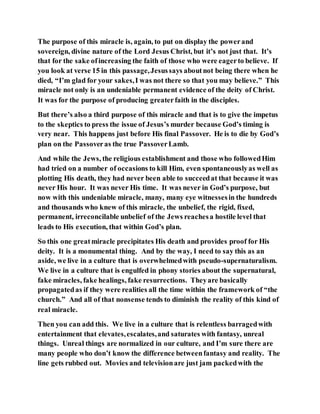
The purpose of this miracle is, again, to put on display the powerand
sovereign, divine nature of the Lord Jesus Christ, but it’s not just that. It’s
that for the sake ofincreasing the faith of those who were eagerto believe. If
you look at verse 15 in this passage,Jesussays aboutnot being there when he
died, “I’m glad for your sakes,I was not there so that you may believe.” This
miracle not only is an undeniable permanent evidence of the deity of Christ.
It was for the purpose of producing greaterfaith in the disciples.
But there’s also a third purpose of this miracle and that is to give the impetus
to the skeptics to press the issue of Jesus’s murder because God’s timing is
very near. This happens just before His final Passover. He is to die by God’s
plan on the Passoveras the true PassoverLamb.
And while the Jews, the religious establishment and those who followedHim
had tried on a number of occasions to kill Him, even spontaneouslyas well as
plotting His death, they had never been able to succeedat that because it was
never His hour. It was never His time. It was never in God’s purpose, but
now with this undeniable miracle, many, many eye witnessesin the hundreds
and thousands who knew of this miracle, the unbelief, the rigid, fixed,
permanent, irreconcilable unbelief of the Jews reachesa hostile level that
leads to His execution, that within God’s plan.
So this one greatmiracle precipitates His death and provides proof for His
deity. It is a monumental thing. And by the way, I need to say this as an
aside, we live in a culture that is overwhelmedwith pseudo-supernaturalism.
We live in a culture that is engulfed in phony stories about the supernatural,
fake miracles, fake healings, fake resurrections. Theyare basically
propagatedas if they were realities all the time within the framework of “the
church.” And all of that nonsense tends to diminish the reality of this kind of
real miracle.
Then you can add this. We live in a culture that is relentless barragedwith
entertainment that elevates,escalates,and saturates with fantasy, unreal
things. Unreal things are normalized in our culture, and I’m sure there are
many people who don’t know the difference betweenfantasy and reality. The
line gets rubbed out. Movies and televisionare just jam packedwith the
unreal offeredas if it’s reality, the fantasy world. And in a culture that is
engulfed in those kinds of pseudo-supernatural realities, it’s hard for people
to see the resurrectionof a man 4 days dead who walks out of his grave in a
small village in Judea 2,000 years ago as anything that matters.
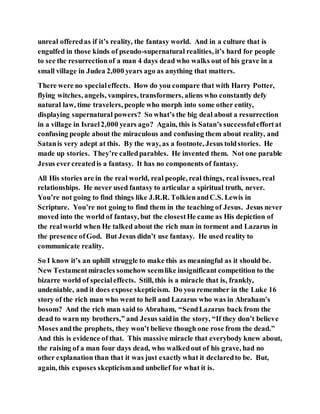
There were no specialeffects. How do you compare that with Harry Potter,
flying witches, angels, vampires, transformers, aliens who constantly defy
natural law, time travelers, people who morph into some other entity,
displaying supernatural powers? So what’s the big deal about a resurrection
in a village in Israel2,000 years ago? Again, this is Satan’s successfuleffortat
confusing people about the miraculous and confusing them about reality, and
Satanis very adept at this. By the way, as a footnote, Jesus toldstories. He
made up stories. They’re calledparables. He invented them. Not one parable
Jesus evercreatedis a fantasy. It has no components of fantasy.
All His stories are in the real world, real people, real things, real issues, real
relationships. He never used fantasy to articular a spiritual truth, never.
You’re not going to find things like J.R.R. TolkienandC.S. Lewis in
Scripture. You’re not going to find them in the teaching of Jesus. Jesus never
moved into the world of fantasy, but the closestHe came as His depiction of
the realworld when He talked about the rich man in torment and Lazarus in
the presence ofGod. But Jesus didn’t use fantasy. He used reality to
communicate reality.
So I know it’s an uphill struggle to make this as meaningful as it should be.
New Testamentmiracles somehow seemlike insignificant competition to the
bizarre world of specialeffects. Still, this is a miracle that is, frankly,
undeniable, and it does expose skepticism. Do you remember in the Luke 16
story of the rich man who went to hell and Lazarus who was in Abraham’s
bosom? And the rich man said to Abraham, “SendLazarus back from the
dead to warn my brothers,” and Jesus saidin the story, “If they don’t believe
Moses andthe prophets, they won’t believe though one rose from the dead.”
And this is evidence of that. This massive miracle that everybody knew about,
the raising of a man four days dead, who walkedout of his grave, had no
other explanation than that it was just exactlywhat it declaredto be. But,
again, this exposes skepticismand unbelief for what it is.
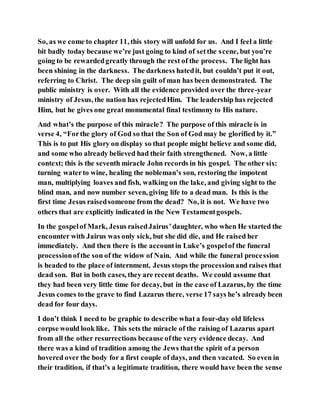
So, as we come to chapter 11, this story will unfold for us. And I feel a little
bit badly today because we’re just going to kind of setthe scene, but you’re
going to be rewardedgreatly through the rest of the process. The light has
been shining in the darkness. The darkness hatedit, but couldn’t put it out,
referring to Christ. The deep sin guilt of man has been demonstrated. The
public ministry is over. With all the evidence provided over the three-year
ministry of Jesus, the nation has rejectedHim. The leadership has rejected
Him, but he gives one great monumental final testimony to His nature.
And what’s the purpose of this miracle? The purpose of this miracle is in
verse 4, “Forthe glory of God so that the Son of God may be glorified by it.”
This is to put His glory on display so that people might believe and some did,
and some who already believed had their faith strengthened. Now, a little
context; this is the seventh miracle John records in his gospel. The other six:
turning waterto wine, healing the nobleman’s son, restoring the impotent
man, multiplying loaves and fish, walking on the lake, and giving sight to the
blind man, and now number seven, giving life to a dead man. Is this is the
first time Jesus raisedsomeone from the dead? No, it is not. We have two
others that are explicitly indicated in the New Testamentgospels.
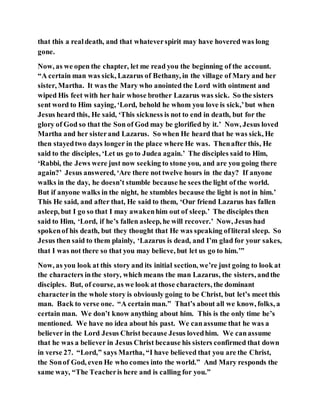
In the gospelof Mark, Jesus raisedJairus’daughter, who when He started the
encounter with Jairus was only sick, but she did die, and He raised her
immediately. And then there is the accountin Luke’s gospelof the funeral
processionofthe son of the widow of Nain. And while the funeral procession
is headed to the place of internment, Jesus stops the processionand raises that
dead son. But in both cases, they are recent deaths. We could assume that
they had been very little time for decay, but in the case of Lazarus, by the time
Jesus comes to the grave to find Lazarus there, verse 17 says he’s already been
dead for four days.
I don’t think I need to be graphic to describe what a four-day old lifeless
corpse would look like. This sets the miracle of the raising of Lazarus apart
from all the other resurrections because ofthe very evidence decay. And
there was a kind of tradition among the Jews thatthe spirit of a person
hovered over the body for a first couple of days, and then vacated. So even in
their tradition, if that’s a legitimate tradition, there would have been the sense
that this a realdeath, and that whateverspirit may have hovered was long
gone.
Now, as we open the chapter, let me read you the beginning of the account.
“A certain man was sick, Lazarus of Bethany, in the village of Mary and her
sister, Martha. It was the Mary who anointed the Lord with ointment and
wiped His feet with her hair whose brother Lazarus was sick. So the sisters
sent word to Him saying, ‘Lord, behold he whom you love is sick,’but when
Jesus heard this, He said, ‘This sickness is not to end in death, but for the
glory of God so that the Son of God may be glorified by it.’ Now, Jesus loved
Martha and her sisterand Lazarus. So when He heard that he was sick, He
then stayedtwo days longer in the place where He was. Thenafter this, He
said to the disciples, ‘Let us go to Judea again.’ The disciples said to Him,
‘Rabbi, the Jews were just now seeking to stone you, and are you going there
again?’ Jesus answered, ‘Are there not twelve hours in the day? If anyone
walks in the day, he doesn’t stumble because he sees the light of the world.
But if anyone walks in the night, he stumbles because the light is not in him.’
This He said, and after that, He said to them, ‘Our friend Lazarus has fallen
asleep, but I go so that I may awakenhim out of sleep.’ The disciples then
said to Him, ‘Lord, if he’s fallen asleep, he will recover.’ Now, Jesus had
spokenof his death, but they thought that He was speaking ofliteral sleep. So
Jesus then said to them plainly, ‘Lazarus is dead, and I’m glad for your sakes,
that I was not there so that you may believe, but let us go to him.’”
Now, as you look at this story and its initial section, we’re just going to look at
the characters inthe story, which means the man Lazarus, the sisters, andthe
disciples. But, of course, as we look at those characters, the dominant
characterin the whole story is obviously going to be Christ, but let’s meet this
man. Back to verse one. “A certain man.” That’s about all we know, folks, a
certain man. We don’t know anything about him. This is the only time he’s
mentioned. We have no idea about his past. We canassume that he was a
believer in the Lord Jesus Christ because Jesus lovedhim. We canassume
that he was a believer in Jesus Christ because his sisters confirmed that down
in verse 27. “Lord,” says Martha, “I have believed that you are the Christ,
the Sonof God, even He who comes into the world.” And Mary responds the
same way, “The Teacheris here and is calling for you.”
So this is a family that had come to believe in Christ. That’s all we know
about them. His name, Lazarus, not to be confusedwith the Lazarus in the
beggarstory, but an interesting parallel, isn’t it? That it was an issue of
resurrectionthat was brought up in that story about that other Lazarus. That
was a fictional Lazarus in the story that Jesus invented. But why two named
Lazarus? It was a very common name, a very common name from the Old
Testamentname, Eleazar, Eleazar, a very familiar Old TestamentHebrew
name. It means, whom God helps, whom Godhelps.
So here is a man, a Jewishman, given a wonderful familiar, common name.
We know nothing about him exceptthat he had two sisters who were
believers, and we assume he was a believer by what we read in this account.
They lived in the village of Bethany. That’s another interesting note because
at the time that Jesus gets this message,He’s in another Bethany. The tenth
chapter ends in verse 40. “He went awayagainbeyond the Jordan to the
place where John was first baptizing and was staying there.” That place,
according to 1:28 of John was also calledBethany. So there was a Bethany
beyond Jordan a day awayfrom the Bethany of Lazarus and his two sisters.
Bethany is a small village. It means, house of the poor, house of poverty.
That would be characteristic ofthat village. Perhaps that’s characteristic of
the other village where Jesus was currently ministering. And by the way,
many were coming and believing in Him. That’s how chapter 10 ends. Once
He got out of Jerusalem, and out beyond the Jordan back where John started
to minister, He began to reap the harvestof what John had planted in
proclaiming Him. And the people out there said everything John said about
Him is true, and they came to believe. That’s how chapter 10 ends.
So they’re having a wonderful ministry there in that other Bethany, but here
comes a messengerto Him with word about this man, Lazarus. It also tells us
that Bethany was the village of Mary and her sister, Martha. Now, that’s fine.
Those are also very common names, especiallyMary. Mary is an extremely
common name. When we getto the story of the cross, there are going to be
Mary’s everywhere. It was a very popular name because it was a variation on
the name Miriam. Miriam was the sisterof Moses. Miriamwas the deliverer
of the deliverers. She was the saviorof the savior. She is the one who saved
the life of Israel’s greatesthero, Moses. So many parents named their
children, their daughters, Miriam.
But this Mary, verse 2, is further identified for us. This is the Mary, who
anointed the Lord with ointment and wiped His feet with her hair, whose
brother Lazarus was sick. It’s that Mary, that Mary from Bethany. Bethany,
two miles from the easternwallof Jerusalem, down the back slope of the
easternwall, across the Kidron brook, up the Mount of Olives around the
bend and you’re in this little village of Bethany.
I can remember many years ago when Patricia and I were there and a
number of times visiting there myself, but Patricia and I were there. I would
say when we were there to find the traditional site of the grave of Lazarus and
to go down the deep stairs into what is traditional said to be the place where
he was entombed. I remember it was an Arab village at the time. There were
Arabic womenliving there, Palestinianwomen living there, and we had the
very bizarre occasion– Patricia will remember this – of having a lady offering
us the opportunity to purchase her baby.
Now, I don’t know whether that was something she used as a device, but we
were not interestedin buying her baby. But that village, to this very day, is in
Arabic named after Lazarus. So that’s the little village, and it is as
nondescript, the last time I was there perhaps as it was even in ancient times.
This is the Mary who lived there with her brother. Now, notice verse 2. “It
was Mary who anointed the Lord with ointment and wiped His feet with her
hair.”
Oh, that Mary. But wait a minute, that story doesn’t come until chapter12.
What’s going on here? Thatstory doesn’tcome until chapter12. But listen,
that’s okaybecause that story had already been told in detail in Matthew and
already told in detail in Mark and Matthew and Mark had been circulating
for a very long time by the year 90 in the first century when John writes this
gospel. And so even though he hasn’t yet given his accountof it, he knows
they know that that Mary is the one he’s talking about.
And so he literally builds his comment on the knowledge ofMatthew and
Mark, gospels writtenvery much earlier. So, it is this Lazarus, the brother of
this Mary and this Martha in this place calledBethany. Now, allwe know
about him is he was sick. Thatis the only thing we know about him. No
diagnosis. We don’t know what his illness was. We know why he was sick,
which is pretty important. We don’t know what he was sick with, but we
know why he was sick. You say, why was he sick? Verse 4, “This sicknessis
not to end in death, but for the glory of God.” He is sick for the glory of God.
Well, that’s not new to us. Who else had an infirmity for the glory of God?
Chapter 9, the man born blind, and what did the leaders say? “Who sinned?
This man or his parents?” Jesussaid, “Nobodysinned, but this is for the
glory of God.” I’m going to put my divine glory on display.
Mark that out folks. There is sicknessthat is just natural sickness. It’s just
natural sickness. Itjust comes because we live in a fallen world. It’s
inevitable. There is sickness thatis a discipline from God on His own people.
“Some of you,” Paul says, “are weak andsick, and some of you sleepbecause
of tampering with the sanctity of the Lord’s Table.” Carefulhow you deal
with the Lord’s Table. And there is sicknessthat is a divine judgment. God
actually smites a man in Acts 12, and he’s eatenwith worms, but there is
sicknessthat is for the glory of God.
I was at the hospital yesterday and stoodover the bed of a man in serious
condition with heart issues, and I prayed that his sickness wouldbe for the
glory of God, and that God would graciouslyraise him up and give him
strength and bring him back if it would glorify God. I don’t know what God’s
purpose is in his sickness, but Jesus tells us what the purpose was in this
man’s sickness,to put His glory on display.
So we meet Lazarus. We can callhim the criticalman. Yeah, he’s in critical
condition. His case is critical to the declarationof the deity of Christ and then
we meet the concernedsisters. So the sisters in verse 3, Mary and Martha,
sent word to Him. So this is going to take a day, a day to getfrom Bethany
one to Bethany two. The messageis very cryptic, very short. “Lord,” they
acknowledge He is Lord. “Behold,” which means, this is urgent; this is
sudden; this demands immediate response. “He whomyou love is sick.”
That’s the whole message. “He whom you love is sick.”
Since Jesus had left back in verse 40 of chapter 10 some weeks earlier, this
man had become sick. His sickness has reacheda critical point, and they send
this messengerto say, “He whom you love is sick.” Theyneedto saynothing
more. They don’t give Jesus any instructions. They don’t demand a healing.
They don’t say they have faith to believe. They just give Him the information.
“He whom you love is sick.” And their appeal, listen, is not based on
Lazarus’s love for Jesus. Theydon’t use Lazarus’s love for Jesus as if it’s
some kind of mechanism that activates Jesus.
They talk only of Jesus’s love for Lazarus. They think that will catch His
heart, and here’s a very important insight: “He whom you love.” The word
love here is not agapaō, not divine love. This is phileō, the love of a friend,
personalaffection, human love. Jesus lovedthis man as a friend. He had
personalaffectionfor him. It’s obvious that as God, He loves the world, that
as God He loves His own who are in the world, and He loves them to
perfection. He will tell them that in the upper room, but that’s not the
thought here. Thatthought comes later. The thought here is this is a man for
whom Jesus had deep affection. This is a man who filled a need in his own life
for a friend.
I know we talk about the humanity of Jesus and we have to, and He’s fully
human. But almostall the time you hear someone talk about the humanity of
Jesus they say, “Well, He lived and He hungered, and He thirsted, and He
slept, and He was weary, and He died.” And all of those are human things,
but what makes humans unique is relationships, and this is explains why when
He gets to the grave, He cries. He cries at the thought that His friend is dead.
This is a beautiful insight into the full humanity of Jesus. He is a man and like
every person, He requires a friend, somebody who cares aboutHim. A
perfect man with all the needs of a man.
You see, this is part of what makes Him such a merciful, faithful High Priest
able to be touched with all the feelings of our infirmities because some ofour
infirmities have nothing to do with physical well-being. Theyhad to do with
relationships, right? Right? I mean isn’t the worstof it all? Isn’t that where
the most pain comes from? You could probably take the cancerif all the
relationships were what they should be, but His sympathy extends to
understanding relationships. He’s been there. His friend that He had great
affectionfor was sick, seriouslysick.
So the sisters sendthat message,and they know that’s all that has to be said.
The messengerarrives after a day. It’s a day’s journey. And when Jesus
hears from him, verse 4, He said, “This sicknessis not to end in death.” It’s
not going to end in death. There will be death. There already is death
because by the time the messengergets there, Lazarus is dead. He may have
died as soonas the messengerleft. They may have realized the critical
condition of Lazarus and dispatched the messenger, and he died right after
that.
But it’s not going to end that way. That’s not the end of the story. “But for
the glory of God so that the Sonof Godmay be glorified by it.” This sickness
is not unto death. It is a sicknessto the glory of God. Verse 5 adds another
component. “Now, Jesus lovedMartha and her sisterand Lazarus.” This
time the word changes. This is agapaō. This is divine love. He loved this man
Lazarus, about which we don’t know anything. He loved an obscure man like
a man loves a friends. But he also loved this whole family with a divine love
because they belongedto Him spiritually, like He loves His ownwho are in the
world even to the maximum. So much love. He loves with a divine love and
He loves with a human love.
So when He heard that he was sick, you expectto read, “He went as fast as He
could.” It doesn’t saythat. He stayed two days longer in the place where He
was. He’s been dead a day while the messengerhas gottenthere. He waits
two more days, and then after two days, and the disciples are probably
processing this because they’re aware of the meeting. Why is He waiting?
But they’re grateful. They think this is good. This is really good. He’s not
going back. He’s gotenough common sense to know you can’t go back
because we just escapeda stoning. Chapter10, verse 31 and the end of
chapter 10, they tried to grab Him againto kill Him. We just gotout of that
situation.
This is goodand so for two days they keeppreaching and ministering, and
people are believing and they’re having a greattime. And then after two
days, He says to His disciples, “Let’s go to Judea again.” Theirworst fears.
The disciples said to Him in verse 8, “Rabbi, the Jews were just now recently
seeking to stone you and are you going there again?” Are you thinking this
through? I mean the sisters wishedHe had been there and never left. Verse
21, Martha says to Him when He gets there, “If you had been here, my
brother would not have died.” And later on, Mary says in verse 32 the same
thing, “If you had been here, my brother would not have died.” But He
couldn’t be there because He had to run for His life.
But now it’s time to go back, and of course they see it as highly dangerous. So
they remind Him that He just escapeda stoning and it makes no sense to go
there again; to which He answers with a very interesting Proverb. Verses 9
and 10, “Are there not twelve hours in the day? If anyone walks in the day, he
doesn’t stumble. That is, nothing bad happens to him because he is in the
light and he can see whathe is doing and where he is going. But if anyone
walks in the night, he stumbles. Bad things happen because the light is not in
him.” What is the point of that sortof strange introduction?
Well, at this point we are now moving from the man, the critical man and the
concernedsisters to the disciples. Now, they are puzzles. Why would you step
back into this and here’s His answer. It’s a proverb, and the proverb is
simple, very simple proverb. You can’t lengthen the daylight. You can’t
shorten the daylight, right? Nothing any friend cando canlengthen the
daylight. Nothing any enemy cando canshorten the daylight. It is what it is
and it is fixed by God, and so is my life. No enemy canshorten it. No friend
can lengthen it. It is what it is. And in that light of life which God has
ordained for me, I will not stumble. That is to say, nothing will happen to me
that is outside the plan. I’m not going in the dark. I’m going in the light of
God’s divine day. A day can’t finish before it’s ordained end.
The time allotted to me to accomplishmy earthly ministry is fixed. It’s fixed
by God. It can’t be lengthened by any precautionary measures. You don’t
have to go hide somewhere in a cave. You don’t have to avoid conflict. You
don’t have to run from your enemies because you can’t lengthen your life, and
you canbe bold and you can step right into the face of your enemies because
they can’t shorten it. I tell you, just from my ownpersonal standpoint, I live
in that confidence. I can’t do anything. Neither can anybody else to lengthen
my life. I’m not afraid that somebody, some enemy can do anything to
shorten my life. My day is what God has ordained it will be, and in that I go
forward with confidence and boldness.
Jesus knew that His hour was coming, but it hadn’t come yet, and many times
He’d said, “My hour hasn’t come. My hour hasn’t come.” And He escaped
all of the plots and all of the mob violence. This has greatapplication for us I
think to realize that if you’re walking in the Spirit and serving the Lord, you
have your day. Being a cowardand taking all kinds of precautionary steps
and not being faithful isn’t going to lengthen it; and being bold in the face of
enemies isn’t going to shorten it because it is what Godhas ordained it to be.
So this He said, verse 11, “And after that He said to them, ‘Our friend.’” Now
we know Lazarus knows everybody. He knows all the disciples. They’ve
probably stayed in his house many times because it was right on the road
from Jericho to Jerusalem, which is the way that everybody came from
Galilee to go to the Passoverand every other feast. It must have been like an
inn on the way, especiallyfor believers. “Our friend, Lazarus,” He says, “has
fallen asleep.” That’s a tender way to refer to his death, isn’t it? And it was
temporary. That’s why He used that symbol.
“‘But I go so that I may awakenhim out of sleep.’ So the disciples said to
Him, ‘Lord, if he’s fallen asleep, he will recover.’” They’re diagnosing the
situation saying, “Well, if he’s sleeping, that’s a goodthing, right? If he’s
sleeping, he’s going to gain strength. That’s what you want to do when you’re
sick is getlots of sleep. So he’s going to be fine. Let’s just stay here. He’s
sleeping. Don’t go. He’ll recover. He’s going to get better.”
“Jesus hadspokenof his death, verse 13, but they thought He was speaking of
literal sleep. So then Jesus saidto them plainly, ‘Lazarus is,’ read my lips,
‘dead.’” Dead. Wow, the messengersaidhe’s sick. The Lord said this
sicknessis not going to end in death. Now, the Lord declares he is dead, plain
and simple, and they need to understand that when He said I’m going to
awakenhim out of sleep, He means that I’m going to raise him from the dead.
Jesus didn’t know Jairus’ family. Jesus didn’t know the widow of Nain’s
family when He raised those two people. This is somebody He really loved,
and He is going to raise him from the dead for His glory and the glory of God.
So in verse 15 He says, “I’m glad he’s dead.” I’m glad he’s dead, on the
divine level. “Foryour sakes, I’m glad that I wasn’t there. Let us go to him.”
Let’s go, guys. The disciples were always struggling with faith, weren’t they?
“O ye of little faith, O ye of little faith, O ye of little faith. Why don’t you
believe?”
Yes, they believed in Him. Yes, they had affirmed that He was the Christ, the
Son of God, but they needed faith to be strengthened and strengthenedand
strengthened. I mean it wasn’t just that they would believe, but that Mary
and Martha would have their faith strengthened. And then down in verse 45,
many Jews who came to Mary and gotthe whole story of the resurrectionfirst
hand, and were eyewitnessesofthe living brother, believed in Him. This is a
glory display that’ll produce faith, and it’ll also produce hostility that drives
Him to the cross right on schedule.
Then in verse 16 we meet Thomas. He doesn’t say much, but he’s well-known
for being a pessimistand a doubter. “Therefore, Thomas, who is called
Didymus, means the Twin,” he obviously had a twin, “said to his fellow
disciples, ‘Let us also go so that we may die with Him.’” Hey, what a downer.
“Let us also go that we may die with Him.” He gets a lot of bad press for that,
but just think about this. This is a courageouspessimist. This is not a
cowardlypessimist. He didn’t say, “Let’s getout of here or we will all die
with Him.” He said, “Let’s go and die with Him.” This man has greatfaith,
and this man knows what Luke 9:23 means. “If you want to come after Me,
deny yourself. Take up your – “what? “ - cross.” It might costus our lives,
men. Let’s go.
And so they go, and when they arrive he’s been dead four days; the day the
messengercame, the two days, the day back, four days. Now the story gets
very fascinating, and that’s for next time, as you could well tell.
Lord, we’re grateful for such rich textured detail about real people, real
places, realissues oflife. The Bible is so historical, natural, and at the same
time supernatural. Such a wonderful thing to be in a position now to become
eye witnessestogetherofthis most monumental miracle. This miracle that is
John’s culminating evidence of Jesus’s deity, this miracle, which strengthens
the faith of those who already believed and becomes the motivation for the
faith of those who are about to believe. This miracle, which becomes the final
impetus to hard-hearted unbelievers to execute the Son of God, but only on
your schedule, your time, your place, your means.
Father, we look forward to all that is head of us, and at the same time, we’re
grateful for what we’ve seeneven at this juncture in the story; that you desire
to be glorified, that you call people to believe and be saved, to be delivered
from hell and death and judgment by putting trust in the Lord Jesus Christ.
As Christians, may our faith be strengthened. Give us greaterfaith as we see
this unfolding glorious evidence of our Lord’s divine nature. May it be the
means that you use to bring people to saving faith; and, Lord, if necessary, let
it be a saver of death unto death to those who deny what is undeniable. But,
Lord, accomplishyour purpose to your glory because that’s the purpose for
which we have this record. Be glorified, every way. We pray in Christ’s
name, Amen.
Ephesians 3:20-21, “Now to Him who is able to do far more abundantly
beyond all that we ask or think according to the powerthat works within us,
to Him be the glory in the church and in Christ Jesus to all generations
forever and ever. Amen.”
When Jesus Waits
Sermon by Billy Dempsey on Apr 14, 2013
John 11:1-15
Play
Mute
Loaded: 0%
Progress:0%
Remaining Time
-0:00
DownloadAudio
Print
The Lord's Day Evening
April 14, 2013
“When Jesus Waits”
John 11:1-57
The ReverendMr. William E. Dempsey
Father, how we thank You for Your Word. It is rich, it is true, it is sweetness
to our souls. Now Father, let us lay aside everything else. We have nothing
better to do than sit at Your feetand hear from You and learn of You. We
would ask You, as we do so, make our hearts like Jesus’. And when we leave
here and go about the business of the week that You have prepared for us in
the days ahead, would it be knownthat we're among those who have been
with Jesus. Hearus, as we make our prayer in His name and for His sake.
Amen.
Let's give our attention to the reading of God's Word, the whole of John
chapter 11:
“Now a certain man was ill, Lazarus of Bethany, the village of Mary and her
sisterMartha. It was Mary who anointed the Lord with ointment and wiped
his feetwith her hair, whose brother Lazarus was ill. So the sisters sent to
him, saying, ‘Lord, he whom you love is ill.’ But when Jesus heard it he said,
‘This illness does not lead to death. It is for the glory of God, so that the Son of
God may be glorified through it.’
Now Jesus lovedMartha and her sisterand Lazarus. So, when he heard that
Lazarus was ill, he stayed two days longer in the place where he was. Then
after this he said to the disciples, ‘Let us go to Judea again.’The disciples said
to him, ‘Rabbi, the Jews were justnow seeking to stone you, and are you
going there again?’Jesus answered, ‘Are there not twelve hours in the day? If
anyone walks in the day, he does not stumble, because he sees the light of this
world. But if anyone walks in the night, he stumbles, because the light is not in
him.’ After saying these things, he said to them, ‘Our friend Lazarus has
fallen asleep, but I go to awakenhim.’ The disciples said to him, ‘Lord, if he
has fallen asleep, he will recover.’Now Jesus had spokenof his death, but they
thought that he meant taking rest in sleep. Then Jesus told them plainly,
‘Lazarus has died, and for your sake I am glad that I was not there, so that
you may believe. But let us go to him.’ So Thomas, calledthe Twin, said to his
fellow disciples, ‘Let us also go, that we may die with him.’
Now when Jesus came, he found that Lazarus had alreadybeen in the tomb
four days. Bethany was nearJerusalem, about two miles off,and many of the
Jews had come to Martha and Mary to console them concerning their brother.
So when Martha heard that Jesus was coming, she went and met him, but
Mary remained seatedin the house. Martha said to Jesus, ‘Lord, if you had
been here, my brother would not have died. But even now I know that
whateveryou ask from God, God will give you.’ Jesus said to her, ‘Your
brother will rise again.’Martha said to him, ‘I know that he will rise againin
the resurrectionon the lastday.’ Jesus saidto her, ‘I am the resurrectionand
the life. Whoeverbelieves in me, though he die, yet shall he live, and everyone
who lives and believes in me shall never die. Do you believe this?’ She said to
him, ‘Yes, Lord; I believe that you are the Christ, the Son of God, who is
coming into the world.’
When she had said this, she went and called her sister Mary, saying in private,
‘The Teacheris here and is calling for you.’ And when she heard it, she rose
quickly and went to him. Now Jesus had not yet come into the village, but was
still in the place where Martha had met him. When the Jews who were with
her in the house, consoling her, saw Mary rise quickly and go out, they
followedher, supposing that she was going to the tomb to weepthere. Now
when Mary came to where Jesus was and saw him, she fell at his feet, saying
to him, ‘Lord, if you had been here, my brother would not have died.’ When
Jesus saw her weeping, and the Jews who had come with her also weeping, he
was deeply moved in his spirit and greatlytroubled. And he said, ‘Where have
you laid him?’ They said to him, ‘Lord, come and see.’Jesus wept. So the
Jews said, ‘See how he loved him!’ But some of them said, ‘Could not he who
opened the eyes of the blind man also have kept this man from dying?’
Then Jesus, deeply moved again, came to the tomb. It was a cave, and a stone
lay againstit. Jesus said, ‘Take awaythe stone.’Martha, the sisterof the dead
man, saidto him, ‘Lord, by this time there will be an odor, for he has been
dead four days.’ Jesus saidto her, ‘Did I not tell you that if you believed you
would see the glory of God?’So they took awaythe stone. And Jesus lifted up
his eyes and said, ‘Father, I thank you that you have heard me. I knew that
you always hearme, but I said this on accountof the people standing around,
that they may believe that you sent me.’ When he had saidthese things, he
cried out with a loud voice, ‘Lazarus, come out.’ The man who had died came
out, his hands and feet bound with linen strips, and his face wrapped with a
cloth. Jesus saidto them, ‘Unbind him, and let him go.’
Many of the Jews therefore, who had come with Mary and had seenwhat he
did, believed in him, but some of them went to the Pharisees andtold them
what Jesus had done. So the chief priests and the Phariseesgatheredthe
council and said, ‘What are we to do? Forthis man performs many signs. If
we let him go on like this, everyone will believe in him, and the Romans will
come and take awayboth our place and our nation.’ But one of them,
Caiaphas, who was high priest that year, said to them, ‘You know nothing at
all. Nor do you understand that it is better for you that one man should die for
the people, not that the whole nation should perish.’ He did not say this of his
own accord, but being high priest that year he prophesied that Jesus would
die for the nation, and not for the nation only, but also to gather into one the
children of God who are scatteredabroad. So from that day on they made
plans to put him to death.
Jesus therefore no longerwalkedopenly among the Jews, but went from there
to the regionnear the wilderness, to a town calledEphraim, and there he
stayed with the disciples.
Now the Passoverofthe Jews was athand, and many went up from the
country to Jerusalembefore the Passoverto purify themselves. Theywere
looking for Jesus and saying to one another as they stoodin the temple, ‘What
do you think? That he will not come to the feastat all?’ Now the chief priests
and the Pharisees had given orders that if anyone knew where he was, he
should let them know, so that they might arrest him.”
All men are like grass and all their glory is like the flowers of the field. The
grass withers, the flower fades, but the Word of our God stands forever.
We cry, “Help!” oftentimes, don't we? And when we cry, “Help!” we don't
mean, “Maybe in a little bit come help me,” we don't mean, “Maybe
tomorrow come help me,” we don't mean, “Whenit's convenient for you come
help me.” Sometimes we need help and we say, “Help! Help now! Help right
away!” That really is the spirit in which Mary and Martha sentword to Jesus
that their brother was dying. Maybe they waited too long, maybe they didn't
count on the vagaries of walking travel, but Jesus did not come. Maybe He
couldn't have made it anyway; that's not what the Word says. The Word says
Jesus did not come. Jesus waitedand chose to come later. That's often how He
deals with us, isn't it? We call out to Him for help and He waits. He chooses to
wait. He comes in His own time, in His own way, and really for His own
purposes. And that's really what this passage showsus. This whole chapter
shows us that Jesus is pursuing His own purposes with different groups of
people as He waits. I want us to look at the purposes He pursues with His
disciples, and with Mary and Martha and Lazarus, as well as with the chief
priests and the Pharisees.So maybe this sermonwill just be the kind of thing
that will peak your interestand you will go back home and this week dig more
deeply into the things that we're going to be talking about tonight. We lack the
time to really, really uncover all the things that are here, but maybe you’ll
become more interestedin this passage andwant to go and see how it is that
Jesus is dealing with His people and uncover more deeply. I think we learn a
lot about the way Jesus deals with us as we see Him deal with these various
people.
Let's look at His disciples first of all, and maybe evenbefore we get to the
disciples, just one note to make regarding verse 5. Look at verse 5. “Now Jesus
loved Martha and her sister and Lazarus.” And I would only sayin passing,
He loved them but He allowedthem to suffer a greatdeal. He loved them but
He allowedthem to suffer a greatdeal.
Let's talk about the disciples. Here they are. We’re not sure where they are.
They’re a leasta two days walk from the little village of Bethany, and so they
receivedthis messagefrom the sisters that Lazarus is ill, but Jesus waits, He
waits for two days. Verse 6 — “He stayedtwo days longer.” And then He says
to the disciples, “Let's go back to Judea.” The disciples aren't thinking of
Lazarus; they’re thinking of security and safety. Do you recognize that? They
say to Him, “Rabbi, the Jews were just now — the last time we were there
they were seeking to stone You! Why do You want to go back there? You
want to go there again?” He's calling them to leave their security and their
safetyif they go back to Judea. And Jesus really, in a kind of veiled manner of
speech, says to them basically, “My time has not yet come and they cannot
shorten the length of My ministry; they cannot shortenthe time that God has
given Me. That time is not in their hands. They can't decide that. The length
of My ministry, the length of My time here, the hour of My departure is in the
Father's hands.” That's really what He says as He talks about anyone walking
in the light, walking in the day. What is that? It's the light that's shapedby
the doing of God's will. That person doesn'tstumble because he sees the light.
If someone walks in the night that person is living a life that's shaped by
avoiding God's will. He's going to stumble. The light's not in him. He says,
“We’re going to walk in the light. We’re going to walk in the light of doing
God's will. We’re going to walk in the light of God's ways keeping us
understanding that God has the appointed time, not the chief priests and not
the Pharisees.”He's calling them to trust. He's calling them to trust.
And He says, as they get to the matter of Lazarus — it's so interesting that
they didn't start with the matter of Lazarus but as they finally get to the
matter of Lazarus He tells them plainly that Lazarus has died. And as He does
so, He says, “I am so glad that we were not there, that I wasn'tthere, because
you need to believe.” He's saying to them, “You need a faith-shaping
confirmation that I am who I have revealedMyselfto be, that I am who you
vaguely think I am. You need to see something. It's important for you that we
go. It's important for you that we go now that Lazarus is dead because you
need to see something amazing.” He's calling them not just to follow but He's
calling them to believe and He's telling them, “I'm going to give you
something. I'm going to give you something as sort of a sealon your faith. I'm
going to give you something that you need.” He's waited. He's waited in order
to give them something that He says their faith needs. Sometimes He waits as
you and I call in order to give us something that our faith needs, a
confirmation, a nearness, anevent. Maybe it's a stunning answerto prayer;
maybe it's a stunning act of provision. Maybe it's a stunning ordering of
events that we never could have guessedornever could have imagined or
never could have orchestrated, andyet He's laid it all out. He waits at times to
give our faith a shape and a form and a confirmation that we so desperately
need.
Sometimes He waits in order to make us really think about our faith and
examine our faith. I think that's what we see as Jesus has this interchange
with Martha. Let's look at verse 17 and following. He comes to Bethany; He
finds that Lazarus has alreadybeen in the tomb for four days. There are
plenty of people there to comfort Mary and Martha and their family. Verse 20
— “When Martha heard He was coming, she went to meet Him, but Mary
remained seatedin the house.” We understand that, as we know a little bit
about Martha and Mary — Mary's the doer. Mary's the one to go. Mary's the
one to be active and involved. Mary's going to be the one who grieves in a
different way. She's going to be the one who grieves off alone, not in public.
She buries her grief in doing. And there are many people who do that. Mary,
Martha rather, is that one. She buries her grief in doing. And so she goes to
see Jesus. Mary's grieving a different way. She's going to grieve quietly, alone,
in private. And we’ll see her interact with Jesus very differently.
Martha begins to talk. Maybe Martha grieves by talking. She begins to talk.
Look how she and Jesus talk to eachother. Martha says, verse 21, “Lord, if
You’d been here, our brother would not have died. But even now, I know that
whateverYou ask from God, God, will give You.” And the question I would
ask Martha is, “Who's power is it? Who's poweris it? Is it God's power? Is it
Jesus’power?” She says to Jesus in just a few verses, “I believe that You are
the Christ, the Son of God, who is coming into the world.” I think that as
Jesus has waited, His exchange with Martha is to call her to examine her faith.
“Martha, what do you really believe and do you understand what you
believe?” “If You’d been here, my brother would not have died.” He says to
her, verse 23, “Your brother will rise again,” and immediately she gives a
greatanswer. “I know that my brother will rise again. He will rise againin the
resurrectionon the last day.” She lives in the hope of heaven. She lives
understanding that there is a day to come when God sets everything to right.
She understands that there is a day to come when the grave will open and the
people of God will come forth to be identified and known as the people of
God. She lives in the hope of heaven without understanding that the substance
of heaven's hope is standing there talking to her. And He says to her that very
thing, verse 25, “I am the resurrection and the life. It's not just and only a far
off, other-worldly event. I am the Lord of the resurrection;I am the giver of
life. All that have life have life by My gift. All that are resurrectedare
resurrectedby My power.” He's pushing Martha to think about what it means
for Him to be the Sonof God. He's pushing Martha to think, “What does it
mean for Him to be the Christ?” He's gently engaging her. He's not pushing a
grieving woman into a theologicalconversationthat she doesn't want to have
right now. She's anxious for this conversation. She's engagedin this
conversation. And He's taking this opportunity to push her, gently, carefully,
to help her examine, “Whatdoes she really believe?” When Jesus waits, as He
deals with you and me, so many times He's pushing — What do we really
believe? What do we understand of Him? His person and His work? What do
we really believe?
Sometimes waiting is like a fire, isn't it? And that fire is molding faith,
burning out dross, and we emerge from that fire with a faith that may be
strongerand purer and whiter. That is the opportunity that Martha has right
here as He's pushing her, as He's pushing her to not only profess faith but to
think through what she really believes. He says to her, “Do you believe this?”
“Yes, Lord, I believe that You are the Christ, the Sonof God, who's coming
into the world.” J.C. Ryle says it's a bent reed kind of profession;it's a
smoking flax or smoking wick kind of profession. It's not a strong profession
and it doesn't lastfor very long. If you look at verse 39, as Jesus has given the
order to take away the stone, it's Martha that pipes up, “Look, Lord, by this
time there will be an odor because he's beendead for four days! What are
You doing? This is unseemly!” She's made a profession, but she still doesn't
deeply understand. He's pushing her. “Martha, understand. Understand what
you sayyou believe.” He's not rebuking her. I think that's the point of Ryle's
description. You remember in Matthew chapter12, Jesus is describedas the
one who's not breaking the bent reed. He's not extinguishing the smoking flax,
the smoking wick. Sometimes that's exactly where we are, isn't it, as we deal
with Him, as we wait, as we waitfor Him, and He bears us up. He bears us up.
He takes even the weaknessofour faith and uses that experience to strengthen
us. As we have to sift through, “What do we really believe about Him and His
ways and His purposes? Is He really good? Is He really doing right? Does He
really do all things well? Or is He just playing a game with me?” He pushes us
to think about our faith, to try to understand, “Whatdo we really believe?”
But that's not all He does. When Jesus waits, sometimes it's in that waiting
that we experience uncommon comfort and uncommon grace. Notice the
difference in the way that He deals with these two sisters. Of course they’re
very different people. As I mentioned a while ago, Martha is this busy, active,
doer, who processeslife by talking. And Mary is this quiet, contemplative
person who is grieving awayand very emotionaland very given to
appropriate but sometimes maybe overwhelming emotionaldemonstration.
Remember, already in verse 2 of this chapter, we've been reminded that Mary
is the one who anoints Jesus with ointment and wipes His feet with her hair —
not quite a common occurrence. Evenin Jesus’day, it was an over-the-top
display of affectionand love and adorationand appreciation. But that's kind
of who Mary is, and in this moment, she's overwhelmed, as you can imagine,
with the grief of the loss of her brother. Interesting that she begins her
conversationwith Jesus much the same way that Martha does.
But look at this. Look at verse 32. “When Mary came to where Jesus was and
saw him” —what did she do? She didn't start talking. Martha started talking.
“She fell at His feet.” She's overcome by grief. She's overcome by sorrow.
She's overcome. She's so glad to see Him. She's so glad He's there. But she's
overcome still at the loss of her brother. Maybe the memories of the times that
she and Martha and Lazarus enjoyed with Jesus, Jesusbeing one that they
loved so much, and they know Jesus loves them. It overwhelms her to be in
His presence without her brother, Lazarus. We can identify with that kind of
grief. But she asks the same question. “Lord, if You had been here, my
brother would not have died.” Actually, she makes the same statement as her
sister, Martha. And after that pressing, engaging, theologicalconversation
that Jesus and Martha have, look at how Jesus interacts with Mary. Her faith
needs stretching, no doubt; her faith needs examining, no doubt. Her faith will
be tested, no doubt, but look at what He does. Look at verse 33. Jesus saw her
weeping and the Jews who had come with her also weeping. He's deeply
moved in His spirit. He's deeply troubled. He wants to see where they've laid
him. Verse 34 — “Where have you laid him?” Verse 35 — He weeps. He sheds
tears. He — I think in the NIV translation, “He bursts into tears,” so much so
that the Jews who were there to console are commenting to one another, “See
how much He loved him?” He's broken hearted. He's moved; He's moved to
deep agitation. He's moved to deep grief.
He's not carrying on a theologicalconversationwith Mary. Mary needs
theology, Mary needs doctrine, Mary needs to understand the truth, but at
this moment, she needs a priest. She needs a priest who's acquainted with her
weakness.At this moment she needs a priest who's touched by her grief. At
this moment, she needs a priest to bring her comfort. She needs a priest who's
sympathetic with her. That's what she receives. As Jesus has waitedand in the
waiting, now brings uncommon comfort, uncommon sympathy, uncommon
community in grief. That's what she needs. That's where Jesus meets her.
That's where Jesus deals with her, giving her a comfort, a community, a
knowingness in her grief that no one else can share with her. As Jesus has
waited, He's bringing her uncommon grace, uncommon comfort.
As we move through the passage, Jesus prepares to do what no one even
imagines He's about to do. He calls for that stone to be moved away, He has
that exchange with Martha — “He's been dead for four days. There will be an
odor.” “Did I not tell you that if you believed you would see the glory of God?
Martha, do you still not believe? Believe and you will see the glory of God.”
What is the glory of God? Is it not to reverse the effects of the Fall? Isn't that
exactly what Jesus is showing us? This is what it means for Messiahto come.
This is what it means for the Son of God to enter human history. This is what
it means for the kingdom of God to advance. It is that the powerof the evil
one, the powerof death, the power of sin rolls away, and the world canbegin
againin the fashion that God has made it. That's our hope. That's our
expectation. That's the glory of God expressed, demonstrated, before our very
eyes. We see it in bits and pieces now. We see it one by one as we see one come
to faith and another come to faith. We see it as one believer or another
grapples and wins with sin againstthe world, the flesh, and the devil. We see it
in baby steps now. Jesus shows us a greatbig bite of it right here as He orders
that stone awayand He yells out, “Lazarus, come out!” and in the next breath
Lazarus is standing at the door. The glory of God invading space and time!
Remember, Jesus loves Martha and her sisterand Lazarus but has subjected
them to greatsuffering. Think of Lazarus, undergoing the pain of death. He
subjectedthem to greatsuffering because He waited, but He's visiting them
with greatglory right now so that they see the greatness ofGod and the
greatness ofthe work God will do. They never would have guessedit. Their
nearesthope was what Martha expressed — at the greatresurrectionhe’ll
rise. She never thought it would be this afternoon! She never imagined she's
be feeding him supper! “Did I not tell you that if you believed, you would see
the glory of God?”
Well there's another group of people that we need to make note of as we come
to the end of this passage.Ofcourse the Jews are there. Many Jews are there
to comfort, and as John relates, many of those Jews believed. But some went
back to Jerusalemand they went right to the high priest; they went right to
the neighborhoodPharisee. Theywent right to anybody that would be
interestedin knowing, “Guess whatJesus did today?” You see, Jesus knows
who His enemies are and He's been thinking of them too. Let's not lose sight
of the fact that Jesus is the pursuer here. He's not pursued to death by His
enemies. RememberHe tells us in John chapter 10, “I will lay down My life
and no one takes it from Me.” He's pursuing His enemies. Theythink they’re
pursuing Him. “Oh, we're going to send somebody to arrestHim. As soonas
we know where He is, we're going to send somebody to arrestHim. We’re not
going to have this.” No, He's pursuing them. The initiative is His and He's
exercising, He's pushing back and pushing back and pushing back. He's
winning the day as He deals with His enemies and ours. He's winning the day.
Bruce Catton, in his history of the Civil War, makes note that until 1864,
Robert E. Lee controlled both sides of the warbecause he was leading his
troops and he had the initiative and every Union response was a response to
his originalinitiative. It was Robert E. Lee's war. It's Jesus’war. The enemies
are responding to His initiative. They think they’ll win, but Jesus knows the
glory of God. When Jesus waits, often He's calling us, “Follow Me and
believe.” When Jesus waits, oftenHe's calling us to examine really, “What is
our faith? What is our faith made of? What is it shaped by? What informs it?
What is the glue that holds it to life?” When Jesus waits, He gives us a
nearness and a comfort and a grace that we don't know in any other time.
When Jesus waits, the promise is that in someone, in some shape, at some
point, we will see the glory of God if we believe.
Let's go to the Lord in prayer. Let me ask you to stand.
Father, Your ways are not ours, You don't respond to our timetable, and
Your interest is not in our happiness. Your ways are Your own, Your
timetable is Your own, and Your interest is in our holiness and our being like
Christ. Make us so. Help us remember. Help us see whatour faith is made of.
Help us embrace that warm grace and comfort You provide. Help us follow
and believe. Hear us, our Father, as we make our prayer in Jesus'name and
for His sake. Amen.
Now look up for the blessing of God. Now may the Lord bless you and keep
you. May the Lord make His face to shine upon you and be gracious to you.
May the Lord Himself lift up His countenance upon you and give you His
peace both now and forevermore. Amen.
SicknessForThe Glory Of God
July 23, 2000
PastorScottL. Harris
Grace Bible Church, NY
January 7, 2017
Sicknessfor the Glory of God
John 11:1-16
Introduction – Reasons forSickness
Why do people get sick? Thatis one of the greatquestions of mankind, and if
we were all honesteachof us would admit to having questionedGod on at
leastone occasionofwhy He let us get sick. We will reason, “Lord, what value
can this sickness have?”“Couldn’t I do a lot more for you if I were healthy?”
“God, you could demonstrate your power and mercy if you would heal me
right now!” “Lord, you would even demonstrate more of your power and
mercy if you never let me get sick again, especiallyif you let me remain
healthy when all the sinners around me at work get sick.” So it is that we will
reasonand seek out for what we think is our own best interest and God’s.
None of us like getting sick, unless we are not miserable, but just sick enough
to have a legitimate excuse to not go to that meeting or take that test we want
to avoid. We all understand that sicknessand disease are our enemies.
Considerall that we do to avoid being sick and trying to recoverif we do get
sick. We spend billions and billions of dollars per year trying to maintain our
health and getting cured if we do get sick.
Sickness, diseaseanddeath are enemies that came with Adam’s fall into sin.
The first animals died when they became the clothes that coveredAdam and
Eve’s shame. The result of fall into sin was God’s curse on the serpent, on
Eve, on Adam and on the Earth. We live on an Earth polluted with sin that
has affectedeverything. The world of tooth and claw, of predators, parasites
and prey came into being. A lot of diseases are causedby micro-organisms
that invade out bodies and attack our cells.
The environment also changedfrom the wonderful garden of Eden to a land
cursed with weeds and where man would have to live by the sweatof his face.
In addition, we live post-flood and the soils themselves have been mixed,
stirred and leached. Some soils lack enough minerals for growing plants that
will supply us with what we need while other soils are too high in some
elements and are unhealthy for us. Our bodies become unhealthy because we
lack for one nutrient while we have reachedtoxic levels of another. Man
himself pollutes the environment with wastesand chemicals that harm his
body. Then there is genetic decline resulting in congenitaldiseases. Ourbodies
do not work properly because they lack the proper genetic information to do
so. Some of these are minor and some are severe.
Some diseases andsicknessesare causedby our own sin. When we expose our
bodies to the wrong things, they can be overwhelmed. This can be seenin
nausea and headaches causedby fumes from solvents. We can eatthe wrong
things and also suffer. Mostof us have seenthe results when someone abuses
alcoholor drugs and their bodies start breaking down from those chemicals.
Some diseases are causedby the sin of other people. Some of the genetic
diseasesare causedbecausethe parents did not take proper care of themselves
resulting in a child born with birth defects. There are the diseasesspreadby
other people, like the cook whosecarelesspreparationgives his guestgetting
food poisoning, or the wife who receives a STD because ofher husband’s
unmentioned adultery.
There are also diseasesthat are simply a result of living in a sin fallen world.
Lyme disease and WestNile Feverwould be examples of those. You do not get
them as a result of some particular sin you did or someone else did. You get
them because they are in our environment and you are subject to being bitten
by a tick or mosquito. The world does not work according to God’s original
design. That is why in Romans 8:21,22 we find creationitself longing to be
free from its current corruption and being remade.
Some weeks ago we broachedthis subject when we examined John 9 and the
story of the man born blind. The common view of the day was that any
physical disease orhandicap was causedby sin, usually that of the afflicted
individual. In case ofthe man born blind the question on the disciples’ minds
was how could the individual sin while in the womb? Was it then, therefore,
the sin of his parents? Jesus took that opportunity answertheir theological
dilemma by correcting their false premise. Jesus answered, “[It was]neither
[that] this man sinned, nor his parents; but [it was]in order that the works of
God might be displayed in him (John 9:3).
This morning we are going to see an expansionof this idea as we see God’s
working in the case ofLazarus. God does not work according to our own ideas
of good, bad, right and wrong. God knows what He is doing and is powerful
enough to use things like disease, regardlessofwhether the cause is the
individual’s sin, someone’s sinor just the results of sin in our fallen world, to
bring glory to Himself. We must always keepin mind that God has made us
for His purposes and not we Him for our purposes.
The Situation – John 11:1-3
Turn to John 11:1. The exacttiming of this passage is uncertain, but it is not
hard to figure out the generaltiming. Chapter 10 closes with Jesus in Bethany
beyond the Jordan following the FeastofDedicationwhich occurs in
December(John 9:22,40). Chapter12 begins the week before Passoverwhich
was in April. This even occurs sometime between, and due to the factthat the
Jews had been seeking to kill Jesus during the FeastofDedication(John
9:31,39)and that the disciples are afraid that the same will occurupon their
return (John 10:16), it is safe to conclude that this was recently after those
events. Mostlikely late January or February.
1 Now a certain man was sick, Lazarus of Bethany, the village of Mary and
her sisterMartha. 2 And it was the Mary who anointed the Lord with
ointment, and wiped His feetwith her hair, whose brother Lazarus was sick. 3
The sisters therefore sentto Him, saying, “Lord, behold, he whom You love is
sick.”
Lazarus, Martha & Mary were all good friends of Jesus. Theyhad hosted
Him on previous occasions(Luke 10:38f). John makes sure the readers
understand exactly whom he was talking about for Lazarus (short for
Eleazar)and Mary were common names. This is specificallythe Lazarus of
Bethany and his sisters including that particular Mary that anointed Jesus’
feet with perfume and wiped them with her hair (John 12:3).
We do not know what sicknessLazarus had, but it was serious enoughfor his
sisters to send a messengerto let Jesus know about it. If Jesus is in Bethany
beyond the Jordan, then it would be about a two-day trip for the messengerto
get there. The sisters do not demand anything of Jesus, but simply let Him
know that Lazarus, “whom you love is sick.” Theyrest completely in the
knowledge that Jesus will do what is right because ofHis love for them. The
particular love mentioned here (fileÃV / phileis) is the love of close friendship.
Perhaps this is the first lessonfor us in this chapter. For most of us, if
someone we love is sick, our tendency is to complain and demand. Often that
tendency is even strongerif we are the one sick.
The Example of the Sisters – John 11:3
The example of these two women is a goodone to follow if we truly desire to
come to God properly with the requests that are on our hearts. First, they
acknowledgedwhomthey were sending the messageto, “lord.” Some would
want to reduce this to the equivalent of “sir” since the word lord here (kurie /
kurie) can be used in that sense, but I have a hard time believing that is the
sense they were using it. They are goodfriends with Jesus and callHis
attention to the love of that friendship. From that standpoint they would have
been more likely to have been informal. But more importantly, Mary and
Martha are followers of Jesus and they have already come to believe that He
is the Messiahwho is fully capable of healing Lazarus instantly. I believe the
sense of“lord” here is that of “master.” Theyare appealing to the one they
acknowledge has controlover them and whom they want to follow.
That is the best place to start when making an appeal to God. Recognize first
and foremostwho you are bringing your request to and His capability in
dealing with whateverproblem you may be facing. God does not exist for our
pleasure. We exist for His. Therefore, we had better approachHim with a
proper reverence and submission to Him. Mary and Martha do this in their
approachto Jesus by calling Him Lord.
In addition, Mary and Martha recognize Jesus’love for them and they make
their appeal basedon that love. This is another example for us to follow. We
do not need to beg or plead as if somehow that will better gets God’s attention.
Neither do they need to tell Jesus exactlywhat to do or how to do it. The
messagethey sent has a full expectationthat Jesus will respond to the
information they sent and actin accordance to His love for them. “The one
whom you love is sick.” We cancome to God the same way.
Do we know that God loves us? Yes. He has declaredit over and over in the
Scriptures. It is declaredagainin Romans 5:8 while pointing to the actthat
proves that love. God demonstrates His own love towardus, in that while we
were yet sinners, Christ died for us. God’s love for us in proven in Jesus
Christ, and so we cancome to Him confident of that love. People are fickle
and change, but God never changes. Godhas the same love for us now that He
had when Jesus Christ bore our sins on calvary. We do not have to beg from
Him. We do not need to nor should we tell Him what to do and how to do it.
We need only let Him know of our need. He will care for us.
Initial Hope – John 11:4
Jesus initial response and his messageback to Martha & Mary’s recordedin
verse 4 But when Jesus heard it, He said, “This sicknessis not unto death, but
for the glory of God, that the Son of God may be glorified by it.” Jesus is fully
aware of what the future will hold and why things happen as they do. We are
not aware. He knew that Lazarus was going to die and then He would raise
Him from the dead and through that the Fatherand the Son would be
glorified. Jesus’meaning is that Lazarus would not stay dead.
However, what Jesus saidwould more than likely initially be receivedby
Martha and Mary as an indication that Lazarus would not die. When Lazarus
did die, they had to rethink through what Jesus said. The last two phrases
indicate that Jesus was looking to what was going to happen in the future and
not the immediate present. It was not a statementthat Lazarus would not die,
but rather that death would not conquer him, for God intended to be glorified
through it in some way. If we jump aheadto Martha’s statements in verse 24
we can see that Martha understood this in terms of the resurrection that will
occuron the last day as spokenof in Daniel 12:2 – A resurrectionof the
righteous to everlasting life and of the wickedto everlasting contempt. Martha
would not have guessedwhatJesus was aboutto do.
Jesus’Love – John 11:5
Verse 5 & 6 tell us more about Jesus’relationshipwith Mary, Martha &
Lazarus and His response to their message. 5 Now Jesus lovedMartha, and
her sister, and Lazarus.
John uses a different word for love here (ajgapaw /agapao), and thus
comments that Jesus’love for them was more than that of friendship (filew /
phileo) that Martha and Mary had spokenof. Jesus’had the committed love
that will sacrifice itself for the best interestof those so loved. That is the same
love that He has for us. Often we may not feelthat He loves us so much
because our tendency is to judge love by our own standards and expectations,
yet the truth is still the same. We do not always understand what God is doing
or why, but for us, Jesus’death on the cross proves His love for us for all time
and eternity. Jesus need not do anything else to prove it, yet His mercy, grace,
and goodnesscontinue as active examples of His love.
Jesus’Delay– John 11:6
At first glance we may not understand Jesus’delayin verse 6. 6 When
therefore He heard that he was sick, He stayed then two days [longer] in the
place where He was. If Jesus lovedthem so much, why didn’t He go to them
right awayand heal Lazarus from his sicknessorat leastcommand him to be
healed as He had done early in His ministry with the Galileanofficial’s son
(John 4:46f). Jesus could heal from a distance as well as He could if personally
present. Yet we find here that Jesus purposely waits for two days. Then He
acts.
Returning to Judea – John 11:7-10
7 Then after this He ^said to the disciples, “Let us go to Judea again.” 8 The
disciples ^said to Him, “Rabbi, the Jews were just now seeking to stone You,
and are You going there again?” 9 Jesus answered, “Are there not twelve
hours in the day? If anyone walks in the day, he does not stumble, because he
sees the light of this world. 10 “But if anyone walks in the night, he stumbles,
because the light is not in him.”
Now before I make comment on these verses, notice very clearlythat Jesus
purposely waits for two days until Lazarus is dead before He starts on a
journey to Bethany. From the immediate human standpoint this seems almost
cruel. Martha and Mary will both comment to Jesus whenHe does arrive,
“Lord, if You had been here, my brother would not have died.” What do you
think their initial response might have been if they knew that Jesus had
purposely waitedthe two days until Lazarus had died? What would your
response have been? What has been your response whenyou have not
understood what God was doing and tragedies have overtakenyou that do not
make sense and you know could have been avoided? Has Godlost control?
Was He indifferent to you? Has He left you alone? Is He Cruel? No, No, No,
and NO!
God does not act in accordancewith our desires, but according to His own will
for His own purposes. His will and His purposes are never cruel, though at
times they may seemthat way to us because ofour narrow perspective and
limited knowledge.
Jesus waits two days after receiving the messagefrom Martha and Mary, and
then calls on His disciples to go back with Him to Judea (vs. 7). The disciples
question the wisdom of this in view of the factthat it was not long ago that the
Jews there had tried to stone Him and as far as they know they will try again
(vs. 8). Does Jesus reallyplan to go back there so soonin view of the danger?
Jesus’comments in verses 9 & 10 are figures of speechusedto illustrate a
beautiful and comforting spiritual truth. Jesus takes the journey they are
about to take in walking to Bethany to illustrate a truth. Jesus has used this
figure of speechbefore in John 9:4 so the disciples understood it. The light of
day refers to the length of life. We walk and work while we have life. When
death comes there is no more light in the life and the work ceases. Jesus was
going back to Judea where people were seeking to kill Him, but Jesus’work
would not be over until the full length of day (length of life) the Father had
determined for Him would end, and this was not that time. Jesus is not fearful
of the dangerin Judea. The disciples need not worry.
A Purpose is Lazarus’ Death – John 11:11-15
11 This He said, and after that He ^said to them, “Our friend Lazarus has
fallen asleep;but I go, that I may awakenhim out of sleep.” 12 The disciples
therefore said to Him, “Lord, if he has fallen asleep, he will recover.” 13 Now
Jesus had spokenof his death, but they thought that He was speaking ofliteral
sleep. 14 Then Jesus therefore said to them plainly, “Lazarus is dead, 15 and I
am gladfor your sakes thatI was not there, so that you may believe; but let us
go to him. “
Jesus was now more direct with the disciples about the reasonfor His return
to Judea, but the disciples did not understand the euphemism of sleepthat He
used for Lazarus’ death (vs. 11). The scripture often uses the euphemism of
sleepto represent death (Dan. 12:2; Acts 7:60; 1 Cor. 18:15; 1 Thess. 4:14,
etc.). We still do that today along with using many other euphemisms.
However, the Bible does not teachthe idea of “soulsleep” for those who
belong to Jesus Christ as is believed in some churches. The soul does not
remain in a state of unawareness until the resurrection. Paul is clearthat for
the believer, to be absentfrom the body is to be present with the Lord (2 Cor.
5:8; Phil. 1:21-24). A dead body may appear to be like someone asleep, but the
body is just a hollow shell for the soul has already departed. The corpse no
longerhas any awarenessandwill decayto be eventually resurrected, but the
soul remains aware.
Now if the disciples had thought about it a minute, they would have realized
what Jesus was saying, but they, like we, often jump to conclusions without
listening closelyand thinking through what has been said. It was a two-day
journey to Bethany and if Lazarus was really going to be sleeping that whole
time until Jesus arrived to wake Him, then that sleepwas not an indication of
his impending recovery. People do not sleepfor two days unless they are in a
coma.
Jesus is even more direct with them in verse 14 telling them plainly that
Lazarus was dead, but He adds 15 and I am glad for your sakesthat I was not
there, so that you may believe;but let us go to him.” Jesus is starting to
explain to the disciples why He did not go earlierand the purpose for
Lazarus’ death. It was for “the glory of God, that the Son of God may be
glorified by it” (vs. 4). Jesus wantedthem to believe.
What did He want them to believe? That He is the Christ, the Son of God
(John 20:31). They had seenJesus do many miracles including raising people
from the dead before (Luke 7:14,15), but this miracle would both be dramatic
and involve someone they knew. By the time of their arrival, Lazarus would
have been dead four days and his body would have begun to stick from the
decay. In the earlierresurrections that Jesus had performed, the individuals
had been dead only a very short time and there could it be the claimed that
the personwas just asleeporin a coma and just been awakedby Jesus. In the
case ofLazarus, that would not be possible. Their noses would confirm the
reality that Lazarus had died. Raising Lazarus from the dead would be for the
glory of God and the Sonand the benefit of the disciples and others who
would be encouragedin their belief in Jesus.
Thomas’Pessimism– John 11:16
Yet, even after being so direct, the disciples did not really understand what
was going to happen. Verse 16 adds, Thomas therefore, who is called
Didymus, said to [his] fellow disciples, “Let us also go, that we may die with
Him.”
John againmakes it clearexactly who is being referenced. This is the Thomas
who is calledDidymus, which is the Greek equivalent of the Aramaic,
“Thomas.” Bothmean “twin” in their respective languages. Thomas is the
disciple who is both devoted and despondent. He is completely committed to
the Lord. His first thoughts are not of Lazarus or Himself, but of the danger
the Lord would face in Judea. In his devotion to Jesus he proclaims his
readiness to die with Him, but in saying that he also shows his despondence.
He is the pessimist.
Sometime we are like that too. We can only see the dark side and expect the
worse to happen. Even though we have the benefit of the completed New
Testamentand know better than even the disciples the loving characterand
powerof Jesus Christ, if we are not carefulwe can become gloomyand
despondent. That canbe especiallytrue when we or a loved one is sick – or
may have even died – but we do not yet know what purpose God has in it. We
are insteadliving in the midst of the hurt, pain and grief. Forus, Lazarus is
still dead and Jesus has not yet arrived to raise him from the dead. Those can
be tough times, but that is when faith is most needed, even if it like that of
Thomas.
Thomas did not understand what was going to happen, in fact he expected
worse things to occurincluding the death of Jesus and himself, yet he never
waveredin his trust of Jesus. His faith in Jesus was unshakeable.
An Unshakeable Faith
How can you have such an unshakeable faith? By going back to what you do
know to be true even when everything else seems confusing. Personally, I like
going to Romans 5 to remind myself of basic truths when I do not understand
what God is doing.
What Paul says may seemextreme, but it really is not once you get to the
foundation of his argument.
1 Therefore having been justified by faith, we have peace with God through
our Lord Jesus Christ, 2 through whom also we have obtained our
introduction by faith into this grace in which we stand; and we exult in hope
of the glory of God. 3 And not only this, but we also exult in our tribulations,
knowing that tribulation brings about perseverance;4 and perseverance,
proven character;and proven character, hope;5 and hope does not
disappoint, because the love of God has been poured out within our hearts
through the Holy Spirit who was given to us. 6 For while we were still helpless,
at the right time Christ died for the ungodly. 7 For one will hardly die for a
righteous man; though perhaps for the goodman someone would dare even to
die. 8 But God demonstrates His own love towardus, in that while we were yet
sinners, Christ died for us. 9 Much more then, having now been justified by
His blood, we shall be saved from the wrath [of God] through Him. 10 For if
while we were enemies, we were reconciledto God through the death of His
Son, much more, having been reconciled, we shall be saved by His life
(Romans 5).
When all else is confusing and I don’t understand, I cancome back to this one
basic truth. Jesus Christ loves me and He proved it on the cross. I am saved
from God’s wrath and have been reconciledto Him through Jesus. I will
always have hope because I will always have His love, and hope is the basis
persevering through trials and gaining a proven character. BecauseofJesus’
love, I can exult even in tribulations and sickness andthus God is glorified.
KIDS CORNER
Parents, you are responsible to apply God’s Word to your children’s lives.
Here is some help. Young Children – draw a picture about something you
hear during the sermon. Explain your picture(s) to your parents at lunch.
Older Children – Do one or more of the following: 1) Count how many times
the word “sickness” is said. 2) Discuss with your parents why people get sick
and how you can trust God when you are sick.
THINK ABOUT IT!
Questions to considerin discussing the sermon with others.
Was sicknesspart of God’s original design? What are the three reasons
people getsick? Whatattitude toward God do you have when you are sick?
What did Jesus saywas the reasonthe man was born blind in John 9? Where
is Jesus in John 10:1? What was Jesus’relationship with Lazarus & his
sisters? Where did they live? What message did his sisters send to Jesus when
Lazarus became sick? Whatdid you learn from their example about how you
should pray to God? Why do people (you?) blame God for sickness?Why did
Jesus waitfor two days after hearing Lazarus was sick? Was this cruel? How
would you have felt if you were Lazarus’ sister? What kind of love did Jesus
have for Lazarus & his sisters? Was His delay in coming in keeping with that
love? What message ofhope did Jesus send to the sisters? Whatwas the
disciples’concernabout Jesus returning to Judea? How did Jesus finally tell
them Lazarus was dead? What about this made Jesus glad? How is God’s
perspective different from yours? How canyou know that God will always
love you? Can you glorify God even when sick?
Well, thanks very much for the welcome, andit is goodto be back with you
againat Scrabo over these weeks - I do count it a privilege. We're turning in
the New Testamentto the portion allocatedfor this morning, which is John
chapter 11 - and I hope, Godwilling, to be in this portion of Scripture this
week and next Sunday morning, John chapter 11.
I want to introduce you to a Friend, One who far excels and exceeds the most
ideal earthly friendship that you could conceive of...
We begin reading at verse 1, John 11 verse 1 and I'm reading from the New
King James Version: "Now a certain man was sick, Lazarus of Bethany, the
town of Mary and her sisterMartha. It was that Mary who anointed the Lord
with fragrant oil and wiped His feet with her hair, whose brother Lazarus was
sick. Therefore the sisters sentto Him, saying, 'Lord, behold, he whom You
love is sick'. When Jesus heard that, He said, 'This sickness is not unto death,
but for the glory of God, that the Son of God may be glorified through it'.
Now Jesus lovedMartha and her sisterand Lazarus. So, when He heard that
he was sick, He stayed two more days in the place where He was". Downto
verse 11, please:"These things He said, and after that He said to them, 'Our
friend Lazarus sleeps, but I go that I may wake him up'. Then His disciples
said, 'Lord, if he sleeps he will get well'. However, Jesus spokeofhis death,
but they thought that He was speaking abouttaking restin sleep. Then Jesus
said to them plainly, 'Lazarus is dead. And I am glad for your sakesthat I was
not there, that you may believe. Nevertheless letus go to him'. Then Thomas,
who is calledthe Twin, said to his fellow disciples, 'Let us also go, that we may
die with Him'. So when Jesus came, He found that he had already been in the
tomb four days. Now Bethany was near Jerusalem, abouttwo miles away.
And many of the Jews had joined the women around Martha and Mary, to
comfort them concerning their brother. Then Martha, as soonas she heard
that Jesus was coming, wentand met Him, but Mary was sitting in the house.
Then Martha said to Jesus, 'Lord, if You had been here, my brother would
not have died. But even now I know that whateverYou ask of God, Godwill
give You'. Jesus saidto her, 'Your brother will rise again'. Martha said to
Him, 'I know that he will rise againin the resurrectionat the lastday'. Jesus
said to her, 'I am the resurrectionand the life. He who believes in Me, though
he may die, he shall live. And whoeverlives and believes in Me shall never die.
Do you believe this?'. She saidto Him, 'Yes, Lord, I believe that You are the
Christ, the Son of God, who is to come into the world'. And when she had said
these things, she went her wayand secretlycalledMary her sister, saying,
'The Teacherhas come and is calling for you'. As soonas she heard that, she
arose quickly and came to Him. Now Jesus had not yet come into the town,
but was in the place where Martha met Him. Then the Jews who were with
her in the house, and comforting her, when they saw that Mary rose up
quickly and went out, followedher, saying, 'She is going to the tomb to weep
there'. Then, when Mary came where Jesus was, andsaw Him, she fell down
at His feet, saying to Him, 'Lord, if You had been here, my brother would not
have died'. Therefore, whenJesus saw her weeping, and the Jews who came
with her weeping, He groanedin the spirit and was troubled. And He said,
'Where have you laid him?'. They said to Him, 'Lord, come and see'. Jesus
wept. Then the Jews said, 'See how He loved him!'. And some of them said,
'Could not this Man, who openedthe eyes of the blind, also have kept this man
from dying?'. Then Jesus, againgroaning in Himself, came to the tomb. It was
a cave, and a stone lay againstit. Jesus said, 'Take awaythe stone'. Martha,
the sisterof him who was dead, said to Him, 'Lord, by this time there is a
stench, for he has been dead four days'. Jesus saidto her, 'Did I not sayto you
that if you would believe you would see the glory of God?'. Then they took
awaythe stone from the place where the dead man was lying. And Jesus lifted
up His eyes and said, 'Father, I thank You that You have heard Me. And I
know that You always hear Me, but because of the people who are standing by
I said this, that they may believe that You sent Me'. Now when He had said
these things, He cried with a loud voice, 'Lazarus, come forth!'. And he who
had died came out bound hand and foot with graveclothes, andhis face was
wrapped with a cloth. Jesus saidto them, 'Loose him, and let him go'. Then
many of the Jews who had come to Mary, and had seenthe things Jesus did,
believed in Him. But some of them went awayto the Pharisees andtold them
the things Jesus did".
A dictionary definition of 'friendship' reads thus: 'a person with whom one
enjoys mutual affectionand regard, a sympathiser, helper, or patron'...
Let us pray briefly for a moment. If you do know and love the Lord, I'd ask
you to pray with me now that God may speak by His Spirit to some who are
gatheredhere this morning without Christ, or who are estrangedfrom Him.
Let us pray: Father, we thank You for Your word, we thank You for these
stories of the Lord Jesus Christ, how He walkedamong us, the greatworks
and miracles that He performed - this being one of the greatest, the reviving of
Lazarus from the dead. Lord, we pray that this morning everyone here will
spiritually have that resurrectionin their spirit. We pray that they will be
brought back from the dead, the dead trespassesandsins, the tomb that they
find themselves captivatedwithin. We pray, Lord, this morning, that You will
send forth that beam of power and light from Your presence that will quicken
them, that Thine eye would diffuse the quickening ray, that they may awake,
the dungeon flamed with light, may their chains fall off, their heart be free,
may they rise and go forth and follow Thee. All of us Lord, perhaps some of
us who have had tragedy enter our lives, and perhaps have allowedourselves
to become estrangedwith the Lord Jesus - we pray that You will speak, Lord,
whateverour needs might be now, we pray that You would minister by the
Holy Spirit. We ask these things in the all-victorious name of the Lord Jesus
Christ, Amen.
I want to speak to you this morning - I'll take a more conventionallook at this
passagenext Sunday morning, but I want to speak to you under the heading
'A TestedFriendship'. Now friendship is a true blessing. A dictionary
definition of 'friendship' reads thus: 'a person with whom one enjoys mutual
affectionand regard, a sympathiser, helper, or patron'. The Bible bears this
out in Proverbs 17: 'A friend loves at all times, and a brother is born for
adversity'. You've heard the saying: 'Bloodis thicker than water', yet at times
we can't chooseour relatives, as the saying goes, but we canchoose our
friends. Often we go to our friends before we go to our family in a crisis. It's
certainly the case thatyou go to a neighbour, perhaps, before you go to family,
because they are nearer to you when tragedy strikes or some kind of crisis.
But even the best of friends can let us down, isn't that right?
I want to introduce you this morning to a Friend, One who far excels and
exceeds the most ideal earthly friendship that you could conceive of. Just
imagine for a moment for me the values of the best friend, and imagine those
values and characteristicsto an infinite extent - yes, even to perfection. Well,
that's the Lord Jesus Christ. Indeed, He not only has all the attributes that
you could imagine being in a good friend to infinite perfection, but He has
many more attributes that you will never find in an earthly friend, that an
earthly friend could never possess,and He has them. A parent canpity a
child, and yet that parent, with all the pity, canwatch that child perish with
no power to help them. Friends canbe liable to change, they can be like a
broken reed - you can't trust them or lean on them. You might find the wisest
and most learned individual in the world who can inform you greatly
regarding your particular predicament, but they might be, in their hearts, too
superior to sympathise with you or help you. Whereas, in the Lord Jesus
Christ you've got the ideal and the perfectfriend - because notonly does Jesus
look at you, whereveryou are and whateveryou're going through, and He
pities you; not only does He want to help you like any goodfriend would or
could, but He actually can help you! He can do something about your
condition. Unlike many friends, He will never fail you, He will never change.
In fact, though He knows all things because He is God's Son, He is
omnipotent, all-knowing, omniscient, all-seeing, He will always accommodate
you irrespective of how lowly you are, how simple.
Are you aware today that Jesus wants to befriend you? He wants to be a true
friend to you, like none other...
It's remarkable, that's why He was knownin the gospels as 'the Friend of
sinners', the Friend of the ordinary people, the Friend of the poor and the
humble - and to poor, smelly fishermen, He said: 'I have not called you
servants, but I have called you friends, for I have told you My heart'. Isn't
that remarkable? Indeed, He said to the little children, 'Let them come to Me,
and do not forbid them' - but are you aware today that Jesus wants to
befriend you? He wants to be a true friend to you, like none other - and maybe
that's exactly what you're in need of today.
Now I want you to see first of all in this chapter that this was a friendship
begun in the heart. You've heard the saying:'Home is where the heart is', and
Lazarus, and Mary and Martha his two sisters, lived in a place called Bethany
which was on the eastslope of the Mount of Olives, about a mile and a half
eastof Jerusalem. Now we know from the gospels thatthe Lord Jesus didn't
have a home to call His own when He went into His ministry, indeed He said:
'The foxes of the ground have holes to live in, and the birds of the air have
nests, but the Son of Man has nowhere to lay His head'. But if there was any
place that Jesus would have counted as His home, it was Mary, Martha and
Lazarus' house in Bethany - He loved that little family, and He often rested
beneath their roof. Now, use your imagination and try to conceive of the sweet
moments that Mary, Martha, Lazarus and Jesus would have spent together.
These three siblings, spending time beside their hearth with the Son of God!
Time spent in intimate conversation, I would love to have been a fly on the
wall then!
People today, I was thinking about this, they would pay billions to experience
this. It might surprise you, I think there are some from the States here this
morning, but do you know what the going rate is to meet PresidentBill
Clinton? 750 dollars, just to meet and greethim, and then get a photograph
takenwith him, and also purchase a ticketto be in the first four rows of an
auditorium where he is giving a speech - 750 dollars!I'll never forgetas a boy
watching a BBC news report about Her Majestythe Queenpopping into a
pensioner's house in high-rise flats, and sitting down to a cup of tea - it was in
china of course - a nice cup of tea in china with this poor old lady in her flat - I
was just gobsmackedatthis, flabbergastedthat Her Majestycould
condescendto come in some afternoonand share a cup of tea with someone
who was insignificant, as far as the whole generalscene ofthings in our nation
is concerned. But can you imagine, if that is a big jump for you and for me,
can you imagine what it would have been to share a meal with the Lord Jesus
in the privacy of your own home? What would people pay for that today?
Maybe you're sitting here, and you're thinking: 'Yea! Boy that would be
great!How I would love to welcome Jesusinto my home! How I would love to
prepare for Jesus a meal with my hands!'. Well, let me tease that out for a
moment: could you really entertain the Lord Jesus in your home? Or, to put it
another way: do you think the Lord Jesus could be at home in your house the
way He was in Mary, Martha and Lazarus' house? I heard a story once of a
preacherwho was having hospitality with some folk out of the church, and
coming through the door, as you often do, they threw out the quip: 'Make
yourself at home'. Immediately he kickedoff his shoes and he put his feet up
on the coffee table in the lounge. They lookedathim, their eyes popping out,
'What are you doing?'. 'You said, 'Make yourselfat home', that's all I'm
doing!'. We say things that we don't really mean. You might say here this
morning: 'How greatit would be for Jesus to be in my house', but be honest -
what would Jesus see ifHe came into your house? Could you give Him the
keys to every room in your house, every lockedcupboard in your house, and
say 'Go ahead, Lord Jesus, look whereverYou like!'? Could He make Himself
at home?
Do you think the Lord Jesus could be at home in your house the wayHe was
in Mary, Martha and Lazarus' house?
What would He find in the drinks cabinet? In the magazine rack? What
DVDs would be stackedup? Would He witness the odd row or cold moment
or, perhaps more drastic, bad language, violence, various types of abuse? I
want to say to you this morning, better than the Lord Jesus coming into your
home: the Lord, rather than being entertained in your home, desires to be
entertained in your heart. He wants to come in and live in you. We were
preaching lastSunday morning on John 10, how He is the GoodShepherd,
and His sheep hear His voice, and they follow Him; how He is the door of a
new sheepfold, leading them out of an old sheepfoldwhere they are in danger
and prey to predators and to hirelings, hired hands, and to thieves, robbers
and murderers - false shepherds - but He is the door into new life, life to the
full, life overflowing. That's what Jesus wants to do for you, but He wants to
come into your heart. He is the Door, but He wants to enter into you also. I
know it's to Christians, but Revelation3 verse 20 is a wonderful illustration of
this, He says:'Behold, I stand at the door and knock. If any man hear My
voice and opens the door, I will come in to him and sup with him, and he with
Me'. He doesn't just want to save you, He wants to change your life, He wants
to come in and transform you from the inside out. Just as the sheepwere able
to go in and out and find pasture, He wants to come in and out of your heart
to sup with you, and you with Him, to commune with you, fellowship with
you.
That's a different thing, isn't it? It would be one thing to try and keepup
appearances andentertain the Lord Jesus for a half an hour in the afternoon
around a cup of tea, but coming into your heart - whatever is in your home is
only a reflectionof what is in your heart, for out of the heart, Jesus said,
proceeds drunkenness, fornication, lies, and all sorts of wickedness.Are you
rude enough to say to the Lord Jesus:'Well now, no thanks, not today' - like
He was a vacuum salesmanor something, or going round the doors selling
encyclopaedias, He's not even the Jehovah's Witnesses, thatyou want to slam
the door in their face - no! This is the Lord of glory, and a minute ago perhaps
you were considering what it would be like to entertain Him in your house,
but the thought of Him entering your heart - you can't stick that, because
your heart is in a worse state.
Maybe your problem is with intimacy. What am I talking about? Well, many
people have a problem with intimacy, they don't want anyone getting too close
to them, in on them. The reasonis: they have had bad hurts in their life. So,
like 'hedgehog syndrome' we call it, they curl up, and the prickles go out, and
everybody has to stand awayfrom them because they don't want to be hurt
again. At some time they have opened their heart to another, and that person
stuck a daggerin it. I've heard a lot of people who once had pets, and their pet
dies, and maybe they're even living alone, and a friend will sayto them, 'Why
don't you getanother wee dog, or another cat?' - and they say, 'No, no! I don't
want to get attachedagain, to have to lose it when it dies'. Now, if that's the
way we are with pets, how are we with people? How are we with loved ones
who let us down, and friends who betray us? Or maybe you, as a child, had no
affectionor intimacy from your father or your mother, or maybe you're here
this very morning and there's a lack of love in your marriage or in your
relationship, and a spouse ora partner is not showing you affectionbut
aggression?You have developed a hard shell, and it's just to protectyourself -
but here's the problem: when Christ comes along and He offers you true
friendship, true deliverance, true salvation, reallove, unconditional grace, He
can't get in on you! You won't let Him in, but this hard shell is a mask that is
covering a multitude of secretsorrows, pain, and even sins, and you feel that
no one understands.
I believe this is a message from Godto someone in the gathering this morning:
I urge you to unfold your heart to Jesus. I urge you to know that He
understands...
Now listen, I believe this is a message fromGod to someone in the gathering
this morning: I urge you to unfold your heart to Jesus. I urge you to know
that He understands. I grant you, no one else may, but He understands! I
invite you today to go to Jesus, and open your heart to Him, because He wants
your entire confidence. He wants you to feelcomfortable to go in and out and
find pasture, sustenance, and satisfaction. He wants to sup with you, and you
with Him. He wants you to be in a friendship whereby you need withhold
nothing from Him, you can just bare your soul - and the Bible says that if you
will do that, He will withhold no good thing from you. If you make your
secrets knownto Him, the secretofthe Lord will be with you. It's a two-way
relationship! I want to sayto you today: there is nothing that you cannot
bring to Him.
There was a man in my house the other day who is involved in evangelism. He
was up at the North West 200 giving out leaflets and talking to folk. He saidhe
met a young man there, and that young man said, 'God could never save me'.
He said, 'Why's that? Why you?'. I know this is quite graphic, but we need to
wakenup to these facts, there are people who feel that they are beyond the
pale of God's salvation, that Jesus wouldn't want anything to do with them.
This young man said: 'I am a rent boy, and God would have nothing to do
with me'. That man had the privilege of showing that young man the Gospel,
but that young man couldn't graspit, because he couldn't get over his hurts,
he couldn't get over his pain. He had been abused, and now he was in this
cycle that the devil had him in, and he couldn't conceive that anyone could
love him the way he was. Listen to me this morning, and you need to hear this:
there's nothing you cannot bring to the Lord Jesus Christ. Just imagine now, I
know it's hard perhaps, but imagine the Lord Jesus came through those
doors, imagine He walkeddown the aisle where you are and He came directly
to your seat. He sat down beside you, and He took you by the hand, and He
lookedinto your eyes and He said: 'Now child, tell me all about it' - that's
what He wants to do.
He is here! I really wish we could believe this! He cando it for everyone. He's
not walking down an aisle, and going to one personin particular. He is God
who fills heavenand earth, and therefore, by His Spirit, He can deal with each
of us as if we were the only personin the world! Will you let Him into your
heart?
I've gotto move on. It was a friendship begun in the heart, but see something
else:it was a friendship interrupted by death. You see, Maryand Martha had
let Jesus in, not only into their home, but into their heart - but they felt He
had let them down. Is there someone here like that, and you trusted Christ in
the past, but some tragedy has come into your experience and you feelthe
Lord has betrayed you, failed you? Look at verse 6: 'So, when He heard that
he was sick, He stayed two more days in the place where He was'. 'Jesus, this
friend of Yours in Bethany that You're always talking about and spending
time with, he's sick and he's going to die. We know You love him, so You're
bound to just have a sprint to Bethany now, go as fast as You can to help him'
- but what does it sayhere? Jesus delays!Maybe you're here, and you need
out, you need help, you need deliverance in a situation, and God has not come
through for you? You can't understand it, you've let Jesus in, but He's let you
down. You feellike He's forgottenyou. Maybe you're what we calla
backslider, and you have happy memories of Bethany, a Christian home
perhaps, but where is God now in your crisis, in your tragedy?
This house of song now has become a house of affliction, and their friendship
has been interrupted in death...
'Bethany', do you know what it means? In the original language, 'House of
Song'. Once there was a song in your heart. It's also the place where Jesus
cursed the fig tree, it's a place of faith. Maybe you once had a song, and you
once had bold faith? In the next chapter you are going to study, in the next
sequence, this is the place where Mary anointed the Lord Jesus'feetwith that
precious ointment, it was a place of worship. Maybe you once knew what it
was for the whole room to be filled with the fragrance ofyour worship? We're
going to see that this was a place of victory and power, resurrection, He raises
Lazarus from the dead. Maybe you once knew victory and power? But this
house of song now has become a house of affliction, and their friendship has
been interrupted in death - is it a death for you that has causedyour
friendship with Jesus to be interrupted? Is it a disease?A tragedy? A crisis? A
broken relationship?
See the reactionof these two sisters:Martha doesn't understand, like we don't
understand when any of these things happen. But here, note, Martha, though
she didn't understand, she went out to Jesus. Yet Mary shows the reverse, she
also didn't understand, but she did not go out. Now listen, there are things in
life, no matter how spiritual and in touch with God we are, or intelligent, or
how well we know this book, there are things in life that we will never
understand! But what is your reactionto them? Do you blame God? Do you
let them drive you into God's arms, or do you allow them to drive you away
from Jesus?
Now, before we see the miracle, and I'm going to dwell more on that next
week, but before we see the resurrection from the dead of Lazarus, I want you
to see into the heart of this Friend of yours. Look at verse 35:'Jesus wept.
Then the Jews said, 'See how He loved him!''. Verse 38: 'Then Jesus, again
groaning in Himself, came to the tomb. It was a cave, and a stone lay against
it'. Can I tell you today: the Lord Jesus Christ looks downupon you now in
this room, and His heart aches for you, for He loves you. You don't maybe
realise it, but you have no greaterFriend than He. He is the Saviour, and He
sympathises with you even in death. If it's a bereavementthat has interrupted
your friendship with Him, and your fellowship, here He is standing at the
grave of a loved one, and He can sympathise with you because He knows what
it is to experience the death of a friend. We believe His father, His earthly
guardian here on earth, Joseph, died when Jesus was very young. He knows
what it is to grow up, potentially, grow up in a one parent family. He knows
what it is to feeldeserted, to feel betrayed, to feel friends let you down -
because He took flesh and blood, and ultimately He went to the cross and He
took our sins and our infirmities, and He died for you! That's why John could
say: 'Greaterlove has no man than this, but that a man lay down his life for
his friends' - there's no closerrelationship than Jesus and what He did on the
cross. The old hymn put it like this: 'In every pang that rends the heart the
Man of Sorrows had a part'.
We see Him weeping here in John 11 over the wages ofsin. Isn't that what the
Bible says? 'The wages ofsin is death'. I know the Lord was going to raise him
again, and I know He knew He was going to raise him again - but He was
weeping over what sin had done to humanity, the pain that it causes, the
anguish, the wrench of two souls being parted through death. We see Him
saying overJerusalem:'Oh Jerusalem, Jerusalem, how I would have gathered
you as a hen gathers her chicks, but you would not!', and He's weeping over
the waywardnessofGod's people. Maybe you're here, and you've wandered
awayfrom God, and walkedaway, maybe you were never walking in His
direction anyway - but do you know that the Saviour weeps over
waywardness?We see Him weeping in Gethsemane as He's going to the cross.
He's in the garden, and His soulis nearto death, and He is weeping because of
the weightof sin that He's going to take upon Himself at the cross - the wrath
of God for you, He's going to be in your place and bear your judgement, and
He's weeping at the contemplation of how His holy soul would take upon itself
the wrath of God for our sins.
Jesus was waiting. Do you know what He was waiting for? Until all her hope
was gone...
This is all emotion, but it's the emotion of the Sonof God for you! Have you
ever felt the emotion of the Son of God for you? Picture the scene:Martha is
looking for someone, and she's looking on the road from Jerusalemto Jericho
that winds past her village of Bethany, the one that Jesus would be on as He
was coming to heal her brother - but her earnesteye strains and strains over
and over from dawn to twilight, and it's too late because her brother expires,
he's dead! He is now dead four days, what a scene!Then eventually Jesus
turns up - too little too late! Have you ever felt like that? Too little too late!
Martha runs along the road, tears streaming, her lip quivering, half in
reproachto Jesus andyet half in hope, she says: 'Lord, if You had been here
my brother would not have died!'. She's so confused, she wants to believe, but
she cansee the stark reality of death before her! How can God turn this
around?
Is that where you are? Jesus was waiting. Do you know what He was waiting
for? Until all her hope was gone. Jesus was waiting for Lazarus to die, for He
could only raise him from the dead if he was dead. This was for the glory of
God. I feelI'm talking in the Spirit here: there are folk here, and you feel that
your situation is beyond even God. You're at the end of your tether, and you
ask the question, 'Why? Why did God not intervene before now?' - and here's
the reason:God wants to bring greatglory out of your deliverance. He wants
to bring great glory out of your healing. He wants to bring a resurrection to
your home, and perhaps even to your heart that has been wreckedwith the
death of sin.
We haven't got time to look any more, but this friendship that beganin the
heart and was interrupted by death was reunited in resurrection. Jesus called
to the tomb: 'Lazarus, come forth!', and he came forth! It's a wonderful
picture here in chapter 12, verses 1 and 2, just look at it: 'Then, six days
before the Passover, Jesuscame to Bethany, where Lazarus was who had been
dead, whom He had raised from the dead. There they made Him a supper;
and Martha served, but Lazarus was one of those who sat at the table with
Him' - dinner with a dead man! Eh? People would pay for that, wouldn't
they? I wonder what they talked about?
Do you know this: I believe Lazarus would have been probably doing a lot of
the talking, thanking and praising Jesus in gratitude for what He had done -
because He was his Friend, and though it momentarily felt as if He had failed
him and failed the family, He hadn't. He was waiting, as Isaiah says, waiting
that He might bless them more abundantly - that's why God is willing to touch
your life, to change your circumstances. I believe that if you could open your
heart and embrace Jesus all the more in the midst of your tragedy,
understand that it is God's will for this moment, your deliverance would be all
the more accelerated-it would come quicker.
There are folk here, and you feel that your situation is beyond even God...
Maybe you're not a Christian here today. There are two very stark reactions.
It says in verse 45: 'Many who had seenthese things believed on Him', and
then in verse 46, 'But some of them went awayto the Phariseesand told them
the things Jesus did'. If you look at chapter 12 and verse 10, the chief priests
plotted to put Lazarus to death also!Unbelief in their heart, they weren't
content with just killing Jesus, they wanted to kill all the evidence of His
supernatural power - they wantedto take Lazarus out. What is in your heart
this morning?
Let us pray. Now it's imperative that you just take a moment, and all of us do,
in prayer. Believers, pleasepray. Maybe your relationship with Christianity
has been a testedone, maybe you have never believed and been savedand
repented of your sins, changedyour mind about your sins, and changed
direction to Christ. You need to do that today, there is no no man's land -
you're either for Him or againstHim, you're either His friend or you're His
enemy. Will you be His friend today? Will you say:'Lord Jesus, I am a sinner,
and I thank You that You died for my sin, and I repent of my sin. I confess
and forsake it, and I turn to You in faith and ask You to be my Saviour, and
come into my life and into my heart and change me'? Will you do that?
Maybe you're a person who once believed and once confessedChrist, but your
friendship has been interrupted by tragedy, misunderstanding and confusion.
Will you come today, and rather than, like Mary, sitting in the house of your
mourning with the door shut to Jesus, will you run out to meet Him? Yes, run
out with your questions, run out with your heartache, but just open up to Him
and He will do a miracle.
Father, we thank You through the stammering voice of man that the still,
small voice of Godcan be heard in the Spirit. I pray that it will be heard by
some hurting, hard soul that needs healedby the grace of the Lord Jesus, a
heart that needs His friendship. Lord, I pray that You will minister by Your
Spirit and draw souls to Jesus now;and indeed that all of us would revel and
relish in our communion that we canhave under our roof, or indeed
anywhere that we are, in our hearts. Through Jesus Christ our Lord we pray,
Amen.
Don't miss part 6 of Portions From John: “Love And Betrayal”
------------------------
Back to Top
Transcribedby:
PreachThe Word.
September 2011
www.preachtheword.com
This sermon was delivered at Scrabo Hall in Newtownards, NorthernIreland,
by David Legge. It was transcribed from the fifth recording in his 'Portions
From John' series, entitled"A TestedFriendship" - Transcribedby Preach
The Word.
ARTHUR PINK
Christ Raising Lazarus (Continued)
John 11:11-27
The following is a suggestedAnalysis of the passagewhichis to be before
us:—
1. Christ announces Lazarus’ death, but the disciples misunderstand Him,
verses 11-13.
2. Christ rejoices for their sake thatHe had been absentfrom Bethany, verses
14, 15.
3. Thomas’melancholy devotion, verse 16.
4. Lazarus in the grave four days already, verse 17.
5. The nearness of Jerusalemto Bethany, verse 18.
6. Many Jews come to comfort the sisters, verse 19.
7. The conversationbetweenChrist and Martha, verses 20-27.
In the previous lessonwe have seenhow the Lord Jesus receiveda touching
messagethat Lazarus was dying; in the passagenow before us we behold Him
making for Bethany, Lazarus having died and been buried in the interval. The
central thing in John 11 is Christ made known as the resurrectionand the life,
and everything in it only serves to bring out by wayof contrastthe blessedness
of this revelation. Resurrectioncanbe displayed only where death has come
in, and what is so much emphasized here is the desolationwhich death brings
and man’s helplessness in the presence of it. First, Lazarus himself is dead;
then Thomas speaks ofthe disciples accompanying the Lord to Bethany that
they may die with Him (John 11:16);then Martha comes before us; and
though in the presence ofChrist, she could think only of the death of her
brother (John 11:21); it was the same with Mary (John 11:32); finally, the
Jews who had come to comfort the bereavedsisters are seen"weeping" (John
11:33), and even as the Lord stands before the grave, they have no thought
that He was about to release the tomb’s victim (John 11:37). What a
backgroundwas all this for Christ to display His wondrous glory!
It is not difficult for us to discern here behind the dark shadows that which is
far more solemnand tragic. Physicaldeath is but the figure, as well as the
effect, of another death infinitely more dreadful. The natural man is dead in
trespassesandsins. The wagesofsin is death, and when the first man sinned
he receivedthose fearful wages. In the day that Adam ate of the forbidden
fruit he died, died spiritually, as a penal infliction. And Adam died spiritually
not only as a private individual, but as the head and public representative of
his race. Justas the severing of the trunk of a tree from its roots, means (in a
short time) the death of eachof its boughs, twigs and leaves, so the fall of
Adam draggeddown with him every member of the human race. It is for this
reasonthat every one born into this world enters it "alienatedfrom the life of
God" (Eph. 4:18).
Yes, the natural man, the world over, is spiritually dead. He is alive
worldwards, selfwards, sinwards, but dead Godwards. It is not that there is a
spark of life within which by careful cultivation or religious exercises maybe
fanned into a flame; he is completely devoid of Divine life. He needs to be born
again;an altogethernew life, than the one he possesses by nature, must be
imparted to him, if ever he is to enter the kingdom of God. The sinner’s
condition is far, far worse than he has any idea of, or than the greatmajority
of the doctors of divinity suppose. Of what use is a "remedy" to one who is
dead? and yet the thoughts of very few rise any higher when they think and
talk of the Gospel. Ofwhat use is it to reasonand argue with a corpse? and
yet that is precisely what the sinner is from the standpoint of God. "Then,
why preach the Word to sinners at all, if they are incapable of hearing it?" is
the question which will naturally occurto the reader. Sad, sad indeed that
such a question is askedat this late day—sad, because ofthe God-dishonoring
ignorance which it displays.
No intelligent servant of God preaches the Word because he imagines that the
will and mind of the sinner is capable of responding to it, any more than when
God commanded Ezekielto "Prophesyupon these bones, and say unto them,
O ye dry bones, hear the word of the Lord" (Ezek. 37:4), he supposed the
objects of his message were capable ofresponding. "Well, why preach at all?"
First, because Godhas commanded us to do so, and who are we to call into
question His wisdom? Second, because the very words we are commanded to
preach, "they are spirit, and they are life" (John 6:63). The Word we are to
"hold forth" is "the word of life" (Phil. 2:16). The new birth is "not of blood
(by natural descent), nor of the will of the flesh (his own volition), nor of the
will of man (the preacher’s persuasion), but OF GOD" (John 1:13), and the
seedwhich God uses to produce the new birth is His own Word (James 1:18).
Now this is what is so strikingly and so perfectly illustrated here in John 11.
Lazarus was dead, and that he had died was unmistakably evidencedby the
fact that his body was already corrupting. In like manner, the spiritual death
of the natural man is plainly manifested by the corruptions of his heart and
life. In the opening paragraph we have sought to bring out how that which is
emphasized here in John 11 is the utter helplessness ofman in the presence of
death. And this is what the servant of God needs to lay hold of in its spiritual
application. If it was only a matter of stupidity in the sinner, we might
overcome that by clearlyreasonedstatements ofthe truth. If it was simply a
stubborn will that stoodin the way of the sinner’s salvation, we could depend
upon our powers of persuasion. If it was merely that the sinner’s soul was
sick, we could induce him to acceptsome "remedy." But in the presence of
death we are impotent.
"All of this sounds very discouraging," says the reader. So much the better if
it results in bringing us upon our faces before God. Nothing is more healthful
than to be emptied of self-sufficiency. The soonerwe reachthis place the
better. "Forwe," saidPaul, "have no confidence in the flesh" (Phil. 3:3). The
quicker we are made to realize our ownhelplessness, the more likely are we to
seek help from God. The soonerwe recognize that "the flesh profiteth
nothing" (John 6:63), the readier shall we be to cry unto God for His all-
sufficient grace. It is not until we ceaseto depend upon ourselves that we
begin to depend upon God. "With men this is impossible; but with God all
things are possible" (Matthew 19:26), and this, be it remembered, was saidby
Christ in answerto the disciples’ query, "Who then can be saved?"
Here, then, is where light breaks in. Here is where the "gloryof God" (John
11:4) shines forth. Man may be helpless before death, not so God. Lazarus
could not raise himself, nor could his beloved sisters and sorrowing friends
bring him back from the grave. Ah! but He who is, Himself, "the resurrection
and the life" comes on the scene, andall is altered. And what does He do?
Why, He did that which must have seemedsurpassinglystrange to all who
beheld Him. He cried to the dead man, "Come forth." But what was the use of
doing that? Had Lazarus the powerin himself to come forth? Mostcertainly
not—had Mary or Martha, or any of the apostles cried, "Lazarus, come
forth" that would have been unmistakably evidenced. No man’s voice is able
to pierce the depths of the tomb. But it was One who was more than man, who
now spake, and He said, "Come forth" not because Lazarus was capable of
doing so, but because it was life-giving Voice which spake. The same
omnipotent lips which calleda world into existence by the mere fiat of His
mouth, now commanded the grave to give up its victim. It was the Word of
powerwhich penetrated the dark portals of that sepulcher. And here, dear
reader, is the comforting, inspiring, and satisfying truth for the Christian
worker. We are sentforth to preachthe Word to lostand dead sinners,
because, under the sovereignapplicationof the Holy Spirit, that Word is "the
word of life." Our duty is to cry unto God daily and mightily that He may be
pleasedto make it such to some, at least, ofthose to whom we speak.
Before we come to the actualraising of Lazarus, our chapter records many
interesting and instructive details which serve to heighten the beauty of its
central feature. The Lord Jesus was in no hurry; with perfect composure He
moved along in Divine dignity and yet human compassionto the grief-stricken
home at Bethany. At every point two things are prominent: the imperfections
of man and the perfections of Christ.
"These things said he: and after that he saith unto them, Our friend Lazarus
sleepeth" (John 11:11). The "these things" are the declarationthat the
sicknessofLazarus was for the glory of God, that the Son of God might be
glorified thereby (John 11:4); His expressedintention of returning to Judea
(John 11:7); and His avowedassurance thatthere could be no "stumbling"
seeing that He ever walkedin the unclouded light of the Father’s countenance
(John 11:9). In these three things we learn the greatprinciples which
regulatedthe life of Christ—lowliness, dependence,obedience.He now
announced that Lazarus was no longerin the land of the living, referring to
his death under the figure of "sleep." The figure is a very beautiful one, and a
number of most blessedthoughts are suggestedby it. It is a figure frequently
employed in the Scriptures, both in the Old and New Testaments:in the
former it is applied to savedand unsaved: but in the N.T. it is used only of the
Lord’s people.[1]In the N.T. it occurs in such well-knownpassagesas 1
Corinthians 15:20, 51: "Now is Christ risen from the dead, and become the
firstfruits of them that slept... Behold, I show you a mystery; We shall not all
sleep, but we shall all be changed";and 1 Thessalonians4:14, 5:10: "Forif we
believe that Jesus died and rose again, even so them also which sleepin Jesus
will God bring with him . . . Who died for us, that, whether we wake or sleep,
we should live together with him." Below we give some of the leading thoughts
suggestedby this figure:—
First, sleepis perfectly harmless. In sleepthere is nothing to fear, but, much to
be thankful for. It is a friend and not a foe. So, for the Christian, is it with
death. Said David, "Yea, though I walk through the valley of the shadow of
death I will fear no evil." Such ought to be the triumphant language of every
child of God. The "sting" has gone from death (1 Cor. 15:56, 57), and has no
more power to hurt one of Christ’s redeemed, than a hornet has after its sting
has been extracted.
Second, sleepcomes as a welcome reliefafter the sorrows and toils of the day.
As the wise man declared, "The sleepof a laboring man is sweet" (Ecclesiastes
5:12). Death, for the believer, is simply the portal through which he passes
from this scene ofsin and turmoil to the paradise of bliss. As 1 Corinthians
3:22 tells us, "death" is ours. Sleep is a merciful provision, not appreciated
nearly as much as it should be. The writer learned this lessonsome years ago
when he witnesseda close friend, who was suffering severely, seeking sleepin
vain for over a week. Equally merciful is death for one who is prepared. Try
to imagine David still alive on earth after three thousand years! Such a
protracted existence in this world of sin and suffering would probably have
driven him hopelesslycrazy long ago. How thankful we ought to be that we
have not the longevity of the antediluvians!
Third, in sleepwe lie down to rise again. It is of but brief duration; a few
hours snatched from our working time, then to awakenand rise to a new day.
In like manner, death is but a sleepand resurrection, an awakening. "And
many of them that sleep in the dust of the earth shall awake, some to
everlasting life, and some to shame and everlasting contempt" (Dan. 12:2). On
the glorious resurrectionmorn the dead in Christ shall be awakened, to sleep
no more, but live foreverthroughout the perfectDay of God.
Fourth, sleepis a time of rest. The work of the day is exchangedfor sweet
repose. This is what death means for the Christian: "Blessedare the dead
which die in the Lord from henceforth: Yea, saith the Spirit, that they may
rest from their labors" (Rev. 14:13). This applies only to the "intermediate
state," betweendeathand resurrection. When we receive our glorified bodies
there will be new ministries for us to engage in, for it is written, "His servants
shall serve him" (Rev. 22:3).
Fifth, sleepshuts out the sorrows oflife. In sleepwe are mercifully
unconscious ofthe things which exercise us throughout the day. The repose of
night affords us welcome relieffrom that which troubles us by day. It is so in
death. Not that the believer is unconscious, but that those in paradise know
nothing of the tears which are shed on earth. Scripture seems to indicate that
there is one exceptionin their knowledge ofwhat is transpiring down here:
the salvationof sinners is heralded on high (Luke 15:7, 10).
Sixth, one reasonperhaps why death is likened to a sleep is to emphasize the
ease with which the Lord will quicken us. To raise the dead (impossible as it
appears to the skeptic)will be simpler to Him than arousing a sleeper. It is a
singular thing that nothing so quickly awakens one as being addressedby the
voice. So we are told "the hour is coming, in the which all that are in the
graves shall hear his voice" (John 5:28).
Seventh, sleepis a time when the body is fitted for the duties of the morrow.
When the awakenedsleeperarises he is refreshedand invigorated, and ready
for what lies before him. In like manner, the resurrectedbeliever will be
endued with a new power. The limitations of his mortal body will no longer
exist. That which was sownin weaknessshallbe raisedin power.
But O how vastly different is it for one who dies in his sins. The very reverse
of what we have said above will be his portion. Instead of death delivering him
from the sorrows ofthis life, it shall but introduce him to that fearful place
whose air is filled with weeping and wailing and gnashing of teeth. It is true
that sinners too shall be raisedfrom the dead, but it will be unto "the
resurrectionof damnation." It will be in order to receive bodies in which they
will suffer still more acutely the eternal torments of the lake of fire. To all
such, death will be far worse than the most frightful nightmare. And O
unsaved reader, there is but a step betweenthee and death. Your life hangs by
a slender thread, which may snap at any moment. Be warned then, ere it is too
late. Flee, even now, from the wrath to come. Seek ye the Lord while He may
be found, for there is no hope beyond the grave.
"After that he saith unto them, Our friend Lazarus sleepeth;but I go, that I
may awake him out of sleep" (John 11:11). What marvelous condescension
was it for the Lord of glory to calla poor worm of the earth His "friend"! But
note He said, "Our friend." This, we believe, was a word of rebuke to His
fearful and distrustful disciples;Our friend—yours, as well as Mine. He has
also shownyou kindness. You have professedto love him; will you now leave
him to languish! His sisters are sorrowing, will you ignore them in their
extremity! That is why He here says "I go"—contrastthe "us" in verses 7 and
15. Our friend—I go. I to whom the danger is greatest. I am ready to go. It
was both a rebuke and an appeal. He had told them that the sickness of
Lazarus was in order that the Sonof God might be glorified thereby (John
11:4), would they be indifferent as to how that glory would be displayed!
"I go that I may awaken"—go, eventhough to His own death. He "pleased
not himself." Thoughts of His own personalsafetywould no more retard Him
than He had allowedpersonalaffectionto hastenHim. What is before Him
was the Father’s glory, and no considerations ofpersonal consequences would
keepHim from being about His Father’s business. The moment had come for
the Father’s glory to shine forth through the Son: therefore, His "I go,"
sharply contrastedfrom the "he abode two days still" of John 11:6. He was
going to awakenLazarus: "None canawakenLazarus out of this sleep, but He
who made Lazarus. Every mouse or gnat can raise us from that other sleep;
none but an omnipotent power from this." (R. Hall).
"Then saidhis disciples, Lord, if he sleep, he shall do well. Howbeit Jesus
spake of his death: but they thought that he had spokenof taking of restin
sleep" (John 11:12, 13). It is clearfrom their language that the disciples had
not understood the Lord: they supposed He meant that Lazarus was
recovering. Yet, the figure He had used was not obscure;it was one which the
Old Testamentscriptures should have made them thoroughly familiar with.
Why then, had they failed to perceive His meaning? The answer is not hard to
find. They were still timid and hesitant of returning to Judea. But why should
that have clouded their minds? Becausethey were occupiedwith temporal
circumstances. It was "stoning" they were concernedabout, the stoning of
their beloved Lord—though if He was stoned, there was not much likelihood
that they would escape. And when our thoughts are centeredupon temporal
things, or when selfishmotives control us, our spiritual vision is eclipsed. It is
only as our eye is single (to God’s glory) that our whole body is full of light.
"Then saidJesus unto them plainly, Lazarus is dead" (John 11:14). What a
proof was this of the omniscience ofChrist. He knew that Lazarus was
already dead, though the disciples supposedhe was recovering from his
sickness. No secondmessagehad come from Bethany to announce the decease
of the brother of Martha and Mary. And none was needed. Though in the
form of a servant, in the likeness ofman, Christ was none other than the
Mighty God, and clearproof of this did He here furnish. How blessedto know
that our Savioris none other than Immanuel!
"And I am glad for your sakes thatI was not there, to the intent ye may
believe; nevertheless letus go unto him" (John 11:15). But why should Christ
be glad for the disciples’ sake thatHe was absentfrom Bethany at the time
Lazarus was sinking? Becausethe disciples would now be able to witness a
higher manifestationof His glory, than what they otherwise would had He
been present while Lazarus was sick. But what difference would His presence
there have made? This: it is impossible to escape the inference that had the
Lord Jesus beenthere, Lazarus had not died—impossible not only because
His words to the disciples plainly implied it, but also because ofwhat other
scriptures teachus on that point. The implication is plain: what the Lord
unmistakably signified here was that it was inconsistentwith His presence
that one should die in it. It is a most striking thing that there is no trace of any
one having died in the presence ofthe Prince of Life (Acts 3:15). And
furthermore, the Gospelrecords show that wheneverChrist came into the
presence ofdeath, death at once fled before Him! As to the non-possibility of
any one dying in the presence ofChrist, we have an illustration in connection
with what took place in Gethsemane. When the officers came to arrest the
Savior, Peterdrew his swordand smote the high priest’s servant, with the
obvious intention of slaying him. But in vain. Instead of cleaving his head
asunder he simply severedan ear! More striking still is the case ofthe two
thieves who were crucified with Him: They died after He had given up His
spirit! As to death fleeing at the approachof Christ we have a most
remarkable example in the case ofthe widow’s sonof Nain. Here it was
different than in the instances ofJairus’ daughter and the brother of Martha
and Mary. Eachof these had appealedto Him but here it was otherwise. A
man was about to be buried, and as the funeral cortege was onthe way to the
cemetery, the Lord Jesus approached, andtouching the bier He said to the
young man, "Arise," and at once "the dead satup, and beganto speak" (Luke
7:14, 15)!
"And I am glad for your sakes thatI was not there, to the intent ye may
believe" (John 11:15). How perfect are the ways of God! If Martha and Mary
had had their wish granted, not only would they (and Lazarus too) have been
denied a far greaterblessing, but the disciples would have missed that which
must have strengthened their faith. And too, Christ would have been deprived
of this opportunity which allowedHim to give the mightiest display of His
powerthat He ever made prior to His own death; and the whole Church as
well would have been the loser!How this should show us both the wisdomand
goodness ofGodin thwarting our wishes, in order that His own infinitely
better will may be done.
This verse also teaches a most important lessonas to how the Lord develops
faith in His own. The hearts of the disciples were instructed and illuminated
gradually. There was no sudden and violent actionmade upon them. They did
not attain to their measure of grace allat once. Their eyes were slowly opened
to perceive who and what Christ was;it was by repeatedmanifestations of
Divine powerand human compassionthat they came to recognize in Him a
Messiahofa far higher order than what they had been taught to expect. John
2:11 illustrates the same principle: "This beginning of miracles did Jesus in
Cana of Galilee, and manifestedforth his glory; and his disciples believed on
him." And God deals with us in the same way. There is, in the development of
our faith, first the blade, then the ear, then the full corn in the ear. Compare
the development of Abraham’s faith through the increasinglysevere trials
through which God causedhim to pass.
"Neverthelessletus go unto him" (John 11:15). Lazarus was dead, and yet the
Lord speaks ofgoing to him. "O love, strongerthan death! The grave cannot
separate Christ and His friends. Other friends accompanyus to the brink of
the grave, and then they leave us. ‘Neither life nor death canseparate from
the love of Christ’" (Burkitt). Lazarus could not come to Christ, but Christ
would go to him.
"Then saidThomas, which is calledDidymus, unto his fellow-disciples, Let us
also go, that we may die with him" (John 11:16). No wonderthat he saidthis
to his fellow-disciples ratherthan to the Lord. Very melancholy was his
utterance. Thomas was a man who lookedon the dark side of things. Lazarus
is dead, Christ is going to die, let us go and die too!And this, after the Lord
had said, "I go, that I may awakenhim out of sleep" (John 11:11)!How
difficult is it for man to enter into the thoughts of God! Christ was going to
Bethany to give life. Thomas speaks only of dying. Evident is it that he had
quite failed to understand what Christ had said in John 11:9. How much of
unbelief there is even in a believer! And yet we must not overlook the spirit of
devotion which Thomas’words breathed: Thomas had rather die than be
separatedfrom the Savior; Though he was lacking in intelligence, he was
deeply attachedto the person of the Lord Jesus.
"Let us also go, that we may die with him" (John 11:16). "This was the
language ofa despairing and despondent mind, which could see nothing but
dark clouds in the picture. The very man who afterwards could not believe
that his Masterhad risen again, and thought the news too goodto be true, is
just the one of the twelve who thinks that if they go back to Judea they must
all die! Things such as these are deeply instructive, and are doubtless recorded
for our learning. They show us that the grace ofGod in conversiondoes not so
re-mold a man as to leave no trace of his natural bent of character. The
sanguine do not altogetherceaseto be sanguine, nor the desponding to be
despondent, when they pass from death to life, and become true Christians.
This shows us that we must make large allowances fornatural temperament
in forming our estimate of individual Christians. We must not expectall
God’s children to be exactly one and the same. Eachtree in a foresthas its
own peculiarities of shape and growth, and yet all at a distance look one mass
of leaf and verdure. Eachmember of Christ’s body has his own distinct bias,
and yet all in the main are led by one Spirit and love one Lord. The two sisters
Martha and Mary, the apostles Peterand John and Thomas, were certainly
very unlike one another in many respects. Butthey all had one point in
common: they loved Christ and were His friends" (Bishop Ryle).
"Then when Jesus came, he found that he had lain in the grave four days
already" (John 11:17). Christ did not correctthe error of Thomas, but calmly
left the truth to do, in due time, its ownwork. The reference here to the "four
days" makes it evident that in John 11 we have something more than a typical
picture of the spiritual condition of the nation of Israel. From a doctrinal
viewpoint, the condition of Lazarus in the grave accuratelyportrayed the
state of the natural man dead in trespasses andsins, a mass of corruption. It is
true that Lazarus was a Jew, but "as in water face answerethto face, so the
heart of man to man" (Prov. 27:19). The third chapter of Romans shows
plainly that the state of Israel was also the state of the Gentiles. The "day"
here, as usually in this Gospel, signifies (in its deepermeaning) a thousand
years. "Fourdays," had man been in the place of death—alienationfrom
God—forthere were exactlyfour thousand years from the fall of Adam to the
coming of Christ. God allowedthe awful state of man to be completely
manifested before He sent Christ to this earth.
"Then when Jesus came, he found that he had lain in the grave four days
already." Note that this verse does not say "When Jesus came to Bethany, he
found that Lazarus had lain in the grave four days already," but instead,
"When Jesus came, he found that he had lain in the grave four days already."
The Holy Spirit had a reasonfor putting it so indefinitely, and that reasonwe
have sought to show above. When "Jesus came" to this earth, "he," fallen
man, had been "in the grave"—the place ofdeath—"four days already"—
four thousand years. O the minute and marvelous accuracyofScripture!
"Now Bethanywas nigh unto Jerusalem, about fifteen furlongs off" (John
11:18). There seems to be a double reasonwhy this topographicalreference is
made here. First, it explains why the "many Jews" hadcome to Bethany to
comfort Martha and Mary (John 11:19). Second, it shows how very near to
Jerusalemthe raising of Lazarus occurred. It was less than two miles from the
headquarters of Judaism, within walking distance, almostwithin sight of the
Temple. All room for excuse was thereby removed for any ignorance in the
leaders of the nation as to the identity of the personof Christ. His last and
greatest"sign" was givenbefore many eye-witnessesalmostat the very doors
of the Sanhedrin. Thus in this seemingly unimportant detail the Holy Spirit
has emphasized the deep guilt of those who were most responsible for
rejecting Christ.
"And many of the Jews came to Martha and Mary, to comfort them
concerning their brother" (John 11:19). And poor comforters they must have
made. They are in view againin John 11:37. When they witnessedthe tears of
the Lord Jesus by the grave-side of Lazarus, they said, "Could not this man,
which opened the eyes of the blind, have causedthat even this man should not
have died?" While no doubt they lookedupon Christ as a miracle-worker, it is
clearthey had no apprehension of the glory of His person—"this man" shows
that. Furthermore, it never seems to have enteredtheir minds that He was
capable of raising the dead. How then could they "comfort" the sorrowing
sisters? It is impossible for an unbeliever to minister realcomfort to a child of
God. God alone canbind up the brokenhearted. Only the Divine Comforter
can speak peace to the troubled soul, and not knowing Him, an unsaved
person is incapable of pointing anotherto the one Source of consolationand
rest.
"And many of the Jews came to Martha and Mary, to comfort them
concerning their brother." Mark here the over-ruling wisdomof God. By
waiting four days before raising Lazarus, a much greaternumber witnessed
his resurrection, and thus the miracle of Christ was more decisively
authenticated, for it would be given greaterpublicity. The Hand which
controls all things so shaped events that it was impossible for the Sanhedrin to
discredit this last great"sign" of Israel’s Messiah. Here then was a further
reasonfor the "therefore" in John 11:6. God not only has a goodreasonfor
eachof His delays, but generallya manifold reason. Many various ends are
accomplishedby eachof His actions. Notonly wickedbut utterly senselessare
our criticisms of His ways.
"Then Martha, as soonas she heard that Jesus was coming, went and met
him" (John 11:20). This actionwas thoroughly characteristic ofMartha. Even
though the Lord Jesus was not yet come into the village (John 11:30), she
advances to meet Him. The verses that follow show us something of the
condition of her mind at this time. "But Mary sat still in the house." "It is
impossible not to see the characteristic temperamentof eachsistercoming out
here. Martha—active, stirring, busy, demonstrative—cannotwait, but runs
impulsively to meet Jesus. Mary—quiet, gentle, pensive, meditative, meek—
sits passivelyat home" (Bishop Ryle). What marks of truth are these minor
details! How evident that the same One who inspired Luke 10 moved John to
record these little marks of characterhere!
"Then saidMartha unto Jesus, Lord, if thou hadst been here, my brother had
not died" (John 11:21). There are some who think that Martha spoke in a
spirit of petulancy, that she was reproaching the Lord for not having
responded more promptly to the messagesentHim while He was in
Bethabara. But we think this is a mistake. Batherdo we regardMartha’s
words as a sorrowfullament, the telling out the grief of her heart. Martha’s
words show plainly what had been uppermost in the minds of the sisters
during those trying four days—note that Mary says almost the same thing
when she met Christ (John 11:32). There was a strange mingling of the
natural and the spiritual, of faith and unbelief in this statementof Martha’s.
She had confidence in Christ, yet she limited His power. She believed that her
brother had not died, no matter how low he were, had Christ only been
present; yet the thought never seems to have entered her mind that He was
able to raise Lazarus now that he was dead. "Lord, I believe; help thou mine
unbelief" would well have suited her condition at that time. And how often it
is appropriate for us! Alas, that it should be so. The Christian is a strange
paradox; a dual personality indeed.
"Then saidMartha unto Jesus, Lord, if thou hadst been here, my brother had
not died." That which is reprehensible in this utterance of Martha is that she
was making distance a limitation of Christ’s power. And have not we often
been guilty of the same thing? Have not we often envied those who were in
Palestine during the time that the Word tabernacledamong men? But now,
alas, He is absent; and Heavenseems so far away!But it is not: it was not too
far distant for Stephen to see right into it! But suppose it were; what then? Do
we not have the precious promise of the Savior, "LO, I am with you alway,
even unto the end of the age"!But, says the reader, Christ is bodily absent.
True, and that was what had exercisedMartha. Yet it ought not; had not the
Lord healed both the centurion’s servant and the nobleman’s son at a distance
by His word! He had; but memory failed Martha in the hour of trial and
suffering. Alas, that this is so often the case with us.
"But I know, that even now, whatsoeverthou wilt ask of God, God will give it
thee" (John 11:22). It is this additional word which indicates that there was a
different meaning in Martha’s words of John 11:21 from Mary’s in John
11:32. Surely Martha must have said what she did here without any
deliberation. With characteristic impulsiveness she most probably uttered the
first thoughts which came into her mind. And yet we canhardly conceive of
one making such a statementif she knew Christ as God the Son. The word she
used for "ask God"’indicates that she did not recognize that Christ was the
One in whom dwelt all the fulness of the Godhead bodily. In New Testament
Greek there are two words for "ask."The first, "aiteo," signifies a familiar
asking. The second, "eroteo," means a supplicatory petitioning. The one is
suited to express the favor askedof the Creatorby the creature, the other for
a son’s asking of the Father. The former is never used of Christ with the
Father excepthere on the lips of Martha! It was a dragging down of Christ to
the level of the prophets. It was the inevitable outcome of having sat so little at
His feetlistening to His words.
"Jesus saidunto her, Thy brother shall rise again" (John 11:23). These were
the first words of the Lord Jesus now that He had arrived at the confines of
Bethany. He was about to give "beauty for ashes, the oil of joy for mourning,
the garment of praise for the spirit of heaviness" (Isa. 61:3);but not yet did
He specificallyannounce His gracious purpose. Instead, He first gave the
broad and generalpromise, "Thy brother shall rise again," without
announcing when or how. It is the Lord’s wayto draw out by degrees His
grace in the hearts of His own. He said enough to encourage hope and
strengthen faith, but not sufficient to exclude exercise ofheart. Light is given
us upon the greatmysteries of life gradually. "Here a little and there a little."
Faith has to be disciplined, and knowledge is imparted only as the heart is
able to receive it. "I have yet many things to say unto you, but ye cannot bear
them now" (John 16:12)still holds good. Unto the Corinthians Paul had to
say, "And I, brethren, could not speak unto you as unto spiritual, but as unto
carnal, even as unto babes in Christ. I have fed you with milk, and not with
meat: for hitherto ye were not able to bear it, neither yet now are ye able" (1
Cor. 3:1, 2). Alas that we are so dull and make such slow progress in the
things of God.
"Martha saith unto him, I know that he shall rise againin the resurrectionat
the lastday" (John 11:24). Martha supposedthat He was gently setting aside
her implied request that He would "ask ofGod," and that He was pointing
her forward to a future and far-distant hope. PoorMartha! As yet she had
learned little from the Lord Jesus. She had nothing better than the common
hope of Jews—the resurrectionofthe dead "at the last day." Does notthis
suggestanotherreasonwhy the Holy Spirit tells us in John 11:18 that
"Bethanywas nigh unto Jerusalem"—lessthan two miles away. Martha was
still under the influence of Judaism! But these words of hers also contain a
warning for us. Martha, like the woman at the well, understood not the
nearness ofthe benefit. In eachcase,half despondingly, they put it into the
future. To the Samaritan woman Christ said, "The hour cometh, and now is,
when the true worshippers shall worship the Father in spirit and in truth: for
the Fatherseekethsuchto worship him." To this she replied, "I know that
Messiahcometh, which is calledChrist: when he is come, he will tell us all
things." To Martha He had said, "Thy brother shall rise again," and she
replied: "I know that he shall rise again in the resurrection at the last day."
Eachhad only the vague, inoperative idea of a future and final good;whereas
He spoke to eachof a present blessing. It is easierto believe things which are
in the far off (which occasionus no exercise ofheart!) than it is to appropriate
now that which ministers comfort and strength for the present trial. It makes
less demand upon faith to believe that in a future day we shall receive
glorified bodies, than to rest now on the heartening assurance that, "Theythat
wait upon the Lord shall renew their strength."
"Jesus saithunto her, I am the resurrection, and the life" (John 11:25). This
was like what the Lord said to the woman at the well. When she had, by her
word, postponed the blessing, He answeredat once, "I am that speakethunto
you"; so now He says to Martha, "I am the resurrection, and the life." Here is
something of vital importance for our souls. It is not simply that He corrected
the vision of these women by turning them from the distant future to the
immediate present, but that He fixes their eyes upon Himself! It is not future
events but the Personof the Lord, ever present with us, that we need most to
be occupied with. Strength, blessing, comfort, are imparted just so far as we
are takenup with Christ Himself.
"I am the resurrection, and the life." "See how the Lord proceeds to instruct
and to elevate her mind; how graciouslyHe bears with her passing
fretfulness; how tenderly He touches the still open wounds; how He leads her
from grieving over her brother to believe yet more fully in her Savior; how He
raises her from dwelling on Lazarus dead, to repose implicitly in Him who is
the Lord of life; how He diverts her from thinking only of a remote and
generalresurrectionto confide in Him who is even at this present, the
Resurrectionand the Life" (Dr. G. Brown). So too does He remove our
ignorance, help our unbelief, and bear with our peevishness. Wondrous
condescension, matchlesspatience, fathomless grace!And how the realization
of these should humble us, and cause us to blush for very shame! "Lord,
increase our faith" in Thyself.
"I am the resurrection, and the life." This is what He is, in His ownpeerless
Person. What He would here press upon Martha was that all powerresided in
Himself. Soonshe would witness a display of this, but in the meantime the
Lord would occupyher with what, or rather who He was in Himself. Blessed,
thrice blessedis it for the soul to lay hold of this sustaining and satisfying
truth. Infinitely better is it for us to be occupiedwith the Giver than His gifts.
But why this order: the resurrection and the life? For at leasta threefold
reason. First, this is the doctrinal order. In spiritual experience Christ is to us
the resurrectionbefore He is the life. The sinner is dead in trespassesand sins,
in the grave of guilt, separatedfrom God. He has his dwelling "among the
tombs" (Mark 5:3). His first need is to be brought out of this awful place, and
this occurs athis regeneration. The new birth is a passing from death unto life
(John 5:24); it is the being brought on to resurrection ground. The same
double thought of leaving the place of death and receiving resurrectionlife is
found again in verse 25: "The hour is coming, and now is, when the dead shall
hear the voice of the Son of God: and they that hear shall live." Lazarus in the
grave, raisedto life by the word of Christ, gives us a perfect illustration of
God’s mighty work of grace in the hearts of His elect.
Second, This was the dispensationalorder. The Old Testamentsaints were all
in the grave when He who is "The Life" came down to this earth. Therefore it
is in resurrection powerthat they will know the Christ of God. But believers
in Palestine at the time when the eternal Word tabernacledamong men knew
Him as the Living One, God manifest in the flesh. And yet it was not until
after the Cross that they knew Him as such in the fullest sense of the word. It
was not until the day of His ownresurrection that He breathed on the
disciples and said, "Receive ye the Holy Spirit" (John 20:22). It is the life of a
risen and never-dying Savior which the believernow has as an inalienable
and—eternalpossession. Christis the resurrectionbecause He is the life, and
He is the Life because He is the Resurrection.
Third, This will be the prophetic order. When the Lord Jesus leaves His
Father’s throne and descends into the air, His people will be found in two
greatcompanies;by far the greaterpart will be (as to their bodies) asleepin
the grave;the others will be alive on the earth. But "fleshand blood" cannot
inherit the kingdom of God. The living saints will need to be "changed," just
as much as the sleeping saints will need raising. Therefore to the one Christ
will be the resurrection, to the other the life. The two companies of believers
are clearlydistinguished in 1 Thessalonians 4:16, "The dead in Christ shall
rise first; then we which are alive and remain shall be caught up togetherwith
them in the clouds, to meet the Lord in the air." The "changing" ofthe living
believers is mentioned in 1 Corinthians 15:51. It is to this "change"of
believers who have not entered the grave that Romans 8:11 refers: "But if the
Spirit of him that raised up Jesus from the dead dwell in you, he that raised
up Christ from the dead shall also quicken(give life to) your mortal bodies by
his Spirit that dwelleth in you." Marvellouslyfull were these words of Christ,
"I am the resurrection and the life."
"He that believeth in me, though he were dead, yet shall he live" (John 11:25).
This was brought in to show that what Christ had just spokenof was elective
and not common to all men as such. He was referring to something peculiar to
His own: "he that believeth" limits the first part of the verse to God’s elect.
The resurrectionof unbelievers, not to "life" but to the seconddeath, where,
howeverthey shall exist in conscious torment foreverand ever, is mentioned
in other scriptures such as Daniel 12:2; John 5:29; Revelation20, etc.
"He that believeth in me, though he were dead, yet shall he live." The Greek
here is very explicit and impressive. The verb, "though he were dead," is in
the pasttense, and with it is coupled a present participle, "yet shall he live,"
i.e. continue to live; but this, be it noted, is predicated of one who believes.
How this word of Christ tells of the indestructibility of faith—its ever-living,
never-dying character!Primarily, this was a message ofcomfort to Martha; it
went beyond what He had said to her in John 11:23. First He said, "Thy
brother shall rise again";next He directed attention to Himself as "the
resurrectionand the life"; now He intimates that though Lazarus had died,
yet, because he was a believer, he should live. "BecauseIlive, ye shall live
also" (John 14:19)we regard as a parallel promise.
"And whosoeverliveth and believeth in me shall never die" (John 11:26). At
the close ofthe previous verse Christ had referred to physical resurrection,
bodily life; here, He speaks ofdeath in its ultimate sense. Revelation20:6
repeats the same blessedtruth: "Blessedand holy is he that hath part in the
first resurrection:on such the seconddeath hath no power." At the close of
the previous verse the Lord Jesus had spokenof believers who had fallen
asleep—theyshalllive. But here He speaks ofliving believers—theyshall
never die. The Lord had made the same assertionon a previous occasion:"If
a man keepmy saying, he shall never see death."
"Believestthou this?" (John 11:26). Every Divine communication challenges
the heart to which it is made. We understand Christ’s "this" to include all
that He had said in John 11:25, 26. "Believestthou this?" Have you really laid
hold of it? How little we graspthat which has been presented to us. How little
we enter into what we believe in a half-hearted and generalway! The sequel
(John 11:39) clearlyshows that Martha had not really "believed" what Christ
here said to her—a most searching warning for us. Much of what we thought
we held is found to have made no impression upon us when the hour of testing
comes.
"She saith unto him, Yea, Lord: I believe that Thou art the Christ, the Son of
God, which should come into the world" (John 11:27). Mostof the
commentators are quite astray here. They look upon this utterance of
Martha’s as an evidence that the mists of doubt had now disappearedand that
at last her faith had come out into the full sunlight. But what we read of in
John 11:39 clearly refutes such a view, and what is before us here must be
interpreted in harmony with her final words at the grave itself. How then are
we to understand her utterance in John 11:27? Pressedas she was by the
searching question in the previous verse, it seems to us that she fell back on a
generalanswer, which affirmed her belief that the Lord Jesus was the
promised Messiah. Having confessedHim as such, she at once went her way.
She felt there was a depth to the Lord’s words which she was quite incapable
of fathoming. And here we must stop.
Let the interested readerponder the following questions to prepare him for
the next lesson:—
1. Why did Martha leave Christ and seek outher sister, verse 28?
2. What does verse 30 reveal to us about Christ?
3. Why did Jesus weep, verse 35?
4. What is the meaning of the "therefore," verse 38?
5. Why were they bidden to remove the stone, verse 39?
6. What is the spiritual significance ofverse 44?
ENDNOTES:
[1] The only apparent exception is the case ofJairus'daughter.
This Illness Is for the Glory of God
Resource by John Piper
Scripture: John 11:1–16 Topic:The Love of God
In the beginning — the absolute beginning of all things, exceptthe one who
was there in the beginning — was the Word, our Lord and Savior. And the
Word was with God and the Word was God. . . and the Word became flesh —
the God-man Jesus Christ — and dwelt among us, and we have seenhis glory,
glory as of the only Son from the Fatherfull of grace and truth . . . and from
his fullness we have receivedgrace upon grace (John 1:1, 14, 16).
Fully Divine and in Absolute Control
And because he was in the beginning, and is God, and is therefore infinitely
greatbeyond all our powers to exceed, he was the most important reality on
9/11/2001,and is the most important reality in all the world today on the tenth
anniversary of 9/11, and is in himself able to encompass, explain, and put
right not only the horrors of 9/11 but also the tenfold worse horrors of the
earthquake in Bam, Iraq, two years later, and the hundred-fold worse horrors
of the greattsunami of 2005.
And because he became flesh, and lived a human life and suffered and died
and rose again, he is in himself able to encompass, explain, put right, and
comfort personally, intimately, and tenderly the loss of every individual life,
including the life of fourteen-year-oldVictor Watters, whose funeral we will
do this afternoon at four o’clock.
“The God we worship is infinite in his majesty and as close and caring as a
mother’s hand.”
Tweet
Share on Facebook
This is our God whom we worship, Jesus Christ, infinite in his divine majesty
and as close and caring as a mother’s hand. And we are gatheredto worship
him in his word. We are not gatheredas a school to hear a lecture, but as “a
royal priesthood, a holy nation, a people for his own possession” to heara
word from our King, Jesus Christ — word about suffering and death, word
about love, and a word about his own glory. And how these three relate to
eachother — suffering, love, and the glory of Christ.
I didn’t choose this text for the anniversary of 9/11 or for the Watters family.
God did. This is where we are in the GospelofJohn. And this is what the King
has to sayto us today. And it is very relevant.
Death, Love, and Glory
Our text is John 11:1–16. Justbefore this chapterbegins, the crowds in
Jerusalemhad picked up stones to kill Jesus (John10:31), and in verse 38 they
tried to arrest him, but he escaped. He traveled eastand north and crossedthe
Jordan. And before long (see “just now” in John 11:8), Mary and Martha, his
friends from Bethany near Jerusalem, sentword to Jesus that their brother
Lazarus was very sick.
That’s the setting for Jesus’s amazing words about death and love and the
glory of God. As I read verses 1–6 listen for those three — death, love, and
glory. And listen for their relationship. This is our king, shaping the way we
see the world of death and love, and the waywe feelabout the horrors and the
beauties that happen in the world. Perhaps these words will turn your world
upside down. They have for many of us. Look to John 11:1–2:
Now a certain man was ill, Lazarus of Bethany, the village of Mary and her
sisterMartha. It was Mary who anointed the Lord with ointment and wiped
his feetwith her hair, whose brother Lazarus was ill.
What’s remarkable about verse 2 is that this anointing hasn’t happened yet. It
happens in John 12:3. So John is reaching for the clearestevidence ofthe
extraordinary relationship that exists betweenMary and Jesus, eventhough
that evidence is yet to come. The point is this: She is no stranger. There is an
unusual love betweenher and Jesus.
Verse 3: “So the sisters sentto him, saying, ‘Lord, he whom you love is ill.’”
So now John makes it explicit. He means for us to see and feelthe love that
Jesus has for this family. This request for help is not coming from a casual
acquaintance. It is coming from the closestcircle of Jesus’s friends.
Verse 4: “But when Jesus heardit he said, ‘This illness does not leadto death.
It is for the glory of God, so that the Son of God may be glorified through it.’”
The first thing Jesus does whenhe hears the news of Lazarus’s illness is put it
in relation to the glory of God and his ownglory.
This illness is about God’s glory. It is about the glory of the Son of God. It is
not mainly about death, though he will die (and Jesus knows he will die); it is
mainly about God, about the Son of God, and about how glorious God and his
Son are. This is what Jesus says (verse 4): “This illness does not lead to death
— the point of this illness is not death. It is for the glory of God, so that the
Son of God may be glorified through it.”
This is just like chapter9 where the man was born blind not because he
sinned or his parents sinned, but so that the works ofGod might be manifest
(John 9:3–4). Only here the issue is going to be death, not just blindness or
illness. Lazarus is going to die. Jesus knows this. In fact, he choosesfor
Lazarus to die. We will see that in just a moment.
The Glory-CenteredLove of Jesus
Now, John underlines for the third time the love that Jesus has for this family.
Verse 5: “Now JesuslovedMartha and her sisterand Lazarus.” John really
wants us to see this and feel this. Three times he says it: Verse 2: “This is the
woman who anointed Jesus and wiped his feetwith her hair.” Verse 3: “The
one whom you love is ill.” You love him! Verse 5: “Jesus lovedMartha and
her sisterand Lazarus.”
Surely John is stressing Jesus’slove for this family because he knows that
what Jesus is about to do here does not feel like love to most people. Very few
human beings think of love this way. I dare sayyou don’t think of love this
way — nobody thinks of love this way — apart from the Spirit of God
changing our hearts to see whatlove really is in this text. This is why I said
this text may turn your world upside down.
“The amount of time betweenyour death and resurrectionare as nothing
compared to eternity.”
Tweet
Share on Facebook
John knows that what he is about to sayin verse 6 goes againstall ordinary
human experience where God is not supreme. And the keyword that unlocks
the shock is the word “so” atthe beginning of verse 6. It’s really there in the
original, and it means “therefore.” So verses 5 and 6 read like this: “Now
Jesus lovedMartha and her sisterand Lazarus. So [therefore], when he heard
that Lazarus was ill, he stayedtwo days longer in the place where he was.”
Jesus knew what this would mean — this delay. It would mean the certainty of
Lazarus’s death. We know this because ofverse 14. When Jesus decides to go
to Bethany, he knows Lazarus is dead: “Then Jesus told them plainly,
‘Lazarus has died.’”
The Deathand Life of Lazarus
Jesus is choosing to let Lazarus die — or to make sure that he is very dead —
when he gets there (four days dead, as it turns out). And if you say, “Well, it
wasn’t really so bad because he knew he would raise him. It wasn’tas bad as
our death or Victor’s death,” considertwo things:
Lazarus really died. It is not an easything to die. And as far as Lazarus knew,
Jesus didn’t come. And his sisters saw him die. And they buried him. And
they wonderedwhere Jesus was. This was realdeath. And real loss. And Jesus
really didn’t show up to stopit.
In the way John presents this story, he means for us to see the resurrection of
Lazarus as a picture of our resurrection — the resurrectionof all who believe
in Jesus.
Listen to Jesus in verses 23–26:
Jesus saidto her, “Your brother will rise again.” Martha saidto him, “I know
that he will rise againin the resurrectionon the lastday.” Jesus saidto her, “I
am the resurrectionand the life. Whoeverbelieves in me, though he die, yet
shall he live, and everyone who lives and believes in me shall never die.”
In other words, my raising your brother is just what will happen to everyone
who believes in me.
This means that the way to think about Lazarus’s death is this: The death of
Lazarus was real and terrible, just as terrible as yours. And if you think his
was less terrible because Jesus raisedhim, the truth is your death will not be
any more terrible than his, because you too will be raised by Jesus, and it is
only a difference of time. And the amount of time betweenyour death and
resurrectionare as nothing compared to eternity.
How Can Love Allow Death?
And now, perhaps, we are prepared to see and feel the main point. It was love
that moved Jesus to let Lazarus die. It was the love of Jesus for this family and
for his disciples — and for you, reading this text — that causedhim to choose
to let Lazarus die.
Look againat the connectionbetweenverse 5 and 6: “Now Jesus loved
Martha and her sisterand Lazarus. Therefore [because ofthis love], when he
heard that Lazarus was ill, he stayed two days longer in the place where he
was.” He did not hurry to his side.
And in writing, John intends — and Jesus intends — for everyone seeing this
to ask:How is that love? John has gone out of his way to set this up. Jesus
loves them. He loves them. He loves them. Therefore, he does not heal him,
but lets him die. Why is this love?
“Love is doing whateveryou have to do to help people see and treasure the
glory of God as their supreme joy.”
Tweet
Share on Facebook
Jesus has given the answerloud and clearand will give it againin verse 15. He
said in verse 4: “This illness does not lead to death [in other words, the point is
not death]. It is for the glory of God, so that the Son of God may be glorified
through it.”
This illness will turn out for the glory of God and the glory of the Son of God.
This illness will put the glory of God on display. It will make Jesus look
amazing.
Therefore (verse 6), love lets him die. Love lets him die because his death will
help them see, in more ways than they know, the glory of God.
So what is love? What does it mean to be loved by Jesus?Love means giving
us what we need most. And what we need most is not healing, but a full and
endless experience of the glory of God. Love means giving us what will bring
us the fullest and longestjoy. And what is that? What will give you full and
eternal joy? The answerof this text is clear:a revelation to your soul of the
glory of God — seeing, admiring, and marveling at and savoring the glory of
God in Jesus Christ. When someone is willing to die — or let your brother die
— to give you (and your brother) that, he loves you.
Love is doing whateveryou have to do to help people see and treasure the
glory of God as their supreme joy — to help people see and be satisfiedwith
the glory of God.
Look at the way Jesus says it in verses 14–15:“Then Jesus told them plainly,
‘Lazarus has died, and for your sake I am glad that I was not there, so that
you may believe.’” The human counterpart to the revelationof God’s glory is
believing. Believing is coming to Jesus to be satisfiedwith all that God is for us
in Jesus. And we come to him that wayonly when we see his glory — “we
beheld his glory, glory as of the only Son of the Fatherfull of grace and truth”
(John 1:14).
God’s Glory and Our Joy — Together
These are the two greatpurposes of all things: God’s demonstration of his
glory in Christ, and human beings treasuring that glory above all things. That
is the meaning of life and of all creation. And these two great purposes are
really one: because our treasuring God’s glory above all things — even life
itself — is the way we join God in demonstrating his glory. Godis most
glorified in us, when we are most satisfiedin him.
So Jesus lets Lazarus die to show the glory of God and to intensify the faith of
his disciples. And the Gospelof John was written for these two greataims: to
revealthe glory of the only Son from the Father, and to awakenand deepen
our faith in him — our receiving him as the supreme treasure that he is.
And the main point of today’s text is: this is love. The aim of love is to bring
people to the fullest knowledge andthe fullest enjoyment of the glory of God.
Jesus didn’t just let Lazarus die for this. He died for this. “Christsuffered
once for sins, the righteous for the unrighteous, that he might bring us to
God” (1 Peter 3:18). Jesus prayed that on the other side of his death his
redeemedpeople would see his glory: “I desire that they also, whom you have
given me, may be with me where I am, to see my glory” (John 17:24). What is
love? Love is the longing that labors and suffers to enthrall others with what
is infinitely and eternally satisfying: the glory of God.
Let me end with one lastexhortation. Betweenthe death of Lazarus and his
resurrectionfour days later, his family could not see how God would be
glorified in it. That would be revealedat his resurrection. Therefore, if that is
where you stand today — and all of us do, in some sense, not seeing clearly
how God is glorified in the death of our beloved — do not judge before the
resurrection. God is doing more than you can know. And the resurrectionwill
bring it all to light. In the meantime, trust him, and treasure him above all
things.
Volume 10 Tell someone todayhow much you love Jesus Christ. 1
A MYSTERY!SAINTS SORROWING AND JESUS GLAD! NO. 585
DELIVERED ON SUNDAY MORNING, AUGUST 7, 1864, BYTHE REV. C.
H. SPURGEON,AT THE METROPOLITAN TABERNACLE,
NEWINGTON.
“Then saidJesus unto them plainly, Lazarus is dead. And I am glad for your
sakes that I was not there, to the intent you may believe;nevertheless let us go
unto him.” John 11:14, 15.
THERE lived in the little village of Bethany a very happy family. There was
neither father nor mother in it—the household consistedof the unmarried
brother Eleazar, or Lazarus, and his sisters, Martha and Mary, who dwelt
togetherin unity so goodand pleasantthat there the Lord commanded the
blessing, even life forevermore. This affectionate trio was all lovers of the
Lord Jesus Christ, and was frequently favored with His company. They kept
open house whenever the Great Teachercame that way. Both for the Master
and for the disciples, there was always a table, a bed, and a candlestick in the
prophet’s chamber, and sometimes sumptuous feasts were preparedfor the
whole company. They were very happy, and rejoicedmuch to think that they
could be serviceable to the necessitiesofone so poor, and yet so honored as the
Lord Jesus. But, alas, affliction comes everywhere!Virtue may sentinel the
door, but grief is not to be excluded from the homestead. “Manis born unto
trouble, as the sparks fly upward.” If the fuel is a log of sweet-smelling sandal
wood, yet the sparks must rise, and even so the bestof families must feel
affliction. Lazarus sickens. It is a mortal sickness beyondthe powerof
physicians. What is the first thought of the sisters but to send for their friend,
Jesus? Theyknow that one word from His lips will restore their brother—
there is no absolute need that He should even risk His safetyby a journey to
Bethany; He has but to speak the word and their brother shall be made whole.
With glowing hopes and moderated anxieties, they send a tender message to
Jesus—“Lord, behold, he whom You love is sick.” Jesus hears it, and sends
back the answerwhich had much comfort in it, but could hardly compensate
for His own absence, “This sicknessis not unto death, but for the glory of
God, that the Son of God might be glorified thereby.” There lies poor Lazarus
after the messageis come;he does not recover;he is a little more cheerful
because he hears that his sicknessis not unto death, but his pains do not abate.
The clammy death-sweatgathers onhis brow; his tongue is dry; he is full of
pains and rackedwith anguish. At last, he passes through the iron gate of
death, and there lies his corpse before the weeping sisters’eyes. Why was not
Jesus there? Why did He not come? Tender-hearted, as He always was, what
could have made Him thus unkind? Why tarries He so? Why is He so long in
coming? How can His words be true? He said, “This sicknessis not unto
death,” and there lies the goodman cold in death, and the mourners are
gathering for the funeral. Look at Martha! She has been sitting up every
night watching her poor brother; no care could have been more constant—no
tenderness more excessive. There is no potion in the range of her activities
which she has not compounded; this herb and the other, she has gathered, and
she has administered all sorts of medicinal drinks and nourishing foods;and
anxiously she has watcheduntil her eyes are red for lack of sleep. Jesus might
have spared her all this. Why didn’t He? He had only to wish it, and the flush
of health would have returned to the cheek of Lazarus, and there would have
been no more need of this wearynursing, and this killing watchfulness. What
is Jesus doing? Martha was willing to serve Him— will He not serve her? She
has always cumbered herselfabout much—serving for His sake, giving Him
not only necessities, but dainties—and will He not give her what is so desirable
to her heart, so essentialto her happiness—herbrother’s life? How is it He
can send her a promise which He does not seemto keep, and tantalize her
with hope, and castdown her faith? As for Mary, she has been sitting still at
her brother’s side, listening to his dying words, repeating in his earthe
gracious words of Jesus whichshe had been accustomedto hear when she sat
at His feet. As she caught the last accents ofher expiring brother, she thought
less about the medicine and about the diet than Martha did, but she thought
more
A Mystery! Saints Sorrowing and Jesus Glad! Sermon#585
Tellsomeone today how much you love Jesus Christ. Volume 10
2
2
about his spiritual health and about his soul’s enjoyment. She endeavoredto
stay the sinking spirits of her belovedbrother with words like these, “He will
come;He may wait, but I know Him, His heart is very kind, He will come at
the last;and even if He lets you sleepin death, it will be but for a little; He
raisedthe widow’s son at the gates of Nain, He will surely raise you, whom He
loves far more. Have you not heard how He wakenedthe daughter of Jairus?
Brother, He will come and quicken you, and we shall have many happy hours
yet, and we shall have this as a speciallove tokenfrom our Masterand our
Lord, that He raised you from the dead.” But why, why was she not spared
those bitter tears which ran scalding down her cheekswhenshe saw that her
brother was really dead? She could not believe it! She kissedhis forehead, and
oh, how cold was that marble brow! She lifted up his hand—“He cannot be
dead,” she said, “ForJesus saidthis sicknesswas notunto death.” But the
hand fell nerveless by her side—herbrother was really a corpse, and
putrefaction soonset in—and then she knew that the beloved clay was not
exempt from all the dishonor which decay brings to the human body. Poor
Mary! Jesus loved you, it is said, but this is a strange wayof showing His love!
Where is He? Miles awayHe lingers. He knows your brother is sick;yes, He
knows that he is dead, and yet He abides still where He is. Oh, sorrowful
mystery that the pity of such a tender Saviorshould sink so far below their
plumb line to gauge orHis mercy should range so high beyond their power to
reach! Jesus is talking of the death of His friend, let us listen to His words—
perhaps we may find the keyto His actions in the words of His lips. How
surprising! He does not say, “I regret that I have tarried so long.” He does not
say, “I ought to have hurried, but even now, it is not too late.” Hear and
marvel! Wonder of wonders!He says, “I am glad that I was not there.” Glad!
The word is out of place!Lazarus, by this time, stinks in his tomb, and here is
the Saviorglad! Martha and Mary are weeping their eyes out for sorrow, and
yet their friend, Jesus, is glad? It is strange, it is passing strange!However, we
may rest assuredthat Jesus knows betterthan we do, and our faith may,
therefore, sit still and try to spell out His meaning, where our reasoncannot
find it at the first glance. “Iam glad,” He says, “foryour sakes thatI was not
there; to the intent you may believe.” Ah, we see it now—Christis not glad
because ofsorrow, but only on accountof the result of it. He knew that this
temporary trial would help His disciples to a greaterfaith, and He so prizes
their growth in faith that He is even glad of the sorrow which occasions it. He
does as much say, “I am glad for your sakes thatI was not there to prevent
the trouble, for now that it is come, it will teachyou to believe in Me, and this
shall be much better for you than to have been sparedthe affliction.” We
have plainly before us the principle that our Lord, in His infinite wisdom and
love, sets so high a value upon His people’s faith, that He will not screenthem
from those trials by which faith is strengthened. Let us try to press the wine of
consolationfrom the clusterof the text. In three cups, we will preserve the
goodly juice as it flows forth from the winepress of meditation. First of all,
brethren, Jesus Christ was gladthat the trial had come, for the strengthening
of the faith of the apostles;secondly, for strengthening the faith of the family;
and thirdly, for giving faith to others—foryou find, by the 45thverse, that the
gobletpassedround to sympathizing friends—“Many of the Jews which came
to Mary, and had seenthe things which Jesus did, believed on Him.” I. Jesus
Christ designedthe death of Lazarus and his later resurrectionFOR THE
STRENGTHENING OF THE FAITH OF THE APOSTLES. This actedtwo
ways—notonly would the trial itself tend to strengthen their faith, but the
remarkable deliverance which Christ gave to them out of it would certainly
minister to the growth of their confidence in Him. 1. Let us at once observe
that the trial itself would certainly tend to increase the apostle’s faith. Faith
untried may be true faith, but it is sure to be little faith. I believe in the
existence offaith in men who have no trials, but that is as far as I can go. I am
persuaded, brethren, that where there is no trial, faith just draws breath
enough to live, and that is all; for faith, like the fabled salamander, has fire for
its native element. Faith never prospers so well as when all things are against
her—tempests are trainers, and the lightnings are her illuminators. When a
calm reigns on the sea, spreadthe sails as you will, the ship moves not to its
harbor; for on a slumbering oceanthe keelsleeps, too. Letthe winds come
howling forth, and let the waters lift up themselves—then, though the vessel
may rock, and her deck may be
Sermon #585 A Mystery! Saints Sorrowing and Jesus Glad!
Volume 10 Tell someone todayhow much you love Jesus Christ.
3
3
washedwith waves, and her mast may creak under the pressure of the full
and swelling sail, yet it is then that she makes headwaytowards her desired
haven! No flowers wearso lovely a blue as those which grow at the foot of the
frozen glacier;no stars are as bright as those which glistenin the polar sky;
no water is so sweetas that which springs amid the desert sand; and no faith
so precious as that which lives and triumphs in adversity. Thus says the Lord,
by the mouth of the prophet, “I will leave in the midst of you an afflicted and
poor people, and they shall trust in the name of the Lord.” Now, why afflicted
and poor? Becausethere is an adaptation in the afflicted and poor among the
Lord’s people to trust in the Lord. He does not say, “I will leave in the midst
of you a prosperous and rich people, and they shall trust.” No! These scarcely
seemto have such capacityfor faith as the afflicted ones have. Rather I will
leave in the midst of you an afflicted and poor people, and they, by reasonof
their very affliction and poverty, shall be the more graciouslydisposedto
repose their faith in the Lord. Untried faith is always small in stature; and it is
likely to remain dwarfish as long as it is without trials. There is no room in the
placid pools of ease forfaith to gain leviathan proportions; she must dwell in
the stormy sea if she would be one of the chief of the ways of God. Tried faith
brings experience;and every one of you who are men and women of
experience, must know that experience makes religionbecome more realto
you. You never know either the bitterness of sin or the sweetness ofpardon,
till you have felt both. You never know your own weaknesstill you have been
compelled to go through the rivers, and you would never have known God’s
strength had you not been supported amid the floods. All the talk about
religion, which is not basedupon an experience of it, is mere talk. If we have
little experience, we cannotspeak so positively as those can whose experience
has been more deep and profound. Once when I was preaching upon the
faithfulness of God in time of trial, in the earlierdays of my ministry, my
venerable grandfather was sitting in the pulpit behind me; he suddenly rose
up and took my place, and coming to the front of the pulpit, said, “My
grandsoncan preach this as a matter of theory, but I can tell you it as a
matter of experience, for I have done business upon the greatwaters, and
have seenthe works of the Lord for myself.” There is an accumulationof
force in the testimony of one who has personally passedthrough the things of
which others can only speak, as though they had seenthem in a map or in a
picture. Travelers who write from their easychairs, what they have seenfrom
their bedchambers, may compose books to beguile the idle hours of those who
stay at home; but he who is about to traverse regions full of danger, seeks a
guide who has really trod the road. The writer may excelin ornate words—
the veritable traveler has real and valuable wisdom. Faith increasesin
solidity, assurance, andintensity, the more she is exercisedwith tribulation,
and the more she has been castdown, and lifted up again. Let not this,
however, discourage those who are young in faith. You will have trials enough
without your seeking forthem; the full portion will be measuredout to you in
due season. Meanwhile, if you cannot yet claim the result of long experience,
thank God for what divine grace you have. Praise Him for that which you
have attained; walk according to that rule, and you shall yet have more and
more of the blessing of God, till your faith shall remove mountains, and
conquer impossibilities! It may be asked, “Whatis the method by which trial
strengthens faith?” We might answerin various ways. Trial takes awaymany
of the impediments of faith. Carnal security is the worst foe to confidence in
God. If I sit down and say, “Soul, take your ease, you have much goods laid up
for many years,” faith’s road is barricaded, but adversity sets the barn on
fire, and “the goods laid up for many years,” ceaseto block up the path of
faith. Oh, the blessedaxe of sorrow clears a pathway for me to my God, by
cutting down the thick trees of my earthly comforts! When I say, “My
mountain stands firm, I shall never be moved,” the visible fortification, rather
than the invisible Protector, engagesmy attention; but when the great
earthquake shakes the rocks, and the mountain is swallowedup, I fly to the
immovable Rock ofAges to build my confidence on high! Worldly ease is a
greatfoe to faith; it loosens the joints of holy valor, and snaps the sinews of
sacredcourage.The balloon never rises until the cords are cut— affliction
does this sharp service for believing souls. While the wheat sleeps comfortably
in the husk, it is useless to man. It must be threshed out of its resting place
before its value can be known. Trial plucks the arrow of faith from the repose
of the quiver, and shoots it againstthe foe. Noris affliction of small service to
faith when it exposes the weaknessofthe creature. This trial would show the
apostles that they must not depend upon the bounty of any one man, for
though Lazarus
A Mystery! Saints Sorrowing and Jesus Glad! Sermon#585
Tellsomeone today how much you love Jesus Christ. Volume 10
4
4
may have entertained them, and filled their little bag with food, yet Lazarus
dies, and Mary may die, and Martha may die, and all friends must die, and
this would teachthem not to look to broken cisterns, but to fly to the ever-
flowing fountain. Oh, dear friends, we are in much dangerof making idols of
our mercies!God gives us His temporal favors as refreshments along the way,
and then, straightway, we kneeldown and cry, “These are your gods, O
Israel.” It is of the Lord’s mercy that these idol-gods are broken in pieces. He
blasts the gourds under which we satin ample shade in order that we may lift
up our cry to Him, and trust in Him alone. The emptiness of the creature is a
lessonwe are so slow to learn, and we must have it whipped into us by the rod
of affliction; but learned it must be, or else faith can never attain to eminence.
Furthermore, trial is of specialservice to faith when it drives her to her God. I
make a sad confession, overwhich I mourn, that when my soul is happy and
things prosper, I do not, as a rule, live as near to Godas I do in the midst of
shame and contempt, and casting down of spirit. O my God, how dear You
are to my soul in the night when the sun goes down!You bright and morning
star, how sweetlydo You shine! When the world’s bread is sugaredand
buttered, then we devour it till we grow sick—butwhen the world changes
our diet, fills our month with vinegar, and makes our drink gall and
wormwood—thenwe cry for the breasts of our dear Godagain! When the
world’s wells are full of sweetbut poisonous water, we pitch our tents at the
well’s mouth, and drink againand againand forgetthe wellof Bethlehem
which is inside the gate; but when earth’s waterbecomes bitter like the stream
of Marah, then we turn awayall sick and faint, and cry after the waterof life,
“Spring up, O well!” Thus, afflictions fetch us to our God, as the barking dog
drives the wandering sheepto the shepherd’s hand. And then, trial has a
hardening effectupon faith. As the Spartan lads were prepared for fighting by
the sharp discipline of their boyish days, so are God’s servants trained for war
by the afflictions which He sends upon them in the early days of their spiritual
life. We must run with footmen, or we shall never be able to contend with
horses;we must be thrown into the water, or we shall never learn to swim; we
must hear the whizzing of the bullets, or we shall never become veteran
soldiers. The gardener knows that, if his flowers were kept always under glass
and grownin a greattemperature, when he might put them outside, should
there come a cold night, they would quickly die; so he does not give them too
much heat, but exposes themby degrees, andgets them used to the cold, that
they may stand in the open air. And thus, the only wise God does not put His
servants in hothouses and rear them delicately, but He exposes them to trials
that they may know how to bear it when it comes. If you want to ruin your
son, never let him know a hardship. When he is a child, carry him in your
arms, when he becomes a youth, still coddle him, and when he becomes a man,
still dry-nurse him, and you will succeedin producing an arrant fool! If you
want to prevent his being made useful in the world, guard him from every
kind of toil. Do not allow him to struggle. Wipe the sweatfrom his dainty
brow and say, “Dearchild, you shall never have another task so arduous.”
Pity him when he ought to be punished; supply all his wishes, ward off all
disappointments, prevent all troubles, and you will surely tutor him to be a
reprobate and to break your heart! But put him where he must work, expose
him to difficulties, purposely throw him into peril, and in this way, you shall
make him a man, and when he comes to do a man’s work and to bear a man’s
trial, he shall be fit for either. My Masterdoes not daintily cradle His children
when they ought to run alone; and when they begin to run, He is not always
putting out His finger for them to lean upon—He lets them tumble down to
the cutting of their knees—becausethen they will walk more carefully by-
andby, and learn to stand upright by the strength which faith confers upon
them. You see, dearfriends that Jesus Christ was glad — glad that His
disciples were blessedby trouble. Will you think of this, you who are so
troubled this morning? Jesus Christ does sympathize with you, but still, He
does it wisely, and He says, “I am glad for your sakes thatI was not there.” He
is glad that your husband is taken away, that your child is buried; glad that
your business does not prosper; He is glad that you have those aches and
pains, and that you have so weak a body—to the intent that you may believe.
You would never have possessedthe precious faith which now supports you if
the trial of your faith had not been like fire. You are a tree that never would
have rooted so well if the wind had not rockedyou to and fro, and made you
to take firm hold upon the precious truths of the covenantof grace.
Sermon #585 A Mystery! Saints Sorrowing and Jesus Glad!
Volume 10 Tell someone todayhow much you love Jesus Christ.
5
5
2. But not to tarry here, let us notice that the deliverance, which Christ
workedby the resurrectionof Lazarus, was calculatedalso to strengthen the
faith of the apostles. At the worst, Christ can work!Why what a plight were
they now in! Here was a case whichhad come to the very worst. Lazarus is not
merely dead—he has been buried; the stone has been rolled to the mouth of
the sepulcher—worse thanthat, he has become putrid. Here are miracles;so
many, that I must describe the resurrection of Lazarus not as one miracle, but
as a mass of wonders. We will not go into detail, but suffice it to say, we
cannot suppose anything to be a more prodigious exhibition of the divine
strength than the restorationof health and life to a body through which the
worms did creepand crawl! And yet, in this very worstcase, Christis not
brought to a loss as what to do. Here was a case where human power evidently
could do nothing. Now, bring the violin and the harp, and let music try its
charms. Bring here, physician, your most potent draught, now, for the true
aqua vilae! Now, see what you can do. What? Does the medicine fail? The
physician turns awaydisgusted, for the stenchmay soonerdestroy the
physician’s life, than he restore the corpse. Now, seek aroundthe world, and
ask all men that are—Herodand his men-at-arms, and Caesaronthe imperial
throne—“Canyou do anything here?” No, death sits with a ghastly smile
laughing at them all. “I have Lazarus,” he says, “beyond your reach.” Yet
Jesus Christ wins the day! Here, divine sympathy became mostmanifest.
Jesus weptwhen He thought of Lazarus and his weeping sisters. We do not
find it often said that He wept. He was “a Man of Sorrows and acquainted
with grief,” but those were precious and rare drops which He shed over that
dead body. He could do no more when He thought of Jerusalem—He does no
less now that He thinks of Lazarus. What an exhibition these disciples had of
the divine poweras well as the divine sympathy, for Christ does but say,
“Lazarus, come forth,” and death can hold his captive no longer!Forth from
the morgue, he comes, restoredto perfecthealth! Do you not think that all
this must tend to strengthen the apostles’faith? It seems to me to be a part of
the besteducation they could possibly receive for their future ministry. I think
I see the apostles in later times shut up in prison—they are condemned to die,
but Petercomforts John by saying, “He canbring us out of prison—do you
not remember how he brought Lazarus out of his grave? He can certainly
appear for us and set us free.” When they went forth to preachto sinners, how
would they be strengthenedby remembering these cases!Their hearers were
debauched, depraved, immoral—the apostles wentinto the midst of the worst
conditions of human nature, and yet they feared not for the result—for they
knew that putrid Lazarus revived at Christ’s word! Peterwould argue, “Did
not Christ restore Lazarus when his body was stinking and decayed? He can
certainly bring the most reprobate hearts to the obedience of the truth of God,
and raise the vilest of the vile to a new life.” Many of the apostolic Churches
were far gone;they had in them unworthy members; but this would not too
much buffet the faith of the apostles, forthey would say, “Thatsame Christ,
who raisedup Lazarus, can make Sardis and Pergamos andThyatira yet to be
a praise in the earth, and churches, which seemto be corrupt and foul in the
nostrils of the MostHigh, may yet be made a brightness and glory, and a
sweet-smelling savorunto Him.” I am persuadedthat very often such a
miracle as this would return to them, and strengthenthem in the times of
their suffering and labor—and make them able to bear afflictions, and even
martyrdom itself, in confidence in Christ. I will not, however, saymore,
because the thing seems obvious enough; only you must not forget the
principle we are trying to bring out, that in the case ofthe apostles, Christ
consideredthat for them to have strong faith was worth any cost. No matter
what pangs it costMary and Martha, or in what grief it might involve Himself
or His apostles, theymust bear it, because the result was so exceedingly
beneficial. The surgeonhandles the knife without tears, sharp is the cut, but
he knows it will cure. The mother puts the medicine to the child’s mouth, and
the child cries and heaves, and loathes the bitterness, but the mother says,
“Drink it all up, my child,” because she knows there is life in every drop. So
Christ is glad for the apostles’sakethat He is not there, to the intent that they
may believe. II. Jesus Christhad an eye also to THE GOOD OF THE
FAMILY. Mary and Martha had faith, but it was not very strong, for they
suspectedChrist’s love when they said, “Lord, if You had been here, my
brother had not died.” There was a sort of whisper—“Why were You not
here? Do You love us? Why, then, did You tarry?” They certainly doubted
His power. Martha,
A Mystery! Saints Sorrowing and Jesus Glad! Sermon#585
Tellsomeone today how much you love Jesus Christ. Volume 10
6
6
when she could believe in the resurrection, but could not believe in the present
resurrectionfor her brother; and when, again, she said, “He has been dead
four days,” had faith, but it was very weak. Christtherefore sent the trial to
Mary and Martha for their sakes—andwas gladto send it—to the intent that
they might believe. Observe, dearfriends, that these were choice favorites of
the Lord Jesus Christ. He loves all His elect, but those three were as the
darlings of the family, Electout of the elect!They were three specialfavorites
upon whom very distinguishing regard was set, and therefore, it was that He
sent them a specialtrial. The lapidary, if he takes up a stone and finds that it
is not very precious, will not spend much care in cutting it; but when he gets a
rare diamond of the first water, then he will be sure to cut, and cut, and cut
again. When the Lord finds a saint whom He loves—loves much—He may
spare other men trials and troubles, but He certainly will not this well-beloved
one! The more beloved you are, the more of the rod you shall have! It is an
awful thing to be a favorite of heaven—but it is a thing to be soughtafter and
to be rejoicedin; but remember, to be of the King’s council-chamberis a
thing involving such work for faith that flesh and blood might shrink from the
painful blessing. The gardenergets a tree, and if it is but of a poor sort, he will
let it grow as it wills, and take what fruit comes from it naturally; but if it is of
a very rare sort, he likes to have every bough in its proper place, so that it
may bear well; and he often takes out his knife and cuts here and cuts there,
because, he says, “Thatis a favorite tree, and it is one which bears such fruit
that I would have much from it, and would leave nothing whateverthat would
cause it detriment.” You, who are God’s favorites, must not marvel at trials,
but rather keepyour door wide open for them, and when they come in, say,
“Hail, messengerofthe King! The sound of your Master’s feet is behind you.
You are welcome here, for your Mastersentyou.” Specialtrial was attended
with a specialvisit. It may be that Christ would not have come to Bethany if
Lazarus had not been dead; but as soonas there is a corpse in the house, there
is Christ in the house too. O Christian, it shall be much for your comfort, and
for the strengthening of your faith, if Christ comes to you in your troubles! I
tell you, if you see no smiles on His face in your prosperity, you shall not be
without them in your adversity. The Lord Jesus will go out of His way to see
you. You know when a mother is most kind to her child she lets it run about
and scarcelynotices itwhen it is well; but when it cries, “My head, my
head!”—and when they take it to the mother and tell her it is ill—how tender
she is over it! How all the blandishments of love and the caresses ofaffection
are lavished upon the little sick one! It shall be so with you, and in receiving
these specialvisits, you shall know yourself to be highly favored above the
rest. This specialvisit was attendedwith specialfellowship. Jesus wept—wept
with them who wept. Ah, you shall have Jesus sitting by the bedside, and
weeping with you when you are sick. You may be well and strong, and have
but little fellowshipwith Christ, but He shall comfortyou in your sickness.
Though you might walk along the greengrass without the Savior, when you
come into the midst of the fire, like Shadrach, Meshach, andAbednego, you
shall not be without Him then! I witness that there is no fellowship with Christ
as near and sweetas that which comes to us when we are in deep trials. Then
the Mastertakes His child, not upon His knee, but to His very heart, and bids
him lay his head upon His beating bosom. Christ will revealHis secrets to you
when the world is againstyou, and trials surround you. “The secretof the
Lord is with them who fear Him; and He will show them His covenant,” but
they shall never have such discoveries ofthat secretand that covenant, as
when they most need it—in the darkestand most trying times. There are then
specialloves, specialtrials, specialvisits, and specialfellowship. And soon,
you shall have specialdeliverance. In days to come, you will talk about these
trials. You will say, “I fretted myself, and worriedover them, but oh, if I could
have seenthe end as well as the beginning, I would have said— ‘Sweet
afflictions! Sweetafflictions! Thus to bring my Saviornear.’” I tell you, you
will sit yet under your own vine, and under your own fig tree, and talk to poor
tried saints and say, “Do not be castdown, for I cried unto the Lord, and He
heard me, and delivered me from all my fears.” Perhaps in heaventhis will
help to make a part of your happiness—to remember God’s love to you in
your tribulations—
Sermon #585 A Mystery! Saints Sorrowing and Jesus Glad!
Volume 10 Tell someone todayhow much you love Jesus Christ.
7
7
“There on a greenand flowery mount Our wearysouls shall sit, And with
transporting joys recount The labors of our feet.” Are we not to tell angels,
and principalities, and powers, the faithfulness of Christ? We will tell all
heaven that, “His love was strong as death, and His jealousyas cruel as the
grave;many waters could not quench His love, neither could the floods drown
it.” What do you say, my friend, you who are under the smarting rod? Will
you murmur any more? Will you repine againstit any more? I beseechyou to
take my text, and read it the other way! Say—Godhelp you to say it—“I am
glad that my God did not deliver me, because the trial has strengthened my
faith. I thank His name that He has done me the greatfavor to permit me to
carry the heavy end of His cross. Ithank my Father that He has not left me
unchastened, for, ‘Before I was afflicted I went astray:but now have I kept
Your Word.’ ‘It is goodfor me that I have been afflicted.’” I tell you, this is
the shortestwayout of your troubles, as well as the most profitable spirit
while you are in them! The Lord generallystays the rod when He finds His
child receiving it as a favor. When you are agreedwith God’s rod, then that
rod will have no further quarrel with you; when you can look into the
Father’s eyes, and say, “Your will be done,” then His afflicting hand has done
its work. III. Now, I come to the third point, and here, may God the Holy
Spirit bless the word. This trouble was permitted for GIVING FAITH TO
OTHERS. I shall address myself chiefly to those who cannot saythey are
God’s people, but who have some desire towards Christ. It is very likely you
have had some greattrouble in your life, and looking back, you wish you had
never had it; but my Lord, who knows better than you do, says, “I am glad for
your sakes thatI did not spare you that trouble, to the intent that you may be
led to believe.” Know assuredlythat afflictions often lead men to faith in
Christ, because they give space for thought. The man was strong and hale and
hearty, and went on working from day to day, and never had a thought about
God. “The ox knows his owner and the ass his master’s crib,” but, he did not
know, he did not care. He left all thoughts of eternity to those who were silly
enough to be religious, but for him—what did it matter to him? Deathwas a
long way off, and besides, if it were not, he had not the time to think about it.
By God’s grace anaccident occurred;he had to lie upon his bed, and at first,
he fretted and fumed, but it could not be altered, and there in the ward of the
hospital, he groanedthrough many a weary hour at night. What could he
think of? Why, then, the man beganto think of himself, of his condition before
God, of what would be his lot if he should die! When his life trembled like the
even balance, and no one could tell which wayit would turn, the man was
forcedto consider. Many a soul has been plowed in the hospital, and then has
been sownin the sanctuary. Many a man has been first brought to God by the
loss of a limb, or by long sickness,orby deep poverty. Afflictions lead men to
faith full often by preventing sin. A young man had resolved to climb a
mountain—he had determined, againstgoodadvice, to reach the summit,
though one far older than he had warned him of the danger. He had not
proceededfar up the mountainside before a thick mist surrounded him. He
was alarmed. The mist was so thick he could scarcelysee his own hand. He
retracedhis steps, following the way by which he came, and returned
sorrowfully to his father’s house, telling him that he had been in greatperil.
His father said he was glad of it—for if he had not met with that peril, he
might have advanced a little farther, and fallen—neverto rise again. Often,
trouble takes men out of temptation. They would have gone into bad
company, to drunkenness, or lust, but they could not. The appointment was
made—ah, the very night was setapart—but the black hand of God’s kind
angelcame—Isaid a black hand, for so it seemed, and the man could not do
what he had wished to do, and so his course was checked—andthis, in the
hand of God, was the means of bringing him to faith. Troubles, again, often
bring men to believe in Jesus because theycompel them to stand face to face
with stern realities. Did you ever lie upon the edge of death for a week? Did
you ever lie with your body rackedwith pain, listening for the physician’s
whispers, and knowing that they amounted to this—that there were 99
chances to one that you could not possibly recover? Did you ever feelthat
death was near? Did you ever peer into eternity with anxious eyes? Did you
ever picture hell and think yourself there? Did you ever lie awake, andthink
of heaven and yourself shut out of it? Ah, it is in such times as these
A Mystery! Saints Sorrowing and Jesus Glad! Sermon#585
Tellsomeone today how much you love Jesus Christ. Volume 10
8
8
that God’s Holy Spirit works greatthings for the sons of men! For these
reasons, Christis glad when they are brought very low, when their soul
abhors all manner of meat, and they cry to God in their trouble! He is glad
because this is the steppingstone to real and genuine trust in Him, and so to
eternal life! It is much better to lose an eye or a hand than to lose your soul—
better to go to heaven poor and ragged, than to go to hell rich—better to melt
into heavenby the process ofconsumption than it were to go down to hell with
bones filled with marrow, and sinews full of strength! Glory be to God for the
trials and troubles some of us have had, if they have been the means of
bringing us to Christ! Trials tend to make men believe in Christ when they
are followedby deliverances. Perhaps some ofyou have been raised from a
sick bed, or you have been helped over a time of temporal distress. Well, have
you no gratitude? Do you not love God for His goodness?Does notyour heart
melt towards the Lord for the kind deeds He has done for you? Have you no
song of praise for His name? I have known many who have said, “Now that
God has been pleasedto raise me up and help me in this way, I will give Him
my heart; what can I do for Him who has done so much for me?” Gratitude, I
doubt not, has led many to put their trust in Christ. Besides,if you sought
God and askedfor help in time of trouble, and He did help you, this will tend
to encourage you to pray again. If He helped you then, He will help you now;
if He sparedyour life, why will He not spare your soul? If God has been
pleasedto lift you up from the grave, why may He not also deliver you from
the pit of hell? I bless God there are many in this church who were led to seek
the Lord through answers to prayer. God was gracious to them in their
distress;His mercy listened to their prayer; the blessing came, and the result
is that they cry unto Him, and will cry as long as they live. If once we have
prevailed with God, and believing in God, we have had some deliverance, this,
I hope, will be used to make us trust God for everything in the future.
Remember that the one thing needed for eternal life is trusting in the Lord
Jesus Christ. I know you will tell me you cannotbe perfect. No, I know you
cannot. You will say, “I have many sins; I have done much that is wrong.” It is
true, most true, but he who believes in the Lord Jesus Christ has his sins
forgiven. You know the story—Christ came down from heavenand took His
people’s sins upon His own shoulders. When God came forth to strike the
sinner, justice said, “Where is he?” and Christ came and stood in the sinner’s
place, and God’s swordwent through the Savior’s heart. Why? That it might
never cut nor wound the heart of those for whom Jesus died! Did He die for
you? He did if you believe in Him—your faith will be to you the evidence that
Christ was substitute for you and oh, if Christ suffered for you, you cannot
suffer! If God punished Christ, He will never punish you! If Jesus Christ paid
your debts, you are free! Before God’s throne today, if you believe, you are as
clearas the angels in heaven! You are a savedsoul if you are resting upon the
atonement of Christ, and you may go your way and sing— “Now, freedfrom
sin, I walk at large, The Savior’s blood’s my full discharge. At His dearfeet
my soulI lay, A sinner savedand homage pay.” If this is the result of your
affliction, Christ may well say, “I am glad for your sakesthat I was not there
to stop the trouble, to the intent that you may believe.” MayGod bring you to
faith for Jesus’sake. Amen.
Adapted from The C. H. SpurgeonCollection, Version1.0, Ages Software.
PRAY THE HOLY SPIRIT WILL USE THIS SERMON TO BRING MANY
TO A SAVING KNOWLEDGE OF JESUS CHRIST!
By the grace ofGod, for all 63 volumes of C. H. Spurgeon sermons in Modern
English, and 574 Spanish translations, visit: www.spurgeongems.org
God's Strange Ways
Author: Ray C. Stedman
Readthe Scripture: John 11:1-16
I want to talk this morning about the hardest problem to handle in the
Christian life. It would be interesting to poll the congregationhere as to what
you think that would be. Your answermight be different than mine. Forme,
the hardestproblem I have to handle as a Christian is what to do when God
does not do what I have been taught to expecthim to do; when God gets out of
line and does not act the way I think he ought. What do I do about that?
We have an occasionlike that in the story of the raising of Lazarus from the
dead, found in the 11th chapter of the GospelofJohn. We are going to be
looking at the introduction to that, not the whole story, this morning. Apart
from his ownresurrection, this, without doubt, is the greatestof our Lord's
miracles. I hope you have noticedthat John's witness is built around three
greatmiracles of our Lord. There was, first, in Chapter 5, the healing of the
paralytic at the pool of Bethesda;then, the opening of the eyes of the man
born blind, recordedin Chapter 9; and now, the raising of Lazarus from the
dead, recordedhere in Chapter 11.
With eachone of these miracles, two remarkable things happen. First,
according to the record, when eachof these "signs," as Johncalls them, takes
place, many "believe on Jesus."Manyare convincedthat he does indeed
fulfill the predicted miracles and wonders the Messiahwoulddo when he
came;he fulfills passages in the prophets that predict the opening of the eyes
of the blind, the healing of the lame, and the raising from the dead. But, at the
same time, with eachof these signs the oppositionagainstJesus sharpens;it
grows harsherand more belligerent, more open in its attempt to silence him;
and eachtime he feels a deeper threat from the powers that were arrayed
againsthim.
This, of course, is always what happens when the gospelstrikes. As the
Apostle Paul himself saidabout his own preaching, it is an "aroma of life unto
life and of death unto death," (2 Corinthians 2:16 RSV). Some people are set
free, some are delivered, some are healed, some are brought out of bondage to
habits they could not break and are freed; while others are resentful, angry
and resistant;they oppose and fight the gospeland try every way they canto
suppress the delivering word of the truth. We are seeing this taking place in
our societytoday.
John introduces this lastof the greatmiracles of Jesus in Chapter 11 in these
words:
Now a certain man was ill, Lazarus of Bethany, the village of Mary and her
sisterMartha. It was Mary who anointed the Lord with ointment and wiped
his feetwith her hair, whose brother Lazarus was ill. So the sisters sent to
him, saying "Lord, he whom you love is ill." But when Jesus heardit he said,
"This illness is not unto death; it is for the glory of God, so that the Son of
God may be glorified by means of it." (John 11:1-4 RSV)
In those opening words, John is giving us certainsuggestive insights into the
nature of this family of Mary, Martha, and their brother Lazarus. Notice how
he puts it: this was "the village of Mary and her sister Martha." In Luke's
accountof a visit by Jesus to this home in Bethany he says that Mary had a
sisternamed Martha "who receivedJesus into her house" -- Martha's house
(Luke 10:38). That is very suggestive.It indicates, as this makes clear, that the
village belongedto Mary, but the house belongedto Martha.
This tells us something about these women. Martha was the housekeeper. She
loved domestic work and had a reputation as a goodhousekeeper.She was a
forthright, frank woman who spoke her mind. Mary, on the other hand, was
more shy, more retiring, more mystical, more deeply understanding of truth.
As John tells us here about her, this is the same Mary who anointed the feetof
Jesus and wiped them with her hair. That incident does not take place until
the next chapter; John is anticipating it here because he wants us to
understand which of the various Marys around Jesus this truly was. But what
it indicates, of course, was the love of Mary for Jesus. She deeply loved him
and expressedthat love in this beautiful way. Yet when these two sisters, upon
the death of their dear brother Lazarus, send the message to Jesus, whatthey
stress is how much Jesus lovedLazarus: "He whom you love is now ill." What
John is trying to show us is that this home in Bethany, on the other side of the
Mount of Olives from Jerusalem, was a love-filled home. That is the dominant
note of this whole scene:a home filled with love. Martha loved Jesus;Mary
loved Jesus;Lazarus loved Jesus;Jesus loved them; they loved eachother.
This was a home filled with love, therefore it was one of the most welcome
havens for our Lord during his troubled earthly lifetime.
I believe there is nothing more beautiful on earth than a love-filled home. It is
God's masterpiece. Thatis what every home should strive to be. When that is
true of a home it is the most beautiful sight there is. There is nothing more
remarkable, more delightful, more pleasant, more encouraging and
strengthening than a love-filled home. This is what John presents to us here.
Remember that Jesus had left Jerusalemand had gone to the Jordan River,
about a two-day journey from the city. That was where John the Baptist had
first begun his ministry. If you have been to Israel, you could locate the spot,
just about where the Allenby Bridge, which ties Jordan and Israeltogether, is
located. When the message reachedJesus, this was his remarkable response:
"This illness is not unto death, but it is for the glory of God, so that the Son of
God may be glorified by means of it." The remarkable thing about that is, if
you carefully check out the schedule of timing of this event, Lazarus was
already dead when the messagereachedJesus. It took two days for the
messengerto getto the Jordan, so when Jesus returned to Bethany, Lazarus
had been dead four days. It is difficult for us to believe that Jesus did not
know that because ofthe insight that the Spirit of God had given him on
numerous occasions. Buthe sees this as a signal from the Father that
something tremendous is going to happen in connectionwith it, thus he sent
back this remarkable word, "This illness is not unto death."
Notice also the answerthat this response of Jesus gives to the claim by many
today that sicknessis never the will of God for a believer; that it is wrong to
be sick, that it is due to lack of faith, some hidden sin or judgment from God.
We have had people in this congregationwho have mistakenly takenthat
position. I have been in sick rooms where someone was dying, and his death
was made miserable, and much less than it could have been, because he was
tormented by the idea that sickness wasa sign of lack of faith on his part. But
notice how Jesus answers thatin the words, "This illness is for the glory of
God. That is unmistakable: "It is for the glory of God." It was not a sign of
some sin on Lazarus' part, or lack of faith on the part of Mary and Martha or
Lazarus. It was intended, it was sent, for the glory of God. That is not saying,
of course, that there is no such thing as sickness thatresults from sin. Other
passagesindicate that some sicknessdoes resultfrom sin. But we must never
take the position that all illness is a sign of unbelief and a lack of faith. That is
an unscriptural, a very dangerous and hurtful position to take. Here the Lord
Jesus clearlystates that an illness occurredthat would result in the glory of
God.
In Verses 5-6 we getthe real shockerhere, however:
Now Jesus lovedMartha and her sisterand Lazarus. So[therefore]when he
heard that he was ill, (John 11:5-6a RSV)
He immediately said to the disciples, "Let's rush over and see him before he
dies!" No. it does not say that:
...he stayed two days longerin the place where he was. (John 11:6b RSV)
That is what is incredible to us. It is a tough thing to believe that Jesus
deliberately waited. We are so used to critical illness being a signal for
immediate action-- mourning sirens, flashing red lights, get him to the
hospital -- that it seems incredible that Jesus, knowing that his dear friend
was ill, or in this case dead, nevertheless stayedright where he was for two
more days. Somebodymay well say, "If he knew Lazarus was deadwhy would
he hurry? There was nothing he could do." But remember Mary and
Martha's hearts were breaking. This was a dearly loved brother, a younger
brother evidently, and his death as a young man was a grievous loss to them.
Jesus'presence with them would have been a tremendous comfort even
though he never did a thing about raising Lazarus from the dead. Yet,
knowing that they needed him there to comfort them, knowing that they
longed to have him there to the point that they sent a messengerto let him
know the situation, he deliberately remained two days longer at the place
where he was.
Why? That is the question we all ask. Why? Well, we ought to believe what
John tells us. John says, "Now JesuslovedMartha and her sisterand
Lazarus. Therefore, becausehe loved them, he stayed two days longerwhere
he was." Thatis the tough thing to handle. When you have gone to God for
help which you feel you desperatelyneed, your heart is breaking over
something and you need God to intervene, but nothing happens, the heavens
are silent, there is no word at all, that is what is tough. Has that ever
happened to you? It has happened to me several times. When that does
happen, we always interpret God's delays as God's denials. We say, "He
didn't answermy prayer. Prayer doesn'twork. What's the use? I've tried it. It
doesn't work." This is the usual reaction. With shameful heart, I have to
admit that I have reactedthe same way. But what this is telling us is that a
delay in answerlike that is not a sign of God's indifference or his failure to
hear. It is a sign of his love. The delay will help us. It will not hurt us. It will
make us stronger. So Jesus deliberatelydelayed because he loved them and
knew this would strengthen their faith as they learned the ultimate outcome
when God would work.
That is a hard lessonto learn. I have struggledover this many times myself,
but it is true. A very wise Christian has written about it this way:
Loneliness, loss, pain, sorrow:these are disciplines; the are God's gifts to
drive us to his very heart, to increase our capacityfor him, to sharpen our
sensitivities and understanding, to temper our spiritual lives so that they may
become channels of his mercy to others and so bear fruit for his Kingdom. But
these disciplines must be seized upon and used, not thwarted. They must not
be seenas excuses forliving in the shadows ofhalf-lives, but as messengers,
howeverpainful, to bring our souls into vital contactwith the Living God that
our lives may be filled to overflowing with himself in ways that may perhaps
be impossible to those who know less of life's darkness.
Those wise words thoroughly incorporate what this lessonis teaching. Think
of the reactionin Bethany as the messengerreturned with the news that when
he told Jesus that Lazarus was ill, Jesus had said, "This illness is not unto
death." Yet when the messengergotback with that messageLazarus had
already been dead for two days. What do you think the reactionof his sisters
was? How do you think they felt? Not only would there be the heartache
causedby the loss of their dear brother, but doubt as to the power and
accuracyofJesus would fill their minds and hearts. Obviously he was
mistaken; the illness had already resulted in death. Doubt as to his capacity,
his ability, his position must have filled and clouded their minds and hearts so
as to drive them close to despair.
But then, according to the account, two days later Jesus acts, andit is the
disciples'turn this time to be surprised.
Then after this he said to the disciples, "Let us go into Judea again." And the
disciples said to him, "Rabbi, the Jews were but now seeking to stone you, and
are you going there again?" Jesusanswered, "Are there not twelve hours in
the day? If any one walks in the day, he does not stumble, because he sees the
light of this world. But if any one walks in the night, he stumbles, because the
light is not in him." (John 11:7-10 RSV)
Our Lord often used these common proverbs of the day, these aphorisms that
were common property, in situations like this. Here he picks up a common
saying and answers with this word.
In these verses, from 10 to 16, we have a deliberate contrastdrawn between
two views of first, danger, and then, death. Here the disciples are baffled by
our Lord's actions. They had just left Judea, probably a week or so before,
driven out, in their eyes, because ofthe fear that the Jews were aboutto put
Jesus to death. They must have felt a sense of relief to get out of the city, with
all of its intrigue and danger, when any moment all of them could be dragged
before the authorities and put to death. They knew that the enemies of Jesus
were hot in that intent, so for Jesus to leave must have relieved them. They
must have seenit as a prudent action to avoid the fear of being put to death.
But now our Lord turns around and says, "Let's go back." Thattotally baffles
them.
Have you noticed the many times in the gospels whenJesus confounds his
disciples? They do not understand his actions. These are those hard moments
when God does things we do not understand. We cannot figure them out.
They are beyond us. They baffle us and discourage us at times. Yet what they
revealis how little we understand. It is God who is the realist. He never
deceives himself. He always acts in perfectaccordwith what the situation
demands. He does not suffer from illusions and fantasies like we do. He does
not pursue hopeless aims like we do. He acts in line with reality.
This reveals some wonderful things about the way God thinks: First, his word
here reveals that when he left Judea it was not because of fear. Had he left
because offear he would never be going back now because conditions were
even worse. Why, then, did he leave? It was clearlya question of timing. Our
Lord himself was in charge of the events that led to his death.
He is orchestrating this whole procedure. He is, if I may use a very crude
analogy, like a cook barbecuing steaks. First, he puts them on the fire for
awhile until the fat begins to melt and run down. Then the flames leap up and
get too hot and he moves the steaks back fora bit. When the fire dies down he
puts them back on again. That is what Jesus is doing with himself in this case.
He removes himself from the scene becausehis presence is stirring up
antagonismbefore the time. Jesus knew that God had appointed an hour
when he would die. He knew that hour was to be the Passover, the greatfeast
of Israel, when he would become "the Lamb of God, slain from the foundation
of the world for the sins of all the world," (Revelation13:8). He was moving
the opposition, stimulating them by his presence attimes to greateropposition
and then moving awayfor awhile before coming back again, keeping the fire
hot. Therefore it is clearthat it is not fear that drives him or motivates him at
all. It is a question of timing.
What does Jesus mean when he says, "Are there not twelve hours in the day?"
He is referring againto the appointed time of God. There are indeed twelve
hours in the day. Our clock has only twelve numbers on it -- not that there are
only twelve hours in the day; we know there are twenty-four, twice twelve, but
every clock records only twelve hours. Why? Becausethat is all the time we
have to be awakein; the rest we usually spend sleeping or resting. But there
are twelve hours appointed for activity.
This wonderful symbol employed by our Lord applies to every one of us. God
has appointed a time for eachof us, and if we are walking in the light, in the
place of his appointment, doing what he sent us to do, there is nothing can
shorten it or nothing we do can lengthen it. It is an appointed time for eachof
us. Scripture everywhere says this. "Our times are in his hands" (Psalms
31:15), the psalmist says, "Help us to so number our days that we shall walk
in ways that please the Lord," (Psalms 90:12). When Jesus says, "There are
twelve hours in the day," he is saying, "Thatis true of me. I am walking in
God's appointed time. I have nothing to fear. The only danger I have is to
walk out of the light: "He that walks in the darkness stumbles."
You can live a shorter life than you ordinarily would have. You can shorten
your life by disobedience, by walking in disregardof what God has sent you to
be and to do. Do you remember the first promise of the Bible is in connection
with that? "Honor your father and mother that your days may be long in the
land which the Lord your God gives you," (Exodus 20:12 RSV). There is a
clearimplication that if you fail to learn the lessons ofthe past that come to
you from those who have lived before you, you shortenyour time on earth.
"He that walks in the light does not need to fear, but he that walks in darkness
stumbles because the light is not in him."
In Verses 11-16 we have the view of Jesus and the contrasting views of the
disciples, on death:
Thus he spoke, andthen he saidto them, "Our friend Lazarus has fallen
asleep, but I go to awake him out of sleep." The disciples said to him, "Lord, if
he has fallen asleep, he will recover." Now Jesus hadspokenof his death, but
they thought that he meant taking rest in sleep. Then Jesus told them plainly,
"Lazarus is dead; and for your sake I am glad that I was not there, so that
you may believe. But let us go to him." Thomas, calledthe Twin, said to his
fellow disciples, "Let us also go, that we may die with him." (John 11:11-16
RSV)
... the loyal unbelief of Thomas!Notice whatJesus is saying here. When we
stand beside a loved one's grave and our heart cries out, "Why?," heaven's
answeris, "What? What is death?" According to Jesus, deathis merely a
form of sleep. There is nothing final, nothing tragic about it. It is an
introduction to a greaterexperience than ever for our loved one. It is we who
say death is a final farewell, a leap into mystery and darkness and silence,
leaving us lonely and berefit to wander our wayalone. But Jesus says, "No, it
is a sleep."
I remember years ago reading a sermon by PeterMarshall, when he was
Chaplain to the United States Senate. He told of a boy of 12 who knew he was
dying. The boy askedhis father, "What is it like to die?" His father saidto
him, "Son, do you remember when you were little how you used to come and
sit on my lap in the big chair in the living room? I would tell you a story, read
you a book or sing you a song and you would go to sleepin my arms, and
when you woke up you were in your ownbed. That is the waydeath is." When
you wake you are not where you were. You are in a place of security and
safetyand beauty and rest. That, Jesus declares, is what death is. All through
the accountof the gospels we getthis, so that even the apostles pick it up later
and say, "Them that sleepin Jesus will Christ bring with him when he
comes," (1 Thessalonians 4:14).
Notice againthat Jesus says he was glad he was not there when Lazarus died,
"for the sake of the disciples." He delayed his going for Mary and Martha's
sake in order that their faith might be strengthenedby that delay. Though
they did not understand it, though they must have been filled with doubt and
questions because of it, it was better for them to wait through the anxious
hours until God would do his full and complete work. That is what he says to
us, too, as he said to these disciples, "It is better for you that I did not go. For
your sake I did not go."
This is the true lessonofthese opening verses. I want to tell you there have
been many times when I have cried out to God for help and said, "Things are
so bad it can't get any worse. Lord, do something. Help us." But no answer
came. That is hard. It is hard to believe. It is hard to wait. But I am gradually
learning that that is never the end of the story, gradually learning what God
said so clearly through the prophet Isaiah, "My thoughts are not your
thoughts, and my ways are not your ways," (Isaiah55:8). That is what is so
difficult. God is sovereign. He is not a man that he should actlike we act.
There are dimensions of the problems which he sees thatwe do not remotely
imagine. There are possibilities and opportunities in every situation that we
cannot conceive of. So we must waitand quietly trust, knowing that he is
working out something.
Jesus'words were not wrong, though they must have thought, "Surely he is
wrong; he said this illness is not unto death and Lazarus is dead." But Jesus
was right, as we will go on to see next Sunday in that wonderful account. I
think oftentimes my faith is little better than Thomas'here: "Let us go too so
we can die with him." Glum and hopeless, clinging to the end, saying, "I'm
not going to give up; I'm not going to stop being a Christian; I don't
understand it, and I don't think anything goodis going to come of it," despite
what Jesus has said. There is a disregardof his word here. Thomas always
had trouble with that. He is calledhere, remarkably, and in other places,
"Thomas, calledthe Twin." ("Didymus," is the Hebrew; it means "the twin.")
Evidently Thomas was one of twin boys. But the interesting thing is his twin
never appears in Scripture. To the question, "Where was the other boy?" a
wise commentatorhas replied, "Look in the mirror. There is where you might
find him."
It is true, isn't it? This is our faith so many times. We cannot believe that God
is not going to work according to the logic of the situation as we understand it.
The incredible arrogance ofthe human mind, including my own, that thinks it
knows more than the mighty, infinite mind of God never fails to amaze me.
But everywhere Scripture drives us back to this: believe his word. Trust his
word. It will not fail. It will not leave us in the lurch at last. We cannot
understand the delays, but we must never question God's ways or lose faith in
his word.
Prayer
Thank you, our Father, for this incident that finds us right there in the same
place so many times. Thank you for your word to strengthen our faith, that
makes us trust you and not lean to our own understanding. Deliver us from
that, Lord. Make us to be godly men and women who walk in the light, that
we may not stumble. We pray in Jesus'name. Amen.

Jesus was sometimes glad for the bad

  • 1.
    JESUS WAS SOMETIMESGLAD FOR THE BAD EDITED BY GLENN PEASE John 11:12-15 12His disciples replied, "LORD, if he sleeps, he will get better." 13Jesushad been speaking of his death, but his disciplesthought he meant natural sleep. 14So then he told them plainly, "Lazarus is dead, 15and for your sake I am glad I was not there, so that you may believe. But let us go to him." BIBLEHUB RESOURCES Pulpit Commentary Homiletics GoodIn Apparent Evil John 11:15, 21 B. Thomas Notice - I. THAT ALL THE MOVEMENTS OF CHRIST ON EARTH HAD AN IMMEDIATE REGARD TO OTHERS. 1. His life on earth was purely vicarious. "Foryour sakes."Notonly his death was vicarious, but his life was equally so. Not only he died for others, but he lived for them as well. His vicarious death was only the natural outcome of his vicarious life. All his movements, his actions, his miracles, his teaching and
  • 2.
    utterances, the factand sum of his life, were for others - for mankind generallyand for his disciples particularly. "Foryour sakes." 2. His life on earth was purely self-sacrificing. "Foryour sakes."He sacrificed every personalfeeling, convenience, andconsiderationfor the advantage of others. Had he consulted his own personalfeelings - feelings of the tenderest affectionand the sincerestfriendship - friendship for the dying and the living - nothing would have kept him awayfrom the death-bed of his beloved friend at Bethany; but these tenderestfeelings of personal friendship he sacrificedfor the sake ofothers. For their sakeshe was not there. This was the greatand grand principle of his whole life. 3. The vicariousness and self-sacrificeofhis life were to him the sources ofthe greatestpleasure. "Iam glad," etc. He found his highest joy in doing good to his fellow-men, and the greatestdelight of his life was spending it for the advantage of others. In benefiting them even his own pain was turned into pleasure, his sorrow into joy, and the greatestself-sacrifice affordedhim the greatestsatisfaction. 4. His life on earth was one of untiring activity. Nevertheless, letus go unto him. His time for sorrow and joy was very limited. His was to act. (1) His activity was ever timely. He would everact in his own time; but his time was always right. Some thought he was too late; but if he went, even to a grave, it was not too late. (2) His activity was often wonderful in its aim, but ever successful. "Letus go unto him." Lazarus was dead, and his soul in the spirit world; but he was not too far for Jesus to reachhim - he was at home there. To human view Lazarus was a prisoner of death, and it was a bold march to go to him through the territories of the king of terrors;but, bold as it was, Jesus undertook it successfully. (3) His activity was ever inviting and inspiring. "Let us go." The disciples could not go as far as the Master, but let them go as far as they are able. If they can only see, weep, andwitness, let them do what they can;he will do the rest. They were inspired to go.
  • 3.
    (4) His activitywas ever helpful, in consoling, teaching, and quickening. II. THAT ALL THE MOVEMENTSOF CHRIST ON EARTH HAD A SPECIAL REGARD TO THE GREATEST GOODOF OTHERS. "To the intent that ye may believe." 1. Whateverhe did was done with a definite purpose. "To the intent." He had one greatand specialaim through life. In every movement and act and utterance of his there was a definite purpose, and he kept this ever in view. It was the inspiration and guide of his movements. In all his various and busy activities there was not a single random shot; but he ever took a definite aim, on which his whole being centered. This is one of the secrets ofhis ultimate success. 2. Whateverhe did was done for the best and highestpurpose. In relation to his ownmission and the salvationof the world. "Thatye may believe." This implies: (1) That although his disciples had faith, yet it was weak. It was incomplete. This was only to be expected. They were as yet but babes in Christ, and their faith was young and tender. Their wings had net fully grown, and could not soarvery high - not high enough as yet to reachand fully rest on the Savior. (2) That it was capable of, and required growth and confirmation. Genuine faith, howeverweak and small, will grow by trial, by experience, by a fuller manifestation of its object, and cries out for this. Its growth is certain but gradual. (3) That the growth and confirmation of their faith involved their greatest good. This alone could bring them into closerunion with Christ and with the Father, and open to them the door of the spiritual kingdom, and fully present to their view the grand but real visions of the spiritual empire, and Jesus as the King in his beauty. This was the only true foundation of their character, and the only hope and sure means of its future perfection. 3. Whateverhe did was done in the best wayto effectthe highest purpose. His absence from Bethany served the interest of faith far better than his presence would have done. This implies:
  • 4.
    (1) That thedeath of Lazarus could scarcelytake place in the immediate presence ofJesus. This is implied in what Jesus saidto his disciples, and in what the sisters saidto Jesus. We have no accountthat death ever took place in his presence. Evenat a distance the prayer of faith was sufficient to call forth his triumphant poweragainstit. When he met the "king of terrors" on the highway with a lad, a strangerto Jesus, in his prison-van, he had to give him back to his mother at once:how much more would this be the case with regard to a sick friend! Death could hardly perform his work in the very presence oflife. However, Jesus couldhardly trust himself, and was glad that he was not there. (2) That the restorationof Lazarus from death was more beneficial to faith than his preservationfrom it would have been. (3) That it was the highest aim of Christ to serve the interest of faith in the most efficient way. He did not expect it to live and thrive on nothing, but furnished it with the strongestproofs, and with the most nourishing diet. He not only produces faith, but supports it. His generalaim was to produce faith where it was not, but especiallyto perfect it where it was. His aim was concentrationof influence - the perfectionof the few faithful ones, and through them the perfectionof the many. "Thatye may believe." 4. The confirmation of faith in the disciples produced in Jesus the greatestjoy. (1) This was the joy of a favorable opportunity of doing the greatestgood. Such opportunities are rare. Jesus availedhimself of it with delight. Faith was struggling in the gloom of a friend's death. But this furnished Jesus with a specialopportunity to display his Divine powerin the grand miracle of life. (2) The joy of foreseensuccess. He foresaw the successofhis last great miracle, which involved the success ofhis life, and through the wailof grief rolled the sweeteststrains of music to his soul. What joy is like that of the joy of successin the chief aim of life? III. WHAT PRODUCES REGRETAND SORROW IN US OFTEN PRODUCES GLADNESSIN JESUS. His absence causedsorrow to the
  • 5.
    sisters, but joyto him. The same event producing different feelings in different persons, as illustrated in Jesus and the sisters, and why? 1. Jesus couldsee the intention of his absence;the sisters could not, 2. Jesus couldsee the ultimate result of his absence;they could not. Jesus could see the restorationof his friend, the display of Divine power, the triumph of faith, and the glory of God. This produced in him gladness. The sisters could not see this, and they were sad. 3. Jesus couldsee the gain of faith by the death of Lazarus to be immeasurably greaterthan the loss of the family. They could not see this as yet. (1) Their loss was only personal, limited to a few. The gain of faith was universal. (2) Their loss was only physical and social. The gain of faith was spiritual and Divine. Socialfeelings are nothing to the ecstasiesoffaith. (3) Their loss was only temporary, for a short time. The gain of faith was eternal. (4) Their loss was made up with interest; but the loss of faith for the want of the miracle, who could repair? He was the prepared object of the miracle, and the only one of the family not to begrudge the sacrifice. His death was the occasionoflife to faith, and doubtless shared the joy of Jesus atits triumph, and was the willing sacrifice to its life. LESSONS. 1. When the claims of personal feelings come in collisionwith those of public good, the former are to give wayat any cost, and give way with joy. 2. In the strange dealings of Providence we should try to learn the Divine intention; that is our good. 3. This is difficult, if not impossible, often to realize. Therefore let us trust and wall.
  • 6.
    4. In thelight of results all will be plain and joyful. Jesus was gladin Peraea, while the sisters were sadin Bethany; but at the resurrectionthey could join with Jesus in the song of triumph and the anthem of life. "All is well that ends well." - B.T. Biblical Illustrator Lazarus is dead, and I am glad for your sakesthat! was not there. John 11:14, 15 The dark enigma of death W. G. Elmslie, D. D. The man Jesus lovedlay there on his bed dying. Now, I emphasize that, because there used to be a greatdeal of thinking about God's relation to those that love Him and whom He loves — a greatdeal of teaching in the Christian Church that counted itself most orthodox, and which was, indeed, deadly heresy, coarse, materialistic, despicable, misunderstanding the ideal grandeur
  • 7.
    of the Biblepromises. Some of you know the sort of thing that used to prevail — the idea that God's saints should be exceptionally favoured, the sun would shine on their plot of corn, and it would not shine on the plot of corn of the bad man; their ships would not sink at sea, their children would not catch infectious diseases,Godwould pamper them, exempt them from bearing their part in the world's greatbattle, with hardness and toil of labour, with struggle and attainment and achievement. It came of a very despicable conceptionof what a father cando for a child, as if the best thing for a father to do for his son was to pet and indulge him, and save him all bodily struggle and all difficulties, instead of giving him a life of discipline. As if a generalin the army would, because ofhis faltering heart, refuse to let his son take the postof danger, as if he would not rather wish for that son — ay, with a greatpang in his ownsoul — that he should be the bravest, the most daring, the one most exposedto the deadliesthazard. Ah, we have got to recognize that we whom God loves may be sick and dying, and yet God does love us. Lazarus was loved by Jesus, yet he whom Jesus lovedwas sick and dying. Ah, and there is a still more poisonous difficulty in that materialistic, that worldly way of looking at God's love; that horrible, revolting misjudgment that Christ condemned, crushed with indignation when it confronted Him. "The men on whom the towerof Siloamfell must have been sinners worse than us on whom it did not fall." Never, never! The greatgovernment of the world is not made up of patches and strokes ofangerand outbursts of weak indulgence. The world is God's great workshop, God's greatbattlefield. These have their places. Here a storm of bullets fall, and brave and goodmen as wellas cowards fallbefore it. You mistake if you try to forestallGod's judgments, God's verdict on the last greatday of reckoning. Still we have gotthe factthat Christ does not interpose to prevent death, that Christ does not hinder those dearestto Him from bearing their share of life's sicknessesand sufferings, that God Himself suffers death to go on, apparently wielding an undisputed swayover human existence. Is not that true of our world today? The best of you Christians, when death comes to your own homes, do you manage to sing the songs of triumph right away? Well, you are very wonderful saints if you do. If you do not, perhaps you say, "If God is in this world, how comes that dark enigma of death?" And others of you grip hold of your faith, but yet your heart cries out againstit. You believe that God is good, but has He been quite goodto you?
  • 8.
    Like Martha, youfeel as if you had some doubt; you feel bound in your prayers; you say, "O God, I do not mean to reproachThee;" weak, sinful, if you will, yet the sign of a true followerof the Christ. And then the enemies of Christ, the worldlings all about in this earth of ours, as they look upon death's ravages, theyare saying: "If there were a God, if there were a Father, if there were a greatheart that could love, why does not He show it?" Now, I said to you that at first it looks as if nothing but evil came of God's delay to interpose againstdeath; but when you look a little deeper, I think you begin to discover an infinitely greatergoodand benefit come out of that evil. I must very briefly, very rapidly, trace to you in the story, and you canparallel it in the life of yourselves, that discipline of goodnessthere is in God's refraining from checking sickness anddeath. Christ said the end of it is first of all death, but that is not the termination. Through death this sickness, this struggle of doubt and faith, should end in the glory of God. That tremendous miracle compelled the rulers of Jerusalemto resolve on and carry out His death. That miracle of Lazarus's resurrection gave to the faith of the disciples and of Christ's followers a strength of clinging attachmentthat carried them through the eclipse of their belief when they saw Him die on Calvary. Now, what would you say? Was it cruel of Christ to allow His friend Lazarus, His dear friends Mary and Martha, to go through that period of suspense, ofanxiety, of sickness, ofdeath, and of the grave, that they might do one of the greatdeeds in bringing in the world's Redeemer"Ah" you say"you have still got to show God's goodness andkindness to me individually. My death may be for God's glory, it may be for the goodof others;but how about me and those who mourn?" Well, now, look at it. You must get to the end of the story before you venture to judge the measure, the worth of God's goodness. Afterall, was that period of sicknessand death unmitigated gloom, and horror, and agony? Oh, I put it to you, men and women, who have passedthrough it, watching by the death of dearfather or mother that loved the Lord and loved you, and whom you loved — dark, and sore, and painful enough at the time; but oh, if I called you to speak out, would you not say it was one of the most sacredperiods of your life — the unspeakable tenderness, the sweet, clinging love, the untiring service, the grateful responses,the sacredness thatcame into life? Ay, and when the tie was snapped, the new tenderness that you gave to the friends that are left, the new pledge binding you to heaven, and to hope for it, and long for
  • 9.
    it — deathis not all an evil to our eyes. Deathcannotultimately be an evil, since it is universal — the consummation, climax, crown, of every human life. It is going home to one's Father. Yes, but you want the guarantee that death is not the end, and that day it was right and lawful for Christ to give it to anticipate the last greatday, when in one unbroken army, radiant and resplendent, shining like jewels in a crown, He shall bring from the dark grave all that loved Him, fought for Him, and were loyal to Him on the road, and went down into the dark waters singlyone by one, in circumstances of ignominy often, and yet dying with Christ within them, the Resurrectionand the Life. Ah, that greatgrand vindication of God and interpretation of this world's enigma was made clearthat day when Christ calledLazarus back and gave him alive to his sisters in the sight of His doubting disciples, in the sight of those sneering enemies. (W. G. Elmslie, D. D.) Lazarus dead and Jesus glad W. Arnot, D. D. What strange paradox is here. There was room in Christ's heart for both emotions. The grief belongedto the Brother born for our adversity; the gladness to the omniscient God who sees the end from the be ginning, Note — I. THE SYMPATHY OF CHRIST WITH HIS PEOPLE. Somewhat analogous to the sympathy of the severalorgans ofa living frame. Such is the vital union that every wound inflicted on the members pierces with pain the Head. He "knew the sorrows"ofIsraelin Egypt, and now He felt the grief which was rending the householdat Bethany. By a message, Jesus andHis disciples had learned that Lazarus was sick;but the Head, being in closer communion with the member, had secretand better intelligence. The dying throb of Lazarus beatalso in the heart of Jesus. "Lo, I am with you alway," in the dark days of pain as in the bright days of joy. II. CHRIST HEARS THE CRY OF HIS PEOPLE AND SENDS THEM HELP. They were right in saying, "If Thou hadst been here." He cannot
  • 10.
    endure to hearthe prayer of His people and permanently to deny their request. Hence He could not remain in visible presence with His followers. It became expedient for Him to go away, permitting multitudes of His friends to sickenand die preparatory to a glorious resurrection. III. ALIKE CHRIST'S ACTIONS AND EMOTIONSCONTEMPLATETHE PROFIT OF HIS PEOPLE. If He remained distant while Lazarus was battling with death it was for your sakes. If He rejoicedin the immediate issue of that unequal conflict, it was for your sakes. All things are for your sakes. In this case it was that they might believe. The death of Lazarus afforded opportunity for the display of omnipotence, thereby to confirm the disciples' faith. But other benefits followed. The discipline the bereavedfamily endured was a means of purging away their dross. Application: The lessonbears on — 1. The ordinary affairs of life. You try to obtain a lawful object in a lawful way, but your plans miscarry. This, however, does not prove that Christ lacks the will or powerto help. Had He been in visible presence He would have put forth His power, but He is glad for your sake He was not. From the height of His throne He sees thatthe world on your side at this point would not be profitable for you. 2. Bereavements."ifChrist were standing weeping by the bed your child would not die, but for your sake He is not there. A mother who had lost all her children but the youngest said, "Every bereavementhas knit me closerto Christ, and every child I have in heaven is another cord to hold me up": — (W. Arnot, D. D.) A mystery! Saints sorrowing and Jesus glad C. H. Spurgeon. Jesus was gladthat the trial had come. I. FOR THE STRENGTHENING OF THE FAITH OF THE APOSTLES.
  • 11.
    1. The trialitself would do this. Faith untried may be true faith, but it is sure to be little faith. It never prospers so much as when all things are againstit. No flowers wearso lovely a blue as those which grow at the feetof the frozen glacier;no waterso sweetas that which springs amid the desertsand.(1) Tried faith brings experience, and experience makes religionmore real. You never know your weaknessnorGod's strength till you have been in the deep waters.(2)Trialremoves many of the impediments of faith. Carnalsecurity is the worstfoe to confidence in God, and blessedis the axe that removes it. The balloon never rises until the cords are cut.(3) Affliction helps faith when it exposes the weaknessofthe creature. This trial would show the apostles not to depend on the bounty of any one man, for though Lazarus entertained them, Lazarus had died. We are in danger of making idols of our mercies.(4)Trial drives faith to God. When the world's wells are full of sweetbut poisonous waterwe pitch our tents at the well's mouth; but when earth's waterbecomes bitter we turn awaysick and faint and cry for the waterof life.(5) Trial has a hardening effecton faith. As the Spartan boys were prepared for fighting by the sharp discipline of their boyish days, so are God's servants trained for war by the affliction which He sends upon them. We must be thrown into the waterto learn to swim. If you want to ruin your child, let him never know a hardship. 2. The deliverance of Lazarus would do this.(1) At the worstChrist can work; in the very worstHe is not brought to a nonplus. The physician, Herod, Caesar, andall their powercan do nothing here; and Deathsits smiling as he says, "I have Lazarus." Yet Christ wins the day.(2) Divine sympathy became most manifest — "Jesuswept."(3)Divine powerwas put forth — "Lazarus, come forth." All this was the best educationthe disciples could have for their future ministry. When in prison they would remember how Lazarus was brought out. When preaching to dead sinners they would remember the powerof the word which brought Lazarus to life. II. FOR THE GOOD OF THE FAMILY. The sisters had faith, but it was not very strong, for they doubted both Christ's love and His power. BecauseHe speciallyloved these people:
  • 12.
    1. He sentthem a specialtrial. The lapidary will not spend much time on an ordinary stone, but a diamond of the first waterhe will cut and cut again. So the gardenerwill a choice tree. 2. Specialtrial was attended with a specialvisit. Perhaps Christ would not have come to Bethany had not Lazarus died. If you are in trouble Christ will go out of His way to see you. 3. The specialvisit was attended with specialfellowship. Jesus weptwith those who wept. You may be well and strong, and have but little fellowship with Christ, but He shall make all your bed in your sickness. 4. And soonyou shall have specialdeliverance. III. FOR GIVING FAITH TO OTHERS. Afflictions often lead men to faith in Christ because — 1. They give space forthought. 2. They prevent sin. A lad had resolvedagainstadvice to climb a mountain. A mist soonsurrounded him, and compelled him to return. His father was glad because, hadhe gone a little further, he would have perished. 3. They compel them to stand face to face with stern realities. How often has God's Spirit wrought in illnesses that have seemedhopeless. 4. They are sometimes followedby greatdeliverances. (C. H. Spurgeon.) Five paradoxes C. S. Robinson, D. D. I. IN THE LIFE OF AN INTELLIGENT BELIEVER GLADNESS SOMETIMESGROWSOUT OF GRIEF. Jesus weptat the death of Lazarus, for it was a personal bereavement, but He was gladbecause it was a fine opportunity for glorifying God. This is the lowestform of Christian experience. Our light affliction works out an eternal weightof glory, This,
  • 13.
    understood as ameans of exalting God, will enable the believer to glory in tribulations. II. ONE'S ADVANTAGE IS SOMETIMESHID UNDERNEATH ANOTHER'S TRIALS. It was a surprising thing to announce that He had not intended to prevent Lazarus's death; but it was still more surprising that it was for their sakes. Whathad they to do with it? Now, while all believers are independent of eachother, and eachstands or falls to his ownmaster, yet the trials of one are often intended to benefit another. The law of vicarious suffering holds the race. A parent suffers for a child, a child for a parent. Josephwas soldinto Egypt that Israel might go into Palestine. Peter's imprisonment may have been neededto discipline Rhoda's faith, and Paul's confinement may have been ordered for the jailor's conversion. Let us be resigned, then, when we suffer for others, and attentive when others suffer for us. III. INCREASE OF A CHRISTIAN'S SORROW SOMETIMES ALLEVIATES IT. In the opinion of the disciples the sickness ofLazarus was a disaster, but the most unfortunate circumstance was the absence ofJesus. But a strange comfortnow entered their hearts. They were worse off than they supposed, but they were better off, too. Up to this disclosure the event was a hard calamity of domestic life, and Jesus'absence a melancholy accident. But now they perceived that Divine knowledge embracedthis also, Divine wisdomwas dealing with it, and Divine mercy was going to turn it to fine advantage. A greatsorrow with a purpose in it is easierto bear than a smaller one which seems to have no aim now and no benefit hereafter. IV. IN THE TRUE BELIEVER'S EXPERIENCEDOUBT IS SOMETIMES EMPLOYED TO DEEPEN TRUST. The one simple intention of this bereavementwas to increase the faith of those who felt it. This was accomplishedby permitting them to imagine for a while that they were forgottenof God. Just as a mother hides herself from a child who has grown carelessofher presence that the child may run impulsively into her embrace and love her all the more, so God says, "In a little wrath I hid My face," etc. The way to render faith confident is to make large demands upon it by onsets of trying doubt.
  • 14.
    V. ABSOLUTE HOPELESSNESSAND HELPLESSNESS ARE THE CONDITIONSOF HOPE AND HELP. The turning point of the story is in the "nevertheless letus go," and He goes to work His most stupendous miracle to remedy what His delay had permitted. By this time the sisters had given up all hope; but Hope was on the way. So one after another of our props must drop away, till at lastwe are shut up to God. (C. S. Robinson, D. D.) Deathknocking awayour props "See, father!" said a lad who was walking with his father, "they are knocking awaythe props from under the bridge. What are they doing that for? Won't the bridge fall?" "They are knocking them away," saidthe father, "that the timbers may rest more firmly upon the stone piers, which are now finished." God only takes awayour earthly props that we may rest more firmly upon Him. The uses of bereavement H. W. Beecher. When engineers would bridge a stream, they often carry over at first but a single cord; with that, next they stretcha wire across;then strand is added to strand, until a foundation is laid for planks;and now the bold engineerfinds safe footway, and walks from side to side. So God takes from us some golden- threaded pleasure, and stretches it hence into heaven; then He takes a child, and then a friend: thus He bridges death, and teaches the thoughts of the most timid to find their way hither and thither betweenthe shores. (H. W. Beecher.) Build beyond the reachof death
  • 15.
    S. Rutherford. Build yournest upon no tree here, for ye see Godhath sold the forestto Death; and every tree whereupon we would rest is ready to be cut down, to the end that we might flee and mount up, and build upon the Rock, anddwell in the holes of the Rock. (S. Rutherford.) Reliefunder bereavement 1. There are reliefs arising from our constitution. There is a self-healing principle in nature. Break a branch from a tree, etc., wound the body, cut the flesh, or break a limb, and you see the self-healing powerexude and work. It is so in the soul. Thought succeedsthought like the waves of the ocean, and eachtends to wearout the impressionits predecessorhad made. 2. There are incidental reliefs. New events, new engagements, new relationships, tend to heal the wound. 3. There are Christian reliefs, the assurance ofafterlife, the hope of a future reunion, etc. Such are the reliefs. These, like the flowers and shrubs of a lovely garden, spring up around our hearts and coverthe grave of our sorrows and trials with the shadow of their foliage. Yes;though we have our trials, we have still our blessings. STUDYLIGHT RESOURCES Adam Clarke Commentary I am gladfor your sakes thatI was not there - "I tell you plainly, Lazarus is dead: and I am gladI was not there - if I had been, I should have been prevailed on to have healed him almost as soonas he fell sick, and I should not
  • 16.
    have had sostriking an occasionto manifest the glory of God to you, and to establishyou in the faith." It was a miracle to discoverthat Lazarus was dead, as no personhad come to announce it. It was a greatermiracle to raise a dead man than to cure a sick man. And it was a still greatermiracle, to raise one that was three or four days buried, and in whose body putrefaction might have begun to take place, than to raise one that was but newly dead. See John 11:39. Albert Barnes'Notes onthe Whole Bible I am glad… - The meaning of this verse may be thus expressed:“If I had been there during his sickness,the entreaties ofhis sisters and friends would have prevailed with me to restore him to health. I could not have refused them without appearing to be unkind. Thougha restorationto health would have been a miracle, and sufficient to convince you, yet the miracle of raising him after being four days dead will be far more impressive, and on that accountI rejoice that an opportunity is thus given so strikingly to confirm your faith.” To the intent - To furnish you evidence on which you might be establishedin the belief that I am the Messiah. John Gill's Exposition of the Whole Bible And I am glad for your sakesthat I was not there,.... At Bethany, before he died, or when he died; because he might have been prevailed upon through the solicitations ofhis dear friends, Mary and Martha, and through tender affectionto Lazarus, to have prevented his death, by rebuking the distemper, and restoring him to health, or to have raisedhim immediately as soonas he was dead; and in either case the miracle would not have been so illustrious, nor have been such a means of confirming the faith of his disciples, as now it would be: to the intent ye may believe; more strongly, that he was the Sonof God, and true Messiah:
  • 17.
    nevertheless, letus gounto him; to Lazarus, to the grave where he lies:the Syriac version reads, "let us go there";to Bethany, where he lived, and died, and now lay interred. Commentary Critical and Explanatory on the Whole Bible I am gladfor your sakes Iwas not there — This certainly implies that if He had been present, Lazarus would not have died; not because He could not have resistedthe importunities of the sisters, but because, inpresence of the personalLife, death could not have reachedHis friend [Luthardt]. “It is beautifully congruous to the divine decorum that in presence ofthe Prince of Life no one is ever said to have died” [Bengel]. that ye may believe — This is added to explain His “gladness”atnot having been present. His friend‘s death, as such, could not have been to Him “joyous”;the sequelshows it was “grievous”;but for them it was safe (Philemon 3:1). Robertson's WordPictures in the New Testament For your sakes(δι υμας — di' humas). That they may witness his raising from the grave. That I was not there (οτι ουκ ημην εκει — hoti ouk ēmēn ekei). Imperfect middle ημην— ēmēn of the later Greek insteadof the common active ην — ēn in indirect discourse in place of the usual present retained as in John 11:13. To the intent ye may believe (ινα πιστευσητε — hina pisteusēte). Purpose clause with ινα — hina and the ingressive aoristactive subjunctive, “that ye may come to believe” (more than you do). See the same use of the ingressive aoristin επιστευσαν — episteusan(John 2:11) where the disciples gained in belief.
  • 18.
    Nevertheless letus goto him (αλλα αγωμεν προς αυτον — alla agōmenpros auton). Volitive subjunctive, repeating the proposalof John 11:7. He is dead, but no matter, yea all the more let us go on to him. Vincent's Word Studies For your sakes - to the intent ye may believe These two clauses, whichare separatedin the A.V. and Rev., are, in the Greek order, placedtogether: for your sakes,to the intent ye may believe;the latter clause being explanatory of the former. That I was not there Bengel's commentis beautiful and characteristic. “Itaccords beautifully with divine propriety that we read of no one having died while the Prince of life was present. If you suppose that death could not, in the presence ofJesus, have assailedLazarus, the language of the two sisters, John11:21, John 11:32, attains loftier meaning; and the Lord's joy at His own absence is explained.” Unto him ( πρὸς αὐτόν) Mosttouching. To him, as though he were yet living. Deathhas not broken the personalrelation of the Lord with His friend. The Fourfold Gospel And I am glad for your sakesthat I was not there1, to the intent ye may believe2;nevertheless let us go unto him. And I am glad for your sakesthat I was not there. Had Jesus beenpresent during the sickness ofLazarus, he would have felt constrainedto heal him, and so would have lostthe opportunity of presenting to his disciples a more striking proof of his divine power, a proof which has been the joy of each succeeding age.
  • 19.
    To the intentye may believe. The disciples were soonto learn by sad experience how little belief they really had (Mark 14:50; Mark 16:11 Luke 24:11,21,25). Calvin's Commentary on the Bible 15.And I rejoice, on your account, that I was not there. He means that his absence was profitable to them, because his powerwould have been less illustriously displayed, if he had instantly given assistance to Lazarus. For the more nearly the works of God approachto the ordinary course of nature, the less highly are they valued, and the less illustriously is their glory displayed. This is what we experience daily; for if God immediately stretches out his hand, we do not perceive his assistance.Thatthe resurrectionof Lazarus, therefore, might be acknowledgedby the disciples to be truly a Divine work, it must be delayed, that it might be very widely removed from a human remedy. We ought to remember, however, what I formerly observed, that the fatherly kindness of God towards us is here representedin the personof Christ. When God permits us to be overwhelmedwith distresses, andto languish long under them, let us know that, in this manner, he promotes our salvation. At such a time, no doubt, we groan and are perplexed and sorrowful, but the Lord rejoices onaccountof our benefit, and gives a twofold display of his kindness to us in this respect, that he not only pardons our sins, but gladly finds means of correcting them. That you may believe. He does not mean that this was the first feeble commencementof faith in them, but that it was a confirmation of faith already begun, though it was still exceedinglysmall and weak. Yet he indirectly suggests that, if the hand of God had not been openly displayed, they would not have believed.
  • 20.
    John Trapp CompleteCommentary 15 And I am glad for your sakes thatI was not there, to the intent ye may believe; nevertheless letus go unto him. Ver. 15. I am glad for your sakes]If the confirmation and increase offaith in his be so greata joy to Christ, how acceptable must it needs be unto him, that we believe at first on his name! we cannot do him a greaterhonour, a more pleasing service. None greaterin the father’s house than the prodigal returned. And what a high price did our Saviour set on the centurion’s faith. Sermon Bible Commentary John 11:15 Five Paradoxes In the single verse of our text we find no less than five paradoxes. They are disclosedin the words, but interpreted in the deeds of Jesus Himself. If their force and significance be carefully studied, they will help our understanding of many a mystery in the providential dealings of God. I. In the life of an intelligent believer gladness sometimes grows outof grief. This is the lowestform of true Christian experience. It means no more nor less than that our light affliction, which is but for a moment, will work out a far more exceeding and eternal weight of glory. II. One's advantage is sometimes hid under another's trials. Two inferences may be suggestedhere. (1) When we are in deepestaffliction, it is quite possible our sorrow is sent in some measure for another's advantage. (2) When others are afflicted, it may possibly be they are suffering for our sakes.
  • 21.
    III. Increase ofaChristian's sorrow sometimes alleviates it. Lazarus' illness may be taken for a mere annoyance or a vexation; but Lazarus' positive death, especiallyafterwe discoverthat the Lord knew all about it forty-eight hours before, opens our eyes to see Divine wisdom has unflinching hold of the reins. A greatsorrow, with a purpose in it, is easierto bear than a smaller one which seems to have no aim now, and promises no benefit hereafter. IV. In the true believer's experience doubt is sometimes employed to deepen trust. Earthly perplexity is a heavenly discipline. The way to make a careless Christian careful is to increase His cares. The way to render faith confident and unbroken is to make large demands upon it by onsets of trying doubt. V. Absolute hopelessness andhelplessness are the conditions of hope and help. In all our bewildering experiences, while sorrow keeps increasing, Jesus intentionally keeps away, so that our entire reserve of human reliances is used up. When the case becomesutterly desperate, we may be sure He has started for Bethany, and will soonbe here for our relief. C. S. Robinson, Sermons on NeglectedTexts, p. 90. References:John 11:15.—T. M. Herbert, Sketches ofSermons, p. 220. John 11:16.—Clergyman's Magazine, vol. iii., p. 295;J. Foster, Christian World Pulpit, vol. xii., p. 24;W. Raleigh, The Way to the City, p. 206. John11:21.— Homiletic Magazine, vol. xiii., p. 140;W. Simpson, Christian World Pulpit, vol. xiii., p. 312;J. E. C., Welldon, Ibid., vol. xxvi., p. 280. Thomas Coke Commentary on the Holy Bible John 11:15. And I am glad for your sakes, &c.— "Iam gladfor your sakes, that I was not in Judea before he died; for had I been there and recovered him, your faith in me as the Messiahmust have wanted that great confirmation, which it will receive by your beholding me raising him again from the dead. Nevertheless,—(rathertherefore, αλλα, see Acts 10:20;Acts 26:16.)to confirm your faith, and to manifest the greatdesigns of my Father
  • 22.
    and myself, letus go unto him." Thus Jesus, who could have raisedup Lazarus without opening his lips, or rising from his seat, leaves the place of his retirement beyond Jordan, and takes a journey into Judea, where the Jews lately attempted to kill him. The reasonwas, his being presentin person, and raising Lazarus to life again before so many witnesses, atBethany, where he died, and was well known, would be a means, under divine grace, ofbringing the men of that and future ages to believe in his doctrine, which is so well fitted to prepare them for a resurrectionto life eternal,—anadmirable proof and emblem of which, he gave them in this great miracle. Greek TestamentCriticalExegeticalCommentary 15.]“Notice that Jesus rejoicesnot overthe sad event itself, but that He was not there, which might prove salutary to the disciples’ faith.” Meyer. The ἵνα πιστ. is not to be taken as the greatend of the miracle (expressedin John 11:4), but the end as regardedthem. Beware ofthe imaginary ecbatic ἵνα, which does not exist. ἀλλά breaks off: “indicat, satis argumentorum allatum esse.” Herm. ad Viger. p. 811. Johann Albrecht Bengel's Gnomonof the New Testament John 11:15. ὅτι οὐκ ἤμηνἐκεῖ, that I was not there) It is beautifully consonant with Divine propriety, that no one is everread of as having died whilst the Prince of life was present. If you suppose that death could not, in the presence of Jesus, have assailedLazarus, the language of the two sisters, John11:21; John 11:32, attains thereby a more sublime conception, “Lord, if Thou hadst been here, my brother had not died:” and thereby also the joy of the Lord at His own absence is illustrated.— πρὸς αὐτόν, unto him) to the place where he lies dead. Matthew Poole's EnglishAnnotations on the Holy Bible
  • 23.
    Had I beenupon the place, my kindness to his sisters, and pity, would have prevailed far with me to have prevented his death; but it is better, for your sakes atleast, and I am glad. I was not there. For by this means I shalt have an advantage, by putting forth my Divine power in raising him from the dead, to confirm your faith in me as the Son of God, and the true Messias;therefore, though he be dead, let us go unto him. Cambridge Greek Testamentfor Schools andColleges 15. χαίρω. Christ rejoices, notat His friend’s death, but at His own absence from the scene, forthe disciples’sake. HadHe been there, Lazarus would not have died, and the disciples would have lostthis greatsign of His Messiahship. ἴνα πιστεύσητε. S. John’s favourite construction, indicating the Divine purpose: see on John 9:2-3. Would any forger have written this? Would it not seemutterly improbable that at the close of His ministry Christ should still be working in order that Apostles might believe? Yet S. John, who heard the words, records them, and he knew from sad experience (Mark 14:50;Mark 16:11;Luke 24:11;Luke 24:21) that this work was not superfluous. Just before the trial of faith which His Passionand Deathwould bring to them, His disciples had need of all the help and strength that He could give. see on John 2:11. ἀλλὰ ἄγωμεν. He breaks off suddenly. Πρὸς αὐτόνis significant; not to the mourning sisters, but to the sleeping friend. Whedon's Commentary on the Bible 15. I am glad—Jesus, here, seems to rejoice atthe opportunity for the miracle. But was not miracle always in his power? Doubtless in his power always;but not always accordantlywith the divine will. He who moved by the Father’s will, and timed his steps by the divine clock, (see notes on John 11:7; John
  • 24.
    11:9-10,)rejoicedwhen the hourstruck for some greatwork confirmatory of his mission. Ye may believe—Johnuses the word believe for the various degrees and stages offaith. See note on John 2:11. This greatwork would stand in memory and on record, one of the pillars for faith to repose upon. George Haydock's Catholic Bible Commentary Christ says, that you may believe, we must not suppose he means, that they might begin than for the first time to believe, but that their faith, already begun, might be increased;for the faith of the disciples still stoodin need of miracles, to make it grow more strong and rooted. (St. Augustine, as above.) Commentary Critical and Explanatory on the Whole Bible - Unabridged And I am glad for your sakesthat I was not there, to the intent ye may believe; nevertheless letus go unto And I am glad for your sakesthat I was not there, to the intent ye may believe; nevertheless letus go unto him. And I am glad for your sakesthat I was not there. This, as is finely remarked by Luthardt, certainly implies that if He had been present, Lazarus would not have died; not because He could not have resistedthe importunities of the sisters, but because, in presence ofthe personalLife, death could not have reachedHis friend. And Bengelagainmakes this exquisite remark, that it is beautifully congruous to the divine decorum that in presence ofthe Prince of Life no one is ever said to have died. To the intent ye may believe. This is added to explain His "gladness"atnot having been present. His friend's death, as such, could not have been to Him "joyous;" the sequel shows it was "grievous;" but "forthem it was safe" (Philippians 3:1). Ellicott's Commentary for English Readers
  • 25.
    (15) And Iam glad for your sakesthat I was not there.—The words are at first sound startling, as following immediately upon the plain statement, “Lazarus is dead.” The utterance is not of sorrow, but of joy; but the joy is not at the fact of death, but at the fact that He was not there. Had He been there, Lazarus would not have died (John 11:21; John 11:32), and his recoverywould have added to the work of healing. There is the assured consciousnessofpowerover death itself, which sees as presentall that is to follow, and sees in the strengthening of their faith ground for joy. To the intent ye may believe.—Theywere alreadydisciples, but this sign would be to them the vehicle of a higher spiritual truth, and the growth of their spiritual life would be such that it may be regardedas a new act of faith. (Comp. Note on John 2:11.) Nevertheless letus go unto him.—The thought of the final issue of the sleep brings the whole future before the mind. But for this, His presence is needed at Bethany, and He abruptly breaks off this conversationabout it, by what is at once a resolution and a summons to go there. PRECEPT AUSTIN RESOURCES STEVEN COLE Using Time Rightly (John 11:7-16) RelatedMedia
  • 26.
  • 27.
    June 22, 2014 Ina conversationwith WoodyAllen, Groucho Marx said he was often asked what he’d like people to be saying about him a hundred years from now. “I know what I’d like them to say about me,” Woody replied. “I’d like them to say, ‘He looks goodfor his age.’” (Reader’s Digest, exactissue unknown) We chuckle, but we all know the reality: None of us (except perhaps a few babies) have any chance of being here a hundred years from now. But our main aim should not be to live a long life, but a life that counts in terms of eternity. For many people, life consists ofgetting up, going to work, coming home, eating dinner, spending a couple of hours watching TV or being on the computer, going to bed, and repeating that cycle for 40 years or so. Their goal is to save up enoughmoney to buy an RV so that they can travel around taking videos of the NationalParks before they die. But to live like that is to waste your life. As believers, we have a higher purpose. Jesus said (Matt. 6:33) that we are to seek first His kingdom and righteousness. WhetherGod grants us a relatively long life or a short one, our focus should be on using the time, abilities, and resources that God entrusts to us to seek His kingdom. When you think about the life of Jesus, it’s amazing that in three short years He chose, trained, and equipped the disciples to carry on what He began. To do that, He had to use His time rightly. Our text gives us a glimpse of how He used His time rightly and taught His disciples to do the same. Jesus was ministering on the far side of the Jordan River to avoid the Jewish leaders in Jerusalem, who were seeking to kill Him (10:39-40), whenword came that His friend Lazarus in Bethany, near Jerusalem, was sick. Johnsays that because JesuslovedLazarus and his sisters, Martha and Mary, He stayed two days longerin the place where He was (11:5-6). Jesus knew that the highest goodfor them was not just for Lazarus to be healed, but for them to get a biggervision of God’s and His own glory so that their faith would grow.
  • 28.
    But then, afterthe two days, He said to His disciples (11:7), “Let us go to Judea again.” By saying “Judea” ratherthan “Bethany” or “to Lazarus,” Jesus triggereda shockedresponse from the disciples (11:8), “Rabbi, the Jews were just now seeking to stone You, and are You going there again?” Note that Jesus said, “Let us go” and the disciples replied, “Are You going there again?” Theirreply reminds me of the joke about the Lone Rangerand Tonto, his Indian sidekick. The Lone Rangersaid, “Tonto, we’re surrounded by hostile Indians. What are we going to do?” Tonto replied, “What do you mean ‘we,’ White Man?” Well, with Thomas’glum resignation(11:16), they all go back to Judea with Jesus, but they probably thought that it was a suicide mission. But Jesus’ reply shows how, in spite of the threats againstHis life, He used His time rightly to further God’s purpose. Applied to us, the principle is: We use time rightly when we make wise decisions in light of eternity, fully surrendered to doing God’s will. Considerthree main factors: 1. God has given eachof us a certain amount of time to be used in light of eternity. To the disciples’incredulous question Jesus replied(11:9-10): “Are there not twelve hours in the day? If anyone walks in the day, he does not stumble, because he sees the light of this world. But if anyone walks in the night, he stumbles, because the light is not in him.” There were no clocks back then, but they divided the day into twelve equal “hours” from sunrise to sunset, no matter what time of year it was. I’ll saymore about what Jesus meant by this as we go, but for now note that one point of having twelve hours in a day is that we all have only so much time allotted to us to do what we’re supposed to do for God. We should take advantage of the time we have, because night is coming, when we cannot work for God (9:4). There are four things to note here: A. From God’s perspective, we cannotlive longeror shorterthan the time that He has ordained for us.
  • 29.
    The disciples wereconcernedthat returning to Judea would not only get Jesus killed, but they’d probably die with Him. But Jesus is saying, “A day’s time is fixed. Nothing you do can lengthen it or shorten it.” He was constantlyaware of the hour that the Father had fixed for Him (12:27). As we’ve seen repeatedly, until that hour came, no one could lay a hand on Him. Or, as David said (Ps. 139:16), all our days were written in God’s book before we were born. We won’t live a day longer or shorter than He has ordained. While that’s a greatcomfort, there is another side of it to consider: B. From our perspective, we need to be prudent and sensible. J. Vernon McGee once toldof a man who had been studying the doctrine of predestination and he had become so convincedof God’s sovereignprotection of the believer under any and every circumstance that he said to Dr. McGee, “You know, sir, I’m so convinced that God is keeping me no matter what I do that I think I could step out right into the midst of the busiest traffic and if my time had not come, I would be perfectly safe.” In his folksymanner, Dr. McGee replied, “Brother, if you step out into the midst of busy traffic, your time has come!” In other words, as believers we’re invincible until it’s our time to die, but at the same time we shouldn’t take foolishchances with our lives and expect God to protect us. Jesus had left Judea because the Jews were seeking to kill Him and He did so wisely in the will of God. But now He knew that God wanted Him to return to Judea, where shortly after raising Lazarus from the dead, His hour would come to go to the cross. We see the same thing with the apostle Paul. There were times in his life when he wisely escapedfrom dangerous situations. But at other times, he risked his life to take the gospelinto dangerous places. So we need the balance betweentrusting God to keepus all the days that He has ordained for us and yet at the same time, being prudent and sensible. C. The time that God gives us is sufficient to accomplishwhat He wants us to do for Him. Although Jesus was sometimes so busy that He didn’t have time to eat (Mark 3:20), He never seemedrushed or stressedout. Sometimes He left the needy
  • 30.
    crowds to getalonefor prayer (Mark 1:35-37), but He always had time to do the Father’s work. As I said, it’s remarkable that at the end of three short years He could pray (John 17:4), “I glorified You on the earth, having accomplishedthe work which You have given Me to do.” When life gets hectic it’s helpful to remember that God never gives us more to do than the time that we have to do it. D. To accomplishGod’s will, we must use our time wiselyin light of eternity. As Jesus said(John 9:4), “Night is coming when no one can work.” Justas there is a balance betweenGod’s sovereignprotectionand our being prudent and sensible, there is also a balance betweenusing our time wisely in light of eternity and knowing your limitations. I’ve known of people who are driven to make every minute count for eternity. The famous missionary, C. T. Studd (1860-1931)was so consumedwith reaching the lost that he left his wife, who was suffering from a heart condition, in England while he went to Africa. When he receivedword there that she had suffered further heart complications, he refusedto return home. He worked18-hourdays, took no time off, had no time for diversions, and expectedall his fellow workers to do the same (see Ruth Tucker, FromJerusalemto Irian Jaya [Zondervan], pp. 265-266)!I think he was wayout of balance. On the other hand, some Christians live with no thought of making their lives count for eternity. Except for going to church on Sundays, they live just as the world lives: to accumulate enoughmoney to retire and then to live their final years for personal enjoyment. They don’t give any thought to how God may want to use them in His purpose. They don’t commit to serve Him because they don’t want to be tied down. They aren’t living wisely in light of eternity. So, the first point that we can gleanfrom Jesus’resolve to return to Judea to raise Lazarus is that we all have been given a certain amount of time to be used in light of eternity. But how we use our time depends on the decisions that we make. Thus, 2. To use our time rightly, we must make wise decisions.
  • 31.
    How we spendour time depends in large part on our priorities and the decisions that we make in light of our priorities. Jesus’priority was to glorify God by accomplishing His work (4:34; 17:4). To considerhow Jesus usedHis time, it’s helpful to note both how He did not make decisions and how He made them. To limit ourselves to John 11, note the following: A. How Jesus did not make decisions: 1) Jesus did not make decisions basedon the pressure of His friends or loved ones. We saw this in the accountof Jesus’first miracle, when His mother subtly suggestedthat He do something about the lack of wine at the wedding, but He replied (2:4), “Woman, what does that have to do with us? My hour has not yet come.” Thatcomment was not impolite in that culture, as it sounds in English, but Jesus was making it clearthat He would not actunless it was the Father’s time for Him to act. We saw the same thing in 7:3-9, when Jesus’ brothers advised Him to go up to the FeastofTabernacles,but He refused to act on their timetable. So here, even though Jesus lovedMartha, Mary, and Lazarus, He didn’t drop everything and rush to their side the moment He gotword that Lazarus was sick. Rather, He actedin a way that would display the glory of Godand His own glory so that the faith of His friends and the disciples would grow. 2) Jesus did not make decisions basedon the emotions of the moment. No doubt in His humanity, Jesus was movedand concernedfor the grave situation facing His goodfriends. But He didn’t act on the basis of His emotions, but rather, as I said, on what would glorify God and accomplishHis purpose in the lives of others. Usually, it’s not wise to make decisions basedon the emotions that flood in when a crisis hits. It’s best to pause, pray, and think through the situation in light of Scripture before you act. 3) Jesus did not make decisions basedon the threats of His enemies. Jesus knew that His enemies were plotting to kill Him, but that didn’t deter Him from doing the will of God. While, as I said, there is a place for caution
  • 32.
    and prudence, it’salso true that it’s safer to be in the will of God in a place of danger than to be outside His will in a place of seeming safety. B. How Jesus did make decisions: 1) Jesus made decisions basedon what would glorify God. We saw this in 11:4, where Jesus said: “This sicknessis not to end in death, but for the glory of God, so that the Son of God may be glorified by it.” (Note that Jesus put Himself on the same level as God and His glory, which is a clear claim to deity.) Of course, Jesus raisedLazarus to relieve Martha’s and Mary’s sorrow and grief. I don’t know whether or not Lazarus was excited about leaving heaven to come back to earth with all of its sorrows and problems! But Jesus actedon the principle that God’s glory takes priority even above our relief from trials. The highest goodfor everyone is to gain a greatervision of God’s glory in Jesus Christ. 2) Jesus make decisions basedon walking in the light of God’s presence and His purposes. This is the point of Jesus’word picture of walking in the day rather than at night (11:9-10). Jesus says (11:9) that the one who walks in the day “sees the light of this world.” There is a double reference here. On one level, Jesus is saying that those who walk during daylight hours do not stumble in the dark. But on a deeper level, since Jesus is the Light of the world (8:12), those who walk in the light of His presence and His purposes do not stumble. It’s always wise to make decisions basedon whether you can do it with the assurance of God being with you because you are seeking to do His will. 3) Jesus made decisions basedon helping others come to faith and/or grow in faith. This story is all about building eachperson’s faith in Jesus. The disciples already believed in Jesus, but their faith neededto grow. So Jesus makes what at first sounds like an outrageous statement(11:14-15), “Lazarus is dead, and I am gladfor your sakes thatI was not there, so that you may believe.” Jesus wasn’t glad that Lazarus was dead, but He was glad for this situation because it would result in greaterfaith for the disciples.
  • 33.
    Also, to thegrieving Martha, Jesus states (11:25-26), “Iam the resurrection and the life; he who believes in Me will live even if he dies, and everyone who lives and believes in Me will never die. Do you believe this?” Jesus knew that Martha already believed in Him, but He wanted her faith to grow so that she believed in Him as the resurrectionand the life. Also, when Jesus prays aloud at the tomb of Lazarus (11:42), He states plainly that He did so in order that the people standing around the tomb would believe that the Father had sent Him. Thus one of His main aims in waiting before coming to raise Lazarus was to bring some to saving faith and to strengthen the faith of those who alreadybelieved in Him. That should be a factorin our decisions about how to use our time: will it increase our faith and the faith of other believers? And, will it help bring others who do not yet believe to saving faith? So, to use your time rightly, recognize that God has given you a certain amount of time to be used in light of eternity. To use your time rightly, you have to make wise decisions, as Jesus did. Finally, 3. To use time rightly, surrender it completelyto doing the will of God. Again, Jesus is our example here: A. Jesus’aim was to do the Father’s will and to accomplishHis work. We saw this when Jesus was talking with the womanof Samaria and the disciples were trying to getHim to eat the lunch that they had brought from the village. He replied (4:34), “My food is to do the will of Him who sent Me and to accomplishHis work.” In other words, He was saying, “Doing God’s will and accomplishing His work is better to Me than eating!” To do the Father’s will and accomplishHis work, we must be fully surrendered and committed to that goal. You must give God a blank check with your life. As Paul wrote (Rom. 12:1-2), Therefore I urge you, brethren, by the mercies of God, to presentyour bodies a living and holy sacrifice, acceptable to God, which is your spiritual service of worship. And do not be conformed to this world, but be transformed by the
  • 34.
    renewing of yourmind, so that you may prove what the will of God is, that which is goodand acceptable and perfect. You’ll only know God’s will when you’re fully surrendered to Him and committed to do it, no matter what the cost. Thomas here was committed, although not excelling yet in faith. He glumly says (11:16), “Let us also go, so that we may die with Him.” The other disciples went along, too. Although they all fled in fear when Jesus was arrested(Matt. 26:56), their defectionwas temporary. All of them later went on to be bold witnesses forChrist and most suffered martyr’s deaths. B. God’s will and His work always have an eternalfocus. Jesus was concernedaboutrelieving Martha’s and Mary’s suffering in the loss of their brother, but He was more concernedthat they and the disciples grow in their faith and that the unbelievers who witnessedthe miracle of raising Lazarus come to faith (11:42). Note that Jesus uses the common biblical metaphor of sleepwhen He refers to Lazarus’ death (11:11):“Our friend Lazarus has fallen asleep;but I go, so that I may awakenhim out of sleep.” The disciples misunderstood, probably because they really didn’t want to go back to Judea where their lives would be endangered, so they said (11:12), “Lord, if he has fallen asleep, he will recover.” Sleepis goodfor those who are sick!But Jesus was speaking of Lazarus’ death, which He goes onto plainly state (11:13-14). The “sleep” ofdeath refers to the body, not to the soul. The Bible is clearthat at death, the soul goes immediately to be with the Lord in “paradise” (Luke 23:43;2 Cor. 5:8; Phil. 1:21-23), but the body “sleeps” in the grave until the day when Christ returns. At that point, the dead in Christ will rise (1 Thess. 4:16) and receive perfecteternal bodies suited for the new heavens and earth (1 Cor. 15:35-54). The wickedwill also be raisedfor judgment and castinto the lake of fire forever (Rev. 20:5-15). Because life is short and eternity is forever, doing God’s will and God’s work must always keepthe eternal in focus. We should help people with their earthly problems, but the main thing is to help them believe in Jesus so that they go to heaven.
  • 35.
    C. Doing God’swill always requires walking in holiness and walking by faith. 1) Doing God’s will always requires walking in holiness. This is implied by the metaphor of walking in the day or light. God’s will is our sanctification, orgrowth in holiness (1 Thess. 4:1-8). In typical fashion, John doesn’t offer a mediating position, where you can walk in the twilight. Either you walk in the light with Jesus or you walk in the darkness and stumble, because youhave no light. John wrote (1 John 1:6-7), “If we say that we have fellowship with Him and yet walk in the darkness, we lie and do not practice the truth; but if we walk in the Light as He Himself is in the Light, we have fellowship with one another, and the blood of Jesus His Soncleanses us from all sin.” (See, also, Eph. 5:3-10.)Doing God’s will requires walking in the light. 2) Doing God’s will always requires walking by faith. As I’ve said, Jesus’ aim here was to increase the faith of the disciples and of Martha and Mary. Faith often requires taking risks in obedience to Godto further His kingdom. It’s not always easyto know when it’s wise to flee danger and when faith would stay and face danger, since godly men (including Jesus)did both at different times. Jim Elliot and his four companion missionaries believedthat God wanted them to risk their lives making contact with the fierce Auca tribe, and it costthem their lives. But God used it to open up that tribe to the gospel. J. C. Ryle observes (ExpositoryThoughts on the Gospels [Baker], p. 42), “To make us believe more is the end of all Christ’s dealings with us.” Conclusion Probably this messageapplies to eachof you in different ways. Some may need to surrender your life to Jesus. Thatis the starting point of using your time rightly so that you don’t waste your life. Others may need to sort through your priorities. What does it mean for you to seek first God’s kingdom and righteousness?Jotdown a few goals that will help move you in that direction. Don’t waste your life. Make it count for eternity. Application Questions
  • 36.
    What one ortwo things do you most need to incorporate into your schedule so that you are aiming to seek first God’s kingdom and righteousness? How can you decide when to play it safe and when to take risks for God’s kingdom? What factors should you consider? How can you know the proper balance betweennecessary“downtime” and using your time for eternalpurposes? Prayerfully think through and write down a purpose statement for your life and a few spiritual goals in light of that statement. Copyright, Steven J. Cole, 2014,All Rights Reserved. JOHN MACARTHUR Turn to John 11, John 11. When we go through books as we do, we sort of take what comes, wonderfully so, joyfully so. That means that passages have different characteras we go, depending on the passage. We’ve beenthrough a lot in the gospelof John that’s theological, and we’ve been dealing with some profound theologicaltruth. In fact, really, that is the essenceofthe gospelof John. It is of the four gospels, the most theological. Profoundtruth that we have lookedat, propositionaltruth, absolute truth has been disclosedthrough John’s history of our Lord Jesus Christ, but as we come to chapter 11, we come to a narrative. Really, an accountof a miracle, and it takes up the whole chapter, and it’s a long chapter. We’re going to have to break it into four sections, whichmeans I can’t tell the whole story. I wouldn’t do that to this story. I wouldn’t do that to this text. I wouldn’t do that to you. We need to take this slowlyso that we canabsorb all of its incredible truth. It was J.C. Ryle, the English cleric, who lookedatthis chapter and wrote these words, “Forgrandeur and simplicity, for pathos and solemnity, nothing was ever written like it.” It’s a pretty amazing statement from a man such as he was. This is an amazing chapter. It is the accountof the miracle of our Lord raising Lazarus from the dead. And while the story, of course, in short is very
  • 37.
    familiar to us,in its detail, it is much more rich. So we want to make sure that we cover the detail. This is the climactic, culminating, fitting signto end John’s list of signs in this gospelthat point to the deity of Christ. Johns purpose, we all know that, is to present Jesus Christ so that you might believe that He is the Christ, the Son of God, and that believing, you might have life in His name. He has an apologetic purpose that you might believe Jesus is the Christ, and he has an evangelistic purpose that in believing you might receive eternal life, but it’s all about Christ. It’s all about Christ. Here, in chapter 11, we come to the lastand most monumental public miracle that Jesus did. It’s the climactic one for John. There is one later miracle, but it’s in the dark and very private because ofhow it happened. It’s in the garden and it was Jesus reaching overand giving Malchus a new ear after Peterhad hackedit off. But apart from that miracle in the dark, this is the last great public miracle that Jesus did. Nowhere in no other accountof His miraculous work do we see more magnificently the coming togetherof His humanity and His deity. We see Him in His full majesty, in His full person. We see His humanity and His sympathy and His affections and His relationships to an earthly family. We see His sovereigntyin His powerand His display of glory in overwhelming death. This miracle, as important as it was, and being the culminating miracle in His public ministry, it is important, but this miracle occurs only in John. The other gospelwriters don’t give us an accountof this. But John writes that under the inspiration of the Holy Spirit with very careful detail, and I think a unique beauty of expression. This accountis provided for us for a number of reasons. Firstofall, as I said, to declare one more final supreme, incomparable, undeniable proof of the claims of Jesus, affirmed by many, many eye witnessesthat He is who He claimed to be. This is the resurrectionof a man who had been dead for four days. Decaywould have set in because Jews do not embalm, not like Egyptians who did everything they could to preserve the corpse. Whensomeone died, they were in the grave as fast as possible because decaysetin immediately.
  • 38.
    The purpose ofthis miracle is, again, to put on display the powerand sovereign, divine nature of the Lord Jesus Christ, but it’s not just that. It’s that for the sake ofincreasing the faith of those who were eagerto believe. If you look at verse 15 in this passage,Jesussays aboutnot being there when he died, “I’m glad for your sakes,I was not there so that you may believe.” This miracle not only is an undeniable permanent evidence of the deity of Christ. It was for the purpose of producing greaterfaith in the disciples. But there’s also a third purpose of this miracle and that is to give the impetus to the skeptics to press the issue of Jesus’s murder because God’s timing is very near. This happens just before His final Passover. He is to die by God’s plan on the Passoveras the true PassoverLamb. And while the Jews, the religious establishment and those who followedHim had tried on a number of occasions to kill Him, even spontaneouslyas well as plotting His death, they had never been able to succeedat that because it was never His hour. It was never His time. It was never in God’s purpose, but now with this undeniable miracle, many, many eye witnessesin the hundreds and thousands who knew of this miracle, the unbelief, the rigid, fixed, permanent, irreconcilable unbelief of the Jews reachesa hostile level that leads to His execution, that within God’s plan. So this one greatmiracle precipitates His death and provides proof for His deity. It is a monumental thing. And by the way, I need to say this as an aside, we live in a culture that is overwhelmedwith pseudo-supernaturalism. We live in a culture that is engulfed in phony stories about the supernatural, fake miracles, fake healings, fake resurrections. Theyare basically propagatedas if they were realities all the time within the framework of “the church.” And all of that nonsense tends to diminish the reality of this kind of real miracle. Then you can add this. We live in a culture that is relentless barragedwith entertainment that elevates,escalates,and saturates with fantasy, unreal things. Unreal things are normalized in our culture, and I’m sure there are many people who don’t know the difference betweenfantasy and reality. The line gets rubbed out. Movies and televisionare just jam packedwith the
  • 39.
    unreal offeredas ifit’s reality, the fantasy world. And in a culture that is engulfed in those kinds of pseudo-supernatural realities, it’s hard for people to see the resurrectionof a man 4 days dead who walks out of his grave in a small village in Judea 2,000 years ago as anything that matters. There were no specialeffects. How do you compare that with Harry Potter, flying witches, angels, vampires, transformers, aliens who constantly defy natural law, time travelers, people who morph into some other entity, displaying supernatural powers? So what’s the big deal about a resurrection in a village in Israel2,000 years ago? Again, this is Satan’s successfuleffortat confusing people about the miraculous and confusing them about reality, and Satanis very adept at this. By the way, as a footnote, Jesus toldstories. He made up stories. They’re calledparables. He invented them. Not one parable Jesus evercreatedis a fantasy. It has no components of fantasy. All His stories are in the real world, real people, real things, real issues, real relationships. He never used fantasy to articular a spiritual truth, never. You’re not going to find things like J.R.R. TolkienandC.S. Lewis in Scripture. You’re not going to find them in the teaching of Jesus. Jesus never moved into the world of fantasy, but the closestHe came as His depiction of the realworld when He talked about the rich man in torment and Lazarus in the presence ofGod. But Jesus didn’t use fantasy. He used reality to communicate reality. So I know it’s an uphill struggle to make this as meaningful as it should be. New Testamentmiracles somehow seemlike insignificant competition to the bizarre world of specialeffects. Still, this is a miracle that is, frankly, undeniable, and it does expose skepticism. Do you remember in the Luke 16 story of the rich man who went to hell and Lazarus who was in Abraham’s bosom? And the rich man said to Abraham, “SendLazarus back from the dead to warn my brothers,” and Jesus saidin the story, “If they don’t believe Moses andthe prophets, they won’t believe though one rose from the dead.” And this is evidence of that. This massive miracle that everybody knew about, the raising of a man four days dead, who walkedout of his grave, had no other explanation than that it was just exactlywhat it declaredto be. But, again, this exposes skepticismand unbelief for what it is.
  • 40.
    So, as wecome to chapter 11, this story will unfold for us. And I feel a little bit badly today because we’re just going to kind of setthe scene, but you’re going to be rewardedgreatly through the rest of the process. The light has been shining in the darkness. The darkness hatedit, but couldn’t put it out, referring to Christ. The deep sin guilt of man has been demonstrated. The public ministry is over. With all the evidence provided over the three-year ministry of Jesus, the nation has rejectedHim. The leadership has rejected Him, but he gives one great monumental final testimony to His nature. And what’s the purpose of this miracle? The purpose of this miracle is in verse 4, “Forthe glory of God so that the Son of God may be glorified by it.” This is to put His glory on display so that people might believe and some did, and some who already believed had their faith strengthened. Now, a little context; this is the seventh miracle John records in his gospel. The other six: turning waterto wine, healing the nobleman’s son, restoring the impotent man, multiplying loaves and fish, walking on the lake, and giving sight to the blind man, and now number seven, giving life to a dead man. Is this is the first time Jesus raisedsomeone from the dead? No, it is not. We have two others that are explicitly indicated in the New Testamentgospels. In the gospelof Mark, Jesus raisedJairus’daughter, who when He started the encounter with Jairus was only sick, but she did die, and He raised her immediately. And then there is the accountin Luke’s gospelof the funeral processionofthe son of the widow of Nain. And while the funeral procession is headed to the place of internment, Jesus stops the processionand raises that dead son. But in both cases, they are recent deaths. We could assume that they had been very little time for decay, but in the case of Lazarus, by the time Jesus comes to the grave to find Lazarus there, verse 17 says he’s already been dead for four days. I don’t think I need to be graphic to describe what a four-day old lifeless corpse would look like. This sets the miracle of the raising of Lazarus apart from all the other resurrections because ofthe very evidence decay. And there was a kind of tradition among the Jews thatthe spirit of a person hovered over the body for a first couple of days, and then vacated. So even in their tradition, if that’s a legitimate tradition, there would have been the sense
  • 41.
    that this arealdeath, and that whateverspirit may have hovered was long gone. Now, as we open the chapter, let me read you the beginning of the account. “A certain man was sick, Lazarus of Bethany, in the village of Mary and her sister, Martha. It was the Mary who anointed the Lord with ointment and wiped His feet with her hair whose brother Lazarus was sick. So the sisters sent word to Him saying, ‘Lord, behold he whom you love is sick,’but when Jesus heard this, He said, ‘This sickness is not to end in death, but for the glory of God so that the Son of God may be glorified by it.’ Now, Jesus loved Martha and her sisterand Lazarus. So when He heard that he was sick, He then stayedtwo days longer in the place where He was. Thenafter this, He said to the disciples, ‘Let us go to Judea again.’ The disciples said to Him, ‘Rabbi, the Jews were just now seeking to stone you, and are you going there again?’ Jesus answered, ‘Are there not twelve hours in the day? If anyone walks in the day, he doesn’t stumble because he sees the light of the world. But if anyone walks in the night, he stumbles because the light is not in him.’ This He said, and after that, He said to them, ‘Our friend Lazarus has fallen asleep, but I go so that I may awakenhim out of sleep.’ The disciples then said to Him, ‘Lord, if he’s fallen asleep, he will recover.’ Now, Jesus had spokenof his death, but they thought that He was speaking ofliteral sleep. So Jesus then said to them plainly, ‘Lazarus is dead, and I’m glad for your sakes, that I was not there so that you may believe, but let us go to him.’” Now, as you look at this story and its initial section, we’re just going to look at the characters inthe story, which means the man Lazarus, the sisters, andthe disciples. But, of course, as we look at those characters, the dominant characterin the whole story is obviously going to be Christ, but let’s meet this man. Back to verse one. “A certain man.” That’s about all we know, folks, a certain man. We don’t know anything about him. This is the only time he’s mentioned. We have no idea about his past. We canassume that he was a believer in the Lord Jesus Christ because Jesus lovedhim. We canassume that he was a believer in Jesus Christ because his sisters confirmed that down in verse 27. “Lord,” says Martha, “I have believed that you are the Christ, the Sonof God, even He who comes into the world.” And Mary responds the same way, “The Teacheris here and is calling for you.”
  • 42.
    So this isa family that had come to believe in Christ. That’s all we know about them. His name, Lazarus, not to be confusedwith the Lazarus in the beggarstory, but an interesting parallel, isn’t it? That it was an issue of resurrectionthat was brought up in that story about that other Lazarus. That was a fictional Lazarus in the story that Jesus invented. But why two named Lazarus? It was a very common name, a very common name from the Old Testamentname, Eleazar, Eleazar, a very familiar Old TestamentHebrew name. It means, whom God helps, whom Godhelps. So here is a man, a Jewishman, given a wonderful familiar, common name. We know nothing about him exceptthat he had two sisters who were believers, and we assume he was a believer by what we read in this account. They lived in the village of Bethany. That’s another interesting note because at the time that Jesus gets this message,He’s in another Bethany. The tenth chapter ends in verse 40. “He went awayagainbeyond the Jordan to the place where John was first baptizing and was staying there.” That place, according to 1:28 of John was also calledBethany. So there was a Bethany beyond Jordan a day awayfrom the Bethany of Lazarus and his two sisters. Bethany is a small village. It means, house of the poor, house of poverty. That would be characteristic ofthat village. Perhaps that’s characteristic of the other village where Jesus was currently ministering. And by the way, many were coming and believing in Him. That’s how chapter 10 ends. Once He got out of Jerusalem, and out beyond the Jordan back where John started to minister, He began to reap the harvestof what John had planted in proclaiming Him. And the people out there said everything John said about Him is true, and they came to believe. That’s how chapter 10 ends. So they’re having a wonderful ministry there in that other Bethany, but here comes a messengerto Him with word about this man, Lazarus. It also tells us that Bethany was the village of Mary and her sister, Martha. Now, that’s fine. Those are also very common names, especiallyMary. Mary is an extremely common name. When we getto the story of the cross, there are going to be Mary’s everywhere. It was a very popular name because it was a variation on the name Miriam. Miriam was the sisterof Moses. Miriamwas the deliverer of the deliverers. She was the saviorof the savior. She is the one who saved
  • 43.
    the life ofIsrael’s greatesthero, Moses. So many parents named their children, their daughters, Miriam. But this Mary, verse 2, is further identified for us. This is the Mary, who anointed the Lord with ointment and wiped His feet with her hair, whose brother Lazarus was sick. It’s that Mary, that Mary from Bethany. Bethany, two miles from the easternwallof Jerusalem, down the back slope of the easternwall, across the Kidron brook, up the Mount of Olives around the bend and you’re in this little village of Bethany. I can remember many years ago when Patricia and I were there and a number of times visiting there myself, but Patricia and I were there. I would say when we were there to find the traditional site of the grave of Lazarus and to go down the deep stairs into what is traditional said to be the place where he was entombed. I remember it was an Arab village at the time. There were Arabic womenliving there, Palestinianwomen living there, and we had the very bizarre occasion– Patricia will remember this – of having a lady offering us the opportunity to purchase her baby. Now, I don’t know whether that was something she used as a device, but we were not interestedin buying her baby. But that village, to this very day, is in Arabic named after Lazarus. So that’s the little village, and it is as nondescript, the last time I was there perhaps as it was even in ancient times. This is the Mary who lived there with her brother. Now, notice verse 2. “It was Mary who anointed the Lord with ointment and wiped His feet with her hair.” Oh, that Mary. But wait a minute, that story doesn’t come until chapter12. What’s going on here? Thatstory doesn’tcome until chapter12. But listen, that’s okaybecause that story had already been told in detail in Matthew and already told in detail in Mark and Matthew and Mark had been circulating for a very long time by the year 90 in the first century when John writes this gospel. And so even though he hasn’t yet given his accountof it, he knows they know that that Mary is the one he’s talking about. And so he literally builds his comment on the knowledge ofMatthew and Mark, gospels writtenvery much earlier. So, it is this Lazarus, the brother of
  • 44.
    this Mary andthis Martha in this place calledBethany. Now, allwe know about him is he was sick. Thatis the only thing we know about him. No diagnosis. We don’t know what his illness was. We know why he was sick, which is pretty important. We don’t know what he was sick with, but we know why he was sick. You say, why was he sick? Verse 4, “This sicknessis not to end in death, but for the glory of God.” He is sick for the glory of God. Well, that’s not new to us. Who else had an infirmity for the glory of God? Chapter 9, the man born blind, and what did the leaders say? “Who sinned? This man or his parents?” Jesussaid, “Nobodysinned, but this is for the glory of God.” I’m going to put my divine glory on display. Mark that out folks. There is sicknessthat is just natural sickness. It’s just natural sickness. Itjust comes because we live in a fallen world. It’s inevitable. There is sickness thatis a discipline from God on His own people. “Some of you,” Paul says, “are weak andsick, and some of you sleepbecause of tampering with the sanctity of the Lord’s Table.” Carefulhow you deal with the Lord’s Table. And there is sicknessthat is a divine judgment. God actually smites a man in Acts 12, and he’s eatenwith worms, but there is sicknessthat is for the glory of God. I was at the hospital yesterday and stoodover the bed of a man in serious condition with heart issues, and I prayed that his sickness wouldbe for the glory of God, and that God would graciouslyraise him up and give him strength and bring him back if it would glorify God. I don’t know what God’s purpose is in his sickness, but Jesus tells us what the purpose was in this man’s sickness,to put His glory on display. So we meet Lazarus. We can callhim the criticalman. Yeah, he’s in critical condition. His case is critical to the declarationof the deity of Christ and then we meet the concernedsisters. So the sisters in verse 3, Mary and Martha, sent word to Him. So this is going to take a day, a day to getfrom Bethany one to Bethany two. The messageis very cryptic, very short. “Lord,” they acknowledge He is Lord. “Behold,” which means, this is urgent; this is sudden; this demands immediate response. “He whomyou love is sick.” That’s the whole message. “He whom you love is sick.”
  • 45.
    Since Jesus hadleft back in verse 40 of chapter 10 some weeks earlier, this man had become sick. His sickness has reacheda critical point, and they send this messengerto say, “He whom you love is sick.” Theyneedto saynothing more. They don’t give Jesus any instructions. They don’t demand a healing. They don’t say they have faith to believe. They just give Him the information. “He whom you love is sick.” And their appeal, listen, is not based on Lazarus’s love for Jesus. Theydon’t use Lazarus’s love for Jesus as if it’s some kind of mechanism that activates Jesus. They talk only of Jesus’s love for Lazarus. They think that will catch His heart, and here’s a very important insight: “He whom you love.” The word love here is not agapaō, not divine love. This is phileō, the love of a friend, personalaffection, human love. Jesus lovedthis man as a friend. He had personalaffectionfor him. It’s obvious that as God, He loves the world, that as God He loves His own who are in the world, and He loves them to perfection. He will tell them that in the upper room, but that’s not the thought here. Thatthought comes later. The thought here is this is a man for whom Jesus had deep affection. This is a man who filled a need in his own life for a friend. I know we talk about the humanity of Jesus and we have to, and He’s fully human. But almostall the time you hear someone talk about the humanity of Jesus they say, “Well, He lived and He hungered, and He thirsted, and He slept, and He was weary, and He died.” And all of those are human things, but what makes humans unique is relationships, and this is explains why when He gets to the grave, He cries. He cries at the thought that His friend is dead. This is a beautiful insight into the full humanity of Jesus. He is a man and like every person, He requires a friend, somebody who cares aboutHim. A perfect man with all the needs of a man. You see, this is part of what makes Him such a merciful, faithful High Priest able to be touched with all the feelings of our infirmities because some ofour infirmities have nothing to do with physical well-being. Theyhad to do with relationships, right? Right? I mean isn’t the worstof it all? Isn’t that where the most pain comes from? You could probably take the cancerif all the relationships were what they should be, but His sympathy extends to
  • 46.
    understanding relationships. He’sbeen there. His friend that He had great affectionfor was sick, seriouslysick. So the sisters sendthat message,and they know that’s all that has to be said. The messengerarrives after a day. It’s a day’s journey. And when Jesus hears from him, verse 4, He said, “This sicknessis not to end in death.” It’s not going to end in death. There will be death. There already is death because by the time the messengergets there, Lazarus is dead. He may have died as soonas the messengerleft. They may have realized the critical condition of Lazarus and dispatched the messenger, and he died right after that. But it’s not going to end that way. That’s not the end of the story. “But for the glory of God so that the Sonof Godmay be glorified by it.” This sickness is not unto death. It is a sicknessto the glory of God. Verse 5 adds another component. “Now, Jesus lovedMartha and her sisterand Lazarus.” This time the word changes. This is agapaō. This is divine love. He loved this man Lazarus, about which we don’t know anything. He loved an obscure man like a man loves a friends. But he also loved this whole family with a divine love because they belongedto Him spiritually, like He loves His ownwho are in the world even to the maximum. So much love. He loves with a divine love and He loves with a human love. So when He heard that he was sick, you expectto read, “He went as fast as He could.” It doesn’t saythat. He stayed two days longer in the place where He was. He’s been dead a day while the messengerhas gottenthere. He waits two more days, and then after two days, and the disciples are probably processing this because they’re aware of the meeting. Why is He waiting? But they’re grateful. They think this is good. This is really good. He’s not going back. He’s gotenough common sense to know you can’t go back because we just escapeda stoning. Chapter10, verse 31 and the end of chapter 10, they tried to grab Him againto kill Him. We just gotout of that situation. This is goodand so for two days they keeppreaching and ministering, and people are believing and they’re having a greattime. And then after two
  • 47.
    days, He saysto His disciples, “Let’s go to Judea again.” Theirworst fears. The disciples said to Him in verse 8, “Rabbi, the Jews were just now recently seeking to stone you and are you going there again?” Are you thinking this through? I mean the sisters wishedHe had been there and never left. Verse 21, Martha says to Him when He gets there, “If you had been here, my brother would not have died.” And later on, Mary says in verse 32 the same thing, “If you had been here, my brother would not have died.” But He couldn’t be there because He had to run for His life. But now it’s time to go back, and of course they see it as highly dangerous. So they remind Him that He just escapeda stoning and it makes no sense to go there again; to which He answers with a very interesting Proverb. Verses 9 and 10, “Are there not twelve hours in the day? If anyone walks in the day, he doesn’t stumble. That is, nothing bad happens to him because he is in the light and he can see whathe is doing and where he is going. But if anyone walks in the night, he stumbles. Bad things happen because the light is not in him.” What is the point of that sortof strange introduction? Well, at this point we are now moving from the man, the critical man and the concernedsisters to the disciples. Now, they are puzzles. Why would you step back into this and here’s His answer. It’s a proverb, and the proverb is simple, very simple proverb. You can’t lengthen the daylight. You can’t shorten the daylight, right? Nothing any friend cando canlengthen the daylight. Nothing any enemy cando canshorten the daylight. It is what it is and it is fixed by God, and so is my life. No enemy canshorten it. No friend can lengthen it. It is what it is. And in that light of life which God has ordained for me, I will not stumble. That is to say, nothing will happen to me that is outside the plan. I’m not going in the dark. I’m going in the light of God’s divine day. A day can’t finish before it’s ordained end. The time allotted to me to accomplishmy earthly ministry is fixed. It’s fixed by God. It can’t be lengthened by any precautionary measures. You don’t have to go hide somewhere in a cave. You don’t have to avoid conflict. You don’t have to run from your enemies because you can’t lengthen your life, and you canbe bold and you can step right into the face of your enemies because they can’t shorten it. I tell you, just from my ownpersonal standpoint, I live
  • 48.
    in that confidence.I can’t do anything. Neither can anybody else to lengthen my life. I’m not afraid that somebody, some enemy can do anything to shorten my life. My day is what God has ordained it will be, and in that I go forward with confidence and boldness. Jesus knew that His hour was coming, but it hadn’t come yet, and many times He’d said, “My hour hasn’t come. My hour hasn’t come.” And He escaped all of the plots and all of the mob violence. This has greatapplication for us I think to realize that if you’re walking in the Spirit and serving the Lord, you have your day. Being a cowardand taking all kinds of precautionary steps and not being faithful isn’t going to lengthen it; and being bold in the face of enemies isn’t going to shorten it because it is what Godhas ordained it to be. So this He said, verse 11, “And after that He said to them, ‘Our friend.’” Now we know Lazarus knows everybody. He knows all the disciples. They’ve probably stayed in his house many times because it was right on the road from Jericho to Jerusalem, which is the way that everybody came from Galilee to go to the Passoverand every other feast. It must have been like an inn on the way, especiallyfor believers. “Our friend, Lazarus,” He says, “has fallen asleep.” That’s a tender way to refer to his death, isn’t it? And it was temporary. That’s why He used that symbol. “‘But I go so that I may awakenhim out of sleep.’ So the disciples said to Him, ‘Lord, if he’s fallen asleep, he will recover.’” They’re diagnosing the situation saying, “Well, if he’s sleeping, that’s a goodthing, right? If he’s sleeping, he’s going to gain strength. That’s what you want to do when you’re sick is getlots of sleep. So he’s going to be fine. Let’s just stay here. He’s sleeping. Don’t go. He’ll recover. He’s going to get better.” “Jesus hadspokenof his death, verse 13, but they thought He was speaking of literal sleep. So then Jesus saidto them plainly, ‘Lazarus is,’ read my lips, ‘dead.’” Dead. Wow, the messengersaidhe’s sick. The Lord said this sicknessis not going to end in death. Now, the Lord declares he is dead, plain and simple, and they need to understand that when He said I’m going to awakenhim out of sleep, He means that I’m going to raise him from the dead.
  • 49.
    Jesus didn’t knowJairus’ family. Jesus didn’t know the widow of Nain’s family when He raised those two people. This is somebody He really loved, and He is going to raise him from the dead for His glory and the glory of God. So in verse 15 He says, “I’m glad he’s dead.” I’m glad he’s dead, on the divine level. “Foryour sakes, I’m glad that I wasn’t there. Let us go to him.” Let’s go, guys. The disciples were always struggling with faith, weren’t they? “O ye of little faith, O ye of little faith, O ye of little faith. Why don’t you believe?” Yes, they believed in Him. Yes, they had affirmed that He was the Christ, the Son of God, but they needed faith to be strengthened and strengthenedand strengthened. I mean it wasn’t just that they would believe, but that Mary and Martha would have their faith strengthened. And then down in verse 45, many Jews who came to Mary and gotthe whole story of the resurrectionfirst hand, and were eyewitnessesofthe living brother, believed in Him. This is a glory display that’ll produce faith, and it’ll also produce hostility that drives Him to the cross right on schedule. Then in verse 16 we meet Thomas. He doesn’t say much, but he’s well-known for being a pessimistand a doubter. “Therefore, Thomas, who is called Didymus, means the Twin,” he obviously had a twin, “said to his fellow disciples, ‘Let us also go so that we may die with Him.’” Hey, what a downer. “Let us also go that we may die with Him.” He gets a lot of bad press for that, but just think about this. This is a courageouspessimist. This is not a cowardlypessimist. He didn’t say, “Let’s getout of here or we will all die with Him.” He said, “Let’s go and die with Him.” This man has greatfaith, and this man knows what Luke 9:23 means. “If you want to come after Me, deny yourself. Take up your – “what? “ - cross.” It might costus our lives, men. Let’s go. And so they go, and when they arrive he’s been dead four days; the day the messengercame, the two days, the day back, four days. Now the story gets very fascinating, and that’s for next time, as you could well tell. Lord, we’re grateful for such rich textured detail about real people, real places, realissues oflife. The Bible is so historical, natural, and at the same
  • 50.
    time supernatural. Sucha wonderful thing to be in a position now to become eye witnessestogetherofthis most monumental miracle. This miracle that is John’s culminating evidence of Jesus’s deity, this miracle, which strengthens the faith of those who already believed and becomes the motivation for the faith of those who are about to believe. This miracle, which becomes the final impetus to hard-hearted unbelievers to execute the Son of God, but only on your schedule, your time, your place, your means. Father, we look forward to all that is head of us, and at the same time, we’re grateful for what we’ve seeneven at this juncture in the story; that you desire to be glorified, that you call people to believe and be saved, to be delivered from hell and death and judgment by putting trust in the Lord Jesus Christ. As Christians, may our faith be strengthened. Give us greaterfaith as we see this unfolding glorious evidence of our Lord’s divine nature. May it be the means that you use to bring people to saving faith; and, Lord, if necessary, let it be a saver of death unto death to those who deny what is undeniable. But, Lord, accomplishyour purpose to your glory because that’s the purpose for which we have this record. Be glorified, every way. We pray in Christ’s name, Amen. Ephesians 3:20-21, “Now to Him who is able to do far more abundantly beyond all that we ask or think according to the powerthat works within us, to Him be the glory in the church and in Christ Jesus to all generations forever and ever. Amen.” When Jesus Waits Sermon by Billy Dempsey on Apr 14, 2013 John 11:1-15
  • 51.
    Play Mute Loaded: 0% Progress:0% Remaining Time -0:00 DownloadAudio Print TheLord's Day Evening April 14, 2013 “When Jesus Waits” John 11:1-57 The ReverendMr. William E. Dempsey Father, how we thank You for Your Word. It is rich, it is true, it is sweetness to our souls. Now Father, let us lay aside everything else. We have nothing better to do than sit at Your feetand hear from You and learn of You. We would ask You, as we do so, make our hearts like Jesus’. And when we leave here and go about the business of the week that You have prepared for us in the days ahead, would it be knownthat we're among those who have been with Jesus. Hearus, as we make our prayer in His name and for His sake. Amen. Let's give our attention to the reading of God's Word, the whole of John chapter 11:
  • 52.
    “Now a certainman was ill, Lazarus of Bethany, the village of Mary and her sisterMartha. It was Mary who anointed the Lord with ointment and wiped his feetwith her hair, whose brother Lazarus was ill. So the sisters sent to him, saying, ‘Lord, he whom you love is ill.’ But when Jesus heard it he said, ‘This illness does not lead to death. It is for the glory of God, so that the Son of God may be glorified through it.’ Now Jesus lovedMartha and her sisterand Lazarus. So, when he heard that Lazarus was ill, he stayed two days longer in the place where he was. Then after this he said to the disciples, ‘Let us go to Judea again.’The disciples said to him, ‘Rabbi, the Jews were justnow seeking to stone you, and are you going there again?’Jesus answered, ‘Are there not twelve hours in the day? If anyone walks in the day, he does not stumble, because he sees the light of this world. But if anyone walks in the night, he stumbles, because the light is not in him.’ After saying these things, he said to them, ‘Our friend Lazarus has fallen asleep, but I go to awakenhim.’ The disciples said to him, ‘Lord, if he has fallen asleep, he will recover.’Now Jesus had spokenof his death, but they thought that he meant taking rest in sleep. Then Jesus told them plainly, ‘Lazarus has died, and for your sake I am glad that I was not there, so that you may believe. But let us go to him.’ So Thomas, calledthe Twin, said to his fellow disciples, ‘Let us also go, that we may die with him.’ Now when Jesus came, he found that Lazarus had alreadybeen in the tomb four days. Bethany was nearJerusalem, about two miles off,and many of the Jews had come to Martha and Mary to console them concerning their brother. So when Martha heard that Jesus was coming, she went and met him, but Mary remained seatedin the house. Martha said to Jesus, ‘Lord, if you had been here, my brother would not have died. But even now I know that whateveryou ask from God, God will give you.’ Jesus said to her, ‘Your brother will rise again.’Martha said to him, ‘I know that he will rise againin the resurrectionon the lastday.’ Jesus saidto her, ‘I am the resurrectionand the life. Whoeverbelieves in me, though he die, yet shall he live, and everyone who lives and believes in me shall never die. Do you believe this?’ She said to him, ‘Yes, Lord; I believe that you are the Christ, the Son of God, who is coming into the world.’
  • 53.
    When she hadsaid this, she went and called her sister Mary, saying in private, ‘The Teacheris here and is calling for you.’ And when she heard it, she rose quickly and went to him. Now Jesus had not yet come into the village, but was still in the place where Martha had met him. When the Jews who were with her in the house, consoling her, saw Mary rise quickly and go out, they followedher, supposing that she was going to the tomb to weepthere. Now when Mary came to where Jesus was and saw him, she fell at his feet, saying to him, ‘Lord, if you had been here, my brother would not have died.’ When Jesus saw her weeping, and the Jews who had come with her also weeping, he was deeply moved in his spirit and greatlytroubled. And he said, ‘Where have you laid him?’ They said to him, ‘Lord, come and see.’Jesus wept. So the Jews said, ‘See how he loved him!’ But some of them said, ‘Could not he who opened the eyes of the blind man also have kept this man from dying?’ Then Jesus, deeply moved again, came to the tomb. It was a cave, and a stone lay againstit. Jesus said, ‘Take awaythe stone.’Martha, the sisterof the dead man, saidto him, ‘Lord, by this time there will be an odor, for he has been dead four days.’ Jesus saidto her, ‘Did I not tell you that if you believed you would see the glory of God?’So they took awaythe stone. And Jesus lifted up his eyes and said, ‘Father, I thank you that you have heard me. I knew that you always hearme, but I said this on accountof the people standing around, that they may believe that you sent me.’ When he had saidthese things, he cried out with a loud voice, ‘Lazarus, come out.’ The man who had died came out, his hands and feet bound with linen strips, and his face wrapped with a cloth. Jesus saidto them, ‘Unbind him, and let him go.’ Many of the Jews therefore, who had come with Mary and had seenwhat he did, believed in him, but some of them went to the Pharisees andtold them what Jesus had done. So the chief priests and the Phariseesgatheredthe council and said, ‘What are we to do? Forthis man performs many signs. If we let him go on like this, everyone will believe in him, and the Romans will come and take awayboth our place and our nation.’ But one of them, Caiaphas, who was high priest that year, said to them, ‘You know nothing at all. Nor do you understand that it is better for you that one man should die for the people, not that the whole nation should perish.’ He did not say this of his own accord, but being high priest that year he prophesied that Jesus would
  • 54.
    die for thenation, and not for the nation only, but also to gather into one the children of God who are scatteredabroad. So from that day on they made plans to put him to death. Jesus therefore no longerwalkedopenly among the Jews, but went from there to the regionnear the wilderness, to a town calledEphraim, and there he stayed with the disciples. Now the Passoverofthe Jews was athand, and many went up from the country to Jerusalembefore the Passoverto purify themselves. Theywere looking for Jesus and saying to one another as they stoodin the temple, ‘What do you think? That he will not come to the feastat all?’ Now the chief priests and the Pharisees had given orders that if anyone knew where he was, he should let them know, so that they might arrest him.” All men are like grass and all their glory is like the flowers of the field. The grass withers, the flower fades, but the Word of our God stands forever. We cry, “Help!” oftentimes, don't we? And when we cry, “Help!” we don't mean, “Maybe in a little bit come help me,” we don't mean, “Maybe tomorrow come help me,” we don't mean, “Whenit's convenient for you come help me.” Sometimes we need help and we say, “Help! Help now! Help right away!” That really is the spirit in which Mary and Martha sentword to Jesus that their brother was dying. Maybe they waited too long, maybe they didn't count on the vagaries of walking travel, but Jesus did not come. Maybe He couldn't have made it anyway; that's not what the Word says. The Word says Jesus did not come. Jesus waitedand chose to come later. That's often how He deals with us, isn't it? We call out to Him for help and He waits. He chooses to wait. He comes in His own time, in His own way, and really for His own purposes. And that's really what this passage showsus. This whole chapter shows us that Jesus is pursuing His own purposes with different groups of people as He waits. I want us to look at the purposes He pursues with His disciples, and with Mary and Martha and Lazarus, as well as with the chief priests and the Pharisees.So maybe this sermonwill just be the kind of thing that will peak your interestand you will go back home and this week dig more deeply into the things that we're going to be talking about tonight. We lack the
  • 55.
    time to really,really uncover all the things that are here, but maybe you’ll become more interestedin this passage andwant to go and see how it is that Jesus is dealing with His people and uncover more deeply. I think we learn a lot about the way Jesus deals with us as we see Him deal with these various people. Let's look at His disciples first of all, and maybe evenbefore we get to the disciples, just one note to make regarding verse 5. Look at verse 5. “Now Jesus loved Martha and her sister and Lazarus.” And I would only sayin passing, He loved them but He allowedthem to suffer a greatdeal. He loved them but He allowedthem to suffer a greatdeal. Let's talk about the disciples. Here they are. We’re not sure where they are. They’re a leasta two days walk from the little village of Bethany, and so they receivedthis messagefrom the sisters that Lazarus is ill, but Jesus waits, He waits for two days. Verse 6 — “He stayedtwo days longer.” And then He says to the disciples, “Let's go back to Judea.” The disciples aren't thinking of Lazarus; they’re thinking of security and safety. Do you recognize that? They say to Him, “Rabbi, the Jews were just now — the last time we were there they were seeking to stone You! Why do You want to go back there? You want to go there again?” He's calling them to leave their security and their safetyif they go back to Judea. And Jesus really, in a kind of veiled manner of speech, says to them basically, “My time has not yet come and they cannot shorten the length of My ministry; they cannot shortenthe time that God has given Me. That time is not in their hands. They can't decide that. The length of My ministry, the length of My time here, the hour of My departure is in the Father's hands.” That's really what He says as He talks about anyone walking in the light, walking in the day. What is that? It's the light that's shapedby the doing of God's will. That person doesn'tstumble because he sees the light. If someone walks in the night that person is living a life that's shaped by avoiding God's will. He's going to stumble. The light's not in him. He says, “We’re going to walk in the light. We’re going to walk in the light of doing God's will. We’re going to walk in the light of God's ways keeping us understanding that God has the appointed time, not the chief priests and not the Pharisees.”He's calling them to trust. He's calling them to trust.
  • 56.
    And He says,as they get to the matter of Lazarus — it's so interesting that they didn't start with the matter of Lazarus but as they finally get to the matter of Lazarus He tells them plainly that Lazarus has died. And as He does so, He says, “I am so glad that we were not there, that I wasn'tthere, because you need to believe.” He's saying to them, “You need a faith-shaping confirmation that I am who I have revealedMyselfto be, that I am who you vaguely think I am. You need to see something. It's important for you that we go. It's important for you that we go now that Lazarus is dead because you need to see something amazing.” He's calling them not just to follow but He's calling them to believe and He's telling them, “I'm going to give you something. I'm going to give you something as sort of a sealon your faith. I'm going to give you something that you need.” He's waited. He's waited in order to give them something that He says their faith needs. Sometimes He waits as you and I call in order to give us something that our faith needs, a confirmation, a nearness, anevent. Maybe it's a stunning answerto prayer; maybe it's a stunning act of provision. Maybe it's a stunning ordering of events that we never could have guessedornever could have imagined or never could have orchestrated, andyet He's laid it all out. He waits at times to give our faith a shape and a form and a confirmation that we so desperately need. Sometimes He waits in order to make us really think about our faith and examine our faith. I think that's what we see as Jesus has this interchange with Martha. Let's look at verse 17 and following. He comes to Bethany; He finds that Lazarus has alreadybeen in the tomb for four days. There are plenty of people there to comfort Mary and Martha and their family. Verse 20 — “When Martha heard He was coming, she went to meet Him, but Mary remained seatedin the house.” We understand that, as we know a little bit about Martha and Mary — Mary's the doer. Mary's the one to go. Mary's the one to be active and involved. Mary's going to be the one who grieves in a different way. She's going to be the one who grieves off alone, not in public. She buries her grief in doing. And there are many people who do that. Mary, Martha rather, is that one. She buries her grief in doing. And so she goes to see Jesus. Mary's grieving a different way. She's going to grieve quietly, alone, in private. And we’ll see her interact with Jesus very differently.
  • 57.
    Martha begins totalk. Maybe Martha grieves by talking. She begins to talk. Look how she and Jesus talk to eachother. Martha says, verse 21, “Lord, if You’d been here, our brother would not have died. But even now, I know that whateverYou ask from God, God, will give You.” And the question I would ask Martha is, “Who's power is it? Who's poweris it? Is it God's power? Is it Jesus’power?” She says to Jesus in just a few verses, “I believe that You are the Christ, the Son of God, who is coming into the world.” I think that as Jesus has waited, His exchange with Martha is to call her to examine her faith. “Martha, what do you really believe and do you understand what you believe?” “If You’d been here, my brother would not have died.” He says to her, verse 23, “Your brother will rise again,” and immediately she gives a greatanswer. “I know that my brother will rise again. He will rise againin the resurrectionon the last day.” She lives in the hope of heaven. She lives understanding that there is a day to come when God sets everything to right. She understands that there is a day to come when the grave will open and the people of God will come forth to be identified and known as the people of God. She lives in the hope of heaven without understanding that the substance of heaven's hope is standing there talking to her. And He says to her that very thing, verse 25, “I am the resurrection and the life. It's not just and only a far off, other-worldly event. I am the Lord of the resurrection;I am the giver of life. All that have life have life by My gift. All that are resurrectedare resurrectedby My power.” He's pushing Martha to think about what it means for Him to be the Sonof God. He's pushing Martha to think, “What does it mean for Him to be the Christ?” He's gently engaging her. He's not pushing a grieving woman into a theologicalconversationthat she doesn't want to have right now. She's anxious for this conversation. She's engagedin this conversation. And He's taking this opportunity to push her, gently, carefully, to help her examine, “Whatdoes she really believe?” When Jesus waits, as He deals with you and me, so many times He's pushing — What do we really believe? What do we understand of Him? His person and His work? What do we really believe? Sometimes waiting is like a fire, isn't it? And that fire is molding faith, burning out dross, and we emerge from that fire with a faith that may be strongerand purer and whiter. That is the opportunity that Martha has right
  • 58.
    here as He'spushing her, as He's pushing her to not only profess faith but to think through what she really believes. He says to her, “Do you believe this?” “Yes, Lord, I believe that You are the Christ, the Sonof God, who's coming into the world.” J.C. Ryle says it's a bent reed kind of profession;it's a smoking flax or smoking wick kind of profession. It's not a strong profession and it doesn't lastfor very long. If you look at verse 39, as Jesus has given the order to take away the stone, it's Martha that pipes up, “Look, Lord, by this time there will be an odor because he's beendead for four days! What are You doing? This is unseemly!” She's made a profession, but she still doesn't deeply understand. He's pushing her. “Martha, understand. Understand what you sayyou believe.” He's not rebuking her. I think that's the point of Ryle's description. You remember in Matthew chapter12, Jesus is describedas the one who's not breaking the bent reed. He's not extinguishing the smoking flax, the smoking wick. Sometimes that's exactly where we are, isn't it, as we deal with Him, as we wait, as we waitfor Him, and He bears us up. He bears us up. He takes even the weaknessofour faith and uses that experience to strengthen us. As we have to sift through, “What do we really believe about Him and His ways and His purposes? Is He really good? Is He really doing right? Does He really do all things well? Or is He just playing a game with me?” He pushes us to think about our faith, to try to understand, “Whatdo we really believe?” But that's not all He does. When Jesus waits, sometimes it's in that waiting that we experience uncommon comfort and uncommon grace. Notice the difference in the way that He deals with these two sisters. Of course they’re very different people. As I mentioned a while ago, Martha is this busy, active, doer, who processeslife by talking. And Mary is this quiet, contemplative person who is grieving awayand very emotionaland very given to appropriate but sometimes maybe overwhelming emotionaldemonstration. Remember, already in verse 2 of this chapter, we've been reminded that Mary is the one who anoints Jesus with ointment and wipes His feet with her hair — not quite a common occurrence. Evenin Jesus’day, it was an over-the-top display of affectionand love and adorationand appreciation. But that's kind of who Mary is, and in this moment, she's overwhelmed, as you can imagine, with the grief of the loss of her brother. Interesting that she begins her conversationwith Jesus much the same way that Martha does.
  • 59.
    But look atthis. Look at verse 32. “When Mary came to where Jesus was and saw him” —what did she do? She didn't start talking. Martha started talking. “She fell at His feet.” She's overcome by grief. She's overcome by sorrow. She's overcome. She's so glad to see Him. She's so glad He's there. But she's overcome still at the loss of her brother. Maybe the memories of the times that she and Martha and Lazarus enjoyed with Jesus, Jesusbeing one that they loved so much, and they know Jesus loves them. It overwhelms her to be in His presence without her brother, Lazarus. We can identify with that kind of grief. But she asks the same question. “Lord, if You had been here, my brother would not have died.” Actually, she makes the same statement as her sister, Martha. And after that pressing, engaging, theologicalconversation that Jesus and Martha have, look at how Jesus interacts with Mary. Her faith needs stretching, no doubt; her faith needs examining, no doubt. Her faith will be tested, no doubt, but look at what He does. Look at verse 33. Jesus saw her weeping and the Jews who had come with her also weeping. He's deeply moved in His spirit. He's deeply troubled. He wants to see where they've laid him. Verse 34 — “Where have you laid him?” Verse 35 — He weeps. He sheds tears. He — I think in the NIV translation, “He bursts into tears,” so much so that the Jews who were there to console are commenting to one another, “See how much He loved him?” He's broken hearted. He's moved; He's moved to deep agitation. He's moved to deep grief. He's not carrying on a theologicalconversationwith Mary. Mary needs theology, Mary needs doctrine, Mary needs to understand the truth, but at this moment, she needs a priest. She needs a priest who's acquainted with her weakness.At this moment she needs a priest who's touched by her grief. At this moment, she needs a priest to bring her comfort. She needs a priest who's sympathetic with her. That's what she receives. As Jesus has waitedand in the waiting, now brings uncommon comfort, uncommon sympathy, uncommon community in grief. That's what she needs. That's where Jesus meets her. That's where Jesus deals with her, giving her a comfort, a community, a knowingness in her grief that no one else can share with her. As Jesus has waited, He's bringing her uncommon grace, uncommon comfort. As we move through the passage, Jesus prepares to do what no one even imagines He's about to do. He calls for that stone to be moved away, He has
  • 60.
    that exchange withMartha — “He's been dead for four days. There will be an odor.” “Did I not tell you that if you believed you would see the glory of God? Martha, do you still not believe? Believe and you will see the glory of God.” What is the glory of God? Is it not to reverse the effects of the Fall? Isn't that exactly what Jesus is showing us? This is what it means for Messiahto come. This is what it means for the Son of God to enter human history. This is what it means for the kingdom of God to advance. It is that the powerof the evil one, the powerof death, the power of sin rolls away, and the world canbegin againin the fashion that God has made it. That's our hope. That's our expectation. That's the glory of God expressed, demonstrated, before our very eyes. We see it in bits and pieces now. We see it one by one as we see one come to faith and another come to faith. We see it as one believer or another grapples and wins with sin againstthe world, the flesh, and the devil. We see it in baby steps now. Jesus shows us a greatbig bite of it right here as He orders that stone awayand He yells out, “Lazarus, come out!” and in the next breath Lazarus is standing at the door. The glory of God invading space and time! Remember, Jesus loves Martha and her sisterand Lazarus but has subjected them to greatsuffering. Think of Lazarus, undergoing the pain of death. He subjectedthem to greatsuffering because He waited, but He's visiting them with greatglory right now so that they see the greatness ofGod and the greatness ofthe work God will do. They never would have guessedit. Their nearesthope was what Martha expressed — at the greatresurrectionhe’ll rise. She never thought it would be this afternoon! She never imagined she's be feeding him supper! “Did I not tell you that if you believed, you would see the glory of God?” Well there's another group of people that we need to make note of as we come to the end of this passage.Ofcourse the Jews are there. Many Jews are there to comfort, and as John relates, many of those Jews believed. But some went back to Jerusalemand they went right to the high priest; they went right to the neighborhoodPharisee. Theywent right to anybody that would be interestedin knowing, “Guess whatJesus did today?” You see, Jesus knows who His enemies are and He's been thinking of them too. Let's not lose sight of the fact that Jesus is the pursuer here. He's not pursued to death by His enemies. RememberHe tells us in John chapter 10, “I will lay down My life
  • 61.
    and no onetakes it from Me.” He's pursuing His enemies. Theythink they’re pursuing Him. “Oh, we're going to send somebody to arrestHim. As soonas we know where He is, we're going to send somebody to arrestHim. We’re not going to have this.” No, He's pursuing them. The initiative is His and He's exercising, He's pushing back and pushing back and pushing back. He's winning the day as He deals with His enemies and ours. He's winning the day. Bruce Catton, in his history of the Civil War, makes note that until 1864, Robert E. Lee controlled both sides of the warbecause he was leading his troops and he had the initiative and every Union response was a response to his originalinitiative. It was Robert E. Lee's war. It's Jesus’war. The enemies are responding to His initiative. They think they’ll win, but Jesus knows the glory of God. When Jesus waits, often He's calling us, “Follow Me and believe.” When Jesus waits, oftenHe's calling us to examine really, “What is our faith? What is our faith made of? What is it shaped by? What informs it? What is the glue that holds it to life?” When Jesus waits, He gives us a nearness and a comfort and a grace that we don't know in any other time. When Jesus waits, the promise is that in someone, in some shape, at some point, we will see the glory of God if we believe. Let's go to the Lord in prayer. Let me ask you to stand. Father, Your ways are not ours, You don't respond to our timetable, and Your interest is not in our happiness. Your ways are Your own, Your timetable is Your own, and Your interest is in our holiness and our being like Christ. Make us so. Help us remember. Help us see whatour faith is made of. Help us embrace that warm grace and comfort You provide. Help us follow and believe. Hear us, our Father, as we make our prayer in Jesus'name and for His sake. Amen. Now look up for the blessing of God. Now may the Lord bless you and keep you. May the Lord make His face to shine upon you and be gracious to you. May the Lord Himself lift up His countenance upon you and give you His peace both now and forevermore. Amen.
  • 62.
    SicknessForThe Glory OfGod July 23, 2000 PastorScottL. Harris Grace Bible Church, NY January 7, 2017 Sicknessfor the Glory of God John 11:1-16 Introduction – Reasons forSickness Why do people get sick? Thatis one of the greatquestions of mankind, and if we were all honesteachof us would admit to having questionedGod on at leastone occasionofwhy He let us get sick. We will reason, “Lord, what value can this sickness have?”“Couldn’t I do a lot more for you if I were healthy?” “God, you could demonstrate your power and mercy if you would heal me right now!” “Lord, you would even demonstrate more of your power and mercy if you never let me get sick again, especiallyif you let me remain healthy when all the sinners around me at work get sick.” So it is that we will reasonand seek out for what we think is our own best interest and God’s. None of us like getting sick, unless we are not miserable, but just sick enough to have a legitimate excuse to not go to that meeting or take that test we want to avoid. We all understand that sicknessand disease are our enemies. Considerall that we do to avoid being sick and trying to recoverif we do get sick. We spend billions and billions of dollars per year trying to maintain our health and getting cured if we do get sick. Sickness, diseaseanddeath are enemies that came with Adam’s fall into sin. The first animals died when they became the clothes that coveredAdam and Eve’s shame. The result of fall into sin was God’s curse on the serpent, on Eve, on Adam and on the Earth. We live on an Earth polluted with sin that has affectedeverything. The world of tooth and claw, of predators, parasites
  • 63.
    and prey cameinto being. A lot of diseases are causedby micro-organisms that invade out bodies and attack our cells. The environment also changedfrom the wonderful garden of Eden to a land cursed with weeds and where man would have to live by the sweatof his face. In addition, we live post-flood and the soils themselves have been mixed, stirred and leached. Some soils lack enough minerals for growing plants that will supply us with what we need while other soils are too high in some elements and are unhealthy for us. Our bodies become unhealthy because we lack for one nutrient while we have reachedtoxic levels of another. Man himself pollutes the environment with wastesand chemicals that harm his body. Then there is genetic decline resulting in congenitaldiseases. Ourbodies do not work properly because they lack the proper genetic information to do so. Some of these are minor and some are severe. Some diseases andsicknessesare causedby our own sin. When we expose our bodies to the wrong things, they can be overwhelmed. This can be seenin nausea and headaches causedby fumes from solvents. We can eatthe wrong things and also suffer. Mostof us have seenthe results when someone abuses alcoholor drugs and their bodies start breaking down from those chemicals. Some diseases are causedby the sin of other people. Some of the genetic diseasesare causedbecausethe parents did not take proper care of themselves resulting in a child born with birth defects. There are the diseasesspreadby other people, like the cook whosecarelesspreparationgives his guestgetting food poisoning, or the wife who receives a STD because ofher husband’s unmentioned adultery. There are also diseasesthat are simply a result of living in a sin fallen world. Lyme disease and WestNile Feverwould be examples of those. You do not get them as a result of some particular sin you did or someone else did. You get them because they are in our environment and you are subject to being bitten by a tick or mosquito. The world does not work according to God’s original design. That is why in Romans 8:21,22 we find creationitself longing to be free from its current corruption and being remade.
  • 64.
    Some weeks agowe broachedthis subject when we examined John 9 and the story of the man born blind. The common view of the day was that any physical disease orhandicap was causedby sin, usually that of the afflicted individual. In case ofthe man born blind the question on the disciples’ minds was how could the individual sin while in the womb? Was it then, therefore, the sin of his parents? Jesus took that opportunity answertheir theological dilemma by correcting their false premise. Jesus answered, “[It was]neither [that] this man sinned, nor his parents; but [it was]in order that the works of God might be displayed in him (John 9:3). This morning we are going to see an expansionof this idea as we see God’s working in the case ofLazarus. God does not work according to our own ideas of good, bad, right and wrong. God knows what He is doing and is powerful enough to use things like disease, regardlessofwhether the cause is the individual’s sin, someone’s sinor just the results of sin in our fallen world, to bring glory to Himself. We must always keepin mind that God has made us for His purposes and not we Him for our purposes. The Situation – John 11:1-3 Turn to John 11:1. The exacttiming of this passage is uncertain, but it is not hard to figure out the generaltiming. Chapter 10 closes with Jesus in Bethany beyond the Jordan following the FeastofDedicationwhich occurs in December(John 9:22,40). Chapter12 begins the week before Passoverwhich was in April. This even occurs sometime between, and due to the factthat the Jews had been seeking to kill Jesus during the FeastofDedication(John 9:31,39)and that the disciples are afraid that the same will occurupon their return (John 10:16), it is safe to conclude that this was recently after those events. Mostlikely late January or February. 1 Now a certain man was sick, Lazarus of Bethany, the village of Mary and her sisterMartha. 2 And it was the Mary who anointed the Lord with ointment, and wiped His feetwith her hair, whose brother Lazarus was sick. 3 The sisters therefore sentto Him, saying, “Lord, behold, he whom You love is sick.”
  • 65.
    Lazarus, Martha &Mary were all good friends of Jesus. Theyhad hosted Him on previous occasions(Luke 10:38f). John makes sure the readers understand exactly whom he was talking about for Lazarus (short for Eleazar)and Mary were common names. This is specificallythe Lazarus of Bethany and his sisters including that particular Mary that anointed Jesus’ feet with perfume and wiped them with her hair (John 12:3). We do not know what sicknessLazarus had, but it was serious enoughfor his sisters to send a messengerto let Jesus know about it. If Jesus is in Bethany beyond the Jordan, then it would be about a two-day trip for the messengerto get there. The sisters do not demand anything of Jesus, but simply let Him know that Lazarus, “whom you love is sick.” Theyrest completely in the knowledge that Jesus will do what is right because ofHis love for them. The particular love mentioned here (fileÃV / phileis) is the love of close friendship. Perhaps this is the first lessonfor us in this chapter. For most of us, if someone we love is sick, our tendency is to complain and demand. Often that tendency is even strongerif we are the one sick. The Example of the Sisters – John 11:3 The example of these two women is a goodone to follow if we truly desire to come to God properly with the requests that are on our hearts. First, they acknowledgedwhomthey were sending the messageto, “lord.” Some would want to reduce this to the equivalent of “sir” since the word lord here (kurie / kurie) can be used in that sense, but I have a hard time believing that is the sense they were using it. They are goodfriends with Jesus and callHis attention to the love of that friendship. From that standpoint they would have been more likely to have been informal. But more importantly, Mary and Martha are followers of Jesus and they have already come to believe that He is the Messiahwho is fully capable of healing Lazarus instantly. I believe the sense of“lord” here is that of “master.” Theyare appealing to the one they acknowledge has controlover them and whom they want to follow. That is the best place to start when making an appeal to God. Recognize first and foremostwho you are bringing your request to and His capability in dealing with whateverproblem you may be facing. God does not exist for our
  • 66.
    pleasure. We existfor His. Therefore, we had better approachHim with a proper reverence and submission to Him. Mary and Martha do this in their approachto Jesus by calling Him Lord. In addition, Mary and Martha recognize Jesus’love for them and they make their appeal basedon that love. This is another example for us to follow. We do not need to beg or plead as if somehow that will better gets God’s attention. Neither do they need to tell Jesus exactlywhat to do or how to do it. The messagethey sent has a full expectationthat Jesus will respond to the information they sent and actin accordance to His love for them. “The one whom you love is sick.” We cancome to God the same way. Do we know that God loves us? Yes. He has declaredit over and over in the Scriptures. It is declaredagainin Romans 5:8 while pointing to the actthat proves that love. God demonstrates His own love towardus, in that while we were yet sinners, Christ died for us. God’s love for us in proven in Jesus Christ, and so we cancome to Him confident of that love. People are fickle and change, but God never changes. Godhas the same love for us now that He had when Jesus Christ bore our sins on calvary. We do not have to beg from Him. We do not need to nor should we tell Him what to do and how to do it. We need only let Him know of our need. He will care for us. Initial Hope – John 11:4 Jesus initial response and his messageback to Martha & Mary’s recordedin verse 4 But when Jesus heard it, He said, “This sicknessis not unto death, but for the glory of God, that the Son of God may be glorified by it.” Jesus is fully aware of what the future will hold and why things happen as they do. We are not aware. He knew that Lazarus was going to die and then He would raise Him from the dead and through that the Fatherand the Son would be glorified. Jesus’meaning is that Lazarus would not stay dead. However, what Jesus saidwould more than likely initially be receivedby Martha and Mary as an indication that Lazarus would not die. When Lazarus did die, they had to rethink through what Jesus said. The last two phrases indicate that Jesus was looking to what was going to happen in the future and not the immediate present. It was not a statementthat Lazarus would not die,
  • 67.
    but rather thatdeath would not conquer him, for God intended to be glorified through it in some way. If we jump aheadto Martha’s statements in verse 24 we can see that Martha understood this in terms of the resurrection that will occuron the last day as spokenof in Daniel 12:2 – A resurrectionof the righteous to everlasting life and of the wickedto everlasting contempt. Martha would not have guessedwhatJesus was aboutto do. Jesus’Love – John 11:5 Verse 5 & 6 tell us more about Jesus’relationshipwith Mary, Martha & Lazarus and His response to their message. 5 Now Jesus lovedMartha, and her sister, and Lazarus. John uses a different word for love here (ajgapaw /agapao), and thus comments that Jesus’love for them was more than that of friendship (filew / phileo) that Martha and Mary had spokenof. Jesus’had the committed love that will sacrifice itself for the best interestof those so loved. That is the same love that He has for us. Often we may not feelthat He loves us so much because our tendency is to judge love by our own standards and expectations, yet the truth is still the same. We do not always understand what God is doing or why, but for us, Jesus’death on the cross proves His love for us for all time and eternity. Jesus need not do anything else to prove it, yet His mercy, grace, and goodnesscontinue as active examples of His love. Jesus’Delay– John 11:6 At first glance we may not understand Jesus’delayin verse 6. 6 When therefore He heard that he was sick, He stayed then two days [longer] in the place where He was. If Jesus lovedthem so much, why didn’t He go to them right awayand heal Lazarus from his sicknessorat leastcommand him to be healed as He had done early in His ministry with the Galileanofficial’s son (John 4:46f). Jesus could heal from a distance as well as He could if personally present. Yet we find here that Jesus purposely waits for two days. Then He acts. Returning to Judea – John 11:7-10
  • 68.
    7 Then afterthis He ^said to the disciples, “Let us go to Judea again.” 8 The disciples ^said to Him, “Rabbi, the Jews were just now seeking to stone You, and are You going there again?” 9 Jesus answered, “Are there not twelve hours in the day? If anyone walks in the day, he does not stumble, because he sees the light of this world. 10 “But if anyone walks in the night, he stumbles, because the light is not in him.” Now before I make comment on these verses, notice very clearlythat Jesus purposely waits for two days until Lazarus is dead before He starts on a journey to Bethany. From the immediate human standpoint this seems almost cruel. Martha and Mary will both comment to Jesus whenHe does arrive, “Lord, if You had been here, my brother would not have died.” What do you think their initial response might have been if they knew that Jesus had purposely waitedthe two days until Lazarus had died? What would your response have been? What has been your response whenyou have not understood what God was doing and tragedies have overtakenyou that do not make sense and you know could have been avoided? Has Godlost control? Was He indifferent to you? Has He left you alone? Is He Cruel? No, No, No, and NO! God does not act in accordancewith our desires, but according to His own will for His own purposes. His will and His purposes are never cruel, though at times they may seemthat way to us because ofour narrow perspective and limited knowledge. Jesus waits two days after receiving the messagefrom Martha and Mary, and then calls on His disciples to go back with Him to Judea (vs. 7). The disciples question the wisdom of this in view of the factthat it was not long ago that the Jews there had tried to stone Him and as far as they know they will try again (vs. 8). Does Jesus reallyplan to go back there so soonin view of the danger? Jesus’comments in verses 9 & 10 are figures of speechusedto illustrate a beautiful and comforting spiritual truth. Jesus takes the journey they are about to take in walking to Bethany to illustrate a truth. Jesus has used this figure of speechbefore in John 9:4 so the disciples understood it. The light of day refers to the length of life. We walk and work while we have life. When
  • 69.
    death comes thereis no more light in the life and the work ceases. Jesus was going back to Judea where people were seeking to kill Him, but Jesus’work would not be over until the full length of day (length of life) the Father had determined for Him would end, and this was not that time. Jesus is not fearful of the dangerin Judea. The disciples need not worry. A Purpose is Lazarus’ Death – John 11:11-15 11 This He said, and after that He ^said to them, “Our friend Lazarus has fallen asleep;but I go, that I may awakenhim out of sleep.” 12 The disciples therefore said to Him, “Lord, if he has fallen asleep, he will recover.” 13 Now Jesus had spokenof his death, but they thought that He was speaking ofliteral sleep. 14 Then Jesus therefore said to them plainly, “Lazarus is dead, 15 and I am gladfor your sakes thatI was not there, so that you may believe; but let us go to him. “ Jesus was now more direct with the disciples about the reasonfor His return to Judea, but the disciples did not understand the euphemism of sleepthat He used for Lazarus’ death (vs. 11). The scripture often uses the euphemism of sleepto represent death (Dan. 12:2; Acts 7:60; 1 Cor. 18:15; 1 Thess. 4:14, etc.). We still do that today along with using many other euphemisms. However, the Bible does not teachthe idea of “soulsleep” for those who belong to Jesus Christ as is believed in some churches. The soul does not remain in a state of unawareness until the resurrection. Paul is clearthat for the believer, to be absentfrom the body is to be present with the Lord (2 Cor. 5:8; Phil. 1:21-24). A dead body may appear to be like someone asleep, but the body is just a hollow shell for the soul has already departed. The corpse no longerhas any awarenessandwill decayto be eventually resurrected, but the soul remains aware. Now if the disciples had thought about it a minute, they would have realized what Jesus was saying, but they, like we, often jump to conclusions without listening closelyand thinking through what has been said. It was a two-day journey to Bethany and if Lazarus was really going to be sleeping that whole time until Jesus arrived to wake Him, then that sleepwas not an indication of
  • 70.
    his impending recovery.People do not sleepfor two days unless they are in a coma. Jesus is even more direct with them in verse 14 telling them plainly that Lazarus was dead, but He adds 15 and I am glad for your sakesthat I was not there, so that you may believe;but let us go to him.” Jesus is starting to explain to the disciples why He did not go earlierand the purpose for Lazarus’ death. It was for “the glory of God, that the Son of God may be glorified by it” (vs. 4). Jesus wantedthem to believe. What did He want them to believe? That He is the Christ, the Son of God (John 20:31). They had seenJesus do many miracles including raising people from the dead before (Luke 7:14,15), but this miracle would both be dramatic and involve someone they knew. By the time of their arrival, Lazarus would have been dead four days and his body would have begun to stick from the decay. In the earlierresurrections that Jesus had performed, the individuals had been dead only a very short time and there could it be the claimed that the personwas just asleeporin a coma and just been awakedby Jesus. In the case ofLazarus, that would not be possible. Their noses would confirm the reality that Lazarus had died. Raising Lazarus from the dead would be for the glory of God and the Sonand the benefit of the disciples and others who would be encouragedin their belief in Jesus. Thomas’Pessimism– John 11:16 Yet, even after being so direct, the disciples did not really understand what was going to happen. Verse 16 adds, Thomas therefore, who is called Didymus, said to [his] fellow disciples, “Let us also go, that we may die with Him.” John againmakes it clearexactly who is being referenced. This is the Thomas who is calledDidymus, which is the Greek equivalent of the Aramaic, “Thomas.” Bothmean “twin” in their respective languages. Thomas is the disciple who is both devoted and despondent. He is completely committed to the Lord. His first thoughts are not of Lazarus or Himself, but of the danger the Lord would face in Judea. In his devotion to Jesus he proclaims his
  • 71.
    readiness to diewith Him, but in saying that he also shows his despondence. He is the pessimist. Sometime we are like that too. We can only see the dark side and expect the worse to happen. Even though we have the benefit of the completed New Testamentand know better than even the disciples the loving characterand powerof Jesus Christ, if we are not carefulwe can become gloomyand despondent. That canbe especiallytrue when we or a loved one is sick – or may have even died – but we do not yet know what purpose God has in it. We are insteadliving in the midst of the hurt, pain and grief. Forus, Lazarus is still dead and Jesus has not yet arrived to raise him from the dead. Those can be tough times, but that is when faith is most needed, even if it like that of Thomas. Thomas did not understand what was going to happen, in fact he expected worse things to occurincluding the death of Jesus and himself, yet he never waveredin his trust of Jesus. His faith in Jesus was unshakeable. An Unshakeable Faith How can you have such an unshakeable faith? By going back to what you do know to be true even when everything else seems confusing. Personally, I like going to Romans 5 to remind myself of basic truths when I do not understand what God is doing. What Paul says may seemextreme, but it really is not once you get to the foundation of his argument. 1 Therefore having been justified by faith, we have peace with God through our Lord Jesus Christ, 2 through whom also we have obtained our introduction by faith into this grace in which we stand; and we exult in hope of the glory of God. 3 And not only this, but we also exult in our tribulations, knowing that tribulation brings about perseverance;4 and perseverance, proven character;and proven character, hope;5 and hope does not disappoint, because the love of God has been poured out within our hearts through the Holy Spirit who was given to us. 6 For while we were still helpless, at the right time Christ died for the ungodly. 7 For one will hardly die for a
  • 72.
    righteous man; thoughperhaps for the goodman someone would dare even to die. 8 But God demonstrates His own love towardus, in that while we were yet sinners, Christ died for us. 9 Much more then, having now been justified by His blood, we shall be saved from the wrath [of God] through Him. 10 For if while we were enemies, we were reconciledto God through the death of His Son, much more, having been reconciled, we shall be saved by His life (Romans 5). When all else is confusing and I don’t understand, I cancome back to this one basic truth. Jesus Christ loves me and He proved it on the cross. I am saved from God’s wrath and have been reconciledto Him through Jesus. I will always have hope because I will always have His love, and hope is the basis persevering through trials and gaining a proven character. BecauseofJesus’ love, I can exult even in tribulations and sickness andthus God is glorified. KIDS CORNER Parents, you are responsible to apply God’s Word to your children’s lives. Here is some help. Young Children – draw a picture about something you hear during the sermon. Explain your picture(s) to your parents at lunch. Older Children – Do one or more of the following: 1) Count how many times the word “sickness” is said. 2) Discuss with your parents why people get sick and how you can trust God when you are sick. THINK ABOUT IT! Questions to considerin discussing the sermon with others. Was sicknesspart of God’s original design? What are the three reasons people getsick? Whatattitude toward God do you have when you are sick? What did Jesus saywas the reasonthe man was born blind in John 9? Where is Jesus in John 10:1? What was Jesus’relationship with Lazarus & his sisters? Where did they live? What message did his sisters send to Jesus when Lazarus became sick? Whatdid you learn from their example about how you should pray to God? Why do people (you?) blame God for sickness?Why did Jesus waitfor two days after hearing Lazarus was sick? Was this cruel? How would you have felt if you were Lazarus’ sister? What kind of love did Jesus
  • 73.
    have for Lazarus& his sisters? Was His delay in coming in keeping with that love? What message ofhope did Jesus send to the sisters? Whatwas the disciples’concernabout Jesus returning to Judea? How did Jesus finally tell them Lazarus was dead? What about this made Jesus glad? How is God’s perspective different from yours? How canyou know that God will always love you? Can you glorify God even when sick? Well, thanks very much for the welcome, andit is goodto be back with you againat Scrabo over these weeks - I do count it a privilege. We're turning in the New Testamentto the portion allocatedfor this morning, which is John chapter 11 - and I hope, Godwilling, to be in this portion of Scripture this week and next Sunday morning, John chapter 11. I want to introduce you to a Friend, One who far excels and exceeds the most ideal earthly friendship that you could conceive of... We begin reading at verse 1, John 11 verse 1 and I'm reading from the New King James Version: "Now a certain man was sick, Lazarus of Bethany, the town of Mary and her sisterMartha. It was that Mary who anointed the Lord with fragrant oil and wiped His feet with her hair, whose brother Lazarus was sick. Therefore the sisters sentto Him, saying, 'Lord, behold, he whom You love is sick'. When Jesus heard that, He said, 'This sickness is not unto death, but for the glory of God, that the Son of God may be glorified through it'. Now Jesus lovedMartha and her sisterand Lazarus. So, when He heard that he was sick, He stayed two more days in the place where He was". Downto verse 11, please:"These things He said, and after that He said to them, 'Our friend Lazarus sleeps, but I go that I may wake him up'. Then His disciples said, 'Lord, if he sleeps he will get well'. However, Jesus spokeofhis death, but they thought that He was speaking abouttaking restin sleep. Then Jesus said to them plainly, 'Lazarus is dead. And I am glad for your sakesthat I was not there, that you may believe. Nevertheless letus go to him'. Then Thomas, who is calledthe Twin, said to his fellow disciples, 'Let us also go, that we may die with Him'. So when Jesus came, He found that he had already been in the
  • 74.
    tomb four days.Now Bethany was near Jerusalem, abouttwo miles away. And many of the Jews had joined the women around Martha and Mary, to comfort them concerning their brother. Then Martha, as soonas she heard that Jesus was coming, wentand met Him, but Mary was sitting in the house. Then Martha said to Jesus, 'Lord, if You had been here, my brother would not have died. But even now I know that whateverYou ask of God, Godwill give You'. Jesus saidto her, 'Your brother will rise again'. Martha said to Him, 'I know that he will rise againin the resurrectionat the lastday'. Jesus said to her, 'I am the resurrectionand the life. He who believes in Me, though he may die, he shall live. And whoeverlives and believes in Me shall never die. Do you believe this?'. She saidto Him, 'Yes, Lord, I believe that You are the Christ, the Son of God, who is to come into the world'. And when she had said these things, she went her wayand secretlycalledMary her sister, saying, 'The Teacherhas come and is calling for you'. As soonas she heard that, she arose quickly and came to Him. Now Jesus had not yet come into the town, but was in the place where Martha met Him. Then the Jews who were with her in the house, and comforting her, when they saw that Mary rose up quickly and went out, followedher, saying, 'She is going to the tomb to weep there'. Then, when Mary came where Jesus was, andsaw Him, she fell down at His feet, saying to Him, 'Lord, if You had been here, my brother would not have died'. Therefore, whenJesus saw her weeping, and the Jews who came with her weeping, He groanedin the spirit and was troubled. And He said, 'Where have you laid him?'. They said to Him, 'Lord, come and see'. Jesus wept. Then the Jews said, 'See how He loved him!'. And some of them said, 'Could not this Man, who openedthe eyes of the blind, also have kept this man from dying?'. Then Jesus, againgroaning in Himself, came to the tomb. It was a cave, and a stone lay againstit. Jesus said, 'Take awaythe stone'. Martha, the sisterof him who was dead, said to Him, 'Lord, by this time there is a stench, for he has been dead four days'. Jesus saidto her, 'Did I not sayto you that if you would believe you would see the glory of God?'. Then they took awaythe stone from the place where the dead man was lying. And Jesus lifted up His eyes and said, 'Father, I thank You that You have heard Me. And I know that You always hear Me, but because of the people who are standing by I said this, that they may believe that You sent Me'. Now when He had said these things, He cried with a loud voice, 'Lazarus, come forth!'. And he who
  • 75.
    had died cameout bound hand and foot with graveclothes, andhis face was wrapped with a cloth. Jesus saidto them, 'Loose him, and let him go'. Then many of the Jews who had come to Mary, and had seenthe things Jesus did, believed in Him. But some of them went awayto the Pharisees andtold them the things Jesus did". A dictionary definition of 'friendship' reads thus: 'a person with whom one enjoys mutual affectionand regard, a sympathiser, helper, or patron'... Let us pray briefly for a moment. If you do know and love the Lord, I'd ask you to pray with me now that God may speak by His Spirit to some who are gatheredhere this morning without Christ, or who are estrangedfrom Him. Let us pray: Father, we thank You for Your word, we thank You for these stories of the Lord Jesus Christ, how He walkedamong us, the greatworks and miracles that He performed - this being one of the greatest, the reviving of Lazarus from the dead. Lord, we pray that this morning everyone here will spiritually have that resurrectionin their spirit. We pray that they will be brought back from the dead, the dead trespassesandsins, the tomb that they find themselves captivatedwithin. We pray, Lord, this morning, that You will send forth that beam of power and light from Your presence that will quicken them, that Thine eye would diffuse the quickening ray, that they may awake, the dungeon flamed with light, may their chains fall off, their heart be free, may they rise and go forth and follow Thee. All of us Lord, perhaps some of us who have had tragedy enter our lives, and perhaps have allowedourselves to become estrangedwith the Lord Jesus - we pray that You will speak, Lord, whateverour needs might be now, we pray that You would minister by the Holy Spirit. We ask these things in the all-victorious name of the Lord Jesus Christ, Amen. I want to speak to you this morning - I'll take a more conventionallook at this passagenext Sunday morning, but I want to speak to you under the heading 'A TestedFriendship'. Now friendship is a true blessing. A dictionary definition of 'friendship' reads thus: 'a person with whom one enjoys mutual affectionand regard, a sympathiser, helper, or patron'. The Bible bears this out in Proverbs 17: 'A friend loves at all times, and a brother is born for adversity'. You've heard the saying: 'Bloodis thicker than water', yet at times
  • 76.
    we can't chooseourrelatives, as the saying goes, but we canchoose our friends. Often we go to our friends before we go to our family in a crisis. It's certainly the case thatyou go to a neighbour, perhaps, before you go to family, because they are nearer to you when tragedy strikes or some kind of crisis. But even the best of friends can let us down, isn't that right? I want to introduce you this morning to a Friend, One who far excels and exceeds the most ideal earthly friendship that you could conceive of. Just imagine for a moment for me the values of the best friend, and imagine those values and characteristicsto an infinite extent - yes, even to perfection. Well, that's the Lord Jesus Christ. Indeed, He not only has all the attributes that you could imagine being in a good friend to infinite perfection, but He has many more attributes that you will never find in an earthly friend, that an earthly friend could never possess,and He has them. A parent canpity a child, and yet that parent, with all the pity, canwatch that child perish with no power to help them. Friends canbe liable to change, they can be like a broken reed - you can't trust them or lean on them. You might find the wisest and most learned individual in the world who can inform you greatly regarding your particular predicament, but they might be, in their hearts, too superior to sympathise with you or help you. Whereas, in the Lord Jesus Christ you've got the ideal and the perfectfriend - because notonly does Jesus look at you, whereveryou are and whateveryou're going through, and He pities you; not only does He want to help you like any goodfriend would or could, but He actually can help you! He can do something about your condition. Unlike many friends, He will never fail you, He will never change. In fact, though He knows all things because He is God's Son, He is omnipotent, all-knowing, omniscient, all-seeing, He will always accommodate you irrespective of how lowly you are, how simple. Are you aware today that Jesus wants to befriend you? He wants to be a true friend to you, like none other... It's remarkable, that's why He was knownin the gospels as 'the Friend of sinners', the Friend of the ordinary people, the Friend of the poor and the humble - and to poor, smelly fishermen, He said: 'I have not called you servants, but I have called you friends, for I have told you My heart'. Isn't
  • 77.
    that remarkable? Indeed,He said to the little children, 'Let them come to Me, and do not forbid them' - but are you aware today that Jesus wants to befriend you? He wants to be a true friend to you, like none other - and maybe that's exactly what you're in need of today. Now I want you to see first of all in this chapter that this was a friendship begun in the heart. You've heard the saying:'Home is where the heart is', and Lazarus, and Mary and Martha his two sisters, lived in a place called Bethany which was on the eastslope of the Mount of Olives, about a mile and a half eastof Jerusalem. Now we know from the gospels thatthe Lord Jesus didn't have a home to call His own when He went into His ministry, indeed He said: 'The foxes of the ground have holes to live in, and the birds of the air have nests, but the Son of Man has nowhere to lay His head'. But if there was any place that Jesus would have counted as His home, it was Mary, Martha and Lazarus' house in Bethany - He loved that little family, and He often rested beneath their roof. Now, use your imagination and try to conceive of the sweet moments that Mary, Martha, Lazarus and Jesus would have spent together. These three siblings, spending time beside their hearth with the Son of God! Time spent in intimate conversation, I would love to have been a fly on the wall then! People today, I was thinking about this, they would pay billions to experience this. It might surprise you, I think there are some from the States here this morning, but do you know what the going rate is to meet PresidentBill Clinton? 750 dollars, just to meet and greethim, and then get a photograph takenwith him, and also purchase a ticketto be in the first four rows of an auditorium where he is giving a speech - 750 dollars!I'll never forgetas a boy watching a BBC news report about Her Majestythe Queenpopping into a pensioner's house in high-rise flats, and sitting down to a cup of tea - it was in china of course - a nice cup of tea in china with this poor old lady in her flat - I was just gobsmackedatthis, flabbergastedthat Her Majestycould condescendto come in some afternoonand share a cup of tea with someone who was insignificant, as far as the whole generalscene ofthings in our nation is concerned. But can you imagine, if that is a big jump for you and for me, can you imagine what it would have been to share a meal with the Lord Jesus in the privacy of your own home? What would people pay for that today?
  • 78.
    Maybe you're sittinghere, and you're thinking: 'Yea! Boy that would be great!How I would love to welcome Jesusinto my home! How I would love to prepare for Jesus a meal with my hands!'. Well, let me tease that out for a moment: could you really entertain the Lord Jesus in your home? Or, to put it another way: do you think the Lord Jesus could be at home in your house the way He was in Mary, Martha and Lazarus' house? I heard a story once of a preacherwho was having hospitality with some folk out of the church, and coming through the door, as you often do, they threw out the quip: 'Make yourself at home'. Immediately he kickedoff his shoes and he put his feet up on the coffee table in the lounge. They lookedathim, their eyes popping out, 'What are you doing?'. 'You said, 'Make yourselfat home', that's all I'm doing!'. We say things that we don't really mean. You might say here this morning: 'How greatit would be for Jesus to be in my house', but be honest - what would Jesus see ifHe came into your house? Could you give Him the keys to every room in your house, every lockedcupboard in your house, and say 'Go ahead, Lord Jesus, look whereverYou like!'? Could He make Himself at home? Do you think the Lord Jesus could be at home in your house the wayHe was in Mary, Martha and Lazarus' house? What would He find in the drinks cabinet? In the magazine rack? What DVDs would be stackedup? Would He witness the odd row or cold moment or, perhaps more drastic, bad language, violence, various types of abuse? I want to say to you this morning, better than the Lord Jesus coming into your home: the Lord, rather than being entertained in your home, desires to be entertained in your heart. He wants to come in and live in you. We were preaching lastSunday morning on John 10, how He is the GoodShepherd, and His sheep hear His voice, and they follow Him; how He is the door of a new sheepfold, leading them out of an old sheepfoldwhere they are in danger and prey to predators and to hirelings, hired hands, and to thieves, robbers and murderers - false shepherds - but He is the door into new life, life to the full, life overflowing. That's what Jesus wants to do for you, but He wants to come into your heart. He is the Door, but He wants to enter into you also. I know it's to Christians, but Revelation3 verse 20 is a wonderful illustration of this, He says:'Behold, I stand at the door and knock. If any man hear My
  • 79.
    voice and opensthe door, I will come in to him and sup with him, and he with Me'. He doesn't just want to save you, He wants to change your life, He wants to come in and transform you from the inside out. Just as the sheepwere able to go in and out and find pasture, He wants to come in and out of your heart to sup with you, and you with Him, to commune with you, fellowship with you. That's a different thing, isn't it? It would be one thing to try and keepup appearances andentertain the Lord Jesus for a half an hour in the afternoon around a cup of tea, but coming into your heart - whatever is in your home is only a reflectionof what is in your heart, for out of the heart, Jesus said, proceeds drunkenness, fornication, lies, and all sorts of wickedness.Are you rude enough to say to the Lord Jesus:'Well now, no thanks, not today' - like He was a vacuum salesmanor something, or going round the doors selling encyclopaedias, He's not even the Jehovah's Witnesses, thatyou want to slam the door in their face - no! This is the Lord of glory, and a minute ago perhaps you were considering what it would be like to entertain Him in your house, but the thought of Him entering your heart - you can't stick that, because your heart is in a worse state. Maybe your problem is with intimacy. What am I talking about? Well, many people have a problem with intimacy, they don't want anyone getting too close to them, in on them. The reasonis: they have had bad hurts in their life. So, like 'hedgehog syndrome' we call it, they curl up, and the prickles go out, and everybody has to stand awayfrom them because they don't want to be hurt again. At some time they have opened their heart to another, and that person stuck a daggerin it. I've heard a lot of people who once had pets, and their pet dies, and maybe they're even living alone, and a friend will sayto them, 'Why don't you getanother wee dog, or another cat?' - and they say, 'No, no! I don't want to get attachedagain, to have to lose it when it dies'. Now, if that's the way we are with pets, how are we with people? How are we with loved ones who let us down, and friends who betray us? Or maybe you, as a child, had no affectionor intimacy from your father or your mother, or maybe you're here this very morning and there's a lack of love in your marriage or in your relationship, and a spouse ora partner is not showing you affectionbut aggression?You have developed a hard shell, and it's just to protectyourself -
  • 80.
    but here's theproblem: when Christ comes along and He offers you true friendship, true deliverance, true salvation, reallove, unconditional grace, He can't get in on you! You won't let Him in, but this hard shell is a mask that is covering a multitude of secretsorrows, pain, and even sins, and you feel that no one understands. I believe this is a message from Godto someone in the gathering this morning: I urge you to unfold your heart to Jesus. I urge you to know that He understands... Now listen, I believe this is a message fromGod to someone in the gathering this morning: I urge you to unfold your heart to Jesus. I urge you to know that He understands. I grant you, no one else may, but He understands! I invite you today to go to Jesus, and open your heart to Him, because He wants your entire confidence. He wants you to feelcomfortable to go in and out and find pasture, sustenance, and satisfaction. He wants to sup with you, and you with Him. He wants you to be in a friendship whereby you need withhold nothing from Him, you can just bare your soul - and the Bible says that if you will do that, He will withhold no good thing from you. If you make your secrets knownto Him, the secretofthe Lord will be with you. It's a two-way relationship! I want to sayto you today: there is nothing that you cannot bring to Him. There was a man in my house the other day who is involved in evangelism. He was up at the North West 200 giving out leaflets and talking to folk. He saidhe met a young man there, and that young man said, 'God could never save me'. He said, 'Why's that? Why you?'. I know this is quite graphic, but we need to wakenup to these facts, there are people who feel that they are beyond the pale of God's salvation, that Jesus wouldn't want anything to do with them. This young man said: 'I am a rent boy, and God would have nothing to do with me'. That man had the privilege of showing that young man the Gospel, but that young man couldn't graspit, because he couldn't get over his hurts, he couldn't get over his pain. He had been abused, and now he was in this cycle that the devil had him in, and he couldn't conceive that anyone could love him the way he was. Listen to me this morning, and you need to hear this: there's nothing you cannot bring to the Lord Jesus Christ. Just imagine now, I
  • 81.
    know it's hardperhaps, but imagine the Lord Jesus came through those doors, imagine He walkeddown the aisle where you are and He came directly to your seat. He sat down beside you, and He took you by the hand, and He lookedinto your eyes and He said: 'Now child, tell me all about it' - that's what He wants to do. He is here! I really wish we could believe this! He cando it for everyone. He's not walking down an aisle, and going to one personin particular. He is God who fills heavenand earth, and therefore, by His Spirit, He can deal with each of us as if we were the only personin the world! Will you let Him into your heart? I've gotto move on. It was a friendship begun in the heart, but see something else:it was a friendship interrupted by death. You see, Maryand Martha had let Jesus in, not only into their home, but into their heart - but they felt He had let them down. Is there someone here like that, and you trusted Christ in the past, but some tragedy has come into your experience and you feelthe Lord has betrayed you, failed you? Look at verse 6: 'So, when He heard that he was sick, He stayed two more days in the place where He was'. 'Jesus, this friend of Yours in Bethany that You're always talking about and spending time with, he's sick and he's going to die. We know You love him, so You're bound to just have a sprint to Bethany now, go as fast as You can to help him' - but what does it sayhere? Jesus delays!Maybe you're here, and you need out, you need help, you need deliverance in a situation, and God has not come through for you? You can't understand it, you've let Jesus in, but He's let you down. You feellike He's forgottenyou. Maybe you're what we calla backslider, and you have happy memories of Bethany, a Christian home perhaps, but where is God now in your crisis, in your tragedy? This house of song now has become a house of affliction, and their friendship has been interrupted in death... 'Bethany', do you know what it means? In the original language, 'House of Song'. Once there was a song in your heart. It's also the place where Jesus cursed the fig tree, it's a place of faith. Maybe you once had a song, and you once had bold faith? In the next chapter you are going to study, in the next
  • 82.
    sequence, this isthe place where Mary anointed the Lord Jesus'feetwith that precious ointment, it was a place of worship. Maybe you once knew what it was for the whole room to be filled with the fragrance ofyour worship? We're going to see that this was a place of victory and power, resurrection, He raises Lazarus from the dead. Maybe you once knew victory and power? But this house of song now has become a house of affliction, and their friendship has been interrupted in death - is it a death for you that has causedyour friendship with Jesus to be interrupted? Is it a disease?A tragedy? A crisis? A broken relationship? See the reactionof these two sisters:Martha doesn't understand, like we don't understand when any of these things happen. But here, note, Martha, though she didn't understand, she went out to Jesus. Yet Mary shows the reverse, she also didn't understand, but she did not go out. Now listen, there are things in life, no matter how spiritual and in touch with God we are, or intelligent, or how well we know this book, there are things in life that we will never understand! But what is your reactionto them? Do you blame God? Do you let them drive you into God's arms, or do you allow them to drive you away from Jesus? Now, before we see the miracle, and I'm going to dwell more on that next week, but before we see the resurrection from the dead of Lazarus, I want you to see into the heart of this Friend of yours. Look at verse 35:'Jesus wept. Then the Jews said, 'See how He loved him!''. Verse 38: 'Then Jesus, again groaning in Himself, came to the tomb. It was a cave, and a stone lay against it'. Can I tell you today: the Lord Jesus Christ looks downupon you now in this room, and His heart aches for you, for He loves you. You don't maybe realise it, but you have no greaterFriend than He. He is the Saviour, and He sympathises with you even in death. If it's a bereavementthat has interrupted your friendship with Him, and your fellowship, here He is standing at the grave of a loved one, and He can sympathise with you because He knows what it is to experience the death of a friend. We believe His father, His earthly guardian here on earth, Joseph, died when Jesus was very young. He knows what it is to grow up, potentially, grow up in a one parent family. He knows what it is to feeldeserted, to feel betrayed, to feel friends let you down - because He took flesh and blood, and ultimately He went to the cross and He
  • 83.
    took our sinsand our infirmities, and He died for you! That's why John could say: 'Greaterlove has no man than this, but that a man lay down his life for his friends' - there's no closerrelationship than Jesus and what He did on the cross. The old hymn put it like this: 'In every pang that rends the heart the Man of Sorrows had a part'. We see Him weeping here in John 11 over the wages ofsin. Isn't that what the Bible says? 'The wages ofsin is death'. I know the Lord was going to raise him again, and I know He knew He was going to raise him again - but He was weeping over what sin had done to humanity, the pain that it causes, the anguish, the wrench of two souls being parted through death. We see Him saying overJerusalem:'Oh Jerusalem, Jerusalem, how I would have gathered you as a hen gathers her chicks, but you would not!', and He's weeping over the waywardnessofGod's people. Maybe you're here, and you've wandered awayfrom God, and walkedaway, maybe you were never walking in His direction anyway - but do you know that the Saviour weeps over waywardness?We see Him weeping in Gethsemane as He's going to the cross. He's in the garden, and His soulis nearto death, and He is weeping because of the weightof sin that He's going to take upon Himself at the cross - the wrath of God for you, He's going to be in your place and bear your judgement, and He's weeping at the contemplation of how His holy soul would take upon itself the wrath of God for our sins. Jesus was waiting. Do you know what He was waiting for? Until all her hope was gone... This is all emotion, but it's the emotion of the Sonof God for you! Have you ever felt the emotion of the Son of God for you? Picture the scene:Martha is looking for someone, and she's looking on the road from Jerusalemto Jericho that winds past her village of Bethany, the one that Jesus would be on as He was coming to heal her brother - but her earnesteye strains and strains over and over from dawn to twilight, and it's too late because her brother expires, he's dead! He is now dead four days, what a scene!Then eventually Jesus turns up - too little too late! Have you ever felt like that? Too little too late! Martha runs along the road, tears streaming, her lip quivering, half in reproachto Jesus andyet half in hope, she says: 'Lord, if You had been here
  • 84.
    my brother wouldnot have died!'. She's so confused, she wants to believe, but she cansee the stark reality of death before her! How can God turn this around? Is that where you are? Jesus was waiting. Do you know what He was waiting for? Until all her hope was gone. Jesus was waiting for Lazarus to die, for He could only raise him from the dead if he was dead. This was for the glory of God. I feelI'm talking in the Spirit here: there are folk here, and you feel that your situation is beyond even God. You're at the end of your tether, and you ask the question, 'Why? Why did God not intervene before now?' - and here's the reason:God wants to bring greatglory out of your deliverance. He wants to bring great glory out of your healing. He wants to bring a resurrection to your home, and perhaps even to your heart that has been wreckedwith the death of sin. We haven't got time to look any more, but this friendship that beganin the heart and was interrupted by death was reunited in resurrection. Jesus called to the tomb: 'Lazarus, come forth!', and he came forth! It's a wonderful picture here in chapter 12, verses 1 and 2, just look at it: 'Then, six days before the Passover, Jesuscame to Bethany, where Lazarus was who had been dead, whom He had raised from the dead. There they made Him a supper; and Martha served, but Lazarus was one of those who sat at the table with Him' - dinner with a dead man! Eh? People would pay for that, wouldn't they? I wonder what they talked about? Do you know this: I believe Lazarus would have been probably doing a lot of the talking, thanking and praising Jesus in gratitude for what He had done - because He was his Friend, and though it momentarily felt as if He had failed him and failed the family, He hadn't. He was waiting, as Isaiah says, waiting that He might bless them more abundantly - that's why God is willing to touch your life, to change your circumstances. I believe that if you could open your heart and embrace Jesus all the more in the midst of your tragedy, understand that it is God's will for this moment, your deliverance would be all the more accelerated-it would come quicker. There are folk here, and you feel that your situation is beyond even God...
  • 85.
    Maybe you're nota Christian here today. There are two very stark reactions. It says in verse 45: 'Many who had seenthese things believed on Him', and then in verse 46, 'But some of them went awayto the Phariseesand told them the things Jesus did'. If you look at chapter 12 and verse 10, the chief priests plotted to put Lazarus to death also!Unbelief in their heart, they weren't content with just killing Jesus, they wanted to kill all the evidence of His supernatural power - they wantedto take Lazarus out. What is in your heart this morning? Let us pray. Now it's imperative that you just take a moment, and all of us do, in prayer. Believers, pleasepray. Maybe your relationship with Christianity has been a testedone, maybe you have never believed and been savedand repented of your sins, changedyour mind about your sins, and changed direction to Christ. You need to do that today, there is no no man's land - you're either for Him or againstHim, you're either His friend or you're His enemy. Will you be His friend today? Will you say:'Lord Jesus, I am a sinner, and I thank You that You died for my sin, and I repent of my sin. I confess and forsake it, and I turn to You in faith and ask You to be my Saviour, and come into my life and into my heart and change me'? Will you do that? Maybe you're a person who once believed and once confessedChrist, but your friendship has been interrupted by tragedy, misunderstanding and confusion. Will you come today, and rather than, like Mary, sitting in the house of your mourning with the door shut to Jesus, will you run out to meet Him? Yes, run out with your questions, run out with your heartache, but just open up to Him and He will do a miracle. Father, we thank You through the stammering voice of man that the still, small voice of Godcan be heard in the Spirit. I pray that it will be heard by some hurting, hard soul that needs healedby the grace of the Lord Jesus, a heart that needs His friendship. Lord, I pray that You will minister by Your Spirit and draw souls to Jesus now;and indeed that all of us would revel and relish in our communion that we canhave under our roof, or indeed anywhere that we are, in our hearts. Through Jesus Christ our Lord we pray, Amen. Don't miss part 6 of Portions From John: “Love And Betrayal”
  • 86.
    ------------------------ Back to Top Transcribedby: PreachTheWord. September 2011 www.preachtheword.com This sermon was delivered at Scrabo Hall in Newtownards, NorthernIreland, by David Legge. It was transcribed from the fifth recording in his 'Portions From John' series, entitled"A TestedFriendship" - Transcribedby Preach The Word. ARTHUR PINK Christ Raising Lazarus (Continued) John 11:11-27 The following is a suggestedAnalysis of the passagewhichis to be before us:— 1. Christ announces Lazarus’ death, but the disciples misunderstand Him, verses 11-13. 2. Christ rejoices for their sake thatHe had been absentfrom Bethany, verses 14, 15. 3. Thomas’melancholy devotion, verse 16. 4. Lazarus in the grave four days already, verse 17.
  • 87.
    5. The nearnessof Jerusalemto Bethany, verse 18. 6. Many Jews come to comfort the sisters, verse 19. 7. The conversationbetweenChrist and Martha, verses 20-27. In the previous lessonwe have seenhow the Lord Jesus receiveda touching messagethat Lazarus was dying; in the passagenow before us we behold Him making for Bethany, Lazarus having died and been buried in the interval. The central thing in John 11 is Christ made known as the resurrectionand the life, and everything in it only serves to bring out by wayof contrastthe blessedness of this revelation. Resurrectioncanbe displayed only where death has come in, and what is so much emphasized here is the desolationwhich death brings and man’s helplessness in the presence of it. First, Lazarus himself is dead; then Thomas speaks ofthe disciples accompanying the Lord to Bethany that they may die with Him (John 11:16);then Martha comes before us; and though in the presence ofChrist, she could think only of the death of her brother (John 11:21); it was the same with Mary (John 11:32); finally, the Jews who had come to comfort the bereavedsisters are seen"weeping" (John 11:33), and even as the Lord stands before the grave, they have no thought that He was about to release the tomb’s victim (John 11:37). What a backgroundwas all this for Christ to display His wondrous glory! It is not difficult for us to discern here behind the dark shadows that which is far more solemnand tragic. Physicaldeath is but the figure, as well as the effect, of another death infinitely more dreadful. The natural man is dead in trespassesandsins. The wagesofsin is death, and when the first man sinned he receivedthose fearful wages. In the day that Adam ate of the forbidden fruit he died, died spiritually, as a penal infliction. And Adam died spiritually not only as a private individual, but as the head and public representative of his race. Justas the severing of the trunk of a tree from its roots, means (in a short time) the death of eachof its boughs, twigs and leaves, so the fall of Adam draggeddown with him every member of the human race. It is for this reasonthat every one born into this world enters it "alienatedfrom the life of God" (Eph. 4:18).
  • 88.
    Yes, the naturalman, the world over, is spiritually dead. He is alive worldwards, selfwards, sinwards, but dead Godwards. It is not that there is a spark of life within which by careful cultivation or religious exercises maybe fanned into a flame; he is completely devoid of Divine life. He needs to be born again;an altogethernew life, than the one he possesses by nature, must be imparted to him, if ever he is to enter the kingdom of God. The sinner’s condition is far, far worse than he has any idea of, or than the greatmajority of the doctors of divinity suppose. Of what use is a "remedy" to one who is dead? and yet the thoughts of very few rise any higher when they think and talk of the Gospel. Ofwhat use is it to reasonand argue with a corpse? and yet that is precisely what the sinner is from the standpoint of God. "Then, why preach the Word to sinners at all, if they are incapable of hearing it?" is the question which will naturally occurto the reader. Sad, sad indeed that such a question is askedat this late day—sad, because ofthe God-dishonoring ignorance which it displays. No intelligent servant of God preaches the Word because he imagines that the will and mind of the sinner is capable of responding to it, any more than when God commanded Ezekielto "Prophesyupon these bones, and say unto them, O ye dry bones, hear the word of the Lord" (Ezek. 37:4), he supposed the objects of his message were capable ofresponding. "Well, why preach at all?" First, because Godhas commanded us to do so, and who are we to call into question His wisdom? Second, because the very words we are commanded to preach, "they are spirit, and they are life" (John 6:63). The Word we are to "hold forth" is "the word of life" (Phil. 2:16). The new birth is "not of blood (by natural descent), nor of the will of the flesh (his own volition), nor of the will of man (the preacher’s persuasion), but OF GOD" (John 1:13), and the seedwhich God uses to produce the new birth is His own Word (James 1:18). Now this is what is so strikingly and so perfectly illustrated here in John 11. Lazarus was dead, and that he had died was unmistakably evidencedby the fact that his body was already corrupting. In like manner, the spiritual death of the natural man is plainly manifested by the corruptions of his heart and life. In the opening paragraph we have sought to bring out how that which is emphasized here in John 11 is the utter helplessness ofman in the presence of death. And this is what the servant of God needs to lay hold of in its spiritual
  • 89.
    application. If itwas only a matter of stupidity in the sinner, we might overcome that by clearlyreasonedstatements ofthe truth. If it was simply a stubborn will that stoodin the way of the sinner’s salvation, we could depend upon our powers of persuasion. If it was merely that the sinner’s soul was sick, we could induce him to acceptsome "remedy." But in the presence of death we are impotent. "All of this sounds very discouraging," says the reader. So much the better if it results in bringing us upon our faces before God. Nothing is more healthful than to be emptied of self-sufficiency. The soonerwe reachthis place the better. "Forwe," saidPaul, "have no confidence in the flesh" (Phil. 3:3). The quicker we are made to realize our ownhelplessness, the more likely are we to seek help from God. The soonerwe recognize that "the flesh profiteth nothing" (John 6:63), the readier shall we be to cry unto God for His all- sufficient grace. It is not until we ceaseto depend upon ourselves that we begin to depend upon God. "With men this is impossible; but with God all things are possible" (Matthew 19:26), and this, be it remembered, was saidby Christ in answerto the disciples’ query, "Who then can be saved?" Here, then, is where light breaks in. Here is where the "gloryof God" (John 11:4) shines forth. Man may be helpless before death, not so God. Lazarus could not raise himself, nor could his beloved sisters and sorrowing friends bring him back from the grave. Ah! but He who is, Himself, "the resurrection and the life" comes on the scene, andall is altered. And what does He do? Why, He did that which must have seemedsurpassinglystrange to all who beheld Him. He cried to the dead man, "Come forth." But what was the use of doing that? Had Lazarus the powerin himself to come forth? Mostcertainly not—had Mary or Martha, or any of the apostles cried, "Lazarus, come forth" that would have been unmistakably evidenced. No man’s voice is able to pierce the depths of the tomb. But it was One who was more than man, who now spake, and He said, "Come forth" not because Lazarus was capable of doing so, but because it was life-giving Voice which spake. The same omnipotent lips which calleda world into existence by the mere fiat of His mouth, now commanded the grave to give up its victim. It was the Word of powerwhich penetrated the dark portals of that sepulcher. And here, dear reader, is the comforting, inspiring, and satisfying truth for the Christian
  • 90.
    worker. We aresentforth to preachthe Word to lostand dead sinners, because, under the sovereignapplicationof the Holy Spirit, that Word is "the word of life." Our duty is to cry unto God daily and mightily that He may be pleasedto make it such to some, at least, ofthose to whom we speak. Before we come to the actualraising of Lazarus, our chapter records many interesting and instructive details which serve to heighten the beauty of its central feature. The Lord Jesus was in no hurry; with perfect composure He moved along in Divine dignity and yet human compassionto the grief-stricken home at Bethany. At every point two things are prominent: the imperfections of man and the perfections of Christ. "These things said he: and after that he saith unto them, Our friend Lazarus sleepeth" (John 11:11). The "these things" are the declarationthat the sicknessofLazarus was for the glory of God, that the Son of God might be glorified thereby (John 11:4); His expressedintention of returning to Judea (John 11:7); and His avowedassurance thatthere could be no "stumbling" seeing that He ever walkedin the unclouded light of the Father’s countenance (John 11:9). In these three things we learn the greatprinciples which regulatedthe life of Christ—lowliness, dependence,obedience.He now announced that Lazarus was no longerin the land of the living, referring to his death under the figure of "sleep." The figure is a very beautiful one, and a number of most blessedthoughts are suggestedby it. It is a figure frequently employed in the Scriptures, both in the Old and New Testaments:in the former it is applied to savedand unsaved: but in the N.T. it is used only of the Lord’s people.[1]In the N.T. it occurs in such well-knownpassagesas 1 Corinthians 15:20, 51: "Now is Christ risen from the dead, and become the firstfruits of them that slept... Behold, I show you a mystery; We shall not all sleep, but we shall all be changed";and 1 Thessalonians4:14, 5:10: "Forif we believe that Jesus died and rose again, even so them also which sleepin Jesus will God bring with him . . . Who died for us, that, whether we wake or sleep, we should live together with him." Below we give some of the leading thoughts suggestedby this figure:— First, sleepis perfectly harmless. In sleepthere is nothing to fear, but, much to be thankful for. It is a friend and not a foe. So, for the Christian, is it with
  • 91.
    death. Said David,"Yea, though I walk through the valley of the shadow of death I will fear no evil." Such ought to be the triumphant language of every child of God. The "sting" has gone from death (1 Cor. 15:56, 57), and has no more power to hurt one of Christ’s redeemed, than a hornet has after its sting has been extracted. Second, sleepcomes as a welcome reliefafter the sorrows and toils of the day. As the wise man declared, "The sleepof a laboring man is sweet" (Ecclesiastes 5:12). Death, for the believer, is simply the portal through which he passes from this scene ofsin and turmoil to the paradise of bliss. As 1 Corinthians 3:22 tells us, "death" is ours. Sleep is a merciful provision, not appreciated nearly as much as it should be. The writer learned this lessonsome years ago when he witnesseda close friend, who was suffering severely, seeking sleepin vain for over a week. Equally merciful is death for one who is prepared. Try to imagine David still alive on earth after three thousand years! Such a protracted existence in this world of sin and suffering would probably have driven him hopelesslycrazy long ago. How thankful we ought to be that we have not the longevity of the antediluvians! Third, in sleepwe lie down to rise again. It is of but brief duration; a few hours snatched from our working time, then to awakenand rise to a new day. In like manner, death is but a sleepand resurrection, an awakening. "And many of them that sleep in the dust of the earth shall awake, some to everlasting life, and some to shame and everlasting contempt" (Dan. 12:2). On the glorious resurrectionmorn the dead in Christ shall be awakened, to sleep no more, but live foreverthroughout the perfectDay of God. Fourth, sleepis a time of rest. The work of the day is exchangedfor sweet repose. This is what death means for the Christian: "Blessedare the dead which die in the Lord from henceforth: Yea, saith the Spirit, that they may rest from their labors" (Rev. 14:13). This applies only to the "intermediate state," betweendeathand resurrection. When we receive our glorified bodies there will be new ministries for us to engage in, for it is written, "His servants shall serve him" (Rev. 22:3).
  • 92.
    Fifth, sleepshuts outthe sorrows oflife. In sleepwe are mercifully unconscious ofthe things which exercise us throughout the day. The repose of night affords us welcome relieffrom that which troubles us by day. It is so in death. Not that the believer is unconscious, but that those in paradise know nothing of the tears which are shed on earth. Scripture seems to indicate that there is one exceptionin their knowledge ofwhat is transpiring down here: the salvationof sinners is heralded on high (Luke 15:7, 10). Sixth, one reasonperhaps why death is likened to a sleep is to emphasize the ease with which the Lord will quicken us. To raise the dead (impossible as it appears to the skeptic)will be simpler to Him than arousing a sleeper. It is a singular thing that nothing so quickly awakens one as being addressedby the voice. So we are told "the hour is coming, in the which all that are in the graves shall hear his voice" (John 5:28). Seventh, sleepis a time when the body is fitted for the duties of the morrow. When the awakenedsleeperarises he is refreshedand invigorated, and ready for what lies before him. In like manner, the resurrectedbeliever will be endued with a new power. The limitations of his mortal body will no longer exist. That which was sownin weaknessshallbe raisedin power. But O how vastly different is it for one who dies in his sins. The very reverse of what we have said above will be his portion. Instead of death delivering him from the sorrows ofthis life, it shall but introduce him to that fearful place whose air is filled with weeping and wailing and gnashing of teeth. It is true that sinners too shall be raisedfrom the dead, but it will be unto "the resurrectionof damnation." It will be in order to receive bodies in which they will suffer still more acutely the eternal torments of the lake of fire. To all such, death will be far worse than the most frightful nightmare. And O unsaved reader, there is but a step betweenthee and death. Your life hangs by a slender thread, which may snap at any moment. Be warned then, ere it is too late. Flee, even now, from the wrath to come. Seek ye the Lord while He may be found, for there is no hope beyond the grave. "After that he saith unto them, Our friend Lazarus sleepeth;but I go, that I may awake him out of sleep" (John 11:11). What marvelous condescension
  • 93.
    was it forthe Lord of glory to calla poor worm of the earth His "friend"! But note He said, "Our friend." This, we believe, was a word of rebuke to His fearful and distrustful disciples;Our friend—yours, as well as Mine. He has also shownyou kindness. You have professedto love him; will you now leave him to languish! His sisters are sorrowing, will you ignore them in their extremity! That is why He here says "I go"—contrastthe "us" in verses 7 and 15. Our friend—I go. I to whom the danger is greatest. I am ready to go. It was both a rebuke and an appeal. He had told them that the sickness of Lazarus was in order that the Sonof God might be glorified thereby (John 11:4), would they be indifferent as to how that glory would be displayed! "I go that I may awaken"—go, eventhough to His own death. He "pleased not himself." Thoughts of His own personalsafetywould no more retard Him than He had allowedpersonalaffectionto hastenHim. What is before Him was the Father’s glory, and no considerations ofpersonal consequences would keepHim from being about His Father’s business. The moment had come for the Father’s glory to shine forth through the Son: therefore, His "I go," sharply contrastedfrom the "he abode two days still" of John 11:6. He was going to awakenLazarus: "None canawakenLazarus out of this sleep, but He who made Lazarus. Every mouse or gnat can raise us from that other sleep; none but an omnipotent power from this." (R. Hall). "Then saidhis disciples, Lord, if he sleep, he shall do well. Howbeit Jesus spake of his death: but they thought that he had spokenof taking of restin sleep" (John 11:12, 13). It is clearfrom their language that the disciples had not understood the Lord: they supposed He meant that Lazarus was recovering. Yet, the figure He had used was not obscure;it was one which the Old Testamentscriptures should have made them thoroughly familiar with. Why then, had they failed to perceive His meaning? The answer is not hard to find. They were still timid and hesitant of returning to Judea. But why should that have clouded their minds? Becausethey were occupiedwith temporal circumstances. It was "stoning" they were concernedabout, the stoning of their beloved Lord—though if He was stoned, there was not much likelihood that they would escape. And when our thoughts are centeredupon temporal things, or when selfishmotives control us, our spiritual vision is eclipsed. It is only as our eye is single (to God’s glory) that our whole body is full of light.
  • 94.
    "Then saidJesus untothem plainly, Lazarus is dead" (John 11:14). What a proof was this of the omniscience ofChrist. He knew that Lazarus was already dead, though the disciples supposedhe was recovering from his sickness. No secondmessagehad come from Bethany to announce the decease of the brother of Martha and Mary. And none was needed. Though in the form of a servant, in the likeness ofman, Christ was none other than the Mighty God, and clearproof of this did He here furnish. How blessedto know that our Savioris none other than Immanuel! "And I am glad for your sakes thatI was not there, to the intent ye may believe; nevertheless letus go unto him" (John 11:15). But why should Christ be glad for the disciples’ sake thatHe was absentfrom Bethany at the time Lazarus was sinking? Becausethe disciples would now be able to witness a higher manifestationof His glory, than what they otherwise would had He been present while Lazarus was sick. But what difference would His presence there have made? This: it is impossible to escape the inference that had the Lord Jesus beenthere, Lazarus had not died—impossible not only because His words to the disciples plainly implied it, but also because ofwhat other scriptures teachus on that point. The implication is plain: what the Lord unmistakably signified here was that it was inconsistentwith His presence that one should die in it. It is a most striking thing that there is no trace of any one having died in the presence ofthe Prince of Life (Acts 3:15). And furthermore, the Gospelrecords show that wheneverChrist came into the presence ofdeath, death at once fled before Him! As to the non-possibility of any one dying in the presence ofChrist, we have an illustration in connection with what took place in Gethsemane. When the officers came to arrest the Savior, Peterdrew his swordand smote the high priest’s servant, with the obvious intention of slaying him. But in vain. Instead of cleaving his head asunder he simply severedan ear! More striking still is the case ofthe two thieves who were crucified with Him: They died after He had given up His spirit! As to death fleeing at the approachof Christ we have a most remarkable example in the case ofthe widow’s sonof Nain. Here it was different than in the instances ofJairus’ daughter and the brother of Martha and Mary. Eachof these had appealedto Him but here it was otherwise. A man was about to be buried, and as the funeral cortege was onthe way to the
  • 95.
    cemetery, the LordJesus approached, andtouching the bier He said to the young man, "Arise," and at once "the dead satup, and beganto speak" (Luke 7:14, 15)! "And I am glad for your sakes thatI was not there, to the intent ye may believe" (John 11:15). How perfect are the ways of God! If Martha and Mary had had their wish granted, not only would they (and Lazarus too) have been denied a far greaterblessing, but the disciples would have missed that which must have strengthened their faith. And too, Christ would have been deprived of this opportunity which allowedHim to give the mightiest display of His powerthat He ever made prior to His own death; and the whole Church as well would have been the loser!How this should show us both the wisdomand goodness ofGodin thwarting our wishes, in order that His own infinitely better will may be done. This verse also teaches a most important lessonas to how the Lord develops faith in His own. The hearts of the disciples were instructed and illuminated gradually. There was no sudden and violent actionmade upon them. They did not attain to their measure of grace allat once. Their eyes were slowly opened to perceive who and what Christ was;it was by repeatedmanifestations of Divine powerand human compassionthat they came to recognize in Him a Messiahofa far higher order than what they had been taught to expect. John 2:11 illustrates the same principle: "This beginning of miracles did Jesus in Cana of Galilee, and manifestedforth his glory; and his disciples believed on him." And God deals with us in the same way. There is, in the development of our faith, first the blade, then the ear, then the full corn in the ear. Compare the development of Abraham’s faith through the increasinglysevere trials through which God causedhim to pass. "Neverthelessletus go unto him" (John 11:15). Lazarus was dead, and yet the Lord speaks ofgoing to him. "O love, strongerthan death! The grave cannot separate Christ and His friends. Other friends accompanyus to the brink of the grave, and then they leave us. ‘Neither life nor death canseparate from the love of Christ’" (Burkitt). Lazarus could not come to Christ, but Christ would go to him.
  • 96.
    "Then saidThomas, whichis calledDidymus, unto his fellow-disciples, Let us also go, that we may die with him" (John 11:16). No wonderthat he saidthis to his fellow-disciples ratherthan to the Lord. Very melancholy was his utterance. Thomas was a man who lookedon the dark side of things. Lazarus is dead, Christ is going to die, let us go and die too!And this, after the Lord had said, "I go, that I may awakenhim out of sleep" (John 11:11)!How difficult is it for man to enter into the thoughts of God! Christ was going to Bethany to give life. Thomas speaks only of dying. Evident is it that he had quite failed to understand what Christ had said in John 11:9. How much of unbelief there is even in a believer! And yet we must not overlook the spirit of devotion which Thomas’words breathed: Thomas had rather die than be separatedfrom the Savior; Though he was lacking in intelligence, he was deeply attachedto the person of the Lord Jesus. "Let us also go, that we may die with him" (John 11:16). "This was the language ofa despairing and despondent mind, which could see nothing but dark clouds in the picture. The very man who afterwards could not believe that his Masterhad risen again, and thought the news too goodto be true, is just the one of the twelve who thinks that if they go back to Judea they must all die! Things such as these are deeply instructive, and are doubtless recorded for our learning. They show us that the grace ofGod in conversiondoes not so re-mold a man as to leave no trace of his natural bent of character. The sanguine do not altogetherceaseto be sanguine, nor the desponding to be despondent, when they pass from death to life, and become true Christians. This shows us that we must make large allowances fornatural temperament in forming our estimate of individual Christians. We must not expectall God’s children to be exactly one and the same. Eachtree in a foresthas its own peculiarities of shape and growth, and yet all at a distance look one mass of leaf and verdure. Eachmember of Christ’s body has his own distinct bias, and yet all in the main are led by one Spirit and love one Lord. The two sisters Martha and Mary, the apostles Peterand John and Thomas, were certainly very unlike one another in many respects. Butthey all had one point in common: they loved Christ and were His friends" (Bishop Ryle). "Then when Jesus came, he found that he had lain in the grave four days already" (John 11:17). Christ did not correctthe error of Thomas, but calmly
  • 97.
    left the truthto do, in due time, its ownwork. The reference here to the "four days" makes it evident that in John 11 we have something more than a typical picture of the spiritual condition of the nation of Israel. From a doctrinal viewpoint, the condition of Lazarus in the grave accuratelyportrayed the state of the natural man dead in trespasses andsins, a mass of corruption. It is true that Lazarus was a Jew, but "as in water face answerethto face, so the heart of man to man" (Prov. 27:19). The third chapter of Romans shows plainly that the state of Israel was also the state of the Gentiles. The "day" here, as usually in this Gospel, signifies (in its deepermeaning) a thousand years. "Fourdays," had man been in the place of death—alienationfrom God—forthere were exactlyfour thousand years from the fall of Adam to the coming of Christ. God allowedthe awful state of man to be completely manifested before He sent Christ to this earth. "Then when Jesus came, he found that he had lain in the grave four days already." Note that this verse does not say "When Jesus came to Bethany, he found that Lazarus had lain in the grave four days already," but instead, "When Jesus came, he found that he had lain in the grave four days already." The Holy Spirit had a reasonfor putting it so indefinitely, and that reasonwe have sought to show above. When "Jesus came" to this earth, "he," fallen man, had been "in the grave"—the place ofdeath—"four days already"— four thousand years. O the minute and marvelous accuracyofScripture! "Now Bethanywas nigh unto Jerusalem, about fifteen furlongs off" (John 11:18). There seems to be a double reasonwhy this topographicalreference is made here. First, it explains why the "many Jews" hadcome to Bethany to comfort Martha and Mary (John 11:19). Second, it shows how very near to Jerusalemthe raising of Lazarus occurred. It was less than two miles from the headquarters of Judaism, within walking distance, almostwithin sight of the Temple. All room for excuse was thereby removed for any ignorance in the leaders of the nation as to the identity of the personof Christ. His last and greatest"sign" was givenbefore many eye-witnessesalmostat the very doors of the Sanhedrin. Thus in this seemingly unimportant detail the Holy Spirit has emphasized the deep guilt of those who were most responsible for rejecting Christ.
  • 98.
    "And many ofthe Jews came to Martha and Mary, to comfort them concerning their brother" (John 11:19). And poor comforters they must have made. They are in view againin John 11:37. When they witnessedthe tears of the Lord Jesus by the grave-side of Lazarus, they said, "Could not this man, which opened the eyes of the blind, have causedthat even this man should not have died?" While no doubt they lookedupon Christ as a miracle-worker, it is clearthey had no apprehension of the glory of His person—"this man" shows that. Furthermore, it never seems to have enteredtheir minds that He was capable of raising the dead. How then could they "comfort" the sorrowing sisters? It is impossible for an unbeliever to minister realcomfort to a child of God. God alone canbind up the brokenhearted. Only the Divine Comforter can speak peace to the troubled soul, and not knowing Him, an unsaved person is incapable of pointing anotherto the one Source of consolationand rest. "And many of the Jews came to Martha and Mary, to comfort them concerning their brother." Mark here the over-ruling wisdomof God. By waiting four days before raising Lazarus, a much greaternumber witnessed his resurrection, and thus the miracle of Christ was more decisively authenticated, for it would be given greaterpublicity. The Hand which controls all things so shaped events that it was impossible for the Sanhedrin to discredit this last great"sign" of Israel’s Messiah. Here then was a further reasonfor the "therefore" in John 11:6. God not only has a goodreasonfor eachof His delays, but generallya manifold reason. Many various ends are accomplishedby eachof His actions. Notonly wickedbut utterly senselessare our criticisms of His ways. "Then Martha, as soonas she heard that Jesus was coming, went and met him" (John 11:20). This actionwas thoroughly characteristic ofMartha. Even though the Lord Jesus was not yet come into the village (John 11:30), she advances to meet Him. The verses that follow show us something of the condition of her mind at this time. "But Mary sat still in the house." "It is impossible not to see the characteristic temperamentof eachsistercoming out here. Martha—active, stirring, busy, demonstrative—cannotwait, but runs impulsively to meet Jesus. Mary—quiet, gentle, pensive, meditative, meek— sits passivelyat home" (Bishop Ryle). What marks of truth are these minor
  • 99.
    details! How evidentthat the same One who inspired Luke 10 moved John to record these little marks of characterhere! "Then saidMartha unto Jesus, Lord, if thou hadst been here, my brother had not died" (John 11:21). There are some who think that Martha spoke in a spirit of petulancy, that she was reproaching the Lord for not having responded more promptly to the messagesentHim while He was in Bethabara. But we think this is a mistake. Batherdo we regardMartha’s words as a sorrowfullament, the telling out the grief of her heart. Martha’s words show plainly what had been uppermost in the minds of the sisters during those trying four days—note that Mary says almost the same thing when she met Christ (John 11:32). There was a strange mingling of the natural and the spiritual, of faith and unbelief in this statementof Martha’s. She had confidence in Christ, yet she limited His power. She believed that her brother had not died, no matter how low he were, had Christ only been present; yet the thought never seems to have entered her mind that He was able to raise Lazarus now that he was dead. "Lord, I believe; help thou mine unbelief" would well have suited her condition at that time. And how often it is appropriate for us! Alas, that it should be so. The Christian is a strange paradox; a dual personality indeed. "Then saidMartha unto Jesus, Lord, if thou hadst been here, my brother had not died." That which is reprehensible in this utterance of Martha is that she was making distance a limitation of Christ’s power. And have not we often been guilty of the same thing? Have not we often envied those who were in Palestine during the time that the Word tabernacledamong men? But now, alas, He is absent; and Heavenseems so far away!But it is not: it was not too far distant for Stephen to see right into it! But suppose it were; what then? Do we not have the precious promise of the Savior, "LO, I am with you alway, even unto the end of the age"!But, says the reader, Christ is bodily absent. True, and that was what had exercisedMartha. Yet it ought not; had not the Lord healed both the centurion’s servant and the nobleman’s son at a distance by His word! He had; but memory failed Martha in the hour of trial and suffering. Alas, that this is so often the case with us.
  • 100.
    "But I know,that even now, whatsoeverthou wilt ask of God, God will give it thee" (John 11:22). It is this additional word which indicates that there was a different meaning in Martha’s words of John 11:21 from Mary’s in John 11:32. Surely Martha must have said what she did here without any deliberation. With characteristic impulsiveness she most probably uttered the first thoughts which came into her mind. And yet we canhardly conceive of one making such a statementif she knew Christ as God the Son. The word she used for "ask God"’indicates that she did not recognize that Christ was the One in whom dwelt all the fulness of the Godhead bodily. In New Testament Greek there are two words for "ask."The first, "aiteo," signifies a familiar asking. The second, "eroteo," means a supplicatory petitioning. The one is suited to express the favor askedof the Creatorby the creature, the other for a son’s asking of the Father. The former is never used of Christ with the Father excepthere on the lips of Martha! It was a dragging down of Christ to the level of the prophets. It was the inevitable outcome of having sat so little at His feetlistening to His words. "Jesus saidunto her, Thy brother shall rise again" (John 11:23). These were the first words of the Lord Jesus now that He had arrived at the confines of Bethany. He was about to give "beauty for ashes, the oil of joy for mourning, the garment of praise for the spirit of heaviness" (Isa. 61:3);but not yet did He specificallyannounce His gracious purpose. Instead, He first gave the broad and generalpromise, "Thy brother shall rise again," without announcing when or how. It is the Lord’s wayto draw out by degrees His grace in the hearts of His own. He said enough to encourage hope and strengthen faith, but not sufficient to exclude exercise ofheart. Light is given us upon the greatmysteries of life gradually. "Here a little and there a little." Faith has to be disciplined, and knowledge is imparted only as the heart is able to receive it. "I have yet many things to say unto you, but ye cannot bear them now" (John 16:12)still holds good. Unto the Corinthians Paul had to say, "And I, brethren, could not speak unto you as unto spiritual, but as unto carnal, even as unto babes in Christ. I have fed you with milk, and not with meat: for hitherto ye were not able to bear it, neither yet now are ye able" (1 Cor. 3:1, 2). Alas that we are so dull and make such slow progress in the things of God.
  • 101.
    "Martha saith untohim, I know that he shall rise againin the resurrectionat the lastday" (John 11:24). Martha supposedthat He was gently setting aside her implied request that He would "ask ofGod," and that He was pointing her forward to a future and far-distant hope. PoorMartha! As yet she had learned little from the Lord Jesus. She had nothing better than the common hope of Jews—the resurrectionofthe dead "at the last day." Does notthis suggestanotherreasonwhy the Holy Spirit tells us in John 11:18 that "Bethanywas nigh unto Jerusalem"—lessthan two miles away. Martha was still under the influence of Judaism! But these words of hers also contain a warning for us. Martha, like the woman at the well, understood not the nearness ofthe benefit. In eachcase,half despondingly, they put it into the future. To the Samaritan woman Christ said, "The hour cometh, and now is, when the true worshippers shall worship the Father in spirit and in truth: for the Fatherseekethsuchto worship him." To this she replied, "I know that Messiahcometh, which is calledChrist: when he is come, he will tell us all things." To Martha He had said, "Thy brother shall rise again," and she replied: "I know that he shall rise again in the resurrection at the last day." Eachhad only the vague, inoperative idea of a future and final good;whereas He spoke to eachof a present blessing. It is easierto believe things which are in the far off (which occasionus no exercise ofheart!) than it is to appropriate now that which ministers comfort and strength for the present trial. It makes less demand upon faith to believe that in a future day we shall receive glorified bodies, than to rest now on the heartening assurance that, "Theythat wait upon the Lord shall renew their strength." "Jesus saithunto her, I am the resurrection, and the life" (John 11:25). This was like what the Lord said to the woman at the well. When she had, by her word, postponed the blessing, He answeredat once, "I am that speakethunto you"; so now He says to Martha, "I am the resurrection, and the life." Here is something of vital importance for our souls. It is not simply that He corrected the vision of these women by turning them from the distant future to the immediate present, but that He fixes their eyes upon Himself! It is not future events but the Personof the Lord, ever present with us, that we need most to be occupied with. Strength, blessing, comfort, are imparted just so far as we are takenup with Christ Himself.
  • 102.
    "I am theresurrection, and the life." "See how the Lord proceeds to instruct and to elevate her mind; how graciouslyHe bears with her passing fretfulness; how tenderly He touches the still open wounds; how He leads her from grieving over her brother to believe yet more fully in her Savior; how He raises her from dwelling on Lazarus dead, to repose implicitly in Him who is the Lord of life; how He diverts her from thinking only of a remote and generalresurrectionto confide in Him who is even at this present, the Resurrectionand the Life" (Dr. G. Brown). So too does He remove our ignorance, help our unbelief, and bear with our peevishness. Wondrous condescension, matchlesspatience, fathomless grace!And how the realization of these should humble us, and cause us to blush for very shame! "Lord, increase our faith" in Thyself. "I am the resurrection, and the life." This is what He is, in His ownpeerless Person. What He would here press upon Martha was that all powerresided in Himself. Soonshe would witness a display of this, but in the meantime the Lord would occupyher with what, or rather who He was in Himself. Blessed, thrice blessedis it for the soul to lay hold of this sustaining and satisfying truth. Infinitely better is it for us to be occupiedwith the Giver than His gifts. But why this order: the resurrection and the life? For at leasta threefold reason. First, this is the doctrinal order. In spiritual experience Christ is to us the resurrectionbefore He is the life. The sinner is dead in trespassesand sins, in the grave of guilt, separatedfrom God. He has his dwelling "among the tombs" (Mark 5:3). His first need is to be brought out of this awful place, and this occurs athis regeneration. The new birth is a passing from death unto life (John 5:24); it is the being brought on to resurrection ground. The same double thought of leaving the place of death and receiving resurrectionlife is found again in verse 25: "The hour is coming, and now is, when the dead shall hear the voice of the Son of God: and they that hear shall live." Lazarus in the grave, raisedto life by the word of Christ, gives us a perfect illustration of God’s mighty work of grace in the hearts of His elect. Second, This was the dispensationalorder. The Old Testamentsaints were all in the grave when He who is "The Life" came down to this earth. Therefore it is in resurrection powerthat they will know the Christ of God. But believers
  • 103.
    in Palestine atthe time when the eternal Word tabernacledamong men knew Him as the Living One, God manifest in the flesh. And yet it was not until after the Cross that they knew Him as such in the fullest sense of the word. It was not until the day of His ownresurrection that He breathed on the disciples and said, "Receive ye the Holy Spirit" (John 20:22). It is the life of a risen and never-dying Savior which the believernow has as an inalienable and—eternalpossession. Christis the resurrectionbecause He is the life, and He is the Life because He is the Resurrection. Third, This will be the prophetic order. When the Lord Jesus leaves His Father’s throne and descends into the air, His people will be found in two greatcompanies;by far the greaterpart will be (as to their bodies) asleepin the grave;the others will be alive on the earth. But "fleshand blood" cannot inherit the kingdom of God. The living saints will need to be "changed," just as much as the sleeping saints will need raising. Therefore to the one Christ will be the resurrection, to the other the life. The two companies of believers are clearlydistinguished in 1 Thessalonians 4:16, "The dead in Christ shall rise first; then we which are alive and remain shall be caught up togetherwith them in the clouds, to meet the Lord in the air." The "changing" ofthe living believers is mentioned in 1 Corinthians 15:51. It is to this "change"of believers who have not entered the grave that Romans 8:11 refers: "But if the Spirit of him that raised up Jesus from the dead dwell in you, he that raised up Christ from the dead shall also quicken(give life to) your mortal bodies by his Spirit that dwelleth in you." Marvellouslyfull were these words of Christ, "I am the resurrection and the life." "He that believeth in me, though he were dead, yet shall he live" (John 11:25). This was brought in to show that what Christ had just spokenof was elective and not common to all men as such. He was referring to something peculiar to His own: "he that believeth" limits the first part of the verse to God’s elect. The resurrectionof unbelievers, not to "life" but to the seconddeath, where, howeverthey shall exist in conscious torment foreverand ever, is mentioned in other scriptures such as Daniel 12:2; John 5:29; Revelation20, etc. "He that believeth in me, though he were dead, yet shall he live." The Greek here is very explicit and impressive. The verb, "though he were dead," is in
  • 104.
    the pasttense, andwith it is coupled a present participle, "yet shall he live," i.e. continue to live; but this, be it noted, is predicated of one who believes. How this word of Christ tells of the indestructibility of faith—its ever-living, never-dying character!Primarily, this was a message ofcomfort to Martha; it went beyond what He had said to her in John 11:23. First He said, "Thy brother shall rise again";next He directed attention to Himself as "the resurrectionand the life"; now He intimates that though Lazarus had died, yet, because he was a believer, he should live. "BecauseIlive, ye shall live also" (John 14:19)we regard as a parallel promise. "And whosoeverliveth and believeth in me shall never die" (John 11:26). At the close ofthe previous verse Christ had referred to physical resurrection, bodily life; here, He speaks ofdeath in its ultimate sense. Revelation20:6 repeats the same blessedtruth: "Blessedand holy is he that hath part in the first resurrection:on such the seconddeath hath no power." At the close of the previous verse the Lord Jesus had spokenof believers who had fallen asleep—theyshalllive. But here He speaks ofliving believers—theyshall never die. The Lord had made the same assertionon a previous occasion:"If a man keepmy saying, he shall never see death." "Believestthou this?" (John 11:26). Every Divine communication challenges the heart to which it is made. We understand Christ’s "this" to include all that He had said in John 11:25, 26. "Believestthou this?" Have you really laid hold of it? How little we graspthat which has been presented to us. How little we enter into what we believe in a half-hearted and generalway! The sequel (John 11:39) clearlyshows that Martha had not really "believed" what Christ here said to her—a most searching warning for us. Much of what we thought we held is found to have made no impression upon us when the hour of testing comes. "She saith unto him, Yea, Lord: I believe that Thou art the Christ, the Son of God, which should come into the world" (John 11:27). Mostof the commentators are quite astray here. They look upon this utterance of Martha’s as an evidence that the mists of doubt had now disappearedand that at last her faith had come out into the full sunlight. But what we read of in John 11:39 clearly refutes such a view, and what is before us here must be
  • 105.
    interpreted in harmonywith her final words at the grave itself. How then are we to understand her utterance in John 11:27? Pressedas she was by the searching question in the previous verse, it seems to us that she fell back on a generalanswer, which affirmed her belief that the Lord Jesus was the promised Messiah. Having confessedHim as such, she at once went her way. She felt there was a depth to the Lord’s words which she was quite incapable of fathoming. And here we must stop. Let the interested readerponder the following questions to prepare him for the next lesson:— 1. Why did Martha leave Christ and seek outher sister, verse 28? 2. What does verse 30 reveal to us about Christ? 3. Why did Jesus weep, verse 35? 4. What is the meaning of the "therefore," verse 38? 5. Why were they bidden to remove the stone, verse 39? 6. What is the spiritual significance ofverse 44? ENDNOTES: [1] The only apparent exception is the case ofJairus'daughter. This Illness Is for the Glory of God Resource by John Piper Scripture: John 11:1–16 Topic:The Love of God
  • 106.
    In the beginning— the absolute beginning of all things, exceptthe one who was there in the beginning — was the Word, our Lord and Savior. And the Word was with God and the Word was God. . . and the Word became flesh — the God-man Jesus Christ — and dwelt among us, and we have seenhis glory, glory as of the only Son from the Fatherfull of grace and truth . . . and from his fullness we have receivedgrace upon grace (John 1:1, 14, 16). Fully Divine and in Absolute Control And because he was in the beginning, and is God, and is therefore infinitely greatbeyond all our powers to exceed, he was the most important reality on 9/11/2001,and is the most important reality in all the world today on the tenth anniversary of 9/11, and is in himself able to encompass, explain, and put right not only the horrors of 9/11 but also the tenfold worse horrors of the earthquake in Bam, Iraq, two years later, and the hundred-fold worse horrors of the greattsunami of 2005. And because he became flesh, and lived a human life and suffered and died and rose again, he is in himself able to encompass, explain, put right, and comfort personally, intimately, and tenderly the loss of every individual life, including the life of fourteen-year-oldVictor Watters, whose funeral we will do this afternoon at four o’clock. “The God we worship is infinite in his majesty and as close and caring as a mother’s hand.” Tweet Share on Facebook This is our God whom we worship, Jesus Christ, infinite in his divine majesty and as close and caring as a mother’s hand. And we are gatheredto worship him in his word. We are not gatheredas a school to hear a lecture, but as “a
  • 107.
    royal priesthood, aholy nation, a people for his own possession” to heara word from our King, Jesus Christ — word about suffering and death, word about love, and a word about his own glory. And how these three relate to eachother — suffering, love, and the glory of Christ. I didn’t choose this text for the anniversary of 9/11 or for the Watters family. God did. This is where we are in the GospelofJohn. And this is what the King has to sayto us today. And it is very relevant. Death, Love, and Glory Our text is John 11:1–16. Justbefore this chapterbegins, the crowds in Jerusalemhad picked up stones to kill Jesus (John10:31), and in verse 38 they tried to arrest him, but he escaped. He traveled eastand north and crossedthe Jordan. And before long (see “just now” in John 11:8), Mary and Martha, his friends from Bethany near Jerusalem, sentword to Jesus that their brother Lazarus was very sick. That’s the setting for Jesus’s amazing words about death and love and the glory of God. As I read verses 1–6 listen for those three — death, love, and glory. And listen for their relationship. This is our king, shaping the way we see the world of death and love, and the waywe feelabout the horrors and the beauties that happen in the world. Perhaps these words will turn your world upside down. They have for many of us. Look to John 11:1–2: Now a certain man was ill, Lazarus of Bethany, the village of Mary and her sisterMartha. It was Mary who anointed the Lord with ointment and wiped his feetwith her hair, whose brother Lazarus was ill. What’s remarkable about verse 2 is that this anointing hasn’t happened yet. It happens in John 12:3. So John is reaching for the clearestevidence ofthe extraordinary relationship that exists betweenMary and Jesus, eventhough that evidence is yet to come. The point is this: She is no stranger. There is an unusual love betweenher and Jesus.
  • 108.
    Verse 3: “Sothe sisters sentto him, saying, ‘Lord, he whom you love is ill.’” So now John makes it explicit. He means for us to see and feelthe love that Jesus has for this family. This request for help is not coming from a casual acquaintance. It is coming from the closestcircle of Jesus’s friends. Verse 4: “But when Jesus heardit he said, ‘This illness does not leadto death. It is for the glory of God, so that the Son of God may be glorified through it.’” The first thing Jesus does whenhe hears the news of Lazarus’s illness is put it in relation to the glory of God and his ownglory. This illness is about God’s glory. It is about the glory of the Son of God. It is not mainly about death, though he will die (and Jesus knows he will die); it is mainly about God, about the Son of God, and about how glorious God and his Son are. This is what Jesus says (verse 4): “This illness does not lead to death — the point of this illness is not death. It is for the glory of God, so that the Son of God may be glorified through it.” This is just like chapter9 where the man was born blind not because he sinned or his parents sinned, but so that the works ofGod might be manifest (John 9:3–4). Only here the issue is going to be death, not just blindness or illness. Lazarus is going to die. Jesus knows this. In fact, he choosesfor Lazarus to die. We will see that in just a moment. The Glory-CenteredLove of Jesus Now, John underlines for the third time the love that Jesus has for this family. Verse 5: “Now JesuslovedMartha and her sisterand Lazarus.” John really wants us to see this and feel this. Three times he says it: Verse 2: “This is the woman who anointed Jesus and wiped his feetwith her hair.” Verse 3: “The one whom you love is ill.” You love him! Verse 5: “Jesus lovedMartha and her sisterand Lazarus.” Surely John is stressing Jesus’slove for this family because he knows that what Jesus is about to do here does not feel like love to most people. Very few human beings think of love this way. I dare sayyou don’t think of love this way — nobody thinks of love this way — apart from the Spirit of God
  • 109.
    changing our heartsto see whatlove really is in this text. This is why I said this text may turn your world upside down. “The amount of time betweenyour death and resurrectionare as nothing compared to eternity.” Tweet Share on Facebook John knows that what he is about to sayin verse 6 goes againstall ordinary human experience where God is not supreme. And the keyword that unlocks the shock is the word “so” atthe beginning of verse 6. It’s really there in the original, and it means “therefore.” So verses 5 and 6 read like this: “Now Jesus lovedMartha and her sisterand Lazarus. So [therefore], when he heard that Lazarus was ill, he stayedtwo days longer in the place where he was.” Jesus knew what this would mean — this delay. It would mean the certainty of Lazarus’s death. We know this because ofverse 14. When Jesus decides to go to Bethany, he knows Lazarus is dead: “Then Jesus told them plainly, ‘Lazarus has died.’” The Deathand Life of Lazarus Jesus is choosing to let Lazarus die — or to make sure that he is very dead — when he gets there (four days dead, as it turns out). And if you say, “Well, it wasn’t really so bad because he knew he would raise him. It wasn’tas bad as our death or Victor’s death,” considertwo things: Lazarus really died. It is not an easything to die. And as far as Lazarus knew, Jesus didn’t come. And his sisters saw him die. And they buried him. And they wonderedwhere Jesus was. This was realdeath. And real loss. And Jesus really didn’t show up to stopit.
  • 110.
    In the wayJohn presents this story, he means for us to see the resurrection of Lazarus as a picture of our resurrection — the resurrectionof all who believe in Jesus. Listen to Jesus in verses 23–26: Jesus saidto her, “Your brother will rise again.” Martha saidto him, “I know that he will rise againin the resurrectionon the lastday.” Jesus saidto her, “I am the resurrectionand the life. Whoeverbelieves in me, though he die, yet shall he live, and everyone who lives and believes in me shall never die.” In other words, my raising your brother is just what will happen to everyone who believes in me. This means that the way to think about Lazarus’s death is this: The death of Lazarus was real and terrible, just as terrible as yours. And if you think his was less terrible because Jesus raisedhim, the truth is your death will not be any more terrible than his, because you too will be raised by Jesus, and it is only a difference of time. And the amount of time betweenyour death and resurrectionare as nothing compared to eternity. How Can Love Allow Death? And now, perhaps, we are prepared to see and feel the main point. It was love that moved Jesus to let Lazarus die. It was the love of Jesus for this family and for his disciples — and for you, reading this text — that causedhim to choose to let Lazarus die. Look againat the connectionbetweenverse 5 and 6: “Now Jesus loved Martha and her sisterand Lazarus. Therefore [because ofthis love], when he heard that Lazarus was ill, he stayed two days longer in the place where he was.” He did not hurry to his side. And in writing, John intends — and Jesus intends — for everyone seeing this to ask:How is that love? John has gone out of his way to set this up. Jesus loves them. He loves them. He loves them. Therefore, he does not heal him, but lets him die. Why is this love?
  • 111.
    “Love is doingwhateveryou have to do to help people see and treasure the glory of God as their supreme joy.” Tweet Share on Facebook Jesus has given the answerloud and clearand will give it againin verse 15. He said in verse 4: “This illness does not lead to death [in other words, the point is not death]. It is for the glory of God, so that the Son of God may be glorified through it.” This illness will turn out for the glory of God and the glory of the Son of God. This illness will put the glory of God on display. It will make Jesus look amazing. Therefore (verse 6), love lets him die. Love lets him die because his death will help them see, in more ways than they know, the glory of God. So what is love? What does it mean to be loved by Jesus?Love means giving us what we need most. And what we need most is not healing, but a full and endless experience of the glory of God. Love means giving us what will bring us the fullest and longestjoy. And what is that? What will give you full and eternal joy? The answerof this text is clear:a revelation to your soul of the glory of God — seeing, admiring, and marveling at and savoring the glory of God in Jesus Christ. When someone is willing to die — or let your brother die — to give you (and your brother) that, he loves you. Love is doing whateveryou have to do to help people see and treasure the glory of God as their supreme joy — to help people see and be satisfiedwith the glory of God. Look at the way Jesus says it in verses 14–15:“Then Jesus told them plainly, ‘Lazarus has died, and for your sake I am glad that I was not there, so that you may believe.’” The human counterpart to the revelationof God’s glory is
  • 112.
    believing. Believing iscoming to Jesus to be satisfiedwith all that God is for us in Jesus. And we come to him that wayonly when we see his glory — “we beheld his glory, glory as of the only Son of the Fatherfull of grace and truth” (John 1:14). God’s Glory and Our Joy — Together These are the two greatpurposes of all things: God’s demonstration of his glory in Christ, and human beings treasuring that glory above all things. That is the meaning of life and of all creation. And these two great purposes are really one: because our treasuring God’s glory above all things — even life itself — is the way we join God in demonstrating his glory. Godis most glorified in us, when we are most satisfiedin him. So Jesus lets Lazarus die to show the glory of God and to intensify the faith of his disciples. And the Gospelof John was written for these two greataims: to revealthe glory of the only Son from the Father, and to awakenand deepen our faith in him — our receiving him as the supreme treasure that he is. And the main point of today’s text is: this is love. The aim of love is to bring people to the fullest knowledge andthe fullest enjoyment of the glory of God. Jesus didn’t just let Lazarus die for this. He died for this. “Christsuffered once for sins, the righteous for the unrighteous, that he might bring us to God” (1 Peter 3:18). Jesus prayed that on the other side of his death his redeemedpeople would see his glory: “I desire that they also, whom you have given me, may be with me where I am, to see my glory” (John 17:24). What is love? Love is the longing that labors and suffers to enthrall others with what is infinitely and eternally satisfying: the glory of God. Let me end with one lastexhortation. Betweenthe death of Lazarus and his resurrectionfour days later, his family could not see how God would be glorified in it. That would be revealedat his resurrection. Therefore, if that is where you stand today — and all of us do, in some sense, not seeing clearly how God is glorified in the death of our beloved — do not judge before the resurrection. God is doing more than you can know. And the resurrectionwill
  • 113.
    bring it allto light. In the meantime, trust him, and treasure him above all things. Volume 10 Tell someone todayhow much you love Jesus Christ. 1 A MYSTERY!SAINTS SORROWING AND JESUS GLAD! NO. 585 DELIVERED ON SUNDAY MORNING, AUGUST 7, 1864, BYTHE REV. C. H. SPURGEON,AT THE METROPOLITAN TABERNACLE, NEWINGTON. “Then saidJesus unto them plainly, Lazarus is dead. And I am glad for your sakes that I was not there, to the intent you may believe;nevertheless let us go unto him.” John 11:14, 15. THERE lived in the little village of Bethany a very happy family. There was neither father nor mother in it—the household consistedof the unmarried brother Eleazar, or Lazarus, and his sisters, Martha and Mary, who dwelt togetherin unity so goodand pleasantthat there the Lord commanded the blessing, even life forevermore. This affectionate trio was all lovers of the Lord Jesus Christ, and was frequently favored with His company. They kept open house whenever the Great Teachercame that way. Both for the Master and for the disciples, there was always a table, a bed, and a candlestick in the prophet’s chamber, and sometimes sumptuous feasts were preparedfor the whole company. They were very happy, and rejoicedmuch to think that they could be serviceable to the necessitiesofone so poor, and yet so honored as the Lord Jesus. But, alas, affliction comes everywhere!Virtue may sentinel the door, but grief is not to be excluded from the homestead. “Manis born unto trouble, as the sparks fly upward.” If the fuel is a log of sweet-smelling sandal
  • 114.
    wood, yet thesparks must rise, and even so the bestof families must feel affliction. Lazarus sickens. It is a mortal sickness beyondthe powerof physicians. What is the first thought of the sisters but to send for their friend, Jesus? Theyknow that one word from His lips will restore their brother— there is no absolute need that He should even risk His safetyby a journey to Bethany; He has but to speak the word and their brother shall be made whole. With glowing hopes and moderated anxieties, they send a tender message to Jesus—“Lord, behold, he whom You love is sick.” Jesus hears it, and sends back the answerwhich had much comfort in it, but could hardly compensate for His own absence, “This sicknessis not unto death, but for the glory of God, that the Son of God might be glorified thereby.” There lies poor Lazarus after the messageis come;he does not recover;he is a little more cheerful because he hears that his sicknessis not unto death, but his pains do not abate. The clammy death-sweatgathers onhis brow; his tongue is dry; he is full of pains and rackedwith anguish. At last, he passes through the iron gate of death, and there lies his corpse before the weeping sisters’eyes. Why was not Jesus there? Why did He not come? Tender-hearted, as He always was, what could have made Him thus unkind? Why tarries He so? Why is He so long in coming? How can His words be true? He said, “This sicknessis not unto death,” and there lies the goodman cold in death, and the mourners are gathering for the funeral. Look at Martha! She has been sitting up every night watching her poor brother; no care could have been more constant—no tenderness more excessive. There is no potion in the range of her activities which she has not compounded; this herb and the other, she has gathered, and she has administered all sorts of medicinal drinks and nourishing foods;and anxiously she has watcheduntil her eyes are red for lack of sleep. Jesus might have spared her all this. Why didn’t He? He had only to wish it, and the flush of health would have returned to the cheek of Lazarus, and there would have been no more need of this wearynursing, and this killing watchfulness. What is Jesus doing? Martha was willing to serve Him— will He not serve her? She has always cumbered herselfabout much—serving for His sake, giving Him not only necessities, but dainties—and will He not give her what is so desirable to her heart, so essentialto her happiness—herbrother’s life? How is it He can send her a promise which He does not seemto keep, and tantalize her with hope, and castdown her faith? As for Mary, she has been sitting still at
  • 115.
    her brother’s side,listening to his dying words, repeating in his earthe gracious words of Jesus whichshe had been accustomedto hear when she sat at His feet. As she caught the last accents ofher expiring brother, she thought less about the medicine and about the diet than Martha did, but she thought more A Mystery! Saints Sorrowing and Jesus Glad! Sermon#585 Tellsomeone today how much you love Jesus Christ. Volume 10 2 2 about his spiritual health and about his soul’s enjoyment. She endeavoredto stay the sinking spirits of her belovedbrother with words like these, “He will come;He may wait, but I know Him, His heart is very kind, He will come at the last;and even if He lets you sleepin death, it will be but for a little; He raisedthe widow’s son at the gates of Nain, He will surely raise you, whom He loves far more. Have you not heard how He wakenedthe daughter of Jairus? Brother, He will come and quicken you, and we shall have many happy hours yet, and we shall have this as a speciallove tokenfrom our Masterand our Lord, that He raised you from the dead.” But why, why was she not spared those bitter tears which ran scalding down her cheekswhenshe saw that her brother was really dead? She could not believe it! She kissedhis forehead, and oh, how cold was that marble brow! She lifted up his hand—“He cannot be dead,” she said, “ForJesus saidthis sicknesswas notunto death.” But the hand fell nerveless by her side—herbrother was really a corpse, and putrefaction soonset in—and then she knew that the beloved clay was not exempt from all the dishonor which decay brings to the human body. Poor Mary! Jesus loved you, it is said, but this is a strange wayof showing His love! Where is He? Miles awayHe lingers. He knows your brother is sick;yes, He knows that he is dead, and yet He abides still where He is. Oh, sorrowful mystery that the pity of such a tender Saviorshould sink so far below their plumb line to gauge orHis mercy should range so high beyond their power to reach! Jesus is talking of the death of His friend, let us listen to His words— perhaps we may find the keyto His actions in the words of His lips. How
  • 116.
    surprising! He doesnot say, “I regret that I have tarried so long.” He does not say, “I ought to have hurried, but even now, it is not too late.” Hear and marvel! Wonder of wonders!He says, “I am glad that I was not there.” Glad! The word is out of place!Lazarus, by this time, stinks in his tomb, and here is the Saviorglad! Martha and Mary are weeping their eyes out for sorrow, and yet their friend, Jesus, is glad? It is strange, it is passing strange!However, we may rest assuredthat Jesus knows betterthan we do, and our faith may, therefore, sit still and try to spell out His meaning, where our reasoncannot find it at the first glance. “Iam glad,” He says, “foryour sakes thatI was not there; to the intent you may believe.” Ah, we see it now—Christis not glad because ofsorrow, but only on accountof the result of it. He knew that this temporary trial would help His disciples to a greaterfaith, and He so prizes their growth in faith that He is even glad of the sorrow which occasions it. He does as much say, “I am glad for your sakes thatI was not there to prevent the trouble, for now that it is come, it will teachyou to believe in Me, and this shall be much better for you than to have been sparedthe affliction.” We have plainly before us the principle that our Lord, in His infinite wisdom and love, sets so high a value upon His people’s faith, that He will not screenthem from those trials by which faith is strengthened. Let us try to press the wine of consolationfrom the clusterof the text. In three cups, we will preserve the goodly juice as it flows forth from the winepress of meditation. First of all, brethren, Jesus Christ was gladthat the trial had come, for the strengthening of the faith of the apostles;secondly, for strengthening the faith of the family; and thirdly, for giving faith to others—foryou find, by the 45thverse, that the gobletpassedround to sympathizing friends—“Many of the Jews which came to Mary, and had seenthe things which Jesus did, believed on Him.” I. Jesus Christ designedthe death of Lazarus and his later resurrectionFOR THE STRENGTHENING OF THE FAITH OF THE APOSTLES. This actedtwo ways—notonly would the trial itself tend to strengthen their faith, but the remarkable deliverance which Christ gave to them out of it would certainly minister to the growth of their confidence in Him. 1. Let us at once observe that the trial itself would certainly tend to increase the apostle’s faith. Faith untried may be true faith, but it is sure to be little faith. I believe in the existence offaith in men who have no trials, but that is as far as I can go. I am persuaded, brethren, that where there is no trial, faith just draws breath
  • 117.
    enough to live,and that is all; for faith, like the fabled salamander, has fire for its native element. Faith never prospers so well as when all things are against her—tempests are trainers, and the lightnings are her illuminators. When a calm reigns on the sea, spreadthe sails as you will, the ship moves not to its harbor; for on a slumbering oceanthe keelsleeps, too. Letthe winds come howling forth, and let the waters lift up themselves—then, though the vessel may rock, and her deck may be Sermon #585 A Mystery! Saints Sorrowing and Jesus Glad! Volume 10 Tell someone todayhow much you love Jesus Christ. 3 3 washedwith waves, and her mast may creak under the pressure of the full and swelling sail, yet it is then that she makes headwaytowards her desired haven! No flowers wearso lovely a blue as those which grow at the foot of the frozen glacier;no stars are as bright as those which glistenin the polar sky; no water is so sweetas that which springs amid the desert sand; and no faith so precious as that which lives and triumphs in adversity. Thus says the Lord, by the mouth of the prophet, “I will leave in the midst of you an afflicted and poor people, and they shall trust in the name of the Lord.” Now, why afflicted and poor? Becausethere is an adaptation in the afflicted and poor among the Lord’s people to trust in the Lord. He does not say, “I will leave in the midst of you a prosperous and rich people, and they shall trust.” No! These scarcely seemto have such capacityfor faith as the afflicted ones have. Rather I will leave in the midst of you an afflicted and poor people, and they, by reasonof their very affliction and poverty, shall be the more graciouslydisposedto repose their faith in the Lord. Untried faith is always small in stature; and it is likely to remain dwarfish as long as it is without trials. There is no room in the placid pools of ease forfaith to gain leviathan proportions; she must dwell in the stormy sea if she would be one of the chief of the ways of God. Tried faith brings experience;and every one of you who are men and women of experience, must know that experience makes religionbecome more realto you. You never know either the bitterness of sin or the sweetness ofpardon,
  • 118.
    till you havefelt both. You never know your own weaknesstill you have been compelled to go through the rivers, and you would never have known God’s strength had you not been supported amid the floods. All the talk about religion, which is not basedupon an experience of it, is mere talk. If we have little experience, we cannotspeak so positively as those can whose experience has been more deep and profound. Once when I was preaching upon the faithfulness of God in time of trial, in the earlierdays of my ministry, my venerable grandfather was sitting in the pulpit behind me; he suddenly rose up and took my place, and coming to the front of the pulpit, said, “My grandsoncan preach this as a matter of theory, but I can tell you it as a matter of experience, for I have done business upon the greatwaters, and have seenthe works of the Lord for myself.” There is an accumulationof force in the testimony of one who has personally passedthrough the things of which others can only speak, as though they had seenthem in a map or in a picture. Travelers who write from their easychairs, what they have seenfrom their bedchambers, may compose books to beguile the idle hours of those who stay at home; but he who is about to traverse regions full of danger, seeks a guide who has really trod the road. The writer may excelin ornate words— the veritable traveler has real and valuable wisdom. Faith increasesin solidity, assurance, andintensity, the more she is exercisedwith tribulation, and the more she has been castdown, and lifted up again. Let not this, however, discourage those who are young in faith. You will have trials enough without your seeking forthem; the full portion will be measuredout to you in due season. Meanwhile, if you cannot yet claim the result of long experience, thank God for what divine grace you have. Praise Him for that which you have attained; walk according to that rule, and you shall yet have more and more of the blessing of God, till your faith shall remove mountains, and conquer impossibilities! It may be asked, “Whatis the method by which trial strengthens faith?” We might answerin various ways. Trial takes awaymany of the impediments of faith. Carnal security is the worst foe to confidence in God. If I sit down and say, “Soul, take your ease, you have much goods laid up for many years,” faith’s road is barricaded, but adversity sets the barn on fire, and “the goods laid up for many years,” ceaseto block up the path of faith. Oh, the blessedaxe of sorrow clears a pathway for me to my God, by cutting down the thick trees of my earthly comforts! When I say, “My
  • 119.
    mountain stands firm,I shall never be moved,” the visible fortification, rather than the invisible Protector, engagesmy attention; but when the great earthquake shakes the rocks, and the mountain is swallowedup, I fly to the immovable Rock ofAges to build my confidence on high! Worldly ease is a greatfoe to faith; it loosens the joints of holy valor, and snaps the sinews of sacredcourage.The balloon never rises until the cords are cut— affliction does this sharp service for believing souls. While the wheat sleeps comfortably in the husk, it is useless to man. It must be threshed out of its resting place before its value can be known. Trial plucks the arrow of faith from the repose of the quiver, and shoots it againstthe foe. Noris affliction of small service to faith when it exposes the weaknessofthe creature. This trial would show the apostles that they must not depend upon the bounty of any one man, for though Lazarus A Mystery! Saints Sorrowing and Jesus Glad! Sermon#585 Tellsomeone today how much you love Jesus Christ. Volume 10 4 4 may have entertained them, and filled their little bag with food, yet Lazarus dies, and Mary may die, and Martha may die, and all friends must die, and this would teachthem not to look to broken cisterns, but to fly to the ever- flowing fountain. Oh, dear friends, we are in much dangerof making idols of our mercies!God gives us His temporal favors as refreshments along the way, and then, straightway, we kneeldown and cry, “These are your gods, O Israel.” It is of the Lord’s mercy that these idol-gods are broken in pieces. He blasts the gourds under which we satin ample shade in order that we may lift up our cry to Him, and trust in Him alone. The emptiness of the creature is a lessonwe are so slow to learn, and we must have it whipped into us by the rod of affliction; but learned it must be, or else faith can never attain to eminence. Furthermore, trial is of specialservice to faith when it drives her to her God. I make a sad confession, overwhich I mourn, that when my soul is happy and things prosper, I do not, as a rule, live as near to Godas I do in the midst of shame and contempt, and casting down of spirit. O my God, how dear You
  • 120.
    are to mysoul in the night when the sun goes down!You bright and morning star, how sweetlydo You shine! When the world’s bread is sugaredand buttered, then we devour it till we grow sick—butwhen the world changes our diet, fills our month with vinegar, and makes our drink gall and wormwood—thenwe cry for the breasts of our dear Godagain! When the world’s wells are full of sweetbut poisonous water, we pitch our tents at the well’s mouth, and drink againand againand forgetthe wellof Bethlehem which is inside the gate; but when earth’s waterbecomes bitter like the stream of Marah, then we turn awayall sick and faint, and cry after the waterof life, “Spring up, O well!” Thus, afflictions fetch us to our God, as the barking dog drives the wandering sheepto the shepherd’s hand. And then, trial has a hardening effectupon faith. As the Spartan lads were prepared for fighting by the sharp discipline of their boyish days, so are God’s servants trained for war by the afflictions which He sends upon them in the early days of their spiritual life. We must run with footmen, or we shall never be able to contend with horses;we must be thrown into the water, or we shall never learn to swim; we must hear the whizzing of the bullets, or we shall never become veteran soldiers. The gardener knows that, if his flowers were kept always under glass and grownin a greattemperature, when he might put them outside, should there come a cold night, they would quickly die; so he does not give them too much heat, but exposes themby degrees, andgets them used to the cold, that they may stand in the open air. And thus, the only wise God does not put His servants in hothouses and rear them delicately, but He exposes them to trials that they may know how to bear it when it comes. If you want to ruin your son, never let him know a hardship. When he is a child, carry him in your arms, when he becomes a youth, still coddle him, and when he becomes a man, still dry-nurse him, and you will succeedin producing an arrant fool! If you want to prevent his being made useful in the world, guard him from every kind of toil. Do not allow him to struggle. Wipe the sweatfrom his dainty brow and say, “Dearchild, you shall never have another task so arduous.” Pity him when he ought to be punished; supply all his wishes, ward off all disappointments, prevent all troubles, and you will surely tutor him to be a reprobate and to break your heart! But put him where he must work, expose him to difficulties, purposely throw him into peril, and in this way, you shall make him a man, and when he comes to do a man’s work and to bear a man’s
  • 121.
    trial, he shallbe fit for either. My Masterdoes not daintily cradle His children when they ought to run alone; and when they begin to run, He is not always putting out His finger for them to lean upon—He lets them tumble down to the cutting of their knees—becausethen they will walk more carefully by- andby, and learn to stand upright by the strength which faith confers upon them. You see, dearfriends that Jesus Christ was glad — glad that His disciples were blessedby trouble. Will you think of this, you who are so troubled this morning? Jesus Christ does sympathize with you, but still, He does it wisely, and He says, “I am glad for your sakes thatI was not there.” He is glad that your husband is taken away, that your child is buried; glad that your business does not prosper; He is glad that you have those aches and pains, and that you have so weak a body—to the intent that you may believe. You would never have possessedthe precious faith which now supports you if the trial of your faith had not been like fire. You are a tree that never would have rooted so well if the wind had not rockedyou to and fro, and made you to take firm hold upon the precious truths of the covenantof grace. Sermon #585 A Mystery! Saints Sorrowing and Jesus Glad! Volume 10 Tell someone todayhow much you love Jesus Christ. 5 5 2. But not to tarry here, let us notice that the deliverance, which Christ workedby the resurrectionof Lazarus, was calculatedalso to strengthen the faith of the apostles. At the worst, Christ can work!Why what a plight were they now in! Here was a case whichhad come to the very worst. Lazarus is not merely dead—he has been buried; the stone has been rolled to the mouth of the sepulcher—worse thanthat, he has become putrid. Here are miracles;so many, that I must describe the resurrection of Lazarus not as one miracle, but as a mass of wonders. We will not go into detail, but suffice it to say, we cannot suppose anything to be a more prodigious exhibition of the divine strength than the restorationof health and life to a body through which the worms did creepand crawl! And yet, in this very worstcase, Christis not brought to a loss as what to do. Here was a case where human power evidently
  • 122.
    could do nothing.Now, bring the violin and the harp, and let music try its charms. Bring here, physician, your most potent draught, now, for the true aqua vilae! Now, see what you can do. What? Does the medicine fail? The physician turns awaydisgusted, for the stenchmay soonerdestroy the physician’s life, than he restore the corpse. Now, seek aroundthe world, and ask all men that are—Herodand his men-at-arms, and Caesaronthe imperial throne—“Canyou do anything here?” No, death sits with a ghastly smile laughing at them all. “I have Lazarus,” he says, “beyond your reach.” Yet Jesus Christ wins the day! Here, divine sympathy became mostmanifest. Jesus weptwhen He thought of Lazarus and his weeping sisters. We do not find it often said that He wept. He was “a Man of Sorrows and acquainted with grief,” but those were precious and rare drops which He shed over that dead body. He could do no more when He thought of Jerusalem—He does no less now that He thinks of Lazarus. What an exhibition these disciples had of the divine poweras well as the divine sympathy, for Christ does but say, “Lazarus, come forth,” and death can hold his captive no longer!Forth from the morgue, he comes, restoredto perfecthealth! Do you not think that all this must tend to strengthen the apostles’faith? It seems to me to be a part of the besteducation they could possibly receive for their future ministry. I think I see the apostles in later times shut up in prison—they are condemned to die, but Petercomforts John by saying, “He canbring us out of prison—do you not remember how he brought Lazarus out of his grave? He can certainly appear for us and set us free.” When they went forth to preachto sinners, how would they be strengthenedby remembering these cases!Their hearers were debauched, depraved, immoral—the apostles wentinto the midst of the worst conditions of human nature, and yet they feared not for the result—for they knew that putrid Lazarus revived at Christ’s word! Peterwould argue, “Did not Christ restore Lazarus when his body was stinking and decayed? He can certainly bring the most reprobate hearts to the obedience of the truth of God, and raise the vilest of the vile to a new life.” Many of the apostolic Churches were far gone;they had in them unworthy members; but this would not too much buffet the faith of the apostles, forthey would say, “Thatsame Christ, who raisedup Lazarus, can make Sardis and Pergamos andThyatira yet to be a praise in the earth, and churches, which seemto be corrupt and foul in the nostrils of the MostHigh, may yet be made a brightness and glory, and a
  • 123.
    sweet-smelling savorunto Him.”I am persuadedthat very often such a miracle as this would return to them, and strengthenthem in the times of their suffering and labor—and make them able to bear afflictions, and even martyrdom itself, in confidence in Christ. I will not, however, saymore, because the thing seems obvious enough; only you must not forget the principle we are trying to bring out, that in the case ofthe apostles, Christ consideredthat for them to have strong faith was worth any cost. No matter what pangs it costMary and Martha, or in what grief it might involve Himself or His apostles, theymust bear it, because the result was so exceedingly beneficial. The surgeonhandles the knife without tears, sharp is the cut, but he knows it will cure. The mother puts the medicine to the child’s mouth, and the child cries and heaves, and loathes the bitterness, but the mother says, “Drink it all up, my child,” because she knows there is life in every drop. So Christ is glad for the apostles’sakethat He is not there, to the intent that they may believe. II. Jesus Christhad an eye also to THE GOOD OF THE FAMILY. Mary and Martha had faith, but it was not very strong, for they suspectedChrist’s love when they said, “Lord, if You had been here, my brother had not died.” There was a sort of whisper—“Why were You not here? Do You love us? Why, then, did You tarry?” They certainly doubted His power. Martha, A Mystery! Saints Sorrowing and Jesus Glad! Sermon#585 Tellsomeone today how much you love Jesus Christ. Volume 10 6 6 when she could believe in the resurrection, but could not believe in the present resurrectionfor her brother; and when, again, she said, “He has been dead four days,” had faith, but it was very weak. Christtherefore sent the trial to Mary and Martha for their sakes—andwas gladto send it—to the intent that they might believe. Observe, dearfriends, that these were choice favorites of the Lord Jesus Christ. He loves all His elect, but those three were as the darlings of the family, Electout of the elect!They were three specialfavorites upon whom very distinguishing regard was set, and therefore, it was that He
  • 124.
    sent them aspecialtrial. The lapidary, if he takes up a stone and finds that it is not very precious, will not spend much care in cutting it; but when he gets a rare diamond of the first water, then he will be sure to cut, and cut, and cut again. When the Lord finds a saint whom He loves—loves much—He may spare other men trials and troubles, but He certainly will not this well-beloved one! The more beloved you are, the more of the rod you shall have! It is an awful thing to be a favorite of heaven—but it is a thing to be soughtafter and to be rejoicedin; but remember, to be of the King’s council-chamberis a thing involving such work for faith that flesh and blood might shrink from the painful blessing. The gardenergets a tree, and if it is but of a poor sort, he will let it grow as it wills, and take what fruit comes from it naturally; but if it is of a very rare sort, he likes to have every bough in its proper place, so that it may bear well; and he often takes out his knife and cuts here and cuts there, because, he says, “Thatis a favorite tree, and it is one which bears such fruit that I would have much from it, and would leave nothing whateverthat would cause it detriment.” You, who are God’s favorites, must not marvel at trials, but rather keepyour door wide open for them, and when they come in, say, “Hail, messengerofthe King! The sound of your Master’s feet is behind you. You are welcome here, for your Mastersentyou.” Specialtrial was attended with a specialvisit. It may be that Christ would not have come to Bethany if Lazarus had not been dead; but as soonas there is a corpse in the house, there is Christ in the house too. O Christian, it shall be much for your comfort, and for the strengthening of your faith, if Christ comes to you in your troubles! I tell you, if you see no smiles on His face in your prosperity, you shall not be without them in your adversity. The Lord Jesus will go out of His way to see you. You know when a mother is most kind to her child she lets it run about and scarcelynotices itwhen it is well; but when it cries, “My head, my head!”—and when they take it to the mother and tell her it is ill—how tender she is over it! How all the blandishments of love and the caresses ofaffection are lavished upon the little sick one! It shall be so with you, and in receiving these specialvisits, you shall know yourself to be highly favored above the rest. This specialvisit was attendedwith specialfellowship. Jesus wept—wept with them who wept. Ah, you shall have Jesus sitting by the bedside, and weeping with you when you are sick. You may be well and strong, and have but little fellowshipwith Christ, but He shall comfortyou in your sickness.
  • 125.
    Though you mightwalk along the greengrass without the Savior, when you come into the midst of the fire, like Shadrach, Meshach, andAbednego, you shall not be without Him then! I witness that there is no fellowship with Christ as near and sweetas that which comes to us when we are in deep trials. Then the Mastertakes His child, not upon His knee, but to His very heart, and bids him lay his head upon His beating bosom. Christ will revealHis secrets to you when the world is againstyou, and trials surround you. “The secretof the Lord is with them who fear Him; and He will show them His covenant,” but they shall never have such discoveries ofthat secretand that covenant, as when they most need it—in the darkestand most trying times. There are then specialloves, specialtrials, specialvisits, and specialfellowship. And soon, you shall have specialdeliverance. In days to come, you will talk about these trials. You will say, “I fretted myself, and worriedover them, but oh, if I could have seenthe end as well as the beginning, I would have said— ‘Sweet afflictions! Sweetafflictions! Thus to bring my Saviornear.’” I tell you, you will sit yet under your own vine, and under your own fig tree, and talk to poor tried saints and say, “Do not be castdown, for I cried unto the Lord, and He heard me, and delivered me from all my fears.” Perhaps in heaventhis will help to make a part of your happiness—to remember God’s love to you in your tribulations— Sermon #585 A Mystery! Saints Sorrowing and Jesus Glad! Volume 10 Tell someone todayhow much you love Jesus Christ. 7 7 “There on a greenand flowery mount Our wearysouls shall sit, And with transporting joys recount The labors of our feet.” Are we not to tell angels, and principalities, and powers, the faithfulness of Christ? We will tell all heaven that, “His love was strong as death, and His jealousyas cruel as the grave;many waters could not quench His love, neither could the floods drown it.” What do you say, my friend, you who are under the smarting rod? Will you murmur any more? Will you repine againstit any more? I beseechyou to take my text, and read it the other way! Say—Godhelp you to say it—“I am
  • 126.
    glad that myGod did not deliver me, because the trial has strengthened my faith. I thank His name that He has done me the greatfavor to permit me to carry the heavy end of His cross. Ithank my Father that He has not left me unchastened, for, ‘Before I was afflicted I went astray:but now have I kept Your Word.’ ‘It is goodfor me that I have been afflicted.’” I tell you, this is the shortestwayout of your troubles, as well as the most profitable spirit while you are in them! The Lord generallystays the rod when He finds His child receiving it as a favor. When you are agreedwith God’s rod, then that rod will have no further quarrel with you; when you can look into the Father’s eyes, and say, “Your will be done,” then His afflicting hand has done its work. III. Now, I come to the third point, and here, may God the Holy Spirit bless the word. This trouble was permitted for GIVING FAITH TO OTHERS. I shall address myself chiefly to those who cannot saythey are God’s people, but who have some desire towards Christ. It is very likely you have had some greattrouble in your life, and looking back, you wish you had never had it; but my Lord, who knows better than you do, says, “I am glad for your sakes thatI did not spare you that trouble, to the intent that you may be led to believe.” Know assuredlythat afflictions often lead men to faith in Christ, because they give space for thought. The man was strong and hale and hearty, and went on working from day to day, and never had a thought about God. “The ox knows his owner and the ass his master’s crib,” but, he did not know, he did not care. He left all thoughts of eternity to those who were silly enough to be religious, but for him—what did it matter to him? Deathwas a long way off, and besides, if it were not, he had not the time to think about it. By God’s grace anaccident occurred;he had to lie upon his bed, and at first, he fretted and fumed, but it could not be altered, and there in the ward of the hospital, he groanedthrough many a weary hour at night. What could he think of? Why, then, the man beganto think of himself, of his condition before God, of what would be his lot if he should die! When his life trembled like the even balance, and no one could tell which wayit would turn, the man was forcedto consider. Many a soul has been plowed in the hospital, and then has been sownin the sanctuary. Many a man has been first brought to God by the loss of a limb, or by long sickness,orby deep poverty. Afflictions lead men to faith full often by preventing sin. A young man had resolved to climb a mountain—he had determined, againstgoodadvice, to reach the summit,
  • 127.
    though one farolder than he had warned him of the danger. He had not proceededfar up the mountainside before a thick mist surrounded him. He was alarmed. The mist was so thick he could scarcelysee his own hand. He retracedhis steps, following the way by which he came, and returned sorrowfully to his father’s house, telling him that he had been in greatperil. His father said he was glad of it—for if he had not met with that peril, he might have advanced a little farther, and fallen—neverto rise again. Often, trouble takes men out of temptation. They would have gone into bad company, to drunkenness, or lust, but they could not. The appointment was made—ah, the very night was setapart—but the black hand of God’s kind angelcame—Isaid a black hand, for so it seemed, and the man could not do what he had wished to do, and so his course was checked—andthis, in the hand of God, was the means of bringing him to faith. Troubles, again, often bring men to believe in Jesus because theycompel them to stand face to face with stern realities. Did you ever lie upon the edge of death for a week? Did you ever lie with your body rackedwith pain, listening for the physician’s whispers, and knowing that they amounted to this—that there were 99 chances to one that you could not possibly recover? Did you ever feelthat death was near? Did you ever peer into eternity with anxious eyes? Did you ever picture hell and think yourself there? Did you ever lie awake, andthink of heaven and yourself shut out of it? Ah, it is in such times as these A Mystery! Saints Sorrowing and Jesus Glad! Sermon#585 Tellsomeone today how much you love Jesus Christ. Volume 10 8 8 that God’s Holy Spirit works greatthings for the sons of men! For these reasons, Christis glad when they are brought very low, when their soul abhors all manner of meat, and they cry to God in their trouble! He is glad because this is the steppingstone to real and genuine trust in Him, and so to eternal life! It is much better to lose an eye or a hand than to lose your soul— better to go to heaven poor and ragged, than to go to hell rich—better to melt into heavenby the process ofconsumption than it were to go down to hell with
  • 128.
    bones filled withmarrow, and sinews full of strength! Glory be to God for the trials and troubles some of us have had, if they have been the means of bringing us to Christ! Trials tend to make men believe in Christ when they are followedby deliverances. Perhaps some ofyou have been raised from a sick bed, or you have been helped over a time of temporal distress. Well, have you no gratitude? Do you not love God for His goodness?Does notyour heart melt towards the Lord for the kind deeds He has done for you? Have you no song of praise for His name? I have known many who have said, “Now that God has been pleasedto raise me up and help me in this way, I will give Him my heart; what can I do for Him who has done so much for me?” Gratitude, I doubt not, has led many to put their trust in Christ. Besides,if you sought God and askedfor help in time of trouble, and He did help you, this will tend to encourage you to pray again. If He helped you then, He will help you now; if He sparedyour life, why will He not spare your soul? If God has been pleasedto lift you up from the grave, why may He not also deliver you from the pit of hell? I bless God there are many in this church who were led to seek the Lord through answers to prayer. God was gracious to them in their distress;His mercy listened to their prayer; the blessing came, and the result is that they cry unto Him, and will cry as long as they live. If once we have prevailed with God, and believing in God, we have had some deliverance, this, I hope, will be used to make us trust God for everything in the future. Remember that the one thing needed for eternal life is trusting in the Lord Jesus Christ. I know you will tell me you cannotbe perfect. No, I know you cannot. You will say, “I have many sins; I have done much that is wrong.” It is true, most true, but he who believes in the Lord Jesus Christ has his sins forgiven. You know the story—Christ came down from heavenand took His people’s sins upon His own shoulders. When God came forth to strike the sinner, justice said, “Where is he?” and Christ came and stood in the sinner’s place, and God’s swordwent through the Savior’s heart. Why? That it might never cut nor wound the heart of those for whom Jesus died! Did He die for you? He did if you believe in Him—your faith will be to you the evidence that Christ was substitute for you and oh, if Christ suffered for you, you cannot suffer! If God punished Christ, He will never punish you! If Jesus Christ paid your debts, you are free! Before God’s throne today, if you believe, you are as clearas the angels in heaven! You are a savedsoul if you are resting upon the
  • 129.
    atonement of Christ,and you may go your way and sing— “Now, freedfrom sin, I walk at large, The Savior’s blood’s my full discharge. At His dearfeet my soulI lay, A sinner savedand homage pay.” If this is the result of your affliction, Christ may well say, “I am glad for your sakesthat I was not there to stop the trouble, to the intent that you may believe.” MayGod bring you to faith for Jesus’sake. Amen. Adapted from The C. H. SpurgeonCollection, Version1.0, Ages Software. PRAY THE HOLY SPIRIT WILL USE THIS SERMON TO BRING MANY TO A SAVING KNOWLEDGE OF JESUS CHRIST! By the grace ofGod, for all 63 volumes of C. H. Spurgeon sermons in Modern English, and 574 Spanish translations, visit: www.spurgeongems.org God's Strange Ways Author: Ray C. Stedman Readthe Scripture: John 11:1-16 I want to talk this morning about the hardest problem to handle in the Christian life. It would be interesting to poll the congregationhere as to what you think that would be. Your answermight be different than mine. Forme, the hardestproblem I have to handle as a Christian is what to do when God
  • 130.
    does not dowhat I have been taught to expecthim to do; when God gets out of line and does not act the way I think he ought. What do I do about that? We have an occasionlike that in the story of the raising of Lazarus from the dead, found in the 11th chapter of the GospelofJohn. We are going to be looking at the introduction to that, not the whole story, this morning. Apart from his ownresurrection, this, without doubt, is the greatestof our Lord's miracles. I hope you have noticedthat John's witness is built around three greatmiracles of our Lord. There was, first, in Chapter 5, the healing of the paralytic at the pool of Bethesda;then, the opening of the eyes of the man born blind, recordedin Chapter 9; and now, the raising of Lazarus from the dead, recordedhere in Chapter 11. With eachone of these miracles, two remarkable things happen. First, according to the record, when eachof these "signs," as Johncalls them, takes place, many "believe on Jesus."Manyare convincedthat he does indeed fulfill the predicted miracles and wonders the Messiahwoulddo when he came;he fulfills passages in the prophets that predict the opening of the eyes of the blind, the healing of the lame, and the raising from the dead. But, at the same time, with eachof these signs the oppositionagainstJesus sharpens;it grows harsherand more belligerent, more open in its attempt to silence him; and eachtime he feels a deeper threat from the powers that were arrayed againsthim. This, of course, is always what happens when the gospelstrikes. As the Apostle Paul himself saidabout his own preaching, it is an "aroma of life unto life and of death unto death," (2 Corinthians 2:16 RSV). Some people are set free, some are delivered, some are healed, some are brought out of bondage to habits they could not break and are freed; while others are resentful, angry and resistant;they oppose and fight the gospeland try every way they canto suppress the delivering word of the truth. We are seeing this taking place in our societytoday. John introduces this lastof the greatmiracles of Jesus in Chapter 11 in these words:
  • 131.
    Now a certainman was ill, Lazarus of Bethany, the village of Mary and her sisterMartha. It was Mary who anointed the Lord with ointment and wiped his feetwith her hair, whose brother Lazarus was ill. So the sisters sent to him, saying "Lord, he whom you love is ill." But when Jesus heardit he said, "This illness is not unto death; it is for the glory of God, so that the Son of God may be glorified by means of it." (John 11:1-4 RSV) In those opening words, John is giving us certainsuggestive insights into the nature of this family of Mary, Martha, and their brother Lazarus. Notice how he puts it: this was "the village of Mary and her sister Martha." In Luke's accountof a visit by Jesus to this home in Bethany he says that Mary had a sisternamed Martha "who receivedJesus into her house" -- Martha's house (Luke 10:38). That is very suggestive.It indicates, as this makes clear, that the village belongedto Mary, but the house belongedto Martha. This tells us something about these women. Martha was the housekeeper. She loved domestic work and had a reputation as a goodhousekeeper.She was a forthright, frank woman who spoke her mind. Mary, on the other hand, was more shy, more retiring, more mystical, more deeply understanding of truth. As John tells us here about her, this is the same Mary who anointed the feetof Jesus and wiped them with her hair. That incident does not take place until the next chapter; John is anticipating it here because he wants us to understand which of the various Marys around Jesus this truly was. But what it indicates, of course, was the love of Mary for Jesus. She deeply loved him and expressedthat love in this beautiful way. Yet when these two sisters, upon the death of their dear brother Lazarus, send the message to Jesus, whatthey stress is how much Jesus lovedLazarus: "He whom you love is now ill." What John is trying to show us is that this home in Bethany, on the other side of the Mount of Olives from Jerusalem, was a love-filled home. That is the dominant note of this whole scene:a home filled with love. Martha loved Jesus;Mary loved Jesus;Lazarus loved Jesus;Jesus loved them; they loved eachother. This was a home filled with love, therefore it was one of the most welcome havens for our Lord during his troubled earthly lifetime. I believe there is nothing more beautiful on earth than a love-filled home. It is God's masterpiece. Thatis what every home should strive to be. When that is
  • 132.
    true of ahome it is the most beautiful sight there is. There is nothing more remarkable, more delightful, more pleasant, more encouraging and strengthening than a love-filled home. This is what John presents to us here. Remember that Jesus had left Jerusalemand had gone to the Jordan River, about a two-day journey from the city. That was where John the Baptist had first begun his ministry. If you have been to Israel, you could locate the spot, just about where the Allenby Bridge, which ties Jordan and Israeltogether, is located. When the message reachedJesus, this was his remarkable response: "This illness is not unto death, but it is for the glory of God, so that the Son of God may be glorified by means of it." The remarkable thing about that is, if you carefully check out the schedule of timing of this event, Lazarus was already dead when the messagereachedJesus. It took two days for the messengerto getto the Jordan, so when Jesus returned to Bethany, Lazarus had been dead four days. It is difficult for us to believe that Jesus did not know that because ofthe insight that the Spirit of God had given him on numerous occasions. Buthe sees this as a signal from the Father that something tremendous is going to happen in connectionwith it, thus he sent back this remarkable word, "This illness is not unto death." Notice also the answerthat this response of Jesus gives to the claim by many today that sicknessis never the will of God for a believer; that it is wrong to be sick, that it is due to lack of faith, some hidden sin or judgment from God. We have had people in this congregationwho have mistakenly takenthat position. I have been in sick rooms where someone was dying, and his death was made miserable, and much less than it could have been, because he was tormented by the idea that sickness wasa sign of lack of faith on his part. But notice how Jesus answers thatin the words, "This illness is for the glory of God. That is unmistakable: "It is for the glory of God." It was not a sign of some sin on Lazarus' part, or lack of faith on the part of Mary and Martha or Lazarus. It was intended, it was sent, for the glory of God. That is not saying, of course, that there is no such thing as sickness thatresults from sin. Other passagesindicate that some sicknessdoes resultfrom sin. But we must never take the position that all illness is a sign of unbelief and a lack of faith. That is an unscriptural, a very dangerous and hurtful position to take. Here the Lord
  • 133.
    Jesus clearlystates thatan illness occurredthat would result in the glory of God. In Verses 5-6 we getthe real shockerhere, however: Now Jesus lovedMartha and her sisterand Lazarus. So[therefore]when he heard that he was ill, (John 11:5-6a RSV) He immediately said to the disciples, "Let's rush over and see him before he dies!" No. it does not say that: ...he stayed two days longerin the place where he was. (John 11:6b RSV) That is what is incredible to us. It is a tough thing to believe that Jesus deliberately waited. We are so used to critical illness being a signal for immediate action-- mourning sirens, flashing red lights, get him to the hospital -- that it seems incredible that Jesus, knowing that his dear friend was ill, or in this case dead, nevertheless stayedright where he was for two more days. Somebodymay well say, "If he knew Lazarus was deadwhy would he hurry? There was nothing he could do." But remember Mary and Martha's hearts were breaking. This was a dearly loved brother, a younger brother evidently, and his death as a young man was a grievous loss to them. Jesus'presence with them would have been a tremendous comfort even though he never did a thing about raising Lazarus from the dead. Yet, knowing that they needed him there to comfort them, knowing that they longed to have him there to the point that they sent a messengerto let him know the situation, he deliberately remained two days longer at the place where he was. Why? That is the question we all ask. Why? Well, we ought to believe what John tells us. John says, "Now JesuslovedMartha and her sisterand Lazarus. Therefore, becausehe loved them, he stayed two days longerwhere he was." Thatis the tough thing to handle. When you have gone to God for help which you feel you desperatelyneed, your heart is breaking over something and you need God to intervene, but nothing happens, the heavens are silent, there is no word at all, that is what is tough. Has that ever happened to you? It has happened to me several times. When that does
  • 134.
    happen, we alwaysinterpret God's delays as God's denials. We say, "He didn't answermy prayer. Prayer doesn'twork. What's the use? I've tried it. It doesn't work." This is the usual reaction. With shameful heart, I have to admit that I have reactedthe same way. But what this is telling us is that a delay in answerlike that is not a sign of God's indifference or his failure to hear. It is a sign of his love. The delay will help us. It will not hurt us. It will make us stronger. So Jesus deliberatelydelayed because he loved them and knew this would strengthen their faith as they learned the ultimate outcome when God would work. That is a hard lessonto learn. I have struggledover this many times myself, but it is true. A very wise Christian has written about it this way: Loneliness, loss, pain, sorrow:these are disciplines; the are God's gifts to drive us to his very heart, to increase our capacityfor him, to sharpen our sensitivities and understanding, to temper our spiritual lives so that they may become channels of his mercy to others and so bear fruit for his Kingdom. But these disciplines must be seized upon and used, not thwarted. They must not be seenas excuses forliving in the shadows ofhalf-lives, but as messengers, howeverpainful, to bring our souls into vital contactwith the Living God that our lives may be filled to overflowing with himself in ways that may perhaps be impossible to those who know less of life's darkness. Those wise words thoroughly incorporate what this lessonis teaching. Think of the reactionin Bethany as the messengerreturned with the news that when he told Jesus that Lazarus was ill, Jesus had said, "This illness is not unto death." Yet when the messengergotback with that messageLazarus had already been dead for two days. What do you think the reactionof his sisters was? How do you think they felt? Not only would there be the heartache causedby the loss of their dear brother, but doubt as to the power and accuracyofJesus would fill their minds and hearts. Obviously he was mistaken; the illness had already resulted in death. Doubt as to his capacity, his ability, his position must have filled and clouded their minds and hearts so as to drive them close to despair.
  • 135.
    But then, accordingto the account, two days later Jesus acts, andit is the disciples'turn this time to be surprised. Then after this he said to the disciples, "Let us go into Judea again." And the disciples said to him, "Rabbi, the Jews were but now seeking to stone you, and are you going there again?" Jesusanswered, "Are there not twelve hours in the day? If any one walks in the day, he does not stumble, because he sees the light of this world. But if any one walks in the night, he stumbles, because the light is not in him." (John 11:7-10 RSV) Our Lord often used these common proverbs of the day, these aphorisms that were common property, in situations like this. Here he picks up a common saying and answers with this word. In these verses, from 10 to 16, we have a deliberate contrastdrawn between two views of first, danger, and then, death. Here the disciples are baffled by our Lord's actions. They had just left Judea, probably a week or so before, driven out, in their eyes, because ofthe fear that the Jews were aboutto put Jesus to death. They must have felt a sense of relief to get out of the city, with all of its intrigue and danger, when any moment all of them could be dragged before the authorities and put to death. They knew that the enemies of Jesus were hot in that intent, so for Jesus to leave must have relieved them. They must have seenit as a prudent action to avoid the fear of being put to death. But now our Lord turns around and says, "Let's go back." Thattotally baffles them. Have you noticed the many times in the gospels whenJesus confounds his disciples? They do not understand his actions. These are those hard moments when God does things we do not understand. We cannot figure them out. They are beyond us. They baffle us and discourage us at times. Yet what they revealis how little we understand. It is God who is the realist. He never deceives himself. He always acts in perfectaccordwith what the situation demands. He does not suffer from illusions and fantasies like we do. He does not pursue hopeless aims like we do. He acts in line with reality. This reveals some wonderful things about the way God thinks: First, his word here reveals that when he left Judea it was not because of fear. Had he left
  • 136.
    because offear hewould never be going back now because conditions were even worse. Why, then, did he leave? It was clearlya question of timing. Our Lord himself was in charge of the events that led to his death. He is orchestrating this whole procedure. He is, if I may use a very crude analogy, like a cook barbecuing steaks. First, he puts them on the fire for awhile until the fat begins to melt and run down. Then the flames leap up and get too hot and he moves the steaks back fora bit. When the fire dies down he puts them back on again. That is what Jesus is doing with himself in this case. He removes himself from the scene becausehis presence is stirring up antagonismbefore the time. Jesus knew that God had appointed an hour when he would die. He knew that hour was to be the Passover, the greatfeast of Israel, when he would become "the Lamb of God, slain from the foundation of the world for the sins of all the world," (Revelation13:8). He was moving the opposition, stimulating them by his presence attimes to greateropposition and then moving awayfor awhile before coming back again, keeping the fire hot. Therefore it is clearthat it is not fear that drives him or motivates him at all. It is a question of timing. What does Jesus mean when he says, "Are there not twelve hours in the day?" He is referring againto the appointed time of God. There are indeed twelve hours in the day. Our clock has only twelve numbers on it -- not that there are only twelve hours in the day; we know there are twenty-four, twice twelve, but every clock records only twelve hours. Why? Becausethat is all the time we have to be awakein; the rest we usually spend sleeping or resting. But there are twelve hours appointed for activity. This wonderful symbol employed by our Lord applies to every one of us. God has appointed a time for eachof us, and if we are walking in the light, in the place of his appointment, doing what he sent us to do, there is nothing can shorten it or nothing we do can lengthen it. It is an appointed time for eachof us. Scripture everywhere says this. "Our times are in his hands" (Psalms 31:15), the psalmist says, "Help us to so number our days that we shall walk in ways that please the Lord," (Psalms 90:12). When Jesus says, "There are twelve hours in the day," he is saying, "Thatis true of me. I am walking in
  • 137.
    God's appointed time.I have nothing to fear. The only danger I have is to walk out of the light: "He that walks in the darkness stumbles." You can live a shorter life than you ordinarily would have. You can shorten your life by disobedience, by walking in disregardof what God has sent you to be and to do. Do you remember the first promise of the Bible is in connection with that? "Honor your father and mother that your days may be long in the land which the Lord your God gives you," (Exodus 20:12 RSV). There is a clearimplication that if you fail to learn the lessons ofthe past that come to you from those who have lived before you, you shortenyour time on earth. "He that walks in the light does not need to fear, but he that walks in darkness stumbles because the light is not in him." In Verses 11-16 we have the view of Jesus and the contrasting views of the disciples, on death: Thus he spoke, andthen he saidto them, "Our friend Lazarus has fallen asleep, but I go to awake him out of sleep." The disciples said to him, "Lord, if he has fallen asleep, he will recover." Now Jesus hadspokenof his death, but they thought that he meant taking rest in sleep. Then Jesus told them plainly, "Lazarus is dead; and for your sake I am glad that I was not there, so that you may believe. But let us go to him." Thomas, calledthe Twin, said to his fellow disciples, "Let us also go, that we may die with him." (John 11:11-16 RSV) ... the loyal unbelief of Thomas!Notice whatJesus is saying here. When we stand beside a loved one's grave and our heart cries out, "Why?," heaven's answeris, "What? What is death?" According to Jesus, deathis merely a form of sleep. There is nothing final, nothing tragic about it. It is an introduction to a greaterexperience than ever for our loved one. It is we who say death is a final farewell, a leap into mystery and darkness and silence, leaving us lonely and berefit to wander our wayalone. But Jesus says, "No, it is a sleep." I remember years ago reading a sermon by PeterMarshall, when he was Chaplain to the United States Senate. He told of a boy of 12 who knew he was dying. The boy askedhis father, "What is it like to die?" His father saidto
  • 138.
    him, "Son, doyou remember when you were little how you used to come and sit on my lap in the big chair in the living room? I would tell you a story, read you a book or sing you a song and you would go to sleepin my arms, and when you woke up you were in your ownbed. That is the waydeath is." When you wake you are not where you were. You are in a place of security and safetyand beauty and rest. That, Jesus declares, is what death is. All through the accountof the gospels we getthis, so that even the apostles pick it up later and say, "Them that sleepin Jesus will Christ bring with him when he comes," (1 Thessalonians 4:14). Notice againthat Jesus says he was glad he was not there when Lazarus died, "for the sake of the disciples." He delayed his going for Mary and Martha's sake in order that their faith might be strengthenedby that delay. Though they did not understand it, though they must have been filled with doubt and questions because of it, it was better for them to wait through the anxious hours until God would do his full and complete work. That is what he says to us, too, as he said to these disciples, "It is better for you that I did not go. For your sake I did not go." This is the true lessonofthese opening verses. I want to tell you there have been many times when I have cried out to God for help and said, "Things are so bad it can't get any worse. Lord, do something. Help us." But no answer came. That is hard. It is hard to believe. It is hard to wait. But I am gradually learning that that is never the end of the story, gradually learning what God said so clearly through the prophet Isaiah, "My thoughts are not your thoughts, and my ways are not your ways," (Isaiah55:8). That is what is so difficult. God is sovereign. He is not a man that he should actlike we act. There are dimensions of the problems which he sees thatwe do not remotely imagine. There are possibilities and opportunities in every situation that we cannot conceive of. So we must waitand quietly trust, knowing that he is working out something. Jesus'words were not wrong, though they must have thought, "Surely he is wrong; he said this illness is not unto death and Lazarus is dead." But Jesus was right, as we will go on to see next Sunday in that wonderful account. I think oftentimes my faith is little better than Thomas'here: "Let us go too so
  • 139.
    we can diewith him." Glum and hopeless, clinging to the end, saying, "I'm not going to give up; I'm not going to stop being a Christian; I don't understand it, and I don't think anything goodis going to come of it," despite what Jesus has said. There is a disregardof his word here. Thomas always had trouble with that. He is calledhere, remarkably, and in other places, "Thomas, calledthe Twin." ("Didymus," is the Hebrew; it means "the twin.") Evidently Thomas was one of twin boys. But the interesting thing is his twin never appears in Scripture. To the question, "Where was the other boy?" a wise commentatorhas replied, "Look in the mirror. There is where you might find him." It is true, isn't it? This is our faith so many times. We cannot believe that God is not going to work according to the logic of the situation as we understand it. The incredible arrogance ofthe human mind, including my own, that thinks it knows more than the mighty, infinite mind of God never fails to amaze me. But everywhere Scripture drives us back to this: believe his word. Trust his word. It will not fail. It will not leave us in the lurch at last. We cannot understand the delays, but we must never question God's ways or lose faith in his word. Prayer Thank you, our Father, for this incident that finds us right there in the same place so many times. Thank you for your word to strengthen our faith, that makes us trust you and not lean to our own understanding. Deliver us from that, Lord. Make us to be godly men and women who walk in the light, that we may not stumble. We pray in Jesus'name. Amen.