JESUS WAS REBUKINGBACKSLIDERS
EDITED BY GLENN PEASE
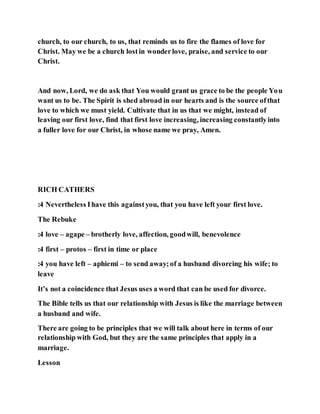
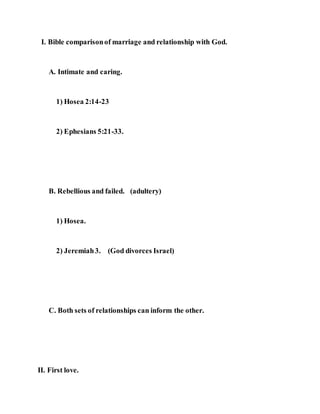
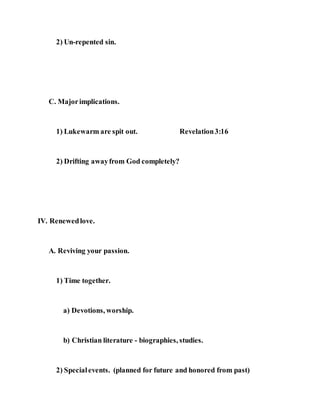
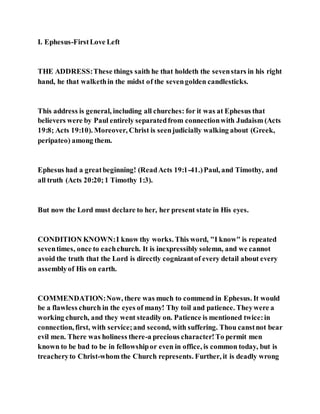
Revelation2:4 But I have this againstyou: You have
abandonedyour first love.
BIBLEHUB RESOURCES
Going Back In The Ways Of God
Revelation2:4
S. Conway
Nevertheless Ihave... first love. There is no stage of our heavenwardjourney
that is so hard as that which we go over for the third time. When in the
ardour of our first love we first traversedthat part of the road, we went along
vigorously, with a strong elastic step. And when we went back, though we
went slowly enoughat first, like as when the boy's ball, which he has flung
high into the air, when ceasing its upward ascent, begins to descend, that
beginning is slow, but quickens every second. And so on the backwardroad
we quicken speed in a mournful way. But when we have finished this
retrogression, and with a startled shock discoverwhatwe have lost, but, by
God's exceeding grace, resolve to recoverit - hic labor hoc opus est - this is toil
indeed. Our text brings before us the case ofthose who have thus gone back,
and whom the Lord is lovingly rousing to the resolve that they will regain
what they have lost. Note -
I. WHAT THEY LEFT AND LOST. It was that blessedearlycondition of
peace and joy Godwardwhich the beginning of the religious life so often
witnesses."All things were new - Christ was new, the Word a new light,
worship a new gift, the world a new realm of beauty, shining in the brightness
of its Author; even the man himself was new to himself. Sin was gone, and fear
also was gone with it. To love was his all, and he loved everything. The day
dawned in joy, and the thoughts of the night were songs in his heart. Then
how tender, how teachable!in his consciencehow true! in his works how
dutiful! It was the Divine childhood, as it were, of his faith, and the beauty of
childhood was in it. This was his first love; and if all do not remember any
precise experience of the kind, they do at leastremember what so far
resembled this as to leave no important distinction." There was fervour of
feeling: a greatoutgoing of the soul towards Christ; much prayer, and that
very real; hearty service;delight in worship - the sabbath, the sanctuary, the
sacredservice;the avoiding, not sin only, but its occasions, the "hating of the
garment spotted by the flesh;" in short, there was a close walk with God.
Blessed, blessedtime, the primeval Paradise ofthe soul, the goldenage, the
leaving of which one might mourn, even as our first parents mourned when
they were driven forth from Eden to the thorns and briars of the wilderness!
II. How IT CAME TO BE LEFT. Many are the explanations that might be
given. In some, absorption overmuch in business;in others, the influence of
unspiritual and worldly companions; in others, intellectual doubts, insinuated
into the mind by unbelieving or scepticalbooks;in others, the chill moral
atmosphere of the Church itself; in others, some lingering, lurking lust
reasserting itself;and so on in ever increasing variety; but eachone knows for
himself how the going back was brought about. But that we may not make
sorry those whom God has not made sorry, we would add the caution not to
regard every fluctuation of feeling as proof of this going back. Some are
forever tormenting themselves in this way, and so kill the very love they are
looking for, and in looking for it. "The complications of the heart are infinite,
and we may become confusedin our attempts to untwist them." Men dig at
the roots of their motives to see that they are the right ones, and the roots of
tender plants cannot stand such rough handling. But whilst there are some
who distress themselves when they have no need, there are more who have
greatneed, and yet are not distressedas they should be. Let such consider-
III. WHAT COMES OF LEAVING OUR FIRST LOVE.
1. The Spirit of God is grieved. Cana father see his child turn cold and sullen
towards him, and not be grieved? And in view of such turnings back from
him, must not our Lord be in a very realsense "the Man of sorrows"still?
2. Sinful men are hardened in their sin. Their boastis that there is no reality
in religion; that it is all a spasmodic passing thing; that the fervour of it in the
beginning will sooncooldown, and here is another proof that there is nothing
in it.
3. The Church of God is distressed. Its members had relied upon those who
have gone back, had hoped for much goodfrom them, had lookedto see them
carrying on and extending the work of God around them; and now they are
disappointed and made ashamed. The enemies of God blaspheme, and those
who have gone back are the cause.
4. And they themselves suffer most of all.
(1) They are miserable; they have enough of religion left to give them disrelish
for the ways of the world, but not near enough to give them the joy which
belongs only to those who are whole hearted in the service of God.
(2) And they are on the verge of greatand awful judgment. If they still go
back, it will be "unto perdition;" and if, in God's mercy, they be made to stop
ere they have gone to that lastlength, it will most likely have to be by some
sharp scourging process, withmany tears, and amid terrible trouble both
without and within. What a pitiful journey that must have been when the
wretchedprodigal resolvedat length that he would "arise, and go to his
Father"!In what humiliation, fear, shame, distress, he had to urge his weary
way along the return road! Only one thing could have been worse - that be
should not have come back. Oh, you who are forsaking Christ, if you be really
his, you will have to come back;but no joyous journey will that be for you.
No, indeed! It never has been, and never canbe. Still blessedbe the Lord, who
forces you to make it, difficult and hard though it be. It is the hand which was
nailed to the cross, and the heart which there was pierced for you, that now
wields the scourge whichcompels you, in sorrow and in shame, to come back
to him whom you left. But -
IV. WHAT FOLLY IT IS TO LEAVE HIM AT ALL. Ministers of Christ are
so fond, as well they may be, of proclaiming God's pardoning love, that they
too much pass over his preserving love. We take it too much for granted that
men will go off into "the far country," as that foolishyounger son did; and we
forgetthat much-maligned elder son who stayed at home with his father, and
who was therefore far more blessedthan the other could ever be. He could not
understand his father's gentleness to that ne'er-do-wellbrother of his - as
many still, and ever since the gospelhas been preached, have failed to
understand God's gentleness to returning sinners; and so he complained. But
how did his father answerhim? It is too little noted. "Son, thou art ever with
me, and all that I have is thine;" the meaning of all which was, "What, my
son! you complain at my forgiving and welcoming your poor wretched
brother! you who are so much better off, you complain!" Yes, he was better
off; his lot, as is the lot of all those who never leave their first love, is far the
preferable one, and there is no need that we should choose the other. Never let
it be forgotten that he who brought you to himself will keepyou near to and in
himself, as willingly as, surely more willingly than, he will receive you after
you have gone astray. To be pardoned, ah! well may we thank God for that;
but to have been preserved, to have been "kept from the evil so that it should
not hurt us," to have been "kept in the love of God," - for that more
thanksgiving still is due; and may God grant that we may be able forever and
ever in his blessedpresence to render it unto him. - S.C.
Biblical Illustrator
Thyatira.
Revelation2:18-29
Thyatira -- the sentimental Church
A. Mackennal, D. D.
One thing which Ephesus had Thyatira wanted, and it was a blessedwant;
nothing is said of Thyatira's "toil." The temper which animated the Church
made all its service joyous, Therefore the Lord's commendation is so full and
unreserved; He does not talk of removing the candlestick out of its place;
instead He frankly recognisesthe growing efficiency of His servants: "I know
that thy latest works are more than the first." Nevertheless there is a great
and grievous lack. As in Ephesus, the mention of this defect is unqualified;
not, "I have a few things againstthee," nor, "I have this againstthee," but, "I
have againstthee that thou are tolerating that woman Jezebel," etc. The name
is a mystic one. Jezebelwas the lady-wife of the half-barbarous king Ahab;
the story of her reign is the story of the quick corruption and utter downfall of
the kingdom of Israel. Idol-feasts were followedby "chambering and
wantonness,"and corruption spreadrapidly among the youth of Israel. So
was this prophetess introducing the speculations ofAsiatic freethinkers and
the Asiatic habit of voluptuousness into the Church of Thyatira. A love of talk
about forbidden things was setting in; regard for law was being weakened;
audacity was taking the place of reserve;the teaching spread that self-
indulgence was nobler than self-denial, and more in accordancewiththe
freedom of the gospel. There was a double attractionin the teaching of the
prophetess — the subtle charm of womanhood, and the seductiveness ofthe
thoughts themselves she was disseminating. Thus she led her votaries on into
what they loved to call the "deeperaspects"oflife and morals. We must
observe that the Church is not chargedwith complicity in this teaching. Nor is
the minister accusedof sharing in the doctrine; the implication is that he is
pure. But it is chargedagainsthim that he tolerates it; and both he and the
Church are warned of their neglectofduty. Why is he so tolerant of this
modern Jezebel — a woman who is working in the Church mischiefs as subtle,
and in their consequencesas dire, as those which destroyed the manhood of
Israel? First, doubtless, he bore with her because she was a woman. The
gracious tolerance ofa strong man often takes this form. It is very hard for
such a one to asserthimself at all; most hard where self-assertionseemsmost
easy. Next, the woman calledherself "a prophetess." Here comes in regard for
"the freedom of prophecy"; the very inspiration of the Church was a
hindrance. "Who knows whetherGod is not speaking by her, notwithstanding
all that is suspicious in her teaching?" The very spirit of service might help to
mislead a gracious man. Underneath the easytemper of the pastorof Thyatira
there was, however, a grave deficiency, one of the gravestin a Church ruler:
he had an inadequate sense of the authority of law. Thyatira stands before us
the type of a sentimental Church; the charm and the danger of the
sentimental temperament are both set before us here. There is a
sentimentalism of the strong as wellas of the weak. In the weak sentiment
takes the place which belongs to conviction; they try to make feeling do the
work of moral qualities. And they miserably fail; their Christian character
itself degenerates;like the Amy of "LocksleyHall," they are doomed to
"perish in their self-contempt." The strong are not in danger of this: their
personalcharactermay seem to keepitself unstained. But if they have
responsibilities for others laid upon them, their sentimentalism may mean
unfaithfulness. If Ephesus may be lookedupon as typifying the peril of the
Puritan habit, Thyatira is a type of what we may callNeo-Puritanism. The
Puritan was the guardian of the claims and rights of the individual. He trusted
his ownconscienceto see the will of God, his own intelligence to interpret it.
In strenuous years the man of such a temper, and with this lofty ambition,
tends to be hard, self-confident, a dogmatistin his thinking, a precisianin his
conduct. He is the man who cantry the spirits; who can tearaside disguises;
can see through them who call themselves apostles whenthey are not, and can
find them false. Times have grown easier;there has sweptover us a great
impulse of tenderness, which has become the prevailing habit, and the
characteristic individualism of the Puritan has changedits form. Out of
regard for the sanctity of the individual conscienceandjudgment, varying
interpretations of God's law are to be receivedas binding on various persons;
and where divers interpretations of law are admitted, the law itself ceasesto
be law. In the freedom which is to be allowedto self-development, the
educative influence of positive enactments is gone;every man is to be his own
schoolmasteras well as his own judge.
I. THE APPEAL TO REALITY. In contrast with their readiness to be
deluded, He sets out His own clearvision, piercing through all plausibilities,
and detecting the heart of the matter; His fervid indignation, too, that will not
long be restrained. Nothing is more needed than occasionalplain speechabout
the foulness which lurks in much that professesto be an enlargedspirituality.
There is more than an etymologicalconnectionbetweensentimentalismand
sensuality. They who encourage display of the peculiar charms of
womanhood, and seek to advance public causes by constantspeechof things
which both nature and piety tell us should be held in strict reserve, degrade
the womanthey seek to emancipate and brutalise the man. More than once
the world has been startledby the announcement of "esoteric"teachings and
practices among some who have posedas heralds of a higher morality, which
differ not at all from the words and deeds of others who are frankly vicious.
And what is still more startling is the discoverythat some who have not
acceptedall the doctrines of their circle have known of the prevalence of
them, and suffered them to pass without rebuke. These are really the coarse.
II. THE APPEAL TO COMPASSION."Behold,"says the Lord, "I castthem
that commit adultery with her into greattribulation"; "and I will kill her
children with death." There were simple souls in Thyatira savedfrom moral
ruin by their ignorance. They "knew not the deep things of Satan" which the
initiated talked of. There were other simple ones who fell by their curiosity. It
was the place of the pastor to stand betweenthese and the Lord of the flaming
eyes and the glowing feet; to save them from, seeming judgment by
instruction, warning, "if need were by discipline, pulling them out of the fire,
hating eventhe garment spotted with the flesh." It is a cruel thing to be
tolerant of those who are destroying the souls of the unwary.
III. THE APPEAL TO DUTY. "I lay upon you the charge to be faithful to the
law you have received. I impose no other obligation on you. But this you have;
hold it fast until I come." It was the duty of all in Thyatira; it was the special
duty of "the angelof the Church." An unwelcome duty it might be, but not on
that accountless urgent. And it was enforcedby the promise "to him that
overcometh." God's rewards are of two classes. We are to have more of what
we have; there is to be given us that which we have not. We think more
habitually of the former class — "to him that hath shall be given" — but the
Lord thinks also of the latter class, and this is well for us. For if we were only
to go on enlarging and developing the gracesmostcongenialto us, which we
find it easiestto exercise, we might attain to excellence, but we should be ever
one-sidedmen. God would make us perfect men. He will not let us keepthe
defects of our qualities.
(A. Mackennal, D. D.)
Christ's letter to the Church at Thyatira
CalebMorris.
I. THE COMMENDABLE IN CHARACTER. "I know thy works," etc. Its
progressive excellence is here commended. "And the last to be more than the
first." Severalexcellentthings are here mentioned — "Charity," which is
love. The one genuine principle has various manifestations. "Service," thatis
ministry. "Faith." By this I understand not belief in propositions, but
universal and living confidence in God, Christ, and eternal principles.
"Patience"— that is calm endurance of those evils over which we have no
control. "Works" — all the practicaldevelopments of holy principles.
II. THE REPREHENSIBLE IN DOCTRINE.Whateverwas the particular
doctrine that this prophetess taught, it was a great evil; it led to two things.
1. It led to greatwickednessin conduct.(1)Licentiousness — "commit
fornication."(2)Idolatry — "eatthings sacrificedto idols." A corrupt
doctrine will lead to a corrupt life. Creedand conduct have a vital connection
with eachother.
2. It incurred the displeasure of Christ. "BeholdI will casther into a bed,"
etc., etc.(1)A terrible retribution. The couchof indulgence would be changed
into a bed of torture.(2) An enlightened retribution. "I am He which searcheth
the reins and the hearts." There will be no ignorance in the dispensationof the
punishment; the Judge knows all.(3) A righteous retribution. "I will give unto
every one of you according to your works."
III. THE INDISPENSABLE IN DUTY. What is to be done to correctthese
evils, and to avoid this threateneddoom?
1. Repentof the wrong. Kind Heavengives all sinners time for repentance,
and unless repentance takes place punishment must come.
2. Hold fastto the right.(1) You have something good. You have some right
views, right feelings, right principles; hold them fast.(2) This something you
are in danger of losing. There are seductive influences around you in society.
Error is a prophetess ever at work, seeking to rifle the soulof all good.(3)This
something will be safe after Christ's advent. "Till I come." He will perfect all,
put all beyond the reach of the tempter. Meanwhile hold fast.
IV. THE BLESSED IN DESTINY. There are severalglorious things here
promised to the faithful and true.
1. Freedomfrom all future inconvenience. No other burden will be put on
them. Freedomfrom evil, what a blessing!
2. Exaltationto authority. "To him I will give powerover the nations." The
Christian victor shall share in the dominion of Christ (1 Corinthians 6:2).
3. The possessionofChrist. "I will give him the morning star," that is, I will
give Myselfto him, the light of life, the light that breaks upon the world after
a night of darkness and tempest.
(Caleb Morris.)
Thyatira
D. C. Hughes, M. A.
I. THE MAJESTYAND JUDICIAL ASPECTS OF ITS DIVINE AUTHOR.
1. His majesty — "Sonof God."
(1)Our Lord's resurrection; its grand and unanswerable demonstration
(Romans 1:4).
(2)The title proof of His glory and Divinity (Hebrews 1:2-8).
2. His judicial aspects.
(1)Nothing canescape His piercing glance.
(2)No one can escapeHis resistlesspower.
II. HIS LOVING RECOGNITIONOF EVERYCOMMENDABLE
QUALITY (ver. 19).
III. HIS HOLY ABHORRENCE OF THE EVILS PERMITTED IN THE
CHURCH (ver. 20).
IV. HIS LOVING FORBEARANCE OF THIS WICKED PARTY (ver. 21).
V. THE TERRIBLE DOOM THAT AWAITS THIS PARTY UNLESS THEY
REPENT (vers. 22, 23).
VI. OUR LORD'S INSPIRING WORDS TO THE FAITHFUL (ver. 24).
1. The importance of not giving heed to false doctrine.
2. The connectionbetweenfalse doctrine and the knowing "the depths of
Satan."
VII. THE IMPORTANCE OF FIRMLY HOLDING THE TRUTH AND
GRACE OF CHRIST (ver. 25).
VIII. THE BLESSED REWARD OF CHRISTIAN HEROISM (vers. 26-28).
IX. OUR LORD'S EARNEST EXHORTATION TO THE CHURCHES (ver.
29).
(D. C. Hughes, M. A.)
The Church contaminatedby doctrinal error
J. S. Exell, M. A.
I. THIS CHURCH HAD PREVIOUSLY BEEN OF HIGH MORAL
CHARACTER.
1. Fervent in its love.
2. Faithful in its service.
3. Constantin its faith.
4. Genuine in its patience.
5. Progressive in its excellences.
II. THIS CHURCH, NOTWITHSTANDING ITS PREVIOUS HIGH
MORAL CHARACTER, WAS CONTAMINATED BYDOCTRINAL
ERROR THROUGHTHE SEDUCTIVE INFLUENCE OF A CORRUPT
WOMAN (ver. 20).
1. This Church was contaminatedin doctrine by the teaching of a woman.
(1)Of wickedname. sake.
(2)Of vain pretensions.
(3)Of corrupt morality.
(4)Of seductive influence.
2. This Church, through its doctrinal error, was led into sinful practices.
3. There is a contaminating influence in doctrinal error.
III. THOSE WHO ARE INSTRUMENTALIN LEADING A CHURCH
INTO DOCTRINALERROR, AND ITS CONSEQUENT EVILS, ARE
THREATENED WITHSEVERE RETRIBUTION(vers. 22, 23). Lessons:
1. To cultivate in Church life an increase of all Christian graces.
2. To avoid vain and impious teachers who profess the prophetic gift.
3. That womenshould keepsilence in the Church.
4. That doctrinal heresy will lead to an awful destiny.
(J. S. Exell, M. A.)
I know thy works and charity... and the last to be more than the first. —
The first and last works
A. Maclaren, D. D.
I. WHAT EVERY CHRISTIAN LIFE IS MEANT TO BE. A life of continual
progress in which each"to-morrow shall be as this day, and much more
abundant," in reference to all that is goodand noble. A continuous progress
towards and in all goodof every sort is the very law of the Christian life.
Every metaphor about the life of the Christian soulcarries the same lesson. Is
it a building? Then course by course it rises. Is it a tree? Then year by year it
spreads a broader shadow, and its leafy crownreaches nearerheaven. Is it a
body? Then from childhood to youth, and youth to manhood, it grows.
Christianity is growth, continual, all-embracing, and unending.
II. WHAT A SADLY LARGE PROPORTIONOF PROFESSEDLY
CHRISTIAN LIVES ARE NOT. Many professing Christians are cases of
arresteddevelopment, like some of those monstrosities that you see about our
pavements — a full grownman in the upper part with no under limbs at all to
speak of, agedhalf a century, and only half the height of a ten years old child.
They grow, if at all, by fits and starts, after the fashion, say, of a tree that
every winter goes to sleep, and only makes woodfor a little while in the
summer time. Or they do not grow even as regularly as that, but. there will
come sometimes an hour or two of growth, and then long dreary tracks in
which there is no progress atall, either in understanding of Christian doctrine
or in the application of Christian precept; no increase ofconformity to Jesus
Christ, no increase ofrealising hold of His love, no cleareror more fixed and
penetrating contemplation of the unseenrealities, than there used to be long,
long ago. Let us learn the lessonthat either to-day is better than yesterdayor
it is worse. If a man on a bicycle stands still he tumbles. The condition of
keeping upright is to go onwards. If a climber on an Alpine ice-slope does not
put all his powerinto the effort to ascend, he cannot stick at the place, at an
angle of forty-five degrees upon the ice, but down he is bound to go. Unless, by
effort, he overcomes gravitation, he will be at the bottom very soon. And so if
Christian people are not daily getting better, they are daily getting worse.
There are two alternatives before us. Either we are getting more Christlike or
we are daily getting less so.
III. How THIS COMMENDATIONMAY BECOME OURS. Notice the
context. Christ says, "I know thy works and love and faith and service" (for
ministry), "and patience and that thy last works are more than the first."
That is to say, the greatway by which we can secure this continual growthin
the manifestations of Christian life is by making it a habit to cultivate what
produces it, viz., these two things, charity (or love) and faith. These are the
roots;they need cultivating. If they are not cultivated then their results of
"service" (or"ministry") and patience are sure to become less and less. These
two, faith and rove, are the roots;their vitality determines the strength and
abundance of the fruit that is borne. If we want our works to increase in
number and to rise in quality, let us see to it that we make an honesthabit of
cultivating that which is their producing cause — love to Jesus Christ and
faith in Him. And then the text still further suggests anotherthought. At the
end of the letter I read: "He that overcomethand keepethMy works to the
end, to him will I give," etc. Now, mark what were called"thy works" in the
beginning of the letter are called"My works" in its close. If we want that the
Mastershall see in us a continuous growthtowards Himself, then, in addition
to cultivating the habit of faith and love, we must cultivate the other habit of
looking to Him as the source of all the work that we do for Him. And when we
have passedfrom the contemplation of our deeds as ours, and come to look
upon all that we do of right and truth and beauty as Christ working in us,
then there is a certainty of our work increasing in nobility and in extent.
There is still another thing to be remembered, and that is, that if we are to
have this progressive godlinesswe must put forth continuous effort right away
to the very close. We come to no point in our lives when we canslack off in the
earnestnessofour endeavour to make more and more of Christ's fulness our
own.
(A. Maclaren, D. D.)
Notwithstanding, I have a few things
An imperfect Church
J. Hyatt.
I. A SERIOUS CHARGE ALLEGED AGAINST THE CHURCH AT
THYATIRA. The most perfectChurch upon earth is very imperfect. A
seriouslyobservant man will soonperceive "an end of all perfection" in the
most excellentcharacters. All our Lord's descriptions of characterare
faithful. He never drew a false likeness. ByHim neither excellencesor
imperfection were ever exaggerated. The designof the Holy Ghost in exposing
the sins and imperfections of the people of God is to warn Christians of their
danger, and to excite them to constantwatchfulness and fervent prayer. The
faithful reproof marks the line of conduct we are bound conscientiouslyto
pursue in dealing with professors ofthe religion of Christ.
II. DIVINE PATIENCE SPARES FOR A SEASON THE MOST
ABANDONED AND GUILTY CHARACTERS. Justice might instantly inflict
condign punishment upon licentious characters.
III. TREMENDOUS JUDGMENTSWILL SUCCEED THE EXERCISE OF
PATIENCE UPON THOSE WHO CONTINUE IMPENITENT.
IV. OUR LORD ASSERTS HIS OMNISCIENCEAND HIS PREROGATIVE
TO PUNISH AND REWARD MANKIND.
V. THE EPISTLE CONCLUDES WITHEXHORTATION AND
ENCOURAGEMENTADDRESSEDTO THOSE WHO HAD NOT
APPROVED OF THE DOCTRINE OF JEZEBEL.
(J. Hyatt.)
Inconsistency
W. Mitchell, M. A.
Alas for our many inconsistencies,our varied imperfections; alas for the
mischief they do to our own souls and to the cause ofChrist everywhere!Up
to a certain point, by the grace ofGod and a steadfastwill, we have done, let
us suppose, pretty well. We have gainedsomething. But the difficulty is to get
on a little farther. Consciencehas always a few things againstus which we
cannot quite conquer — very unimportant, perhaps, according to the world's
judgment, and yet, we know, very contrary to the Spirit of Christ. We ought
to be humble, and we are proud. We ought to be grave, and we are frivolous.
We ought to be exactin our times of prayer, and we suffer all manner of
things to interrupt us. We ought to be overflowing with kindness;and we are
reserved, impatient, and unsympathising. It is well for us if we can perceive
our inconsistenciesandtry to amend them. The devil does his best to keepour
attention fixed on what we have gained. Our inconsistencies,whateverthey
may appear to us, are spots and blemishes in the soul, disfiguring that image
of Christ into which we desire to be transformed, holding us back from God
only knows what higher degrees ofperfection, spoiling the offering of our life,
keeping back a part of the spoil. Moreover, it is by these inconsistencies that
the devil gains powerover us in other ways. These are his stations which he
seizes and fortifies, establishing on them his engines of war, from which he
hurls his fiery darts of temptation so as to overcome our defence in the matter
of some kindred fault, and to throw in other forces ofhis own as soonas the
breach is opened. And who shall tell the disheartening effectupon ourselves of
these inconsistencies? So much for the effectof our inconsistencyon ourselves.
And what shall we sayof its effectupon the world at large? There is nothing
which does the devil's work half so well as the unholy life combined with great
profession.
(W. Mitchell, M. A.)
The Jezebelof Thyatira
R. Burgess, B. D.
proceededin the same wayas all do who succeedin making havoc of the
Church of Christ. She came under the semblance of religion; she pretended to
be inspired of God; and she appears to have gained such credit with the
bishop himself that he was beguiledby her enticing words, and suffered her to
teach;this was his sin. Now it is evident when we read the characterofthis
man that he had not lent himself knowingly to any wickeddesigns ofthe false
prophetess. What does this show but our constantliability to error, even
though we should be exalted to the higheststation in the Church of Christ?
We may be compromising our high and evangelicalprinciples by unworthy
and undignified concessionto the errors of others, as effectually as did those
deceivedChristians of Thyatira; and there will never be wanting a Jezebelor
a doctrine which that name will denote to assure us that it is right so to do,
and that we thereby gain a universal esteemwhich will help us to extend our
own particular views and influence. But, besides this practice, the false
prophetess had a doctrine, and it is characterisedby "the depths of Satan."
Our Lord pronounces the things whereofJezebeland her followers made
their boastto be deep, but they were not the deep things of God, but of Satan;
there is a spirit which searcheththe mysteries of godliness;and there is a
spirit which is busy in diving into the depths of evil under the pretension of
seeking outcauses, until it becomes whatmay be termed mysticism. The false
prophetess, no doubt, led her votaries to believe that some other revelation
than what was in God's Word had been made to her, and professedto
communicate some superior light on the deepestand most intricate points of
faith. Generallyspeaking, when error is workedinto a system, it must have an
air of mystery thrown around it, and be supposedto concealsomething which
cannot meet the vulgar eye or be known to the uninitiated. Nothing but truth
will bear an open investigation; truth is the only systemthat may be
committed with safetyto a whole community; not that it will be so safe as
never to be perverted, but it will finally triumph, and requires neither secret
machinery nor open violence to force it on men's minds. Beware ofan
inordinate love of speculationon the nature and counsels ofthe MostHigh;
deep things, though most alluring, are not the best elements for the health of
the soul, and very few who have exercisedthemselves much therein have been
able to maintain a spirit of sobriety unto the end. Let us beware of a tendency
to begin our inquiries where all wise men make an end. Let us seek to be wise
up to the word, not beyond it; and thus keeping our hearts in all simplicity we
shall soonlearn to whom the Father reveals His mysteries, and we shall retain
an unclouded judgment to approve things that are excellent, and to discuss
with patience and candour.
2. The other lessonto be learnt from this history regards the discipline and
ordinances of the Church. The deluded followers ofthe false prophetess had
setat nought the discipline of the overseers ofthe Church for the time being,
apparently esteeming it a burden not to be tolerated by them who pretended
to such greatgifts. God, however, is not a God of confusion but of order, and
was carefulto confirm that burden and thereby to give His sanctionto
discipline.
(R. Burgess, B. D.)
Jezebelto be castout of the Church
J. Murray.
Why they did not insist upon having this Jezebelturned out of the Church
appears exceedinglystrange. Perhaps she was a woman of wealthand riches,
of some note and rank in Thyatira. There are few Churches so exactly
apostolic as to pursue a strict impartiality. The gold ring and the gay clothing
goes a greatway. A woman, whether she was a prophetess or not, provided
she had some thousands a year, and knew how to apply it among her friends,
might be guilty of a greatmany peccadillos andhave them winked at, when
one of low degree couldnot escape censure forthe first trip. There is
something bewitching in riches and worldly dignity — they make mankind do
very absurd and inconsistent things, and even New TestamentChurches have
been fascinatedtherewith. Perhaps this prophetess would have been
accounteda goodChristian in these soft, good-naturedtimes when divorces
are so common. She would probably have endoweda church, entertained the
clergy, like a goodChristian and orthodox believer; and this would cover a
multitude of sins. But Christ does not judge as men do, for He looks into the
heart and sees that many specious actions are only intended as a coverto
concealotherdesigns than those that are pretended publicly. There is no
imposing upon Him that searches the hearts. It is a greatmercy that the
Church has such an Head, who knows all things, and discerns all characters,
and will not suffer sin to pass without rebuke.
(J. Murray.)
Sins of omission
J. Trapp.
It is a fault, then, not only to be active in evil, but to be passive of evil.
(J. Trapp.)
Jezebela type of worldliness
W. Milligan, D. D.
Jezebelwas a heathenprincess, the first heathen queen who had been married
by a king of the northern kingdom of Israel. She was, therefore, peculiarly
fitted to represent the influences of the world; and the charge againstthe first
Church of the secondgroup is that she tolerated the world with its heathen
thoughts and practices. She knew it to be the world that it was, but
notwithstanding this she was contentto be at peace, perhaps even to ally
herself with it.
(W. Milligan, D. D.)
And I gave her space to repent
A timely period
Homilist.
God is the greatgiver; He gives life and food and happiness to all His
creatures.
I. A DEFINITION OF TIME. Some calltime the measure of duration; others
the successionofideas, pearls strung upon a golden thread. But is not this as
goodas either — "space to repent?"
II. A LIMITATION OF MERCY. "Space," a definite period of time. Man's
"days are determined" (Job 14:5).
1. How rash the calculations of the sinner.
2. How simple the reckoning of the saint (Genesis 47:9;Job 14:14; 1
Corinthians 7:29).
III. A DECLARATION OF DUTY. "Repent."
IV. A FORESHADOWINGOF DESTINY. Manis related to eternity.
(Homilist.)
Time for repentance
J. S. Exell, M. A.
I. DIVINELY ALLOTTED.
1. The wealth of Divine mercy.
2. Man will have no excuse if finally lost.
II. CERTAINLY LIMITED. Then use it well, prize it highly, see that the
Divine purpose concerning your destiny is accomplished.
III. WILFULLY NEGLECTED.
1. Becausetheir minds are darkened.
2. Becausetheir hearts are insensible.
3. Becausetheir retributions are delayed.
IV. ETERNALLY RUINOUS. Lessons:
1. We are Divinely calledto repentance.
2. We should repent now, because now is the acceptedtime, now is the day of
salvation.
(J. S. Exell, M. A.)
Space to repent
John Trapp.
"In space comes grace"proves not always a true proverb. They that defer the
work, and saythat men may repent hereafter, say truly, but not safely. The
branch that bears not timely fruit is cut off (John 15:2). The ground that
yields not a seasonable andsuitable return is nigh unto cursing (Hebrews 6:8).
(John Trapp.)
I will give unto every one of you according to your works
Self-prepared penalties
G. Vianney.
My children, if you saw a man prepare a greatpile of wood, heaping up fagots
one upon another, and when you askedhim what he was doing, he were to
answeryou, "I am preparing the fire that is to burn me," what would you
think? And if you saw this same man setfire to the pile, and when it was
lighted, throw himself upon it, what would you say? This is what we do when
we commit sin.
(G. Vianney.)
The depths of Satan
J. Murray.
This is not the name which these persons gave to the doctrines they held, but
the realcharacterthey deserved. Mankind have always been fond of depths
and mysteries, and more disposedto adhere to things which they do not
understand, than to simple and plain truths that are more plain and obvious.
It would appearto have been one of the particular stratagems ofthe wicked
one to persuade mankind that Divine revelationis beyond the understanding
of the inferior ranks of Church members, and that whey must depend for
their direction how to understand them, upon some selectcommissioners that
are initiated in the secrets thereof. The depths of Satandiffer from all things
that may be calleddepths in the Word of God, in the following particulars.
1. Satanappoints trustees to keepthe key of his secrets, anddoes not show an
index to the mysteries which are in his system. But there are no mysteries in
the Word of God, but what have a keyto open them, and an index to point
them out.
2. The interpretation of Scripture mysteries is always shorter, and expressed
in fewerwords, than the mysteries themselves. The vision of
Nebuchadnezzar's greatimage pointed out himself in a mystery; the
interpretation was short, and yet exceedinglyplain. The depths and mysteries
of Satan are quite different; the mystery is short, but the interpretation long,
and the opening of the mystery very tedious.
3. The depths of God are always openedup by the Spirit of God, in the course
of Divine revelation, and without the interpretation of the Holy Ghost, who is
the originalauthor, all the art of men and angels could not developone single
emblem in either the Old or New Testament, with any degree of certainty. The
depths of Satanare like Milton's DarknessVisible, incapable of any consistent
interpretation, nor are they everintended to be understood. They are believed
because they are inscrutable, and on that accountrequire a large measure of
faith. But what Godreveals, the nature and characterthereofis plain, though
the measure is unfathomable.
4. These doctrines, whichJohn calls the depths of Satan, appear to have been
the dogmas of men, and the conceits ofsophisters in religion, which were
intended to render godliness more fashionable and agreeable to the taste of
corrupt professors;and they differed from the simplicity of the gospelin the
ease they promised to those who embraced them.
(J. Murray.)
But that which ye have already, hold fasttill I come
A little religion is worth retaining
J. Alexander.
I. HOLD FAST THAT WHICH YOU HAVE, BECAUSE IT IS WORTH
RETAINING.
1. Becauseofthe means which God has employed to put you in the possession
of it.
2. Becauseit is connectedwith the salvationof your soul.
3. Becausethe minutest portion of it is valuable, and is capable of unlimited
increase. Whenthe whole substance is composedofgold and silver and
precious stones, intrinsic value belongs to every particle and to every grain, so
that its very dust is carefully preserved. And so it is with all the impressions
and feelings which belong to true religion, for they are fruits of the Spirit, and
portions of the ways of the unsearchable God. The mariner does not throw
awaythe little light which shines upon him from the polar star, but retains it
in his eye till it has guided his vesselinto port. And though in some periods of
your religious experience, Jesus Christmay not appearto you in His full tide
of glory, as the Sun of Righteousness, yetif He appears to you in the feebler
beams of the morning star, ever remember that what you see, though but a
glimmering, still is light, real heavenly light. Hold it, therefore, in your view. If
you possessedbut one single grain of wheat, its intrinsic value would be
trifling; but how is its value enhanced, and with what care will it be preserved,
when you know that if it be sownand reaped, and sownand reapedagain, its
production will soonbe seenwaving in the valleys, and crowning the
mountain tops, till it has furnished food sufficient for a city, a continent, a
world. And who can setlimits to the increase ofgrace? Who can tell what
advances he may make in knowledge, in holiness, and in joy, who is now for
the first time sitting at the feetof Jesus?
II. HOLD FAST THAT WHICH YOU HAVE, BECAUSE VARIOUS
EFFORTSARE MADE TO DEPRIVE YOU OF IT.
1. Such efforts are made by our own evil propensities. As the guards and the
cultivators of that which we have, there must be vigilance and resistance and
persevering prayer; there must be a war continually wagedagainstevil
thoughts, evil propensities, and evil actions;and there must be an unceasing
and determined effort to bring the whole soul under the supreme dominion of
gospelprinciples and of gospelinfluences.
2. Such efforts are made by the world. The mere presence ofmaterial and
worldly objects has a tendency to divert our attention and our affections from
those objects which are spiritual and unseen. The quantity of time and
thought and labour which worldly business receives, fromboth the master
and the servant, is often unfavourable, and sometimes fatal to fervency of
spirit.
3. Such efforts are made by Satan.
III. HOLD FAST THAT WHICH YOU HAVE, BECAUSE THE GOSPEL
FURNISHES YOU WITH THE MEANS OF RETAINING IT.
1. The gospelfurnishes you with the examples of righteous men, who have
retained their spiritual possessionsevenin the midst of multiplied difficulties
and dangers.
2. The gospelpromises the Holy Spirit to help your infirmities, and to make
your strength equal to your day.
IV. HOLD FAST THAT WHICH YOU HAVE, BECAUSE JESUS CHRIST
IS APPROACHING.
1. This announcement, you perceive, prescribes the term of your endurance. It
is to continue till the Lord comes. The oathwhich Christ requires from us,
when we enter His service, is an oath of fidelity for life; and, in this respect,
Christ's requirements accordwith the dispositions of all His faithful servants.
They desire to persevere. Theypray that they may persevere.
2. The announcement that Christ is coming affords greatencouragementto
sustain your endurance; for He is coming to receive His people to Himself,
that where He is, there they may be also. And as the shipwreckedmariner is
encouragedto hold fast the rope which he has grasped, when he hears that the
lifeboat is coming to convey him to the shore, so be you strengthened and
encouragedby the announced approaching of your Lord, who even now is
walking on the waters to conduct you to the desired haven.
(J. Alexander.)
Christian excellence
Homilist.
I. Christian excellence is an ATTAINMENT.
1. Christian excellence is an attainment in contradistinction to a native
growth. It does not spring up in the soul as an indigenous germ. It is a seed
that has been takenin and cultivated.
2. Christian excellence is an attainment in contradistinction to an impartation.
In a sense, it is the gift of God; not in the sense in which life and light and air
and the seasonsofthe year are the gifts of God, blessings that come upon us
irrespective of our own efforts, but rather in the sense in which the crops of
the husbandman, the learning of the scholar, the triumphs of the artist, are
the gifts of God — blessings that come as the result of appropriate labour. We
shall grow neither goodnor be made good; we must become good;we must
struggle after it.
II. Christian excellence is an attainment that REQUIRES FAST HOLDING.
1. Becauseit is worth retaining. Its value will appearby considering three
things.(1) The priceless instrumentality employed to put man in possessionof
it: the mission of Christ.(2) Its essentialconnectionwith man's spiritual well-
being; there is no true happiness apart from it.(3) Its capability of unlimited
progress;it may be as a grain of mustard, but it can grow.
2. Becausethere is a danger of losing it.(1) Men who have had it have lostit
before now.(2) Agencies are in constantoperationhere that threaten its
destruction.
III. Christian excellenceis an attainment that will be placed BEYOND
DANGER AT THE ADVENT OF CHRIST.
1. He comes to every Christian at death.
2. When He thus comes —(1) He crushes for ever our enemies. He bruises the
head of Satan under our feet.(2)He removes from us everything inimical to
the growthof goodness.(3)He introduces us into those heavenly scenes where
there will be nothing but what ministers to the advancementof goodness.
Take heart, Christian, the struggle is not for long.
(Homilist.)
Hold fast the goodobtained
J. Stratten.
I. THERE IS SOMETHING "WHICHWE HAVE ALREADY"; LET US
INQUIRE WHAT IT IS. First, have we obtained pardoning mercy? Secondly,
have we obtained justifying grace? Thirdly, there is sanctifying power.
Fourthly, suppose freedom and comfort in the ways of God. Fifthly, suppose a
sweetsense ofthe love of God in the soul. Lastly, have you obtained an
interest in the promises?
II. Supposing, then, that we have something, "HOLD FAST." And this is
opposedto those who turn round and go back, or who turn aside and go
astray. Let there be an advancementand progress in holiness, in zeal, in love,
in conformity to Christ's image. When it is said, "hold fast," it implies that
there are certainfixed and determinate principles of truth, which we are on
no accountto let go. There is a "form of sound words," whichis not to be
relinquished. The dignity of Christ, the efficacyof His sacrifice, the triumph
of His mediation, the factof His advent and coming again in glory, we are to
give up only with our liven "Hold it fast" implies that there are certainmeans
and instrumentalities to be employed. "What I sayunto you, I sayunto all,
Watch." Considerwhat you will lose, if you hold not fast the things which you
have already obtained. And, again, if you lose what is gained, the dishonour
and shame are greaterthan before.
(J. Stratten.)
Christian steadfastness
T. M. Herbert, M. A.
"Hold fast." Here, as constantly, a material image is used to set forth a
spiritual act, or rather a life-long series of spiritual acts, indicated by the
continuous act"hold fast." It implies, too, that there is something to lay hold
of, and what that is is referred to beforehand, "that which ye have already."
By this we should probably understand all that is included in "the faith once
delivered to the saints";"the sum total," as it has been expressed, "of
Christian doctrine, and hopes, and privileges." How much that is! The laws of
Christ, they are to be held fast, not one forgottenor neglected;the promises of
Christ, they are to be held fast, not one forgottenor neglected;the helps of
Christ, they are all of them to be held fast, and used in the varied and
continued necessitiesofthis mortal life of temptation. To hold all these fast
may be summed up as holding Him fast, as our Divine Lawgiverand
Redeemer, our greatPriestand Sacrifice, our in-dwelling Spirit and life. We
do not need to ask for a Christ of higher endowments and largerresources;it
is enough for us to hold fact the Christ we have already, "who of God is made
unto us, wisdom, and righteousness, andsanctification, and redemption."
"Hold fast till I come." The thoughts suggestedby the words "hold fast" are
very different from those suggestedby "I come." "Hold fast" tells of the
struggles ofearth; "I come" tells of the serene and abiding peace which reigns
where Jesus is. "Hold fast till I come." The earthly effort till the heavenly
reward. The strenuous life-effort, weary, protracted, often seeming doubtful
in result, is to continue till Christ comes, up to the hour of that supreme
disclosure, but not beyond it. Then the wearyhands may relax their painful
effort, the weary eyes their outlook for danger, the wearyheart its patience of
hope, for the security and restof victory will have come.
(T. M. Herbert, M. A.)
Hold fast
J. Trapp.
Tug for it with those that would take it from you.
(J. Trapp.)
And he that overcometh, and keepethMy works unto the end, to him I will
give powerover the nations
The promises to the victors
C. H. Spurgeon., A. Maclaren, D. D.
The service of God — to be constant: — Look at yon miller on the village hill.
How does he grind his grist? Does he bargain that he will only grind in the
westwind, because its gales are so full of health? No, but the eastwind, which
searchesjoints and marrows, makes the mill-stones revolve, and togetherwith
the north and the south it is yokedto his service. Evenso should it be with you
who are true workers for God; all your ups and your downs, your successes
and your defeats, should be turned to the glory of God.
(C. H. Spurgeon.)
The promises to the victors: —
I. We have THE VICTOR'S AUTHORITY. Now, the promise in my next text
is moulded by a remembrance of the greatwords of the secondpsalm. The
psalm in question deals with that Messianic hope under the symbols of an
earthly conquering monarch, and sets forth His dominion as established
throughout the whole earth. And our letter brings this marvellous thought,
that the spirits of just men made perfect are, somehow or other, associated
with Him in that campaignof conquest. And so, notice, that whatever may be
the specific contents of such a promise as this, the generalform of it is in full
harmony with the words of the Masterwhilst He was on earth. Our Lord gave
His trembling disciples this great promise: "In the regeneration, whenthe Son
of Man shall sit on the throne of His glory, ye also shall sit on twelve thrones,
judging the twelve tribes of Israel." "Thouhast been faithful over a few
things; I will make thee ruler overmany things"; and, linked along with the
promise of authority, the assurance ofunion with the Master:"Enter thou
into the joy of thy Lord." My text adds to that the image of a conquering
campaign, of a sceptre of iron crushing down antagonism, of banded
opposition brokeninto shivers, "as a potter's vessel" dashedupon a pavement
of marble. The New Testamentteaching converges upon this one point, that
the Christ that came to die shall come againto reign, and that He shall reign
and His servants with Him. That is enough; and that is all. But all the other
promises deal not with something in the remoter future, but with something
that begins to take effectthe moment the dust, and confusion, and garments
rolled in blood, of the battle-field, are swept away. At one instant the victors
are fighting, at the next they are partaking of the Tree of Life. There must be
something in the present for blesseddead, as wellas for them in the future.
And this is, that they are united with Jesus Christ in His present activities,
and through Him, and in Him, and with Him, are even now serving Him. The
servant, when he dies, and has been fitted for it, enters at once on his
government of the ten cities. Thus this promise of my text, in its deepest
meaning, corresponds with the deepestneeds of a man's nature. Forwe can
never be at rest unless we are at work; and a heaven of doing nothing is a
heaven of ennui and weariness.This promise of my text comes in to
supplement the three preceding. They were addressedto the legitimate
weariedlongings for restand fulness of satisfactionforoneself. This is
addressedto the deeper and nobler longing for largerservice. And the words
of my text, whateverdim glory they may partially reveal, as accruing to the
victor in the future, do declare that when he passes beyondthe grave there
will be waiting for him nobler work to do than any that he ever has done here.
But let us not forgetthat all this accessofpowerand enlargementof
opportunity are a consequenceofChrist's royalty and Christ's conquering
rule. That is to say, whateverwe have because we have knit to Him, and all
our service there, as all our blessedness here, flows from our union with that
Lord. Whateverthere lies in the heavens, the germ of it all is this, that we are
as Christ, so closelyidentified with Him that we are like Him, and share in all
His possessions. He says to us, "All Mine is thine."
II. Note THE VICTOR'S STARRYSPLENDOUR. "Iwill give him the
morning star." Now, no doubt, throughout Scripture a star is a symbol of
royal dominion; and many would propose so to interpret it in the present case.
But it seems to me that whilst that explanation — which makes the second
part of our promise simply identical with the former, though under a different
garb-does justice to one part of the symbol, it entirely omits the other. But the
emphasis is here laid on "morning" rather than on "star." Then another false
scent, as it were, on which interpretations have gone, seems to me to be that,
taking into accountthe fact that in the last chapter of the Revelationour Lord
is Himself describedas "the bright and morning star," they bring this
promise down simply to mean "I will give him Myself." Now, though it be
quite true that, in the deepestof all views, Jesus ChristHimself is the gift as
well as the giver of all these seven-foldpromises, yet the propriety of
representationseems to me to forbid that He should here say "I will give them
Myself!" So that I think we are just to lay hold of the thought — the starry
splendour, the beauty and the lustre that will be poured upon the victor is that
which is expressedby this symbol here. What that lustre will consistin it
becomes us not to say. That future keeps its secretwell, but that it shall be the
perfecting of human nature up to the most exquisite height of which it is
capable, and the enlargementof it beyond all that human experience here can
conceive, we may peaceablyanticipate and quietly trust. Only note the
advance here on the previous promises is as conspicuous as in the former part
of this greatpromise. There the Christian man's influence and authority were
setforth under the emblem of regaldominion. Here they are set forth under
the emblem of lustrous splendour. It is the spectators thatsee the glory of the
beam that comes from the star. And this promise, like the former, implies that
in that future there will be a field in which perfected spirits may ray out their
light, and where they may gladden and draw some eyes by their beams.
Christian souls, in the future, as in the present, will stand forth as the visible
embodiments of the glory and lustre of the unseen God. Further, remember
that this image, like the former, traces up the royalty to communion with
Christ, and to impartation from Him. "I will give him the morning star." We
are not suns, but planets, that move round the Sun of Righteousness, andflash
with His beauty.
III. Lastly, mark THE CONDITION OF THE AUTHORITY, AND THE
LUSTRE. Here I would saya word about the remarkable expansion of the
designationof the victor, to which I have already referred: "He that
overcometh, and keepethMy works unto the end." We do not know why that
expansion was put in, in reference to Thyatira only, but if you will glance over
the letter you will see that there is more than usual about works;works to be
repented of, or works which make the material of a final retribution and
judgment. Bring your metaphor of a victor down to the plain, hard, prose fact
of doing Christ's work right awayto the end of life. It is the explanation of the
victory, and one that we all need to lay to heart. "My works." Thatmeans the
works that He enjoins. No doubt; but look at the verse before my text: "I will
give unto every one of you according to your works." Thatis, the works that
you do, and Christ's works are not only those which He enjoins, but those of
which He Himself setthe pattern. He will "give according to works";He will
"give authority"; "give the morning star" That is to say, the life which has
been moulded according to Christ's pattern, and shaped in obedience to
Christ's commandments is the life which is capable of being granted
participation in His dominion, and invested with the morning star. It is for us
to choose whetherwe shall share in Christ's dominion or be crushed by His
iron sceptre.
(A. Maclaren, D. D.)
Poweroverthe nations
W. Burnet, M. A.
I. POWER IS IN MANY CASES THE RESULT OF CONQUEST. Evenin
this life victory brings new strength. Physicalforce is attained by a long series
of efforts. The blacksmith's brawny, sinewy arm is the natural consequence of
years of vigorous strokes uponthe anvil. Intellectual strength grows in the
same way. It is in greatmeasure acquired by mental application, and comes
from painful, persevering endeavours to mastersome of the branches of art or
science. This is a law of our being, the greatprinciple, according to which the
All-wise and Almighty Ruler of the world dispenses His gifts. It is, therefore,
not surprising to find the same method applied to the highestand noblest kind
of power, known as moral and spiritual. The ability to refuse the evil and
choose the good, as well as to lead others to do the same, is indeed a special
gift of God's grace, and yet it is the result of constant, persevering effort. In
short, this promise to Thyatira is being continually fulfilled in the present life.
II. At the same time, FOR ITS LARGEST AND TRUEST
ACCOMPLISHMENT WE MUST LOOK ON TO THE GRAND AND
GLORIOUS FUTURE. It is to him that shall have overcome, andkept
Christ's works to the end, that He here promises power overthe nations. "The
royalties of Christ," remarks Archbishop Trench, "shall by reflection and
communication be the royalties also of His Church. They shall reign, but only
because Christreigns, and because He is pleasedto share His dignity with
them.
(W. Burnet, M. A.)
I will give him the morning star
Christ, the Morning Star
J. Cairns, D. D.
(compared with Revelation22:16): — In seeking to interpret these words in
the secondchapter, some have supposedthat the "morning star" is not
directly connectedwith Christ; but that the promise is only a generalone,
setting forth the splendour of the rewardof believers. Upon this principle
there would be the same blessing promised to the Church of Thyatira under
two forms: rule over the nations, and the splendour of such an inheritance
here and hereafter. Had our Lord meant to display the splendour of the
Christian's reward, He would have spokenof making His people like the
morning star, rather than of giving them the morning star; hence I agree with
those who understand Christ to promise that lie will give Himself to His
faithful ones as their portion and reward. But it is plain that Christ will not
for the first time become the morning star to His people when He bestows
Himself as their final reward, since He is so alreadyin the present life; and
hence we must understand Him as promising to give Himself in a higher
measure as the reward of their fidelity.
I. I remark THAT CHRIST IS TO HIS PEOPLE THE MORNING STAR OF
TIME, AND WILL BE TO THEM THE MORNING STAR OF ETERNITY,
BECAUSE HIS LIGHT SHINES AFTER DARKNESS. It belongs to the day
star to appear in the midst of gloomwhen the shades of night are still thick
and heavy, and to announce their departure. It was in this sense that Christ
came as the light of the world. There was a generalsense in which the whole
world sat in darkness, as it does still where Christ is not known. "Darkness
coveredthe earth and gross darkness the people." Take the altar at Athens, to
which Paul appealed. If we understand its inscription as to "The Unknown
God," did not this proclaim God at large as still unknown? When Christ came
the world was in the darkness of guilt, with only light enoughto read the
sentence ofconscience, but none to see how it could be reversed. There was
the darkness ofdepravity, for in the night the "beasts ofthe forestwalked
abroad," and foul and hideous lusts degradedevery land. These causes
produced a darkness of untold misery. "The people that walkedin darkness
have seena greatlight: they that dwell in the land of the shadow of death,
upon them hath the light shined." Similar to this first coming of Christ into
the world is His first appearing in His saving characterto individual sinners.
Every sinner to whom Christ has not thus appeared walks in darkness. Let
him at length be arousedby the Spirit of God, and how awful is the sense of
darkness that overwhelms him! The experience of Christians, indeed, is
various. Some have more memory of this darkness than others. Some wander
in it longer and plunge into it more deeply. Such is the first grand deliverance
from darkness which Christ works for all His people, and which during their
earthly history He constantly renews whenthe clouds of ignorance, the shades
of guilt, and the storms of afflictions might gatheraround them. And now in
the secondofour texts He promises, as the reward of their faith and loyalty,
that He will give Himself to eachof them as the morning star of eternity. Here
too the emblem shall be fulfilled, for His light will shine after darkness. To
every Christian, the brightest, the happiest, the most devoted, there is a sense
in which life ends in darkness. The passagefrom time into eternity is a dark
passage. The Christian must enter it alone, and pursue it, it may be, with
failing eye and fainting step. There is no night so deep as that of the valley of
the shadow of death. But here the last victory over darkness is achieved.
"Light is thus sownin the righteous" when the departing spirit is gathered
home. And when the dead, small and great, stand before God, and the mighty
shadow of the judgment throne falls even upon the redeemed in awe and
solemn dread, shall not this bright and morning starrest upon the head of
Him who is at once their Judge and Advocate, so that they shall "rise to meet
Him, free of fear"? Now has come a world of which it is written, "And there
shall be no night there," "the Lord God giveth them light, and the Lamb is the
light thereof."
II. I remark, THAT CHRIST IS TO HIS PEOPLE THE MORNING STAR
OF TIME, AND WILL BE TO THEM THE MORNING STAR OF
ETERNITY, BECAUSE HIS LIGHT TRANSCENDSALL COMPARISON.
No one can mistake the morning star in the firmament or confound it with
any other orb. It shines pre-eminent and alone. In the words of Milton, it
"flames in the foreheadof the morning sky." Thus it is with Christ.
1. Christ is preeminent in His titles. Some of these are shared with others;but
what a stamp of peculiarity is setupon them as applied to Christ! Is He the
Son of God? Then He is His "only begottenSon, who is in the bosom of the
Father." is He the Angel of God? Then He is "made so much better than the
angels, as He hath obtained by inheritance a more excellentname than they."
Is He the Mediator? Then He is "the one Mediator betweenGod and men." Is
He the Saviour? Then there is salvationin no other, "forthere is none other
name under heavengiven among men, whereby we must be saved."
2. Christ is pre-eminent in His offices. As a Prophet, He brings revelation
from the highestheaven. As a Priest, He offers the alone and perfectsacrifice.
As a King, He is without example.
3. Christ is pre-eminent in His history. To Him all history converges, andin
His own it is summed up and transcended. He is the Lion of the tribe of
Judah; He is the Rose ofSharon and the Lily of the Valley; He is the Pearlof
GreatPrice; He is the Plant of Renown; He is the Breadof Life; He is the
precious Corner-stone.
4. What Christ is to His people, He is alone. We have many friends, but only
one Redeemer;many earthly helpers, but only One who delivers our souls
from the lowesthell. The succourthat we receive from others in the things of
salvation, so far from disturbing Christ's pre-eminence, only confirms it. The
unity which the soul of man receives through Christ is as greata proof of
adaptation and designas anything in the outer world. The heart of man needs
something to engross it, an objecton which it can concentrate allits affections
without self-reproach, and which by its admitted swaybrings unity into its
existence, and concordinto all its purposes and aspirations. Now as Christ has
fulfilled this end in time, so shall He yet more by His gloriouslyasserted and
devoutly recognisedpre-eminence fulfil it to endless ages.His supremacy shall
then be disclosedas on earth, in its brightest manifestation, it never yet has
been. The morning starshall then shine forth unsullied by a cloud. What new
displays of grace and glory Christ in these new circumstances shallmake, it is
not given to us to know. And while the morning star shall thus emit new and
dazzling rays, oh, how different the impression of delight and rapture which
His pre-eminence shall make then on His own people from what it made here!
Then there shall be no darkness of ignorance orunbelief to hide His beams —
no sin, or world, or self, to divide the heart with Him — no creature worship
to impair His ascendency — no coldness and lukewarmness evenin the
Church to damp the rising flame of love and adoration! Love and adoration
shall be spontaneous and irresistible.
III. I remark, THAT CHRIST IS THE MORNING STAR OF TIME, AND
WILL BE THE MORNING STAR OF ETERNITY, BECAUSE HIS LIGHT
USHERS IN PERPETUAL DAY. It is the property of the morning star to be
the day's harbinger. Other stars rise and shine and set, and leave the darkness
still behind them. Hence Christ is not comparedto the evening star, though it
be in itself as bright as that of the morning, and indeed the same;because in
that case the associations wouldbe too gloomy, and the victory would seemto
remain for a time on the side of darkness. True, the Christian may be in
darkness evenafter Christ has risen upon him, but it is only "the cloudy and
dark day" — it is no more "the black and dark night." The dawn may be
overcast, but the day still proceeds. Daystill penetrates through the crevices
of your unbelief into the dungeon of your despondency; and you are startled
in your self-made gloomand solitude by rays that travel from beyond the icy
atmosphere from a higher luminary, though you refuse to go forth to them.
(J. Cairns, D. D.)
The morning star
H. Bonar, D. D.
He who speaks is Jesus Himself.
1. He speaks as a promiser. It is to something future that He points the eye of
His Churches — the things "not seen," the "things hoped for."
2. He speaks as a giver. "I will give." He has been a giver from the first.
3. He speaks to the overcomers. Thoughthe gifts are not wages,yetthey
depend on our winning a battle. They are something beyond mere salvation.
4. He speaks ofthe morning star. This is His promised gift, and a very
glorious one it is.(1)What it is naturally. It is not any star that appears in the
morning, but one — one "bright particular star" — a star which, above all
others, is known for its splendour, and is connectedwith the departure of the
night and the arrival of the day. It says, Nightis done: day is coming; the sun
is about to rise.(2)What it is symbolically. Christ Jesus — He is the Star. He is
the giver and the gift; as if He said, "I will give him Myselfas the morning
star." Bright and fair to look upon; attractive and glorious;joy of the
traveller, or the sailor, or the night-watch.(3) What it is prophetically. We get
Christ, in believing, just now, but we do not getHim as the morning star. That
is yet to come.
(H. Bonar, D. D.)
He that hath an ear, let him hear what the Spirit saith unto the Churches.
That the terms of salvationare offered to all men
S. Clarke, D. D.
These words are a strong and generalappealto the reasonand understanding
of all unprejudiced and impartial men.
1. The phrase, "Let him hear," is an authoritative expression, becoming the
majesty of God, and the weight and dignity of what is spokenby His
command. And if they refuse or neglectto hear, and will be at no pains to
examine into the true nature and end of religion, it is no hurt to Him, but to
themselves only.
2. As these words express the authority of God, in requiring men to attend, so
they do further denote His goodness likewise, inproposing to men, universally
and plainly, the doctrine and the way of life.
3. The other phrase in the text, "He that hath an ear," signifies he that hath
understanding, that hath ability, that hath capacityto apprehend what is
spoken(Matthew 19:12). To have an ear, in the Scripture-sense, means to
have an understanding free and unprejudiced, open to attend unto, and apt to
receive the truth. And the want of it is not like the want of natural parts and
abilities, pitiable and compassionable,but faulty and deserving of severe
reproof (Mark 8:17, 18).
4. The capacity men have, and the indispensable obligation they are under, to
hearkento and obey what God delivers to them.
I. GOD, THE GREAT CREATOR AND RIGHTEOUS GOVERNOR AND
MERCIFULJUDGE OF THE WHOLE EARTH, OFFERS TO ALL MEN
THE GRACIOUS TERMS AND POSSIBILITIES OF SALVATION. God
speaks to men originally, by the light of nature, by the order and proportions
of things, by the voice of reason, by the dictates of conscience.
II. THIS OFFER, THOUGH GRACIOUSLY MADE TO ALL, YET IN
EVENT BECOMESEFFECTUALTO THOSE ONLY WHO ARE
QUALIFIED AND CAPABLE TO RECEIVE IT. Light introduced upon any
objectsupposes always that there be eyes to view and to discernit by that
light. The sound of a voice, or the use of speech, supposesalways that men
have ears to hear what the speakeruttereth. And, in matters of religion, God's
offering to men certain terms or conditions of salvationsupposes in like
manner a certain moral disposition in the mind, which causes itto have a
regard to things of that nature, to have a sense and relish of things relating to
morality; otherwise men would, in their nature, be no more capable of
religion than beasts.
1. That disposition of mind which qualifies men to receive the terms of
salvationis somewhatwhich the Scripture always speaks ofas a matter of
singular excellency, and worthy of greatcommendation. It is an eminent gift,
or grace, ofGod.
2. Wherein consists this excellent temper and disposition of mind.
(1)Attentiveness or consideration.
(2)A delight in examining into truth and light, a taking pleasure at all times in
beholding the light and in hearing the voice of reason.
(3)Moralprobity, sincerity, and integrity of mind.
(4)A readiness to hearkento the voice of revelationas wellas of reason.
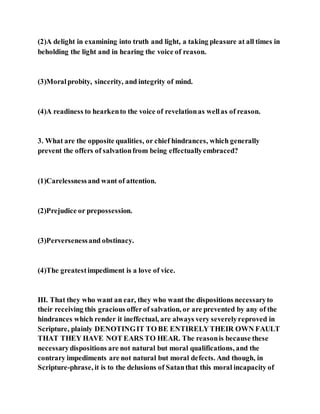
3. What are the opposite qualities, or chief hindrances, which generally
prevent the offers of salvationfrom being effectuallyembraced?
(1)Carelessnessand want of attention.
(2)Prejudice or prepossession.
(3)Perversenessand obstinacy.
(4)The greatestimpediment is a love of vice.
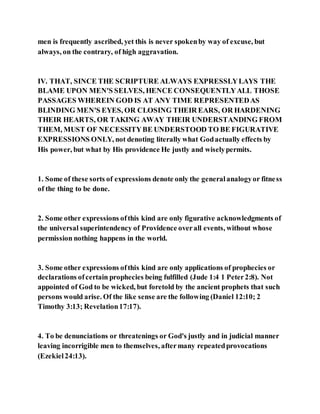
III. That they who want an ear, they who want the dispositions necessaryto
their receiving this gracious offerof salvation, or are prevented by any of the
hindrances which render it ineffectual, are always very severelyreproved in
Scripture, plainly DENOTINGIT TO BE ENTIRELYTHEIR OWN FAULT
THAT THEY HAVE NOT EARS TO HEAR. The reasonis because these
necessarydispositions are not natural but moral qualifications, and the
contrary impediments are not natural but moral defects. And though, in
Scripture-phrase, it is to the delusions of Satanthat this moral incapacity of
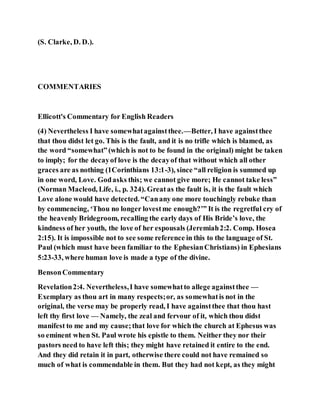
men is frequently ascribed, yet this is never spokenby way of excuse, but
always, on the contrary, of high aggravation.
IV. THAT, SINCE THE SCRIPTURE ALWAYS EXPRESSLYLAYS THE
BLAME UPON MEN'S SELVES, HENCE CONSEQUENTLYALL THOSE
PASSAGES WHEREIN GOD IS AT ANY TIME REPRESENTEDAS
BLINDING MEN'S EYES, OR CLOSING THEIR EARS, OR HARDENING
THEIR HEARTS, OR TAKING AWAY THEIR UNDERSTANDING FROM
THEM, MUST OF NECESSITYBE UNDERSTOOD TO BE FIGURATIVE
EXPRESSIONS ONLY, not denoting literally what Godactually effects by
His power, but what by His providence He justly and wiselypermits.
1. Some of these sorts of expressions denote only the generalanalogyor fitness
of the thing to be done.
2. Some other expressions ofthis kind are only figurative acknowledgments of
the universal superintendency of Providence overall events, without whose
permission nothing happens in the world.
3. Some other expressions ofthis kind are only applications of prophecies or
declarations ofcertain prophecies being fulfilled (Jude 1:4 1 Peter2:8). Not
appointed of God to be wicked, but foretold by the ancient prophets that such
persons would arise. Of the like sense are the following (Daniel 12:10; 2
Timothy 3:13; Revelation17:17).
4. To be denunciations or threatenings or God's justly and in judicial manner
leaving incorrigible men to themselves, aftermany repeatedprovocations
(Ezekiel24:13).
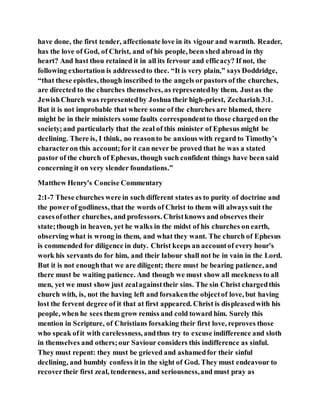
(S. Clarke, D. D.).
COMMENTARIES
Ellicott's Commentary for English Readers
(4) Nevertheless I have somewhatagainstthee.—Better, I have againstthee
that thou didst let go. This is the fault, and it is no trifle which is blamed, as
the word “somewhat”(which is not to be found in the original) might be taken
to imply; for the decayof love is the decayof that without which all other
graces are as nothing (1Corinthians 13:1-3), since “all religion is summed up
in one word, Love. Godasks this; we cannot give more; He cannot take less”
(Norman Macleod, Life, i., p. 324). Greatas the fault is, it is the fault which
Love alone would have detected. “Canany one more touchingly rebuke than
by commencing, ‘Thou no longer lovestme enough?’” It is the regretful cry of
the heavenly Bridegroom, recalling the early days of His Bride’s love, the
kindness of her youth, the love of her espousals (Jeremiah2:2. Comp. Hosea
2:15). It is impossible not to see some reference in this to the language of St.
Paul (which must have been familiar to the EphesianChristians) in Ephesians
5:23-33, where human love is made a type of the divine.
BensonCommentary
Revelation2:4. Nevertheless,I have somewhatto allege againstthee —
Exemplary as thou art in many respects;or, as somewhatis not in the
original, the verse may be properly read, I have againstthee that thou hast
left thy first love — Namely, the zeal and fervour of it, which thou didst
manifest to me and my cause;that love for which the church at Ephesus was
so eminent when St. Paul wrote his epistle to them. Neither they nor their
pastors need to have left this; they might have retained it entire to the end.
And they did retain it in part, otherwise there could not have remained so
much of what is commendable in them. But they had not kept, as they might
have done, the first tender, affectionate love in its vigour and warmth. Reader,
has the love of God, of Christ, and of his people, been shed abroad in thy
heart? And hast thou retained it in all its fervour and efficacy? If not, the
following exhortation is addressedto thee. “It is very plain,” says Doddridge,
“that these epistles, though inscribed to the angels orpastors of the churches,
are directed to the churches themselves, as representedby them. Justas the
JewishChurch was representedby Joshua their high-priest, Zechariah 3:1.
But it is not improbable that where some of the churches are blamed, there
might be in their ministers some faults correspondentto those chargedon the
society;and particularly that the zeal of this minister of Ephesus might be
declining. There is, I think, no reasonto be anxious with regard to Timothy’s
characteron this account;for it can never be proved that he was a stated
pastor of the church of Ephesus, though such confident things have been said
concerning it on very slender foundations.”
Matthew Henry's Concise Commentary
2:1-7 These churches were in such different states as to purity of doctrine and
the powerof godliness, that the words of Christ to them will always suit the
casesofother churches, and professors. Christknows and observes their
state;though in heaven, yet he walks in the midst of his churches on earth,
observing what is wrong in them, and what they want. The church of Ephesus
is commended for diligence in duty. Christ keeps an accountof every hour's
work his servants do for him, and their labour shall not be in vain in the Lord.
But it is not enoughthat we are diligent; there must be bearing patience, and
there must be waiting patience. And though we must show all meekness to all
men, yet we must show just zealagainsttheir sins. The sin Christ chargedthis
church with, is, not the having left and forsakenthe objectof love, but having
lost the fervent degree of it that at first appeared. Christ is displeasedwith his
people, when he sees them grow remiss and cold toward him. Surely this
mention in Scripture, of Christians forsaking their first love, reproves those
who speak ofit with carelessness, andthus try to excuse indifference and sloth
in themselves and others;our Saviour considers this indifference as sinful.
They must repent: they must be grieved and ashamedfor their sinful
declining, and humbly confess itin the sight of God. They must endeavour to
recovertheir first zeal, tenderness, and seriousness,and must pray as
earnestly, and watchas diligently, as when they first setout in the ways of
God. If the presence of Christ's grace and Spirit is slighted, we may expect the
presence ofhis displeasure. Encouraging mention is made of what was good
among them. Indifference as to truth and error, goodand evil, may be called
charity and meekness, but it is not so; and it is displeasing to Christ. The
Christian life is a warfare againstsin, Satan, the world, and the flesh. We
must never yield to our spiritual enemies, and then we shall have a glorious
triumph and reward. All who persevere, shallderive from Christ, as the Tree
of life, perfection and confirmation in holiness and happiness, not in the
earthly paradise, but in the heavenly. This is a figurative expression, taken
from the accountof the garden of Eden, denoting the pure, satisfactory, and
eternal joys of heaven; and the looking forward to them in this world, by
faith, communion with Christ, and the consolations ofthe Holy Spirit.
Believers, take your wrestling life here, and expect and look for a quiet life
hereafter;but not till then: the word of God never promises quietness and
complete freedom from conflict here.
Barnes'Notes on the Bible
Nevertheless Ihave somewhatagainstthee - Notwithstanding this general
commendation, there are things which I cannot approve.
Becausethou hast left thy first love - Thou hast "remitted" (ἀφῆκας aphēkas)
or let down thy early love; that is, it is less glowing and ardent than it was at
first. The love here referred to is evidently love to the Saviour; and the idea is,
that, as a church, they had less of this than formerly characterizedthem. In
this respectthey were in a state of declension;and, though they still
maintained the doctrines of his religion, and opposedthe advocatesoferror,
they showedless ardor of affectiontoward him directly than they had
formerly done. In regard to this we may remark:
(1) That what is here statedof the church at Ephesus is not uncommon:
(a) Individual Christians often lose much of their first love. It is true, indeed,
that there is often an appearance ofthis which does not exist in reality. Not a
little of the ardor of young converts is often nothing more than the excitement
of animal feeling, which will soondie awayof course, though their real love
may not be diminished, or may be constantly growing stronger. When a son
returns home after a long absence, andmeets his parents and brothers and
sisters, there is a glow, a warmth of feeling, a joyousness ofemotion, which
cannot be expectedto continue always, and which he may never be able to
recallagain, though he may be ever growing in realattachment to his friends
and to his home.
(b) Churches remit the ardor of their first love. They are often formed under
the reviving influences of the Holy Spirit when many are converted, and are
warm-hearted and zealous young converts. Or they are formed from other
churches that have become cold and dead, from which the new organization,
embodying the life of the church, was constrainedto separate. Orthey are
formed under the influence of some strong and mighty truth that has taken
possessionofthe mind, and that gives a specialcharacterto the church at
first. Or they are formed with a distinct reference to promoting some one
greatobject in the cause of the Redeemer. So the early Christian churches
were formed. So the church in Germany, France, Switzerland, and England
came out from the Roman communion under the influence of the doctrine of
justification by faith. So the Nestorians in former ages, andthe Moravians in
modern times, were characterizedby warm zeal in the cause ofmissions.
So the Puritans came out from the establishedchurch of England at one time,
and the Methodists at another, warmed with a holier love to the cause of
evangelicalreligionthan existedin the body from which they separated. So
many a church is formed now amidst the exciting scenes ofa revival of
religion, and in the early days of its history puts to shame the older and the
slumbering churches around them. But it need scarcelybe said that this early
zeal may die away, and that the church, once so full of life and love, may
become as cold as those that went before it, or as those from which it
separated, and that there may be a necessityfor the formation of new
organizations that shall be fired with ardor and zeal. One has only to look at
Germany, at Switzerland, at various portions of the reformed churches
elsewhere;at the Nestorians, whose zealfor missions long since departed; or
even at the Moravians, among whom it has so much declined; at various
portions of the Puritan churches, and at many an individual church formed
under the warm and exciting feelings of a revival of religion, to see that what
occurredat Ephesus may occur elsewhere.
(2) the same thing that occurredthere may be expectedto follow in all similar
cases. The Saviour governs the church always on essentiallythe same
principles; and it is no uncommon thing that, when a church has lost the
ardor of its first love, it is suffered more and more to decline, until "the
candlestick is removed" - until either the church becomes wholly extinct, or
until vital piety is wholly gone, and all that remains is the religion of forms.
Jamieson-Fausset-BrownBible Commentary
4. somewhat… because—Translate, "Ihave againstthee (this) that," &c. It is
not a mere somewhat";it is everything. How characteristic ofour gracious
Lord, that He puts foremostall He can find to approve, and only after this
notes the shortcomings!
left thy first love—to Christ. Compare 1Ti5:12, "castofftheir first faith." See
the Ephesians'first love, Eph 1:15. This epistle was written under Domitian,
when thirty years had elapsedsince Paul had written his Epistle to them.
Their warmth of love had given place to a lifeless orthodoxy. Compare Paul's
view of faith so called without love, 1Co 13:2.
Matthew Poole's Commentary
Nevertheless Ihave somewhatagainstthee; something to accuse thee of, and
blame thee for.
Becausethou hast left thy first love; of late thou hast not been so warm in the
propagationof my gospel, and maintaining my truth. The love of many in this
church, both toward God and their brethren, probably was cooled, though not
wholly extinguished.
Gill's Exposition of the Entire Bible
Nevertheless Ihave somewhatagainstthee,.... So the Jews representGod
saying, concerning their fathers, "Abraham", &c. "I have something against
them" (a). Christ has nothing againsthis people, his faithful ministers, and
true churches, in a judicial way, or to their condemnation, for there is none to
them that are in him; but he has often many things to complain of in them,
and to rebuke and chastise them for, in a way of providence: and what he had
againstthe church at Ephesus, and againstthe churches in the period which
that represents, follows,
because thou hast left thy first love: by which is meant, not hospitality to
strangers, oran affectionate care ofthe poor of the church, or a zealous
concernto feed the flock, and maintain church discipline; but the love of the
saints to God, and Christ, and one another, which appearedat the beginning
of this church state, when they were all of one heart and one soul, as generally
at first conversionlove is the warmest; and so it was at the first planting of
Gospelchurches, and therefore here calledfirst love. Now this, though it was
not lost, for the true grace oflove can never be lost, yet it was left; it abated in
its heat and fervour; there was a remissness in the exercise ofit; what our
Lord had foretold should be before the destruction of Jerusalemwas fulfilled
in this period of time, the love of many waxed cold, Matthew 24:12;through
the prevalence of corruption in some;and through an over love to the world,
as in Demas, and others;and through a desire of ease andfreedom from
reproachand persecution;and through the introduction of errors, which
damp the heat of love, and spirit of religion; and through the contentions and
divisions among themselves, as at Corinth, Galatia, and elsewhere, which
greatly weakenedtheir love to one another, and to divine things; and which
was very displeasing to Christ, who, for the restoring of them, gives the
following advice. Compare with this 2 Timothy 1:15.
(a) Pesikta Rabbatiapud Yalkut Simeoni, par. 2. fol. 60. 4.
Geneva Study Bible
Nevertheless Ihave somewhat{a} againstthee, because thou hast left thy first
love.
(a) To deal with you for.
EXEGETICAL(ORIGINAL LANGUAGES)
Meyer's NT Commentary
Revelation2:4-5. In sharp antithesis to the praise,[945]follows (ἀλλὰ)the
declarationof what the Lord has againstthe church;[946] viz., that it has left,
i.e., given up, its first love.[947]The ΠΡΏΤΗΝ is not to be takenas
comparative, nor is it to be inferred in the sense in itself correct, that the
Greek superlative has a comparative force;[948]rather, the love is regarded
as actually the first, i.e., that which was actuallypresent at the beginning of
the life of faith.[949]This ἈΓΆΠΗ certainly is not “the sedulous care and
vigilance with fervor and zeal for the purity of the divine word againstfalse
prophets,”[950]whichis impossible already, because of Revelation 2:2
(ΔΎΝῌ pres.). Opposedto this, but just as inappropriate, is the explanation of
Eichhorn: “You are restraining the wickedteachers too captiouslyand
severely.” The reference appears speciallyto apply to the care of the
poor;[951] it is altogetherdifficult to regardit alone of brotherly love,[952]
but of that only so far as it is the manifestation of love to God and Christ,
which the indefinite expressionmay suggest. Züllig and Hengstenb. have
properly recalledJeremiah2:2. The lovely description of the fellowshipof
believers with God as that of a bridal or marriage relation[953]is particularly
applicable to the foundation of the grace of Godappearing in Christ,[954]and
still to be hoped for from him.[955] Against this expositionan appealcannot
therefore be made[956]to Revelation2:2-3; since even where the first love has
vanished, and works springing only from the purest glow of this first love are
no longer found (Revelation2:5), the power of faith and love to the Lord is
still sufficient for the works praisedin Revelation2:2-3.
To there proof (Revelation2:4) is added the callto repentance, and, in case
this do not occur,[957]the threatening of judgment. The remembrance[958]of
the first better condition, whence as from a moral elevation the church had
fallen,[959]should cause a penitential return and the doing of the first works,
as they formerly gave testimony to that first love (Revelation2:4). In this line
of thought, the πόθεν πέπτωκας cannotmean “the loss ofsalvation you have
experienced.”[960]The threat (ΚΙΝ. Τ. ΛΥΧΝ., Κ.Τ.Λ.) is expressed, notonly
in accordancewith the designationof the speaking Lord, Revelation2:1, but
also (ἘΡΧ. ΣΟΙ) in connectionwith the prophetic fundamental thoughts of the
entire book, as both are inwardly combined with one another, as Christ is the
one who is to come, according to his relation describedin Revelation2:1[961]
to his church (and the world). But since John states the particular judgment
upon an individual congregationas a coming of the Lord, which yet is not
identical with his final coming, the peculiar goalof all prophecy, the prophet
himself shows how he associatesthe individual preliminary revelations of
judgment with the full conclusionin the final judgment, as wellas
distinguishes them from one another.[962]But the distinction dare not be
urged in such a waythat the eschatologicalreferenceofthe ἜΡΧΟΜΑΙ
vanishes.[963]
Concerning the dat. incomm. ΣΟΊ,[964]cf. Winer, p. 147.
κ. κινήσω τ. λυχνίαν σου, κ.τ.λ., designates, according to the rule underlying
the whole representation,[965]nothing else than: “I will cause thee to cease to
be the church.”[966]Ewald, unsatisfactorily:“I will withdraw my grace and
kindness from thee.” Grotius, incorrectly: “I will cause thy people to flee
another way; viz., to those places where there will be greatercare for the
poor.”[967]Zeger, andmany others who regardthe angelas the bishop of the
church, incorrectly: “I will take the church from thee, that thou no longer
preside over it.”
[945]Revelation2:2-3.
[946]Cf. Matthew 5:23.
[947]De Wette. Cf. Romans 1:27; Mark 7:8; Proverbs 4:13, where is the
contrary φυλάσσειν
[948]Ew., Winer, p. 229.
[949]Cf. N. de Lyra, Areth., De Wette, Hengstenb., Ebrard, Ew. ii., etc.
[950]Calov. Cf. also Vitr.
[951]Grot., Ewald. Cf. also Heinr. on Revelation2:5.
[952]Heinr., De Wette, Ebrard.
[953]Cf. Hosea 2:15 sqq.
[954]Ephesians 5:25; Ephesians 5:32.
[955]Revelation19:9; Revelation22:17.
[956]Ebrard.
[957]εί δὲ μὴ. Cf. Winer, p. 508:ἐὰν μὴ μετανοήσης, as once more made
expresslyprominent at the close. Cf. Winer, p. 568.
[958]μνημον., Revelation3:3.
[959]Cf. also Romans 11:11;Romans 11:22;Romans 14:4; 1 Corinthians
10:12;Hebrews 4:11. N. de Lyra, Pric., Eichh., Stern, De Wette, Hengstenb.,
etc.
[960]Kypke, Bretschneider, Lex. on this word, by presupposing the false
reading ἐκπέπτ., which, according to linguistic usage, more readily offers the
conceptionof something lost.
[961]Cf. Revelation1:12 sqq.
[962]Cf. also De Wette, etc.
[963]Against Klief.
[964]Revelation2:16. Cf. Revelation3:3, ἐπὶ σὲ.
[965]Revelation1:12 sqq., 20. Cf. to κιν., Revelation6:14.
[966]Aretius. Cf. Heinr., De Wette, Stern, Hengstenb., etc.
[967]Cf. on Revelation2:4.
Expositor's Greek Testament
Revelation2:4. Brotherly love, an early and authentic proof of the faith; as in
Revelation2:19, 2 John 1:5-6, 3 John 1:6, and the striking parallel of Matthew
24:12 (see 10) where, as at Corinth (see also Did. xvi. 3) party-spirit and
immorality threatened its existence. Jealous regardfor moral or doctrinal
purity, and unwavering loyalty in trial, so far from necessarilysustaining the
spirit of charity, may exist side by side, as here, with censoriousness,
suspicion, and quarrelling. Hence the neglectof brotherly love, which formed
a cardinal fault in contemporary gnosticism(i.e., 1 John 2:9; 1 Timothy 1:5
f.), may penetrate the very opposition to such error. During any prolonged
strain put upon human nature, especiallyin a small societydriven jealouslyto
maintain its purity, temper is prone to make inroads on affectionand
forbearance;it was inevitable also that opportunities for this should be given
in early Christianity, where party-leaders tended to exaggerateeither the
liberal or the puritan element in the gospel. When Apollonius of Tyana visited
Ephesus, one of the first topics he raisedwas the duty of unselfish charity (Vit.
Apoll. iv. 3). The historical reference here is probably to the temporary
decline of the Ephesian çhurch after Paul’s departure (see Acts 20:29 f., etc.)
Its revival took place under the ministry of the Johannine circle, who—
carrying on the spirit of Paulinism with independent vigour—made it the
most prominent centre of Christianity in the East. With Revelation2:2-4,
compare Pliny, H. N. ii. 18: “deus est mortali iuuare mortalem, et haec ad
aeter-nam gloriam uia”; also Pirke Aboth, ii. 15, where R. Jehoshua, a
contemporary Jewishsage,says:“an evil eye [i.e., envy, niggardliness], and
the evil nature, and hatred of mankind put a man out of the world” (cf. 1 John
3:15). This emphasis upon brotherly love as the dominant characteristic ofthe
church and the supreme test of genuine faith, is early Christian, however,
rather than specificallyJohannine (see the accountol the young aristocratic
martyr Vettius Epagathus, Ep. Lugd.). The purity which is not peaceable
cannot be adequate to the demands of Jesus, andnowhere did this need
reinforcement more than in the townships of Asia Minor, where factiousness
and division constantlyspoiled their guilds and mutual relations.
Cambridge Bible for Schools andColleges
4. thy first love] It is to be remembered that these words have not in
ecclesiastical(or indeed in any) Greek the same sentimental associationsas in
English; nevertheless it is not unlikely that conjugallove is meant: cf.
Jeremiah2:2. Some understand the word of love to the brethren, because we
have “the first works” in the next verse: but the argument is a bad one. Of
course those goodwords (whether of “charity” in the narrowersense or not)
proceededfrom love to Christ.
Pulpit Commentary
Verse 4. - But I have (this) againstthee, that thou didst leave thy first love.
The Authorized Version unwarrantably softens the censure by inserting
"somewhat;" the Greek means rather, "I have (this grave thing) against
thee." In "hath aught againstthee" (Matthew 5:23) and "have aught against
any" (Mark 11:25), the "aught" (τι) is expressedin the Greek;here nothing is
expressed. "Thyfirst love" is expressedvery emphatically with the article
repeated;"thy love, thy first one." The meaning of it is much disputed. It
cannot mean "thy former gentleness towards evil men and false apostles." It
may mean "thy love of the brethren," so much insistedupon in St. John's
First Epistle. More probably it means "thy first love for me." Christ is here
speaking as the Bridegroom, and addressesthe Church of Ephesus as his
bride (comp. Jeremiah 2:2-13). This thought would be familiar to the
Ephesians from St. Paul's teaching (Ephesians 5:23-33). It shows strange
ignorance of human frailty and of history to argue that "a generationat least
must have passedaway, and the thirty years from Nero to Domitian must
have elapsed, ere the change here noted could come to pass." Doesthis writer
forgetthe Epistle to the Galatians? In a very few years the Churches of
Galatia had left their first love. The frequent and rapid lapses ofIsraelinto
idolatry show the same thing from the time when Aaron made the calf down
to the Captivity. This verse is certainly no obstacle to the theory that the
Apocalypse was written about A.D. .
Vincent's Word Studies
Somewhat
Not in the text, and unnecessary. The following clause is the objectof I have.
"I have againstthee that thou hast left," etc. "It is indeed a somewhatwhich
the Lord has againstthe EphesianChurch; it threatens to grow to be an
everything; for see the verse following" (Trench). For the phrase have against,
see Matthew 5:23; Mark 11:25; Colossians 3:13.
Hast left (ἀφῆκας)
Rev., more correctly, rendering the aorist, didst leave. The verb originally
means to send, away or dismiss. See on John 4:3.
First love
Compare Jeremiah 2:2. The first enthusiastic devotion of the Church to her
Lord, under the figure of conjugal love.
PRECEPTAUSTIN RESOURCES
TONY GARLAND
Revelation2:4 Open Bible at Rev. 2:4 Listen to Rev. 2:4
Nevertheless
Despite the goodworks and patience, there is something lacking in the
Ephesianchurch. How sobering it is to hear the Lord say “nevertheless” after
a word of commendation!
left your first love
“Left” is ἀφῆκες [aphēkes]meaning “to send away. . . . to bid going away or
depart. . . . of a husband divorcing his wife,”18to “give up, abandon . . . Rev.
2:4‣ .”19 “Note, the word is ‘leave,’not ‘lose.’To love lies in the powerof the
will, otherwise it would not be commanded. . . . This is the beginning of that
decline which ends in Laodicea.”20
The Ephesianchurch had fallen prey to the same fate as Israelbefore them
(Jer. 2:1-9):
Moreoverthe word of the LORD came to me, saying, “Go and cry in the
hearing of Jerusalem, saying, ‘Thus says the LORD: “I remember you, the
kindness of your youth, the love of your betrothal, when you went after Me in
the wilderness, in a land not sown. Israelwas holiness to the LORD, the
firstfruits of His increase. All that devour him will offend; disasterwill come
upon them,” says the LORD.’”
God reminds Israelof “the love of her betrothal,” when they soughtafter Him
in the wilderness. Although the nation lackedmany things in the wilderness,
they had a zealand hunger for the Lord. This is analogous to the zeal and
hunger we had for God when He first calls us from the “wilderness” ofthe
world. At that time, nothing else was as important as our relationship with
Him!
Hear the word of the LORD, O house of Jacoband all the families of the
house of Israel. Thus says the LORD: “What injustice have your fathers
found in Me, that they have gone far from Me, have followedidols, and have
become idolaters? Neitherdid they say, ‘Where is the LORD, Who brought us
up out of the land of Egypt, Who led us through the wilderness, through a
land of deserts and pits, through a land of drought and the shadow of death,
through a land that no one crossedandwhere no one dwelt?’ ”
God relates the next stage in Israel’s flagging relationship with Him. They
have “gone far from” Him and have begun to follow idols. They have
forgottenthe wonders He did when they were rescuedfrom a desperate
situation and now other things have begun to eclipse the importance of
intimacy with God. God specificallymentions Israel’s having “followed
idols”—the nation is turning its attention elsewhere.
“I brought you into a bountiful country, to eat its fruit and its goodness.But
when you entered, you defiled My land and made My heritage an
abomination. The priests did not say, ‘Where is the LORD?’ And those who
handle the law did not know Me; the rulers also transgressedagainstMe;the
prophets prophesied by Baal, and walkedafter things that do not profit.
Therefore I will yet bring charges againstyou,” says the LORD, “And against
your children’s children I will bring charges.”
The nation has now drifted so far apart from God that “those who handle the
law did not know Me.” This is a very serious state of affairs!The very people
who should know God and accuratelyrepresentHim, no longer “know Me.”
How similar this sounds to the sobering words of Jesus:
Many will say to Me in that Day, ‘Lord, Lord, have we not prophesied in
Your name, castout demons in Your name, and done many wonders in Your
name?’ And then I will declare to them, ‘I never knew you; depart from Me,
you who practice lawlessness!’(Mat. 7:22-23)[emphasis added]
If Jesus never knew them then they could not have truly knownHim. Yet they
are activelyministering in His name—attributing their activities to His
character!The disturbing reality is that it is possible to think one is actively
“serving God,” but without a true relationship with Him. Even in the case
where we begin following after Him, time and circumstances oftenturn our
hearts aside. When Solomongrew old, “his wives turned his heart after other
gods;and his heart was not loyal to the LORD his God, as was the heart of his
father David” (1K. 11:4).
Our priority must ever be relationship over service (works). This is the
essentialmessageofthe incident involving Mary and her sisterMartha related
by Luke. Martha’s priority was serving whereas “Mary. . . satat Jesus’feet
and heard His word” (Luke 10:39). Martha was so focusedon serving that she
missed a goldenopportunity to listen to her Lord. Jesus summarized the
actions of the two sisters:“Martha, Martha, you are worried and troubled
about many things. But one thing is needed, and Mary has chosenthat good
part, which will not be takenawayfrom her” (Luke 10:41-42).
Time spent sitting at the Master’s feetwill never be takenawayfrom us.
Although some fret that such time reduces our ability to serve, the result is
actually the opposite. Our devotion, motivation, and understanding of God
are deepenedcausing an increase in the fruit of God’s ministry through us.
Our ministry and service must be grounded in and out of our love for Him
(Heb. 6:10-12). We are “priests to His God,” our primary focus is God-ward,
only then man-ward. Instead of waning, our love for Him is to be continually
increasing (Php. 1:9).
The Ephesianchurch had lostits focus. They had taken their eyes off of Jesus
and were now focusing on their works done for His name. This is the essence
of idolatry.
The condition of the Ephesianchurch at the time of John appears
considerablydifferent to that when Paul wrote his epistle. “See the Ephesians’
first love, Eph. 1:15. This epistle was written under Domitian, when thirty
years had elapsedsince Paul had written his Epistle to them.”21 This is
evidence for a late date for the writing of the book of Revelation.
ALAN CARR
OH, HOW I LOVED JESUS!
Intro: What we have before us is the first of sevenletters written to seven
different churches that existed in Asia Minor in the First Century. When I
preachedthrough Revelationa few years ago, I told you that these letters
could be consideredfrom three different perspectives.
1. Theycan be viewedProphetically – These churches representdifferent
stages ofthe church over the last 2,000 years. The church at Ephesus
represents the time period betweenthe Day of Pentecostand100 AD. This
was a time of greatexpansion for the early church. It was also a time when
some began to lose their zealand fervency.
2. Theycan be viewedPractically – These letters were sent to literal, real
congregations that were actuallyfunctioning at the close of the First Century.
While they were written to real churches existing in that day, they still speak
to every church in existence today. Godhas a word for CalvaryBaptist
Church in these verses!
3. Theycan be viewedPersonally – These letters speak to congregations, but
we should also be mindful that the Lord has a word for the individual in these
letters as well. He has something to sayto you and to me about our
relationship with Him.
As Jesus begins to write to this church, He does so in glowing terms,
commending them for their works and their doctrinal purity. It appears that
this was a very busy congregation. Theywere active with many ministries
occupying the time of the members of the congregation.
In verse 2, Jesus uses three words to describe the business of this church.
The word “works”refers to their “accomplishments”. This was a church that
had been used of the Lord to do greatthings in the community. The word
“labor” literally refers to “a beating”. It speaks of “intense work involving toil
and pain”. The word “patience” reminds us that they carriedout their works
for the Lord in the midst of great“persecution”.The city around them hated
them and the message theypreached. This was a working church.
Verses 2-3 and verse 6 also tell us that this church was doctrinally pure.
They stoodfor the truth and againstevil. They publically exposedfalse
prophets. They were what we would call “anold-fashioned, fundamental”
church. They were not allowing the world to influence their worship or their
walk. Anyone looking in from the outside would have concludedthat they
were a rock solid congregation. Anyone attending their services would have
been in awe of their work and their calendarof activities.
While those around them were looking at them, Someone farmore
important had His eye on this church. The Lord Jesus Christ was walking in
their midst, verse 1, but they were unaware of His presence. While they had
much to commend them, there were problems in the church of Ephesus.
The Lord knew what the people around them did not know. The Lord
knew what the church itself did not know. The Lord knew that this church
was just going through the motions of serving Him. He knew that they did not
love Him like they had once loved Him.
If this church had been honestabout their condition, their favorite hymn
would have been “Oh, How I Loved Jesus!” I want to considerthe Lord’s
letter to this ancient congregation. WhatHe said to them then is relevant to us
today.
As it was in Ephesus, many in our day are merely going through the
motions. Many simply do not love Jesus like they once did, and it shows.
I want to point out some simple facts that present themselves in this text.
I want to preach on the subject: Oh, How I Loved Jesus!I want you to let the
Lord speak to your heart today, and ask yourselfa couple of questions.
· Do you love Him with all of your heart, your soul and your mind.
· Are you serving Him because it is what you do, or do you serve Him
because you are consumed with love for the Lord Jesus?
Let’s focus in on verses 4-5 today as I try to preach what the Lord has
given me from this passage.I pray that God will speak to our hearts and help
us to fall in love with Jesus again!
I. v. 4 THE LORD’S CASE
AGAINST THIS CHURCH
(Ill. After commending them for their works, Jesus condemns them for their
lack of love for Him. He tells them that there is a realproblem in their hearts.
Let’s notice the nature of this problem.)
A. It Is A PersonalProblem– “I have somewhatagainstthee...”The
Ephesians probably thought their biggestproblems were the pagans around
them and the persecutionthey faced. Jesus tells them that the biggestproblem
they facedwas a personalproblem with the Lord Himself.
This reminds us that the Lord cares about His people. If He did not have
His eye on them, He would have been unaware of their problem. In verse 1,
we are told that He “walks”among them. In verse 2 He tells them “I know...”
He knows us too!He knows us far better than we know ourselves. No one
in the church of Ephesus would have guessedthat there was a problem
betweenthem and Jesus, but there was!
Mostof us would look at ourselves and think that we are all right. The
problem with our way of gauging our own state of rightness is to compare
ourselves with others. Of course, we never compare ourselves with anyone
who lives holier than we do; we always compare ourselves with those who live
less holy than we do. God’s standard of holiness is a bit higher than that. His
standard of righteousnessis Christ Himself.
We think our biggestproblems are societyand government. The truth is,
our biggestproblem in the modern church is that, like Ephesus, we have
offended a holy God! He has a problem with us because we are not where He
wants us to be spiritually!
B. It Is A PassionProblem– Jesus tells them exactly what they have done to
offend Him. He tells them “thou hast left thy first love”. Jesus tells them that
they just don’t love Him like they used to.
While all the words in that phrase screamfor our attention, there are two
that demand specialnotice. They are the words “left” and “first”.
The word “left” is an expressive word that means “to sent away”. It was
used of a husband divorcing his wife. It also means “to expire; to let alone; to
omit; to forsake;to abandon; to leave on place to go to another; to disregard.”
Jesus is talking to a people who have walkedawayfrom their love for Him.
They have abandoned His love. They have forsakenHis love. They have
disregardedHis love. Like a man divorcing an unwanted wife, they have
symbolically sent the Lord way.
The word “first” means “first in rank or importance”. They still love
their church. They still love their doctrines. They still love their activities.
They still love their busy schedules. Theystill love all they do. They just don’t
love Jesus more than the other things.
(Note:We might think that falling out of love with Jesus is a minor thing. We
might think it is something that happens to a lot of people that it’s not such a
big deal. That it’s something we can getfixed up at the next revival, or the
next service we decide to attend. Let me show you why I think falling out of
love with Jesus is a serious issue.
· When we do not love Jesus as we should, we are in violation of the
greatestcommandment – Matt. 22:37-38.
This opens us up to greatsin! When we do not love Him as we should ,we
are more likely to break the first four commandments.
1. Thou shalt have no other gods before Me.
2. Thou shalt not make any gravenimages.
3. Thou shalt not take the name of the Lord Thy God in vain.
4. Thou shalt remember the Sabbath Day to keepit holy.
· When we do not love Jesus we should, we are more likely to violate the
secondcommandment – Matt. 22:39. When we are not in love with Him, we
will not love others like He wants us to. Love is part of the Fruit of the Spirit,
Gal. 5:22. Love for others is the work of God in our hearts, 1 John 4:7-12.
This makes it far more likely that we will break the last six commandments.
5. Honor thy father and mother.
6. Thou shalt not kill.
7. Thou shalt not commit adultery.
8. Thou shalt not steal.
9. Thou shalt not bear false witness againstthy neighbor.
10. Thou shalt not covet.
· When we do not love Jesus as we should, we will not have a desire to be
with Him. (Ill. Honeymoon love – Always want to be with the objectof your
affection. That’s how it is for a new believer. Over time, the love fades and the
desire to be around Jesus and His people fades too. What is the problem? It
can all be traced back t a loss of “first love”.)
· When we do not love Jesus as we should, we will not serve Him as
fervently as He wants us to. We may attend church, but we will not be
faithful. We might say we are saved, but we will never share the faith with the
lost. We might teach a class, preacha sermon, lead a prayer meeting, lead a
Bible study, but there will always be something lacking. Fervent, emotional,
extravagantlove for Jesus will always manifest itself in active, public service
for Him.
· There is much more that could be saidabout the dangers of not loving
Jesus as we should. Many of us have been in that place where we were
consumed with love for Him, and many of us have been in that place where
the flame of passionbecame a dying ember. We know the difference and we
know which honors Him the most!
THE MESSAGE TO EPHESUS:
LOSING THE LIGHT OF LOVE
Dr. W. A. Criswell
Revelation2:1-7
7-9-61 10:50 a.m.
Well, let’s look at this sermon. After six months, I have finally come to the
secondchapterof the Book of the Revelation. If you want to follow the
sermon, you can easilydo so if you will turn to the Revelation, chapter2, the
first sevenverses. This is the message ofour Lord to the church at Ephesus.
And it falls, the letter does, the message does,into three separate parts. First,
He commends the church, then He has a complaint againstit, and then He
counsels the church. Now this is the text:
Unto the angelof the church of Ephesus write: These things saith He that
holdeth the seven stars in His right hand, who walkethin the midst of the
sevengolden lampstands –
now the commendation –
I know thy works, and thy labor, and thy patience, and how thou canstnot
bear them which are evil: and thou hast tried them which say they are
apostles, andare not, and hast found them liars: and hast borne, and hast
patience, and for My name’s sake hastlabored, and hastnot fainted –
Now, the word of complaint –
Nevertheless,I have this againstthee, because thou hast left thy first love –
Now, the warning, the counsel –
Remember therefore from whence thou art fallen, and repent, and do the first
works;or else I will come unto thee quickly, and will remove thy lampstand
out of his place, except thou turn.
But this thou hast, that thou hatestthe deeds of the Nicolaitans, whichI also
hate. He that hath an ear, let him hear what the Spirit saith unto the
churches;To him that overcomethwill I give to eat of the tree of life, which is
in the midst of the Paradise ofGod.
[Revelation2:1-7]
Then the following letter is to the church at Smyrna, and we will speak ofthat
next Lord’s Daymorning [Revelation2:8-11].
This letter from our Saviorto the church at Ephesus and sevenwords in
His]commendation: First, "I know thy works" [Revelation2:2], and they were
splendid! They were magnificent; this church was moved with Christian
energy. They were alive, they were busy for God. If in that day they had an
associationas we have now, and if in that day churches sent an annual letter
to the associationin which they summed up and tabulated all of the work of
the yearas we do, the letter from the church at Ephesus would have been
magnificent: baptisms, greatnumber; new members, a multitude; gifts to
missions, a greatamount; gifts for localwork, a like greatamount. It would
have been a splendid letter.
How different from the church that I heard that sent the annual letter to the
associationand filled in the blanks:baptisms, none; new members, none; gifts
to missions, none. Then the clerk wrote at the bottom, "Brethren, pray for us
that we may hold out faithful unto the end." This is an altogetherdifferent
situation. They had a magnificent report to make; their works were splendid.
Every once in a while I hear of one of our brethren who says, "We don’t
believe in these statistics, and we don’t think they reflect at all the operationof
the Holy Spirit of God."
Whenever I hear a man speak like that, I think of what Spurgeonsaid, when
Spurgeonsaid, "Menwho don’t like to give statistics about their work are
men who are humiliated by their poor report." These things reflectthe labor
of God’s people;how many we win to Christ, how much have we devoted of
our time, and talent, and gifts, and money, to the preaching of the gospelhere
and around this earth. And when God adds us up, that’s what we come to.
And when a fellow says, "We believe in culture, and we believe in the self-
development of our people, but we don’t believe in winning the lost and
reaching out for other people," he forgets that great, mighty oaks grow in
greatforests. And the tallesttree in this whole world, I have stoodand looked
at it as some of you have, and it looks like a thousand, million other trees all
around it. It is in the heart of a greatRedwooddistrict in Northern
California. And you will find God’s favor upon a church that is out trying to
do business for God just like this church at Ephesus.
"I know thy works, and I know thy labor" [Revelation2:2]. Now, those are
two different Greek words like they are two different English words. And we
have the same feeling in Englishas it is in Greek. I know thy ergon, which is
just the word for "work." And then, I know thy kopos, labor. And it has in it
the idea of toil. They are working at a cost, ata sacrifice. And any road to
eminence in any realm and in any area, is done at a costand at a sacrifice.
When Euclid was teaching geometryto young Ptolemy, the heir to the throne
of the ancient Egyptians, when Euclid was teaching young Ptolemy, the young
prince, pulling back from the intellectuallabor involved said, "But Euclid, is
there not some royal way that a young prince canlearn geometry?" And
Euclid replied to the young Ptolemy, "Young man, there is no royal road to
learning." That is the same wayin any preeminent achievement; if you’re
going to excel in athletics, if you’re going to excelin scholarship, if you’re
going to excel in working for God, you toil and you labor at it. "And I know
thy labor" [Revelation2:2], it was a church that workedat a costand at a
sacrifice. So many of our people are very happy to eatof the clusters, but they
don’t like to toil and labor in the heatof the day in the vineyard.
And so many people like to ride on the gospelwagon, andif they can have a
chief seatup there on the box seat, that pleases them fine. But they don’t like
to get out and push and to pull. And all of the work of some of our people in a
lifetime wouldn’t exhaust the efforts of a butterfly. This church toiled at it,
and they labored at it, and they did it at a costand at a sacrifice. Iknow thy
ergon, and I know thy kopos [Revelation2:2].
And I know thy hupomone, thy – you have it translated"patience"
[Revelation2:2] – thy triumphant commitment in the face of all kinds of
discouragements anddifficulties. I know thy patience, thy staying with it, thy
never giving up no matter what, may be poor, may be hungry, may be cold,
may be naked, may be discouraged, maybe a thousand things to put
stumbling blocks in our ways, and we all have them. And you will never do
anything without meeting those things. But I know thy patience, thy stubborn
triumphantness, staying with it until the blessing and the victory comes. I
know that about you. I see it in you. And then at a great characteristic,
staying with it, battling it out, pouring your life into it, never giving up until
the victory comes.
In preparing this sermon, I read a story about an evangelist. He was a hunter
and he bought two new bird dogs and he put the setters in his backyard. And
upon a day, there came, walking down the alley, there came a vicious mean-
looking bulldog who also meant business. And when the evangelistsaw the
bulldog coming, he thought, well, I better take my two bird dogs and put them
in the basementbecause we will have an awful fight here. And it would be
awful on that bulldog." Then he thought, "Well, I just think I’ll let that thing
learn a lesson."
So the bulldog jumped over the fence and pretty soonthe whole yard was full
of two bird dogs and one bulldog going at it. Well, after a little while, the
bulldog gotenough. He jumped back over the fence and went back home and
spent the rest of his days licking his sores. Well, the evangelistthought that
was it. Sure enough, the next morning at the same time, down the same alley
came that same bulldog, jumped overthat same fence and away they had it
again, those two bird dogs againstthat mean-looking vicious bulldog. And the
same thing happened. When the bull dog gotenough of it, he jumped back
over the fence, went back to his yard and spent the restof the day licking
more sores, and more scars, andmore wounds. And the evangelistsaid, "I tell
you he’s gotenough now."
The next day, at the same hour, down the same alley, jumped over the same
fence that same bulldog, and they had it again. And sure enoughthose two
bird dogs just chewedhim up. And after that bulldog had enough, he jumped
back over the fence, wentback home, and spent the rest of that day licking his
wounds and his sores. And then the evangelistwent awayin a revival meeting
and was gone about three weeks. And when he came back, he happened to
say to his wife, "I happened to think about that bulldog. I guess he finally got
enough?"
"Oh!" saidhis wife, "You just never saw the like." She said, "Everyday on
the hour that same bulldog came over that same fence, and they had that same
fight." And she said, "I want you to know that bulldog kept coming until now
when those two bird dogs see him, they start whining and running into the
basement. And the bulldog comes overand he’s the lord and monarch of
everything of which he puts his foot." That’s exactly what hupomone means:
staying with it! And it reminded me of this poem that I read.
No one is beaten ’til he quits,
No one is through ’til he stops,
No matter how hard failure hits,
No matter how often he drops,
A fellow is not down ’til he lies
In the dust and refuses to rise.
Fate may bang him around,
And batter him ’til he’s sore,
But it is never said that he’s down
While he bobs up serenelyfor more,
A fellow is not dead ’til he dies,
Nor down ’til he no longer tries.
[Author and work Unknown]
Man, stay with it! And it will surprise you what God will do for you. I know
thy staying with it, thy stubborn and triumphant patience [Revelation2 :2].
And then the fourth thing, "and how thou canstnot bear them which are evil"
[Revelation2:2]. It’s very easyto accommodate yourselfto evil.
Vice is a monster of such vicious mien,
As to be hated needs but to be seen,
But seentoo often, familiar with her face,
We first endure, then pity, then embrace.
[from "EssayonMan"; Alexander Pope]
When I came down here from Oklahoma, the years that I was in Oklahoma, it
was a state which had prohibition written into its laws. And the greatthing
and the greatblessing and prohibition is not that there are not some people
who violate the law, but the greatgoodthing about prohibition is this: that it
takes public advertising off of the streetand off of the highways. And where
you have prohibition, when a man drinks, he’s gotto deal with the bootlegger
underneath the counterand in the back alley. He’s got to be a violatorof the
law. And he’s gotto do it furtively and clandestinely. And he’s got to do it
like a criminal. But when you legalize the thing, why, these signs pointed up
and these blinking lights invite people to it. And the purpose of advertising,
the reasonthey spend millions of money for advertising is to increase the sale
of their wares. And they’ve gotto have a new crop of young people to drink
their products and to use their liquors or else they would go broke. So
advertising is their means to do it. And prohibition destroys their public
advertising.
So in Oklahoma, in the years of my ministry there, I never saw it advertised.
And the first thing I noticed when I came to Dallas was the liquor store. On
every prominent corner, there you’ll see it. And there the lights blink and
there the neon signs point to the doorway. That’s the first thing I noticed
when I came to Dallas. And when I came to the First Baptist Church, the first
thing I noticed was a liquor store right there where we let our children come
into the building. In thirty feet of the St. Paul entrance where our children
enter, there’s a liquor store! And I noticedit when I came here to Dallas. I’ve
been here seventeenyears;I don’t notice it anymore. I don’t notice it
anymore. I have accommodatedmyself to it. I acceptit now. I don’t ever
mention it except once in a while. I sent our young lawyers down there to the
city counciland said, "Whatyou mean, got a liquor store here in thirty feetof
where our children get off to come learn the Word of God."
And they said, "The ordinance reads, you can’t have a liquor store within
three hundred feet of the entrance of a church exceptdowntown." Except
downtown, so the thing stays there. But I have accommodatedmyselfto it. I
don’t notice it anymore. Don’t notice it anymore. But this church "couldnot
bear them which are evil" [Revelation2:2]. It was cognizant of them. They
noticed it. And the Lord commended them for it.
And then number five: "And thou hath tried them which saythey are apostles
and are not, and has found them liars" [Revelation2:2]. They tried the big
ones with the little ones. And when a man didn’t ring orthodox, they didn’t
countenance it. They didn’t countenance him. They didn’t receive him. They
didn’t accepthim. You know, I can give you a rule for practically all of our
institutions of higher learning, including our seminaries. If you’ll be an out-
and-out radical, and if you’ll doubt every doctrine in the Bible, and if you will
assaileveryrevelation of Holy Scriptures, that’s a sure-fire way to be invited
to appear before our intellectual student group. Foryou see, if a man believes
he’s persona non grata, but if he doubts everything, then he’s a great scholar.
And the more he doubts and the more he assails the doctrine, the more
acceptable he is in these certainintellectual circles.
I have never been able to understand that. To my dying day I never will.
When a man doubts the inspiration of the Scriptures, and he assails the virgin
birth, and he calls Jesus anillegitimate son of a German soldier and a peasant
girl named Mary, and when he makes fun of the myths and the fables of the
Bible, and he throws it all in the trash heap in the name of higher criticism
and religion, I say he’s an infidel, and he has no place in the Christian pulpit
or in any Christian schools by the grace of God. And this church couldn’t
bear those who said, "We are apostoloi – we are sent from God," and they
denied everything about God. And they wouldn’t countenance them, and
Jesus commendedthem for it.
Then the sixth thing: "And hath borne [Revelation2:3] . . . " Look what they
couldn’t bear. They couldn’t bear, they couldn’t bear those who did evil
[Revelation2:2]. And they couldn’t bear those who preachedthe false
doctrine and proclaimed the false gospel. But they could bear toil and self-
sacrifice and the giving of themselves into the ministry of God. And the
seventh thing: "And hastborne, and for My name’s sake hastlabored, and
hast not fainted" [Revelation2:3]. What a commendation that is!
Preacher, I’m going to quit. They don’t appreciate me. I’m going to quit.
They don’t appreciate me. I’m going to quit. I was running the heavenly
race, but now I’m walking in the way, and I think I’d just faint and stop. I’m
going to quit, I’m going to quit. They saythings about me, and I’m going to
quit.
Man a living! If you listen to what people say about you, oh, oh! You never
would show your face. Justdon’t listen. Justdon’t listen. Just don’t read.
Don’t read. Burn all the papers. Burn all the magazines. Justdon’t pay
attention. And all the letters you get, put them over there. Let your secretary
read them and she’ll put them over there for you. Oh, oh! Ha, don’t let it
bother you, don’t let it bother you, and if it does bother you, don’t let it bother
you. Just go on. Just go on.
That’s the way it was in Ephesus:they labored at it! [Revelation2:2]. "And
how thou stayedwith it, and for My name’s sake hasttoiled, and you did not
faint [Revelation2:3]. And you didn’t faint. Justbe a piece of iron on the
anvil for God, and if God beats you into a plowshare and plunges you into the
earth to break up fallow ground, that’s all right. Or if the Lord beats you into
a scepterand puts it in your hand, and you reign and shine, that’s all right.
Or if the Lord beats you into a spearpoint to battle the enemies of God, that’s
all right. But do not faint. "Lord, here I am. Here I am." And stay with it –
to labor and do not faint [Revelation2:3].
And I tell you after you read all of that about the church at Ephesus, you’d
say, well, there just never was such a church. There never was such a church.
There couldn’t be anything wrong with that church. There just couldn’t be.
Now, the greathigh priest enteredinto the holy place, and there he trimmed
the wicks and took care of the sevengolden lamps. And our great High Priest
here in this Bible is presented as dressedin royal and priestly robes. He walks
among the golden lampstands of His churches [Revelation1:13]. And He
pours in the sacredoil, and He eliminates the impurities and strains it out.
And He trims the wicks, and He makes the light to shine.
And it says, as He walks among His churches, His eyes are as a flame of fire
[Revelation1:14]. With penetrating accuracyHe looks into every part, every
section. And what our eyes can’t see becausethe smoke ofthe world blinds
us, His eyes with deadly accuracyand flaming penetration, He looks into the
very soul life of His church. And He so lookedat Ephesus. Outwardly, they
were faultless. Their ministry was in order; Christ and the stars in His hand
[Revelation1:16, 20], and all of their service just mechanicallycorrect.
How could the Lord find anything wrong with this so beautifully ordered and
working church? How could He do it? Nobody could, exceptGod. And when
He lookedinto their souls and into their hearts, He saw that the old gladness,
and the old joy, and the old abounding love had altered. And with pathos He
says, "But, but I have," and here in the King James Versionin italics you
have somewhat, "But I have againstthee this, this: Thou hast left thy first
love" [Revelation2:4]. You are still at it, but you don’t have any victory in
your heart. You are still here, you are still working, but the joy and the
gladness ofit has vanished away. And you’re still present.
But that overflowing abounding gladness in the soul, it’s all gone, and there
you are like a piece of ice. And there you are in all of the conservatismof life,
shut up to all feeling and all emotion and all enthusiasm. There is no place for
it in your heart. And there is no place for it in your church. And your church
is like an icehouse. And you’re formal, and you’re correct, and you’re just so.
You are haughtily faultless, icily regular, splendidly null. Oh, I wish I could
think up phrases like that to call them! Mmm, mmm! Just so, just right;
everything, every minutiae portentously done, elaboratelydone; no heart in it,
no spirit in it, no unction in it, no drive of enthusiasm in it, no gladness and
overwhelming abounding love in it – just doing it. The most respectable
people in the world, and there they are – over, and over, and overagain.
I preachedto an evangelistic conferencein our denomination in one of the
greatstates on the easternseaboard. And a doctorof one of these
denominations was there and heard me preach. And when it was over, he
said, "I’m going to my people, my denomination, my leaders, my such-and-
such, and I’m going to ask them if they won’t getthe preachers together, and
the people together, and let you come over there and preachto them, and we
have a evangelistic conference, andsee if we can’t get our church alive again,
and our denomination winning people again." He said, "Would you come?"
I said, "The Lord help me, but I will."
So he gotthem altogetherand because he was a greatfamous doctorand
wealthy and affluent and influential, why, the high major domos and
factotums of his church didn’t say a "Nay." So in the capital city of that state,
they planned an evangelistic conference, the first one they ever had in the
history of the denomination, and they invited me over there. Man alive! That
was the wrong thing to do. And I knew it was. I knew it was. There they sat
– in all of their rigidity and in all of their thoughtless iciness – and there they
sat. And I just poured everything I had into those appeals. And then right
after I would get through, why, they had another man with his clericalgarb
on to follow me and negate everything I had to say. They didn’t like what I
had to say and certainly they didn’t like the way I said it.
And so when it was over, why, that was the lasttime they had ever got
togetherfor an evangelistic conference. Yousee, they don’t like evangelism!
And they don’t like soulwinning! And they don’t like strangers, andthey
don’t like outsiders, and they like themselves, and they like that icy ritual
through which they go every Lord’s Daymorning. And I don’t blame them, I
wouldn’t go but one time a day; I would close the thing up at night, too –
tighter than a door drum – and I’d cut off all the lights. I wouldn’t go back
either, I wouldn’t go back either. And they like it that way. And if you were
to exhibit emotion in that church, or enthusiasm in those places, they would
think you were psychologicallyweak andyou were rationally unstable. And
the reasonyou are like you are is because youdon’t know any better. If you
had any sense, you’d be like they are – dead, and null, and dull, and dry, and
uninteresting, and without enthusiasm, and without love – cold like an ice
cake.
A. J. Gordon, God bless his memory, one of the greatestpreachers ofall time,
A. J. Gordonwas pastor of the Clarendon Street BaptistChurch in Boston.
And I copiedthis about what he had to say about his fellow ecclesiastical
corpses up there in Boston. He said, "Ecclesiasticalcorpses lie all about us;
the caskets in which they repose are lined with satin and are decoratedwith
solid silver handles and abundant flowers. And like the other casketsthey are
just large enough for their occupants with no room for strangers. These
churches have died of respectability and have been embalmed in self-
complacency."
Oh! You say, "Preacher, they haven’t died!" Listen, for the thousand years
that the Church of England has been going in England, there are not two
percent of the people in England who attend them. When I was in
WestminsterAbbey and attended church there, you could put up there in that
choir everybody that was in the service in a church that is enormous. They
love that respectabilityand love that beautiful ritual – they say – but they
don’t go! Nobody goes excepta handful; and finally, they don’t go.
The churches have died of respectability and have been embalmed in self-
complacency. We are the elite, and we believe in culture. And we believe in
developing our own. And the whole world dies and is lost.
If by the grace of God, this church is alive (referring to the Clarendon Street
Church), if by the grace ofGod, this church is alive, be warned to use your
opportunity, or the fate of them that buried thy sisters will be at the door to
carry thee out.
Now, we ought to do things decently and in order, and we ought not to turn
our churches into hullabaloos and into riots, I know. But there ought to be in
us a greatenthusiasm, and a marvelous compassion, anda wonderful love,
and a gladness in it all. There’s going to be a family join this church tonight.
And I wish I could tell you what he said to me. He said, "You know my wife
and I went down there to the First Baptist Church, and we didn’t know you
was supposedto carry a Bible." You see I don’t let them in unless they bring
a Bible. Now, if some of you plan to join this morning, and don’t have a Bible,
well, you forget that. You come and then you get your Bible.
Anyway, he said, "I didn’t know we was supposedto have a Bible." Then he
said, "My wife and I went to church and satdown there at the back just to
see." And he said, "When time came to read the Holy Word of God, there
were three different members of your church that offered us their Bibles."
"Here, take my Bible." He said, "It made an impressionupon us." And then
he said, "When the service was over, your members welcomedus and shook
hands with us and made us so glad we were alive, as though you wanted us."
And he said, "My wife and I talked it over and we are coming down there and
join that church Sunday night."
Tonight! Ah, that’s the way it ought to be. My land, what if you had
somebody you loved, somebody you loved with all of your heart, like your
sweetheart? Like your wife? What if you had somebody that you loved and
this is the way you expressedit? You sent them there, and you burn incense
before them, and you go through a litany before them and all of that ritual
before them? I canimagine that wife, that sweetheart, that loved one, saying:
"Listen, husband, listen, sweetheart, throw that stuff away. And come over
here real close and hold me tight."
And then boy, boy! That’s the way, full of life, full of feeling, full of joy, full of
gladness! You just gotit all over and you can’t help it, that’s what Jesus likes.
That’s it, that’s it, and you forgetabout the way. And you forgetabout it, just
do it! One of my boys here in this church was trying to get anotherboy here
in this church to ask a girl in this church for a date. And the first boy said to
his friend, he said, "Listen, I’d like to have her and I’d like to take her out.
But I don’t know how to ask her."
And the other boy said, "Listen, chum, stupid! There ain’t no wrong way to
ask a girl. Ask her!" That’s the gospeltruth, that’s the truth. There ain’t no
wrong wayto make love to Jesus if you’ve gotit in your heart, just have it in
your heart. Why, some of these people say they can’t pray unless they’ve got
all kinds of beautiful flowing language. Don’tthink of it like that. And some
people saythey can’t pray unless they write out those beautiful words. Oh,
no! Just tell Him, just talk to Him like somebodywas the best friend and the
closestandthe finest and the dearestand sweetestyou ever had in your life.
And just tell Him. Justtell Him. Be with Jesus like you would somebodyyou
love. "BecauseIgot this againstyou: you have left thy first love" [Revelation
2:4]. Not that their rigmarole wasn’t just right. And their genuflection
wasn’t beautifully done. And their liturgies said just perfectly, not that! But
you don’t have the flame in your soul, and it’s gone.
And He says, "Remembertherefore from whence thou art fallen" [Revelation
2:5]. You’re fallen. There’s not anything in the world that will take place of
that something on the inside. You just try it. Coversomebody you love, your
wife or your sweetheart, coverwith flowers or with boxes of candy or all kinds
of gadgets and things and presents, and in your heart it is as coldas ice, and
see if she likes it. I tell you, if she responds to you in return, and loves you in
return, she doesn’t care about the flowers or the candy or the gadgets, that is I
don’t think she should, she cares aboutyou, she likes you. She would rather
have you rather than anything in the world. That’s the way, and that’s the
way with our Lord. Remember, remember, "thou hast left thy first love
[Revelation2:4]. Remember from whence thou art fallen" [Revelation2:5].
And then His words of counsel. He said, "Remember and repent, turn and
do. Come back. Come back" [Revelation2:5].
Oh, I got to quit! May I apply the thing to us in just about two minutes, if we
can? O Lord, come and trim our wick! O, Lord, look at our church and our
people with flaming eyes, Lord, look into our souls and our hearts. Lord, is a
whole lot of what we do mechanical? Mechanical? Justdoing it because it’s
the hour to do it? Because it’s the day and the time to do it and we do it
mechanically? But we don’t have any heart in it, and don’t have any joy in it.
And there’s no unction from heaven in it. We do what we do mechanically.
Do we, Lord? Do we?
And Lord, are our hearts actually some other place? Some otherplace?
There was a time when we loved to go to church, and we loved the sermons,
and we loved prayer meetings, and we loved the Bible reading, and we loved
to see people saved. But now, but now, they’re long and dull and wearisome,
and our jaded appetites need to be cajoledand quickened by novelties out
there in the world. "Demas hath forsakenme, having loved this present
world" [2 Timothy 4:10]. Lord, are we like that? Our hearts are out there
somewhere, nothere, not here?
O Lord, O Lord, and do the first works. Remember, and come back. O Lord,
have we cease to love Thee? "Ihave somewhatagainstthee, because thou hast
left thy first love" [Revelation2:4]. You know, if you love the Lord really, all
the restwould fall in order. And if we don’t love the Lord, really, everything
else turns to dust and ashes. That’s why I had you read the passage:
Though I speak with the tongues of men and of angels, and have not love, I
have become as sounding brass or a clanging cymbal. And though I have the
gift of prophecy and understand all mysteries, and all knowledge;and though
I have all faith, so that I can move mountains, and have not love, I am
nothing. And though I bestow all of my goods to feed the poor, and though I
give my body to be burned, and have not love, it profiteth me nothing, There
abideth faith, hope, love, these three; and the greatestofthese is love.
[1 Corinthians 13:1-3, 13]
Simon, Simon, lovestthou Me? Yea, Lord; Thou knowestthat I love Thee.
Shepherd My lambs.
Simon, son of Jonas, lovestthou Me? Lord, Thou knowestI love Thee.
Take care ofMy sheep.
[John 21:15-16]
First and always loving God, loving Jesus;and everything else will fall in its
order. Don’t you worry about decorum; don’t you worry about fine
language;and don’t you worry about beautiful order; and don’t you be
troubled about the mechanism and the mechanics of the thing; that will all
come to place in its time if, "Simon, Simon, lovestthou Me?
"Yea, Lord, Thou knowestthat I love Thee" [John 21:15-16].
That’s it, "I have somewhatagainstthee, because thouhast left thy first love"
[Revelation2:4]. Oh, come back! Come back, and let God fill our souls with
abounding gladness and joy once again. Turn, turn, come back.
While we sing this song of invitation, somebodythis morning to give his heart
in faith to Jesus, would you come and stand by me? Somebody this morning
to put his life in the fellowshipof our church; would you come and give the
pastor your hand? "Pastor, this is my wife and these are my children, we are
all coming this morning, the whole family of us." Would you make it now?
Would you make it this hour? Would you make it this moment while we
stand and sing this song? Come, come, come as the Spirit of God shall lead
the way. Come in this balcony; there is a stairway at the front, and at the
back, and on either side; and in this lowerfloor, in the aisle, and down here to
the front, "Here I am, preacher, and here I come." While we stand and while
we sing.
J HAMPTON KEATHLEY III
The Condemnation or Ailment
(2:4)
“Forsakenfirst love.” The word “left” is the Greek word afihmi, “to leave,
forsake, depart.” It stressesanact for which one is personallyresponsible.
This is not LOST LOVE, but LEFT LOVE and suggestthree particular
problems: (a) they had moved awayfrom their original positionof devotion
and fervor for the Savior by a gradual departure (Heb. 3:7f); (b) they came to
put service for the Lord ahead of love, devotion, and fellowship with Him
(remember 1 Thessalonians 1:3 and compare Proverbs 4:23); (c) their labor
gradually came to be merely mechanical, the thing they were responsible to
do, but the Savior wants it to be the result of the abiding life, the result of an
intimate walk with Him through the Spirit of God (John 15:1-7; Gal. 5:1-5,
16-26;Eph. 5:18).
But the Man in the midst of the churches saw what was missing: they had left
(not “lost”)their first love (Jer. 2:2). The localchurch is espousedto Christ (2
Cor. 11:2), but there is always the danger of that love growing cold. Like
Martha, we can be so busy working for Christ that we have no time to love
Him (Luke 10:38–42). Christis more concernedabout what we do with Him
than for Him. Labor is no substitute for love. To the public, the Ephesian
church was successful;to Christ, it had fallen.37
When the Lord first appointed the twelve disciples, it is significantthat Mark
tells us that Jesus appointed them for two main purposes markedoff by two
Jina purpose clauses in the Greek text: (a) to be with Him and (b) to send
them forth to preach and to castout demons, and the order here is very
significant. The first order of His appointment was their fellowship, being
with the Lord Jesus, withtheir ministry in the world being the product of that
fellowship as root to fruit or enablement to activity.
With this in mind, we come to the Lord’s loving counseland admonition.
The Complaint of the Risen Christ
Revelation2:1-7
Dr. S. Lewis Johnsoncontinues his exposition of the Book ofRevelationwith
the first letter Christ commanded John the Apostle to write, to the Church at
Ephesus.
SLJ Institute > Revelation> The Complaint of the RisenChrist
Listen Now
Audio Player
00:00
00:00
Use Up/Down Arrow keys to increase ordecrease volume.
Readthe Sermon
Transcript
[Message]We have given three messagesonthe Book ofRevelationto this
point and we’re beginning the seconddivision of the book, the letters to the
sevenchurches, which are given us in chapters 2 and 3. And we are taking this
as the threefold division of the book. The vision in chapter 1 and then the
letters to the sevenchurches in chapters 2 and 3 and in chapter 4 through the
remainder of the book, emphasis upon the things, which shall be hereafter. So
turn with me now to chapter2 and we read verse 1 through verse 7 for our
Scripture reading. The apostle writes,
“Unto the angelof the church of Ephesus write; These things saith he that
holdeth the seven stars in his right hand, who walkethin the midst of the
sevengolden candlesticks;I know thy works, and thy labour, and thy
patience, and how thou canst not bear them which are evil: and thou hast
tried them which saythey are apostles, andare not, and hast found them
liars: And hast borne, and hast patience, and for my name’s sake hast
laboured, and hast not fainted. NeverthelessI have somewhatagainstthee,”
(The Authorized Version clearlyleaves a wrong emphasis by which it has
rendered this verse because, “Ihave somewhatagainstthee,” suggests thatit’s
a rather minor thing. It’s much better to read it and translate it as it is in most
of the modern versions)“NeverthelessI have this againstthee, because thou
hast left thy first love. Remember therefore from whence thou art fallen,”
(and you cansee from the use of that term fallen that our Lord considers this
a very serious matter that he complains about) “Remembertherefore from
whence thou art fallen, and repent, and do the first works;or else I will come
unto thee, and will remove thy candlestick out of his place, exceptthou repent.
But this thou hast, that thou hatestthe deeds of the Nicolaitanes, whichI also
hate.” (Incidentally, we will not undertake to expound this text. Verse 6,
because this againcomes before us in one of the other letters. In fact, in two of
the other letters but it is mentioned specificallyin one of the other letters and
we’ll deal with the Nicolaitanes atthat point. And finally, verse 7) “He that
hath an ear, let him hear what the Spirit saith unto the churches;” (and notice
the plural for all of these letters are addressednot simply to the historical
church but also to the whole of the church) “He that hath an ear, let him hear
what the Spirit saith unto the churches;To him that overcomethwill I give to
eat of the tree of life, which is in the midst of the paradise of God.”
May the Lord bless this reading of his word and let’s bow togetherin a time of
prayer.
[Prayer] Father, we thank Thee for all that this first day of the week
represents. We thank thee for the encouragementthat is given to us when we
reflectupon the fact that early church beganto worship on the first day of the
week afterhaving spent most of their lives worshipping on the seventhday.
And we recognize that this historical support for the significantministry of
our Lord and SaviorJesus Christ who on GoodFriday gave himself a
satisfactionforsin, shedding his blood for sinners that we might have life.
Who rose on the first day of the week, anevent so majestic, so significant, that
those believers began to meet on the first day of the week to remember that
their Savior and ours is alive.
We thank Thee for the encouragementand for the truth. And we pray that we
may never as we meet Sunday after Sunday forgetthat we are celebrating the
fact that he is alive. That one time dead, as he says in this very book, the Book
of Revelation, that one time dead but now alive for evermore. We thank thee
for the whole church of Jesus Christ. We pray thy blessing upon the entire
body and for all of the members of that true body of believers over the face of
this globe. We thank Thee for the universal outreachof the ministry of the
Holy Spirit in gathering his ownpeople in from so many places so that some
from every tribe, kindred, tongue, and nation shall confess that Jesus Christ is
Lord. To the glory of God the Father.
We thank Thee Lord for the privilege of proclaiming him the city of Dallas
and to people who live in other places through the ministry of this little
church. We pray thy blessing upon its outreachover the radio, over the tapes,
and on the written page. And for other churches that name our Lord as
Savior and Lord, we pray for eachone of them as well. Bless them richly this
day. We look forward to the day when we shall meet in heaven around the
throne of the triune God. We pray Lord for those who have requestedour
prayers, for those who are sick, some bereavedwho need ministry from thee.
Oh God, minister to them through the Holy Spirit. Accomplish they will in
their lives. Give healing where healing is desired. And we pray also that by
Thy grace those who minister to them may minister effectively, the physicians,
the families, the friends, we commit them all to thee. We pray now Thy
blessing upon us in this meeting. May the ministry of the word of God glorify
they name. We pray through Jesus Christ our Lord. Amen.
[Message]The subjectfor today is “The Complaint of the RisenChrist” and
we’re looking at Revelationchapter 2 verse 1 through verse 7. We have
suggestedin the Scripture reading that this book is divided into three parts.
Chapter 1 contains the vision of the risen Christ. Chapters 2 and 3, seven
letters that our Lord has written to sevenchurches of Asia Minor. And then in
chapter 4 through the remainder of the book we are occupiedwith the things
that shall come to pass after these things.
Now, as he has said in chapter 1 and verse 19, “Write the things which thou
hast seen,” (a reference to the vision) “and the things which are,” (probably a
reference to the letters to the seven churches)“and the things which shall be
hereafter;” (we have then something of an inspired outline of the book. So
we’re looking at the things which are and the letters to the sevenchurches
describe them)
One of the striking things about these letters to the sevenchurches is the fact
that in those churches which read passagesofScripture through the year in
regular form, for example, in the Anglican Church there are Scriptural
readings that are given in regular form throughout the year, these letters
often are neglected. In fact, Dean Alford, one of the better commentators of
the Anglican Church in England commented in his interpretation of the Book
of Revelationthat surprisingly the letters to the sevenchurches are never read
in the Scriptural readings of the Anglican Church. Why that is so he did not
understand. He suggestedthey should be read. Perhaps by now they are read.
But the letters to the sevenchurches are surely things that we who represent
the church of the Lord Jesus should know and be well acquainted with.
One might ask right at the beginning why Ephesus is the first of the churches
addressedby our Lord. It was an important church. One cansee that by
simply reading the New Testament. The Apostle Paul addresseda letter to the
Ephesians. We know that the Apostle John spent the last third of his life in the
area of Ephesus. And, in fact, when he was in exile he was not far awayfor the
Isle of Patmos was not too far off the coastof Asia Minor. The seven letters
are addressedto seven churches and Ephesus is something of the
southwesternpart of the circle of churches which rise toward the north then
come down toward the south and the eastso that there is a lop of churches
addressedby our Lord.
We know that Ephesus was a very important city commercially. It was located
on the Kaistros River and the trade of the Kaistros River Valley there
consummated at the city of Ephesus. Three greatroads in ancient times
touched Ephesus, the road from the Euphrates from the eastand then a road
from the north and road from the south met in the city of Ephesus. So it was
an extremely important city. Like Corinth, it has been called the vanity fair of
the ancientworld. We might call it the vanity fair of Asia as over againstthe
vanity fair of Europe. If Corinth really was such a city as that, and it seems to
have been. Politically, Ephesus was a free city. It was not the capital of the
Roman province of Asia. Pergamum was and we, of course, have a letter
addressedto Pergamum later on.
But Ephesus was a free city and furthermore it was an assize city where
judicial courts maintained their home and decrees were issuedfrom there. It
was the center of the Pan-Ioniangames and it had the title of the Supreme
Metropolis of Asia or the Lumen Asiae “The Light of Asia”. Religiouslyit was
dominated by the greattemple of Diana. Reading the book of the Acts, for
example, we have a riot in Ephesus and men shouting, “Greatis Diana of the
Ephesians.” And if you have been to the ruins of Ephesus you know that this
was one of the sevenmarvels of the ancient world, the greattemple of Diana.
So this is a very religious area. It was a very wickedarea. Heraclitus said that
as far as he was concernedhe wanted to stay awayfrom Ephesus if at all
possible. So one cansee, perhaps, why Ephesus is the first of the letters
addressed.
Now, we’re going to take these letters in this way. We’re going to understand
that there are localchurches, locatedin historical, geographicalareas, and
we’re going to look at them in that way first of all. We’re going to think of
them as representative of universal Churches of Jesus Christ. In other words,
the things that we see in these historic churches, historicalchurches of the
past, we expectto see in churches today. The things that existedthen will
probably exist today.
Further, we are going to look at these churches as being churches that have to
do with individual responsibility to the Lord. And we are going to make
applications of things that we see in the letters that our Lord addressedto
these churches to ourselves as individuals. It’s not simply an ecclesiastical
application but an individual application, as well. Whether these churches
have any prophetic significance or not, of course, there are texts that have to
do with the prophetic future in them, our Lord speaking ofhis coming from
time to time. But whether there is a kind of prophecy of the history of the
Christian church in the sevenchurches, I doubt very much that that was the
intent of our Lord. Some have made greatpoints over that fact. It is
interesting that the last church is the letter to the church at Laodicea and
other passages in the New Testamentmake it very plain that the condition of
the church in the last days is a condition of Laodiceandecline and departure
from the truth. However, I do not feel from a fairly careful study of this that
one cansupport that particular interpretation of the sevenchurches. Some
think that that is possible. We’ll even that for you to make up your own mind.
Ephesus was now about forty years old as a church when the Lord Jesus
addresses them with this letter.
Now, we’re going to notice, too, that eachof these letters follows a somewhat
similar pattern. There is an address to the angelof the church and then a
description of our Lord, which is given usually from some feature of the vision
of chapter 1. And after that there is usually a commendation of the church by
the Lord, a complaint or some difficulty that he finds with the church, an
exaltation and threats with reference to their response to him and to the word
of God, and finally, eachone of them closeswith a promise. And we will see
that that generalpattern in followed in all of the messages to the churches. So
with that in mind we look now at the opening address. “Unto the angelof the
church of Ephesus write”– it’s remarkable how many interpretations have
been given of this simple little statement, “Unto the angelof the church of
Ephesus”. It would seemthat the most obvious meaning is that since the term
ungalas, translated“angel”, is found numerous times in the Book of
Revelation, that we would take it that way. But then most of us have certain
agendas that we like to impose upon Scripture. We have to avoid that, of
course, atall times.
And so if you have in your mind the organizationof the localchurch as being
an organization of elders, or deacons, ortrustees, or deacons, various ways in
which churches are organized. And if you have in your mind that these
churches would be ruled by a pastor, a minister who has authority by virtue
of his office, then it would be very tempting for you to read this, “Unto the
pastor of the church,” and think of the angelas a pastor of the church. I’ve
been in lots of pastor gathering and I have never found any pastor yet of
evangelicalfaith who would be willing to raise his hand at an invitation, “How
many of you are angels?”I don’t know of anyone who has wings. And
consequently, it seems to me rather strange that one would rush to that
interpretation.
Now, the term occurs in the book numerous times. It always means an angel,
that is a heavenly being createdby God. Why we should not rather take this
to be an angelrather than the pastor, well that’s never been explained to me
satisfactorily. If this is a reference to an individual, a human individual, it
would be much more likely that he should be a man with a gift of prophecy
for at leasta prophet. And prophets did exist at this time in the Christian
church. A prophet is an individual who receives messagesfrom the Lord and
who conveyedthem to the church. So it’s conceivable that one might have the
gift of prophecy and be called a messenger, for that’s the essentialmeaning of
the term ungalas in that sense. Butmodern scholarshiphas generallytaken
the idea, takenthis expressionto mean, either the prevailing spirit of the
church, for after all remember we are talking about a book that has many
many symbols in it. The angelbeing the prevailing spirit of the church or an
angelic guardian of a church of which we know very little, but of which our
Lord knows everything, and perhaps even the apostle knew things that we
don’t know. So we are going to take it as an angeland we are going to take it
as being an angelwho actedin such a way as to be related to particular
churches.
If you want to call them an angelic guardian you can, they are not specifically
calledthat. But we’re also going to acknowledge,I hate to do this, but there’s
a lot about this we don’t know. So we’re going to call it an angel, and leave it
that way, and take the burden off of the pastors of being angelic. You know, of
course, they’re not that. And they are not the angels ofthe churches by any
means.
Secondly, after the address we have the description of the Lord. “These things
saith he that holdeth the sevenstars in his right hand, who walkethin the
midst of the sevengolden candlesticks.”He says that he is the one who holds
the sevenstars in his right hand.
Now, the sevenstars are described and defined in chapter 1 as those who are
the angels ofthe sevenchurches, he holds them in his hand and he walks
amide the sevencandlesticks whichare defined as the churches. So here is a
picture of our Lord and a messagesfrom him as one who holds the angels in
his right hand and who walks, now notice it’s not “walked” pasttense, but
who walks in the midst of the sevengolden candlesticks. Thatis the seven
churches. In other words, our Lord is presented here as an individual who is
carrying on his ministry concernedfor the sevenchurches walking in their
midst.
Now, if you’re a student of the word of God you know that the picture is of a
high priest. He’s dressedin those garments as chapter 1’s vision has made
known to us. He walks in them as the high priest tending to the lamp stands.
Now, if your mind will go back to the tabernacle and the ministry of the
priests in the Old Testamentand specificallythe high priest, it was the high
priest’s duty to enter the tabernacle and to maintain the lamp stands. And so
he was always carefulto remove the things on the wick that might prevent it
from burning properly. He was the one who poured in the oil in the lamp
stands. In other words, he caredfor the lights of the lamp stand, that is in the
tabernacle, the seven-branchedlamp stand to be sure that it was constantly
burning. That’s the picture that John gives us of the Lord Jesus Christ. He is
the one who is constantly in the churches, constantlywalking, doing the things
that are necessaryto see that the churches that honor and glorify the name of
Christ are burning with the testimony to him.
Now, to my mind that is as much of a picture of a risen Christ as one could
possibly have. He is here in the midst of the church of Jesus Christ and he is
careful to maintain the testimony to him. And so he does the things that are
necessarythat the testimony burn brightly. Where there is sin he deals with
that. And where there is need for further testimony and improvement of the
testimony, he’s concernedabout that. The picture of our Lord walking in the
midst of the sevenchurches, constantly doing that is to my mind one of the
greatestpictures that we have in the word of God concerning the life of the
churches.
Now I should, of course, mention this, that the churches, therefore, it’s
obvious, are precious to our Lord. And they are precious to him for the simple
reasonthat it costhis life in order to light them. It was the blood that was shed
that brought the church into being, made it possible of the lamp stand to be a
lamp stand, made it possible for every true Church of Christ to shine and
every community where it shines. But it costs him his own life.
Thirdly, the commendation, we’ll omit verse 6 because we’lldeal with that
under one of the other letters. And we read in verse 2 and 3,
“I know thy works, and thy labour, and thy patience, and how thou canstnot
bear them which are evil: and thou hast tried them which say they are
apostles, andare not, and hast found them liars: And hastborne, and hast
patience, and for my name’s sake hastlaboured, and hast not fainted.”
A sevenfold commendationof this Church of Ephesus. You can see from this,
my Christian friend, that the Lord Jesus is not blind to the beauties of the
church that he has created. And he praises us as churches for the things that
he sees that are acceptable to him even though he is ultimately the one
responsible for the beauty of the Christian Church. So he praises the Church
of Ephesus in a sevenfoldway.
One might ask, “Couldanything be wrong with a church of which the Lord
Jesus canmake sevenspecific commendations?” Wellyes, something can be
wrong with them. In fact, it’s evident the Lord Jesus Christ is the center of
this church but he’s not the center of attractionof the church. It’s a beautiful
picture, a true picture of an Orthodox church that fights for the truth but
nevertheless is not warm of heart towardthe Lord. Even a greatchurch like
Ephesus may have its failure and it certainly has its failure here.
Now, in speaking specificallyofhis commendation he says, “I know thy
works.” That’s a word that expresses active, aggressive, activityfor our Lord,
so that the Lord may approve them for the way in which they have done
works in the name of Christ. He praises them for their labor and their
endurance. But notice, as many commentators have noticed, that all that he
says is, “I know they works, I know they labor, I know they patience.” Our
thoughts go immediately to Paul’s first letter to the Thessalonianswhenuses
these three words, the same words, “works, labor, patience” and when he
addresses the Thessalonians Paulsays, “I thank God always for you. I make
mention of you in my prayers when I remember without ceasing your work of
faith, your labor of love, and your patience of hope.” Those are very
significantly missing here. It is, I thank God for your works, but not work of
faith. I thank God for your labor, but not labor of love. And I’m thankful for
your patience, but not patience of hope. In other words, it’s possible to have
works that don’t really arise out of faith. And it’s possible also to have labor,
which does not have as its motivation the love of God and the love of Christ.
And it’s possible also to have patience, which is not produced by the hope that
we have of the future. So here is a church that has a lot of activity. They are
Orthodox outwardly, but Christ is no longer the centerof attraction.
He goes on to say of them that, “thou hast tried them which say they are
apostles, andare not, and hast found them liars.” So you cansee immediately
that this is a church with discernment. They are knowledgeable enoughto
know when an individual has a true spiritual gift and when he doesn’t have a
true spiritual gift. It might seemstrange to you that anyone forty years after
the apostles have been on the scene andJohn still the scene, that a church
could have any doubt about who the apostles were. We all know who the
twelve were. And even if we include Paul with the twelve, we know who the
apostles were and we know Paul, but how could anyone manage to persuade a
group of people that they are apostles.
Well there are apostles in more than one sense in the Bible. There is the
Twelve. There is the Apostle Paul who ranks togetherwith the twelve, but
then there are others in the Bible who are calledapostles. Forexample, the
Apostle Paul refers to individuals and they are calls apostles.Barnabas is
calledan apostle, just to give you one illustration. Apostles that may be called
for convenience sake, notapostles ofChrist, but apostles ofthe churches as
they are called. That is individuals who are not one of the twelve, not of the
characterof them and of the Apostle Paul, but nevertheless canlegitimately
calledapostles, those who are sentby a church to perform a specific task. And
there evidently were some who claimed to have this specialgift of apostleship
but did not manifest it in their lives.
Now, you might think that’s something of nineteen hundred years plus ago
and we shouldn’t be concernedabout that at all, but do you know that not
long ago, about two years ago I believe it was, a southern minister wellknown
to you if I mentioned his name, he announced that there were five apostles in
the church. He, his son, and three other friends, and one of those has all ready
fallen and proven that he doesn’t really belong even in that company of
people. So it’s not something that we canthink of as referring only to the past,
it’s something that troubles us today. There are individuals who set
themselves forth as being apostles today, not only prophets but apostles as
well.
But the church at Ephesus went out of their way to show that individuals who
made that claim were not in accordwith Christian truth. So it’s possible for
us to have soi-disantapostles. Now perhaps, some of you are not fluent in
French, some of you are I know. Soi-disant means “self-styled”. That’s the
kind of apostleshipthat Ephesus was plagued with, soi-disant apostles, those
who claimed to be but who really were not apostles.
Now, further he says, “And hastborne, and hast patience, and for my name’s
sake hastlaboured, and hastnot fainted,” and have not grown weary. So In
other words, these individuals in Ephesus were not only Orthodox, they did
not only possesdiscernmentconcerning spiritual truth, but they were
possessedwith fidelity as well. Faithful, they worked, they did not grow weary
for our Lord and Savior Jesus Christ. And I would assume that their fidelity
was not simply fidelity to the church but fidelity to our Lord. You know that’s
the fidelity we ought to have, fidelity to our Lord. Number one, fidelity to the
church, number two, our fidelity is to him and when we labor and do not grow
wearyif it is for our Lord, that is surely a thing of which we should be
thankful to him. We do not labor for a church primarily, only secondarily. We
labor for the Church of Jesus Christ.
Now, having said this you would think, “Here is a church that could hardly
have anything wrong with it.” If we could have that saidabout Believers
Chapel, how nice it would be. But our Lord in spite of these seven
commendations now complains. “NeverthelessI have somewhatagainstthee,
because thou hast left thy first love.” In spite of prayer meetings, in spite of
witnessing, in spite of all of the ways by which they soughtto make Christ
known in Ephesus, Jesus says, “Ihave this againstyou that you have left your
first love.”
Now, this is serious becausethe very next text says, “Remembertherefore
from whence thou art fallen,” (so this represents a fall) “first love” (great
stress in the original text on the adjective “first”) you have left your love, that
is your first love. That initial love, that love that you had when you first came
to know your Lord as your own Saviorand rejoicedin the forgiveness ofyour
sins. You have left your first love. The love of purity that we had, the love of
simplicity that we had, the love submissionthat we had. And this is so sad that
a church should leave its first love, and of all churches the Church of Ephesus.
The Church at Ephesus, it had experience with the Apostles Paul, John. John
spent a lengthy period of time there, Paul spent at leastthree years or more
there preaching the word of God and when Paul wrote his letter to the
Ephesians this is the last verse of the lastchapter, “Grace be with all them
that go on loving our Lord in sincerity. Amen.” So the last word that the
Apostle Paul had for this church was a desire that they experience the grace of
continued love of our Lord in sincerity. And her forty years later is the Lord
Jesus addressing the church and saying to them, “you have left your first
love.” Paul had commended them for love. Jesus must rebuke them because of
their loss or having left their first love.
Enthusiasm is a term that really means something like possessedofGod, it
means literally “in God”. So the personwho has enthusiasm is the person
fundamentally, as leastshould be, historically was a person who was caught
up in the love of God. They have lost their Enthusiasm for our Lord.
Now, I think of course there is inevitably some loss of that which people might
think of as Enthusiasm. When we grow to maturity we are not like little kids.
And there is a sense in which a mature Christian should not be like a kid who
is always getting into trouble. If you’ve had kids around you, and I’m
thankful for Martha’s grandchildren which have become mine and now I’m
exposedagainto the beauties and the joys of being around little kids, but it’s
hard for them to live too many hours without getting in some kind of
difficulty.
Now, new Christians, it’s difficult for them to get along for many days without
getting in some kind of difficulty through misunderstanding of the Christian
faith, through saying things that they later discoverthey should not have said.
And so maturity does bring some greatadvantages, but one thing we should
never lose in our maturity is the Enthusiasm of a relationship to Lord Jesus
Christ, a deep love down within produced by gratitude for what Christ has
done for us. How anyone can every really became coldand enjoy it in the
Christian faith, it’s difficult to understand. We can become cold but when we
do, I get down on my knees and confess my sin to the Lord, try to, hope I do
all the time because it’s so easyfor us to do it. But never are we ever to be in a
place where we have left our first love.
Campbell Morgan, writing in a message onthe letter to the church at
Ephesus, speaks aboutthe emphasis on Christian service rather than on
Christian love, which results in a church being faulty faultiness, icily regular,
splendidly null. Judas would have no complaint againstthe Church of
Ephesus. Judas, who complained, “Why was not this ointment,” (to Mary and
to the apostles)“soldfor three hundred pence and given to the poor would
have no reasonfor complaint againstEphesus because their works were
manifold.”
Let me ask you a question my Christian friend. Will you grieve Immanuel?
Will you grieve the one who has made it possible for you to enjoy redemption
and the sense of forgiveness, the sense ofjustification, the sense ofa right
relationship with the Lord? Will you grieve the one who has made this
possible for you to enjoy?
Now, after the complaint comes the exhortation. In the 5th verse the apostle
write, “Remembertherefore from whence thou art fallen, repent, do the first
works.” Remember. Rememberthe things that are characteristic ofthe love of
the Lord Jesus Christfor us. I think of Jeremiah chapter 2 and verse 2 in
connectionwith this where God pleads with the nation Israel and says to them
in Jeremiah two two,
“Go, Jeremiah, cry in the ears of Jerusalem, saying, Thus saith the Lord; I
remember thee, the kindness of thy youth, the love of thine espousals, when
thou wentestafter me in the wilderness, in a land that was not sown.”
God trying to remind Israel of the way in which they had respondedto his
love for them in the earliestdays, the love of his espousals.Rememberand
repent, change ones mind and engage in a different method of activity toward
him. And finally, “Do those first works,” whatC.S. Lewis calls the Pilgrim’s
regress. So there is a time when we need that, the Pilgrim’s regress to
remember the past, repent. Repent is something Christian should constantly
be doing. And finally, doing those things, repeating those things that
characteristic the early days of our Christianity. The threat follows, “orelse I
will come unto thee quickly, and will remove thy candlestick out of his place,
exceptthou repent.” The loss of love leads to the loss oflight, the loss of love
leads to the loss of light bearing. The church today that leaves love for Christ
will lose its testimony and that has happened I know you know in many cases.
You can look out over Christian churches today if you’ve had much
experience with Christian churches, and many of them had days of bright
growth, life, testimony, fruitfulness, today are barren. When you go within
them you can almostknow from the beginning, this is a dead church, no
doctrinal departure ostensibly, but first love lost.
Ignatius who wrote in the 2nd Century, and who wrote to the Ephesians, said
in one of his letters that, “Theyrepented for awhile but then where lost to
Mohammedanism,” and so how easythat is.
And finally, the promise of verse 7,
“He that hath an ear, let him hear what the Spirit saith unto the churches; To
him that overcomethwill I give to eat of the tree of life, which is in the midst
of the paradise of God.” (There are two classesofpeople, those who overcome,
those who are overcome. And the promise is addressedto the over comers
which I take to be Christian believers,)“To him that overcomethwill I give to
eat of the tree of life, which is in the midst of the paradise of God.”
It’s John’s way of saying that things that happened in the Garden of Eden are
going to be takenawayand there’s going to be a return to the pristine glory of
the earliesttimes with an advance of truth.
Now, one may think that the difficulties in Ephesus were difficulties simply in
Ephesus, and in one sense they were. But the difficulties that were true of
Ephesus are difficulties that are true of many of our churches. In fact, if you
will take me in the right sense in which I saythis, I sayto you and I say to you
with some fear of being misunderstood, that this a dangerhere in Believers
Chapel that we should love the truth so and the orthodoxy so that we forget
the vitality of the love for Jesus Christ and the love for one another. Listen to
what Paul said to the Ephesians elders as he left them years before this.
“Take heedtherefore unto yourselves and to all the flock over to which the
Holy Ghosthath made you overseers, to fee the church of God which he hath
purchased with his own blood, for I know this,” (Paul said) “I know this, that
after my departing shall grievous wolves enter in among you, not sparing the
flock,” (that has begun to take place in John’s day).
So I call upon you in Believers Chapelto remember, to repent, and to do the
first works. Whatare they? Committal to him, committal to his word,
reminders of what we were and reminders of what he has done for us.
There’s a marvelous old story I’m sure you may have heard it, about a man
who was preaching to some Indians many years ago. I like this story because
it’s so revealing of human nature. But in the westa missionary was speaking
and he was speaking in a tent and they were Indians gatheraround him. He
was talking about the Gospel, he beganto speak ofour Lord and after he’d
spokenfor a while the Indian chief arose, he walkedforward, he laid his
tomahawk down in front of the missionary and he said, “Indian chief give his
tomahawk to Jesus Christ.” He sat down. The missionary continued to preach
and came closerto the cross ofJesus Christ. And then the Indian chief stood
up, walkedforward, motioned to some men, calledhis pony over behind the
preacher, and he said, “Indian chief give his pony to Jesus Christ.” Then he
went back and satdown. And according to the story as the missionarybegan
to talk about the blood of the cross and the atonement that Christ had offered
for sinners, he couldn’t wait any longer. He came forward with tears upon his
bronze cheeks.He got down on his knees before the missionary and he said,
“Indian chief give himself to Jesus Christ.” Well, it seems to me that’s the
response we have and the response we have to make today.
John Newtonhad as his favorite text Deuteronomy 15:15. There are several
places in Deuteronomywhere this text is mentioned, “Thoushalt remember
that thou wasta bondman in the land of Egypt, and the Lord thy God
redeemedthee,” think about that for a moment. Mr. Newton, who had lived a
terrible life and was recoveredby the grace of God from it, had as he was in
his ministry over his desk, so I remember, or in his room, “Thou wasta
bondman in the land of Egypt, and the Lord they God redeemedthee.” That’s
something for you and I to remember constantly to for that’s really what we
were. Notlike Mr. Newton, but perhaps even more difficult to recoverby
Christ. We weren’t living the miserable kind of existence that Mr. Newton
was before he was turned to the Lord, but just as miserable in the sight of
God, we were bondman in the land of Egypt. This word and the Lord they
God, our God has redeemedus.
Thomas Goodman, one the Puritans, used to saywhen he felt cold and not
filled with amazement at the grace ofGod, “I used to take a turn up and down
among the sins of my past life and I always came down with a broken and
contrite heart, ready to preach the gospelof Christ.” Soonthe alabasterbox
will be broken againand the Lord Jesus willrejoice at those who give
themselves to him, the saints in heavenwill be singing, “My Jesus I love thee.”
My Christian friends, there is no real fruitful Christian life if we do not
appreciate the fact that our Lord has given himself for us. May we never lose
our first love for him. May he deliver us from so emphasizing other things
that we forget why we really belong to him. If there is any evidence of the
decisionthat some of us need to make, and if there is any evidence of its
satisfactorilybeing made, remember our Lord’s words, “He that keepethmy
commandments is he that loveth me.” The Apostle John has said that more
than once in I John. The one who loves our Lord is the one who keeps his
commandments. Let us never deceive ourselves and forgethat.
If you’re here today and you’ve never believed in Christ, we remind you that
you may have eternallife, you may enjoy first love if by God’s grace you
recognize your own lost condition, and Christ’s satisfaction, his death for
sinners, his propitiation of our sins, and flee to him, and receive as a free gift
forgiveness ofsins. As he walks in the midst of the sevengoldencandlesticks,
ready to save, readyto part, ready to give life. Come to him. Believe in him.
Trust in him. Make that decision. And may God bless your life to the
forgiveness ofyour sins and to a greattestimony for him. Let’s stand for the
benediction.
[Prayer] Father, we are indeed grateful to thee for this love letter that has
come to us from the Lord Jesus Christ. To our greathigh priest who trims the
lamp stands of the churches, concerned, who loves but who also disciplines
and rebukes. Oh god we pray that if there are any here who have never
believed in Christ that they may at this very moment turn to him, give thanks
for the blood that was shed for sinners, acknowledge theirplace among that
company and by they grace receive the gift of new life, transformation within
and deliverance from the burden and guilt of sin. Go with us as we part for
Jesus sake. Amen.
Revelationchapter 2 and beginning to read at verse 1: "Unto the angelof the
church of Ephesus write; These things saith he that holdeth the sevenstars in
his right hand, who walkethin the midst of the sevengolden candlesticks;I
know thy works, and thy labour, and thy patience, and how thou canst not
bear them which are evil: and thou hast tried them which say they are
apostles, andare not, and hast found them liars: And hastborne, and hast
patience, and for my name's sake hastlaboured, and hast not fainted.
Nevertheless Ihave somewhatagainstthee, because thou hast left thy first
love. Remember therefore from whence thou art fallen, and repent, and do the
first works;or else I will come unto thee quickly, and will remove thy
candlestick out of his place, except thou repent. But this thou hast, that thou
hatestthe deeds of the Nicolaitanes,whichI also hate. He that hath an ear, let
him hear what the Spirit saith unto the churches; To him that overcomethwill
I give to eat of the tree of life, which is in the midst of the paradise of God".
No matter how bad any of these sevenchurches in Asia Minor were, if the
Lord Jesus Christ could commend them before He condemned them, He did. I
think we could take a leaf out of His book, couldn't we?
Now let me refer you back, please, to chapter 1 verse 19 for a moment because
there, you will remember, we have the inspired outline of this book. Many
outlines have been offered by scholars and theologians overthe years, but
here we have the one that God's word actually gives us. We'll not spend too
much time on it, save to say, as we have saidin previous weeks, that John was
instructed to 'Write the things which thou hast seen' - that comprises the
vision of chapter1 - 'and the things which are, and the things which shall be
hereafter'. The things which shall be hereafter, chapter 4 right to the end of
the book, things that are yet to be, in the sense offuture. What we are looking
at these weeks, as we look atthe sevenchurches, in the things which are - the
things that were for John as he wrote these books, these sevenletters - but
these are also the things which are for us, because as they referred to the
church age, we are also in the same age as John was.
You remember that we noted that there are sevenchurches - there were, of
course, more than seven in Asia Minor in John's day; and therefore the seven
are representative of something. Seven, of course, as a number in the Bible
means completeness - and so we deduce that John, by the inspiration of the
Lord Jesus Christ through the Spirit, is giving us a complete picture and
overview of the Church of Jesus Christ, and conditions that will prevail within
it throughout this age. So this is a divine revelationconcerning the church age,
if you like, a complete picture of the moral and spiritual history that will
prevail in the church of Jesus Christ before the Lord Jesus returns.
Now that being said, and acceptedby most, there are three understandings of
how John depicts the church age. Let me give you those briefly: the first is
that they should be understood literally, that is that these sevenletters are
depicting the actualconditions that were extant in these sevenliteral Asia
Minor churches that the Lord Jesus addressesthrough the apostle. Now we
have to say that that is emphatically the case,these are sevenliteral churches.
They existed in John's day, and these are seven literal letters that were sent to
them all, and we must maintain that. Then the secondunderstanding of these
letters is that they are not only literal but universal, that meaning that they
depict Christendom on the earth at any one time in its history. What I mean
by that is that any of the features in any of these sevenchurches are existent,
at leastin part, in every century since the church was born at Pentecost. So
they are universal, as far as the church age is concerned.
There is the literal understanding, the universal understanding, and thirdly
there is what is said to be the prophetic understanding - that is that John gives
us here a preview of the whole history of Christendom, and eachchurch
representing a distinct actual period, and there are generaltrends downward
from the apostolic age right down to the age of the last day in the Laodicean
church. There is no doubt about it that when that interpretation is taken, even
the very names of these seven churches is seen to be significant - for instance
this first church that lost its first love is Ephesus, which literally means
'desirable'. That interpretation, the prophetic interpretation, might account
for the mystery that we read in verse 20 of chapter 1, the mystery of the seven
stars. Of course a mystery in Biblical terms is always something that hitherto
had never been revealed, but God by inspiration is revealing it.
As well as a prophetic, a universal and a literal, there is a personalapplication
of the teaching of these sevenletters to the sevenchurches...
Let me just go back to number two for a moment, this universal
understanding - that is that any of these conditions could be existent at any
time in the church's history. That interpretation actually fits in very well with
the parables of Matthew chapter 13. In Matthew chapter13 we have the
mystery parables of the kingdom, and there the Lord Jesus Christ gives seven
parables describing the conditions of the kingdom of God during the church
age - that is, this particular age in which we live. Justlook at the screenfor a
moment, and there you have it, and we see a rather strange correspondence
betweenthe sevenchurches of Revelationand these sevenparables. I'll not go
into it in greatdetail this evening, I encourage youto go home and look at it
yourself - but the church of Ephesus shows greatsimilarities to the parable of
the sower, the church of Smyrna similarities to the parable of the wheat and
tares, the church of Pergamos similarities to the parable of the mustard seed,
the church of Thyatira similarities to the parable of the leaven, the church at
Sardis the parable of the treasure hidden, the church at Philadelphia the
parable of the pearl, and the church at Laodicea the parable of the dragnet.
You see there a continual growth and increasing apostasyuntil the rapture of
the church to heaven.
Incidentally, when our Lord Jesus introduced these sevenparables of the
kingdom, do you remember the words that He spoke? 'Lethim who has ears
to hear, hear', which is a phrase that is repeatedseventimes, once in eachof
these churches. Of course, if we look at Ephesus as our example this evening,
the church in Ephesus was faithful in sowing the word of God. The parable of
the sowerwhichcorresponds to it tells how the children of God would sow the
seedof the word of God throughout this church age:some would receive the
seedand would not bear fruit because, Jesus said, oftheir love of other things
- isn't that so?
Now let's move on to the prophetic interpretation to give it some time for a
moment. When we look at the sevenchurches from that perspective and
understanding, we see that this loveless church of Ephesus speaks ofthe post-
apostolic church, that's how scholars oftenunderstand it - that is, the first
century church that was generallypraiseworthy but had already begun to
leave its first love. Next week we will look at the church of Smyrna, which
speaks ofthe persecutedchurch, the church from the first century through to
the fourth century who were persecutedunder various Roman emperors. The
third church of Pergamos is the compromising church, which fits very well
with the church of the fourth and the fifth century Christianity which became
recognizedas the officialreligion through Constantine the emperor's
patronage. Incidentally, some scholars see these first three churches as
conditions of the early church, and the next four as generalconditions and
main components of what we would call Christendom today - those who
profess to be Christ's, whether they belong to Him or not. So those four
remainder churches are: Thyatira, which we could title 'The Corrupt
Church', and it fits well with the sixth century to the 15th century, or if you
like right up to today. The Roman Catholic Church largely held swayin
WesternChristendom until it was rockedby the Reformation, and in the East
the Orthodox Church ruled. Then we have the church at Sardis, which could
be called 'The DeadChurch', the 16th and 17th century, or right up to today,
the post-Reformationperiod where various reformation denominations began
to grow cold and awayfrom the doctrines of the Reformation. Philadelphia
could be called'The Faithful Church', and of course it is very similar to the
18th and 19th century right up to today, where there were mighty revivals
and awakenings, andmissionary endeavour increasedright across the globe -
and we know that that's still happening in places today. Then finally the
seventh church of Laodicea, and in the prophetic understanding of these seven
letters they are 'The Lukewarm Church', picturing the last days church, an
apostate church through false teaching and various other problems.
Now I'm not going to spend time on either interpretation two, that is the
universal interpretation, or the prophetic one - save to saythat it would seem
incredible that such similarities would be pure accident. Though that is said,
and we could spend the whole series looking atthose particular
understandings of these sevenchurches, I think we must beware of pressing
them beyond their bounds because their interpretations under those
understandings are basedon deduction from the contents, and not from
explicit statements in the text. Therefore I want to major first of all on the
literal understanding of these sevenletters as they were written to those seven
literal churches, but I also want to introduce to you tonight a fourth
understanding that I haven't mentioned, and that is a personalapplication -
they've gotsomething to say to you and to me. Seventimes repeated, we find it
here in our passagetonightin verse 7: 'He that hath an ear, let him hear what
the Spirit saith unto the churches' - seventimes it is repeated. In other words -
'He that hath an earto hear' - there is a personalapplication, as well as a
prophetic, a universal and a literal, there is a personalapplication of the
teaching of these seven letters to the sevenchurches.
What is the vision of the Lord Jesus Christ that this church needs? What is
the vision of the Lord Jesus Christ that you need?
Looking at all these sevenletters together, with minor exceptions, there is an
organisedand generalpattern in them all, and I'm going to be following this
pattern eachweek. Firstof all we see that eachletter to eachchurch is
introduced by some of the characteristicsofthe Lord Jesus Christ which are
directly derived from the vision of the glorified Lord that we studied lastweek
in chapter 1, that vision of Him being of a PriestJudge in the midst of His
church, judging them in glorified risen power. Eachof these characteristics
that introduce eachletter is very fitting to the particular problems that dwell
within eachof the seven churches. Forinstance, let me give you the example
from Ephesus tonight - if you look at verse 1, the Lord Jesus is introduced as
'He that holdeth the sevenstars in his right hand, who walkethin the midst of
the sevengoldencandlesticks'. Now ifyou look down please to verse 5, you see
that the Lord threatens to come to them quickly and remove their candlestick
out of his place, except they repent. Now we will look at the significance of
that a little bit later, but I just want you to see that the introduction of our
Lord Jesus Christ in eachletter, in His particular characteristic to that
church, is significant to the problems that they find themselves in. He's
introduced as the one in the midst of the candlesticks,and here He is
threatening to take awaytheir candlestick ofwitness. In other words, it was
the vision of Jesus Christ that that church needed.
What is the vision of the Lord Jesus Christ that this church needs? What is
the vision of the Lord Jesus Christ that you need? Hopefully you'll get one of
Him at some stage tonight. Not only are His characteristicsintroduced, but
secondlythere is a commendation given to eachchurch - except, of course,
Laodicea, the lastchurch of the seven. What a terrible thing it is to be at
church that Jesus Christcannot commend! Then we find thirdly that there is
a criticism given to eachchurch - of course, except Smyrna and Philadelphia.
What a blessing to be a church that the Lord Jesus Christ does not judge!
Fourthly there is given to eachchurch a corrective command in order to sort
out the problems that are existent within that particular church. Fifthly in
eachletter there is a commitment given, a promise to overcomers in those
churches - and we'll see how that is particularly relevant to the church at
Ephesus later on.
Before we move on to look specificallyat Ephesus, let me please highlight this
beautiful fact: no matter how bad any of these sevenchurches in Asia Minor
were, if the Lord Jesus Christ could commend them before He condemned
them, He did. I think we could take a leaf out of His book, couldn't we? This is
something that is characteristicofGod Himself, even in the Old Testamentwe
see in the book of 1 Kings and 2 Kings, and 1 and 2 Chronicles, that
concerning the Kings of Israeland Judah the Holy Spirit always by
inspiration mentions their goodattributes before criticising their bad. Let me
ask you a question that I've askedmyself today: if it were you who were
judging the seven churches of Asia Minor, how would you judge them? Take
Thyatira for instance:Jezebelis among them, probably a womanministering
in the assembly;immorality was rife - would you or I have anything goodto
say about that church? I doubt it! Yet the Lord did.
Now what is the lessonthat we take out of that? Well, it's simply this: neither
you nor I have the gift of omniscience. Youcannot see everything, I cannot see
everything - what does that mean? None of us should judge anything. There's
only One who canjudge, because there's only One who knows all things. How
critical we often are of our own church, and of our churches, and of other
brothers and sisters in Christ, when we do not have the grounds to be so
critical.
So let's look at these five different features in this particular letter to Ephesus
tonight. First of all let's look at the characteristicofChrist that we find in
verse 1. He is depicted for us as the one who holds the sevenstars in His right
hand, who walks in the midst of the sevengolden lampstands. In other words,
Christ is in His proper place in that sense of guiding, controlling and ruling all
that goes onin this assembly. The churches are depicted as being secure
because Christis holding them firmly in His right hand. Now incidentally
there are four mentions of these seven stars being held in the right hand of the
Lord Jesus Christ. Look at the first, it's found in verse 16 of chapter 1 and it
speaks ofthe seven stars being in the right hand of the Lord Jesus - that
speaks ofsecurity. If you look at verse 20 of chapter 1, we read of the seven
stars being on the right hand of the Lord Jesus - that speaks ofsupport. In
chapter 2 verse 1 He is holding the sevenstars in His right hand - that speaks
of control. In chapter 3 verse 1 it says He has the sevenstars in his right hand
- speaking ofpossession. He controls the churches, He is the support of the
churches, He is the security of the churches, He has the churches in His
possession- and what is being communicated to us in all of these visions is that
all the church needs is in the hand of the risen Christ! Do you believe that?
How critical we often are of our own church, and of our churches, and of
other brothers and sisters in Christ, when we do not have the grounds to be so
critical...
Now of course it was Jude in his epistle who talkedabout 'wandering stars',
that was a figure of false apostles and false prophets - but you notice that these
stars aren't wandering, these stars, at leastoutwardly, are in their proper
position in the hand of the Lord Jesus Christ. But note that there's something
different about this description of the characteristic ofthe Lord that we find
in chapter 1, because He is said to be walking in the midst of the church. If
you look at chapter 1 verse 13 where we first see this characteristic ofHim of
having the sevenstars in His right hand, He is spokenof being in the midst of
the churches but not walking. What we have here in this characteristic given
to Ephesus is a sign and symbol of the intimacy wherewiththe Lord Jesus
Christ is dealing with His church, His priestly activity among them. It
reminds us of how the Old Testamentpriests in the holy place of the
Tabernacle and the Temple tended the lamps, you can read about it in Exodus
30, and they were responsible for lighting, for supplying oil, and for trimming
the wicks ofthe lamp in the Temple. Our Lord Jesus Christ is being shown
here in this characteristic as the High Priest who cares forHis church, not
only individual saints as we read of in Hebrews 4 - we have not a high priest
who cannot be touched with the feelings of our infirmities - but this is a High
Priestwho cares for the assemblies ofHis saints. Here He is walking in the
midst of the churches, specificallythe church of Ephesus. He's not only
walking, but we'll see later He says:'I am coming and, if you don't repent, I'm
going to take away your lampstand'.
Do we perceive, as New TestamentChristians today, the risen Lord Jesus
Christ intimately involved in our churches? What I mean by that simply is:
can I see the outcome of Christ in our midst? Can you? You see, whatwe need
to do is stand back and look objectively, and even look at the history of our
churches - whateverthey may be - can we perceive the Lord Jesus active in
our midst, at work, judging? In other words, do you see the conditions of your
localassemblyas a result of the ministry of the Lord Jesus Christas a Great
High PriestJudge ministering to His church? I suppose what I'm really
asking is: do we look at conditions in our assemblies through man's eyes or
Christ's eyes? We're going to see later how intimately involved the Lord Jesus
really is in our churches.
Of course this letter is being written to the church at Ephesus, and without
lengthy comment this was indeed the most important city in Asia Minor.
Although Pergamum was the capitalcity of the province, this was the greatest
city, the city of Ephesus. It was the centre of the worship of Artemis, and of
course Artemis was also Diana of the Ephesians, and the people worshipped
this goddess with greatdevotion. It was the locationof the Temple of Artemis,
and of course it was one of the sevenwonders of the ancient world. Ephesus
was a huge centre of religion, particularly occult worship, and it was also a
strategic commercialcentre and a greatseaportof Asia Minor. Now of course
these were the reasons, as we have seen, that Paul the apostle strategically
invested nearly three years in establishing a church there. But when we read
the New Testamentwe find out that other famous New Testamentcharacters
were involved in the church here: Priscilla and Aquila, and Apollos, Timothy
was sent by Paul to Ephesus, Onesiphorus and Tychicus - and of course John
the apostle who is given this revelation, for 30 years himself was engagedin
ministry before he was exiled by Domitian from Ephesus to the Isle of Patmos.
So we can see that Ephesus had a rich heritage as a New Testamentchurch -
three or more greatindividuals involved in ministry there.
Now let's look at what the Lord says to them, secondlythe commendation to
the church that is found in verse 2, verse 3, and later on we will look at verse
6. Verse 2 first of all: 'I know thy works'. Now in eachletter, eachof the seven
letters, the omniscient, all-knowing, omnipresent, all-being God says to each
of them: 'I know thy works'. Do you know that the Lord knows all about your
works? He knows all about a church's works, He is the Judge. Now look at
their works:'thy works', specificallythat speaks oftheir service, they were a
serving church, 'and thy labour'. Now that Greek word for 'labour' there
means 'exercise to the point of exhaustion' - the RevisedVersion translates it
'toil'. In other words, you couldn't just settle into the back seatof this church -
no offence to the folks in the back seattonight - and decide that you'll not be
committed in any involvement, that wasn't an option in Ephesus. Everyone
workedto the sweatoftheir brow!
In other words, you couldn't just settle into the back seatof this church - no
offence to the folks in the back seattonight - and decide that you'll not be
committed in any involvement...
Their works, their labour and 'their patience'is commended by the Lord.
They served, they were sacrificialin their labour, and they were steadfastin
their patience. That speaks ofendurance, stickability, their Christian faith
was not a flash in the pan experience that was here today and gone tomorrow,
it was something that endured. Then He commends them again:'thou canst
not bear them which are evil: and thou hast tried them which saythey are
apostles, andare not, and hast found them liars'. They were separated, in
other words they didn't let anyone into their pulpit, or for that matter into
their assembly. Of course Paul warned them - that is the elders of this church
in Ephesus - when he left them in Acts 20, that, after his departure, grievous
wolves would enter in among them, not sparing the flock. Now in all likelihood
the apostle Johnwho is writing this book was the last living apostle. Yet there
were other people, just as there are today incidentally, who were rising up in
the church claiming apostleshipand apostolic authority.
So Revelation2 and verse 2, and also 2 Corinthians 11 and various other
portions of the New Testament, tell us that there were false apostles. Where
there is something true, the devil seems to always raise something counterfeit.
Not only were there false apostles, but we find in 1 John 4 that there were
false prophets, in 2 Peter2 there were false teachers, and even in Galatians
1:7 there were false evangelists.So in the New Testamentapostolic age, orjust
almost after the apostolic period, falsehoodwas abroad - that should reassure
us a little bit, because it's certainly abroad today. But the commendation to
the Ephesians was:they didn't take things at face value, they tried these false
apostles and found them out to be liars and false teachers, false prophets, false
evangelists. So we are getting a picture painted for us by the Holy Spirit that
these EphesianChristians did not take their Christian faith lightly, they
understood the greatdemands that were upon them as believers in the Lord
Jesus.
But very quickly the Lord Jesus moves from commendation of this church to
criticism of this church. Let's look at that in verse 4, for He says:
'Nevertheless Ihave somewhatagainstthee, because thou hast left thy first
love'. Who would ever have expectedit? I doubt none of us would have, other
than the Lord Jesus Christwho, remember, has these eyes of fire. With x-ray
omniscient vision He was able to see whatno one else could see. Now if love
was measuredby activity, the Ephesians would have been the most loving
church in existence, but you see it's not. Activity is not the same as love.
Now, what does this verse mean? 'You have left your first love'. What is your
first love? Well, it's not immediately clearfrom this verse, and some have said
that this means 'a love of first importance'. What I mean is, it's speaking of
their love for Christ, they have lost their love and devotion to the Lord Jesus.
Others have said: 'Well, this means their love for one another', and it was a
common characteristic ofthe New Testamentchurch how much they loved
one another. Others have said: 'Well, it is their love for mankind in general'.
It is very hard to pinpoint exactlywhich one of those three it would be, but
then there are others who say: 'This is not speaking ofa love of first
importance, but rather a love that is first in point of time'. What I mean by
that is - and that of course incorporates allthree of these loves - the love for
the Lord, the love for one another, and the love for mankind in general. Let
me put it how J. B. Phillips translates it: 'You do not love as you did at first', I
believe that is the sense of this verse. You do not love the Lord Jesus, love one
another, love all mankind, as you did at first. To put it in our terms, if I could,
what is being said to Ephesus is: the honeymoon period of your early love in
the first days of your Christian faith is now over - for the Lord, for one
another, for the lostworld.
Someone told me today an illustration that encapsulates this well. When a
man, or woman for that matter, is first married, maybe they won't go out the
front door without kissing goodbye to their spouse - but after one year, two
years, or I don't know how many years, some are just content shouting down
from the study or shouting down from the bedroom making the beds or
reading a book:'Bye bye, see you later'. What has happened is that they have
become takenup with the place rather than the person. What a picture of this
church: they had gottakenup with the place or with the practice, but the first
love that they had in the beginning for the personof the Lord Jesus, and for
eachother, and for a lost world, had disappeared. This first love that John is
speaking about is marked by first love as we have it in a romantic sense, the
first ardour, and fervency, and constancyofour love.
This first love that John is speaking aboutis marked by first love as we have it
in a romantic sense, the first ardour, and fervency, and constancyof our
love...
Now we see this in the Israelites of the Old Testament, because afterJehovah
delivered them from Egyptian bondage and they were redeemedby the blood
of the lamb, we read in Jeremiah 2 verse 2, Jeremiah says:'Go and cry in the
ears of Jerusalem, saying, Thus saith the LORD; I remember thee, the
kindness of thy youth, the love of thine espousals',orthy betrothals, 'when
thou wentestafter me in the wilderness, in a land that was not sown'. In other
words, when you were first delivered from Egyptian bondage God said to
Israel: 'I remember the love you had for Me, like the love of one who was to
be married to their betrothed'. Well, in Israelsomething tragic happened, and
in Jeremiah 2 and verse 13 we read these words: 'For my people have
committed two evils; they have forsakenme the fountain of living waters, and
hewed them out cisterns, broken cisterns, that can hold no water'. In other
words, they were providing for their own satisfaction, theyhad grown to love
something else more than the Lord.
Incidentally, isn't that so like the seedwas sownin the soilamong thorns, and
Mark 4:19 says that as the thorns grew and chokedit, that speaks to us of the
cares ofthis world, and the deceitfulness of riches, and the lust or the desire of
other things entering in and choking the word, and it becomes unfruitful. You
do not love as you did at first! Solomonis a mighty illustration of this in 1
Kings 3:3 it says:'And Solomonloved the LORD', and then later on in 1
Kings 11 it says, 'But king Solomonloved many strange women'. Jehovahwas
displacedin his affections by something else.
It's very interesting when we go to Timothy's epistles - and Paul wrote them to
Timothy when Timothy was engagedin ministry in Ephesus - that Paul
warned Timothy that the love of money was the root of all evil, which was
tantamount to telling him: 'Make sure that the love of money never displaces
your love and devotion to Christ'. The Lord Jesus Christ, did He not say that
we can love family more than we love Him, and if we do that we're not fit for
the kingdom of God. Paul the apostle in Corinthians says that we can love our
husbands or love our wives, but in the day and age in which we live it's not
that we should love them less, but we should not love anything at the expense
of loving God! We should love all our loved ones more, but we should love
Christ infinitely more! It's hard, and yet according to Christ's criticism of
Ephesus it's necessary. Is there something in your heart that has takenthe
place of the Lord Jesus Christ? I love Cowper's hymn:
'The dearestidol I have known,
What'er that idol be,
Help to tear it from Thy throne
And worship only Thee'.
What about your enthusiasm that you used to have years ago for the Lord
Jesus Christ? Could it be said of you: you do not love as you did at first? Has
the fire and the passion, and the fervency and the ardour, has it gone? Forthe
Ephesians - who knows, only God- but could it have been that the idol of their
sound doctrine had taken the place of the Lord Jesus Christ Himself? Therein
lies a greatdanger, because orthodoxy costs too much when love has to go out
the window. These Ephesians were like the pitbulls of doctrinal dogma: in the
midst of their fight with false apostles,and in the midst of their right, correct
doctrine, they losttheir love for Christ, for one another, and for mankind as it
was in the beginning of their faith.
What about your enthusiasm that you used to have years ago for the Lord
Jesus Christ? Could it be said of you: you do not love as you did at first? Has
the fire and the passion, and the fervency and the ardour gone?
So the Lord gives them this corrective command in verse 5, and it is found in
three steps, and they are three R's if you like alliteration. The first is
'Remember', the secondis 'Repent', and the third is 'Repeatthe works you
did at first'. Look at the first: remember. Now, somewhere along their history
there had been a considerable drop off in the fervency of their love. Now, a
generationearlier, when Paul the apostle wrote the epistle to the Ephesians,
we see that they were commended for their love. Turn with me to Ephesians
for a moment, Ephesians chapter 1 and verse 15, Paul says:'Wherefore I also,
after I heard of your faith in the Lord Jesus, andlove unto all the saints,
Cease notto give thanks for you, making mention of you in my prayers'. 'I'm
rejoicing because I've heard of the greatlove you have'. Now, whenwe go to
the end of the book to chapter 6, turn with me, verse 24, he says:'Grace be
with all them that love our Lord Jesus Christ in sincerity', and I think the
implication is that they did.
Now not only did Paul commend them for their love, but he commanded them
to grow in their love. Look at chapter4 please of Ephesians, verse 2: 'With all
lowliness and meekness,with longsuffering, forbearing one another in love',
love eachother in your dealings. Verse 15: 'Speaking the truth in love, may
grow up into him in all things, which is the head, even Christ', converse with
one another and deal with one another in love. Verse 16:'From whom the
whole body fitly joined togetherand compactedby that which every joint
supplieth, according to the effectualworking in the measure of every part,
maketh increase ofthe body unto the edifying of itself in love', edify one
another, build one another up, encourage one another in love.
Now the Lord is saying to Ephesus:'Remember therefore from whence thou
art fallen', and that word 'fallen' is in the perfect tense, and it gives the sense
of a tragic error of completeness -they had completely fallen from the heights
that they had risen to! These Ephesians that the Lord Jesus is now speaking to
are the secondgenerationChristians to the first-generationones that Paul
wrote to, isn't that very interesting? Thirty or so years had passedsince Paul
ministered to the Ephesians - and, oh yes, these new Ephesians that the Lord
is speaking to were serving the Lord in the manner that they had been taught
by their forefathers, but they had lost the first love of the first generation
Christians!
What generationof a Christian are you? I know how many generations ofa
Christian I am, and it is so easy to slip awaygradually from our love as it was
at first without hardly realising that it is happening! What is the answerto
that? The Lord's corrective command to this church was:remember from
whence you are fallen! Go back in your thoughts to those first days - and the
Greek of 'remember' here is in the imperative present, that literally means
'keepon remembering', hold in your memory, never forget on a continual
basis the love you once had for the Lord! Pray to God that it will come back
again!Again Cowpergrasps it:
'Where is the blessedness Iknew
When first I saw the LORD?
Where is the soul-refreshing view
Of Jesus, and His word?
What peacefulhours I once enjoyed!
How sweettheir memory still!
But they have left an aching void,
The world can never fill'.
Now this is corporate. Let me ask the folk of the Iron Hall here tonight: is the
Iron Hall what it once was? Now before you start pointing fingers at anybody
- elders or members - are you what you once were? Forour churches will be
what they once were when we are what we once were. Repentfrom where you
are fallen! Remember the heights, and repent is the secondcommand. That is
in the Greek aoristtense, which means 'a sharp break', now, change your
mind completely about the way you think about your sin, and the wayyou
think about the Lord. Would we be big enough in this meeting to have another
meeting for repentance and confessionif it was necessary? That's whatthe
Lord's asking these Ephesians to do: remember, repent, and repeat! Do the
first works, the works you did at first, the works that were motivated by your
love - there's a lesson!Service must never be out of mere duty, though there
are things expectedof us as Christians, service must always be motivated by
love.
Service must never be out of mere duty, though there are things expectedof us
as Christians, service must always be motivated by love...
But there's a fourth 'R' - remember, repent, repeat - but this 'R' is not a
command, it's a threat: 'Or I will remove your lampstand'. Look at the verse,
the end of verse 5: 'I will come' - the Authorised Version gives the sense of
future, but the Greek actually is in the presenttense, which means this - 'I am
coming'. The Lord was approaching this church, and He is teaching the
Ephesians that a church can continue only for so long on a loveless course.
Now it's not speaking that they would lose their salvation or anything like
that, that's an impossibility if you're truly saved - but what the Lord is saying
is: 'You will cease to exist, I will remove your lampstand'. It's not just
speaking that their testimony wouldn't be there any longer and they would be
a cold church - no, no, no. It's not saying, 'I'm going to blow the flames out of
the light of your witness', it says, 'I'm going to remove the lampstand'.
Incidentally, in the Old Testamentthe removal of Israelas the lampstand for
God among the nations of the world was the actual physical removal of the
people to the land of captivity, Babylon. We're going to see in a future week in
Revelation11 that the two witnesses thatGod sends, who are also calledthe
lampstands, God takes them physically to heaven - He removes their witness.
Now, do we consider that the Lord Jesus, as the Judge Priest moving in the
midst of His church, walking among His people, has the authority to remove
an assembly? This is serious stuff. Now, He may use a variety of means to do it
- it's His prerogative, He's the High Priest - but here's the lessonwe all need to
learn here tonight: the only wayto avoid it is to keeprepenting. Repenting is
not just for unbelievers to change their mind about sin and Christ, it is for us -
every day of our lives as believers we ought to be repentant!
Where Ephesus, those ruins that you saw tonight, are now there is no church
as was then! Did the demise of the city of Ephesus, perhaps, affect the church?
Or was the manner of Christ's judgement the demise of this city of Ephesus,
and the silting up of the harbour that you saw? Are you viewing it through
Christ's eyes or the world's eyes? If you see it through Christ's eyes, He
removed the candlestick. He used geographical, meteorologicalmeans. He can
use political means, He can use theologicalmeans. CanI ask you again,
whateverassembly you belong to, and particularly the folk here in the Iron
Hall: can you see the outcome of Christ in our midst? Do you look objectively
at our history and our present and see Christ at work, judging in His church?
Do you see conditions prevailing in localchurches today as the intervention of
Jesus Christ, the GreatHigh Priest Judge? Or do you look at it all from man's
perspective?
Another commendation which we missedis found in verse 6: 'This thou hast,
that thou hatestthe deeds of the Nicolaitanes, whichI also hate'. 'You hate
what I hate', the Lord Jesus says, that's a wonderful thing. Now notice please
that it was the practices of the Nicolaitanes thatthey hated, not the persons
themselves - that's an important distinction to make. Now we can't be positive
who these Nicolaitanes were,there are really two views on this generally. The
first is that the church fathers testify that this sectwas connectedwith Nicolas,
who was one of the sevenleaders in the church of Jerusalemwho were
appointed in Acts 6:5, and they saythat he started teaching falsehoodand
people followedhim into this sect. But there are other early writings that deny
that, and of course Acts 6:5 says that Nicolas was a man full of the Holy Ghost
- he was a goodman, so I don't think that's the case. It may well have been a
radical movement that taught immorality and various other heresy. But there
are other scholars who believe the secondinterpretation, that when you
dissectthe meaning of this name it actually means 'conquerors of the people',
or 'rule over the laity' - and they see a reference there to the clericalsystem.
In fact, Archbishop Richard C. Trenchhimself stated plainly: 'Nicolaitanism
is clericy'. Now it is true that not long after John wrote this book of the
Revelation, Ignatius, a church father, counselledthe church to look upon her
bishop as they would upon Christ - and we see the beginning of something
that has plagued the church of Jesus Christ for centuries.
Now if you don't want to pinpoint one of those interpretations, I would favour
the second- we certainly cansee both: that the Lord hates anything that
divides His people! Heresy or clericy, Jesus hates it, the Ephesians hate it, and
we should hate it too. Incidentally, what the Ephesians rejected, we will see in
a later week, Pergamos embracedin chapter 2 verses 15. Theyfully imbibed
the teaching of the Nicolaitanes. There is a lessonfor us as an assemblyand as
churches of God's people: you don't do things because otherpeople do them,
or other assemblies do them. Though they lackedlove, they didn't getrid of
their orthodoxy - notice that? In fact, the Lord commended them for their
orthodoxy.
There was only one church in Ephesus, probably, and they didn't have cars
and buses and trains to, when they got upset, go to the one down the road!
They had to overcome where they were!You don't hear much of that today...
Then fifthly and finally, the Lord makes a commitment to the overcomers
among them. Now, againthere's a wee bit of controversyhere concerning who
these overcomers are, and there are basicallytwo interpretations. The first is
that they are all believers, all people who have put their trust and faith in the
Lord Jesus, in keeping with 1 John chapter 5 verses 4-5 that says:'For
whatsoeveris born of God overcomeththe world: and this is the victory that
overcomeththe world, even our faith. Who is he that overcomeththe world,
but he that believeth that Jesus is the Son of God?'. Of course John is writing
this book, as he did his first epistle - incidentally, I think that out of 27
references to overcomers in the New Testament, 23 ofthose are made by the
apostle John, so it's a favourite word of his. Here he shows that those who
overcome are those who simply have faith in believing that Jesus is the Son of
God.
But there's a wee bit of a problem with that, simply because these promises to
the overcomerseemto be conditional: 'If you do this, you will overcome'. It
seems to be upon overcoming the conditions that are prevailing in these
particular churches that they would be blessed. So the secondinterpretation is
that these overcomers are the faithful and obedient children of God, and
failure to overcome means a loss of reward- not salvationof course, but of
reward. Now there's a problem I foresee with that as well, because the
blessings that are given to eachof these overcomers in the sevenletters are all
common as the heritage of every believer - you look at them when you get
home. It might be up to you to make up your mind, but I think a satisfactory
answermay be found in that I think these overcomers are whata true believer
is expectedto be in the assemblywhere these conditions prevailed. So in this
assemblythat had lost its love as it was at first, it neededto remember, to
repent, to repeat the works they did it first, and they would know the Lord's
blessing as evidence that they were true believers of the Lord Jesus Christ.
For eachchurch that may well be different, but it demonstrates their
genuineness in churches that ultimately were a mixed multitude, as you will
see next week, and from the parable of the wheat and the tares.
Incidentally, please notice the first three of these churches, the voice of the
Spirit speaks to the whole church, and the voice of the Spirit speaks before the
overcomer- and so the Spirit is speaking to everyone. In the last four
churches we find the Spirit speaking after the overcomer, so the Spirit is
speaking to the overcomers in those four last churches - which is like an
implication that for the first three churches, they had a chance, but the last
four hardly have any chance, and people in it need to listen up as individuals!
That's really the message tonight. You might disagree with the odd point that
I'm making tonight, and I'm sure many of you will, but here's the important
question: if you were in any one of the sevenchurches, would you have
overcome the conditions that prevailed? You see the lessonis: we must
overcome where we are. There was only one church in Ephesus, probably, and
they didn't have cars and buses and trains to, when they got upset, go to the
one down the road! They had to overcome where they were!You don't hear
much of that today.
Their reward was the tree of life in the Paradise ofGod, the Garden of God,
Eden restored, which we find in chapter 21 and 22.
Don't miss part 5 of The Book Of The Revelation:“Smyrna, The Persecuted
Church”
------------------------
Transcribedby:
PreachThe Word.
October2007
www.preachtheword.com
This sermon was delivered at The Iron Hall EvangelicalChurch in Belfast,
Northern Ireland, by PastorDavid Legge. It was transcribed from the fourth
recording in his 'The Book Of The Revelation'series, entitled"Ephesus, The
Loveless Church" - Transcribedby PreachThe Word.
JOHN MACARTHUR
Ephesus:When Love Grows Cold
Sermons Revelation2:1–7 66-6 Jan5, 1992
A + A - RESET
Tonight we embark upon the adventure of the letters to the sevenchurches in
Revelationchapter 2 and 3, so you may now take your Bible and look with me
to the secondchapterof the greatapokalupsis, the revelationof Jesus Christ.
And we’re going to considerthe first of these sevenletters to the seven
churches, verses 1 through 7, the letter to the church in Ephesus.
You are well aware of the fact that this letter is known for the very singular
statementthat is made in verse 4, “But I have this againstyou that you have
left your first love.” And so we can fairly call this church the church that left
its first love. Notnecessarilyin total but certainly in part, so much so that it
was characterizedin that way. As we read this letter, we’re going to come to
grips with the matter of love growing cold in the lives of believers. And that
leads me to sayas a basic introduction that the reality of loving the Lord Jesus
Christ is at the very core of a saving relationship to Him. We cannotspend as
much time as I would like on that singular theme but if we were to collectall
that has been saidfrom this pulpit in the last 20-plus years, it would fill
severalvolumes with regardto the matter of Christians loving the Lord Jesus
Christ.
Just to touch base with that greatreality, Matthew chapter 10 verse 37 and 38
put it in perspective. “He who loves father or mother more than Me,” Jesus
said, “is not worthy of Me, and he who loves son or daughter more than Me is
not worthy of Me. And he who does not take his cross and follow after Me is
not worthy of Me.” In other words, being worthy of Christ means loving Him
to the point where you are willing to take up your cross, whichmeans to die if
need be, because ofthe demands and the compulsions of that love. In John
chapter 8 and verse 42 Jesus said, “If God were your Father, you would love
Me.” No more definitive statementis made in the New Testamentthan that.
“If God is your Father, you would love Me, for I proceededforth and have
come from God.”
Knowing God and being a Christian involves loving the Lord Jesus Christ.
Again in John chapter 14 verse 21 says, Jesus is speaking againhere, “He who
has My commandments and keeps them, he it is who loves Me and he who
loves Me shall be loved by My Father and I will love him and will disclose
Myself to him.” There the whole of the Christian relationship is summed up,
God loves us, we love God, and therefore we keepHis commandments. Verse
23 similarly says, “If anyone loves Me, he will keepMy Word and My Father
will love him and we will come to Him and make our abode with Him.” If we
were to turn that verse around and read it backwards, whenGodtakes up His
abode with us He loves us and we keepHis Word because we love Him.
Jesus wanting to identify the spiritual condition of Peterin John 21 askedhim
three times the same question, “Peter, do you” – what? – “love Me?” Therein
is the substance ofspiritual identity manifest. Those who are Christians love
the Lord Jesus Christ. In fact, in 1 Corinthians chapter 16 and verse 22 it
says, “If anyone does not love the Lord, let him be accursed.” People who love
Christ are the savedand the blessed. People who do not love Christ are the
accursed, the damned. Peterreminds us in 1 Peter1:8 that we love Him even
though we’ve never seenHim.
So that love for the Lord Jesus Christ is present in all Christians. But it is
subject to fluctuation as to intensity. All Christians love the Lord Jesus Christ.
All Christians do not love the Lord Jesus Christwith all their heart, soul,
mind, and strength as they ought to. There is unquestionably a fluctuation
potential in that love relationship. And no better illustration of the seriousness
of a waning intensity of love than this letter to the church at Ephesus.
Let me read it to you. “To the angelof the church in Ephesus write: ‘The one
who holds the sevenstars in His right hand, the one who walks among the
sevengolden lampstands says this, “I know your deeds and your toil and
perseverance andthat you cannotendure evil men and you put to the test
those who call themselves apostles andthey are not and you found them to be
false. And you have perseverance and have endured for my namesake and
have not grownweary. But I have this againstyou that you have left your first
love. Remember therefore from where you have fallen and repent and do the
deeds you did at first, or else I am coming to you and will remove your
lampstand out of its place unless you repent. Yet this you do have, that you
hate the deeds of the Nicolaitans,which I also hate.” He who has an earlet
him hear what the Spirit says to the churches, to him who overcomes I will
grant to eat of the tree of life which is in the paradise of God.”’”
Now let me remind you that this is a letter to a church, a real church in a real
city calledEphesus in Asia Minor. I want you to remember that when we deal
with these churches in these two chapters of Revelation, we’re dealing with
real churches, historicalchurches. And the Lord is writing a letter that
applies at that period of time to that church. But also these are not only
historicalchurches, they are perennial churches in the sense that eachof these
churches is a little bit different type church, has a little bit different
characteristic, is a little bit unique from all the others. And so they represent
the types of churches that perennially exist throughout the church age. We are
dealing then with a realhistorical church, but we are also dealing with a
perennial problem in churches, and that, as in the case ofthe Ephesian
church, there are plenty of churches throughout all of church history that
could be characterizedas those who had grown cold in the matter of their love
for Christ.
We also mentioned to you last time that these churches, for the most part, at
leastfive out of sevenof them, have evil mixed with good. It is not uncommon
for churches to have those kinds of characteristics. There willbe a mixture of
goodand evil. And we also noted that as you flow through the sevenletters,
with the exceptionof the two churches where there is no evil mentioned – the
church in Smyrna and the church in Philadelphia, which seemto be good
churches on a total level – with the exception of that, the five churches that
have the mixture of goodand evil are on a descending scale. In other words,
they become progressivelyworse. So youhave here historical churches which
had problems that needed to be dealt with that are perennial illustrations of
types of churches in all periods of time that also illustrate that churches can
be a mixture of goodand evil, and we also see a descending kind of disastrous
scale as you move from the first church to the last church. The first having
grown coldwith love, the last being totally apostate.
So what we learn here then is relevant to all churches in all times. And
frankly, any church in any age of the church could have a mixture of these
problems characterizing it. We’re going to look at these letters one at a time
and I believe the Holy Spirit has put them here because theyare so
perennially relevant. They canspeak to churches today that have these
characteristicsand they can warn all of us about the potential of these
characteristicsin our own church.
Now the first church then to which a letter is addressedis Ephesus. It is one of
sevenchurches in the province of Asia Minor. Todayyou would know that as
modern Turkey, that’s the area. The Ephesianchurch was perhaps the most
prominent one since all the other six were founded as daughter churches out
of the Ephesianchurch, and the Ephesianchurch was founded really by the
extensive ministry of the Apostle Paul which lasted something around three
years or more. Forty years before this letter was written, Paul had written the
letter of Ephesians, which of course reachedthem among other churches.
Forty years later you have the Holy Spirit giving to John this letter which
reveals the very words of Jesus Christ to that same church. So we could say
that the church in Ephesus receives two letters, the letter of Ephesians from
Paul and the letter here from the Lord Jesus Christ through the pen of the
Apostle John.
Now as we look at these letters, we’re going to see some pretty typical features
in all of them and the outline will flow pretty much the same as we look
through them. First of all, let’s look at the correspondent – the correspondent.
Who is the writer? Who is the writer? He is not named by name but it is very
evident who He is. This letter is sent to the angelof the church in Ephesus.
Just to note, the angelrefers to the leaderof the church. We have no reasonto
assume that it refers to an actualangel, although that is a possibility. The
weight of evidence for that viewpoint is that every other mention of angels in
the book of Revelationrefers to actual angels. The word angelos can also
mean messenger.
So there are some who would saythat this is a letter given to a certain angel
who is associatedwith eachof these churches. The problem with that is we
have no such teaching about angels being associatedwith churches and we
have no word of Scripture ever given to angels. Theyare always given to men,
and the word canmean leader. And since we don’t get to the futuristic part of
the book until the third chapter, there is every reasonto assume that the word
angelos here means simply messenger,which would be a representative from
the Ephesianchurch, one of its leaders who had come to be with John perhaps
on the Isle of Patmos and was bearing this very letter back on behalf of John
and the Lord Himself to the church in Ephesus.
But the one who writes the letter is really not John. He may be the
amanuensis, the one whose pen moves as it were on the scroll. But the one who
writes, verse 1 says, is the one who holds the sevenstars in His right hand, the
one who walks among the sevengolden lampstands. He is the one who says
this. And we know from our study of chapter 1 and the vision that flows down
through the chapter, from verse 9 on, that this is the Lord Jesus Christ. He is
the one who holds the sevenstars in His right hand and He is the one who
walks among the sevengoldenlampstands. Verse 20 of chapter 1 says the
sevengolden lampstands are the churches and the sevenstars are the
messengersofthose churches. So it is the Lord who controls the leadership. It
is the Lord who controls and cares for and ministers to and moves among the
churches who is saying this.
And it is a fascinating thing to note that if you’ll study the vision in chapter 1
from verse 12 on, you will see the characteristicsofChrist in that vision are
used to identify the writer of these letters. Here you can see He is spokenof in
chapter 1 verse 20 as the one who has the stars and who moves among the
lampstands. And that’s the way he’s identified to Ephesus. Look at verse 8
just to see how this flows. In verse 8 it says – here is a secondletter to the
church in Smyrna, and the writer is, “The first and the last who was dead and
has come to life.” And that is the designationof Christ in chapter 1 verse 18. If
you go down to verse 12 to the church at Pergamus or Pergamum, the one
writing is the one who has the sharp two-edgedsword. And againthat is the
description of Christ in chapter 1 verse 16. If you go down to chapter2 verse
18, “The Son of God who has eyes like a flame of fire, His feetare like
burnished bronze, says this” – and that is the description of Christ in chapter
1 verse 15. You go to chapter3 verse 1 and, “He is the one who has the seven
spirits of God and the sevenstars,” and againHe is noted in that way in the
vision in chapter1 verse 16 holding the seven stars.
And so you see that the description of Christ in chapter 1 is carriedout
through these letters for the purpose of identifying the very one describedin
chapter 1 as the one who moves through the church. Also even in reference to
the church at Philadelphia, He is noted as the one who has the key of David
who opens and no one will shut, who shuts and no one opens and again He is
noted as one who has different keys, chapter1 verse 18, the keys of death and
hell, but you canbe sure that on His belt hang all the keys. And so the
identification of the writer is simply to reiterate the very one describedin the
vision of chapter1, the Lord Jesus Christ. These are letters directly from
Christ to the churches. He walks among the golden lampstands. What does it
mean? Scrutinizing, examining, looking, seeing, assessing, evaluating and then
He puts down, as it were, the pen of John and begins to dictate the messageto
every church basedupon what He sees as He listens to them and as He
watches them. So the one in charge ofthe church is about to write. Our head,
the Lord Jesus Christ, He is the correspondent. He is the one who actually
writes the letter.
Secondly, we want to note the church – the correspondentand then the
church. And again I remind you in verse 1 it says, “To the leader” – the
messenger– “ofthe church in Ephesus.” I don’t want to spend a lot of time
dealing with the details of the founding of the church. You can go back in the
book of Acts and read it yourself. But this was a spiritually strong church
founded and taught, of course, by the Apostle Paul and other apostles who
followedhim, locatedin the unique city of Ephesus. It is probably true that
even before Paul did the yeoman work of giving form to the church that
Aquila and Priscilla, who had been left there by Paul, did some preliminary
foundation work. You find that in Acts 18:21. So they were initially under the
influence of Aquila and Priscilla, also influenced by that powerful Old
Testamentpreacherby the name of Apollos who came there to Ephesus from
Alexandria. When he got there the only thing he knew was the baptism of
John – John the Baptist. He didn’t yet know about the MessiahChrist, and so
Aquila and Priscilla, you remember, according to Acts 18:25 and 26 taught
him more perfectly the gospel. And so he must then have articulated with his
greatgifts the meaning of Old Testamenttruth in the light of the gospelwhich
he had learned. So before Pauleven really did the work himself, Aquila,
Priscilla and Apollos had had some influence on that church.
Paul, first of all, met people from Ephesus. You remember when he met on his
third journey a group of believers in John the Baptist who had only known
the baptism of John, Acts 19. He gave them the gospel, baptized them in the
name of the Lord Jesus Christ in Acts 19:5, and that really beganPaul’s
direct work in building the Ephesian church. And he was there for three
years, according to Acts 20:31. So they had some very strong beginnings with
some very wonderful and godly and powerful people. Paul not only was there
for the period of time three years, but he also came back at a later time and
was instrumental on his way to Jerusalemin stopping there to give a final
course in church management to the elders recordedin Acts chapter 20. It is
also true that Timothy servedthat church and a very well-knownperson to
the Colossians,Tychicus, servedthere also. And I want to happily add, so did
the Apostle John. John was no doubt the leading elder in the church at
Ephesus when he was arrestedby Domitian and exiled sixty miles awayfrom
there to the Isle of Patmos, that rock in the middle of the Mediterranean
where he was when the Spirit of God revealedall of this to him. So you talk
about a church that had some powerful influence, you’re talking about the
Ephesianchurch. The list of the greatesthad been through there to influence
that church.
The beginnings of that church in terms of its identity as a church really are
brought to us in Acts 19, and I don’t want to belabor the point but you need to
understand that if you read Acts 19, you’re going to see some wonderful and
remarkable things happen as God begins to put that church together. For
example, in chapter 19 verse 8, “Paulentered the synagogue,continued
speaking boldly for three months, reasoning and persuading them about the
kingdom of God. And when some were becoming hardened and disobedient,
speaking evil of the Way before the multitude, he withdrew from them and
took awaythe disciples, reasoning daily in the schoolof Tyrannus. This took
place for two years so that all who lived in Asia heard the Word of the Lord,
both Jews and Greeks.”Imean, this thing was so effective it went out of
Ephesus, spreadall over Asia during those two years and resulted in the
founding of the other churches of Asia Minor to which the letters in
Revelation2 and 3 are also addressed.
Verse 11, “God was performing extraordinary miracles by the hands of Paul,
handkerchiefs and aprons were carried from his body to the sick and the
diseasesleft them and the evil spirits went out.” There were some Jewish
exorcists, “who wentaround from place to place attempting to name over
those who had the evil spirits the name of the Lord Jesus saying, ‘I adjure by
Jesus whom Paul preaches.’And sevensons of one Sceva, a Jewishchief
priest, were doing this and the evil spirit answeredand said to them, ‘I
recognize Jesus andI know about Paul, but who are you guys?’” In other
words, what are you doing using the name of Jesus? Eventhe demons know
who belongs in the kingdom and who doesn’t. So there were some pretty
dramatic things happening in this beginning time of the Ephesianchurch.
We find in verse 18, “Many also of those who had believed kept coming,
confessing anddisclosing their practices” – their evil practices, demonic
practices, their occultic practices. “Manyof those who practicedmagic,” verse
19, “brought their books togetherand beganburning them in the sight of all
and they counted up the price of them and found it fifty thousand pieces of
silver.” Listen, there are accountants in every audience and they’ll count and
they were counting – fifty thousand dollars’ worth of books are going up in
smoke because these people are turning from magic to Christ. This, of course,
threw the entire city into chaos becausethe city was deeply involved in idol
worship. Verse 23 says, “About that time there arose no small disturbance
concerning the Way.” Why? Becauseit was hurting the business of the idol
makers. And so, “The city,” verse 29, “was filled with confusion. They rushed
with one accordinto the theaterdragging Gaius and Aristarchus, Paul’s
traveling companions from Macedonia.” And so it goes. Ariot ensued. You
can read it yourself.
This church was born in an unbelievable time – miracles, powerful preaching,
the Word spread. Other churches were founded, people turning from idols,
turning from the occult, magic, evil practices, burning their magic books ata
tremendous price, putting the idol makers who made the silver gods out of
business, creating a riot in the city when the union of idol workers found out
about it. This is a remarkable place. And so this church was born in a great
revival. But by now Paul is gone. In fact, it’s been about 40 years since he
wrote the letter to the Ephesians. And there’s a new letter coming to him and
the one who brings it really is John, the one who writes it is Christ.
Thirdly, we come to the city. And we need to say a word about Ephesus;it’s
quite a place. Pergamus was the officialcapital of the province of Asia Minor.
And we’ll find out about Pergamus in a week, Ithink, two weeks actually.
Two weeks fromnow we’ll look at that letter. Pergamus was the actualcapital
city but Ephesus was by far the greatestcity. In fact, a Roman writer calledit,
“Luminasia” – the Light of Asia. It was prominent for a number of reasons
and I want to run them by you briefly just to give you a feeling. You don’t
have to remember every detail.
It had the greatestharbor in Asia Minor, and any time a city had a harbor,
that was the influx and the outgo. That was the trade center. That was the
metropolis. It stoodnot only on the sea, but it stoodon the mouth of the
CaysterRiver and the CaysterRiver floodedinto this harbor. It was sortof an
inland city about three miles from the sea actually, but the broad mouth of the
river allowedaccess.Evennow when John is writing, however, the silt from
the CaysterRiver is beginning to stop up the harbor. And they’ve had to leave
some lanes where the ships can come and go. If you go there now and see the
ruins of Ephesus, it is six miles from any water, from the sea, because the silt
deposit of the CaysterRiver literally filled it up completely. But in those days
there was still accessand it was the primary harbor for Asia Minor. Ships
would come up that river through a man-made canalinto a turning basin,
dock within the city, turn around and go back out.
There were also four greatroads that went in to Ephesus. One came from the
north, from Pergamus and Smyrna. One came from the northeastfrom
Sardis, Galatia, Phrygia. One came from the southeast, the greattrade route
from the Euphrates through ColossaeandLaodicea into Ephesus. Another
came from the south from the rich MeanderValley. Consequently Ephesus
became knownas the marketplace of Asia or the gatewayto Asia. It was a
very, very important place. In later times when the martyrs were brought
from Asia to be thrown to the lions in the arena in Rome, they would come
through Ephesus on the highway, and it became knownas the Highway of the
Martyrs. Its position made it sort of a vanity fair for the ancientworld.
Politically it was a free city, that it was self-governing. Rome gave Ephesus the
right of self-governing. No Roman troops were stationedthere at all. Great
games were conductedthere. The EphesianGames, and they rivaled the
Olympic Games. Some writers say the whole pageantof Greco-Romanlife
could be seenin its most brilliant colors in the city of Ephesus – athletic
contests, drama. In fact there’s a massive theaterin the ruins there. From the
harbor this great promenade ran right to that theater. They were big in
drama pageantry. There were sacrifices giventhere as well in a religious
fashion.
In fact, it may well be when Paul says in 1 Corinthians 16:8 that he doesn’t
want to leave Ephesus – it’s a greatdoor, an effectualopen, and a wonderful
opportunity, and he’s going to remain in Ephesus – it may well be because he
was waiting for the month of May. In the month of May the Ephesian Games
took place and pilgrims from all over the ancient world would descendinto
Ephesus and it would be the greatestevangelistic outreachopportunity of the
year, and that may have been the reasonhe saidhe wanted to stay there,
because ofthat opportunity. Although we have no indication that he actually
was able to remain that long.
Mostimportantly perhaps for us is the religious aspectof it. It was the center
of the worship of Artemis – Artemis being a Greek name – the Roman name
Diana. It againindicates this confusion, because Artemis appears to be a male
kind of name and even sometimes male figure, and Diana a more decidedly
female figure but you find in ancient ritualistic religions and occultkind of
religions, Babylonian Mystery Cults, the male/female identity of gods is
switchedall the time as a part of Satan’s ploy to mingle and confuse sexual
identities. But the place of the worship of Diana was one of the SevenWonders
of the Ancient World. I doubt if I gave you a quiz that – you’ve heard about
them but – you could name them all, so let me run them by you.
One of them was in Alexandria, the Pharos Lighthouse. Another was near
Cairo, the pyramids. Another was in Babylon, the hanging gardens. Another
was in Halicarnassus, the tomb of King Mausolus. Another was the Colossus
at Rhodes. Another was the statue of Zeus at Mount Olympus. And the
seventh of them was this amazing temple in Ephesus to Diana. It was made of
glittering Persianmarble. According to archaeologists,425 feetlong which
would be about one and a half blocks, 260 feetwide, columns stood60 feet
high, 130 columns, 37 embellished with gold and jewels that had been given by
kings and embedded in the marble. The altar was beautiful beyond words,
carved by Praxiteles who was the famous Greek sculptor. This temple was a
museum, collections from all over the world. It was a sanctuary for criminals.
All the criminals who wanted to escape and cross their fingers and say,
“King’s X, you can’t touch me,” got in this temple. So you can imagine the
kind of riff raff that lived there.
It was the bank of the Mediterraneanwhich makes it convenient for the
criminals. The wealthy kept their treasures there in the inner shrine.
Supposedly no one was allowedto violate it, but it was a place of unbelievable
graft and confusionand chaos. It was big business also. Theysold little gods.
They sold gods for your neck. This is the first place we find little idols to put
on the front of your chariot. The RomanCatholic Church, by the way – and
you need to know this historically – the Roman Catholic Church has takenits
forms of worship not from historic Christianity but from historic idolatrous
worship out of the Roman world. That’s where they get their holy days, their
pilgrimages, their temples with craftsmanselling images, their medallions,
that’s all takenfrom the paganworld, much like was going on in Ephesus.
That’s where the gods and goddesseswere that they now call saints.
The worship of Diana itself was frankly beyond description. The very idol
itself was a big ugly black cow-like buffalo-shapedthing with paps hanging
down from it, not some beautiful goddess Diana that you might assume looks
like a contemporarymodel or movie star – not at all. This was an ugly beast
who was supposedto suckle people and give them spiritual life. But the
worship itself was beyond description. There were scoresofeunuchs who had
been castratedfor the purposes of serving this god or goddess. There were
thousands of priestesseswho were nothing but prostitutes who believed that in
sexualorgies they could lift the worshiper up into the presence of the deities.
There were unnumbered heralds, those who proclaimed. There were singers;
there were flutists; there were dancers. And just – you can imagine the chaos
in this temple. People doing banking, criminals trying to find asylum, people
trying to look at the museum pieces, worship going on, prostitution, music,
feasts, festivals, andthe whole hysteria became a frenzy of shameless sexual
mutilation. Heraclitus says, “The morals of the temple were worse than the
morals of animals, for even dogs do not mutilate eachother.” And he said,
“The people there were fit only to be drowned.”
Now this is a messytown with a messy centerpiece. Huddled in the middle of
this is a church – a church. And you canunderstand when the church was
born in the middle of all of that why it became a very, very significantsore
spot and why persecutionbroke out. The preaching of Jesus Christby Paul
had affectedthe worship of Diana, affectedthe idol sales. It dropped off so
seriouslythat that precipitated the riot of Acts 19. This is the beginning of the
little flock at Ephesus. No wonderGod gave them Aquila, Priscilla, Apollos,
Paul; no wonderGod gave them Tychicus, Timothy; no wonder God now even
gave them John. This was a very, very wickedcity.
That brings us to a fourth considerationand takes us actuallyinto the letter –
the commendation – the commendation. It is the pattern of these letters that
Christ first of all gives a commendation, then a condemnation. It’s almostas if
He sets them up and then sort of knocks themoff. Verse 2, “I know your
deeds and your toil and perseverance.”I know your deeds, He says. A general
statementwhich includes all that follows and He recites them, “Your toil,
perseverance,you can’t endure evil men, you put to the test those who call
themselves apostles and they are not and you found them to be false, your
perseverance,you’ve endured for My namesake,you haven’t grownweary.”
Then verse 6, “This you do have, you hate the deeds of Nicolaitans whichI
also hate.” There is the commendation. First of all, notice He says, “Iknow
your deeds” – or your work, your labor. The risen Christ is praising them for
kopos, whichmeans labor to the point of sweatand exhaustion. You work
hard; you labor to the point of weariness. This is the kind of toil which takes
everything of mind and muscle that a man or a womancan put into it. Their
labor for Christ was with major effort. They were toilers. He said, “I know
that. I know you’re busy toiling for Christ.” They weren’t the kind of
Christians who wantedthe box seats. Theyweren’tthe kind of Christians who
wanted to be entertained. They wanted to be involved. They didn’t want to
just eatthe fruit of the harvest, they were willing to plow, plant, and do the
harvest. They were teaching, sharing Christ, planting, helping people in need.
They were aggressive;they were active.
SecondlyHe says, “I know your ... perseverance.”Againthat word hupomonē.
I know your endurance; I know your patience. Not a grim resignation, but
againthat courageousgallantrywhich accepts hardship, suffering, loss and
turns it in to grace and glory. You’re sticking with it; you’re staying with it;
you’re persisting. Even though they were chewedup and beaten down and
castout, they endured it. They remained faithful. They hung on. Thirdly he
says, “I know ... you cannot endure evil men.” I know your suppressionof evil.
You are intolerant of sin. That’s what he’s saying. You still have a holy
standard. They were characterizedby service, steadfastness, and
sanctification, we could say. They had not losttheir sensitivity to sin. You
cannot endure evil men. They were probably engagedin church discipline.
Paul had told them when he wrote his letter in Ephesians 4:27, “Neithergive
place to the devil,” and they hadn’t. They really hadn’t. They resentedevil.
And they resentedevil doers. Pleasenotice, he doesn’t say you can’t endure
evil. He says you can’t endure evil men. And I remind you that neither can
God. Sometimes you hear people in a well-meaning fashion say something
like, God hates the sin but loves – what? – the sinner. Well you have to be
careful about that because in Psalm5:5 it says, “Thoudost hate all who do
iniquity.” God not only hates the sin but God hates the sinner. “Jacobhave I
loved; Esau have I hated.” And this church not only hated the sin but they
had a holy aversionto the sinner, for he is inextricably bound up in his sin.
God of course, also loves the sinner, and that’s the wondrous balance of it.
They hated all that was morally bad. They hated the people that were morally
bad with a holy righteous hatred. And they knew that a little leaven would
leaventhe whole lump. And so obviously their hatred of evil men causedthem
to keepevil men out.
You remember, Paul once warned them about this on that trip to Jerusalem
when he stopped to meet the elders. He gave them a warning. He said to them
in Acts 20 – and this warning, I suppose, could have been given to any church
in the New Testamentor any church today. But he says to them this in Acts
chapter 20 verse 29, “After my departure, savage wolveswill come in among
you not sparing the flock and from among your own selves men will arise,
speaking perverse things to draw awaythe disciples after them. Therefore, be
on the alert.” And he said for three years night and day with tears I have been
warning you. That didn’t go without goodresults. Three years of warning
night and day; you’re going to getit; they’re going to come from inside;
they’re going to come from outside, evil men, perverse men, seducing you.
And here we are 40 years later, and they are still hanging in there, and they’re
still hating evil and evil men. They took the word from Paul and they applied
it. And here is a whole new generationstill faithful to that kind of aversion to
evil.
Fourthly, they had anothercomponent. They were characterizedby spiritual
discernment. “You put to the testthose who call themselves apostles andthey
are not and you found them to be false.” You put them to a testand the test
must have been the right testbecause it gave the right conclusion. You have
known by your doctrine how to evaluate somebody who says he’s a teacher.
Many an evil man has come into a little congregationand sownerror and that
error has ripped and torn a church to shreds. Jesus warnedabout false
prophets.
As I just read in Acts 20, Paul warned about them. And here is this church 40
years later, and it still has solid doctrine, and it still knows how to evaluate a
teacherand how to put him to the test. Surely they gotall kinds of evil men
coming in and teaching falsely. Surely they gotall kinds of false apostles, as
they are called here, who came in, emissaries oflegalismor emissariesof
libertinism or emissaries ofritualism or emissariesofprofessionalism. But
they had the standard of sound doctrine, and they measuredthem and their
measurements were correct, and so they made the right evaluation. Only those
teachers were welcomewho were faithful and true to the Word of God. And
that’s the way it has to be. The Ephesians knew it and they lived by it. They
put to the test those who called themselves apostles andthey are not and you
found them to be false. They were dealing with some heavy-duty folks. They
were literally claiming to be apostles andthey were false. And the church
today must measure people who make such claims with the same standard
Ephesus did to come to the same result.
Verse 3, he further adds, “And you have perseverance andhave endured for
My namesakeand have not grownweary.” Through all of this, through your
service, through the difficulties, through the evil and sin, through the false
apostles that have come and gone, you have remained faithful – you have
endured it all. And look please, you have endured it for the right reason, for
My namesake. You’ve done it for Me. Here is, beloved, still a pure motive.
You’ve done it for me. You are spiritual marathoners. For all these years, at
least40, you fought the battle. You’ve stayedtrue and you’ve done it for me.
And I love this at the end of verse 3, “And have not grownweary.” You
remember Galatians 6:9 where Paul reminds the Galatians, “Do notgrow
wearyin well-doing.” You can, you know, from disappointment, ingratitude,
criticism, rebellion, lack of response, but they hadn’t. Faithful to the Word,
faithful to the work, faithful to the Lord, faithful to the criteria by which you
judge people; and in it all through the spiritual discernment, through the
trouble, through all of it, they had never grownweary and always with the
right motive – for Thy namesake. Thatmeans for Your glory, for Your honor,
for Your name, for Your reputation, not ours. This is a marvelous church.
This is a greatchurch.
Go now to verse 6 where we pick up the final note about the commendation.
He says, “Yet this you do have, that you hate the deeds of the Nicolaitans
which I also hate.” After having indicted them a bit in verses 4 and 5
seriously, he now comes back to commend them again as if to in some way
acknowledge to them that what he has just said is not an indication that they
are wholesalein a disastrous condition – so he circles back here and picks up
another thing for which they are to be commended. They hate the deeds of the
Nicolaitans whichI also hate. Now this poses to us a problem and I’m not
going to try to forever and always solve the problem, but help you to
understand it. There is no waythat we candogmatically identify the
Nicolaitans. We canmake some assumptions and I’ll try to make some that
might help you.
We want to ask, whatis the deeds of the Nicolaitans? Whatare the deeds of
the Nicolaitans?Whatwere they doing? What was their doctrine? What was
their error? What were they all about? There are a number of possibilities.
But we find this heresyin anotherlocation. The letter to the church at
Pergamus, downin chapter 2 verse 12, we find it again – verse 15. Please
notice verse 15, “Thus you also have some who in the same wayhold the
teaching of the Nicolaitans.”That’s hard to day. What do you mean the same
way? Go back to verse 14, “I have a few things againstyou because you have
there some who hold the teaching of Balaamwho kept teaching Balak to put a
stumbling block before the sons of Israelto eatthings sacrificedto idols and to
commit acts of immorality.” Balaamwe understand. Right? Back to Numbers
22 and following, Balaamcame along and seducedGod’s people into idolatry,
seducedGod’s people into immorality. He posedas a prophet, which he was,
and he came along and instead of leading people to godliness, he led them to
sin, to idolatry and to immorality. That’s what Balaamdid.
Verse 15 then, “Thus you also have some who in the same way hold the
teaching of the Nicolaitans.”It seems to me that whateverBalaamdid, the
same thing was being done by the Nicolaitans. Let me take it a step further.
The word Nicolas comesfrom two Greek words:nikē, from which you getthe
word today Nike, which means to conquer; and the word laos. Nikos – to
conquer, laos – people. The word means conqueror of the people, one who
conquers the people. Listen to this. The Hebrew word Balaammeans
destroyerof the people – the Hebrew word Balaammeans destroyerof the
people. What you have here with Nicolas in the New Testamentappears to be
the same as you had with Balaamin the Old Testament. This is someone who
by false teaching leads people into destructive sin.
How in the world this could ever be allowedin the church, as it was in
Pergamus, is shocking, but here in Ephesus it was not allowed. Theycould
spot a Nicolaitanbecause theycould testthe false. Their criteria was still
intact. Furthermore, one of the deacons namedin Acts 6 is Nicolas. Some
early church writers, namely Irenaeus, saythat it is this Nicolas who appeared
early in the church, was made a deaconbut who was a false believer, went
bad, became an apostate, but because ofhis credentialas a one-time deacon
was allowedto come in and lead the church astray. And he was no different
than a Balaam. He was a destroyerof the people just like Balaamwas and he
led them in to immorality and wickedness.
So that’s probably the bestguess at who these people were. For sure we know
that those who followedNicolas were involved in immorality and uncleanness
and they plied the church with sensualtemptations. Clement of Alexander
says, “Theyabandoned themselves to pleasure like goats, leading a life of self-
indulgence.” They were involved in immorality, loose living. Liberty was
replacedwith license. Theywere involved in teaching perverted grace. They
were probably a pre-gnostic group, thinking that through their sexual activity
and their superior knowledge they had ascendedto the deities. They may even
have perpetrated on the church a classicalhierarchicalstructure which found
its final form in Catholicism. But whatever, verse 6 says Christ hates them – I
hate what they do and so do you.
Now the sum of all this commendation is, this is a noble bunch, and I don’t
want you to underestimate that. This is a great church. I don’t want to be so
bold as to say this for certain, but of all the churches in these two chapters,
this one seems to me more like ours – hard working, toiling for the Kingdom,
persevering through difficulty, unable to endure evil men and acting in behalf
of holiness and virtue and righteousness and putting church discipline into
action, able to recognize false apostles,not being victimized by those who
come along no matter who they are and advocate ungodly licentious, wicked,
evil living. A church of greatcharacter.
Fifthly, we come to the concern. What could be wrong in a church like this?
Verse 4, “But I have this againstyou, that you have left your first love.” Let
me tell you something, folks. I don’t mind some people having something
againstour church but when the Lord has something againstyour church,
that’s serious – that’s serious. When it’s the Lord who says, “I have something
againstyou,” it’s time to shake. Suchbeautiful commendations but they
missed the most important thing. Jesus saidto Peterthree times, “Do you” –
what? – “love Me?” The most important thing. And when they read this – I
believe when they read this in Ephesus it probably hit them like a thunder
bolt. It probably shockedthem. Becauseallthose congratulations and then
they are blasted with this, and I doubt that they ever even realized it. What
had happened? This is one of the best churches, if not the best church. Yet the
clearpenetrating spiritual laservision of Christ found a fatal fault that
probably nobody else saw. Their hot hearts, that labor of passionand fervor
was becoming the cold orthodox function. That was deadly, dangerous. The
service had started to become mechanical.
Jeremiahchapter 2 verse 2, “The Word of the LORD came to Jeremiah, ‘Go
and proclaim in the ears of Jerusalemsaying, “Thus says the LORD, ‘I
remember concerning you the devotion of your youth, the love of your
betrothals, your following after Me in the wilderness through a land not sown.
Israelwas holy to the LORD, the first of His harvest.’”’” I remember, God
says, I remember the wayit used to be. But then the Lord says, “What
injustice did your fathers find in Me that they went far from Me?” I
remember how it used to be and it isn’t that way anymore. This is nothing
new; this happened to Israel.
In Ezekiel16, a powerful Scripture, Ezekiel16 verse 8, “Then I passedby you
and saw you” – God speaking to Israel. “Behold, you were at the time for
love” – you were ripe for love – “so I spreadMy skirt over you and covered
your nakedness. Iswore to you and entered into a covenantwith you so that
you became Mine.” What is He saying? I married you. You were in a season
of love and I found you and I took you and I embracedyou and I married you.
“‘And I bathed you with waterand I washedoff your blood from you,
anointed you with oil. And I clothed you with embroidered cloth and put
sandals of porpoise skin on your feet, and I wrapped you with fine linen and
coveredyou with silk. And I adorned you with ornaments and put bracelets
on your hands and a necklacearound your neck. And I put a ring in your
nostril and earrings in your ears and a crown – a beautiful crownon your
head. And thus you were adorned with gold and silver and your dress was of
fine linen and silk and embroidered cloth. You ate fine flour, honey and oil, so
you were exceedinglybeautiful and advancedto royalty. Then your fame went
forth among the nations on accountof your beauty for it was perfectbecause
of My splendor which I bestowedon you,’ declares the Lord God.”
Listen to this: “But you trusted in your beauty and played the harlot.” I
remember the time of your beauty. I remember the time of your love. I
remember the time of your betrothal. I remember, Godsaid to Israel. This is
exactly what He’s saying here. The honeymoon ended in Israel; the
honeymoon ended in Ephesus. You don’t love Me like you once loved Me.
Your love has cooled. That, beloved, is the forerunner of spiritual apathy.
That is the forerunner of indifference. And that is the greatestfearthat I have
for this church for that is step one that moves you through the restof the steps
that you see in these churches into a love for the world, compromise with evil,
corruption, death and judgment. Doctrinal? Yes, solid. Morally pure? Yes.
Zealous? Yes. Disciplined? Yes. Hard-working? Yes. Borne in an incredible
way out of powerful paganidolatry with the best spiritual leadership.
Fanatical startand now grown cold.
How would you like it, ladies, if your husband came to you some time and
said, “I don’t love you anymore, but nothing will change?”Is that enough?
“I’ll still earn a living. I’ll still eatwith you, sleepwith you, drive with you. I’ll
still father the children and be your husband. Nothing will change, I just don’t
love you.” Devastating. How would you feelif your wife came to you and said,
“I don’t love you, but nothing will change”? In a sense we couldn’t imagine
saying that to the Lord. “Lord, I don’t love You like I once did. That’s gone.
But I just want You to know I’ll still come. I’ll still work. I’ll still sing. I’ll still
give. I’ll still even believe the truth. I just don’t love You.” We wouldn’t say
that, but the Lord knows if it’s true.
The correspondent, the church, the city, the commendation, the concern,
sixthly, the command. The command, verse 5, “Remembertherefore from
where you have fallen.” You’ve got to go back and remember. You want to
know something? One of the reasons – I’m revealing an inside secrethere –
one of the reasons we have baptism services in this church every Sunday night
is so you will not easily forgethow it was when you were first saved. How do
you remember? By hearing againand againand againand againthe
exhilarating joy and testimony of transformation. We don’t do this just for the
sake ofthese folks. That is not all God had in mind when He designedit. We
do it for the sake ofyou folks who having moved a long wayin time from your
conversioncould perhaps easilyforget the first love but are brought Sunday
after Sunday after Sunday after Sunday face to face againwith first love. You
need to remember that. And it needs to remind you of how it was with you
when you first passedout of darkness into light. Remember from where you
have fallen. Go back and remember how it used to be.
So often spiritual declensioncomes from forgetting. This is a new generation
in Ephesus. The first generation, for the most part, is gone. They still had the
strong tradition but not the intense love. That’s why I have said so many times
that a church if it’s going to stayvital in its love for Christ has to be a
maternity ward where there’s the constantcry of newborn babes in Christ.
Why? Because theycontinually bring us into touch with first love. That’s
absolutely crucial. You always want to have a large first generationof
believers in your church. Remember, that’s where it starts – remember.
Secondly, repent, because to lose your first love is sin. The decreasing intensity
of your love for Christ is sin. Lack of loving Him with all your heart, soul,
mind, and strength is sin. Repent, get on your knees before God and ask Him
to forgive you for that weakening love. Remember, repent, third word, repeat.
Do the deeds you did at first. I was talking to Mel Hankinson lastnight after
the basketballgame. We were talking about the Scripture. And he was telling
me how that when he became a Christian – he said, “I committed my life to
Jesus Christ,” and he said, “I startedto read the Bible and I read the whole
Bible in a month. And I readit again, and I read it again, and I kept reading it
and I kept reading it. And people would say to me, ‘What’s wrong with you?
What’s gotteninto you?’” And he was describing that passion, that hunger for
the Word of God. And then it was sucha wonderful thing he saidto me, “And
I want you to know that I’m going through the book of Romans with you right
now, years later in my Christian life, and I listen to ten tapes a week overand
over until I comprehend the truth.” And he said, “I’ve listened to 50 so far
and you’re only in chapter 8.” And you know what my heart was saying? I
rejoice. The first love is there. That’s how it was when you first fell in love.
And you see people who come to Christ, fall in love with Christ, as it were,
and they want to serve and they want to tell their friends. And they want to
teach, they want to pass on what they know. They want to sing. They want to
pray. Those are the first things. Go back. If you once taught but you don’t
teach, if you once prayed with folks but you don’t pray, if you always used to
come on Sunday nights and now you come very rarely, if you always went to
Bible study and were a part of a fellowship group, and you went to every
opportunity to be trained, but you don’t do that anymore, that’s an evidence
of the loss of first love. That’s a sin. Remember how it was, repent before God,
and repeatthe things you used to do.
This is pretty serious. Look back atverse 5, “Or else.” Orelse what? “Or else
I’m coming to you.” Oh, you say, that will be fine. I’m waiting for the second
coming. No, this isn’t the coming you’re waiting for. He says, “Orelse I’m
coming to you and I’ll remove your lampstand out of its place, unless you
repent.” I’ll come and I’ll take awayyour lampstand. That’s what He says to
Ephesus. You’re a great church. You have a greatreputation. You have a
greatministry. If you don’t change, you’re going to have nothing – you’re
going to have nothing. I’m going to come and it’s over. Oof. Unless you
repent, I’m going to remove the lampstand. The lampstand represents the
church. I’m going to take the church right out. Your church will be gone.
Your church will be terminated. Did it happen? Yes. That’s the sad part. Yes.
Today there’s no city; there’s no church. Ephesus is a bleak reminder, a bleak
reminder of a church that didn’t heed the letter and the light went somewhere
else.
And then one final note, the counsel. Eachlettercloses with some counsel.
Verse 7 is that counsel. The counseltakes shape in two ways:First an
invitation and then a promise. The invitation, “He who has an earlet him hear
what the Spirit says to the churches,” whichis God’s way of saying you better
listen. And, by the way, you will find that at the end of eachletter, all seven.
You better listen. I’m not kidding. This is serious. Pleaselisten. I’m looking at
your church. I’m analyzing it. I’m telling you what its problem is. I’m telling
you what the solution is. Please listen. That’s the invitation.
And then the promise, “To him who overcomes Iwill grant to eat of the tree of
life which is in the paradise of God.” That’s the promise. To whom is this
addressed? To him who overcomes. You’re going to find that phrase
repeatedly through these letters – to him who overcomes. Yousee it in verse
11; you see it in verse 17. To him who overcomes – common – down in verse
26. And it always refers to the same person. You know who it is? Believers.
It’s just a reference to believers. People have done all kinds of gymnastics to
try to figure out what this means. It just means Christians. You say, how do
you know that? First John 5 – 1 John 5, same writer, John, for whateveris
born of God overcomes. “Whateveris born of God overcomes the world and
this is the victory that has overcome the world – our faith. And who is the one
who overcomes the world? He who believes that Jesus is the Son of God.”
That’s John’s own definition of his own term that he writes on behalf of
Christ. An overcomeris a Christian. To you true believers, he says, to you
true Christians, I want to give you a promise.
Isn’t it wonderful? He’s commended them in the beginning. He’s hit them
with a bullseye, a jolt about their sin. He’s told them to listen and He closes by
saying, because they are true Christians let me leave with a promise. It’s like
signing the letter with a whole lot of hope. “To you overcomers” – you true
believers – “I will grant to eatof the tree of life which is in the paradise of
God.” That’s another way of saying I promise you – what? – heaven. I
promise you heaven.
The overcomerin the book of Revelation, chapters 2 and 3, is contrastedwith
the cowardly, in chapter 2:10 and 13. The overcomeris contrastedwith the
sexually immoral, chapter 2 verses 14 and 20. The overcomeris contrasted
with the idolaters of chapter 2 verse 14 and 20, the liars of chapter 2 verses 2
and 9 and 20, chapter3 verse 9. The overcomeris the true believer. In chapter
21 of Revelationverse 8, “Forthe cowardlyand unbelieving and abominable
and murderers and immoral persons and sorcerers andidolaters and all liars,
their part will be in the lake that burns with fire and brimstone.” Those
people that are identified in chapters 2 and 3 are assignedto hell in chapter 8,
and they are in contrastto the overcomerwho has the promise of heaven.
There’s no question who the overcomeris. It’s not some second-levelkind of
Christianity. This is a definition of a true Christian. To this person, I will
grant to eat of the tree of life. The tree of life is first mentioned in Genesis 2:9,
the source oflife God put in the Garden. It is mentioned lastly in Revelation
22 verse 19, right at the very end. The Lord is going to give us the tree of life
and not take it away, but He will take it awayfrom those who tamper with His
truth. The tree of life in the Garden was on earth; the tree of life in the book
of Revelationis that eternal glorious tree that speaks oflife in heaven. In fact,
you could see in Revelation22 verse 2 a description of that tree, “It had twelve
kinds of fruit, yielding its fruit every month, and the leaves of the tree were
for the health of the nations.” Not because we’re sick but it speaksofvigor
and wholeness andprosperity and eternalhealth. And where is it? In the
paradise of God, which is John’s way of speaking about heaven. So He ends
with a promise.
Now what should we learn from this lesson? Be certainyou’re a true
Christian and overcomerheaded for heaven. Two, be certain you maintain
your first love. Very practical.
Father, thank You for our time tonight in Your Word. We thank You, Father,
that we’re a church that has known Your blessing. And Lord, we would never
want to leave our first love. We don’t ever want to sayto You, “I don’t love
You like I did, but nothing will change,” and then carry out mechanical
functions. Lord, make us faithful to love for Christ’s sake, Amen.
JOHN MACARTHUR
Rekindling Your Love for Christ
Sermons Revelation2:1–7 80-292 Jan2, 2005
A + A - RESET
As we begin this new year, before we get back into our study of the gospelof
Luke, which we will commence againnext Sunday, along with our series on
doctrine next Sunday night, I want to talk to you just personally and
pastorally a little bit. Last Sunday, I spoke on 1 Corinthians chapter 10, on the
danger of spiritual privilege, from the verse, “Lethim who thinks he stands
take heed lest he fall,” how that those who are singularly blessedcan become
smug about that blessing and thinking they’re firm in their stand can be
headed for a serious collapse.
I want to follow up on that same perspective today, because I feel like part of
the ministry that I must discharge before the Lord and you is a ministry of
warning about danger. Our church is not in particular danger from some
dominating iniquity. It is not in particular danger from some infiltrating
heresy. It is not in danger from some loss of resources financiallyor human.
Everything you cansee on the surface looks to be good; and we would have
every reasonto think that we stand, and still be on the brink of a fall.
And following that idea up a little bit, we have to go to the real core of what it
means to be a Christian. And I, from my perspective, believe that the church
in our day is completely losing this simple perspective. I think the Christian
life is essentiallya simple thing to understand. It is a life of loving Jesus
Christ. I know that sounds probably pretty basic, and indeed it is, but just
that simple statement has been lostto us. The Christian life is best defined as
an ongoing relationship of love betweenthe believer and Christ. We don’t
need to talk about His love for us, that’s fixed; the issue is our love for Christ.
EvangelicalChristianity has all but lost this perspective on the Christian life.
Mostpeople have the idea that the Christian life is about how much God loves
me, and wants to fulfill my dreams and my desires and my ambitions and my
goals and my objectives. And what He wants to do is make something
wonderful out of me, and life me up, and elevate me, and fulfill all the hopes of
my heart. It’s more about Godloving me so much that He wants to do all of
this than it is about me loving Him.
But in reality, the Christian life is about loving Christ. Is about loving Him
singularly. It is about loving Him totally. It is about loving Him sacrificially. It
is about loving Him obediently. It is about loving Him worshipfully. It is about
loving Him in terms of service. It really is about loving Jesus Christ. That’s
what it means to be a Christian. It’s that you now commit your life to loving
Him.
Now, if you understand the Old Testament, the greatcommandment was to
love the Lord your Godwith all your heart, soul, mind, and strength. This is
the sum of all that God requires, and your neighbor as yourself. But it starts
with loving God with all your heart, soul, mind, and strength, which is just a
way of saying loving God comprehensively, totally, completely.
Now if that’s the sum of the law, then that has to be the sum of the
relationship. That can’t be altered when it comes to being a Christian. It is
still the purpose of Godthat we would love the Lord Jesus Christwith all our
heart, soul, mind, and strength. Being a Christian is about loving Christ so
much that you want to know Him, so much that you want to exalt Him, so
much that you want to please Him, so much that you want to serve Him, so
much that you want to be with Him, so much that you want to tell others
about Him. It’s about this overwhelming, consuming affectionfor Christ. This
is at the core of what it means to be a Christian.
And so, the real question to ask people when you talk about their spiritual
growth or their spiritual condition, or where they are in terms of their life is,
“How much do you love Jesus Christ? How much do you love Christ? Are you
growing in your love for Christ? Do you love Him more now than you have in
the past? Do you desire Him more now than you did in the past?”
Paul say that, “I may know Him.” He was driven to know more about Christ,
to know everything he could know about Christ, to graspevery reality
concerning Christ; to understand every word He said, every deed He did; to
understand the fullness of His purposes, His redemption; to grasp completely
the mind of Christ, to know how He thought about everything. Paul was
driven to serve Him, to exalt Him, to honor Him, to proclaim Him, because he
loved Him. This is consistentwith the biblical definition of what it means to be
a Christian. It is to love Christ, to love Him as the one who first loved us and
gave Himself for us.
Listen to the language of the New Testament. Here are the words of Jesus in
Matthew 10:37, “He who loves father or mother more than Me is not worthy
of Me. He who loves son or daughter more than Me is not worthy of Me.” It
starts out with loving Christ more than you love anybody else, eventhose that
you most naturally love. It’s about loving Christ to the point where you’re
willing to take up your cross, where you’re willing to lose your life, where
you’re willing to hate yourself and all your dreams and ambitions, hopes,
desires. It’s loving Christ singularly.
The apostle Paulsays in 2 Corinthians chapter 5 that, “It’s the love of Christ
that constrains us,” or controls us, or drives us, or motivates us. The Christian
life is about a heart attitude much more than it’s about theology or conduct;
and that heart attitude is an attitude of love. Listen to what the apostle Paul
said at the very end of the Ephesians epistle, a verse that often gets
overlooked:“Grace be with all those who love our Lord Jesus Christ
incorruptibly. Grace be with all those who love our Lord Jesus Christ
incorruptibly.”
How do you define a Christian? One who has an undying, incorruptible love
for Jesus Christ. Paul understood that, so did Peter. Peterwrote, in 1 Peter
1:8, “And though you have not seenHim, you love Him.” And in chapter 2,
verse 7, he said, “He is precious. He who is the cornerstone, the rock, is to us
precious.”
John the apostle also understoodthis, in 1 John chapter 4, in verse 16, “We
have come to know and believed the love which God has for us. God is love.”
We know that. We know God is love; we know God loves us; we’ve come to
believe that. But further, verse 19, “We love because He first loved us.” That’s
why we can say, in verse 20, “I love God. I love God.”
How do you define a Christian? By their love for God, by their love for the
Lord Jesus Christ. First Corinthians 16:22 looks atit from a negative side: “If
any man love not Lord Jesus Christ, let him be accursed.” There are only two
kinds of people in the world: the cursed and the damned, and those who love
Jesus Christ.
This is the compelling reality for the Christian. It’s a very simple thing to
understand what it is to be a Christian. It is to love Jesus Christ. It is to love
Him singularly. It is to love Him selflessly. It is to love Him to the degree that
you’re willing to deny yourself, abandon everything you have, even hate
yourself; you’re willing to saygoodbye to your family, your friends, your
fortune, whatever it is – Jesus laid it all out; and the issue is to love Him
singularly, to love Him so that you desire to obey Him, to honor Him, to serve
Him, and to proclaim Him.
And that really is the question. The question is a heart question: “Do you love
the Lord Jesus Christwith all your heart, with all your soul, with all your
mind, with all your strength?” It was He who said, “If you love Me, you keep
My commandments.” It was He who said, “If you love Me, you keepMy
word.” It was He who said, “If you love Me, you feed My sheep.” That’s the
issue. That is the issue. That is the heart issue in the Christian life; it’s about
loving Christ.
And so, the right question, I suppose, to ask all of us, is, “What is the
condition of our love for Christ right now?” In John 16:27, Jesus said, “The
Father Himself loves you, because you have loved Me.” That’s right. You love
Christ, God loves you. In fact, that’s basic to experiencing God’s love.
Listen to John 14:21, “He who has My commandments and keeps them, he it
is who loves Me; and he who loves Me shall be loved by My Father, and I will
love him.” Do you love Christ? Do you keepHis commandments? Do you keep
His word? And because you love Christ, the Father loves you.
This is what the Christian life is all about. It is living the life in which you are
literally attractedrelentlesslyto the beauty and the glory and majesty of
Christ. That’s why the Bible features Him. That’s why even the Old
Testamentis about Him. Searchthe Scriptures, they’re, “Theywhich speak of
Me,” He said. That’s why you have four gospels,not just three synaptic
gospels going overthe same history so that everything is confirmed in the
mouth of two or three witnesses,and so that you have all the nuances;but so
that you have a vastamount of material on Christ because ofthe glory of His
person.
People ask me all the time, “What’s your favorite thing to preachabout?” It’s
easy. My favorite thing to preachabout is not a thing, it’s a person. My
favorite person to preachabout is Christ, the most compelling person whose
ever lived, the most magnificent, the most glorious, the most wonderful.
And why do you keeppreaching? And why do you so relentlesslygo through
Matthew and John, as we have, and now through Luke? Why with such care
and such detail? Because everySunday you get a glimpse of Christ. It adds to
the wealthof understanding that you have to illicit that love, which is essential
to Christian life.
And it’s not just the Gospels. The rest of the New Testamentdefines the power
of loving Christ in the book of Acts, and begins to unfold the meaning of the
sacrifice ofChrist for us in the Epistles, and the glory of Christ in the book of
Revelations. It’s all about Him. And He is so inexhaustible as to His glory that
I have been preaching all my lifetime and haven’t even begun to touch the
fullness of the glories ofChrist.
Christian life is about loving Christ. And the right question to ask yourself as
you begin the New Year is, “What is the state of my love for Christ?” I’m not
asking you about your doctrine. I’m not asking you about your orthodoxy.
I’m not asking you about your ministry or your service, I’m not asking about
that. I’m asking the heart issue question that shows up on those other fronts,
“What is the condition of your love for Christ?”
And I am concernedabout it. I’m concernedabout it, because as yougo, so
goes the church; so goes this church and all the people this church influences.
You say, “Well, don’t we all love Christ?” Yes, we all love Christ to some
degree, but the level of that love can change.
And I want to draw you to a scripture that serves as a warning to us, the
secondchapterof Revelation. It’s not about nearly loving Christ, it’s about
fully loving Christ. And in the secondchapter of Revelation, you have a letter
from the Lord, Himself to a church, the church at the city of Ephesus.
You remember that in chapter1 there is a vision of Christ, really an amazing
vision of Christ. “He is clothedin a robe” – verse 13 – “reaching to the feet.
His head and His hair like white wool, like snow. His eyes like a flame of fire.
His feetlike burnished bronze, as if they were glowing in a furnace. His voice
like the sound of many waters crashing againstthe rocks, the thunderous roar
of waves. In His right hand, He has seven stars,” – that is, He holds the leaders
of the church, the pastors of the church – “and out of His mouth comes a
sharp two-edgedswordto defend His church. His face is like the sun shining
in its strength.”
I mean, this is an immensely traumatizing vision; and of course, Johnfalls
over like a dead man when he sees it. That’s the first of many visions in
Revelation. But it pictures Christ moving in His church. The sevengolden
lamp stands are the sevenchurches, says in verse 20.
So you have a picture of Christ in all His glory moving in His church. You see
Him empowering His church. You see Him interceding for His church as a
high priest – that’s what the robe and the girdle mean. You see Him purifying
His church with His flaming vision and burnished bronze feet. You seemHim
commanding His church with His voice. You see Him reflecting His glory
through His church like the sun shining in its strength. And here is Christ
moving in all His glory in the church. He is the center;He is everything in the
church.
Now, out of this vision of Christ in His church comes sevenletters to seven
churches. Those sevenchurches are listed back in verse 11: Ephesus, Smyrna,
Pergamum, Thyatira, Sardis, Philadelphia, and Laodicea. Those are actual
cities in Asia Minor, modern Turkey, actualcities. And they really are a
postalroute. The generalpostalheadquarters throughout Asia Minor
followedthat circuit from Ephesus, ending up at Laodicea. So they were in
those cities where churches were founded. They were basicallyplanted by the
Ephesianchurch, which was the first and the strongestand the mother church
planting the rest.
They are actualchurches, and the Lord gives to John the apostle, onthe
island of Patmos where he was when he receivedthe Revelation, a letter for
eachof these churches; and these letters are containedin chapters 2 and 3 of
Revelation. Sevenchurches, realchurches, eachunique with its unique
characteristicsand unique problems. Two of them, no sin issues. Two ofthem
were just honored churches, five of them were seriouslyflawed churches.
They were real churches, actualchurches, they’re not metaphoric or
symbolic; but they do identify the kinds of churches that exist in all ages, even
today, even today, so that they stand as models or examples for churches, and
therefore as warnings as well.
And the first letter goes to Ephesus, the main church, and the first church on
the postalcourse;and it is written to the angel, or the minister. Probably on
the island of Patmos there were delegates from eachof these churches that
had come to visit John, and eachof them gota copy of the book of Revelation
to take back, with particular attention to the letter written to their church.
This letter goes to whoeverwas the angelos,the minister or the servantor
leaderof that church – the “messenger”is what the word really means.
“And tell them this: The writer is the One who holds the seven stars in His
right hand, the One that walks among the sevengolden lamp stands, He says
this:” – and that’s, of course, Christ as I just describedHim in chapter1 –
“Christ has a messageforyour church.” Now that’ll get your attention,
wouldn’t it?
The messengercomes back and says, “Folks, Ihave this wonderful book of
Revelation. It tells all about what’s going to happen in the future. But right in
the middle of this first opening section, chapters 1 to 3 being the opening,
there’s a letter to you from the Lord Himself. He has something to say to your
church. That would grab your attention.
This is what he said, verse 2: “I know your deeds and your toil and
perseverance,and that you cannot endure evil men, and you put to the test
those who call themselves apostles,and they are not, and you found them to be
false;and you have perseveranceand have endured for My name’s sake, and
have not grownweary. But I have this againstyou, that you have left your
first love. Remember therefore from where you are fallen, and repent and do
the deeds you did at first; or else I am coming to you and will remove your
lamp stand out of its place, unless you repent. Yet this you do have, that you
hate the deeds of the Nicolaitans,which I also hate. He who has an ear, let him
hear what the Spirit says to the churches. To him who overcomes,I will grant
to eat from the tree of life which is in the Paradise of God.”
This first letter is addressedto a strong church. The church at Ephesus very
strong, sound in theology, earnest, zealous, busy, evangelistic. In fact, this
church had a really incredible beginning. Nottoo many years before this, and
it’s recordedin the nineteenth chapter of Acts, verse 1 says, “Paulhaving
passedthrough the upper country came to Ephesus.” So Goduses Paul to
launch this church.
Downat verse 8, it says, “He entered the synagogue and he continued
speaking out boldly for three months, reasoning and persuading them about
the kingdom of God.” Can you imagine that? He had access to the synagogue
because, ofcourse, he was a greatJewishteacher. But he went into a Jewish
synagogue in a Gentile city of Ephesus, and for three months he preachedthe
gospelin a Jewishsynagoguepersuasively.
But verse 9 says, “Some were becoming hardened and disobedient, and
speaking evil of the way before the multitude.” The Jews beganto getharder
and harder, and then they beganto speak evil of Paul, before people who
would listen. “So he withdrew from them and took awaythe disciples.” By the
way, the disciples were mentioned in verse 1 has already having been there.
We don’t know whether there were any converts in the synagogue. There
were some disciples in verse 1 when he arrived, and there are some in verse 9.
We don’t know whether any came out of that synagogue.“And he moved his
whole operation to the schoolofTyrannus.” Some man had a school, and Paul
took over the place and used it for teaching, and did it for, verse 10 says, two
years.
Can you imagine these disciples under the tutelage of the apostle Paulfor two
years? “And it was so powerful, that all who lived in Asia heard the word of
the Lord, both Jews and Greeks.”Theydidn’t have television;they didn’t
have radio; they didn’t have the printed page. How in the world did
everybody in Asia Minor know what was going on in the schoolof Tyrannus
with the few disciples from the city of Ephesus? Because the powerof his
preaching was so great, that everybody who heard him spread the message.
And even added to that was, verse 11, “Godwas performing extraordinary
miracles by the hands of Paul, so that handkerchiefs or aprons were even
carried from his body to the sick, and the diseasesleft them and the evil spirits
went out.” There was so much power exploding through the apostle Paul that
even in his absence people were being healed and delivered from demons.
You’re talking about a phenomenal movement of God in the city of Ephesus. I
mean, they would remember the beginning of their church like no other
church would ever remember it, unless perhaps it was that first church in
Jerusalem.
An explosionof miracles, power. It was so powerful, that some of the Jewish
exorcists, you know, who made their living purporting to be able to castout
demons started using the name Jesus. Theythought Jesus was the magic
word. And so, these exorcists beganto say, “I adjure you by Jesus whom Paul
preaches,” starting to command the demons in the name of Jesus. And of
course, the demons said, “Jesus we know and Paul we know, but who are
you?”
Well, you remember the story. The power of the gospelbeganto take overthe
city, and verse 18 says, “Manyof those who had believed kept coming,
confessing anddisclosing their practices.” “The name of the Lord Jesus” –
verse 17 says – “was being magnified.” Verse 19 says, “Those who practiced
magic brought their books togetherand beganburning them. They had a
huge citywide book burning of all the magic books in the sight of everybody. It
was up to fifty thousand pieces ofsilver.” Perhaps a drachma, fifty thousand
drachma would be a day’s wages, that’s a lot. “The word of the Lord” – verse
20 – “was growing mightily and prevailing.” It was victorious.
And of course, a big battle ensues. And the business in town, the big business
in town was a temple to Diana and Artemis – same god: Diana, Artemis, two
names. This massive temple dominated the town, pagantemple. And with the
gospelspreading, and everybody burning their magic books and turning to
Christ, the business at the temple was falling off. And they said, in verse 25,
“Men, you know that our prosperity depends upon this business.” And what
they did was they made little gods, and people came to the temple, bought the
little gods, took them home, and kept them so that they would have a
representationof the gods at home.
And the business of making the little idols began to fall off as people were
coming to Christ. And verse 28 says, “The people were filled with rage. They
beganto cry out, ‘Great is Artemis of the Ephesians!’” It’s kind of like a riot
starts. “The city’s filled with the confusion. They rushed with one accordinto
the theater, draggedGaius and Aristarchus, Paul’s traveling companions
from Macedonia.”Theydraggedthem out of the theater. “And Paul wanted
to go into the assembly, the disciples would not let him. They repeatedlyurged
him not to go to the theater, because it was a total riot.” And the riot was
directly a result of the powerful explosion of the gospel.
I mean, can you imagine being part of a church plant like that? Great
beginnings, incredible power: the whole city in confusion, the whole city in
chaos, the whole business of idolatry crashes. This was big stuff. Temple of
Diana was one of the sevenwonders of the ancient world. We’re talking about
a major place, sevenwonders of the ancient world, massive.
I’ve walkedthrough the streets of Ephesus;one of the best-preservedsetof
ruins in the Middle East. Staggering to see a tribute to idols that existedin
that place. I’ve even been in the theater where I’ve actually preachedActs 19
about the riot that occurred there. The temple was massive:scores ofeunuchs,
thousands of prostitutes, priestesses, unnumbered heralds, singers, people
playing musical instruments, dancers. And the worship, according to
historians, was a kind of hysteria where people workedthemselves into
frenzies of shameless sexualconductand mutilation. And huddled in the
middle of this environment is a little church, and that little church turns
Ephesus upside-down.
Wow, what glorious beginnings. How those people’s lives must have been
revolutionized. What kind of joy did they experience? Whatkind of bliss?
What kind of peace?Whatkind of satisfaction?Whatkind of fulfillment?
What kind of exhilaration to be delivered from all of that?
And then when Paul wasn’t there anymore they had Timothy for a pastor,
and they had Aquila, and they had even Apollos the greatOld Testament
teacher. And they had the bestbeginning imaginable, and the best leadership,
and it showed. Theywere strong. And he says in verse 2, “I know your deeds,
I know your works, I know what you do, and it’s commendable.” Then he
kind of splits it out. What were their deeds? What did they do?
Well, “your labor,” or your toil, kopos. Thatis a strenuous labor to the point
of exhaustion. “I know how hard you work for the kingdom. I know you toil
for Christ. I know your work is diligent, consistent.”
Well, there are a lot of Christians who do nothing. But not in Ephesus; they
worked, they workedfor the kingdom. And it wasn’t always easy. That’s why
he says, “I also know your perseverance,”your hupomonē, from words that
means “to remain under,” “your ability to stay under pressure,” “yourability
to stay under distress and hardship and difficulty, and keepcourageously
gallantly doing what you should.” It isn’t that you’re just doing it because it’s
easyto do. It isn’t that you’re doing it because the skies are fair. You
faithfully work to the point of exhaustion againstthe grain, and you stay
there, and you stay under it. Perseverance.
And here’s something else goodabout this church: “And you cannotendure
evil men. You have a very limited tolerance for sinners.” You are intolerant of
sinners is what it means, very sensitive to sin. In fact, in specific, look atverse
6. He says, “This you do have: you hate the deeds of the Nicolaitans, whichI
also hate. You hate the deeds of the Nicolaitans.”
The best we can do in reconstructing the Nicolaitans is that it is a sect
attachedto a man named Nicolas. And early church fathers saythat Nicolas
started this sectapparently within Christianity, which was given over to
immoral, lewd, licentious conduct. Clement says, “Theyhad the morals of
goats,” whateverthatmeans.
But this church didn’t have any tolerance for that. They hated any kind of
libertinism, any kind of doctrine that allowedfor immorality to be tolerated,
any kind of antinomianism, anything that was againstthe law of God. Hard
working, enduring, persevering, suppressing evil. I’m quite sure that hating
the deeds of the Nicolaitans came downin church discipline. I’m sure they
had to deal with people in their church who were sinful; and they did it,
according to Matthew 18 and according to the prescription that was laid out
by the Lord Himself, as well as the instruction of the apostle Paul in several
places.
I mean, everything about this church up to this point is so good. And then he
adds this: “And you put to the test those who call themselves apostles, and
they are not, and you found them to be false.” This church was strong
doctrinally so that it had discernment, discernment – very discerning. Worked
hard relentlesslyin serving the Lord. Endured opposition, difficulty,
challenges, andpersevered. Suppressedevil and sin whereverthey found it.
And held up the truth and held everyone up to the truth.
They had discernment. They recognizedthe false prophet. And that wasn’t
always easyto do, because false prophets disguise themselves, don’t they? You
know, you could wish for a church like this, really. You can saythis is the
dream church, the dream church. And discernment is at the heart of it. Boy,
it’s so important to be discerning. People say to me, “What’s the biggest
problem in the church nowadays?”I say, “A lack of discernment.” I am
floored by the utter absence ofdiscernment in the church.
Where is discernment today? It’s just not there. Well, not at Ephesus. They
would have seenit; they would have understood it; they would have discerned
it. They held everybody up, and they measured them, put them to the test, and
they had the stuff to determine who was false.
In verse 3, he says again, “You have perseveranceand you’ve endured for My
name’s sake, andhave not grownweary.” And this is sort of the final
comment. And all of this is continuing right now. All of this commendation is
going on right now. This is a church to die for, folks. You know, if we put up
this as the basic description of the church that was looking for a pastor and
put it in the lobby of the seminary, they’d kill eachother to get the phone
number, right? This is the perfectchurch. They’ve gotit all.
Then verse 4 comes like a bomb: “But I have this againstyou, you’ve left your
first love, you’ve left your first love.” It’s all become duty. The penetrating
gaze, the lasereyes, mentioned back in chapter 1, verse 14, “eyes like a flame
of fire,” had penetratedthrough to the core of that church, and the Lord
found a fatal flaw: the hearts were growing cold; they had left their first love,
first love for Christ.
Oh, they were doing what they always did, because that’s what you do, that’s
what’s expected, that’s what’s planned, that’s the way the program’s laid out,
that’s the way people are going to evaluate you and respectyou and honor
you. And they did it, and the theologywas in place. But the honeymoon was
over. It was like a marriage canbe, you know. Everything was there, you
know. Faithfulness was there, and duty was there, and responsibility was
there, but the passion was gone. No greatscandal, no greatorganization
blunder, no loss of resources financialor human; but the heart was cold, the
thrill was gone, the enthusiasm was drying up.
You know, those are the kind of things that I think about, because I think this
church, if I were to have to compare it to a church in the New Testament, this
church has those very characteristics thatEphesus had. I mean, you work
hard, you persevere, and you have for years faithfully. You can’t endure sin,
and you don’t. And your doctrine is strong, and you know heresy when you
see it, and you’re willing to expose it, and you never grow weary. You getan A
for all of that, and an A for faithfulness. But the Lord cansee what we can’t
see;He can see your heart.
And I know we’ve been at it a long time. We’re moving towards our fiftieth
anniversary. We’ve outlived the life of most churches to remain vibrant and
faithful and strong. I’ve always wondered, you know, when or if it would sort
of crumble. I used to read things about, “Well, when you hit year twenty, it
starts downhill; or when you getair-conditioning, it starts downhill; or – you
know, everybody’s got an answerto that. Or when you getinto the third
generation, third-generation Christians who’ve known nothing but other
Christians, and Christian schools andchurches and all that, they become
apathetic, indifferent, almost distant in their Christianity; and that’s when it
begins to crumble, and people become apathetic. Well, I don’t know about all
of the wins, but I do know that the warning of Scripture is that you canbe
doing all the right things and believe in all of the right things, and have your
heart grow cold, right?
You say, “Well, how does the church get like that?” A church gets like that
when its people get like that. We’re just a collection, and you’re part of it. We
become like that when you become like that.
So the real question to ask yourself now as you look at a new year is, “What is
the condition of my relationship to Christ? How would I describe my love for
Christ on a one to ten scale? Am I consumed with His glory and His honor
and His word and His pleasure and His will? What is the description of my
Christian life?”
I don’t really worry about some massive scandalstriking Grace Church and
bringing it down in a crashof sinful corruption. I don’t really worry about
this church wandering off into heresy. My goodness, ifI misquote a verse,
somebody comes up afterwards and tells me about it. Thank you for doing it.
I’m not worried about this church all of a sudden running out of human
resources.Our church is growing and flourishing. We have a greathistory
behind us. We have a greatinflux of new people, hundreds and hundreds of
them who came in last year all with high expectations and anticipation. We
have no great fearthat all of a sudden we’re going to lose our way in terms of
ministry programs and what we do, and something’s going to come apart at
the seams. Thosearen’t the things that concernme.
The things that concernme have to do with the heart. It has to do with you
becoming indifferent to Christ, and therefore compromising and falling into
sin, and bringing destruction into your own life and your own family, and
eventually into the church. It has to do with where I can’t go, what I can’t see,
and neither can anybody else, exceptthe Lord.
People used to sayto me in the early years when I was at Grace Church, “Oh,
you’re in the honeymoon, you’re in the honeymoon. It’ll end. It’ll end, it’ll
end.” And I used to ask, “Well, whatdoes it mean when the honeymoon ends?
I mean, what is that?” “Well, when the passionis gone, and the joy is gone,
and the exuberance is gone, and it all just becomes duty and doctrine.”
Well, I’ve done my best to make sure that honeymoon never ends. It hasn’t
ended for me; I don’t know whether your experience is the same or not. But if
enough of you have found the end of the honeymoon, then we’re in some
serious trouble, because if we go down this road, the end of verse 5 says – the
Lord told Ephesus, “I’m coming to you and I’ll remove your lamp stand out
of its place. Literally, I’ll shut you down.” It’s amazing to think about the
Lord being an enemy of His own church, isn’t it?
And you know what happened? That happened to Ephesus. The Lord shut
that church down. It’s testimony disappeared, and there’s none there even
now. Oh, there were some overcomers, verse 7, who listened to what the Spirit
said. There were some believers there, true believers, perhaps most; and they
would eat the tree of life, which is in the paradise of God, they were headed
for heaven. It’s not that they weren’t believers. I would venture to say that
most of them had to be believers. They were headed for heaven, but they were
still going to lose their ministry because they lost their love.
What do you do? Well, three things. Verse 5, “Remember. Remember.” What
He’s saying to them is, “Hey, go back, remember. Remember your paganism.
Remember how lostyou were. Remember how desperate and destitute you
were. Remember what it was like to worship idols. Remember the immorality
that you were involved in. And remember what happened when the gospel
exploded and the powerof God was seeneverywhere in the midst of miracles
the preaching of the gospelcame to your heart, and you were given faith to
believe and repentance, and your heart was turned around and literally
replaced, and you were transformed. Remember the joy, the exhilaration, the
satisfaction, the overwhelming peace. Remember. Rememberwhat it was like
to see the city completely overturned, chaos, as the gospeltriumphed over
idols.”
Spiritual defection cancome from forgetting. That’s what makes it hard.
That’s why we talk about secondand third generation, they’ve gotnothing to
remember. And sometimes I sayto people, “Go ask your grandparents how it
was before they came to Christ. Go ask your grandparents to tell you the story
of that transformation. Or find somebody that’s been transformed. Hang
around new Christians. Remember.” The Bible constantlycalls for us to
remember. All the feasts and festivals throughout the Old Testamentwere
designedto teach Israelto remember what God had done for them so they
would never forget.
Petersays, “I write these things to put you in remembrance.” Go back and
remember what you felt at the beginning when you were overwhelmed with
joy. You couldn’t get enough Bible teaching. You couldn’t get enough time
alone with the Lord. You couldn’t get enough Christian fellowship. You
couldn’t talk about Jesus to the people around you enough. You couldn’t get
enough of Him. Rememberthe flashes of first love, because if you don’t, you
follow the path of a diminishing love; you follow it right into compromise, and
then into corruption.
Look at your life. Is there anything you love more than Christ? Is there
anything you want more than Christ? Is there anyone that you want to serve
more than Christ, anyone you might want to honor more than Christ, anyone
you might want to proclaim more than Christ? If there is, you’ve left your
first love. Go back and remember how it was, or find out how it is for people
transformed from a pagan environment.
Secondly, he says, “not only remember from where you have fallen,” – and by
the way, “where you have fallen” indicates this is sin. Leaving your first love
is sin, that’s why you have fallen. It is a fall. And when you have fallen into
sin, you need then to repent. He says, “Repent,” there in verse 5, and repeats
it againat the end of the verse:“Unless you repent, judgment will come.”
The secondthing is to repent. See, it is sin. Confess the sin of losing your first
love, or leaving your first love. Confess the sin of your coldness. Confessthe
sin of the sort of routine approachto worship and everything else in your
Christian life. Confess the sin of serving the Lord without exuberance, without
joy. Confess the sin of only doing your duty. Confess the sin of doing what you
do because you think somebody wants to see you do it, and therefore somehow
will think well of you.
If you love your theologymore than Christ, you’ve left your first love. There
was a time when you didn’t know enough theologyto love it, and you just
loved Him. Paul says, “that I may know Him, that I may know Him.” He
loved Him so much he could never getenough of Him. And so, repent.
And, thirdly, he says, “Repeat. Do the deed you did at first. Go back.” When
you were sweptup in prayer and Bible study and fellowship and witnessing
and worship, and it was all so exhilarating – pretty simple, little path –
remember how it was, how it is, for people transformed. And if you have
fallen, repent, because it’s a sin not to love Him with all your heart, soul,
mind, and strength. I don’t know if you often ask for forgiveness forthat sin,
but you should, and so should I. And then begin to repeat the things you did at
first when you were sweptup in the joy of salvation.
It is a disaster, but it’s a silent killer when a church leaves its first love. And
the church doesn’t necessarilysee it. Stop loving Christ and making Him the
focus of everything, and you will descendinto compromise with the world,
and the whole idea of loving Christ will disappear from your vocabulary. And
then you’ll go from compromise to corruption. In a word, you’ll go from
Ephesus to become a church like the one in Pergamos, to become a church like
the one in Thyatira, to become a church like Sardis that was dead; and it
starts here.
We look at a new year, my prayer, my desire for all of us is that the Lord
would grant us an increasing love for Christ. Let’s Pray.
Thank You, Father, for the powerof Your truth. We have nothing that we
could say. No thought could ever come out of a human source that could even
come close to the powerof divine truth. We thank You for the letter to the
church, to our church, to us, that reminds us to fire the flames of love for
Christ. May we be a church lostin wonderlove, praise, and service to our
Christ.
And now, Lord, we do ask that You would grant us grace to be the people You
want us to be. The Spirit is shed abroad in our hearts and is the source ofthat
love to which we must yield. Cultivate that in us that we might, instead of
leaving our first love, find that first love increasing, increasing constantlyinto
a fuller love for our Christ, in whose name we pray, Amen.
RICH CATHERS
:4 Nevertheless Ihave this againstyou, that you have left your first love.
The Rebuke
:4 love – agape – brotherly love, affection, goodwill, benevolence
:4 first – protos – first in time or place
:4 you have left – aphiemi – to send away;of a husband divorcing his wife; to
leave
It’s not a coincidence that Jesus uses a word that can be used for divorce.
The Bible tells us that our relationship with Jesus is like the marriage between
a husband and wife.
There are going to be principles that we will talk about here in terms of our
relationship with God, but they are the same principles that apply in a
marriage.
Lesson
Leaving my love?
Relationships go through stages.
There’s the first crazy in love stage. And things can go downhill from there.
Play “BobSmiley ForNewlyweds Only”
The thing is – it doesn’t have to only go downhill.
God wants your love for Him to grow warmer, not colder.
Love does change. It can mature. Or it canlessen.
How would you characterize your love for the Lord?
:5 Remember therefore from where you have fallen; repent and do the first
works,
:5 repent – metanoeo – to change one’s mind, not an emotional change but a
change of choice
The Remedy
Lesson
The way back
Jesus tells the church to do three things. All are “commands”. None are
optional.
Remember
Look back to see where you’ve fallen from. Look back to when you used to do
things out of love for Jesus insteadof because you“had to”.
Has there ever been a time when you loved the Lord more than you do now?
Do you remember what it was like when you had a strongerlove for the Lord?
For those of you who are new Christians, pay attention! There may be a time
when you too will find your love growing cold.
Repent
Something has come betweenyou and Jesus and you need to turn around, you
need to remove the thing that’s standing betweenyou and Jesus.
It might be a relationship.
Somebody has entered your life that has become a bigger priority to you than
the Lord.
It could be one of those bad fantasies – some guy or girl that shouldn’t be in
your life, but you are too infatuated to let them go.
It could be a goodpersonin your life – your husband, wife, kids – but
somehow you’ve allowedthem to become a higher priority than Jesus.
It might be your job
You’ve gottenso suckedinto working hard and advancing at work that
you’ve neglectedyour walk in the Lord.
God wants you to do an excellentjob at work, but He doesn’t want your work
to be a biggerpriority than He is in your life.
It might be “stuff”.
Jesus told a parable about a farmer not having a goodcrop because the seeds
he planted got chokedout by thorns.
(Mat 13:22 NLT) The thorny ground represents those who hear and accept
the GoodNews, but all too quickly the messageis crowdedout by the cares of
this life and the lure of wealth, so no crop is produced.
Has your quest for more “stuff” or even just holding on to the “stuff” you
already have – crowdout your time with Jesus?
It might be a disappointment
Something didn’t work out the wayyou wanted it to. You feel like God let
you down. You haven’t realized yet that God may be trying to do something
in your life.
Whateverit is, repent. Change your mind. Turn around.
Repeat
Find the kinds of things you used to do when you were in love with Jesus, and
do them all over again.
It starts by repenting, changing your mind.
It continues by action, doing things that come from a love for Jesus.
Did you use to read your Bible all the time? Did you use to pray all the time?
Did you use to go to church every chance you could? Did you use to tell
people about Jesus? Thendo all these things, not because you have to, but
because you want to love Him more.
First Baptist Church Bible study
Ledgewood, New Jersey
Spruce Lake Couples Retreat
October4-5, 1996
Revelation2:4
REVIVING SPIRITUAL PASSION
I. Bible comparisonof marriage and relationship with God.
A. Intimate and caring.
1) Hosea 2:14-23
2) Ephesians 5:21-33.
B. Rebellious and failed. (adultery)
1) Hosea.
2) Jeremiah3. (God divorces Israel)
C. Both sets of relationships can inform the other.
II. First love.
A. Joy of conversion.
B. Everything seems new, real, and possible.
III. Lost love. Revelation2:4
A. Drifting can occurslowly.
1) Hindsight shows us how far we're gone.
2) Rejectionof faith may be end-result.
B. Main reasons.
1) Molded by alien culture.
2) Un-repented sin.
C. Majorimplications.
1) Lukewarm are spit out. Revelation3:16
2) Drifting awayfrom God completely?
IV. Renewedlove.
A. Reviving your passion.
1) Time together.
a) Devotions, worship.
b) Christian literature - biographies, studies.
2) Specialevents. (planned for future and honored from past)
a) Christmas, Easter.
b) "Dates"with God.
3) Acknowledgementofwhat God has done for you.
a) Rememberpersonal high points.
b) Given publicly. (testimony)
B. Love in action.
1) Involvement motivates, challenges.
2) Contactwith non-Christians is especiallyinvigorating.
Copyright © 2020 by Rev. David Holwick
WILLIAM NEWELL
I. Ephesus-FirstLove Left
THE ADDRESS:These things saith he that holdeth the sevenstars in his right
hand, he that walkethin the midst of the sevengolden candlesticks.
This address is general, including all churches: for it was at Ephesus that
believers were by Paul entirely separatedfrom connectionwith Judaism (Acts
19:8; Acts 19:10). Moreover, Christ is seenjudicially walking about (Greek,
peripateo) among them.
Ephesus had a greatbeginning! (ReadActs 19:1-41.)Paul, and Timothy, and
all truth (Acts 20:20;1 Timothy 1:3).
But now the Lord must declare to her, her present state in His eyes.
CONDITION KNOWN:I know thy works. This word, "I know" is repeated
seventimes, once to eachchurch. It is inexpressibly solemn, and we cannot
avoid the truth that the Lord is directly cognizantof every detail about every
assemblyof His on earth.
COMMENDATION:Now, there was much to commend in Ephesus. It would
be a flawless church in the eyes of many! Thy toil and patience. Theywere a
working church, and they went steadily on. Patience is mentioned twice:in
connection, first, with service;and second, with suffering. Thou canstnot bear
evil men. There was holiness there-a precious character!To permit men
known to be bad to be in fellowshipor even in office, is common today, but is
treacheryto Christ-whom the Church represents. Further, it is deadly wrong
instead of kindness, to the unsaved and evil, to have them in "fellowship."
Some day they will curse you for such unfaithfulness!
Didst try them that callthemselves apostles, and they are not, and didst find
them false. "Ministerialcourtesy" had no place at Ephesus!Plain scripture
tests are given. The saints have "ananointing from the Holy One." They may
know, if they will, false teachers, those who are "abiding not in the teaching of
Christ." We are not to receive them into our house, and we are to give them
no greeting (2 John 1:10); much less are we to suffer them to preach and teach
in our assemblies. Ephesus hadboth the discernment and the spiritual energy
to rejectthose whom she "found false."
Thou hast patience and didst bear for My name's sake, andhast not grown
weary. To suffer steadily is harder than to serve sturdily. Notgrowing weary
was certainly a mark of vigorous life.
CONDEMNATION:But I have againstthee, that thou didst leave thy first
love. Note, the word is "leave" not"lose." To love lies in the power of the will,
otherwise it would not be commanded. Now the love of Christ and the Church
is that of bridegroom and bride. You cannotjudge by what you see in the
lukewarm churches today of the intense devotion to Christ's Personinto
which such assemblies as Ephesus were brought by the Holy Ghost. You may
see it in the martyr days, sometimes today on the mission field, and in
supremely devoted souls like Samuel Rutherford, Fletcherof Madeley,
Madame Guyon, Brainerd, Payson, McCheyne, and Cookman. We regard
such casesofdevotion as unusual; no, we should say they are normal. Christ
has immeasurable love, and that continually, for every redeemedone; and
love yearns for love.
Considernewly-married people. Their life is one continuous story of affection-
delight in one another. Service is not service, but gladness, forsuch a bride.
Two New England girls workedin a textile factory. Mary went awayon a visit
of severalmonths. Returning, and meeting her friend on the street, she asked
her,
"Maggie, are you working at the same old factory?" "I'm not working at all,"
burst out Maggie:"I'm married!"
Doubtless sucha one was busier with her housework than ever she had been
at the factory! But she toiled unconscious of the work as such-it was for him.
She parted from him with an embrace as he went to work in the morning, and
she prepared the evening meal ever looking out at door or window for his
coming. As he neared home, she went to meet him. All her labor was a mere
circumstance, swallowedup in her devotion to her husband.
But days, weeks, months pass, and she becomes occupiedwith the details of
her housekeeping, ofher own life. She prepares just as goodmeals, keeps the
house in as good, perhaps even better, order; but she has gradually changed
her habit of watching for her husband at night, or going eagerlyto meet him.
She calls, "Goodbye" fromsomewhere upstairs in the morning, instead of
holding him fastevery moment she can.
Now this was Ephesus;and this was the departure from first love: while
Christ, the Bridegroom, has love in all its freshness, and will evermore have,
for the Church. It was Ephesus, leaving that devoted pouring out of response
to His love that grievedHis very heart!
This is the beginning of that decline which ends in Laodicea, andLaodicea's
awful state: "I have need of nothing," yet loathsome, in poverty,
wretchedness, misery, blindness, nakedness!Menthat question the very virgin
birth, and the deity of Christ, and His physical resurrection, are suffered
today! The "Christian religion" has takenthe place of personaldevotion to
the Bridegroom.
LOVING COUNSEL: Remembertherefore whence thou art fallen, and
repent.
"Fallen"!With all their earnestnessand activity, the leaving of their first
intense love made them a fallen assembly! "Remember-repent-do first
works!" Recalling, evenwith severe effort and anguish, our moments of
greatestdevotionto our Lord, the hours when we felt most deeply His tender
love, and our own response-to remembersuch times-this is our first task.
Thus His love, His goodness,will lead us to repentance. Repentance is not
mere sorrow (though godly sorrow works repentance-2 Corinthians 7:10);
but repentance is a changedstate of soul. It is "the judgment we have passed,
in God's presence, under grace, upon ourselves and all we have done and have
been." In this case especiallyit will be "the goodness ofGod that leadethus to
repentance." Christ's unvarying, undiminished affectionfor us, even through
our coldness and neglect, will break us up. If not, nothing will!
And do the first works. Instantly let us say, this is not a callto "Christian
service" or"renewedactivity." Ephesus had toil, patience, intolerance toward
evil, patience in suffering,-everything. But the "first works" are the goings
forth of affection to Christ, freely, devotedly, as in our first love. It is the story
of the bride of the Song of Solomon(Song of Solomon5:2-16). Her slowness
causedHis withdrawal, and it causedher much trouble; but it brought her at
last to cry, "My beloved is the chiefestamong ten thousand; he is altogether
lovely!" "Firstworks" with her, were, finding againHim whom her soul
loved! Most Christians-yes, realChristians-letChrist go, when He "makes as
if He would go further." This, those walking to Emmaus did not: "They
constrainedhim, saying, Abide with us." And He went in with them. In
Laodicea we shall find Him standing without. Astonishing! Outside of the
Church when His place is in their midst!
PROPHESIEDACTION:I come to thee, and will move thy candlestick outof
its place, except thou repent. The words "I come to thee," correspondto the
judicial, personalvisit of the Lord to Sodom ere its destruction (Genesis 18:1-
33). These words do not signify operations by the Spirit, but an act of Christ,
who is head over all things to the Church, and who is judging over each
assembly. The fatal visit would not be recognizedby the church, but it would
definitely occur. After the Judge's visit there would be no more assembly
there in Christ's eyes. The Spirit would be withdrawn, and darkness and
desolationfollow. So it happened at Ephesus, and, alas, to how many
thousands of other careless"Christian" assemblies in the centuries since!No
longera lampstand!
This "coming" is not His coming againat the rapture, to receive His own; but
His special, necessary, judicial actiontoward an assembly persisting, after
much light, and blessing, in neglectof Himself. Alas, the lampstand removed!
The priceless privilege of setting forth such a Christ before a dying world,
gone forever. I have before me a picture of the Ephesus of today-a ruined
archway, a Moslemdwelling, and a forbidding castle, ‘midst desolate hills.
No lampstand for Christ where once Paul labored three years, night and day
with tears!
But this thou hast, that thou hatestthe works ofthe Nicolaitans, whichI also
hate. What Nicolaitanismwas, letus considerunder Pergamum, the third
church. We only stop to note the tender considerationof Christ: He cannot
refrain from noting Ephesus' common feeling with Him in the matter of a
certain terrible evil. "This thou hast": if we have the leastjealousyof love for
our blessedLord, He notes it. Let this comfort us.
CALL TO HEAR: He that hath an ear, let him hear what the Spirit saith to
the churches. This is most solemn. Evidently not all the Ephesus assemblyis
meant; but only those who had gotten life by hearing-hearing the voice of the
Son of God (John 5:25); for "belief (faith) cometh by hearing, and hearing by
the word of Christ" (Romans 10:17). [One of the most solemn studies in. the
whole Bible is that concerning the hearing ear. At the end of the forty years in
the wilderness Mosestells Israelthat although they had seenall the mighty
miracles, Jehovahhad not given them, as a nation, eyes to see and ears to
hear! (Deuteronomy 29:4.) Neither did they hearkenin the land to God's
messengers, the prophets; and Isaiah was commanded judicially to "make the
heart of this people fat, and make their ears heavy, and shut their eyes;lest
they see …hear …understand … turn …and be healed" (6:10). Jeremiah
cries, "O foolish people, and without understanding; that have eyes, and see
not: that have ears, and hear not." The Lord Jesus preachedopenly at first,
(Matthew 4:17, with Matthew 13:3): then He turned to parables, "because
seeing they see not, and hearing they hear not, neither do they understand …
for this people's heart is waxedgross (literally, ‘grownfat', from
prosperity), and their ears are dull of hearing (literally, ‘hearing heavily,'
that is, sluggishlyand imperfectly),and their eyes they have closed" (Hebrew,
"smearedover"). "This citation (from Isaiah) gives no countenance to the
fatalist view of the passage,but rests the whole blame on the hard-heartedness
and unreadiness of the hearers, which is of itself the cause why the very
preaching of the word is a means of further darkening and condemning
them" (Alford).
Loss of Your First Love
By Johnny L. Sanders
Bible Book:Revelation 2 : 01-07
Subject: Love for Jesus
Series:Revelation
INTRODUCTION
The letters to the sevenchurches of Asia Minor shine like sevenprecious
stones in the golden setting that is the Book ofRevelation. These are historical
churches - real churches and a real place, at a real time. When the Lord
promises a blessing to all who read the Revelation, He included the letters to
the sevenchurches.
Let me state as clearly as I know how that I am not going to answerall your
questions about Revelation. I cannot answerall my questions! I might also
state, for the benefit of those who may wonder, that I hold a Pre-millennial,
pre-tribulation position with reference to the return of our Lord and end-time
events. I have friends who are A-millennialists and some who hold a Post-
millennial view. As a matter of fact I heard Nigel Lee conclude a messagewith
the words, "I thank God I am still a Post-millennialist." This man holds ten
earned doctorates.I disagree with him, but I have the highestregards for him.
While my view of end-time events will influence what I preach and teach, my
purpose in this series is not to sell my position or to try to prove my views. My
purpose in this series is not to predict time, events, and players in the
consummation of the ages, but to look at these seven letters and see what we
can gleanfrom them for the glory of our Lord right here, right now.
I like what Adrian Rodgers says in his recent book, UNVEILING THE END
TIME IN OUR TIME. He also statedthis in an interview with Marvin
Sanders and Tim Wildmon on AFT Radio. He said, "I have moved from the
program committee to the welcome committee. I agree with him completely. I
am saying with John, "Evenso, come quickly, Lord Jesus."
Materialmay not used, whole or in-part, except for individual study, sermons
or Bible Study. Further use is not permitted without express permission of
author.
First of all, I would like to callyour attention to the fact that there are seven
letters and the number sevenin the Bible represents that which is complete,
mature, or even that which may be perfect. There were a lot more churches
than these sevento which letters were addressed. The number seven
represents all the churches. There is a messagein eachof these letters that will
find application in localchurches of any age and any place. The Lord
intended the believers in Ephesus to benefit from this letter but it was not
supposedto stopthere. The entire Revelationwould be read, copied, and then
the originalwould be sent to the next church where it would be read, copied,
and forwarded. Eachletter would be read to eachof the sevenchurches and
then it would be sent on to other churches until it was knownthroughout the
Christian world.
The Holy Spirit miraculously inspired the writing of this Scripture, He has
miraculously preserved it, and now He miraculously illuminates the hearts
and minds of believers so that we may understand the messageandmake an
application of it in our daily lives. The letter to the Ephesianchurch has an
application in countless churches in the Twenty-first Century.
These letters are not haphazardly written, but carefully constructedby the
Lord Himself. Let me briefly run through the literary scheme of these letters,
even though there will be some variation from letter to letter. There is:
1) A superscription to the church.
2) A description of the divine Author.
3) An accountof the spiritual condition of the church.
4) Either a commendation or a condemnation for the church.
5) An exhortation in view of conditions in the church.
6) A promise to those who overcome.
7) A command to pay attention to the voice of the Spirit.
The only exceptionto this order is that in the first three letters the command
precedes the promise and in the last four it follows it. Now, Let us see what
messagethe Lord has for us in the letter to the church at Ephesus. And
believe me, if you cannotfind yourself in one or more of these letters you will
deny yourself the blessing you are promised in the beginning of the Revelation
to all who read it and to all who hear it.
Remember that Ephesus was the home of the Temple of Aritmis (Diana to the
Romans), one of the Seven Wonders of the Ancient World. It was a pagan
centerto which Paul went on the third missionary journey and planted the
church which became a powerful witness to the area for Jesus Christ. This
church was the recipient of one of the key doctrinal epistles in the New
Testament. It had had some problems along the way and after Paul was
releasedfrom the first Roman imprisonment he visited Ephesus and left
Timothy there to teachthe people sound doctrine and to deal with some
problems while he traveled to Macedonia. He wrote 1 Timothy from
Macedonia to instruct his son-in-the-ministry to deal with some serious issues
in this church.
Now, let us look at the Letter to the church at Ephesus (in the new HCSB):
"To the angel of the church in Ephesus write: "The One who holds the seven
stars in His right hand and who walks among the seven gold lampstands says:
I know your works, your labor, and your endurance, and that you cannot
tolerate evil. You have testedthose who call themselves apostles and are not,
and you have found them to be liars. You also possessendurance and have
toleratedmany things because ofMy name, and have not grown weary. But I
have this againstyou: you have abandoned the love you had at first.
Remember then how far you have fallen; repent, and do the works you did at
first. Otherwise, I will come to you and remove your lampstand from its
place——unless yourepent. Yet you do have this: you hate the practices of the
Nicolaitans, whichI also hate. Anyone who has an ear should listen to what
the Spirit says to the churches. I will give the victor the right to eatfrom the
tree of life, which is in the paradise of God" Rev 2:1-7, HCSB].
1. THERE IS THE SUPERSCRIPTION, 1A.
This letter is addressed"To the angelof the church in Ephesus" [NASB]. The
Believer’s Study Bible Notes provide a little backgroundfor this letter:
The city of Ephesus is locateda few miles inland from the AegeanSea on the
CaysterRiver. Its harbor has long since filled with silt. The city boastedone of
the sevenwonders of the world, the temple of Artemis. Pausanias andothers
consideredit to be by far the most amazing of the seven. The excavations at
ancient Ephesus are among the most extensive in the earth. ArchaeologistJ.T.
Woodlabored for six years before discovering the ruins of the great temple of
Artemis (called Diana by the Romans). The magnificent 24,000-seat
amphitheater has also been excavated. The worship of Artemis included
shameless andvile practices, e.g., the use of prostitution and mutilation in the
rituals. Heraclitus, the weeping philosopher of Ephesus, lamented the vileness
of the city. In A.D. 252 the Goths reduced the temple and city to rubble [BSB].
The word translated angelhere means messenger. The letterwas addressedto
the pastorwho would read it before the congregationand then see that a
scribe copied the entire book before forwarding it to the next church.
2. THERE IS THE DIVINE AUTHOR, 1B.
The Author is "The One who holds the seven stars in His right hand, the One
who walks among the seven goldenlampstands." The Author, Jesus, is the
One who holds the ministers of the sevenchurches in His right hand, the hand
of power, might, authority. Jesus is also the One who walks among the seven
churches - representing all churches of all ages. He is the Head of the church,
and the church is the body of Christ. Make no mistake about this, Jesus is the
divine Author, and for that reasonyou had better take this messageseriously.
Many critics of the MelGibson movie, THE PASSION OF THE CHRIST,
simply dismiss Jesus as anyone deserving of serious consideration. Be sure you
do not make that mistake.
3. THERE IS THE COMMENDATION, 2:2-3.
Let us read these two verses again:
"I know your deeds and your toil and perseverance,and that you cannot
tolerate evil men, and you put to the test those who callthemselves apostles,
and they are not, and you found them to be false;and you have perseverance
and have endured for My name's sake, andhave not grownweary."
Jesus knows seventhings about the church. That means He has perfect
knowledge ofthe church. After all, He is the One standing in the midst of the
sevengolden candlesticks. He is the one with eyes like lasers, piercing the
hearts and minds of every individual. Jesus says:
1) I know your works.
They had done goodworks in the past and apparently they were still doing a
lot of goodthings. He has perfect knowledge ofeachand every church. He
knows how to evaluate eachchurch, including ours.
2) I know your toil (excessive labor).
Again, he has perfect knowledge oftheir toil. The word toil implies serious,
relentless labor. These people workedto the point of exhaustion in serving
their Lord. He was well aware of that.
3) I know your patient endurance.
The New Testamentword for patience means a willingness to remain under, a
commitment to endure whateveris necessary. It denotes a commitment to the
Lord that is so strong that the individual, or the church will never give up, but
keepon serving and keeping on being faithful, in spite of oppositionor
persecution.
4) I know your fidelity (no impurity in the church).
Jesus had perfect knowledge oftheir fidelity. The word here may well suggest
that they abstainedfrom idolatry (spiritual adultery), but it may also point to
actualsexual purity, as in the case atCorinth. Ephesus was a major center of
paganworship, and both idolatry and immorality were widely practiced.
Regardlessofthe sins of the pagan people of the city, these Christians at
Ephesus remained pure and holy before their Lord.
5) I know your orthodoxy (sound doctrine).
Jesus said, "you put to the test those who call themselves apostles,and they
are not, and you found them to be false." Like the new believers at Berea
when Paul and his companions beganpreaching to them, they examined the
Scripture to see if what they preached was true. Apparently, there were a lot
of false teachers around in the first century. It makes you wonderwhat
happened to all those false teachers. Is it not remarkable that Paul and John
rooted them all out in the First Century!!! If we are well grounded in the
Scripture we will be prepared to refute false doctrine and if we are filled with
the Holy Spirit we will be empoweredto expose false teachers.
Paul had taught them and Timothy had reinforced his teachings. Theyhad
learned sound doctrine and they had remained faithful to those teachings.
They were orthodox in theology. I had a liberal professorwho loved to rant
and rave about the "heresyof orthodoxy." Jesus praises them for being loyal
to sound doctrine.
6) I know your were pure in motive.
Jesus had perfect knowledge oftheir hearts. They servedfor the right reasons.
Now, we must examine our own hearts to be sure that in everything we do our
motives are pure. Be carefulhere! I seriously doubt that anyone always has
pure motives. If you have any doubts about your motives, I will call on you to
repent and ask the Lord to help you serve with a pure heart, never for any
selfishmotive.
7) I know you have not grownweary.
They had not given up in their service for the Lord. Their labor not defeated
them. They were not quitters. They were faithful. Yet:
4. THERE IS THE COMPLAINT (V.4).
"But I have this againstyou, that you have left your first love."
1) Jesus has a complaint.
Jesus is the Head of the church. He has perfect knowledge ofeachand every
church. I have a confession. I have misjudged people and I have misjudged
churches. Some churches have done better than I expected, some worse. The
point is, my judgment is very limited because there are so many things I do
not know and because there are so many things that I know that I do not
know how to process. Mypredictions have often been wrong. Notalways, but
there have been times. I have also heard other preachers make statements
about churches when I knew the church better than they, and believe me, they
did not know that church! Jesus has perfect knowledge ofeachchurch and
when He says, "I have this againstyou," you had better pay attention. As one
of my Old Testament professorsusedto say, "Hear with a mind to obey."
2) You have lost your first love.
This is the church Paul planted. This is the church Timothy served. This is the
church the Apostle John served for many years before being exiled to the Isle
of Patmos to try to silence him. He was exiled as punishment for preaching the
Gospel. Furthermore, this church was orthodox in theology, loyal in
attendance, faithful in ministering to those in need, patiently enduring
persecution.
How could a church like that lose their first love. It may be far more common
than you think. In face, I believer we should ask ourselves if that has ever
happened to us. Are you willing to be honest with yourself today? Are you
willing to be honest before the Lord? I will be honest with you: I would be
ashamedto admit it if I did not love you as God love me, and as He loves you.
I will not ask you to confess thatto one another, or to me, but is this
something you need to confess to the Lord right now?
I have often said that by the time some of our young people graduate from
high school, they would say that some of the meanestpeople they have ever
been associatedwith have been church members. I wonder how many people
there are who are out of church today because ofharsh words spokenby some
church member. I wonder how many pastors’children have dropped out of
church and cannot be persuaded to return because they keepremember how
some church member treated them. One little girl went to schooland
announced to her teacher, "The people in that church hate us."
There are people who are courteous to people at school, at work, even at the
little league park, but they are harsh and mean spirited at church. There are
people who seemto think a part of their personalrighteousness is putting
everyone else in his place.
I have had a few people to sit in services andstare at me - or stare just beyond
me - with such hate in their eyes that others sensedit. Some came to me and
told me they were convinced they were watching people under the influence of
demons. I did not sayit, they did. Whatever it was, it was ugly and it was
uncomfortable, not only to me, but to others.
If there is a greaterarea of failure in the church today than this I do not know
what it is. What may make it worse is that there are people who do not love
one another, and they have no conceptof sound doctrine, and they never do
anything for anyone else. So before you criticize the Ephesians, examine your
own heart.
Let me emphasis this, it is not enough to hate what Jesus hates, we must love
what He loves. We must love as He loves.
5. THERE IS A PRESCRIPTION(5A).
"Therefore rememberfrom where you have fallen, and repent and do the
deeds you did at first."
1) Remember where you were.
This had once been a greatchurch. They had not only worshiped, ministered,
and taught sound doctrine, they had loved one another and they had loved
their Lord.
2) Repent.
Repentance is a change of mind that is manifested in a change in behavior.
Repentance is not an emotion, though the emotions will almost certainly be
effectedby genuine repentance. You cannotrepent until the Holy Spirit
convicts you of sin. You can, however, come under convictionwithout
repenting. As a matter of fact, you can confess sinwithout repenting. Some do
it over and over. God demands genuine repentance. You may need to repent
today.
3) Return to your first work (and love).
They obviously understood what He meant. They had been faithful in every
area of their life as a church. They must return to their first work and to their
first love. They must love God with al their heart, soul, mind, and strength.
And they must love their neighbor as themselves.
6. THERE IS A WARNING (5B).
"Else I am coming to you and will remove your lampstand out of its place--
unless you repent."
1) If you do not repent I will remove your lampstand.
The church at Ephesus was one of the sevenlampstands - a light to the world.
What right has a church to call itself a church if it’s light has been removed.
Sadly, there may be many churches in the world today whose lampstand has
been removed and they do not even know it. When a church licenses, marries,
or ordains homosexuals I am afraid their lampstand has been removed. When
a church condones sin and fails to preach the complete Gospel, the light is out!
When a church loves what God hates and hates what God loves their
lampstand may wellhave been removed.
2) You will no longer be a light to the world.
The church is to be a light to the world, but when its lampstand has been
removed there is no light. Too many churches today are no longer a light to
the world or the saltof the earth. When this happens the church may be little
more than a socialclub. As a matter of fact there are church members who
treat their church like some kind of socialclub. In many larger churches some
members are not concernedwith anyone outside of their Sunday Schoolclass.
They go out to eat together. They schedule fish fries and Christmas parties,
and attend weddings and funerals within their group, but they do not interact
with others, minister to the needy, or witness to lost people.
7. THERE IS THE PERSUASION (6).
"Yet this you do have, that you hate the deeds of the Nicolaitans, whichI also
hate."
1) They hate the works ofthe Nicolaitans.
The Nicolaitans may have been:
Followers ofNicolas (see Acts 6:5), according to early church Fathers. These
were apparently a sectthat advocatedlicense in matters of Christian conduct,
including free love, though some understand from the meaning of the name
("conquering of the people")that they were a group that promoted a clerical
hierarchy (see v. 15 also)[RSB].
Or possibly, the:
Nicolaitanismprobably represents a movement present in the churches at
Ephesus and at Pergamos to subject the people of God to one or more
powerful leaders. The term is derived from nikao (Gk.), "to conquer," and
laos (Gk.), "people," hence, "people conquerors."Very plausibly, the
Nicolaitanmovement marks the beginning of a form of priesthood in the
church. On the other hand, this group has also been viewed as representing
those who have compromised with the world through the practices of
immorality and idolatry. Though some tradition has identified them as
followers of the Nicolas ofActs 6:5, one of the first sevendeacons in the early
church at Jerusalem, evidence for this identification is not extensive [BSB].
2) They do not love what He loves.
We must understand that it is possible to hate what Jesus hates without loving
what He loves. It is not enough to hate homosexuality, pornography, and
abortion, we must love one another. Hating sin is good, but if we hate evil
without loving as Jesus loves, we are living in sin ourselves.
8. THERE IS THE EXHORTATION (7A).
"He who has an ear, let him hear what the Spirit says to the churches."
1) Jesus appeals to all who have ears.
We must hear Him with a mind to obey Him. The one who "has an ear" is a
born againbeliever whose heart is open to every impressionfrom the Holy
Spirit. If you are a Christian, and if you are in submission to the Holy Spirit,
you have an ear. Pay attention to the Lord.
2) Be sure you get the meaning.
He intends for us to really pay attention. I well remember when I discovered
that my older son, who was always respectful, was not always listening with
his ears. If you lookedat him you thought he was listening. He focusedhis eyes
on yours, he smiled at the right time, said Yes Sir, and nodded at the
appropriate time. But when you finished the lecture and asked, "Now, John,
what did I say?", youwould know whether or not he was really listening. The
person in the pew behind you may think you are listening. Jesus knows for
sure!
9. THERE IS THE PROMISE (7B).
"To him who overcomes,I will grant to eatof the tree of life which is in the
Paradise ofGod."
1) The promise is to all who overcome.
John defines an "overcomer" in 1 John 5:4, 5 as "one who believes that Jesus
is the Sonof God." Those who overcome are those who remain faithful to
Jesus Christ, those who patiently endure the trials of life, and remain focused
on the things of the Lord. There is victory in Jesus for all those who are
faithful, and the faithful are the ones who overcome.
2) You will eatof the tree of life which is in Paradise.
We will enjoy the fullness of eternal life in Heaven forever. We will never die,
we will never grow hungry, we will never grow tired, we will never become ill,
we will never grow old, and we will never die.
CONCLUSION
Our church may well have gone through some of the same stages as the
church at Ephesus. We do know that sound doctrine had been taught. We do
know that some who began as faithful members have dropped out along the
way. There is also the grave dangerthat we may have lostour first love. My
appeal to you right now is to examine your heart to see if you love the Lord
with all your heart, soul, mind, and strength. Then I would like to ask you if
you know in you heart and mind that you love other church members as God
loves them. Do you love lost people enough to reachout to the with the Gospel
of salvation? Do you love the Lord enoughto obey his GreatCommission?
INVITATION
I appeal to you today to call upon the Lord to fill your heart and mind with
His love and His Spirit so that you will love God and others as you should. If
you are being convictedright now of the factthat you have lost your first love,
let me urge you to remember, repent, and return - right now. No matter how
much you would defend sound doctrine, if you have lost your first love, you
are living in sin and you need to repent. Today.
What We Lose When We Leave
By Johnny Hunt
Bible Book:Revelation 2 : 1-7
Subject: Backslidding;Love, First; Commitment
Introduction
The theme of this passageis pretty much summed up in verse 4, “You have
left your first love.” We oftentimes boastof the factthat “you can’t lose your
first love, but you canleave your first love.” I sense that the Lord has dealt
with me in the area of what one does lose, when he or she choosesto leave.
This passagesomewhatreminds me of the statementoften used by the spouse
who seems to be experiencing diminishing love for the other. “I love you, but I
am not in love with you.” The supreme characteristic ofa Christian is love for
his Lord and God. When challengedto name the single greatest
commandment of the law, Jesus replied, “You shall love the Lord your God
with all your heart, soul, and mind.” He challengedHis disciples to make love
for Him the highest priority of their lives. OswaldChambers would callit,
“My Utmost for His Highest.”
Note Jesus’confrontation – Richard Mayhue
Done with love and with the goalof restoration.
Encouragementprecededcorrection.
Christ openly and conciselystatedthe problem.
He told them how to be restored;remember your past, repent of your error,
return to your best.
Christ clearlylaid out the consequencesif they did not obey.
John 14:21, “He who has My commandments and keeps them, it is he who
loves Me. And he who loves Me will be loved by My Father, and I will love
him and manifest Myselfto him."
Love for Christ is inseparable from obedience. Love originatedin God, was
manifested in His Son, and demonstrated in His people.
I. THE MINISTRYAT EPHESUS. 1
A. JESUS WRITES TO THE SEVEN CHURCHES
This was the most prominent church of the seven. It was the mother church
out of whose ministry the other six were founded. (Acts 19:10)
B. JESUS WALKS ABOUT THE CHURCHES
The Lord is seenwalking among the churches scrutinizing and examining
both methods and motives of their ministry. No church in history had as rich
a heritage as this congregationof Ephesus. They had known the ministry of
Aquila and Priscilla. Apollos, the greatpreacher, along with the Apostle Paul
had ministered there. Paul encountered a group of John the Baptist followers
in this city. The Apostle John spent the last decades ofhis life at Ephesus
before being arrestedand exiled to Patmos. Think of the investment our Lord
has made in your life!
II. THE MESSAGE FOR EPHESUS. 2-7
A. COMMENDATION.2,3,6
2 - “works”– service rendered; busy
- “labor” - working to the point of sweatand exhaustion; describes an all-out
effort; no spectatormentality
- “patience” – patience in trying circumstances;a courageous acceptanceof
hardship, suffering, and loss
- “Did not give place to the devil” (Eph 4:27); and they were very discerning
3 - They endured for the highest motive; had not yielded to disappointment,
ingratitude, or criticism
6 - This seems to be a doctrine that led people into immorality and
wickedness;all in the name of Christian liberty. An exaggerationof the
doctrine of Christian liberty which attempted an ethicalcompromise with
heathenism.
Irenaeus wrote that they lived lives of unrestrained indulgence.
Clement of Alexandria added they abandonedthemselves to pleasure like
goats - leading a life of self-indulgence.
Galatians 5:13, “Foryou, brethren, have been called to liberty; only do not
use liberty as an opportunity for the flesh, but through love serve one
another.”
B. CONCERN. 4
“you have left your first love”
“The main thing about Christianity is not the work we do, but the relationship
we maintain and the atmosphere produced by that relationship. That is all
God asks us to look after, and it is the one thing that is being continually
assailed. (To attack orassault)” OswaldChambers, August 4th
What’s love gotto do with it?
ILL. Story of Luke 7:36-50
It’s a story that describe the forgiveness that God grants believers in Christ.
Principle of the story - Whoeveris forgiven the most will love the forgiver the
most; greatlove comes from greatforgiveness.
It contrasts a woman’s love for the Saviorwith the “coldindifference” of
religious leaders.
Her demonstration of love for Jesus gave clearevidence of her transformed
life; she loved much because she had been forgiven much.
Her love and gooddeeds she had done to Him were the result of her salvation,
not its cause. Salvationis by faith alone. What blesses me?
Her Openness
Her Un-ashamedness
Her Generousness
“left” – to forsake;you can forsake someonewithout leaving them. The
Ephesians were there working and maintaining their separation;but
neglecting their adoration.
Heart’s Rival:
“The insult is not so much in what you had rather have, as much as what you
are willing to leave.” J.M. Hunt
The Wells of Futility
Jeremiah2:2-13
"Go and cry in the hearing of Jerusalem, saying, ‘Thus says the LORD: I
remember you,
The kindness of your youth,
The love of your betrothal, (Engagement)
When you went after Me in the wilderness,
In a land not sown.
Israelwas holiness to the LORD,
The firstfruits of His increase.
All that devour him will offend; (Protection)
Disasterwill come upon them,’ says the LORD.
Hear the word of the LORD, O house of Jacoband all the families of the
house of Israel. Thus says the LORD:
‘What injustice have your fathers found in Me, (Forsaken)
That they have gone far from Me,
Have followedidols,
And have become idolaters?’
Neither did they say, 'Where is the LORD,
Who brought us up out of the land of Egypt,
Who led us through the wilderness,
Through a land of deserts and pits,
Through a land of drought and the shadow of death,
Through a land that no one crossed
And where no one dwelt?'
I brought you into a bountiful country,
To eat its fruit and its goodness.
But when you entered, you defiled My land
And made My heritage an abomination.’
The priests did not say, 'Where is the LORD?'
And those who handle the law did not know Me;
The rulers also transgressedagainstMe;
The prophets prophesied by Baal,
And walkedafter things that do not profit.
‘Therefore I will yet bring charges againstyou,’says the LORD,
‘And againstyour children's children I will bring charges.
For pass beyond the coasts ofCyprus and see,
Send to Kedar and considerdiligently,
And see if there has been such a thing.
Has a nation changedits gods,
Which are not gods?
But My people have changedtheir Glory
For what does not profit.
Be astonished, O heavens, at this,
And be horribly afraid;
Be very desolate,’says the LORD.
'For My people have committed two evils:
They have forsakenMe, the fountain of living waters,
And hewn themselves cisterns — broken cisterns that canhold no water.’”
WHAT YOU LOSE WHEN YOU LEAVE?
Passion- A fire deep in my heart that burns for Him.
Power- The Holy Spirit. Zechariah 4:6, Eph 5:18
Protection
Purpose - God’s will that leads into His activity
Priority - Jesus First - nothing more important
Purity – Truth in the inward parts (secret);pure motives
Prudence – Caution/with regardto practicalmatters; insight, wisdom in order
to shepherd, mentor, and equip others;street smart
Perspective-Seeing from His point of view – What’s He up to?
Perception- Knowing the depth of what I am doing
If you leave your love you will soonlose your light
C. CORRECTION. 5
“Remember” – notice that forsaking is followedby forgetfulness. Present
tense, keepon remembering, don’t everforget.
Wow - the Ephesians neededto be reminded of Jesus and His love, and their
love for Him.
“fallen” – forsake, forget, fall;works cannotreplace worship; service cannot
replace the Savior, etc.
Sacrifice can’treplace obedience.
“repent” – for the believer, not loving Jesus first is a sin.
“Do the first works” – recapture the richness, the reality of Jesus Christ that
once characterizedyour life. Renewedbeliefin Jesus and mission
1. Remembering
2. Repenting
3. Returning
D. CHASTISEMENT. 5-6
1. Punishment. 5
2. Promise. 6
“overcomers”– “Goddoes not give us an overcoming life; He gives us life as
we overcome. The strain is the strength. If there is no strain, there is no
strength. If you spend yourself out physically, you become exhausted;but
spend yourself spiritually, and you get more strength.” OswaldChambers
The “tree of life” is your nourishment.
How To Fall In Love Again
By John Bisagno
Bible Book:Revelation 2 : 1-7
Subject: Marriage;Love
Introduction
There is a difference in being in love and loving someone. Being in love is that
wonderful feeling toward another person. But, loving someone is something
that grows overtime. When you are loving someone, your greatestjoyis to see
that personblessedand happy. My greatestjoyis when I see my wife laughing
out loud. I know she is happy and that makes me happy.
It is important, however, to know how to renew the passionin your marriage.
You need to know how to fall in love all overagain! I preaching somewhere a
few months ago and a noted psychologists came up to me and reminded me of
a book I had written many years ago. The book is entitled, "How To Fall In
Love Again." He then told me something interesting. He said that every major
marriage counseloris using the principles in that book I wrote. He sharedthat
most of them have never read my book and don't know that the principles
they are using are from the Bible, but they are using the same principles.
Today, I want to share with you these principles for falling in love again. And
they are found right here in the Bible.
Look at Revelation3:1-7. This is Jesus speaking to His Church at Ephesus. In
fact, chapters 2 and 3 of Revelationare words of Jesus to 7 Churches. Now,
note this fact, Jesus is referred to as the Bridegroom. And, the Church is
referred to the in Bible as the Bride. Now, if we note how Jesus, the Groom,
spoke to the Church, the Bride, we canlearn principles about falling in love
againin our marriages. So, follow as I read this text.
Revelation2:1-7, "To the angelof the church of Ephesus write, 'These things
says He who holds the sevenstars in His right hand, who walks in the midst of
the sevengoldenlampstands: 2 "I know your works, your labor, your
patience, and that you cannot bear those who are evil. And you have tested
those who say they are apostles and are not, and have found them liars; 3 and
you have perseveredand have patience, and have labored for My name's sake
and have not become weary. 4 Nevertheless I have this againstyou, that you
have left your first love. 5 Remember therefore from where you have fallen;
repent and do the first works, or else I will come to you quickly and remove
your lampstand from its place -- unless you repent. 6 But this you have, that
you hate the deeds of the Nicolaitans, whichI also hate. 7 "He who has an ear,
let him hear what the Spirit says to the churches. To him who overcomes Iwill
give to eat from the tree of life, which is in the midst of the Paradise ofGod."'
NKJV
I. REPENT
The first part of the prescription for falling in love againis to repent. When
the heavenly psychologistbegins to tell the bride how to love the groom, he
says to repent.
What does "repent" mean? Is it medicine? Does he say, 'Take two "repents"
and callme in the morning?" No!Does he say, "Sevenrepents and we geta
first down?" No!
Repent is a Biblical, Christian, doctrinal, theological, religious, salvationterm.
Why would He say that about marriage? He says it twice, "Repent." Why say
it twice and deal with it in such a touch manner? He does so because it is a
symptom of falling out of love with Jesus that leads to fall out of love with
your wife! I found that when you lose your passionfor your wife, you lose
your love for everything. God made man in His image, and Eve was takenfor
the body of man. It is a triangle with man and woman at the bottom and God
at the top. And, if anything negatively affects a man and a woman it is because
of a broken link in the triangle with God!
I remember when I met Uldine. She had just become Miss San Diego. She was
the prettiest thing on earth. She was a sanctifiedMarilyn Monroe. Who would
not love that? When I saw Uldine I fell head over heels in love with her. I
proposedduring a thunderstorm and the thunder was so loud that I could not
hear her answer. I said, "What did you say?" She had said "Yes," and later
we were married. It was wonderful. Tell me, sir, are you not sad that you let
that romance slip awayfrom you?
Look at 2 Thessalonians 7:10. If you want to save your situation, you must
repent! You don't want divorce. You don't alimony. You don't to hurt your
children. You need to repent! You will be gladyou did it. Sorrow doesn'thelp
you, but godly sorrow leads to repentance. Being sorry is not enough. Notone
of you can look back and remember the courtship and not regret that you let
it slip away.
II. REMEMBER
Use your mind. Play those old tapes in your mind and remember. Everything
you have ever said, thought or done is in your mind. You canlook at a
pornographic website and it can seala thought in your mind that you cannot
remove. And, there are over 200 million such websites out there. You must be
careful with your mind.
Remember the things you had with the wife of your youth. You can bring it
back. I saw a Piccadilly sign the other day and I remembered that my old
roommate was the son of the man who owned the restaurant. I drove in there
to eat just remembering that. Justremembering made me go back and eat
there again.
Philippians 4:8 tells us how to think. We must think on the right things. In
David Copperfield, the novel, there is the line, "Rememberme at my best."
That is what you must do. You must remember the first kiss, the first things,
and do so for 3 or 4 minutes uninterrupted and it will change your heart.
You can't pick or choose whichof these three principles you want to take. You
must take all three for they are like clusters of grapes. Matthew 22:37 sums up
everything. He tells us the greatestcommandment. You must put love first
with all your being. "As a man thinketh in his heart, so is he." If you think
about being in love, it will rekindle those feelings again.
III. REENACT
Do the first works. Do the things you did when you were first in love. What
did you do? You used to call her a lot just to talk. You held her hand. You
bought her flowers. You openedthe door for her. You washedthe dishes after
dinner. Do those things again. Jesus askedPeter, "Do youlove me?" Jesus
askedhim that three times. Petertold Jesus that he did love Him eachtime.
Jesus told him eachtime to do something. Love is something you do! You
must do those things you used to do! Nike was right , "JustDo It!"
Conclusion
Ecclesiastes9:9-10 tells us that a man is to love the wife of his youth! You get
one wife and one life, so work at it! Not one personhere cannot do these
things. And, wife, don't say, "You are just doing that because the preacher
said to."
As you get older you learn that loving somebody is the greatestthing in life.
You can keepthe "in love" part of your life alive.
Reachoverand take your wife's hand, if you are married and she is here.
Remember the way you used to touch her. Do it again. The longestrunning
Broadwayplay in history just ended. It was entitled, "CATS." It was
extrapolatedfrom an eight line poem by T.S. Eliot. The writers turned it into
a 3 hour drama. The story is about hundreds of thousands of junkyard cats.
The two oldestdecided to examine them all and see which one qualified to be
re-born as a glamour cat. They chooseGrizabella. The high point of the play
is when Grizabella sings, "Touchme. Its so easyto leave me all alone with my
memory of my days in the sun. If you just touch me, you will understand what
happiness is. Look! A new day has begun."
A lady crying told me this morning, after the early service, "Thank you for
this sermon. We were very young when we gotmarried. The first night we got
on our knees and prayed. Todaywe are more in love that we were that night.
Christ is first. We serve eachother like queens and kings." I want tell you her
name, but she gave me permissionto tell you that story.
Now, pray and ask the Lord to forgive you for straying from your first love
for Jesus. Promise to make a new commitment to service in His Church.
Promise Him to pray, read your bible and love properly in all your
relationships.
Pray: "I recommitment myself to the personyou have given me in marriage. I
want to touch my wife, or my husband, once again as in the first days. Bless
our home so as my kids grow up they will see Jesus in us and learn what it
means to love the Lord, life, family and country as they see that love modeled
in us. In Jesus name, Amen."
Lazy Love
By Vince Hefner
Bible Book:Revelation 2 : 1-7
Subject: Love; Love, Lacking;Christ, Love for; Love for Jesus
Introduction
When I receivedmy Doctor’s degree my daughter’s were very young. One day
an adult askedone of them if I was really a doctor. Without hesitation my
daughter responded, “He certainly is!” The man askedher, “Well, what kind
of doctor is he?” She replied, after thinking about the question for a moment,
“He’s the kind that can’t help anybody!” Of course, my daughter was
comparing my Doctorof Ministry degree to that of a medical doctor, and she
knew I couldn’t treat anyone with a physical illness.
The practice of medicine is one of the greatachievements and blessings of
mankind. I read about a man with a hearing problem who finally went to the
doctor to have his hearing tested. The man needed help because ofthe
inability to hear the most basic things in his world. After the examination the
doctor was able to fit the man with a hearing aid that was almost invisible by
sight. The doctortold the man to come back in 30 days for a checkup. After 30
days had passed, the man returned to the doctor’s office and told the doctor
the hearing aid was a greatsuccess. He added that he was able to hear things
he hadn’t heard in years. The doctor askedhis patient, “What does you family
think about your new hearing?”
“Oh,” the man replied, “I haven’t told my wife and kids about the hearing
aid, but I have changedmy will three times in the last month!”
The ability to hear what is being said makes a big difference in a person’s life.
This is even more important when it comes to what Jesus is saying to you and
your church. In the Book of Revelationwe discover an examination of seven
churches completed by The GreatPhysician, Jesus Christ. Dr. Jesus checks
out the condition of these churches and you canbe sure He does not need for
them to get a secondopinion! No illness within the church will be missed by
this Doctor. No personwill be turned awaybecause the Doctoris never out of
His office!
Imagine if you will a big waiting room with sevenchurches waiting on Jesus to
give them their spiritual checkup. In our society, we go to the doctorand wait
in a room until we are calledby name, and you getup and wait in another
room until the doctorarrives. We like our privacy when we are discussing our
health. In 1996 HIPAA, which means Health Insurance Portability and
Accountability Act, was signed into law. Basically, this law was designedto
protect the privacy of the patient concerning is or her medical information.
However, when we read the Scripture we see the GreatPhysician examining
these sevenchurches and He wants everyone to know the condition of the
others. How do you evaluate a Church? By the size of the buildings? By the
number of activities in that church? Do you evaluate a church by the worship
service attendance? Examining these issues will tell you something about a
church, but you need more detailed examine to find out the real condition of a
church fellowship. Only Jesus canaccuratelyand honestly inspect each
Church and know its true condition, because only Jesus cansee the internal as
well as the external.
Eachchurch member is calledto hear “whatthe spirit says to the churches.”
The reasonis not to embarrass a church in the presence ofothers, but to learn
from health or lack of health in the church how to serve and honor Christ
properly. Also, we are to learn what we are not to do in order to avoid
bringing dishonor on the name of Jesus.
The first church that gets calledout of the waiting room is the Church in
Ephesus. Ephesus was a magnificent city. It was the capitalof 16 Roman
provinces of Asia and one of the largestand wealthiest cities. It was a city of
political power, for the Romans wanted to see this city succeed. It was a
“melting pot” for people around the world to come and live. It was a financial
powerbecause its placementbetweenthe Eastand the Westmade it accessible
by land and by sea. The Romans wantedthis city to hold religious intrigue for
the restof the world. They wanted different religions to meld togetherand
blend all thoughts into one. The Romans worshipped the fertility goddess
Diana and a temple, consideredto be one of the wonders of the ancient world,
had been built in her honor.
It was in this city that our Lord wanted a church, and not just any church - a
church to reachout with the “GoodNews” ofJesus Christto a people who
thought they already had the answers to time and eternity.
This church had receivedsome of the best leadership known in the Christian
world. The Apostle Paul had served this church, so had Timothy, and the
Apostle John. The Church of Ephesus had to make a decisionthat every
church must make in light of its locationin a town or city. “Do we take on the
characteristicsofthe city, or do we want the city to take on the characteristics
of Christ?” We need to ask this same question in our Church!
This is the first Church that our Lord calls out to be examined. I want you see
how a hard working church cando all the right things, but do them for the
wrong reasons.You see, the Church of Ephesus had forgottenhow to love.
They were willing to work, but they were lazy in love, and when you lose your
first love, you will ceaseto be an effective, Christ-honoring, healthy church.
Jesus calls the Church in Ephesus to examined, and through His examination
we note some important things.
1) Diagnosis
Diagnosis is used to identify a problem or an illness. The diagnosis is brought
about through a series of tests and from those tests a conclusionis reached.
2) Prognosis
A prognosis is the forecastoflikelihood of the patient’s recoveryfrom the
illness and the probable outcome from the disease.
3) Metamorphosis
This is a process ofchange from within, and this is left up to the individual. If
you are willing to follow what the Great Physiciantells you to do, you will
have a positive outcome – a divine led metamorphosis to health.
I. DIAGNOSIS OF THE CHURCH THAT IS HARD AT WORK
The first part of the examination was great!Look what Jesus says to them
A. They Were Active In Their Community
“I have seenyour hard work.”
The Church in Ephesus was engagedin the community and city. Whenever
they saw a need, they reachedout to help. First, you must “grow where you
are planted” to reachthe lost for Christ. The Church of Ephesus did not see
the missionfield as being somewhere else faraway. They knew they had a
purpose right where they were, and they were pro-active in filling that need. It
is interesting that some Christians will go half way around the world to do a
ministry for a week ortwo, but will not witness to a next door neighbor! If
FBC Cherryville is to be what Christ wants us to be, we must start right
where we are! We must constantly ask our Lord, “How canwe share the
Gospelto this community?”
B. They Were Realistic In Their Expectations
“I have seenyour patient endurance”
When they started a new ministry they were patient with it. They didn’t
expectto reap a harvestimmediately after the seeds of ministry had just been
sown. They realized that “overnightcrops” do not exist. It is so easyto quit
when you don’t see the results that you want to see whenyou want to see
them! The Church of Ephesus was not that way. They were patient with new
ministries, and they supported them with their time and their talents.
C. They Were ConsistentWith Their Theology
“You have examined the claims of those who say they are apostles but are
not.”
How do you examine someone’s claimof faith? First, you look at their words
to make sure what they say matches up to Christ. Second, you look at their
lives to make sure their lives are in line with God. Third, the rules apply to
everybody in the same way!
D. They Were Positive In Their Adversity
“You have patiently suffered for me without quitting”
These people had the right attitude for ministry. When they experienced
suffering while doing the Lord’s work, they kept going – and, they didn’t
expectothers to suffer while they saton the sidelines. There is a big
difference! When you suffer for yourself, you are the center of your world.
When you suffer for the Lord, you know that you belong to Him and what you
are doing is for His glory and not your own! These people would not quit
when the going got tough. One emotion that all of us have experiencedis the
desire to quit something, especiallyif things are not going well. Once you
begin to act on this emotion, you will probably continue it for the rest of your
life!
This is a greatexamination, so for. But remember, Jesus is giving a complete
examination, and the examination is not over yet!
E. They Were Lazy In Their Love
“But I have this complaint againstyou…”
“You don’t love me or eachother as you did at first”
How do you lose love? How do you fall out of love? First, you forget answered
prayer. Before you were savedyou knew you were lost. You prayed for Jesus
to forgive you and come into the right relationship with Him. It is so exciting
when we are saved because we know that we are loved by God. This same
principle holds true with relationships. Didn’t you pray for God to put the
right person in your life to marry? I know I did! I was so excitedwhen I knew
God answeredmy prayer for my wife. I was excitedbecause I knew Godwas
interestedin my life, who I would marry, where I would work, etc… Be
grateful for answeredprayer!
Second, you forgo grateful behavior. You get into the daily grind and forgetto
honor God with what He has given you spiritually, financially, physically, and
emotionally. You will out of love if you forgetto be grateful to your Lord and
to your spouse.
Third, you forge aheadwith what you want without considering what God
wants. This also happens in you relationship with your spouse and other loved
ones.
Fourth, you feel the grass is greenersomewhere else!You stop loving God
because you feelthat someone else deservesyour love more than God! This is
also true with an earthly relationship.
If you want greenerpasture, water your own lawn!
II. THE PROGNOSIS OF THE CHURCH THAT IS LAZY AT LOVE
What does Jesus sayto correctthe problem that He has just diagnosed? I
want to say that this was not shocking news to the Church. When you read
Paul’s Epistle to the Ephesians, you will see atleasttwenty references to love!
They had symptoms of being lazy at love for a long time! Jesus told them to do
some important things to get over this spiritual sickness!
A. Repent
To repent means to change your mind about how you are living; and in this
case, it meant to change one’s mind about how to love properly.
B. Remember
“Do the works you did at first.”
They knew what they were supposed to do. They didn’t need to learn it, they
already knew it - they just neededto put what they already knew into
practice.
C. Regret
“I will come and remove your lampstand”
Jesus was telling them that unless they changedthe prognosis was not good.
Without correction, this church was going to no longer have HIS authority,
HIS blessings, orHIS presence. Don’tthink that just because you have a
church building, stained glass windows, singing and preaching that Jesus is
present!
III. THE METAMORPHOSISOF THE VICTORIOUS CHURCH
What must we do to have a change in our lives? It is something you can do, if
you are willing!
A. Hear What Needs to be Heard
“Anyone with ears to hear must listen.” What or who are you listening to in
your life? Can you hearthe Lord speaking to you? Is what you are hearing
from the world? Is it something that will honor Christ?
B. Do What Needs to be Done
“Understand what he is saying to the churches”
Are you willing to add the things to your life that will bring you closerto
Christ? Are you willing to prayer for direction? Are you willing to be faithful
to His cause? Are you willing to activate your love for Him and for His glory?
Revelation2:4
by Grant Richison| Oct 9, 1998 | Revelation| 16 comments
ReadIntroduction to Revelation
“NeverthelessI have this againstyou, that you have left your first love.”
Nevertheless Ihave this againstyou
Although Ephesus has many fine qualities as a church (2:2,3), yet they do have
a fatal fault. There was something amiss in this church. Jesus now passes
from commendation to condemnation. It is possible to both have distinction
and disrepute at the same time. Jesus notes both their strengths and their
weaknesses.
“I have” indicates that this charge is still outstanding againstthe Ephesian
church. Nothing has changedit so far. They have done nothing about it. It
may be that they spent so much time under combat conditions that they
suffered combat fatigue spiritually. They took their eyes off the Lord. They
became more task oriented than person oriented.
The church at Ephesus facedtwo problems, one from without and one from
within. We found the problem of without in verse two, false teachers. Now
we come to the problem within, loss of love for the Lord. He no longerhad
the pre-eminence in their lives any longer. They gave their lives to other
priorities.
that you have left your first love
The word “left” means to leave, leave alone, forsake andneglect. The
Ephesians distancedthemselves from their first love. They no longer loved
the Lord Jesus as they did when they first came to Christ.
The phrase “your first love” precedes the phrase “you have left” (in the
Greek)making the first phrase very emphatic. They not only took their eyes
off the Lord but they lostfellowship with Him. The principle is that
regardless ofhow much the Bible you may know, regardless ofhow much you
serve Him, regardless ofpastvictories, we cannotwalk with the Lord without
loving Him.
What is our “first” love? It is the love that we knew for the Lord when we
first became Christians. At that time, we had a greatsense ofgratitude for
sins forgiven.
Forty years after the establishment of the church in Ephesus they still held to
sound doctrine and workedardently for the Lord, yet they did not love Him
as much as at the beginning. This may be due to a second-generation
problem. Most of the congregationwas by now secondgeneration.
The problem of the church at Ephesus was not their orthodoxy but their
orthopraxy. They lost red-hot love for the Lord. This was so serious that He
says in the next verse that He will remove the church from existence if they do
not dealwith it. This eventually happened when Islam invaded Turkey and
wiped out Christianity in Ephesus.
PRINCIPLE:
Orthodoxy and service do not displace love for the Lord.
APPLICATION:
Today many churches stand in dangerof becoming churches without
influence and impact. They will exist as orthodox but inconsequential
churches. Few, if any, people will come to Christ through these churches.
The people will not experience the reality of walking with the Lord.
There is a tendency for our love for Christ to cooldown if we take Him for
granted. Has your heart grown cold towardthe Lord? This has the same
effecton the Lord as on your wife when your love grows coldtoward her.
It is possible for our Christianity to become merely an orthodox routine. It is
possible to walk with the Lord in many wonderful areas yet have one fatal
flaw. The church may run smoothly. People may serve willingly. No scandals
destroy the reputation of the church yet the inner dynamics imperceptibly run
dry. Decline creeps in so gradually that we do not notice our heart growing
cold.
The honeymoon of your Christian walk is long gone. Your love for the Lord
has growncold. You are orthodox. Your loyalty to truth is unquestionable
but your love is cold. Your fellowship with the Lord dwindled to a low ebb.
You no longer enjoy spiritual joy. Your Christian life is routine and
apathetic. You are mechanicalin your Christianity. You do not love other
Christians as you once did.
We lose the ability to assessobjectivelyour spiritual life when we do not
acknowledge this creeping pattern. Instead of dealing with our sins, we justify
ourselves. We judge others instead of judging ourselves. We become critical
and censorious. We are no longer passionate aboutevangelism. Compassion
diminishes into something very feeble.
In the next few verses, the Holy Spirit says to “remember” and “repent.”
These actions are the solution to a cold heart. The church needs both work
and worship. There is no tension betweenthe two. Work grows out of
worship. If work does not come out of worship, then our motive is not from
love.
Share
« Revelation2:3Revelation2:5 »
16 Comments
Will
Will on February 13, 2010 at1:51 pm
Thanks for this – very helpful insights! May we all exercise andattend to the
love we have instead of becoming ‘smarter sinners’ whose lives are relatively
unchanged.
Grant
Grant on February 18, 2010 at12:44 pm
Thanks Will.
kenn
kenn on April 29, 2011 at6:06 am
thanks for this.it helps me to reflectmore.
Grant
Grant on April 29, 2011 at8:52 am
Thanks for the comment Kenn
Abraham Malayo
Abraham Malayo on December2, 2012 at4:36 pm
It is resurrecting, refreshing,and redirecting. Thank you very much for
dedicating life in making this exposition available for us. God bless you and
always is my prayer. PastorAbraham A. Malayo
Jay
Jay on January 1, 2013 at9:16 am
Thank you for your commentary on this. It helps me to understand better and
assesmyself in studying this book.
Grant
Grant on January 3, 2013 at8:43 am
Thank you as wellJay
Maeflower
MaefloweronApril 9, 2013 at5:41 pm
First of all Dr Grant, I would like to sayhow much I thoroughly enjoy your
commentary. I’m going through a RevelationBible study right now at my
church and I’m just not understanding much. I’m becoming so frustrated that
I feel like giving up. But your commentaries have made it easyto understand.
While reading through Revelation2:4, I think I may have discovereda typo. I
sincerelyhope that you don’t mind my pointing this out….
In the fifth paragraph of the "Application" part, on the secondline, where its
reads “Insteadof dealwith our sins…” should that read “Instead of dealing
with our sins…?”
Grant
Grant on April 9, 2013 at6:46 pm
Maeflower, thank you very much for calling attention to the type. I have
corrected. Pleasenotify me if you see any others.
Julia
Julia on April 11, 2013 at7:12 pm
Dr. Grant,
Thank you for really hitting the nail in the head: may my work come
naturally as a result of worship. If work does not come out of worship, then
my motive is not from love. May we always cherishour first love, Jesus
Christ, the Author and Finisher of our faith. God bless you richly!
Julia
Daniel
Daniel on October3, 2015 at1:28 pm
In this paragraph the word love referees the word agape. And it forms as a
noun not as a verb. The Ephesians church left their first love not to Jesus.
They did many things for Jesus. Theypersistedsteadfastly, endured much for
the sake ofHis name, and have not grownweary. The first love is love for the
Church. It represents the feminine noun of the word implying not the actof
loving but the objectour love. In other words they are not stoping love , they
are stophaving a love. ( also recommend study Ephesians to grasp more).
Therefore the Holy Spirit uses the feminine word of love and Jesus is not a
girl. It shows His bride, His only love… The church.
God bless!!!!
Grant
Grant on October4, 2015 at8:43 am
Daniel,
Note that in the Greek the stress is on the adjective “first.” One of the issues in
interpreting this verse is what does the word “first” mean. Does it mean first
in the early days of the church in Ephesus? The joys of the time when we were
first convertedoften does not continue throughout the years of the Christian
life. In this case the Ephesianchurch neededto repent of their apathetic love
toward the Lord and fellow believers. Therefore, the word “first” does not
mean their primary love but the love they had at the beginning of their
salvation. The church was filled with secondand third generationChristians.
The context is the Lord speaking as the Lord of the lampstands—the church.
Scholars differ as to whether the word ἀγάπηνrefers to love for eachother (as
you say) or whether it refers to love for the Lord. Yet, anothergroup of
scholars make the term to refer to both love for eachother and for the Lord.
Your interpretation is a possibility but it cannot be dogmatically asserted.
Since John uses a noun for “love,” there is no object required. However, if he
uses an event as an occasionfor the word the idea would be “you no longer
love as you once did.”
The word ἀγάπηνis noun, accusative, singular, feminine containedin a
subordinate clause with the syntactic force of a direct object. ἀγάπηνis
modified by the definite article. It is also modified by the pronoun σου. It is
modified by its adjectivalrelation. Therefore, it is dangerous to extrapolate
the feminine as exclusively referring to the church in this context; it probably
in my view refers to the principle that the Ephesians losttheir first love for the
Lord and for fellow believers that they had when they first believed. We need
to syntacticallyview how John uses ἀγάπην in this context.
WALTER SCOTT
Verse 4
BLAMED.
Revelation2:4. — "But I have againstthee that thou hast left thy first love."
Here is disclosedthe root of Church and individual failure: heart departure
from Christ. The fine gold had become dim. The flowerwas fading. The first-
named fruit of the Spirit is love (Galatians 5:22), and that was but faintly
seen, yet in Paul's day the Church in Ephesus was noted for its "love unto all
the saints," a love begottenby love. When love, the very kernel of Christianity
(1 Corinthians 13:1-13), its crown too, and distinguishing glory is wanting, the
moral power of Church and individual life is gone. Things may appear
outwardly fair and promising, and none but an Omniscient eye may see the
lack inwardly, coldness ofheart to Christ. "Thouhast left thy first love" was
the first step in the Church's downward career(compare with Matthew
24:48). The loss of virgin love is a serious matter, and not to be regardedas a
mere "somewhat,"as in the Authorised Version. "But I have againstthee" —
first love given up. "But I have a few things againstthee" (v. 14) — persons
allowedin the midst holding the doctrine of Balaam, and others holding the
doctrine of the Nicolaitanes. "ButI have againstthee" (v. 20) — Jezebel
permitted to corrupt with her loathsome doctrines. Observe that in each
instance the "But I have againstthee" is in marked contrastwith approval
ungrudgingly bestowed.
KEITH SIMONS
The importance of love
Revelation2:4
It was probably a shock for the Christians in Ephesus to hear that Christ
consideredtheir love to be so weak. Theywere working hard for Christ; they
suffered much because ofhim. Formerly, Paul had praised that church
because oftheir love for eachother (Ephesians 1:15). Now their love both for
God and for eachother had become so weak that it hardly still existed.
When Paul establishedthe church at Ephesus, he was very aware ofthe
importance of love. He was in Ephesus when he wrote the Bible’s great
chapter about love, 1 Corinthians chapter 13. He warned there that it is
possible to do all kinds of good works without love (1 Corinthians 13:2-3).
Without love, he said, those goodworks achievedno worthwhile purpose.
Now in Ephesus, the place where Paul wrote those words, such things were
happening.
We may ask why anyone would do sincere, good, and generous acts without
love. The answeris that there are many possible reasons. Peoplemay do good
works because theywant to please otherpeople, for example their church
leaders. They may do these things because they are afraid not to do them. It
may just be their custom, habit or tradition to do such things. They may think
that they are teaching other people by their actions. Theymay be trying a give
a goodimpression. They may imagine that they can save themselves by good
works. Theymay think that they have to pay God back for his goodness.
It is possible that John also wrote the Book of1 John to the church at
Ephesus. In that book, John teaches much more about Christian love. Perhaps
the Christians there thought that they loved God; but they hated eachother (1
John 4:20). John explained that love for other people is always the result of
The New Park Street Pulpit 1
Volume 4 Tell someone todayhow much you love Jesus Christ. 1
DECLENSIONFROM FIRST LOVE
NO. 217
A SERMON
DELIVERED ON SABBATH EVENING, SEPTEMBER26, 1858,
BY THE REV. C. H. SPURGEON,
AT THE NEW PARK STREETCHAPEL, SOUTHWARK.
“NeverthelessI have somewhatagainstyou, because you have left your first
love.”
Revelation2:4.
IT is a greatthing to have as much said in our commendation as was said
concerning the church at
Ephesus. Just read what “Jesus Christ, who is the faithful witness,” saidof
them—“I know your works
and your labor and your patience and how you cannot bear those who are
evil: and you have tried those
who saythey are apostles and are not and have found them liars: and have
borne and have patience and
for My name’s sake have labored and have not fainted.” Oh, my dear
brothers and sisters, we may feel
devoutly thankful if we can humbly, but honestly saythat this commendation
applies to us! Happy the
man whose works are knownand acceptedofChrist! He is no idle Christian;
he has practicalgodliness.
He seeks by works of piety to obey God’s whole law; by works of charity to
manifest his love to the
brotherhood and by works of devotion to show his attachment to the cause of
his Master. “Iknow your
works.” Alas, some ofyou cannot getas far as that—Jesus Christ, Himself,
can bear no witness to your
works—foryou have not any. You are Christians by profession, but you are
not Christians as to your
practice!I say again, happy is that man to whom Christ can say, “I know your
works.” It is a commendation worth a world to have as much as that said of
us!
But further, Christ said, “and your labor.” This is still more. Many Christians
have works but only
few Christians have labor. There were many preachers in Whitefield’s day
that had works, but Whitefield had labor. He toiled and travailed for souls!
He was “in labors more abundant.” Many were they in
the apostle’s days who did works for Christ. But pre-eminently the apostle
Paul did labor for souls. It is
not merely work—itis anxious work—itis casting forth the whole strength
and exercising all the energies for Christ! Could the Lord Jesus sayas much
as that of you—“I know your labor”? No. He might
say, “I know your loitering. I know your laziness. I know your shirking of the
work. I know your boasting of what little you do. I know your ambition to be
thought something of when you are nothing.” But
ah, friends, it is more than most of us dare to hope that Christ could say, “I
know your labor.”
And further, Christ says “I know your patience.” Now there are some who
labor and they do it well.
But what hinders them? They only labor for a little seasonand then they cease
to work and begin to
faint. But this church had labored on for many years!It had thrown out all its
energies—notin some
spasmodic effort, but in a continual strain and unabated zeal for the glory of
God! “I know your patience.” I sayagain, beloved, I tremble to think how few
out of this congregationcouldwin such praise
as this. “I know your works and your labor and your patience and how you
cannot bear those who are
evil.” The thorough hatred which the church had of evil doctrine, of evil
practice and its corresponding
intense love for the pure truth of God and pure practice—inthat, I trust,
some of us canbear a part!
“And you have tried those who say they are apostles and are not and have
found them liars.” Here, too, I
think some of us may hope to be clear. I know the difference betweenthe
truth of God and error. Arminianism will never go down with us. The
doctrine of men will not suit our taste. The husks, the bran and
the chaff are not things that we canfeed upon. And when we listen to those
who preach anothergospel,
a holy angerburns within us, for we love the truth of God as it is in Jesus.
And nothing but that will satisfy us! “And have borne and have patience and
for My name’s sake have labored and have not fainted.”
They had borne persecutions, difficulties, hardships, embarrassments and
discouragements,yet they had
never flagged, but always continued faithful.
Declensionfrom First Love Sermon #217
Tellsomeone today how much you love Jesus Christ. Volume 4
2
2
Who among us here present could lay claim to so much praise as this? What
Sunday schoolteachers
have I here who could say, “I have laboredand I have borne and have had
patience and have not fainted.” Ah, dear friends, if you cansay it, it is more
than I can! Often have I been ready to faint in the Master’s work. And though
I trust I have not been tired of it, yet there has sometimes been a longing to get
from the work to the reward—to go from the service ofGod, before I had
fulfilled, as a hireling, my day.
I am afraid we have not enough of patience, enough of labor and enough of
goodworks to geteven as
much as this said of us.
But it is in our text, I fear, the mass of us must find our character.
“NeverthelessI have somewhat
againstyou because you have left your first love.” There may be a preacher
here present. Did you ever
hear of a minister who had to preach his own funeral sermon? What a labor
that must have been, to feel
that he had been condemned to die and must preachagainsthimself and
condemn himself! I stand here
tonight, not in that capacity, but in one somewhatsimilar. I feel that I who
preach shall this night condemn myself. And my prayer before I enteredthis
pulpit was that I might fearlesslydischarge my duty;
that I might deal honestly with my ownheart and that I might preach
knowing myself to be the chief
culprit! But you eachin your ownmeasure have offended in this respect, even
though none of you so
grievously as I have done. I pray that God the Holy Spirit, through His
renewing, may apply the Word
not merely to your hearts, but to mine—that I may return to my first love and
that you may return with
me!
In the first place, what was our first love? Secondly, how did we lose it? And
thirdly, let me exhort
you to getit again.
I. First, WHAT WAS OUR FIRST LOVE? Oh, let us go back—it is not many
years with some of
us. We are but youngsters in God’s ways and it is not so long with many of
you that you will have very
greatdifficulty in remembering it. Then if you are Christians, those days were
so happy that your
memory will never forgetthem and, therefore, you caneasily return to that
first bright spot in your history. Oh, what love was that which I had to my
Savior the first time He forgave my sins! I remember it.
You remember eachfor yourselves, I dare say, that happy hour when the
Lord appeared to us, bleeding
on His cross—whenHe seemedto sayand did sayin our hearts, “I am your
salvation;I have blotted out
like a cloud your iniquities and like a thick cloud your sins.” Oh, how I loved
Him! Passing allloves except His own was that love which I felt for Him then!
If beside the door of the place in which I met with
Him there had been a stake ofblazing fire wood, I would have stoodupon
them without chains, glad to
give my flesh and blood and bones to be ashes that should testify my love to
Him! Had He askedme,
then, to give all my substance to the poor, I would have given all and thought
myself to be amazingly
rich in having beggaredmyself for His name’s sake!Had He commanded me,
then, to preachin the
midst of all His foes, I could have said—
“There’s not a lamb among Your flock
I would disdain to feed!
There’s not a foe before whose face
I’d fearYour cause to plead!”
I could realize, then, the language ofRutherford, when he said, being full of
love to Christ, once upon a
time in the dungeon of Aberdeen—“Oh, my Lord, if there were a broad hell
betweenme and You, if I
could not getat You except by wading through it, I would not think twice, but
I would plunge through it
all if I might embrace You and callYou mine.”
Now, it is that first love that you and I must confess Iam afraid we have, in a
measure, lost. Let us
just see whetherwe have it. When we first loved the Savior, how earnestwe
were. There was not a single thing in the Bible that we did not think most
precious. There was not one command of His that we
did not think to be like fine goldand choice silver. Neverwere the doors of His
house open without our
being there! If there were a prayer meeting at any hour in the day we were
there! Some saidof us that
we had no patience, we would do too much and expose our bodies too
frequently—but we never thought
of that. “Do yourself no harm,” was spokenin our ears. But we could have
done anything then! Why
Sermon #217 Declensionfrom First Love
Volume 4 Tell someone todayhow much you love Jesus Christ.
3
3
there are some of you who cannotwalk to the Music Hall on a morning—it is
too far. When you first
joined the church, you would have walkedtwice as far! There are some of you
who cannot be at the
prayer meeting—business willnot permit. Yet when you were first baptized,
there was never a prayer
meeting from which you were absent! It is the loss of your first love that
makes you seek the comfort of
your bodies insteadof the prosperity of your souls!Many have been the young
Christians who have
joined this church and old ones, too, and I have said to them, “Well, have you
got a ticketfor a seat?”
“No sir.” “Well, what will you do? Have you got a preference ticket?” “No,I
cannot getone, but I do
not mind standing in the crowdan hour, or two hours—I will come at five
o’clock so that I canget in.
Sometimes I don’t getin, sir, but even then I feel that I have done what I
ought to do in attempting to get
in.” “Well,” but I have said, “You live five miles off and there is coming and
going back twice a day—
you cannotdo it.” “Oh, sir,” they have said “I can do it! I feel so much the
blessednessofthe Sabbath
and so much enjoyment of the presence ofthe Savior.” I have smiled at them.
I could understand it, but I
have not felt it necessaryto caution them—and now their love is cool
enough—that first love does not
last half as long as we could wish! Some of you stand convicted even here—
you have not that blazing
love, that burning love, that ridiculous love as the worldling would call it—
which is, after all, the love to
be most covetedand desired! No, you have lost your first love in that respect.
Again, how obedient you
used to be! If you saw a commandment, that was enoughfor you—you did it!
But now you see a commandment and you see profit on the other side and how
often do you dally with the profit and choose the
temptation, instead of yielding an unsullied obedience to Christ?
Again—how happy you used to be in the ways of God! Your love was of that
happy characterwho
could sing all day long! But now your religion has lostits luster; the gold has
become dim; you know
that when you come to the Sacramentaltable you often come there without
enjoying it. There was a time
when every bitter thing was sweet. Wheneveryou heard the Word, it was all
precious to you. Now you
can grumble at the minister! Alas, the minister has many faults, but the
question is, whether there has
not been a greaterchange in you than there has been in him! Many there are
who say, “I do not hear Mr.
So-and-So as I used to”—whenthe fault lies in their own ears!Oh, brothers
and sisters, whenwe live
near Christ, and are in our first love, it is amazing what little it takes to make
a goodpreacherto us!
Why, I confess Ihave heard a poor illiterate Primitive Methodist preachthe
gospeland I felt as if I could
jump for joy all the while I was listening to him! And yet he never gave me a
new thought or a pretty
expression, nor one figure that I could remember! But he talked about Christ!
And even his common
things were to my hungry spirit like dainty meats!And I have to acknowledge
and, perhaps, you have to
acknowledge the same—thatI have heard sermons from which I ought to
have profited, but I have been
thinking of the man’s style, or some little mistakes in grammar. When I might
have been holding fellowship with Christ in and through the ministry, I have
instead been getting abroad in my thoughts even to
the ends of the earth! And what is the reasonof this, but that I have lost my
first love?
Again—when we were in our first love, what would we do for Christ! Now
how little will we do?
Some of the actions which we performed when we were young Christians, but
just converted—whenwe
look back upon them—they seemto have been wild and like idle tales!You
remember when you were a
lad and first came to Christ? You had a half-sovereignin your pocket. It was
the only one you had and
you met with some poor saint and gave it all away!You did not regret that
you had done it—your only
regretwas that you had not a greatdeal more, for you would have given all!
You remembered that
something was neededfor the cause of Christ. Oh, we could give anything
awaywhen we first loved the
Savior! If there was a preaching to be held five miles off and we could walk
with the lay preacherto be a
little comfort to him in the darkness, we were off! If there was a Sunday
school, howeverearlyit might
be, we would be up so that we might be present! Unheard-of feats—things
that we now look back upon
with surprise—we could perform them! Why cannot we do them now? Do you
know there are some
people who always live upon what they have been? I speak very plainly now.
There is a brother in this
church who may take it to himself. I hope he will. It is not very many years
ago since he said to me,
when I askedhim why he did not do something—“Well, I have done my share.
I used to do this and I
Declensionfrom First Love Sermon #217
Tellsomeone today how much you love Jesus Christ. Volume 4
4
4
have done the other. I have done such-and-such.” Oh, may the Lord deliver
him and all of us from living
on “has-beens”!It will never do to saywe have done a thing! Suppose, for a
solitary moment, the world
should say, “I have turned round. I will stand still.” Let the sea say, “I have
been ebbing and flowing all
these many years. I will ebb and flow no more.” Let the sun say, “I have been
shining and I have been
rising and setting so many days. I have done this enoughto earn me a goodly
name. I will stand still.”
And let the moon wrap herself up in veils of darkness and say, “I have
illuminated many a night and I
have lighted many a wearytraveler across the moors. I will shut up my lamp
and be dark forever.”
brothers and sisters, whenyou and I ceaseto labor, let us ceaseto live! God
has no intention to let us
live a useless life. But mark this. When we leave our first works, there is no
question about our having
lost our first love. That is sure! If there is strength remaining; if there is still
powermentally and physically; if we ceasefrom our office;if we abstainfrom
our labors there is no solution to this question
which an honestconsciencewill acceptexceptthis, “You have lost your first
love and, therefore, you
have neglectedyour first works.” Ah, we were all so very ready to make
excuses forourselves. Many a
preacherhas retired from the ministry long before he had any need to do so.
He has married a rich wife.
Somebody has left him a little money and he can do without it. He was
growing weak in the ways of
God, or else he would have said—
“My body with my charge lay down,
And ceaseatonce to work and live.”
And let any man here present who was a Sunday schoolteacherand who has
left it; who was a tract distributor and who has given it up; who was active in
the wayof God but is now idle—let him stand tonight before the bar of his
conscienceandsay whether he is not guilty of this charge which I bring
againsthim—that he has lost his first love!
I need not stopto sayalso that this may be detectedin the closetas wellas in
our daily life. For
when first love is lost, there is a lack of that prayerfulness which we have. I
remember the day I was
baptized—I was up at three o’clock in the morning. Till six I spent in prayer,
wrestling with God. Then I
had to walk some eight miles and started off and walkedto the baptism. Why,
prayer was a delight to me
then! My duties at that time kept me occupiedpretty well from five o’clock in
the morning till ten at
night and I had not a moment for retirement. Yet I would be up at four
o’clock to pray and though I feel
very sleepynowadays and I feelthat I could not be up to pray, it was not so
then, when I was in my first
love! Somehow or other, I never lackedtime then. If I did not get it early in
the morning, I got it late at
night. I was compelledto have time for prayer with God! And what prayer it
was!I had no need, then, to
groanbecause I could not pray—for love, being fervent—I had sweetliberty
at the throne of grace. But
when first love departs, we begin to think that ten minutes will do for prayer
instead of an hour and we
read a verse or two in the morning, whereas we usedto read a portion, but
never used to go into the
Word without getting some marrow and fatness!Now, business has so
increasedthat we must getinto
bed as soonas we can. We have not time to pray. And then at dinner time, we
used to have a little time
for communion—that is dropped. And then on the Sabbath, we used to make
it a custom to pray to God
when we gothome from His house—forjust five minutes before dinner—so
that what we heard, we
might profit by. That is dropped. And some of you who are present were in
the habit of retiring for prayer when you went home. Your wives have told
that story. The messengers have heard it when they have
calledat your houses, whenthey have askedthe wife—“Where is your
husband?” “Ah,” she has said,
“He is a godly man. He cannot come home to his breakfastbut he must slip
upstairs alone. I know what
he is doing—he is praying.” Then when he is at table he often says—“Mary, I
have had a difficulty today, we must go and have a word or two of prayer
together.” And some of you could not take a walk
without prayer—you were so fond of it, you could not have too much of it!
Now where is it? You know
more than you did. You have grown older. You have grown richer, perhaps.
You have grownwiser in
some respects. Butyou might give up all you have got, to go back to—
“Those peacefulhours you once enjoyed,
How sweettheir memory still!”
Sermon #217 Declensionfrom First Love
Volume 4 Tell someone todayhow much you love Jesus Christ.
5
5
Oh, what would you give if you could fill—
“Thataching void
The world can never fill,”
but which only the same love that you had at first, canever fully satisfy!
II. And now, beloved, WHERE DID YOU AND I LOSE OUR FIRST LOVE if
we have lost it? Let
eachone speak for himself, or rather, let me speak for each.
Have you not some of you lostyour first love in the world? You used to have a
little shop—you had
not very much business. But you had enough and a little to spare. However,
there was a goodturn came
in business—youtook two shops and you are getting on very well. Is it not
marvelous that when you
grew richer and had more business, you beganto have less divine grace?
Oh, friends, it is a very serious thing to grow rich! Of all the temptations to
which God’s children are
exposed, it is the worst because it is one that they do not dread and, therefore,
it is the more subtle temptation! You know a traveler, if he is going on a
journey, takes a staff with him—it is a help to him. But
suppose he is covetous and says, “I will have a hundred of these sticks”—they
will be no help to him at
all! He has only gota load to carry and it stops his progress insteadof
assisting him. But I do believe
there are many Christians who lived near to God when they were living on a
pound a week who might
give up their yearly incomes with the greatestjoy if they could now have the
same contentment, the
same peace of mind, the same nearness of accessto God that they had in times
of poverty! Ah, too much
of the world is a bad thing for any man! I question very much whether a man
ought not sometimes to
stop and say, “There is an opportunity of doing more trade, but it will require
the whole of my time and I
must give up that hour I have set apart for prayer—I will not do the trade at
all. I have enough and,
therefore, will let it go. I would rather do trade with Heaventhan trade with
earth.”
Again—do you not also think that perhaps you may have lostyour first love
by getting too much
with worldly people? When you were in your first love, no company suited
you but the godly! But now
you have gota young man who you talk with, who talks a greatdeal more
about frivolity and gives you
a greatdeal more of the froth and scum of levity than he ever gives you of
solid godliness. Once you
were surrounded by those who fearthe Lord, but now you dwell in the tents
of “Freedom,” where you
hear little but cursing. But, friends, he that carries coals in his bosom must be
burned. And he that has ill
companions cannot but be injured! Seek, then, to have godly friends, that you
may maintain your first
love.
But, there may be another reason. Do you not think that perhaps you have
forgottenhow much you
owe Christ? There is one thing that I feelfrom experience I am compelledto
do very often, that is, to go
back to where I first started—
“I, the chief of sinners am,
But Jesus died for me.”
You and I getto talking about our being saints. We know our election;we
rejoice in our calling and we
go on to sanctification. And we forgetthe hole of the pit from where we were
dug! Ah, remember my
brothers and sisters, you are nothing now but a sinner saved through grace—
remember what you would
have been if the Lord had left you! And surely, then, by going back
continually to first principles and to
the greatfoundation stone, the cross ofChrist, you will be led to go back to
your first love!
Do you not think, again, that you have lost your first love by neglecting
communion with Christ?
Now Preacher, preachhonestly and preach at yourself. Has there not been,
sometimes, this temptation to
do a great dealfor Christ, but not to live a greatdeal with Christ? One of my
besetting sins, I feel, is
this—if there is anything to be done actively for Christ, I instinctively prefer
the active exercise to the
passive quiet of His presence. There are some of you, perhaps, who are
attending a Sunday schoolwho
would be more profitably employed to your own souls if you were spending
that hour in communion
with Christ. Perhaps, too, you attend the means so often that you have no time
in secretto improve what
you gain in the means! Mrs. Bury once said that, “If all the twelve apostles
were preaching in a certain
town and we could have the privilege of hearing them preach;yet if they kept
us out of our closets and
Declensionfrom First Love Sermon #217
Tellsomeone today how much you love Jesus Christ. Volume 4
6
6
led us to neglectprayer—better for us never to have heard their names than
to have gone to listen to
them.” We shall never love Christ much unless we live near to Him! Love to
Christ is dependent on our
nearness to Him. It is just like the planets and the sun. Why are some of the
planets cold? Why do they
move at so slow a rate? Simply because theyare so far from the sun! Put them
where the planet Mercury
is, and they will be in a boiling heat and spin round the sun in rapid orbits. So,
beloved, if we live near to
Christ, we cannothelp loving Him—the heart that is near Jesus must be full
of His love! But when we
live days and weeks and months without personalprayer, without real
fellowship—how canwe maintain
love towards a stranger? He must be a friend and we must stick close to Him,
as He sticks closeto us—
closerthan a brother—or else, we shallnever have our first love!
There are a thousand reasons that I might have given, but I leave eachof you
to searchyour hearts,
to find out why you have lost, eachof you, your first love.
III. Now, dear friends, just give me all your attention for a moment while I
earnestlybeseechand
implore of you TO SEEKTO GET YOUR FIRST LOVE RESTORED. ShallI
tell you why? Brothers
and sisters, though you are a child of God, if you have lostyour first love,
there is some trouble near at
hand. “Whom the Lord loves, He chastens,”and He is sure to chastenyou
when you sin! It is calm with
you tonight, is it? Oh, but dread that calm—there is a tempest lowering!Sin is
the harbinger of
tempest—readthe history of David. All David’s life, in all his troubles—even
in the rocks ofthe wild
goats and in the caves ofEngedi—he was the happiest of men till he losthis
first love! And from the day
when his lustful eyes were fixed upon Bathsheba, even to the last, he went with
broken bones sorrowing
to his grave!It was one long string of afflictions—take heedit be not so with
you! “Ah, but,” you say “I
shall not sin as David did.” Brother, sister, you cannottell—if you have lost
your first love, what should
hinder you but that you should lose your first purity? Love and purity go
together!He who loves is pure.
He who loves little shall find his purity decrease until it becomes marredand
polluted! I should not like
to see you, my dear friends, tried and troubled. I weepwith those who weep. If
there is a child of yours
sick and I hearof it, I can honestly say, I feel something like a father to your
children and as a father to
you! If you have sufferings and afflictions and I know them, I desire to feel for
you and spreadyour
griefs before the throne of God. Oh, I do not want my heavenly Fatherto take
the rod out for you at all!
But He will do it if you fall from your first love! As sure as ever He is a
Father, He will let you have the
rod if your love cools!Bastards may escape the rod. If you are only base-born
professors, youmay go
happily along;but the true-born child of God, when his love declines must
and shall smart for it!
There is yet another thing, my dear friends, if we lose our first love—whatwill
the world say of us if
we lose our first love? I must put this not for our name’s sake, but for God’s
dear name’s sake!O what
will the world sayof us? There was a time and it is not yet gone, when men
would point at this church
and sayof it, “There is a church that is like a bright oasis in the midst of a
desert, a spot of light in the
midst of darkness!” Our prayer meetings were prayer meetings, indeed—the
congregations were as attentive as they were numerous! Oh, how you did
drink in the Word! How your eyes flashedwith a living
fire wheneverthe name of Christ was mentioned! And what, if in a little time
it shall be said, “Ah, that
church is quite as sleepy as any other! Look at them when the minister
preaches—whythey can sleep
under him—they do not seemto care for the truth of God. Look at the
Spurgeonites!They are just as
cold and carelessas others!They used to be called the most pugnacious people
in the world, for they
were always ready to defend their Master’s name, and their Master’s truth,
and they gotthat name in
consequence!But now you may swearin their presence and they will not
rebuke you. How near these
people once used to live to God and His house—theywere always there. Look
at their prayer meetings;
they would fill their seats as full at a prayer meeting as at an ordinary
service—now theyare all gone
back. Ah,” says the world, “just what I said. The fact is, it was a mere
spasm—a little spiritual excitementand it has all gone down.” And the
worldling says, “Ah, ah, so would I have it, so would I have it!”
I was reading only the other day of an accountof my ceasing to be popular. It
was said my chapel
was now nearly empty—that nobody went to it! I was exceedinglyamusedand
interested. “Well, if it
comes to that,” I said, “I shall not grieve or cry very much. But if it is said the
church has left its zeal
Sermon #217 Declension from First Love
Volume 4 Tell someone todayhow much you love Jesus Christ.
7
7
and first love—thatis enough to break any honestpastor’s heart.” Let the
chaff go, but if the wheat remains, we have comfort. Let those who are the
outer-court worshippers cease to hear—whatdoes that
prove? Let them turn aside, but O, you soldiers of the cross, if you turn your
backs in the day of battle,
where shall I hide my head? What shall I sayfor the greatname of my
Master, or for the honor of His
gospel? It is our boastand joy that the old-fashioneddoctrine has been
revived in these days and that the
truth of God that Calvin preached, that Paul preached, and that Jesus
preached, is still mighty to save
and far surpasses in powerall the neologies andnew-fangled notions of the
present time! But what will
the heretic say when he sees it is all over? “Ah,” he will say, “that old truth
urged on by the fanaticism
of a foolish young man did wake the people a little, but it lackedmarrow and
strength and it all died
away!” Will you thus dishonor your Lord and Master, you children of the
heavenly king? I beseechyou
do not, but endeavor to receive againas a rich gift of the Spirit your first love!
And now, once again, dear friends, there is a thought that ought to make each
of us feelalarmed, if
we have lost our first love. May not this question arise in our hearts—wasI
ever a child of God at all?
Oh, my God, must I ask myself this question? Yes, I will. Are there not many
of whom it is said, they
went out from us because they were not of us? For if they had been of us,
doubtless they would have
continued with us. Are there not some whose goodnessis as the morning cloud
and as the early dew—
may that not have been my case?I am speaking foryou all. Put the question—
may I not have been impressed under a certain sermon and may not that
impression have been a mere carnalexcitement? May it
not have been that I thought I repented but did not really repent? May it not
have been the case,that I
got a hope somewhere but had not a right to it? And I never had the loving
faith that unites me to the
Lamb of God? May it not have been that I only thought I had love to Christ
and never had it, for if I really had love to Christ, should I be as I now am?
Look how far I have come down? May I not keepon
going down until my end shall be perdition and the never-dying worm and the
unquenchable fire? Many
have gone from heights of a professionto the depths of damnation and may
not I be the same? May it
not be true of me that I am as a wandering star for whom is reserved
blackness ofdarkness forever? May
I not have shone brightly in the midst of the church for a little while and yet
may I not be one of those
poor foolish virgins who took no oil in my vesselwith my lamp and, therefore,
my lamp will go out? Let
me think, if I go on as I am, it is impossible for me to stop—if I am going
downwards I may go on going
downwards!And O my God, if I go on backsliding for another year—who
knows where I may have
backsliddento? Perhaps into some gross sin! Prevent, prevent it by Your
grace!Perhaps I may backslide
totally. If I am a child of God, I know I cannot do that. But still, may it not
happen that I only thought I
was a child of God and may I not go back so far that at lastmy very name to
live shall go because I always have been dead?
Oh! How dreadful it is to think and to see in our church, members who turn
out to be dead members!
If I could weeptears of blood, they would not express the emotion that I ought
to feel and that you ought
to feel when you think there are some among us who are dead branches of a
living vine! Our deacons
find that there is much of unsoundness in our members. I grieve to think that
because we cannotsee all
our members, there are many who have backslidden. There is one who says,
“I joined the church, it is
true, but I never was converted. I made a professionof being converted, but I
was not and now I take no
delight in the things of God. I am moral, I attend the house of prayer, but I
am not converted. My name
may be taken off the books. I am not a godly man.” There are others among
you who perhaps have gone
even further than that—have gone into sin and yet I may not know it. It may
not come to my ears in so
large a church as this. Oh! I beseechyou, my dear friends, by Him who lives
and was dead, let not your
goodbe evil spokenof by losing your first love!
Are there some among you who are professing religion and not possessing it?
Oh, give up your profession, orelse getthe truth of God and sell it not! Go
home, eachof you, and castyourselves on your
faces before Godand ask Him to searchyou and try you and know your ways
and see if there is any evil
way in you—and pray that He may lead you in the way everlasting!And if up
to now you have only
professed, but have not possessed, seek the Lord while He may be found and
call upon Him while He is
Declensionfrom First Love Sermon #217
Tellsomeone today how much you love Jesus Christ. Volume 4
8
8
near! You are warned, eachone of you. You are solemnly told to search
yourselves and make short work
of it. And if any of you are hypocrites—atGod’s greatday guilty as I may be
in many respects—there is
one thing I am clearof—I have not shunned to declare the whole counselof
God! I do not believe that
any people in the world shall be damned more terribly than you shall if you
perish, for of this thing I
have not shunned to speak—the greatevil of making a professionwithout
being sound at heart! No, I
have even gone so near to your personalities that I could not have gone
further without mentioning your
names! And restassured, God’s grace being with me, neither you nor myself
shall be spared in the pulpit
in any personalsin that I may observe in any one of you. But oh, do let us be
sincere!May the Lord
soonersplit this church till only a tenth of you remain, than ever allow you to
be multiplied a hundredfold unless you are multiplied with the living in Zion
and with the holy flock that the Lord, Himself, has
ordained and will keepunto the end! Tomorrow morning, we shall meet
togetherand pray that we may
have our first love restored. And I hope many of you will be found there to
seek againthe love which
you have almostlost.
And as for you who never had that love at all—may the Lord breathe it upon
you now for the love of
Jesus. Amen.
LOVE’S COMPLAINING
NO. 1926
A SERMON
DELIVERED ON LORD’S-DAY MORNING, OCTOBER24, 1886,
BY C. H. SPURGEON,
AT THE METROPOLITAN TABERNACLE,NEWINGTON.
“NeverthelessI have somewhatagainstyou, because you have left your first
love. Remember
therefore from where you are fallen, and repent, and do the first works;or
else I will come
unto you quickly, and will remove your candlestick outof his place, except
you repent.”
Revelation2:4, 5.
IT was the work of the priest to go into the holy place and to trim the seven-
branched lamp of gold;
see how our GreatHigh Priestwalks in the midst of the sevengolden
candlesticks, His work is not occasional, but constant. Wearing robes which
are at once royal and priestly, He is seenlighting the holy
lamps, pouring in the sacredoil, and removing impurities which would dim
the light.
Hence our Lord’s fitness to deal with the churches, which are these golden
lamp stands, for no one
knows so much about the lamps as the person whose constantwork it is to
watchthem and trim them.
No one knows the churches as Jesus does, forthe care of all the churches daily
comes upon Him. He
continually walks among them, and holds their ministers as stars in His right
hand. His eyes are perpetually upon the churches, so that He knows their
works, their sufferings, and their sins, and those eyes are
as a flame of fire, so that He sees witha penetration, discernment, and
accuracyto which no other can
attain. We sometimes judge the condition of religion too leniently, or else we
err on the other side, and
judge too severely. Our eyes are dim with the world’s smoke, but His eyes are
as a flame of fire. He sees
the churches through and through, and knows their true condition much
better than they know themselves. The Lord Jesus Christ is a most careful
observerof churches and of individuals; nothing is hid
from His observanteyes.
As He is the most careful observer, so He is the most candid. He is ever “the
faithful and true witness.” He loves much, and therefore He never judges
harshly. He loves much, and therefore He always
judges jealously. Jealousyis the sure attendant of such love as His. He will
neither speak smoothwords
nor bitter words, but He will speak the truth—the truth in love, the truth as
He Himself perceives it, and
as He would have us perceive it. Well may He say, “He that has an ear, let him
hear what the Spirit says
unto the churches,” since His sayings are so true, so just, so weighty.
Certainly no observer canbe as tender as the Son of God. Those lamps are
very precious to Him, it
costHim His life to light them. “Christ loved the church, and gave Himself for
it.” Every church is to
our Lord a more sublime thing than a constellationin the heavens;as He is
precious to His saints, so are
they precious to Him. He cares little for empires, kingdoms, or republic, but
His heart is seton the kingdom of righteousness,ofwhich His cross is the
royal standard. He must reign until His foes are vanquished, and this is the
greatthought of His mind at this present, “Fromhenceforth expecting till His
enemies be made His footstool.” He ceases notto watchover His church; His
sacrifice is ended, but not
His service in caring for the golden lamps. He has completed the redemption
of His bride, but He continues her preservation.
I therefore feel at this time that we may welljoin in a prayer to our Lord
Jesus to come into our
midst and put our light in order. Oh for a visit from Himself such as He paid
in vision to the seven
churches of Asia! With Him is the oil to feed the living flame, and He knows
how to pour it in according
to due measure;with Him are those golden snuffers with which to remove
every superfluity of naughtiness, that our lights may so shine before men, that
they may see our goodworks, and glorify our Father
which is in heaven. Oh for His presence now, to searchus and to sanctify us,
to cause us to shine forth to
2 Love’s Complaining Sermon #1926
2 Tell someone todayhow much you love Jesus Christ. Volume 32
His Father’s praise!We would be judged of the Lord, that we may not be
condemned with the world.
We would pray this morning, “Searchme, O God, and know my heart: try
me, and know my thoughts;
and see if there is any wickedway in me, and lead me in the way everlasting.”
All things are nakedand
open to the eyes of Him with whom we have to do, and we delight to have it so.
We invite you, O great
High Priest, to come into this Your sanctuary, and look to this Your lamp this
morning.
In the text, as it is addressedto the church at Ephesus and to us, we note
three things. First, we note
that Christ perceives, “I know your works...neverthelessI have this against
you.” Secondly, Christ prescribes, “Remember, therefore, from where you are
fallen, and repent,” and so forth. Thirdly, Christ
persuades—persuadeswith a threat, “I will remove your candlestick outof its
place,” persuades, also,
with a promise, “To him that overcomes willI give to eat of the tree of life,
which is in the midst of the
paradise of God.” If the Lord Himself is here at this time, our plan of
discourse will be a river of life, but
if He is not among us by His Holy Spirit, it will be as the dry bed of a torrent
which bears the name of
“river,” but lacks the living stream. We expectour Lord’s presence;He will
come to the lamps which
His office calls upon Him to trim, it has been His custom to be with us, some of
us have met Him this
morning already, and we have constrainedHim to tarry with us.
I. First, then, we notice that HE PERCEIVES.
Our Lord sorrowfully perceives the faults of His church—“NeverthelessI
have somewhatagainst
you,” but He does not so perceive those faults as to be forgetful of that which
He can admire and accept,
for He begins His letter with commendations, “I know your works, and your
labor, and your patience,
and how you cannot bear them which are evil.” Do not think, my brethren,
that our Belovedis blind to
the beauties of His church. On the contrary, He delights to observe them. He
can see beauties where she
herself cannotsee them. Where we observe much to deplore, His loving eyes
see much to admire. The
graces whichHe Himself creates He can always perceive. When we in the
earnestnessofselfexaminationoverlook them, and write bitter things against
ourselves, the Lord Jesus seesevenin those
bitter self-condemnations a life and earnestnessand sincerity which He loves.
Our Lord has a keeneye
for all that is good. When He searches ourhearts He never passes by the
faintest longing, or desire, or
faith, or love, of any of His people. He says, “I know your works.”
But this is our point at this time, that while Jesus cansee all that is good, yet
in very faithfulness He
sees allthat is evil. His love is not blind. He does not say, “As many as I love I
commend,” but, “As
many as I love, I rebuke and chasten.” It is more necessaryfor us that we
should make a discoveryof
our faults than of our virtues. So notice in this text that Christ perceives the
flaw in His church, even in
the midst of her earnestservice. The church at Ephesus was full of work. “I
know your works and your
labor, and for My name’s sake youhave labored, and have not fainted.” It
was such a laborious church
that it pushed on and on with diligent perseverance,and never seemedto flag
in its divine mission. Oh
that we could sayas much of all our churches!I have lived to see many
brilliant projects lighted and left
to die out in smoke. I have heard of schemes which were to illuminate the
world, but not a spark remains. Holy perseverance is a greatdesideratum. In
these thirty-three years we thank God He has enabled us to labor and not to
faint. There has been a continuance of everything attempted, and no drawing
back from anything. “This is the work, this is the labor,” to hold out even to
the end. Oh how I have
dreaded lest we should have to give up any holy enterprise or cut short any
gracious effort! Hitherto the
Lord has helped us. With men and means, liberality and zeal, He has supplied
us. In this case the angel
of the church has been very little of an angelfrom heaven, but very much of a
human angel, for in the
weakness ofmy flesh and in the heaviness ofmy spirit have I pursued my
calling, but I have pursued it.
By the help of God I continue to this day, and this church with equal footsteps
is at my side, for which
the whole praise is due to the Lord, who faints not, neither is weary. Having
put my hand to the plow I
have not lookedback, but have steadily pressedforward, making straight
furrows, but it has been by the
grace ofGod alone.
Alas! Under all the laboring the Lord Jesus perceivedthat the Ephesians had
left their first love, and
this was a grievous fault. So it may be in this church; every wheelmay
continue to revolve, and the
whole machinery of ministry may be kept going at its normal rate, and yet
there may be a great secret
evil which Jesus perceives, andthis may be marring all.
Sermon #1926 Love’s Complaining 3
Volume 32 Tell someone todayhow much you love Jesus Christ. 3
But this church at Ephesus was not only laborious; it was patient in suffering
greatpersecution. He
says of it, “I know your works and your patience, and how you have borne,
and have patience, and have
not fainted.” Persecutionupon persecutionvisited the faithful, but they bore it
all with holy courage and
constancy, and continued still confessing their Lord. This was good, and the
Lord highly approved it, but
yet underneath it He saw the tokens of decline, they had left their first love. So
there may seemto be all
the patient endurance and dauntless courage that there should be, and yet as a
fair apple may have a
worm at its core, so may it be with the church when it looks bestto the eyes of
friends.
The Ephesian church excelledin something else, namely, in its discipline, its
soundness in the faith,
and fidelity towards heretics, for the Lord says of it, “how you cannot bear
them which are evil.” They
would not have it, they would not tolerate false doctrine; they would not put
up with unclean living.
They fought againstevil, not only in the common people, but in prominent
individuals. “You have tried
them which saythey are apostles, andare not, and have found them liars.”
They had dealt with the great
ones;they had not flinched from the unmasking of falsehood. Those who
seemedto be apostles they had
draggedto the light and discoveredto be deceivers. This church was not
honeycombed with doubt, it
laid no claim to breadth of thought and liberality of view; it was honest to its
Lord. He says of it, “This
you have, that you hate the deeds of the Nicolaitanes, whichI also hate.” This
was grand of them; it
showeda backbone of truth. I wish some of the churches of this age had a
little of this holy decision
about them, for nowadays, if a man is clever, he may preach the vilest lie that
was ever vomited from the
mouth of hell, and it will go down with some. He may assailevery doctrine of
the gospel, he may blaspheme the Holy Trinity; he may trample on the blood
of the Son of God, and yet nothing shall be said
about it if he is held in repute as a man of advanced thought and liberal ideas.
The church at Ephesus
was not of this mind. She was strong in her convictions;she could not yield the
faith, nor play the traitor
to her Lord. Forthis her Lord commended her, and yet He says, “I have
somewhatagainstyou, because
you have left your first love.” When love dies orthodox doctrine becomes a
corpse, a powerless formalism. Adhesion to the truth sours into bigotry when
the sweetnessand light of love to Jesus depart. Love
Jesus, and then it is well to hate the deeds of the Nicolaitanes, but mere hate of
evil will tend to evil if
love of Jesus is not there to sanctify it. I need not make a personalapplication,
but that which is spoken
to Ephesus may be spokenat this hour to ourselves. As we hope that we may
appropriate the commendation, so let us see whether the expostulation may
not also apply to us. “I have somewhatagainstyou,
because you have left your first love.” Thus I have shown you that Jesus sees
the evil beneath all the
good, He does not ignore the good, but He will not pass over the ill.
So, next, this evil was a very serious one, it was love declining, “You have left
your first love.” “Is
that serious?” saysone. It is the most serious ill of all, for the church is the
bride of Christ and for a
bride to fail in love is to fail in all things. It is idle for the wife to say that she is
obedient, and so forth; if
love to her husband has evaporated, her wifely duty cannot be fulfilled; she
has lostthe very life and
soul of the marriage state. So, my brethren, this is a most important matter,
our love to Christ, because it
touches the very heart of that communion with Him which is the crownand
essenceofour spiritual life.
As a church we must love Jesus, or else we have lost our reasonfor existence.
A church has no reason
for being a church when she has no love within her heart, or when that love
grows cold. Have I not often
reminded you that almost any disease may be hopefully endured except
disease ofthe heart? But when
our sicknessis a disease ofthe heart, it is full of danger, and it was so in this
case, “Youhave left your
first love.” It is a disease ofthe heart, a central, fatal disease,unless the great
Physicianshall interpose to
stay its progress, and to deliver us from it. Oh, in any man, in any woman, any
child of God here, let
alone in the church as a whole, if there is a leaving of the first love, it is a
woeful thing! Lord have mercy upon us, Christ have mercy upon us, this
should be our solemnlitany at once. No peril can be greater
than this. Lose love, lose all. Leave our first love, we have left strength, and
peace, and joy, and holiness.
I callyour attention, however, to this point, that it was He that found it out.
“I have somewhat
againstyou, because you have left your first love.” Jesus Himself found it out!
I do not know how it
strikes you, but as I thought it over, this fact brought tears to my eyes. When I
begin to leave off loving
Christ, or love Him less than I do, I would like to find it out myself, and if I
did so, there would soonbe
4 Love’s Complaining Sermon #1926
4 Tell someone todayhow much you love Jesus Christ. Volume 32
a cure for it. But for Him to find it out, oh, it seems so hard, so sada thing!
That we should keepon
growing cold, and cold, and cold, and never care about it till the Beloved
points it out to us. Why even
the angelof the church did not find it out, the minister did not know it, but He
saw it who loves us so
well, that He delights in our love and pines when it begins to fail. To Him we
are unutterably dear, He
loved us up out of the pit into His bosom, loved us up from the dunghill among
beggars to sit at His
right hand upon His throne, and it is sorrowful that He should have to
complain of our cooling love
while we are utterly indifferent to the matter. Does Jesuscare more about our
love than we do? He loves
us better than we love ourselves. How goodof Him to care one jot about our
love! This is no complaint
of an enemy, but of a dear wounded friend.
I notice that Jesus found it out with greatpain. I canhardly conceive a
greatergrief to Him as the
husband of His church than to look her in the face and say, “You have left
your first love.” What can she
give Him but love? Will she deny Him this? A poor thing is the church in
herself; her Lord married her
when she was in beggary, and if she does not give Him love, what has she to
give Him? If she begins to
be unfaithful in heart to Him, what is she worth? Why, an unloving wife is a
foul fountain of discomfort
and dishonor to her husband. O beloved, shall it be so with you? Will you
grieve Emmanuel? Will you
wound your Well-beloved? Church of God, will you grieve Him whose heart
was pierced for your redemption? Brother, sister, can you and I let Jesus find
out that our love is departing, that we are ceasing
to be zealous for His name? Can we wound Him so? Is not this to crucify the
Lord afresh? Might He not
hold up His hands this morning with fresh blood upon them, and say, “These
are the wounds which I
receivedin the house of my friends. It was nothing that I died for them, but ill
it is that, after having died
for them, they have failed to give Me their hearts”? Jesus is not as sick of our
sin as of our lukewarmness.It is a sad business to my heart; I hope it will be
sad to all whom it concerns, thatour Lord should
be the first to spy out our declines in love.
The Savior, having thus seenthis with pain, now points it out. As I read this
passageoverto myself, I
noticed that the Savior had nothing to sayabout the sins of the heathen among
whom the Ephesians
dwelt, they are alluded to because it must have been the heathen who
persecutedthe church, and caused
it to endure, and exhibit patience. The Savior, however, has nothing to say
againstthe heathen, and He
does not saymuch more than a word about those who were evil. These had
been castout, and He merely
says, “You cannotbear them which are evil.” He denouncedno judgment
upon the Nicolaitanes, except
that He hated them, and even the apostles whichwere found to be liars, the
Masterdismisses with that
word. He leaves the ungodly in their owncondemnation. But what He has to
say is againstHis own beloved, “I have somewhatagainstyou.” It seems as if
the Mastermight pass oversin in a thousand others, but He cannot wink at
failure of love in His ownespousedone. “The Lord your God is a jealous
God.” The Saviorloves, so that His love is cruel as the grave againstcold-
heartedness. He said of the
church of Laodicea, “Iwill spew you out of My mouth.” This was one of His
own churches, too, and yet
she made Him sick with her lukewarmness. Godgrant that we may not be
guilty of such a crime as that!
The Savior pointed out the failure of love, and when He pointed it out He
calledit by a lamentable
name. “Remembertherefore from where you are fallen.” He calls it a fall to
leave our first love. Brothers, sisters, this church had not been licentious, it
had not gone aside to false doctrine, it had not become
idle, it had not been cowardlyin the hour of persecution, but this one sin
summed up the whole—she did
not love Christ as she once loved Him, and He calls this a fall. A fall indeed it
is. “Oh, I thought,” says
one, “that if a member of the church got drunk that was a fall.” That is a
grievous fall, but it is a fall if
we become intoxicated with the world, and lose the freshness ofour devotion
to Jesus. It is a fall from a
high estate offellowship to the dust of worldliness. “You are fallen.” The word
sounds very harshly in
my ears—no, notharshly, for His love speaks itin so pathetic a manner, but it
thunders in my soul deep
down. I cannotbear it. It is so sadly true. “You are fallen.” “Rememberfrom
where you are fallen.” Indeed, O Lord, we have fallen when we have left our
first love for You.
The Masterevidently counts this decline of love to be a personal wrong done
to Himself. “I have
somewhatagainstyou.” It is not an offense againstthe king, nor againstthe
judge, but againstthe Lord
Jesus as the husband of the church, an offense againstthe very heart of Christ
Himself. “I have somewhatagainstyou.” He does not say, “Your neighbor has
somewhatagainstyou, your child has some-
Sermon #1926 Love’s Complaining 5
Volume 32 Tell someone todayhow much you love Jesus Christ. 5
what againstyou, your God has somewhatagainstyou,” but “I, I your hope,
your joy, your delight, your
Savior, I have this againstyou.” The word somewhatis an intruder here. Our
translators put it in italics,
and well they might, for it is a bad word, since it seems to make a small thing
of a very grave change.
The Lord has this againstus, and it is no mere “something.” Come, brothers
and sisters, if we have not
broken any law, nor offended in any way so as to grieve anybody else, this is
sorrow enough, if our love
has grownin the leastdegree chill towards Him, for we have done a terrible
wrong to our best friend.
This is the bitterness of our offense:Against You, You only, have I sinned, and
done this evil in Your
sight, that I have left my first love. The Saviortells us this most lovingly. I
wish I knew how to speak as
tenderly as He does, and yet I feelat this moment that I can and must be
tender in this matter, for I am
speaking about myself as much as about anybody else. I am grieving, grieving
over some here present,
grieving for all of us, but grieving most of all for myself, that our Well-beloved
should have cause to
say, “I have somewhatagainstyou, because you have left your first love.”
So much for what our Lord perceives. Holy Spirit, bless it to us!
II. And now, secondly, let us note what THE SAVIOR PRESCRIBES.The
Savior’s prescription is
couchedin these three words, “Remember,” “Repent,”“Return.”
The first word is Remember. “You have left your first love.” Remember,
then, what your first love
was, and compare your present condition with it. At first nothing diverted you
from your Lord. He was
your life, your love, your joy. Now you look for recreationsomewhere else,
and other charms and other
beauties win your heart. Are you not ashamedof this? Once you were never
weariedwith hearing of
Him and serving Him. Neverwere you overdone with Christ and His gospel,
many sermons, many prayer meetings, many Bible readings, and yet none too
many. Now sermons are long, services are dull, and
you must have your jaded appetite excited with novelties. How is this? Once
you were never displeased
with Jesus whateverHe did with you. If you had been sick, orpoor, or dying,
you would still have loved
and blessedHis name for all things. He remembers this fondness, and regrets
its departure. He says to
you today, “I remember you, the kindness of your youth, the love of your
espousals,whenyou went after Me in the wilderness.” You would have gone
after your Lord anywhere in those days, across the sea,
or through the fire, you would have pursued Him, nothing would have been
too hot or too heavy for you
then. Is it so now? Remember! Remember from where you are fallen.
Remember the vows, the tears, the
communing, the happy raptures of those days, remember and compare with
them your present state.
Rememberand considerthat when you were in your first love, that love was
none too warm. Even
then, when you did live to Him, and for Him, and with Him, you were none
too holy, none too consecrated;none too zealous. If you were not too forward
then, what are you now—now that you have come
down even from that poor attainment? Remember the past with sad
forebodings of the future. If you
have come down from where you were, who is to tell you where you will cease
your declining? He who
has sunk so far may fall much farther. Is it not so? Thoughyou say in your
heart like Hazael, “Is your
servant a dog?” you may turn out worse than a dog yet, yes, prove a very wolf.
Who knows? You may
even now be a devil! You may turn out a Judas, a son of perdition, and deny
your Master, selling Him
for thirty pieces ofsilver. When a stone begins to fall it falls with an ever-
increasing rate, and when a
soul begins to leave its first love, it quits it more and more, and more and
more, till at last it falls terribly.
Remember!
The next word of the prescription is, “Repent.” Repentas you did at first.
The word so suitable to
sinners is suitable to you, for you have grievouslysinned. Repentof the wrong
you have done your Lord
by leaving your first love of Him. Could you have lived a seraphic life, only
breathing His love, only
existing for Him, you had done little enough, but to quit your first love, how
grievously have you
wrongedHim! That love was well deserved, was it not? Why, then, have you
left it? Is Jesus less fair
than He was? Does He love you less than He did? Has He been less kind and
tender to you than He used
to be? Say, have you outgrown Him? Can you do without Him? Have you a
hope of salvation apart from
Him? I charge you, repent of this your ill-doing towards one who has a
greaterclaim upon your love
than ever He had. He ought to be today loved more than you did love Him at
your very best! O my heart,
is not all this most surely true? How ill are you behaving! What an ingrate are
you! Repent! Repent!
6 Love’s Complaining Sermon #1926
6 Tell someone todayhow much you love Jesus Christ. Volume 32
Repentof much goodthat you have left undone through lack of love. Oh, if
you had always loved
your Lord at your best, what might you not have knownof Him by this time!
What gooddeeds you
might have done by force of His love! How many hearts might you have won
for your Lord if your own
heart had been fuller of love, if your own soul had been more on fire! You
have lived a poor beggarly
life because youhave allowedsuch poverty of love.
Repent! Repent! To my mind, as I thought over this text, the call for
repentance grew louder and
louder, because ofthe occasionofits utterance. Here is the glorious Lord,
coming to His church and
speaking to her angelin tones of tender kindness. He condescends to visit His
people in all His majesty
and glory, intending nothing but to manifest Himself in love to His own elect
as He does not to the
world. And yet He is compelled even then to take to chiding, and to say, “I
have this againstyou, because you have left your first love.” Here is a love-
visit clouded with upbraiding—necessaryupbraiding.
What mischief sin has done! It is a dreadful thing that when Jesus comes to
His own dear bride He
should have to speak in grief, and not in joy. Must Holy Communion, which is
the wine of heaven, be
embittered with the tonic of expostulation? I see the upper springs of nearest
fellowship, where the waters of life leapfrom their first source in the heart of
God. Are not these streams most pure and precious?
If a man drinks thereofhe lives forever. Shall it be that even at the
fountainhead they shall be dashed
with bitterness? Even when Christ communes personally with us must He say,
“I have somewhatagainst
you”? Break, my heart, that it should be so!Well may we repent with a deep
repentance when our
choicestjoys are flavored with the bitter herbs of regretthat our Beloved
should have somewhatagainst
us.
But then He says in effect, Return. The third word is this—“Repent, and do
the first works.” Notice,
that He does not say, “Repent, and getback your first love.” This seems
rather singular, but then love is
the chief of the first works, and moreover, the first works canonly come of the
first love. There must be
in every declining Christian a practicalrepentance. Do not be satisfiedwith
regrets and resolves. Do the
first works, do not strain after the first emotions, but do the first works. No
renewalis as valuable as the
practicalcleansing of our way. If the life is made right, it will prove that the
love is so. In doing the first
works you will prove that you have come back to your first love. The
prescription is complete, because
the doing of the first works is meant to include the feeling of the first feelings,
the sighing of the first
sighs, the enjoying of the first joys, these are all supposedto accompany
returning obedience and activity.
We are to get back to these first works at once. Mostmen come to Christ with
a leap, and I have observed that many who come back to Him usually do so at
a bound. The slow revival of one’s love is almost an impossibility, as well
expectthe dead to rise by degrees. Love to Christ is often love at first
sight, we see Him, and are conqueredby Him. If we grow cold, the best thing
we can do is to fastenour
eyes on Him till we cry, “My soul melted while my Belovedspoke.”It is a
happy circumstance if I can
cry, “Or ever I was aware, my soul made me like the chariots of Amminadib.”
How sweetfor the Lord
to put us back again at once into the old place, back againin a moment! My
prayer is that it may be so
this morning with any declining one. May you so repent as not merely to feel
the old feelings, but instantly to do the first works, andbe once more as eager,
as zealous, as generous, as prayerful, as you
used to be! If we should againsee you breaking the alabasterbox, we should
know that the old love had
returned. May the goodMasterhelp us to do as well as ever, yes, much better
than before!
Notice, however, thatthis will require much of effort and warfare, for the
promise which is made is
“to him that overcomes.”Overcoming implies conflict. Depend upon it, if you
conquer a wandering
heart, you will have to fight for it. “To him that overcomes,”says He, “will I
give to eat of the tree of
life.” You must fight your wayback to the garden of the Lord. You will have
to fight againstlethargy,
againstan evil heart of unbelief, againstthe benumbing influence of the
world. In the name and power
of Him who bids you repent, you must wrestle and struggle till you get the
mastery over self, and yield
your whole nature to your Lord.
So I have shown you how Christ prescribes, and I greatlyneed a few minutes
for the last part, because I wish to dwell with solemnearnestness uponit. I
have no desire to say a word by which I should
show myself off as an orator, but I long to speak a word by which I may prove
myself a true brother
Sermon #1926 Love’s Complaining 7
Volume 32 Tell someone todayhow much you love Jesus Christ. 7
pleading with you in deep sympathy, because in all the ill which I rebuke I
mourn my own personal
share. Bless us, O Spirit of the Lord!
III. Now see, brethren, HE PERSUADES. This is the third point; the Lord
Jesus persuades His erring one to repent.
First, He persuades with a warning, “I will come unto you,” “quickly” is not
in the original; the RevisedVersionhas left it out. Our Lord is generallyvery
slow at the work of judgement, “I will come unto you, and will remove your
candlestick out of its place, exceptyou repent.” This He must do, He cannot
allow His light to be apart from love, and if the first love is left, the church
shall be left in darkness.
The truth must always shine, but not always in the same place. The place must
be made fit by love, or
the light shall be removed.
Our Lord means, first, I will take awaythe comfort of the Word. He raises up
certain ministers, and
makes them burning and shining lights in the midst of His church, and when
the people gather together
they are cheeredand enlightened by their shining. A ministry blessedof the
Lord is a singular comfort to
the church of God. The Lord can easilytake awaythat light which has
brought comfort to so many, He
can remove the goodman to another sphere, or He can call him Home to his
rest. The extinguisher of
death can put out the candle which now gladdens the house. The church
which has lost a ministry by
which the Lord’s glory has shone forth has losta gooddeal, and if this loss has
been sent in chastisementfor decline of love it is all the harder to bear. I can
point you to places where once was a man of
God, and all went well, but the people grew cold, and the Lord took away
their leader, and the place is
now a desolation;those who now attend those courts and listen to a modern
ministry cry out because of
the famine of the Word of the Lord. O friends, let us value the light while we
have it, and prove that we
do so by profiting by it; but how canwe profit if we leave our first love? The
Lord may take awayour
comfort as a church if our first zealshall die down.
But the candlestick also symbolizes usefulness;it is that by which a church
shines. The use of a
church is to preserve the truth, with which to illuminate the neighborhood, to
illuminate the world. God
can sooncut short our usefulness, and He will do so if we cut short our love. If
the Lord is withdrawn,
we can go on with our work as we used to do, but nothing will come of it; we
can go on with Sunday
schools, missionstations, branch churches, and yet accomplishnothing.
Brethren, we can go on with the
Orphanage, the College, the Colportage, the Evangelistic Society, the Book
Fund, and all else, and yet
nothing will be affectedif the arm of the Lord is not made bare.
He can, if He wills, even take awayfrom the church her very existence as a
church. Ephesus is gone;
nothing but ruins canbe found. Rome once held a noble church of Christ, but
has not her name become
the symbol of Antichrist? The Lord can soontake awaycandlesticks outof
their places if the church uses her light for her own glory, and is not filled
with His love. God forbid that we should fall under this
condemnation! Of Your mercy, O Lord, forbid it! Let it not so happen to any
one of us. Yet this may
occurto us as individuals. You, dear brother or sister, if you lose your first
love, may soonlose your joy,
your peace, your usefulness. You, who are now so bright, may grow dull. You,
who are now so useful,
may become useless.You were once an instructor of the foolish, and a teacher
of babes, but if the Lord
is withdrawn you will instruct nobody, you will be in the dark yourself. Alas!
You may come to lose the
very name of Christians, as some have done who once seemedto be burning
and shining lights. They
were foolish virgins, and before long they were heard to cry, “Our lamps have
gone out!” The Lord can
and will take awaythe candlestick out of its place if we put Him out of His
place by a failure in our love
to Him.
How canI persuade you, then, better than with the warning words of my
Master? My beloved, I persuade you from my very soul not to encounter these
dangers, not to run these terrible risks, for as you
would not wish to see either the church or your own selfleft without the light
of God, to pine in darkness, it is needful that you abide in Christ, and go on to
love Him more and more.
The Saviorholds out a promise as His other persuasive. Upon this I canonly
dwell for a minute. It
seems a very wonderful promise to me, “To him that overcomes willI give to
eat of the tree of life,
which is in the midst of the paradise of God.” Observe, those who lose their
first love fall, but those who
abide in love are made to stand. In contrastto the fall which took place in the
paradise of God, we have
8 Love’s Complaining Sermon #1926
8 Tell someone todayhow much you love Jesus Christ. Volume 32
man eating of the tree of life, and so living forever. If we, through grace,
overcome the common tendency to decline in love, then shall we be confirmed
and settledin the favor of the Lord. By eating of the
tree of knowledge ofgoodand evil we fell, by eating of the fruit of a better tree
we live and stand fast
forever. Life proved true by love shall be nourished on the best of food; it
shall be sustained by fruit
from the gardenof the Lord Himself, gatheredby the Savior’s own hand.
Note again, those who lose their first love wander far, they depart from God.
“But,” says the Lord,
“if you keepyour first love you shall not wander, but you shall come into
closerfellowship. I will bring
you nearerto the center. I will bring you to eat of the tree of life which is in
the midst of the paradise of
God.” The inner ring is for those who grow in love; the center of all joy is only
to be reachedby much
love. We know God as we love God. We enter into His paradise as we abide in
His love. What joy is
here! What a reward has love!
Then notice the mystical blessing which lies here, waiting your meditation. Do
you know how we
fell? The womantook of the fruit of the forbidden tree, and gave to Adam,
and Adam ate and fell. The
reverse is the case in the promise before us; the SecondAdam takes ofthe
divine fruit from the tree of
promise, and hands it to His spouse;she eats and lives forever. He who is the
Father of the age of grace,
hands down to us immortal joys, which He has plucked from an unwithering
tree. The reward of love is
to eat the fruit of life. “We are getting into mysteries,” says one. Yes, I am
intentionally lifting a corner
of the veil, and no more. I only mean to give you a glimpse at the promised
gift. Into His innermost joys
our Lord will bring us if we keepup our first love, and go from strength to
strength therein. Marvelous
things are lockedup in the casesofwhich love holds the key. Sin set the angel
with a flaming swordbetweenus and the tree of life in the midst of the
garden, but love has quenched that sword, and now the
angelbeckons us to come into the innermost secrets ofparadise. We shall
know as we are knownwhen
we love as we are loved. We shall live the life of God when we are wholly
takenup with the love of
God. The love of Jesus answeredby our love to Jesus makes the sweetest
music the heart can know. No
joy on earth is equal to the bliss of being all takenup with love to Christ. If I
had my choice of all the
lives that I could live, I certainly would not chooseto be an emperor, nor to be
a millionaire, nor to be a
philosopher, for power, and wealth, and knowledge bring with them sorrow
and travail, but I would
choose to have nothing to do but to love my Lord Jesus—nothing, I mean, but
to do all things for His
sake, andout of love to Him. Then I know that I should be in paradise, yes, in
the midst of the paradise
of God, and I should have meat to eat which is all unknown to men of the
world.
Heaven on earth is abounding love to Jesus. This is the first and last of true
delight—to love Him
who is the first and the last. To love Jesus is another name for paradise. Lord,
let me know this by continual experience. “Youare soaring aloft,” cries one.
Yes, I own it. Oh that I could allure you to a heavenwardflight upon wings of
love! There is bitterness in declining love; it is a very consumption of the
soul, and makes us weak, and faint, and low. But true love is the foretaste of
glory. See the heights, the
glittering heights, the glorious heights, the everlasting hills to which the Lord
of life will conductall
those who are faithful to Him through the power of His Holy Spirit. See, O
love, your ultimate abode!I
pray that what I have said may be blessedby the Holy Spirit to the bringing of
us all nearerto the Bridegroomof our souls. Amen.
Jesus was rebuking backsliders

Jesus was rebuking backsliders

  • 1.
    JESUS WAS REBUKINGBACKSLIDERS EDITEDBY GLENN PEASE Revelation2:4 But I have this againstyou: You have abandonedyour first love. BIBLEHUB RESOURCES Going Back In The Ways Of God Revelation2:4 S. Conway Nevertheless Ihave... first love. There is no stage of our heavenwardjourney that is so hard as that which we go over for the third time. When in the ardour of our first love we first traversedthat part of the road, we went along vigorously, with a strong elastic step. And when we went back, though we went slowly enoughat first, like as when the boy's ball, which he has flung high into the air, when ceasing its upward ascent, begins to descend, that beginning is slow, but quickens every second. And so on the backwardroad we quicken speed in a mournful way. But when we have finished this retrogression, and with a startled shock discoverwhatwe have lost, but, by God's exceeding grace, resolve to recoverit - hic labor hoc opus est - this is toil indeed. Our text brings before us the case ofthose who have thus gone back, and whom the Lord is lovingly rousing to the resolve that they will regain what they have lost. Note - I. WHAT THEY LEFT AND LOST. It was that blessedearlycondition of peace and joy Godwardwhich the beginning of the religious life so often
  • 2.
    witnesses."All things werenew - Christ was new, the Word a new light, worship a new gift, the world a new realm of beauty, shining in the brightness of its Author; even the man himself was new to himself. Sin was gone, and fear also was gone with it. To love was his all, and he loved everything. The day dawned in joy, and the thoughts of the night were songs in his heart. Then how tender, how teachable!in his consciencehow true! in his works how dutiful! It was the Divine childhood, as it were, of his faith, and the beauty of childhood was in it. This was his first love; and if all do not remember any precise experience of the kind, they do at leastremember what so far resembled this as to leave no important distinction." There was fervour of feeling: a greatoutgoing of the soul towards Christ; much prayer, and that very real; hearty service;delight in worship - the sabbath, the sanctuary, the sacredservice;the avoiding, not sin only, but its occasions, the "hating of the garment spotted by the flesh;" in short, there was a close walk with God. Blessed, blessedtime, the primeval Paradise ofthe soul, the goldenage, the leaving of which one might mourn, even as our first parents mourned when they were driven forth from Eden to the thorns and briars of the wilderness! II. How IT CAME TO BE LEFT. Many are the explanations that might be given. In some, absorption overmuch in business;in others, the influence of unspiritual and worldly companions; in others, intellectual doubts, insinuated into the mind by unbelieving or scepticalbooks;in others, the chill moral atmosphere of the Church itself; in others, some lingering, lurking lust reasserting itself;and so on in ever increasing variety; but eachone knows for himself how the going back was brought about. But that we may not make sorry those whom God has not made sorry, we would add the caution not to regard every fluctuation of feeling as proof of this going back. Some are forever tormenting themselves in this way, and so kill the very love they are looking for, and in looking for it. "The complications of the heart are infinite, and we may become confusedin our attempts to untwist them." Men dig at the roots of their motives to see that they are the right ones, and the roots of tender plants cannot stand such rough handling. But whilst there are some who distress themselves when they have no need, there are more who have greatneed, and yet are not distressedas they should be. Let such consider-
  • 3.
    III. WHAT COMESOF LEAVING OUR FIRST LOVE. 1. The Spirit of God is grieved. Cana father see his child turn cold and sullen towards him, and not be grieved? And in view of such turnings back from him, must not our Lord be in a very realsense "the Man of sorrows"still? 2. Sinful men are hardened in their sin. Their boastis that there is no reality in religion; that it is all a spasmodic passing thing; that the fervour of it in the beginning will sooncooldown, and here is another proof that there is nothing in it. 3. The Church of God is distressed. Its members had relied upon those who have gone back, had hoped for much goodfrom them, had lookedto see them carrying on and extending the work of God around them; and now they are disappointed and made ashamed. The enemies of God blaspheme, and those who have gone back are the cause. 4. And they themselves suffer most of all. (1) They are miserable; they have enough of religion left to give them disrelish for the ways of the world, but not near enough to give them the joy which belongs only to those who are whole hearted in the service of God. (2) And they are on the verge of greatand awful judgment. If they still go back, it will be "unto perdition;" and if, in God's mercy, they be made to stop ere they have gone to that lastlength, it will most likely have to be by some sharp scourging process, withmany tears, and amid terrible trouble both
  • 4.
    without and within.What a pitiful journey that must have been when the wretchedprodigal resolvedat length that he would "arise, and go to his Father"!In what humiliation, fear, shame, distress, he had to urge his weary way along the return road! Only one thing could have been worse - that be should not have come back. Oh, you who are forsaking Christ, if you be really his, you will have to come back;but no joyous journey will that be for you. No, indeed! It never has been, and never canbe. Still blessedbe the Lord, who forces you to make it, difficult and hard though it be. It is the hand which was nailed to the cross, and the heart which there was pierced for you, that now wields the scourge whichcompels you, in sorrow and in shame, to come back to him whom you left. But - IV. WHAT FOLLY IT IS TO LEAVE HIM AT ALL. Ministers of Christ are so fond, as well they may be, of proclaiming God's pardoning love, that they too much pass over his preserving love. We take it too much for granted that men will go off into "the far country," as that foolishyounger son did; and we forgetthat much-maligned elder son who stayed at home with his father, and who was therefore far more blessedthan the other could ever be. He could not understand his father's gentleness to that ne'er-do-wellbrother of his - as many still, and ever since the gospelhas been preached, have failed to understand God's gentleness to returning sinners; and so he complained. But how did his father answerhim? It is too little noted. "Son, thou art ever with me, and all that I have is thine;" the meaning of all which was, "What, my son! you complain at my forgiving and welcoming your poor wretched brother! you who are so much better off, you complain!" Yes, he was better off; his lot, as is the lot of all those who never leave their first love, is far the preferable one, and there is no need that we should choose the other. Never let it be forgotten that he who brought you to himself will keepyou near to and in himself, as willingly as, surely more willingly than, he will receive you after you have gone astray. To be pardoned, ah! well may we thank God for that; but to have been preserved, to have been "kept from the evil so that it should not hurt us," to have been "kept in the love of God," - for that more thanksgiving still is due; and may God grant that we may be able forever and ever in his blessedpresence to render it unto him. - S.C.
  • 5.
    Biblical Illustrator Thyatira. Revelation2:18-29 Thyatira --the sentimental Church A. Mackennal, D. D. One thing which Ephesus had Thyatira wanted, and it was a blessedwant; nothing is said of Thyatira's "toil." The temper which animated the Church made all its service joyous, Therefore the Lord's commendation is so full and unreserved; He does not talk of removing the candlestick out of its place; instead He frankly recognisesthe growing efficiency of His servants: "I know that thy latest works are more than the first." Nevertheless there is a great and grievous lack. As in Ephesus, the mention of this defect is unqualified; not, "I have a few things againstthee," nor, "I have this againstthee," but, "I have againstthee that thou are tolerating that woman Jezebel," etc. The name is a mystic one. Jezebelwas the lady-wife of the half-barbarous king Ahab; the story of her reign is the story of the quick corruption and utter downfall of the kingdom of Israel. Idol-feasts were followedby "chambering and wantonness,"and corruption spreadrapidly among the youth of Israel. So was this prophetess introducing the speculations ofAsiatic freethinkers and the Asiatic habit of voluptuousness into the Church of Thyatira. A love of talk about forbidden things was setting in; regard for law was being weakened; audacity was taking the place of reserve;the teaching spread that self- indulgence was nobler than self-denial, and more in accordancewiththe freedom of the gospel. There was a double attractionin the teaching of the prophetess — the subtle charm of womanhood, and the seductiveness ofthe thoughts themselves she was disseminating. Thus she led her votaries on into what they loved to call the "deeperaspects"oflife and morals. We must observe that the Church is not chargedwith complicity in this teaching. Nor is the minister accusedof sharing in the doctrine; the implication is that he is
  • 6.
    pure. But itis chargedagainsthim that he tolerates it; and both he and the Church are warned of their neglectofduty. Why is he so tolerant of this modern Jezebel — a woman who is working in the Church mischiefs as subtle, and in their consequencesas dire, as those which destroyed the manhood of Israel? First, doubtless, he bore with her because she was a woman. The gracious tolerance ofa strong man often takes this form. It is very hard for such a one to asserthimself at all; most hard where self-assertionseemsmost easy. Next, the woman calledherself "a prophetess." Here comes in regard for "the freedom of prophecy"; the very inspiration of the Church was a hindrance. "Who knows whetherGod is not speaking by her, notwithstanding all that is suspicious in her teaching?" The very spirit of service might help to mislead a gracious man. Underneath the easytemper of the pastorof Thyatira there was, however, a grave deficiency, one of the gravestin a Church ruler: he had an inadequate sense of the authority of law. Thyatira stands before us the type of a sentimental Church; the charm and the danger of the sentimental temperament are both set before us here. There is a sentimentalism of the strong as wellas of the weak. In the weak sentiment takes the place which belongs to conviction; they try to make feeling do the work of moral qualities. And they miserably fail; their Christian character itself degenerates;like the Amy of "LocksleyHall," they are doomed to "perish in their self-contempt." The strong are not in danger of this: their personalcharactermay seem to keepitself unstained. But if they have responsibilities for others laid upon them, their sentimentalism may mean unfaithfulness. If Ephesus may be lookedupon as typifying the peril of the Puritan habit, Thyatira is a type of what we may callNeo-Puritanism. The Puritan was the guardian of the claims and rights of the individual. He trusted his ownconscienceto see the will of God, his own intelligence to interpret it. In strenuous years the man of such a temper, and with this lofty ambition, tends to be hard, self-confident, a dogmatistin his thinking, a precisianin his conduct. He is the man who cantry the spirits; who can tearaside disguises; can see through them who call themselves apostles whenthey are not, and can find them false. Times have grown easier;there has sweptover us a great impulse of tenderness, which has become the prevailing habit, and the characteristic individualism of the Puritan has changedits form. Out of regard for the sanctity of the individual conscienceandjudgment, varying
  • 7.
    interpretations of God'slaw are to be receivedas binding on various persons; and where divers interpretations of law are admitted, the law itself ceasesto be law. In the freedom which is to be allowedto self-development, the educative influence of positive enactments is gone;every man is to be his own schoolmasteras well as his own judge. I. THE APPEAL TO REALITY. In contrast with their readiness to be deluded, He sets out His own clearvision, piercing through all plausibilities, and detecting the heart of the matter; His fervid indignation, too, that will not long be restrained. Nothing is more needed than occasionalplain speechabout the foulness which lurks in much that professesto be an enlargedspirituality. There is more than an etymologicalconnectionbetweensentimentalismand sensuality. They who encourage display of the peculiar charms of womanhood, and seek to advance public causes by constantspeechof things which both nature and piety tell us should be held in strict reserve, degrade the womanthey seek to emancipate and brutalise the man. More than once the world has been startledby the announcement of "esoteric"teachings and practices among some who have posedas heralds of a higher morality, which differ not at all from the words and deeds of others who are frankly vicious. And what is still more startling is the discoverythat some who have not acceptedall the doctrines of their circle have known of the prevalence of them, and suffered them to pass without rebuke. These are really the coarse. II. THE APPEAL TO COMPASSION."Behold,"says the Lord, "I castthem that commit adultery with her into greattribulation"; "and I will kill her children with death." There were simple souls in Thyatira savedfrom moral ruin by their ignorance. They "knew not the deep things of Satan" which the initiated talked of. There were other simple ones who fell by their curiosity. It was the place of the pastor to stand betweenthese and the Lord of the flaming eyes and the glowing feet; to save them from, seeming judgment by instruction, warning, "if need were by discipline, pulling them out of the fire, hating eventhe garment spotted with the flesh." It is a cruel thing to be tolerant of those who are destroying the souls of the unwary.
  • 8.
    III. THE APPEALTO DUTY. "I lay upon you the charge to be faithful to the law you have received. I impose no other obligation on you. But this you have; hold it fast until I come." It was the duty of all in Thyatira; it was the special duty of "the angelof the Church." An unwelcome duty it might be, but not on that accountless urgent. And it was enforcedby the promise "to him that overcometh." God's rewards are of two classes. We are to have more of what we have; there is to be given us that which we have not. We think more habitually of the former class — "to him that hath shall be given" — but the Lord thinks also of the latter class, and this is well for us. For if we were only to go on enlarging and developing the gracesmostcongenialto us, which we find it easiestto exercise, we might attain to excellence, but we should be ever one-sidedmen. God would make us perfect men. He will not let us keepthe defects of our qualities. (A. Mackennal, D. D.) Christ's letter to the Church at Thyatira CalebMorris. I. THE COMMENDABLE IN CHARACTER. "I know thy works," etc. Its progressive excellence is here commended. "And the last to be more than the first." Severalexcellentthings are here mentioned — "Charity," which is love. The one genuine principle has various manifestations. "Service," thatis ministry. "Faith." By this I understand not belief in propositions, but universal and living confidence in God, Christ, and eternal principles. "Patience"— that is calm endurance of those evils over which we have no control. "Works" — all the practicaldevelopments of holy principles. II. THE REPREHENSIBLE IN DOCTRINE.Whateverwas the particular doctrine that this prophetess taught, it was a great evil; it led to two things.
  • 9.
    1. It ledto greatwickednessin conduct.(1)Licentiousness — "commit fornication."(2)Idolatry — "eatthings sacrificedto idols." A corrupt doctrine will lead to a corrupt life. Creedand conduct have a vital connection with eachother. 2. It incurred the displeasure of Christ. "BeholdI will casther into a bed," etc., etc.(1)A terrible retribution. The couchof indulgence would be changed into a bed of torture.(2) An enlightened retribution. "I am He which searcheth the reins and the hearts." There will be no ignorance in the dispensationof the punishment; the Judge knows all.(3) A righteous retribution. "I will give unto every one of you according to your works." III. THE INDISPENSABLE IN DUTY. What is to be done to correctthese evils, and to avoid this threateneddoom? 1. Repentof the wrong. Kind Heavengives all sinners time for repentance, and unless repentance takes place punishment must come. 2. Hold fastto the right.(1) You have something good. You have some right views, right feelings, right principles; hold them fast.(2) This something you are in danger of losing. There are seductive influences around you in society. Error is a prophetess ever at work, seeking to rifle the soulof all good.(3)This something will be safe after Christ's advent. "Till I come." He will perfect all, put all beyond the reach of the tempter. Meanwhile hold fast. IV. THE BLESSED IN DESTINY. There are severalglorious things here promised to the faithful and true.
  • 10.
    1. Freedomfrom allfuture inconvenience. No other burden will be put on them. Freedomfrom evil, what a blessing! 2. Exaltationto authority. "To him I will give powerover the nations." The Christian victor shall share in the dominion of Christ (1 Corinthians 6:2). 3. The possessionofChrist. "I will give him the morning star," that is, I will give Myselfto him, the light of life, the light that breaks upon the world after a night of darkness and tempest. (Caleb Morris.) Thyatira D. C. Hughes, M. A. I. THE MAJESTYAND JUDICIAL ASPECTS OF ITS DIVINE AUTHOR. 1. His majesty — "Sonof God." (1)Our Lord's resurrection; its grand and unanswerable demonstration (Romans 1:4). (2)The title proof of His glory and Divinity (Hebrews 1:2-8). 2. His judicial aspects.
  • 11.
    (1)Nothing canescape Hispiercing glance. (2)No one can escapeHis resistlesspower. II. HIS LOVING RECOGNITIONOF EVERYCOMMENDABLE QUALITY (ver. 19). III. HIS HOLY ABHORRENCE OF THE EVILS PERMITTED IN THE CHURCH (ver. 20). IV. HIS LOVING FORBEARANCE OF THIS WICKED PARTY (ver. 21). V. THE TERRIBLE DOOM THAT AWAITS THIS PARTY UNLESS THEY REPENT (vers. 22, 23). VI. OUR LORD'S INSPIRING WORDS TO THE FAITHFUL (ver. 24). 1. The importance of not giving heed to false doctrine. 2. The connectionbetweenfalse doctrine and the knowing "the depths of Satan." VII. THE IMPORTANCE OF FIRMLY HOLDING THE TRUTH AND GRACE OF CHRIST (ver. 25).
  • 12.
    VIII. THE BLESSEDREWARD OF CHRISTIAN HEROISM (vers. 26-28). IX. OUR LORD'S EARNEST EXHORTATION TO THE CHURCHES (ver. 29). (D. C. Hughes, M. A.) The Church contaminatedby doctrinal error J. S. Exell, M. A. I. THIS CHURCH HAD PREVIOUSLY BEEN OF HIGH MORAL CHARACTER. 1. Fervent in its love. 2. Faithful in its service. 3. Constantin its faith. 4. Genuine in its patience. 5. Progressive in its excellences. II. THIS CHURCH, NOTWITHSTANDING ITS PREVIOUS HIGH MORAL CHARACTER, WAS CONTAMINATED BYDOCTRINAL
  • 13.
    ERROR THROUGHTHE SEDUCTIVEINFLUENCE OF A CORRUPT WOMAN (ver. 20). 1. This Church was contaminatedin doctrine by the teaching of a woman. (1)Of wickedname. sake. (2)Of vain pretensions. (3)Of corrupt morality. (4)Of seductive influence. 2. This Church, through its doctrinal error, was led into sinful practices. 3. There is a contaminating influence in doctrinal error. III. THOSE WHO ARE INSTRUMENTALIN LEADING A CHURCH INTO DOCTRINALERROR, AND ITS CONSEQUENT EVILS, ARE THREATENED WITHSEVERE RETRIBUTION(vers. 22, 23). Lessons: 1. To cultivate in Church life an increase of all Christian graces. 2. To avoid vain and impious teachers who profess the prophetic gift.
  • 14.
    3. That womenshouldkeepsilence in the Church. 4. That doctrinal heresy will lead to an awful destiny. (J. S. Exell, M. A.) I know thy works and charity... and the last to be more than the first. — The first and last works A. Maclaren, D. D. I. WHAT EVERY CHRISTIAN LIFE IS MEANT TO BE. A life of continual progress in which each"to-morrow shall be as this day, and much more abundant," in reference to all that is goodand noble. A continuous progress towards and in all goodof every sort is the very law of the Christian life. Every metaphor about the life of the Christian soulcarries the same lesson. Is it a building? Then course by course it rises. Is it a tree? Then year by year it spreads a broader shadow, and its leafy crownreaches nearerheaven. Is it a body? Then from childhood to youth, and youth to manhood, it grows. Christianity is growth, continual, all-embracing, and unending. II. WHAT A SADLY LARGE PROPORTIONOF PROFESSEDLY CHRISTIAN LIVES ARE NOT. Many professing Christians are cases of arresteddevelopment, like some of those monstrosities that you see about our pavements — a full grownman in the upper part with no under limbs at all to speak of, agedhalf a century, and only half the height of a ten years old child. They grow, if at all, by fits and starts, after the fashion, say, of a tree that every winter goes to sleep, and only makes woodfor a little while in the summer time. Or they do not grow even as regularly as that, but. there will come sometimes an hour or two of growth, and then long dreary tracks in which there is no progress atall, either in understanding of Christian doctrine
  • 15.
    or in theapplication of Christian precept; no increase ofconformity to Jesus Christ, no increase ofrealising hold of His love, no cleareror more fixed and penetrating contemplation of the unseenrealities, than there used to be long, long ago. Let us learn the lessonthat either to-day is better than yesterdayor it is worse. If a man on a bicycle stands still he tumbles. The condition of keeping upright is to go onwards. If a climber on an Alpine ice-slope does not put all his powerinto the effort to ascend, he cannot stick at the place, at an angle of forty-five degrees upon the ice, but down he is bound to go. Unless, by effort, he overcomes gravitation, he will be at the bottom very soon. And so if Christian people are not daily getting better, they are daily getting worse. There are two alternatives before us. Either we are getting more Christlike or we are daily getting less so. III. How THIS COMMENDATIONMAY BECOME OURS. Notice the context. Christ says, "I know thy works and love and faith and service" (for ministry), "and patience and that thy last works are more than the first." That is to say, the greatway by which we can secure this continual growthin the manifestations of Christian life is by making it a habit to cultivate what produces it, viz., these two things, charity (or love) and faith. These are the roots;they need cultivating. If they are not cultivated then their results of "service" (or"ministry") and patience are sure to become less and less. These two, faith and rove, are the roots;their vitality determines the strength and abundance of the fruit that is borne. If we want our works to increase in number and to rise in quality, let us see to it that we make an honesthabit of cultivating that which is their producing cause — love to Jesus Christ and faith in Him. And then the text still further suggests anotherthought. At the end of the letter I read: "He that overcomethand keepethMy works to the end, to him will I give," etc. Now, mark what were called"thy works" in the beginning of the letter are called"My works" in its close. If we want that the Mastershall see in us a continuous growthtowards Himself, then, in addition to cultivating the habit of faith and love, we must cultivate the other habit of looking to Him as the source of all the work that we do for Him. And when we have passedfrom the contemplation of our deeds as ours, and come to look upon all that we do of right and truth and beauty as Christ working in us,
  • 16.
    then there isa certainty of our work increasing in nobility and in extent. There is still another thing to be remembered, and that is, that if we are to have this progressive godlinesswe must put forth continuous effort right away to the very close. We come to no point in our lives when we canslack off in the earnestnessofour endeavour to make more and more of Christ's fulness our own. (A. Maclaren, D. D.) Notwithstanding, I have a few things An imperfect Church J. Hyatt. I. A SERIOUS CHARGE ALLEGED AGAINST THE CHURCH AT THYATIRA. The most perfectChurch upon earth is very imperfect. A seriouslyobservant man will soonperceive "an end of all perfection" in the most excellentcharacters. All our Lord's descriptions of characterare faithful. He never drew a false likeness. ByHim neither excellencesor imperfection were ever exaggerated. The designof the Holy Ghost in exposing the sins and imperfections of the people of God is to warn Christians of their danger, and to excite them to constantwatchfulness and fervent prayer. The faithful reproof marks the line of conduct we are bound conscientiouslyto pursue in dealing with professors ofthe religion of Christ. II. DIVINE PATIENCE SPARES FOR A SEASON THE MOST ABANDONED AND GUILTY CHARACTERS. Justice might instantly inflict condign punishment upon licentious characters. III. TREMENDOUS JUDGMENTSWILL SUCCEED THE EXERCISE OF PATIENCE UPON THOSE WHO CONTINUE IMPENITENT.
  • 17.
    IV. OUR LORDASSERTS HIS OMNISCIENCEAND HIS PREROGATIVE TO PUNISH AND REWARD MANKIND. V. THE EPISTLE CONCLUDES WITHEXHORTATION AND ENCOURAGEMENTADDRESSEDTO THOSE WHO HAD NOT APPROVED OF THE DOCTRINE OF JEZEBEL. (J. Hyatt.) Inconsistency W. Mitchell, M. A. Alas for our many inconsistencies,our varied imperfections; alas for the mischief they do to our own souls and to the cause ofChrist everywhere!Up to a certain point, by the grace ofGod and a steadfastwill, we have done, let us suppose, pretty well. We have gainedsomething. But the difficulty is to get on a little farther. Consciencehas always a few things againstus which we cannot quite conquer — very unimportant, perhaps, according to the world's judgment, and yet, we know, very contrary to the Spirit of Christ. We ought to be humble, and we are proud. We ought to be grave, and we are frivolous. We ought to be exactin our times of prayer, and we suffer all manner of things to interrupt us. We ought to be overflowing with kindness;and we are reserved, impatient, and unsympathising. It is well for us if we can perceive our inconsistenciesandtry to amend them. The devil does his best to keepour attention fixed on what we have gained. Our inconsistencies,whateverthey may appear to us, are spots and blemishes in the soul, disfiguring that image of Christ into which we desire to be transformed, holding us back from God only knows what higher degrees ofperfection, spoiling the offering of our life, keeping back a part of the spoil. Moreover, it is by these inconsistencies that the devil gains powerover us in other ways. These are his stations which he seizes and fortifies, establishing on them his engines of war, from which he
  • 18.
    hurls his fierydarts of temptation so as to overcome our defence in the matter of some kindred fault, and to throw in other forces ofhis own as soonas the breach is opened. And who shall tell the disheartening effectupon ourselves of these inconsistencies? So much for the effectof our inconsistencyon ourselves. And what shall we sayof its effectupon the world at large? There is nothing which does the devil's work half so well as the unholy life combined with great profession. (W. Mitchell, M. A.) The Jezebelof Thyatira R. Burgess, B. D. proceededin the same wayas all do who succeedin making havoc of the Church of Christ. She came under the semblance of religion; she pretended to be inspired of God; and she appears to have gained such credit with the bishop himself that he was beguiledby her enticing words, and suffered her to teach;this was his sin. Now it is evident when we read the characterofthis man that he had not lent himself knowingly to any wickeddesigns ofthe false prophetess. What does this show but our constantliability to error, even though we should be exalted to the higheststation in the Church of Christ? We may be compromising our high and evangelicalprinciples by unworthy and undignified concessionto the errors of others, as effectually as did those deceivedChristians of Thyatira; and there will never be wanting a Jezebelor a doctrine which that name will denote to assure us that it is right so to do, and that we thereby gain a universal esteemwhich will help us to extend our own particular views and influence. But, besides this practice, the false prophetess had a doctrine, and it is characterisedby "the depths of Satan." Our Lord pronounces the things whereofJezebeland her followers made their boastto be deep, but they were not the deep things of God, but of Satan; there is a spirit which searcheththe mysteries of godliness;and there is a spirit which is busy in diving into the depths of evil under the pretension of seeking outcauses, until it becomes whatmay be termed mysticism. The false prophetess, no doubt, led her votaries to believe that some other revelation
  • 19.
    than what wasin God's Word had been made to her, and professedto communicate some superior light on the deepestand most intricate points of faith. Generallyspeaking, when error is workedinto a system, it must have an air of mystery thrown around it, and be supposedto concealsomething which cannot meet the vulgar eye or be known to the uninitiated. Nothing but truth will bear an open investigation; truth is the only systemthat may be committed with safetyto a whole community; not that it will be so safe as never to be perverted, but it will finally triumph, and requires neither secret machinery nor open violence to force it on men's minds. Beware ofan inordinate love of speculationon the nature and counsels ofthe MostHigh; deep things, though most alluring, are not the best elements for the health of the soul, and very few who have exercisedthemselves much therein have been able to maintain a spirit of sobriety unto the end. Let us beware of a tendency to begin our inquiries where all wise men make an end. Let us seek to be wise up to the word, not beyond it; and thus keeping our hearts in all simplicity we shall soonlearn to whom the Father reveals His mysteries, and we shall retain an unclouded judgment to approve things that are excellent, and to discuss with patience and candour. 2. The other lessonto be learnt from this history regards the discipline and ordinances of the Church. The deluded followers ofthe false prophetess had setat nought the discipline of the overseers ofthe Church for the time being, apparently esteeming it a burden not to be tolerated by them who pretended to such greatgifts. God, however, is not a God of confusion but of order, and was carefulto confirm that burden and thereby to give His sanctionto discipline. (R. Burgess, B. D.) Jezebelto be castout of the Church J. Murray.
  • 20.
    Why they didnot insist upon having this Jezebelturned out of the Church appears exceedinglystrange. Perhaps she was a woman of wealthand riches, of some note and rank in Thyatira. There are few Churches so exactly apostolic as to pursue a strict impartiality. The gold ring and the gay clothing goes a greatway. A woman, whether she was a prophetess or not, provided she had some thousands a year, and knew how to apply it among her friends, might be guilty of a greatmany peccadillos andhave them winked at, when one of low degree couldnot escape censure forthe first trip. There is something bewitching in riches and worldly dignity — they make mankind do very absurd and inconsistent things, and even New TestamentChurches have been fascinatedtherewith. Perhaps this prophetess would have been accounteda goodChristian in these soft, good-naturedtimes when divorces are so common. She would probably have endoweda church, entertained the clergy, like a goodChristian and orthodox believer; and this would cover a multitude of sins. But Christ does not judge as men do, for He looks into the heart and sees that many specious actions are only intended as a coverto concealotherdesigns than those that are pretended publicly. There is no imposing upon Him that searches the hearts. It is a greatmercy that the Church has such an Head, who knows all things, and discerns all characters, and will not suffer sin to pass without rebuke. (J. Murray.) Sins of omission J. Trapp. It is a fault, then, not only to be active in evil, but to be passive of evil. (J. Trapp.) Jezebela type of worldliness W. Milligan, D. D.
  • 21.
    Jezebelwas a heathenprincess,the first heathen queen who had been married by a king of the northern kingdom of Israel. She was, therefore, peculiarly fitted to represent the influences of the world; and the charge againstthe first Church of the secondgroup is that she tolerated the world with its heathen thoughts and practices. She knew it to be the world that it was, but notwithstanding this she was contentto be at peace, perhaps even to ally herself with it. (W. Milligan, D. D.) And I gave her space to repent A timely period Homilist. God is the greatgiver; He gives life and food and happiness to all His creatures. I. A DEFINITION OF TIME. Some calltime the measure of duration; others the successionofideas, pearls strung upon a golden thread. But is not this as goodas either — "space to repent?" II. A LIMITATION OF MERCY. "Space," a definite period of time. Man's "days are determined" (Job 14:5). 1. How rash the calculations of the sinner. 2. How simple the reckoning of the saint (Genesis 47:9;Job 14:14; 1 Corinthians 7:29). III. A DECLARATION OF DUTY. "Repent."
  • 22.
    IV. A FORESHADOWINGOFDESTINY. Manis related to eternity. (Homilist.) Time for repentance J. S. Exell, M. A. I. DIVINELY ALLOTTED. 1. The wealth of Divine mercy. 2. Man will have no excuse if finally lost. II. CERTAINLY LIMITED. Then use it well, prize it highly, see that the Divine purpose concerning your destiny is accomplished. III. WILFULLY NEGLECTED. 1. Becausetheir minds are darkened. 2. Becausetheir hearts are insensible. 3. Becausetheir retributions are delayed.
  • 23.
    IV. ETERNALLY RUINOUS.Lessons: 1. We are Divinely calledto repentance. 2. We should repent now, because now is the acceptedtime, now is the day of salvation. (J. S. Exell, M. A.) Space to repent John Trapp. "In space comes grace"proves not always a true proverb. They that defer the work, and saythat men may repent hereafter, say truly, but not safely. The branch that bears not timely fruit is cut off (John 15:2). The ground that yields not a seasonable andsuitable return is nigh unto cursing (Hebrews 6:8). (John Trapp.) I will give unto every one of you according to your works Self-prepared penalties G. Vianney. My children, if you saw a man prepare a greatpile of wood, heaping up fagots one upon another, and when you askedhim what he was doing, he were to answeryou, "I am preparing the fire that is to burn me," what would you think? And if you saw this same man setfire to the pile, and when it was lighted, throw himself upon it, what would you say? This is what we do when we commit sin.
  • 24.
    (G. Vianney.) The depthsof Satan J. Murray. This is not the name which these persons gave to the doctrines they held, but the realcharacterthey deserved. Mankind have always been fond of depths and mysteries, and more disposedto adhere to things which they do not understand, than to simple and plain truths that are more plain and obvious. It would appearto have been one of the particular stratagems ofthe wicked one to persuade mankind that Divine revelationis beyond the understanding of the inferior ranks of Church members, and that whey must depend for their direction how to understand them, upon some selectcommissioners that are initiated in the secrets thereof. The depths of Satandiffer from all things that may be calleddepths in the Word of God, in the following particulars. 1. Satanappoints trustees to keepthe key of his secrets, anddoes not show an index to the mysteries which are in his system. But there are no mysteries in the Word of God, but what have a keyto open them, and an index to point them out. 2. The interpretation of Scripture mysteries is always shorter, and expressed in fewerwords, than the mysteries themselves. The vision of Nebuchadnezzar's greatimage pointed out himself in a mystery; the interpretation was short, and yet exceedinglyplain. The depths and mysteries of Satan are quite different; the mystery is short, but the interpretation long, and the opening of the mystery very tedious. 3. The depths of God are always openedup by the Spirit of God, in the course of Divine revelation, and without the interpretation of the Holy Ghost, who is the originalauthor, all the art of men and angels could not developone single emblem in either the Old or New Testament, with any degree of certainty. The
  • 25.
    depths of Satanarelike Milton's DarknessVisible, incapable of any consistent interpretation, nor are they everintended to be understood. They are believed because they are inscrutable, and on that accountrequire a large measure of faith. But what Godreveals, the nature and characterthereofis plain, though the measure is unfathomable. 4. These doctrines, whichJohn calls the depths of Satan, appear to have been the dogmas of men, and the conceits ofsophisters in religion, which were intended to render godliness more fashionable and agreeable to the taste of corrupt professors;and they differed from the simplicity of the gospelin the ease they promised to those who embraced them. (J. Murray.) But that which ye have already, hold fasttill I come A little religion is worth retaining J. Alexander. I. HOLD FAST THAT WHICH YOU HAVE, BECAUSE IT IS WORTH RETAINING. 1. Becauseofthe means which God has employed to put you in the possession of it. 2. Becauseit is connectedwith the salvationof your soul. 3. Becausethe minutest portion of it is valuable, and is capable of unlimited increase. Whenthe whole substance is composedofgold and silver and precious stones, intrinsic value belongs to every particle and to every grain, so
  • 26.
    that its verydust is carefully preserved. And so it is with all the impressions and feelings which belong to true religion, for they are fruits of the Spirit, and portions of the ways of the unsearchable God. The mariner does not throw awaythe little light which shines upon him from the polar star, but retains it in his eye till it has guided his vesselinto port. And though in some periods of your religious experience, Jesus Christmay not appearto you in His full tide of glory, as the Sun of Righteousness, yetif He appears to you in the feebler beams of the morning star, ever remember that what you see, though but a glimmering, still is light, real heavenly light. Hold it, therefore, in your view. If you possessedbut one single grain of wheat, its intrinsic value would be trifling; but how is its value enhanced, and with what care will it be preserved, when you know that if it be sownand reaped, and sownand reapedagain, its production will soonbe seenwaving in the valleys, and crowning the mountain tops, till it has furnished food sufficient for a city, a continent, a world. And who can setlimits to the increase ofgrace? Who can tell what advances he may make in knowledge, in holiness, and in joy, who is now for the first time sitting at the feetof Jesus? II. HOLD FAST THAT WHICH YOU HAVE, BECAUSE VARIOUS EFFORTSARE MADE TO DEPRIVE YOU OF IT. 1. Such efforts are made by our own evil propensities. As the guards and the cultivators of that which we have, there must be vigilance and resistance and persevering prayer; there must be a war continually wagedagainstevil thoughts, evil propensities, and evil actions;and there must be an unceasing and determined effort to bring the whole soul under the supreme dominion of gospelprinciples and of gospelinfluences. 2. Such efforts are made by the world. The mere presence ofmaterial and worldly objects has a tendency to divert our attention and our affections from those objects which are spiritual and unseen. The quantity of time and
  • 27.
    thought and labourwhich worldly business receives, fromboth the master and the servant, is often unfavourable, and sometimes fatal to fervency of spirit. 3. Such efforts are made by Satan. III. HOLD FAST THAT WHICH YOU HAVE, BECAUSE THE GOSPEL FURNISHES YOU WITH THE MEANS OF RETAINING IT. 1. The gospelfurnishes you with the examples of righteous men, who have retained their spiritual possessionsevenin the midst of multiplied difficulties and dangers. 2. The gospelpromises the Holy Spirit to help your infirmities, and to make your strength equal to your day. IV. HOLD FAST THAT WHICH YOU HAVE, BECAUSE JESUS CHRIST IS APPROACHING. 1. This announcement, you perceive, prescribes the term of your endurance. It is to continue till the Lord comes. The oathwhich Christ requires from us, when we enter His service, is an oath of fidelity for life; and, in this respect, Christ's requirements accordwith the dispositions of all His faithful servants. They desire to persevere. Theypray that they may persevere. 2. The announcement that Christ is coming affords greatencouragementto sustain your endurance; for He is coming to receive His people to Himself,
  • 28.
    that where Heis, there they may be also. And as the shipwreckedmariner is encouragedto hold fast the rope which he has grasped, when he hears that the lifeboat is coming to convey him to the shore, so be you strengthened and encouragedby the announced approaching of your Lord, who even now is walking on the waters to conduct you to the desired haven. (J. Alexander.) Christian excellence Homilist. I. Christian excellence is an ATTAINMENT. 1. Christian excellence is an attainment in contradistinction to a native growth. It does not spring up in the soul as an indigenous germ. It is a seed that has been takenin and cultivated. 2. Christian excellence is an attainment in contradistinction to an impartation. In a sense, it is the gift of God; not in the sense in which life and light and air and the seasonsofthe year are the gifts of God, blessings that come upon us irrespective of our own efforts, but rather in the sense in which the crops of the husbandman, the learning of the scholar, the triumphs of the artist, are the gifts of God — blessings that come as the result of appropriate labour. We shall grow neither goodnor be made good; we must become good;we must struggle after it. II. Christian excellence is an attainment that REQUIRES FAST HOLDING. 1. Becauseit is worth retaining. Its value will appearby considering three things.(1) The priceless instrumentality employed to put man in possessionof
  • 29.
    it: the missionof Christ.(2) Its essentialconnectionwith man's spiritual well- being; there is no true happiness apart from it.(3) Its capability of unlimited progress;it may be as a grain of mustard, but it can grow. 2. Becausethere is a danger of losing it.(1) Men who have had it have lostit before now.(2) Agencies are in constantoperationhere that threaten its destruction. III. Christian excellenceis an attainment that will be placed BEYOND DANGER AT THE ADVENT OF CHRIST. 1. He comes to every Christian at death. 2. When He thus comes —(1) He crushes for ever our enemies. He bruises the head of Satan under our feet.(2)He removes from us everything inimical to the growthof goodness.(3)He introduces us into those heavenly scenes where there will be nothing but what ministers to the advancementof goodness. Take heart, Christian, the struggle is not for long. (Homilist.) Hold fast the goodobtained J. Stratten. I. THERE IS SOMETHING "WHICHWE HAVE ALREADY"; LET US INQUIRE WHAT IT IS. First, have we obtained pardoning mercy? Secondly, have we obtained justifying grace? Thirdly, there is sanctifying power. Fourthly, suppose freedom and comfort in the ways of God. Fifthly, suppose a
  • 30.
    sweetsense ofthe loveof God in the soul. Lastly, have you obtained an interest in the promises? II. Supposing, then, that we have something, "HOLD FAST." And this is opposedto those who turn round and go back, or who turn aside and go astray. Let there be an advancementand progress in holiness, in zeal, in love, in conformity to Christ's image. When it is said, "hold fast," it implies that there are certainfixed and determinate principles of truth, which we are on no accountto let go. There is a "form of sound words," whichis not to be relinquished. The dignity of Christ, the efficacyof His sacrifice, the triumph of His mediation, the factof His advent and coming again in glory, we are to give up only with our liven "Hold it fast" implies that there are certainmeans and instrumentalities to be employed. "What I sayunto you, I sayunto all, Watch." Considerwhat you will lose, if you hold not fast the things which you have already obtained. And, again, if you lose what is gained, the dishonour and shame are greaterthan before. (J. Stratten.) Christian steadfastness T. M. Herbert, M. A. "Hold fast." Here, as constantly, a material image is used to set forth a spiritual act, or rather a life-long series of spiritual acts, indicated by the continuous act"hold fast." It implies, too, that there is something to lay hold of, and what that is is referred to beforehand, "that which ye have already." By this we should probably understand all that is included in "the faith once delivered to the saints";"the sum total," as it has been expressed, "of Christian doctrine, and hopes, and privileges." How much that is! The laws of Christ, they are to be held fast, not one forgottenor neglected;the promises of Christ, they are to be held fast, not one forgottenor neglected;the helps of Christ, they are all of them to be held fast, and used in the varied and continued necessitiesofthis mortal life of temptation. To hold all these fast
  • 31.
    may be summedup as holding Him fast, as our Divine Lawgiverand Redeemer, our greatPriestand Sacrifice, our in-dwelling Spirit and life. We do not need to ask for a Christ of higher endowments and largerresources;it is enough for us to hold fact the Christ we have already, "who of God is made unto us, wisdom, and righteousness, andsanctification, and redemption." "Hold fast till I come." The thoughts suggestedby the words "hold fast" are very different from those suggestedby "I come." "Hold fast" tells of the struggles ofearth; "I come" tells of the serene and abiding peace which reigns where Jesus is. "Hold fast till I come." The earthly effort till the heavenly reward. The strenuous life-effort, weary, protracted, often seeming doubtful in result, is to continue till Christ comes, up to the hour of that supreme disclosure, but not beyond it. Then the wearyhands may relax their painful effort, the weary eyes their outlook for danger, the wearyheart its patience of hope, for the security and restof victory will have come. (T. M. Herbert, M. A.) Hold fast J. Trapp. Tug for it with those that would take it from you. (J. Trapp.) And he that overcometh, and keepethMy works unto the end, to him I will give powerover the nations The promises to the victors C. H. Spurgeon., A. Maclaren, D. D. The service of God — to be constant: — Look at yon miller on the village hill. How does he grind his grist? Does he bargain that he will only grind in the westwind, because its gales are so full of health? No, but the eastwind, which searchesjoints and marrows, makes the mill-stones revolve, and togetherwith
  • 32.
    the north andthe south it is yokedto his service. Evenso should it be with you who are true workers for God; all your ups and your downs, your successes and your defeats, should be turned to the glory of God. (C. H. Spurgeon.) The promises to the victors: — I. We have THE VICTOR'S AUTHORITY. Now, the promise in my next text is moulded by a remembrance of the greatwords of the secondpsalm. The psalm in question deals with that Messianic hope under the symbols of an earthly conquering monarch, and sets forth His dominion as established throughout the whole earth. And our letter brings this marvellous thought, that the spirits of just men made perfect are, somehow or other, associated with Him in that campaignof conquest. And so, notice, that whatever may be the specific contents of such a promise as this, the generalform of it is in full harmony with the words of the Masterwhilst He was on earth. Our Lord gave His trembling disciples this great promise: "In the regeneration, whenthe Son of Man shall sit on the throne of His glory, ye also shall sit on twelve thrones, judging the twelve tribes of Israel." "Thouhast been faithful over a few things; I will make thee ruler overmany things"; and, linked along with the promise of authority, the assurance ofunion with the Master:"Enter thou into the joy of thy Lord." My text adds to that the image of a conquering campaign, of a sceptre of iron crushing down antagonism, of banded opposition brokeninto shivers, "as a potter's vessel" dashedupon a pavement of marble. The New Testamentteaching converges upon this one point, that the Christ that came to die shall come againto reign, and that He shall reign and His servants with Him. That is enough; and that is all. But all the other promises deal not with something in the remoter future, but with something that begins to take effectthe moment the dust, and confusion, and garments rolled in blood, of the battle-field, are swept away. At one instant the victors are fighting, at the next they are partaking of the Tree of Life. There must be something in the present for blesseddead, as wellas for them in the future.
  • 33.
    And this is,that they are united with Jesus Christ in His present activities, and through Him, and in Him, and with Him, are even now serving Him. The servant, when he dies, and has been fitted for it, enters at once on his government of the ten cities. Thus this promise of my text, in its deepest meaning, corresponds with the deepestneeds of a man's nature. Forwe can never be at rest unless we are at work; and a heaven of doing nothing is a heaven of ennui and weariness.This promise of my text comes in to supplement the three preceding. They were addressedto the legitimate weariedlongings for restand fulness of satisfactionforoneself. This is addressedto the deeper and nobler longing for largerservice. And the words of my text, whateverdim glory they may partially reveal, as accruing to the victor in the future, do declare that when he passes beyondthe grave there will be waiting for him nobler work to do than any that he ever has done here. But let us not forgetthat all this accessofpowerand enlargementof opportunity are a consequenceofChrist's royalty and Christ's conquering rule. That is to say, whateverwe have because we have knit to Him, and all our service there, as all our blessedness here, flows from our union with that Lord. Whateverthere lies in the heavens, the germ of it all is this, that we are as Christ, so closelyidentified with Him that we are like Him, and share in all His possessions. He says to us, "All Mine is thine." II. Note THE VICTOR'S STARRYSPLENDOUR. "Iwill give him the morning star." Now, no doubt, throughout Scripture a star is a symbol of royal dominion; and many would propose so to interpret it in the present case. But it seems to me that whilst that explanation — which makes the second part of our promise simply identical with the former, though under a different garb-does justice to one part of the symbol, it entirely omits the other. But the emphasis is here laid on "morning" rather than on "star." Then another false scent, as it were, on which interpretations have gone, seems to me to be that, taking into accountthe fact that in the last chapter of the Revelationour Lord is Himself describedas "the bright and morning star," they bring this promise down simply to mean "I will give him Myself." Now, though it be quite true that, in the deepestof all views, Jesus ChristHimself is the gift as well as the giver of all these seven-foldpromises, yet the propriety of
  • 34.
    representationseems to meto forbid that He should here say "I will give them Myself!" So that I think we are just to lay hold of the thought — the starry splendour, the beauty and the lustre that will be poured upon the victor is that which is expressedby this symbol here. What that lustre will consistin it becomes us not to say. That future keeps its secretwell, but that it shall be the perfecting of human nature up to the most exquisite height of which it is capable, and the enlargementof it beyond all that human experience here can conceive, we may peaceablyanticipate and quietly trust. Only note the advance here on the previous promises is as conspicuous as in the former part of this greatpromise. There the Christian man's influence and authority were setforth under the emblem of regaldominion. Here they are set forth under the emblem of lustrous splendour. It is the spectators thatsee the glory of the beam that comes from the star. And this promise, like the former, implies that in that future there will be a field in which perfected spirits may ray out their light, and where they may gladden and draw some eyes by their beams. Christian souls, in the future, as in the present, will stand forth as the visible embodiments of the glory and lustre of the unseen God. Further, remember that this image, like the former, traces up the royalty to communion with Christ, and to impartation from Him. "I will give him the morning star." We are not suns, but planets, that move round the Sun of Righteousness, andflash with His beauty. III. Lastly, mark THE CONDITION OF THE AUTHORITY, AND THE LUSTRE. Here I would saya word about the remarkable expansion of the designationof the victor, to which I have already referred: "He that overcometh, and keepethMy works unto the end." We do not know why that expansion was put in, in reference to Thyatira only, but if you will glance over the letter you will see that there is more than usual about works;works to be repented of, or works which make the material of a final retribution and judgment. Bring your metaphor of a victor down to the plain, hard, prose fact of doing Christ's work right awayto the end of life. It is the explanation of the victory, and one that we all need to lay to heart. "My works." Thatmeans the works that He enjoins. No doubt; but look at the verse before my text: "I will give unto every one of you according to your works." Thatis, the works that
  • 35.
    you do, andChrist's works are not only those which He enjoins, but those of which He Himself setthe pattern. He will "give according to works";He will "give authority"; "give the morning star" That is to say, the life which has been moulded according to Christ's pattern, and shaped in obedience to Christ's commandments is the life which is capable of being granted participation in His dominion, and invested with the morning star. It is for us to choose whetherwe shall share in Christ's dominion or be crushed by His iron sceptre. (A. Maclaren, D. D.) Poweroverthe nations W. Burnet, M. A. I. POWER IS IN MANY CASES THE RESULT OF CONQUEST. Evenin this life victory brings new strength. Physicalforce is attained by a long series of efforts. The blacksmith's brawny, sinewy arm is the natural consequence of years of vigorous strokes uponthe anvil. Intellectual strength grows in the same way. It is in greatmeasure acquired by mental application, and comes from painful, persevering endeavours to mastersome of the branches of art or science. This is a law of our being, the greatprinciple, according to which the All-wise and Almighty Ruler of the world dispenses His gifts. It is, therefore, not surprising to find the same method applied to the highestand noblest kind of power, known as moral and spiritual. The ability to refuse the evil and choose the good, as well as to lead others to do the same, is indeed a special gift of God's grace, and yet it is the result of constant, persevering effort. In short, this promise to Thyatira is being continually fulfilled in the present life. II. At the same time, FOR ITS LARGEST AND TRUEST ACCOMPLISHMENT WE MUST LOOK ON TO THE GRAND AND GLORIOUS FUTURE. It is to him that shall have overcome, andkept Christ's works to the end, that He here promises power overthe nations. "The royalties of Christ," remarks Archbishop Trench, "shall by reflection and
  • 36.
    communication be theroyalties also of His Church. They shall reign, but only because Christreigns, and because He is pleasedto share His dignity with them. (W. Burnet, M. A.) I will give him the morning star Christ, the Morning Star J. Cairns, D. D. (compared with Revelation22:16): — In seeking to interpret these words in the secondchapter, some have supposedthat the "morning star" is not directly connectedwith Christ; but that the promise is only a generalone, setting forth the splendour of the rewardof believers. Upon this principle there would be the same blessing promised to the Church of Thyatira under two forms: rule over the nations, and the splendour of such an inheritance here and hereafter. Had our Lord meant to display the splendour of the Christian's reward, He would have spokenof making His people like the morning star, rather than of giving them the morning star; hence I agree with those who understand Christ to promise that lie will give Himself to His faithful ones as their portion and reward. But it is plain that Christ will not for the first time become the morning star to His people when He bestows Himself as their final reward, since He is so alreadyin the present life; and hence we must understand Him as promising to give Himself in a higher measure as the reward of their fidelity. I. I remark THAT CHRIST IS TO HIS PEOPLE THE MORNING STAR OF TIME, AND WILL BE TO THEM THE MORNING STAR OF ETERNITY, BECAUSE HIS LIGHT SHINES AFTER DARKNESS. It belongs to the day star to appear in the midst of gloomwhen the shades of night are still thick and heavy, and to announce their departure. It was in this sense that Christ came as the light of the world. There was a generalsense in which the whole
  • 37.
    world sat indarkness, as it does still where Christ is not known. "Darkness coveredthe earth and gross darkness the people." Take the altar at Athens, to which Paul appealed. If we understand its inscription as to "The Unknown God," did not this proclaim God at large as still unknown? When Christ came the world was in the darkness of guilt, with only light enoughto read the sentence ofconscience, but none to see how it could be reversed. There was the darkness ofdepravity, for in the night the "beasts ofthe forestwalked abroad," and foul and hideous lusts degradedevery land. These causes produced a darkness of untold misery. "The people that walkedin darkness have seena greatlight: they that dwell in the land of the shadow of death, upon them hath the light shined." Similar to this first coming of Christ into the world is His first appearing in His saving characterto individual sinners. Every sinner to whom Christ has not thus appeared walks in darkness. Let him at length be arousedby the Spirit of God, and how awful is the sense of darkness that overwhelms him! The experience of Christians, indeed, is various. Some have more memory of this darkness than others. Some wander in it longer and plunge into it more deeply. Such is the first grand deliverance from darkness which Christ works for all His people, and which during their earthly history He constantly renews whenthe clouds of ignorance, the shades of guilt, and the storms of afflictions might gatheraround them. And now in the secondofour texts He promises, as the reward of their faith and loyalty, that He will give Himself to eachof them as the morning star of eternity. Here too the emblem shall be fulfilled, for His light will shine after darkness. To every Christian, the brightest, the happiest, the most devoted, there is a sense in which life ends in darkness. The passagefrom time into eternity is a dark passage. The Christian must enter it alone, and pursue it, it may be, with failing eye and fainting step. There is no night so deep as that of the valley of the shadow of death. But here the last victory over darkness is achieved. "Light is thus sownin the righteous" when the departing spirit is gathered home. And when the dead, small and great, stand before God, and the mighty shadow of the judgment throne falls even upon the redeemed in awe and solemn dread, shall not this bright and morning starrest upon the head of Him who is at once their Judge and Advocate, so that they shall "rise to meet Him, free of fear"? Now has come a world of which it is written, "And there
  • 38.
    shall be nonight there," "the Lord God giveth them light, and the Lamb is the light thereof." II. I remark, THAT CHRIST IS TO HIS PEOPLE THE MORNING STAR OF TIME, AND WILL BE TO THEM THE MORNING STAR OF ETERNITY, BECAUSE HIS LIGHT TRANSCENDSALL COMPARISON. No one can mistake the morning star in the firmament or confound it with any other orb. It shines pre-eminent and alone. In the words of Milton, it "flames in the foreheadof the morning sky." Thus it is with Christ. 1. Christ is preeminent in His titles. Some of these are shared with others;but what a stamp of peculiarity is setupon them as applied to Christ! Is He the Son of God? Then He is His "only begottenSon, who is in the bosom of the Father." is He the Angel of God? Then He is "made so much better than the angels, as He hath obtained by inheritance a more excellentname than they." Is He the Mediator? Then He is "the one Mediator betweenGod and men." Is He the Saviour? Then there is salvationin no other, "forthere is none other name under heavengiven among men, whereby we must be saved." 2. Christ is pre-eminent in His offices. As a Prophet, He brings revelation from the highestheaven. As a Priest, He offers the alone and perfectsacrifice. As a King, He is without example. 3. Christ is pre-eminent in His history. To Him all history converges, andin His own it is summed up and transcended. He is the Lion of the tribe of Judah; He is the Rose ofSharon and the Lily of the Valley; He is the Pearlof GreatPrice; He is the Plant of Renown; He is the Breadof Life; He is the precious Corner-stone.
  • 39.
    4. What Christis to His people, He is alone. We have many friends, but only one Redeemer;many earthly helpers, but only One who delivers our souls from the lowesthell. The succourthat we receive from others in the things of salvation, so far from disturbing Christ's pre-eminence, only confirms it. The unity which the soul of man receives through Christ is as greata proof of adaptation and designas anything in the outer world. The heart of man needs something to engross it, an objecton which it can concentrate allits affections without self-reproach, and which by its admitted swaybrings unity into its existence, and concordinto all its purposes and aspirations. Now as Christ has fulfilled this end in time, so shall He yet more by His gloriouslyasserted and devoutly recognisedpre-eminence fulfil it to endless ages.His supremacy shall then be disclosedas on earth, in its brightest manifestation, it never yet has been. The morning starshall then shine forth unsullied by a cloud. What new displays of grace and glory Christ in these new circumstances shallmake, it is not given to us to know. And while the morning star shall thus emit new and dazzling rays, oh, how different the impression of delight and rapture which His pre-eminence shall make then on His own people from what it made here! Then there shall be no darkness of ignorance orunbelief to hide His beams — no sin, or world, or self, to divide the heart with Him — no creature worship to impair His ascendency — no coldness and lukewarmness evenin the Church to damp the rising flame of love and adoration! Love and adoration shall be spontaneous and irresistible. III. I remark, THAT CHRIST IS THE MORNING STAR OF TIME, AND WILL BE THE MORNING STAR OF ETERNITY, BECAUSE HIS LIGHT USHERS IN PERPETUAL DAY. It is the property of the morning star to be the day's harbinger. Other stars rise and shine and set, and leave the darkness still behind them. Hence Christ is not comparedto the evening star, though it be in itself as bright as that of the morning, and indeed the same;because in that case the associations wouldbe too gloomy, and the victory would seemto remain for a time on the side of darkness. True, the Christian may be in darkness evenafter Christ has risen upon him, but it is only "the cloudy and dark day" — it is no more "the black and dark night." The dawn may be overcast, but the day still proceeds. Daystill penetrates through the crevices
  • 40.
    of your unbeliefinto the dungeon of your despondency; and you are startled in your self-made gloomand solitude by rays that travel from beyond the icy atmosphere from a higher luminary, though you refuse to go forth to them. (J. Cairns, D. D.) The morning star H. Bonar, D. D. He who speaks is Jesus Himself. 1. He speaks as a promiser. It is to something future that He points the eye of His Churches — the things "not seen," the "things hoped for." 2. He speaks as a giver. "I will give." He has been a giver from the first. 3. He speaks to the overcomers. Thoughthe gifts are not wages,yetthey depend on our winning a battle. They are something beyond mere salvation. 4. He speaks ofthe morning star. This is His promised gift, and a very glorious one it is.(1)What it is naturally. It is not any star that appears in the morning, but one — one "bright particular star" — a star which, above all others, is known for its splendour, and is connectedwith the departure of the night and the arrival of the day. It says, Nightis done: day is coming; the sun is about to rise.(2)What it is symbolically. Christ Jesus — He is the Star. He is the giver and the gift; as if He said, "I will give him Myselfas the morning star." Bright and fair to look upon; attractive and glorious;joy of the traveller, or the sailor, or the night-watch.(3) What it is prophetically. We get Christ, in believing, just now, but we do not getHim as the morning star. That is yet to come.
  • 41.
    (H. Bonar, D.D.) He that hath an ear, let him hear what the Spirit saith unto the Churches. That the terms of salvationare offered to all men S. Clarke, D. D. These words are a strong and generalappealto the reasonand understanding of all unprejudiced and impartial men. 1. The phrase, "Let him hear," is an authoritative expression, becoming the majesty of God, and the weight and dignity of what is spokenby His command. And if they refuse or neglectto hear, and will be at no pains to examine into the true nature and end of religion, it is no hurt to Him, but to themselves only. 2. As these words express the authority of God, in requiring men to attend, so they do further denote His goodness likewise, inproposing to men, universally and plainly, the doctrine and the way of life. 3. The other phrase in the text, "He that hath an ear," signifies he that hath understanding, that hath ability, that hath capacityto apprehend what is spoken(Matthew 19:12). To have an ear, in the Scripture-sense, means to have an understanding free and unprejudiced, open to attend unto, and apt to receive the truth. And the want of it is not like the want of natural parts and abilities, pitiable and compassionable,but faulty and deserving of severe reproof (Mark 8:17, 18). 4. The capacity men have, and the indispensable obligation they are under, to hearkento and obey what God delivers to them.
  • 42.
    I. GOD, THEGREAT CREATOR AND RIGHTEOUS GOVERNOR AND MERCIFULJUDGE OF THE WHOLE EARTH, OFFERS TO ALL MEN THE GRACIOUS TERMS AND POSSIBILITIES OF SALVATION. God speaks to men originally, by the light of nature, by the order and proportions of things, by the voice of reason, by the dictates of conscience. II. THIS OFFER, THOUGH GRACIOUSLY MADE TO ALL, YET IN EVENT BECOMESEFFECTUALTO THOSE ONLY WHO ARE QUALIFIED AND CAPABLE TO RECEIVE IT. Light introduced upon any objectsupposes always that there be eyes to view and to discernit by that light. The sound of a voice, or the use of speech, supposesalways that men have ears to hear what the speakeruttereth. And, in matters of religion, God's offering to men certain terms or conditions of salvationsupposes in like manner a certain moral disposition in the mind, which causes itto have a regard to things of that nature, to have a sense and relish of things relating to morality; otherwise men would, in their nature, be no more capable of religion than beasts. 1. That disposition of mind which qualifies men to receive the terms of salvationis somewhatwhich the Scripture always speaks ofas a matter of singular excellency, and worthy of greatcommendation. It is an eminent gift, or grace, ofGod. 2. Wherein consists this excellent temper and disposition of mind. (1)Attentiveness or consideration.
  • 43.
    (2)A delight inexamining into truth and light, a taking pleasure at all times in beholding the light and in hearing the voice of reason. (3)Moralprobity, sincerity, and integrity of mind. (4)A readiness to hearkento the voice of revelationas wellas of reason. 3. What are the opposite qualities, or chief hindrances, which generally prevent the offers of salvationfrom being effectuallyembraced? (1)Carelessnessand want of attention. (2)Prejudice or prepossession. (3)Perversenessand obstinacy. (4)The greatestimpediment is a love of vice. III. That they who want an ear, they who want the dispositions necessaryto their receiving this gracious offerof salvation, or are prevented by any of the hindrances which render it ineffectual, are always very severelyreproved in Scripture, plainly DENOTINGIT TO BE ENTIRELYTHEIR OWN FAULT THAT THEY HAVE NOT EARS TO HEAR. The reasonis because these necessarydispositions are not natural but moral qualifications, and the contrary impediments are not natural but moral defects. And though, in Scripture-phrase, it is to the delusions of Satanthat this moral incapacity of
  • 44.
    men is frequentlyascribed, yet this is never spokenby way of excuse, but always, on the contrary, of high aggravation. IV. THAT, SINCE THE SCRIPTURE ALWAYS EXPRESSLYLAYS THE BLAME UPON MEN'S SELVES, HENCE CONSEQUENTLYALL THOSE PASSAGES WHEREIN GOD IS AT ANY TIME REPRESENTEDAS BLINDING MEN'S EYES, OR CLOSING THEIR EARS, OR HARDENING THEIR HEARTS, OR TAKING AWAY THEIR UNDERSTANDING FROM THEM, MUST OF NECESSITYBE UNDERSTOOD TO BE FIGURATIVE EXPRESSIONS ONLY, not denoting literally what Godactually effects by His power, but what by His providence He justly and wiselypermits. 1. Some of these sorts of expressions denote only the generalanalogyor fitness of the thing to be done. 2. Some other expressions ofthis kind are only figurative acknowledgments of the universal superintendency of Providence overall events, without whose permission nothing happens in the world. 3. Some other expressions ofthis kind are only applications of prophecies or declarations ofcertain prophecies being fulfilled (Jude 1:4 1 Peter2:8). Not appointed of God to be wicked, but foretold by the ancient prophets that such persons would arise. Of the like sense are the following (Daniel 12:10; 2 Timothy 3:13; Revelation17:17). 4. To be denunciations or threatenings or God's justly and in judicial manner leaving incorrigible men to themselves, aftermany repeatedprovocations (Ezekiel24:13).
  • 45.
    (S. Clarke, D.D.). COMMENTARIES Ellicott's Commentary for English Readers (4) Nevertheless I have somewhatagainstthee.—Better, I have againstthee that thou didst let go. This is the fault, and it is no trifle which is blamed, as the word “somewhat”(which is not to be found in the original) might be taken to imply; for the decayof love is the decayof that without which all other graces are as nothing (1Corinthians 13:1-3), since “all religion is summed up in one word, Love. Godasks this; we cannot give more; He cannot take less” (Norman Macleod, Life, i., p. 324). Greatas the fault is, it is the fault which Love alone would have detected. “Canany one more touchingly rebuke than by commencing, ‘Thou no longer lovestme enough?’” It is the regretful cry of the heavenly Bridegroom, recalling the early days of His Bride’s love, the kindness of her youth, the love of her espousals (Jeremiah2:2. Comp. Hosea 2:15). It is impossible not to see some reference in this to the language of St. Paul (which must have been familiar to the EphesianChristians) in Ephesians 5:23-33, where human love is made a type of the divine. BensonCommentary Revelation2:4. Nevertheless,I have somewhatto allege againstthee — Exemplary as thou art in many respects;or, as somewhatis not in the original, the verse may be properly read, I have againstthee that thou hast left thy first love — Namely, the zeal and fervour of it, which thou didst manifest to me and my cause;that love for which the church at Ephesus was so eminent when St. Paul wrote his epistle to them. Neither they nor their pastors need to have left this; they might have retained it entire to the end. And they did retain it in part, otherwise there could not have remained so much of what is commendable in them. But they had not kept, as they might
  • 46.
    have done, thefirst tender, affectionate love in its vigour and warmth. Reader, has the love of God, of Christ, and of his people, been shed abroad in thy heart? And hast thou retained it in all its fervour and efficacy? If not, the following exhortation is addressedto thee. “It is very plain,” says Doddridge, “that these epistles, though inscribed to the angels orpastors of the churches, are directed to the churches themselves, as representedby them. Justas the JewishChurch was representedby Joshua their high-priest, Zechariah 3:1. But it is not improbable that where some of the churches are blamed, there might be in their ministers some faults correspondentto those chargedon the society;and particularly that the zeal of this minister of Ephesus might be declining. There is, I think, no reasonto be anxious with regard to Timothy’s characteron this account;for it can never be proved that he was a stated pastor of the church of Ephesus, though such confident things have been said concerning it on very slender foundations.” Matthew Henry's Concise Commentary 2:1-7 These churches were in such different states as to purity of doctrine and the powerof godliness, that the words of Christ to them will always suit the casesofother churches, and professors. Christknows and observes their state;though in heaven, yet he walks in the midst of his churches on earth, observing what is wrong in them, and what they want. The church of Ephesus is commended for diligence in duty. Christ keeps an accountof every hour's work his servants do for him, and their labour shall not be in vain in the Lord. But it is not enoughthat we are diligent; there must be bearing patience, and there must be waiting patience. And though we must show all meekness to all men, yet we must show just zealagainsttheir sins. The sin Christ chargedthis church with, is, not the having left and forsakenthe objectof love, but having lost the fervent degree of it that at first appeared. Christ is displeasedwith his people, when he sees them grow remiss and cold toward him. Surely this mention in Scripture, of Christians forsaking their first love, reproves those who speak ofit with carelessness, andthus try to excuse indifference and sloth in themselves and others;our Saviour considers this indifference as sinful. They must repent: they must be grieved and ashamedfor their sinful declining, and humbly confess itin the sight of God. They must endeavour to recovertheir first zeal, tenderness, and seriousness,and must pray as
  • 47.
    earnestly, and watchasdiligently, as when they first setout in the ways of God. If the presence of Christ's grace and Spirit is slighted, we may expect the presence ofhis displeasure. Encouraging mention is made of what was good among them. Indifference as to truth and error, goodand evil, may be called charity and meekness, but it is not so; and it is displeasing to Christ. The Christian life is a warfare againstsin, Satan, the world, and the flesh. We must never yield to our spiritual enemies, and then we shall have a glorious triumph and reward. All who persevere, shallderive from Christ, as the Tree of life, perfection and confirmation in holiness and happiness, not in the earthly paradise, but in the heavenly. This is a figurative expression, taken from the accountof the garden of Eden, denoting the pure, satisfactory, and eternal joys of heaven; and the looking forward to them in this world, by faith, communion with Christ, and the consolations ofthe Holy Spirit. Believers, take your wrestling life here, and expect and look for a quiet life hereafter;but not till then: the word of God never promises quietness and complete freedom from conflict here. Barnes'Notes on the Bible Nevertheless Ihave somewhatagainstthee - Notwithstanding this general commendation, there are things which I cannot approve. Becausethou hast left thy first love - Thou hast "remitted" (ἀφῆκας aphēkas) or let down thy early love; that is, it is less glowing and ardent than it was at first. The love here referred to is evidently love to the Saviour; and the idea is, that, as a church, they had less of this than formerly characterizedthem. In this respectthey were in a state of declension;and, though they still maintained the doctrines of his religion, and opposedthe advocatesoferror, they showedless ardor of affectiontoward him directly than they had formerly done. In regard to this we may remark: (1) That what is here statedof the church at Ephesus is not uncommon:
  • 48.
    (a) Individual Christiansoften lose much of their first love. It is true, indeed, that there is often an appearance ofthis which does not exist in reality. Not a little of the ardor of young converts is often nothing more than the excitement of animal feeling, which will soondie awayof course, though their real love may not be diminished, or may be constantly growing stronger. When a son returns home after a long absence, andmeets his parents and brothers and sisters, there is a glow, a warmth of feeling, a joyousness ofemotion, which cannot be expectedto continue always, and which he may never be able to recallagain, though he may be ever growing in realattachment to his friends and to his home. (b) Churches remit the ardor of their first love. They are often formed under the reviving influences of the Holy Spirit when many are converted, and are warm-hearted and zealous young converts. Or they are formed from other churches that have become cold and dead, from which the new organization, embodying the life of the church, was constrainedto separate. Orthey are formed under the influence of some strong and mighty truth that has taken possessionofthe mind, and that gives a specialcharacterto the church at first. Or they are formed with a distinct reference to promoting some one greatobject in the cause of the Redeemer. So the early Christian churches were formed. So the church in Germany, France, Switzerland, and England came out from the Roman communion under the influence of the doctrine of justification by faith. So the Nestorians in former ages, andthe Moravians in modern times, were characterizedby warm zeal in the cause ofmissions. So the Puritans came out from the establishedchurch of England at one time, and the Methodists at another, warmed with a holier love to the cause of evangelicalreligionthan existedin the body from which they separated. So many a church is formed now amidst the exciting scenes ofa revival of religion, and in the early days of its history puts to shame the older and the slumbering churches around them. But it need scarcelybe said that this early zeal may die away, and that the church, once so full of life and love, may
  • 49.
    become as coldas those that went before it, or as those from which it separated, and that there may be a necessityfor the formation of new organizations that shall be fired with ardor and zeal. One has only to look at Germany, at Switzerland, at various portions of the reformed churches elsewhere;at the Nestorians, whose zealfor missions long since departed; or even at the Moravians, among whom it has so much declined; at various portions of the Puritan churches, and at many an individual church formed under the warm and exciting feelings of a revival of religion, to see that what occurredat Ephesus may occur elsewhere. (2) the same thing that occurredthere may be expectedto follow in all similar cases. The Saviour governs the church always on essentiallythe same principles; and it is no uncommon thing that, when a church has lost the ardor of its first love, it is suffered more and more to decline, until "the candlestick is removed" - until either the church becomes wholly extinct, or until vital piety is wholly gone, and all that remains is the religion of forms. Jamieson-Fausset-BrownBible Commentary 4. somewhat… because—Translate, "Ihave againstthee (this) that," &c. It is not a mere somewhat";it is everything. How characteristic ofour gracious Lord, that He puts foremostall He can find to approve, and only after this notes the shortcomings! left thy first love—to Christ. Compare 1Ti5:12, "castofftheir first faith." See the Ephesians'first love, Eph 1:15. This epistle was written under Domitian, when thirty years had elapsedsince Paul had written his Epistle to them. Their warmth of love had given place to a lifeless orthodoxy. Compare Paul's view of faith so called without love, 1Co 13:2. Matthew Poole's Commentary
  • 50.
    Nevertheless Ihave somewhatagainstthee;something to accuse thee of, and blame thee for. Becausethou hast left thy first love; of late thou hast not been so warm in the propagationof my gospel, and maintaining my truth. The love of many in this church, both toward God and their brethren, probably was cooled, though not wholly extinguished. Gill's Exposition of the Entire Bible Nevertheless Ihave somewhatagainstthee,.... So the Jews representGod saying, concerning their fathers, "Abraham", &c. "I have something against them" (a). Christ has nothing againsthis people, his faithful ministers, and true churches, in a judicial way, or to their condemnation, for there is none to them that are in him; but he has often many things to complain of in them, and to rebuke and chastise them for, in a way of providence: and what he had againstthe church at Ephesus, and againstthe churches in the period which that represents, follows, because thou hast left thy first love: by which is meant, not hospitality to strangers, oran affectionate care ofthe poor of the church, or a zealous concernto feed the flock, and maintain church discipline; but the love of the saints to God, and Christ, and one another, which appearedat the beginning of this church state, when they were all of one heart and one soul, as generally at first conversionlove is the warmest; and so it was at the first planting of Gospelchurches, and therefore here calledfirst love. Now this, though it was not lost, for the true grace oflove can never be lost, yet it was left; it abated in its heat and fervour; there was a remissness in the exercise ofit; what our Lord had foretold should be before the destruction of Jerusalemwas fulfilled in this period of time, the love of many waxed cold, Matthew 24:12;through the prevalence of corruption in some;and through an over love to the world, as in Demas, and others;and through a desire of ease andfreedom from reproachand persecution;and through the introduction of errors, which damp the heat of love, and spirit of religion; and through the contentions and divisions among themselves, as at Corinth, Galatia, and elsewhere, which
  • 51.
    greatly weakenedtheir loveto one another, and to divine things; and which was very displeasing to Christ, who, for the restoring of them, gives the following advice. Compare with this 2 Timothy 1:15. (a) Pesikta Rabbatiapud Yalkut Simeoni, par. 2. fol. 60. 4. Geneva Study Bible Nevertheless Ihave somewhat{a} againstthee, because thou hast left thy first love. (a) To deal with you for. EXEGETICAL(ORIGINAL LANGUAGES) Meyer's NT Commentary Revelation2:4-5. In sharp antithesis to the praise,[945]follows (ἀλλὰ)the declarationof what the Lord has againstthe church;[946] viz., that it has left, i.e., given up, its first love.[947]The ΠΡΏΤΗΝ is not to be takenas comparative, nor is it to be inferred in the sense in itself correct, that the Greek superlative has a comparative force;[948]rather, the love is regarded as actually the first, i.e., that which was actuallypresent at the beginning of the life of faith.[949]This ἈΓΆΠΗ certainly is not “the sedulous care and vigilance with fervor and zeal for the purity of the divine word againstfalse prophets,”[950]whichis impossible already, because of Revelation 2:2 (ΔΎΝῌ pres.). Opposedto this, but just as inappropriate, is the explanation of Eichhorn: “You are restraining the wickedteachers too captiouslyand severely.” The reference appears speciallyto apply to the care of the poor;[951] it is altogetherdifficult to regardit alone of brotherly love,[952] but of that only so far as it is the manifestation of love to God and Christ, which the indefinite expressionmay suggest. Züllig and Hengstenb. have properly recalledJeremiah2:2. The lovely description of the fellowshipof
  • 52.
    believers with Godas that of a bridal or marriage relation[953]is particularly applicable to the foundation of the grace of Godappearing in Christ,[954]and still to be hoped for from him.[955] Against this expositionan appealcannot therefore be made[956]to Revelation2:2-3; since even where the first love has vanished, and works springing only from the purest glow of this first love are no longer found (Revelation2:5), the power of faith and love to the Lord is still sufficient for the works praisedin Revelation2:2-3. To there proof (Revelation2:4) is added the callto repentance, and, in case this do not occur,[957]the threatening of judgment. The remembrance[958]of the first better condition, whence as from a moral elevation the church had fallen,[959]should cause a penitential return and the doing of the first works, as they formerly gave testimony to that first love (Revelation2:4). In this line of thought, the πόθεν πέπτωκας cannotmean “the loss ofsalvation you have experienced.”[960]The threat (ΚΙΝ. Τ. ΛΥΧΝ., Κ.Τ.Λ.) is expressed, notonly in accordancewith the designationof the speaking Lord, Revelation2:1, but also (ἘΡΧ. ΣΟΙ) in connectionwith the prophetic fundamental thoughts of the entire book, as both are inwardly combined with one another, as Christ is the one who is to come, according to his relation describedin Revelation2:1[961] to his church (and the world). But since John states the particular judgment upon an individual congregationas a coming of the Lord, which yet is not identical with his final coming, the peculiar goalof all prophecy, the prophet himself shows how he associatesthe individual preliminary revelations of judgment with the full conclusionin the final judgment, as wellas distinguishes them from one another.[962]But the distinction dare not be urged in such a waythat the eschatologicalreferenceofthe ἜΡΧΟΜΑΙ vanishes.[963] Concerning the dat. incomm. ΣΟΊ,[964]cf. Winer, p. 147.
  • 53.
    κ. κινήσω τ.λυχνίαν σου, κ.τ.λ., designates, according to the rule underlying the whole representation,[965]nothing else than: “I will cause thee to cease to be the church.”[966]Ewald, unsatisfactorily:“I will withdraw my grace and kindness from thee.” Grotius, incorrectly: “I will cause thy people to flee another way; viz., to those places where there will be greatercare for the poor.”[967]Zeger, andmany others who regardthe angelas the bishop of the church, incorrectly: “I will take the church from thee, that thou no longer preside over it.” [945]Revelation2:2-3. [946]Cf. Matthew 5:23. [947]De Wette. Cf. Romans 1:27; Mark 7:8; Proverbs 4:13, where is the contrary φυλάσσειν [948]Ew., Winer, p. 229. [949]Cf. N. de Lyra, Areth., De Wette, Hengstenb., Ebrard, Ew. ii., etc. [950]Calov. Cf. also Vitr. [951]Grot., Ewald. Cf. also Heinr. on Revelation2:5. [952]Heinr., De Wette, Ebrard.
  • 54.
    [953]Cf. Hosea 2:15sqq. [954]Ephesians 5:25; Ephesians 5:32. [955]Revelation19:9; Revelation22:17. [956]Ebrard. [957]εί δὲ μὴ. Cf. Winer, p. 508:ἐὰν μὴ μετανοήσης, as once more made expresslyprominent at the close. Cf. Winer, p. 568. [958]μνημον., Revelation3:3. [959]Cf. also Romans 11:11;Romans 11:22;Romans 14:4; 1 Corinthians 10:12;Hebrews 4:11. N. de Lyra, Pric., Eichh., Stern, De Wette, Hengstenb., etc. [960]Kypke, Bretschneider, Lex. on this word, by presupposing the false reading ἐκπέπτ., which, according to linguistic usage, more readily offers the conceptionof something lost. [961]Cf. Revelation1:12 sqq.
  • 55.
    [962]Cf. also DeWette, etc. [963]Against Klief. [964]Revelation2:16. Cf. Revelation3:3, ἐπὶ σὲ. [965]Revelation1:12 sqq., 20. Cf. to κιν., Revelation6:14. [966]Aretius. Cf. Heinr., De Wette, Stern, Hengstenb., etc. [967]Cf. on Revelation2:4. Expositor's Greek Testament Revelation2:4. Brotherly love, an early and authentic proof of the faith; as in Revelation2:19, 2 John 1:5-6, 3 John 1:6, and the striking parallel of Matthew 24:12 (see 10) where, as at Corinth (see also Did. xvi. 3) party-spirit and immorality threatened its existence. Jealous regardfor moral or doctrinal purity, and unwavering loyalty in trial, so far from necessarilysustaining the spirit of charity, may exist side by side, as here, with censoriousness, suspicion, and quarrelling. Hence the neglectof brotherly love, which formed a cardinal fault in contemporary gnosticism(i.e., 1 John 2:9; 1 Timothy 1:5 f.), may penetrate the very opposition to such error. During any prolonged strain put upon human nature, especiallyin a small societydriven jealouslyto maintain its purity, temper is prone to make inroads on affectionand forbearance;it was inevitable also that opportunities for this should be given in early Christianity, where party-leaders tended to exaggerateeither the liberal or the puritan element in the gospel. When Apollonius of Tyana visited Ephesus, one of the first topics he raisedwas the duty of unselfish charity (Vit. Apoll. iv. 3). The historical reference here is probably to the temporary
  • 56.
    decline of theEphesian çhurch after Paul’s departure (see Acts 20:29 f., etc.) Its revival took place under the ministry of the Johannine circle, who— carrying on the spirit of Paulinism with independent vigour—made it the most prominent centre of Christianity in the East. With Revelation2:2-4, compare Pliny, H. N. ii. 18: “deus est mortali iuuare mortalem, et haec ad aeter-nam gloriam uia”; also Pirke Aboth, ii. 15, where R. Jehoshua, a contemporary Jewishsage,says:“an evil eye [i.e., envy, niggardliness], and the evil nature, and hatred of mankind put a man out of the world” (cf. 1 John 3:15). This emphasis upon brotherly love as the dominant characteristic ofthe church and the supreme test of genuine faith, is early Christian, however, rather than specificallyJohannine (see the accountol the young aristocratic martyr Vettius Epagathus, Ep. Lugd.). The purity which is not peaceable cannot be adequate to the demands of Jesus, andnowhere did this need reinforcement more than in the townships of Asia Minor, where factiousness and division constantlyspoiled their guilds and mutual relations. Cambridge Bible for Schools andColleges 4. thy first love] It is to be remembered that these words have not in ecclesiastical(or indeed in any) Greek the same sentimental associationsas in English; nevertheless it is not unlikely that conjugallove is meant: cf. Jeremiah2:2. Some understand the word of love to the brethren, because we have “the first works” in the next verse: but the argument is a bad one. Of course those goodwords (whether of “charity” in the narrowersense or not) proceededfrom love to Christ. Pulpit Commentary Verse 4. - But I have (this) againstthee, that thou didst leave thy first love. The Authorized Version unwarrantably softens the censure by inserting "somewhat;" the Greek means rather, "I have (this grave thing) against thee." In "hath aught againstthee" (Matthew 5:23) and "have aught against any" (Mark 11:25), the "aught" (τι) is expressedin the Greek;here nothing is expressed. "Thyfirst love" is expressedvery emphatically with the article repeated;"thy love, thy first one." The meaning of it is much disputed. It cannot mean "thy former gentleness towards evil men and false apostles." It

  • 57.
    may mean "thylove of the brethren," so much insistedupon in St. John's First Epistle. More probably it means "thy first love for me." Christ is here speaking as the Bridegroom, and addressesthe Church of Ephesus as his bride (comp. Jeremiah 2:2-13). This thought would be familiar to the Ephesians from St. Paul's teaching (Ephesians 5:23-33). It shows strange ignorance of human frailty and of history to argue that "a generationat least must have passedaway, and the thirty years from Nero to Domitian must have elapsed, ere the change here noted could come to pass." Doesthis writer forgetthe Epistle to the Galatians? In a very few years the Churches of Galatia had left their first love. The frequent and rapid lapses ofIsraelinto idolatry show the same thing from the time when Aaron made the calf down to the Captivity. This verse is certainly no obstacle to the theory that the Apocalypse was written about A.D. . Vincent's Word Studies Somewhat Not in the text, and unnecessary. The following clause is the objectof I have. "I have againstthee that thou hast left," etc. "It is indeed a somewhatwhich the Lord has againstthe EphesianChurch; it threatens to grow to be an everything; for see the verse following" (Trench). For the phrase have against, see Matthew 5:23; Mark 11:25; Colossians 3:13. Hast left (ἀφῆκας) Rev., more correctly, rendering the aorist, didst leave. The verb originally means to send, away or dismiss. See on John 4:3. First love
  • 58.
    Compare Jeremiah 2:2.The first enthusiastic devotion of the Church to her Lord, under the figure of conjugal love. PRECEPTAUSTIN RESOURCES TONY GARLAND Revelation2:4 Open Bible at Rev. 2:4 Listen to Rev. 2:4 Nevertheless Despite the goodworks and patience, there is something lacking in the Ephesianchurch. How sobering it is to hear the Lord say “nevertheless” after a word of commendation! left your first love “Left” is ἀφῆκες [aphēkes]meaning “to send away. . . . to bid going away or depart. . . . of a husband divorcing his wife,”18to “give up, abandon . . . Rev. 2:4‣ .”19 “Note, the word is ‘leave,’not ‘lose.’To love lies in the powerof the will, otherwise it would not be commanded. . . . This is the beginning of that decline which ends in Laodicea.”20 The Ephesianchurch had fallen prey to the same fate as Israelbefore them (Jer. 2:1-9): Moreoverthe word of the LORD came to me, saying, “Go and cry in the hearing of Jerusalem, saying, ‘Thus says the LORD: “I remember you, the kindness of your youth, the love of your betrothal, when you went after Me in
  • 59.
    the wilderness, ina land not sown. Israelwas holiness to the LORD, the firstfruits of His increase. All that devour him will offend; disasterwill come upon them,” says the LORD.’” God reminds Israelof “the love of her betrothal,” when they soughtafter Him in the wilderness. Although the nation lackedmany things in the wilderness, they had a zealand hunger for the Lord. This is analogous to the zeal and hunger we had for God when He first calls us from the “wilderness” ofthe world. At that time, nothing else was as important as our relationship with Him! Hear the word of the LORD, O house of Jacoband all the families of the house of Israel. Thus says the LORD: “What injustice have your fathers found in Me, that they have gone far from Me, have followedidols, and have become idolaters? Neitherdid they say, ‘Where is the LORD, Who brought us up out of the land of Egypt, Who led us through the wilderness, through a land of deserts and pits, through a land of drought and the shadow of death, through a land that no one crossedandwhere no one dwelt?’ ” God relates the next stage in Israel’s flagging relationship with Him. They have “gone far from” Him and have begun to follow idols. They have forgottenthe wonders He did when they were rescuedfrom a desperate situation and now other things have begun to eclipse the importance of intimacy with God. God specificallymentions Israel’s having “followed idols”—the nation is turning its attention elsewhere. “I brought you into a bountiful country, to eat its fruit and its goodness.But when you entered, you defiled My land and made My heritage an abomination. The priests did not say, ‘Where is the LORD?’ And those who handle the law did not know Me; the rulers also transgressedagainstMe;the prophets prophesied by Baal, and walkedafter things that do not profit. Therefore I will yet bring charges againstyou,” says the LORD, “And against your children’s children I will bring charges.”
  • 60.
    The nation hasnow drifted so far apart from God that “those who handle the law did not know Me.” This is a very serious state of affairs!The very people who should know God and accuratelyrepresentHim, no longer “know Me.” How similar this sounds to the sobering words of Jesus: Many will say to Me in that Day, ‘Lord, Lord, have we not prophesied in Your name, castout demons in Your name, and done many wonders in Your name?’ And then I will declare to them, ‘I never knew you; depart from Me, you who practice lawlessness!’(Mat. 7:22-23)[emphasis added] If Jesus never knew them then they could not have truly knownHim. Yet they are activelyministering in His name—attributing their activities to His character!The disturbing reality is that it is possible to think one is actively “serving God,” but without a true relationship with Him. Even in the case where we begin following after Him, time and circumstances oftenturn our hearts aside. When Solomongrew old, “his wives turned his heart after other gods;and his heart was not loyal to the LORD his God, as was the heart of his father David” (1K. 11:4). Our priority must ever be relationship over service (works). This is the essentialmessageofthe incident involving Mary and her sisterMartha related by Luke. Martha’s priority was serving whereas “Mary. . . satat Jesus’feet and heard His word” (Luke 10:39). Martha was so focusedon serving that she missed a goldenopportunity to listen to her Lord. Jesus summarized the actions of the two sisters:“Martha, Martha, you are worried and troubled about many things. But one thing is needed, and Mary has chosenthat good part, which will not be takenawayfrom her” (Luke 10:41-42). Time spent sitting at the Master’s feetwill never be takenawayfrom us. Although some fret that such time reduces our ability to serve, the result is actually the opposite. Our devotion, motivation, and understanding of God are deepenedcausing an increase in the fruit of God’s ministry through us. Our ministry and service must be grounded in and out of our love for Him
  • 61.
    (Heb. 6:10-12). Weare “priests to His God,” our primary focus is God-ward, only then man-ward. Instead of waning, our love for Him is to be continually increasing (Php. 1:9). The Ephesianchurch had lostits focus. They had taken their eyes off of Jesus and were now focusing on their works done for His name. This is the essence of idolatry. The condition of the Ephesianchurch at the time of John appears considerablydifferent to that when Paul wrote his epistle. “See the Ephesians’ first love, Eph. 1:15. This epistle was written under Domitian, when thirty years had elapsedsince Paul had written his Epistle to them.”21 This is evidence for a late date for the writing of the book of Revelation. ALAN CARR OH, HOW I LOVED JESUS! Intro: What we have before us is the first of sevenletters written to seven different churches that existed in Asia Minor in the First Century. When I preachedthrough Revelationa few years ago, I told you that these letters could be consideredfrom three different perspectives. 1. Theycan be viewedProphetically – These churches representdifferent stages ofthe church over the last 2,000 years. The church at Ephesus represents the time period betweenthe Day of Pentecostand100 AD. This was a time of greatexpansion for the early church. It was also a time when some began to lose their zealand fervency.
  • 62.
    2. Theycan beviewedPractically – These letters were sent to literal, real congregations that were actuallyfunctioning at the close of the First Century. While they were written to real churches existing in that day, they still speak to every church in existence today. Godhas a word for CalvaryBaptist Church in these verses! 3. Theycan be viewedPersonally – These letters speak to congregations, but we should also be mindful that the Lord has a word for the individual in these letters as well. He has something to sayto you and to me about our relationship with Him. As Jesus begins to write to this church, He does so in glowing terms, commending them for their works and their doctrinal purity. It appears that this was a very busy congregation. Theywere active with many ministries occupying the time of the members of the congregation. In verse 2, Jesus uses three words to describe the business of this church. The word “works”refers to their “accomplishments”. This was a church that had been used of the Lord to do greatthings in the community. The word “labor” literally refers to “a beating”. It speaks of “intense work involving toil and pain”. The word “patience” reminds us that they carriedout their works for the Lord in the midst of great“persecution”.The city around them hated them and the message theypreached. This was a working church. Verses 2-3 and verse 6 also tell us that this church was doctrinally pure. They stoodfor the truth and againstevil. They publically exposedfalse prophets. They were what we would call “anold-fashioned, fundamental” church. They were not allowing the world to influence their worship or their walk. Anyone looking in from the outside would have concludedthat they
  • 63.
    were a rocksolid congregation. Anyone attending their services would have been in awe of their work and their calendarof activities. While those around them were looking at them, Someone farmore important had His eye on this church. The Lord Jesus Christ was walking in their midst, verse 1, but they were unaware of His presence. While they had much to commend them, there were problems in the church of Ephesus. The Lord knew what the people around them did not know. The Lord knew what the church itself did not know. The Lord knew that this church was just going through the motions of serving Him. He knew that they did not love Him like they had once loved Him. If this church had been honestabout their condition, their favorite hymn would have been “Oh, How I Loved Jesus!” I want to considerthe Lord’s letter to this ancient congregation. WhatHe said to them then is relevant to us today. As it was in Ephesus, many in our day are merely going through the motions. Many simply do not love Jesus like they once did, and it shows. I want to point out some simple facts that present themselves in this text. I want to preach on the subject: Oh, How I Loved Jesus!I want you to let the Lord speak to your heart today, and ask yourselfa couple of questions. · Do you love Him with all of your heart, your soul and your mind.
  • 64.
    · Are youserving Him because it is what you do, or do you serve Him because you are consumed with love for the Lord Jesus? Let’s focus in on verses 4-5 today as I try to preach what the Lord has given me from this passage.I pray that God will speak to our hearts and help us to fall in love with Jesus again! I. v. 4 THE LORD’S CASE AGAINST THIS CHURCH (Ill. After commending them for their works, Jesus condemns them for their lack of love for Him. He tells them that there is a realproblem in their hearts. Let’s notice the nature of this problem.) A. It Is A PersonalProblem– “I have somewhatagainstthee...”The Ephesians probably thought their biggestproblems were the pagans around them and the persecutionthey faced. Jesus tells them that the biggestproblem they facedwas a personalproblem with the Lord Himself. This reminds us that the Lord cares about His people. If He did not have His eye on them, He would have been unaware of their problem. In verse 1, we are told that He “walks”among them. In verse 2 He tells them “I know...”
  • 65.
    He knows ustoo!He knows us far better than we know ourselves. No one in the church of Ephesus would have guessedthat there was a problem betweenthem and Jesus, but there was! Mostof us would look at ourselves and think that we are all right. The problem with our way of gauging our own state of rightness is to compare ourselves with others. Of course, we never compare ourselves with anyone who lives holier than we do; we always compare ourselves with those who live less holy than we do. God’s standard of holiness is a bit higher than that. His standard of righteousnessis Christ Himself. We think our biggestproblems are societyand government. The truth is, our biggestproblem in the modern church is that, like Ephesus, we have offended a holy God! He has a problem with us because we are not where He wants us to be spiritually! B. It Is A PassionProblem– Jesus tells them exactly what they have done to offend Him. He tells them “thou hast left thy first love”. Jesus tells them that they just don’t love Him like they used to. While all the words in that phrase screamfor our attention, there are two that demand specialnotice. They are the words “left” and “first”. The word “left” is an expressive word that means “to sent away”. It was used of a husband divorcing his wife. It also means “to expire; to let alone; to omit; to forsake;to abandon; to leave on place to go to another; to disregard.” Jesus is talking to a people who have walkedawayfrom their love for Him. They have abandoned His love. They have forsakenHis love. They have
  • 66.
    disregardedHis love. Likea man divorcing an unwanted wife, they have symbolically sent the Lord way. The word “first” means “first in rank or importance”. They still love their church. They still love their doctrines. They still love their activities. They still love their busy schedules. Theystill love all they do. They just don’t love Jesus more than the other things. (Note:We might think that falling out of love with Jesus is a minor thing. We might think it is something that happens to a lot of people that it’s not such a big deal. That it’s something we can getfixed up at the next revival, or the next service we decide to attend. Let me show you why I think falling out of love with Jesus is a serious issue. · When we do not love Jesus as we should, we are in violation of the greatestcommandment – Matt. 22:37-38. This opens us up to greatsin! When we do not love Him as we should ,we are more likely to break the first four commandments. 1. Thou shalt have no other gods before Me. 2. Thou shalt not make any gravenimages.
  • 67.
    3. Thou shaltnot take the name of the Lord Thy God in vain. 4. Thou shalt remember the Sabbath Day to keepit holy. · When we do not love Jesus we should, we are more likely to violate the secondcommandment – Matt. 22:39. When we are not in love with Him, we will not love others like He wants us to. Love is part of the Fruit of the Spirit, Gal. 5:22. Love for others is the work of God in our hearts, 1 John 4:7-12. This makes it far more likely that we will break the last six commandments. 5. Honor thy father and mother. 6. Thou shalt not kill. 7. Thou shalt not commit adultery. 8. Thou shalt not steal. 9. Thou shalt not bear false witness againstthy neighbor. 10. Thou shalt not covet. · When we do not love Jesus as we should, we will not have a desire to be with Him. (Ill. Honeymoon love – Always want to be with the objectof your affection. That’s how it is for a new believer. Over time, the love fades and the
  • 68.
    desire to bearound Jesus and His people fades too. What is the problem? It can all be traced back t a loss of “first love”.) · When we do not love Jesus as we should, we will not serve Him as fervently as He wants us to. We may attend church, but we will not be faithful. We might say we are saved, but we will never share the faith with the lost. We might teach a class, preacha sermon, lead a prayer meeting, lead a Bible study, but there will always be something lacking. Fervent, emotional, extravagantlove for Jesus will always manifest itself in active, public service for Him. · There is much more that could be saidabout the dangers of not loving Jesus as we should. Many of us have been in that place where we were consumed with love for Him, and many of us have been in that place where the flame of passionbecame a dying ember. We know the difference and we know which honors Him the most! THE MESSAGE TO EPHESUS: LOSING THE LIGHT OF LOVE Dr. W. A. Criswell Revelation2:1-7
  • 69.
    7-9-61 10:50 a.m. Well,let’s look at this sermon. After six months, I have finally come to the secondchapterof the Book of the Revelation. If you want to follow the sermon, you can easilydo so if you will turn to the Revelation, chapter2, the first sevenverses. This is the message ofour Lord to the church at Ephesus. And it falls, the letter does, the message does,into three separate parts. First, He commends the church, then He has a complaint againstit, and then He counsels the church. Now this is the text: Unto the angelof the church of Ephesus write: These things saith He that holdeth the seven stars in His right hand, who walkethin the midst of the sevengolden lampstands – now the commendation – I know thy works, and thy labor, and thy patience, and how thou canstnot bear them which are evil: and thou hast tried them which say they are apostles, andare not, and hast found them liars: and hast borne, and hast patience, and for My name’s sake hastlabored, and hastnot fainted –
  • 70.
    Now, the wordof complaint – Nevertheless,I have this againstthee, because thou hast left thy first love – Now, the warning, the counsel – Remember therefore from whence thou art fallen, and repent, and do the first works;or else I will come unto thee quickly, and will remove thy lampstand out of his place, except thou turn. But this thou hast, that thou hatestthe deeds of the Nicolaitans, whichI also hate. He that hath an ear, let him hear what the Spirit saith unto the churches;To him that overcomethwill I give to eat of the tree of life, which is in the midst of the Paradise ofGod. [Revelation2:1-7] Then the following letter is to the church at Smyrna, and we will speak ofthat next Lord’s Daymorning [Revelation2:8-11]. This letter from our Saviorto the church at Ephesus and sevenwords in His]commendation: First, "I know thy works" [Revelation2:2], and they were splendid! They were magnificent; this church was moved with Christian energy. They were alive, they were busy for God. If in that day they had an
  • 71.
    associationas we havenow, and if in that day churches sent an annual letter to the associationin which they summed up and tabulated all of the work of the yearas we do, the letter from the church at Ephesus would have been magnificent: baptisms, greatnumber; new members, a multitude; gifts to missions, a greatamount; gifts for localwork, a like greatamount. It would have been a splendid letter. How different from the church that I heard that sent the annual letter to the associationand filled in the blanks:baptisms, none; new members, none; gifts to missions, none. Then the clerk wrote at the bottom, "Brethren, pray for us that we may hold out faithful unto the end." This is an altogetherdifferent situation. They had a magnificent report to make; their works were splendid. Every once in a while I hear of one of our brethren who says, "We don’t believe in these statistics, and we don’t think they reflect at all the operationof the Holy Spirit of God." Whenever I hear a man speak like that, I think of what Spurgeonsaid, when Spurgeonsaid, "Menwho don’t like to give statistics about their work are men who are humiliated by their poor report." These things reflectthe labor of God’s people;how many we win to Christ, how much have we devoted of our time, and talent, and gifts, and money, to the preaching of the gospelhere and around this earth. And when God adds us up, that’s what we come to. And when a fellow says, "We believe in culture, and we believe in the self- development of our people, but we don’t believe in winning the lost and reaching out for other people," he forgets that great, mighty oaks grow in greatforests. And the tallesttree in this whole world, I have stoodand looked at it as some of you have, and it looks like a thousand, million other trees all around it. It is in the heart of a greatRedwooddistrict in Northern California. And you will find God’s favor upon a church that is out trying to do business for God just like this church at Ephesus.
  • 72.
    "I know thyworks, and I know thy labor" [Revelation2:2]. Now, those are two different Greek words like they are two different English words. And we have the same feeling in Englishas it is in Greek. I know thy ergon, which is just the word for "work." And then, I know thy kopos, labor. And it has in it the idea of toil. They are working at a cost, ata sacrifice. And any road to eminence in any realm and in any area, is done at a costand at a sacrifice. When Euclid was teaching geometryto young Ptolemy, the heir to the throne of the ancient Egyptians, when Euclid was teaching young Ptolemy, the young prince, pulling back from the intellectuallabor involved said, "But Euclid, is there not some royal way that a young prince canlearn geometry?" And Euclid replied to the young Ptolemy, "Young man, there is no royal road to learning." That is the same wayin any preeminent achievement; if you’re going to excel in athletics, if you’re going to excelin scholarship, if you’re going to excel in working for God, you toil and you labor at it. "And I know thy labor" [Revelation2:2], it was a church that workedat a costand at a sacrifice. So many of our people are very happy to eatof the clusters, but they don’t like to toil and labor in the heatof the day in the vineyard. And so many people like to ride on the gospelwagon, andif they can have a chief seatup there on the box seat, that pleases them fine. But they don’t like to get out and push and to pull. And all of the work of some of our people in a lifetime wouldn’t exhaust the efforts of a butterfly. This church toiled at it, and they labored at it, and they did it at a costand at a sacrifice. Iknow thy ergon, and I know thy kopos [Revelation2:2]. And I know thy hupomone, thy – you have it translated"patience" [Revelation2:2] – thy triumphant commitment in the face of all kinds of discouragements anddifficulties. I know thy patience, thy staying with it, thy never giving up no matter what, may be poor, may be hungry, may be cold, may be naked, may be discouraged, maybe a thousand things to put stumbling blocks in our ways, and we all have them. And you will never do anything without meeting those things. But I know thy patience, thy stubborn
  • 73.
    triumphantness, staying withit until the blessing and the victory comes. I know that about you. I see it in you. And then at a great characteristic, staying with it, battling it out, pouring your life into it, never giving up until the victory comes. In preparing this sermon, I read a story about an evangelist. He was a hunter and he bought two new bird dogs and he put the setters in his backyard. And upon a day, there came, walking down the alley, there came a vicious mean- looking bulldog who also meant business. And when the evangelistsaw the bulldog coming, he thought, well, I better take my two bird dogs and put them in the basementbecause we will have an awful fight here. And it would be awful on that bulldog." Then he thought, "Well, I just think I’ll let that thing learn a lesson." So the bulldog jumped over the fence and pretty soonthe whole yard was full of two bird dogs and one bulldog going at it. Well, after a little while, the bulldog gotenough. He jumped back over the fence and went back home and spent the rest of his days licking his sores. Well, the evangelistthought that was it. Sure enough, the next morning at the same time, down the same alley came that same bulldog, jumped overthat same fence and away they had it again, those two bird dogs againstthat mean-looking vicious bulldog. And the same thing happened. When the bull dog gotenough of it, he jumped back over the fence, went back to his yard and spent the restof the day licking more sores, and more scars, andmore wounds. And the evangelistsaid, "I tell you he’s gotenough now." The next day, at the same hour, down the same alley, jumped over the same fence that same bulldog, and they had it again. And sure enoughthose two bird dogs just chewedhim up. And after that bulldog had enough, he jumped back over the fence, wentback home, and spent the rest of that day licking his wounds and his sores. And then the evangelistwent awayin a revival meeting
  • 74.
    and was goneabout three weeks. And when he came back, he happened to say to his wife, "I happened to think about that bulldog. I guess he finally got enough?" "Oh!" saidhis wife, "You just never saw the like." She said, "Everyday on the hour that same bulldog came over that same fence, and they had that same fight." And she said, "I want you to know that bulldog kept coming until now when those two bird dogs see him, they start whining and running into the basement. And the bulldog comes overand he’s the lord and monarch of everything of which he puts his foot." That’s exactly what hupomone means: staying with it! And it reminded me of this poem that I read. No one is beaten ’til he quits, No one is through ’til he stops, No matter how hard failure hits, No matter how often he drops, A fellow is not down ’til he lies In the dust and refuses to rise.
  • 75.
    Fate may banghim around, And batter him ’til he’s sore, But it is never said that he’s down While he bobs up serenelyfor more, A fellow is not dead ’til he dies, Nor down ’til he no longer tries. [Author and work Unknown] Man, stay with it! And it will surprise you what God will do for you. I know thy staying with it, thy stubborn and triumphant patience [Revelation2 :2]. And then the fourth thing, "and how thou canstnot bear them which are evil" [Revelation2:2]. It’s very easyto accommodate yourselfto evil.
  • 76.
    Vice is amonster of such vicious mien, As to be hated needs but to be seen, But seentoo often, familiar with her face, We first endure, then pity, then embrace. [from "EssayonMan"; Alexander Pope] When I came down here from Oklahoma, the years that I was in Oklahoma, it was a state which had prohibition written into its laws. And the greatthing and the greatblessing and prohibition is not that there are not some people who violate the law, but the greatgoodthing about prohibition is this: that it takes public advertising off of the streetand off of the highways. And where you have prohibition, when a man drinks, he’s gotto deal with the bootlegger underneath the counterand in the back alley. He’s got to be a violatorof the law. And he’s gotto do it furtively and clandestinely. And he’s got to do it like a criminal. But when you legalize the thing, why, these signs pointed up and these blinking lights invite people to it. And the purpose of advertising, the reasonthey spend millions of money for advertising is to increase the sale of their wares. And they’ve gotto have a new crop of young people to drink their products and to use their liquors or else they would go broke. So
  • 77.
    advertising is theirmeans to do it. And prohibition destroys their public advertising. So in Oklahoma, in the years of my ministry there, I never saw it advertised. And the first thing I noticed when I came to Dallas was the liquor store. On every prominent corner, there you’ll see it. And there the lights blink and there the neon signs point to the doorway. That’s the first thing I noticed when I came to Dallas. And when I came to the First Baptist Church, the first thing I noticed was a liquor store right there where we let our children come into the building. In thirty feet of the St. Paul entrance where our children enter, there’s a liquor store! And I noticedit when I came here to Dallas. I’ve been here seventeenyears;I don’t notice it anymore. I don’t notice it anymore. I have accommodatedmyself to it. I acceptit now. I don’t ever mention it except once in a while. I sent our young lawyers down there to the city counciland said, "Whatyou mean, got a liquor store here in thirty feetof where our children get off to come learn the Word of God." And they said, "The ordinance reads, you can’t have a liquor store within three hundred feet of the entrance of a church exceptdowntown." Except downtown, so the thing stays there. But I have accommodatedmyselfto it. I don’t notice it anymore. Don’t notice it anymore. But this church "couldnot bear them which are evil" [Revelation2:2]. It was cognizant of them. They noticed it. And the Lord commended them for it. And then number five: "And thou hath tried them which saythey are apostles and are not, and has found them liars" [Revelation2:2]. They tried the big ones with the little ones. And when a man didn’t ring orthodox, they didn’t countenance it. They didn’t countenance him. They didn’t receive him. They didn’t accepthim. You know, I can give you a rule for practically all of our institutions of higher learning, including our seminaries. If you’ll be an out- and-out radical, and if you’ll doubt every doctrine in the Bible, and if you will
  • 78.
    assaileveryrevelation of HolyScriptures, that’s a sure-fire way to be invited to appear before our intellectual student group. Foryou see, if a man believes he’s persona non grata, but if he doubts everything, then he’s a great scholar. And the more he doubts and the more he assails the doctrine, the more acceptable he is in these certainintellectual circles. I have never been able to understand that. To my dying day I never will. When a man doubts the inspiration of the Scriptures, and he assails the virgin birth, and he calls Jesus anillegitimate son of a German soldier and a peasant girl named Mary, and when he makes fun of the myths and the fables of the Bible, and he throws it all in the trash heap in the name of higher criticism and religion, I say he’s an infidel, and he has no place in the Christian pulpit or in any Christian schools by the grace of God. And this church couldn’t bear those who said, "We are apostoloi – we are sent from God," and they denied everything about God. And they wouldn’t countenance them, and Jesus commendedthem for it. Then the sixth thing: "And hath borne [Revelation2:3] . . . " Look what they couldn’t bear. They couldn’t bear, they couldn’t bear those who did evil [Revelation2:2]. And they couldn’t bear those who preachedthe false doctrine and proclaimed the false gospel. But they could bear toil and self- sacrifice and the giving of themselves into the ministry of God. And the seventh thing: "And hastborne, and for My name’s sake hastlabored, and hast not fainted" [Revelation2:3]. What a commendation that is! Preacher, I’m going to quit. They don’t appreciate me. I’m going to quit. They don’t appreciate me. I’m going to quit. I was running the heavenly race, but now I’m walking in the way, and I think I’d just faint and stop. I’m going to quit, I’m going to quit. They saythings about me, and I’m going to quit.
  • 79.
    Man a living!If you listen to what people say about you, oh, oh! You never would show your face. Justdon’t listen. Justdon’t listen. Just don’t read. Don’t read. Burn all the papers. Burn all the magazines. Justdon’t pay attention. And all the letters you get, put them over there. Let your secretary read them and she’ll put them over there for you. Oh, oh! Ha, don’t let it bother you, don’t let it bother you, and if it does bother you, don’t let it bother you. Just go on. Just go on. That’s the way it was in Ephesus:they labored at it! [Revelation2:2]. "And how thou stayedwith it, and for My name’s sake hasttoiled, and you did not faint [Revelation2:3]. And you didn’t faint. Justbe a piece of iron on the anvil for God, and if God beats you into a plowshare and plunges you into the earth to break up fallow ground, that’s all right. Or if the Lord beats you into a scepterand puts it in your hand, and you reign and shine, that’s all right. Or if the Lord beats you into a spearpoint to battle the enemies of God, that’s all right. But do not faint. "Lord, here I am. Here I am." And stay with it – to labor and do not faint [Revelation2:3]. And I tell you after you read all of that about the church at Ephesus, you’d say, well, there just never was such a church. There never was such a church. There couldn’t be anything wrong with that church. There just couldn’t be. Now, the greathigh priest enteredinto the holy place, and there he trimmed the wicks and took care of the sevengolden lamps. And our great High Priest here in this Bible is presented as dressedin royal and priestly robes. He walks among the golden lampstands of His churches [Revelation1:13]. And He pours in the sacredoil, and He eliminates the impurities and strains it out. And He trims the wicks, and He makes the light to shine.
  • 80.
    And it says,as He walks among His churches, His eyes are as a flame of fire [Revelation1:14]. With penetrating accuracyHe looks into every part, every section. And what our eyes can’t see becausethe smoke ofthe world blinds us, His eyes with deadly accuracyand flaming penetration, He looks into the very soul life of His church. And He so lookedat Ephesus. Outwardly, they were faultless. Their ministry was in order; Christ and the stars in His hand [Revelation1:16, 20], and all of their service just mechanicallycorrect. How could the Lord find anything wrong with this so beautifully ordered and working church? How could He do it? Nobody could, exceptGod. And when He lookedinto their souls and into their hearts, He saw that the old gladness, and the old joy, and the old abounding love had altered. And with pathos He says, "But, but I have," and here in the King James Versionin italics you have somewhat, "But I have againstthee this, this: Thou hast left thy first love" [Revelation2:4]. You are still at it, but you don’t have any victory in your heart. You are still here, you are still working, but the joy and the gladness ofit has vanished away. And you’re still present. But that overflowing abounding gladness in the soul, it’s all gone, and there you are like a piece of ice. And there you are in all of the conservatismof life, shut up to all feeling and all emotion and all enthusiasm. There is no place for it in your heart. And there is no place for it in your church. And your church is like an icehouse. And you’re formal, and you’re correct, and you’re just so. You are haughtily faultless, icily regular, splendidly null. Oh, I wish I could think up phrases like that to call them! Mmm, mmm! Just so, just right; everything, every minutiae portentously done, elaboratelydone; no heart in it, no spirit in it, no unction in it, no drive of enthusiasm in it, no gladness and overwhelming abounding love in it – just doing it. The most respectable people in the world, and there they are – over, and over, and overagain.
  • 81.
    I preachedto anevangelistic conferencein our denomination in one of the greatstates on the easternseaboard. And a doctorof one of these denominations was there and heard me preach. And when it was over, he said, "I’m going to my people, my denomination, my leaders, my such-and- such, and I’m going to ask them if they won’t getthe preachers together, and the people together, and let you come over there and preachto them, and we have a evangelistic conference, andsee if we can’t get our church alive again, and our denomination winning people again." He said, "Would you come?" I said, "The Lord help me, but I will." So he gotthem altogetherand because he was a greatfamous doctorand wealthy and affluent and influential, why, the high major domos and factotums of his church didn’t say a "Nay." So in the capital city of that state, they planned an evangelistic conference, the first one they ever had in the history of the denomination, and they invited me over there. Man alive! That was the wrong thing to do. And I knew it was. I knew it was. There they sat – in all of their rigidity and in all of their thoughtless iciness – and there they sat. And I just poured everything I had into those appeals. And then right after I would get through, why, they had another man with his clericalgarb on to follow me and negate everything I had to say. They didn’t like what I had to say and certainly they didn’t like the way I said it. And so when it was over, why, that was the lasttime they had ever got togetherfor an evangelistic conference. Yousee, they don’t like evangelism! And they don’t like soulwinning! And they don’t like strangers, andthey don’t like outsiders, and they like themselves, and they like that icy ritual through which they go every Lord’s Daymorning. And I don’t blame them, I wouldn’t go but one time a day; I would close the thing up at night, too – tighter than a door drum – and I’d cut off all the lights. I wouldn’t go back either, I wouldn’t go back either. And they like it that way. And if you were
  • 82.
    to exhibit emotionin that church, or enthusiasm in those places, they would think you were psychologicallyweak andyou were rationally unstable. And the reasonyou are like you are is because youdon’t know any better. If you had any sense, you’d be like they are – dead, and null, and dull, and dry, and uninteresting, and without enthusiasm, and without love – cold like an ice cake. A. J. Gordon, God bless his memory, one of the greatestpreachers ofall time, A. J. Gordonwas pastor of the Clarendon Street BaptistChurch in Boston. And I copiedthis about what he had to say about his fellow ecclesiastical corpses up there in Boston. He said, "Ecclesiasticalcorpses lie all about us; the caskets in which they repose are lined with satin and are decoratedwith solid silver handles and abundant flowers. And like the other casketsthey are just large enough for their occupants with no room for strangers. These churches have died of respectability and have been embalmed in self- complacency." Oh! You say, "Preacher, they haven’t died!" Listen, for the thousand years that the Church of England has been going in England, there are not two percent of the people in England who attend them. When I was in WestminsterAbbey and attended church there, you could put up there in that choir everybody that was in the service in a church that is enormous. They love that respectabilityand love that beautiful ritual – they say – but they don’t go! Nobody goes excepta handful; and finally, they don’t go. The churches have died of respectability and have been embalmed in self- complacency. We are the elite, and we believe in culture. And we believe in developing our own. And the whole world dies and is lost.
  • 83.
    If by thegrace of God, this church is alive (referring to the Clarendon Street Church), if by the grace ofGod, this church is alive, be warned to use your opportunity, or the fate of them that buried thy sisters will be at the door to carry thee out. Now, we ought to do things decently and in order, and we ought not to turn our churches into hullabaloos and into riots, I know. But there ought to be in us a greatenthusiasm, and a marvelous compassion, anda wonderful love, and a gladness in it all. There’s going to be a family join this church tonight. And I wish I could tell you what he said to me. He said, "You know my wife and I went down there to the First Baptist Church, and we didn’t know you was supposedto carry a Bible." You see I don’t let them in unless they bring a Bible. Now, if some of you plan to join this morning, and don’t have a Bible, well, you forget that. You come and then you get your Bible. Anyway, he said, "I didn’t know we was supposedto have a Bible." Then he said, "My wife and I went to church and satdown there at the back just to see." And he said, "When time came to read the Holy Word of God, there were three different members of your church that offered us their Bibles." "Here, take my Bible." He said, "It made an impressionupon us." And then he said, "When the service was over, your members welcomedus and shook hands with us and made us so glad we were alive, as though you wanted us." And he said, "My wife and I talked it over and we are coming down there and join that church Sunday night." Tonight! Ah, that’s the way it ought to be. My land, what if you had somebody you loved, somebody you loved with all of your heart, like your sweetheart? Like your wife? What if you had somebody that you loved and
  • 84.
    this is theway you expressedit? You sent them there, and you burn incense before them, and you go through a litany before them and all of that ritual before them? I canimagine that wife, that sweetheart, that loved one, saying: "Listen, husband, listen, sweetheart, throw that stuff away. And come over here real close and hold me tight." And then boy, boy! That’s the way, full of life, full of feeling, full of joy, full of gladness! You just gotit all over and you can’t help it, that’s what Jesus likes. That’s it, that’s it, and you forgetabout the way. And you forgetabout it, just do it! One of my boys here in this church was trying to get anotherboy here in this church to ask a girl in this church for a date. And the first boy said to his friend, he said, "Listen, I’d like to have her and I’d like to take her out. But I don’t know how to ask her." And the other boy said, "Listen, chum, stupid! There ain’t no wrong way to ask a girl. Ask her!" That’s the gospeltruth, that’s the truth. There ain’t no wrong wayto make love to Jesus if you’ve gotit in your heart, just have it in your heart. Why, some of these people say they can’t pray unless they’ve got all kinds of beautiful flowing language. Don’tthink of it like that. And some people saythey can’t pray unless they write out those beautiful words. Oh, no! Just tell Him, just talk to Him like somebodywas the best friend and the closestandthe finest and the dearestand sweetestyou ever had in your life. And just tell Him. Justtell Him. Be with Jesus like you would somebodyyou love. "BecauseIgot this againstyou: you have left thy first love" [Revelation 2:4]. Not that their rigmarole wasn’t just right. And their genuflection wasn’t beautifully done. And their liturgies said just perfectly, not that! But you don’t have the flame in your soul, and it’s gone. And He says, "Remembertherefore from whence thou art fallen" [Revelation 2:5]. You’re fallen. There’s not anything in the world that will take place of that something on the inside. You just try it. Coversomebody you love, your
  • 85.
    wife or yoursweetheart, coverwith flowers or with boxes of candy or all kinds of gadgets and things and presents, and in your heart it is as coldas ice, and see if she likes it. I tell you, if she responds to you in return, and loves you in return, she doesn’t care about the flowers or the candy or the gadgets, that is I don’t think she should, she cares aboutyou, she likes you. She would rather have you rather than anything in the world. That’s the way, and that’s the way with our Lord. Remember, remember, "thou hast left thy first love [Revelation2:4]. Remember from whence thou art fallen" [Revelation2:5]. And then His words of counsel. He said, "Remember and repent, turn and do. Come back. Come back" [Revelation2:5]. Oh, I got to quit! May I apply the thing to us in just about two minutes, if we can? O Lord, come and trim our wick! O, Lord, look at our church and our people with flaming eyes, Lord, look into our souls and our hearts. Lord, is a whole lot of what we do mechanical? Mechanical? Justdoing it because it’s the hour to do it? Because it’s the day and the time to do it and we do it mechanically? But we don’t have any heart in it, and don’t have any joy in it. And there’s no unction from heaven in it. We do what we do mechanically. Do we, Lord? Do we? And Lord, are our hearts actually some other place? Some otherplace? There was a time when we loved to go to church, and we loved the sermons, and we loved prayer meetings, and we loved the Bible reading, and we loved to see people saved. But now, but now, they’re long and dull and wearisome, and our jaded appetites need to be cajoledand quickened by novelties out there in the world. "Demas hath forsakenme, having loved this present world" [2 Timothy 4:10]. Lord, are we like that? Our hearts are out there somewhere, nothere, not here? O Lord, O Lord, and do the first works. Remember, and come back. O Lord, have we cease to love Thee? "Ihave somewhatagainstthee, because thou hast
  • 86.
    left thy firstlove" [Revelation2:4]. You know, if you love the Lord really, all the restwould fall in order. And if we don’t love the Lord, really, everything else turns to dust and ashes. That’s why I had you read the passage: Though I speak with the tongues of men and of angels, and have not love, I have become as sounding brass or a clanging cymbal. And though I have the gift of prophecy and understand all mysteries, and all knowledge;and though I have all faith, so that I can move mountains, and have not love, I am nothing. And though I bestow all of my goods to feed the poor, and though I give my body to be burned, and have not love, it profiteth me nothing, There abideth faith, hope, love, these three; and the greatestofthese is love. [1 Corinthians 13:1-3, 13] Simon, Simon, lovestthou Me? Yea, Lord; Thou knowestthat I love Thee. Shepherd My lambs. Simon, son of Jonas, lovestthou Me? Lord, Thou knowestI love Thee. Take care ofMy sheep. [John 21:15-16]
  • 87.
    First and alwaysloving God, loving Jesus;and everything else will fall in its order. Don’t you worry about decorum; don’t you worry about fine language;and don’t you worry about beautiful order; and don’t you be troubled about the mechanism and the mechanics of the thing; that will all come to place in its time if, "Simon, Simon, lovestthou Me? "Yea, Lord, Thou knowestthat I love Thee" [John 21:15-16]. That’s it, "I have somewhatagainstthee, because thouhast left thy first love" [Revelation2:4]. Oh, come back! Come back, and let God fill our souls with abounding gladness and joy once again. Turn, turn, come back. While we sing this song of invitation, somebodythis morning to give his heart in faith to Jesus, would you come and stand by me? Somebody this morning to put his life in the fellowshipof our church; would you come and give the pastor your hand? "Pastor, this is my wife and these are my children, we are all coming this morning, the whole family of us." Would you make it now? Would you make it this hour? Would you make it this moment while we stand and sing this song? Come, come, come as the Spirit of God shall lead the way. Come in this balcony; there is a stairway at the front, and at the back, and on either side; and in this lowerfloor, in the aisle, and down here to the front, "Here I am, preacher, and here I come." While we stand and while we sing.
  • 88.
    J HAMPTON KEATHLEYIII The Condemnation or Ailment (2:4) “Forsakenfirst love.” The word “left” is the Greek word afihmi, “to leave, forsake, depart.” It stressesanact for which one is personallyresponsible. This is not LOST LOVE, but LEFT LOVE and suggestthree particular problems: (a) they had moved awayfrom their original positionof devotion and fervor for the Savior by a gradual departure (Heb. 3:7f); (b) they came to put service for the Lord ahead of love, devotion, and fellowship with Him (remember 1 Thessalonians 1:3 and compare Proverbs 4:23); (c) their labor gradually came to be merely mechanical, the thing they were responsible to do, but the Savior wants it to be the result of the abiding life, the result of an intimate walk with Him through the Spirit of God (John 15:1-7; Gal. 5:1-5, 16-26;Eph. 5:18). But the Man in the midst of the churches saw what was missing: they had left (not “lost”)their first love (Jer. 2:2). The localchurch is espousedto Christ (2 Cor. 11:2), but there is always the danger of that love growing cold. Like Martha, we can be so busy working for Christ that we have no time to love Him (Luke 10:38–42). Christis more concernedabout what we do with Him than for Him. Labor is no substitute for love. To the public, the Ephesian church was successful;to Christ, it had fallen.37 When the Lord first appointed the twelve disciples, it is significantthat Mark tells us that Jesus appointed them for two main purposes markedoff by two Jina purpose clauses in the Greek text: (a) to be with Him and (b) to send them forth to preach and to castout demons, and the order here is very significant. The first order of His appointment was their fellowship, being with the Lord Jesus, withtheir ministry in the world being the product of that fellowship as root to fruit or enablement to activity.
  • 89.
    With this inmind, we come to the Lord’s loving counseland admonition. The Complaint of the Risen Christ Revelation2:1-7 Dr. S. Lewis Johnsoncontinues his exposition of the Book ofRevelationwith the first letter Christ commanded John the Apostle to write, to the Church at Ephesus. SLJ Institute > Revelation> The Complaint of the RisenChrist Listen Now Audio Player 00:00 00:00 Use Up/Down Arrow keys to increase ordecrease volume. Readthe Sermon Transcript [Message]We have given three messagesonthe Book ofRevelationto this point and we’re beginning the seconddivision of the book, the letters to the sevenchurches, which are given us in chapters 2 and 3. And we are taking this
  • 90.
    as the threefolddivision of the book. The vision in chapter 1 and then the letters to the sevenchurches in chapters 2 and 3 and in chapter 4 through the remainder of the book, emphasis upon the things, which shall be hereafter. So turn with me now to chapter2 and we read verse 1 through verse 7 for our Scripture reading. The apostle writes, “Unto the angelof the church of Ephesus write; These things saith he that holdeth the seven stars in his right hand, who walkethin the midst of the sevengolden candlesticks;I know thy works, and thy labour, and thy patience, and how thou canst not bear them which are evil: and thou hast tried them which saythey are apostles, andare not, and hast found them liars: And hast borne, and hast patience, and for my name’s sake hast laboured, and hast not fainted. NeverthelessI have somewhatagainstthee,” (The Authorized Version clearlyleaves a wrong emphasis by which it has rendered this verse because, “Ihave somewhatagainstthee,” suggests thatit’s a rather minor thing. It’s much better to read it and translate it as it is in most of the modern versions)“NeverthelessI have this againstthee, because thou hast left thy first love. Remember therefore from whence thou art fallen,” (and you cansee from the use of that term fallen that our Lord considers this a very serious matter that he complains about) “Remembertherefore from whence thou art fallen, and repent, and do the first works;or else I will come unto thee, and will remove thy candlestick out of his place, exceptthou repent. But this thou hast, that thou hatestthe deeds of the Nicolaitanes, whichI also hate.” (Incidentally, we will not undertake to expound this text. Verse 6, because this againcomes before us in one of the other letters. In fact, in two of the other letters but it is mentioned specificallyin one of the other letters and we’ll deal with the Nicolaitanes atthat point. And finally, verse 7) “He that hath an ear, let him hear what the Spirit saith unto the churches;” (and notice the plural for all of these letters are addressednot simply to the historical church but also to the whole of the church) “He that hath an ear, let him hear what the Spirit saith unto the churches;To him that overcomethwill I give to eat of the tree of life, which is in the midst of the paradise of God.”
  • 91.
    May the Lordbless this reading of his word and let’s bow togetherin a time of prayer. [Prayer] Father, we thank Thee for all that this first day of the week represents. We thank thee for the encouragementthat is given to us when we reflectupon the fact that early church beganto worship on the first day of the week afterhaving spent most of their lives worshipping on the seventhday. And we recognize that this historical support for the significantministry of our Lord and SaviorJesus Christ who on GoodFriday gave himself a satisfactionforsin, shedding his blood for sinners that we might have life. Who rose on the first day of the week, anevent so majestic, so significant, that those believers began to meet on the first day of the week to remember that their Savior and ours is alive. We thank Thee for the encouragementand for the truth. And we pray that we may never as we meet Sunday after Sunday forgetthat we are celebrating the fact that he is alive. That one time dead, as he says in this very book, the Book of Revelation, that one time dead but now alive for evermore. We thank thee for the whole church of Jesus Christ. We pray thy blessing upon the entire body and for all of the members of that true body of believers over the face of this globe. We thank Thee for the universal outreachof the ministry of the Holy Spirit in gathering his ownpeople in from so many places so that some from every tribe, kindred, tongue, and nation shall confess that Jesus Christ is Lord. To the glory of God the Father. We thank Thee Lord for the privilege of proclaiming him the city of Dallas and to people who live in other places through the ministry of this little church. We pray thy blessing upon its outreachover the radio, over the tapes, and on the written page. And for other churches that name our Lord as Savior and Lord, we pray for eachone of them as well. Bless them richly this day. We look forward to the day when we shall meet in heaven around the
  • 92.
    throne of thetriune God. We pray Lord for those who have requestedour prayers, for those who are sick, some bereavedwho need ministry from thee. Oh God, minister to them through the Holy Spirit. Accomplish they will in their lives. Give healing where healing is desired. And we pray also that by Thy grace those who minister to them may minister effectively, the physicians, the families, the friends, we commit them all to thee. We pray now Thy blessing upon us in this meeting. May the ministry of the word of God glorify they name. We pray through Jesus Christ our Lord. Amen. [Message]The subjectfor today is “The Complaint of the RisenChrist” and we’re looking at Revelationchapter 2 verse 1 through verse 7. We have suggestedin the Scripture reading that this book is divided into three parts. Chapter 1 contains the vision of the risen Christ. Chapters 2 and 3, seven letters that our Lord has written to sevenchurches of Asia Minor. And then in chapter 4 through the remainder of the book we are occupiedwith the things that shall come to pass after these things. Now, as he has said in chapter 1 and verse 19, “Write the things which thou hast seen,” (a reference to the vision) “and the things which are,” (probably a reference to the letters to the seven churches)“and the things which shall be hereafter;” (we have then something of an inspired outline of the book. So we’re looking at the things which are and the letters to the sevenchurches describe them) One of the striking things about these letters to the sevenchurches is the fact that in those churches which read passagesofScripture through the year in regular form, for example, in the Anglican Church there are Scriptural readings that are given in regular form throughout the year, these letters often are neglected. In fact, Dean Alford, one of the better commentators of the Anglican Church in England commented in his interpretation of the Book of Revelationthat surprisingly the letters to the sevenchurches are never read
  • 93.
    in the Scripturalreadings of the Anglican Church. Why that is so he did not understand. He suggestedthey should be read. Perhaps by now they are read. But the letters to the sevenchurches are surely things that we who represent the church of the Lord Jesus should know and be well acquainted with. One might ask right at the beginning why Ephesus is the first of the churches addressedby our Lord. It was an important church. One cansee that by simply reading the New Testament. The Apostle Paul addresseda letter to the Ephesians. We know that the Apostle John spent the last third of his life in the area of Ephesus. And, in fact, when he was in exile he was not far awayfor the Isle of Patmos was not too far off the coastof Asia Minor. The seven letters are addressedto seven churches and Ephesus is something of the southwesternpart of the circle of churches which rise toward the north then come down toward the south and the eastso that there is a lop of churches addressedby our Lord. We know that Ephesus was a very important city commercially. It was located on the Kaistros River and the trade of the Kaistros River Valley there consummated at the city of Ephesus. Three greatroads in ancient times touched Ephesus, the road from the Euphrates from the eastand then a road from the north and road from the south met in the city of Ephesus. So it was an extremely important city. Like Corinth, it has been called the vanity fair of the ancientworld. We might call it the vanity fair of Asia as over againstthe vanity fair of Europe. If Corinth really was such a city as that, and it seems to have been. Politically, Ephesus was a free city. It was not the capital of the Roman province of Asia. Pergamum was and we, of course, have a letter addressedto Pergamum later on. But Ephesus was a free city and furthermore it was an assize city where judicial courts maintained their home and decrees were issuedfrom there. It was the center of the Pan-Ioniangames and it had the title of the Supreme
  • 94.
    Metropolis of Asiaor the Lumen Asiae “The Light of Asia”. Religiouslyit was dominated by the greattemple of Diana. Reading the book of the Acts, for example, we have a riot in Ephesus and men shouting, “Greatis Diana of the Ephesians.” And if you have been to the ruins of Ephesus you know that this was one of the sevenmarvels of the ancient world, the greattemple of Diana. So this is a very religious area. It was a very wickedarea. Heraclitus said that as far as he was concernedhe wanted to stay awayfrom Ephesus if at all possible. So one cansee, perhaps, why Ephesus is the first of the letters addressed. Now, we’re going to take these letters in this way. We’re going to understand that there are localchurches, locatedin historical, geographicalareas, and we’re going to look at them in that way first of all. We’re going to think of them as representative of universal Churches of Jesus Christ. In other words, the things that we see in these historic churches, historicalchurches of the past, we expectto see in churches today. The things that existedthen will probably exist today. Further, we are going to look at these churches as being churches that have to do with individual responsibility to the Lord. And we are going to make applications of things that we see in the letters that our Lord addressedto these churches to ourselves as individuals. It’s not simply an ecclesiastical application but an individual application, as well. Whether these churches have any prophetic significance or not, of course, there are texts that have to do with the prophetic future in them, our Lord speaking ofhis coming from time to time. But whether there is a kind of prophecy of the history of the Christian church in the sevenchurches, I doubt very much that that was the intent of our Lord. Some have made greatpoints over that fact. It is interesting that the last church is the letter to the church at Laodicea and other passages in the New Testamentmake it very plain that the condition of the church in the last days is a condition of Laodiceandecline and departure from the truth. However, I do not feel from a fairly careful study of this that
  • 95.
    one cansupport thatparticular interpretation of the sevenchurches. Some think that that is possible. We’ll even that for you to make up your own mind. Ephesus was now about forty years old as a church when the Lord Jesus addresses them with this letter. Now, we’re going to notice, too, that eachof these letters follows a somewhat similar pattern. There is an address to the angelof the church and then a description of our Lord, which is given usually from some feature of the vision of chapter 1. And after that there is usually a commendation of the church by the Lord, a complaint or some difficulty that he finds with the church, an exaltation and threats with reference to their response to him and to the word of God, and finally, eachone of them closeswith a promise. And we will see that that generalpattern in followed in all of the messages to the churches. So with that in mind we look now at the opening address. “Unto the angelof the church of Ephesus write”– it’s remarkable how many interpretations have been given of this simple little statement, “Unto the angelof the church of Ephesus”. It would seemthat the most obvious meaning is that since the term ungalas, translated“angel”, is found numerous times in the Book of Revelation, that we would take it that way. But then most of us have certain agendas that we like to impose upon Scripture. We have to avoid that, of course, atall times. And so if you have in your mind the organizationof the localchurch as being an organization of elders, or deacons, ortrustees, or deacons, various ways in which churches are organized. And if you have in your mind that these churches would be ruled by a pastor, a minister who has authority by virtue of his office, then it would be very tempting for you to read this, “Unto the pastor of the church,” and think of the angelas a pastor of the church. I’ve been in lots of pastor gathering and I have never found any pastor yet of evangelicalfaith who would be willing to raise his hand at an invitation, “How many of you are angels?”I don’t know of anyone who has wings. And
  • 96.
    consequently, it seemsto me rather strange that one would rush to that interpretation. Now, the term occurs in the book numerous times. It always means an angel, that is a heavenly being createdby God. Why we should not rather take this to be an angelrather than the pastor, well that’s never been explained to me satisfactorily. If this is a reference to an individual, a human individual, it would be much more likely that he should be a man with a gift of prophecy for at leasta prophet. And prophets did exist at this time in the Christian church. A prophet is an individual who receives messagesfrom the Lord and who conveyedthem to the church. So it’s conceivable that one might have the gift of prophecy and be called a messenger, for that’s the essentialmeaning of the term ungalas in that sense. Butmodern scholarshiphas generallytaken the idea, takenthis expressionto mean, either the prevailing spirit of the church, for after all remember we are talking about a book that has many many symbols in it. The angelbeing the prevailing spirit of the church or an angelic guardian of a church of which we know very little, but of which our Lord knows everything, and perhaps even the apostle knew things that we don’t know. So we are going to take it as an angeland we are going to take it as being an angelwho actedin such a way as to be related to particular churches. If you want to call them an angelic guardian you can, they are not specifically calledthat. But we’re also going to acknowledge,I hate to do this, but there’s a lot about this we don’t know. So we’re going to call it an angel, and leave it that way, and take the burden off of the pastors of being angelic. You know, of course, they’re not that. And they are not the angels ofthe churches by any means. Secondly, after the address we have the description of the Lord. “These things saith he that holdeth the sevenstars in his right hand, who walkethin the
  • 97.
    midst of thesevengolden candlesticks.”He says that he is the one who holds the sevenstars in his right hand. Now, the sevenstars are described and defined in chapter 1 as those who are the angels ofthe sevenchurches, he holds them in his hand and he walks amide the sevencandlesticks whichare defined as the churches. So here is a picture of our Lord and a messagesfrom him as one who holds the angels in his right hand and who walks, now notice it’s not “walked” pasttense, but who walks in the midst of the sevengolden candlesticks. Thatis the seven churches. In other words, our Lord is presented here as an individual who is carrying on his ministry concernedfor the sevenchurches walking in their midst. Now, if you’re a student of the word of God you know that the picture is of a high priest. He’s dressedin those garments as chapter 1’s vision has made known to us. He walks in them as the high priest tending to the lamp stands. Now, if your mind will go back to the tabernacle and the ministry of the priests in the Old Testamentand specificallythe high priest, it was the high priest’s duty to enter the tabernacle and to maintain the lamp stands. And so he was always carefulto remove the things on the wick that might prevent it from burning properly. He was the one who poured in the oil in the lamp stands. In other words, he caredfor the lights of the lamp stand, that is in the tabernacle, the seven-branchedlamp stand to be sure that it was constantly burning. That’s the picture that John gives us of the Lord Jesus Christ. He is the one who is constantly in the churches, constantlywalking, doing the things that are necessaryto see that the churches that honor and glorify the name of Christ are burning with the testimony to him. Now, to my mind that is as much of a picture of a risen Christ as one could possibly have. He is here in the midst of the church of Jesus Christ and he is careful to maintain the testimony to him. And so he does the things that are
  • 98.
    necessarythat the testimonyburn brightly. Where there is sin he deals with that. And where there is need for further testimony and improvement of the testimony, he’s concernedabout that. The picture of our Lord walking in the midst of the sevenchurches, constantly doing that is to my mind one of the greatestpictures that we have in the word of God concerning the life of the churches. Now I should, of course, mention this, that the churches, therefore, it’s obvious, are precious to our Lord. And they are precious to him for the simple reasonthat it costhis life in order to light them. It was the blood that was shed that brought the church into being, made it possible of the lamp stand to be a lamp stand, made it possible for every true Church of Christ to shine and every community where it shines. But it costs him his own life. Thirdly, the commendation, we’ll omit verse 6 because we’lldeal with that under one of the other letters. And we read in verse 2 and 3, “I know thy works, and thy labour, and thy patience, and how thou canstnot bear them which are evil: and thou hast tried them which say they are apostles, andare not, and hast found them liars: And hastborne, and hast patience, and for my name’s sake hastlaboured, and hast not fainted.” A sevenfold commendationof this Church of Ephesus. You can see from this, my Christian friend, that the Lord Jesus is not blind to the beauties of the church that he has created. And he praises us as churches for the things that he sees that are acceptable to him even though he is ultimately the one responsible for the beauty of the Christian Church. So he praises the Church of Ephesus in a sevenfoldway.
  • 99.
    One might ask,“Couldanything be wrong with a church of which the Lord Jesus canmake sevenspecific commendations?” Wellyes, something can be wrong with them. In fact, it’s evident the Lord Jesus Christ is the center of this church but he’s not the center of attractionof the church. It’s a beautiful picture, a true picture of an Orthodox church that fights for the truth but nevertheless is not warm of heart towardthe Lord. Even a greatchurch like Ephesus may have its failure and it certainly has its failure here. Now, in speaking specificallyofhis commendation he says, “I know thy works.” That’s a word that expresses active, aggressive, activityfor our Lord, so that the Lord may approve them for the way in which they have done works in the name of Christ. He praises them for their labor and their endurance. But notice, as many commentators have noticed, that all that he says is, “I know they works, I know they labor, I know they patience.” Our thoughts go immediately to Paul’s first letter to the Thessalonianswhenuses these three words, the same words, “works, labor, patience” and when he addresses the Thessalonians Paulsays, “I thank God always for you. I make mention of you in my prayers when I remember without ceasing your work of faith, your labor of love, and your patience of hope.” Those are very significantly missing here. It is, I thank God for your works, but not work of faith. I thank God for your labor, but not labor of love. And I’m thankful for your patience, but not patience of hope. In other words, it’s possible to have works that don’t really arise out of faith. And it’s possible also to have labor, which does not have as its motivation the love of God and the love of Christ. And it’s possible also to have patience, which is not produced by the hope that we have of the future. So here is a church that has a lot of activity. They are Orthodox outwardly, but Christ is no longer the centerof attraction. He goes on to say of them that, “thou hast tried them which say they are apostles, andare not, and hast found them liars.” So you cansee immediately that this is a church with discernment. They are knowledgeable enoughto know when an individual has a true spiritual gift and when he doesn’t have a
  • 100.
    true spiritual gift.It might seemstrange to you that anyone forty years after the apostles have been on the scene andJohn still the scene, that a church could have any doubt about who the apostles were. We all know who the twelve were. And even if we include Paul with the twelve, we know who the apostles were and we know Paul, but how could anyone manage to persuade a group of people that they are apostles. Well there are apostles in more than one sense in the Bible. There is the Twelve. There is the Apostle Paul who ranks togetherwith the twelve, but then there are others in the Bible who are calledapostles. Forexample, the Apostle Paul refers to individuals and they are calls apostles.Barnabas is calledan apostle, just to give you one illustration. Apostles that may be called for convenience sake, notapostles ofChrist, but apostles ofthe churches as they are called. That is individuals who are not one of the twelve, not of the characterof them and of the Apostle Paul, but nevertheless canlegitimately calledapostles, those who are sentby a church to perform a specific task. And there evidently were some who claimed to have this specialgift of apostleship but did not manifest it in their lives. Now, you might think that’s something of nineteen hundred years plus ago and we shouldn’t be concernedabout that at all, but do you know that not long ago, about two years ago I believe it was, a southern minister wellknown to you if I mentioned his name, he announced that there were five apostles in the church. He, his son, and three other friends, and one of those has all ready fallen and proven that he doesn’t really belong even in that company of people. So it’s not something that we canthink of as referring only to the past, it’s something that troubles us today. There are individuals who set themselves forth as being apostles today, not only prophets but apostles as well.
  • 101.
    But the churchat Ephesus went out of their way to show that individuals who made that claim were not in accordwith Christian truth. So it’s possible for us to have soi-disantapostles. Now perhaps, some of you are not fluent in French, some of you are I know. Soi-disant means “self-styled”. That’s the kind of apostleshipthat Ephesus was plagued with, soi-disant apostles, those who claimed to be but who really were not apostles. Now, further he says, “And hastborne, and hast patience, and for my name’s sake hastlaboured, and hastnot fainted,” and have not grown weary. So In other words, these individuals in Ephesus were not only Orthodox, they did not only possesdiscernmentconcerning spiritual truth, but they were possessedwith fidelity as well. Faithful, they worked, they did not grow weary for our Lord and Savior Jesus Christ. And I would assume that their fidelity was not simply fidelity to the church but fidelity to our Lord. You know that’s the fidelity we ought to have, fidelity to our Lord. Number one, fidelity to the church, number two, our fidelity is to him and when we labor and do not grow wearyif it is for our Lord, that is surely a thing of which we should be thankful to him. We do not labor for a church primarily, only secondarily. We labor for the Church of Jesus Christ. Now, having said this you would think, “Here is a church that could hardly have anything wrong with it.” If we could have that saidabout Believers Chapel, how nice it would be. But our Lord in spite of these seven commendations now complains. “NeverthelessI have somewhatagainstthee, because thou hast left thy first love.” In spite of prayer meetings, in spite of witnessing, in spite of all of the ways by which they soughtto make Christ known in Ephesus, Jesus says, “Ihave this againstyou that you have left your first love.” Now, this is serious becausethe very next text says, “Remembertherefore from whence thou art fallen,” (so this represents a fall) “first love” (great
  • 102.
    stress in theoriginal text on the adjective “first”) you have left your love, that is your first love. That initial love, that love that you had when you first came to know your Lord as your own Saviorand rejoicedin the forgiveness ofyour sins. You have left your first love. The love of purity that we had, the love of simplicity that we had, the love submissionthat we had. And this is so sad that a church should leave its first love, and of all churches the Church of Ephesus. The Church at Ephesus, it had experience with the Apostles Paul, John. John spent a lengthy period of time there, Paul spent at leastthree years or more there preaching the word of God and when Paul wrote his letter to the Ephesians this is the last verse of the lastchapter, “Grace be with all them that go on loving our Lord in sincerity. Amen.” So the last word that the Apostle Paul had for this church was a desire that they experience the grace of continued love of our Lord in sincerity. And her forty years later is the Lord Jesus addressing the church and saying to them, “you have left your first love.” Paul had commended them for love. Jesus must rebuke them because of their loss or having left their first love. Enthusiasm is a term that really means something like possessedofGod, it means literally “in God”. So the personwho has enthusiasm is the person fundamentally, as leastshould be, historically was a person who was caught up in the love of God. They have lost their Enthusiasm for our Lord. Now, I think of course there is inevitably some loss of that which people might think of as Enthusiasm. When we grow to maturity we are not like little kids. And there is a sense in which a mature Christian should not be like a kid who is always getting into trouble. If you’ve had kids around you, and I’m thankful for Martha’s grandchildren which have become mine and now I’m exposedagainto the beauties and the joys of being around little kids, but it’s hard for them to live too many hours without getting in some kind of difficulty.
  • 103.
    Now, new Christians,it’s difficult for them to get along for many days without getting in some kind of difficulty through misunderstanding of the Christian faith, through saying things that they later discoverthey should not have said. And so maturity does bring some greatadvantages, but one thing we should never lose in our maturity is the Enthusiasm of a relationship to Lord Jesus Christ, a deep love down within produced by gratitude for what Christ has done for us. How anyone can every really became coldand enjoy it in the Christian faith, it’s difficult to understand. We can become cold but when we do, I get down on my knees and confess my sin to the Lord, try to, hope I do all the time because it’s so easyfor us to do it. But never are we ever to be in a place where we have left our first love. Campbell Morgan, writing in a message onthe letter to the church at Ephesus, speaks aboutthe emphasis on Christian service rather than on Christian love, which results in a church being faulty faultiness, icily regular, splendidly null. Judas would have no complaint againstthe Church of Ephesus. Judas, who complained, “Why was not this ointment,” (to Mary and to the apostles)“soldfor three hundred pence and given to the poor would have no reasonfor complaint againstEphesus because their works were manifold.” Let me ask you a question my Christian friend. Will you grieve Immanuel? Will you grieve the one who has made it possible for you to enjoy redemption and the sense of forgiveness, the sense ofjustification, the sense ofa right relationship with the Lord? Will you grieve the one who has made this possible for you to enjoy? Now, after the complaint comes the exhortation. In the 5th verse the apostle write, “Remembertherefore from whence thou art fallen, repent, do the first works.” Remember. Rememberthe things that are characteristic ofthe love of the Lord Jesus Christfor us. I think of Jeremiah chapter 2 and verse 2 in
  • 104.
    connectionwith this whereGod pleads with the nation Israel and says to them in Jeremiah two two, “Go, Jeremiah, cry in the ears of Jerusalem, saying, Thus saith the Lord; I remember thee, the kindness of thy youth, the love of thine espousals, when thou wentestafter me in the wilderness, in a land that was not sown.” God trying to remind Israel of the way in which they had respondedto his love for them in the earliestdays, the love of his espousals.Rememberand repent, change ones mind and engage in a different method of activity toward him. And finally, “Do those first works,” whatC.S. Lewis calls the Pilgrim’s regress. So there is a time when we need that, the Pilgrim’s regress to remember the past, repent. Repent is something Christian should constantly be doing. And finally, doing those things, repeating those things that characteristic the early days of our Christianity. The threat follows, “orelse I will come unto thee quickly, and will remove thy candlestick out of his place, exceptthou repent.” The loss of love leads to the loss oflight, the loss of love leads to the loss of light bearing. The church today that leaves love for Christ will lose its testimony and that has happened I know you know in many cases. You can look out over Christian churches today if you’ve had much experience with Christian churches, and many of them had days of bright growth, life, testimony, fruitfulness, today are barren. When you go within them you can almostknow from the beginning, this is a dead church, no doctrinal departure ostensibly, but first love lost. Ignatius who wrote in the 2nd Century, and who wrote to the Ephesians, said in one of his letters that, “Theyrepented for awhile but then where lost to Mohammedanism,” and so how easythat is. And finally, the promise of verse 7,
  • 105.
    “He that hathan ear, let him hear what the Spirit saith unto the churches; To him that overcomethwill I give to eat of the tree of life, which is in the midst of the paradise of God.” (There are two classesofpeople, those who overcome, those who are overcome. And the promise is addressedto the over comers which I take to be Christian believers,)“To him that overcomethwill I give to eat of the tree of life, which is in the midst of the paradise of God.” It’s John’s way of saying that things that happened in the Garden of Eden are going to be takenawayand there’s going to be a return to the pristine glory of the earliesttimes with an advance of truth. Now, one may think that the difficulties in Ephesus were difficulties simply in Ephesus, and in one sense they were. But the difficulties that were true of Ephesus are difficulties that are true of many of our churches. In fact, if you will take me in the right sense in which I saythis, I sayto you and I say to you with some fear of being misunderstood, that this a dangerhere in Believers Chapel that we should love the truth so and the orthodoxy so that we forget the vitality of the love for Jesus Christ and the love for one another. Listen to what Paul said to the Ephesians elders as he left them years before this. “Take heedtherefore unto yourselves and to all the flock over to which the Holy Ghosthath made you overseers, to fee the church of God which he hath purchased with his own blood, for I know this,” (Paul said) “I know this, that after my departing shall grievous wolves enter in among you, not sparing the flock,” (that has begun to take place in John’s day). So I call upon you in Believers Chapelto remember, to repent, and to do the first works. Whatare they? Committal to him, committal to his word, reminders of what we were and reminders of what he has done for us.
  • 106.
    There’s a marvelousold story I’m sure you may have heard it, about a man who was preaching to some Indians many years ago. I like this story because it’s so revealing of human nature. But in the westa missionary was speaking and he was speaking in a tent and they were Indians gatheraround him. He was talking about the Gospel, he beganto speak ofour Lord and after he’d spokenfor a while the Indian chief arose, he walkedforward, he laid his tomahawk down in front of the missionary and he said, “Indian chief give his tomahawk to Jesus Christ.” He sat down. The missionary continued to preach and came closerto the cross ofJesus Christ. And then the Indian chief stood up, walkedforward, motioned to some men, calledhis pony over behind the preacher, and he said, “Indian chief give his pony to Jesus Christ.” Then he went back and satdown. And according to the story as the missionarybegan to talk about the blood of the cross and the atonement that Christ had offered for sinners, he couldn’t wait any longer. He came forward with tears upon his bronze cheeks.He got down on his knees before the missionary and he said, “Indian chief give himself to Jesus Christ.” Well, it seems to me that’s the response we have and the response we have to make today. John Newtonhad as his favorite text Deuteronomy 15:15. There are several places in Deuteronomywhere this text is mentioned, “Thoushalt remember that thou wasta bondman in the land of Egypt, and the Lord thy God redeemedthee,” think about that for a moment. Mr. Newton, who had lived a terrible life and was recoveredby the grace of God from it, had as he was in his ministry over his desk, so I remember, or in his room, “Thou wasta bondman in the land of Egypt, and the Lord they God redeemedthee.” That’s something for you and I to remember constantly to for that’s really what we were. Notlike Mr. Newton, but perhaps even more difficult to recoverby Christ. We weren’t living the miserable kind of existence that Mr. Newton was before he was turned to the Lord, but just as miserable in the sight of God, we were bondman in the land of Egypt. This word and the Lord they God, our God has redeemedus.
  • 107.
    Thomas Goodman, onethe Puritans, used to saywhen he felt cold and not filled with amazement at the grace ofGod, “I used to take a turn up and down among the sins of my past life and I always came down with a broken and contrite heart, ready to preach the gospelof Christ.” Soonthe alabasterbox will be broken againand the Lord Jesus willrejoice at those who give themselves to him, the saints in heavenwill be singing, “My Jesus I love thee.” My Christian friends, there is no real fruitful Christian life if we do not appreciate the fact that our Lord has given himself for us. May we never lose our first love for him. May he deliver us from so emphasizing other things that we forget why we really belong to him. If there is any evidence of the decisionthat some of us need to make, and if there is any evidence of its satisfactorilybeing made, remember our Lord’s words, “He that keepethmy commandments is he that loveth me.” The Apostle John has said that more than once in I John. The one who loves our Lord is the one who keeps his commandments. Let us never deceive ourselves and forgethat. If you’re here today and you’ve never believed in Christ, we remind you that you may have eternallife, you may enjoy first love if by God’s grace you recognize your own lost condition, and Christ’s satisfaction, his death for sinners, his propitiation of our sins, and flee to him, and receive as a free gift forgiveness ofsins. As he walks in the midst of the sevengoldencandlesticks, ready to save, readyto part, ready to give life. Come to him. Believe in him. Trust in him. Make that decision. And may God bless your life to the forgiveness ofyour sins and to a greattestimony for him. Let’s stand for the benediction. [Prayer] Father, we are indeed grateful to thee for this love letter that has come to us from the Lord Jesus Christ. To our greathigh priest who trims the lamp stands of the churches, concerned, who loves but who also disciplines
  • 108.
    and rebukes. Ohgod we pray that if there are any here who have never believed in Christ that they may at this very moment turn to him, give thanks for the blood that was shed for sinners, acknowledge theirplace among that company and by they grace receive the gift of new life, transformation within and deliverance from the burden and guilt of sin. Go with us as we part for Jesus sake. Amen. Revelationchapter 2 and beginning to read at verse 1: "Unto the angelof the church of Ephesus write; These things saith he that holdeth the sevenstars in his right hand, who walkethin the midst of the sevengolden candlesticks;I know thy works, and thy labour, and thy patience, and how thou canst not bear them which are evil: and thou hast tried them which say they are apostles, andare not, and hast found them liars: And hastborne, and hast patience, and for my name's sake hastlaboured, and hast not fainted. Nevertheless Ihave somewhatagainstthee, because thou hast left thy first love. Remember therefore from whence thou art fallen, and repent, and do the first works;or else I will come unto thee quickly, and will remove thy candlestick out of his place, except thou repent. But this thou hast, that thou hatestthe deeds of the Nicolaitanes,whichI also hate. He that hath an ear, let him hear what the Spirit saith unto the churches; To him that overcomethwill I give to eat of the tree of life, which is in the midst of the paradise of God". No matter how bad any of these sevenchurches in Asia Minor were, if the Lord Jesus Christ could commend them before He condemned them, He did. I think we could take a leaf out of His book, couldn't we? Now let me refer you back, please, to chapter 1 verse 19 for a moment because there, you will remember, we have the inspired outline of this book. Many outlines have been offered by scholars and theologians overthe years, but here we have the one that God's word actually gives us. We'll not spend too
  • 109.
    much time onit, save to say, as we have saidin previous weeks, that John was instructed to 'Write the things which thou hast seen' - that comprises the vision of chapter1 - 'and the things which are, and the things which shall be hereafter'. The things which shall be hereafter, chapter 4 right to the end of the book, things that are yet to be, in the sense offuture. What we are looking at these weeks, as we look atthe sevenchurches, in the things which are - the things that were for John as he wrote these books, these sevenletters - but these are also the things which are for us, because as they referred to the church age, we are also in the same age as John was. You remember that we noted that there are sevenchurches - there were, of course, more than seven in Asia Minor in John's day; and therefore the seven are representative of something. Seven, of course, as a number in the Bible means completeness - and so we deduce that John, by the inspiration of the Lord Jesus Christ through the Spirit, is giving us a complete picture and overview of the Church of Jesus Christ, and conditions that will prevail within it throughout this age. So this is a divine revelationconcerning the church age, if you like, a complete picture of the moral and spiritual history that will prevail in the church of Jesus Christ before the Lord Jesus returns. Now that being said, and acceptedby most, there are three understandings of how John depicts the church age. Let me give you those briefly: the first is that they should be understood literally, that is that these sevenletters are depicting the actualconditions that were extant in these sevenliteral Asia Minor churches that the Lord Jesus addressesthrough the apostle. Now we have to say that that is emphatically the case,these are sevenliteral churches. They existed in John's day, and these are seven literal letters that were sent to them all, and we must maintain that. Then the secondunderstanding of these letters is that they are not only literal but universal, that meaning that they depict Christendom on the earth at any one time in its history. What I mean by that is that any of the features in any of these sevenchurches are existent,
  • 110.
    at leastin part,in every century since the church was born at Pentecost. So they are universal, as far as the church age is concerned. There is the literal understanding, the universal understanding, and thirdly there is what is said to be the prophetic understanding - that is that John gives us here a preview of the whole history of Christendom, and eachchurch representing a distinct actual period, and there are generaltrends downward from the apostolic age right down to the age of the last day in the Laodicean church. There is no doubt about it that when that interpretation is taken, even the very names of these seven churches is seen to be significant - for instance this first church that lost its first love is Ephesus, which literally means 'desirable'. That interpretation, the prophetic interpretation, might account for the mystery that we read in verse 20 of chapter 1, the mystery of the seven stars. Of course a mystery in Biblical terms is always something that hitherto had never been revealed, but God by inspiration is revealing it. As well as a prophetic, a universal and a literal, there is a personalapplication of the teaching of these sevenletters to the sevenchurches... Let me just go back to number two for a moment, this universal understanding - that is that any of these conditions could be existent at any time in the church's history. That interpretation actually fits in very well with the parables of Matthew chapter 13. In Matthew chapter13 we have the mystery parables of the kingdom, and there the Lord Jesus Christ gives seven parables describing the conditions of the kingdom of God during the church age - that is, this particular age in which we live. Justlook at the screenfor a moment, and there you have it, and we see a rather strange correspondence betweenthe sevenchurches of Revelationand these sevenparables. I'll not go into it in greatdetail this evening, I encourage youto go home and look at it yourself - but the church of Ephesus shows greatsimilarities to the parable of the sower, the church of Smyrna similarities to the parable of the wheat and tares, the church of Pergamos similarities to the parable of the mustard seed, the church of Thyatira similarities to the parable of the leaven, the church at
  • 111.
    Sardis the parableof the treasure hidden, the church at Philadelphia the parable of the pearl, and the church at Laodicea the parable of the dragnet. You see there a continual growth and increasing apostasyuntil the rapture of the church to heaven. Incidentally, when our Lord Jesus introduced these sevenparables of the kingdom, do you remember the words that He spoke? 'Lethim who has ears to hear, hear', which is a phrase that is repeatedseventimes, once in eachof these churches. Of course, if we look at Ephesus as our example this evening, the church in Ephesus was faithful in sowing the word of God. The parable of the sowerwhichcorresponds to it tells how the children of God would sow the seedof the word of God throughout this church age:some would receive the seedand would not bear fruit because, Jesus said, oftheir love of other things - isn't that so? Now let's move on to the prophetic interpretation to give it some time for a moment. When we look at the sevenchurches from that perspective and understanding, we see that this loveless church of Ephesus speaks ofthe post- apostolic church, that's how scholars oftenunderstand it - that is, the first century church that was generallypraiseworthy but had already begun to leave its first love. Next week we will look at the church of Smyrna, which speaks ofthe persecutedchurch, the church from the first century through to the fourth century who were persecutedunder various Roman emperors. The third church of Pergamos is the compromising church, which fits very well with the church of the fourth and the fifth century Christianity which became recognizedas the officialreligion through Constantine the emperor's patronage. Incidentally, some scholars see these first three churches as conditions of the early church, and the next four as generalconditions and main components of what we would call Christendom today - those who profess to be Christ's, whether they belong to Him or not. So those four remainder churches are: Thyatira, which we could title 'The Corrupt Church', and it fits well with the sixth century to the 15th century, or if you
  • 112.
    like right upto today. The Roman Catholic Church largely held swayin WesternChristendom until it was rockedby the Reformation, and in the East the Orthodox Church ruled. Then we have the church at Sardis, which could be called 'The DeadChurch', the 16th and 17th century, or right up to today, the post-Reformationperiod where various reformation denominations began to grow cold and awayfrom the doctrines of the Reformation. Philadelphia could be called'The Faithful Church', and of course it is very similar to the 18th and 19th century right up to today, where there were mighty revivals and awakenings, andmissionary endeavour increasedright across the globe - and we know that that's still happening in places today. Then finally the seventh church of Laodicea, and in the prophetic understanding of these seven letters they are 'The Lukewarm Church', picturing the last days church, an apostate church through false teaching and various other problems. Now I'm not going to spend time on either interpretation two, that is the universal interpretation, or the prophetic one - save to saythat it would seem incredible that such similarities would be pure accident. Though that is said, and we could spend the whole series looking atthose particular understandings of these sevenchurches, I think we must beware of pressing them beyond their bounds because their interpretations under those understandings are basedon deduction from the contents, and not from explicit statements in the text. Therefore I want to major first of all on the literal understanding of these sevenletters as they were written to those seven literal churches, but I also want to introduce to you tonight a fourth understanding that I haven't mentioned, and that is a personalapplication - they've gotsomething to say to you and to me. Seventimes repeated, we find it here in our passagetonightin verse 7: 'He that hath an ear, let him hear what the Spirit saith unto the churches' - seventimes it is repeated. In other words - 'He that hath an earto hear' - there is a personalapplication, as well as a prophetic, a universal and a literal, there is a personalapplication of the teaching of these seven letters to the sevenchurches.
  • 113.
    What is thevision of the Lord Jesus Christ that this church needs? What is the vision of the Lord Jesus Christ that you need? Looking at all these sevenletters together, with minor exceptions, there is an organisedand generalpattern in them all, and I'm going to be following this pattern eachweek. Firstof all we see that eachletter to eachchurch is introduced by some of the characteristicsofthe Lord Jesus Christ which are directly derived from the vision of the glorified Lord that we studied lastweek in chapter 1, that vision of Him being of a PriestJudge in the midst of His church, judging them in glorified risen power. Eachof these characteristics that introduce eachletter is very fitting to the particular problems that dwell within eachof the seven churches. Forinstance, let me give you the example from Ephesus tonight - if you look at verse 1, the Lord Jesus is introduced as 'He that holdeth the sevenstars in his right hand, who walkethin the midst of the sevengoldencandlesticks'. Now ifyou look down please to verse 5, you see that the Lord threatens to come to them quickly and remove their candlestick out of his place, except they repent. Now we will look at the significance of that a little bit later, but I just want you to see that the introduction of our Lord Jesus Christ in eachletter, in His particular characteristic to that church, is significant to the problems that they find themselves in. He's introduced as the one in the midst of the candlesticks,and here He is threatening to take awaytheir candlestick ofwitness. In other words, it was the vision of Jesus Christ that that church needed. What is the vision of the Lord Jesus Christ that this church needs? What is the vision of the Lord Jesus Christ that you need? Hopefully you'll get one of Him at some stage tonight. Not only are His characteristicsintroduced, but secondlythere is a commendation given to eachchurch - except, of course, Laodicea, the lastchurch of the seven. What a terrible thing it is to be at church that Jesus Christcannot commend! Then we find thirdly that there is a criticism given to eachchurch - of course, except Smyrna and Philadelphia. What a blessing to be a church that the Lord Jesus Christ does not judge! Fourthly there is given to eachchurch a corrective command in order to sort out the problems that are existent within that particular church. Fifthly in
  • 114.
    eachletter there isa commitment given, a promise to overcomers in those churches - and we'll see how that is particularly relevant to the church at Ephesus later on. Before we move on to look specificallyat Ephesus, let me please highlight this beautiful fact: no matter how bad any of these sevenchurches in Asia Minor were, if the Lord Jesus Christ could commend them before He condemned them, He did. I think we could take a leaf out of His book, couldn't we? This is something that is characteristicofGod Himself, even in the Old Testamentwe see in the book of 1 Kings and 2 Kings, and 1 and 2 Chronicles, that concerning the Kings of Israeland Judah the Holy Spirit always by inspiration mentions their goodattributes before criticising their bad. Let me ask you a question that I've askedmyself today: if it were you who were judging the seven churches of Asia Minor, how would you judge them? Take Thyatira for instance:Jezebelis among them, probably a womanministering in the assembly;immorality was rife - would you or I have anything goodto say about that church? I doubt it! Yet the Lord did. Now what is the lessonthat we take out of that? Well, it's simply this: neither you nor I have the gift of omniscience. Youcannot see everything, I cannot see everything - what does that mean? None of us should judge anything. There's only One who canjudge, because there's only One who knows all things. How critical we often are of our own church, and of our churches, and of other brothers and sisters in Christ, when we do not have the grounds to be so critical. So let's look at these five different features in this particular letter to Ephesus tonight. First of all let's look at the characteristicofChrist that we find in verse 1. He is depicted for us as the one who holds the sevenstars in His right hand, who walks in the midst of the sevengolden lampstands. In other words, Christ is in His proper place in that sense of guiding, controlling and ruling all
  • 115.
    that goes oninthis assembly. The churches are depicted as being secure because Christis holding them firmly in His right hand. Now incidentally there are four mentions of these seven stars being held in the right hand of the Lord Jesus Christ. Look at the first, it's found in verse 16 of chapter 1 and it speaks ofthe seven stars being in the right hand of the Lord Jesus - that speaks ofsecurity. If you look at verse 20 of chapter 1, we read of the seven stars being on the right hand of the Lord Jesus - that speaks ofsupport. In chapter 2 verse 1 He is holding the sevenstars in His right hand - that speaks of control. In chapter 3 verse 1 it says He has the sevenstars in his right hand - speaking ofpossession. He controls the churches, He is the support of the churches, He is the security of the churches, He has the churches in His possession- and what is being communicated to us in all of these visions is that all the church needs is in the hand of the risen Christ! Do you believe that? How critical we often are of our own church, and of our churches, and of other brothers and sisters in Christ, when we do not have the grounds to be so critical... Now of course it was Jude in his epistle who talkedabout 'wandering stars', that was a figure of false apostles and false prophets - but you notice that these stars aren't wandering, these stars, at leastoutwardly, are in their proper position in the hand of the Lord Jesus Christ. But note that there's something different about this description of the characteristic ofthe Lord that we find in chapter 1, because He is said to be walking in the midst of the church. If you look at chapter 1 verse 13 where we first see this characteristic ofHim of having the sevenstars in His right hand, He is spokenof being in the midst of the churches but not walking. What we have here in this characteristic given to Ephesus is a sign and symbol of the intimacy wherewiththe Lord Jesus Christ is dealing with His church, His priestly activity among them. It reminds us of how the Old Testamentpriests in the holy place of the Tabernacle and the Temple tended the lamps, you can read about it in Exodus 30, and they were responsible for lighting, for supplying oil, and for trimming the wicks ofthe lamp in the Temple. Our Lord Jesus Christ is being shown here in this characteristic as the High Priest who cares forHis church, not
  • 116.
    only individual saintsas we read of in Hebrews 4 - we have not a high priest who cannot be touched with the feelings of our infirmities - but this is a High Priestwho cares for the assemblies ofHis saints. Here He is walking in the midst of the churches, specificallythe church of Ephesus. He's not only walking, but we'll see later He says:'I am coming and, if you don't repent, I'm going to take away your lampstand'. Do we perceive, as New TestamentChristians today, the risen Lord Jesus Christ intimately involved in our churches? What I mean by that simply is: can I see the outcome of Christ in our midst? Can you? You see, whatwe need to do is stand back and look objectively, and even look at the history of our churches - whateverthey may be - can we perceive the Lord Jesus active in our midst, at work, judging? In other words, do you see the conditions of your localassemblyas a result of the ministry of the Lord Jesus Christas a Great High PriestJudge ministering to His church? I suppose what I'm really asking is: do we look at conditions in our assemblies through man's eyes or Christ's eyes? We're going to see later how intimately involved the Lord Jesus really is in our churches. Of course this letter is being written to the church at Ephesus, and without lengthy comment this was indeed the most important city in Asia Minor. Although Pergamum was the capitalcity of the province, this was the greatest city, the city of Ephesus. It was the centre of the worship of Artemis, and of course Artemis was also Diana of the Ephesians, and the people worshipped this goddess with greatdevotion. It was the locationof the Temple of Artemis, and of course it was one of the sevenwonders of the ancient world. Ephesus was a huge centre of religion, particularly occult worship, and it was also a strategic commercialcentre and a greatseaportof Asia Minor. Now of course these were the reasons, as we have seen, that Paul the apostle strategically invested nearly three years in establishing a church there. But when we read the New Testamentwe find out that other famous New Testamentcharacters were involved in the church here: Priscilla and Aquila, and Apollos, Timothy
  • 117.
    was sent byPaul to Ephesus, Onesiphorus and Tychicus - and of course John the apostle who is given this revelation, for 30 years himself was engagedin ministry before he was exiled by Domitian from Ephesus to the Isle of Patmos. So we can see that Ephesus had a rich heritage as a New Testamentchurch - three or more greatindividuals involved in ministry there. Now let's look at what the Lord says to them, secondlythe commendation to the church that is found in verse 2, verse 3, and later on we will look at verse 6. Verse 2 first of all: 'I know thy works'. Now in eachletter, eachof the seven letters, the omniscient, all-knowing, omnipresent, all-being God says to each of them: 'I know thy works'. Do you know that the Lord knows all about your works? He knows all about a church's works, He is the Judge. Now look at their works:'thy works', specificallythat speaks oftheir service, they were a serving church, 'and thy labour'. Now that Greek word for 'labour' there means 'exercise to the point of exhaustion' - the RevisedVersion translates it 'toil'. In other words, you couldn't just settle into the back seatof this church - no offence to the folks in the back seattonight - and decide that you'll not be committed in any involvement, that wasn't an option in Ephesus. Everyone workedto the sweatoftheir brow! In other words, you couldn't just settle into the back seatof this church - no offence to the folks in the back seattonight - and decide that you'll not be committed in any involvement... Their works, their labour and 'their patience'is commended by the Lord. They served, they were sacrificialin their labour, and they were steadfastin their patience. That speaks ofendurance, stickability, their Christian faith was not a flash in the pan experience that was here today and gone tomorrow, it was something that endured. Then He commends them again:'thou canst not bear them which are evil: and thou hast tried them which saythey are apostles, andare not, and hast found them liars'. They were separated, in other words they didn't let anyone into their pulpit, or for that matter into their assembly. Of course Paul warned them - that is the elders of this church
  • 118.
    in Ephesus -when he left them in Acts 20, that, after his departure, grievous wolves would enter in among them, not sparing the flock. Now in all likelihood the apostle Johnwho is writing this book was the last living apostle. Yet there were other people, just as there are today incidentally, who were rising up in the church claiming apostleshipand apostolic authority. So Revelation2 and verse 2, and also 2 Corinthians 11 and various other portions of the New Testament, tell us that there were false apostles. Where there is something true, the devil seems to always raise something counterfeit. Not only were there false apostles, but we find in 1 John 4 that there were false prophets, in 2 Peter2 there were false teachers, and even in Galatians 1:7 there were false evangelists.So in the New Testamentapostolic age, orjust almost after the apostolic period, falsehoodwas abroad - that should reassure us a little bit, because it's certainly abroad today. But the commendation to the Ephesians was:they didn't take things at face value, they tried these false apostles and found them out to be liars and false teachers, false prophets, false evangelists. So we are getting a picture painted for us by the Holy Spirit that these EphesianChristians did not take their Christian faith lightly, they understood the greatdemands that were upon them as believers in the Lord Jesus. But very quickly the Lord Jesus moves from commendation of this church to criticism of this church. Let's look at that in verse 4, for He says: 'Nevertheless Ihave somewhatagainstthee, because thou hast left thy first love'. Who would ever have expectedit? I doubt none of us would have, other than the Lord Jesus Christwho, remember, has these eyes of fire. With x-ray omniscient vision He was able to see whatno one else could see. Now if love was measuredby activity, the Ephesians would have been the most loving church in existence, but you see it's not. Activity is not the same as love.
  • 119.
    Now, what doesthis verse mean? 'You have left your first love'. What is your first love? Well, it's not immediately clearfrom this verse, and some have said that this means 'a love of first importance'. What I mean is, it's speaking of their love for Christ, they have lost their love and devotion to the Lord Jesus. Others have said: 'Well, this means their love for one another', and it was a common characteristic ofthe New Testamentchurch how much they loved one another. Others have said: 'Well, it is their love for mankind in general'. It is very hard to pinpoint exactlywhich one of those three it would be, but then there are others who say: 'This is not speaking ofa love of first importance, but rather a love that is first in point of time'. What I mean by that is - and that of course incorporates allthree of these loves - the love for the Lord, the love for one another, and the love for mankind in general. Let me put it how J. B. Phillips translates it: 'You do not love as you did at first', I believe that is the sense of this verse. You do not love the Lord Jesus, love one another, love all mankind, as you did at first. To put it in our terms, if I could, what is being said to Ephesus is: the honeymoon period of your early love in the first days of your Christian faith is now over - for the Lord, for one another, for the lostworld. Someone told me today an illustration that encapsulates this well. When a man, or woman for that matter, is first married, maybe they won't go out the front door without kissing goodbye to their spouse - but after one year, two years, or I don't know how many years, some are just content shouting down from the study or shouting down from the bedroom making the beds or reading a book:'Bye bye, see you later'. What has happened is that they have become takenup with the place rather than the person. What a picture of this church: they had gottakenup with the place or with the practice, but the first love that they had in the beginning for the personof the Lord Jesus, and for eachother, and for a lost world, had disappeared. This first love that John is speaking about is marked by first love as we have it in a romantic sense, the first ardour, and fervency, and constancyofour love.
  • 120.
    This first lovethat John is speaking aboutis marked by first love as we have it in a romantic sense, the first ardour, and fervency, and constancyof our love... Now we see this in the Israelites of the Old Testament, because afterJehovah delivered them from Egyptian bondage and they were redeemedby the blood of the lamb, we read in Jeremiah 2 verse 2, Jeremiah says:'Go and cry in the ears of Jerusalem, saying, Thus saith the LORD; I remember thee, the kindness of thy youth, the love of thine espousals',orthy betrothals, 'when thou wentestafter me in the wilderness, in a land that was not sown'. In other words, when you were first delivered from Egyptian bondage God said to Israel: 'I remember the love you had for Me, like the love of one who was to be married to their betrothed'. Well, in Israelsomething tragic happened, and in Jeremiah 2 and verse 13 we read these words: 'For my people have committed two evils; they have forsakenme the fountain of living waters, and hewed them out cisterns, broken cisterns, that can hold no water'. In other words, they were providing for their own satisfaction, theyhad grown to love something else more than the Lord. Incidentally, isn't that so like the seedwas sownin the soilamong thorns, and Mark 4:19 says that as the thorns grew and chokedit, that speaks to us of the cares ofthis world, and the deceitfulness of riches, and the lust or the desire of other things entering in and choking the word, and it becomes unfruitful. You do not love as you did at first! Solomonis a mighty illustration of this in 1 Kings 3:3 it says:'And Solomonloved the LORD', and then later on in 1 Kings 11 it says, 'But king Solomonloved many strange women'. Jehovahwas displacedin his affections by something else. It's very interesting when we go to Timothy's epistles - and Paul wrote them to Timothy when Timothy was engagedin ministry in Ephesus - that Paul warned Timothy that the love of money was the root of all evil, which was tantamount to telling him: 'Make sure that the love of money never displaces your love and devotion to Christ'. The Lord Jesus Christ, did He not say that
  • 121.
    we can lovefamily more than we love Him, and if we do that we're not fit for the kingdom of God. Paul the apostle in Corinthians says that we can love our husbands or love our wives, but in the day and age in which we live it's not that we should love them less, but we should not love anything at the expense of loving God! We should love all our loved ones more, but we should love Christ infinitely more! It's hard, and yet according to Christ's criticism of Ephesus it's necessary. Is there something in your heart that has takenthe place of the Lord Jesus Christ? I love Cowper's hymn: 'The dearestidol I have known, What'er that idol be, Help to tear it from Thy throne And worship only Thee'. What about your enthusiasm that you used to have years ago for the Lord Jesus Christ? Could it be said of you: you do not love as you did at first? Has the fire and the passion, and the fervency and the ardour, has it gone? Forthe Ephesians - who knows, only God- but could it have been that the idol of their sound doctrine had taken the place of the Lord Jesus Christ Himself? Therein lies a greatdanger, because orthodoxy costs too much when love has to go out the window. These Ephesians were like the pitbulls of doctrinal dogma: in the midst of their fight with false apostles,and in the midst of their right, correct doctrine, they losttheir love for Christ, for one another, and for mankind as it was in the beginning of their faith. What about your enthusiasm that you used to have years ago for the Lord Jesus Christ? Could it be said of you: you do not love as you did at first? Has the fire and the passion, and the fervency and the ardour gone?
  • 122.
    So the Lordgives them this corrective command in verse 5, and it is found in three steps, and they are three R's if you like alliteration. The first is 'Remember', the secondis 'Repent', and the third is 'Repeatthe works you did at first'. Look at the first: remember. Now, somewhere along their history there had been a considerable drop off in the fervency of their love. Now, a generationearlier, when Paul the apostle wrote the epistle to the Ephesians, we see that they were commended for their love. Turn with me to Ephesians for a moment, Ephesians chapter 1 and verse 15, Paul says:'Wherefore I also, after I heard of your faith in the Lord Jesus, andlove unto all the saints, Cease notto give thanks for you, making mention of you in my prayers'. 'I'm rejoicing because I've heard of the greatlove you have'. Now, whenwe go to the end of the book to chapter 6, turn with me, verse 24, he says:'Grace be with all them that love our Lord Jesus Christ in sincerity', and I think the implication is that they did. Now not only did Paul commend them for their love, but he commanded them to grow in their love. Look at chapter4 please of Ephesians, verse 2: 'With all lowliness and meekness,with longsuffering, forbearing one another in love', love eachother in your dealings. Verse 15: 'Speaking the truth in love, may grow up into him in all things, which is the head, even Christ', converse with one another and deal with one another in love. Verse 16:'From whom the whole body fitly joined togetherand compactedby that which every joint supplieth, according to the effectualworking in the measure of every part, maketh increase ofthe body unto the edifying of itself in love', edify one another, build one another up, encourage one another in love. Now the Lord is saying to Ephesus:'Remember therefore from whence thou art fallen', and that word 'fallen' is in the perfect tense, and it gives the sense of a tragic error of completeness -they had completely fallen from the heights that they had risen to! These Ephesians that the Lord Jesus is now speaking to are the secondgenerationChristians to the first-generationones that Paul wrote to, isn't that very interesting? Thirty or so years had passedsince Paul
  • 123.
    ministered to theEphesians - and, oh yes, these new Ephesians that the Lord is speaking to were serving the Lord in the manner that they had been taught by their forefathers, but they had lost the first love of the first generation Christians! What generationof a Christian are you? I know how many generations ofa Christian I am, and it is so easy to slip awaygradually from our love as it was at first without hardly realising that it is happening! What is the answerto that? The Lord's corrective command to this church was:remember from whence you are fallen! Go back in your thoughts to those first days - and the Greek of 'remember' here is in the imperative present, that literally means 'keepon remembering', hold in your memory, never forget on a continual basis the love you once had for the Lord! Pray to God that it will come back again!Again Cowpergrasps it: 'Where is the blessedness Iknew When first I saw the LORD? Where is the soul-refreshing view Of Jesus, and His word? What peacefulhours I once enjoyed! How sweettheir memory still! But they have left an aching void, The world can never fill'. Now this is corporate. Let me ask the folk of the Iron Hall here tonight: is the Iron Hall what it once was? Now before you start pointing fingers at anybody
  • 124.
    - elders ormembers - are you what you once were? Forour churches will be what they once were when we are what we once were. Repentfrom where you are fallen! Remember the heights, and repent is the secondcommand. That is in the Greek aoristtense, which means 'a sharp break', now, change your mind completely about the way you think about your sin, and the wayyou think about the Lord. Would we be big enough in this meeting to have another meeting for repentance and confessionif it was necessary? That's whatthe Lord's asking these Ephesians to do: remember, repent, and repeat! Do the first works, the works you did at first, the works that were motivated by your love - there's a lesson!Service must never be out of mere duty, though there are things expectedof us as Christians, service must always be motivated by love. Service must never be out of mere duty, though there are things expectedof us as Christians, service must always be motivated by love... But there's a fourth 'R' - remember, repent, repeat - but this 'R' is not a command, it's a threat: 'Or I will remove your lampstand'. Look at the verse, the end of verse 5: 'I will come' - the Authorised Version gives the sense of future, but the Greek actually is in the presenttense, which means this - 'I am coming'. The Lord was approaching this church, and He is teaching the Ephesians that a church can continue only for so long on a loveless course. Now it's not speaking that they would lose their salvation or anything like that, that's an impossibility if you're truly saved - but what the Lord is saying is: 'You will cease to exist, I will remove your lampstand'. It's not just speaking that their testimony wouldn't be there any longer and they would be a cold church - no, no, no. It's not saying, 'I'm going to blow the flames out of the light of your witness', it says, 'I'm going to remove the lampstand'. Incidentally, in the Old Testamentthe removal of Israelas the lampstand for God among the nations of the world was the actual physical removal of the people to the land of captivity, Babylon. We're going to see in a future week in Revelation11 that the two witnesses thatGod sends, who are also calledthe
  • 125.
    lampstands, God takesthem physically to heaven - He removes their witness. Now, do we consider that the Lord Jesus, as the Judge Priest moving in the midst of His church, walking among His people, has the authority to remove an assembly? This is serious stuff. Now, He may use a variety of means to do it - it's His prerogative, He's the High Priest - but here's the lessonwe all need to learn here tonight: the only wayto avoid it is to keeprepenting. Repenting is not just for unbelievers to change their mind about sin and Christ, it is for us - every day of our lives as believers we ought to be repentant! Where Ephesus, those ruins that you saw tonight, are now there is no church as was then! Did the demise of the city of Ephesus, perhaps, affect the church? Or was the manner of Christ's judgement the demise of this city of Ephesus, and the silting up of the harbour that you saw? Are you viewing it through Christ's eyes or the world's eyes? If you see it through Christ's eyes, He removed the candlestick. He used geographical, meteorologicalmeans. He can use political means, He can use theologicalmeans. CanI ask you again, whateverassembly you belong to, and particularly the folk here in the Iron Hall: can you see the outcome of Christ in our midst? Do you look objectively at our history and our present and see Christ at work, judging in His church? Do you see conditions prevailing in localchurches today as the intervention of Jesus Christ, the GreatHigh Priest Judge? Or do you look at it all from man's perspective? Another commendation which we missedis found in verse 6: 'This thou hast, that thou hatestthe deeds of the Nicolaitanes, whichI also hate'. 'You hate what I hate', the Lord Jesus says, that's a wonderful thing. Now notice please that it was the practices of the Nicolaitanes thatthey hated, not the persons themselves - that's an important distinction to make. Now we can't be positive who these Nicolaitanes were,there are really two views on this generally. The first is that the church fathers testify that this sectwas connectedwith Nicolas, who was one of the sevenleaders in the church of Jerusalemwho were appointed in Acts 6:5, and they saythat he started teaching falsehoodand
  • 126.
    people followedhim intothis sect. But there are other early writings that deny that, and of course Acts 6:5 says that Nicolas was a man full of the Holy Ghost - he was a goodman, so I don't think that's the case. It may well have been a radical movement that taught immorality and various other heresy. But there are other scholars who believe the secondinterpretation, that when you dissectthe meaning of this name it actually means 'conquerors of the people', or 'rule over the laity' - and they see a reference there to the clericalsystem. In fact, Archbishop Richard C. Trenchhimself stated plainly: 'Nicolaitanism is clericy'. Now it is true that not long after John wrote this book of the Revelation, Ignatius, a church father, counselledthe church to look upon her bishop as they would upon Christ - and we see the beginning of something that has plagued the church of Jesus Christ for centuries. Now if you don't want to pinpoint one of those interpretations, I would favour the second- we certainly cansee both: that the Lord hates anything that divides His people! Heresy or clericy, Jesus hates it, the Ephesians hate it, and we should hate it too. Incidentally, what the Ephesians rejected, we will see in a later week, Pergamos embracedin chapter 2 verses 15. Theyfully imbibed the teaching of the Nicolaitanes. There is a lessonfor us as an assemblyand as churches of God's people: you don't do things because otherpeople do them, or other assemblies do them. Though they lackedlove, they didn't getrid of their orthodoxy - notice that? In fact, the Lord commended them for their orthodoxy. There was only one church in Ephesus, probably, and they didn't have cars and buses and trains to, when they got upset, go to the one down the road! They had to overcome where they were!You don't hear much of that today... Then fifthly and finally, the Lord makes a commitment to the overcomers among them. Now, againthere's a wee bit of controversyhere concerning who these overcomers are, and there are basicallytwo interpretations. The first is that they are all believers, all people who have put their trust and faith in the Lord Jesus, in keeping with 1 John chapter 5 verses 4-5 that says:'For
  • 127.
    whatsoeveris born ofGod overcomeththe world: and this is the victory that overcomeththe world, even our faith. Who is he that overcomeththe world, but he that believeth that Jesus is the Son of God?'. Of course John is writing this book, as he did his first epistle - incidentally, I think that out of 27 references to overcomers in the New Testament, 23 ofthose are made by the apostle John, so it's a favourite word of his. Here he shows that those who overcome are those who simply have faith in believing that Jesus is the Son of God. But there's a wee bit of a problem with that, simply because these promises to the overcomerseemto be conditional: 'If you do this, you will overcome'. It seems to be upon overcoming the conditions that are prevailing in these particular churches that they would be blessed. So the secondinterpretation is that these overcomers are the faithful and obedient children of God, and failure to overcome means a loss of reward- not salvationof course, but of reward. Now there's a problem I foresee with that as well, because the blessings that are given to eachof these overcomers in the sevenletters are all common as the heritage of every believer - you look at them when you get home. It might be up to you to make up your mind, but I think a satisfactory answermay be found in that I think these overcomers are whata true believer is expectedto be in the assemblywhere these conditions prevailed. So in this assemblythat had lost its love as it was at first, it neededto remember, to repent, to repeat the works they did it first, and they would know the Lord's blessing as evidence that they were true believers of the Lord Jesus Christ. For eachchurch that may well be different, but it demonstrates their genuineness in churches that ultimately were a mixed multitude, as you will see next week, and from the parable of the wheat and the tares. Incidentally, please notice the first three of these churches, the voice of the Spirit speaks to the whole church, and the voice of the Spirit speaks before the overcomer- and so the Spirit is speaking to everyone. In the last four churches we find the Spirit speaking after the overcomer, so the Spirit is
  • 128.
    speaking to theovercomers in those four last churches - which is like an implication that for the first three churches, they had a chance, but the last four hardly have any chance, and people in it need to listen up as individuals! That's really the message tonight. You might disagree with the odd point that I'm making tonight, and I'm sure many of you will, but here's the important question: if you were in any one of the sevenchurches, would you have overcome the conditions that prevailed? You see the lessonis: we must overcome where we are. There was only one church in Ephesus, probably, and they didn't have cars and buses and trains to, when they got upset, go to the one down the road! They had to overcome where they were!You don't hear much of that today. Their reward was the tree of life in the Paradise ofGod, the Garden of God, Eden restored, which we find in chapter 21 and 22. Don't miss part 5 of The Book Of The Revelation:“Smyrna, The Persecuted Church” ------------------------ Transcribedby: PreachThe Word. October2007 www.preachtheword.com This sermon was delivered at The Iron Hall EvangelicalChurch in Belfast, Northern Ireland, by PastorDavid Legge. It was transcribed from the fourth recording in his 'The Book Of The Revelation'series, entitled"Ephesus, The Loveless Church" - Transcribedby PreachThe Word.
  • 129.
    JOHN MACARTHUR Ephesus:When LoveGrows Cold Sermons Revelation2:1–7 66-6 Jan5, 1992 A + A - RESET Tonight we embark upon the adventure of the letters to the sevenchurches in Revelationchapter 2 and 3, so you may now take your Bible and look with me to the secondchapterof the greatapokalupsis, the revelationof Jesus Christ. And we’re going to considerthe first of these sevenletters to the seven churches, verses 1 through 7, the letter to the church in Ephesus. You are well aware of the fact that this letter is known for the very singular statementthat is made in verse 4, “But I have this againstyou that you have left your first love.” And so we can fairly call this church the church that left its first love. Notnecessarilyin total but certainly in part, so much so that it was characterizedin that way. As we read this letter, we’re going to come to grips with the matter of love growing cold in the lives of believers. And that leads me to sayas a basic introduction that the reality of loving the Lord Jesus Christ is at the very core of a saving relationship to Him. We cannotspend as much time as I would like on that singular theme but if we were to collectall that has been saidfrom this pulpit in the last 20-plus years, it would fill severalvolumes with regardto the matter of Christians loving the Lord Jesus Christ. Just to touch base with that greatreality, Matthew chapter 10 verse 37 and 38 put it in perspective. “He who loves father or mother more than Me,” Jesus said, “is not worthy of Me, and he who loves son or daughter more than Me is not worthy of Me. And he who does not take his cross and follow after Me is
  • 130.
    not worthy ofMe.” In other words, being worthy of Christ means loving Him to the point where you are willing to take up your cross, whichmeans to die if need be, because ofthe demands and the compulsions of that love. In John chapter 8 and verse 42 Jesus said, “If God were your Father, you would love Me.” No more definitive statementis made in the New Testamentthan that. “If God is your Father, you would love Me, for I proceededforth and have come from God.” Knowing God and being a Christian involves loving the Lord Jesus Christ. Again in John chapter 14 verse 21 says, Jesus is speaking againhere, “He who has My commandments and keeps them, he it is who loves Me and he who loves Me shall be loved by My Father and I will love him and will disclose Myself to him.” There the whole of the Christian relationship is summed up, God loves us, we love God, and therefore we keepHis commandments. Verse 23 similarly says, “If anyone loves Me, he will keepMy Word and My Father will love him and we will come to Him and make our abode with Him.” If we were to turn that verse around and read it backwards, whenGodtakes up His abode with us He loves us and we keepHis Word because we love Him. Jesus wanting to identify the spiritual condition of Peterin John 21 askedhim three times the same question, “Peter, do you” – what? – “love Me?” Therein is the substance ofspiritual identity manifest. Those who are Christians love the Lord Jesus Christ. In fact, in 1 Corinthians chapter 16 and verse 22 it says, “If anyone does not love the Lord, let him be accursed.” People who love Christ are the savedand the blessed. People who do not love Christ are the accursed, the damned. Peterreminds us in 1 Peter1:8 that we love Him even though we’ve never seenHim. So that love for the Lord Jesus Christ is present in all Christians. But it is subject to fluctuation as to intensity. All Christians love the Lord Jesus Christ. All Christians do not love the Lord Jesus Christwith all their heart, soul,
  • 131.
    mind, and strengthas they ought to. There is unquestionably a fluctuation potential in that love relationship. And no better illustration of the seriousness of a waning intensity of love than this letter to the church at Ephesus. Let me read it to you. “To the angelof the church in Ephesus write: ‘The one who holds the sevenstars in His right hand, the one who walks among the sevengolden lampstands says this, “I know your deeds and your toil and perseverance andthat you cannotendure evil men and you put to the test those who call themselves apostles andthey are not and you found them to be false. And you have perseverance and have endured for my namesake and have not grownweary. But I have this againstyou that you have left your first love. Remember therefore from where you have fallen and repent and do the deeds you did at first, or else I am coming to you and will remove your lampstand out of its place unless you repent. Yet this you do have, that you hate the deeds of the Nicolaitans,which I also hate.” He who has an earlet him hear what the Spirit says to the churches, to him who overcomes I will grant to eat of the tree of life which is in the paradise of God.”’” Now let me remind you that this is a letter to a church, a real church in a real city calledEphesus in Asia Minor. I want you to remember that when we deal with these churches in these two chapters of Revelation, we’re dealing with real churches, historicalchurches. And the Lord is writing a letter that applies at that period of time to that church. But also these are not only historicalchurches, they are perennial churches in the sense that eachof these churches is a little bit different type church, has a little bit different characteristic, is a little bit unique from all the others. And so they represent the types of churches that perennially exist throughout the church age. We are dealing then with a realhistorical church, but we are also dealing with a perennial problem in churches, and that, as in the case ofthe Ephesian church, there are plenty of churches throughout all of church history that could be characterizedas those who had grown cold in the matter of their love for Christ.
  • 132.
    We also mentionedto you last time that these churches, for the most part, at leastfive out of sevenof them, have evil mixed with good. It is not uncommon for churches to have those kinds of characteristics. There willbe a mixture of goodand evil. And we also noted that as you flow through the sevenletters, with the exceptionof the two churches where there is no evil mentioned – the church in Smyrna and the church in Philadelphia, which seemto be good churches on a total level – with the exception of that, the five churches that have the mixture of goodand evil are on a descending scale. In other words, they become progressivelyworse. So youhave here historical churches which had problems that needed to be dealt with that are perennial illustrations of types of churches in all periods of time that also illustrate that churches can be a mixture of goodand evil, and we also see a descending kind of disastrous scale as you move from the first church to the last church. The first having grown coldwith love, the last being totally apostate. So what we learn here then is relevant to all churches in all times. And frankly, any church in any age of the church could have a mixture of these problems characterizing it. We’re going to look at these letters one at a time and I believe the Holy Spirit has put them here because theyare so perennially relevant. They canspeak to churches today that have these characteristicsand they can warn all of us about the potential of these characteristicsin our own church. Now the first church then to which a letter is addressedis Ephesus. It is one of sevenchurches in the province of Asia Minor. Todayyou would know that as modern Turkey, that’s the area. The Ephesianchurch was perhaps the most prominent one since all the other six were founded as daughter churches out of the Ephesianchurch, and the Ephesianchurch was founded really by the extensive ministry of the Apostle Paul which lasted something around three years or more. Forty years before this letter was written, Paul had written the letter of Ephesians, which of course reachedthem among other churches.
  • 133.
    Forty years lateryou have the Holy Spirit giving to John this letter which reveals the very words of Jesus Christ to that same church. So we could say that the church in Ephesus receives two letters, the letter of Ephesians from Paul and the letter here from the Lord Jesus Christ through the pen of the Apostle John. Now as we look at these letters, we’re going to see some pretty typical features in all of them and the outline will flow pretty much the same as we look through them. First of all, let’s look at the correspondent – the correspondent. Who is the writer? Who is the writer? He is not named by name but it is very evident who He is. This letter is sent to the angelof the church in Ephesus. Just to note, the angelrefers to the leaderof the church. We have no reasonto assume that it refers to an actualangel, although that is a possibility. The weight of evidence for that viewpoint is that every other mention of angels in the book of Revelationrefers to actual angels. The word angelos can also mean messenger. So there are some who would saythat this is a letter given to a certain angel who is associatedwith eachof these churches. The problem with that is we have no such teaching about angels being associatedwith churches and we have no word of Scripture ever given to angels. Theyare always given to men, and the word canmean leader. And since we don’t get to the futuristic part of the book until the third chapter, there is every reasonto assume that the word angelos here means simply messenger,which would be a representative from the Ephesianchurch, one of its leaders who had come to be with John perhaps on the Isle of Patmos and was bearing this very letter back on behalf of John and the Lord Himself to the church in Ephesus. But the one who writes the letter is really not John. He may be the amanuensis, the one whose pen moves as it were on the scroll. But the one who writes, verse 1 says, is the one who holds the sevenstars in His right hand, the
  • 134.
    one who walksamong the sevengolden lampstands. He is the one who says this. And we know from our study of chapter 1 and the vision that flows down through the chapter, from verse 9 on, that this is the Lord Jesus Christ. He is the one who holds the sevenstars in His right hand and He is the one who walks among the sevengoldenlampstands. Verse 20 of chapter 1 says the sevengolden lampstands are the churches and the sevenstars are the messengersofthose churches. So it is the Lord who controls the leadership. It is the Lord who controls and cares for and ministers to and moves among the churches who is saying this. And it is a fascinating thing to note that if you’ll study the vision in chapter 1 from verse 12 on, you will see the characteristicsofChrist in that vision are used to identify the writer of these letters. Here you can see He is spokenof in chapter 1 verse 20 as the one who has the stars and who moves among the lampstands. And that’s the way he’s identified to Ephesus. Look at verse 8 just to see how this flows. In verse 8 it says – here is a secondletter to the church in Smyrna, and the writer is, “The first and the last who was dead and has come to life.” And that is the designationof Christ in chapter 1 verse 18. If you go down to verse 12 to the church at Pergamus or Pergamum, the one writing is the one who has the sharp two-edgedsword. And againthat is the description of Christ in chapter 1 verse 16. If you go down to chapter2 verse 18, “The Son of God who has eyes like a flame of fire, His feetare like burnished bronze, says this” – and that is the description of Christ in chapter 1 verse 15. You go to chapter3 verse 1 and, “He is the one who has the seven spirits of God and the sevenstars,” and againHe is noted in that way in the vision in chapter1 verse 16 holding the seven stars. And so you see that the description of Christ in chapter 1 is carriedout through these letters for the purpose of identifying the very one describedin chapter 1 as the one who moves through the church. Also even in reference to the church at Philadelphia, He is noted as the one who has the key of David who opens and no one will shut, who shuts and no one opens and again He is
  • 135.
    noted as onewho has different keys, chapter1 verse 18, the keys of death and hell, but you canbe sure that on His belt hang all the keys. And so the identification of the writer is simply to reiterate the very one describedin the vision of chapter1, the Lord Jesus Christ. These are letters directly from Christ to the churches. He walks among the golden lampstands. What does it mean? Scrutinizing, examining, looking, seeing, assessing, evaluating and then He puts down, as it were, the pen of John and begins to dictate the messageto every church basedupon what He sees as He listens to them and as He watches them. So the one in charge ofthe church is about to write. Our head, the Lord Jesus Christ, He is the correspondent. He is the one who actually writes the letter. Secondly, we want to note the church – the correspondentand then the church. And again I remind you in verse 1 it says, “To the leader” – the messenger– “ofthe church in Ephesus.” I don’t want to spend a lot of time dealing with the details of the founding of the church. You can go back in the book of Acts and read it yourself. But this was a spiritually strong church founded and taught, of course, by the Apostle Paul and other apostles who followedhim, locatedin the unique city of Ephesus. It is probably true that even before Paul did the yeoman work of giving form to the church that Aquila and Priscilla, who had been left there by Paul, did some preliminary foundation work. You find that in Acts 18:21. So they were initially under the influence of Aquila and Priscilla, also influenced by that powerful Old Testamentpreacherby the name of Apollos who came there to Ephesus from Alexandria. When he got there the only thing he knew was the baptism of John – John the Baptist. He didn’t yet know about the MessiahChrist, and so Aquila and Priscilla, you remember, according to Acts 18:25 and 26 taught him more perfectly the gospel. And so he must then have articulated with his greatgifts the meaning of Old Testamenttruth in the light of the gospelwhich he had learned. So before Pauleven really did the work himself, Aquila, Priscilla and Apollos had had some influence on that church.
  • 136.
    Paul, first ofall, met people from Ephesus. You remember when he met on his third journey a group of believers in John the Baptist who had only known the baptism of John, Acts 19. He gave them the gospel, baptized them in the name of the Lord Jesus Christ in Acts 19:5, and that really beganPaul’s direct work in building the Ephesian church. And he was there for three years, according to Acts 20:31. So they had some very strong beginnings with some very wonderful and godly and powerful people. Paul not only was there for the period of time three years, but he also came back at a later time and was instrumental on his way to Jerusalemin stopping there to give a final course in church management to the elders recordedin Acts chapter 20. It is also true that Timothy servedthat church and a very well-knownperson to the Colossians,Tychicus, servedthere also. And I want to happily add, so did the Apostle John. John was no doubt the leading elder in the church at Ephesus when he was arrestedby Domitian and exiled sixty miles awayfrom there to the Isle of Patmos, that rock in the middle of the Mediterranean where he was when the Spirit of God revealedall of this to him. So you talk about a church that had some powerful influence, you’re talking about the Ephesianchurch. The list of the greatesthad been through there to influence that church. The beginnings of that church in terms of its identity as a church really are brought to us in Acts 19, and I don’t want to belabor the point but you need to understand that if you read Acts 19, you’re going to see some wonderful and remarkable things happen as God begins to put that church together. For example, in chapter 19 verse 8, “Paulentered the synagogue,continued speaking boldly for three months, reasoning and persuading them about the kingdom of God. And when some were becoming hardened and disobedient, speaking evil of the Way before the multitude, he withdrew from them and took awaythe disciples, reasoning daily in the schoolof Tyrannus. This took place for two years so that all who lived in Asia heard the Word of the Lord, both Jews and Greeks.”Imean, this thing was so effective it went out of Ephesus, spreadall over Asia during those two years and resulted in the founding of the other churches of Asia Minor to which the letters in Revelation2 and 3 are also addressed.
  • 137.
    Verse 11, “Godwas performing extraordinary miracles by the hands of Paul, handkerchiefs and aprons were carried from his body to the sick and the diseasesleft them and the evil spirits went out.” There were some Jewish exorcists, “who wentaround from place to place attempting to name over those who had the evil spirits the name of the Lord Jesus saying, ‘I adjure by Jesus whom Paul preaches.’And sevensons of one Sceva, a Jewishchief priest, were doing this and the evil spirit answeredand said to them, ‘I recognize Jesus andI know about Paul, but who are you guys?’” In other words, what are you doing using the name of Jesus? Eventhe demons know who belongs in the kingdom and who doesn’t. So there were some pretty dramatic things happening in this beginning time of the Ephesianchurch. We find in verse 18, “Many also of those who had believed kept coming, confessing anddisclosing their practices” – their evil practices, demonic practices, their occultic practices. “Manyof those who practicedmagic,” verse 19, “brought their books togetherand beganburning them in the sight of all and they counted up the price of them and found it fifty thousand pieces of silver.” Listen, there are accountants in every audience and they’ll count and they were counting – fifty thousand dollars’ worth of books are going up in smoke because these people are turning from magic to Christ. This, of course, threw the entire city into chaos becausethe city was deeply involved in idol worship. Verse 23 says, “About that time there arose no small disturbance concerning the Way.” Why? Becauseit was hurting the business of the idol makers. And so, “The city,” verse 29, “was filled with confusion. They rushed with one accordinto the theaterdragging Gaius and Aristarchus, Paul’s traveling companions from Macedonia.” And so it goes. Ariot ensued. You can read it yourself. This church was born in an unbelievable time – miracles, powerful preaching, the Word spread. Other churches were founded, people turning from idols, turning from the occult, magic, evil practices, burning their magic books ata
  • 138.
    tremendous price, puttingthe idol makers who made the silver gods out of business, creating a riot in the city when the union of idol workers found out about it. This is a remarkable place. And so this church was born in a great revival. But by now Paul is gone. In fact, it’s been about 40 years since he wrote the letter to the Ephesians. And there’s a new letter coming to him and the one who brings it really is John, the one who writes it is Christ. Thirdly, we come to the city. And we need to say a word about Ephesus;it’s quite a place. Pergamus was the officialcapital of the province of Asia Minor. And we’ll find out about Pergamus in a week, Ithink, two weeks actually. Two weeks fromnow we’ll look at that letter. Pergamus was the actualcapital city but Ephesus was by far the greatestcity. In fact, a Roman writer calledit, “Luminasia” – the Light of Asia. It was prominent for a number of reasons and I want to run them by you briefly just to give you a feeling. You don’t have to remember every detail. It had the greatestharbor in Asia Minor, and any time a city had a harbor, that was the influx and the outgo. That was the trade center. That was the metropolis. It stoodnot only on the sea, but it stoodon the mouth of the CaysterRiver and the CaysterRiver floodedinto this harbor. It was sortof an inland city about three miles from the sea actually, but the broad mouth of the river allowedaccess.Evennow when John is writing, however, the silt from the CaysterRiver is beginning to stop up the harbor. And they’ve had to leave some lanes where the ships can come and go. If you go there now and see the ruins of Ephesus, it is six miles from any water, from the sea, because the silt deposit of the CaysterRiver literally filled it up completely. But in those days there was still accessand it was the primary harbor for Asia Minor. Ships would come up that river through a man-made canalinto a turning basin, dock within the city, turn around and go back out.
  • 139.
    There were alsofour greatroads that went in to Ephesus. One came from the north, from Pergamus and Smyrna. One came from the northeastfrom Sardis, Galatia, Phrygia. One came from the southeast, the greattrade route from the Euphrates through ColossaeandLaodicea into Ephesus. Another came from the south from the rich MeanderValley. Consequently Ephesus became knownas the marketplace of Asia or the gatewayto Asia. It was a very, very important place. In later times when the martyrs were brought from Asia to be thrown to the lions in the arena in Rome, they would come through Ephesus on the highway, and it became knownas the Highway of the Martyrs. Its position made it sort of a vanity fair for the ancientworld. Politically it was a free city, that it was self-governing. Rome gave Ephesus the right of self-governing. No Roman troops were stationedthere at all. Great games were conductedthere. The EphesianGames, and they rivaled the Olympic Games. Some writers say the whole pageantof Greco-Romanlife could be seenin its most brilliant colors in the city of Ephesus – athletic contests, drama. In fact there’s a massive theaterin the ruins there. From the harbor this great promenade ran right to that theater. They were big in drama pageantry. There were sacrifices giventhere as well in a religious fashion. In fact, it may well be when Paul says in 1 Corinthians 16:8 that he doesn’t want to leave Ephesus – it’s a greatdoor, an effectualopen, and a wonderful opportunity, and he’s going to remain in Ephesus – it may well be because he was waiting for the month of May. In the month of May the Ephesian Games took place and pilgrims from all over the ancient world would descendinto Ephesus and it would be the greatestevangelistic outreachopportunity of the year, and that may have been the reasonhe saidhe wanted to stay there, because ofthat opportunity. Although we have no indication that he actually was able to remain that long.
  • 140.
    Mostimportantly perhaps forus is the religious aspectof it. It was the center of the worship of Artemis – Artemis being a Greek name – the Roman name Diana. It againindicates this confusion, because Artemis appears to be a male kind of name and even sometimes male figure, and Diana a more decidedly female figure but you find in ancient ritualistic religions and occultkind of religions, Babylonian Mystery Cults, the male/female identity of gods is switchedall the time as a part of Satan’s ploy to mingle and confuse sexual identities. But the place of the worship of Diana was one of the SevenWonders of the Ancient World. I doubt if I gave you a quiz that – you’ve heard about them but – you could name them all, so let me run them by you. One of them was in Alexandria, the Pharos Lighthouse. Another was near Cairo, the pyramids. Another was in Babylon, the hanging gardens. Another was in Halicarnassus, the tomb of King Mausolus. Another was the Colossus at Rhodes. Another was the statue of Zeus at Mount Olympus. And the seventh of them was this amazing temple in Ephesus to Diana. It was made of glittering Persianmarble. According to archaeologists,425 feetlong which would be about one and a half blocks, 260 feetwide, columns stood60 feet high, 130 columns, 37 embellished with gold and jewels that had been given by kings and embedded in the marble. The altar was beautiful beyond words, carved by Praxiteles who was the famous Greek sculptor. This temple was a museum, collections from all over the world. It was a sanctuary for criminals. All the criminals who wanted to escape and cross their fingers and say, “King’s X, you can’t touch me,” got in this temple. So you can imagine the kind of riff raff that lived there. It was the bank of the Mediterraneanwhich makes it convenient for the criminals. The wealthy kept their treasures there in the inner shrine. Supposedly no one was allowedto violate it, but it was a place of unbelievable graft and confusionand chaos. It was big business also. Theysold little gods. They sold gods for your neck. This is the first place we find little idols to put on the front of your chariot. The RomanCatholic Church, by the way – and
  • 141.
    you need toknow this historically – the Roman Catholic Church has takenits forms of worship not from historic Christianity but from historic idolatrous worship out of the Roman world. That’s where they get their holy days, their pilgrimages, their temples with craftsmanselling images, their medallions, that’s all takenfrom the paganworld, much like was going on in Ephesus. That’s where the gods and goddesseswere that they now call saints. The worship of Diana itself was frankly beyond description. The very idol itself was a big ugly black cow-like buffalo-shapedthing with paps hanging down from it, not some beautiful goddess Diana that you might assume looks like a contemporarymodel or movie star – not at all. This was an ugly beast who was supposedto suckle people and give them spiritual life. But the worship itself was beyond description. There were scoresofeunuchs who had been castratedfor the purposes of serving this god or goddess. There were thousands of priestesseswho were nothing but prostitutes who believed that in sexualorgies they could lift the worshiper up into the presence of the deities. There were unnumbered heralds, those who proclaimed. There were singers; there were flutists; there were dancers. And just – you can imagine the chaos in this temple. People doing banking, criminals trying to find asylum, people trying to look at the museum pieces, worship going on, prostitution, music, feasts, festivals, andthe whole hysteria became a frenzy of shameless sexual mutilation. Heraclitus says, “The morals of the temple were worse than the morals of animals, for even dogs do not mutilate eachother.” And he said, “The people there were fit only to be drowned.” Now this is a messytown with a messy centerpiece. Huddled in the middle of this is a church – a church. And you canunderstand when the church was born in the middle of all of that why it became a very, very significantsore spot and why persecutionbroke out. The preaching of Jesus Christby Paul had affectedthe worship of Diana, affectedthe idol sales. It dropped off so seriouslythat that precipitated the riot of Acts 19. This is the beginning of the little flock at Ephesus. No wonderGod gave them Aquila, Priscilla, Apollos,
  • 142.
    Paul; no wonderGodgave them Tychicus, Timothy; no wonder God now even gave them John. This was a very, very wickedcity. That brings us to a fourth considerationand takes us actuallyinto the letter – the commendation – the commendation. It is the pattern of these letters that Christ first of all gives a commendation, then a condemnation. It’s almostas if He sets them up and then sort of knocks themoff. Verse 2, “I know your deeds and your toil and perseverance.”I know your deeds, He says. A general statementwhich includes all that follows and He recites them, “Your toil, perseverance,you can’t endure evil men, you put to the test those who call themselves apostles and they are not and you found them to be false, your perseverance,you’ve endured for My namesake,you haven’t grownweary.” Then verse 6, “This you do have, you hate the deeds of Nicolaitans whichI also hate.” There is the commendation. First of all, notice He says, “Iknow your deeds” – or your work, your labor. The risen Christ is praising them for kopos, whichmeans labor to the point of sweatand exhaustion. You work hard; you labor to the point of weariness. This is the kind of toil which takes everything of mind and muscle that a man or a womancan put into it. Their labor for Christ was with major effort. They were toilers. He said, “I know that. I know you’re busy toiling for Christ.” They weren’t the kind of Christians who wantedthe box seats. Theyweren’tthe kind of Christians who wanted to be entertained. They wanted to be involved. They didn’t want to just eatthe fruit of the harvest, they were willing to plow, plant, and do the harvest. They were teaching, sharing Christ, planting, helping people in need. They were aggressive;they were active. SecondlyHe says, “I know your ... perseverance.”Againthat word hupomonē. I know your endurance; I know your patience. Not a grim resignation, but againthat courageousgallantrywhich accepts hardship, suffering, loss and turns it in to grace and glory. You’re sticking with it; you’re staying with it; you’re persisting. Even though they were chewedup and beaten down and castout, they endured it. They remained faithful. They hung on. Thirdly he
  • 143.
    says, “I know... you cannot endure evil men.” I know your suppressionof evil. You are intolerant of sin. That’s what he’s saying. You still have a holy standard. They were characterizedby service, steadfastness, and sanctification, we could say. They had not losttheir sensitivity to sin. You cannot endure evil men. They were probably engagedin church discipline. Paul had told them when he wrote his letter in Ephesians 4:27, “Neithergive place to the devil,” and they hadn’t. They really hadn’t. They resentedevil. And they resentedevil doers. Pleasenotice, he doesn’t say you can’t endure evil. He says you can’t endure evil men. And I remind you that neither can God. Sometimes you hear people in a well-meaning fashion say something like, God hates the sin but loves – what? – the sinner. Well you have to be careful about that because in Psalm5:5 it says, “Thoudost hate all who do iniquity.” God not only hates the sin but God hates the sinner. “Jacobhave I loved; Esau have I hated.” And this church not only hated the sin but they had a holy aversionto the sinner, for he is inextricably bound up in his sin. God of course, also loves the sinner, and that’s the wondrous balance of it. They hated all that was morally bad. They hated the people that were morally bad with a holy righteous hatred. And they knew that a little leaven would leaventhe whole lump. And so obviously their hatred of evil men causedthem to keepevil men out. You remember, Paul once warned them about this on that trip to Jerusalem when he stopped to meet the elders. He gave them a warning. He said to them in Acts 20 – and this warning, I suppose, could have been given to any church in the New Testamentor any church today. But he says to them this in Acts chapter 20 verse 29, “After my departure, savage wolveswill come in among you not sparing the flock and from among your own selves men will arise, speaking perverse things to draw awaythe disciples after them. Therefore, be on the alert.” And he said for three years night and day with tears I have been warning you. That didn’t go without goodresults. Three years of warning night and day; you’re going to getit; they’re going to come from inside;
  • 144.
    they’re going tocome from outside, evil men, perverse men, seducing you. And here we are 40 years later, and they are still hanging in there, and they’re still hating evil and evil men. They took the word from Paul and they applied it. And here is a whole new generationstill faithful to that kind of aversion to evil. Fourthly, they had anothercomponent. They were characterizedby spiritual discernment. “You put to the testthose who call themselves apostles andthey are not and you found them to be false.” You put them to a testand the test must have been the right testbecause it gave the right conclusion. You have known by your doctrine how to evaluate somebody who says he’s a teacher. Many an evil man has come into a little congregationand sownerror and that error has ripped and torn a church to shreds. Jesus warnedabout false prophets. As I just read in Acts 20, Paul warned about them. And here is this church 40 years later, and it still has solid doctrine, and it still knows how to evaluate a teacherand how to put him to the test. Surely they gotall kinds of evil men coming in and teaching falsely. Surely they gotall kinds of false apostles, as they are called here, who came in, emissaries oflegalismor emissariesof libertinism or emissaries ofritualism or emissariesofprofessionalism. But they had the standard of sound doctrine, and they measuredthem and their measurements were correct, and so they made the right evaluation. Only those teachers were welcomewho were faithful and true to the Word of God. And that’s the way it has to be. The Ephesians knew it and they lived by it. They put to the test those who called themselves apostles andthey are not and you found them to be false. They were dealing with some heavy-duty folks. They were literally claiming to be apostles andthey were false. And the church today must measure people who make such claims with the same standard Ephesus did to come to the same result.
  • 145.
    Verse 3, hefurther adds, “And you have perseverance andhave endured for My namesakeand have not grownweary.” Through all of this, through your service, through the difficulties, through the evil and sin, through the false apostles that have come and gone, you have remained faithful – you have endured it all. And look please, you have endured it for the right reason, for My namesake. You’ve done it for Me. Here is, beloved, still a pure motive. You’ve done it for me. You are spiritual marathoners. For all these years, at least40, you fought the battle. You’ve stayedtrue and you’ve done it for me. And I love this at the end of verse 3, “And have not grownweary.” You remember Galatians 6:9 where Paul reminds the Galatians, “Do notgrow wearyin well-doing.” You can, you know, from disappointment, ingratitude, criticism, rebellion, lack of response, but they hadn’t. Faithful to the Word, faithful to the work, faithful to the Lord, faithful to the criteria by which you judge people; and in it all through the spiritual discernment, through the trouble, through all of it, they had never grownweary and always with the right motive – for Thy namesake. Thatmeans for Your glory, for Your honor, for Your name, for Your reputation, not ours. This is a marvelous church. This is a greatchurch. Go now to verse 6 where we pick up the final note about the commendation. He says, “Yet this you do have, that you hate the deeds of the Nicolaitans which I also hate.” After having indicted them a bit in verses 4 and 5 seriously, he now comes back to commend them again as if to in some way acknowledge to them that what he has just said is not an indication that they are wholesalein a disastrous condition – so he circles back here and picks up another thing for which they are to be commended. They hate the deeds of the Nicolaitans whichI also hate. Now this poses to us a problem and I’m not going to try to forever and always solve the problem, but help you to understand it. There is no waythat we candogmatically identify the Nicolaitans. We canmake some assumptions and I’ll try to make some that might help you.
  • 146.
    We want toask, whatis the deeds of the Nicolaitans? Whatare the deeds of the Nicolaitans?Whatwere they doing? What was their doctrine? What was their error? What were they all about? There are a number of possibilities. But we find this heresyin anotherlocation. The letter to the church at Pergamus, downin chapter 2 verse 12, we find it again – verse 15. Please notice verse 15, “Thus you also have some who in the same wayhold the teaching of the Nicolaitans.”That’s hard to day. What do you mean the same way? Go back to verse 14, “I have a few things againstyou because you have there some who hold the teaching of Balaamwho kept teaching Balak to put a stumbling block before the sons of Israelto eatthings sacrificedto idols and to commit acts of immorality.” Balaamwe understand. Right? Back to Numbers 22 and following, Balaamcame along and seducedGod’s people into idolatry, seducedGod’s people into immorality. He posedas a prophet, which he was, and he came along and instead of leading people to godliness, he led them to sin, to idolatry and to immorality. That’s what Balaamdid. Verse 15 then, “Thus you also have some who in the same way hold the teaching of the Nicolaitans.”It seems to me that whateverBalaamdid, the same thing was being done by the Nicolaitans. Let me take it a step further. The word Nicolas comesfrom two Greek words:nikē, from which you getthe word today Nike, which means to conquer; and the word laos. Nikos – to conquer, laos – people. The word means conqueror of the people, one who conquers the people. Listen to this. The Hebrew word Balaammeans destroyerof the people – the Hebrew word Balaammeans destroyerof the people. What you have here with Nicolas in the New Testamentappears to be the same as you had with Balaamin the Old Testament. This is someone who by false teaching leads people into destructive sin. How in the world this could ever be allowedin the church, as it was in Pergamus, is shocking, but here in Ephesus it was not allowed. Theycould spot a Nicolaitanbecause theycould testthe false. Their criteria was still intact. Furthermore, one of the deacons namedin Acts 6 is Nicolas. Some
  • 147.
    early church writers,namely Irenaeus, saythat it is this Nicolas who appeared early in the church, was made a deaconbut who was a false believer, went bad, became an apostate, but because ofhis credentialas a one-time deacon was allowedto come in and lead the church astray. And he was no different than a Balaam. He was a destroyerof the people just like Balaamwas and he led them in to immorality and wickedness. So that’s probably the bestguess at who these people were. For sure we know that those who followedNicolas were involved in immorality and uncleanness and they plied the church with sensualtemptations. Clement of Alexander says, “Theyabandoned themselves to pleasure like goats, leading a life of self- indulgence.” They were involved in immorality, loose living. Liberty was replacedwith license. Theywere involved in teaching perverted grace. They were probably a pre-gnostic group, thinking that through their sexual activity and their superior knowledge they had ascendedto the deities. They may even have perpetrated on the church a classicalhierarchicalstructure which found its final form in Catholicism. But whatever, verse 6 says Christ hates them – I hate what they do and so do you. Now the sum of all this commendation is, this is a noble bunch, and I don’t want you to underestimate that. This is a great church. I don’t want to be so bold as to say this for certain, but of all the churches in these two chapters, this one seems to me more like ours – hard working, toiling for the Kingdom, persevering through difficulty, unable to endure evil men and acting in behalf of holiness and virtue and righteousness and putting church discipline into action, able to recognize false apostles,not being victimized by those who come along no matter who they are and advocate ungodly licentious, wicked, evil living. A church of greatcharacter. Fifthly, we come to the concern. What could be wrong in a church like this? Verse 4, “But I have this againstyou, that you have left your first love.” Let
  • 148.
    me tell yousomething, folks. I don’t mind some people having something againstour church but when the Lord has something againstyour church, that’s serious – that’s serious. When it’s the Lord who says, “I have something againstyou,” it’s time to shake. Suchbeautiful commendations but they missed the most important thing. Jesus saidto Peterthree times, “Do you” – what? – “love Me?” The most important thing. And when they read this – I believe when they read this in Ephesus it probably hit them like a thunder bolt. It probably shockedthem. Becauseallthose congratulations and then they are blasted with this, and I doubt that they ever even realized it. What had happened? This is one of the best churches, if not the best church. Yet the clearpenetrating spiritual laservision of Christ found a fatal fault that probably nobody else saw. Their hot hearts, that labor of passionand fervor was becoming the cold orthodox function. That was deadly, dangerous. The service had started to become mechanical. Jeremiahchapter 2 verse 2, “The Word of the LORD came to Jeremiah, ‘Go and proclaim in the ears of Jerusalemsaying, “Thus says the LORD, ‘I remember concerning you the devotion of your youth, the love of your betrothals, your following after Me in the wilderness through a land not sown. Israelwas holy to the LORD, the first of His harvest.’”’” I remember, God says, I remember the wayit used to be. But then the Lord says, “What injustice did your fathers find in Me that they went far from Me?” I remember how it used to be and it isn’t that way anymore. This is nothing new; this happened to Israel. In Ezekiel16, a powerful Scripture, Ezekiel16 verse 8, “Then I passedby you and saw you” – God speaking to Israel. “Behold, you were at the time for love” – you were ripe for love – “so I spreadMy skirt over you and covered your nakedness. Iswore to you and entered into a covenantwith you so that you became Mine.” What is He saying? I married you. You were in a season of love and I found you and I took you and I embracedyou and I married you. “‘And I bathed you with waterand I washedoff your blood from you,
  • 149.
    anointed you withoil. And I clothed you with embroidered cloth and put sandals of porpoise skin on your feet, and I wrapped you with fine linen and coveredyou with silk. And I adorned you with ornaments and put bracelets on your hands and a necklacearound your neck. And I put a ring in your nostril and earrings in your ears and a crown – a beautiful crownon your head. And thus you were adorned with gold and silver and your dress was of fine linen and silk and embroidered cloth. You ate fine flour, honey and oil, so you were exceedinglybeautiful and advancedto royalty. Then your fame went forth among the nations on accountof your beauty for it was perfectbecause of My splendor which I bestowedon you,’ declares the Lord God.” Listen to this: “But you trusted in your beauty and played the harlot.” I remember the time of your beauty. I remember the time of your love. I remember the time of your betrothal. I remember, Godsaid to Israel. This is exactly what He’s saying here. The honeymoon ended in Israel; the honeymoon ended in Ephesus. You don’t love Me like you once loved Me. Your love has cooled. That, beloved, is the forerunner of spiritual apathy. That is the forerunner of indifference. And that is the greatestfearthat I have for this church for that is step one that moves you through the restof the steps that you see in these churches into a love for the world, compromise with evil, corruption, death and judgment. Doctrinal? Yes, solid. Morally pure? Yes. Zealous? Yes. Disciplined? Yes. Hard-working? Yes. Borne in an incredible way out of powerful paganidolatry with the best spiritual leadership. Fanatical startand now grown cold. How would you like it, ladies, if your husband came to you some time and said, “I don’t love you anymore, but nothing will change?”Is that enough? “I’ll still earn a living. I’ll still eatwith you, sleepwith you, drive with you. I’ll still father the children and be your husband. Nothing will change, I just don’t love you.” Devastating. How would you feelif your wife came to you and said, “I don’t love you, but nothing will change”? In a sense we couldn’t imagine saying that to the Lord. “Lord, I don’t love You like I once did. That’s gone.
  • 150.
    But I justwant You to know I’ll still come. I’ll still work. I’ll still sing. I’ll still give. I’ll still even believe the truth. I just don’t love You.” We wouldn’t say that, but the Lord knows if it’s true. The correspondent, the church, the city, the commendation, the concern, sixthly, the command. The command, verse 5, “Remembertherefore from where you have fallen.” You’ve got to go back and remember. You want to know something? One of the reasons – I’m revealing an inside secrethere – one of the reasons we have baptism services in this church every Sunday night is so you will not easily forgethow it was when you were first saved. How do you remember? By hearing againand againand againand againthe exhilarating joy and testimony of transformation. We don’t do this just for the sake ofthese folks. That is not all God had in mind when He designedit. We do it for the sake ofyou folks who having moved a long wayin time from your conversioncould perhaps easilyforget the first love but are brought Sunday after Sunday after Sunday after Sunday face to face againwith first love. You need to remember that. And it needs to remind you of how it was with you when you first passedout of darkness into light. Remember from where you have fallen. Go back and remember how it used to be. So often spiritual declensioncomes from forgetting. This is a new generation in Ephesus. The first generation, for the most part, is gone. They still had the strong tradition but not the intense love. That’s why I have said so many times that a church if it’s going to stayvital in its love for Christ has to be a maternity ward where there’s the constantcry of newborn babes in Christ. Why? Because theycontinually bring us into touch with first love. That’s absolutely crucial. You always want to have a large first generationof believers in your church. Remember, that’s where it starts – remember. Secondly, repent, because to lose your first love is sin. The decreasing intensity of your love for Christ is sin. Lack of loving Him with all your heart, soul,
  • 151.
    mind, and strengthis sin. Repent, get on your knees before God and ask Him to forgive you for that weakening love. Remember, repent, third word, repeat. Do the deeds you did at first. I was talking to Mel Hankinson lastnight after the basketballgame. We were talking about the Scripture. And he was telling me how that when he became a Christian – he said, “I committed my life to Jesus Christ,” and he said, “I startedto read the Bible and I read the whole Bible in a month. And I readit again, and I read it again, and I kept reading it and I kept reading it. And people would say to me, ‘What’s wrong with you? What’s gotteninto you?’” And he was describing that passion, that hunger for the Word of God. And then it was sucha wonderful thing he saidto me, “And I want you to know that I’m going through the book of Romans with you right now, years later in my Christian life, and I listen to ten tapes a week overand over until I comprehend the truth.” And he said, “I’ve listened to 50 so far and you’re only in chapter 8.” And you know what my heart was saying? I rejoice. The first love is there. That’s how it was when you first fell in love. And you see people who come to Christ, fall in love with Christ, as it were, and they want to serve and they want to tell their friends. And they want to teach, they want to pass on what they know. They want to sing. They want to pray. Those are the first things. Go back. If you once taught but you don’t teach, if you once prayed with folks but you don’t pray, if you always used to come on Sunday nights and now you come very rarely, if you always went to Bible study and were a part of a fellowship group, and you went to every opportunity to be trained, but you don’t do that anymore, that’s an evidence of the loss of first love. That’s a sin. Remember how it was, repent before God, and repeatthe things you used to do. This is pretty serious. Look back atverse 5, “Or else.” Orelse what? “Or else I’m coming to you.” Oh, you say, that will be fine. I’m waiting for the second coming. No, this isn’t the coming you’re waiting for. He says, “Orelse I’m coming to you and I’ll remove your lampstand out of its place, unless you repent.” I’ll come and I’ll take awayyour lampstand. That’s what He says to
  • 152.
    Ephesus. You’re agreat church. You have a greatreputation. You have a greatministry. If you don’t change, you’re going to have nothing – you’re going to have nothing. I’m going to come and it’s over. Oof. Unless you repent, I’m going to remove the lampstand. The lampstand represents the church. I’m going to take the church right out. Your church will be gone. Your church will be terminated. Did it happen? Yes. That’s the sad part. Yes. Today there’s no city; there’s no church. Ephesus is a bleak reminder, a bleak reminder of a church that didn’t heed the letter and the light went somewhere else. And then one final note, the counsel. Eachlettercloses with some counsel. Verse 7 is that counsel. The counseltakes shape in two ways:First an invitation and then a promise. The invitation, “He who has an earlet him hear what the Spirit says to the churches,” whichis God’s way of saying you better listen. And, by the way, you will find that at the end of eachletter, all seven. You better listen. I’m not kidding. This is serious. Pleaselisten. I’m looking at your church. I’m analyzing it. I’m telling you what its problem is. I’m telling you what the solution is. Please listen. That’s the invitation. And then the promise, “To him who overcomes Iwill grant to eat of the tree of life which is in the paradise of God.” That’s the promise. To whom is this addressed? To him who overcomes. You’re going to find that phrase repeatedly through these letters – to him who overcomes. Yousee it in verse 11; you see it in verse 17. To him who overcomes – common – down in verse 26. And it always refers to the same person. You know who it is? Believers. It’s just a reference to believers. People have done all kinds of gymnastics to try to figure out what this means. It just means Christians. You say, how do you know that? First John 5 – 1 John 5, same writer, John, for whateveris born of God overcomes. “Whateveris born of God overcomes the world and this is the victory that has overcome the world – our faith. And who is the one who overcomes the world? He who believes that Jesus is the Son of God.” That’s John’s own definition of his own term that he writes on behalf of
  • 153.
    Christ. An overcomerisa Christian. To you true believers, he says, to you true Christians, I want to give you a promise. Isn’t it wonderful? He’s commended them in the beginning. He’s hit them with a bullseye, a jolt about their sin. He’s told them to listen and He closes by saying, because they are true Christians let me leave with a promise. It’s like signing the letter with a whole lot of hope. “To you overcomers” – you true believers – “I will grant to eatof the tree of life which is in the paradise of God.” That’s another way of saying I promise you – what? – heaven. I promise you heaven. The overcomerin the book of Revelation, chapters 2 and 3, is contrastedwith the cowardly, in chapter 2:10 and 13. The overcomeris contrastedwith the sexually immoral, chapter 2 verses 14 and 20. The overcomeris contrasted with the idolaters of chapter 2 verse 14 and 20, the liars of chapter 2 verses 2 and 9 and 20, chapter3 verse 9. The overcomeris the true believer. In chapter 21 of Revelationverse 8, “Forthe cowardlyand unbelieving and abominable and murderers and immoral persons and sorcerers andidolaters and all liars, their part will be in the lake that burns with fire and brimstone.” Those people that are identified in chapters 2 and 3 are assignedto hell in chapter 8, and they are in contrastto the overcomerwho has the promise of heaven. There’s no question who the overcomeris. It’s not some second-levelkind of Christianity. This is a definition of a true Christian. To this person, I will grant to eat of the tree of life. The tree of life is first mentioned in Genesis 2:9, the source oflife God put in the Garden. It is mentioned lastly in Revelation 22 verse 19, right at the very end. The Lord is going to give us the tree of life and not take it away, but He will take it awayfrom those who tamper with His truth. The tree of life in the Garden was on earth; the tree of life in the book of Revelationis that eternal glorious tree that speaks oflife in heaven. In fact, you could see in Revelation22 verse 2 a description of that tree, “It had twelve
  • 154.
    kinds of fruit,yielding its fruit every month, and the leaves of the tree were for the health of the nations.” Not because we’re sick but it speaksofvigor and wholeness andprosperity and eternalhealth. And where is it? In the paradise of God, which is John’s way of speaking about heaven. So He ends with a promise. Now what should we learn from this lesson? Be certainyou’re a true Christian and overcomerheaded for heaven. Two, be certain you maintain your first love. Very practical. Father, thank You for our time tonight in Your Word. We thank You, Father, that we’re a church that has known Your blessing. And Lord, we would never want to leave our first love. We don’t ever want to sayto You, “I don’t love You like I did, but nothing will change,” and then carry out mechanical functions. Lord, make us faithful to love for Christ’s sake, Amen. JOHN MACARTHUR Rekindling Your Love for Christ Sermons Revelation2:1–7 80-292 Jan2, 2005 A + A - RESET As we begin this new year, before we get back into our study of the gospelof Luke, which we will commence againnext Sunday, along with our series on doctrine next Sunday night, I want to talk to you just personally and pastorally a little bit. Last Sunday, I spoke on 1 Corinthians chapter 10, on the danger of spiritual privilege, from the verse, “Lethim who thinks he stands take heed lest he fall,” how that those who are singularly blessedcan become
  • 155.
    smug about thatblessing and thinking they’re firm in their stand can be headed for a serious collapse. I want to follow up on that same perspective today, because I feel like part of the ministry that I must discharge before the Lord and you is a ministry of warning about danger. Our church is not in particular danger from some dominating iniquity. It is not in particular danger from some infiltrating heresy. It is not in danger from some loss of resources financiallyor human. Everything you cansee on the surface looks to be good; and we would have every reasonto think that we stand, and still be on the brink of a fall. And following that idea up a little bit, we have to go to the real core of what it means to be a Christian. And I, from my perspective, believe that the church in our day is completely losing this simple perspective. I think the Christian life is essentiallya simple thing to understand. It is a life of loving Jesus Christ. I know that sounds probably pretty basic, and indeed it is, but just that simple statement has been lostto us. The Christian life is best defined as an ongoing relationship of love betweenthe believer and Christ. We don’t need to talk about His love for us, that’s fixed; the issue is our love for Christ. EvangelicalChristianity has all but lost this perspective on the Christian life. Mostpeople have the idea that the Christian life is about how much God loves me, and wants to fulfill my dreams and my desires and my ambitions and my goals and my objectives. And what He wants to do is make something wonderful out of me, and life me up, and elevate me, and fulfill all the hopes of my heart. It’s more about Godloving me so much that He wants to do all of this than it is about me loving Him. But in reality, the Christian life is about loving Christ. Is about loving Him singularly. It is about loving Him totally. It is about loving Him sacrificially. It
  • 156.
    is about lovingHim obediently. It is about loving Him worshipfully. It is about loving Him in terms of service. It really is about loving Jesus Christ. That’s what it means to be a Christian. It’s that you now commit your life to loving Him. Now, if you understand the Old Testament, the greatcommandment was to love the Lord your Godwith all your heart, soul, mind, and strength. This is the sum of all that God requires, and your neighbor as yourself. But it starts with loving God with all your heart, soul, mind, and strength, which is just a way of saying loving God comprehensively, totally, completely. Now if that’s the sum of the law, then that has to be the sum of the relationship. That can’t be altered when it comes to being a Christian. It is still the purpose of Godthat we would love the Lord Jesus Christwith all our heart, soul, mind, and strength. Being a Christian is about loving Christ so much that you want to know Him, so much that you want to exalt Him, so much that you want to please Him, so much that you want to serve Him, so much that you want to be with Him, so much that you want to tell others about Him. It’s about this overwhelming, consuming affectionfor Christ. This is at the core of what it means to be a Christian. And so, the real question to ask people when you talk about their spiritual growth or their spiritual condition, or where they are in terms of their life is, “How much do you love Jesus Christ? How much do you love Christ? Are you growing in your love for Christ? Do you love Him more now than you have in the past? Do you desire Him more now than you did in the past?” Paul say that, “I may know Him.” He was driven to know more about Christ, to know everything he could know about Christ, to graspevery reality concerning Christ; to understand every word He said, every deed He did; to
  • 157.
    understand the fullnessof His purposes, His redemption; to grasp completely the mind of Christ, to know how He thought about everything. Paul was driven to serve Him, to exalt Him, to honor Him, to proclaim Him, because he loved Him. This is consistentwith the biblical definition of what it means to be a Christian. It is to love Christ, to love Him as the one who first loved us and gave Himself for us. Listen to the language of the New Testament. Here are the words of Jesus in Matthew 10:37, “He who loves father or mother more than Me is not worthy of Me. He who loves son or daughter more than Me is not worthy of Me.” It starts out with loving Christ more than you love anybody else, eventhose that you most naturally love. It’s about loving Christ to the point where you’re willing to take up your cross, where you’re willing to lose your life, where you’re willing to hate yourself and all your dreams and ambitions, hopes, desires. It’s loving Christ singularly. The apostle Paulsays in 2 Corinthians chapter 5 that, “It’s the love of Christ that constrains us,” or controls us, or drives us, or motivates us. The Christian life is about a heart attitude much more than it’s about theology or conduct; and that heart attitude is an attitude of love. Listen to what the apostle Paul said at the very end of the Ephesians epistle, a verse that often gets overlooked:“Grace be with all those who love our Lord Jesus Christ incorruptibly. Grace be with all those who love our Lord Jesus Christ incorruptibly.” How do you define a Christian? One who has an undying, incorruptible love for Jesus Christ. Paul understood that, so did Peter. Peterwrote, in 1 Peter 1:8, “And though you have not seenHim, you love Him.” And in chapter 2, verse 7, he said, “He is precious. He who is the cornerstone, the rock, is to us precious.”
  • 158.
    John the apostlealso understoodthis, in 1 John chapter 4, in verse 16, “We have come to know and believed the love which God has for us. God is love.” We know that. We know God is love; we know God loves us; we’ve come to believe that. But further, verse 19, “We love because He first loved us.” That’s why we can say, in verse 20, “I love God. I love God.” How do you define a Christian? By their love for God, by their love for the Lord Jesus Christ. First Corinthians 16:22 looks atit from a negative side: “If any man love not Lord Jesus Christ, let him be accursed.” There are only two kinds of people in the world: the cursed and the damned, and those who love Jesus Christ. This is the compelling reality for the Christian. It’s a very simple thing to understand what it is to be a Christian. It is to love Jesus Christ. It is to love Him singularly. It is to love Him selflessly. It is to love Him to the degree that you’re willing to deny yourself, abandon everything you have, even hate yourself; you’re willing to saygoodbye to your family, your friends, your fortune, whatever it is – Jesus laid it all out; and the issue is to love Him singularly, to love Him so that you desire to obey Him, to honor Him, to serve Him, and to proclaim Him. And that really is the question. The question is a heart question: “Do you love the Lord Jesus Christwith all your heart, with all your soul, with all your mind, with all your strength?” It was He who said, “If you love Me, you keep My commandments.” It was He who said, “If you love Me, you keepMy word.” It was He who said, “If you love Me, you feed My sheep.” That’s the issue. That is the issue. That is the heart issue in the Christian life; it’s about loving Christ.
  • 159.
    And so, theright question, I suppose, to ask all of us, is, “What is the condition of our love for Christ right now?” In John 16:27, Jesus said, “The Father Himself loves you, because you have loved Me.” That’s right. You love Christ, God loves you. In fact, that’s basic to experiencing God’s love. Listen to John 14:21, “He who has My commandments and keeps them, he it is who loves Me; and he who loves Me shall be loved by My Father, and I will love him.” Do you love Christ? Do you keepHis commandments? Do you keep His word? And because you love Christ, the Father loves you. This is what the Christian life is all about. It is living the life in which you are literally attractedrelentlesslyto the beauty and the glory and majesty of Christ. That’s why the Bible features Him. That’s why even the Old Testamentis about Him. Searchthe Scriptures, they’re, “Theywhich speak of Me,” He said. That’s why you have four gospels,not just three synaptic gospels going overthe same history so that everything is confirmed in the mouth of two or three witnesses,and so that you have all the nuances;but so that you have a vastamount of material on Christ because ofthe glory of His person. People ask me all the time, “What’s your favorite thing to preachabout?” It’s easy. My favorite thing to preachabout is not a thing, it’s a person. My favorite person to preachabout is Christ, the most compelling person whose ever lived, the most magnificent, the most glorious, the most wonderful. And why do you keeppreaching? And why do you so relentlesslygo through Matthew and John, as we have, and now through Luke? Why with such care and such detail? Because everySunday you get a glimpse of Christ. It adds to the wealthof understanding that you have to illicit that love, which is essential to Christian life.
  • 160.
    And it’s notjust the Gospels. The rest of the New Testamentdefines the power of loving Christ in the book of Acts, and begins to unfold the meaning of the sacrifice ofChrist for us in the Epistles, and the glory of Christ in the book of Revelations. It’s all about Him. And He is so inexhaustible as to His glory that I have been preaching all my lifetime and haven’t even begun to touch the fullness of the glories ofChrist. Christian life is about loving Christ. And the right question to ask yourself as you begin the New Year is, “What is the state of my love for Christ?” I’m not asking you about your doctrine. I’m not asking you about your orthodoxy. I’m not asking you about your ministry or your service, I’m not asking about that. I’m asking the heart issue question that shows up on those other fronts, “What is the condition of your love for Christ?” And I am concernedabout it. I’m concernedabout it, because as yougo, so goes the church; so goes this church and all the people this church influences. You say, “Well, don’t we all love Christ?” Yes, we all love Christ to some degree, but the level of that love can change. And I want to draw you to a scripture that serves as a warning to us, the secondchapterof Revelation. It’s not about nearly loving Christ, it’s about fully loving Christ. And in the secondchapter of Revelation, you have a letter from the Lord, Himself to a church, the church at the city of Ephesus. You remember that in chapter1 there is a vision of Christ, really an amazing vision of Christ. “He is clothedin a robe” – verse 13 – “reaching to the feet. His head and His hair like white wool, like snow. His eyes like a flame of fire. His feetlike burnished bronze, as if they were glowing in a furnace. His voice like the sound of many waters crashing againstthe rocks, the thunderous roar
  • 161.
    of waves. InHis right hand, He has seven stars,” – that is, He holds the leaders of the church, the pastors of the church – “and out of His mouth comes a sharp two-edgedswordto defend His church. His face is like the sun shining in its strength.” I mean, this is an immensely traumatizing vision; and of course, Johnfalls over like a dead man when he sees it. That’s the first of many visions in Revelation. But it pictures Christ moving in His church. The sevengolden lamp stands are the sevenchurches, says in verse 20. So you have a picture of Christ in all His glory moving in His church. You see Him empowering His church. You see Him interceding for His church as a high priest – that’s what the robe and the girdle mean. You see Him purifying His church with His flaming vision and burnished bronze feet. You seemHim commanding His church with His voice. You see Him reflecting His glory through His church like the sun shining in its strength. And here is Christ moving in all His glory in the church. He is the center;He is everything in the church. Now, out of this vision of Christ in His church comes sevenletters to seven churches. Those sevenchurches are listed back in verse 11: Ephesus, Smyrna, Pergamum, Thyatira, Sardis, Philadelphia, and Laodicea. Those are actual cities in Asia Minor, modern Turkey, actualcities. And they really are a postalroute. The generalpostalheadquarters throughout Asia Minor followedthat circuit from Ephesus, ending up at Laodicea. So they were in those cities where churches were founded. They were basicallyplanted by the Ephesianchurch, which was the first and the strongestand the mother church planting the rest.
  • 162.
    They are actualchurches,and the Lord gives to John the apostle, onthe island of Patmos where he was when he receivedthe Revelation, a letter for eachof these churches; and these letters are containedin chapters 2 and 3 of Revelation. Sevenchurches, realchurches, eachunique with its unique characteristicsand unique problems. Two of them, no sin issues. Two ofthem were just honored churches, five of them were seriouslyflawed churches. They were real churches, actualchurches, they’re not metaphoric or symbolic; but they do identify the kinds of churches that exist in all ages, even today, even today, so that they stand as models or examples for churches, and therefore as warnings as well. And the first letter goes to Ephesus, the main church, and the first church on the postalcourse;and it is written to the angel, or the minister. Probably on the island of Patmos there were delegates from eachof these churches that had come to visit John, and eachof them gota copy of the book of Revelation to take back, with particular attention to the letter written to their church. This letter goes to whoeverwas the angelos,the minister or the servantor leaderof that church – the “messenger”is what the word really means. “And tell them this: The writer is the One who holds the seven stars in His right hand, the One that walks among the sevengolden lamp stands, He says this:” – and that’s, of course, Christ as I just describedHim in chapter1 – “Christ has a messageforyour church.” Now that’ll get your attention, wouldn’t it? The messengercomes back and says, “Folks, Ihave this wonderful book of Revelation. It tells all about what’s going to happen in the future. But right in the middle of this first opening section, chapters 1 to 3 being the opening, there’s a letter to you from the Lord Himself. He has something to say to your church. That would grab your attention.
  • 163.
    This is whathe said, verse 2: “I know your deeds and your toil and perseverance,and that you cannot endure evil men, and you put to the test those who call themselves apostles,and they are not, and you found them to be false;and you have perseveranceand have endured for My name’s sake, and have not grownweary. But I have this againstyou, that you have left your first love. Remember therefore from where you are fallen, and repent and do the deeds you did at first; or else I am coming to you and will remove your lamp stand out of its place, unless you repent. Yet this you do have, that you hate the deeds of the Nicolaitans,which I also hate. He who has an ear, let him hear what the Spirit says to the churches. To him who overcomes,I will grant to eat from the tree of life which is in the Paradise of God.” This first letter is addressedto a strong church. The church at Ephesus very strong, sound in theology, earnest, zealous, busy, evangelistic. In fact, this church had a really incredible beginning. Nottoo many years before this, and it’s recordedin the nineteenth chapter of Acts, verse 1 says, “Paulhaving passedthrough the upper country came to Ephesus.” So Goduses Paul to launch this church. Downat verse 8, it says, “He entered the synagogue and he continued speaking out boldly for three months, reasoning and persuading them about the kingdom of God.” Can you imagine that? He had access to the synagogue because, ofcourse, he was a greatJewishteacher. But he went into a Jewish synagogue in a Gentile city of Ephesus, and for three months he preachedthe gospelin a Jewishsynagoguepersuasively. But verse 9 says, “Some were becoming hardened and disobedient, and speaking evil of the way before the multitude.” The Jews beganto getharder and harder, and then they beganto speak evil of Paul, before people who would listen. “So he withdrew from them and took awaythe disciples.” By the way, the disciples were mentioned in verse 1 has already having been there.
  • 164.
    We don’t knowwhether there were any converts in the synagogue. There were some disciples in verse 1 when he arrived, and there are some in verse 9. We don’t know whether any came out of that synagogue.“And he moved his whole operation to the schoolofTyrannus.” Some man had a school, and Paul took over the place and used it for teaching, and did it for, verse 10 says, two years. Can you imagine these disciples under the tutelage of the apostle Paulfor two years? “And it was so powerful, that all who lived in Asia heard the word of the Lord, both Jews and Greeks.”Theydidn’t have television;they didn’t have radio; they didn’t have the printed page. How in the world did everybody in Asia Minor know what was going on in the schoolof Tyrannus with the few disciples from the city of Ephesus? Because the powerof his preaching was so great, that everybody who heard him spread the message. And even added to that was, verse 11, “Godwas performing extraordinary miracles by the hands of Paul, so that handkerchiefs or aprons were even carried from his body to the sick, and the diseasesleft them and the evil spirits went out.” There was so much power exploding through the apostle Paul that even in his absence people were being healed and delivered from demons. You’re talking about a phenomenal movement of God in the city of Ephesus. I mean, they would remember the beginning of their church like no other church would ever remember it, unless perhaps it was that first church in Jerusalem. An explosionof miracles, power. It was so powerful, that some of the Jewish exorcists, you know, who made their living purporting to be able to castout demons started using the name Jesus. Theythought Jesus was the magic word. And so, these exorcists beganto say, “I adjure you by Jesus whom Paul preaches,” starting to command the demons in the name of Jesus. And of
  • 165.
    course, the demonssaid, “Jesus we know and Paul we know, but who are you?” Well, you remember the story. The power of the gospelbeganto take overthe city, and verse 18 says, “Manyof those who had believed kept coming, confessing anddisclosing their practices.” “The name of the Lord Jesus” – verse 17 says – “was being magnified.” Verse 19 says, “Those who practiced magic brought their books togetherand beganburning them. They had a huge citywide book burning of all the magic books in the sight of everybody. It was up to fifty thousand pieces ofsilver.” Perhaps a drachma, fifty thousand drachma would be a day’s wages, that’s a lot. “The word of the Lord” – verse 20 – “was growing mightily and prevailing.” It was victorious. And of course, a big battle ensues. And the business in town, the big business in town was a temple to Diana and Artemis – same god: Diana, Artemis, two names. This massive temple dominated the town, pagantemple. And with the gospelspreading, and everybody burning their magic books and turning to Christ, the business at the temple was falling off. And they said, in verse 25, “Men, you know that our prosperity depends upon this business.” And what they did was they made little gods, and people came to the temple, bought the little gods, took them home, and kept them so that they would have a representationof the gods at home. And the business of making the little idols began to fall off as people were coming to Christ. And verse 28 says, “The people were filled with rage. They beganto cry out, ‘Great is Artemis of the Ephesians!’” It’s kind of like a riot starts. “The city’s filled with the confusion. They rushed with one accordinto the theater, draggedGaius and Aristarchus, Paul’s traveling companions from Macedonia.”Theydraggedthem out of the theater. “And Paul wanted to go into the assembly, the disciples would not let him. They repeatedlyurged
  • 166.
    him not togo to the theater, because it was a total riot.” And the riot was directly a result of the powerful explosion of the gospel. I mean, can you imagine being part of a church plant like that? Great beginnings, incredible power: the whole city in confusion, the whole city in chaos, the whole business of idolatry crashes. This was big stuff. Temple of Diana was one of the sevenwonders of the ancient world. We’re talking about a major place, sevenwonders of the ancient world, massive. I’ve walkedthrough the streets of Ephesus;one of the best-preservedsetof ruins in the Middle East. Staggering to see a tribute to idols that existedin that place. I’ve even been in the theater where I’ve actually preachedActs 19 about the riot that occurred there. The temple was massive:scores ofeunuchs, thousands of prostitutes, priestesses, unnumbered heralds, singers, people playing musical instruments, dancers. And the worship, according to historians, was a kind of hysteria where people workedthemselves into frenzies of shameless sexualconductand mutilation. And huddled in the middle of this environment is a little church, and that little church turns Ephesus upside-down. Wow, what glorious beginnings. How those people’s lives must have been revolutionized. What kind of joy did they experience? Whatkind of bliss? What kind of peace?Whatkind of satisfaction?Whatkind of fulfillment? What kind of exhilaration to be delivered from all of that? And then when Paul wasn’t there anymore they had Timothy for a pastor, and they had Aquila, and they had even Apollos the greatOld Testament teacher. And they had the bestbeginning imaginable, and the best leadership, and it showed. Theywere strong. And he says in verse 2, “I know your deeds,
  • 167.
    I know yourworks, I know what you do, and it’s commendable.” Then he kind of splits it out. What were their deeds? What did they do? Well, “your labor,” or your toil, kopos. Thatis a strenuous labor to the point of exhaustion. “I know how hard you work for the kingdom. I know you toil for Christ. I know your work is diligent, consistent.” Well, there are a lot of Christians who do nothing. But not in Ephesus; they worked, they workedfor the kingdom. And it wasn’t always easy. That’s why he says, “I also know your perseverance,”your hupomonē, from words that means “to remain under,” “your ability to stay under pressure,” “yourability to stay under distress and hardship and difficulty, and keepcourageously gallantly doing what you should.” It isn’t that you’re just doing it because it’s easyto do. It isn’t that you’re doing it because the skies are fair. You faithfully work to the point of exhaustion againstthe grain, and you stay there, and you stay under it. Perseverance. And here’s something else goodabout this church: “And you cannotendure evil men. You have a very limited tolerance for sinners.” You are intolerant of sinners is what it means, very sensitive to sin. In fact, in specific, look atverse 6. He says, “This you do have: you hate the deeds of the Nicolaitans, whichI also hate. You hate the deeds of the Nicolaitans.” The best we can do in reconstructing the Nicolaitans is that it is a sect attachedto a man named Nicolas. And early church fathers saythat Nicolas started this sectapparently within Christianity, which was given over to immoral, lewd, licentious conduct. Clement says, “Theyhad the morals of goats,” whateverthatmeans.
  • 168.
    But this churchdidn’t have any tolerance for that. They hated any kind of libertinism, any kind of doctrine that allowedfor immorality to be tolerated, any kind of antinomianism, anything that was againstthe law of God. Hard working, enduring, persevering, suppressing evil. I’m quite sure that hating the deeds of the Nicolaitans came downin church discipline. I’m sure they had to deal with people in their church who were sinful; and they did it, according to Matthew 18 and according to the prescription that was laid out by the Lord Himself, as well as the instruction of the apostle Paul in several places. I mean, everything about this church up to this point is so good. And then he adds this: “And you put to the test those who call themselves apostles, and they are not, and you found them to be false.” This church was strong doctrinally so that it had discernment, discernment – very discerning. Worked hard relentlesslyin serving the Lord. Endured opposition, difficulty, challenges, andpersevered. Suppressedevil and sin whereverthey found it. And held up the truth and held everyone up to the truth. They had discernment. They recognizedthe false prophet. And that wasn’t always easyto do, because false prophets disguise themselves, don’t they? You know, you could wish for a church like this, really. You can saythis is the dream church, the dream church. And discernment is at the heart of it. Boy, it’s so important to be discerning. People say to me, “What’s the biggest problem in the church nowadays?”I say, “A lack of discernment.” I am floored by the utter absence ofdiscernment in the church. Where is discernment today? It’s just not there. Well, not at Ephesus. They would have seenit; they would have understood it; they would have discerned it. They held everybody up, and they measured them, put them to the test, and they had the stuff to determine who was false.
  • 169.
    In verse 3,he says again, “You have perseveranceand you’ve endured for My name’s sake, andhave not grownweary.” And this is sort of the final comment. And all of this is continuing right now. All of this commendation is going on right now. This is a church to die for, folks. You know, if we put up this as the basic description of the church that was looking for a pastor and put it in the lobby of the seminary, they’d kill eachother to get the phone number, right? This is the perfectchurch. They’ve gotit all. Then verse 4 comes like a bomb: “But I have this againstyou, you’ve left your first love, you’ve left your first love.” It’s all become duty. The penetrating gaze, the lasereyes, mentioned back in chapter 1, verse 14, “eyes like a flame of fire,” had penetratedthrough to the core of that church, and the Lord found a fatal flaw: the hearts were growing cold; they had left their first love, first love for Christ. Oh, they were doing what they always did, because that’s what you do, that’s what’s expected, that’s what’s planned, that’s the way the program’s laid out, that’s the way people are going to evaluate you and respectyou and honor you. And they did it, and the theologywas in place. But the honeymoon was over. It was like a marriage canbe, you know. Everything was there, you know. Faithfulness was there, and duty was there, and responsibility was there, but the passion was gone. No greatscandal, no greatorganization blunder, no loss of resources financialor human; but the heart was cold, the thrill was gone, the enthusiasm was drying up. You know, those are the kind of things that I think about, because I think this church, if I were to have to compare it to a church in the New Testament, this church has those very characteristics thatEphesus had. I mean, you work hard, you persevere, and you have for years faithfully. You can’t endure sin, and you don’t. And your doctrine is strong, and you know heresy when you see it, and you’re willing to expose it, and you never grow weary. You getan A
  • 170.
    for all ofthat, and an A for faithfulness. But the Lord cansee what we can’t see;He can see your heart. And I know we’ve been at it a long time. We’re moving towards our fiftieth anniversary. We’ve outlived the life of most churches to remain vibrant and faithful and strong. I’ve always wondered, you know, when or if it would sort of crumble. I used to read things about, “Well, when you hit year twenty, it starts downhill; or when you getair-conditioning, it starts downhill; or – you know, everybody’s got an answerto that. Or when you getinto the third generation, third-generation Christians who’ve known nothing but other Christians, and Christian schools andchurches and all that, they become apathetic, indifferent, almost distant in their Christianity; and that’s when it begins to crumble, and people become apathetic. Well, I don’t know about all of the wins, but I do know that the warning of Scripture is that you canbe doing all the right things and believe in all of the right things, and have your heart grow cold, right? You say, “Well, how does the church get like that?” A church gets like that when its people get like that. We’re just a collection, and you’re part of it. We become like that when you become like that. So the real question to ask yourself now as you look at a new year is, “What is the condition of my relationship to Christ? How would I describe my love for Christ on a one to ten scale? Am I consumed with His glory and His honor and His word and His pleasure and His will? What is the description of my Christian life?” I don’t really worry about some massive scandalstriking Grace Church and bringing it down in a crashof sinful corruption. I don’t really worry about
  • 171.
    this church wanderingoff into heresy. My goodness, ifI misquote a verse, somebody comes up afterwards and tells me about it. Thank you for doing it. I’m not worried about this church all of a sudden running out of human resources.Our church is growing and flourishing. We have a greathistory behind us. We have a greatinflux of new people, hundreds and hundreds of them who came in last year all with high expectations and anticipation. We have no great fearthat all of a sudden we’re going to lose our way in terms of ministry programs and what we do, and something’s going to come apart at the seams. Thosearen’t the things that concernme. The things that concernme have to do with the heart. It has to do with you becoming indifferent to Christ, and therefore compromising and falling into sin, and bringing destruction into your own life and your own family, and eventually into the church. It has to do with where I can’t go, what I can’t see, and neither can anybody else, exceptthe Lord. People used to sayto me in the early years when I was at Grace Church, “Oh, you’re in the honeymoon, you’re in the honeymoon. It’ll end. It’ll end, it’ll end.” And I used to ask, “Well, whatdoes it mean when the honeymoon ends? I mean, what is that?” “Well, when the passionis gone, and the joy is gone, and the exuberance is gone, and it all just becomes duty and doctrine.” Well, I’ve done my best to make sure that honeymoon never ends. It hasn’t ended for me; I don’t know whether your experience is the same or not. But if enough of you have found the end of the honeymoon, then we’re in some serious trouble, because if we go down this road, the end of verse 5 says – the Lord told Ephesus, “I’m coming to you and I’ll remove your lamp stand out of its place. Literally, I’ll shut you down.” It’s amazing to think about the Lord being an enemy of His own church, isn’t it?
  • 172.
    And you knowwhat happened? That happened to Ephesus. The Lord shut that church down. It’s testimony disappeared, and there’s none there even now. Oh, there were some overcomers, verse 7, who listened to what the Spirit said. There were some believers there, true believers, perhaps most; and they would eat the tree of life, which is in the paradise of God, they were headed for heaven. It’s not that they weren’t believers. I would venture to say that most of them had to be believers. They were headed for heaven, but they were still going to lose their ministry because they lost their love. What do you do? Well, three things. Verse 5, “Remember. Remember.” What He’s saying to them is, “Hey, go back, remember. Remember your paganism. Remember how lostyou were. Remember how desperate and destitute you were. Remember what it was like to worship idols. Remember the immorality that you were involved in. And remember what happened when the gospel exploded and the powerof God was seeneverywhere in the midst of miracles the preaching of the gospelcame to your heart, and you were given faith to believe and repentance, and your heart was turned around and literally replaced, and you were transformed. Remember the joy, the exhilaration, the satisfaction, the overwhelming peace. Remember. Rememberwhat it was like to see the city completely overturned, chaos, as the gospeltriumphed over idols.” Spiritual defection cancome from forgetting. That’s what makes it hard. That’s why we talk about secondand third generation, they’ve gotnothing to remember. And sometimes I sayto people, “Go ask your grandparents how it was before they came to Christ. Go ask your grandparents to tell you the story of that transformation. Or find somebody that’s been transformed. Hang around new Christians. Remember.” The Bible constantlycalls for us to remember. All the feasts and festivals throughout the Old Testamentwere designedto teach Israelto remember what God had done for them so they would never forget.
  • 173.
    Petersays, “I writethese things to put you in remembrance.” Go back and remember what you felt at the beginning when you were overwhelmed with joy. You couldn’t get enough Bible teaching. You couldn’t get enough time alone with the Lord. You couldn’t get enough Christian fellowship. You couldn’t talk about Jesus to the people around you enough. You couldn’t get enough of Him. Rememberthe flashes of first love, because if you don’t, you follow the path of a diminishing love; you follow it right into compromise, and then into corruption. Look at your life. Is there anything you love more than Christ? Is there anything you want more than Christ? Is there anyone that you want to serve more than Christ, anyone you might want to honor more than Christ, anyone you might want to proclaim more than Christ? If there is, you’ve left your first love. Go back and remember how it was, or find out how it is for people transformed from a pagan environment. Secondly, he says, “not only remember from where you have fallen,” – and by the way, “where you have fallen” indicates this is sin. Leaving your first love is sin, that’s why you have fallen. It is a fall. And when you have fallen into sin, you need then to repent. He says, “Repent,” there in verse 5, and repeats it againat the end of the verse:“Unless you repent, judgment will come.” The secondthing is to repent. See, it is sin. Confess the sin of losing your first love, or leaving your first love. Confess the sin of your coldness. Confessthe sin of the sort of routine approachto worship and everything else in your Christian life. Confess the sin of serving the Lord without exuberance, without joy. Confess the sin of only doing your duty. Confess the sin of doing what you do because you think somebody wants to see you do it, and therefore somehow will think well of you.
  • 174.
    If you loveyour theologymore than Christ, you’ve left your first love. There was a time when you didn’t know enough theologyto love it, and you just loved Him. Paul says, “that I may know Him, that I may know Him.” He loved Him so much he could never getenough of Him. And so, repent. And, thirdly, he says, “Repeat. Do the deed you did at first. Go back.” When you were sweptup in prayer and Bible study and fellowship and witnessing and worship, and it was all so exhilarating – pretty simple, little path – remember how it was, how it is, for people transformed. And if you have fallen, repent, because it’s a sin not to love Him with all your heart, soul, mind, and strength. I don’t know if you often ask for forgiveness forthat sin, but you should, and so should I. And then begin to repeat the things you did at first when you were sweptup in the joy of salvation. It is a disaster, but it’s a silent killer when a church leaves its first love. And the church doesn’t necessarilysee it. Stop loving Christ and making Him the focus of everything, and you will descendinto compromise with the world, and the whole idea of loving Christ will disappear from your vocabulary. And then you’ll go from compromise to corruption. In a word, you’ll go from Ephesus to become a church like the one in Pergamos, to become a church like the one in Thyatira, to become a church like Sardis that was dead; and it starts here. We look at a new year, my prayer, my desire for all of us is that the Lord would grant us an increasing love for Christ. Let’s Pray. Thank You, Father, for the powerof Your truth. We have nothing that we could say. No thought could ever come out of a human source that could even come close to the powerof divine truth. We thank You for the letter to the
  • 175.
    church, to ourchurch, to us, that reminds us to fire the flames of love for Christ. May we be a church lostin wonderlove, praise, and service to our Christ. And now, Lord, we do ask that You would grant us grace to be the people You want us to be. The Spirit is shed abroad in our hearts and is the source ofthat love to which we must yield. Cultivate that in us that we might, instead of leaving our first love, find that first love increasing, increasing constantlyinto a fuller love for our Christ, in whose name we pray, Amen. RICH CATHERS :4 Nevertheless Ihave this againstyou, that you have left your first love. The Rebuke :4 love – agape – brotherly love, affection, goodwill, benevolence :4 first – protos – first in time or place :4 you have left – aphiemi – to send away;of a husband divorcing his wife; to leave It’s not a coincidence that Jesus uses a word that can be used for divorce. The Bible tells us that our relationship with Jesus is like the marriage between a husband and wife. There are going to be principles that we will talk about here in terms of our relationship with God, but they are the same principles that apply in a marriage. Lesson
  • 176.
    Leaving my love? Relationshipsgo through stages. There’s the first crazy in love stage. And things can go downhill from there. Play “BobSmiley ForNewlyweds Only” The thing is – it doesn’t have to only go downhill. God wants your love for Him to grow warmer, not colder. Love does change. It can mature. Or it canlessen. How would you characterize your love for the Lord? :5 Remember therefore from where you have fallen; repent and do the first works, :5 repent – metanoeo – to change one’s mind, not an emotional change but a change of choice The Remedy Lesson The way back Jesus tells the church to do three things. All are “commands”. None are optional. Remember Look back to see where you’ve fallen from. Look back to when you used to do things out of love for Jesus insteadof because you“had to”. Has there ever been a time when you loved the Lord more than you do now? Do you remember what it was like when you had a strongerlove for the Lord? For those of you who are new Christians, pay attention! There may be a time when you too will find your love growing cold.
  • 177.
    Repent Something has comebetweenyou and Jesus and you need to turn around, you need to remove the thing that’s standing betweenyou and Jesus. It might be a relationship. Somebody has entered your life that has become a bigger priority to you than the Lord. It could be one of those bad fantasies – some guy or girl that shouldn’t be in your life, but you are too infatuated to let them go. It could be a goodpersonin your life – your husband, wife, kids – but somehow you’ve allowedthem to become a higher priority than Jesus. It might be your job You’ve gottenso suckedinto working hard and advancing at work that you’ve neglectedyour walk in the Lord. God wants you to do an excellentjob at work, but He doesn’t want your work to be a biggerpriority than He is in your life. It might be “stuff”.
  • 178.
    Jesus told aparable about a farmer not having a goodcrop because the seeds he planted got chokedout by thorns. (Mat 13:22 NLT) The thorny ground represents those who hear and accept the GoodNews, but all too quickly the messageis crowdedout by the cares of this life and the lure of wealth, so no crop is produced. Has your quest for more “stuff” or even just holding on to the “stuff” you already have – crowdout your time with Jesus? It might be a disappointment Something didn’t work out the wayyou wanted it to. You feel like God let you down. You haven’t realized yet that God may be trying to do something in your life. Whateverit is, repent. Change your mind. Turn around. Repeat Find the kinds of things you used to do when you were in love with Jesus, and do them all over again. It starts by repenting, changing your mind. It continues by action, doing things that come from a love for Jesus.
  • 179.
    Did you useto read your Bible all the time? Did you use to pray all the time? Did you use to go to church every chance you could? Did you use to tell people about Jesus? Thendo all these things, not because you have to, but because you want to love Him more. First Baptist Church Bible study Ledgewood, New Jersey Spruce Lake Couples Retreat October4-5, 1996 Revelation2:4 REVIVING SPIRITUAL PASSION
  • 180.
    I. Bible comparisonofmarriage and relationship with God. A. Intimate and caring. 1) Hosea 2:14-23 2) Ephesians 5:21-33. B. Rebellious and failed. (adultery) 1) Hosea. 2) Jeremiah3. (God divorces Israel) C. Both sets of relationships can inform the other. II. First love.
  • 181.
    A. Joy ofconversion. B. Everything seems new, real, and possible. III. Lost love. Revelation2:4 A. Drifting can occurslowly. 1) Hindsight shows us how far we're gone. 2) Rejectionof faith may be end-result. B. Main reasons. 1) Molded by alien culture.
  • 182.
    2) Un-repented sin. C.Majorimplications. 1) Lukewarm are spit out. Revelation3:16 2) Drifting awayfrom God completely? IV. Renewedlove. A. Reviving your passion. 1) Time together. a) Devotions, worship. b) Christian literature - biographies, studies. 2) Specialevents. (planned for future and honored from past)
  • 183.
    a) Christmas, Easter. b)"Dates"with God. 3) Acknowledgementofwhat God has done for you. a) Rememberpersonal high points. b) Given publicly. (testimony) B. Love in action. 1) Involvement motivates, challenges. 2) Contactwith non-Christians is especiallyinvigorating. Copyright © 2020 by Rev. David Holwick WILLIAM NEWELL
  • 184.
    I. Ephesus-FirstLove Left THEADDRESS:These things saith he that holdeth the sevenstars in his right hand, he that walkethin the midst of the sevengolden candlesticks. This address is general, including all churches: for it was at Ephesus that believers were by Paul entirely separatedfrom connectionwith Judaism (Acts 19:8; Acts 19:10). Moreover, Christ is seenjudicially walking about (Greek, peripateo) among them. Ephesus had a greatbeginning! (ReadActs 19:1-41.)Paul, and Timothy, and all truth (Acts 20:20;1 Timothy 1:3). But now the Lord must declare to her, her present state in His eyes. CONDITION KNOWN:I know thy works. This word, "I know" is repeated seventimes, once to eachchurch. It is inexpressibly solemn, and we cannot avoid the truth that the Lord is directly cognizantof every detail about every assemblyof His on earth. COMMENDATION:Now, there was much to commend in Ephesus. It would be a flawless church in the eyes of many! Thy toil and patience. Theywere a working church, and they went steadily on. Patience is mentioned twice:in connection, first, with service;and second, with suffering. Thou canstnot bear evil men. There was holiness there-a precious character!To permit men known to be bad to be in fellowshipor even in office, is common today, but is treacheryto Christ-whom the Church represents. Further, it is deadly wrong
  • 185.
    instead of kindness,to the unsaved and evil, to have them in "fellowship." Some day they will curse you for such unfaithfulness! Didst try them that callthemselves apostles, and they are not, and didst find them false. "Ministerialcourtesy" had no place at Ephesus!Plain scripture tests are given. The saints have "ananointing from the Holy One." They may know, if they will, false teachers, those who are "abiding not in the teaching of Christ." We are not to receive them into our house, and we are to give them no greeting (2 John 1:10); much less are we to suffer them to preach and teach in our assemblies. Ephesus hadboth the discernment and the spiritual energy to rejectthose whom she "found false." Thou hast patience and didst bear for My name's sake, andhast not grown weary. To suffer steadily is harder than to serve sturdily. Notgrowing weary was certainly a mark of vigorous life. CONDEMNATION:But I have againstthee, that thou didst leave thy first love. Note, the word is "leave" not"lose." To love lies in the power of the will, otherwise it would not be commanded. Now the love of Christ and the Church is that of bridegroom and bride. You cannotjudge by what you see in the lukewarm churches today of the intense devotion to Christ's Personinto which such assemblies as Ephesus were brought by the Holy Ghost. You may see it in the martyr days, sometimes today on the mission field, and in supremely devoted souls like Samuel Rutherford, Fletcherof Madeley, Madame Guyon, Brainerd, Payson, McCheyne, and Cookman. We regard such casesofdevotion as unusual; no, we should say they are normal. Christ has immeasurable love, and that continually, for every redeemedone; and love yearns for love.
  • 186.
    Considernewly-married people. Theirlife is one continuous story of affection- delight in one another. Service is not service, but gladness, forsuch a bride. Two New England girls workedin a textile factory. Mary went awayon a visit of severalmonths. Returning, and meeting her friend on the street, she asked her, "Maggie, are you working at the same old factory?" "I'm not working at all," burst out Maggie:"I'm married!" Doubtless sucha one was busier with her housework than ever she had been at the factory! But she toiled unconscious of the work as such-it was for him. She parted from him with an embrace as he went to work in the morning, and she prepared the evening meal ever looking out at door or window for his coming. As he neared home, she went to meet him. All her labor was a mere circumstance, swallowedup in her devotion to her husband. But days, weeks, months pass, and she becomes occupiedwith the details of her housekeeping, ofher own life. She prepares just as goodmeals, keeps the house in as good, perhaps even better, order; but she has gradually changed her habit of watching for her husband at night, or going eagerlyto meet him. She calls, "Goodbye" fromsomewhere upstairs in the morning, instead of holding him fastevery moment she can. Now this was Ephesus;and this was the departure from first love: while Christ, the Bridegroom, has love in all its freshness, and will evermore have, for the Church. It was Ephesus, leaving that devoted pouring out of response to His love that grievedHis very heart!
  • 187.
    This is thebeginning of that decline which ends in Laodicea, andLaodicea's awful state: "I have need of nothing," yet loathsome, in poverty, wretchedness, misery, blindness, nakedness!Menthat question the very virgin birth, and the deity of Christ, and His physical resurrection, are suffered today! The "Christian religion" has takenthe place of personaldevotion to the Bridegroom. LOVING COUNSEL: Remembertherefore whence thou art fallen, and repent. "Fallen"!With all their earnestnessand activity, the leaving of their first intense love made them a fallen assembly! "Remember-repent-do first works!" Recalling, evenwith severe effort and anguish, our moments of greatestdevotionto our Lord, the hours when we felt most deeply His tender love, and our own response-to remembersuch times-this is our first task. Thus His love, His goodness,will lead us to repentance. Repentance is not mere sorrow (though godly sorrow works repentance-2 Corinthians 7:10); but repentance is a changedstate of soul. It is "the judgment we have passed, in God's presence, under grace, upon ourselves and all we have done and have been." In this case especiallyit will be "the goodness ofGod that leadethus to repentance." Christ's unvarying, undiminished affectionfor us, even through our coldness and neglect, will break us up. If not, nothing will! And do the first works. Instantly let us say, this is not a callto "Christian service" or"renewedactivity." Ephesus had toil, patience, intolerance toward evil, patience in suffering,-everything. But the "first works" are the goings forth of affection to Christ, freely, devotedly, as in our first love. It is the story of the bride of the Song of Solomon(Song of Solomon5:2-16). Her slowness causedHis withdrawal, and it causedher much trouble; but it brought her at last to cry, "My beloved is the chiefestamong ten thousand; he is altogether lovely!" "Firstworks" with her, were, finding againHim whom her soul
  • 188.
    loved! Most Christians-yes,realChristians-letChrist go, when He "makes as if He would go further." This, those walking to Emmaus did not: "They constrainedhim, saying, Abide with us." And He went in with them. In Laodicea we shall find Him standing without. Astonishing! Outside of the Church when His place is in their midst! PROPHESIEDACTION:I come to thee, and will move thy candlestick outof its place, except thou repent. The words "I come to thee," correspondto the judicial, personalvisit of the Lord to Sodom ere its destruction (Genesis 18:1- 33). These words do not signify operations by the Spirit, but an act of Christ, who is head over all things to the Church, and who is judging over each assembly. The fatal visit would not be recognizedby the church, but it would definitely occur. After the Judge's visit there would be no more assembly there in Christ's eyes. The Spirit would be withdrawn, and darkness and desolationfollow. So it happened at Ephesus, and, alas, to how many thousands of other careless"Christian" assemblies in the centuries since!No longera lampstand! This "coming" is not His coming againat the rapture, to receive His own; but His special, necessary, judicial actiontoward an assembly persisting, after much light, and blessing, in neglectof Himself. Alas, the lampstand removed! The priceless privilege of setting forth such a Christ before a dying world, gone forever. I have before me a picture of the Ephesus of today-a ruined archway, a Moslemdwelling, and a forbidding castle, ‘midst desolate hills. No lampstand for Christ where once Paul labored three years, night and day with tears! But this thou hast, that thou hatestthe works ofthe Nicolaitans, whichI also hate. What Nicolaitanismwas, letus considerunder Pergamum, the third church. We only stop to note the tender considerationof Christ: He cannot refrain from noting Ephesus' common feeling with Him in the matter of a
  • 189.
    certain terrible evil."This thou hast": if we have the leastjealousyof love for our blessedLord, He notes it. Let this comfort us. CALL TO HEAR: He that hath an ear, let him hear what the Spirit saith to the churches. This is most solemn. Evidently not all the Ephesus assemblyis meant; but only those who had gotten life by hearing-hearing the voice of the Son of God (John 5:25); for "belief (faith) cometh by hearing, and hearing by the word of Christ" (Romans 10:17). [One of the most solemn studies in. the whole Bible is that concerning the hearing ear. At the end of the forty years in the wilderness Mosestells Israelthat although they had seenall the mighty miracles, Jehovahhad not given them, as a nation, eyes to see and ears to hear! (Deuteronomy 29:4.) Neither did they hearkenin the land to God's messengers, the prophets; and Isaiah was commanded judicially to "make the heart of this people fat, and make their ears heavy, and shut their eyes;lest they see …hear …understand … turn …and be healed" (6:10). Jeremiah cries, "O foolish people, and without understanding; that have eyes, and see not: that have ears, and hear not." The Lord Jesus preachedopenly at first, (Matthew 4:17, with Matthew 13:3): then He turned to parables, "because seeing they see not, and hearing they hear not, neither do they understand … for this people's heart is waxedgross (literally, ‘grownfat', from prosperity), and their ears are dull of hearing (literally, ‘hearing heavily,' that is, sluggishlyand imperfectly),and their eyes they have closed" (Hebrew, "smearedover"). "This citation (from Isaiah) gives no countenance to the fatalist view of the passage,but rests the whole blame on the hard-heartedness and unreadiness of the hearers, which is of itself the cause why the very preaching of the word is a means of further darkening and condemning them" (Alford). Loss of Your First Love
  • 190.
    By Johnny L.Sanders Bible Book:Revelation 2 : 01-07 Subject: Love for Jesus Series:Revelation INTRODUCTION The letters to the sevenchurches of Asia Minor shine like sevenprecious stones in the golden setting that is the Book ofRevelation. These are historical churches - real churches and a real place, at a real time. When the Lord promises a blessing to all who read the Revelation, He included the letters to the sevenchurches. Let me state as clearly as I know how that I am not going to answerall your questions about Revelation. I cannot answerall my questions! I might also state, for the benefit of those who may wonder, that I hold a Pre-millennial, pre-tribulation position with reference to the return of our Lord and end-time events. I have friends who are A-millennialists and some who hold a Post- millennial view. As a matter of fact I heard Nigel Lee conclude a messagewith the words, "I thank God I am still a Post-millennialist." This man holds ten earned doctorates.I disagree with him, but I have the highestregards for him. While my view of end-time events will influence what I preach and teach, my purpose in this series is not to sell my position or to try to prove my views. My purpose in this series is not to predict time, events, and players in the consummation of the ages, but to look at these seven letters and see what we can gleanfrom them for the glory of our Lord right here, right now. I like what Adrian Rodgers says in his recent book, UNVEILING THE END TIME IN OUR TIME. He also statedthis in an interview with Marvin Sanders and Tim Wildmon on AFT Radio. He said, "I have moved from the
  • 191.
    program committee tothe welcome committee. I agree with him completely. I am saying with John, "Evenso, come quickly, Lord Jesus." Materialmay not used, whole or in-part, except for individual study, sermons or Bible Study. Further use is not permitted without express permission of author. First of all, I would like to callyour attention to the fact that there are seven letters and the number sevenin the Bible represents that which is complete, mature, or even that which may be perfect. There were a lot more churches than these sevento which letters were addressed. The number seven represents all the churches. There is a messagein eachof these letters that will find application in localchurches of any age and any place. The Lord intended the believers in Ephesus to benefit from this letter but it was not supposedto stopthere. The entire Revelationwould be read, copied, and then the originalwould be sent to the next church where it would be read, copied, and forwarded. Eachletter would be read to eachof the sevenchurches and then it would be sent on to other churches until it was knownthroughout the Christian world. The Holy Spirit miraculously inspired the writing of this Scripture, He has miraculously preserved it, and now He miraculously illuminates the hearts and minds of believers so that we may understand the messageandmake an application of it in our daily lives. The letter to the Ephesianchurch has an application in countless churches in the Twenty-first Century. These letters are not haphazardly written, but carefully constructedby the Lord Himself. Let me briefly run through the literary scheme of these letters, even though there will be some variation from letter to letter. There is:
  • 192.
    1) A superscriptionto the church. 2) A description of the divine Author. 3) An accountof the spiritual condition of the church. 4) Either a commendation or a condemnation for the church. 5) An exhortation in view of conditions in the church. 6) A promise to those who overcome. 7) A command to pay attention to the voice of the Spirit. The only exceptionto this order is that in the first three letters the command precedes the promise and in the last four it follows it. Now, Let us see what messagethe Lord has for us in the letter to the church at Ephesus. And believe me, if you cannotfind yourself in one or more of these letters you will deny yourself the blessing you are promised in the beginning of the Revelation to all who read it and to all who hear it. Remember that Ephesus was the home of the Temple of Aritmis (Diana to the Romans), one of the Seven Wonders of the Ancient World. It was a pagan centerto which Paul went on the third missionary journey and planted the church which became a powerful witness to the area for Jesus Christ. This church was the recipient of one of the key doctrinal epistles in the New
  • 193.
    Testament. It hadhad some problems along the way and after Paul was releasedfrom the first Roman imprisonment he visited Ephesus and left Timothy there to teachthe people sound doctrine and to deal with some problems while he traveled to Macedonia. He wrote 1 Timothy from Macedonia to instruct his son-in-the-ministry to deal with some serious issues in this church. Now, let us look at the Letter to the church at Ephesus (in the new HCSB): "To the angel of the church in Ephesus write: "The One who holds the seven stars in His right hand and who walks among the seven gold lampstands says: I know your works, your labor, and your endurance, and that you cannot tolerate evil. You have testedthose who call themselves apostles and are not, and you have found them to be liars. You also possessendurance and have toleratedmany things because ofMy name, and have not grown weary. But I have this againstyou: you have abandoned the love you had at first. Remember then how far you have fallen; repent, and do the works you did at first. Otherwise, I will come to you and remove your lampstand from its place——unless yourepent. Yet you do have this: you hate the practices of the Nicolaitans, whichI also hate. Anyone who has an ear should listen to what the Spirit says to the churches. I will give the victor the right to eatfrom the tree of life, which is in the paradise of God" Rev 2:1-7, HCSB]. 1. THERE IS THE SUPERSCRIPTION, 1A. This letter is addressed"To the angelof the church in Ephesus" [NASB]. The Believer’s Study Bible Notes provide a little backgroundfor this letter: The city of Ephesus is locateda few miles inland from the AegeanSea on the CaysterRiver. Its harbor has long since filled with silt. The city boastedone of the sevenwonders of the world, the temple of Artemis. Pausanias andothers
  • 194.
    consideredit to beby far the most amazing of the seven. The excavations at ancient Ephesus are among the most extensive in the earth. ArchaeologistJ.T. Woodlabored for six years before discovering the ruins of the great temple of Artemis (called Diana by the Romans). The magnificent 24,000-seat amphitheater has also been excavated. The worship of Artemis included shameless andvile practices, e.g., the use of prostitution and mutilation in the rituals. Heraclitus, the weeping philosopher of Ephesus, lamented the vileness of the city. In A.D. 252 the Goths reduced the temple and city to rubble [BSB]. The word translated angelhere means messenger. The letterwas addressedto the pastorwho would read it before the congregationand then see that a scribe copied the entire book before forwarding it to the next church. 2. THERE IS THE DIVINE AUTHOR, 1B. The Author is "The One who holds the seven stars in His right hand, the One who walks among the seven goldenlampstands." The Author, Jesus, is the One who holds the ministers of the sevenchurches in His right hand, the hand of power, might, authority. Jesus is also the One who walks among the seven churches - representing all churches of all ages. He is the Head of the church, and the church is the body of Christ. Make no mistake about this, Jesus is the divine Author, and for that reasonyou had better take this messageseriously. Many critics of the MelGibson movie, THE PASSION OF THE CHRIST, simply dismiss Jesus as anyone deserving of serious consideration. Be sure you do not make that mistake. 3. THERE IS THE COMMENDATION, 2:2-3. Let us read these two verses again:
  • 195.
    "I know yourdeeds and your toil and perseverance,and that you cannot tolerate evil men, and you put to the test those who callthemselves apostles, and they are not, and you found them to be false;and you have perseverance and have endured for My name's sake, andhave not grownweary." Jesus knows seventhings about the church. That means He has perfect knowledge ofthe church. After all, He is the One standing in the midst of the sevengolden candlesticks. He is the one with eyes like lasers, piercing the hearts and minds of every individual. Jesus says: 1) I know your works. They had done goodworks in the past and apparently they were still doing a lot of goodthings. He has perfect knowledge ofeachand every church. He knows how to evaluate eachchurch, including ours. 2) I know your toil (excessive labor). Again, he has perfect knowledge oftheir toil. The word toil implies serious, relentless labor. These people workedto the point of exhaustion in serving their Lord. He was well aware of that. 3) I know your patient endurance. The New Testamentword for patience means a willingness to remain under, a commitment to endure whateveris necessary. It denotes a commitment to the Lord that is so strong that the individual, or the church will never give up, but
  • 196.
    keepon serving andkeeping on being faithful, in spite of oppositionor persecution. 4) I know your fidelity (no impurity in the church). Jesus had perfect knowledge oftheir fidelity. The word here may well suggest that they abstainedfrom idolatry (spiritual adultery), but it may also point to actualsexual purity, as in the case atCorinth. Ephesus was a major center of paganworship, and both idolatry and immorality were widely practiced. Regardlessofthe sins of the pagan people of the city, these Christians at Ephesus remained pure and holy before their Lord. 5) I know your orthodoxy (sound doctrine). Jesus said, "you put to the test those who call themselves apostles,and they are not, and you found them to be false." Like the new believers at Berea when Paul and his companions beganpreaching to them, they examined the Scripture to see if what they preached was true. Apparently, there were a lot of false teachers around in the first century. It makes you wonderwhat happened to all those false teachers. Is it not remarkable that Paul and John rooted them all out in the First Century!!! If we are well grounded in the Scripture we will be prepared to refute false doctrine and if we are filled with the Holy Spirit we will be empoweredto expose false teachers. Paul had taught them and Timothy had reinforced his teachings. Theyhad learned sound doctrine and they had remained faithful to those teachings. They were orthodox in theology. I had a liberal professorwho loved to rant and rave about the "heresyof orthodoxy." Jesus praises them for being loyal to sound doctrine.
  • 197.
    6) I knowyour were pure in motive. Jesus had perfect knowledge oftheir hearts. They servedfor the right reasons. Now, we must examine our own hearts to be sure that in everything we do our motives are pure. Be carefulhere! I seriously doubt that anyone always has pure motives. If you have any doubts about your motives, I will call on you to repent and ask the Lord to help you serve with a pure heart, never for any selfishmotive. 7) I know you have not grownweary. They had not given up in their service for the Lord. Their labor not defeated them. They were not quitters. They were faithful. Yet: 4. THERE IS THE COMPLAINT (V.4). "But I have this againstyou, that you have left your first love." 1) Jesus has a complaint. Jesus is the Head of the church. He has perfect knowledge ofeachand every church. I have a confession. I have misjudged people and I have misjudged churches. Some churches have done better than I expected, some worse. The point is, my judgment is very limited because there are so many things I do not know and because there are so many things that I know that I do not know how to process. Mypredictions have often been wrong. Notalways, but there have been times. I have also heard other preachers make statements
  • 198.
    about churches whenI knew the church better than they, and believe me, they did not know that church! Jesus has perfect knowledge ofeachchurch and when He says, "I have this againstyou," you had better pay attention. As one of my Old Testament professorsusedto say, "Hear with a mind to obey." 2) You have lost your first love. This is the church Paul planted. This is the church Timothy served. This is the church the Apostle John served for many years before being exiled to the Isle of Patmos to try to silence him. He was exiled as punishment for preaching the Gospel. Furthermore, this church was orthodox in theology, loyal in attendance, faithful in ministering to those in need, patiently enduring persecution. How could a church like that lose their first love. It may be far more common than you think. In face, I believer we should ask ourselves if that has ever happened to us. Are you willing to be honest with yourself today? Are you willing to be honest before the Lord? I will be honest with you: I would be ashamedto admit it if I did not love you as God love me, and as He loves you. I will not ask you to confess thatto one another, or to me, but is this something you need to confess to the Lord right now? I have often said that by the time some of our young people graduate from high school, they would say that some of the meanestpeople they have ever been associatedwith have been church members. I wonder how many people there are who are out of church today because ofharsh words spokenby some church member. I wonder how many pastors’children have dropped out of church and cannot be persuaded to return because they keepremember how some church member treated them. One little girl went to schooland announced to her teacher, "The people in that church hate us."
  • 199.
    There are peoplewho are courteous to people at school, at work, even at the little league park, but they are harsh and mean spirited at church. There are people who seemto think a part of their personalrighteousness is putting everyone else in his place. I have had a few people to sit in services andstare at me - or stare just beyond me - with such hate in their eyes that others sensedit. Some came to me and told me they were convinced they were watching people under the influence of demons. I did not sayit, they did. Whatever it was, it was ugly and it was uncomfortable, not only to me, but to others. If there is a greaterarea of failure in the church today than this I do not know what it is. What may make it worse is that there are people who do not love one another, and they have no conceptof sound doctrine, and they never do anything for anyone else. So before you criticize the Ephesians, examine your own heart. Let me emphasis this, it is not enough to hate what Jesus hates, we must love what He loves. We must love as He loves. 5. THERE IS A PRESCRIPTION(5A). "Therefore rememberfrom where you have fallen, and repent and do the deeds you did at first." 1) Remember where you were.
  • 200.
    This had oncebeen a greatchurch. They had not only worshiped, ministered, and taught sound doctrine, they had loved one another and they had loved their Lord. 2) Repent. Repentance is a change of mind that is manifested in a change in behavior. Repentance is not an emotion, though the emotions will almost certainly be effectedby genuine repentance. You cannotrepent until the Holy Spirit convicts you of sin. You can, however, come under convictionwithout repenting. As a matter of fact, you can confess sinwithout repenting. Some do it over and over. God demands genuine repentance. You may need to repent today. 3) Return to your first work (and love). They obviously understood what He meant. They had been faithful in every area of their life as a church. They must return to their first work and to their first love. They must love God with al their heart, soul, mind, and strength. And they must love their neighbor as themselves. 6. THERE IS A WARNING (5B). "Else I am coming to you and will remove your lampstand out of its place-- unless you repent." 1) If you do not repent I will remove your lampstand.
  • 201.
    The church atEphesus was one of the sevenlampstands - a light to the world. What right has a church to call itself a church if it’s light has been removed. Sadly, there may be many churches in the world today whose lampstand has been removed and they do not even know it. When a church licenses, marries, or ordains homosexuals I am afraid their lampstand has been removed. When a church condones sin and fails to preach the complete Gospel, the light is out! When a church loves what God hates and hates what God loves their lampstand may wellhave been removed. 2) You will no longer be a light to the world. The church is to be a light to the world, but when its lampstand has been removed there is no light. Too many churches today are no longer a light to the world or the saltof the earth. When this happens the church may be little more than a socialclub. As a matter of fact there are church members who treat their church like some kind of socialclub. In many larger churches some members are not concernedwith anyone outside of their Sunday Schoolclass. They go out to eat together. They schedule fish fries and Christmas parties, and attend weddings and funerals within their group, but they do not interact with others, minister to the needy, or witness to lost people. 7. THERE IS THE PERSUASION (6). "Yet this you do have, that you hate the deeds of the Nicolaitans, whichI also hate." 1) They hate the works ofthe Nicolaitans. The Nicolaitans may have been:
  • 202.
    Followers ofNicolas (seeActs 6:5), according to early church Fathers. These were apparently a sectthat advocatedlicense in matters of Christian conduct, including free love, though some understand from the meaning of the name ("conquering of the people")that they were a group that promoted a clerical hierarchy (see v. 15 also)[RSB]. Or possibly, the: Nicolaitanismprobably represents a movement present in the churches at Ephesus and at Pergamos to subject the people of God to one or more powerful leaders. The term is derived from nikao (Gk.), "to conquer," and laos (Gk.), "people," hence, "people conquerors."Very plausibly, the Nicolaitanmovement marks the beginning of a form of priesthood in the church. On the other hand, this group has also been viewed as representing those who have compromised with the world through the practices of immorality and idolatry. Though some tradition has identified them as followers of the Nicolas ofActs 6:5, one of the first sevendeacons in the early church at Jerusalem, evidence for this identification is not extensive [BSB]. 2) They do not love what He loves. We must understand that it is possible to hate what Jesus hates without loving what He loves. It is not enough to hate homosexuality, pornography, and abortion, we must love one another. Hating sin is good, but if we hate evil without loving as Jesus loves, we are living in sin ourselves. 8. THERE IS THE EXHORTATION (7A).
  • 203.
    "He who hasan ear, let him hear what the Spirit says to the churches." 1) Jesus appeals to all who have ears. We must hear Him with a mind to obey Him. The one who "has an ear" is a born againbeliever whose heart is open to every impressionfrom the Holy Spirit. If you are a Christian, and if you are in submission to the Holy Spirit, you have an ear. Pay attention to the Lord. 2) Be sure you get the meaning. He intends for us to really pay attention. I well remember when I discovered that my older son, who was always respectful, was not always listening with his ears. If you lookedat him you thought he was listening. He focusedhis eyes on yours, he smiled at the right time, said Yes Sir, and nodded at the appropriate time. But when you finished the lecture and asked, "Now, John, what did I say?", youwould know whether or not he was really listening. The person in the pew behind you may think you are listening. Jesus knows for sure! 9. THERE IS THE PROMISE (7B). "To him who overcomes,I will grant to eatof the tree of life which is in the Paradise ofGod." 1) The promise is to all who overcome.
  • 204.
    John defines an"overcomer" in 1 John 5:4, 5 as "one who believes that Jesus is the Sonof God." Those who overcome are those who remain faithful to Jesus Christ, those who patiently endure the trials of life, and remain focused on the things of the Lord. There is victory in Jesus for all those who are faithful, and the faithful are the ones who overcome. 2) You will eatof the tree of life which is in Paradise. We will enjoy the fullness of eternal life in Heaven forever. We will never die, we will never grow hungry, we will never grow tired, we will never become ill, we will never grow old, and we will never die. CONCLUSION Our church may well have gone through some of the same stages as the church at Ephesus. We do know that sound doctrine had been taught. We do know that some who began as faithful members have dropped out along the way. There is also the grave dangerthat we may have lostour first love. My appeal to you right now is to examine your heart to see if you love the Lord with all your heart, soul, mind, and strength. Then I would like to ask you if you know in you heart and mind that you love other church members as God loves them. Do you love lost people enough to reachout to the with the Gospel of salvation? Do you love the Lord enoughto obey his GreatCommission? INVITATION I appeal to you today to call upon the Lord to fill your heart and mind with His love and His Spirit so that you will love God and others as you should. If you are being convictedright now of the factthat you have lost your first love, let me urge you to remember, repent, and return - right now. No matter how
  • 205.
    much you woulddefend sound doctrine, if you have lost your first love, you are living in sin and you need to repent. Today. What We Lose When We Leave By Johnny Hunt Bible Book:Revelation 2 : 1-7 Subject: Backslidding;Love, First; Commitment Introduction The theme of this passageis pretty much summed up in verse 4, “You have left your first love.” We oftentimes boastof the factthat “you can’t lose your first love, but you canleave your first love.” I sense that the Lord has dealt with me in the area of what one does lose, when he or she choosesto leave. This passagesomewhatreminds me of the statementoften used by the spouse who seems to be experiencing diminishing love for the other. “I love you, but I am not in love with you.” The supreme characteristic ofa Christian is love for his Lord and God. When challengedto name the single greatest commandment of the law, Jesus replied, “You shall love the Lord your God with all your heart, soul, and mind.” He challengedHis disciples to make love for Him the highest priority of their lives. OswaldChambers would callit, “My Utmost for His Highest.” Note Jesus’confrontation – Richard Mayhue
  • 206.
    Done with loveand with the goalof restoration. Encouragementprecededcorrection. Christ openly and conciselystatedthe problem. He told them how to be restored;remember your past, repent of your error, return to your best. Christ clearlylaid out the consequencesif they did not obey. John 14:21, “He who has My commandments and keeps them, it is he who loves Me. And he who loves Me will be loved by My Father, and I will love him and manifest Myselfto him." Love for Christ is inseparable from obedience. Love originatedin God, was manifested in His Son, and demonstrated in His people. I. THE MINISTRYAT EPHESUS. 1 A. JESUS WRITES TO THE SEVEN CHURCHES This was the most prominent church of the seven. It was the mother church out of whose ministry the other six were founded. (Acts 19:10) B. JESUS WALKS ABOUT THE CHURCHES The Lord is seenwalking among the churches scrutinizing and examining both methods and motives of their ministry. No church in history had as rich a heritage as this congregationof Ephesus. They had known the ministry of Aquila and Priscilla. Apollos, the greatpreacher, along with the Apostle Paul had ministered there. Paul encountered a group of John the Baptist followers in this city. The Apostle John spent the last decades ofhis life at Ephesus
  • 207.
    before being arrestedandexiled to Patmos. Think of the investment our Lord has made in your life! II. THE MESSAGE FOR EPHESUS. 2-7 A. COMMENDATION.2,3,6 2 - “works”– service rendered; busy - “labor” - working to the point of sweatand exhaustion; describes an all-out effort; no spectatormentality - “patience” – patience in trying circumstances;a courageous acceptanceof hardship, suffering, and loss - “Did not give place to the devil” (Eph 4:27); and they were very discerning 3 - They endured for the highest motive; had not yielded to disappointment, ingratitude, or criticism 6 - This seems to be a doctrine that led people into immorality and wickedness;all in the name of Christian liberty. An exaggerationof the doctrine of Christian liberty which attempted an ethicalcompromise with heathenism. Irenaeus wrote that they lived lives of unrestrained indulgence.
  • 208.
    Clement of Alexandriaadded they abandonedthemselves to pleasure like goats - leading a life of self-indulgence. Galatians 5:13, “Foryou, brethren, have been called to liberty; only do not use liberty as an opportunity for the flesh, but through love serve one another.” B. CONCERN. 4 “you have left your first love” “The main thing about Christianity is not the work we do, but the relationship we maintain and the atmosphere produced by that relationship. That is all God asks us to look after, and it is the one thing that is being continually assailed. (To attack orassault)” OswaldChambers, August 4th What’s love gotto do with it? ILL. Story of Luke 7:36-50 It’s a story that describe the forgiveness that God grants believers in Christ. Principle of the story - Whoeveris forgiven the most will love the forgiver the most; greatlove comes from greatforgiveness.
  • 209.
    It contrasts awoman’s love for the Saviorwith the “coldindifference” of religious leaders. Her demonstration of love for Jesus gave clearevidence of her transformed life; she loved much because she had been forgiven much. Her love and gooddeeds she had done to Him were the result of her salvation, not its cause. Salvationis by faith alone. What blesses me? Her Openness Her Un-ashamedness Her Generousness “left” – to forsake;you can forsake someonewithout leaving them. The Ephesians were there working and maintaining their separation;but neglecting their adoration. Heart’s Rival: “The insult is not so much in what you had rather have, as much as what you are willing to leave.” J.M. Hunt The Wells of Futility
  • 210.
    Jeremiah2:2-13 "Go and cryin the hearing of Jerusalem, saying, ‘Thus says the LORD: I remember you, The kindness of your youth, The love of your betrothal, (Engagement) When you went after Me in the wilderness, In a land not sown. Israelwas holiness to the LORD, The firstfruits of His increase. All that devour him will offend; (Protection) Disasterwill come upon them,’ says the LORD.
  • 211.
    Hear the wordof the LORD, O house of Jacoband all the families of the house of Israel. Thus says the LORD: ‘What injustice have your fathers found in Me, (Forsaken) That they have gone far from Me, Have followedidols, And have become idolaters?’ Neither did they say, 'Where is the LORD, Who brought us up out of the land of Egypt, Who led us through the wilderness, Through a land of deserts and pits, Through a land of drought and the shadow of death, Through a land that no one crossed
  • 212.
    And where noone dwelt?' I brought you into a bountiful country, To eat its fruit and its goodness. But when you entered, you defiled My land And made My heritage an abomination.’ The priests did not say, 'Where is the LORD?' And those who handle the law did not know Me; The rulers also transgressedagainstMe; The prophets prophesied by Baal, And walkedafter things that do not profit. ‘Therefore I will yet bring charges againstyou,’says the LORD, ‘And againstyour children's children I will bring charges.
  • 213.
    For pass beyondthe coasts ofCyprus and see, Send to Kedar and considerdiligently, And see if there has been such a thing. Has a nation changedits gods, Which are not gods? But My people have changedtheir Glory For what does not profit. Be astonished, O heavens, at this, And be horribly afraid; Be very desolate,’says the LORD. 'For My people have committed two evils:
  • 214.
    They have forsakenMe,the fountain of living waters, And hewn themselves cisterns — broken cisterns that canhold no water.’” WHAT YOU LOSE WHEN YOU LEAVE? Passion- A fire deep in my heart that burns for Him. Power- The Holy Spirit. Zechariah 4:6, Eph 5:18 Protection Purpose - God’s will that leads into His activity Priority - Jesus First - nothing more important Purity – Truth in the inward parts (secret);pure motives Prudence – Caution/with regardto practicalmatters; insight, wisdom in order to shepherd, mentor, and equip others;street smart Perspective-Seeing from His point of view – What’s He up to?
  • 215.
    Perception- Knowing thedepth of what I am doing If you leave your love you will soonlose your light C. CORRECTION. 5 “Remember” – notice that forsaking is followedby forgetfulness. Present tense, keepon remembering, don’t everforget. Wow - the Ephesians neededto be reminded of Jesus and His love, and their love for Him. “fallen” – forsake, forget, fall;works cannotreplace worship; service cannot replace the Savior, etc. Sacrifice can’treplace obedience. “repent” – for the believer, not loving Jesus first is a sin. “Do the first works” – recapture the richness, the reality of Jesus Christ that once characterizedyour life. Renewedbeliefin Jesus and mission 1. Remembering 2. Repenting
  • 216.
    3. Returning D. CHASTISEMENT.5-6 1. Punishment. 5 2. Promise. 6 “overcomers”– “Goddoes not give us an overcoming life; He gives us life as we overcome. The strain is the strength. If there is no strain, there is no strength. If you spend yourself out physically, you become exhausted;but spend yourself spiritually, and you get more strength.” OswaldChambers The “tree of life” is your nourishment. How To Fall In Love Again By John Bisagno Bible Book:Revelation 2 : 1-7 Subject: Marriage;Love Introduction
  • 217.
    There is adifference in being in love and loving someone. Being in love is that wonderful feeling toward another person. But, loving someone is something that grows overtime. When you are loving someone, your greatestjoyis to see that personblessedand happy. My greatestjoyis when I see my wife laughing out loud. I know she is happy and that makes me happy. It is important, however, to know how to renew the passionin your marriage. You need to know how to fall in love all overagain! I preaching somewhere a few months ago and a noted psychologists came up to me and reminded me of a book I had written many years ago. The book is entitled, "How To Fall In Love Again." He then told me something interesting. He said that every major marriage counseloris using the principles in that book I wrote. He sharedthat most of them have never read my book and don't know that the principles they are using are from the Bible, but they are using the same principles. Today, I want to share with you these principles for falling in love again. And they are found right here in the Bible. Look at Revelation3:1-7. This is Jesus speaking to His Church at Ephesus. In fact, chapters 2 and 3 of Revelationare words of Jesus to 7 Churches. Now, note this fact, Jesus is referred to as the Bridegroom. And, the Church is referred to the in Bible as the Bride. Now, if we note how Jesus, the Groom, spoke to the Church, the Bride, we canlearn principles about falling in love againin our marriages. So, follow as I read this text. Revelation2:1-7, "To the angelof the church of Ephesus write, 'These things says He who holds the sevenstars in His right hand, who walks in the midst of the sevengoldenlampstands: 2 "I know your works, your labor, your patience, and that you cannot bear those who are evil. And you have tested those who say they are apostles and are not, and have found them liars; 3 and you have perseveredand have patience, and have labored for My name's sake and have not become weary. 4 Nevertheless I have this againstyou, that you
  • 218.
    have left yourfirst love. 5 Remember therefore from where you have fallen; repent and do the first works, or else I will come to you quickly and remove your lampstand from its place -- unless you repent. 6 But this you have, that you hate the deeds of the Nicolaitans, whichI also hate. 7 "He who has an ear, let him hear what the Spirit says to the churches. To him who overcomes Iwill give to eat from the tree of life, which is in the midst of the Paradise ofGod."' NKJV I. REPENT The first part of the prescription for falling in love againis to repent. When the heavenly psychologistbegins to tell the bride how to love the groom, he says to repent. What does "repent" mean? Is it medicine? Does he say, 'Take two "repents" and callme in the morning?" No!Does he say, "Sevenrepents and we geta first down?" No! Repent is a Biblical, Christian, doctrinal, theological, religious, salvationterm. Why would He say that about marriage? He says it twice, "Repent." Why say it twice and deal with it in such a touch manner? He does so because it is a symptom of falling out of love with Jesus that leads to fall out of love with your wife! I found that when you lose your passionfor your wife, you lose your love for everything. God made man in His image, and Eve was takenfor the body of man. It is a triangle with man and woman at the bottom and God at the top. And, if anything negatively affects a man and a woman it is because of a broken link in the triangle with God! I remember when I met Uldine. She had just become Miss San Diego. She was the prettiest thing on earth. She was a sanctifiedMarilyn Monroe. Who would not love that? When I saw Uldine I fell head over heels in love with her. I
  • 219.
    proposedduring a thunderstormand the thunder was so loud that I could not hear her answer. I said, "What did you say?" She had said "Yes," and later we were married. It was wonderful. Tell me, sir, are you not sad that you let that romance slip awayfrom you? Look at 2 Thessalonians 7:10. If you want to save your situation, you must repent! You don't want divorce. You don't alimony. You don't to hurt your children. You need to repent! You will be gladyou did it. Sorrow doesn'thelp you, but godly sorrow leads to repentance. Being sorry is not enough. Notone of you can look back and remember the courtship and not regret that you let it slip away. II. REMEMBER Use your mind. Play those old tapes in your mind and remember. Everything you have ever said, thought or done is in your mind. You canlook at a pornographic website and it can seala thought in your mind that you cannot remove. And, there are over 200 million such websites out there. You must be careful with your mind. Remember the things you had with the wife of your youth. You can bring it back. I saw a Piccadilly sign the other day and I remembered that my old roommate was the son of the man who owned the restaurant. I drove in there to eat just remembering that. Justremembering made me go back and eat there again. Philippians 4:8 tells us how to think. We must think on the right things. In David Copperfield, the novel, there is the line, "Rememberme at my best." That is what you must do. You must remember the first kiss, the first things, and do so for 3 or 4 minutes uninterrupted and it will change your heart.
  • 220.
    You can't pickor choose whichof these three principles you want to take. You must take all three for they are like clusters of grapes. Matthew 22:37 sums up everything. He tells us the greatestcommandment. You must put love first with all your being. "As a man thinketh in his heart, so is he." If you think about being in love, it will rekindle those feelings again. III. REENACT Do the first works. Do the things you did when you were first in love. What did you do? You used to call her a lot just to talk. You held her hand. You bought her flowers. You openedthe door for her. You washedthe dishes after dinner. Do those things again. Jesus askedPeter, "Do youlove me?" Jesus askedhim that three times. Petertold Jesus that he did love Him eachtime. Jesus told him eachtime to do something. Love is something you do! You must do those things you used to do! Nike was right , "JustDo It!" Conclusion Ecclesiastes9:9-10 tells us that a man is to love the wife of his youth! You get one wife and one life, so work at it! Not one personhere cannot do these things. And, wife, don't say, "You are just doing that because the preacher said to." As you get older you learn that loving somebody is the greatestthing in life. You can keepthe "in love" part of your life alive. Reachoverand take your wife's hand, if you are married and she is here. Remember the way you used to touch her. Do it again. The longestrunning Broadwayplay in history just ended. It was entitled, "CATS." It was extrapolatedfrom an eight line poem by T.S. Eliot. The writers turned it into
  • 221.
    a 3 hourdrama. The story is about hundreds of thousands of junkyard cats. The two oldestdecided to examine them all and see which one qualified to be re-born as a glamour cat. They chooseGrizabella. The high point of the play is when Grizabella sings, "Touchme. Its so easyto leave me all alone with my memory of my days in the sun. If you just touch me, you will understand what happiness is. Look! A new day has begun." A lady crying told me this morning, after the early service, "Thank you for this sermon. We were very young when we gotmarried. The first night we got on our knees and prayed. Todaywe are more in love that we were that night. Christ is first. We serve eachother like queens and kings." I want tell you her name, but she gave me permissionto tell you that story. Now, pray and ask the Lord to forgive you for straying from your first love for Jesus. Promise to make a new commitment to service in His Church. Promise Him to pray, read your bible and love properly in all your relationships. Pray: "I recommitment myself to the personyou have given me in marriage. I want to touch my wife, or my husband, once again as in the first days. Bless our home so as my kids grow up they will see Jesus in us and learn what it means to love the Lord, life, family and country as they see that love modeled in us. In Jesus name, Amen." Lazy Love
  • 222.
    By Vince Hefner BibleBook:Revelation 2 : 1-7 Subject: Love; Love, Lacking;Christ, Love for; Love for Jesus Introduction When I receivedmy Doctor’s degree my daughter’s were very young. One day an adult askedone of them if I was really a doctor. Without hesitation my daughter responded, “He certainly is!” The man askedher, “Well, what kind of doctor is he?” She replied, after thinking about the question for a moment, “He’s the kind that can’t help anybody!” Of course, my daughter was comparing my Doctorof Ministry degree to that of a medical doctor, and she knew I couldn’t treat anyone with a physical illness. The practice of medicine is one of the greatachievements and blessings of mankind. I read about a man with a hearing problem who finally went to the doctor to have his hearing tested. The man needed help because ofthe inability to hear the most basic things in his world. After the examination the doctor was able to fit the man with a hearing aid that was almost invisible by sight. The doctortold the man to come back in 30 days for a checkup. After 30 days had passed, the man returned to the doctor’s office and told the doctor the hearing aid was a greatsuccess. He added that he was able to hear things he hadn’t heard in years. The doctor askedhis patient, “What does you family think about your new hearing?” “Oh,” the man replied, “I haven’t told my wife and kids about the hearing aid, but I have changedmy will three times in the last month!” The ability to hear what is being said makes a big difference in a person’s life. This is even more important when it comes to what Jesus is saying to you and your church. In the Book of Revelationwe discover an examination of seven
  • 223.
    churches completed byThe GreatPhysician, Jesus Christ. Dr. Jesus checks out the condition of these churches and you canbe sure He does not need for them to get a secondopinion! No illness within the church will be missed by this Doctor. No personwill be turned awaybecause the Doctoris never out of His office! Imagine if you will a big waiting room with sevenchurches waiting on Jesus to give them their spiritual checkup. In our society, we go to the doctorand wait in a room until we are calledby name, and you getup and wait in another room until the doctorarrives. We like our privacy when we are discussing our health. In 1996 HIPAA, which means Health Insurance Portability and Accountability Act, was signed into law. Basically, this law was designedto protect the privacy of the patient concerning is or her medical information. However, when we read the Scripture we see the GreatPhysician examining these sevenchurches and He wants everyone to know the condition of the others. How do you evaluate a Church? By the size of the buildings? By the number of activities in that church? Do you evaluate a church by the worship service attendance? Examining these issues will tell you something about a church, but you need more detailed examine to find out the real condition of a church fellowship. Only Jesus canaccuratelyand honestly inspect each Church and know its true condition, because only Jesus cansee the internal as well as the external. Eachchurch member is calledto hear “whatthe spirit says to the churches.” The reasonis not to embarrass a church in the presence ofothers, but to learn from health or lack of health in the church how to serve and honor Christ properly. Also, we are to learn what we are not to do in order to avoid bringing dishonor on the name of Jesus.
  • 224.
    The first churchthat gets calledout of the waiting room is the Church in Ephesus. Ephesus was a magnificent city. It was the capitalof 16 Roman provinces of Asia and one of the largestand wealthiest cities. It was a city of political power, for the Romans wanted to see this city succeed. It was a “melting pot” for people around the world to come and live. It was a financial powerbecause its placementbetweenthe Eastand the Westmade it accessible by land and by sea. The Romans wantedthis city to hold religious intrigue for the restof the world. They wanted different religions to meld togetherand blend all thoughts into one. The Romans worshipped the fertility goddess Diana and a temple, consideredto be one of the wonders of the ancient world, had been built in her honor. It was in this city that our Lord wanted a church, and not just any church - a church to reachout with the “GoodNews” ofJesus Christto a people who thought they already had the answers to time and eternity. This church had receivedsome of the best leadership known in the Christian world. The Apostle Paul had served this church, so had Timothy, and the Apostle John. The Church of Ephesus had to make a decisionthat every church must make in light of its locationin a town or city. “Do we take on the characteristicsofthe city, or do we want the city to take on the characteristics of Christ?” We need to ask this same question in our Church! This is the first Church that our Lord calls out to be examined. I want you see how a hard working church cando all the right things, but do them for the wrong reasons.You see, the Church of Ephesus had forgottenhow to love. They were willing to work, but they were lazy in love, and when you lose your first love, you will ceaseto be an effective, Christ-honoring, healthy church.
  • 225.
    Jesus calls theChurch in Ephesus to examined, and through His examination we note some important things. 1) Diagnosis Diagnosis is used to identify a problem or an illness. The diagnosis is brought about through a series of tests and from those tests a conclusionis reached. 2) Prognosis A prognosis is the forecastoflikelihood of the patient’s recoveryfrom the illness and the probable outcome from the disease. 3) Metamorphosis This is a process ofchange from within, and this is left up to the individual. If you are willing to follow what the Great Physiciantells you to do, you will have a positive outcome – a divine led metamorphosis to health. I. DIAGNOSIS OF THE CHURCH THAT IS HARD AT WORK The first part of the examination was great!Look what Jesus says to them A. They Were Active In Their Community “I have seenyour hard work.”
  • 226.
    The Church inEphesus was engagedin the community and city. Whenever they saw a need, they reachedout to help. First, you must “grow where you are planted” to reachthe lost for Christ. The Church of Ephesus did not see the missionfield as being somewhere else faraway. They knew they had a purpose right where they were, and they were pro-active in filling that need. It is interesting that some Christians will go half way around the world to do a ministry for a week ortwo, but will not witness to a next door neighbor! If FBC Cherryville is to be what Christ wants us to be, we must start right where we are! We must constantly ask our Lord, “How canwe share the Gospelto this community?” B. They Were Realistic In Their Expectations “I have seenyour patient endurance” When they started a new ministry they were patient with it. They didn’t expectto reap a harvestimmediately after the seeds of ministry had just been sown. They realized that “overnightcrops” do not exist. It is so easyto quit when you don’t see the results that you want to see whenyou want to see them! The Church of Ephesus was not that way. They were patient with new ministries, and they supported them with their time and their talents. C. They Were ConsistentWith Their Theology “You have examined the claims of those who say they are apostles but are not.” How do you examine someone’s claimof faith? First, you look at their words to make sure what they say matches up to Christ. Second, you look at their
  • 227.
    lives to makesure their lives are in line with God. Third, the rules apply to everybody in the same way! D. They Were Positive In Their Adversity “You have patiently suffered for me without quitting” These people had the right attitude for ministry. When they experienced suffering while doing the Lord’s work, they kept going – and, they didn’t expectothers to suffer while they saton the sidelines. There is a big difference! When you suffer for yourself, you are the center of your world. When you suffer for the Lord, you know that you belong to Him and what you are doing is for His glory and not your own! These people would not quit when the going got tough. One emotion that all of us have experiencedis the desire to quit something, especiallyif things are not going well. Once you begin to act on this emotion, you will probably continue it for the rest of your life! This is a greatexamination, so for. But remember, Jesus is giving a complete examination, and the examination is not over yet! E. They Were Lazy In Their Love “But I have this complaint againstyou…” “You don’t love me or eachother as you did at first” How do you lose love? How do you fall out of love? First, you forget answered prayer. Before you were savedyou knew you were lost. You prayed for Jesus
  • 228.
    to forgive youand come into the right relationship with Him. It is so exciting when we are saved because we know that we are loved by God. This same principle holds true with relationships. Didn’t you pray for God to put the right person in your life to marry? I know I did! I was so excitedwhen I knew God answeredmy prayer for my wife. I was excitedbecause I knew Godwas interestedin my life, who I would marry, where I would work, etc… Be grateful for answeredprayer! Second, you forgo grateful behavior. You get into the daily grind and forgetto honor God with what He has given you spiritually, financially, physically, and emotionally. You will out of love if you forgetto be grateful to your Lord and to your spouse. Third, you forge aheadwith what you want without considering what God wants. This also happens in you relationship with your spouse and other loved ones. Fourth, you feel the grass is greenersomewhere else!You stop loving God because you feelthat someone else deservesyour love more than God! This is also true with an earthly relationship. If you want greenerpasture, water your own lawn! II. THE PROGNOSIS OF THE CHURCH THAT IS LAZY AT LOVE What does Jesus sayto correctthe problem that He has just diagnosed? I want to say that this was not shocking news to the Church. When you read Paul’s Epistle to the Ephesians, you will see atleasttwenty references to love! They had symptoms of being lazy at love for a long time! Jesus told them to do some important things to get over this spiritual sickness!
  • 229.
    A. Repent To repentmeans to change your mind about how you are living; and in this case, it meant to change one’s mind about how to love properly. B. Remember “Do the works you did at first.” They knew what they were supposed to do. They didn’t need to learn it, they already knew it - they just neededto put what they already knew into practice. C. Regret “I will come and remove your lampstand” Jesus was telling them that unless they changedthe prognosis was not good. Without correction, this church was going to no longer have HIS authority, HIS blessings, orHIS presence. Don’tthink that just because you have a church building, stained glass windows, singing and preaching that Jesus is present! III. THE METAMORPHOSISOF THE VICTORIOUS CHURCH What must we do to have a change in our lives? It is something you can do, if you are willing!
  • 230.
    A. Hear WhatNeeds to be Heard “Anyone with ears to hear must listen.” What or who are you listening to in your life? Can you hearthe Lord speaking to you? Is what you are hearing from the world? Is it something that will honor Christ? B. Do What Needs to be Done “Understand what he is saying to the churches” Are you willing to add the things to your life that will bring you closerto Christ? Are you willing to prayer for direction? Are you willing to be faithful to His cause? Are you willing to activate your love for Him and for His glory? Revelation2:4 by Grant Richison| Oct 9, 1998 | Revelation| 16 comments ReadIntroduction to Revelation “NeverthelessI have this againstyou, that you have left your first love.” Nevertheless Ihave this againstyou
  • 231.
    Although Ephesus hasmany fine qualities as a church (2:2,3), yet they do have a fatal fault. There was something amiss in this church. Jesus now passes from commendation to condemnation. It is possible to both have distinction and disrepute at the same time. Jesus notes both their strengths and their weaknesses. “I have” indicates that this charge is still outstanding againstthe Ephesian church. Nothing has changedit so far. They have done nothing about it. It may be that they spent so much time under combat conditions that they suffered combat fatigue spiritually. They took their eyes off the Lord. They became more task oriented than person oriented. The church at Ephesus facedtwo problems, one from without and one from within. We found the problem of without in verse two, false teachers. Now we come to the problem within, loss of love for the Lord. He no longerhad the pre-eminence in their lives any longer. They gave their lives to other priorities. that you have left your first love The word “left” means to leave, leave alone, forsake andneglect. The Ephesians distancedthemselves from their first love. They no longer loved the Lord Jesus as they did when they first came to Christ. The phrase “your first love” precedes the phrase “you have left” (in the Greek)making the first phrase very emphatic. They not only took their eyes off the Lord but they lostfellowship with Him. The principle is that regardless ofhow much the Bible you may know, regardless ofhow much you serve Him, regardless ofpastvictories, we cannotwalk with the Lord without loving Him. What is our “first” love? It is the love that we knew for the Lord when we first became Christians. At that time, we had a greatsense ofgratitude for sins forgiven. Forty years after the establishment of the church in Ephesus they still held to sound doctrine and workedardently for the Lord, yet they did not love Him
  • 232.
    as much asat the beginning. This may be due to a second-generation problem. Most of the congregationwas by now secondgeneration. The problem of the church at Ephesus was not their orthodoxy but their orthopraxy. They lost red-hot love for the Lord. This was so serious that He says in the next verse that He will remove the church from existence if they do not dealwith it. This eventually happened when Islam invaded Turkey and wiped out Christianity in Ephesus. PRINCIPLE: Orthodoxy and service do not displace love for the Lord. APPLICATION: Today many churches stand in dangerof becoming churches without influence and impact. They will exist as orthodox but inconsequential churches. Few, if any, people will come to Christ through these churches. The people will not experience the reality of walking with the Lord. There is a tendency for our love for Christ to cooldown if we take Him for granted. Has your heart grown cold towardthe Lord? This has the same effecton the Lord as on your wife when your love grows coldtoward her. It is possible for our Christianity to become merely an orthodox routine. It is possible to walk with the Lord in many wonderful areas yet have one fatal flaw. The church may run smoothly. People may serve willingly. No scandals destroy the reputation of the church yet the inner dynamics imperceptibly run dry. Decline creeps in so gradually that we do not notice our heart growing cold. The honeymoon of your Christian walk is long gone. Your love for the Lord has growncold. You are orthodox. Your loyalty to truth is unquestionable but your love is cold. Your fellowship with the Lord dwindled to a low ebb. You no longer enjoy spiritual joy. Your Christian life is routine and apathetic. You are mechanicalin your Christianity. You do not love other Christians as you once did.
  • 233.
    We lose theability to assessobjectivelyour spiritual life when we do not acknowledge this creeping pattern. Instead of dealing with our sins, we justify ourselves. We judge others instead of judging ourselves. We become critical and censorious. We are no longer passionate aboutevangelism. Compassion diminishes into something very feeble. In the next few verses, the Holy Spirit says to “remember” and “repent.” These actions are the solution to a cold heart. The church needs both work and worship. There is no tension betweenthe two. Work grows out of worship. If work does not come out of worship, then our motive is not from love. Share « Revelation2:3Revelation2:5 » 16 Comments Will Will on February 13, 2010 at1:51 pm Thanks for this – very helpful insights! May we all exercise andattend to the love we have instead of becoming ‘smarter sinners’ whose lives are relatively unchanged. Grant Grant on February 18, 2010 at12:44 pm Thanks Will. kenn kenn on April 29, 2011 at6:06 am thanks for this.it helps me to reflectmore.
  • 234.
    Grant Grant on April29, 2011 at8:52 am Thanks for the comment Kenn Abraham Malayo Abraham Malayo on December2, 2012 at4:36 pm It is resurrecting, refreshing,and redirecting. Thank you very much for dedicating life in making this exposition available for us. God bless you and always is my prayer. PastorAbraham A. Malayo Jay Jay on January 1, 2013 at9:16 am Thank you for your commentary on this. It helps me to understand better and assesmyself in studying this book. Grant Grant on January 3, 2013 at8:43 am Thank you as wellJay Maeflower MaefloweronApril 9, 2013 at5:41 pm First of all Dr Grant, I would like to sayhow much I thoroughly enjoy your commentary. I’m going through a RevelationBible study right now at my
  • 235.
    church and I’mjust not understanding much. I’m becoming so frustrated that I feel like giving up. But your commentaries have made it easyto understand. While reading through Revelation2:4, I think I may have discovereda typo. I sincerelyhope that you don’t mind my pointing this out…. In the fifth paragraph of the "Application" part, on the secondline, where its reads “Insteadof dealwith our sins…” should that read “Instead of dealing with our sins…?” Grant Grant on April 9, 2013 at6:46 pm Maeflower, thank you very much for calling attention to the type. I have corrected. Pleasenotify me if you see any others. Julia Julia on April 11, 2013 at7:12 pm Dr. Grant, Thank you for really hitting the nail in the head: may my work come naturally as a result of worship. If work does not come out of worship, then my motive is not from love. May we always cherishour first love, Jesus Christ, the Author and Finisher of our faith. God bless you richly!
  • 236.
    Julia Daniel Daniel on October3,2015 at1:28 pm In this paragraph the word love referees the word agape. And it forms as a noun not as a verb. The Ephesians church left their first love not to Jesus. They did many things for Jesus. Theypersistedsteadfastly, endured much for the sake ofHis name, and have not grownweary. The first love is love for the Church. It represents the feminine noun of the word implying not the actof loving but the objectour love. In other words they are not stoping love , they are stophaving a love. ( also recommend study Ephesians to grasp more). Therefore the Holy Spirit uses the feminine word of love and Jesus is not a girl. It shows His bride, His only love… The church. God bless!!!! Grant Grant on October4, 2015 at8:43 am Daniel, Note that in the Greek the stress is on the adjective “first.” One of the issues in interpreting this verse is what does the word “first” mean. Does it mean first in the early days of the church in Ephesus? The joys of the time when we were first convertedoften does not continue throughout the years of the Christian life. In this case the Ephesianchurch neededto repent of their apathetic love toward the Lord and fellow believers. Therefore, the word “first” does not mean their primary love but the love they had at the beginning of their salvation. The church was filled with secondand third generationChristians.
  • 237.
    The context isthe Lord speaking as the Lord of the lampstands—the church. Scholars differ as to whether the word ἀγάπηνrefers to love for eachother (as you say) or whether it refers to love for the Lord. Yet, anothergroup of scholars make the term to refer to both love for eachother and for the Lord. Your interpretation is a possibility but it cannot be dogmatically asserted. Since John uses a noun for “love,” there is no object required. However, if he uses an event as an occasionfor the word the idea would be “you no longer love as you once did.” The word ἀγάπηνis noun, accusative, singular, feminine containedin a subordinate clause with the syntactic force of a direct object. ἀγάπηνis modified by the definite article. It is also modified by the pronoun σου. It is modified by its adjectivalrelation. Therefore, it is dangerous to extrapolate the feminine as exclusively referring to the church in this context; it probably in my view refers to the principle that the Ephesians losttheir first love for the Lord and for fellow believers that they had when they first believed. We need to syntacticallyview how John uses ἀγάπην in this context. WALTER SCOTT Verse 4 BLAMED. Revelation2:4. — "But I have againstthee that thou hast left thy first love." Here is disclosedthe root of Church and individual failure: heart departure from Christ. The fine gold had become dim. The flowerwas fading. The first- named fruit of the Spirit is love (Galatians 5:22), and that was but faintly seen, yet in Paul's day the Church in Ephesus was noted for its "love unto all the saints," a love begottenby love. When love, the very kernel of Christianity (1 Corinthians 13:1-13), its crown too, and distinguishing glory is wanting, the moral power of Church and individual life is gone. Things may appear
  • 238.
    outwardly fair andpromising, and none but an Omniscient eye may see the lack inwardly, coldness ofheart to Christ. "Thouhast left thy first love" was the first step in the Church's downward career(compare with Matthew 24:48). The loss of virgin love is a serious matter, and not to be regardedas a mere "somewhat,"as in the Authorised Version. "But I have againstthee" — first love given up. "But I have a few things againstthee" (v. 14) — persons allowedin the midst holding the doctrine of Balaam, and others holding the doctrine of the Nicolaitanes. "ButI have againstthee" (v. 20) — Jezebel permitted to corrupt with her loathsome doctrines. Observe that in each instance the "But I have againstthee" is in marked contrastwith approval ungrudgingly bestowed. KEITH SIMONS The importance of love Revelation2:4 It was probably a shock for the Christians in Ephesus to hear that Christ consideredtheir love to be so weak. Theywere working hard for Christ; they suffered much because ofhim. Formerly, Paul had praised that church because oftheir love for eachother (Ephesians 1:15). Now their love both for God and for eachother had become so weak that it hardly still existed. When Paul establishedthe church at Ephesus, he was very aware ofthe importance of love. He was in Ephesus when he wrote the Bible’s great chapter about love, 1 Corinthians chapter 13. He warned there that it is possible to do all kinds of good works without love (1 Corinthians 13:2-3). Without love, he said, those goodworks achievedno worthwhile purpose.
  • 239.
    Now in Ephesus,the place where Paul wrote those words, such things were happening. We may ask why anyone would do sincere, good, and generous acts without love. The answeris that there are many possible reasons. Peoplemay do good works because theywant to please otherpeople, for example their church leaders. They may do these things because they are afraid not to do them. It may just be their custom, habit or tradition to do such things. They may think that they are teaching other people by their actions. Theymay be trying a give a goodimpression. They may imagine that they can save themselves by good works. Theymay think that they have to pay God back for his goodness. It is possible that John also wrote the Book of1 John to the church at Ephesus. In that book, John teaches much more about Christian love. Perhaps the Christians there thought that they loved God; but they hated eachother (1 John 4:20). John explained that love for other people is always the result of The New Park Street Pulpit 1 Volume 4 Tell someone todayhow much you love Jesus Christ. 1 DECLENSIONFROM FIRST LOVE NO. 217 A SERMON DELIVERED ON SABBATH EVENING, SEPTEMBER26, 1858, BY THE REV. C. H. SPURGEON,
  • 240.
    AT THE NEWPARK STREETCHAPEL, SOUTHWARK. “NeverthelessI have somewhatagainstyou, because you have left your first love.” Revelation2:4. IT is a greatthing to have as much said in our commendation as was said concerning the church at Ephesus. Just read what “Jesus Christ, who is the faithful witness,” saidof them—“I know your works and your labor and your patience and how you cannot bear those who are evil: and you have tried those who saythey are apostles and are not and have found them liars: and have borne and have patience and for My name’s sake have labored and have not fainted.” Oh, my dear brothers and sisters, we may feel devoutly thankful if we can humbly, but honestly saythat this commendation applies to us! Happy the man whose works are knownand acceptedofChrist! He is no idle Christian; he has practicalgodliness. He seeks by works of piety to obey God’s whole law; by works of charity to manifest his love to the brotherhood and by works of devotion to show his attachment to the cause of his Master. “Iknow your works.” Alas, some ofyou cannot getas far as that—Jesus Christ, Himself, can bear no witness to your works—foryou have not any. You are Christians by profession, but you are not Christians as to your
  • 241.
    practice!I say again,happy is that man to whom Christ can say, “I know your works.” It is a commendation worth a world to have as much as that said of us! But further, Christ said, “and your labor.” This is still more. Many Christians have works but only few Christians have labor. There were many preachers in Whitefield’s day that had works, but Whitefield had labor. He toiled and travailed for souls! He was “in labors more abundant.” Many were they in the apostle’s days who did works for Christ. But pre-eminently the apostle Paul did labor for souls. It is not merely work—itis anxious work—itis casting forth the whole strength and exercising all the energies for Christ! Could the Lord Jesus sayas much as that of you—“I know your labor”? No. He might say, “I know your loitering. I know your laziness. I know your shirking of the work. I know your boasting of what little you do. I know your ambition to be thought something of when you are nothing.” But ah, friends, it is more than most of us dare to hope that Christ could say, “I know your labor.” And further, Christ says “I know your patience.” Now there are some who labor and they do it well. But what hinders them? They only labor for a little seasonand then they cease to work and begin to faint. But this church had labored on for many years!It had thrown out all its energies—notin some spasmodic effort, but in a continual strain and unabated zeal for the glory of God! “I know your patience.” I sayagain, beloved, I tremble to think how few out of this congregationcouldwin such praise as this. “I know your works and your labor and your patience and how you cannot bear those who are
  • 242.
    evil.” The thoroughhatred which the church had of evil doctrine, of evil practice and its corresponding intense love for the pure truth of God and pure practice—inthat, I trust, some of us canbear a part! “And you have tried those who say they are apostles and are not and have found them liars.” Here, too, I think some of us may hope to be clear. I know the difference betweenthe truth of God and error. Arminianism will never go down with us. The doctrine of men will not suit our taste. The husks, the bran and the chaff are not things that we canfeed upon. And when we listen to those who preach anothergospel, a holy angerburns within us, for we love the truth of God as it is in Jesus. And nothing but that will satisfy us! “And have borne and have patience and for My name’s sake have labored and have not fainted.” They had borne persecutions, difficulties, hardships, embarrassments and discouragements,yet they had never flagged, but always continued faithful. Declensionfrom First Love Sermon #217 Tellsomeone today how much you love Jesus Christ. Volume 4 2 2 Who among us here present could lay claim to so much praise as this? What Sunday schoolteachers have I here who could say, “I have laboredand I have borne and have had patience and have not fainted.” Ah, dear friends, if you cansay it, it is more than I can! Often have I been ready to faint in the Master’s work. And though I trust I have not been tired of it, yet there has sometimes been a longing to get
  • 243.
    from the workto the reward—to go from the service ofGod, before I had fulfilled, as a hireling, my day. I am afraid we have not enough of patience, enough of labor and enough of goodworks to geteven as much as this said of us. But it is in our text, I fear, the mass of us must find our character. “NeverthelessI have somewhat againstyou because you have left your first love.” There may be a preacher here present. Did you ever hear of a minister who had to preach his own funeral sermon? What a labor that must have been, to feel that he had been condemned to die and must preachagainsthimself and condemn himself! I stand here tonight, not in that capacity, but in one somewhatsimilar. I feel that I who preach shall this night condemn myself. And my prayer before I enteredthis pulpit was that I might fearlesslydischarge my duty; that I might deal honestly with my ownheart and that I might preach knowing myself to be the chief culprit! But you eachin your ownmeasure have offended in this respect, even though none of you so grievously as I have done. I pray that God the Holy Spirit, through His renewing, may apply the Word not merely to your hearts, but to mine—that I may return to my first love and that you may return with me! In the first place, what was our first love? Secondly, how did we lose it? And thirdly, let me exhort
  • 244.
    you to getitagain. I. First, WHAT WAS OUR FIRST LOVE? Oh, let us go back—it is not many years with some of us. We are but youngsters in God’s ways and it is not so long with many of you that you will have very greatdifficulty in remembering it. Then if you are Christians, those days were so happy that your memory will never forgetthem and, therefore, you caneasily return to that first bright spot in your history. Oh, what love was that which I had to my Savior the first time He forgave my sins! I remember it. You remember eachfor yourselves, I dare say, that happy hour when the Lord appeared to us, bleeding on His cross—whenHe seemedto sayand did sayin our hearts, “I am your salvation;I have blotted out like a cloud your iniquities and like a thick cloud your sins.” Oh, how I loved Him! Passing allloves except His own was that love which I felt for Him then! If beside the door of the place in which I met with Him there had been a stake ofblazing fire wood, I would have stoodupon them without chains, glad to give my flesh and blood and bones to be ashes that should testify my love to Him! Had He askedme, then, to give all my substance to the poor, I would have given all and thought myself to be amazingly rich in having beggaredmyself for His name’s sake!Had He commanded me, then, to preachin the midst of all His foes, I could have said— “There’s not a lamb among Your flock
  • 245.
    I would disdainto feed! There’s not a foe before whose face I’d fearYour cause to plead!” I could realize, then, the language ofRutherford, when he said, being full of love to Christ, once upon a time in the dungeon of Aberdeen—“Oh, my Lord, if there were a broad hell betweenme and You, if I could not getat You except by wading through it, I would not think twice, but I would plunge through it all if I might embrace You and callYou mine.” Now, it is that first love that you and I must confess Iam afraid we have, in a measure, lost. Let us just see whetherwe have it. When we first loved the Savior, how earnestwe were. There was not a single thing in the Bible that we did not think most precious. There was not one command of His that we did not think to be like fine goldand choice silver. Neverwere the doors of His house open without our being there! If there were a prayer meeting at any hour in the day we were there! Some saidof us that we had no patience, we would do too much and expose our bodies too frequently—but we never thought of that. “Do yourself no harm,” was spokenin our ears. But we could have done anything then! Why Sermon #217 Declensionfrom First Love Volume 4 Tell someone todayhow much you love Jesus Christ. 3
  • 246.
    3 there are someof you who cannotwalk to the Music Hall on a morning—it is too far. When you first joined the church, you would have walkedtwice as far! There are some of you who cannot be at the prayer meeting—business willnot permit. Yet when you were first baptized, there was never a prayer meeting from which you were absent! It is the loss of your first love that makes you seek the comfort of your bodies insteadof the prosperity of your souls!Many have been the young Christians who have joined this church and old ones, too, and I have said to them, “Well, have you got a ticketfor a seat?” “No sir.” “Well, what will you do? Have you got a preference ticket?” “No,I cannot getone, but I do not mind standing in the crowdan hour, or two hours—I will come at five o’clock so that I canget in. Sometimes I don’t getin, sir, but even then I feel that I have done what I ought to do in attempting to get in.” “Well,” but I have said, “You live five miles off and there is coming and going back twice a day— you cannotdo it.” “Oh, sir,” they have said “I can do it! I feel so much the blessednessofthe Sabbath and so much enjoyment of the presence ofthe Savior.” I have smiled at them. I could understand it, but I have not felt it necessaryto caution them—and now their love is cool enough—that first love does not
  • 247.
    last half aslong as we could wish! Some of you stand convicted even here— you have not that blazing love, that burning love, that ridiculous love as the worldling would call it— which is, after all, the love to be most covetedand desired! No, you have lost your first love in that respect. Again, how obedient you used to be! If you saw a commandment, that was enoughfor you—you did it! But now you see a commandment and you see profit on the other side and how often do you dally with the profit and choose the temptation, instead of yielding an unsullied obedience to Christ? Again—how happy you used to be in the ways of God! Your love was of that happy characterwho could sing all day long! But now your religion has lostits luster; the gold has become dim; you know that when you come to the Sacramentaltable you often come there without enjoying it. There was a time when every bitter thing was sweet. Wheneveryou heard the Word, it was all precious to you. Now you can grumble at the minister! Alas, the minister has many faults, but the question is, whether there has not been a greaterchange in you than there has been in him! Many there are who say, “I do not hear Mr. So-and-So as I used to”—whenthe fault lies in their own ears!Oh, brothers and sisters, whenwe live near Christ, and are in our first love, it is amazing what little it takes to make a goodpreacherto us! Why, I confess Ihave heard a poor illiterate Primitive Methodist preachthe gospeland I felt as if I could
  • 248.
    jump for joyall the while I was listening to him! And yet he never gave me a new thought or a pretty expression, nor one figure that I could remember! But he talked about Christ! And even his common things were to my hungry spirit like dainty meats!And I have to acknowledge and, perhaps, you have to acknowledge the same—thatI have heard sermons from which I ought to have profited, but I have been thinking of the man’s style, or some little mistakes in grammar. When I might have been holding fellowship with Christ in and through the ministry, I have instead been getting abroad in my thoughts even to the ends of the earth! And what is the reasonof this, but that I have lost my first love? Again—when we were in our first love, what would we do for Christ! Now how little will we do? Some of the actions which we performed when we were young Christians, but just converted—whenwe look back upon them—they seemto have been wild and like idle tales!You remember when you were a lad and first came to Christ? You had a half-sovereignin your pocket. It was the only one you had and you met with some poor saint and gave it all away!You did not regret that you had done it—your only regretwas that you had not a greatdeal more, for you would have given all! You remembered that something was neededfor the cause of Christ. Oh, we could give anything awaywhen we first loved the
  • 249.
    Savior! If therewas a preaching to be held five miles off and we could walk with the lay preacherto be a little comfort to him in the darkness, we were off! If there was a Sunday school, howeverearlyit might be, we would be up so that we might be present! Unheard-of feats—things that we now look back upon with surprise—we could perform them! Why cannot we do them now? Do you know there are some people who always live upon what they have been? I speak very plainly now. There is a brother in this church who may take it to himself. I hope he will. It is not very many years ago since he said to me, when I askedhim why he did not do something—“Well, I have done my share. I used to do this and I Declensionfrom First Love Sermon #217 Tellsomeone today how much you love Jesus Christ. Volume 4 4 4 have done the other. I have done such-and-such.” Oh, may the Lord deliver him and all of us from living on “has-beens”!It will never do to saywe have done a thing! Suppose, for a solitary moment, the world should say, “I have turned round. I will stand still.” Let the sea say, “I have been ebbing and flowing all these many years. I will ebb and flow no more.” Let the sun say, “I have been shining and I have been
  • 250.
    rising and settingso many days. I have done this enoughto earn me a goodly name. I will stand still.” And let the moon wrap herself up in veils of darkness and say, “I have illuminated many a night and I have lighted many a wearytraveler across the moors. I will shut up my lamp and be dark forever.” brothers and sisters, whenyou and I ceaseto labor, let us ceaseto live! God has no intention to let us live a useless life. But mark this. When we leave our first works, there is no question about our having lost our first love. That is sure! If there is strength remaining; if there is still powermentally and physically; if we ceasefrom our office;if we abstainfrom our labors there is no solution to this question which an honestconsciencewill acceptexceptthis, “You have lost your first love and, therefore, you have neglectedyour first works.” Ah, we were all so very ready to make excuses forourselves. Many a preacherhas retired from the ministry long before he had any need to do so. He has married a rich wife. Somebody has left him a little money and he can do without it. He was growing weak in the ways of God, or else he would have said— “My body with my charge lay down, And ceaseatonce to work and live.” And let any man here present who was a Sunday schoolteacherand who has left it; who was a tract distributor and who has given it up; who was active in the wayof God but is now idle—let him stand tonight before the bar of his conscienceandsay whether he is not guilty of this charge which I bring
  • 251.
    againsthim—that he haslost his first love! I need not stopto sayalso that this may be detectedin the closetas wellas in our daily life. For when first love is lost, there is a lack of that prayerfulness which we have. I remember the day I was baptized—I was up at three o’clock in the morning. Till six I spent in prayer, wrestling with God. Then I had to walk some eight miles and started off and walkedto the baptism. Why, prayer was a delight to me then! My duties at that time kept me occupiedpretty well from five o’clock in the morning till ten at night and I had not a moment for retirement. Yet I would be up at four o’clock to pray and though I feel very sleepynowadays and I feelthat I could not be up to pray, it was not so then, when I was in my first love! Somehow or other, I never lackedtime then. If I did not get it early in the morning, I got it late at night. I was compelledto have time for prayer with God! And what prayer it was!I had no need, then, to groanbecause I could not pray—for love, being fervent—I had sweetliberty at the throne of grace. But when first love departs, we begin to think that ten minutes will do for prayer instead of an hour and we read a verse or two in the morning, whereas we usedto read a portion, but never used to go into the Word without getting some marrow and fatness!Now, business has so increasedthat we must getinto
  • 252.
    bed as soonaswe can. We have not time to pray. And then at dinner time, we used to have a little time for communion—that is dropped. And then on the Sabbath, we used to make it a custom to pray to God when we gothome from His house—forjust five minutes before dinner—so that what we heard, we might profit by. That is dropped. And some of you who are present were in the habit of retiring for prayer when you went home. Your wives have told that story. The messengers have heard it when they have calledat your houses, whenthey have askedthe wife—“Where is your husband?” “Ah,” she has said, “He is a godly man. He cannot come home to his breakfastbut he must slip upstairs alone. I know what he is doing—he is praying.” Then when he is at table he often says—“Mary, I have had a difficulty today, we must go and have a word or two of prayer together.” And some of you could not take a walk without prayer—you were so fond of it, you could not have too much of it! Now where is it? You know more than you did. You have grown older. You have grown richer, perhaps. You have grownwiser in some respects. Butyou might give up all you have got, to go back to— “Those peacefulhours you once enjoyed, How sweettheir memory still!” Sermon #217 Declensionfrom First Love Volume 4 Tell someone todayhow much you love Jesus Christ. 5 5
  • 253.
    Oh, what wouldyou give if you could fill— “Thataching void The world can never fill,” but which only the same love that you had at first, canever fully satisfy! II. And now, beloved, WHERE DID YOU AND I LOSE OUR FIRST LOVE if we have lost it? Let eachone speak for himself, or rather, let me speak for each. Have you not some of you lostyour first love in the world? You used to have a little shop—you had not very much business. But you had enough and a little to spare. However, there was a goodturn came in business—youtook two shops and you are getting on very well. Is it not marvelous that when you grew richer and had more business, you beganto have less divine grace? Oh, friends, it is a very serious thing to grow rich! Of all the temptations to which God’s children are exposed, it is the worst because it is one that they do not dread and, therefore, it is the more subtle temptation! You know a traveler, if he is going on a journey, takes a staff with him—it is a help to him. But suppose he is covetous and says, “I will have a hundred of these sticks”—they will be no help to him at all! He has only gota load to carry and it stops his progress insteadof assisting him. But I do believe there are many Christians who lived near to God when they were living on a pound a week who might give up their yearly incomes with the greatestjoy if they could now have the same contentment, the
  • 254.
    same peace ofmind, the same nearness of accessto God that they had in times of poverty! Ah, too much of the world is a bad thing for any man! I question very much whether a man ought not sometimes to stop and say, “There is an opportunity of doing more trade, but it will require the whole of my time and I must give up that hour I have set apart for prayer—I will not do the trade at all. I have enough and, therefore, will let it go. I would rather do trade with Heaventhan trade with earth.” Again—do you not also think that perhaps you may have lostyour first love by getting too much with worldly people? When you were in your first love, no company suited you but the godly! But now you have gota young man who you talk with, who talks a greatdeal more about frivolity and gives you a greatdeal more of the froth and scum of levity than he ever gives you of solid godliness. Once you were surrounded by those who fearthe Lord, but now you dwell in the tents of “Freedom,” where you hear little but cursing. But, friends, he that carries coals in his bosom must be burned. And he that has ill companions cannot but be injured! Seek, then, to have godly friends, that you may maintain your first love. But, there may be another reason. Do you not think that perhaps you have forgottenhow much you
  • 255.
    owe Christ? Thereis one thing that I feelfrom experience I am compelledto do very often, that is, to go back to where I first started— “I, the chief of sinners am, But Jesus died for me.” You and I getto talking about our being saints. We know our election;we rejoice in our calling and we go on to sanctification. And we forgetthe hole of the pit from where we were dug! Ah, remember my brothers and sisters, you are nothing now but a sinner saved through grace— remember what you would have been if the Lord had left you! And surely, then, by going back continually to first principles and to the greatfoundation stone, the cross ofChrist, you will be led to go back to your first love! Do you not think, again, that you have lost your first love by neglecting communion with Christ? Now Preacher, preachhonestly and preach at yourself. Has there not been, sometimes, this temptation to do a great dealfor Christ, but not to live a greatdeal with Christ? One of my besetting sins, I feel, is this—if there is anything to be done actively for Christ, I instinctively prefer the active exercise to the passive quiet of His presence. There are some of you, perhaps, who are attending a Sunday schoolwho would be more profitably employed to your own souls if you were spending that hour in communion
  • 256.
    with Christ. Perhaps,too, you attend the means so often that you have no time in secretto improve what you gain in the means! Mrs. Bury once said that, “If all the twelve apostles were preaching in a certain town and we could have the privilege of hearing them preach;yet if they kept us out of our closets and Declensionfrom First Love Sermon #217 Tellsomeone today how much you love Jesus Christ. Volume 4 6 6 led us to neglectprayer—better for us never to have heard their names than to have gone to listen to them.” We shall never love Christ much unless we live near to Him! Love to Christ is dependent on our nearness to Him. It is just like the planets and the sun. Why are some of the planets cold? Why do they move at so slow a rate? Simply because theyare so far from the sun! Put them where the planet Mercury is, and they will be in a boiling heat and spin round the sun in rapid orbits. So, beloved, if we live near to Christ, we cannothelp loving Him—the heart that is near Jesus must be full of His love! But when we live days and weeks and months without personalprayer, without real fellowship—how canwe maintain love towards a stranger? He must be a friend and we must stick close to Him, as He sticks closeto us— closerthan a brother—or else, we shallnever have our first love!
  • 257.
    There are athousand reasons that I might have given, but I leave eachof you to searchyour hearts, to find out why you have lost, eachof you, your first love. III. Now, dear friends, just give me all your attention for a moment while I earnestlybeseechand implore of you TO SEEKTO GET YOUR FIRST LOVE RESTORED. ShallI tell you why? Brothers and sisters, though you are a child of God, if you have lostyour first love, there is some trouble near at hand. “Whom the Lord loves, He chastens,”and He is sure to chastenyou when you sin! It is calm with you tonight, is it? Oh, but dread that calm—there is a tempest lowering!Sin is the harbinger of tempest—readthe history of David. All David’s life, in all his troubles—even in the rocks ofthe wild goats and in the caves ofEngedi—he was the happiest of men till he losthis first love! And from the day when his lustful eyes were fixed upon Bathsheba, even to the last, he went with broken bones sorrowing to his grave!It was one long string of afflictions—take heedit be not so with you! “Ah, but,” you say “I shall not sin as David did.” Brother, sister, you cannottell—if you have lost your first love, what should hinder you but that you should lose your first purity? Love and purity go together!He who loves is pure. He who loves little shall find his purity decrease until it becomes marredand polluted! I should not like
  • 258.
    to see you,my dear friends, tried and troubled. I weepwith those who weep. If there is a child of yours sick and I hearof it, I can honestly say, I feel something like a father to your children and as a father to you! If you have sufferings and afflictions and I know them, I desire to feel for you and spreadyour griefs before the throne of God. Oh, I do not want my heavenly Fatherto take the rod out for you at all! But He will do it if you fall from your first love! As sure as ever He is a Father, He will let you have the rod if your love cools!Bastards may escape the rod. If you are only base-born professors, youmay go happily along;but the true-born child of God, when his love declines must and shall smart for it! There is yet another thing, my dear friends, if we lose our first love—whatwill the world say of us if we lose our first love? I must put this not for our name’s sake, but for God’s dear name’s sake!O what will the world sayof us? There was a time and it is not yet gone, when men would point at this church and sayof it, “There is a church that is like a bright oasis in the midst of a desert, a spot of light in the midst of darkness!” Our prayer meetings were prayer meetings, indeed—the congregations were as attentive as they were numerous! Oh, how you did drink in the Word! How your eyes flashedwith a living fire wheneverthe name of Christ was mentioned! And what, if in a little time it shall be said, “Ah, that
  • 259.
    church is quiteas sleepy as any other! Look at them when the minister preaches—whythey can sleep under him—they do not seemto care for the truth of God. Look at the Spurgeonites!They are just as cold and carelessas others!They used to be called the most pugnacious people in the world, for they were always ready to defend their Master’s name, and their Master’s truth, and they gotthat name in consequence!But now you may swearin their presence and they will not rebuke you. How near these people once used to live to God and His house—theywere always there. Look at their prayer meetings; they would fill their seats as full at a prayer meeting as at an ordinary service—now theyare all gone back. Ah,” says the world, “just what I said. The fact is, it was a mere spasm—a little spiritual excitementand it has all gone down.” And the worldling says, “Ah, ah, so would I have it, so would I have it!” I was reading only the other day of an accountof my ceasing to be popular. It was said my chapel was now nearly empty—that nobody went to it! I was exceedinglyamusedand interested. “Well, if it comes to that,” I said, “I shall not grieve or cry very much. But if it is said the church has left its zeal Sermon #217 Declension from First Love Volume 4 Tell someone todayhow much you love Jesus Christ. 7 7
  • 260.
    and first love—thatisenough to break any honestpastor’s heart.” Let the chaff go, but if the wheat remains, we have comfort. Let those who are the outer-court worshippers cease to hear—whatdoes that prove? Let them turn aside, but O, you soldiers of the cross, if you turn your backs in the day of battle, where shall I hide my head? What shall I sayfor the greatname of my Master, or for the honor of His gospel? It is our boastand joy that the old-fashioneddoctrine has been revived in these days and that the truth of God that Calvin preached, that Paul preached, and that Jesus preached, is still mighty to save and far surpasses in powerall the neologies andnew-fangled notions of the present time! But what will the heretic say when he sees it is all over? “Ah,” he will say, “that old truth urged on by the fanaticism of a foolish young man did wake the people a little, but it lackedmarrow and strength and it all died away!” Will you thus dishonor your Lord and Master, you children of the heavenly king? I beseechyou do not, but endeavor to receive againas a rich gift of the Spirit your first love! And now, once again, dear friends, there is a thought that ought to make each of us feelalarmed, if we have lost our first love. May not this question arise in our hearts—wasI ever a child of God at all? Oh, my God, must I ask myself this question? Yes, I will. Are there not many of whom it is said, they went out from us because they were not of us? For if they had been of us, doubtless they would have
  • 261.
    continued with us.Are there not some whose goodnessis as the morning cloud and as the early dew— may that not have been my case?I am speaking foryou all. Put the question— may I not have been impressed under a certain sermon and may not that impression have been a mere carnalexcitement? May it not have been that I thought I repented but did not really repent? May it not have been the case,that I got a hope somewhere but had not a right to it? And I never had the loving faith that unites me to the Lamb of God? May it not have been that I only thought I had love to Christ and never had it, for if I really had love to Christ, should I be as I now am? Look how far I have come down? May I not keepon going down until my end shall be perdition and the never-dying worm and the unquenchable fire? Many have gone from heights of a professionto the depths of damnation and may not I be the same? May it not be true of me that I am as a wandering star for whom is reserved blackness ofdarkness forever? May I not have shone brightly in the midst of the church for a little while and yet may I not be one of those poor foolish virgins who took no oil in my vesselwith my lamp and, therefore, my lamp will go out? Let me think, if I go on as I am, it is impossible for me to stop—if I am going downwards I may go on going downwards!And O my God, if I go on backsliding for another year—who knows where I may have backsliddento? Perhaps into some gross sin! Prevent, prevent it by Your grace!Perhaps I may backslide
  • 262.
    totally. If Iam a child of God, I know I cannot do that. But still, may it not happen that I only thought I was a child of God and may I not go back so far that at lastmy very name to live shall go because I always have been dead? Oh! How dreadful it is to think and to see in our church, members who turn out to be dead members! If I could weeptears of blood, they would not express the emotion that I ought to feel and that you ought to feel when you think there are some among us who are dead branches of a living vine! Our deacons find that there is much of unsoundness in our members. I grieve to think that because we cannotsee all our members, there are many who have backslidden. There is one who says, “I joined the church, it is true, but I never was converted. I made a professionof being converted, but I was not and now I take no delight in the things of God. I am moral, I attend the house of prayer, but I am not converted. My name may be taken off the books. I am not a godly man.” There are others among you who perhaps have gone even further than that—have gone into sin and yet I may not know it. It may not come to my ears in so large a church as this. Oh! I beseechyou, my dear friends, by Him who lives and was dead, let not your goodbe evil spokenof by losing your first love! Are there some among you who are professing religion and not possessing it? Oh, give up your profession, orelse getthe truth of God and sell it not! Go home, eachof you, and castyourselves on your
  • 263.
    faces before Godandask Him to searchyou and try you and know your ways and see if there is any evil way in you—and pray that He may lead you in the way everlasting!And if up to now you have only professed, but have not possessed, seek the Lord while He may be found and call upon Him while He is Declensionfrom First Love Sermon #217 Tellsomeone today how much you love Jesus Christ. Volume 4 8 8 near! You are warned, eachone of you. You are solemnly told to search yourselves and make short work of it. And if any of you are hypocrites—atGod’s greatday guilty as I may be in many respects—there is one thing I am clearof—I have not shunned to declare the whole counselof God! I do not believe that any people in the world shall be damned more terribly than you shall if you perish, for of this thing I have not shunned to speak—the greatevil of making a professionwithout being sound at heart! No, I have even gone so near to your personalities that I could not have gone further without mentioning your names! And restassured, God’s grace being with me, neither you nor myself shall be spared in the pulpit in any personalsin that I may observe in any one of you. But oh, do let us be sincere!May the Lord
  • 264.
    soonersplit this churchtill only a tenth of you remain, than ever allow you to be multiplied a hundredfold unless you are multiplied with the living in Zion and with the holy flock that the Lord, Himself, has ordained and will keepunto the end! Tomorrow morning, we shall meet togetherand pray that we may have our first love restored. And I hope many of you will be found there to seek againthe love which you have almostlost. And as for you who never had that love at all—may the Lord breathe it upon you now for the love of Jesus. Amen. LOVE’S COMPLAINING NO. 1926 A SERMON DELIVERED ON LORD’S-DAY MORNING, OCTOBER24, 1886, BY C. H. SPURGEON, AT THE METROPOLITAN TABERNACLE,NEWINGTON. “NeverthelessI have somewhatagainstyou, because you have left your first love. Remember therefore from where you are fallen, and repent, and do the first works;or else I will come
  • 265.
    unto you quickly,and will remove your candlestick outof his place, except you repent.” Revelation2:4, 5. IT was the work of the priest to go into the holy place and to trim the seven- branched lamp of gold; see how our GreatHigh Priestwalks in the midst of the sevengolden candlesticks, His work is not occasional, but constant. Wearing robes which are at once royal and priestly, He is seenlighting the holy lamps, pouring in the sacredoil, and removing impurities which would dim the light. Hence our Lord’s fitness to deal with the churches, which are these golden lamp stands, for no one knows so much about the lamps as the person whose constantwork it is to watchthem and trim them. No one knows the churches as Jesus does, forthe care of all the churches daily comes upon Him. He continually walks among them, and holds their ministers as stars in His right hand. His eyes are perpetually upon the churches, so that He knows their works, their sufferings, and their sins, and those eyes are as a flame of fire, so that He sees witha penetration, discernment, and accuracyto which no other can attain. We sometimes judge the condition of religion too leniently, or else we err on the other side, and judge too severely. Our eyes are dim with the world’s smoke, but His eyes are as a flame of fire. He sees the churches through and through, and knows their true condition much better than they know themselves. The Lord Jesus Christ is a most careful observerof churches and of individuals; nothing is hid
  • 266.
    from His observanteyes. AsHe is the most careful observer, so He is the most candid. He is ever “the faithful and true witness.” He loves much, and therefore He never judges harshly. He loves much, and therefore He always judges jealously. Jealousyis the sure attendant of such love as His. He will neither speak smoothwords nor bitter words, but He will speak the truth—the truth in love, the truth as He Himself perceives it, and as He would have us perceive it. Well may He say, “He that has an ear, let him hear what the Spirit says unto the churches,” since His sayings are so true, so just, so weighty. Certainly no observer canbe as tender as the Son of God. Those lamps are very precious to Him, it costHim His life to light them. “Christ loved the church, and gave Himself for it.” Every church is to our Lord a more sublime thing than a constellationin the heavens;as He is precious to His saints, so are they precious to Him. He cares little for empires, kingdoms, or republic, but His heart is seton the kingdom of righteousness,ofwhich His cross is the royal standard. He must reign until His foes are vanquished, and this is the greatthought of His mind at this present, “Fromhenceforth expecting till His enemies be made His footstool.” He ceases notto watchover His church; His sacrifice is ended, but not His service in caring for the golden lamps. He has completed the redemption of His bride, but He continues her preservation. I therefore feel at this time that we may welljoin in a prayer to our Lord Jesus to come into our
  • 267.
    midst and putour light in order. Oh for a visit from Himself such as He paid in vision to the seven churches of Asia! With Him is the oil to feed the living flame, and He knows how to pour it in according to due measure;with Him are those golden snuffers with which to remove every superfluity of naughtiness, that our lights may so shine before men, that they may see our goodworks, and glorify our Father which is in heaven. Oh for His presence now, to searchus and to sanctify us, to cause us to shine forth to 2 Love’s Complaining Sermon #1926 2 Tell someone todayhow much you love Jesus Christ. Volume 32 His Father’s praise!We would be judged of the Lord, that we may not be condemned with the world. We would pray this morning, “Searchme, O God, and know my heart: try me, and know my thoughts; and see if there is any wickedway in me, and lead me in the way everlasting.” All things are nakedand open to the eyes of Him with whom we have to do, and we delight to have it so. We invite you, O great High Priest, to come into this Your sanctuary, and look to this Your lamp this morning. In the text, as it is addressedto the church at Ephesus and to us, we note three things. First, we note that Christ perceives, “I know your works...neverthelessI have this against you.” Secondly, Christ prescribes, “Remember, therefore, from where you are fallen, and repent,” and so forth. Thirdly, Christ persuades—persuadeswith a threat, “I will remove your candlestick outof its place,” persuades, also,
  • 268.
    with a promise,“To him that overcomes willI give to eat of the tree of life, which is in the midst of the paradise of God.” If the Lord Himself is here at this time, our plan of discourse will be a river of life, but if He is not among us by His Holy Spirit, it will be as the dry bed of a torrent which bears the name of “river,” but lacks the living stream. We expectour Lord’s presence;He will come to the lamps which His office calls upon Him to trim, it has been His custom to be with us, some of us have met Him this morning already, and we have constrainedHim to tarry with us. I. First, then, we notice that HE PERCEIVES. Our Lord sorrowfully perceives the faults of His church—“NeverthelessI have somewhatagainst you,” but He does not so perceive those faults as to be forgetful of that which He can admire and accept, for He begins His letter with commendations, “I know your works, and your labor, and your patience, and how you cannot bear them which are evil.” Do not think, my brethren, that our Belovedis blind to the beauties of His church. On the contrary, He delights to observe them. He can see beauties where she herself cannotsee them. Where we observe much to deplore, His loving eyes see much to admire. The graces whichHe Himself creates He can always perceive. When we in the earnestnessofselfexaminationoverlook them, and write bitter things against ourselves, the Lord Jesus seesevenin those
  • 269.
    bitter self-condemnations alife and earnestnessand sincerity which He loves. Our Lord has a keeneye for all that is good. When He searches ourhearts He never passes by the faintest longing, or desire, or faith, or love, of any of His people. He says, “I know your works.” But this is our point at this time, that while Jesus cansee all that is good, yet in very faithfulness He sees allthat is evil. His love is not blind. He does not say, “As many as I love I commend,” but, “As many as I love, I rebuke and chasten.” It is more necessaryfor us that we should make a discoveryof our faults than of our virtues. So notice in this text that Christ perceives the flaw in His church, even in the midst of her earnestservice. The church at Ephesus was full of work. “I know your works and your labor, and for My name’s sake youhave labored, and have not fainted.” It was such a laborious church that it pushed on and on with diligent perseverance,and never seemedto flag in its divine mission. Oh that we could sayas much of all our churches!I have lived to see many brilliant projects lighted and left to die out in smoke. I have heard of schemes which were to illuminate the world, but not a spark remains. Holy perseverance is a greatdesideratum. In these thirty-three years we thank God He has enabled us to labor and not to faint. There has been a continuance of everything attempted, and no drawing back from anything. “This is the work, this is the labor,” to hold out even to the end. Oh how I have
  • 270.
    dreaded lest weshould have to give up any holy enterprise or cut short any gracious effort! Hitherto the Lord has helped us. With men and means, liberality and zeal, He has supplied us. In this case the angel of the church has been very little of an angelfrom heaven, but very much of a human angel, for in the weakness ofmy flesh and in the heaviness ofmy spirit have I pursued my calling, but I have pursued it. By the help of God I continue to this day, and this church with equal footsteps is at my side, for which the whole praise is due to the Lord, who faints not, neither is weary. Having put my hand to the plow I have not lookedback, but have steadily pressedforward, making straight furrows, but it has been by the grace ofGod alone. Alas! Under all the laboring the Lord Jesus perceivedthat the Ephesians had left their first love, and this was a grievous fault. So it may be in this church; every wheelmay continue to revolve, and the whole machinery of ministry may be kept going at its normal rate, and yet there may be a great secret evil which Jesus perceives, andthis may be marring all. Sermon #1926 Love’s Complaining 3 Volume 32 Tell someone todayhow much you love Jesus Christ. 3 But this church at Ephesus was not only laborious; it was patient in suffering greatpersecution. He
  • 271.
    says of it,“I know your works and your patience, and how you have borne, and have patience, and have not fainted.” Persecutionupon persecutionvisited the faithful, but they bore it all with holy courage and constancy, and continued still confessing their Lord. This was good, and the Lord highly approved it, but yet underneath it He saw the tokens of decline, they had left their first love. So there may seemto be all the patient endurance and dauntless courage that there should be, and yet as a fair apple may have a worm at its core, so may it be with the church when it looks bestto the eyes of friends. The Ephesian church excelledin something else, namely, in its discipline, its soundness in the faith, and fidelity towards heretics, for the Lord says of it, “how you cannot bear them which are evil.” They would not have it, they would not tolerate false doctrine; they would not put up with unclean living. They fought againstevil, not only in the common people, but in prominent individuals. “You have tried them which saythey are apostles, andare not, and have found them liars.” They had dealt with the great ones;they had not flinched from the unmasking of falsehood. Those who seemedto be apostles they had draggedto the light and discoveredto be deceivers. This church was not honeycombed with doubt, it laid no claim to breadth of thought and liberality of view; it was honest to its Lord. He says of it, “This
  • 272.
    you have, thatyou hate the deeds of the Nicolaitanes, whichI also hate.” This was grand of them; it showeda backbone of truth. I wish some of the churches of this age had a little of this holy decision about them, for nowadays, if a man is clever, he may preach the vilest lie that was ever vomited from the mouth of hell, and it will go down with some. He may assailevery doctrine of the gospel, he may blaspheme the Holy Trinity; he may trample on the blood of the Son of God, and yet nothing shall be said about it if he is held in repute as a man of advanced thought and liberal ideas. The church at Ephesus was not of this mind. She was strong in her convictions;she could not yield the faith, nor play the traitor to her Lord. Forthis her Lord commended her, and yet He says, “I have somewhatagainstyou, because you have left your first love.” When love dies orthodox doctrine becomes a corpse, a powerless formalism. Adhesion to the truth sours into bigotry when the sweetnessand light of love to Jesus depart. Love Jesus, and then it is well to hate the deeds of the Nicolaitanes, but mere hate of evil will tend to evil if love of Jesus is not there to sanctify it. I need not make a personalapplication, but that which is spoken to Ephesus may be spokenat this hour to ourselves. As we hope that we may appropriate the commendation, so let us see whether the expostulation may not also apply to us. “I have somewhatagainstyou, because you have left your first love.” Thus I have shown you that Jesus sees the evil beneath all the good, He does not ignore the good, but He will not pass over the ill.
  • 273.
    So, next, thisevil was a very serious one, it was love declining, “You have left your first love.” “Is that serious?” saysone. It is the most serious ill of all, for the church is the bride of Christ and for a bride to fail in love is to fail in all things. It is idle for the wife to say that she is obedient, and so forth; if love to her husband has evaporated, her wifely duty cannot be fulfilled; she has lostthe very life and soul of the marriage state. So, my brethren, this is a most important matter, our love to Christ, because it touches the very heart of that communion with Him which is the crownand essenceofour spiritual life. As a church we must love Jesus, or else we have lost our reasonfor existence. A church has no reason for being a church when she has no love within her heart, or when that love grows cold. Have I not often reminded you that almost any disease may be hopefully endured except disease ofthe heart? But when our sicknessis a disease ofthe heart, it is full of danger, and it was so in this case, “Youhave left your first love.” It is a disease ofthe heart, a central, fatal disease,unless the great Physicianshall interpose to stay its progress, and to deliver us from it. Oh, in any man, in any woman, any child of God here, let alone in the church as a whole, if there is a leaving of the first love, it is a woeful thing! Lord have mercy upon us, Christ have mercy upon us, this should be our solemnlitany at once. No peril can be greater
  • 274.
    than this. Loselove, lose all. Leave our first love, we have left strength, and peace, and joy, and holiness. I callyour attention, however, to this point, that it was He that found it out. “I have somewhat againstyou, because you have left your first love.” Jesus Himself found it out! I do not know how it strikes you, but as I thought it over, this fact brought tears to my eyes. When I begin to leave off loving Christ, or love Him less than I do, I would like to find it out myself, and if I did so, there would soonbe 4 Love’s Complaining Sermon #1926 4 Tell someone todayhow much you love Jesus Christ. Volume 32 a cure for it. But for Him to find it out, oh, it seems so hard, so sada thing! That we should keepon growing cold, and cold, and cold, and never care about it till the Beloved points it out to us. Why even the angelof the church did not find it out, the minister did not know it, but He saw it who loves us so well, that He delights in our love and pines when it begins to fail. To Him we are unutterably dear, He loved us up out of the pit into His bosom, loved us up from the dunghill among beggars to sit at His right hand upon His throne, and it is sorrowful that He should have to complain of our cooling love while we are utterly indifferent to the matter. Does Jesuscare more about our love than we do? He loves
  • 275.
    us better thanwe love ourselves. How goodof Him to care one jot about our love! This is no complaint of an enemy, but of a dear wounded friend. I notice that Jesus found it out with greatpain. I canhardly conceive a greatergrief to Him as the husband of His church than to look her in the face and say, “You have left your first love.” What can she give Him but love? Will she deny Him this? A poor thing is the church in herself; her Lord married her when she was in beggary, and if she does not give Him love, what has she to give Him? If she begins to be unfaithful in heart to Him, what is she worth? Why, an unloving wife is a foul fountain of discomfort and dishonor to her husband. O beloved, shall it be so with you? Will you grieve Emmanuel? Will you wound your Well-beloved? Church of God, will you grieve Him whose heart was pierced for your redemption? Brother, sister, can you and I let Jesus find out that our love is departing, that we are ceasing to be zealous for His name? Can we wound Him so? Is not this to crucify the Lord afresh? Might He not hold up His hands this morning with fresh blood upon them, and say, “These are the wounds which I receivedin the house of my friends. It was nothing that I died for them, but ill it is that, after having died for them, they have failed to give Me their hearts”? Jesus is not as sick of our sin as of our lukewarmness.It is a sad business to my heart; I hope it will be sad to all whom it concerns, thatour Lord should be the first to spy out our declines in love.
  • 276.
    The Savior, havingthus seenthis with pain, now points it out. As I read this passageoverto myself, I noticed that the Savior had nothing to sayabout the sins of the heathen among whom the Ephesians dwelt, they are alluded to because it must have been the heathen who persecutedthe church, and caused it to endure, and exhibit patience. The Savior, however, has nothing to say againstthe heathen, and He does not saymuch more than a word about those who were evil. These had been castout, and He merely says, “You cannotbear them which are evil.” He denouncedno judgment upon the Nicolaitanes, except that He hated them, and even the apostles whichwere found to be liars, the Masterdismisses with that word. He leaves the ungodly in their owncondemnation. But what He has to say is againstHis own beloved, “I have somewhatagainstyou.” It seems as if the Mastermight pass oversin in a thousand others, but He cannot wink at failure of love in His ownespousedone. “The Lord your God is a jealous God.” The Saviorloves, so that His love is cruel as the grave againstcold- heartedness. He said of the church of Laodicea, “Iwill spew you out of My mouth.” This was one of His own churches, too, and yet she made Him sick with her lukewarmness. Godgrant that we may not be guilty of such a crime as that! The Savior pointed out the failure of love, and when He pointed it out He calledit by a lamentable
  • 277.
    name. “Remembertherefore fromwhere you are fallen.” He calls it a fall to leave our first love. Brothers, sisters, this church had not been licentious, it had not gone aside to false doctrine, it had not become idle, it had not been cowardlyin the hour of persecution, but this one sin summed up the whole—she did not love Christ as she once loved Him, and He calls this a fall. A fall indeed it is. “Oh, I thought,” says one, “that if a member of the church got drunk that was a fall.” That is a grievous fall, but it is a fall if we become intoxicated with the world, and lose the freshness ofour devotion to Jesus. It is a fall from a high estate offellowship to the dust of worldliness. “You are fallen.” The word sounds very harshly in my ears—no, notharshly, for His love speaks itin so pathetic a manner, but it thunders in my soul deep down. I cannotbear it. It is so sadly true. “You are fallen.” “Rememberfrom where you are fallen.” Indeed, O Lord, we have fallen when we have left our first love for You. The Masterevidently counts this decline of love to be a personal wrong done to Himself. “I have somewhatagainstyou.” It is not an offense againstthe king, nor againstthe judge, but againstthe Lord Jesus as the husband of the church, an offense againstthe very heart of Christ Himself. “I have somewhatagainstyou.” He does not say, “Your neighbor has somewhatagainstyou, your child has some- Sermon #1926 Love’s Complaining 5 Volume 32 Tell someone todayhow much you love Jesus Christ. 5
  • 278.
    what againstyou, yourGod has somewhatagainstyou,” but “I, I your hope, your joy, your delight, your Savior, I have this againstyou.” The word somewhatis an intruder here. Our translators put it in italics, and well they might, for it is a bad word, since it seems to make a small thing of a very grave change. The Lord has this againstus, and it is no mere “something.” Come, brothers and sisters, if we have not broken any law, nor offended in any way so as to grieve anybody else, this is sorrow enough, if our love has grownin the leastdegree chill towards Him, for we have done a terrible wrong to our best friend. This is the bitterness of our offense:Against You, You only, have I sinned, and done this evil in Your sight, that I have left my first love. The Saviortells us this most lovingly. I wish I knew how to speak as tenderly as He does, and yet I feelat this moment that I can and must be tender in this matter, for I am speaking about myself as much as about anybody else. I am grieving, grieving over some here present, grieving for all of us, but grieving most of all for myself, that our Well-beloved should have cause to say, “I have somewhatagainstyou, because you have left your first love.” So much for what our Lord perceives. Holy Spirit, bless it to us! II. And now, secondly, let us note what THE SAVIOR PRESCRIBES.The Savior’s prescription is couchedin these three words, “Remember,” “Repent,”“Return.”
  • 279.
    The first wordis Remember. “You have left your first love.” Remember, then, what your first love was, and compare your present condition with it. At first nothing diverted you from your Lord. He was your life, your love, your joy. Now you look for recreationsomewhere else, and other charms and other beauties win your heart. Are you not ashamedof this? Once you were never weariedwith hearing of Him and serving Him. Neverwere you overdone with Christ and His gospel, many sermons, many prayer meetings, many Bible readings, and yet none too many. Now sermons are long, services are dull, and you must have your jaded appetite excited with novelties. How is this? Once you were never displeased with Jesus whateverHe did with you. If you had been sick, orpoor, or dying, you would still have loved and blessedHis name for all things. He remembers this fondness, and regrets its departure. He says to you today, “I remember you, the kindness of your youth, the love of your espousals,whenyou went after Me in the wilderness.” You would have gone after your Lord anywhere in those days, across the sea, or through the fire, you would have pursued Him, nothing would have been too hot or too heavy for you then. Is it so now? Remember! Remember from where you are fallen. Remember the vows, the tears, the communing, the happy raptures of those days, remember and compare with them your present state. Rememberand considerthat when you were in your first love, that love was none too warm. Even
  • 280.
    then, when youdid live to Him, and for Him, and with Him, you were none too holy, none too consecrated;none too zealous. If you were not too forward then, what are you now—now that you have come down even from that poor attainment? Remember the past with sad forebodings of the future. If you have come down from where you were, who is to tell you where you will cease your declining? He who has sunk so far may fall much farther. Is it not so? Thoughyou say in your heart like Hazael, “Is your servant a dog?” you may turn out worse than a dog yet, yes, prove a very wolf. Who knows? You may even now be a devil! You may turn out a Judas, a son of perdition, and deny your Master, selling Him for thirty pieces ofsilver. When a stone begins to fall it falls with an ever- increasing rate, and when a soul begins to leave its first love, it quits it more and more, and more and more, till at last it falls terribly. Remember! The next word of the prescription is, “Repent.” Repentas you did at first. The word so suitable to sinners is suitable to you, for you have grievouslysinned. Repentof the wrong you have done your Lord by leaving your first love of Him. Could you have lived a seraphic life, only breathing His love, only existing for Him, you had done little enough, but to quit your first love, how grievously have you wrongedHim! That love was well deserved, was it not? Why, then, have you left it? Is Jesus less fair
  • 281.
    than He was?Does He love you less than He did? Has He been less kind and tender to you than He used to be? Say, have you outgrown Him? Can you do without Him? Have you a hope of salvation apart from Him? I charge you, repent of this your ill-doing towards one who has a greaterclaim upon your love than ever He had. He ought to be today loved more than you did love Him at your very best! O my heart, is not all this most surely true? How ill are you behaving! What an ingrate are you! Repent! Repent! 6 Love’s Complaining Sermon #1926 6 Tell someone todayhow much you love Jesus Christ. Volume 32 Repentof much goodthat you have left undone through lack of love. Oh, if you had always loved your Lord at your best, what might you not have knownof Him by this time! What gooddeeds you might have done by force of His love! How many hearts might you have won for your Lord if your own heart had been fuller of love, if your own soul had been more on fire! You have lived a poor beggarly life because youhave allowedsuch poverty of love. Repent! Repent! To my mind, as I thought over this text, the call for repentance grew louder and louder, because ofthe occasionofits utterance. Here is the glorious Lord, coming to His church and speaking to her angelin tones of tender kindness. He condescends to visit His people in all His majesty
  • 282.
    and glory, intendingnothing but to manifest Himself in love to His own elect as He does not to the world. And yet He is compelled even then to take to chiding, and to say, “I have this againstyou, because you have left your first love.” Here is a love- visit clouded with upbraiding—necessaryupbraiding. What mischief sin has done! It is a dreadful thing that when Jesus comes to His own dear bride He should have to speak in grief, and not in joy. Must Holy Communion, which is the wine of heaven, be embittered with the tonic of expostulation? I see the upper springs of nearest fellowship, where the waters of life leapfrom their first source in the heart of God. Are not these streams most pure and precious? If a man drinks thereofhe lives forever. Shall it be that even at the fountainhead they shall be dashed with bitterness? Even when Christ communes personally with us must He say, “I have somewhatagainst you”? Break, my heart, that it should be so!Well may we repent with a deep repentance when our choicestjoys are flavored with the bitter herbs of regretthat our Beloved should have somewhatagainst us. But then He says in effect, Return. The third word is this—“Repent, and do the first works.” Notice, that He does not say, “Repent, and getback your first love.” This seems rather singular, but then love is the chief of the first works, and moreover, the first works canonly come of the first love. There must be
  • 283.
    in every decliningChristian a practicalrepentance. Do not be satisfiedwith regrets and resolves. Do the first works, do not strain after the first emotions, but do the first works. No renewalis as valuable as the practicalcleansing of our way. If the life is made right, it will prove that the love is so. In doing the first works you will prove that you have come back to your first love. The prescription is complete, because the doing of the first works is meant to include the feeling of the first feelings, the sighing of the first sighs, the enjoying of the first joys, these are all supposedto accompany returning obedience and activity. We are to get back to these first works at once. Mostmen come to Christ with a leap, and I have observed that many who come back to Him usually do so at a bound. The slow revival of one’s love is almost an impossibility, as well expectthe dead to rise by degrees. Love to Christ is often love at first sight, we see Him, and are conqueredby Him. If we grow cold, the best thing we can do is to fastenour eyes on Him till we cry, “My soul melted while my Belovedspoke.”It is a happy circumstance if I can cry, “Or ever I was aware, my soul made me like the chariots of Amminadib.” How sweetfor the Lord to put us back again at once into the old place, back againin a moment! My prayer is that it may be so this morning with any declining one. May you so repent as not merely to feel the old feelings, but instantly to do the first works, andbe once more as eager, as zealous, as generous, as prayerful, as you
  • 284.
    used to be!If we should againsee you breaking the alabasterbox, we should know that the old love had returned. May the goodMasterhelp us to do as well as ever, yes, much better than before! Notice, however, thatthis will require much of effort and warfare, for the promise which is made is “to him that overcomes.”Overcoming implies conflict. Depend upon it, if you conquer a wandering heart, you will have to fight for it. “To him that overcomes,”says He, “will I give to eat of the tree of life.” You must fight your wayback to the garden of the Lord. You will have to fight againstlethargy, againstan evil heart of unbelief, againstthe benumbing influence of the world. In the name and power of Him who bids you repent, you must wrestle and struggle till you get the mastery over self, and yield your whole nature to your Lord. So I have shown you how Christ prescribes, and I greatlyneed a few minutes for the last part, because I wish to dwell with solemnearnestness uponit. I have no desire to say a word by which I should show myself off as an orator, but I long to speak a word by which I may prove myself a true brother Sermon #1926 Love’s Complaining 7 Volume 32 Tell someone todayhow much you love Jesus Christ. 7 pleading with you in deep sympathy, because in all the ill which I rebuke I mourn my own personal share. Bless us, O Spirit of the Lord!
  • 285.
    III. Now see,brethren, HE PERSUADES. This is the third point; the Lord Jesus persuades His erring one to repent. First, He persuades with a warning, “I will come unto you,” “quickly” is not in the original; the RevisedVersionhas left it out. Our Lord is generallyvery slow at the work of judgement, “I will come unto you, and will remove your candlestick out of its place, exceptyou repent.” This He must do, He cannot allow His light to be apart from love, and if the first love is left, the church shall be left in darkness. The truth must always shine, but not always in the same place. The place must be made fit by love, or the light shall be removed. Our Lord means, first, I will take awaythe comfort of the Word. He raises up certain ministers, and makes them burning and shining lights in the midst of His church, and when the people gather together they are cheeredand enlightened by their shining. A ministry blessedof the Lord is a singular comfort to the church of God. The Lord can easilytake awaythat light which has brought comfort to so many, He can remove the goodman to another sphere, or He can call him Home to his rest. The extinguisher of death can put out the candle which now gladdens the house. The church which has lost a ministry by which the Lord’s glory has shone forth has losta gooddeal, and if this loss has been sent in chastisementfor decline of love it is all the harder to bear. I can point you to places where once was a man of God, and all went well, but the people grew cold, and the Lord took away their leader, and the place is
  • 286.
    now a desolation;thosewho now attend those courts and listen to a modern ministry cry out because of the famine of the Word of the Lord. O friends, let us value the light while we have it, and prove that we do so by profiting by it; but how canwe profit if we leave our first love? The Lord may take awayour comfort as a church if our first zealshall die down. But the candlestick also symbolizes usefulness;it is that by which a church shines. The use of a church is to preserve the truth, with which to illuminate the neighborhood, to illuminate the world. God can sooncut short our usefulness, and He will do so if we cut short our love. If the Lord is withdrawn, we can go on with our work as we used to do, but nothing will come of it; we can go on with Sunday schools, missionstations, branch churches, and yet accomplishnothing. Brethren, we can go on with the Orphanage, the College, the Colportage, the Evangelistic Society, the Book Fund, and all else, and yet nothing will be affectedif the arm of the Lord is not made bare. He can, if He wills, even take awayfrom the church her very existence as a church. Ephesus is gone; nothing but ruins canbe found. Rome once held a noble church of Christ, but has not her name become the symbol of Antichrist? The Lord can soontake awaycandlesticks outof their places if the church uses her light for her own glory, and is not filled with His love. God forbid that we should fall under this
  • 287.
    condemnation! Of Yourmercy, O Lord, forbid it! Let it not so happen to any one of us. Yet this may occurto us as individuals. You, dear brother or sister, if you lose your first love, may soonlose your joy, your peace, your usefulness. You, who are now so bright, may grow dull. You, who are now so useful, may become useless.You were once an instructor of the foolish, and a teacher of babes, but if the Lord is withdrawn you will instruct nobody, you will be in the dark yourself. Alas! You may come to lose the very name of Christians, as some have done who once seemedto be burning and shining lights. They were foolish virgins, and before long they were heard to cry, “Our lamps have gone out!” The Lord can and will take awaythe candlestick out of its place if we put Him out of His place by a failure in our love to Him. How canI persuade you, then, better than with the warning words of my Master? My beloved, I persuade you from my very soul not to encounter these dangers, not to run these terrible risks, for as you would not wish to see either the church or your own selfleft without the light of God, to pine in darkness, it is needful that you abide in Christ, and go on to love Him more and more. The Saviorholds out a promise as His other persuasive. Upon this I canonly dwell for a minute. It seems a very wonderful promise to me, “To him that overcomes willI give to eat of the tree of life,
  • 288.
    which is inthe midst of the paradise of God.” Observe, those who lose their first love fall, but those who abide in love are made to stand. In contrastto the fall which took place in the paradise of God, we have 8 Love’s Complaining Sermon #1926 8 Tell someone todayhow much you love Jesus Christ. Volume 32 man eating of the tree of life, and so living forever. If we, through grace, overcome the common tendency to decline in love, then shall we be confirmed and settledin the favor of the Lord. By eating of the tree of knowledge ofgoodand evil we fell, by eating of the fruit of a better tree we live and stand fast forever. Life proved true by love shall be nourished on the best of food; it shall be sustained by fruit from the gardenof the Lord Himself, gatheredby the Savior’s own hand. Note again, those who lose their first love wander far, they depart from God. “But,” says the Lord, “if you keepyour first love you shall not wander, but you shall come into closerfellowship. I will bring you nearerto the center. I will bring you to eat of the tree of life which is in the midst of the paradise of God.” The inner ring is for those who grow in love; the center of all joy is only to be reachedby much love. We know God as we love God. We enter into His paradise as we abide in His love. What joy is here! What a reward has love! Then notice the mystical blessing which lies here, waiting your meditation. Do you know how we
  • 289.
    fell? The womantookof the fruit of the forbidden tree, and gave to Adam, and Adam ate and fell. The reverse is the case in the promise before us; the SecondAdam takes ofthe divine fruit from the tree of promise, and hands it to His spouse;she eats and lives forever. He who is the Father of the age of grace, hands down to us immortal joys, which He has plucked from an unwithering tree. The reward of love is to eat the fruit of life. “We are getting into mysteries,” says one. Yes, I am intentionally lifting a corner of the veil, and no more. I only mean to give you a glimpse at the promised gift. Into His innermost joys our Lord will bring us if we keepup our first love, and go from strength to strength therein. Marvelous things are lockedup in the casesofwhich love holds the key. Sin set the angel with a flaming swordbetweenus and the tree of life in the midst of the garden, but love has quenched that sword, and now the angelbeckons us to come into the innermost secrets ofparadise. We shall know as we are knownwhen we love as we are loved. We shall live the life of God when we are wholly takenup with the love of God. The love of Jesus answeredby our love to Jesus makes the sweetest music the heart can know. No joy on earth is equal to the bliss of being all takenup with love to Christ. If I had my choice of all the lives that I could live, I certainly would not chooseto be an emperor, nor to be a millionaire, nor to be a
  • 290.
    philosopher, for power,and wealth, and knowledge bring with them sorrow and travail, but I would choose to have nothing to do but to love my Lord Jesus—nothing, I mean, but to do all things for His sake, andout of love to Him. Then I know that I should be in paradise, yes, in the midst of the paradise of God, and I should have meat to eat which is all unknown to men of the world. Heaven on earth is abounding love to Jesus. This is the first and last of true delight—to love Him who is the first and the last. To love Jesus is another name for paradise. Lord, let me know this by continual experience. “Youare soaring aloft,” cries one. Yes, I own it. Oh that I could allure you to a heavenwardflight upon wings of love! There is bitterness in declining love; it is a very consumption of the soul, and makes us weak, and faint, and low. But true love is the foretaste of glory. See the heights, the glittering heights, the glorious heights, the everlasting hills to which the Lord of life will conductall those who are faithful to Him through the power of His Holy Spirit. See, O love, your ultimate abode!I pray that what I have said may be blessedby the Holy Spirit to the bringing of us all nearerto the Bridegroomof our souls. Amen.