JESUS WAS GOING ABOUT DOING GOOD
EDITED BY GLENN PEASE
Acts 10:38 38
how God anointedJesus of Nazareth with
the Holy Spirit and power, and how he went around
doing good and healingall who were under the power
of the devil, because God was with him.
BIBLEHUB RESOURCES
Pulpit Commentary Homiletics
The Imitable And Inimitable In Jesus Christ
Acts 10:38
W. Clarkson
I. THAT IN CHRIST WHICH IS INIMITABLE BY US.
1. God senthim on a missionaltogetherhigher than our own. He "anointed
him" to be the Redeemerof a world, to be its Savior by suffering and dying in
its stead, by revealing truth which it could not possibly have discovered.
2. God dwelt in him as he dues not and could not do in us. He was anointed
"with the Holy Ghost," and God "gave not the Spirit by measure unto him."
3. He was armed with a power which was irresistible: the "winds and the
waves obeyed" him; sickness fledat his touch; death itself was obedient to his
voice;the spirit-world owned his presence and yielded to his authority; he
"healedall that were possessedofthe devil." Our function in the world, our
possessionby God, our power over the forces around us, - this is in striking
contrastwith the work and present power of Jesus Christ.
II. THAT IN CHRIST WHICH IS IMITABLE BY US.
1. We are chargedwith a holy and benign mission; we are "anointed" to do a
goodif not a greatwork in the world (see John 20:21). We are "sent" by our
Lord to "bear witness unto the truth," both in word and deed; "to work and
speak and think for him;" to "serve our generationby the will of God."
2. We are to be those in whom God dwells by his Spirit (see 1 Corinthians
3:16; 2 Corinthians 6:16; Ephesians 2:22).
3. We are to be possessedofspiritual power (Ephesians 3:16, 19; Ephesians
6:10; Colossians1:11).
4. We are to be the sources and channels of blessing;we are to "go about
doing good" (Hebrews 13:16). We may "do good" everywhere and always -
the smile of encouragement, the look of love, the sigh of sympathy, the touch
of kindness, the word of truth, the act of integrity, every manifestation of the
Spirit of Christ is "doing good." And all is to be done under the same
condition. For:
5. We are to have the continual presence and sanctionof our heavenly Father:
"Godwas with him." - C.
Biblical Illustrator
How God anointed Jesus of Nazareth.
Acts 10:38
The ministry of Jesus
J. W. Burn.I. ITS NATURE AND CHARACTERISTICS.It was —
1. Active — "went." He did not sit passivelyand receive applicants: like many
nowadays, who are either indolent, or think it sufficient to satisfya claim
when made, or else are afraid of encountering too many claims.
2. Incessant — "about." Not to one place, but everywhere;not in the straight
line of duty or circumstances, but in, out, and around. Much of modern
charity is partial, and confines itself to "deserving" cases, orthose who have
superior claims on the ground of kindred, neighbourhood, nationality, etc.
3. Inquiring — "wentabout." Jesus "sought" that He might save. Manyof the
objects of His compassionwere those who lay outside the beaten track and
had to be found.
4. Practical — "doing," not simply "speaking,"althoughsympathetic words
are helpful: but a little assistanceis worth a gooddeal of pity.
5. Reallybeneficent — "good." It is to be feared that much of so-called
charity does more harm than good.
6. Victorious — "healing all that were oppressedof the devil." Destruction
has often to precede construction. The devil has to be vanquished before good
can be done.
II. ITS SANCTION. "GodanointedHim with the Holy Ghost."
1. This was fore-announced(Isaiah61:1-3); and when the prophecy was so
abundantly fulfilled nothing but the blindness of criminal unbelief could
refuse to see it.
2. This was abundantly given to Christ and claimed by Him.
3. This demonstratedHis Messiahship. He was the anointed —(1) Prophet —
to declare man's need. All need is not conscious. Menhave to be convinced of
the existence oftheir deepestrequirements. How many are bound by the
fetters of sin, and yet are senselessto their slavery.(2)Priest — to provide for
man's need. Through His mediatorial work Christ becomes the grand
storehouse ofGod's riches.(3)King — to supply man's need. "All power is
given unto Me in heaven and in earth." "He is able to do exceeding
abundantly." He receivedgifts for the rebellious.
III. ITS POWER. Christwas anointed with "power."
1. He was equal to every emergency. Whenthe wine failed He turned the
waterinto wine. Those whom physicians gave up as incurable He healedwith
a touch. When the disciples were in danger of perishing in the storm He
rebuked the winds and the waves. When Lazarus was dead He recalledhim to
life. And all this without delay and without exertion.
2. His power was acknowledgedby all: nature, men, devils.
IV. ITS REWARD. "Godwas with Him."
1. Encouraging.
2. Approving.
3. Rendering effectual.
(J. W. Burn.)
Who went about doing good.
The first philanthropist
Canon Liddon.Here, then, it is necessaryto considerto whom St. Peter was
addressing himself. Before him stoodthe centurion Cornelius, probably a few
comrades, and certainly some Jews, who on an occasionlike this would not
have had the largestplace in the apostle's thought. The persons of whom St.
Peterwas chiefly thinking were Cornelius and the other soldiers present,
above all Cornelius. The band to which Cornelius belongedconsistedof
Italian levies, and Cornelius, as his name shows, belongedto an old Roman
family, and when St. Petersays that our Lord, during His earthly life, went
about doing good, he knew perfectly well that such an accountof that life
would have appeared anything but tame, commonplace, inadequate, to those
whom he was especiallyanxious to influence, because it was so sharply
contrastedwith anything that they had left behind them at home. For that
greatworld in which Cornelius and his comrades had been reared must
indeed have made the men and affairs of Palestine, generallyspeaking,seem
by comparisonpetty enough — as we would say, provincial. Everything
outward at Rome, the world's centre, was on a splendid scale. The public
buildings, the temples, the baths, the public shows, everything connectedwith
the army, everything connectedwith the machinery and the apparatus of
government, was calculatedto impress, and even to awe the imagination. But
there was one overshadowing defect, in that greatworld which would have
come home with especialforce to the minds of the class from which the rank
and file of the Roman forces were chiefly recruited. It was a world without
love. It was a world full of want and suffering, and the whole of the great
socialand political machine went round and round without taking any
accountof this. Commenting on this fact nearly three centuries later, , after
describing the salient features of heathen life, adds: "Compassionand
humanity are peculiar to the Christians." Now, isolatedefforts to relieve
suffering, gifts to the needy, liberality of the orators and the inscriptions, these
largesses to the people, these public works, these costlyentertainments, as
Cornelius and his friends knew well, were not the outcome of love. They were
forms of an expenditure which was essentiallyselfish. The main objectof such
expenditure was to secure that sort of popularity which means political power.
It was repaid, if not in kind, yet substantially. The Roman people, under the
system of imperial largessesand entertainments, increasinglyhated work. It
caredonly for such ease andenjoyment as it could wring out of its rulers. It
became utterly indifferent to everything in its rulers except their capacityand
willingness to gratify itself. In order to do realgood, the eye must rest not on
what is prudent in, or on what is expectedof the giver, but on what is needed
in the recipient. And thus mere liberality, if active, is blindfold, while charity
seeks outits objects with discrimination and sympathy; liberality has no eye
for the really sore places in the suffering and destitute world. Nothing was
done systematicallyin that world with which Cornelius and his friends were
familiar for classesorfor individuals who could make no return. There was
no sort of care for widows or for orphans. And if here and there there were
schools, like those under Severus, their main object, when we come to examine
them closely, appears to have been to provide recruits for the Romanarmy.
And all this was in harmony with principles laid down by the greatteachers of
the ancientworld, such as Plato and Aristotle. In Plato's idealstate the poor
have no place, beggars are expelled or left to die, as injuring the common
prosperity. In Aristotle's accountof the virtues, the most promising, from a
Christian point of view, is generosity;but on examination, generosityturns
out to be a prudential mean betweenavarice and extravagance. The generous
man, we are told, gives because it is a fine thing to give, not from a sense of
duty, still less at the dictates of love for his fellow creatures. It is no wonder
that, when these were governing principles, there were few efforts in that old
world, to which Cornelius had belonged, that deservedthe name of doing
good. When, then, Cornelius heard from St. Peterof such a life as that of our
Lord, and had further, in all probability, askedand receivedanswers to the
questions which St. Peter's descriptionsuggested, he would have listened to a
narrative which had all the charm, all the freshness ofa greatsurprise. Those
poor lepers, and paralytics, and fever-strickenpeasants, couldmake no return
to their Benefactor, andHe did not ask for any. And this, Cornelius would
have observed, implied nothing short of a new ideal of life and work. The
highest and greatestgoodwhich He did was done for the souls of men. To
have done everything for man's bodily frame and leave his spiritual being
untouched would have been a poor and worthless kind of doing goodin the
estimation of Jesus Christ. The lessons by which our Lord brought men to
know and to love the Fatherand Himself, the pardon which He won for them
on the Cross, the grace whichHe promised them after His Ascension, were
His chiefestbenefactions. Butbesides this He did abundant goodin the
physical, material, socialsense. It has been said that Christ our Lord was the
first SocialReformer. If by socialreform be meant the doing awaywith all the
inequalities betweenclasses, oreven the removal from human life of the
permanent cause ofa greatdeal of physical suffering, it cannotbe saidthat
this description of Him is accurate. He showedno wish whatever in any sortof
way to interfere with the existing structure of society. He insisted on Caesar's
claims to tribute, He prescribedobedience to the Scribes and Pharisees who
satin Moses'seat. His real work was to point to truths and to a life which
made the endurance of poverty and distress for a short time here so easy, as to
be in the estimate of real disciples comparatively unimportant, but at the same
time He relieved so much of it as would enable human beings to make a real
step forward towards the true end of their existence. If our Lord was not, in
the restrictedmodern sense, the first socialreformer, He was undoubtedly, in
the true and ample sense ofthe word, the first philanthropist. He loved man
as man, He loved not one part but the whole of man, He loved man as none
had ever loved him before or since, He died for the being whom He loved so
well. And when our Lord had left the earth the spirit of His work became that
of a Christian Church. It, too, after its measure, wentabout the world doing
good. The New Testamentguides us through the first stage of the subject. The
wealthierChurches of Greece were directedto lay by small offerings every
Sunday, so that when the apostle came by to fetch the collectionthe money
might be ready for the poor Churches in Palestine. The poorermembers of
the Church were regularly supplied with food at the Agape or love feast. —
Widows were especiallyprovided for. It would be impossible here and now to
notice the various activities of Christian work in the primitive times which
followedthe Apostolic age. Early in the third century, if not in the second,
there were houses for the receptionof poor widows;orphans were brought up
at the expense of the Church by the bishop, or by some private person. Thus,
for instance, afterthe martyrdom of at , his boy, who became the celebrated,
was brought up by a pious woman who lived in the city, and an excellentman,
Severus, is named as having devoted himself in Palestine to the education of
all children — they were a considerable number — whose parents were
martyrs. In the middle of the third century the Romanempire was afflicted by
a pestilence which, according to the historian Gibbon, destroyednot less than
half the population. It broke out at Carthage while St. was still alive. There
was a generalpanic, all the heathen that could do so fled; they avoided contact
with infected persons, they left their own relations to die alone. Corpses were
lying unburied about the streets, and there were rogues who seizedthe
opportunity of making horrible profits. Cyprian summoned the Christians to
aid him in doing all that could be done. He was everywhere encouraging,
advising, organising, helping the sick and dying with his own hands, and each
man under him had, and knew that he had, his appointed task. Some of the
Christians were anxious to confine their aid to their fellow believers, their
feelings againstthe heathen had been irritated by a recent persecution, and
they knew that another persecutionwas impending, but they receivedno
countenance from their bishop. "If," exclaimed St. Cyprian, in a sermon
preachedat this crisis, "if we only do goodto those who do goodto us, what
do we more than the heathen and the publicans? If we are the children of
God, who makes His sun to shine upon the good and the bad, and sends His
rain on the just and on the unjust, let us now prove it by our ownacts, let us
bless those who curse us." One class ofpersons who were especialobjects of
primitive Christian charity were those who were sentto work in the mines.
They were almost naked;they had the scantiestsupply of food; they were
often treated with greatcruelty by the inspectors ofpublic works. We find
from the letters of St. Cyprian these poor people were specialobjects of his
attention; he regularly sent them supplies by the hands of a trusted sub-
deacon;and he wrote to them continually, assuring them of his sympathy and
his prayers. And another work of mercy in which the primitive Church
especiallyinteresteditself was the improvement of the condition of the
prisoners. The prisons in old Rome were crowdedwith persons of all
descriptions — prisoners of war, especiallyafterthe barbarian inroads;
prisoners for the non-payment of taxes and for debt — subjects on which the
Roman law was very severe;prisoners for the various kinds of felony; and,
when a persecutionwas going on, prisoners for the crime of being Christians.
These unhappy people were huddled together, it is little to say, with no
attention to the laws of health or to the decenciesoflife, and one of the earliest
forms of Christian charity was to raise funds for the redemption of prisoners
by payment as a speciallyChristian form of mercy. Cyprian raisedlarge sums
from his flock to purchase freedom for prisoners of war. It would be
impossible within our limits to do any sortof justice to this vast subject — the
manner in which the ancient Church of Christ carriedon, both in the higher
and the lower sensesofthe term, her Master's work of doing good. The most
unshowing and unromantic methods of doing goodmay be the most
acceptable. To work ata night school, to keepthe accounts of a charity, to get
up Sunday breakfasts for poor people, may mean more in the eyes of the
Infinite Mercythan to dispose of immense charitable resources, oreven to be
a greatteacheror ruler in the Church. The vital condition of doing good,
whether it be spiritual or physical good, is that simple unity of purpose which
springs from disinterestedness,and this canbest be learned at His blessed
feet, who remains the first and the greatestofphilanthropists, since in life and
in death He gave Himself for us, that whether we wake orsleepwe might live
togetherwith Him.
(Canon Liddon.)
The model life
Alex. Wallace, D. D.He "wentabout doing good" —
I. BECAUSE HE WAS GOD MANIFEST IN THE FLESH.
II. AS THE ONE GREAT AIM OF HIS LIFE. The painter or sculptor gives
himself up to days and nights of arduous, patient labour, it may be for years,
over some favourite piece of art; his soul is inspired, cheered, sustainedby the
motives which his own genius and the art which he worships supply. The
philanthropist pursues his scheme for the amelioration of human misery with
an intensity that brooks no delay, with an absorbing interest which robs him
of his sleepby night, and fills all his waking thoughts by day. But what is all
this devotion to an earthly object comparedwith the Divine intensity of Christ
in the prosecutionof His life works and that in the midst of perishing
multitudes? His life work was not that of delineating the human form on the
glowing canvas, or the breathing marble, but the work of bringing back a lost
world to peace, ofreproducing the Divine life and the Divine image in the soul
of man — not a mere work of fancy, but of faith, not a mere display of genius,
but of goodness, notthe redressing of a wrong, or the lessening ofhuman
suffering, but nothing short of a new creationin the soulthat was dark and
dead, sunk in trespassesandsins.
III. WITH A CONSTANCYAND DEVOTION THAT NEVER FAILED.
Notwithstanding all the hostility that met Him, He continued with unabated
ardour.
IV. TO ALL WITHOUT EXCEPTION. Like the streamthat loves to linger
amid its village homes, nestled amid the shadows ofmountains, and the
embowering foliage of ancestraltrees, where there is little to disturb the even
tenor of daily life, it was the specialdelight of our Lord to move amongstthe
homes of the poor and the lowly, and pour the riches of His grace around
their humble dwellings. But like the rill that will not restfrom the moment it
bursts on its way, but travels onwards to the sea in ever widening course, and
passes onthrough quiet villages and sweethomesteadstill it becomes a great
river, bearing on its bosom the mart of nations, the blessings ofcommerce,
and making everything glad and beautiful where it flows, the stream of Divine
goodness in the life of Jesus, beginning first in the mountain home at
Nazareth, amid the village retreats of Galilee, went forth from that seclusion
to carry its rich dowerof blessings to villages, towns, and cities, and to pour
its treasures at the feet of all classes andconditions of men. He was free to all,
as the light of the sun, the air of heaven, the waters of the deep, broad river.
His sympathies for man and all his concerns were strong, pure, enduring.
V. BY HIS INSTRUCTIONS, AS WELL AS BY HIS WORKS OF
HEALING. These miracles live in history as great, godlike facts, His words
live in the heart, and by sanctifying the inner, bless and dignify the outer life.
VI. AS AN EXAMPLE TO HIS FOLLOWERS IN ALL TIME COMING.
(Alex. Wallace, D. D.)
The Christian's encouragementto seek and do good
James Brewster.I. ILLUSTRATE THE VIEW OF CHRIST'S CHARACTER
GIVEN IN THE TEXT.
1. The kind of goodwhich He dispensed.
2. The extent of goodwhich He thus dispensed.
3. The great diligence which He exercisedin doing good.
4. The spirit of compassionwith which He did all this good.
5. The unwearied patience and perseverance withwhich He continued to do
good.
II. APPLICATION:
1. You are thus instructed and encouragedto seek goodfrom Christ.
2. You are thus instructed and engagedto do goodas Christ did. The shortest
description and the surest mark of every true Christian is this, to be a doer of
good.
(James Brewster.)
The life beneficent
W. Hoyt, D. D.There is in this Scripture furnished for life a test, an enterprise,
a habit.
I. A TEST. Christwent about doing good. By preciselythis question, whether
your life is beneficent, are you to testyour life.
1. Testyour speechby it. Let no corrupt communication proceedout of your
mouth, but that which is goodto the use of edifying.
2. Testyour amusements by it. Do they do you good in the way of recreating
you for better toil; do they exert no harmful influence upon others?
3. Testyour business by it. Is the generaloutcome of your business beneficent;
and do you carry it on in beneficentfashion?
4. Testyour use of time by this question. Are you putting your time to high
and holy uses?
5. Testyour position and culture thus: Are you the readier to serve the higher
you getup?
II. There is here suggestedanENTERPRISEfor life. Christ went about doing
good. He personally did it — did not content Himself with doing goodby
proxy. Christ went after the chance of doing good; did not simply wait for the
chance to come to Him.
III. There is suggestedalso here a HABIT for life. Christ was not intermittent
in this matter. It was the habit of His life to go about doing good. Oh for
Christians of such pithy pluck that they will habitually keep hold of duty!
(W. Hoyt, D. D.)
The benevolent conduct of Jesus
TheologicalSketchbook.I. THE CONDUCT OF JESUS. He "wentabout
doing good."
1. Jesus did goodto the bodies of men. He opened the eyes of the blind; He
gave hearing to the deaf; and He raisedthe dead (Matthew 11:5).
2. He did goodto the souls of men. The ignorant were instructed y Him in the
essentialdoctrines and duties of religion (Matthew 5:1, 2; Luke 19:47;John
8:2). He strengthenedthe weak and wavering, and comfortedmourning
penitents (Matthew 5:4; Matthew 11:28).
3. Our Lord went about doing good. He was an itinerant preacher. And to
accomplishHis merciful designs, He frequently visited large and populous
places, and places of public resort.
4. The motives of our Lord in doing goodwere pure and perfect. He was
moved by the transcendentgoodness of His nature to acts of kindness.
5. Jesus perseveredin doing good. It was His constantemployment, and He
was never wearyof it.
6. In all the works, and in all the ways of our Saviour, His lovely temper and
amiable conduct shone with resplendent glory. How unlike the renowned
conquerors and tyrants of the world, whose glory has been acquired by blood
and slaughter!
II. WE SHOULD ENDEAVOUR TO IMITATE THE CONDUCT OF JESUS.
1. That we may do so, let us study the characterand conduct of our great
Exemplar. To this end we should carefully read His public and private
discourses, examine His temper, and weigh His conduct.
2. But those who copy after His blessedexample, must have the mind which
was in Him (Philippians 2:5).
3. Having acquired the mind of Jesus, letus endeavour to imitate His conduct.
We cannotimitate His miracles;the attempt would be presumption; but we
should endeavourto copy His benevolent actions.
4. Let us proceedin these works of love, as the Lord may enable us. More than
this is not required; and less than this will not be accepted.
5. This conduct will please the Lord, who is goodto all, and whose tender
mercies are over all His works (Psalm145:9).He blesses us that we may be a
blessing (Genesis 12:2).
1. In the world, and in the visible Church, we have many bad examples;but
we must not follow a multitude to do evil (Exodus 23:2).
2. There are a few in the Church who may be followedin some things; but
whatevertheir excellencies are, we cannotsafelyfollow them in all their ways.
3. But we have a perfect example in the conduct of our Saviour; and we are
bound by the most sacredties to walk in His steps (1 Peter2:21).
(TheologicalSketchbook.)
Going about doting good
C. H. Spurgeon.We have all heard of the celebratedCook, the
circumnavigatorwho went round the globe. Wherever Cook landed he was
noticed by the boatmen to go up awayfrom them a bit, and he was seento
take little packets outof his pockets and keepon going round, throwing them
out of his hand and circulating them. He belted the whole world with English
flowers. He took packets ofour seeds, andat those places where he landed he
took care to walk a little bit awayand sow some of the seedwhere most likely
it would grow. Hence other navigators have been surprised to find that
English flowers were growing where they never could have dreamt of seeing
them. That is how we ought to do — getsome of the precious seedinto your
own soul, and carry it with you whereveryou go. Have it with you on the trip
to the seaside,oreven to Switzerland, or have it when you stay at home.
Always sow the seedof kindness and true happiness, above all the gospelof
Jesus Christ, for in this you will be following Christ, of whom it is written,
"He went about doing good."
(C. H. Spurgeon.)
The ways of doing good
R. Newton, D. D.(children's sermon): — When we hear of any great man we
always want to know how he lived, and what he used to do — General
Washington, e.g., Benjamin Franklin, Christopher Columbus, Alfred the
Great, etc. But you may put all greatmen together, and, comparedwith Jesus,
they are only like stars compared with the sun. "Jesus wentabout doing
good" because He was so able to do it. He hadn't much money; for though He
made the world, when He was here, He said, "The foxes have holes," etc. But
though He had no money to give away, He could do good in hundreds of other
ways. Then, again, He went about doing goodto show us how to live (1 Peter
2:21). And this is what I wish to talk to you about, viz., four ways in which we
should all try to do good.
I. BY BECOMING CHRISTIANS OURSELVES.True Christians are the
most useful people in the world. Many of our houses have iron rods running
from above the top of the chimney down into the ground. Those lightning rods
carry the lightning off and prevent it from doing any harm. And true
Christians are like lightning rods. When God is angry with the wicked, He is
often kept from punishing them on accountof the goodChristians who live
among them. You see this in Abraham's prayer for Sodomand Gomorrah.
You know how useful the light is. Well, Jesus said to His disciples, "Ye are the
light of the world." If we were travelling along a dangerous road, the light
would show us the road, and how we might keepout of the pits. Now, this
world is a road full of dangers. But true Christians see them and know how to
avoid them. And if we would be lights in the world, showing people their
danger and how they may escape, we must become true Christians. Here is a
watch, a very useful thing. The inside is full of works, and in the midst is the
mainspring: that makes the watch go and keepgoodtime. But suppose the
mainspring is broken, will it keeptime? No. So I must take it to the
watchmaker, and geta new mainspring. Now, our hearts are like a broken
mainspring, and we must take our heart to Jesus, and ask Him to change it; to
put a new mainspring in the broken watchof your soul. Then it will be ready
to keeptime, to do good.
II. BY TRYING TO MAKE OTHERS CHRISTIANS. Suppose you were
travelling through a desert with a company of friends. You have no water, and
are almostperishing from "thirst. You separate and go in different directions
searching for water. Presentlyyou find a spring. You kneeldown and take
nice long drink. And then of course at the top of your voice you would cry out
— "Come this way; where is water!" And this is just the way we should feel
when we become Christians. A little heathen girl was takenfrom New Zealand
to England to be educated. She became a Christian. Before this she was so
pleasedwith England that she didn't care about going back. But as soonas she
learned to love Jesus, she said:"Do you think I can keepthe good news to
myself? No; I want to go home and tell my friends there about Jesus."Some
time ago an old man became a Christian, and askedhimself how he could be
doing good. He made out a list of his old associates, whichcontainedone
hundred and sixteen names. Some of these were the worstmen in the town. He
beganto pray for these. He talked to them and gave them goodbooks to read.
Some refused to listen, and others made fun; but still he went on praying and
working for them. And what was the result? Why, within two years, one
hundred of them had become Christians too! That was doing goodindeed! A
Christian gentleman while travelling on a steamboat, distributed some tracts.
Many read them carefully. But one gentlemantook one of the tracks and
doubled it up, and then cut it into little pieces and scatteredthem over the side
of the boat. But one of the pieces stuck to his coat. He lookedat it a moment
before throwing it away, and found on one side only the word "God," on the
other the word "Eternity." He threw it away; but these two solemn words —
"God" and "Eternity" — he could not getrid of. They haunted him wherever
he went, and he never had any comfort till he became a Christian.
III. BY HELPING THE SICK AND POOR. Jesus was alwaysespeciallyready
to help the poor. He told His disciples that whenever they did a kindness to
one of His poor He would considerit as done to Himself. And James tells us
that true religion consists in "visiting the fatherless and widows in their
affliction." We find poor people everywhere, and children cando goodin this
way as well as grown-up people. Mary Parsons was a bright, happy little girl,
because she was always trying to do good. One day a lady called in to see her
mother. This lady had just been visiting a poor old woman eighty-six years
old, who lived by herselfin a dark, damp cellar. Mary listened with great
interest while the lady was speaking, andthen she said, "Oh, mother, please
let me carry her over some breakfastand dinner every day: we have so much
left." Mary was so earnestabout it that her mother said she might do it. No
matter how anxious her little sisters were for Mary to play with them; no
matter whether it was hot or cold, wet or dry, Mary never gottired.
Sometimes she would read the Bible and sometimes take her doll's frocks and
sit down by her side, and chat awaymerrily to amuse her. And the poor old
woman speaking abouther one day, her eyes filled with tears, said, "Oh, she
brings a ray of sunshine with her every time she comes, and it seems to
brighten my dark room long after she is gone. Godbless her! She is one of the
dear lambs of Jesus, Iam sure." Now Mary was only eight years old when she
beganto do this. Is there no poor old woman, or sick and hungry child, in
your neighbourhood to whom you cantake food from your table that would
not be missed?
IV. BY BEING KIND TO ALL. Jesus was all the time speaking kind words
and doing kind things. Readwhat He said to the widow of Nain, and what He
did for her. Two raggedbarefootedboys were going along one of the streets of
New York. One was perfectly happy over a half-withered bunch of flowers
which he had just picked up. "I say, Billy," said he, "wasn'tsomebodyreal
goodto drop these 'ere posies just where I could find them — and they're so
pooty and nice? Look sharp, Billy, mebby you'll find something bime-by."
Presentlythe boy exclaimed, "Oh jolly, Billy, if here ain't 'most half a peach,
and 'tain't mush dirty neither. 'Cause you hain't found nothin' you may bite
first." Billy was just going to take a very little taste of it, when his companion
said, "Bite bigger, Billy, mebby we'll find another 'fore long." What a noble
heart that poor boy had in spite of his rags and dirt! He was "doing good" in
the fourth way that we are speaking of.
(R. Newton, D. D.)
The example of Jesus in doing good
Abp. Tillotson.I. HIS GREAT WORK AND BUSINESS IN THE WORLD
WAS TO DO GOOD. WhatHe did, and we in imitation of Him ought to do, I
shall reduce to two heads.
1. Doing goodto the souls of men, and endeavouring to promote their spiritual
and eternalhappiness.(1)By goodinstruction. And under instruction I
comprehend all the means of bringing men to the knowledge oftheir duty,
and exciting them to the practice of it; by instructing their ignorance, and
removing their prejudices, and rectifying their mistakes, by persuasionand by
reproof; and by making lasting provision for the promoting of these ends.(2)
By good example. And this our blessedSaviourwas in the utmost perfection.
And this we should endeavourto be. Forgoodexample hath a secretinfluence
upon those with whom we converse, to form them into the same disposition
and manners. It is a living rule that teachethmen without trouble, and lets
them see their faults without open reproof. Besides that, it adds greatweight
to a man's persuasion, whenwe see that he advises nothing but what he does,
nor exacts anything from which he himself desires to be excused. As, on the
contrary, nothing is more insignificant than goodcounselfrom one that does
not follow the advice which he is so forward to give to others.
2. Procuring their temporal good, and contributing to their happiness in this
present life. And this was a great part of Christ's business in this world. And
though we cannot be beneficial to men in the miraculous manner that He was,
yet we may be so in the use of ordinary means; we may comfort the afflicted,
and vindicate the oppressed, and do a greatmany acts of charity which our
Saviour, by reasonof His poverty, could not do without a miracle; we may
take a poor child and bring him up in the knowledge and fearof God, and put
him into a waywherein, by his industry, he may make a fortune, and be able
to relieve hundreds of others. Men glory in raising magnificent structures, and
find a secretpleasure to see sets of their own planting to grow up and flourish;
but surely it is a greaterand more glorious work to build up a man, to see a
youth of our own planting take root in the world, and to shootup and spread
his branches so that we, who first planted him, may ourselves find comfort
under his shadow. And those who are in the lowestcondition may do great
goodto others by their prayers. For"the fervent prayer of righteous man
availeth much."
II. HIS DILIGENCE IN THIS WORK. This will fully appear if we consider
—
1. How unweariedHe was. He was not only ready to do goodto those that
gave Him opportunity, and besoughtHim to do it, but went Himself to seek
out objects.
2. How self-denying He was. He neglectedthe ordinary refreshments of
nature, that He might attend this work. He was at everybody's beck and
disposal. Nay, He was willing to deny Himself in one of the dearestthings in
the world — His reputation and goodname.
3. Considerthe malicious opposition and sinister constructionthat His good
deeds met with. ForHis casting out of devils, He was calleda magician; for
His endeavourto reclaimmen from their vices, "a friend of publicans and
sinners";for His free and obliging conversation, "a wine bibber and a
glutton."
4. How cheerfully, notwithstanding all this, He persevered!It was not only His
business, but His delight; "I delight (says He) to do Thy will, O My
God."Conclusion:The subject will be of excellentuse.
1. To show us our defects. How does this blessedexample upbraid those who,
instead of "going about doing good," are perpetually intent upon doing
mischief? And those likewise who, though they are far from being so bad, yet
wholly neglectthis blessedwork of doing good? And this too under a pretence
of being employed about other duties, They are so takenup with prayer, and
reading and hearing sermons, and sacraments, thatthey have scarce any
leisure to mind the doing of charitable offices. Others spend all their zeal
about some controversies in religion; and therefore think it but reasonable
that they should be excusedfrom those meaner kind of duties, as those who
serve the king in his wars used to be exempted from taxes. But "pure religion
and undefiled before God and the Father is this, to visit the fatherless and
widows in their affliction."
2. To persuade us to the imitation of this blessedexample. Let us "go and do
likewise."The work itself is such that men should not need to be courted nor
urged to it. But dwell upon these considerations.(1)It shows an inclination
and desire to have others happy as wellas ourselves. Thosewho are of a mean
and sordid disposition love to contractthemselves within themselves, and like
the hedgehog, to shootout their quills at everyone who comes near them. But
the noblestand most heavenly dispositions think themselves happiest when
others share with them in their happiness.(2)It is the most pleasant
employment in the world. This Cato boasts of, as the greatcomfort of his old
age — "that nothing was more pleasantthan the conscience ofa well-spent
life, and the remembrance of many kindnesses done to others." Sensual
pleasures are not lasting, and leave a sting behind them. But the pleasure of
doing goodremains, and the reflection upon it afterwards does forever
minister joy.(3) It is to imitate the highest excellencyand perfection; it is to be
like God, who is goodand doth good, and to be like Him in that which He
esteems His greatestglory, and that is, His goodness.(4)It is one of the
greatestand most substantial duties of religion; and, next to the love and
honour which we pay to God Himself, the most acceptable servicethat we can
perform to Him. It is one half of the law, and next to the first and great
command, and very like unto it: in the excellencyofits nature, and in the
necessityofits obligation.(5)It will give us the greatestcomfortwhen we come
to die.(6) It is attended with the greatestconsiderationI shall offer to you —
which is rewardboth in this world and the other.
(Abp. Tillotson.)
The example of Christ
Bp. Ryle.I. Look at THE LIFE OF OUR LORD as here described.
1. That life was very short, three and a half years at most; but it was long in
point of action; it was filled up with works which will stand forever. No one
ever made such a mark on the earth as our Lord.
2. Here is one of the great"notes" that no infidel can explain — Who Christ
was, whence Christ came, why Christ did what He did, and left the mark upon
the world that He certainly left. Had He money wherewithto bribe the world
and make men follow Him? He was poor in every way. Had He power to turn
men to follow Him as Mahomethad? His followers were a few publicans and
fishermen. Whence, then, the power that Christ had? How accountfor the
effectthat He produced on the world? There is no accounting for it all, but on
the Christian theory that Christ was God manifest in the flesh.
3. When we look on the life of our Lord, how unlike it is to the conquerors
who have shakenthe world! Run your mind over the long list — Caesar,
Alexander, Napoleon, etc. What mark their victories? Death, wounds,
poverty, sorrow, ruin. Then turn to the life of that King of kings, and Lord of
lords. See the amazing contrast. He brought life and immortality to light; He
opened up to men hopes for the present and for the future; the wayof peace
betweenGod and men. He did good —(1) To bodies. No disease was too
loathsome for Him to show kindness to.(2)By His words. Think how they have
travelled through the world for eighteenhundred years, and whereverthey
have gone, they have been the comfort and peace ofthose who have received
them. Think how a text, dormant it may be for many long years, has revived
when the time of trial and sicknesscomes.(3)Continually. Wherever He went
He brought blessing with Him.(4) By His witness againstsins and
superstitions of the generationamong which He lived.(5) By His patience.
"When He was reviled, He reviled not again, when He suffered, He threatened
not."
4. Learn here —(1) The wickednessofhuman nature. Think for a moment
how this wonderful Personwas treated.(2)What constitutes greatness inthe
sight of God. He is the goodman, not who had the highesttitle and greatest
position, and the largestamount to pay for income tax, but he who does the
greatestamount of good. Our Lord says, "He that will be greatamong you, let
him be as your minister."
II. THE DUTY OF CHRISTIANS TO FOLLOW HIS EXAMPLE.
1. I doubt whether that is as much lookedatas it should be. We seldom look at
more than one thing at a time, for men are so occupied. When they first feel
their sins they think only of Christ as a Saviour, and they are apt to forget
that He is our Pattern and Example. Yet Christ and the apostles everinsisted
upon it. We ought to ask ourselves continually, "Is there anything of Christ
ever seenin my tempers, efforts, conduct, home, business?" Am I walking in
Jesus Christ's steps? Am I, like Him, endeavouring to do good?
2. You and I were never meant to be idle, nor to be always trying to getgood
for ourselves. Many, however, run from place to place; hear sermon after
sermon, are always thinking of getting; but we are not meant to be always
receiving;we are meant to be doing for Christ and for Christ's cause.
3. Men may say, "Whatcan I do?" There is always something that everyone
can do. There is no one who has not some influence upon some one or other. If
you have a single grain of influence throw it into the scale ofgood, and not
into the scale of evil. Parents can do goodto their children; masters and
mistresses to their servants.
4. To labour for this does ourselves good. Little by little we find graces grow in
proportion as we try to exercise them. And it helps forward the cause of
Christ in the world. The eyes of many are upon you, and if the watching,
envious world sees you a mere idle Christian, thinking only of your own
enjoyment, but never trying to do good, the world will think little of your
religion. But when they see you walk in the steps of the Saviour, striving to
make all around you happy, it sets the world thinking. There is no book or set
of lectures, which ever does so much goodto sceptics as a Christ-like life.
5. This was the way of the old Christians; their ways and manners made the
heathen think. This was the conduct of the followers ofold John Wesley. It
was part of that wonderful man's first principle to impress the necessityOf
doing good. "Now, then, what are you going to do? We do not want any
drones in our hive; we want everyone that becomes a member of our body to
do something for the glory of God, for the benefit of man."
(Bp. Ryle.)
Christ our ExampleWe ought to follow Christ in taking all opportunities of
doing good.
I. WHAT ARE THE GOOD WORKS WE SHOULD DO IN IMITATION OF
CHRIST?
1. Works of piety.(1) Internal (John 4:24).
(a)Love (Matthew 22:37).
(b)Fear (Proverbs 23:17).
(c)Faith.
(d)Trust (Proverbs 3:5).
(e)Submission (Luke 22:42).(2)External; as praying, hearing, etc.
2. Works of equity (Micah 6:8).
(1)Distributive (Romans 13:7; Matthew 17:27).
(2)Communicative (Proverbs 3:27, 28; 1 Thessalonians 4:6).
3. Works of charity (1 Timothy 6:17, 18).
(1)To pity others in misery (Matthew 15:32;Matthew 20:34).
(2)To pray for their felicity (Luke 23:34).
(3)To supply their necessities(Matthew 20:34). Consider—
(a)Without this there is no true religion (James 1:27).
(b)By it we imitate God (Luke 6:36).
(c)Whatsoeverwe have more than is necessaryis given for this end.
(d)God, notwithstanding, will repay it (Proverbs 19:17).
II. WHAT THINGS ARE NECESSARYFOR OUR IMITATION OF
CHRIST IN DOING GOOD?
1. Exerting the utmost of our powerin doing it (Ecclesiastes 9:10).
2. Managing all the circumstances aright.
3. Doing it constantly (Luke 1:74, 75).(1)Negative.
(a)Notfor the applause of men (Matthew 6:1).
(b)Nor to merit anything from God (Luke 18:10).(2)Positive.
(a)Subordinately for our own safety(1 Corinthians 9:24, 27).
(b)Ultimately for God's glory (1 Corinthians 10:31).
III. IN WHAT SENSE ARE WE ALWAYS TO BE DOING GOOD.
1. So as never to do evil (1 Peter2:22; 1 John 3:5).
2. So as always to be designing good.
3. So as to embrace all opportunities for doing good (John 4:7, 8; John 6:25).
IV. WHY SHOULD WE BE ALWAYS DOING GOOD?
1. We are commanded (Luke 1:74, 75; Psalm34:13).
2. We are always receiving good.
3. Our beings were first given, and are now continued to us, that we might
always be doing good(Isaiah 1:2-4).
4. When we are not doing goodwe are doing evil (Psalm 37:27).
(Bp. Beveridge.)
Our greatexample
C. J. P. Eyre, M. A."Who went about doing good."
1. Such was the recollectionofone who was amongstthe nearestand dearest
companions of Jesus. Peterhad in recollectionthe aims and habit not of one
day, but of every day.
2. We are living in times when "many run to and fro, and knowledge is
increased." All classesare restless;the facilities of travelling are inducements
to that restlessness. We do not grudge what science has done to annihilate
distance and make moving to and fro easy.
3. But here, as elsewhere, are dangers. Facilitiesforevil may be made out of
what God intended only to be facilities for good. "Some people," says Pascal,
"wishto move about the more, only that they may just talk the more. For the
mere pleasure of seeing, without the pleasure of telling, would have little force
upon many." Let us remember, in these days, when so many of us are about to
part company for awhile in the excursions of the summer, that we have a
Christian rule to walk by in all our journey — a rule which has its example in
Jesus, "who wentabout doing good."
4. The text describes what was the very law of the Redeemer's nature. He was
shown to be the Sonof the living Godin the active, unwearied beneficence of
His life. God's providence over this world is active. It is not beneath the
dignity of the Almighty to regulate particular events. And the history of
Divine interference and legislationis told in these words — "He went about
doing good." The active beneficence ofthe Divine Being is concealedfrom our
eyes behind the curtain of matter; but is exhibited to us in the person of Jesus.
And I may go a step further. If active benevolence was a necessaryfeature in
the perfectcharacterof Jesus, becauseofHis relationship to His Father, so
active beneficence should be a necessaryfeature in the real Christian, because
of his relationship with Christ. And now think a little of His sphere of active
benevolence. It took in the whole range of human distress. And His
ministrations of mercy were equally to the evil and the good. And the labour
was incessanttoo. His very rest was devotedto the relief of spiritual and
bodily want. And yet the humanity of Jesus wantedcalm recreations, still
retirement, just as yours and mine does. Note, too, anothercircumstance. We
are all ready to be beneficentwhen we are sustainedby large sights, and great
occasions;but how was it with our Divine Master? The isolatedcase, whichno
eye saw but His own, His mind and heart were as much absorbedin it as if the
appeal of a multitude was before Him. Amongst the poorer sortHe was
always found comforting, healing, feeding, teaching.
5. That we may be Christlike in active beneficence, we must seek more of that
faith which works by love, and is carefulto maintain goodworks. This is the
only principle of Christian obedience. Having faith in Him, let us adopt Him
as our example. Let eachone, then, ask himself, "Am I living for myself or for
my Saviour? Does my faith show itself in works of active beneficence?"All
have some talent. Only one thing is wanted — unselfish love. If you are
converted, you can go and tell others what conversionis. If you pray, you can
go and tell others what prayer is. If you have a sick neighbour, you can visit
him. You could take a class in the Sunday school;or fill up one of the many
chasms in the DistrictVisiting Society. And, my poorerbrethren, because you
are no scholars, do not think that you cannot imitate your Master, and go
about doing good. You may speak a word in seasonto your poor neighbours,
and you may shine as a light in the world.
(C. J. P. Eyre, M. A.)
The Saviour's active benevolence
F. W. P. Greenwood.He wentabout doing good —
I. BY HIS MIRACLES, which not only compelled attention to His
instructions, and demanded assentto His claim of being Divinely sent, but
were all deeds of mercy. Not one of them was a uselessorvengeful display of
power. His first miracle contributed to the socialenjoyment of a festive
occasion;and His lastwas the healing of a man whom one of His own disciples
had wounded. Objectionhas, indeed, been made to two of our Lord's miracles
on the ground that they were not of a merciful and useful character. One is
that by which the demons were sent into the herd of swine. Here, it is said, an
injury was inflicted on the owners. But it may be answeredthat the first and
main object was merciful — the restorationof the lunatics to their right mind.
Secondly, the injury inflicted was not done revengefully, but punitively. To
keepswine was contrary to the Jewishlaw. The other miracle is the withering
of the barren fig tree. But the tree probably stoodin the highway, and was
therefore no one's property; and on the other hand, the occurrence,was one
of greatprofit to the disciples.
II. BY HIS INSTRUCTIONS.In an age whenthe art of printing was
unknown, and when manuscripts could come into the hands of but few, the
oral mode of communicating knowledge was the only way in which instruction
could reach the multitude. How indefatigably Jesus wentabout, "teaching in
the synagoguesandpreaching the gospelof the kingdom." That His teaching
was altogethergoodHis recordedprecepts are abundant proof. If He stirred
up the people, it was with admiring wonder to hear the words of grace and
truth which He spake;it was to repentance and holiness, to faith and
obedience, to love and piety.
III. BY HIS EXAMPLE. His conduct was a clearand holy commentary on His
words. His life transcended, if possible, His instructions; because it is so much
more difficult and rare to live unexceptionably than to instruct wisely. His
characterwas tried in many scenes andunder diverse circumstances;and in
all appeared pure, like gold tried seventimes in the fire. And they who know
the powerof example, and the efficacywhich practice gives to preaching, and
the greatpart which being goodis of doing good, will perceive that our
Saviour's example is an inseparable portion of His benevolence. Conclusion:If
the benevolence ofHis miracles did not make its due impression on the Jews,
let us not be likewise insensible to that mark of their truth and divinity. If but
few of them were converted by His doctrine, let not us also blindly refuse the
proffered light and salvation. If they were not affectedby the bright
consistencyofHis example, let us give it more attentive heed ourselves, and
transfer it with more exactness to our own conduct.
(F. W. P. Greenwood.)
The Life of Christ
A. Roberts, M. A.Here is the life of our Lord comprehended in a single
sentence. Note —
I. THE BUSINESS WHICH OUR LORD FOLLOWED. As all ordinary men
have their callings, so our Lord had His. It was none of those occupations by
which the gains of this world are acquired; it was the holy business of "doing
good." One part of this was the "doing good" —
1. To men's bodies. And what a list might be enumerated of His benefactions!
How many blind eyes were opened, etc. None applied to Him in vain. None
were sent from Him unrelieved.
2. To men's souls.(1)By His holy ministrations. What a preacherof
righteousness was He, and in what a variety of ways did He address the hearts
of men!(2) By His death. Our case was suchas all the preaching in the world
could not have rectified. We were dying sinners. We wanteda salvation to be
wrought for us; and the only way of doing us effectualgoodwas to provide us
one. So Christ crownedall His other acts of goodnessby the goodnessofHis
Cross.
II. THE WAY IN WHICH HE CARRIED ON HIS BUSINESS. "He went
about." Just as the trader goes aboutwith his wares, and is unwearied in
pursuit of gain, so Jesus "wentabout" upon the business of blessing man. The
greatenemy "goethabout seeking whomhe may devour," and the Great
Friend went about seeking whomHe might do good to; and literally, for
whithersoeverthe blessedJesus travelled, He was a traveller on foot. I know
not a more striking illustration of our text than is contained in Matthew 9,
which contains the story of a day spent by Him.
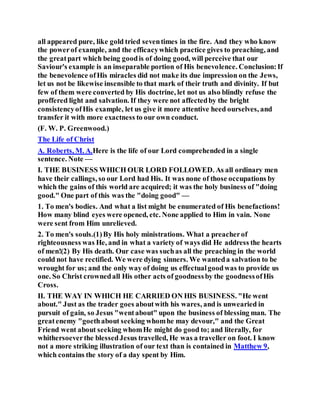
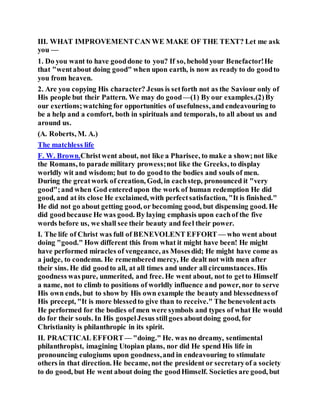
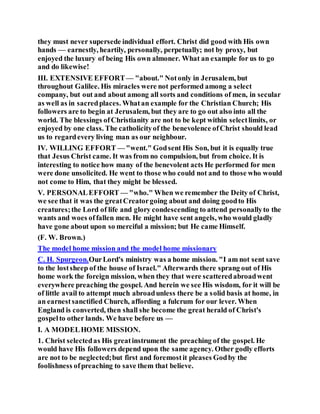
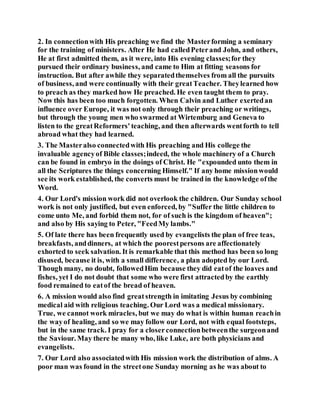
III. WHAT IMPROVEMENTCAN WE MAKE OF THE TEXT? Let me ask
you —
1. Do you want to have gooddone to you? If so, behold your Benefactor!He
that "wentabout doing good" when upon earth, is now as ready to do goodto
you from heaven.
2. Are you copying His character? Jesus is setforth not as the Saviour only of
His people but their Pattern. We may do good—(1) By our examples.(2)By
our exertions;watching for opportunities of usefulness, and endeavouring to
be a help and a comfort, both in spirituals and temporals, to all about us and
around us.
(A. Roberts, M. A.)
The matchless life
F. W. Brown.Christwent about, not like a Pharisee, to make a show;not like
the Romans, to parade military prowess;not like the Greeks, to display
worldly wit and wisdom; but to do goodto the bodies and souls of men.
During the greatwork of creation, God, in eachstep, pronounced it "very
good";and when God enteredupon the work of human redemption He did
good, and at its close He exclaimed, with perfectsatisfaction, "It is finished."
He did not go about getting good, or becoming good, but dispensing good. He
did goodbecause He was good. By laying emphasis upon eachof the five
words before us, we shall see their beauty and feel their power.
I. The life of Christ was full of BENEVOLENT EFFORT — who went about
doing "good." How different this from what it might have been! He might
have performed miracles of vengeance, as Mosesdid; He might have come as
a judge, to condemn. He remembered mercy, He dealt not with men after
their sins. He did goodto all, at all times and under all circumstances. His
goodness waspure, unmerited, and free. He went about, not to getto Himself
a name, not to climb to positions of worldly influence and power, nor to serve
His own ends, but to show by His own example the beauty and blessednessof
His precept, "It is more blessedto give than to receive." The benevolentacts
He performed for the bodies of men were symbols and types of what He would
do for their souls. In His gospelJesus stillgoes aboutdoing good, for
Christianity is philanthropic in its spirit.
II. PRACTICAL EFFORT— "doing." He. was no dreamy, sentimental
philanthropist, imagining Utopian plans, nor did He spend His life in
pronouncing eulogiums upon goodness,and in endeavouring to stimulate
others in that direction. He became, not the president or secretaryof a society
to do good, but He went about doing the goodHimself. Societies are good, but
they must never supersede individual effort. Christ did good with His own
hands — earnestly, heartily, personally, perpetually; not by proxy, but
enjoyed the luxury of being His own almoner. What an example for us to go
and do likewise!
III. EXTENSIVE EFFORT— "about." Notonly in Jerusalem, but
throughout Galilee. His miracles were not performed among a select
company, but out and about among all sorts and conditions of men, in secular
as well as in sacredplaces. Whatan example for the Christian Church; His
followers are to begin at Jerusalem, but they are to go out also into all the
world. The blessings ofChristianity are not to be kept within selectlimits, or
enjoyed by one class. The catholicityof the benevolence ofChrist should lead
us to regardevery living man as our neighbour.
IV. WILLING EFFORT — "went." Godsent His Son, but it is equally true
that Jesus Christ came. It was from no compulsion, but from choice. It is
interesting to notice how many of the benevolent acts He performed for men
were done unsolicited. He went to those who could not and to those who would
not come to Him, that they might be blessed.
V. PERSONALEFFORT — "who." When we remember the Deity of Christ,
we see that it was the greatCreatorgoing about and doing goodto His
creatures;the Lord of life and glory condescending to attend personallyto the
wants and woes offallen men. He might have sent angels, who would gladly
have gone about upon so merciful a mission; but He came Himself.
(F. W. Brown.)
The model home mission and the model home missionary
C. H. Spurgeon.OurLord's ministry was a home mission. "I am not sent save
to the lostsheep of the house of Israel." Afterwards there sprang out of His
home work the foreign mission, when they that were scatteredabroadwent
everywhere preaching the gospel. And herein we see His wisdom, for it will be
of little avail to attempt much abroadunless there be a solid basis at home, in
an earnestsanctified Church, affording a fulcrum for our lever. When
England is converted, then shall she become the great herald of Christ's
gospelto other lands. We have before us —
I. A MODELHOME MISSION.
1. Christ selectedas His greatinstrument the preaching of the gospel. He
would have His followers depend upon the same agency. Other godly efforts
are not to be neglected;but first and foremostit pleases Godby the
foolishness ofpreaching to save them that believe.
2. In connectionwith His preaching we find the Masterforming a seminary
for the training of ministers. After He had calledPeterand John, and others,
He at first admitted them, as it were, into His evening classes;for they
pursued their ordinary business, and came to Him at fitting seasons for
instruction. But after awhile they separatedthemselves from all the pursuits
of business, and were continually with their greatTeacher. Theylearned how
to preach as they marked how He preached. He even taught them to pray.
Now this has been too much forgotten. When Calvin and Luther exertedan
influence over Europe, it was not only through their preaching or writings,
but through the young men who swarmed at Wirtemburg and Geneva to
listen to the greatReformers' teaching, and then afterwards wentforth to tell
abroad what they had learned.
3. The Masteralso connectedwith His preaching and His college the
invaluable agencyof Bible classes;indeed, the whole machinery of a Church
can be found in embryo in the doings of Christ. He "expounded unto them in
all the Scriptures the things concerning Himself." If any home missionwould
see its work established, the converts must be trained in the knowledge ofthe
Word.
4. Our Lord's mission work did not overlook the children. Our Sunday school
work is not only justified, but even enforced, by "Suffer the little children to
come unto Me, and forbid them not, for of such is the kingdom of heaven";
and also by His saying to Peter, "FeedMy lambs."
5. Of late there has been frequently used by evangelists the plan of free teas,
breakfasts, anddinners, at which the poorestpersons are affectionately
exhorted to seek salvation. It is remarkable that this method has been so long
disused, because it is, with a small difference, a plan adopted by our Lord.
Though many, no doubt, followedHim because they did eatof the loaves and
fishes, yet I do not doubt that some who were first attractedby the earthly
food remained to eatof the bread of heaven.
6. A mission would also find greatstrength in imitating Jesus by combining
medical aid with religious teaching. Our Lord was a medical missionary.
True, we cannot work miracles, but we may do what is within human reachin
the wayof healing, and so we may follow our Lord, not with equal footsteps,
but in the same track. I pray for a closerconnectionbetweenthe surgeonand
the Saviour. May there be many who, like Luke, are both physicians and
evangelists.
7. Our Lord also associatedwith His mission work the distribution of alms. A
poor man was found in the streetone Sunday morning as he was about to
commit suicide. Two of our brethren met him, and led him to this Tabernacle,
but first they took him to a coffee shop. I had a far more likely hearer in the
man whose hunger was relieved than I could have had in the poor famishing
sinner. Then, after the sermon, they gave him a gooddinner, and so detained
him till they brought him here againin the evening, and God was pleasedto
bless the Word to him.
8. Our Master's missionwas carriedon very largely through open-air
preaching. All over England there are tens of thousands who never will hear
the gospelwhile open-air preaching is neglected. It is altogethera mischievous
thing that we should confine our preaching within walls.
9. Our Lord also setan example to home missionaries, in that He had pity on
the villages. Smallvillages are often thought to be too insignificant for the
founding of churches in them. But the villages help to make the large towns,
and the characterof London depends upon the characterofvillage homes.
10. At the same time the Masteralso gave much attention to the towns.
II. THE MODELHOME MISSIONARY. The success ofa work depends very
little upon the system; almosteverything rests, under God, upon the man.
There have been men who, with systems unwise and imperfect, have
accomplishednoble results, while others with admirable organisations have
done nothing.
1. The man who is to serve God as a leading missionary must be a man of
teaching power and of personalinfluence. It is of no use to send out a man
who cannot speak. If you want a man to spreadthe gospelhe must be one who
can preach. Our Lord had this grand capacityin the highest degree.
2. Our Lord as a missionary fraternised with the people. How many of us, if
we had seena poor harlot coming to the well, would have remained purposely
to converse with her? He was holy, harmless, undefiled, and separate from
sinners, but He was the friend of publicans and sinners. And we must be one
with those whom we would bless; we must not be ashamedto callthem
brethren.
3. Our Lord was a man who could toil. He never preacheda sermon without
weaving His soul into it. His life was a scene ofunrivalled labour. Now, if the
Church would see souls saved, the work will never be achievedby agents who
are half asleep.
4. Fora home missionarywe want a man who can pray as the Masterprayed.
He was as greatwith God in prayer as He was with man in preaching. If we
prevail with God for men, we shall prevail with men for God.
5. And if we are to secure useful men and womenwe must choose those who
can weep. I do not covet that moistness of the eye which is the result of
effeminacy, but manly weeping is a mighty thing. Our Lord, when He beheld
the city, could not restrain the water floods, His greatsoul ran over at His
eyes. If He had not been a man who could weepHimself, He could not have
made others weep.
6. To crown all, our Lord knew how to die! Love of life must yield to love of
souls. Christ revealedthe greatsecretwhen it was saidof Him, "He saved
others, Himself He cannotsave." In proportion as a man saves himself he
cannot save others.
III. LET US HEAR HIS CALL AND IMITATE HIM.
1. It is your privilege to be a workertogetherwith God, therefore keepclose to
the footsteps ofthe greatMasterworker.
2. Rememberthat before He went to work He was Himself personally
obedient to that gospelwhich He had to preach. He did not bid others believe
and be baptized, and neglectto be baptized Himself.
3. This being done, let me sayto you, Is there not some department of mission
work at home that you could undertake? Most probably you could not do all
those things which I have mentioned as having been done by Christ, but you
know that young artists will often be instructed by their masters to sketch, not
the whole of a greatstatue, but one single limb, an arm, a hand, or a foot. Just
so it shall be enough to teachyou service if, being unable to attempt the whole
of the greatscheme, you will undertake zealously to labour in one department
of it.
4. But whatever you do, do it thoroughly, do it heartily.
5. Take one word which is often used by Mark as a motto for yourselves.
Mark is always saying of Christ that "straightway" He did so and so. Now, if
you have work for Christ before your eye, straightwayhastento do it. Do
something tonight before you go to bed, if it be only the giving awayof a tract.
6. There is an all-sufficient powerwhich you may obtain for this service. Our
Lord is declaredin this very verse to be one who was anointed with the Holy
Ghostand with power. That same Holy Ghostis given to the Church, and that
same power lingers in the assemblies ofthe faithful.
(C. H. Spurgeon.)
The greatItinerant
C. H. Spurgeon.The text is an exquisite miniature of Christ. There are not
many touches, but they are the strokes ofa master's pencil. The portrait
cannot be mistakenfor anyone else. Alexander, Caesar, Napoleonwentabout
destroying. Prophets who professedto have been sent of God have compassed
sea and land to make proselytes, but the goodwhich they accomplishednone
could see. What Peterhere draws in words, God's grace drew, in some
measure, in lines of real life in the case ofHoward and some other followers of
Jesus;still, in the highestand fullest sense, these words are applicable to none
but the Master. His is the model, and theirs the humble copy. He did good,
and goodonly: but the best of men, being men at the best, sow mingled seed.
I. CONSIDERHIM.
1. His object. "He went about," but His travel was no listless motion, no
purposeless wandering. O man of God, have a purpose, and devote thy whole
life to it! Be not an arrow shot at random, but choose thy target. Christ's
objectwas "doing good:" This was —(1) His eternal purpose. Long before
man was formed Jesus was setupon doing good. He did goodamong the
angels, for the heavenly harps owe all their music to His presence. Among the
devils there was no room for positive good; but even there restraining
goodness bound them down in iron bands, lest their mischief should grow too
rampant. On earth, however, was the widest scope for goodnessin its largest
sense;for that goodnesswhichdescends to sin-strickenmortals, to setthem
upon the throne of glory.(2)His practicalobject. His presence in the manger
did good, as it cheeredboth rich magi and poor shepherd with the knowledge
that God had come down to men. His childhood did good, for it has become
the mirror of childhood's obedience to this day. Ye know how His after life
was one practical carrying out of this solitary object.(3)His official
prerogative. He receivedthe name of Jesus, "ForHe shall save His people
from their sins." He was named "Christ," because the Spirit of the Lord was
upon Him, etc. Mention any name you please, and you will see that it is
incumbent upon Him, ex officio, to go about doing good. Shepherd, Husband,
Friend, Lion, Lamb.(4) His actual performance. He did goodin all senses —
physically and spiritually.
2. His mode.(1) He went about. Personally. He might have sent out His
apostles to do goodin His stead;but when He sent them out, it was not as
proxies, but as heralds, "whither He Himself would come." The evangelists
constantly tell us that He touched the leper with His own finger, that He
visited the bedside of the sick, etc. I would that much more of benevolence
were performed by men themselves. Why should you not go and give away
your guinea lovingly and tenderly? It will be better than letting somebodyelse
pare it down to fifteen shillings, and giving it awaycoldly and officially. So
much depends upon the way of doing good. The look, the word, the prayer,
the tear, will often be more valuable to the widow than that half-crownwhich
you have given her. The Saviour's very presence did good, apart from the
blessings which He bestowed.(2)He went about with incessantactivity. He did
not only the goodwhich was round about Him, which was brought to Him,
but He "went about." He could not be satisfiedto be still. Scarcelya village or
a hamlet which had not been gladdened by the sight of Him. Oh! the creeping,
crawling manner in which some people serve the Lord!(3) He went out of His
way to do good. You must not be content to do goodin the regular circle of
your movements. Break through the bounds of propriety every now and then,
and do an odd thing. That was a quaint expedient of those who brake up the
roof to let down a palsiedman that Jesus might heal him.(4) He went far in
doing good. The district of Palestine was notvery large, but He went to the
limit of it. He was not sent exceptto the lost sheepof the house of Israel. But
He went to the verge of it. And I admire the Lord's going about not simply for
the miles He travelled, but for the space ofcharacterover which He passed. It
is nothing wonderful that He went as far as Tyre and Sidon, but it is much
that He went as far as publicans and sinners. A minister once announced to
his congregation, "Iam going on a mission to the heathen." The goodpeople
thought their minister was going to leave them, and felt sadat the bare idea of
losing him. "But," he added, "I shall not be out of town." If you want men
who have gone far in sin, greatforeigners in that respect, you need not leave
London.(5) No doubt Christ's perseverance is intended, for when rejectedin
one place, He goes to another.(6)The unity of His purpose is also hinted at. He
does not go about with two aims.(7)And the successis here intended. He went
about, and not only tried to do good, but He did it.
3. His motive.(1) He did good partly because He could not help it. It was His
nature to do good. All the goodthings which God has made are diffusive.
There is light; the clouds; air; fire.(2) His grand motive no doubt is the display
of the Divine attributes. He is the manifestationof Godhead. Poor troubled
sinner, cannot He glorify God in you? You need pardon: you will be an
illustrious instance of God's grace if He should eversave you.
II. CONSIDEROURSELVES.
1. As to the past. There are some in all callings who either do positive harm, or
at any rate cannotimagine that they are doing any good. Let them repent
themselves. But you who are saved, have you done all the goodyou could?
2. As to the future. The old question comes up, if any man says today, "I am
resolvedto go about doing good" — is he able to do it? And again, the reply
comes, we must first be good, or else we cannot do good. The only way to be
goodis to seek to the goodMaster. Then whatsoeverourhand findeth to do,
let us do it. Let us not ask for greaterabilities. If we can get them let us do so;
but meanwhile let us use what we have. Go, thou housewife, to thy house, and
from the lowestchamberto the top go thou about doing good. Go, thou
teacher, to thy little school, and let thine example tell, and there is range
enough for thee. You domestic servants, the kitchen is sphere enough for you.
(C. H. Spurgeon.)
Seeking to do goodin little ways
Christian Age.Mr. Harvey was riding slowly along the dusty road, looking in
all directions for a stream, or even a house where he might refresh his tired
and thirsty horse with a gooddraught of water. While he was thinking and
wondering, he turned an abrupt bend in the road, and saw before him a
comfortable-looking farmhouse, and at the same time a boy ten or twelve
years old came out into the road with a small pail, and stood directly before
him. "What do you wish, my boy," said Mr. Harvey, stopping his horse.
"Would your horse like a drink?" said the boy, respectfully. "Indeed he
would, and I was wondering where I could obtain it." Mr. Harvey thought
little of it, supposing, of course, the boy earned a few pennies in this manner,
and therefore he offered him a bit of silver, and was astonishedto see him
refuse it. "I would like you to take it," be said, looking earnestly at the child,
and observing for the first time that he limped slightly. "Indeed, sir, I don't
want it. It is little enough I can do for myself or anyone; I am lame, and my
back is bad, sir, and mother says, no matter how small a favour may seem, if
it is all we are capable of, God loves it as much as He does any favour; and
this is the most I can do for others. You see, sir, the distance from Painesville
is eight miles to this spot, and I happen to know there is no streamcrossing
the road that distance, and the houses are all some distance from the road,
and so, sir, almosteveryone passing here from that place is sure to have a
thirsty horse." Mr. Harvey lookeddown into the grey eyes that were kindling
and glowing with the thought of doing goodto others, and a moisture
gatheredin his own, as a moment later he joggedoff, pondering deeply upon
the quaint little sermon that had been delivered so innocently and
unexpectedly.
(Christian Age.)
The blessednessofdoing good
C. H. Spurgeon.APiedmontese nobleman, whom I met at Turin, had not long
before experienced its efficacy;and his story, which he told me without
reserve, was as follows:"I was wearyof life, and, after a day such as few have
known, and none would wish to remember, was hurrying along the streetto
the river, when I felt a sudden check. I turned and beheld a little boy, who had
caught the skirt of my cloak in his anxiety to solicitmy notice. His look and
manner were irresistible; not less so was the lessonhe had learned. 'There are
six of us, and we are dying for want of food.''Why should I not, saidI to
myself, relieve this wretched family? I have the means, and it will not delay
me many minutes. But what if it does?'The scene ofmisery he conducted me
to I cannot describe. I threw them my purse, and their burst of gratitude
overcame me; it filled my eyes — it went as a cordialto my heart. 'I will call
againtomorrow!' I cried. Foolthat I was to think of leaving a world where
such pleasure was to be had, and so cheaply!" May many a readerof these
lines find in the true romance of London a relief for all hypochondriacaland
dyspeptic sorrows.
(C. H. Spurgeon.)
Doing goodas a remedy for sealdepression
Bp. Ryle.RichardCecilwent to preachat Bedford Road Chapel, London, and
one day a person came up to him about a certain lady, a greatprofessorof
religion. He representedthat she was quite out of spirits, unhappy and
miserable, and that Mr. Cecilought to go and try and do her some good. He
went to the lady and found her sitting by the fire, with her feet on the fender
and looking very miserable, with a greatshawlon her back, while the sun was
shining in at the window. She askedMr. Cecilto sit down; but he said," I will
not sit down; I know what is the matter. Getup, put on your bonnet, and go
out and try and do some good. Within a few hundred yards of this very house
there are people dying, and persons that want help. Go out and do something,
and try and do good in the world." She took his advice, and went out and
tried to do some good, and when he calledon her two or three weeks after, he
found her quite an alteredperson. Her voice was altered, she lookedcheerful
and happy, and her low spirits were all gone. She said, "Oh, Mr. Cecil, you
could not have done me a greaterfavour than ask me to try and do some
good."
(Bp. Ryle.)
Doing goodIt is said of a certain New England Congregationalminister that
when he was young, "in the college andat the seminary he loved to spend his
strength in doing that kind of goodwhich other men neglected — and that
remained his characteristic throughlife." In his parish work he was sure to be
after the "one sheep" which had been given up as lost. Norman M'Leod, the
greatfriend of the Scotchpoor, was industriously maligned in all quarters,
although on the day when he was carriedout to his burial a workmanstood,
and, looking at the funeral procession, said:"If he had done nothing for
anybody more than he has done for me, he should shine as the stars forever
and ever."
Doing goodwithin our sphere
T. Dwight.Christspent His life in doing goodwithin the sphere in which He
lived, and to the objects within His reach. Thus He has taught us irresistibly
that, insteadof consuming our time in wishes to do good where we cannot, the
true dictate of universal goodwillis to do it where we can.
(T. Dwight.)
Goodnot to be done by deputy
Dr. Nevins.Notone of the leastremarkable features of the presentage is, the
system of doing those things by deputy which our forefathers did for
themselves. Provided a man has plenty of ready money, he may recline on the
sofa, or loll in the easychair the greaterpart of the day, and still be a most
active Christian by deputy. Does his heart yearn to provide for the orphan, or
to comfort the widow, to clothe the naked and to feedthe hungry? He has no
longerto seek them out as of old; he is not compelledto visit the scenes of
destitution and misery; he has but to subscribe a few guineas to some half
dozen institutions to qualify himself as a "life governor";and for the
remainder of his days he is freed from the obligations of Christian
benevolence, by discharging the mere peppercorn rent of signatures to tickets
and proxy papers. Benevolence peripatetic: — Genuine benevolence is not
stationary, but peripatetic; it goethabout doing good.
(Dr. Nevins.)
A long life of benevolence
John Wesley.Eighty-sevenyears have I sojourned on this earth, endeavouring
to do good.
(John Wesley.)
COMMENTARIES
EXPOSITORY(ENGLISHBIBLE)
Ellicott's Commentary for English Readers(38)How God anointed Jesus of
Nazareth.—Inthe Greek structure the name stands in apposition with the
“word” in the two previous verses—“Jesus ofNazareth, how Godanointed
him.” The word “anointed” is used with distinct reference to the name of
Christ in Acts 10:35, and assumes a knowledge ofthe facts connectedwith His
baptism, as in Matthew 3:16, Mark 1:10, Luke 3:21-22, as the divine witness
that that Name belongedof right to Him and to no other.
Healing all that were oppressedof the devil.—The words seem to us to refer
speciallyto the works of healing performed on demoniacs, but were probably
uttered with a wider range of meaning, all disease being thought of as the
work directly or indirectly of the greatenemy. So Satan had bound the
woman with a spirit of infirmity (Luke 13:11). So St. Paul’s “thorn in the
flesh” was a messengerofSatanto buffet him (2Corinthians 12:7).
Matthew Henry's Concise Commentary10:34-43Acceptancecannotbe
obtained on any other ground than that of the covenantof mercy, through the
atonement of Christ; but wherever true religion is found, Godwill acceptit
without regarding names or sects. The fearof God and works of righteousness
are the substance of true religion, the effects of specialgrace.Thoughthese
are not the cause ofa man's acceptance,yet they show it; and whatevermay
be wanting in knowledge orfaith, will in due time be given by Him who has
begun it. They knew in generalthe word, that is, the gospel, which God sentto
the children of Israel. The purport of this word was, that God by it published
the goodtidings of peace by Jesus Christ. They knew the severalmatters of
fact relating to the gospel. They knew the baptism of repentance which John
preached. Let them know that this Jesus Christ, by whom peace is made
betweenGod and man, is Lord of all; not only as over all, God blessedfor
evermore, but as Mediator. All power, both in heaven and in earth, is put into
his hand, and all judgment committed to him. God will go with those whom he
anoints; he will be with those to whom he has given his Spirit. Peterthen
declares Christ's resurrectionfrom the dead, and the proofs of it. Faith has
reference to a testimony, and the Christian faith is built upon the foundation
of the apostles and prophets, on the testimony given by them. See what must
be believed concerning him. That we are all accountable to Christ as our
Judge; so every one must seek his favour, and to have him as our Friend. And
if we believe in him, we shall all be justified by him as our Righteousness. The
remissionof sins lays a foundation for all other favours and blessings, by
taking that out of the way which hinders the bestowing of them. If sin be
pardoned, all is well, and shall end well for ever.
Barnes'Notes on the BibleHow God anointed ... - That is, set him apart to this
work, and was with him, acknowledging him as the Messiah. See the notes on
Matthew 1:1.
With the Holy Ghost - See the notes on Luke 4:19. The act of anointing kings
and priests seems to have been emblematic of the influences of the Holy Spirit.
Here it means that God impaled to him the influences of the Holy Spirit, thus
consecrating him for the work of the Messiah. See Matthew 3:16-17;John
3:34, "Godgiveth not the Holy Spirit by measure unto him."
And with power- The powerof healing the sick, raising the dead, etc.
Who went about doing good - Whose main business it was to travel from place
to place to do good. He did not go for applause, or wealth, or comfort, or ease,
but to diffuse happiness as far as possible. This is the simple but sublime
record of his life. It gives us a distinct portrait of his character, as he is
distinguished from conquerors and kings, from false prophets and from the
mass of people.
And healing ... - Restoring to health.
All that were oppressedof the devil - All that were possessedby him. See the
notes on Matthew 4:23-24.
God was with him - God appointed him, and furnished by his miracles the
highest evidence that he had sent him. His miracles were such that they could
be performed only by God.
Jamieson-Fausset-BrownBible Commentary38. Now God anointed Jesus of
Nazareth—rather, "JesusofNazareth (as the burden of that 'published
word'), how God anointed Him."
with the Holy Ghostand with power—thatis, at His baptism, thus visibly
proclaiming Him Messiah, "the Lord's Christ." See Lu 4:18-21. Forit is not
His unction for personalholiness at His incarnation that is referred to—as
many of the Fathers and some moderns take it—but His investiture with the
insignia of the Messianic office,in which He presented Himself after His
baptism to the acceptanceofthe people.
went about doing good—holding up the beneficentcharacterof all His
miracles, which was their predicted character(Isa 35:5, 6, &c.).
healing all that were oppressedof the devil—whether in the form of
demoniacalpossessions, ormore indirectly, as in her "whom Satanhad bound
with a spirit of infirmity eighteenyears" (Lu 13:16); thereby showing Himself
the Redeemerfrom all evil.
for Godwas with him—Thus gently does the apostle rise to the supreme
dignity of Christ with which he closes,accommodating himself to his hearers.
Matthew Poole's CommentaryGodanointed Jesus:it was usual to anoint their
kings, priests, and prophets, unto all which offices Christ was anointed by his
Father; hence calledChrist, as in the Old Testamentthe Messiah.
Of Nazareth: the apostle is not ashamedof this name, though given to our
Saviour by way of contempt; he gloried in the cross ofChrist.
With the Holy Ghostand with power; Christ was endued with the Almighty
Spirit of God, and with the power of it.
Who went about doing good:all the miracles our blessedSaviourwrought,
were works of mercy, for the benefit and relief of those upon whom he
wrought them: he could have wrought miracles to destroy and ruin such as
would not believe in him, which he was often provokedunto; nay, his apostles
would have had him but to permit them by fire from heavento destroy the
Samaritans, Luke 9:54, and he would not.
Healing all that were oppressedof the devil: the deliverances our Saviour so
often wrought upon such as were possessedofdevils, was to show unto them
that he was come to destroy the works ofthe devil, aim to casthim out of the
souls of men who were spiritually possessedby him; which also our Saviour
did, so that it was a happy calamity for them, which brought them to Christ.
For God was with him; God was with our Saviour,
1. By his might and powerdoing such miracles.
2. In his extraordinary love to him, Matthew 3:17, and always hearing of him,
John 11:42. And also,
3. God was with Christ ousiwdwv, in the fulness of the Godhead, Colossians
2:9.
Gill's Exposition of the Entire BibleHow God anointed Jesus ofNazareth,....
And so declaredhim to be the Messiah, that was promised to the Jews, and
expectedby them; the anointed prophet, priest, and King; who because his
parents lived at Nazareth, and he was educatedthere, and there he chiefly
preachedand wrought his miracles, he was by way of contempt called Jesus of
Nazareth: and him God anointed, with
the Holy Ghostand with power;with the gifts and gracesofthe Spirit,
without measure;signified by the descentof the Spirit, as a dove upon him at
his baptism, and is what in Psalm 45:7 is called, "the oil of gladness". The
person anointed is elsewhere representedas a divine person; as God, and the
Son of God, Psalm2:6 but here under his most contemptible character, by
which he was knownamong men, because it was in his human nature, that he
was anointed; and this anointing belongs to him, as consideredin his office
capacity;from whence he is calledthe Christ, or anointed of God. The
anointer of him is God, which must be understood of God the Father, who is
the Godof Christ, and the same that anoints his people, 2 Corinthians 1:21
and none but Godcan anoint with the Holy Ghost; and he it is, with whom
Christ is here saidto be anointed; who is compared to oil, in allusion to the
anointing oil under the former dispensation, used for the anointing of persons,
prophets, priests, and kings, and of the tabernacle, and the vessels ofit; to the
oil that was poured on Aaron's head, which ran down to the skirts of his
garments, emblematical of the Spirit poured on Christ, the head, and which
from him descends to all the members of his body; and to common oil, both
for ornament and refreshment: "power" is added, which is but another name
for the Holy Spirit, Luke 24:49. And one particular branch of the
extraordinary and immeasurable gifts of the Spirit, bestowedon him as man,
was a powerof doing miracles:for it follows,
who went about; the land of Judea and all Galilee;which shows laboriousness,
diligence, and delight:
doing good; both to the bodies and souls of men; to the latter, by preaching
the Gospelto them; and to the former, by curing all their diseases, of
whatsoeversort:he did what none of Adam's sons could do, for there is none
of them that does good, no not one, Romans 3:10 he was goodhimself,
essentiallyand naturally good, and therefore he did good, and he did nothing
but good:he knew no sin, he did none, nor could any be found in him; and he
always did good, that which was according to the will of God, and well
pleasing in his sight; and without him no goodis done, even by his own
people; they have all the grace and strength from him, by which they perform
the goodthings they do: he is the reverse of Satan, who goes about doing all
the mischief he can; and he is to be imitated by his followers, who, as they
have opportunity, should do goodto all men, especiallyto the household of
faith.
And healing all that were oppressedof the devil; both in body, as "lunatics,
epileptics, and demoniacs";and in soul, such as were led captive by him:
for Godwas with him; as his Son, essentially, through union to him; and as
man, from his cradle to his cross, supporting and assisting him, and with his
gracious presence comforting him; and by various instances, showing that he
came from heaven, and had a divine missionand commission; which had he
not, he would never have been encouragedand assistedas he was, as man, and
could never have done the things he did: the Ethiopic versionvery wrongly
reads, "for God was with them";
Geneva Study BibleHow God {q} anointed Jesus ofNazarethwith the Holy
Ghostand with power: who went about doing good, and healing all that were
oppressedof the devil; for God was with him.
(q) This manner of speaking is takenfrom an old custom of the Jews, who
used to anoint their kings and priests, because ofwhich it came to pass to call
those anointed upon whom God bestowedgifts and virtues.
EXEGETICAL(ORIGINAL LANGUAGES)
Expositor's Greek TestamentHYPERLINK"/acts/10-38.htm"Acts 10:38.
Ἰησοῦν τὸν ἀπὸ Ν.: in apposition to ῥῆμα, the person in Whom all else was
centred, and in Whom Peterhad found and now preached“the Christ”; or
may be treated as accusative afterἔχρισεν.—ὡς ἔχρ.: taken by St. Ambrose,
St. Cyril of Jerusalem(so by Bede)to refer to the Incarnation, by St.
Athanasius to the Baptism only. But the expressionmay also be connected
with the entrance of our Lord upon His ministry at Nazareth, cf. Luke 4:14;
cf. in this passagethe mention of Nazarethand Galilee.—εὐεργετῶν:our Lord
was really εὐεργέτης, cf. Luke 22:25 (only in St. Luke); “far more truly used
of Christ than of Ptolemy the king of Egypt,” Cornelius à Lapide.—
καταδυναστευομένους:only elsewhere in Jam 2:6 in N.T., but cf. Wis 2:10;
Wis 15:14, Sir 48:12, Jos., Ant., xii., 2, 3. No doubt other diseases besidesthose
of demoniacalpossessionare included, cf. especially Luke 13:11;Luke 13:16;
but a specialemphasis on the former exactly corresponds to the prominence
of a similar class ofdisease in Mark 1:23.—ὁ Θεὸς ἦν μετʼ αὐτοῦ, cf. Acts 7:9,
John 3:2, so also Luke 1:28; Luke 1:66, and in LXX, Jdg 6:16. We cannot see
in the expressiona “low” Christology;St. Peterhad first to declare that Jesus
was the Christ, and it is not likely that he would have entered upon a further
exposition of His Personin his introductory discourse with a Gentile convert;
but Acts 10:42-43 below, to say nothing of St. Peter’s public addresses,
certainly do not point to a humanitarian Christ.
Cambridge Bible for Schools andColleges38. how Godanointed Jesus of
Nazareth] It seems betterto take the name “Jesus ofNazareth” as in
apposition with the tidings mentioned in the previous verse, making the
connectionthus: Ye know the tidings, &c., “evenJesus ofNazareth, how God
anointed him,” &c. This is the whole scope of what was preached, that Jesus
had lived as a man in Nazareth, but yet had been God’s Anointed, the
Messiah, andshewn to be so by the mighty works which He did.
healing all that were oppressedof the devil] This is perhaps mentioned as
shewing that the power of Jesus was to be not only over physical but over
moral evil likewise, andthis alone is mentioned because in the healing of the
greater, the powerto cure the less evil is implied.
for Godwas with him] As Nicodemus confessed, “No mancan do these
miracles that thou doestexcept Godbe with him” (John 3:2).
Bengel's GnomenHYPERLINK"/acts/10-38.htm"Acts 10:38. Ἰησοῦν—ὡς
ἔχρισεν αὐτὸνὁ Θεὸς, Jesus—howGodanointed Him) This being joined by
apposition with the word, τὸ—ῥῆμα, depends on ye know. Therefore the
words in constructionhave the same force as if it were said, Ἰησοῦς ὡς
ἔχρισται;which is equivalent to, τὰ περὶ Ἰησοῦ, ὃν ἔχρισεν ὁ Θεός. The
sentiment is this, that Jesus, andthat too as the Christ, was knownto them.—
ἔχρισεν αὐτὸν, anointedHim) especiallyin baptism. Matthew 3:16-17;Luke
4:1; Luke 4:14; Luke 4:18.—Πνεύματι Ἁγίῳ καὶ δυνάμει, with the Holy Spirit
and with power)The mention of the Holy Ghost is often so made, as that there
is added mention of that gift of the Spirit specially which accords with the
matter in hand for the time being: as in this place, where the works ofChrist
are the subject predicated of, there is added, with power. So in ch. Acts 6:3,
the Seven, “full of the Holy Ghost and wisdom;” ch. Acts 11:24, “full of the
Holy Ghostand of faith;” ch. Acts 13:52, “The disciples were filled with joy
and with the Holy Ghost.” Comp. the words, spirit and truth, spirit and life,
John 4:23; John 6:63. The concrete and abstractnouns are joined in the same
way as in 1 Peter 4:14.—εὐεργετῶν, doing good)All the miracles of Christ
brought health and salvation, not injury, to men. The genus, gooddeeds, is
followedby the species, healings.—πάντας, all)There had been, especiallyat
that time, a great multitude of persons possessedandsick.—
καταδυναστευομένους,oppressedby) with unjust force.—(μετʼαὐτοῦ, with
Him) He speaks somewhatsparinglyof the Majestyof Christ, so as to adapt
himself to the capacityof his hearers.
Pulpit CommentaryVerse 38. - Even Jesus ofNazareth, how that God
anointed him for how God anointed Jesus ofNazareth. The reference to the
anointing (Isaiah 61:1; Luke 4:18, 21; Matthew 1:16, 17; Acts 4:27) was
necessaryto representhim as God's Christ (see Acts 9:22). For the
designation, of Nazareth, comp. Acts 2:22; Acts 3:26; Acts 4:10; Acts 6:14;
Luke 24:20. Oppressedof the devil. This ascription of disease to Satanagrees
with Job 2:7 and Luke 13:16. The word rendered "oppressed"
(καταδυναστευομένους)occurs inthe New Testamentonly here and James
2:6, but, with its substantive καταδυναστεία,is found repeatedlyin the LXX.
and the Apocrypha, and in classicalGreek,though rarely. A goodexample of
its force is Exodus 1:13, and of the substantive Exodus 6:7. It means "to rule
over oppressively, and by force." In the explanatory addition, For God was
with him, Peter teaches whatour Lord himself and St. John in his Gospelso
constantly do, that our Lord's miracles were wrought by the powerof God
(see e.g. John5:17, 19, 30; John 7:28; John 8:28; John 9:3, 4; Luke 11:20,
etc.). The unity of the Son with the Father would be taught later.
Vincent's Word StudiesAnointed (ἔχρισεν)
See on Christ, Matthew 1:1.
Went about (διῆλθεν)
Lit., went through (the country). Compare Acts 8:4.
And healing
The and (καὶ)has a particularizing force:doing good, and in particular,
healing.
Oppressed(καταδυναστευομένους)
Only here and James 2:6, on which see note.
The Great Itinerant by Spurgeon
“Who went about doing good.”
Acts 10:38
You will observe, if you read the chapter before us, that Peter’s sermonwas
short and much to the point. He preached Jesus Christto Cornelius
immediately and unmistakably. He gave a very admirable sketchof the life of
Jesus ofwhich he affirmed himself to have been an eyewitness andhe brought
forward, in his closing sentence, just that simple Gospelwhich it is our joy to
preach. “To Him all the Prophets witness, that through His name whoever
believes in Him shall receive remissionof sins.”
This should be an instructive example to all professedministers of the Gospel.
We might say less about other matters without loss if we would say more
about the Lord Jesus. If we should omit some other teaching, if there were
more of a savor of the name and of the Personof Jesus Christ in our ministry,
the omissions might be tolerated. It is a strange thing that men should profess
to be sentof God and yet talk about everything exceptthe greatmessage
which they are sent to deliver!
My errand as a minister is to preach Christ and it will avail me little to have
been clearand earnestupon other points if I have neglectedto setforth Christ
Crucified. To put my own views of doctrine or moral practice in the place of
Jesus is to put out the sun and supply its place with a farthing rush light–to
take awaythe children’s bread and offer them a stone. We commend Peter as
an example to all who preach or teach, either in the street, the sick chamber,
or the House of Prayer–do as Peterdid–come at once to the soul of your
ministry, and setforth Christ Crucified in plain and simple language.
If any should plead that the subject should be adapted to the audience, we see
from the narrative that there is sure to be something in the history of Christ
applicable to the case before us. Peterpurposely gave prominence to certain
points in the history of the Masterwhich would be most likely to enlist the
sympathy of Cornelius. He says of Him, “He is Lord of all,” as much as to say,
“He is not Lord of the Jews only, but also of the Gentiles, and therefore, O
Cornelius, His dominion reaches to you. He is to be worshipped and adored
and He is to become a blessing and a propitiatory sacrifice, not only to Israel’s
hosts, but even to Italians. And therefore you, O Centurion, may take heart.”
Perhaps the words of our text were uttered by Peterconcerning Christ
because they also would be sure to attractthe notice of a man who was “A
devout man and one that fearedGod with all his house, which gave much alms
to the people and prayed to God always.” He did as much as say, “You go
about doing good, Cornelius. It is the very soul of your life to help the needy,
to feed the hungry and to clothe the naked–Jesus also wentabout doing good
in a higher sense and I hold Him up to you as one to be belovedby every
devout and generous heart.”
Other points are to be noticed in Peter’s address which were evidently
adapted to the case before him, but we have said enoughto prove that there is
something in the story of Jesus suitable to win the attention and to gain the
heart of any congregation, large or small. Only let the Holy Spirit help us to
dilate upon the Gospelof the Lord Jesus and we have no need to wander
abroad for foreign themes. We can sit at the foot of the Cross and find a
perpetually profitable subject there. No need to gatherthe sheaves ofscience,
or the sweetflowers ofprose–ChristJesus is both our science and our poetry
and as ministers we are complete in Him!
When we come forth to preach Him and to lift Him up, we are armed from
head to foot and rich with weapons forour spiritual warfare. Though learning
and art have had no hand in fashioning our panoply, we need not fear that we
shall meet a single foe who canwithstand the terror of those celestialarms.
God grant us Grace in all our teachings to keepclose to Jesus Christ–forHis
love is a theme most fit for all casesand most sweetatall times. doing good.“
There are not many touches, but they are the strokes ofa master’s pencil. The
portrait cannot be mistakenfor anyone else. The mightiest conquerors may
gaze upon its beauties but they cannot claim that it is intended to portray
their lives. Alexander, Caesar, Napoleon–thesewentabout conquering,
burning, destroying, murdering. They went about not doing good. Prophets
too, who professedto have been sent of God, have compassedsea and land to
make proselytes, but the goodwhich they accomplishednone could see.
Mahomet’s careerwas fraught with incalculable evil. The few goodmen and
true, who, like Howard, have perambulated the world seeking to minister to
the necessities ofmankind, have wept over the heavenly portrait and sighed
that they are not more like it. This is what they soughtto be and so far as they
copied this portrait, this is what they were. But they fall short of the original
and are not slow to confess their shortcomings. WhatPeter here draws in
words, God’s Divine Grace drew, in some measure, in lines of real life in the
case ofHoward and some other followers of Jesus ofNazareth.
Still, in the highest and fullest sense, these words are applicable to none but
the Master, forHis followers could not do such goodas He achieved. His is the
model and theirs the humble copy. His the classic type and theirs the modest
imitation. He did goodand goodonly–but the best of men, being men at the
best–sow mingledseed. And if they scatterhandfuls of wheat, there is here
and there a grain of rye. However carefully they may selectthe grains, yet the
cockle andthe hemlock will fall from their hands as well as the goodseedof
the kingdom. Of the Masterand only of the Masteris it true in the fullest and
the broadestand most unguarded sense, “He went about doing good.”
Two things this morning–first I shall want you, dear Brethren, to consider
Him. And then, in the secondplace, to consideryourselves.
1. The first occupationwill be pleasing, as wellas profitable. Let us
CONSIDER HIM.
Considerfirst, His object. He went about, but His travel was no listless
motion, no purposeless wandering here and there–“He went about doing
good.” O Man of God, have a purpose and devote your whole life to it! Be not
an arrow shot at random, as in child’s play! Choose your target, and swift as
the bullet whizzes to the mark, so fly onwards towards the greataim and
objectof your life. Christ’s objectis described in these words, “doing good.”
Of this we may say that this was His only purpose.
Long before He took upon Himself the nature of man, or even before man was
formed of the dust of the earth, the heart of Jesus Christ was setupon doing
good. In the EternalCouncil in which the sacredThree enteredinto
stipulations of the Everlasting Covenant, Christ Jesus became the Surety of
that Covenantin order that He might do good–goodin the highest sense–good
in snatching His people from the misery which sin would bring upon them and
goodin manifesting the glorious attributes of God in a splendor which could
not otherwise have surrounded them.
His delights of old were with the sons of men, because theyafforded Him an
opportunity, such as He could find nowhere else, ofdoing good. He did good,
it is true, among the angels, for the heavenly harps owe all their music to His
Presence.Among the devils there was no room for positive good. They were
given over to evil–but even there restraining goodness found work for itself in
binding them down in iron bands lest their mischief should grow too rampant.
On earth, however, was the widestscope and amplest room for goodnessin its
largestsense–notmerely the goodness whichrestrains evil and the goodness
which rewards virtue–but that greatergoodnesswhichdescends to sin-
strickenmortals and lifts them up from the dunghill of their miserable
degradationto set them upon the Throne of Glory.
It was the eternal purpose of the Lord Jesus Christ, before the lamps of
Heaven were kindled or stars beganto glitter in the vault of night, that He
would do good. This was His practicalobject, when He made His ever-
memorable descentfrom the Throne of His splendor to the manger of His
poverty. Angels might wellsing at Bethlehem, “Glory to God in the highest
and on earth peace, goodwill toward men,” for Jesus Christ came not
condemning the world, but doing good.
His Presencein the manger did good. As it cheeredboth rich magi and poor
shepherd, both learned and illiterate, both Simeon and Anna, with the
knowledge that God had come down to men. His childhood afterwards did
good, for though it was so unobtrusive and obscure that a few words suffice to
setit forth, yet He has become the very mirror of childhood’s dutiful
obedience to this day. His adult life was one practicalcarrying-out of the
solitary objectwhich brought Him from the Throne of Glory to the abodes of
sinful men. He “went about doing good.”
Nor was this His purpose merely and the objectof His errand, but His official
prerogative. He receivedthe name of Jesus at His birth, “ForHe shall save
His people from their sins.” He was named “Christ,” because the Spirit of the
Lord was upon Him and He was anointed to preach goodtidings to the meek
and to open the prisons to them that were bound. Jesus Christ is the title
which bespeaks One whose office it is to do good. Mention any name you
please which belongs to the Savior and you will see that it is incumbent upon
Him, ex officio, to go about doing good.
Is He a Shepherd? He must do good to His sheep. Is He a Husband? He must
love His Church and give Himself for her, that He may cleanse andperfect
her. Is He a Friend? He “sticks closerthan a brother” and does good. Is He
“the Lion of the tribe of Judah?” It is not to do damage or mischief to
innocence and weakness, but that, strong as a lion when he tears his prey, He
may rend in pieces the foe of truth and goodness. Is he a Lamb? Here His
goodness showsitselfmost completely, for He lays down His life that His
Israelmay go free when the destroying angelsmites Egypt. Everywhere it was
His peculiar prerogative and His specialbusiness to go about doing good.
But more, it was not only His intention and the object of His errand and His
prerogative, but His actualperformance. He did goodin all senses. Jesus
Christ workedphysicalbenefit among the sons of men. How many blind eyes
first saw the light through the touch of His fingers! How many silent ears
heard the charming voice of affectionafter He had said, “Be open”!Even the
gates ofdeath were no barrier to the errands of His goodness. The widow at
the gate of Nain felt her heart leap within her for joy when her son was
restored. And Mary and Martha were gladwhen Lazarus came forth from his
grave. Jesus Christ did goodphysically.
We have thought that our Lord did this not merely to show His powerand
universality of His benevolence and to teachspiritual Truth by actedparables,
but also to sayto us in these days, “Followers ofJesus, do goodin all sorts of
ways. You may think it is your specialcalling to feed souls, but remember that
your Masterbroke loaves and fishes to hungry bodies. You may deem it your
chief objectto instruct the ignorant, but remember that He healedthe sick.
You may make it your chief joy to pray for the healing of sick spirits, but
remember that He rescuedmany bodies from incurable disease.”
As much as lies in us, let us do goodunto all men, and goodof all kinds, too,
though it is speciallyto the householdof faith, and speciallyin a spiritual
sense. Letno actof mercy seembeneath him who is a followerof the Man that
went about doing good. There is a spirit springing up among us which is very
dangerous though it wears the garb of excessive spirituality. It is impractical
and unchristlike–a spirit which talks in this fashion–“The sons ofmen tried to
improve the world and make it better, but as for Enoch, the man of God, he
knew that the world was so bad that it was of no avail to attempt to better it
and therefore he left it alone and walkedwith God.”
It may be well, they say, for such carnal-minded Christians as some of us to
try and improve society and to give a better tone to morals, but these dear
spiritual Brethren are so taken up with Divine things and so assuredthat the
mission is of a supercelestialcharacterthat they will have nothing to do with
blessing mankind, being quite sufficiently occupiedwith blessing themselves
and one another. I pray God that we may never fall into the impractical
speculations and separations ofcertain Brethren whose superior sanctity they
must allow us to suspect. The large-heartednessofthe Lord Jesus Christis
one of the most glorious traits in His Character. He scatteredgoodof all sorts
on all sides. Let us, if we profess to be His followers, neverbe straitened even
by pretended spirituality. Do good“as much as lies in you,” to the utmost
extent of your powerand let that be of every sort.
It strikes me that the Lord Jesus also did much moral good. Where He did not
save spiritually, yet He elevated. I am not sure that that poor adulteress was
ever truly convertedand yet I know that He said, “Neitherdo I condemn you:
go, and sin no more.” And I canwell believe that in this respect, atleast, she
would sin no more. I do not know that the Pharisees everbecame followersof
the Man of Nazareth, and yet I cannot conceive that they could have listened
to His stern rebukes againsttheir hypocrisy without being in some measure
humbled, if not enlightened. Or if they were not better, at any rate, their
professions wouldnot be so readily allowed.
Societywould receive, as it were, a tonic from those sharp and bitter words of
the Masterand become too strong and masculine to receive any longerthe
lofty boastings of those mere pretenders. Jesus Christ, when He sat down on
the mount, did not deliver a spiritual sermon of the style commonly classed
under that head. That sermon on the mount is, for the most part, morality–
goodhigh, heavenly morality–higher than any teacherever reachedbefore.
But there is very little in it about justification by faith or concerning
Atonement! Very little about the doctrine of election, the work of the Holy
Spirit, or final perseverance.
The fact is the Masterwas doing moral as wellas spiritual good. And coming
among a degradedpeople who had set darkness forlight and light for
darkness, bitter for sweetand sweetforbitter, He thought it a part of His
vocationto preach to them truth on that subjectas well as upon the higher
themes concerning His advent and His salvation. DearFriends, this
admonishes us to seek the moral good of the people among whom we dwell!
The Christian minister must not lay aside his ministry to become the mere
moralist lecturer, but he may and should lecture upon morals–andhe can say
some things in lectures which he could not say in sermons. Let him, by all
means, occasionallyleave the pulpit for the platform if he can do service to
society!
Let him do goodin every possible shape and way. I think that it is the
Christian minister’s place not simply to preachthe high and glorious doctrine
of the Cross, but also to deal with the current sins of mankind as did the
Prophets of old–and to inculcate those virtues most needed in the State–as did
men God sent in the ages which are past. Jesus Christ went about doing good,
we say, of a moral kind as wellas of a spiritual order, but still the Savior’s
greatgoodwas spiritual. This was the greatend that He was driving at–the
bringing out of a people prepared to receive Himself and His salvation–He
came preaching Divine Grace and peace.
His greatobjectwas the spiritual emancipationof the bondaged souls of men.
Beloved, how He sought after this! What tears and cries went up to God from
the mountain’s bleak summit! With what earnestintercessiondid He plead
with men when He addressedthem concerning repentance and faith! “Woe
unto you, Bethsaida!Woe unto you, Chorazin!” were not words spokenby
One who had a tearless eye. “Woeunto you, Capernaum!” was not the
desolating curse of One who had a hard, unsympathetic heart.
The Savior, when He wept over Jerusalem, was only doing once before men
what He did all His life before God. He wept over sinners! He longedfor their
salvation!“Neverman spoke like that Man.” Having the highest Truth, He
spoke it after the highest fashion. Never the ostentationof eloquence, never
the affectationof oratory–but ever the earnest, still, small pleading voice
which “does not break the bruised reed, nor quench the smoking flax.” He
went about in His daily preaching instructing the people because He found
them as sheep without a shepherd, and therefore “He taught them many
things.”
Physical, moral, spiritual good, goodof all sorts the Saviordid–and while I
close this point as to His object of life, let me saythat He did something more
than all this–He workedenduring good which abides with us now. The good
that holy men do is imperishable. The Scripture says, “Their works do follow
them,” but not to the grave–theirworks ascendupward. If our works followed
our bodies, they would rot in the tomb. But they follow our souls and
therefore mount up to immortality. Look upon the world and see whether
Jesus Christ is not still in Spirit going about doing good!He has gone up to
Glory, but the Spirit of His life and of His teaching is still among us.
And what is His religion doing? Ask of our sires and they will tell you how this
land was translatedfrom a region of savagesinto the abode of peace and joy!
Look yourselves, in your own day, to the far off islands of the south and see
how they have been transformed from dens of the wild blood-loving cannibals
into abodes of civilized men! Jesus Christ’s Gospelflies like an angelthrough
the midst of Heaven proclaiming goodnews to men! And whereverits foot
rests but for an hour, it transforms the desertinto an Eden and makes the
wilderness blossomas the rose!May the Savior help us so to live that when we
die we may have sownsome seeds which shall blossomover our tomb.
Thus we have given an outline of the Savior’s doing good. May we add this
sentence as a comfort to any here who are seeking Jesus. Ifit were His eternal
purpose and His life’s mission to do good, and He went about to find out the
objects of it, why should He not do goodto you? If He healedthe blind. If He
gave spiritual sight, why should He not give it to you? O may the desire be
breathed by you, poor seeking Soul, breathed solemnly but hopefully to Him–
“O You who in the days of Your flesh did take pity upon misery and
wretchedness in every shape, take pity upon me! Save me with Your great
salvation!”
Restassured, belovedHearer, that prayer will not go up to Heavenin vain!
His ears are still open to hear the cry of woe and His hands are still ready to
giving the healing touch and the voice to say, “I will, be you clean.” MayHe
do goodin you this morning!
A short time may be profitably spent in considering the mode in which this
objectwas accomplished. We are told that He “wentabout doing good,”
which seems to suggestseveralpoints. First of all He did the goodPersonally.
He “went about doing good.” He might, if He had chosen, have selectedHis
place and having seatedHimself, He might have sent out His Apostles as
ambassadors to do goodin His place. But you will recollectthat when He sent
them out, it was not that they might be proxies, but that they might be
heralds. He sent them two and two unto every place where He Himself would
go.
They were to be to Him what John the Baptisthad been at His first coming.
Jesus Christ entered the field of labor in Person. It is remarkable how the
evangelists constantlytell us that He touched the leper with His own finger.
That He visited the bedside of those sick with fever and in caseswhere He was
askedto speak the word only at a distance, He did not usually comply with
such a request, but went Himself to the sick bed and there Personallyworked
the cure. A lessonto us if we would do goodwell–do it ourselves.
There are some things which we cannot do ourselves. We cannot remain
among our families in England, for instance, and preach the Gospelin
Hindustan. We cannot be engagedthis morning in listening to the Word and
at the same time visiting the lodging house or den of iniquity in some back
street. There are some works of mercy which are best performed by others–
but we can make these more personalby looking after the workerand taking
a deeper interestin him–and by attending him with our prayers. I wish that
much more benevolence were performed by men themselves.
I do not care to speak againstSocieties!But it is such an odd thing that if I
have twenty-one shillings to give away, I cannotgive them to a deserving
family myself. I must make it into about fifteen shillings before it goes atall by
paying it into a royal something or other Society!And then it proceeds by a
roundabout method and at last is delivered to the poor by a mere hand
without a soul. And it is receivedby the poor, not as a gift of charity, but
rather as a contribution from an unknown something with a secretarywhich
needs a place in which to drop its funds.
Why should you not go and give awaythe twenty-one shillings yourself,
lovingly and tenderly? It will be better than letting somebody else pare it
down to fifteen and give it awaycoldly and officially. So much depends upon
the wayof doing good. The look, the word, the prayer, the tear will often be
more valuable to the widow than that half-crown which you have given her. I
heard a poor person once say, “Sir, I went to So-and-So for help and he
refused me. But I would soonerbe refused by him than I would have money
given to me by So-and-So,” mentioning another who gave it with a sort of,
“Well, you know I do not approve of giving anything to such as you are, but
here it is–you must have it I suppose, so be off with you.”
Give your alms awayyourselves and you will learn, by so doing, it will enable
you to exercise Christianvirtues. You will win a joy which it were not
worthwhile to lose, and you will confer, in addition to the benevolence that
you bestow, a blessing which cannot be conferred by the personwho is your
substitute. He went about doing good. He did it Himself. Oh, some of you–
preach yourselves, I pray you! Talk to the Sunday schoolchildren yourselves!
Give awaytracts–thatis well enough if you cannotspeak–butdo try and talk
yourselves. The influence of that hand laid upon your friend’s shoulder, those
eyes of yours looking into his eyes as you say, “Friend, I wish you were
converted, my soul longs for your salvation”–there is more in that influence
than in a whole library of tracts!
Seek souls yourselves!Fish with your own hooks. You cannothelp being
successfulif you imitate your Masterand do goodyourselves in the power of
the Holy Spirit. The Savior not only “wentabout doing good” Personally, but
His very Presencedid good. The Presenceofthe Savioris, in itself, a good,
apart from the blessings which He bestowed. At the sight of Him courage
revived! Drooping faith grew strong!Hope brushed a tearfrom her eye and
smiled! The sight of Jesus Christ as once it calmed the waves and hushed the
winds, did so a thousand times in men souls.
Even devils, when they saw Him, cried out and trembled. Sinners wept at the
sight of His pitying goodness. The womanwho broke the alabasterbox of
precious ointment felt that the only fit place to break it was near to Him. His
Presence made her sacredactionyet more sweet. Whatcannotmen do when
Christ is there? And, O Beloved, if we are anything like our Master, our
presence will be of some value. There are some of my Brethren, when I see
them, I feelstrong. You go into a little PrayerMeeting and numbers are not
there–but such a saint is there and you feel, “Well, if he is there, there is a
Prayer Meeting at once.”
You have work to do. It is very hard and toilsome, and you cannotprosper in
it. But a Brother drops into your little Sunday school, or into your class and
looks atit and you feel, “Well, if I have that man’s sympathy, I cango on
again.” Therefore be careful to give your presence as much as you canto
every goodwork and do not isolate yourself from those actually engagedin
labors of love. Does not our Lord’s going about doing goodset forth His
incessantactivity? He did not only the goodwhich was round about Him,
which came close to hand–He did not only the goodwhich was brought to Him
as when men were brought on their beds and laid at His feet–he “wentabout.”
He could not be satisfiedto be still. Throughout the whole land of Judea, from
Dan to Beersheba, He trod its weary acres. There was scarcelya village or a
hamlet which had not been gladdened by the sight of Him. Even Jericho,
accursedofold, had been blessedby His Presence anda greatsinner had been
made a greatsaint. He went everywhere casting saltinto the bitter waters and
sowing with sunshine the abodes of sadness. He was ever active in Gods
service!
Oh, the creeping, crawling manner in which some people serve the Lord! The
very way in which some people mumble through religious exercises is enough
to make one sick at heart, to think that the solemn offices ofreligion should be
entrusted to such inanimate beings! If God of old said of Laodicea that He
would spew that Church out of His mouth, what will He do with those
professors in modern times who are the very pink of propriety, but who were
never touched with fire from Heaven and know not what the word “zeal”
means? Our Masterwas here and there, and everywhere! Let us gird up the
loins of our mind and be not wearyin doing well, but be “steadfast,
unmovable, always abounding in the work of the Lord.”
Does not the text also imply that Jesus Christ went out of His way to do good?
“He went about doing good.” There were shortcuts which He would not take
because there were persons dwelling in the roundabout way who must be met
with. “He must needs go through Samaria.” It is saidthat that city lay in the
straightestway to Jerusalem. So it was, but it was not the right way, because
the Samaritans so hated those whose faces were towards Jerusalem, that they
maltreated them wheneverthey could. Yet the Masterdid not care for perils
of waylaying enemies. He did not selectthe smoothestor the safestroad, but
He selectedthat in which there was a woman to whom He could do good.
He sits down on the well. I know it was not merely weariness thatmade Him
sit there. And when He said, “I thirst: give Me to drink,” it was not merely
that He was thirsty! He had another weariness–He was patientover that
woman’s sin and longedto reveal Himself to her! He had another thirst–He
did not mean merely, “Give me waterout of that well.” When He said, “Give
me to drink,” He meant, “Give Me your heart’s love. My soul pants for it. I
want to see you–a poor adulterous sinner–savedfrom sin.”
How else do we understand the words which He said to His disciples, when
they wonderedthat He spoke with the woman? He said, “I have meat to eat
that you know not of, for it is My meat and My drink to do the will of Him
that sent Me.” He had receivedmeat and drink in seeing that woman leave
her waterpot and go awayto tell her fellow sinners, “Come, see a Man which
told me all things that ever I did. Is not this the Christ?” He went round about
after the objects ofHis gracious desires. So must the Christian. You must not
be content to do goodin the regularcircle of your movements–thatis so far so
good, but go beyond your old line! Break through the bounds of propriety
every now and then and do an odd thing.
I believe that sometimes these odd expedients achieve more than regular
methods. That was a quaint expedient of those who broke up the roof to let
down a palsied man that Jesus might heal him. There has been a gooddeal
said about that roof. According to some people it was not a roofat all but a
sort of awning! But this morning we will stick to our old version which tells
us, “they broke up the tiling.” This must have made it a very bad predicament
for those down below! but I dare say those up top argued–“Well, the Savioris
there and if anybody shall be hurt by a tile or two He can easilyheal them.
Anyhow we will get this man before Him, for this is the case in which we feel
most concerned.” Ah, dear Friends, many people are so particular about
making a little dust or breaking up a few tiles! But our mind is, “nevercare
about that,” there will be time to cleanthe repair after souls are saved and for
so greatan end as salvationwe may neglectsome few niceties and punctilios
and be most of all vehemently desirous that we may do good.
We have not quite done with the text yet. It means, too, that Jesus Christ went
far in doing good. The district of Palestine was notvery large, but you will
observe that He went to the limit of it. He was, as it were, the bishop of the
Holy Land and He never went out of the diocese, forHe said He was not sent
exceptto the lost sheepof the house of Israel. But He went to the outer limits
of it. He went to the coasts ofTyre and Sidon. If He might not go over the
mark, yet He will go up to the edge. So if there should happen to be any limit
to your doing goodin any particular place, at leastgo to the end of the limit.
However, I rather like RowlandHill’s thought–whenhe was blamed for
preaching out of his parish, he claimed that he never did so, for the whole
world was his parish. Make the world the sphere of your occupation,
according to the parable, “the field is the world.” I admire the Lord’s going
about not simply for the miles He traveled, but for the space ofcharacterover
which He passed. He “wentabout.” It is nothing wonderful that He went as
far as Tyre and Sidon, but it is much that He went as far as publicans and
sinners! I do not wonder that He went from Dan to Beersheba, but I have
wondered often that He went so far as to save harlots by His Grace.
We may in this sense go aboutdoing goodwithout traveling across the sea. A
minister once announced to his congregationone Sunday morning, “I am
going on a mission to the heathen.” Now he had not told his deacons about it
and they lookedat one another. The goodpeople in the congregation, some of
them, beganto take out their pockethandkerchiefs. Theythought their
minister was going to leave them–he was so useful and necessaryto them that
they felt sad at the bare idea of loosing him. “But” he added, “I shall not be
out of town.”
So you may go on a mission to the heathen without going out of this huge town
of ours. You might almost preachto every sort of literal heathen within the
bounds of London–to Parthians, Medes and Elamites–andthe dwellers of
Mesopotamia. There are men of every color, speaking everylanguage under
Heaven, now living in London. And if you want to convertMahometans,
Turks, Chinese, men from Bengal, Java, orBorneo, you may find them all
here! There are always representatives ofevery nation close atour door. If
you want men who have gone far in sin, greatforeigners in that respect, you
need not certainly leave London for that! You shall find men and women
rotten with sin and reeking in the nostrils of God with their abominations.
You may go about doing goodand your railwayticket need not costyou one
farthing!
No doubt Christ’s perseverance is intended in our text, for when rejectedin
one place, He goes to another. If one will not hear, anotherwill. The unity of
His purpose is also hinted at. He does not go about with two aims, but this one
absorbs all His heart–“doing good.” And the success, too, ofHis purpose is
here intended. He went about and not only tried to do good, but He did it–He
left the world better than He found it when He ascendedto His FatherGod.
One moment concerning the motive of Christ’s doing good. It is not far to
seek. He did goodpartly because He could not help it. It was His Nature to do
good. He was all goodness andas the clouds which are full of rain empty
themselves upon the earth, even so must He. You will have observed that all
the goodthings which God has made are diffusive. There is light–you cannot
confine light within narrow limits. Suppose we were to grow so bigoted and
conceitedas to conceive that we had all the light in the world inside this
Tabernacle. We might have iron shutters made to keepthe light in–yet it is
very probable that the light would not agree with our bigotry and would not
come in at all–but leave us in the dark for wanting to confine it.
With splendid mirrors, Turkish carpets, jewelry, fine pictures and rare
statuary you may court the light to come into palatialhalls. It comes, it is true,
but as it enters it whispers, “And I passedthrough the iron grating of a
prison, just now. I shone upon the poor cottagerbeneaththe rude thatched
roof. I streamed through the window out of which half the glass was gone and
gleamedas cheerily and willingly upon the rags of poverty as in these marble
halls.” You cannot clip the wings of the morning, or monopolize the golden
rays of the sun! What a space the light has traversed doing good!Millions of
miles it has come streaming from the sun and yet further from yonder fixed
star.
O Light! Why could you not be contentedwith your own sphere? Why
journey so far from home? Missionaryrays come to us from so vast a distance
that they must have been hundreds of years in reaching us and yet their
mission is not over, for they flash on to yet remoter worlds. So with the air–as
far as the world is concernedthe air will throw itself down the shaft of the
deepestcoalpit, climb the loftiestAlp–and although men madly strive to shut
it out–it will thrust itself into the fever lair and coolthe brow of cholera.
So with water. Here it comes dropping from every inch of the cloudy sky,
flooding the streets, flushing the foul sewers and soaking into the dry soil.
Everywhere it will come, for water claims to have its influence felt
everywhere. Fire, too! Who can bind its giant hands? The King cannotclaim
it as a royal perquisite. Among those few sticks which the widow woman with
the red cloak has been gathering in the woods, it burns as readily as in Her
Majesty’s palace. It is the Nature of Jesus to diffuse Himself–it is His life to do
good. His grand motive, no doubt, is the display of the glorious attributes of
God.
He went about doing goodin order that Jehovahmight be revealedin His
splendor to the eyes of adoring men. He is the manifestationof Godhead. He is
the express image of His Father’s Person. “In Him dwells all the fullness of the
Godheadbodily.” And through Heaven and earth, and sky and sun and stars,
all show forth something of the goodness ofGod, yet the life of Jesus is the
fullest and clearestmanifestationof the beneficence of Deity that ever will be
accordedto the sons of men. This is an object worthy of God, to manifest
Himself and such an objectChrist setbefore Him when He came to do good
among the sons of men. thing–if Jesus Christ went about doing goodand if His
motive was simply God’s Glory–poortroubled Sinner–cannotHe glorify God
in you? You need pardon–you will be an illustrious instance of God’s Grace if
He should ever save you! Have hope. If Jesus Christ goes about, you are not
too far off. If He looks upon the most forlorn, you are not in too desperate a
plight. Cry to Him when your spirit is overwhelmed!Look to the Rock that is
higher than you! “From the ends of the earth have I cried unto You, O God
and You heard me.” May it be your joy today to find Him your Friend, who
“wentabout doing good.”
II. We were in the secondplace to CONSIDER OURSELVES.This is the
application of the subject. Considerourselves, then, as to the past, with
sorrow and shamefacedness. Have we gone about doing good? I fear there are
some here who never did any spiritual good!The tree is corrupt and it cannot
bring forth goodfruit. The fountain is bitter and it cannot yield sweetwater.
You must be born again before you can go about doing good!While your
nature is as father Adam left it, goodcannot come from you. “There is none
that does good, no not one.”
How clearly this is true in some persons, as proved by their very profession.
The professionof some men is one in which they cannot hope to do good.
There are some in all callings who either do positive harm, or at any rate
cannot imagine that they are doing any good. Let them repent! “Every tree
that brings not forth goodfruit is hewn down and castinto the fire.” God
grant that neither our characternor our vocationmay stand in the way of our
doing good!
But you who have new hearts and rights spirits and are savedby faith in the
precious blood of Jesus, have you done all the goodyou could? I dare not say
yes–Iwish I could dare it! No, Master, there must have been many times when
I might have served You when I have not done it. I have been an unprofitable
servant. I have not done what was my duty to have done.
Ah, some of you have missed a world of joy in having done so little good. You
have not given, therefore you are not increased. You never gave to others
much, and so they have not given back to you full measure, presseddown and
running over. You have not borne the burdens of others and so your own
burden has become heavy and intolerable. Christians, in looking back upon
the past, must you not drop tears of regret? And do you not bless that
preserving love which still follows you? Yes, which will never let you go! And
in spite of your barrenness and unfruitfulness, it will not ceaseto work upon
you till it has made you meet to be partakers of the inheritance of the saints in
light–who day without night serve God in His Temple!
As to the future. The old question comes up–if any man today says, “I am
resolvedto go about doing good”–is he able to do it? And again, the reply
comes–wemust first be good, or else we cannot do good. The only way to be
goodis to seek to the goodOne, the goodMaster!If you have a new heart and
a right spirit, then go your way and serve Him! But if not, pause awhile. Unto
the wicked, Godsays, “Whathave you to do to declare My statutes?” He will
have clean-handed men to do His work!Washfirst in the bronze laver if you
would be a priest. God will not have men for His servants who would defile
the sacredplace. “Be youclean that bear the vessels ofthe Lord.”
God give us to rest implicitly upon the Lord Jesus Christ by a living faith and
so to be cleansedin His precious blood. And then we may resolve to go forth
and live for Him. Have we any work to do now that we can setabout at once?
If we have, whatever our hands find to do, let us do it. Let us not be asking for
greaterabilities than we have. If we can get them, let us do so–but meanwhile
let us use what we have. Go, Housewife, to your house, and from the lowest
chamber to the top go about doing good–here is range enoughfor you!
Go, Teacher, to your little schooland among those boys or girls, let your
example imitate Christ, and there is range enough for you! Go, Worker, to
your shop and among your fellow workmen. Let fall here and there a word for
Christ! Above all, let your example shine, and there is work for you. You
domestic servants, the kitchenis sphere enough for you. You shall go about
doing goodfrom the dresserto the fireplace and you shall have width enough
and breadth enough to make it a kingdom consecratedto God!
Without leaving your position, any one of you–without giving up the plow, or
the cobbler’s lap stone, or the needle, or the plane, or the saw, any business–
without any of you goodsisters wanting to be nuns, or any of us putting on the
serge and becoming monks–in our owncalling let us go about doing good!The
best preparation for it will be to renew our dedication to Christ, be much in
earnestprayer, seek the sanctifying influences of the Holy Spirit and then go
forth in our Master’s strengthwith this as our resolve–thatas imitators of
Jesus Christ it shall be said of us, “He went about doing good.”
May God add His blessing for the Savior’s sake. Amen. PORTION OF
SCRIPTURE READ BEFORESERMON–Acts10.
PRECEPT AUSTIN RESOURCES
BRUCE HURT MD
Acts 10:38 "[You know of] Jesus of Nazareth, how God anointed Him with the
Holy Spirit and with power, and how He went about doing goodand healing
all who were oppressedby the devil, for God was with Him.
KJV Acts 10:38 How God anointed Jesus of Nazarethwith the Holy
Ghostand with power: who went about doing good, and healing all that
were oppressedof the devil; for God was with him.
ESV Acts 10:38 how God anointed Jesus of Nazarethwith the Holy
Spirit and with power. He went about doing goodand healing all who
were oppressedby the devil, for God was with him.
• God anointed Acts 2:22; 4:27; Ps 2:2,6;Ps 45:7; Isaiah11:2; 42:1; 61:1-
3; Mt 12:28;Luke 3:22; 4:18; John 3:34; John 6:27; 10:36-38;Heb 1:9
• how He went about doing good 2 Chr 17:9; Mt 4:23-25;9:35; 12:15;
15:21-31;Mark 1:38,39;3:7-11; Mark 6:6,54-56;Luke 7:10-17,21-23;
9:56; 1 Peter5:8
• healing Mark 5:13-15;7:29,30;Luke 4:33-36;9:42; Heb 2:14,15;1 John
3:8
• for Godwas with Him John 3:2; 10:32,38;16:32
• Acts 10 Resources - Multiple Sermons and Commentaries
JESUS OF NAZARETH ANOINTED
WITH THE SPIRIT AND POWER
Supernatural ministry requires supernatural power and God provided that
powerto the God-Man through the working of the Holy Spirit. Beloved, this
pattern for supernatural ministry has not changed!We all have at leastone
spiritual gift and are all in some way involved in ministry (service)to the Lord
Jesus, so it follows that we need to continually "be strengthened (present
imperative) by the grace that is in Christ Jesus" (evenas Paul commanded
Timothy in 2 Ti 2:1HYPERLINK "/2_timothy_21-7"+)which He "dispenses"
through the indwelling Spirit of Christ (Ro 8:9HYPERLINK
"/romans_89#8:9"+), the Spirit of grace (Hebrew 10:29+). It is futile to
attempt ministry for Jesus without the Spirit of Jesus (Acts 16:7HYPERLINK
"/acts-16-commentary#16:7"+)!Is it any wonder that so many men and
women in Christian ministry become tired, frustrated, often even "throwing
in the towel?" The Church began with the coming of the Spirit. The Church
continues ONLY in reliance on the power of the Spirit. This is sound Biblical
doctrine, a criticaltruth which has sadly been lost or obscuredin many
churches and ministries.
RelatedResources:
• A Spirit Filled Church
• Our Anointing - The Holy Spirit
• Acts 1:8 Commentary
• Spirit-Filled Believers Are Like Artesian Wells
• Ephesians 5:18 Commentary
• The Holy Spirit-Walking Like Jesus Walked!
• Galatians 5:16 Commentary
• The Holy Spirit-2
• Praying in the Spirit
You know of - This verb is not in the Greek but is implied and so it is added
by the NAS translators to make the sentence smoother. And so in the Greek
text the designationJesus of Nazarethis first for emphasis, as all the
remaining discourse by Peter is about Him. Peterasserts thathis audience is
familiar with the Name.
Jesus ofNazareth - This designationof Jesus is used 7x/7v (Matt. 26:71; Mk.
1:24; Lk. 4:34; Lk. 18:37;Jn. 1:45; Acts 10:38; Acts 26:9) The related name
Jesus the Nazarene - 8x in 8v - Mk. 10:47; Mk. 14:67;Mk. 16:6; Lk. 24:19; Jn.
18:5; Jn. 18:7; Jn. 19:19; Acts 2:22; Acts 22:8. It is interesting that Peter
mentions Nazareth for it had a negative connotationduring this period (cf Jn
1:46, 7:52).
Robertsonon Jesus of Nazareth - Jesus the one from Nazareth, the article
before the city identifying Him clearly.
C H Spurgeon on anointed Him with the Holy Spirit and with power - "This
was the spring of Jesus’s life’s power—his anointing from the Holy Spirit."
THOUGHT - BELOVED THIS IS THE "SPRING"OF OUR LIFE'S
POWER!OUR ANOINTING BY THE SPIRIT.
In his first letter John explained to the believers that "you have an
anointing (chrisma) from the Holy One, and you all know." (1 John
2:20HYPERLINK "/1john_218-23_commentary#2:20"+)"As for you,
the anointing (chrisma) which you receivedfrom Him (THE HOLY
SPIRIT EVERY BELIEVER RECEIVES AT THE TIME OF
CONVERSION cfRo 8:9, 1 Cor 12:13, Eph 1:13, 2 Cor 1:21, 22)abides
(present tense - continually) in you, and you have no need for anyone to
teachyo u; but as His anointing (chrisma) teaches you about all things,
and is true and is not a lie, and just as it has taught you, you abide in
Him. (1 John 2:27HYPERLINK "/1john_225-27_commentary#2:27"+)
How God anointed Him with the Holy Spirit and with power - Matthew
records that " Jesus arrived from Galilee at the Jordan coming to John, to be
baptized by him." (Mt 3:13, Lk 3:21HYPERLINK "/luke-3-
commentary#3:21"+)Matthew goes onto describe Jesus'being anointed by
the Spirit for the work of ministry writing "After being baptized, Jesus came
up immediately from the water; and behold, the heavens were opened, and he
saw the Spirit of God descending as a dove and lighting on Him." (Mt, Lk
3:22HYPERLINK "/luke-3-commentary#3:22"+)
Anointed (5548)(chrio;see Messiah- Anointed One) means literally to daub,
smear, anoint with oil or ointment, to rub oneselfwith oil. The figurative use
means to consecrate orsetapart for sacredwork and so here Peterdescribes
God's Spirit setting apart Jesus forHis holy work of ministering for 3 years in
Palestine. Chrio also conveys the sense ofassigning a person to a task, which is
especiallyrelevantto us as followers of Christ. In 2 Cor 1:21 Paul wrote to the
believers at Corinth that "He who establishes us (PAUL INCLUDES
HIMSELF AS RECIPIENT OF THIS ANOINTING)with you in Christ and
anointed (chrio - aorist active = past tense) us is God."
The designationChrist is the Greek word Christos which is derived from
chrio meaning anointed, thus the Christ being the "Anointed One," and this is
the Greek equivalent of the Hebrew noun Mashiach/Masiyah(from
masah/maschah= to anoint) of Whom Psalm 2 clearlyforetold The kings of
the earth take their stand and the rulers take counseltogetheragainstthe
LORD (GOD THE FATHER) and againstHis Anointed (GOD THE
SON)(Mashiach)(Ps 2:2, cf Da 9:25HYPERLINK "/daniel_925"+ "Messiah
[Mashiach]the Prince")
And how He went about doing good - Doing good(euergeteo = [only here, cf
Ps 13:6] conferring benefits, showing kindness, rendering "exceptional
service" - BDAG; to be a benefactor)is in the present tense, so Jesus sets a
"high bar" for us to emulate. How did Jesus continually do good? You might
think since He was God, He relied on His divine power to do good. But Peter
(and see verses below from Luke) indicates Jesus did goodrelying on the
empowerment of the Holy Spirit. This is amazing emptying (Php
2:7HYPERLINK "/philippians_27_commentary"+)!He laid aside His divine
prerogatives whenHe took on flesh so that He might give us a Human
example, a perfectexample to follow. And we are repeatedlyexhorted to
follow Jesus'example (see 1 Cor11:1HYPERLINK
"/1_Corinthians_111_commentary"+, 1 Jn 2:6HYPERLINK "/1john_21-
6_commentary#2:6"+,1 Pe 2:21HYPERLINK "/1_peter_221-25#2:21"+). To
be sure, Jesus did avail Himself of supernatural power we do not have, as for
example when He walkedon wateror told the storm to be still. But in
choosing to rely on the Holy Spirit's filling and empowerment, He left us an
example that is practical and possible to follow! Are you imitating Jesus,
walking like He walked, walking in His steps?
As an aside it is interesting that the Greek word for doing good(euergeteo)
was the root of the Greek noun euergeton(cf Lk 22:25HYPERLINK"/luke-
22-commentary#22:25"+where "Benefactors" = euergetes)which was usedas
a royal title of Hellenistic kings (they were esteemedas "do gooders!")Thatis
apropos for here Peter says it is the King of kings (Rev 19:16HYPERLINK
"http://www.spiritandtruth.org/id/revc.htm?19:16"+) Who is the One Who
does good, but the goodHe did in the first century will ripple throughout time
and eternity, unlike the doing goodof these earthly kings!
Henry Morris - The modern world tends to ridicule "do-gooders,"but if Jesus
is our example, we also should go about doing good("For you have been
calledfor this purpose, since Christ also suffered for you, leaving you an
example for you to follow in His steps" = 1 Peter2:21HYPERLINK
"/1_peter_221-25#2:21"+ ED:AND WE MUST BE DOING IT AS HE DID
IT = BY THE POWER OF THE HOLY SPIRIT!).
Kistemaker- God anointed Jesus with the Spirit and with powerto enable
him to fulfill the messianic prophecy (Isa. 61:1; see also Luke 4:18). That is,
God equipped Jesus for the specialtask ofpreaching and healing. The term
powerpoints to the work Jesus was able to do through the indwelling Spirit
(BELOVED, MARK THIS POINT, FOR HE IS THE SAME HOLY SPIRIT
WHO ENABLES OUR WORK OF MINISTRY, WHATEVER IT MIGHT
BE! DO YOU BELIEVE THIS?). Jesus withstoodSatan, castout demons,
healed the crippled and the sick, cleansedthe lepers, raisedthe dead, and
proclaimed the gospel(compare Matt. 11:4–5).
The writer of Hebrews explains what true sacrificeslook like exhorting us "do
not neglectdoing goodand sharing, for with such sacrifices Godis pleased."
(Hebrews 13:16HYPERLINK "/hebrews_1315-16#13:16"+).
Paul encouragedus "Let us (PAUL INCLUDES HIMSELF) not lose heart in
doing good(WHICH CLEARLY IS A SLOUGH OF DESPOND INTO
WHICH WE CAN ALL FALL!), for (TERM OF EXPLANATION - WHY
WE SHOULD NOT GROW WEARY!) in due time we will reap (EITHER IN
THIS LIFE BUT CERTAINLYIN THE NEXT!) if we do not grow weary. So
then, while we have opportunity (WHILE WE ARE STILL BREATHING ON
EARTH), let us do goodto all people, and especiallyto those who are of the
household of the faith." (Gal 6:9-10HYPERLINK "/galatians_69-
10_commentary"+)
John Piper - Jesus is strongerthan the devil. Jesus rescuespeople who are
oppressedand harassedand tormented and tempted by the devil. Peter lifts
up this truth. He wants Cornelius and his family— and us—to know this and
believe it and experience it. When the Holy Spirit comes, he comes to make
Jesus realas a deliverer from satanic oppression.
Paul Apple points out that "We do not think much about the powerof the
devil and how he presently is oppressing people."
And healing all who were oppressedby the devil - Jesus healedall, not some,
and so He continually manifested to everyone that His power was greaterthan
the Devil's power. Peterrecognizes the devil as a reality, not an imagined
being. (cf Lk 13:16HYPERLINK"/luke-13-commentary#13:16"+;Lk 11:14–
23HYPERLINK"/luke-11-commentary#11:14"+)
Robertson- Luke does not exclude other diseases (cf. Luke 13:11,
16HYPERLINK"/luke-13-commentary#13:11"+), but he lays special
emphasis on demoniacalpossession(cf. Mark 1:23).
NET Note says "Note how healing is tied to the cosmic battle presentin
creation. Christ's powerovercomes the devil and his forces, whichseek to
destroy humanity."
Healing (curing) (2390)(iaomai)means to cure, to heal, to restore. Iaomaiis
used literally of deliverance from physical diseasesand afflictions and so to
make whole, restore to bodily health or heal. Figuratively, iaomaispeaks of
deliverance from sin and its evil consequencesand thus to restore (to spiritual
goodhealth), make whole, renew (Mt 13.15). Iaomairefers primarily to
physical healing in the NT (although clearlythere is overlapbecause some of
these instances involved demonic oppression - Lk 9:42), and less commonly to
spiritual healing or healing (saving) from "moral illnesses"and the
consequencesofsin. When used in this sense iaomaihas much the same
meaning as sozo, to save, make whole, restore to spiritual health. Here are
uses of iaomai that have a spiritual meaning = Mt 13:15, John 12:40, Acts
28:27 - preceding quotes from Isa 6:10, 1Pe 2:24HYPERLINK "/1_peter_224-
25#2:24"+= quote from Isa 53:5HYPERLINK "/isaiah-53-
commentary#53:5"+.
All Luke's uses of iaomai -
Lk. 5:17; Lk. 6:18; Lk. 6:19; Lk. 7:7; Lk. 8:47; Lk. 9:2; Lk. 9:11; Lk.
9:42; Lk. 14:4; Lk. 17:15;Lk. 22:51; Jn. 4:47; Acts 9:34; Acts 10:38;
Acts 28:8; Acts 28:27
Oppressed(2616)(katadunasteuo from katá = down, against+ dunasteúo = to
rule or dunastes = a ruler or potentate) means to exercise dominion against. In
two NT uses it conveys the sense oftyrannize, oppress harshly. The only other
NT use is by James 2:6 "But you have dishonored the poor man. Is it not the
rich who oppress you and personally drag you into court?"
Katadunasteuo - 28x in the Septuagint -
Exod. 1:13 (Egyptians compelledthe sons of Israel); Exod. 21:16; Deut.
24:7; 1 Sam. 12:3; 1 Sam. 12:4; 2 Sam. 8:11 (the nations which he had
subdued); 2 Chr. 21:17; Neh. 5:5; Jer. 7:6 (you do not oppress the alien,
the orphan, or the widow,); Jer. 22:3; Jer. 50:33; Ezek. 18:7; Ezek.
18:12;Ezek. 18:16; Ezek. 22:7; Ezek. 22:29;Ezek. 45:8 (My princes
shall no longer oppress My people); Ezek. 46:18; Hos. 5:11; Hos. 12:7;
Amos 4:1; Amos 8:4; Mic. 2:2; Hab. 1:4; Zech. 7:10 (do not oppress the
widow or the orphan, the stranger or the poor; and do not devise evil in
your hearts againstone another.); Mal. 3:5; Acts 10:38; Jas. 2:6
Devil (1228)(diabolos fromdiá = through, between+ ballo = to cast, throw)
means a false accuser, slanderer(one who utters false charges or
misrepresentations which defame and damage another’s reputation),
backbiting (malicious comment about one not present), one given to malicious
gossipor a calumniator (one who utters maliciously false statements, charges,
or imputations about, this term imputes malice to the speakerand falsity to
the assertions).
Luke's uses of diabolos - Lk. 4:2; Lk. 4:3; Lk. 4:6; Lk. 4:13; Lk. 8:12; Acts
10:38;Acts 13:10
God was with Him speaks ofJesus'enablementfor ministry. Do you have the
sense that God is with you and enabling your ministry? Are you relying on
your natural poweror the supernatural powerof the Spirit Who is with you
continually.
For God was with Him - God was with Jesus (enabling the external
manifestations of His power - cp Jn 10:30, 38;14:9–10)and He is with
believers today! This is a greattruth for all believers to lay hold of - In Acts
7:9 Godwas with Josephand in Hebrews 13:5 the non-lying God promises "I
WILL NEVER DESERTYOU, NOR WILL I EVER FORSAKE YOU." God
is with us when we minister, when we sleep, whenever and wherever we are!
Is this not a comforting truth! Matthew reminds us that "HIS NAME
IMMANUEL,” which translated means, “GOD WITH US.” (Mt 1:23 quoting
Isaiah7:14HYPERLINK "/isaiah_7_commentary#7:14"+)Indeed, Jesus is
with us and in us (Col 1:28) as is God the Fatherand as is God the Spirit.
Yes the Father was with Jesus but so was His Spirit and Luke clearly indicates
that Jesus'ministry as the perfect Man (which serves as an example to all
men), was enabledor empoweredby the Holy Spirit, the same Holy Spirit to
Whom all believers have accessandWho enables all of us for supernatural
ministry! Are you ministering in your poweror His power? It makes all the
difference in this world and the world to come (for apart from Him you can
do nothing of eternalvalue!).
Lk 4:1HYPERLINK "/luke-4-commentary#4:1"+ Jesus,full of the Holy
Spirit, returned from the Jordan and was led around by the Spirit in the
wilderness
Lk 4:14HYPERLINK "/luke-4-commentary#4:14"+And Jesus
returned to Galilee in the powerof the Spirit, and news about Him
spread through all the surrounding district. And He beganteaching in
their synagoguesand was praisedby all
THOUGHT - NOTE:IF JESUS RELIED ON THE POWER OF THE
HOLY SPIRIT TO TEACH SO MUST WE DEAR TEACHER OR
PREACHER!ONE WONDERSIF THIS IS THE REASON SO MANY
PREACHERS ARE BURNING OUT? JUST A THOUGHT.
CERTAINLY THE ETERNALSPIRIT OF GRACE DOES NOT
BURN OUT!
Lk 4:18HYPERLINK "/luke-4-commentary#4:18"+“THE SPIRIT OF
THE LORD IS UPON ME, BECAUSE HE ANOINTED ME TO
PREACH THE GOSPELTO THE POOR. HE HAS SENT ME TO
PROCLAIM RELEASE TO THE CAPTIVES, AND RECOVERYOF
SIGHT TO THE BLIND, TO SET FREE THOSE WHO ARE
OPPRESSED,
Ray Stedman - The next greatfeature of the goodnews is that when Jesus
Christ arrived, He destroyed the effects of evil everywhere he went. He did
this openly, before witnesses, where everyone couldsee. He came to a world
that was lostand despairing, without hope. Everywhere he went he setpeople
free and brought againto human hearts the hope that there is a way out of the
desperate bondage of fallen humanity. I do not know of a time in history since
those days when our Lord was first here in the flesh, that the world has been
so gripped by obvious bondage to evil forces as it is today. Men and women
everywhere are hopeless, sunk deepin despair, and they need to see againthis
marvelous demonstration that Jesus Christ can setpeople free.
I will never forgetthe experience of a young man who came into our
congregationa few years ago. I have related this story before, but it well
illustrates this point. He was not accustomedto attending church -- he had not
been raisedin a church at all -- but his heart was hungry. He came here not
knowing what we would be like. His idea of Christians was that they were a
sort of super-snobbish people who self-righteouslyfelt they were better than
others. I happened to be speaking on First Corinthians 6, and I read these
verses:
Do you not know that the unrighteous will not inherit the kingdom of
God? Do not be deceived;neither the immoral, nor idolaters, nor
adulterers, nor homosexuals, nor thieves, nor the greedy, nor
drunkards, nor revilers, nor robbers will inherit the kingdom of God.
And such were some of you. (1 Corinthians 6:9-11a RSV)
For some reasonthat morning I stopped there (ED: THIS IS SURELY A
BEAUTIFUL EXAMPLE OF THE SPIRIT'S URGING PASTOR STEDMAN
TO STOP AND APPLY WHAT HE HAD JUST READ) and said, "How
many in this congregationbelong in this category? How many have ever been
guilty of some of the things that are listed in these verses?"And I read them
again. All over the congregationhands beganto rise. This young man took a
look around, saw this forestof hands, and said to himself, "These are my kind
of people!" Such were some of you, set free. That is what Christ does. "He
went about doing goodand healing all that were oppressedby the devil" as a
demonstration of what God is accomplishing in the work of redemption. (Acts
10:23-11:18 Life For All)
David Guzik summarizes - Peter’s sermonwas a wonderful (if brief and
perhaps condensedby Luke) explanation of the person and work of Jesus of
Nazareth:
• Jesus was baptized in identification with humanity
• Jesus was anointedwith the Holy Spirit and with power
• Jesus wentabout doing goodand healing, delivering those oppressedby
the devil
• Jesus did this with the power of God, for God was with Him
• Jesus did these things in the presence of eyewitnesses
• Jesus was crucified
• Jesus was raisedfrom the dead, resurrectedin view of many witnesses
• Jesus commandedHis followers to preachthe messageofwho He is and
what He did
• Jesus is ordained by God to be Judge of the entire world
• Jesus is the one foretold by the prophets (Acts 10 Commentary)
C H Spurgeon - Morning and Evening - Few words, but yet an exquisite
miniature of the Lord Jesus Christ. There are not many touches, but they are
the strokes ofa master's pencil. Of the Saviour and only of the Saviour is it
true in the fullest, broadest, and most unqualified sense. "He went about
doing good." From this description it is evident that he did goodpersonally.
The evangelists constantlytell us that he touched the leper with his own
finger, that he anointed the eyes of the blind, and that in cases where he was
askedto speak the word only at a distance, he did not usually comply, but
went himself to the sick bed, and there personallywrought the cure. A lesson
to us, if we would do good, to do it ourselves. Give alms with your own hand; a
kind look, or word, will enhance the value of the gift. Speak to a friend about
his soul; your loving appeal will have more influence than a whole library of
tracts. Our Lord's mode of doing goodsets forth his incessantactivity! He did
not only the goodwhich came close to hand, but he "wentabout" on his
errands of mercy. Throughout the whole land of Judea there was scarcelya
village or a hamlet which was not gladdened by the sight of him. How this
reproves the creeping, loitering manner, in which many professors serve the
Lord. Let us gird up the loins of our mind, and be not weary in well doing.
Does not the text imply that Jesus Christ went out of his way to do good? "He
went about doing good." He was never deterred by danger or difficulty. He
sought out the objects of his gracious intentions. So must we. If old plans will
not answer, we must try new ones, for fresh experiments sometimes achieve
more than regular methods. Christ's perseverance, and the unity of his
purpose, are also hinted at, and the practicalapplication of the subjectmay be
summed up in the words, "He hath left us an example that we should follow in
his steps."
Doing Good
Read:Luke 6:27-36
Jesus ofNazareth . . . went about doing good and healing all who were
oppressedby the devil, for God was with Him. —Acts 10:38
Someone once said, “The goodyou do today will be forgotten tomorrow. Do
goodanyway.” I like that; it’s a greatreminder. In the book of Acts, Luke
summarized Jesus’earthly ministry by saying that He “wentabout doing
good” (10:38).
What does the Bible mean when it tells us to “do good”? Jesus did goodby
teaching, healing, feeding, and comforting people. Using Jesus as the perfect
example, His followers are called to meet the needs of others, including those
who hate them: “Love your enemies, bless those who curse you, do goodto
those who hate you” (Matt. 5:44; see also Luke 6:27-35). Theyare to serve
their enemies without expecting anything in return.
Moreover, as opportunity arises, His followers are to do goodespeciallyto
fellow believers (Gal. 6:10). They are not to let persecution, selfishness,and
busyness cause them to forgetto do goodand to share what they have with
others (Heb. 13:16).
To be like our Savior and His early followers, we should ask ourselves each
day: “What goodthing can I do today in Jesus’name?” When we do good, we
will be offering a sacrifice that pleases God(Heb. 13:16) and that draws
people to Him (Matt. 5:16).
From the example of Jesus, Who went about doing good, We are to honor our
Savior By helping whereverHe would. —Hess
Imitate Jesus—go aboutdoing good.
By Marvin Williams (Our Daily Bread, Copyright RBC Ministries, Grand
Rapids, MI. — Reprinted by permission. All rights reserved)
No Body But Ours
Read:1 Corinthians 12:12-27
We are members of His body, of His flesh and of His bones. —Ephesians 5:30
In Acts 10:38, Peterdescribed our Lord as “Jesus ofNazareth, . . . who went
about doing good.” Thoseacts ofservice and kindness were expressedthrough
His earthly body. Since ascending to heaven, Christ no longer has a body on
earth except ours. In other words, He has no hands, legs, orfeet on earth
exceptfor the members of His body, the church. So we must never
underestimate the importance of being the body of Christ on earth, not only
spiritually but also physically.
There’s a story of a little child who was put to bed in a dark room. She was
fearful of being left alone, so her mother brought her a doll. This didn’t satisfy
her and she beggedher mother to stay. The mother reminded her that she had
the doll and God, and needn’t be afraid. Soonthe child begancrying. When
the mother returned to her side, she sobbed, “Oh, Mommy, I want someone
with skin on!”
We’re all like that child at times. In our loneliness and suffering, Christ
doesn’t condemn us for wanting “someone withskin on” to be with us and to
care for us.
Therefore He sends us out to be His body to one another and to the world, and
to go about doing good. Remember this: Right now Jesus has no body on
earth but ours!
The love of Christ has freed us,
Has lifted us from shame;
Now we His path should follow,
And reachout in His name. —DCE
God works through us to meet the needs of those around us.
By Joanie Yoder (Our Daily Bread, Copyright RBC Ministries, Grand
Rapids, MI. — Reprinted by permission. All rights reserved)
Acts 10:39 "We are witnessesofall the things He did both in the land of the
Jews and in Jerusalem. Theyalso put Him to death by hanging Him on a
cross.
KJV Acts 10:39 And we are witnesses ofall things which he did both in
the land of the Jews, and in Jerusalem;whom they slew and hanged on
a tree:
NLT Acts 10:39 "And we apostles are witnessesofall he did throughout
Judea and in Jerusalem. They put him to death by hanging him on a
cross,
• We are witnesses ofall the things He did Acts 10:41; 1:8,22;2:32; 3:15;
5:30-32;13:31;Luke 1:2; 24:48; John 15:27
• They also put Him to death Acts 2:23,24;3:14,15;4:10; 5:30; 7:52;
13:27-29;Gal 3:13; 1 Peter2:24
• Acts 10 Resources - Multiple Sermons and Commentaries
THE APOSTOLIC
WITNESS
We are witnesses -Who are "we?" Apparently the 6 other Jewishbelievers
who had come with Peter. In witnessing to the Gentiles, Peterand the other
Jews were in essencefulfilling Jesus'charge to be His "witnessesboth in
Jerusalem, and in all Judea and Samaria, and even to the remotestpart of the
earth.” (Acts 1:8HYPERLINK "/acts-1-commentary#1:8"+)The phrase
remotestpart of the earth would refer to Gentiles, not just here in Caesarea
but globally.
Robertsonthinks the we includes the Gentiles who were listening to Peter, but
I think that is unlikely as the Gentiles certainly were not first hand witnesses
of all the things in Jesus'ministry. The New Living Translationparaphrases it
"we apostles are witnesses."While I agree with this paraphrase, it makes the
point that EVERY Bible translation is more than just a translation, but
invariably includes elements of interpretative bias (even the most "literal"
versions). This is why it is best to examine the original languages (Hebrew,
Greek)but the next best thing is to compare different Bible versions.
Witnesses (3144)(martus/martys)basicallydescribes one who remembers
something and testifies concerning what they remember. Martus has a two
fold meaning of (1) describing one who has seenand/or experiencedsomething
or someone and (2) one who testifies to what he or she saw.
Of all the things He did both in the land of the Jews andin Jerusalem - While
the Gentiles had heard (secondhand) about the ministry of Jesus, Petersays
we witnessedall of these things first hand. We were there with Him for three
years. So what you Gentiles heard about Jesus is absolutely true.
Kistemaker- His reference to Jesus’death by crucifixion is brief; Peter is not
interestedin casting any blame on the Roman military for executing Jesus. In
earlier speeches, he blamed the Jews, notthe Romans, for this crime (Acts
2:23; 3:15; 4:10; 5:30).
They also put Him to death by hanging Him on a cross (xulon = literally a
tree) - Peterrefers to Dt. 21:23 as Paul does in Galatians 3:13, the curse
pronounced on every one who "hangs upon a tree." Hanging on a tree was an
idiom for crucifixion. To whom does "they" refer? The nearestantecedentis
Jews, so here Peteris saying it was the Jews who put Jesus to death.
Obviously, the Romans did also, becausethe Jews had not legalright to
crucify, and that right was held only by the Romans, and in this case Pontius
Pilate.
Darroll Bock onput Him to death by hanging Him on a cross put Him to
death by hanging Him on a cross - an allusion to Deut. 21:22-23 and the
cursed death that Jesus experiencedfrom the Jewishpoint of view (Acts 5:30
and Gal. 3:13 are other uses of this phrase).
Stedman - Even the Romans recognizedthat. Cicero, the Roman orator, said,
"The cross is so terrible that it should not be mentioned in polite company."
(Acts 10:23-11:18 Life For All)
Put to death (337)(anaireo from ana = up + haireo = to take)literally means
to take up or lift up (from the ground), as when Pharaoh's daughter "took
him (Moses)awayand nurtured him as her own son." (Acts 7:21). Mostof the
uses of anaireo are used in an active sense to take away, to do awaywith, to
kill or murder or put to death (Mt 2:16;Acts
5:36;7:28;9:23,24,29;;16:27;23:15,21,27;25:3). Anaireo speaks ofpublic
execution(Luke 23:32;Acts 2:23; 10:39; 12:2; 13:28;22:20; 26:10).
All of Luke's uses of anaireo -
Lk. 22:2; Lk. 23:32; Acts 2:23; Acts 5:33; Acts 5:36; Acts 7:21; Acts
7:28; Acts 9:23; Acts 9:24; Acts 9:29; Acts 10:39; Acts 12:2; Acts 13:28;
Acts 16:27;Acts 22:20; Acts 23:15;Acts 23:21; Acts 23:27; Acts 25:3;
Acts 26:10
The Tree Of Love
Read:Matthew 27:27-35
[Jesus]bore our sins in His own body on the tree. —1 Peter2:24
The corkscrew willow tree stoodvigil over our backyard for more than 20
years. It shaded all four of our children as they played in the yard, and it
provided shelter for the neighborhood squirrels. But when springtime came
and the tree didn’t awakenfrom its winter slumber, it was time to bring it
down.
Every day for a week I workedon that tree—firstto fell it and then to chop
two decades ofgrowth into manageable pieces. It gave me a lot of time to
think about trees.
I thought about the first tree—the one on which hung the forbidden fruit that
Adam and Eve just couldn’t resist(Gen. 3:6). God used that tree to test their
loyalty and trust. Then there’s the tree in Psalm 1 that reminds us of the
fruitfulness of godly living. And in Proverbs 3:18, wisdom is personified as a
tree of life.
But it is a transplanted tree that is most important—the crude cross of
Calvary that was hewn from a sturdy tree. There our Saviorhung between
heaven and earth to bear every sin of every generationon His shoulders. It
stands above all trees as a symbol of love, sacrifice, and salvation.
At Calvary, God’s only Son suffered a horrible death on a cross. That’s the
tree of life for us.
Father, on this day betweenGoodFriday and EasterSunday, we’re grateful
for the cross and for Your Sonwho gave His life so that we might have life.
Thank You.
The cross ofChrist reveals man’s sin at its worstand God’s love at its best.
By Dave Branon(Our Daily Bread, Copyright RBC Ministries, Grand
Rapids, MI. — Reprinted by permission. All rights reserved)
The Tree
Read:Matthew 27:27-35
[Jesus]bore our sins in His own body on the tree. —1 Peter2:24
The corkscrew willow tree stoodvigil over our backyard for more than 20
years. It shaded all four of our children as they played in the yard, and it
provided shelter for the neighborhood squirrels. But when springtime came
and the tree didn’t awakenfrom its winter slumber, it was time to bring it
down.
Every day for a week I workedon that tree — first to fell it and then to chop
two decades ofgrowth into manageable pieces. It gave me a lot of time to
think about trees.
I thought about the first tree — the one on which hung the forbidden fruit
that Adam and Eve just couldn’t resist(Genesis 3:6). God used that tree to
test their loyalty and trust. Then there’s the tree in Psalm 1 that reminds us of
the fruitfulness of godly living. And in Proverbs 3:18, wisdom is personified as
a tree of life.
But it is a transplanted tree that is most important — the crude cross of
Calvary that was hewn from a sturdy tree. There our Saviorhung between
heaven and earth to bear every sin of every generationon His shoulders. It
stands above all trees as a symbol of love, sacrifice, and salvation.
At Calvary, God’s only Son suffered a horrible death on a cross. That’s the
tree of life for us.
The cross ofChrist reveals man’s sin at its worstand God’s love at its best.
By Dave Branon(Our Daily Bread, Copyright RBC Ministries, Grand
Rapids, MI. — Reprinted by permission. All rights reserved)
A Tree Of Healing
Read:Exodus 15:22-27
When he castit into the waters, the waters were made sweet. —Exodus 15:25
While waiting in the church parking lot, I switchedon the carradio and heard
the distinctive voice of Bible teacherJ. Vernon McGee. “Whenthe
experiences oflife are bitter,” he asked, “whatcanmake them sweet?” Just
then I glancedin the rearview mirror and saw a boy walking with his mother
toward the church. He held her arm as they moved slowly, every stepan effort
because ofhis cerebralpalsy. They had come to worship God.
So, what can sweetenthe painful experiences oflife? McGee’s answer:“Only
the cross ofChrist.” He cited the healing of the bitter waters of Marah in
Exodus 15, which he saw as a prophetic picture of Christ’s sacrifice for our
sin. Moses “criedout to the Lord, and the Lord showedhim a tree. When he
castit into the waters, the waters were made sweet” (v.25).
The New Testamentuses “the tree” as a metaphor to describe the cross on
which our Savior died. In 1 Peter2:24, for example, we read that Christ
“Himself bore our sins in His ownbody on the tree.”
Today, as we embrace all that the cross means, we canfind healing of heart
and the transforming powerof God’s love that sweetens the bitterest waters of
life.
Christ takes eachsin, eachpain, eachloss,
And by the powerof His cross
Transforms our brokenness andshame,
So that we may glorify His name. —DJD
The cross ofChrist cansweetenthe most bitter experience of life.
By David C. McCasland(Our Daily Bread, Copyright RBC Ministries, Grand
Rapids, MI. — Reprinted by permission. All rights reserved)
ForgottenTree
Read:Acts 10:34-43
We are witnesses ofall things which He did . . . , whom they killed by hanging
on a tree. —Acts 10:39
In Acts 10:39, the cross ofCalvary is called a tree. It’s also referredto this
way in Acts 5:30, Acts 13:29, Galatians 3:13, and 1 Peter2:24.
At this seasonwhenmuch attention is paid to the Christmas tree coveredwith
tinsel, ornaments, and coloredlights, the rugged cross ofCalvary might well
be called the forgotten tree of Christmas. Many people completely overlook
the purpose for which Jesus came to earth. The true significance ofHis birth
can be lost in the trappings, gift-giving, and party-going associatedwith the
celebrationof this holiday.
We must keepclearlyin mind the real meaning of Christmas. Luke tells us
that “the Son of Man has come to seek andto save that which was lost” (Lk.
19:10). The Babe of Bethlehem was born to die. He came to give His life as a
sacrifice for sin by hanging on a tree—nota tinsel-coveredthing of beauty,
but an ugly, cruel instrument of execution.
As we remember our Savior’s birth in Bethlehem’s stable, let’s be deeply
conscious thatit is vitally related to Golgotha’s hill where He was crucified,
and where He shed His blood for the sins of the world.
Don’t let Calvary’s cross be the forgottentree of Christmas. It’s the most
important one!By Richard DeHaan(Our Daily Bread, Copyright RBC
Ministries, Grand Rapids, MI. — Reprinted by permission. All rights
reserved)
This joyous seasonofthe year
Should prompt us to recall
That Jesus'death on Calvary
Provides new life for all.
—Sper
The mission of the cross is hidden in the message ofthe cradle.
BOB DEFFFINBAUGH
Gentile Faith; JewishFears (Acts 10:36-11:30)
RelatedMedia
00:00
00:00
34 Then Peterstartedspeaking:“I now truly understand that God does not
show favoritism in dealing with people, 35 but in every nation the personwho
fears him and does what is right is welcomedbefore him. 36 You know the
messagehe sent to the people of Israel, proclaiming the good news of peace
through Jesus Christ (he is Lord of all) – 37 you know what happened
throughout Judea, beginning from Galilee afterthe baptism that John
announced: 38 with respectto Jesus from Nazareth, that God anointed him
with the Holy Spirit and with power. He went around doing goodand healing
all who were oppressedby the devil, because Godwas with him. 39 We are
witnesses ofall the things he did both in Judea and in Jerusalem. Theykilled
him by hanging him on a tree, 40 but God raisedhim up on the third day and
causedhim to be seen, 41 not by all the people, but by us, the witnessesGod
had already chosen, who ate and drank with him after he rose from the dead.
42 He commanded us to preachto the people and to warn them that he is the
one appointed by God as judge of the living and the dead. 43 About him all
the prophets testify, that everyone who believes in him receives forgivenessof
sins through his name.” 44 While Peterwas still speaking these words, the
Holy Spirit fell on all those who heard the message. 45 The circumcised
believers who had accompaniedPeterwere greatlyastonishedthat the gift of
the Holy Spirit had been poured out even on the Gentiles, 46 for they heard
them speaking in tongues and praising God. Then Petersaid, 47 “No one can
withhold the waterfor these people to be baptized, who have receivedthe
Holy Spirit just as we did, can he?” 48 So he gave orders to have them
baptized in the name of Jesus Christ. Then they askedhim to stay for several
days.
1 Now the apostles andthe brothers who were throughout Judea heard that
the Gentiles too had acceptedthe word of God. 2 So when Peterwent up to
Jerusalem, the circumcisedbelievers took issue with him, 3 saying, “You went
to uncircumcised men and shareda meal with them.” 4 But Peterbegan and
explained it to them point by point, saying, 5 “I was in the city of Joppa
praying, and in a trance I saw a vision, an object something like a large sheet
descending, being let down from heavenby its four corners, and it came to
me. 6 As I staredI lookedinto it and saw four-footed animals of the earth,
wild animals, reptiles, and wild birds. 7 I also heard a voice saying to me, ‘Get
up, Peter;slaughter and eat!’ 8 But I said, ‘Certainly not, Lord, for nothing
defiled or ritually unclean has ever entered my mouth!’ 9 But the voice replied
a secondtime from heaven, ‘What Godhas made clean, you must not consider
ritually unclean!’ 10 This happened three times, and then everything was
pulled up to heaven again. 11 At that very moment, three men sent to me from
Caesarea approachedthe house where we were staying. 12 The Spirit told me
to accompanythem without hesitation. These six brothers also went with me,
and we entered the man’s house. 13 He informed us how he had seenan angel
standing in his house and saying, ‘Send to Joppa and summon Simon, who is
calledPeter, 14 who will speak a message to you by which you and your entire
household will be saved.’15 Then as I beganto speak, the Holy Spirit fell on
them just as he did on us at the beginning. 16 And I remembered the word of
the Lord, as he used to say, ‘John baptized with water, but you will be
baptized with the Holy Spirit.’ 17 Therefore if God gave them the same gift as
he also gave us after believing in the Lord Jesus Christ, who was I to hinder
God?” 18 When they heard this, they ceasedtheir objections and praised God,
saying, “So then, Godhas granted the repentance that leads to life even to the
Gentiles.”
19 Now those who had been scatteredbecause ofthe persecutionthat took
place over Stephen went as far as Phoenicia, Cyprus, and Antioch, speaking
the messageto no one but Jews. 20 Butthere were some men from Cyprus
and Cyrene among them who came to Antioch and began to speak to the
Greeks too, proclaiming the goodnews of the Lord Jesus. 21 The hand of the
Lord was with them, and a great number who believed turned to the Lord. 22
A report about them came to the attention of the church in Jerusalem, and
they sent Barnabas to Antioch. 23 When he came and saw the grace of God,
he rejoicedand encouragedthem all to remain true to the Lord with devoted
hearts, 24 because he was a goodman, full of the Holy Spirit and of faith, and
a significant number of people were brought to the Lord. 25 Then Barnabas
departed for Tarsus to look for Saul, 26 and when he found him, he brought
him to Antioch. So for a whole year Barnabas and Saul met with the church
and taught a significant number of people. Now it was in Antioch that the
disciples were first calledChristians. 27 At that time some prophets came
down from Jerusalemto Antioch. 28 One of them, named Agabus, got up and
predicted by the Spirit that a severe famine was about to come over the whole
inhabited world. (This took place during the reign of Claudius.) 29 So the
disciples, eachin accordancewith his financial ability, decided to send relief to
the brothers living in Judea. 30 They did so, sending their financial aid to the
elders by Barnabas and Saul (Acts 10:34—11:30).1
Introduction2
I have a friend who grew up in jail. This was not because he was a criminal,
but because his father was the county sheriff for many years. The sheriff was
in charge of the jail, and his family lived in the building where the jail was
located. When my friend’s father died, I went to the funeral service. At the
service, we met a man who had been confined to a wheelchairfor some time.
He shared a story about my friend’s father that illustrates our text in the
Book ofActs.
It was the time of the county fair, and this handicapped fellow decidedhe
wanted to attend. Upon his arrival, he went to the ticket booth to purchase his
ticket. With ticketin hand, he made his wayto the gate. The problem was that
the gate was not wide enough for his wheelchairto pass through. The person
at the gate seemedunsympathetic and unwilling to help. It was at this very
moment that the sheriff arrived on the scene. He sized up the situation and
with a mighty kick, knockeddown the gate and helped the man through.
In Acts 1, our Lord gave this “GreatCommission” to His disciples:
7 He told them, “You are not permitted to know the times or periods that the
Father has set by his ownauthority. But you will receive powerwhen the Holy
Spirit has come upon you, and you will be my witnesses inJerusalem, and in
all Judea and Samaria, and to the farthest parts of the earth” (Acts 1:7-8).
The apostles were instructedto wait until the Spirit came upon them,
empowering them to carry out the GreatCommission.3
The Spirit came upon
them at Pentecost, as describedin Acts 2. The result was that Peterpreached
a powerful sermon which God used to save many. In the Spirit’s power, the
apostles performed miracles, which provided more opportunities to proclaim
the gospel (see Acts 3). But as the apostles continued to heal and to preachin
the name of Jesus, the Sadducees and other Jewishreligious leaders became
increasinglyconcerned, so that they began to persecute the apostles (see Acts
4:1-31; 5:12-42). The powerful preaching of Stephen was answeredby his
stoning (see Acts 6-7). This resulted in a greatpersecutionthat scatteredthe
Jerusalemchurch abroad:
And Saul agreedcompletelywith killing him. Now on that day a great
persecutionbeganagainstthe church in Jerusalem, and all except the apostles
were forced to scatterthroughout the regions of Judea and Samaria (Acts
8:1).
The gospelwas advancing in a way that partially fulfilled the Great
Commissiongiven in Acts 1:8, but this was far less than what our Lord had
commanded. For one thing, the gospelwas spreadonly as far as “all Judea
and Samaria” (Acts 8:1; 9:31).4
For another, the apostles had not yet come to
terms with the fact that the gospelwas the goodnews of salvationfor Jews and
Gentiles, without distinction. Up to this point in time, it was assumedthat in
order to be a Christian, one must either be Jewish, either by birth or by
becoming a Jewishproselyte. The failure of the apostles to aggressivelyfulfill
the GreatCommissionseems to have been fueled, to some degree, by their
belief that the gospelshould not go to the Gentiles. There were a few
exceptions – God fearers – like the centurion in Luke 7:2-10, the Ethiopian
eunuch, and Cornelius, but these all appearto be people of influence and
means, who employed their resourcesin the service of Judaism.5
There were certain excuses forthe apostles’inactionwhich could have been
used. Forexample, we know from our text that they believed the Gentiles
should not be evangelizedas Gentiles because they were consideredunclean,or
because ofthe Jewishfoodlaws. Also, someone might turn to those instances
where our Lord seems to forbid His disciples to take the gospelto the Gentiles,
or to the Samaritans (see Matthew 10:5-6). But one must also explain why
Jesus made it clearfrom the outset of His ministry that He had come to save
Gentiles (see Luke 4:16-30). And one must explain how Jesus Himself went
into Gentile territory with the gospel(John 4:3-42; Matthew 15:21-39). More
than this, one must explain the words of Jesus to the centurion, by which He
indicated that believing Gentiles will enter the kingdom while many Jews will
not:
5 When he entered Capernaum, a centurion came to him asking for help: 6
“Lord, my servant is lying at home paralyzed, in terrible anguish.” 7 Jesus
said to him, “I will come and heal him.” 8 But the centurion replied, “Lord, I
am not worthy to have you come under my roof. Instead, just saythe word
and my servant will be healed. 9 For I too am a man under authority, with
soldiers under me. I say to this one, ‘Go’ and he goes, and to another ‘Come’
and he comes, and to my slave ‘Do this’ and he does it.” 10 When Jesus heard
this he was amazed and said to those who followedhim, “ I tell you the truth, I
have not found such faith in anyone in Israel! 11 I tell you, many will come
from the eastand westto share the banquet with Abraham, Isaac, and Jacob
in the kingdom of heaven, 12 but the sons of the kingdom will be thrown out
into the outer darkness, where there will be weeping and gnashing of teeth.”
13 Then Jesus saidto the centurion, “Go;just as you believed, it will be done
for you.” And the servant was healedat that hour (Matthew 8:5-13, emphasis
mine).
In addition to this, one must explain why the GreatCommission (Matthew
28:18-20;Acts 1:7-8) clearlyincluded going to the Gentiles. There was a
major theologicalroadblock to the evangelizationof Gentiles which had to be
removed before the Great Commissioncould be fulfilled. In Acts, God has
already dealt with Peteron this matter in chapter 10, and now through Peter,
God will open the door to worldwide evangelism. Our text is foundational to
the doctrine of salvation, the doctrine of the church, and to the fulfillment of
the GreatCommission. The truth that is unveiled here will become the
bedrock foundation for much of the teaching we find in the New Testament.
We must therefore listen carefully to what God has for His people to learn.
The Gospel, Shortand Simple
Acts 10:34-43
34 Then Peterstartedspeaking:“I now truly understand that God does not
show favoritism in dealing with people, 35 but in every nation the personwho
fears him and does what is right is welcomedbefore him. 36 You know the
messagehe sent to the people of Israel, proclaiming the good news of peace
through Jesus Christ (he is Lord of all) – 37 you know what happened
throughout Judea, beginning from Galilee afterthe baptism that John
announced: 38 with respectto Jesus from Nazareth, that God anointed him
with the Holy Spirit and with power. He went around doing goodand healing
all who were oppressedby the devil, because Godwas with him. 39 We are
witnesses ofall the things he did both in Judea and in Jerusalem. Theykilled
him by hanging him on a tree, 40 but God raisedhim up on the third day and
causedhim to be seen, 41 not by all the people, but by us, the witnessesGod
had already chosen, who ate and drank with him after he rose from the dead.
42 He commanded us to preachto the people and to warn them that he is the
one appointed by God as judge of the living and the dead. 43 About him all
the prophets testify, that everyone who believes in him receives forgivenessof
sins through his name” (Acts 10:34-43).
Luke is preparing the reader for the next stage in the fulfillment of the Great
Commission. In the first part of chapter 9, he records the dramatic conversion
of Saul. Saul, soonto be known as Paul,6
will play a crucial role in the
evangelizationof the Gentiles. Another crucial role will be played by Peter.
Peterwas the one to whom the “keys to the kingdom” were given by our Lord
(Matthew 16:19). He must first be convinced that God has purposed the
gospelto save Gentiles as well as Jews. We dealtwith this in our last lesson
(Acts 9:32—10:35). Now we shall see how God used Peterand his visit to the
home of Cornelius to convince his fellow apostles and others that the gospelis
for Jews andGentiles alike, without distinction.
After hearing how God had directed Cornelius to send for him (10:30-33),
Petershared what God had just taught him:
34 Then Peterstartedspeaking:“I now truly understand that God does not
show favoritism in dealing with people, 35 but in every nation the personwho
fears him and does what is right is welcomedbefore him” (Acts 10:34-35).7
Being Jewishdid not give the Jewishpeople a “leg up” when it came to
salvation. Not all Jews were destinedto salvation (Romans 9:6-8). While the
Jews were privileged in many ways,8
they were not predisposed to faith in
Jesus as the Messiah. The law condemned Jews, just as it did Gentiles (Acts
15:10-11;Romans 3:9-20). The Jews did fall under greatercondemnation
because oftheir greaterknowledge (Romans 2), and they were likewise
judicially blinded (Romans 11:25;see also 2 Corinthians 3:12—4:4).
The gospelwas not for Jews only. From the very beginning, God had
purposed to save men from every race, tribe, and tongue:
1 Now the Lord said to Abram, “Go forth from your country, And from your
relatives And from your father’s house, To the land which I will show you; 2
And I will make you a greatnation, And I will bless you, And make your
name great; And so you shall be a blessing;3 And I will bless those who bless
you, And the one who curses you I will curse. And in you all the families of the
earth shall be blessed” (Genesis12:1-3, NASB, emphasis mine).
9 And thus the Gentiles glorify God for his mercy. As it is written,
“Because ofthis I will confess youamong the Gentiles,
and I will sing praises to your name.”
10 And again it says:
“Rejoice, O Gentiles, with his people.”
11 And again,
“Praise the Lord all you Gentiles,
and let all the peoples praise him.”
12 And again Isaiahsays,
“The root of Jesse willcome,
and the one who rises to rule over the Gentiles,
in him will the Gentiles hope” (Romans 15:9-12).
9 They were singing a new song:
“You are worthy to take the scrolland to open its seals becauseyou were
killed, and at the costof your ownblood you have purchasedfor God persons
from every tribe, language, people, and nation. 10 You have appointed them
as a kingdom and priests to serve our God, and they will reign on the earth”
(Revelation5:9-10).
9 After these things I looked, and here was an enormous crowd that no one
could count, made up of persons from every nation, tribe, people, and
language, standing before the throne and before the Lamb dressedin long
white robes, and with palm branches in their hands. 10 They were shouting
out in a loud voice, “Salvationbelongs to our God, to the one seatedon the
throne, and to the Lamb!” (Revelation7:9-10)
6 Then I saw another angelflying directly overhead, and he had an eternal
gospelto proclaim to those who live on the earth – to every nation, tribe,
language, and people. 7 He declared in a loud voice:“FearGodand give him
glory, because the hour of his judgment has arrived, and worship the one who
made heaven and earth, the sea and the springs of water!” (Revelation14:6-7)
When we come to Acts 10:36-43, we find one of the most concise summations
of the gospelin the Bible. It is almost as though Luke has provided us with a
summary of the contents of one of the New TestamentGospels. Take note of
the following elements:
1. The gospelbeganwith the preaching of John the Baptist (Acts 10:37).
2. The baptism of Jesus, whenHe was divinely designatedas Messiahand
empoweredwith the Holy Spirit (Acts 10:38).
3. In His earthly ministry Jesus did good, healed the sick, and delivered
those held captive by the devil (Acts 10:38).
4. Jesus was crucifiedby those who rejectedHim (Acts 10:39).
5. The resurrection of Jesus was evidencedby His appearances to many,
and to the apostles in particular (who were appointed to testify to His
resurrection)(Acts 10:40-41).
6. Jesus then gave His witnesses the Great Commission(Acts 10:42).
7. Jesus is Lord of all (Acts 10:36).
8. The Lord Jesus will return to judge the living and the dead (Acts 10:42).
9. Everyone who believes in the Lord Jesus receivesthe forgiveness of their
sins (Acts 10:43).
10. This salvationis available to men of every nation, without distinction
(Acts 10:34-35, 43).
11. This gospelis the fulfillment of the messageofall the Old Testament
prophets (Acts 10: 43).
Salvationand the Witness of the Spirit
Acts 10:44-48
44 While Peterwas still speaking these words, the Holy Spirit fell on all those
who heard the message. 45 The circumcisedbelievers who had accompanied
Peterwere greatly astonishedthat the gift of the Holy Spirit had been poured
out even on the Gentiles, 46 for they heard them speaking in tongues and
praising God. Then Petersaid, 47 “No one can withhold the waterfor these
people to be baptized, who have receivedthe Holy Spirit just as we did, can
he?” 48 So he gave orders to have them baptized in the name of Jesus Christ.
Then they askedhim to stay for severaldays (Acts 10:44-48).
Peterhad not saidall he intended, but obviously he had said enough. He was
just warming up when the Spirit fell on all those who had gatheredto hear
him speak. It goes without saying that their hearts had been prepared because
they immediately graspedthe goodnews. (My assumption is that as Old
Testamentsaints – God fearers – they alreadyknew and believed9
most of
what Petertold them.) What they really neededto hear was not only that
Jesus was the promised Messiah, but that faith in Him would bring the
forgiveness ofsins, whether for the Jew or for the Gentile.
The divine witness to the salvationof these Gentiles came as the Spirit fell on
all of them.10
The circumcisedbelievers who accompaniedPeterfrom Joppa
were astounded “that the gift of the Holy Spirit had been poured out even on
the Gentiles” (Acts 10:45, emphasis mine). They were speaking in tongues and
praising God, just as men were when the Spirit came at Pentecost(see Acts
2:4, 11). Peter really had no other choice than to order that these saints be
baptized.
We are told that these saints askedPeterto stay on for severaldays, and it
seems quite clear that this is what he did. I think this means severalthings.
First, it seems to have given some time to return to Jerusalemaheadof Peter
and to report these events to his staunch Jewishbrethren (see Acts 11:1-2).
Second, it meant that Peterhad to have stayedin this Gentile home and eaten
Gentile food. It would have been one thing for Peter to have preachedand
then to have left immediately; he preachedand stayedon, not unlike our Lord
did in that Samaritantown (John 4:39-43).
Showdownin Jerusalem:From Protestto Praise
Acts 11:1-18
1 Now the apostles andthe brothers who were throughout Judea heard that
the Gentiles too had acceptedthe word of God. 2 So when Peterwent up to
Jerusalem, the circumcisedbelievers took issue with him, 3 saying, “You went
to uncircumcised men and shareda meal with them.” 4 But Peterbegan and
explained it to them point by point, saying, 5 “I was in the city of Joppa
praying, and in a trance I saw a vision, an object something like a large sheet
descending, being let down from heavenby its four corners, and it came to
me. 6 As I staredI lookedinto it and saw four-footed animals of the earth,
wild animals, reptiles, and wild birds. 7 I also heard a voice saying to me, ‘Get
up, Peter;slaughter and eat!’ 8 But I said, ‘Certainly not, Lord, for nothing
defiled or ritually unclean has ever entered my mouth!’ 9 But the voice replied
a secondtime from heaven, ‘What Godhas made clean, you must not consider
ritually unclean!’ 10 This happened three times, and then everything was
pulled up to heaven again. 11 At that very moment, three men sent to me from
Caesarea approachedthe house where we were staying. 12 The Spirit told me
to accompanythem without hesitation. These six brothers also went with me,
and we entered the man’s house. 13 He informed us how he had seenan angel
standing in his house and saying, ‘Send to Joppa and summon Simon, who is
calledPeter, 14 who will speak a message to you by which you and your entire
household will be saved.’15 Then as I beganto speak, the Holy Spirit fell on
them just as he did on us at the beginning. 16 And I remembered the word of
the Lord, as he used to say, ‘John baptized with water, but you will be
baptized with the Holy Spirit.’ 17 Therefore if God gave them the same gift as
he also gave us after believing in the Lord Jesus Christ, who was I to hinder
God?” 18 When they heard this, they ceasedtheir objections and praised God,
saying, “So then, Godhas granted the repentance that leads to life even to the
Gentiles” (Acts 11:1-18).
Word of what had happened in Caesareaquicklyreachedthe Jewishbrethren
in Jerusalem,11
even before Peterhimself had returned. It is obvious that his
Jewishbrethren were distressedwith what they had heard. The accusation
they made againstPeteris interesting:
“You went to uncircumcised men and shared a meal with them” (Acts 11:3).
They faulted Peterfor having eatenwith men who were uncircumcised. Had
those who had gatheredin the home of Cornelius been Jewishproselytes,
rather than mere “Godfearers,” theywould not have had grounds for
objection. They don’t challenge Peterfor preaching the gospelto Gentiles.
They don’t question why he did not circumcise these believers. They don’t
objectto the fact that he had them baptized. But in my opinion, these things
are really not what they objected to. They really objectedto him preaching
the gospelto Gentiles and to his accepting them as “clean.”Notice the
conclusionthese “concernedbrethren” reachedafter Peterexplained what
happened:
“So then, God has granted the repentance that leads to life even to the
Gentiles” (Acts 11:18).
The real issue then was the evangelizationof Gentiles, as Gentiles, without
first requiring them to embrace Judaism by becoming Jewishproselytes.
Peterwisely and patiently retold the entire story to his Jewishbrethren from
the beginning. He started with his vision and reported how the Spirit had
directed him to accompanythe messengers Cornelius sentto bring him to
Caesarea.Godwas in this from beginning to end. How could Peterdo
anything else? He clinches his defense by focusing on the baptism of the Spirit
which he and his Jewishcompanions witnessed:
16 And I remembered the word of the Lord, as he used to say, ‘John baptized
with water, but you will be baptized with the Holy Spirit.’ 17 Therefore if God
gave them the same gift as he also gave us after believing in the Lord Jesus
Christ, who was I to hinder God?” (Acts 11:16-17)
How does this make a compelling concluding argument? There are at least
two forceful points contained in Peter’s argument. First, Peter asserts to his
Jewishbrethren that whathappened to Corneliusand his associates was
precisely the samething that happened to them at Pentecost. These Gentiles
receivedthe gift of the Spirit in exactlythe same way the Spirit fell on those
who had gatheredat Pentecost.My sense is that many of those who challenged
Peterwere present at the first Pentecost. One must conclude, then, that God
did not distinguish betweenthe first Jewishbelievers at Pentecostand these
Gentile believers in Caesarea. How canone prohibit what God has produced?
How can one view Gentiles as outsiders when God has placedHis sealupon
them?
Second, Peter argues from the wordsof the Lord Jesus:
“And I remembered the word of the Lord, as he used to say, ‘John baptized
with water, but you will be baptized with the Holy Spirit’” (Acts 11:16,
emphasis mine).
We know our Lord spoke these words to His apostles in Acts 1:5, but Peter’s
wording implies that Jesus made this statementat other times as well. How do
these words justify Peter’s actions? Jesuspromisedthat the Spirit would
baptize them in the near future. This happened to Jewishbelievers at
Pentecost. Now it has happened again, to Gentile believers in Caesarea. But
more than this, our Lord’s words indicated a relationship betweenJohn’s
baptism with waterand the subsequent baptism of the Spirit.12
I believe Peter’s logic works something like this. The Lord Jesus regarded
John’s baptism as important (remember that our Lord’s disciples baptized as
well – John 4:1-2), but He also indicated, as did John,13
that there was to be a
greaterbaptism than this, a baptism of the Spirit. The normal sequence at
that point in time had been waterbaptism, then Spirit baptism.14
If Spirit
baptism followedwaterbaptism in Acts, and if Spirit baptism was greater
than waterbaptism, then how could the former (water baptism) be denied
when the latter (Spirit baptism) had alreadyoccurred? How could Petersay
“No!” to waterbaptism when God had already said “Yes!” to Spirit baptism?
Peter’s actions were in response to what God had said and done. No one could
condemn Peterfor acting consistentlywith God.
Just as Peterhad no choice but to baptize these believing Gentiles, the
circumcisedbelievers who had initially objectedto Peter’s actions now had no
choice but to change their minds as well.
When they heard this, they ceasedtheir objections and praised God, saying,
“So then, God has granted the repentance that leads to life even to the
Gentiles” (Acts 11:18, emphasis mine).
For some reason, it had never occurredto these circumcisedsaints that God
had purposed to save Gentiles as Gentiles, without having first become a
Jewishproselyte. To us, this seems like a minor point. To these Jewishsaints,
it was a complete paradigm shift which turned their theologyand practice
upside-down. To the New Testamentepistles and to us, this revelation is a
foundational truth concerning the church.
I have struggledwith this passagepreviously because Icould not understand
why Luke did not make more of Mark 7:
14 Then he calledthe crowdagain and said to them, “Listen to me, everyone,
and understand. 15 There is nothing outside of a person that candefile him by
going into him. Rather, it is what comes out of a person that defiles him.” 17
Now when Jesus had left the crowd and enteredthe house, his disciples asked
him about the parable. 18 He said to them, “Are you so foolish? Don’t you
understand that whatevergoes into a personfrom outside cannot defile him?
19 For it does not enter his heart but his stomach, and then goes out into the
sewer.” (This means all foods are clean.)20 He said, “What comes out of a
person defiles him. 21 For from within, out of the human heart, come evil
ideas, sexualimmorality, theft, murder, 22 adultery, greed, evil, deceit,
debauchery, envy, slander, pride, and folly. 23 All these evils come from
within and defile a person” (Mark 7:14-23, emphasis mine).
Why did Peterand Luke leap from his thrice-repeatedvision about cleanand
unclean animals (food) to accepting Gentiles as fellow saints? I now see that I
was reasoning in the wrong direction. I was reasoning that because Jesus had
declaredall foods clean, Peterwas now free to preach the gospelto Gentiles.
But the reasoning is really the reverse. Gentiles are clean, not because ofwhat
they eat, but because ofthe saving work of Jesus Christ on their behalf, a
work they have embraced by faith. In Mark 7, Jesus taught that it was not
food that defiles men; what defiles us is what comes out of us (wicked
thoughts, words, deeds), not what goes into us (food). The reasonfellowship
with Gentiles is allowed(including eating their food) is because Godhas saved
them; God has given them cleanhearts. BecauseHe has made believing
Gentiles clean, we can fellowship with them as peers. It is not about external
things like food, but about internal things like a changedheart. God made
Gentiles cleanby saving them, and thus neither Peternor any Jewishsaint
should dare to callthem unclean by refusing fellowship with them.
The Church at Antioch
Acts 11:19-30
19 Now those who had been scatteredbecause ofthe persecutionthat took
place over Stephen went as far as Phoenicia, Cyprus, and Antioch, speaking
the messageto no one but Jews. 20 Butthere were some men from Cyprus
and Cyrene among them who came to Antioch and began to speak to the
Greeks too, proclaiming the goodnews of the Lord Jesus. 21 The hand of the
Lord was with them, and a great number who believed turned to the Lord. 22
A report about them came to the attention of the church in Jerusalem, and
they sent Barnabas to Antioch. 23 When he came and saw the grace of God,
he rejoicedand encouragedthem all to remain true to the Lord with devoted
hearts, 24 because he was a goodman, full of the Holy Spirit and of faith, and
a significant number of people were brought to the Lord. 25 Then Barnabas
departed for Tarsus to look for Saul, 26 and when he found him, he brought
him to Antioch. So for a whole year Barnabas and Saul met with the church
and taught a significant number of people. Now it was in Antioch that the
disciples were first calledChristians.
27 At that time some prophets came down from Jerusalemto Antioch. 28 One
of them, named Agabus, got up and predicted by the Spirit that a severe
famine was about to come over the whole inhabited world. (This took place
during the reign of Claudius.) 29 So the disciples, eachin accordancewith his
financial ability, decided to send relief to the brothers living in Judea. 30 They
did so, sending their financial aid to the elders by Barnabas and Saul (Acts
11:19-30).
When we come to Acts 11:19 we find severalsignificantchanges:
(1) We have a change in personnel. Luke changes from Peterand his fellow
Hebraic Jews to Barnabas and Saul, who are Hellenistic Jews.
(2) We have a change in time. At Acts 11:19, we are takenback to the time
frame of Acts 8:1 – Stephen’s death, the resulting persecutionof the church,
and the scattering of the saints.
(3) We have a change in place. We move from Jerusalemto Antioch.
I must confess that because ofthese changes, Ihave agonized about verses 19-
30. I couldn’t decide whether to include them with this lesson, and thus to
keepthem with chapter 11, or whether to include them in the next lesson, with
chapter 12. So how do these changes justify dealing with Acts 11:19-30 as a
part of the previous context? I think I’m beginning to understand the flow of
Luke’s argument here. See if you agree.
More than the change in place or personnel, I was troubled by the change in
time that occurs at Acts 11:19. Why go back to the time frame of Acts 8:1? I
believe it is because Luke wants us to see that God is orchestrating a most
important event by achieving two things simultaneously. We have observed
simultaneous action already, beginning at Acts 8:1. While God was preparing
the Ethiopian eunuch for salvation, He was also guiding Philip to their
meeting place in the desert(Acts 8:26-40). While Godwas preparing Saul for
conversion, He was preparing Ananias for meeting with Saul to restore his
sight (Acts 9:1-19). While God was preparing Cornelius for the arrival of
Peter, He was also preparing Peter to go to the home of a Gentile (Acts 10:1-
33).
The same thing is happening in our text. While God is preparing the
Jerusalemchurch to acknowledgethe inclusion of Gentile believers into the
church – thus paving the way for the fulfillment of the Great Commission
(Acts 11:1-18)– He is also beginning to evangelize Gentiles in Antioch (Acts
11:19ff.). Thus, the stoning of Stephen brought about the persecutionand the
scattering of the Jerusalemchurch, resulting in: (a) the conversionof Jews
and Samaritans15
(Acts 8:1-25); and, (b) the salvation of Gentiles like the
Ethiopian eunuch (Acts 8:26-40), those in the household of Cornelius, and
those in Antioch (Acts 10:1—11:30).
While the Jews in Jerusalemwere debating the legitimacyof the salvationof
Gentiles (Acts 11:1-18), God was alreadyat work saving Gentiles. I think that
it was very shortly after the decisionof Acts 11:18 was reachedthat God
brought the news of the church in Antioch to the church in Jerusalem. This is
the reasonfor the sequence of events as we find them in Luke’s account. What
the Jerusalemchurch leaders (including the apostles)had decided in principle
(Acts 11:18), they now had to act upon in practice – by sending Barnabas to
Antioch (Acts 11:20ff.).
God did not require the Hebraic JerusalemJews (the apostles and others)to
lead the charge in evangelizing to the “uttermost part” of the earth. As the
Scripture says, “. . . he knows what we are made of; he realizes we are made of
clay” (Psalm 103:14). Instead, God raisedup Hellenistic Jews like Stephen
and Philip (Acts 6-8) and Saul (Acts 9) to carry the torch of Gentile
evangelism. But it was important – indeed it was necessary – for the apostles
and the JerusalemHebraic Jews to acknowledgethis truth so fundamental to
the life and function of the church: In Christ Godhas brought togetherin one
body, the church, both Jews and Gentiles, without partiality. Jews and
Gentiles are equal members in the body of Christ.
26 For in Christ Jesus you are all sons of God through faith. 27 For all of you
who were baptized into Christ have clothed yourselves with Christ. 28 There
is neither Jew nor Greek, there is neither slave nor free, there is neither male
nor female – for all of you are one in Christ Jesus. 29 And if you belong to
Christ, then you are Abraham’s descendants, heirs according to the promise
(Galatians 3:26-29).
Acts 11:19-26 is a wonderful accountabout this magnificent man, Barnabas,
who was indeed “a goodman, full of the Holy Spirit and of faith” (Acts 11:24).
He not only acknowledgedthe salvation of these Gentiles, he delighted in it
(Acts 11:23). And he wiselysought out Saul to come and minister to this new
church (Acts 11:25-26). Surelythis is the beginning of a wonderful
partnership of Barnabas and Paul in the gospelthat will blossomin the near
future (Acts 13:1ff.). Above and beyond all of this, we see that God has begun
to evangelize the Gentiles, and that this Gentile evangelizationhas been
sanctionedby the Hebraic JerusalemJews,including, in particular, the
apostles. This is a monumental precedent in the history of the church.
The closing verses of Acts 11 – verses 27-30 – are significantin severalways.
First, this passageonce again demonstratesthat when someone becomes a saint,
their walletislikewisesanctified. One finds it difficult to ignore Luke’s
emphasis on financial generosityas a result of coming to faith in Jesus. We
find this statedin Acts 2:44-45;in Acts 4:34-37;and again(somewhatless
directly) in Acts 6:1-6. Now, in Acts 11:27-30, we find the newly-savedsaints
in Corinth sharing their financial resources with the needy Jewishsaints in
Judea and Jerusalem. Loving God is accompaniedby a love for others
(Matthew 22:34-40;Romans 13:8-10). And our love flows from God’s love for
us (1 John 4:19).
Second, we find that the generosity of the saintsin Antioch is practiced even
before the actual crisishas come. Prophets, including Agabus, arrived in
Antioch with the revelation that a famine was coming to the whole world. The
saints were told there would be a famine in the near future. (It wouldn’t
require a prophet to inform you of an existing famine.) The saints at Antioch
beganto setmoney aside before the crisis had even come, so that funds would
be on hand when they were needed. This is anticipatory generosity. The point
is that these new Gentile believers were eagerto give to their Jewishbrethren.
Third, these verses demonstratethat accepting Gentilesas fellow believerswas
not a decision that put the Jewsat a disadvantage, butone that resulted in
blessing for the Jewishsaints. Forsome, accepting Gentile evangelism
probably came hard (see Acts 15:1). Was accepting the Gentiles as fellow
believers a burden that Jewishsaints must begrudgingly bear? As Paul would
say, “God forbid!”16
Shortly after the church in Antioch was born, they began
to demonstrate their unity with their Jewishbrethren by sharing with them in
their time of need. Embracing Gentile saints was a blessing to the Jews, and
not a curse.
Conclusion
When I was in college, I majored in political science. One ofmy courses was
Constitutional Law. In this course, I learnedabout some Supreme Court
decisions which were landmark rulings that seta precedent of great
magnitude. The conversionof Cornelius and those gatheredwith him resulted
in a decisionby the Jerusalemchurch leaders which setthe course for the
church and the rest of the New Testament. It removed a significant theological
roadblock to the fulfillment of the GreatCommission. The gospelwas
intended for both Jews and Gentiles, without distinction. The New Testament
writers – Paul in particular – will herald and expound this theme:
11 Therefore remember that formerly you, the Gentiles in the flesh – who are
called“uncircumcision” by the so-called“circumcision” thatis performed on
the body by human hands – 12 that you were at that time without the
Messiah, alienatedfrom the citizenship of Israeland strangers to the
covenants of promise, having no hope and without God in the world. 13 But
now in Christ Jesus you who used to be far awayhave been brought near by
the blood of Christ. 14 Forhe is our peace, the one who made both groups into
one and who destroyed the middle wall of partition, the hostility, 15 when he
nullified in his flesh the law of commandments in decrees. He did this to create
in himself one new man out of two, thus making peace, 16 and to reconcile
them both in one body to God through the cross, by which the hostility has
been killed. 17 And he came and preachedpeace to you who were far off and
peace to those who were near, 18 so that through him we both have access in
one Spirit to the Father. 19 So then you are no longer foreigners and
noncitizens, but you are fellow citizens with the saints and members of God’s
household, 20 because youhave been built on the foundation of the apostles
and prophets, with Christ Jesus himself as the cornerstone. 21 In him the
whole building, being joined together, grows into a holy temple in the Lord, 22
in whom you also are being built togetherinto a dwelling place of God in the
Spirit (Ephesians 2:11-22).
Let us conclude by considering some of the implications and applications of
this text for Christians today.
(1) This is the gospel, by which all men can be saved. I don’t know of any text
that summarizes the gospelmore conciselythan Peter’s words, spokento
Cornelius and those with him. This is the gospelin a nutshell. Our Lord came
to this earth, was baptized by John and by the Holy Spirit. In this way, He was
designatedas God’s Messiahand was empoweredto carry out His earthly
ministry. Jesus did many miracles, setting Himself apart from all others. He
was the Messiah, but He was rejectedand crucified by those He came to save.
God overruled this by raising Jesus from the dead. He provided convincing
proof of this resurrectionby many appearances to those appointed as
witnesses.The apostles were witnessesofthe resurrection, appointed to
proclaim the gospelto all who would believe, Jew or Gentile. Jesus will come
againto judge those who have rejectedHim. He is Lord of all. Have you
trusted in Jesus?
(2) There is butone gospel, by whichJewsand Gentilesalikemustbesaved.
There are some today who would suggestthatwhile Jesus may be “a way,” He
is not “the way.” The Bible teaches that Jesus is the only way to heaven:
Jesus replied, “I am the way, and the truth, and the life. No one comes to the
Father exceptthrough me” (John 14:6).
“And there is salvationin no one else, for there is no other name under heaven
given among people by which we must be saved” (Acts 4:12).
Jews and Gentiles alike can find the forgiveness ofsins and the assurance of
heaven only through faith in Jesus.
(3) The gospel is only for those who are unclean and completelyunworthyof it.
One of the reasons whywe are disobedient to the Great Commissionis that we
do not wish to preach the gospelto those we deem unworthy of it. Earlier in
our service today, one of our missionaries told us that some of the tribes where
he serves questioned the wisdom of going to this one particular tribe with the
gospel. Whatwas worse, some fellow missionaries evenquestioned going to
this tribe. We all have people whom we deem unworthy of the gospel, or
unsavable. Our text should remind us that the gospelis only for those who are
unworthy of salvationand who cannotmake themselves acceptable in God’s
sight. May I ask you to considerthose whom you may have deemedunworthy
of the gospel? God wantsto teach us that all men are unworthyof the gospel, but
that the gospel is for all men. Thatis because the gospel is the good newsthat
salvation isa gift, given bygrace through faith in Jesus.
(4) Salvation isof the Lord. It wasn’t Peterwho took the initiative to bring the
gospelto Cornelius and his household; it was God. God prepared Peterand
those who would hearhis message. It wasn’tPeter who persuaded Cornelius
and friends to believe; Goddid. They came to faith apart from an invitation.
And it wasn’t Peterwho baptized them in the Spirit. Peterwas an instrument
in the hands of the Redeemer, but he wasn’t the cause of these conversions.
We live at a time when people are obsessedwith methods. They wish to know
the methods of those who are successful. This is not altogethera bad thing.
But let us take note that the Ethiopian eunuch, Saul, and Cornelius were not
savedbecause ofsome slick evangelistic approach. Theywere savedbecause
God prepared their hearts and drew them to Himself by faith. More
important than having the right method is preserving and proclaiming the
right message. Manyare seeking to modify the messageofthe gospelto make
it more palatable. Our task is to proclaim the gospelthat God has given us in
His Word, the gospelthat Peterand Paul have proclaimedin the Book of
Acts. If salvationis “of the Lord” – and it surely is – then let us spend more
time in His Word and in prayer, asking God to prepare the hearts of lost
people and to draw them to faith.
(5) I am amazed atthe faith of men likeCornelius. How quickly and eagerlyhe
embraces the gospel. Here is a man who must have been an Old Testament
saint at the time the gospelcame to him. No wonder he is so quick to respond
to the truth of the gospel. It is men like Cornelius who help me understand
why Paul could so quickly appoint elders in the churches he planted. These
church leaders must have been Gentiles who were very much like Cornelius,
men who had considerable knowledgefrom the Old Testament, as wellas
knowledge aboutthe life and ministry of Jesus. It was a short leap, so to
speak, to trust in Jesus as the PromisedMessiah, andto understand that He
saves both Jews and Gentiles alike, on the basis of faith.
(6) The baptism of the Spirit(Pentecost) and even the filling of the Spiritdoes
not makeoneinstantlyspiritual, nordoes it insurethat one’s understandingof
Scriptureis complete. Peterand his fellow apostles had been baptized by the
Spirit at Pentecost, but they were surely wrong about the Gentiles and
salvation. I sometimes hearor read of those who seemto think that if they’ve
experiencedthe Spirit as folks did in the Book ofActs, they are assuredof
being spiritual, and of being right in their interpretation of Scripture. Peter
was an apostle, and he was Spirit-filled at Pentecost. ButPeter did not have it
all figured out the moment the Spirit came upon him. It took the dramatic
events of our text to convince Peterthat he was wrong.
This text has removed all of our excuses fornot seeking to fulfill the Great
Commission. May God grant us the grace to pursue the evangelizationof lost
men, womenand children, from every people group, tongue and tribe, to the
glory of God.
1 Unless otherwise indicated, all Scripture quotations are from the NET Bible.
The NEW ENGLISH TRANSLATION, also knownas THE NET BIBLE, is a
completely new translationof the Bible, not a revision or an update of a
previous English version. It was completedby more than twenty biblical
scholars who workeddirectly from the best currently available Hebrew,
Aramaic, and Greek texts. The translationproject originally startedas an
attempt to provide an electronic version of a modern translation for electronic
distribution over the Internet and on CD (compact disk). Anyone anywhere in
the world with an Internet connectionwill be able to use and print out the
NET Bible without costfor personal study. In addition, anyone who wants to
share the Bible with others can print unlimited copies and give them away
free to others. It is available on the Internet at: www.netbible.org.
2
Copyright © 2006 by Community Bible Chapel, 418 E. Main Street,
Richardson, TX 75081. This is the edited manuscript of Lesson16 in the
Studiesin the Book of Acts series preparedby RobertL. Deffinbaugh on
March 12, 2006. Anyone is at liberty to use this lessonfor educational
purposes only, with or without credit. The Chapel believes the material
presentedherein to be true to the teaching of Scripture, and desires to further,
not restrict, its potential use as an aid in the study of God’s Word. The
publication of this material is a grace ministry of Community Bible Chapel.
3 Acts 1:4-5.
4 We will shortly see from Acts 11:20 there were some who went out from
Jerusalemwho did preach the gospelto Gentiles, but this was not initiated or
sanctioned, as yet, by the apostles.
5 See Luke 7:3-5; Acts 10:1-2, 31.
6 See Acts 13:9.
7 See how Paul develops this theme in Romans 2:15-16, 25-29. Thosewho
would suggestthat Peter and Paul were at odds with eachother are simply
(and badly) mistaken.
8 See Romans 9:4-5.
9 Take note of “you know” in Acts 10:37.
10 There is a certain similarity here to the baptism of our Lord. It was as the
Spirit came upon our Lord and remained on Him that John the Baptist
recognizedJesus as the Messiah(John1:32-34). Our Lord’s baptism
designatedHim as the MessiahandempoweredHim for His ministry. When
the Spirit baptized Cornelius and his household, it designatedthem as true
believers.
11 It seems as though the only news communicated was that Peterhad gone to
a Gentile home, eatenwith them, and preached the gospel. The full accountof
what happened does not seemto be told until Peterhimself tells it.
12 We see this same connectionagainin Acts 19:1-7.
13 See Matthew 3:11; Mark 1:8; Luke 3:16; John 1:33.
14 See also Acts 19:5-6.
15 Who were consideredhalf-Jews.
16 See, for example, Romans 3:4, 6, 31. It is now translated “Absolutely not!”
(NET Bible) or “Mayit never be” (NASB), but I still like the old King James
rendering, “Godforbid
Acts 10:38
10:38 wentaboutdoing good. The modern world tends to ridicule “do-
gooders,”but if Jesus is our example (I Peter2:21), we also should go about
doing good. “To do goodand to communicate forgetnot: for with such
sacrifices Godis well pleased” (Hebrews 13:16).
OUR DAILY BREAD
Doing Good
Bible in a Year:
• Psalms 57-59
• Romans 4
Jesus ofNazareth . . . went about doing good and healing all who were
oppressedby the devil, for God was with Him. —
Acts 10:38
comment
journal
share
give
Today's Scripture:
Luke 6:27-36
Someone once said, “The goodyou do today will be forgotten tomorrow. Do
goodanyway.” I like that; it’s a greatreminder. In the book of Acts, Luke
summarized Jesus’earthly ministry by saying that He “wentabout doing
good” (10:38).
What does the Bible mean when it tells us to “do good”? Jesus did goodby
teaching, healing, feeding, and comforting people. Using Jesus as the perfect
example, His followers are called to meet the needs of others, including those
who hate them: “Love your enemies, bless those who curse you, do goodto
those who hate you” (Matt. 5:44; see also Luke 6:27-35). Theyare to serve
their enemies without expecting anything in return.
Moreover, as opportunity arises, His followers are to do goodespeciallyto
fellow believers (Gal. 6:10). They are not to let persecution, selfishness,and
busyness cause them to forgetto do goodand to share what they have with
others (Heb. 13:16).
To be like our Savior and His early followers, we should ask ourselves each
day: “What goodthing can I do today in Jesus’name?” When we do good, we
will be offering a sacrifice that pleases God(Heb. 13:16) and that draws
people to Him (Matt. 5:16).
By: Marvin Williams
OUR DAILY BREAD
Bible in a Year:
• Genesis 39-40
• Matthew 11
[Jesus Christ] gave Himself for us, that He might redeem us from every
lawless deed. —
Titus 2:14
comment
journal
share
give
Today's Scripture:
Titus 2:11-3:2
At the church I attend, the Sunday morning service closes witha song based
on John Wesley’s words. We sing, “Do all the goodyou can, by all the means
you can, in all the ways you can, in every place you can, at all the times you
can, to everyone you can, as long as you ever can—do all the goodyou can.”
I’ve come to appreciate these words as a fitting challenge to live like Jesus,
who “wentabout doing good” (Acts 10:38).
In Paul’s letter to Titus, there are severalreferencesto doing good. We are
told that a church leader is to be “a lover of what is good” (1:8). Christians
are to be “zealous for goodworks” (2:14)and “readyfor every goodwork”
(3:1). Believers must “maintain goodworks” (3:8).
People everywhere are hungry for the reality of a personaltouch from God,
and we as Christians can do something about that. The wonderful gift of the
love of Christ, which was given to us when we trusted in Him as our Savior,
was never intended to be kept to ourselves. It should break out in acts of love,
kindness, help, and healing whereverwe are and in everything we do.
It’s a greattheme song for every Christian every day—”Do all the goodyou
can.”
By: David C. McCasland
Defining a Christian Acts 10:23-48
This entry was postedin Acts (Rayburn) on February 21, 2016 by Rev. Dr.
Robert S. Rayburn.
Audio Player
http://www.faithtacoma.org/wp-content/uploads/2016/02/fpc-2016-02-21-am-
service-.mp3
00:00
36:00
Use Up/Down Arrow keys to increase ordecrease volume.
Downloadaudio
Downloadtext
Acts 10:23 – 48
We consideredlasttime how the Lord brought Peterto an understanding that
the church would now incorporate Gentiles as Gentiles, that is, that non-Jews
who believed in Jesus would not have to become Jews to be Christians. We
now proceedto see how Peter translatedthat understanding into ministry in a
Gentile’s home.
Text Comment
v.24 The party of 10 – Peter, the three men who had come from Cornelius and
the six Jewishbrothers (11:12) – had set out northward on the coastalroadto
Caesarea.The journey would have takennine or ten hours of actualwalking,
so it would have been the following day on which they reachedtheir
destination.
v.25 Cornelius’ actionreveals his state of mind, his keeninterest in knowing
what Petercould tell him about God and salvation.
v.27 Like any truly believing and spiritually interestedperson, Cornelius was
concernednot only that his own family hear what Peterwould saybut his
friends also. Whatis important is that it is unlikely that all of these people
were God-fearers, Jewsin all but circumcision. Some of them were simply
interestedGentiles and had little or no connectionto a synagogue.
v.28 Peter, as we saw lasttime, would have agreedwith that taboo just a few
days before.
v.33 Cornelius knew that God would speak through him – as he said, he
expectedto hear from Peter the Word of God – but he did not know what God
wanted him to know.
v.34 Peter beganby reciting the lessonof the previous few days, the new
realization to which the Lord had brought him and he put the point both
negatively and positively.
v.37 Now, they would have known something, they would certainly have heard
about Jesus of Nazareth. What they did not understand was how Jesus related
to them. This is what Peterhad come to tell them. Peter’s address to Cornelius
was, in effect, what he had been preaching to the Jews. The messagehadnot
changedfor a Gentile audience, but Cornelius had not yet heard it. Now what
follows, from v. 37 to v. 43 is, as has long been noted, in effectan outline of the
Gospelof Mark. Mark’s Gospel, as you know, was really Peter’s Gospel. We
are told that early and often by early Christian writers. Mark wrote it, but
Peterwas the source of its contentand, for all we know, much of its wording.
No one knows, of course, precisely how the Gospelwas written; if, for
example, Mark collatedthe accountof the life and ministry, death and
resurrectionof the Lord, as he had heard that accountgiven many times in
Peter’s preaching and teaching or if Mark wrote the Gospelhimself with
Peteras his editor. Now no doubt Peterspoke atmuch greaterlength. What
we have here is a precis of his address to Cornelius, his family, and his
assembledfriends. But as an outline it is uncannily like the outline of the
Gospelof Mark. In other words, Mark, as we have it, was the story that Peter
told, no doubt many times, as he preachedChrist to others.
v.39 By referring to the Lord’s death on a tree, which isn’t the natural way of
speaking about the cross, Peterskillfully drew attention to the theological
significance ofChrist’s death. Hanging on a tree was the fate of those who
were punished for their crimes. Jesus’death was the death of a sinner, the
death of someone paying the penalty of sin, not his sin, of course, but ours.
v.41 Johann Albrecht Bengel, the brilliant German Lutheran commentatorof
the 18th
century, comments on this verse:“his kingdom is a kingdom of faith,
it must be spreadby witnesses.” That is, it was necessarythat the spread of the
gospelhappen in a waythat was faithful to the gospel. The gospelis the offer
of peace with God through faith in Jesus Christand so it is faith that is
required from the outset. Only a very few eversaw. Jesus couldhave showed
himself to everyone, the Roman emperor included, but then his kingdom
would be a kingdom of sight, not of faith. As to why Christ wantedfaith from
us and did not prove himself to the world, did not demonstrate visibly and
incontrovertibly that he was Saviorand Lord of all, all we can sayis that real
faith, realtrust is what we also demand and expectof our friends and our
loved ones. It is the glue of any true, genuine and happy personalrelationship.
Nothing that can be proved in the lab or with a photograph is of any real
importance in personalrelationships. Faith and love are, at the last, almost
the same thing! It is also worth remembering that virtually everything of any
importance that any human being knows, he knows because someone else told
him it is so.
v.43 The messagePeterwas bringing had been, in fact, the messageofthe
ancient prophets as well. This is fundamental to the outlook of the New
Testament. The goodnews of Jesus Christcan be found throughout what we
call the Old Testament. There it was reality basedon the prospect, now it
reality basedon the retrospect, but it is the same reality.
v.45 Notice the “everyone,” that is both Gentiles and Jews, allpeople
irrespective of race, ethnicity, nationality, language or any other wayin which
human beings are distinguished and divided from one another. They are alike
here: sinners needing salvation, human beings who must face the judgment of
God, forgiveness available forthem all, but only through faith in Jesus Christ.
v.46 The baptism of the Holy Spirit was the divine confirmation that these
people, believing in Jesus as they did, were acceptedby God as his people even
though they wereGentiles. The sins of these Gentiles had been forgiven as their
own sins had been. The fact that the Jewishbelievers who had accompanied
Peterwere astonished at what they were seeing explains why such a
demonstration of divine approval was necessary. Thesepeople were being
receivedas Christians without circumcision; that is, without becoming Jews
first. That had never happened before; they were completely unused to the
idea. So far, every Christian had alreadybeen circumcisedbefore being
baptized. Such would bethe case no longer.
v.47 The fact that they were speaking in other languages was proofthat the
same divine acceptance hadbeen granted to Cornelius and his company as
had been given to the Jews onthe day of Pentecost.
v.48 In other words, Christ had receivedthese people, the Holy Spirit had
descendedupon these people with his baptism of power, and if God had
receivedthese folk, who are we to refuse to receive them? Water baptism, the
sign of membership in the community of God’s people, the body of Christ, was
then given to them. God himself had alreadybaptized them, so the church
obediently followedsuit with the sacrament. As Jesus had said before leaving
the earth, the apostles were to make disciples of all nations and baptize them.
Well, here were obviously some new disciples, hence their baptism.
Having heard what they heard and having experiencedwhat they had
experienced, no wonder they wanted Peterto stay and tell them more!
The centralquestion that must be answeredby the church in every succeeding
generationis simply this: who and whatis a Christian? Whatis it that
distinguishes a Christian from a non-Christian? What must be true of a
person in order for God’s exceeding greatand precious promises of salvation
and eternallife to be fulfilled in his or her life? Don’t suppose that everyone
knows the answerto that question, even in the Christian church, for the fact is
very different answers have been given to it and are being given to it today.
There are many in a number of Christian churches who would answerthat
question by saying that a Christian is someone, anyone who has been baptized
and belongs to a Christian church. And in a purely formal sense, that may be
true. In one sense someone who belongs to the Christian church by baptism is
a Christian. However, as the Bible makes emphatically clear, to be a Christian
in that sense is not at all the same thing as being saved, or having one’s sins
forgiven, or having an inheritance in heaven. That is, baptism, in and of itself,
does not make anyone a Christian in the more important sense ofthe term.
Or, the question might be answerednowadays in another way. People are also
likely to say in our day and time that it is up to the individualmanor womanto
decidewhat it means for him or for her to be a Christian. After all, who are
we to impose our definition on someone else?Indeed, in many segments ofthe
church today, even in some that would describe themselves as evangelical,
there is an unwillingness, a reticence, a hesitationto draw clearlines and
make universal statements that apply to anyone and everyone all the time.
That, of course, is not the invention of our own day; for a long time now there
have been those who have been quite willing to let eachand every person
decide for himself or for herselfwhat a Christian is. In a pamphlet entitled
Who are Christians, published nearly a century ago, the Anglican bishop of
Liverpool – just 20 years after J.C. Ryle, the champion of the biblical gospel,
had been the bishop of that same diocese in Liverpool – put it this way:
“…no men of Christian life and goodwill[that was his way of saying “no
nice people”]should be excluded from the fellowship‘because they
cannot express their faith in our terms.’ [Cited in Murray, 205-206]
He wished to exclude no one and there are many in the church today,
especiallythe Westernchurch, who agree that it is a mistake to insist on a
single definition of a Christian. In fact, they find the whole question
uninteresting. Their concernis not to distinguish Christians from non-
Christians but to find ways of uniting Christians with the practitioners of
other faiths and of no faith at all.
But, of course, whatwe want to know and what we need to know is not what
you think or I think or someone else thinks a Christian is, but whatGod says a
Christian is. As the Bible never tires of reminding us, one can be a Christian in
one sense and not a Christian in every sense that genuinely matters for time
and eternity. Or as Paul put it, “Not all Israelare Israel.” The brute fact is
that a greatdeal of the Bible was written to combatunbelief in the church,
among those supposed to be the peopleof God who thought themselves members
of God’s peopleor, in our terminology, Christians. Those people didn’t think
they were without God and without salvation, but God said they were. Their
outward membership in the community of Israel and, later, their outward
membership in the Christian church was no guarantee that they would live
forever.
If it were the case that the Bible itself did not give a clearanswerto the
question: “What is a Christian?” we would have to tolerate a breadth of
opinion on that subject. But if, in fact, that question is askedand answeredin
the Bible, clearly answered, repeatedlyand emphatically answered, then we
can know what a Christian is and we are responsible for thinking and acting
accordingly. You see, knowing whata Christian is, we know who a Christian
is, and who is not a Christian.
The fact is, some of the greatturning points in the history of the Christian
church have been moments when this question was pressedupon the
consciousnessofthe church: precisely who and what is a Christian? The
ProtestantReformationof the 16th
century was one such moment. The Great
Awakening in the 18th
century was another. In both timesit had been generally
assumed that virtuallyanyoneand everyone wasa Christian!
When the gospelwas rediscoveredin England during the GreatAwakening,
the lifeless churchmen who were confronted with the message ofthe New
Testamentpowerfully preached by a new group of preachers were aghast.
They took it as a matter of course that if a personwere baptized, as virtually
everyone was, he or she was a Christian. Indeed, for most of them, to be an
Englishman or an English woman was the same thing as being a Christian.
But then came George Whitefieldand John Wesley, the greatpreachers of the
Awakening, saying that it was not so, preaching the same messagewe find
here in Peter’s address to Cornelius. One astonishedhearersaid to Wesley,
“Sir, if this be Christianity, I never saw a Christian in my life.” For him, being
a Christian was entirely a matter of going to church, if only occasionally, and
not committing any serious crimes! An English bishop objectedsimilarly:
“Why do you talk of the [recent] successofthe gospelin England, which
was a Christian country before you were born?”
Wesleyreplied,
“Was it indeed? Is it so at this day? … If men are not Christians until
they are renewed after the image of Christ, and if the people of
England, in general, are not so renewed, why do we [call them
Christians]?” [Cited in Murray, 158]
An obvious question and one often raised in the Bible. The fact is, as in
England in the 18th
century, the church in first century Palestine was
complacentin its Judaism. Every Jew thought himself or herselfto be a
member of God’s people, but as the Gospels make clear, mostof its
membership was unsaved. They may have been members of the covenant
community in an outward sense, but they did not bear the marks of the
genuine people of God. These people belongedto the community of God’s
people but they lackedrealknowledge ofGod themselves, the proof of which
being that when the Son of God himself came among them, they didn’t
recognize him and they rejectedhim. He told them that they were not right
with God and they hated him for it. And so it has always been, the non-
Christians in the church, those who think themselves Christians but who are
not, despising those who actually are. So, said Whitefield of the situation in his
own day, “In our days to be a true Christian is really to become a scandal.”
[Journals, 32;cited in Murray, 169]What he meant was that everyone
thought himself or herself a Christian and so was deeply offended to be told
that to be a Christian in truth one must be what they were not and one must
do what they did not.
So let me put the question once again: who and whatis a Christian? One of the
fascinating features of this passageis that it provides severaldifferent
definitions of a Christian, or, better, severaldifferent parts of the definition of
a Christian.
Petergives us one part of the definition in v. 35. A true Christian, a true
disciple, a true child of God, someone who has been acceptedby Godis
“anyone who fears him and does what is right.” If you remember, this is the
way Cornelius had been described when first we met him in 10:1-2. It is also
what Petersaid about him in v. 31. Cornelius was a devout man who feared
the Lord and whose life was marked by goodworks. Thatmadehim a true
child of God, a true discipleof Christ, a Christian in other words. Throughout
the Word of God this is one wayin which real believers are described:they
are people who revere God – who take God’s majesty, power, wisdom, love,
and mercy seriously– and who serve him in the world both by worship and by
the care of others.
Petergives us anotherpart of the definition of a Christian in v. 43. A
Christian is everyone who believesin Jesus and so receives the forgiveness of his
or her sins. But what does that mean? What does it mean to believein Jesus?
Well, Petertells us. He had just given the assembly in Cornelius’ home an
accountof who Jesus is and what Jesus did. Jesus is the Christ, the Messiah
whose appearance was prophesiedby the prophets of God, Moses, Isaiah,
Jeremiah, and the rest. More than that, he is Lord of all. He is the King of
Kings. What is more, he is the judge of all the earth, the one who will weigh
every human life in the balance. In his life and ministry he demonstrated his
love and compassionformen and then he died on the cross as a sacrifice for
our sin. After his death he rose againtriumphant over both sin and death. It is
through him, and him alone, that one can find peace with God and the
forgiveness ofsins. So, to believein Jesus means that one believes that this is
who Jesus is, that this is what Jesus did, and that this is what he and he alone
will give to those who trust in him.
To be a Christian means that a personreally does believe all this about Jesus.
“A confessionofessentialdoctrines [is] the sine qua non of recognizable
Christian identity,” [Packer, in Murray, 136]and the doctrines that must first
and foremostbe confessedfrom the heart are those concerning the personand
work of Jesus Christ. That explains why when Peterhad to explain to his first
Gentile congregationwhatthe goodnews was all about, he gave them the
contents of the Gospelof Mark.
Paul will later write that “Godour Savior…desiresallpeople to be saved and
to come to the knowledge of the truth. Forthere is one God, and there is one
mediator betweenGod and man, the man Christ Jesus, who gave himself as a
ransom for all…” [1 Tim. 2:4] To be savedand to come to the knowledgeof the
truth aboutJesus is the same thing in the Bible. There is such a thing as truth
and the most important of all truth is the truth about Jesus Christ the Savior
of the world. So Christian faith is at one and the same time intellectual and
relational; it is both knowledge andpersonal commitment. That, in a nutshell,
wasPeter’s sermon that dayin Cornelius’house. Do you want to know about
God, about eternal life, about your life in this world – what it means, how it
ought to be lived –? Well, you must begin here with Jesus Christ, who he is
and what he did. This was a day of long attention spans. And this was a
subject of riveting interest to this group of people. I think we can safely
assume that Peterwent on for some hours filling in the short outline that we
are given in vv. 34-43. It only takes an hour or so to read the Gospelof Mark.
But his subject from start to finish was Jesus Christ!Of course it was. It had
to be. If the history Peterrepeatedto Cornelius really happened – the
incarnation, crucifixion, and resurrectionof Jesus of Nazareth(and Peterhad
seenit all with his own eyes!) – and if the goodnews of peace with God has
been entrusted by God himself to his people to be spread throughout the
world, then the relevance and authority of the Christian message is
automatically establishedby the fact that it is true! Any other message about
the meaning of life, any other offer of hope or salvationother than that to be
found in Jesus, must be false on its face, becauseit contradicts whatGod has
said and whatGod has done.
A Christian, in the crucial sense ofthe term, is therefore someone who knows
that this history is true, that it actually happened and has accordingly
committed his or her life to Jesus, that is, is counting on what he has done for
his or her own eternal life and is intending to serve and honor him by doing
his will. A Christian is someone who has, as Dr. J.I. Packerputs it, “a belief
and behavior commitment to Jesus Christ.” Not one or the other, but both
together;belief and behavior. [TakingGod Seriously, 19]Whether we define a
Christian by what he or she knows and believes – as in v. 43 – or by how that
faith shapes his or her behavior – as in v. 35 – a Christian is someone who is
personally, profoundly, and permanently committed to the personof Jesus.
We don’t, of course, presume to know the heart of anotherhuman being. We
cannot judge whether a person who claims to believe in Jesus and to fear God
really does so. We can’t even always tells whether a person’s wayof life, his or
her behavior, his or her goodworks, are actually the overflow of his or her
reverence for God and love for him. Some whom we think of as Christians
prove not to be. We know that. It is not ours to judge. Butwe do know whata
Christian is. We know who and what a Christian is. And we can explain that
definition to others, as Peterdid, and, more to the point, we can apply that
definition to ourselves and judge ourselves by it. We may not know anyone
else’s heart, but we know our own, if only we will be honest with ourselves. Do
you and I fear God and do we do what is right and do we believe – really
believe– in Jesus Christ? Peterdid; Cornelius did; do you?
“The health of the church has always beenin proportion to the extent to
which, in her teaching, the difference betweenChristian and non-
Christian has been kept sharp and clear. Once the line is blurred
spiritual decline is a certainty…” [I. Murray, Evangelicalism Divided,
296]
In a day when the church was in terrible decline because the line betweena
Christian and a non-Christian had been virtually erased, Philip Melanchthon,
Martin Luther’s friend and associate,wrote:
“If a man know nothing of the power of sin, of law, or of grace, I do not
see how I can call him a Christian. It is there that Christ is truly known.
The knowledge ofChrist is to know his benefits, taste his salvation, and
experience his grace…. If you do not know the practical purpose for
which he took flesh and went to the cross what is the goodof knowing
his story? … He is given us as our remedy, or, in the Bible’s phrase, our
salvation. … How often Paul declared to his believers that he prays for
them a rich knowledge ofChrist. He foresaw thatwe should one day
leave the saving themes and turn our minds to discussions coldand
foreign to Christ.” [Cited in Murray, 155-156]
Well, “discussionscoldand foreignto Christ” sums up a greatdeal of what is
being thought about and talked about even in the church in our time, at least
the church in the westernworld.
But it was not so that day in Cornelius’ home. Those happy folk were brought
face to face with the happy news of eternal life and with the only
tremendously satisfying explanation of the meaning of life. All because they
were introduced to the one person who could grant sinful human beings peace
with God and in whose service human life finds its true fulfillment. Becoming
a Christian is not simply to change one’s religious opinions. It is to be
overtakenby a new understanding of reality and by acquaintance with the
God/Manhimself, Jesus Christ.
As John Newton, the author of AmazingGrace, put it in one of his poems:
What think you of Christ? is the test,
To try both your state and your scheme;
You cannot be right in the rest
Unless you think rightly of him.
As Jesus appears in your view,
As he is believed or not;
So God is disposed to you
And mercy or wrath is your lot.
What is a Christian? A person whose whole life is dominated by a
commitment to Jesus, the Saviorof the world and the King of Kings. Amen.
CHARLES SIMEON
CHRIST’S DILIGENCE IN BENEFITINGMAN
Acts 10:38. Who wentaboutdoing good.
THERE are many principles in the human heart, that are capable of calling
forth all the energy of our minds, and all the exertion of our bodies: but it is to
be lamented that these principles, being evil in their nature, are, for the most
part, destructive in their tendency. Ambition and the love of filthy lucre have
operatedin every age to the production of efforts that have excitedthe wonder
and admiration of the world. But rarely has such zeal been found on the side
of virtue. One howeverhas appeared on earth whose only object was to do
good;and whose labours were never equalled by mortal man. He was steady
and uniform in his course, like the sun in its orbit; and, like that bright
luminary, diffused the richestblessings whereverhe came. This man was
Jesus ofNazareth; of whom the Apostle justly says in our text, “He went
about doing good.”
We shall,
I. Confirm this record from the history of Jesus—
That we may contractour subject within proper limits, we will confine our
attention to three things that are peculiarly worthy of notice:
1. His condescension—
[The greatand mighty of the earth, howeverdisposed to benefit mankind, are
almost inaccessible to the poor; who must come often, and wait long, and get
richer persons for their advocates,and, after all. be dismissedwithout having
obtained the full object of their wishes. But Jesus gave liberty to all to come
unto him: their poverty did not excite his contempt; nor the loathsomenessof
their disorders his disgust. He suffered them to throng him on every side, and
to touch him. Not even their moral depravity causedhim to stand aloof from
them. On the contrary, he sought out the poorest, the most miserable, and the
most depraved; as though he had determined to honour those most, whom the
rest of the world most disregardedand despised. Hence it was castin his teeth,
that he was “a friend of publicans and sinners.”]
2. His diligence—
[From the time that our Lord enteredon his ministry to the very hour of his
crucifixion, there was not a single day wherein he was not actively engagedin
doing goodboth to the bodies and the souls of men. “It was his very meat and
drink to do the will of God” in this respect. He staid not at home that persons
might come to him; but he himself wentabout, he “wentabout” through all
cities, towns, and villages, in order to administer instruction and comfort to
“those who lay in darkness and the shadow of death.” Sometimes when he had
spent the whole night in prayer he would return to his labours, without
regarding the calls of nature for rest and refreshment; insomuch that his
friends were ready to blame him as transported with zeal bevond all the
bounds of reasonand propriety [Note: Mark 3:21. ὁτι ἐξέστη, see Doddridge
in loc.].
The scope ofevery thing that he either said or did, was to benefit mankind.
Whether his discourses savouredofaffectionor severity, and whether his
miracles were more or less benevolentin their immediate aspect, his design
was invariably the same;namely, to prepare men for the receptionof his
truth, and the enjoyment of his salvation[Note:His menaces in Matthew 23.
were to reclaim the Pharisees:and his suffering the devils to destroy the
swine, was to shew how greata mercy it was to be delivered from their
power.].]
3. His self-denial—
[It was no small self-denialthat he exercisedin undergoing so many labours,
and submitting to so many privations, even of food to eat, and of “a place
where to lay his head.” But there was anotherspecies ofself-denial, far more
painful in its nature, and distressing in its operation, which yet he had to
endure every day and hour. In the midst of all his exertions for the goodof
men, his words were made a ground of cavil and dispute; his condescension
was interpreted as a participation in the vilest crimes; and his very miracles
were construed into a confederacywith the devil. This was the way in which
his benevolence was constantlyrequited. His unwearied labours for the
honour of God, and the benefit of mankind, procured him only the reputation
of an impostor, a blasphemer, a demoniac. Yet under all these circumstances,
and well knowing that, instead of being improved by time, they would
terminate in his death, he persevered in seeking the salvationof his very
enemies, and at last“gave his own life a ransomfor them.”]
It being needless to confirm this record by any further testimonies, we shall,
II. Deduce from it some important observations—
Here also we must be content to notice only two or three things out of
multitudes that obtrude themselves upon our minds:
1. The Divine mission of Jesus is clear and indisputable—
[Our blessedLord frequently appealedto his works as the clearestevidence of
his Messiahship[Note: John 10:38.]: and indeed they were so in a variety of
views. They were preciselysuch as had been predicted by the prophets as
characteristic ofthe Messiah’s reign;and therefore they must be considered
as establishing his claim to that office. Besides, theywere such as no man
could work unless God were with him. Now can we conceive it possible that
God should conspire with an impostor to deceive mankind? That he might in
some particular instances permit something pr ζternatural to be wrought for
the hardening of an obstinate and incorrigible opposer, is possible enough
[Note:This was the factwith regard to Pharaoh’s magicians. Theycould
bring some plagues, but not all: nor could they remove any: so carefulwas
God to shew that “whereinsoeverhis enemies dealt proudly he was above
them.”]: but the nature and number of Christ’s miracles, togetherwith the
scope and tendency of all his discourses, shews that this idea is wholly
inadmissible in the case before us. Nor indeed canit be imagined, that a
person whose characterandconduct resembled that of Christ, should, without
any other prospectthan that of infamy in life, and misery in death, carry on
an imposture for the sole purpose of deceiving and ruining mankind.
Let us then behold the life of Jesus, and doubt his Messiahshipif we can.]
2. Jesus is at this instant both able and willing to “do good” to us—
[When Jesus leftthis world, he did not ceaseto possessalmighty power: on the
contrary, he began to exercise it in the most unlimited extent. He still
continued to work miracles through the instrumentality of his Apostles. Was
Eneas healed? “Eneas,”says the Apostle, “Jesus Christmaketh thee whole
[Note:Acts 9:34.].” Jesus Christ himself, many years after his ascension, told
his belovedDisciple, that he had “the keys of hell and of death,” or, in other
words, the powerover both the visible and invisible world. Yea, he comes
amongstus as truly by the preaching of his Gospel, as ever he did among the
Jews by his bodily presence:he comes to seek outthe most miserable and
unworthy objects, that on them he may bestow all the blessings of grace and
glory. All of us may have access to him, and pour our complaints into his
bosom, and obtain from him the mercies we stand in need of. If only we can
by faith touch, as it were, the hem of his garment, our most inveterate
corruptions shall be healed. Let us but be thoroughly persuaded of this truth,
and “virtue shall come forth from him to heal us all.”]
3. Every true Christian will resemble Christ in doing good—
[Though some things which our Lord both said and did are not proper for our
imitation, because they were peculiar to his office, yet many things were done
by him on purpose that they might be imitated [Note: John 13:14-15.]:and, in
respectof the generaltenour of his conduct, it is our bounden duty to follow
him [Note:1 John 2:6.]. A delight in doing goodmust above all things
evidence itself in all his people. We might as well think ourselves his Disciples
while committing the grossestcrimes, as while living in an habitual want of
benevolent affections. Our Lord himself has warned us, that the issue of the
final judgment will depend on this very point. If for his sake, we have
abounded in every goodword and work, we shall be receivedby him with
plaudits; but if not, we shall be banished from him with tokens of his heaviest
displeasure [Note: Matthew 25:34-46.].
Let all of us then approve ourselves his true Disciples by our resemblance to
him in condescension, diligence, andself-denial. By nothing will he be so much
glorified, or our sincerity evinced, as by this. O that we might all be
henceforth knownby this character, They go aboutdoing good!]
4. The institution before us is worthy of most liberal support [Note:Whatever
the occasionbe, whether for a BenevolentSociety, or a Spital Sermon, or any
other, it should be here stated, and, in a wayof comparisonor contrast, be
recommended.].”
THE MODELHOME MISSION AND THE MODELHOME MISSIONARY
NO. 929
A SERMON DELIVERED ON THURSDAY EVENING, APRIL 14, 1870, BY
C. H. SPURGEON, AT THE METROPOLITAN TABERNACLE,
NEWINGTON,
In aid of the Funds of the Baptist British and Irish Home MissionarySociety.
“Who went about doing good.” Acts 10:38.
OUR Lord’s public ministry on earth was a home mission. He Himself said to
His disciples, “I am not sent save to the lost sheepof the house of Israel.” He
went to the very borders of the Holy Land, but there He stayed, and north and
south, eastand west, in all directions, in towns and in villages, He itinerated
preaching to His own countrymen. Afterwards there sprang out of His home
work what may be calledthe foreign mission, when they who were scattered
abroad went everywhere preaching the gospel, and thus the blessing of Israel
became a blessing to all nations. It was always the Lord’s intention that the
gospelshould be preached to every creature under heaven, but, as far as His
own work was concerned, He beganat home, and herein we see His wisdom,
for it will be of little use to attempt much abroad unless there is a solid basis at
home. In an earnestsanctifiedchurch, affording a fulcrum for our lever, we
want to see England convertedto Christ, and then shall she become the great
herald of Christ’s gospelto other lands. As things now are, our soldiers and
sailors are too often witnessesagainstthe gospel, and our travelers of all
grades in foreign countries too frequently give an impression very
unfavorable to the cross ofChrist. We need to have this nation saturated
through and through with the Spirit of Jesus Christ; we need all its darkness
chasedaway, and the true light of God made to shine—then missionary
operations will receive a wonderful impetus! God will make His truth to be
known in all nations when He has first causedHis face to shine upon His
chosen. We shall now speak about home mission work under two heads. First,
we have before us a model home mission; and secondlya model home
missionary. When we have talked about these two things, we shall press a
third point, namely, the duty of imitating the works of the greatMaster. I.
First, then, we have before us A MODELHOME MISSION. We see sketched
in the text the greathome mission which was conductedby the Lord Jesus
Christ, “who went about doing good.” I am sure we shall learn much if we
considerthe wayin which He conductedthat enterprise. In commencing His
work He selectedas His great instrument, the preaching of the gospel. The
Lord had anointed Him to preach the gospel;He performed thousands of
gracious actions;He officiatedin many ways for the goodof His fellow men,
and for the glory of God, but His throne on earth, if I might so speak, was the
pulpit. It was when He beganto declare the gospelofthe kingdom that His
true glory was seen. “Neverman spoke like this man.” Brothers, He would
have His followers depend upon the same agency!The scattering of religious
books, and the institution of schools, andother godly efforts are not to be
neglected, but first and foremostit pleases Godby the foolishness ofpreaching
to save them who believe! The cardinal duty of the Christian church is thus
laid down, “Go you into all the world, and preach the gospelto every
creature.” Notwithstanding all that may be said about the advance of the
times, and the non-adaptation of the pulpit to this presentage, we shall be
very foolish if we imagine that we have found a better instrumentality than
that which Jesus selected, and which His Fatherso highly blessed. Let us
stand to our preaching like soldiers to their guns; the pulpit is the
Thermopylae of Christendom where our foes shall receive a check;the field of
Waterloo on which they shall sustain a defeat. Let us preach, and preach
evermore; let us continue sounding, even if it is but the rams’ horns, for by-
and-by the walls of Jericho shallfall flat to the ground. Preach, preach, and
preach! The Master’s
The Model Home Missionand the ModelHome MissionarySermon#929
Tellsomeone today how much you love Jesus Christ. Volume 16
2
2
life clearlytells us that if we would save souls and glorify God we must
constantly proclaim the gospelof the kingdom. In connectionwith His own
personalpreaching, we find the Masterforming a seminary for the training of
ministers. Those who have, at any time, thought properly conductedcollegiate
institutions to be unscriptural, can hardly understand the action of our Lord
in retaining under His owneyes a band of scholars, who afterwards became
teachers. After He had calledPeter and John, and some few others, He at first
admitted them, as it were, into His evening classes;for they pursued their
ordinary business, and came to Him at fitting seasons forinstruction. But
after awhile they separatedthemselves from all the pursuits of business, and
were continual with their great Teacher;they learned how to preachas they
marked how He preached; He even taught them to pray, as John also taught
his disciples. Many dark subjects which He did not explain to the people, we
are told He opened up to the disciples;He took them aside and gave them the
mysteries of the kingdom, while to the rest of the people the truth was only
spokenin parables. Now, this has been too much forgottenin the church, and
needs to be brought to our remembrance. Among the Vaudois and the
Waldenses, everypastorof the church was always intenselyearnestto find out
others who would become pastors—therefore eachone had a young brother
under his care. In the journeys of the shepherds of the Vaudois church, as
they passedfrom crag to crag, eachone of the venerable men was usually
accompaniedby some strong young mountaineer, who, in return for the
physical help which he gave to the venerable father, receivedinstruction from
him in the doctrines of the gospel, in church government, and in other things
which appertained to the ministry. In this way the Israelof the Alps was
enabled to perpetuate its testimony, and the office of the preacherof the
gospelnever fell into disuse. When in the days of the blessedReformation,
Calvin and Luther exerted an influence overEurope, it was not only through
their own preaching, mighty as that was;nor through their writings, though
these were scatteredbroadcastlike the leaves of autumn; but it was also
through the innumerable young men who swarmedat Wurtenburg, and came
togetherat Geneva to listen to the greatReformers’teaching, and then
afterwards went forth themselves into other lands to tell abroadwhat they
had learned! Our Mastersets before us the fact that no fitter instrument for
spreading the gospelcanbe devisedthan a man raised up by God to speak the
gospelwho is able to attractto his feet others who shall catchhis spirit, profit
by his example, receive his doctrines, and go forth to preach the same word. It
would be correctto add that the Masteralso connectedwith His preaching
and His college the invaluable agencyof Bible classes. Indeed, I believe that
the whole machinery of a zealous Christian church canbe found in embryo in
the doings of Christ! And if His blessedlife of holy labor were more
thoroughly studied, new organizations for enlightening the world, and for
building up the church would soonbe thought of, and the best results would
follow; our Lord talked to His disciples;occasionallyone by one, sometimes
when He found them in pairs, and at other seasons He addressedthe apostles
as a whole, “expounding unto them in all the Scriptures the things concerning
Himself.” The apostles were evidently well acquainted with the Scriptures,
and yet I do not suppose that all the population of Palestine were so well
trained; they must, therefore, have learnedof Jesus. Peter’s firstsermon
shows his acquaintance with the Old Testament, and the speechof Stephen
manifests remarkable familiarity with Scripture history. Such knowledge was
not, I think, general, but was the result of constantcommunion with a
Teacherwhose referencesto the inspired volume were so constant. His
readings of the Holy book, His interpretations, His quotations, His
illustrations all tended to make His disciples men well instructed in the law
and the prophets; while the inmost meaning of the word was laid bare to them
in the personof their Lord Himself. If any home missionwould see its work
establishedso as to endure the test of years, next to the ordinance of
preaching, its ministry must be careful to exercise diligence in training up the
converts in the knowledge ofthe written word; the Bible must be read
intelligently, and its meaning clearly setforth; the memory must become
familiar with its very words, and the heart with its inner spirit; we must seek
gracious men and women who will labor in this necessaryministry. No
minister can afford to neglectthe constantscriptural tuition of his people, and
if he is negligentof it, do not be surprised if grievous wolves enterinto the
church and devour the flock!That our young men and women may not be
carried about with every wind of doctrine, but may be steadfast, unmovable, it
is our bounden duty to instruct them in the divine word with laborious care
and constancy! Notice, moreover, thatour Lord’s missionwork did not
overlook the children. Our noble systemof Sunday schoolwork is not only
justified, but even enforcedby the example and precept of our Lord
Sermon #929 The ModelHome Missionand the ModelHome Missionary
Volume 16 Tell someone todayhow much you love Jesus Christ.
3
3
when he said, “Suffer the little children to come unto Me, and forbid them
not, for of such is the kingdom of heaven.” And also by His saying to Peter,
“FeedMy lambs.” The injunctions which bid us look afterour adult converts
who come under the denomination of “sheep,” are no more valid than the
command which bids us look after the young, and the tender, who are
intended by the term “lambs.” True mission work, therefore, if any of you will
undertake it, must carefully regardchildren; Moseswouldnot leave even the
little ones in Egypt; even the youthful Israelites ate of the paschallamb! Our
work is sadly faulty if it has no bearing upon the young men and maidens, the
boys and the girls. I am afraid that much of our public preaching is
blameworthy in this respect. I feelmyself that I do not sayas much in my
generalsermons as I ought to do to the children of my congregation;I do
insert stories and parables here and there, but if I shall ever reachmy own
ideal of preaching, I shall far more frequently let fall handfuls on purpose for
the young. Sermons should be like a Mosaic,and the sparkling pieces which
catchthe infant eyes should abound; our discourses should be as Isaiah says,
“wine and milk”—wine for men, and milk for babies. Out of our pulpits we
must be the friends of the children, for then we trust they will grow up to be
friends to us, and to our Master;our model missionbends its strength to the
cultivation of juvenile piety, and makes this department of effort secondto
none. We now proceeda step farther. Of late there has been frequently used
by earnestevangelists in the more populous parts of London the plan of free
teas, free breakfasts, andfree dinners, at which the poorestpersons are
brought togetherand fed, and are then affectionatelyexhorted to seek
salvation. It is remarkable that this method has been so long disused, because
it is, with a small difference, a plan adopted by our Lord! On two occasions at
least, He spread a free repastfor thousands of the famishing, disdaining not to
provide food for the bodies of those whose souls He had blessedwith the word
of life. On those two occasions the generous Masterofthe feastgave His
crowdof guests a goodsubstantial meal of bread and fish. I have often
wondered why those two objects were in eachcase selected;perhaps it was
that both land and sea should be declaredto be the storehouse ofProvidence.
He gave not bread alone; His fare was not stingy; He would not merely stay
their hunger, but He would afford them a relish for their bread, and therefore
He gave them bread and fish; agreeable, sufficient, healthful, and satisfying
refreshment the Lord dispensedat His table in the wilderness. Thoughmany,
no doubt, followed Him because they did eatof those loaves and fishes, yet I
do not doubt that some who were first attractedby the earthly food remained
to eat of the bread of heaven, and embraced those precious truths which at
first were foolishness unto them! Yes, my friends, if we want to get at our
starving people; if we would reachthe most degradedand the poorestof the
poor, we must use such means as these, for Jesus did. A missionwould also
find greatstrength in imitating Jesus by combining medical aid with religious
teaching. Our Lord was a medicalmissionary—He not only preached the
gospel, but He opened the eyes of the blind, cured those who were afflicted
with fevers, made the lame to leap as a hart, and the tongue of the dumb to
sing! You may saythat all this was miracle. I grant it, but the mode of
performing the cure is not the point in hand; I am speaking of the thing itself.
True enough is it that we cannot work miracles, but we may do what is within
human reachin the way of healing, and so we may follow our Lord, not with
equal footsteps, but in the same track. I rejoice to see in Edinburgh and in
Glasgow, and also in London, the establishmentof medical missions;I believe
that in some parts of London nothing would be so likely to do goodto the
people as to make the vestry a dispensary, and the godly surgeona deaconof
the church, if not an evangelist!It may one day be thought possible to have
deaconesseswhose self-denying nursing of the sick poor shall introduce the
gospelinto the meanesthovels; at any rate, there should be associatedwith the
City Missionary, with the Bible-Woman, and with home missions everywhere,
to as greata degree as may be possible, the earnestaid of beloved physicians
and men learned in the healing art, who should seek to do goodto men’s eyes,
and ears, and legs, and feet, while others of us look to their spiritual
infirmities! Many a young man who goes forth as a minister of Christ would
do much more goodif he understood a little anatomy and medicine; he might
be a double blessing to a remote hamlet, or to a district crowded with the
poor; I pray for a closerconnectionbetweenthe surgeonand the Savior;I
would invoke the aid of truly believing members of the faculty—may there be
many who, like Luke, are both physicians and evangelists. Perhaps some
Christian young man walking the hospitals, and fearing God, may find in
these hints a guide as to his future career!
The Model Home Missionand the ModelHome MissionarySermon#929
Tellsomeone today how much you love Jesus Christ. Volume 16
4
4
In addition to this, let me say that our Lord Jesus Christ also associatedwith
His mission-work the distribution of alms. He was very poor. Foxes had holes,
and the birds of the air had nests, but He, the Son of Man, had not where to
lay His head. Out of the gifts of the faithful who ministered to His necessities
there was but little to spare. These gifts were put into a bag, and entrusted to
Judas, and we discover, incidentally, that the Masterwas likely to distribute
from this slender store to the poor around Him. brothers and sisters, it is to be
fearedthat some churches fall behind in this matter of almsgiving, a matter
which at the judgment day will occupy a very conspicuous place, “Iwas
hungry and you gave Me meat.” The Romish church has abounded in the
practice of almsgiving, and if her mode of distributing were as wise as her
manner of contributing is generous, she would deserve much commendation
in this respect. Beloved, becausewe feelthat we are justified by faith and not
by works, are we to ceasefrom goodworks, and allow the giving of alms to
drift into the background? Such is now the rage for centralization, and so
eagerare some for the suppressionof all personalcharity that it may one day
become an indictable offense to give away a sixpence to a starving woman
until you have consultedthe police, the poor law board, or some association
for giving awaypaper tickets instead of bread! Public opinion demands the
publication of all our gifts, and ignores the old-fashioned command, “Let not
your right hand know what your left hand does.” We are all to be made
wheels in the engine of a societyto give our alms by clock work, and relieve
the poor by machinery; for one, I shall always recommendChristian people to
be a little eccentric in their benevolence;without decrying societies,I shall
urge godly men to judge for themselves as to the poverty of eachcase, andto
give for themselves, apart from those various associations which cut and dry
benevolence till it becomes a mere skeleton!I am a firm believerin the gospel
of the barley loaves and fishes; I believe in the gospelof feeding the hungry,
and clothing the naked! I like the story that I heard the other day of a poor
man who was found in the streetone Sunday morning as he was about to
commit suicide. Two of our brothers met him, and led him to this Tabernacle,
but they knew better than to bring him to hear a sermonwhile he was hungry!
On the road they took him to a coffee shop, and gave him a cup of hot coffee,
and some bread and butter. And then they brought him to hear the sermon; I
had a far more likely hearerin the man whose hunger was relieved than I
could have had in the poor famishing sinner! Then, after the sermonwas over,
they took care to find him a gooddinner, and so detained him till they
brought him here againin the evening, and God was pleasedto bless the word
to him! Restassuredthat the Master’s opening blind eyes, the Master’s
feeding the multitude, and the Master’s reliefof the poor, were all indications
to the Christian church that clothing societies, andsoup kitchens, and
benevolent associations, are legitimate aids to the spread of the gospel!Our
Master’s missionhad one point in it which we ought never to forget, namely,
that it was carriedon very largelythrough open-air preaching. I remember
well the time when it really seemedan outrageous novelty for a man to preach
in the streets. I remember proposing, 20 years ago, to my good deacons in the
country that I should preach on the Sunday evening by the riverside, and the
remark was made by one of them, “Ah, I do not like it; it is imitating the
Methodists.” To him as a sound Calvinist it was a dreadful thing to do
anything which Methodists were guilty of! To me, however, that was more a
recommendation than otherwise, andI was happy to run the risk of being
calledMethodist. All over England, in our cities, towns, villages, and hamlets,
there are tens of thousands who never will hear the gospelwhile open-air
preaching is neglected!I believe that God allows us to preachin churches and
chapels, but I do not believe that we have any apostolic precedentfor it,
certainly none for confining our ministry to such places. I believe that we are
allowed, if it promotes order and edification, to setapart buildings for our
worship, but there is no warrant for calling these places sanctuaries and
houses of God, for all places are alike holy where holy men assemble!It is
altogethera mischievous thing that we should confine our preaching within
walls. Our Lord, it is true, preached in the Synagogues,but He often spoke on
the mountain’s side, or from a boat, or in the court of a house, or in the public
thoroughfares;to Him an audience was the only necessity;He was a fisher of
souls of the true sort, and not of the modern order who sit in their houses and
expectthe fish to come to them to be caught. Did our Lord intend a minister
to go on preaching from his pulpit to empty pews, when by standing on a
chair or a table outside the meeting house, he might be heard by hundreds?
Of course, if the crowd fills the house, and it is as large as the human voice can
fill, there is the less need for us to go out into the streets, but, alas, there are
places of worship in London by scores, notone-fourth or even one-tenth filled,
and yet the
Sermon #929 The ModelHome Missionand the ModelHome Missionary
Volume 16 Tell someone todayhow much you love Jesus Christ.
5
5
preachergoes on contentedly! A minister is living in positive sin who
constantly preaches to a mere handful within walls, while outside there are
crowdedcourts and lanes, and alleys, where men are perishing for lack of
knowledge!The minister who does his duty goes out into the highways and
hedges;he goes into all the world; he preaches whethermen will hear, or
whether they will not, and delights to make hills and woods ring with the
messageofhis Master’s peace! Our Lord also setan example to home
missionaries, in the factthat He had pity on the villages. Small villages are
often thought to be too insignificant for the founding of churches in them, but
the villages help to make the large towns, and the characterofthe citizens of
this greatLondon of ours depends very much upon the characterof the village
homes from which so many of our fellow citizens are drawn. We must never
neglectthe smallesthamlet, but seek as far as we canto reacheven the little
knots of cottages thatstand by twos and threes on lone heaths and desolate
moors. At the same time, the Masteralso gave much attention to the towns.
Capernaum and Bethsaida were not forgotten. Jerusalemfrequently echoed
with His voice. Where the crowds assembledat the solemnfestivals, which
were something like the gatherings at our markets and fairs, Christ was heard
lifting up His voice, and crying, “If any man thirsts, let him come unto Me and
drink.” The home missionary must avail himself of all gatherings of his fellow
men for whatever reasons theymay have come together;and in every place he
must proclaim the gospel, seeking by any means to save some! This and much
more may be gathered from the life of Jesus ofNazareth, “a prophet mighty
in deed and word.” II. I shall now pass on to notice, in the secondplace, THE
MODELHOME MISSIONARY. My brothers and sisters, afterall, the
successofa work depends very little upon the systemwhich is adopted in
carrying it out; almost everything rests under God, not upon the man. There
have been men who, with systems unwise and imperfect, have nevertheless
accomplishednoble results, while others with admirable organizations have
done nothing, because theywere not the right men. Who, then, is the fittest
man to be a missionaryfor Christ? Who is the woman that can best serve her
God? Behold the model missionary in the personof the Lord Jesus!The man
who is to serve God as a leading missionary must be a man of teaching power,
and of personalinfluence; it is of no use to send out as a missionary a man
who cannot speak, andyet there are many places where the people are
without a minister, if speaking poweris an essentialqualificationfor that
office. Why, you may frequently hear the preacher mumble so dreadfully that
you canhardly follow his words; or he is a mere reader, or else a prosy reciter
of very heavy matter. In the EstablishedChurch, the very lastthing that is
lookedinto when a young man enters “holy orders,” as they call them, is
whether he has gifts of utterance, or in other words, whether he is qualified by
nature, and by divine grace to be a preacher!That some very admirable and
excellentpersons enter the church is cheerfully granted, but none the less we
believe such a systemto be essentiallybad; if you want a man to spreadthe
gospelamong his fellow men, he must be one who can preach!He must be apt
to teach. He must have a way of making plain what he means, and of winning
attention, so that men may be willing to listen to him. Our Lord had this
grand capacityin the highest degree;He could bring the most sublime truths
of God down to the level of His hearers’comprehension;He knew how, with a
divine simplicity, to tell a story that would win evena child’s attention, and
though the truth He spoke was suchthat archangels might well marvel at it,
yet He put it into such a form that the little children gatheredaround Him,
and the common people heard Him gladly. Aptness to teach—this is what we
need! Pray my brothers and sisters, the Lord of the harvest to send us many
who have this choice gift. The pulpit, the Sunday school, and every form of
Christian service need earnestworkers who have the power of translating
their thoughts into the language ofthose with whom they come in contact, so
that they may be interestedand impressed. But there were higher
qualifications than these. Our Lord as a missionary was a man who
fraternized with the people. I do not think He ever passeda personon the
road concerning whom He said to Himself, “I am so much above that man
that I will not speak to him.” I could hardly dare to imagine Him saying such
words, it would so lowerthe Saviorto imagine such a thing, and yet, and yet,
and yet—some of His ministers have thought so!How many of us, if we had
seena poor harlot coming to the well would have remained sitting by it
purposely to converse with her? If we had seenher coming, knowing her
character, we would probably have moved off, and have easedour conscience
with the notion that hers was a case more suitable for someone else to deal
with, in fact, a matter to be left to an
The Model Home Missionand the ModelHome MissionarySermon#929
Tellsomeone today how much you love Jesus Christ. Volume 16
6
6
agentof the Rescue Society. Our Lord made no affectationof condescending
or of patronizing the poor Samaritan sinner, but as naturally as possible, with
every appearance ofease He at once beganto talk with her. If she had been a
noble lady in the land, He could not have fraternized more thoroughly with
her, and yet He in no way lookeddownat her sin. Our Lord receivedsinners
and ate with them; they must have seenhow different He was from
themselves, but He affectedno distance;He pretended to no caste;He drew no
lines of socialdemarcation. He was not a Pharisee who stood apart in his pious
eminence; pride and assumeddignity had no attractions for Him. He was
holy, harmless, undefiled, and separate from sinners in the highest and bestof
senses,but in other respects He was the friend of publicans and sinners! If we
are to have London blessed, it will never be by ministers who are too great to
speak to the poorestof the people;nor will your benevolent societieswork
much goodif your lordships and ladyships cannot mingle with the humbler
classes!We must be one with those whom we would bless;we must not be
ashamedto call them brothers and sisters;we must without being consciousof
stooping, reachout a fraternal hand to the fallen, and the degraded, that we
may lift them up for Christ’s sake. O for men and women of the true
brotherly and sisterly spirit; bone of the people’s bone, and flesh of their
flesh! Our Lord, again, was a man who could toil. He was by no means a
gentleman at large, amusing His leisure with lecturing; He never preached a
sermon without weaving His soul into it; He was by no means the kind of
Evangelistwho finds His task a light one; He could not, as some do, preachby
the yearwithout disturbing the placid current of His own emotions. No, my
brothers, never preacherworkedmore intensely than Jesus did—by day
preaching, by night praying, oftentimes faint through weariness, andyet not
finding time so much as to eatbread! Whoeverdid not labor, Christ did; He is
the Masterworkerofall the sons of men! If we all must eatbread in the sweat
of our faces, much greaterwas His toil when He brought the bread of life to us
by the bloody sweatofGethsemane, and by the life-sweatofevery day of His
three years’ ministry. His life was a scene of unrivalled labor; we can hardly
conceive how thoroughly our Redeemerlaid Himself out for us! Now, if the
church would see souls saved, the work will never be achievedby agents who
are half asleep. Christ’s kingdom will never be extended by persons who are
afraid of labor. Godwill bless His church by the powerof the Holy Spirit, for
all the powerlies there, but He will have His church travail, or the blessing
will not come. For a home missionary we need a man who can pray as the
Masterprayed. How proficient in the art of prayer was Jesus!He was as great
with God in prayer as He was with man in preaching! I heard a brother speak
the other day of our Lord’s coming from the mountainside with the wild
flowers on His garments, and the smell of the heather on His vesture, for He
came fresh from the lone spot where He had spent the night in prayer. Ah, my
brothers, here is the center of power! Prayerbreaks hearts; these granite
rocks will never yield to our hammers till we go down on our knees to smite. If
we prevail with God for men, we shall prevail with men for God! The main
work of the minister must be done alone;let him do as he pleases whenthe
multitude are listening, he shall not bring them to Christ unless he has
pleaded for them when none heard him but his God! Our home mission needs
men who canpray. And, brothers and sisters, if we are to secure useful men
and women, we must choose those who canweep. That is a fine faculty, that
emotional powerof the heart which makes the passions boil, and rise within
like steaming vapors, till at last like the waters of dropping wells, they are
condensedand fall in showers from our eyes!I do not covetthat moistness of
the eyes which some exhibit as the result of optical weaknessoreffeminacy of
constitution—but manly weeping is a mighty thing. Our Lord Jesus was
thoroughly a man—far too masculine to fall into sentimentalism and
affectation, but when He beheld the city, and knew all the sufferings that
would come upon it from the siege as a punishment for its sin, He could not
restrain the floods;His greatsoul ran over at His eyes. If He had not been a
man who could weepHimself, He could not, humanly speaking, have made
others weep. You must feel yourselves if you would make other men feel; you
cannot reachmy heart till first of all your heart comes to meet mine. Lord,
send into Your field men of strong emotionalnatures whose eyes canbe
fountains of tears. To crownall, our blessedLord was one who knew how to
die! Oh, when shall we have men and women sent among us who are prepared
to die in order to accomplishtheir lifework? I have shuddered, and all the
more so because I might do no better myself, when I have heard excuses for
avoiding risks of life, and reasons for escaping hardships in foreign lands. It
has been even questionedin some quarters, whether a man would be right in
exposing himself to danger of life in order to preach the gospel!I could
Sermon #929 The ModelHome Missionand the ModelHome Missionary
Volume 16 Tell someone todayhow much you love Jesus Christ.
7
7
say much, but would be sparing of censure. Only this I must say—until divine
grace shallrestore to us the ancient apostolic self-sacrifice,we may not expect
to see the gospelconquering to any high degree. Zealfor God’s house must eat
us up! Love of life must yield to love of souls! Trials must be counted as
nothing for Christ’s sake, and death must be defied, or we shall never capture
the world for Jesus!They who wearsoft raiment will never win Ireland, or
Africa, or India for Christ. The man who considers himself, and makes
provision for the flesh, will do little or nothing. Christ revealedthe great
secretwhen it was saidof Him, “He savedothers, Himself He cannotsave.” In
proportion as a man saves himself, he cannot save others;and only in
proportion as he is carriedawaywith self-sacrifice, willing to renounce
luxuries, comforts, necessities, and even life, itself—only in that proportion
will he succeed!I trust that no missionary’s life may be lost, but I trust that if
the church can only bring the world to Christ by the deaths of her ministers,
all our lives may be sacrificed—forwhatare we, my brothers, what is any one
of us comparedwith the accomplishmentof our Redeemer’s work? Oursires
went to the stake with songs upon their lips; our ancestors were confessors
who dared the barbarous cruelties of Northern hordes, and the refined
persecutionof Southern superstition; they were men who could die, but could
not refrain from witnessing for the Lord! We must quit ourselves like men for
Christ, and though we may not all be called to make the extreme sacrifice, we
must be ready for it, and if we shrink from it we are not the men for such a
time as this. We need men who can toil, men who canpray, men who can
weep, and men who can die. In fact, we need for Christ’s work men all ablaze
with consecratedfervor, men under a divine Impulse, like arrows shot from
the bow of the Almighty flashing straight to the target; men like thunderbolts
launched by the eternal to go crashing through every difficulty with
irresistible energyof aim. We need a divine enthusiasm to fire us, an Almighty
impetus to urge us on. Only men thus filled with the Holy Spirit shall
accomplishlargely the work of God. III. My last point was to be, if Christ
lived thus, and workedthus, LET US HEAR HIS CALL AND IMITATE
HIM. I shall saybut a few sentences, but let them be remembered. Believerin
the Lord Jesus Christ, it is your privilege to be a workertogetherwith God,
therefore keepclose to the footsteps of the greatmaster worker. Remember
that before He went to work He was Himself personally obedient to that
gospelwhich He had to preach. He did not bid others believe and be baptized,
and neglectto be baptized Himself. “Thus it becomes us to fulfill all
righteousness,”He said, and in the waves of Jordan, the Baptist immersed
Him! How little will you be fitted for service if you leave any command of
Christ not obeyed? How can you exhort others to do your Lord’s Will if you
yourself are disobedient to it? The first thing, therefore, before you go to that
form of service which now invites you, is to see to it that you have obeyed the
Master’s will, for “to obey is better than sacrifice, and to listen than the fat of
rams.” This being done let me say to you, is there not some department of
mission work at home that you could undertake? Mostprobably you could
not do all those things which I have mentioned as having been done by Christ,
but you know that young artists will often be instructed by their masters to
sketchnot the whole of a greatstatue by Phidias, but one single limb, an arm,
a hand, or a foot. Have you not often seenin the artist’s studio the footof
some greatmasterpiece usedas a model? Just so it shall be enough to teach
you service if, being unable to attempt the whole of the greatscheme which I
have brought before you now, you will undertake zealouslyto labor in one
department of it. But, whatever you do, do it thoroughly, do it heartily. If it is
worth doing at all, it is worth doing well. For such a Masterthere must be no
second-rate work, and with such a gracious rewardbefore you, there must be
no offering of that which costs you nothing; you must throw yourselves into
whateveryou undertake for Jesus. Will you now take one word which is often
used by Mark as a motto for yourselves? The idiom of the gospelofMark is
eutheos, “straightway.”He is always saying of Christ, that straightwayHe did
this, and straightwayHe did that. Now, if you have work for Christ before
your eyes, straightwayhastento do it! The most of Christians miss the honor
they might have in service by waiting till a more convenient season. Do
something tonight before you go to bed, if it is only the giving awayof a tract;
do something as eachmoment flies. If up to now you have not been a worker,
begin now. Or if you have been a workerup till now, do not pause, but end the
evening with another goodword to sister, or child, or friend. Evermore
breathe out consecrationto Christ!
The Model Home Missionand the ModelHome MissionarySermon#929
Tellsomeone today how much you love Jesus Christ. Volume 16
8
8
And let me bid you, dear friends, if you love my Lord and Master, to have
comfort in trying to serve Him, because there is an all-sufficient power which
you may obtain for this service. Our Lord is declaredin this very verse to be
one who was anointed with the Holy Spirit and with power. That same Holy
Spirit is given to the church, and that same powerlingers in the assemblies of
the faithful; ask for this anointing, and pray that as in this verse we are told
that God was with Jesus, so God may be with you! Remember lastSunday
evening’s text, “Fearyou not; for I am with you; be not dismayed, for I am
your God: I will strengthen you; yes, I will help you; yes, I will uphold you
with the right hand of My righteousness.” [Sermon#930.]Being now a
pardoned sinner, ask to be an anointed saint. As one who is reconciledto God,
ask that you may be strengthened by God, so that from this day forward you
may serve your Mastermightily. I do not know that I ever felt happier in my
life than I did last Tuesdaynight when I was listening to my dear friend, Mr.
Orsman, the pastor of the poor but gracious church in Golden Lane, in the
City. He is a goodbrother, who, some years ago, was convertedto God under
our ministry, and he was there and then converted all over. Some of you,
when you believe in Christ, appear to have only a sprinkling conversion, but I
love those men and womenwho get an immersion conversion!They go down
into the deeps of the love of Christ, and give themselves altogetherup to their
Lord. Why, that dear man, though working all day long in the PostOffice, yet
finds in the evening opportunity to preach Christ! And if you were to go to
Golden Lane, you would find there all the forms of organization which I have
describedat the commencementof this sermon in active exercise. Among the
poorest, lowestand most degradedof the people, divine grace has found out
precious jewels!Some sevenor eight who are now ministers of the gospel, first
beganto preachto his poor people there; he has now spiritual children
scatteredall over the world by migration, and the goodman, having
consecratedhimself fully to his work, is most happy in it. I believe from the
bottom of my soulthat these single-handed men, who give themselves up to a
specialdistrict, and work it well, are the very greatestblessingsthat London
can have! And if there is a young man here endowedwith abilities and
perhaps with a little money and time, what better could I propose to him, as a
lover of Christ, than to begin some such work for his Master? The same
applies to Christian women. Oh, what goodChristian womencan do! There
are those in this place whose names, if I were to mention them, would be had
in honor by us all for what they have accomplished!Without obtruding
themselves as preachers into public assemblies, theyare working awayfor
Christ privately, and bringing many into the church of God! O Christian men
and women, time is flying, men are dying, hell is filling, and Christ is waiting
to see of the travail of His soul! I beseechyou by the heart of God’s mercy, by
the heart of Christ, by His love for souls—bestiryourselves andproclaim
salvation. May the Lord’s blessing be with you. Amen.

Jesus was going about doing good

  • 1.
    JESUS WAS GOINGABOUT DOING GOOD EDITED BY GLENN PEASE Acts 10:38 38 how God anointedJesus of Nazareth with the Holy Spirit and power, and how he went around doing good and healingall who were under the power of the devil, because God was with him. BIBLEHUB RESOURCES Pulpit Commentary Homiletics The Imitable And Inimitable In Jesus Christ Acts 10:38 W. Clarkson I. THAT IN CHRIST WHICH IS INIMITABLE BY US. 1. God senthim on a missionaltogetherhigher than our own. He "anointed him" to be the Redeemerof a world, to be its Savior by suffering and dying in its stead, by revealing truth which it could not possibly have discovered. 2. God dwelt in him as he dues not and could not do in us. He was anointed "with the Holy Ghost," and God "gave not the Spirit by measure unto him." 3. He was armed with a power which was irresistible: the "winds and the waves obeyed" him; sickness fledat his touch; death itself was obedient to his voice;the spirit-world owned his presence and yielded to his authority; he "healedall that were possessedofthe devil." Our function in the world, our possessionby God, our power over the forces around us, - this is in striking contrastwith the work and present power of Jesus Christ. II. THAT IN CHRIST WHICH IS IMITABLE BY US.
  • 2.
    1. We arechargedwith a holy and benign mission; we are "anointed" to do a goodif not a greatwork in the world (see John 20:21). We are "sent" by our Lord to "bear witness unto the truth," both in word and deed; "to work and speak and think for him;" to "serve our generationby the will of God." 2. We are to be those in whom God dwells by his Spirit (see 1 Corinthians 3:16; 2 Corinthians 6:16; Ephesians 2:22). 3. We are to be possessedofspiritual power (Ephesians 3:16, 19; Ephesians 6:10; Colossians1:11). 4. We are to be the sources and channels of blessing;we are to "go about doing good" (Hebrews 13:16). We may "do good" everywhere and always - the smile of encouragement, the look of love, the sigh of sympathy, the touch of kindness, the word of truth, the act of integrity, every manifestation of the Spirit of Christ is "doing good." And all is to be done under the same condition. For: 5. We are to have the continual presence and sanctionof our heavenly Father: "Godwas with him." - C. Biblical Illustrator How God anointed Jesus of Nazareth. Acts 10:38 The ministry of Jesus J. W. Burn.I. ITS NATURE AND CHARACTERISTICS.It was — 1. Active — "went." He did not sit passivelyand receive applicants: like many nowadays, who are either indolent, or think it sufficient to satisfya claim when made, or else are afraid of encountering too many claims. 2. Incessant — "about." Not to one place, but everywhere;not in the straight line of duty or circumstances, but in, out, and around. Much of modern
  • 3.
    charity is partial,and confines itself to "deserving" cases, orthose who have superior claims on the ground of kindred, neighbourhood, nationality, etc. 3. Inquiring — "wentabout." Jesus "sought" that He might save. Manyof the objects of His compassionwere those who lay outside the beaten track and had to be found. 4. Practical — "doing," not simply "speaking,"althoughsympathetic words are helpful: but a little assistanceis worth a gooddeal of pity. 5. Reallybeneficent — "good." It is to be feared that much of so-called charity does more harm than good. 6. Victorious — "healing all that were oppressedof the devil." Destruction has often to precede construction. The devil has to be vanquished before good can be done. II. ITS SANCTION. "GodanointedHim with the Holy Ghost." 1. This was fore-announced(Isaiah61:1-3); and when the prophecy was so abundantly fulfilled nothing but the blindness of criminal unbelief could refuse to see it. 2. This was abundantly given to Christ and claimed by Him. 3. This demonstratedHis Messiahship. He was the anointed —(1) Prophet — to declare man's need. All need is not conscious. Menhave to be convinced of the existence oftheir deepestrequirements. How many are bound by the fetters of sin, and yet are senselessto their slavery.(2)Priest — to provide for man's need. Through His mediatorial work Christ becomes the grand storehouse ofGod's riches.(3)King — to supply man's need. "All power is given unto Me in heaven and in earth." "He is able to do exceeding abundantly." He receivedgifts for the rebellious. III. ITS POWER. Christwas anointed with "power." 1. He was equal to every emergency. Whenthe wine failed He turned the waterinto wine. Those whom physicians gave up as incurable He healedwith a touch. When the disciples were in danger of perishing in the storm He rebuked the winds and the waves. When Lazarus was dead He recalledhim to life. And all this without delay and without exertion. 2. His power was acknowledgedby all: nature, men, devils. IV. ITS REWARD. "Godwas with Him." 1. Encouraging. 2. Approving.
  • 4.
    3. Rendering effectual. (J.W. Burn.) Who went about doing good. The first philanthropist Canon Liddon.Here, then, it is necessaryto considerto whom St. Peter was addressing himself. Before him stoodthe centurion Cornelius, probably a few comrades, and certainly some Jews, who on an occasionlike this would not have had the largestplace in the apostle's thought. The persons of whom St. Peterwas chiefly thinking were Cornelius and the other soldiers present, above all Cornelius. The band to which Cornelius belongedconsistedof Italian levies, and Cornelius, as his name shows, belongedto an old Roman family, and when St. Petersays that our Lord, during His earthly life, went about doing good, he knew perfectly well that such an accountof that life would have appeared anything but tame, commonplace, inadequate, to those whom he was especiallyanxious to influence, because it was so sharply contrastedwith anything that they had left behind them at home. For that greatworld in which Cornelius and his comrades had been reared must indeed have made the men and affairs of Palestine, generallyspeaking,seem by comparisonpetty enough — as we would say, provincial. Everything outward at Rome, the world's centre, was on a splendid scale. The public buildings, the temples, the baths, the public shows, everything connectedwith the army, everything connectedwith the machinery and the apparatus of government, was calculatedto impress, and even to awe the imagination. But there was one overshadowing defect, in that greatworld which would have come home with especialforce to the minds of the class from which the rank and file of the Roman forces were chiefly recruited. It was a world without love. It was a world full of want and suffering, and the whole of the great socialand political machine went round and round without taking any accountof this. Commenting on this fact nearly three centuries later, , after describing the salient features of heathen life, adds: "Compassionand humanity are peculiar to the Christians." Now, isolatedefforts to relieve suffering, gifts to the needy, liberality of the orators and the inscriptions, these largesses to the people, these public works, these costlyentertainments, as Cornelius and his friends knew well, were not the outcome of love. They were forms of an expenditure which was essentiallyselfish. The main objectof such expenditure was to secure that sort of popularity which means political power. It was repaid, if not in kind, yet substantially. The Roman people, under the system of imperial largessesand entertainments, increasinglyhated work. It caredonly for such ease andenjoyment as it could wring out of its rulers. It
  • 5.
    became utterly indifferentto everything in its rulers except their capacityand willingness to gratify itself. In order to do realgood, the eye must rest not on what is prudent in, or on what is expectedof the giver, but on what is needed in the recipient. And thus mere liberality, if active, is blindfold, while charity seeks outits objects with discrimination and sympathy; liberality has no eye for the really sore places in the suffering and destitute world. Nothing was done systematicallyin that world with which Cornelius and his friends were familiar for classesorfor individuals who could make no return. There was no sort of care for widows or for orphans. And if here and there there were schools, like those under Severus, their main object, when we come to examine them closely, appears to have been to provide recruits for the Romanarmy. And all this was in harmony with principles laid down by the greatteachers of the ancientworld, such as Plato and Aristotle. In Plato's idealstate the poor have no place, beggars are expelled or left to die, as injuring the common prosperity. In Aristotle's accountof the virtues, the most promising, from a Christian point of view, is generosity;but on examination, generosityturns out to be a prudential mean betweenavarice and extravagance. The generous man, we are told, gives because it is a fine thing to give, not from a sense of duty, still less at the dictates of love for his fellow creatures. It is no wonder that, when these were governing principles, there were few efforts in that old world, to which Cornelius had belonged, that deservedthe name of doing good. When, then, Cornelius heard from St. Peterof such a life as that of our Lord, and had further, in all probability, askedand receivedanswers to the questions which St. Peter's descriptionsuggested, he would have listened to a narrative which had all the charm, all the freshness ofa greatsurprise. Those poor lepers, and paralytics, and fever-strickenpeasants, couldmake no return to their Benefactor, andHe did not ask for any. And this, Cornelius would have observed, implied nothing short of a new ideal of life and work. The highest and greatestgoodwhich He did was done for the souls of men. To have done everything for man's bodily frame and leave his spiritual being untouched would have been a poor and worthless kind of doing goodin the estimation of Jesus Christ. The lessons by which our Lord brought men to know and to love the Fatherand Himself, the pardon which He won for them on the Cross, the grace whichHe promised them after His Ascension, were His chiefestbenefactions. Butbesides this He did abundant goodin the physical, material, socialsense. It has been said that Christ our Lord was the first SocialReformer. If by socialreform be meant the doing awaywith all the inequalities betweenclasses, oreven the removal from human life of the permanent cause ofa greatdeal of physical suffering, it cannotbe saidthat this description of Him is accurate. He showedno wish whatever in any sortof
  • 6.
    way to interferewith the existing structure of society. He insisted on Caesar's claims to tribute, He prescribedobedience to the Scribes and Pharisees who satin Moses'seat. His real work was to point to truths and to a life which made the endurance of poverty and distress for a short time here so easy, as to be in the estimate of real disciples comparatively unimportant, but at the same time He relieved so much of it as would enable human beings to make a real step forward towards the true end of their existence. If our Lord was not, in the restrictedmodern sense, the first socialreformer, He was undoubtedly, in the true and ample sense ofthe word, the first philanthropist. He loved man as man, He loved not one part but the whole of man, He loved man as none had ever loved him before or since, He died for the being whom He loved so well. And when our Lord had left the earth the spirit of His work became that of a Christian Church. It, too, after its measure, wentabout the world doing good. The New Testamentguides us through the first stage of the subject. The wealthierChurches of Greece were directedto lay by small offerings every Sunday, so that when the apostle came by to fetch the collectionthe money might be ready for the poor Churches in Palestine. The poorermembers of the Church were regularly supplied with food at the Agape or love feast. — Widows were especiallyprovided for. It would be impossible here and now to notice the various activities of Christian work in the primitive times which followedthe Apostolic age. Early in the third century, if not in the second, there were houses for the receptionof poor widows;orphans were brought up at the expense of the Church by the bishop, or by some private person. Thus, for instance, afterthe martyrdom of at , his boy, who became the celebrated, was brought up by a pious woman who lived in the city, and an excellentman, Severus, is named as having devoted himself in Palestine to the education of all children — they were a considerable number — whose parents were martyrs. In the middle of the third century the Romanempire was afflicted by a pestilence which, according to the historian Gibbon, destroyednot less than half the population. It broke out at Carthage while St. was still alive. There was a generalpanic, all the heathen that could do so fled; they avoided contact with infected persons, they left their own relations to die alone. Corpses were lying unburied about the streets, and there were rogues who seizedthe opportunity of making horrible profits. Cyprian summoned the Christians to aid him in doing all that could be done. He was everywhere encouraging, advising, organising, helping the sick and dying with his own hands, and each man under him had, and knew that he had, his appointed task. Some of the Christians were anxious to confine their aid to their fellow believers, their feelings againstthe heathen had been irritated by a recent persecution, and they knew that another persecutionwas impending, but they receivedno
  • 7.
    countenance from theirbishop. "If," exclaimed St. Cyprian, in a sermon preachedat this crisis, "if we only do goodto those who do goodto us, what do we more than the heathen and the publicans? If we are the children of God, who makes His sun to shine upon the good and the bad, and sends His rain on the just and on the unjust, let us now prove it by our ownacts, let us bless those who curse us." One class ofpersons who were especialobjects of primitive Christian charity were those who were sentto work in the mines. They were almost naked;they had the scantiestsupply of food; they were often treated with greatcruelty by the inspectors ofpublic works. We find from the letters of St. Cyprian these poor people were specialobjects of his attention; he regularly sent them supplies by the hands of a trusted sub- deacon;and he wrote to them continually, assuring them of his sympathy and his prayers. And another work of mercy in which the primitive Church especiallyinteresteditself was the improvement of the condition of the prisoners. The prisons in old Rome were crowdedwith persons of all descriptions — prisoners of war, especiallyafterthe barbarian inroads; prisoners for the non-payment of taxes and for debt — subjects on which the Roman law was very severe;prisoners for the various kinds of felony; and, when a persecutionwas going on, prisoners for the crime of being Christians. These unhappy people were huddled together, it is little to say, with no attention to the laws of health or to the decenciesoflife, and one of the earliest forms of Christian charity was to raise funds for the redemption of prisoners by payment as a speciallyChristian form of mercy. Cyprian raisedlarge sums from his flock to purchase freedom for prisoners of war. It would be impossible within our limits to do any sortof justice to this vast subject — the manner in which the ancient Church of Christ carriedon, both in the higher and the lower sensesofthe term, her Master's work of doing good. The most unshowing and unromantic methods of doing goodmay be the most acceptable. To work ata night school, to keepthe accounts of a charity, to get up Sunday breakfasts for poor people, may mean more in the eyes of the Infinite Mercythan to dispose of immense charitable resources, oreven to be a greatteacheror ruler in the Church. The vital condition of doing good, whether it be spiritual or physical good, is that simple unity of purpose which springs from disinterestedness,and this canbest be learned at His blessed feet, who remains the first and the greatestofphilanthropists, since in life and in death He gave Himself for us, that whether we wake orsleepwe might live togetherwith Him. (Canon Liddon.) The model life
  • 8.
    Alex. Wallace, D.D.He "wentabout doing good" — I. BECAUSE HE WAS GOD MANIFEST IN THE FLESH. II. AS THE ONE GREAT AIM OF HIS LIFE. The painter or sculptor gives himself up to days and nights of arduous, patient labour, it may be for years, over some favourite piece of art; his soul is inspired, cheered, sustainedby the motives which his own genius and the art which he worships supply. The philanthropist pursues his scheme for the amelioration of human misery with an intensity that brooks no delay, with an absorbing interest which robs him of his sleepby night, and fills all his waking thoughts by day. But what is all this devotion to an earthly object comparedwith the Divine intensity of Christ in the prosecutionof His life works and that in the midst of perishing multitudes? His life work was not that of delineating the human form on the glowing canvas, or the breathing marble, but the work of bringing back a lost world to peace, ofreproducing the Divine life and the Divine image in the soul of man — not a mere work of fancy, but of faith, not a mere display of genius, but of goodness, notthe redressing of a wrong, or the lessening ofhuman suffering, but nothing short of a new creationin the soulthat was dark and dead, sunk in trespassesandsins. III. WITH A CONSTANCYAND DEVOTION THAT NEVER FAILED. Notwithstanding all the hostility that met Him, He continued with unabated ardour. IV. TO ALL WITHOUT EXCEPTION. Like the streamthat loves to linger amid its village homes, nestled amid the shadows ofmountains, and the embowering foliage of ancestraltrees, where there is little to disturb the even tenor of daily life, it was the specialdelight of our Lord to move amongstthe homes of the poor and the lowly, and pour the riches of His grace around their humble dwellings. But like the rill that will not restfrom the moment it bursts on its way, but travels onwards to the sea in ever widening course, and passes onthrough quiet villages and sweethomesteadstill it becomes a great river, bearing on its bosom the mart of nations, the blessings ofcommerce, and making everything glad and beautiful where it flows, the stream of Divine goodness in the life of Jesus, beginning first in the mountain home at Nazareth, amid the village retreats of Galilee, went forth from that seclusion to carry its rich dowerof blessings to villages, towns, and cities, and to pour its treasures at the feet of all classes andconditions of men. He was free to all, as the light of the sun, the air of heaven, the waters of the deep, broad river. His sympathies for man and all his concerns were strong, pure, enduring.
  • 9.
    V. BY HISINSTRUCTIONS, AS WELL AS BY HIS WORKS OF HEALING. These miracles live in history as great, godlike facts, His words live in the heart, and by sanctifying the inner, bless and dignify the outer life. VI. AS AN EXAMPLE TO HIS FOLLOWERS IN ALL TIME COMING. (Alex. Wallace, D. D.) The Christian's encouragementto seek and do good James Brewster.I. ILLUSTRATE THE VIEW OF CHRIST'S CHARACTER GIVEN IN THE TEXT. 1. The kind of goodwhich He dispensed. 2. The extent of goodwhich He thus dispensed. 3. The great diligence which He exercisedin doing good. 4. The spirit of compassionwith which He did all this good. 5. The unwearied patience and perseverance withwhich He continued to do good. II. APPLICATION: 1. You are thus instructed and encouragedto seek goodfrom Christ. 2. You are thus instructed and engagedto do goodas Christ did. The shortest description and the surest mark of every true Christian is this, to be a doer of good. (James Brewster.) The life beneficent W. Hoyt, D. D.There is in this Scripture furnished for life a test, an enterprise, a habit. I. A TEST. Christwent about doing good. By preciselythis question, whether your life is beneficent, are you to testyour life. 1. Testyour speechby it. Let no corrupt communication proceedout of your mouth, but that which is goodto the use of edifying. 2. Testyour amusements by it. Do they do you good in the way of recreating you for better toil; do they exert no harmful influence upon others? 3. Testyour business by it. Is the generaloutcome of your business beneficent; and do you carry it on in beneficentfashion? 4. Testyour use of time by this question. Are you putting your time to high and holy uses?
  • 10.
    5. Testyour positionand culture thus: Are you the readier to serve the higher you getup? II. There is here suggestedanENTERPRISEfor life. Christ went about doing good. He personally did it — did not content Himself with doing goodby proxy. Christ went after the chance of doing good; did not simply wait for the chance to come to Him. III. There is suggestedalso here a HABIT for life. Christ was not intermittent in this matter. It was the habit of His life to go about doing good. Oh for Christians of such pithy pluck that they will habitually keep hold of duty! (W. Hoyt, D. D.) The benevolent conduct of Jesus TheologicalSketchbook.I. THE CONDUCT OF JESUS. He "wentabout doing good." 1. Jesus did goodto the bodies of men. He opened the eyes of the blind; He gave hearing to the deaf; and He raisedthe dead (Matthew 11:5). 2. He did goodto the souls of men. The ignorant were instructed y Him in the essentialdoctrines and duties of religion (Matthew 5:1, 2; Luke 19:47;John 8:2). He strengthenedthe weak and wavering, and comfortedmourning penitents (Matthew 5:4; Matthew 11:28). 3. Our Lord went about doing good. He was an itinerant preacher. And to accomplishHis merciful designs, He frequently visited large and populous places, and places of public resort. 4. The motives of our Lord in doing goodwere pure and perfect. He was moved by the transcendentgoodness of His nature to acts of kindness. 5. Jesus perseveredin doing good. It was His constantemployment, and He was never wearyof it. 6. In all the works, and in all the ways of our Saviour, His lovely temper and amiable conduct shone with resplendent glory. How unlike the renowned conquerors and tyrants of the world, whose glory has been acquired by blood and slaughter! II. WE SHOULD ENDEAVOUR TO IMITATE THE CONDUCT OF JESUS. 1. That we may do so, let us study the characterand conduct of our great Exemplar. To this end we should carefully read His public and private discourses, examine His temper, and weigh His conduct.
  • 11.
    2. But thosewho copy after His blessedexample, must have the mind which was in Him (Philippians 2:5). 3. Having acquired the mind of Jesus, letus endeavour to imitate His conduct. We cannotimitate His miracles;the attempt would be presumption; but we should endeavourto copy His benevolent actions. 4. Let us proceedin these works of love, as the Lord may enable us. More than this is not required; and less than this will not be accepted. 5. This conduct will please the Lord, who is goodto all, and whose tender mercies are over all His works (Psalm145:9).He blesses us that we may be a blessing (Genesis 12:2). 1. In the world, and in the visible Church, we have many bad examples;but we must not follow a multitude to do evil (Exodus 23:2). 2. There are a few in the Church who may be followedin some things; but whatevertheir excellencies are, we cannotsafelyfollow them in all their ways. 3. But we have a perfect example in the conduct of our Saviour; and we are bound by the most sacredties to walk in His steps (1 Peter2:21). (TheologicalSketchbook.) Going about doting good C. H. Spurgeon.We have all heard of the celebratedCook, the circumnavigatorwho went round the globe. Wherever Cook landed he was noticed by the boatmen to go up awayfrom them a bit, and he was seento take little packets outof his pockets and keepon going round, throwing them out of his hand and circulating them. He belted the whole world with English flowers. He took packets ofour seeds, andat those places where he landed he took care to walk a little bit awayand sow some of the seedwhere most likely it would grow. Hence other navigators have been surprised to find that English flowers were growing where they never could have dreamt of seeing them. That is how we ought to do — getsome of the precious seedinto your own soul, and carry it with you whereveryou go. Have it with you on the trip to the seaside,oreven to Switzerland, or have it when you stay at home. Always sow the seedof kindness and true happiness, above all the gospelof Jesus Christ, for in this you will be following Christ, of whom it is written, "He went about doing good." (C. H. Spurgeon.) The ways of doing good
  • 12.
    R. Newton, D.D.(children's sermon): — When we hear of any great man we always want to know how he lived, and what he used to do — General Washington, e.g., Benjamin Franklin, Christopher Columbus, Alfred the Great, etc. But you may put all greatmen together, and, comparedwith Jesus, they are only like stars compared with the sun. "Jesus wentabout doing good" because He was so able to do it. He hadn't much money; for though He made the world, when He was here, He said, "The foxes have holes," etc. But though He had no money to give away, He could do good in hundreds of other ways. Then, again, He went about doing goodto show us how to live (1 Peter 2:21). And this is what I wish to talk to you about, viz., four ways in which we should all try to do good. I. BY BECOMING CHRISTIANS OURSELVES.True Christians are the most useful people in the world. Many of our houses have iron rods running from above the top of the chimney down into the ground. Those lightning rods carry the lightning off and prevent it from doing any harm. And true Christians are like lightning rods. When God is angry with the wicked, He is often kept from punishing them on accountof the goodChristians who live among them. You see this in Abraham's prayer for Sodomand Gomorrah. You know how useful the light is. Well, Jesus said to His disciples, "Ye are the light of the world." If we were travelling along a dangerous road, the light would show us the road, and how we might keepout of the pits. Now, this world is a road full of dangers. But true Christians see them and know how to avoid them. And if we would be lights in the world, showing people their danger and how they may escape, we must become true Christians. Here is a watch, a very useful thing. The inside is full of works, and in the midst is the mainspring: that makes the watch go and keepgoodtime. But suppose the mainspring is broken, will it keeptime? No. So I must take it to the watchmaker, and geta new mainspring. Now, our hearts are like a broken mainspring, and we must take our heart to Jesus, and ask Him to change it; to put a new mainspring in the broken watchof your soul. Then it will be ready to keeptime, to do good. II. BY TRYING TO MAKE OTHERS CHRISTIANS. Suppose you were travelling through a desert with a company of friends. You have no water, and are almostperishing from "thirst. You separate and go in different directions searching for water. Presentlyyou find a spring. You kneeldown and take nice long drink. And then of course at the top of your voice you would cry out — "Come this way; where is water!" And this is just the way we should feel when we become Christians. A little heathen girl was takenfrom New Zealand to England to be educated. She became a Christian. Before this she was so
  • 13.
    pleasedwith England thatshe didn't care about going back. But as soonas she learned to love Jesus, she said:"Do you think I can keepthe good news to myself? No; I want to go home and tell my friends there about Jesus."Some time ago an old man became a Christian, and askedhimself how he could be doing good. He made out a list of his old associates, whichcontainedone hundred and sixteen names. Some of these were the worstmen in the town. He beganto pray for these. He talked to them and gave them goodbooks to read. Some refused to listen, and others made fun; but still he went on praying and working for them. And what was the result? Why, within two years, one hundred of them had become Christians too! That was doing goodindeed! A Christian gentleman while travelling on a steamboat, distributed some tracts. Many read them carefully. But one gentlemantook one of the tracks and doubled it up, and then cut it into little pieces and scatteredthem over the side of the boat. But one of the pieces stuck to his coat. He lookedat it a moment before throwing it away, and found on one side only the word "God," on the other the word "Eternity." He threw it away; but these two solemn words — "God" and "Eternity" — he could not getrid of. They haunted him wherever he went, and he never had any comfort till he became a Christian. III. BY HELPING THE SICK AND POOR. Jesus was alwaysespeciallyready to help the poor. He told His disciples that whenever they did a kindness to one of His poor He would considerit as done to Himself. And James tells us that true religion consists in "visiting the fatherless and widows in their affliction." We find poor people everywhere, and children cando goodin this way as well as grown-up people. Mary Parsons was a bright, happy little girl, because she was always trying to do good. One day a lady called in to see her mother. This lady had just been visiting a poor old woman eighty-six years old, who lived by herselfin a dark, damp cellar. Mary listened with great interest while the lady was speaking, andthen she said, "Oh, mother, please let me carry her over some breakfastand dinner every day: we have so much left." Mary was so earnestabout it that her mother said she might do it. No matter how anxious her little sisters were for Mary to play with them; no matter whether it was hot or cold, wet or dry, Mary never gottired. Sometimes she would read the Bible and sometimes take her doll's frocks and sit down by her side, and chat awaymerrily to amuse her. And the poor old woman speaking abouther one day, her eyes filled with tears, said, "Oh, she brings a ray of sunshine with her every time she comes, and it seems to brighten my dark room long after she is gone. Godbless her! She is one of the dear lambs of Jesus, Iam sure." Now Mary was only eight years old when she beganto do this. Is there no poor old woman, or sick and hungry child, in
  • 14.
    your neighbourhood towhom you cantake food from your table that would not be missed? IV. BY BEING KIND TO ALL. Jesus was all the time speaking kind words and doing kind things. Readwhat He said to the widow of Nain, and what He did for her. Two raggedbarefootedboys were going along one of the streets of New York. One was perfectly happy over a half-withered bunch of flowers which he had just picked up. "I say, Billy," said he, "wasn'tsomebodyreal goodto drop these 'ere posies just where I could find them — and they're so pooty and nice? Look sharp, Billy, mebby you'll find something bime-by." Presentlythe boy exclaimed, "Oh jolly, Billy, if here ain't 'most half a peach, and 'tain't mush dirty neither. 'Cause you hain't found nothin' you may bite first." Billy was just going to take a very little taste of it, when his companion said, "Bite bigger, Billy, mebby we'll find another 'fore long." What a noble heart that poor boy had in spite of his rags and dirt! He was "doing good" in the fourth way that we are speaking of. (R. Newton, D. D.) The example of Jesus in doing good Abp. Tillotson.I. HIS GREAT WORK AND BUSINESS IN THE WORLD WAS TO DO GOOD. WhatHe did, and we in imitation of Him ought to do, I shall reduce to two heads. 1. Doing goodto the souls of men, and endeavouring to promote their spiritual and eternalhappiness.(1)By goodinstruction. And under instruction I comprehend all the means of bringing men to the knowledge oftheir duty, and exciting them to the practice of it; by instructing their ignorance, and removing their prejudices, and rectifying their mistakes, by persuasionand by reproof; and by making lasting provision for the promoting of these ends.(2) By good example. And this our blessedSaviourwas in the utmost perfection. And this we should endeavourto be. Forgoodexample hath a secretinfluence upon those with whom we converse, to form them into the same disposition and manners. It is a living rule that teachethmen without trouble, and lets them see their faults without open reproof. Besides that, it adds greatweight to a man's persuasion, whenwe see that he advises nothing but what he does, nor exacts anything from which he himself desires to be excused. As, on the contrary, nothing is more insignificant than goodcounselfrom one that does not follow the advice which he is so forward to give to others. 2. Procuring their temporal good, and contributing to their happiness in this present life. And this was a great part of Christ's business in this world. And though we cannot be beneficial to men in the miraculous manner that He was,
  • 15.
    yet we maybe so in the use of ordinary means; we may comfort the afflicted, and vindicate the oppressed, and do a greatmany acts of charity which our Saviour, by reasonof His poverty, could not do without a miracle; we may take a poor child and bring him up in the knowledge and fearof God, and put him into a waywherein, by his industry, he may make a fortune, and be able to relieve hundreds of others. Men glory in raising magnificent structures, and find a secretpleasure to see sets of their own planting to grow up and flourish; but surely it is a greaterand more glorious work to build up a man, to see a youth of our own planting take root in the world, and to shootup and spread his branches so that we, who first planted him, may ourselves find comfort under his shadow. And those who are in the lowestcondition may do great goodto others by their prayers. For"the fervent prayer of righteous man availeth much." II. HIS DILIGENCE IN THIS WORK. This will fully appear if we consider — 1. How unweariedHe was. He was not only ready to do goodto those that gave Him opportunity, and besoughtHim to do it, but went Himself to seek out objects. 2. How self-denying He was. He neglectedthe ordinary refreshments of nature, that He might attend this work. He was at everybody's beck and disposal. Nay, He was willing to deny Himself in one of the dearestthings in the world — His reputation and goodname. 3. Considerthe malicious opposition and sinister constructionthat His good deeds met with. ForHis casting out of devils, He was calleda magician; for His endeavourto reclaimmen from their vices, "a friend of publicans and sinners";for His free and obliging conversation, "a wine bibber and a glutton." 4. How cheerfully, notwithstanding all this, He persevered!It was not only His business, but His delight; "I delight (says He) to do Thy will, O My God."Conclusion:The subject will be of excellentuse. 1. To show us our defects. How does this blessedexample upbraid those who, instead of "going about doing good," are perpetually intent upon doing mischief? And those likewise who, though they are far from being so bad, yet wholly neglectthis blessedwork of doing good? And this too under a pretence of being employed about other duties, They are so takenup with prayer, and reading and hearing sermons, and sacraments, thatthey have scarce any leisure to mind the doing of charitable offices. Others spend all their zeal about some controversies in religion; and therefore think it but reasonable
  • 16.
    that they shouldbe excusedfrom those meaner kind of duties, as those who serve the king in his wars used to be exempted from taxes. But "pure religion and undefiled before God and the Father is this, to visit the fatherless and widows in their affliction." 2. To persuade us to the imitation of this blessedexample. Let us "go and do likewise."The work itself is such that men should not need to be courted nor urged to it. But dwell upon these considerations.(1)It shows an inclination and desire to have others happy as wellas ourselves. Thosewho are of a mean and sordid disposition love to contractthemselves within themselves, and like the hedgehog, to shootout their quills at everyone who comes near them. But the noblestand most heavenly dispositions think themselves happiest when others share with them in their happiness.(2)It is the most pleasant employment in the world. This Cato boasts of, as the greatcomfort of his old age — "that nothing was more pleasantthan the conscience ofa well-spent life, and the remembrance of many kindnesses done to others." Sensual pleasures are not lasting, and leave a sting behind them. But the pleasure of doing goodremains, and the reflection upon it afterwards does forever minister joy.(3) It is to imitate the highest excellencyand perfection; it is to be like God, who is goodand doth good, and to be like Him in that which He esteems His greatestglory, and that is, His goodness.(4)It is one of the greatestand most substantial duties of religion; and, next to the love and honour which we pay to God Himself, the most acceptable servicethat we can perform to Him. It is one half of the law, and next to the first and great command, and very like unto it: in the excellencyofits nature, and in the necessityofits obligation.(5)It will give us the greatestcomfortwhen we come to die.(6) It is attended with the greatestconsiderationI shall offer to you — which is rewardboth in this world and the other. (Abp. Tillotson.) The example of Christ Bp. Ryle.I. Look at THE LIFE OF OUR LORD as here described. 1. That life was very short, three and a half years at most; but it was long in point of action; it was filled up with works which will stand forever. No one ever made such a mark on the earth as our Lord. 2. Here is one of the great"notes" that no infidel can explain — Who Christ was, whence Christ came, why Christ did what He did, and left the mark upon the world that He certainly left. Had He money wherewithto bribe the world and make men follow Him? He was poor in every way. Had He power to turn men to follow Him as Mahomethad? His followers were a few publicans and
  • 17.
    fishermen. Whence, then,the power that Christ had? How accountfor the effectthat He produced on the world? There is no accounting for it all, but on the Christian theory that Christ was God manifest in the flesh. 3. When we look on the life of our Lord, how unlike it is to the conquerors who have shakenthe world! Run your mind over the long list — Caesar, Alexander, Napoleon, etc. What mark their victories? Death, wounds, poverty, sorrow, ruin. Then turn to the life of that King of kings, and Lord of lords. See the amazing contrast. He brought life and immortality to light; He opened up to men hopes for the present and for the future; the wayof peace betweenGod and men. He did good —(1) To bodies. No disease was too loathsome for Him to show kindness to.(2)By His words. Think how they have travelled through the world for eighteenhundred years, and whereverthey have gone, they have been the comfort and peace ofthose who have received them. Think how a text, dormant it may be for many long years, has revived when the time of trial and sicknesscomes.(3)Continually. Wherever He went He brought blessing with Him.(4) By His witness againstsins and superstitions of the generationamong which He lived.(5) By His patience. "When He was reviled, He reviled not again, when He suffered, He threatened not." 4. Learn here —(1) The wickednessofhuman nature. Think for a moment how this wonderful Personwas treated.(2)What constitutes greatness inthe sight of God. He is the goodman, not who had the highesttitle and greatest position, and the largestamount to pay for income tax, but he who does the greatestamount of good. Our Lord says, "He that will be greatamong you, let him be as your minister." II. THE DUTY OF CHRISTIANS TO FOLLOW HIS EXAMPLE. 1. I doubt whether that is as much lookedatas it should be. We seldom look at more than one thing at a time, for men are so occupied. When they first feel their sins they think only of Christ as a Saviour, and they are apt to forget that He is our Pattern and Example. Yet Christ and the apostles everinsisted upon it. We ought to ask ourselves continually, "Is there anything of Christ ever seenin my tempers, efforts, conduct, home, business?" Am I walking in Jesus Christ's steps? Am I, like Him, endeavouring to do good? 2. You and I were never meant to be idle, nor to be always trying to getgood for ourselves. Many, however, run from place to place; hear sermon after sermon, are always thinking of getting; but we are not meant to be always receiving;we are meant to be doing for Christ and for Christ's cause.
  • 18.
    3. Men maysay, "Whatcan I do?" There is always something that everyone can do. There is no one who has not some influence upon some one or other. If you have a single grain of influence throw it into the scale ofgood, and not into the scale of evil. Parents can do goodto their children; masters and mistresses to their servants. 4. To labour for this does ourselves good. Little by little we find graces grow in proportion as we try to exercise them. And it helps forward the cause of Christ in the world. The eyes of many are upon you, and if the watching, envious world sees you a mere idle Christian, thinking only of your own enjoyment, but never trying to do good, the world will think little of your religion. But when they see you walk in the steps of the Saviour, striving to make all around you happy, it sets the world thinking. There is no book or set of lectures, which ever does so much goodto sceptics as a Christ-like life. 5. This was the way of the old Christians; their ways and manners made the heathen think. This was the conduct of the followers ofold John Wesley. It was part of that wonderful man's first principle to impress the necessityOf doing good. "Now, then, what are you going to do? We do not want any drones in our hive; we want everyone that becomes a member of our body to do something for the glory of God, for the benefit of man." (Bp. Ryle.) Christ our ExampleWe ought to follow Christ in taking all opportunities of doing good. I. WHAT ARE THE GOOD WORKS WE SHOULD DO IN IMITATION OF CHRIST? 1. Works of piety.(1) Internal (John 4:24). (a)Love (Matthew 22:37). (b)Fear (Proverbs 23:17). (c)Faith. (d)Trust (Proverbs 3:5). (e)Submission (Luke 22:42).(2)External; as praying, hearing, etc. 2. Works of equity (Micah 6:8). (1)Distributive (Romans 13:7; Matthew 17:27). (2)Communicative (Proverbs 3:27, 28; 1 Thessalonians 4:6). 3. Works of charity (1 Timothy 6:17, 18). (1)To pity others in misery (Matthew 15:32;Matthew 20:34).
  • 19.
    (2)To pray fortheir felicity (Luke 23:34). (3)To supply their necessities(Matthew 20:34). Consider— (a)Without this there is no true religion (James 1:27). (b)By it we imitate God (Luke 6:36). (c)Whatsoeverwe have more than is necessaryis given for this end. (d)God, notwithstanding, will repay it (Proverbs 19:17). II. WHAT THINGS ARE NECESSARYFOR OUR IMITATION OF CHRIST IN DOING GOOD? 1. Exerting the utmost of our powerin doing it (Ecclesiastes 9:10). 2. Managing all the circumstances aright. 3. Doing it constantly (Luke 1:74, 75).(1)Negative. (a)Notfor the applause of men (Matthew 6:1). (b)Nor to merit anything from God (Luke 18:10).(2)Positive. (a)Subordinately for our own safety(1 Corinthians 9:24, 27). (b)Ultimately for God's glory (1 Corinthians 10:31). III. IN WHAT SENSE ARE WE ALWAYS TO BE DOING GOOD. 1. So as never to do evil (1 Peter2:22; 1 John 3:5). 2. So as always to be designing good. 3. So as to embrace all opportunities for doing good (John 4:7, 8; John 6:25). IV. WHY SHOULD WE BE ALWAYS DOING GOOD? 1. We are commanded (Luke 1:74, 75; Psalm34:13). 2. We are always receiving good. 3. Our beings were first given, and are now continued to us, that we might always be doing good(Isaiah 1:2-4). 4. When we are not doing goodwe are doing evil (Psalm 37:27). (Bp. Beveridge.) Our greatexample C. J. P. Eyre, M. A."Who went about doing good." 1. Such was the recollectionofone who was amongstthe nearestand dearest companions of Jesus. Peterhad in recollectionthe aims and habit not of one day, but of every day.
  • 20.
    2. We areliving in times when "many run to and fro, and knowledge is increased." All classesare restless;the facilities of travelling are inducements to that restlessness. We do not grudge what science has done to annihilate distance and make moving to and fro easy. 3. But here, as elsewhere, are dangers. Facilitiesforevil may be made out of what God intended only to be facilities for good. "Some people," says Pascal, "wishto move about the more, only that they may just talk the more. For the mere pleasure of seeing, without the pleasure of telling, would have little force upon many." Let us remember, in these days, when so many of us are about to part company for awhile in the excursions of the summer, that we have a Christian rule to walk by in all our journey — a rule which has its example in Jesus, "who wentabout doing good." 4. The text describes what was the very law of the Redeemer's nature. He was shown to be the Sonof the living Godin the active, unwearied beneficence of His life. God's providence over this world is active. It is not beneath the dignity of the Almighty to regulate particular events. And the history of Divine interference and legislationis told in these words — "He went about doing good." The active beneficence ofthe Divine Being is concealedfrom our eyes behind the curtain of matter; but is exhibited to us in the person of Jesus. And I may go a step further. If active benevolence was a necessaryfeature in the perfectcharacterof Jesus, becauseofHis relationship to His Father, so active beneficence should be a necessaryfeature in the real Christian, because of his relationship with Christ. And now think a little of His sphere of active benevolence. It took in the whole range of human distress. And His ministrations of mercy were equally to the evil and the good. And the labour was incessanttoo. His very rest was devotedto the relief of spiritual and bodily want. And yet the humanity of Jesus wantedcalm recreations, still retirement, just as yours and mine does. Note, too, anothercircumstance. We are all ready to be beneficentwhen we are sustainedby large sights, and great occasions;but how was it with our Divine Master? The isolatedcase, whichno eye saw but His own, His mind and heart were as much absorbedin it as if the appeal of a multitude was before Him. Amongst the poorer sortHe was always found comforting, healing, feeding, teaching. 5. That we may be Christlike in active beneficence, we must seek more of that faith which works by love, and is carefulto maintain goodworks. This is the only principle of Christian obedience. Having faith in Him, let us adopt Him as our example. Let eachone, then, ask himself, "Am I living for myself or for my Saviour? Does my faith show itself in works of active beneficence?"All have some talent. Only one thing is wanted — unselfish love. If you are
  • 21.
    converted, you cango and tell others what conversionis. If you pray, you can go and tell others what prayer is. If you have a sick neighbour, you can visit him. You could take a class in the Sunday school;or fill up one of the many chasms in the DistrictVisiting Society. And, my poorerbrethren, because you are no scholars, do not think that you cannot imitate your Master, and go about doing good. You may speak a word in seasonto your poor neighbours, and you may shine as a light in the world. (C. J. P. Eyre, M. A.) The Saviour's active benevolence F. W. P. Greenwood.He wentabout doing good — I. BY HIS MIRACLES, which not only compelled attention to His instructions, and demanded assentto His claim of being Divinely sent, but were all deeds of mercy. Not one of them was a uselessorvengeful display of power. His first miracle contributed to the socialenjoyment of a festive occasion;and His lastwas the healing of a man whom one of His own disciples had wounded. Objectionhas, indeed, been made to two of our Lord's miracles on the ground that they were not of a merciful and useful character. One is that by which the demons were sent into the herd of swine. Here, it is said, an injury was inflicted on the owners. But it may be answeredthat the first and main object was merciful — the restorationof the lunatics to their right mind. Secondly, the injury inflicted was not done revengefully, but punitively. To keepswine was contrary to the Jewishlaw. The other miracle is the withering of the barren fig tree. But the tree probably stoodin the highway, and was therefore no one's property; and on the other hand, the occurrence,was one of greatprofit to the disciples. II. BY HIS INSTRUCTIONS.In an age whenthe art of printing was unknown, and when manuscripts could come into the hands of but few, the oral mode of communicating knowledge was the only way in which instruction could reach the multitude. How indefatigably Jesus wentabout, "teaching in the synagoguesandpreaching the gospelof the kingdom." That His teaching was altogethergoodHis recordedprecepts are abundant proof. If He stirred up the people, it was with admiring wonder to hear the words of grace and truth which He spake;it was to repentance and holiness, to faith and obedience, to love and piety. III. BY HIS EXAMPLE. His conduct was a clearand holy commentary on His words. His life transcended, if possible, His instructions; because it is so much more difficult and rare to live unexceptionably than to instruct wisely. His characterwas tried in many scenes andunder diverse circumstances;and in
  • 22.
    all appeared pure,like gold tried seventimes in the fire. And they who know the powerof example, and the efficacywhich practice gives to preaching, and the greatpart which being goodis of doing good, will perceive that our Saviour's example is an inseparable portion of His benevolence. Conclusion:If the benevolence ofHis miracles did not make its due impression on the Jews, let us not be likewise insensible to that mark of their truth and divinity. If but few of them were converted by His doctrine, let not us also blindly refuse the proffered light and salvation. If they were not affectedby the bright consistencyofHis example, let us give it more attentive heed ourselves, and transfer it with more exactness to our own conduct. (F. W. P. Greenwood.) The Life of Christ A. Roberts, M. A.Here is the life of our Lord comprehended in a single sentence. Note — I. THE BUSINESS WHICH OUR LORD FOLLOWED. As all ordinary men have their callings, so our Lord had His. It was none of those occupations by which the gains of this world are acquired; it was the holy business of "doing good." One part of this was the "doing good" — 1. To men's bodies. And what a list might be enumerated of His benefactions! How many blind eyes were opened, etc. None applied to Him in vain. None were sent from Him unrelieved. 2. To men's souls.(1)By His holy ministrations. What a preacherof righteousness was He, and in what a variety of ways did He address the hearts of men!(2) By His death. Our case was suchas all the preaching in the world could not have rectified. We were dying sinners. We wanteda salvation to be wrought for us; and the only way of doing us effectualgoodwas to provide us one. So Christ crownedall His other acts of goodnessby the goodnessofHis Cross. II. THE WAY IN WHICH HE CARRIED ON HIS BUSINESS. "He went about." Just as the trader goes aboutwith his wares, and is unwearied in pursuit of gain, so Jesus "wentabout" upon the business of blessing man. The greatenemy "goethabout seeking whomhe may devour," and the Great Friend went about seeking whomHe might do good to; and literally, for whithersoeverthe blessedJesus travelled, He was a traveller on foot. I know not a more striking illustration of our text than is contained in Matthew 9, which contains the story of a day spent by Him.
  • 23.
    III. WHAT IMPROVEMENTCANWE MAKE OF THE TEXT? Let me ask you — 1. Do you want to have gooddone to you? If so, behold your Benefactor!He that "wentabout doing good" when upon earth, is now as ready to do goodto you from heaven. 2. Are you copying His character? Jesus is setforth not as the Saviour only of His people but their Pattern. We may do good—(1) By our examples.(2)By our exertions;watching for opportunities of usefulness, and endeavouring to be a help and a comfort, both in spirituals and temporals, to all about us and around us. (A. Roberts, M. A.) The matchless life F. W. Brown.Christwent about, not like a Pharisee, to make a show;not like the Romans, to parade military prowess;not like the Greeks, to display worldly wit and wisdom; but to do goodto the bodies and souls of men. During the greatwork of creation, God, in eachstep, pronounced it "very good";and when God enteredupon the work of human redemption He did good, and at its close He exclaimed, with perfectsatisfaction, "It is finished." He did not go about getting good, or becoming good, but dispensing good. He did goodbecause He was good. By laying emphasis upon eachof the five words before us, we shall see their beauty and feel their power. I. The life of Christ was full of BENEVOLENT EFFORT — who went about doing "good." How different this from what it might have been! He might have performed miracles of vengeance, as Mosesdid; He might have come as a judge, to condemn. He remembered mercy, He dealt not with men after their sins. He did goodto all, at all times and under all circumstances. His goodness waspure, unmerited, and free. He went about, not to getto Himself a name, not to climb to positions of worldly influence and power, nor to serve His own ends, but to show by His own example the beauty and blessednessof His precept, "It is more blessedto give than to receive." The benevolentacts He performed for the bodies of men were symbols and types of what He would do for their souls. In His gospelJesus stillgoes aboutdoing good, for Christianity is philanthropic in its spirit. II. PRACTICAL EFFORT— "doing." He. was no dreamy, sentimental philanthropist, imagining Utopian plans, nor did He spend His life in pronouncing eulogiums upon goodness,and in endeavouring to stimulate others in that direction. He became, not the president or secretaryof a society to do good, but He went about doing the goodHimself. Societies are good, but
  • 24.
    they must neversupersede individual effort. Christ did good with His own hands — earnestly, heartily, personally, perpetually; not by proxy, but enjoyed the luxury of being His own almoner. What an example for us to go and do likewise! III. EXTENSIVE EFFORT— "about." Notonly in Jerusalem, but throughout Galilee. His miracles were not performed among a select company, but out and about among all sorts and conditions of men, in secular as well as in sacredplaces. Whatan example for the Christian Church; His followers are to begin at Jerusalem, but they are to go out also into all the world. The blessings ofChristianity are not to be kept within selectlimits, or enjoyed by one class. The catholicityof the benevolence ofChrist should lead us to regardevery living man as our neighbour. IV. WILLING EFFORT — "went." Godsent His Son, but it is equally true that Jesus Christ came. It was from no compulsion, but from choice. It is interesting to notice how many of the benevolent acts He performed for men were done unsolicited. He went to those who could not and to those who would not come to Him, that they might be blessed. V. PERSONALEFFORT — "who." When we remember the Deity of Christ, we see that it was the greatCreatorgoing about and doing goodto His creatures;the Lord of life and glory condescending to attend personallyto the wants and woes offallen men. He might have sent angels, who would gladly have gone about upon so merciful a mission; but He came Himself. (F. W. Brown.) The model home mission and the model home missionary C. H. Spurgeon.OurLord's ministry was a home mission. "I am not sent save to the lostsheep of the house of Israel." Afterwards there sprang out of His home work the foreign mission, when they that were scatteredabroadwent everywhere preaching the gospel. And herein we see His wisdom, for it will be of little avail to attempt much abroadunless there be a solid basis at home, in an earnestsanctified Church, affording a fulcrum for our lever. When England is converted, then shall she become the great herald of Christ's gospelto other lands. We have before us — I. A MODELHOME MISSION. 1. Christ selectedas His greatinstrument the preaching of the gospel. He would have His followers depend upon the same agency. Other godly efforts are not to be neglected;but first and foremostit pleases Godby the foolishness ofpreaching to save them that believe.
  • 25.
    2. In connectionwithHis preaching we find the Masterforming a seminary for the training of ministers. After He had calledPeterand John, and others, He at first admitted them, as it were, into His evening classes;for they pursued their ordinary business, and came to Him at fitting seasons for instruction. But after awhile they separatedthemselves from all the pursuits of business, and were continually with their greatTeacher. Theylearned how to preach as they marked how He preached. He even taught them to pray. Now this has been too much forgotten. When Calvin and Luther exertedan influence over Europe, it was not only through their preaching or writings, but through the young men who swarmed at Wirtemburg and Geneva to listen to the greatReformers' teaching, and then afterwards wentforth to tell abroad what they had learned. 3. The Masteralso connectedwith His preaching and His college the invaluable agencyof Bible classes;indeed, the whole machinery of a Church can be found in embryo in the doings of Christ. He "expounded unto them in all the Scriptures the things concerning Himself." If any home missionwould see its work established, the converts must be trained in the knowledge ofthe Word. 4. Our Lord's mission work did not overlook the children. Our Sunday school work is not only justified, but even enforced, by "Suffer the little children to come unto Me, and forbid them not, for of such is the kingdom of heaven"; and also by His saying to Peter, "FeedMy lambs." 5. Of late there has been frequently used by evangelists the plan of free teas, breakfasts, anddinners, at which the poorestpersons are affectionately exhorted to seek salvation. It is remarkable that this method has been so long disused, because it is, with a small difference, a plan adopted by our Lord. Though many, no doubt, followedHim because they did eatof the loaves and fishes, yet I do not doubt that some who were first attractedby the earthly food remained to eatof the bread of heaven. 6. A mission would also find greatstrength in imitating Jesus by combining medical aid with religious teaching. Our Lord was a medical missionary. True, we cannot work miracles, but we may do what is within human reachin the wayof healing, and so we may follow our Lord, not with equal footsteps, but in the same track. I pray for a closerconnectionbetweenthe surgeonand the Saviour. May there be many who, like Luke, are both physicians and evangelists. 7. Our Lord also associatedwith His mission work the distribution of alms. A poor man was found in the streetone Sunday morning as he was about to
  • 26.
    commit suicide. Twoof our brethren met him, and led him to this Tabernacle, but first they took him to a coffee shop. I had a far more likely hearer in the man whose hunger was relieved than I could have had in the poor famishing sinner. Then, after the sermon, they gave him a gooddinner, and so detained him till they brought him here againin the evening, and God was pleasedto bless the Word to him. 8. Our Master's missionwas carriedon very largely through open-air preaching. All over England there are tens of thousands who never will hear the gospelwhile open-air preaching is neglected. It is altogethera mischievous thing that we should confine our preaching within walls. 9. Our Lord also setan example to home missionaries, in that He had pity on the villages. Smallvillages are often thought to be too insignificant for the founding of churches in them. But the villages help to make the large towns, and the characterof London depends upon the characterofvillage homes. 10. At the same time the Masteralso gave much attention to the towns. II. THE MODELHOME MISSIONARY. The success ofa work depends very little upon the system; almosteverything rests, under God, upon the man. There have been men who, with systems unwise and imperfect, have accomplishednoble results, while others with admirable organisations have done nothing. 1. The man who is to serve God as a leading missionary must be a man of teaching power and of personalinfluence. It is of no use to send out a man who cannot speak. If you want a man to spreadthe gospelhe must be one who can preach. Our Lord had this grand capacityin the highest degree. 2. Our Lord as a missionary fraternised with the people. How many of us, if we had seena poor harlot coming to the well, would have remained purposely to converse with her? He was holy, harmless, undefiled, and separate from sinners, but He was the friend of publicans and sinners. And we must be one with those whom we would bless; we must not be ashamedto callthem brethren. 3. Our Lord was a man who could toil. He never preacheda sermon without weaving His soul into it. His life was a scene ofunrivalled labour. Now, if the Church would see souls saved, the work will never be achievedby agents who are half asleep. 4. Fora home missionarywe want a man who can pray as the Masterprayed. He was as greatwith God in prayer as He was with man in preaching. If we prevail with God for men, we shall prevail with men for God.
  • 27.
    5. And ifwe are to secure useful men and womenwe must choose those who can weep. I do not covet that moistness of the eye which is the result of effeminacy, but manly weeping is a mighty thing. Our Lord, when He beheld the city, could not restrain the water floods, His greatsoul ran over at His eyes. If He had not been a man who could weepHimself, He could not have made others weep. 6. To crown all, our Lord knew how to die! Love of life must yield to love of souls. Christ revealedthe greatsecretwhen it was saidof Him, "He saved others, Himself He cannotsave." In proportion as a man saves himself he cannot save others. III. LET US HEAR HIS CALL AND IMITATE HIM. 1. It is your privilege to be a workertogetherwith God, therefore keepclose to the footsteps ofthe greatMasterworker. 2. Rememberthat before He went to work He was Himself personally obedient to that gospelwhich He had to preach. He did not bid others believe and be baptized, and neglectto be baptized Himself. 3. This being done, let me sayto you, Is there not some department of mission work at home that you could undertake? Most probably you could not do all those things which I have mentioned as having been done by Christ, but you know that young artists will often be instructed by their masters to sketch, not the whole of a greatstatue, but one single limb, an arm, a hand, or a foot. Just so it shall be enough to teachyou service if, being unable to attempt the whole of the greatscheme, you will undertake zealously to labour in one department of it. 4. But whatever you do, do it thoroughly, do it heartily. 5. Take one word which is often used by Mark as a motto for yourselves. Mark is always saying of Christ that "straightway" He did so and so. Now, if you have work for Christ before your eye, straightwayhastento do it. Do something tonight before you go to bed, if it be only the giving awayof a tract. 6. There is an all-sufficient powerwhich you may obtain for this service. Our Lord is declaredin this very verse to be one who was anointed with the Holy Ghostand with power. That same Holy Ghostis given to the Church, and that same power lingers in the assemblies ofthe faithful. (C. H. Spurgeon.) The greatItinerant
  • 28.
    C. H. Spurgeon.Thetext is an exquisite miniature of Christ. There are not many touches, but they are the strokes ofa master's pencil. The portrait cannot be mistakenfor anyone else. Alexander, Caesar, Napoleonwentabout destroying. Prophets who professedto have been sent of God have compassed sea and land to make proselytes, but the goodwhich they accomplishednone could see. What Peterhere draws in words, God's grace drew, in some measure, in lines of real life in the case ofHoward and some other followers of Jesus;still, in the highestand fullest sense, these words are applicable to none but the Master. His is the model, and theirs the humble copy. He did good, and goodonly: but the best of men, being men at the best, sow mingled seed. I. CONSIDERHIM. 1. His object. "He went about," but His travel was no listless motion, no purposeless wandering. O man of God, have a purpose, and devote thy whole life to it! Be not an arrow shot at random, but choose thy target. Christ's objectwas "doing good:" This was —(1) His eternal purpose. Long before man was formed Jesus was setupon doing good. He did goodamong the angels, for the heavenly harps owe all their music to His presence. Among the devils there was no room for positive good; but even there restraining goodness bound them down in iron bands, lest their mischief should grow too rampant. On earth, however, was the widest scope for goodnessin its largest sense;for that goodnesswhichdescends to sin-strickenmortals, to setthem upon the throne of glory.(2)His practicalobject. His presence in the manger did good, as it cheeredboth rich magi and poor shepherd with the knowledge that God had come down to men. His childhood did good, for it has become the mirror of childhood's obedience to this day. Ye know how His after life was one practical carrying out of this solitary object.(3)His official prerogative. He receivedthe name of Jesus, "ForHe shall save His people from their sins." He was named "Christ," because the Spirit of the Lord was upon Him, etc. Mention any name you please, and you will see that it is incumbent upon Him, ex officio, to go about doing good. Shepherd, Husband, Friend, Lion, Lamb.(4) His actual performance. He did goodin all senses — physically and spiritually. 2. His mode.(1) He went about. Personally. He might have sent out His apostles to do goodin His stead;but when He sent them out, it was not as proxies, but as heralds, "whither He Himself would come." The evangelists constantly tell us that He touched the leper with His own finger, that He visited the bedside of the sick, etc. I would that much more of benevolence were performed by men themselves. Why should you not go and give away your guinea lovingly and tenderly? It will be better than letting somebodyelse
  • 29.
    pare it downto fifteen shillings, and giving it awaycoldly and officially. So much depends upon the way of doing good. The look, the word, the prayer, the tear, will often be more valuable to the widow than that half-crownwhich you have given her. The Saviour's very presence did good, apart from the blessings which He bestowed.(2)He went about with incessantactivity. He did not only the goodwhich was round about Him, which was brought to Him, but He "went about." He could not be satisfiedto be still. Scarcelya village or a hamlet which had not been gladdened by the sight of Him. Oh! the creeping, crawling manner in which some people serve the Lord!(3) He went out of His way to do good. You must not be content to do goodin the regular circle of your movements. Break through the bounds of propriety every now and then, and do an odd thing. That was a quaint expedient of those who brake up the roof to let down a palsiedman that Jesus might heal him.(4) He went far in doing good. The district of Palestine was notvery large, but He went to the limit of it. He was not sent exceptto the lost sheepof the house of Israel. But He went to the verge of it. And I admire the Lord's going about not simply for the miles He travelled, but for the space ofcharacterover which He passed. It is nothing wonderful that He went as far as Tyre and Sidon, but it is much that He went as far as publicans and sinners. A minister once announced to his congregation, "Iam going on a mission to the heathen." The goodpeople thought their minister was going to leave them, and felt sadat the bare idea of losing him. "But," he added, "I shall not be out of town." If you want men who have gone far in sin, greatforeigners in that respect, you need not leave London.(5) No doubt Christ's perseverance is intended, for when rejectedin one place, He goes to another.(6)The unity of His purpose is also hinted at. He does not go about with two aims.(7)And the successis here intended. He went about, and not only tried to do good, but He did it. 3. His motive.(1) He did good partly because He could not help it. It was His nature to do good. All the goodthings which God has made are diffusive. There is light; the clouds; air; fire.(2) His grand motive no doubt is the display of the Divine attributes. He is the manifestationof Godhead. Poor troubled sinner, cannot He glorify God in you? You need pardon: you will be an illustrious instance of God's grace if He should eversave you. II. CONSIDEROURSELVES. 1. As to the past. There are some in all callings who either do positive harm, or at any rate cannotimagine that they are doing any good. Let them repent themselves. But you who are saved, have you done all the goodyou could? 2. As to the future. The old question comes up, if any man says today, "I am resolvedto go about doing good" — is he able to do it? And again, the reply
  • 30.
    comes, we mustfirst be good, or else we cannot do good. The only way to be goodis to seek to the goodMaster. Then whatsoeverourhand findeth to do, let us do it. Let us not ask for greaterabilities. If we can get them let us do so; but meanwhile let us use what we have. Go, thou housewife, to thy house, and from the lowestchamberto the top go thou about doing good. Go, thou teacher, to thy little school, and let thine example tell, and there is range enough for thee. You domestic servants, the kitchen is sphere enough for you. (C. H. Spurgeon.) Seeking to do goodin little ways Christian Age.Mr. Harvey was riding slowly along the dusty road, looking in all directions for a stream, or even a house where he might refresh his tired and thirsty horse with a gooddraught of water. While he was thinking and wondering, he turned an abrupt bend in the road, and saw before him a comfortable-looking farmhouse, and at the same time a boy ten or twelve years old came out into the road with a small pail, and stood directly before him. "What do you wish, my boy," said Mr. Harvey, stopping his horse. "Would your horse like a drink?" said the boy, respectfully. "Indeed he would, and I was wondering where I could obtain it." Mr. Harvey thought little of it, supposing, of course, the boy earned a few pennies in this manner, and therefore he offered him a bit of silver, and was astonishedto see him refuse it. "I would like you to take it," be said, looking earnestly at the child, and observing for the first time that he limped slightly. "Indeed, sir, I don't want it. It is little enough I can do for myself or anyone; I am lame, and my back is bad, sir, and mother says, no matter how small a favour may seem, if it is all we are capable of, God loves it as much as He does any favour; and this is the most I can do for others. You see, sir, the distance from Painesville is eight miles to this spot, and I happen to know there is no streamcrossing the road that distance, and the houses are all some distance from the road, and so, sir, almosteveryone passing here from that place is sure to have a thirsty horse." Mr. Harvey lookeddown into the grey eyes that were kindling and glowing with the thought of doing goodto others, and a moisture gatheredin his own, as a moment later he joggedoff, pondering deeply upon the quaint little sermon that had been delivered so innocently and unexpectedly. (Christian Age.) The blessednessofdoing good C. H. Spurgeon.APiedmontese nobleman, whom I met at Turin, had not long before experienced its efficacy;and his story, which he told me without
  • 31.
    reserve, was asfollows:"I was wearyof life, and, after a day such as few have known, and none would wish to remember, was hurrying along the streetto the river, when I felt a sudden check. I turned and beheld a little boy, who had caught the skirt of my cloak in his anxiety to solicitmy notice. His look and manner were irresistible; not less so was the lessonhe had learned. 'There are six of us, and we are dying for want of food.''Why should I not, saidI to myself, relieve this wretched family? I have the means, and it will not delay me many minutes. But what if it does?'The scene ofmisery he conducted me to I cannot describe. I threw them my purse, and their burst of gratitude overcame me; it filled my eyes — it went as a cordialto my heart. 'I will call againtomorrow!' I cried. Foolthat I was to think of leaving a world where such pleasure was to be had, and so cheaply!" May many a readerof these lines find in the true romance of London a relief for all hypochondriacaland dyspeptic sorrows. (C. H. Spurgeon.) Doing goodas a remedy for sealdepression Bp. Ryle.RichardCecilwent to preachat Bedford Road Chapel, London, and one day a person came up to him about a certain lady, a greatprofessorof religion. He representedthat she was quite out of spirits, unhappy and miserable, and that Mr. Cecilought to go and try and do her some good. He went to the lady and found her sitting by the fire, with her feet on the fender and looking very miserable, with a greatshawlon her back, while the sun was shining in at the window. She askedMr. Cecilto sit down; but he said," I will not sit down; I know what is the matter. Getup, put on your bonnet, and go out and try and do some good. Within a few hundred yards of this very house there are people dying, and persons that want help. Go out and do something, and try and do good in the world." She took his advice, and went out and tried to do some good, and when he calledon her two or three weeks after, he found her quite an alteredperson. Her voice was altered, she lookedcheerful and happy, and her low spirits were all gone. She said, "Oh, Mr. Cecil, you could not have done me a greaterfavour than ask me to try and do some good." (Bp. Ryle.) Doing goodIt is said of a certain New England Congregationalminister that when he was young, "in the college andat the seminary he loved to spend his strength in doing that kind of goodwhich other men neglected — and that remained his characteristic throughlife." In his parish work he was sure to be after the "one sheep" which had been given up as lost. Norman M'Leod, the
  • 32.
    greatfriend of theScotchpoor, was industriously maligned in all quarters, although on the day when he was carriedout to his burial a workmanstood, and, looking at the funeral procession, said:"If he had done nothing for anybody more than he has done for me, he should shine as the stars forever and ever." Doing goodwithin our sphere T. Dwight.Christspent His life in doing goodwithin the sphere in which He lived, and to the objects within His reach. Thus He has taught us irresistibly that, insteadof consuming our time in wishes to do good where we cannot, the true dictate of universal goodwillis to do it where we can. (T. Dwight.) Goodnot to be done by deputy Dr. Nevins.Notone of the leastremarkable features of the presentage is, the system of doing those things by deputy which our forefathers did for themselves. Provided a man has plenty of ready money, he may recline on the sofa, or loll in the easychair the greaterpart of the day, and still be a most active Christian by deputy. Does his heart yearn to provide for the orphan, or to comfort the widow, to clothe the naked and to feedthe hungry? He has no longerto seek them out as of old; he is not compelledto visit the scenes of destitution and misery; he has but to subscribe a few guineas to some half dozen institutions to qualify himself as a "life governor";and for the remainder of his days he is freed from the obligations of Christian benevolence, by discharging the mere peppercorn rent of signatures to tickets and proxy papers. Benevolence peripatetic: — Genuine benevolence is not stationary, but peripatetic; it goethabout doing good. (Dr. Nevins.) A long life of benevolence John Wesley.Eighty-sevenyears have I sojourned on this earth, endeavouring to do good. (John Wesley.) COMMENTARIES EXPOSITORY(ENGLISHBIBLE)
  • 33.
    Ellicott's Commentary forEnglish Readers(38)How God anointed Jesus of Nazareth.—Inthe Greek structure the name stands in apposition with the “word” in the two previous verses—“Jesus ofNazareth, how Godanointed him.” The word “anointed” is used with distinct reference to the name of Christ in Acts 10:35, and assumes a knowledge ofthe facts connectedwith His baptism, as in Matthew 3:16, Mark 1:10, Luke 3:21-22, as the divine witness that that Name belongedof right to Him and to no other. Healing all that were oppressedof the devil.—The words seem to us to refer speciallyto the works of healing performed on demoniacs, but were probably uttered with a wider range of meaning, all disease being thought of as the work directly or indirectly of the greatenemy. So Satan had bound the woman with a spirit of infirmity (Luke 13:11). So St. Paul’s “thorn in the flesh” was a messengerofSatanto buffet him (2Corinthians 12:7). Matthew Henry's Concise Commentary10:34-43Acceptancecannotbe obtained on any other ground than that of the covenantof mercy, through the atonement of Christ; but wherever true religion is found, Godwill acceptit without regarding names or sects. The fearof God and works of righteousness are the substance of true religion, the effects of specialgrace.Thoughthese are not the cause ofa man's acceptance,yet they show it; and whatevermay be wanting in knowledge orfaith, will in due time be given by Him who has begun it. They knew in generalthe word, that is, the gospel, which God sentto the children of Israel. The purport of this word was, that God by it published the goodtidings of peace by Jesus Christ. They knew the severalmatters of fact relating to the gospel. They knew the baptism of repentance which John preached. Let them know that this Jesus Christ, by whom peace is made betweenGod and man, is Lord of all; not only as over all, God blessedfor evermore, but as Mediator. All power, both in heaven and in earth, is put into his hand, and all judgment committed to him. God will go with those whom he anoints; he will be with those to whom he has given his Spirit. Peterthen declares Christ's resurrectionfrom the dead, and the proofs of it. Faith has reference to a testimony, and the Christian faith is built upon the foundation of the apostles and prophets, on the testimony given by them. See what must be believed concerning him. That we are all accountable to Christ as our Judge; so every one must seek his favour, and to have him as our Friend. And if we believe in him, we shall all be justified by him as our Righteousness. The remissionof sins lays a foundation for all other favours and blessings, by taking that out of the way which hinders the bestowing of them. If sin be pardoned, all is well, and shall end well for ever.
  • 34.
    Barnes'Notes on theBibleHow God anointed ... - That is, set him apart to this work, and was with him, acknowledging him as the Messiah. See the notes on Matthew 1:1. With the Holy Ghost - See the notes on Luke 4:19. The act of anointing kings and priests seems to have been emblematic of the influences of the Holy Spirit. Here it means that God impaled to him the influences of the Holy Spirit, thus consecrating him for the work of the Messiah. See Matthew 3:16-17;John 3:34, "Godgiveth not the Holy Spirit by measure unto him." And with power- The powerof healing the sick, raising the dead, etc. Who went about doing good - Whose main business it was to travel from place to place to do good. He did not go for applause, or wealth, or comfort, or ease, but to diffuse happiness as far as possible. This is the simple but sublime record of his life. It gives us a distinct portrait of his character, as he is distinguished from conquerors and kings, from false prophets and from the mass of people. And healing ... - Restoring to health. All that were oppressedof the devil - All that were possessedby him. See the notes on Matthew 4:23-24. God was with him - God appointed him, and furnished by his miracles the highest evidence that he had sent him. His miracles were such that they could be performed only by God. Jamieson-Fausset-BrownBible Commentary38. Now God anointed Jesus of Nazareth—rather, "JesusofNazareth (as the burden of that 'published word'), how God anointed Him." with the Holy Ghostand with power—thatis, at His baptism, thus visibly proclaiming Him Messiah, "the Lord's Christ." See Lu 4:18-21. Forit is not His unction for personalholiness at His incarnation that is referred to—as many of the Fathers and some moderns take it—but His investiture with the insignia of the Messianic office,in which He presented Himself after His baptism to the acceptanceofthe people. went about doing good—holding up the beneficentcharacterof all His miracles, which was their predicted character(Isa 35:5, 6, &c.). healing all that were oppressedof the devil—whether in the form of demoniacalpossessions, ormore indirectly, as in her "whom Satanhad bound with a spirit of infirmity eighteenyears" (Lu 13:16); thereby showing Himself the Redeemerfrom all evil.
  • 35.
    for Godwas withhim—Thus gently does the apostle rise to the supreme dignity of Christ with which he closes,accommodating himself to his hearers. Matthew Poole's CommentaryGodanointed Jesus:it was usual to anoint their kings, priests, and prophets, unto all which offices Christ was anointed by his Father; hence calledChrist, as in the Old Testamentthe Messiah. Of Nazareth: the apostle is not ashamedof this name, though given to our Saviour by way of contempt; he gloried in the cross ofChrist. With the Holy Ghostand with power; Christ was endued with the Almighty Spirit of God, and with the power of it. Who went about doing good:all the miracles our blessedSaviourwrought, were works of mercy, for the benefit and relief of those upon whom he wrought them: he could have wrought miracles to destroy and ruin such as would not believe in him, which he was often provokedunto; nay, his apostles would have had him but to permit them by fire from heavento destroy the Samaritans, Luke 9:54, and he would not. Healing all that were oppressedof the devil: the deliverances our Saviour so often wrought upon such as were possessedofdevils, was to show unto them that he was come to destroy the works ofthe devil, aim to casthim out of the souls of men who were spiritually possessedby him; which also our Saviour did, so that it was a happy calamity for them, which brought them to Christ. For God was with him; God was with our Saviour, 1. By his might and powerdoing such miracles. 2. In his extraordinary love to him, Matthew 3:17, and always hearing of him, John 11:42. And also, 3. God was with Christ ousiwdwv, in the fulness of the Godhead, Colossians 2:9. Gill's Exposition of the Entire BibleHow God anointed Jesus ofNazareth,.... And so declaredhim to be the Messiah, that was promised to the Jews, and expectedby them; the anointed prophet, priest, and King; who because his parents lived at Nazareth, and he was educatedthere, and there he chiefly
  • 36.
    preachedand wrought hismiracles, he was by way of contempt called Jesus of Nazareth: and him God anointed, with the Holy Ghostand with power;with the gifts and gracesofthe Spirit, without measure;signified by the descentof the Spirit, as a dove upon him at his baptism, and is what in Psalm 45:7 is called, "the oil of gladness". The person anointed is elsewhere representedas a divine person; as God, and the Son of God, Psalm2:6 but here under his most contemptible character, by which he was knownamong men, because it was in his human nature, that he was anointed; and this anointing belongs to him, as consideredin his office capacity;from whence he is calledthe Christ, or anointed of God. The anointer of him is God, which must be understood of God the Father, who is the Godof Christ, and the same that anoints his people, 2 Corinthians 1:21 and none but Godcan anoint with the Holy Ghost; and he it is, with whom Christ is here saidto be anointed; who is compared to oil, in allusion to the anointing oil under the former dispensation, used for the anointing of persons, prophets, priests, and kings, and of the tabernacle, and the vessels ofit; to the oil that was poured on Aaron's head, which ran down to the skirts of his garments, emblematical of the Spirit poured on Christ, the head, and which from him descends to all the members of his body; and to common oil, both for ornament and refreshment: "power" is added, which is but another name for the Holy Spirit, Luke 24:49. And one particular branch of the extraordinary and immeasurable gifts of the Spirit, bestowedon him as man, was a powerof doing miracles:for it follows, who went about; the land of Judea and all Galilee;which shows laboriousness, diligence, and delight: doing good; both to the bodies and souls of men; to the latter, by preaching the Gospelto them; and to the former, by curing all their diseases, of whatsoeversort:he did what none of Adam's sons could do, for there is none of them that does good, no not one, Romans 3:10 he was goodhimself, essentiallyand naturally good, and therefore he did good, and he did nothing but good:he knew no sin, he did none, nor could any be found in him; and he always did good, that which was according to the will of God, and well pleasing in his sight; and without him no goodis done, even by his own people; they have all the grace and strength from him, by which they perform the goodthings they do: he is the reverse of Satan, who goes about doing all the mischief he can; and he is to be imitated by his followers, who, as they have opportunity, should do goodto all men, especiallyto the household of faith.
  • 37.
    And healing allthat were oppressedof the devil; both in body, as "lunatics, epileptics, and demoniacs";and in soul, such as were led captive by him: for Godwas with him; as his Son, essentially, through union to him; and as man, from his cradle to his cross, supporting and assisting him, and with his gracious presence comforting him; and by various instances, showing that he came from heaven, and had a divine missionand commission; which had he not, he would never have been encouragedand assistedas he was, as man, and could never have done the things he did: the Ethiopic versionvery wrongly reads, "for God was with them"; Geneva Study BibleHow God {q} anointed Jesus ofNazarethwith the Holy Ghostand with power: who went about doing good, and healing all that were oppressedof the devil; for God was with him. (q) This manner of speaking is takenfrom an old custom of the Jews, who used to anoint their kings and priests, because ofwhich it came to pass to call those anointed upon whom God bestowedgifts and virtues. EXEGETICAL(ORIGINAL LANGUAGES) Expositor's Greek TestamentHYPERLINK"/acts/10-38.htm"Acts 10:38. Ἰησοῦν τὸν ἀπὸ Ν.: in apposition to ῥῆμα, the person in Whom all else was centred, and in Whom Peterhad found and now preached“the Christ”; or may be treated as accusative afterἔχρισεν.—ὡς ἔχρ.: taken by St. Ambrose, St. Cyril of Jerusalem(so by Bede)to refer to the Incarnation, by St. Athanasius to the Baptism only. But the expressionmay also be connected with the entrance of our Lord upon His ministry at Nazareth, cf. Luke 4:14; cf. in this passagethe mention of Nazarethand Galilee.—εὐεργετῶν:our Lord was really εὐεργέτης, cf. Luke 22:25 (only in St. Luke); “far more truly used of Christ than of Ptolemy the king of Egypt,” Cornelius à Lapide.— καταδυναστευομένους:only elsewhere in Jam 2:6 in N.T., but cf. Wis 2:10; Wis 15:14, Sir 48:12, Jos., Ant., xii., 2, 3. No doubt other diseases besidesthose of demoniacalpossessionare included, cf. especially Luke 13:11;Luke 13:16; but a specialemphasis on the former exactly corresponds to the prominence of a similar class ofdisease in Mark 1:23.—ὁ Θεὸς ἦν μετʼ αὐτοῦ, cf. Acts 7:9, John 3:2, so also Luke 1:28; Luke 1:66, and in LXX, Jdg 6:16. We cannot see in the expressiona “low” Christology;St. Peterhad first to declare that Jesus was the Christ, and it is not likely that he would have entered upon a further exposition of His Personin his introductory discourse with a Gentile convert; but Acts 10:42-43 below, to say nothing of St. Peter’s public addresses, certainly do not point to a humanitarian Christ.
  • 38.
    Cambridge Bible forSchools andColleges38. how Godanointed Jesus of Nazareth] It seems betterto take the name “Jesus ofNazareth” as in apposition with the tidings mentioned in the previous verse, making the connectionthus: Ye know the tidings, &c., “evenJesus ofNazareth, how God anointed him,” &c. This is the whole scope of what was preached, that Jesus had lived as a man in Nazareth, but yet had been God’s Anointed, the Messiah, andshewn to be so by the mighty works which He did. healing all that were oppressedof the devil] This is perhaps mentioned as shewing that the power of Jesus was to be not only over physical but over moral evil likewise, andthis alone is mentioned because in the healing of the greater, the powerto cure the less evil is implied. for Godwas with him] As Nicodemus confessed, “No mancan do these miracles that thou doestexcept Godbe with him” (John 3:2). Bengel's GnomenHYPERLINK"/acts/10-38.htm"Acts 10:38. Ἰησοῦν—ὡς ἔχρισεν αὐτὸνὁ Θεὸς, Jesus—howGodanointed Him) This being joined by apposition with the word, τὸ—ῥῆμα, depends on ye know. Therefore the words in constructionhave the same force as if it were said, Ἰησοῦς ὡς ἔχρισται;which is equivalent to, τὰ περὶ Ἰησοῦ, ὃν ἔχρισεν ὁ Θεός. The sentiment is this, that Jesus, andthat too as the Christ, was knownto them.— ἔχρισεν αὐτὸν, anointedHim) especiallyin baptism. Matthew 3:16-17;Luke 4:1; Luke 4:14; Luke 4:18.—Πνεύματι Ἁγίῳ καὶ δυνάμει, with the Holy Spirit and with power)The mention of the Holy Ghost is often so made, as that there is added mention of that gift of the Spirit specially which accords with the matter in hand for the time being: as in this place, where the works ofChrist are the subject predicated of, there is added, with power. So in ch. Acts 6:3, the Seven, “full of the Holy Ghost and wisdom;” ch. Acts 11:24, “full of the Holy Ghostand of faith;” ch. Acts 13:52, “The disciples were filled with joy and with the Holy Ghost.” Comp. the words, spirit and truth, spirit and life, John 4:23; John 6:63. The concrete and abstractnouns are joined in the same way as in 1 Peter 4:14.—εὐεργετῶν, doing good)All the miracles of Christ brought health and salvation, not injury, to men. The genus, gooddeeds, is followedby the species, healings.—πάντας, all)There had been, especiallyat that time, a great multitude of persons possessedandsick.— καταδυναστευομένους,oppressedby) with unjust force.—(μετʼαὐτοῦ, with Him) He speaks somewhatsparinglyof the Majestyof Christ, so as to adapt himself to the capacityof his hearers.
  • 39.
    Pulpit CommentaryVerse 38.- Even Jesus ofNazareth, how that God anointed him for how God anointed Jesus ofNazareth. The reference to the anointing (Isaiah 61:1; Luke 4:18, 21; Matthew 1:16, 17; Acts 4:27) was necessaryto representhim as God's Christ (see Acts 9:22). For the designation, of Nazareth, comp. Acts 2:22; Acts 3:26; Acts 4:10; Acts 6:14; Luke 24:20. Oppressedof the devil. This ascription of disease to Satanagrees with Job 2:7 and Luke 13:16. The word rendered "oppressed" (καταδυναστευομένους)occurs inthe New Testamentonly here and James 2:6, but, with its substantive καταδυναστεία,is found repeatedlyin the LXX. and the Apocrypha, and in classicalGreek,though rarely. A goodexample of its force is Exodus 1:13, and of the substantive Exodus 6:7. It means "to rule over oppressively, and by force." In the explanatory addition, For God was with him, Peter teaches whatour Lord himself and St. John in his Gospelso constantly do, that our Lord's miracles were wrought by the powerof God (see e.g. John5:17, 19, 30; John 7:28; John 8:28; John 9:3, 4; Luke 11:20, etc.). The unity of the Son with the Father would be taught later. Vincent's Word StudiesAnointed (ἔχρισεν) See on Christ, Matthew 1:1. Went about (διῆλθεν) Lit., went through (the country). Compare Acts 8:4. And healing The and (καὶ)has a particularizing force:doing good, and in particular, healing. Oppressed(καταδυναστευομένους) Only here and James 2:6, on which see note. The Great Itinerant by Spurgeon “Who went about doing good.” Acts 10:38 You will observe, if you read the chapter before us, that Peter’s sermonwas short and much to the point. He preached Jesus Christto Cornelius
  • 40.
    immediately and unmistakably.He gave a very admirable sketchof the life of Jesus ofwhich he affirmed himself to have been an eyewitness andhe brought forward, in his closing sentence, just that simple Gospelwhich it is our joy to preach. “To Him all the Prophets witness, that through His name whoever believes in Him shall receive remissionof sins.” This should be an instructive example to all professedministers of the Gospel. We might say less about other matters without loss if we would say more about the Lord Jesus. If we should omit some other teaching, if there were more of a savor of the name and of the Personof Jesus Christ in our ministry, the omissions might be tolerated. It is a strange thing that men should profess to be sentof God and yet talk about everything exceptthe greatmessage which they are sent to deliver! My errand as a minister is to preach Christ and it will avail me little to have been clearand earnestupon other points if I have neglectedto setforth Christ Crucified. To put my own views of doctrine or moral practice in the place of Jesus is to put out the sun and supply its place with a farthing rush light–to take awaythe children’s bread and offer them a stone. We commend Peter as an example to all who preach or teach, either in the street, the sick chamber, or the House of Prayer–do as Peterdid–come at once to the soul of your ministry, and setforth Christ Crucified in plain and simple language. If any should plead that the subject should be adapted to the audience, we see from the narrative that there is sure to be something in the history of Christ applicable to the case before us. Peterpurposely gave prominence to certain points in the history of the Masterwhich would be most likely to enlist the sympathy of Cornelius. He says of Him, “He is Lord of all,” as much as to say, “He is not Lord of the Jews only, but also of the Gentiles, and therefore, O Cornelius, His dominion reaches to you. He is to be worshipped and adored and He is to become a blessing and a propitiatory sacrifice, not only to Israel’s hosts, but even to Italians. And therefore you, O Centurion, may take heart.” Perhaps the words of our text were uttered by Peterconcerning Christ because they also would be sure to attractthe notice of a man who was “A devout man and one that fearedGod with all his house, which gave much alms to the people and prayed to God always.” He did as much as say, “You go about doing good, Cornelius. It is the very soul of your life to help the needy, to feed the hungry and to clothe the naked–Jesus also wentabout doing good in a higher sense and I hold Him up to you as one to be belovedby every devout and generous heart.”
  • 41.
    Other points areto be noticed in Peter’s address which were evidently adapted to the case before him, but we have said enoughto prove that there is something in the story of Jesus suitable to win the attention and to gain the heart of any congregation, large or small. Only let the Holy Spirit help us to dilate upon the Gospelof the Lord Jesus and we have no need to wander abroad for foreign themes. We can sit at the foot of the Cross and find a perpetually profitable subject there. No need to gatherthe sheaves ofscience, or the sweetflowers ofprose–ChristJesus is both our science and our poetry and as ministers we are complete in Him! When we come forth to preach Him and to lift Him up, we are armed from head to foot and rich with weapons forour spiritual warfare. Though learning and art have had no hand in fashioning our panoply, we need not fear that we shall meet a single foe who canwithstand the terror of those celestialarms. God grant us Grace in all our teachings to keepclose to Jesus Christ–forHis love is a theme most fit for all casesand most sweetatall times. doing good.“ There are not many touches, but they are the strokes ofa master’s pencil. The portrait cannot be mistakenfor anyone else. The mightiest conquerors may gaze upon its beauties but they cannot claim that it is intended to portray their lives. Alexander, Caesar, Napoleon–thesewentabout conquering, burning, destroying, murdering. They went about not doing good. Prophets too, who professedto have been sent of God, have compassedsea and land to make proselytes, but the goodwhich they accomplishednone could see. Mahomet’s careerwas fraught with incalculable evil. The few goodmen and true, who, like Howard, have perambulated the world seeking to minister to the necessities ofmankind, have wept over the heavenly portrait and sighed that they are not more like it. This is what they soughtto be and so far as they copied this portrait, this is what they were. But they fall short of the original and are not slow to confess their shortcomings. WhatPeter here draws in words, God’s Divine Grace drew, in some measure, in lines of real life in the case ofHoward and some other followers of Jesus ofNazareth. Still, in the highest and fullest sense, these words are applicable to none but the Master, forHis followers could not do such goodas He achieved. His is the model and theirs the humble copy. His the classic type and theirs the modest imitation. He did goodand goodonly–but the best of men, being men at the best–sow mingledseed. And if they scatterhandfuls of wheat, there is here and there a grain of rye. However carefully they may selectthe grains, yet the cockle andthe hemlock will fall from their hands as well as the goodseedof the kingdom. Of the Masterand only of the Masteris it true in the fullest and the broadestand most unguarded sense, “He went about doing good.”
  • 42.
    Two things thismorning–first I shall want you, dear Brethren, to consider Him. And then, in the secondplace, to consideryourselves. 1. The first occupationwill be pleasing, as wellas profitable. Let us CONSIDER HIM. Considerfirst, His object. He went about, but His travel was no listless motion, no purposeless wandering here and there–“He went about doing good.” O Man of God, have a purpose and devote your whole life to it! Be not an arrow shot at random, as in child’s play! Choose your target, and swift as the bullet whizzes to the mark, so fly onwards towards the greataim and objectof your life. Christ’s objectis described in these words, “doing good.” Of this we may say that this was His only purpose. Long before He took upon Himself the nature of man, or even before man was formed of the dust of the earth, the heart of Jesus Christ was setupon doing good. In the EternalCouncil in which the sacredThree enteredinto stipulations of the Everlasting Covenant, Christ Jesus became the Surety of that Covenantin order that He might do good–goodin the highest sense–good in snatching His people from the misery which sin would bring upon them and goodin manifesting the glorious attributes of God in a splendor which could not otherwise have surrounded them. His delights of old were with the sons of men, because theyafforded Him an opportunity, such as He could find nowhere else, ofdoing good. He did good, it is true, among the angels, for the heavenly harps owe all their music to His Presence.Among the devils there was no room for positive good. They were given over to evil–but even there restraining goodness found work for itself in binding them down in iron bands lest their mischief should grow too rampant. On earth, however, was the widestscope and amplest room for goodnessin its largestsense–notmerely the goodness whichrestrains evil and the goodness which rewards virtue–but that greatergoodnesswhichdescends to sin- strickenmortals and lifts them up from the dunghill of their miserable degradationto set them upon the Throne of Glory. It was the eternal purpose of the Lord Jesus Christ, before the lamps of Heaven were kindled or stars beganto glitter in the vault of night, that He would do good. This was His practicalobject, when He made His ever- memorable descentfrom the Throne of His splendor to the manger of His poverty. Angels might wellsing at Bethlehem, “Glory to God in the highest and on earth peace, goodwill toward men,” for Jesus Christ came not condemning the world, but doing good.
  • 43.
    His Presencein themanger did good. As it cheeredboth rich magi and poor shepherd, both learned and illiterate, both Simeon and Anna, with the knowledge that God had come down to men. His childhood afterwards did good, for though it was so unobtrusive and obscure that a few words suffice to setit forth, yet He has become the very mirror of childhood’s dutiful obedience to this day. His adult life was one practicalcarrying-out of the solitary objectwhich brought Him from the Throne of Glory to the abodes of sinful men. He “went about doing good.” Nor was this His purpose merely and the objectof His errand, but His official prerogative. He receivedthe name of Jesus at His birth, “ForHe shall save His people from their sins.” He was named “Christ,” because the Spirit of the Lord was upon Him and He was anointed to preach goodtidings to the meek and to open the prisons to them that were bound. Jesus Christ is the title which bespeaks One whose office it is to do good. Mention any name you please which belongs to the Savior and you will see that it is incumbent upon Him, ex officio, to go about doing good. Is He a Shepherd? He must do good to His sheep. Is He a Husband? He must love His Church and give Himself for her, that He may cleanse andperfect her. Is He a Friend? He “sticks closerthan a brother” and does good. Is He “the Lion of the tribe of Judah?” It is not to do damage or mischief to innocence and weakness, but that, strong as a lion when he tears his prey, He may rend in pieces the foe of truth and goodness. Is he a Lamb? Here His goodness showsitselfmost completely, for He lays down His life that His Israelmay go free when the destroying angelsmites Egypt. Everywhere it was His peculiar prerogative and His specialbusiness to go about doing good. But more, it was not only His intention and the object of His errand and His prerogative, but His actualperformance. He did goodin all senses. Jesus Christ workedphysicalbenefit among the sons of men. How many blind eyes first saw the light through the touch of His fingers! How many silent ears heard the charming voice of affectionafter He had said, “Be open”!Even the gates ofdeath were no barrier to the errands of His goodness. The widow at the gate of Nain felt her heart leap within her for joy when her son was restored. And Mary and Martha were gladwhen Lazarus came forth from his grave. Jesus Christ did goodphysically. We have thought that our Lord did this not merely to show His powerand universality of His benevolence and to teachspiritual Truth by actedparables, but also to sayto us in these days, “Followers ofJesus, do goodin all sorts of ways. You may think it is your specialcalling to feed souls, but remember that your Masterbroke loaves and fishes to hungry bodies. You may deem it your
  • 44.
    chief objectto instructthe ignorant, but remember that He healedthe sick. You may make it your chief joy to pray for the healing of sick spirits, but remember that He rescuedmany bodies from incurable disease.” As much as lies in us, let us do goodunto all men, and goodof all kinds, too, though it is speciallyto the householdof faith, and speciallyin a spiritual sense. Letno actof mercy seembeneath him who is a followerof the Man that went about doing good. There is a spirit springing up among us which is very dangerous though it wears the garb of excessive spirituality. It is impractical and unchristlike–a spirit which talks in this fashion–“The sons ofmen tried to improve the world and make it better, but as for Enoch, the man of God, he knew that the world was so bad that it was of no avail to attempt to better it and therefore he left it alone and walkedwith God.” It may be well, they say, for such carnal-minded Christians as some of us to try and improve society and to give a better tone to morals, but these dear spiritual Brethren are so taken up with Divine things and so assuredthat the mission is of a supercelestialcharacterthat they will have nothing to do with blessing mankind, being quite sufficiently occupiedwith blessing themselves and one another. I pray God that we may never fall into the impractical speculations and separations ofcertain Brethren whose superior sanctity they must allow us to suspect. The large-heartednessofthe Lord Jesus Christis one of the most glorious traits in His Character. He scatteredgoodof all sorts on all sides. Let us, if we profess to be His followers, neverbe straitened even by pretended spirituality. Do good“as much as lies in you,” to the utmost extent of your powerand let that be of every sort. It strikes me that the Lord Jesus also did much moral good. Where He did not save spiritually, yet He elevated. I am not sure that that poor adulteress was ever truly convertedand yet I know that He said, “Neitherdo I condemn you: go, and sin no more.” And I canwell believe that in this respect, atleast, she would sin no more. I do not know that the Pharisees everbecame followersof the Man of Nazareth, and yet I cannot conceive that they could have listened to His stern rebukes againsttheir hypocrisy without being in some measure humbled, if not enlightened. Or if they were not better, at any rate, their professions wouldnot be so readily allowed. Societywould receive, as it were, a tonic from those sharp and bitter words of the Masterand become too strong and masculine to receive any longerthe lofty boastings of those mere pretenders. Jesus Christ, when He sat down on the mount, did not deliver a spiritual sermon of the style commonly classed under that head. That sermon on the mount is, for the most part, morality– goodhigh, heavenly morality–higher than any teacherever reachedbefore.
  • 45.
    But there isvery little in it about justification by faith or concerning Atonement! Very little about the doctrine of election, the work of the Holy Spirit, or final perseverance. The fact is the Masterwas doing moral as wellas spiritual good. And coming among a degradedpeople who had set darkness forlight and light for darkness, bitter for sweetand sweetforbitter, He thought it a part of His vocationto preach to them truth on that subjectas well as upon the higher themes concerning His advent and His salvation. DearFriends, this admonishes us to seek the moral good of the people among whom we dwell! The Christian minister must not lay aside his ministry to become the mere moralist lecturer, but he may and should lecture upon morals–andhe can say some things in lectures which he could not say in sermons. Let him, by all means, occasionallyleave the pulpit for the platform if he can do service to society! Let him do goodin every possible shape and way. I think that it is the Christian minister’s place not simply to preachthe high and glorious doctrine of the Cross, but also to deal with the current sins of mankind as did the Prophets of old–and to inculcate those virtues most needed in the State–as did men God sent in the ages which are past. Jesus Christ went about doing good, we say, of a moral kind as wellas of a spiritual order, but still the Savior’s greatgoodwas spiritual. This was the greatend that He was driving at–the bringing out of a people prepared to receive Himself and His salvation–He came preaching Divine Grace and peace. His greatobjectwas the spiritual emancipationof the bondaged souls of men. Beloved, how He sought after this! What tears and cries went up to God from the mountain’s bleak summit! With what earnestintercessiondid He plead with men when He addressedthem concerning repentance and faith! “Woe unto you, Bethsaida!Woe unto you, Chorazin!” were not words spokenby One who had a tearless eye. “Woeunto you, Capernaum!” was not the desolating curse of One who had a hard, unsympathetic heart. The Savior, when He wept over Jerusalem, was only doing once before men what He did all His life before God. He wept over sinners! He longedfor their salvation!“Neverman spoke like that Man.” Having the highest Truth, He spoke it after the highest fashion. Never the ostentationof eloquence, never the affectationof oratory–but ever the earnest, still, small pleading voice which “does not break the bruised reed, nor quench the smoking flax.” He went about in His daily preaching instructing the people because He found them as sheep without a shepherd, and therefore “He taught them many things.”
  • 46.
    Physical, moral, spiritualgood, goodof all sorts the Saviordid–and while I close this point as to His object of life, let me saythat He did something more than all this–He workedenduring good which abides with us now. The good that holy men do is imperishable. The Scripture says, “Their works do follow them,” but not to the grave–theirworks ascendupward. If our works followed our bodies, they would rot in the tomb. But they follow our souls and therefore mount up to immortality. Look upon the world and see whether Jesus Christ is not still in Spirit going about doing good!He has gone up to Glory, but the Spirit of His life and of His teaching is still among us. And what is His religion doing? Ask of our sires and they will tell you how this land was translatedfrom a region of savagesinto the abode of peace and joy! Look yourselves, in your own day, to the far off islands of the south and see how they have been transformed from dens of the wild blood-loving cannibals into abodes of civilized men! Jesus Christ’s Gospelflies like an angelthrough the midst of Heaven proclaiming goodnews to men! And whereverits foot rests but for an hour, it transforms the desertinto an Eden and makes the wilderness blossomas the rose!May the Savior help us so to live that when we die we may have sownsome seeds which shall blossomover our tomb. Thus we have given an outline of the Savior’s doing good. May we add this sentence as a comfort to any here who are seeking Jesus. Ifit were His eternal purpose and His life’s mission to do good, and He went about to find out the objects of it, why should He not do goodto you? If He healedthe blind. If He gave spiritual sight, why should He not give it to you? O may the desire be breathed by you, poor seeking Soul, breathed solemnly but hopefully to Him– “O You who in the days of Your flesh did take pity upon misery and wretchedness in every shape, take pity upon me! Save me with Your great salvation!” Restassured, belovedHearer, that prayer will not go up to Heavenin vain! His ears are still open to hear the cry of woe and His hands are still ready to giving the healing touch and the voice to say, “I will, be you clean.” MayHe do goodin you this morning! A short time may be profitably spent in considering the mode in which this objectwas accomplished. We are told that He “wentabout doing good,” which seems to suggestseveralpoints. First of all He did the goodPersonally. He “went about doing good.” He might, if He had chosen, have selectedHis place and having seatedHimself, He might have sent out His Apostles as ambassadors to do goodin His place. But you will recollectthat when He sent them out, it was not that they might be proxies, but that they might be
  • 47.
    heralds. He sentthem two and two unto every place where He Himself would go. They were to be to Him what John the Baptisthad been at His first coming. Jesus Christ entered the field of labor in Person. It is remarkable how the evangelists constantlytell us that He touched the leper with His own finger. That He visited the bedside of those sick with fever and in caseswhere He was askedto speak the word only at a distance, He did not usually comply with such a request, but went Himself to the sick bed and there Personallyworked the cure. A lessonto us if we would do goodwell–do it ourselves. There are some things which we cannot do ourselves. We cannot remain among our families in England, for instance, and preach the Gospelin Hindustan. We cannot be engagedthis morning in listening to the Word and at the same time visiting the lodging house or den of iniquity in some back street. There are some works of mercy which are best performed by others– but we can make these more personalby looking after the workerand taking a deeper interestin him–and by attending him with our prayers. I wish that much more benevolence were performed by men themselves. I do not care to speak againstSocieties!But it is such an odd thing that if I have twenty-one shillings to give away, I cannotgive them to a deserving family myself. I must make it into about fifteen shillings before it goes atall by paying it into a royal something or other Society!And then it proceeds by a roundabout method and at last is delivered to the poor by a mere hand without a soul. And it is receivedby the poor, not as a gift of charity, but rather as a contribution from an unknown something with a secretarywhich needs a place in which to drop its funds. Why should you not go and give awaythe twenty-one shillings yourself, lovingly and tenderly? It will be better than letting somebody else pare it down to fifteen and give it awaycoldly and officially. So much depends upon the wayof doing good. The look, the word, the prayer, the tear will often be more valuable to the widow than that half-crown which you have given her. I heard a poor person once say, “Sir, I went to So-and-So for help and he refused me. But I would soonerbe refused by him than I would have money given to me by So-and-So,” mentioning another who gave it with a sort of, “Well, you know I do not approve of giving anything to such as you are, but here it is–you must have it I suppose, so be off with you.” Give your alms awayyourselves and you will learn, by so doing, it will enable you to exercise Christianvirtues. You will win a joy which it were not worthwhile to lose, and you will confer, in addition to the benevolence that
  • 48.
    you bestow, ablessing which cannot be conferred by the personwho is your substitute. He went about doing good. He did it Himself. Oh, some of you– preach yourselves, I pray you! Talk to the Sunday schoolchildren yourselves! Give awaytracts–thatis well enough if you cannotspeak–butdo try and talk yourselves. The influence of that hand laid upon your friend’s shoulder, those eyes of yours looking into his eyes as you say, “Friend, I wish you were converted, my soul longs for your salvation”–there is more in that influence than in a whole library of tracts! Seek souls yourselves!Fish with your own hooks. You cannothelp being successfulif you imitate your Masterand do goodyourselves in the power of the Holy Spirit. The Savior not only “wentabout doing good” Personally, but His very Presencedid good. The Presenceofthe Savioris, in itself, a good, apart from the blessings which He bestowed. At the sight of Him courage revived! Drooping faith grew strong!Hope brushed a tearfrom her eye and smiled! The sight of Jesus Christ as once it calmed the waves and hushed the winds, did so a thousand times in men souls. Even devils, when they saw Him, cried out and trembled. Sinners wept at the sight of His pitying goodness. The womanwho broke the alabasterbox of precious ointment felt that the only fit place to break it was near to Him. His Presence made her sacredactionyet more sweet. Whatcannotmen do when Christ is there? And, O Beloved, if we are anything like our Master, our presence will be of some value. There are some of my Brethren, when I see them, I feelstrong. You go into a little PrayerMeeting and numbers are not there–but such a saint is there and you feel, “Well, if he is there, there is a Prayer Meeting at once.” You have work to do. It is very hard and toilsome, and you cannotprosper in it. But a Brother drops into your little Sunday school, or into your class and looks atit and you feel, “Well, if I have that man’s sympathy, I cango on again.” Therefore be careful to give your presence as much as you canto every goodwork and do not isolate yourself from those actually engagedin labors of love. Does not our Lord’s going about doing goodset forth His incessantactivity? He did not only the goodwhich was round about Him, which came close to hand–He did not only the goodwhich was brought to Him as when men were brought on their beds and laid at His feet–he “wentabout.” He could not be satisfiedto be still. Throughout the whole land of Judea, from Dan to Beersheba, He trod its weary acres. There was scarcelya village or a hamlet which had not been gladdened by the sight of Him. Even Jericho, accursedofold, had been blessedby His Presence anda greatsinner had been made a greatsaint. He went everywhere casting saltinto the bitter waters and
  • 49.
    sowing with sunshinethe abodes of sadness. He was ever active in Gods service! Oh, the creeping, crawling manner in which some people serve the Lord! The very way in which some people mumble through religious exercises is enough to make one sick at heart, to think that the solemn offices ofreligion should be entrusted to such inanimate beings! If God of old said of Laodicea that He would spew that Church out of His mouth, what will He do with those professors in modern times who are the very pink of propriety, but who were never touched with fire from Heaven and know not what the word “zeal” means? Our Masterwas here and there, and everywhere! Let us gird up the loins of our mind and be not wearyin doing well, but be “steadfast, unmovable, always abounding in the work of the Lord.” Does not the text also imply that Jesus Christ went out of His way to do good? “He went about doing good.” There were shortcuts which He would not take because there were persons dwelling in the roundabout way who must be met with. “He must needs go through Samaria.” It is saidthat that city lay in the straightestway to Jerusalem. So it was, but it was not the right way, because the Samaritans so hated those whose faces were towards Jerusalem, that they maltreated them wheneverthey could. Yet the Masterdid not care for perils of waylaying enemies. He did not selectthe smoothestor the safestroad, but He selectedthat in which there was a woman to whom He could do good. He sits down on the well. I know it was not merely weariness thatmade Him sit there. And when He said, “I thirst: give Me to drink,” it was not merely that He was thirsty! He had another weariness–He was patientover that woman’s sin and longedto reveal Himself to her! He had another thirst–He did not mean merely, “Give me waterout of that well.” When He said, “Give me to drink,” He meant, “Give Me your heart’s love. My soul pants for it. I want to see you–a poor adulterous sinner–savedfrom sin.” How else do we understand the words which He said to His disciples, when they wonderedthat He spoke with the woman? He said, “I have meat to eat that you know not of, for it is My meat and My drink to do the will of Him that sent Me.” He had receivedmeat and drink in seeing that woman leave her waterpot and go awayto tell her fellow sinners, “Come, see a Man which told me all things that ever I did. Is not this the Christ?” He went round about after the objects ofHis gracious desires. So must the Christian. You must not be content to do goodin the regularcircle of your movements–thatis so far so good, but go beyond your old line! Break through the bounds of propriety every now and then and do an odd thing.
  • 50.
    I believe thatsometimes these odd expedients achieve more than regular methods. That was a quaint expedient of those who broke up the roof to let down a palsied man that Jesus might heal him. There has been a gooddeal said about that roof. According to some people it was not a roofat all but a sort of awning! But this morning we will stick to our old version which tells us, “they broke up the tiling.” This must have made it a very bad predicament for those down below! but I dare say those up top argued–“Well, the Savioris there and if anybody shall be hurt by a tile or two He can easilyheal them. Anyhow we will get this man before Him, for this is the case in which we feel most concerned.” Ah, dear Friends, many people are so particular about making a little dust or breaking up a few tiles! But our mind is, “nevercare about that,” there will be time to cleanthe repair after souls are saved and for so greatan end as salvationwe may neglectsome few niceties and punctilios and be most of all vehemently desirous that we may do good. We have not quite done with the text yet. It means, too, that Jesus Christ went far in doing good. The district of Palestine was notvery large, but you will observe that He went to the limit of it. He was, as it were, the bishop of the Holy Land and He never went out of the diocese, forHe said He was not sent exceptto the lost sheepof the house of Israel. But He went to the outer limits of it. He went to the coasts ofTyre and Sidon. If He might not go over the mark, yet He will go up to the edge. So if there should happen to be any limit to your doing goodin any particular place, at leastgo to the end of the limit. However, I rather like RowlandHill’s thought–whenhe was blamed for preaching out of his parish, he claimed that he never did so, for the whole world was his parish. Make the world the sphere of your occupation, according to the parable, “the field is the world.” I admire the Lord’s going about not simply for the miles He traveled, but for the space ofcharacterover which He passed. He “wentabout.” It is nothing wonderful that He went as far as Tyre and Sidon, but it is much that He went as far as publicans and sinners! I do not wonder that He went from Dan to Beersheba, but I have wondered often that He went so far as to save harlots by His Grace. We may in this sense go aboutdoing goodwithout traveling across the sea. A minister once announced to his congregationone Sunday morning, “I am going on a mission to the heathen.” Now he had not told his deacons about it and they lookedat one another. The goodpeople in the congregation, some of them, beganto take out their pockethandkerchiefs. Theythought their minister was going to leave them–he was so useful and necessaryto them that they felt sad at the bare idea of loosing him. “But” he added, “I shall not be out of town.”
  • 51.
    So you maygo on a mission to the heathen without going out of this huge town of ours. You might almost preachto every sort of literal heathen within the bounds of London–to Parthians, Medes and Elamites–andthe dwellers of Mesopotamia. There are men of every color, speaking everylanguage under Heaven, now living in London. And if you want to convertMahometans, Turks, Chinese, men from Bengal, Java, orBorneo, you may find them all here! There are always representatives ofevery nation close atour door. If you want men who have gone far in sin, greatforeigners in that respect, you need not certainly leave London for that! You shall find men and women rotten with sin and reeking in the nostrils of God with their abominations. You may go about doing goodand your railwayticket need not costyou one farthing! No doubt Christ’s perseverance is intended in our text, for when rejectedin one place, He goes to another. If one will not hear, anotherwill. The unity of His purpose is also hinted at. He does not go about with two aims, but this one absorbs all His heart–“doing good.” And the success, too, ofHis purpose is here intended. He went about and not only tried to do good, but He did it–He left the world better than He found it when He ascendedto His FatherGod. One moment concerning the motive of Christ’s doing good. It is not far to seek. He did goodpartly because He could not help it. It was His Nature to do good. He was all goodness andas the clouds which are full of rain empty themselves upon the earth, even so must He. You will have observed that all the goodthings which God has made are diffusive. There is light–you cannot confine light within narrow limits. Suppose we were to grow so bigoted and conceitedas to conceive that we had all the light in the world inside this Tabernacle. We might have iron shutters made to keepthe light in–yet it is very probable that the light would not agree with our bigotry and would not come in at all–but leave us in the dark for wanting to confine it. With splendid mirrors, Turkish carpets, jewelry, fine pictures and rare statuary you may court the light to come into palatialhalls. It comes, it is true, but as it enters it whispers, “And I passedthrough the iron grating of a prison, just now. I shone upon the poor cottagerbeneaththe rude thatched roof. I streamed through the window out of which half the glass was gone and gleamedas cheerily and willingly upon the rags of poverty as in these marble halls.” You cannot clip the wings of the morning, or monopolize the golden rays of the sun! What a space the light has traversed doing good!Millions of miles it has come streaming from the sun and yet further from yonder fixed star.
  • 52.
    O Light! Whycould you not be contentedwith your own sphere? Why journey so far from home? Missionaryrays come to us from so vast a distance that they must have been hundreds of years in reaching us and yet their mission is not over, for they flash on to yet remoter worlds. So with the air–as far as the world is concernedthe air will throw itself down the shaft of the deepestcoalpit, climb the loftiestAlp–and although men madly strive to shut it out–it will thrust itself into the fever lair and coolthe brow of cholera. So with water. Here it comes dropping from every inch of the cloudy sky, flooding the streets, flushing the foul sewers and soaking into the dry soil. Everywhere it will come, for water claims to have its influence felt everywhere. Fire, too! Who can bind its giant hands? The King cannotclaim it as a royal perquisite. Among those few sticks which the widow woman with the red cloak has been gathering in the woods, it burns as readily as in Her Majesty’s palace. It is the Nature of Jesus to diffuse Himself–it is His life to do good. His grand motive, no doubt, is the display of the glorious attributes of God. He went about doing goodin order that Jehovahmight be revealedin His splendor to the eyes of adoring men. He is the manifestationof Godhead. He is the express image of His Father’s Person. “In Him dwells all the fullness of the Godheadbodily.” And through Heaven and earth, and sky and sun and stars, all show forth something of the goodness ofGod, yet the life of Jesus is the fullest and clearestmanifestationof the beneficence of Deity that ever will be accordedto the sons of men. This is an object worthy of God, to manifest Himself and such an objectChrist setbefore Him when He came to do good among the sons of men. thing–if Jesus Christ went about doing goodand if His motive was simply God’s Glory–poortroubled Sinner–cannotHe glorify God in you? You need pardon–you will be an illustrious instance of God’s Grace if He should ever save you! Have hope. If Jesus Christ goes about, you are not too far off. If He looks upon the most forlorn, you are not in too desperate a plight. Cry to Him when your spirit is overwhelmed!Look to the Rock that is higher than you! “From the ends of the earth have I cried unto You, O God and You heard me.” May it be your joy today to find Him your Friend, who “wentabout doing good.” II. We were in the secondplace to CONSIDER OURSELVES.This is the application of the subject. Considerourselves, then, as to the past, with sorrow and shamefacedness. Have we gone about doing good? I fear there are some here who never did any spiritual good!The tree is corrupt and it cannot bring forth goodfruit. The fountain is bitter and it cannot yield sweetwater. You must be born again before you can go about doing good!While your
  • 53.
    nature is asfather Adam left it, goodcannot come from you. “There is none that does good, no not one.” How clearly this is true in some persons, as proved by their very profession. The professionof some men is one in which they cannot hope to do good. There are some in all callings who either do positive harm, or at any rate cannot imagine that they are doing any good. Let them repent! “Every tree that brings not forth goodfruit is hewn down and castinto the fire.” God grant that neither our characternor our vocationmay stand in the way of our doing good! But you who have new hearts and rights spirits and are savedby faith in the precious blood of Jesus, have you done all the goodyou could? I dare not say yes–Iwish I could dare it! No, Master, there must have been many times when I might have served You when I have not done it. I have been an unprofitable servant. I have not done what was my duty to have done. Ah, some of you have missed a world of joy in having done so little good. You have not given, therefore you are not increased. You never gave to others much, and so they have not given back to you full measure, presseddown and running over. You have not borne the burdens of others and so your own burden has become heavy and intolerable. Christians, in looking back upon the past, must you not drop tears of regret? And do you not bless that preserving love which still follows you? Yes, which will never let you go! And in spite of your barrenness and unfruitfulness, it will not ceaseto work upon you till it has made you meet to be partakers of the inheritance of the saints in light–who day without night serve God in His Temple! As to the future. The old question comes up–if any man today says, “I am resolvedto go about doing good”–is he able to do it? And again, the reply comes–wemust first be good, or else we cannot do good. The only way to be goodis to seek to the goodOne, the goodMaster!If you have a new heart and a right spirit, then go your way and serve Him! But if not, pause awhile. Unto the wicked, Godsays, “Whathave you to do to declare My statutes?” He will have clean-handed men to do His work!Washfirst in the bronze laver if you would be a priest. God will not have men for His servants who would defile the sacredplace. “Be youclean that bear the vessels ofthe Lord.” God give us to rest implicitly upon the Lord Jesus Christ by a living faith and so to be cleansedin His precious blood. And then we may resolve to go forth and live for Him. Have we any work to do now that we can setabout at once? If we have, whatever our hands find to do, let us do it. Let us not be asking for greaterabilities than we have. If we can get them, let us do so–but meanwhile
  • 54.
    let us usewhat we have. Go, Housewife, to your house, and from the lowest chamber to the top go about doing good–here is range enoughfor you! Go, Teacher, to your little schooland among those boys or girls, let your example imitate Christ, and there is range enough for you! Go, Worker, to your shop and among your fellow workmen. Let fall here and there a word for Christ! Above all, let your example shine, and there is work for you. You domestic servants, the kitchenis sphere enough for you. You shall go about doing goodfrom the dresserto the fireplace and you shall have width enough and breadth enough to make it a kingdom consecratedto God! Without leaving your position, any one of you–without giving up the plow, or the cobbler’s lap stone, or the needle, or the plane, or the saw, any business– without any of you goodsisters wanting to be nuns, or any of us putting on the serge and becoming monks–in our owncalling let us go about doing good!The best preparation for it will be to renew our dedication to Christ, be much in earnestprayer, seek the sanctifying influences of the Holy Spirit and then go forth in our Master’s strengthwith this as our resolve–thatas imitators of Jesus Christ it shall be said of us, “He went about doing good.” May God add His blessing for the Savior’s sake. Amen. PORTION OF SCRIPTURE READ BEFORESERMON–Acts10. PRECEPT AUSTIN RESOURCES BRUCE HURT MD Acts 10:38 "[You know of] Jesus of Nazareth, how God anointed Him with the Holy Spirit and with power, and how He went about doing goodand healing all who were oppressedby the devil, for God was with Him. KJV Acts 10:38 How God anointed Jesus of Nazarethwith the Holy Ghostand with power: who went about doing good, and healing all that were oppressedof the devil; for God was with him. ESV Acts 10:38 how God anointed Jesus of Nazarethwith the Holy Spirit and with power. He went about doing goodand healing all who were oppressedby the devil, for God was with him. • God anointed Acts 2:22; 4:27; Ps 2:2,6;Ps 45:7; Isaiah11:2; 42:1; 61:1- 3; Mt 12:28;Luke 3:22; 4:18; John 3:34; John 6:27; 10:36-38;Heb 1:9
  • 55.
    • how Hewent about doing good 2 Chr 17:9; Mt 4:23-25;9:35; 12:15; 15:21-31;Mark 1:38,39;3:7-11; Mark 6:6,54-56;Luke 7:10-17,21-23; 9:56; 1 Peter5:8 • healing Mark 5:13-15;7:29,30;Luke 4:33-36;9:42; Heb 2:14,15;1 John 3:8 • for Godwas with Him John 3:2; 10:32,38;16:32 • Acts 10 Resources - Multiple Sermons and Commentaries JESUS OF NAZARETH ANOINTED WITH THE SPIRIT AND POWER Supernatural ministry requires supernatural power and God provided that powerto the God-Man through the working of the Holy Spirit. Beloved, this pattern for supernatural ministry has not changed!We all have at leastone spiritual gift and are all in some way involved in ministry (service)to the Lord Jesus, so it follows that we need to continually "be strengthened (present imperative) by the grace that is in Christ Jesus" (evenas Paul commanded Timothy in 2 Ti 2:1HYPERLINK "/2_timothy_21-7"+)which He "dispenses" through the indwelling Spirit of Christ (Ro 8:9HYPERLINK "/romans_89#8:9"+), the Spirit of grace (Hebrew 10:29+). It is futile to attempt ministry for Jesus without the Spirit of Jesus (Acts 16:7HYPERLINK "/acts-16-commentary#16:7"+)!Is it any wonder that so many men and women in Christian ministry become tired, frustrated, often even "throwing in the towel?" The Church began with the coming of the Spirit. The Church continues ONLY in reliance on the power of the Spirit. This is sound Biblical doctrine, a criticaltruth which has sadly been lost or obscuredin many churches and ministries. RelatedResources: • A Spirit Filled Church • Our Anointing - The Holy Spirit • Acts 1:8 Commentary • Spirit-Filled Believers Are Like Artesian Wells • Ephesians 5:18 Commentary • The Holy Spirit-Walking Like Jesus Walked! • Galatians 5:16 Commentary • The Holy Spirit-2 • Praying in the Spirit
  • 56.
    You know of- This verb is not in the Greek but is implied and so it is added by the NAS translators to make the sentence smoother. And so in the Greek text the designationJesus of Nazarethis first for emphasis, as all the remaining discourse by Peter is about Him. Peterasserts thathis audience is familiar with the Name. Jesus ofNazareth - This designationof Jesus is used 7x/7v (Matt. 26:71; Mk. 1:24; Lk. 4:34; Lk. 18:37;Jn. 1:45; Acts 10:38; Acts 26:9) The related name Jesus the Nazarene - 8x in 8v - Mk. 10:47; Mk. 14:67;Mk. 16:6; Lk. 24:19; Jn. 18:5; Jn. 18:7; Jn. 19:19; Acts 2:22; Acts 22:8. It is interesting that Peter mentions Nazareth for it had a negative connotationduring this period (cf Jn 1:46, 7:52). Robertsonon Jesus of Nazareth - Jesus the one from Nazareth, the article before the city identifying Him clearly. C H Spurgeon on anointed Him with the Holy Spirit and with power - "This was the spring of Jesus’s life’s power—his anointing from the Holy Spirit." THOUGHT - BELOVED THIS IS THE "SPRING"OF OUR LIFE'S POWER!OUR ANOINTING BY THE SPIRIT. In his first letter John explained to the believers that "you have an anointing (chrisma) from the Holy One, and you all know." (1 John 2:20HYPERLINK "/1john_218-23_commentary#2:20"+)"As for you, the anointing (chrisma) which you receivedfrom Him (THE HOLY SPIRIT EVERY BELIEVER RECEIVES AT THE TIME OF CONVERSION cfRo 8:9, 1 Cor 12:13, Eph 1:13, 2 Cor 1:21, 22)abides (present tense - continually) in you, and you have no need for anyone to teachyo u; but as His anointing (chrisma) teaches you about all things, and is true and is not a lie, and just as it has taught you, you abide in Him. (1 John 2:27HYPERLINK "/1john_225-27_commentary#2:27"+) How God anointed Him with the Holy Spirit and with power - Matthew records that " Jesus arrived from Galilee at the Jordan coming to John, to be baptized by him." (Mt 3:13, Lk 3:21HYPERLINK "/luke-3- commentary#3:21"+)Matthew goes onto describe Jesus'being anointed by the Spirit for the work of ministry writing "After being baptized, Jesus came up immediately from the water; and behold, the heavens were opened, and he saw the Spirit of God descending as a dove and lighting on Him." (Mt, Lk 3:22HYPERLINK "/luke-3-commentary#3:22"+) Anointed (5548)(chrio;see Messiah- Anointed One) means literally to daub, smear, anoint with oil or ointment, to rub oneselfwith oil. The figurative use means to consecrate orsetapart for sacredwork and so here Peterdescribes
  • 57.
    God's Spirit settingapart Jesus forHis holy work of ministering for 3 years in Palestine. Chrio also conveys the sense ofassigning a person to a task, which is especiallyrelevantto us as followers of Christ. In 2 Cor 1:21 Paul wrote to the believers at Corinth that "He who establishes us (PAUL INCLUDES HIMSELF AS RECIPIENT OF THIS ANOINTING)with you in Christ and anointed (chrio - aorist active = past tense) us is God." The designationChrist is the Greek word Christos which is derived from chrio meaning anointed, thus the Christ being the "Anointed One," and this is the Greek equivalent of the Hebrew noun Mashiach/Masiyah(from masah/maschah= to anoint) of Whom Psalm 2 clearlyforetold The kings of the earth take their stand and the rulers take counseltogetheragainstthe LORD (GOD THE FATHER) and againstHis Anointed (GOD THE SON)(Mashiach)(Ps 2:2, cf Da 9:25HYPERLINK "/daniel_925"+ "Messiah [Mashiach]the Prince") And how He went about doing good - Doing good(euergeteo = [only here, cf Ps 13:6] conferring benefits, showing kindness, rendering "exceptional service" - BDAG; to be a benefactor)is in the present tense, so Jesus sets a "high bar" for us to emulate. How did Jesus continually do good? You might think since He was God, He relied on His divine power to do good. But Peter (and see verses below from Luke) indicates Jesus did goodrelying on the empowerment of the Holy Spirit. This is amazing emptying (Php 2:7HYPERLINK "/philippians_27_commentary"+)!He laid aside His divine prerogatives whenHe took on flesh so that He might give us a Human example, a perfectexample to follow. And we are repeatedlyexhorted to follow Jesus'example (see 1 Cor11:1HYPERLINK "/1_Corinthians_111_commentary"+, 1 Jn 2:6HYPERLINK "/1john_21- 6_commentary#2:6"+,1 Pe 2:21HYPERLINK "/1_peter_221-25#2:21"+). To be sure, Jesus did avail Himself of supernatural power we do not have, as for example when He walkedon wateror told the storm to be still. But in choosing to rely on the Holy Spirit's filling and empowerment, He left us an example that is practical and possible to follow! Are you imitating Jesus, walking like He walked, walking in His steps? As an aside it is interesting that the Greek word for doing good(euergeteo) was the root of the Greek noun euergeton(cf Lk 22:25HYPERLINK"/luke- 22-commentary#22:25"+where "Benefactors" = euergetes)which was usedas a royal title of Hellenistic kings (they were esteemedas "do gooders!")Thatis apropos for here Peter says it is the King of kings (Rev 19:16HYPERLINK "http://www.spiritandtruth.org/id/revc.htm?19:16"+) Who is the One Who
  • 58.
    does good, butthe goodHe did in the first century will ripple throughout time and eternity, unlike the doing goodof these earthly kings! Henry Morris - The modern world tends to ridicule "do-gooders,"but if Jesus is our example, we also should go about doing good("For you have been calledfor this purpose, since Christ also suffered for you, leaving you an example for you to follow in His steps" = 1 Peter2:21HYPERLINK "/1_peter_221-25#2:21"+ ED:AND WE MUST BE DOING IT AS HE DID IT = BY THE POWER OF THE HOLY SPIRIT!). Kistemaker- God anointed Jesus with the Spirit and with powerto enable him to fulfill the messianic prophecy (Isa. 61:1; see also Luke 4:18). That is, God equipped Jesus for the specialtask ofpreaching and healing. The term powerpoints to the work Jesus was able to do through the indwelling Spirit (BELOVED, MARK THIS POINT, FOR HE IS THE SAME HOLY SPIRIT WHO ENABLES OUR WORK OF MINISTRY, WHATEVER IT MIGHT BE! DO YOU BELIEVE THIS?). Jesus withstoodSatan, castout demons, healed the crippled and the sick, cleansedthe lepers, raisedthe dead, and proclaimed the gospel(compare Matt. 11:4–5). The writer of Hebrews explains what true sacrificeslook like exhorting us "do not neglectdoing goodand sharing, for with such sacrifices Godis pleased." (Hebrews 13:16HYPERLINK "/hebrews_1315-16#13:16"+). Paul encouragedus "Let us (PAUL INCLUDES HIMSELF) not lose heart in doing good(WHICH CLEARLY IS A SLOUGH OF DESPOND INTO WHICH WE CAN ALL FALL!), for (TERM OF EXPLANATION - WHY WE SHOULD NOT GROW WEARY!) in due time we will reap (EITHER IN THIS LIFE BUT CERTAINLYIN THE NEXT!) if we do not grow weary. So then, while we have opportunity (WHILE WE ARE STILL BREATHING ON EARTH), let us do goodto all people, and especiallyto those who are of the household of the faith." (Gal 6:9-10HYPERLINK "/galatians_69- 10_commentary"+) John Piper - Jesus is strongerthan the devil. Jesus rescuespeople who are oppressedand harassedand tormented and tempted by the devil. Peter lifts up this truth. He wants Cornelius and his family— and us—to know this and believe it and experience it. When the Holy Spirit comes, he comes to make Jesus realas a deliverer from satanic oppression. Paul Apple points out that "We do not think much about the powerof the devil and how he presently is oppressing people." And healing all who were oppressedby the devil - Jesus healedall, not some, and so He continually manifested to everyone that His power was greaterthan
  • 59.
    the Devil's power.Peterrecognizes the devil as a reality, not an imagined being. (cf Lk 13:16HYPERLINK"/luke-13-commentary#13:16"+;Lk 11:14– 23HYPERLINK"/luke-11-commentary#11:14"+) Robertson- Luke does not exclude other diseases (cf. Luke 13:11, 16HYPERLINK"/luke-13-commentary#13:11"+), but he lays special emphasis on demoniacalpossession(cf. Mark 1:23). NET Note says "Note how healing is tied to the cosmic battle presentin creation. Christ's powerovercomes the devil and his forces, whichseek to destroy humanity." Healing (curing) (2390)(iaomai)means to cure, to heal, to restore. Iaomaiis used literally of deliverance from physical diseasesand afflictions and so to make whole, restore to bodily health or heal. Figuratively, iaomaispeaks of deliverance from sin and its evil consequencesand thus to restore (to spiritual goodhealth), make whole, renew (Mt 13.15). Iaomairefers primarily to physical healing in the NT (although clearlythere is overlapbecause some of these instances involved demonic oppression - Lk 9:42), and less commonly to spiritual healing or healing (saving) from "moral illnesses"and the consequencesofsin. When used in this sense iaomaihas much the same meaning as sozo, to save, make whole, restore to spiritual health. Here are uses of iaomai that have a spiritual meaning = Mt 13:15, John 12:40, Acts 28:27 - preceding quotes from Isa 6:10, 1Pe 2:24HYPERLINK "/1_peter_224- 25#2:24"+= quote from Isa 53:5HYPERLINK "/isaiah-53- commentary#53:5"+. All Luke's uses of iaomai - Lk. 5:17; Lk. 6:18; Lk. 6:19; Lk. 7:7; Lk. 8:47; Lk. 9:2; Lk. 9:11; Lk. 9:42; Lk. 14:4; Lk. 17:15;Lk. 22:51; Jn. 4:47; Acts 9:34; Acts 10:38; Acts 28:8; Acts 28:27 Oppressed(2616)(katadunasteuo from katá = down, against+ dunasteúo = to rule or dunastes = a ruler or potentate) means to exercise dominion against. In two NT uses it conveys the sense oftyrannize, oppress harshly. The only other NT use is by James 2:6 "But you have dishonored the poor man. Is it not the rich who oppress you and personally drag you into court?" Katadunasteuo - 28x in the Septuagint - Exod. 1:13 (Egyptians compelledthe sons of Israel); Exod. 21:16; Deut. 24:7; 1 Sam. 12:3; 1 Sam. 12:4; 2 Sam. 8:11 (the nations which he had subdued); 2 Chr. 21:17; Neh. 5:5; Jer. 7:6 (you do not oppress the alien, the orphan, or the widow,); Jer. 22:3; Jer. 50:33; Ezek. 18:7; Ezek.
  • 60.
    18:12;Ezek. 18:16; Ezek.22:7; Ezek. 22:29;Ezek. 45:8 (My princes shall no longer oppress My people); Ezek. 46:18; Hos. 5:11; Hos. 12:7; Amos 4:1; Amos 8:4; Mic. 2:2; Hab. 1:4; Zech. 7:10 (do not oppress the widow or the orphan, the stranger or the poor; and do not devise evil in your hearts againstone another.); Mal. 3:5; Acts 10:38; Jas. 2:6 Devil (1228)(diabolos fromdiá = through, between+ ballo = to cast, throw) means a false accuser, slanderer(one who utters false charges or misrepresentations which defame and damage another’s reputation), backbiting (malicious comment about one not present), one given to malicious gossipor a calumniator (one who utters maliciously false statements, charges, or imputations about, this term imputes malice to the speakerand falsity to the assertions). Luke's uses of diabolos - Lk. 4:2; Lk. 4:3; Lk. 4:6; Lk. 4:13; Lk. 8:12; Acts 10:38;Acts 13:10 God was with Him speaks ofJesus'enablementfor ministry. Do you have the sense that God is with you and enabling your ministry? Are you relying on your natural poweror the supernatural powerof the Spirit Who is with you continually. For God was with Him - God was with Jesus (enabling the external manifestations of His power - cp Jn 10:30, 38;14:9–10)and He is with believers today! This is a greattruth for all believers to lay hold of - In Acts 7:9 Godwas with Josephand in Hebrews 13:5 the non-lying God promises "I WILL NEVER DESERTYOU, NOR WILL I EVER FORSAKE YOU." God is with us when we minister, when we sleep, whenever and wherever we are! Is this not a comforting truth! Matthew reminds us that "HIS NAME IMMANUEL,” which translated means, “GOD WITH US.” (Mt 1:23 quoting Isaiah7:14HYPERLINK "/isaiah_7_commentary#7:14"+)Indeed, Jesus is with us and in us (Col 1:28) as is God the Fatherand as is God the Spirit. Yes the Father was with Jesus but so was His Spirit and Luke clearly indicates that Jesus'ministry as the perfect Man (which serves as an example to all men), was enabledor empoweredby the Holy Spirit, the same Holy Spirit to Whom all believers have accessandWho enables all of us for supernatural ministry! Are you ministering in your poweror His power? It makes all the difference in this world and the world to come (for apart from Him you can do nothing of eternalvalue!). Lk 4:1HYPERLINK "/luke-4-commentary#4:1"+ Jesus,full of the Holy Spirit, returned from the Jordan and was led around by the Spirit in the wilderness
  • 61.
    Lk 4:14HYPERLINK "/luke-4-commentary#4:14"+AndJesus returned to Galilee in the powerof the Spirit, and news about Him spread through all the surrounding district. And He beganteaching in their synagoguesand was praisedby all THOUGHT - NOTE:IF JESUS RELIED ON THE POWER OF THE HOLY SPIRIT TO TEACH SO MUST WE DEAR TEACHER OR PREACHER!ONE WONDERSIF THIS IS THE REASON SO MANY PREACHERS ARE BURNING OUT? JUST A THOUGHT. CERTAINLY THE ETERNALSPIRIT OF GRACE DOES NOT BURN OUT! Lk 4:18HYPERLINK "/luke-4-commentary#4:18"+“THE SPIRIT OF THE LORD IS UPON ME, BECAUSE HE ANOINTED ME TO PREACH THE GOSPELTO THE POOR. HE HAS SENT ME TO PROCLAIM RELEASE TO THE CAPTIVES, AND RECOVERYOF SIGHT TO THE BLIND, TO SET FREE THOSE WHO ARE OPPRESSED, Ray Stedman - The next greatfeature of the goodnews is that when Jesus Christ arrived, He destroyed the effects of evil everywhere he went. He did this openly, before witnesses, where everyone couldsee. He came to a world that was lostand despairing, without hope. Everywhere he went he setpeople free and brought againto human hearts the hope that there is a way out of the desperate bondage of fallen humanity. I do not know of a time in history since those days when our Lord was first here in the flesh, that the world has been so gripped by obvious bondage to evil forces as it is today. Men and women everywhere are hopeless, sunk deepin despair, and they need to see againthis marvelous demonstration that Jesus Christ can setpeople free. I will never forgetthe experience of a young man who came into our congregationa few years ago. I have related this story before, but it well illustrates this point. He was not accustomedto attending church -- he had not been raisedin a church at all -- but his heart was hungry. He came here not knowing what we would be like. His idea of Christians was that they were a sort of super-snobbish people who self-righteouslyfelt they were better than others. I happened to be speaking on First Corinthians 6, and I read these verses: Do you not know that the unrighteous will not inherit the kingdom of God? Do not be deceived;neither the immoral, nor idolaters, nor adulterers, nor homosexuals, nor thieves, nor the greedy, nor drunkards, nor revilers, nor robbers will inherit the kingdom of God. And such were some of you. (1 Corinthians 6:9-11a RSV)
  • 62.
    For some reasonthatmorning I stopped there (ED: THIS IS SURELY A BEAUTIFUL EXAMPLE OF THE SPIRIT'S URGING PASTOR STEDMAN TO STOP AND APPLY WHAT HE HAD JUST READ) and said, "How many in this congregationbelong in this category? How many have ever been guilty of some of the things that are listed in these verses?"And I read them again. All over the congregationhands beganto rise. This young man took a look around, saw this forestof hands, and said to himself, "These are my kind of people!" Such were some of you, set free. That is what Christ does. "He went about doing goodand healing all that were oppressedby the devil" as a demonstration of what God is accomplishing in the work of redemption. (Acts 10:23-11:18 Life For All) David Guzik summarizes - Peter’s sermonwas a wonderful (if brief and perhaps condensedby Luke) explanation of the person and work of Jesus of Nazareth: • Jesus was baptized in identification with humanity • Jesus was anointedwith the Holy Spirit and with power • Jesus wentabout doing goodand healing, delivering those oppressedby the devil • Jesus did this with the power of God, for God was with Him • Jesus did these things in the presence of eyewitnesses • Jesus was crucified • Jesus was raisedfrom the dead, resurrectedin view of many witnesses • Jesus commandedHis followers to preachthe messageofwho He is and what He did • Jesus is ordained by God to be Judge of the entire world • Jesus is the one foretold by the prophets (Acts 10 Commentary) C H Spurgeon - Morning and Evening - Few words, but yet an exquisite miniature of the Lord Jesus Christ. There are not many touches, but they are the strokes ofa master's pencil. Of the Saviour and only of the Saviour is it true in the fullest, broadest, and most unqualified sense. "He went about doing good." From this description it is evident that he did goodpersonally. The evangelists constantlytell us that he touched the leper with his own finger, that he anointed the eyes of the blind, and that in cases where he was
  • 63.
    askedto speak theword only at a distance, he did not usually comply, but went himself to the sick bed, and there personallywrought the cure. A lesson to us, if we would do good, to do it ourselves. Give alms with your own hand; a kind look, or word, will enhance the value of the gift. Speak to a friend about his soul; your loving appeal will have more influence than a whole library of tracts. Our Lord's mode of doing goodsets forth his incessantactivity! He did not only the goodwhich came close to hand, but he "wentabout" on his errands of mercy. Throughout the whole land of Judea there was scarcelya village or a hamlet which was not gladdened by the sight of him. How this reproves the creeping, loitering manner, in which many professors serve the Lord. Let us gird up the loins of our mind, and be not weary in well doing. Does not the text imply that Jesus Christ went out of his way to do good? "He went about doing good." He was never deterred by danger or difficulty. He sought out the objects of his gracious intentions. So must we. If old plans will not answer, we must try new ones, for fresh experiments sometimes achieve more than regular methods. Christ's perseverance, and the unity of his purpose, are also hinted at, and the practicalapplication of the subjectmay be summed up in the words, "He hath left us an example that we should follow in his steps." Doing Good Read:Luke 6:27-36 Jesus ofNazareth . . . went about doing good and healing all who were oppressedby the devil, for God was with Him. —Acts 10:38 Someone once said, “The goodyou do today will be forgotten tomorrow. Do goodanyway.” I like that; it’s a greatreminder. In the book of Acts, Luke summarized Jesus’earthly ministry by saying that He “wentabout doing good” (10:38). What does the Bible mean when it tells us to “do good”? Jesus did goodby teaching, healing, feeding, and comforting people. Using Jesus as the perfect example, His followers are called to meet the needs of others, including those who hate them: “Love your enemies, bless those who curse you, do goodto those who hate you” (Matt. 5:44; see also Luke 6:27-35). Theyare to serve their enemies without expecting anything in return. Moreover, as opportunity arises, His followers are to do goodespeciallyto fellow believers (Gal. 6:10). They are not to let persecution, selfishness,and busyness cause them to forgetto do goodand to share what they have with others (Heb. 13:16).
  • 64.
    To be likeour Savior and His early followers, we should ask ourselves each day: “What goodthing can I do today in Jesus’name?” When we do good, we will be offering a sacrifice that pleases God(Heb. 13:16) and that draws people to Him (Matt. 5:16). From the example of Jesus, Who went about doing good, We are to honor our Savior By helping whereverHe would. —Hess Imitate Jesus—go aboutdoing good. By Marvin Williams (Our Daily Bread, Copyright RBC Ministries, Grand Rapids, MI. — Reprinted by permission. All rights reserved) No Body But Ours Read:1 Corinthians 12:12-27 We are members of His body, of His flesh and of His bones. —Ephesians 5:30 In Acts 10:38, Peterdescribed our Lord as “Jesus ofNazareth, . . . who went about doing good.” Thoseacts ofservice and kindness were expressedthrough His earthly body. Since ascending to heaven, Christ no longer has a body on earth except ours. In other words, He has no hands, legs, orfeet on earth exceptfor the members of His body, the church. So we must never underestimate the importance of being the body of Christ on earth, not only spiritually but also physically. There’s a story of a little child who was put to bed in a dark room. She was fearful of being left alone, so her mother brought her a doll. This didn’t satisfy her and she beggedher mother to stay. The mother reminded her that she had the doll and God, and needn’t be afraid. Soonthe child begancrying. When the mother returned to her side, she sobbed, “Oh, Mommy, I want someone with skin on!” We’re all like that child at times. In our loneliness and suffering, Christ doesn’t condemn us for wanting “someone withskin on” to be with us and to care for us. Therefore He sends us out to be His body to one another and to the world, and to go about doing good. Remember this: Right now Jesus has no body on earth but ours! The love of Christ has freed us, Has lifted us from shame; Now we His path should follow, And reachout in His name. —DCE
  • 65.
    God works throughus to meet the needs of those around us. By Joanie Yoder (Our Daily Bread, Copyright RBC Ministries, Grand Rapids, MI. — Reprinted by permission. All rights reserved) Acts 10:39 "We are witnessesofall the things He did both in the land of the Jews and in Jerusalem. Theyalso put Him to death by hanging Him on a cross. KJV Acts 10:39 And we are witnesses ofall things which he did both in the land of the Jews, and in Jerusalem;whom they slew and hanged on a tree: NLT Acts 10:39 "And we apostles are witnessesofall he did throughout Judea and in Jerusalem. They put him to death by hanging him on a cross, • We are witnesses ofall the things He did Acts 10:41; 1:8,22;2:32; 3:15; 5:30-32;13:31;Luke 1:2; 24:48; John 15:27 • They also put Him to death Acts 2:23,24;3:14,15;4:10; 5:30; 7:52; 13:27-29;Gal 3:13; 1 Peter2:24 • Acts 10 Resources - Multiple Sermons and Commentaries THE APOSTOLIC WITNESS We are witnesses -Who are "we?" Apparently the 6 other Jewishbelievers who had come with Peter. In witnessing to the Gentiles, Peterand the other Jews were in essencefulfilling Jesus'charge to be His "witnessesboth in Jerusalem, and in all Judea and Samaria, and even to the remotestpart of the earth.” (Acts 1:8HYPERLINK "/acts-1-commentary#1:8"+)The phrase remotestpart of the earth would refer to Gentiles, not just here in Caesarea but globally. Robertsonthinks the we includes the Gentiles who were listening to Peter, but I think that is unlikely as the Gentiles certainly were not first hand witnesses of all the things in Jesus'ministry. The New Living Translationparaphrases it "we apostles are witnesses."While I agree with this paraphrase, it makes the point that EVERY Bible translation is more than just a translation, but invariably includes elements of interpretative bias (even the most "literal" versions). This is why it is best to examine the original languages (Hebrew, Greek)but the next best thing is to compare different Bible versions. Witnesses (3144)(martus/martys)basicallydescribes one who remembers something and testifies concerning what they remember. Martus has a two
  • 66.
    fold meaning of(1) describing one who has seenand/or experiencedsomething or someone and (2) one who testifies to what he or she saw. Of all the things He did both in the land of the Jews andin Jerusalem - While the Gentiles had heard (secondhand) about the ministry of Jesus, Petersays we witnessedall of these things first hand. We were there with Him for three years. So what you Gentiles heard about Jesus is absolutely true. Kistemaker- His reference to Jesus’death by crucifixion is brief; Peter is not interestedin casting any blame on the Roman military for executing Jesus. In earlier speeches, he blamed the Jews, notthe Romans, for this crime (Acts 2:23; 3:15; 4:10; 5:30). They also put Him to death by hanging Him on a cross (xulon = literally a tree) - Peterrefers to Dt. 21:23 as Paul does in Galatians 3:13, the curse pronounced on every one who "hangs upon a tree." Hanging on a tree was an idiom for crucifixion. To whom does "they" refer? The nearestantecedentis Jews, so here Peteris saying it was the Jews who put Jesus to death. Obviously, the Romans did also, becausethe Jews had not legalright to crucify, and that right was held only by the Romans, and in this case Pontius Pilate. Darroll Bock onput Him to death by hanging Him on a cross put Him to death by hanging Him on a cross - an allusion to Deut. 21:22-23 and the cursed death that Jesus experiencedfrom the Jewishpoint of view (Acts 5:30 and Gal. 3:13 are other uses of this phrase). Stedman - Even the Romans recognizedthat. Cicero, the Roman orator, said, "The cross is so terrible that it should not be mentioned in polite company." (Acts 10:23-11:18 Life For All) Put to death (337)(anaireo from ana = up + haireo = to take)literally means to take up or lift up (from the ground), as when Pharaoh's daughter "took him (Moses)awayand nurtured him as her own son." (Acts 7:21). Mostof the uses of anaireo are used in an active sense to take away, to do awaywith, to kill or murder or put to death (Mt 2:16;Acts 5:36;7:28;9:23,24,29;;16:27;23:15,21,27;25:3). Anaireo speaks ofpublic execution(Luke 23:32;Acts 2:23; 10:39; 12:2; 13:28;22:20; 26:10). All of Luke's uses of anaireo - Lk. 22:2; Lk. 23:32; Acts 2:23; Acts 5:33; Acts 5:36; Acts 7:21; Acts 7:28; Acts 9:23; Acts 9:24; Acts 9:29; Acts 10:39; Acts 12:2; Acts 13:28; Acts 16:27;Acts 22:20; Acts 23:15;Acts 23:21; Acts 23:27; Acts 25:3; Acts 26:10
  • 67.
    The Tree OfLove Read:Matthew 27:27-35 [Jesus]bore our sins in His own body on the tree. —1 Peter2:24 The corkscrew willow tree stoodvigil over our backyard for more than 20 years. It shaded all four of our children as they played in the yard, and it provided shelter for the neighborhood squirrels. But when springtime came and the tree didn’t awakenfrom its winter slumber, it was time to bring it down. Every day for a week I workedon that tree—firstto fell it and then to chop two decades ofgrowth into manageable pieces. It gave me a lot of time to think about trees. I thought about the first tree—the one on which hung the forbidden fruit that Adam and Eve just couldn’t resist(Gen. 3:6). God used that tree to test their loyalty and trust. Then there’s the tree in Psalm 1 that reminds us of the fruitfulness of godly living. And in Proverbs 3:18, wisdom is personified as a tree of life. But it is a transplanted tree that is most important—the crude cross of Calvary that was hewn from a sturdy tree. There our Saviorhung between heaven and earth to bear every sin of every generationon His shoulders. It stands above all trees as a symbol of love, sacrifice, and salvation. At Calvary, God’s only Son suffered a horrible death on a cross. That’s the tree of life for us. Father, on this day betweenGoodFriday and EasterSunday, we’re grateful for the cross and for Your Sonwho gave His life so that we might have life. Thank You. The cross ofChrist reveals man’s sin at its worstand God’s love at its best. By Dave Branon(Our Daily Bread, Copyright RBC Ministries, Grand Rapids, MI. — Reprinted by permission. All rights reserved) The Tree Read:Matthew 27:27-35 [Jesus]bore our sins in His own body on the tree. —1 Peter2:24 The corkscrew willow tree stoodvigil over our backyard for more than 20 years. It shaded all four of our children as they played in the yard, and it
  • 68.
    provided shelter forthe neighborhood squirrels. But when springtime came and the tree didn’t awakenfrom its winter slumber, it was time to bring it down. Every day for a week I workedon that tree — first to fell it and then to chop two decades ofgrowth into manageable pieces. It gave me a lot of time to think about trees. I thought about the first tree — the one on which hung the forbidden fruit that Adam and Eve just couldn’t resist(Genesis 3:6). God used that tree to test their loyalty and trust. Then there’s the tree in Psalm 1 that reminds us of the fruitfulness of godly living. And in Proverbs 3:18, wisdom is personified as a tree of life. But it is a transplanted tree that is most important — the crude cross of Calvary that was hewn from a sturdy tree. There our Saviorhung between heaven and earth to bear every sin of every generationon His shoulders. It stands above all trees as a symbol of love, sacrifice, and salvation. At Calvary, God’s only Son suffered a horrible death on a cross. That’s the tree of life for us. The cross ofChrist reveals man’s sin at its worstand God’s love at its best. By Dave Branon(Our Daily Bread, Copyright RBC Ministries, Grand Rapids, MI. — Reprinted by permission. All rights reserved) A Tree Of Healing Read:Exodus 15:22-27 When he castit into the waters, the waters were made sweet. —Exodus 15:25 While waiting in the church parking lot, I switchedon the carradio and heard the distinctive voice of Bible teacherJ. Vernon McGee. “Whenthe experiences oflife are bitter,” he asked, “whatcanmake them sweet?” Just then I glancedin the rearview mirror and saw a boy walking with his mother toward the church. He held her arm as they moved slowly, every stepan effort because ofhis cerebralpalsy. They had come to worship God. So, what can sweetenthe painful experiences oflife? McGee’s answer:“Only the cross ofChrist.” He cited the healing of the bitter waters of Marah in Exodus 15, which he saw as a prophetic picture of Christ’s sacrifice for our sin. Moses “criedout to the Lord, and the Lord showedhim a tree. When he castit into the waters, the waters were made sweet” (v.25).
  • 69.
    The New Testamentuses“the tree” as a metaphor to describe the cross on which our Savior died. In 1 Peter2:24, for example, we read that Christ “Himself bore our sins in His ownbody on the tree.” Today, as we embrace all that the cross means, we canfind healing of heart and the transforming powerof God’s love that sweetens the bitterest waters of life. Christ takes eachsin, eachpain, eachloss, And by the powerof His cross Transforms our brokenness andshame, So that we may glorify His name. —DJD The cross ofChrist cansweetenthe most bitter experience of life. By David C. McCasland(Our Daily Bread, Copyright RBC Ministries, Grand Rapids, MI. — Reprinted by permission. All rights reserved) ForgottenTree Read:Acts 10:34-43 We are witnesses ofall things which He did . . . , whom they killed by hanging on a tree. —Acts 10:39 In Acts 10:39, the cross ofCalvary is called a tree. It’s also referredto this way in Acts 5:30, Acts 13:29, Galatians 3:13, and 1 Peter2:24. At this seasonwhenmuch attention is paid to the Christmas tree coveredwith tinsel, ornaments, and coloredlights, the rugged cross ofCalvary might well be called the forgotten tree of Christmas. Many people completely overlook the purpose for which Jesus came to earth. The true significance ofHis birth can be lost in the trappings, gift-giving, and party-going associatedwith the celebrationof this holiday. We must keepclearlyin mind the real meaning of Christmas. Luke tells us that “the Son of Man has come to seek andto save that which was lost” (Lk. 19:10). The Babe of Bethlehem was born to die. He came to give His life as a sacrifice for sin by hanging on a tree—nota tinsel-coveredthing of beauty, but an ugly, cruel instrument of execution. As we remember our Savior’s birth in Bethlehem’s stable, let’s be deeply conscious thatit is vitally related to Golgotha’s hill where He was crucified, and where He shed His blood for the sins of the world. Don’t let Calvary’s cross be the forgottentree of Christmas. It’s the most important one!By Richard DeHaan(Our Daily Bread, Copyright RBC
  • 70.
    Ministries, Grand Rapids,MI. — Reprinted by permission. All rights reserved) This joyous seasonofthe year Should prompt us to recall That Jesus'death on Calvary Provides new life for all. —Sper The mission of the cross is hidden in the message ofthe cradle. BOB DEFFFINBAUGH Gentile Faith; JewishFears (Acts 10:36-11:30) RelatedMedia 00:00 00:00 34 Then Peterstartedspeaking:“I now truly understand that God does not show favoritism in dealing with people, 35 but in every nation the personwho fears him and does what is right is welcomedbefore him. 36 You know the messagehe sent to the people of Israel, proclaiming the good news of peace through Jesus Christ (he is Lord of all) – 37 you know what happened throughout Judea, beginning from Galilee afterthe baptism that John
  • 71.
    announced: 38 withrespectto Jesus from Nazareth, that God anointed him with the Holy Spirit and with power. He went around doing goodand healing all who were oppressedby the devil, because Godwas with him. 39 We are witnesses ofall the things he did both in Judea and in Jerusalem. Theykilled him by hanging him on a tree, 40 but God raisedhim up on the third day and causedhim to be seen, 41 not by all the people, but by us, the witnessesGod had already chosen, who ate and drank with him after he rose from the dead. 42 He commanded us to preachto the people and to warn them that he is the one appointed by God as judge of the living and the dead. 43 About him all the prophets testify, that everyone who believes in him receives forgivenessof sins through his name.” 44 While Peterwas still speaking these words, the Holy Spirit fell on all those who heard the message. 45 The circumcised believers who had accompaniedPeterwere greatlyastonishedthat the gift of the Holy Spirit had been poured out even on the Gentiles, 46 for they heard them speaking in tongues and praising God. Then Petersaid, 47 “No one can withhold the waterfor these people to be baptized, who have receivedthe Holy Spirit just as we did, can he?” 48 So he gave orders to have them baptized in the name of Jesus Christ. Then they askedhim to stay for several days. 1 Now the apostles andthe brothers who were throughout Judea heard that the Gentiles too had acceptedthe word of God. 2 So when Peterwent up to Jerusalem, the circumcisedbelievers took issue with him, 3 saying, “You went to uncircumcised men and shareda meal with them.” 4 But Peterbegan and explained it to them point by point, saying, 5 “I was in the city of Joppa praying, and in a trance I saw a vision, an object something like a large sheet descending, being let down from heavenby its four corners, and it came to me. 6 As I staredI lookedinto it and saw four-footed animals of the earth, wild animals, reptiles, and wild birds. 7 I also heard a voice saying to me, ‘Get up, Peter;slaughter and eat!’ 8 But I said, ‘Certainly not, Lord, for nothing defiled or ritually unclean has ever entered my mouth!’ 9 But the voice replied a secondtime from heaven, ‘What Godhas made clean, you must not consider ritually unclean!’ 10 This happened three times, and then everything was pulled up to heaven again. 11 At that very moment, three men sent to me from Caesarea approachedthe house where we were staying. 12 The Spirit told me to accompanythem without hesitation. These six brothers also went with me, and we entered the man’s house. 13 He informed us how he had seenan angel standing in his house and saying, ‘Send to Joppa and summon Simon, who is calledPeter, 14 who will speak a message to you by which you and your entire household will be saved.’15 Then as I beganto speak, the Holy Spirit fell on
  • 72.
    them just ashe did on us at the beginning. 16 And I remembered the word of the Lord, as he used to say, ‘John baptized with water, but you will be baptized with the Holy Spirit.’ 17 Therefore if God gave them the same gift as he also gave us after believing in the Lord Jesus Christ, who was I to hinder God?” 18 When they heard this, they ceasedtheir objections and praised God, saying, “So then, Godhas granted the repentance that leads to life even to the Gentiles.” 19 Now those who had been scatteredbecause ofthe persecutionthat took place over Stephen went as far as Phoenicia, Cyprus, and Antioch, speaking the messageto no one but Jews. 20 Butthere were some men from Cyprus and Cyrene among them who came to Antioch and began to speak to the Greeks too, proclaiming the goodnews of the Lord Jesus. 21 The hand of the Lord was with them, and a great number who believed turned to the Lord. 22 A report about them came to the attention of the church in Jerusalem, and they sent Barnabas to Antioch. 23 When he came and saw the grace of God, he rejoicedand encouragedthem all to remain true to the Lord with devoted hearts, 24 because he was a goodman, full of the Holy Spirit and of faith, and a significant number of people were brought to the Lord. 25 Then Barnabas departed for Tarsus to look for Saul, 26 and when he found him, he brought him to Antioch. So for a whole year Barnabas and Saul met with the church and taught a significant number of people. Now it was in Antioch that the disciples were first calledChristians. 27 At that time some prophets came down from Jerusalemto Antioch. 28 One of them, named Agabus, got up and predicted by the Spirit that a severe famine was about to come over the whole inhabited world. (This took place during the reign of Claudius.) 29 So the disciples, eachin accordancewith his financial ability, decided to send relief to the brothers living in Judea. 30 They did so, sending their financial aid to the elders by Barnabas and Saul (Acts 10:34—11:30).1 Introduction2 I have a friend who grew up in jail. This was not because he was a criminal, but because his father was the county sheriff for many years. The sheriff was in charge of the jail, and his family lived in the building where the jail was located. When my friend’s father died, I went to the funeral service. At the service, we met a man who had been confined to a wheelchairfor some time. He shared a story about my friend’s father that illustrates our text in the Book ofActs. It was the time of the county fair, and this handicapped fellow decidedhe wanted to attend. Upon his arrival, he went to the ticket booth to purchase his ticket. With ticketin hand, he made his wayto the gate. The problem was that
  • 73.
    the gate wasnot wide enough for his wheelchairto pass through. The person at the gate seemedunsympathetic and unwilling to help. It was at this very moment that the sheriff arrived on the scene. He sized up the situation and with a mighty kick, knockeddown the gate and helped the man through. In Acts 1, our Lord gave this “GreatCommission” to His disciples: 7 He told them, “You are not permitted to know the times or periods that the Father has set by his ownauthority. But you will receive powerwhen the Holy Spirit has come upon you, and you will be my witnesses inJerusalem, and in all Judea and Samaria, and to the farthest parts of the earth” (Acts 1:7-8). The apostles were instructedto wait until the Spirit came upon them, empowering them to carry out the GreatCommission.3 The Spirit came upon them at Pentecost, as describedin Acts 2. The result was that Peterpreached a powerful sermon which God used to save many. In the Spirit’s power, the apostles performed miracles, which provided more opportunities to proclaim the gospel (see Acts 3). But as the apostles continued to heal and to preachin the name of Jesus, the Sadducees and other Jewishreligious leaders became increasinglyconcerned, so that they began to persecute the apostles (see Acts 4:1-31; 5:12-42). The powerful preaching of Stephen was answeredby his stoning (see Acts 6-7). This resulted in a greatpersecutionthat scatteredthe Jerusalemchurch abroad: And Saul agreedcompletelywith killing him. Now on that day a great persecutionbeganagainstthe church in Jerusalem, and all except the apostles were forced to scatterthroughout the regions of Judea and Samaria (Acts 8:1). The gospelwas advancing in a way that partially fulfilled the Great Commissiongiven in Acts 1:8, but this was far less than what our Lord had commanded. For one thing, the gospelwas spreadonly as far as “all Judea and Samaria” (Acts 8:1; 9:31).4 For another, the apostles had not yet come to terms with the fact that the gospelwas the goodnews of salvationfor Jews and Gentiles, without distinction. Up to this point in time, it was assumedthat in order to be a Christian, one must either be Jewish, either by birth or by becoming a Jewishproselyte. The failure of the apostles to aggressivelyfulfill the GreatCommissionseems to have been fueled, to some degree, by their belief that the gospelshould not go to the Gentiles. There were a few exceptions – God fearers – like the centurion in Luke 7:2-10, the Ethiopian eunuch, and Cornelius, but these all appearto be people of influence and means, who employed their resourcesin the service of Judaism.5
  • 74.
    There were certainexcuses forthe apostles’inactionwhich could have been used. Forexample, we know from our text that they believed the Gentiles should not be evangelizedas Gentiles because they were consideredunclean,or because ofthe Jewishfoodlaws. Also, someone might turn to those instances where our Lord seems to forbid His disciples to take the gospelto the Gentiles, or to the Samaritans (see Matthew 10:5-6). But one must also explain why Jesus made it clearfrom the outset of His ministry that He had come to save Gentiles (see Luke 4:16-30). And one must explain how Jesus Himself went into Gentile territory with the gospel(John 4:3-42; Matthew 15:21-39). More than this, one must explain the words of Jesus to the centurion, by which He indicated that believing Gentiles will enter the kingdom while many Jews will not: 5 When he entered Capernaum, a centurion came to him asking for help: 6 “Lord, my servant is lying at home paralyzed, in terrible anguish.” 7 Jesus said to him, “I will come and heal him.” 8 But the centurion replied, “Lord, I am not worthy to have you come under my roof. Instead, just saythe word and my servant will be healed. 9 For I too am a man under authority, with soldiers under me. I say to this one, ‘Go’ and he goes, and to another ‘Come’ and he comes, and to my slave ‘Do this’ and he does it.” 10 When Jesus heard this he was amazed and said to those who followedhim, “ I tell you the truth, I have not found such faith in anyone in Israel! 11 I tell you, many will come from the eastand westto share the banquet with Abraham, Isaac, and Jacob in the kingdom of heaven, 12 but the sons of the kingdom will be thrown out into the outer darkness, where there will be weeping and gnashing of teeth.” 13 Then Jesus saidto the centurion, “Go;just as you believed, it will be done for you.” And the servant was healedat that hour (Matthew 8:5-13, emphasis mine). In addition to this, one must explain why the GreatCommission (Matthew 28:18-20;Acts 1:7-8) clearlyincluded going to the Gentiles. There was a major theologicalroadblock to the evangelizationof Gentiles which had to be removed before the Great Commissioncould be fulfilled. In Acts, God has already dealt with Peteron this matter in chapter 10, and now through Peter, God will open the door to worldwide evangelism. Our text is foundational to the doctrine of salvation, the doctrine of the church, and to the fulfillment of the GreatCommission. The truth that is unveiled here will become the bedrock foundation for much of the teaching we find in the New Testament. We must therefore listen carefully to what God has for His people to learn.
  • 75.
    The Gospel, ShortandSimple Acts 10:34-43 34 Then Peterstartedspeaking:“I now truly understand that God does not show favoritism in dealing with people, 35 but in every nation the personwho fears him and does what is right is welcomedbefore him. 36 You know the messagehe sent to the people of Israel, proclaiming the good news of peace through Jesus Christ (he is Lord of all) – 37 you know what happened throughout Judea, beginning from Galilee afterthe baptism that John announced: 38 with respectto Jesus from Nazareth, that God anointed him with the Holy Spirit and with power. He went around doing goodand healing all who were oppressedby the devil, because Godwas with him. 39 We are witnesses ofall the things he did both in Judea and in Jerusalem. Theykilled him by hanging him on a tree, 40 but God raisedhim up on the third day and causedhim to be seen, 41 not by all the people, but by us, the witnessesGod had already chosen, who ate and drank with him after he rose from the dead. 42 He commanded us to preachto the people and to warn them that he is the one appointed by God as judge of the living and the dead. 43 About him all the prophets testify, that everyone who believes in him receives forgivenessof sins through his name” (Acts 10:34-43). Luke is preparing the reader for the next stage in the fulfillment of the Great Commission. In the first part of chapter 9, he records the dramatic conversion of Saul. Saul, soonto be known as Paul,6 will play a crucial role in the evangelizationof the Gentiles. Another crucial role will be played by Peter. Peterwas the one to whom the “keys to the kingdom” were given by our Lord (Matthew 16:19). He must first be convinced that God has purposed the gospelto save Gentiles as well as Jews. We dealtwith this in our last lesson (Acts 9:32—10:35). Now we shall see how God used Peterand his visit to the home of Cornelius to convince his fellow apostles and others that the gospelis for Jews andGentiles alike, without distinction. After hearing how God had directed Cornelius to send for him (10:30-33), Petershared what God had just taught him: 34 Then Peterstartedspeaking:“I now truly understand that God does not show favoritism in dealing with people, 35 but in every nation the personwho fears him and does what is right is welcomedbefore him” (Acts 10:34-35).7 Being Jewishdid not give the Jewishpeople a “leg up” when it came to salvation. Not all Jews were destinedto salvation (Romans 9:6-8). While the Jews were privileged in many ways,8 they were not predisposed to faith in Jesus as the Messiah. The law condemned Jews, just as it did Gentiles (Acts
  • 76.
    15:10-11;Romans 3:9-20). TheJews did fall under greatercondemnation because oftheir greaterknowledge (Romans 2), and they were likewise judicially blinded (Romans 11:25;see also 2 Corinthians 3:12—4:4). The gospelwas not for Jews only. From the very beginning, God had purposed to save men from every race, tribe, and tongue: 1 Now the Lord said to Abram, “Go forth from your country, And from your relatives And from your father’s house, To the land which I will show you; 2 And I will make you a greatnation, And I will bless you, And make your name great; And so you shall be a blessing;3 And I will bless those who bless you, And the one who curses you I will curse. And in you all the families of the earth shall be blessed” (Genesis12:1-3, NASB, emphasis mine). 9 And thus the Gentiles glorify God for his mercy. As it is written, “Because ofthis I will confess youamong the Gentiles, and I will sing praises to your name.” 10 And again it says: “Rejoice, O Gentiles, with his people.” 11 And again, “Praise the Lord all you Gentiles, and let all the peoples praise him.” 12 And again Isaiahsays, “The root of Jesse willcome, and the one who rises to rule over the Gentiles, in him will the Gentiles hope” (Romans 15:9-12). 9 They were singing a new song: “You are worthy to take the scrolland to open its seals becauseyou were killed, and at the costof your ownblood you have purchasedfor God persons from every tribe, language, people, and nation. 10 You have appointed them as a kingdom and priests to serve our God, and they will reign on the earth” (Revelation5:9-10). 9 After these things I looked, and here was an enormous crowd that no one could count, made up of persons from every nation, tribe, people, and language, standing before the throne and before the Lamb dressedin long white robes, and with palm branches in their hands. 10 They were shouting out in a loud voice, “Salvationbelongs to our God, to the one seatedon the throne, and to the Lamb!” (Revelation7:9-10) 6 Then I saw another angelflying directly overhead, and he had an eternal gospelto proclaim to those who live on the earth – to every nation, tribe,
  • 77.
    language, and people.7 He declared in a loud voice:“FearGodand give him glory, because the hour of his judgment has arrived, and worship the one who made heaven and earth, the sea and the springs of water!” (Revelation14:6-7) When we come to Acts 10:36-43, we find one of the most concise summations of the gospelin the Bible. It is almost as though Luke has provided us with a summary of the contents of one of the New TestamentGospels. Take note of the following elements: 1. The gospelbeganwith the preaching of John the Baptist (Acts 10:37). 2. The baptism of Jesus, whenHe was divinely designatedas Messiahand empoweredwith the Holy Spirit (Acts 10:38). 3. In His earthly ministry Jesus did good, healed the sick, and delivered those held captive by the devil (Acts 10:38). 4. Jesus was crucifiedby those who rejectedHim (Acts 10:39). 5. The resurrection of Jesus was evidencedby His appearances to many, and to the apostles in particular (who were appointed to testify to His resurrection)(Acts 10:40-41). 6. Jesus then gave His witnesses the Great Commission(Acts 10:42). 7. Jesus is Lord of all (Acts 10:36). 8. The Lord Jesus will return to judge the living and the dead (Acts 10:42). 9. Everyone who believes in the Lord Jesus receivesthe forgiveness of their sins (Acts 10:43). 10. This salvationis available to men of every nation, without distinction (Acts 10:34-35, 43). 11. This gospelis the fulfillment of the messageofall the Old Testament prophets (Acts 10: 43). Salvationand the Witness of the Spirit Acts 10:44-48 44 While Peterwas still speaking these words, the Holy Spirit fell on all those who heard the message. 45 The circumcisedbelievers who had accompanied Peterwere greatly astonishedthat the gift of the Holy Spirit had been poured out even on the Gentiles, 46 for they heard them speaking in tongues and praising God. Then Petersaid, 47 “No one can withhold the waterfor these people to be baptized, who have receivedthe Holy Spirit just as we did, can he?” 48 So he gave orders to have them baptized in the name of Jesus Christ. Then they askedhim to stay for severaldays (Acts 10:44-48).
  • 78.
    Peterhad not saidallhe intended, but obviously he had said enough. He was just warming up when the Spirit fell on all those who had gatheredto hear him speak. It goes without saying that their hearts had been prepared because they immediately graspedthe goodnews. (My assumption is that as Old Testamentsaints – God fearers – they alreadyknew and believed9 most of what Petertold them.) What they really neededto hear was not only that Jesus was the promised Messiah, but that faith in Him would bring the forgiveness ofsins, whether for the Jew or for the Gentile. The divine witness to the salvationof these Gentiles came as the Spirit fell on all of them.10 The circumcisedbelievers who accompaniedPeterfrom Joppa were astounded “that the gift of the Holy Spirit had been poured out even on the Gentiles” (Acts 10:45, emphasis mine). They were speaking in tongues and praising God, just as men were when the Spirit came at Pentecost(see Acts 2:4, 11). Peter really had no other choice than to order that these saints be baptized. We are told that these saints askedPeterto stay on for severaldays, and it seems quite clear that this is what he did. I think this means severalthings. First, it seems to have given some time to return to Jerusalemaheadof Peter and to report these events to his staunch Jewishbrethren (see Acts 11:1-2). Second, it meant that Peterhad to have stayedin this Gentile home and eaten Gentile food. It would have been one thing for Peter to have preachedand then to have left immediately; he preachedand stayedon, not unlike our Lord did in that Samaritantown (John 4:39-43). Showdownin Jerusalem:From Protestto Praise Acts 11:1-18 1 Now the apostles andthe brothers who were throughout Judea heard that the Gentiles too had acceptedthe word of God. 2 So when Peterwent up to Jerusalem, the circumcisedbelievers took issue with him, 3 saying, “You went to uncircumcised men and shareda meal with them.” 4 But Peterbegan and explained it to them point by point, saying, 5 “I was in the city of Joppa praying, and in a trance I saw a vision, an object something like a large sheet descending, being let down from heavenby its four corners, and it came to me. 6 As I staredI lookedinto it and saw four-footed animals of the earth, wild animals, reptiles, and wild birds. 7 I also heard a voice saying to me, ‘Get up, Peter;slaughter and eat!’ 8 But I said, ‘Certainly not, Lord, for nothing defiled or ritually unclean has ever entered my mouth!’ 9 But the voice replied a secondtime from heaven, ‘What Godhas made clean, you must not consider ritually unclean!’ 10 This happened three times, and then everything was pulled up to heaven again. 11 At that very moment, three men sent to me from
  • 79.
    Caesarea approachedthe housewhere we were staying. 12 The Spirit told me to accompanythem without hesitation. These six brothers also went with me, and we entered the man’s house. 13 He informed us how he had seenan angel standing in his house and saying, ‘Send to Joppa and summon Simon, who is calledPeter, 14 who will speak a message to you by which you and your entire household will be saved.’15 Then as I beganto speak, the Holy Spirit fell on them just as he did on us at the beginning. 16 And I remembered the word of the Lord, as he used to say, ‘John baptized with water, but you will be baptized with the Holy Spirit.’ 17 Therefore if God gave them the same gift as he also gave us after believing in the Lord Jesus Christ, who was I to hinder God?” 18 When they heard this, they ceasedtheir objections and praised God, saying, “So then, Godhas granted the repentance that leads to life even to the Gentiles” (Acts 11:1-18). Word of what had happened in Caesareaquicklyreachedthe Jewishbrethren in Jerusalem,11 even before Peterhimself had returned. It is obvious that his Jewishbrethren were distressedwith what they had heard. The accusation they made againstPeteris interesting: “You went to uncircumcised men and shared a meal with them” (Acts 11:3). They faulted Peterfor having eatenwith men who were uncircumcised. Had those who had gatheredin the home of Cornelius been Jewishproselytes, rather than mere “Godfearers,” theywould not have had grounds for objection. They don’t challenge Peterfor preaching the gospelto Gentiles. They don’t question why he did not circumcise these believers. They don’t objectto the fact that he had them baptized. But in my opinion, these things are really not what they objected to. They really objectedto him preaching the gospelto Gentiles and to his accepting them as “clean.”Notice the conclusionthese “concernedbrethren” reachedafter Peterexplained what happened: “So then, God has granted the repentance that leads to life even to the Gentiles” (Acts 11:18). The real issue then was the evangelizationof Gentiles, as Gentiles, without first requiring them to embrace Judaism by becoming Jewishproselytes. Peterwisely and patiently retold the entire story to his Jewishbrethren from the beginning. He started with his vision and reported how the Spirit had directed him to accompanythe messengers Cornelius sentto bring him to Caesarea.Godwas in this from beginning to end. How could Peterdo anything else? He clinches his defense by focusing on the baptism of the Spirit which he and his Jewishcompanions witnessed:
  • 80.
    16 And Iremembered the word of the Lord, as he used to say, ‘John baptized with water, but you will be baptized with the Holy Spirit.’ 17 Therefore if God gave them the same gift as he also gave us after believing in the Lord Jesus Christ, who was I to hinder God?” (Acts 11:16-17) How does this make a compelling concluding argument? There are at least two forceful points contained in Peter’s argument. First, Peter asserts to his Jewishbrethren that whathappened to Corneliusand his associates was precisely the samething that happened to them at Pentecost. These Gentiles receivedthe gift of the Spirit in exactlythe same way the Spirit fell on those who had gatheredat Pentecost.My sense is that many of those who challenged Peterwere present at the first Pentecost. One must conclude, then, that God did not distinguish betweenthe first Jewishbelievers at Pentecostand these Gentile believers in Caesarea. How canone prohibit what God has produced? How can one view Gentiles as outsiders when God has placedHis sealupon them? Second, Peter argues from the wordsof the Lord Jesus: “And I remembered the word of the Lord, as he used to say, ‘John baptized with water, but you will be baptized with the Holy Spirit’” (Acts 11:16, emphasis mine). We know our Lord spoke these words to His apostles in Acts 1:5, but Peter’s wording implies that Jesus made this statementat other times as well. How do these words justify Peter’s actions? Jesuspromisedthat the Spirit would baptize them in the near future. This happened to Jewishbelievers at Pentecost. Now it has happened again, to Gentile believers in Caesarea. But more than this, our Lord’s words indicated a relationship betweenJohn’s baptism with waterand the subsequent baptism of the Spirit.12 I believe Peter’s logic works something like this. The Lord Jesus regarded John’s baptism as important (remember that our Lord’s disciples baptized as well – John 4:1-2), but He also indicated, as did John,13 that there was to be a greaterbaptism than this, a baptism of the Spirit. The normal sequence at that point in time had been waterbaptism, then Spirit baptism.14 If Spirit baptism followedwaterbaptism in Acts, and if Spirit baptism was greater than waterbaptism, then how could the former (water baptism) be denied when the latter (Spirit baptism) had alreadyoccurred? How could Petersay “No!” to waterbaptism when God had already said “Yes!” to Spirit baptism? Peter’s actions were in response to what God had said and done. No one could condemn Peterfor acting consistentlywith God.
  • 81.
    Just as Peterhadno choice but to baptize these believing Gentiles, the circumcisedbelievers who had initially objectedto Peter’s actions now had no choice but to change their minds as well. When they heard this, they ceasedtheir objections and praised God, saying, “So then, God has granted the repentance that leads to life even to the Gentiles” (Acts 11:18, emphasis mine). For some reason, it had never occurredto these circumcisedsaints that God had purposed to save Gentiles as Gentiles, without having first become a Jewishproselyte. To us, this seems like a minor point. To these Jewishsaints, it was a complete paradigm shift which turned their theologyand practice upside-down. To the New Testamentepistles and to us, this revelation is a foundational truth concerning the church. I have struggledwith this passagepreviously because Icould not understand why Luke did not make more of Mark 7: 14 Then he calledthe crowdagain and said to them, “Listen to me, everyone, and understand. 15 There is nothing outside of a person that candefile him by going into him. Rather, it is what comes out of a person that defiles him.” 17 Now when Jesus had left the crowd and enteredthe house, his disciples asked him about the parable. 18 He said to them, “Are you so foolish? Don’t you understand that whatevergoes into a personfrom outside cannot defile him? 19 For it does not enter his heart but his stomach, and then goes out into the sewer.” (This means all foods are clean.)20 He said, “What comes out of a person defiles him. 21 For from within, out of the human heart, come evil ideas, sexualimmorality, theft, murder, 22 adultery, greed, evil, deceit, debauchery, envy, slander, pride, and folly. 23 All these evils come from within and defile a person” (Mark 7:14-23, emphasis mine). Why did Peterand Luke leap from his thrice-repeatedvision about cleanand unclean animals (food) to accepting Gentiles as fellow saints? I now see that I was reasoning in the wrong direction. I was reasoning that because Jesus had declaredall foods clean, Peterwas now free to preach the gospelto Gentiles. But the reasoning is really the reverse. Gentiles are clean, not because ofwhat they eat, but because ofthe saving work of Jesus Christ on their behalf, a work they have embraced by faith. In Mark 7, Jesus taught that it was not food that defiles men; what defiles us is what comes out of us (wicked thoughts, words, deeds), not what goes into us (food). The reasonfellowship with Gentiles is allowed(including eating their food) is because Godhas saved them; God has given them cleanhearts. BecauseHe has made believing Gentiles clean, we can fellowship with them as peers. It is not about external
  • 82.
    things like food,but about internal things like a changedheart. God made Gentiles cleanby saving them, and thus neither Peternor any Jewishsaint should dare to callthem unclean by refusing fellowship with them. The Church at Antioch Acts 11:19-30 19 Now those who had been scatteredbecause ofthe persecutionthat took place over Stephen went as far as Phoenicia, Cyprus, and Antioch, speaking the messageto no one but Jews. 20 Butthere were some men from Cyprus and Cyrene among them who came to Antioch and began to speak to the Greeks too, proclaiming the goodnews of the Lord Jesus. 21 The hand of the Lord was with them, and a great number who believed turned to the Lord. 22 A report about them came to the attention of the church in Jerusalem, and they sent Barnabas to Antioch. 23 When he came and saw the grace of God, he rejoicedand encouragedthem all to remain true to the Lord with devoted hearts, 24 because he was a goodman, full of the Holy Spirit and of faith, and a significant number of people were brought to the Lord. 25 Then Barnabas departed for Tarsus to look for Saul, 26 and when he found him, he brought him to Antioch. So for a whole year Barnabas and Saul met with the church and taught a significant number of people. Now it was in Antioch that the disciples were first calledChristians. 27 At that time some prophets came down from Jerusalemto Antioch. 28 One of them, named Agabus, got up and predicted by the Spirit that a severe famine was about to come over the whole inhabited world. (This took place during the reign of Claudius.) 29 So the disciples, eachin accordancewith his financial ability, decided to send relief to the brothers living in Judea. 30 They did so, sending their financial aid to the elders by Barnabas and Saul (Acts 11:19-30). When we come to Acts 11:19 we find severalsignificantchanges: (1) We have a change in personnel. Luke changes from Peterand his fellow Hebraic Jews to Barnabas and Saul, who are Hellenistic Jews. (2) We have a change in time. At Acts 11:19, we are takenback to the time frame of Acts 8:1 – Stephen’s death, the resulting persecutionof the church, and the scattering of the saints. (3) We have a change in place. We move from Jerusalemto Antioch. I must confess that because ofthese changes, Ihave agonized about verses 19- 30. I couldn’t decide whether to include them with this lesson, and thus to keepthem with chapter 11, or whether to include them in the next lesson, with
  • 83.
    chapter 12. Sohow do these changes justify dealing with Acts 11:19-30 as a part of the previous context? I think I’m beginning to understand the flow of Luke’s argument here. See if you agree. More than the change in place or personnel, I was troubled by the change in time that occurs at Acts 11:19. Why go back to the time frame of Acts 8:1? I believe it is because Luke wants us to see that God is orchestrating a most important event by achieving two things simultaneously. We have observed simultaneous action already, beginning at Acts 8:1. While God was preparing the Ethiopian eunuch for salvation, He was also guiding Philip to their meeting place in the desert(Acts 8:26-40). While Godwas preparing Saul for conversion, He was preparing Ananias for meeting with Saul to restore his sight (Acts 9:1-19). While God was preparing Cornelius for the arrival of Peter, He was also preparing Peter to go to the home of a Gentile (Acts 10:1- 33). The same thing is happening in our text. While God is preparing the Jerusalemchurch to acknowledgethe inclusion of Gentile believers into the church – thus paving the way for the fulfillment of the Great Commission (Acts 11:1-18)– He is also beginning to evangelize Gentiles in Antioch (Acts 11:19ff.). Thus, the stoning of Stephen brought about the persecutionand the scattering of the Jerusalemchurch, resulting in: (a) the conversionof Jews and Samaritans15 (Acts 8:1-25); and, (b) the salvation of Gentiles like the Ethiopian eunuch (Acts 8:26-40), those in the household of Cornelius, and those in Antioch (Acts 10:1—11:30). While the Jews in Jerusalemwere debating the legitimacyof the salvationof Gentiles (Acts 11:1-18), God was alreadyat work saving Gentiles. I think that it was very shortly after the decisionof Acts 11:18 was reachedthat God brought the news of the church in Antioch to the church in Jerusalem. This is the reasonfor the sequence of events as we find them in Luke’s account. What the Jerusalemchurch leaders (including the apostles)had decided in principle (Acts 11:18), they now had to act upon in practice – by sending Barnabas to Antioch (Acts 11:20ff.). God did not require the Hebraic JerusalemJews (the apostles and others)to lead the charge in evangelizing to the “uttermost part” of the earth. As the Scripture says, “. . . he knows what we are made of; he realizes we are made of clay” (Psalm 103:14). Instead, God raisedup Hellenistic Jews like Stephen and Philip (Acts 6-8) and Saul (Acts 9) to carry the torch of Gentile evangelism. But it was important – indeed it was necessary – for the apostles and the JerusalemHebraic Jews to acknowledgethis truth so fundamental to the life and function of the church: In Christ Godhas brought togetherin one
  • 84.
    body, the church,both Jews and Gentiles, without partiality. Jews and Gentiles are equal members in the body of Christ. 26 For in Christ Jesus you are all sons of God through faith. 27 For all of you who were baptized into Christ have clothed yourselves with Christ. 28 There is neither Jew nor Greek, there is neither slave nor free, there is neither male nor female – for all of you are one in Christ Jesus. 29 And if you belong to Christ, then you are Abraham’s descendants, heirs according to the promise (Galatians 3:26-29). Acts 11:19-26 is a wonderful accountabout this magnificent man, Barnabas, who was indeed “a goodman, full of the Holy Spirit and of faith” (Acts 11:24). He not only acknowledgedthe salvation of these Gentiles, he delighted in it (Acts 11:23). And he wiselysought out Saul to come and minister to this new church (Acts 11:25-26). Surelythis is the beginning of a wonderful partnership of Barnabas and Paul in the gospelthat will blossomin the near future (Acts 13:1ff.). Above and beyond all of this, we see that God has begun to evangelize the Gentiles, and that this Gentile evangelizationhas been sanctionedby the Hebraic JerusalemJews,including, in particular, the apostles. This is a monumental precedent in the history of the church. The closing verses of Acts 11 – verses 27-30 – are significantin severalways. First, this passageonce again demonstratesthat when someone becomes a saint, their walletislikewisesanctified. One finds it difficult to ignore Luke’s emphasis on financial generosityas a result of coming to faith in Jesus. We find this statedin Acts 2:44-45;in Acts 4:34-37;and again(somewhatless directly) in Acts 6:1-6. Now, in Acts 11:27-30, we find the newly-savedsaints in Corinth sharing their financial resources with the needy Jewishsaints in Judea and Jerusalem. Loving God is accompaniedby a love for others (Matthew 22:34-40;Romans 13:8-10). And our love flows from God’s love for us (1 John 4:19). Second, we find that the generosity of the saintsin Antioch is practiced even before the actual crisishas come. Prophets, including Agabus, arrived in Antioch with the revelation that a famine was coming to the whole world. The saints were told there would be a famine in the near future. (It wouldn’t require a prophet to inform you of an existing famine.) The saints at Antioch beganto setmoney aside before the crisis had even come, so that funds would be on hand when they were needed. This is anticipatory generosity. The point is that these new Gentile believers were eagerto give to their Jewishbrethren. Third, these verses demonstratethat accepting Gentilesas fellow believerswas not a decision that put the Jewsat a disadvantage, butone that resulted in
  • 85.
    blessing for theJewishsaints. Forsome, accepting Gentile evangelism probably came hard (see Acts 15:1). Was accepting the Gentiles as fellow believers a burden that Jewishsaints must begrudgingly bear? As Paul would say, “God forbid!”16 Shortly after the church in Antioch was born, they began to demonstrate their unity with their Jewishbrethren by sharing with them in their time of need. Embracing Gentile saints was a blessing to the Jews, and not a curse. Conclusion When I was in college, I majored in political science. One ofmy courses was Constitutional Law. In this course, I learnedabout some Supreme Court decisions which were landmark rulings that seta precedent of great magnitude. The conversionof Cornelius and those gatheredwith him resulted in a decisionby the Jerusalemchurch leaders which setthe course for the church and the rest of the New Testament. It removed a significant theological roadblock to the fulfillment of the GreatCommission. The gospelwas intended for both Jews and Gentiles, without distinction. The New Testament writers – Paul in particular – will herald and expound this theme: 11 Therefore remember that formerly you, the Gentiles in the flesh – who are called“uncircumcision” by the so-called“circumcision” thatis performed on the body by human hands – 12 that you were at that time without the Messiah, alienatedfrom the citizenship of Israeland strangers to the covenants of promise, having no hope and without God in the world. 13 But now in Christ Jesus you who used to be far awayhave been brought near by the blood of Christ. 14 Forhe is our peace, the one who made both groups into one and who destroyed the middle wall of partition, the hostility, 15 when he nullified in his flesh the law of commandments in decrees. He did this to create in himself one new man out of two, thus making peace, 16 and to reconcile them both in one body to God through the cross, by which the hostility has been killed. 17 And he came and preachedpeace to you who were far off and peace to those who were near, 18 so that through him we both have access in one Spirit to the Father. 19 So then you are no longer foreigners and noncitizens, but you are fellow citizens with the saints and members of God’s household, 20 because youhave been built on the foundation of the apostles and prophets, with Christ Jesus himself as the cornerstone. 21 In him the whole building, being joined together, grows into a holy temple in the Lord, 22 in whom you also are being built togetherinto a dwelling place of God in the Spirit (Ephesians 2:11-22). Let us conclude by considering some of the implications and applications of this text for Christians today.
  • 86.
    (1) This isthe gospel, by which all men can be saved. I don’t know of any text that summarizes the gospelmore conciselythan Peter’s words, spokento Cornelius and those with him. This is the gospelin a nutshell. Our Lord came to this earth, was baptized by John and by the Holy Spirit. In this way, He was designatedas God’s Messiahand was empoweredto carry out His earthly ministry. Jesus did many miracles, setting Himself apart from all others. He was the Messiah, but He was rejectedand crucified by those He came to save. God overruled this by raising Jesus from the dead. He provided convincing proof of this resurrectionby many appearances to those appointed as witnesses.The apostles were witnessesofthe resurrection, appointed to proclaim the gospelto all who would believe, Jew or Gentile. Jesus will come againto judge those who have rejectedHim. He is Lord of all. Have you trusted in Jesus? (2) There is butone gospel, by whichJewsand Gentilesalikemustbesaved. There are some today who would suggestthatwhile Jesus may be “a way,” He is not “the way.” The Bible teaches that Jesus is the only way to heaven: Jesus replied, “I am the way, and the truth, and the life. No one comes to the Father exceptthrough me” (John 14:6). “And there is salvationin no one else, for there is no other name under heaven given among people by which we must be saved” (Acts 4:12). Jews and Gentiles alike can find the forgiveness ofsins and the assurance of heaven only through faith in Jesus. (3) The gospel is only for those who are unclean and completelyunworthyof it. One of the reasons whywe are disobedient to the Great Commissionis that we do not wish to preach the gospelto those we deem unworthy of it. Earlier in our service today, one of our missionaries told us that some of the tribes where he serves questioned the wisdom of going to this one particular tribe with the gospel. Whatwas worse, some fellow missionaries evenquestioned going to this tribe. We all have people whom we deem unworthy of the gospel, or unsavable. Our text should remind us that the gospelis only for those who are unworthy of salvationand who cannotmake themselves acceptable in God’s sight. May I ask you to considerthose whom you may have deemedunworthy of the gospel? God wantsto teach us that all men are unworthyof the gospel, but that the gospel is for all men. Thatis because the gospel is the good newsthat salvation isa gift, given bygrace through faith in Jesus. (4) Salvation isof the Lord. It wasn’t Peterwho took the initiative to bring the gospelto Cornelius and his household; it was God. God prepared Peterand those who would hearhis message. It wasn’tPeter who persuaded Cornelius
  • 87.
    and friends tobelieve; Goddid. They came to faith apart from an invitation. And it wasn’t Peterwho baptized them in the Spirit. Peterwas an instrument in the hands of the Redeemer, but he wasn’t the cause of these conversions. We live at a time when people are obsessedwith methods. They wish to know the methods of those who are successful. This is not altogethera bad thing. But let us take note that the Ethiopian eunuch, Saul, and Cornelius were not savedbecause ofsome slick evangelistic approach. Theywere savedbecause God prepared their hearts and drew them to Himself by faith. More important than having the right method is preserving and proclaiming the right message. Manyare seeking to modify the messageofthe gospelto make it more palatable. Our task is to proclaim the gospelthat God has given us in His Word, the gospelthat Peterand Paul have proclaimedin the Book of Acts. If salvationis “of the Lord” – and it surely is – then let us spend more time in His Word and in prayer, asking God to prepare the hearts of lost people and to draw them to faith. (5) I am amazed atthe faith of men likeCornelius. How quickly and eagerlyhe embraces the gospel. Here is a man who must have been an Old Testament saint at the time the gospelcame to him. No wonder he is so quick to respond to the truth of the gospel. It is men like Cornelius who help me understand why Paul could so quickly appoint elders in the churches he planted. These church leaders must have been Gentiles who were very much like Cornelius, men who had considerable knowledgefrom the Old Testament, as wellas knowledge aboutthe life and ministry of Jesus. It was a short leap, so to speak, to trust in Jesus as the PromisedMessiah, andto understand that He saves both Jews and Gentiles alike, on the basis of faith. (6) The baptism of the Spirit(Pentecost) and even the filling of the Spiritdoes not makeoneinstantlyspiritual, nordoes it insurethat one’s understandingof Scriptureis complete. Peterand his fellow apostles had been baptized by the Spirit at Pentecost, but they were surely wrong about the Gentiles and salvation. I sometimes hearor read of those who seemto think that if they’ve experiencedthe Spirit as folks did in the Book ofActs, they are assuredof being spiritual, and of being right in their interpretation of Scripture. Peter was an apostle, and he was Spirit-filled at Pentecost. ButPeter did not have it all figured out the moment the Spirit came upon him. It took the dramatic events of our text to convince Peterthat he was wrong. This text has removed all of our excuses fornot seeking to fulfill the Great Commission. May God grant us the grace to pursue the evangelizationof lost men, womenand children, from every people group, tongue and tribe, to the glory of God.
  • 88.
    1 Unless otherwiseindicated, all Scripture quotations are from the NET Bible. The NEW ENGLISH TRANSLATION, also knownas THE NET BIBLE, is a completely new translationof the Bible, not a revision or an update of a previous English version. It was completedby more than twenty biblical scholars who workeddirectly from the best currently available Hebrew, Aramaic, and Greek texts. The translationproject originally startedas an attempt to provide an electronic version of a modern translation for electronic distribution over the Internet and on CD (compact disk). Anyone anywhere in the world with an Internet connectionwill be able to use and print out the NET Bible without costfor personal study. In addition, anyone who wants to share the Bible with others can print unlimited copies and give them away free to others. It is available on the Internet at: www.netbible.org. 2 Copyright © 2006 by Community Bible Chapel, 418 E. Main Street, Richardson, TX 75081. This is the edited manuscript of Lesson16 in the Studiesin the Book of Acts series preparedby RobertL. Deffinbaugh on March 12, 2006. Anyone is at liberty to use this lessonfor educational purposes only, with or without credit. The Chapel believes the material presentedherein to be true to the teaching of Scripture, and desires to further, not restrict, its potential use as an aid in the study of God’s Word. The publication of this material is a grace ministry of Community Bible Chapel. 3 Acts 1:4-5. 4 We will shortly see from Acts 11:20 there were some who went out from Jerusalemwho did preach the gospelto Gentiles, but this was not initiated or sanctioned, as yet, by the apostles. 5 See Luke 7:3-5; Acts 10:1-2, 31. 6 See Acts 13:9. 7 See how Paul develops this theme in Romans 2:15-16, 25-29. Thosewho would suggestthat Peter and Paul were at odds with eachother are simply (and badly) mistaken. 8 See Romans 9:4-5. 9 Take note of “you know” in Acts 10:37. 10 There is a certain similarity here to the baptism of our Lord. It was as the Spirit came upon our Lord and remained on Him that John the Baptist recognizedJesus as the Messiah(John1:32-34). Our Lord’s baptism designatedHim as the MessiahandempoweredHim for His ministry. When
  • 89.
    the Spirit baptizedCornelius and his household, it designatedthem as true believers. 11 It seems as though the only news communicated was that Peterhad gone to a Gentile home, eatenwith them, and preached the gospel. The full accountof what happened does not seemto be told until Peterhimself tells it. 12 We see this same connectionagainin Acts 19:1-7. 13 See Matthew 3:11; Mark 1:8; Luke 3:16; John 1:33. 14 See also Acts 19:5-6. 15 Who were consideredhalf-Jews. 16 See, for example, Romans 3:4, 6, 31. It is now translated “Absolutely not!” (NET Bible) or “Mayit never be” (NASB), but I still like the old King James rendering, “Godforbid Acts 10:38 10:38 wentaboutdoing good. The modern world tends to ridicule “do- gooders,”but if Jesus is our example (I Peter2:21), we also should go about doing good. “To do goodand to communicate forgetnot: for with such sacrifices Godis well pleased” (Hebrews 13:16). OUR DAILY BREAD Doing Good Bible in a Year: • Psalms 57-59 • Romans 4 Jesus ofNazareth . . . went about doing good and healing all who were oppressedby the devil, for God was with Him. —
  • 90.
    Acts 10:38 comment journal share give Today's Scripture: Luke6:27-36 Someone once said, “The goodyou do today will be forgotten tomorrow. Do goodanyway.” I like that; it’s a greatreminder. In the book of Acts, Luke summarized Jesus’earthly ministry by saying that He “wentabout doing good” (10:38). What does the Bible mean when it tells us to “do good”? Jesus did goodby teaching, healing, feeding, and comforting people. Using Jesus as the perfect example, His followers are called to meet the needs of others, including those who hate them: “Love your enemies, bless those who curse you, do goodto those who hate you” (Matt. 5:44; see also Luke 6:27-35). Theyare to serve their enemies without expecting anything in return. Moreover, as opportunity arises, His followers are to do goodespeciallyto fellow believers (Gal. 6:10). They are not to let persecution, selfishness,and busyness cause them to forgetto do goodand to share what they have with others (Heb. 13:16). To be like our Savior and His early followers, we should ask ourselves each day: “What goodthing can I do today in Jesus’name?” When we do good, we will be offering a sacrifice that pleases God(Heb. 13:16) and that draws people to Him (Matt. 5:16). By: Marvin Williams OUR DAILY BREAD
  • 91.
    Bible in aYear: • Genesis 39-40 • Matthew 11 [Jesus Christ] gave Himself for us, that He might redeem us from every lawless deed. — Titus 2:14 comment journal share give Today's Scripture: Titus 2:11-3:2 At the church I attend, the Sunday morning service closes witha song based on John Wesley’s words. We sing, “Do all the goodyou can, by all the means you can, in all the ways you can, in every place you can, at all the times you can, to everyone you can, as long as you ever can—do all the goodyou can.” I’ve come to appreciate these words as a fitting challenge to live like Jesus, who “wentabout doing good” (Acts 10:38). In Paul’s letter to Titus, there are severalreferencesto doing good. We are told that a church leader is to be “a lover of what is good” (1:8). Christians are to be “zealous for goodworks” (2:14)and “readyfor every goodwork” (3:1). Believers must “maintain goodworks” (3:8). People everywhere are hungry for the reality of a personaltouch from God, and we as Christians can do something about that. The wonderful gift of the love of Christ, which was given to us when we trusted in Him as our Savior, was never intended to be kept to ourselves. It should break out in acts of love, kindness, help, and healing whereverwe are and in everything we do. It’s a greattheme song for every Christian every day—”Do all the goodyou can.” By: David C. McCasland
  • 92.
    Defining a ChristianActs 10:23-48 This entry was postedin Acts (Rayburn) on February 21, 2016 by Rev. Dr. Robert S. Rayburn. Audio Player http://www.faithtacoma.org/wp-content/uploads/2016/02/fpc-2016-02-21-am- service-.mp3 00:00 36:00 Use Up/Down Arrow keys to increase ordecrease volume. Downloadaudio Downloadtext Acts 10:23 – 48 We consideredlasttime how the Lord brought Peterto an understanding that the church would now incorporate Gentiles as Gentiles, that is, that non-Jews who believed in Jesus would not have to become Jews to be Christians. We now proceedto see how Peter translatedthat understanding into ministry in a Gentile’s home. Text Comment v.24 The party of 10 – Peter, the three men who had come from Cornelius and the six Jewishbrothers (11:12) – had set out northward on the coastalroadto Caesarea.The journey would have takennine or ten hours of actualwalking, so it would have been the following day on which they reachedtheir destination. v.25 Cornelius’ actionreveals his state of mind, his keeninterest in knowing what Petercould tell him about God and salvation. v.27 Like any truly believing and spiritually interestedperson, Cornelius was concernednot only that his own family hear what Peterwould saybut his friends also. Whatis important is that it is unlikely that all of these people were God-fearers, Jewsin all but circumcision. Some of them were simply interestedGentiles and had little or no connectionto a synagogue.
  • 93.
    v.28 Peter, aswe saw lasttime, would have agreedwith that taboo just a few days before. v.33 Cornelius knew that God would speak through him – as he said, he expectedto hear from Peter the Word of God – but he did not know what God wanted him to know. v.34 Peter beganby reciting the lessonof the previous few days, the new realization to which the Lord had brought him and he put the point both negatively and positively. v.37 Now, they would have known something, they would certainly have heard about Jesus of Nazareth. What they did not understand was how Jesus related to them. This is what Peterhad come to tell them. Peter’s address to Cornelius was, in effect, what he had been preaching to the Jews. The messagehadnot changedfor a Gentile audience, but Cornelius had not yet heard it. Now what follows, from v. 37 to v. 43 is, as has long been noted, in effectan outline of the Gospelof Mark. Mark’s Gospel, as you know, was really Peter’s Gospel. We are told that early and often by early Christian writers. Mark wrote it, but Peterwas the source of its contentand, for all we know, much of its wording. No one knows, of course, precisely how the Gospelwas written; if, for example, Mark collatedthe accountof the life and ministry, death and resurrectionof the Lord, as he had heard that accountgiven many times in Peter’s preaching and teaching or if Mark wrote the Gospelhimself with Peteras his editor. Now no doubt Peterspoke atmuch greaterlength. What we have here is a precis of his address to Cornelius, his family, and his assembledfriends. But as an outline it is uncannily like the outline of the Gospelof Mark. In other words, Mark, as we have it, was the story that Peter told, no doubt many times, as he preachedChrist to others. v.39 By referring to the Lord’s death on a tree, which isn’t the natural way of speaking about the cross, Peterskillfully drew attention to the theological significance ofChrist’s death. Hanging on a tree was the fate of those who were punished for their crimes. Jesus’death was the death of a sinner, the death of someone paying the penalty of sin, not his sin, of course, but ours. v.41 Johann Albrecht Bengel, the brilliant German Lutheran commentatorof the 18th century, comments on this verse:“his kingdom is a kingdom of faith, it must be spreadby witnesses.” That is, it was necessarythat the spread of the gospelhappen in a waythat was faithful to the gospel. The gospelis the offer of peace with God through faith in Jesus Christand so it is faith that is required from the outset. Only a very few eversaw. Jesus couldhave showed himself to everyone, the Roman emperor included, but then his kingdom
  • 94.
    would be akingdom of sight, not of faith. As to why Christ wantedfaith from us and did not prove himself to the world, did not demonstrate visibly and incontrovertibly that he was Saviorand Lord of all, all we can sayis that real faith, realtrust is what we also demand and expectof our friends and our loved ones. It is the glue of any true, genuine and happy personalrelationship. Nothing that can be proved in the lab or with a photograph is of any real importance in personalrelationships. Faith and love are, at the last, almost the same thing! It is also worth remembering that virtually everything of any importance that any human being knows, he knows because someone else told him it is so. v.43 The messagePeterwas bringing had been, in fact, the messageofthe ancient prophets as well. This is fundamental to the outlook of the New Testament. The goodnews of Jesus Christcan be found throughout what we call the Old Testament. There it was reality basedon the prospect, now it reality basedon the retrospect, but it is the same reality. v.45 Notice the “everyone,” that is both Gentiles and Jews, allpeople irrespective of race, ethnicity, nationality, language or any other wayin which human beings are distinguished and divided from one another. They are alike here: sinners needing salvation, human beings who must face the judgment of God, forgiveness available forthem all, but only through faith in Jesus Christ. v.46 The baptism of the Holy Spirit was the divine confirmation that these people, believing in Jesus as they did, were acceptedby God as his people even though they wereGentiles. The sins of these Gentiles had been forgiven as their own sins had been. The fact that the Jewishbelievers who had accompanied Peterwere astonished at what they were seeing explains why such a demonstration of divine approval was necessary. Thesepeople were being receivedas Christians without circumcision; that is, without becoming Jews first. That had never happened before; they were completely unused to the idea. So far, every Christian had alreadybeen circumcisedbefore being baptized. Such would bethe case no longer. v.47 The fact that they were speaking in other languages was proofthat the same divine acceptance hadbeen granted to Cornelius and his company as had been given to the Jews onthe day of Pentecost. v.48 In other words, Christ had receivedthese people, the Holy Spirit had descendedupon these people with his baptism of power, and if God had receivedthese folk, who are we to refuse to receive them? Water baptism, the sign of membership in the community of God’s people, the body of Christ, was then given to them. God himself had alreadybaptized them, so the church
  • 95.
    obediently followedsuit withthe sacrament. As Jesus had said before leaving the earth, the apostles were to make disciples of all nations and baptize them. Well, here were obviously some new disciples, hence their baptism. Having heard what they heard and having experiencedwhat they had experienced, no wonder they wanted Peterto stay and tell them more! The centralquestion that must be answeredby the church in every succeeding generationis simply this: who and whatis a Christian? Whatis it that distinguishes a Christian from a non-Christian? What must be true of a person in order for God’s exceeding greatand precious promises of salvation and eternallife to be fulfilled in his or her life? Don’t suppose that everyone knows the answerto that question, even in the Christian church, for the fact is very different answers have been given to it and are being given to it today. There are many in a number of Christian churches who would answerthat question by saying that a Christian is someone, anyone who has been baptized and belongs to a Christian church. And in a purely formal sense, that may be true. In one sense someone who belongs to the Christian church by baptism is a Christian. However, as the Bible makes emphatically clear, to be a Christian in that sense is not at all the same thing as being saved, or having one’s sins forgiven, or having an inheritance in heaven. That is, baptism, in and of itself, does not make anyone a Christian in the more important sense ofthe term. Or, the question might be answerednowadays in another way. People are also likely to say in our day and time that it is up to the individualmanor womanto decidewhat it means for him or for her to be a Christian. After all, who are we to impose our definition on someone else?Indeed, in many segments ofthe church today, even in some that would describe themselves as evangelical, there is an unwillingness, a reticence, a hesitationto draw clearlines and make universal statements that apply to anyone and everyone all the time. That, of course, is not the invention of our own day; for a long time now there have been those who have been quite willing to let eachand every person decide for himself or for herselfwhat a Christian is. In a pamphlet entitled Who are Christians, published nearly a century ago, the Anglican bishop of Liverpool – just 20 years after J.C. Ryle, the champion of the biblical gospel, had been the bishop of that same diocese in Liverpool – put it this way: “…no men of Christian life and goodwill[that was his way of saying “no nice people”]should be excluded from the fellowship‘because they cannot express their faith in our terms.’ [Cited in Murray, 205-206] He wished to exclude no one and there are many in the church today, especiallythe Westernchurch, who agree that it is a mistake to insist on a
  • 96.
    single definition ofa Christian. In fact, they find the whole question uninteresting. Their concernis not to distinguish Christians from non- Christians but to find ways of uniting Christians with the practitioners of other faiths and of no faith at all. But, of course, whatwe want to know and what we need to know is not what you think or I think or someone else thinks a Christian is, but whatGod says a Christian is. As the Bible never tires of reminding us, one can be a Christian in one sense and not a Christian in every sense that genuinely matters for time and eternity. Or as Paul put it, “Not all Israelare Israel.” The brute fact is that a greatdeal of the Bible was written to combatunbelief in the church, among those supposed to be the peopleof God who thought themselves members of God’s peopleor, in our terminology, Christians. Those people didn’t think they were without God and without salvation, but God said they were. Their outward membership in the community of Israel and, later, their outward membership in the Christian church was no guarantee that they would live forever. If it were the case that the Bible itself did not give a clearanswerto the question: “What is a Christian?” we would have to tolerate a breadth of opinion on that subject. But if, in fact, that question is askedand answeredin the Bible, clearly answered, repeatedlyand emphatically answered, then we can know what a Christian is and we are responsible for thinking and acting accordingly. You see, knowing whata Christian is, we know who a Christian is, and who is not a Christian. The fact is, some of the greatturning points in the history of the Christian church have been moments when this question was pressedupon the consciousnessofthe church: precisely who and what is a Christian? The ProtestantReformationof the 16th century was one such moment. The Great Awakening in the 18th century was another. In both timesit had been generally assumed that virtuallyanyoneand everyone wasa Christian! When the gospelwas rediscoveredin England during the GreatAwakening, the lifeless churchmen who were confronted with the message ofthe New Testamentpowerfully preached by a new group of preachers were aghast. They took it as a matter of course that if a personwere baptized, as virtually everyone was, he or she was a Christian. Indeed, for most of them, to be an Englishman or an English woman was the same thing as being a Christian. But then came George Whitefieldand John Wesley, the greatpreachers of the Awakening, saying that it was not so, preaching the same messagewe find here in Peter’s address to Cornelius. One astonishedhearersaid to Wesley, “Sir, if this be Christianity, I never saw a Christian in my life.” For him, being
  • 97.
    a Christian wasentirely a matter of going to church, if only occasionally, and not committing any serious crimes! An English bishop objectedsimilarly: “Why do you talk of the [recent] successofthe gospelin England, which was a Christian country before you were born?” Wesleyreplied, “Was it indeed? Is it so at this day? … If men are not Christians until they are renewed after the image of Christ, and if the people of England, in general, are not so renewed, why do we [call them Christians]?” [Cited in Murray, 158] An obvious question and one often raised in the Bible. The fact is, as in England in the 18th century, the church in first century Palestine was complacentin its Judaism. Every Jew thought himself or herselfto be a member of God’s people, but as the Gospels make clear, mostof its membership was unsaved. They may have been members of the covenant community in an outward sense, but they did not bear the marks of the genuine people of God. These people belongedto the community of God’s people but they lackedrealknowledge ofGod themselves, the proof of which being that when the Son of God himself came among them, they didn’t recognize him and they rejectedhim. He told them that they were not right with God and they hated him for it. And so it has always been, the non- Christians in the church, those who think themselves Christians but who are not, despising those who actually are. So, said Whitefield of the situation in his own day, “In our days to be a true Christian is really to become a scandal.” [Journals, 32;cited in Murray, 169]What he meant was that everyone thought himself or herself a Christian and so was deeply offended to be told that to be a Christian in truth one must be what they were not and one must do what they did not. So let me put the question once again: who and whatis a Christian? One of the fascinating features of this passageis that it provides severaldifferent definitions of a Christian, or, better, severaldifferent parts of the definition of a Christian. Petergives us one part of the definition in v. 35. A true Christian, a true disciple, a true child of God, someone who has been acceptedby Godis “anyone who fears him and does what is right.” If you remember, this is the way Cornelius had been described when first we met him in 10:1-2. It is also what Petersaid about him in v. 31. Cornelius was a devout man who feared the Lord and whose life was marked by goodworks. Thatmadehim a true child of God, a true discipleof Christ, a Christian in other words. Throughout
  • 98.
    the Word ofGod this is one wayin which real believers are described:they are people who revere God – who take God’s majesty, power, wisdom, love, and mercy seriously– and who serve him in the world both by worship and by the care of others. Petergives us anotherpart of the definition of a Christian in v. 43. A Christian is everyone who believesin Jesus and so receives the forgiveness of his or her sins. But what does that mean? What does it mean to believein Jesus? Well, Petertells us. He had just given the assembly in Cornelius’ home an accountof who Jesus is and what Jesus did. Jesus is the Christ, the Messiah whose appearance was prophesiedby the prophets of God, Moses, Isaiah, Jeremiah, and the rest. More than that, he is Lord of all. He is the King of Kings. What is more, he is the judge of all the earth, the one who will weigh every human life in the balance. In his life and ministry he demonstrated his love and compassionformen and then he died on the cross as a sacrifice for our sin. After his death he rose againtriumphant over both sin and death. It is through him, and him alone, that one can find peace with God and the forgiveness ofsins. So, to believein Jesus means that one believes that this is who Jesus is, that this is what Jesus did, and that this is what he and he alone will give to those who trust in him. To be a Christian means that a personreally does believe all this about Jesus. “A confessionofessentialdoctrines [is] the sine qua non of recognizable Christian identity,” [Packer, in Murray, 136]and the doctrines that must first and foremostbe confessedfrom the heart are those concerning the personand work of Jesus Christ. That explains why when Peterhad to explain to his first Gentile congregationwhatthe goodnews was all about, he gave them the contents of the Gospelof Mark. Paul will later write that “Godour Savior…desiresallpeople to be saved and to come to the knowledge of the truth. Forthere is one God, and there is one mediator betweenGod and man, the man Christ Jesus, who gave himself as a ransom for all…” [1 Tim. 2:4] To be savedand to come to the knowledgeof the truth aboutJesus is the same thing in the Bible. There is such a thing as truth and the most important of all truth is the truth about Jesus Christ the Savior of the world. So Christian faith is at one and the same time intellectual and relational; it is both knowledge andpersonal commitment. That, in a nutshell, wasPeter’s sermon that dayin Cornelius’house. Do you want to know about God, about eternal life, about your life in this world – what it means, how it ought to be lived –? Well, you must begin here with Jesus Christ, who he is and what he did. This was a day of long attention spans. And this was a subject of riveting interest to this group of people. I think we can safely
  • 99.
    assume that Peterwenton for some hours filling in the short outline that we are given in vv. 34-43. It only takes an hour or so to read the Gospelof Mark. But his subject from start to finish was Jesus Christ!Of course it was. It had to be. If the history Peterrepeatedto Cornelius really happened – the incarnation, crucifixion, and resurrectionof Jesus of Nazareth(and Peterhad seenit all with his own eyes!) – and if the goodnews of peace with God has been entrusted by God himself to his people to be spread throughout the world, then the relevance and authority of the Christian message is automatically establishedby the fact that it is true! Any other message about the meaning of life, any other offer of hope or salvationother than that to be found in Jesus, must be false on its face, becauseit contradicts whatGod has said and whatGod has done. A Christian, in the crucial sense ofthe term, is therefore someone who knows that this history is true, that it actually happened and has accordingly committed his or her life to Jesus, that is, is counting on what he has done for his or her own eternal life and is intending to serve and honor him by doing his will. A Christian is someone who has, as Dr. J.I. Packerputs it, “a belief and behavior commitment to Jesus Christ.” Not one or the other, but both together;belief and behavior. [TakingGod Seriously, 19]Whether we define a Christian by what he or she knows and believes – as in v. 43 – or by how that faith shapes his or her behavior – as in v. 35 – a Christian is someone who is personally, profoundly, and permanently committed to the personof Jesus. We don’t, of course, presume to know the heart of anotherhuman being. We cannot judge whether a person who claims to believe in Jesus and to fear God really does so. We can’t even always tells whether a person’s wayof life, his or her behavior, his or her goodworks, are actually the overflow of his or her reverence for God and love for him. Some whom we think of as Christians prove not to be. We know that. It is not ours to judge. Butwe do know whata Christian is. We know who and what a Christian is. And we can explain that definition to others, as Peterdid, and, more to the point, we can apply that definition to ourselves and judge ourselves by it. We may not know anyone else’s heart, but we know our own, if only we will be honest with ourselves. Do you and I fear God and do we do what is right and do we believe – really believe– in Jesus Christ? Peterdid; Cornelius did; do you? “The health of the church has always beenin proportion to the extent to which, in her teaching, the difference betweenChristian and non- Christian has been kept sharp and clear. Once the line is blurred spiritual decline is a certainty…” [I. Murray, Evangelicalism Divided, 296]
  • 100.
    In a daywhen the church was in terrible decline because the line betweena Christian and a non-Christian had been virtually erased, Philip Melanchthon, Martin Luther’s friend and associate,wrote: “If a man know nothing of the power of sin, of law, or of grace, I do not see how I can call him a Christian. It is there that Christ is truly known. The knowledge ofChrist is to know his benefits, taste his salvation, and experience his grace…. If you do not know the practical purpose for which he took flesh and went to the cross what is the goodof knowing his story? … He is given us as our remedy, or, in the Bible’s phrase, our salvation. … How often Paul declared to his believers that he prays for them a rich knowledge ofChrist. He foresaw thatwe should one day leave the saving themes and turn our minds to discussions coldand foreign to Christ.” [Cited in Murray, 155-156] Well, “discussionscoldand foreignto Christ” sums up a greatdeal of what is being thought about and talked about even in the church in our time, at least the church in the westernworld. But it was not so that day in Cornelius’ home. Those happy folk were brought face to face with the happy news of eternal life and with the only tremendously satisfying explanation of the meaning of life. All because they were introduced to the one person who could grant sinful human beings peace with God and in whose service human life finds its true fulfillment. Becoming a Christian is not simply to change one’s religious opinions. It is to be overtakenby a new understanding of reality and by acquaintance with the God/Manhimself, Jesus Christ. As John Newton, the author of AmazingGrace, put it in one of his poems: What think you of Christ? is the test, To try both your state and your scheme; You cannot be right in the rest Unless you think rightly of him. As Jesus appears in your view, As he is believed or not; So God is disposed to you And mercy or wrath is your lot. What is a Christian? A person whose whole life is dominated by a commitment to Jesus, the Saviorof the world and the King of Kings. Amen.
  • 101.
    CHARLES SIMEON CHRIST’S DILIGENCEIN BENEFITINGMAN Acts 10:38. Who wentaboutdoing good. THERE are many principles in the human heart, that are capable of calling forth all the energy of our minds, and all the exertion of our bodies: but it is to be lamented that these principles, being evil in their nature, are, for the most part, destructive in their tendency. Ambition and the love of filthy lucre have operatedin every age to the production of efforts that have excitedthe wonder and admiration of the world. But rarely has such zeal been found on the side of virtue. One howeverhas appeared on earth whose only object was to do good;and whose labours were never equalled by mortal man. He was steady and uniform in his course, like the sun in its orbit; and, like that bright luminary, diffused the richestblessings whereverhe came. This man was Jesus ofNazareth; of whom the Apostle justly says in our text, “He went about doing good.” We shall, I. Confirm this record from the history of Jesus— That we may contractour subject within proper limits, we will confine our attention to three things that are peculiarly worthy of notice: 1. His condescension— [The greatand mighty of the earth, howeverdisposed to benefit mankind, are almost inaccessible to the poor; who must come often, and wait long, and get richer persons for their advocates,and, after all. be dismissedwithout having obtained the full object of their wishes. But Jesus gave liberty to all to come unto him: their poverty did not excite his contempt; nor the loathsomenessof their disorders his disgust. He suffered them to throng him on every side, and to touch him. Not even their moral depravity causedhim to stand aloof from them. On the contrary, he sought out the poorest, the most miserable, and the most depraved; as though he had determined to honour those most, whom the rest of the world most disregardedand despised. Hence it was castin his teeth, that he was “a friend of publicans and sinners.”]
  • 102.
    2. His diligence— [Fromthe time that our Lord enteredon his ministry to the very hour of his crucifixion, there was not a single day wherein he was not actively engagedin doing goodboth to the bodies and the souls of men. “It was his very meat and drink to do the will of God” in this respect. He staid not at home that persons might come to him; but he himself wentabout, he “wentabout” through all cities, towns, and villages, in order to administer instruction and comfort to “those who lay in darkness and the shadow of death.” Sometimes when he had spent the whole night in prayer he would return to his labours, without regarding the calls of nature for rest and refreshment; insomuch that his friends were ready to blame him as transported with zeal bevond all the bounds of reasonand propriety [Note: Mark 3:21. ὁτι ἐξέστη, see Doddridge in loc.]. The scope ofevery thing that he either said or did, was to benefit mankind. Whether his discourses savouredofaffectionor severity, and whether his miracles were more or less benevolentin their immediate aspect, his design was invariably the same;namely, to prepare men for the receptionof his truth, and the enjoyment of his salvation[Note:His menaces in Matthew 23. were to reclaim the Pharisees:and his suffering the devils to destroy the swine, was to shew how greata mercy it was to be delivered from their power.].] 3. His self-denial— [It was no small self-denialthat he exercisedin undergoing so many labours, and submitting to so many privations, even of food to eat, and of “a place where to lay his head.” But there was anotherspecies ofself-denial, far more painful in its nature, and distressing in its operation, which yet he had to endure every day and hour. In the midst of all his exertions for the goodof men, his words were made a ground of cavil and dispute; his condescension was interpreted as a participation in the vilest crimes; and his very miracles were construed into a confederacywith the devil. This was the way in which his benevolence was constantlyrequited. His unwearied labours for the honour of God, and the benefit of mankind, procured him only the reputation of an impostor, a blasphemer, a demoniac. Yet under all these circumstances, and well knowing that, instead of being improved by time, they would terminate in his death, he persevered in seeking the salvationof his very enemies, and at last“gave his own life a ransomfor them.”] It being needless to confirm this record by any further testimonies, we shall, II. Deduce from it some important observations—
  • 103.
    Here also wemust be content to notice only two or three things out of multitudes that obtrude themselves upon our minds: 1. The Divine mission of Jesus is clear and indisputable— [Our blessedLord frequently appealedto his works as the clearestevidence of his Messiahship[Note: John 10:38.]: and indeed they were so in a variety of views. They were preciselysuch as had been predicted by the prophets as characteristic ofthe Messiah’s reign;and therefore they must be considered as establishing his claim to that office. Besides, theywere such as no man could work unless God were with him. Now can we conceive it possible that God should conspire with an impostor to deceive mankind? That he might in some particular instances permit something pr ζternatural to be wrought for the hardening of an obstinate and incorrigible opposer, is possible enough [Note:This was the factwith regard to Pharaoh’s magicians. Theycould bring some plagues, but not all: nor could they remove any: so carefulwas God to shew that “whereinsoeverhis enemies dealt proudly he was above them.”]: but the nature and number of Christ’s miracles, togetherwith the scope and tendency of all his discourses, shews that this idea is wholly inadmissible in the case before us. Nor indeed canit be imagined, that a person whose characterandconduct resembled that of Christ, should, without any other prospectthan that of infamy in life, and misery in death, carry on an imposture for the sole purpose of deceiving and ruining mankind. Let us then behold the life of Jesus, and doubt his Messiahshipif we can.] 2. Jesus is at this instant both able and willing to “do good” to us— [When Jesus leftthis world, he did not ceaseto possessalmighty power: on the contrary, he began to exercise it in the most unlimited extent. He still continued to work miracles through the instrumentality of his Apostles. Was Eneas healed? “Eneas,”says the Apostle, “Jesus Christmaketh thee whole [Note:Acts 9:34.].” Jesus Christ himself, many years after his ascension, told his belovedDisciple, that he had “the keys of hell and of death,” or, in other words, the powerover both the visible and invisible world. Yea, he comes amongstus as truly by the preaching of his Gospel, as ever he did among the Jews by his bodily presence:he comes to seek outthe most miserable and unworthy objects, that on them he may bestow all the blessings of grace and glory. All of us may have access to him, and pour our complaints into his bosom, and obtain from him the mercies we stand in need of. If only we can by faith touch, as it were, the hem of his garment, our most inveterate corruptions shall be healed. Let us but be thoroughly persuaded of this truth, and “virtue shall come forth from him to heal us all.”]
  • 104.
    3. Every trueChristian will resemble Christ in doing good— [Though some things which our Lord both said and did are not proper for our imitation, because they were peculiar to his office, yet many things were done by him on purpose that they might be imitated [Note: John 13:14-15.]:and, in respectof the generaltenour of his conduct, it is our bounden duty to follow him [Note:1 John 2:6.]. A delight in doing goodmust above all things evidence itself in all his people. We might as well think ourselves his Disciples while committing the grossestcrimes, as while living in an habitual want of benevolent affections. Our Lord himself has warned us, that the issue of the final judgment will depend on this very point. If for his sake, we have abounded in every goodword and work, we shall be receivedby him with plaudits; but if not, we shall be banished from him with tokens of his heaviest displeasure [Note: Matthew 25:34-46.]. Let all of us then approve ourselves his true Disciples by our resemblance to him in condescension, diligence, andself-denial. By nothing will he be so much glorified, or our sincerity evinced, as by this. O that we might all be henceforth knownby this character, They go aboutdoing good!] 4. The institution before us is worthy of most liberal support [Note:Whatever the occasionbe, whether for a BenevolentSociety, or a Spital Sermon, or any other, it should be here stated, and, in a wayof comparisonor contrast, be recommended.].” THE MODELHOME MISSION AND THE MODELHOME MISSIONARY NO. 929 A SERMON DELIVERED ON THURSDAY EVENING, APRIL 14, 1870, BY C. H. SPURGEON, AT THE METROPOLITAN TABERNACLE, NEWINGTON, In aid of the Funds of the Baptist British and Irish Home MissionarySociety.
  • 105.
    “Who went aboutdoing good.” Acts 10:38. OUR Lord’s public ministry on earth was a home mission. He Himself said to His disciples, “I am not sent save to the lost sheepof the house of Israel.” He went to the very borders of the Holy Land, but there He stayed, and north and south, eastand west, in all directions, in towns and in villages, He itinerated preaching to His own countrymen. Afterwards there sprang out of His home work what may be calledthe foreign mission, when they who were scattered abroad went everywhere preaching the gospel, and thus the blessing of Israel became a blessing to all nations. It was always the Lord’s intention that the gospelshould be preached to every creature under heaven, but, as far as His own work was concerned, He beganat home, and herein we see His wisdom, for it will be of little use to attempt much abroad unless there is a solid basis at home. In an earnestsanctifiedchurch, affording a fulcrum for our lever, we want to see England convertedto Christ, and then shall she become the great herald of Christ’s gospelto other lands. As things now are, our soldiers and sailors are too often witnessesagainstthe gospel, and our travelers of all grades in foreign countries too frequently give an impression very unfavorable to the cross ofChrist. We need to have this nation saturated through and through with the Spirit of Jesus Christ; we need all its darkness chasedaway, and the true light of God made to shine—then missionary operations will receive a wonderful impetus! God will make His truth to be known in all nations when He has first causedHis face to shine upon His chosen. We shall now speak about home mission work under two heads. First, we have before us a model home mission; and secondlya model home missionary. When we have talked about these two things, we shall press a third point, namely, the duty of imitating the works of the greatMaster. I. First, then, we have before us A MODELHOME MISSION. We see sketched in the text the greathome mission which was conductedby the Lord Jesus Christ, “who went about doing good.” I am sure we shall learn much if we considerthe wayin which He conductedthat enterprise. In commencing His work He selectedas His great instrument, the preaching of the gospel. The
  • 106.
    Lord had anointedHim to preach the gospel;He performed thousands of gracious actions;He officiatedin many ways for the goodof His fellow men, and for the glory of God, but His throne on earth, if I might so speak, was the pulpit. It was when He beganto declare the gospelofthe kingdom that His true glory was seen. “Neverman spoke like this man.” Brothers, He would have His followers depend upon the same agency!The scattering of religious books, and the institution of schools, andother godly efforts are not to be neglected, but first and foremostit pleases Godby the foolishness ofpreaching to save them who believe! The cardinal duty of the Christian church is thus laid down, “Go you into all the world, and preach the gospelto every creature.” Notwithstanding all that may be said about the advance of the times, and the non-adaptation of the pulpit to this presentage, we shall be very foolish if we imagine that we have found a better instrumentality than that which Jesus selected, and which His Fatherso highly blessed. Let us stand to our preaching like soldiers to their guns; the pulpit is the Thermopylae of Christendom where our foes shall receive a check;the field of Waterloo on which they shall sustain a defeat. Let us preach, and preach evermore; let us continue sounding, even if it is but the rams’ horns, for by- and-by the walls of Jericho shallfall flat to the ground. Preach, preach, and preach! The Master’s The Model Home Missionand the ModelHome MissionarySermon#929 Tellsomeone today how much you love Jesus Christ. Volume 16 2 2 life clearlytells us that if we would save souls and glorify God we must constantly proclaim the gospelof the kingdom. In connectionwith His own personalpreaching, we find the Masterforming a seminary for the training of ministers. Those who have, at any time, thought properly conductedcollegiate institutions to be unscriptural, can hardly understand the action of our Lord in retaining under His owneyes a band of scholars, who afterwards became teachers. After He had calledPeter and John, and some few others, He at first admitted them, as it were, into His evening classes;for they pursued their
  • 107.
    ordinary business, andcame to Him at fitting seasons forinstruction. But after awhile they separatedthemselves from all the pursuits of business, and were continual with their great Teacher;they learned how to preachas they marked how He preached; He even taught them to pray, as John also taught his disciples. Many dark subjects which He did not explain to the people, we are told He opened up to the disciples;He took them aside and gave them the mysteries of the kingdom, while to the rest of the people the truth was only spokenin parables. Now, this has been too much forgottenin the church, and needs to be brought to our remembrance. Among the Vaudois and the Waldenses, everypastorof the church was always intenselyearnestto find out others who would become pastors—therefore eachone had a young brother under his care. In the journeys of the shepherds of the Vaudois church, as they passedfrom crag to crag, eachone of the venerable men was usually accompaniedby some strong young mountaineer, who, in return for the physical help which he gave to the venerable father, receivedinstruction from him in the doctrines of the gospel, in church government, and in other things which appertained to the ministry. In this way the Israelof the Alps was enabled to perpetuate its testimony, and the office of the preacherof the gospelnever fell into disuse. When in the days of the blessedReformation, Calvin and Luther exerted an influence overEurope, it was not only through their own preaching, mighty as that was;nor through their writings, though these were scatteredbroadcastlike the leaves of autumn; but it was also through the innumerable young men who swarmedat Wurtenburg, and came togetherat Geneva to listen to the greatReformers’teaching, and then afterwards went forth themselves into other lands to tell abroadwhat they had learned! Our Mastersets before us the fact that no fitter instrument for spreading the gospelcanbe devisedthan a man raised up by God to speak the gospelwho is able to attractto his feet others who shall catchhis spirit, profit by his example, receive his doctrines, and go forth to preach the same word. It would be correctto add that the Masteralso connectedwith His preaching and His college the invaluable agencyof Bible classes. Indeed, I believe that the whole machinery of a zealous Christian church canbe found in embryo in the doings of Christ! And if His blessedlife of holy labor were more thoroughly studied, new organizations for enlightening the world, and for building up the church would soonbe thought of, and the best results would
  • 108.
    follow; our Lordtalked to His disciples;occasionallyone by one, sometimes when He found them in pairs, and at other seasons He addressedthe apostles as a whole, “expounding unto them in all the Scriptures the things concerning Himself.” The apostles were evidently well acquainted with the Scriptures, and yet I do not suppose that all the population of Palestine were so well trained; they must, therefore, have learnedof Jesus. Peter’s firstsermon shows his acquaintance with the Old Testament, and the speechof Stephen manifests remarkable familiarity with Scripture history. Such knowledge was not, I think, general, but was the result of constantcommunion with a Teacherwhose referencesto the inspired volume were so constant. His readings of the Holy book, His interpretations, His quotations, His illustrations all tended to make His disciples men well instructed in the law and the prophets; while the inmost meaning of the word was laid bare to them in the personof their Lord Himself. If any home missionwould see its work establishedso as to endure the test of years, next to the ordinance of preaching, its ministry must be careful to exercise diligence in training up the converts in the knowledge ofthe written word; the Bible must be read intelligently, and its meaning clearly setforth; the memory must become familiar with its very words, and the heart with its inner spirit; we must seek gracious men and women who will labor in this necessaryministry. No minister can afford to neglectthe constantscriptural tuition of his people, and if he is negligentof it, do not be surprised if grievous wolves enterinto the church and devour the flock!That our young men and women may not be carried about with every wind of doctrine, but may be steadfast, unmovable, it is our bounden duty to instruct them in the divine word with laborious care and constancy! Notice, moreover, thatour Lord’s missionwork did not overlook the children. Our noble systemof Sunday schoolwork is not only justified, but even enforcedby the example and precept of our Lord Sermon #929 The ModelHome Missionand the ModelHome Missionary Volume 16 Tell someone todayhow much you love Jesus Christ. 3 3
  • 109.
    when he said,“Suffer the little children to come unto Me, and forbid them not, for of such is the kingdom of heaven.” And also by His saying to Peter, “FeedMy lambs.” The injunctions which bid us look afterour adult converts who come under the denomination of “sheep,” are no more valid than the command which bids us look after the young, and the tender, who are intended by the term “lambs.” True mission work, therefore, if any of you will undertake it, must carefully regardchildren; Moseswouldnot leave even the little ones in Egypt; even the youthful Israelites ate of the paschallamb! Our work is sadly faulty if it has no bearing upon the young men and maidens, the boys and the girls. I am afraid that much of our public preaching is blameworthy in this respect. I feelmyself that I do not sayas much in my generalsermons as I ought to do to the children of my congregation;I do insert stories and parables here and there, but if I shall ever reachmy own ideal of preaching, I shall far more frequently let fall handfuls on purpose for the young. Sermons should be like a Mosaic,and the sparkling pieces which catchthe infant eyes should abound; our discourses should be as Isaiah says, “wine and milk”—wine for men, and milk for babies. Out of our pulpits we must be the friends of the children, for then we trust they will grow up to be friends to us, and to our Master;our model missionbends its strength to the cultivation of juvenile piety, and makes this department of effort secondto none. We now proceeda step farther. Of late there has been frequently used by earnestevangelists in the more populous parts of London the plan of free teas, free breakfasts, andfree dinners, at which the poorestpersons are brought togetherand fed, and are then affectionatelyexhorted to seek salvation. It is remarkable that this method has been so long disused, because it is, with a small difference, a plan adopted by our Lord! On two occasions at least, He spread a free repastfor thousands of the famishing, disdaining not to provide food for the bodies of those whose souls He had blessedwith the word of life. On those two occasions the generous Masterofthe feastgave His crowdof guests a goodsubstantial meal of bread and fish. I have often wondered why those two objects were in eachcase selected;perhaps it was that both land and sea should be declaredto be the storehouse ofProvidence. He gave not bread alone; His fare was not stingy; He would not merely stay their hunger, but He would afford them a relish for their bread, and therefore He gave them bread and fish; agreeable, sufficient, healthful, and satisfying
  • 110.
    refreshment the Lorddispensedat His table in the wilderness. Thoughmany, no doubt, followed Him because they did eatof those loaves and fishes, yet I do not doubt that some who were first attractedby the earthly food remained to eat of the bread of heaven, and embraced those precious truths which at first were foolishness unto them! Yes, my friends, if we want to get at our starving people; if we would reachthe most degradedand the poorestof the poor, we must use such means as these, for Jesus did. A missionwould also find greatstrength in imitating Jesus by combining medical aid with religious teaching. Our Lord was a medicalmissionary—He not only preached the gospel, but He opened the eyes of the blind, cured those who were afflicted with fevers, made the lame to leap as a hart, and the tongue of the dumb to sing! You may saythat all this was miracle. I grant it, but the mode of performing the cure is not the point in hand; I am speaking of the thing itself. True enough is it that we cannot work miracles, but we may do what is within human reachin the way of healing, and so we may follow our Lord, not with equal footsteps, but in the same track. I rejoice to see in Edinburgh and in Glasgow, and also in London, the establishmentof medical missions;I believe that in some parts of London nothing would be so likely to do goodto the people as to make the vestry a dispensary, and the godly surgeona deaconof the church, if not an evangelist!It may one day be thought possible to have deaconesseswhose self-denying nursing of the sick poor shall introduce the gospelinto the meanesthovels; at any rate, there should be associatedwith the City Missionary, with the Bible-Woman, and with home missions everywhere, to as greata degree as may be possible, the earnestaid of beloved physicians and men learned in the healing art, who should seek to do goodto men’s eyes, and ears, and legs, and feet, while others of us look to their spiritual infirmities! Many a young man who goes forth as a minister of Christ would do much more goodif he understood a little anatomy and medicine; he might be a double blessing to a remote hamlet, or to a district crowded with the poor; I pray for a closerconnectionbetweenthe surgeonand the Savior;I would invoke the aid of truly believing members of the faculty—may there be many who, like Luke, are both physicians and evangelists. Perhaps some Christian young man walking the hospitals, and fearing God, may find in these hints a guide as to his future career!
  • 111.
    The Model HomeMissionand the ModelHome MissionarySermon#929 Tellsomeone today how much you love Jesus Christ. Volume 16 4 4 In addition to this, let me say that our Lord Jesus Christ also associatedwith His mission-work the distribution of alms. He was very poor. Foxes had holes, and the birds of the air had nests, but He, the Son of Man, had not where to lay His head. Out of the gifts of the faithful who ministered to His necessities there was but little to spare. These gifts were put into a bag, and entrusted to Judas, and we discover, incidentally, that the Masterwas likely to distribute from this slender store to the poor around Him. brothers and sisters, it is to be fearedthat some churches fall behind in this matter of almsgiving, a matter which at the judgment day will occupy a very conspicuous place, “Iwas hungry and you gave Me meat.” The Romish church has abounded in the practice of almsgiving, and if her mode of distributing were as wise as her manner of contributing is generous, she would deserve much commendation in this respect. Beloved, becausewe feelthat we are justified by faith and not by works, are we to ceasefrom goodworks, and allow the giving of alms to drift into the background? Such is now the rage for centralization, and so eagerare some for the suppressionof all personalcharity that it may one day become an indictable offense to give away a sixpence to a starving woman until you have consultedthe police, the poor law board, or some association for giving awaypaper tickets instead of bread! Public opinion demands the publication of all our gifts, and ignores the old-fashioned command, “Let not your right hand know what your left hand does.” We are all to be made wheels in the engine of a societyto give our alms by clock work, and relieve the poor by machinery; for one, I shall always recommendChristian people to be a little eccentric in their benevolence;without decrying societies,I shall urge godly men to judge for themselves as to the poverty of eachcase, andto give for themselves, apart from those various associations which cut and dry benevolence till it becomes a mere skeleton!I am a firm believerin the gospel of the barley loaves and fishes; I believe in the gospelof feeding the hungry,
  • 112.
    and clothing thenaked! I like the story that I heard the other day of a poor man who was found in the streetone Sunday morning as he was about to commit suicide. Two of our brothers met him, and led him to this Tabernacle, but they knew better than to bring him to hear a sermonwhile he was hungry! On the road they took him to a coffee shop, and gave him a cup of hot coffee, and some bread and butter. And then they brought him to hear the sermon; I had a far more likely hearerin the man whose hunger was relieved than I could have had in the poor famishing sinner! Then, after the sermonwas over, they took care to find him a gooddinner, and so detained him till they brought him here againin the evening, and God was pleasedto bless the word to him! Restassuredthat the Master’s opening blind eyes, the Master’s feeding the multitude, and the Master’s reliefof the poor, were all indications to the Christian church that clothing societies, andsoup kitchens, and benevolent associations, are legitimate aids to the spread of the gospel!Our Master’s missionhad one point in it which we ought never to forget, namely, that it was carriedon very largelythrough open-air preaching. I remember well the time when it really seemedan outrageous novelty for a man to preach in the streets. I remember proposing, 20 years ago, to my good deacons in the country that I should preach on the Sunday evening by the riverside, and the remark was made by one of them, “Ah, I do not like it; it is imitating the Methodists.” To him as a sound Calvinist it was a dreadful thing to do anything which Methodists were guilty of! To me, however, that was more a recommendation than otherwise, andI was happy to run the risk of being calledMethodist. All over England, in our cities, towns, villages, and hamlets, there are tens of thousands who never will hear the gospelwhile open-air preaching is neglected!I believe that God allows us to preachin churches and chapels, but I do not believe that we have any apostolic precedentfor it, certainly none for confining our ministry to such places. I believe that we are allowed, if it promotes order and edification, to setapart buildings for our worship, but there is no warrant for calling these places sanctuaries and houses of God, for all places are alike holy where holy men assemble!It is altogethera mischievous thing that we should confine our preaching within walls. Our Lord, it is true, preached in the Synagogues,but He often spoke on the mountain’s side, or from a boat, or in the court of a house, or in the public thoroughfares;to Him an audience was the only necessity;He was a fisher of
  • 113.
    souls of thetrue sort, and not of the modern order who sit in their houses and expectthe fish to come to them to be caught. Did our Lord intend a minister to go on preaching from his pulpit to empty pews, when by standing on a chair or a table outside the meeting house, he might be heard by hundreds? Of course, if the crowd fills the house, and it is as large as the human voice can fill, there is the less need for us to go out into the streets, but, alas, there are places of worship in London by scores, notone-fourth or even one-tenth filled, and yet the Sermon #929 The ModelHome Missionand the ModelHome Missionary Volume 16 Tell someone todayhow much you love Jesus Christ. 5 5 preachergoes on contentedly! A minister is living in positive sin who constantly preaches to a mere handful within walls, while outside there are crowdedcourts and lanes, and alleys, where men are perishing for lack of knowledge!The minister who does his duty goes out into the highways and hedges;he goes into all the world; he preaches whethermen will hear, or whether they will not, and delights to make hills and woods ring with the messageofhis Master’s peace! Our Lord also setan example to home missionaries, in the factthat He had pity on the villages. Small villages are often thought to be too insignificant for the founding of churches in them, but the villages help to make the large towns, and the characterofthe citizens of this greatLondon of ours depends very much upon the characterof the village homes from which so many of our fellow citizens are drawn. We must never neglectthe smallesthamlet, but seek as far as we canto reacheven the little knots of cottages thatstand by twos and threes on lone heaths and desolate moors. At the same time, the Masteralso gave much attention to the towns. Capernaum and Bethsaida were not forgotten. Jerusalemfrequently echoed with His voice. Where the crowds assembledat the solemnfestivals, which were something like the gatherings at our markets and fairs, Christ was heard lifting up His voice, and crying, “If any man thirsts, let him come unto Me and drink.” The home missionary must avail himself of all gatherings of his fellow
  • 114.
    men for whateverreasons theymay have come together;and in every place he must proclaim the gospel, seeking by any means to save some! This and much more may be gathered from the life of Jesus ofNazareth, “a prophet mighty in deed and word.” II. I shall now pass on to notice, in the secondplace, THE MODELHOME MISSIONARY. My brothers and sisters, afterall, the successofa work depends very little upon the systemwhich is adopted in carrying it out; almost everything rests under God, not upon the man. There have been men who, with systems unwise and imperfect, have nevertheless accomplishednoble results, while others with admirable organizations have done nothing, because theywere not the right men. Who, then, is the fittest man to be a missionaryfor Christ? Who is the woman that can best serve her God? Behold the model missionary in the personof the Lord Jesus!The man who is to serve God as a leading missionary must be a man of teaching power, and of personalinfluence; it is of no use to send out as a missionary a man who cannot speak, andyet there are many places where the people are without a minister, if speaking poweris an essentialqualificationfor that office. Why, you may frequently hear the preacher mumble so dreadfully that you canhardly follow his words; or he is a mere reader, or else a prosy reciter of very heavy matter. In the EstablishedChurch, the very lastthing that is lookedinto when a young man enters “holy orders,” as they call them, is whether he has gifts of utterance, or in other words, whether he is qualified by nature, and by divine grace to be a preacher!That some very admirable and excellentpersons enter the church is cheerfully granted, but none the less we believe such a systemto be essentiallybad; if you want a man to spreadthe gospelamong his fellow men, he must be one who can preach!He must be apt to teach. He must have a way of making plain what he means, and of winning attention, so that men may be willing to listen to him. Our Lord had this grand capacityin the highest degree;He could bring the most sublime truths of God down to the level of His hearers’comprehension;He knew how, with a divine simplicity, to tell a story that would win evena child’s attention, and though the truth He spoke was suchthat archangels might well marvel at it, yet He put it into such a form that the little children gatheredaround Him, and the common people heard Him gladly. Aptness to teach—this is what we need! Pray my brothers and sisters, the Lord of the harvest to send us many who have this choice gift. The pulpit, the Sunday school, and every form of
  • 115.
    Christian service needearnestworkers who have the power of translating their thoughts into the language ofthose with whom they come in contact, so that they may be interestedand impressed. But there were higher qualifications than these. Our Lord as a missionary was a man who fraternized with the people. I do not think He ever passeda personon the road concerning whom He said to Himself, “I am so much above that man that I will not speak to him.” I could hardly dare to imagine Him saying such words, it would so lowerthe Saviorto imagine such a thing, and yet, and yet, and yet—some of His ministers have thought so!How many of us, if we had seena poor harlot coming to the well would have remained sitting by it purposely to converse with her? If we had seenher coming, knowing her character, we would probably have moved off, and have easedour conscience with the notion that hers was a case more suitable for someone else to deal with, in fact, a matter to be left to an The Model Home Missionand the ModelHome MissionarySermon#929 Tellsomeone today how much you love Jesus Christ. Volume 16 6 6 agentof the Rescue Society. Our Lord made no affectationof condescending or of patronizing the poor Samaritan sinner, but as naturally as possible, with every appearance ofease He at once beganto talk with her. If she had been a noble lady in the land, He could not have fraternized more thoroughly with her, and yet He in no way lookeddownat her sin. Our Lord receivedsinners and ate with them; they must have seenhow different He was from themselves, but He affectedno distance;He pretended to no caste;He drew no lines of socialdemarcation. He was not a Pharisee who stood apart in his pious eminence; pride and assumeddignity had no attractions for Him. He was holy, harmless, undefiled, and separate from sinners in the highest and bestof senses,but in other respects He was the friend of publicans and sinners! If we are to have London blessed, it will never be by ministers who are too great to speak to the poorestof the people;nor will your benevolent societieswork much goodif your lordships and ladyships cannot mingle with the humbler
  • 116.
    classes!We must beone with those whom we would bless;we must not be ashamedto call them brothers and sisters;we must without being consciousof stooping, reachout a fraternal hand to the fallen, and the degraded, that we may lift them up for Christ’s sake. O for men and women of the true brotherly and sisterly spirit; bone of the people’s bone, and flesh of their flesh! Our Lord, again, was a man who could toil. He was by no means a gentleman at large, amusing His leisure with lecturing; He never preached a sermon without weaving His soul into it; He was by no means the kind of Evangelistwho finds His task a light one; He could not, as some do, preachby the yearwithout disturbing the placid current of His own emotions. No, my brothers, never preacherworkedmore intensely than Jesus did—by day preaching, by night praying, oftentimes faint through weariness, andyet not finding time so much as to eatbread! Whoeverdid not labor, Christ did; He is the Masterworkerofall the sons of men! If we all must eatbread in the sweat of our faces, much greaterwas His toil when He brought the bread of life to us by the bloody sweatofGethsemane, and by the life-sweatofevery day of His three years’ ministry. His life was a scene of unrivalled labor; we can hardly conceive how thoroughly our Redeemerlaid Himself out for us! Now, if the church would see souls saved, the work will never be achievedby agents who are half asleep. Christ’s kingdom will never be extended by persons who are afraid of labor. Godwill bless His church by the powerof the Holy Spirit, for all the powerlies there, but He will have His church travail, or the blessing will not come. For a home missionary we need a man who can pray as the Masterprayed. How proficient in the art of prayer was Jesus!He was as great with God in prayer as He was with man in preaching! I heard a brother speak the other day of our Lord’s coming from the mountainside with the wild flowers on His garments, and the smell of the heather on His vesture, for He came fresh from the lone spot where He had spent the night in prayer. Ah, my brothers, here is the center of power! Prayerbreaks hearts; these granite rocks will never yield to our hammers till we go down on our knees to smite. If we prevail with God for men, we shall prevail with men for God! The main work of the minister must be done alone;let him do as he pleases whenthe multitude are listening, he shall not bring them to Christ unless he has pleaded for them when none heard him but his God! Our home mission needs men who canpray. And, brothers and sisters, if we are to secure useful men
  • 117.
    and women, wemust choose those who canweep. That is a fine faculty, that emotional powerof the heart which makes the passions boil, and rise within like steaming vapors, till at last like the waters of dropping wells, they are condensedand fall in showers from our eyes!I do not covetthat moistness of the eyes which some exhibit as the result of optical weaknessoreffeminacy of constitution—but manly weeping is a mighty thing. Our Lord Jesus was thoroughly a man—far too masculine to fall into sentimentalism and affectation, but when He beheld the city, and knew all the sufferings that would come upon it from the siege as a punishment for its sin, He could not restrain the floods;His greatsoul ran over at His eyes. If He had not been a man who could weepHimself, He could not, humanly speaking, have made others weep. You must feel yourselves if you would make other men feel; you cannot reachmy heart till first of all your heart comes to meet mine. Lord, send into Your field men of strong emotionalnatures whose eyes canbe fountains of tears. To crownall, our blessedLord was one who knew how to die! Oh, when shall we have men and women sent among us who are prepared to die in order to accomplishtheir lifework? I have shuddered, and all the more so because I might do no better myself, when I have heard excuses for avoiding risks of life, and reasons for escaping hardships in foreign lands. It has been even questionedin some quarters, whether a man would be right in exposing himself to danger of life in order to preach the gospel!I could Sermon #929 The ModelHome Missionand the ModelHome Missionary Volume 16 Tell someone todayhow much you love Jesus Christ. 7 7 say much, but would be sparing of censure. Only this I must say—until divine grace shallrestore to us the ancient apostolic self-sacrifice,we may not expect to see the gospelconquering to any high degree. Zealfor God’s house must eat us up! Love of life must yield to love of souls! Trials must be counted as nothing for Christ’s sake, and death must be defied, or we shall never capture the world for Jesus!They who wearsoft raiment will never win Ireland, or Africa, or India for Christ. The man who considers himself, and makes
  • 118.
    provision for theflesh, will do little or nothing. Christ revealedthe great secretwhen it was saidof Him, “He savedothers, Himself He cannotsave.” In proportion as a man saves himself, he cannot save others;and only in proportion as he is carriedawaywith self-sacrifice, willing to renounce luxuries, comforts, necessities, and even life, itself—only in that proportion will he succeed!I trust that no missionary’s life may be lost, but I trust that if the church can only bring the world to Christ by the deaths of her ministers, all our lives may be sacrificed—forwhatare we, my brothers, what is any one of us comparedwith the accomplishmentof our Redeemer’s work? Oursires went to the stake with songs upon their lips; our ancestors were confessors who dared the barbarous cruelties of Northern hordes, and the refined persecutionof Southern superstition; they were men who could die, but could not refrain from witnessing for the Lord! We must quit ourselves like men for Christ, and though we may not all be called to make the extreme sacrifice, we must be ready for it, and if we shrink from it we are not the men for such a time as this. We need men who can toil, men who canpray, men who can weep, and men who can die. In fact, we need for Christ’s work men all ablaze with consecratedfervor, men under a divine Impulse, like arrows shot from the bow of the Almighty flashing straight to the target; men like thunderbolts launched by the eternal to go crashing through every difficulty with irresistible energyof aim. We need a divine enthusiasm to fire us, an Almighty impetus to urge us on. Only men thus filled with the Holy Spirit shall accomplishlargely the work of God. III. My last point was to be, if Christ lived thus, and workedthus, LET US HEAR HIS CALL AND IMITATE HIM. I shall saybut a few sentences, but let them be remembered. Believerin the Lord Jesus Christ, it is your privilege to be a workertogetherwith God, therefore keepclose to the footsteps of the greatmaster worker. Remember that before He went to work He was Himself personally obedient to that gospelwhich He had to preach. He did not bid others believe and be baptized, and neglectto be baptized Himself. “Thus it becomes us to fulfill all righteousness,”He said, and in the waves of Jordan, the Baptist immersed Him! How little will you be fitted for service if you leave any command of Christ not obeyed? How can you exhort others to do your Lord’s Will if you yourself are disobedient to it? The first thing, therefore, before you go to that form of service which now invites you, is to see to it that you have obeyed the
  • 119.
    Master’s will, for“to obey is better than sacrifice, and to listen than the fat of rams.” This being done let me say to you, is there not some department of mission work at home that you could undertake? Mostprobably you could not do all those things which I have mentioned as having been done by Christ, but you know that young artists will often be instructed by their masters to sketchnot the whole of a greatstatue by Phidias, but one single limb, an arm, a hand, or a foot. Have you not often seenin the artist’s studio the footof some greatmasterpiece usedas a model? Just so it shall be enough to teach you service if, being unable to attempt the whole of the greatscheme which I have brought before you now, you will undertake zealouslyto labor in one department of it. But, whatever you do, do it thoroughly, do it heartily. If it is worth doing at all, it is worth doing well. For such a Masterthere must be no second-rate work, and with such a gracious rewardbefore you, there must be no offering of that which costs you nothing; you must throw yourselves into whateveryou undertake for Jesus. Will you now take one word which is often used by Mark as a motto for yourselves? The idiom of the gospelofMark is eutheos, “straightway.”He is always saying of Christ, that straightwayHe did this, and straightwayHe did that. Now, if you have work for Christ before your eyes, straightwayhastento do it! The most of Christians miss the honor they might have in service by waiting till a more convenient season. Do something tonight before you go to bed, if it is only the giving awayof a tract; do something as eachmoment flies. If up to now you have not been a worker, begin now. Or if you have been a workerup till now, do not pause, but end the evening with another goodword to sister, or child, or friend. Evermore breathe out consecrationto Christ! The Model Home Missionand the ModelHome MissionarySermon#929 Tellsomeone today how much you love Jesus Christ. Volume 16 8 8 And let me bid you, dear friends, if you love my Lord and Master, to have comfort in trying to serve Him, because there is an all-sufficient power which you may obtain for this service. Our Lord is declaredin this very verse to be
  • 120.
    one who wasanointed with the Holy Spirit and with power. That same Holy Spirit is given to the church, and that same powerlingers in the assemblies of the faithful; ask for this anointing, and pray that as in this verse we are told that God was with Jesus, so God may be with you! Remember lastSunday evening’s text, “Fearyou not; for I am with you; be not dismayed, for I am your God: I will strengthen you; yes, I will help you; yes, I will uphold you with the right hand of My righteousness.” [Sermon#930.]Being now a pardoned sinner, ask to be an anointed saint. As one who is reconciledto God, ask that you may be strengthened by God, so that from this day forward you may serve your Mastermightily. I do not know that I ever felt happier in my life than I did last Tuesdaynight when I was listening to my dear friend, Mr. Orsman, the pastor of the poor but gracious church in Golden Lane, in the City. He is a goodbrother, who, some years ago, was convertedto God under our ministry, and he was there and then converted all over. Some of you, when you believe in Christ, appear to have only a sprinkling conversion, but I love those men and womenwho get an immersion conversion!They go down into the deeps of the love of Christ, and give themselves altogetherup to their Lord. Why, that dear man, though working all day long in the PostOffice, yet finds in the evening opportunity to preach Christ! And if you were to go to Golden Lane, you would find there all the forms of organization which I have describedat the commencementof this sermon in active exercise. Among the poorest, lowestand most degradedof the people, divine grace has found out precious jewels!Some sevenor eight who are now ministers of the gospel, first beganto preachto his poor people there; he has now spiritual children scatteredall over the world by migration, and the goodman, having consecratedhimself fully to his work, is most happy in it. I believe from the bottom of my soulthat these single-handed men, who give themselves up to a specialdistrict, and work it well, are the very greatestblessingsthat London can have! And if there is a young man here endowedwith abilities and perhaps with a little money and time, what better could I propose to him, as a lover of Christ, than to begin some such work for his Master? The same applies to Christian women. Oh, what goodChristian womencan do! There are those in this place whose names, if I were to mention them, would be had in honor by us all for what they have accomplished!Without obtruding themselves as preachers into public assemblies, theyare working awayfor
  • 121.
    Christ privately, andbringing many into the church of God! O Christian men and women, time is flying, men are dying, hell is filling, and Christ is waiting to see of the travail of His soul! I beseechyou by the heart of God’s mercy, by the heart of Christ, by His love for souls—bestiryourselves andproclaim salvation. May the Lord’s blessing be with you. Amen.