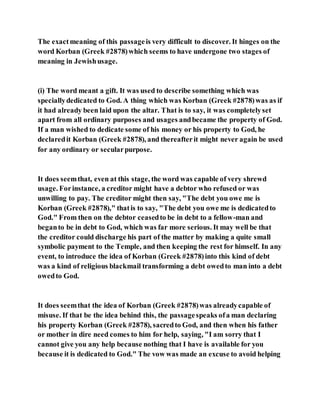
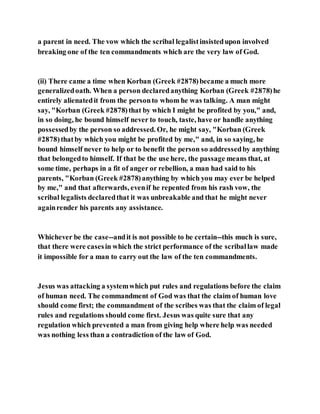
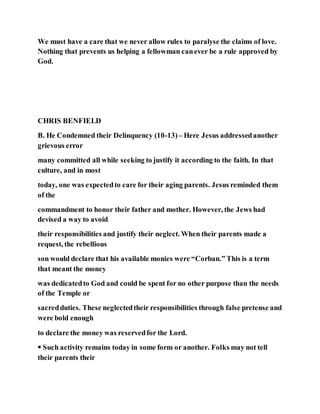
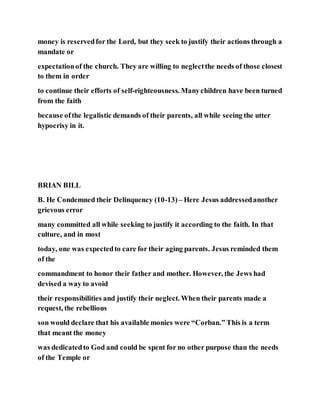
JESUS WAS EXPOSING THE RELIGIOUS CROOKS
EDITED BY GLENN PEASE
LUKE 7:9-13 9 And he continued, “You have a fine
way of setting asidethe commands of God in order to
observe[a]your own traditions!10 For Moses said,
‘Honor your father and mother,’[b]and, ‘Anyone who
curses their father or mother is to be put to death.’[c]
11 But you say that if anyone declares that what might
have been used to help their father or mother is
Corban(that is, devotedto God)— 12 then you no
longer let them do anything for their father or mother.
13 Thus you nullify the word of God by your tradition
that you have handed down. And you do many things
like that.”
BIBLEHUB RESOURCES
Externalism Versus Righteousness
Mark 7:1-23
A.F. Muir
In vers. 3, 4 of this chapter we are furnished with an interesting piece of
antiquarianism. The daily life of the devout Jew is setbefore us in its
ceremonialaspect;not as Moses had originally ordered it, but as customand
human casuistryhad gradually transformed it. The light thrown upon several
questions is very searching and full of revelation, viz. the various senses in
which baptism seems to have been understood by the contemporaries of
Christ, and the punctilio, vigor, and detail with which ceremonial
purifications were carried out. It is only as we realize the background of daily
Jewishlife, againstwhich the life to which Jesus calledhis disciples stoodout
so prominently, that we are in a position to appreciate the current force of the
objections raisedby Pharisee and scribe. We have here -
I. CHRISTIANITYCRITICIZED FROM THE POINT OF VIEW OF
RELIGIOUS TRADITION. (Vers. 1-5.)The exaggeratedform the latter
assumedbrought out the more strikingly the peculiarity and essential
characterof Christ's teaching.
1. It was an age in which Jewishceremonalismhad reachedits highest. The
doctrine of Pharisaismhad penetrated the common life of the people. They
might be said to have fallen in love with it. The distinctions are artificial and
super-refined, e.g. between"common," "profane," or"defiled hands, and
hands ceremonially clean. They washeddiligently (a paraphrase of the
original substituted by our revisers for oft" of the Authorized Version, and
apparently the best rendering of the difficult word in the original),
"carefully," or the "many other Amongst the respectable Jewsceremonial
strictness and nicety held a place very similar to what "goodmanners," or
polite behavior and refinement, occupywith ourselves, having, of course, an
additional supernatural sanctionfrom associationwith the Law. Thus to-day
the customs and observances ofnations amongstwhom civilization has long
existed might equally serve as a foil for the Christian moralist; and all
casuistries orsecondary, customarymoralities.
2. The objectors were the leaders and representatives ofthe religious life of
the time. "Pharisees, andcertain of the scribes, which had come from
Jerusalem." Theywere the leaders and teachers ofmetropolitan fanatical
ritualism. It is well when Christianity is judged that such men appear on the
bench; there canthen be no question as to the representative and
authoritative characterof the criticism. It would be a splendid thing if the
representatives ofmodern political, social, and ecclesiasticallife could be
convenedfor such a purpose.
3. What, then, is the objectionthus raised? It concernedan observance of
daily life. Christians are now judged on the same arena. In small things as in
large the difference will revealitself. It depended upon an abstractdistinction:
the hand might be actually clean when it was not ceremonially so. It was, in
the eyes of those who made it, the worst accusationthey had it in their power
to make. The moral life of the disciples was irreproachable;they "had
wrongedno man, corrupted no man, takenadvantage of no man." The
Christians of to-day ought to emulate this blamelessness;infidels can then fire
only blank cartridge.
II. THE TABLES TURNED. (Vers. 6-23.)The critics are themselves reviewed.
Trifling captiousness mustbe summarily dealt with, especiallywhen it wears
the garb of authority. The characterofthe objectors is of the first
consequence in judging of Christ's tone. Grave issues were atstake. The
ground of the fault-finding was superficialand untrustworthy, and a truer
criterion must be discovered. "Deceiversmay be denounced, that the deceived
may be delivered" (Godwin). The essentialnature of rectitude - the grand
moral foundations must be laid bare.
1. Christ begins with an appeal to Scripture. He is carefulto show that the
distinction betweenrighteousness andritualism is a scriptural one, and not of
his owninvention. At the same time, he gives the reference a satiricalor
ironical turn by making a prophetic identification! We don't know how much
is lost in ignoring the written Word of God. It is "profitable for doctrine, for
reproof, for correction, and for instruction in righteousness."
2. He next pointed out the opposition that existedbetweentheir traditions and
the Law. The instance selectedis a crucial one, viz. that of the fifth
commandment - "the first commandment with promise." Others might have
been given, but that would be sufficient. Family obligations are the inner
circle in which religion most intensely operates;if a man is wrong there, he is
not likely to be very righteous elsewhere.To prove their oppositionto the Law
was to strip them of all pretense to religion.
3. Lastly, common sense and consciencewere appealedto as regarded rites
and ceremonies. The "multitude" is here addressed;it is a point which the
common man is supposed able to decide. There are many weapons that may
thus be supplied to the evangelicalarmoury. If philosophy was rescuedfrom
barrenness by this method in the hands of a Socrates ora Reid, may we not
hope for greaterthings with regardto a common-sense religion? The great
foundation of all religious definitions and obligations is the true nature of
man. The essentialbeing of man is spiritual; the body is only the garment or
case in which he dwells. Purity or its opposite must therefore be judged of
from that standpoint. If the soul, will, spirit, inner thought of a man is pure,
he is wholly pure. Spiritual and ceremonialcleannessmust not be confounded.
Religionis not a matter of forms, ceremonies,oranything merely outside; but
of the heart. Yet the thought and will must influence the outward action,
habit, and life. The spiritual is the only eternal religion (John 4:23, 24). The
private question of the disciples is worthy of notice. A "parable" seems to
have been their common name for a difficult saying of Christ's. Their
incapacity was not intellectual but spiritual. ProfessedChristians themselves
often require to be more fully instructed. The progressive life of the true
Christian will itself solve many problems. "Had our Saviour been speaking as
a physiologist, he would have admitted and contendedthat many things from
without, if allowedto enter within, will corrupt the functions of physical life,
and carry disorder and detriment into the whole fabric of the frame. But he
was speaking as a moralist, and hence the antithetic statement of the next
clause (cf. ver. 15)" (Morison). - M.
Biblical Illustrator
Then came togetherunto Him the Pharisees,and certainof the Scribes.
Mark 7:1-16
Scribes and Phariseescoming to Christ
L. Palmer.
I. WHEN THEY CAME. When Gennesaretturned its heart toward Him.
When diseasedbodies had felt the virtue of His touch, and imprisoned souls
had been setfree by His word. Then. As soonas ever the Church's Child was
born, the devil sought to drown Him (Revelation12).
II. WHO THEY WERE THAT CAME. Phariseesand scribes. The learned
and the religious. These two classeshave always beenthe greatestopponents
of Christ's kingdom.
III. WHENCE THEY CAME. From Jerusalem. Machiavelobservedthat
there was nowhere less piety than in those that dwelt nearestto Rome. "The
nearer the Church, the farther from God." "It cannot be that a prophet shall
perish out of Jerusalem."
IV. WHERE THEY CAME. To Jesus. As the moth flies at the lamp, and bats
fly at the sun, What a contrastbetweensuch a coming and those named in
Mark 6:56. "I will draw all men unto Me."
(L. Palmer.)
The tradition of men
Monday Club Sermons.
It is the folly of men that, in discharge ofme duties of religion, they are
satisfiedto put ceremonies and confessions thatcostbut little, in the place of
righteousness ofheart and life which costa greatdeal.
I. There is today an ECCLESIASTICALritualism, which is disastrous to
piety. It starts with the assumption that its methods of worship are the best
possible;and, after a little, declares they are the only ones acceptable to God.
The Church usurps the place of Christ. Of any church that estimates ritual
above character, that endeavours to build up form rather than shape life,
Christ says, "Fullwell do ye rejectthe commandment of God that ye may
keepyour tradition."
II. There is today a SOCIAL ritualism, which is disastrous to true piety.
Public opinion is a power;it has its theory of religion. Certainthings done,
and certainothers left undone, are the credentials of piety. Men's actions are
the only things takeninto account, not the men themselves. Societyhas agreed
that a little honesty, a little charity, and church going, shall be acceptedas
religion. Such rejectthe commandment of God that they may keeptheir
tradition.
III. There is a ritualism of PERSONAL OPINION, whichis disastrous to true
piety. Every man has his own idea of the conditions on which he personally
may be right with God. They forgetthat it is for God to decide what is
satisfactoryto Him. It is sometimes arguedthat, since there are so many
opposite theories and conflicting creeds, ouracceptanceorrejection of what is
calledreligion cannot be of much importance. But religion is a simple matter.
Piety is the being and doing what God has commanded; just that; nothing
more and nothing less. Those commandments are few, brief, intelligible.
Whatevervagueness and confusionthere may be in our ideas of religion, it is
of our own making. Let God speak for Himself, and listen only to Him, and all
is plain.
(Monday Club Sermons.)
Tradition accumulates rubbish
Monday Club Sermons.
Accepting the traditions of men as our rule, we getto be heirs of a vast deal of
rubbish. Just as around the anchored rock in the ever-swinging tide, there
gathers all sorts of debris, floating fragments of wrecks, drifting grass and
weeds, with perhaps now and then some bright sea blossom, or shell of beauty
castup by the heave of the surge — so a church that takes as pattern of its
creedand ceremonialthe belief and methods of men of other times, is sure to
be cumbered with a mass of outworn mistakes, the refuse and driftwood of
centuries, with here and there a suggestionof world long value, but as a
whole, out of date and useless.
(Monday Club Sermons.)
Tradition conceals truth
Monday Club Sermons.
Eachgenerationencumbered the divinely ordained ritual with its own
comments; so after awhile men's notions overgrew and hid from sight God's
thought, as some wild vine in the forestwreathes its fetters of verdure around
the hearty tree, interlacing and interknotting its sprays, looping mesh on mesh
of pliant growth, till the tree is smothered and hidden, and the all-
encompassing vine alone is seenand seems to bare life.
(Monday Club Sermons.)
Pervertedtradition the bane of the Church
J. Pratt, B. D.
It is a subtle artifice of the Great Enemy of mankind, to make the real Word
of God of none effect by means of a pretended Word. When he cannot prevail
with men to go contrary to what they know to be the Word which came from
God, then he deals with them as he taught his lying prophet to deal at Bethel
with the prophet of God who came from Judah. When Jeroboam"saidto the
Man of God, Come home with me, and refresh thyself, and I will give thee a
reward," the prophet resolutely repelled the invitation: "If thou wilt give me
half thy house, I will not go in with thee, neither will I eat bread nor drink
waterin this place; for so was it chargedme by the Word of the Lord, saying,
Eat no bread, nor drink water." An old prophet, however, followedthe man
of God, and gave him a like invitation, and receiveda like refusal. But, when
the greatdeceiverput a falsehoodinto the mouth of the wickedold man: "I
am a prophet also, as thou art, and an angelspake unto me by the Word of the
Lord, saying, 'Bring him back with thee into thy house, that he may eatbread
and drink water,'but he lied unto him" — the lie proved fatal! "He went back
with him, and did eatbread in his house, and drank water" (1 Kings 13). The
Man of God was greatly to be pitied, yet he was greatlyto be blamed. He had
receivedit explicitly from God that he should neither eatnor drink in
idolatrous Bethel;and it was his plain duty to adhere to that command, unless
God repealedit in the same way in which he gave it, or with equal evidence
that such was His will; whereas he believes an old man of whom he knows
nothing, on his own word, under suspicious circumstances, andin opposition
to what had been the Word of God to himself. While a direct and palpable
temptation to go contrary to God's command was offered, he resistedand
repelled the temptation; but when a temptation was offered, which came as a
repealof the command and in relief of his necessities,though on no sufficient
authority, then his weaknessprevailed. Why, think you, were lying prophets
permitted? Why are lying teachers stillsuffered? Why, even lying wonders?
To try the state of men's hearts. Is your heart, by the grace of God, made
humble and teachable? thenwill you be taught of the Spirit "to discern the
things which differ" — to detectthe fallacies and delusions practisedupon it
— and "to approve the things which are more excellent." Is your heart self-
sufficient, careless, carnal? thenwill it be deceived and led astrayby plausible
and flattering pretences. In contending that the Scriptures are the sole rule of
faith, we give them exclusive authority over the judgment and the conscience.
This authority lies in the real sense, andthe just application of that sense, not
in any sense orapplication contrary to that which is just and true, and which
man may seek to impose. This sense is to be ascertained, and the right
application of it is to be learnt by humble, teachable, diligent, and devout
study, with the use of all needful helps thereto. The influence of the Scriptures
on the heart is the specialwork of Him who dictated them. The blessing of
God is needful to our successin endeavouring to ascertainthe sense and right
application of them; but so great are the obstaclesto our "receiving with
meekness the engraftedWord," that "God, who commanded the light to shine
out of darkness, must shine into our hearts" by the specialgrace ofthe Holy
Spirit, in order to our feeling the transforming influence of the light of the
knowledge ofHis glory, as seenin the face of Jesus Christ. No consent of man
in any interpretation or application of Scripture is of binding authority on
others. Consentis often contagious — not enlightened. The influence of
leaders, the supposedinterests of party, early associations, andprejudices,
often bias the judgment. But the unerring standard remains. And the
deviations of churches, and councils, and nations, from this standard, and the
continuance of those deviations for ages, cannotdeflectthis standard one jot
or tittle from its rectitude. But while no consent of men can bind of authority
to any interpretation or application of Scripture, yet those views of truth
which are commended to us by the consentin them of varied bodies of
enlightened and devout men, come to us under a just and commanding
influence.
(J. Pratt, B. D.)
Ceremonialismand spirituality
J. R. Thomson, M. A.
I. CEREMONIALISM SUBSTITUTESWASHING WITH WATER FOR
PURITY OF HEART.
II. CEREMONIALISM SUBSTITUTESTHE TRADITIONS OF THE
ELDERS FOR THE COMMANDS OF GOD.
III. CEREMONIALISM SUBSTITUTES THE WORSHIP OF THE LIPS
FOR THE WORSHIP OF THE HEART.
IV. CEREMONIALISM SUBSTITUTESA SUBTLE EVASION FOR
FILIAL DUTY.
V. CEREMONIALISM SUBSTITUTESAVOIDANCE OF UNCLEAN
FOOD FOR AVOIDANCE OF IMPURE AND MALICIOUS THOUGHTS.
Application: It is possible to be, in a sense, religious, andyet, in a deeper
sense, sinful, and out of harmony with the mind and will of God. None is
wholly free from the temptation to substitute the external, formal, apparent,
for the faith, love, and loyalty of heart required by God. Hence the need of a
goodheart, which must be a new heart — the gift and creationof God by His
Spirit.
(J. R. Thomson, M. A.)
The tradition of men versus the commandments of God
R. Green.
In the conflict betweenthe Church and the sacredrelationships of common
life, to the latter must be assignedthe preeminence. The necessitiesofthe
temple, of its services orits servants, must not be met at the expense of filial
faithfulness. The sin of the Pharisees andscribes was —
I. A GROSS PERVERSIONOF THE RELATIVE CLAIMS OF THE
PARENT AND THE CHURCH.
II. A WICKED INTERFERENCEWITHTHE FIRST COMMANDMENT
WITH PROMISE.
III. A CRUEL UNDERMINING OF FILIAL AFFECTION AND FIDELITY
AND AS CRUEL AN EXPOSURE OF THE AGED AND ENFEEBLED
PARENTS TO A FALSELY JUSTIFIED NEGLECT.
IV. AN UNWARRANTED USURPATION OF AUTHORITY TO WEAKEN
THE OBLIGATION OF A DIVINE LAW.
(R. Green.)
The religion of the Jews
Expository Discourses.
The interference of the Phariseesand scribes servedto bring out their
religion. Considersome of its features. The religion here depicted and
condemned —
I. CONSISTED MAINLY OF EXTERNAL OBSERVANCES (vers. 2-4).
1. By this feature the same system of religion may be detectedin the present
day.
2. Religionin this sense is upheld by many strong principles in the nature of
man-awakenedconscience, self-righteousness,vanity.
3. This systemis exceedinglydangerous. Misleads the awakenedsinner;
produces a deep and fatal slumber.
II. RESTS ON HUMAN AUTHORITY AS ITS WARRANT (vers. 3, 5, 7).
1. By this feature we may detectit in the present day. Among those who take
awaythe right — duty and exercise ofprivate judgment. Among those who
derive their religious belief from man — in whatever way.
2. This form of false religion is exceedinglydangerous. It dishonours Christ as
a prophet, etc. It gives despotic power to man, which he is not qualified to
wield. It degrades the soul to be a servant of servants, etc.
3. Call no man mawr.
III. PUTS DISHONOUR UPON THE SACRED SCRIPTURES.
1. By this feature we detectits existence now. In the Church of Rome, etc., the
Scriptures are wholly concealed— made to speak according to tradition and
the Church. Amongst ourselves:opinions are not surrendered to them, and
they are neglected.
2. This form of religion stands opposedto those Scriptures which it
dishonours (John 5:39, and others).
3. Know the Scriptures and revere them.
IV. MADE LIGHT OF THE MORAL LAW (vers. 8-12).
1. May be seenin our own day — in the Church of Rome. May be seen,
amongstourselves, in those who put religious ceremonies in the place of moral
duties.
2. This form has its origin in the love of sin, and is accommodatedto an
unsanctified heart.
3. It has no tendency to purify, but the reverse.
4. Beware ofAntinomianism.
V. CONSISTED IN HYPOCRISY, putting on appearances.
VI. WAS VIGILANT AND JEALOUS OF CHRIST AND CENSURED HIS
DISCIPLES (vers. 1, 2).
(Expository Discourses.)
Unwashen hands
Geikie's Life of Christ.
It was laid down that the hands were first to be washedclean. The tips of the
ten fingers were then joined and lifted up, so that the water ran down to the
elbows, then turned down, so that it might run off to the ground. Freshwater
was poured on them as they were lifted up and twice againas they hung down.
The washing itself was to be done by rubbing the fist of one hand in the hollow
of the other. When the hands were washedbefore eating, they must be held
upwards, when after it downwards, but so that the water should not run
beyond the knuckles. The vesselusedmust be held first in the right, then in
the left hand; the waterwas to be poured first on the right, then on the left
hand; and at every third time the words repeated, "Blessedartthou who bast
given us the command to washthe hands." It was keenlydisputed whether the
cup of blessing or the handwashing should come first; whether the towelused
should be laid on the table or on the couch; and whether the table was to be
clearedbefore the final washing or after it.
(Geikie's Life of Christ.)
The tradition of the elders
The excess to which these regulations were carried is well illustrated by what
is told of one Rabbi Akaba, who, in his dungeon, being driven by a pittance of
waterto the alternative of neglecting ablution or dying with thirst, preferred
death to failing in ceremonious observance.
Moses commandedwashing very freely
R. Glover.
But it was always in connectionwith some very definite cause;being required
either
(1)because ofphysical pollution which had been gathered, or
(2)in connectionwith moral consecrationwhich was purposed.The priests at
consecrationwere washed. So was the leper after his recovery, and so were all
after defilement or contactwith those defiled. But the tradition of the elders
had come to require as many washings in a day as Moses wouldhave required
in a month. The secretof this development lay in the adoption of the principle
of "The Hedge," i.e., something which guarded the Law by prohibiting not
only actions forbidden, but all actions which might by any possibility lead to
them. Accordingly, because Mosessaid that he who was defiled by contact
with a corpse should wash, they held it was wellto washalways afterbeing
out of doors, as you might have touched someone who might have touched
some one or something dead...Thus life became a very slavery. Of course "the
common people," as they were contemptuously styled, could not afford either
time, or thought, or money, to practise such scruples. But a greatnumber
associatedthemselves together, calling themselves "Haberim," or
"Comrades,"to observe these scruples. The Phariseesbelongedto this society,
of course, to a man.
(R. Glover.)
Pharisaic prejudice
These Phariseesfound fault because Christ's disciples did not obey man's law,
the quoted "tradition," the authority of their Church. It was not until the
great(seventh) Earl of Shaftesbury was twenty-five years of age that he
supposedthat anyone outside the Church of England was worth listening to,
or ever wrote anything worth reading. "As to their having any views of their
own worthy of consideration," he says, "it never crossedmy mind until one
day I gothold of a copy of some Commentary, and, after reading for awhile
with greatinterest, it suddenly struck me, 'The writer must have been a rank
Dissenter!' and I instantly shut up the book, recoiling from it as I would from
poison. One of the first things that opened my eyes was reading of Doddridge
being condemned as a Dissenter, andI remember exclaiming, 'Good heavens!
how will he stand in the day of judgment at the bar of God, as compared with
Pope Alexander VI?' It was not till I was twenty-five years old, or
thereabouts, that I gothold of Scott's Commentary on the Bible, and, struck
with the enormous difference betweenhis views and those to which I had been
accustomed, I beganto think for myself."
A hypocrite
T. Manton.
A hypocrite has been likened to one who should go into a shop to buy a
pennyworth, and should steala pound's worth; or to one who is punctual in
paying a small debt, that he may getdeeper into our books and cheat us of a
greatersum.
(T. Manton.)
Hypocrites perform small duties and neglectgreat
C. H. Spurgeon.
Hypocrites make much ado about small things that they may be more easyin
their conscienceswhile living in greatsins. They pay the tithe of mint to a
fraction, but rob God of His glory by their self-righteousness. Theygive God
the shells, and stealthe kernels for their own pride and self-will.
(C. H. Spurgeon.)
Heart worship required
C. H. Spurgeon.
God requires soul worship, and men give Him body worship; He asks forthe
heart, and they presentHim with their lips; He demands their thoughts and
their minds, and they give him banners, and vestments, and candies.
(C. H. Spurgeon.)
Perverse penances
C. H. Spurgeon.
No matter how painful may be the mortification, how rigid the penance, how
severe the abstinence;no matter how much may be taken from his purse, or
from the wine vat, or from the store, he will be content to suffer anything
soonerthan bow before the MostHigh with a true confessionofsin, and trust
in the appointed Saviour with sincere, child-like faith.
(C. H. Spurgeon.)
Faith and works reversed, orthe plant upside down
Sword and Trowel.
Some time ago a lady showedme a small seedling acacia, remarking, "I
cannot make this plant out; it doesn'tdo well at all; it doesn'tgrow a bit,
though I waterit well, and attend to it carefully." I lookedat the plant, and
soondiscoveredthe cause. The little plant had a tap root, as all seedlings have,
and this tap root should have been inserted in the soil, where it would soon
have struck out its lateral rootlets;but, instead of this, the plant was upside
down, the leading root being in the soil, and the tap root exposedto the sun
and air. It was impossible that the plant could grow or even live. It is thus
with some people's religion.
(Sword and Trowel.)
In what sense worship is voluntary
Burkitt.
The duties of worship ought to be voluntary, as voluntary is opposedto
constrained;but they must not be voluntary, as voluntary is opposedto
instituted or appointed. God doth no more approve of that worship we give
Him according to our will, than He doth approve of our neglectof that which
is according to His ownwill.
(Burkitt.)
Human tradition versus Divine command
R. Glover.
The experience is a universal one, that God's commandments suffer from the
competition of human rules. The greatprecepts of God have only an unseen
God behind them, but behind the human rules there is generally a class whose
pride is gratified by their observance and incensedby their neglect.
Accordingly, wheneversmall rules of outward conduct begin to flourish, the
greatprinciples of religion — faith, love, honour — fall into the background.
It is so today. The Thug in India who confessedto having killed 320 people
had no pangs of conscienceforkilling them, but was somewhatdistressedon
accountof having killed a few of them after a hare had crossedhis path or a
bird whistled in a certain direction. Murder was no crime in his opinion, but
the neglectofan omen from Bowanywas a grave one. In Hinduism, which is
ceremonialthroughout, a man may be a most religious man, and yet very
wicked. Many in our own country would unscrupulously commit greatcrimes,
and yet be very carefulto avoid eating flesh on GoodFriday. It seems as if we
only had a certainamount of power of attention in us, and, if it goes to little
rules, there is none left for greatprinciples.
(R. Glover.)
Tradition and inspiration
Dr. Wylie.
As with the man who attempts to serve two masters, so with him who thinks to
walk by two lights: if he would keepin the straight loath he must put out one
of the two, and guide himself by the other.
(Dr. Wylie.)
Laying aside the commandment of God
Buck.
A philosopher at Florence could not be persuaded to look through one of
Galileo's telescopes, lesthe should see something in the heavens that would
disturb him in his belief of Aristotle's philosophy. Thus it is with many who
are afraid of examining God's Word, lest they should find themselves
condemned.
(Buck.)
The inefficacyof God's Word -- how produced
J. Gordon.
We make it of none effectwhen we —
I. Failto read and study it and to appropriate its blessings.
II. When we give precedence to any human authority or law.
III. When by our lives we misrepresentit before the world.
IV. When we fail to urge its truths upon the anxious inquirer or careless
sinner.
(J. Gordon.)
Ears to hear
Quesnel.
This rule must needs be of very greatimportance to Christians. For our Great
Master
(1)calls all the people unto Him on purpose to tell them only this.
(2)He requires of them a particular attention.
(3)He requires it of every one of them without exception.
(4)He exhorts them to endeavour thoroughly to understand it.
(5)He lets them know that in order, to do it they have need of a singular grace
and a particular gift of understanding.It was for want of understanding this
rule that the Jews still remained Jews, adhering to a mere external way of
worship. It is for the very same reasonthat numbers of Christians, even to
this day, serve God more like Jews than Christians.
(Quesnel.)
COMMENTARIES
Ellicott's Commentary for English Readers
(11) It is Corban.—The Hebrew word is peculiar to St. Mark. It occurs
frequently in Leviticus and Numbers (e.g., Leviticus 2:1; Leviticus 2:5;
Numbers 7:3; Numbers 7:5), and is translatedgenerally by “offering,”
sometimes by “oblation” (Leviticus 2:13; Leviticus 3:1), but elsewhere inthe
Old Testamentit only appears in Ezekiel20:28;Ezekiel40:43. It had come to
be applied specifically(as in the Greek of Matthew 27:6; Jos. Wars, ii. 9, § 4)
to the sacredtreasure of the Temple.
He shall be free.—The words, as the italics show, have nothing corresponding
to them in the Greek, nor are they needed, if only, with some MSS., we strike
out the conjunction “and” from the next verse. So the sentence runs, “If a
man shall say . . . ye suffer him no more . . .”
Matthew Henry's Concise Commentary
7:1-13 One greatdesign of Christ's coming was, to setaside the ceremonial
law; and to make way for this, he rejects the ceremonies men added to the law
of God's making. Those cleanhands and that pure heart which Christ bestows
on his disciples, and requires of them, are very different from the outward
and superstitious forms of Phariseesofevery age. Jesusreproves them for
rejecting the commandment of God. It is clearthat it is the duty of children, if
their parents are poor, to relieve them as far as they are able; and if children
deserve to die that curse their parents, much more those that starve them. But
if a man conformed to the traditions of the Pharisees,they found a device to
free him from the claim of this duty.
Barnes'Notes on the Bible
Full well - These words are capable of different interpretations. Some read
them as a question: "Do ye do well in rejecting?" etc. Others suppose they
mean "skillfully, cunningly." "You show great cunning or art, in laying aside
God's commands and substituting in their place those of men." Others
suppose them to be ironical. "How nobly you act!From conscientious
attachment to your traditions you have made void the law of God;" meaning
to intimate by it that they had actedwickedly and basely.
Jamieson-Fausset-BrownBible Commentary
CHAPTER 7
Mr 7:1-23. Discourse onCeremonialPollution. ( = Mt 15:1-20).
See on [1450]Mt15:1-20.
Matthew Poole's Commentary
See Poole on"Mark 7:11"
Gill's Exposition of the Entire Bible
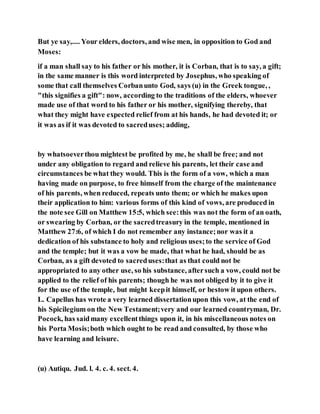
But ye say,.... Your elders, doctors, and wise men, in opposition to God and
Moses:
if a man shall say to his father or his mother, it is Corban, that is to say, a gift;
in the same manner is this word interpreted by Josephus, who speaking of
some that call themselves Corbanunto God, says (u) in the Greek tongue, ,
"this signifies a gift": now, according to the traditions of the elders, whoever
made use of that word to his father or his mother, signifying thereby, that
what they might have expected relief from at his hands, he had devoted it; or
it was as if it was devoted to sacreduses; adding,
by whatsoeverthou mightest be profited by me, he shall be free; and not
under any obligation to regard and relieve his parents, let their case and
circumstances be what they would. This is the form of a vow, which a man
having made on purpose, to free himself from the charge of the maintenance
of his parents, when reduced, repeats unto them; or which he makes upon
their application to him: various forms of this kind of vows, are produced in
the note see Gill on Matthew 15:5, which see:this was not the form of an oath,
or swearing by Corban, or the sacredtreasury in the temple, mentioned in
Matthew 27:6, of which I do not remember any instance;nor was it a
dedication of his substance to holy and religious uses;to the service of God
and the temple; but it was a vow he made, that what he had, should be as
Corban, as a gift devoted to sacreduses:that as that could not be
appropriated to any other use, so his substance, aftersuch a vow, could not be
applied to the relief of his parents; though he was not obliged by it to give it
for the use of the temple, but might keepit himself, or bestow it upon others.
L. Capellus has wrote a very learned dissertationupon this vow, at the end of
his Spicilegium on the New Testament;very and our learned countryman, Dr.
Pocock, has saidmany excellentthings upon it, in his miscellaneous notes on
his Porta Mosis;both which ought to be read and consulted, by those who
have learning and leisure.
(u) Autiqu. Jud. l. 4. c. 4. sect. 4.
Geneva Study Bible
But ye say, If a man shall say to his father or mother, It is Corban, that is to
say, a gift, by whatsoeverthou mightest be profited by me; he shall be free.
EXEGETICAL(ORIGINAL LANGUAGES)
Expositor's Greek Testament
Mark 7:11. Κορβᾶν: Mk. gives first the Hebrew word, then its Greek
equivalent.
Cambridge Bible for Schools andColleges
11. If a man shall say] Literally it runs, If a man shall say to his father or his
mother, That, from which thou mightest have been benefited by me, is
Corban, that is to say, a gift, or offering consecratedto God, he shall be free,
and ye suffer him no longerto do aught for his father or his mother. A person
had merely to pronounce the word Corban over any possessionor property,
and it was irrevocably dedicatedto the Temple. Our Lord is quoting a regular
formula, which often occurs in the Talmudic tracts Nedarim and Nazir.
Others would give to the words an imperative force, Be it Corbanfrom which
thou mightest have been benefited by me, i. e. “If I give thee anything or do
anything for thee, may it be as though I gave thee that which is devoted to
God, and may I be accountedperjured and sacrilegious.” This view certainly
gives greaterforce to the charge made by our Lord, that the command
“Whoso cursethfather or mother, let him die the death” was nullified by the
tradition.
Pulpit Commentary
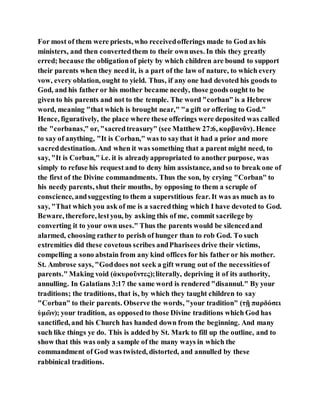
Verses 11-13. -But ye say, If a man shall sayto his father or his mother, That
wherewith thou mightest have been profited by me is Corban, that is to say,
Given to God - these words, "that is to say, Given to God," are St. Mark's
explanation of "corban" - ye no longer suffer him to do aught for his father or
his mother; making void the word of God by your tradition, which ye have
delivered. Now, this the scribes and Pharisees did for their own covetous ends.
For most of them were priests, who receivedofferings made to God as his
ministers, and then convertedthem to their ownuses. In this they greatly
erred; because the obligationof piety by which children are bound to support
their parents when they need it, is a part of the law of nature, to which every
vow, every oblation, ought to yield. Thus, if any one had devoted his goods to
God, and his father or his mother became needy, those goods ought to be
given to his parents and not to the temple. The word "corban" is a Hebrew
word, meaning "that which is brought near," "a gift or offering to God."
Hence, figuratively, the place where these offerings were deposited was called
the "corbanas," or, "sacredtreasury" (see Matthew 27:6, κορβανᾶν). Hence
to say of anything, "It is Corban," was to saythat it had a prior and more
sacreddestination. And when it was something that a parent might need, to
say, "It is Corban," i.e. it is alreadyappropriated to another purpose, was
simply to refuse his request and to deny him assistance, andso to break one of
the first of the Divine commandments. Thus the son, by crying "Corban" to
his needy parents, shut their mouths, by opposing to them a scruple of
conscience, andsuggesting to them a superstitious fear. It was as much as to
say, "That which you ask of me is a sacredthing which I have devoted to God.
Beware, therefore, lestyou, by asking this of me, commit sacrilege by
converting it to your own uses." Thus the parents would be silencedand
alarmed, choosing ratherto perish of hunger than to rob God. To such
extremities did these covetous scribes andPharisees drive their victims,
compelling a sono abstain from any kind offices for his father or his mother.
St. Ambrose says, "Goddoes not seek a gift wrung out of the necessitiesof
parents." Making void (ἀκυροῦντες);literally, depriving it of its authority,
annulling. In Galatians 3:17 the same word is rendered "disannul." By your
traditions; the traditions, that is, by which they taught children to say
"Corban" to their parents. Observe the words, "your tradition" (τῇ παρδόσει
ὑμῶν); your tradition, as opposedto those Divine traditions which God has
sanctified, and his Church has handed down from the beginning. And many
such like things ye do. This is added by St. Mark to fill up the outline, and to
show that this was only a sample of the many ways in which the
commandment of God was twisted, distorted, and annulled by these
rabbinical traditions.
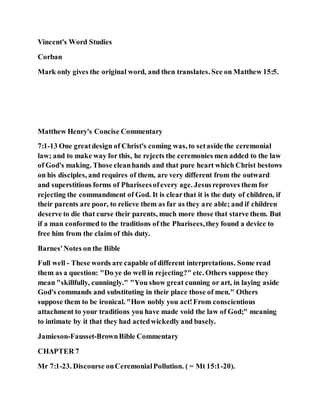
Vincent's Word Studies
Corban
Mark only gives the original word, and then translates. See on Matthew 15:5.
Matthew Henry's Concise Commentary
7:1-13 One greatdesign of Christ's coming was, to setaside the ceremonial
law; and to make way for this, he rejects the ceremonies men added to the law
of God's making. Those cleanhands and that pure heart which Christ bestows
on his disciples, and requires of them, are very different from the outward
and superstitious forms of Phariseesofevery age. Jesusreproves them for
rejecting the commandment of God. It is clearthat it is the duty of children, if
their parents are poor, to relieve them as far as they are able; and if children
deserve to die that curse their parents, much more those that starve them. But
if a man conformed to the traditions of the Pharisees,they found a device to
free him from the claim of this duty.
Barnes'Notes on the Bible
Full well - These words are capable of different interpretations. Some read
them as a question: "Do ye do well in rejecting?" etc. Others suppose they
mean "skillfully, cunningly." "You show great cunning or art, in laying aside
God's commands and substituting in their place those of men." Others
suppose them to be ironical. "How nobly you act!From conscientious
attachment to your traditions you have made void the law of God;" meaning
to intimate by it that they had actedwickedly and basely.
Jamieson-Fausset-BrownBible Commentary
CHAPTER 7
Mr 7:1-23. Discourse onCeremonialPollution. ( = Mt 15:1-20).
See on [1450]Mt15:1-20.
Matthew Poole's Commentary
See Poole on"Mark 7:1"
Gill's Exposition of the Entire Bible
And ye suffer him no more to do ought for his father, or his mother.
According to the Jewishcanons (w), if a man vowed a thing which is contrary
to a command, he was obligedto keephis vow, and break the command: thus,
if a man vowed that his father or his mother should never receive any benefit
from what he had, but that his substance was as "Corban", oras any thing
devoted to divine service, he was obliged to keephis vow; nor was he allowed
after this to do any thing for his father, or mother, howeverpoor or helpless
they might be; unless he applied to a wise man to revoke his vow, or to give
him liberty to do it; for he could not do it of himself, as wickedas it was;and
though he might heartily repent of it, and was everso willing to make it null
and void: and though a dissolution it by a wise man was allowedof, yet hereby
they setup their own powerand authority againstGod, and his law; they did
not rescindthe vow, because it was contrary to the command of God: for
notwithstanding its being contrary to the command of God, it was to be
observed, though to the breaking of that, unless loosedby a wise man, at the
man's request; whereby they establishedtheir magisterialpower and
authority, without any regardto the honour and glory of God; and therefore
what follows, is justly observedby our Lord; See Gill on Matthew 15:5.
(w) Maimon. Hilch. Nedarim, c. 3. sect. 1.
Geneva Study Bible
And ye suffer him no more to do ought for his father or his mother;
EXEGETICAL(ORIGINAL LANGUAGES)
Expositor's Greek Testament
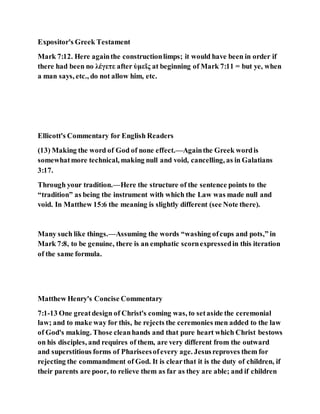
Mark 7:12. Here againthe constructionlimps; it would have been in order if
there had been no λέγετε after ὑμεῖς at beginning of Mark 7:11 = but ye, when
a man says, etc., do not allow him, etc.
Ellicott's Commentary for English Readers
(13) Making the word of God of none effect.—Againthe Greek wordis
somewhatmore technical, making null and void, cancelling, as in Galatians
3:17.
Through your tradition.—Here the structure of the sentence points to the
“tradition” as being the instrument with which the Law was made null and
void. In Matthew 15:6 the meaning is slightly different (see Note there).
Many such like things.—Assuming the words “washing ofcups and pots,” in
Mark 7:8, to be genuine, there is an emphatic scornexpressedin this iteration
of the same formula.
Matthew Henry's Concise Commentary
7:1-13 One greatdesign of Christ's coming was, to setaside the ceremonial
law; and to make way for this, he rejects the ceremonies men added to the law
of God's making. Those cleanhands and that pure heart which Christ bestows
on his disciples, and requires of them, are very different from the outward
and superstitious forms of Phariseesofevery age. Jesusreproves them for
rejecting the commandment of God. It is clearthat it is the duty of children, if
their parents are poor, to relieve them as far as they are able; and if children
deserve to die that curse their parents, much more those that starve them. But
if a man conformed to the traditions of the Pharisees,they found a device to
free him from the claim of this duty.
Barnes'Notes on the Bible
Full well - These words are capable of different interpretations. Some read
them as a question: "Do ye do well in rejecting?" etc. Others suppose they
mean "skillfully, cunningly." "You show great cunning or art, in laying aside
God's commands and substituting in their place those of men." Others
suppose them to be ironical. "How nobly you act!From conscientious
attachment to your traditions you have made void the law of God;" meaning
to intimate by it that they had actedwickedly and basely.
Jamieson-Fausset-BrownBible Commentary
CHAPTER 7
Mr 7:1-23. Discourse onCeremonialPollution. ( = Mt 15:1-20).
See on [1450]Mt15:1-20.
Matthew Poole's Commentary
See Poole on"Mark 1:13"
Gill's Exposition of the Entire Bible
Making the word of God of none effect, through your tradition,.... Beza says,
in his most ancient copy it is read, "your foolishtradition"; and such it was
indeed, that a vow made rashly, and in a passion, or if ever so deliberately
entered into, should be more binding upon a man than the law of God; that
rather than break this, he should transgress a divine command; and that
though he might see his folly, and repent of his sin in making such a wicked
vow, he could not go back from it, without the permission of a wise man:
should his poor distressedparents come to him for assistance, he was obliged
to answerthem, that he had bound himself by a vow, that they should receive
no advantage from his substance;and should they remonstrate to him the
command of God, to honour them and take care of them, and observe that
that command is enforced by promises and threatenings; he had this to reply,
and was instructed to do it, that it was the sense ofthe wise men and doctors,
and agreeablyto the traditions of the elders, to which he ought rather to
attend, than to the words of the law, that he should keepand fulfil his vow,
whatevercommand was neglectedorbroken by it.
Which ye have delivered: they receivedit from their ancestors, anddelivered
it to their disciples; and it is in this way, that all their traditions were
delivered: they say (x), that
"Mosesreceivedthe law (the oral law) at Sinai, "and delivered" it to Joshua;
and Joshua to the elders, and the elders to the prophets; and the prophets to
the men of the greatsynagogue;the last of which was Simeon the just; and
Antigonus, a man of Socho, receivedit from him; and Jose benJoezer, a man
of Tzeredah, and Jose ben Jochanan, a man of Jerusalem, receivedit from
Antigonus; and Joshua ben Perachiah(said to be the master of Jesus Christ),
and Nitthai the Arbelite, receivedit from them; and Judah ben Tabai, and
Simeon ben Shetach, receivedit from them; and Shemaiah and Abtalion
receivedit from them; and from them Hillell and Shammai.''
Who were now the heads of the two grand schools ofthe Jews;these received,
and delivered out these traditions to the Scribes and Pharisees, andthey to
their disciples:
and many such like things do ye; meaning, that there were many other
traditions besides this now mentioned; whereby, insteadof preserving the
written law, which, they pretended, these were an hedge unto (y), they, in a
greatmany instances, made it void.
(x) Pirke Abot, c. 1. sect. 1, 2, 3, 4, 5, 6, 7, 8, 9, 10, 11, 12. (y) Pirke Abot, c. 1.
sect. 1.
Geneva Study Bible
Making the word of God of none effectthrough your tradition, which ye have
delivered: and many such like things do ye.
EXEGETICAL(ORIGINAL LANGUAGES)
Expositor's Greek Testament
Mark 7:13. ᾗ παρεδώκατε, whichye have delivered. The receivers are also
transmitters of the tradition, adding their quota to the weightof authority.—
παρόμοια τοιαῦτα πολλὰ:many such similar things, a rhetorically redundant
phrase (such, similar) expressive of contempt. Cf. Colossians2:21. Hebrews
9:10.
Cambridge Bible for Schools andColleges
13. through your tradition] The Jews distinguished betweenthe “Written
Law” and the traditional or “Unwritten Law.” The Unwritten Law was said
to have been orally delivered by God to Moses, andby him orally transmitted
to the Elders. On it was founded the Talmud or “doctrine,” which consists of
(1) the Mishna or “repetition” of the Law, (2) the Gemara or “supplement” to
it. So extravagantdid the veneration for the Traditional Law become, that
there was amongstmany other sayings this assertion, “The Law is like salt,
the Mishna like pepper, the Gemara like balmy spice.” Buxtorf, Synag. Jud.
ch. 3.
Bengel's Gnomen
Mark 7:13. Ἧ παρεδώκατε, whichye have delivered) Ye have made into a
tradition what was a mere custom among the ancients.
Vincent's Word Studies
Making of none effect
Rev., making void. See on Matthew 15:6.
Ye handed down
Note the pasttense, identifying them for the moment with their forefathers.
Compare Matthew 23:35, Ye slew. Christ views the Jewishpersecutors and
bigots, ancient and modern, as a whole, actuatedby one spirit, and ascribes to
one sectionwhatwas done by another.
PRECEPTAUSTIN RESOURCES
BRUCE HURT MD
Mark 7:9 He was also saying to them, "You are experts at setting aside the
commandment of God in order to keepyour tradition.
Wuest And He was saying to them, In a very beautiful way you are constantly
making the commandment of God null and void in order that that which has
been delivered to you for observance, youmay keep.
NET Mark 7:9 He also said to them, "You neatly reject the commandment of
God in order to setup your tradition.
NLT Mark 7:9 Then he said, "You skillfully sidestepGod's law in order to
hold on to your owntradition.
ESV Mark 7:9 And he said to them, "You have a fine way of rejecting the
commandment of God in order to establishyour tradition!
NIV Mark 7:9 And he said to them: "You have a fine way of setting aside the
commands of God in order to observe your owntraditions!
GNT Mark 7:9 Καὶ ἔλεγεν αὐτοῖς, Καλῶς ἀθετεῖτε τὴν ἐντολὴν τοῦ θεοῦ, ἵνα
τὴν παράδοσινὑμῶν στήσητε.
KJV Mark 7:9 And he said unto them, Full well ye reject the commandment
of God, that ye may keepyour own tradition.
You are experts : 2Ki 16:10-16 Isa 24:5 29:13 Jer44:16,17 Da 7:25 11:36 Mt
15:3-6 2Th 2:4
setting aside, Mk 7:13 Ps 119:126 Ro 3:31 Ga 2:21
Mark 7 Resources - Multiple Sermons and Commentaries
RelatedPassages:
Luke 10:16+ “The one who listens to you listens to Me, and the one who
rejects (atheteo)you rejects (atheteo)Me; and he who rejects (atheteo)Me
rejects (atheteo)the One who sent Me.”
John 12:48 “He who rejects (atheteo)Me and does not receive My sayings,
has one who judges him; the word I spoke is what will judge him at the last
day.
TRAINED IN KEEPING
TRADITION
He was also saying (imperfect tense) to them, "You are experts at setting aside
the commandment of God in order to (hina - purpose clause)keepyour
tradition - Note the strong clearcontrastin Jesus makes inHis declaration
(commandment of God versus your tradition). I like the NLT paraphrase
which says "You skillfully sidestepGod's law." This must surely have cut
these legalists like a sharp knife. Experts is actually the same Greek word
(kalos)Jesus had just used to describe Isaiah's prophecy "rightly (kalos)did
Isaiahprophecy of you hypocrites." (Mk 7:6). As Wuest observes "This
(repetition of the adverb kalos)is irony, and biting sarcasm."("In a very
beautiful way you are constantly making the commandment of God null and
void")
Setting aside is in the present tense indicating this was the common practice of
the Phariseesto in essence annul or make inoperative God's Holy Word of
Truth! This is an incredible realization. Think about this for a moment. These
were the very men who were the most respectedin Israelas religious leaders
and teachers and they actually in effectsetaside the only thing that could save
their souls and bring eternal life. No wonderJesus was so angry at these
religious charlatans for they were on a fasttrack to hell and were taking
multitudes with them (cf Mt 23:15, they were in a sense "murderers" like
their father = Jn 8:44, cf Acts 13:10+).
The irony of Jesus'accusationis these men are so deceived, they actually
think they are protecting and establishing the commandment of God when in
fact that are making it invalid! Deceptionis a deadly "disease!"
Spurgeon- Behold, a pretender to profound thought informs us that Moses
was in error, and Paul scarcelyknew what he wrote about. These philosophic
amenders of the gospelare as arrant triflers as the superstitious posture
makers at whom they sneer. The Savior makes shortwork of human
traditions and authorities. Your meats and your drinks, your fasting thrice in
the week, yourpaying of the tithe of mint, anise, and cumin, your broad
phylacteries and fringes, He waves them all awaywith one motion of His
hand, and He comes straightto the real point at issue. He deals with the heart
and with the sins which come out of it. He draws up a diagnosis ofthe disease
with fearless truthfulness, and declares that meats do not defile men, that true
religion is not a matter of observationor non-observationof washings and
outward rites, but that the whole matter is spiritual, and has to do with man’s
inmost self, with the understanding, the will, the emotions, the conscience, and
all else which makes up the heart of man. He tells us that defilement is caused
by that which comes out of the man, not by that which goes into him.
Defilement is of the heart, and not of the hands.
Wuest adds that setting aside "comes to mean “to thwart the efficacyof
anything, to nullify, make void, frustrate.” The Pharisees are chargedby our
Lord with thwarting the efficacyof that which has been laid down or
prescribed by God, namely, His commandments. They have made God’s
Word null and void, have nullified it, frustrated it in its soul-saving work.
This they did in order to keeptheir own tradition."
Setting aside (nullifying)(114)(atheteo from áthetos = not placed from a =
without + thetós = placed) means to do awaywith what has been laid down, to
setaside and thus to regardas nothing, to declare invalid, to not recognize, to
annul (make ineffective, inoperative or nonexistent), to spurn or to despise.
Atheteo was also usedof grain rejectedby the inspectoras unfit for food,
which is a goodparallelfor here these Pharisees were rejecting the Bread of
life (the PersonJesus and His Word of Life, the Bible, Mt 4:4+). Thayerwrites
that atheteo means "to acttoward anything as though it were annulled; hence,
to deprive a law of force by opinions or acts opposedto it, to transgress... to
thwart the efficacyof anything, nullify, make void, frustrate...to render
prudent plans of no effect(1Cor 1:19)...to reject, refuse, slight (eg, "the grace
of God" Gal2:21). In Classic Greek atheteo is usedto describe setting aside of
a treaty or promise. All uses of atheteo - Mk. 6:26; Mk. 7:9; Lk. 7:30+ = "the
Pharisees andthe lawyers rejectedGod’s purpose for themselves, not having
been baptized by John.";Lk. 10:16; Jn. 12:48;1 Co. 1:19; Gal. 2:21; Gal.
3:15; 1 Th 4:8; 1 Ti. 5:12; Heb. 10:28; Jude 1:8
Tradition (3862)see above on paradosis
Akin points out that "Notall traditions are bad. However, they do become
bad when we put them on the same level as/orin the place of Scripture. It is
possible to take a goodthing, turn it into a God thing, thereby making it a bad
thing. It is a “Bible plus” kind of religion. Adding to the Bible (cf Pr 30:6, Dt
4:2+ Dt 12:32 Rev 22:18,19+), youin practice make void the Bible and nullify
its truth and power in your life (Mk 7:13). Jesus makes this crystalclearas He
moves into round 2 with the Pharisees. Itis no contest. The “beatdown” is
ugly! The exposure of sinful hearts painful...Man made rules and regulations
became the object of obedience while God’s commandments get setaside, left
behind, “kickedto the curb.” We don’t need the Bible, the constitution and
bylaws have the final word in this church. I have seenit. I have heard it with
my ownears. I like the wisdom of Warren Wiersbe, “we must constantly
beware lesttradition take the place of truth. It does us goodto examine our
church traditions in the light of God’s Word and to be courageous enoughto
make changes” How often we foolishly push away the only reliable,
trustworthy and infallible source of authority we have. It is an act of pure
spiritual suicide. Have you seenthe sadprogressionunfolding before our eyes:
1) teachthe commandments of men (v.7); 2) leave the commandments of God
(v.8); 3) rejectthe commandments of God (v.9); 4) make void the Word of
God (v.13). And the tragedy of it all, we fail to see our hypocrisy in it. Oh, we
know it is possible to be a hypocrite. We see it so clearlyin others. It is when it
is in us that we go spiritually deaf, dumb and blind."
Believer's Study Bible - As in the case ofthe Sabbath controversies (Mk 2:23-
3:6), the Pharisees are guilty of ignoring the intent of the law by stressing the
letter of the law and insisting on strict adherence to their own traditional
interpretation of that law. The practice of calling something "Corban" (v11)
is an illustration of this abuse. The term "Corban" means "an offering
dedicatedto God." While the law clearly commanded honor for parents (v10),
the Phariseeseffectivelynullified this commandment in the practice of
Corban by allowing a callous child to declare his possessions "devotedto
God" so that the parents would have no claim to assistance. Shouldthe son
regrethis gift of Corban, the Pharisees wouldinsist that the vow be kept in
accordancewith Nu30:2. Jesus rejects this practice of using the letter of one
commandment to invalidate the intent of another.
RelatedResource:
Christian Morality: Jesus’Teaching onthe Law
J C Ryle - The last thing that demands our attention in these verses, is the
tendency of man’s inventions in religion to supplant God’s word. Three times
we find this charge brought forward by our Lord againstthe Pharisees.
“Laying aside the commandments of God, ye hold the traditions of men.”—
“Full well ye reject the commandment of God, that ye may keepyour own
traditions.”—“Making the Word of God of none effectthrough your
traditions.”—The first step of the Pharisees,was to add their traditions to the
Scriptures, as useful supplements. The secondwas to place them on a level
with the Word of God, and give them equal authority. The lastwas to honour
them above the Scripture, and to degrade Scripture from its lawful position.
This was the state of things which our Lord found when He was upon earth.
Practically, the traditions of man were everything, and the Word of God was
nothing at all. Obedience to the traditions constituted true religion. Obedience
to the Scriptures was lost sight of altogether.
It is a mournful fact, that Christians have far too often walkedin the steps of
Pharisees in this matter. The very same process has takenplace over and over
again. The very same consequences have resulted. Religious observancesof
man’s invention, have been pressedon the acceptanceofChristians,—
observancesto all appearance useful, and at all events well-meant, but
observancesnowhere commandedin the word of God. These very observances
have by and bye been enjoined with more vigour than God’s own
commandments, and defended with more zeal than the authority of God’s
own word. We need not look far for examples. The history of our own church
will supply them.*
Let us beware of attempting to add any thing to the word of God, as necessary
to salvation. It provokes God to give us over to judicial blindness. It is as good
as saying that His Bible is not perfect, and that we know better than He does
what is necessaryfor man’s salvation. It is just as easyto destroy the authority
of God’s word by addition as by subtraction, by burying it under man’s
inventions as by denying its truth. The whole Bible, and nothing but the Bible,
must be our rule of faith,—nothing added and nothing takenaway.
Finally, let us draw a broad line of distinction betweenthose things in religion
which have been devised by man, and those which are plainly commanded in
God’s word. What Godcommands is necessaryto salvation. What man
commands is not. What man devises may be useful and expedient for the
times; but salvationdoes not hinge on obedience to it. What God requires is
essentialto life eternal. He that wilfully disobeys it ruins his own soul.*
Mark 7:10 "ForMoses said, 'HONOR YOUR FATHER AND YOUR
MOTHER';and, 'HE WHO SPEAKS EVIL OF FATHER OR MOTHER, IS
TO BE PUT TO DEATH';
Wuest ForMoses said, Be paying due respectand reverence to your father
and your mother. And the one who is constantly reviling father or mother, let
him come to an end by death.
NET Mark 7:10 For Mosessaid, 'Honor your father and your mother,' and,
'Whoeverinsults his father or mother must be put to death.'
NLT Mark 7:10 For instance, Mosesgave you this law from God: 'Honor
your father and mother,' and 'Anyone who speaksdisrespectfullyof father or
mother must be put to death.'
ESV Mark 7:10 For Mosessaid, 'Honor your father and your mother'; and,
'Whoeverreviles father or mother must surely die.'
NIV Mark 7:10 ForMoses said, 'Honor your father and your mother,' and,
'Anyone who curses his father or mother must be put to death.'
GNT Mark 7:10 Μωϋσῆς γὰρ εἶπεν, Τίμα τὸν πατέρα σου καὶ τὴν μητέρα
σου, καί, Ὁ κακολογῶνπατέρα ἢ μητέρα θανάτῳ τελευτάτω.
KJV Mark 7:10 For Mosessaid, Honour thy father and thy mother; and,
Whoso cursethfather or mother, let him die the death:
Honor: Mk 10:19 Ex 20:12 De 5:16
He who speaks evil : Ex 21:17 Lev 20:9 De 27:16 Pr 20:20 Pr 30:17 Mt 15:4
Mark 7 Resources - Multiple Sermons and Commentaries
RelatedPassages:
Matthew 15:4+ (PARALLEL PASSAGE)“ForGod said, ‘HONOR YOUR
FATHER AND MOTHER,’and, ‘HE WHO SPEAKS EVIL OF FATHER
OR MOTHER IS TO BE PUT TO DEATH.’
Exodus 20:12+ ("FIFTHCOMMANDMENT") “Honoryour father and
your mother, that your days may be prolongedin the land which the LORD
your God gives you.
Deuteronomy 5:16; Honor your father and your mother, as the LORD your
God has commanded you, that your days may be prolonged and that it may go
well with you on the land which the LORD your God gives you.
Exodus 21:17+ “He who curses his father or his mother shall surely be put to
death.
Leviticus 20:9+ ‘If there is anyone who curses his father or his mother, he
shall surely be put to death; he has cursed his father or his mother, his
bloodguiltiness is upon him.
Deuteronomy 27:16 ‘Cursedis he who dishonors his father or mother.’ And
all the people shall say, ‘Amen.’
Proverbs 20:20 He who curses his father or his mother, His lamp will go out in
time of darkness.
Proverbs 30:17 The eye that mocks a father And scorns a mother, The ravens
of the valley will pick it out, And the young eagles willeat it.
JESUS GIVES AN EXAMPLE
OF HYPOCRITICAL WORSHIP
For - Term of explanation. Always ask the Spirit to help you discern what the
writer (speaker)is explaining. In this case Jesus is elaborating on the empty,
traditional worship of the religious leaders. How sad to be accusedof
worthless worshipby the Lord of lords, but now He gives these hard of
hearing leaders a clearexplain of their hypocrisy.
And do not miss the fact that againJesus bases His words on Scripture, a
goodpractice for all disciples to emulate!
Moses said- Notice that the Matthew 15:4 parallel has "Godsaid" indicating
that what Moses saidwas whathe had been inspired by the Spirit to say(cf 2
Peter1:21+). Notice that God could not have been cleareron the importance
of honoring one's parents. In the OT it was a matter of "life and death!"
HONOR YOUR FATHER AND YOUR MOTHER - Jesus quotes the Fifth
Commandment to undermine their mishandling of the Scriptures. Honor is
timao in the present imperative which calls for continual, unhesitating
tangible demonstration of reverence and respectto one's parents (our need to
depend on the Holy Spirit to obey). You would expectthat these religious
leaders who were zealous for keeping the Law of Godand traditions of men
would surely seek to obey this one of the Ten Commandments because it came
pre-packagedwith a promise of long life in the land! But sadly they had
allowedtheir imperfect traditional teachings from sinful men to even take
precedence ofthe perfectLaw of the Holy God! Honoring one's parents
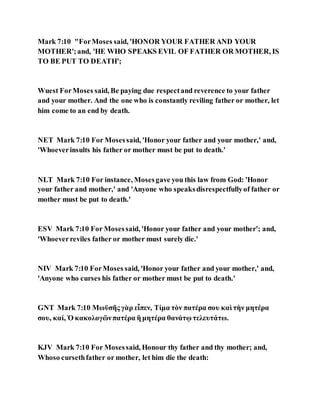
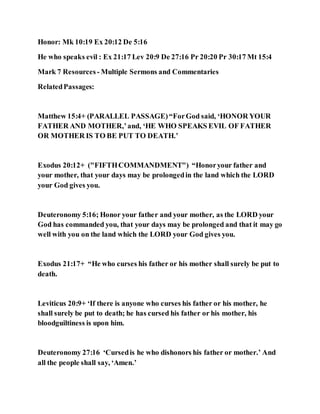
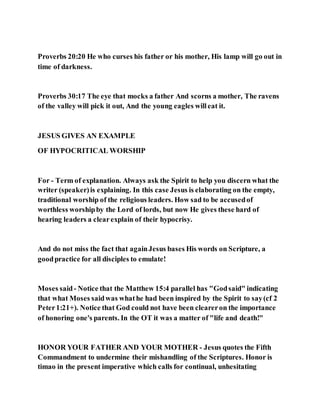
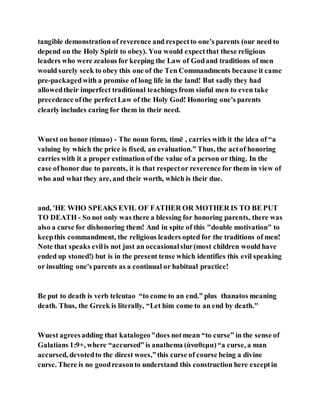
clearly includes caring for them in their need.
Wuest on honor (timao) - The noun form, timē , carries with it the idea of “a
valuing by which the price is fixed, an evaluation.” Thus, the actof honoring
carries with it a proper estimation of the value of a person or thing. In the
case ofhonor due to parents, it is that respector reverence for them in view of
who and what they are, and their worth, which is their due.
and, 'HE WHO SPEAKS EVIL OF FATHER OR MOTHER IS TO BE PUT
TO DEATH - So not only was there a blessing for honoring parents, there was
also a curse for dishonoring them! And in spite of this "double motivation" to
keepthis commandment, the religious leaders opted for the traditions of men!
Note that speaks evilis not just an occasionalslur(most children would have
ended up stoned!) but is in the present tense which identifies this evil speaking
or insulting one's parents as a continual or habitual practice!
Be put to death is verb teleutao “to come to an end.” plus thanatos meaning
death. Thus, the Greek is literally, “Let him come to an end by death."
Wuest agreesadding that katalogeo"does notmean “to curse” in the sense of
Galatians 1:9+, where “accursed” is anathema (ἀναθεμα)“a curse, a man
accursed, devotedto the direst woes,”this curse of course being a divine
curse. There is no goodreasonto understand this construction here exceptin
the durative sense, whichmeans that the death penalty is inflicted on an
habitual offender."
Speaks evil(2551)kakologeo fromkakos = evil + lego = to speak)means
literally to speak evil of, to curse (e.g., of parents in Mt 15:4, Mk 7:10).
Kakologeomeans tio use unjustified and abusive language againstsomeone.
Kakologeois used in Mark 9:39 in regard to someone who was casting out
demons. Louw-Nida says kakologeomeans to revile or "to insult in a
particularly strong and unjustified manner." The derivative word katalogos
was a "slanderer." Hellenistically, kakologeomeans to imprecate evil on, to
curse someone (Lxx - Pr. 20:20; Ezek 22:7; Ex 22:28).
Now ponder this scene a moment. Jesus is quoting the writings of Moses
which the Pharisees claimedto revere, so they may have even been nodding
their approval. But Jesus is setting a trap for these "vipers" and proceeds to
shut the trap door in the next passage!
Mark 7:11 but you say, 'If a man says to his father or his mother, whateverI
have that would help you is Corban (that is to say, given to God),'
Wuest But as for you, you are saying, If a man should sayto his father and his
mother, Korban, namely, a gift, whateverfrom me you may be profited
NET Mark 7:11 But you say that if anyone tells his father or mother,
'Whatever help you would have receivedfrom me is corban'(that is, a gift for
God),
NLT Mark 7:11 But you say it is all right for people to say to their parents,
'Sorry, I can't help you. ForI have vowed to give to God what I would have
given to you.'
ESV Mark 7:11 But you say, 'If a man tells his father or his mother,
"Whateveryou would have gained from me is Corban"' (that is, given to
God)-
NIV Mark 7:11 But you say that if a man says to his father or mother:
'Whatever help you might otherwise have receivedfrom me is Corban' (that
is, a gift devoted to God),
GNT Mark 7:11 ὑμεῖς δὲ λέγετε, Ἐὰν εἴπῃ ἄνθρωπος τῷ πατρὶ ἢ τῇ μητρί,
Κορβᾶν, ὅ ἐστιν, Δῶρον, ὃ ἐὰν ἐξ ἐμοῦ ὠφεληθῇς,
KJV Mark 7:11 But ye say, If a man shall say to his father or mother, It is
Corban, that is to say, a gift, by whatsoeverthou mightest be profited by me;
he shall be free.
Corban: Rather, "Let it be a {corban,}" a formula common among the Jews
on such occasions;by which the Pharisees releaseda child from supporting
his parents; and even deemed it sacrilege ifhe afterwards gave anything for
their use. Mt 15:5 23:18 1Ti 5:4-8
Mark 7 Resources - Multiple Sermons and Commentaries
RelatedPassages:
Matthew 15:5+ “But you say, ‘Whoeversays to his father or mother,
“WhateverI have that would help you has been given to God,”
CHRIST CONFRONTS
CRUEL CON OF CORBAN
Con means to persuade someone to do or believe something, typically by use
of a deception.
But you say - This is a striking term of contrast, in this case contrasting men's
words with God's commands!
THOUGHT - "Actually, if you ever hear yourself use the word “but” after
referring to the Bible, you should hear alarms going off because whateveryou
say next is going to be unbiblical and therefore wrong." (Brian Bill)
If (3rd. class cond. cl. where the cond. is possible)a man says to his father or
his mother, whateverI have that would help (opheleo) you is Corban(that is
to say, given to God) - The NLT paraphrase gives us a goodsense of the
meaning = "But you say it is all right for people to sayto their parents, 'Sorry,
I can't help you. For I have vowed to give to God what I would have given to
you." Withholding money from needy parents in order to give it to God is in
direct disobedience to God and is dishonoring God's Word and substituting a
man-made tradition for God's Word. Basic human needs come first with God
before religious offerings. In short the scribes and Pharisees were defiantly
annulling God's clearcommand by which a son is required to honor his
parents by providing for their necessitieswhere they were in need. This is a
great(sad) example of the oppressive burden of legalistic religion!
Evans - For readers unfamiliar with Jewishreligious customs the evangelist
Mark explains that Corban means given to God (v. 11). Josephus understands
it similarly: “ ‘Corban’ to God—meaning what Greeks wouldcall a ‘gift’ ”
(Ant. 4.4.4 §73);“Now this oath (i.e., Corban) will be found in no other nation
exceptthe Jews, and, translated from the Hebrew, one may interpret it as
meaning ‘God’s gift’ ” (Ag. Ap. 1.22 §167). A first-century ossuaryinscription
from JebelHallet et-Tûrî (south of Jerusalem, in the Kidron Valley) reads:
“All that a man may find to his profit in this ossuaryis an offering [i.e.,
Corban] to God from him who is within it.” The Corbantradition was taken
very seriouslyby the Jewishpeople. It was Pilate’s dipping into the Corban
offerings held in the temple, for secular(or profane) use, that led to a riot (cf.
Josephus, J.W. 2.9.4§175, “he provokeda fresh uproar by expending upon
the constructionof an aqueduct the sacredtreasure known as Corban …
indignant at this proceeding, the populace formed a ring around the tribunal
of Pilate … large numbers of Jews perished, some from the blows that they
received, others trodden to death by their companions in the ensuing flight”;
see the parallel accountin Ant. 18.3.2§60–62). Note too that because Judas’
thirty pieces of silver were “the price of blood,” the ruling priests would not
allow them to be placedin the “temple treasury,” or (lit.) the Corbanas (cf.
Matt. 27:6). (Ibid)
Akin - the Phariseescreateda theologicalloophole thatallowedthem to
circumvent, to getaround, the clearcommand of God (vs. 11-12). Theysimply
declaredwhat they would have given to their parents “Corban” actuallya
Hebrew term referring to “a gift dedicated to God” (v. 11). Such a
declaration, such a vow (Nu 30:2), had to be honored and it allowedthem to
dis their parents, neglecttheir needs, and feelgoodabout it because it was
done, after all, in service to God. I serve Godby disobeying his expressed
command to honor my parents? What kind of logic is that?!
ILLUSTRATION - Actor and comedianW. C. Fields was an avowedagnostic,
so he surprised his friends when they discoveredhim reading a Bible while on
his deathbed. When askedwhy, Fields replied, “I'm looking for a loophole.”
Brian Bill - If someone pronouncedsomething, “Corban,” it became sacred
and therefore could not be used to help care for parents. It was like a deferred
gift that was pledged to the Temple but in many cases, it was never given. And
since Numbers 30:2 warns againstbreaking a vow, once someone declared
something Corban, they could never change their mind. It was actually a
rather convenient and sinister way to look spiritual and yet get out of one of
God’s clearcommands.
William Kelly explains that "The leaders had devised the scheme to secure
property for religious purposes and to quiet persons from all trouble of
conscienceaboutthe Word of God.… It was GodWho called on man to
honour his parents, and Who denouncedall slight done to them. Yet here
were men violating, under cloak of religion, both these commandments of
God! This tradition of saying ‘Corban,’ the Lord treats not only as a wrong
done to the parents, but as a rebellious actagainstthe express commandment
of God."
Help (profit) (5623)(opheleofrom ophéllo = heap up or from ophelos =
increase, profit) means to provide assistance,with emphasis upon the
resulting benefit. To help, to be of benefit, to be of use, to be an advantage, to
be advantageous. Opheleo is used in the sense of“bringing or gaining spiritual
benefit” in Jn 6:63; 1Co. 13:3; 14:6; Gal. 5: 2; Heb. 4: 2; 13:9. Opheleo occurs
in the question “What does it profit a person … ?” in Mt 16:26;Mk 8:36; Lk
9:25.
Mounce - Opheleo denotes the basic idea of benefiting through a particular
condition or situation, hence, “to gain, profit, value.”
Corban (2878)(korban)is transliterated from Hebrew and refers to a gift
offering to a deity that precludes that gift from being used in a non-sacred
sphere. Friberg - "from the Hebrew corban(gift), a word designating the
whole burnt offering among the levitical sacrifices;equivalent to dw/ron in the
NT". BDAG - "something consecratedas a gift for God and closedto
ordinary human use."
Ryrie explains that "If a sondeclaredthat the amount neededto support his
parents was Corban, the scribes saidthat he was exempt from his duty to care
for his parents as prescribed in the law. Evidently, too, he was not really
obliged to devote that sum to the Temple." In Mark 7:11 (Context - Mk 7:9-
13), korban is used to excuse a person from doing his filial duty toward his
parents. The rabbis actually allowedthe mere saying of this word by an
unfaithful sonto prevent the use of neededmoney for the support of father or
mother! Amazing! They must not have read nor understood the many uses of
korban in Leviticus! The Rabbis not only justified such a son's trickery in Mk
7:11, but held that he was prohibited from using it (the gift) for father or
mother, but he might use it for himself! Talk about conniving! This evil
practice permitted a son to be releasedfrom any obligationto care for his
parents, thus breaking the fifth commandment. He would claim his
possessionsbelongedto God and were therefore unavailable for other
purposes.
Given (1435)(doron)is that which is given or granted and stressesthe
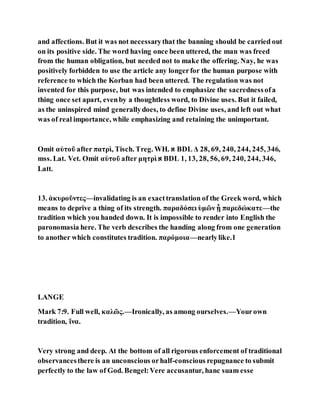
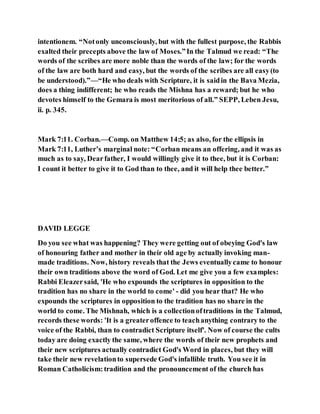
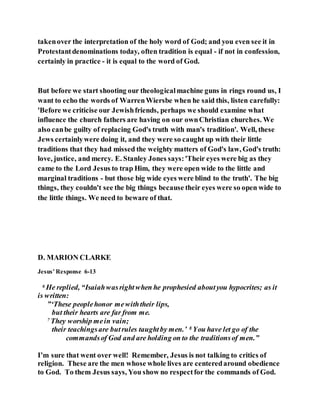
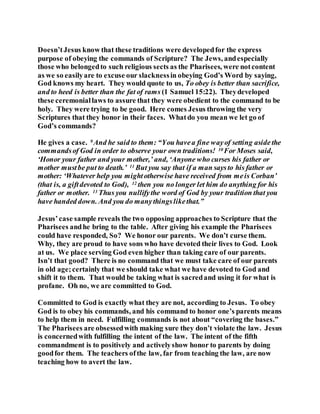
gratuitous characterofthe gift. Anything given or bestowed. A gift is
something voluntarily transferredby one personto another without
compensation. Something presented as an act of worship and/or devotion (Mt
2:11). Doronis used of offerings to God exceptin Eph 2:8 and Rev 11:10. In
classicalGreek doronreferred to a votive (expressing a vow, wish or desire)
gift or offering to a god (little g) or a gift from the gods, as well as a present
given as a tribute or even as a bribe. Of the 166+ uses ofdoron in the non-
apocryphal Septuagint, most are used in the context of an offering to God (cf
Ge 4:4, Lev 1:2, 3, 10, 2:1, Nu 5:15, Dt 12:11, 1Chr 16:29, Jer 33:11, etc).
Chuck Smith - But you say, "Well, it"s Corban. I"ve given that to God; you
can"thave that." And you could actually wipe out any obligation you had to a
person by saying, "Anything I owe you is Corban. That is, it"s dedicatedto
God, and therefore you can"t have it." And by these traditions, they were
actually negating the law of God. (Commentary)
Paul gives some strong words to those who fail to help their needy parents...
But if anyone does not provide for his own, and especiallyfor those of his
household, he has denied the faith and is worse than an unbeliever. (1
Timothy 5:8)
Question- What does Corban mean in Mark 7:11?
Answer: The word Corban is only found in Mark 7:11. The interpretation is
given in the same verse:“devoted to God as a gift.” The word described
something to be offered to God or given to the sacredtreasury in the temple.
If something was “Corban,” it was dedicatedand setapart for God’s use.
In the context of Mark 7:1-13, Jesus is speaking to the Phariseesaboutritual
without reality. The Pharisees hadaskedwhy the disciples did not washtheir
hands according to the ritualistic tradition of the elders (Mark 7:5). This
hand-washing was not what we think of today with soapand water. It was not
for cleanliness;rather, it was a prescribed ritual done as a show of piety.
In answerto the Pharisees’question, Jesus toldthem that they had rejected
the commandment of God in order to keeptheir own tradition (Mark 7:6-9).
Jesus gives the proof of their corruption of the Law by citing their use of
“Corban.” Moseshadinstructed God’s people to “honor their father and
mother” (Exodus 20:12), but the Phariseesnegatedthat command by teaching
that they could give money to the temple in lieu of helping their parents in
need. Whatevermoney might have been used to provide for aging parents
could be dedicatedto the temple treasury instead. Saying, “It is Corban”
would exempt a person from his responsibility to his parents. In other words,
the Phariseestook a legitimate Corban offering and used it in an illegitimate
and devious wayto defraud their parents (and enrich themselves). Thus, the
Law of God was nullified.
Jesus tells the Phariseesthat their misuse of Corban was an evil rationale to
avoid doing what they should. God never intended that the goodprinciple of
devoting something to the temple should be twisted to dishonor fathers and
mothers. Ritual without reality is what the Pharisaic religion was all about. It
was also ritual without righteousness and without relationship. Jesus taught
that, without a personal relationship with God, ritual profits nothing, and the
traditions of man should never usurp the authority of God’s Word. (Source:
GotQuestions.org)
Mark 7:12 you no longer permit him to do anything for his father or his
mother;
Wuest no longerare you permitting him to do anything for his father and his
mother.
NET Mark 7:12 then you no longer permit him to do anything for his father
or mother.
NLT Mark 7:12 In this way, you let them disregardtheir needy parents.
ESV Mark 7:12 then you no longerpermit him to do anything for his father
or mother,
NIV Mark 7:12 then you no longerlet him do anything for his father or
mother.
GNT Mark 7:12 οὐκέτι ἀφίετε αὐτὸνοὐδὲνποιῆσαι τῷ πατρὶ ἢ τῇ μητρί,
KJV Mark 7:12 And ye suffer him no more to do ought for his father or his
mother;
Mark 7 Resources - Multiple Sermons and Commentaries
RelatedPassages:
Matthew 15:6+ he is not to honor his father or his mother.’ And by this you
invalidated the word of God for the sake ofyour tradition.
RELIGION THAT PREVENTS
HONORING RELATIONSHIPS
You no longer permit him to do anything for his father or his mother - NLT =
"In this way, you let them disregard their needy parents." Cranfield says
"Once the formula was used (perhaps hastily), one evidently was not allowed
to change one’s mind."
Simply by saying "Corban" overa gift, a soncould be freed of the obligation
of having to give the gift to their needy parents! In essencethe Pharisees and
their evil traditions were promoting sinful behavior by sons!Talk about being
deluded by doctrines of men! These Phariseeshad no conceptof the truth of
God nor of the true and Living God. That's the deadly effecttradition can
have on a heart! The heart becomes so unbelieving, so hardened, that it thinks
it is doing right when in fact it is actually doing wrong. This is exactlywhat
happened in the horrible days of the Judges where we read "In those days
there was no king in Israel;everyone did what was right in his owneyes.
(NOTICE EVEN THOUGH THEY DID WRONG, THERE WERE SO
DECEIVED, THEY THOUGHT THEY WERE DOING RIGHT!)" (Jdg
21:25+).
Mark 7:13 thus invalidating the word of God by your tradition which you
have handed down; and you do many things such as that."
Wuest You are rendering void the authority of the Word of God by that
which has been delivered to you to observe, which in turn you are delivering
over (to another) to keep. And many things of this kind you are constantly
doing.
NET Mark 7:13 Thus you nullify the word of God by your tradition that you
have handed down. And you do many things like this."
NLT Mark 7:13 And so you cancelthe word of God in order to hand down
your own tradition. And this is only one example among many others."
ESV Mark 7:13 thus making void the word of Godby your tradition that you
have handed down. And many such things you do."
NIV Mark 7:13 Thus you nullify the word of God by your tradition that you
have handed down. And you do many things like that."
GNT Mark 7:13 ἀκυροῦντες τὸνλόγον τοῦ θεοῦ τῇ παραδόσει ὑμῶν ᾗ
παρεδώκατε·καὶ παρόμοια τοιαῦταπολλὰ ποιεῖτε.
KJV Mark 7:13 Making the word of God of none effectthrough your
tradition, which ye have delivered: and many such like things do ye.
the word: Mk 7:9 Isa 8:20 Jer8:8,9 Ho 8:12 Mt 5:17-20 15:6 Tit 1:14
such: Eze 18:14 Ga 5:21
Mark 7 Resources - Multiple Sermons and Commentaries
JESUS'SUMMARY JUDGMENT
OF MEN'S TRADITIONS
RelatedPassages:
Matthew 15:6+ he is not to honor his father or his mother.’ And by this you
invalidated the word of God for the sake ofyour tradition.
Brian Bill - Jesus condemnedand correctedthe religious leaders for focusing
on outward hypocrisy instead of inward holiness. The religious leaders were
adamant about having cleanhands; Jesus was allabout having a clean heart.
To serious compassionimposture is provoking,
and sincere truthfulness is grieved by the mockeries ofpretense.
-Spurgeon
Thus invalidating the Word of God by your tradition (paradosis)which you
have handed down (paradidomi = passing on, transmit by teaching, passing
on tradition) - One of the meanings of the Greek verb invalidating (present
tense = continual negative effect of "traditions" and legalism) is to deprive of
power! Ponderthat thought regarding the effectof traditions (and legalismin
general)on the powerof the Word of God! Notice this summation by Jesus is
essentiallythe third time He emphasizes the negative effectof traditions of
men on the Word (Commandment) of God. (Mk 7:8 = neglecting, Mk 7:9 =
setting aside and Mk 7:13 = invalidating). Traditions of men are legalistic
burdens and Jesus says they counteractthe Word of Truth. In John 8:31-32
"Jesus was saying to those Jews who had believed Him, “If you continue in
My word, then you are truly disciples of Mine; and you will know the truth,
and the truth will make you free.” But here Jesus is saying in essencethatthe
traditions of men will blunt the liberating effectof the truth of the Word of
God and will cut off the flow of grace because oflegalistic rules!
And you do (present tense = continually) many (not a few!) things such as that
- What Jesus is saying is that the corrupt conceptof Corbanis just one
example of how their traditions invalidated the Word of God! (see quote
below from Mt 23:23)The clearimplication is that many other oraltraditions
setaside the written Law! Notice the pronoun "you" so He is directing this
accusationto the scribes and Pharisees.One can only imagine what was going
through their mind as Jesus exposedtheir horrible practice of Corban and
alluded to other similar scams they practiced which deprived the Word of
God of its authority and power!While they should have confessedand
repented, subsequent events demonstrate their hearts only hardened even
more!
Matt. 23:23, “Woe to you, scribes and Pharisees,hypocrites!For you tithe
mint and dill and cummin, and have neglectedthe weightierprovisions of the
law: justice and mercy and faithfulness; but these are the things you should
have done without neglecting the others.
Akin - Jesus tells them (v. 13) it is the kind of reasoning that 1) makes void the
word of God, 2) sets up man-made traditions over God’s commands and 3)
opens the door for many more such actions that reveals the hardness of our
hearts, the hypocrisy of our worship, and the disobedience of our actions, all
in the name of religion! These are not atheist and secularist. These are the
religious and supposedly spiritual. Bottomline: they have placedtheir
traditions in the place of Scripture and themselves in the place of God! The
heart truly is an idol factory, and religious traditions are some of its besttools.
This truth should concernus all. I may be as guilty as the PhariseesofJesus’
day and not even see it.
Bruce - The receivers are also transmitters of the tradition, adding their quota
to the weightof authority. (EGT)
Invalidating (208)(akuroo from a = without + kuroo = to confirm) was a legal
technicalterm meaning to make invalid or void, to annul (Gal 3:17+) Often
used of annulling wills and contracts. It means to cancel, deprive of power.
Used in Mt 15:6 and Mk 7:13 describing depriving divine law of authority
(and power) by placing priority on human traditions! In the OT only in the
apocryphal writings - 1 Es. 6:31; 4 Ma. 2:1; 4 Ma. 2:3; 4 Ma. 2:18; 4 Ma. 5:18;
4 Ma. 7:14; 4 Ma. 17:2
Tradition (3862)see above on paradosis
William MacDonaldmakes a greatpoint - One of the great lessons inthis
passageis that we must constantly test all teaching and all tradition by the
Word of God, obeying what is of Godand rejecting what is of men. At first a
man may teachand preacha clear, scriptural message, gaining acceptance
among Bible-believing people. Having gainedthis acceptance, he begins to add
some human teaching. His devoted followers who have come to feelthat he
can do no wrong follow him blindly, even if his message blunts the sharp edge
of the Word or waters down its clearmeaning. It was thus that the scribes and
Pharisees hadgained authority as teachers of the Word. But they were now
nullifying the intent of the Word. The Lord Jesus had to warn the people that
it is the Word that accredits men, not men who accreditthe Word. The great
touchstone must always be, “Whatdoes the Word say?” (BBC)
Brian Bill draws some conclusions from Jesus'confrontationof the deadly
effectof the traditions of men - A legalistis one who believes that performance
is the way to gain favor with God. Legalism is the human attempt to gain
salvationor prove our spirituality by outward conformity to a list of religious
“do’s” and “don’ts.” It’s often disguisedin spiritual beliefs and behavior.
Here are some observations aboutlegalism. You may want tighten your
seatbeltbecause we’re aboutto go through some turbulence.
1. We tend to think others are legalistic, but that we’re not.
The fact is that we’re all legalistic by nature. We tend to judge others by our
own standards of what is acceptable andwhat isn’t. In essence, we think our
sins smell better than other people’s because we have very little tolerance for
people who sin differently than we do.
2. Legalismis highly contagious.
While it’s usually less consciousand systematizedin our minds than it was
among the Pharisees andthe scribes, legalismcanspread like a bad virus
through an entire congregation. That’s why Jesus reservedsome of his
harshestcriticism for legalistic list-makers.
3. Legalismcan take a vibrant faith and make it dull and lifeless.
It can evaporate enthusiasm, jettison joy, and stifle spirituality. Instead of
finding freedom through Christ, many believers become burdened by a bunch
of rules and regulations.
4. Legalismproduces large quantities of self-righteousness, judgment and
condemnation.
It majors in guilt and misguided sacrifice, urging its followers to evaluate
their relationship with God on the basis of standards and scores – and expects
others to do the same. Superficialspirituality short-circuits the work of grace.
5. Legalismmakes us narrow and divisive.
The legalistinsists that everyone live up to the standard they have adopted. In
other words, everyone needs to be like me. When we think this way, we miss
the delight of diversity in the church.
6. Legalismmakes it impossible for people to see Jesus.
There is nothing that pushes someone awayfasterthan a list of rules and
regulations when we inadvertently portray Jesus as a drill sergeantinsteadof
the Savior.
Mostof us fall into legalismwithout trying to do so. Let me illustrate.
Severalyears ago I askeda woman from China and a man from Puerto Rico
to lead us in prayer for the persecutedchurch (By the way, we’ll hear from
the Puerto Rico Go Teamnext weekend). It was beautiful to hear Hector pray
for the persecutedin Spanish. When Stella prayed in Mandarin, she told us
she was going to kneeland very graciouslyinvited us to do the same, if we
wanted to. I followedher lead and knelt. My motives were goodinitially as we
interceded for the needs of beleagueredbelievers around the world. But then I
took a peek and noticed only a small number were on their knees. A seedof
judgmentalism beganto germinate, as I secretlywonderedwhy others weren’t
as spiritual as I was. Now, work withme on this. Imagine that because I
found kneeling to be so helpful, I begankneeling during my quiet times. When
I led in prayer in services Iknelt as well. And then I started telling everyone
else they had to kneelwhen they prayed. I might even quote some Scripture.
And when I didn’t see people kneeling I startedto feelangry but also
spiritually smug because atleastI was doing what everyone else should be
doing. Do you see how subtle and sneakylegalismis? Its weeds are under the
surface in eachof our lives. Kneeling to pray is a goodthing but it can easily
become the standard by which we judge other people’s spirituality. In short, if
we’re not careful we’ll default to a performance-based, hypocritical kind of
faith. By the way, there are other acceptable prayerpostures in the Bible –
sitting, standing, lying down, bowing, hands in the air or praying to stay
awake during sermons.
One of the bestways to not slide into spiritual superficiality and ritualistic
religion is by serving those in need. James 1:27 says:“Religionthat is pure
and undefiled before God, the Father, is this: to visit orphans and widows in
their affliction, and to keeponeselfunstained from the world.”
WILLIAM BARCLAY
AN INIQUITOUS REGULATION (Mark 7:9-13)
7:9-13 He said to them, "You make an excellentjob of completelynullifying
the command of God in order to observe your own tradition. ForMoses said,
'Honour your father and your mother.' And, 'He who speaks evilof his father
or mother shall certainly die.' But you say, that, if a man says to his father or
mother, 'That by which you might have been helped by me is Korban,'--that is
to say, God-dedicated--youno longer allow him to do anything for his father
and mother, and you thereby render invalid the word of God by your
tradition which you hand on. You do many things like that."
The exactmeaning of this passageis very difficult to discover. It hinges on the
word Korban (Greek #2878)which seems to have undergone two stages of
meaning in Jewishusage.
(i) The word meant a gift. It was used to describe something which was
speciallydedicated to God. A thing which was Korban (Greek #2878)was as if
it had already been laid upon the altar. That is to say, it was completelyset
apart from all ordinary purposes and usages andbecame the property of God.
If a man wished to dedicate some of his money or his property to God, he
declaredit Korban (Greek #2878), and thereafterit might never again be used
for any ordinary or secularpurpose.
It does seemthat, even at this stage, the word was capable of very shrewd
usage. Forinstance, a creditor might have a debtor who refused or was
unwilling to pay. The creditor might then say, "The debt you owe me is
Korban (Greek #2878)," thatis to say, "The debt you owe me is dedicatedto
God." From then on the debtor ceasedto be in debt to a fellow-man and
beganto be in debt to God, which was far more serious. It may well be that
the creditor could discharge his part of the matter by making a quite small
symbolic payment to the Temple, and then keeping the rest for himself. In any
event, to introduce the idea of Korban (Greek #2878)into this kind of debt
was a kind of religious blackmail transforming a debt owedto man into a debt
owedto God.
It does seemthat the idea of Korban (Greek #2878)was alreadycapable of
misuse. If that be the idea behind this, the passagespeaks ofa man declaring
his property Korban (Greek #2878), sacredto God, and then when his father
or mother in dire need comes to him for help, saying, "I am sorry that I
cannot give you any help because nothing that I have is available for you
because it is dedicated to God." The vow was made an excuse to avoid helping
a parent in need. The vow which the scribal legalistinsistedupon involved
breaking one of the ten commandments which are the very law of God.
(ii) There came a time when Korban (Greek #2878)became a much more
generalizedoath. When a person declaredanything Korban (Greek #2878)he
entirely alienatedit from the personto whom he was talking. A man might
say, "Korban (Greek #2878)that by which I might be profited by you," and,
in so doing, he bound himself never to touch, taste, have or handle anything
possessedby the person so addressed. Or, he might say, "Korban (Greek
#2878)thatby which you might be profited by me," and, in so saying, he
bound himself never to help or to benefit the person so addressedby anything
that belongedto himself. If that be the use here, the passage means that, at
some time, perhaps in a fit of anger or rebellion, a man had said to his
parents, "Korban (Greek #2878)anything by which you may ever be helped
by me," and that afterwards, evenif he repented from his rash vow, the
scribal legalists declaredthat it was unbreakable and that he might never
againrender his parents any assistance.
Whichever be the case--andit is not possible to be certain--this much is sure,
that there were casesin which the strict performance of the scriballaw made
it impossible for a man to carry out the law of the ten commandments.
Jesus was attacking a systemwhich put rules and regulations before the claim
of human need. The commandment of God was that the claim of human love
should come first; the commandment of the scribes was that the claim of legal
rules and regulations should come first. Jesus was quite sure that any
regulation which prevented a man from giving help where help was needed
was nothing less than a contradiction of the law of God.
We must have a care that we never allow rules to paralyse the claims of love.
Nothing that prevents us helping a fellowman canever be a rule approved by
God.
CHRIS BENFIELD
B. He Condemned their Delinquency (10-13)– Here Jesus addressedanother
grievous error
many committed all while seeking to justify it according to the faith. In that
culture, and in most
today, one was expectedto care for their aging parents. Jesus reminded them
of the
commandment to honor their father and mother. However, the Jews had
devised a way to avoid
their responsibilities and justify their neglect. When their parents made a
request, the rebellious
son would declare that his available monies were “Corban.” This is a term
that meant the money
was dedicatedto God and could be spent for no other purpose than the needs
of the Temple or
sacredduties. These neglectedtheir responsibilities through false pretense and
were bold enough
to declare the money was reservedfor the Lord.
 Such activity remains today in some form or another. Folks may not tell
their parents their
money is reservedfor the Lord, but they seek to justify their actions through a
mandate or
expectationof the church. They are willing to neglectthe needs of those closest
to them in order
to continue their efforts of self-righteousness. Manychildren have been turned
from the faith
because ofthe legalistic demands of their parents, all while seeing the utter
hypocrisy in it.
BRIAN BILL
B. He Condemned their Delinquency (10-13)– Here Jesus addressedanother
grievous error
many committed all while seeking to justify it according to the faith. In that
culture, and in most
today, one was expectedto care for their aging parents. Jesus reminded them
of the
commandment to honor their father and mother. However, the Jews had
devised a way to avoid
their responsibilities and justify their neglect. When their parents made a
request, the rebellious
son would declare that his available monies were “Corban.” This is a term
that meant the money
was dedicatedto God and could be spent for no other purpose than the needs
of the Temple or
sacredduties. These neglectedtheir responsibilities through false pretense and
were bold enough
to declare the money was reservedfor the Lord.
 Such activity remains today in some form or another. Folks may not tell
their parents their
money is reservedfor the Lord, but they seek to justify their actions through a
mandate or
expectationof the church. They are willing to neglectthe needs of those closest
to them in order
to continue their efforts of self-righteousness. Manychildren have been turned
from the faith
because ofthe legalistic demands of their parents, all while seeing the utter
hypocrisy in it.
CAMBRIDGE BIBLE FOR SCHOOLS AND COLLEGES
Mark 7:9
And he said unto them, Full well ye rejectthe commandment of God, that ye
may keepyour own tradition.
Mark 7:10
For Mosessaid, Honour thy father and thy mother; and, Whoso curseth
father or mother, let him die the death:
10. Honour thy father] The words are quoted partly from Exodus 20:12, and
partly from Exodus 21:17.
Mark 7:11
But ye say, If a man shall say to his father or mother, It is Corban, that is to
say, a gift, by whatsoeverthou mightest be profited by me; he shall be free.
11. If a man shall say] Literally it runs, If a man shall say to his father or his
mother, That, from which thou mightest have been benefited by me, is
Corban, that is to say, a gift, or offering consecratedto God, he shall be free,
and ye suffer him no longerto do aught for his father or his mother. A person
had merely to pronounce the word Corban over any possessionor property,
and it was irrevocably dedicatedto the Temple. Our Lord is quoting a regular
formula, which often occurs in the Talmudic tracts Nedarim and Nazir.
Others would give to the words an imperative force, Be it Corbanfrom which
thou mightest have been benefited by me, i. e. “If I give thee anything or do
anything for thee, may it be as though I gave thee that which is devoted to
God, and may I be accountedperjured and sacrilegious.” This view certainly
gives greaterforce to the charge made by our Lord, that the command
“Whoso cursethfather or mother, let him die the death” was nullified by the
tradition.
Mark 7:12
And ye suffer him no more to do ought for his father or his mother;
Mark 7:13
Making the word of God of none effectthrough your tradition, which ye have
delivered: and many such like things do ye.
13. through your tradition] The Jews distinguished betweenthe “Written
Law” and the traditional or “Unwritten Law.” The Unwritten Law was said
to have been orally delivered by God to Moses, andby him orally transmitted
to the Elders. On it was founded the Talmud or “doctrine,” which consists of
(1) the Mishna or “repetition” of the Law, (2) the Gemara or “supplement” to
it. So extravagantdid the veneration for the Traditional Law become, that
there was amongstmany other sayings this assertion, “The Law is like salt,
the Mishna like pepper, the Gemara like balmy spice.” Buxtorf, Synag. Jud.
ch. 3.
ALAN CARR
v. 6-14 THE PROBLEM
CONDEMNED
(Ill. So, these men are upset with Jesus because His disciples do not perform
the ritual washings ofthe Jews. In these verses, Jesus revealsthe hypocrisy of
their hearts.)
In verses 6-9 Jesus condemns their legalism. He accusesthese menof
being hypocrites. He quotes Isaiah29:13 and accusesthem of elevating their
traditions to the point that they carry more weightthat the Word of God.
History reveals that the Jewishreligious leaders came to honor their
traditions far above the Word of God. According to Warren Weirsbe,
“Rabbi Eleazersaid, ‘He who expounds the Scriptures in oppositionto the
tradition has no share in the world to come.’The Mishna, a collectionof
Jewishtraditions in the Talmud, records, ‘It is a greateroffense to teach
anything contrary to the voice of the Rabbis than to contradict Scripture
itself.’”
In verse 8, He even tells them that they have “laid aside the
commandments of God” in favor of their manmade rules and traditions. In
verse 9, He tells them they have actually “rejected” the commandments of
God so that they can keeptheir traditions! Jesus condemns their blatant
hypocrisy!
These men are rank legalists. Theyteachthe people that the way to be
right with God is to keepall the rules. If you can do everything right, God will
be pleasedwith your life and He will acceptyou. Nothing could be farther
from the truth!
(Note:That crowdis still with us today! They think their little, petty rules are
more important than anything else. If people walk like they think a person
should walk then that person is acceptedby them. If they weartheir hair just
right; have on the right kind of clothes;stay awayfrom the right places;do
the right things on certaindays, etc, they are accepted. If not, then they are
condemned.
Just so you know, legalism, Phariseeismand those who try to enforce
their rules on others make me sick!Of course, it’s not just me they bother.
Jesus hates that attitude too, Matt. 23:1-36.)
Not only does Jesus condemntheir legalism, He also exposes the liberties
they take with the Law. In verse 10-13, Jesus blows the lid off one of their
traditions that allows them to side step a commandment.
Jesus talks about the practice of “Corban”. Thatword means “a gift
offered to God”. The commandments of God are very clear. Godsaid this in
the fifth commandment, “Honour thy father and thy mother: that thy days
may be long upon the land which the LORD thy God giveth thee,” Ex. 20:12.
And, Ex. 21:17 says, “And he that curseth his father, or his mother, shall
surely be put to death.”
Part of this idea of honoring one’s parents included the necessityof
providing for their needs as long as they lived. Most of us still believe in that
today. Well, the Jews found a wayaround it. If they said that their money or
possessionswas “Corban”,“a gift offered to God”. They could only use that
money or goods in sacredmatters. Thus, they were off the hook regarding the
care of their parents. They would just tell Mom and Dadthat their stuff was
dedicatedto the Lord and they wouldn’t be getting anything. Talk about cold
hearts! Jesus tells them that they have made the Laws of God ineffective by
their traditions, v. 13.
(Note:Again, this same attitude still exists today! People have their rules, but
they don’t live by them totally. When the rules become an inconvenience, they
find a way around them. That is called hypocrisy!
Another problem with the “rule makers” is that they are the most mean-
spirited people in the world! They try to keepall the rules, but they condemn
those who don’t keeptheir rules. They are busy crossing their T’s and dotting
their I’s, but they are not too busy to pass judgment on those who don’t keep
the same rules. That’s why there is often more compassion, sympathy and
acceptanceatthe localpool hall than there is at the localchurch! This is called
hypocrisy!)
(Note:There had never arisena prophet like Jesus. He spoke with divine
authority. He actedwith sovereignpower. He literally fulfilled the Scriptures.
Love, wisdom and power filled everything He did. He performed many
amazing and startling miracles. Yet, the legalistic Pharisees couldnot believe
that He was from God because He allowedHis men to eat without washing
their hands. How utterly hypocritical and spiritually blind they were! Sadly,
that same attitude is still with us today!
Jesus is about to teachus that it does not matter what you do on the
outside; true spirituality is what you are on the inside!)
DR. W. A. CRISWELL
That’s the Lord. And here He does it again. He says, "Isaiahthe prophet
spoke about you, that the people in this generationworship Me with their lips,
but their hearts are far from Me, teaching for doctrines the commandments of
men, the tradition of the elders" [ Mark 7:6-9; Matthew 15:7-9]. Then He
gives them a poignant illustration. "In one of the Ten Commandments, Moses
wrote, ‘Honor thy father and thy mother’ [Exodus 20:12]. And then it is
discussedin the Holy Word of God. But you say, if I have something in my
hand whereby I might help my father and mother, food that they might eator
care that they so desperatelyneed – you say, that if your father or mother has
need, you say, what I have is Corban, dedicated to God, and, therefore, I
cannot use it for the support and the alleviationof the tragedies of sorrow and
need and want found in many of our agedfathers and mothers’"; and the
Lord said, "Thus do you subvert and interdict the commandment of God by
your ritualistic traditions, making the Word of God of none effect" [Mark
7:10-13].
Well, that’s strangelypertinent and modern, defining religion in terms of
ceremonialworship, things, t’s to cross and i’s to dot, and litanies to say, and
genuflections to go through, and all of the outward trappings and
paraphernalia of the religion, but the heart isn’t right! It’s an outward
ceremonialshowing, but it’s not a true worship of God. I say, that’s about as
modern a characterizationas you could find.
You’ve heard me saythis. There were two men who robbed a bank., and in
robbing the bank, they killed the president and left him in cold blood. And
fleeing awaywith their robbery, they stopped at a joint, a hamburger joint, to
get a bite to eat. And while they were there in the joint eating a hamburger
that has supposedly meat in the bun, while they were there eating a
hamburger, one of those men who had shot the president in cold blood and
left him dead, he suddenly stopped and said, "Wait! This is Friday! And we
dare not eatmeat on Friday." So they pushed the meat away. Carefuland
meticulous about the ceremonies ofthe faith, all of those washings, and
sprinkles, and litanies, and genuflections, allof those mouthed words – but the
heart far awayfrom God.
In this city there’s a well-known, very well-knownbusiness executive, very
well-known, most successfuland very wealthy, and a greatexponent of a
certain religion in the city of Dallas. I happened to be seatedby him from a
distant city, returning to Dallas. And knowing him well, and he knowing me,
we began to talk and to visit as you would know two men would who knew
eachother for years and years and lived in the city of Dallas. So he was telling
me about a pastorin that distant city. I knew him. He said to me, "That’s my
kind of a preacher. Man, do I like him! He drinks with me, and I like to
drink with him, and he gambles with me, and I like that gambling, and many
times he beats me at it. I could also sayhe swappedwives with one of his
deacons. That’s my kind of a preacher," he said. "I like him. He drinks with
me and he gambles with me. I like that."
Well, I saidto him – this is a man, remember, who is very religious; he goes to
that house of worship, and he bows down, and he genuflects, and he recites the
litany, and he does a thousand things. He’s meticulous. So he gambles. Fine.
He’s wealthy, and he canlose millions of dollars and not miss it. So he drinks,
and to him it is perfectly acceptable;he drinks.
So I talk to him, and this is what I say. Callhim by name, and I say, "There
are literally thousands and thousands of young men in this city who know you.
They watch you, and you are to them a great successfulidol. Man, they look
at you and say, ‘That’s the way. That’s the way. Look at him.’" I said to
him, "There’s not a young man in the city of Dallas that looks ata drunk in
the gutter in his own vomit who says, ‘I’d like to be like that.’ There’s not
one. But there are thousands of young men in the city of Dallas who watch
you and who know you and who say, ‘I’d like to be like that.’ So the young
fellow sees you gamble, and he gambles. And the young fellow sees you drink,
and he drinks." And then I called him by name, and I said, "The tragedy of
that is this: one boy out of every eleven who begins to drink falls into awesome
and terrible problems, drinking problems, liquor problems. And one out of
every nine, when he gets grown, becomes an alcoholic and a drunkard." I
said to him, "It’s not worth what little joy you getout of it because ofthe
tragedy of the influence of your life on that youth who sees you gamble and
watches you drink."
There is a greatlaw in the Bible, a tremendous one: if eating meat causesmy
brother to offend, I will eatno meat so long as the world shall last [1
Corinthians 8:13]. If what I do causes him to stumble and to fail, I will not do
it for his sake. That’s the highestChristian law by which we could love and
serve and worship our Lord God. If drinking causes a young man to stumble,
I won’t drink. And if gambling causes a poor man to lose the wages that he
ought to spend on his children and on his house and wife and home, I won’t
gamble. It’s a greatChristian commitment.
Sum it up, the text I’m expounding – the Christian faith is not that
genuflection. It is not that sprinkling of holy water. It is not that repetition of
a litany, and it is not the keeping of all the formalities of a ceremonialfaith.
The Christian religion is of the heart. It’s of the soul. It’s of the life. It’s of
the example. It’s living unto God in such a way that people, seeing us, glorify
our Fatherwhich is in heaven [Matthew 5:16].
In a little moment that I could take here, could I turn aside from a little thing
that I run into with my fellow ministers all the time? I will get a blistering
letter, I mean a blistering letter, from my fellow ministers, and they will sayto
me, "We listen to you on the radio," or, "We readthis in one of your sermons,
and you saywhen Jesus turned the waterinto wine [John 2:1-11], that it was a
specialkind of wine, and the kind we’re going to drink at the marriage supper
of the Lamb. That," they say to me, "is a downright misrepresentationof the
Holy Scriptures." That’s what they write me. "When Jesus turned the water
into wine, it was like the restof the wine, and they could getdrunk on it. And
for you to say anything else is not to be true to the Word of God." Theywill
use the word eisegesis. "That’s notexegesis;that is eisegesis,reading into it
some perverted persuasionthat you have."
Now, these are ministers who love to drink. Not long ago I satdown with
some of them, all of them drinking liquor, all of them. What about that?
What I say and what I preach, which is the Word of God, namely, that when
they ran out of wine at this marriage feastin Cana of Galilee, where Mary, the
mother of Jesus, said, "You do what my Sonsays" [John 2:5], and He asked
them to fill up all of those ceremonialwaterpots and then draw out and bear it
to the governor, and the governorsaid, "I never tasted wine like that"; it was
different. It was different from any he ever tasted. He said, "This is
different!" [John 2:9-10].
I don’t believe, nor could I be convincedin a hundred thousand lifetimes, that
Jesus evermade anything to damn a man’s life or to ruin a man’s soul. You
could drink that wine that Jesus made foreverand ever! It’s the wine we’re
all going to drink at the marriage supper of the Lamb [Revelation19:6-9].
It’s different. It’s a joyous, beautiful, precious cup of the love and gracious
goodness ofthe blessing of the Lord.
And our lives – returning to my exposition – are never, ever to be defined in
terms of certainritualistic bowings and risings through which we go,
mouthing certain pious phrases and responses. Butour faith is one of a
commitment of heart and life to the Lord, walking in the glory of the light that
shined in the face of Jesus Christ [2 Corinthians 4:6]. And now to conclude,
because our moment is gone;and the Lord taught them it’s not the ceremonial
things that defile the man. It’s the things of the heart that defile us [Mark
7:15,18-19].
THOMAS CONSTABLE
Verse 8-9
Jesus contrastedthe commands of God and the traditions of men. The rabbis
had built a fence around the law by erecting their dos and don"ts to keepthe
Israelites from breaking the law. Howeverrather than protecting it their
legalistic requirements distorted and even contradictedthe law. This is always
the problem that accompanies attempting to legislate obedience to God"s
Word. Legalisminvolves making laws that God has not made and treating
them as equally authoritative as God"s Word. The Pharisees hadeven
abandoned God"s commandments in favor of their oral traditions that came
from men. Jesus rejectedthe authority of the orallaw.
Verses 10-13
Jesus citedan example of how his critics used human traditions to set aside
divine imperatives. They professedto honor Moses through whom God
commanded the Israelites to honor their parents and threatened disobedience
with death ( Exodus 20:12;Exodus 21:17). Honoring parents manifests itself
in financial support and practicalcare if necessary. Mark interpreted the
word "corban," a gift devoted to God, for his Gentile readers. This word is
Greek, but it transliterates a Hebrew word that the Jews usedwhen they
dedicatedsomething to God. Jewishtradition permitted people to declare
something they ownedas dedicated to God. [Note:See ibid, p369 , for an
example.] This did not mean that they had to give it to the priests or even give
up the use of it themselves. Howeverit freed them from giving it to someone
else, evena needy parent.
"History reveals that the Jewishreligious leaders came to honor their
traditions far above the Word of God. Rabbi Eleazersaid, "He who expounds
the Scriptures in opposition to the tradition has no share in the world to
come." The Mishna, a collectionofJewishtraditions in the Talmud, records,
"It is a greateroffense to teachanything contrary to the voice of the Rabbis
than to contradict Scripture itself." But before we criticize our Jewishfriends,
perhaps we should examine what influence "the church fathers" are having in
our own Christian churches. We also may be guilty of replacing God"s truth
with man"s traditions." [Note: Wiersbe, 1:134.]
Jesus claimedthe authority to reorder socialrelationships. He said a son"s
responsibility to provide for his parents supersededthe legaloption of corban.
[Note:Edwards, p224.]
Note that Jesus equatedwhat Moses said( Mark 7:10) with the Word of God (
Mark 7:13). He also attributed Mosaic authorship to the Torah, something
many liberal modern critics of the Bible deny. Jesus" enemies failedto
recognize the difference betweeninspired and uninspired instruction. The
"you" in Mark 7:11 is in the emphatic first position in the Greek text
indicating a strong contrastbetweenGod"s view and the critics". They had
not only rejectedGod"s Word( Mark 7:9), but they had even invalidated it,
that Isaiah, robbed it of its authority ( Mark 7:12). Mark added Jesus" words
that this was only one example of how these Pharisees andscribes had voided
the authority of what God had revealedby their traditions ( Mark 7:13).
RON DANIEL
7:6-13 Man's Laws Over God's Laws
God's law was given to show God's perfectionand man's imperfection. The
law shows us how utterly sinful we are, and is designedto cause us to cry out
to God for His mercy. As Galatians 3 says,
Gal. 3:24 Therefore the Law has become our tutor to lead us to Christ,
We also readin Romans 7,
Rom. 7:7 What shall we say then? Is the Law sin? Mayit never be! On the
contrary, I would not have come to know sin exceptthrough the Law; for I
would not have known about coveting if the Law had not said, "YOU SHALL
NOT COVET."
The law was given to show what sin is, showing the Jew that perfection was
impossible. The idea was that when they tried to obey the law, and stumbled
at one point, they would say "Lord, I need your forgiveness!" But instead of
allowing their hearts to be broken and crying out to God, saying, "We have
fallen short of the glory of God. We are unrighteous! Lord, we appeal to your
mercy!" they became prideful, and substituted the rules of God for
relationship with God.
Then they beganto add to God's Law. Forthe laws which seemedimpossible,
loopholes were createdto enable religious people to keepthem. God's Laws
which were plain and simple, given for the people's benefit, were expounded
upon and defined with lots of additions and subsections.
For example, the Lord had said,
Exod. 20:10 ...the seventh day is a sabbath of the LORD your God; in it you
shall not do any work
Well, they neededto define work. So the rules became ridiculous, defining
what was and was not work. You could walk, but only a certain number of
paces. That's why we read the expression,
Acts 1:12 Then they returned to Jerusalemfrom the mount called Olivet,
which is near Jerusalem, a Sabbath day's journey away.
Olivet was within the distance from Jerusalemthat the Jewishtraditional law
allowed.
Another example was in regards to spitting. Is spitting work? Canyou spit on
the Sabbath day? That depends. If you spit on a rock, that's okay. But if you
spit in the dirt, you've just createdmud, which could be used for mortar.
That's work, and that's not okay.
Traditions & Opinions
So Jesus is hot under the collar here, saying that the Jews were "teaching as
doctrines the precepts of men." He gives them the example of what was called
"Corban." A tradition of the Jews in which something was declaredto be a
gift to God at some point in the future. This invalidated the Word of God
when the thing could have blessedthe person's parents, in violation of a direct
command of God. He adds that this was just one of many things they did such
as that.
Notice the three-step progressionthathappens when we allow the traditions of
men to come alongside God's Word. First, traditions are added to God's
Word. Then traditions are held to, and God's word is neglected. Lastly,
tradition completely invalidates the Word of God.
Traditions sneak their way in not only with rules and regulations, but also
with opinions. How often I come across things in the Word of God which
contradict conventionalChristian "wisdom." There is certainly no room for
opinion in the teaching ministry. Whether in a pulpit or a living room Bible
study, the only thing that a representative of God should be representing is
the heart of God.
The Sermons of Dan Duncan
Mark 7: 1-23 Mark
"God's Word and Men's Traditions" TRANSCRIPT
Well, our text this morning is Mark chapter 7, and we'll look at verses 1
through 23.
The Pharisees andsome of the scribes gatheredaround Him when they had
come from Jerusalem, and had seenthat some of His disciples were eating
their bread
with impure hands, that is, unwashed. (For the Pharisees andall the Jews do
not eat
unless they carefully washtheir hands, thus observing the traditions of the
elders; and
when they come from the market place, they do not eat unless they cleanse
themselves;and there are many other things which they have receivedin
order to
observe, such as the washing of cups and pitchers and copper pots.) The
Pharisees and
the scribes askedHim, "Why do Your disciples not walk according to the
tradition of
the elders, but eat their bread with impure hands?"
And He said to them, "Rightly did Isaiah prophesy of you hypocrites, as it is
written:
'This people honors Me with their lips, but their heart is far awayfrom Me.
But in vain do they worship Me, teaching as doctrines the precepts of men.'
"Neglecting the commandment of God, you hold to the tradition of men."
He was also saying to them, "You are experts at setting aside the
commandment of God in order to keepyour tradition. "ForMoses said,
'Honor your
father and your mother; and, 'He who speaks evilof father or mother, let him
be put to
death'; but you say, 'If a man says to his father or his mother, whateverI have
that
would help you is Corban (that is to say, given to God),' you no longer permit
him to
- 2 -
"God's Word and Men's Traditions" by Dan Duncan
Copyright © 2014 Believer's Chapel, Dallas, Texas. All Rights Reserved.
do anything for his father or his mother; thus invalidating the word of God by
your
tradition which you have handed down; and you do many things such as
that."
And summoning the multitude again, He began saying to them, "Listen to Me,
all of you, and understand: there is nothing outside the man which can defile
him if it
goes into him; but the things which proceedout of the man are what defile the
man.
When leaving the multitude, He entered the house, His disciples questioned
Him about the parable. And He said to them, "Are you so lacking in
understanding
also? Do you not understand that whatevergoes into the man from outside
cannot
defile him, because it does not go into his heart, but into his stomach, and is
eliminated?" (Thus He declaredall foods clean.)And He was saying, "That
which
proceeds out of the man, that is what defiles the man. "Forfrom within, out of
the
heart of men, proceedthe evil thoughts, fornications, thefts, murders,
adulteries, deeds
of coveting and wickedness, as wellas deceit, sensuality, envy, slander, pride
and
foolishness. "Allthese evil things proceedfrom within and defile the man."
May the Lord bless this reading of His word and bless our time of study
together. Let's bow now in a word of prayer.
[Prayer] Gracious heavenly Father, we do thank You for the time that we
have
to come togetherand study, and we do count it a greatprivilege. We can
gather as a
people who have been purchased by the blood of Christ from the foundation
of the
world, and we can learn of You through the study of Your word. Bless us in
that way,
and remind us as we do study of the importance of Scripture, the value of it in
our life,
and the importance of not departing from it, but remain true to it, living in
obedience
to it. We thank You for the gift of the Word of God and the opportunity to
study, and
for the privilege we have as Your people to intercede from one another. And
we
remember those whose names are listed on the list of prayer requests. We
pray Your
blessing upon them. We pray for Jim Deanand ask that You would bless the
treatment that he is to receive tomorrow and give it goodeffect. We pray for
others.
We pray for Bob Messic andpray that You might give healing to him. So
many
others whose names are listed, Lord, You know their needs and we pray
You'd bless
them. Not only those whose names are on our list, but those with unspoken
needs.
We pray that You'd give healing, that You'd give mercy. We pray that You'd
give
encouragementto those who are suffering, not necessarilywith physical
difficulties,
- 3 -
"God's Word and Men's Traditions" by Dan Duncan
Copyright © 2014 Believer's Chapel, Dallas, Texas. All Rights Reserved.
but who are watching family members go through such trials, or those who
are in
financial need. Bless them. Provide for them. We pray that You'd give them
employment. We pray, Father, for ourselves in a spiritual way. We pray that
You'd
bless this assemblywith devotion to You, devotion of the heart, that we might
be a
people that serve You with a desire to be pleasing to You and not men. May
this
assemblybe one that has a goodwitness throughout the community. So to that
end,
we ask Your blessings upon the elders and the deacons. Give them wisdom
and
diligence in their task. Bless those who teachthe Sunday schools andthe other
classesthatmeet during the week. Encourage themand bless them and give
them
diligence, and may they see the fruit of their labor. Open hearts to receive the
truth
that is given. May we see men and women and children come to faith through
that
ministry. Grow and grace the knowledge ofour Lord and Savior.
We bless our nation, Father. We ask that You give wisdom to our leaders, that
they might serve You, and that goodmight come from their leadership. We
pray that
You might open the hearts of many and prepare our hearts for that, and bless
us as we
considerthe Scriptures together. May all that we do be done to Your honor
and glory.
May the name of Your Son be magnified. We pray in Christ's name. Amen.
[Message]Oursubject this morning is the Word of God and the traditions of
men. Traditions, it seems, are a part of every culture. Each nation has its
customs,
beliefs, and practices that grow and accumulate over time, and eventually take
on an
authority of their own.
For example, it's an American tradition to celebrate Thanksgiving every
fourth
Thursday of November, and we do that with turkey and a football game.
Fourth of
July is celebratedwith hot dogs and fireworks. And we'd never think of
switching the
two. Can you imagine serving hot dogs for Thanksgiving dinner? We could
stuff
them with dressing and put some cranberries on the side, but it just wouldn't
be the
same. It wouldn't taste very good, either, but it wouldn't fit the tradition. And
so we
don't do it.
Something like going without singing the "StarSpangled Banner" before a
World Series game. We always do that. But it's not that the anthem itself adds
anything to the game, makes the players play any more effectively. It's just
that that is
- 4 -
"God's Word and Men's Traditions" by Dan Duncan
Copyright © 2014 Believer's Chapel, Dallas, Texas. All Rights Reserved.
a tradition. That's the way it's done. It's always beendone that way, and it
wouldn't
feel right to change it.
Once a practice becomes a tradition, it's almostsacred, inviolable,
unbreakable. Over time, its original purpose may be forgotten. The tradition,
however, takes ona life of its own, an authority of its own, and so it goes
beyond the
pale of criticism, beyond the realm of scrutiny. And while that may be
innocuous,
innocent enough with national traditions, it's deadly with religious ones.
Because
often, they are not takenfrom the Scripture; but rather, they are additions to
the
Scripture.
Where did the idea of robes and clericalcollars originate? Orthe theologyof
the mass? Orincense and lighting candles for the dead? What about passing
the
offering plate on Sunday morning, or having altar calls? There seems to be a
tendency in man to want to add to God's word, to improve upon it. And that's
where
the dangerlies.
I think we see this from the very beginning of human history. We see it in
Genesis chapter3 when Eve was tempted by the serpent. God had laid down
one
prohibition. "Fromthe tree of the knowledge ofgoodand evil you shall not
eat, for in
the day that you eatfrom it, you shall surely die." But when Eve was asked
about that
command, she stated, "Godsaid, 'You shall not eat from it or touch it, lest you
die.'"
Now, God didn't say, "Don't touch it." Eve added that to the commandment.
And had
things gone on for a period of time, you can be sure that that would've become
a
tradition, just as important as the command not to eatof it.
And you might argue that that's a good tradition. After all, if you don't touch
it, you won't eatit. But, it was no improvement on God's word. We can never
improve on God's word. And in fact, following this addition, she weakens the
penalty. From "you shall surely die," which is a very forceful statement.
Dying, you
shall die, is the way the text literally reads. But what that means is: you shall
surely
die. She weakensthat to "lestyou die." Eve evidently did not know the Word
of God
very well. She puts it in her own words. She added to it, and then she
weakenedits
penalty. And the result was she became more susceptible to sin. And as we
know,
she fell into sin. Her addition did nothing to protectthe commandment,
ensure
obedience.
- 5 -
"God's Word and Men's Traditions" by Dan Duncan
Copyright © 2014 Believer's Chapel, Dallas, Texas. All Rights Reserved.
And in principle, we see that in the traditions that men develop in spiritual
matters. They are additions to the Word of God. Over time, they take on a life
and
authority all their own, eventually with authority that's equal to Scripture.
And
ultimately, they become a rival to the authority of Scripture, diminishing the
authority
of Scripture, and as a result, destroying the spiritual life of those who give
attention to
them.
That's exactlywhat happened in Israel. The Jews ofour Lord's day had the
complete canon of the Old Testament. They had Genesis through Malachi.
They'd
had it for centuries, as a matter of fact. And yet, by our Lord's day, they were
governednot by Scripture, but by tradition. These traditions are, in our text,
called
the "traditions of the elders." They were a greatbody of teaching by earlier
rabbis,
which had been added to the law of Moses, giving detailed rules of conduct.
Where
the law was silent on a particular issue, a rule was formulated and established
that
attempted to be consistentwith the Bible.
And, the rules increasedas Israel's socialconditionchanged. As Jews became
increasinglyin contactwith Gentiles, rules were formulated as the Jews
became
increasinglyin contactwith the Greeks andthe Romans during the times of
those
occupations. And as Jews, who had been scatteredthroughout the known
world came
in contactwith them, rabbis formulated rules that would apply to situations
that the
Scriptures did not specificallyaddress. They'd formulate these rules to deal
with
those situations.
Now, these were then passedon by word of mouth from one generationto the
next. And finally, in the 2nd century AD, they were written down in a book
calledthe
Mishnah. Later, a book was written called the Gemara, which interpreted the
Mishnah. And these two books then later developed into the Talmud.
By our Lord's day, many of these traditions had accumulated, and they came
to
hold the same authority that the Scriptures held. Actually, they became a rival
to the
Bible. The Lord, however, did not hold them with great respect, nor observe
them.
And, as a result, He became the enemy of the rabbis. They could not tolerate
His
indifference toward their traditions, and so they were determined to destroy
Him.
In chapter 7 of Mark's gospel, an important committee from Jerusalemcame
up to Galilee to investigate Him. And in the process ofobserving the Lord,
they
discoveredsomething scandalous about His disciples. The disciples didn't
washtheir
- 6 -
"God's Word and Men's Traditions" by Dan Duncan
Copyright © 2014 Believer's Chapel, Dallas, Texas. All Rights Reserved.
hands before eating. Some of you moms may agree that that's pretty serious.
How
many of you have askedyour kids: go washyour hands. After all, it's
unsanitary to
eat with soiled hands. But this has nothing to do with hygiene. This was purely
a
ceremonialissue. The purity that they were concerned about was ceremonial
purity, a
kind of spiritual purity. And, for the sake ofhis Roman and Gentile audience,
Mark
explains this in verses 3 and 4. Following the traditions of the elders, he writes,
Jews
carefully washtheir hands wheneverthey would return from the marketplace.
They
would wash themselves before eating because they may have brushed against
some
Gentile or accidentallytouched a Roman soldier, and that would make them
ceremoniallyunclean. And so, before they'd ever break bread, before they'd
ever eat,
they'd wash themselves in order to be ceremonially cleaned.
And, they washedother things. This was a vast system that they had
developed. They washedtheir cups and pitchers, as Mark writes, and copper
pots,
and many other things were involved in these traditions. There's an entire
tractate or
chapter in the Mishnah on this very subject entitled "yadayim," which means
"hands,"
and it deals with washings in the most minute ways. It gives instruction on the
amount of waterthat's to be used, the positionof the hands when they are
washed, the
way in which the hands are to be rubbed together. All kinds of precise detail
on how
the hands are to be washedin order to be ceremoniallycleaned.
But none of this is instruction that comes out of the Bible. It's true that as you
read through the Book ofExodus, for example, there is instruction there on
how the
priests are to wash themselves before they enter into their service. Before they
go into
the tabernacle and perform their priestly duties, they were to washtheir
hands and
washtheir feet. And on specialoccasions, the people, the non-priestly
Israelites, were
also to wash.
But, there's nowhere in the Scripture that they are commanded to wash their
hands before they eat. Nevertheless,by the first century, a whole ritual of
washing
had developedout of these priestly laws, and it was required of all the people.
A
story is told of a rabbi that had been imprisoned by the Romans. They would
bring
him his food, and they'd bring him his water. But instead of using the water
for
drinking, he would use it for hand washing, and almostdied of thirst because
he was
determined to observe the traditions of cleanness.
- 7 -
"God's Word and Men's Traditions" by Dan Duncan
Copyright © 2014 Believer's Chapel, Dallas, Texas. All Rights Reserved.
That gives us some sense ofthe mindset of the people in our Lord's day about
these ceremonies and these traditions that had grownup. And so, when the
committee from Jerusalemsaw that the disciples didn't washtheir hands, they
were
upset. They beganto question the Lord on this while He was teaching, a large
crowd
of people.
Now, the Pharisees weren'tat all interested in the fact that, shortly before
this,
the Lord had fed a multitude of people with a few loaves of bread. But they
were
very concernedthat His disciples ate the bread with unwashedhands. That
gives us
some perspective on the way they thought, and really, what legalismdoes. It
directs a
person's attention from the Word of Godto unimportant matters. It produces
a
colossaldiversionfrom the truth. It did that with the scribes;it did that with
the
Pharisees.
And the Lord makes a point of that later on in the gospelofMatthew in
Matthew 23, where He says of them, that they strained out a gnat and choked
on a
camel. Meaning, they were so consumed with insignificant minutiae and not
even
details of Scripture, but that of their traditions, that they missed the obvious
and the
important.
And so, to their question: why His disciples eat their bread with unwashed
hands? The Lord responds less with an answer, and more with an attack. He
calls
them hypocrites. They're very bold with these men. Speaks directlyto them,
calls
them exactly what they are. He unmasks them before the crowd, calls them
hypocrites in verse 6, and then He says that Isaiahwas writing of them when
he
wrote, "This people honors Me with their lips, but their heart is far away
from Me.
But in vain do they worship Me, teaching as doctrines the precepts of men."
For all of their attention to details and to washings, for all of their external
show of piety, the scribes and the Phariseesembodied the spirit of the men
whom
Isaiahcriticized. They are no different than the men that are clearlythe
enemies of
the Lord back in Isaiah's day. Now, I'm sure these men would've thought
themselves
just the opposite. It didn't make idols. They weren't doing the things that
Isaiah's
generationwas doing in their mind, and that they'd made an idol of the
traditions.
They were just as far away, perhaps even farther awayfrom the Lord than
those men
were.
- 8 -
"God's Word and Men's Traditions" by Dan Duncan
Copyright © 2014 Believer's Chapel, Dallas, Texas. All Rights Reserved.
Isaiahwas writing of his generation. But in writing of his generation, he was
writing of our Lord's generation, because the spirit in both was the same.
They were,
as he says, hypocrites. And it's a very strong word. We know it as a strong
word, but
it's also a very interesting word, because in classicalGreek,it was used of
actors, men
of the stage who played a part.
And here, the Lord was saying that the scribes and the Pharisees were putting
on a show. They were playing at being pious, but there was no reality to it.
And,
that's not just Judaism. That's human religion. That's works religion.
William Barclaytells the story of a Muslim who was chasing a man with a
knife raised up in an attempt to murder him when he heard a call to prayer.
And,
since every devout Muslim must pray a number of times every day facing
toward
Mecca, this man, being a devout Muslim, when he heard the call to prayer, fell
to his
knees and he hurriedly prayed through his prayer, jumped up, and continued
his
murderous chase.
Well, the men of our Lord's day were no different from that. They had an
outward show. They were outwardly religious, but inwardly, they were
murderers.
They were seeking to kill Jesus. Theiroutward service lackedservice ofthe
heart.
That's what's characteristic ofa legalistic, a works-orientedapproachto one's
relationship with God. They fail to getat the heart of God's commands. They
may
have approachedgiving some formal outward obedience, but there was
nothing of the
heart involved in it. They missed the whole spirit of it.
As He says, as our Lord says in verse 8, by observing the tradition of men,
they neglectedthe commandment of God. And we can do the same thing. We
know
we should come to church. Perhaps we're even convictedby the admonition in
the
Book ofHebrews of not forsaking our ownassembling together. But after a
while,
we fall into a kind of formalism, ritualism in which we bring our bodies to
church, but
we leave our hearts at home.
Now, let me ask you: how many times since this service has begun have you
thought about the Eagles andthe Cowboys? Iwon't tell you how many times
I've
thought about it. But we do that. We getin a routine in which our obedience
becomes reallynothing but an empty activity without being a service of the
heart.
And there's no value in that. And the danger is: we begin to think that
because we're
doing something , God is pleasedwith us, that our actions have merit with
Him.
- 9 -
"God's Word and Men's Traditions" by Dan Duncan
Copyright © 2014 Believer's Chapel, Dallas, Texas. All Rights Reserved.
But, that's not true obedience. Obedience from the heart. That is what pleases
God. That's what He looks forin us. He searches the hearts. Deeds are
important. I
don't mean to suggestthatthey're not. But a deed that is not done with love
for the
Lord, seeking to fulfill not only the letter of the law but the spirit of the law is
not
obedience. That's actually neglecting the Word of God as the Lord says in
verse 8.
That's what Israeldid.
And He reaffirms that in verse 9, but with biting irony. "You nicely set aside
the commandment of God." Or, we can more literally translate that: "You
have a
beautiful way of setting aside the commandments in order to keepyour
traditions." A
tradition that he refers to here, grew up as a precaution to ensure obedience to
the law.
I would imagine that if we could go back and searchthe reasons, find out the
reasons
and searchthe motives for why these traditions grew up, we might find some
very
goodreasons forthem, and we might even think, well, there's a logic in that
that
makes sense, andperhaps even originally they realized: this is not the Word of
God.
The problem is, it became to them as equal authority to the Word of God. And
while it grew up most likely as an attempt to ensure obedience to the law, they
themselves spoke of it as a fence that was built around the law. The tradition
was a
fence. Nevertheless, it didn't protect the law;it was not an effective fence. It
didn't
ensure obedience. In fact, just the opposite was true. As the Lord said, it set
aside the
commandment. It didn't fulfill it; it setit aside.
And to illustrate the point, in verses 10 through 13, the Lord gives a specific
example where their tradition contradictedthe law and actually became a
means of
circumventing the law or getting around the fifth commandment of the law of
Moses.
The fifth commandment was very clear. Honor you father and mother. Now,
that
involved more than simply being an obedient sonor daughter. It meant giving
help
when help was needed. And it was such a serious commandment that it was to
be
obeyed on pain of death.
However, by means of the tradition of Corban, which we see in verse 11, a
word that's found in Leviticus chapter 1 and verse 2 which means offering to
the Lord
or a gift to the Lord. The children got around their responsibilities to the
parents.
Now, that's not a tradition that's found in the Scriptures. That word is found
in
Leviticus, but the tradition was developed out of it, so that if, for example,
parents
were in need of financial help in their old age, and a sonhad the means of
helping
- 10 -
"God's Word and Men's Traditions" by Dan Duncan
Copyright © 2014 Believer's Chapel, Dallas, Texas. All Rights Reserved.
them, but didn't want to provide that help, all he had to do was declare any
money that
might have gone to them, and relieve their difficulty, declare it Corban,
declare it as a
gift devoted to God, and then it could be no longer used or given to the
parents.
Couldn't, because it was dedicatedto the Lord. It went to Him.
And I didn't mean that the son had to give all the money to the temple. It
didn't mean that he couldn't use the money for himself. He might give a small
portion
of it to the temple, and then use the rest of it for himself. All it meant was that
he was
legally exempt from giving it to his parents. He had a tradition that supported
that
conduct and was validated by the rabbis, the religious authorities.
Now, that was clearly a violation of the fifth commandment and a tradition
couldn't violate Scripture and be true. So, these rabbis should've prohibited
that
practice. Instead, they enforcedit, even if a son repented of this vow that may
have
been made impetuously, regrettedit and wanted to relieve his parents of their
distress.
The Lord states it verse 12 that the Pharisees wouldn't permit it. He'd made a
vow in
regard to this tradition, and their traditions took precedence overthe law of
God. And
as a result, the Lord says they invalidated the Word of God. They setaside the
law of
love. They setaside concernfor human need for the sake of their traditions.
By
trying to protectGod's instruction, they invalidated it, and the Lord adds they
did
many things such as that.
That's just one example of many ways in which their traditions enabled
people
to get around actualobedience to the Word of God. It was all formalism,
ritualism,
outward expressions ofpiety that can't produce spiritual purity, genuine
religion.
Washing the hands may remove physical impurities, but it doesn't touch the
heart,
which is the source of sin. And the Lord now explains that to the crowd, which
evidently had backedawayas He was speaking directly to the Pharisees. But
He calls
the crowdaround Him, and declares:"Listen to Me, all of you, and
understand."
Now, that word "listen" was a characteristic expressionofthe Old Testament
prophets, and it indicated to the crowdthat our Lord was speaking to them as
a
prophet, speaking to them with that authority, speaking to them content
which was
prophetic in nature.
He was giving them revelation. And because ofthat, they were to listen. They
were to pay careful attention and give greatthought to that which He was
about to
- 11 -
"God's Word and Men's Traditions" by Dan Duncan
Copyright © 2014 Believer's Chapel, Dallas, Texas. All Rights Reserved.
say. Readin verse 15:"there is nothing outside the man which candefile him
if it
goes into him; but the things which proceedout of the man are what defile the
man."
One writer calls that statement, most of them really didn't comprehend what
He was saying, and that's somewhatunderstandable. After all, the Book of
Leviticus
taught a distinction among foods betweenthat which is cleanand that which is
unclean. And, every pious Jew was very conscientious aboutkeeping their diet
properly. Every one of them had an abhorrence of pork. Less than two
centuries
earlier, the Jews had fought the MaccabeanWaragainstthe Syrians because
Antiochus Epiphanes, who was determined to Hellenize Judea forcedGreek
culture
on it by destroying Judaism, demanded that the Jews eatpork. And by doing
that, he
would destroy their religion. And many Jews died, rather than comply with
that.
There's a passagein 4 Maccabees that tells a story of a widow and her seven
sons who suffered over this issue. They refused to eat, so the first was severely
tortured. His tongue was cut out, he was dismembered, and then he was
burned alive.
The next sonwas scalpedand went through tortures before being killed, and
so on it
went. All the while, their mother lookedon and encouragedher sons to die for
their
faith. They chose to die, rather than to eat what was unclean. And so, with the
dietary laws, a major part of their daily life and with heroic stories like that a
part of
their culture, you can imagine that the idea that pork could not make a person
spiritually impure was hard for them to swallow. No pun intended.
But even after Pentecost, you see the same problem. You remember that scene
in Acts chapter 10 where Peteris on the rooftop in Joppa and he's hungry?
And so,
they begin to fix him his lunch. And while he's sitting there, he goes into a
trance and
he sees a sheetcome down out of heaven, and it opens up, and is full of four-
footed
creatures, creatures thatcrawlon the earth. Unclean animals. And then he
hears this
command from God: kill and eat. Peter's repulsed by the idea. He says no,
he's never
eatenanything unclean. And God gives him the command again. And what He
was
saying was:foodis not unclean. It doesn't affectthe spiritual life.
Later in Antioch, he had the same problem. He went up there and was
associating with the Gentiles until the men from Jerusalemcame up. And then
he
withdrew, and he wouldn't eat with them. He wouldn't eat with the Gentiles,
and he
wouldn't eat their food because this division, this separationwithin their diet
was so
engrained in their thinking. It was very difficult for them to move awayfrom
it.
- 12 -
"God's Word and Men's Traditions" by Dan Duncan
Copyright © 2014 Believer's Chapel, Dallas, Texas. All Rights Reserved.
But our Lord's point is very plain. What makes a person cleanand unclean is
not food or unwashedhands. It's not material things. It's the heart and what
proceeds
out of it. True, it was sin to eatpork or other proscribed foods at that time,
and would
be until the cross and the day of Pentecost. But, it wasn'ta sin because those
foods
were inherently evil. The whole point of the dietary laws was instructive. It
was
illustrative. It was to communicate a very important fundamental truth to the
people
of Israel. It was to teach Israelto be holy, to be separate, to be a distinct, a
peculiar
people. The basic meaning of the word "holy" is to be separate. And from
that, it
came to have a moral significance, andthat's a secondarymeaning, but it
came to
have that moral significance ofbeing separatedfrom the world, separated
from evil,
and separatedto God.
And so, in all aspects ofIsrael's life, this point was made. From the Sabbath,
in which one day was separatedfrom the other six, and dedicatedto god; to
the
clothing that the Israelites wore, which couldn't be mixed with other
materials. It was
unmixed. It was pure. It was holy.
Many people today, in my opinion, err on the point when they try to find a
rationale for the dietary laws in health and hygiene and argue trichinosis.
That's really
not the point of those laws. Thatmay be a true effect, and it may have been
goodthat
they didn't eat those animals for that reason, but that wasn't the purpose of
those laws.
It wasn't the reasonfor those laws. After all, they could take a pig and keepit
in a
sterile environment, make sure that it had no impurities at all, that it was
perfectly
healthy, and would still be impure, unclean according to the law.
On the other hand, chickens and eggs, they were cleanfood, and let they can
carry diseases,too. Theycan carry salmonella. The point isn't hygiene; the
point was
ceremonialpurity. And the point of the purity, of the ceremonialpurity was
that
Israelwas to be separate. Israelwas to be holy in heart and conduct. And
every
aspectof Israel's life was designedto remind them of that. From the food that
they
ate, to the clothing that they wore, to their weeklyschedule. There was a
division.
There was to be separation. Theywere continually reminded of separation,
separation. Be holy. Be pure. It taught them about God's holy character. It
continually reminded them of the standard of perfectionto which they were
held.
And it reminded them of how far short they fell from it.
- 13 -
"God's Word and Men's Traditions" by Dan Duncan
Copyright © 2014 Believer's Chapel, Dallas, Texas. All Rights Reserved.
But the traditions confusedthe issue. And when they surpassedthe Scriptures
in authority, men failed to see the law as reflecting God's purity and man's
impurity,
and made it, made the law and the traditions, a means of obtaining purity.
The law was never intended as a way to life. It cannot remove sin. As Paul
says in Galatians 3:21, it cannot impart life. As he says in Romans 3:20, by the
works
of the law, no flesh will be justified in His sight. The law does not cleanse. The
law
does not give life. The law does not save. And so, the Lord's instruction here
was
intended to correctthe error that ritual and formalism had merit with God,
that it
makes a personpure and acceptable to God. The notion that grew out of the
traditions, the notion that's not found in the Scriptures. So, he puts the two in
contrast
to one another. The traditions of men againstthe commands of God.
The disciples, however, were slow to graspthis, and so when the Lord retired
to a house and was alone with them, they askedHim the meaning of His
teaching.
That surprised the Lord, and He responded in verses 18 and 19 with that
sense of
surprise. And He said to them, "Are you too so uncomprehending? Do You
not see
that whatevergoes into the man from outside cannot defile him, because it
goes not
into his heart but into his stomach, and is eliminated? (Thus He declaredall
foods
clean.)"
Fooddoesn't go into the heart. And it's in the heart that the true issues of life
are located. The heart is the source ofour thoughts. It's the source of our
emotions,
our will. It determines our actions. And food doesn't nourish or poison that.
Now, I
suppose it's true that if you eat too much pizza, you wake up in the middle of
the night
with indigestion, and that can give an attitude, a bad disposition. But that's, of
course,
not the point here.
Evil is in the heart, not in the food that we eat, not in the dust that might
accumulate on our hands or under our fingernails. Jeremiah saidit very
plainly: the
heart is more deceitful than all else and desperatelysick. Who can understand
it?
And the dietary laws were designedto show that. They were designed to
expose the
impurity of man's heart by reminding him of the need to be pure, to be holy in
everything that's done. All aspects oflife are to be governedby holiness and
purity.
The issue is the heart; it's not food.
And so Mark adds, following our Lord's statement, "Thus He declaredall
foods clean," which brings up the long-term implications of our Lord's
teaching. It
- 14 -
"God's Word and Men's Traditions" by Dan Duncan
Copyright © 2014 Believer's Chapel, Dallas, Texas. All Rights Reserved.
was a statementthat was probably intended for Mark's Gentile readers,
informing
them that they were free from those Old Testamentlaws. Certainlyfree from
the
traditions. But, which they no doubt were hearing from their Jewishbrethren
in the
churches. And this was a problem that continued on for some time, but the
writer
here, Mark, is informing them that all food is clean. Those laws have come to
an end.
They've servedtheir purpose.
Now, in verses 20 through 23, the Lord develops what He's been saying about
the heart as the source ofreal defilement in man, and gives a catalog ofsinful
acts and
dispositions that flow from the heart. We read in verse 20: And He was
saying, "That
which proceeds out of the man, that is what defiles the man. For from within,
out of
the heart of men, proceedthe evil thoughts, fornications, thefts, murders,
adulteries,
22deeds ofcoveting and wickedness, as wellas deceit, sensuality, envy,
slander, pride
and foolishness. "
That's essentiallyrepetition of His statement in verse 15. But in developing it,
He gives a significantorder to the words. The first lists evil thoughts, because
the
thoughts give rise to actions, and they stimulate the various drives that we
have. This
is what the Old Testamentsays aboutthe heart. In Proverbs 23, verse 7, we
read, "For
as he thinks within himself, so he is." Men do evil because their hearts are
evil.
Shakespeare gotit right when he wrote, "The fault, dear Brutus, is not in our
stars, but in ourselves."That's true. But men have always tried to find the
fault in the
stars, in others, in other situations, something outside of themselves. In the
beginning,
Adam blamed Eve. Today, geneticists are blaming our genes. Throughout
most of
the century, sociologistshave told us that bad surroundings make bad people.
William Murchison recently wrote an article on this very point in which he
says it doesn't work, referring to the claim of sociologists. It doesn't work, not
when
Los Angeles looters roarawayfrom the crime scene in late model cars. It
doesn't
work when the Cabrini-Green Housing Projectin Chicago, aneffort by
government to
provide cleanhigh-rise abodes for the poor, becomes dangerous,not just to
residents,
but to pedestrians. A sevenyear-old boy was recentlykilled by sniper fire.
Drug
dealers with their Rolexes andfurs aren't poor. Why do they do it? He goes on
to
suggestthat rather than try to find the fault in biologyor the environment, it
might be
wise to look at the soul, and look at sin, for men to look into themselves. That's
what
- 15 -
"God's Word and Men's Traditions" by Dan Duncan
Copyright © 2014 Believer's Chapel, Dallas, Texas. All Rights Reserved.
our Lord was saying here. But men don't want to see themselves as guilty and
helpless, and so they blame society, or they blame economics,rather than
themselves.
Donald Grey Barnhouse tells of preaching on this point, in regardto the devil,
and stressing that sin comes not from the world, not from the devil, but it
comes from
the heart. And, there was a woman in the congregationwho afterward
commented to
her friend, "Thatwas a very disturbing sermonbecause the devil has always
been
such a comfort to me."
Now, it's true that the devil does tempt us, and the world has a strong
influence
upon us. But, men choose to sin. Men choose to go their ownway. Adam chose
to
sin, and he did so in a perfect environment. He didn't pick the fruit because he
was
hungry. He had a vast gardenfrom which to eat. He didn't pick the fruit
because his
companions were evil. He was tempted by Eve in a sense, but he wasn't really
tempted. He wasn't deceivedin that temptation, at least. He did it because he
wanted
to.
Augustine has an interesting comment that he makes in his "Confessions,"
speaking about his youth and his sin. One of the most egregioussins he
committed in
his mind was when, as a child, he went over to the neighbor's yard and picked
pears.
Stole pears from the neighbor. Not because he was hungry. Didn't do it out of
need;
he did it because he wanted to, because he wanted to do something wrong. He
chose
to sin.
Adam chose to sin. His rebellion originated in himself, and that's true of all of
us. And so ultimately, we can't blame political systems for the condition of
things,
and there are some very bad political systems. We can't blame the devil. What
the
traditions of the elders did, however, was locate the problem outside of men,
outside
of their heart, and locatedin things like food and unwashedhands, not in self.
And in
doing that, they found the solution to their problem in rituals and in their own
ability
to perform those rituals.
Just as churchmen do today when they add saving value to the significance of
baptism, or to the celebrationof the mass, and what is the effectof all of that?
The
same as it was in our Lord's day. The solution to sin is in ceremonies, in
abstaining
from certain things, in obeying a setof rules that they have formulated in
washing our
hands or in burning candles, or any long list of ceremonies and rituals that
one cango
through.
- 16 -
"God's Word and Men's Traditions" by Dan Duncan
Copyright © 2014 Believer's Chapel, Dallas, Texas. All Rights Reserved.
No, the solution to sin is not in ceremonies;it's in the Savior. Men are
physically alive, but they are spiritually dead, spiritually incapable of saving
themselves and giving themselves life.
The Lord made that very clearearlier when He raised Jairus'daughter from
the
dead. It's very clearfrom that that life comes from Him. The dead don't
generate life;
life must be given from God. He made that clearwhen He healed that woman
of the
issue of blood. She was ceremoniallyunclean and she could do nothing to
clean
herself. She could do nothing to heal herself. But the Lord could do
everything, and
He cleanedher. He made her clean, and it's a reminder to us that only He can
do that.
The Pharisees couldn'tsee that. They were blinded by their traditions, which
turned them from the Word of God so that they didn't turn to Christ. Men
must first
come to understand that they're fallen creatures, that they are sinful
creatures, and that
the source ofthat sin, the source of that evil is within themselves. It's in their
heart
and recognizing that, turned to the Savior, 'cause only He cangive true
purity, real
cleansing. Only His blood can washawaysin.
The Bible is God's means of bringing that truth to us, not traditions. The
Bible
penetrates into the heart of man with the warmth of God's grace. It's not some
cold,
textbook on religion, but it's God's word. And, as God's word, it's alive and
active and
sharper than any two-edgedsword, as the author of Hebrews says, piercing as
far as
the division of the soul and the spirit of both joints and marrow, able to judge
the
thoughts and intentions of the heart.
It's only in light of the Scriptures that we can really know truth. Only through
the Scriptures that we canreally know ourselves and our needs, and find the
solutions
to those needs. It reaches everyheart, and answers everyneed, and it's great
central
messageis that of salvationfor centers through Christ, through faith in Him,
not in
ceremonies, notby works, but through faith and faith alone.
Do you know Him as your savior? Have you come to see yourselfas a sinner?
If so, then turn to Christ and believe in Him who is the eternal Sonof God
become
man, the sacrifice for sin, the giver of life to all believe in Him.
But what of us who have believed, and yet who find an echo of our fault in the
formalism of the Pharisees?Whatcan we do to get out of the rut, to getout of
the
routine of outward service that lacks anyservice of the heart? Well, I think, to
be
very simple, we must look to the Scriptures and study the Word of God. The
- 17 -
"God's Word and Men's Traditions" by Dan Duncan
Copyright © 2014 Believer's Chapel, Dallas, Texas. All Rights Reserved.
Scriptures are alive. They have life-changing influence, life-changing effect
upon the
reader of Scripture, because the Spirit of God attends the Word of God. And
when it
is read, and when it is studied, and when it is preached, the Spirit of God
attends that
and brings goodeffect. That can't be said of other works of literature. The
Bible is
unique in that way. It is living; it is active. And as Paul says in 2 Corinthians 3
in
verse 18, "As we study the Scriptures, as we see Christ and we learn of Him,
and we
learn of His ways, we are being transformed." As we're reading them, as
we're
studying them, we are being transformed into the same image from glory to
glory.
It's a progressive development, and it comes through the study of Scripture.
And as we study them, we are changedinto the image of Jesus Christ. And
our hearts
are made different; we're sanctified through that process ofstudy. And
secondly, we
must pray. Perhaps we should begin with prayer, recognizing our coldness of
heart, a
goodprayer to pray is that one that David prayed in Psalm51, "Create in me
a clean
heart, O God; and renew a steadfastspirit within me."
Study and prayer. I don't know that, maybe that doesn'tsound a bit
simplistic?
But God has not made it complicated. He's made it very simple. But we must
see the
problem, and we must act upon it. And so, I suppose it's proper to pray, that
God
would enable us to do that. God would give us a desire to know Him, that He
would
open our eyes to the hardness of heart that we sometimes have. Our coldness,
our
coolnessto spiritual things, and He might give us all the grace to be students
of His
word, to make men and women of prayer.
Christian faith is not one of ceremonies and works. We do have some
ceremonies. The Lord's supper is a ceremony. Baptism is that. We have our
works.
We are to be obedient. We are to be a godly people. But fundamentally, it is
not an
outward kind of observance. Thatcomes as a result of an inward life, of a
relationship, and that's really what Christianity is. It is knowing God. It is
having a
family relationship with Him. And we grow in that through study and prayer.
May
God give us all the grace to do that. Shall we stand now for the benediction?
[Prayer] Gracious heavenly Father, we thank You for the grace that You have
extended to us in Your Son, the life that's ours in Him. And yet, we confess
that so
often, we fall into that same pattern of these Pharisees, these scribes, these
men of
works, but not of life. We confess that we serve You with our hand but not
with our
- 18 -
"God's Word and Men's Traditions" by Dan Duncan
Copyright © 2014 Believer's Chapel, Dallas, Texas. All Rights Reserved.
heart so often. Help us to do both. Give us hearts that desire to serve You, and
help
us to do that faithfully. We pray these things in Christ's name. Amen
MATTHEW HENRY
He reproves them for placing religion in the inventions and injunctions of
their elders and rulers They taught for doctrines the traditions of men. When
they should have been pressing upon people the greatprinciples of religion,
they were enforcing the canons of their church, and judged of people's being
Jews orno, according as they did, or did not, conform to them, without any
considerationhad, whether they lived in obedience to God's laws or no. It was
true, there were divers washings imposed by the law of Moses (Hebrews 9:10),
which were intended to signify that inward purification of the heart from
worldly fleshly lusts, which Godrequires as absolutelynecessaryto our
communion with him but, instead of providing the substance, they
presumptuously added to the ceremony, and were very nice in washing pots
and cups and observe, he adds, Many other such like things ye do, Mark 7:8.
Note, Superstition is an endless thing. If one human invention and institution
be admitted, though seemingly everso innocent, as this of washing hands,
behold, a troop comes, a door is opened for many other such things.
(3.) He reproves them for laying aside the commandment of God, and
overlooking that, not urging that in their preaching, and in their discipline
conniving at the violation of that, as if that were no longerof force, Mark 7:8.
Note, It is the mischief of impositions, that too often they who are zealous for
them, have little zeal for the essentialduties of religion, but cancontentedly
see them laid aside. Nay, they rejectedthe commandment of God, Mark 7:9.
He do fairly disannul and abolish the commandment of God and even by your
traditions make the word of God of no effect, Mark 7:13. God's statutes shall
not only lie forgotten, as antiquated obsolete laws, but they shall, in effect,
stand repealed, that their traditions may take place. They were entrusted to
expound the law, and to enforce it and, under pretence of using that power,
they violated the law, and dissolvedthe bonds of it destroying the text with the
comment.
This he gives them a particular instance of, and a flagrant one--God
commanded children to honour their parents, not only by the law of Moses,
but, antecedentto that, by the law of nature and whoso revileth, or speaketh
evil of, father or mother, let him die the death, Mark 7:10. Hence it is easyto
infer, that it is the duty of children, if their parents be poor, to relieve them,
according to their ability and if those children are worthy to die, that curse
their parents, much more those that starve them. But if a man will but
conform himself in all points to the tradition of the elders, they will find him
out an expedient by which he may be dischargedfrom this obligation, Mark
7:11. If his parents be in want and he has wherewithalto help them, but has
no mind to do it, let him swearby the Corban, that is, by the goldof the
temple, and the gift upon the altar, that his parents shall not be profited by
him, that he will not relieve them and, if they ask any thing of him, let him tell
them this, and it is enoughas if by the obligationof this wickedvow he had
dischargedhimself from the obligation of God's holy law thus Dr. Hammond
understands it: and it is saidto be an ancient canon of the rabbin, That vows
take place in things commanded by the law, as wellas in things indifferent so
that, if a man make a vow which cannot be ratified without breaking a
commandment, the vow must be ratified, and the commandment violated so
Dr. Whitby. Such doctrine as this the Papists teach, discharging children from
all obligation to their parents by their monastic vows, and their entrance into
religion, as they callit. He concludes, Any many such like things do ye. Where
will men stop, when once they have made the word of God give way to their
tradition? These eagerimposers of such ceremonies,atfirst only made light of
God's commandments in comparisonwith their traditions, but afterward
made void God's commandments, if they stood in competition with them. All
this, in effect, Isaiahprophesied of them what he saidof the hypocrites of his
own day, was applicable to the scribes and Pharisees,Mark 7:6. Note, When
we see, and complain of, the wickednessofthe present times, yet we do not
enquire wiselyof that matter, if we say that all the former days were better
than these, Ecclesiastes7:10. The worstof hypocrites and evil doers have had
their predecessors.
2. He instructs the people concerning the principles upon which this ceremony
was grounded. It was requisite that this part of his discourse should be public,
for it relatedto daily practice, and was designedto rectify a greatmistake
which the people were led into by their elders he therefore called the people
unto him (Mark 7:14), and bid them hear and understand. Note, It is not
enough for the common people to hear, but they must understand what they
hear. When Christ would run down the tradition of the Phariseesabout
washing before meat, he strikes atthe opinion which was the rootof it. Note,
Corrupt customs are bestcured by rectifying corrupt notions.
IRONSIDE
Continuing His discourse the Lord pointed out how these Pharisees ignored
the plain teaching of the Word while giving full authority to tradition.
Observe how strongly He speaks in Mark 7:9: “Full wellye rejectthe
commandment of God, that ye may keepyour own tradition.” The natural
heart revolts againstthat which is divine but readily accepts whatis merely
human.
Jesus then cited a very definite instance of conflict betweentradition and the
Scriptures. God had spokenthrough Moses,commanding that His people
honor father and mother. The penalty of death was attachedto the violation
of this commandment. “He that curseth [that is, in any way harms or wrongs]
father or mother, let him die the death” (Matthew 15:4). This would surely
involve caring for agedparents who were unable to provide for themselves.
The leastthat sons and daughters could do would be to share with their
parents that which God had given to them, but the rabbis had declaredthat a
man might dedicate all his possessions to God, declaring it to be Corban-that
is, a gift for the maintenance of the work of the temple. If his parents were in
need, he would insist that he had nothing with which he could help them
because allhe possessedhad already been devoted to God. This was the very
essenceofselfishness under pretended piety; and thereby the Word of God
was made of none effectthrough tradition. This was only one instance of the
violation of God’s truth by the substitution of human regulations. Jesus again
added, “Many such like things do ye.”
ICC New TestamentCommentary
9. καλῶς ἀθετεῖτε1—welldo you setaside. καλῶς is used here ironically, like
our word bravely.
10. For quotations, see Exodus 20:12 and 21:17. θανάτῳ τελευτάτω—lethim
surely die (RV.marg.), a rendering of the Heb. inf. abs. which simply
intensifies the meaning of the verb. This lastcommand, affixing the capital
penalty to the sin of reviling parents, is adduced by our Lord to show how
seriouslythe Law takes this fifth commandment.
11. With the omissionof καὶ, and, at the beginning of v. 12, the two verses
belong together, and read, But you say, “If a man say to his father or his
mother, ‘Anything in which you may be profited by me is Corban (that is, an
offering),’ ” you no longer permit him to do anything for his father or his
mother.2
Omit καὶ, and, at beginning of v. 12, Tisch. Treg. WH. RV. ‫א‬ BD Δ 1, 13, 28,
69, 102, 346, mss. Lat. Vet. Memph.
κορβᾶνis the Hebrew word for an offering. It is the predicate, having the
antecedentof the relative for its subj. The meaning is, that a man had only to
pronounce this word over anything, setting it aside to a Divine use, in order to
escape the obligation of giving it for the relief or comfort of his parents. Even
when said in goodfaith, this contravenes the Divine Law, since the duty to the
parent takes precedenceofthe obligation to make offerings. The choice in
such casesis not betweenGod and man, but betweentwo ways of serving God,
the one formal and the other real. Offerings belong to the formal side of
worship, whereas Godis really served and worshipped in our human duties
and affections. But it was not necessarythat the banning should be carried out
on its positive side. The word having once been uttered, the man was freed
from the human obligation, but needed not to make the offering. Nay, he was
positively forbidden to use the article any longerfor the human purpose with
reference to which the Korban had been uttered. The regulation was not
invented for this purpose, but was intended to emphasize the sacrednessofa
thing once set apart, evenby a thoughtless word, to Divine uses. But it failed,
as the uninspired mind generallydoes, to define Divine uses, and left out what
was of real importance, while emphasizing and retaining the unimportant.
Omit αὐτοῦ after πατρὶ, Tisch. Treg. WH. ‫א‬ BDL Δ 28, 69, 240, 244, 245, 346,
mss. Lat. Vet. Omit αὐτοῦ after μητρὶ ‫א‬ BDL 1, 13, 28, 56, 69, 240, 244, 346,
Latt.
13. ἀκυροῦντες—invalidating is an exacttranslation of the Greek word, which
means to deprive a thing of its strength. παραδόσει ὑμῶν ᾗ παρεδώκατε—the
tradition which you handed down. It is impossible to render into English the
paronomasia here. The verb describes the handing along from one generation
to another which constitutes tradition. παρόμοια—nearlylike.1
LANGE
Mark 7:9. Full well, καλῶς.—Ironically, as among ourselves.—Yourown
tradition, ἵνα.
Very strong and deep. At the bottom of all rigorous enforcement of traditional
observancesthere is an unconscious orhalf-conscious repugnance to submit
perfectly to the law of God. Bengel:Vere accusantur, hanc suam esse
intentionem. “Notonly unconsciously, but with the fullest purpose, the Rabbis
exalted their precepts above the law of Moses.”In the Talmud we read: “The
words of the scribes are more noble than the words of the law; for the words
of the law are both hard and easy, but the words of the scribes are all easy(to
be understood).”—“He who deals with Scripture, it is saidin the Bava Mezia,
does a thing indifferent; he who reads the Mishna has a reward; but he who
devotes himself to the Gemara is most meritorious of all.” SEPP, Leben Jesu,
ii. p. 345.
Mark 7:11. Corban.—Comp. on Matthew 14:5; as also, for the ellipsis in
Mark 7:11, Luther’s marginal note: “Corban means an offering, and it was as
much as to say, Dearfather, I would willingly give it to thee, but it is Corban:
I count it better to give it to God than to thee, and it will help thee better.”
DAVID LEGGE
Do you see what was happening? They were getting out of obeying God's law
of honouring father and mother in their old age by actually invoking man-
made traditions. Now, history reveals that the Jews eventuallycame to honour
their own traditions above the word of God. Let me give you a few examples:
Rabbi Eleazersaid, 'He who expounds the scriptures in opposition to the
tradition has no share in the world to come' - did you hear that? He who
expounds the scriptures in opposition to the tradition has no share in the
world to come. The Mishnah, which is a collectionoftraditions in the Talmud,
records these words: 'It is a greateroffence to teachanything contrary to the
voice of the Rabbi, than to contradict Scripture itself'. Now of course the cults
today are doing exactly the same, where the words of their new prophets and
their new scriptures actually contradict God's Word in places, but they will
take their new revelationto supersede God's infallible truth. You see it in
Roman Catholicism:tradition and the pronouncement of the church has
takenover the interpretation of the holy word of God; and you even see it in
Protestantdenominations today, often tradition is equal - if not in confession,
certainly in practice - it is equal to the word of God.
But before we start shooting our theologicalmachine guns in rings round us, I
want to echo the words of WarrenWiersbe when he said this, listen carefully:
'Before we criticise our Jewishfriends, perhaps we should examine what
influence the church fathers are having on our ownChristian churches. We
also canbe guilty of replacing God's truth with man's tradition'. Well, these
Jews certainlywere doing it, and they were so caught up with their little
traditions that they had missed the weighty matters of God's law, God's truth:
love, justice, and mercy. E. Stanley Jones says:'Their eyes were big as they
came to the Lord Jesus to trap Him, they were open wide to the little and
marginal traditions - but those big wide eyes were blind to the truth'. The big
things, they couldn't see the big things because their eyes were so open wide to
the little things. We need to beware of that.
D. MARION CLARKE
Jesus’ Response 6-13
6 He replied, “Isaiahwasrightwhen he prophesied aboutyou hypocrites; as it
is written:
”‘These peoplehonor mewiththeir lips,
but their hearts are far from me.
7 They worship mein vain;
their teachingsare butrules taughtby men.’ 8 You have let go of the
commandsof God and are holding on to the traditionsof men.”
I’m sure that went over well! Remember, Jesus is not talking to critics of
religion. These are the men whose whole lives are centeredaround obedience
to God. To them Jesus says, You show no respectfor the commands of God.
Doesn’tJesus know that these traditions were developedfor the express
purpose of obeying the commands of Scripture? The Jews, andespecially
those who belongedto such religious sects as the Pharisees, were notcontent
as we so easilyare to excuse our slacknessin obeying God’s Word by saying,
God knows my heart. They would quote to us, To obey is better than sacrifice,
and to heed is better than the fat of rams (1 Samuel 15:22). Theydeveloped
these ceremoniallaws to assure that they were obedient to the command to be
holy. They were trying to be good. Here comes Jesus throwing the very
Scriptures that they honor in their faces. Whatdo you mean we let go of
God’s commands?
He gives a case. 9 And he said to them: “You havea fine wayof setting aside the
commandsof God in order to observe your own traditions! 10 For Moses said,
‘Honor your father and your mother,’ and, ‘Anyone who curses his father or
mother mustbe put to death.’ 11 But you say that if a man saysto his father or
mother: ‘Whatever help you mightotherwise have received from meis Corban’
(that is, a giftdevoted to God), 12 then you no longer let him do anything for his
father or mother. 13 Thus you nullifythe word of God by your tradition that you
have handed down. And you do manythingslikethat.”
Jesus’case sample reveals the two opposing approaches to Scripture that the
Pharisees andhe bring to the table. After giving his example the Pharisees
could have responded, So? We honor our parents. We don’t curse them.
Why, they are proud to have sons who have devoted their lives to God. Look
at us. We place serving God even higher than taking care of our parents.
Isn’t that good? There is no command that we must take care of our parents
in old age;certainly that we should take what we have devoted to God and
shift it to them. That would be taking what is sacredand using it for what is
profane. Oh no, we are committed to God.
Committed to God is exactly what they are not, according to Jesus. To obey
God is to obey his commands, and his command to honor one’s parents means
to help them in need. Fulfilling commands is not about “covering the bases.”
The Pharisees are obsessedwith making sure they don’t violate the law. Jesus
is concernedwith fulfilling the intent of the law. The intent of the fifth
commandment is to positively and activelyshow honor to parents by doing
goodfor them. The teachers ofthe law, far from teaching the law, are now
teaching how to avert the law.
We do that all the time. Surely, the justice system is filled with outdated laws
and legalloopholes that allow for justice to actually be obstructed, but we do
it often in our daily lives. Here’s one. “I really would like to spend time with
you (Mom, Dad, Son, Daughter, etc.), but I have all these church and
volunteer commitments. The Lord wants me serving the kingdom.” “I know
I should check in on _______, but she'll want to talk about something I don’t
like, and God doesn’t want me to lie. So, it will be better to avoid her.” There
is a lot of law breaking we can justify on the excuse of doing something on
behalf of God.
What does Corban mean in Mark 7:11?
corbanaudio
Question:"What does Corban mean in Mark 7:11?"
Answer: The word Corban is only found in Mark 7:11. The interpretation is
given in the same verse:“devoted to God as a gift.” The word described
something to be offered to God or given to the sacredtreasury in the temple.
If something was “Corban,” it was dedicatedand setapart for God’s use.
In the context of Mark 7:1-13, Jesus is speaking to the Phariseesaboutritual
without reality. The Pharisees hadaskedwhy the disciples did not washtheir
hands according to the ritualistic tradition of the elders (Mark 7:5). This
hand-washing was not what we think of today with soapand water. It was not
for cleanliness;rather, it was a prescribed ritual done as a show of piety.
In answerto the Pharisees’question, Jesus toldthem that they had rejected
the commandment of God in order to keeptheir own tradition (Mark 7:6-9).
Jesus gives the proof of their corruption of the Law by citing their use of
“Corban.” Moseshadinstructed God’s people to “honor their father and
mother” (Exodus 20:12), but the Phariseesnegatedthat command by teaching
that they could give money to the temple in lieu of helping their parents in
need. Whatevermoney might have been used to provide for aging parents
could be dedicatedto the temple treasury instead. Saying, “It is Corban”
would exempt a person from his responsibility to his parents. In other words,
the Phariseestook a legitimate Corban offering and used it in an illegitimate
and devious wayto defraud their parents (and enrich themselves). Thus, the
Law of God was nullified.
Jesus tells the Phariseesthat their misuse of Corban was an evil rationale to
avoid doing what they should. God never intended that the goodprinciple of
devoting something to the temple should be twisted to dishonor fathers and
mothers. Ritual without reality is what the Pharisaic religion was all about. It
was also ritual without righteousness andwithout relationship. Jesus taught
that, without a personal relationship with God, ritual profits nothing, and the
traditions of man should never usurp the authority of God’s Word.
https://www.gotquestions.org/corban.html
KIM RIDDLEBARGER
Jesus will now drive the point home even further. As we read in verse 9, Jesus
“saidto them: `You have
a fine way of setting aside the commands of God in order to observe your own
traditions!’” The irony
should be clear. Those who appear the most zealous to uphold the law have
substituted their own rules in
its place. They are quite subtle about it, but nevertheless this is exactly what
they were doing. Notice
that Jesus speaksofthis as “their tradition” while reaffirming the validity of
God’s law. So, here are
those who challenge Jesus forbeing a law-breakernow finding themselves
being forced to defend the
validity of their oral tradition over againstthe validity of the law. Jesus has
completely turned the tables
on them. And they are stunned.
In verses 10-12, Jesusnow exposes their hypocrisy from Scripture. “For
Moses said, `Honor your father
and your mother,’ and, `Anyone who curses his father or mother must be put
to death.’ But you saythat
if a man says to his father or mother: `Whatever help you might otherwise
have receivedfrom me is
Corban’ (that is, a gift devoted to God), then you no longerlet him do
anything for his father or
mother.’” Citing but one example, Jesus showshow the pharisaicaltraditions
flatly contradicts
Scripture. To callsomething Corban (a gift) was to setit aside for God’s
purposes.11 In this case, Jesus
is referring to a vow to dedicate everything someone had to God, only to have
them realize later on that
the vow was rash or taken in haste. In such cases,if a son dedicatedhis
personalproperty to God and
6
then followedthe Pharisaicalregulations,his parents would no longer have
use of his property, thereby
depriving them of the honor due them from their son. Thus the oral tradition
makes a convolutedmess of
a very simple commandment and in effect, constitutes an end-run around the
authority of Scripture. In
the process,the meaning of Scripture is utterly and totally distorted.
Jesus points out the grave consequencesofthis in verse 13. “Thus you nullify
the word of God by your
tradition that you have handed down. And you do many things like that.”
What began as a trick
question, quickly became a lessonin biblical hermeneutics (the interpretation
of Scripture). Jesus has
shown how the Pharisees have no biblical leg to stand on when they accuse
Jesus ofviolating their oral
traditions. Not only are their traditions nothing but rules of men and
therefore not binding, but in their
efforts to defend the letter of the law, they have completely misunderstood and
distorted the purpose of
the law in the first place. Even though they claim to be the experts in handling
and interpreting Scripture,
sadly, they end up pitting both their ownrules and regulations, as well as the
biblical commandments,
againsteachother. Jesus will have none of it. Therefore, the self-righteous
scribes and Pharisees end up
nullifying the very word of God they claim to be defending. They are not
guardians of the law. Rather
they have mishandled and distorted the law. In fact, says Jesus, theydo many
things like this!
Even as the question of Jesus’true identity lurks in the background,
throughout this debate we continue
to get a sense ofjust who exactly, Jesus is. Jesus quotes the Scripture and
interprets it as though he
wrote it. He really is the authoritative interpretive of Scripture, for he is not
only Israel’s Messiah, he is
Israel’s greatestprophet. And for this, the scribes and Pharisees willnow step
up their efforts in
opposition to his ministry
JOHN STEVENSON
A PROFANE PRACTICE
He was also saying to them, “You nicely set aside the commandment of
God in order to keepyour tradition. 10 For Mosessaid, ‘Honor your father
and your mother’; and, ‘He who speaks evilof father or mother, is to be put
to death’; 11 but you say, ‘If a man says to his father or his mother, whatever
I have that would help you is Corban (that is to say, given to God),’ 12 you no
longerpermit him to do anything for his father or his mother; 13 thus
invalidating the word of God by your tradition which you have handed down;
and you do many things such as that.” (Mark 7:9-13).
The hypocrisy of the scribes and the Pharisees was seenin their practice of the
tradition of Corban. The word “Corban” is a Hebrew term. It is the Hebrew
word for “offering.” It describes something that has been dedicated to God as
an offering.
The Jews had developeda tradition in which a man would declare his money
to be Corban- it would be dedicated to God and the temple ministry. This
does not mean that he would give the money to the temple. He would keepit
and spend it as necessary. But when he died, it would then go to the temple.
Thus, if a man’s parents became needy and came to their sonfor financial
help, he would tell them, “I would like to give you some money, but I cannot
because allof my money has been dedicated to God.” They would use their
tradition as an excuse not to honor their father and mother - an undermining
of one of the TenCommandments.
There is heavy irony in the voice of Jesus as He says, “You NICELY set aside
the commandment of God...” (7:9). The scribes and Phariseesprided
themselves on being experts in the law. Jesus commends them for being such
experts. He says, “Youguys are doing a greatjob in setting aside the law of
God so that you canguard againstany infringement on your own tradition.”
There is something about hypocrites which make them strive for the praise of
other men. And so, Jesus gives them praise. But it is the praise of irony. It is
not that Jesus is againstall tradition. It is that He is againstthe misuse of
tradition.
There is a principle here. If you do everything the wayother people have
always done it, then you are blind. The corollaryis that if you do nothing the
way other people have always done it, then you are a fool.
Tradition starts with a reality. Then there is a response to the reality. This is
what worship is. And then there is a repetition of the response. This is
tradition.
PETER PETT
Verses 9-13
‘And he said to them, “Full welldo you reject the commandment of God, that
you may keepyour tradition. ForMoses said, ‘Honour your father and your
mother’, and ‘He who speaks evilof father or mother let him die the death’.
But you say, ‘If a man shall say to his father or his mother, “That by which
you may benefit from me is Corban”,’that is to say, given to God, you no
longerallow him to do anything for his father or his mother, making void the
word of God by your tradition which you have delivered. And many such like
things you do.” ’
Jesus pulled no punches. He called on an example of what their tradition was
actually doing. It was in effectrejecting God’s commandments, even though it
appearedto be honouring God, for it was altering them to fit in with their
ideas. Then having done that they fixed all their attention on observing the
particular rules that they had determined, even though it resulted in breaking
the main principles that lay behind it. (This is something of which we can all
be guilty).
Note Jesus’emphasis on ‘what Mosessaid’. They claimed to honour Moses
and yet set aside his teaching. The quotations are taken from Exodus 20:12;
Exodus 21:17, the latter demonstrating how seriously the matter was to be
taken.
The principle described here is that by which a man might avoid his
obligation to his parents by a religious device. Jesus may be referring to a case
that had actually recently occurredand was the talk of Galilee. The man
would declare that his possessions were ‘Corban’, ‘given to God.’ Corban
constituted a solemn Jewishoath. Once a gift was ‘corban’ it was dedicatedto
God. Thus while useable by himself he would not be allowedto use his
possessionsto support his parents, for those possessions now belongedto God
and when he died they therefore had to go to God. Meanwhile he retained free
use of them for himself, exceptperhaps for a portion devoted to religious use,
but could avoid his responsibility towards his parents. It was a device which
could be used to getout of obligations. And as certain Rabbis had declaredon
this, had ‘delivered’ it, if he did it he was actually lookedon by them as
righteous, even though he was failing to honour his father and mother, and
breaking the serious requirements of the word of God.
(The Rabbis themselves would in fact later accept, as recordedin the
Mishnah, that no oath could so abrogate the command to honour father and
mother. That may even have been as a consequenceofthe publication of this
criticism by Jesus althoughthey would never have admitted it).
Alternately Jesus might be indicating a situation where a man had in a rash
moment made his goods ‘Corban’as againsthis parents and now wished to
restore the position but was being told by certain Rabbis that he could not
withdraw his oath. Their decisionbeing that the goods were dedicatedto God
and could not be used for the parents. Either way God’s prime commandment
was being thwarted, whether by the man with the connivance of certain
Rabbis, or by the Rabbis themselves.
We note againthat Jesus saw ‘the Law’ as the commandment of God. It had
to be obeyed. In contrastHe saw the traditions of the elders as the traditions
and precepts ‘of men’, as againstthe Phariseeswho consideredthem as almost
of equal weight. To Jesus the word of God was primary and inspired by God,
but its interpretation, where there was doubt, He saw as secondaryand not so
inspired, simply being men’s ideas about it. To the Pharisees the
interpretation as made by them was equally the word of God, and equally
inspired (and often thereby supplanted it). This was the main point Jesus was
contending against. He was fighting for an unadulterated acceptanceofthe
word of God.
‘Which you have delivered.’ The word means ‘handed down, passedon’. The
traditions of the elders were both passeddown by the Rabbis and also passed
on in their verdicts. They were wholly of their making. ‘Delivered’ often
refers to a legalverdict.
BRYN MACPHAIL
After telling the Pharisees thattheir worship is in vain, Jesus goes onto site
examples, beginning with a generalone in verse 8, "Neglecting the
commandment of God, you hold to the tradition of men." This generalrebuke
is of particular interest to us because it would be very easyto see our guilt in
this regard. In fact, I was tempted to change in a greatmany things in the
service this morning in order to demonstrate how we are prone to treat as
sacred, man-made traditions.
Allow me to list off some of the changes I consideredfor this morning. And as
I list off these changes, I want you to picture how you would have responded
to them.
I thought about replacing the chairs used for communion servers with the less
attractive woodenchairs that are tucked awayin storage. I thought about
placing a music stand just in front of the first pew and preaching from there. I
thought about replacing the doxologywith a hymn we have never sung before.
I thought about scrapping the order of service altogetherand making up the
service as we went along. I thought about reorganizing all of the furniture on
this platform.
When it comes to worship, when it comes to honouring and obeying God,
Jesus reminds us not to be overly concernedwith the traditions we have
invented. Our concernis with what God and Godalone requires. And what
God requires is a heart totally devoted to Him.
Now here is our problem. God requires that we have a heart that is wholly
devoted to Him, but we know from Scripture that we suffer from heart
disease ofa spiritual nature. Jesus commands us to "love the Lord your God
with all your heart"(Lk.10:27), but Jeremiahtells us that our heart is "more
deceitful than all else and is desperatelysick"(Jer.17:9).
I cannot think of anything more alarming than learning that my heart is
deceitful. It has become popular in our day to use the phrase, "follow your
heart", yet biblical wisdominsists that our heart cannotbe trusted.
The Heart of the Matter
This entry was postedin Mark (Rayburn) on October7, 2007 by Rev. Dr.
Robert S. Rayburn.
Mark 7:1-23
Text Comment
v.4
The law of Mosesdid not require this washing of hands before meals; it was a
requirement imposed by the rabbis largelyin an effort to maintain ritual
purity over againstan encroaching Gentile culture. Hence the need to wash
after coming from the market where non-Jews wouldbe encountered. The
EssenesatQumran took this necessityfor washing further than even the
Pharisees,but the Pharisees were more scrupulous about questions of purity
than the restof the Jews. The Jewishscholar, JacobNeusner, notes that
Mark’s description is accurate and that the dominant trait of Pharisaism
before A.D. 70 was concernfor ritual purity. There were rules about
everything, what needed to be washedand when and how. Fully a quarter of
the Mishnah is devoted to questions of ritual purity. [Edwards, 207-208]
Mark explains the customs for his readers who, as RomanGentiles, would be
unfamiliar with them.
v.5
Here is the nub of the complaint of the Pharisees:Jesus was not observing the
rabbinical traditions, those additional regulations developedby the rabbis as
interpretation and application of the Law of Moses.
v.7
This worship is vain, it is idolatry because the divine has been replaced by the
merely human. [Edwards, 209]
v.8
The Pharisees certainlythought that they were honoring the Torahwith their
rules and regulations, but Jesus says that in fact they had replacedthe Law of
God with their own rules.
v.9
The sarcasmis as obvious in Mark’s Greek as in the NIV’s English. What
follows is an example of Pharisaic sophistry that proves the Lord’s point: the
true meaning of the Law has been set aside by these rabbinical traditions;
man’s laws have replaced God’s.
v.13
The practice of “corban,” from the Hebrew word for offering, harkenedback
to the Law’s provision for devoting particular property to the Lord (e.g. Lev.
27:28;Num. 18:14), an animal, say, or some property. It was something akin
to our conceptof deferred giving in which the property was withdrawn from
ordinary use but remained under the control of the donor until his death,
when it would pass into the possessionofthe temple. But the practice was
subject to misuse and became, in fact, a means not of giving something to God
but of preventing somebodyelse from having it. [Manson in Edwards, 210]
And who was more likely to have a claim on one’s property than one’s aging
parents, needing support in their later years.
The point is that God’s commandment comes first and cannot, in any
circumstances, be setaside by the scribal tradition as the Jews were doing
both in this instance and in a number of others Jesus doesn’tname.
v.15
The real impurity comes from within, not from without. Now the Lord will
elaborate the meaning of what he has said for the sake ofhis disciples who,
characteristically, are slow to catchon.
v.17
As we saw before with the use of this word in Mark, the term parable has a
wider use in Mark. It can also mean epigrammatic sentencessuchas we have
here and encounteredbefore in 3:23.
v.18
We canhear the exasperationin the Lord’s voice.
v.19
This is an editorial comment by Mark himself, rare in the Gospeland so
accordinglyespeciallyinteresting. He is telling his Gentile readers that it was
unnecessaryfor them to observe the Jewishdietary regulations that, at the
time the Gospelwas written, some JewishChristians were demanding they do.
The Lord Jesus had sweptthem aside.
v.23
The entire purpose of the ceremonialregulations of purity in the Law of
Moses hadbeen to enforce the importance of Israelbeing and living as God’s
holy people. The Jews had lostsight of this deeper purpose and had become
enamored of the regulations themselves. In that spirit they had multiplied the
regulations far beyond anything found in the Word of God. What had
mattered in the ancient epochand what matters now is the purity of the heart,
from which springs the thoughts and behavior of human beings. That is what
holiness consists offirst of all. It is important to remember that there is
nothing new in this teaching. What Jesus is opposing is not the Law itself, as if
there were something wrong with it, something needing to be changed. In fact,
as he himself makes very clearin vv. 6-8, it is the Pharisees who have
undermined God’s law. He is determined to uphold the law, as he often says in
the Gospels,but the Law rightly understood and rightly practiced. Obviously,
then, when he declares all things cleanand so nullifies the authority of the
cleanand unclean food laws of the Mosaic law, he does not view that
nullification as an overturning or undermining of the Law of Moses. Such
changes ofoutward form – there are a number of others (circumcisionto
baptism; Passoverto Lord’s Supper, and many others) – are just that:
changes ofoutward form only. What he opposes is the Pharisaic spirit and
theory of obedience which had denatured God’s Law, turned it into something
so much less than it was. Factis, Christians have done preciselythe same
thing to the ceremonialregulations of the new epoch – e.g. baptism and the
Lord’s Supper, Lord’s Day worship, ordination, and so on – that the
Pharisees did with the laws of purity; that is, treat them as if the outward act
itself were the really important thing, not the attitude, the aspiration, and the
commitment of the heart in observing the acts themselves. It is in the heart
that we find the true man and his true life. It is the heart that makes a person
what he or she really is and so a relationship with God that bypasses the heart
is a mockery; the true self is being kept from God. [France, 291]
The text we have read does not presentthe Pharisees orthe first century
Judaism of which they were outstanding representatives in a very goodlight.
In that it is hardly unique in the Gospels. Fromthe beginning of his public
ministry to its end the Lord minced no words in describing the Jewishchurch
of his time and its leadershipas misguided in fundamental ways, hypocritical.
He described them in various ways as presenting an outward religious life that
maskeda heart indifferent to the holiness of God or the love of God and
others. They were men who loved to be admired. They were jealous of their
position. The Gospels do not hesitate to say that the Jewishclerics demanded
the crucifixion of Jesus chieflybecause they envied his popularity.
As you may know, this part of the Gospels’teaching has been undergoing a
massive reinterpretation in recent years. The characterizationofthe Pharisees
as hypocrites and their religious viewpoint as shallow and superficial, a
concentrationon the outward at the expense of the true devotion of the heart,
is right now the subjectof a frontal attack. There are particular reasons why
scholarshipshould question this view of the Pharisees in our historical
moment. Ours is a tolerant day and it does not seemright to people that the
Scripture should speak so critically of another person’s religious viewpoint
and, in particular, to question the sincerity of people whom we know to have
been particularly earnestand serious about their religious life. What is more,
the scandalof modern anti-Semitism has made biblical scholars particularly
wary of enlisting the Bible in the criticism of Judaism and Jews. Further, in
our ecumenicalage, wheninter-faith dialogue is so much the fashion, many
scholars are more interestedin fostering rapprochement betweenChristianity
and Judaism than in advertising the Bible’s repudiation of Judaism’s religious
outlook. Forthese reasons and others, biblical scholars ofmany different
stripes have been hard at work defending the religion of Jesus’day by placing
the biblical critique of Judaism in a more positive light.
There is no doubt that some of this was needed. The view that many have long
had of the Phariseesin the church was and is nothing but a caricature. The
Lord’s criticism of them has made it easyfor us to think of the Pharisees as
the kind of people who would kick dogs and foreclose onpoor widows. As a
matter of fact, they were, as a rule, deeply committed people, zealous for
religion, with very high views of God, Scripture, God’s law and the
importance of a holy life. There was a great dealand a greatdeal of
fundamental importance in the faith of the Pharisees withwhich the Lord
Jesus had no disagreementat all. He even on severaloccasionscommended
aspects oftheir religious life. The Pharisees, ifyou will forgive the
anachronism, were the conservatives ofthe church, not the liberals. The
liberals were the Sadducees. The Phariseeswere the Calvinists, the upholders
of the inerrancy of Scripture and the sovereigntyof God. In more ways than
you want to know the Pharisees were like us!
This is important for us to recognize and appreciate. Foras long as we think
of the Pharisees as notoriouslyevil, as evil in a way that surpassesthe
generality of men and women, we will not be inclined to see the most
important thing about the Pharisees, whichis that their spirit and their sins
live in eachone of us and that what Jesus found to condemn in them he can
find in everyone of us far too much of the time. By demonizing the Pharisees
we limit the application of the Lord’s remarks to people whom we think must
be very different from and far worse than ourselves. We fail to see that the
errors into which they fell and which kept them from the kingdom of God are
nothing other than the errors into which the church of Christ has fallen time
and time againto the spiritual ruin of countless multitudes of people who were
sure that, as Christians, they could not have been subject to the Lord’s
denunciations of the Pharisees.
The true answerto the charge that the Bible is unfairly critical of these
sincere practitioners of what they took to be nothing other than the ancient
biblical faith is not that the Lord’s remarks about them were untrue, or that
his remarks have been misunderstood, or that the facts place them in a better
light – there is plenty in their writings to justify the charge the Lord has made
againstthem here – but rather that the hypocrisy that the Lord Jesus
discoveredin the Phariseesis so common in human life and in religious life
that it is virtually impossible to believe that it wasn’ta major problem in first
century Judaism. It is always a major problem! It became a problem almost
immediately in the Christian church of the new epochand has surfaced
repeatedly in Christian circles ever since. We too often forgetthat the
Judaism of Jesus’day was nothing more or less than the Christian church of
that time. Its errors and sins are our errors and sins. When we criticize the
Pharisees,we are criticizing a spirit and a viewpoint that can just as easilybe
detectedin the church today.
Obviously there was a massive divide betweenJesus and his Jewish
contemporaries. There must be some explanation as to why the Jews did not
welcome their own Messiah, come among them doing miracles as he had,
blessing the people in every wayas he did, preaching the truth with an
authority they could not deny. And the explanation – the only sufficient
explanation – is that Jesus repudiated their cherished religious viewpoint. He
didn’t think about fundamental things as they had come to do. The differences
that separatedJesus from the Judaism of his time were obviously not
differences of detail. There were all manner of such minor differences
betweenone rabbi’s interpretation of the Law and that of another, between
the interpretations of whole rabbinical schools andthe Jews toleratedthose
differences reasonablywell. The disciples of Hillel did not demand the
executionof the disciples of Shammai! For all their differences, they shareda
fundamental outlook. They would not have crucified Jesus for differing from
them in such a way. What Jesus had attackedwas their fundamental
conceptionof righteousness, ofwhat it meant to be a true Jew and a child of
God. What Jesus repudiated was, we would say today, their understanding of
how a man gets right with God. That is why they crucified him. He was a
heretic. What made it worse was the factthat he claimed that his heresywas,
in fact, the true and ancient teaching of the Torah and that it was they who
had forsakenGod’s Law and so God himself.
You have only to considerthe almostbottomless hatred of Sunnis for Shiites
and vice versa to have some understanding of how people regardpeople,
especiallypeople who ostensiblyshare the same faith, who nevertheless
repudiate and condemn their understanding of the faith. What was most
precious to the Pharisees – their understanding of what it meant to be
righteous before God, to be a goodJew – Jesus saidwas an affront to God. No
wonder the impassible divide betweenJesus and the Jewishreligious
leadership. No wonder their hatred of him; no wonder their clamor for his
execution.
Here then is the greatlessonofthis text for us. Hypocrites are rarely self-
conscious in their hypocrisy. The Phariseeswere not playing at their religious
observance;not in any self-conscious way. Theywere in earnest. Jesus admits
they were. Scholars todaypoint out that you can find all manner of statements
in the writings of the rabbis of the time, including Pharisees,aboutthe
importance of the sincerity of the heart, about the grace of God, and about the
importance of love. Of course you can. But it was not the assertionof those
biblical truths that told the tale, but the presence as wellof an alien element in
the Judaism of the time, the tradition of the elders, that in an almost
irresistible way, bent the consciousness ofGod’s people awayfrom him, from
his grace, andfrom his true interests in their hearts and lives. That is always
what happens. What happened, Jesus said, was that they had “let go of the
commands of God and [were]holding on to the traditions of men.”
Now, it must be said againthat that was not what the Pharisees thoughtthey
were doing. They fully intended to keepthe Law of God and they fully
intended to please God in doing what they did. But Jesus unmasks their
actions as, in fact, a rebellion againstthe law of God and a rejection of it.
It is not altogetherclearhow these many rules and regulations about washing
before eating originated. But there is no doubt that they were originally
intended to be part of the “fence around the law” which the rabbinical
theologians had begun to develop in the centuries betweenMalachiand Jesus
Christ. The intention at first was honorable and understandable, however
misguided. The intention was to help God’s people obey his commandments.
Take the matter that became an issue here: the washing of hands. The OT
Law with its rules about ceremonialpurity spoke of ways by which a person
might contractimpurity even by accident. Rules about washing hands before
dinner – these rules didn’t concernhygiene, by the way; it wasn’tgerms
anyone was worriedabout, but defilement – I saythese rules about washing
hands and many others like them concerning ceremonialpurity were added in
an effort to make sure that one was cleansedfrom any ceremonialdefilement
which he might have contractedwithout knowing it.
But it did not stop there. Once the principle of the fencing of the law is
admitted, there is no stopping its reach. After all, if the regulations are
designedto prevent you from disobedience, if the fence is designedto keepyou
inside the area defined by God’s Law, then the more pickets to that fence and
the higher it is built the better. As with the other laws which the rabbis laid
down over the years, these laws about ceremonialwashing soontook on a life
of their own and begana process ofdevelopment which took them further and
further from the spirit and purpose of God’s Law. Soonthere were also rules
for washing after meals as well as before and then even for washing between
courses ofthe meal, and as the regulations multiplied and as the face of daily
life was more and more altered by them, soonthey came to have an
importance greaterthan that of the Law of God as it was written in the
Scripture. A serious Jew certainly had to think about them much more and
reckonwith them much more than the commandments of God. It gotto the
point where that was actually said! There is a statementin the Mishnah to the
effectthat to break one of the rules of the tradition of the elders was a greater
sin than to break one of the laws of Scripture!
So completely did these man-made regulations come to dominate the thinking
and the spirituality of pious Jews that, if you can believe it, it came later even
to be believed at leastby some, that God himself had to undergo ceremonial
washings, like to the ones which they had developedfor themselves. Their
laws had become the Law! But once again, it wasn’t only the Pharisees who
did this.
Take this example from our own immediate history as Protestantevangelical
Christians. One would have thought that the fact that the Lord drunk wine
would have settled the question for Christians once for all. Not only did he
drink wine but he provided wine for his friends at a wedding feast. Notonly
did he drink wine but he made the drinking of wine part of the sacramenthe
appointed for the perpetual use of his church. Not only did he drink wine, but
he drank it publicly enough that he laid himself open to the charge of his
enemies that he was a drunk, a charge that could not have been made against
a teetotaler. But that did not prevent a generationof Christians – with what
they felt were the very best and most Scriptural of motives – from concluding
that it was sinful to drink wine. And once that conviction had settled in their
consciousness, to a degree one would have thought impossible for serious-
minded Christians, whether a professing Christian drank became far more
consequentiala measure of his spiritual life than whether he loved his
neighbor, shared his faith with the lost, caredfor the poor, was offended by
racism or injustice of other kinds, raised his children to love and serve the
Lord, loved and servedthe church of God, or governedhis tongue. In our own
circles, in very similar ways, and for the sake ofvery similar principles we
came to have a tradition of the elders and to think very hard thoughts about
people who did not observe that tradition.
We would have, of course, denied that we were being superficial in our
judgments or hypocritical in our pursuit of righteousness, we wouldhave been
aghastat the charge that we were worshiping God with man-made rules and
undermining the law of God – as aghastas the Phariseeswere – but the simple
historicalfact is that American fundamentalism’s tradition of the elders was
Pharisaical, producedPharisaism, and, had it been left unchecked,
unrepented of, and unreformed, would have eventually killed us all.
The Pharisees hadstarted down that road with the best of intentions. They
meant to uphold God’s law, to express its intent, and to apply it to matters of
everyday life. So did we. But in practice the proliferation of regulations – and
more important still, the creationof our ownregulations (inevitably pride of
ownership produces a greaterconcernfor our own regulations than for
God’s) – shifted attention awayfrom the true intentions of the law to
peripheral matters. No longerdid the law strike deep into the conscience;no
longerdid it drive us daily to Christ for forgiveness. Regulations are meant to
be kept and can be kept, and so they fosterpride and a sense ofreligious
accomplishment. The Law of God with its high and spiritual demands lays us
in the dust before God. Regulations give us a sense ofachievement. Over time
the Phariseesbeganto think of themselves as genuinely righteous. They began
actually to speak as if they could climb up to heaven by their own efforts –
which no Old Testamentsainthad thought or said. And they never noticed
how far they had traveled from the spirit and principles of God’s revelationin
Holy Scripture.
The Law of God concentratedon those greatobligations to God and man that
define true righteousness in the Bible: love, mercy, honesty, and justice. The
man-made regulations directed attention instead to an array of acts that had
little or no direct connectionto biblical goodness. Righteousnesscame to be
understood as simply conformity to regulation rather than a life of love for
God and man. This mistake had blighted the spiritual life of Israelmany times
before the days of the Pharisees andhas blighted the spiritual life of
Christendom many times since their day. Of course it blighted the life of first
century Judaism. A religion of regulation rather than the love and devotion of
a humble and grateful heart must produce that dismal result. To be sure, they
thought they were loving God and man. They took greatumbrage at the
accusationthat they were not. Religious people always do. But history has
proved far too many times that they were fooling themselves and what was
produced was not a biblical faith and life, but a parody of it; an unimpressive
and weak imitation of the real thing and different at the keypoint.
What you and I are to carry awayfrom this famous text is most assuredly not
contempt for the Pharisees, but instead a concernthat we might be like them
in preciselythose ways we do not recognize or see for what they are. Look at
these men. They loved the Bible. They studied it carefully. They were
churchmen. They caredabout the ancient faith. They were generallyadmired
by the people for the seriousnesswithwhich they lived life and sought to
practice righteousness. Theywere blind to their hypocrisy. They didn’t see
that they were neglecting the weightiermatters of the law. It didn’t occurto
them that with all of their regulations they had in fact substituted their own
religious viewpoint for God’s. But they had. The Son of God said they had and
told them preciselyhow they had. They had neglectedthe heart. They had
concentratedon the outside instead of the inside: a very easything for people
to do. Unbelievers do it all day every day. But even Christians do it far, far too
much. We create forourselves a form of godliness but it lacks the true power
that comes from love, humility, and the longing for God’s will in the heart.
The other day Florence and I traveled to Chattanooga fora meeting at
CovenantCollege. There was runway constructionand weatherin
Minneapolis and our flight from Sea-Tacwas delayedfor two hours. We were
reassuredthat all flights in and out of the Twin Cities were being delayed and
so our connections were likelyto be delayed as well. What is more, they said,
there were plenty of later flights. Not to worry. Famous last words. When we
arrived in Minneapolis our next flight had been cancelledand the remaining
flight to Nashville was full. An agent helped to re-route us to Atlanta, but
made a point of saying that whether our bags would find us there was
anyone’s guess. As it turned out, all was welland we suffered no more than a
late night and a more expensive rental car. But the experience was, for me,
another window open to my heart.
That is what matters Jesus says:the heart is the key. Ouch. How easyto think
hard thoughts of others!How hard to remember how much God has forgiven
me! What a struggle to be gentle and kind when one is inconvenienced!How
hard humbly to bow before a sovereignGod. And all of this prompted by
something as inconsequentialas a cancelledflight and possibly mislaid
baggage. But, you see, it is that humility, that goodness, thatjustice, that
generosityof Spirit, that love that the pure, unadulterated Law of Godis
after, not the regulationof conduct for its ownsake.
“Above all else guard the heart, for from it flow the issues oflife.” So we read
in Proverbs. “Out of the abundance of the heart the mouth speaks,”saidthe
Lord Jesus. He also said, “Make the heart goodand you will make the life
goodas well.” It is life itself to take that admonition seriously. It is the heart
that we are to offer to God, our attitudes, our aspirations, our longings, our
commitments, our thoughts of him and others. When we strive to do that two
things become immediately clear to us: what failures we are and how
desperatelywe need both the forgiveness ofGod and the renewalof our
hearts. The proof that the Phariseeswere not, in fact, truly attending to the
heart was that they felt they could please God without Jesus Christ. But with
forgiveness and renewalwe will then be content with nothing less than to say
to Jesus Christ, in the words of the motto of John Calvin:
“Lord I offer my heart to you, promptly and sincerely.”
J. C. RYLE
The lastthing that demands our attention in these verses, is the tendency of
man's inventions in religion to supplant God's word . Three times we find this
charge brought forward by our Lord againstthe Pharisees. "Laying aside the
commandments of God, you hold the traditions of men." "Full well you reject
the commandment of God, that you may keepyour own traditions." "Making
the Word of God of none effect through your traditions." The first step of the
Pharisees,was to add their traditions to the Scriptures, as useful supplements.
The secondwas to place them on a level with the Word of God, and give them
equal authority. The last was to honor them above the Scripture, and to
degrade Scripture from its lawful position. This was the state of things which
our Lord found when he was upon earth. Practically, the traditions of man
were everything, and the Word of God was nothing at all. Obedience to the
traditions constituted true religion. Obedience to the Scriptures was lostsight
of altogether.
It is a mournful fact, that Christians have far too often walkedin the steps of
Pharisees in this matter. The very same process has takenplace over and over
again. The very same consequences have resulted. Religious observancesof
man's invention, have been pressedon the acceptanceofChristians--
observancesto all appearance useful, and at all events well-meant, but
observancesnowhere commandedin the word of God. These very observances
have by and by been required with more vigor than God's own
commandments, and defended with more zeal than the authority of God's
own Word. We need not look far for examples. The history of our ownchurch
will supply them.
Let us beware of attempting to add anything to the word of God, as necessary
to salvation. It provokes God to give us over to judicial blindness. It is as good
as saying that His Bible is not perfect, and that we know better than He does
what is necessaryfor man's salvation. It is just as easyto destroy the authority
of God's word by addition as by subtraction, by burying it under man's
inventions as by denying its truth. The whole Bible, and nothing but the Bible,
must be our rule of faith nothing added and nothing taken away.
Finally, let us draw a broad line of distinction betweenthose things in religion
which have been devised by man, and those which are plainly commanded in
God's word. What Godcommands is necessaryto salvation. What man
commands is not. What man devises may be useful and expedient for the
times; but salvationdoes not hinge on obedience to it. What God requires is
essentialto life eternal. He that wilfully disobeys it ruins his own soul.
CHUCK SMITH
For laying aside the commandment of God, ye hold the tradition of men, as
the washing of pots and cups: and many other such like things ye do. And he
said unto them, Full well ye reject[you actually are rejecting] the
commandment of God, that ye may keepyour own tradition ( Mark 7:8-9 ).
You"re putting your traditions above the commandments of God.
For Mosessaid, Honor thy father and thy mother; and, Whoso curseth [his]
father or mother, let him die the death: But ye say, If a man shall say to his
father or mother, It is Corban, that is to say, a gift, by whatsoeverthou
mightest be profited by me; he shall be free. And ye suffer [allow] him no
more to do ought for his father or his mother [or, he cando what he wants] (
Mark 7:10-12 );
Now, if you would curse your father and mother under the Jewishlaw, you"d
be stoned. You"re to honor your father and mother. "And whosoevershould
curse his father and mother should be put to death." But, they developed this
tradition. You say, "Now, Dad, this is Corban. I"m going to give you a gift.
You are a dirty rotten louse, and I hate you and I"ve always hated you. Now,
this is for your good, Dad. This is a gift for you." As long as you preface it,
"This is a gift; this is corban, that you might be benefited by this," then you
can go aheadand say whateveryou wanted. That was their tradition by which
they circumvented the law of God. You were actually to provide for your
parents. But you say, "Well, it"s Corban. I"ve given that to God; you can"t
have that." And you could actually wipe out any obligation you had to a
person by saying, "Anything I owe you is Corban. That is, it"s dedicatedto
God, and therefore you can"t have it." And by these traditions, they were
actually negating the law of God.
Making the word of God of none effectthrough your tradition, which ye have
delivered: and many such like things do ye ( Mark 7:13 ).
Third Millennium Study Bible
Notes on Mark 7:5-23
The commandments of men - Mark 7:5-13
Early on in Christ's ministry the scribes and Pharisees beganto attack his
ministry. Here, like unscrupulous criminal investigators, they begin to ask
Jesus questions. As in Mark 2:23-24 they hold Jesus responsible for what his
disciples are doing. After all, their purpose is to destroy him.
To attack Christ the scribes and Pharisees stressman-made rules. Worse
even, they are doing this at the expense of the honor they should have
bestowedon the divine law. They are devotees ofhollow ritualism, as if that
could save them!
In Mark 7:5, the scribes and Pharisees askJesus, "Whydon't your disciples
live according to the tradition of the elders instead of eating their food with
'unclean' hands?" However, as a teacher, Jesus did not conform to accepted
practice. In addition to never having had formal rabbinic training, he ate with
sinners and did not require his disciples to practice the Pharisees traditions of
ceremonialwashing. So, Jesus responds by calling them hypocrites, quoting
Isaiah, and accuratelyaccusing them of letting go of the commandments of
God. Note, that by quoting Isaiah, Jesus demonstratedhis desire to bring
people back into conformity with Scripture. Jesus accusedthem of letting go
(cancelling, forsaking, orneglecting, cf. Mark 7:13) the law. Jesus was not
againstthe Old Testamentlaw itself. Like the psalmist, he was consumedwith
longing for the law of God (Psa. 119:20), whichhe fulfilled, protected(Matt.
5:17-20)and defended (Mark 7). He was not even againsttradition per se, but
only againstthat which annulled Scripture.
Mark mentions "Corban" (Mark 7:11). This is an Aramaic word explained in
Greek revealing that Mark wrote at leastin part to Gentile readers (cf. Mark
7:34). Jesus was referring to a tradition that effectively annulled the
commandment to honor parents. By a simple vow to give money to the temple
(which was not necessarilycarried out afterward), a personcould avoid the
responsibility to support his parents. Hughes states:
Every Jew understood that the Fifth Commandment (to "honor" one's father
and mother) included taking care of them as they aged. But scribal tradition
offered a way to getaround it, which was simply to saythat ones possessions
were "Corban" (given to God). Even more, tradition made a man keep his
Corban vow even if it was spokenrashly in a fit of anger, for tradition said
that one's vow to God was more important than keeping the Fifth
Commandment.
This amazing twisting of God's Word by people who esteemedit as holy is
especiallyrevealing. Those who try to justify themselves by the Law end up
modifying it in order to escape its authority. In the same way, those who
handle God's Word without submitting to it are in the constantprocess of
conforming it to their self-complacency.
7:1-13 Honouring God With Our Hearts
Previous Next
Mark 7:1-13 “The Pharisees andsome of the teachers ofthe law who had
come from Jerusalemgatheredaround Jesus and saw some of his disciples
eating food with hands that were ‘unclean,’ that is, unwashed. (The Pharisees
and all the Jews do not eatunless they give their hands a ceremonialwashing,
holding to the tradition of the elders. When they come from the marketplace
they do not eatunless they wash. And they observe many other traditions,
such as washing of cups, pitchers and kettles.)So the Pharisees and teachers
of the law askedJesus, ‘Why don’t your disciples live according to the
tradition of the elders instead of eating their food with “unclean” hands?’He
replied, ‘Isaiah was right when he prophesied about you hypocrites; as it is
written: “These people honour me with their lips, but their hearts are far
from me. They worship me in vain; their teachings are but rules taught by
men.” You have let go of the commands of God and are holding on to the
traditions of men.’ And he said to them: ‘You have a fine way of setting aside
the commands of Godin order to observe your own traditions! ForMoses
said, “Honour your father and your mother,” and “Anyone who curses his
father or mother must be put to death.” But you saythat if a man says to his
father or mother: “Whateverhelp you might otherwise have receivedfrom me
is Corban” (that is, a gift devoted to God), then you no longerlet him do
anything for his father or mother. Thus you nullify the word of God by your
tradition that you have handed down. And you do many things like that.'”
The more you enter into this scene the more confrontationalit gets. We are
told that a delegationofleading Pharisees andteachers of the law had walked
from Jerusalem, 90 miles away, specificallyto deal with Jesus ofNazareth.
There was not a gentle country Galileanaccentto be heard as these men of
Judah gatheredaround our Lord hemming him in, isolating him from his
disciples, intimidating him. These were the men from HQ, from the ‘Ministry
of Religion’, who’d come there specificallyto deal with this Teacher. We
might be concernedspeaking to one another today about a threatened
preacher, “Do you know that officials have traveled from London to
investigate him?” A serious matter. Americans would say, “The Feds have
come from Washingtonto talk to him.” Clearly the Saviour was heading a
movement that was already judged in distant Jerusalemto be subversive to
the 300-year-oldPharisaic establishment. New attitudes and ideas were being
taught; crowds of people were following Christ. Messianic speculationwas
spreading. It was time for the chief Pharisees to crush it.
That is the scene, a standoff betweenChrist and the teachers ofthe law. Then,
as they try to overawe our Lord with their posturing, one or two of them
happen to notice that the Twelve, who were sitting down nearby keeping an
eye on the scene, hadbegun to eattheir lunch. They watchedin a pose of
outrage and disgustas these fishermen and tax collectorsdidn’t ceremonially
washtheir hands before they started to eat. Here was the starting point at
which they could begin to interrogate Christ at his ignorance of the tenets of
true religion. They didn’t need to question Jesus any further: “Why don’t
your disciples live according to the tradition of the elders insteadof eating
their food with ‘unclean’ hands?” (v.5). “You callyourself a religious man
and yet in the elementary duties of religionyou fail.”
This washing might seemto us a trivial matter, but the Pharisees were
actually raising two issues of crucial relevance to the world today. The first
was this, “What is uncleanness in the eyes of God?” and the secondwas, “By
what authority do we live our lives?” Here were the men who believed that
they knew about religion. Let me remind you about the Phariseesand the
teachers ofthe law.
Almost four centuries before the birth of Christ the 39 books ofthe Old
TestamentScriptures had been virtually completed, and it was at that time,
when there was no more revelationor ‘vision’ to be given to the nation by God
until Messiahcame, that then a new class ofmen, legalexperts and casuists,
had arisenwho came to be knownas the ‘scribes’or the teachers of the law.
These men were not content with having the ten commandments and seeing
the ways that the law of God was applied to Israelby the prophets and in the
writings of the Bible. These scribes hada passionfor regulations. They
amplified God’s commandments, and they expanded and broke down the law
of God into thousands of different rules which governed every actionin life.
This, of course, was done to make living the religious life easiernot more
difficult. You simply turned to the ‘Index’, as it were, to a defined category
“Sports”, “Leisure,”and then, without much thought, you obey what the
regulations say. Legaltraditions treat people as slaves, orchildren, or as a
raw recruits in an army being presentedwith a rule book But for the
Christian it is a matter of the personalapplication of the law of God from the
Bible to daily living, to where the lines are to be drawn. What is convenient . .
. what is helpful . . . where do you fear you are becoming a slave to something
while a fellow Christian is not . . . what is to the Lord’s glory? You ask
yourself such questions, not turn to a human Index.
The “traditions of the elders” weren’t actually written down until long after
the life of Christ. That hostof regulations in Jesus’time was in the form ‘oral
law’. That is what the Pharisees are referring to in our text in the phrase ‘the
tradition of the elders,’ (v.5) The Phariseeswere not talking about the
patriarchs, Abraham, Isaac and Jacob, when they used the word ‘elders’.
They were referring to the well known legalexperts of more recentcenturies,
teachers ofthe law, like Hillel and Shammai. It was by submitting to the
authority of their traditional teaching that the Pharisees livedtheir lives.
Doing what those handed-down traditions taught had become their entire
religion. When these traditions came to be written down 300 years after
Christ they were called the Mishnah. Those hundreds of orthodox Jews who
come to Aberystwyth eachAugust, who can be seenon the mornings of fine
days at their tables outside their rooms on the campus studying Hebrew Texts,
are actually examining those same traditions – the Mishnah. Let us look at
what these tradition say about ritual washings so that we canunderstand
what the Lord Jesus was opposing.
Dr. William Barclaywas not a safe guide concerning the personand work of
Jesus Christ, but he could popularise the Greek language, andthe
backgroundof the New Testament. This is a typical vivid description of his
concerning Pharisaic handwashing:
“There were definite and rigid rules for the washing of hands. Note that this
handwashing was not in the interests of hygienic purity; it was ceremonial
cleanness whichwas at stake. Beforeeverymeal, and betweeneachof the
courses, the hands had to be washed, and they had to be washedin a certain
way. The hands, to begin with, had to be free of any coating of sand or mortar
or gravel or any such substance. The waterfor washing had to be kept in
speciallarge stone jars, so that the wateritself was cleanin the ceremonial
sense, and that it might be certain it had been used for no other purpose –
nothing had fallen into it or had been mixed with it. First, the hands were held
with fingertips pointing upwards; waterwas poured over them and had to run
at leastdown to the wrist; the minimum amount of waterwas one quarter of a
‘log’, which is equal to one and a half eggshellsfull of water. While the hands
were still wet, eachhand had to be cleansedwith the fist of the other. That is
what the phrase about using the ‘fist’ means [in verse 3, but translatedby the
NIV ‘hands’]; the fist of one hand was rubbed into the palm and againstthe
surface of the other. This meant that at this stage the hands were wetwith
water; but that waterwas now ‘unclean’ because it had touched unclean
hands. So, next, the hands had to be held with fingertips pointing downwards
and waterhad to be poured over them in such a way that it began at the
wrists and ran off at the fingertips. After all that had been done, the hands
were clean.
“To fail to do this was in Jewisheyes not to be guilty of bad manners, not to be
dirty in the health sense, but to be unclean in the sight of God. Anyone who
ate with unclean hands was subjectto the attacks ofa demon calledShibta. To
omit so to wash the hands was to become liable to poverty and destruction.
Breadeaten with unclean hands was not better than excrement. A Rabbi who
once omitted the ceremony was buried in excommunication. Another Rabbi,
imprisoned by the Romans, used the watergiven to him for handwashing
rather than for drinking, and in the end nearly perished of thirst, because he
was determined to observe the rules of cleanliness ratherthan satisfyhis
thirst.
“That, to the Pharisaic and scribal Jew, was religion. It was a ritual and
ceremonialreligion, and regulations like that they consideredto be the essence
of the service of God. Ethical religion was buried under a mass of taboos and
rules” (William Barclay, “Mark. The New DailyStudy Bible” St. Andrew
Press, Edinburgh, n.d., pp.190&191). There were certainanimals which were
consideredunclean. A womanafter childbirth was unclean, as were lepers, or
anyone who touched a dead body. Gentiles, Samaritans and tax-collectors
were unclean. Foodtouched by Gentiles became unclean So when a strict Jew
returned from market he immersed his whole body in cleanwater to take the
taint of uncleanness away. Vesselscouldalso become unclean, so our text talks
about “the washing of cups, pitchers and kettles” (v.4). The Mishnah had no
less than 186 pages onthe subjectof ritual washings. This was the locked-in
religion confronting Jesus. Its essencewas ritual purity, rules, ceremonials
and regulations. To observe them was to please God. This lastsummer, when
a thousand Orthodox Jews come to stay on the campus the University has to
purchase scores ofnew refrigerators for them, because the refrigerators that
are here are consideredceremoniallyunclean. The Orthodox Jews then take
these refrigerators with them when their holiday month in Aberystwyth
comes to an end. All this is you know is very different from what God himself
required in the Old Testament. According to the Scriptures only priests were
required to wash before entering the tabernacle, and the washing of hands
was prescribedonly if one had touched some bodily discharge. Thatwas about
it. The religionof Judaism is very unlike the Hindu religion which also
abounds in ceremonialwashings.
So the first issue of debate betweenthe Lord Jesus and the Pharisees washow
does one become cleanin God’s sight, and the secondwas this: by whose
authority do we live? The first question is “What is good?”, andthe second
question is “What is true?” How did these Pharisees andthe teachers ofthe
law know what was goodand true? They knew the answers by consulting
those oral traditions of the elders. You see how this phrase is repeated
throughout our text? “The tradition of the elders” (v.3); “many other
traditions” (v.4); “the tradition of the elders” (v.5); “the traditions of men”
(v.8); “your own traditions” (v.9); “your tradition” (v.13). Their authority was
the oraltraditions of these famous rabbis. Why all this ceremonialwashing?
Why all those regulations for every conceivable activity? Because this is what
those traditions demanded. Adhering to this oral tradition and spelling out
what was goodand right was everything. The rabbis in factblustered to the
people that Moses actuallyhad receivedfrom the Lord on Sinai two laws, the
written law and the oral tradition. It was an utterly erroneous claim.
Whenever some other authority is introduced alongside the Bible, then you
know what happens, that authority goes up and up, and the Bible almost
disappears. You can see this clearly in the religion of Roman Catholicismin
which its most visible features – the mass, the priesthood, Mary, the papacy,
the confessionalboxes – all come from its ‘holy traditions’ and not from the
Bible at all. You see it in the cults; the ideas of the Book of Mormon have gone
up and up and the Bible has come down. You see it in modernism where the
so-called‘assuredresults of modern criticism’ have gone up, and the Bible has
come down. That is why there can be a homosexualsort-of-bishop. Our
interest in this scene in our text in Mark 7 is the response ofour brave young
Saviour, how he was not at all intimidated by these men. How did the Lord
Jesus answerthese people?
We are living in an ecumenicaland inter-faith age, in which delegates ofall
religions and beliefs are invited to take a part in services onofficial occasions.
You would expect, if that approach had been given by God and knew the
blessing of the Lord Christ, the Sonof God, that Jesus would have replied to
the Pharisees’inquiry about why his own disciples did not ceremoniallywash
their hands, with some such sentiments as these, “Well, we all have our own
ways to God. You have yours and we’ve got ours. The important thing to
make absolutely clearis that no one claims that they are the only ones right,
and we all respectone another. Everybody is right and nobody is wrong.
There are no failures or heresies in the sight of God.” That may be humanism,
but it is not Christianity. That is not at all what the Lord Jesus saidto these
men as they gatheredaround him, and tried to intimidate him, stopping his
preaching. What in factJesus said to them was this: “‘Isaiahwas right when
he prophesied about you hypocrites; as it is written: “These people honour me
with their lips, but their hearts are far from me. They worship me in vain;
their teachings are but rules taught by men.” You have let go of the
commands of God and are holding to the traditions of men.'” (vv.6-8). What is
the constantstance ofChrist? There is truth and there is error. There is right,
and there is wrong. The Lord Jesus erects anantithesis and he repudiates
entirely the religion of the traditions of the fathers. It is a man’s religion. It is
a vain worship. It is lip service only. It is the faith of hypocrites. It is not from
God, and it does not lead men to God. Men should abandon it immediately.
That is what the Lord Jesus said, and for us he cansay no wrong, because he
is the incarnate God.
You understand certain convictions that we hold in this church, let me make
them clear, because they are not startling: there are Christians in every single
denomination. We, in this particular Alfred Place congregation, are not the
only ones who are right. We don’t say that, or believe it – at all, but we do
believe that there are false religions, zealouslybelieved and pursued, that are
wrong, and those who hold such beliefs and propagate them and are engaged
in wrong practices should abandon them. We have been taught that by our
Saviour. These words of Jesus Christconstrain us to examine ourselves as to
whether our own religionis true. Do we have the heart of the matter in us? Is
God’s blessing resting on us today? These Phariseesand teachers of the law
were sincerelyreligious but they were absolutely wrong. Where did the Lord
Christ saytheir mistakes lie?
1. THEIR RELIGION WAS DERIVED FROM MEN.
“Theyworship me in vain; their teachings are but rules taught by men. You
have let go of the commands of Godand are holding to the traditions of men”
(vv. 7&8). All that washing and cleansing of hands and bodies and cups and
kettles were nothing more than rules taught by men. While we have, Jesus
says, “the commands of God” (v.8). They’ve been graciouslygiven to us by
God himself, as absolute, supreme, authoritative, infallible and unchangeable
standards of faith and practice. When I hold this book in my hand I am
gripping the commands of God. They tell me to be a certain sort of citizen,
that kind of preacher, this sortof son, this type of church member, this sort of
father, this sort of neigbour, and this sort of husband. The divine commands
show us how we are to order our lives.
I can turn to a part of the Bible like the book of Leviticus, and perhaps no
part of the Bible presents to the ordinary readerso many peculiar difficulties
as that book, and yet no less than fifty-six times do we meet with statements
like ‘the Lord calledto Moses andsaid . . .’, ‘the Lord spoke to Mosesand said
. . . .’ In other words Leviticus claims 56 commands of God. He spoke, and
Moses wrote it down. Such claims are made throughout the Bible. There is the
constantrefrain, “Thus saith the Lord.” But what had the Pharisees done?
Let go of God’s word and clung to the commands of men. What a stupid
decision!They were spending their precious years memorising the traditions
of men. What a waste of effort! Suppose you had an expensive little box made
of 28 caratgold. The lid of this casketwas studded with precious stones, and
everyone who saw it admired its beauty. It was not at all tackybecause ofits
exquisite Faberge-type workmanshipand design; it was well-nigh perfect. The
people who lookedat it sigh with envy and are fascinatedto know what you
actually keepinside it. One day you give in to their pleadings;the lid is opened
and what is revealedis some fluff, four paper clips, a few torn off postage
stamps from Monaco, a shell, a piece of string, some elastic bands, the plastic
top of a ball-point pen, old Monopoly money and six tooth picks. What an
anticlimax. So valuable a chest, lined in velvet, but it is being used to collect
trash. That golden casketstands for your mind, the most precious part of your
body, and yet you are filling your mind with junk. You are deadening it with
nicotine and alcoholand drugs. You are deluging it with images from videos,
and blasting it with heavy rock. Your memory in old age is going to be like a
crazy witch’s. It will be treasuring up rags and straw and throwing jewels out
of the window.
So it was with these Pharisees. Theyloved human ideas, and were ignoring the
book that comes from God. His names, his words and his actions are found on
nearly every page. By searching we cannotfind God, but he has chosento
revealhimself to us in the Bible. He has spokenthrough at leastthirty distinct
writers, scatteredover a period of fifteen hundred years, and yet with a
marvelous and striking unity. The Pharisees couldhave chargedtheir
memories with those truths, but what they had done Jesus says is to “letgo” of
all that and clung to the traditions of men. So much that was fine in our
heritage and culture and church life has simply been “let go” in the past few
decades. Don’tlet go the Bible. Francis Ridley Havergal was amongst the
most outstanding of women hymn-writers, and when she died she was only 42
years old. When she was still a teenagershe memorised the entire New
Testament, the book of Psalms, and the prophecy of Isaiah. Then in her
twenties she memorisedthe twelve minor prophets. Little wonder, with her
mind saturated with the Word of God, that she could write such greathymns.
Neverlet go of the commands of God; never stop attending a church where
the Bible is preachedat both services on Sundays; don’t stop reading the
Bible. If you should then you will have no answers to the four greatest
questions a man can ask. Who am I? What is the purpose of life? Why am I in
the state I’m in? What must I do to be saved? Shouldn’t you all know the
answers to such questions? To whom will you go? To the various traditions of
mankind – all their thousands of religions and psychologies, orto the Word of
God? When Jesus himself was being harassedhere as to what he believed then
what did he do? See here! He went to the Scriptures: “Isaiahwas right when
he prophesied about you” (v.6) he said, and he quoted to them from Isaiah
chapter 29 and the 13th verse. He didn’t perform a miracle to confound these
Jerusalemites, orcallfor fire from heaven to fall upon them. He didn’t
overwhelm them with his own oratoricalbrilliance, he quoted to them the
commands of God – which words they had let go.
Without the answers to those four greatquestions which the commands of
God alone provide man is caught up in wilderness from which there is no
escape, andin which there is no hope. Man simply reaches outin the midst of
a cosmic joke and tries the best he can. That is why he takes alcohol, nicotine,
cannabis, crack, heroinetc. to dull his despair. If you read the writings of the
famous supremos of the 20th century, Sartre, Camus, Kafka and the other
existentialists you see the utter desperationthat gripped them. They had no
answers. Theyhad turned to man and man had no understanding of those
questions. There is a ‘composer’calledJohn Cage who has even drawn notes
out of a hat and strung them together. He believes that life has come out of
chance and so man’s creativity ought to be periods of utter silence ormusic of
totally random selection. Thatis life. A little knownfact about John Cage is
that he is very fond of forest mushrooms, but he knows that there are
poisonous mushrooms as well as edible ones. He is very carefulin his forest
mushroom foraging not to use random selection. He ignores his chance
philosophy there, because thatcould kill him. He reads books, looksat
photographs, and asks otherinhabitants of the forestwhich mushrooms are
edible mushroms. He runs tests to see if these mushrooms are nourishing and
tasty or not. John Cage has to be utterly inconsistent, because no one can exist
for long with the philosophy that the very meaning of life is chance, or
capriciousness.
If in other life-and-death areas of life we are sure that chance is not in control,
that there are some substances thatcan nourish while others kill, shouldn’t we
all be more diligent in finding answers to the four great questions – Who am
I? What is the purpose of life? Why am I in the state I’m in? What must I do
to be saved? In the book of Isaiah and in all the commands of God the
answers are to be found. Don’t hurry to find the answers, but hurry up! Begin
by reading, say, Paul’s letter to the Romans. SukeshPabari, a former Hindu
who is working in Kenya teaching pastors alongside Keith Underhill, told me
how he was delivered from those traditions of men, by reading the epistle to
the Romans. Thatletter will last for ever. As L. B. Cake wrote,
‘Last eve I stoodbefore a blacksmith’s door
And heard the anvil ring its vesper chime;
Then, looking in, I saw upon the floor
Old hammers, worn with beating years of time.
“How many anvils have you had,?” said I,
“To wearand batter all these hammers so?”
“Justone,” he answered;then with twinkling eye,
“The anvil wears the hammers out, you know.”
And so the Bible, anvil of God’s Word,
For ages skeptic blows have beat upon;
And though the noise of Paine, Voltaire, was heard,
The anvil is unworn, the hammers gone.’(L.B.Cake).
Let me ask you, what is controlling you even in your Christian profession? by
what standard, and by what norm or rule do you live? Are you still going your
own way? Are you making your own decisions? Are you serving self, or are
you controlledby the words of Christ? If I held a greatconviction or
prejudice, and my parents had held it before me, and my culture holds to it
now, and all my peers are gripped by it, and then I discoverthat it has no
foundation in the word of God, would I let it go? Just because the Lord said it
was wrong? All I am asking is how do I stand in relation to the Lord’s word.
Isn’t it a constantperil that my Christian thinking is merely the
rearrangementof my own prejudices? Are we reluctant to contemplate the
possibility that God’s word is saying to us that some things I believe are
wrong, and some of my behaviour has to change? Are we being controlledby
the Bible? Supposing we knew today that the word of Godtaught such and
such a thing, are our minds really open to correction? Is your life one of
submission to God’s word, howeverthat word may contradict your traditions
and your background, or howeverit may contradict your revolt againstyour
backgroundand traditions? So the first thing Jesus askedthe Jerusalemmen
to considerwas that their religion was not from God, but in fact derived from
men.
2. THEIR RELIGION WAS WITH THEIR LIPS NOT FROM THEIR
HEARTS.
“These people honour me with their lips, but their hearts are far from me”
(v.6). So, first, it was a religionbased on the wrong authority, that of man, and
not God. It was also a superficial external religion, in words and not from the
heart. Isn’t everyone here aware of the possibility of a mere verbal religion,
one in which men are strangers to heart religion? True religion must involve
the heart, the very centre of our being. The first condition for religion pleasing
to God is that we callupon him with our hearts rather than just our lips. God
loves truth, not lies. Think of a seducerwho whispers his never dying love into
the ears of a womanwhile his heart is full of other plans. The charmer is using
his lips to have her, not love her. Prayerthat is on our lips but not from our
hearts is a waste oftime. Without the heart religionhas no substance;it is a
pathetic, impotent, dead lie. There is no greatersin, no sin that makes God
more angry, than honouring him with our lips while our hearts are far from
him. That sin dishonours his name and it is punishable by death.
In front of me today could well be a woman who hesitatedfor a long time
before coming to church this morning. She would have preferred to stayat
home and read the paper, but she figured it would get boring and there was
someone she wanted to see, so she decided reluctantly to come here. Then she
joined the rest of the congregationin singing that she was gripped by a strong
desire to enter the Lord’s house. She sings with her lips,
“How pleasedand blessedwas I
To hear the people cry
Come let us seek our God today.
Yes, with a cheerful zeal
We haste to Zion’s hill
And there our vows and honours pay.” (Isaac Watts 1674-1748).
She is speaking a lie. She is honouring God with her lips while her hearts if far
from him. There could also be a man here whose heart is full of constant
bitterness towards another Christian, but listen to his prayer, “And forgive us
our trespasses as we forgive them that trespass againstus.” That’s a lie! I also
see a man complaining about his income and that the church members don’t
support him in his work. He’ll have to give up that job soonunless some of the
church officers startbuying more from his shop. Now listen to his prayer,
“Give us this day our daily bread.” That’s a lie. What does that prayer teach
us? We are not to trust in man but in the living God who will supply all our
needs from his riches in glory in Christ Jesus. Another person is putting in the
collectiona pound coin which sum of money he has been putting into the
offertory box without thought or sacrifice orany dedication for ten years, and
then that man stands up and sings,
“Take my silver and my gold,
Not a mite would I withhold.”
I am saying that there are many useless, ill-considered, purely formal prayers
pervaded by lies and deceit. We sing so many hymns without ever stopping to
think just what prayers they contain. I had a letter from old friends, Lars and
Elizabeth this week. Lars said how they were sitting down to eatand he had
already takena sample before Liz said to him, “Aren’t we going to pray?”
“Sure, I just forgot,” he said. He put his fork down, closedhis eyes and said a
few words, then ‘Amen’ and picked up his fork again. Then his wife looked to
him and she said, “Did you mean that?” Ouch! He wrote to me, “I was nailed,
real good, by the truth of her question. To whom was I praying? It was all too
hasty” It brought back to him a sweetmemory of fifty years earlier when he
was with his grandfather in a little cafe in Norway, and the waitress brought
them a delicacythat his Grandpa had orderedof buttermilk sprinkled with
crunched up crackerandbrown sugar. The cafe was full of workmen, but his
grandfather bowed his head, taking all the time in the world, and with no
sense ofobligation or self-consciousness, just gratitude to the God who had
filled his every need for 80 years, thanked the Lord for that simple food.
There was a sense of presence;a short moment of communion which his little
grandsonLars has never forgotten. How different from his own peremptory
grace atthat table with Liz, and how different from these people of whom the
Lord spoke here: “These people honour me with their lips, but their hearts
are far from me.”
So often do you hear people complaining, “Why pray? God doesn’t hear our
prayers,” but the problem is this, that they are not realprayers, from the
heart. They are simply for things they want, that will make them happier –
they think. They are words on our lips. There is nothing for God to hear. We
are still sinful enoughto try to pin the blame on God for unansweredprayer,
but the Lord rightly points the finger at us. The fault lies not with the Inspirer
and Hearerof prayer; he challenges us. It is not that God must become a
better hearer and giver, but that we must learn to approachhim properly.
God is waiting until we pray from the heart. Our prayers are not deep
enough. They are not ascending to heavenfrom our hearts. Such prayers
reachthe ears of God. So their religion was derived from men not from God,
and their religion was with their lips and not from their hearts.
3. THEIR RELIGION WAS THE HYPOCRITE’S RELIGION.
Jesus replied, “Isaiahwas right when he prophesied about you hypocrites”
(v.6). “You hypocrites,” Jesus saidto them. But I thought we were not
supposedto judge other people. The most quoted text in the Bible is, “Judge
not that ye be not judged.” Yet here Christ looks them in the eye, these
religious leaders from Jerusalem, and he calls them a bunch of hypocrites.
When we are urged by Jesus not to judge we are being told not to judge other
people self-righteously, or censoriously, orharshly. That is what Christ
condemns. We are to evaluate them while at the same time evaluating
ourselves also. The word ‘hypocrite’ was usedin the Greek theatre of a man
playing a part on the stage. An actorwould wearvarious masks according to
the role he was impersonating. The word ‘hypocrite’ was takenand applied to
someone who was acting a role, pretending to be sincere, or religious, or
outraged, or sympathetic. His whole life was an act. Christ was facing a
religion which centred on doing things in the right way at the right time, and
never doing other things which were taboo. As long as they kept this up all
was well. They said all the right pious things, but their hearts had no intention
at all of discovering what God desired.
“You hypocrites,” Christ said to them because theywere setting aside God’s
word and zealouslyobserving their own traditions. The Lord proceededto
illustrate this (because allabstractions are better knownthrough examples).
“I will show you what I mean,” Christ was saying:“Mosessaid, ‘Honour your
father and your mother,’ and ‘Anyone who curses his father or mother must
be put to death.’ But you saythat if a man says to his father or mother:
‘Whatever help you might otherwise have receivedfrom me is Corban’ (that
is, a gift devoted to God), then you no longer let him do anything for his father
or mother. Thus you nullify the word of God by your tradition that you have
handed down. And you do many things like that.'” (vv. 10-13). All of us know
that the fifth commandment is to honour our parents, and also that Paul takes
that command and at the end of his letter to the Ephesians he nails that law to
the hearts of the New Testamentchurch. Some of our mothers and fathers
may be senile, or drunkards, or in prison, or separatedfrom one another, or
violently anti-Christian, or common working class while we have advancedin
life. For some reasonthey are now a total embarrassmentto us. How can we
get awaywith rejecting them when they are an absolute nuisance to us? There
is no sonor daughter who does not enjoy honouring a gentle elderly person
who lives an hour away, who is no trouble at all, and who is going to leave us a
sizable inheritance. But the awkwardparents . . .
The traditions of the elders devised a way to achieve this ignoble end. Corban,
from the Hebrew word for ‘offering’ or ‘gift’, was a rabbinical custom
derived from the Old Testamentpractice of devoting certain things to the
Lord. An object became Corbanif you had as it were ‘laid it on the altar’ and
given it over to the Lord. Something was setaside and devoted to God. The
money we put in our offering boxes is Corban. Think of the promises some of
us have made to give 500 pounds to the church for the repair of the old
windows. That means that that amount of money, though for the time being it
is still in our bank account, is dedicatedto God. We have declaredit Corban
and we will not use that for, say, a holiday in Tenby. That money is now
sacredto God. During the days of the Lord Jesus there was no state aid for
the elderly. They had to be cared for by their children when they became too
feeble to look after themselves. Theylived with them, or they were regularly
given money to buy some creature comforts.
So the conceptof Corban was being abused in this way: when a father or
mother in distress came to a Pharisee and askedfor some support then the son
would reply, “I am sorry, but I am unable to help you because allthe money I
have is Corban. It is dedicatedto the Lord and I dare not touch it. I have
withdrawn that money for any other use,” though he was still in charge of it.
You understand, a man went through the formal religious oath of dedicating
something to God, not that he actually gave it to the synagogue ofthe Phrases
and so became a poor man. The transfer was on a piece of paper witnessedby
a scribe, and it was done to prevent someone else getting any benefit from it.
So the vow became a Pharisaic excuse to avoid obeying the command of God,
“Honour your father and your mother.” The traditions of the elders
prohibited a man from taking out that money, canceling Corbanand using it
for his old mother. It fined him fifty shekels if he did that, and his wife thirty
shekels. Theirreligion, in other words, had become a cloak covering greedy
callous hearts.
So Jesus really lays it on these Jerusalemteachers ofthe law: “YOU no longer
let him do anything for his father or mother. Thus YOU nullify the word of
God by YOUR tradition that YOU have handed down. AND YOU do many
things like that” (vv. 12&13). Theywere putting steelinto the natural
affectionand consciencesoftheir followers saying, “Standup againstyour
parents. Don’t be swayedby mere pity.” “You hypocrites,” said Christ to the
Jerusalemleaders. Thatis courageouspreaching, in the same godly tradition
as John the Baptist addressing Herod and his wife about their ‘marriage.’
Serious proclamationof the Bible lies at the heart of the church’s calling.
Christ showedthe people the comprehensive perversion at the heart of their
religion. Wasn’the kind to do that? Don’t we want to find those things out
now and repent rather than arrive at the throne of judgment and be charged
with such sins? Let me sit under ministry which will not rearrange my own
prejudices and always tell me that my traditions and beliefs are right, but sit
and hear those men that will bring the word of God to bear on my life Sunday
by Sunday. Where are we hypocrites? Let me at times squirm under the
preachedword, and let me grow angry in the sermon, and let me repent and
hunger for obedient daily living under the powerful word of God.
A couple of weeks agoa strangercame in and began to wriggle under the
preaching as she sat next to one of our members. “Are you all right?” our
member askedthe visitor. “I am angry,” she said. So at the end of the service
our church member turned to her Christian friend sitting on the other side of
her and whispered, “Prayfor this person next to me. She is angry.” So, after a
while she turned to the visitor who had not yet walkedout, and she said to
her, “How are you feeling now? Are you still angry?” The woman looked
puzzled. “Angry?” she said. “No. Not‘angry’, hungry!” Well, there is a cup of
tea and more for hungry folk, but for those made angry by the word of God
there is something much better, the living God to address. He was angry with
his Sonwhen he became our substitute that he might not be angry with us if
we will but repent and ask for his forgiveness.
The fruit of man-made religion is always hypocrisy and lip worship. The
answerto the weaknessofthe churches is not ecumenicalcooperation,
sacrificing morality and truth for the sake ofan appearance of unity. Rather,
we have to expand our graspof truth as far as the word of the Lord has
revealedit to us, and live as consistentlya godly life as the Lord of the word
demands of us. That is the way aheadinto the 21stcentury for the professing
churches. That word ‘vision’ frequently trips off the lips of some people – “my
vision for a caring church . . .” etc. This passage,I say, is the Son of God’s
vision for a caring church, one in which man made traditions, and lip service
and hypocrisy are dealt with in a courageousand costlyway, and the word of
God is central.
5th October2003 GEOFFTHOMAS
Pharisaicallegalistsare experts at disregarding God’s Word to keepthe
traditions
of men. 7:9-13
Do not miss this point. These legalistsare goodat twisting God’s Word. These
legalists are
experts at dodging truth and making up religious things.
In verses 10-13, Jesusgives them a goodexample of what they do and how
they do it.
Now in the law of God there are severalplaces where God’s Word says one is
to “Honor Father
and Mother.” Forexample, it is said in Exodus 20:12 and Deuteronomy 5:16.
In fact, if one
cursed his mother and father, one was to be put to death (Ex. 21:17; Lev.
20:9). So this was
obviously a very serious law.
Mark Strauss said, “In Jewishtradition…honor especiallymeantcaring for
the physical needs of
ones’parents in their old age” (Mark, p. 301).
According to verses 11-12, the religious leaders came up with a way around
this. They saidthat
if you dedicatedsomething as a gift to God, you did not have to take care of
your father or
mother. So if you decided not to take care of your mother or father, but give
the money to religious causes, it was perfectly okay.
The pronoun “you” that Jesus uses is very emphatic, so He is aiming this
straight at these
religious hypocrites.
Now the word “corban” is a Greek transliterationof the Hebrew word
“qorban,” which means
to make a vow or an offering. According to Jewishrabbis this referred to
something that was
dedicatedto God so that it was not available for human use. It was a vow that
one made.
Now according to these religious leaders, if you dedicated something to God
that you would
have used to help your parents, you are not obligatedto help your parents.
p. 144
So in all reality what was done was that God’s Word was no longerthe
authority; the
things invented by religious leaders became the authority.
This is what Pharisees do. They convince people that their man-made
invented religious rules
and codes are more important than the Bible.
When you go to a church where the band is more important than the Word of
God, it is empty
worship.
When you go to a church where the denominational traditions are more
important than the Word
of God, it is empty worship.
When you go to a church where the church rules are more important than the
Word of God, it is
empty worship.
There are hypocrites that go to church; but don’t you be one of them.
There are people who honor God with their lips, but not their hearts.
DAVID THOMPSON
Jesus exposeshis accusers as hypocrites. The fourth of the Ten
Commandments is "Honoryour father and
mother." But the traditions of that time saidthat if you would rather limit the
amount of provision given to your
parents, you could setaside a sum of money and declare it Corban-devoted to
God. Becausethatmoney now
has a "religious" purpose, you don't have to use any of it to care for your
parents. God-language canbe used to
avoid the requirements of love.
We are more guilty of such behavior than we want to acknowledge.We are
devoted to the church, to our families,
to whatever-yet how unavailable we are to difficult people, to outsiders, to
those who are hard to love. We
excuse ourselves forit because whatwe're doing is important. It is for the
church. It's God stuff. In truth,
however, it is hypocrisy. Our lips speak ofGod, but our
By Steve Zeisler

Jesus was exposing the religious crooks

  • 1.
    JESUS WAS EXPOSINGTHE RELIGIOUS CROOKS EDITED BY GLENN PEASE LUKE 7:9-13 9 And he continued, “You have a fine way of setting asidethe commands of God in order to observe[a]your own traditions!10 For Moses said, ‘Honor your father and mother,’[b]and, ‘Anyone who curses their father or mother is to be put to death.’[c] 11 But you say that if anyone declares that what might have been used to help their father or mother is Corban(that is, devotedto God)— 12 then you no longer let them do anything for their father or mother. 13 Thus you nullify the word of God by your tradition that you have handed down. And you do many things like that.” BIBLEHUB RESOURCES Externalism Versus Righteousness Mark 7:1-23 A.F. Muir
  • 2.
    In vers. 3,4 of this chapter we are furnished with an interesting piece of antiquarianism. The daily life of the devout Jew is setbefore us in its ceremonialaspect;not as Moses had originally ordered it, but as customand human casuistryhad gradually transformed it. The light thrown upon several questions is very searching and full of revelation, viz. the various senses in which baptism seems to have been understood by the contemporaries of Christ, and the punctilio, vigor, and detail with which ceremonial purifications were carried out. It is only as we realize the background of daily Jewishlife, againstwhich the life to which Jesus calledhis disciples stoodout so prominently, that we are in a position to appreciate the current force of the objections raisedby Pharisee and scribe. We have here - I. CHRISTIANITYCRITICIZED FROM THE POINT OF VIEW OF RELIGIOUS TRADITION. (Vers. 1-5.)The exaggeratedform the latter assumedbrought out the more strikingly the peculiarity and essential characterof Christ's teaching. 1. It was an age in which Jewishceremonalismhad reachedits highest. The doctrine of Pharisaismhad penetrated the common life of the people. They might be said to have fallen in love with it. The distinctions are artificial and super-refined, e.g. between"common," "profane," or"defiled hands, and hands ceremonially clean. They washeddiligently (a paraphrase of the original substituted by our revisers for oft" of the Authorized Version, and apparently the best rendering of the difficult word in the original), "carefully," or the "many other Amongst the respectable Jewsceremonial strictness and nicety held a place very similar to what "goodmanners," or polite behavior and refinement, occupywith ourselves, having, of course, an additional supernatural sanctionfrom associationwith the Law. Thus to-day the customs and observances ofnations amongstwhom civilization has long existed might equally serve as a foil for the Christian moralist; and all casuistries orsecondary, customarymoralities.
  • 3.
    2. The objectorswere the leaders and representatives ofthe religious life of the time. "Pharisees, andcertain of the scribes, which had come from Jerusalem." Theywere the leaders and teachers ofmetropolitan fanatical ritualism. It is well when Christianity is judged that such men appear on the bench; there canthen be no question as to the representative and authoritative characterof the criticism. It would be a splendid thing if the representatives ofmodern political, social, and ecclesiasticallife could be convenedfor such a purpose. 3. What, then, is the objectionthus raised? It concernedan observance of daily life. Christians are now judged on the same arena. In small things as in large the difference will revealitself. It depended upon an abstractdistinction: the hand might be actually clean when it was not ceremonially so. It was, in the eyes of those who made it, the worst accusationthey had it in their power to make. The moral life of the disciples was irreproachable;they "had wrongedno man, corrupted no man, takenadvantage of no man." The Christians of to-day ought to emulate this blamelessness;infidels can then fire only blank cartridge. II. THE TABLES TURNED. (Vers. 6-23.)The critics are themselves reviewed. Trifling captiousness mustbe summarily dealt with, especiallywhen it wears the garb of authority. The characterofthe objectors is of the first consequence in judging of Christ's tone. Grave issues were atstake. The ground of the fault-finding was superficialand untrustworthy, and a truer criterion must be discovered. "Deceiversmay be denounced, that the deceived may be delivered" (Godwin). The essentialnature of rectitude - the grand moral foundations must be laid bare. 1. Christ begins with an appeal to Scripture. He is carefulto show that the distinction betweenrighteousness andritualism is a scriptural one, and not of his owninvention. At the same time, he gives the reference a satiricalor
  • 4.
    ironical turn bymaking a prophetic identification! We don't know how much is lost in ignoring the written Word of God. It is "profitable for doctrine, for reproof, for correction, and for instruction in righteousness." 2. He next pointed out the opposition that existedbetweentheir traditions and the Law. The instance selectedis a crucial one, viz. that of the fifth commandment - "the first commandment with promise." Others might have been given, but that would be sufficient. Family obligations are the inner circle in which religion most intensely operates;if a man is wrong there, he is not likely to be very righteous elsewhere.To prove their oppositionto the Law was to strip them of all pretense to religion. 3. Lastly, common sense and consciencewere appealedto as regarded rites and ceremonies. The "multitude" is here addressed;it is a point which the common man is supposed able to decide. There are many weapons that may thus be supplied to the evangelicalarmoury. If philosophy was rescuedfrom barrenness by this method in the hands of a Socrates ora Reid, may we not hope for greaterthings with regardto a common-sense religion? The great foundation of all religious definitions and obligations is the true nature of man. The essentialbeing of man is spiritual; the body is only the garment or case in which he dwells. Purity or its opposite must therefore be judged of from that standpoint. If the soul, will, spirit, inner thought of a man is pure, he is wholly pure. Spiritual and ceremonialcleannessmust not be confounded. Religionis not a matter of forms, ceremonies,oranything merely outside; but of the heart. Yet the thought and will must influence the outward action, habit, and life. The spiritual is the only eternal religion (John 4:23, 24). The private question of the disciples is worthy of notice. A "parable" seems to have been their common name for a difficult saying of Christ's. Their incapacity was not intellectual but spiritual. ProfessedChristians themselves often require to be more fully instructed. The progressive life of the true Christian will itself solve many problems. "Had our Saviour been speaking as a physiologist, he would have admitted and contendedthat many things from
  • 5.
    without, if allowedtoenter within, will corrupt the functions of physical life, and carry disorder and detriment into the whole fabric of the frame. But he was speaking as a moralist, and hence the antithetic statement of the next clause (cf. ver. 15)" (Morison). - M. Biblical Illustrator Then came togetherunto Him the Pharisees,and certainof the Scribes. Mark 7:1-16 Scribes and Phariseescoming to Christ L. Palmer. I. WHEN THEY CAME. When Gennesaretturned its heart toward Him. When diseasedbodies had felt the virtue of His touch, and imprisoned souls had been setfree by His word. Then. As soonas ever the Church's Child was born, the devil sought to drown Him (Revelation12).
  • 6.
    II. WHO THEYWERE THAT CAME. Phariseesand scribes. The learned and the religious. These two classeshave always beenthe greatestopponents of Christ's kingdom. III. WHENCE THEY CAME. From Jerusalem. Machiavelobservedthat there was nowhere less piety than in those that dwelt nearestto Rome. "The nearer the Church, the farther from God." "It cannot be that a prophet shall perish out of Jerusalem." IV. WHERE THEY CAME. To Jesus. As the moth flies at the lamp, and bats fly at the sun, What a contrastbetweensuch a coming and those named in Mark 6:56. "I will draw all men unto Me." (L. Palmer.) The tradition of men Monday Club Sermons. It is the folly of men that, in discharge ofme duties of religion, they are satisfiedto put ceremonies and confessions thatcostbut little, in the place of righteousness ofheart and life which costa greatdeal. I. There is today an ECCLESIASTICALritualism, which is disastrous to piety. It starts with the assumption that its methods of worship are the best possible;and, after a little, declares they are the only ones acceptable to God. The Church usurps the place of Christ. Of any church that estimates ritual above character, that endeavours to build up form rather than shape life, Christ says, "Fullwell do ye rejectthe commandment of God that ye may keepyour tradition."
  • 7.
    II. There istoday a SOCIAL ritualism, which is disastrous to true piety. Public opinion is a power;it has its theory of religion. Certainthings done, and certainothers left undone, are the credentials of piety. Men's actions are the only things takeninto account, not the men themselves. Societyhas agreed that a little honesty, a little charity, and church going, shall be acceptedas religion. Such rejectthe commandment of God that they may keeptheir tradition. III. There is a ritualism of PERSONAL OPINION, whichis disastrous to true piety. Every man has his own idea of the conditions on which he personally may be right with God. They forgetthat it is for God to decide what is satisfactoryto Him. It is sometimes arguedthat, since there are so many opposite theories and conflicting creeds, ouracceptanceorrejection of what is calledreligion cannot be of much importance. But religion is a simple matter. Piety is the being and doing what God has commanded; just that; nothing more and nothing less. Those commandments are few, brief, intelligible. Whatevervagueness and confusionthere may be in our ideas of religion, it is of our own making. Let God speak for Himself, and listen only to Him, and all is plain. (Monday Club Sermons.) Tradition accumulates rubbish Monday Club Sermons. Accepting the traditions of men as our rule, we getto be heirs of a vast deal of rubbish. Just as around the anchored rock in the ever-swinging tide, there gathers all sorts of debris, floating fragments of wrecks, drifting grass and weeds, with perhaps now and then some bright sea blossom, or shell of beauty castup by the heave of the surge — so a church that takes as pattern of its creedand ceremonialthe belief and methods of men of other times, is sure to
  • 8.
    be cumbered witha mass of outworn mistakes, the refuse and driftwood of centuries, with here and there a suggestionof world long value, but as a whole, out of date and useless. (Monday Club Sermons.) Tradition conceals truth Monday Club Sermons. Eachgenerationencumbered the divinely ordained ritual with its own comments; so after awhile men's notions overgrew and hid from sight God's thought, as some wild vine in the forestwreathes its fetters of verdure around the hearty tree, interlacing and interknotting its sprays, looping mesh on mesh of pliant growth, till the tree is smothered and hidden, and the all- encompassing vine alone is seenand seems to bare life. (Monday Club Sermons.) Pervertedtradition the bane of the Church J. Pratt, B. D. It is a subtle artifice of the Great Enemy of mankind, to make the real Word of God of none effect by means of a pretended Word. When he cannot prevail with men to go contrary to what they know to be the Word which came from God, then he deals with them as he taught his lying prophet to deal at Bethel with the prophet of God who came from Judah. When Jeroboam"saidto the Man of God, Come home with me, and refresh thyself, and I will give thee a reward," the prophet resolutely repelled the invitation: "If thou wilt give me half thy house, I will not go in with thee, neither will I eat bread nor drink waterin this place; for so was it chargedme by the Word of the Lord, saying, Eat no bread, nor drink water." An old prophet, however, followedthe man of God, and gave him a like invitation, and receiveda like refusal. But, when the greatdeceiverput a falsehoodinto the mouth of the wickedold man: "I
  • 9.
    am a prophetalso, as thou art, and an angelspake unto me by the Word of the Lord, saying, 'Bring him back with thee into thy house, that he may eatbread and drink water,'but he lied unto him" — the lie proved fatal! "He went back with him, and did eatbread in his house, and drank water" (1 Kings 13). The Man of God was greatly to be pitied, yet he was greatlyto be blamed. He had receivedit explicitly from God that he should neither eatnor drink in idolatrous Bethel;and it was his plain duty to adhere to that command, unless God repealedit in the same way in which he gave it, or with equal evidence that such was His will; whereas he believes an old man of whom he knows nothing, on his own word, under suspicious circumstances, andin opposition to what had been the Word of God to himself. While a direct and palpable temptation to go contrary to God's command was offered, he resistedand repelled the temptation; but when a temptation was offered, which came as a repealof the command and in relief of his necessities,though on no sufficient authority, then his weaknessprevailed. Why, think you, were lying prophets permitted? Why are lying teachers stillsuffered? Why, even lying wonders? To try the state of men's hearts. Is your heart, by the grace of God, made humble and teachable? thenwill you be taught of the Spirit "to discern the things which differ" — to detectthe fallacies and delusions practisedupon it — and "to approve the things which are more excellent." Is your heart self- sufficient, careless, carnal? thenwill it be deceived and led astrayby plausible and flattering pretences. In contending that the Scriptures are the sole rule of faith, we give them exclusive authority over the judgment and the conscience. This authority lies in the real sense, andthe just application of that sense, not in any sense orapplication contrary to that which is just and true, and which man may seek to impose. This sense is to be ascertained, and the right application of it is to be learnt by humble, teachable, diligent, and devout study, with the use of all needful helps thereto. The influence of the Scriptures on the heart is the specialwork of Him who dictated them. The blessing of God is needful to our successin endeavouring to ascertainthe sense and right application of them; but so great are the obstaclesto our "receiving with meekness the engraftedWord," that "God, who commanded the light to shine out of darkness, must shine into our hearts" by the specialgrace ofthe Holy Spirit, in order to our feeling the transforming influence of the light of the knowledge ofHis glory, as seenin the face of Jesus Christ. No consent of man
  • 10.
    in any interpretationor application of Scripture is of binding authority on others. Consentis often contagious — not enlightened. The influence of leaders, the supposedinterests of party, early associations, andprejudices, often bias the judgment. But the unerring standard remains. And the deviations of churches, and councils, and nations, from this standard, and the continuance of those deviations for ages, cannotdeflectthis standard one jot or tittle from its rectitude. But while no consent of men can bind of authority to any interpretation or application of Scripture, yet those views of truth which are commended to us by the consentin them of varied bodies of enlightened and devout men, come to us under a just and commanding influence. (J. Pratt, B. D.) Ceremonialismand spirituality J. R. Thomson, M. A. I. CEREMONIALISM SUBSTITUTESWASHING WITH WATER FOR PURITY OF HEART. II. CEREMONIALISM SUBSTITUTESTHE TRADITIONS OF THE ELDERS FOR THE COMMANDS OF GOD. III. CEREMONIALISM SUBSTITUTES THE WORSHIP OF THE LIPS FOR THE WORSHIP OF THE HEART. IV. CEREMONIALISM SUBSTITUTESA SUBTLE EVASION FOR FILIAL DUTY. V. CEREMONIALISM SUBSTITUTESAVOIDANCE OF UNCLEAN FOOD FOR AVOIDANCE OF IMPURE AND MALICIOUS THOUGHTS.
  • 11.
    Application: It ispossible to be, in a sense, religious, andyet, in a deeper sense, sinful, and out of harmony with the mind and will of God. None is wholly free from the temptation to substitute the external, formal, apparent, for the faith, love, and loyalty of heart required by God. Hence the need of a goodheart, which must be a new heart — the gift and creationof God by His Spirit. (J. R. Thomson, M. A.) The tradition of men versus the commandments of God R. Green. In the conflict betweenthe Church and the sacredrelationships of common life, to the latter must be assignedthe preeminence. The necessitiesofthe temple, of its services orits servants, must not be met at the expense of filial faithfulness. The sin of the Pharisees andscribes was — I. A GROSS PERVERSIONOF THE RELATIVE CLAIMS OF THE PARENT AND THE CHURCH. II. A WICKED INTERFERENCEWITHTHE FIRST COMMANDMENT WITH PROMISE. III. A CRUEL UNDERMINING OF FILIAL AFFECTION AND FIDELITY AND AS CRUEL AN EXPOSURE OF THE AGED AND ENFEEBLED PARENTS TO A FALSELY JUSTIFIED NEGLECT. IV. AN UNWARRANTED USURPATION OF AUTHORITY TO WEAKEN THE OBLIGATION OF A DIVINE LAW.
  • 12.
    (R. Green.) The religionof the Jews Expository Discourses. The interference of the Phariseesand scribes servedto bring out their religion. Considersome of its features. The religion here depicted and condemned — I. CONSISTED MAINLY OF EXTERNAL OBSERVANCES (vers. 2-4). 1. By this feature the same system of religion may be detectedin the present day. 2. Religionin this sense is upheld by many strong principles in the nature of man-awakenedconscience, self-righteousness,vanity. 3. This systemis exceedinglydangerous. Misleads the awakenedsinner; produces a deep and fatal slumber. II. RESTS ON HUMAN AUTHORITY AS ITS WARRANT (vers. 3, 5, 7). 1. By this feature we may detectit in the present day. Among those who take awaythe right — duty and exercise ofprivate judgment. Among those who derive their religious belief from man — in whatever way.
  • 13.
    2. This formof false religion is exceedinglydangerous. It dishonours Christ as a prophet, etc. It gives despotic power to man, which he is not qualified to wield. It degrades the soul to be a servant of servants, etc. 3. Call no man mawr. III. PUTS DISHONOUR UPON THE SACRED SCRIPTURES. 1. By this feature we detectits existence now. In the Church of Rome, etc., the Scriptures are wholly concealed— made to speak according to tradition and the Church. Amongst ourselves:opinions are not surrendered to them, and they are neglected. 2. This form of religion stands opposedto those Scriptures which it dishonours (John 5:39, and others). 3. Know the Scriptures and revere them. IV. MADE LIGHT OF THE MORAL LAW (vers. 8-12). 1. May be seenin our own day — in the Church of Rome. May be seen, amongstourselves, in those who put religious ceremonies in the place of moral duties. 2. This form has its origin in the love of sin, and is accommodatedto an unsanctified heart.
  • 14.
    3. It hasno tendency to purify, but the reverse. 4. Beware ofAntinomianism. V. CONSISTED IN HYPOCRISY, putting on appearances. VI. WAS VIGILANT AND JEALOUS OF CHRIST AND CENSURED HIS DISCIPLES (vers. 1, 2). (Expository Discourses.) Unwashen hands Geikie's Life of Christ. It was laid down that the hands were first to be washedclean. The tips of the ten fingers were then joined and lifted up, so that the water ran down to the elbows, then turned down, so that it might run off to the ground. Freshwater was poured on them as they were lifted up and twice againas they hung down. The washing itself was to be done by rubbing the fist of one hand in the hollow of the other. When the hands were washedbefore eating, they must be held upwards, when after it downwards, but so that the water should not run beyond the knuckles. The vesselusedmust be held first in the right, then in the left hand; the waterwas to be poured first on the right, then on the left hand; and at every third time the words repeated, "Blessedartthou who bast given us the command to washthe hands." It was keenlydisputed whether the cup of blessing or the handwashing should come first; whether the towelused should be laid on the table or on the couch; and whether the table was to be clearedbefore the final washing or after it.
  • 15.
    (Geikie's Life ofChrist.) The tradition of the elders The excess to which these regulations were carried is well illustrated by what is told of one Rabbi Akaba, who, in his dungeon, being driven by a pittance of waterto the alternative of neglecting ablution or dying with thirst, preferred death to failing in ceremonious observance. Moses commandedwashing very freely R. Glover. But it was always in connectionwith some very definite cause;being required either (1)because ofphysical pollution which had been gathered, or (2)in connectionwith moral consecrationwhich was purposed.The priests at consecrationwere washed. So was the leper after his recovery, and so were all after defilement or contactwith those defiled. But the tradition of the elders had come to require as many washings in a day as Moses wouldhave required in a month. The secretof this development lay in the adoption of the principle of "The Hedge," i.e., something which guarded the Law by prohibiting not only actions forbidden, but all actions which might by any possibility lead to them. Accordingly, because Mosessaid that he who was defiled by contact with a corpse should wash, they held it was wellto washalways afterbeing out of doors, as you might have touched someone who might have touched some one or something dead...Thus life became a very slavery. Of course "the common people," as they were contemptuously styled, could not afford either time, or thought, or money, to practise such scruples. But a greatnumber associatedthemselves together, calling themselves "Haberim," or "Comrades,"to observe these scruples. The Phariseesbelongedto this society, of course, to a man.
  • 16.
    (R. Glover.) Pharisaic prejudice ThesePhariseesfound fault because Christ's disciples did not obey man's law, the quoted "tradition," the authority of their Church. It was not until the great(seventh) Earl of Shaftesbury was twenty-five years of age that he supposedthat anyone outside the Church of England was worth listening to, or ever wrote anything worth reading. "As to their having any views of their own worthy of consideration," he says, "it never crossedmy mind until one day I gothold of a copy of some Commentary, and, after reading for awhile with greatinterest, it suddenly struck me, 'The writer must have been a rank Dissenter!' and I instantly shut up the book, recoiling from it as I would from poison. One of the first things that opened my eyes was reading of Doddridge being condemned as a Dissenter, andI remember exclaiming, 'Good heavens! how will he stand in the day of judgment at the bar of God, as compared with Pope Alexander VI?' It was not till I was twenty-five years old, or thereabouts, that I gothold of Scott's Commentary on the Bible, and, struck with the enormous difference betweenhis views and those to which I had been accustomed, I beganto think for myself." A hypocrite T. Manton. A hypocrite has been likened to one who should go into a shop to buy a pennyworth, and should steala pound's worth; or to one who is punctual in paying a small debt, that he may getdeeper into our books and cheat us of a greatersum. (T. Manton.) Hypocrites perform small duties and neglectgreat
  • 17.
    C. H. Spurgeon. Hypocritesmake much ado about small things that they may be more easyin their conscienceswhile living in greatsins. They pay the tithe of mint to a fraction, but rob God of His glory by their self-righteousness. Theygive God the shells, and stealthe kernels for their own pride and self-will. (C. H. Spurgeon.) Heart worship required C. H. Spurgeon. God requires soul worship, and men give Him body worship; He asks forthe heart, and they presentHim with their lips; He demands their thoughts and their minds, and they give him banners, and vestments, and candies. (C. H. Spurgeon.) Perverse penances C. H. Spurgeon. No matter how painful may be the mortification, how rigid the penance, how severe the abstinence;no matter how much may be taken from his purse, or from the wine vat, or from the store, he will be content to suffer anything soonerthan bow before the MostHigh with a true confessionofsin, and trust in the appointed Saviour with sincere, child-like faith. (C. H. Spurgeon.) Faith and works reversed, orthe plant upside down Sword and Trowel.
  • 18.
    Some time agoa lady showedme a small seedling acacia, remarking, "I cannot make this plant out; it doesn'tdo well at all; it doesn'tgrow a bit, though I waterit well, and attend to it carefully." I lookedat the plant, and soondiscoveredthe cause. The little plant had a tap root, as all seedlings have, and this tap root should have been inserted in the soil, where it would soon have struck out its lateral rootlets;but, instead of this, the plant was upside down, the leading root being in the soil, and the tap root exposedto the sun and air. It was impossible that the plant could grow or even live. It is thus with some people's religion. (Sword and Trowel.) In what sense worship is voluntary Burkitt. The duties of worship ought to be voluntary, as voluntary is opposedto constrained;but they must not be voluntary, as voluntary is opposedto instituted or appointed. God doth no more approve of that worship we give Him according to our will, than He doth approve of our neglectof that which is according to His ownwill. (Burkitt.) Human tradition versus Divine command R. Glover. The experience is a universal one, that God's commandments suffer from the competition of human rules. The greatprecepts of God have only an unseen God behind them, but behind the human rules there is generally a class whose pride is gratified by their observance and incensedby their neglect. Accordingly, wheneversmall rules of outward conduct begin to flourish, the greatprinciples of religion — faith, love, honour — fall into the background. It is so today. The Thug in India who confessedto having killed 320 people
  • 19.
    had no pangsof conscienceforkilling them, but was somewhatdistressedon accountof having killed a few of them after a hare had crossedhis path or a bird whistled in a certain direction. Murder was no crime in his opinion, but the neglectofan omen from Bowanywas a grave one. In Hinduism, which is ceremonialthroughout, a man may be a most religious man, and yet very wicked. Many in our own country would unscrupulously commit greatcrimes, and yet be very carefulto avoid eating flesh on GoodFriday. It seems as if we only had a certainamount of power of attention in us, and, if it goes to little rules, there is none left for greatprinciples. (R. Glover.) Tradition and inspiration Dr. Wylie. As with the man who attempts to serve two masters, so with him who thinks to walk by two lights: if he would keepin the straight loath he must put out one of the two, and guide himself by the other. (Dr. Wylie.) Laying aside the commandment of God Buck. A philosopher at Florence could not be persuaded to look through one of Galileo's telescopes, lesthe should see something in the heavens that would disturb him in his belief of Aristotle's philosophy. Thus it is with many who are afraid of examining God's Word, lest they should find themselves condemned. (Buck.) The inefficacyof God's Word -- how produced
  • 20.
    J. Gordon. We makeit of none effectwhen we — I. Failto read and study it and to appropriate its blessings. II. When we give precedence to any human authority or law. III. When by our lives we misrepresentit before the world. IV. When we fail to urge its truths upon the anxious inquirer or careless sinner. (J. Gordon.) Ears to hear Quesnel. This rule must needs be of very greatimportance to Christians. For our Great Master (1)calls all the people unto Him on purpose to tell them only this. (2)He requires of them a particular attention. (3)He requires it of every one of them without exception.
  • 21.
    (4)He exhorts themto endeavour thoroughly to understand it. (5)He lets them know that in order, to do it they have need of a singular grace and a particular gift of understanding.It was for want of understanding this rule that the Jews still remained Jews, adhering to a mere external way of worship. It is for the very same reasonthat numbers of Christians, even to this day, serve God more like Jews than Christians. (Quesnel.) COMMENTARIES Ellicott's Commentary for English Readers (11) It is Corban.—The Hebrew word is peculiar to St. Mark. It occurs frequently in Leviticus and Numbers (e.g., Leviticus 2:1; Leviticus 2:5; Numbers 7:3; Numbers 7:5), and is translatedgenerally by “offering,” sometimes by “oblation” (Leviticus 2:13; Leviticus 3:1), but elsewhere inthe Old Testamentit only appears in Ezekiel20:28;Ezekiel40:43. It had come to be applied specifically(as in the Greek of Matthew 27:6; Jos. Wars, ii. 9, § 4) to the sacredtreasure of the Temple. He shall be free.—The words, as the italics show, have nothing corresponding to them in the Greek, nor are they needed, if only, with some MSS., we strike out the conjunction “and” from the next verse. So the sentence runs, “If a man shall say . . . ye suffer him no more . . .”
  • 22.
    Matthew Henry's ConciseCommentary 7:1-13 One greatdesign of Christ's coming was, to setaside the ceremonial law; and to make way for this, he rejects the ceremonies men added to the law of God's making. Those cleanhands and that pure heart which Christ bestows on his disciples, and requires of them, are very different from the outward and superstitious forms of Phariseesofevery age. Jesusreproves them for rejecting the commandment of God. It is clearthat it is the duty of children, if their parents are poor, to relieve them as far as they are able; and if children deserve to die that curse their parents, much more those that starve them. But if a man conformed to the traditions of the Pharisees,they found a device to free him from the claim of this duty. Barnes'Notes on the Bible Full well - These words are capable of different interpretations. Some read them as a question: "Do ye do well in rejecting?" etc. Others suppose they mean "skillfully, cunningly." "You show great cunning or art, in laying aside God's commands and substituting in their place those of men." Others suppose them to be ironical. "How nobly you act!From conscientious attachment to your traditions you have made void the law of God;" meaning to intimate by it that they had actedwickedly and basely. Jamieson-Fausset-BrownBible Commentary CHAPTER 7 Mr 7:1-23. Discourse onCeremonialPollution. ( = Mt 15:1-20). See on [1450]Mt15:1-20. Matthew Poole's Commentary See Poole on"Mark 7:11" Gill's Exposition of the Entire Bible
  • 23.
    But ye say,....Your elders, doctors, and wise men, in opposition to God and Moses: if a man shall say to his father or his mother, it is Corban, that is to say, a gift; in the same manner is this word interpreted by Josephus, who speaking of some that call themselves Corbanunto God, says (u) in the Greek tongue, , "this signifies a gift": now, according to the traditions of the elders, whoever made use of that word to his father or his mother, signifying thereby, that what they might have expected relief from at his hands, he had devoted it; or it was as if it was devoted to sacreduses; adding, by whatsoeverthou mightest be profited by me, he shall be free; and not under any obligation to regard and relieve his parents, let their case and circumstances be what they would. This is the form of a vow, which a man having made on purpose, to free himself from the charge of the maintenance of his parents, when reduced, repeats unto them; or which he makes upon their application to him: various forms of this kind of vows, are produced in the note see Gill on Matthew 15:5, which see:this was not the form of an oath, or swearing by Corban, or the sacredtreasury in the temple, mentioned in Matthew 27:6, of which I do not remember any instance;nor was it a dedication of his substance to holy and religious uses;to the service of God and the temple; but it was a vow he made, that what he had, should be as Corban, as a gift devoted to sacreduses:that as that could not be appropriated to any other use, so his substance, aftersuch a vow, could not be applied to the relief of his parents; though he was not obliged by it to give it for the use of the temple, but might keepit himself, or bestow it upon others. L. Capellus has wrote a very learned dissertationupon this vow, at the end of his Spicilegium on the New Testament;very and our learned countryman, Dr. Pocock, has saidmany excellentthings upon it, in his miscellaneous notes on his Porta Mosis;both which ought to be read and consulted, by those who have learning and leisure. (u) Autiqu. Jud. l. 4. c. 4. sect. 4.
  • 24.
    Geneva Study Bible Butye say, If a man shall say to his father or mother, It is Corban, that is to say, a gift, by whatsoeverthou mightest be profited by me; he shall be free. EXEGETICAL(ORIGINAL LANGUAGES) Expositor's Greek Testament Mark 7:11. Κορβᾶν: Mk. gives first the Hebrew word, then its Greek equivalent. Cambridge Bible for Schools andColleges 11. If a man shall say] Literally it runs, If a man shall say to his father or his mother, That, from which thou mightest have been benefited by me, is Corban, that is to say, a gift, or offering consecratedto God, he shall be free, and ye suffer him no longerto do aught for his father or his mother. A person had merely to pronounce the word Corban over any possessionor property, and it was irrevocably dedicatedto the Temple. Our Lord is quoting a regular formula, which often occurs in the Talmudic tracts Nedarim and Nazir. Others would give to the words an imperative force, Be it Corbanfrom which thou mightest have been benefited by me, i. e. “If I give thee anything or do anything for thee, may it be as though I gave thee that which is devoted to God, and may I be accountedperjured and sacrilegious.” This view certainly gives greaterforce to the charge made by our Lord, that the command “Whoso cursethfather or mother, let him die the death” was nullified by the tradition. Pulpit Commentary Verses 11-13. -But ye say, If a man shall sayto his father or his mother, That wherewith thou mightest have been profited by me is Corban, that is to say, Given to God - these words, "that is to say, Given to God," are St. Mark's explanation of "corban" - ye no longer suffer him to do aught for his father or his mother; making void the word of God by your tradition, which ye have delivered. Now, this the scribes and Pharisees did for their own covetous ends.
  • 25.
    For most ofthem were priests, who receivedofferings made to God as his ministers, and then convertedthem to their ownuses. In this they greatly erred; because the obligationof piety by which children are bound to support their parents when they need it, is a part of the law of nature, to which every vow, every oblation, ought to yield. Thus, if any one had devoted his goods to God, and his father or his mother became needy, those goods ought to be given to his parents and not to the temple. The word "corban" is a Hebrew word, meaning "that which is brought near," "a gift or offering to God." Hence, figuratively, the place where these offerings were deposited was called the "corbanas," or, "sacredtreasury" (see Matthew 27:6, κορβανᾶν). Hence to say of anything, "It is Corban," was to saythat it had a prior and more sacreddestination. And when it was something that a parent might need, to say, "It is Corban," i.e. it is alreadyappropriated to another purpose, was simply to refuse his request and to deny him assistance, andso to break one of the first of the Divine commandments. Thus the son, by crying "Corban" to his needy parents, shut their mouths, by opposing to them a scruple of conscience, andsuggesting to them a superstitious fear. It was as much as to say, "That which you ask of me is a sacredthing which I have devoted to God. Beware, therefore, lestyou, by asking this of me, commit sacrilege by converting it to your own uses." Thus the parents would be silencedand alarmed, choosing ratherto perish of hunger than to rob God. To such extremities did these covetous scribes andPharisees drive their victims, compelling a sono abstain from any kind offices for his father or his mother. St. Ambrose says, "Goddoes not seek a gift wrung out of the necessitiesof parents." Making void (ἀκυροῦντες);literally, depriving it of its authority, annulling. In Galatians 3:17 the same word is rendered "disannul." By your traditions; the traditions, that is, by which they taught children to say "Corban" to their parents. Observe the words, "your tradition" (τῇ παρδόσει ὑμῶν); your tradition, as opposedto those Divine traditions which God has sanctified, and his Church has handed down from the beginning. And many such like things ye do. This is added by St. Mark to fill up the outline, and to show that this was only a sample of the many ways in which the commandment of God was twisted, distorted, and annulled by these rabbinical traditions.
  • 26.
    Vincent's Word Studies Corban Markonly gives the original word, and then translates. See on Matthew 15:5. Matthew Henry's Concise Commentary 7:1-13 One greatdesign of Christ's coming was, to setaside the ceremonial law; and to make way for this, he rejects the ceremonies men added to the law of God's making. Those cleanhands and that pure heart which Christ bestows on his disciples, and requires of them, are very different from the outward and superstitious forms of Phariseesofevery age. Jesusreproves them for rejecting the commandment of God. It is clearthat it is the duty of children, if their parents are poor, to relieve them as far as they are able; and if children deserve to die that curse their parents, much more those that starve them. But if a man conformed to the traditions of the Pharisees,they found a device to free him from the claim of this duty. Barnes'Notes on the Bible Full well - These words are capable of different interpretations. Some read them as a question: "Do ye do well in rejecting?" etc. Others suppose they mean "skillfully, cunningly." "You show great cunning or art, in laying aside God's commands and substituting in their place those of men." Others suppose them to be ironical. "How nobly you act!From conscientious attachment to your traditions you have made void the law of God;" meaning to intimate by it that they had actedwickedly and basely. Jamieson-Fausset-BrownBible Commentary CHAPTER 7 Mr 7:1-23. Discourse onCeremonialPollution. ( = Mt 15:1-20).
  • 27.
    See on [1450]Mt15:1-20. MatthewPoole's Commentary See Poole on"Mark 7:1" Gill's Exposition of the Entire Bible And ye suffer him no more to do ought for his father, or his mother. According to the Jewishcanons (w), if a man vowed a thing which is contrary to a command, he was obligedto keephis vow, and break the command: thus, if a man vowed that his father or his mother should never receive any benefit from what he had, but that his substance was as "Corban", oras any thing devoted to divine service, he was obliged to keephis vow; nor was he allowed after this to do any thing for his father, or mother, howeverpoor or helpless they might be; unless he applied to a wise man to revoke his vow, or to give him liberty to do it; for he could not do it of himself, as wickedas it was;and though he might heartily repent of it, and was everso willing to make it null and void: and though a dissolution it by a wise man was allowedof, yet hereby they setup their own powerand authority againstGod, and his law; they did not rescindthe vow, because it was contrary to the command of God: for notwithstanding its being contrary to the command of God, it was to be observed, though to the breaking of that, unless loosedby a wise man, at the man's request; whereby they establishedtheir magisterialpower and authority, without any regardto the honour and glory of God; and therefore what follows, is justly observedby our Lord; See Gill on Matthew 15:5. (w) Maimon. Hilch. Nedarim, c. 3. sect. 1. Geneva Study Bible And ye suffer him no more to do ought for his father or his mother; EXEGETICAL(ORIGINAL LANGUAGES)
  • 28.
    Expositor's Greek Testament Mark7:12. Here againthe constructionlimps; it would have been in order if there had been no λέγετε after ὑμεῖς at beginning of Mark 7:11 = but ye, when a man says, etc., do not allow him, etc. Ellicott's Commentary for English Readers (13) Making the word of God of none effect.—Againthe Greek wordis somewhatmore technical, making null and void, cancelling, as in Galatians 3:17. Through your tradition.—Here the structure of the sentence points to the “tradition” as being the instrument with which the Law was made null and void. In Matthew 15:6 the meaning is slightly different (see Note there). Many such like things.—Assuming the words “washing ofcups and pots,” in Mark 7:8, to be genuine, there is an emphatic scornexpressedin this iteration of the same formula. Matthew Henry's Concise Commentary 7:1-13 One greatdesign of Christ's coming was, to setaside the ceremonial law; and to make way for this, he rejects the ceremonies men added to the law of God's making. Those cleanhands and that pure heart which Christ bestows on his disciples, and requires of them, are very different from the outward and superstitious forms of Phariseesofevery age. Jesusreproves them for rejecting the commandment of God. It is clearthat it is the duty of children, if their parents are poor, to relieve them as far as they are able; and if children
  • 29.
    deserve to diethat curse their parents, much more those that starve them. But if a man conformed to the traditions of the Pharisees,they found a device to free him from the claim of this duty. Barnes'Notes on the Bible Full well - These words are capable of different interpretations. Some read them as a question: "Do ye do well in rejecting?" etc. Others suppose they mean "skillfully, cunningly." "You show great cunning or art, in laying aside God's commands and substituting in their place those of men." Others suppose them to be ironical. "How nobly you act!From conscientious attachment to your traditions you have made void the law of God;" meaning to intimate by it that they had actedwickedly and basely. Jamieson-Fausset-BrownBible Commentary CHAPTER 7 Mr 7:1-23. Discourse onCeremonialPollution. ( = Mt 15:1-20). See on [1450]Mt15:1-20. Matthew Poole's Commentary See Poole on"Mark 1:13" Gill's Exposition of the Entire Bible Making the word of God of none effect, through your tradition,.... Beza says, in his most ancient copy it is read, "your foolishtradition"; and such it was indeed, that a vow made rashly, and in a passion, or if ever so deliberately entered into, should be more binding upon a man than the law of God; that rather than break this, he should transgress a divine command; and that though he might see his folly, and repent of his sin in making such a wicked vow, he could not go back from it, without the permission of a wise man: should his poor distressedparents come to him for assistance, he was obliged
  • 30.
    to answerthem, thathe had bound himself by a vow, that they should receive no advantage from his substance;and should they remonstrate to him the command of God, to honour them and take care of them, and observe that that command is enforced by promises and threatenings; he had this to reply, and was instructed to do it, that it was the sense ofthe wise men and doctors, and agreeablyto the traditions of the elders, to which he ought rather to attend, than to the words of the law, that he should keepand fulfil his vow, whatevercommand was neglectedorbroken by it. Which ye have delivered: they receivedit from their ancestors, anddelivered it to their disciples; and it is in this way, that all their traditions were delivered: they say (x), that "Mosesreceivedthe law (the oral law) at Sinai, "and delivered" it to Joshua; and Joshua to the elders, and the elders to the prophets; and the prophets to the men of the greatsynagogue;the last of which was Simeon the just; and Antigonus, a man of Socho, receivedit from him; and Jose benJoezer, a man of Tzeredah, and Jose ben Jochanan, a man of Jerusalem, receivedit from Antigonus; and Joshua ben Perachiah(said to be the master of Jesus Christ), and Nitthai the Arbelite, receivedit from them; and Judah ben Tabai, and Simeon ben Shetach, receivedit from them; and Shemaiah and Abtalion receivedit from them; and from them Hillell and Shammai.'' Who were now the heads of the two grand schools ofthe Jews;these received, and delivered out these traditions to the Scribes and Pharisees, andthey to their disciples: and many such like things do ye; meaning, that there were many other traditions besides this now mentioned; whereby, insteadof preserving the written law, which, they pretended, these were an hedge unto (y), they, in a greatmany instances, made it void.
  • 31.
    (x) Pirke Abot,c. 1. sect. 1, 2, 3, 4, 5, 6, 7, 8, 9, 10, 11, 12. (y) Pirke Abot, c. 1. sect. 1. Geneva Study Bible Making the word of God of none effectthrough your tradition, which ye have delivered: and many such like things do ye. EXEGETICAL(ORIGINAL LANGUAGES) Expositor's Greek Testament Mark 7:13. ᾗ παρεδώκατε, whichye have delivered. The receivers are also transmitters of the tradition, adding their quota to the weightof authority.— παρόμοια τοιαῦτα πολλὰ:many such similar things, a rhetorically redundant phrase (such, similar) expressive of contempt. Cf. Colossians2:21. Hebrews 9:10. Cambridge Bible for Schools andColleges 13. through your tradition] The Jews distinguished betweenthe “Written Law” and the traditional or “Unwritten Law.” The Unwritten Law was said to have been orally delivered by God to Moses, andby him orally transmitted to the Elders. On it was founded the Talmud or “doctrine,” which consists of (1) the Mishna or “repetition” of the Law, (2) the Gemara or “supplement” to it. So extravagantdid the veneration for the Traditional Law become, that there was amongstmany other sayings this assertion, “The Law is like salt, the Mishna like pepper, the Gemara like balmy spice.” Buxtorf, Synag. Jud. ch. 3. Bengel's Gnomen Mark 7:13. Ἧ παρεδώκατε, whichye have delivered) Ye have made into a tradition what was a mere custom among the ancients. Vincent's Word Studies
  • 32.
    Making of noneeffect Rev., making void. See on Matthew 15:6. Ye handed down Note the pasttense, identifying them for the moment with their forefathers. Compare Matthew 23:35, Ye slew. Christ views the Jewishpersecutors and bigots, ancient and modern, as a whole, actuatedby one spirit, and ascribes to one sectionwhatwas done by another. PRECEPTAUSTIN RESOURCES BRUCE HURT MD Mark 7:9 He was also saying to them, "You are experts at setting aside the commandment of God in order to keepyour tradition. Wuest And He was saying to them, In a very beautiful way you are constantly making the commandment of God null and void in order that that which has been delivered to you for observance, youmay keep. NET Mark 7:9 He also said to them, "You neatly reject the commandment of God in order to setup your tradition.
  • 33.
    NLT Mark 7:9Then he said, "You skillfully sidestepGod's law in order to hold on to your owntradition. ESV Mark 7:9 And he said to them, "You have a fine way of rejecting the commandment of God in order to establishyour tradition! NIV Mark 7:9 And he said to them: "You have a fine way of setting aside the commands of God in order to observe your owntraditions! GNT Mark 7:9 Καὶ ἔλεγεν αὐτοῖς, Καλῶς ἀθετεῖτε τὴν ἐντολὴν τοῦ θεοῦ, ἵνα τὴν παράδοσινὑμῶν στήσητε. KJV Mark 7:9 And he said unto them, Full well ye reject the commandment of God, that ye may keepyour own tradition. You are experts : 2Ki 16:10-16 Isa 24:5 29:13 Jer44:16,17 Da 7:25 11:36 Mt 15:3-6 2Th 2:4 setting aside, Mk 7:13 Ps 119:126 Ro 3:31 Ga 2:21 Mark 7 Resources - Multiple Sermons and Commentaries RelatedPassages: Luke 10:16+ “The one who listens to you listens to Me, and the one who rejects (atheteo)you rejects (atheteo)Me; and he who rejects (atheteo)Me rejects (atheteo)the One who sent Me.”
  • 34.
    John 12:48 “Hewho rejects (atheteo)Me and does not receive My sayings, has one who judges him; the word I spoke is what will judge him at the last day. TRAINED IN KEEPING TRADITION He was also saying (imperfect tense) to them, "You are experts at setting aside the commandment of God in order to (hina - purpose clause)keepyour tradition - Note the strong clearcontrastin Jesus makes inHis declaration (commandment of God versus your tradition). I like the NLT paraphrase which says "You skillfully sidestepGod's law." This must surely have cut these legalists like a sharp knife. Experts is actually the same Greek word (kalos)Jesus had just used to describe Isaiah's prophecy "rightly (kalos)did Isaiahprophecy of you hypocrites." (Mk 7:6). As Wuest observes "This (repetition of the adverb kalos)is irony, and biting sarcasm."("In a very beautiful way you are constantly making the commandment of God null and void") Setting aside is in the present tense indicating this was the common practice of the Phariseesto in essence annul or make inoperative God's Holy Word of Truth! This is an incredible realization. Think about this for a moment. These were the very men who were the most respectedin Israelas religious leaders and teachers and they actually in effectsetaside the only thing that could save their souls and bring eternal life. No wonderJesus was so angry at these religious charlatans for they were on a fasttrack to hell and were taking multitudes with them (cf Mt 23:15, they were in a sense "murderers" like their father = Jn 8:44, cf Acts 13:10+).
  • 35.
    The irony ofJesus'accusationis these men are so deceived, they actually think they are protecting and establishing the commandment of God when in fact that are making it invalid! Deceptionis a deadly "disease!" Spurgeon- Behold, a pretender to profound thought informs us that Moses was in error, and Paul scarcelyknew what he wrote about. These philosophic amenders of the gospelare as arrant triflers as the superstitious posture makers at whom they sneer. The Savior makes shortwork of human traditions and authorities. Your meats and your drinks, your fasting thrice in the week, yourpaying of the tithe of mint, anise, and cumin, your broad phylacteries and fringes, He waves them all awaywith one motion of His hand, and He comes straightto the real point at issue. He deals with the heart and with the sins which come out of it. He draws up a diagnosis ofthe disease with fearless truthfulness, and declares that meats do not defile men, that true religion is not a matter of observationor non-observationof washings and outward rites, but that the whole matter is spiritual, and has to do with man’s inmost self, with the understanding, the will, the emotions, the conscience, and all else which makes up the heart of man. He tells us that defilement is caused by that which comes out of the man, not by that which goes into him. Defilement is of the heart, and not of the hands. Wuest adds that setting aside "comes to mean “to thwart the efficacyof anything, to nullify, make void, frustrate.” The Pharisees are chargedby our Lord with thwarting the efficacyof that which has been laid down or prescribed by God, namely, His commandments. They have made God’s Word null and void, have nullified it, frustrated it in its soul-saving work. This they did in order to keeptheir own tradition." Setting aside (nullifying)(114)(atheteo from áthetos = not placed from a = without + thetós = placed) means to do awaywith what has been laid down, to setaside and thus to regardas nothing, to declare invalid, to not recognize, to
  • 36.
    annul (make ineffective,inoperative or nonexistent), to spurn or to despise. Atheteo was also usedof grain rejectedby the inspectoras unfit for food, which is a goodparallelfor here these Pharisees were rejecting the Bread of life (the PersonJesus and His Word of Life, the Bible, Mt 4:4+). Thayerwrites that atheteo means "to acttoward anything as though it were annulled; hence, to deprive a law of force by opinions or acts opposedto it, to transgress... to thwart the efficacyof anything, nullify, make void, frustrate...to render prudent plans of no effect(1Cor 1:19)...to reject, refuse, slight (eg, "the grace of God" Gal2:21). In Classic Greek atheteo is usedto describe setting aside of a treaty or promise. All uses of atheteo - Mk. 6:26; Mk. 7:9; Lk. 7:30+ = "the Pharisees andthe lawyers rejectedGod’s purpose for themselves, not having been baptized by John.";Lk. 10:16; Jn. 12:48;1 Co. 1:19; Gal. 2:21; Gal. 3:15; 1 Th 4:8; 1 Ti. 5:12; Heb. 10:28; Jude 1:8 Tradition (3862)see above on paradosis Akin points out that "Notall traditions are bad. However, they do become bad when we put them on the same level as/orin the place of Scripture. It is possible to take a goodthing, turn it into a God thing, thereby making it a bad thing. It is a “Bible plus” kind of religion. Adding to the Bible (cf Pr 30:6, Dt 4:2+ Dt 12:32 Rev 22:18,19+), youin practice make void the Bible and nullify its truth and power in your life (Mk 7:13). Jesus makes this crystalclearas He moves into round 2 with the Pharisees. Itis no contest. The “beatdown” is ugly! The exposure of sinful hearts painful...Man made rules and regulations became the object of obedience while God’s commandments get setaside, left behind, “kickedto the curb.” We don’t need the Bible, the constitution and bylaws have the final word in this church. I have seenit. I have heard it with my ownears. I like the wisdom of Warren Wiersbe, “we must constantly beware lesttradition take the place of truth. It does us goodto examine our church traditions in the light of God’s Word and to be courageous enoughto make changes” How often we foolishly push away the only reliable, trustworthy and infallible source of authority we have. It is an act of pure
  • 37.
    spiritual suicide. Haveyou seenthe sadprogressionunfolding before our eyes: 1) teachthe commandments of men (v.7); 2) leave the commandments of God (v.8); 3) rejectthe commandments of God (v.9); 4) make void the Word of God (v.13). And the tragedy of it all, we fail to see our hypocrisy in it. Oh, we know it is possible to be a hypocrite. We see it so clearlyin others. It is when it is in us that we go spiritually deaf, dumb and blind." Believer's Study Bible - As in the case ofthe Sabbath controversies (Mk 2:23- 3:6), the Pharisees are guilty of ignoring the intent of the law by stressing the letter of the law and insisting on strict adherence to their own traditional interpretation of that law. The practice of calling something "Corban" (v11) is an illustration of this abuse. The term "Corban" means "an offering dedicatedto God." While the law clearly commanded honor for parents (v10), the Phariseeseffectivelynullified this commandment in the practice of Corban by allowing a callous child to declare his possessions "devotedto God" so that the parents would have no claim to assistance. Shouldthe son regrethis gift of Corban, the Pharisees wouldinsist that the vow be kept in accordancewith Nu30:2. Jesus rejects this practice of using the letter of one commandment to invalidate the intent of another. RelatedResource: Christian Morality: Jesus’Teaching onthe Law J C Ryle - The last thing that demands our attention in these verses, is the tendency of man’s inventions in religion to supplant God’s word. Three times we find this charge brought forward by our Lord againstthe Pharisees. “Laying aside the commandments of God, ye hold the traditions of men.”— “Full well ye reject the commandment of God, that ye may keepyour own traditions.”—“Making the Word of God of none effectthrough your traditions.”—The first step of the Pharisees,was to add their traditions to the Scriptures, as useful supplements. The secondwas to place them on a level
  • 38.
    with the Wordof God, and give them equal authority. The lastwas to honour them above the Scripture, and to degrade Scripture from its lawful position. This was the state of things which our Lord found when He was upon earth. Practically, the traditions of man were everything, and the Word of God was nothing at all. Obedience to the traditions constituted true religion. Obedience to the Scriptures was lost sight of altogether. It is a mournful fact, that Christians have far too often walkedin the steps of Pharisees in this matter. The very same process has takenplace over and over again. The very same consequences have resulted. Religious observancesof man’s invention, have been pressedon the acceptanceofChristians,— observancesto all appearance useful, and at all events well-meant, but observancesnowhere commandedin the word of God. These very observances have by and bye been enjoined with more vigour than God’s own commandments, and defended with more zeal than the authority of God’s own word. We need not look far for examples. The history of our own church will supply them.* Let us beware of attempting to add any thing to the word of God, as necessary to salvation. It provokes God to give us over to judicial blindness. It is as good as saying that His Bible is not perfect, and that we know better than He does what is necessaryfor man’s salvation. It is just as easyto destroy the authority of God’s word by addition as by subtraction, by burying it under man’s inventions as by denying its truth. The whole Bible, and nothing but the Bible, must be our rule of faith,—nothing added and nothing takenaway. Finally, let us draw a broad line of distinction betweenthose things in religion which have been devised by man, and those which are plainly commanded in God’s word. What Godcommands is necessaryto salvation. What man commands is not. What man devises may be useful and expedient for the times; but salvationdoes not hinge on obedience to it. What God requires is essentialto life eternal. He that wilfully disobeys it ruins his own soul.*
  • 39.
    Mark 7:10 "ForMosessaid, 'HONOR YOUR FATHER AND YOUR MOTHER';and, 'HE WHO SPEAKS EVIL OF FATHER OR MOTHER, IS TO BE PUT TO DEATH'; Wuest ForMoses said, Be paying due respectand reverence to your father and your mother. And the one who is constantly reviling father or mother, let him come to an end by death. NET Mark 7:10 For Mosessaid, 'Honor your father and your mother,' and, 'Whoeverinsults his father or mother must be put to death.' NLT Mark 7:10 For instance, Mosesgave you this law from God: 'Honor your father and mother,' and 'Anyone who speaksdisrespectfullyof father or mother must be put to death.' ESV Mark 7:10 For Mosessaid, 'Honor your father and your mother'; and, 'Whoeverreviles father or mother must surely die.' NIV Mark 7:10 ForMoses said, 'Honor your father and your mother,' and, 'Anyone who curses his father or mother must be put to death.' GNT Mark 7:10 Μωϋσῆς γὰρ εἶπεν, Τίμα τὸν πατέρα σου καὶ τὴν μητέρα σου, καί, Ὁ κακολογῶνπατέρα ἢ μητέρα θανάτῳ τελευτάτω. KJV Mark 7:10 For Mosessaid, Honour thy father and thy mother; and, Whoso cursethfather or mother, let him die the death:
  • 40.
    Honor: Mk 10:19Ex 20:12 De 5:16 He who speaks evil : Ex 21:17 Lev 20:9 De 27:16 Pr 20:20 Pr 30:17 Mt 15:4 Mark 7 Resources - Multiple Sermons and Commentaries RelatedPassages: Matthew 15:4+ (PARALLEL PASSAGE)“ForGod said, ‘HONOR YOUR FATHER AND MOTHER,’and, ‘HE WHO SPEAKS EVIL OF FATHER OR MOTHER IS TO BE PUT TO DEATH.’ Exodus 20:12+ ("FIFTHCOMMANDMENT") “Honoryour father and your mother, that your days may be prolongedin the land which the LORD your God gives you. Deuteronomy 5:16; Honor your father and your mother, as the LORD your God has commanded you, that your days may be prolonged and that it may go well with you on the land which the LORD your God gives you. Exodus 21:17+ “He who curses his father or his mother shall surely be put to death. Leviticus 20:9+ ‘If there is anyone who curses his father or his mother, he shall surely be put to death; he has cursed his father or his mother, his bloodguiltiness is upon him. Deuteronomy 27:16 ‘Cursedis he who dishonors his father or mother.’ And all the people shall say, ‘Amen.’
  • 41.
    Proverbs 20:20 Hewho curses his father or his mother, His lamp will go out in time of darkness. Proverbs 30:17 The eye that mocks a father And scorns a mother, The ravens of the valley will pick it out, And the young eagles willeat it. JESUS GIVES AN EXAMPLE OF HYPOCRITICAL WORSHIP For - Term of explanation. Always ask the Spirit to help you discern what the writer (speaker)is explaining. In this case Jesus is elaborating on the empty, traditional worship of the religious leaders. How sad to be accusedof worthless worshipby the Lord of lords, but now He gives these hard of hearing leaders a clearexplain of their hypocrisy. And do not miss the fact that againJesus bases His words on Scripture, a goodpractice for all disciples to emulate! Moses said- Notice that the Matthew 15:4 parallel has "Godsaid" indicating that what Moses saidwas whathe had been inspired by the Spirit to say(cf 2 Peter1:21+). Notice that God could not have been cleareron the importance of honoring one's parents. In the OT it was a matter of "life and death!" HONOR YOUR FATHER AND YOUR MOTHER - Jesus quotes the Fifth Commandment to undermine their mishandling of the Scriptures. Honor is timao in the present imperative which calls for continual, unhesitating
  • 42.
    tangible demonstration ofreverence and respectto one's parents (our need to depend on the Holy Spirit to obey). You would expectthat these religious leaders who were zealous for keeping the Law of Godand traditions of men would surely seek to obey this one of the Ten Commandments because it came pre-packagedwith a promise of long life in the land! But sadly they had allowedtheir imperfect traditional teachings from sinful men to even take precedence ofthe perfectLaw of the Holy God! Honoring one's parents clearly includes caring for them in their need. Wuest on honor (timao) - The noun form, timē , carries with it the idea of “a valuing by which the price is fixed, an evaluation.” Thus, the actof honoring carries with it a proper estimation of the value of a person or thing. In the case ofhonor due to parents, it is that respector reverence for them in view of who and what they are, and their worth, which is their due. and, 'HE WHO SPEAKS EVIL OF FATHER OR MOTHER IS TO BE PUT TO DEATH - So not only was there a blessing for honoring parents, there was also a curse for dishonoring them! And in spite of this "double motivation" to keepthis commandment, the religious leaders opted for the traditions of men! Note that speaks evilis not just an occasionalslur(most children would have ended up stoned!) but is in the present tense which identifies this evil speaking or insulting one's parents as a continual or habitual practice! Be put to death is verb teleutao “to come to an end.” plus thanatos meaning death. Thus, the Greek is literally, “Let him come to an end by death." Wuest agreesadding that katalogeo"does notmean “to curse” in the sense of Galatians 1:9+, where “accursed” is anathema (ἀναθεμα)“a curse, a man accursed, devotedto the direst woes,”this curse of course being a divine curse. There is no goodreasonto understand this construction here exceptin
  • 43.
    the durative sense,whichmeans that the death penalty is inflicted on an habitual offender." Speaks evil(2551)kakologeo fromkakos = evil + lego = to speak)means literally to speak evil of, to curse (e.g., of parents in Mt 15:4, Mk 7:10). Kakologeomeans tio use unjustified and abusive language againstsomeone. Kakologeois used in Mark 9:39 in regard to someone who was casting out demons. Louw-Nida says kakologeomeans to revile or "to insult in a particularly strong and unjustified manner." The derivative word katalogos was a "slanderer." Hellenistically, kakologeomeans to imprecate evil on, to curse someone (Lxx - Pr. 20:20; Ezek 22:7; Ex 22:28). Now ponder this scene a moment. Jesus is quoting the writings of Moses which the Pharisees claimedto revere, so they may have even been nodding their approval. But Jesus is setting a trap for these "vipers" and proceeds to shut the trap door in the next passage! Mark 7:11 but you say, 'If a man says to his father or his mother, whateverI have that would help you is Corban (that is to say, given to God),' Wuest But as for you, you are saying, If a man should sayto his father and his mother, Korban, namely, a gift, whateverfrom me you may be profited NET Mark 7:11 But you say that if anyone tells his father or mother, 'Whatever help you would have receivedfrom me is corban'(that is, a gift for God),
  • 44.
    NLT Mark 7:11But you say it is all right for people to say to their parents, 'Sorry, I can't help you. ForI have vowed to give to God what I would have given to you.' ESV Mark 7:11 But you say, 'If a man tells his father or his mother, "Whateveryou would have gained from me is Corban"' (that is, given to God)- NIV Mark 7:11 But you say that if a man says to his father or mother: 'Whatever help you might otherwise have receivedfrom me is Corban' (that is, a gift devoted to God), GNT Mark 7:11 ὑμεῖς δὲ λέγετε, Ἐὰν εἴπῃ ἄνθρωπος τῷ πατρὶ ἢ τῇ μητρί, Κορβᾶν, ὅ ἐστιν, Δῶρον, ὃ ἐὰν ἐξ ἐμοῦ ὠφεληθῇς, KJV Mark 7:11 But ye say, If a man shall say to his father or mother, It is Corban, that is to say, a gift, by whatsoeverthou mightest be profited by me; he shall be free. Corban: Rather, "Let it be a {corban,}" a formula common among the Jews on such occasions;by which the Pharisees releaseda child from supporting his parents; and even deemed it sacrilege ifhe afterwards gave anything for their use. Mt 15:5 23:18 1Ti 5:4-8 Mark 7 Resources - Multiple Sermons and Commentaries RelatedPassages:
  • 45.
    Matthew 15:5+ “Butyou say, ‘Whoeversays to his father or mother, “WhateverI have that would help you has been given to God,” CHRIST CONFRONTS CRUEL CON OF CORBAN Con means to persuade someone to do or believe something, typically by use of a deception. But you say - This is a striking term of contrast, in this case contrasting men's words with God's commands! THOUGHT - "Actually, if you ever hear yourself use the word “but” after referring to the Bible, you should hear alarms going off because whateveryou say next is going to be unbiblical and therefore wrong." (Brian Bill) If (3rd. class cond. cl. where the cond. is possible)a man says to his father or his mother, whateverI have that would help (opheleo) you is Corban(that is to say, given to God) - The NLT paraphrase gives us a goodsense of the meaning = "But you say it is all right for people to sayto their parents, 'Sorry, I can't help you. For I have vowed to give to God what I would have given to you." Withholding money from needy parents in order to give it to God is in direct disobedience to God and is dishonoring God's Word and substituting a man-made tradition for God's Word. Basic human needs come first with God before religious offerings. In short the scribes and Pharisees were defiantly annulling God's clearcommand by which a son is required to honor his parents by providing for their necessitieswhere they were in need. This is a great(sad) example of the oppressive burden of legalistic religion!
  • 46.
    Evans - Forreaders unfamiliar with Jewishreligious customs the evangelist Mark explains that Corban means given to God (v. 11). Josephus understands it similarly: “ ‘Corban’ to God—meaning what Greeks wouldcall a ‘gift’ ” (Ant. 4.4.4 §73);“Now this oath (i.e., Corban) will be found in no other nation exceptthe Jews, and, translated from the Hebrew, one may interpret it as meaning ‘God’s gift’ ” (Ag. Ap. 1.22 §167). A first-century ossuaryinscription from JebelHallet et-Tûrî (south of Jerusalem, in the Kidron Valley) reads: “All that a man may find to his profit in this ossuaryis an offering [i.e., Corban] to God from him who is within it.” The Corbantradition was taken very seriouslyby the Jewishpeople. It was Pilate’s dipping into the Corban offerings held in the temple, for secular(or profane) use, that led to a riot (cf. Josephus, J.W. 2.9.4§175, “he provokeda fresh uproar by expending upon the constructionof an aqueduct the sacredtreasure known as Corban … indignant at this proceeding, the populace formed a ring around the tribunal of Pilate … large numbers of Jews perished, some from the blows that they received, others trodden to death by their companions in the ensuing flight”; see the parallel accountin Ant. 18.3.2§60–62). Note too that because Judas’ thirty pieces of silver were “the price of blood,” the ruling priests would not allow them to be placedin the “temple treasury,” or (lit.) the Corbanas (cf. Matt. 27:6). (Ibid) Akin - the Phariseescreateda theologicalloophole thatallowedthem to circumvent, to getaround, the clearcommand of God (vs. 11-12). Theysimply declaredwhat they would have given to their parents “Corban” actuallya Hebrew term referring to “a gift dedicated to God” (v. 11). Such a declaration, such a vow (Nu 30:2), had to be honored and it allowedthem to dis their parents, neglecttheir needs, and feelgoodabout it because it was done, after all, in service to God. I serve Godby disobeying his expressed command to honor my parents? What kind of logic is that?!
  • 47.
    ILLUSTRATION - Actorand comedianW. C. Fields was an avowedagnostic, so he surprised his friends when they discoveredhim reading a Bible while on his deathbed. When askedwhy, Fields replied, “I'm looking for a loophole.” Brian Bill - If someone pronouncedsomething, “Corban,” it became sacred and therefore could not be used to help care for parents. It was like a deferred gift that was pledged to the Temple but in many cases, it was never given. And since Numbers 30:2 warns againstbreaking a vow, once someone declared something Corban, they could never change their mind. It was actually a rather convenient and sinister way to look spiritual and yet get out of one of God’s clearcommands. William Kelly explains that "The leaders had devised the scheme to secure property for religious purposes and to quiet persons from all trouble of conscienceaboutthe Word of God.… It was GodWho called on man to honour his parents, and Who denouncedall slight done to them. Yet here were men violating, under cloak of religion, both these commandments of God! This tradition of saying ‘Corban,’ the Lord treats not only as a wrong done to the parents, but as a rebellious actagainstthe express commandment of God." Help (profit) (5623)(opheleofrom ophéllo = heap up or from ophelos = increase, profit) means to provide assistance,with emphasis upon the resulting benefit. To help, to be of benefit, to be of use, to be an advantage, to be advantageous. Opheleo is used in the sense of“bringing or gaining spiritual benefit” in Jn 6:63; 1Co. 13:3; 14:6; Gal. 5: 2; Heb. 4: 2; 13:9. Opheleo occurs in the question “What does it profit a person … ?” in Mt 16:26;Mk 8:36; Lk 9:25.
  • 48.
    Mounce - Opheleodenotes the basic idea of benefiting through a particular condition or situation, hence, “to gain, profit, value.” Corban (2878)(korban)is transliterated from Hebrew and refers to a gift offering to a deity that precludes that gift from being used in a non-sacred sphere. Friberg - "from the Hebrew corban(gift), a word designating the whole burnt offering among the levitical sacrifices;equivalent to dw/ron in the NT". BDAG - "something consecratedas a gift for God and closedto ordinary human use." Ryrie explains that "If a sondeclaredthat the amount neededto support his parents was Corban, the scribes saidthat he was exempt from his duty to care for his parents as prescribed in the law. Evidently, too, he was not really obliged to devote that sum to the Temple." In Mark 7:11 (Context - Mk 7:9- 13), korban is used to excuse a person from doing his filial duty toward his parents. The rabbis actually allowedthe mere saying of this word by an unfaithful sonto prevent the use of neededmoney for the support of father or mother! Amazing! They must not have read nor understood the many uses of korban in Leviticus! The Rabbis not only justified such a son's trickery in Mk 7:11, but held that he was prohibited from using it (the gift) for father or mother, but he might use it for himself! Talk about conniving! This evil practice permitted a son to be releasedfrom any obligationto care for his parents, thus breaking the fifth commandment. He would claim his possessionsbelongedto God and were therefore unavailable for other purposes. Given (1435)(doron)is that which is given or granted and stressesthe gratuitous characterofthe gift. Anything given or bestowed. A gift is something voluntarily transferredby one personto another without compensation. Something presented as an act of worship and/or devotion (Mt 2:11). Doronis used of offerings to God exceptin Eph 2:8 and Rev 11:10. In
  • 49.
    classicalGreek doronreferred toa votive (expressing a vow, wish or desire) gift or offering to a god (little g) or a gift from the gods, as well as a present given as a tribute or even as a bribe. Of the 166+ uses ofdoron in the non- apocryphal Septuagint, most are used in the context of an offering to God (cf Ge 4:4, Lev 1:2, 3, 10, 2:1, Nu 5:15, Dt 12:11, 1Chr 16:29, Jer 33:11, etc). Chuck Smith - But you say, "Well, it"s Corban. I"ve given that to God; you can"thave that." And you could actually wipe out any obligation you had to a person by saying, "Anything I owe you is Corban. That is, it"s dedicatedto God, and therefore you can"t have it." And by these traditions, they were actually negating the law of God. (Commentary) Paul gives some strong words to those who fail to help their needy parents... But if anyone does not provide for his own, and especiallyfor those of his household, he has denied the faith and is worse than an unbeliever. (1 Timothy 5:8) Question- What does Corban mean in Mark 7:11? Answer: The word Corban is only found in Mark 7:11. The interpretation is given in the same verse:“devoted to God as a gift.” The word described something to be offered to God or given to the sacredtreasury in the temple. If something was “Corban,” it was dedicatedand setapart for God’s use. In the context of Mark 7:1-13, Jesus is speaking to the Phariseesaboutritual without reality. The Pharisees hadaskedwhy the disciples did not washtheir hands according to the ritualistic tradition of the elders (Mark 7:5). This
  • 50.
    hand-washing was notwhat we think of today with soapand water. It was not for cleanliness;rather, it was a prescribed ritual done as a show of piety. In answerto the Pharisees’question, Jesus toldthem that they had rejected the commandment of God in order to keeptheir own tradition (Mark 7:6-9). Jesus gives the proof of their corruption of the Law by citing their use of “Corban.” Moseshadinstructed God’s people to “honor their father and mother” (Exodus 20:12), but the Phariseesnegatedthat command by teaching that they could give money to the temple in lieu of helping their parents in need. Whatevermoney might have been used to provide for aging parents could be dedicatedto the temple treasury instead. Saying, “It is Corban” would exempt a person from his responsibility to his parents. In other words, the Phariseestook a legitimate Corban offering and used it in an illegitimate and devious wayto defraud their parents (and enrich themselves). Thus, the Law of God was nullified. Jesus tells the Phariseesthat their misuse of Corban was an evil rationale to avoid doing what they should. God never intended that the goodprinciple of devoting something to the temple should be twisted to dishonor fathers and mothers. Ritual without reality is what the Pharisaic religion was all about. It was also ritual without righteousness and without relationship. Jesus taught that, without a personal relationship with God, ritual profits nothing, and the traditions of man should never usurp the authority of God’s Word. (Source: GotQuestions.org) Mark 7:12 you no longer permit him to do anything for his father or his mother; Wuest no longerare you permitting him to do anything for his father and his mother.
  • 51.
    NET Mark 7:12then you no longer permit him to do anything for his father or mother. NLT Mark 7:12 In this way, you let them disregardtheir needy parents. ESV Mark 7:12 then you no longerpermit him to do anything for his father or mother, NIV Mark 7:12 then you no longerlet him do anything for his father or mother. GNT Mark 7:12 οὐκέτι ἀφίετε αὐτὸνοὐδὲνποιῆσαι τῷ πατρὶ ἢ τῇ μητρί, KJV Mark 7:12 And ye suffer him no more to do ought for his father or his mother; Mark 7 Resources - Multiple Sermons and Commentaries RelatedPassages: Matthew 15:6+ he is not to honor his father or his mother.’ And by this you invalidated the word of God for the sake ofyour tradition. RELIGION THAT PREVENTS
  • 52.
    HONORING RELATIONSHIPS You nolonger permit him to do anything for his father or his mother - NLT = "In this way, you let them disregard their needy parents." Cranfield says "Once the formula was used (perhaps hastily), one evidently was not allowed to change one’s mind." Simply by saying "Corban" overa gift, a soncould be freed of the obligation of having to give the gift to their needy parents! In essencethe Pharisees and their evil traditions were promoting sinful behavior by sons!Talk about being deluded by doctrines of men! These Phariseeshad no conceptof the truth of God nor of the true and Living God. That's the deadly effecttradition can have on a heart! The heart becomes so unbelieving, so hardened, that it thinks it is doing right when in fact it is actually doing wrong. This is exactlywhat happened in the horrible days of the Judges where we read "In those days there was no king in Israel;everyone did what was right in his owneyes. (NOTICE EVEN THOUGH THEY DID WRONG, THERE WERE SO DECEIVED, THEY THOUGHT THEY WERE DOING RIGHT!)" (Jdg 21:25+). Mark 7:13 thus invalidating the word of God by your tradition which you have handed down; and you do many things such as that." Wuest You are rendering void the authority of the Word of God by that which has been delivered to you to observe, which in turn you are delivering over (to another) to keep. And many things of this kind you are constantly doing.
  • 53.
    NET Mark 7:13Thus you nullify the word of God by your tradition that you have handed down. And you do many things like this." NLT Mark 7:13 And so you cancelthe word of God in order to hand down your own tradition. And this is only one example among many others." ESV Mark 7:13 thus making void the word of Godby your tradition that you have handed down. And many such things you do." NIV Mark 7:13 Thus you nullify the word of God by your tradition that you have handed down. And you do many things like that." GNT Mark 7:13 ἀκυροῦντες τὸνλόγον τοῦ θεοῦ τῇ παραδόσει ὑμῶν ᾗ παρεδώκατε·καὶ παρόμοια τοιαῦταπολλὰ ποιεῖτε. KJV Mark 7:13 Making the word of God of none effectthrough your tradition, which ye have delivered: and many such like things do ye. the word: Mk 7:9 Isa 8:20 Jer8:8,9 Ho 8:12 Mt 5:17-20 15:6 Tit 1:14 such: Eze 18:14 Ga 5:21 Mark 7 Resources - Multiple Sermons and Commentaries JESUS'SUMMARY JUDGMENT OF MEN'S TRADITIONS RelatedPassages:
  • 54.
    Matthew 15:6+ heis not to honor his father or his mother.’ And by this you invalidated the word of God for the sake ofyour tradition. Brian Bill - Jesus condemnedand correctedthe religious leaders for focusing on outward hypocrisy instead of inward holiness. The religious leaders were adamant about having cleanhands; Jesus was allabout having a clean heart. To serious compassionimposture is provoking, and sincere truthfulness is grieved by the mockeries ofpretense. -Spurgeon Thus invalidating the Word of God by your tradition (paradosis)which you have handed down (paradidomi = passing on, transmit by teaching, passing on tradition) - One of the meanings of the Greek verb invalidating (present tense = continual negative effect of "traditions" and legalism) is to deprive of power! Ponderthat thought regarding the effectof traditions (and legalismin general)on the powerof the Word of God! Notice this summation by Jesus is essentiallythe third time He emphasizes the negative effectof traditions of men on the Word (Commandment) of God. (Mk 7:8 = neglecting, Mk 7:9 = setting aside and Mk 7:13 = invalidating). Traditions of men are legalistic burdens and Jesus says they counteractthe Word of Truth. In John 8:31-32 "Jesus was saying to those Jews who had believed Him, “If you continue in My word, then you are truly disciples of Mine; and you will know the truth, and the truth will make you free.” But here Jesus is saying in essencethatthe traditions of men will blunt the liberating effectof the truth of the Word of God and will cut off the flow of grace because oflegalistic rules!
  • 55.
    And you do(present tense = continually) many (not a few!) things such as that - What Jesus is saying is that the corrupt conceptof Corbanis just one example of how their traditions invalidated the Word of God! (see quote below from Mt 23:23)The clearimplication is that many other oraltraditions setaside the written Law! Notice the pronoun "you" so He is directing this accusationto the scribes and Pharisees.One can only imagine what was going through their mind as Jesus exposedtheir horrible practice of Corban and alluded to other similar scams they practiced which deprived the Word of God of its authority and power!While they should have confessedand repented, subsequent events demonstrate their hearts only hardened even more! Matt. 23:23, “Woe to you, scribes and Pharisees,hypocrites!For you tithe mint and dill and cummin, and have neglectedthe weightierprovisions of the law: justice and mercy and faithfulness; but these are the things you should have done without neglecting the others. Akin - Jesus tells them (v. 13) it is the kind of reasoning that 1) makes void the word of God, 2) sets up man-made traditions over God’s commands and 3) opens the door for many more such actions that reveals the hardness of our hearts, the hypocrisy of our worship, and the disobedience of our actions, all in the name of religion! These are not atheist and secularist. These are the religious and supposedly spiritual. Bottomline: they have placedtheir traditions in the place of Scripture and themselves in the place of God! The heart truly is an idol factory, and religious traditions are some of its besttools. This truth should concernus all. I may be as guilty as the PhariseesofJesus’ day and not even see it. Bruce - The receivers are also transmitters of the tradition, adding their quota to the weightof authority. (EGT)
  • 56.
    Invalidating (208)(akuroo froma = without + kuroo = to confirm) was a legal technicalterm meaning to make invalid or void, to annul (Gal 3:17+) Often used of annulling wills and contracts. It means to cancel, deprive of power. Used in Mt 15:6 and Mk 7:13 describing depriving divine law of authority (and power) by placing priority on human traditions! In the OT only in the apocryphal writings - 1 Es. 6:31; 4 Ma. 2:1; 4 Ma. 2:3; 4 Ma. 2:18; 4 Ma. 5:18; 4 Ma. 7:14; 4 Ma. 17:2 Tradition (3862)see above on paradosis William MacDonaldmakes a greatpoint - One of the great lessons inthis passageis that we must constantly test all teaching and all tradition by the Word of God, obeying what is of Godand rejecting what is of men. At first a man may teachand preacha clear, scriptural message, gaining acceptance among Bible-believing people. Having gainedthis acceptance, he begins to add some human teaching. His devoted followers who have come to feelthat he can do no wrong follow him blindly, even if his message blunts the sharp edge of the Word or waters down its clearmeaning. It was thus that the scribes and Pharisees hadgained authority as teachers of the Word. But they were now nullifying the intent of the Word. The Lord Jesus had to warn the people that it is the Word that accredits men, not men who accreditthe Word. The great touchstone must always be, “Whatdoes the Word say?” (BBC) Brian Bill draws some conclusions from Jesus'confrontationof the deadly effectof the traditions of men - A legalistis one who believes that performance is the way to gain favor with God. Legalism is the human attempt to gain salvationor prove our spirituality by outward conformity to a list of religious “do’s” and “don’ts.” It’s often disguisedin spiritual beliefs and behavior. Here are some observations aboutlegalism. You may want tighten your seatbeltbecause we’re aboutto go through some turbulence.
  • 57.
    1. We tendto think others are legalistic, but that we’re not. The fact is that we’re all legalistic by nature. We tend to judge others by our own standards of what is acceptable andwhat isn’t. In essence, we think our sins smell better than other people’s because we have very little tolerance for people who sin differently than we do. 2. Legalismis highly contagious. While it’s usually less consciousand systematizedin our minds than it was among the Pharisees andthe scribes, legalismcanspread like a bad virus through an entire congregation. That’s why Jesus reservedsome of his harshestcriticism for legalistic list-makers. 3. Legalismcan take a vibrant faith and make it dull and lifeless. It can evaporate enthusiasm, jettison joy, and stifle spirituality. Instead of finding freedom through Christ, many believers become burdened by a bunch of rules and regulations. 4. Legalismproduces large quantities of self-righteousness, judgment and condemnation. It majors in guilt and misguided sacrifice, urging its followers to evaluate their relationship with God on the basis of standards and scores – and expects others to do the same. Superficialspirituality short-circuits the work of grace.
  • 58.
    5. Legalismmakes usnarrow and divisive. The legalistinsists that everyone live up to the standard they have adopted. In other words, everyone needs to be like me. When we think this way, we miss the delight of diversity in the church. 6. Legalismmakes it impossible for people to see Jesus. There is nothing that pushes someone awayfasterthan a list of rules and regulations when we inadvertently portray Jesus as a drill sergeantinsteadof the Savior. Mostof us fall into legalismwithout trying to do so. Let me illustrate. Severalyears ago I askeda woman from China and a man from Puerto Rico to lead us in prayer for the persecutedchurch (By the way, we’ll hear from the Puerto Rico Go Teamnext weekend). It was beautiful to hear Hector pray for the persecutedin Spanish. When Stella prayed in Mandarin, she told us she was going to kneeland very graciouslyinvited us to do the same, if we wanted to. I followedher lead and knelt. My motives were goodinitially as we interceded for the needs of beleagueredbelievers around the world. But then I took a peek and noticed only a small number were on their knees. A seedof judgmentalism beganto germinate, as I secretlywonderedwhy others weren’t as spiritual as I was. Now, work withme on this. Imagine that because I found kneeling to be so helpful, I begankneeling during my quiet times. When I led in prayer in services Iknelt as well. And then I started telling everyone else they had to kneelwhen they prayed. I might even quote some Scripture. And when I didn’t see people kneeling I startedto feelangry but also spiritually smug because atleastI was doing what everyone else should be
  • 59.
    doing. Do yousee how subtle and sneakylegalismis? Its weeds are under the surface in eachof our lives. Kneeling to pray is a goodthing but it can easily become the standard by which we judge other people’s spirituality. In short, if we’re not careful we’ll default to a performance-based, hypocritical kind of faith. By the way, there are other acceptable prayerpostures in the Bible – sitting, standing, lying down, bowing, hands in the air or praying to stay awake during sermons. One of the bestways to not slide into spiritual superficiality and ritualistic religion is by serving those in need. James 1:27 says:“Religionthat is pure and undefiled before God, the Father, is this: to visit orphans and widows in their affliction, and to keeponeselfunstained from the world.” WILLIAM BARCLAY AN INIQUITOUS REGULATION (Mark 7:9-13) 7:9-13 He said to them, "You make an excellentjob of completelynullifying the command of God in order to observe your own tradition. ForMoses said, 'Honour your father and your mother.' And, 'He who speaks evilof his father or mother shall certainly die.' But you say, that, if a man says to his father or mother, 'That by which you might have been helped by me is Korban,'--that is to say, God-dedicated--youno longer allow him to do anything for his father and mother, and you thereby render invalid the word of God by your tradition which you hand on. You do many things like that."
  • 60.
    The exactmeaning ofthis passageis very difficult to discover. It hinges on the word Korban (Greek #2878)which seems to have undergone two stages of meaning in Jewishusage. (i) The word meant a gift. It was used to describe something which was speciallydedicated to God. A thing which was Korban (Greek #2878)was as if it had already been laid upon the altar. That is to say, it was completelyset apart from all ordinary purposes and usages andbecame the property of God. If a man wished to dedicate some of his money or his property to God, he declaredit Korban (Greek #2878), and thereafterit might never again be used for any ordinary or secularpurpose. It does seemthat, even at this stage, the word was capable of very shrewd usage. Forinstance, a creditor might have a debtor who refused or was unwilling to pay. The creditor might then say, "The debt you owe me is Korban (Greek #2878)," thatis to say, "The debt you owe me is dedicatedto God." From then on the debtor ceasedto be in debt to a fellow-man and beganto be in debt to God, which was far more serious. It may well be that the creditor could discharge his part of the matter by making a quite small symbolic payment to the Temple, and then keeping the rest for himself. In any event, to introduce the idea of Korban (Greek #2878)into this kind of debt was a kind of religious blackmail transforming a debt owedto man into a debt owedto God. It does seemthat the idea of Korban (Greek #2878)was alreadycapable of misuse. If that be the idea behind this, the passagespeaks ofa man declaring his property Korban (Greek #2878), sacredto God, and then when his father or mother in dire need comes to him for help, saying, "I am sorry that I cannot give you any help because nothing that I have is available for you because it is dedicated to God." The vow was made an excuse to avoid helping
  • 61.
    a parent inneed. The vow which the scribal legalistinsistedupon involved breaking one of the ten commandments which are the very law of God. (ii) There came a time when Korban (Greek #2878)became a much more generalizedoath. When a person declaredanything Korban (Greek #2878)he entirely alienatedit from the personto whom he was talking. A man might say, "Korban (Greek #2878)that by which I might be profited by you," and, in so doing, he bound himself never to touch, taste, have or handle anything possessedby the person so addressed. Or, he might say, "Korban (Greek #2878)thatby which you might be profited by me," and, in so saying, he bound himself never to help or to benefit the person so addressedby anything that belongedto himself. If that be the use here, the passage means that, at some time, perhaps in a fit of anger or rebellion, a man had said to his parents, "Korban (Greek #2878)anything by which you may ever be helped by me," and that afterwards, evenif he repented from his rash vow, the scribal legalists declaredthat it was unbreakable and that he might never againrender his parents any assistance. Whichever be the case--andit is not possible to be certain--this much is sure, that there were casesin which the strict performance of the scriballaw made it impossible for a man to carry out the law of the ten commandments. Jesus was attacking a systemwhich put rules and regulations before the claim of human need. The commandment of God was that the claim of human love should come first; the commandment of the scribes was that the claim of legal rules and regulations should come first. Jesus was quite sure that any regulation which prevented a man from giving help where help was needed was nothing less than a contradiction of the law of God.
  • 62.
    We must havea care that we never allow rules to paralyse the claims of love. Nothing that prevents us helping a fellowman canever be a rule approved by God. CHRIS BENFIELD B. He Condemned their Delinquency (10-13)– Here Jesus addressedanother grievous error many committed all while seeking to justify it according to the faith. In that culture, and in most today, one was expectedto care for their aging parents. Jesus reminded them of the commandment to honor their father and mother. However, the Jews had devised a way to avoid their responsibilities and justify their neglect. When their parents made a request, the rebellious son would declare that his available monies were “Corban.” This is a term that meant the money was dedicatedto God and could be spent for no other purpose than the needs of the Temple or sacredduties. These neglectedtheir responsibilities through false pretense and were bold enough to declare the money was reservedfor the Lord.  Such activity remains today in some form or another. Folks may not tell their parents their
  • 63.
    money is reservedforthe Lord, but they seek to justify their actions through a mandate or expectationof the church. They are willing to neglectthe needs of those closest to them in order to continue their efforts of self-righteousness. Manychildren have been turned from the faith because ofthe legalistic demands of their parents, all while seeing the utter hypocrisy in it. BRIAN BILL B. He Condemned their Delinquency (10-13)– Here Jesus addressedanother grievous error many committed all while seeking to justify it according to the faith. In that culture, and in most today, one was expectedto care for their aging parents. Jesus reminded them of the commandment to honor their father and mother. However, the Jews had devised a way to avoid their responsibilities and justify their neglect. When their parents made a request, the rebellious son would declare that his available monies were “Corban.” This is a term that meant the money was dedicatedto God and could be spent for no other purpose than the needs of the Temple or
  • 64.
    sacredduties. These neglectedtheirresponsibilities through false pretense and were bold enough to declare the money was reservedfor the Lord.  Such activity remains today in some form or another. Folks may not tell their parents their money is reservedfor the Lord, but they seek to justify their actions through a mandate or expectationof the church. They are willing to neglectthe needs of those closest to them in order to continue their efforts of self-righteousness. Manychildren have been turned from the faith because ofthe legalistic demands of their parents, all while seeing the utter hypocrisy in it. CAMBRIDGE BIBLE FOR SCHOOLS AND COLLEGES Mark 7:9 And he said unto them, Full well ye rejectthe commandment of God, that ye may keepyour own tradition. Mark 7:10 For Mosessaid, Honour thy father and thy mother; and, Whoso curseth father or mother, let him die the death: 10. Honour thy father] The words are quoted partly from Exodus 20:12, and partly from Exodus 21:17. Mark 7:11
  • 65.
    But ye say,If a man shall say to his father or mother, It is Corban, that is to say, a gift, by whatsoeverthou mightest be profited by me; he shall be free. 11. If a man shall say] Literally it runs, If a man shall say to his father or his mother, That, from which thou mightest have been benefited by me, is Corban, that is to say, a gift, or offering consecratedto God, he shall be free, and ye suffer him no longerto do aught for his father or his mother. A person had merely to pronounce the word Corban over any possessionor property, and it was irrevocably dedicatedto the Temple. Our Lord is quoting a regular formula, which often occurs in the Talmudic tracts Nedarim and Nazir. Others would give to the words an imperative force, Be it Corbanfrom which thou mightest have been benefited by me, i. e. “If I give thee anything or do anything for thee, may it be as though I gave thee that which is devoted to God, and may I be accountedperjured and sacrilegious.” This view certainly gives greaterforce to the charge made by our Lord, that the command “Whoso cursethfather or mother, let him die the death” was nullified by the tradition. Mark 7:12 And ye suffer him no more to do ought for his father or his mother; Mark 7:13 Making the word of God of none effectthrough your tradition, which ye have delivered: and many such like things do ye. 13. through your tradition] The Jews distinguished betweenthe “Written Law” and the traditional or “Unwritten Law.” The Unwritten Law was said to have been orally delivered by God to Moses, andby him orally transmitted to the Elders. On it was founded the Talmud or “doctrine,” which consists of (1) the Mishna or “repetition” of the Law, (2) the Gemara or “supplement” to it. So extravagantdid the veneration for the Traditional Law become, that there was amongstmany other sayings this assertion, “The Law is like salt, the Mishna like pepper, the Gemara like balmy spice.” Buxtorf, Synag. Jud. ch. 3.
  • 66.
    ALAN CARR v. 6-14THE PROBLEM CONDEMNED (Ill. So, these men are upset with Jesus because His disciples do not perform the ritual washings ofthe Jews. In these verses, Jesus revealsthe hypocrisy of their hearts.) In verses 6-9 Jesus condemns their legalism. He accusesthese menof being hypocrites. He quotes Isaiah29:13 and accusesthem of elevating their traditions to the point that they carry more weightthat the Word of God. History reveals that the Jewishreligious leaders came to honor their traditions far above the Word of God. According to Warren Weirsbe, “Rabbi Eleazersaid, ‘He who expounds the Scriptures in oppositionto the tradition has no share in the world to come.’The Mishna, a collectionof Jewishtraditions in the Talmud, records, ‘It is a greateroffense to teach anything contrary to the voice of the Rabbis than to contradict Scripture itself.’” In verse 8, He even tells them that they have “laid aside the commandments of God” in favor of their manmade rules and traditions. In verse 9, He tells them they have actually “rejected” the commandments of God so that they can keeptheir traditions! Jesus condemns their blatant hypocrisy!
  • 67.
    These men arerank legalists. Theyteachthe people that the way to be right with God is to keepall the rules. If you can do everything right, God will be pleasedwith your life and He will acceptyou. Nothing could be farther from the truth! (Note:That crowdis still with us today! They think their little, petty rules are more important than anything else. If people walk like they think a person should walk then that person is acceptedby them. If they weartheir hair just right; have on the right kind of clothes;stay awayfrom the right places;do the right things on certaindays, etc, they are accepted. If not, then they are condemned. Just so you know, legalism, Phariseeismand those who try to enforce their rules on others make me sick!Of course, it’s not just me they bother. Jesus hates that attitude too, Matt. 23:1-36.) Not only does Jesus condemntheir legalism, He also exposes the liberties they take with the Law. In verse 10-13, Jesus blows the lid off one of their traditions that allows them to side step a commandment. Jesus talks about the practice of “Corban”. Thatword means “a gift offered to God”. The commandments of God are very clear. Godsaid this in the fifth commandment, “Honour thy father and thy mother: that thy days may be long upon the land which the LORD thy God giveth thee,” Ex. 20:12.
  • 68.
    And, Ex. 21:17says, “And he that curseth his father, or his mother, shall surely be put to death.” Part of this idea of honoring one’s parents included the necessityof providing for their needs as long as they lived. Most of us still believe in that today. Well, the Jews found a wayaround it. If they said that their money or possessionswas “Corban”,“a gift offered to God”. They could only use that money or goods in sacredmatters. Thus, they were off the hook regarding the care of their parents. They would just tell Mom and Dadthat their stuff was dedicatedto the Lord and they wouldn’t be getting anything. Talk about cold hearts! Jesus tells them that they have made the Laws of God ineffective by their traditions, v. 13. (Note:Again, this same attitude still exists today! People have their rules, but they don’t live by them totally. When the rules become an inconvenience, they find a way around them. That is called hypocrisy! Another problem with the “rule makers” is that they are the most mean- spirited people in the world! They try to keepall the rules, but they condemn those who don’t keeptheir rules. They are busy crossing their T’s and dotting their I’s, but they are not too busy to pass judgment on those who don’t keep the same rules. That’s why there is often more compassion, sympathy and acceptanceatthe localpool hall than there is at the localchurch! This is called hypocrisy!)
  • 69.
    (Note:There had neverarisena prophet like Jesus. He spoke with divine authority. He actedwith sovereignpower. He literally fulfilled the Scriptures. Love, wisdom and power filled everything He did. He performed many amazing and startling miracles. Yet, the legalistic Pharisees couldnot believe that He was from God because He allowedHis men to eat without washing their hands. How utterly hypocritical and spiritually blind they were! Sadly, that same attitude is still with us today! Jesus is about to teachus that it does not matter what you do on the outside; true spirituality is what you are on the inside!) DR. W. A. CRISWELL That’s the Lord. And here He does it again. He says, "Isaiahthe prophet spoke about you, that the people in this generationworship Me with their lips, but their hearts are far from Me, teaching for doctrines the commandments of men, the tradition of the elders" [ Mark 7:6-9; Matthew 15:7-9]. Then He gives them a poignant illustration. "In one of the Ten Commandments, Moses wrote, ‘Honor thy father and thy mother’ [Exodus 20:12]. And then it is discussedin the Holy Word of God. But you say, if I have something in my hand whereby I might help my father and mother, food that they might eator care that they so desperatelyneed – you say, that if your father or mother has need, you say, what I have is Corban, dedicated to God, and, therefore, I cannot use it for the support and the alleviationof the tragedies of sorrow and need and want found in many of our agedfathers and mothers’"; and the Lord said, "Thus do you subvert and interdict the commandment of God by your ritualistic traditions, making the Word of God of none effect" [Mark 7:10-13].
  • 70.
    Well, that’s strangelypertinentand modern, defining religion in terms of ceremonialworship, things, t’s to cross and i’s to dot, and litanies to say, and genuflections to go through, and all of the outward trappings and paraphernalia of the religion, but the heart isn’t right! It’s an outward ceremonialshowing, but it’s not a true worship of God. I say, that’s about as modern a characterizationas you could find. You’ve heard me saythis. There were two men who robbed a bank., and in robbing the bank, they killed the president and left him in cold blood. And fleeing awaywith their robbery, they stopped at a joint, a hamburger joint, to get a bite to eat. And while they were there in the joint eating a hamburger that has supposedly meat in the bun, while they were there eating a hamburger, one of those men who had shot the president in cold blood and left him dead, he suddenly stopped and said, "Wait! This is Friday! And we dare not eatmeat on Friday." So they pushed the meat away. Carefuland meticulous about the ceremonies ofthe faith, all of those washings, and sprinkles, and litanies, and genuflections, allof those mouthed words – but the heart far awayfrom God. In this city there’s a well-known, very well-knownbusiness executive, very well-known, most successfuland very wealthy, and a greatexponent of a certain religion in the city of Dallas. I happened to be seatedby him from a distant city, returning to Dallas. And knowing him well, and he knowing me, we began to talk and to visit as you would know two men would who knew eachother for years and years and lived in the city of Dallas. So he was telling me about a pastorin that distant city. I knew him. He said to me, "That’s my kind of a preacher. Man, do I like him! He drinks with me, and I like to drink with him, and he gambles with me, and I like that gambling, and many times he beats me at it. I could also sayhe swappedwives with one of his deacons. That’s my kind of a preacher," he said. "I like him. He drinks with me and he gambles with me. I like that."
  • 71.
    Well, I saidtohim – this is a man, remember, who is very religious; he goes to that house of worship, and he bows down, and he genuflects, and he recites the litany, and he does a thousand things. He’s meticulous. So he gambles. Fine. He’s wealthy, and he canlose millions of dollars and not miss it. So he drinks, and to him it is perfectly acceptable;he drinks. So I talk to him, and this is what I say. Callhim by name, and I say, "There are literally thousands and thousands of young men in this city who know you. They watch you, and you are to them a great successfulidol. Man, they look at you and say, ‘That’s the way. That’s the way. Look at him.’" I said to him, "There’s not a young man in the city of Dallas that looks ata drunk in the gutter in his own vomit who says, ‘I’d like to be like that.’ There’s not one. But there are thousands of young men in the city of Dallas who watch you and who know you and who say, ‘I’d like to be like that.’ So the young fellow sees you gamble, and he gambles. And the young fellow sees you drink, and he drinks." And then I called him by name, and I said, "The tragedy of that is this: one boy out of every eleven who begins to drink falls into awesome and terrible problems, drinking problems, liquor problems. And one out of every nine, when he gets grown, becomes an alcoholic and a drunkard." I said to him, "It’s not worth what little joy you getout of it because ofthe tragedy of the influence of your life on that youth who sees you gamble and watches you drink." There is a greatlaw in the Bible, a tremendous one: if eating meat causesmy brother to offend, I will eatno meat so long as the world shall last [1 Corinthians 8:13]. If what I do causes him to stumble and to fail, I will not do it for his sake. That’s the highestChristian law by which we could love and serve and worship our Lord God. If drinking causes a young man to stumble, I won’t drink. And if gambling causes a poor man to lose the wages that he ought to spend on his children and on his house and wife and home, I won’t gamble. It’s a greatChristian commitment.
  • 72.
    Sum it up,the text I’m expounding – the Christian faith is not that genuflection. It is not that sprinkling of holy water. It is not that repetition of a litany, and it is not the keeping of all the formalities of a ceremonialfaith. The Christian religion is of the heart. It’s of the soul. It’s of the life. It’s of the example. It’s living unto God in such a way that people, seeing us, glorify our Fatherwhich is in heaven [Matthew 5:16]. In a little moment that I could take here, could I turn aside from a little thing that I run into with my fellow ministers all the time? I will get a blistering letter, I mean a blistering letter, from my fellow ministers, and they will sayto me, "We listen to you on the radio," or, "We readthis in one of your sermons, and you saywhen Jesus turned the waterinto wine [John 2:1-11], that it was a specialkind of wine, and the kind we’re going to drink at the marriage supper of the Lamb. That," they say to me, "is a downright misrepresentationof the Holy Scriptures." That’s what they write me. "When Jesus turned the water into wine, it was like the restof the wine, and they could getdrunk on it. And for you to say anything else is not to be true to the Word of God." Theywill use the word eisegesis. "That’s notexegesis;that is eisegesis,reading into it some perverted persuasionthat you have." Now, these are ministers who love to drink. Not long ago I satdown with some of them, all of them drinking liquor, all of them. What about that? What I say and what I preach, which is the Word of God, namely, that when they ran out of wine at this marriage feastin Cana of Galilee, where Mary, the mother of Jesus, said, "You do what my Sonsays" [John 2:5], and He asked them to fill up all of those ceremonialwaterpots and then draw out and bear it to the governor, and the governorsaid, "I never tasted wine like that"; it was different. It was different from any he ever tasted. He said, "This is different!" [John 2:9-10].
  • 73.
    I don’t believe,nor could I be convincedin a hundred thousand lifetimes, that Jesus evermade anything to damn a man’s life or to ruin a man’s soul. You could drink that wine that Jesus made foreverand ever! It’s the wine we’re all going to drink at the marriage supper of the Lamb [Revelation19:6-9]. It’s different. It’s a joyous, beautiful, precious cup of the love and gracious goodness ofthe blessing of the Lord. And our lives – returning to my exposition – are never, ever to be defined in terms of certainritualistic bowings and risings through which we go, mouthing certain pious phrases and responses. Butour faith is one of a commitment of heart and life to the Lord, walking in the glory of the light that shined in the face of Jesus Christ [2 Corinthians 4:6]. And now to conclude, because our moment is gone;and the Lord taught them it’s not the ceremonial things that defile the man. It’s the things of the heart that defile us [Mark 7:15,18-19]. THOMAS CONSTABLE Verse 8-9 Jesus contrastedthe commands of God and the traditions of men. The rabbis had built a fence around the law by erecting their dos and don"ts to keepthe Israelites from breaking the law. Howeverrather than protecting it their legalistic requirements distorted and even contradictedthe law. This is always the problem that accompanies attempting to legislate obedience to God"s Word. Legalisminvolves making laws that God has not made and treating them as equally authoritative as God"s Word. The Pharisees hadeven abandoned God"s commandments in favor of their oral traditions that came from men. Jesus rejectedthe authority of the orallaw.
  • 74.
    Verses 10-13 Jesus citedanexample of how his critics used human traditions to set aside divine imperatives. They professedto honor Moses through whom God commanded the Israelites to honor their parents and threatened disobedience with death ( Exodus 20:12;Exodus 21:17). Honoring parents manifests itself in financial support and practicalcare if necessary. Mark interpreted the word "corban," a gift devoted to God, for his Gentile readers. This word is Greek, but it transliterates a Hebrew word that the Jews usedwhen they dedicatedsomething to God. Jewishtradition permitted people to declare something they ownedas dedicated to God. [Note:See ibid, p369 , for an example.] This did not mean that they had to give it to the priests or even give up the use of it themselves. Howeverit freed them from giving it to someone else, evena needy parent. "History reveals that the Jewishreligious leaders came to honor their traditions far above the Word of God. Rabbi Eleazersaid, "He who expounds the Scriptures in opposition to the tradition has no share in the world to come." The Mishna, a collectionofJewishtraditions in the Talmud, records, "It is a greateroffense to teachanything contrary to the voice of the Rabbis than to contradict Scripture itself." But before we criticize our Jewishfriends, perhaps we should examine what influence "the church fathers" are having in our own Christian churches. We also may be guilty of replacing God"s truth with man"s traditions." [Note: Wiersbe, 1:134.] Jesus claimedthe authority to reorder socialrelationships. He said a son"s responsibility to provide for his parents supersededthe legaloption of corban. [Note:Edwards, p224.] Note that Jesus equatedwhat Moses said( Mark 7:10) with the Word of God ( Mark 7:13). He also attributed Mosaic authorship to the Torah, something many liberal modern critics of the Bible deny. Jesus" enemies failedto
  • 75.
    recognize the differencebetweeninspired and uninspired instruction. The "you" in Mark 7:11 is in the emphatic first position in the Greek text indicating a strong contrastbetweenGod"s view and the critics". They had not only rejectedGod"s Word( Mark 7:9), but they had even invalidated it, that Isaiah, robbed it of its authority ( Mark 7:12). Mark added Jesus" words that this was only one example of how these Pharisees andscribes had voided the authority of what God had revealedby their traditions ( Mark 7:13). RON DANIEL 7:6-13 Man's Laws Over God's Laws God's law was given to show God's perfectionand man's imperfection. The law shows us how utterly sinful we are, and is designedto cause us to cry out to God for His mercy. As Galatians 3 says, Gal. 3:24 Therefore the Law has become our tutor to lead us to Christ, We also readin Romans 7, Rom. 7:7 What shall we say then? Is the Law sin? Mayit never be! On the contrary, I would not have come to know sin exceptthrough the Law; for I would not have known about coveting if the Law had not said, "YOU SHALL NOT COVET." The law was given to show what sin is, showing the Jew that perfection was impossible. The idea was that when they tried to obey the law, and stumbled
  • 76.
    at one point,they would say "Lord, I need your forgiveness!" But instead of allowing their hearts to be broken and crying out to God, saying, "We have fallen short of the glory of God. We are unrighteous! Lord, we appeal to your mercy!" they became prideful, and substituted the rules of God for relationship with God. Then they beganto add to God's Law. Forthe laws which seemedimpossible, loopholes were createdto enable religious people to keepthem. God's Laws which were plain and simple, given for the people's benefit, were expounded upon and defined with lots of additions and subsections. For example, the Lord had said, Exod. 20:10 ...the seventh day is a sabbath of the LORD your God; in it you shall not do any work Well, they neededto define work. So the rules became ridiculous, defining what was and was not work. You could walk, but only a certain number of paces. That's why we read the expression, Acts 1:12 Then they returned to Jerusalemfrom the mount called Olivet, which is near Jerusalem, a Sabbath day's journey away. Olivet was within the distance from Jerusalemthat the Jewishtraditional law allowed.
  • 77.
    Another example wasin regards to spitting. Is spitting work? Canyou spit on the Sabbath day? That depends. If you spit on a rock, that's okay. But if you spit in the dirt, you've just createdmud, which could be used for mortar. That's work, and that's not okay. Traditions & Opinions So Jesus is hot under the collar here, saying that the Jews were "teaching as doctrines the precepts of men." He gives them the example of what was called "Corban." A tradition of the Jews in which something was declaredto be a gift to God at some point in the future. This invalidated the Word of God when the thing could have blessedthe person's parents, in violation of a direct command of God. He adds that this was just one of many things they did such as that. Notice the three-step progressionthathappens when we allow the traditions of men to come alongside God's Word. First, traditions are added to God's Word. Then traditions are held to, and God's word is neglected. Lastly, tradition completely invalidates the Word of God. Traditions sneak their way in not only with rules and regulations, but also with opinions. How often I come across things in the Word of God which contradict conventionalChristian "wisdom." There is certainly no room for opinion in the teaching ministry. Whether in a pulpit or a living room Bible study, the only thing that a representative of God should be representing is the heart of God. The Sermons of Dan Duncan
  • 78.
    Mark 7: 1-23Mark "God's Word and Men's Traditions" TRANSCRIPT Well, our text this morning is Mark chapter 7, and we'll look at verses 1 through 23. The Pharisees andsome of the scribes gatheredaround Him when they had come from Jerusalem, and had seenthat some of His disciples were eating their bread with impure hands, that is, unwashed. (For the Pharisees andall the Jews do not eat unless they carefully washtheir hands, thus observing the traditions of the elders; and when they come from the market place, they do not eat unless they cleanse themselves;and there are many other things which they have receivedin order to observe, such as the washing of cups and pitchers and copper pots.) The Pharisees and the scribes askedHim, "Why do Your disciples not walk according to the tradition of the elders, but eat their bread with impure hands?" And He said to them, "Rightly did Isaiah prophesy of you hypocrites, as it is written: 'This people honors Me with their lips, but their heart is far awayfrom Me. But in vain do they worship Me, teaching as doctrines the precepts of men.' "Neglecting the commandment of God, you hold to the tradition of men." He was also saying to them, "You are experts at setting aside the
  • 79.
    commandment of Godin order to keepyour tradition. "ForMoses said, 'Honor your father and your mother; and, 'He who speaks evilof father or mother, let him be put to death'; but you say, 'If a man says to his father or his mother, whateverI have that would help you is Corban (that is to say, given to God),' you no longer permit him to - 2 - "God's Word and Men's Traditions" by Dan Duncan Copyright © 2014 Believer's Chapel, Dallas, Texas. All Rights Reserved. do anything for his father or his mother; thus invalidating the word of God by your tradition which you have handed down; and you do many things such as that." And summoning the multitude again, He began saying to them, "Listen to Me, all of you, and understand: there is nothing outside the man which can defile him if it goes into him; but the things which proceedout of the man are what defile the man. When leaving the multitude, He entered the house, His disciples questioned Him about the parable. And He said to them, "Are you so lacking in understanding also? Do you not understand that whatevergoes into the man from outside cannot defile him, because it does not go into his heart, but into his stomach, and is
  • 80.
    eliminated?" (Thus Hedeclaredall foods clean.)And He was saying, "That which proceeds out of the man, that is what defiles the man. "Forfrom within, out of the heart of men, proceedthe evil thoughts, fornications, thefts, murders, adulteries, deeds of coveting and wickedness, as wellas deceit, sensuality, envy, slander, pride and foolishness. "Allthese evil things proceedfrom within and defile the man." May the Lord bless this reading of His word and bless our time of study together. Let's bow now in a word of prayer. [Prayer] Gracious heavenly Father, we do thank You for the time that we have to come togetherand study, and we do count it a greatprivilege. We can gather as a people who have been purchased by the blood of Christ from the foundation of the world, and we can learn of You through the study of Your word. Bless us in that way, and remind us as we do study of the importance of Scripture, the value of it in our life, and the importance of not departing from it, but remain true to it, living in obedience to it. We thank You for the gift of the Word of God and the opportunity to study, and for the privilege we have as Your people to intercede from one another. And we
  • 81.
    remember those whosenames are listed on the list of prayer requests. We pray Your blessing upon them. We pray for Jim Deanand ask that You would bless the treatment that he is to receive tomorrow and give it goodeffect. We pray for others. We pray for Bob Messic andpray that You might give healing to him. So many others whose names are listed, Lord, You know their needs and we pray You'd bless them. Not only those whose names are on our list, but those with unspoken needs. We pray that You'd give healing, that You'd give mercy. We pray that You'd give encouragementto those who are suffering, not necessarilywith physical difficulties, - 3 - "God's Word and Men's Traditions" by Dan Duncan Copyright © 2014 Believer's Chapel, Dallas, Texas. All Rights Reserved. but who are watching family members go through such trials, or those who are in financial need. Bless them. Provide for them. We pray that You'd give them employment. We pray, Father, for ourselves in a spiritual way. We pray that You'd bless this assemblywith devotion to You, devotion of the heart, that we might be a people that serve You with a desire to be pleasing to You and not men. May this
  • 82.
    assemblybe one thathas a goodwitness throughout the community. So to that end, we ask Your blessings upon the elders and the deacons. Give them wisdom and diligence in their task. Bless those who teachthe Sunday schools andthe other classesthatmeet during the week. Encourage themand bless them and give them diligence, and may they see the fruit of their labor. Open hearts to receive the truth that is given. May we see men and women and children come to faith through that ministry. Grow and grace the knowledge ofour Lord and Savior. We bless our nation, Father. We ask that You give wisdom to our leaders, that they might serve You, and that goodmight come from their leadership. We pray that You might open the hearts of many and prepare our hearts for that, and bless us as we considerthe Scriptures together. May all that we do be done to Your honor and glory. May the name of Your Son be magnified. We pray in Christ's name. Amen. [Message]Oursubject this morning is the Word of God and the traditions of men. Traditions, it seems, are a part of every culture. Each nation has its customs, beliefs, and practices that grow and accumulate over time, and eventually take on an authority of their own.
  • 83.
    For example, it'san American tradition to celebrate Thanksgiving every fourth Thursday of November, and we do that with turkey and a football game. Fourth of July is celebratedwith hot dogs and fireworks. And we'd never think of switching the two. Can you imagine serving hot dogs for Thanksgiving dinner? We could stuff them with dressing and put some cranberries on the side, but it just wouldn't be the same. It wouldn't taste very good, either, but it wouldn't fit the tradition. And so we don't do it. Something like going without singing the "StarSpangled Banner" before a World Series game. We always do that. But it's not that the anthem itself adds anything to the game, makes the players play any more effectively. It's just that that is - 4 - "God's Word and Men's Traditions" by Dan Duncan Copyright © 2014 Believer's Chapel, Dallas, Texas. All Rights Reserved. a tradition. That's the way it's done. It's always beendone that way, and it wouldn't feel right to change it. Once a practice becomes a tradition, it's almostsacred, inviolable, unbreakable. Over time, its original purpose may be forgotten. The tradition,
  • 84.
    however, takes onalife of its own, an authority of its own, and so it goes beyond the pale of criticism, beyond the realm of scrutiny. And while that may be innocuous, innocent enough with national traditions, it's deadly with religious ones. Because often, they are not takenfrom the Scripture; but rather, they are additions to the Scripture. Where did the idea of robes and clericalcollars originate? Orthe theologyof the mass? Orincense and lighting candles for the dead? What about passing the offering plate on Sunday morning, or having altar calls? There seems to be a tendency in man to want to add to God's word, to improve upon it. And that's where the dangerlies. I think we see this from the very beginning of human history. We see it in Genesis chapter3 when Eve was tempted by the serpent. God had laid down one prohibition. "Fromthe tree of the knowledge ofgoodand evil you shall not eat, for in the day that you eatfrom it, you shall surely die." But when Eve was asked about that command, she stated, "Godsaid, 'You shall not eat from it or touch it, lest you die.'" Now, God didn't say, "Don't touch it." Eve added that to the commandment. And had
  • 85.
    things gone onfor a period of time, you can be sure that that would've become a tradition, just as important as the command not to eatof it. And you might argue that that's a good tradition. After all, if you don't touch it, you won't eatit. But, it was no improvement on God's word. We can never improve on God's word. And in fact, following this addition, she weakens the penalty. From "you shall surely die," which is a very forceful statement. Dying, you shall die, is the way the text literally reads. But what that means is: you shall surely die. She weakensthat to "lestyou die." Eve evidently did not know the Word of God very well. She puts it in her own words. She added to it, and then she weakenedits penalty. And the result was she became more susceptible to sin. And as we know, she fell into sin. Her addition did nothing to protectthe commandment, ensure obedience. - 5 - "God's Word and Men's Traditions" by Dan Duncan Copyright © 2014 Believer's Chapel, Dallas, Texas. All Rights Reserved. And in principle, we see that in the traditions that men develop in spiritual matters. They are additions to the Word of God. Over time, they take on a life and
  • 86.
    authority all theirown, eventually with authority that's equal to Scripture. And ultimately, they become a rival to the authority of Scripture, diminishing the authority of Scripture, and as a result, destroying the spiritual life of those who give attention to them. That's exactlywhat happened in Israel. The Jews ofour Lord's day had the complete canon of the Old Testament. They had Genesis through Malachi. They'd had it for centuries, as a matter of fact. And yet, by our Lord's day, they were governednot by Scripture, but by tradition. These traditions are, in our text, called the "traditions of the elders." They were a greatbody of teaching by earlier rabbis, which had been added to the law of Moses, giving detailed rules of conduct. Where the law was silent on a particular issue, a rule was formulated and established that attempted to be consistentwith the Bible. And, the rules increasedas Israel's socialconditionchanged. As Jews became increasinglyin contactwith Gentiles, rules were formulated as the Jews became increasinglyin contactwith the Greeks andthe Romans during the times of those occupations. And as Jews, who had been scatteredthroughout the known world came
  • 87.
    in contactwith them,rabbis formulated rules that would apply to situations that the Scriptures did not specificallyaddress. They'd formulate these rules to deal with those situations. Now, these were then passedon by word of mouth from one generationto the next. And finally, in the 2nd century AD, they were written down in a book calledthe Mishnah. Later, a book was written called the Gemara, which interpreted the Mishnah. And these two books then later developed into the Talmud. By our Lord's day, many of these traditions had accumulated, and they came to hold the same authority that the Scriptures held. Actually, they became a rival to the Bible. The Lord, however, did not hold them with great respect, nor observe them. And, as a result, He became the enemy of the rabbis. They could not tolerate His indifference toward their traditions, and so they were determined to destroy Him. In chapter 7 of Mark's gospel, an important committee from Jerusalemcame up to Galilee to investigate Him. And in the process ofobserving the Lord, they discoveredsomething scandalous about His disciples. The disciples didn't washtheir - 6 -
  • 88.
    "God's Word andMen's Traditions" by Dan Duncan Copyright © 2014 Believer's Chapel, Dallas, Texas. All Rights Reserved. hands before eating. Some of you moms may agree that that's pretty serious. How many of you have askedyour kids: go washyour hands. After all, it's unsanitary to eat with soiled hands. But this has nothing to do with hygiene. This was purely a ceremonialissue. The purity that they were concerned about was ceremonial purity, a kind of spiritual purity. And, for the sake ofhis Roman and Gentile audience, Mark explains this in verses 3 and 4. Following the traditions of the elders, he writes, Jews carefully washtheir hands wheneverthey would return from the marketplace. They would wash themselves before eating because they may have brushed against some Gentile or accidentallytouched a Roman soldier, and that would make them ceremoniallyunclean. And so, before they'd ever break bread, before they'd ever eat, they'd wash themselves in order to be ceremonially cleaned. And, they washedother things. This was a vast system that they had developed. They washedtheir cups and pitchers, as Mark writes, and copper pots, and many other things were involved in these traditions. There's an entire tractate or
  • 89.
    chapter in theMishnah on this very subject entitled "yadayim," which means "hands," and it deals with washings in the most minute ways. It gives instruction on the amount of waterthat's to be used, the positionof the hands when they are washed, the way in which the hands are to be rubbed together. All kinds of precise detail on how the hands are to be washedin order to be ceremoniallycleaned. But none of this is instruction that comes out of the Bible. It's true that as you read through the Book ofExodus, for example, there is instruction there on how the priests are to wash themselves before they enter into their service. Before they go into the tabernacle and perform their priestly duties, they were to washtheir hands and washtheir feet. And on specialoccasions, the people, the non-priestly Israelites, were also to wash. But, there's nowhere in the Scripture that they are commanded to wash their hands before they eat. Nevertheless,by the first century, a whole ritual of washing had developedout of these priestly laws, and it was required of all the people. A story is told of a rabbi that had been imprisoned by the Romans. They would bring him his food, and they'd bring him his water. But instead of using the water for
  • 90.
    drinking, he woulduse it for hand washing, and almostdied of thirst because he was determined to observe the traditions of cleanness. - 7 - "God's Word and Men's Traditions" by Dan Duncan Copyright © 2014 Believer's Chapel, Dallas, Texas. All Rights Reserved. That gives us some sense ofthe mindset of the people in our Lord's day about these ceremonies and these traditions that had grownup. And so, when the committee from Jerusalemsaw that the disciples didn't washtheir hands, they were upset. They beganto question the Lord on this while He was teaching, a large crowd of people. Now, the Pharisees weren'tat all interested in the fact that, shortly before this, the Lord had fed a multitude of people with a few loaves of bread. But they were very concernedthat His disciples ate the bread with unwashedhands. That gives us some perspective on the way they thought, and really, what legalismdoes. It directs a person's attention from the Word of Godto unimportant matters. It produces a colossaldiversionfrom the truth. It did that with the scribes;it did that with the Pharisees.
  • 91.
    And the Lordmakes a point of that later on in the gospelofMatthew in Matthew 23, where He says of them, that they strained out a gnat and choked on a camel. Meaning, they were so consumed with insignificant minutiae and not even details of Scripture, but that of their traditions, that they missed the obvious and the important. And so, to their question: why His disciples eat their bread with unwashed hands? The Lord responds less with an answer, and more with an attack. He calls them hypocrites. They're very bold with these men. Speaks directlyto them, calls them exactly what they are. He unmasks them before the crowd, calls them hypocrites in verse 6, and then He says that Isaiahwas writing of them when he wrote, "This people honors Me with their lips, but their heart is far away from Me. But in vain do they worship Me, teaching as doctrines the precepts of men." For all of their attention to details and to washings, for all of their external show of piety, the scribes and the Phariseesembodied the spirit of the men whom Isaiahcriticized. They are no different than the men that are clearlythe enemies of the Lord back in Isaiah's day. Now, I'm sure these men would've thought themselves
  • 92.
    just the opposite.It didn't make idols. They weren't doing the things that Isaiah's generationwas doing in their mind, and that they'd made an idol of the traditions. They were just as far away, perhaps even farther awayfrom the Lord than those men were. - 8 - "God's Word and Men's Traditions" by Dan Duncan Copyright © 2014 Believer's Chapel, Dallas, Texas. All Rights Reserved. Isaiahwas writing of his generation. But in writing of his generation, he was writing of our Lord's generation, because the spirit in both was the same. They were, as he says, hypocrites. And it's a very strong word. We know it as a strong word, but it's also a very interesting word, because in classicalGreek,it was used of actors, men of the stage who played a part. And here, the Lord was saying that the scribes and the Pharisees were putting on a show. They were playing at being pious, but there was no reality to it. And, that's not just Judaism. That's human religion. That's works religion. William Barclaytells the story of a Muslim who was chasing a man with a knife raised up in an attempt to murder him when he heard a call to prayer. And,
  • 93.
    since every devoutMuslim must pray a number of times every day facing toward Mecca, this man, being a devout Muslim, when he heard the call to prayer, fell to his knees and he hurriedly prayed through his prayer, jumped up, and continued his murderous chase. Well, the men of our Lord's day were no different from that. They had an outward show. They were outwardly religious, but inwardly, they were murderers. They were seeking to kill Jesus. Theiroutward service lackedservice ofthe heart. That's what's characteristic ofa legalistic, a works-orientedapproachto one's relationship with God. They fail to getat the heart of God's commands. They may have approachedgiving some formal outward obedience, but there was nothing of the heart involved in it. They missed the whole spirit of it. As He says, as our Lord says in verse 8, by observing the tradition of men, they neglectedthe commandment of God. And we can do the same thing. We know we should come to church. Perhaps we're even convictedby the admonition in the Book ofHebrews of not forsaking our ownassembling together. But after a while, we fall into a kind of formalism, ritualism in which we bring our bodies to church, but
  • 94.
    we leave ourhearts at home. Now, let me ask you: how many times since this service has begun have you thought about the Eagles andthe Cowboys? Iwon't tell you how many times I've thought about it. But we do that. We getin a routine in which our obedience becomes reallynothing but an empty activity without being a service of the heart. And there's no value in that. And the danger is: we begin to think that because we're doing something , God is pleasedwith us, that our actions have merit with Him. - 9 - "God's Word and Men's Traditions" by Dan Duncan Copyright © 2014 Believer's Chapel, Dallas, Texas. All Rights Reserved. But, that's not true obedience. Obedience from the heart. That is what pleases God. That's what He looks forin us. He searches the hearts. Deeds are important. I don't mean to suggestthatthey're not. But a deed that is not done with love for the Lord, seeking to fulfill not only the letter of the law but the spirit of the law is not obedience. That's actually neglecting the Word of God as the Lord says in verse 8. That's what Israeldid. And He reaffirms that in verse 9, but with biting irony. "You nicely set aside
  • 95.
    the commandment ofGod." Or, we can more literally translate that: "You have a beautiful way of setting aside the commandments in order to keepyour traditions." A tradition that he refers to here, grew up as a precaution to ensure obedience to the law. I would imagine that if we could go back and searchthe reasons, find out the reasons and searchthe motives for why these traditions grew up, we might find some very goodreasons forthem, and we might even think, well, there's a logic in that that makes sense, andperhaps even originally they realized: this is not the Word of God. The problem is, it became to them as equal authority to the Word of God. And while it grew up most likely as an attempt to ensure obedience to the law, they themselves spoke of it as a fence that was built around the law. The tradition was a fence. Nevertheless, it didn't protect the law;it was not an effective fence. It didn't ensure obedience. In fact, just the opposite was true. As the Lord said, it set aside the commandment. It didn't fulfill it; it setit aside. And to illustrate the point, in verses 10 through 13, the Lord gives a specific example where their tradition contradictedthe law and actually became a means of
  • 96.
    circumventing the lawor getting around the fifth commandment of the law of Moses. The fifth commandment was very clear. Honor you father and mother. Now, that involved more than simply being an obedient sonor daughter. It meant giving help when help was needed. And it was such a serious commandment that it was to be obeyed on pain of death. However, by means of the tradition of Corban, which we see in verse 11, a word that's found in Leviticus chapter 1 and verse 2 which means offering to the Lord or a gift to the Lord. The children got around their responsibilities to the parents. Now, that's not a tradition that's found in the Scriptures. That word is found in Leviticus, but the tradition was developed out of it, so that if, for example, parents were in need of financial help in their old age, and a sonhad the means of helping - 10 - "God's Word and Men's Traditions" by Dan Duncan Copyright © 2014 Believer's Chapel, Dallas, Texas. All Rights Reserved. them, but didn't want to provide that help, all he had to do was declare any money that might have gone to them, and relieve their difficulty, declare it Corban, declare it as a
  • 97.
    gift devoted toGod, and then it could be no longer used or given to the parents. Couldn't, because it was dedicatedto the Lord. It went to Him. And I didn't mean that the son had to give all the money to the temple. It didn't mean that he couldn't use the money for himself. He might give a small portion of it to the temple, and then use the rest of it for himself. All it meant was that he was legally exempt from giving it to his parents. He had a tradition that supported that conduct and was validated by the rabbis, the religious authorities. Now, that was clearly a violation of the fifth commandment and a tradition couldn't violate Scripture and be true. So, these rabbis should've prohibited that practice. Instead, they enforcedit, even if a son repented of this vow that may have been made impetuously, regrettedit and wanted to relieve his parents of their distress. The Lord states it verse 12 that the Pharisees wouldn't permit it. He'd made a vow in regard to this tradition, and their traditions took precedence overthe law of God. And as a result, the Lord says they invalidated the Word of God. They setaside the law of love. They setaside concernfor human need for the sake of their traditions. By
  • 98.
    trying to protectGod'sinstruction, they invalidated it, and the Lord adds they did many things such as that. That's just one example of many ways in which their traditions enabled people to get around actualobedience to the Word of God. It was all formalism, ritualism, outward expressions ofpiety that can't produce spiritual purity, genuine religion. Washing the hands may remove physical impurities, but it doesn't touch the heart, which is the source of sin. And the Lord now explains that to the crowd, which evidently had backedawayas He was speaking directly to the Pharisees. But He calls the crowdaround Him, and declares:"Listen to Me, all of you, and understand." Now, that word "listen" was a characteristic expressionofthe Old Testament prophets, and it indicated to the crowdthat our Lord was speaking to them as a prophet, speaking to them with that authority, speaking to them content which was prophetic in nature. He was giving them revelation. And because ofthat, they were to listen. They were to pay careful attention and give greatthought to that which He was about to - 11 -
  • 99.
    "God's Word andMen's Traditions" by Dan Duncan Copyright © 2014 Believer's Chapel, Dallas, Texas. All Rights Reserved. say. Readin verse 15:"there is nothing outside the man which candefile him if it goes into him; but the things which proceedout of the man are what defile the man." One writer calls that statement, most of them really didn't comprehend what He was saying, and that's somewhatunderstandable. After all, the Book of Leviticus taught a distinction among foods betweenthat which is cleanand that which is unclean. And, every pious Jew was very conscientious aboutkeeping their diet properly. Every one of them had an abhorrence of pork. Less than two centuries earlier, the Jews had fought the MaccabeanWaragainstthe Syrians because Antiochus Epiphanes, who was determined to Hellenize Judea forcedGreek culture on it by destroying Judaism, demanded that the Jews eatpork. And by doing that, he would destroy their religion. And many Jews died, rather than comply with that. There's a passagein 4 Maccabees that tells a story of a widow and her seven sons who suffered over this issue. They refused to eat, so the first was severely tortured. His tongue was cut out, he was dismembered, and then he was burned alive. The next sonwas scalpedand went through tortures before being killed, and so on it
  • 100.
    went. All thewhile, their mother lookedon and encouragedher sons to die for their faith. They chose to die, rather than to eat what was unclean. And so, with the dietary laws, a major part of their daily life and with heroic stories like that a part of their culture, you can imagine that the idea that pork could not make a person spiritually impure was hard for them to swallow. No pun intended. But even after Pentecost, you see the same problem. You remember that scene in Acts chapter 10 where Peteris on the rooftop in Joppa and he's hungry? And so, they begin to fix him his lunch. And while he's sitting there, he goes into a trance and he sees a sheetcome down out of heaven, and it opens up, and is full of four- footed creatures, creatures thatcrawlon the earth. Unclean animals. And then he hears this command from God: kill and eat. Peter's repulsed by the idea. He says no, he's never eatenanything unclean. And God gives him the command again. And what He was saying was:foodis not unclean. It doesn't affectthe spiritual life. Later in Antioch, he had the same problem. He went up there and was associating with the Gentiles until the men from Jerusalemcame up. And then he withdrew, and he wouldn't eat with them. He wouldn't eat with the Gentiles, and he
  • 101.
    wouldn't eat theirfood because this division, this separationwithin their diet was so engrained in their thinking. It was very difficult for them to move awayfrom it. - 12 - "God's Word and Men's Traditions" by Dan Duncan Copyright © 2014 Believer's Chapel, Dallas, Texas. All Rights Reserved. But our Lord's point is very plain. What makes a person cleanand unclean is not food or unwashedhands. It's not material things. It's the heart and what proceeds out of it. True, it was sin to eatpork or other proscribed foods at that time, and would be until the cross and the day of Pentecost. But, it wasn'ta sin because those foods were inherently evil. The whole point of the dietary laws was instructive. It was illustrative. It was to communicate a very important fundamental truth to the people of Israel. It was to teach Israelto be holy, to be separate, to be a distinct, a peculiar people. The basic meaning of the word "holy" is to be separate. And from that, it came to have a moral significance, andthat's a secondarymeaning, but it came to have that moral significance ofbeing separatedfrom the world, separated from evil, and separatedto God.
  • 102.
    And so, inall aspects ofIsrael's life, this point was made. From the Sabbath, in which one day was separatedfrom the other six, and dedicatedto god; to the clothing that the Israelites wore, which couldn't be mixed with other materials. It was unmixed. It was pure. It was holy. Many people today, in my opinion, err on the point when they try to find a rationale for the dietary laws in health and hygiene and argue trichinosis. That's really not the point of those laws. Thatmay be a true effect, and it may have been goodthat they didn't eat those animals for that reason, but that wasn't the purpose of those laws. It wasn't the reasonfor those laws. After all, they could take a pig and keepit in a sterile environment, make sure that it had no impurities at all, that it was perfectly healthy, and would still be impure, unclean according to the law. On the other hand, chickens and eggs, they were cleanfood, and let they can carry diseases,too. Theycan carry salmonella. The point isn't hygiene; the point was ceremonialpurity. And the point of the purity, of the ceremonialpurity was that Israelwas to be separate. Israelwas to be holy in heart and conduct. And every aspectof Israel's life was designedto remind them of that. From the food that they
  • 103.
    ate, to theclothing that they wore, to their weeklyschedule. There was a division. There was to be separation. Theywere continually reminded of separation, separation. Be holy. Be pure. It taught them about God's holy character. It continually reminded them of the standard of perfectionto which they were held. And it reminded them of how far short they fell from it. - 13 - "God's Word and Men's Traditions" by Dan Duncan Copyright © 2014 Believer's Chapel, Dallas, Texas. All Rights Reserved. But the traditions confusedthe issue. And when they surpassedthe Scriptures in authority, men failed to see the law as reflecting God's purity and man's impurity, and made it, made the law and the traditions, a means of obtaining purity. The law was never intended as a way to life. It cannot remove sin. As Paul says in Galatians 3:21, it cannot impart life. As he says in Romans 3:20, by the works of the law, no flesh will be justified in His sight. The law does not cleanse. The law does not give life. The law does not save. And so, the Lord's instruction here was intended to correctthe error that ritual and formalism had merit with God, that it makes a personpure and acceptable to God. The notion that grew out of the
  • 104.
    traditions, the notionthat's not found in the Scriptures. So, he puts the two in contrast to one another. The traditions of men againstthe commands of God. The disciples, however, were slow to graspthis, and so when the Lord retired to a house and was alone with them, they askedHim the meaning of His teaching. That surprised the Lord, and He responded in verses 18 and 19 with that sense of surprise. And He said to them, "Are you too so uncomprehending? Do You not see that whatevergoes into the man from outside cannot defile him, because it goes not into his heart but into his stomach, and is eliminated? (Thus He declaredall foods clean.)" Fooddoesn't go into the heart. And it's in the heart that the true issues of life are located. The heart is the source ofour thoughts. It's the source of our emotions, our will. It determines our actions. And food doesn't nourish or poison that. Now, I suppose it's true that if you eat too much pizza, you wake up in the middle of the night with indigestion, and that can give an attitude, a bad disposition. But that's, of course, not the point here. Evil is in the heart, not in the food that we eat, not in the dust that might
  • 105.
    accumulate on ourhands or under our fingernails. Jeremiah saidit very plainly: the heart is more deceitful than all else and desperatelysick. Who can understand it? And the dietary laws were designedto show that. They were designed to expose the impurity of man's heart by reminding him of the need to be pure, to be holy in everything that's done. All aspects oflife are to be governedby holiness and purity. The issue is the heart; it's not food. And so Mark adds, following our Lord's statement, "Thus He declaredall foods clean," which brings up the long-term implications of our Lord's teaching. It - 14 - "God's Word and Men's Traditions" by Dan Duncan Copyright © 2014 Believer's Chapel, Dallas, Texas. All Rights Reserved. was a statementthat was probably intended for Mark's Gentile readers, informing them that they were free from those Old Testamentlaws. Certainlyfree from the traditions. But, which they no doubt were hearing from their Jewishbrethren in the churches. And this was a problem that continued on for some time, but the writer here, Mark, is informing them that all food is clean. Those laws have come to an end.
  • 106.
    They've servedtheir purpose. Now,in verses 20 through 23, the Lord develops what He's been saying about the heart as the source ofreal defilement in man, and gives a catalog ofsinful acts and dispositions that flow from the heart. We read in verse 20: And He was saying, "That which proceeds out of the man, that is what defiles the man. For from within, out of the heart of men, proceedthe evil thoughts, fornications, thefts, murders, adulteries, 22deeds ofcoveting and wickedness, as wellas deceit, sensuality, envy, slander, pride and foolishness. " That's essentiallyrepetition of His statement in verse 15. But in developing it, He gives a significantorder to the words. The first lists evil thoughts, because the thoughts give rise to actions, and they stimulate the various drives that we have. This is what the Old Testamentsays aboutthe heart. In Proverbs 23, verse 7, we read, "For as he thinks within himself, so he is." Men do evil because their hearts are evil. Shakespeare gotit right when he wrote, "The fault, dear Brutus, is not in our stars, but in ourselves."That's true. But men have always tried to find the fault in the stars, in others, in other situations, something outside of themselves. In the beginning,
  • 107.
    Adam blamed Eve.Today, geneticists are blaming our genes. Throughout most of the century, sociologistshave told us that bad surroundings make bad people. William Murchison recently wrote an article on this very point in which he says it doesn't work, referring to the claim of sociologists. It doesn't work, not when Los Angeles looters roarawayfrom the crime scene in late model cars. It doesn't work when the Cabrini-Green Housing Projectin Chicago, aneffort by government to provide cleanhigh-rise abodes for the poor, becomes dangerous,not just to residents, but to pedestrians. A sevenyear-old boy was recentlykilled by sniper fire. Drug dealers with their Rolexes andfurs aren't poor. Why do they do it? He goes on to suggestthat rather than try to find the fault in biologyor the environment, it might be wise to look at the soul, and look at sin, for men to look into themselves. That's what - 15 - "God's Word and Men's Traditions" by Dan Duncan Copyright © 2014 Believer's Chapel, Dallas, Texas. All Rights Reserved. our Lord was saying here. But men don't want to see themselves as guilty and helpless, and so they blame society, or they blame economics,rather than themselves.
  • 108.
    Donald Grey Barnhousetells of preaching on this point, in regardto the devil, and stressing that sin comes not from the world, not from the devil, but it comes from the heart. And, there was a woman in the congregationwho afterward commented to her friend, "Thatwas a very disturbing sermonbecause the devil has always been such a comfort to me." Now, it's true that the devil does tempt us, and the world has a strong influence upon us. But, men choose to sin. Men choose to go their ownway. Adam chose to sin, and he did so in a perfect environment. He didn't pick the fruit because he was hungry. He had a vast gardenfrom which to eat. He didn't pick the fruit because his companions were evil. He was tempted by Eve in a sense, but he wasn't really tempted. He wasn't deceivedin that temptation, at least. He did it because he wanted to. Augustine has an interesting comment that he makes in his "Confessions," speaking about his youth and his sin. One of the most egregioussins he committed in his mind was when, as a child, he went over to the neighbor's yard and picked pears. Stole pears from the neighbor. Not because he was hungry. Didn't do it out of need;
  • 109.
    he did itbecause he wanted to, because he wanted to do something wrong. He chose to sin. Adam chose to sin. His rebellion originated in himself, and that's true of all of us. And so ultimately, we can't blame political systems for the condition of things, and there are some very bad political systems. We can't blame the devil. What the traditions of the elders did, however, was locate the problem outside of men, outside of their heart, and locatedin things like food and unwashedhands, not in self. And in doing that, they found the solution to their problem in rituals and in their own ability to perform those rituals. Just as churchmen do today when they add saving value to the significance of baptism, or to the celebrationof the mass, and what is the effectof all of that? The same as it was in our Lord's day. The solution to sin is in ceremonies, in abstaining from certain things, in obeying a setof rules that they have formulated in washing our hands or in burning candles, or any long list of ceremonies and rituals that one cango through. - 16 -
  • 110.
    "God's Word andMen's Traditions" by Dan Duncan Copyright © 2014 Believer's Chapel, Dallas, Texas. All Rights Reserved. No, the solution to sin is not in ceremonies;it's in the Savior. Men are physically alive, but they are spiritually dead, spiritually incapable of saving themselves and giving themselves life. The Lord made that very clearearlier when He raised Jairus'daughter from the dead. It's very clearfrom that that life comes from Him. The dead don't generate life; life must be given from God. He made that clearwhen He healed that woman of the issue of blood. She was ceremoniallyunclean and she could do nothing to clean herself. She could do nothing to heal herself. But the Lord could do everything, and He cleanedher. He made her clean, and it's a reminder to us that only He can do that. The Pharisees couldn'tsee that. They were blinded by their traditions, which turned them from the Word of God so that they didn't turn to Christ. Men must first come to understand that they're fallen creatures, that they are sinful creatures, and that the source ofthat sin, the source of that evil is within themselves. It's in their heart and recognizing that, turned to the Savior, 'cause only He cangive true purity, real
  • 111.
    cleansing. Only Hisblood can washawaysin. The Bible is God's means of bringing that truth to us, not traditions. The Bible penetrates into the heart of man with the warmth of God's grace. It's not some cold, textbook on religion, but it's God's word. And, as God's word, it's alive and active and sharper than any two-edgedsword, as the author of Hebrews says, piercing as far as the division of the soul and the spirit of both joints and marrow, able to judge the thoughts and intentions of the heart. It's only in light of the Scriptures that we can really know truth. Only through the Scriptures that we canreally know ourselves and our needs, and find the solutions to those needs. It reaches everyheart, and answers everyneed, and it's great central messageis that of salvationfor centers through Christ, through faith in Him, not in ceremonies, notby works, but through faith and faith alone. Do you know Him as your savior? Have you come to see yourselfas a sinner? If so, then turn to Christ and believe in Him who is the eternal Sonof God become man, the sacrifice for sin, the giver of life to all believe in Him. But what of us who have believed, and yet who find an echo of our fault in the
  • 112.
    formalism of thePharisees?Whatcan we do to get out of the rut, to getout of the routine of outward service that lacks anyservice of the heart? Well, I think, to be very simple, we must look to the Scriptures and study the Word of God. The - 17 - "God's Word and Men's Traditions" by Dan Duncan Copyright © 2014 Believer's Chapel, Dallas, Texas. All Rights Reserved. Scriptures are alive. They have life-changing influence, life-changing effect upon the reader of Scripture, because the Spirit of God attends the Word of God. And when it is read, and when it is studied, and when it is preached, the Spirit of God attends that and brings goodeffect. That can't be said of other works of literature. The Bible is unique in that way. It is living; it is active. And as Paul says in 2 Corinthians 3 in verse 18, "As we study the Scriptures, as we see Christ and we learn of Him, and we learn of His ways, we are being transformed." As we're reading them, as we're studying them, we are being transformed into the same image from glory to glory. It's a progressive development, and it comes through the study of Scripture. And as we study them, we are changedinto the image of Jesus Christ. And our hearts
  • 113.
    are made different;we're sanctified through that process ofstudy. And secondly, we must pray. Perhaps we should begin with prayer, recognizing our coldness of heart, a goodprayer to pray is that one that David prayed in Psalm51, "Create in me a clean heart, O God; and renew a steadfastspirit within me." Study and prayer. I don't know that, maybe that doesn'tsound a bit simplistic? But God has not made it complicated. He's made it very simple. But we must see the problem, and we must act upon it. And so, I suppose it's proper to pray, that God would enable us to do that. God would give us a desire to know Him, that He would open our eyes to the hardness of heart that we sometimes have. Our coldness, our coolnessto spiritual things, and He might give us all the grace to be students of His word, to make men and women of prayer. Christian faith is not one of ceremonies and works. We do have some ceremonies. The Lord's supper is a ceremony. Baptism is that. We have our works. We are to be obedient. We are to be a godly people. But fundamentally, it is not an outward kind of observance. Thatcomes as a result of an inward life, of a
  • 114.
    relationship, and that'sreally what Christianity is. It is knowing God. It is having a family relationship with Him. And we grow in that through study and prayer. May God give us all the grace to do that. Shall we stand now for the benediction? [Prayer] Gracious heavenly Father, we thank You for the grace that You have extended to us in Your Son, the life that's ours in Him. And yet, we confess that so often, we fall into that same pattern of these Pharisees, these scribes, these men of works, but not of life. We confess that we serve You with our hand but not with our - 18 - "God's Word and Men's Traditions" by Dan Duncan Copyright © 2014 Believer's Chapel, Dallas, Texas. All Rights Reserved. heart so often. Help us to do both. Give us hearts that desire to serve You, and help us to do that faithfully. We pray these things in Christ's name. Amen MATTHEW HENRY He reproves them for placing religion in the inventions and injunctions of their elders and rulers They taught for doctrines the traditions of men. When they should have been pressing upon people the greatprinciples of religion, they were enforcing the canons of their church, and judged of people's being
  • 115.
    Jews orno, accordingas they did, or did not, conform to them, without any considerationhad, whether they lived in obedience to God's laws or no. It was true, there were divers washings imposed by the law of Moses (Hebrews 9:10), which were intended to signify that inward purification of the heart from worldly fleshly lusts, which Godrequires as absolutelynecessaryto our communion with him but, instead of providing the substance, they presumptuously added to the ceremony, and were very nice in washing pots and cups and observe, he adds, Many other such like things ye do, Mark 7:8. Note, Superstition is an endless thing. If one human invention and institution be admitted, though seemingly everso innocent, as this of washing hands, behold, a troop comes, a door is opened for many other such things. (3.) He reproves them for laying aside the commandment of God, and overlooking that, not urging that in their preaching, and in their discipline conniving at the violation of that, as if that were no longerof force, Mark 7:8. Note, It is the mischief of impositions, that too often they who are zealous for them, have little zeal for the essentialduties of religion, but cancontentedly see them laid aside. Nay, they rejectedthe commandment of God, Mark 7:9. He do fairly disannul and abolish the commandment of God and even by your traditions make the word of God of no effect, Mark 7:13. God's statutes shall not only lie forgotten, as antiquated obsolete laws, but they shall, in effect, stand repealed, that their traditions may take place. They were entrusted to expound the law, and to enforce it and, under pretence of using that power, they violated the law, and dissolvedthe bonds of it destroying the text with the comment. This he gives them a particular instance of, and a flagrant one--God commanded children to honour their parents, not only by the law of Moses, but, antecedentto that, by the law of nature and whoso revileth, or speaketh evil of, father or mother, let him die the death, Mark 7:10. Hence it is easyto infer, that it is the duty of children, if their parents be poor, to relieve them, according to their ability and if those children are worthy to die, that curse
  • 116.
    their parents, muchmore those that starve them. But if a man will but conform himself in all points to the tradition of the elders, they will find him out an expedient by which he may be dischargedfrom this obligation, Mark 7:11. If his parents be in want and he has wherewithalto help them, but has no mind to do it, let him swearby the Corban, that is, by the goldof the temple, and the gift upon the altar, that his parents shall not be profited by him, that he will not relieve them and, if they ask any thing of him, let him tell them this, and it is enoughas if by the obligationof this wickedvow he had dischargedhimself from the obligation of God's holy law thus Dr. Hammond understands it: and it is saidto be an ancient canon of the rabbin, That vows take place in things commanded by the law, as wellas in things indifferent so that, if a man make a vow which cannot be ratified without breaking a commandment, the vow must be ratified, and the commandment violated so Dr. Whitby. Such doctrine as this the Papists teach, discharging children from all obligation to their parents by their monastic vows, and their entrance into religion, as they callit. He concludes, Any many such like things do ye. Where will men stop, when once they have made the word of God give way to their tradition? These eagerimposers of such ceremonies,atfirst only made light of God's commandments in comparisonwith their traditions, but afterward made void God's commandments, if they stood in competition with them. All this, in effect, Isaiahprophesied of them what he saidof the hypocrites of his own day, was applicable to the scribes and Pharisees,Mark 7:6. Note, When we see, and complain of, the wickednessofthe present times, yet we do not enquire wiselyof that matter, if we say that all the former days were better than these, Ecclesiastes7:10. The worstof hypocrites and evil doers have had their predecessors. 2. He instructs the people concerning the principles upon which this ceremony was grounded. It was requisite that this part of his discourse should be public, for it relatedto daily practice, and was designedto rectify a greatmistake which the people were led into by their elders he therefore called the people unto him (Mark 7:14), and bid them hear and understand. Note, It is not enough for the common people to hear, but they must understand what they hear. When Christ would run down the tradition of the Phariseesabout
  • 117.
    washing before meat,he strikes atthe opinion which was the rootof it. Note, Corrupt customs are bestcured by rectifying corrupt notions. IRONSIDE Continuing His discourse the Lord pointed out how these Pharisees ignored the plain teaching of the Word while giving full authority to tradition. Observe how strongly He speaks in Mark 7:9: “Full wellye rejectthe commandment of God, that ye may keepyour own tradition.” The natural heart revolts againstthat which is divine but readily accepts whatis merely human. Jesus then cited a very definite instance of conflict betweentradition and the Scriptures. God had spokenthrough Moses,commanding that His people honor father and mother. The penalty of death was attachedto the violation of this commandment. “He that curseth [that is, in any way harms or wrongs] father or mother, let him die the death” (Matthew 15:4). This would surely involve caring for agedparents who were unable to provide for themselves. The leastthat sons and daughters could do would be to share with their parents that which God had given to them, but the rabbis had declaredthat a man might dedicate all his possessions to God, declaring it to be Corban-that is, a gift for the maintenance of the work of the temple. If his parents were in need, he would insist that he had nothing with which he could help them because allhe possessedhad already been devoted to God. This was the very essenceofselfishness under pretended piety; and thereby the Word of God was made of none effectthrough tradition. This was only one instance of the violation of God’s truth by the substitution of human regulations. Jesus again added, “Many such like things do ye.”
  • 118.
    ICC New TestamentCommentary 9.καλῶς ἀθετεῖτε1—welldo you setaside. καλῶς is used here ironically, like our word bravely. 10. For quotations, see Exodus 20:12 and 21:17. θανάτῳ τελευτάτω—lethim surely die (RV.marg.), a rendering of the Heb. inf. abs. which simply intensifies the meaning of the verb. This lastcommand, affixing the capital penalty to the sin of reviling parents, is adduced by our Lord to show how seriouslythe Law takes this fifth commandment. 11. With the omissionof καὶ, and, at the beginning of v. 12, the two verses belong together, and read, But you say, “If a man say to his father or his mother, ‘Anything in which you may be profited by me is Corban (that is, an offering),’ ” you no longer permit him to do anything for his father or his mother.2 Omit καὶ, and, at beginning of v. 12, Tisch. Treg. WH. RV. ‫א‬ BD Δ 1, 13, 28, 69, 102, 346, mss. Lat. Vet. Memph. κορβᾶνis the Hebrew word for an offering. It is the predicate, having the antecedentof the relative for its subj. The meaning is, that a man had only to pronounce this word over anything, setting it aside to a Divine use, in order to escape the obligation of giving it for the relief or comfort of his parents. Even when said in goodfaith, this contravenes the Divine Law, since the duty to the parent takes precedenceofthe obligation to make offerings. The choice in such casesis not betweenGod and man, but betweentwo ways of serving God, the one formal and the other real. Offerings belong to the formal side of worship, whereas Godis really served and worshipped in our human duties
  • 119.
    and affections. Butit was not necessarythat the banning should be carried out on its positive side. The word having once been uttered, the man was freed from the human obligation, but needed not to make the offering. Nay, he was positively forbidden to use the article any longerfor the human purpose with reference to which the Korban had been uttered. The regulation was not invented for this purpose, but was intended to emphasize the sacrednessofa thing once set apart, evenby a thoughtless word, to Divine uses. But it failed, as the uninspired mind generallydoes, to define Divine uses, and left out what was of real importance, while emphasizing and retaining the unimportant. Omit αὐτοῦ after πατρὶ, Tisch. Treg. WH. ‫א‬ BDL Δ 28, 69, 240, 244, 245, 346, mss. Lat. Vet. Omit αὐτοῦ after μητρὶ ‫א‬ BDL 1, 13, 28, 56, 69, 240, 244, 346, Latt. 13. ἀκυροῦντες—invalidating is an exacttranslation of the Greek word, which means to deprive a thing of its strength. παραδόσει ὑμῶν ᾗ παρεδώκατε—the tradition which you handed down. It is impossible to render into English the paronomasia here. The verb describes the handing along from one generation to another which constitutes tradition. παρόμοια—nearlylike.1 LANGE Mark 7:9. Full well, καλῶς.—Ironically, as among ourselves.—Yourown tradition, ἵνα. Very strong and deep. At the bottom of all rigorous enforcement of traditional observancesthere is an unconscious orhalf-conscious repugnance to submit perfectly to the law of God. Bengel:Vere accusantur, hanc suam esse
  • 120.
    intentionem. “Notonly unconsciously,but with the fullest purpose, the Rabbis exalted their precepts above the law of Moses.”In the Talmud we read: “The words of the scribes are more noble than the words of the law; for the words of the law are both hard and easy, but the words of the scribes are all easy(to be understood).”—“He who deals with Scripture, it is saidin the Bava Mezia, does a thing indifferent; he who reads the Mishna has a reward; but he who devotes himself to the Gemara is most meritorious of all.” SEPP, Leben Jesu, ii. p. 345. Mark 7:11. Corban.—Comp. on Matthew 14:5; as also, for the ellipsis in Mark 7:11, Luther’s marginal note: “Corban means an offering, and it was as much as to say, Dearfather, I would willingly give it to thee, but it is Corban: I count it better to give it to God than to thee, and it will help thee better.” DAVID LEGGE Do you see what was happening? They were getting out of obeying God's law of honouring father and mother in their old age by actually invoking man- made traditions. Now, history reveals that the Jews eventuallycame to honour their own traditions above the word of God. Let me give you a few examples: Rabbi Eleazersaid, 'He who expounds the scriptures in opposition to the tradition has no share in the world to come' - did you hear that? He who expounds the scriptures in opposition to the tradition has no share in the world to come. The Mishnah, which is a collectionoftraditions in the Talmud, records these words: 'It is a greateroffence to teachanything contrary to the voice of the Rabbi, than to contradict Scripture itself'. Now of course the cults today are doing exactly the same, where the words of their new prophets and their new scriptures actually contradict God's Word in places, but they will take their new revelationto supersede God's infallible truth. You see it in Roman Catholicism:tradition and the pronouncement of the church has
  • 121.
    takenover the interpretationof the holy word of God; and you even see it in Protestantdenominations today, often tradition is equal - if not in confession, certainly in practice - it is equal to the word of God. But before we start shooting our theologicalmachine guns in rings round us, I want to echo the words of WarrenWiersbe when he said this, listen carefully: 'Before we criticise our Jewishfriends, perhaps we should examine what influence the church fathers are having on our ownChristian churches. We also canbe guilty of replacing God's truth with man's tradition'. Well, these Jews certainlywere doing it, and they were so caught up with their little traditions that they had missed the weighty matters of God's law, God's truth: love, justice, and mercy. E. Stanley Jones says:'Their eyes were big as they came to the Lord Jesus to trap Him, they were open wide to the little and marginal traditions - but those big wide eyes were blind to the truth'. The big things, they couldn't see the big things because their eyes were so open wide to the little things. We need to beware of that. D. MARION CLARKE Jesus’ Response 6-13 6 He replied, “Isaiahwasrightwhen he prophesied aboutyou hypocrites; as it is written: ”‘These peoplehonor mewiththeir lips, but their hearts are far from me. 7 They worship mein vain; their teachingsare butrules taughtby men.’ 8 You have let go of the commandsof God and are holding on to the traditionsof men.” I’m sure that went over well! Remember, Jesus is not talking to critics of religion. These are the men whose whole lives are centeredaround obedience to God. To them Jesus says, You show no respectfor the commands of God.
  • 122.
    Doesn’tJesus know thatthese traditions were developedfor the express purpose of obeying the commands of Scripture? The Jews, andespecially those who belongedto such religious sects as the Pharisees, were notcontent as we so easilyare to excuse our slacknessin obeying God’s Word by saying, God knows my heart. They would quote to us, To obey is better than sacrifice, and to heed is better than the fat of rams (1 Samuel 15:22). Theydeveloped these ceremoniallaws to assure that they were obedient to the command to be holy. They were trying to be good. Here comes Jesus throwing the very Scriptures that they honor in their faces. Whatdo you mean we let go of God’s commands? He gives a case. 9 And he said to them: “You havea fine wayof setting aside the commandsof God in order to observe your own traditions! 10 For Moses said, ‘Honor your father and your mother,’ and, ‘Anyone who curses his father or mother mustbe put to death.’ 11 But you say that if a man saysto his father or mother: ‘Whatever help you mightotherwise have received from meis Corban’ (that is, a giftdevoted to God), 12 then you no longer let him do anything for his father or mother. 13 Thus you nullifythe word of God by your tradition that you have handed down. And you do manythingslikethat.” Jesus’case sample reveals the two opposing approaches to Scripture that the Pharisees andhe bring to the table. After giving his example the Pharisees could have responded, So? We honor our parents. We don’t curse them. Why, they are proud to have sons who have devoted their lives to God. Look at us. We place serving God even higher than taking care of our parents. Isn’t that good? There is no command that we must take care of our parents in old age;certainly that we should take what we have devoted to God and shift it to them. That would be taking what is sacredand using it for what is profane. Oh no, we are committed to God. Committed to God is exactly what they are not, according to Jesus. To obey God is to obey his commands, and his command to honor one’s parents means to help them in need. Fulfilling commands is not about “covering the bases.” The Pharisees are obsessedwith making sure they don’t violate the law. Jesus is concernedwith fulfilling the intent of the law. The intent of the fifth commandment is to positively and activelyshow honor to parents by doing goodfor them. The teachers ofthe law, far from teaching the law, are now teaching how to avert the law.
  • 123.
    We do thatall the time. Surely, the justice system is filled with outdated laws and legalloopholes that allow for justice to actually be obstructed, but we do it often in our daily lives. Here’s one. “I really would like to spend time with you (Mom, Dad, Son, Daughter, etc.), but I have all these church and volunteer commitments. The Lord wants me serving the kingdom.” “I know I should check in on _______, but she'll want to talk about something I don’t like, and God doesn’t want me to lie. So, it will be better to avoid her.” There is a lot of law breaking we can justify on the excuse of doing something on behalf of God. What does Corban mean in Mark 7:11? corbanaudio Question:"What does Corban mean in Mark 7:11?" Answer: The word Corban is only found in Mark 7:11. The interpretation is given in the same verse:“devoted to God as a gift.” The word described something to be offered to God or given to the sacredtreasury in the temple. If something was “Corban,” it was dedicatedand setapart for God’s use. In the context of Mark 7:1-13, Jesus is speaking to the Phariseesaboutritual without reality. The Pharisees hadaskedwhy the disciples did not washtheir hands according to the ritualistic tradition of the elders (Mark 7:5). This hand-washing was not what we think of today with soapand water. It was not for cleanliness;rather, it was a prescribed ritual done as a show of piety. In answerto the Pharisees’question, Jesus toldthem that they had rejected the commandment of God in order to keeptheir own tradition (Mark 7:6-9). Jesus gives the proof of their corruption of the Law by citing their use of “Corban.” Moseshadinstructed God’s people to “honor their father and mother” (Exodus 20:12), but the Phariseesnegatedthat command by teaching that they could give money to the temple in lieu of helping their parents in need. Whatevermoney might have been used to provide for aging parents could be dedicatedto the temple treasury instead. Saying, “It is Corban” would exempt a person from his responsibility to his parents. In other words, the Phariseestook a legitimate Corban offering and used it in an illegitimate and devious wayto defraud their parents (and enrich themselves). Thus, the Law of God was nullified.
  • 124.
    Jesus tells thePhariseesthat their misuse of Corban was an evil rationale to avoid doing what they should. God never intended that the goodprinciple of devoting something to the temple should be twisted to dishonor fathers and mothers. Ritual without reality is what the Pharisaic religion was all about. It was also ritual without righteousness andwithout relationship. Jesus taught that, without a personal relationship with God, ritual profits nothing, and the traditions of man should never usurp the authority of God’s Word. https://www.gotquestions.org/corban.html KIM RIDDLEBARGER Jesus will now drive the point home even further. As we read in verse 9, Jesus “saidto them: `You have a fine way of setting aside the commands of God in order to observe your own traditions!’” The irony should be clear. Those who appear the most zealous to uphold the law have substituted their own rules in its place. They are quite subtle about it, but nevertheless this is exactly what they were doing. Notice that Jesus speaksofthis as “their tradition” while reaffirming the validity of God’s law. So, here are those who challenge Jesus forbeing a law-breakernow finding themselves being forced to defend the validity of their oral tradition over againstthe validity of the law. Jesus has completely turned the tables on them. And they are stunned. In verses 10-12, Jesusnow exposes their hypocrisy from Scripture. “For Moses said, `Honor your father and your mother,’ and, `Anyone who curses his father or mother must be put to death.’ But you saythat if a man says to his father or mother: `Whatever help you might otherwise have receivedfrom me is Corban’ (that is, a gift devoted to God), then you no longerlet him do anything for his father or
  • 125.
    mother.’” Citing butone example, Jesus showshow the pharisaicaltraditions flatly contradicts Scripture. To callsomething Corban (a gift) was to setit aside for God’s purposes.11 In this case, Jesus is referring to a vow to dedicate everything someone had to God, only to have them realize later on that the vow was rash or taken in haste. In such cases,if a son dedicatedhis personalproperty to God and 6 then followedthe Pharisaicalregulations,his parents would no longer have use of his property, thereby depriving them of the honor due them from their son. Thus the oral tradition makes a convolutedmess of a very simple commandment and in effect, constitutes an end-run around the authority of Scripture. In the process,the meaning of Scripture is utterly and totally distorted. Jesus points out the grave consequencesofthis in verse 13. “Thus you nullify the word of God by your tradition that you have handed down. And you do many things like that.” What began as a trick question, quickly became a lessonin biblical hermeneutics (the interpretation of Scripture). Jesus has shown how the Pharisees have no biblical leg to stand on when they accuse Jesus ofviolating their oral traditions. Not only are their traditions nothing but rules of men and therefore not binding, but in their efforts to defend the letter of the law, they have completely misunderstood and distorted the purpose of the law in the first place. Even though they claim to be the experts in handling and interpreting Scripture, sadly, they end up pitting both their ownrules and regulations, as well as the biblical commandments, againsteachother. Jesus will have none of it. Therefore, the self-righteous scribes and Pharisees end up nullifying the very word of God they claim to be defending. They are not guardians of the law. Rather they have mishandled and distorted the law. In fact, says Jesus, theydo many things like this! Even as the question of Jesus’true identity lurks in the background, throughout this debate we continue
  • 126.
    to get asense ofjust who exactly, Jesus is. Jesus quotes the Scripture and interprets it as though he wrote it. He really is the authoritative interpretive of Scripture, for he is not only Israel’s Messiah, he is Israel’s greatestprophet. And for this, the scribes and Pharisees willnow step up their efforts in opposition to his ministry JOHN STEVENSON A PROFANE PRACTICE He was also saying to them, “You nicely set aside the commandment of God in order to keepyour tradition. 10 For Mosessaid, ‘Honor your father and your mother’; and, ‘He who speaks evilof father or mother, is to be put to death’; 11 but you say, ‘If a man says to his father or his mother, whatever I have that would help you is Corban (that is to say, given to God),’ 12 you no longerpermit him to do anything for his father or his mother; 13 thus invalidating the word of God by your tradition which you have handed down; and you do many things such as that.” (Mark 7:9-13). The hypocrisy of the scribes and the Pharisees was seenin their practice of the tradition of Corban. The word “Corban” is a Hebrew term. It is the Hebrew word for “offering.” It describes something that has been dedicated to God as an offering. The Jews had developeda tradition in which a man would declare his money to be Corban- it would be dedicated to God and the temple ministry. This does not mean that he would give the money to the temple. He would keepit and spend it as necessary. But when he died, it would then go to the temple.
  • 127.
    Thus, if aman’s parents became needy and came to their sonfor financial help, he would tell them, “I would like to give you some money, but I cannot because allof my money has been dedicated to God.” They would use their tradition as an excuse not to honor their father and mother - an undermining of one of the TenCommandments. There is heavy irony in the voice of Jesus as He says, “You NICELY set aside the commandment of God...” (7:9). The scribes and Phariseesprided themselves on being experts in the law. Jesus commends them for being such experts. He says, “Youguys are doing a greatjob in setting aside the law of God so that you canguard againstany infringement on your own tradition.” There is something about hypocrites which make them strive for the praise of other men. And so, Jesus gives them praise. But it is the praise of irony. It is not that Jesus is againstall tradition. It is that He is againstthe misuse of tradition. There is a principle here. If you do everything the wayother people have always done it, then you are blind. The corollaryis that if you do nothing the way other people have always done it, then you are a fool. Tradition starts with a reality. Then there is a response to the reality. This is what worship is. And then there is a repetition of the response. This is tradition. PETER PETT Verses 9-13
  • 128.
    ‘And he saidto them, “Full welldo you reject the commandment of God, that you may keepyour tradition. ForMoses said, ‘Honour your father and your mother’, and ‘He who speaks evilof father or mother let him die the death’. But you say, ‘If a man shall say to his father or his mother, “That by which you may benefit from me is Corban”,’that is to say, given to God, you no longerallow him to do anything for his father or his mother, making void the word of God by your tradition which you have delivered. And many such like things you do.” ’ Jesus pulled no punches. He called on an example of what their tradition was actually doing. It was in effectrejecting God’s commandments, even though it appearedto be honouring God, for it was altering them to fit in with their ideas. Then having done that they fixed all their attention on observing the particular rules that they had determined, even though it resulted in breaking the main principles that lay behind it. (This is something of which we can all be guilty). Note Jesus’emphasis on ‘what Mosessaid’. They claimed to honour Moses and yet set aside his teaching. The quotations are taken from Exodus 20:12; Exodus 21:17, the latter demonstrating how seriously the matter was to be taken. The principle described here is that by which a man might avoid his obligation to his parents by a religious device. Jesus may be referring to a case that had actually recently occurredand was the talk of Galilee. The man would declare that his possessions were ‘Corban’, ‘given to God.’ Corban constituted a solemn Jewishoath. Once a gift was ‘corban’ it was dedicatedto God. Thus while useable by himself he would not be allowedto use his possessionsto support his parents, for those possessions now belongedto God and when he died they therefore had to go to God. Meanwhile he retained free use of them for himself, exceptperhaps for a portion devoted to religious use, but could avoid his responsibility towards his parents. It was a device which could be used to getout of obligations. And as certain Rabbis had declaredon this, had ‘delivered’ it, if he did it he was actually lookedon by them as righteous, even though he was failing to honour his father and mother, and breaking the serious requirements of the word of God. (The Rabbis themselves would in fact later accept, as recordedin the Mishnah, that no oath could so abrogate the command to honour father and
  • 129.
    mother. That mayeven have been as a consequenceofthe publication of this criticism by Jesus althoughthey would never have admitted it). Alternately Jesus might be indicating a situation where a man had in a rash moment made his goods ‘Corban’as againsthis parents and now wished to restore the position but was being told by certain Rabbis that he could not withdraw his oath. Their decisionbeing that the goods were dedicatedto God and could not be used for the parents. Either way God’s prime commandment was being thwarted, whether by the man with the connivance of certain Rabbis, or by the Rabbis themselves. We note againthat Jesus saw ‘the Law’ as the commandment of God. It had to be obeyed. In contrastHe saw the traditions of the elders as the traditions and precepts ‘of men’, as againstthe Phariseeswho consideredthem as almost of equal weight. To Jesus the word of God was primary and inspired by God, but its interpretation, where there was doubt, He saw as secondaryand not so inspired, simply being men’s ideas about it. To the Pharisees the interpretation as made by them was equally the word of God, and equally inspired (and often thereby supplanted it). This was the main point Jesus was contending against. He was fighting for an unadulterated acceptanceofthe word of God. ‘Which you have delivered.’ The word means ‘handed down, passedon’. The traditions of the elders were both passeddown by the Rabbis and also passed on in their verdicts. They were wholly of their making. ‘Delivered’ often refers to a legalverdict. BRYN MACPHAIL After telling the Pharisees thattheir worship is in vain, Jesus goes onto site examples, beginning with a generalone in verse 8, "Neglecting the commandment of God, you hold to the tradition of men." This generalrebuke is of particular interest to us because it would be very easyto see our guilt in this regard. In fact, I was tempted to change in a greatmany things in the service this morning in order to demonstrate how we are prone to treat as sacred, man-made traditions.
  • 130.
    Allow me tolist off some of the changes I consideredfor this morning. And as I list off these changes, I want you to picture how you would have responded to them. I thought about replacing the chairs used for communion servers with the less attractive woodenchairs that are tucked awayin storage. I thought about placing a music stand just in front of the first pew and preaching from there. I thought about replacing the doxologywith a hymn we have never sung before. I thought about scrapping the order of service altogetherand making up the service as we went along. I thought about reorganizing all of the furniture on this platform. When it comes to worship, when it comes to honouring and obeying God, Jesus reminds us not to be overly concernedwith the traditions we have invented. Our concernis with what God and Godalone requires. And what God requires is a heart totally devoted to Him. Now here is our problem. God requires that we have a heart that is wholly devoted to Him, but we know from Scripture that we suffer from heart disease ofa spiritual nature. Jesus commands us to "love the Lord your God with all your heart"(Lk.10:27), but Jeremiahtells us that our heart is "more deceitful than all else and is desperatelysick"(Jer.17:9). I cannot think of anything more alarming than learning that my heart is deceitful. It has become popular in our day to use the phrase, "follow your heart", yet biblical wisdominsists that our heart cannotbe trusted. The Heart of the Matter This entry was postedin Mark (Rayburn) on October7, 2007 by Rev. Dr. Robert S. Rayburn. Mark 7:1-23 Text Comment v.4 The law of Mosesdid not require this washing of hands before meals; it was a requirement imposed by the rabbis largelyin an effort to maintain ritual
  • 131.
    purity over againstanencroaching Gentile culture. Hence the need to wash after coming from the market where non-Jews wouldbe encountered. The EssenesatQumran took this necessityfor washing further than even the Pharisees,but the Pharisees were more scrupulous about questions of purity than the restof the Jews. The Jewishscholar, JacobNeusner, notes that Mark’s description is accurate and that the dominant trait of Pharisaism before A.D. 70 was concernfor ritual purity. There were rules about everything, what needed to be washedand when and how. Fully a quarter of the Mishnah is devoted to questions of ritual purity. [Edwards, 207-208] Mark explains the customs for his readers who, as RomanGentiles, would be unfamiliar with them. v.5 Here is the nub of the complaint of the Pharisees:Jesus was not observing the rabbinical traditions, those additional regulations developedby the rabbis as interpretation and application of the Law of Moses. v.7 This worship is vain, it is idolatry because the divine has been replaced by the merely human. [Edwards, 209] v.8 The Pharisees certainlythought that they were honoring the Torahwith their rules and regulations, but Jesus says that in fact they had replacedthe Law of God with their own rules. v.9 The sarcasmis as obvious in Mark’s Greek as in the NIV’s English. What follows is an example of Pharisaic sophistry that proves the Lord’s point: the true meaning of the Law has been set aside by these rabbinical traditions; man’s laws have replaced God’s. v.13 The practice of “corban,” from the Hebrew word for offering, harkenedback to the Law’s provision for devoting particular property to the Lord (e.g. Lev. 27:28;Num. 18:14), an animal, say, or some property. It was something akin to our conceptof deferred giving in which the property was withdrawn from ordinary use but remained under the control of the donor until his death, when it would pass into the possessionofthe temple. But the practice was
  • 132.
    subject to misuseand became, in fact, a means not of giving something to God but of preventing somebodyelse from having it. [Manson in Edwards, 210] And who was more likely to have a claim on one’s property than one’s aging parents, needing support in their later years. The point is that God’s commandment comes first and cannot, in any circumstances, be setaside by the scribal tradition as the Jews were doing both in this instance and in a number of others Jesus doesn’tname. v.15 The real impurity comes from within, not from without. Now the Lord will elaborate the meaning of what he has said for the sake ofhis disciples who, characteristically, are slow to catchon. v.17 As we saw before with the use of this word in Mark, the term parable has a wider use in Mark. It can also mean epigrammatic sentencessuchas we have here and encounteredbefore in 3:23. v.18 We canhear the exasperationin the Lord’s voice. v.19 This is an editorial comment by Mark himself, rare in the Gospeland so accordinglyespeciallyinteresting. He is telling his Gentile readers that it was unnecessaryfor them to observe the Jewishdietary regulations that, at the time the Gospelwas written, some JewishChristians were demanding they do. The Lord Jesus had sweptthem aside. v.23 The entire purpose of the ceremonialregulations of purity in the Law of Moses hadbeen to enforce the importance of Israelbeing and living as God’s holy people. The Jews had lostsight of this deeper purpose and had become enamored of the regulations themselves. In that spirit they had multiplied the regulations far beyond anything found in the Word of God. What had mattered in the ancient epochand what matters now is the purity of the heart, from which springs the thoughts and behavior of human beings. That is what holiness consists offirst of all. It is important to remember that there is nothing new in this teaching. What Jesus is opposing is not the Law itself, as if there were something wrong with it, something needing to be changed. In fact,
  • 133.
    as he himselfmakes very clearin vv. 6-8, it is the Pharisees who have undermined God’s law. He is determined to uphold the law, as he often says in the Gospels,but the Law rightly understood and rightly practiced. Obviously, then, when he declares all things cleanand so nullifies the authority of the cleanand unclean food laws of the Mosaic law, he does not view that nullification as an overturning or undermining of the Law of Moses. Such changes ofoutward form – there are a number of others (circumcisionto baptism; Passoverto Lord’s Supper, and many others) – are just that: changes ofoutward form only. What he opposes is the Pharisaic spirit and theory of obedience which had denatured God’s Law, turned it into something so much less than it was. Factis, Christians have done preciselythe same thing to the ceremonialregulations of the new epoch – e.g. baptism and the Lord’s Supper, Lord’s Day worship, ordination, and so on – that the Pharisees did with the laws of purity; that is, treat them as if the outward act itself were the really important thing, not the attitude, the aspiration, and the commitment of the heart in observing the acts themselves. It is in the heart that we find the true man and his true life. It is the heart that makes a person what he or she really is and so a relationship with God that bypasses the heart is a mockery; the true self is being kept from God. [France, 291] The text we have read does not presentthe Pharisees orthe first century Judaism of which they were outstanding representatives in a very goodlight. In that it is hardly unique in the Gospels. Fromthe beginning of his public ministry to its end the Lord minced no words in describing the Jewishchurch of his time and its leadershipas misguided in fundamental ways, hypocritical. He described them in various ways as presenting an outward religious life that maskeda heart indifferent to the holiness of God or the love of God and others. They were men who loved to be admired. They were jealous of their position. The Gospels do not hesitate to say that the Jewishclerics demanded the crucifixion of Jesus chieflybecause they envied his popularity. As you may know, this part of the Gospels’teaching has been undergoing a massive reinterpretation in recent years. The characterizationofthe Pharisees as hypocrites and their religious viewpoint as shallow and superficial, a concentrationon the outward at the expense of the true devotion of the heart, is right now the subjectof a frontal attack. There are particular reasons why scholarshipshould question this view of the Pharisees in our historical moment. Ours is a tolerant day and it does not seemright to people that the Scripture should speak so critically of another person’s religious viewpoint and, in particular, to question the sincerity of people whom we know to have
  • 134.
    been particularly earnestandserious about their religious life. What is more, the scandalof modern anti-Semitism has made biblical scholars particularly wary of enlisting the Bible in the criticism of Judaism and Jews. Further, in our ecumenicalage, wheninter-faith dialogue is so much the fashion, many scholars are more interestedin fostering rapprochement betweenChristianity and Judaism than in advertising the Bible’s repudiation of Judaism’s religious outlook. Forthese reasons and others, biblical scholars ofmany different stripes have been hard at work defending the religion of Jesus’day by placing the biblical critique of Judaism in a more positive light. There is no doubt that some of this was needed. The view that many have long had of the Phariseesin the church was and is nothing but a caricature. The Lord’s criticism of them has made it easyfor us to think of the Pharisees as the kind of people who would kick dogs and foreclose onpoor widows. As a matter of fact, they were, as a rule, deeply committed people, zealous for religion, with very high views of God, Scripture, God’s law and the importance of a holy life. There was a great dealand a greatdeal of fundamental importance in the faith of the Pharisees withwhich the Lord Jesus had no disagreementat all. He even on severaloccasionscommended aspects oftheir religious life. The Pharisees, ifyou will forgive the anachronism, were the conservatives ofthe church, not the liberals. The liberals were the Sadducees. The Phariseeswere the Calvinists, the upholders of the inerrancy of Scripture and the sovereigntyof God. In more ways than you want to know the Pharisees were like us! This is important for us to recognize and appreciate. Foras long as we think of the Pharisees as notoriouslyevil, as evil in a way that surpassesthe generality of men and women, we will not be inclined to see the most important thing about the Pharisees, whichis that their spirit and their sins live in eachone of us and that what Jesus found to condemn in them he can find in everyone of us far too much of the time. By demonizing the Pharisees we limit the application of the Lord’s remarks to people whom we think must be very different from and far worse than ourselves. We fail to see that the errors into which they fell and which kept them from the kingdom of God are nothing other than the errors into which the church of Christ has fallen time and time againto the spiritual ruin of countless multitudes of people who were sure that, as Christians, they could not have been subject to the Lord’s denunciations of the Pharisees.
  • 135.
    The true answertothe charge that the Bible is unfairly critical of these sincere practitioners of what they took to be nothing other than the ancient biblical faith is not that the Lord’s remarks about them were untrue, or that his remarks have been misunderstood, or that the facts place them in a better light – there is plenty in their writings to justify the charge the Lord has made againstthem here – but rather that the hypocrisy that the Lord Jesus discoveredin the Phariseesis so common in human life and in religious life that it is virtually impossible to believe that it wasn’ta major problem in first century Judaism. It is always a major problem! It became a problem almost immediately in the Christian church of the new epochand has surfaced repeatedly in Christian circles ever since. We too often forgetthat the Judaism of Jesus’day was nothing more or less than the Christian church of that time. Its errors and sins are our errors and sins. When we criticize the Pharisees,we are criticizing a spirit and a viewpoint that can just as easilybe detectedin the church today. Obviously there was a massive divide betweenJesus and his Jewish contemporaries. There must be some explanation as to why the Jews did not welcome their own Messiah, come among them doing miracles as he had, blessing the people in every wayas he did, preaching the truth with an authority they could not deny. And the explanation – the only sufficient explanation – is that Jesus repudiated their cherished religious viewpoint. He didn’t think about fundamental things as they had come to do. The differences that separatedJesus from the Judaism of his time were obviously not differences of detail. There were all manner of such minor differences betweenone rabbi’s interpretation of the Law and that of another, between the interpretations of whole rabbinical schools andthe Jews toleratedthose differences reasonablywell. The disciples of Hillel did not demand the executionof the disciples of Shammai! For all their differences, they shareda fundamental outlook. They would not have crucified Jesus for differing from them in such a way. What Jesus had attackedwas their fundamental conceptionof righteousness, ofwhat it meant to be a true Jew and a child of God. What Jesus repudiated was, we would say today, their understanding of how a man gets right with God. That is why they crucified him. He was a heretic. What made it worse was the factthat he claimed that his heresywas, in fact, the true and ancient teaching of the Torah and that it was they who had forsakenGod’s Law and so God himself. You have only to considerthe almostbottomless hatred of Sunnis for Shiites and vice versa to have some understanding of how people regardpeople,
  • 136.
    especiallypeople who ostensiblysharethe same faith, who nevertheless repudiate and condemn their understanding of the faith. What was most precious to the Pharisees – their understanding of what it meant to be righteous before God, to be a goodJew – Jesus saidwas an affront to God. No wonder the impassible divide betweenJesus and the Jewishreligious leadership. No wonder their hatred of him; no wonder their clamor for his execution. Here then is the greatlessonofthis text for us. Hypocrites are rarely self- conscious in their hypocrisy. The Phariseeswere not playing at their religious observance;not in any self-conscious way. Theywere in earnest. Jesus admits they were. Scholars todaypoint out that you can find all manner of statements in the writings of the rabbis of the time, including Pharisees,aboutthe importance of the sincerity of the heart, about the grace of God, and about the importance of love. Of course you can. But it was not the assertionof those biblical truths that told the tale, but the presence as wellof an alien element in the Judaism of the time, the tradition of the elders, that in an almost irresistible way, bent the consciousness ofGod’s people awayfrom him, from his grace, andfrom his true interests in their hearts and lives. That is always what happens. What happened, Jesus said, was that they had “let go of the commands of God and [were]holding on to the traditions of men.” Now, it must be said againthat that was not what the Pharisees thoughtthey were doing. They fully intended to keepthe Law of God and they fully intended to please God in doing what they did. But Jesus unmasks their actions as, in fact, a rebellion againstthe law of God and a rejection of it. It is not altogetherclearhow these many rules and regulations about washing before eating originated. But there is no doubt that they were originally intended to be part of the “fence around the law” which the rabbinical theologians had begun to develop in the centuries betweenMalachiand Jesus Christ. The intention at first was honorable and understandable, however misguided. The intention was to help God’s people obey his commandments. Take the matter that became an issue here: the washing of hands. The OT Law with its rules about ceremonialpurity spoke of ways by which a person might contractimpurity even by accident. Rules about washing hands before dinner – these rules didn’t concernhygiene, by the way; it wasn’tgerms anyone was worriedabout, but defilement – I saythese rules about washing hands and many others like them concerning ceremonialpurity were added in
  • 137.
    an effort tomake sure that one was cleansedfrom any ceremonialdefilement which he might have contractedwithout knowing it. But it did not stop there. Once the principle of the fencing of the law is admitted, there is no stopping its reach. After all, if the regulations are designedto prevent you from disobedience, if the fence is designedto keepyou inside the area defined by God’s Law, then the more pickets to that fence and the higher it is built the better. As with the other laws which the rabbis laid down over the years, these laws about ceremonialwashing soontook on a life of their own and begana process ofdevelopment which took them further and further from the spirit and purpose of God’s Law. Soonthere were also rules for washing after meals as well as before and then even for washing between courses ofthe meal, and as the regulations multiplied and as the face of daily life was more and more altered by them, soonthey came to have an importance greaterthan that of the Law of God as it was written in the Scripture. A serious Jew certainly had to think about them much more and reckonwith them much more than the commandments of God. It gotto the point where that was actually said! There is a statementin the Mishnah to the effectthat to break one of the rules of the tradition of the elders was a greater sin than to break one of the laws of Scripture! So completely did these man-made regulations come to dominate the thinking and the spirituality of pious Jews that, if you can believe it, it came later even to be believed at leastby some, that God himself had to undergo ceremonial washings, like to the ones which they had developedfor themselves. Their laws had become the Law! But once again, it wasn’t only the Pharisees who did this. Take this example from our own immediate history as Protestantevangelical Christians. One would have thought that the fact that the Lord drunk wine would have settled the question for Christians once for all. Not only did he drink wine but he provided wine for his friends at a wedding feast. Notonly did he drink wine but he made the drinking of wine part of the sacramenthe appointed for the perpetual use of his church. Not only did he drink wine, but he drank it publicly enough that he laid himself open to the charge of his enemies that he was a drunk, a charge that could not have been made against a teetotaler. But that did not prevent a generationof Christians – with what they felt were the very best and most Scriptural of motives – from concluding that it was sinful to drink wine. And once that conviction had settled in their consciousness, to a degree one would have thought impossible for serious-
  • 138.
    minded Christians, whethera professing Christian drank became far more consequentiala measure of his spiritual life than whether he loved his neighbor, shared his faith with the lost, caredfor the poor, was offended by racism or injustice of other kinds, raised his children to love and serve the Lord, loved and servedthe church of God, or governedhis tongue. In our own circles, in very similar ways, and for the sake ofvery similar principles we came to have a tradition of the elders and to think very hard thoughts about people who did not observe that tradition. We would have, of course, denied that we were being superficial in our judgments or hypocritical in our pursuit of righteousness, we wouldhave been aghastat the charge that we were worshiping God with man-made rules and undermining the law of God – as aghastas the Phariseeswere – but the simple historicalfact is that American fundamentalism’s tradition of the elders was Pharisaical, producedPharisaism, and, had it been left unchecked, unrepented of, and unreformed, would have eventually killed us all. The Pharisees hadstarted down that road with the best of intentions. They meant to uphold God’s law, to express its intent, and to apply it to matters of everyday life. So did we. But in practice the proliferation of regulations – and more important still, the creationof our ownregulations (inevitably pride of ownership produces a greaterconcernfor our own regulations than for God’s) – shifted attention awayfrom the true intentions of the law to peripheral matters. No longerdid the law strike deep into the conscience;no longerdid it drive us daily to Christ for forgiveness. Regulations are meant to be kept and can be kept, and so they fosterpride and a sense ofreligious accomplishment. The Law of God with its high and spiritual demands lays us in the dust before God. Regulations give us a sense ofachievement. Over time the Phariseesbeganto think of themselves as genuinely righteous. They began actually to speak as if they could climb up to heaven by their own efforts – which no Old Testamentsainthad thought or said. And they never noticed how far they had traveled from the spirit and principles of God’s revelationin Holy Scripture. The Law of God concentratedon those greatobligations to God and man that define true righteousness in the Bible: love, mercy, honesty, and justice. The man-made regulations directed attention instead to an array of acts that had little or no direct connectionto biblical goodness. Righteousnesscame to be understood as simply conformity to regulation rather than a life of love for God and man. This mistake had blighted the spiritual life of Israelmany times
  • 139.
    before the daysof the Pharisees andhas blighted the spiritual life of Christendom many times since their day. Of course it blighted the life of first century Judaism. A religion of regulation rather than the love and devotion of a humble and grateful heart must produce that dismal result. To be sure, they thought they were loving God and man. They took greatumbrage at the accusationthat they were not. Religious people always do. But history has proved far too many times that they were fooling themselves and what was produced was not a biblical faith and life, but a parody of it; an unimpressive and weak imitation of the real thing and different at the keypoint. What you and I are to carry awayfrom this famous text is most assuredly not contempt for the Pharisees, but instead a concernthat we might be like them in preciselythose ways we do not recognize or see for what they are. Look at these men. They loved the Bible. They studied it carefully. They were churchmen. They caredabout the ancient faith. They were generallyadmired by the people for the seriousnesswithwhich they lived life and sought to practice righteousness. Theywere blind to their hypocrisy. They didn’t see that they were neglecting the weightiermatters of the law. It didn’t occurto them that with all of their regulations they had in fact substituted their own religious viewpoint for God’s. But they had. The Son of God said they had and told them preciselyhow they had. They had neglectedthe heart. They had concentratedon the outside instead of the inside: a very easything for people to do. Unbelievers do it all day every day. But even Christians do it far, far too much. We create forourselves a form of godliness but it lacks the true power that comes from love, humility, and the longing for God’s will in the heart. The other day Florence and I traveled to Chattanooga fora meeting at CovenantCollege. There was runway constructionand weatherin Minneapolis and our flight from Sea-Tacwas delayedfor two hours. We were reassuredthat all flights in and out of the Twin Cities were being delayed and so our connections were likelyto be delayed as well. What is more, they said, there were plenty of later flights. Not to worry. Famous last words. When we arrived in Minneapolis our next flight had been cancelledand the remaining flight to Nashville was full. An agent helped to re-route us to Atlanta, but made a point of saying that whether our bags would find us there was anyone’s guess. As it turned out, all was welland we suffered no more than a late night and a more expensive rental car. But the experience was, for me, another window open to my heart.
  • 140.
    That is whatmatters Jesus says:the heart is the key. Ouch. How easyto think hard thoughts of others!How hard to remember how much God has forgiven me! What a struggle to be gentle and kind when one is inconvenienced!How hard humbly to bow before a sovereignGod. And all of this prompted by something as inconsequentialas a cancelledflight and possibly mislaid baggage. But, you see, it is that humility, that goodness, thatjustice, that generosityof Spirit, that love that the pure, unadulterated Law of Godis after, not the regulationof conduct for its ownsake. “Above all else guard the heart, for from it flow the issues oflife.” So we read in Proverbs. “Out of the abundance of the heart the mouth speaks,”saidthe Lord Jesus. He also said, “Make the heart goodand you will make the life goodas well.” It is life itself to take that admonition seriously. It is the heart that we are to offer to God, our attitudes, our aspirations, our longings, our commitments, our thoughts of him and others. When we strive to do that two things become immediately clear to us: what failures we are and how desperatelywe need both the forgiveness ofGod and the renewalof our hearts. The proof that the Phariseeswere not, in fact, truly attending to the heart was that they felt they could please God without Jesus Christ. But with forgiveness and renewalwe will then be content with nothing less than to say to Jesus Christ, in the words of the motto of John Calvin: “Lord I offer my heart to you, promptly and sincerely.” J. C. RYLE The lastthing that demands our attention in these verses, is the tendency of man's inventions in religion to supplant God's word . Three times we find this charge brought forward by our Lord againstthe Pharisees. "Laying aside the commandments of God, you hold the traditions of men." "Full well you reject the commandment of God, that you may keepyour own traditions." "Making the Word of God of none effect through your traditions." The first step of the Pharisees,was to add their traditions to the Scriptures, as useful supplements. The secondwas to place them on a level with the Word of God, and give them equal authority. The last was to honor them above the Scripture, and to degrade Scripture from its lawful position. This was the state of things which our Lord found when he was upon earth. Practically, the traditions of man were everything, and the Word of God was nothing at all. Obedience to the
  • 141.
    traditions constituted truereligion. Obedience to the Scriptures was lostsight of altogether. It is a mournful fact, that Christians have far too often walkedin the steps of Pharisees in this matter. The very same process has takenplace over and over again. The very same consequences have resulted. Religious observancesof man's invention, have been pressedon the acceptanceofChristians-- observancesto all appearance useful, and at all events well-meant, but observancesnowhere commandedin the word of God. These very observances have by and by been required with more vigor than God's own commandments, and defended with more zeal than the authority of God's own Word. We need not look far for examples. The history of our ownchurch will supply them. Let us beware of attempting to add anything to the word of God, as necessary to salvation. It provokes God to give us over to judicial blindness. It is as good as saying that His Bible is not perfect, and that we know better than He does what is necessaryfor man's salvation. It is just as easyto destroy the authority of God's word by addition as by subtraction, by burying it under man's inventions as by denying its truth. The whole Bible, and nothing but the Bible, must be our rule of faith nothing added and nothing taken away. Finally, let us draw a broad line of distinction betweenthose things in religion which have been devised by man, and those which are plainly commanded in God's word. What Godcommands is necessaryto salvation. What man commands is not. What man devises may be useful and expedient for the times; but salvationdoes not hinge on obedience to it. What God requires is essentialto life eternal. He that wilfully disobeys it ruins his own soul. CHUCK SMITH For laying aside the commandment of God, ye hold the tradition of men, as the washing of pots and cups: and many other such like things ye do. And he said unto them, Full well ye reject[you actually are rejecting] the commandment of God, that ye may keepyour own tradition ( Mark 7:8-9 ). You"re putting your traditions above the commandments of God.
  • 142.
    For Mosessaid, Honorthy father and thy mother; and, Whoso curseth [his] father or mother, let him die the death: But ye say, If a man shall say to his father or mother, It is Corban, that is to say, a gift, by whatsoeverthou mightest be profited by me; he shall be free. And ye suffer [allow] him no more to do ought for his father or his mother [or, he cando what he wants] ( Mark 7:10-12 ); Now, if you would curse your father and mother under the Jewishlaw, you"d be stoned. You"re to honor your father and mother. "And whosoevershould curse his father and mother should be put to death." But, they developed this tradition. You say, "Now, Dad, this is Corban. I"m going to give you a gift. You are a dirty rotten louse, and I hate you and I"ve always hated you. Now, this is for your good, Dad. This is a gift for you." As long as you preface it, "This is a gift; this is corban, that you might be benefited by this," then you can go aheadand say whateveryou wanted. That was their tradition by which they circumvented the law of God. You were actually to provide for your parents. But you say, "Well, it"s Corban. I"ve given that to God; you can"t have that." And you could actually wipe out any obligation you had to a person by saying, "Anything I owe you is Corban. That is, it"s dedicatedto God, and therefore you can"t have it." And by these traditions, they were actually negating the law of God. Making the word of God of none effectthrough your tradition, which ye have delivered: and many such like things do ye ( Mark 7:13 ). Third Millennium Study Bible Notes on Mark 7:5-23 The commandments of men - Mark 7:5-13 Early on in Christ's ministry the scribes and Pharisees beganto attack his ministry. Here, like unscrupulous criminal investigators, they begin to ask Jesus questions. As in Mark 2:23-24 they hold Jesus responsible for what his disciples are doing. After all, their purpose is to destroy him. To attack Christ the scribes and Pharisees stressman-made rules. Worse even, they are doing this at the expense of the honor they should have
  • 143.
    bestowedon the divinelaw. They are devotees ofhollow ritualism, as if that could save them! In Mark 7:5, the scribes and Pharisees askJesus, "Whydon't your disciples live according to the tradition of the elders instead of eating their food with 'unclean' hands?" However, as a teacher, Jesus did not conform to accepted practice. In addition to never having had formal rabbinic training, he ate with sinners and did not require his disciples to practice the Pharisees traditions of ceremonialwashing. So, Jesus responds by calling them hypocrites, quoting Isaiah, and accuratelyaccusing them of letting go of the commandments of God. Note, that by quoting Isaiah, Jesus demonstratedhis desire to bring people back into conformity with Scripture. Jesus accusedthem of letting go (cancelling, forsaking, orneglecting, cf. Mark 7:13) the law. Jesus was not againstthe Old Testamentlaw itself. Like the psalmist, he was consumedwith longing for the law of God (Psa. 119:20), whichhe fulfilled, protected(Matt. 5:17-20)and defended (Mark 7). He was not even againsttradition per se, but only againstthat which annulled Scripture. Mark mentions "Corban" (Mark 7:11). This is an Aramaic word explained in Greek revealing that Mark wrote at leastin part to Gentile readers (cf. Mark 7:34). Jesus was referring to a tradition that effectively annulled the commandment to honor parents. By a simple vow to give money to the temple (which was not necessarilycarried out afterward), a personcould avoid the responsibility to support his parents. Hughes states: Every Jew understood that the Fifth Commandment (to "honor" one's father and mother) included taking care of them as they aged. But scribal tradition offered a way to getaround it, which was simply to saythat ones possessions were "Corban" (given to God). Even more, tradition made a man keep his Corban vow even if it was spokenrashly in a fit of anger, for tradition said that one's vow to God was more important than keeping the Fifth Commandment. This amazing twisting of God's Word by people who esteemedit as holy is especiallyrevealing. Those who try to justify themselves by the Law end up modifying it in order to escape its authority. In the same way, those who handle God's Word without submitting to it are in the constantprocess of conforming it to their self-complacency.
  • 144.
    7:1-13 Honouring GodWith Our Hearts Previous Next Mark 7:1-13 “The Pharisees andsome of the teachers ofthe law who had come from Jerusalemgatheredaround Jesus and saw some of his disciples eating food with hands that were ‘unclean,’ that is, unwashed. (The Pharisees and all the Jews do not eatunless they give their hands a ceremonialwashing, holding to the tradition of the elders. When they come from the marketplace they do not eatunless they wash. And they observe many other traditions, such as washing of cups, pitchers and kettles.)So the Pharisees and teachers of the law askedJesus, ‘Why don’t your disciples live according to the tradition of the elders instead of eating their food with “unclean” hands?’He replied, ‘Isaiah was right when he prophesied about you hypocrites; as it is written: “These people honour me with their lips, but their hearts are far from me. They worship me in vain; their teachings are but rules taught by men.” You have let go of the commands of God and are holding on to the traditions of men.’ And he said to them: ‘You have a fine way of setting aside the commands of Godin order to observe your own traditions! ForMoses said, “Honour your father and your mother,” and “Anyone who curses his father or mother must be put to death.” But you saythat if a man says to his father or mother: “Whateverhelp you might otherwise have receivedfrom me is Corban” (that is, a gift devoted to God), then you no longerlet him do anything for his father or mother. Thus you nullify the word of God by your tradition that you have handed down. And you do many things like that.'” The more you enter into this scene the more confrontationalit gets. We are told that a delegationofleading Pharisees andteachers of the law had walked from Jerusalem, 90 miles away, specificallyto deal with Jesus ofNazareth. There was not a gentle country Galileanaccentto be heard as these men of Judah gatheredaround our Lord hemming him in, isolating him from his disciples, intimidating him. These were the men from HQ, from the ‘Ministry of Religion’, who’d come there specificallyto deal with this Teacher. We might be concernedspeaking to one another today about a threatened preacher, “Do you know that officials have traveled from London to investigate him?” A serious matter. Americans would say, “The Feds have come from Washingtonto talk to him.” Clearly the Saviour was heading a movement that was already judged in distant Jerusalemto be subversive to the 300-year-oldPharisaic establishment. New attitudes and ideas were being
  • 145.
    taught; crowds ofpeople were following Christ. Messianic speculationwas spreading. It was time for the chief Pharisees to crush it. That is the scene, a standoff betweenChrist and the teachers ofthe law. Then, as they try to overawe our Lord with their posturing, one or two of them happen to notice that the Twelve, who were sitting down nearby keeping an eye on the scene, hadbegun to eattheir lunch. They watchedin a pose of outrage and disgustas these fishermen and tax collectorsdidn’t ceremonially washtheir hands before they started to eat. Here was the starting point at which they could begin to interrogate Christ at his ignorance of the tenets of true religion. They didn’t need to question Jesus any further: “Why don’t your disciples live according to the tradition of the elders insteadof eating their food with ‘unclean’ hands?” (v.5). “You callyourself a religious man and yet in the elementary duties of religionyou fail.” This washing might seemto us a trivial matter, but the Pharisees were actually raising two issues of crucial relevance to the world today. The first was this, “What is uncleanness in the eyes of God?” and the secondwas, “By what authority do we live our lives?” Here were the men who believed that they knew about religion. Let me remind you about the Phariseesand the teachers ofthe law. Almost four centuries before the birth of Christ the 39 books ofthe Old TestamentScriptures had been virtually completed, and it was at that time, when there was no more revelationor ‘vision’ to be given to the nation by God until Messiahcame, that then a new class ofmen, legalexperts and casuists, had arisenwho came to be knownas the ‘scribes’or the teachers of the law. These men were not content with having the ten commandments and seeing the ways that the law of God was applied to Israelby the prophets and in the writings of the Bible. These scribes hada passionfor regulations. They amplified God’s commandments, and they expanded and broke down the law of God into thousands of different rules which governed every actionin life. This, of course, was done to make living the religious life easiernot more difficult. You simply turned to the ‘Index’, as it were, to a defined category “Sports”, “Leisure,”and then, without much thought, you obey what the regulations say. Legaltraditions treat people as slaves, orchildren, or as a raw recruits in an army being presentedwith a rule book But for the Christian it is a matter of the personalapplication of the law of God from the Bible to daily living, to where the lines are to be drawn. What is convenient . . . what is helpful . . . where do you fear you are becoming a slave to something
  • 146.
    while a fellowChristian is not . . . what is to the Lord’s glory? You ask yourself such questions, not turn to a human Index. The “traditions of the elders” weren’t actually written down until long after the life of Christ. That hostof regulations in Jesus’time was in the form ‘oral law’. That is what the Pharisees are referring to in our text in the phrase ‘the tradition of the elders,’ (v.5) The Phariseeswere not talking about the patriarchs, Abraham, Isaac and Jacob, when they used the word ‘elders’. They were referring to the well known legalexperts of more recentcenturies, teachers ofthe law, like Hillel and Shammai. It was by submitting to the authority of their traditional teaching that the Pharisees livedtheir lives. Doing what those handed-down traditions taught had become their entire religion. When these traditions came to be written down 300 years after Christ they were called the Mishnah. Those hundreds of orthodox Jews who come to Aberystwyth eachAugust, who can be seenon the mornings of fine days at their tables outside their rooms on the campus studying Hebrew Texts, are actually examining those same traditions – the Mishnah. Let us look at what these tradition say about ritual washings so that we canunderstand what the Lord Jesus was opposing. Dr. William Barclaywas not a safe guide concerning the personand work of Jesus Christ, but he could popularise the Greek language, andthe backgroundof the New Testament. This is a typical vivid description of his concerning Pharisaic handwashing: “There were definite and rigid rules for the washing of hands. Note that this handwashing was not in the interests of hygienic purity; it was ceremonial cleanness whichwas at stake. Beforeeverymeal, and betweeneachof the courses, the hands had to be washed, and they had to be washedin a certain way. The hands, to begin with, had to be free of any coating of sand or mortar or gravel or any such substance. The waterfor washing had to be kept in speciallarge stone jars, so that the wateritself was cleanin the ceremonial sense, and that it might be certain it had been used for no other purpose – nothing had fallen into it or had been mixed with it. First, the hands were held with fingertips pointing upwards; waterwas poured over them and had to run at leastdown to the wrist; the minimum amount of waterwas one quarter of a ‘log’, which is equal to one and a half eggshellsfull of water. While the hands were still wet, eachhand had to be cleansedwith the fist of the other. That is what the phrase about using the ‘fist’ means [in verse 3, but translatedby the NIV ‘hands’]; the fist of one hand was rubbed into the palm and againstthe
  • 147.
    surface of theother. This meant that at this stage the hands were wetwith water; but that waterwas now ‘unclean’ because it had touched unclean hands. So, next, the hands had to be held with fingertips pointing downwards and waterhad to be poured over them in such a way that it began at the wrists and ran off at the fingertips. After all that had been done, the hands were clean. “To fail to do this was in Jewisheyes not to be guilty of bad manners, not to be dirty in the health sense, but to be unclean in the sight of God. Anyone who ate with unclean hands was subjectto the attacks ofa demon calledShibta. To omit so to wash the hands was to become liable to poverty and destruction. Breadeaten with unclean hands was not better than excrement. A Rabbi who once omitted the ceremony was buried in excommunication. Another Rabbi, imprisoned by the Romans, used the watergiven to him for handwashing rather than for drinking, and in the end nearly perished of thirst, because he was determined to observe the rules of cleanliness ratherthan satisfyhis thirst. “That, to the Pharisaic and scribal Jew, was religion. It was a ritual and ceremonialreligion, and regulations like that they consideredto be the essence of the service of God. Ethical religion was buried under a mass of taboos and rules” (William Barclay, “Mark. The New DailyStudy Bible” St. Andrew Press, Edinburgh, n.d., pp.190&191). There were certainanimals which were consideredunclean. A womanafter childbirth was unclean, as were lepers, or anyone who touched a dead body. Gentiles, Samaritans and tax-collectors were unclean. Foodtouched by Gentiles became unclean So when a strict Jew returned from market he immersed his whole body in cleanwater to take the taint of uncleanness away. Vesselscouldalso become unclean, so our text talks about “the washing of cups, pitchers and kettles” (v.4). The Mishnah had no less than 186 pages onthe subjectof ritual washings. This was the locked-in religion confronting Jesus. Its essencewas ritual purity, rules, ceremonials and regulations. To observe them was to please God. This lastsummer, when a thousand Orthodox Jews come to stay on the campus the University has to purchase scores ofnew refrigerators for them, because the refrigerators that are here are consideredceremoniallyunclean. The Orthodox Jews then take these refrigerators with them when their holiday month in Aberystwyth comes to an end. All this is you know is very different from what God himself required in the Old Testament. According to the Scriptures only priests were required to wash before entering the tabernacle, and the washing of hands was prescribedonly if one had touched some bodily discharge. Thatwas about
  • 148.
    it. The religionofJudaism is very unlike the Hindu religion which also abounds in ceremonialwashings. So the first issue of debate betweenthe Lord Jesus and the Pharisees washow does one become cleanin God’s sight, and the secondwas this: by whose authority do we live? The first question is “What is good?”, andthe second question is “What is true?” How did these Pharisees andthe teachers ofthe law know what was goodand true? They knew the answers by consulting those oral traditions of the elders. You see how this phrase is repeated throughout our text? “The tradition of the elders” (v.3); “many other traditions” (v.4); “the tradition of the elders” (v.5); “the traditions of men” (v.8); “your own traditions” (v.9); “your tradition” (v.13). Their authority was the oraltraditions of these famous rabbis. Why all this ceremonialwashing? Why all those regulations for every conceivable activity? Because this is what those traditions demanded. Adhering to this oral tradition and spelling out what was goodand right was everything. The rabbis in factblustered to the people that Moses actuallyhad receivedfrom the Lord on Sinai two laws, the written law and the oral tradition. It was an utterly erroneous claim. Whenever some other authority is introduced alongside the Bible, then you know what happens, that authority goes up and up, and the Bible almost disappears. You can see this clearly in the religion of Roman Catholicismin which its most visible features – the mass, the priesthood, Mary, the papacy, the confessionalboxes – all come from its ‘holy traditions’ and not from the Bible at all. You see it in the cults; the ideas of the Book of Mormon have gone up and up and the Bible has come down. You see it in modernism where the so-called‘assuredresults of modern criticism’ have gone up, and the Bible has come down. That is why there can be a homosexualsort-of-bishop. Our interest in this scene in our text in Mark 7 is the response ofour brave young Saviour, how he was not at all intimidated by these men. How did the Lord Jesus answerthese people? We are living in an ecumenicaland inter-faith age, in which delegates ofall religions and beliefs are invited to take a part in services onofficial occasions. You would expect, if that approach had been given by God and knew the blessing of the Lord Christ, the Sonof God, that Jesus would have replied to the Pharisees’inquiry about why his own disciples did not ceremoniallywash their hands, with some such sentiments as these, “Well, we all have our own ways to God. You have yours and we’ve got ours. The important thing to make absolutely clearis that no one claims that they are the only ones right,
  • 149.
    and we allrespectone another. Everybody is right and nobody is wrong. There are no failures or heresies in the sight of God.” That may be humanism, but it is not Christianity. That is not at all what the Lord Jesus saidto these men as they gatheredaround him, and tried to intimidate him, stopping his preaching. What in factJesus said to them was this: “‘Isaiahwas right when he prophesied about you hypocrites; as it is written: “These people honour me with their lips, but their hearts are far from me. They worship me in vain; their teachings are but rules taught by men.” You have let go of the commands of God and are holding to the traditions of men.'” (vv.6-8). What is the constantstance ofChrist? There is truth and there is error. There is right, and there is wrong. The Lord Jesus erects anantithesis and he repudiates entirely the religion of the traditions of the fathers. It is a man’s religion. It is a vain worship. It is lip service only. It is the faith of hypocrites. It is not from God, and it does not lead men to God. Men should abandon it immediately. That is what the Lord Jesus said, and for us he cansay no wrong, because he is the incarnate God. You understand certain convictions that we hold in this church, let me make them clear, because they are not startling: there are Christians in every single denomination. We, in this particular Alfred Place congregation, are not the only ones who are right. We don’t say that, or believe it – at all, but we do believe that there are false religions, zealouslybelieved and pursued, that are wrong, and those who hold such beliefs and propagate them and are engaged in wrong practices should abandon them. We have been taught that by our Saviour. These words of Jesus Christconstrain us to examine ourselves as to whether our own religionis true. Do we have the heart of the matter in us? Is God’s blessing resting on us today? These Phariseesand teachers of the law were sincerelyreligious but they were absolutely wrong. Where did the Lord Christ saytheir mistakes lie? 1. THEIR RELIGION WAS DERIVED FROM MEN. “Theyworship me in vain; their teachings are but rules taught by men. You have let go of the commands of Godand are holding to the traditions of men” (vv. 7&8). All that washing and cleansing of hands and bodies and cups and kettles were nothing more than rules taught by men. While we have, Jesus says, “the commands of God” (v.8). They’ve been graciouslygiven to us by God himself, as absolute, supreme, authoritative, infallible and unchangeable standards of faith and practice. When I hold this book in my hand I am gripping the commands of God. They tell me to be a certain sort of citizen,
  • 150.
    that kind ofpreacher, this sortof son, this type of church member, this sort of father, this sort of neigbour, and this sort of husband. The divine commands show us how we are to order our lives. I can turn to a part of the Bible like the book of Leviticus, and perhaps no part of the Bible presents to the ordinary readerso many peculiar difficulties as that book, and yet no less than fifty-six times do we meet with statements like ‘the Lord calledto Moses andsaid . . .’, ‘the Lord spoke to Mosesand said . . . .’ In other words Leviticus claims 56 commands of God. He spoke, and Moses wrote it down. Such claims are made throughout the Bible. There is the constantrefrain, “Thus saith the Lord.” But what had the Pharisees done? Let go of God’s word and clung to the commands of men. What a stupid decision!They were spending their precious years memorising the traditions of men. What a waste of effort! Suppose you had an expensive little box made of 28 caratgold. The lid of this casketwas studded with precious stones, and everyone who saw it admired its beauty. It was not at all tackybecause ofits exquisite Faberge-type workmanshipand design; it was well-nigh perfect. The people who lookedat it sigh with envy and are fascinatedto know what you actually keepinside it. One day you give in to their pleadings;the lid is opened and what is revealedis some fluff, four paper clips, a few torn off postage stamps from Monaco, a shell, a piece of string, some elastic bands, the plastic top of a ball-point pen, old Monopoly money and six tooth picks. What an anticlimax. So valuable a chest, lined in velvet, but it is being used to collect trash. That golden casketstands for your mind, the most precious part of your body, and yet you are filling your mind with junk. You are deadening it with nicotine and alcoholand drugs. You are deluging it with images from videos, and blasting it with heavy rock. Your memory in old age is going to be like a crazy witch’s. It will be treasuring up rags and straw and throwing jewels out of the window. So it was with these Pharisees. Theyloved human ideas, and were ignoring the book that comes from God. His names, his words and his actions are found on nearly every page. By searching we cannotfind God, but he has chosento revealhimself to us in the Bible. He has spokenthrough at leastthirty distinct writers, scatteredover a period of fifteen hundred years, and yet with a marvelous and striking unity. The Pharisees couldhave chargedtheir memories with those truths, but what they had done Jesus says is to “letgo” of all that and clung to the traditions of men. So much that was fine in our heritage and culture and church life has simply been “let go” in the past few decades. Don’tlet go the Bible. Francis Ridley Havergal was amongst the
  • 151.
    most outstanding ofwomen hymn-writers, and when she died she was only 42 years old. When she was still a teenagershe memorised the entire New Testament, the book of Psalms, and the prophecy of Isaiah. Then in her twenties she memorisedthe twelve minor prophets. Little wonder, with her mind saturated with the Word of God, that she could write such greathymns. Neverlet go of the commands of God; never stop attending a church where the Bible is preachedat both services on Sundays; don’t stop reading the Bible. If you should then you will have no answers to the four greatest questions a man can ask. Who am I? What is the purpose of life? Why am I in the state I’m in? What must I do to be saved? Shouldn’t you all know the answers to such questions? To whom will you go? To the various traditions of mankind – all their thousands of religions and psychologies, orto the Word of God? When Jesus himself was being harassedhere as to what he believed then what did he do? See here! He went to the Scriptures: “Isaiahwas right when he prophesied about you” (v.6) he said, and he quoted to them from Isaiah chapter 29 and the 13th verse. He didn’t perform a miracle to confound these Jerusalemites, orcallfor fire from heaven to fall upon them. He didn’t overwhelm them with his own oratoricalbrilliance, he quoted to them the commands of God – which words they had let go. Without the answers to those four greatquestions which the commands of God alone provide man is caught up in wilderness from which there is no escape, andin which there is no hope. Man simply reaches outin the midst of a cosmic joke and tries the best he can. That is why he takes alcohol, nicotine, cannabis, crack, heroinetc. to dull his despair. If you read the writings of the famous supremos of the 20th century, Sartre, Camus, Kafka and the other existentialists you see the utter desperationthat gripped them. They had no answers. Theyhad turned to man and man had no understanding of those questions. There is a ‘composer’calledJohn Cage who has even drawn notes out of a hat and strung them together. He believes that life has come out of chance and so man’s creativity ought to be periods of utter silence ormusic of totally random selection. Thatis life. A little knownfact about John Cage is that he is very fond of forest mushrooms, but he knows that there are poisonous mushrooms as well as edible ones. He is very carefulin his forest mushroom foraging not to use random selection. He ignores his chance philosophy there, because thatcould kill him. He reads books, looksat photographs, and asks otherinhabitants of the forestwhich mushrooms are edible mushroms. He runs tests to see if these mushrooms are nourishing and tasty or not. John Cage has to be utterly inconsistent, because no one can exist
  • 152.
    for long withthe philosophy that the very meaning of life is chance, or capriciousness. If in other life-and-death areas of life we are sure that chance is not in control, that there are some substances thatcan nourish while others kill, shouldn’t we all be more diligent in finding answers to the four great questions – Who am I? What is the purpose of life? Why am I in the state I’m in? What must I do to be saved? In the book of Isaiah and in all the commands of God the answers are to be found. Don’t hurry to find the answers, but hurry up! Begin by reading, say, Paul’s letter to the Romans. SukeshPabari, a former Hindu who is working in Kenya teaching pastors alongside Keith Underhill, told me how he was delivered from those traditions of men, by reading the epistle to the Romans. Thatletter will last for ever. As L. B. Cake wrote, ‘Last eve I stoodbefore a blacksmith’s door And heard the anvil ring its vesper chime; Then, looking in, I saw upon the floor Old hammers, worn with beating years of time. “How many anvils have you had,?” said I, “To wearand batter all these hammers so?” “Justone,” he answered;then with twinkling eye, “The anvil wears the hammers out, you know.” And so the Bible, anvil of God’s Word, For ages skeptic blows have beat upon; And though the noise of Paine, Voltaire, was heard, The anvil is unworn, the hammers gone.’(L.B.Cake). Let me ask you, what is controlling you even in your Christian profession? by what standard, and by what norm or rule do you live? Are you still going your own way? Are you making your own decisions? Are you serving self, or are you controlledby the words of Christ? If I held a greatconviction or prejudice, and my parents had held it before me, and my culture holds to it now, and all my peers are gripped by it, and then I discoverthat it has no foundation in the word of God, would I let it go? Just because the Lord said it was wrong? All I am asking is how do I stand in relation to the Lord’s word. Isn’t it a constantperil that my Christian thinking is merely the rearrangementof my own prejudices? Are we reluctant to contemplate the possibility that God’s word is saying to us that some things I believe are
  • 153.
    wrong, and someof my behaviour has to change? Are we being controlledby the Bible? Supposing we knew today that the word of Godtaught such and such a thing, are our minds really open to correction? Is your life one of submission to God’s word, howeverthat word may contradict your traditions and your background, or howeverit may contradict your revolt againstyour backgroundand traditions? So the first thing Jesus askedthe Jerusalemmen to considerwas that their religion was not from God, but in fact derived from men. 2. THEIR RELIGION WAS WITH THEIR LIPS NOT FROM THEIR HEARTS. “These people honour me with their lips, but their hearts are far from me” (v.6). So, first, it was a religionbased on the wrong authority, that of man, and not God. It was also a superficial external religion, in words and not from the heart. Isn’t everyone here aware of the possibility of a mere verbal religion, one in which men are strangers to heart religion? True religion must involve the heart, the very centre of our being. The first condition for religion pleasing to God is that we callupon him with our hearts rather than just our lips. God loves truth, not lies. Think of a seducerwho whispers his never dying love into the ears of a womanwhile his heart is full of other plans. The charmer is using his lips to have her, not love her. Prayerthat is on our lips but not from our hearts is a waste oftime. Without the heart religionhas no substance;it is a pathetic, impotent, dead lie. There is no greatersin, no sin that makes God more angry, than honouring him with our lips while our hearts are far from him. That sin dishonours his name and it is punishable by death. In front of me today could well be a woman who hesitatedfor a long time before coming to church this morning. She would have preferred to stayat home and read the paper, but she figured it would get boring and there was someone she wanted to see, so she decided reluctantly to come here. Then she joined the rest of the congregationin singing that she was gripped by a strong desire to enter the Lord’s house. She sings with her lips, “How pleasedand blessedwas I To hear the people cry Come let us seek our God today. Yes, with a cheerful zeal We haste to Zion’s hill And there our vows and honours pay.” (Isaac Watts 1674-1748).
  • 154.
    She is speakinga lie. She is honouring God with her lips while her hearts if far from him. There could also be a man here whose heart is full of constant bitterness towards another Christian, but listen to his prayer, “And forgive us our trespasses as we forgive them that trespass againstus.” That’s a lie! I also see a man complaining about his income and that the church members don’t support him in his work. He’ll have to give up that job soonunless some of the church officers startbuying more from his shop. Now listen to his prayer, “Give us this day our daily bread.” That’s a lie. What does that prayer teach us? We are not to trust in man but in the living God who will supply all our needs from his riches in glory in Christ Jesus. Another person is putting in the collectiona pound coin which sum of money he has been putting into the offertory box without thought or sacrifice orany dedication for ten years, and then that man stands up and sings, “Take my silver and my gold, Not a mite would I withhold.” I am saying that there are many useless, ill-considered, purely formal prayers pervaded by lies and deceit. We sing so many hymns without ever stopping to think just what prayers they contain. I had a letter from old friends, Lars and Elizabeth this week. Lars said how they were sitting down to eatand he had already takena sample before Liz said to him, “Aren’t we going to pray?” “Sure, I just forgot,” he said. He put his fork down, closedhis eyes and said a few words, then ‘Amen’ and picked up his fork again. Then his wife looked to him and she said, “Did you mean that?” Ouch! He wrote to me, “I was nailed, real good, by the truth of her question. To whom was I praying? It was all too hasty” It brought back to him a sweetmemory of fifty years earlier when he was with his grandfather in a little cafe in Norway, and the waitress brought them a delicacythat his Grandpa had orderedof buttermilk sprinkled with crunched up crackerandbrown sugar. The cafe was full of workmen, but his grandfather bowed his head, taking all the time in the world, and with no sense ofobligation or self-consciousness, just gratitude to the God who had filled his every need for 80 years, thanked the Lord for that simple food. There was a sense of presence;a short moment of communion which his little grandsonLars has never forgotten. How different from his own peremptory grace atthat table with Liz, and how different from these people of whom the Lord spoke here: “These people honour me with their lips, but their hearts are far from me.”
  • 155.
    So often doyou hear people complaining, “Why pray? God doesn’t hear our prayers,” but the problem is this, that they are not realprayers, from the heart. They are simply for things they want, that will make them happier – they think. They are words on our lips. There is nothing for God to hear. We are still sinful enoughto try to pin the blame on God for unansweredprayer, but the Lord rightly points the finger at us. The fault lies not with the Inspirer and Hearerof prayer; he challenges us. It is not that God must become a better hearer and giver, but that we must learn to approachhim properly. God is waiting until we pray from the heart. Our prayers are not deep enough. They are not ascending to heavenfrom our hearts. Such prayers reachthe ears of God. So their religion was derived from men not from God, and their religion was with their lips and not from their hearts. 3. THEIR RELIGION WAS THE HYPOCRITE’S RELIGION. Jesus replied, “Isaiahwas right when he prophesied about you hypocrites” (v.6). “You hypocrites,” Jesus saidto them. But I thought we were not supposedto judge other people. The most quoted text in the Bible is, “Judge not that ye be not judged.” Yet here Christ looks them in the eye, these religious leaders from Jerusalem, and he calls them a bunch of hypocrites. When we are urged by Jesus not to judge we are being told not to judge other people self-righteously, or censoriously, orharshly. That is what Christ condemns. We are to evaluate them while at the same time evaluating ourselves also. The word ‘hypocrite’ was usedin the Greek theatre of a man playing a part on the stage. An actorwould wearvarious masks according to the role he was impersonating. The word ‘hypocrite’ was takenand applied to someone who was acting a role, pretending to be sincere, or religious, or outraged, or sympathetic. His whole life was an act. Christ was facing a religion which centred on doing things in the right way at the right time, and never doing other things which were taboo. As long as they kept this up all was well. They said all the right pious things, but their hearts had no intention at all of discovering what God desired. “You hypocrites,” Christ said to them because theywere setting aside God’s word and zealouslyobserving their own traditions. The Lord proceededto illustrate this (because allabstractions are better knownthrough examples). “I will show you what I mean,” Christ was saying:“Mosessaid, ‘Honour your father and your mother,’ and ‘Anyone who curses his father or mother must be put to death.’ But you saythat if a man says to his father or mother: ‘Whatever help you might otherwise have receivedfrom me is Corban’ (that
  • 156.
    is, a giftdevoted to God), then you no longer let him do anything for his father or mother. Thus you nullify the word of God by your tradition that you have handed down. And you do many things like that.'” (vv. 10-13). All of us know that the fifth commandment is to honour our parents, and also that Paul takes that command and at the end of his letter to the Ephesians he nails that law to the hearts of the New Testamentchurch. Some of our mothers and fathers may be senile, or drunkards, or in prison, or separatedfrom one another, or violently anti-Christian, or common working class while we have advancedin life. For some reasonthey are now a total embarrassmentto us. How can we get awaywith rejecting them when they are an absolute nuisance to us? There is no sonor daughter who does not enjoy honouring a gentle elderly person who lives an hour away, who is no trouble at all, and who is going to leave us a sizable inheritance. But the awkwardparents . . . The traditions of the elders devised a way to achieve this ignoble end. Corban, from the Hebrew word for ‘offering’ or ‘gift’, was a rabbinical custom derived from the Old Testamentpractice of devoting certain things to the Lord. An object became Corbanif you had as it were ‘laid it on the altar’ and given it over to the Lord. Something was setaside and devoted to God. The money we put in our offering boxes is Corban. Think of the promises some of us have made to give 500 pounds to the church for the repair of the old windows. That means that that amount of money, though for the time being it is still in our bank account, is dedicatedto God. We have declaredit Corban and we will not use that for, say, a holiday in Tenby. That money is now sacredto God. During the days of the Lord Jesus there was no state aid for the elderly. They had to be cared for by their children when they became too feeble to look after themselves. Theylived with them, or they were regularly given money to buy some creature comforts. So the conceptof Corban was being abused in this way: when a father or mother in distress came to a Pharisee and askedfor some support then the son would reply, “I am sorry, but I am unable to help you because allthe money I have is Corban. It is dedicatedto the Lord and I dare not touch it. I have withdrawn that money for any other use,” though he was still in charge of it. You understand, a man went through the formal religious oath of dedicating something to God, not that he actually gave it to the synagogue ofthe Phrases and so became a poor man. The transfer was on a piece of paper witnessedby a scribe, and it was done to prevent someone else getting any benefit from it. So the vow became a Pharisaic excuse to avoid obeying the command of God, “Honour your father and your mother.” The traditions of the elders
  • 157.
    prohibited a manfrom taking out that money, canceling Corbanand using it for his old mother. It fined him fifty shekels if he did that, and his wife thirty shekels. Theirreligion, in other words, had become a cloak covering greedy callous hearts. So Jesus really lays it on these Jerusalemteachers ofthe law: “YOU no longer let him do anything for his father or mother. Thus YOU nullify the word of God by YOUR tradition that YOU have handed down. AND YOU do many things like that” (vv. 12&13). Theywere putting steelinto the natural affectionand consciencesoftheir followers saying, “Standup againstyour parents. Don’t be swayedby mere pity.” “You hypocrites,” said Christ to the Jerusalemleaders. Thatis courageouspreaching, in the same godly tradition as John the Baptist addressing Herod and his wife about their ‘marriage.’ Serious proclamationof the Bible lies at the heart of the church’s calling. Christ showedthe people the comprehensive perversion at the heart of their religion. Wasn’the kind to do that? Don’t we want to find those things out now and repent rather than arrive at the throne of judgment and be charged with such sins? Let me sit under ministry which will not rearrange my own prejudices and always tell me that my traditions and beliefs are right, but sit and hear those men that will bring the word of God to bear on my life Sunday by Sunday. Where are we hypocrites? Let me at times squirm under the preachedword, and let me grow angry in the sermon, and let me repent and hunger for obedient daily living under the powerful word of God. A couple of weeks agoa strangercame in and began to wriggle under the preaching as she sat next to one of our members. “Are you all right?” our member askedthe visitor. “I am angry,” she said. So at the end of the service our church member turned to her Christian friend sitting on the other side of her and whispered, “Prayfor this person next to me. She is angry.” So, after a while she turned to the visitor who had not yet walkedout, and she said to her, “How are you feeling now? Are you still angry?” The woman looked puzzled. “Angry?” she said. “No. Not‘angry’, hungry!” Well, there is a cup of tea and more for hungry folk, but for those made angry by the word of God there is something much better, the living God to address. He was angry with his Sonwhen he became our substitute that he might not be angry with us if we will but repent and ask for his forgiveness. The fruit of man-made religion is always hypocrisy and lip worship. The answerto the weaknessofthe churches is not ecumenicalcooperation, sacrificing morality and truth for the sake ofan appearance of unity. Rather,
  • 158.
    we have toexpand our graspof truth as far as the word of the Lord has revealedit to us, and live as consistentlya godly life as the Lord of the word demands of us. That is the way aheadinto the 21stcentury for the professing churches. That word ‘vision’ frequently trips off the lips of some people – “my vision for a caring church . . .” etc. This passage,I say, is the Son of God’s vision for a caring church, one in which man made traditions, and lip service and hypocrisy are dealt with in a courageousand costlyway, and the word of God is central. 5th October2003 GEOFFTHOMAS Pharisaicallegalistsare experts at disregarding God’s Word to keepthe traditions of men. 7:9-13 Do not miss this point. These legalistsare goodat twisting God’s Word. These legalists are experts at dodging truth and making up religious things. In verses 10-13, Jesusgives them a goodexample of what they do and how they do it. Now in the law of God there are severalplaces where God’s Word says one is to “Honor Father and Mother.” Forexample, it is said in Exodus 20:12 and Deuteronomy 5:16. In fact, if one cursed his mother and father, one was to be put to death (Ex. 21:17; Lev. 20:9). So this was obviously a very serious law. Mark Strauss said, “In Jewishtradition…honor especiallymeantcaring for the physical needs of ones’parents in their old age” (Mark, p. 301). According to verses 11-12, the religious leaders came up with a way around this. They saidthat if you dedicatedsomething as a gift to God, you did not have to take care of your father or mother. So if you decided not to take care of your mother or father, but give the money to religious causes, it was perfectly okay. The pronoun “you” that Jesus uses is very emphatic, so He is aiming this straight at these
  • 159.
    religious hypocrites. Now theword “corban” is a Greek transliterationof the Hebrew word “qorban,” which means to make a vow or an offering. According to Jewishrabbis this referred to something that was dedicatedto God so that it was not available for human use. It was a vow that one made. Now according to these religious leaders, if you dedicated something to God that you would have used to help your parents, you are not obligatedto help your parents. p. 144 So in all reality what was done was that God’s Word was no longerthe authority; the things invented by religious leaders became the authority. This is what Pharisees do. They convince people that their man-made invented religious rules and codes are more important than the Bible. When you go to a church where the band is more important than the Word of God, it is empty worship. When you go to a church where the denominational traditions are more important than the Word of God, it is empty worship. When you go to a church where the church rules are more important than the Word of God, it is empty worship. There are hypocrites that go to church; but don’t you be one of them. There are people who honor God with their lips, but not their hearts. DAVID THOMPSON Jesus exposeshis accusers as hypocrites. The fourth of the Ten Commandments is "Honoryour father and mother." But the traditions of that time saidthat if you would rather limit the amount of provision given to your parents, you could setaside a sum of money and declare it Corban-devoted to God. Becausethatmoney now
  • 160.
    has a "religious"purpose, you don't have to use any of it to care for your parents. God-language canbe used to avoid the requirements of love. We are more guilty of such behavior than we want to acknowledge.We are devoted to the church, to our families, to whatever-yet how unavailable we are to difficult people, to outsiders, to those who are hard to love. We excuse ourselves forit because whatwe're doing is important. It is for the church. It's God stuff. In truth, however, it is hypocrisy. Our lips speak ofGod, but our By Steve Zeisler