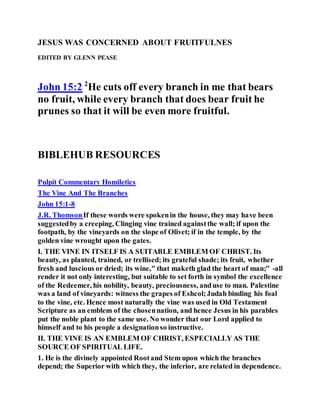
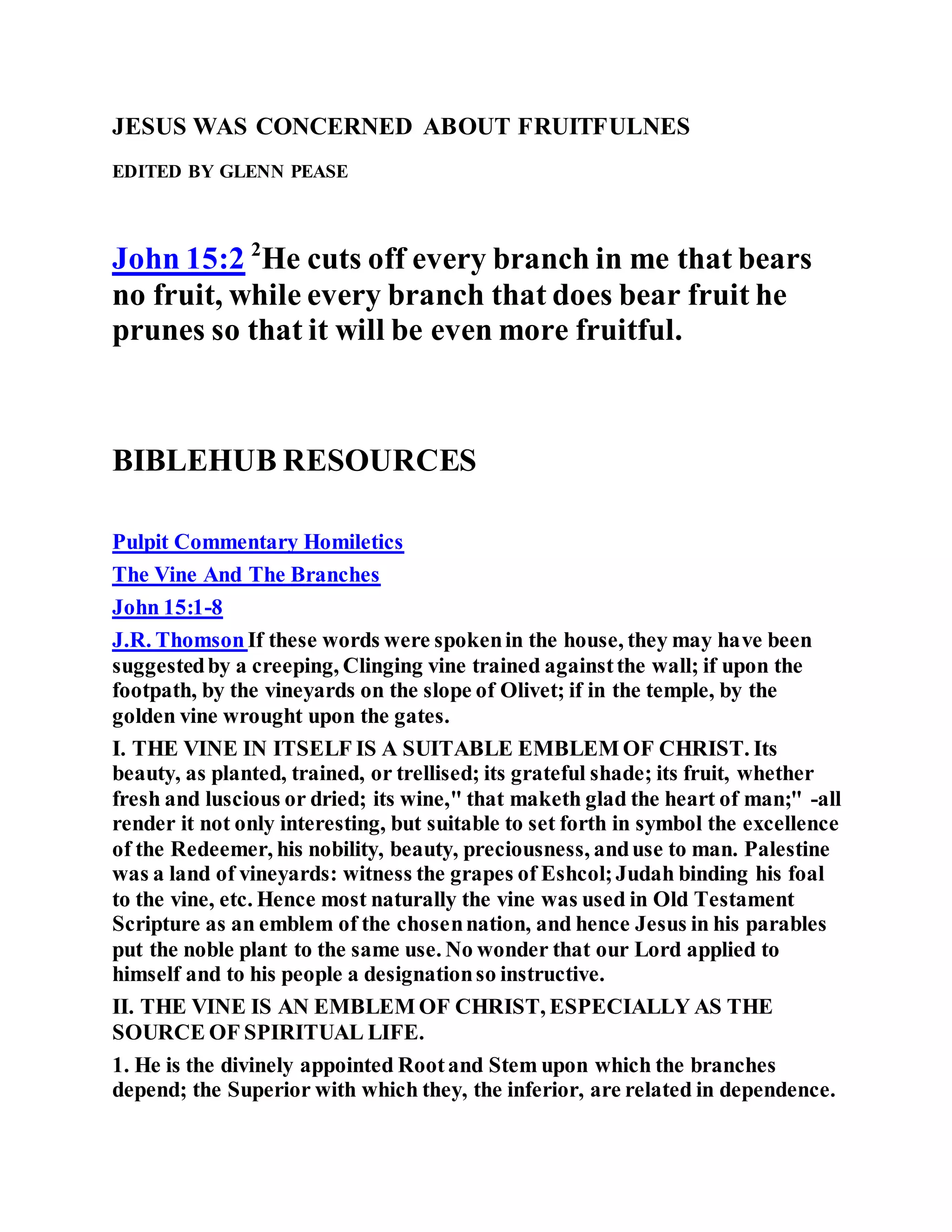
JESUS WAS CONCERNED ABOUT FRUITFULNES
EDITED BY GLENN PEASE
John 15:2 2
He cuts off every branch in me that bears
no fruit, while every branch that does bear fruit he
prunes so that it will be even more fruitful.
BIBLEHUB RESOURCES
Pulpit Commentary Homiletics
The Vine And The Branches
John 15:1-8
J.R. ThomsonIf these words were spokenin the house, they may have been
suggestedby a creeping, Clinging vine trained againstthe wall; if upon the
footpath, by the vineyards on the slope of Olivet; if in the temple, by the
golden vine wrought upon the gates.
I. THE VINE IN ITSELF IS A SUITABLE EMBLEM OF CHRIST. Its
beauty, as planted, trained, or trellised; its grateful shade; its fruit, whether
fresh and luscious or dried; its wine," that maketh glad the heart of man;" -all
render it not only interesting, but suitable to set forth in symbol the excellence
of the Redeemer, his nobility, beauty, preciousness, anduse to man. Palestine
was a land of vineyards: witness the grapes of Eshcol;Judah binding his foal
to the vine, etc. Hence most naturally the vine was used in Old Testament
Scripture as an emblem of the chosennation, and hence Jesus in his parables
put the noble plant to the same use. No wonder that our Lord applied to
himself and to his people a designationso instructive.
II. THE VINE IS AN EMBLEM OF CHRIST, ESPECIALLY AS THE
SOURCE OF SPIRITUAL LIFE.
1. He is the divinely appointed Rootand Stem upon which the branches
depend; the Superior with which they, the inferior, are related in dependence.
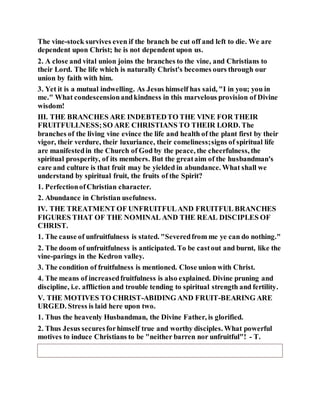
The vine-stock survives even if the branch be cut off and left to die. We are
dependent upon Christ; he is not dependent upon us.
2. A close and vital union joins the branches to the vine, and Christians to
their Lord. The life which is naturally Christ's becomes ours through our
union by faith with him.
3. Yet it is a mutual indwelling. As Jesus himself has said, "I in you; you in
me." What condescensionandkindness in this marvelous provision of Divine
wisdom!
III. THE BRANCHES ARE INDEBTEDTO THE VINE FOR THEIR
FRUITFULLNESS;SO ARE CHRISTIANS TO THEIR LORD. The
branches of the living vine evince the life and health of the plant first by their
vigor, their verdure, their luxuriance, their comeliness;signs of spiritual life
are manifestedin the Church of God by the peace, the cheerfulness, the
spiritual prosperity, of its members. But the greataim of the husbandman's
care and culture is that fruit may be yielded in abundance. What shall we
understand by spiritual fruit, the fruits of the Spirit?
1. PerfectionofChristian character.
2. Abundance in Christian usefulness.
IV. THE TREATMENT OF UNFRUITFULAND FRUITFUL BRANCHES
FIGURES THAT OF THE NOMINAL AND THE REAL DISCIPLES OF
CHRIST.
1. The cause of unfruitfulness is stated. "Severedfrom me ye can do nothing."
2. The doom of unfruitfulness is anticipated. To be castout and burnt, like the
vine-parings in the Kedron valley.
3. The condition of fruitfulness is mentioned. Close union with Christ.
4. The means of increasedfruitfulness is also explained. Divine pruning and
discipline, i.e. affliction and trouble tending to spiritual strength and fertility.
V. THE MOTIVES TO CHRIST-ABIDING AND FRUIT-BEARING ARE
URGED. Stress is laid here upon two.
1. Thus the heavenly Husbandman, the Divine Father, is glorified.
2. Thus Jesus securesforhimself true and worthy disciples. What powerful
motives to induce Christians to be "neither barren nor unfruitful"! - T.
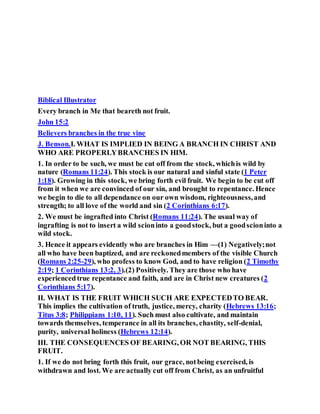
Biblical Illustrator
Every branch in Me that beareth not fruit.
John 15:2
Believers branches in the true vine
J. Benson.I. WHAT IS IMPLIED IN BEING A BRANCH IN CHRIST AND
WHO ARE PROPERLYBRANCHES IN HIM.
1. In order to be such, we must be cut off from the stock, whichis wild by
nature (Romans 11:24). This stock is our natural and sinful state (1 Peter
1:18). Growing in this stock, we bring forth evil fruit. We begin to be cut off
from it when we are convinced of our sin, and brought to repentance. Hence
we begin to die to all dependance on our own wisdom, righteousness,and
strength; to all love of the world and sin (2 Corinthians 6:17).
2. We must be ingrafted into Christ (Romans 11:24). The usual way of
ingrafting is not to insert a wild scioninto a goodstock, but a goodscioninto a
wild stock.
3. Hence it appears evidently who are branches in Him —(1) Negatively;not
all who have been baptized, and are reckonedmembers of the visible Church
(Romans 2:25-29), who profess to know God, and to have religion (2 Timothy
2:19; 1 Corinthians 13:2, 3).(2) Positively. They are those who have
experiencedtrue repentance and faith, and are in Christ new creatures (2
Corinthians 5:17).
II. WHAT IS THE FRUIT WHICH SUCH ARE EXPECTEDTO BEAR.
This implies the cultivation of truth, justice, mercy, charity (Hebrews 13:16;
Titus 3:8; Philippians 1:10, 11). Such must also cultivate, and maintain
towards themselves, temperance in all its branches, chastity, self-denial,
purity, universal holiness (Hebrews 12:14).
III. THE CONSEQUENCES OF BEARING, OR NOT BEARING, THIS
FRUIT.
1. If we do not bring forth this fruit, our grace, notbeing exercised, is
withdrawn and lost. We are actually cut off from Christ, as an unfruitful
branch is lopped off from a vine. We wither in our fruits, our blossoms, and
our very leaves;in our works, graces, andgifts.
2. If we do produce fruit, — we are purged, or purified, by the Spirit, through
the Word (John 17:17), which is believed, and obeyed (Acts 15:9; 1 Peter
1:22); by affliction (Hebrews 12:4-11).
IV. HOW WE MAY BE ENABLED TO BEAR THIS FRUIT.
1. By abiding in Christ, and Christ in us (ver. 5). We shall not otherwise be
fruitful (ver. 4), for otherwise we shall want life, inclination, knowledge, and
power.
2. We abide in Him by abiding in faith, in God, in His revealedwill, in His
Gospeland its truths, in Christ, in the promises (John 6:47-58;Galatians
2:20; Hebrews 10:38; and especiallyRomans 11:16, 24). By continuing in love
(John 15:9; Galatians 5:6). Hence arise deadness to the world, and powerover
sin. By continuing to obey (John 15:10;John 14:23, 24)In order to these, the
use of all prescribed means is necessary, as the Word, prayer, watchfulness,
self-denial.
(J. Benson.)
Useless branches
Abp. Trench.!— In the natural world branches of the vine which are not
goodfor that to which they were speciallyordained, viz., for the bearing of
fruit, are goodfor nothing. There are trees which may be turned to secondary
uses, if they fail to fulfil their primary. Not so the vine. As timber it is utterly
valueless (Ezekiel15:3, 4). It is with it exactly as with the saltless salt, which,
having lostits savour, is fit only to be eastout of doors;both of them being
meet emblems of the spiritual man who is not spiritual, who is goodneither
for the work of this world nor of a higher.
(Abp. Trench.)
Characterand doom of unfruitfulness
J. Viney.I. THE POSITION YOU OCCUPY. The Saviour speaks ofthose who
are in Him. This, in a sense, is true of you; not in the highestsense, indeed; by
the supposition, you are not in Him by that vital union which faith produces,
and which secures fruitfulness, but you are so in a real, though a subordinate
sense. You have some relation to Christ, are not like those to whom His name
is unknown; you have heard of Christ, whence He came, whatHe did, how He
suffered, how He is able and willing to "save to the uttermost" — a fact by
which, while your ears are blessed, you are also involved in responsibility. To
Him you were dedicatedin Christian baptism; by parental piety, in His
Church, His name was named upon you, and His blessing invoked. More than
this. You have been trained and nurtured amid Christian influences:
Inefficacious as these may have proved, they have existed; you canremember
them. The possibility of such outward and visible union, as distinct from the
inward and spiritual, is variously illustrated. "Have not I chosenyou twelve?
and one of you is a devil." "Demas hath forsakenus, having loved the present
world." Such, then, is your position.
II. YOU ARE UNFRUITFUL. What do we mean by this? Notthat you have
no capacityfor fruitfulness. You might have been so different, as different
from your present self as light from darkness, life from death. Not that you
have been unfruitful in all senses. Yourintellect, perhaps, has been active,
become acute and strong; your judgment has become matured; your
affections have budded, blossomed, and brought forth fruit; your character,
so far as this canbe perfectedwithout the motives and principles of Christian
life, has become developedand firm. It may be, too, that in the years we are
now reviewing and charging with unfruitfulness, you have done much, been a
philanthropist, a patriot, a projectorof useful schemes. In what, then, are you
chargeable with unfruitfulness? By lacking such principles as these. Love to
God. Faith in Christ. Obedience. Humility and repentance, too. It might be
supposedthat sense of deficiencywould have produced at leastthese. Have
they? Has your heart been broken for sin? Have you offered the sacrifice
which God will not despise, the brokenand contrite spirit? Thus you see,
there are fruits which you have not borne, the most important fruits, and
those without which all others God esteems, if not "abomination," yet
certainly most subordinate.
III. SOME OF THE AGGRAVATIONS OF THIS UNFRUITFULNESS. You
have had greatadvantages. Consider, too, the time you have wasted. How
insufficient the causes, too, whichhave produced your infertility. It were wise
for you seriouslyto inquire what these have been. Decree, fate, providence,
necessity— you cannot charge these with the future. Your conscienceis too
enlightened for that. No! the cause is not from above. Nor from beneath
altogether. Satanhas no compulsory powerover us. Where, then, is the cause
to be found? In yourself only; in your yielding to outward influences. It is a
further aggravationofyour sin, that all the time of your unfruitfulness you
have been positively injurious. Think, for example, of the incomparable
mischief a father does in his family all the time he is living a worldly and
carelesslife.
IV. THE DOOM OF THE UNFRUITFUL BRANCH. It is one proof, among
many, of God's willingness to save, that he announces punishment before He
executes it. None are led blindfold to justice. "Every branch in me that
beareth not fruit, He takethaway." This is fulfilled variously. It is sometimes
in the loss of capacity. Then there is Death. This is common to man as the
penally of sin; but to different men, how different! Whateverheaven is, and its
glory is inexpressible, such are takenawayfrom it; whatever hell is, and its
dolefulness, as describedby Christ, no darkness canpaint, they are taken
awayto it.
(J. Viney.)
Every branch that beareth fruit He purgeth it.
A sharp knife for the vine branches
C. H. Spurgeon.I. THE TEXT SUGGESTS SELF-EXAMINATION.It
mentions —
1. Two characters who are in some respects exceedinglyalike;they are both
branches, and are in the vine: and yet for all this, the end of the one shall be to
be castaway, while the end of the other shall be to bring forth fruit.
2. The distinction betweenthem. The first branch brought forth no fruit; the
secondbranch bore some fruit. We have no right to judge of our neighbours'
motives and thoughts, exceptso far as they may be clearly discoverable by
their actions and words. The interior we must leave with God, but the exterior
we may judge. "By their fruits ye shall know them." Paul has given us a list of
these fruits in Galatians 5:23. Say, professor, hastthou brought forth the fruit
"love?" etc. It is so easy for us to wrap ourselves up in the idea that attention
to religious ceremonies is the test, but it is not so, for "Exceptyour
righteousness shallexceedthe righteousness ofthe Scribes and Pharisees,"
etc.
3. The solemn difference betweenthem leads to a solemn result.
(1)Sometimes Godallows the professorto apostatise.
(2)Or else he is allowedto fall into open sin.
(3)Some have been takenaway in a more terrible sense by death.
II. CONVEYS INSTRUCTION.The fruit-bearing branches are not perfect. If
they were, they would not need pruning. Whenever the sap within them is
strong, there is a tendency for that strength to turn into evil. The gardener
desires to see that strength in clusters, but alas!insteadit runs into wood.
When the sap comes into a Christian to produce confidence in God, through
the evil that is in him, it often produces confidence in himself. When the sap
would produce zeal, how very frequently it turns into rashness. Suppose the
sap flows to produce self-examination, very generally, instead of the man
doubting himself, he begins to doubt his Lord. How often have I seeneven the
joy of the Lord turned into pride. That love which we ought to bear towards
our neighbours, how apt is that to run into love of the world! Gentleness often
turns to a silly compliance with everybody's whim, and meekness,whichis a
fruit of the Spirit, how often that becomes anexcuse for holding your tongue,
when you ought boldly to speak!
2. Pruning is the lot of all the fruitful saints. It is generallythought that our
trials and troubles purge us: I am not sure of that, they certainly are lost upon
some. It is the word (ver. 3) that prunes the Christian. Affliction is the handle
of the knife, the grindstone that sharpens up the Word; the dresserwhich
removes our softgarments, and lays bare the diseasedflesh, so that the
surgeon's lancetmay getat it. Affliction makes us ready to feel the word, but
the true pruner is the word in the hand of the GreatHusbandman. Sometimes
when you lay stretched upon the bed of sickness,you think more upon the
word than you did before, that is one greatthing. In the next place, you see
more the applicability of that word to yourself. In the third place, the Holy
Spirit makes you feelmore, while you are thus laid aside, the force of the word
than you did before.
3. The object in this pruning is never condemnatory. God chastises, but He
cannot punish those for whom Jesus Christ has been already punished. You
have no right to say, when a man is afflicted, that it is because he has done
wrong; on the contrary, just the branch that is goodfor something gets the
pruning knife. It is because the Lord loves His people that He chastens them.
4. The real reasonis that more fruit may be produced.(1) In quantity. A good
man, who feels the powerof the word pruning him of this and that
superfluity, sets to work to do more for Jesus. Before he was afflictedhe did
not know how to be patient. Before he was poorhe did not know how to be
humble, etc.(2)In variety. One tree canonly produce one kind of fruit usually,
but the Lord's people, the more they are pruned the more they will
produce.(3)In quality. The man may not pray more, but he will pray more
earnestly.
5. What greaterblessing cana man have than to produce much fruit for God?
Betterto serve God much than to become a prince.
III. INVITES MEDITATION.
1. "If the righteous scarcelybe saved, where shall the ungodly and the wicked
appear?"
2. What a mercy it is to the believer that it is pruning with him and not cutting
off!
3. Think how gently the pruning has been done with the most of us up till now,
compared with our barrenness.
4. How earnestlywe ought to seek formore fruit.
5. How concernedshould every one of us be to be efficaciouslyand truly one
with Christ!
(C. H. Spurgeon.)
Hard times, God's pruning knife
C. D. Wadsworth, D. D.(Thanksgiving Sermon): —
I. TODAY WE SHOULD BE THANKFUL because —
1. Hard as the times are, they might be worse.
2. The times are not so hard as we deserve.
3. They are not so hard as we represent.
II. WHAT WE CALL HARD TIMES ARE THE BEST FOR US.
1. Goodfor man's physical nature. The frugality and self-controlthey induce
are preciselywhat the athlete practices.
2. Goodfor his intellectual nature. No greatgenius ever daudled into
inspiration.
3. Goodfor his moral nature. They remove the excrescences of —
(1)Covetousness.
(2)Luxury.
(3)Indolence.
III. THE RESULT WILL BE BETTER FRUIT.
1. A new style or higher type of manhood.
2. A higher type of politics. Hard times teach befooledpeople to think, and to
rise above party dictations.
3. A higher type of religion. God has ever developedthe higher Christian life
in times of trial.
IV. AFTER ALL, THE PRUNING KNIFE IS ONLY ONE OF THE
IMPLEMENTS OF CULTURE. Softrain and genialsunshine are the larger
experience of the vine. And so even in hard times our afflictions are not one to
a thousand of our blessings.
(C. D. Wadsworth, D. D.)
Pruning, a reasonfor gratitude
C. D. Wadsworth, D. D.Brambles certainly have a fine time of it, and grow
after their own pleasure. We have seentheir long shoots reaching far and
wide, and no knife has threatenedthem as they luxuriated upon the commons
and waste lands. The poor vine is cut down so closelythat little remains of it
but bare stems. Yet, when clearing time comes, and the brambles are heaped
for their burning, who would not rather be the vine?
(C. D. Wadsworth, D. D.)
Means of fruitfulness
H. Macmillan, D. D.The word translated "purgeth" is kathairo, which
includes all the means that are necessaryto developthe fruitfulness of the
plant, and the removal of all hindrances. It means to purify the ground and
prepare it for sowing, by removing weeds and rubbish — to winnow the corn,
to separate the chaff from the wheat. Its root idea is purity, freedom from all
that is foul, false, useless, ornoxious. It is interesting to notice the close
resemblance that exists betweenthe word kathairo, to purge, and kathaireo,
to destroy. The addition of one letter makes the one word to mean a very
different thing from the other. And so there is a resemblance betweenthe
purging of the fruitful branches and the taking awayof the unfruitful ones. In
the gardenduring spring, the process ofdigging the ground, cutting the roots
and branches, seems purely a process ofdestruction; but in the added beauty
of summer and the richer fruitfulness of autumn, it is seento be a remedial
and constructive process. And so the means which God employs to promote
the fertility of His own people seemso like those which He employs to punish
the wicked, that the righteous are not seldom perplexed. In considering the
means of fruitfulness, let us look at —
I. THE NATURE OF THE SOIL in which believers are planted.
1. Some of the finest grapes are produced on volcanic soil. From the rich red
mould into which lava is disintegratedwhen long exposedto the weather, the
vine draws the juices that form the largestand most generous clusters. The
passionof the soil, as it were, passes into the produce. Palestine, the native
country of the vine, exhibits, for its size, more than any other country,
evidences of extraordinary geologicalconvulsions. Thesefeatures were
paralleled by the historicalrevolutions which were intended to make Israel
the true vine of the Lord. And so it is in the experience of every nation that is
intended to produce much fruit. Africa, with its uniform geologyandits
monotonous history, has done little for mankind compared with Europe,
whose geologyand history are exceedinglyvaried and complicated. It is as
true of individuals as of nations, that because they have no changes, they do
not fearGod or prosper. But God plants His vines amid fiery trials, where
they are exposedto constanttemptations, lava floods of the wrath and malice
of the Adversary and of wickedmen. Since the ground beneath them is
insecure, and liable to constantconvulsive shocks,they are thereby induced to
settheir affections more firmly on things above, and to walk as pilgrims and
strangers on earth.
2. The influence of external circumstances upon objects so plastic as plants is
confessedlyvery powerful, leading often to greatmodifications of form,
structure, and substance. Hence the endless variety of grapes and wines of
different countries. A similar modification in the characterof the growth and
fruit of the Christian is causedby the circumstances in which God's
providence places him. One thing, amid all the changes ofhis circumstances,
the Christian can command if he will — and that is the sunlight of God's
countenance. He does not, however, always availhimself of it. And hence, as
the spice trees in our hot houses are destitute of aromatic taste, because we
cannot supply them with the brilliant direct sunshine of their native skies, so
the Christian, amid all the privileges of the Church, is often destitute of the
rich aromatic fragrance of spiritual joy, because he seeks to make up, by the
heat of forced spiritual emotion originating in himself, for the full, bright,
joyous sunshine that beams from God's face.
3. Under this head may be noticed the discipline of life's daily work as one of
the means of developing Christian fruitfulness. Like the vine, the Christian
requires to be trained along the trellis of formal duties and orderly habits.
4. I may also notice the fact, that God's tenderestvines are often placed in the
most trying circumstances. It seems a strange appointment of nature, that the
growing points of all trees should be their weakestand most delicate parts. So
it is with God's ownpeople. Many of the most delicate and sensitive of them
have to bear the full brunt of life's storms. Tender women have often to
withstand the severestshocksofcircumstances. The soresttrials often meet
the Christian at the beginning of his course. He puts forth the tenderest
growths of his nature often into the biting air of doubt, and fear, and
despondency. But it is goodthus to bear the yoke in our youth. The elasticity
and hopefulness of the young Christian canovercome trials which would
crush the more agedand less buoyant. And the very patience and tenderness
of those sensitive ones, who have to bear greaterhardships and evils, disarm
these evils of their bitterness, and turn them to profitable uses.
II. PRUNING IS ONE OF THE MOST COMMON METHODSBYWHICH
INCREASED FRUITFULNESS IS PRODUCED.No plant requires more
pruning than the vine. So bountiful is its sap, so vigorous its vital force, that
we are amazed at the abundance of superfluous growth which it annually
produces. In order to adapt it to our conditions of cultivation we must
systematicallycripple and restrict it in every part.
1. The head, or leading shoots, are carefully broken off; and the long,
luxuriant, lateral shoots are cut back to a few joints.
2. But besides the pruning of the suckers onthe branch the branch itself is
sometimes pruned. In almost every branch, owing to deficiency of light and
heat, or overcrowding, many of the buds that are put forth every year become
dormant. Some of these torpid buds retain a sufficient amount of vitality to
carry them forward through the annually deposited layers of woodand bark;
so that they still continue to maintain their position visibly, year after year, on
the outside of the bark. In most instances, however, they are too feeble to keep
pace with the onward growth of the branch; and, in that case, they fall behind,
necessarilysink below the surface, and become buried beneath succeeding
annual deposits of woodand bark. The branch, instead of developing them,
employs the sapwhich ought to have gone for that purpose, into growing fresh
shoots. But the gardener comes, and with his sharp pruning knife lops off
these useless suckers;and the consequence is, that in a little while the sap goes
back to the dormant buds and stimulates their slumbering vitality. And so
God prunes every branch in the True Vine for two reasons;first, in order to
remove rank and useless qualities;and, secondly, to develop latent graces. In
no Christian is there an harmonious spiritual growth, a perfect expansion
from a perfect germ in childhood. On the contrary, growth in grace in us is
always unsymmetrical. Solid and valuable qualities are united with weak,
worthless ones;gracesthat charm by their beauty lie side by side with defects
that repel by their deformity. Some graces,also, are dormant in the soul,
repressedby unfavourable circumstances ofcontinued prosperity, or starved
by the over-development of other graces. Some besetting sins, suchas
irritability, covetousness, worldliness,pride, impatience, are allowedto grow
up and exhaust in their noxious growth the life of the soul. Now, to repress the
evil and stimulate the goodqualities of His people, God subjects them to the
pruning of His providence. But, the pruning of God's providence would be
very unsatisfactorydid it only lop off noxious qualities, mortify easily
besetting sins. Such injurious growths may be repressedby affliction, but
unless the discipline develops the opposite goodqualities, they will spring up
anew, and make matters worse than before. Spiritual graces must be
developed in their room. In order to getrid of worldly mindedness,
spirituality of mind must be cultivated; covetousnesswill only yield to a larger
experience of the Love that for our sakesbecame poor:angerwill only be
extirpated by meekness,and pride by humility.
3. But we must be guarded againstthe idea that affliction of itself can develop
the fruitfulness of the Christian life. We find that in the fruit tree the pruning
is only of use when there are latent or open buds to develop. And so, unless we
have Christian life and Christian capabilities, affliction, so far from doing us
good, will only harden and injure us. But, while affliction cannot impart
spiritual life, there are instances in which God uses it to quicken the soul dead
in trespassesand sins. And here, too, we find an analogyin nature. The buds
of plants almostalways grow in the axil — the vacant angle betweenthe leaf
and the stem, where the hard, resisting bark which everywhere else invests the
surface of the plant, is more easilypenetrated, and allows the growing tissues
to expand more easily. The axil is, so to speak, the joint in the armour of the
stem. Now, "a wound is virtually an axil, for the continuity of the surface is
there broken, and consequently, the resistance ofthe external investiture
diminished." Now, we all invest ourselves with a strong, resisting envelope of
pride, worldliness and carelessness. Ourproperty, our friends, our reputation,
our comfort, all form a kind of outer crust of selfishness,whichprevents our
spiritual growth. But God removes our property or our friends, blights our
reputation, destroys our carnal ease,and by the wound thus made in our
selfishlife an axil is formed, from whence springs up the bud of a new and
holier growth.
4. There is one process ofunusual severity which the gardenerhas recourse to
in cases ofobstinate sterility. The barren branch is girdled or ringed — that
is, a narrow strip of its bark is removed all round the branch. The juices
elaboratedby the leaves are arrestedin their downward course, and
accumulatedin the part above the ring, which is thus enabled to produce fruit
abundantly; while the shoots that appear below the ring, being fed only by the
crude ascending sap, do not bear flowers, but push forth into leafy branches.
The prophet Joelsays, "He hath laid my vine waste, and barked my fig tree."
Many Christians are ringed to prevent the earthward tendencies oftheir
souls, and enable them to accumulate and concentrate all the heavenly
influences which they receive in bringing forth more fruit. Their present life is
separatedfrom their pastby some terrible crisis of suffering, which has
altered everything to their view, which has been in itself a transformation, and
has accomplishedin a day, in an hour, in a moment, what else is effectedonly
by the gradual process ofyears. The lot that is thus halved may be more
useful than in its full and joyful completeness.Ceasing to draw its
nourishment from broken cisterns of earthly love, the lonely branch,
separatedfrom its happy past, depends more upon the unfailing clue and
sunshine of heavenly love.
5. Sometimes eventhe roots of the vine require to be dug about and cut short.
There is a correspondencebetweenthe horizontal extensionof the branches in
the air and the lateral spreading of the roots in the earth. For this reasonthe
roots require pruning no less than the branches. If they are allowedto develop
too luxuriantly, the branches will keeppace with them, only they will be
barren. We are prone to root ourselves too firmly in the rich soil of our
circumstances, to spreadour roots far and wide in searchofwhat shall
minister to our love of ease and pleasure. But God digs about us. Our
circumstances crumble awayabout our roots;the things and the persons in
which we trusted prove as unstable as a sand heap on a slope. But, from roots
bare and exposed, or cut off and circumscribed by uncongenialsoil, we should
seek to develop a higher beauty and richness of character.
6. The leaves also need sometimes to be takenaway, as superabundant foliage
would shade the fruit and prevent the sunshine from getting accessto it to
ripen it. So the fruit of the Christian is sometimes prevented from ripening or
filling out properly by the superabundance of the leaves of profession. There
may be more professionthan practice, more of the rustling foliage than of the
silent fruit. The most common fault of believers is letting their professionof
the Christian life run ahead of their experience. Notmore necessaryare the
leaves of a natural tree to the production of the fruit, than the professionof a
Christian is to the formation of the Christian character. But God, by some
appropriate discipline, regulates what leaves ofprofessionshould be stripped
off and what leaves should remain.
7. Many of the tendrils of the vine require to be nipped off, in order that no
sap may be wasted, or diverted from the fruit. If left to itself, the vine would
put forth a tendril at every alternate joint; for it would seek to climb to the
top of the highest tree. In like manner, it is necessarythat the excessive
upward tendency of some Christians should he restricted, in order that the
common duties, and the homely concerns of ordinary life — which in their
own sphere are equally important — may not be neglected.
8. The fruit itself must be thinned. The gardener prunes the clusterof grapes
when young and tender, in order that the berries which are allowedto remain
may be larger and finer. In the Christian life there must be concentrationof
effort, conservationofforce. Much moral energy is spent without effecton a
multiplicity of objects, which, if husbanded and focussedon a few of the most
important, would lead to far greaterresults.
9. It has been observedthat the hues of the sunbeam which the growing plant
does not reflectat one time are absorbed, like a stream running underground
for a while, and reappearin some after part. So is it with God's discipline of
His people. Much of it may seem to be void and lost — to make no adequate
return; but in some part or other of the life the effectof it is seen. If it fails to
manifest itself in the leaf, it comes out in the blossomor fruit.
10. It may happen, however, that the purging, whose various forms and
relations I have thus considered, may be here, and the fruition in eternity.
Christians are placed in an unfavourable climate. Tropical by nature, they
have been carried, like a wind-wafted seed, into a temperate zone, and have
striven in vain to grow and floweramong the hardy plants around them. But
it is a comforting thought, that what bears about it here the marks of
incompleteness, andto our eyes the appearance offailure, belongs essentially
to some vaster whole.
III. ANOTHER METHOD OF PURGING THE BRANCHIS FREEING IT
FROM ITS ENEMIES. The natural vine, owing to its rich productiveness, is
peculiarly exposedto the attacks ofnumerous foes which prey upon it.
1. A species ofvegetable parasite not unfrequently assails it, called the
"dodder." This strange plant is a mere mass of elastic, pale red, knotted
threads, which shootout in all directions over the vine. It springs originally
from the ground, and if it finds no living plant near on which to graft itself, it
withers and dies; but if there be a vine or any other useful plant within its
reach, it surrounds the stem in a very little time, and henceforth lives on the
fostering plant by its suckers only, the original root in the ground becoming
dried up. The dodder is exceedinglyinjurious to the plants it attacks,
depriving them of their nourishment, and strangling them in its folds. Can we
imagine a more striking natural emblem of the law of sin and death with
which the believer has to contend, and from which he longs for deliverance?
We canonly hope to prevent the dodder growing and spreading by
perpetually breaking and dividing its stalks before they have time to fruit;
and we can only hope to keepdown the remains of corruption within us by
incessanteffort, watchfulness, and prayer; not allowing them to develop into
fruit and seed. How blessedwill be the deliverance when this terrible despoiler
of our peace and usefulness is finally and completely removed from us, when
we are savedforever from the powerand presence ofthat sin from whose
guilt the blood of Christ has freed us!
2. Every one has heard of the terrible grape mildew which, on its first
appearance, utterly destroyed the vineyards in many parts of the world, and
still annually reappears to levy its tax upon the vine grower. In consists ofa
fungus, whose growthspreads a white, downy mould over the surface of the
grape, checking its development, and converting its pulp into a sour and
watery mass of decay. But it does no harm unless the conditions of its
germination exists — which are cold, wet seasons, withlittle sunshine — in
which case it starts into life, and grows with inconceivable rapidity, spreading
ruin on every side. To a species ofmoral mildew the fruit of the Christian is
also exposed. In cold seasons,whenclouds of unbelief rise up betweenthe soul
and the Sun of Righteousness,intercepting His light, this mildew is peculiarly
destructive. It is a very solemnthought, that the spiritual atmosphere is full of
the devices of the Prince of the power of the air — that the existence of
another world of evil beyond our own world, makes allremissness on our part
most dangerous.
3. In this country, the greatestpestof the vinery is the little red spider, whose
movements over the leaves and fruit are exceedinglynimble, and which makes
up by its vast numbers for its individual weakness. It punctures the fruit, sips
its juice, and thus injures its appearance and quality. In the East, the land of
the vine, the specialfoe of the vineyard is the fox. "Take us the foxes, the little
foxes, that spoil the vines, for our vines have tender grapes" — or small
grapes just out of blossom— says the beautiful Song of Solomon. These are
fitting symbols of some weakness orinfirmity of believers — some sin of
temper or tongue — which, although it may not endangertheir safety, will,
nevertheless, greatlymar their peace. Peevishness,irritability, etc., may seem
so small and trifling as to be hardly entitled to be calledsins at all. They may
be extenuated and explained away, but they are in reality red spiders — little
foxes, that spoil the tender grapes of the soul.
4. There is a disease called"rust," which makes its appearance onthe berries
of the vine a few days after they are out. It is supposed to be causedby
handling the berries while thinning them. Our vines have indeed tender
grapes. The beauty of holiness is easilyblurred: self-consciousness rusts it;
affectationbrushes off the fine edge — the delicate beauty of the various
graces.
5. Another disease knownto gardeners is "shanking," whichmakes its
appearance just as the grapes are changing from the acid to the saccharine
state, and arrests the transformation at once;the berry remaining perfectly
acid, and at length shrivelling up. It begins in the decay of the little stem or
shank of the berry, and is supposedto be causedby the roots of the vine
descending into a cold, wet subsoil. How often, alas, is it true of the believer,
that his fruit is shanked, remaining sour when it should become sweetand
palatable!
(H. Macmillan, D. D.)
Spiritual pruning
J. Viney.What is pruning? Whateverit be, two things are observable. It is
effectedby the husbandman, and applied to each. It is a pleasantthought that
all the discipline is from the hand of our Father. There may indeed by which
we are exercisedbe subordinate instruments, the "wicked" being God's
"sword," but it is still "the Lord's doing." A work so important as the
spiritual culture of His people He commits wholly to none. "He pruneth," nor
are any exempt. "Everybranch" is the subject of pruning. As all need, so all
have, discipline. In the deepesttrial there has nothing happened to you but
what is "common to man." And why this? For greaterfruitfulness. Not
"willingly," for wantonness, forpleasure, for any benefit the husbandman
secures, but for fruit. The subject, then, is, Fruit as the result of affliction.
Affliction! What a scene does this word open to view. It is well to bear in mind
that it is confined to earth. There are whole races ofbeings who
experimentally know not the meaning of the word, who never felt a pain,
never breathed a sigh, never wept a tear; others to whom it is a thing of the
past. How truthful in this, as in all other respects, is the Bible. How large a
portion of the Scriptures is occupied with scenesand truths bearing on
affliction! The terms by which it designates it, how various — "adversity,"
"correction,""chastisement," "calamity," "distress,""grief,""judgment,"
"stripes," "smiting," "trouble," "visitation," are some of the literal
expressions;while the figures of "fire," "water," the "rod," the "yoke,"
"gall," "wormwood," "roughwind," "sackcloth,""ashes,"and many others,
are significantly employed as its symbols. You know, too, how deeply all the
histories of the Bible are tinged by it: Job in the ashes, Jacobmourning his
children, Josephin the pit, Moses in the desert, David in the wilderness, the
youths in the furnace, Danielin the den — what are all these familiar tales of
life, but scenes ofaffliction, showing how it was experiencedand borne? It is
not of affliction, however, whether in fact or description, we have now to
think, but of its fruit, the "more fruit," which it is designed to produce, the
"peaceable fruit" which "afterward" it yields.
1. Affliction deepens on the mind a sense of the reality of eternal things. It is
said that after an earthquake, men tread more warily. The foundations having
been shaken, a sense of insecurity is felt, which produces solemn impression.
2. Another valuable result of affliction is increasedsense ofthe value of
religion. When Israelpassedthrough the desert they learnt, as they never
otherwise could have done, the worth of many things — water, manna,
guidance. As the dove beaten by the tempest to the sheltering ark, as the
tosseddisciples to the mighty One who walkedon the billows, we repair to
Christ. Certain colours require certainlights to show them. There are views of
Christ as a Saviour, a Friend, a High Priest, an Example, which only the
shadow of affliction could enable us to discern, but which, when once seen,
remain foreverupon the vision of the soul. So with God's Word. To enjoy
plaintive music or a minor key, a certainstate of mind is requisite; and who
but one in trial can fully enter into the deep bass of sorrow and wailing in the
Lamentations or the Psalms. Prayeris another exercise ofwhich affliction
teaches the value. "I will go and return unto My place till they seek My face,
in their affliction they will seek Me early."
3. Another valuable effectof affliction is the cultivation and growthof the
passive virtues. The importance and value of these we are apt to overlook.
Constitutionally active, we are all prone to honour the more stirring graces
rather than the gentler ones. By far the largerproportion are passive virtues.
What are these? Patience,submission, acquiescence. To take awaywilfulness,
waywardness, self-determination, and suchlike natural excrescences, andthus
secure the opposite growth, He prunes even the fruitful branch.
4. Another fruit of affliction is increasing fellowship with Christ. There are
communications for which affliction is indispensable, and which the Saviour
reserves for this season. To see the stars we require darkness. Certainflowers
open only at night. The sweetestsong is heard in the dusk. The most beautiful
effectof colour requires a camera obscura, a darkened chamber. It is even
thus with affliction. Would Abraham have heard the angelhad it not been for
the outstretchedknife? And it is worth while to be afflicted to have such fruit
as this. Is it necessaryto pass through spiritual darkness and desertionin
order to know the unchanging love of Christ.
5. Another result of sanctified affliction is increaseddesire for heaven. Such
are some of the fruits of sanctifiedaffliction. Some, not all. Eachaffliction
comes with its specialmessage,as wellas its generalone. "Every branch" has
its own particular deformities, and these the pruning knife first cuts. It may
be, too, that affliction sometimes comes speciallywith reference to others — is
rather relative than personal. Trial may be vicarious. The child suffers for the
parent, the sisterfor the brother, the minister for the people. Learn, then, to
estimate affliction aright. Seek earnestlyto getthe benefit of affliction. Look
through affliction to that which is beyond.
(J. Viney.)
COMMENTARIES
Ellicott's Commentary for English Readers(2)Everybranch in me that
beareth not fruit he takethaway.—The two chief duties of the vine-dresser,
cutting off all fruitless tendrils, and cleansing those that bear fruit, supply
illustrations of the training of human souls by the Divine Husbandman. We
are not to interpret these words, as they frequently have been interpreted, of
the unbelieving world, or of the Jews;but of Christians in name, who claim to
be branches of the true vine. These the Husbandman watcheth day by day; He
knoweththem, and readeth the inner realities of their lives, and every one that
is fruitless He takethaway.
And every branch that beareth fruit, he purgeth it.—Better, he cleansethit.
(Comp. Hebrews 1:3.) This means in the natural vine the cutting off of shoots
which run to waste, and the removal of every excrescencewhichhinders the
growth of the branch. It means in the spiritual training the checking of
natural impulses and affections, and the removal of everything, even though it
be by a pang sharp as the edge of the pruner’s knife, which can misdirect or
weakenthe energy of the spiritual life, and thus diminish its fruitfulness. A
vine which has been pruned—here a tendril cut off, and there one bent
back—here a shootthat seemedof fairest promise to the unskilled eye
unsparingly severedby the vine-dresser, who sees it is worthless—herea
branch, in itself good, made to yield its place to one that is better, and itself
trained to fill another place—suchis the familiar picture of the natural vine—
such, also, to a wisdom higher than ours, is the picture of human life.
BensonCommentaryHYPERLINK "/john/15-2.htm"John15:2. Every branch
in me — True believers, who by faith have an interest in, and union with
Christ, are the branches of the vine here spokenof. Though, as to the place of
their abode, their religious sentiments in lessermatters, and their modes of
worship, they may be distant from eachother, yet they meet in Christ, their
root and stock, andthe centre of their unity. That beareth not fruit —
Answerable to his advantages, fruit suitable to the relation in which he stands
to me, and the union which by faith he has had with me: he whose faith in me
and my gospeldoes not work or continue to work by love, and whose love does
not continue to manifest itself by his obedience;he who does not bring forth,
with constancyand perseverance, the internal and external fruits of the Spirit,
namely, all goodness, righteousness,and truth, Ephesians 5:9; he taketh away
— Such unfruitful branches the vine-dressercuts off in his righteous
judgment, and entirely separatesthem from me, depriving them of all the
advantages forfruitfulness, which they derived, or might have derived, from
their connectionwith me, and their receptionof my truth and grace. And
every branch that beareth fruit, he purgeth it — Or rather, pruneth it, cuts
off from it every thing superfluous, and removes all the hinderances of its
fruitfulness. Thus God, in the course of his providence, by various sufferings
in the minds, bodies, families, circumstances,and situations of his people, and
by his word, and their faith therein, and obedience thereto, (1 Peter1:22;) and
by the influence of his Spirit, mortifies and destroys what is still corrupt in
their affections and dispositions, with what remains in them of the carnal
mind, and prevents their bearing fruit to perfection. That it may bring forth
more fruit — Than it brought forth before, to God’s greaterglory, the greater
benefit of mankind, and their own greaterprogress in holiness here, and a
fuller reward of felicity and glory hereafter. Dr. Campbell reads the verse,
Every barren branch in me he loppeth off: every fruitful branch he cleaneth,
by pruning, to render it more fruitful: remarking upon it as follows:“Critics
have observeda verbal allusion or paronomasia in this verse. To the barren
branch the word αιρει, [he loppeth off,] is applied; to the fruitful, καθαιρει,
[he cleanethby pruning.] It is not always possible in a versionto preserve
figures which depend entirely on the sound, or on the etymology of the words,
though sometimes they are not without emphasis. This verse and the following
afford a remarkable instance of this trope. As our Lord himself is here
representedby the vine, his disciples are representedby the branches. The
mention of the method which the dressertakes with the fruitful branches, in
order to render them more fruitful, and which he expresses by the word
καθαιρει, leads him to take notice of the state wherein the apostles, the
principal branches, were at that time: ηδη υμεις καθαροι,&c., now are ye
clean, &c. It is hardly possible not to considerthe καθαιρει, applied to the
branches, as giving occasionto this remark, which immediately follows it.
Now, when the train of the thoughts arises in any degree from verbal
allusions, it is of some consequence to preserve them, where it can be easily
effectedin a translation. It is for this reasonthat I have translatedthe word
καθαιρει by a circumlocution, and said cleanethby pruning. It is evident, that
καθαιρει, in this application, means pruneth. But to have saidin English,
simply, pruneth, would have been to throw awaythe allusion, and make the
thoughts appear more abrupt in the versionthan they do in the original; and
to have said cleaneth, without adding any explanation, would have been
obscure, or rather improper.”
Matthew Henry's Concise Commentary15:1-8 Jesus Christis the Vine, the
true Vine. The union of the human and Divine natures, and the fulness of the
Spirit that is in him, resemble the root of the vine made fruitful by the
moisture from a rich soil. Believers are branches of this Vine. The root is
unseen, and our life is hid with Christ; the root bears the tree, diffuses sap to
it, and in Christ are all supports and supplies. The branches of the vine are
many, yet, meeting in the root, are all but one vine; thus all true Christians,
though in place and opinion distant from eachother, meet in Christ. Believers,
like the branches of the vine, are weak, andunable to stand but as they are
borne up. The Father is the Husbandman. Neverwas any husbandman so
wise, so watchful, about his vineyard, as God is about his church, which
therefore must prosper. We must be fruitful. From a vine we look for grapes,
and from a Christian we look for a Christian temper, disposition, and life. We
must honour God, and do good;this is bearing fruit. The unfruitful are taken
away. And even fruitful branches need pruning; for the best have notions,
passions, and humours, that require to be takenaway, which Christ has
promised to forward the sanctificationof believers, they will be thankful, for
them. The word of Christ is spokento all believers;and there is a cleansing
virtue in that word, as it works grace,and works out corruption. And the
more fruit we bring forth, the more we abound in what is good, the more our
Lord is glorified. In order to fruitfulness, we must abide in Christ, must have
union with him by faith. It is the greatconcernof all Christ's disciples,
constantly to keepup dependence upon Christ, and communion with him.
True Christians find by experience, that any interruption in the exercise of
their faith, causes holyaffections to decline, their corruptions to revive, and
their comforts to droop. Those who abide not in Christ, though they may
flourish for awhile in outward profession, yet come to nothing. The fire is the
fittest place for withered branches; they are goodfor nothing else. Let us seek
to live more simply on the fulness of Christ, and to grow more fruitful in every
goodword and work, so may our joy in Him and in his salvationbe full.
Barnes'Notes on the BibleEvery branch in me - Everyone that is a true
followerof me, that is united to me by faith, and that truly derives grace and
strength from me, as the branch does from the vine. The word "branch"
includes all the boughs, and the smallesttendrils that shoot out from the
parent stalk. Jesus here says that he sustains the same relation to his disciples
that a parent stalk does to the branches; but this does not denote any physical
or incomprehensible union. It is a union formed by believing on him; resulting
from our feeling our dependence on him and our need of him; from
embracing him as our Saviour, Redeemer, and Friend. We become united to
him in all our interests, and have common feelings, commondesires, and a
common destiny with him. We seek the same objects, are willing to encounter
the same trials, contempt, persecution, and want, and are desirous that his
God shall be ours, and his eternal abode ours. It is a union of friendship, of
love, and of dependence; a union of weaknesswith strength; of imperfection
with perfection; of a dying nature with a living Saviour; of a lost sinner with
an unchanging Friend and Redeemer. It is the most tender and interesting of
all relations, but not more mysterious or more physical than the union of
parent and child, of husband and wife Ephesians 5:23, or friend and friend.
That beareth not fruit - As the vinedresserwill remove all branches that are
dead or that bear no fruit, so will God take from his church all professed
Christians who give no evidence by their lives that they are truly united to the
Lord Jesus. He here refers to such casesas that of Judas, the apostatizing
disciples, and all false and merely nominal Christians (Dr. Adam Clarke).
He taketh away- The vine-dressercuts it off. God removes such in various
ways:
1. by the discipline of the church.
2. by suffering them to fall into temptation.
3. by persecutionand tribulation, by the deceitfulness of riches, and by the
cares ofthe world Matthew 13:21-22;by suffering the man to be placedin
such circumstances as Judas, Achan, and Ananias were such as to show what
they were, to bring their characters fairly out, and to let it be seenthat they
had no true love to God.
4. by death, for Godhas power thus at any moment to remove unprofitable
branches from the church.
Every branch that beareth fruit - That is, all true Christians, for all such bear
fruit. To bear fruit is to show by our lives that we are under the influence of
the religionof Christ, and that that religion produces in us its appropriate
effects, Galatians 5:22-23.Notes,Matthew 7:16-20. It is also to live so as to be
useful to others, As a vineyard is worthless unless it bears fruit that may
promote the happiness or subsistence ofman, so the Christian principle would
be worthless unless Christians should live so that others may be made holy
and happy by their example and labors, and so that the world may be brought
to the cross ofthe Saviour.
He purgeth it - Or rather he prunes it, or cleanses it by pruning. There is a use
of words here - a paronomasia - in the original which cannot be retained in
the translation. It may be imperfectly seenby retaining the Greek words
"Every branch in me that beareth not fruit he takethaway αἴρει airei; every
branch that bearethfruit, he purgeth it καθαίρει kathairei;now ye are clean
καθαροί katharoi,"etc. The same Greek word in different forms is still
retained. God purifies all true Christians so that they may be more useful. He
takes awaythat which hindered their usefulness;teaches them; quickens
them; revives them; makes them more pure in motive and in life. This he does
by the regular influences of his Spirit in sanctifying them, purifying their
motives, teaching them the beauty of holiness, and inducing them to devote
themselves more to him. He does it by taking awaywhat opposes their
usefulness, howevermuch they may be attachedto it, or howeverpainful to
part with it; as a vine-dresser will often feel himself compelledto lop off a
branch that is large, apparently thrifty, and handsome, but which bears no
fruit, and which shades or injures those which do. So God often takes away
the property of his people, their children, or other idols. He removes the
objects which bind their affections, and which render them inactive. He takes
awaythe things around man, as he did the valued gourds of JonahJon 4:5-11,
so that he may feel his dependence, and live more to the honor of God, and
bring forth more proof of humble and active piety.
Jamieson-Fausset-BrownBible Commentary2. Every branch in me that
beareth not fruit … every branch that bearethfruit—As in a fruit tree, some
branches may be fruitful, others quite barren, according as there is a vital
connectionbetweenthe branch and the stock, or no vital connection;so the
disciples of Christ may be spiritually fruitful or the reverse, according as they
are vitally and spiritually connectedwith Christ, or but externally and
mechanicallyattached to Him. The fruitless He "takethaway" (see on
[1857]Joh15:6); the fruitful He "purgeth" (cleanseth, pruneth)—stripping it,
as the husbandman does, of what is rank (Mr 4:19), "that it may bring forth
more fruit"; a process oftenpainful, but no less needful and beneficial than in
the natural husbandry.
Matthew Poole's Commentary And concerning his Father’s care, he tells us,
that as the goodvine dressercutteth off those branches in the vine which
bring forth no fruit, so his Father will take awaysuch branches in him as
bring forth no fruit. But here ariseth a question, viz. Whether, or how, any
can be branches in Christ, and yet bring forth no fruit?
Answer.
1. Some say, there is no need of translating the words so, which may as well be
translated, Every branch not bringing forth fruit in me. Indeed no true fruit
can be brought forth but in Christ; but yet much that looks like fruit, much
that men may callfruit, may be brought forth without any true spiritual
union with Christ. All acts of moral discipline, or any acts of formal
professionin religion, may be brought forth without any true root and
foundation in Christ; and God will in the end discoverand cut off those who
bring forth no other fruit. But:
2. Men may be said to be branches in him, by a sacramentalimplantation,
being baptized into him, Romans 6:3; and are hereby members of the visible
church, and make a visible professionof adhering to him, with respectto their
own goodopinion and persuasions ofthemselves, though they be not so in
respectof any true, spiritual, and real implantation. But those who in the last
sense are not in him, bring forth no fruit unto perfection, and God will cut
them off, either by withdrawing his restraining grace, andgiving them up to
strong delusions to believe lies; or to a reprobate mind, and vile lusts and
affections;or by taking awaytheir gifts; or some wayor other, so as they shall
never have an eternalcommunion with God in glory. But if any man bringeth
forth true spiritual fruit in Christ, him God the Fatherwill purge, by the
sprinkling of Christ’s blood yet further upon his conscience, Hebrews 10:22;
and by his Holy Spirit working on him like fire, to purge awayhis dross, and
like water, to purge awayhis filth; and by his word, 1 Peter1:22, by faith,
Acts 15:9, by crossesandtrials. Isaiah 1:25 Isaiah27:9; that he may be more
fruitful in works of holiness and righteousness.
Gill's Exposition of the Entire BibleEvery branch in me that bearethnot
fruit,.... There are two sorts of branches in Christ the vine; the one sort are
such who have only an historical faith in him, believe but for a time, and are
removed; they are such who only profess to believe in him, as Simon Magus
did; are in him by professiononly; they submit to outward ordinances,
become church members, and so are reckonedto be in Christ, being in a
church state, as the churches of Judea and Thessalonica,and others, are said,
in general, to he in Christ; though it is not to be thought that every individual
person in these churches were truly and savingly in him. These branches are
unfruitful ones;what fruit they seemedto have, withers away, and proves not
to be genuine fruit; what fruit they bring forth is to themselves, and not to the
glory of God, being none of the fruits of his Spirit and grace:and such
branches the husbandman
taketh away;removes them from that sort of being which they had in Christ.
By some means or another he discovers them to the saints to be what they are;
sometimes he suffers persecutionto arise because ofthe word, and these men
are quickly offended, and depart of their own accord;or they fall into
erroneous principles, and setup for themselves, and separate from the
churches of Christ; or they become guilty of scandalous enormities, and so are
removed from their fellowship by excommunication; or if neither of these
should be the case,but these tares should grow togetherwith the wheat till the
harvest, the angels will be sentforth, who will gatherout of the kingdom of
God all that offend and do iniquity, and castthem into a furnace of fire, as
branches withered, and fit to be burnt.
And every branch that beareth fruit, he purgeth it, that it may bring forth
more fruit. These are the other sort of branches, who are truly and savingly in
Christ; such as are rootedin him; to whom he is the greenfir tree, from whom
all their fruit is found; who are filled by him with all the fruits of his Spirit,
grace, and righteousness.These are purged or pruned, chiefly by afflictions
and temptations, which are as needful for their growth and fruitfulness, as the
pruning and cutting of the vines are for theirs; and though these are
sometimes sharp, and never joyous, but grievous, yet they are attended with
the peaceable fruits of righteousness, and so the end of bringing forth more
fruit is answered;for it is not enough that a believer exercise grace, and
perform goodworks for the present, but these must remain; or he must be
constantherein, and still bring forth fruit, and add one virtue to another, that
it may appear he is not barren and unfruitful in the knowledge ofChrist, in
whom he is implanted. These different acts of the vinedresser"taking away"
some branches, and "purging" others, are expressedby the Misnic doctors (p)
by and The former, the commentators (q) say, signifies to cut off the branches
that are withered and perished, and are goodfor nothing; and the latter
signifies the pruning of the vine when it has a superfluity of branches, or these
extend themselves too far; when some are left, and others takenoff.
(p) Misn. Sheviith, c, 2. sect. 3.((q) Maimon. & Bartenora in ib.
Geneva Study BibleEvery branch in me that beareth not fruit he taketh away:
and every branch that bearethfruit, he purgeth it, that it may bring forth
more fruit.
EXEGETICAL(ORIGINAL LANGUAGES)
Meyer's NT CommentaryHYPERLINK "/john/15-2.htm"John15:2. As on the
natural vine there are fruitful and unfruitful branches (i.e. tendrils, Plat. Rep.
p. 353 A; Pollux, vii. 145), so there are in the fellowship of Christ such as
evince their faith by deed as by faith’s fruit, and those amongstwhom this is
not the case.
The latter, who are not, with Hengstenberg, to be taken for the unbelieving
Jews (as is already clearfrom ἐν ἐμοί and from John 15:5), but for the lip-
Christians and those who sayLord! Lord! (comp. those who believe without
love, 1 Corinthians 13), God separatesfrom the fellowshipof Christ, which act
is conceivedfrom the point of view of divine retribution (comp. the thing,
according to another figure, John 8:35); the former He causes to experience
His purging influence, in order that their life of faith may increase in moral
practicalmanifestation and efficiency. This purification is effectedby means
of temptations and sufferings, not solely, but by other things along with these.
πᾶν κλῆμα ἐν ἐμοί] Nominat. absol. as in John 1:12, John 6:39, John 17:2,
with weighty emphasis.
αἴρει] takes it awaywith the pruning-knife. It forms with καθαίρει a “suavis
rhythmus,” Bengel.
τὸ καρπ. φέρ.] which bears fruit; but previously μή φέρ.: if it does not bear.
καθαίρ.]He cleanses, prunes. Figure of the moral καθαρισμός,—continually
necessaryevenfor the approved Christian,—through the working of divine
grace, John13:10.
For a political view of the community under the figure of the vine, see in
Aesch. adv. Ctesiph. 166;Beck.:ἀμπελουργοῦσί τινες τὴν πόλιν,
ἀνατετμήκασί τινες τὰ κλήματα τὰ τοῦ δήμου.
Expositor's Greek TestamentHYPERLINK"/john/15-2.htm"John15:2. The
function of the vinedresseris at once described: πᾶν κλῆμα … φέρῃ. κλῆμα, or
more fully as in Xen., Oecon., xix. 8, κλῆμα ἀμπέλου, is the shootof the vine
which is annually put forth. It is from κλάω, “I break,” as also is κλάδος, but
Wetsteinquotes Pollux to show that κλάδος was appropriated to the shoots of
the olive, while κλῆμα signified a vine-shoot. Of these shoots there are two
kinds, the fruitless, which the vine-dresserαἴρει: “Inutilesque falce ramos
amputans,” Hor. Epod., ii. 13; the fruitful, which He καθαίρει [“suavis
rhythmus,” Bengel]. The full meaning of αἴρει is describedin John 15:6 :
καθαίρει here denotes especiallythe pruning requisite for concentrating the
vigour of the tree on the one object, ἵνα πλείονα καρπὸνφέρῃ, that it may
continually surpass itself, and yield richer and richer results. The vine-dresser
spares no pains and no material on his plants, but all for the sake offruit. [Cf.
Cicero, De Senec., xv. 53.] The use of καθαίρει was probably determined by
the καθαροί of John 15:3.
Cambridge Bible for Schools andColleges2. Everybranch] The word for
‘branch’ in these six verses occurs here only in N.T., and in classicalGreekis
speciallyused of the vine. The word used in the other Gospels (Matthew
13:32;Matthew 21:8; Matthew 24:32; Mark 4:32; Mark 13:28; Luke 13:9),
and in Romans 11:16-21, is of the same origin (from ‘to break’) but of more
generalmeaning,—the smaller branch of any tree. So that the very word used,
independently of the context, fixes the meaning of the allegory. It is every
vine-branch, i.e. every one who is by origin a Christian. If they continue such
by origin only, and give forth no fruit, they are cut off. The allegorytakes no
accountof the branches of other trees: neither Jews nor heathen are included.
Christ would not have calledthem branches ‘in Me.’
he taketh away]Literally, He takethit away; in both clauses we have a
nominativus pendens.
he purgeth it] Better, He cleansethit, in order to bring out the connexion with
‘ye are clean’(John 15:3). The Greek words rendered ‘purgeth’ and ‘clean’
are from the same root. There is also a similarity of sound betweenthe Greek
words for ‘taketh away’and ‘cleanseth,’like ‘bear and forbear’ in English
(airei and kathairei). This may be intentional, but it cannotbe reproduced in
translation. By cleansing is meant freeing from excrescencesand useless
shoots which are a drain on the branch for nothing. The eleven were now to
be cleansedby suffering.
bring forth] Better, as before, bear.
Bengel's GnomenHYPERLINK"/john/15-2.htm"John15:2. Κλῆμα, branch)
A most delightful simile, Romans 6:5; Romans 11:17-18;1 Corinthians 3:6-
7.—αἴρει·καθαίρει)A sweetrhythm (similarity of sounds), even though
καθαίρω does not come, as if it were καταίρω, from αἴρω. Καθαίρω is an
expressionθεία καὶ σεμνὴ, of a divine and solemn character, among the
ancients, as Eustathius observes. Ourheavenly Fatherrequires that all things
should be ‘clean’ (καθαρὰ)and ‘fruit-bearing.’ Cleanness and fruitfulness
mutually assistone another.—τὸ)Emphatic. The other clause, viz. μὴ φέρον,
has no article, as this has, πᾶν τὸ καρπὸνφέρον.[357]—πλείονα more
abundant) Those excrescences whichare redundant are takenawayby
internal and external affliction: by those very means the fruit is increased.
[But if thou shouldestbe unwilling that the things which are bad should be
takenawayfrom thee, it will become necessarythat thou thyself shouldestbe
takenaway.—V. g.]
[357]“Every non-fruit-bearing branch; every branch which beareth fruit—
every such branch as that which beareth fruit.”—E. and T.
Pulpit CommentaryVerse 2. - Every branch in me; i.e. this unity of life
betweenme and mine is graciouslyhandled by the Father - my Father! The
branches are of two kinds - unfruitful and fruitful. The indefinite statement,
in nominative absolute, calls greatattention to it. "Every branch in me that
beareth no fruit." Then it is possible to come into this organic relationwith
the true Vine, to be in it and to be a part of it, and to bring forth no fruit. If it
were not for Ver. 5 we might say that these branches were nations, customs,
institutions, and the like; but the context forbids it. The relation to him must
therefore be one that is insufficient to secure life, or fruit, or continuance.
Baptized, communicating, professing, partially believing Christians there may
be in abundance, who, though in him, yet cannotcontinue in him. (See stony
ground, thorny ground, and unripe ears, of the parable of the sower;and the
bad fish caughtin the net (Matthew 13; 1 John 2:19, etc.). He takethaway(cf.
John the Baptist: "Everytree that bringeth not forth goodfruit is hewn
down," Matthew 3:10; and Deuteronomy 32:32;Micah 7:1). What is done
with the valueless prunings is said afterwards. Every branch that beareth
fruit, he pruneth (or, cleanseth), that it may bring forth more fruit. Let the
non-reappearance ofἐν ἐμοὶ be observed. The suavis rhythmus of Bengelis a
mere accidentaltouch. The words αἴρει and καθαίρει ρηψμε with eachother;
but the latter word is not connectedwith καθαίρεω, a compound of αἵρεω, nor
is it equivalent to καταίρει, the true compound of κατὰ with αἴρω;but it is
derived from καθαρός, clean, andmeans "to cleanse with libations," and
perhaps "to prune with the knife." The Husbandman aims at more fruit,
more of meekness, gentleness, love, and faithfulness, in fact, all those fruits of
the Spirit enumerated in Galatians 5:22, 23. The word κλῆμα, used for
"branch" in these verses, occurs nowhere else in the New Testament. The
word κλαδὸς, elsewhereused(Matthew 13:32; Matthew 21:8; Matthew 24:32;
Mark 4:32; Mark 13:28;Romans 11:16-21), means the smaller "branches" of
a tree. The term means here vine-branch, the essentialconstituentelements of
the vine itself, and is so used in Aristophanes, AEschines, and Theophrastus
(see LXX., Ezekiel15:2).
Vincent's Word StudiesBranch(κλῆμα)
Occurring only in this chapter. Both this and κλάδος, branch (see on Matthew
24:32;see on Mark 11:8) are derived from κλάω, to break. The word
emphasizes the ideas of tenderness and flexibility.
Purgeth (καθαίρει)
Cleanseth, Rev.
PRECEPT AUSTIN RESOURCES
A Sharp Knife For The Vine Branches
BY SPURGEON
“Every branch in Me that bears not fruit He takes away:and every
branch that bears fruit, He purges it, that it may bring forth more
fruit.”
John 15:2
THESE are the words of Jesus. Unto YOU that believe He is precious, and
every word that He speaks is precious for His sake. Youwill be sure, then, to
give every syllable its weight and to let eachword fall upon your soul as
coming directly from His lips. These are the words of our Lord Jesus just
before His departure from the world. We reckonthe words of dying men to be
worth keeping, and especiallyofsuch a matchless Man as our Lord and
Master.
It may be said of Him, “You have kept the best wine until now,” for in this
chapter and in that which follows we have some of the choicest, deepest, and
richest words that the Masterever uttered. You will endeavor, then, to hear
Him speaking as upon the verge of Gethsemane. Youwill listen to these
sentences as coming to you associatedwith the groans and bloody sweatofHis
agony.
These are words, moreover, about us, and therefore to be receivedby us with
profound attention. The most of us who are here, are in Christ, some one way
or another. The majority of us profess to be Christians. The text, then, is
directed to us. When Jesus speaksaboutanything, it is weighty and demands
our ear. But when He speaks aboutourselves to ourselves, we must give Him
the heart as well as the ear, and give most earnestheedto the things which He
speaks to us, lestby any means we let them slip. We may have to regret one
day that we did not listen to His voice in love, for we may have to hear it when
we must listen to it, when the tones have become those of judgment, and Jesus
the Judge shall say unto us, “I know you not,” eventhough we shall venture to
plead that we ate and drank in His Presence,and that He taught in our
streets.
Having, then, your solemn attention, we will read the text again: “Every
branch in Me that bears not fruit He takes away:and every branch that bears
fruit, He purges it, that it may bring forth more fruit.” The text suggests
selfexamination. It conveys instruction, and invites meditation.
1. In the first place, it SUGGESTSSELF-EXAMINATION. Ihear in these
solemn words the tones of His voice of whom Malachisaid, “Who may
abide the day of His coming? And who shall stand when He appears?
For He is like a refiner’s fire, and like fullers' soap.” I discernin these
two heart-searching sentences,the voice of Him of whom John said,
“His fan is in His hand, and He will thoroughly purge His floor, and
gather His wheat into the garner. But He will burn up the chaff with
unquenchable fire.” Truly the Lord’s “fire is in Zion, and His furnace in
Jerusalem.” Happy shall that man be who can bear to be thrust into the
flames and to be coveredwith the hot coals ofthe burning Truths of
God here taught! But he shall be found reprobate who cannotbear the
trial.
Observe that our text mentions two characters who are in some respects
exceedinglyalike. They are both branches, they are both branches in the
Vine: “Every branch in Me.” How much alike persons may apparently be,
who, in God’s sight stand at opposite poles of character!Both the persons
describedin the text were in Christ: in Christ in different senses, itis obvious,
because the first persons were not so in Christ as to bring forth fruit,
consequently, as fruit is that by which we are to judge a man, they were not in
Christ effectually, graciously, influentially, or so as to receive the fruitcreating
sap.
If they had brought forth fruit, their fruitfulness would have been a sign that
they were in Christ savingly. Who will venture to say that a man who yields
no fruit of righteousness canbe really a Christian? Yet they were in Christ in
some sense or other, that is to say, the two characters were equally esteemed
to be Christians. Their names were enrolled in the same Church register–in
the common judgment of men they were equally Christian. According to their
own professionthey were so. In many other respects which we need not now
catalog, theywere both in Christ as His avoweddisciples–assoldiers
professedlyfighting under His banner–as servants wearing His livery.
These two persons were probably equally sound in their doctrinal views. They
held the same precious Truths of God. If they heard falsehood, they were
equally earnestto denounce it. When they listened to the Gospelthey received
it with joy, and so receivedit as to be willing to assistin the spread of it–and
even to make sacrifices forits extension. These persons were equally attentive
to ordinances. How often has it happened that two persons of widely different
states before the Lord have been baptized at the same hour, in the same
water, into the same name of the Father, and of the Son, and of the Holy
Spirit! And they have then broken bread togetherwith equal apparent
fervency, and with equal professions ofenjoyment and devotion!
These people have been equally fair in their profession. Theirmoral conduct
has, in the judgment of all onlookers, beenmuch the same. They have avoided
everything of ill repute and they have, in their measure, sought after that
which was comely and lovely in the estimationof men. Ah, there will often be
found two who publicly pray alike, have an equal gift in prayer–and what is
worse, preachwith equal earnestnessand zeal! And to all appearance their
family prayer is maintained with the same consistency. Butfor all this the end
of the one shall be to be castawayas a branch to be burned–while the end of
the other shall be to bring forth fruit unto perfection–witheverlasting life as
the reward.
Ah, Friends, man cancounterfeit cleverly, but when the devil helps him he
becomes masterof the art! You will see pieces ofcoinage whichit is almost
impossible for you to discoverto be mere counterfeits by their appearance, or
even by their ring. In the scalesofweight they almostdeceive you–but you put
them into the fire–and then the discoveryis made! Doubtless there are
thousands in all Christian Churches who have the stamp and the impress of
the King upon them. They look like the genuine shekels ofthe sanctuary who,
after all, are only fit to be like bad money, fasteneddown on the footstoolof
the judgment seatwith a nail driven through them–to their everlasting
reprobation and disgrace!
How can we tell a bold man from a coward? Two soldiers wearthe same
uniforms–they talk equally loudly of what they will do when the enemy shall
come. It is the battle that tests and proves them. Some peculiar phase of the
conflict will bring out the difference. But till the battle comes how easyit is for
the base cowardto play the hero while, perhaps, the bravest man may
modestly shrink into the rear! Our text, then, brings before us two characters
apparently alike.
Then, in the secondplace it shows us the distinction betweenthem–the great
and solemndifference. The first branch brought forth no fruit. The second
branch bore some fruit. “By their fruits you shall know them.” We have no
right to judge of our neighbors'motives and thoughts except so far as they
may be clearly discoverable by their actions and words. The interior we must
leave with God, but the exterior we may judge, and must judge. There is a
sense in which we are not to judge men, but there is another sense in which he
would be an arrant foolwho did not constantlyexercise his judgment upon
men. “Bytheir fruits you shall know them,” is our Lord’s own canon of
sacredcriticism. If you would judge men and judge yourselves, this is the one
test–“bytheir fruits.”
Now, then, what do you professors saywho are present here today–you who
are so regular in your attendance upon the means of Divine Grace? Willyou
now searchyourselves to see whether you have any fruit? That you may be
helped in such an investigation let me remind you that the Apostle Paul has
given us a list of these fruits in his fifth chapter of the Epistle to the Galatians.
He says in the 22 nd verse, “The fruit of the Spirit is love, joy, peace, long-
suffering, gentleness,goodness, faith, meekness, temperance.”
Nine kinds of fruit–all of these should be “in us and abound.” Let us question
ourselves whetherwe have any of them. Say, Professor, have you brought
forth the fruit of love? Searching question, this! I do not ask if you cantalk of
love, but, do you feel it? I do not say, is love upon your tongue? But, does love
rule your heart? Do you love God as a child loves its father? Do you love the
Savior from a sense ofgratitude to Him who bought you with His blood? Do
you feelthe love of the gracious Comforterwho dwells in you, if you are,
indeed, a child of God? What do you know about love to the Brethren?
Do you love the Saints, as Brothers and Sisters in Christ whether they belong
to your Church or not? Whether they please you or serve your turn or not?
Say, do you love God’s poor? Do you love God’s persecutedand despised
ones? Answer, I pray you. What about love to the kingdom of the Lord’s dear
Son, and to the souls of men? Canyou sit still and be satisfiedwith being
saved, yourself, while your neighbors are being damned by the thousands?
Are your eyes never wet with tears for impenitent souls? Do the terrors of the
Lord never get hold upon you, when you think of men plunging themselves
into perdition? “He that loves not his brother whom he has seen, how can he
love God whom he has not seen?” Have you this fruit, then? If not, “every
branch in Me that bears not fruit He takes away.”
Next comes joy. Does your religion evergive you joy? Is it mere matter of
duty, a heavy chain for you to drag about like a convict, or is your religion a
harp for you to dance to the tune of? Do you ever rejoice in Jesus Christ? Do
you know what the “joy of the Lord” means? Does it ever give you joy to
think that He is the same even when the fig tree does not blossomand the herd
is cut off from the stall? Do you feel a joy in reading the promises of God’s
Word? Have you a joy in secretprayer–that joy which the world never gave
you–and cannot take awayfrom you? Have you a secretjoy, like a spring shut
up, a fountain sealedwhich is only open to you and your Lord, because your
fellowship is with Him and not with the sons of sin?
He that never mourned because ofsin has never repented, but he who has
never rejoicedbecause offorgiveness cannothave seenthe Cross!Come, then,
have you produced this fruit of joy? The Lord give it more and more to you!
If you have never had it, then hear the sentence–“Everybranch in Me that
bears not fruit He takes away.”
Next follows peace. Oh, blessedfruit! An autumn fruit, mellow and sweet, and
fit for an angel’s tooth. It is the fruit the blessedfeed upon in Heaven–peace
with God, peace ofconscience, peacewith one’s fellow men–“the peace ofGod
which passes allunderstanding.” The peace which “keeps the heart and mind
through Jesus Christ.” “Greatpeace have they which love Your Law: and
nothing shall offend them.” “Therefore being justified by faith, we have peace
with God through our Lord Jesus Christ.”
Ah, my Hearers, some of you make a greatdeal of noise, perhaps, about
religion, and yet never have peace of conscience!This is what ceremonialists
never can obtain. “We have an altar, whereofthey have no right to eatwhich
serve the tabernacle” ofoutward ordinances, and carnal, vainglorious,
pompous ceremonies. Ofour altar, where the finished sacrifice is eatenas a
peace offering, they cannoteat. They find no peace afterall their “masses,”
and holy offices, and processions, andsacredhours, and priestcraft, and I
know not what! Poorslaves, they go down to their graves as much in bondage
as ever–with the dreary prospectof a purgatorial fire before them–no
delightful prospect of waking up in the likeness ofChrist! They have no sense
of the truth of that glorious passage, “andyou are complete in Him.” He that
has Christ has this one of His fruits, namely, peace. He who knows no peace
with God has goodneed to tremble.
Mention is next made of long-suffering. I fear there are many professors who
have very little of this, a quality which may be viewed in many aspects. There
is patience, which bears God’s chastising hand and does not turn againstHim,
but says, “The Lord gave, and the Lord has taken away;blessedbe the name
of the Lord.” Long-suffering towards God–suffering long. Then there is long-
suffering towards man–bearing persecutionwithout apostasy. Bearing slander
and reproachwithout revenge–bearing the errors and mistakes of mankind
with tender compassion. The Believershould have much of this.
Some of us, perhaps, may be naturally quick-tempered. Divine Grace must
overcome angry passions. It is not for you to say, “I cannot help it.” The fruit
of the Spirit is long-suffering–youmust help it! If there is no change in your
temper, there is no change in you at all–you still have need to be converted. If
the Grace ofGod does not help you, in a measure, to keepunder that temper
which will be there, but which you must restrain, you have need to go to God
and ask Him to make sound work in you, or there is no work of Grace there
as of yet. We must have long-suffering–orwe may be found fruitless–and then
woe unto us.
Next in order is gentleness,by which I understand kindness. The Christian is
a man of kindness. He recognizes his kindness with his fellow men. He wishes
to treat them as his kin. He has compassionforthose who are suffering. He
endeavors to make his manners kind and courteous. He knows that there is a
natural offense in the Cross to carnalmen. He does not wish, therefore, to
make any offense of his own. He desires in his own life not to be morose,
suspicious, harsh, proud or domineering, but he seeks to imitate his Master,
who said of Himself, “TakeMy yoke upon you, and learn of Me, for I am
meek and lowly in heart.”
The Believerin Christ should be gentle towards all men with whom he comes
in contact. This is one of the fruits of the Spirit, and, I may add, a fruit of the
Spirit in which many professors are terribly deficient. Do not think that I
judge you. I judge you not–there is One that judges you, it is this Word of God
which we speak. Gentlenessis the fruit of the Spirit and if you have it not, you
have not this fruit of the Spirit–and what says the text, “Every branch in Me
that bears not fruit He takes away!”
We are next reminded of goodness, by which is undoubtedly meant
beneficence, benevolence, generosity–notmerely kindliness of manner–but
bounty of heart. Oh what a fine thing it is when our Christianity gives us a
noble spirit! We cannot all be nobles in pocket, but every child of God should
be a noble in his heart. “Come in,” said a poor Scotchwomanto some of the
Lord’s people, “I have room for ten of you in my house, but I have room for
10,000ofyou in my heart.”
So should the Believersay, “Come in, you that are in need. I have not the
powerto help many of you, but I have the will to help all of you if I could.”
The Christian should be like his Lord and Master–easilyentreated, readyto
communicate, making it his delight and his business to distribute, like a cloud
that is full of rain and empties itself upon the earth. A Christian should be like
the bright and sparkling sun scattering his beams abroad and not hiding or
hoarding his light. If you have not this fruit of the Spirit in some measure I
beseechyou to remember the solemn words of the text, “Every branch in Me
that bears not fruit He takes away.”
Then comes faith, by which is probably not meant the Grace of faith which is
rather a root than a fruit, yet that is included. The fruit of the Spirit is,
indeed, faith in God. Without this there is not even the commencementof
anything like security in the soul. Do you believe on the Son of God? Have you
faith? If you have faith but as a grain of mustard seed, it is a signof life within
you. If you have little of it, pray, “Lord, increase our faith!”
But the faith here, I think, means faithfulness–faithfulness towards God,
faithfulness towards conscience. How little some Christians make of that
nowadays!Why they swallow their consciences!There are ministers who
subscribe to words which they know to be deceiving the people and help to
buttress a Church which is doing its utmost to lead this nation into downright
Popery. The goodand gracious ministers in the Establishment are the prop
and pillar of it and by their influence they maintain a system which enables
traitors to pollute this land with Popery.
O that our friends had a little more tenderness of conscienceand would come
out from their unhallowed alliance with the Popish Ritualists. How earnestly
do I pray that none of us have the remotest connectionwith anything which
would take us back to that Antichrist which God hates–whichHe so hates that
He has bid His servant John call the apostate churchby a dreadful name–a
brand of infamy, a name which God never uses till He has castoff and utterly
abhorred a thing.
My Brothers and Sisters, may your consciencesbe faithful and may you be
faithful to your consciences!Men that trifle with doctrine, it seems to me, little
know what sins they commit. I tell you who trifle with doctrines that you are
as bad as thieves! You are worse, forthe thief only robs men, but you rob God
and your own souls!By helping to fostererror, you are heaping togetherthe
elements of a pestilence which, unless Divine Grace prevents, will utterly
destroy this land.
We must have faithfulness, also, in our dealings with our fellow men in
business. Saints are men of honor. The Christian man “swearsto his own
hurt, and changes not.” He does not take an oath, but his word is his bond. O
that we may have this fruit of the Spirit–faithfulness, directness, straight-
forwardness, doing the right, loving the true, and walking uprightly before the
Lord our God!
The next fruit is meekness.Maywe possessmuch of this for there is a peculiar
benediction promised to the meek–“Blessedare the meek: for they shall
inherit the earth.” The Christian is to be as harmless as a dove. In his
Master’s battles, bold as a lion, but for himself and for his own causes,tender,
gentle, shunning debate, loving quietness, ready to take a rebuke rather than
to administer one–feeling himself to be weak and frail. Moses wasthe meekest
of men, often provoked, but only once speaking unadvisedly with his lips. It is
marvelous how he bore with the people! They were the most provoking people
in the world, exceptourselves–butyet, like as a nurse is tender with a sick
child–even so was he with a foolish people.
How often did they provoke him and grieve his spirit! He grew angry in
ignorance and dashed the two tablets of stone upon the ground when he saw
the idolatry of the people. Moses, the meekestofmen, could not bear that!
And God’s meekestservants grow wrathful when they think of the idolatry
into which this land is sliding so rapidly. But meek we must be towards all
men–and if we have not this fruit, the Mastersays, “Everybranch in Me that
bears not fruit He takes away.”
Do not forgettemperance, which is now generallyused in respectto meats and
drinks, but which has a far wider significance, thoughit includes that. The
man who indulges the appetites of the flesh and cannot control himself as to
eating and drinking need not even pretend to be a Christian. He has first to
prove that he is equal to a beastbefore he may pretend to be a child of God!
He has first to show that he is a man before he may claim to be a Christian.
Those who indulge in drunkenness shall drink of the wine of God’s wrath
before long, and then how bitter will their sweetwines be to them! How will
that which has been sweetto the throat be as poison in the heart foreverand
ever! If we have not that kind of temperance, evidently we canknow nothing
about true religion.
But there must be an equal temperance in all other things, a temperance in
your dress, in your expenditure, in your temper and, indeed, in every act.
There is a moderation to be observed, a narrow road to be followed which the
tutored eye of the spiritual man can see and which it is a fruit of the Spirit for
the spiritual footto tread. Godgrant that we may have these fruits. Belovedin
the Lord, I am persuaded that no Truth of God needs to be pressedmore
upon my own souland yours than this–that positive fruit is the only test of our
being in Christ. It is so easyfor us to wrap ourselves up in the idea that
attention to religious ceremonies is the test, but it is not so, for, “Exceptyour
righteousness shallexceedthe righteousness ofthe Scribes and Pharisees,”
who were the most religious people of their day, “you shall in no case enter
into the kingdom of Heaven.”
I know it is easyto think, “Well, I do not indulge in drunkenness. I am no
rogue. I do not do this or that.” This matters little! Remember that the
judgment will not be about those things which you do not do, but about
positive things. How does Jesus Christ put that judgment matter? “I was
hungry and you gave me no meat. I was thirsty and you gave Me no drink. I
was a strangerand you took Me not in. Naked, and you clothed Me not. Sick,
and in prison, and you visited Me not.” The absence ofpositive fruit was that
which condemned the lost. “Every tree,” says John, “that bears no fruit shall
be hewn down and castinto the fire.” He does not say, “Everytree that bears
bitter fruit, or sour grapes,” but “Every tree that brings forth no fruit.”
Fruitless professors, tremble! I may not speak so as to make this Truth of God
penetrate as I wish it should into your inmost souls, but I pray the eternal
Spirit to make it like fire in the bones of every deceivedman and woman! If
my Lord shall come to you, my Hearer, day after day, as He once came to the
fig tree, and should find leaves upon you and no fruit, I tell you He will say,
“Henceforthlet no fruit be on you forever,” and you shall wither away. What
is His own parable The master of the vineyard said to the husbandman,
“Behold, these three years I come seeking fruit on this fig tree and find none:
cut it down; why cumbers it the ground?”
And when the husbandman interceded, you will remember his intercession
was only so far: “If it bears fruit, well: and if not, then after that you shall cut
it down.” Jesus the IntercessoragreeswithHis Father the Husbandman.
Mercy agreeswith Justice–ifthere is no fruit–the tree must come down. May I
beseechyou to lay these things to heart. You must bear fruit unto God by the
powerof the Spirit or it is down with you! God fingers His axe this morning.
It is sharp and if He does but lift it, woe to you, barren fig tree! Woe, indeed,
to me also, if I am found barren in the day of the Lord’s appearing!
In closing this weighty business of self-examination, I must remind you that
our Lord tells us that although these persons were in some points alike, the
solemn difference betweenthem led to a solemn result–“Everybranch in Me
that bears not fruit He takes away.” There are many ways in which the Lord
takes awaybarren branches. Sometimes He allows the professorto apostatize.
He gets rich and then he will not go to the place of worship which he used to
frequent when he was a poorer man and was humble enough to hear the
Gospel–he must go to some fashionable place where he can listen to anything
but the Truth of God–andthus by his own pride he is takenaway.
Or else he is allowedto fall into open sin. We always should regret the falls of
professors, but sometimes it is possible that discoveredsins may be a blessing,
for they take awayfrom the Church men who never ought to have been there
and who were an injury to it. Many bright professors have stoodwell for a
long time, but at last they have been snuffed out ecclesiasticallyby reasonof
their outward sins. God has takenthem away. Some have been takenawayin
a more terrible sense, by death. God has removed them. They have lived in the
Church and died in the Church, but have been takenawayin solemn
judgment and castinto the fire.
Then there is a taking awaywhich is worstof all, when the Mastershall say,
“Depart, you cursed!” Now, remember, these were respectable people. These
were people like you–decent, goodpeople, who attended a place of worship,
and contributed, and were very moral–but still they had not Divine Grace in
their souls. They had nominal Christianity, but not the fruit of the Spirit, and
what was done with them? “Lord, cannot some mild means be used? How sad
to see these branches cut off!” “No,” He says, “if they bring not forth fruit,
they must be taken away.” “But, Lord, they never reeledin and out of the gin
palace!Lord, they were much too goodand much too amiable to be found
among the debasedand the debauched!”
“Take them away!They brought no fruit, and they must be taken away.”
“But, Master, they were so diligent in the use of ordinances. Theywere so
constantand regular in the form of prayer!” “Theybrought forth no fruit,”
says He, “take them away.” There is only this one thing for them–if they had,
through saving faith, been made to bear the fruit of the Spirit, they would
have been saved–but as there was no fruit, take them away. What is done with
that which is taken away? If I could take you just outside the garden wall I
would let you see a heap of weeds and slips that are takenfrom the vine.
There they are heaped togetherwith a little straw, and the gardenerburns
them. The other branches with their purple clusters are in honor, but these
dishonored things are burnt outside the gate.
I cannot describe to you that day of doom, that terrible fate which shall come
upon fruitless branches of the spiritual vine. They will be outside the gate with
a greatgulf fixed betweenthem and Heaven, where the smoke of their
torment goes up forever and ever–“wheretheir worm dies not, and the fire is
not quenched.” If such people are castaway, what will become of some of
you? If these goodpeople who were in Christ, in a way, still perish because
they brought forth no fruit, O you who are like hemlock in the furrows of the
field, you who produce the grapes of Gomorrahand the apples of Sodom–
what shall be your doom in the day of accountwhen the Mastershall come
forth in robes of judgment to execute righteousnessamong the sons of men?
II. Briefly on the secondpoint. THE TEXT CONVEYS INSTRUCTION.
Looking at it carefully we observe that the fruit-bearing branches are not
perfect. If they were perfect they would not need pruning. But the fact is there
is much of original inbred sin remaining in the best of God’s people. So
wheneverthe sap within them is strong for the production of fruit there is a
tendency for that strength to turn into evil, and instead of goodfruit evil is
produced. It is the strength of the tree and the richness of the sapwhich
makes the branch produce too much woodso that it needs pruning. The
gardenerdesires to see that strength in clusters, but alas, insteadit runs into
wood.
Now observe that in a Christian when the sap comes into him to produce
confidence in God, because ofthe evil that is in him it often produces
confidence in himself, and he who would be strong in faith becomes strong in
carnalsecurity. When the sap would produce zeal, how very frequently it
turns into rashness, and insteadof zealwith knowledge, fanaticismis brought
forth! Suppose the sap flows to produce self-examination? Very generally
unbelief is the outgrowthand instead of the man doubting himself, he begins
to doubt his Lord. How often have I seeneven the joy of the Lord turned into
pride, and when the man should rejoice in Christ Jesus he has beganto rejoice
in himself, to grow proud and say, “Whata fine experience I possess!”
That love which we ought to bear towards our neighbors–how apt is that to
run into love of the world and carnal complacencytowards its evil ways!The
gentleness whichI praised just now often turns to a silly compliance with
everybody’s whim. And meekness,which is a fruit of the Spirit, how often that
becomes anexcuse for holding your tongue when you ought boldly to speak!
The fact is, it is very difficult to keepourselves, whenwe are in a flourishing
state, from producing wood insteadof grapes. Godgrant us Divine Grace to
keepus from this evil! And I do not know how the Grace cancome exceptby
His judicious pruning.
I say the fruit-bearing branches are not perfect because theybear a great deal
that is not fruit, and, moreover, not one of them bears as much fruit as it
ought to do. I do not agree with Mr. Wesley’s opinion about perfection. It is
very difficult to see how he could have done more than he did, but I do not
doubt that even he felt that he might have been more like his Lord. None of
the Lord’s people with whom I ever came into communion have dared to
think themselves perfect–andif they had said so, and proved it–I should have
rejoicedto think that there were such people, but greatly sorrowedto find
that I belong to a very different order of beings myself. “In me, that is, in my
flesh, there dwells no goodthing.”
The Masteris bringing us upon our way to bring forth more fruit, but as yet,
the fruit-bearing branches are not perfect. Therefore we are taught, in the
secondplace, that pruning is the lot of all the fruitful Saints. You may escape
it if you are not fruitful–you will be cut off–you will not be pruned. But all the
fruit-bearing Saints must feel the knife. Observe Abraham, Isaac, and Jacob–
had not those Patriarchs their trials? Moses andDavid, Jeremiahand Daniel–
who among those escaped?Thoughthey honored their Mastermuch, who
escapedwithout the pruning knife? And if you come to the Believers ofthe
New Testament, surely the flame was seventimes hotter with regard to them
than with regard to the elder Brethren.
How does the Lord prune His people, then? It is generallysaid by affliction. I
question if that could be proved as it stands–itneeds explanation. It is
generallythought that our trials and troubles purge us. I am not sure of that,
they certainly are lostupon some. Our Lord tells us what it is that prunes us.
“Now,” says He, in the third verse of the chapter, “you are clean (or pruned)
through the Word which I have spokenunto you.” It is the Word that prunes
the Christian, it is the Truth that purges him–the Scripture, made living and
powerful by the Holy Spirit–which effectuallycleanses the Christian.
“What, then, does affliction do?” you ask. Well, if I may sayso, affliction is
the handle of the knife–afflictionis the grindstone that sharpens up the Word
of God. Affliction is the dresserwhich removes our softgarments and lays
bare the diseasedfleshso that the surgeon’s lancetmay get at it. Affliction
makes us ready to feel the Word, but the true pruner is the Word in the hand
of the GreatHusbandman. Sometimes when you lay stretchedupon a bed of
sicknessyou think more upon the Word than you did before. That is one great
thing. In the next place, you see more the applicability of that Word to
yourself. In the third place, the Holy Spirit makes you feelmore, while you are
thus laid aside, the force of the Word than you did before.
Ask that affliction may be sanctified, Beloved, but always remember there is
no more tendency in affliction in itself to sanctify us than there is in
prosperity! In fact, the natural tendency of affliction is to make us rebel
againstGod which is quite opposite to sanctification. It is the Word coming to
us while in affliction that purges us. It is God the Holy Spirit laying home
Divine Truths and applying the blood of Jesus, and working in all His Divine
energy in the soul. It is this that prunes us, and affliction is only the handle of
the knife, or what if I saythe ladder which the gardener takes to reachthe
vine so that he may prune it better?
Now it may be that some of us have been afflicted a greatdeal and have not
been pruned. I know some people who have been very poor–I do not see that
they are any better for it. And I know some others who have been very sick,
but I have never heard that they have been improved. Alas, some people are
of such a characterthat if they were strickentill their whole head were sick–
and their whole heart faint–they would not be benefited! If they were beaten
till they were all bruises and putrefying sores they would still go on to rebel–
for these things only provoke them to a greaterhatred againstthe MostHigh.
We must be pruned, but it must be by the Word, through affliction.
Now the objectin this pruning is never condemnatory. God does not purge
His children with a view to visit them penally for sin. He chastises, but He
cannot punish those for whom Jesus Christ has been already punished! You
have no right to say, when a man is afflicted, that it is because he has done
wrong. On the contrary, “every branch that bears fruit He purges.” Justthe
branch that is goodfor something gets the pruning knife! Do not sayof
yourselves, or of other people, “That man must have been a greatoffender or
he would not have met with such a judgment.” Nonsense!Who was a holier
man than Job? But has any been brought lowerthan he?
Why, the fact is, it is because the Lord loves His people that He chastens
them–not because of any anger that He has towards them! Learn, Beloved,
especiallyyou under trial, not to see an angry God in your pains or your
losses,oryour crosses–instead, see a Husbandman who thinks you a branch
whom He estimates atso greata rate that He will take the trouble to prune
you–which He would not do if He had not a kind considerationtowards you.
The real reasonis that more fruit may be produced, which I understand to
mean more in quantity.
A goodman who feels the powerof the Word pruning him of this and that
superfluity, sets to work, in the power of the Holy Spirit, to do more for Jesus.
Before he was afflicted he did not know how to be patient. He learns it at last–
a hard lesson. Before he was poor he did not know how to be humble, but he
learns that. Before the Word came with power he did not know how to pray
with his fellows, or to speak to sinners, or lay himself out for usefulness. But
now the more he is pruned, the more he serves his Lord.
More fruit in variety, too, may be intended. One tree canonly produce one
kind of fruit, usually, but the Lord’s people canproduce many, as we have
already seen. And the more they are pruned the more they will produce.
There will be all kinds of fruit, both new and old, which they will lay up for
their Beloved. There will be more in quality, too. The man may not pray
more, but he will pray more earnestly. He may not preachmore sermons, but
he will preach them more thoroughly from his heart with a greaterunction. It
may be that he will not be more in communion with Godas to time, but it will
be a closercommunion. He will throw himself more thoroughly into the
Divine elementof communion and will become more hearty in all that he does.
This is the result of the pruning which our heavenly Father gives. And if such
is the result, the Lord keepon pruning, for what greaterblessing cana man
have than to produce much fruit for God? Better to serve God much than to
become a prince. He that does much for Christ shall shine as the stars forever
and ever! He is good in God. He is blessing his fellow men. He is bringing joy
into his own spirit. Oh, if on bended knee we might seek but one favor, I think
we should not ask the wisdom which Solomoncraved–we would petition for
this–that we might bring forth much fruit, so that we might be Christ’s
disciples.
III. To conclude. Our text INVITES MEDITATION. Iwill hint at the points
on which it invites our thoughts. It suggests to every unconverted person here
this one thought–it seems that it is not very easyfor the righteous to be saved–
“If the righteous scarcelyare saved, where shall the ungodly and the wicked
appear?” If the branches in Christ that bear no fruit are takenaway, what
must become of the Sabbath-breakers, the despisers ofGod, the atheists, the
drunkards, the unchaste, the dishonest, the blasphemers? I raise the question–
solve it! Let it burn into your soul!
Secondly, what a mercy it is to the Believerthat it is pruning with him and not
cutting off! Ah, let the knife be very sharp. Let the Word of God throw us into
the greatdeeps till we almostdespair. Yet, thank God we are not castinto
Hell! DearFriends, your prayer should be, “Lord, let Your Word cut deep
into me. Do not let the preachermince matters with me. Deliverhim from
sewing pillows under my armholes and lulling me to sleep. Lord, I would be
faithfully dealt with! I put the proud flesh before You–cut it out that the
wound heals not so as to be worse whenhealed than it was when a running
sore.”
What a mercy it is not to be cut off! Ah, Christian, you are desponding and
doubting today while the Word is searching you–but you might have been in
Hell! Think of that! You are poor, or you are full of pain, but you might have
been driven from the Presence ofGod! How canyou, as a living man,
complain about whateverGod may place upon you? In the next place it would
be well to think how gently the pruning has been done with the most of us, up
till now, compared with our barrenness. I wonderthe Lord has not cut us
much more. He who has a deep-seateddiseaserequires sharp medicine. And
when the sore runs deep, the doctormust cut deep, too. With all the rust that
is on us, it is a wonder we are not filed more. There is so much alloy, it is
marvelous that we are not more often put into the fire. O Spirit of God, You
have hard work with some of us! Still we bless You, for Your gentleness has
been manifested very graciously. How tenderly have You dealt with our frail
dust, O God of love!
Again, how earnestly we ought to seek for more fruit! If this is what God seeks
after, we should be after it! If He often goes the length of pruning the vine–
although He does not love to do it, for He does not afflict willingly, or grieve
the children of men for nothing–let us agree with God and seek to yield more
fruit. How concernedshould every one of us be to be efficaciouslyand truly
one with Christ! I ought to have said that the whole gist of the text lies in that
“in Me, in Me, in Me.” You see, if a man is not in Christ at all, why then, of
course, there is no hope of any sort! And then, when he is in Christ, there
come the questions–is he in Christ by living faith, by real trust? Has he the
faith of God’s elect? Has he been born againfrom above? Is he a spiritual
Grace-taughtsoul? Let these be the questions which shall rest upon our
minds.
I would that this morning my text might be sweetto you. Sweet, I said,
because if for the moment it seems bitter, the end is sweetness.Faithful are the
wounds of such a friend as Jesus!If He has wounded any of you, it is not to
drive you from Him but to make you cling closerto Him! Have you never
learned that, when you feel the most humbled, most afraid, most full of sin,
most conscious ofyour own imperfection, the best thing is to cling to Christ
more?
“Well, Lord, if I have been the most cursed hypocrite that ever lived, I will
come to You. If up to this moment I have been deceived and have not had a
grain of true faith, nor a single one of the fruits of the Spirit, yet here I am, a
poor vile sinner! I fly to the fountain–a naked sinner. I wrap Your
righteousness aboutmy loins! I am a poor sin-sick, lostsinner–I look up to
You on yonder Cross and I do believe that You cansave me! From the very
jaws of death, and out of the belly of Hell do I cry unto You, and You will
hear me.”
O Sinners and Saints, come to Christ againwhether you are His
experimentally, or are strangers to Him, come to Him now, for still the Gospel
bell rings out sweetly, “Whoeverwill, let him take the water of life freely.” O
God, grant us Grace to come now afresh, and Yours be the praise! Amen, and
Amen.
BRIAN BILL
John 15:1-8 9-27-09 “GodGrapes”
I. INTRO:A. Illustration: A pair of scissorsconsistsof2 single blades. Yet,
the blades, regardless ofhow sharp or shiny, are useless w/o one essential
element - the small metal screw that holds them together. 1. In our
relationship w/God, abiding in Jesus is the screw that holds everything
together& makes us useful to Him. 2. Jesus now uses a similar homespun
illustration. B. Setting: Arise, let us go from here(14:31). The lastsupper
being over they are still in the room preparing to leave, or they have just left
& are on the way to Gethsemane. Maybe passing a vineyard when this subject
came up. 1. Josephus the Historian (Wars of The Jews 5.210)describing the
Temple said, “but that gate which was at this end of the first part of the house
was,...allovercoveredwith gold, as was its whole wall about it; it had also
golden vines above it, from which clusters of grapes hung as tall as a man’s
height;” C. Bird’s-eye view of chapter: Our Relationto Christ - Our Union &
Fruitfulness(1-8); Our Relationto Christians - Our Love & Fellowship(9-17);
Our Relationto the World - Our being Hated & need to remain Faithful(18-
27). D. Worm’s-eye view of chapter: Submit to the Pruning & Keep on
Abiding for Jesus’secretto a fruit-bearing life.
II. GOD GRAPES!(1-8) A. SUBMIT TO THE PRUNING!(1-3) B. Read
Psalm80:8-19 The vine is the people of Israel (note also the chorus in 3,7,19)
C. Different Views of “takes away”(orlifts up): 1. Not takenawaybut lifting
grapes back onto the trellis; 2. Or, takenaway(killed) - but just their flesh,
soul/spirit being saved;3. Or, only works/fruit being judged (bad works/fruit
being burnt up, but not the person)
D. I think, in me represents 2 classesof“Christians” that are being set
forth(real & professing)1. For instance the branch that was just lopped off in
ch.13...the Judas branch. 2. Or like the seedof Abraham that weren’t children
of Abraham in Rom.11:16-20
If the root is holy, so are the branches. And if some of the branches were
broken off, and you, being a wild olive tree(Gentiles), were graftedin among
them(Jews), and with them became a
1
partakerof the root and fatness of the olive tree, do not boastagainstthe
branches. But if you do boast, remember that you do not support the root, but
the rootsupports you. You will saythen, “Branches were brokenoff that I
might be graftedin.” Well said. Because ofunbelief they were broken off, and
you stand by faith. Do not be haughty, but fear.
E. 4 preliminary observations:1. F.B.O.(forbelievers only) - Jesus is talking
intimately w/His disciples(notmultitude). a) His words are to those who
already establisheda relationship w/Him(3). 2. It’s a Metaphor - The visual
picture of the vine & branches tells us that the central idea is a vital union. a)
It is important to remember that not everything in a parable must mean
something! (1) A parable teaches 1 main truth, & to try to make a parable
“stand on all 4 legs” is often the first step toward misinterpretation.1 3. The
main subject is Abiding - Jesus uses the image of fruit, not that of a seed
taking root. a) His thrust is not on becoming a Christian but on becoming a
productive Christian. 4. The result of Abiding is Fruit - A branch is goodfor 1
thing...bearing fruit.
F. 3 Symbols: 1. Vine = [Jesus]He identifies Himself as the genuine vine, the
only source of spiritual fruit! a) Not as a result of evangelism;but refers to
characterqualities of Christlikeness (i.e. The fruit of the Spirit) 2. Vinedresser
[Father] God the Fatheris pictured here as a busy, active, faithful gardner,
working in His vineyard. 3. Branches [Genuine Believers]Here He
distinguishes betweenour position in the Vine(Christ) & our production.
G. Main Truth: the importance of abiding in Him in order to bear fruit. 1.
Fruit is used 6 x’s & abide at leastfifteen times (not always translated
“abide”). 2. The main point of the teaching here is fellowship, not sonship.
H. (2) 2 Actions of the Vinedresser:1. [1] He does something w/the branch
that isn’t bearing any fruit at all! a) Every branch in Me that does not bear
fruit He takes away
2
1 Warren Wiersbe;Outlines of the NT; Jn.15.
2. [2] He does something w/the branch that isn’t bearing enough fruit! a)
Every branch that bears fruit He prunes. 3. One He takes away;one He
prunes. [cut off vs. cut back]
I. In viticulture 2 principles are generallyobserved:First, all dead woodmust
be ruthlessly removed; & Second, the live woodmust be cut back drastically.
1. Why? Deadwoodharbors insects & disease & may cause the vine to rot
(plus, it’s unproductive & unsightly). 2. Why? Live wood must be trimmed
back in order to prevent such heavy growth that the life of the vine goes into
the woodrather than into the fruit. 3. We know that we are abiding when the
Father prunes us. 4. He cuts awaythe good, so that we can produce the best!
a) Which helps to explain why a dedicatedChristian often has to go through
suffering b) Sometimes He cuts back so far that His method seems cruel.
Nevertheless,from those who have suffered the most, there often comes the
greatestfruitfulness.2 (1) Q: Is God pruning your life now? - Yes, the pruning
knife is sharp. Yes, it will be painful. Yes, you’ll probably bleed more sap.
But, fruit is coming. [Illus: Rubber Trees at GFA College, in Kerala, India] (a)
Eachnight a rubber tapper must remove a thin layer of bark along a
downward half spiral on the tree trunk. If done carefully, this tapping panel
will yield latex for up to 5 years. Then the opposite side will be tapped
allowing this side to heal over. The spiral allow the latex to run down to a
collecting cup. The work is done at night so the latex will run longerbefore
drying out. (2) The branch that is goodfor something gets the specialprivilege
of the pruning knife. :-)
J. There is a productive vine (pruned for greaterproduction) & A non-
productive vine (cut off for destruction). [The key...one’s relationshipto the
Vine!]
K. To abide in Christ means to be in communion with Him so that out lives
please Him. L. To abide in Christ does not mean to keepourselves saved. 1. It
means to live in His Word & pray (7), obey His commandments (10), & keep
our lives cleanthrough His Word (3,4). M. You are already clean/pruned -
cleaned, justified, & grafted in (Rom.11)1. Our prayer: “Lord, cleanmy
thoughts & prune my motives!”
3
2 Merrill Tenney; John; pg.227,228.
N. KEEP ON ABIDING! (4-8) O. Ok, Jesus’s 1stsecretto to a fruit-bearing
life was Submit to the Pruning. The 2nd is to Keep on Abiding! 1. Abide =
“dependence on, rely on, wait for, draw strength from.” 2. How did Jesus live
out His abiding life with the Father? a) He had constantcontactw/the Father.
b) He often took deliberate steps to withdraw to be alone (Spurgeon said, “Be
not contentw/an interview now & then, but seek always to retain His
company.”)
P. Christ said 4 things to us: [1] Come to Me (as Savior) [2] Learn of Me (as
Teacher)[3] Follow Me (as Master)[4] Abide in Me (as Life). 1. So, to abide is
the highestrequirement of Christ & therefore applies to His faithful disciples.
Q. (5) Stretch your branch far from the root, & bear your strength &
sweetness to those who stand outside the wall! 1. In Jacob’s lastwords to
Joseph(Gen.49:22)he said, Josephis a fruitful vine, a fruitful vine near a
spring, whose branches climb over a wall. (niv)
R. 3-Foldprogressionof spiritual productivity: 1. Action: Abiding (1) Result:
Fruit (2); 2. Action: Pruning (2) Result: More Fruit (2); 3. Action: Continued
Abiding (5) Result: Much Fruit (5).
S. What Fruit? Well probably the 9 grapes that form the cluster in
Gal.5:22,23a.1. Jesus didn’t indicate the nature of the fruit here, but Paul
expounded on it. a) Love, Joy, Peace - Patience, Kindness, Goodness -
Faithfulness, Gentleness, Selfcontrol. T. Slowly evaluate eachone, savoreach
fruit! - Think of Christ-likeness!U. How would you express eachone? Here’s
how I did: 1. Love is: When we become transparent, & Jesus shows through
very Apparent! 2. Joy is: An attitude cultivated when the heart smiles! 3.
Peace is:Enjoyment of Godliness & Contentment! 4. Patience is:The
discipline to stop & pray before any decision. Notfeeling the worlds pressure
to hurry through life. 5. Kindness is: What is showneven to those who bend us
the wrong way!
4
6. Goodnessis:So generala term it spans every area of our life, in which we
strive for the highest Goodin all things. 7. Faithfulness is: Trustworthy in
words spoken& deeds promised. 8. Gentleness is: Notweak but meek;like a
strong father picking up his new-born for the1sttime 9. Self-Controlis:
learning to say no to me!
V. (5-8) I am the Vine, you are the branches. When you’re joined with me and
I with you, the relation intimate and organic, the harvestis sure to be
abundant. Separated, you can’t produce a thing. (Message)W. Note, the
command is not to produce fruit but to abide! 1. When we’re abiding, fruit
comes naturally. 2. The fruit in view here is not produced by the branch but
by the Vine itself! a) Without abiding, a branch cannotproduce evena bud of
real fruit. b) The vital sap comes from Him alone. c) Nothing, yes nothing of
genuine or eternal value. It’s only plastic fruit! (1) Dr. Howard Hendricks tells
of a small town in Texas where 1 yearthe schoolburned to the ground with
the loss of more than 200 lives, because they didn’t have a sprinkler system.
They began to rebuild after the initial shock had passedand calledin the
foremostcompany in fire prevention equipment to install a sprinkler system.
When the new schoolwas openedfor public inspection, guides pointed out the
new sprinklers in eachroom, to alleviate fears of another disaster. The school
operatedwithout incident for a number of years, then they neededto add on
to the existing structure. As work progressed, they made a startling discovery.
The new fire extinguishing equipment had never been connectedto the water
supply! They had the latest in technologyand equipment, yet it was entirely
useless!
3. W/o Me you can do nothing...Lasting!4. “Nothing, nothing, nothing you do
w/your talents, gifts, money, or time, cansave one soul, or canbear even one
little spiritual grape…w/o Christ!” bb
X. (6) Those that didn’t remain show they didn’t have a saving relationship
w/Christ! 1. 1 Jn.2:19 They went out from us, but they were not of us; for if
they had been of us, they would have continued with us; but they went out
that they might be made manifest, that none of them were of us.
5
Y. If we abide in Jesus, we will exhibit the fruit of the Spirit. [But this of
course takes time!] 1. These are not superficial characteradjustments that
happen over night. 2. They involve a reshaping of the innermost dispositions
of the heart, which is a lifelong process ofsanctificationby the spirit. 3. We
can’t go home & try to pop out a fruit! – Remain abiding & earnestly seek
God’s Spirit to fill you, reshape you, do an inner makeover!a) Results? Our
prayers answered(7)& the Fatherglorified(8)!
Z. End Prayer: “Flow through me True Vine, let your: Love, JoyPeace,
Patience, Kindness, Goodness,Faithfulness, Gentleness, & Self-Control, burst
forth in ripening acts of Christlikeness. In the name of The True Vine we
pray!”
BRIAN BILL
John 15:1-5
The Vine
Brian Bill March 12-13, 2016
[Bring up 4 baskets with varying amounts of fruit in eachone]
When I was growing up our neighbors had a vineyard. I can remember
playing football in our backyardand stopping to eat so many grapes that I
would get a stomachache.I also have memories of throwing grapes at my
sisters – they left greatstains on their pretty dresses!For some reasonthe
ownerof these grapevines let us gorge on as many grapes as we wanted. We’d
pick pails of them when they were ripe and make grape juice, grape jelly,
grape pies, grape brownies, grape fillets, grape lasagna andgrape casseroles.
We included grapes in everything! They became condiments or the main
course, depending on how big the harvest was.
Over time, the owner of the grapevines gotsick and was no longerable to take
care of his vineyard. The vines became overgrownand the grapes got smaller.
Eachyear the harvestdropped significantly, until only grape cadavers were
available (that’s what raisins are, by the way).
Now, in contrastto our neighbor’s negligentvineyard, the largestgrapevine in
the world is over 240 years old, locatedin England, calledsimply the “Great
Vine.” [Show PPT slide]
This vine grows in a greenhouse, where a man and his wife, who serve as the
vine keepers, have the responsibility of caring for this magnificent plant. This
competent and caring couple do everything they can to keepthe vine alive so
that it will produce fruit – amazingly, this one grapevine still yields between
500 and 700 bunches of grapes eachyear!
Please turn in your Bible to John 15:1-5 and follow along as I read: “I am the
true vine, and my Fatheris the vinedresser. 2 Every branch in me that does
not bear fruit he takes away, and every branch that does bear fruit he prunes,
that it may bear more fruit. 3 Already you are cleanbecause ofthe word that
I have spokento you. 4 Abide in me, and I in you. As the branch cannot bear
fruit by itself, unless it abides in the vine, neither can you, unless you abide in
me. 5 I am the vine; you are the branches. Whoeverabides in me and I in him,
he it is that bears much fruit, for apart from me you cando nothing.”
Last week we drilled down into John 14 where Jesus declaredthat He is the
only way to the Father. The focus was on salvation;today we’re going to look
at our sanctification. We learned about coming to faith and now we’re going
to challengedto be fruitful. We’re moving from knowing Christ to growing in
Christ. Here’s our big idea today: If we are faithful, God will make us fruitful.
The sermon lastweek was strong, wasn’t? There’s no watering down what
Jesus said. If we believe the Bible, we must say that Jesus is the only way. A
new Edgewoodmember postedsomething on Facebookthis week that made
me smile: “I’m looking forward to the sermonthis weekendand I think I'll
have a girl from work with me. She wanted to make sure our pastorwasn't a
‘feel good’pastor. I knew what she meant and told her to buckle up for a
truth filled sermon…” I take that as a compliment.
When Jesus says that He is the Vine, He is employing an image that is very
familiar to His followers. He often used elements from nature to illustrate His
teaching – water, seeds, soil, wheat, fig trees, flowers and birds. Grapes were
common everywhere and have always been centralto Israel’s agriculture and
economy. In fact, the grapevine was the emblem of Israel, much like the Bald
Eagle is for us. Grapes appearedon coins during the period betweenMalachi
and Matthew. At the time of Jesus, a goldenvine hung over the entrance to
the Temple.
In our culture, it would be as if Jesus were walking through a field of corn or
soybeans and drawing life lessons fromthem. But the image of the vine and its
fruit has far deeper spiritual symbolism. The grapevine representedIsrael’s
fruitfulness in doing God’s work on earth. Psalm 80:8: “You brought a vine
out of Egypt; you drove out the nations and planted it.” Unfortunately, His
people neglectedto keepthe vine nourished and, as a result, they ended up
going wild and losing their fruit. We see that in verses 12-13:“Why then have
you brokendown its walls, so that all who pass along the way pluck its fruit?
The boar from the forest ravages it, and all that move in the field feed on it.”
God’s Grape Expectations
God has always had “grape expectations” forHis followers. He is so sold on
fruitfulness that He breaks out into a sad song in Isaiah 5:1-4. Instead of
producing sweetgrapes,His people had offered only sour substitutes: “Let me
sing for my beloved my love song concerning his vineyard: My beloved had a
vineyard on a very fertile hill. He dug it and clearedit of stones, and planted it
with choice vines; he built a watchtowerin the midst of it, and hewed out a
wine vat in it; and he lookedfor it to yield grapes, but it yielded wild grapes.
And now, O inhabitants of Jerusalemand men of Judah, judge betweenme
and my vineyard. What more was there to do for my vineyard, that I have not
done in it? When I lookedfor it to yield grapes, why did it yield wild grapes?”
This lament continues in another refrain in Jeremiah2:21: “Yet I planted you
a choice vine, wholly of pure seed. How then have you turned degenerate and
become a wild vine?” God’s people had become like Zombie grapevines – that
sounds like the title to a horror movie! Actually, it was horrible – they were
filled with hypocrisy, greed, and all kinds of evil insteadof the fruits of
righteousness, justice, andmercy.
God’s desire has always been for His people to be fruitful. This goes allthe
way back to Genesis 1:28 when He said, “Be fruitful and increase in number.”
In fact, a Christian who does not produce fruit is a contradictionin terms.
According to John15:16, we have been chosento bear fruit “that will last.”
We just sang about that a few minutes ago:“Like a tree planted by the water
we will never run dry. Its time for us to more than just survive, we were made
to thrive.”
In an unforgettable display of God’s expectations offruit for us, Matthew
21:19 tells us that one day Jesus wentfor a walk “and seeing a fig tree by the
wayside, he went to it and found nothing on it but only leaves. And he said to
it, ‘May no fruit ever come from you again!’ And the fig tree withered at
once.” It is unacceptable and unnatural for a followerof Christ to be
unfruitful.
Now, let’s setthe contextfor today’s text. Next weekendis Palm Sunday in
which we remember Jesus’triumphal entry into Jerusalemas depictedin
John 12:13: “Theytook palm branches and went out to meet him, shouting,
‘Hosanna! Blessedis he who comes in the name of the Lord! Blessedis the
King of Israel!’” Amidst the excitement, Jesus drops a bombshell and tells
them that He is going to die. He then gathers His disciples togetherin a quiet
place, in the upper room for one last supper. Lamb is served for the Passover
meal because He is the Lamb of God who takes awaythe sin of the world.
Breadis brokenbecause He is the bread of life and the fruit of the vine is
consumed because He is the true vine.
He then provides comfort to the distraught disciples in John 14:1 by saying,
“Let not your hearts be troubled. Believe in God; believe also in me.” Later in
this chapter He promises that the Holy Spirit will be their encourager,
teacher, and comforter. Look now at the last phrase of the last verse of
chapter 14:“Rise, let us go from here.”
During this time of year there would have been a full moon casting light on a
variety of vineyards on the lower slopes ofthe hill as they’re walking to
Gethsemane. It’s likely Jesus stoppedand held up a vine filled with blossoms
of a promising harvest and said, “I am the true vine, and my Father is the
vinedresser.” This is a remarkable revelation and quite a contrastas the scene
changes from palm branches in the midst of a noisy crowd to the leaves of a
vine on a quiet night.
Characters in the Vineyard
There are three characters in this extended allegory.
1. Jesus is the true vine (John 15:1a). The word “vine” literally means, “root,”
or “trunk.” It’s the part that comes out of the ground and is often not much to
look at. This is a fulfillment of Isaiah53:2: “Forhe grew up before him like a
young plant, and like a root out of dry ground. He had no form or majesty
that we should look at him, and no beauty that we should desire him.”
In contrastto faithless and fruitless Israel, Jesus is the fulfillment of all that
they were not. We could translate it this way: “I myself am the vine, the real
one.” The word “true” means, “genuine and real.” This claim of Jesus is a
manifestation of His Messiahship.
2. The Father is the farmer (John 15:1b-2). The “vinedresser” is literally, “one
who tills.” The gardener’s primary task is to grow grapes. In order for that to
happen, the ground must be cultivated and fertilized, pests must be
controlled, weeds must be pulled, the roots must receive water, the vines must
be cared for, the grapes must be cleaned, and pruning must take place. A vine
needs a gardener in order to produce grapes.
A vineyard is planted for a different purpose than a flower garden. We plant
flowers because they’re pretty. A vineyard is planted in order to getgrapes.
The goalis not flowers, but fruit.
3. We are the branches (John 15:2-5). Our job is simple. If we are faithful,
God will make us fruitful. And the only way for that to happen is if we stay
tenaciouslyand faithfully connectedto the foundation of the trunk.
A Walk in the Vineyard
Are you ready to buckle up? I see four levels of fruitbearing in our passage
that are demonstrated with these four baskets.
Basket1 (John 15:2a)“does not bear fruit” NO FRUIT
Basket2 (John 15:2b) “does bear fruit” MEAGER FRUIT
Basket3 (John 15:2c)“bear more fruit” MORE FRUIT
Basket4 (John 15:5) “bears much fruit” MUCH FRUIT
One author believes that 50% of all Christians bear little fruit and only about
5% bear a lot of fruit. Do you think that’s true?
Here’s the principle. God the Gardenerloves us so much, and is so committed
to displaying His glory, that He actively cultivates our lives so that we will
move from no fruit, to meagerfruit, to more fruit, to much fruit. Friend,
which basketrepresents your life right now? If today were harvest day, how
many grapes would be in your basket?
Here’s the goodnews. More is always possible because you and I were created
for this very purpose. According to Matthew 7:20 fruit bearing is a sign of
spiritual life: “Thus you will recognize them by their fruits.”
4 Fruit Baskets
Let’s look first at the basketwith no fruit.
John 15:2 has been the cause of a lot of confusion because it seems like its
saying that a Christian canlose his or her salvation:“He cuts off every branch
in Me that bears no fruit.” Verse 6 adds: “If anyone does not abide in me he is
thrown awaylike a branch and withers; and the branches are gathered,
thrown into the fire, and burned.” Let me say it clearly. If you’re truly saved,
you’re totally secure. Eternallife is eternal. John 10:28-29:“I give them
eternal life, and they will never perish, and no one will snatch them out of my
hand. My Father, who has given them to me, is greaterthan all, and no one is
able to snatch them out of the Father’s hand.”
The simple explanation comes from the context. Just hours before, Jesus
announced that there was a traitor on the team. In John 13:10 Jesus said,
“And you are clean, but not all of you,” referring to Judas. A couple chapters
later in John 17:12, Jesus said, “Notone of them has been lostexcept the son
of destruction.” Judas had no fruit because he had no faith. His real god was
greed. As a result, he was cut off and thrown into the fire. John the Baptist
shook up the religious crowdwhen he saidthis in Matthew 3:10: “Everytree
therefore that does not bear goodfruit is cut down and thrown into the fire.”
This is similar to what we read in Romans 11:20 where Israel is pictured as an
olive tree and some branches are brokenoff because ofunbelief. In their
place, believing Gentiles are graftedin. This is shocking to many Jewish
people because theythink they’re goodto go. But, if they don’t confess Christ,
they will be cut off.
Listen. Some of you are holding on to your church backgroundeven though
you might not have Christian belief. You can be connectedto a church and
not be converted. I talk to some who assure me quickly that they’ve been
Baptist all their life but there doesn’tappear to be any fruit. Let me say it this
way. If you don’t have any fruit (pick up basket), it might be because you
don’t have saving faith. You may think you’re a Christian but you’re not
following Christ. A true Christian will bear fruit.
Let’s focus now on the other three baskets. How do we move from little fruit
to a lot of fruit? How do we go from meagerfruit to more fruit to much fruit?
If we are faithful, God will make us fruitful.
Finding Fruit
There are three ways to grow more fruit according to this passage.
1. Prepare for Pruning.
Notice the last part of John 15:2: “…everybranch that does bear fruit he
prunes, that it may bear more fruit.” [ Hold up Baskets #2 and #3]Pruning is
done so that those who bear a meageramount of fruit will bear more fruit.
New shoots, called“suckershoots,”must be sliced off because they can end up
sucking the life out of the vine, causing grapes to not grow. I’m told that most
new grape growers fail because they don’t prune enough. Goodpruning
creates a strong root system, improves the health of the vine and most
importantly, increasesthe yield.
A watcheda video this week about a vineyard in California that covers 30
acres and learned that it takes 500 man-hours to prune 13,000vines. The wife
of the gardenerof the GreatVine in England spends about three months a
year scraping branches with a knife in order to remove loose flakes ofbark.
She does this because grapevines have numerous parasites. Pruning must take
place in order for grapes to grow. Deadwoodmust be ruthlessly removed and
live woodmust be cut back drastically. I saw this near our house this week
when a whole row of bushes were totally cut back because they were getting
out of control. You and I have been reborn in order to reproduce but the only
way for that to happen is through a painful purging process.
Bruce Wilkinson describes whathappened when he moved to the country one
spring. The fence that he shared with his neighbor had a large grape vine on it
and he and his family were looking forward to enjoying some juicy grapes
that fall. A couple days later he noticed his neighbor was hacking awayat the
vine with some large shears so he went outside and asked, “Iguess you don’t
like grapes?”The neighbor replied that he loves grapes. Seeing the confusion
on his face, the gardenerexplained, “Well, son, we can either grow ourselves a
lot of beautiful leaves filling up this whole fence line. Or we canhave the
biggest, juiciest, sweetestgrapes youand your family have ever seen. We just
can’t have both.”
Let’s go back to the purpose of a vineyard. The goalis grapes, not lush leaves
or creative colors. Everything else must be sacrificedfor the sake ofthe
harvest. Are you being pruned right now? If so, ponder these points:
• God does not prune us indiscriminately. He knows what He’s doing
because He always follows a precise plan. Since He’s working to make
us more like Christ, He only removes what is necessaryand avoids
unnecessaryinjury.
• Pruning involves pain. The Father’s pruning knife is sharp but it is not
designedto ultimately damage or destroy us. He uses all sorts of
unpleasant things to prune us – circumstances, failures, ruptured
relationships, illnesses, and trials in order to get us to bear more fruit.
• Pruning can last a long time. The pruning process doesn’tcontinue for
one day, or for one week, orone year. We really can’t say, “Well, I’ve
been through that, and I’m glad there’s no more pain coming my way.”
In fact, the longer a grapevine is alive, the more pruning it needs. Some
of us who are older in our faith may need more pruning than we think
we do.
Is God pruning you right now? If so, remember it’s not ultimately for your
pain but for your gain and for His glory. David realized this when he wrote in
Psalm119:67, 71 “Before I was afflicted I went astray, but now I obey your
word…It was goodfor me to be afflicted so that I might learn your decrees.”
Do you want to be more fruitful than you are right now? The only way for
that to happen is to go under the knife.
2. Dealwith discipline.
Look at John 15:3: “Already you are cleanbecause of the word that I have
spokento you.” In the natural course of time, a branch will grow rapidly but
will not necessarilygo where it should. Left to itself, it will head to the ground,
where it will become coatedwith dust and eventually getcoveredwith mud
and mildew. A gentle gardenerwill pick up the branch, washit off, and
tenderly tuck its tendrils back into the trellis where it can do what it was
createdto do – bear fruit.
Friend, are you playing around in the mud of sin? Allow the heavenly
gardenerto cleanyou off and pick you up. Sometimes He sends discipline our
way in order to getour attention. These painful measures are designedto
bring us to repentance so that we can getback to the business of bearing fruit.
This has been referred to as “the best goodnews you didn’t want to hear.”
Dealwith the discipline that God may be sending your way and remember
that the Gardener corrects in order to redirect. Hebrews 12:11: “Forthe
moment all discipline seems painful rather than pleasant, but later it yields
the peacefulfruit of righteousness to those who have been trained by it.” The
Gardenerhas plans for you, and His actions are intended to move you
towards the place He wants you to be. Sometimes He disturbs our slumber so
He can shock us with growth.
He also uses the Bible to get our attention. Listen to Hebrews 4:12 in the New
Living Translation:“Forthe Word of God is full of living power. It is sharper
than the sharpestknife, cutting deep into our innermost thoughts and desires.
It exposes us for what we really are.” We see this in John 15:3where Jesus
says that He uses His Word to cleanse us.
You may wonder what the difference is betweendiscipline and pruning. While
they both hurt and they’re both for our good, discipline primarily comes as a
result of sin while pruning deals with the problem of self.
You don’t have to stay where you are right now. You can fast forward to
fruitfulness but you must run to Him, not awayfrom Him any longer. God’s
discipline is always intended to be redemptive and restorative. He is more
interestedin propelling you toward fruitfulness than He is in punishing you. Is
there a meageramount of fruit in your basket? Don’tspend a minute longer
languishing in the muck and mire of sin. You are not stuck where you are
with no way out. Allow Him to lift you up. If we are faithful, God will make us
fruitful.
I love the prayer found in Psalm80: “Turn again, O God of hosts! Look down
from heaven and see;have regard for this vine…Then we shall not turn back
from you; give us life, and we will call upon your name! Restore us, O Lord
God of hosts!” (Psalm80:14, 18-19).
3. Resolutelyremain in Christ.
When we come to John 15:4-5, we see the first command in the passage:
“Abide in me, and I in you. As the branch cannot bear fruit by itself, unless it
abides in the vine, neither canyou, unless you abide in me. I am the vine; you
are the branches. Whoeverabides in me and I in him, he it is that bears much
fruit, for apart from me you cando nothing.” If we want our baskets to be full
of fruit, then we must actively abide in Christ [Hold up Basket#4].
This is a call to vigilance. We must staycloselyconnectedto Christ at all
times. To “abide” means, “to stay,” “to dwell or remain,” or “to settle in for
the long term.” Jesus is saying something like this: “Live in such a manner
that you are at home in Me and that I am at home in you.” The word “abide”
is used 11 times in John 15 and 40 times in the Gospelof John.
John 15:8: “By this my Father is glorified, that you bear much fruit and so
prove to be my disciples.” This is not a suggestionbut an imperative. When
we settle in with the Savior we will demonstrate abundant fruitfulness and
bring glory to God. Conversely, if we do not remain in fellowship with Christ,
our baskets willbe barren and we’ll bomb out spiritually.
Listen, apart from Christ, you will not be able to grow fruit that remains:
“Forapart from me you cando nothing.” 2 Corinthians 3:5: “Notthat we are
sufficient in ourselves to claim anything as coming from us, but our
sufficiency is from God.”
I was curious to see if there are any grapevines still growing in my old
neighbor’s backyard. I know the womanwho lives in the house we grew up in
so I askedher to send a picture of how things look 40 years later. What do you
think I found? Nothing. Zero. Nada. No trace of any grapes or grapevines or
grape cadavers anywhere.
If you have the courage to take a look at your life and can’t find any fruit, you
need to figure out why that is. Perhaps you’re not savedor maybe you need to
repent of some sin in your life.
The Christian life is a supernatural life and none of us can live it apart from a
doggeddependence on Christ. We can do nothing apart from Him. All our
attempts to produce Christian characterwill be fruitless and frustrating apart
from cultivating a close relationshipwith the Vine. Have you been drifting
spiritually? Are you neglecting the spiritual disciplines? A branch disengaged
from the vine will dry up and decay. It’s time to strengthen your attachment
to Him. James 4:8 says, “Come nearto God and he will come near to you…”
Here’s the encouraging thing. Our job is not to produce fruit, but to bear
fruit. Faithfulness is our obligation;fruitfulness is God’s concern. It’s not a
matter of me trying to getsome fruit to flourish; my job is to trust and obey
and abide, and He will grow His fruit in me and through me. My
responsibility is to stay as close connectedto the vine as I can. When I am
faithful, I will be fruitful.
The result of spiritual fruitfulness is that God will be glorified, we will grow
and we will go with the gospel so that others will come to Christ.
One example of a woman who is both faithful and fruitful is Ruth Darr.
Ruth’s greatestthrill is to invite people to Edgewoodand to see Jesus help
them make a comeback in their lives: “The joy of my life is to help people
come to Jesus or come back to Him if they’ve been straying.” Ruth is
struggling with failing eyesight. This motivates her: “I’m doing what I can
while I can. I might lose my eyesightbut will never lose my vision. That’s a
promise.” You can see Ruth and her guests everySunday in the secondrow.
She also fills up a table with people during SecondWinders.
How about you? Will you take a yard sign and some invites and do what you
can, while you can?
As the playwright George BernardShaw was nearing the end of his life, a
reporter askedhim a question: “If you could live your life over and be
anybody you’ve known, or any person from history, who would you be?”
Shaw thought for a moment and then replied, “I would chooseto be the man
George BernardShaw could have been, but never was.”
Be the man or woman God has createdyou to be. He has formed you for
fruitfulness. Prepare for some precise pruning. Dealwith discipline. And
resolutelyremain in Christ. If you do, you’ll have more fruit than you can
handle.
It’s time to ask Christ to take our lives and use them for His glory because
apart from Christ the Vine we are nothing and can do nothing. When we are
faithful, God will make us fruitful.
Closing Song:“Take MyLife”
Here am I, all of me. Take my life, it’s all for Thee.
ALAN CARR
LESSONS FROM THE LORD’S VINEYARD
Intro: John 14:31 tells us that Jesus and the Disciples are about to leave the
upper room, where they have sharedthe Passovermeal. They are going to the
Garden of Gethsemane where Jesus will pray His greatHigh Priestlyprayer
and will laterbe arrestedby the mob led by Judas. Jesus speaksthe words
which compromise chapters 15 and 16 while they walk to the garden.
In this chapter, Jesus is pictured for us as The True Vine. It is to imagine
Jesus and His men walking through the darkened streets ofthe city and then
passing beyond the walls into the surrounding countryside.
As they walkedtoward the Garden of Gethsemane, Jesus beganto talk to His
men about vines, vine dressers and fruit. What prompted this teaching? There
are severalpossibilities. No doubt they would have passednear the temple
which had greatvines carved into its doors. They may have passedthrough
the GoldenGate which also had gorgeous vines carvedinto it. Of course, it
was April, and that meant that the grape vines would be beginning to blossom
with the promise of a fresh harvest. As Jesus walkedwith his Disciples,
perhaps He reachedout and took a vine in His hands and used it to teachan
objectlessonto His men. But wait, the teaching may have been even more
profound! The symbol for the nation of Israelwas a vine, Psalm80:8-10. This
same truth is seenin Isa. 5:1-2. But, this vine had not lived up to its intended
purpose, Jer. 2:21; Hos. 10:1. Therefore, Godhad sent His Son, the Lord
Jesus into this world as “The True Vine”. What Israelhad failed to do, He
would accomplish! Whateverprompted this teaching that night, it is clearthat
His desire was to teachthem about the most vital relationship they have in
their lives, the one with Jesus and His Father.
We might ask ourselves, "Whydid Jesus give them this teaching now?" The
answeris simple: They neededit! These men have just been informed that
Jesus is going away, but that His work is going to continue, and that it is to
continue through them and their lives, John 14:12. If they were to carry on
the work of the Lord, then they needed to know how to produce that kind of
fruit in their lives. He wants them to know that the only waythey can be
fruitful for the glory of God is to abide in Him, the True Vine.
Today, we are some 2,000 years removedfrom that night, but the work of the
Lord continues. God is still working through the followers ofJesus Christ to
accomplishHis work and will in the world today. Many of us may sit here and
wonder how we are supposedto do the work of the Lord and how we can
produce that kind of fruit in our own lives. Well, the answeris found in these
verses. Today, I want to share with you a few simple lessons thatwe canlearn
from the Lord Jesus. I want to preach on this thought: Lessons FromThe
Lord’s Vineyard. These precious verses teachus how we can be fruitful
branches for the glory of the Lord.
I. A LESSON ABOUT RELATIONSHIPS
A. In verse 2, Jesus uses the phrase “
in Me.” He is telling us that He is speaking here to people who are in a vital,
life-giving relationship to Himself; He is speaking to those who are saved. No
one canbe considereda branch in the Lord’s Vine unless there is a vital
connectionto Him. No one canbear fruit for the glory of the Lord unless they
are attachedto the Vine. No less than 6 times in these verses, Jesus usesthe
phrase “in Me.” He is talking about a situation that is an absolute necessity
for life and fruit bearing.
B. How does one get to be “in” Jesus? The only way this can happen is for the
“new birth” to take place. This occurs whena person comes to see themselves
as a sinner. They become convictedof their sins and sense the Lord calling
them to come to Him. They respond to His call by faith, receive the finished
work of Jesus at Calvary as the payment for their sins, and confess Him to be
the Saviorof their souls. This is the Bible way of salvation, Rom. 10:9, 10:13;
Acts 16:31.
C. Now, there are plenty of people “in” religion; and there are plenty of
people “
in” the church. There are many who are moral, upstanding people, but that
does not mean that they are “in” Jesus!In fact, many are and will be deceived
in this matter, Matt. 7:21-23. Don’t let that happen to you! Be sure you are
savedand that you have been graftedinto the True Vine,
Rom. 9:17.
D. No one can be a fruitful branch for the glory of God until they have a vital,
life-giving connectionto the Vine. Without that vital connection, the “sapof
life” cannot flow in and through you. Before you can have anything else, from
God or with God, you must have that relationship to God. Before you can
have a hope of Heaven, or forgiveness ofsin, you must have a relationship
with Him. Canyou pinpoint a time in your life when that relationship came to
be in your life? If not, you canbe graftedin today, if you will come to the
Lord Jesus Christ, by faith, and call upon Him for your soul’s salvation. He
won’t turn you away,
John 6:37. After all, just look at all He’s done to save you! (Ill. John 3:16; Isa.
53:1-12;Rom. 10:21.)
II.
A LESSON ABOUT REPRODUCTION
A. A vine has one distinct purpose: bearing fruit. But, if you will notice, the
vine itself does not bear the fruit. It delegatesthe fruit bearing to the
branches. The vine has fruit, but its fruit is the branches!
So it is with Jesus Christ. He came to this world to die on the cross forthe sins
of fallen men,
Mark 10:45; Luke 19:10;John 18:37. His fruit is the souls savedby His grace.
His fruit is believers. His fruit is those branches that have been graftedinto
Him by grace. His fruit is us, and He has delegatedthe bearing of fruit to you
and me.
B. Ill. When a branch is grafted into a fruit tree, it receives its life from the
tree, but it continues to bear its own kind of fruit. For instance, if you graft a
branch from a peachtree into an apple tree, the branch that is grafted in will
continue to bear peaches, while the host tree bears apples.
However, when a wild branch is grafted into Jesus Christ the True Vine that
wild branch receives a new nature. The lost sinner who comes to Jesus for
salvationreceives from the Lord a brand new nature. In fact, he receives the
“divine nature”, 1 Pet. 2:4. That is the essence ofthe “new birth.” It
transforms those who are saved into “
new creatures,”2 Cor. 5:17. As a result, the life of Jesus, the True Vine, flows
through the savedindividual and that new branch bears the fruit of the Vine.
C. You will notice that God, in these verses, indicates that He expects us to
bear fruit. You will also notice that there is to be a progressionin our fruit
bearing. Verse 2 mentions “
no fruit,” “fruit,” and “
more fruit.” Verse 8 speaks of“
much fruit.” I gather from this that God expects us to always be growing in
the fruit bearing process.
When we speak of“
bearing fruit,” what do we mean? What will be produced in our lives when we
yield? How will we know if fruit is being produced through us? There are
three basic fruits the Lord bears in the lives of His children. They are:
1. Sanctification- That is,
we become more like Him - Rom. 6:22; Phil. 1:11; Col. 1:10.
2. Spirituality - That is,
we behave more like Him - Gal. 5:22-23.
3. Souls - That is,
we are burdened like Him - Rom. 1:13.
D. Is Jesus living His life through you today? Are you bearing fruit for His
glory? This was the secretofPaul’s successas a Christian, Gal. 2:20. The fruit
you bear, or do not bear, says much about your life –
Matt. 7:16-20;Matt. 12:33.
III.
A LESSON ABOUT RESPONSIBILITY
A. When we think about fruit bearing, we draw back, thinking that it is hard
and that we cannot do it. Many believers think that fruit bearing is for the “
super saints,” and for those who “
have arrived.” In truth, bearing fruit for the Lord is not difficult at all! In
fact, it is one of the simplest things any believer can do! I will go a step
farther. Fruit bearing is an absolutely passive activity. If you will do one
thing, then fruit will happen in your life!
What is that one thing? It is mentioned 6 times in the verses. The one thing
required of the branches in order for fruit to be a reality is for them to
“abide” in Jesus. If the branches will abide in Jesus, they will bear fruit for
the glory of God. The only thing the Lord requires of the branches is for them
to rest in Him and to draw their life strength from them. If this happens, fruit
will always be the result!
(Ill. I have never seena fruit tree, a vine, or any other fruit bearing plant
struggle to bring forth its fruit. The branches yield themselves to the will of
the vine; its life flows through them and fruit happens!)
B. How does a personabide in Jesus? First, you must be “in” Jesus. You must
be saved! After that, you abide in Him through prayer, study of His Word,
meditation upon Him and His Word,
v. 4, worship and praise, and total surrender of the life to Him, Rom. 12:1-2.
If I am going to abide in Christ, then I must draw my life from Him. I must
yield my will to Him and allow Him to live His life through me. I must come to
the end of myself and realize that apart from Him I am nothing and that I can
do nothing.
Abiding in Jesus sounds difficult, but it is not. Few people actually do because,
while it is simple, it is costly!Few people really want to pay the price of total
surrender to the will of the Lord.
C. If I want to be a fruitful branch for the glory of the Lord, I must learn the
secretof fruitfulness. I must learn to abide in Him and draw my life from
Him. Otherwise, there will never be any fruit from my life. Without Him, you
and I canbring nothing spiritual to pass, John 15:4. But, with Him, we canbe
used in a mighty way, Phil. 4:13.
D. Just a thought before we move on in the passage;every genuine branch
wants to honor the Lord. Every person who is truly saved by grace has as his
or her first priority the glory of God, 1 Cor. 10:31. Jesus tells us plainly in
verse 8 that our bearing “much fruit” brings glory to the Lord. If that is really
your heart, then learn the secretofabiding in the Vine. Allow Him to live His
life through you and watchHim use you to bear much fruit for His glory.
The quality of that fruit is not my responsibility. I am simply to abide. He will
bring the kind of fruit through me that pleases Him. The quantity of that fruit
is not my responsibility. My duty is to abide in Him. He will produce the
quantity of fruit from my life that pleases Him. If we could evergrasp the
truth that being a fruitful Christian is about abiding, it would make a world of
difference in our lives.
IV. A LESSON ABOUT REALITY
A. The sadfact is this: not all branches bear fruit at the same level. Be that as
it may, the Vine Dresserdeals with every single branch in His vineyard.
Notice what Jesus says.
1. v. 2 – “every branch in Me that beareth not fruit he taketh away…” -
"Takethaway" means “to lift up or to raise higher”. This is a picture of a
branch that has fallen into the dirt. It’s leaves are dirty and covered, they
cannot absorblight hence the branch cannot bear fruit. The gardenersees the
branch in this condition and He lifts it back up, cleanses itand puts it in a
position where it can receive light and rain and where it cangrow as it should.
On a personallevel, this means that when we get to a place in our Christian
lives where we are unfruitful and barren, the Lord will reach into our lives;
He will disturb our slumber and He will lift us up in an effort to challenge us
and shock us to growth.
There are three steps in this lifting process.
1.) His Rebuke - Heb. 12:5
2.) His Chastisement - Heb. 12:5
3.) His Scourging - Heb. 12:6
There are times when the Lord can only accomplishthis through
chastisement. If chastisementis respondedto with repentance, He will cause
us to be fruitful for His glory. If, however, we choose to go on in our sins,
there is a sin unto death, 1 John 5:16.
Has the Lord been challenging areas ofyour life? If so, do not run from His
challenge. Insteadof running from God, turn and run to Him. After all, His
chastisementis always a proof of His love,
Rev. 3:19, and of your relationship to Him,
Heb. 12:8.
2. v. 2 – “
and every branch that bearethfruit, he purgeth it, that it may bring forth
more fruit.” – This has the idea of cleansing. When the Gardener sees a
branch that is producing fruit, He removes things from the branch that sap it
vitality and strength. Things like suckerbranches, uselessbuds, misdirected
shoots, spots, discoloredleaves, etc. Anything that consumes life but produces
no fruit must go!
So it is in the life of the believer. There are so many things in us and around us
that can hamper our walk with the Lord. When we begin to be fruitful, we can
rest assuredthat He will cleanse us through the pruning process so that we
might do ever more for His glory. When we allow things into our lives that
hinder our walk with the Lord, then we are in danger of a pruning. Ill.
"Pruning" by its very name sounds painful, and it isn't always easyto cut the
junk from our lives, but if we do not do, the Lord surely will!
B. Notice verse 2, Jesus says that this ministry is performed on “every
branch.” No one is excluded from the touch of the heavenly Vine Dressers
hand and He challenges us and cleansesus to be fruitful for Him. There is no
doubt that when He is purging and purifying our lives that it canbe very
painful. But, I would have you to remember that He is never closerto us than
when His ministering hand is upon our lives! His touch, no matter how it may
hurt for the moment, is proof that you are His and that He cares for you!
C. Verse 6 tells us that not every branch responds properly to the challenging
and cleansing ministry of the Gardener. When this happens, there is a loss of
fellowship and of reward. Many people have read this verse and have
concluded that it is possible for a branch to be forever cut out of the Vine.
Here is what Jesus is talking about:
1. Loss Of Fellowship-
Castout - Not Abiding (Note: This is not a salvation text, it is a fellowship
text!) (Ill. My grandfather’s watch. It doesn’t work any longer, but I keepis
because it is mine. There is a relationship that I won’t deny!) (Ill. Cannot lose
relationship. The withered branch still possessesthe same nature as the Vine,
but it is not longer attachedin the sense oflife drawing fellowship.)
2. Loss Of Vitality -
Withered - Possessing no life! Deadand dried up. This describes many
Christians today! It didn't use to be this way, but now there is deadness where
there used to be life. There is weaknesswhere there used to be power. There is
emptiness where there used to be fullness. My counselis for you to come back
and renew that lost fellowship. Once againstart to draw that life giving juice
from the Vine and begin againto produce fruit for Him.
3. Loss Of Reward- When this life is over, there will be many who name the
name of Jesus and were unfruitful. They will experience the loss of every
reward, 1 Cor. 3:13-15. Many think they will be content just to getto Heaven,
but there should be a desire to have rewards to place at His feet. Will you
hear, "
Well done?" Only if you are a fruitful branch!
Conc:Jesus is the True Vine. He exists to bring glory to His Father, the Vine
Dresser, by saving sinners, living through them and causing them to bear
fruit. With this in mind let me close by asking you a few questions:
1. Are you "in the Vine"? Have you ever been genuinely saved and grafted
into Jesus? If not, then you need to be and you need to be today!
2. Are you "abiding in the Vine"? Are you drawing your strength from Him
so that He is able to produce is fruit through you life? If you are, you will
probably not even realize, but if you aren’t, you will know it for sure. If you
are not abiding in Him and, as a result, you are not as fruitful as you should
be, then you need to do something about it right now.
3. Have the Gardener been performing His
purifying and pruning ministry in your life? If He has, remember that it is
because He loves you and that He has a wonderful plan for your life. Why not
get before Him today and thank Him for not letting you “run to leaf,” and for
caring enough about you to reachinto your life to touch you and draw you
unto Him?
If there are needs in your spiritual life, the time to come before Him and deal
with those needs is right now. Let’s mind Him!
STEVEN COLE
Fulfilling Your Purpose in Life (John 15:1-6)
RelatedMedia
00:00
00:00
January 25, 2015
A while back someone emailedme a link to a funny video that was in German;
but you didn’t need to know German to getthe point. A young woman asks
her father how he likes the new iPad she gave him for his birthday. He says,
“Good.” Butthen she watches him use his iPad as a cutting board for
chopping his vegetables.She is horrified as he rinses it off in the sink and puts
in the dishwasher!A caption in English informs us that no I-Pads were
harmed in filming the episode.
In real life, it’s no laughing matter when you see something costlynot being
used to fulfill its intended purpose, or even worse, being used for something
contrary to its purpose. In Buena Vista, Colorado, there is an old church
building that is now being used as a visitor centerand museum. How sad! A
place that was built so that God’s people could gather to sing His praises and
to hear His Word proclaimed is now being used for a far lesserpurpose!
But the saddestof all is when people who have been redeemedby the blood of
Christ fail to live for the purpose for which He savedthem. They drift through
life like the unredeemed people around them, living to accumulate more stuff
that they think will make them happier before they die. But they never stop to
considerwhat God wants them to do with the few precious years and the gifts
that He gives them.
In our text, Jesus gives the disciples an extended allegorythat reveals God’s
purpose in saving them: He wants them to bear much fruit. Jesus pictures
Himself as the true vine, the Fatheras the vinedresser, and the disciples as the
branches. A man plants a vineyard for a different reasonthan he plants a
flowergarden. We plant flowergardens so that we canenjoy the beautiful
flowers. But if you plant a vineyard, your purpose is to harvest a crop of
grapes. Your goalis that your vineyard would bear a lot of fruit. If all it
produces is flowers and leaves, your efforts in planting it have failed. So the
Lord’s point in John 15:1-6 is:
Christ’s true followers abide in Him as branches in the true vine and so bear
much fruit.
John 15 falls into three sections that reflectour priorities as a church and as
individual believers. Our first priority is God-ward, and verses 1-11 focus on
our relationship with Christ. Our secondpriority is to love one another, which
is the point of verses 12-17. Ourthird priority is to proclaim the good news to
the world, which is the focus of verses 18-27. Butthe point of the allegoryof
the vine and the branches is that we who follow Christ would abide in Him
and bear much fruit. That’s our purpose as redeemed people. So we need to
understand the parts of the analogyso that we can understand how to fulfill
our God-givenpurpose.
1. Jesus Christis the true vine and His Father is the vinedresser.
John 15:1: “I am the true vine, and My Father is the vinedresser.” This is the
seventh and final “I am” claim of Jesus in John’s Gospel(John 6:35; 8:12;
10:7, 11;11:25; 14:6). Why would Jesus use this analogy? What would the
disciples have thought when they heard Jesus make this claim?
In the Old Testament, Israelis often referred to as God’s vine that He
planted. It became a national symbol that was on some of their coins. There
was a goldenvine over the entrance to the temple. In Isaiah 5:1-7, the prophet
paints a picture of the Lord planting a vineyard and expecting to find good
grapes at the harvest, but it only produced worthless grapes. As a result, the
Lord threatened to destroy the vineyard because it did not fulfill His intended
purpose. Psalm80 uses a similar analogy. God removed a vine from Egypt,
planted it, and for a while it was prospering. But now the hedges that
protectedthe vine are broken down and wild animals were ravaging the
vineyard. So the psalmist cries out for God to turn againand take care of this
vine that He planted so that it will againbe fruitful. Other Old Testament
prophets use the same analogy(Jer. 2:21; 6:8-9; Ezek. 17:6-10;19:10-14;Hos.
10:1-2). In eachcase,Israelwas God’s vine that He planted with the intention
that it would bear fruit. But, they were disobedient and unfruitful.
But now Jesus claims to be the true vine. In John’s Gospel, we have already
seenthat Jesus is the true temple, the dwelling place of God with His people
(John 2:13-22). Also, Jesus gives living water that Jacob’s wellcannot give
(John 4:1-42). Further, Jesus is the new Moses who supplies God’s people
with true bread that comes down from heavento give life to all that eat of it
(John 6:32-58). In John 7, Jesus fulfills and supersedes the Feastof
Tabernacles.John8 & 9 picture what John 1:9 declared, that Jesus is the true
light of the world. Thus when Jesus tells the disciples that He is the true vine,
He means that unlike faithless Israel, Jesus is the ideal realization of all that
God intended for His people. He is the epitome of what God wanted His
people to be. Jesus brought forth the fruit that Israelfailed to produce.
Then Jesus adds (John 15:1b), “My Father is the vinedresser.” He owns the
vineyard and He takes care of the vines. He cuts off the dead branches and
prunes the ones that bear fruit so that they will bear even more fruit. He is in
control of the whole process andAs the owner, He expects fruit from His
vineyard and He does what is necessaryfor it to bear fruit.
2. Christ’s purpose for all branches in Him is that we bear much fruit.
Bearing fruit is a main theme in this analogy. We see it both negatively and
positively in John 15:2: “Every branch in Me that does not bear fruit, He
takes away;and every branchthat bears fruit, He prunes it so that it may
bear more fruit.” The Lord also mentions bearing fruit in John 15:4 (2x), 5, 8,
& 16 (2x). So, to understand this allegory, we need to know what Jesus means
by fruit.
A. To bear fruit is to see Godproduce Christlikeness in you.
While the word is used widely in the New Testament, in this context it
primarily refers to whateverthe life of Christ produces in and through the
believer who lives in close fellowshipwith Him. That includes obedience to
Christ’s commandments, especiallythe command to love one another (John
15:10, 12). This extends to all godly behavior (Matt. 7:20; Rom. 6:21), such as
repentance (Matt. 3:7) and conduct that is pleasing to the Lord (Eph. 5:9-10).
It encompassesexperiencing Jesus’peace andjoy (John 14:27; 15:11). Since
love, joy, and peace are the first three fruits of the Spirit, we can extend the
list to include the other fruits (Gal. 5:22-23):“patience, kindness, goodness,
faithfulness, gentleness,and self-control.” It also refers to seeing people come
to Christ through your witness (John 4:36) and seeing them grow in Christ
through your influence (Rom. 1:13). To sum it up, fruit is Christlike
character, Christlike conduct, and Christlike converts.
Obviously, it takes time for fruit to grow. So don’t despairif you don’t see all
of these qualities fully developed in your life yet. But if you are a Christian,
you should see growth or progress in these things. You should be in the habit
of obeying Christ. You should see the fruit of the Spirit increasing in your
conduct. You should be hungering and thirsting after righteousness with
increasing intensity. You should be looking for opportunities to tell others
about the Savior. If you’re not seeing these fruits growing in your life, you
need to figure out why not. Growth in Christlike fruit should be the normal
experience of every Christian.
Also, the fruit that we produce will vary in amount and in kind according to
our spiritual gifts. In the parable of the sower(Matt. 13:3-8), the goodsoil
representing true believers bore fruit, but it varied: some bore a hundredfold,
some sixty, and some thirty. The soil that didn’t bear any fruit represents
those who did not truly believe in Christ. Also, we’re all given different
spiritual gifts and so our fruit will vary in kind. Determining your spiritual
gift helps you to know where you should concentrate your efforts in serving
the Lord. Those gifted in service will bear fruit that is different than those
with speaking gifts. Both are vital. But we all should exercise our gifts to
glorify God(1 Pet. 4:10-11).
So the overall point is both clearand important: Godsaved you to bear fruit
for Jesus Christ. If you profess to be a Christian, but you aren’t bearing fruit,
you need to examine yourself and make some course corrections before it’s
too late. Here’s why:
B. The branches that do not bear fruit are cut off and thrown into the fire.
Two verses teachthis: John 15:2a, “Everybranch in Me that does not bear
fruit, He takes away….”And, John 15:6, “If anyone does not abide in Me, he
is thrown awayas a branch and dries up; and they gather them, and cast
them into the fire and they are burned.” But there is debate over the meaning
of these verses, so we need to examine them more carefully.
Some understand verse 2 to teachthat believers may lose their salvation. I
hope that I don’t need to spend much time refuting that view, since it
contradicts so many clear Scriptures. After all, eternal life is eternal, not
temporary. In John 6:39-40, Jesus makesit clearthat He will not lose any that
the Fatherhas given to Him, but will give them eternal life and raise them up
on the last day. In John 10:28-29, Jesus saidof His sheep, “I give eternal life to
them, and they will never perish; and no one will snatchthem out of My hand.
My Father, who has given them to Me, is greaterthan all; and no one is able to
snatch them out of the Father’s hand.” Other Scriptures strongly affirm that
God keeps all whom He saves unto eternallife (Rom. 8:28-36;Phil. 1:6, etc.).
Others interpret John 15:2 by emphasizing the phrase, “in Me.” They
understand Jesus to be referring to true believers who are in Him. They
interpret the verse in one of two ways. Some saythat it refers to the sin unto
death, where God disciplines sinning believers by removing them from this
life (1 Cor. 11:30; 1 John 5:16). The problem is, Jesus says that the Father
removes every branch in Him that doesn’t bear fruit, and that doesn’t seemto
happen with sinning Christians. Others point out that the verb translated
“takes away”also canmean, “lifts up.” They argue that it pictures a
vinedresserpropping up a branch that is drooping in the mud so that it gets
light and air to help it begin to bear fruit. I used to hold that view, but now in
light of verse 6, I don’t think it is what Jesus meant.
In the allegory, there are two types of branches: Some do not bear fruit and
some bear fruit. Those that do not bear fruit are not fulfilling their purpose.
They’re dead wood. They get cut off and thrown into the fire. They represent
those who profess to believe in Jesus, but their lives give no evidence of saving
faith. They don’t bear fruit. In the context, it would refer to Judas Iscariot,
who professedto believe, followedJesus for three years, and went out
preaching in His name, but whose realgod was greed.
In support of this, in verse 3 Jesus tells the eleven, “You are already clean
because ofthe word which I have spokento you.” That takes us back to John
13:10, where after the foot washing, Jesus said, “andyou are clean, but not all
of you.” John explains that He was referring to Judas as the unclean one.
Judas was the unfruitful branch that was takenawayand whose final end was
to be castinto the fires of hell.
But then, what about the phrase “in Me”? Thatsounds like it describes
someone who is a true believer. But this is an allegoryor analogy, and you
can’t press every point in such figures of speech. Also, in Matthew 3:7-10,
John the Baptistreams out the Pharisees who thought that being children of
Abraham would getthem into God’s kingdom, even though their lives did not
bear the fruit of repentance. He tells them (Matt. 3:10b), “Therefore every
tree that does not bear goodfruit is cut down and thrown into the fire.”
Also, in Romans 11, the apostle Paul pictures Israelas an olive tree, where
some branches were broken off because ofunbelief, while the believing
Gentiles were grafted in. The Jewishbranches who thought that they had a
sure place in God’s kingdom because oftheir Jewishreligion, but who
rejectedChrist, would be cut off. Only those who truly believe in Him will be
saved.
Since Jesus is the true vine, the fulfillment of how Israelis pictured in the Old
Testament, the branches in Him that are takenawayand castinto the fire do
not representtrue believers, but rather those who think that they’re
Christians because they go to church. But they lack the genuine evidence that
they are believers; they lack the fruit of Christlikeness in their lives. They are
like those that James speaksaboutwho say they have faith, but have no
works. Theirclaim is bogus.
But, what about the branches that do bear fruit?
C. The branches that bear fruit are pruned so that they will bear more fruit
and much fruit.
Note the progression:In verse 2, the Fatherprunes the branches that bear
fruit so that they will bear more fruit. In verse 5, the branches that abide in
Christ bearmuch fruit. This points to the process involvedin bearing fruit,
which takes time. At first, you will bear some fruit. But as time goes on, you
should bear more fruit. Finally, the vinedresserwants you to bear muchfruit.
To accomplishthis, Jesus cleans youwith His word and the vinedresser
prunes you. Jesus says (John 15:3), “You are already cleanbecause ofthe
word which I have spokento you.” “Clean” is the noun in Greek relatedto the
verb “prunes” in verse 2. As I understand it, Jesus is saying that the word He
has spokento them has already “cleaned” them in the sense ofsalvation.
Their sins are forgiven. It’s comparable to the bath in John 13:10, which
cleansedthem all over. But the Father further “cleans”(orprunes) them
repeatedly, so that they will become more fruitful. This is comparable to the
repeatedfoot washing that is necessaryto walk in fellowship with the Lord.
The pruning is the essentialdiscipline that all true children of God must
experience if they are to grow “the peacefulfruit of righteousness”(Heb.
12:11).
I’m not much of a gardenerand apparently neither is Bruce Wilkinson. In his
book, Secrets of the Vine ([Multnomah Publishers], pp. 55-57), he tells about
moving to the country one spring. The fence that he sharedwith his neighbor
had a large grape vine on it and he and his family were looking forward to
enjoying some nice grapes that fall. But a few days moving in, he noticed the
neighbor out there hacking awayat the vine with some large shears. He was
worried that his neighbor was going to kill the vine!
Trying to be diplomatic, he walkedover and askedthe neighbor, “You don’t
like grapes, I guess?”“Love grapes,”he replied. Bruce tried to express his
hopes that they could share some of the grapes, but his confusionand
disappointment over what the neighbor was doing was obvious. After
observing that he was a city boy and surmising that he didn’t know much
about grapes, the neighbor explained, “Well, son, we can either grow
ourselves a lot of beautiful leaves filling up this whole fence line. Or we can
have the biggest, juiciest, sweetestgrapes you and your family have ever seen.
We just can’t have both.” He knew that to bear goodfruit, that vine had to be
pruned.
And you can’t bear fruit for the Lord unless the heavenly Gardener prunes
your life. Pruning isn’t very pleasantwhen it happens, but it yields a bigger,
better crop of fruit in the long run. The fact is, when we come into the
Christian life, we all bring a lot of the flesh and the world with us. God is
gracious not to hack it all away at once, or we’d bleed to death! But if you
want to be like Christ, it’s got to go. If that sounds unpleasant, keepin mind
that His aim is that His joy would be in us and our joy would be made full
(John 15:11). But you’ve gotto submit to the pruning process, trusting that
the Fatherknows what He’s doing.
But there’s one other key conceptin these verses that shows our responsibility
if we want to bear fruit:
3. As branches in the true vine, we must abide in Christ.
The verb “abide” (or, “remain”) is used 11 times in John 15, 40 times in
John’s Gospel, and 27 times in John’s epistles (Edwin Blum, The Bible
KnowledgeCommentary, ed. by John Walvoord and RoyZuck [Victor Books],
2:325). The sense ofJesus’words (John 15:4), “Abide in Me, and I in you,” is
probably, “Abide in me, and see that I abide in you” (Leon Morris, The
Gospel According to John [Eerdmans], p. 670). In other words, “Live in such a
manner that you are at home in Me and that I am at home in you.” It’s much
the same as in John 14:23, where Jesus saidthat both He and the Father
would come to the one who keeps His word and make their home with him.
Inherent in that conceptis that we are in a long-term, close, growing
relationship with Jesus Christ (see James Rosscup, Abidingin Christ
[Zondervan], pp. 108-109). Jesusis looking at the overall direction of our
lives. To know Him as Saviorand Lord means that we invite Him to move into
our lives and live there as the permanent Lord of all we are and do (Eph.
3:17). As He lives there, we don’t do anything that would make Him
uncomfortable to be there. We let Him cleanout the garbage thatoffends
Him. The longer He lives with us, the closerwe grow to know and love Him.
As we saw in John 14:21, Jesus promises to love and to disclose Himself to the
one who has and obeys His commandments.
The abiding relationship also implies dependence on Christ, as His words
(John 15:5) indicate, “Forapart from Me, you can do nothing.” He means
that apart from dependence on Him, we can’t bear goodfruit that remains
(John 15:16). But abiding is not an effortless, passive matter, as it sometimes
is taught: “Justas the branch effortlesslylets the life of the vine flow through
it, so you are to do nothing.” I’ve heard it said, “If you’re striving, you’re not
abiding.” That kind of teaching is out of balance. The Bible talks about the
need to strive againstsin (Heb. 12:4). Paul said that he labored and strived for
Christ, but added that he did so “according to His power, which mightily
works within me” (Col. 1:29). He pictured the Christian life as a battle, a
fight, and an athletic contest(Eph. 6:10-12, 1 Cor. 9:26-27;2 Tim. 4:7).
The New Schofield Reference Bible ([Oxford University Press], p. 1148)
helpfully explains what it means to abide:
To abide in Christ is, on the one hand, to have no known sin unjudged and
unconfessed, no interest into which He is not brought, no life which He cannot
share. On the other hand, the abiding one takes all burdens to Him, and
draws all wisdom, life, and strength from Him. It is not unceasing
consciousnessofthese things, and of Him, but that nothing is allowedin the
life which separates fromHim.
Conclusion
So our Lord’s words should cause us all to ask, “Am I bearing fruit for His
kingdom? Am I joyfully submitting to His loving pruning in my life? Am I
daily abiding in Christ, making Him at home in my heart?” That’s the
purpose for which He saved you. Don’t live for anything less!
Application Questions
1. Is bearing fruit for Christ your purpose in life? What fruit has Christ
produced in your life since you trusted in Him?
2. How can a Christian discoverhis spiritual gift? How important is it to
determine what your gift is?
3. What may be healthy and what is unhealthy about comparing your
“fruit” with that of other believers?
4. What ungodly activities, relationships, or priorities do you need to
prune out of your life so that the Lord doesn’thave to do it? Prioritize
them and work out a plan to getstarted.
Copyright, Steven J. Cole, 2015,All Rights Reserved
BEARING MUCH FRUIT
Dr. W. A. Criswell
John 15:1-8
4-23-72 7:30 p.m.
On the radio of the city of Dallas you are sharing with us the services of the
First Baptist Church. We invite you to turn in your Bible to the fifteenth
chapter of the Gospelof John; John chapter 15. And we will read out loud the
first eight verses together. There are so many of you who share this hour on
WRR, and whereveryou are, if it is possible, get your Bible and read out loud
with us; the first eight verses of the fifteenth chapter of the Gospel of John.
The title of the sermon is Bearing Much Fruit; and the text is the eighth verse.
Now all of us reading out loud together from 1 through verse 8, chapter 15 of
John, together:
I am the true vine, and My Fatheris the husbandman.
Every branch in Me that beareth not fruit He takethaway: and every branch
that beareth fruit, He purgeth it, that it may bring forth more fruit.
Now ye are cleanthrough the word which I have spokenunto you.
Abide in Me, and I in you. As the branch cannot bear fruit of itself, exceptit
abide in the vine; no more canye, except ye abide in Me.
I am the vine, ye are the branches: He that abideth in Me, and I in him, the
same bringeth forth much fruit: for without Me ye can do nothing.
If a man abide not in Me, he is castforth as a branch, and is withered; and
men gatherthem, and castthem into the fire, and they are burned.
If ye abide in Me, and My words abide in you, ye shall ask what ye will, and it
shall be done unto you.
Herein is My Father glorified, that ye bear much fruit; so shall ye be My
disciples.
[John 15:1-8]
And the text: “Herein is Godglorified, that we bearmuch fruit; so shall we
demonstrate, exhibit ourselves as the disciples of the Lord” [John 15:8].
That is a most unusual thing because, almostalways, extenuations and
rationalizations and poor reasons are offeredfor not doing a greatwork for
God. If the attendance is small; if the response is smaller; if the church is
dead; if the people are apathetic, and lethargic, and lifeless, and dull, why, we
say, “This is just a part of the age in which we live. We’re not supposed to be
victorious or triumphant or successful, nor are we supposedto achieve great
victories for the Lord; but our work is to be small and diminishing and
apologetic.”
Nobody in the earth would defend the position like that except Christian
people, and the holier we are and the more sanctified we are, the more likely
we are to fall into some kind of an extenuation like that. Oh dear, oh! The
Lord says just the opposite: “Herein is My Father glorified, that ye bear much
fruit; so shall ye be My disciples” [John 15:8].
It was never the thought of the Lord that Pentecostshouldbe the big end of
the horn, and that the kingdom of Christ should dwindle down, and down,
and down and down until it is so small that just a trickle could come from it.
Rather, Pentecostwas to be the little end of the horn, and the kingdom is to
expand, and to expand, and to expand, and to grow until it covers the earth.
Now we may have to have the intervention of Godto achieve such a marvelous
victory, but our spirit is to be just that: that the Lord lives, that He works
with us, that the powers of heaven are greaterthan the hosts of hell that assail
us. And we are to work with confidence and with assurance andwith a firm
persuasionthat God will give us a blessing. “Herein is My Fatherglorified,
that ye bear much fruit” [John 15:8].
Now there are some things about the harvest that we offer unto God that are
very apparent, and Jesus has taught them to us in the parables by which He
sought to encourage His disciples. For one thing, there is no such a thought in
the mind of God, or revealedhere in the Scriptures, that we should have a
gracious harvestto offer before the Lord without toil and without labor.
We’re to work. We’re to work with expectation, but we’re to work. We’re to
sow if we’re to reap. We’re to cultivate if we expect a crop. This is a part of
that wonderful parable of the sowerin the fourth chapter of Mark. “Behold,
there went a sowerto sow” [Mark 4:3]. The farmer is preparing the soil, and
he’s sowing the seed, and he’s cultivating the crop, and he’s doing it with the
assurance thathe’ll have a harvest, a reward. God will bless him if he tries.
Now that is a part of the kingdom of God. We’re to do that.
One of the most astonishing things to me to read in the Bible is in the first
chapter of Joshua. The Lord says to Joshua, “Now MosesMyservant is dead;
now you arise and go over this Jordan, and every place that the sole of your
foot shall stand upon, that have I given you: from this Lebanon to the great
River Euphrates” [Joshua 1:2-4]. They never achievedanything like the
expansive promise of God; but the Lord said it to them: “Now you go over this
Jordan, and I will give you the whole land” [Joshua 1:2-4].
Then I read the following chapters, and wouldn’t you think that the Lord
would give them this, and then He would give them that, He would give them
Sharon, He would give them Philistia, then He would give them the hills of
Judea, and the mountains of Samaria, and all of Galilee, and all of Lebanon
and everything else—the Lord would just give it to them? Why, when I turn
the pages and read, I find that Joshua is the captain of the hosts and the
leaderof the armies of God, and they fought for every stepof the way. They
fought for every piece of ground they stepped on, yet the book says the Lord
gave it to them [Joshua 1:2-3]. Well, that’s the way God does. He gives it to us,
but He gives it to us as a reward of our toil and of our effort. So we’re not to
expectto offer to God a gracious harvestwithout first our labor for it, in it,
with it. We’re to toil. We’re to work. “Herein is My Fatherglorified, that ye
bear much fruit” [John 15:8]; but we must work for it.
All right, a secondthing that I learn as I see the teaching of the Lord
concerning the harvest we offer to Him. And that is this; we are not to expect
signaland unvarying success. We are to expectsome failure in our efforts. It
isn’t always fully blessedof the Lord.
“There are times when the sowerwent forth to sow and some of the seedfell
by the way side, and the fowls of the air ate it up. And some of it fell upon
stony ground, and it didn’t grow. And some of it fell among thorns, and the
thorns and the thistles chokedit to death, and it died [Mark 4:4-7]. Now,
that’s the way with our work. We don’t always succeed, not always.
Sometimes our efforts are takenawayby Satan, as the fowls of the air took
away, ate up the seed[Mark 4:4]. Sometimes our efforts fall upon stony hearts
[Mark 4:5]. Why, I have talkedto men without number that if you were to
pray for them a thousand years and witness to them forever, at the end of the
time they’d still be just as they are at the beginning. They are resolvednot to
come. Their hearts are made out of iron and brass and stone, and they’ll
never be saved.
I don’t know that, but when they die I can see that. They die without Christ,
and all their lives they’ve said, “No,” to God. And some men are like that.
They have stony hearts, and we don’t succeedwith them [Mark 4:5-6]. And
then there are those who the cares of the world, the love of riches and all the
glamour that lies in a world beyond Christ, it chokes the Word to death, and
they don’t ever respond [Mark 4:7]. That’s the way God says it’ll be with our
work. We won’t have signaland universal successin what we do. There will
always be attendant some failure.
When I read the life of our Lord, oh, how many times did He fail? He failed
with the rich young ruler [Luke 18:18-23]. He failed with the leaders, the
Sadducees andthe Pharisees [Matthew 26:3-4]. And He failed with so many of
the people to whom He brought the glad tidings of the gospelof the grace of
God. All of our efforts down here in this world, until the Lord comes again, all
of our efforts will be attended with some failure. But we are not therein to be
full of despair and as though God will not bless us. Somehow, some way, He
will!
Some fell on the wayside and the fowls ate it. Some fell on stony ground and it
couldn’t grow. Some fell among the thorns and it was chokedto death. But
some of it fell on goodground and did yield fruit unto God a hundredfold,
sixtyfold [Mark 4:8]. The Lord blessedit, and it provided an abounding and
abundant harvest for the Lord. Now our work is like that, and we’re to do it
in that way. We’re not to take counselof our fears or our trepidations; but we
are to believe that when we try God will bless us: maybe not with universal
successbut with some success.And we’re to work in that assurance.
I remember a farmer that they talkedabout. A fellow came by and askedhim,
he says, “How is the corn crop this year?” Well, he said, “I didn’t plant no
corn. I was afraid of the drought.” So he said, “Wellhow’s your cottoncrop
this year?” Well, he said, “I never planted any cottonthis year. I was afraid of
the boll weevil.” Well, he tried again, he says, “How is your wheat crop this
year?” He said, “Well, I didn’t plant no wheat.” He said, “I was afraid of the
blight.” Well, he tried one more time. He says, “How’s your potato crop this
year?” He says, “I didn’t plant no taters, because I was afraid of the tater
bug.” And then the farmer added, he says, “Friend, to tell you the truth, I
didn’t plant nothing this year because I was playing it safe.” Now, we canbe
that way; our failures—whichwe’ll have some—ourfailures candiscourage
us, but it is not to stop us! We will bring to God a harvest, a reward. If there is
in us that spirit to try, to toil, to make an effort, God will bless us with some.
Why, in the years of my ownwork as a pastor, I cannot tell you the people
that I have failed with, nor can I tell you the people who have promised me
that they would come, publicly give their lives to the Lord, join with us in the
fellowship of the church, work for Jesus, and they never do it. I never see
them down the aisle. They never respond. They never keeptheir word. But
there has never failed, God will give us others if they don’t come—if I try,
these will come. When I make appeal, if these are not down the aisle, there’ll
be others who will come down the aisle. If I try, if I work, if I toil at it God . . .
. . [inaudible] . . . the one greattruth that I know in life, and the one great
truth that I read in history is this: that men are lost without God. There is no
such thing as the blessing of heaven upon a people, or nation, or upon an
individual without the favor of God.
And that is our greatand first and primary assignment, is to get them to
Jesus. “There is none other name under heaven, said Simon Peter, wherein we
must be saved” [Acts 4:12]. And our appealis to men to come to Christ, give
your heart and your life, give it to God, and let the Lord bless you.
Then the secondurgencyof our appeal, it lies in our need of the fellowship
and encouragementofthe church, of God’s people. Somehow Godso made it
that we are sociallyinvolved in the Christian faith. There is no such a thing as
a man giving his life to Christ and then wanting to separate himself, to be
apart, not to associatewith God’s people. The first thing he’ll want to do is to
seek out saints of like heart and like mind, and to join himself with God’s
people. We need the encouragementof it. My heart needs the service. When
we sing a song of Zion, a beautiful Christian hymn, I’m lifted up. When I see
you come to church I’m encouraged.
In these services of worship and praise, my soul is elevated, and without it my
heart would gradually quiesce and my spiritual life wane and die. Our
invitation is to Christ, and our invitation is to the fellowshipof God’s church:
come, come, come. “Hereinis My Father glorified, that ye bear much fruit”
[John 15:8].
Now last: how is it that we work in God’s kingdom to bring souls, to bring
fruit, a harvestto Jesus? Ithink for us, among other ways, I think there are
two. One is prayer, praying for them, asking Godfor them, asking the Lord
for a harvest, asking Godto give us an increase, asking the Lord that people
will turn God-wardand Christ-ward, and under our appealand in our
invitation that they come to Jesus;praying for them, asking God for them.
I was in a revival meeting, holding a series of services in one of the great, great
churches of our Southern BaptistConvention—I could name it for you—and
we were having services at ten o’clock in the morning. And that morning, I
spoke to the church on praying for the lost, and when I gotthrough with the
sermon, I walkeddown in front of the pulpit and stooddown there, and was
shaking hands with the people.
Well, there was a tall, skinny fellow, dressedin black, a bony, long, lean,
hungry looking face. He had a big black Bible under his arm like that, and he
wormed his waythrough that little crowd of people standing around me. And
right in front of me, he stuck out his long, bony finger and shook it in my nose,
and he said, “You are not a New Testamentpreacher!”
Well, I thought I was, so I said to him, “Whatmakes you think I’m not a New
Testamentpreacher?” Well, he said, shaking his long, bony finger right at my
nose––Iobjectedto that more than I did the what he was saying to me––he
said, “You’re not a New Testamentpreacherbecause I came here to hear you
this morning, and you preachedthat we should pray for the lost.”
Well, I said, “That’s right.” Well, he said, “Where does it sayin the Bible that
we are to pray for the lost?” Well, I said, “It’s just all through the Bible.”
Well, sticking that long, bony finger in my face, he said, “Show me chapter
and verse. Where does it say in the Bible that we’re to pray for the lost?”
Well, I don’t know what happened to my mind. It went out of gear. It just
went blank.
Finally I saidto him, I said, “My friend and brother, I just this moment, I
can’t tell you chapter and verse where it says preciselythat we’re to pray for
the lost.” Sticking that long, bony finger back in my face, he said, “See there,
isn’t that what I said to you? You are not a New Testamentpreacher.” And he
put his Bible back under his arm, whirled around on his heel, and stomped
out of the church, and left me in the midst of my admirers about to die. I
could have sunk through the floor, oh! I was never more embarrassedin my
life. I felt like a shrimp. I felt like a worm. I just—oh, it was terrible!
Well, the preachertook me to my hotel room. I walkedinto the room. I closed
the door. I sat down in the nearestchair. I bowed my head, and I said, “Dear
God, is that not right, that there’s no place in the Bible where God says that
we’re not to pray for the lost? Is that screwballright?” I want you to know, I
don’t know why these things should come as they do, but it was as if, I felt it
as if somebody had come into that room and put his arms around my
shoulder, and as I satthere in that chair with my head bowed, “Lord, is it not
in the Book specificallythat we’re to pray for the lost?”
Just like that, the Lord whisperedinto my heart and said, “Why, preacher,
did you never read in Romans chapter 10, verse 1, where My servantand
apostle said, ‘Brethren, my heart’s desire and prayer to God for my people is
that they might be saved’?” [Romans 10:1]. Why, there is no commitment.
There’s no intercession. There’s no exercise ofdevotion that reflects more the
spirit and mind of Christ than that we kneelbefore the heavenly Fatherand
ask that the lost be saved. Lord, save the lost.
Chaplain Bennett out there in Baylor Hospital, God save them out there in the
hospital. In all of our mission fields; Lord, bless our emissaries to the ends of
the earth that the lost might be saved. Godbless every preacherwho stands
anywhere in this earth and names the name of Christ and gives an appealin
behalf of the Lord. And dear God, bless this church, and this pulpit ministry.
“Herein is My Fatherglorified, that ye bear much fruit” [John 15:8].
Secondpart of that, and last: not only in prayer, but in the Spirit of God
working with us and in us, that’s why we ought to feelthe presence ofGod in
these services. Without Him our work is nothing. Our witness and our
invitation is so much sound, it’s so much syllable, it’s just words. It must be
bathed in the sweet, loving, tender Spirit of the presence of God.
There was a wonderful woman in our church who in these years past setup a
visitation program, and it was so blessedof God that another church in this
city askedher to come and do the same thing there. She went over there and
workedin that church in the office as a staff member for over a year, and she
came back to our church. And I visited with her, and I said, “How’d you fare,
and how did you do?” and this is what she said: she said, “You know, we took
the same program that I establishedhere and set up in the First Baptist
Church in Dallas, took the same program over there. And we called our
people together, and we prayed, and we knockedatdoors, and we visited and
we witnessed.”
And she said, “Out there in the homes, we had many, many, many, many
people to say, ‘I acceptthe Lord as my Savior, and this coming Lord’s Day I’ll
be down that aisle.’Or here is a family that needs the church, and ‘This
Sunday,’ they said, ‘We’ll be down that aisle and join the church.’”
She said, “You know, these families would come and I would see them there,
these prospects would come and I’d see them all over the house, and nothing
happened! They didn’t respond! They didn’t come! Nothing happened, just
nothing.”
Well I said, “What was the matter?” And her reply was, “The spirit in the
church and the spirit in the pulpit, just nothing happened, nothing happened.
There was no tug in it. There was no seeking note in it. There was no pull in it.
There was no Spirit in it. There was no God in it. And howeverwe worked,
and howeverwe tried, it always came to nothing, to barrenness, to emptiness,
to sterility, to vanity, to nothingness.”
O Lord, how that canbe true in a church! People cancome, and there’s no
spirit in it. They can listen, and there’s no heart in it. They can share in the
service, there’s no moving presence of Godin it. And they can go through the
whole thing, service after service, and nothing happens because Godisn’t
there. O Lord, how I pray!
Simon Peterat Pentecostsaid, “This is that which was spokenby Joelthe
prophet, when Joelsaid, It shall come to pass in the latter days, that I will
pour out My Spirit upon all flesh: and your sons and your daughters shall
prophesy, and upon My servants and upon My handmaidens will I pour out of
My Spirit” [Acts 2:16-18]. Do you know what he’s saying? The most menial of
all of these who work, the lowestin the scale of culture and education and
affluence, the humblest; “upon them will I pour out My Spirit.”
Why, dear people, when you come to church, eachone of us, no matter who
we are, eachone of us can bring here into the service a fullness of an
overflowing, abounding Spirit of God [1 Corinthians 6:19-20]. And when you
come to the service and the Spirit is in you, and it’s in you, and He is in you,
and He is in you, and the Spirit is in you, and all of us together, oh, it’s like a
Pentecostalvisitationfrom heaven! That’s what it is. To win souls to God, to
offer a harvest to our Lord there must be the spirit in the church of
expectancy, of invitation, and of appeal.
Why, I canpoint you out to a family, and you know what they said to me?
They said to me, “We just went to the First Church just to look at it, just to
visit it. We had no idea of joining the church that service, but we came down
there and satin that service, and we just came to look!And before we knew it,
all of us were down there at the front. We didn’t expect to come, we just found
ourselves there. God was with us.”
Why, I cannottell you the number of people who have said to me, “Just
walking in the door of the house, when I stepped through the door, I felt the
presence ofGod.” O Lord, God grant it.
There’s a sweet, sweetSpirit in this place,
And I know that it’s the presence ofthe Lord;
There are sweet, sweetexpressionsoneachface;
I feel it: that it’s the presence ofthe Lord.
[from “Sweet, SweetSpirit, Doris Akers]
That’s what we pray for, that’s what we ask for, that’s what we seek, is the
presence ofGod.
Now Billy, come up here. I’m going to let you lead it this time. [Billy: I’d be
delighted.] Okay. In a moment, we’re all going to stand, and we’re going to
join hands all the way around, and I want you to lead us in that song:
“There’s a sweet, sweetSpirit in this place.”
GreatTexts of the Bible
The True Vine
I am the true vine, and my Fatheris the husbandman. Every branch in me
that beareth not fruit, he taketh it away:and every branch that beareth fruit,
he cleansethit, that it may bear more fruit.—John 15:1-2.
1. Our Lord here opens the book of nature for the lasttime to complete the
training of the Twelve. It had furnished many illustrations for the parables
and discourses ofthe past three years, but none is more rich in suggestion
than this of the vine and its branches.
2. What suggestedthis lovely parable of the vine and the branches is equally
unimportant and undiscoverable. The greattruth in this chapter, applied in
manifold directions, and viewed in many aspects, is that of the living union
betweenChrist and those who believe in Him, and the parable of the vine and
the branches affords the foundation for all that follows.
The subject may be consideredunder three heads:—
I. The Vine.
II. The Vine and its Branches.
III. The Husbandman.
I
The Vine
“I am the true vine.”
Two currents of thought are united by Christ when He speaks ofHimself as
“the true, the ideal vine.”
1. The Hebrew nation and Church in Old Testamenttimes is calleda vine.
The Psalmistsays:“Thou hastbrought a vine out of Egypt: thou hast castout
the heathen, and planted it.” Isaiahsays:“The vineyard of the Lord of hosts is
the house of Israel.” Jeremiahsays:“I had planted thee a noble vine, wholly a
right seed:how then art thou turned into the degenerate plant of a strange
vine unto me?” Ezekielsays of the kings of David’s house:“Thy mother was
like a vine, in thy blood, planted by the waters;she was fruitful and full of
branches by reasonofmany waters.… And now she is planted in the
wilderness, in a dry and thirsty land.” The vine was used as an emblem of the
Jewishnation under the Maccabeesin the secondcentury before Christ, and
appears on their coins. But the people of Israel failed to live a life in harmony
with the emblem. They did not bring forth fruit to God. They were not the
True Vine.
Now, the Lord Jesus Christ has been planted in the earth like a greatfruit-
bearing tree, to do what the Hebrew nation failed to do. He is the “true,” that
is, the genuine, the real, the perfectVine; not a mere shadow of it, but its very
root and stem, at once living and life-giving. He has been planted in the world
of mankind and in the soil of human nature, that our race may yield fruit to
the glory of God.
The departure of Israelfrom God and their ingratitude is illustrated by the
comparisonwith “wild grapes,” “the degenerate plant of a strange vine,” “an
empty vine,” “grapes ofgall.” Finally, our Lord has selectedthe vine as the
type of Himself in His intimate union with His disciples, who bore fruit
through their union with Him: “I am the true vine, and my Fatheris the
husbandman.” “I am the vine, ye are the branches.”1 [Note:H. B. Tristram,
The Natural History of the Bible, 413.]
2. But Christ may also have calledHimself the true vine in distinction from
the material vine, the image of which He had conjured up in the mind of His
disciples. The images ofthe Bible, especiallythose employed by Christ, are not
merely poetic figures. The outward is a real symbol of the invisible world;
physical growths are a parable of spiritual growths, the kingdom of nature is
a picture of the kingdom of grace, becauseboth come from the same creative
hand, are made subjectto the same greatlaws, and are under the same great
King. The physical vine is the shadow;Christ is the true, real vine, whom the
shadow symbolizes; and it will last when the shadow has passedaway.
The material creations ofGod are only inferior examples of that finer
spiritual life and organism in which the creature is raised up to partake of the
Divine nature.1 [Note: DeanAlford.]
II
The Vine and the Branches
One of the most important aspects ofChrist, the Vine, is His relationship to
His people, the branches of the Vine, and this aspectis set forth in the fifth
verse of the same chapter: “I am the vine, ye are the branches.”
1. There is a personalrelation. As in other connexions of thought (“I am the
light of the world,” “I am the bread of life,” and the like), Jesus here fixes the
eye of faith on His own person; but in the present saying He regards Himself
as inclusive of His members, who participate in His own life, and, as it were,
complete it. He says, not “I am the root, I am the stem,” but “I am the vine—
and ye are the branches,” presenting Himself and the Church as one organic
whole. Thus we see in Jesus the Incarnate Son, a new stock ofhumanity,
planted of God in the earth, able to expand His own life over others, and so to
include their lives in His own, and (if we may use the language here suggested)
to ramify Himself in them. This capacityis the consequence ofthe conjunction
in His own personof the human and the Divine natures; for by the one He
enters into union with us in the flesh, and by the other He communicates
Himself to us as “a quickening Spirit.”
Christ was the Son of God. But remember in what sense He ever used this
name—Sonof God because Sonof Man. He claims Sonship in virtue of His
Humanity. Now, in the whole previous revelation through the Prophets, etc.,
one thing was implied—only through man can God be known; only through a
perfect man, perfectly revealed. Hence He came, the brightness of His
Father’s glory, the express image of His person. Christ, then, must be loved as
Son of Man before He can be adored as Son of God.2 [Note:F. W. Robertson,
Life and Letters, 417.]
2. There is a vital union. The figure of the vine offers a type of manifold, of
combined, of fruitful energy. It presents to us Christ and the believers in
Christ in their highest unity, as a living whole. The figure of the shepherd and
the sheepdoes not indicate relationship so close and wonderful. The shepherd
has one nature and the sheep another. Shepherd and sheep are separate and
independent beings. What the sheep receive is not directly from the shepherd
himself, but only through his agency. The unity of the stem and the branches
is organic and living. The branch has a nature like that of the tree. It is the
prolongationof its tissues and fibres. The sap that is the life of the trunk is the
life of the boughs. A relationship very close indeed is denoted. Stalk and limbs
have a resembling nature. Stem and branch perform similar vital functions,
are animated by a common principle of life, and acttogether for the
attainment of the same identical ends.
Some day you go down to the shore. Your dingy lies in a wee reed-fringed
inlet of one of the many bays that indent the coastofLong Island. You get into
your boat and shove off the yellow sand. You drop your oars in and then pull
away, awaydown the winding inlet, from behind the fringe of reeds, across
the little bar, over the rocking waves of the bay, out into the deep, green, long,
low swellof the limitless ocean. Fromthe inlet into the ocean!And where did
the inlet end, and where did the oceanbegin? And what is the difference
betweenthe waterof the inlet and the waterof the ocean? The same elements
combine in both; the same winds that blow in from the distances sweepover
the surface of both; the same tides which roll in from the middle seas swellthe
waves of both. The difference is shallow and unplumbed, land-lockedand
unlimited. But the likeness is more than the difference, the likeness ofwater,
wind and tides which bring the oceaninto the reed-fringed inlet, and carry
you out of the inlet upon the bosomof the shoreless flood.1 [Note:T. C.
McClelland, The Mind of Christ, 55.]
If we pour a glass ofwine into a glass ofwater, and mix them, the waterwill
be in the wine, and the wine in the water. So in like manner all that we do,
while our own acts, should be manifestations of the indwelling Saviour.2
[Note:Hudson Taylor’s Choice Sayings, 1.]
(1) In this vital union the branches are wholly dependent on the vine. The
relation in which the vine stands to the branches in the natural world is, on
the part of the vine, a relation of supreme support and nourishment. It
provides, it contains, it distributes the life by which the whole tree lives.
Without the stem, without the root, the branches are nothing and can do
nothing. Insteadof bearing fruit they can only wither and perish. A branch is
nothing of itself. It is only as it abides in the vine that it has either value or
continued existence. And as it is in the natural world so is it in the spiritual
counterpart—the kingdom of grace. Jesus Christ, the True Vine, is the
supreme and only source of spiritual life to His disciples. Without Him they
can do nothing. Without Him they are nothing. It is only as they abide in Him
that they canbring forth any fruit, not to speak of bringing forth much fruit.
A Christian’s life, in one word, is “hid with Christ in God.” Christ is his life,
the source and the sustaining power of his spiritual being.
It is impossible to conceive a more complete image of total dependence than
that of the branch on the vine. It is not a partial dependence. One tree may
give rise to another tree; but the new plant, whether seedling or sucker,
becomes a separate individual, and derives nothing more from the original
tree. There is dependence at the beginning, but no further. So, for a while, a
child is dependent on the parent; but by and by he is castentirely on his own
resources.The living and thriving branch, on the contrary, is always
dependent. To be removed from the stem is death and destruction.
Without something higher and nobler than yourself you will do nothing good.
You must have an aim to evolve yourself to. This is an imperceptible and a
natural thing. You do not think about breathing. It is natural. Your mother
has thrown a sacredness overyour life. Her name brings to you purity and
love in their highest forms; you are bound to something higher, and through
her you are bound to Christ. Thus naturally you are evolved into the Perfect
Man. You reflectHim everywhere—inother words, you are growing like
Him. A man at college who reflects Christ is a man who is bound to Christ,
and thus the “man” in him rules his life. You must bind yourselves to Christ
to get it at first hand; you must become acquainted with the Lord Jesus Christ
as your best Friend.1 [Note:The Life of Henry Drummond, 472.]
Thou art the Vine,
And I, O Jesus, ama branch of Thine;
And day by day from Thee
New life flows unto me.
Nought have I of my own,
But all my strength is drawn from Thee alone.
As, severedfrom the tree, the branch must die,
So even I
Could never live this life of mine
Apart from Thee, O living Vine;
But Thou dost dwell in me,
And I in Thee!
Yea, Thine own life through me doth flow,
And in Thyself I live and grow.1 [Note:E. H. Divall, A Believer’s Songs, 32.]
(2) The vine is nothing without its branches. It is the branches that bear the
fruit, and this is their office. Jesus wants us, and, with all reverence be it said,
He cannot do without us. Of course, if He had pleased, He could; but since He
has chosento make us branches in the vine, He requires us eachone. All are
in the vine, and all are needed.
A vine bears fruit—how? Through its branches. On the branches and on their
fruitfulness all the vine’s fruitfulness depends. One branch may wither, yet
another bear; but if it were possible that all should fail, there would be no
fruit. It is a wonderful honour, then, to be called “branches” by Him who is
the Vine. It means no less than this: “I entrust My cause to you; I am content
to wait for My fruit till you bear it; through you I choose to live My life; with
all My yearning for fruit I inspire you; what you bear, I shall own.”
3. The branches are dependent on one another.
(1) As we are one with Christ and Christ with us, so we are one with other
men. Our own bodies are so transitory, we seemto stand so far apart from
one another, the sense ofindividuality within us is so much strongerand so
much more obtrusive than the sense of dependence, that we are apt to lose
sight of our intimate and indissoluble connexion with others as men and as
Christian men. Here againthe image of the tree comes to our assistance.
Nothing could show us more clearlythat there is a unity betweenus as we now
work togetherin our severalplaces, and a unity betweenus and all who have
gone before us. We are bound togetherin the present, even as the tree has one
life, though the life is divided through a thousand forms, and we are children
of the former time, even as the tree preserves in itself the results of its past
life, which has reached, it may be, over a thousand years. These two ideas of a
present unity and a historic unity are not equally easyto grasp. We can all see
the presentunity of the parts of the tree; we canall rise from that to the
conceptionof the unity of men in the nation or in the Church. However
imperfectly the idea is workedout in thought, howeverimperfectly it is
realized in practice, yet it is not wholly strange or ineffective among us. But
that other unity, the unity of one generationwith another which has been and
with another which will be hereafter, is as yet unfamiliar to most men. The
tree may help us to learn it. Cut down the tree, and you will read its history in
the rings of its growth. We count and measure them, and reckonthat so long
ago there was a year of dearth, so long ago a year of abundance. The wound
has been healed, but the scarremains to witness to its infliction. The very
moss upon its bark tells how the tree stoodto the rain and the sunshine. The
direction of its branches reveals the storms which habitually beat upon them.
We callthe whole perennial, and yet eachyear sees whatis indeed a new tree
rise over the gatheredgrowths of earliertime and die when it has fulfilled its
work. And all this is true of the societyofmen. We are what a long descent
has made us.
Moses was a thinker; Aaron was a speaker. Aaron was to be to Moses instead
of a mouth, and Moses was to be to Aaron instead of God. Thus one man has
to be the complement of another. No one man has all gifts and graces.The
ablestand best of us cannotdo without our brother. There is to be a division
of labour in the greatwork of conquering the world for God. The thinker
works;so does the speaker;so does the writer. We are a chain, not merely
isolatedlinks; we belong to one another, and only by fraternal and zealous co-
operationcan we secure the greatresults possible to faith and labour. Some
men are fruitful of suggestion. Theyhave wondrous powers ofindication; but
there their specialpowerends. Other men have greatgifts of expression;they
can put thoughts into the best words;they have the powerof music; they can
charm, fascinate, and persuade. Such men are not to undervalue one another;
they are to co-operate as fellow-labourersin the Kingdom of God.1 [Note: J.
Parker.]
(2) Yet the Christian life—the Christian life, that is, in its widest sense—is
manifold. The loveliness and grandeur and power of the Christian life all
spring from the infinite variety of its forms. In some respects the Pauline
image of the body and its members presents this lessonto us with more
completeness;but the image of the vine—the tree—brings out one side of it
which is lostthere. In the tree we can actually trace how the variety is all
fashionedout of one original element. Step by step we can see how the leaf
passes into the flower, the fruit, the seed. Eachliving part of the true vine is
ideally the same and yet individually different. Its differences are given to it to
fit it for the discharge of specialoffices in its life. If therefore we seek to
obliterate them or to exaggeratethem, we mar its symmetry and check its
fruitfulness. We may perhaps have noticed how in a rose the colouredflower-
leaf sometimes goes back to the greenstem-leaf, and the beauty of the flower
is at once destroyed. Just so is it with ourselves. If we affect a work other than
that for which we are made, we destroy that which we ought to further. Our
specialservice, and all true service is the same, lies in doing that which we find
waiting to be done by us. There is need, as we know, of the utmost energy of
all. There is need of the particular differences of all. We cannotcompare the
relative value of the leaves, and the tendrils, and the flowers in the vine: it is
healthy, and vigorous, and fruitful because allare there. We cannot clearly
define the minute features by which leaf is distinguished from leaf, or flower
from flower, but we can feel how the whole gains in beauty by the endless
combination of their harmonious contrasts.
It is the instinct of Christianity to be glad that God has broken the universe
into little pieces, becausethey are living pieces. It is her instinct to say, “Little
children, love one another,” rather than to tell one large person to love
himself. This is the intellectual abyss betweenBuddhism and Christianity,
that for the Buddhist or Theosophistpersonalityis the fall of man, for the
Christian it is the purpose of God, the whole point of his cosmic idea.2 [Note:
G. K. Chesterton, Orthodoxy, 243.]
III
The Husbandman
“My Father is the husbandman. Every branch in me that beareth not fruit, he
taketh it away;and every branch that bearethfruit, he cleansethit, that it
may bear more fruit.”
Some readers, and not a few commentators, not noting the distinctive
characterof the first verse, “I am the true vine, and my Father is the
husbandman,” treat the whole passage as merelya revelation of the close
union of believers with Christ. They overlook the relation to the Father.
Overlooking this, they necessarilyhave an imperfect view of the other; for it is
from the relation of Christ to the Father that the relation of believers to
Christ takes its character. “Whatthe branches receive by abiding in the Vine
is determined by the nature and circumstances ofthat Vine; by its being the
True Vine, and having the Fatherfor its Husbandman. To put this in other
words, we lose much if we read here no more than a comparisonto the
relation which the branches of any sort of tree, goodor bad, wild or
uncultivated, bear to their stem. The teaching is immeasurably illuminated by
the thought that the tree in question is that tree which bears the richest fruit,
and that by the thought of the Divine Husbandman tending it, and watching
for the fruit, with a view to which He planted it, prunes it, and will glorify it.
1. God is the Husbandman of the True Vine.—Christ ever lived in the spirit of
what He once said: “The Son cando nothing of himself.” As dependent as a
vine is on a husbandman for the place where it is to grow, for its fencing in
and watering and pruning, Christ felt Himself entirely dependent on the
Father every day for the wisdom and the strength to do the Father’s will.
When Christ came into this world to establishHis Church, He did not set
aside the Divine claim upon the creature, but He came to enable the creature
to fulfil the claims of the Creator. Consequently, in all the acts which He did
as Man, He recognizedthe will of the Father as supreme. He did not cease
Himself to possessthe fulness of the Divine power, but His acts were to be
perfect according to the measure of human morality, although containing the
powerof God. That power gave them dignity, but did not exempt them from
the necessities ofcreatedlife. He submitted to receive the treatment proper to
man, but He never withdrew Himself from the love proper to the Son of God.
We may learn from this that God’s moral government of mankind is not fixed
by any arbitrary or changefulstandard. God rules mankind according to law,
and that law is suited to the nature of man. All that God appoints for man is
fixed by the inherent requirements of man’s nature. The moral law is not a
legislationalongside ofthe physical law of man’s natural condition, but it is
the assertionofwhat man’s physical nature demands. It interprets those
demands for us, which perhaps we might not find out for ourselves. It tends to
the development of man’s nature, and now that man is fallen it tends to his
recovery. Nothing could be altered in that which Godhas ordained without a
proportionate injury to man’s physical well-being. The Creatoris the
Lawgiverand His word is the explanation of His works.
So the characterof a husbandman implies the cultivation of existing powers,
not a transformation so that one plant should bring forth different kinds of
fruit. God watches overChrist so as to develop by His providence the true
glory of the Humanity. He does not seek to make the manhood of Christ
fruitful in any way contrary to the nature of man. Christ’s human nature was
fitted to germinate in every form of humanity. It possessedthe virtues
necessaryfor every individual character, so that His righteousness might
really be adequate to all the needs of all times and all ages. The new
regenerate Humanity should derive its completenessfrom the moral nature of
Christ, cherished by the providence of God as the great Husbandman.1 [Note:
R. M. Benson, The Final Passover, ii. (pt. ii.) 6.]
2. The Husbandman is also the Father.—Whenthe vinedresser, in the literal
sense, deals with his plants, he finds that they are filled with a life and purpose
quite independent of himself. He has to impose his own purpose upon
something not wholly suited either for it or for his methods; and so, it may be,
he impairs its natural vigour. But God is the Creatoras well as the Gardener;
and there is not in His creatures any realpurpose or meaning other than His
own.
(1) The Husbandman who cultivates this “plant of the Lord” is the very
Father of our Lord Jesus Christ. “My Father.” The relationship does not
belong to the vine as a vine, but to the PersonofHim who assumes the
humanity which the vine symbolizes. Thus is brought out the relation of
Christ personallyto God as Father, and in His creatednature to the Divine
Providence as moral governor. While culture is according to law, it is
nevertheless a personalwatchfulness that is exercised. So Goddoes not merely
leave Christ to go through the world anyhow. There was a real fatherly care
with which He assignedallthe events of His life as He, in His infinite wisdom,
knew to be most suitable for the development of His personalpredestination.
A husbandman cares forthe plant as a living thing. The Father cares for the
spiritual Vine as having the life of Heaven. As it is the Body of His only
begottenSon, He cares for it with all the love which He has for His only
begottenSong of Solomon 1 [Note:R. M. Benson, The Final Passover, ii. (pt.
ii.) 9.]
(2) God, the Husbandman, is our Fatherthrough Christ. The Father is the
source and spring of redeeming grace through Christ. Many people think—at
all events, they feel—that Christ is their friend, but that God the Fatheris
stern and unbending, almost resentful, ready to swoopupon them for every
offence, like an eagle upon its quarry; if the Sondid not restrain Him, He
would take a positive delight in visiting condign punishment upon sinners.
That is a mistaken conceptionof the disposition of God the Father. True, He is
just, and cannot look with any degree of allowance upon sin; but the Son is
also just, as is shownby more than one stern rebuke that fell from His lips.
However, the truth we now wish to make clearis that God the Father is
wondrous kind, filled with love, moved by compassion, andso desirous of our
well-being that the scheme of redemption had its inception in His heart, and
that, of His own volition, He sent His Son into the world to bring it back to
Himself.
Surely, if anything could reconcile us to the culture that the Husbandman
imposes upon us it is the name He bears. “My Father,” says Christ; and if
Christ’s Father, therefore also our Father. For He Himself has taught us so to
think of God: “I ascendunto my Father, and your Father; and to my God,
and your God.” Whatever, then, the discipline of Christian life may be—
howeversharp and hard to bear—of this we may rest satisfied, that it is such,
and only such, as a Father’s heart suggests, andas a Father’s hand may
execute.
Does not Christ Himself always tell us about a Father, not a Judge? Why
should you not take His ownway of it? “The Father” is the keyto God’s
character, and to all true knowledge ofHim; and it is only when we
understand that that we cease to fear, and love becomes possible.
Perhaps you have gatheredhard thoughts of God from some personwhom
you have believed to be goodand religious; but much religionis harsh in its
character, and you should try to getrid of any such impression, and to think
of Him as He is in Christ. “He that hath seenme hath seenthe Father.”1
[Note:Principal Story, 146.]
And so, encompass’dwith our flesh, He came,
Thy Son, Thyself—to make less far and high
The distant Godhead. Now Thy heavens declare
No far Creator, but a Father there!2 [Note:J. Sharp.]
3. The Husbandman and the Branches.—The vine existed to bear fruit. It was
useless foranything else. Ezekielbrought home that thought to the exiles in
Babylon. “Whatis the vine tree more than any tree, the vine branch which is
among the trees of the forest? Shall woodbe taken thereofto make any work?
or will men take a pin of it to hang any vesselthereon? Behold, it is castinto
the fire for fuel: the fire hath devoured both the ends of it, and the midst of it
is burned; is it profitable for any work?” The sole glory of the vine was its
fruitfulness.
So God makes fruitfulness the test. Notleaf, not colour, not wood, but fruit. In
other words, God’s greattest is not profession, not privilege, not apparent
power, but the fruit of the Spirit in the life and character. If there is no fruit
there is no life. If there is fruit, it is an evidence that Christ is abiding in the
soul. He acts, therefore, on the same principle that He laid down for the
guidance of His people when He said, “Therefore by their fruits ye shall know
them.”
We are not createdin Christ Jesus out of good works, but unto goodworks.
We do not make ourselves Christians any more than we make ourselves
human beings. Works are the fruit of life, not the root. The works ofthe flesh
are uncleanness, hatred, and their bad train; the fruit of the Spirit is love, joy,
and their goodtrain. Life works from root to fruit; logic argues from fruit to
root. We grow from our roots;we are known by our fruits.3 [Note: M. D.
Babcock, Thoughts for Every-Day Living, 10.]
(1) The husbandman takes awaythe branches that bear no fruit. Christ’s
words are: “Every branch in me that beareth not fruit”; so the question
arises, How can a branch be in Christ and bear no fruit? Calvin’s explanation
that “in me” is equivalent to “supposedto be in me” is inadmissible. It does
not explain Christ’s words, but substitutes others for them. Alford’s
explanation is better, but it labours under the serious disadvantage of
substituting for Christ’s declaration, “Iam the vine,” the very different
declarationthat the visible Church is the vine. “The vine is the visible Church
here, of which Christ is the inclusive head; the vine contains the branches,
hence the unfruitful as well as the fruitful are in me.” But to be in the visible
Church and to be in living communion with Christ are very different things.
We should rather saythat Christ here lays down, in a simile, the generallaw
that to him that hath shall be given, and from him that hath not shall be taken
awayeven that which he hath. If the soul, in the measure in which it has
knowledge ofChrist, bears Christian fruit, it will grow more and more into
oneness with and likeness to Christ; if, on the other hand, it does not realize
the fruits of its knowledge in a life fruitful in Christian works, it will gradually
lose its knowledge and become separatedfrom Christ. Thus both the grafting
into and the separating from the vine are in the spiritual experience gradual
processes,and they depend on the fidelity with which the conscious branch
avails itself of its privileges, and shows itselfworthy of larger privilege.1
[Note:Lyman Abbott.]
Life is given to us on probation. Whatever be our outward circumstances, the
supernatural life is capable of making them fruitful. The fruitfulness of the
spiritual vine may be found in the richest or the poorestsoil. It is not
dependent upon the soil like the earthly tree, which naturally grows there. It
has an indestructible life, capable of bringing forth its fruit in every soil, and
the life must assertitself by turning to accountevery condition of outward
accident. Riches and poverty, health and sickness, praise and blame, are
equally capable of being used to nourish this supernatural fruitfulness. We
may not despise earthly gifts, as if we could do without them. If we have them
we are responsible for them. But neither may we desire earthly gifts, as if they
would enable us to glorify God better than what He has given. We are to rise
superior to them, knowing that God expects us to show His fructification
under the conditions of difficulty which that outward lack may occasion. The
branch that is in Christ possessesallthat is necessaryto become fruitful; and
if it be unfruitful, the supernatural virtue will be withdrawn. The branch will
be left to its natural deadness and will be cut off. There is one vocation
common to us all in Christ. We are calledto be saints. This is a vocationthat
we can all of us fulfil, for the grace ofGod will not be wanting to us if we seek
it rightly; but if we do not fulfil this vocation, so as to have our “fruit unto
holiness, and the end everlasting life,” we must be cut off from Christ by the
unsparing hand of the GreatHusbandman.1 [Note:R. M. Benson, The Final
Passover, ii. (pt. ii.) 15.]
(2) The husbandman “cleanseth” the fruitful branches that they may bear
more fruit. The vine is a tree of rampant growth; its branches easily outgrow
its power to fill and ripen the fruit. In a fertile soil, and under genialskies, it
spreads out its boughs, puts forth a lavish growthof leaves, and forms many a
cluster which a wise hand will cut away. If it were allowedto run unchecked,
many of the blossoms would never fruit; they would form tendrils insteadof
clusters;the bunches that might form would be hardly worth the gathering.
The husbandman early fixes on the bunches he will preserve, and devotes all
his care to the swelling and ripening of these. He stops the branches on which
they grow, that the sap may fill the clusters;many a grape is cut out that those
which remain may grow large and rich. All the summer through the pruning
is continued; the leaves fall that the sun and air may play among the ripening
branches, and that the roots may feel the genial warmth in which the tree
delights. It seems atfirst like recklesswaste, this constantuse of the knife; but
it is the prevention of waste, the husbanding of the strength of the vine for
fruit that shall be worth the gathering.
Thanks to Thy sovereigngrace, O God, if I
Am graffedin that true vine a living shoot,
Whose arms embrace the world, and in whose root,
Planted by faith, our life must hidden lie.
But Thou beholdesthow I fade and dry!
Chokedwith a waste ofleaf, and void of fruit,
Unless Thy spring perennial shall recruit
My sapless branch, still wanting fresh supply.
O cleanse me, then, and make me to abide
Wholly in Thee, to drink Thy heavenly dew,
And, watereddaily with my tears to grow!
Thou art the truth, Thy promise is my guide;
Prepare me when Thou comest, Lord, to show
Fruits answering to the stock onwhich I grow.
In deep dejection of spirit, Mr. Cecilwas pacing to and fro in the Botanic
Garden at Oxford, when he observeda fine specimenof the pomegranate
almost cut through the stem. On asking the gardenerthe reason, he gotan
answerwhich explained the wounds of his own bleeding spirit. “Sir, this tree
used to shootso strong that it bore nothing but leaves. I was, therefore,
obliged to cut it in this manner, and when it was almost cut through, then it
beganto bear plenty of fruit.”1 [Note:J. Hamilton, Works, ii. 186.]
A teacherof music, speaking of his most promising pupil, said, “She has full
control of her voice, but she lacks soul. If only something would break her
heart, she would be the greatestsingerin Europe.”2 [Note:J. Smith, Short
Studies, 178.]
The True Vine
JOHN MACARTHUR
I Am the True Vine
The Bible is the authority, the only authority, the only book that God wrote. It
contains 66 books – 39 books in the Old Testament, which is the revelationof
God before Christ; 27 books in the New Testament, the revelationof God
since the coming of Christ, togethermakes up the 66 books ofthe Bible.
In the Bible, God speaks.It is His Word. When we come together, we don’t
come togetherto hear men speak, we come to hear God speak. The
responsibility then of the pastor and the preacheris to take the message from
God and bring it to the people. I’ve always seenmyself, not as a chef, but as a
waiter. My responsibility is not to create the meal, but try to get it to the table
without messing it up. And that is the responsibility which I try to discharge,
as we all do whenever we open Scripture.
So as we come to the 15th chapter of John, like anywhere else in the Bible, we
are listening to God. The writer is the apostle John. But the writer is also God,
the Holy Spirit who inspired every word that John wrote. Becauseofthis, the
Bible is without error, it is accurate, and it is authoritative. When the Bible
speaks, Godspeaks. And when God speaks, we listen, because Godsays to us
what we must know.
The Bible should dominate every life and all of human society, for in it is
containedall necessarytruth for life in time and eternity. And when a nation
or a person rejects the Bible, they have rejectedGod, and the consequences
are dire, dire. Those who listen to God through His Word are given life and
blessing, now and forever.
And so we come to the 15th chapterof John. Just to setthe stage a little bit,
starting in chapter 13 and running through chapter 16, we find ourselves on
Thursday night of PassionWeek, the last week ofour Lord’s ministry.
Thursday night was an important night. He gatheredwith the 12 disciples to
celebrate the Passoveronthat Thursday night when the GalileanJews would
celebrate it.
They met togetherin a kind of secretplace that we call upper room, and our
Lord spent that night telling them many wonderful things, giving them many,
many promises. As that night moved on, our Lord exposedJudas as the
traitor, and dismissedhim. And Judas left to go meet the leaders of Israelto
arrange for the arrestand subsequent crucifixion of the Lord Jesus. Bythe
time we come to chapter 15, Judas is gone, and only the 11 are left, and they
are true disciples.
But as we come to chapter 15, they’re no longerin the upper room. It is deep
into the dark of night. But chapter 14 ends with Jesus saying this: “Getup; let
us go from here.” Apparently at that time, they left the upper room, Jesus and
the 11, and they began their walk through Jerusalem, headedout the eastside
of the city to a gardenwhere our Lord would pray in prayer so agonizing that
He sweatas it were greatdrops of blood. And while He was praying, they
would fall asleep. And into that gardenlater would come Judas, and the
Roman soldiers, and the Jewishleaders to arrest Him. And there, Judas
would kiss him; the betrayal would take place; and the next day, He would be
crucified.
As they leave the upper room and walk through the darkness of Jerusalem,
our Lord continues to speak to them, and what He says to them is recordedin
chapters 15 and 16. Of all these things that He says, nothing is more definitive
than the first eight verses ofchapter 15. Our Lord here give not really a
parable – although I guess in the broadestsense could be considereda parable
because it is an illustration. It’s really a word picture, a metaphor, a simile.
Listen to what He says, I’m going to read verses 1-8:“I am the true vine and
My Fatheris the vinedresser. Every branch in Me that does not bear fruit, He
takes away;and every branch that bears fruit, He prunes it so that it may
bear more fruit. You are already cleanbecause ofthe word which I have
spokento you. Abide in Me, and I in you. As the branch cannot bear fruit of
itself unless it abides in the vine, so neither can you unless you abide in Me.
“I am the vine, you are the branches. He who abides in Me and I in him, he
bears much fruit, for apart from Me you can do nothing. If anyone does not
abide in Me, he is thrown awayas a branch and dries up; and they gather
them and castthem into the fire and they are burned. If you abide in Me, and
My words abide in you, ask whateveryou wish, and it will be done for you.
My Fatheris glorified by this, that you bear much fruit, and so prove to be
My disciples.”
Now it should be pretty obvious from that final sentence whatthe point of this
analogyis. This is about a vine and branches and fruit-bearing that proves
someone to be a true disciple. This then is about the nature of genuine
salvation. This is about the nature of genuine salvation. This is a concernto
our Lord, a concernto all the Bible writers, and a concernto all faithful
Christians, and has been through history. How does one know that one is a
true disciple? How does one know that one is genuinely headed to heaven?
How does one know that he or she will escape hell? How do we know?
Nothing is more important than this. Nothing is more important than
salvation. Nothing is more important than eternallife. Nothing is more
important than heaven. How do you know? In this word picture, we have
everything we need to know.
But before we look at the nature of salvation, just a reminder: there is also, in
the verses that I read you, statements that point to the nature of Christ.
Before we get to the nature of salvation, the essentialrealityof salvation, we
have to acknowledgethe nature of Christ, the essentialrealityof Christ.
The divine nature of the Lord Jesus Christis here declaredin verse 1: “I am
the true vine,” He says. And in verse 5 again:“I am the vine.” How is this a
claim to deity? Becauseofthe verb “I am.”
Back in Exodus, chapter 3, when Mosescame before God in the wilderness
and askedHis name, God said, “My name is I Am That I Am.” The
tetragrammaton: the eternally existent one; the one of everlasting being; the
always is, and always was, and always will be one. Theologians callit the
aseityof God, the eternalbeing of God. He is the I Am.
Throughout His preaching, teaching, healing, discipling ministry, Jesus
continually declaredthat He is God, He is God. He said things like, “My
Father is working until now, and I Myself am working.”
In a context of discussionabout the Sabbath, He reminds them that, “The
Sabbath doesn’t apply to God because Godis at work all the time; and the
Sabbath doesn’t really apply to Me either because I, like God, am at work all
the time.” They were infuriated that He would make such a claim. That was in
chapter 5 of John’s gospel.
Later in chapter8 Jesus said, “If I glorify Myself, My glory is nothing. It is
My Fatherwho glorifies Me of whom you say, ‘He is our God.’ And therefore
if God, who is your God, glorifies Me as God, you ought to also glorify Me.”
And againthey were offended at such perceivedblasphemy.
In chapter 10, He even said it more concisely:“I and the Fatherare one, one
in nature and essence.” In that same chapter, chapter 10 and verse 38, He
said, “Thoughyou do not believe Me, believe the works that you may know
that the Father is in Me and I in the Father.”
All through His life and ministry, He claimed that He is God. Every time
Jesus said, “My Father,” which He said many, many times – every time He
said, “MyFather,” He was underscoring that He had the same nature as God.
And His Jewishaudience did not miss the claim. They were not at all
confused.
In fact, in chapter 5, verse 18, this is what we read: “Forthis cause, therefore,
the Jews were seeking allthe more to kill Him, because He not only was
breaking the Sabbath, but was also calling God His own Father, making
Himself equal with God.” They understood that that is exactly what He was
doing, exactly. And one of the ways that He did that was by taking to Himself
the name of God “I Am” and applying it to Himself.
There’s a series ofthose claims throughout the gospelofJohn. He says, “Iam
the Breadof Life. I am the Living Bread that came down from heaven. I am
the Light of the World. I am the Door, I am the Shepherd, the Good
Shepherd. I am the Resurrectionand the Life. I am the Way, the Truth, and
the Life.” And then He makes the stunning, inescapable claim, chapter 8,
verse 58, “Before Abraham was born, I am eternally existing.”
Jesus is none other than the greatI Am, the eternal God in human flesh. Is
that important to believe? Listen to this, John 8:24, “Unless you believe that I
am, you will die in your sins.”
Can I saythat another way? If you don’t believe in the deity of the Lord
Jesus, you’ll go to hell, that simple. No matter how religious you are, how
moral you are, how well your intensions might measure up with the best of
humanity: if you do not believe that Jesus is God, you will go to hell. If you
believe He is a createdbeing of any kind, no matter how noble or how
elevated, you will go to hell. You will die in your sins, which means you will
die without forgiveness. The penalty is eternalpunishment.
The Jews understoodexactlywhat He was saying. It’s a shocking, shocking,
devastating assaulton Jewishtheology. Their theologyhad deviated from
Scripture, the Old Testament. But it was a well-developedsystem. And Jesus
attackedthat theology. He attackedtheir understanding of God, He attacked
their understanding of the law, He attackedtheir understanding of
righteousness, He attackedtheir perspective on works and faith and grace, He
attackedall of the elements of their theology. And then if that isn’t bad
enough, that causedthem to hate Him. Then He claims to be God, which they
see is the ultimate blasphemy, and that becomes the reasonthey want Him
dead.
So here He is on the final night with His disciples, and He reveals another
powerful declarationof His divine nature and says, “I am the true vine, I am
the vine.” Having lookedat that, I want to take you to the most important
part of the passage, andthat is the nature of salvation, the nature of salvation.
I don’t think this is clearly understood by many people, but there’s no excuse,
given these simple words.
The drama that unfolds in this analogyis simple: there is a vine, there is a
vinedresser, and there are two kinds of branches – branches that bear fruit
and pruned to bear more fruit; branches that don’t bear fruit, cut off, dried,
burned – that simple. As you well know, our Lord could sayprofound things
in the most simple ways; and that’s exactlywhat you have here.
We know that the first two characters, Jesus said, “Iam the vine – ” verse 1,
and He said “ – My Fatheris the farmer, the vinedresser. So we know the vine
is Christ, and the farmer who planted the vine and cares for the vine is the
Father. But the question here is, “Who are the branches? Who are the
branches?”
There are branches attachedto Him. They’re all attached. All the branches
are attached. But the ones that don’t bear fruit are cut off, dried, and burned.
So who are they? Let me remind you of the context. This all begins back in
chapter 13 in the upper room, and it’s pretty clearthat there are two types of
disciples in that upper room.
Jesus is there, verse 1, very aware that His hour of death is coming. And it
says, “He loved His own who were in the world, and He loved them to the
max. He loved His own who were in the world, and He loved them to the max,
to the eternallimits of His capacityto love.” However, there was somebody
else there, verse 2. One of those disciples attachedto Jesus, Judas Iscariot, the
son of Simon, it says in verse 2, “The Devil had already put it into his heart to
betray Him.”
I don’t really think there’s a lot of mystery about the two branches. What did
Jesus have in His mind that night? They had just left the upper room. The
drama that took place there over Judas, the exposure of Judas, the disciples,
when Jesus said, “One of you will betray Me,” they said, “Is it I? Is it I? Is it
I?” which is to say they had no idea it was Judas.
There was nothing manifestly obvious in the life and characterand behavior
of Judas that would have distinguished him as a false disciple. He was visibly
attached, and for all intents and purposes, lookedlike everybody else, did
what everybody else did. But, clearly, there were two kinds of people in that
room that night. There were those who bore fruit and there was that one who
did not. There were those who remained abiding in, remaining in, attachedto
the vine; and there was that one who’s cut off.
I’ve had some discussions with people around the world about this passage,
and folks have said to me, “Well, this is proof that you canbe in Christ, you
can be attachedto Christ, and you can lose your salvation.” The Bible does
not teachthat, and the words of our Lord Jesus, in the gospelof John, are
very explicit: “My sheephear My voice – ” using another metaphor “ – and I
know them and they follow Me. And I give eternal life to them, and they will
never perish, and no one will snatch them out of My hand. My Fatherwho has
given them to Me is greaterthan all, and no one is able to snatch them out of
My Father’s hand. I and My Father are one. Together, we hold those who
belong to our flock.”
In John 6, Jesus said, “All that the Father gives to Me will come to Me and I’ll
lose none of them.” This is not talking about believers, fruit-bearing branches
that all of a sudden are cut off and thrown into hell. This is talking about
people who are attached, but there’s no life because there’s no fruit.
Judas had that very night just a few hours before walkedawayfrom Jesus
terminally, finally. He is what the Bible would call an apostate, an ultimate
defector. He had been for three years close, so closethat people didn’t even
know there was no life. Judas now was on his way to the leaders of Israel to
setup the deal to arrestJesus to get his 30 pieces ofsilver, and to go from
there to hang himself, and catapult into hell.
This is the reality of that night, and this has to be what’s behind our Lord’s
thinking and speaking here. He needs to explain to these men Judas. Wouldn’t
it seemnatural to you that in this intimate talk with the beloved 11 that are
still with Him, that they’re all still trying to process Judas. He was high
profile. He was the one who carriedthe money, trusted. They were trying to
figure out just, “How did it happen? Who is he? How does he fit? What’s
going on?” and our Lord gives us an explanation.
He says, “There are branches that have an outward appearance of
attachment, but bear no fruit. They’re takenaway and they’re burned.” And
He has to be thinking of Judas. Judas, who was in close connectionto Him,
has left on his way to eternal hell. And, in fact, the Bible says he went to his
own place. It says it would have been better for him if he’d never been born,
Mark 14.
So our Lord helps us to understand the elements of the parable. He is the vine,
the Fatheris the vinedresser;the branches that bear fruit are the true
disciples;the branch that bears no fruit, cut off and burned, is a false disciple.
That’s the way we understand His words.
There are, in the kingdom of God, possessorsoflife and professors:“Not
everyone that says to me, ‘Lord, Lord,’ will enter into My kingdom,” Jesus
said in the Sermon on the Mount. There are people who build a religious
house, but they built it on sand, and rather do not build it on rock. So Jesus
really has gatheredall the figures in the final night’s drama and formed them
into a strong analogyfull of meaning.
As we look at this metaphor, many truths unfold for us to consider, and we
have to take time to deal with them to some degree. But I think you can now
see what the simple understanding is – and we’ll fill that in. Let’s start with
the vine, the first characterin this picture. The vine, Christ Himself: “I am the
true vine,” verse 1, verse 5, “I am the vine.”
He chose to see Himself as a vine, to present himself as a vine. He had earlier,
in chapter 10, presented Himself as a shepherd with a flock. He had earlier
presentedHimself as light. He had earlierpresented Himself as, through the
Holy Spirit, water. So He drew from familiar analogies.
And you might say, “Well, He referred to Himself as a vine because a vine is
lowly, and a vine is in the earth and in lowliness. The vine, if it weren’t
propped up by some kind of wires or something, would just run along the
ground, and this speaks ofHis lowliness.” It’s a goodmetaphor to speak of
His lowliness.
Somebody else might sayit’s a goodmetaphor because it speaks ofunion, it
speaks ofthe closenessandcommunion of those who are Christ’s with Him,
the very same life flowing through the vine, flowing through the branches.
Others might say it’s a goodsymbol, it’s a goodword picture because it talks
about fruit-bearing, fruitfulness, the result of being in Christ is manifest.
Others would say it illustrates dependence, as our Lord said, “Without Me,
you cando nothing.” It illustrates that kind of dependence.
All the life comes from the vine. It emphasizes belonging. If you are
connected, you belong. And I think all of that is true. But there’s another,
much more important reasonwhy He says, “I am the true vine,” and that is
because there was a defective vine.
There was a corrupted vine. There was a degenerate vine. There was a
fruitless vine. There was an empty vine. Who? Israel, Israel. That’s right. The
covenantpeople of God, the Jewishpeople.
Israelis God’s vine in the Old Testament. In Isaiah5, Israelas presentedas a
vine. Godsays, “I planted My vine, My vineyard in a very fertile hill,” Isaiah
5. And that chapter, verses 1-7, goes onto talk about everything God did to
give them all that was necessaryfor them to bring forth grapes. They
produced beushim, sourberries, inedible, useless. Israelwas the vine. And
that metaphor carried through the history of Israelduring the Maccabean
period betweenthe Old and the New Testament.
The Maccabeansminted coins, and on the coin was a vine illustrating Israel.
And on the very temple, Herod’s massive temple, there was a greatvine that
literally had been carvedand overlaid with gold, speaking ofIsraelas God’s
vine. God’s life flows through the nation. That was a symbol of Israel. There’s
much in the Old Testament. Psalm80 – sometime you can read Psalm80 in its
fullness – but Psalm80 tells us the tragedy of Israel’s defectionas a vine.
Just listen to a few of the words from Psalm 80:“God removed a vine from
Egypt, bringing Israel out of bondage in Egypt. Drove out the nation’s,
planted the vine – ” like Isaiah5 “ – clearedthe ground before it, took deep
root, filled the land. The mountains were coveredwith its shadow. The cedars
of God with it’s bows, it was sending out its branches. It shoots to the river.”
Then this: “Why have You broken down its hedges, so that all who pass that
way pick its fruit? A bore from the foresteats it away. And whatevermoves in
the field feeds on it.”
God planted Israeland then turned on Israelin judgment. Psalm80 then says,
“O Godof hosts, turn again now, we beseechyou. Look down from heaven
and see, and take care of this vine, even the shootwhich Your right hand has
planted. It is burned with fire. It is cut down.” Yeah, that’s Israel, that’s
Israel. Ezekielsaid it is an empty vine, no fruit. Isaiah says it produces sort of
toxic, useless,inedible results.
Israelhad been the stock ofblessing. Israelhad been planted by God. His life
would come through Israelto all who attached to Israel. But Israel was
unfaithful, idolatrous, immoral, and God brought judgment. That’s what the
Old Testamentlays out for us.
The disciples, like all the other Jews, thought, “Hmm, I’m Jewish. I’m
connectedto God.” Israel, the people of God, the Jewishpeople, are the source
of divine blessing:“I am a Jew;I was born a Jew. I’m the seedof Abraham;
I’m connectedto God.” Not so.
Our Lord comes along and says, “If you want to be connectedto God, you
have to be connected, notto Israel, but to me. I am the true vine, althinos. I
am the true vine. I am the perfectvine. Through Me, the life of God flows.”
Paul understood that. He said Israelhas all the privileges in the book of
Romans. They have a form of godliness, but they have no life. They don’t
know God. They’re alienatedfrom God. He’s the true vine.
Just to give you a comparison, in the 8th chapter of Hebrews, the writer of
Hebrews says, “Jesus is the true tabernacle.” He’s the true tabernacle. He is
the true vine. He is the true tabernacle. He is the true temple. It is through
Him that the life of God flows.
Colossians 2:7 says, “We are rooted and built up in Him.” These disciples
know Israel is going to be destroyed. They know the temple’s going to be
destroyed. He alreadytold them that just hours before this. They know it’s all
coming crashing down. It’s over. He pronounced judgment on them, not one
stone upon another. The fury of God is going to be unleashed.
It’s important that we understand that the stock ofblessing is not Israel. “Not
all Israel is Israel,” saidPaul. Christ is the true vine just as He said in John 1,
He is the true light. And in John 6, the true bread. He is the true vine.
Anybody who’s going to know the life of God has to connectto Him, and has
to connectto Him genuinely as God, as the I Am. All other vines are false
vines. Israelis a degenerate, deadvine. Christ is the true and living vine.
Isaiahsays Israel, as a vine, has run wild. Jeremiahsays Israel has become a
degenerate plant, a strange vine. It’s as if Jesus was saying to those men, “You
think that because you belong to the nation Israel, you are secure in your
connectionto God. Notso. You think that just because you’re a Jew and a
member of the chosenrace, you are connectedto the blessing of God? Not so.
I am the vine and life flows only through Me. I am the way, the truth, the life.”
So He is the vine.
Now the secondcharacterin this picture is the vinedresser, verse 1: “My
Father is the vinedresser.” That’s the farmer, the person who cares forthe
vine. Christ pictures Himself as having been planted by God, and that’s true.
The Fatherwas behind everything that Jesus did.
The Fathersent the Son into the world, right? That’s what Scripture says.
The Fatherlaid out the plan. Jesus said, “I only do the will of My Father. I
only do what the Father tells me to do, shows me to do, commands me to do. I
only do what pleases the Father.”
The Fathercared for Him. The Fatherprovided a virgin so that He could be
virgin-born. The Father provided everything for Him. The Father provided
the Holy Spirit to empowerHim through His ministry. The Fatherprovided
everything He ever needed. So it was the Father caring for the Son, and it is
the Sonwho is the One who possessestrue, divine life.
Now verse 2 then introduces the branches, the branches. And there are two
kinds of branches. “Theyall appear in Me, every branch in Me.” Theyall are
attached, just like there were lots of people attachedto Israel in the past. But
not all Israelis Israel, and not everyone who is a Jew is really connectedto
blessing. They were attached, they were connected, but there were branches
that – it says at the beginning of verse 2 – that do not bear fruit. And He takes
those away, the Fatherdoes – the Fatheris the judge. And then there were
branches that bear fruit, and He pruned those so that they would bear more
fruit.
The Fatheris at work and He’s doing two things, two very divine works. He is
judging false branches – cutting them off, drying them out, and sending them
to hell; and he is pruning true fruit-bearing branches. This is the Father’s
work.
Now let’s look at these branches and just considerwhat this is saying. The
vine is flourishing, growing luxuriantly, but some serious steps are taken by
the vinedresser, the farmer. First of all, when He sees a branch that has no
fruit, He takes it away, He takes it away. Downin verse 6, He throws it away,
it dries up. Those branches are gathered, castinto the fire, and burned. That
is drastic judgment by God on false believers, false believers. No fruit.
You say, “Does everyChristian have fruit?” Yes, every Christian has fruit.
That’s how you know you’re a Christian. What is fruit? Righteous attitudes,
righteous longings, righteous desires, righteous affections, righteous virtues,
righteous behaviors. That is the manifestation of life; and where the life of
God exists, the fruit must be there.
That’s why Ephesians 2:10 says that we have been savedby grace through
faith, unto goodworks, whichGod has before ordained that you should walk
in them. It can’t not be that way, because where there is the life of Godand
the soulof man, it becomes evident. That’s what it says at the end of verse 8.
When you bear much fruit, you prove to be a true disciple. James said, “Faith
without works is – ” what “ – is dead,” it’s useless claim. The only wayyou
know faith is real, salvationis real, is by the evidence.
Matthew 7, Jesus said, “You’ll know them by their fruit,” and that’s repeated
a number of times in the gospels. Paulin Romans 6 says, “You were slaves to
sin, and now in Christ you become slaves of righteousness.” We’re knownby
our fruit. We’re knownby the manifest evidence of transformation.
That’s the only way you cantell a person’s a Christian – not by remembering
an event, not by remembering a prayer, not by some wishing and hoping. The
way you know someone has been transformed and regeneratedand born
againis because the fruit of righteousness is manifest in that life. It’s not
perfection, but it’s a dominating direction. There are people who attachto
Christ and are fruitless.
Look, the whole nation of Israelis seenin chapter 11 of Romans as a branch
attachedto God. But they were cut off because ofunbelief and sin, and a new
branch, the church, was grafted in. They had an attachment to God, but it
was fruitless. There are many people who are attachedto Christianity,
attachedto the church, attachedsome wayto Christ. But time and truth go
hand-in-hand. Given enough time, the truth will come out. And ultimately
either in this life or the next – for sure in the next – the Father will send them
to the fire. This is a concernall through the gospelof John. In fact, in chapter
6, many of His disciples walkedno more with him. Rememberthat? It’s a call
to true discipleship.
There are Judas branches in every age superficially attached. But let’s look at
the possessing branches in verse 2. Every branch that bears fruit, evidencing
the life God, He prunes it so that it may bear more fruit. So the Fatherdoes
hard work. He completely whacks offthe entire branch that is fruitless so that
it doesn’t suck the energy out of the vine uselessly. They’re gatheredand
burned.
But He comes back at the fruitful branches and He prunes them. He purges
them. It’s actually a verb kathairthat means to make clean. But it was usedin
agriculture for pruning. It could mean removing waste matter after
winnowing grain. It could mean cleaning weeds out of the soil before planting
grain. But it also canmean anything that cleans the plant to make it more
productive.
Philo, the Jewishtheologianat the time of the early New Testamentsaid this:
“As superfluous shoots grow on plants, which are a greatinjury to the
genuine shoots in which the vinedressercleanses, andhe uses kathairthis same
word, and prunes because he knows it’s necessary. So Godwhacks offsome
branches completely, false believers who spend eternity in hell. But for the
rest of us, God goes to work on us with a knife, with a knife.
In ancient times, I’ve read that sometimes there was a pinching process. It
even started with the hand betweenthe first finger and the thumb to literally
pinch the end of a growing shootthat could cause it to die. There was sort of a
removal of kind of a dead end of a branch. And then there was the thinning of
all the suckerpieces coming off that branch. Lots of ways to do that, but all
had the same purpose in mind, and that was so that the branch would be more
productive. That’s the work of the Fatherfor what He does. The Fathercomes
into our lives with a knife to cut awaysin and was us superfluous.
In Hebrews 12:1 it says, “Laying aside the weight – ” right “ – the weight and
the sin.” We all have sin in our lives; it ought to be cut off. But we also have
stuff that doesn’t necessarilygetcategorizedit’s sin. It’s just unnecessary,
wasted, superfluous. Suckerbranches.
The Fathercomes along in our lives with a knife – it’s painful – and He cuts.
He cuts sin. He cuts useless,wastefulbehavior, preoccupationwith things
don’t matter. How does He do that? He might do it through sickness. He
might do it through hardship. He might do it through the loss of a job or loss
of a friend, loss of a loved one, loss of material goods. He might do it through
the loss of reputation, slander.
He might do it through failure, something you workedreally had to pull off.
And He might do it through persecutionfrom people outside, and people you
know and even love. He might do it through grief. He might do it through
disappointment.
It might be extremely painful emotionally. It mist be extremely painful
physically. God orders trouble. This is God providentially using the knife.
God orders trouble.
The best thing that canhappen to us to prune us is trouble. Second
Corinthians 12: “WhenI am weak – ” the Bible, Paul says “ – then I am – ”
what “ – strong.” I would rather be content with afflictions, difficulties,
weakness,trials, because in my weaknessGod’s strengthis perfected. James
1: “Count it all joy when you fall into various trials, because the testing of
your faith produces patience, and patience has a perfecting work.” Peterput
it this way: “After you’ve suffered awhile, the Lord makes you perfect.”
That’s the knife.
You want to welcome that because you want to be more fruitful. You can
chafe in self-pity and wallow around in disappointment complaining,
brooding, full of anxiety when things don’t go the way you think they ought to
go. Or you can look heavenwardand so, “God, thank You. Thank you for
working on me to bear more fruit. More fruit.”
You could say, “Why me, God? Why me? Why did this happen to me? How
could it ever be?” Or you can say, “Thank You. Thank You, Lord. Thank
You. I embrace this like the apostle Paul. I embracedthis like James:‘Count
it all joy.’ I embrace this, because this pruning means Godintends for me to
bear much fruit.”
Another way to look at that is in the language of the writer of Hebrews in
chapter 12. Listen to what he says:“My son, do not regard lightly the
discipline, nor faint when you are reproved by Him, for those whom the Lord
loves, He disciplines, and He scourgeseveryson whom He received. It is for
discipline that you endure. God deals with you as with sons, for what sonis
there whom his father doesn’tdiscipline.
“But if you’re without discipline of which all have become partakers, then you
are illegitimate children and not sons. Furthermore, we had earthly fathers to
discipline us, and we respectedthem. Shall we not much rather be subject to
the Fatherof spirits and live? Forthey disciplined us for a short time as
seemedbest to them. But He disciplines us for our goodso that we may share
His holiness. All discipline for the moment seems not to be joyful, but
sorrowful. Yet, to those who have been trained by it, afterwardit yields the
peacefulfruit of righteousness.”More fruit, more righteousness is the product
of divine discipline – trials, tribulation, trouble. The believer is to expectthis
to be fruitful.
And I want to add something here. The vinedresserhas a knife. What
preciselyis that knife? Verse 3 answers that: “You’re already cleanbecause of
the word which I’ve spokento you.”
You’ve already been saved, and you were savedthrough the Word, right?
Faith comes by hearing the Word. You were saved by believing the Word. It
was the Word that did its work in you, begottenagain by the Word of Truth,
Scripture says, and you will be pruned by the Word.
In the final analysis, it’s not the afflictions themselves that are the knife, it’s
the Word of God that is the knife. Now let me explain that. It is not the
affliction itself that is the knife, it is the Word of God that is the knife.
Now we should understand the Word of God is a knife from Hebrews 4:12,
“The Word of God is sharper than any two-edgedsword, dividing soul and
spirit, joints and marrow, and is a discerner of the thoughts and intents of the
heart.” It’s a two-edgedknife and it cuts every direction, the Word does, the
truth of God.
So here’s the idea. The Fatheris the discipliner. The Father is the one who in
His providence, brings about the trials, the troubles, that cause us concern.
The Word becomes, however, the actual cutting instrument, because whenthe
trial comes and we reactwrongly, the Word convicts us. The Word cuts into
our disrespectfor God’s purposes. The Word cuts into our hostility. The
Word cuts into our anger. The Word cuts into our questioning, and it indicts
us. Trials are the handle of the knife. The blade is the Word of God. The
Father brings the trial, and the blade is the Word of God. The Word is the
knife.
Listen to how Spurgeonexplained this: “It is the Word that prunes the
Christian. It is the truth that purges him. The Scripture made living and
powerful by the Holy Spirit eventually and effectively cleansesthe Christian.”
He says, “Affliction is the handle of the knife. Affliction is the grindstone that
sharpens the knife. But the knife is the Word. Affliction is the dresser.” He
says, “Affliction is the dresserthat removes our soft garments and lays bare
the diseasedflesh, so that the knife may get at it.” Affliction makes us ready
for the knife, to feel the Word of God.
The true pruner is God. Affliction is the handle and the occasion. But the
pruning, the Scripture is the knife that cuts. Why? So that we would bear
more fruit. The more you know the Word, the more you love the Word, the
better you reactto trials, right? The more you allow the knife to do its work.
You know, we should be praising God all the time here because, as a church,
we are so submissive to the Word of God. We know it so well, that when we
get into these issues of life that surround us, whateverthey may be – these
disappointments, these elements of suffering and trial that are so much a part
of life – we know the Word of God. And we not only know it, we trust it. We
not only trust it, we love it. We not only love it, we want it to do its work, and
so we submit to the knife.
And I believe that that is why this church is so fruitful. That is why the fruit
from this church circles the globe. You bear much fruit because youhave
suffered and let the Word do its work, bringing conviction, cutting awaythe
sin and the things that don’t matter. That’s how it is in the kingdom, that a lot
of people attachto Christ. Some will be cut off and burned, some bear fruit;
and those that bear fruit, the Father works onto bear more fruit, much fruit.
That’s the kingdom.
We’re thankful, aren’t we, that we know that we are fruit-bearing branches.
If you don’t know that, you’re in a very dangerous situation. Take warning
from this passage. Come truthfully to Christ, genuinely to Him.
Father, we are again this morning so blessedtogether, so thankful. We ask
now that You would confirm to our hearts the truth, and setit loose in every
life to accomplishYour purpose. We pray in Christ name. Amen.
A. MACLAREN
THE TRUE VINE
John 15:1 - John 15:4.
WHAT suggestedthis lovely parable of the vine and the branches is equally
unimportant and undiscoverable. Many guesseshave been made, and, no
doubt, as was the case withalmost all our Lord’s parables, some external
objectgave occasionfor it. It is a significant tokenof our Lord’s calm
collectedness,evenat that supreme and heart-shaking moment, that He
should have been at leisure to observe, and to use for His purposes of
teaching, something that was present at the instant. The deep and solemn
lessons whichHe draws, perhaps from some vine by the wayside, are the
richest and sweetestclusters that the vine has ever grown. The greattruth in
this chapter, applied in manifold directions, and viewedin many aspects,is
that of the living union betweenChrist and those who believe on Him, and the
parable of the vine and the branches affords the foundation for all which
follows.
We take the first half of that parable now. It is somewhatdifficult to trace the
course of thought in it, but there seems to be, first of all, the similitude set
forth, without explanation or interpretation, in its most generalterms, and
then various aspects in which its applications to Christian duty are takenup
and reiterated, I simply follow the words which I have read for my text.
I. We have then, first, the Vine in the vital unity of all its parts.
‘I am the True Vine,’ of which the material one to which He perhaps points, is
but a shadow and an emblem. The reality lies in Him. We shall best
understand the deep significance andbeauty of this thought if we recur in
imagination to some of those greatvines which we sometimes see in royal
conservatories, where forhundred of yards the pliant branches stretch along
the espaliers, andyet one life pervades the whole, from the root, through the
crookedstem, right awayto the lastleaf at the top of the farthest branch, and
reddens and mellows every cluster, ‘So,’ says Christ, ‘betweenMe and the
totality of them that hold by Me in faith there is one life, passing ever from
root through branches, and everbearing fruit.’
Let me remind you that this greatthought of the unity of life betweenJesus
Christ and all that believe upon Him is the familiar teaching of Scripture, and
is set forth by other emblems besides that of the vine, the queen of the
vegetable world; for we have it in the metaphor of the body and its members,
where not only are the many members declaredto be parts of one body, but
the name of the collective body, made up of many members, is Christ. ‘So also
is’-not as we might expect, ‘the Church,’ but-’Christ,’ the whole bearing the
name of Him who is the Source of life to every part. Personalityremains,
individuality remains: I am I, and He is He, and thou art thou; but across the
awful gulf of individual consciousnesswhichparts us from one another, Jesus
Christ assumes the Divine prerogative of passing and joining Himself to each
of us, if we love Him and trust Him, in a union so close, andwith a
communication of life so real, that every other union which we know is but a
faint and far-off adumbration of it. A oneness oflife from root to branch,
which is the sole cause offruitfulness and growth, is taught us here.
And then let me remind you that that living unity betweenJesus Christ and
all who love Him is a oneness whichnecessarilyresults in oneness ofrelation
to God and men, in oneness ofcharacter, and in oneness ofdestiny. In relation
to God, He is the Son, and we in Him receive the standing of sons. He has
access everinto the Father’s presence, andwe through Him and in Him have
access withconfidence and are acceptedin the Beloved. In relation to men,
since He is Light, we, touched with His light, are also, in our measure and
degree, the lights of the world; and in the proportion in which we receive into
our souls, by patient abiding in Jesus Christ, the very powerof His Spirit, we,
too, become God’s anointed, subordinately but truly His messiahs, for He
Himself says:‘As the Father hath sent Me, even so I send you.’
In regard to character, the living union betweenChrist and His members
results in a similarity if not identity of character, and with His righteousness
we are clothed, and by that righteousness we are justified, and by that
righteousness we are sanctified. The oneness betweenChrist and His children
is the ground at once of their forgiveness and acceptance,and of all virtue and
nobleness of life and conduct that can everbe theirs.
And, in like manner, we canlook forward and be sure that we are so closely
joined with Him, if we love Him and trust Him, that it is impossible but that
where He is there shall also His servants be; and that what He is that shall
also His servants be. Forthe oneness oflife, by which we are delivered from
the bondage of corruption and the law of sin and death here, will never halt
nor ceaseuntil it brings us into the unity of His glory, ‘the measure of the
stature of the fullness of Christ.’ And as He sits on the Father’s throne, His
children must needs sit with Him, on His throne.
Therefore the name of the collective whole, of which the individual Christian
is part, is Christ. And as in the greatOld Testamentprophecy of the Servant
of the Lord, the figure that rises before Isaiah’s vision fluctuates betweenthat
which is clearlythe collective Israeland that which is, as clearly, the personal
Messiah;so the ‘Christ’ is not only the individual Redeemerwho bears the
body of the flesh literally here upon earth, but the whole of that redeemed
Church, of which it is said, ‘It is His body, the fullness of Him that filleth all in
all.’
II. Now note, secondly, the Husbandman, and the dressing of the vine.
The one tool that a vinedresserneeds is a knife. The chief secretof culture is
merciless pruning. And so says my text, ‘The Father is the Husbandman.’ Our
Lord assumes that office in other of His parables. But here the exigenciesof
the parabolic form require that the office of Cultivator should be assigned
only to the Father; although we are not to forgetthat the Father, in that office,
works through and in His Son.
But we should note that the one kind of husbandry spokenof here is pruning-
not manuring, not digging, but simply the hacking awayof all that is rank and
all that is dead.
Were you ever in a greenhouse orin a vineyard at the seasonofcutting back
the vines? What flagitious waste it would seem to an ignorant person to see
scatteredon the floor the bright green leaves and the incipient clusters, and to
look up at the bare stem, bleeding at a hundred points from the sharp steel.
Yes! But there was not a random stroke in it all, and there was nothing cut
awaywhich it was not loss to keepand gain to lose;and it was all done
artistically, scientifically, for a setpurpose-that the plant might bring forth
more fruit.
Thus, says Christ, the main thing that is needed-not, indeed, to improve the
life in the branches, but to improve the branches in which the life is-is
excision. There are two forms of it given here-absolutelydead wood has to be
cut out; wood that has life in it, but which has also rank shoots, that do not
come from the all-pervading and hallowedlife, has to be pruned back and
deprived of its shoots.
It seems to me that the very language ofthe metaphor before us requires us to
interpret the fruitless branches as meaning all those who have a mere
superficial, external adherence to the True Vine. For, according to the whole
teaching of the parable, if there be any real union, there will be some life, and
if there be any life, there will be some fruit, and, therefore, the branch that
has no fruit has no life, because it has no real union. And so the application, as
I take it, is necessarilyto those professing Christians, nominal adherents to
Christianity or to Christ’s Church, people that come to church and chapel,
and if you ask them to put down in the census paper what they are, will say
that they are Christians-Churchmen or Dissenters, as the case may be-but
who have no real hold upon Jesus Christ, and no real receptionof anything
from Him; and the ‘taking away’ is simply that, somehow or other, God
makes visible, what is a fact, that they do not belong to Him with whom they
have this nominal connection.
The longerChristianity continues in any country, the more does the Church
get weightedand loweredin its temperature by the aggregationround about it
of people of that sort. And one sometimes longs and prays for a storm to come,
of some sort or other, to blow the dead woodout of the tree, and to get rid of
all this oppressive and stifling weight of sham Christians that has come round
every one of our churches. ‘His fan is in His hand, and He will throughly
purge His floor,’ and every man that has any reality of Christian life in him
should pray that this pruning and cutting out of the dead woodmay be done,
and that He would ‘come as a refiner’s fire and purify’ His priesthood.
Then there is the other side, the pruning of the fruitful branches. We all, in
our Christian life, carry with us the two natures-our own poor miserable
selves, and the better life of Jesus Christ within us. The one flourishes at the
expense of the other; and it is the Husbandman’s merciful, though painful
work, to cut back unsparingly the rank shoots that come from self, in order
that all the force of our lives may be flung into the growing of the cluster
which is acceptable to Him.
So, dear friends, let us understand the meaning of all that comes to us. The
knife is sharp and the tendrils bleed, and things that seemvery beautiful and
very precious are unsparingly shorn away, and we are left bare, and, as it
seems to ourselves, impoverished. But Oh! it is all sent that we may fling our
force into the production of fruit unto God. And no stroke will be a stroke too
many or too deep if it helps us to that. Only let us take care that we do not let
regrets for the vanished goodharm us just as much as joy in the presentgood
did, and let us rather, in humble submission of will to His merciful knife, say
to Him, ‘Cut to the quick, Lord, if only thereby my fruit unto Thee may
increase.’
III. Lastly, we have here the branches abiding in the Vine, and therefore
fruitful.
Our Lord deals with the little group of His disciples as incipiently and
imperfectly, but really, cleansedthrough ‘the word which He has spokento
them,’ and gives them His exhortation towards that conduct through which
the cleansing and the union and the fruitfulness will all be secured. ‘Now ye
are clean:abide in Me and I in you. As the branch cannot bear fruit of itself
exceptit abide in the vine, no more canye exceptye abide in Me.’
Union with Christ is the condition of all fruitfulness. There may be plenty of
activity and yet barrenness. Works are not fruit. We canbring forth a great
deal ‘of ourselves,’and because it is of ourselves it is nought. Fruit is possible
only on condition of union with Him. He is the productive source of it all.
There is the greatglory and distinctive blessednessofthe Gospel. Other
teachers come to us and tell us how we ought to live, and give us laws, patterns
and examples, reasons andmotives for pure and noble lives. The Gospel
comes and gives us life, if we will take it, and unfolds itself in us into all the
virtues that we have to possess. Whatis the use of giving a man a copy if he
cannot copy it? Morality comes and stands over the cripple, and says to him,
‘Look here! This is how you ought to walk,’and he lies there, paralysed and
crippled, after as before the exhibition of what gracefulprogressionis. But
Christianity comes and bends over him, and lays hold of his hand, and says,
‘In the name of Jesus Christof Nazareth, rise up and walk,’and his feetand
ankle bones receive strength, and ‘he leaps, and walks, and praises God.’
Christ gives more than commandments, patterns, motives; He gives the power
to live soberly, righteously, and godly, and in Him alone is that powerto be
found.
Then note that our receptionof that powerdepends upon our own efforts.
‘Abide in Me and I in you.’ Is that last clause a commandment as well as the
first? How can His abiding in us be a duty incumbent upon us? But it is. And
we might paraphrase the intention of this imperative in its two halves, by-Do
you take care that you abide in Christ, and that Christ abides in you. The two
ideas are but two sides of the one greatsphere; they complement and do not
contradict eachother. We dwell in Him as the part does in the whole, as the
branch does in the vine, recipient of its life and fruit-bearing energy. He
dwells in us as the whole does in the part, as the vine dwells in the branch,
communicating its energy to every part; or as the soul does in the body, being
alive equally in every part, though it be sight in the eyeball, and hearing in the
ear, and colour in the cheek, and strength in the hand, and swiftness in the
foot.
‘Abide in Me and I in you.’ So we come down to very plain, practical
exhortations. Dearbrethren, suppress yourselves, and empty your lives of self,
that the life of Christ may come in. A lock upon a canal, if it is empty, will
have its gates pressedopenby the water in the canal and will be filled. Empty
the heart and Christ will come in. ‘Abide in Him’ by continual direction of
thought, love, desire to Him; by continual and reiterated submission of the
will to Him, as commanding and as appointing; by the honest reference to
Him of daily life and all petty duties which otherwise distractus and draw us
awayfrom Him. Then, dwelling in Him we shall share in His life, and shall
bring forth fruit to His praise.
Here is encouragementfor us all. To all of us, sometimes, our lives seem
barren and poor; and we feel as if we had brought forth no fruit to perfection.
Let us getnearer to Him and He will see to the fruit. Some poor stranded sea-
creature on the beach, vainly floundering in the pools, is at the point of death;
but the greattide comes, leaping and rushing over the sands, and bears it
awayout into the middle deeps for renewedactivity and joyous life. Let the
flood of Christ’s life bear you on its bosom, and you will rejoice and expatiate
therein.
Here is a lessonof solemn warning to professing Christians. The lofty
mysticism and inward life in Jesus Christ all terminate at lastin simple,
practicalobedience;and the fruit is the test of the life. ‘Depart from Me, I
never knew you, ye that work iniquity.’
And here is a lessonof solemnappeal to us all. Our only opportunity of
bearing any fruit worthy of our natures and of God’s purpose concerning us is
by vital union with Jesus Christ. If we have not that, there may be plenty of
activity and mountains of work in our lives, but there will be no fruit. Only
that is fruit which pleases Godand is conformed to His purpose concerning
us, and all the restof our busy doings is no more the fruit a man should bear
than cankers are roses, orthan oak-gallsare acorns. Theyare but the work of
a creeping grub, and diseasedexcrescencesthat suck into themselves the
juices that should swellthe fruit. Open your hearts to Christ and let His life
and His Spirit come into you, and then you will have ‘your fruit unto holiness,
and the end everlasting life.’
4 THE STORYOF THE VINE
"I am the true Vine, and my Father is the Husbandman." John 15:1.
WE HAVE now a story to tell which, in the eye of heaven, will make our
world for ever memorable and wonderful among her sister spheres. It is the
story of the Vine, and how it was the divine purpose that our earth should be
its fruitful soil, and our race intimately associatedwith its growth and history.
"I am the true Vine," said our Lord. Notimprobably, as He was passing forth
with his disciples into the moonlit air, He perceived a vine clustering around
the window or door; and with an eye ever awaketo eachtouch of natural
beauty, and a heart always alert for spiritual lessons,He turned to them and
said, What that vine is in the world of nature, I am in relation to all true and
faithful souls. I am the true Vine--true, not as opposedto false, but true in the
sense ofreal, substantial, and enduring: the essential, as distinguished from
the circumstantial; the eternal, as distinct from the temporary and transient.
Nature is a parable of God. In eachof her forms we have a revelation of God--
not so complete as that given through the mind of prophets, or the life of Jesus
Christ; but still a revelation of the Divine. Eachnatural object, as it stoodin
Eden's untainted beauty, displayed some aspectof Him whom no man can see
and live. The apple-tree among the trees of the wood; the rose of Sharon; the
lily of the vale; the cedar, with its dark green foliage;the rock with its
strength; the sea with its multitudinousness; the heaven with its limpid blue,
like the divine compassion, over-arching all--these are some of the forth-
shadowings in the natural world of spiritual qualities in the nature of God.
The vine was made the clinging, helpless plant it is, that it might for ever
remind men of certain deep characteristics ofthe divine nature.
I. THE VINE AND ITS BRANCHES.
The unity of the vine.
The vine and its branches constitute one plant. Some branches may be trailed
along the trellis-work outside the cottage door, others conducted through
hothouse after hothouse; yet one life, one stream of sap, one essentialquality
and character, pervades them all--from the dark root, buried in the soil, to the
farthest twig or leaf. Yonder branch, waving its fronds high up againstthe
hothouse glass, cannotsayto that long leafless branch hidden beneath the
shelf, You do not belong to me, nor I to you. No twig is independent of another
twig. Howeverdifferent the functions, rootand branches, leaves and cluster,
all togethermake one composite but organic whole. So is it with Christ. All
who are one with Him are one with eachother. The branches that were
nearestthe root in the days of Pentecostare incomplete without the last
converts that shall be added in the old age of the world. Those without these
will not be made perfect.
This is the underlying truth of the holy Catholic Church. Men have tried to
show that it must be an outward and visible organisation, consisting ofthose
who had received, through a long line of apostolicalsuccession, some mystic
powerof administering rites and conferring absolutionupon those who came
beneath the touch of their priestly hands. That theory has notoriously broken
down. But the truth of which it is a grotesque travesty is presentedin our
Lord's conceptionof the vine, deeply planted in the dark grave of Joseph's
garden, which has reacheddown its branches through the ages, andin which
every believing soul has a part. TouchChrist; become one with Him in living
union; abide in Him--and you are one with the glorious company of the
apostles, the goodly fellowshipof the prophets, the noble army of martyrs, and
the Church of the Firstborn, whose names are written in heaven.
The pliancy of the vine.
More than most plants it needs a husbandman. It cannot stand upright like
other fruit-trees; but requires a skilful hand to guide its pliant branches along
the espaliers, orto entwine them in the trellis-work. It suggestsa true thought
of the appearance presentedto the world by Christ and his Church.
Mrs. Hamilton King, in her descriptionof the sermon preachedin the hospital
by Ugo Bassi, onthe eve of the great movement which, by the expulsion of the
Austrians, gave Italy to the Italians, specially dwells on this. Downfive wards
the prisoners are living on the hospital-beds from which they will never rise
again. To them the deep voice of the hero-preachertells the story of the vine:
how "it is tied to a stake, and if its arms stretchout, it is but crosswise;they
are also forcedand bound."
Thus it was with Christ. Neverfollowing his own way, always bound to the
imperative must of the Father's will, He yielded to the cross as a willing
Sufferer. And so it has been with his followers. Notstrong to stand alone, but
always yielded to the Father's will, that He should leadthem whither He
would--to a cross, if needs be; to persecutionand shame, if this would better
serve his purpose; to a Gethsemane, if that were the only gate to life.
Yield thyself to those loving hands. They may lead thee afar from thy original
purpose--twisting thee in and out with many a contortion; fixing thee with nail
and fastening;trailing thee over the wall, to droop thy clusters to the hands of
strangers. Nevertheless,be sure to let Him have his way with thee; this is
necessaryfor the accomplishmentof his purpose.
The suffering of the vine.
When, in the spring, "the grace ofthe greenvine makes all the land lovely,
and the shoots begin to wind and wave in the blue air," the husbandman
comes in with pruning-hook and shears, and strips it bare of all its innocent
pride. Nor is this all. Even in the vintage it is not allowedto glory in the results
of the year; "the bunches are torn down and trodden in the winepress, while
the vine stands stripped and desolate."
So it has always been. The Church has always, but at an infinite costto
herself, been instrumental in promoting the well-being of the world. Christ's
people have always beena suffering people; and it is in exact proportion to
their anguish that they have enriched mankind. They have savedothers, but
not themselves. The red stream of blood that has vitalised the world has
flowed from brokenhearts.
Measure thy life by loss insteadof gain;
Not by the wine drunk, but by the wine poured forth:
For Love's strength standeth in Love's sacrifice,
And whoso suffers most hath most to give.
The interdependence of vine and branches.--In God from eternity dwelt a
wealth of love, pity, and yearning over the souls of men, that could not find
direct expression. There was no language for the infinite passionof the divine
heart. Hence the gift of the Son, through whom, when He had become flesh,
the Infinite might express Himself. But even this was not sufficient. The vine-
root is not enoughin itself; it must have branches to carry its rich juices to the
clusters, so that these may hang free of each other in the sun and air. Christ
must have branches--long fines of saved souls extending down the centuries --
through which to communicate Himself to men.
We have seenhow necessarythe Vine is to the branches. Only from it canour
fruit be found. But let us humbly, yet gladly, believe that we are also necessary
to Christ. He cannot do without us. The Sonwants sons;angels will not
suffice. Through redeemed men alone can He achieve his eternal purpose. I
hear the Vine pleading for more and yet more branch-fife, that it may cover
the world with goodlyshadow and fruit.
II. FRUIT OR NO FRUIT?
From all that has been said, it is clearthat the one purpose in the vine is fruit-
bearing. See here how the divine Teacheraccentuatesit. "Fruit," "much
fruit," "more fruit." Nothing less will content Him in any one of us. Forthis,
we were taken out of the wild vine in which we were by nature, and grafted
into Him; for this, the regenerationof the Holy Ghost, and the discipline of
life; for this, the sunshine of his love, and the dew of the Holy Ghost. It
becomes eachseriouslyto ask, "Am I bringing forth fruit unto God?" There
may be orthodoxy of doctrine, correctnessin life, and even heartiness of
service;but is there fruit, much fruit, more fruit?
Fruit!--This is the only condition of being retained in living union with the
Vine.
Much fruit!--Only thus will the Fatherbe glorified.
More fruit!--Otherwise there must be the repeateduse of the knife. Nowhere
does the Lord contemplate a little fruit. A berry here and there! A thin bunch
of sour, unripened grapes!Yet it is too true that many believers yield no more
than this. He comes to us hungry for grapes;but behold, a few mildewed
bunches, not fit to eat!
Where there is no fruit, there has been no real union with the Vine. Probably
you are a professor, but not a possessor;a nominal Christian, an attendant at
church or chapel, but not really one with Christ. True union with Him
produces a temper, a disposition, a ripe and mellow experience, which
certainly indicate that Christ is within. You cannotsimulate the holy joy, the
thoughtful love, the tranquil serenity, the strong self-control, which mark the
soul that is in real union with Jesus;but where there is real abiding, these
things will be in us and abound, and we shall be neither barren nor unfruitful
in the knowledge ofour Lord Jesus Christ.
III. THE KNIFE AND THE FIRE.
"Every branch in Me that beareth fruit," the Father, who is the Husbandman,
"purgeth it, that it may bring forth more fruit."
Too many children of God, when passing through greatphysical and other
suffering, accountit punishment. Nay, it is not punitive, but purgative. This is
the pruning-knife, cutting awaythe shoots of the self-life, that the whole
energy of the soul may be directed to the manifesting of the life of the Lord
Jesus. It may seema grievous waste to see the floor of the hothouse or
vineyard littered with fronds and shoots and leaves, but there need be no
lament: the branches of the autumn will well repay eachstroke of that keen
edge with fuller, richer fruit. So we gain by loss;we live as we die; the inward
man is renewedas the outward decays.
The knife is in the Father's hand; let us never forget that. He will not entrust
this delicate and difficult work to man or angel. Shall we not be in subjection
to the Fatherof our spirits and live? Blessedbe the Father of our Lord Jesus,
and our Father in Him. He that spared not Christ may be trusted to do the
best for us.
Employing the same word, the Mastersaid, Now ye have been pruned
through the word that I have spokento you. Perhaps if we were more often to
yield ourselves to the pruning of the Word, we should escape the pruning of
sore pain and trial. If the work were done by the golden edge of Scripture, it
might make the iron edge of chastisementneedless. Therefore, whenwe take
the Word of God in hand, let us ask the greatHusbandman to use it for the
pruning awayof all that is carnalor evil, so that his life may have unhindered
sway.
But if we will not bear fruit, we must be takenaway. We shall lose our sphere
of Christian service, and be exposedas hollow and lifeless professors. The
vine-branch that has no wealth of purple clusters is good for nothing. Salt
which is savourless is fit neither for the land nor the dunghill. Vine-branches
that bear no fruit are castinto the fire. Professorsthat lack the grace of a holy
temper, and the beauty of a consistentlife, are takenaway. "Mencastthem
into the fire, and they are burned."
These three years the divine Husbandman has come hungrily seeking fruit of
thee, yet in vain. Nevertheless, He will spare thee for this year also, that thou
mayest mend thy ways. This is the reasonof thy multiplied anxieties;He is
pruning thee. If thou bearestfruit, it will be well, eternally well; but if not,
then it is inevitable that thou shalt be cut away as dead and useless wood.
https://www.preceptaustin.org/gospel_of_john-f_b_meyer-5#4
What did Jesus meanwhen He said, “I am the True Vine” (John 15:1)?
I a m t h e T r u e V i n e a u d i o
https://www.gotquestions.net/Printer/true-vine-
PF.htmlhttps://www.gotquestions.net/Printer/true-vine-PF.htmlQuestion:
"What did Jesus mean when He said 'I am the True Vine' (John 15:1)?"
Answer: “I am the True Vine” (John 15:1) is the last of seven“I am”
declarations ofJesus recordedonly in John’s Gospel. These “Iam”
proclamations point to His unique divine identity and purpose. Jesus said, “I
am the True Vine” to closestfriends gatheredaround Him. It was only a short
time before Judas would betray Him; in fact, Judas had already left to do his
infamous deed (John 13:30). Jesus was preparing the elevenmen left for His
pending crucifixion, His resurrection, and His subsequent departure for
heaven. He had just told them that He would be leaving them (John 14:2).
Knowing how disturbed they would feel, He gave them this lovely metaphor of
the True Vine as one of His encouragements.
Jesus wantedHis friends, not only those eleven, but those of all time, to know
that He was not going to desert them, even though they would no longerenjoy
His physical presence. His living energy—His spiritual reality—would
continue to nourish and sustain them just as the roots and trunk of a grape
vine produce the energy that nourishes and sustains its branches while they
develop their fruit. Jesus wantedus to know that, even though we cannot see
Him, we are as closelyconnectedto Him as the branches of a vine are
connectedto its stem. Our desire to know and love Him and the energy to
serve Him will keepflowing into and through us as long as we “abide” in Him.
Jesus wenton to remove any misunderstanding about what He meant (John
15:4). He said that no branch can even live, let alone produce leaves and fruit,
by itself. Cut off from the trunk, a branch is dead. Justas a vine’s branches
rely on being connectedto the trunk from which they receive their energy to
bear fruit, Jesus’disciples depend on being connectedto Him for their
spiritual life and the ability to serve Him effectively. The fruit we produce is
that of the Holy Spirit—love, joy, peace, patience, goodness, kindness,
gentleness, faithfulness, and self-control(Galatians 5:22–23).Our source of
life and spiritual fruit is not in ourselves;it is outside us, in Christ Jesus. We
can live, live rightly, and serve Him effectivelyonly if we are rightly connected
to Him in a faith/love relationship.
Then Jesus underscoredHis point evenmore strongly by saying, “Apart from
me you can do nothing” (John 15:5). This illustration of the vine and branches
is no thoughtless generalityor careless simile. It is absolute, stark reality. No
believer can achieve anything of spiritual value independently of Christ Jesus.
He also reminds us that there are some who are “in” Him who bear no fruit.
But these are not, as some would suppose, true branches that just happen to
be fruitless. All true branches bear fruit. Just as we know a healthy, living tree
by the goodfruit it produces, so do we recognize fruitless branches as having
no connectionto the True Vine. This is why Jesus tells us, “By their fruit you
will know them” (Matthew 7:16–20). Thosewho do not produce goodfruit are
cut awayand burned. The reference here is to apostates, those who profess to
know Christ but whose relationship to Him is insincere. He neither called
them nor electedthem nor saved them nor sustains them. Eventually, the
fruitless branches are identified as not belonging to the Vine and are removed
for the sake oftruth and the benefit of the other branches.
So, we depend on Jesus foreverything, starting with our very life—“Forin
Him we live and move and have our being” (Acts 17:28)—and including our
reconciliationwith Godthrough Him (Romans 5:10). No one canserve God
effectively until he is connectedwith Jesus Christby faith. Jesus is our only
connectionwith the God who gave life and who produces in us a fruitful life of
righteousness andservice.
https://www.gotquestions.org/true-vine.html
Rev. David Holwick L
First Baptist Church
Ledgewood, New Jersey
April 23, 2006
John 15:1-6
WHEN THE BRANCHES ARE BARE
I. The eternal rollercoaster.
A. I felt goodafter our Easterservices.
1) Eachservice one was packedand we even had to put out
extra chairs. Baptist preachers like that!
2) Very positive feedback to my message.
3) How long can this last??
B. Ongoing successis the American dream.
1) But it cannot be the reality all the time.
2) Barrenness comes into every life.
Perhaps you have been there.
Maybe you have lived for a while behind closeddoors.
Many goodpeople have.
I was reading recently about a young lawyer who descended
into the valley of despond, as John Bunyan calledit.
Things were going so poorly for him that his friends
kept all knives and razors awayfrom him for fearof a
suicide attempt.
In fact, during this time he wrote in his memoirs, "I am
now the most miserable man living.
Whether I shall ever be better, I cannot tell.
I fear I shall not."
The young lawyer who revealedthese desperate feelings of
utter hopelessness?
His name was Abraham Lincoln.
#12852
C. A lessonfrom fruit trees.
1) In John 15, Jesus says his followers (branches)should be
fruitful and productive.
This time of year our area is filled with gorgeousflowering
trees.
Many of them are ornamental fruit trees.
This means they have showy flowers, but produce no fruit.
Could this describe you?
Everyone thinks you are a Christian, a decent person, but
deep inside you know it is just show.
2) Barrenness is unsettling. What does it mean?
a) Something is wrong with us or our actions.
b) Something is wrong with God?
c) Something in-between...
II. Barrenness canbe our fault.
A. Running on fumes.
Luis Palautells about an Air Canada flight that ran into
trouble one fateful Monday.
Passengerswere enjoying a movie on a Boeing 767 whenthe
jumbo jet's massive engines abruptly stopped.
Only those without earphones noticed at first.
Then came a break in the movie.
The pilot announced that Flight 143 would be making an
emergencylanding.
Sixty-nine people were trapped in an agonizingly slow but
inescapable descentto earth.
For severalminutes, a desperate silence hung over the cabin.
Then fear gave way to screams as the landing neared.
All the latesttechnologycouldn't keepthe jumbo jet in the
air another second.
What had happened was this:
The electronic digital fuel gauge was outof order.
The flight crew depended on figures given by the refueling
crew before takeoff.
But someone onthe refueling crew confusedpounds for
kilograms.
Thus, eight hundred miles short of its destination, the jet
had run out of fuel.
Fortunately, the captain and the co-captainwere able to glide
Flight 143 some 100 miles to a former military airfield.
A dramatic crash-landing heavily damagedthe jumbo jet's
landing gear, but, by the grace ofGod, no one on board was
hurt.
An impressive craft - headed in the right direction - but
running out of fuel.
That's happening to a lot of people today.
They have a high sense of self-esteem.
They are motivated by a sense ofpurpose.
But one day they wake up disillusioned and disheartened.
The fuel has all been spent.
Where does the fuel we need for life come from?
It comes from God's in-dwelling Spirit. #3011
B. Harboring secretsin.
1) If God seems far away, we are ones who probably moved.
2) When Israelentered the Promised Land under Joshua, the
whole invasion faltered because ofthe sin of one man,
Achan.
3) Unconfessedsin can rob you of spiritual peace and
effectiveness.
C. Excusing mediocrity.
1) Perhaps our barrenness is not due to bad things we do,
but goodthings we don't do, or do halfway.
2) When we are fruitless, we should examine ourselves.
a) Investigate possible reasons foryour feelings.
b) An ineffective Christian life is not normal.
c) Fruitlessness is not a stage in life, not a matter
of being too old or too young for God's work.
3) Is God trying to get our attention?
a) Even his punishment has a positive intent.
III. It is possible to be fruitless but faithful.
A. A failed missionary.
Robert Morrisonwas born in 1782 to a stern Presbyterianfamily.
As a young man he read missionary stories in a church magazine
and it whetted his interest in foreign missions.
But his mother was appalled and said it would be over her dead
body.
A few years later she died, and in his early twenties Morrison
beganhis training to be a missionary.
Morrisonwas acceptedinto the London MissionarySociety.
While he waitedto find a male colleague to go with him to
China, he studied the Chinese language for one year.
When no partner was forthcoming, Morrison left for China alone.
He was forced to go through the United States, since the East
India Company wouldn't let him take a British ship to China.
The EastIndia Company didn't like missionaries becausethey
thought Christians would upset the Chinese.
Nothing would be allowedto getin the way of profits.
But they found that Morrisonwas so goodwith the language they
hired him as a translator.
Even so, they forbid him to do Christian work.
For example, in 1815 the company threatenedto fire him when
it learned that he had secretlytranslatedthe New Testament.
Robert Morrisonworkedin China for 27 years.
His first wife died.
He sent his children to England and saw them once after that.
By the time he died, he had baptized 10 Chinese.
Only 10.
That's not a lot of fruit.
To be honest, many would see him as a total failure.
But if Morrisondied discouraged, his work of translating the
Bible and making dictionaries laid a foundation for others.
Christians in China now number in the tens of millions.
When as a young man Morrisonhad first sailedto China, he was
asked,
"Do you really expectto make an impression on the idolatry of
the greatChinese empire?"
In reply, Morrison spoke more prophetically than he knew:
"No, sir, but I expect God will."
#4010
B. Losers in the Bible.
1) Jeremiah preachedfor 41 years with little results.
2) God told Ezekielthat the nation wouldn't listen to him. 3:7
a) God even predicted a fruitless ministry for him.
b) Yet Ezekielwas faithful to God.
C. God values faithfulness over results.
1) Moses hadsuccess withwaterfrom rock, but was unfaithful
in how he did it, so God punished him. Num 20
2) God's person, doing God's will, God's way, will receive
God's blessing.
IV. God brings the growth.
A. Fruit is God's responsibility.
1) God opened Lydia's heart to the gospel. Acts 16:14
2) Different Christians contribute separatelyto God's
work, but God is one who makes it grow. 1 Cor 3:6
B. Outcomes hinge more on God's sovereigntythan our abilities.
1) Jonah (very successful, but bad attitude) vs. Jeremiah.
2) Don't compare yourself to others.
3) Paradoxof the situation.
a) Our preoccupationmust be on abiding in the Vine. 15:4
b) We should be motivated to pray more.
c) Greaterfruitfulness comes when we acknowledgeour
limitations.
C. A long-range view.
1) We cannotaccuratelygauge our current effectiveness.
a) Pastor's curse saves a boy - 85 years later.
Charles Spurgeonwrote about a 15-year-oldboy who heard a
messagewith an unconventional ending.
Instead of pronouncing the usual benediction at the end of
the service, the pastor said,
"How can I dismiss you with a blessing, for many of you
are cursedbecause you love not the Lord Jesus Christ."
Eight-five years later, when that boy was an old man of 100,
he remembered the curse that had substituted for a
benediction.
His recollectionspurred him to give his life to Christ.
And he demonstrated a positive testimony until his death
three years later.
We cannotaccuratelygauge the fruitfulness of what you are
doing for God right now.
What looks unproductive may yield eternal dividends later
on.
#30945
b) Seeds cantake a long time to grow.
1> Keep sowing, keepwatering, keepwaiting.
2) Long-range promises in the Bible.
a) "Your work for God is not in vain." 1 Cor 15:58
b) "Let us not become wearyin doing good, for at the
proper time we will reap a harvest if we do not
give up." Galatians 6:9
c) Even Jeremiah and Ezekielbore fruit eventually.
V. Blessingsofbarrenness.
A. Barrenness canproduce its own fruit.
1) Pain isn't as bad when it appears to serve a purpose.
2) God is still at work in barren times.
B. God uses disappointments for our development.
1) Biblical examples.
a) Abraham's struggle with waiting for his promised son.
b) David's struggle with Saul.
c) Joseph's imprisonment in Egypt.
2) Their waiting wasn't wasted.
a) Barrenness refines us, focuses us on God, exposes
our pride.
C. Jesus is enough.
1) Do we perform Christian work for selfish reasons?
a) Barrenness weans us from relying on our own
accomplishments.
b) "Do not rejoice that the spirits submit to you, but
rejoice that your names are written in heaven."
Luke 10:20
Do not rejoice in spiritual accomplishments,
but in your relationship to God.
2) We can still honor God during times of barrenness.
a) We can be faithful to him.
b) God can produce results that we cannot.
c) We canfocus on eternal rewards rather than immediate
gratification.
d) Delays discipline us.
e) Our significance does not depend on our achievements.
D. Keep your focus on him.
Steve Brown relatedthe story of a British soldier in the First
World War who lost heart for the battle and deserted.
Trying to reachthe coastfora boat to England that night, he
ended up wandering in the pitch-black night, hopelesslylost.
In the darkness he came acrosswhathe thought was a signpost.
It was so dark that he began to climb the post so that he could
read it.
As he reachedthe top of the pole, he struck a match to see and
found himself looking squarely into the face of Jesus Christ.
He realized that, rather than running into a signpost, he had
climbed a roadside crucifix.
Brown explained, "Thenhe remembered the One who had died for
him -- who had endured -- who had never turned back.
The next morning the soldier was back in the trenches."
When you are tired, afraid and discouraged, the best way I know
to get back into the battle of life is to strike a match in
the darkness and to look on the face of Jesus Christ.
#10833
==========================================================
===============
SOURCES FOR ILLUSTRATIONS USED IN THIS SERMON:
This sermon is adapted from the article "When the Branches Are Bare," by
Terry Powell, DiscipleshipJournal #147, May/June 2005, page 47.
# 3011 "The PeaceThatChrist Gives," Dynamic Preaching
(www.sermons.com),
Spring 1992 "A", May1992. Illustration is takenfrom "SayYes!"
By Luis Palau (Portland, Oregon:Multnomah, 1991).
# 4010 "IExpect God Will," by Kevin Miller, Online Christian History, #52:
Gritty Pioneers:Six Missionaries Whose TenacityChangedMissions,
November 1996, page 34.
#10833"Look Into The Face ofJesus," LeadershipMagazine:To Illustrate,
January/February 1989. Fredericksburg Illustration Collection.
#12852"The MostMiserable ManLiving," Fredericksburg Illustration
Collection.
#30945"APastor's Effective Curse," from article "When The Branches Are
Bare," by Terry Powell, DiscipleshipJournal#147;May-June 2005,
pages 49-50.
These and 30,000others are part of the Kerux database that can be
downloaded, absolutelyfree, at http://www.holwick.com/database.html
==========================================================
===============
Third Millennium Study Bible
Notes on John 15:1-17
The vine and branches - John 15:1-17
Barclaysays:
"The vineyard of the Lord is the house of Israel" (Isaiah5:1-7). "Yet I
planted you a choice vine" is God's messageto Israelthrough Jeremiah
(Jeremiah 2:21). Ezekiel15 likens Israelto the vine, as does Ezekiel
19:10. "Israelis a luxuriant vine," said Hosea (Hosea 10:1). "Thoudidst
bring a vine out of Egypt," sang the Psalmist, thinking of God's
deliverance of his people from bondage (Psalm 80:8).
The word "vine" is rich with meaning. Hughes adds:
In John 15:1-11 he used a grapevine as an illustration of spiritual truth.
. . . "The vineyard of the LORD Almighty is the house of Israel, and the
men of Judah are the gardens of his delight" (Isaiah5:7). The grapevine
was a symbol of national life. That emblem appearedon coins minted
during the Maccabeanperiod, their regard for it resembling our regard
for stars and stripes. So precious was the symbol to the Jews that a
huge, gold grapevine decoratedthe gates of the temple.
Jesus is the "vine," that is the "true vine" (John 15:1). As elsewherein this
Gospel, the word "true" is not used as opposedto "false." Jesus is the final,
real vine, as opposedto Israel, which as a type or precursorwas referred to as
God's "vine" or "vineyard" in the Old Testament(Psa. 80:8-16;Jer. 2:21).
Although Israel was judged for not bearing fruit, Jesus actuallyfulfilled what
the type merely signified (cf. John 4:24). This is the seventh and last of the "I
am" sayings in this Gospel(see John6:35). See HC 76, 127.
John 15:2 uses the phrase, "cuts off every branch in me that bears no fruit."
"Cuts off" (airo) may also be translated "lifts up" (BDAG); thus lifts up every
branch. Cutting or removing is appropriate for dead branches;lifting up
enables fruitless live branches to bear fruit. However, no branch that remains
fruitless is truly one of Christ's, and no branch that is truly one of Christ's
remains fruitless. Those branches that genuinely belong to Christ will not only
bear fruit but will also undergo the pruning necessaryto bear more fruit.
Israel's failure to bear fruit (Psa. 80;Isa. 5:1ff.; Jer. 2:21) was equivalent to
her failure to be covenantallyobedient. Old Testamentdiscussions ofthe
vine's fruit, combined with the discussions ofobeying Jesus'words in this
chapter, indicate that the "fruit" is moral fruit - the natural outgrowth of
obedience - rather than evangelistic fruit, although this is also desirable.
However, this analogydoes not carry over into the spiritual realm in every
respect, for horticulturally no branch can exist at all unless it has at some
point been united to the vine. If Christ meant to teach that dead branches
would be removed from him, he was speaking ofthose who claim to be united
with Christ and yet show this to be a fraudulent claim by their failure to
produce the fruits of obedience.
In John 15:3, Jesus says, "Youare . . . clean." This is a play on words based
on the resemblance in Greek between"pruning" (kathairō)and "clean"
(katharos). The pruning operation was to continue, but it had already begun
in the disciples through the ministry of Jesus (John13:10). Hendriksen says,
"By faith (John 3:16; 12:37; Acts 10:43;Rom. 3:22) in the word (John 3:34;
5:47; 12:48; Acts 2:41) of Christ, the elevenhad become clean(see on John
13:10), that is, had been justified (Rom. 5:1). This grace they had received
already. The process ofgradual cleansing (sanctification)would be
continued."
John 15:4 mentions "remain." Jesus emphasized the importance of continuity
in his relationship with the disciples. "Remain" is repeated11 times in John
15:4-10. The metaphor of a vine illustrates this point well. It is only when the
sap flows freely to the branches that fruit can be borne. Similarly, it is only
when the spiritual relation to Christ is intact that the Christian is healthy and
fruitful. John 15:5 is even more emphatic. This radicalinability of the sinner
makes the intervention of grace indispensable at the start, in the development
and for the culmination of salvation. See WCF 9.3;16.3;WLC 149;BC 14, 24;
HC 29, 64, 91. Borchertstates:
In moving to this verse the evangelistreturns to one of his basic themes,
that of "remaining," "abiding," or "dwelling" (meinatehere is the
aoristimperative), which he emphasized in the previous chapter. Just as
the Fatherabides/dwells in Jesus (John14:10) and the Paraclete would
abide in them (John 14:17), so they are commanded as his disciples to
abide in the Vine.
John 15:7 continues and says, "If anyone does not remain in me." Those who
do not remain show that they never had a vital unity with Christ (see below).
There is, therefore, no surprise if their destiny is describedhere with the
language ofdamnation (cf. Matt. 3:12; 25:41; Jude 1:7; Rev. 20:14). In this
context, Jesus may have had Judas Iscariot(cf. John 13:21-30)especiallyin
mind.
Jesus now moves into the area of prayer. John 15:7 says, "If you remain in me
. . . ask whateveryou wish." While this assurance primarily applies to the
elevenloyal disciples (see John14:13; cf. John 15:16), the meaning is that
when they ask according to "his will." Hendriksen states:
It stands to reasonthat a person who abides in Christ and in whose
heart Christ's utterances (including the precepts, of course)are in
complete control, will ask nothing that is contrary to Christ's will, for he
will always ask in the spirit of, "Notmy will but thine be done," and in
complete harmony with all that Christ has revealedconcerning himself
(that is, he will always ask "in his name"). Hence, it is not hard to
understand that such a personwill receive whateverhe asks.
In John 15:8 Jesus says, "This is to my Father's glory, that you bear much
fruit, showing yourselves to be my disciples." Thus, the evidence of the reality
of the union with Christ is the bearing of fruit (i.e., a life marked by victory
over temptation and by manifesting the fruit of the Spirit; Gal 5:22). These
works are in no waythe ground of our acceptanceby God; rather, they are
the inevitable result of our vital union with Christ (see below). They are not
the cause ofsalvation, but rather the effectof it, an effectso indissolubly
connectedwith it that where fruit bearing is lacking there is goodreasonto
question whether the personis really saved. See WCF 16.2.
In John 15:9 we begin to see a shift on the emphasis. The word "love" is used
eight times in John 15:9-13 (cf. John 13:1). In John 15:10, the connection
betweenlove and obedience is once more asserted(John 14:15, 21, 23;15:14)
and exemplified in Jesus Christ (John 14:31). As Beasley-Murraystates,
"Jesus throughout his life remained in the Father's love. . . Not surprisingly,
then, to "remain" in Jesus further entails keeping the commands of Jesus, as
he kept his Father's commands and remained in his love. In this Gospelthe
obedience of Jesus to his Fatheris frequently mentioned (e.g., John4:34; 6:38;
8:29, 55), and that obedience reaches its climax in his yielding his life for the
salvationof mankind (John 10:17-18;12:27-28;14:31)." How then shall we
love and live?
In John 15:11, Jesus speaks ofhis "joy." Many imagine that obedience to
Christ is grievous, entailing as it does sacrificialself-surrenderand service
(Rom. 12:1-2). Jesus taught the opposite, associating obedience with joy.
Again in John 15:12 Jesus emphasizes "love." This is his command (cf. John
13:34). See CD 2.VII.
What is the greatestexpressionofthe type of "love" Christ is speaking of
"Greaterlove . . . that he lay down his life for his friends" (John 15:13). One
cannot do more for another than to sacrifice oneselffor the loved person. Self-
sacrifice for the ungodly (sinners, who are by nature God's enemies)is even
more remarkable because ofthe nature of those for whom it is offered (Rom.
5:78). Many a soldier on the battlefield have experiencedsomething akin to
this; their friend(s) laid down their lives for them. They steppedin front of a
bullet that was meant for them. They fell on a grenade meant to kill and
mame many. By going to the Cross, Christstepped in front of the bullet of sin
for his people, he laid on the grenade for their sins. He took the full blow of
the intended murder upon himself. Christians are alive because ofthe self-
sacrifice ofChrist for them! See WCF 8.8;BC 21, 26.
Jesus continues in John 15:14 saying, "You are my friends if you do what I
command." Beasley-Murraystates:
Abraham was noted as a "friend of God" (Isa. 41:8; 2 Chron. 20:7; Jub.
19:9, etc; James 2:23), as also was Moses(Exod. 33:11). In rabbinical
literature the reference to "my brethren and friends" in Psa. 122:8 was
viewed as uttered by God with reference to the people of Israel(Exod.
14:15, 35). Jesus refers to "Lazarus, our friend" in John 11:11. The
disciples are declaredto be his friends by virtue of his love for them
manifest in his death on their behalf (John 15;13) and their obedience to
him.
As friends of God, Abraham was faithful, Mosesobedient, the disciples loyal.
So, the testof friendship is obedience. If we say we love Christ, yet do not obey
him, we are not his friends.
Jesus declares inJohn 15:15, "I no longer callyou servants." He is speaking
to his disciples. The idea of being the friends of Jesus here is related to John's
theme of "knowing" or"intimacy." Slaves are expected to obey even though
the masterdoes not explain the reasonfor any given order. But the friends of
Jesus are viewedin a completelydifferent. They are the objects ofdivine love.
They are children of God. They are part of Gods' family. As opposedto a
slave, they "know." Jesus has communicatedto them "everything I learned
from my Father." While they did not understand everything (or even much)
prior to the resurrectionis clearfrom John 16:29-32, but such understanding
would come (John 16:13), because there is a different relationship (cf. Heb.
2:10-11). See WCF 8.8;WLC 43; WSC 24;BC 7; HC 31.
The effectualchoice of this relationship was not one of their initial own
choosing. Jesussays, "Youdid not choose me, but I chose you" (John 15:16).
Jesus, ofcourse, did not mean that his disciples exercisedno volition; they had
chosento follow him. Rather, he was indicating that the initiatives and the
effectualchoice were his. Had he not first chosenthem, they would not have
chosenhim. In this text, the reference is to service as apostles, but the
principle applies to many other areas, including electionto salvation(Eph.
1:4, 11). Jesus uses the phrase "appointed you." This emphasizes the
sovereignactivity of God that is exercisedapart from the human power of
decision. "To go" marks the direction of Christian service (see also Matt.
28:19;Acts 1:8). While specificallya missionary charge to the apostles, this
typifies the generalcharge to the Church to go and reachout to the lost
whereverthey may be found (Matt. 28:19-20). Theyshould "bearfruit." This
refers to God's ordained fruitfulness, not sterility, for the apostles'ministry.
The fruit refers both to individual sanctification(Gal5:22) and to
effectiveness inevangelism(Matt. 13:38; Rom. 1:13). In the same way, he
ordains fruitfulness in the lives of all believers (Eph. 2:10). It is "fruit that will
last." The distinguishing characteristic of Christian service is that its results
have eternal significance. Jesus emphasizes once againthe use of secondary
causes, suchas prayer; "the Father will give you whateveryou ask." This is
another assurance thatthe apostles'prayers (as askedaccording to his will)
would be effective (John 14:13; 15:7). See BC 16;HC 53;CD 1.V.
In finality, Jesus closes this sectionwith yet another emphasis on "love" (John
15:17;cf. John 13:34; 15:12).
https://web.archive.org/web/20150430014629/http://thirdmill.org/studybible/n
ote.asp/id/43677
phil newton
AM THE VINE
JOHN 15:1-3
January 7, 1996
Our union with Christ is vividly displayed in the images of
the Vine and the Branches. Understanding the images,
issues, and realities within this text will help lay the
groundwork for grasping one of Christ's fullest teachings
on the Christian life.
So much of cultural Christianity in our day has a perverted
view of true Christianity. There is no clearer picture of the
relationship a believer has with His Lord and the reality of
how his life is distinctly different than that which we see in
this text. The believer's union with Christ as the Vine
distinguishes him from the false believers who
masquerade as Christians. Let's see how this is true as we
begin our study of John 15.
I. Images in the Vine and Branches
It is important to recognize that the teaching on the Vine
and Branches is a parable. This means that we must follow
the rules for interpreting parables while studying this text.
J.C. Ryle reminds us, "The general lesson of each parable
is the main thing to be noticed. The minor details must not
be tortured and pressed to an excess in order to extract a
meaning from them" (Expository Thoughts on John's
Gospel, 195). We could easily take every symbol and
image within our text and create a massive theological
structure. But that is never the reason for parables.
Parables drive home a primary truth in colorful word
pictures and graphic imagery, so that both our minds and
imaginations are nourished with understanding of the
point being taught.
With this in mind, let's proceed by looking at the distinct
images within this text. Unlocking their meaning will help
us along the way as we continue our study through John
15 in the weeks ahead.
1. The True Vine
The image of a vine was not a new thing in either Jewish
literature or ancient literature. Since grapevines were
common to that area of the world, as well as to much of
Europe, it was not unusual to see people using it to
illustrate or explain some matter, whether religious or
otherwise.
Perhaps for our background we need to take a quick
glance at some of the passages in which the vine-motif is
used in the Old Testament. There is a consistency in the
Old Testament passages of the vine representing Israel.
Sometimes this was done positively, though usually it
showed some negative aspect of Israel. D. A. Carson points
out that "whenever historic Israel is referred to under this
figure it is the vine's failure to produce good fruit that is
emphasized, along with the corresponding threat of God's
judgment on the nation" (The Gospel According to John,
513).
Psalm 80 pictures Israel as a vine being removed from
bondage in Egypt by the gracious hand of God, so that it
grew and prospered. Then the scene shifts to God's
judgment on His wayward people and a heart-cry for the
Lord to return to the people and revive them.
O God of hosts, turn again now, we beseech Thee;
Look down from heaven and see, and take care of this
vine,
Even the shoot which Thy right hand has planted,
And the son whom Thou has strengthened for Thyself....
Let Thy hand be upon the man of Thy right hand,
Upon the son of man whom Thou didst make strong for
Thyself.
Then we shall not turn back from Thee;
Revive us, and we will call upon Thy name.
O Lord God of hosts, restore us;
Cause Thy face to shine upon us, and we will be saved.
(Psa. 80:14-15, 17-19)
Isaiah 5 pictures Israel as God's well-beloved whom He
planted in His vineyard, lovingly, carefully providing for
the nation's well-being. But because of her rebellion
against the Lord, He broke down all Israel's protection
allowing judgment to strike them. On their part they
produced only worthless grapes. (Other vine-motifs can be
seen in Jer. 22:21; Eze. 15:1-8, 17:1-21; Hos. 10:1-2).
I digressed into these OT parables to illustrate that we
must understand an image before pressing its meaning. In
those cases the vine represented Israel--that is quite
clear. But in our text of John 15, the vine clearly
represents Jesus Christ without any parallel to the Old
Testament usage's. Some have speculated that Jesus is the
fulfillment of all that Israel was meant to be and indeed He
is. Perhaps there is something of this in the words, "I am
the true vine." The point is that the vine is not Israel in
this parable, but it is Jesus Christ the Lord. Rather than
being a fading or false or failing vine, as Israel, Jesus
Christ is the true vine, one that is genuine in all He says
and does. Ancient Israel was marked by her apostasy, i.e.,
her profession of following Jehovah, but her constant
disobedience, rebellion, and hypocrisy. Jesus Christ is just
the opposite as the true vine.
There is a strong emphasis on the words, "I am" in this
passage. We have already seen that Jesus has used this "I
am" expression in striking ways before in John's Gospel.
Each instance carries with it the same thought as the
covenant name for God which was given to Moses in the
wilderness, "I AM THAT I AM." And so we have Jesus
saying, "I am the Door," "I am the Good Shepherd," "I am
the way, the truth, and the life," "I am the bread of life,"
"I am the light of the world." Each identifies Him as the
One, true, eternal God who has become incarnate on
behalf of sinners.
There is no substitute for Jesus Christ as the Vine in your
life, that is, the one who is the very source of all of your
life, the one in whom all of your spiritual life, strength,
energy comes. Some try to substitute some religious
means or observance of ordinances for Christ. But the
point Jesus makes in simplicity is that He alone is the vine
which supplies you with true spiritual life.
2. The Vinedresser
The Father is pictured as the vinedresser. The word in the
Greek, GEORGOS, is the root for the name "George." It
means one who is a farmer or one who tills the soil. In this
context it refers to one who is a vinedresser or who is an
expert at caring for the vines.
One of the vinedresser's primary jobs is that of pruning the
branches of the vines. Pruning is an exacting science. It
must be done properly or else the growth and fruitfulness
of the vine will be impeded or even ruined.
When we lived in Alabama, we had an apple tree in our
backyard that I decided I would prune. I must admit that I
am not an expert on pruning. And I proved it when I took
the pruning shears to that apple tree! I cut and cut without
any particular rhyme or reason. I would cut some more,
step back and take a look, then cut again. I was more
interested in shaping the tree as you would do a shrub
than in pruning it for fruitfulness. When my dad came over
one day he took one look at my pruning job and said, "This
tree won't have any fruit on it next year. You did not prune
it the correct way." I thought surely he was wrong, but
sure enough, the next year the tree had plenty of branches
and foliage, but no fruit! The pruning was not done
correctly so that there was no fruit.
But you never find this with the Father! He is THE expert
on pruning the precious branches which His Son has
redeemed and given life. He knows how much to cut back
and when to prune. There is never an error with His
handiwork. He is the faithful vinedresser who has an
infinite care for us as the branches.
3. The Branches
The second verse of our text speaks of the branches who
either bear fruit and are pruned or bear no fruit and taken
away. Now we must understand this image or else we will
find ourselves missing the point of this parable or delving
into heresy.
Some mistakenly state that the branches are all true
Christians, with some being secure for eternity and others
losing their salvation. This cannot be the case because it
would contradict the clear teaching of the New Testament.
For instance, Romans 8 teaches us that salvation is an
eternal matter in which nothing, absolutely nothing, can
separate from the love of God in Christ Jesus. I Peter 1
teaches us that we are kept by the power of God unto a
salvation that is ready to be ultimately revealed in all its
glory at the coming of Christ. I John teaches us over and
over that we can know for certain that we are saved. If
you can lose your salvation then it would be impossible to
know for certain about your salvation because you would
always be wondering if you have done something to cut
yourself off from Christ. If we can lose our salvation, then
it cannot be wholly a work of grace as taught in Ephesians
2, Romans 3, Titus 3, etc., but must be based upon our
works, for only our works could ruin our salvation. There
are many other passages we could dig into to prove this,
but let these suffice for the present time. We conclude that
the branches mentioned in verse 2 do not imply only true
Christians.
Others take this verse as meaning each Christian has
multiple branches in his life, some of which need to be
pruned and others which need to be cut away. Obviously,
we have areas of our lives that sometimes we desire to cut
away, as areas of sinfulness. And we certainly have areas
in which we can be refined and better disciplined. But that
does not follow the simple logic of a parable. It is reading
into the text something of one's own making.
Instead, we see that this verse tells us about two types of
branches, clear and simple:
Non-bearing branches,
Fruit-bearing branches.
Who are the non-bearing branches? These are those who
appear to be Christians but are actually false believers. We
can refer to them as apostate Christians, that is, those who
make an outward profession of Christ, but ultimately turn
away from Him. In terms of outward appearance, they
seem to be religious, they may use the words of "Zion,"
they may exercise many fine religious traits, but they are
devoid of the fruit of the Spirit.
Jesus spoke clearly in many passages about such false
professors of Christianity. Matthew 7:21-23 tells how
Christ declares, "Not everyone who says to Me, 'Lord,
Lord,' will enter the kingdom of heaven; but he who does
the will of My Father who is in heaven." Jesus then
describes their religious activity which they purport to be
enough evidence of being a Christian, but which Christ
does not accept: "Many will say to Me on that day, 'Lord,
Lord, did we not prophesy in Your name, and in Your name
cast out demons, and in Your name perform many
miracles?'" Notice the emphasis on what they did, but no
reference to what Christ had done in them. Genuine
salvation is not what we do but what Christ does. That's
why Jesus told Nicodemus in John 3 that he must be 'born
again', a work which is clearly of God and none of man.
The declaration of Christ is shocking to those who are false
professors of Christianity, "And then I will declare to them,
'I never knew you; depart from Me, you who practice
lawlessness'."
We have already seen several instances in John's Gospel of
false professors of Christianity. I mention just one thing
Christ said to the group who claimed to disciples to show
how there are many who outwardly appear to be
Christians, but are truly lost. "But there are some of you
who do not believe," our Lord told the ones following Him
as noted in John 6:64. Right after this many withdrew from
Christ or "apostated" by falling away. Did they lose their
salvation? Of course not! They never had a salvation to
lose, because they had never truly believed.
But our text also speaks of fruit-bearing branches, which
refers to those who are genuine believers. What
distinguishes the true believer from the false believer?
Jesus pointed out in the Sermon on the Mount that the
issue of "fruit" would be the clear-cut sign to distinguish
the true and the false. He said you can pick out the false
prophets "by their fruits." Then our Lord adds, "Every good
tree bears good fruit; but the bad tree bears bad fruit. A
good tree cannot produce bad fruit, nor can a bad tree
produce good fruit....So then, you will know them by their
fruits" (Matt. 7:15-20).
What kind of fruit does a Christian bear? Quite simply, a
true Christian will bear the fruit of the Spirit, which Paul
describes in Galatians 5:22-23.
But the fruit of the Spirit is love, joy, peace, patience,
kindness, goodness, faithfulness, gentleness, self-control;
against such things there is no law.
A true believer will exemplify regenerate life. He will
demonstrate quite naturally that he is a new creature in
Christ. The character of Jesus Christ will show up in his
life. He will have a disdain for sin. He will love holiness,
righteousness, and truth. His desire will be to please Christ
and not himself nor the world.
The question you and I must face is 'what kind of branch
am I?' Our text goes on to describe the work of the
Vinedresser toward these two types of branches.
II. Issues in the Vine and Branches
Now that we see the meaning of the images in the Vine
and Branches, it is imperative that we go deeper and see
the issues involved. What are the specific truths which our
Lord is impressing upon us through this parable?
1. Removal of non-bearing branches
As we noticed earlier, there are branches that give the
outer appearance of being genuine but are instead, non-
bearing branches. In other words, these are false believers
who perhaps have given some kind of outward assent to
the gospel, but have not really come to faith in Christ.
These are the ones described in the parable of the sower in
Matthew 13, in which they hear the Word and make a
quick decision, but when affliction or persecution arises
due to the Word, they quickly fall away. Others are
described as giving every outward appearance of faith, but
when the worry of the world and the deceitfulness of
riches arise, the word sown in their hearts is choked and
they fall away. These are apostates, people who were
never saved in the first place, whose true colors eventually
show.
What do such people rely upon? They trust in their
profession of faith or their baptism or their participation in
the Lord's Supper or their church activities or their walking
an aisle or their claim to religion. But they are devoid of
Holy Spirit-born life. The seed of God does not dwell within
them. The soil of their hearts was never regenerated by
the Spirit so that they might trust in Christ alone for their
salvation. Now, what happens to such people? Can they
fool the Lord in the day of judgment? Can they really stand
up for Christ in the face of intense persecution and
opposition?
Our text says very simply that "every branch in Me that
does not bear fruit, He [the Vinedresser] takes away." The
word is a clear picture, one that you can almost envision
while thinking of a hillside covered with grape vines. There
are branches that produce foliage, but are not fruit-
bearing. They cannot produce fruit. The vinedresser
carefully cuts them away so that they have no more part in
the vine. He then piles the vines together and burns them.
If anyone does not abide in Me, he is thrown away as a
branch, and dries up; and they gather them, and cast them
into the fire, and they are burned. (v. 6)
It is not our job to cut away non-bearing branches; that is
the work of the Father. God will cut away the apostate
Christian so that the day finally comes when it is clear that
such a one has no part in the inheritance of the children of
God. That day may come during that person's lifetime or it
may come at the day of judgment as is pictured in Matthew
7. Some who followed Jesus were exposed as unbelievers
by the demands of the gospel. Others were exposed by
their resistance to the truth of God. Some, by their
conspicuous absence from the fold of God, expose
themselves. Still others continue to hide among the sheep
of God, but they are inwardly wolves. However they are
exposed, you can be sure that the day will come when God
the Vinedresser cuts them away. And when it does, that
false professor will realize that our Lord was quite serious
when He said, "Unless a man is born again, he cannot
enter the kingdom of God."
2. Pruning of fruit-bearing branches
The Vinedresser also works on fruit-bearing branches.
"Every branch that bears fruit, He prunes it that it may
bear more fruit." Notice that He points out that there are
no exceptions. All who are genuine will bear fruit. All who
bear fruit will be pruned by the Father that their
fruitfulness might increase and continue. There are some
vital truths for us to consider in this for just a moment.
True believers will bear fruit. We have already seen this,
but it needs to be reiterated lest we forget. We have such
a vapid idea of what a Christian is in our day! Just as long
as a person makes an outward profession of faith and
perhaps has been baptized or joined a church then we
acknowledge that they are Christians. But the Word of God
does not such thing! It is only when the fruit of the Spirit,
i.e., that character of Christ which the Holy Spirit alone can
produce within the believer, when that fruit comes forth
clearly and faithfully, then you realize that a person is a
genuine believer. My friend, you may have made a lively
profession, but if there is no fruit in your life you are still
in your sins!
True believers will be pruned or disciplined. Every believer
has room to grow. That is why sanctification, the process
of our growth in holiness and truth, is a lifelong work. We
have areas of our lives that need to be renewed by the
Spirit; other areas that need to be stripped away; still
other areas that need to be transformed through godly
discipline. The Father who began a good work in us will
continue it until the day of Jesus Christ (Phil. 1:6). He
works in us to purge, purify, cleanse, renew, recreate.
Sometimes He must chasten us for our disobedience in
much the same way we lovingly chasten our own children
when they disobey. At other times He reproves us or
convicts us or instructs us. Listen to the way the writer of
Hebrews puts it in Hebrews 12:3-13.
For consider Him who has endured such hostility by
sinners against Himself, so that you may not grow
weary and lose heart.
You have not yet resisted to the point of shedding
blood in your striving against sin;
and you have forgotten the exhortation which is
addressed to you as sons, "MY SON, DO NOT REGARD
LIGHTLY THE DISCIPLINE OF THE LORD, NOR FAINT
WHEN YOU ARE REPROVED BY HIM;
FOR THOSE WHOM THE LORD LOVES HE DISCIPLINES,
AND HE SCOURGES EVERY SON WHOM HE RECEIVES."
It is for discipline that you endure; God deals with you
as with sons; for what son is there whom his father
does not discipline?
But if you are without discipline, of which all have
become partakers, then you are illegitimate children
and not sons.
Furthermore, we had earthly fathers to discipline us,
and we respected them; shall we not much rather be
subject to the Father of spirits, and live?
For they disciplined us for a short time as seemed best
to them, but He disciplines us for our good, that we
may share His holiness.
All discipline for the moment seems not to be joyful,
but sorrowful; yet to those who have been trained by
it, afterwards it yields the peaceful fruit of
righteousness.
Therefore, strengthen the hands that are weak and
the knees that are feeble,
and make straight paths for your feet, so that the limb
which is lame may not be put out of joint, but rather
be healed.
God's pruning demonstrates His care for you. If you have a
grapevine and let it go without pruning it each year, it will
quit bearing fruit consistently. It will become
unmanageable and fail to do what it is supposed to do:
produce luscious grapes. To neglect pruning a grapevine
would show that you are uncaring in your responsibilities.
How much more would that be if the Father neglected
pruning His own children! The Hebrew writer reminds us,
as noted above, that His pruning is evidence of His great
love and concern for us.
Pruning prepares us for greater fruitfulness and
usefulness. Without the pruning, we will go on following
the pattern of the natural man. But through the Word of
God, through the trials of life, through the work of the
Spirit, through adversity, through our circumstances, the
Father disciplines us so that the character of the Lord
Jesus might become more evident in us and that we might
be more effective in carrying out our missionary purpose in
the world.
Pruning places the focus on the glory of God. Jesus tells us
in verse 8 that the Father is glorified by our bearing much
fruit. When He prunes us, we become better fruit-bearers,
thus glorifying the Father who has brought about our
redemption.
All of you will one day face the work of the Vinedresser.
Either He will prune you throughout your life for greater
fruitfulness. Or He will one day remove you so that you
cannot continue masquerading as a Christian. Those are
the heart issues of the Vine and Branches in our text.
III. Realities in the Vine and Branches
We fittingly close our look at these first few verses of John
15 by noticing a couple of realties in the Vine and
Branches.
1. The distinguishing mark of genuine Christians
Christians are distinguished from false professors by the
fruit they bear. Please understand, a false professor can be
very religious, extremely moral, and a nice person. The
difference is that their trust is not in Christ alone. They
may have faith in faith or faith in themselves or faith in the
church or faith in the preacher or faith in positive thinking,
but assuredly, they do not have faith in Christ alone for
their salvation. And it shows up by the fact that the true
character of a child of God cannot be found in their life.
Perhaps J.C. Ryle's comments will be helpful.
He that would know what the word 'fruit' means need
not wait long for an answer. Repentance towards God,
faith towards the Lord Jesus Christ, holiness of life
and conduct--these are what the New Testament calls
'fruit'. These are the distinguishing marks of the man
who is a living branch of the true vine. Where these
things are wanting, it is vain to talk of possessing
dormant grace and spiritual life. Where there is no
fruit, there is no life. He that lacketh these things is
'dead while he liveth'. (pp. 196-197)
Jesus stated clearly, "For each tree is know by its own
fruit. For men do not gather figs from thorns, nor do they
pick grapes from a briar bush. The good man out of the
good treasure of his heart brings forth what is good; and
the evil man out of the evil treasure brings forth what is
evil; for his mouth speaks from that which fills his heart"
(Luke 6:44-45). We must be sure that we call "Christian"
what the Bible calls "Christian," or else we will be
opposing the truth of God. It is no wonder that in right
after these same verses in Luke our Lord asks the
perplexing question to those who were false professors,
"And why do you call Me,' Lord, Lord,' and do not do what I
say?"
2. Genuine Christians have embraced the Gospel
But there is a distinct difference in those who are genuine
believers. Jesus told the eleven remaining disciples, "You
are already clean because of the word which I have spoken
to you." What was that 'word' which Jesus spoke to them
and consequently to us? It is the word of the gospel of
Jesus Christ.
The use of 'the word' [TON LOGON in the Greek] refers to
the teachings of Christ (cf. 14:23-24). His teachings can be
summed up as referring to the revelation of His Person,
that He is both God and man through the incarnation, and
His work, which is the whole process of redemption which
He completed. This is the true gospel of Jesus Christ which
the disciples had embraced or believed. It is the gospel
that has taken root in their hearts and produced good fruit.
Does this mean they will no longer need pruning? Of
course not, for the pruning continues throughout life to
increase fruitfulness. But it does mean that there is
genuine life present through faith in Christ so that there is
something to prune.
Conclusion
Now we come to the end of this sermon, but not the end of
its usefulness. You must come to terms with what kind of
branch you are as represented in this parable. Are you one
that bears fruit and thus knows the Father's pruning? Or
are you one that does not bear fruit that must ultimately
face the fierceness of the Father's wrath as He cuts you
away and casts you into everlasting fire and darkness?
My friend, do not treat this text lightly. It is a clear call to
come to Jesus Christ as your only hope, as the One whom
you trust for your eternal salvation by the sacrifice of His
life. Trust Him alone that He might bear His good fruit
through you and that you might know the Father's
gracious care in pruning you for His glory.
Permissions:You are permitted and encouragedto reproduce and distribute
this material in any format provided that you do not alter the wording in any
way and you do not charge a fee beyond the costof reproduction. For web
posting, a link to this document on our website is preferred. Any exceptions to
the above must be explicitly approved by South Woods BaptistChurch.
Pleaseincludethe followingstatementon anydistributed copy:
Copyright South Woods BaptistChurch. Website: www.southwoodsbc.org.
Used by permission as granted on web site. Questions, comments, and
suggestionsaboutour site canbe sent here.
3175 GermantownRd. S. | Memphis, Tennessee| 38119| (901)758-1213
Copyright 2011, SouthWoods BaptistChurch, All Rights Reserved
A. PINK
Christ the True Vine
John 15:1-6
The following is an Analysis of the passagewhichis to be before us:—
1. The vine and the husbandman, verse 1.
2. The fruitless branch caredfor, verse 2.
3. The purging of fruitless branches, verse 2.
4. Cleanthrough the Word, verse 3.
5. Conditions of fruit-bearing, verse 4.
6. The absolute dependency of Christians, verse 5.
7. The consequencesofseveredfellowship, verse 6.
The passage which is to engage our attention is one that is, most probably,
familiar to all of our readers. It is read as frequently, perhaps, as any chapter
in the New Testament. Yet how far do we really understand its teachings?
Why does Christ here liken Himself to a "vine"? What are the leading
thoughts suggested by the figure? What does He mean when He says, "Every
branch in me that beareth not fruit he taketh away"? What is the "fruit" here
referred to? And what is the force of "If a man abide not in me, he is cast
forth as a branch and is withered; and men gather them, and cast into the fire,
and they are burned"? Now as we approach any portion of Scripture for the
purpose of studying it, it is essential to keep in mind several elementary but
important principles: Who are the persons addressed? In what connection are
they addressed? What is the central topic of address? We are not ready to
take up the details of any passage until we have first settled these preparatory
questions.
The persons addressed in John 15 were the eleven apostles. It was not to
unsaved people, not to a mixed audience that Christ was speaking; but to
believers only. The remote context takes us back to John 13:1. In chapters 13
and 14 we are taught what Christ is doing for us while He is away—
maintaining us in communion with Himself, preparing a place for us,
manifesting Himself to us, supplying our every need through the Holy Spirit.
In John 15, it is the other side of the truth which is before us. Here we learn
what we are to be and do for Him during the interval of His absence. In 13
and 14 it is the freeness and fulness of Divine grace; in 15 it is our
responsibility to bear fruit.
The immediate context is the closing sentence of chapter 14: "Arise, let us go
hence. Christ had just said, "Peace I leave with you, my peace I give unto
you." He had said this while seated at the supper-table, where the emblems of
His death—the basis of our peace—were spread. Now He gets up from the
table, which prefigured His resurrection from the dead. Right afterwards He
says, I am the true vine. Christ’s symbolic action at the close of 14, views Him
on resurrection-ground, and what we have here in 15 is in perfect accord with
this. There must be resurrection-life before there can be resurrection-fruit.
The central theme then is not salvation, how it is to be obtained or the danger
of losing it. Instead, the great theme here is fruit-bearing, and the conditions
of fertility. The word "fruit" occurs eight times in the chapter, and in
Scripture eight is the resurrection-number. It is associated with a new
beginning. It is the number of the new creation. If these facts be kept in mind,
there should be little difficulty in arriving at the general meaning of our
passage.
The figure used by our Savior on this occasion was one with which the
apostles must have been quite familiar. Israel had been likened unto a "vine"
again and again in the Old Testament. The chief value of the vine lies in its
fruit. It really serves no other purpose. The vine is a thing of the earth, and in
John 15, it is used to set forth the relation which exists between Christ and His
people while they are on earth. A vine whose branches bear fruit is a living
thing, therefore the Savior here had in view those who had a living connection
with Himself. The vine and its branches in John 15 does not represent what
men term "the visible Church," nor does it embrace the whole sphere of
Christian profession, as so many have contended. Only true believers are
contemplated, those who have passed from death unto life. What we have in
John 15:2 and 6 in nowise conflicts with this statement, as we shall seek to
show in the course of our exposition.
The word which occurs most frequently in John 15 is "abide," being found no
less than fifteen times in the first ten verses. Now "abiding" always has
reference to fellowship, and only those who have been born again are capable
of having fellowship with the Father and His Son. The vine and its branches
express oneness, a common life, shared by all, with the complete dependency
of the branches upon the vine, resulting in fruit-bearing. The relationship
portrayed is that of which this world is the sphere and this life the period. It is
here and now that we are to glorify the Father by bearing much fruit. Our
salvation, our essential oneness with Christ, our standing before God, our
heavenly calling, are neither brought into view nor called into question by
anything that is said here. It is by dragging in these truths that some
expositors have createdtheir own difficulties in the passage.
A few words should now be said concerning the place which our present
section occupies in this Paschal Discourse of our Lord. In the previous chapter
we have seen the apostles troubled at the prospect of their Master’s departure.
In ministering to their fearful and sorrowing hearts, He had assured them
that His cause in this world would not suffer by His going away: He had
promised that, ultimately, He would return for them; in the meantime, He
would manifest Himself to them, and He and the Father would abide in them.
Now He further assures them that their connection with Him and their
connection with each other, should not be dissolved. The outward bond which
had united them was to be severed; the Shepherd was to be smitten, and the
sheep scattered (Zech. 13:7). But there was a deeper, a more intimate bond,
between them and Him, and between themselves, a spiritual bond, and while
this remained, increasing fruitfulness would be the result.
The link of connection between the first two main sections of the discourse,
where Christ is first comforting and then instructing and warning His
disciples, is found in the dosing verses of chapter 14. There He had said,
Hereafter, I will not talk much with you; for the prince of this world cometh,
and hath nothing in me. But that the world may know that I love the Father;
and as the Father gave me commandment, even so I do." In the light of this,
chapter 15 intimates: Let My Father now (when the prince of this world
cometh, but only as an instrument in the hands of His government) do with
Me as He will. It will only issue in the bringing forth of that which will glorify
the Father, if the corn of wheat died it would bring forth "much fruit" (John
12:24). Fruit was the end in view of the Father’s commandment and the Son’s
obedience. Thus the transition is natural and logical.
"I am the true vine" (John 15:1). This word "true" is found in several other
designations and descriptions of the Lord Jesus. He is the "true Light" (John
1:9). He is the "true bread" (John 6:32). He is "a minister of the sanctuary,
and of the true tabernacle" (Heb. 8:2). The usage of this adjective in the
verses just quoted help to determine its force. It is not true in opposition to
that which is false; but Christ was the perfect, essential, and enduring reality,
of which other lights were but faint reflections, and of which other bread and
another tabernacle,, were but the types and shadows. More specifically, Christ
was the true light in contrast from His forerunner, John, who was but a
"lamp" (John 5:35 R.V.), or light-bearer. Christ was "the true bread" as
contrasted from the manna, which the fathers did eat in the wilderness and
died. He was a minister of "the true tabernacle" in contrast from the one
Moses made, which was "the example and shadow of heavenly things" (Heb.
8:5).
But in addition to these instituted types of the Old Testament, there are types
in nature. When our Lord used this figure of the "vine," He did not
arbitrarily select it out of the multitude of objects from which an ordinary
teacher might have drawn illustrations for his subject. Rather was the vine
created and constituted as it is, that it might be a fit representation of Christ
and His people bringing forth fruit to God. "There is a double type here, just
as we find a double type in the ‘bread,’ a reference to the manna in the
wilderness, and behind that, a reference to bread in general, as the staff of
human life. The vine itself is indeed constituted to be an earthly type of a
spiritual truth, but we find a previous appropriation of it to that which is itself
a type of the perfect reality which the Lord at length presents to us. We refer
to the passages in Psalms and prophets where Israel is thus spoken of"
(Waymarks in the Wilderness).
In Psalm 80:8-9 we read, "Thou hast brought a vine out of Egypt: Thou hast
cast out the heathen, and planted it. Thou preparedst room before it, and
didst cause it to take deep root, and it filled the land." Again, in Isaiah we are
told "Now will I sing to my well-beloved, a song of my beloved touching his
vineyard. My well-beloved hath a vineyard in a very fruitful hill: And he
fenced it, and gathered out the stones thereof, and planted it with the choicest
vine, and built a tower in the midst of it, and also made a winepress therein:
and he looked that it should bring forth grapes and it brought forth wild
grapes . . . For the vineyard of the Lord of hosts is the house of Israel, and the
men of Judah his pleasant plant" (Isa. 5:1, 2, 7). These passages in the Old
Testament throw further light on the declaration of Christ that He was "the
true vine." Israel, as the type, had proved to be a failure. "I had planted thee
a noble vine, wholly a right seed: how then art thou turned into the degenerate
plant of a strange vine unto me?" (Jer. 2:21): "Israel is an empty vine, he
bringeth forth fruit unto himself" (Hos. 10:1). In contrast from this failure
and degeneracy of the typical people, Christ says "I am the true vine"—the
antitype which fulfills all the expectations of the Heavenly Husbandman.
Many are the thoughts suggested by this figure: ‘to barely mention them must
suffice. The beauty of the vine; its exuberant fertility; its dependency—
clinging for support to that on which and around which it grows; its spreading
branches; its lovely fruit; the juice from which maketh glad the heart of God
and man (Judg. 9:13; Psalm 104:15), were each perfectly exemplified in the
incarnate Son of God.
"And my Father is the husbandman" (John 15:1). In the Old Testament the
Father is represented as the Proprietor of the vine, but here He is called the
Husbandman, that is the Cultivator, the One who cares for it. The figure
speaks of His love for Christ and His people: Christ as the One who was made
in the form of a servant and took the place of dependency. How jealously did
He watch over Him who "grew up before him as a tender plant, and as a root
out of a dry ground" (Isa. 53:2)! Before His birth, the Father prevented
Joseph from putting away his wife (Matthew 1:18-20). Soon after His birth the
Father bade Joseph to flee into Egypt, for Herod would seek the young Child
to destroy Him (Matthew 2:13). What proofs were these of the Husbandman’s
care for the true Vine!
"And my Father is the husbandman." The Father has the same loving
solicitude for "the branches" of the vine. Three principal thoughts are
suggested. His protecting care: His eye is upon and His hand tends to the
weakest tendril and tenderest shoot. Then it suggests His watchfulness.
Nothing escapes His eye. Just as the gardener notices daily the condition of
each branch of the vine, watering, training, pruning as occasion arises; so the
Divine Husbandman is constantly occupied with the need and welfare of those
who are joined to Christ. It also denoted His faithfulness. No branch is
allowed to run to waste. He spares neither the spray nor the pruning knife.
When a branch is fruitless He tends to it; if it is bearing fruit, He purgeth it,
that it may bring forth more fruit. "My Father is the husbandman." This is
very blessed. He does not allot to others the task of caring for the vine and its
branches, and this assures us of the widest, most tender, and most faithful
care of it. But though this verse has a comforting and assuring voice, it also
has a searching one, as has just been pointed out.
"Every branch in me that beareth not fruit he taketh away" (John 15:2). This
has been appealed to by Arminians in proof of their view that it is possible for
a true Christian to perish, for they argue that the words "taketh away"
signify eternal destruction. But this is manifestly erroneous, for such an
interpretation would flatly contradict such explicit and positive declarations
as are to be found in John 4:14; John 10:28; John 18:9; Romans 5:9-10;
Romans 8:35-39, etc. Let us repeat what we said in the opening paragraph:
Christ was not here addressing a mixed audience, in which were true believers
and those who were merely professors. Nor was He speaking to the twelve—
Judas had already gone out! Had Judas been present when Christ spoke these
words there might be reason to suppose that He had him in mind. But what
the Lord here said was addressed to the eleven, that is, to believers only! This
is the first keyto its significance.
Very frequently the true interpretation of a message is discovered by
attending to the character of those addressed. A striking example of this is
found in Luke 15—where a case the very opposite of what we have here is in
view. There the Lord speaks of the lost sheep and the lost coin being found,
and the wayward son coming to the Father. Many have supposed that the
Lord was speaking (in a parable) of the restoration of a backslidden believer.
But the Lord was not addressing His disciples and warning them of the
danger of getting out of communion with God. Instead He was speaking to His
enemies (Luke 15:2) who criticised Him because He received sinners.
Therefore, in what follows He proceeded to describe how a sinner is saved,
first from the Divine side and then from the human. Here the case is
otherwise. The Lord was not speaking to professors, and warning them that
God requires truth in the inward parts; but He is talking to genuine believers,
instructing, admonishing and warning them.
"Every branch in me that beareth not fruit he taketh away." Many Calvinists
have swung to the other extreme, erring in the opposite direction. We greatly
fear that their principal aim was to overthrow the reasoning of their
theological opponents, rather than to study carefully this verse in the light of
its setting. They have argued that Christ was not speaking of a real believer at
all. They insist that the words "beareth not fruit" described one who is within
the "visible Church" but who has not vital union with Christ. But we are
quite satisfied that this too is a mistake. The fact is, that we are so accustomed
to concentrate everything on our own salvation and so little accustomed to
dwell upon God’s glory in the saved, that there is a lamentable tendency in all
of us to apply many of the most Pointed rebukes and warnings found in the
Scriptures (which are declared to be "profitable for reproof and correction,"
as well as "for instruction in righteousness") to those who are not saved, thus
losing their salutary effects on ourselves.
The words of our Lord leave us no choice in our application of this passage—
as a whole and in its details—no matter what the conclusions be to which it
leads us. Surely none will deny that they are believers to whom He says "Ye
are the branches" (John 15:5). Very well then; observe that Christ employs
the same term in this needed word in John 15:2: "Every branch in me, that
beareth not fruit." To make it doubly clear as to whom He was referring, He
added, "Every branch in me that beareth not fruit." Now if there is one form
of expression, which, by invariable and unexceptional use, indicates a believer
more emphatically and explicitly than another, it is this:—"in me," "in him,"
"in Christ." Never are these expressions used loosely; never are they applied
to any but the children of God: "If any one be in Christ (he is) a new
creation" (2 Cor. 5:17).
"Every branch in me that beareth not fruit he taketh away." If then, it is a
real believer who is in view here, and if the "taketh away" does not refer to
perishing, then what is the force and meaning of our Lord’s words? First of
all, notice the tense of the first verb: "Every branch in me not bearing fruit he
taketh away" is the literal translation. It is not of a branch which never bore
fruit that the Lord is here speaking, but of one who is no longer "bearing
fruit." Now there are three things which cause the branches of the natural
vine to become fruitless: either through running to leaf, or through disease (a
blight), or through old age, when they wither and die. The same holds good in
the spiritual application. In 2 Peter 1:8, we read: "For if these things be in
you, and abound, they make you that ye shall neither be barren nor unfruitful
in the knowledge of our Lord Jesus Christ." The unescapable inference from
this is that, if the "these things" (mentioned in 2 Peter 1:5-7) do not abound in
us, we shall be "barren and unfruitful"—compare Titus 3:14. In such a case
we bring forth nothing but leaves—the works of the flesh. Unspeakably
solemn is this: one who has been bought at such infinite cost, saved by such
wondrous grace, may yet, in this world, fall into a barren and unprofitable
state, and thus fail to glorify God.
"He taketh away." Who does? The "husbandman," the Father. This is
conclusive proof that an unregenerate sinner is not in view. "The Father
judgeth no man, but hath committed all judgment unto the Son" (John 5:22).
It is Christ who will say, "Depart from me" (Matthew 25). It is Christ who
shall sit upon the Great White Throne to judge the wicked (Rev. 20).
Therefore it cannot be a mere professor who is here in view—taken away unto
judgment. Again a difficulty has been needlessly created here by the English
rendering of the Greek verb. "Airo" is frequently translated in the A.V.
"lifted up." For example: "And they lifted up their voices" (Luke 17:13, so
also in Acts 4:24). "And Jesus lifted up his eyes" (John 11:41). "Lifted up his
hand" (Rev. 10:5), etc. In none of these places could the verb be rendered
"taken away." Therefore, we are satisfied that it would be more accurate and
more in accord with "the analogy of faith" to translate, "Every branch in me
that beareth not fruit he lifteth up"—from trailing on the ground. Compare
with this Daniel 7:4: "I beheld till the wings thereof were plucked, and it was
lifted up from the earth, and made to stand upon the feet like a man."
"And every branch that beareth fruit he purgeth it, that it may bring forth
more fruit" (John 15:2). The words "branch in me," though dearly
understood, are not expressed in the Greek. Literally, it is "And every one
that fruit bears," that is, every one of the class of persons mentioned in the
previous clause. How this confirms the conclusion that if believers are
intended in the one case, they must be in the other also! The care and method
used by the Husbandman are told out in the words: "He purgeth it." The
majority of people imagine that "purgeth" here is the equivalent of
"pruning," and understand the reference is to affliction, chastisement, and
painful discipline. But the word "purgeth" here does not mean "pruning," it
would be better rendered, "cleanseth," as it is in the very next verse. It may
strike some of us as rather incongruous to speak of cleansing a branch of a
vine. It would not be so if we were familiar with the Palestinian vineyards.
The reference is to the washing off of the deposits of insects, of moss, and
other parasites which infest the plant. Now the "water" which the
Husbandman uses in cleansing the branches is the Word, as John 15:3 tells us.
The thought, then, is the removal by the Word of what would obstruct the
flow of the life and fatness of the vine through the branches. Let it be clearly
understood that this "purging is not to fit the believer for Heaven (that was
accomplished, once for all, the first moment that faith rested upon the atoning
sacrifice of the Lord Jesus Christ), but is designed to make us more fruitful,
while we are here in this world.
"And every branch that beareth fruit, he purgeth it, that it may bring forth
more fruit." "It is that action of the Father by which He brings the believer
more fully under the operation of the ‘quick and powerful’ Word. The Word
is that by which the believer is born, with that new birth to which no
uncleanness attaches (1 Pet. 1:23). But while by second birth he is ‘clean,’ and
in relation to his former condition is ‘cleansed,’ he is ever viewed as exposed
to defilement, and consequently as needing to be ‘cleansed.’ And as the Word
was, through the energy of the Spirit, effectual in the complete cleansing, so in
regard to defilement by the way and in regard to the husbandman’s purging
to obtain more fruit, the purging is ever to be traced up to the operation of the
Word (Ps. 119:9; 2 Corinthians 7:1). Whatever other means may be
employed, and there are many, they must be viewed as subordinate to the
action of the ‘truth,’ or as making room for its purging process. Thus when
affliction as a part of the process is brought into view, it is only as a means to
the end of the soul’s subjection and obedience to the Word. So the Psalmist
said, ‘Before I was afflicted, I went astray: but now have I kept thy word... It
is good for me that I have been afflicted; that I might learn thy statutes’ (Ps.
119:67, 71). It will, we think, be apparent, that all means which Divine wisdom
employs to bring to real subjection to the Word, must be regarded as
belonging to the process of‘purging’ that we may bring forth more fruit.
"It would be interesting to pursue our inquiry into the course of our purging
but our present limits forbid this. We may just remark that much that may be
learned on this point from such passages as those of which, without any
extended remark, we cite one or two. Here is one which suggests a loving
rebuke of all impatience under the operations of the Husbandman’s hand:
‘For a season if need be, ye are in heaviness through manifold trials’ (1 Pet.
1:7). Then we have a text in James, which calls for joy under the Father’s
faithful purging: ‘My brethren, count it all joy when ye fall into divers trials;
knowing this, that the trying of your faith worketh patience. But let patience
have her perfect work, that ye may be perfect and entire, wanting nothing,’
(John 1:2-4). Once more, we take the words of Christian exultation which
declare our fellowship with God in the whole process and fruit of our purging:
‘And not only so, but we glory in tribulations also: knowing that tribulation
worketh patience; and patience, experience; and experience, hope. And hope
maketh not ashamed; because the love of God is shed abroad in our hearts by
the Holy Spirit which is given unto us’ (Rom. 5:3-5). O that we might learn
from these revelations of the Father’s work, upon us and in us, quietly and
joyfully to endure; and rightly to interpret all that befalls us, only desiring
that He may fulfill in us all the good pleasure of His will, that we may be
fruitful in every goodwork" (Mr. C. Campbell).
"Now (better, ‘already’) ye are clean through the word which I have spoken
unto you," (John 15:3). The purging or cleansing of the previous verse refers
to the believer’s state; the cleanness here describes his standing before God.
The one is progressive, the other absolute. The two things are carefully
distinguished all through. We have purified our souls in obeying the truth
through the Spirit (1 Pet. 1:22), yet we need to be purifying ourselves, even as
Christ is pure (1 John 3:3). We are washed" (1 Cor. 6:11), yet there is
constant need that He who washed us from our sins at first should daily wash
our feet (John 13:10). The Lord, having had occasion to speak here of a
purging which is constantly in process, graciously stopped to assure the
disciples that they were already clean. Note He makes no exception—"ye":
the branches spoken of in the previous verses. If the Lord had had in mind
two entirely different classes in John 15:2 (as almost all of the best
commentators argue), namely, formal professors in the former part of the
verse and genuine believers in the latter, He would necessarily have qualified
His statement here. This is the more conclusive if we contrast His words in
John 13:10: "Ye are clean, but not all"! Let the reader refer back to our
remarks upon John 13:10 for a fuller treatment of this cleanness.
"Abide in me" (John 15:4). The force of this cannot be appreciated till faith
has laid firm hold of the previous verse: "Already ye are clean." "Brethren in
Christ, what a testimony is this: He who speaks what he knows and testifies
what He has seen, declares us ‘clean every whit.’ Yea, and He thus testifies in
the very same moment as when He asserts that we had need to have our feet
washed; in the very same breath in which He reveals our need of cleansing in
order to further fruit-bearing. He would thus assure us that the defilement
which we contract in our walk as pilgrims, and the impurity which we
contract as branches do in nowise, nor in the least degree, affect the absolute
spotless purity which is ours in Him.
"Now in all study of the Word this should be a starting-point, the
acknowledgement of our real oneness with Christ, and our cleanness in Him
by His Word. It may be observed that He cannot ‘wash our feet’ till we know
that we are cleansed ‘every whit’; and we cannot go on to learn of Him what is
needful fruit-bearing unless we first drink in the Word, ‘Ye are already
clean.’ We can only receive His further instruction when we have well learned
and are holding fast the first lesson of His love—our completeness in Him"
(Mr. C. Campbell).
"Clean every whit," Thou saidst it, Lord!
Shall one suspicion lurk?
Thine surely is a faithful Word,
And Thine a finished Work.
"Abide in me," "To be" in Christ and "to abide" in Him are two different
things which must not be confounded. One must first be "in him" before he
can "abide in him." The former respects a union effected by the creating-
power of God, and which can neither be dissolved nor suspended. Believers
are never exhorted to be "in Christ"—they are in Him by new creation (2
Cor. 5:17; Ephesians 2:10). But Christians are frequently exhorted to abide in
Christ, because this privilege and experience may be interrupted. "To ‘abide,’
‘continue,’ ‘dwell,’ ‘remain’ in Christ—by all these terms is this one word
translated—has always reference to the maintenance of fellowship with God
in Christ. The word ‘abide’ calls us to vigilance, lest at any time the
experimental realization of our union with Christ should be interrupted. To
abide in Him, then, is to have sustained conscious communion with Him" (Mr.
Campbell). To abide in Christ signifies the constant occupation of the heart
with Him—a daily active faith in Him which, so to speak, maintains the
dependency of the branch upon the vine, and the circulation of life and fatness
of the vine in the branch. What we have here is parallel with that other
figurative expression used by our Lord in John 6:56: He that eateth my flesh,
and drinketh my blood, dwelleth (abideth) in me, and I in him." This is but
another way of insisting upon the continuous exercise of faith in a crucified
and living Savior, deriving life and the sustenance of life from Him. As the
initial act of believing in Him is described as "coming" to Him, ("He that
cometh to me shall never hunger; and he that believeth on me shall never
thirst": John 6:35), so the continued activity of faith is described as "abiding
in him."
"Abide in me, and I in you" (John 15:4). The two things are quite distinct,
though closely connected. Just as it is one thing to be "in Christ," and another
to "abide in him," so there is a real difference between His being in us, and
His abiding in us. The one is a matter of His grace; the other of our
responsibility. The one is perpetual, the other may be interrupted. By our
abiding in Him is meant the happy conscious fellowship of our union with
Him, in the discernment of what He is for us; so by His abiding in us is meant
the happy conscious recognition of His presence, the assurance of His
goodness,graceand power—Himselfthe recourse ofour soul in everything.
"As the branch cannot bear fruit of itself, except it abides in the vine; no more
can ye, except ye abide in me (John 15:4). "Thus our Lord enforces the
necessity of maintaining fellowship. He is not only the source of all fruit, but
He also puts forth His power while there is personal appropriation of what He
is for us, and in us. And this, if we receive it, will lead us to a right judgment
of ourselves and our service. In the eyes of our own brethren, and in our own
esteem, we may maintain a goodly appearance as fruitbearing branches. But
whatever our own judgment or that of others, unless the apparent springs
from ‘innermost fellowship and communion’ the true Vine will never own it
as His fruit.
"Moreover, all this may, by His blessing, bring us to see the cause of our
imperfect or sparse fruit bearing. Thousands of Christians are complaining of
barrenness; but they fail to trace their barrenness to its right source—the
meagerness of their communion with Christ. Consequently, they seek
fruitfulness in activities, often right in themselves, but which, while He is
unrecognized, can never yield any fruit. In such condition, they ought rather
to cry, ‘Our leanness! Our leanness’; and they ought to know that leanness
can only be remedied by that abiding in Christ, and He in them, which ‘fills
the soul with marrow and its fatness.’ ‘Those that be planted in the house of
the Lord (an Old Testament form for "abiding in Him") shall flourish in the
courts of our God. They shall bring forth fruit in old age; they shall be fat and
flourishing’ (Ps. 92:13, 14). We are surely warranted to say, Take heed to the
fellowship, and the fruit will spring forth" (Mr. C. Campbell).
"I am the vine, ye are the branches: he that abideth in me, and I in him, the
same bringeth forth much fruit" (John 15:5). This is very blessed, coming in
just here. It is a word of assurance. As we contemplate the failure of Israel as
God’s vine of old, and as we review our own past resolutions and attempts, we
are discouraged and despondent. This is met by the announcement, "I am the
vine, ye are the branches." It is not a question of your sufficiency; yea, let
your insufficiency be admitted, as settled once for all. In your self you are no
better than a branch severed from the vine-dry, dead. But "he that abideth in
me, and I in him, the same bringeth forth much fruit." "No figure could more
forcibly express the complete dependence of the believer on Christ for all
fruit-bearing than this. A branch cannot bear fruit of itself, except it abide in
the vine. In itself it has no resources though in union with vine it is provided
with life. This is precisely the believer’s condition: ‘Christ liveth in me.’ The
branch bears the clusters, but it does not produce them. It bears what the vine
produces; and so the result is expressed by the Apostle, ‘to me to live is
Christ.’ It is important that in this respect, as well as with reference to
righteousness before God, we should be brought to the end of self with all its
vain efforts and strivings. And then there comes to us the assurance of
unfailing resources in Another" ("Waymarks in the Wilderness").
"For without me (better ‘severed from me’) ye can do nothing" (John 15:5).
Clearly this refers not to the vital union existing between Christ and the
believer, which shall never be broken, either by his own volition or the will of
God, through all eternity (Rom. 8:38-39); but to the interruption of fellowship
and dependency upon Him, mentioned in the immediate context. This
searching word is introduced here to enforce our need of heeding what had
just been said in the previous verse and repeatedat the beginning of this.
"Severed from me ye can do nothing." There are many who believe this in a
general way, but who fail to apply it in detail. They know that they cannot do
the important things without Christ’s aid, but how many of the little things we
attempt in our own strength! No wonder we fail so often. "Without me ye can
do nothing". "Nothing that is spiritually good; no, not any thing at all, be it
little or great, easy or difficult to be performed; cannot think a good thought,
speak a good word, or do a good action; can neither begin one, nor when it is
begun, perfect it" (Dr. John Gill). But mark it well, the Lord did not say,
"Without you I can do nothing." In gathering out His elect, and in building up
His Church, He employs human instrumentality; but that is not a matter of
necessity, but of choice, with Him; He could "do" without them, just as well as
with them.
"Severed from me ye can do nothing." Urgently do we need this warning. Not
only will the allowance of any known sin break our fellowship with Him, but
concentration on any thing but Himself will also surely do it. Satan is very
subtle. If only he can get us occupied with ourselves, our fruit-bearing, or our
fruit, his purpose is accomplished. Faith is nothing apart from its object, and
is no longer in operation when it becomes occupied with itself. Love, too, is in
exercise only while it is occupied with its beloved. "There is a disastrous
delusion in this matter when, under the plea of witnessing for Christ and
relating their experience, men are tempted to parade their own attainments:
their love, joy and peace, their zeal in service, their victory in conflict. And
Satan has no more effectual method of severing the soul from Christ, and
arresting the bringing forth of fruit to the glory of God, than when he can
persuade Christians to feast upon their own fruit, instead of eating the flesh
and drinking the blood of the Son of man. But shall we not bear witness for
Christ? Yes, verily, but let your testimony be of Him, not of yourself"
("Waymarks in the Wilderness").
"If a man abide not in me, he is cast forth as a branch, and is withered; and
men gather them, and cast into the fire, and they are burned" (John 15:6).
This is another verse which has been much misunderstood, and it is really
surprising to discover how many able commentators have entirely missed its
meaning. With scarcely an exception, Calvinistic expositors suppose that
Christ here referred to a different class from what had been before Him in the
three previous verses. Attention is called to the fact that Christ did not say, "If
a branch abide not in me he is cast forth," but "If a man abide not in me."
But really this is inexcusable in those who are able, in any measure, to consult
the Greek. The word "man" is not found in the original at all! Literally
rendered it is, "unless any one abide in me he is cast out as the branch"
(Bagster’s Interlinear). The simple and obvious meaning of these words of
Christ is this: If any one of the branches, any believer, continues out of
fellowship with Me, he is "cast forth." It could not be said of any one who had
never "come" to Christ that He does not abide in Him. This is made the more
apparent by the limitation in this very verse: "he is cast forth as a branch."
Let it be remembered that the central figure here employed by the Lord has
reference to our sojourn in this world, and the bringing forth of fruit to the
glory of the Father. The "casting forth" is done by the Husbandman, and
evidently had in view the stripping of the believer of the gifts and
opportunities which he failed to improve. It is similar to the salt "losing its
savor" (Matthew 5:13). It is parallel with Luke 8:18: "And whosoever hath
not, from him shall be taken even that which he seemeth to have." f17
It is
analogous to that admonition in 2 John 8: "Look to yourselves, that we lose
not those things which we have wrought, but that we receive a full reward."
But what is meant by, "Men gather them, and cast into the fire, and they are
burned"? Observe, first, the plural pronouns. It is not "men gather him and
cast into the fire, and he is burned," as it would most certainly have been had
an unbeliever, a mere professor, been in view. The change of number here is
very striking, and evidences, once more, the minute accuracy of Scripture.
"Unless any one abide in me, he is east forth as a branch, and men gather
them and cast into the fire and they are burned." The "them" and the "they"
are what issues from the one who has been cast forth "as a branch." And
what is it that issues from such a one—what but dead works: "wood, hay,
stubble"! and what is to become of his "dead works." 1 Corinthians 3:15 tells
us: "If any man’s work shall be burned (the very word used in John 15:6!), he
shall suffer loss: but he himself shall be saved; yet so as by fire." Lot is a
pertinent example: he was out of fellowship with the Lord, he ceased to bear
fruit to His glory, and his dead works were all burned up in Sodom; yet he
himself was saved!
One other detail should be noticed. In the original it is not "men gather
them," but "they gather them." Light is thrown on this by Matthew 13:41, 42:
"The Son of man shall send forth his angels and they shall gather out of his
kingdom all things that offend, and them which do iniquity: And shall east
them into a furnace of fire: There shall be wailing and gnashing of teeth."
Note the two distinct items here: the angels gather "all things that offend" and
"them which do iniquity." In the light of John 15:6 the first of these actions
will be fulfilled at the session of the judgment-seat of Christ (2 Cor. 5:10), the
secondwhen He returns to the earth.
Here then is a most solemn warning and heart-searching prospect for every
Christian. Either your life and my life is, as the result of continuous fellowship
with Christ, bringing forth fruit to the glory of the Father, fruit which will
remain; or, because of neglect of communion with Him, we are in immense
danger of being set aside as His witnesses on earth, to bring forth only that
which the fire will consume in a coming Day. May the Holy Spirit apply the
words of the Lord Jesus to eachconscienceandheart.
Studying the following questions will prepare for our next lesson:—
1. What is the connectionbetweenverse 7 and the context?
2. How is "ye shall ask whatye will" in verse 7 to be qualified?
3. What is meant by "so shall ye be my disciples," verse 8?
4. What is the relation betweenverses 9-12 and the subject of fruit-bearing?
5. What constituted Christ’s "joy," verse 11?
6. What is suggestedby "friends," verses 13-15?
7. Why does Christ bring in electionin verse 16?
PINK
Christ the True Vine (Concluded)
John 15:7-16
Below is an Analysis of the secondsectionofJohn 15:—
1. Fellowshipand prayer, verse 7.
2. The Father glorified by much fruit, verse 8.
3. Fruit found in love, verses 9-10.
4. Fruit found in joy, verse 11.
5. Fruit found in peace, verse 12.
6. The proofs of Christ’s love, verses 13-15.
7. The purpose of Christ’s choice, verse 16.
That the theme of this second section of John 15 is the same as was before us
in its opening portion is clear from verses 8 and 16: in both of these verses the
word "fruit" is found, and as we shall see, all that lies between is intimately
connected with them. Before taking up the study of our present passage let us
summarize what was before us in our last lesson.
The vine and its branches, unlike the "body" and its head, does not set forth
the vital and indissoluble union between Christ and His people—though that
is manifestly presupposed; instead, it treats of that relationship which exists
between Him and them while they are upon earth, a relationship which may
be interrupted. The prominent thing is fruit-bearing and the conditions of
fertility. Three conditions have already been before us. First, to be a fruit-
bearing branch of the vine, one must be in Christ. Second, to be a fruit-
bearing branch of the vine, the Father must purge him by the cleansing action
of the Word. Third, to be a fruit-bearing branch of the vine, he must abide in
Christ. The first two are solely of God’s grace: they are Divine actions. But
the third is a matter of Christian responsibility, and this what is enforced
throughout John 15.
As pointed out in the introduction to our last chapter, the broad distinction
between John 14 and 15 is that in the former we have the grace of God
unfolded; in the latter Christian responsibility is pressed. Further evidence of
this will be found in the frequent repetition of two pronouns. In John 14 the
emphasis is upon the "me"; in John 15 upon the "ye." In John 14 it is:
"believe also in me" (verse 1); "no man cometh unto the Father but by me"
(verse 6); "If ye had known me, ye should have known my Father also" (verse
7); "Have I been so long time with you, and yet hast thou not known me,
Philip?" (verse 9); and so on. Whereas in John 15 it is "ye are clean" (verse
3); "Herein is my Father glorified that ye bear much fruit" (verse 8);
"continue ye in my love" (verse 9); "Ye are my friends, if" etc. (verse 14). The
word "ye" occurs no less than twenty-two times in John 15!
That which is of such deep importance for the Christian is the third condition
noted above; hence our Lord’s repeated emphasis upon it. Mark how in John
15:4 the word "abide" occurs no less than three times. Note how the same
truth is reiterated in John 15:5. Observe how John 15:6 is devoted to a solemn
statement of the consequences of failure to "abide" in Christ. Observe also
how this same word "abide" is found again in John 15:7, 9, 10, 11, and 16.
Just as necessary and imperative as Christ’s command "Come unto me" is to
the sinner, so absolutely essential is His "Abide in me" to the saint. As then
this subject of abiding in Christ is of such moment, we will now supplement
our previous remarks upon it.
First, to abide in Christ is to continue in the joyful recognition of the value of
His perfect sacrifice and the efficacy of His precious blood. There can be no
fellowship with the Lord Jesus, in the full sense of the word, while we harbor
doubts of our personal salvation and acceptance with God. Should some soul
troubled on this very point be reading these lines, we would earnestly press
upon him or her the fact that the only way to be rid of torturing uncertainty is
to turn the eye away from self, unto the Savior. Here are His own blessed
words: "He that eateth my flesh, and drinketh my blood, dwelleth (abideth) in
me, and I in him" (John 6:56), That means that I feed upon, am satisfied with,
that Sacrifice ofsweetsavorwhich has fully satisfiedGod.
Second, to abide in Christ is to maintain a spirit and an attitude of entire
dependency on Him. It is the consciousness of my helplessness; it is the
realization that "severed from him, I can do nothing." The figure which the
Lord here employed strongly emphasizes this. What are the branches of a vine
but helpless, creeping, clinging, things? They cannot stand alone; they need to
be supported, held up. Now there can be no abiding in Christ while we
entertain a spirit of self-sufficiency. To have no confidence in the flesh, to
renounce our own might, to lean not unto our own understanding, precedes
our turning unto Christ: there must be a recognition of my own emptiness
before I shall turn to and draw from His fulness. "As the branch cannot bear
fruit of itself, except it abide in the vine; no more can ye, except ye abide in
me." In itself a branch has absolutely no resources: in union with the vine it is
pervaded with life.
Third, to abide in Christ is to draw from His fulness. It is not enough that I
turn from myself in disgust, I must turn to Christ with delight. I must seek His
presence; I must be occupied with His excellency; I must commune with Him.
It is no longer a question of my sufficiency, my strength, or my anything. It is
solely a matter of His sufficiency. The branch is simply a conduit through
which flows the fruit-producing juices, which result in the lovely dusters of
grapes. Remember that the branch does not produce, but simply bears them!
It is the vine which produces, but produces through the branch, by the branch
being in the vine. It is not that the believer finds in Christ a place of rest and
support, whither he may go in order to produce his own fruit. This is the sad
mistake made by those who are ever speaking of their own self-complacency,
self-glorifying experiences, which shows that their souls are occupied with
themselves rather than with Christ. It is of the greatest practical importance
to know that Christ is "all and in all"—not only as our standing before God
and our ultimate Perfection, but also as to our present life to the glory of the
Father.
"If ye abide in me, and my words abide in you, ye shall ask what ye will, and it
shall be done unto you" (John 15:7). The connection between this verse and
the ones preceding it is as follows. In John 15:4 and 5 the Lord had exhorted
His disciples to abide in Him. In John 15:6 He had warned them what would
be the consequences if they did not. Now He turns, or rather returns, to the
consolatory and blessed effects which would follow their compliance with his
admonition. Three results are here stated. First, the answer to whatever
prayers they presented to Cod; the glorification of the Father; the clear
witness to themselves and to others that they were His disciples. Thus would
Christ most graciouslyencourageus.
"If ye abide in me, and my words abide in you, ye shall ask what ye will, and it
shall be done unto you." What erroneous conclusions have been drawn from
these words! How often they have been appealed to in order to justify the
most unworthy views of prayer! The popular interpretation of them is that if
the Christian will only work himself up to an importunate pleading of this
promise before the throne of grace, he may then ask God for what he pleases,
and the Almighty will not—some go so far as to say He cannot—deny him. We
are told that Christ has here given us a blank check, signed it, and left us to
fill it in for what we will. But 1 John 5:14 plainly repudiates such a carnal
conception—"And this is the confidence that we have in him, that, if we ask
any thing according to his will, he heareth us." Therefore, what we ask shall
not be done unto us unless our will is subordinated to and is in accord with the
will of God.
What then is the meaning of our Lord’s promise? Certainly it does not give
praying souls carte blanche. For God to gratify us in everything we requested,
would not only be dishonoring to Himself, but, ofttimes, highly injurious to
ourselves. Moreover, the experience of many of those who frequent the throne
of grace dissipates such a delusion. All of us have asked for many things which
have not been "done unto" us. Some have asked in great earnestness, with full
expectation, and they have been very importunate; and yet their petitions
have been denied them. Does this falsify our Lord’s promise? A thousand
times no! Every word He uttered was God’s infallible truth. What then? Shall
we fall back upon the hope that God’s time to answer has not yet come; but
that shortly He will give us the desire of our hearts? Such a hope may be
realized, or it may not. It all depends upon whether the conditions governing
the promise in John 15:7 are being met. If they are not, it will be said of us
"Ye ask, and have not, because ye ask amiss" (James 4:3).
Two conditions here qualify the promise: "If ye abide in me." Abiding in
Christ signifies the maintaining of heart communion with Christ. "And my
words abide in you": not only must the heart be occupied with Christ, but the
life must be regulated by the Scriptures. Note it is not here "my word," but
"my words." It is not the Word as a whole, but the Word, as it were, broken
up. It is the precepts and promises of Scripture personally appropriated, fed
upon by faith, hidden in the heart. It is the practical heeding of that
injunction, "Man shall not live (his daily life) by bread alone, but by every
word that proceedeth out of the mouth of God." And mark that it is Christ’s
words abiding in us. It is no fitful, spasmodic, occasional exercise and
experience, but constant and habitual communion with God through the
Word, until its contents become the substance of our innermost beings.
"Ye shall ask what ye will." But for what would such a one ask? If he
continues in fellowship with Christ, if His "words" remain in him, then his
thoughts will be regulated and his desires formed by that Word. Such an one
will be raised above the lusts of the flesh. Such an one will "bring into
captivity every thought to the obedience of Christ" (2 Cor. 10:5), proving
"what is that good, and acceptable, and perfect will of God" (Rom. 12:2).
Consequently, such, an one will ask only for that which is according to his will
(1 John 5:14); and thereby will he verify the Lord’s promise "it shall be done
unto you."
Such a view of prayer is glorifying to God and satisfying to the soul. For one
who communes with the Savior, and in whom His Word dwells "richly,"
supplication is simply the pulsation of a heart that has been won to God.
While the believer is in fellowship with the Lord and is governed from within
by His Word, he will not ask for things "amiss." Instead of praying in the
energy of the flesh (which, alas, all of us so often do), he will pray "in the
Spirit" (Jude 20). "Why is there so little power of prayer like this in our own
times? Simply because there is so little close communion with Christ, and so
little strict conformity to His words. Men do not ‘abide in Christ,’ and
therefore pray in vain. Christ’s words do not abide in them, as their standard
of practice, and therefore their prayers are not answered. Let this lesson sink
down into our hearts. He that would have answers to his prayers, must
carefully remember Christ’s directions. We must keep up intimate friendship
with the great advocate in Heaven, if our petitions are to be granted" (Bishop
Ryle).
"Herein is my Father glorified, that ye bear much fruit" (John 15:8).This is
an appeal to our hearts. The "glory" of the Father was that which Christ ever
kept before Him, and here He presses it upon us. He would have us concerned
as to whether our lives honor and magnify the Father, or whether they are a
reproach to Him. An unfruitful branch is a dishonor to God. What an
inducement is this to "abide in Christ"!
It is time that we now inquire as to the nature or character of the "fruit" of
which Christ here speaks. What is the "fruit," the much fruit, by which the
Father is glorified? Fruit is not something which is attached to the branch and
fastened on from without, but is the organic product and evidence of the inner
life. Too often attention is directed to the outward services and actions, or to
the results of these services, as the "fruit" here intended. We do not deny that
this fruit is frequently manifested externally, and that it also finds expression
in outward works is clear from John 15:6: "Severed from me ye can do
nothing." But there is a twofold evil in confining our attention to these. First,
it often becomes a source of deception in those who may do many things in the
will and energy of the flesh, but these are dead works, often found on corrupt
trees. Second, it becomes a source of discouragement to children of God who,
by reason of sickness, old age, or unfavourable circumstances, cannot engage
in such activities, and hence are made to believe that they are barren and
useless.
"We may say, in brief, that the fruit borne by the branches is precisely that
which is produced by the Vine; and what that is, may be best understood by
looking at what He was as God’s witness in the world. The fruit is Christlike
affections, dispositions, graces, as well as the works in which they are
displayed. We cannot undervalue the work of faith and labor of love; but we
would remember that ‘the fruit of the Spirit is love, joy, peace, longsuffering,
gentleness, goodness, faith, meekness, temperance’; and those who are
prevented from engaging in the activities of Christian service, may often be in
circumstances most favorable to the production of the fruit of the Spirit"
("Waymarks in the Wilderness").
It is deeply important for us to recognize that the "fruit" is the outflow of our
union with Christ; only thus will it be traced to its true origin and source.
Then will it be seen that our fruit is produced not merely by Christ’s power
acting upon us, but, as it truly is, as the fruit of the vine. Thus, in every
branch, is HIS word literally verified: "From me is thy fruit found" (Hos.
14:8), and therefore should every branch say, "Not I, but the grace of God."
This is all one as to say that our fruit is Christ’s fruit; for God’s operations of
grace are only wrought in and by Christ Jesus. Thus saints are "filled with the
fruits of righteousness which are by Jesus Christ to the praise and glory of
God" (Phil. 1:11). If there be any love, it is "the love of Christ" (2 Cor. 5:14);
if there be any joy, it is Christ’s joy (John 15:11); if there be any peace, it is
His peace, given unto us (John 14:27); if there be any meekness and gentleness
it is "the meekness and gentleness of Christ" (2 Cor. 10:1). How thoroughly
this was realized by the apostle, to whom it was given to be the most signal
example of the vine sending forth fruit by His branches, may be gathered
from such expressions: "I will not dare to speak of any of those things which
Christ hath not wrought by me" (Rom. 15:18). "Christ speaking in me" (2
Cor. 13:3); "He that wrought effectually in Peter... was mighty in me" (Gal.
2:8); "Christ liveth in me" (Gal. 2:20): "I can do all things through Christ
who strengtheneth me" (Phil. 4:13). Thus, and thus only as this is recognized,
all dependency upon and all glorying in self is excluded, and Christ becomes
all in all.
"Herein is my Father glorified, that ye bear much fruit" (John 15:8). There
are four relationships which need to be distinguished. Life in Christ is
salvation. Life with Christ is fellowship. Life by Christ is fruit-bearing. Life
for Christ is service. The "fruit" is Christ manifested through us. But note the
gradation: in John 15:2 it is first "fruit," then "more fruit," here "much
fruit." This reminds us of the "some thirty-fold, some sixty, and some an
hundred" (Mark 4:20).
"So shall ye be my disciples" (John 15:8). With this should be compared John
8:31: "If ye continue in my Word, then are ye my disciples indeed."
Continuance in the Word is not a condition of discipleship, but an evidence of
it. So here, to bear much fruit will make it manifest that we are His disciples.
Just as good fruit on a tree does not make the tree a good one, but marks it
out as such, so we prove ourselves to be Christ’s disciples by displaying
Christlike qualities.
"As the Father hath loved me, so I have loved you" (John 15:9). There is no
change of theme, only another aspect of it. In the two previous verses the Lord
had described three of the consequences of abiding in Him in order to
fruitfulness; here, and in the three verses that follow, He names three of the
varieties of the fruit home; and it is very striking to note that they are
identical with the first three and are given in the same order as those
enumerated in Galatians 5:22, where the "fruit of the Spirit" is defined. Here
in John 15:9, it is love; in John 15:11, it is joy; while in John 15:12 it is
peace—the happy issue of brethren loving one another.
"As the Father hath loved me, so have I loved you." "As the Father loved Him
from everlasting, so did He love them; as His Father loved Him with a love of
complacency and delight, so did He love them; as the Father loved Him with a
special and peculiar affection, with an unchanging, invariable, constant love,
which would last forever, in like manner does Christ love His people; and with
this He enforces the exhortation which follows" (Dr. John Gill).
"As the Father hath loved me, so have I loved you; continue ye in my love."
(John 15:9). Christ’s love to us is unaffected by our changeableness, but our
enjoyment of His love depends upon our continuance in it. By this continuance
in His love, or abiding in it, as it should be (the Greek word is the same), is
meant our actual assurance of it, our reposing in it. No matter how mysterious
His dispensations be, no matter how severe the trials through which He causes
us to pass, we must never doubt His immeasurable love for us and to us. The
measure of His love for us was told out at the Cross, and as He is the same to-
day as yesterday, therefore He loves us just as dearly now, every moment, as
when He laid down His life for us. To "abide" in His love, then, is to be
occupied with it, to count upon it, to be persuaded that nothing shall ever be
able to separate us from it. Dwelling upon our poor, fluctuating love for Him,
will make us miserable; but having the heart fixed upon His wondrous love,
that love which "passeth knowledge," will fill us with praise and thanksgiving.
Very blessed but very searching is this. To "abide" in Christ is to abide in His
love. Our growth proceeds from love to love.
"If ye keep my commandments, ye shall abide in my love." (John 15:10). Even
still more searching is this. There can be no fruit for the Father, no abiding in
Christ’s love, unless there be real subjection of will. It is only in the path of
obedience that He will have fellowship with us. Alas, how many err on this
point. We are living in an age wherein lawlessness abounds. Insubordination
is rife on every hand. In many a place even professing Christians will no
longer tolerate the word "commandments." Those who would urge the duty
of obedience to the Lord, are regarded as enemies of the faith, seeking to
bring Christians into bondage. Satan is very subtle, but we are not ignorant of
his devices. He seeks to persuade sinners that they must keep God’s
commandments in order to be saved. He tries to make saints believe that they
must not keep God’s commandment, otherwise they will be putting themselves
"under law," beneath a yoke grievous to be borne. But let these specious lies
of the Devil be tested by Scripture, and their falsity will soon appear. 1
Corinthians 9:21 tells us that we are "under the law to Christ.’ Romans 13:10
assures us that "love is the fulfilling of the law": the fulfilling mark, not the
abrogating of it, nor a substitution for it. The apostle Paul declared that he
"delighted in the law of God after the inward man," and that he "served the
law of God" (Rom. 7:22-25). And here in John 15 the Lord Himself said to His
disciples, "If ye keep my commandments, ye shall abide in my love. O fellow
Christians, let no sophistry of man (no matter how able a Bible teacher you
may deem him), and no deceptive art of Satan, rob you of this word of the
Savior’s; a word which we all need, never more than now, when all authority,
Divine and human, is more and more flouted. Note that this was not the only
time that Christ made mention of His commandments and pressed upon His
people their obligations to keep them. See John 13:34; John 14:15; John
15:10;Matthew 28:20, etc.
"Even as I have kept my Father’s commandments, and abide in his love"
(John 15:10). Here is the final word against those who decry godly obedience
as "legalism." The incarnate Son walked according to His Father’s
commandments. He "pleased not himself" (Rom. 15:3). His meat was to do
the will of the One who had sent Him. And He has left us an example that we
should follow His steps. "He that saith he abideth in him ought himself also so
to walk even as he walked" (1 John 2:6). The one who disregards God’s
"commandments" is not walking as Christ walked; instead, he is walking as
the world walks. Let no one heed the idle quibble that the "commandments"
of Christ are opposed to or even different from the commandments of the
Father. Christ and the Father are one—one in nature, one in character, one in
authority. "The commandments of Christ include the whole of the preceptive
part of the inspired volume, with the exception of those ritual and political
statutes which refer to the introductory dispensations which have passed
away" (Dr. John Brown). And let it be said again, that no Christian can abide
in Christ’s love unless he is keeping Christ’s commandments!
"Even as I have kept my Father’s commandments, and abide in his love." The
"even as" refers to the character of Christ’s obedience to the Father. "His
obedience was the obedience of love, and so must ours be. His obedience was
but the expression of His love. External obedience to Christ’s commandments,
if not the expression of love, is, in His estimation, of less than no value, for He
sees it to be what it is—vile hypocrisy or mere selfishness. No man will
continue in His love by such obedience. His obedience was, in consequence of
its being the result of love, cheerful obedience. He delighted to do the will of
His Father. It was His meat to do the Father’s will, and so must be our
obedience to Him. We must run in the way of His commandments with
enlarged hearts. We are to keep them, not so much because we must keep
them as because we choose to keep them, or, if a necessity is felt to be laid
upon us, it should be the sweet necessity resulting from perfect approbation of
the law, and supreme love to the Law-giver. Christ’s obedience to the Father
was universal—it extended to every requisition of the law. There was no
omission, no violation; and in our obedience to the Savior, there must be no
reserves—we must count His commandments to be in all things, what they
are—right; and we must abhor every wicked way. Christ’s obedience to the
Father was persevering. He was faithful unto death; and so must we be. This
is His promise: To him that overeometh will I give to sit with me on my
throne, even as I have overcome, and am set down with my Father on his
throne’ (Rev. 3:21). It is thus, then—only thus—by keeping the
commandments of our Lord as He kept the commandments of His Father,
that we shall continue in His love, as He continued in His Father’s love" (Dr.
John Brown).
"These things have I spoken unto you, that my joy might remain in you"
(John 15:11). The "these things" covers the whole of the ten preceding verses.
The fruit of the Spirit (Gal. 5:22) is "love, joy, peace." Having mentioned love
in the previous verse, Christ now goes on to speak of joy. Just as in John 14:27
there is a double "peace," so here there is a twofold joy. First, there is the joy
of Christ Himself, that joy which had been His during His sojourn on earth.
He mentions this in His prayer in John 17: "These things I speak in the world,
that they might have my joy fulfilled in themselves" (verse 13). How this
reveals to us the inner life of the Savior! Abiding in His Father’s love, He had
a joy which certainly not His enemies and perhaps His friends would have
credited the "Man of sorrows." His joy was in pleasing the Father, in doing
His will and glorifying His name. Then, too, He rejoiced in the prospect before
Him. "Looking unto Jesus the author and finisher of faith; who for the joy
that was set before him endured the cross" (Heb. 12:2). This double joy of the
incarnate Son, is mentioned in Psalm 16, where the Spirit of prophecy
recorded the Savior’s words long beforehand: "I have set the Lord always
before me: because he is at my right hand, I shall not be moved. Therefore my
heart is glad, and my glory rejoiceth" (verses 8, 9). This was the joy of
communion and obedience. "Thou wilt show me the path of life: in thy
presence is fulness of joy; at thy right hand there are pleasures forevermore"
(verse 11): this was the joy "setbefore him."
"These things have I spoken unto you, that my joy might remain in you." The
"these things" refers, more specifically, to the maintaining of communion
with Christ, and the conditions upon which they may be realized. When
fellowship with the Lord Jesus is broken, joy disappears. This was illustrated
in the experience of the Psalmist. David had sinned; sinned grievously against
the Lord, and in consequence, he no longer enjoyed a comforting sense of His
presence. David was wretched in soul, and after making earnest confession of
his sin, he cried, "Restore unto me the joy of thy salvation" (Ps. 51:12):
salvation he had not lost, but the joy of it he had. It was the same with Peter:
he "went out and wept bitterly" (Luke 22:62). A child of God can only be
miserable when he is away from Christ. It is important for us to recognize and
realize that we need Christ just as much for our everyday life, as we do for
eternity; just as really for the fruit which the Father expects from us, as for
our title to Heaven.
"And that your joy might be full" (John 15:11). The grounds of the
Christian’s joy are not in himself, but in Christ: "Rejoice in the Lord" (Phil.
4:4). But the measure in which we enter into this is determined by our daily
communion with the Lord. "Our fellowship is with the Father, and with his
Son Jesus Christ, and these things write we unto you that your joy may be
full" (1 John 1:3, 4). Our joy ought to be steady and constant, not fitful and
occasional: "Rejoice in the Lord alway: and again I say, Rejoice" (Phil. 4:4).
Joy is not "happiness’’ as the world uses the term; it is much deeper. The
worldling finds his happiness in circumstances and surroundings; but the
Christian is quite independent of these. Paul and Silas, in the Philippian
dungeon, with backs bleeding, "sang praises unto God" (Acts 16:25). What a
blessed triumphing over circumstances was that! Prison-walls could not cut
them off from Christ! But how this puts us to shame! The reason why we are
so often dull and despondent, the cause of our restlessness and discontent, is
because we walk so little in the light of the Lord’s countenance. May we
earnestly seek grace to heed the things which He has "spoken unto us" that
our joy may be "full."
"This is my commandment, That ye love one another, as I have loved you"
(John 15:12). "Love is benignant affection, and the appropriate display of it.
In this most general meaning of the term, ‘love is the fulfilling of the law.’ The
exercise of this principle in supremacy, in a well-informed intelligent being,
secures the performance of all duty. It cannot coexist with selfishness and
malignity, the great causes of sin. In the degree it prevails, they are destroyed.
‘Love does’—love can do—‘no evil’ (Rom. 13:10). Love does—love must do—
all practical good. If evil is done—if good is not done—it is just because love is
not there in sufficient force" (Dr. John Brown).
It is important that we distinguish between love and benevolence. The
benevolence of Christ knows no limits to any of His people. Just as the Father
maketh His sun to rise on the evil and on the good, and sendeth the rain on the
just and on the unjust, so Christ ever ministers to and supplies the every need
of each of His people, whether they are abiding in Him or no. But just as He
abides only in the one who is abiding in Him, just as he finds complacency
only in him who keeps His commandments (John 14:21), so the Christian is to
regulate his actions and manifest his love. "As a Christian I am to cherish and
exercise love toward every one who gives evidence that he is a brother in
Christ. It is only in this character that he has any claim upon my brotherly
affection, and the degree not of my good will, for that should in every ease be
boundless; yet my esteem of, and complacency in a Christian brother, should
be proportioned to the manifestation which he makes of the various
excellencies of the Christian character. The better he is, and shows himself to
be, I should love him the better. My love should be regulated on the same
principle as Christ’s, whose benevolence knows no limit in reference to any of
His people, but whose esteem and complacency are always proportioned to
holy principles and conduct on the part of His people" (Dr. John Brown).
"Greater love hath no man than this, that a man lay down his life for his
friends" (John 15:13). It is to be observed that these words follow right on
after Christ saying, "love one another as I have loved you." In view of this, we
believe that John 15:13 to 16 set forth a number of proofs of Christ’s love,
each of which manifested some distinctive feature of it, and that these are here
advanced in order to teach us how we should love one another. The Lord
places first the highest evidence of His love: He laid down His life for His
people. It is to be observed that in the Greek the word "man" is not found in
this verse. Literally rendered it reads, "greater than this love no one has, that
one his life lay down for friends his." Christ emphasizes once more the great
fact that His death, imminent at the time He spoke, was purely voluntary. He
"laid down" His life; none took His life from Him. This life was laid down for
His friends, and in thus dying on their behalf, in their stead, He furnished the
supreme demonstration of His love to and for them. Romans 5:6-10
emphasizes the same truth, only from a different standpoint. There, the
objects of Christ’s atoning sacrifice are described as Divine justice saw them,
they are viewed as they were in themselves, by nature and practice—ungodly,
sinners, enemies. But here in John 15 the Savior speaks of them in the terms
of Divine love, and as they were by electionand regeneration—His "friends."
"Greater love hath no man than this, that a man lay down his life for his
friends." Now in this verse the Lord not only speaks of His own unselfish,
sacrificial, illimitable love, but He does so for the express purpose of supplying
both a motive and an example for us. He has given us a commandment that
we "love one another," and that we love our brethren as He loved them.
There is to be no limitation in our love: if occasion requires it we are to be
ready to lay down our life one for another. The same truth is found in John’s
first Epistle: "Hereby perceive we the love of God, because he laid down his
life for us; and we ought to lay down our lives for the brethren" (1 John 3:16).
"Herein is love, not that we loved God, but that he loved us, and sent his Son
to be the propitiation for our sins. Beloved, if God so loved us, we ought also
to love one another." How these scriptures rebuke us! What is it worth if we
hold the theory that we are ready, in obedience to God’s Word, to lay down
our lives for our brethren, when we fail so sadly in ministering to the common
and daily needs and sufferings of God’s children? "My little children, let us
not love in word, neither in tongue; but in deed and in truth" (1 John 3:18)!
"Ye are my friends, if ye do whatsoever I command you" (John 15:14). Here
is the second proof of Christ’s love for His own. He had treated them with
unreserved intimacy. He had brought them into close fellowship with Himself.
He had dealt with them not as strangers, nor had He acted as men do toward
casual acquaintances. Instead, He had, in infinite condescension, given them
the unspeakable privilege of being His friends. And such they would continue,
so long as they did whatsoever He had commanded them, for the Lord will not
be on intimate terms with any who are out of the path of obedience. This was
something far higher than the attitude which the Rabbis maintained toward
their disciples, and higher still than the feeling which a master entertained for
his servants. The Lord of glory deigned to treat his disciples and servants as
friends!
"Ye are my friends, if ye do whatsoever I command you." It is to be carefully
noted that Christ did not here say, "I am your friend?" Just now there is a
great deal in the more popular hymnbooks about Jesus as our friend. How
few seem to appreciate the desire of our Lord to make us His friends! The
difference is very real. When a man who has attained the highest position in
the nation notices a man of the laboring class and calls him his friend, it is a
condescension, for he hereby exalts that unknown man to his own level. But
for the insignificant man to say of the famous one, ‘He’s my friend,’ by no
means exalts that one; indeed, it might be considered a presumption, a piece
of impudence. This familiarity, this calling Jesus our Friend, is dimming in
people’s hearts the consciousness that He is something more than that: He is
out Savior! He is our Lord! He is really, in His own essential nature, our God"
(Mr. C. H. Bright). The same rebuke is called for by those who term the
incarnate Son of God their elder Brother! It is true that He, in marvellous
grace, is "not ashamed to call us brethren," but it ill requites that grace for us
to term Him our "Elder Brother." Let us ever remember His own word "Ye
call me Masterand Lord: and ye say well; for so I am" (John 13:13).
"Henceforth I call you not servants: for the servant knoweth not what his
Lord doeth: but I have called you friends: for all things that I have heard of
my Father I have made known unto you" (John 15:15). Here is the third proof
of the love of Christ for His own. He not only treated the disciples as friends,
but He owned them as such, and took them fully into His confidence. Our
thoughts at once revert to Abraham, who is expressly called "the friend of
God" (James 2:23). The reference no doubt is to what we read of in Genesis
18:17. God was about to destroy Sodom. Lot knew nothing of this, for he was
at too great a moral distance from God. But the Lord said, "Shall I hide from
Abraham that thing which I do?" In Abraham God found delight, and
therefore did He make him the confidant of His counsels. It is striking that
Abraham is the only Old Testament saint directly termed the friend of God
(see Isaiah 41:8). But Abraham is "the father of all them that believe," and
here the Lord calls his believing children His "friends." The term speaks both
of confidence and intimacy—not our confidence in and intimacy with Him,
but He in and with us. He would no longer call them "servants," though they
were such; but He makes them His companions. He reveals to them the
Father’s thoughts, bringing them into that holy nearness and freedom which
He had with the Father. What a place to put them into! If they were not fit to
receive these intimacies, He would be betraying the confidence of the Father!
It is the new nature which gives us the neededfitness.
"I have called you friends." This is not to be restricted to the Eleven, but
applies equally to all His blood-bought people. The King of kings and Lord of
lords not only pities and saves all them that believe in Him, but actually calls
them His friends! In view of such language, we need not wonder that the
apostle said, "The love of Christ passeth knowledge." What encouragement
this should give us to pour out our hearts to Him in prayer! Why should we
hesitate to unbosom ourselves to One who calls us His "friends"! What
comfort this should give us in trouble. Will He not minister of His own mercy
and grace to His "friends"! And what assurance is here for the one who
doubts the final issue. Weak and unworthy, we all are in ourselves, but Christ
will never forsake His "friends"!
"For all things that I have heard of my Father I have made known unto you"
(15:15). The "all things" here were those which pertained to His
Mediatorship. Mark 4 supplies us with a striking illustration of how the Lord
made His disciples His special confidants: "And he said unto them, Unto you
it is given to know the mystery of the kingdom of God: but unto them that are
without, all these things are done in parables . . . Without a parable spake he
not unto them (the multitudes): and when they were alone, he expounded all
things to his disciples’’ (verses 11, 34). And again in the Gospel records we
find the Savior distinguishing His disciples by similar marks of His love. To
them only did He confide His approaching betrayal into the hands of wicked
men. To them only did He declare that His place in the Father’s House should
be theirs. To them only did He announce the coming of the Comforter.
In like manner Christ has revealed many things to us in His Word which the
wise of this world know nothing about. "For yourselves know perfectly that
the day of the Lord so cometh as a thief in the night. For when they shall say
Peace and safety: then sudden destruction cometh upon them as travail upon
a woman with child; and they shall not escape. But ye, brethren, are not in
darkness, that that day should overtake you as a thief" (1 Thess. 5:2-4). How
highly we should value such confidences. How much would He reveal to us,
now hidden, if only we gave more diligent heed to His commandments! Ever
remember that "the secret of the Lord is with them that fear him"! Ere
passing to the next verse let it be pointed out again that the Lord was not only
here referring to the evidences of His own love for us, but was also making
known how our love should be manifested one toward another. "He that hath
friends will show himself friendly" (Prov. 18:24). Then let us abstain from
encroaching on a brother’s spiritual liberty; let us not usurp dominion over a
brother’s faith; let us treat our brother not as a servant, still less as a stranger,
but as a friend!
"Ye have not chosen me, but I have chosen you, and ordained you, that ye
should go and bring forth fruit, and that your fruit should remain; that
whatsoever ye shall ask of the Father in my name, he may give it you" (John
15:16). "This love was at the foundation of all for them: and to it they owed,
and we owe, that choice was on His side, not ours. ‘Ye have not chosen me,’
He says, ‘but I have chosen you.’ Thus in conscious weakness the power of
God is with us: and as He sought us when lost, when there was nothing but
our misery to awaken His compassion—so we may count assuredly upon Him,
whatever our helplessness, to perfect the work He has begun. What comfort
lies for us in the royal work, ‘I have chosenyou’!
"But grace enables us to fulfill the conditions necessarily imposed by the
holiness of the Divine nature, and cannot set these aside: therefore the closing
words. They are in the same line with others that we have lately heard: which
they emphasize only in a somewhat different way. Fruit that abides is that
which alone satisfies God. How much that looks well has not that quality in it
which ensures permanence. How much that seems truly of God reveals its
character by its decay! This ‘abiding’ connects itself, in the Gospel of John,
with the Divine side of things which is seenall through" (Numerical Bible).
The following questions are to help the student prepare for our next lesson:—
1. What is the link betweenverses 17 to 27 with the context?
2. What is our Lord’s central design in this passage?
3. Wherein is the depravity of man exhibited?
4. Why does Christ repeat verse 12 in verse 17?
5. What is the meaning of verse 19?
6. What is the force of "had not had sin," verses 22, 24?
7. Of what does the testimony of verses 26, 27 consist?
C. SIMEON
Christ the True Vine (Concluded)
John 15:7-16
Below is an Analysis of the second section of John 15:—
1. Fellowship and prayer, verse 7.
2. The Father glorified by much fruit, verse 8.
3. Fruit found in love, verses 9-10.
4. Fruit found in joy, verse 11.
5. Fruit found in peace, verse 12.
6. The proofs of Christ’s love, verses 13-15.
7. The purpose of Christ’s choice, verse 16.
That the theme of this second section of John 15 is the same as was before us in its opening
portion is clear from verses 8 and 16: in both of these verses the word "fruit" is found, and as we
shall see, all that lies between is intimately connected with them. Before taking up the study of
our present passage let us summarize what was before us in our last lesson.
The vine and its branches, unlike the "body" and its head, does not set forth the vital and
indissoluble union between Christ and His people—though that is manifestly presupposed;
instead, it treats of that relationship which exists between Him and them while they are upon
earth, a relationship which may be interrupted. The prominent thing is fruit-bearing and the
conditions of fertility. Three conditions have already been before us. First, to be a fruit-bearing
branch of the vine, one must be in Christ. Second, to be a fruit-bearing branch of the vine, the
Father must purge him by the cleansing action of the Word. Third, to be a fruit-bearing branch of
the vine, he must abide in Christ. The first two are solely of God’s grace: they are Divine actions.
But the third is a matter of Christian responsibility, and this what is enforced throughout John 15.
As pointed out in the introduction to our last chapter, the broad distinction between John 14 and
15 is that in the former we have the grace of God unfolded; in the latter Christian responsibility
is pressed. Further evidence of this will be found in the frequent repetition of two pronouns. In
John 14 the emphasis is upon the "me"; in John 15 upon the "ye." In John 14 it is: "believe also
in me" (verse 1); "no man cometh unto the Father but by me" (verse 6); "If ye had known me, ye
should have known my Father also" (verse 7); "Have I been so long time with you, and yet hast
thou not known me, Philip?" (verse 9); and so on. Whereas in John 15 it is "ye are clean" (verse
3); "Herein is my Father glorified that ye bear much fruit" (verse 8); "continue ye in my love"
(verse 9); "Ye are my friends, if" etc. (verse 14). The word "ye" occurs no less than twenty-two
times in John 15!
That which is of such deep importance for the Christian is the third condition noted above; hence
our Lord’s repeated emphasis upon it. Mark how in John 15:4 the word "abide" occurs no less
than three times. Note how the same truth is reiterated in John 15:5. Observe how John 15:6 is
devoted to a solemn statement of the consequences of failure to "abide" in Christ. Observe also
how this same word "abide" is found again in John 15:7, 9, 10, 11, and 16. Just as necessary and
imperative as Christ’s command "Come unto me" is to the sinner, so absolutely essential is His
"Abide in me" to the saint. As then this subject of abiding in Christ is of such moment, we will
now supplement our previous remarks upon it.
First, to abide in Christ is to continue in the joyful recognition of the value of His perfect
sacrifice and the efficacy of His precious blood. There can be no fellowship with the Lord Jesus,
in the full sense of the word, while we harbor doubts of our personal salvation and acceptance
with God. Should some soul troubled on this very point be reading these lines, we would
earnestly press upon him or her the fact that the only way to be rid of torturing uncertainty is to
turn the eye away from self, unto the Savior. Here are His own blessed words: "He that eateth
my flesh, and drinketh my blood, dwelleth (abideth) in me, and I in him" (John 6:56), That
means that I feed upon, am satisfied with, that Sacrifice of sweet savor which has fully satisfied
God.
Second, to abide in Christ is to maintain a spirit and an attitude of entire dependency on Him. It
is the consciousness of my helplessness; it is the realization that "severed from him, I can do
nothing." The figure which the Lord here employed strongly emphasizes this. What are the
branches of a vine but helpless, creeping, clinging, things? They cannot stand alone; they need to
be supported, held up. Now there can be no abiding in Christ while we entertain a spirit of self-
sufficiency. To have no confidence in the flesh, to renounce our own might, to lean not unto our
own understanding, precedes our turning unto Christ: there must be a recognition of my own
emptiness before I shall turn to and draw from His fulness. "As the branch cannot bear fruit of
itself, except it abide in the vine; no more can ye, except ye abide in me." In itself a branch has
absolutely no resources: in union with the vine it is pervaded with life.
Third, to abide in Christ is to draw from His fulness. It is not enough that I turn from myself in
disgust, I must turn to Christ with delight. I must seek His presence; I must be occupied with His
excellency; I must commune with Him. It is no longer a question of my sufficiency, my strength,
or my anything. It is solely a matter of His sufficiency. The branch is simply a conduit through
which flows the fruit-producing juices, which result in the lovely dusters of grapes. Remember
that the branch does not produce, but simply bears them! It is the vine which produces, but
produces through the branch, by the branch being in the vine. It is not that the believer finds in
Christ a place of rest and support, whither he may go in order to produce his own fruit. This is
the sad mistake made by those who are ever speaking of their own self-complacency, self-
glorifying experiences, which shows that their souls are occupied with themselves rather than
with Christ. It is of the greatest practical importance to know that Christ is "all and in all"—not
only as our standing before God and our ultimate Perfection, but also as to our present life to the
glory of the Father.
"If ye abide in me, and my words abide in you, ye shall ask what ye will, and it shall be done
unto you" (John 15:7). The connection between this verse and the ones preceding it is as follows.
In John 15:4 and 5 the Lord had exhorted His disciples to abide in Him. In John 15:6 He had
warned them what would be the consequences if they did not. Now He turns, or rather returns, to
the consolatory and blessed effects which would follow their compliance with his admonition.
Three results are here stated. First, the answer to whatever prayers they presented to Cod; the
glorification of the Father; the clear witness to themselves and to others that they were His
disciples. Thus would Christ most graciously encourage us.
"If ye abide in me, and my words abide in you, ye shall ask what ye will, and it shall be done
unto you." What erroneous conclusions have been drawn from these words! How often they have
been appealed to in order to justify the most unworthy views of prayer! The popular
interpretation of them is that if the Christian will only work himself up to an importunate
pleading of this promise before the throne of grace, he may then ask God for what he pleases,
and the Almighty will not—some go so far as to say He cannot—deny him. We are told that
Christ has here given us a blank check, signed it, and left us to fill it in for what we will. But 1
John 5:14 plainly repudiates such a carnal conception—"And this is the confidence that we have
in him, that, if we ask any thing according to his will, he heareth us." Therefore, what we ask
shall not be done unto us unless our will is subordinated to and is in accord with the will of God.
What then is the meaning of our Lord’s promise? Certainly it does not give praying souls carte
blanche. For God to gratify us in everything we requested, would not only be dishonoring to
Himself, but, ofttimes, highly injurious to ourselves. Moreover, the experience of many of those
who frequent the throne of grace dissipates such a delusion. All of us have asked for many things
which have not been "done unto" us. Some have asked in great earnestness, with full expectation,
and they have been very importunate; and yet their petitions have been denied them. Does this
falsify our Lord’s promise? A thousand times no! Every word He uttered was God’s infallible
truth. What then? Shall we fall back upon the hope that God’s time to answer has not yet come;
but that shortly He will give us the desire of our hearts? Such a hope may be realized, or it may
not. It all depends upon whether the conditions governing the promise in John 15:7 are being
met. If they are not, it will be said of us "Ye ask, and have not, because ye ask amiss" (James
4:3).
Two conditions here qualify the promise: "If ye abide in me." Abiding in Christ signifies the
maintaining of heart communion with Christ. "And my words abide in you": not only must the
heart be occupied with Christ, but the life must be regulated by the Scriptures. Note it is not here
"my word," but "my words." It is not the Word as a whole, but the Word, as it were, broken up. It
is the precepts and promises of Scripture personally appropriated, fed upon by faith, hidden in
the heart. It is the practical heeding of that injunction, "Man shall not live (his daily life) by
bread alone, but by every word that proceedeth out of the mouth of God." And mark that it is
Christ’s words abiding in us. It is no fitful, spasmodic, occasional exercise and experience, but
constant and habitual communion with God through the Word, until its contents become the
substance of our innermost beings.
"Ye shall ask what ye will." But for what would such a one ask? If he continues in fellowship
with Christ, if His "words" remain in him, then his thoughts will be regulated and his desires
formed by that Word. Such an one will be raised above the lusts of the flesh. Such an one will
"bring into captivity every thought to the obedience of Christ" (2 Cor. 10:5), proving "what is
that good, and acceptable, and perfect will of God" (Rom. 12:2). Consequently, such, an one will
ask only for that which is according to his will (1 John 5:14); and thereby will he verify the
Lord’s promise "it shall be done unto you."
Such a view of prayer is glorifying to God and satisfying to the soul. For one who communes
with the Savior, and in whom His Word dwells "richly," supplication is simply the pulsation of a
heart that has been won to God. While the believer is in fellowship with the Lord and is
governed from within by His Word, he will not ask for things "amiss." Instead of praying in the
energy of the flesh (which, alas, all of us so often do), he will pray "in the Spirit" (Jude 20).
"Why is there so little power of prayer like this in our own times? Simply because there is so
little close communion with Christ, and so little strict conformity to His words. Men do not
‘abide in Christ,’ and therefore pray in vain. Christ’s words do not abide in them, as their
standard of practice, and therefore their prayers are not answered. Let this lesson sink down into
our hearts. He that would have answers to his prayers, must carefully remember Christ’s
directions. We must keep up intimate friendship with the great advocate in Heaven, if our
petitions are to be granted" (Bishop Ryle).
"Herein is my Father glorified, that ye bear much fruit" (John 15:8).This is an appeal to our
hearts. The "glory" of the Father was that which Christ ever kept before Him, and here He
presses it upon us. He would have us concerned as to whether our lives honor and magnify the
Father, or whether they are a reproach to Him. An unfruitful branch is a dishonor to God. What
an inducement is this to "abide in Christ"!
It is time that we now inquire as to the nature or character of the "fruit" of which Christ here
speaks. What is the "fruit," the much fruit, by which the Father is glorified? Fruit is not
something which is attached to the branch and fastened on from without, but is the organic
product and evidence of the inner life. Too often attention is directed to the outward services and
actions, or to the results of these services, as the "fruit" here intended. We do not deny that this
fruit is frequently manifested externally, and that it also finds expression in outward works is
clear from John 15:6: "Severed from me ye can do nothing." But there is a twofold evil in
confining our attention to these. First, it often becomes a source of deception in those who may
do many things in the will and energy of the flesh, but these are dead works, often found on
corrupt trees. Second, it becomes a source of discouragement to children of God who, by reason
of sickness, old age, or unfavourable circumstances, cannot engage in such activities, and hence
are made to believe that they are barren and useless.
"We may say, in brief, that the fruit borne by the branches is precisely that which is produced by
the Vine; and what that is, may be best understood by looking at what He was as God’s witness
in the world. The fruit is Christlike affections, dispositions, graces, as well as the works in which
they are displayed. We cannot undervalue the work of faith and labor of love; but we would
remember that ‘the fruit of the Spirit is love, joy, peace, longsuffering, gentleness, goodness,
faith, meekness, temperance’; and those who are prevented from engaging in the activities of
Christian service, may often be in circumstances most favorable to the production of the fruit of
the Spirit" ("Waymarks in the Wilderness").
It is deeply important for us to recognize that the "fruit" is the outflow of our union with Christ;
only thus will it be traced to its true origin and source. Then will it be seen that our fruit is
produced not merely by Christ’s power acting upon us, but, as it truly is, as the fruit of the vine.
Thus, in every branch, is HIS word literally verified: "From me is thy fruit found" (Hos. 14:8),
and therefore should every branch say, "Not I, but the grace of God." This is all one as to say that
our fruit is Christ’s fruit; for God’s operations of grace are only wrought in and by Christ Jesus.
Thus saints are "filled with the fruits of righteousness which are by Jesus Christ to the praise and
glory of God" (Phil. 1:11). If there be any love, it is "the love of Christ" (2 Cor. 5:14); if there be
any joy, it is Christ’s joy (John 15:11); if there be any peace, it is His peace, given unto us (John
14:27); if there be any meekness and gentleness it is "the meekness and gentleness of Christ" (2
Cor. 10:1). How thoroughly this was realized by the apostle, to whom it was given to be the most
signal example of the vine sending forth fruit by His branches, may be gathered from such
expressions: "I will not dare to speak of any of those things which Christ hath not wrought by
me" (Rom. 15:18). "Christ speaking in me" (2 Cor. 13:3); "He that wrought effectually in Peter...
was mighty in me" (Gal. 2:8); "Christ liveth in me" (Gal. 2:20): "I can do all things through
Christ who strengtheneth me" (Phil. 4:13). Thus, and thus only as this is recognized, all
dependency upon and all glorying in self is excluded, and Christ becomes all in all.
"Herein is my Father glorified, that ye bear much fruit" (John 15:8). There are four relationships
which need to be distinguished. Life in Christ is salvation. Life with Christ is fellowship. Life by
Christ is fruit-bearing. Life for Christ is service. The "fruit" is Christ manifested through us. But
note the gradation: in John 15:2 it is first "fruit," then "more fruit," here "much fruit." This
reminds us of the "some thirty-fold, some sixty, and some an hundred" (Mark 4:20).
"So shall ye be my disciples" (John 15:8). With this should be compared John 8:31: "If ye
continue in my Word, then are ye my disciples indeed." Continuance in the Word is not a
condition of discipleship, but an evidence of it. So here, to bear much fruit will make it manifest
that we are His disciples. Just as good fruit on a tree does not make the tree a good one, but
marks it out as such, so we prove ourselves to be Christ’s disciples by displaying C hristlike
qualities.
"As the Father hath loved me, so I have loved you" (John 15:9). There is no change of theme,
only another aspect of it. In the two previous verses the Lord had described three of the
consequences of abiding in Him in order to fruitfulness; here, and in the three verses that follow,
He names three of the varieties of the fruit home; and it is very striking to note that they are
identical with the first three and are given in the same order as those enumerated in Galatians
5:22, where the "fruit of the Spirit" is defined. Here in John 15:9, it is love; in John 15:11, it is
joy; while in John 15:12 it is peace—the happy issue of brethren loving one another.
"As the Father hath loved me, so have I loved you." "As the Father loved Him from everlasting,
so did He love them; as His Father loved Him with a love of complacency and delight, so did He
love them; as the Father loved Him with a special and peculiar affection, with an unchanging,
invariable, constant love, which would last forever, in like manner does Christ love His people;
and with this He enforces the exhortation which follows" (Dr. John Gill).
"As the Father hath loved me, so have I loved you; continue ye in my love." (John 15:9). Christ’s
love to us is unaffected by our changeableness, but our enjoyment of His love depends upon our
continuance in it. By this continuance in His love, or abiding in it, as it should be (the Greek
word is the same), is meant our actual assurance of it, our reposing in it. No matter how
mysterious His dispensations be, no matter how severe the trials through which He causes us to
pass, we must never doubt His immeasurable love for us and to us. The measure of His love for
us was told out at the Cross, and as He is the same to-day as yesterday, therefore He loves us just
as dearly now, every moment, as when He laid down His life for us. To "abide" in His love, then,
is to be occupied with it, to count upon it, to be persuaded that nothing shall ever be able to
separate us from it. Dwelling upon our poor, fluctuating love for Him, will make us miserable;
but having the heart fixed upon His wondrous love, that love which "passeth knowledge," will
fill us with praise and thanksgiving. Very blessed but very searching is this. To "abide" in Christ
is to abide in His love. Our growth proceeds from love to love.
"If ye keep my commandments, ye shall abide in my love." (John 15:10). Even still more
searching is this. There can be no fruit for the Father, no abiding in Christ’s love, unless there be
real subjection of will. It is only in the path of obedience that He will have fellowship with us.
Alas, how many err on this point. We are living in an age wherein lawlessness abounds.
Insubordination is rife on every hand. In many a place even professing Christians will no longer
tolerate the word "commandments." Those who would urge the duty of obedience to the Lord,
are regarded as enemies of the faith, seeking to bring Christians into bondage. Satan is very
subtle, but we are not ignorant of his devices. He seeks to persuade sinners that they must keep
God’s commandments in order to be saved. He tries to make saints believe that they must not
keep God’s commandment, otherwise they will be putting themselves "under law," beneath a
yoke grievous to be borne. But let these specious lies of the Devil be tested by Scripture, and
their falsity will soon appear. 1 Corinthians 9:21 tells us that we are "under the law to Christ.’
Romans 13:10 assures us that "love is the fulfilling of the law": the fulfilling mark, not the
abrogating of it, nor a substitution for it. The apostle Paul declared that he "delighted in the law
of God after the inward man," and that he "served the law of God" (Rom. 7:22-25). And here in
John 15 the Lord Himself said to His disciples, "If ye keep my commandments, ye shall abide in
my love. O fellow Christians, let no sophistry of man (no matter how able a Bible teacher you
may deem him), and no deceptive art of Satan, rob you of this word of the Savior’s; a word
which we all need, never more than now, when all authority, Divine and human, is more and
more flouted. Note that this was not the only time that Christ made mention of His
commandments and pressed upon His people their obligations to keep them. See John 13:34;
John 14:15; John 15:10; Matthew 28:20, etc.
"Even as I have kept my Father’s commandments, and abide in his love" (John 15:10). Here is
the final word against those who decry godly obedience as "legalism." The incarnate Son walked
according to His Father’s commandments. He "pleased not himself" (Rom. 15:3). His meat was
to do the will of the One who had sent Him. And He has left us an example that we should
follow His steps. "He that saith he abideth in him ought himself also so to walk even as he
walked" (1 John 2:6). The one who disregards God’s "commandments" is not walking as Christ
walked; instead, he is walking as the world walks. Let no one heed the idle quibble that the
"commandments" of Christ are opposed to or even different from the commandments of the
Father. Christ and the Father are one—one in nature, one in character, one in authority. "The
commandments of Christ include the whole of the preceptive part of the inspired volume, with
the exception of those ritual and political statutes which refer to the introductory dispensations
which have passed away" (Dr. John Brown). And let it be said again, that no Christian can abide
in Christ’s love unless he is keeping Christ’s commandments!
"Even as I have kept my Father’s commandments, and abide in his love." The "even as" refers to
the character of Christ’s obedience to the Father. "His obedience was the obedience of love, and
so must ours be. His obedience was but the expression of His love. External obedience to
Christ’s commandments, if not the expression of love, is, in His estimation, of less than no value,
for He sees it to be what it is—vile hypocrisy or mere selfishness. No man will continue in His
love by such obedience. His obedience was, in consequence of its being the result of love,
cheerful obedience. He delighted to do the will of His Father. It was His meat to do the Father’s
will, and so must be our obedience to Him. We must run in the way of His commandments with
enlarged hearts. We are to keep them, not so much because we must keep them as because we
choose to keep them, or, if a necessity is felt to be laid upon us, it should be the sweet necessity
resulting from perfect approbation of the law, and supreme love to the Law-giver. Christ’s
obedience to the Father was universal—it extended to every requisition of the law. There was no
omission, no violation; and in our obedience to the Savior, there must be no reserves—we must
count His commandments to be in all things, what they are—right; and we must abhor every
wicked way. Christ’s obedience to the Father was persevering. He was faithful unto death; and
so must we be. This is His promise: To him that overeometh will I give to sit with me on my
throne, even as I have overcome, and am set down with my Father on his throne’ (Rev. 3:21). It
is thus, then—only thus—by keeping the commandments of our Lord as He kept the
commandments of His Father, that we shall continue in His love, as He continued in His Father’s
love" (Dr. John Brown).
"These things have I spoken unto you, that my joy might remain in you" (John 15:11). The
"these things" covers the whole of the ten preceding verses. The fruit of the Spirit (Gal. 5:22) is
"love, joy, peace." Having mentioned love in the previous verse, Christ now goes on to speak of
joy. Just as in John 14:27 there is a double "peace," so here there is a twofold joy. First, there is
the joy of Christ Himself, that joy which had been His during His sojourn on earth. He mentions
this in His prayer in John 17: "These things I speak in the world, that they might have my joy
fulfilled in themselves" (verse 13). How this reveals to us the inner life of the Savior! Abiding in
His Father’s love, He had a joy which certainly not His enemies and perhaps His friends would
have credited the "Man of sorrows." His joy was in pleasing the Father, in doing His will and
glorifying His name. Then, too, He rejoiced in the prospect before Him. "Looking unto Jesus the
author and finisher of faith; who for the joy that was set before him endured the cross" (Heb.
12:2). This double joy of the incarnate Son, is mentioned in Psalm 16, where the Spirit of
prophecy recorded the Savior’s words long beforehand: "I have set the Lord always before me:
because he is at my right hand, I shall not be moved. Therefore my heart is glad, and my glory
rejoiceth" (verses 8, 9). This was the joy of communion and obedience. "Thou wilt show me the
path of life: in thy presence is fulness of joy; at thy right hand there are pleasures forevermore"
(verse 11): this was the joy "set before him."
"These things have I spoken unto you, that my joy might remain in you." The "these things"
refers, more specifically, to the maintaining of communion with Christ, and the conditions upon
which they may be realized. When fellowship with the Lord Jesus is broken, joy disappears. This
was illustrated in the experience of the Psalmist. David had sinned; sinned grievously against the
Lord, and in consequence, he no longer enjoyed a comforting sense of His presence. David was
wretched in soul, and after making earnest confession of his sin, he cried, "Restore unto me the
joy of thy salvation" (Ps. 51:12): salvation he had not lost, but the joy of it he had. It was the
same with Peter: he "went out and wept bitterly" (Luke 22:62). A child of God can only be
miserable when he is away from Christ. It is important for us to recognize and realize that we
need Christ just as much for our everyday life, as we do for eternity; just as really for the fruit
which the Father expects from us, as for our title to Heaven.
"And that your joy might be full" (John 15:11). The grounds of the Christian’s joy are not in
himself, but in Christ: "Rejoice in the Lord" (Phil. 4:4). But the measure in which we enter into
this is determined by our daily communion with the Lord. "Our fellowship is with the Father,
and with his Son Jesus Christ, and these things write we unto you that your joy may be full" (1
John 1:3, 4). Our joy ought to be steady and constant, not fitful and occasional: "Rejoice in the
Lord alway: and again I say, Rejoice" (Phil. 4:4). Joy is not "happiness’’ as the world uses the
term; it is much deeper. The worldling finds his happiness in circumstances and surroundings;
but the Christian is quite independent of these. Paul and Silas, in the Philippian dungeon, with
backs bleeding, "sang praises unto God" (Acts 16:25). What a blessed triumphing over
circumstances was that! Prison-walls could not cut them off from Christ! But how this puts us to
shame! The reason why we are so often dull and despondent, the cause of our restlessness and
discontent, is because we walk so little in the light of the Lord’s countenance. May we earnestly
seek grace to heed the things which He has "spoken unto us" that our joy may be "full."
"This is my commandment, That ye love one another, as I have loved you" (John 15:12). "Love
is benignant affection, and the appropriate display of it. In this most general meaning of the term,
‘love is the fulfilling of the law.’ The exercise of this principle in supremacy, in a well-informed
intelligent being, secures the performance of all duty. It cannot coexist with selfishness and
malignity, the great causes of sin. In the degree it prevails, they are destroyed. ‘Love does’—love
can do—‘no evil’ (Rom. 13:10). Love does—love must do—all practical good. If evil is done—
if good is not done—it is just because love is not there in sufficient force" (Dr. John Brown).
It is important that we distinguish between love and benevolence. The benevolence of Christ
knows no limits to any of His people. Just as the Father maketh His sun to rise on the evil and on
the good, and sendeth the rain on the just and on the unjust, so Christ ever ministers to and
supplies the every need of each of His people, whether they are abiding in Him or no. But just as
He abides only in the one who is abiding in Him, just as he finds complacency only in him who
keeps His commandments (John 14:21), so the Christian is to regulate his actions and manifest
his love. "As a Christian I am to cherish and exercise love toward every one who gives evidence
that he is a brother in Christ. It is only in this character that he has any claim upon my brotherly
affection, and the degree not of my good will, for that should in every ease be boundless; yet my
esteem of, and complacency in a Christian brother, should be proportioned to the manifestation
which he makes of the various excellencies of the Christian character. The better he is, and
shows himself to be, I should love him the better. My love should be regulated on the same
principle as Christ’s, whose benevolence knows no limit in reference to any of His people, but
whose esteem and complacency are always proportioned to holy principles and conduct on the
part of His people" (Dr. John Brown).
"Greater love hath no man than this, that a man lay down his life for his friends" (John 15:13). It
is to be observed that these words follow right on after Christ saying, "love one another as I have
loved you." In view of this, we believe that John 15:13 to 16 set forth a number of proofs of
Christ’s love, each of which manifested some distinctive feature of it, and that these are here
advanced in order to teach us how we should love one another. The Lord places first the highest
evidence of His love: He laid down His life for His people. It is to be observed that in the Greek
the word "man" is not found in this verse. Literally rendered it reads, "greater than this love no
one has, that one his life lay down for friends his." Christ emphasizes once more the great fact
that His death, imminent at the time He spoke, was purely voluntary. He "laid down" His life;
none took His life from Him. This life was laid down for His friends, and in thus dying on their
behalf, in their stead, He furnished the supreme demonstration of His love to and for them.
Romans 5:6-10 emphasizes the same truth, only from a different standpoint. There, the objects of
Christ’s atoning sacrifice are described as Divine justice saw them, they are viewed as they were
in themselves, by nature and practice—ungodly, sinners, enemies. But here in John 15 the Savior
speaks of them in the terms of Divine love, and as they were by election and regeneration—His
"friends."
"Greater love hath no man than this, that a man lay down his life for his friends." Now in this
verse the Lord not only speaks of His own unselfish, sacrificial, illimitable love, but He does so
for the express purpose of supplying both a motive and an example for us. He has given us a
commandment that we "love one another," and that we love our brethren as He loved them.
There is to be no limitation in our love: if occasion requires it we are to be ready to lay down our
life one for another. The same truth is found in John’s first Epistle: "Hereby perceive we the love
of God, because he laid down his life for us; and we ought to lay down our lives for the brethren"
(1 John 3:16). "Herein is love, not that we loved God, but that he loved us, and sent his Son to be
the propitiation for our sins. Beloved, if God so loved us, we ought also to love one another."
How these scriptures rebuke us! What is it worth if we hold the theory that we are ready, in
obedience to God’s Word, to lay down our lives for our brethren, when we fail so sadly in
ministering to the common and daily needs and sufferings of God’s children? "My little children,
let us not love in word, neither in tongue; but in deed and in truth" (1 John 3:18)!
"Ye are my friends, if ye do whatsoever I command you" (John 15:14). Here is the second proof
of Christ’s love for His own. He had treated them with unreserved intimacy. He had brought
them into close fellowship with Himself. He had dealt with them not as strangers, nor had He
acted as men do toward casual acquaintances. Instead, He had, in infinite condescension, given
them the unspeakable privilege of being His friends. And such they would continue, so long as
they did whatsoever He had commanded them, for the Lord will not be on intimate terms with
any who are out of the path of obedience. This was something far higher than the attitude which
the Rabbis maintained toward their disciples, and higher still than the feeling which a master
entertained for his servants. The Lord of glory deigned to treat his disciples and servants as
friends!
"Ye are my friends, if ye do whatsoever I command you." It is to be carefully noted that Christ
did not here say, "I am your friend?" Just now there is a great deal in the more popular
hymnbooks about Jesus as our friend. How few seem to appreciate the desire of our Lord to
make us His friends! The difference is very real. When a man who has attained the highest
position in the nation notices a man of the laboring class and calls him his friend, it is a
condescension, for he hereby exalts that unknown man to his own level. But for the insignificant
man to say of the famous one, ‘He’s my friend,’ by no means exalts that one; indeed, it might be
considered a presumption, a piece of impudence. This familiarity, this calling Jesus our Friend, is
dimming in people’s hearts the consciousness that He is something more than that: He is out
Savior! He is our Lord! He is really, in His own essential nature, our God" (Mr. C. H. Bright).
The same rebuke is called for by those who term the incarnate Son of God their elder Brother! It
is true that He, in marvellous grace, is "not ashamed to call us brethren," but it ill requites that
grace for us to term Him our "Elder Brother." Let us ever remember His own word "Ye call me
Master and Lord: and ye say well; for so I am" (John 13:13).
"Henceforth I call you not servants: for the servant knoweth not what his Lord doeth: but I have
called you friends: for all things that I have heard of my Father I have made known unto you"
(John 15:15). Here is the third proof of the love of Christ for His own. He not only treated the
disciples as friends, but He owned them as such, and took them fully into His confidence. Our
thoughts at once revert to Abraham, who is expressly called "the friend of God" (James 2:23).
The reference no doubt is to what we read of in Genesis 18:17. God was about to destroy Sodom.
Lot knew nothing of this, for he was at too great a moral distance from God. But the Lord said,
"Shall I hide from Abraham that thing which I do?" In Abraham God found delight, and
therefore did He make him the confidant of His counsels. It is striking that Abraham is the only
Old Testament saint directly termed the friend of God (see Isaiah 41:8). But Abraham is "the
father of all them that believe," and here the Lord calls his believing children His "friends." The
term speaks both of confidence and intimacy—not our confidence in and intimacy with Him, but
He in and with us. He would no longer call them "servants," though they were such; but He
makes them His companions. He reveals to them the Father’s thoughts, bringing them into that
holy nearness and freedom which He had with the Father. What a place to put them into! If they
were not fit to receive these intimacies, He would be betraying the confidence of the Father! It is
the new nature which gives us the needed fitness.
"I have called you friends." This is not to be restricted to the Eleven, but applies equally to all
His blood-bought people. The King of kings and Lord of lords not only pities and saves all them
that believe in Him, but actually calls them His friends! In view of such language, we need not
wonder that the apostle said, "The love of Christ passeth knowledge." What encouragement this
should give us to pour out our hearts to Him in prayer! Why should we hesitate to unbosom
ourselves to One who calls us His "friends"! What comfort this should give us in trouble. Will
He not minister of His own mercy and grace to His "friends"! And what assurance is here for the
one who doubts the final issue. Weak and unworthy, we all are in ourselves, but Christ will never
forsake His "friends"!
"For all things that I have heard of my Father I have made known unto you" (15:15). The "all
things" here were those which pertained to His Mediatorship. Mark 4 supplies us with a striking
illustration of how the Lord made His disciples His special confidants: "And he said unto them,
Unto you it is given to know the mystery of the kingdom of God: but unto them that are without,
all these things are done in parables . . . Without a parable spake he not unto them (the
multitudes): and when they were alone, he expounded all things to his disciples’’ (verses 11, 34).
And again in the Gospel records we find the Savior distinguishing His disciples by similar marks
of His love. To them only did He confide His approaching betrayal into the hands of wicked
men. To them only did He declare that His place in the Father’s House should be theirs. To them
only did He announce the coming of the Comforter.
In like manner Christ has revealed many things to us in His Word which the wise of this world
know nothing about. "For yourselves know perfectly that the day of the Lord so cometh as a thief
in the night. For when they shall say Peace and safety: then sudden destruction cometh upon
them as travail upon a woman with child; and they shall not escape. But ye, brethren, are not in
darkness, that that day should overtake you as a thief" (1 Thess. 5:2-4). How highly we should
value such confidences. How much would He reveal to us, now hidden, if only we gave more
diligent heed to His commandments! Ever remember that "the secret of the Lord is with them
that fear him"! Ere passing to the next verse let it be pointed out again that the Lord was not only
here referring to the evidences of His own love for us, but was also making known how our love
should be manifested one toward another. "He that hath friends will show himself friendly"
(Prov. 18:24). Then let us abstain from encroaching on a brother’s spiritual liberty; let us not
usurp dominion over a brother’s faith; let us treat our brother not as a servant, still less as a
stranger, but as a friend!
"Ye have not chosen me, but I have chosen you, and ordained you, that ye should go and bring
forth fruit, and that your fruit should remain; that whatsoever ye shall ask of the Father in my
name, he may give it you" (John 15:16). "This love was at the foundation of all for them: and to
it they owed, and we owe, that choice was on His side, not ours. ‘Ye have not chosen me,’ He
says, ‘but I have chosen you.’ Thus in conscious weakness the power of God is with us: and as
He sought us when lost, when there was nothing but our misery to awaken His compassion—so
we may count assuredly upon Him, whatever our helplessness, to perfect the work He has begun.
What comfort lies for us in the royal work, ‘I have chosen you’!
"But grace enables us to fulfill the conditions necessarily imposed by the holiness of the Divine
nature, and cannot set these aside: therefore the closing words. They are in the same line with
others that we have lately heard: which they emphasize only in a somewhat different way. Fruit
that abides is that which alone satisfies God. How much that looks well has not that quality in it
which ensures permanence. How much that seems truly of God reveals its character by its decay!
This ‘abiding’ connects itself, in the Gospel of John, with the Divine side of things which is seen
all through" (Numerical Bible).
The following questions are to help the student prepare for our next lesson:—
1. What is the link between verses 17 to 27 with the context?
2. What is our Lord’s central design in this passage?
3. Wherein is the depravity of man exhibited?
4. Why does Christ repeat verse 12 in verse 17?
5. What is the meaning of verse 19?
6. What is the force of "had not had sin," verses 22, 24?
7. Of what does the testimony of verses 26, 27 consist?
RON TEED
JOHN CHAPTER FIFTEEN
Jesus Is The Vine; We Are The Branches
John 15:1-11 NAS: 1 "I am the true vine, and My Father is the vinedresser. 2
"Every branch in Me that does not bear fruit, He takes away; and every
branch that bears fruit, He prunes it so that it may bear more fruit. 3 "You
are already clean because of the word which I have spoken to you. 4 "Abide
in Me, and I in you. As the branch cannot bear fruit of itself unless it abides in
the vine, so neither can you unless you abide in Me. 5 "I am the vine, you are
the branches; he who abides in Me and I in him, he bears much fruit, for
apart from Me you cando nothing.
6 "If anyone does not abide in Me, he is thrown away as a branch and dries
up; and they gather them, and cast them into the fire and they are burned. 7
"If you abide in Me, and My words abide in you, ask whatever you wish, and
it will be done for you. 8 "My Father is glorified by this, that you bear much
fruit, and so prove to be My disciples. 9 "Just as the Father has loved Me, I
have also loved you; abide in My love. 10 "If you keep My commandments,
you will abide in My love; just as I have kept My Father's commandments
and abide in His love. 11 "These things I have spoken to you so that My joy
may be in you, and that your joy may be made full.
Joni EarecksonTada writes:
“Honesty is always the best policy, but especially when you're surrounded by
a crowd of women in a restroom during a break at a Christian women's
conference. One woman, putting on lipstick, said, ‘Oh, Joni, you always look
so together, so happy in your wheelchair. I wish that I had your joy!’ Several
women around her nodded. ‘How do you do it?‘ she asked as she capped her
lipstick.
Village Church of WheatonJohn 15:1-11 August 10, 2008
©2008 Ronand Betty Teed www.villagechurchofwheaton.org 2
"‘I don't do it,’ I said. ‘In fact, may I tell you honestly how I woke up this
morning?’ ‘This is an average day,’ I breathed deeply. ‘After my husband,
Ken, leaves for work at 6:00 A.M., I'm alone until I hear the front door open
at 7:00 A.M. That's when a friend arrives to get me up.
"While I listen to her make coffee, I pray, 'Oh, Lord, my friend will soon give
me a bath, get me dressed, sit me up in my chair, brush my hair and teeth,
and send me out the door. I don't have the strength to face this routine one
more time. I have no resources. I don't have a smile to take into the day. But
you do. May I have yours? God, I need you desperately.'"
"‘So, what happens when your friend comes through the bedroom door?’ one
of them asked.
"I turn my head toward her and give her a smile sent straight from heaven.
It's not mine. It's God's. And so," I said, gesturing to my paralyzed legs,
‘whatever joy you see today was hard won this morning.’
“I have learned that the weaker we are, the more we need to lean on God; and
the more we lean on God, the strongerwe discoverhim to be.”1
Have you found joy in your life? If not, would you be willing to try something
every morning and every evening for a while? The moment you wake up in
the morning ask God to send you His joy. And the last thing you should do as
you fall asleep is to ask God for His joy as you sleep. If you are willing to try
this, I would be very much interested in knowing the outcome.
As we look at the whole of chapter 15 we see that Jesus is now going to give
His disciples three specific instructions having to do with relationships:
1) First a parable in verses 1-10; they are told to relate to Him in the way they
had been designed by their Creator to relate to Him. They were to remain in
the Word of God and be obedient to all that Jesus had taught them. 2) Then
in verses 11-17 Jesus issues a command, instructing them as to how they
should relate to one another. 3) And finally in verses 15:18-16:4, a warning
regarding how they should relate and provide testimony to the world.
1 Perfect Illustrations: For Every Topic and Occasion, (Wheaton, IL:
Tyndale House Publishers, 2002), WORDsearchCROSS e-book, Under: "J".
Village Church of WheatonJohn 15:1-11 August 10, 2008
©2008 Ronand Betty Teed www.villagechurchofwheaton.org3
So today we will considerthe parable in the opening verses.
John 15:1 NAS
"I am the true vine, and My Father is the vinedresser.
This was an agricultural society so Jesus used illustrations they would
immediately grasp. If you have houseplants or a garden of any kind you can
still relate to this parable. Jesus begins by telling His disciples that He is the
true vine. This is the last of the seven great “I am” statements in John. The
symbolism of the Vine and branches is similar to that of the Head and the
body (Colossians 1:18). We have a living relationship with Christ and belong
to Him. If anyone is in any way detached from the source of life, Jesus Christ,
they are just like dead wood and will be cast into the fire for eternity. Jesus
point here is the importance of a personal relationship with Him. We are to
continually remain in a state of submissiveness to the Holy Spirit.
The Jews were first chosen to be God’s vine to the rest of the world to produce
good fruit (those who trust in and are obedient to God). Israel was God’s
chosen vine but the vine (Israel) separated itself from the vinedresser (one
who cultivates and prunes grapevines) and thus produced rotten fruit. So
when Jesus says He is “the true Vine,” it means that He has become the vine
that Israel was intended to be. God is portrayed here as the King of the
vineyard, the Lord of the kingdom. John 15:2 NAS: 2 "Every branch in Me
that does not bear fruit, He takes away; and every branch that bears fruit, He
prunes it so that it may bear more fruit.
God wants good fruit. The fruit God desired from Israel was loving obedience,
righteousness, andjustice, Isaiah 5:1-4 NLT:
1 Now I will sing for the one I love a song about his vineyard: My beloved had
a vineyard on a rich and fertile hill. 2 He plowed the land, cleared its stones,
and planted it with the best vines. In the middle he built a watchtower and
carved a winepress in the nearby rocks. Then he waited for a harvest of sweet
grapes, but the grapes that grew were bitter. 3 Now, you people of Jerusalem
and Judah, you judge between me and my vineyard. 4 What more could I
have done for my vineyard that I have not already done? When I expected
sweetgrapes, whydid my vineyard give me bitter grapes?
In an act of grace, God “transplanted” Israel from slavery in Egypt into the
beautiful and plentiful land of Canaan and gave the nation every possible
benefit. If ever a nation had
Village Church of WheatonJohn 15:1-11 August 10, 2008
©2008 Ronand Betty Teed www.villagechurchofwheaton.org 4
everything it needed to succeed, itwas Israel. 2
Now we are told in verse 2 of John 15 that every person who claims to be a
disciple of Christ, that is a branch, is not necessarily a true follower and
therefore is incapable of producing good fruit. Those dead branches are
therefore cut off. The living branches, however, the true followers of Christ
are pruned so that they are capable of producing even more fruit. Every year
in Palestine gardeners prune their vines. They cut off the dead wood and trim
the living branches so that their fruit (yield) will be even more plentiful. Jesus
tells His disciples that they have been pruned and cleansed by the Gospel of
truth which He taught them. To be a branch in the Vine means we are united
to Christ and share His life. As we abide in Christ His life flows through us
and produces fruit. We are an intact plant from vine to branch to fruit.
John 15:3, 4 NAS 3 "You are already clean because of the word which I have
spoken to you. 4 "Abide in Me, and I in you. As the branch cannot bear fruit
of itself unless it abides in the vine, so neither canyou unless you abide in Me.
Then in verses 3 and 4 Jesus reminds them that good fruit is the result of a
new birth and lifestyle that is patterned after the life of Jesus. In effect the
person and Jesus become one under the direction and guidance of the Holy
Spirit. It is this new branch that is capable of producing good fruit. The
disciple’s responsibility is to abide (remain) under the control of the Holy
Spirit. What does it mean to remain? It means to be obedient and trust
completely in the Word of God. Without God and Jesus there can be no good
fruit produced. Fruit can only come from a branch that remains connected to
the Vine, and the Vine here is of course Jesus Christ.
The believer who abides in Christ experiences a deepening love for Christ as
well as for other believers. He or she also experiences joy.
The vinedresserprunes the branches in two ways:
1) He cuts away dead wood that can breed disease and insects, and 2) He cuts
away living tissue so that the life of the vine will not be so weakened that the
quality of the cropwill be jeopardized.
In fact, the vinedresser will even cut away whole bunches of grapes so that the
rest of the crop will be of higher quality. God wants both quantity and
quality.3 “This pruning process is the most important part of the whole
enterprise, and the people who do it must be carefully trained or they can
destroy an entire crop. Some vineyards invest two or three years in training
the ‘pruners’ so they know where to cut, how much to cut, and even at what
angle to make the cut.”4
2 Wiersbe, Warren W.: The Bible Exposition Commentary. Wheaton, Ill.:
Victor Books, 1996, c1989, S. Jn15:1. 3 Ibid. 4 Ibid.
Village Church of WheatonJohn 15:1-11 August 10, 2008
©2008 Ronand Betty Teed www.villagechurchofwheaton.org 5
You may have to think about the statement we are about to make, but a little
thinking can often be good for us. One of the harshest judgments God could
send your way if you are a believer would be to ignore you and allow you to go
merrily on your way. However, because He loves us, He “prunes” us so that
we can bear more fruit for His glory. If the branches could talk they would
tell you that being pruned hurts. But they would also tell you that at the
harvest the pain was worth it because of the crop they were able to produce.
Are you feeling the pain of what you consider to be too much pruning? If you
are just stop and realize what a great harvest God is going to produce through
you and the reward that you are going to receive in Heaven forever. Consider
the truth in this old saying:
“Don’t be one of those who give up just before the miracle happens.”
Warren Wiersbe reminds us that, “Your Heavenly Father is never nearer to
you than when He is pruning you. Sometimes He cuts away the dead wood
that might cause trouble; but often He cuts off living tissue that is preventing
you from generating a bumper crop. Pruning does not only refer to removing
what is bad. It can also mean cutting away the good and the better so that we
might enjoy the best. Yes, pruning hurts, but it also helps. We may not enjoy
it, but we need it.”5 You might be asking the question, “How does God prune
us?” Sometimes He simply uses the Word, Scripture, to convict and cleanse
us. 1 Peter1:22 NAS
Since you have in obedience to the truth purified your souls for a sincere love
of the brethren, fervently love one another from the heart.
Psalm 119:9 NAS How can a young man keep his way pure? By keeping it
according to Your word. Sometimes He has to chasten or discipline us,
according to Hebrews 12:1–11 NLT:
1 Therefore, since we are surrounded by such a huge crowd of witnesses to the
life of faith, let us strip off every weight that slows us down, especially the sin
that so easily trips us up. And let us run with endurance the race God has set
before us. 2 We do this by keeping our eyes on Jesus, the champion who
initiates and perfects our faith. Because of the joy awaiting him, he endured
the cross, disregarding its shame. Now he is seated in the place of honor beside
God’s throne. 3 Think of all the hostility he endured from sinful people; then
you won’t become weary and give up. 4 After all, you have not yet given your
lives in your struggle against sin. 5 And have you forgotten the encouraging
words God spoke to you as his children? He said, “My child, don’t make light
of the Lord’s discipline,
5 Ibid.
Village Church of WheatonJohn 15:1-11 August 10, 2008
©2008 Ronand Betty Teed www.villagechurchofwheaton.org 6
and don’t give up when he corrects you. 6 For the Lord disciplines those he
loves, and he punishes each one he accepts as his child.” 7 As you endure this
divine discipline, remember that God is treating you as his own children. Who
ever heard of a child who is never disciplined by its father? 8 If God doesn’t
discipline you as he does all of his children, it means that you are illegitimate
and are not really his children at all. 9 Since we respected our earthly fathers
who disciplined us, shouldn’t we submit even more to the discipline of the
Father of our spirits, and live forever? 10 For our earthly fathers disciplined
us for a few years, doing the best they knew how. But God’s discipline is
always good for us, so that we might share in his holiness. 11 No discipline is
enjoyable while it is happening—it’s painful! But afterward there will be a
peacefulharvest of right living for those who are trained in this way. (NLT)
At the time, it hurts! But when we see what happens in our lives two or
perhaps three years or even ten years down the road, it becomes evident that
God knew what He was doing. The more we abide in Christ, the more fruit we
produce. The more fruit we produce, the more pruning might be necessary to
insure the quality of that bumper crop that we are to continue producing.
John 15:5-8 NAS: 5 "I am the vine, you are the branches; he who abides in
Me and I in him, he bears much fruit, for apart from Me you can do nothing.
6 "If anyone does not abide in Me, he is thrown away as a branch and dries
up; and they gather them, and cast them into the fire and they are burned. 7
"If you abide in Me, and My words abide in you, ask whatever you wish, and
it will be done for you. 8 "My Father is glorified by this, that you bear much
fruit, and so prove to be My disciples.
Now hidden in verse 5 is a very essential statement that we need to pay close
attention to: “without Me [Christ] you can do nothing.” Does it say that
without Christ you can accomplish small things? Or that without Christ you
can do some things? NO. It says that without Christ we can do nothing that
counts or that means a hill of beans. Yet how many times do we tackle a
project or try to develop an inner quality on our own strength? That’s about
as many times as we fail. Without Christ we can accomplish nothing. We
don’t like that, we who are trained to be independent and self-sufficient. Often
the pruning God has to do in
Village Church of WheatonJohn 15:1-11 August 10, 2008
©2008 Ronand Betty Teed www.villagechurchofwheaton.org 7
the life of a Christian is to prune out that self-sufficiency and bring us to the
point where we have to turn to Him because there is nowhere else to turn.
Mother Theresa once said, “You will never know that Christ is all you need
until you are in a place where Christ is all you have.” How true.
What is it that God wants us to do? We should have the answer on the tip of
our tongues by this time. He wants us to produce fruit of course. And do you
know what? It takes time, hard work, and dedication to produce fruit; a good
crop does not come overnight. And what is the purpose of producing this
fruit? We produce fruit in order to serve others, and we serve others by what
we do and what we say.
Proverbs 10:17,20,21,23,32 NLT: 17 People who accept discipline are on the
pathway to life, but those who ignore correction will go astray. 20 The words
of the godly are like sterling silver; the heart of a fool is worthless. 21 The
words of the godly encourage many, but fools are destroyed by their lack of
common sense. 23 Doing wrong is fun for a fool, but living wisely brings
pleasure to the sensible. 32 The lips of the godly speak helpful words, but the
mouth of the wickedspeaks perverse words.
What would we considerto be some examples of spiritual fruit?
1) Bringing others to faith in Christ (Romans 1:13). 2) Participating in the
harvest (John 4:35-38). 3) Giving (financial resources;Romans 15:28).
To some degree each of these things is fruit, especially if they are in line with
our spiritual gifts. But the most important fruit, the fruit that we are all
capable of, are the next two:
4) Growing in obedience (Romans 6:22). 5) The fruit of the Spirit: love, joy,
peace, patience, kindness, goodness, gentleness, faithfulness, and self-control
(Galatians 5:22, 23).
Obedience and those inner qualities listed in Galatians that are referred to as
the fruit of the Spirit are what God wants to develop in each one of us. After
that comes the ministry He wants to do through us as He works through the
spiritual gifts He has given us. So you see, it is all His work; His work inside us
and His work through the gifts He has given us. Without Him we can do
nothing.
John 15:9-11 NAS:
Village Church of WheatonJohn 15:1-11 August 10, 2008
©2008 Ronand Betty Teed www.villagechurchofwheaton.org 8
9 "Just as the Father has loved Me, I have also loved you; abide (remain)6 in
My love. 10 "If you keep My commandments, you will abide (remain)7in My
love; just as I have kept My Father's commandments and abide (remain)8 in
His love. 11 "These things I have spoken to you so that My joy may be in you,
and that your joy may be made full.
So there, Christ is telling us the secret to having joy: Abide in Christ. Lean
back and rest on Him. Let His Words run through your mind constantly.
Obey those Words and put them into practice. See His hand in every aspect of
your life. That is abiding in Him.
Believers must remain in Jesus (John 15:4), remain in His Words (15:7), and
remain in His love. For Jesus to love us in the same way that His Father loves
Him means we receive a love that is so complete, unselfish, and so intense that
we could never begin to understand it by worldly standards.
We should respond to that kind of love by giving Jesus our complete
dedication, commitment, and obedience. How do we remain in Jesus’ love? By
obeying His commands as He obeyed His Father’s commands. If we do that,
we will experience a joy in our daily lives that comes only with the knowledge
of obedience that we have given Him. Jesus Himself modeled two important
behaviors for true disciples:
(1) Since He obeyed his Father’s commands, we should be able to obey His,
especially since a true disciple has the power of the Holy Spirit living within
them;
(2) Because He loved them, they should be capable of loving one another
through the powerof that same Holy Spirit.
The love of God for His only-begotten Son is the highest affection of which we
can conceive (Matthew 3:17, 17:5). It is the love of God toward His coequal
Son, who is like Him in all things, who always pleased Him, and who was
willing to endure the greatest sacrifices and suffering to accomplish God’s
will. And it is this same kind of love that Jesus has for believers; deep, tender,
unchanging, and willing to sacrifice Himself for our welfare. If you want to
feel that kind of love and also be able to offer that kind of love, all you need do
is abide (remain) in Jesus and it will flow through Him into you and from you
to others. We have no source of permanent joy but in such love.9
If you love Jesus you do what He wants you to do. Recall what we learned
from John 14.
6 Parentheses added. 7 Ibid. 8 Ibid. 9 Albert Barnes, Notes on the New
Testament Explanatory and Practical, WORDsearch CROSS e-book, Under:
"John15".
Village Church of WheatonJohn 15:1-11 August 10, 2008
©2008 Ronand Betty Teed www.villagechurchofwheaton.org 9
John 14:21,23,24 NAS: 21 "He who has My commandments and keeps them is
the one who loves Me; and he who loves Me will be loved by My Father, and I
will love him and will disclose Myself to him." 23 "If anyone loves Me, he will
keep My word; and My Father will love him, and We will come to him and
make Our abode with him. 24 "He who does not love Me does not keep My
words; and the word which you hear is not Mine, but the Father's who sent
Me.
1 John 2:3-5 NAS: 3 By this we know that we have come to know Him, if we
keep His commandments. 4 The one who says, "I have come to know Him,"
and does not keep His commandments, is a liar, and the truth is not in him; 5
but whoever keeps His word, in him the love of God has truly been perfected.
By this we know that we are in Him:
Jesus not only tells us what to do; He demonstrates it by the way He lives His
life. Jesus does not call Christians to a dull existence of being hated by the
world, obeying commands, and waiting to get to Heaven. Instead, He offers us
the Kingdom of God right here on earth for the balance of the time we have
left. He offers the fullness of joy. He came to give us an abundant life (John
10:10).
Nothing else in all the world can bring the joy that we find in serving, abiding
(remaining)10 in, and obeying Christ.11 When Jesus used the term, “My
joy,” He probably was expressing the happiness that He feels when His
followers are obedient, loving, and faithful. Their obedience was and is a
source of joy to Him. That is what He desired. So if you want to give joy to
Jesus, obeyHim.
He was now explaining to His apostles what would be expected of them, and
He encouraged them to hang in there. When praying to His Father, Jesus said
this in
John 17:13 NAS: 13 "But now I come to You; and these things I speak in the
world so that they may have My joy made full in themselves.
“That your joy might be full.” Jesus wants to provide His followers with the
ability to overcome depression, grief, trials, and hard times through the power
of His Holy Spirit.
10 Parentheses added. 11 Barton B. Bruce et al., Life Application New
Testament Commentary, (Wheaton, IL: Tyndale House, 2001), WORDsearch
CROSS e-book, 440.
Village Church of WheatonJohn 15:1-11 August 10, 2008
©2008 Ronand Betty Teed www.villagechurchofwheaton.org 10
1 John 1:1-4 NLT: 1 We proclaim to you the one who existed from the
beginning, whom we have heard and seen. We saw him with our own eyes and
touched him with our own hands. He is the Word of life. 2 This one who is life
itself was revealed to us, and we have seen him. And now we testify and
proclaim to you that he is the one who is eternal life. He was with the Father,
and then he was revealed to us. 3 We proclaim to you what we ourselves have
actually seen and heard so that you may have fellowship with us. And our
fellowship is with the Father and with his Son, Jesus Christ. 4 We are writing
these things so that you may fully share our joy.
2 John 1:12 NLT: 12 I have much more to say to you, but I don’t want to do it
with paper and ink. For I hope to visit you soon and talk with you face to face.
Then our joy will be complete.
This promise of Jesus was fulfilled, as are all His promises. The apostles speak
of the fullness of their joy, joy produced in just the way Jesus said it could be,
by the presence of the Holy Spirit and by abiding in Christ.12 It also showed
His greatlove for them and us that He promised such joy.13
If you want to experience this kind of joy, you must make a conscious decision
to abide in Jesus. Make it your commitment to renew that decision each and
every day for the rest of your life. You will not regret it.

Jesus was concerned about fruitfulness

  • 1.
    JESUS WAS CONCERNEDABOUT FRUITFULNES EDITED BY GLENN PEASE John 15:2 2 He cuts off every branch in me that bears no fruit, while every branch that does bear fruit he prunes so that it will be even more fruitful. BIBLEHUB RESOURCES Pulpit Commentary Homiletics The Vine And The Branches John 15:1-8 J.R. ThomsonIf these words were spokenin the house, they may have been suggestedby a creeping, Clinging vine trained againstthe wall; if upon the footpath, by the vineyards on the slope of Olivet; if in the temple, by the golden vine wrought upon the gates. I. THE VINE IN ITSELF IS A SUITABLE EMBLEM OF CHRIST. Its beauty, as planted, trained, or trellised; its grateful shade; its fruit, whether fresh and luscious or dried; its wine," that maketh glad the heart of man;" -all render it not only interesting, but suitable to set forth in symbol the excellence of the Redeemer, his nobility, beauty, preciousness, anduse to man. Palestine was a land of vineyards: witness the grapes of Eshcol;Judah binding his foal to the vine, etc. Hence most naturally the vine was used in Old Testament Scripture as an emblem of the chosennation, and hence Jesus in his parables put the noble plant to the same use. No wonder that our Lord applied to himself and to his people a designationso instructive. II. THE VINE IS AN EMBLEM OF CHRIST, ESPECIALLY AS THE SOURCE OF SPIRITUAL LIFE. 1. He is the divinely appointed Rootand Stem upon which the branches depend; the Superior with which they, the inferior, are related in dependence.
  • 2.
    The vine-stock surviveseven if the branch be cut off and left to die. We are dependent upon Christ; he is not dependent upon us. 2. A close and vital union joins the branches to the vine, and Christians to their Lord. The life which is naturally Christ's becomes ours through our union by faith with him. 3. Yet it is a mutual indwelling. As Jesus himself has said, "I in you; you in me." What condescensionandkindness in this marvelous provision of Divine wisdom! III. THE BRANCHES ARE INDEBTEDTO THE VINE FOR THEIR FRUITFULLNESS;SO ARE CHRISTIANS TO THEIR LORD. The branches of the living vine evince the life and health of the plant first by their vigor, their verdure, their luxuriance, their comeliness;signs of spiritual life are manifestedin the Church of God by the peace, the cheerfulness, the spiritual prosperity, of its members. But the greataim of the husbandman's care and culture is that fruit may be yielded in abundance. What shall we understand by spiritual fruit, the fruits of the Spirit? 1. PerfectionofChristian character. 2. Abundance in Christian usefulness. IV. THE TREATMENT OF UNFRUITFULAND FRUITFUL BRANCHES FIGURES THAT OF THE NOMINAL AND THE REAL DISCIPLES OF CHRIST. 1. The cause of unfruitfulness is stated. "Severedfrom me ye can do nothing." 2. The doom of unfruitfulness is anticipated. To be castout and burnt, like the vine-parings in the Kedron valley. 3. The condition of fruitfulness is mentioned. Close union with Christ. 4. The means of increasedfruitfulness is also explained. Divine pruning and discipline, i.e. affliction and trouble tending to spiritual strength and fertility. V. THE MOTIVES TO CHRIST-ABIDING AND FRUIT-BEARING ARE URGED. Stress is laid here upon two. 1. Thus the heavenly Husbandman, the Divine Father, is glorified. 2. Thus Jesus securesforhimself true and worthy disciples. What powerful motives to induce Christians to be "neither barren nor unfruitful"! - T.
  • 3.
    Biblical Illustrator Every branchin Me that beareth not fruit. John 15:2 Believers branches in the true vine J. Benson.I. WHAT IS IMPLIED IN BEING A BRANCH IN CHRIST AND WHO ARE PROPERLYBRANCHES IN HIM. 1. In order to be such, we must be cut off from the stock, whichis wild by nature (Romans 11:24). This stock is our natural and sinful state (1 Peter 1:18). Growing in this stock, we bring forth evil fruit. We begin to be cut off from it when we are convinced of our sin, and brought to repentance. Hence we begin to die to all dependance on our own wisdom, righteousness,and strength; to all love of the world and sin (2 Corinthians 6:17). 2. We must be ingrafted into Christ (Romans 11:24). The usual way of ingrafting is not to insert a wild scioninto a goodstock, but a goodscioninto a wild stock. 3. Hence it appears evidently who are branches in Him —(1) Negatively;not all who have been baptized, and are reckonedmembers of the visible Church (Romans 2:25-29), who profess to know God, and to have religion (2 Timothy 2:19; 1 Corinthians 13:2, 3).(2) Positively. They are those who have experiencedtrue repentance and faith, and are in Christ new creatures (2 Corinthians 5:17). II. WHAT IS THE FRUIT WHICH SUCH ARE EXPECTEDTO BEAR. This implies the cultivation of truth, justice, mercy, charity (Hebrews 13:16; Titus 3:8; Philippians 1:10, 11). Such must also cultivate, and maintain towards themselves, temperance in all its branches, chastity, self-denial, purity, universal holiness (Hebrews 12:14). III. THE CONSEQUENCES OF BEARING, OR NOT BEARING, THIS FRUIT. 1. If we do not bring forth this fruit, our grace, notbeing exercised, is withdrawn and lost. We are actually cut off from Christ, as an unfruitful
  • 4.
    branch is loppedoff from a vine. We wither in our fruits, our blossoms, and our very leaves;in our works, graces, andgifts. 2. If we do produce fruit, — we are purged, or purified, by the Spirit, through the Word (John 17:17), which is believed, and obeyed (Acts 15:9; 1 Peter 1:22); by affliction (Hebrews 12:4-11). IV. HOW WE MAY BE ENABLED TO BEAR THIS FRUIT. 1. By abiding in Christ, and Christ in us (ver. 5). We shall not otherwise be fruitful (ver. 4), for otherwise we shall want life, inclination, knowledge, and power. 2. We abide in Him by abiding in faith, in God, in His revealedwill, in His Gospeland its truths, in Christ, in the promises (John 6:47-58;Galatians 2:20; Hebrews 10:38; and especiallyRomans 11:16, 24). By continuing in love (John 15:9; Galatians 5:6). Hence arise deadness to the world, and powerover sin. By continuing to obey (John 15:10;John 14:23, 24)In order to these, the use of all prescribed means is necessary, as the Word, prayer, watchfulness, self-denial. (J. Benson.) Useless branches Abp. Trench.!— In the natural world branches of the vine which are not goodfor that to which they were speciallyordained, viz., for the bearing of fruit, are goodfor nothing. There are trees which may be turned to secondary uses, if they fail to fulfil their primary. Not so the vine. As timber it is utterly valueless (Ezekiel15:3, 4). It is with it exactly as with the saltless salt, which, having lostits savour, is fit only to be eastout of doors;both of them being meet emblems of the spiritual man who is not spiritual, who is goodneither for the work of this world nor of a higher. (Abp. Trench.) Characterand doom of unfruitfulness J. Viney.I. THE POSITION YOU OCCUPY. The Saviour speaks ofthose who are in Him. This, in a sense, is true of you; not in the highestsense, indeed; by the supposition, you are not in Him by that vital union which faith produces, and which secures fruitfulness, but you are so in a real, though a subordinate sense. You have some relation to Christ, are not like those to whom His name is unknown; you have heard of Christ, whence He came, whatHe did, how He suffered, how He is able and willing to "save to the uttermost" — a fact by which, while your ears are blessed, you are also involved in responsibility. To Him you were dedicatedin Christian baptism; by parental piety, in His
  • 5.
    Church, His namewas named upon you, and His blessing invoked. More than this. You have been trained and nurtured amid Christian influences: Inefficacious as these may have proved, they have existed; you canremember them. The possibility of such outward and visible union, as distinct from the inward and spiritual, is variously illustrated. "Have not I chosenyou twelve? and one of you is a devil." "Demas hath forsakenus, having loved the present world." Such, then, is your position. II. YOU ARE UNFRUITFUL. What do we mean by this? Notthat you have no capacityfor fruitfulness. You might have been so different, as different from your present self as light from darkness, life from death. Not that you have been unfruitful in all senses. Yourintellect, perhaps, has been active, become acute and strong; your judgment has become matured; your affections have budded, blossomed, and brought forth fruit; your character, so far as this canbe perfectedwithout the motives and principles of Christian life, has become developedand firm. It may be, too, that in the years we are now reviewing and charging with unfruitfulness, you have done much, been a philanthropist, a patriot, a projectorof useful schemes. In what, then, are you chargeable with unfruitfulness? By lacking such principles as these. Love to God. Faith in Christ. Obedience. Humility and repentance, too. It might be supposedthat sense of deficiencywould have produced at leastthese. Have they? Has your heart been broken for sin? Have you offered the sacrifice which God will not despise, the brokenand contrite spirit? Thus you see, there are fruits which you have not borne, the most important fruits, and those without which all others God esteems, if not "abomination," yet certainly most subordinate. III. SOME OF THE AGGRAVATIONS OF THIS UNFRUITFULNESS. You have had greatadvantages. Consider, too, the time you have wasted. How insufficient the causes, too, whichhave produced your infertility. It were wise for you seriouslyto inquire what these have been. Decree, fate, providence, necessity— you cannot charge these with the future. Your conscienceis too enlightened for that. No! the cause is not from above. Nor from beneath altogether. Satanhas no compulsory powerover us. Where, then, is the cause to be found? In yourself only; in your yielding to outward influences. It is a further aggravationofyour sin, that all the time of your unfruitfulness you have been positively injurious. Think, for example, of the incomparable mischief a father does in his family all the time he is living a worldly and carelesslife. IV. THE DOOM OF THE UNFRUITFUL BRANCH. It is one proof, among many, of God's willingness to save, that he announces punishment before He
  • 6.
    executes it. Noneare led blindfold to justice. "Every branch in me that beareth not fruit, He takethaway." This is fulfilled variously. It is sometimes in the loss of capacity. Then there is Death. This is common to man as the penally of sin; but to different men, how different! Whateverheaven is, and its glory is inexpressible, such are takenawayfrom it; whatever hell is, and its dolefulness, as describedby Christ, no darkness canpaint, they are taken awayto it. (J. Viney.) Every branch that beareth fruit He purgeth it. A sharp knife for the vine branches C. H. Spurgeon.I. THE TEXT SUGGESTS SELF-EXAMINATION.It mentions — 1. Two characters who are in some respects exceedinglyalike;they are both branches, and are in the vine: and yet for all this, the end of the one shall be to be castaway, while the end of the other shall be to bring forth fruit. 2. The distinction betweenthem. The first branch brought forth no fruit; the secondbranch bore some fruit. We have no right to judge of our neighbours' motives and thoughts, exceptso far as they may be clearly discoverable by their actions and words. The interior we must leave with God, but the exterior we may judge. "By their fruits ye shall know them." Paul has given us a list of these fruits in Galatians 5:23. Say, professor, hastthou brought forth the fruit "love?" etc. It is so easy for us to wrap ourselves up in the idea that attention to religious ceremonies is the test, but it is not so, for "Exceptyour righteousness shallexceedthe righteousness ofthe Scribes and Pharisees," etc. 3. The solemn difference betweenthem leads to a solemn result. (1)Sometimes Godallows the professorto apostatise. (2)Or else he is allowedto fall into open sin. (3)Some have been takenaway in a more terrible sense by death. II. CONVEYS INSTRUCTION.The fruit-bearing branches are not perfect. If they were, they would not need pruning. Whenever the sap within them is strong, there is a tendency for that strength to turn into evil. The gardener desires to see that strength in clusters, but alas!insteadit runs into wood. When the sap comes into a Christian to produce confidence in God, through the evil that is in him, it often produces confidence in himself. When the sap would produce zeal, how very frequently it turns into rashness. Suppose the
  • 7.
    sap flows toproduce self-examination, very generally, instead of the man doubting himself, he begins to doubt his Lord. How often have I seeneven the joy of the Lord turned into pride. That love which we ought to bear towards our neighbours, how apt is that to run into love of the world! Gentleness often turns to a silly compliance with everybody's whim, and meekness,whichis a fruit of the Spirit, how often that becomes anexcuse for holding your tongue, when you ought boldly to speak! 2. Pruning is the lot of all the fruitful saints. It is generallythought that our trials and troubles purge us: I am not sure of that, they certainly are lost upon some. It is the word (ver. 3) that prunes the Christian. Affliction is the handle of the knife, the grindstone that sharpens up the Word; the dresserwhich removes our softgarments, and lays bare the diseasedflesh, so that the surgeon's lancetmay getat it. Affliction makes us ready to feel the word, but the true pruner is the word in the hand of the GreatHusbandman. Sometimes when you lay stretched upon the bed of sickness,you think more upon the word than you did before, that is one greatthing. In the next place, you see more the applicability of that word to yourself. In the third place, the Holy Spirit makes you feelmore, while you are thus laid aside, the force of the word than you did before. 3. The object in this pruning is never condemnatory. God chastises, but He cannot punish those for whom Jesus Christ has been already punished. You have no right to say, when a man is afflicted, that it is because he has done wrong; on the contrary, just the branch that is goodfor something gets the pruning knife. It is because the Lord loves His people that He chastens them. 4. The real reasonis that more fruit may be produced.(1) In quantity. A good man, who feels the powerof the word pruning him of this and that superfluity, sets to work to do more for Jesus. Before he was afflictedhe did not know how to be patient. Before he was poorhe did not know how to be humble, etc.(2)In variety. One tree canonly produce one kind of fruit usually, but the Lord's people, the more they are pruned the more they will produce.(3)In quality. The man may not pray more, but he will pray more earnestly. 5. What greaterblessing cana man have than to produce much fruit for God? Betterto serve God much than to become a prince. III. INVITES MEDITATION. 1. "If the righteous scarcelybe saved, where shall the ungodly and the wicked appear?"
  • 8.
    2. What amercy it is to the believer that it is pruning with him and not cutting off! 3. Think how gently the pruning has been done with the most of us up till now, compared with our barrenness. 4. How earnestlywe ought to seek formore fruit. 5. How concernedshould every one of us be to be efficaciouslyand truly one with Christ! (C. H. Spurgeon.) Hard times, God's pruning knife C. D. Wadsworth, D. D.(Thanksgiving Sermon): — I. TODAY WE SHOULD BE THANKFUL because — 1. Hard as the times are, they might be worse. 2. The times are not so hard as we deserve. 3. They are not so hard as we represent. II. WHAT WE CALL HARD TIMES ARE THE BEST FOR US. 1. Goodfor man's physical nature. The frugality and self-controlthey induce are preciselywhat the athlete practices. 2. Goodfor his intellectual nature. No greatgenius ever daudled into inspiration. 3. Goodfor his moral nature. They remove the excrescences of — (1)Covetousness. (2)Luxury. (3)Indolence. III. THE RESULT WILL BE BETTER FRUIT. 1. A new style or higher type of manhood. 2. A higher type of politics. Hard times teach befooledpeople to think, and to rise above party dictations. 3. A higher type of religion. God has ever developedthe higher Christian life in times of trial. IV. AFTER ALL, THE PRUNING KNIFE IS ONLY ONE OF THE IMPLEMENTS OF CULTURE. Softrain and genialsunshine are the larger experience of the vine. And so even in hard times our afflictions are not one to a thousand of our blessings.
  • 9.
    (C. D. Wadsworth,D. D.) Pruning, a reasonfor gratitude C. D. Wadsworth, D. D.Brambles certainly have a fine time of it, and grow after their own pleasure. We have seentheir long shoots reaching far and wide, and no knife has threatenedthem as they luxuriated upon the commons and waste lands. The poor vine is cut down so closelythat little remains of it but bare stems. Yet, when clearing time comes, and the brambles are heaped for their burning, who would not rather be the vine? (C. D. Wadsworth, D. D.) Means of fruitfulness H. Macmillan, D. D.The word translated "purgeth" is kathairo, which includes all the means that are necessaryto developthe fruitfulness of the plant, and the removal of all hindrances. It means to purify the ground and prepare it for sowing, by removing weeds and rubbish — to winnow the corn, to separate the chaff from the wheat. Its root idea is purity, freedom from all that is foul, false, useless, ornoxious. It is interesting to notice the close resemblance that exists betweenthe word kathairo, to purge, and kathaireo, to destroy. The addition of one letter makes the one word to mean a very different thing from the other. And so there is a resemblance betweenthe purging of the fruitful branches and the taking awayof the unfruitful ones. In the gardenduring spring, the process ofdigging the ground, cutting the roots and branches, seems purely a process ofdestruction; but in the added beauty of summer and the richer fruitfulness of autumn, it is seento be a remedial and constructive process. And so the means which God employs to promote the fertility of His own people seemso like those which He employs to punish the wicked, that the righteous are not seldom perplexed. In considering the means of fruitfulness, let us look at — I. THE NATURE OF THE SOIL in which believers are planted. 1. Some of the finest grapes are produced on volcanic soil. From the rich red mould into which lava is disintegratedwhen long exposedto the weather, the vine draws the juices that form the largestand most generous clusters. The passionof the soil, as it were, passes into the produce. Palestine, the native country of the vine, exhibits, for its size, more than any other country, evidences of extraordinary geologicalconvulsions. Thesefeatures were paralleled by the historicalrevolutions which were intended to make Israel the true vine of the Lord. And so it is in the experience of every nation that is intended to produce much fruit. Africa, with its uniform geologyandits monotonous history, has done little for mankind compared with Europe,
  • 10.
    whose geologyand historyare exceedinglyvaried and complicated. It is as true of individuals as of nations, that because they have no changes, they do not fearGod or prosper. But God plants His vines amid fiery trials, where they are exposedto constanttemptations, lava floods of the wrath and malice of the Adversary and of wickedmen. Since the ground beneath them is insecure, and liable to constantconvulsive shocks,they are thereby induced to settheir affections more firmly on things above, and to walk as pilgrims and strangers on earth. 2. The influence of external circumstances upon objects so plastic as plants is confessedlyvery powerful, leading often to greatmodifications of form, structure, and substance. Hence the endless variety of grapes and wines of different countries. A similar modification in the characterof the growth and fruit of the Christian is causedby the circumstances in which God's providence places him. One thing, amid all the changes ofhis circumstances, the Christian can command if he will — and that is the sunlight of God's countenance. He does not, however, always availhimself of it. And hence, as the spice trees in our hot houses are destitute of aromatic taste, because we cannot supply them with the brilliant direct sunshine of their native skies, so the Christian, amid all the privileges of the Church, is often destitute of the rich aromatic fragrance of spiritual joy, because he seeks to make up, by the heat of forced spiritual emotion originating in himself, for the full, bright, joyous sunshine that beams from God's face. 3. Under this head may be noticed the discipline of life's daily work as one of the means of developing Christian fruitfulness. Like the vine, the Christian requires to be trained along the trellis of formal duties and orderly habits. 4. I may also notice the fact, that God's tenderestvines are often placed in the most trying circumstances. It seems a strange appointment of nature, that the growing points of all trees should be their weakestand most delicate parts. So it is with God's ownpeople. Many of the most delicate and sensitive of them have to bear the full brunt of life's storms. Tender women have often to withstand the severestshocksofcircumstances. The soresttrials often meet the Christian at the beginning of his course. He puts forth the tenderest growths of his nature often into the biting air of doubt, and fear, and despondency. But it is goodthus to bear the yoke in our youth. The elasticity and hopefulness of the young Christian canovercome trials which would crush the more agedand less buoyant. And the very patience and tenderness of those sensitive ones, who have to bear greaterhardships and evils, disarm these evils of their bitterness, and turn them to profitable uses.
  • 11.
    II. PRUNING ISONE OF THE MOST COMMON METHODSBYWHICH INCREASED FRUITFULNESS IS PRODUCED.No plant requires more pruning than the vine. So bountiful is its sap, so vigorous its vital force, that we are amazed at the abundance of superfluous growth which it annually produces. In order to adapt it to our conditions of cultivation we must systematicallycripple and restrict it in every part. 1. The head, or leading shoots, are carefully broken off; and the long, luxuriant, lateral shoots are cut back to a few joints. 2. But besides the pruning of the suckers onthe branch the branch itself is sometimes pruned. In almost every branch, owing to deficiency of light and heat, or overcrowding, many of the buds that are put forth every year become dormant. Some of these torpid buds retain a sufficient amount of vitality to carry them forward through the annually deposited layers of woodand bark; so that they still continue to maintain their position visibly, year after year, on the outside of the bark. In most instances, however, they are too feeble to keep pace with the onward growth of the branch; and, in that case, they fall behind, necessarilysink below the surface, and become buried beneath succeeding annual deposits of woodand bark. The branch, instead of developing them, employs the sapwhich ought to have gone for that purpose, into growing fresh shoots. But the gardener comes, and with his sharp pruning knife lops off these useless suckers;and the consequence is, that in a little while the sap goes back to the dormant buds and stimulates their slumbering vitality. And so God prunes every branch in the True Vine for two reasons;first, in order to remove rank and useless qualities;and, secondly, to develop latent graces. In no Christian is there an harmonious spiritual growth, a perfect expansion from a perfect germ in childhood. On the contrary, growth in grace in us is always unsymmetrical. Solid and valuable qualities are united with weak, worthless ones;gracesthat charm by their beauty lie side by side with defects that repel by their deformity. Some graces,also, are dormant in the soul, repressedby unfavourable circumstances ofcontinued prosperity, or starved by the over-development of other graces. Some besetting sins, suchas irritability, covetousness, worldliness,pride, impatience, are allowedto grow up and exhaust in their noxious growth the life of the soul. Now, to repress the evil and stimulate the goodqualities of His people, God subjects them to the pruning of His providence. But, the pruning of God's providence would be very unsatisfactorydid it only lop off noxious qualities, mortify easily besetting sins. Such injurious growths may be repressedby affliction, but unless the discipline develops the opposite goodqualities, they will spring up anew, and make matters worse than before. Spiritual graces must be
  • 12.
    developed in theirroom. In order to getrid of worldly mindedness, spirituality of mind must be cultivated; covetousnesswill only yield to a larger experience of the Love that for our sakesbecame poor:angerwill only be extirpated by meekness,and pride by humility. 3. But we must be guarded againstthe idea that affliction of itself can develop the fruitfulness of the Christian life. We find that in the fruit tree the pruning is only of use when there are latent or open buds to develop. And so, unless we have Christian life and Christian capabilities, affliction, so far from doing us good, will only harden and injure us. But, while affliction cannot impart spiritual life, there are instances in which God uses it to quicken the soul dead in trespassesand sins. And here, too, we find an analogyin nature. The buds of plants almostalways grow in the axil — the vacant angle betweenthe leaf and the stem, where the hard, resisting bark which everywhere else invests the surface of the plant, is more easilypenetrated, and allows the growing tissues to expand more easily. The axil is, so to speak, the joint in the armour of the stem. Now, "a wound is virtually an axil, for the continuity of the surface is there broken, and consequently, the resistance ofthe external investiture diminished." Now, we all invest ourselves with a strong, resisting envelope of pride, worldliness and carelessness. Ourproperty, our friends, our reputation, our comfort, all form a kind of outer crust of selfishness,whichprevents our spiritual growth. But God removes our property or our friends, blights our reputation, destroys our carnal ease,and by the wound thus made in our selfishlife an axil is formed, from whence springs up the bud of a new and holier growth. 4. There is one process ofunusual severity which the gardenerhas recourse to in cases ofobstinate sterility. The barren branch is girdled or ringed — that is, a narrow strip of its bark is removed all round the branch. The juices elaboratedby the leaves are arrestedin their downward course, and accumulatedin the part above the ring, which is thus enabled to produce fruit abundantly; while the shoots that appear below the ring, being fed only by the crude ascending sap, do not bear flowers, but push forth into leafy branches. The prophet Joelsays, "He hath laid my vine waste, and barked my fig tree." Many Christians are ringed to prevent the earthward tendencies oftheir souls, and enable them to accumulate and concentrate all the heavenly influences which they receive in bringing forth more fruit. Their present life is separatedfrom their pastby some terrible crisis of suffering, which has altered everything to their view, which has been in itself a transformation, and has accomplishedin a day, in an hour, in a moment, what else is effectedonly by the gradual process ofyears. The lot that is thus halved may be more
  • 13.
    useful than inits full and joyful completeness.Ceasing to draw its nourishment from broken cisterns of earthly love, the lonely branch, separatedfrom its happy past, depends more upon the unfailing clue and sunshine of heavenly love. 5. Sometimes eventhe roots of the vine require to be dug about and cut short. There is a correspondencebetweenthe horizontal extensionof the branches in the air and the lateral spreading of the roots in the earth. For this reasonthe roots require pruning no less than the branches. If they are allowedto develop too luxuriantly, the branches will keeppace with them, only they will be barren. We are prone to root ourselves too firmly in the rich soil of our circumstances, to spreadour roots far and wide in searchofwhat shall minister to our love of ease and pleasure. But God digs about us. Our circumstances crumble awayabout our roots;the things and the persons in which we trusted prove as unstable as a sand heap on a slope. But, from roots bare and exposed, or cut off and circumscribed by uncongenialsoil, we should seek to develop a higher beauty and richness of character. 6. The leaves also need sometimes to be takenaway, as superabundant foliage would shade the fruit and prevent the sunshine from getting accessto it to ripen it. So the fruit of the Christian is sometimes prevented from ripening or filling out properly by the superabundance of the leaves of profession. There may be more professionthan practice, more of the rustling foliage than of the silent fruit. The most common fault of believers is letting their professionof the Christian life run ahead of their experience. Notmore necessaryare the leaves of a natural tree to the production of the fruit, than the professionof a Christian is to the formation of the Christian character. But God, by some appropriate discipline, regulates what leaves ofprofessionshould be stripped off and what leaves should remain. 7. Many of the tendrils of the vine require to be nipped off, in order that no sap may be wasted, or diverted from the fruit. If left to itself, the vine would put forth a tendril at every alternate joint; for it would seek to climb to the top of the highest tree. In like manner, it is necessarythat the excessive upward tendency of some Christians should he restricted, in order that the common duties, and the homely concerns of ordinary life — which in their own sphere are equally important — may not be neglected. 8. The fruit itself must be thinned. The gardener prunes the clusterof grapes when young and tender, in order that the berries which are allowedto remain may be larger and finer. In the Christian life there must be concentrationof effort, conservationofforce. Much moral energy is spent without effecton a
  • 14.
    multiplicity of objects,which, if husbanded and focussedon a few of the most important, would lead to far greaterresults. 9. It has been observedthat the hues of the sunbeam which the growing plant does not reflectat one time are absorbed, like a stream running underground for a while, and reappearin some after part. So is it with God's discipline of His people. Much of it may seem to be void and lost — to make no adequate return; but in some part or other of the life the effectof it is seen. If it fails to manifest itself in the leaf, it comes out in the blossomor fruit. 10. It may happen, however, that the purging, whose various forms and relations I have thus considered, may be here, and the fruition in eternity. Christians are placed in an unfavourable climate. Tropical by nature, they have been carried, like a wind-wafted seed, into a temperate zone, and have striven in vain to grow and floweramong the hardy plants around them. But it is a comforting thought, that what bears about it here the marks of incompleteness, andto our eyes the appearance offailure, belongs essentially to some vaster whole. III. ANOTHER METHOD OF PURGING THE BRANCHIS FREEING IT FROM ITS ENEMIES. The natural vine, owing to its rich productiveness, is peculiarly exposedto the attacks ofnumerous foes which prey upon it. 1. A species ofvegetable parasite not unfrequently assails it, called the "dodder." This strange plant is a mere mass of elastic, pale red, knotted threads, which shootout in all directions over the vine. It springs originally from the ground, and if it finds no living plant near on which to graft itself, it withers and dies; but if there be a vine or any other useful plant within its reach, it surrounds the stem in a very little time, and henceforth lives on the fostering plant by its suckers only, the original root in the ground becoming dried up. The dodder is exceedinglyinjurious to the plants it attacks, depriving them of their nourishment, and strangling them in its folds. Can we imagine a more striking natural emblem of the law of sin and death with which the believer has to contend, and from which he longs for deliverance? We canonly hope to prevent the dodder growing and spreading by perpetually breaking and dividing its stalks before they have time to fruit; and we can only hope to keepdown the remains of corruption within us by incessanteffort, watchfulness, and prayer; not allowing them to develop into fruit and seed. How blessedwill be the deliverance when this terrible despoiler of our peace and usefulness is finally and completely removed from us, when we are savedforever from the powerand presence ofthat sin from whose guilt the blood of Christ has freed us!
  • 15.
    2. Every onehas heard of the terrible grape mildew which, on its first appearance, utterly destroyed the vineyards in many parts of the world, and still annually reappears to levy its tax upon the vine grower. In consists ofa fungus, whose growthspreads a white, downy mould over the surface of the grape, checking its development, and converting its pulp into a sour and watery mass of decay. But it does no harm unless the conditions of its germination exists — which are cold, wet seasons, withlittle sunshine — in which case it starts into life, and grows with inconceivable rapidity, spreading ruin on every side. To a species ofmoral mildew the fruit of the Christian is also exposed. In cold seasons,whenclouds of unbelief rise up betweenthe soul and the Sun of Righteousness,intercepting His light, this mildew is peculiarly destructive. It is a very solemnthought, that the spiritual atmosphere is full of the devices of the Prince of the power of the air — that the existence of another world of evil beyond our own world, makes allremissness on our part most dangerous. 3. In this country, the greatestpestof the vinery is the little red spider, whose movements over the leaves and fruit are exceedinglynimble, and which makes up by its vast numbers for its individual weakness. It punctures the fruit, sips its juice, and thus injures its appearance and quality. In the East, the land of the vine, the specialfoe of the vineyard is the fox. "Take us the foxes, the little foxes, that spoil the vines, for our vines have tender grapes" — or small grapes just out of blossom— says the beautiful Song of Solomon. These are fitting symbols of some weakness orinfirmity of believers — some sin of temper or tongue — which, although it may not endangertheir safety, will, nevertheless, greatlymar their peace. Peevishness,irritability, etc., may seem so small and trifling as to be hardly entitled to be calledsins at all. They may be extenuated and explained away, but they are in reality red spiders — little foxes, that spoil the tender grapes of the soul. 4. There is a disease called"rust," which makes its appearance onthe berries of the vine a few days after they are out. It is supposed to be causedby handling the berries while thinning them. Our vines have indeed tender grapes. The beauty of holiness is easilyblurred: self-consciousness rusts it; affectationbrushes off the fine edge — the delicate beauty of the various graces. 5. Another disease knownto gardeners is "shanking," whichmakes its appearance just as the grapes are changing from the acid to the saccharine state, and arrests the transformation at once;the berry remaining perfectly acid, and at length shrivelling up. It begins in the decay of the little stem or shank of the berry, and is supposedto be causedby the roots of the vine
  • 16.
    descending into acold, wet subsoil. How often, alas, is it true of the believer, that his fruit is shanked, remaining sour when it should become sweetand palatable! (H. Macmillan, D. D.) Spiritual pruning J. Viney.What is pruning? Whateverit be, two things are observable. It is effectedby the husbandman, and applied to each. It is a pleasantthought that all the discipline is from the hand of our Father. There may indeed by which we are exercisedbe subordinate instruments, the "wicked" being God's "sword," but it is still "the Lord's doing." A work so important as the spiritual culture of His people He commits wholly to none. "He pruneth," nor are any exempt. "Everybranch" is the subject of pruning. As all need, so all have, discipline. In the deepesttrial there has nothing happened to you but what is "common to man." And why this? For greaterfruitfulness. Not "willingly," for wantonness, forpleasure, for any benefit the husbandman secures, but for fruit. The subject, then, is, Fruit as the result of affliction. Affliction! What a scene does this word open to view. It is well to bear in mind that it is confined to earth. There are whole races ofbeings who experimentally know not the meaning of the word, who never felt a pain, never breathed a sigh, never wept a tear; others to whom it is a thing of the past. How truthful in this, as in all other respects, is the Bible. How large a portion of the Scriptures is occupied with scenesand truths bearing on affliction! The terms by which it designates it, how various — "adversity," "correction,""chastisement," "calamity," "distress,""grief,""judgment," "stripes," "smiting," "trouble," "visitation," are some of the literal expressions;while the figures of "fire," "water," the "rod," the "yoke," "gall," "wormwood," "roughwind," "sackcloth,""ashes,"and many others, are significantly employed as its symbols. You know, too, how deeply all the histories of the Bible are tinged by it: Job in the ashes, Jacobmourning his children, Josephin the pit, Moses in the desert, David in the wilderness, the youths in the furnace, Danielin the den — what are all these familiar tales of life, but scenes ofaffliction, showing how it was experiencedand borne? It is not of affliction, however, whether in fact or description, we have now to think, but of its fruit, the "more fruit," which it is designed to produce, the "peaceable fruit" which "afterward" it yields. 1. Affliction deepens on the mind a sense of the reality of eternal things. It is said that after an earthquake, men tread more warily. The foundations having been shaken, a sense of insecurity is felt, which produces solemn impression.
  • 17.
    2. Another valuableresult of affliction is increasedsense ofthe value of religion. When Israelpassedthrough the desert they learnt, as they never otherwise could have done, the worth of many things — water, manna, guidance. As the dove beaten by the tempest to the sheltering ark, as the tosseddisciples to the mighty One who walkedon the billows, we repair to Christ. Certain colours require certainlights to show them. There are views of Christ as a Saviour, a Friend, a High Priest, an Example, which only the shadow of affliction could enable us to discern, but which, when once seen, remain foreverupon the vision of the soul. So with God's Word. To enjoy plaintive music or a minor key, a certainstate of mind is requisite; and who but one in trial can fully enter into the deep bass of sorrow and wailing in the Lamentations or the Psalms. Prayeris another exercise ofwhich affliction teaches the value. "I will go and return unto My place till they seek My face, in their affliction they will seek Me early." 3. Another valuable effectof affliction is the cultivation and growthof the passive virtues. The importance and value of these we are apt to overlook. Constitutionally active, we are all prone to honour the more stirring graces rather than the gentler ones. By far the largerproportion are passive virtues. What are these? Patience,submission, acquiescence. To take awaywilfulness, waywardness, self-determination, and suchlike natural excrescences, andthus secure the opposite growth, He prunes even the fruitful branch. 4. Another fruit of affliction is increasing fellowship with Christ. There are communications for which affliction is indispensable, and which the Saviour reserves for this season. To see the stars we require darkness. Certainflowers open only at night. The sweetestsong is heard in the dusk. The most beautiful effectof colour requires a camera obscura, a darkened chamber. It is even thus with affliction. Would Abraham have heard the angelhad it not been for the outstretchedknife? And it is worth while to be afflicted to have such fruit as this. Is it necessaryto pass through spiritual darkness and desertionin order to know the unchanging love of Christ. 5. Another result of sanctified affliction is increaseddesire for heaven. Such are some of the fruits of sanctifiedaffliction. Some, not all. Eachaffliction comes with its specialmessage,as wellas its generalone. "Every branch" has its own particular deformities, and these the pruning knife first cuts. It may be, too, that affliction sometimes comes speciallywith reference to others — is rather relative than personal. Trial may be vicarious. The child suffers for the parent, the sisterfor the brother, the minister for the people. Learn, then, to estimate affliction aright. Seek earnestlyto getthe benefit of affliction. Look through affliction to that which is beyond.
  • 18.
    (J. Viney.) COMMENTARIES Ellicott's Commentaryfor English Readers(2)Everybranch in me that beareth not fruit he takethaway.—The two chief duties of the vine-dresser, cutting off all fruitless tendrils, and cleansing those that bear fruit, supply illustrations of the training of human souls by the Divine Husbandman. We are not to interpret these words, as they frequently have been interpreted, of the unbelieving world, or of the Jews;but of Christians in name, who claim to be branches of the true vine. These the Husbandman watcheth day by day; He knoweththem, and readeth the inner realities of their lives, and every one that is fruitless He takethaway. And every branch that beareth fruit, he purgeth it.—Better, he cleansethit. (Comp. Hebrews 1:3.) This means in the natural vine the cutting off of shoots which run to waste, and the removal of every excrescencewhichhinders the growth of the branch. It means in the spiritual training the checking of natural impulses and affections, and the removal of everything, even though it be by a pang sharp as the edge of the pruner’s knife, which can misdirect or weakenthe energy of the spiritual life, and thus diminish its fruitfulness. A vine which has been pruned—here a tendril cut off, and there one bent back—here a shootthat seemedof fairest promise to the unskilled eye unsparingly severedby the vine-dresser, who sees it is worthless—herea branch, in itself good, made to yield its place to one that is better, and itself trained to fill another place—suchis the familiar picture of the natural vine— such, also, to a wisdom higher than ours, is the picture of human life. BensonCommentaryHYPERLINK "/john/15-2.htm"John15:2. Every branch in me — True believers, who by faith have an interest in, and union with Christ, are the branches of the vine here spokenof. Though, as to the place of their abode, their religious sentiments in lessermatters, and their modes of worship, they may be distant from eachother, yet they meet in Christ, their root and stock, andthe centre of their unity. That beareth not fruit — Answerable to his advantages, fruit suitable to the relation in which he stands to me, and the union which by faith he has had with me: he whose faith in me and my gospeldoes not work or continue to work by love, and whose love does not continue to manifest itself by his obedience;he who does not bring forth, with constancyand perseverance, the internal and external fruits of the Spirit, namely, all goodness, righteousness,and truth, Ephesians 5:9; he taketh away
  • 19.
    — Such unfruitfulbranches the vine-dressercuts off in his righteous judgment, and entirely separatesthem from me, depriving them of all the advantages forfruitfulness, which they derived, or might have derived, from their connectionwith me, and their receptionof my truth and grace. And every branch that beareth fruit, he purgeth it — Or rather, pruneth it, cuts off from it every thing superfluous, and removes all the hinderances of its fruitfulness. Thus God, in the course of his providence, by various sufferings in the minds, bodies, families, circumstances,and situations of his people, and by his word, and their faith therein, and obedience thereto, (1 Peter1:22;) and by the influence of his Spirit, mortifies and destroys what is still corrupt in their affections and dispositions, with what remains in them of the carnal mind, and prevents their bearing fruit to perfection. That it may bring forth more fruit — Than it brought forth before, to God’s greaterglory, the greater benefit of mankind, and their own greaterprogress in holiness here, and a fuller reward of felicity and glory hereafter. Dr. Campbell reads the verse, Every barren branch in me he loppeth off: every fruitful branch he cleaneth, by pruning, to render it more fruitful: remarking upon it as follows:“Critics have observeda verbal allusion or paronomasia in this verse. To the barren branch the word αιρει, [he loppeth off,] is applied; to the fruitful, καθαιρει, [he cleanethby pruning.] It is not always possible in a versionto preserve figures which depend entirely on the sound, or on the etymology of the words, though sometimes they are not without emphasis. This verse and the following afford a remarkable instance of this trope. As our Lord himself is here representedby the vine, his disciples are representedby the branches. The mention of the method which the dressertakes with the fruitful branches, in order to render them more fruitful, and which he expresses by the word καθαιρει, leads him to take notice of the state wherein the apostles, the principal branches, were at that time: ηδη υμεις καθαροι,&c., now are ye clean, &c. It is hardly possible not to considerthe καθαιρει, applied to the branches, as giving occasionto this remark, which immediately follows it. Now, when the train of the thoughts arises in any degree from verbal allusions, it is of some consequence to preserve them, where it can be easily effectedin a translation. It is for this reasonthat I have translatedthe word καθαιρει by a circumlocution, and said cleanethby pruning. It is evident, that καθαιρει, in this application, means pruneth. But to have saidin English, simply, pruneth, would have been to throw awaythe allusion, and make the thoughts appear more abrupt in the versionthan they do in the original; and to have said cleaneth, without adding any explanation, would have been obscure, or rather improper.”
  • 20.
    Matthew Henry's ConciseCommentary15:1-8 Jesus Christis the Vine, the true Vine. The union of the human and Divine natures, and the fulness of the Spirit that is in him, resemble the root of the vine made fruitful by the moisture from a rich soil. Believers are branches of this Vine. The root is unseen, and our life is hid with Christ; the root bears the tree, diffuses sap to it, and in Christ are all supports and supplies. The branches of the vine are many, yet, meeting in the root, are all but one vine; thus all true Christians, though in place and opinion distant from eachother, meet in Christ. Believers, like the branches of the vine, are weak, andunable to stand but as they are borne up. The Father is the Husbandman. Neverwas any husbandman so wise, so watchful, about his vineyard, as God is about his church, which therefore must prosper. We must be fruitful. From a vine we look for grapes, and from a Christian we look for a Christian temper, disposition, and life. We must honour God, and do good;this is bearing fruit. The unfruitful are taken away. And even fruitful branches need pruning; for the best have notions, passions, and humours, that require to be takenaway, which Christ has promised to forward the sanctificationof believers, they will be thankful, for them. The word of Christ is spokento all believers;and there is a cleansing virtue in that word, as it works grace,and works out corruption. And the more fruit we bring forth, the more we abound in what is good, the more our Lord is glorified. In order to fruitfulness, we must abide in Christ, must have union with him by faith. It is the greatconcernof all Christ's disciples, constantly to keepup dependence upon Christ, and communion with him. True Christians find by experience, that any interruption in the exercise of their faith, causes holyaffections to decline, their corruptions to revive, and their comforts to droop. Those who abide not in Christ, though they may flourish for awhile in outward profession, yet come to nothing. The fire is the fittest place for withered branches; they are goodfor nothing else. Let us seek to live more simply on the fulness of Christ, and to grow more fruitful in every goodword and work, so may our joy in Him and in his salvationbe full. Barnes'Notes on the BibleEvery branch in me - Everyone that is a true followerof me, that is united to me by faith, and that truly derives grace and strength from me, as the branch does from the vine. The word "branch" includes all the boughs, and the smallesttendrils that shoot out from the parent stalk. Jesus here says that he sustains the same relation to his disciples that a parent stalk does to the branches; but this does not denote any physical or incomprehensible union. It is a union formed by believing on him; resulting from our feeling our dependence on him and our need of him; from embracing him as our Saviour, Redeemer, and Friend. We become united to
  • 21.
    him in allour interests, and have common feelings, commondesires, and a common destiny with him. We seek the same objects, are willing to encounter the same trials, contempt, persecution, and want, and are desirous that his God shall be ours, and his eternal abode ours. It is a union of friendship, of love, and of dependence; a union of weaknesswith strength; of imperfection with perfection; of a dying nature with a living Saviour; of a lost sinner with an unchanging Friend and Redeemer. It is the most tender and interesting of all relations, but not more mysterious or more physical than the union of parent and child, of husband and wife Ephesians 5:23, or friend and friend. That beareth not fruit - As the vinedresserwill remove all branches that are dead or that bear no fruit, so will God take from his church all professed Christians who give no evidence by their lives that they are truly united to the Lord Jesus. He here refers to such casesas that of Judas, the apostatizing disciples, and all false and merely nominal Christians (Dr. Adam Clarke). He taketh away- The vine-dressercuts it off. God removes such in various ways: 1. by the discipline of the church. 2. by suffering them to fall into temptation. 3. by persecutionand tribulation, by the deceitfulness of riches, and by the cares ofthe world Matthew 13:21-22;by suffering the man to be placedin such circumstances as Judas, Achan, and Ananias were such as to show what they were, to bring their characters fairly out, and to let it be seenthat they had no true love to God. 4. by death, for Godhas power thus at any moment to remove unprofitable branches from the church. Every branch that beareth fruit - That is, all true Christians, for all such bear fruit. To bear fruit is to show by our lives that we are under the influence of the religionof Christ, and that that religion produces in us its appropriate effects, Galatians 5:22-23.Notes,Matthew 7:16-20. It is also to live so as to be useful to others, As a vineyard is worthless unless it bears fruit that may promote the happiness or subsistence ofman, so the Christian principle would be worthless unless Christians should live so that others may be made holy and happy by their example and labors, and so that the world may be brought to the cross ofthe Saviour. He purgeth it - Or rather he prunes it, or cleanses it by pruning. There is a use of words here - a paronomasia - in the original which cannot be retained in the translation. It may be imperfectly seenby retaining the Greek words
  • 22.
    "Every branch inme that beareth not fruit he takethaway αἴρει airei; every branch that bearethfruit, he purgeth it καθαίρει kathairei;now ye are clean καθαροί katharoi,"etc. The same Greek word in different forms is still retained. God purifies all true Christians so that they may be more useful. He takes awaythat which hindered their usefulness;teaches them; quickens them; revives them; makes them more pure in motive and in life. This he does by the regular influences of his Spirit in sanctifying them, purifying their motives, teaching them the beauty of holiness, and inducing them to devote themselves more to him. He does it by taking awaywhat opposes their usefulness, howevermuch they may be attachedto it, or howeverpainful to part with it; as a vine-dresser will often feel himself compelledto lop off a branch that is large, apparently thrifty, and handsome, but which bears no fruit, and which shades or injures those which do. So God often takes away the property of his people, their children, or other idols. He removes the objects which bind their affections, and which render them inactive. He takes awaythe things around man, as he did the valued gourds of JonahJon 4:5-11, so that he may feel his dependence, and live more to the honor of God, and bring forth more proof of humble and active piety. Jamieson-Fausset-BrownBible Commentary2. Every branch in me that beareth not fruit … every branch that bearethfruit—As in a fruit tree, some branches may be fruitful, others quite barren, according as there is a vital connectionbetweenthe branch and the stock, or no vital connection;so the disciples of Christ may be spiritually fruitful or the reverse, according as they are vitally and spiritually connectedwith Christ, or but externally and mechanicallyattached to Him. The fruitless He "takethaway" (see on [1857]Joh15:6); the fruitful He "purgeth" (cleanseth, pruneth)—stripping it, as the husbandman does, of what is rank (Mr 4:19), "that it may bring forth more fruit"; a process oftenpainful, but no less needful and beneficial than in the natural husbandry. Matthew Poole's Commentary And concerning his Father’s care, he tells us, that as the goodvine dressercutteth off those branches in the vine which bring forth no fruit, so his Father will take awaysuch branches in him as bring forth no fruit. But here ariseth a question, viz. Whether, or how, any can be branches in Christ, and yet bring forth no fruit? Answer. 1. Some say, there is no need of translating the words so, which may as well be translated, Every branch not bringing forth fruit in me. Indeed no true fruit
  • 23.
    can be broughtforth but in Christ; but yet much that looks like fruit, much that men may callfruit, may be brought forth without any true spiritual union with Christ. All acts of moral discipline, or any acts of formal professionin religion, may be brought forth without any true root and foundation in Christ; and God will in the end discoverand cut off those who bring forth no other fruit. But: 2. Men may be said to be branches in him, by a sacramentalimplantation, being baptized into him, Romans 6:3; and are hereby members of the visible church, and make a visible professionof adhering to him, with respectto their own goodopinion and persuasions ofthemselves, though they be not so in respectof any true, spiritual, and real implantation. But those who in the last sense are not in him, bring forth no fruit unto perfection, and God will cut them off, either by withdrawing his restraining grace, andgiving them up to strong delusions to believe lies; or to a reprobate mind, and vile lusts and affections;or by taking awaytheir gifts; or some wayor other, so as they shall never have an eternalcommunion with God in glory. But if any man bringeth forth true spiritual fruit in Christ, him God the Fatherwill purge, by the sprinkling of Christ’s blood yet further upon his conscience, Hebrews 10:22; and by his Holy Spirit working on him like fire, to purge awayhis dross, and like water, to purge awayhis filth; and by his word, 1 Peter1:22, by faith, Acts 15:9, by crossesandtrials. Isaiah 1:25 Isaiah27:9; that he may be more fruitful in works of holiness and righteousness. Gill's Exposition of the Entire BibleEvery branch in me that bearethnot fruit,.... There are two sorts of branches in Christ the vine; the one sort are such who have only an historical faith in him, believe but for a time, and are removed; they are such who only profess to believe in him, as Simon Magus did; are in him by professiononly; they submit to outward ordinances, become church members, and so are reckonedto be in Christ, being in a church state, as the churches of Judea and Thessalonica,and others, are said, in general, to he in Christ; though it is not to be thought that every individual person in these churches were truly and savingly in him. These branches are unfruitful ones;what fruit they seemedto have, withers away, and proves not to be genuine fruit; what fruit they bring forth is to themselves, and not to the glory of God, being none of the fruits of his Spirit and grace:and such branches the husbandman taketh away;removes them from that sort of being which they had in Christ. By some means or another he discovers them to the saints to be what they are; sometimes he suffers persecutionto arise because ofthe word, and these men
  • 24.
    are quickly offended,and depart of their own accord;or they fall into erroneous principles, and setup for themselves, and separate from the churches of Christ; or they become guilty of scandalous enormities, and so are removed from their fellowship by excommunication; or if neither of these should be the case,but these tares should grow togetherwith the wheat till the harvest, the angels will be sentforth, who will gatherout of the kingdom of God all that offend and do iniquity, and castthem into a furnace of fire, as branches withered, and fit to be burnt. And every branch that beareth fruit, he purgeth it, that it may bring forth more fruit. These are the other sort of branches, who are truly and savingly in Christ; such as are rootedin him; to whom he is the greenfir tree, from whom all their fruit is found; who are filled by him with all the fruits of his Spirit, grace, and righteousness.These are purged or pruned, chiefly by afflictions and temptations, which are as needful for their growth and fruitfulness, as the pruning and cutting of the vines are for theirs; and though these are sometimes sharp, and never joyous, but grievous, yet they are attended with the peaceable fruits of righteousness, and so the end of bringing forth more fruit is answered;for it is not enough that a believer exercise grace, and perform goodworks for the present, but these must remain; or he must be constantherein, and still bring forth fruit, and add one virtue to another, that it may appear he is not barren and unfruitful in the knowledge ofChrist, in whom he is implanted. These different acts of the vinedresser"taking away" some branches, and "purging" others, are expressedby the Misnic doctors (p) by and The former, the commentators (q) say, signifies to cut off the branches that are withered and perished, and are goodfor nothing; and the latter signifies the pruning of the vine when it has a superfluity of branches, or these extend themselves too far; when some are left, and others takenoff. (p) Misn. Sheviith, c, 2. sect. 3.((q) Maimon. & Bartenora in ib. Geneva Study BibleEvery branch in me that beareth not fruit he taketh away: and every branch that bearethfruit, he purgeth it, that it may bring forth more fruit. EXEGETICAL(ORIGINAL LANGUAGES) Meyer's NT CommentaryHYPERLINK "/john/15-2.htm"John15:2. As on the natural vine there are fruitful and unfruitful branches (i.e. tendrils, Plat. Rep. p. 353 A; Pollux, vii. 145), so there are in the fellowship of Christ such as evince their faith by deed as by faith’s fruit, and those amongstwhom this is not the case.
  • 25.
    The latter, whoare not, with Hengstenberg, to be taken for the unbelieving Jews (as is already clearfrom ἐν ἐμοί and from John 15:5), but for the lip- Christians and those who sayLord! Lord! (comp. those who believe without love, 1 Corinthians 13), God separatesfrom the fellowshipof Christ, which act is conceivedfrom the point of view of divine retribution (comp. the thing, according to another figure, John 8:35); the former He causes to experience His purging influence, in order that their life of faith may increase in moral practicalmanifestation and efficiency. This purification is effectedby means of temptations and sufferings, not solely, but by other things along with these. πᾶν κλῆμα ἐν ἐμοί] Nominat. absol. as in John 1:12, John 6:39, John 17:2, with weighty emphasis. αἴρει] takes it awaywith the pruning-knife. It forms with καθαίρει a “suavis rhythmus,” Bengel. τὸ καρπ. φέρ.] which bears fruit; but previously μή φέρ.: if it does not bear. καθαίρ.]He cleanses, prunes. Figure of the moral καθαρισμός,—continually necessaryevenfor the approved Christian,—through the working of divine grace, John13:10. For a political view of the community under the figure of the vine, see in Aesch. adv. Ctesiph. 166;Beck.:ἀμπελουργοῦσί τινες τὴν πόλιν, ἀνατετμήκασί τινες τὰ κλήματα τὰ τοῦ δήμου. Expositor's Greek TestamentHYPERLINK"/john/15-2.htm"John15:2. The function of the vinedresseris at once described: πᾶν κλῆμα … φέρῃ. κλῆμα, or more fully as in Xen., Oecon., xix. 8, κλῆμα ἀμπέλου, is the shootof the vine which is annually put forth. It is from κλάω, “I break,” as also is κλάδος, but Wetsteinquotes Pollux to show that κλάδος was appropriated to the shoots of the olive, while κλῆμα signified a vine-shoot. Of these shoots there are two kinds, the fruitless, which the vine-dresserαἴρει: “Inutilesque falce ramos amputans,” Hor. Epod., ii. 13; the fruitful, which He καθαίρει [“suavis rhythmus,” Bengel]. The full meaning of αἴρει is describedin John 15:6 : καθαίρει here denotes especiallythe pruning requisite for concentrating the vigour of the tree on the one object, ἵνα πλείονα καρπὸνφέρῃ, that it may continually surpass itself, and yield richer and richer results. The vine-dresser spares no pains and no material on his plants, but all for the sake offruit. [Cf.
  • 26.
    Cicero, De Senec.,xv. 53.] The use of καθαίρει was probably determined by the καθαροί of John 15:3. Cambridge Bible for Schools andColleges2. Everybranch] The word for ‘branch’ in these six verses occurs here only in N.T., and in classicalGreekis speciallyused of the vine. The word used in the other Gospels (Matthew 13:32;Matthew 21:8; Matthew 24:32; Mark 4:32; Mark 13:28; Luke 13:9), and in Romans 11:16-21, is of the same origin (from ‘to break’) but of more generalmeaning,—the smaller branch of any tree. So that the very word used, independently of the context, fixes the meaning of the allegory. It is every vine-branch, i.e. every one who is by origin a Christian. If they continue such by origin only, and give forth no fruit, they are cut off. The allegorytakes no accountof the branches of other trees: neither Jews nor heathen are included. Christ would not have calledthem branches ‘in Me.’ he taketh away]Literally, He takethit away; in both clauses we have a nominativus pendens. he purgeth it] Better, He cleansethit, in order to bring out the connexion with ‘ye are clean’(John 15:3). The Greek words rendered ‘purgeth’ and ‘clean’ are from the same root. There is also a similarity of sound betweenthe Greek words for ‘taketh away’and ‘cleanseth,’like ‘bear and forbear’ in English (airei and kathairei). This may be intentional, but it cannotbe reproduced in translation. By cleansing is meant freeing from excrescencesand useless shoots which are a drain on the branch for nothing. The eleven were now to be cleansedby suffering. bring forth] Better, as before, bear. Bengel's GnomenHYPERLINK"/john/15-2.htm"John15:2. Κλῆμα, branch) A most delightful simile, Romans 6:5; Romans 11:17-18;1 Corinthians 3:6- 7.—αἴρει·καθαίρει)A sweetrhythm (similarity of sounds), even though καθαίρω does not come, as if it were καταίρω, from αἴρω. Καθαίρω is an expressionθεία καὶ σεμνὴ, of a divine and solemn character, among the ancients, as Eustathius observes. Ourheavenly Fatherrequires that all things should be ‘clean’ (καθαρὰ)and ‘fruit-bearing.’ Cleanness and fruitfulness mutually assistone another.—τὸ)Emphatic. The other clause, viz. μὴ φέρον, has no article, as this has, πᾶν τὸ καρπὸνφέρον.[357]—πλείονα more abundant) Those excrescences whichare redundant are takenawayby internal and external affliction: by those very means the fruit is increased. [But if thou shouldestbe unwilling that the things which are bad should be
  • 27.
    takenawayfrom thee, itwill become necessarythat thou thyself shouldestbe takenaway.—V. g.] [357]“Every non-fruit-bearing branch; every branch which beareth fruit— every such branch as that which beareth fruit.”—E. and T. Pulpit CommentaryVerse 2. - Every branch in me; i.e. this unity of life betweenme and mine is graciouslyhandled by the Father - my Father! The branches are of two kinds - unfruitful and fruitful. The indefinite statement, in nominative absolute, calls greatattention to it. "Every branch in me that beareth no fruit." Then it is possible to come into this organic relationwith the true Vine, to be in it and to be a part of it, and to bring forth no fruit. If it were not for Ver. 5 we might say that these branches were nations, customs, institutions, and the like; but the context forbids it. The relation to him must therefore be one that is insufficient to secure life, or fruit, or continuance. Baptized, communicating, professing, partially believing Christians there may be in abundance, who, though in him, yet cannotcontinue in him. (See stony ground, thorny ground, and unripe ears, of the parable of the sower;and the bad fish caughtin the net (Matthew 13; 1 John 2:19, etc.). He takethaway(cf. John the Baptist: "Everytree that bringeth not forth goodfruit is hewn down," Matthew 3:10; and Deuteronomy 32:32;Micah 7:1). What is done with the valueless prunings is said afterwards. Every branch that beareth fruit, he pruneth (or, cleanseth), that it may bring forth more fruit. Let the non-reappearance ofἐν ἐμοὶ be observed. The suavis rhythmus of Bengelis a mere accidentaltouch. The words αἴρει and καθαίρει ρηψμε with eachother; but the latter word is not connectedwith καθαίρεω, a compound of αἵρεω, nor is it equivalent to καταίρει, the true compound of κατὰ with αἴρω;but it is derived from καθαρός, clean, andmeans "to cleanse with libations," and perhaps "to prune with the knife." The Husbandman aims at more fruit, more of meekness, gentleness, love, and faithfulness, in fact, all those fruits of the Spirit enumerated in Galatians 5:22, 23. The word κλῆμα, used for "branch" in these verses, occurs nowhere else in the New Testament. The word κλαδὸς, elsewhereused(Matthew 13:32; Matthew 21:8; Matthew 24:32; Mark 4:32; Mark 13:28;Romans 11:16-21), means the smaller "branches" of a tree. The term means here vine-branch, the essentialconstituentelements of the vine itself, and is so used in Aristophanes, AEschines, and Theophrastus (see LXX., Ezekiel15:2). Vincent's Word StudiesBranch(κλῆμα)
  • 28.
    Occurring only inthis chapter. Both this and κλάδος, branch (see on Matthew 24:32;see on Mark 11:8) are derived from κλάω, to break. The word emphasizes the ideas of tenderness and flexibility. Purgeth (καθαίρει) Cleanseth, Rev. PRECEPT AUSTIN RESOURCES A Sharp Knife For The Vine Branches BY SPURGEON “Every branch in Me that bears not fruit He takes away:and every branch that bears fruit, He purges it, that it may bring forth more fruit.” John 15:2 THESE are the words of Jesus. Unto YOU that believe He is precious, and every word that He speaks is precious for His sake. Youwill be sure, then, to give every syllable its weight and to let eachword fall upon your soul as coming directly from His lips. These are the words of our Lord Jesus just before His departure from the world. We reckonthe words of dying men to be worth keeping, and especiallyofsuch a matchless Man as our Lord and Master. It may be said of Him, “You have kept the best wine until now,” for in this chapter and in that which follows we have some of the choicest, deepest, and richest words that the Masterever uttered. You will endeavor, then, to hear Him speaking as upon the verge of Gethsemane. Youwill listen to these sentences as coming to you associatedwith the groans and bloody sweatofHis agony. These are words, moreover, about us, and therefore to be receivedby us with profound attention. The most of us who are here, are in Christ, some one way or another. The majority of us profess to be Christians. The text, then, is directed to us. When Jesus speaksaboutanything, it is weighty and demands our ear. But when He speaks aboutourselves to ourselves, we must give Him the heart as well as the ear, and give most earnestheedto the things which He
  • 29.
    speaks to us,lestby any means we let them slip. We may have to regret one day that we did not listen to His voice in love, for we may have to hear it when we must listen to it, when the tones have become those of judgment, and Jesus the Judge shall say unto us, “I know you not,” eventhough we shall venture to plead that we ate and drank in His Presence,and that He taught in our streets. Having, then, your solemn attention, we will read the text again: “Every branch in Me that bears not fruit He takes away:and every branch that bears fruit, He purges it, that it may bring forth more fruit.” The text suggests selfexamination. It conveys instruction, and invites meditation. 1. In the first place, it SUGGESTSSELF-EXAMINATION. Ihear in these solemn words the tones of His voice of whom Malachisaid, “Who may abide the day of His coming? And who shall stand when He appears? For He is like a refiner’s fire, and like fullers' soap.” I discernin these two heart-searching sentences,the voice of Him of whom John said, “His fan is in His hand, and He will thoroughly purge His floor, and gather His wheat into the garner. But He will burn up the chaff with unquenchable fire.” Truly the Lord’s “fire is in Zion, and His furnace in Jerusalem.” Happy shall that man be who can bear to be thrust into the flames and to be coveredwith the hot coals ofthe burning Truths of God here taught! But he shall be found reprobate who cannotbear the trial. Observe that our text mentions two characters who are in some respects exceedinglyalike. They are both branches, they are both branches in the Vine: “Every branch in Me.” How much alike persons may apparently be, who, in God’s sight stand at opposite poles of character!Both the persons describedin the text were in Christ: in Christ in different senses, itis obvious, because the first persons were not so in Christ as to bring forth fruit, consequently, as fruit is that by which we are to judge a man, they were not in Christ effectually, graciously, influentially, or so as to receive the fruitcreating sap. If they had brought forth fruit, their fruitfulness would have been a sign that they were in Christ savingly. Who will venture to say that a man who yields no fruit of righteousness canbe really a Christian? Yet they were in Christ in some sense or other, that is to say, the two characters were equally esteemed to be Christians. Their names were enrolled in the same Church register–in the common judgment of men they were equally Christian. According to their own professionthey were so. In many other respects which we need not now
  • 30.
    catalog, theywere bothin Christ as His avoweddisciples–assoldiers professedlyfighting under His banner–as servants wearing His livery. These two persons were probably equally sound in their doctrinal views. They held the same precious Truths of God. If they heard falsehood, they were equally earnestto denounce it. When they listened to the Gospelthey received it with joy, and so receivedit as to be willing to assistin the spread of it–and even to make sacrifices forits extension. These persons were equally attentive to ordinances. How often has it happened that two persons of widely different states before the Lord have been baptized at the same hour, in the same water, into the same name of the Father, and of the Son, and of the Holy Spirit! And they have then broken bread togetherwith equal apparent fervency, and with equal professions ofenjoyment and devotion! These people have been equally fair in their profession. Theirmoral conduct has, in the judgment of all onlookers, beenmuch the same. They have avoided everything of ill repute and they have, in their measure, sought after that which was comely and lovely in the estimationof men. Ah, there will often be found two who publicly pray alike, have an equal gift in prayer–and what is worse, preachwith equal earnestnessand zeal! And to all appearance their family prayer is maintained with the same consistency. Butfor all this the end of the one shall be to be castawayas a branch to be burned–while the end of the other shall be to bring forth fruit unto perfection–witheverlasting life as the reward. Ah, Friends, man cancounterfeit cleverly, but when the devil helps him he becomes masterof the art! You will see pieces ofcoinage whichit is almost impossible for you to discoverto be mere counterfeits by their appearance, or even by their ring. In the scalesofweight they almostdeceive you–but you put them into the fire–and then the discoveryis made! Doubtless there are thousands in all Christian Churches who have the stamp and the impress of the King upon them. They look like the genuine shekels ofthe sanctuary who, after all, are only fit to be like bad money, fasteneddown on the footstoolof the judgment seatwith a nail driven through them–to their everlasting reprobation and disgrace! How can we tell a bold man from a coward? Two soldiers wearthe same uniforms–they talk equally loudly of what they will do when the enemy shall come. It is the battle that tests and proves them. Some peculiar phase of the conflict will bring out the difference. But till the battle comes how easyit is for the base cowardto play the hero while, perhaps, the bravest man may modestly shrink into the rear! Our text, then, brings before us two characters apparently alike.
  • 31.
    Then, in thesecondplace it shows us the distinction betweenthem–the great and solemndifference. The first branch brought forth no fruit. The second branch bore some fruit. “By their fruits you shall know them.” We have no right to judge of our neighbors'motives and thoughts except so far as they may be clearly discoverable by their actions and words. The interior we must leave with God, but the exterior we may judge, and must judge. There is a sense in which we are not to judge men, but there is another sense in which he would be an arrant foolwho did not constantlyexercise his judgment upon men. “Bytheir fruits you shall know them,” is our Lord’s own canon of sacredcriticism. If you would judge men and judge yourselves, this is the one test–“bytheir fruits.” Now, then, what do you professors saywho are present here today–you who are so regular in your attendance upon the means of Divine Grace? Willyou now searchyourselves to see whether you have any fruit? That you may be helped in such an investigation let me remind you that the Apostle Paul has given us a list of these fruits in his fifth chapter of the Epistle to the Galatians. He says in the 22 nd verse, “The fruit of the Spirit is love, joy, peace, long- suffering, gentleness,goodness, faith, meekness, temperance.” Nine kinds of fruit–all of these should be “in us and abound.” Let us question ourselves whetherwe have any of them. Say, Professor, have you brought forth the fruit of love? Searching question, this! I do not ask if you cantalk of love, but, do you feel it? I do not say, is love upon your tongue? But, does love rule your heart? Do you love God as a child loves its father? Do you love the Savior from a sense ofgratitude to Him who bought you with His blood? Do you feelthe love of the gracious Comforterwho dwells in you, if you are, indeed, a child of God? What do you know about love to the Brethren? Do you love the Saints, as Brothers and Sisters in Christ whether they belong to your Church or not? Whether they please you or serve your turn or not? Say, do you love God’s poor? Do you love God’s persecutedand despised ones? Answer, I pray you. What about love to the kingdom of the Lord’s dear Son, and to the souls of men? Canyou sit still and be satisfiedwith being saved, yourself, while your neighbors are being damned by the thousands? Are your eyes never wet with tears for impenitent souls? Do the terrors of the Lord never get hold upon you, when you think of men plunging themselves into perdition? “He that loves not his brother whom he has seen, how can he love God whom he has not seen?” Have you this fruit, then? If not, “every branch in Me that bears not fruit He takes away.” Next comes joy. Does your religion evergive you joy? Is it mere matter of duty, a heavy chain for you to drag about like a convict, or is your religion a
  • 32.
    harp for youto dance to the tune of? Do you ever rejoice in Jesus Christ? Do you know what the “joy of the Lord” means? Does it ever give you joy to think that He is the same even when the fig tree does not blossomand the herd is cut off from the stall? Do you feel a joy in reading the promises of God’s Word? Have you a joy in secretprayer–that joy which the world never gave you–and cannot take awayfrom you? Have you a secretjoy, like a spring shut up, a fountain sealedwhich is only open to you and your Lord, because your fellowship is with Him and not with the sons of sin? He that never mourned because ofsin has never repented, but he who has never rejoicedbecause offorgiveness cannothave seenthe Cross!Come, then, have you produced this fruit of joy? The Lord give it more and more to you! If you have never had it, then hear the sentence–“Everybranch in Me that bears not fruit He takes away.” Next follows peace. Oh, blessedfruit! An autumn fruit, mellow and sweet, and fit for an angel’s tooth. It is the fruit the blessedfeed upon in Heaven–peace with God, peace ofconscience, peacewith one’s fellow men–“the peace ofGod which passes allunderstanding.” The peace which “keeps the heart and mind through Jesus Christ.” “Greatpeace have they which love Your Law: and nothing shall offend them.” “Therefore being justified by faith, we have peace with God through our Lord Jesus Christ.” Ah, my Hearers, some of you make a greatdeal of noise, perhaps, about religion, and yet never have peace of conscience!This is what ceremonialists never can obtain. “We have an altar, whereofthey have no right to eatwhich serve the tabernacle” ofoutward ordinances, and carnal, vainglorious, pompous ceremonies. Ofour altar, where the finished sacrifice is eatenas a peace offering, they cannoteat. They find no peace afterall their “masses,” and holy offices, and processions, andsacredhours, and priestcraft, and I know not what! Poorslaves, they go down to their graves as much in bondage as ever–with the dreary prospectof a purgatorial fire before them–no delightful prospect of waking up in the likeness ofChrist! They have no sense of the truth of that glorious passage, “andyou are complete in Him.” He that has Christ has this one of His fruits, namely, peace. He who knows no peace with God has goodneed to tremble. Mention is next made of long-suffering. I fear there are many professors who have very little of this, a quality which may be viewed in many aspects. There is patience, which bears God’s chastising hand and does not turn againstHim, but says, “The Lord gave, and the Lord has taken away;blessedbe the name of the Lord.” Long-suffering towards God–suffering long. Then there is long- suffering towards man–bearing persecutionwithout apostasy. Bearing slander
  • 33.
    and reproachwithout revenge–bearingthe errors and mistakes of mankind with tender compassion. The Believershould have much of this. Some of us, perhaps, may be naturally quick-tempered. Divine Grace must overcome angry passions. It is not for you to say, “I cannot help it.” The fruit of the Spirit is long-suffering–youmust help it! If there is no change in your temper, there is no change in you at all–you still have need to be converted. If the Grace ofGod does not help you, in a measure, to keepunder that temper which will be there, but which you must restrain, you have need to go to God and ask Him to make sound work in you, or there is no work of Grace there as of yet. We must have long-suffering–orwe may be found fruitless–and then woe unto us. Next in order is gentleness,by which I understand kindness. The Christian is a man of kindness. He recognizes his kindness with his fellow men. He wishes to treat them as his kin. He has compassionforthose who are suffering. He endeavors to make his manners kind and courteous. He knows that there is a natural offense in the Cross to carnalmen. He does not wish, therefore, to make any offense of his own. He desires in his own life not to be morose, suspicious, harsh, proud or domineering, but he seeks to imitate his Master, who said of Himself, “TakeMy yoke upon you, and learn of Me, for I am meek and lowly in heart.” The Believerin Christ should be gentle towards all men with whom he comes in contact. This is one of the fruits of the Spirit, and, I may add, a fruit of the Spirit in which many professors are terribly deficient. Do not think that I judge you. I judge you not–there is One that judges you, it is this Word of God which we speak. Gentlenessis the fruit of the Spirit and if you have it not, you have not this fruit of the Spirit–and what says the text, “Every branch in Me that bears not fruit He takes away!” We are next reminded of goodness, by which is undoubtedly meant beneficence, benevolence, generosity–notmerely kindliness of manner–but bounty of heart. Oh what a fine thing it is when our Christianity gives us a noble spirit! We cannot all be nobles in pocket, but every child of God should be a noble in his heart. “Come in,” said a poor Scotchwomanto some of the Lord’s people, “I have room for ten of you in my house, but I have room for 10,000ofyou in my heart.” So should the Believersay, “Come in, you that are in need. I have not the powerto help many of you, but I have the will to help all of you if I could.” The Christian should be like his Lord and Master–easilyentreated, readyto communicate, making it his delight and his business to distribute, like a cloud
  • 34.
    that is fullof rain and empties itself upon the earth. A Christian should be like the bright and sparkling sun scattering his beams abroad and not hiding or hoarding his light. If you have not this fruit of the Spirit in some measure I beseechyou to remember the solemn words of the text, “Every branch in Me that bears not fruit He takes away.” Then comes faith, by which is probably not meant the Grace of faith which is rather a root than a fruit, yet that is included. The fruit of the Spirit is, indeed, faith in God. Without this there is not even the commencementof anything like security in the soul. Do you believe on the Son of God? Have you faith? If you have faith but as a grain of mustard seed, it is a signof life within you. If you have little of it, pray, “Lord, increase our faith!” But the faith here, I think, means faithfulness–faithfulness towards God, faithfulness towards conscience. How little some Christians make of that nowadays!Why they swallow their consciences!There are ministers who subscribe to words which they know to be deceiving the people and help to buttress a Church which is doing its utmost to lead this nation into downright Popery. The goodand gracious ministers in the Establishment are the prop and pillar of it and by their influence they maintain a system which enables traitors to pollute this land with Popery. O that our friends had a little more tenderness of conscienceand would come out from their unhallowed alliance with the Popish Ritualists. How earnestly do I pray that none of us have the remotest connectionwith anything which would take us back to that Antichrist which God hates–whichHe so hates that He has bid His servant John call the apostate churchby a dreadful name–a brand of infamy, a name which God never uses till He has castoff and utterly abhorred a thing. My Brothers and Sisters, may your consciencesbe faithful and may you be faithful to your consciences!Men that trifle with doctrine, it seems to me, little know what sins they commit. I tell you who trifle with doctrines that you are as bad as thieves! You are worse, forthe thief only robs men, but you rob God and your own souls!By helping to fostererror, you are heaping togetherthe elements of a pestilence which, unless Divine Grace prevents, will utterly destroy this land. We must have faithfulness, also, in our dealings with our fellow men in business. Saints are men of honor. The Christian man “swearsto his own hurt, and changes not.” He does not take an oath, but his word is his bond. O that we may have this fruit of the Spirit–faithfulness, directness, straight-
  • 35.
    forwardness, doing theright, loving the true, and walking uprightly before the Lord our God! The next fruit is meekness.Maywe possessmuch of this for there is a peculiar benediction promised to the meek–“Blessedare the meek: for they shall inherit the earth.” The Christian is to be as harmless as a dove. In his Master’s battles, bold as a lion, but for himself and for his own causes,tender, gentle, shunning debate, loving quietness, ready to take a rebuke rather than to administer one–feeling himself to be weak and frail. Moses wasthe meekest of men, often provoked, but only once speaking unadvisedly with his lips. It is marvelous how he bore with the people! They were the most provoking people in the world, exceptourselves–butyet, like as a nurse is tender with a sick child–even so was he with a foolish people. How often did they provoke him and grieve his spirit! He grew angry in ignorance and dashed the two tablets of stone upon the ground when he saw the idolatry of the people. Moses, the meekestofmen, could not bear that! And God’s meekestservants grow wrathful when they think of the idolatry into which this land is sliding so rapidly. But meek we must be towards all men–and if we have not this fruit, the Mastersays, “Everybranch in Me that bears not fruit He takes away.” Do not forgettemperance, which is now generallyused in respectto meats and drinks, but which has a far wider significance, thoughit includes that. The man who indulges the appetites of the flesh and cannot control himself as to eating and drinking need not even pretend to be a Christian. He has first to prove that he is equal to a beastbefore he may pretend to be a child of God! He has first to show that he is a man before he may claim to be a Christian. Those who indulge in drunkenness shall drink of the wine of God’s wrath before long, and then how bitter will their sweetwines be to them! How will that which has been sweetto the throat be as poison in the heart foreverand ever! If we have not that kind of temperance, evidently we canknow nothing about true religion. But there must be an equal temperance in all other things, a temperance in your dress, in your expenditure, in your temper and, indeed, in every act. There is a moderation to be observed, a narrow road to be followed which the tutored eye of the spiritual man can see and which it is a fruit of the Spirit for the spiritual footto tread. Godgrant that we may have these fruits. Belovedin the Lord, I am persuaded that no Truth of God needs to be pressedmore upon my own souland yours than this–that positive fruit is the only test of our being in Christ. It is so easyfor us to wrap ourselves up in the idea that attention to religious ceremonies is the test, but it is not so, for, “Exceptyour
  • 36.
    righteousness shallexceedthe righteousnessofthe Scribes and Pharisees,” who were the most religious people of their day, “you shall in no case enter into the kingdom of Heaven.” I know it is easyto think, “Well, I do not indulge in drunkenness. I am no rogue. I do not do this or that.” This matters little! Remember that the judgment will not be about those things which you do not do, but about positive things. How does Jesus Christ put that judgment matter? “I was hungry and you gave me no meat. I was thirsty and you gave Me no drink. I was a strangerand you took Me not in. Naked, and you clothed Me not. Sick, and in prison, and you visited Me not.” The absence ofpositive fruit was that which condemned the lost. “Every tree,” says John, “that bears no fruit shall be hewn down and castinto the fire.” He does not say, “Everytree that bears bitter fruit, or sour grapes,” but “Every tree that brings forth no fruit.” Fruitless professors, tremble! I may not speak so as to make this Truth of God penetrate as I wish it should into your inmost souls, but I pray the eternal Spirit to make it like fire in the bones of every deceivedman and woman! If my Lord shall come to you, my Hearer, day after day, as He once came to the fig tree, and should find leaves upon you and no fruit, I tell you He will say, “Henceforthlet no fruit be on you forever,” and you shall wither away. What is His own parable The master of the vineyard said to the husbandman, “Behold, these three years I come seeking fruit on this fig tree and find none: cut it down; why cumbers it the ground?” And when the husbandman interceded, you will remember his intercession was only so far: “If it bears fruit, well: and if not, then after that you shall cut it down.” Jesus the IntercessoragreeswithHis Father the Husbandman. Mercy agreeswith Justice–ifthere is no fruit–the tree must come down. May I beseechyou to lay these things to heart. You must bear fruit unto God by the powerof the Spirit or it is down with you! God fingers His axe this morning. It is sharp and if He does but lift it, woe to you, barren fig tree! Woe, indeed, to me also, if I am found barren in the day of the Lord’s appearing! In closing this weighty business of self-examination, I must remind you that our Lord tells us that although these persons were in some points alike, the solemn difference betweenthem led to a solemn result–“Everybranch in Me that bears not fruit He takes away.” There are many ways in which the Lord takes awaybarren branches. Sometimes He allows the professorto apostatize. He gets rich and then he will not go to the place of worship which he used to frequent when he was a poorer man and was humble enough to hear the Gospel–he must go to some fashionable place where he can listen to anything but the Truth of God–andthus by his own pride he is takenaway.
  • 37.
    Or else heis allowedto fall into open sin. We always should regret the falls of professors, but sometimes it is possible that discoveredsins may be a blessing, for they take awayfrom the Church men who never ought to have been there and who were an injury to it. Many bright professors have stoodwell for a long time, but at last they have been snuffed out ecclesiasticallyby reasonof their outward sins. God has takenthem away. Some have been takenawayin a more terrible sense, by death. God has removed them. They have lived in the Church and died in the Church, but have been takenawayin solemn judgment and castinto the fire. Then there is a taking awaywhich is worstof all, when the Mastershall say, “Depart, you cursed!” Now, remember, these were respectable people. These were people like you–decent, goodpeople, who attended a place of worship, and contributed, and were very moral–but still they had not Divine Grace in their souls. They had nominal Christianity, but not the fruit of the Spirit, and what was done with them? “Lord, cannot some mild means be used? How sad to see these branches cut off!” “No,” He says, “if they bring not forth fruit, they must be taken away.” “But, Lord, they never reeledin and out of the gin palace!Lord, they were much too goodand much too amiable to be found among the debasedand the debauched!” “Take them away!They brought no fruit, and they must be taken away.” “But, Master, they were so diligent in the use of ordinances. Theywere so constantand regular in the form of prayer!” “Theybrought forth no fruit,” says He, “take them away.” There is only this one thing for them–if they had, through saving faith, been made to bear the fruit of the Spirit, they would have been saved–but as there was no fruit, take them away. What is done with that which is taken away? If I could take you just outside the garden wall I would let you see a heap of weeds and slips that are takenfrom the vine. There they are heaped togetherwith a little straw, and the gardenerburns them. The other branches with their purple clusters are in honor, but these dishonored things are burnt outside the gate. I cannot describe to you that day of doom, that terrible fate which shall come upon fruitless branches of the spiritual vine. They will be outside the gate with a greatgulf fixed betweenthem and Heaven, where the smoke of their torment goes up forever and ever–“wheretheir worm dies not, and the fire is not quenched.” If such people are castaway, what will become of some of you? If these goodpeople who were in Christ, in a way, still perish because they brought forth no fruit, O you who are like hemlock in the furrows of the field, you who produce the grapes of Gomorrahand the apples of Sodom–
  • 38.
    what shall beyour doom in the day of accountwhen the Mastershall come forth in robes of judgment to execute righteousnessamong the sons of men? II. Briefly on the secondpoint. THE TEXT CONVEYS INSTRUCTION. Looking at it carefully we observe that the fruit-bearing branches are not perfect. If they were perfect they would not need pruning. But the fact is there is much of original inbred sin remaining in the best of God’s people. So wheneverthe sap within them is strong for the production of fruit there is a tendency for that strength to turn into evil, and instead of goodfruit evil is produced. It is the strength of the tree and the richness of the sapwhich makes the branch produce too much woodso that it needs pruning. The gardenerdesires to see that strength in clusters, but alas, insteadit runs into wood. Now observe that in a Christian when the sap comes into him to produce confidence in God, because ofthe evil that is in him it often produces confidence in himself, and he who would be strong in faith becomes strong in carnalsecurity. When the sap would produce zeal, how very frequently it turns into rashness, and insteadof zealwith knowledge, fanaticismis brought forth! Suppose the sap flows to produce self-examination? Very generally unbelief is the outgrowthand instead of the man doubting himself, he begins to doubt his Lord. How often have I seeneven the joy of the Lord turned into pride, and when the man should rejoice in Christ Jesus he has beganto rejoice in himself, to grow proud and say, “Whata fine experience I possess!” That love which we ought to bear towards our neighbors–how apt is that to run into love of the world and carnal complacencytowards its evil ways!The gentleness whichI praised just now often turns to a silly compliance with everybody’s whim. And meekness,which is a fruit of the Spirit, how often that becomes anexcuse for holding your tongue when you ought boldly to speak! The fact is, it is very difficult to keepourselves, whenwe are in a flourishing state, from producing wood insteadof grapes. Godgrant us Divine Grace to keepus from this evil! And I do not know how the Grace cancome exceptby His judicious pruning. I say the fruit-bearing branches are not perfect because theybear a great deal that is not fruit, and, moreover, not one of them bears as much fruit as it ought to do. I do not agree with Mr. Wesley’s opinion about perfection. It is very difficult to see how he could have done more than he did, but I do not doubt that even he felt that he might have been more like his Lord. None of the Lord’s people with whom I ever came into communion have dared to think themselves perfect–andif they had said so, and proved it–I should have rejoicedto think that there were such people, but greatly sorrowedto find
  • 39.
    that I belongto a very different order of beings myself. “In me, that is, in my flesh, there dwells no goodthing.” The Masteris bringing us upon our way to bring forth more fruit, but as yet, the fruit-bearing branches are not perfect. Therefore we are taught, in the secondplace, that pruning is the lot of all the fruitful Saints. You may escape it if you are not fruitful–you will be cut off–you will not be pruned. But all the fruit-bearing Saints must feel the knife. Observe Abraham, Isaac, and Jacob– had not those Patriarchs their trials? Moses andDavid, Jeremiahand Daniel– who among those escaped?Thoughthey honored their Mastermuch, who escapedwithout the pruning knife? And if you come to the Believers ofthe New Testament, surely the flame was seventimes hotter with regard to them than with regard to the elder Brethren. How does the Lord prune His people, then? It is generallysaid by affliction. I question if that could be proved as it stands–itneeds explanation. It is generallythought that our trials and troubles purge us. I am not sure of that, they certainly are lostupon some. Our Lord tells us what it is that prunes us. “Now,” says He, in the third verse of the chapter, “you are clean (or pruned) through the Word which I have spokenunto you.” It is the Word that prunes the Christian, it is the Truth that purges him–the Scripture, made living and powerful by the Holy Spirit–which effectuallycleanses the Christian. “What, then, does affliction do?” you ask. Well, if I may sayso, affliction is the handle of the knife–afflictionis the grindstone that sharpens up the Word of God. Affliction is the dresserwhich removes our softgarments and lays bare the diseasedfleshso that the surgeon’s lancetmay get at it. Affliction makes us ready to feel the Word, but the true pruner is the Word in the hand of the GreatHusbandman. Sometimes when you lay stretchedupon a bed of sicknessyou think more upon the Word than you did before. That is one great thing. In the next place, you see more the applicability of that Word to yourself. In the third place, the Holy Spirit makes you feelmore, while you are thus laid aside, the force of the Word than you did before. Ask that affliction may be sanctified, Beloved, but always remember there is no more tendency in affliction in itself to sanctify us than there is in prosperity! In fact, the natural tendency of affliction is to make us rebel againstGod which is quite opposite to sanctification. It is the Word coming to us while in affliction that purges us. It is God the Holy Spirit laying home Divine Truths and applying the blood of Jesus, and working in all His Divine energy in the soul. It is this that prunes us, and affliction is only the handle of the knife, or what if I saythe ladder which the gardener takes to reachthe vine so that he may prune it better?
  • 40.
    Now it maybe that some of us have been afflicted a greatdeal and have not been pruned. I know some people who have been very poor–I do not see that they are any better for it. And I know some others who have been very sick, but I have never heard that they have been improved. Alas, some people are of such a characterthat if they were strickentill their whole head were sick– and their whole heart faint–they would not be benefited! If they were beaten till they were all bruises and putrefying sores they would still go on to rebel– for these things only provoke them to a greaterhatred againstthe MostHigh. We must be pruned, but it must be by the Word, through affliction. Now the objectin this pruning is never condemnatory. God does not purge His children with a view to visit them penally for sin. He chastises, but He cannot punish those for whom Jesus Christ has been already punished! You have no right to say, when a man is afflicted, that it is because he has done wrong. On the contrary, “every branch that bears fruit He purges.” Justthe branch that is goodfor something gets the pruning knife! Do not sayof yourselves, or of other people, “That man must have been a greatoffender or he would not have met with such a judgment.” Nonsense!Who was a holier man than Job? But has any been brought lowerthan he? Why, the fact is, it is because the Lord loves His people that He chastens them–not because of any anger that He has towards them! Learn, Beloved, especiallyyou under trial, not to see an angry God in your pains or your losses,oryour crosses–instead, see a Husbandman who thinks you a branch whom He estimates atso greata rate that He will take the trouble to prune you–which He would not do if He had not a kind considerationtowards you. The real reasonis that more fruit may be produced, which I understand to mean more in quantity. A goodman who feels the powerof the Word pruning him of this and that superfluity, sets to work, in the power of the Holy Spirit, to do more for Jesus. Before he was afflicted he did not know how to be patient. He learns it at last– a hard lesson. Before he was poor he did not know how to be humble, but he learns that. Before the Word came with power he did not know how to pray with his fellows, or to speak to sinners, or lay himself out for usefulness. But now the more he is pruned, the more he serves his Lord. More fruit in variety, too, may be intended. One tree canonly produce one kind of fruit, usually, but the Lord’s people canproduce many, as we have already seen. And the more they are pruned the more they will produce. There will be all kinds of fruit, both new and old, which they will lay up for their Beloved. There will be more in quality, too. The man may not pray more, but he will pray more earnestly. He may not preachmore sermons, but
  • 41.
    he will preachthem more thoroughly from his heart with a greaterunction. It may be that he will not be more in communion with Godas to time, but it will be a closercommunion. He will throw himself more thoroughly into the Divine elementof communion and will become more hearty in all that he does. This is the result of the pruning which our heavenly Father gives. And if such is the result, the Lord keepon pruning, for what greaterblessing cana man have than to produce much fruit for God? Better to serve God much than to become a prince. He that does much for Christ shall shine as the stars forever and ever! He is good in God. He is blessing his fellow men. He is bringing joy into his own spirit. Oh, if on bended knee we might seek but one favor, I think we should not ask the wisdom which Solomoncraved–we would petition for this–that we might bring forth much fruit, so that we might be Christ’s disciples. III. To conclude. Our text INVITES MEDITATION. Iwill hint at the points on which it invites our thoughts. It suggests to every unconverted person here this one thought–it seems that it is not very easyfor the righteous to be saved– “If the righteous scarcelyare saved, where shall the ungodly and the wicked appear?” If the branches in Christ that bear no fruit are takenaway, what must become of the Sabbath-breakers, the despisers ofGod, the atheists, the drunkards, the unchaste, the dishonest, the blasphemers? I raise the question– solve it! Let it burn into your soul! Secondly, what a mercy it is to the Believerthat it is pruning with him and not cutting off! Ah, let the knife be very sharp. Let the Word of God throw us into the greatdeeps till we almostdespair. Yet, thank God we are not castinto Hell! DearFriends, your prayer should be, “Lord, let Your Word cut deep into me. Do not let the preachermince matters with me. Deliverhim from sewing pillows under my armholes and lulling me to sleep. Lord, I would be faithfully dealt with! I put the proud flesh before You–cut it out that the wound heals not so as to be worse whenhealed than it was when a running sore.” What a mercy it is not to be cut off! Ah, Christian, you are desponding and doubting today while the Word is searching you–but you might have been in Hell! Think of that! You are poor, or you are full of pain, but you might have been driven from the Presence ofGod! How canyou, as a living man, complain about whateverGod may place upon you? In the next place it would be well to think how gently the pruning has been done with the most of us, up till now, compared with our barrenness. I wonderthe Lord has not cut us much more. He who has a deep-seateddiseaserequires sharp medicine. And when the sore runs deep, the doctormust cut deep, too. With all the rust that
  • 42.
    is on us,it is a wonder we are not filed more. There is so much alloy, it is marvelous that we are not more often put into the fire. O Spirit of God, You have hard work with some of us! Still we bless You, for Your gentleness has been manifested very graciously. How tenderly have You dealt with our frail dust, O God of love! Again, how earnestly we ought to seek for more fruit! If this is what God seeks after, we should be after it! If He often goes the length of pruning the vine– although He does not love to do it, for He does not afflict willingly, or grieve the children of men for nothing–let us agree with God and seek to yield more fruit. How concernedshould every one of us be to be efficaciouslyand truly one with Christ! I ought to have said that the whole gist of the text lies in that “in Me, in Me, in Me.” You see, if a man is not in Christ at all, why then, of course, there is no hope of any sort! And then, when he is in Christ, there come the questions–is he in Christ by living faith, by real trust? Has he the faith of God’s elect? Has he been born againfrom above? Is he a spiritual Grace-taughtsoul? Let these be the questions which shall rest upon our minds. I would that this morning my text might be sweetto you. Sweet, I said, because if for the moment it seems bitter, the end is sweetness.Faithful are the wounds of such a friend as Jesus!If He has wounded any of you, it is not to drive you from Him but to make you cling closerto Him! Have you never learned that, when you feel the most humbled, most afraid, most full of sin, most conscious ofyour own imperfection, the best thing is to cling to Christ more? “Well, Lord, if I have been the most cursed hypocrite that ever lived, I will come to You. If up to this moment I have been deceived and have not had a grain of true faith, nor a single one of the fruits of the Spirit, yet here I am, a poor vile sinner! I fly to the fountain–a naked sinner. I wrap Your righteousness aboutmy loins! I am a poor sin-sick, lostsinner–I look up to You on yonder Cross and I do believe that You cansave me! From the very jaws of death, and out of the belly of Hell do I cry unto You, and You will hear me.” O Sinners and Saints, come to Christ againwhether you are His experimentally, or are strangers to Him, come to Him now, for still the Gospel bell rings out sweetly, “Whoeverwill, let him take the water of life freely.” O God, grant us Grace to come now afresh, and Yours be the praise! Amen, and Amen.
  • 43.
    BRIAN BILL John 15:1-89-27-09 “GodGrapes” I. INTRO:A. Illustration: A pair of scissorsconsistsof2 single blades. Yet, the blades, regardless ofhow sharp or shiny, are useless w/o one essential element - the small metal screw that holds them together. 1. In our relationship w/God, abiding in Jesus is the screw that holds everything together& makes us useful to Him. 2. Jesus now uses a similar homespun illustration. B. Setting: Arise, let us go from here(14:31). The lastsupper being over they are still in the room preparing to leave, or they have just left & are on the way to Gethsemane. Maybe passing a vineyard when this subject came up. 1. Josephus the Historian (Wars of The Jews 5.210)describing the Temple said, “but that gate which was at this end of the first part of the house was,...allovercoveredwith gold, as was its whole wall about it; it had also golden vines above it, from which clusters of grapes hung as tall as a man’s height;” C. Bird’s-eye view of chapter: Our Relationto Christ - Our Union & Fruitfulness(1-8); Our Relationto Christians - Our Love & Fellowship(9-17); Our Relationto the World - Our being Hated & need to remain Faithful(18- 27). D. Worm’s-eye view of chapter: Submit to the Pruning & Keep on Abiding for Jesus’secretto a fruit-bearing life. II. GOD GRAPES!(1-8) A. SUBMIT TO THE PRUNING!(1-3) B. Read Psalm80:8-19 The vine is the people of Israel (note also the chorus in 3,7,19) C. Different Views of “takes away”(orlifts up): 1. Not takenawaybut lifting grapes back onto the trellis; 2. Or, takenaway(killed) - but just their flesh, soul/spirit being saved;3. Or, only works/fruit being judged (bad works/fruit being burnt up, but not the person) D. I think, in me represents 2 classesof“Christians” that are being set forth(real & professing)1. For instance the branch that was just lopped off in ch.13...the Judas branch. 2. Or like the seedof Abraham that weren’t children of Abraham in Rom.11:16-20 If the root is holy, so are the branches. And if some of the branches were broken off, and you, being a wild olive tree(Gentiles), were graftedin among them(Jews), and with them became a 1 partakerof the root and fatness of the olive tree, do not boastagainstthe branches. But if you do boast, remember that you do not support the root, but the rootsupports you. You will saythen, “Branches were brokenoff that I
  • 44.
    might be graftedin.”Well said. Because ofunbelief they were broken off, and you stand by faith. Do not be haughty, but fear. E. 4 preliminary observations:1. F.B.O.(forbelievers only) - Jesus is talking intimately w/His disciples(notmultitude). a) His words are to those who already establisheda relationship w/Him(3). 2. It’s a Metaphor - The visual picture of the vine & branches tells us that the central idea is a vital union. a) It is important to remember that not everything in a parable must mean something! (1) A parable teaches 1 main truth, & to try to make a parable “stand on all 4 legs” is often the first step toward misinterpretation.1 3. The main subject is Abiding - Jesus uses the image of fruit, not that of a seed taking root. a) His thrust is not on becoming a Christian but on becoming a productive Christian. 4. The result of Abiding is Fruit - A branch is goodfor 1 thing...bearing fruit. F. 3 Symbols: 1. Vine = [Jesus]He identifies Himself as the genuine vine, the only source of spiritual fruit! a) Not as a result of evangelism;but refers to characterqualities of Christlikeness (i.e. The fruit of the Spirit) 2. Vinedresser [Father] God the Fatheris pictured here as a busy, active, faithful gardner, working in His vineyard. 3. Branches [Genuine Believers]Here He distinguishes betweenour position in the Vine(Christ) & our production. G. Main Truth: the importance of abiding in Him in order to bear fruit. 1. Fruit is used 6 x’s & abide at leastfifteen times (not always translated “abide”). 2. The main point of the teaching here is fellowship, not sonship. H. (2) 2 Actions of the Vinedresser:1. [1] He does something w/the branch that isn’t bearing any fruit at all! a) Every branch in Me that does not bear fruit He takes away 2 1 Warren Wiersbe;Outlines of the NT; Jn.15. 2. [2] He does something w/the branch that isn’t bearing enough fruit! a) Every branch that bears fruit He prunes. 3. One He takes away;one He prunes. [cut off vs. cut back] I. In viticulture 2 principles are generallyobserved:First, all dead woodmust be ruthlessly removed; & Second, the live woodmust be cut back drastically. 1. Why? Deadwoodharbors insects & disease & may cause the vine to rot (plus, it’s unproductive & unsightly). 2. Why? Live wood must be trimmed back in order to prevent such heavy growth that the life of the vine goes into the woodrather than into the fruit. 3. We know that we are abiding when the Father prunes us. 4. He cuts awaythe good, so that we can produce the best!
  • 45.
    a) Which helpsto explain why a dedicatedChristian often has to go through suffering b) Sometimes He cuts back so far that His method seems cruel. Nevertheless,from those who have suffered the most, there often comes the greatestfruitfulness.2 (1) Q: Is God pruning your life now? - Yes, the pruning knife is sharp. Yes, it will be painful. Yes, you’ll probably bleed more sap. But, fruit is coming. [Illus: Rubber Trees at GFA College, in Kerala, India] (a) Eachnight a rubber tapper must remove a thin layer of bark along a downward half spiral on the tree trunk. If done carefully, this tapping panel will yield latex for up to 5 years. Then the opposite side will be tapped allowing this side to heal over. The spiral allow the latex to run down to a collecting cup. The work is done at night so the latex will run longerbefore drying out. (2) The branch that is goodfor something gets the specialprivilege of the pruning knife. :-) J. There is a productive vine (pruned for greaterproduction) & A non- productive vine (cut off for destruction). [The key...one’s relationshipto the Vine!] K. To abide in Christ means to be in communion with Him so that out lives please Him. L. To abide in Christ does not mean to keepourselves saved. 1. It means to live in His Word & pray (7), obey His commandments (10), & keep our lives cleanthrough His Word (3,4). M. You are already clean/pruned - cleaned, justified, & grafted in (Rom.11)1. Our prayer: “Lord, cleanmy thoughts & prune my motives!” 3 2 Merrill Tenney; John; pg.227,228. N. KEEP ON ABIDING! (4-8) O. Ok, Jesus’s 1stsecretto to a fruit-bearing life was Submit to the Pruning. The 2nd is to Keep on Abiding! 1. Abide = “dependence on, rely on, wait for, draw strength from.” 2. How did Jesus live out His abiding life with the Father? a) He had constantcontactw/the Father. b) He often took deliberate steps to withdraw to be alone (Spurgeon said, “Be not contentw/an interview now & then, but seek always to retain His company.”) P. Christ said 4 things to us: [1] Come to Me (as Savior) [2] Learn of Me (as Teacher)[3] Follow Me (as Master)[4] Abide in Me (as Life). 1. So, to abide is the highestrequirement of Christ & therefore applies to His faithful disciples. Q. (5) Stretch your branch far from the root, & bear your strength & sweetness to those who stand outside the wall! 1. In Jacob’s lastwords to Joseph(Gen.49:22)he said, Josephis a fruitful vine, a fruitful vine near a spring, whose branches climb over a wall. (niv)
  • 46.
    R. 3-Foldprogressionof spiritualproductivity: 1. Action: Abiding (1) Result: Fruit (2); 2. Action: Pruning (2) Result: More Fruit (2); 3. Action: Continued Abiding (5) Result: Much Fruit (5). S. What Fruit? Well probably the 9 grapes that form the cluster in Gal.5:22,23a.1. Jesus didn’t indicate the nature of the fruit here, but Paul expounded on it. a) Love, Joy, Peace - Patience, Kindness, Goodness - Faithfulness, Gentleness, Selfcontrol. T. Slowly evaluate eachone, savoreach fruit! - Think of Christ-likeness!U. How would you express eachone? Here’s how I did: 1. Love is: When we become transparent, & Jesus shows through very Apparent! 2. Joy is: An attitude cultivated when the heart smiles! 3. Peace is:Enjoyment of Godliness & Contentment! 4. Patience is:The discipline to stop & pray before any decision. Notfeeling the worlds pressure to hurry through life. 5. Kindness is: What is showneven to those who bend us the wrong way! 4 6. Goodnessis:So generala term it spans every area of our life, in which we strive for the highest Goodin all things. 7. Faithfulness is: Trustworthy in words spoken& deeds promised. 8. Gentleness is: Notweak but meek;like a strong father picking up his new-born for the1sttime 9. Self-Controlis: learning to say no to me! V. (5-8) I am the Vine, you are the branches. When you’re joined with me and I with you, the relation intimate and organic, the harvestis sure to be abundant. Separated, you can’t produce a thing. (Message)W. Note, the command is not to produce fruit but to abide! 1. When we’re abiding, fruit comes naturally. 2. The fruit in view here is not produced by the branch but by the Vine itself! a) Without abiding, a branch cannotproduce evena bud of real fruit. b) The vital sap comes from Him alone. c) Nothing, yes nothing of genuine or eternal value. It’s only plastic fruit! (1) Dr. Howard Hendricks tells of a small town in Texas where 1 yearthe schoolburned to the ground with the loss of more than 200 lives, because they didn’t have a sprinkler system. They began to rebuild after the initial shock had passedand calledin the foremostcompany in fire prevention equipment to install a sprinkler system. When the new schoolwas openedfor public inspection, guides pointed out the new sprinklers in eachroom, to alleviate fears of another disaster. The school operatedwithout incident for a number of years, then they neededto add on to the existing structure. As work progressed, they made a startling discovery. The new fire extinguishing equipment had never been connectedto the water supply! They had the latest in technologyand equipment, yet it was entirely useless!
  • 47.
    3. W/o Meyou can do nothing...Lasting!4. “Nothing, nothing, nothing you do w/your talents, gifts, money, or time, cansave one soul, or canbear even one little spiritual grape…w/o Christ!” bb X. (6) Those that didn’t remain show they didn’t have a saving relationship w/Christ! 1. 1 Jn.2:19 They went out from us, but they were not of us; for if they had been of us, they would have continued with us; but they went out that they might be made manifest, that none of them were of us. 5 Y. If we abide in Jesus, we will exhibit the fruit of the Spirit. [But this of course takes time!] 1. These are not superficial characteradjustments that happen over night. 2. They involve a reshaping of the innermost dispositions of the heart, which is a lifelong process ofsanctificationby the spirit. 3. We can’t go home & try to pop out a fruit! – Remain abiding & earnestly seek God’s Spirit to fill you, reshape you, do an inner makeover!a) Results? Our prayers answered(7)& the Fatherglorified(8)! Z. End Prayer: “Flow through me True Vine, let your: Love, JoyPeace, Patience, Kindness, Goodness,Faithfulness, Gentleness, & Self-Control, burst forth in ripening acts of Christlikeness. In the name of The True Vine we pray!” BRIAN BILL John 15:1-5 The Vine Brian Bill March 12-13, 2016 [Bring up 4 baskets with varying amounts of fruit in eachone] When I was growing up our neighbors had a vineyard. I can remember playing football in our backyardand stopping to eat so many grapes that I would get a stomachache.I also have memories of throwing grapes at my sisters – they left greatstains on their pretty dresses!For some reasonthe ownerof these grapevines let us gorge on as many grapes as we wanted. We’d pick pails of them when they were ripe and make grape juice, grape jelly, grape pies, grape brownies, grape fillets, grape lasagna andgrape casseroles. We included grapes in everything! They became condiments or the main course, depending on how big the harvest was.
  • 48.
    Over time, theowner of the grapevines gotsick and was no longerable to take care of his vineyard. The vines became overgrownand the grapes got smaller. Eachyear the harvestdropped significantly, until only grape cadavers were available (that’s what raisins are, by the way). Now, in contrastto our neighbor’s negligentvineyard, the largestgrapevine in the world is over 240 years old, locatedin England, calledsimply the “Great Vine.” [Show PPT slide] This vine grows in a greenhouse, where a man and his wife, who serve as the vine keepers, have the responsibility of caring for this magnificent plant. This competent and caring couple do everything they can to keepthe vine alive so that it will produce fruit – amazingly, this one grapevine still yields between 500 and 700 bunches of grapes eachyear! Please turn in your Bible to John 15:1-5 and follow along as I read: “I am the true vine, and my Fatheris the vinedresser. 2 Every branch in me that does not bear fruit he takes away, and every branch that does bear fruit he prunes, that it may bear more fruit. 3 Already you are cleanbecause ofthe word that I have spokento you. 4 Abide in me, and I in you. As the branch cannot bear fruit by itself, unless it abides in the vine, neither can you, unless you abide in me. 5 I am the vine; you are the branches. Whoeverabides in me and I in him, he it is that bears much fruit, for apart from me you cando nothing.” Last week we drilled down into John 14 where Jesus declaredthat He is the only way to the Father. The focus was on salvation;today we’re going to look at our sanctification. We learned about coming to faith and now we’re going to challengedto be fruitful. We’re moving from knowing Christ to growing in Christ. Here’s our big idea today: If we are faithful, God will make us fruitful. The sermon lastweek was strong, wasn’t? There’s no watering down what Jesus said. If we believe the Bible, we must say that Jesus is the only way. A new Edgewoodmember postedsomething on Facebookthis week that made me smile: “I’m looking forward to the sermonthis weekendand I think I'll have a girl from work with me. She wanted to make sure our pastorwasn't a ‘feel good’pastor. I knew what she meant and told her to buckle up for a truth filled sermon…” I take that as a compliment. When Jesus says that He is the Vine, He is employing an image that is very familiar to His followers. He often used elements from nature to illustrate His teaching – water, seeds, soil, wheat, fig trees, flowers and birds. Grapes were common everywhere and have always been centralto Israel’s agriculture and economy. In fact, the grapevine was the emblem of Israel, much like the Bald Eagle is for us. Grapes appearedon coins during the period betweenMalachi
  • 49.
    and Matthew. Atthe time of Jesus, a goldenvine hung over the entrance to the Temple. In our culture, it would be as if Jesus were walking through a field of corn or soybeans and drawing life lessons fromthem. But the image of the vine and its fruit has far deeper spiritual symbolism. The grapevine representedIsrael’s fruitfulness in doing God’s work on earth. Psalm 80:8: “You brought a vine out of Egypt; you drove out the nations and planted it.” Unfortunately, His people neglectedto keepthe vine nourished and, as a result, they ended up going wild and losing their fruit. We see that in verses 12-13:“Why then have you brokendown its walls, so that all who pass along the way pluck its fruit? The boar from the forest ravages it, and all that move in the field feed on it.” God’s Grape Expectations God has always had “grape expectations” forHis followers. He is so sold on fruitfulness that He breaks out into a sad song in Isaiah 5:1-4. Instead of producing sweetgrapes,His people had offered only sour substitutes: “Let me sing for my beloved my love song concerning his vineyard: My beloved had a vineyard on a very fertile hill. He dug it and clearedit of stones, and planted it with choice vines; he built a watchtowerin the midst of it, and hewed out a wine vat in it; and he lookedfor it to yield grapes, but it yielded wild grapes. And now, O inhabitants of Jerusalemand men of Judah, judge betweenme and my vineyard. What more was there to do for my vineyard, that I have not done in it? When I lookedfor it to yield grapes, why did it yield wild grapes?” This lament continues in another refrain in Jeremiah2:21: “Yet I planted you a choice vine, wholly of pure seed. How then have you turned degenerate and become a wild vine?” God’s people had become like Zombie grapevines – that sounds like the title to a horror movie! Actually, it was horrible – they were filled with hypocrisy, greed, and all kinds of evil insteadof the fruits of righteousness, justice, andmercy. God’s desire has always been for His people to be fruitful. This goes allthe way back to Genesis 1:28 when He said, “Be fruitful and increase in number.” In fact, a Christian who does not produce fruit is a contradictionin terms. According to John15:16, we have been chosento bear fruit “that will last.” We just sang about that a few minutes ago:“Like a tree planted by the water we will never run dry. Its time for us to more than just survive, we were made to thrive.” In an unforgettable display of God’s expectations offruit for us, Matthew 21:19 tells us that one day Jesus wentfor a walk “and seeing a fig tree by the wayside, he went to it and found nothing on it but only leaves. And he said to
  • 50.
    it, ‘May nofruit ever come from you again!’ And the fig tree withered at once.” It is unacceptable and unnatural for a followerof Christ to be unfruitful. Now, let’s setthe contextfor today’s text. Next weekendis Palm Sunday in which we remember Jesus’triumphal entry into Jerusalemas depictedin John 12:13: “Theytook palm branches and went out to meet him, shouting, ‘Hosanna! Blessedis he who comes in the name of the Lord! Blessedis the King of Israel!’” Amidst the excitement, Jesus drops a bombshell and tells them that He is going to die. He then gathers His disciples togetherin a quiet place, in the upper room for one last supper. Lamb is served for the Passover meal because He is the Lamb of God who takes awaythe sin of the world. Breadis brokenbecause He is the bread of life and the fruit of the vine is consumed because He is the true vine. He then provides comfort to the distraught disciples in John 14:1 by saying, “Let not your hearts be troubled. Believe in God; believe also in me.” Later in this chapter He promises that the Holy Spirit will be their encourager, teacher, and comforter. Look now at the last phrase of the last verse of chapter 14:“Rise, let us go from here.” During this time of year there would have been a full moon casting light on a variety of vineyards on the lower slopes ofthe hill as they’re walking to Gethsemane. It’s likely Jesus stoppedand held up a vine filled with blossoms of a promising harvest and said, “I am the true vine, and my Father is the vinedresser.” This is a remarkable revelation and quite a contrastas the scene changes from palm branches in the midst of a noisy crowd to the leaves of a vine on a quiet night. Characters in the Vineyard There are three characters in this extended allegory. 1. Jesus is the true vine (John 15:1a). The word “vine” literally means, “root,” or “trunk.” It’s the part that comes out of the ground and is often not much to look at. This is a fulfillment of Isaiah53:2: “Forhe grew up before him like a young plant, and like a root out of dry ground. He had no form or majesty that we should look at him, and no beauty that we should desire him.” In contrastto faithless and fruitless Israel, Jesus is the fulfillment of all that they were not. We could translate it this way: “I myself am the vine, the real one.” The word “true” means, “genuine and real.” This claim of Jesus is a manifestation of His Messiahship.
  • 51.
    2. The Fatheris the farmer (John 15:1b-2). The “vinedresser” is literally, “one who tills.” The gardener’s primary task is to grow grapes. In order for that to happen, the ground must be cultivated and fertilized, pests must be controlled, weeds must be pulled, the roots must receive water, the vines must be cared for, the grapes must be cleaned, and pruning must take place. A vine needs a gardener in order to produce grapes. A vineyard is planted for a different purpose than a flower garden. We plant flowers because they’re pretty. A vineyard is planted in order to getgrapes. The goalis not flowers, but fruit. 3. We are the branches (John 15:2-5). Our job is simple. If we are faithful, God will make us fruitful. And the only way for that to happen is if we stay tenaciouslyand faithfully connectedto the foundation of the trunk. A Walk in the Vineyard Are you ready to buckle up? I see four levels of fruitbearing in our passage that are demonstrated with these four baskets. Basket1 (John 15:2a)“does not bear fruit” NO FRUIT Basket2 (John 15:2b) “does bear fruit” MEAGER FRUIT Basket3 (John 15:2c)“bear more fruit” MORE FRUIT Basket4 (John 15:5) “bears much fruit” MUCH FRUIT One author believes that 50% of all Christians bear little fruit and only about 5% bear a lot of fruit. Do you think that’s true? Here’s the principle. God the Gardenerloves us so much, and is so committed to displaying His glory, that He actively cultivates our lives so that we will move from no fruit, to meagerfruit, to more fruit, to much fruit. Friend, which basketrepresents your life right now? If today were harvest day, how many grapes would be in your basket? Here’s the goodnews. More is always possible because you and I were created for this very purpose. According to Matthew 7:20 fruit bearing is a sign of spiritual life: “Thus you will recognize them by their fruits.” 4 Fruit Baskets Let’s look first at the basketwith no fruit. John 15:2 has been the cause of a lot of confusion because it seems like its saying that a Christian canlose his or her salvation:“He cuts off every branch in Me that bears no fruit.” Verse 6 adds: “If anyone does not abide in me he is thrown awaylike a branch and withers; and the branches are gathered,
  • 52.
    thrown into thefire, and burned.” Let me say it clearly. If you’re truly saved, you’re totally secure. Eternallife is eternal. John 10:28-29:“I give them eternal life, and they will never perish, and no one will snatch them out of my hand. My Father, who has given them to me, is greaterthan all, and no one is able to snatch them out of the Father’s hand.” The simple explanation comes from the context. Just hours before, Jesus announced that there was a traitor on the team. In John 13:10 Jesus said, “And you are clean, but not all of you,” referring to Judas. A couple chapters later in John 17:12, Jesus said, “Notone of them has been lostexcept the son of destruction.” Judas had no fruit because he had no faith. His real god was greed. As a result, he was cut off and thrown into the fire. John the Baptist shook up the religious crowdwhen he saidthis in Matthew 3:10: “Everytree therefore that does not bear goodfruit is cut down and thrown into the fire.” This is similar to what we read in Romans 11:20 where Israel is pictured as an olive tree and some branches are brokenoff because ofunbelief. In their place, believing Gentiles are graftedin. This is shocking to many Jewish people because theythink they’re goodto go. But, if they don’t confess Christ, they will be cut off. Listen. Some of you are holding on to your church backgroundeven though you might not have Christian belief. You can be connectedto a church and not be converted. I talk to some who assure me quickly that they’ve been Baptist all their life but there doesn’tappear to be any fruit. Let me say it this way. If you don’t have any fruit (pick up basket), it might be because you don’t have saving faith. You may think you’re a Christian but you’re not following Christ. A true Christian will bear fruit. Let’s focus now on the other three baskets. How do we move from little fruit to a lot of fruit? How do we go from meagerfruit to more fruit to much fruit? If we are faithful, God will make us fruitful. Finding Fruit There are three ways to grow more fruit according to this passage. 1. Prepare for Pruning. Notice the last part of John 15:2: “…everybranch that does bear fruit he prunes, that it may bear more fruit.” [ Hold up Baskets #2 and #3]Pruning is done so that those who bear a meageramount of fruit will bear more fruit. New shoots, called“suckershoots,”must be sliced off because they can end up sucking the life out of the vine, causing grapes to not grow. I’m told that most new grape growers fail because they don’t prune enough. Goodpruning
  • 53.
    creates a strongroot system, improves the health of the vine and most importantly, increasesthe yield. A watcheda video this week about a vineyard in California that covers 30 acres and learned that it takes 500 man-hours to prune 13,000vines. The wife of the gardenerof the GreatVine in England spends about three months a year scraping branches with a knife in order to remove loose flakes ofbark. She does this because grapevines have numerous parasites. Pruning must take place in order for grapes to grow. Deadwoodmust be ruthlessly removed and live woodmust be cut back drastically. I saw this near our house this week when a whole row of bushes were totally cut back because they were getting out of control. You and I have been reborn in order to reproduce but the only way for that to happen is through a painful purging process. Bruce Wilkinson describes whathappened when he moved to the country one spring. The fence that he shared with his neighbor had a large grape vine on it and he and his family were looking forward to enjoying some juicy grapes that fall. A couple days later he noticed his neighbor was hacking awayat the vine with some large shears so he went outside and asked, “Iguess you don’t like grapes?”The neighbor replied that he loves grapes. Seeing the confusion on his face, the gardenerexplained, “Well, son, we can either grow ourselves a lot of beautiful leaves filling up this whole fence line. Or we canhave the biggest, juiciest, sweetestgrapes youand your family have ever seen. We just can’t have both.” Let’s go back to the purpose of a vineyard. The goalis grapes, not lush leaves or creative colors. Everything else must be sacrificedfor the sake ofthe harvest. Are you being pruned right now? If so, ponder these points: • God does not prune us indiscriminately. He knows what He’s doing because He always follows a precise plan. Since He’s working to make us more like Christ, He only removes what is necessaryand avoids unnecessaryinjury. • Pruning involves pain. The Father’s pruning knife is sharp but it is not designedto ultimately damage or destroy us. He uses all sorts of unpleasant things to prune us – circumstances, failures, ruptured relationships, illnesses, and trials in order to get us to bear more fruit. • Pruning can last a long time. The pruning process doesn’tcontinue for one day, or for one week, orone year. We really can’t say, “Well, I’ve been through that, and I’m glad there’s no more pain coming my way.” In fact, the longer a grapevine is alive, the more pruning it needs. Some
  • 54.
    of us whoare older in our faith may need more pruning than we think we do. Is God pruning you right now? If so, remember it’s not ultimately for your pain but for your gain and for His glory. David realized this when he wrote in Psalm119:67, 71 “Before I was afflicted I went astray, but now I obey your word…It was goodfor me to be afflicted so that I might learn your decrees.” Do you want to be more fruitful than you are right now? The only way for that to happen is to go under the knife. 2. Dealwith discipline. Look at John 15:3: “Already you are cleanbecause of the word that I have spokento you.” In the natural course of time, a branch will grow rapidly but will not necessarilygo where it should. Left to itself, it will head to the ground, where it will become coatedwith dust and eventually getcoveredwith mud and mildew. A gentle gardenerwill pick up the branch, washit off, and tenderly tuck its tendrils back into the trellis where it can do what it was createdto do – bear fruit. Friend, are you playing around in the mud of sin? Allow the heavenly gardenerto cleanyou off and pick you up. Sometimes He sends discipline our way in order to getour attention. These painful measures are designedto bring us to repentance so that we can getback to the business of bearing fruit. This has been referred to as “the best goodnews you didn’t want to hear.” Dealwith the discipline that God may be sending your way and remember that the Gardener corrects in order to redirect. Hebrews 12:11: “Forthe moment all discipline seems painful rather than pleasant, but later it yields the peacefulfruit of righteousness to those who have been trained by it.” The Gardenerhas plans for you, and His actions are intended to move you towards the place He wants you to be. Sometimes He disturbs our slumber so He can shock us with growth. He also uses the Bible to get our attention. Listen to Hebrews 4:12 in the New Living Translation:“Forthe Word of God is full of living power. It is sharper than the sharpestknife, cutting deep into our innermost thoughts and desires. It exposes us for what we really are.” We see this in John 15:3where Jesus says that He uses His Word to cleanse us. You may wonder what the difference is betweendiscipline and pruning. While they both hurt and they’re both for our good, discipline primarily comes as a result of sin while pruning deals with the problem of self.
  • 55.
    You don’t haveto stay where you are right now. You can fast forward to fruitfulness but you must run to Him, not awayfrom Him any longer. God’s discipline is always intended to be redemptive and restorative. He is more interestedin propelling you toward fruitfulness than He is in punishing you. Is there a meageramount of fruit in your basket? Don’tspend a minute longer languishing in the muck and mire of sin. You are not stuck where you are with no way out. Allow Him to lift you up. If we are faithful, God will make us fruitful. I love the prayer found in Psalm80: “Turn again, O God of hosts! Look down from heaven and see;have regard for this vine…Then we shall not turn back from you; give us life, and we will call upon your name! Restore us, O Lord God of hosts!” (Psalm80:14, 18-19). 3. Resolutelyremain in Christ. When we come to John 15:4-5, we see the first command in the passage: “Abide in me, and I in you. As the branch cannot bear fruit by itself, unless it abides in the vine, neither canyou, unless you abide in me. I am the vine; you are the branches. Whoeverabides in me and I in him, he it is that bears much fruit, for apart from me you cando nothing.” If we want our baskets to be full of fruit, then we must actively abide in Christ [Hold up Basket#4]. This is a call to vigilance. We must staycloselyconnectedto Christ at all times. To “abide” means, “to stay,” “to dwell or remain,” or “to settle in for the long term.” Jesus is saying something like this: “Live in such a manner that you are at home in Me and that I am at home in you.” The word “abide” is used 11 times in John 15 and 40 times in the Gospelof John. John 15:8: “By this my Father is glorified, that you bear much fruit and so prove to be my disciples.” This is not a suggestionbut an imperative. When we settle in with the Savior we will demonstrate abundant fruitfulness and bring glory to God. Conversely, if we do not remain in fellowship with Christ, our baskets willbe barren and we’ll bomb out spiritually. Listen, apart from Christ, you will not be able to grow fruit that remains: “Forapart from me you cando nothing.” 2 Corinthians 3:5: “Notthat we are sufficient in ourselves to claim anything as coming from us, but our sufficiency is from God.” I was curious to see if there are any grapevines still growing in my old neighbor’s backyard. I know the womanwho lives in the house we grew up in so I askedher to send a picture of how things look 40 years later. What do you think I found? Nothing. Zero. Nada. No trace of any grapes or grapevines or grape cadavers anywhere.
  • 56.
    If you havethe courage to take a look at your life and can’t find any fruit, you need to figure out why that is. Perhaps you’re not savedor maybe you need to repent of some sin in your life. The Christian life is a supernatural life and none of us can live it apart from a doggeddependence on Christ. We can do nothing apart from Him. All our attempts to produce Christian characterwill be fruitless and frustrating apart from cultivating a close relationshipwith the Vine. Have you been drifting spiritually? Are you neglecting the spiritual disciplines? A branch disengaged from the vine will dry up and decay. It’s time to strengthen your attachment to Him. James 4:8 says, “Come nearto God and he will come near to you…” Here’s the encouraging thing. Our job is not to produce fruit, but to bear fruit. Faithfulness is our obligation;fruitfulness is God’s concern. It’s not a matter of me trying to getsome fruit to flourish; my job is to trust and obey and abide, and He will grow His fruit in me and through me. My responsibility is to stay as close connectedto the vine as I can. When I am faithful, I will be fruitful. The result of spiritual fruitfulness is that God will be glorified, we will grow and we will go with the gospel so that others will come to Christ. One example of a woman who is both faithful and fruitful is Ruth Darr. Ruth’s greatestthrill is to invite people to Edgewoodand to see Jesus help them make a comeback in their lives: “The joy of my life is to help people come to Jesus or come back to Him if they’ve been straying.” Ruth is struggling with failing eyesight. This motivates her: “I’m doing what I can while I can. I might lose my eyesightbut will never lose my vision. That’s a promise.” You can see Ruth and her guests everySunday in the secondrow. She also fills up a table with people during SecondWinders. How about you? Will you take a yard sign and some invites and do what you can, while you can? As the playwright George BernardShaw was nearing the end of his life, a reporter askedhim a question: “If you could live your life over and be anybody you’ve known, or any person from history, who would you be?” Shaw thought for a moment and then replied, “I would chooseto be the man George BernardShaw could have been, but never was.” Be the man or woman God has createdyou to be. He has formed you for fruitfulness. Prepare for some precise pruning. Dealwith discipline. And resolutelyremain in Christ. If you do, you’ll have more fruit than you can handle.
  • 57.
    It’s time toask Christ to take our lives and use them for His glory because apart from Christ the Vine we are nothing and can do nothing. When we are faithful, God will make us fruitful. Closing Song:“Take MyLife” Here am I, all of me. Take my life, it’s all for Thee. ALAN CARR LESSONS FROM THE LORD’S VINEYARD Intro: John 14:31 tells us that Jesus and the Disciples are about to leave the upper room, where they have sharedthe Passovermeal. They are going to the Garden of Gethsemane where Jesus will pray His greatHigh Priestlyprayer and will laterbe arrestedby the mob led by Judas. Jesus speaksthe words which compromise chapters 15 and 16 while they walk to the garden. In this chapter, Jesus is pictured for us as The True Vine. It is to imagine Jesus and His men walking through the darkened streets ofthe city and then passing beyond the walls into the surrounding countryside. As they walkedtoward the Garden of Gethsemane, Jesus beganto talk to His men about vines, vine dressers and fruit. What prompted this teaching? There are severalpossibilities. No doubt they would have passednear the temple which had greatvines carved into its doors. They may have passedthrough the GoldenGate which also had gorgeous vines carvedinto it. Of course, it was April, and that meant that the grape vines would be beginning to blossom with the promise of a fresh harvest. As Jesus walkedwith his Disciples, perhaps He reachedout and took a vine in His hands and used it to teachan objectlessonto His men. But wait, the teaching may have been even more profound! The symbol for the nation of Israelwas a vine, Psalm80:8-10. This same truth is seenin Isa. 5:1-2. But, this vine had not lived up to its intended purpose, Jer. 2:21; Hos. 10:1. Therefore, Godhad sent His Son, the Lord Jesus into this world as “The True Vine”. What Israelhad failed to do, He would accomplish! Whateverprompted this teaching that night, it is clearthat His desire was to teachthem about the most vital relationship they have in their lives, the one with Jesus and His Father. We might ask ourselves, "Whydid Jesus give them this teaching now?" The answeris simple: They neededit! These men have just been informed that Jesus is going away, but that His work is going to continue, and that it is to continue through them and their lives, John 14:12. If they were to carry on
  • 58.
    the work ofthe Lord, then they needed to know how to produce that kind of fruit in their lives. He wants them to know that the only waythey can be fruitful for the glory of God is to abide in Him, the True Vine. Today, we are some 2,000 years removedfrom that night, but the work of the Lord continues. God is still working through the followers ofJesus Christ to accomplishHis work and will in the world today. Many of us may sit here and wonder how we are supposedto do the work of the Lord and how we can produce that kind of fruit in our own lives. Well, the answeris found in these verses. Today, I want to share with you a few simple lessons thatwe canlearn from the Lord Jesus. I want to preach on this thought: Lessons FromThe Lord’s Vineyard. These precious verses teachus how we can be fruitful branches for the glory of the Lord. I. A LESSON ABOUT RELATIONSHIPS A. In verse 2, Jesus uses the phrase “ in Me.” He is telling us that He is speaking here to people who are in a vital, life-giving relationship to Himself; He is speaking to those who are saved. No one canbe considereda branch in the Lord’s Vine unless there is a vital connectionto Him. No one canbear fruit for the glory of the Lord unless they are attachedto the Vine. No less than 6 times in these verses, Jesus usesthe phrase “in Me.” He is talking about a situation that is an absolute necessity for life and fruit bearing. B. How does one get to be “in” Jesus? The only way this can happen is for the “new birth” to take place. This occurs whena person comes to see themselves as a sinner. They become convictedof their sins and sense the Lord calling them to come to Him. They respond to His call by faith, receive the finished work of Jesus at Calvary as the payment for their sins, and confess Him to be the Saviorof their souls. This is the Bible way of salvation, Rom. 10:9, 10:13; Acts 16:31. C. Now, there are plenty of people “in” religion; and there are plenty of people “ in” the church. There are many who are moral, upstanding people, but that does not mean that they are “in” Jesus!In fact, many are and will be deceived in this matter, Matt. 7:21-23. Don’t let that happen to you! Be sure you are savedand that you have been graftedinto the True Vine, Rom. 9:17. D. No one can be a fruitful branch for the glory of God until they have a vital, life-giving connectionto the Vine. Without that vital connection, the “sapof
  • 59.
    life” cannot flowin and through you. Before you can have anything else, from God or with God, you must have that relationship to God. Before you can have a hope of Heaven, or forgiveness ofsin, you must have a relationship with Him. Canyou pinpoint a time in your life when that relationship came to be in your life? If not, you canbe graftedin today, if you will come to the Lord Jesus Christ, by faith, and call upon Him for your soul’s salvation. He won’t turn you away, John 6:37. After all, just look at all He’s done to save you! (Ill. John 3:16; Isa. 53:1-12;Rom. 10:21.) II. A LESSON ABOUT REPRODUCTION A. A vine has one distinct purpose: bearing fruit. But, if you will notice, the vine itself does not bear the fruit. It delegatesthe fruit bearing to the branches. The vine has fruit, but its fruit is the branches! So it is with Jesus Christ. He came to this world to die on the cross forthe sins of fallen men, Mark 10:45; Luke 19:10;John 18:37. His fruit is the souls savedby His grace. His fruit is believers. His fruit is those branches that have been graftedinto Him by grace. His fruit is us, and He has delegatedthe bearing of fruit to you and me. B. Ill. When a branch is grafted into a fruit tree, it receives its life from the tree, but it continues to bear its own kind of fruit. For instance, if you graft a branch from a peachtree into an apple tree, the branch that is grafted in will continue to bear peaches, while the host tree bears apples. However, when a wild branch is grafted into Jesus Christ the True Vine that wild branch receives a new nature. The lost sinner who comes to Jesus for salvationreceives from the Lord a brand new nature. In fact, he receives the “divine nature”, 1 Pet. 2:4. That is the essence ofthe “new birth.” It transforms those who are saved into “ new creatures,”2 Cor. 5:17. As a result, the life of Jesus, the True Vine, flows through the savedindividual and that new branch bears the fruit of the Vine. C. You will notice that God, in these verses, indicates that He expects us to bear fruit. You will also notice that there is to be a progressionin our fruit bearing. Verse 2 mentions “ no fruit,” “fruit,” and “ more fruit.” Verse 8 speaks of“
  • 60.
    much fruit.” Igather from this that God expects us to always be growing in the fruit bearing process. When we speak of“ bearing fruit,” what do we mean? What will be produced in our lives when we yield? How will we know if fruit is being produced through us? There are three basic fruits the Lord bears in the lives of His children. They are: 1. Sanctification- That is, we become more like Him - Rom. 6:22; Phil. 1:11; Col. 1:10. 2. Spirituality - That is, we behave more like Him - Gal. 5:22-23. 3. Souls - That is, we are burdened like Him - Rom. 1:13. D. Is Jesus living His life through you today? Are you bearing fruit for His glory? This was the secretofPaul’s successas a Christian, Gal. 2:20. The fruit you bear, or do not bear, says much about your life – Matt. 7:16-20;Matt. 12:33. III. A LESSON ABOUT RESPONSIBILITY A. When we think about fruit bearing, we draw back, thinking that it is hard and that we cannot do it. Many believers think that fruit bearing is for the “ super saints,” and for those who “ have arrived.” In truth, bearing fruit for the Lord is not difficult at all! In fact, it is one of the simplest things any believer can do! I will go a step farther. Fruit bearing is an absolutely passive activity. If you will do one thing, then fruit will happen in your life! What is that one thing? It is mentioned 6 times in the verses. The one thing required of the branches in order for fruit to be a reality is for them to “abide” in Jesus. If the branches will abide in Jesus, they will bear fruit for the glory of God. The only thing the Lord requires of the branches is for them to rest in Him and to draw their life strength from them. If this happens, fruit will always be the result! (Ill. I have never seena fruit tree, a vine, or any other fruit bearing plant struggle to bring forth its fruit. The branches yield themselves to the will of the vine; its life flows through them and fruit happens!)
  • 61.
    B. How doesa personabide in Jesus? First, you must be “in” Jesus. You must be saved! After that, you abide in Him through prayer, study of His Word, meditation upon Him and His Word, v. 4, worship and praise, and total surrender of the life to Him, Rom. 12:1-2. If I am going to abide in Christ, then I must draw my life from Him. I must yield my will to Him and allow Him to live His life through me. I must come to the end of myself and realize that apart from Him I am nothing and that I can do nothing. Abiding in Jesus sounds difficult, but it is not. Few people actually do because, while it is simple, it is costly!Few people really want to pay the price of total surrender to the will of the Lord. C. If I want to be a fruitful branch for the glory of the Lord, I must learn the secretof fruitfulness. I must learn to abide in Him and draw my life from Him. Otherwise, there will never be any fruit from my life. Without Him, you and I canbring nothing spiritual to pass, John 15:4. But, with Him, we canbe used in a mighty way, Phil. 4:13. D. Just a thought before we move on in the passage;every genuine branch wants to honor the Lord. Every person who is truly saved by grace has as his or her first priority the glory of God, 1 Cor. 10:31. Jesus tells us plainly in verse 8 that our bearing “much fruit” brings glory to the Lord. If that is really your heart, then learn the secretofabiding in the Vine. Allow Him to live His life through you and watchHim use you to bear much fruit for His glory. The quality of that fruit is not my responsibility. I am simply to abide. He will bring the kind of fruit through me that pleases Him. The quantity of that fruit is not my responsibility. My duty is to abide in Him. He will produce the quantity of fruit from my life that pleases Him. If we could evergrasp the truth that being a fruitful Christian is about abiding, it would make a world of difference in our lives. IV. A LESSON ABOUT REALITY A. The sadfact is this: not all branches bear fruit at the same level. Be that as it may, the Vine Dresserdeals with every single branch in His vineyard. Notice what Jesus says. 1. v. 2 – “every branch in Me that beareth not fruit he taketh away…” - "Takethaway" means “to lift up or to raise higher”. This is a picture of a branch that has fallen into the dirt. It’s leaves are dirty and covered, they cannot absorblight hence the branch cannot bear fruit. The gardenersees the
  • 62.
    branch in thiscondition and He lifts it back up, cleanses itand puts it in a position where it can receive light and rain and where it cangrow as it should. On a personallevel, this means that when we get to a place in our Christian lives where we are unfruitful and barren, the Lord will reach into our lives; He will disturb our slumber and He will lift us up in an effort to challenge us and shock us to growth. There are three steps in this lifting process. 1.) His Rebuke - Heb. 12:5 2.) His Chastisement - Heb. 12:5 3.) His Scourging - Heb. 12:6 There are times when the Lord can only accomplishthis through chastisement. If chastisementis respondedto with repentance, He will cause us to be fruitful for His glory. If, however, we choose to go on in our sins, there is a sin unto death, 1 John 5:16. Has the Lord been challenging areas ofyour life? If so, do not run from His challenge. Insteadof running from God, turn and run to Him. After all, His chastisementis always a proof of His love, Rev. 3:19, and of your relationship to Him, Heb. 12:8. 2. v. 2 – “ and every branch that bearethfruit, he purgeth it, that it may bring forth more fruit.” – This has the idea of cleansing. When the Gardener sees a branch that is producing fruit, He removes things from the branch that sap it vitality and strength. Things like suckerbranches, uselessbuds, misdirected shoots, spots, discoloredleaves, etc. Anything that consumes life but produces no fruit must go! So it is in the life of the believer. There are so many things in us and around us that can hamper our walk with the Lord. When we begin to be fruitful, we can rest assuredthat He will cleanse us through the pruning process so that we might do ever more for His glory. When we allow things into our lives that hinder our walk with the Lord, then we are in danger of a pruning. Ill. "Pruning" by its very name sounds painful, and it isn't always easyto cut the junk from our lives, but if we do not do, the Lord surely will! B. Notice verse 2, Jesus says that this ministry is performed on “every branch.” No one is excluded from the touch of the heavenly Vine Dressers hand and He challenges us and cleansesus to be fruitful for Him. There is no
  • 63.
    doubt that whenHe is purging and purifying our lives that it canbe very painful. But, I would have you to remember that He is never closerto us than when His ministering hand is upon our lives! His touch, no matter how it may hurt for the moment, is proof that you are His and that He cares for you! C. Verse 6 tells us that not every branch responds properly to the challenging and cleansing ministry of the Gardener. When this happens, there is a loss of fellowship and of reward. Many people have read this verse and have concluded that it is possible for a branch to be forever cut out of the Vine. Here is what Jesus is talking about: 1. Loss Of Fellowship- Castout - Not Abiding (Note: This is not a salvation text, it is a fellowship text!) (Ill. My grandfather’s watch. It doesn’t work any longer, but I keepis because it is mine. There is a relationship that I won’t deny!) (Ill. Cannot lose relationship. The withered branch still possessesthe same nature as the Vine, but it is not longer attachedin the sense oflife drawing fellowship.) 2. Loss Of Vitality - Withered - Possessing no life! Deadand dried up. This describes many Christians today! It didn't use to be this way, but now there is deadness where there used to be life. There is weaknesswhere there used to be power. There is emptiness where there used to be fullness. My counselis for you to come back and renew that lost fellowship. Once againstart to draw that life giving juice from the Vine and begin againto produce fruit for Him. 3. Loss Of Reward- When this life is over, there will be many who name the name of Jesus and were unfruitful. They will experience the loss of every reward, 1 Cor. 3:13-15. Many think they will be content just to getto Heaven, but there should be a desire to have rewards to place at His feet. Will you hear, " Well done?" Only if you are a fruitful branch! Conc:Jesus is the True Vine. He exists to bring glory to His Father, the Vine Dresser, by saving sinners, living through them and causing them to bear fruit. With this in mind let me close by asking you a few questions: 1. Are you "in the Vine"? Have you ever been genuinely saved and grafted into Jesus? If not, then you need to be and you need to be today! 2. Are you "abiding in the Vine"? Are you drawing your strength from Him so that He is able to produce is fruit through you life? If you are, you will probably not even realize, but if you aren’t, you will know it for sure. If you
  • 64.
    are not abidingin Him and, as a result, you are not as fruitful as you should be, then you need to do something about it right now. 3. Have the Gardener been performing His purifying and pruning ministry in your life? If He has, remember that it is because He loves you and that He has a wonderful plan for your life. Why not get before Him today and thank Him for not letting you “run to leaf,” and for caring enough about you to reachinto your life to touch you and draw you unto Him? If there are needs in your spiritual life, the time to come before Him and deal with those needs is right now. Let’s mind Him! STEVEN COLE Fulfilling Your Purpose in Life (John 15:1-6) RelatedMedia 00:00 00:00 January 25, 2015 A while back someone emailedme a link to a funny video that was in German; but you didn’t need to know German to getthe point. A young woman asks her father how he likes the new iPad she gave him for his birthday. He says, “Good.” Butthen she watches him use his iPad as a cutting board for chopping his vegetables.She is horrified as he rinses it off in the sink and puts
  • 65.
    in the dishwasher!Acaption in English informs us that no I-Pads were harmed in filming the episode. In real life, it’s no laughing matter when you see something costlynot being used to fulfill its intended purpose, or even worse, being used for something contrary to its purpose. In Buena Vista, Colorado, there is an old church building that is now being used as a visitor centerand museum. How sad! A place that was built so that God’s people could gather to sing His praises and to hear His Word proclaimed is now being used for a far lesserpurpose! But the saddestof all is when people who have been redeemedby the blood of Christ fail to live for the purpose for which He savedthem. They drift through life like the unredeemed people around them, living to accumulate more stuff that they think will make them happier before they die. But they never stop to considerwhat God wants them to do with the few precious years and the gifts that He gives them. In our text, Jesus gives the disciples an extended allegorythat reveals God’s purpose in saving them: He wants them to bear much fruit. Jesus pictures Himself as the true vine, the Fatheras the vinedresser, and the disciples as the branches. A man plants a vineyard for a different reasonthan he plants a flowergarden. We plant flowergardens so that we canenjoy the beautiful flowers. But if you plant a vineyard, your purpose is to harvest a crop of grapes. Your goalis that your vineyard would bear a lot of fruit. If all it produces is flowers and leaves, your efforts in planting it have failed. So the Lord’s point in John 15:1-6 is: Christ’s true followers abide in Him as branches in the true vine and so bear much fruit. John 15 falls into three sections that reflectour priorities as a church and as individual believers. Our first priority is God-ward, and verses 1-11 focus on our relationship with Christ. Our secondpriority is to love one another, which is the point of verses 12-17. Ourthird priority is to proclaim the good news to the world, which is the focus of verses 18-27. Butthe point of the allegoryof the vine and the branches is that we who follow Christ would abide in Him and bear much fruit. That’s our purpose as redeemed people. So we need to understand the parts of the analogyso that we can understand how to fulfill our God-givenpurpose. 1. Jesus Christis the true vine and His Father is the vinedresser. John 15:1: “I am the true vine, and My Father is the vinedresser.” This is the seventh and final “I am” claim of Jesus in John’s Gospel(John 6:35; 8:12;
  • 66.
    10:7, 11;11:25; 14:6).Why would Jesus use this analogy? What would the disciples have thought when they heard Jesus make this claim? In the Old Testament, Israelis often referred to as God’s vine that He planted. It became a national symbol that was on some of their coins. There was a goldenvine over the entrance to the temple. In Isaiah 5:1-7, the prophet paints a picture of the Lord planting a vineyard and expecting to find good grapes at the harvest, but it only produced worthless grapes. As a result, the Lord threatened to destroy the vineyard because it did not fulfill His intended purpose. Psalm80 uses a similar analogy. God removed a vine from Egypt, planted it, and for a while it was prospering. But now the hedges that protectedthe vine are broken down and wild animals were ravaging the vineyard. So the psalmist cries out for God to turn againand take care of this vine that He planted so that it will againbe fruitful. Other Old Testament prophets use the same analogy(Jer. 2:21; 6:8-9; Ezek. 17:6-10;19:10-14;Hos. 10:1-2). In eachcase,Israelwas God’s vine that He planted with the intention that it would bear fruit. But, they were disobedient and unfruitful. But now Jesus claims to be the true vine. In John’s Gospel, we have already seenthat Jesus is the true temple, the dwelling place of God with His people (John 2:13-22). Also, Jesus gives living water that Jacob’s wellcannot give (John 4:1-42). Further, Jesus is the new Moses who supplies God’s people with true bread that comes down from heavento give life to all that eat of it (John 6:32-58). In John 7, Jesus fulfills and supersedes the Feastof Tabernacles.John8 & 9 picture what John 1:9 declared, that Jesus is the true light of the world. Thus when Jesus tells the disciples that He is the true vine, He means that unlike faithless Israel, Jesus is the ideal realization of all that God intended for His people. He is the epitome of what God wanted His people to be. Jesus brought forth the fruit that Israelfailed to produce. Then Jesus adds (John 15:1b), “My Father is the vinedresser.” He owns the vineyard and He takes care of the vines. He cuts off the dead branches and prunes the ones that bear fruit so that they will bear even more fruit. He is in control of the whole process andAs the owner, He expects fruit from His vineyard and He does what is necessaryfor it to bear fruit. 2. Christ’s purpose for all branches in Him is that we bear much fruit. Bearing fruit is a main theme in this analogy. We see it both negatively and positively in John 15:2: “Every branch in Me that does not bear fruit, He takes away;and every branchthat bears fruit, He prunes it so that it may bear more fruit.” The Lord also mentions bearing fruit in John 15:4 (2x), 5, 8,
  • 67.
    & 16 (2x).So, to understand this allegory, we need to know what Jesus means by fruit. A. To bear fruit is to see Godproduce Christlikeness in you. While the word is used widely in the New Testament, in this context it primarily refers to whateverthe life of Christ produces in and through the believer who lives in close fellowshipwith Him. That includes obedience to Christ’s commandments, especiallythe command to love one another (John 15:10, 12). This extends to all godly behavior (Matt. 7:20; Rom. 6:21), such as repentance (Matt. 3:7) and conduct that is pleasing to the Lord (Eph. 5:9-10). It encompassesexperiencing Jesus’peace andjoy (John 14:27; 15:11). Since love, joy, and peace are the first three fruits of the Spirit, we can extend the list to include the other fruits (Gal. 5:22-23):“patience, kindness, goodness, faithfulness, gentleness,and self-control.” It also refers to seeing people come to Christ through your witness (John 4:36) and seeing them grow in Christ through your influence (Rom. 1:13). To sum it up, fruit is Christlike character, Christlike conduct, and Christlike converts. Obviously, it takes time for fruit to grow. So don’t despairif you don’t see all of these qualities fully developed in your life yet. But if you are a Christian, you should see growth or progress in these things. You should be in the habit of obeying Christ. You should see the fruit of the Spirit increasing in your conduct. You should be hungering and thirsting after righteousness with increasing intensity. You should be looking for opportunities to tell others about the Savior. If you’re not seeing these fruits growing in your life, you need to figure out why not. Growth in Christlike fruit should be the normal experience of every Christian. Also, the fruit that we produce will vary in amount and in kind according to our spiritual gifts. In the parable of the sower(Matt. 13:3-8), the goodsoil representing true believers bore fruit, but it varied: some bore a hundredfold, some sixty, and some thirty. The soil that didn’t bear any fruit represents those who did not truly believe in Christ. Also, we’re all given different spiritual gifts and so our fruit will vary in kind. Determining your spiritual gift helps you to know where you should concentrate your efforts in serving the Lord. Those gifted in service will bear fruit that is different than those with speaking gifts. Both are vital. But we all should exercise our gifts to glorify God(1 Pet. 4:10-11). So the overall point is both clearand important: Godsaved you to bear fruit for Jesus Christ. If you profess to be a Christian, but you aren’t bearing fruit,
  • 68.
    you need toexamine yourself and make some course corrections before it’s too late. Here’s why: B. The branches that do not bear fruit are cut off and thrown into the fire. Two verses teachthis: John 15:2a, “Everybranch in Me that does not bear fruit, He takes away….”And, John 15:6, “If anyone does not abide in Me, he is thrown awayas a branch and dries up; and they gather them, and cast them into the fire and they are burned.” But there is debate over the meaning of these verses, so we need to examine them more carefully. Some understand verse 2 to teachthat believers may lose their salvation. I hope that I don’t need to spend much time refuting that view, since it contradicts so many clear Scriptures. After all, eternal life is eternal, not temporary. In John 6:39-40, Jesus makesit clearthat He will not lose any that the Fatherhas given to Him, but will give them eternal life and raise them up on the last day. In John 10:28-29, Jesus saidof His sheep, “I give eternal life to them, and they will never perish; and no one will snatchthem out of My hand. My Father, who has given them to Me, is greaterthan all; and no one is able to snatch them out of the Father’s hand.” Other Scriptures strongly affirm that God keeps all whom He saves unto eternallife (Rom. 8:28-36;Phil. 1:6, etc.). Others interpret John 15:2 by emphasizing the phrase, “in Me.” They understand Jesus to be referring to true believers who are in Him. They interpret the verse in one of two ways. Some saythat it refers to the sin unto death, where God disciplines sinning believers by removing them from this life (1 Cor. 11:30; 1 John 5:16). The problem is, Jesus says that the Father removes every branch in Him that doesn’t bear fruit, and that doesn’t seemto happen with sinning Christians. Others point out that the verb translated “takes away”also canmean, “lifts up.” They argue that it pictures a vinedresserpropping up a branch that is drooping in the mud so that it gets light and air to help it begin to bear fruit. I used to hold that view, but now in light of verse 6, I don’t think it is what Jesus meant. In the allegory, there are two types of branches: Some do not bear fruit and some bear fruit. Those that do not bear fruit are not fulfilling their purpose. They’re dead wood. They get cut off and thrown into the fire. They represent those who profess to believe in Jesus, but their lives give no evidence of saving faith. They don’t bear fruit. In the context, it would refer to Judas Iscariot, who professedto believe, followedJesus for three years, and went out preaching in His name, but whose realgod was greed. In support of this, in verse 3 Jesus tells the eleven, “You are already clean because ofthe word which I have spokento you.” That takes us back to John
  • 69.
    13:10, where afterthe foot washing, Jesus said, “andyou are clean, but not all of you.” John explains that He was referring to Judas as the unclean one. Judas was the unfruitful branch that was takenawayand whose final end was to be castinto the fires of hell. But then, what about the phrase “in Me”? Thatsounds like it describes someone who is a true believer. But this is an allegoryor analogy, and you can’t press every point in such figures of speech. Also, in Matthew 3:7-10, John the Baptistreams out the Pharisees who thought that being children of Abraham would getthem into God’s kingdom, even though their lives did not bear the fruit of repentance. He tells them (Matt. 3:10b), “Therefore every tree that does not bear goodfruit is cut down and thrown into the fire.” Also, in Romans 11, the apostle Paul pictures Israelas an olive tree, where some branches were broken off because ofunbelief, while the believing Gentiles were grafted in. The Jewishbranches who thought that they had a sure place in God’s kingdom because oftheir Jewishreligion, but who rejectedChrist, would be cut off. Only those who truly believe in Him will be saved. Since Jesus is the true vine, the fulfillment of how Israelis pictured in the Old Testament, the branches in Him that are takenawayand castinto the fire do not representtrue believers, but rather those who think that they’re Christians because they go to church. But they lack the genuine evidence that they are believers; they lack the fruit of Christlikeness in their lives. They are like those that James speaksaboutwho say they have faith, but have no works. Theirclaim is bogus. But, what about the branches that do bear fruit? C. The branches that bear fruit are pruned so that they will bear more fruit and much fruit. Note the progression:In verse 2, the Fatherprunes the branches that bear fruit so that they will bear more fruit. In verse 5, the branches that abide in Christ bearmuch fruit. This points to the process involvedin bearing fruit, which takes time. At first, you will bear some fruit. But as time goes on, you should bear more fruit. Finally, the vinedresserwants you to bear muchfruit. To accomplishthis, Jesus cleans youwith His word and the vinedresser prunes you. Jesus says (John 15:3), “You are already cleanbecause ofthe word which I have spokento you.” “Clean” is the noun in Greek relatedto the verb “prunes” in verse 2. As I understand it, Jesus is saying that the word He has spokento them has already “cleaned” them in the sense ofsalvation. Their sins are forgiven. It’s comparable to the bath in John 13:10, which
  • 70.
    cleansedthem all over.But the Father further “cleans”(orprunes) them repeatedly, so that they will become more fruitful. This is comparable to the repeatedfoot washing that is necessaryto walk in fellowship with the Lord. The pruning is the essentialdiscipline that all true children of God must experience if they are to grow “the peacefulfruit of righteousness”(Heb. 12:11). I’m not much of a gardenerand apparently neither is Bruce Wilkinson. In his book, Secrets of the Vine ([Multnomah Publishers], pp. 55-57), he tells about moving to the country one spring. The fence that he sharedwith his neighbor had a large grape vine on it and he and his family were looking forward to enjoying some nice grapes that fall. But a few days moving in, he noticed the neighbor out there hacking awayat the vine with some large shears. He was worried that his neighbor was going to kill the vine! Trying to be diplomatic, he walkedover and askedthe neighbor, “You don’t like grapes, I guess?”“Love grapes,”he replied. Bruce tried to express his hopes that they could share some of the grapes, but his confusionand disappointment over what the neighbor was doing was obvious. After observing that he was a city boy and surmising that he didn’t know much about grapes, the neighbor explained, “Well, son, we can either grow ourselves a lot of beautiful leaves filling up this whole fence line. Or we can have the biggest, juiciest, sweetestgrapes you and your family have ever seen. We just can’t have both.” He knew that to bear goodfruit, that vine had to be pruned. And you can’t bear fruit for the Lord unless the heavenly Gardener prunes your life. Pruning isn’t very pleasantwhen it happens, but it yields a bigger, better crop of fruit in the long run. The fact is, when we come into the Christian life, we all bring a lot of the flesh and the world with us. God is gracious not to hack it all away at once, or we’d bleed to death! But if you want to be like Christ, it’s got to go. If that sounds unpleasant, keepin mind that His aim is that His joy would be in us and our joy would be made full (John 15:11). But you’ve gotto submit to the pruning process, trusting that the Fatherknows what He’s doing. But there’s one other key conceptin these verses that shows our responsibility if we want to bear fruit: 3. As branches in the true vine, we must abide in Christ. The verb “abide” (or, “remain”) is used 11 times in John 15, 40 times in John’s Gospel, and 27 times in John’s epistles (Edwin Blum, The Bible KnowledgeCommentary, ed. by John Walvoord and RoyZuck [Victor Books],
  • 71.
    2:325). The senseofJesus’words (John 15:4), “Abide in Me, and I in you,” is probably, “Abide in me, and see that I abide in you” (Leon Morris, The Gospel According to John [Eerdmans], p. 670). In other words, “Live in such a manner that you are at home in Me and that I am at home in you.” It’s much the same as in John 14:23, where Jesus saidthat both He and the Father would come to the one who keeps His word and make their home with him. Inherent in that conceptis that we are in a long-term, close, growing relationship with Jesus Christ (see James Rosscup, Abidingin Christ [Zondervan], pp. 108-109). Jesusis looking at the overall direction of our lives. To know Him as Saviorand Lord means that we invite Him to move into our lives and live there as the permanent Lord of all we are and do (Eph. 3:17). As He lives there, we don’t do anything that would make Him uncomfortable to be there. We let Him cleanout the garbage thatoffends Him. The longer He lives with us, the closerwe grow to know and love Him. As we saw in John 14:21, Jesus promises to love and to disclose Himself to the one who has and obeys His commandments. The abiding relationship also implies dependence on Christ, as His words (John 15:5) indicate, “Forapart from Me, you can do nothing.” He means that apart from dependence on Him, we can’t bear goodfruit that remains (John 15:16). But abiding is not an effortless, passive matter, as it sometimes is taught: “Justas the branch effortlesslylets the life of the vine flow through it, so you are to do nothing.” I’ve heard it said, “If you’re striving, you’re not abiding.” That kind of teaching is out of balance. The Bible talks about the need to strive againstsin (Heb. 12:4). Paul said that he labored and strived for Christ, but added that he did so “according to His power, which mightily works within me” (Col. 1:29). He pictured the Christian life as a battle, a fight, and an athletic contest(Eph. 6:10-12, 1 Cor. 9:26-27;2 Tim. 4:7). The New Schofield Reference Bible ([Oxford University Press], p. 1148) helpfully explains what it means to abide: To abide in Christ is, on the one hand, to have no known sin unjudged and unconfessed, no interest into which He is not brought, no life which He cannot share. On the other hand, the abiding one takes all burdens to Him, and draws all wisdom, life, and strength from Him. It is not unceasing consciousnessofthese things, and of Him, but that nothing is allowedin the life which separates fromHim. Conclusion So our Lord’s words should cause us all to ask, “Am I bearing fruit for His kingdom? Am I joyfully submitting to His loving pruning in my life? Am I
  • 72.
    daily abiding inChrist, making Him at home in my heart?” That’s the purpose for which He saved you. Don’t live for anything less! Application Questions 1. Is bearing fruit for Christ your purpose in life? What fruit has Christ produced in your life since you trusted in Him? 2. How can a Christian discoverhis spiritual gift? How important is it to determine what your gift is? 3. What may be healthy and what is unhealthy about comparing your “fruit” with that of other believers? 4. What ungodly activities, relationships, or priorities do you need to prune out of your life so that the Lord doesn’thave to do it? Prioritize them and work out a plan to getstarted. Copyright, Steven J. Cole, 2015,All Rights Reserved BEARING MUCH FRUIT Dr. W. A. Criswell John 15:1-8 4-23-72 7:30 p.m. On the radio of the city of Dallas you are sharing with us the services of the First Baptist Church. We invite you to turn in your Bible to the fifteenth chapter of the Gospelof John; John chapter 15. And we will read out loud the first eight verses together. There are so many of you who share this hour on WRR, and whereveryou are, if it is possible, get your Bible and read out loud with us; the first eight verses of the fifteenth chapter of the Gospel of John. The title of the sermon is Bearing Much Fruit; and the text is the eighth verse. Now all of us reading out loud together from 1 through verse 8, chapter 15 of John, together: I am the true vine, and My Fatheris the husbandman. Every branch in Me that beareth not fruit He takethaway: and every branch that beareth fruit, He purgeth it, that it may bring forth more fruit. Now ye are cleanthrough the word which I have spokenunto you. Abide in Me, and I in you. As the branch cannot bear fruit of itself, exceptit abide in the vine; no more canye, except ye abide in Me.
  • 73.
    I am thevine, ye are the branches: He that abideth in Me, and I in him, the same bringeth forth much fruit: for without Me ye can do nothing. If a man abide not in Me, he is castforth as a branch, and is withered; and men gatherthem, and castthem into the fire, and they are burned. If ye abide in Me, and My words abide in you, ye shall ask what ye will, and it shall be done unto you. Herein is My Father glorified, that ye bear much fruit; so shall ye be My disciples. [John 15:1-8] And the text: “Herein is Godglorified, that we bearmuch fruit; so shall we demonstrate, exhibit ourselves as the disciples of the Lord” [John 15:8]. That is a most unusual thing because, almostalways, extenuations and rationalizations and poor reasons are offeredfor not doing a greatwork for God. If the attendance is small; if the response is smaller; if the church is dead; if the people are apathetic, and lethargic, and lifeless, and dull, why, we say, “This is just a part of the age in which we live. We’re not supposed to be victorious or triumphant or successful, nor are we supposedto achieve great victories for the Lord; but our work is to be small and diminishing and apologetic.” Nobody in the earth would defend the position like that except Christian people, and the holier we are and the more sanctified we are, the more likely we are to fall into some kind of an extenuation like that. Oh dear, oh! The Lord says just the opposite: “Herein is My Father glorified, that ye bear much fruit; so shall ye be My disciples” [John 15:8]. It was never the thought of the Lord that Pentecostshouldbe the big end of the horn, and that the kingdom of Christ should dwindle down, and down, and down and down until it is so small that just a trickle could come from it. Rather, Pentecostwas to be the little end of the horn, and the kingdom is to expand, and to expand, and to expand, and to grow until it covers the earth. Now we may have to have the intervention of Godto achieve such a marvelous victory, but our spirit is to be just that: that the Lord lives, that He works with us, that the powers of heaven are greaterthan the hosts of hell that assail us. And we are to work with confidence and with assurance andwith a firm persuasionthat God will give us a blessing. “Herein is My Fatherglorified, that ye bear much fruit” [John 15:8]. Now there are some things about the harvest that we offer unto God that are very apparent, and Jesus has taught them to us in the parables by which He
  • 74.
    sought to encourageHis disciples. For one thing, there is no such a thought in the mind of God, or revealedhere in the Scriptures, that we should have a gracious harvestto offer before the Lord without toil and without labor. We’re to work. We’re to work with expectation, but we’re to work. We’re to sow if we’re to reap. We’re to cultivate if we expect a crop. This is a part of that wonderful parable of the sowerin the fourth chapter of Mark. “Behold, there went a sowerto sow” [Mark 4:3]. The farmer is preparing the soil, and he’s sowing the seed, and he’s cultivating the crop, and he’s doing it with the assurance thathe’ll have a harvest, a reward. God will bless him if he tries. Now that is a part of the kingdom of God. We’re to do that. One of the most astonishing things to me to read in the Bible is in the first chapter of Joshua. The Lord says to Joshua, “Now MosesMyservant is dead; now you arise and go over this Jordan, and every place that the sole of your foot shall stand upon, that have I given you: from this Lebanon to the great River Euphrates” [Joshua 1:2-4]. They never achievedanything like the expansive promise of God; but the Lord said it to them: “Now you go over this Jordan, and I will give you the whole land” [Joshua 1:2-4]. Then I read the following chapters, and wouldn’t you think that the Lord would give them this, and then He would give them that, He would give them Sharon, He would give them Philistia, then He would give them the hills of Judea, and the mountains of Samaria, and all of Galilee, and all of Lebanon and everything else—the Lord would just give it to them? Why, when I turn the pages and read, I find that Joshua is the captain of the hosts and the leaderof the armies of God, and they fought for every stepof the way. They fought for every piece of ground they stepped on, yet the book says the Lord gave it to them [Joshua 1:2-3]. Well, that’s the way God does. He gives it to us, but He gives it to us as a reward of our toil and of our effort. So we’re not to expectto offer to God a gracious harvestwithout first our labor for it, in it, with it. We’re to toil. We’re to work. “Herein is My Fatherglorified, that ye bear much fruit” [John 15:8]; but we must work for it. All right, a secondthing that I learn as I see the teaching of the Lord concerning the harvest we offer to Him. And that is this; we are not to expect signaland unvarying success. We are to expectsome failure in our efforts. It isn’t always fully blessedof the Lord. “There are times when the sowerwent forth to sow and some of the seedfell by the way side, and the fowls of the air ate it up. And some of it fell upon stony ground, and it didn’t grow. And some of it fell among thorns, and the
  • 75.
    thorns and thethistles chokedit to death, and it died [Mark 4:4-7]. Now, that’s the way with our work. We don’t always succeed, not always. Sometimes our efforts are takenawayby Satan, as the fowls of the air took away, ate up the seed[Mark 4:4]. Sometimes our efforts fall upon stony hearts [Mark 4:5]. Why, I have talkedto men without number that if you were to pray for them a thousand years and witness to them forever, at the end of the time they’d still be just as they are at the beginning. They are resolvednot to come. Their hearts are made out of iron and brass and stone, and they’ll never be saved. I don’t know that, but when they die I can see that. They die without Christ, and all their lives they’ve said, “No,” to God. And some men are like that. They have stony hearts, and we don’t succeedwith them [Mark 4:5-6]. And then there are those who the cares of the world, the love of riches and all the glamour that lies in a world beyond Christ, it chokes the Word to death, and they don’t ever respond [Mark 4:7]. That’s the way God says it’ll be with our work. We won’t have signaland universal successin what we do. There will always be attendant some failure. When I read the life of our Lord, oh, how many times did He fail? He failed with the rich young ruler [Luke 18:18-23]. He failed with the leaders, the Sadducees andthe Pharisees [Matthew 26:3-4]. And He failed with so many of the people to whom He brought the glad tidings of the gospelof the grace of God. All of our efforts down here in this world, until the Lord comes again, all of our efforts will be attended with some failure. But we are not therein to be full of despair and as though God will not bless us. Somehow, some way, He will! Some fell on the wayside and the fowls ate it. Some fell on stony ground and it couldn’t grow. Some fell among the thorns and it was chokedto death. But some of it fell on goodground and did yield fruit unto God a hundredfold, sixtyfold [Mark 4:8]. The Lord blessedit, and it provided an abounding and abundant harvest for the Lord. Now our work is like that, and we’re to do it in that way. We’re not to take counselof our fears or our trepidations; but we are to believe that when we try God will bless us: maybe not with universal successbut with some success.And we’re to work in that assurance. I remember a farmer that they talkedabout. A fellow came by and askedhim, he says, “How is the corn crop this year?” Well, he said, “I didn’t plant no corn. I was afraid of the drought.” So he said, “Wellhow’s your cottoncrop this year?” Well, he said, “I never planted any cottonthis year. I was afraid of the boll weevil.” Well, he tried again, he says, “How is your wheat crop this
  • 76.
    year?” He said,“Well, I didn’t plant no wheat.” He said, “I was afraid of the blight.” Well, he tried one more time. He says, “How’s your potato crop this year?” He says, “I didn’t plant no taters, because I was afraid of the tater bug.” And then the farmer added, he says, “Friend, to tell you the truth, I didn’t plant nothing this year because I was playing it safe.” Now, we canbe that way; our failures—whichwe’ll have some—ourfailures candiscourage us, but it is not to stop us! We will bring to God a harvest, a reward. If there is in us that spirit to try, to toil, to make an effort, God will bless us with some. Why, in the years of my ownwork as a pastor, I cannot tell you the people that I have failed with, nor can I tell you the people who have promised me that they would come, publicly give their lives to the Lord, join with us in the fellowship of the church, work for Jesus, and they never do it. I never see them down the aisle. They never respond. They never keeptheir word. But there has never failed, God will give us others if they don’t come—if I try, these will come. When I make appeal, if these are not down the aisle, there’ll be others who will come down the aisle. If I try, if I work, if I toil at it God . . . . . [inaudible] . . . the one greattruth that I know in life, and the one great truth that I read in history is this: that men are lost without God. There is no such thing as the blessing of heaven upon a people, or nation, or upon an individual without the favor of God. And that is our greatand first and primary assignment, is to get them to Jesus. “There is none other name under heaven, said Simon Peter, wherein we must be saved” [Acts 4:12]. And our appealis to men to come to Christ, give your heart and your life, give it to God, and let the Lord bless you. Then the secondurgencyof our appeal, it lies in our need of the fellowship and encouragementofthe church, of God’s people. Somehow Godso made it that we are sociallyinvolved in the Christian faith. There is no such a thing as a man giving his life to Christ and then wanting to separate himself, to be apart, not to associatewith God’s people. The first thing he’ll want to do is to seek out saints of like heart and like mind, and to join himself with God’s people. We need the encouragementof it. My heart needs the service. When we sing a song of Zion, a beautiful Christian hymn, I’m lifted up. When I see you come to church I’m encouraged. In these services of worship and praise, my soul is elevated, and without it my heart would gradually quiesce and my spiritual life wane and die. Our invitation is to Christ, and our invitation is to the fellowshipof God’s church: come, come, come. “Hereinis My Father glorified, that ye bear much fruit” [John 15:8].
  • 77.
    Now last: howis it that we work in God’s kingdom to bring souls, to bring fruit, a harvestto Jesus? Ithink for us, among other ways, I think there are two. One is prayer, praying for them, asking Godfor them, asking the Lord for a harvest, asking Godto give us an increase, asking the Lord that people will turn God-wardand Christ-ward, and under our appealand in our invitation that they come to Jesus;praying for them, asking God for them. I was in a revival meeting, holding a series of services in one of the great, great churches of our Southern BaptistConvention—I could name it for you—and we were having services at ten o’clock in the morning. And that morning, I spoke to the church on praying for the lost, and when I gotthrough with the sermon, I walkeddown in front of the pulpit and stooddown there, and was shaking hands with the people. Well, there was a tall, skinny fellow, dressedin black, a bony, long, lean, hungry looking face. He had a big black Bible under his arm like that, and he wormed his waythrough that little crowd of people standing around me. And right in front of me, he stuck out his long, bony finger and shook it in my nose, and he said, “You are not a New Testamentpreacher!” Well, I thought I was, so I said to him, “Whatmakes you think I’m not a New Testamentpreacher?” Well, he said, shaking his long, bony finger right at my nose––Iobjectedto that more than I did the what he was saying to me––he said, “You’re not a New Testamentpreacherbecause I came here to hear you this morning, and you preachedthat we should pray for the lost.” Well, I said, “That’s right.” Well, he said, “Where does it sayin the Bible that we are to pray for the lost?” Well, I said, “It’s just all through the Bible.” Well, sticking that long, bony finger in my face, he said, “Show me chapter and verse. Where does it say in the Bible that we’re to pray for the lost?” Well, I don’t know what happened to my mind. It went out of gear. It just went blank. Finally I saidto him, I said, “My friend and brother, I just this moment, I can’t tell you chapter and verse where it says preciselythat we’re to pray for the lost.” Sticking that long, bony finger back in my face, he said, “See there, isn’t that what I said to you? You are not a New Testamentpreacher.” And he put his Bible back under his arm, whirled around on his heel, and stomped out of the church, and left me in the midst of my admirers about to die. I could have sunk through the floor, oh! I was never more embarrassedin my life. I felt like a shrimp. I felt like a worm. I just—oh, it was terrible! Well, the preachertook me to my hotel room. I walkedinto the room. I closed the door. I sat down in the nearestchair. I bowed my head, and I said, “Dear
  • 78.
    God, is thatnot right, that there’s no place in the Bible where God says that we’re not to pray for the lost? Is that screwballright?” I want you to know, I don’t know why these things should come as they do, but it was as if, I felt it as if somebody had come into that room and put his arms around my shoulder, and as I satthere in that chair with my head bowed, “Lord, is it not in the Book specificallythat we’re to pray for the lost?” Just like that, the Lord whisperedinto my heart and said, “Why, preacher, did you never read in Romans chapter 10, verse 1, where My servantand apostle said, ‘Brethren, my heart’s desire and prayer to God for my people is that they might be saved’?” [Romans 10:1]. Why, there is no commitment. There’s no intercession. There’s no exercise ofdevotion that reflects more the spirit and mind of Christ than that we kneelbefore the heavenly Fatherand ask that the lost be saved. Lord, save the lost. Chaplain Bennett out there in Baylor Hospital, God save them out there in the hospital. In all of our mission fields; Lord, bless our emissaries to the ends of the earth that the lost might be saved. Godbless every preacherwho stands anywhere in this earth and names the name of Christ and gives an appealin behalf of the Lord. And dear God, bless this church, and this pulpit ministry. “Herein is My Fatherglorified, that ye bear much fruit” [John 15:8]. Secondpart of that, and last: not only in prayer, but in the Spirit of God working with us and in us, that’s why we ought to feelthe presence ofGod in these services. Without Him our work is nothing. Our witness and our invitation is so much sound, it’s so much syllable, it’s just words. It must be bathed in the sweet, loving, tender Spirit of the presence of God. There was a wonderful woman in our church who in these years past setup a visitation program, and it was so blessedof God that another church in this city askedher to come and do the same thing there. She went over there and workedin that church in the office as a staff member for over a year, and she came back to our church. And I visited with her, and I said, “How’d you fare, and how did you do?” and this is what she said: she said, “You know, we took the same program that I establishedhere and set up in the First Baptist Church in Dallas, took the same program over there. And we called our people together, and we prayed, and we knockedatdoors, and we visited and we witnessed.” And she said, “Out there in the homes, we had many, many, many, many people to say, ‘I acceptthe Lord as my Savior, and this coming Lord’s Day I’ll be down that aisle.’Or here is a family that needs the church, and ‘This Sunday,’ they said, ‘We’ll be down that aisle and join the church.’”
  • 79.
    She said, “Youknow, these families would come and I would see them there, these prospects would come and I’d see them all over the house, and nothing happened! They didn’t respond! They didn’t come! Nothing happened, just nothing.” Well I said, “What was the matter?” And her reply was, “The spirit in the church and the spirit in the pulpit, just nothing happened, nothing happened. There was no tug in it. There was no seeking note in it. There was no pull in it. There was no Spirit in it. There was no God in it. And howeverwe worked, and howeverwe tried, it always came to nothing, to barrenness, to emptiness, to sterility, to vanity, to nothingness.” O Lord, how that canbe true in a church! People cancome, and there’s no spirit in it. They can listen, and there’s no heart in it. They can share in the service, there’s no moving presence of Godin it. And they can go through the whole thing, service after service, and nothing happens because Godisn’t there. O Lord, how I pray! Simon Peterat Pentecostsaid, “This is that which was spokenby Joelthe prophet, when Joelsaid, It shall come to pass in the latter days, that I will pour out My Spirit upon all flesh: and your sons and your daughters shall prophesy, and upon My servants and upon My handmaidens will I pour out of My Spirit” [Acts 2:16-18]. Do you know what he’s saying? The most menial of all of these who work, the lowestin the scale of culture and education and affluence, the humblest; “upon them will I pour out My Spirit.” Why, dear people, when you come to church, eachone of us, no matter who we are, eachone of us can bring here into the service a fullness of an overflowing, abounding Spirit of God [1 Corinthians 6:19-20]. And when you come to the service and the Spirit is in you, and it’s in you, and He is in you, and He is in you, and the Spirit is in you, and all of us together, oh, it’s like a Pentecostalvisitationfrom heaven! That’s what it is. To win souls to God, to offer a harvest to our Lord there must be the spirit in the church of expectancy, of invitation, and of appeal. Why, I canpoint you out to a family, and you know what they said to me? They said to me, “We just went to the First Church just to look at it, just to visit it. We had no idea of joining the church that service, but we came down there and satin that service, and we just came to look!And before we knew it, all of us were down there at the front. We didn’t expect to come, we just found ourselves there. God was with us.”
  • 80.
    Why, I cannottellyou the number of people who have said to me, “Just walking in the door of the house, when I stepped through the door, I felt the presence ofGod.” O Lord, God grant it. There’s a sweet, sweetSpirit in this place, And I know that it’s the presence ofthe Lord; There are sweet, sweetexpressionsoneachface; I feel it: that it’s the presence ofthe Lord. [from “Sweet, SweetSpirit, Doris Akers] That’s what we pray for, that’s what we ask for, that’s what we seek, is the presence ofGod. Now Billy, come up here. I’m going to let you lead it this time. [Billy: I’d be delighted.] Okay. In a moment, we’re all going to stand, and we’re going to join hands all the way around, and I want you to lead us in that song: “There’s a sweet, sweetSpirit in this place.” GreatTexts of the Bible The True Vine I am the true vine, and my Fatheris the husbandman. Every branch in me that beareth not fruit, he taketh it away:and every branch that beareth fruit, he cleansethit, that it may bear more fruit.—John 15:1-2. 1. Our Lord here opens the book of nature for the lasttime to complete the training of the Twelve. It had furnished many illustrations for the parables and discourses ofthe past three years, but none is more rich in suggestion than this of the vine and its branches. 2. What suggestedthis lovely parable of the vine and the branches is equally unimportant and undiscoverable. The greattruth in this chapter, applied in manifold directions, and viewed in many aspects, is that of the living union betweenChrist and those who believe in Him, and the parable of the vine and the branches affords the foundation for all that follows. The subject may be consideredunder three heads:—
  • 81.
    I. The Vine. II.The Vine and its Branches. III. The Husbandman. I The Vine “I am the true vine.” Two currents of thought are united by Christ when He speaks ofHimself as “the true, the ideal vine.” 1. The Hebrew nation and Church in Old Testamenttimes is calleda vine. The Psalmistsays:“Thou hastbrought a vine out of Egypt: thou hast castout the heathen, and planted it.” Isaiahsays:“The vineyard of the Lord of hosts is the house of Israel.” Jeremiahsays:“I had planted thee a noble vine, wholly a right seed:how then art thou turned into the degenerate plant of a strange vine unto me?” Ezekielsays of the kings of David’s house:“Thy mother was like a vine, in thy blood, planted by the waters;she was fruitful and full of branches by reasonofmany waters.… And now she is planted in the wilderness, in a dry and thirsty land.” The vine was used as an emblem of the Jewishnation under the Maccabeesin the secondcentury before Christ, and appears on their coins. But the people of Israel failed to live a life in harmony with the emblem. They did not bring forth fruit to God. They were not the True Vine. Now, the Lord Jesus Christ has been planted in the earth like a greatfruit- bearing tree, to do what the Hebrew nation failed to do. He is the “true,” that is, the genuine, the real, the perfectVine; not a mere shadow of it, but its very root and stem, at once living and life-giving. He has been planted in the world of mankind and in the soil of human nature, that our race may yield fruit to the glory of God. The departure of Israelfrom God and their ingratitude is illustrated by the comparisonwith “wild grapes,” “the degenerate plant of a strange vine,” “an empty vine,” “grapes ofgall.” Finally, our Lord has selectedthe vine as the type of Himself in His intimate union with His disciples, who bore fruit
  • 82.
    through their unionwith Him: “I am the true vine, and my Fatheris the husbandman.” “I am the vine, ye are the branches.”1 [Note:H. B. Tristram, The Natural History of the Bible, 413.] 2. But Christ may also have calledHimself the true vine in distinction from the material vine, the image of which He had conjured up in the mind of His disciples. The images ofthe Bible, especiallythose employed by Christ, are not merely poetic figures. The outward is a real symbol of the invisible world; physical growths are a parable of spiritual growths, the kingdom of nature is a picture of the kingdom of grace, becauseboth come from the same creative hand, are made subjectto the same greatlaws, and are under the same great King. The physical vine is the shadow;Christ is the true, real vine, whom the shadow symbolizes; and it will last when the shadow has passedaway. The material creations ofGod are only inferior examples of that finer spiritual life and organism in which the creature is raised up to partake of the Divine nature.1 [Note: DeanAlford.] II The Vine and the Branches One of the most important aspects ofChrist, the Vine, is His relationship to His people, the branches of the Vine, and this aspectis set forth in the fifth verse of the same chapter: “I am the vine, ye are the branches.” 1. There is a personalrelation. As in other connexions of thought (“I am the light of the world,” “I am the bread of life,” and the like), Jesus here fixes the eye of faith on His own person; but in the present saying He regards Himself as inclusive of His members, who participate in His own life, and, as it were, complete it. He says, not “I am the root, I am the stem,” but “I am the vine— and ye are the branches,” presenting Himself and the Church as one organic whole. Thus we see in Jesus the Incarnate Son, a new stock ofhumanity, planted of God in the earth, able to expand His own life over others, and so to include their lives in His own, and (if we may use the language here suggested) to ramify Himself in them. This capacityis the consequence ofthe conjunction in His own personof the human and the Divine natures; for by the one He enters into union with us in the flesh, and by the other He communicates Himself to us as “a quickening Spirit.”
  • 83.
    Christ was theSon of God. But remember in what sense He ever used this name—Sonof God because Sonof Man. He claims Sonship in virtue of His Humanity. Now, in the whole previous revelation through the Prophets, etc., one thing was implied—only through man can God be known; only through a perfect man, perfectly revealed. Hence He came, the brightness of His Father’s glory, the express image of His person. Christ, then, must be loved as Son of Man before He can be adored as Son of God.2 [Note:F. W. Robertson, Life and Letters, 417.] 2. There is a vital union. The figure of the vine offers a type of manifold, of combined, of fruitful energy. It presents to us Christ and the believers in Christ in their highest unity, as a living whole. The figure of the shepherd and the sheepdoes not indicate relationship so close and wonderful. The shepherd has one nature and the sheep another. Shepherd and sheep are separate and independent beings. What the sheep receive is not directly from the shepherd himself, but only through his agency. The unity of the stem and the branches is organic and living. The branch has a nature like that of the tree. It is the prolongationof its tissues and fibres. The sap that is the life of the trunk is the life of the boughs. A relationship very close indeed is denoted. Stalk and limbs have a resembling nature. Stem and branch perform similar vital functions, are animated by a common principle of life, and acttogether for the attainment of the same identical ends. Some day you go down to the shore. Your dingy lies in a wee reed-fringed inlet of one of the many bays that indent the coastofLong Island. You get into your boat and shove off the yellow sand. You drop your oars in and then pull away, awaydown the winding inlet, from behind the fringe of reeds, across the little bar, over the rocking waves of the bay, out into the deep, green, long, low swellof the limitless ocean. Fromthe inlet into the ocean!And where did the inlet end, and where did the oceanbegin? And what is the difference betweenthe waterof the inlet and the waterof the ocean? The same elements combine in both; the same winds that blow in from the distances sweepover the surface of both; the same tides which roll in from the middle seas swellthe waves of both. The difference is shallow and unplumbed, land-lockedand unlimited. But the likeness is more than the difference, the likeness ofwater, wind and tides which bring the oceaninto the reed-fringed inlet, and carry you out of the inlet upon the bosomof the shoreless flood.1 [Note:T. C. McClelland, The Mind of Christ, 55.] If we pour a glass ofwine into a glass ofwater, and mix them, the waterwill
  • 84.
    be in thewine, and the wine in the water. So in like manner all that we do, while our own acts, should be manifestations of the indwelling Saviour.2 [Note:Hudson Taylor’s Choice Sayings, 1.] (1) In this vital union the branches are wholly dependent on the vine. The relation in which the vine stands to the branches in the natural world is, on the part of the vine, a relation of supreme support and nourishment. It provides, it contains, it distributes the life by which the whole tree lives. Without the stem, without the root, the branches are nothing and can do nothing. Insteadof bearing fruit they can only wither and perish. A branch is nothing of itself. It is only as it abides in the vine that it has either value or continued existence. And as it is in the natural world so is it in the spiritual counterpart—the kingdom of grace. Jesus Christ, the True Vine, is the supreme and only source of spiritual life to His disciples. Without Him they can do nothing. Without Him they are nothing. It is only as they abide in Him that they canbring forth any fruit, not to speak of bringing forth much fruit. A Christian’s life, in one word, is “hid with Christ in God.” Christ is his life, the source and the sustaining power of his spiritual being. It is impossible to conceive a more complete image of total dependence than that of the branch on the vine. It is not a partial dependence. One tree may give rise to another tree; but the new plant, whether seedling or sucker, becomes a separate individual, and derives nothing more from the original tree. There is dependence at the beginning, but no further. So, for a while, a child is dependent on the parent; but by and by he is castentirely on his own resources.The living and thriving branch, on the contrary, is always dependent. To be removed from the stem is death and destruction. Without something higher and nobler than yourself you will do nothing good. You must have an aim to evolve yourself to. This is an imperceptible and a natural thing. You do not think about breathing. It is natural. Your mother has thrown a sacredness overyour life. Her name brings to you purity and love in their highest forms; you are bound to something higher, and through her you are bound to Christ. Thus naturally you are evolved into the Perfect Man. You reflectHim everywhere—inother words, you are growing like Him. A man at college who reflects Christ is a man who is bound to Christ, and thus the “man” in him rules his life. You must bind yourselves to Christ to get it at first hand; you must become acquainted with the Lord Jesus Christ as your best Friend.1 [Note:The Life of Henry Drummond, 472.]
  • 85.
    Thou art theVine, And I, O Jesus, ama branch of Thine; And day by day from Thee New life flows unto me. Nought have I of my own, But all my strength is drawn from Thee alone. As, severedfrom the tree, the branch must die, So even I Could never live this life of mine Apart from Thee, O living Vine; But Thou dost dwell in me, And I in Thee! Yea, Thine own life through me doth flow, And in Thyself I live and grow.1 [Note:E. H. Divall, A Believer’s Songs, 32.] (2) The vine is nothing without its branches. It is the branches that bear the fruit, and this is their office. Jesus wants us, and, with all reverence be it said, He cannot do without us. Of course, if He had pleased, He could; but since He has chosento make us branches in the vine, He requires us eachone. All are in the vine, and all are needed. A vine bears fruit—how? Through its branches. On the branches and on their fruitfulness all the vine’s fruitfulness depends. One branch may wither, yet another bear; but if it were possible that all should fail, there would be no fruit. It is a wonderful honour, then, to be called “branches” by Him who is the Vine. It means no less than this: “I entrust My cause to you; I am content to wait for My fruit till you bear it; through you I choose to live My life; with
  • 86.
    all My yearningfor fruit I inspire you; what you bear, I shall own.” 3. The branches are dependent on one another. (1) As we are one with Christ and Christ with us, so we are one with other men. Our own bodies are so transitory, we seemto stand so far apart from one another, the sense ofindividuality within us is so much strongerand so much more obtrusive than the sense of dependence, that we are apt to lose sight of our intimate and indissoluble connexion with others as men and as Christian men. Here againthe image of the tree comes to our assistance. Nothing could show us more clearlythat there is a unity betweenus as we now work togetherin our severalplaces, and a unity betweenus and all who have gone before us. We are bound togetherin the present, even as the tree has one life, though the life is divided through a thousand forms, and we are children of the former time, even as the tree preserves in itself the results of its past life, which has reached, it may be, over a thousand years. These two ideas of a present unity and a historic unity are not equally easyto grasp. We can all see the presentunity of the parts of the tree; we canall rise from that to the conceptionof the unity of men in the nation or in the Church. However imperfectly the idea is workedout in thought, howeverimperfectly it is realized in practice, yet it is not wholly strange or ineffective among us. But that other unity, the unity of one generationwith another which has been and with another which will be hereafter, is as yet unfamiliar to most men. The tree may help us to learn it. Cut down the tree, and you will read its history in the rings of its growth. We count and measure them, and reckonthat so long ago there was a year of dearth, so long ago a year of abundance. The wound has been healed, but the scarremains to witness to its infliction. The very moss upon its bark tells how the tree stoodto the rain and the sunshine. The direction of its branches reveals the storms which habitually beat upon them. We callthe whole perennial, and yet eachyear sees whatis indeed a new tree rise over the gatheredgrowths of earliertime and die when it has fulfilled its work. And all this is true of the societyofmen. We are what a long descent has made us. Moses was a thinker; Aaron was a speaker. Aaron was to be to Moses instead of a mouth, and Moses was to be to Aaron instead of God. Thus one man has to be the complement of another. No one man has all gifts and graces.The ablestand best of us cannotdo without our brother. There is to be a division of labour in the greatwork of conquering the world for God. The thinker works;so does the speaker;so does the writer. We are a chain, not merely
  • 87.
    isolatedlinks; we belongto one another, and only by fraternal and zealous co- operationcan we secure the greatresults possible to faith and labour. Some men are fruitful of suggestion. Theyhave wondrous powers ofindication; but there their specialpowerends. Other men have greatgifts of expression;they can put thoughts into the best words;they have the powerof music; they can charm, fascinate, and persuade. Such men are not to undervalue one another; they are to co-operate as fellow-labourersin the Kingdom of God.1 [Note: J. Parker.] (2) Yet the Christian life—the Christian life, that is, in its widest sense—is manifold. The loveliness and grandeur and power of the Christian life all spring from the infinite variety of its forms. In some respects the Pauline image of the body and its members presents this lessonto us with more completeness;but the image of the vine—the tree—brings out one side of it which is lostthere. In the tree we can actually trace how the variety is all fashionedout of one original element. Step by step we can see how the leaf passes into the flower, the fruit, the seed. Eachliving part of the true vine is ideally the same and yet individually different. Its differences are given to it to fit it for the discharge of specialoffices in its life. If therefore we seek to obliterate them or to exaggeratethem, we mar its symmetry and check its fruitfulness. We may perhaps have noticed how in a rose the colouredflower- leaf sometimes goes back to the greenstem-leaf, and the beauty of the flower is at once destroyed. Just so is it with ourselves. If we affect a work other than that for which we are made, we destroy that which we ought to further. Our specialservice, and all true service is the same, lies in doing that which we find waiting to be done by us. There is need, as we know, of the utmost energy of all. There is need of the particular differences of all. We cannotcompare the relative value of the leaves, and the tendrils, and the flowers in the vine: it is healthy, and vigorous, and fruitful because allare there. We cannot clearly define the minute features by which leaf is distinguished from leaf, or flower from flower, but we can feel how the whole gains in beauty by the endless combination of their harmonious contrasts. It is the instinct of Christianity to be glad that God has broken the universe into little pieces, becausethey are living pieces. It is her instinct to say, “Little children, love one another,” rather than to tell one large person to love himself. This is the intellectual abyss betweenBuddhism and Christianity, that for the Buddhist or Theosophistpersonalityis the fall of man, for the Christian it is the purpose of God, the whole point of his cosmic idea.2 [Note: G. K. Chesterton, Orthodoxy, 243.]
  • 88.
    III The Husbandman “My Fatheris the husbandman. Every branch in me that beareth not fruit, he taketh it away;and every branch that bearethfruit, he cleansethit, that it may bear more fruit.” Some readers, and not a few commentators, not noting the distinctive characterof the first verse, “I am the true vine, and my Father is the husbandman,” treat the whole passage as merelya revelation of the close union of believers with Christ. They overlook the relation to the Father. Overlooking this, they necessarilyhave an imperfect view of the other; for it is from the relation of Christ to the Father that the relation of believers to Christ takes its character. “Whatthe branches receive by abiding in the Vine is determined by the nature and circumstances ofthat Vine; by its being the True Vine, and having the Fatherfor its Husbandman. To put this in other words, we lose much if we read here no more than a comparisonto the relation which the branches of any sort of tree, goodor bad, wild or uncultivated, bear to their stem. The teaching is immeasurably illuminated by the thought that the tree in question is that tree which bears the richest fruit, and that by the thought of the Divine Husbandman tending it, and watching for the fruit, with a view to which He planted it, prunes it, and will glorify it. 1. God is the Husbandman of the True Vine.—Christ ever lived in the spirit of what He once said: “The Son cando nothing of himself.” As dependent as a vine is on a husbandman for the place where it is to grow, for its fencing in and watering and pruning, Christ felt Himself entirely dependent on the Father every day for the wisdom and the strength to do the Father’s will. When Christ came into this world to establishHis Church, He did not set aside the Divine claim upon the creature, but He came to enable the creature to fulfil the claims of the Creator. Consequently, in all the acts which He did as Man, He recognizedthe will of the Father as supreme. He did not cease Himself to possessthe fulness of the Divine power, but His acts were to be perfect according to the measure of human morality, although containing the powerof God. That power gave them dignity, but did not exempt them from the necessities ofcreatedlife. He submitted to receive the treatment proper to man, but He never withdrew Himself from the love proper to the Son of God.
  • 89.
    We may learnfrom this that God’s moral government of mankind is not fixed by any arbitrary or changefulstandard. God rules mankind according to law, and that law is suited to the nature of man. All that God appoints for man is fixed by the inherent requirements of man’s nature. The moral law is not a legislationalongside ofthe physical law of man’s natural condition, but it is the assertionofwhat man’s physical nature demands. It interprets those demands for us, which perhaps we might not find out for ourselves. It tends to the development of man’s nature, and now that man is fallen it tends to his recovery. Nothing could be altered in that which Godhas ordained without a proportionate injury to man’s physical well-being. The Creatoris the Lawgiverand His word is the explanation of His works. So the characterof a husbandman implies the cultivation of existing powers, not a transformation so that one plant should bring forth different kinds of fruit. God watches overChrist so as to develop by His providence the true glory of the Humanity. He does not seek to make the manhood of Christ fruitful in any way contrary to the nature of man. Christ’s human nature was fitted to germinate in every form of humanity. It possessedthe virtues necessaryfor every individual character, so that His righteousness might really be adequate to all the needs of all times and all ages. The new regenerate Humanity should derive its completenessfrom the moral nature of Christ, cherished by the providence of God as the great Husbandman.1 [Note: R. M. Benson, The Final Passover, ii. (pt. ii.) 6.] 2. The Husbandman is also the Father.—Whenthe vinedresser, in the literal sense, deals with his plants, he finds that they are filled with a life and purpose quite independent of himself. He has to impose his own purpose upon something not wholly suited either for it or for his methods; and so, it may be, he impairs its natural vigour. But God is the Creatoras well as the Gardener; and there is not in His creatures any realpurpose or meaning other than His own. (1) The Husbandman who cultivates this “plant of the Lord” is the very Father of our Lord Jesus Christ. “My Father.” The relationship does not belong to the vine as a vine, but to the PersonofHim who assumes the humanity which the vine symbolizes. Thus is brought out the relation of Christ personallyto God as Father, and in His creatednature to the Divine Providence as moral governor. While culture is according to law, it is nevertheless a personalwatchfulness that is exercised. So Goddoes not merely
  • 90.
    leave Christ togo through the world anyhow. There was a real fatherly care with which He assignedallthe events of His life as He, in His infinite wisdom, knew to be most suitable for the development of His personalpredestination. A husbandman cares forthe plant as a living thing. The Father cares for the spiritual Vine as having the life of Heaven. As it is the Body of His only begottenSon, He cares for it with all the love which He has for His only begottenSong of Solomon 1 [Note:R. M. Benson, The Final Passover, ii. (pt. ii.) 9.] (2) God, the Husbandman, is our Fatherthrough Christ. The Father is the source and spring of redeeming grace through Christ. Many people think—at all events, they feel—that Christ is their friend, but that God the Fatheris stern and unbending, almost resentful, ready to swoopupon them for every offence, like an eagle upon its quarry; if the Sondid not restrain Him, He would take a positive delight in visiting condign punishment upon sinners. That is a mistaken conceptionof the disposition of God the Father. True, He is just, and cannot look with any degree of allowance upon sin; but the Son is also just, as is shownby more than one stern rebuke that fell from His lips. However, the truth we now wish to make clearis that God the Father is wondrous kind, filled with love, moved by compassion, andso desirous of our well-being that the scheme of redemption had its inception in His heart, and that, of His own volition, He sent His Son into the world to bring it back to Himself. Surely, if anything could reconcile us to the culture that the Husbandman imposes upon us it is the name He bears. “My Father,” says Christ; and if Christ’s Father, therefore also our Father. For He Himself has taught us so to think of God: “I ascendunto my Father, and your Father; and to my God, and your God.” Whatever, then, the discipline of Christian life may be— howeversharp and hard to bear—of this we may rest satisfied, that it is such, and only such, as a Father’s heart suggests, andas a Father’s hand may execute. Does not Christ Himself always tell us about a Father, not a Judge? Why should you not take His ownway of it? “The Father” is the keyto God’s character, and to all true knowledge ofHim; and it is only when we understand that that we cease to fear, and love becomes possible. Perhaps you have gatheredhard thoughts of God from some personwhom
  • 91.
    you have believedto be goodand religious; but much religionis harsh in its character, and you should try to getrid of any such impression, and to think of Him as He is in Christ. “He that hath seenme hath seenthe Father.”1 [Note:Principal Story, 146.] And so, encompass’dwith our flesh, He came, Thy Son, Thyself—to make less far and high The distant Godhead. Now Thy heavens declare No far Creator, but a Father there!2 [Note:J. Sharp.] 3. The Husbandman and the Branches.—The vine existed to bear fruit. It was useless foranything else. Ezekielbrought home that thought to the exiles in Babylon. “Whatis the vine tree more than any tree, the vine branch which is among the trees of the forest? Shall woodbe taken thereofto make any work? or will men take a pin of it to hang any vesselthereon? Behold, it is castinto the fire for fuel: the fire hath devoured both the ends of it, and the midst of it is burned; is it profitable for any work?” The sole glory of the vine was its fruitfulness. So God makes fruitfulness the test. Notleaf, not colour, not wood, but fruit. In other words, God’s greattest is not profession, not privilege, not apparent power, but the fruit of the Spirit in the life and character. If there is no fruit there is no life. If there is fruit, it is an evidence that Christ is abiding in the soul. He acts, therefore, on the same principle that He laid down for the guidance of His people when He said, “Therefore by their fruits ye shall know them.” We are not createdin Christ Jesus out of good works, but unto goodworks. We do not make ourselves Christians any more than we make ourselves human beings. Works are the fruit of life, not the root. The works ofthe flesh are uncleanness, hatred, and their bad train; the fruit of the Spirit is love, joy, and their goodtrain. Life works from root to fruit; logic argues from fruit to root. We grow from our roots;we are known by our fruits.3 [Note: M. D. Babcock, Thoughts for Every-Day Living, 10.] (1) The husbandman takes awaythe branches that bear no fruit. Christ’s words are: “Every branch in me that beareth not fruit”; so the question
  • 92.
    arises, How cana branch be in Christ and bear no fruit? Calvin’s explanation that “in me” is equivalent to “supposedto be in me” is inadmissible. It does not explain Christ’s words, but substitutes others for them. Alford’s explanation is better, but it labours under the serious disadvantage of substituting for Christ’s declaration, “Iam the vine,” the very different declarationthat the visible Church is the vine. “The vine is the visible Church here, of which Christ is the inclusive head; the vine contains the branches, hence the unfruitful as well as the fruitful are in me.” But to be in the visible Church and to be in living communion with Christ are very different things. We should rather saythat Christ here lays down, in a simile, the generallaw that to him that hath shall be given, and from him that hath not shall be taken awayeven that which he hath. If the soul, in the measure in which it has knowledge ofChrist, bears Christian fruit, it will grow more and more into oneness with and likeness to Christ; if, on the other hand, it does not realize the fruits of its knowledge in a life fruitful in Christian works, it will gradually lose its knowledge and become separatedfrom Christ. Thus both the grafting into and the separating from the vine are in the spiritual experience gradual processes,and they depend on the fidelity with which the conscious branch avails itself of its privileges, and shows itselfworthy of larger privilege.1 [Note:Lyman Abbott.] Life is given to us on probation. Whatever be our outward circumstances, the supernatural life is capable of making them fruitful. The fruitfulness of the spiritual vine may be found in the richest or the poorestsoil. It is not dependent upon the soil like the earthly tree, which naturally grows there. It has an indestructible life, capable of bringing forth its fruit in every soil, and the life must assertitself by turning to accountevery condition of outward accident. Riches and poverty, health and sickness, praise and blame, are equally capable of being used to nourish this supernatural fruitfulness. We may not despise earthly gifts, as if we could do without them. If we have them we are responsible for them. But neither may we desire earthly gifts, as if they would enable us to glorify God better than what He has given. We are to rise superior to them, knowing that God expects us to show His fructification under the conditions of difficulty which that outward lack may occasion. The branch that is in Christ possessesallthat is necessaryto become fruitful; and if it be unfruitful, the supernatural virtue will be withdrawn. The branch will be left to its natural deadness and will be cut off. There is one vocation common to us all in Christ. We are calledto be saints. This is a vocationthat we can all of us fulfil, for the grace ofGod will not be wanting to us if we seek it rightly; but if we do not fulfil this vocation, so as to have our “fruit unto
  • 93.
    holiness, and theend everlasting life,” we must be cut off from Christ by the unsparing hand of the GreatHusbandman.1 [Note:R. M. Benson, The Final Passover, ii. (pt. ii.) 15.] (2) The husbandman “cleanseth” the fruitful branches that they may bear more fruit. The vine is a tree of rampant growth; its branches easily outgrow its power to fill and ripen the fruit. In a fertile soil, and under genialskies, it spreads out its boughs, puts forth a lavish growthof leaves, and forms many a cluster which a wise hand will cut away. If it were allowedto run unchecked, many of the blossoms would never fruit; they would form tendrils insteadof clusters;the bunches that might form would be hardly worth the gathering. The husbandman early fixes on the bunches he will preserve, and devotes all his care to the swelling and ripening of these. He stops the branches on which they grow, that the sap may fill the clusters;many a grape is cut out that those which remain may grow large and rich. All the summer through the pruning is continued; the leaves fall that the sun and air may play among the ripening branches, and that the roots may feel the genial warmth in which the tree delights. It seems atfirst like recklesswaste, this constantuse of the knife; but it is the prevention of waste, the husbanding of the strength of the vine for fruit that shall be worth the gathering. Thanks to Thy sovereigngrace, O God, if I Am graffedin that true vine a living shoot, Whose arms embrace the world, and in whose root, Planted by faith, our life must hidden lie. But Thou beholdesthow I fade and dry! Chokedwith a waste ofleaf, and void of fruit, Unless Thy spring perennial shall recruit My sapless branch, still wanting fresh supply. O cleanse me, then, and make me to abide Wholly in Thee, to drink Thy heavenly dew,
  • 94.
    And, watereddaily withmy tears to grow! Thou art the truth, Thy promise is my guide; Prepare me when Thou comest, Lord, to show Fruits answering to the stock onwhich I grow. In deep dejection of spirit, Mr. Cecilwas pacing to and fro in the Botanic Garden at Oxford, when he observeda fine specimenof the pomegranate almost cut through the stem. On asking the gardenerthe reason, he gotan answerwhich explained the wounds of his own bleeding spirit. “Sir, this tree used to shootso strong that it bore nothing but leaves. I was, therefore, obliged to cut it in this manner, and when it was almost cut through, then it beganto bear plenty of fruit.”1 [Note:J. Hamilton, Works, ii. 186.] A teacherof music, speaking of his most promising pupil, said, “She has full control of her voice, but she lacks soul. If only something would break her heart, she would be the greatestsingerin Europe.”2 [Note:J. Smith, Short Studies, 178.] The True Vine JOHN MACARTHUR I Am the True Vine The Bible is the authority, the only authority, the only book that God wrote. It contains 66 books – 39 books in the Old Testament, which is the revelationof God before Christ; 27 books in the New Testament, the revelationof God since the coming of Christ, togethermakes up the 66 books ofthe Bible. In the Bible, God speaks.It is His Word. When we come together, we don’t come togetherto hear men speak, we come to hear God speak. The responsibility then of the pastor and the preacheris to take the message from God and bring it to the people. I’ve always seenmyself, not as a chef, but as a waiter. My responsibility is not to create the meal, but try to get it to the table
  • 95.
    without messing itup. And that is the responsibility which I try to discharge, as we all do whenever we open Scripture. So as we come to the 15th chapter of John, like anywhere else in the Bible, we are listening to God. The writer is the apostle John. But the writer is also God, the Holy Spirit who inspired every word that John wrote. Becauseofthis, the Bible is without error, it is accurate, and it is authoritative. When the Bible speaks, Godspeaks. And when God speaks, we listen, because Godsays to us what we must know. The Bible should dominate every life and all of human society, for in it is containedall necessarytruth for life in time and eternity. And when a nation or a person rejects the Bible, they have rejectedGod, and the consequences are dire, dire. Those who listen to God through His Word are given life and blessing, now and forever. And so we come to the 15th chapterof John. Just to setthe stage a little bit, starting in chapter 13 and running through chapter 16, we find ourselves on Thursday night of PassionWeek, the last week ofour Lord’s ministry. Thursday night was an important night. He gatheredwith the 12 disciples to celebrate the Passoveronthat Thursday night when the GalileanJews would celebrate it. They met togetherin a kind of secretplace that we call upper room, and our Lord spent that night telling them many wonderful things, giving them many, many promises. As that night moved on, our Lord exposedJudas as the traitor, and dismissedhim. And Judas left to go meet the leaders of Israelto arrange for the arrestand subsequent crucifixion of the Lord Jesus. Bythe time we come to chapter 15, Judas is gone, and only the 11 are left, and they are true disciples. But as we come to chapter 15, they’re no longerin the upper room. It is deep into the dark of night. But chapter 14 ends with Jesus saying this: “Getup; let us go from here.” Apparently at that time, they left the upper room, Jesus and the 11, and they began their walk through Jerusalem, headedout the eastside of the city to a gardenwhere our Lord would pray in prayer so agonizing that He sweatas it were greatdrops of blood. And while He was praying, they would fall asleep. And into that gardenlater would come Judas, and the Roman soldiers, and the Jewishleaders to arrest Him. And there, Judas would kiss him; the betrayal would take place; and the next day, He would be crucified. As they leave the upper room and walk through the darkness of Jerusalem, our Lord continues to speak to them, and what He says to them is recordedin
  • 96.
    chapters 15 and16. Of all these things that He says, nothing is more definitive than the first eight verses ofchapter 15. Our Lord here give not really a parable – although I guess in the broadestsense could be considereda parable because it is an illustration. It’s really a word picture, a metaphor, a simile. Listen to what He says, I’m going to read verses 1-8:“I am the true vine and My Fatheris the vinedresser. Every branch in Me that does not bear fruit, He takes away;and every branch that bears fruit, He prunes it so that it may bear more fruit. You are already cleanbecause ofthe word which I have spokento you. Abide in Me, and I in you. As the branch cannot bear fruit of itself unless it abides in the vine, so neither can you unless you abide in Me. “I am the vine, you are the branches. He who abides in Me and I in him, he bears much fruit, for apart from Me you can do nothing. If anyone does not abide in Me, he is thrown awayas a branch and dries up; and they gather them and castthem into the fire and they are burned. If you abide in Me, and My words abide in you, ask whateveryou wish, and it will be done for you. My Fatheris glorified by this, that you bear much fruit, and so prove to be My disciples.” Now it should be pretty obvious from that final sentence whatthe point of this analogyis. This is about a vine and branches and fruit-bearing that proves someone to be a true disciple. This then is about the nature of genuine salvation. This is about the nature of genuine salvation. This is a concernto our Lord, a concernto all the Bible writers, and a concernto all faithful Christians, and has been through history. How does one know that one is a true disciple? How does one know that one is genuinely headed to heaven? How does one know that he or she will escape hell? How do we know? Nothing is more important than this. Nothing is more important than salvation. Nothing is more important than eternallife. Nothing is more important than heaven. How do you know? In this word picture, we have everything we need to know. But before we look at the nature of salvation, just a reminder: there is also, in the verses that I read you, statements that point to the nature of Christ. Before we get to the nature of salvation, the essentialrealityof salvation, we have to acknowledgethe nature of Christ, the essentialrealityof Christ. The divine nature of the Lord Jesus Christis here declaredin verse 1: “I am the true vine,” He says. And in verse 5 again:“I am the vine.” How is this a claim to deity? Becauseofthe verb “I am.” Back in Exodus, chapter 3, when Mosescame before God in the wilderness and askedHis name, God said, “My name is I Am That I Am.” The
  • 97.
    tetragrammaton: the eternallyexistent one; the one of everlasting being; the always is, and always was, and always will be one. Theologians callit the aseityof God, the eternalbeing of God. He is the I Am. Throughout His preaching, teaching, healing, discipling ministry, Jesus continually declaredthat He is God, He is God. He said things like, “My Father is working until now, and I Myself am working.” In a context of discussionabout the Sabbath, He reminds them that, “The Sabbath doesn’t apply to God because Godis at work all the time; and the Sabbath doesn’t really apply to Me either because I, like God, am at work all the time.” They were infuriated that He would make such a claim. That was in chapter 5 of John’s gospel. Later in chapter8 Jesus said, “If I glorify Myself, My glory is nothing. It is My Fatherwho glorifies Me of whom you say, ‘He is our God.’ And therefore if God, who is your God, glorifies Me as God, you ought to also glorify Me.” And againthey were offended at such perceivedblasphemy. In chapter 10, He even said it more concisely:“I and the Fatherare one, one in nature and essence.” In that same chapter, chapter 10 and verse 38, He said, “Thoughyou do not believe Me, believe the works that you may know that the Father is in Me and I in the Father.” All through His life and ministry, He claimed that He is God. Every time Jesus said, “My Father,” which He said many, many times – every time He said, “MyFather,” He was underscoring that He had the same nature as God. And His Jewishaudience did not miss the claim. They were not at all confused. In fact, in chapter 5, verse 18, this is what we read: “Forthis cause, therefore, the Jews were seeking allthe more to kill Him, because He not only was breaking the Sabbath, but was also calling God His own Father, making Himself equal with God.” They understood that that is exactly what He was doing, exactly. And one of the ways that He did that was by taking to Himself the name of God “I Am” and applying it to Himself. There’s a series ofthose claims throughout the gospelofJohn. He says, “Iam the Breadof Life. I am the Living Bread that came down from heaven. I am the Light of the World. I am the Door, I am the Shepherd, the Good Shepherd. I am the Resurrectionand the Life. I am the Way, the Truth, and the Life.” And then He makes the stunning, inescapable claim, chapter 8, verse 58, “Before Abraham was born, I am eternally existing.”
  • 98.
    Jesus is noneother than the greatI Am, the eternal God in human flesh. Is that important to believe? Listen to this, John 8:24, “Unless you believe that I am, you will die in your sins.” Can I saythat another way? If you don’t believe in the deity of the Lord Jesus, you’ll go to hell, that simple. No matter how religious you are, how moral you are, how well your intensions might measure up with the best of humanity: if you do not believe that Jesus is God, you will go to hell. If you believe He is a createdbeing of any kind, no matter how noble or how elevated, you will go to hell. You will die in your sins, which means you will die without forgiveness. The penalty is eternalpunishment. The Jews understoodexactlywhat He was saying. It’s a shocking, shocking, devastating assaulton Jewishtheology. Their theologyhad deviated from Scripture, the Old Testament. But it was a well-developedsystem. And Jesus attackedthat theology. He attackedtheir understanding of God, He attacked their understanding of the law, He attackedtheir understanding of righteousness, He attackedtheir perspective on works and faith and grace, He attackedall of the elements of their theology. And then if that isn’t bad enough, that causedthem to hate Him. Then He claims to be God, which they see is the ultimate blasphemy, and that becomes the reasonthey want Him dead. So here He is on the final night with His disciples, and He reveals another powerful declarationof His divine nature and says, “I am the true vine, I am the vine.” Having lookedat that, I want to take you to the most important part of the passage, andthat is the nature of salvation, the nature of salvation. I don’t think this is clearly understood by many people, but there’s no excuse, given these simple words. The drama that unfolds in this analogyis simple: there is a vine, there is a vinedresser, and there are two kinds of branches – branches that bear fruit and pruned to bear more fruit; branches that don’t bear fruit, cut off, dried, burned – that simple. As you well know, our Lord could sayprofound things in the most simple ways; and that’s exactlywhat you have here. We know that the first two characters, Jesus said, “Iam the vine – ” verse 1, and He said “ – My Fatheris the farmer, the vinedresser. So we know the vine is Christ, and the farmer who planted the vine and cares for the vine is the Father. But the question here is, “Who are the branches? Who are the branches?” There are branches attachedto Him. They’re all attached. All the branches are attached. But the ones that don’t bear fruit are cut off, dried, and burned.
  • 99.
    So who arethey? Let me remind you of the context. This all begins back in chapter 13 in the upper room, and it’s pretty clearthat there are two types of disciples in that upper room. Jesus is there, verse 1, very aware that His hour of death is coming. And it says, “He loved His own who were in the world, and He loved them to the max. He loved His own who were in the world, and He loved them to the max, to the eternallimits of His capacityto love.” However, there was somebody else there, verse 2. One of those disciples attachedto Jesus, Judas Iscariot, the son of Simon, it says in verse 2, “The Devil had already put it into his heart to betray Him.” I don’t really think there’s a lot of mystery about the two branches. What did Jesus have in His mind that night? They had just left the upper room. The drama that took place there over Judas, the exposure of Judas, the disciples, when Jesus said, “One of you will betray Me,” they said, “Is it I? Is it I? Is it I?” which is to say they had no idea it was Judas. There was nothing manifestly obvious in the life and characterand behavior of Judas that would have distinguished him as a false disciple. He was visibly attached, and for all intents and purposes, lookedlike everybody else, did what everybody else did. But, clearly, there were two kinds of people in that room that night. There were those who bore fruit and there was that one who did not. There were those who remained abiding in, remaining in, attachedto the vine; and there was that one who’s cut off. I’ve had some discussions with people around the world about this passage, and folks have said to me, “Well, this is proof that you canbe in Christ, you can be attachedto Christ, and you can lose your salvation.” The Bible does not teachthat, and the words of our Lord Jesus, in the gospelof John, are very explicit: “My sheephear My voice – ” using another metaphor “ – and I know them and they follow Me. And I give eternal life to them, and they will never perish, and no one will snatch them out of My hand. My Fatherwho has given them to Me is greaterthan all, and no one is able to snatch them out of My Father’s hand. I and My Father are one. Together, we hold those who belong to our flock.” In John 6, Jesus said, “All that the Father gives to Me will come to Me and I’ll lose none of them.” This is not talking about believers, fruit-bearing branches that all of a sudden are cut off and thrown into hell. This is talking about people who are attached, but there’s no life because there’s no fruit. Judas had that very night just a few hours before walkedawayfrom Jesus terminally, finally. He is what the Bible would call an apostate, an ultimate
  • 100.
    defector. He hadbeen for three years close, so closethat people didn’t even know there was no life. Judas now was on his way to the leaders of Israel to setup the deal to arrestJesus to get his 30 pieces ofsilver, and to go from there to hang himself, and catapult into hell. This is the reality of that night, and this has to be what’s behind our Lord’s thinking and speaking here. He needs to explain to these men Judas. Wouldn’t it seemnatural to you that in this intimate talk with the beloved 11 that are still with Him, that they’re all still trying to process Judas. He was high profile. He was the one who carriedthe money, trusted. They were trying to figure out just, “How did it happen? Who is he? How does he fit? What’s going on?” and our Lord gives us an explanation. He says, “There are branches that have an outward appearance of attachment, but bear no fruit. They’re takenaway and they’re burned.” And He has to be thinking of Judas. Judas, who was in close connectionto Him, has left on his way to eternal hell. And, in fact, the Bible says he went to his own place. It says it would have been better for him if he’d never been born, Mark 14. So our Lord helps us to understand the elements of the parable. He is the vine, the Fatheris the vinedresser;the branches that bear fruit are the true disciples;the branch that bears no fruit, cut off and burned, is a false disciple. That’s the way we understand His words. There are, in the kingdom of God, possessorsoflife and professors:“Not everyone that says to me, ‘Lord, Lord,’ will enter into My kingdom,” Jesus said in the Sermon on the Mount. There are people who build a religious house, but they built it on sand, and rather do not build it on rock. So Jesus really has gatheredall the figures in the final night’s drama and formed them into a strong analogyfull of meaning. As we look at this metaphor, many truths unfold for us to consider, and we have to take time to deal with them to some degree. But I think you can now see what the simple understanding is – and we’ll fill that in. Let’s start with the vine, the first characterin this picture. The vine, Christ Himself: “I am the true vine,” verse 1, verse 5, “I am the vine.” He chose to see Himself as a vine, to present himself as a vine. He had earlier, in chapter 10, presented Himself as a shepherd with a flock. He had earlier presentedHimself as light. He had earlierpresented Himself as, through the Holy Spirit, water. So He drew from familiar analogies. And you might say, “Well, He referred to Himself as a vine because a vine is lowly, and a vine is in the earth and in lowliness. The vine, if it weren’t
  • 101.
    propped up bysome kind of wires or something, would just run along the ground, and this speaks ofHis lowliness.” It’s a goodmetaphor to speak of His lowliness. Somebody else might sayit’s a goodmetaphor because it speaks ofunion, it speaks ofthe closenessandcommunion of those who are Christ’s with Him, the very same life flowing through the vine, flowing through the branches. Others might say it’s a goodsymbol, it’s a goodword picture because it talks about fruit-bearing, fruitfulness, the result of being in Christ is manifest. Others would say it illustrates dependence, as our Lord said, “Without Me, you cando nothing.” It illustrates that kind of dependence. All the life comes from the vine. It emphasizes belonging. If you are connected, you belong. And I think all of that is true. But there’s another, much more important reasonwhy He says, “I am the true vine,” and that is because there was a defective vine. There was a corrupted vine. There was a degenerate vine. There was a fruitless vine. There was an empty vine. Who? Israel, Israel. That’s right. The covenantpeople of God, the Jewishpeople. Israelis God’s vine in the Old Testament. In Isaiah5, Israelas presentedas a vine. Godsays, “I planted My vine, My vineyard in a very fertile hill,” Isaiah 5. And that chapter, verses 1-7, goes onto talk about everything God did to give them all that was necessaryfor them to bring forth grapes. They produced beushim, sourberries, inedible, useless. Israelwas the vine. And that metaphor carried through the history of Israelduring the Maccabean period betweenthe Old and the New Testament. The Maccabeansminted coins, and on the coin was a vine illustrating Israel. And on the very temple, Herod’s massive temple, there was a greatvine that literally had been carvedand overlaid with gold, speaking ofIsraelas God’s vine. God’s life flows through the nation. That was a symbol of Israel. There’s much in the Old Testament. Psalm80 – sometime you can read Psalm80 in its fullness – but Psalm80 tells us the tragedy of Israel’s defectionas a vine. Just listen to a few of the words from Psalm 80:“God removed a vine from Egypt, bringing Israel out of bondage in Egypt. Drove out the nation’s, planted the vine – ” like Isaiah5 “ – clearedthe ground before it, took deep root, filled the land. The mountains were coveredwith its shadow. The cedars of God with it’s bows, it was sending out its branches. It shoots to the river.” Then this: “Why have You broken down its hedges, so that all who pass that way pick its fruit? A bore from the foresteats it away. And whatevermoves in the field feeds on it.”
  • 102.
    God planted Israelandthen turned on Israelin judgment. Psalm80 then says, “O Godof hosts, turn again now, we beseechyou. Look down from heaven and see, and take care of this vine, even the shootwhich Your right hand has planted. It is burned with fire. It is cut down.” Yeah, that’s Israel, that’s Israel. Ezekielsaid it is an empty vine, no fruit. Isaiah says it produces sort of toxic, useless,inedible results. Israelhad been the stock ofblessing. Israelhad been planted by God. His life would come through Israelto all who attached to Israel. But Israel was unfaithful, idolatrous, immoral, and God brought judgment. That’s what the Old Testamentlays out for us. The disciples, like all the other Jews, thought, “Hmm, I’m Jewish. I’m connectedto God.” Israel, the people of God, the Jewishpeople, are the source of divine blessing:“I am a Jew;I was born a Jew. I’m the seedof Abraham; I’m connectedto God.” Not so. Our Lord comes along and says, “If you want to be connectedto God, you have to be connected, notto Israel, but to me. I am the true vine, althinos. I am the true vine. I am the perfectvine. Through Me, the life of God flows.” Paul understood that. He said Israelhas all the privileges in the book of Romans. They have a form of godliness, but they have no life. They don’t know God. They’re alienatedfrom God. He’s the true vine. Just to give you a comparison, in the 8th chapter of Hebrews, the writer of Hebrews says, “Jesus is the true tabernacle.” He’s the true tabernacle. He is the true vine. He is the true tabernacle. He is the true temple. It is through Him that the life of God flows. Colossians 2:7 says, “We are rooted and built up in Him.” These disciples know Israel is going to be destroyed. They know the temple’s going to be destroyed. He alreadytold them that just hours before this. They know it’s all coming crashing down. It’s over. He pronounced judgment on them, not one stone upon another. The fury of God is going to be unleashed. It’s important that we understand that the stock ofblessing is not Israel. “Not all Israel is Israel,” saidPaul. Christ is the true vine just as He said in John 1, He is the true light. And in John 6, the true bread. He is the true vine. Anybody who’s going to know the life of God has to connectto Him, and has to connectto Him genuinely as God, as the I Am. All other vines are false vines. Israelis a degenerate, deadvine. Christ is the true and living vine. Isaiahsays Israel, as a vine, has run wild. Jeremiahsays Israel has become a degenerate plant, a strange vine. It’s as if Jesus was saying to those men, “You
  • 103.
    think that becauseyou belong to the nation Israel, you are secure in your connectionto God. Notso. You think that just because you’re a Jew and a member of the chosenrace, you are connectedto the blessing of God? Not so. I am the vine and life flows only through Me. I am the way, the truth, the life.” So He is the vine. Now the secondcharacterin this picture is the vinedresser, verse 1: “My Father is the vinedresser.” That’s the farmer, the person who cares forthe vine. Christ pictures Himself as having been planted by God, and that’s true. The Fatherwas behind everything that Jesus did. The Fathersent the Son into the world, right? That’s what Scripture says. The Fatherlaid out the plan. Jesus said, “I only do the will of My Father. I only do what the Father tells me to do, shows me to do, commands me to do. I only do what pleases the Father.” The Fathercared for Him. The Fatherprovided a virgin so that He could be virgin-born. The Father provided everything for Him. The Father provided the Holy Spirit to empowerHim through His ministry. The Fatherprovided everything He ever needed. So it was the Father caring for the Son, and it is the Sonwho is the One who possessestrue, divine life. Now verse 2 then introduces the branches, the branches. And there are two kinds of branches. “Theyall appear in Me, every branch in Me.” Theyall are attached, just like there were lots of people attachedto Israel in the past. But not all Israelis Israel, and not everyone who is a Jew is really connectedto blessing. They were attached, they were connected, but there were branches that – it says at the beginning of verse 2 – that do not bear fruit. And He takes those away, the Fatherdoes – the Fatheris the judge. And then there were branches that bear fruit, and He pruned those so that they would bear more fruit. The Fatheris at work and He’s doing two things, two very divine works. He is judging false branches – cutting them off, drying them out, and sending them to hell; and he is pruning true fruit-bearing branches. This is the Father’s work. Now let’s look at these branches and just considerwhat this is saying. The vine is flourishing, growing luxuriantly, but some serious steps are taken by the vinedresser, the farmer. First of all, when He sees a branch that has no fruit, He takes it away, He takes it away. Downin verse 6, He throws it away, it dries up. Those branches are gathered, castinto the fire, and burned. That is drastic judgment by God on false believers, false believers. No fruit.
  • 104.
    You say, “DoeseveryChristian have fruit?” Yes, every Christian has fruit. That’s how you know you’re a Christian. What is fruit? Righteous attitudes, righteous longings, righteous desires, righteous affections, righteous virtues, righteous behaviors. That is the manifestation of life; and where the life of God exists, the fruit must be there. That’s why Ephesians 2:10 says that we have been savedby grace through faith, unto goodworks, whichGod has before ordained that you should walk in them. It can’t not be that way, because where there is the life of Godand the soulof man, it becomes evident. That’s what it says at the end of verse 8. When you bear much fruit, you prove to be a true disciple. James said, “Faith without works is – ” what “ – is dead,” it’s useless claim. The only wayyou know faith is real, salvationis real, is by the evidence. Matthew 7, Jesus said, “You’ll know them by their fruit,” and that’s repeated a number of times in the gospels. Paulin Romans 6 says, “You were slaves to sin, and now in Christ you become slaves of righteousness.” We’re knownby our fruit. We’re knownby the manifest evidence of transformation. That’s the only way you cantell a person’s a Christian – not by remembering an event, not by remembering a prayer, not by some wishing and hoping. The way you know someone has been transformed and regeneratedand born againis because the fruit of righteousness is manifest in that life. It’s not perfection, but it’s a dominating direction. There are people who attachto Christ and are fruitless. Look, the whole nation of Israelis seenin chapter 11 of Romans as a branch attachedto God. But they were cut off because ofunbelief and sin, and a new branch, the church, was grafted in. They had an attachment to God, but it was fruitless. There are many people who are attachedto Christianity, attachedto the church, attachedsome wayto Christ. But time and truth go hand-in-hand. Given enough time, the truth will come out. And ultimately either in this life or the next – for sure in the next – the Father will send them to the fire. This is a concernall through the gospelof John. In fact, in chapter 6, many of His disciples walkedno more with him. Rememberthat? It’s a call to true discipleship. There are Judas branches in every age superficially attached. But let’s look at the possessing branches in verse 2. Every branch that bears fruit, evidencing the life God, He prunes it so that it may bear more fruit. So the Fatherdoes hard work. He completely whacks offthe entire branch that is fruitless so that it doesn’t suck the energy out of the vine uselessly. They’re gatheredand burned.
  • 105.
    But He comesback at the fruitful branches and He prunes them. He purges them. It’s actually a verb kathairthat means to make clean. But it was usedin agriculture for pruning. It could mean removing waste matter after winnowing grain. It could mean cleaning weeds out of the soil before planting grain. But it also canmean anything that cleans the plant to make it more productive. Philo, the Jewishtheologianat the time of the early New Testamentsaid this: “As superfluous shoots grow on plants, which are a greatinjury to the genuine shoots in which the vinedressercleanses, andhe uses kathairthis same word, and prunes because he knows it’s necessary. So Godwhacks offsome branches completely, false believers who spend eternity in hell. But for the rest of us, God goes to work on us with a knife, with a knife. In ancient times, I’ve read that sometimes there was a pinching process. It even started with the hand betweenthe first finger and the thumb to literally pinch the end of a growing shootthat could cause it to die. There was sort of a removal of kind of a dead end of a branch. And then there was the thinning of all the suckerpieces coming off that branch. Lots of ways to do that, but all had the same purpose in mind, and that was so that the branch would be more productive. That’s the work of the Fatherfor what He does. The Fathercomes into our lives with a knife to cut awaysin and was us superfluous. In Hebrews 12:1 it says, “Laying aside the weight – ” right “ – the weight and the sin.” We all have sin in our lives; it ought to be cut off. But we also have stuff that doesn’t necessarilygetcategorizedit’s sin. It’s just unnecessary, wasted, superfluous. Suckerbranches. The Fathercomes along in our lives with a knife – it’s painful – and He cuts. He cuts sin. He cuts useless,wastefulbehavior, preoccupationwith things don’t matter. How does He do that? He might do it through sickness. He might do it through hardship. He might do it through the loss of a job or loss of a friend, loss of a loved one, loss of material goods. He might do it through the loss of reputation, slander. He might do it through failure, something you workedreally had to pull off. And He might do it through persecutionfrom people outside, and people you know and even love. He might do it through grief. He might do it through disappointment. It might be extremely painful emotionally. It mist be extremely painful physically. God orders trouble. This is God providentially using the knife. God orders trouble.
  • 106.
    The best thingthat canhappen to us to prune us is trouble. Second Corinthians 12: “WhenI am weak – ” the Bible, Paul says “ – then I am – ” what “ – strong.” I would rather be content with afflictions, difficulties, weakness,trials, because in my weaknessGod’s strengthis perfected. James 1: “Count it all joy when you fall into various trials, because the testing of your faith produces patience, and patience has a perfecting work.” Peterput it this way: “After you’ve suffered awhile, the Lord makes you perfect.” That’s the knife. You want to welcome that because you want to be more fruitful. You can chafe in self-pity and wallow around in disappointment complaining, brooding, full of anxiety when things don’t go the way you think they ought to go. Or you can look heavenwardand so, “God, thank You. Thank you for working on me to bear more fruit. More fruit.” You could say, “Why me, God? Why me? Why did this happen to me? How could it ever be?” Or you can say, “Thank You. Thank You, Lord. Thank You. I embrace this like the apostle Paul. I embracedthis like James:‘Count it all joy.’ I embrace this, because this pruning means Godintends for me to bear much fruit.” Another way to look at that is in the language of the writer of Hebrews in chapter 12. Listen to what he says:“My son, do not regard lightly the discipline, nor faint when you are reproved by Him, for those whom the Lord loves, He disciplines, and He scourgeseveryson whom He received. It is for discipline that you endure. God deals with you as with sons, for what sonis there whom his father doesn’tdiscipline. “But if you’re without discipline of which all have become partakers, then you are illegitimate children and not sons. Furthermore, we had earthly fathers to discipline us, and we respectedthem. Shall we not much rather be subject to the Fatherof spirits and live? Forthey disciplined us for a short time as seemedbest to them. But He disciplines us for our goodso that we may share His holiness. All discipline for the moment seems not to be joyful, but sorrowful. Yet, to those who have been trained by it, afterwardit yields the peacefulfruit of righteousness.”More fruit, more righteousness is the product of divine discipline – trials, tribulation, trouble. The believer is to expectthis to be fruitful. And I want to add something here. The vinedresserhas a knife. What preciselyis that knife? Verse 3 answers that: “You’re already cleanbecause of the word which I’ve spokento you.”
  • 107.
    You’ve already beensaved, and you were savedthrough the Word, right? Faith comes by hearing the Word. You were saved by believing the Word. It was the Word that did its work in you, begottenagain by the Word of Truth, Scripture says, and you will be pruned by the Word. In the final analysis, it’s not the afflictions themselves that are the knife, it’s the Word of God that is the knife. Now let me explain that. It is not the affliction itself that is the knife, it is the Word of God that is the knife. Now we should understand the Word of God is a knife from Hebrews 4:12, “The Word of God is sharper than any two-edgedsword, dividing soul and spirit, joints and marrow, and is a discerner of the thoughts and intents of the heart.” It’s a two-edgedknife and it cuts every direction, the Word does, the truth of God. So here’s the idea. The Fatheris the discipliner. The Father is the one who in His providence, brings about the trials, the troubles, that cause us concern. The Word becomes, however, the actual cutting instrument, because whenthe trial comes and we reactwrongly, the Word convicts us. The Word cuts into our disrespectfor God’s purposes. The Word cuts into our hostility. The Word cuts into our anger. The Word cuts into our questioning, and it indicts us. Trials are the handle of the knife. The blade is the Word of God. The Father brings the trial, and the blade is the Word of God. The Word is the knife. Listen to how Spurgeonexplained this: “It is the Word that prunes the Christian. It is the truth that purges him. The Scripture made living and powerful by the Holy Spirit eventually and effectively cleansesthe Christian.” He says, “Affliction is the handle of the knife. Affliction is the grindstone that sharpens the knife. But the knife is the Word. Affliction is the dresser.” He says, “Affliction is the dresserthat removes our soft garments and lays bare the diseasedflesh, so that the knife may get at it.” Affliction makes us ready for the knife, to feel the Word of God. The true pruner is God. Affliction is the handle and the occasion. But the pruning, the Scripture is the knife that cuts. Why? So that we would bear more fruit. The more you know the Word, the more you love the Word, the better you reactto trials, right? The more you allow the knife to do its work. You know, we should be praising God all the time here because, as a church, we are so submissive to the Word of God. We know it so well, that when we get into these issues of life that surround us, whateverthey may be – these disappointments, these elements of suffering and trial that are so much a part of life – we know the Word of God. And we not only know it, we trust it. We
  • 108.
    not only trustit, we love it. We not only love it, we want it to do its work, and so we submit to the knife. And I believe that that is why this church is so fruitful. That is why the fruit from this church circles the globe. You bear much fruit because youhave suffered and let the Word do its work, bringing conviction, cutting awaythe sin and the things that don’t matter. That’s how it is in the kingdom, that a lot of people attachto Christ. Some will be cut off and burned, some bear fruit; and those that bear fruit, the Father works onto bear more fruit, much fruit. That’s the kingdom. We’re thankful, aren’t we, that we know that we are fruit-bearing branches. If you don’t know that, you’re in a very dangerous situation. Take warning from this passage. Come truthfully to Christ, genuinely to Him. Father, we are again this morning so blessedtogether, so thankful. We ask now that You would confirm to our hearts the truth, and setit loose in every life to accomplishYour purpose. We pray in Christ name. Amen. A. MACLAREN THE TRUE VINE John 15:1 - John 15:4. WHAT suggestedthis lovely parable of the vine and the branches is equally unimportant and undiscoverable. Many guesseshave been made, and, no doubt, as was the case withalmost all our Lord’s parables, some external objectgave occasionfor it. It is a significant tokenof our Lord’s calm collectedness,evenat that supreme and heart-shaking moment, that He should have been at leisure to observe, and to use for His purposes of teaching, something that was present at the instant. The deep and solemn lessons whichHe draws, perhaps from some vine by the wayside, are the richest and sweetestclusters that the vine has ever grown. The greattruth in this chapter, applied in manifold directions, and viewedin many aspects,is that of the living union betweenChrist and those who believe on Him, and the parable of the vine and the branches affords the foundation for all which follows. We take the first half of that parable now. It is somewhatdifficult to trace the course of thought in it, but there seems to be, first of all, the similitude set forth, without explanation or interpretation, in its most generalterms, and
  • 109.
    then various aspectsin which its applications to Christian duty are takenup and reiterated, I simply follow the words which I have read for my text. I. We have then, first, the Vine in the vital unity of all its parts. ‘I am the True Vine,’ of which the material one to which He perhaps points, is but a shadow and an emblem. The reality lies in Him. We shall best understand the deep significance andbeauty of this thought if we recur in imagination to some of those greatvines which we sometimes see in royal conservatories, where forhundred of yards the pliant branches stretch along the espaliers, andyet one life pervades the whole, from the root, through the crookedstem, right awayto the lastleaf at the top of the farthest branch, and reddens and mellows every cluster, ‘So,’ says Christ, ‘betweenMe and the totality of them that hold by Me in faith there is one life, passing ever from root through branches, and everbearing fruit.’ Let me remind you that this greatthought of the unity of life betweenJesus Christ and all that believe upon Him is the familiar teaching of Scripture, and is set forth by other emblems besides that of the vine, the queen of the vegetable world; for we have it in the metaphor of the body and its members, where not only are the many members declaredto be parts of one body, but the name of the collective body, made up of many members, is Christ. ‘So also is’-not as we might expect, ‘the Church,’ but-’Christ,’ the whole bearing the name of Him who is the Source of life to every part. Personalityremains, individuality remains: I am I, and He is He, and thou art thou; but across the awful gulf of individual consciousnesswhichparts us from one another, Jesus Christ assumes the Divine prerogative of passing and joining Himself to each of us, if we love Him and trust Him, in a union so close, andwith a communication of life so real, that every other union which we know is but a faint and far-off adumbration of it. A oneness oflife from root to branch, which is the sole cause offruitfulness and growth, is taught us here. And then let me remind you that that living unity betweenJesus Christ and all who love Him is a oneness whichnecessarilyresults in oneness ofrelation to God and men, in oneness ofcharacter, and in oneness ofdestiny. In relation to God, He is the Son, and we in Him receive the standing of sons. He has access everinto the Father’s presence, andwe through Him and in Him have access withconfidence and are acceptedin the Beloved. In relation to men, since He is Light, we, touched with His light, are also, in our measure and degree, the lights of the world; and in the proportion in which we receive into our souls, by patient abiding in Jesus Christ, the very powerof His Spirit, we, too, become God’s anointed, subordinately but truly His messiahs, for He Himself says:‘As the Father hath sent Me, even so I send you.’
  • 110.
    In regard tocharacter, the living union betweenChrist and His members results in a similarity if not identity of character, and with His righteousness we are clothed, and by that righteousness we are justified, and by that righteousness we are sanctified. The oneness betweenChrist and His children is the ground at once of their forgiveness and acceptance,and of all virtue and nobleness of life and conduct that can everbe theirs. And, in like manner, we canlook forward and be sure that we are so closely joined with Him, if we love Him and trust Him, that it is impossible but that where He is there shall also His servants be; and that what He is that shall also His servants be. Forthe oneness oflife, by which we are delivered from the bondage of corruption and the law of sin and death here, will never halt nor ceaseuntil it brings us into the unity of His glory, ‘the measure of the stature of the fullness of Christ.’ And as He sits on the Father’s throne, His children must needs sit with Him, on His throne. Therefore the name of the collective whole, of which the individual Christian is part, is Christ. And as in the greatOld Testamentprophecy of the Servant of the Lord, the figure that rises before Isaiah’s vision fluctuates betweenthat which is clearlythe collective Israeland that which is, as clearly, the personal Messiah;so the ‘Christ’ is not only the individual Redeemerwho bears the body of the flesh literally here upon earth, but the whole of that redeemed Church, of which it is said, ‘It is His body, the fullness of Him that filleth all in all.’ II. Now note, secondly, the Husbandman, and the dressing of the vine. The one tool that a vinedresserneeds is a knife. The chief secretof culture is merciless pruning. And so says my text, ‘The Father is the Husbandman.’ Our Lord assumes that office in other of His parables. But here the exigenciesof the parabolic form require that the office of Cultivator should be assigned only to the Father; although we are not to forgetthat the Father, in that office, works through and in His Son. But we should note that the one kind of husbandry spokenof here is pruning- not manuring, not digging, but simply the hacking awayof all that is rank and all that is dead. Were you ever in a greenhouse orin a vineyard at the seasonofcutting back the vines? What flagitious waste it would seem to an ignorant person to see scatteredon the floor the bright green leaves and the incipient clusters, and to look up at the bare stem, bleeding at a hundred points from the sharp steel. Yes! But there was not a random stroke in it all, and there was nothing cut awaywhich it was not loss to keepand gain to lose;and it was all done
  • 111.
    artistically, scientifically, fora setpurpose-that the plant might bring forth more fruit. Thus, says Christ, the main thing that is needed-not, indeed, to improve the life in the branches, but to improve the branches in which the life is-is excision. There are two forms of it given here-absolutelydead wood has to be cut out; wood that has life in it, but which has also rank shoots, that do not come from the all-pervading and hallowedlife, has to be pruned back and deprived of its shoots. It seems to me that the very language ofthe metaphor before us requires us to interpret the fruitless branches as meaning all those who have a mere superficial, external adherence to the True Vine. For, according to the whole teaching of the parable, if there be any real union, there will be some life, and if there be any life, there will be some fruit, and, therefore, the branch that has no fruit has no life, because it has no real union. And so the application, as I take it, is necessarilyto those professing Christians, nominal adherents to Christianity or to Christ’s Church, people that come to church and chapel, and if you ask them to put down in the census paper what they are, will say that they are Christians-Churchmen or Dissenters, as the case may be-but who have no real hold upon Jesus Christ, and no real receptionof anything from Him; and the ‘taking away’ is simply that, somehow or other, God makes visible, what is a fact, that they do not belong to Him with whom they have this nominal connection. The longerChristianity continues in any country, the more does the Church get weightedand loweredin its temperature by the aggregationround about it of people of that sort. And one sometimes longs and prays for a storm to come, of some sort or other, to blow the dead woodout of the tree, and to get rid of all this oppressive and stifling weight of sham Christians that has come round every one of our churches. ‘His fan is in His hand, and He will throughly purge His floor,’ and every man that has any reality of Christian life in him should pray that this pruning and cutting out of the dead woodmay be done, and that He would ‘come as a refiner’s fire and purify’ His priesthood. Then there is the other side, the pruning of the fruitful branches. We all, in our Christian life, carry with us the two natures-our own poor miserable selves, and the better life of Jesus Christ within us. The one flourishes at the expense of the other; and it is the Husbandman’s merciful, though painful work, to cut back unsparingly the rank shoots that come from self, in order that all the force of our lives may be flung into the growing of the cluster which is acceptable to Him.
  • 112.
    So, dear friends,let us understand the meaning of all that comes to us. The knife is sharp and the tendrils bleed, and things that seemvery beautiful and very precious are unsparingly shorn away, and we are left bare, and, as it seems to ourselves, impoverished. But Oh! it is all sent that we may fling our force into the production of fruit unto God. And no stroke will be a stroke too many or too deep if it helps us to that. Only let us take care that we do not let regrets for the vanished goodharm us just as much as joy in the presentgood did, and let us rather, in humble submission of will to His merciful knife, say to Him, ‘Cut to the quick, Lord, if only thereby my fruit unto Thee may increase.’ III. Lastly, we have here the branches abiding in the Vine, and therefore fruitful. Our Lord deals with the little group of His disciples as incipiently and imperfectly, but really, cleansedthrough ‘the word which He has spokento them,’ and gives them His exhortation towards that conduct through which the cleansing and the union and the fruitfulness will all be secured. ‘Now ye are clean:abide in Me and I in you. As the branch cannot bear fruit of itself exceptit abide in the vine, no more canye exceptye abide in Me.’ Union with Christ is the condition of all fruitfulness. There may be plenty of activity and yet barrenness. Works are not fruit. We canbring forth a great deal ‘of ourselves,’and because it is of ourselves it is nought. Fruit is possible only on condition of union with Him. He is the productive source of it all. There is the greatglory and distinctive blessednessofthe Gospel. Other teachers come to us and tell us how we ought to live, and give us laws, patterns and examples, reasons andmotives for pure and noble lives. The Gospel comes and gives us life, if we will take it, and unfolds itself in us into all the virtues that we have to possess. Whatis the use of giving a man a copy if he cannot copy it? Morality comes and stands over the cripple, and says to him, ‘Look here! This is how you ought to walk,’and he lies there, paralysed and crippled, after as before the exhibition of what gracefulprogressionis. But Christianity comes and bends over him, and lays hold of his hand, and says, ‘In the name of Jesus Christof Nazareth, rise up and walk,’and his feetand ankle bones receive strength, and ‘he leaps, and walks, and praises God.’ Christ gives more than commandments, patterns, motives; He gives the power to live soberly, righteously, and godly, and in Him alone is that powerto be found. Then note that our receptionof that powerdepends upon our own efforts. ‘Abide in Me and I in you.’ Is that last clause a commandment as well as the
  • 113.
    first? How canHis abiding in us be a duty incumbent upon us? But it is. And we might paraphrase the intention of this imperative in its two halves, by-Do you take care that you abide in Christ, and that Christ abides in you. The two ideas are but two sides of the one greatsphere; they complement and do not contradict eachother. We dwell in Him as the part does in the whole, as the branch does in the vine, recipient of its life and fruit-bearing energy. He dwells in us as the whole does in the part, as the vine dwells in the branch, communicating its energy to every part; or as the soul does in the body, being alive equally in every part, though it be sight in the eyeball, and hearing in the ear, and colour in the cheek, and strength in the hand, and swiftness in the foot. ‘Abide in Me and I in you.’ So we come down to very plain, practical exhortations. Dearbrethren, suppress yourselves, and empty your lives of self, that the life of Christ may come in. A lock upon a canal, if it is empty, will have its gates pressedopenby the water in the canal and will be filled. Empty the heart and Christ will come in. ‘Abide in Him’ by continual direction of thought, love, desire to Him; by continual and reiterated submission of the will to Him, as commanding and as appointing; by the honest reference to Him of daily life and all petty duties which otherwise distractus and draw us awayfrom Him. Then, dwelling in Him we shall share in His life, and shall bring forth fruit to His praise. Here is encouragementfor us all. To all of us, sometimes, our lives seem barren and poor; and we feel as if we had brought forth no fruit to perfection. Let us getnearer to Him and He will see to the fruit. Some poor stranded sea- creature on the beach, vainly floundering in the pools, is at the point of death; but the greattide comes, leaping and rushing over the sands, and bears it awayout into the middle deeps for renewedactivity and joyous life. Let the flood of Christ’s life bear you on its bosom, and you will rejoice and expatiate therein. Here is a lessonof solemn warning to professing Christians. The lofty mysticism and inward life in Jesus Christ all terminate at lastin simple, practicalobedience;and the fruit is the test of the life. ‘Depart from Me, I never knew you, ye that work iniquity.’ And here is a lessonof solemnappeal to us all. Our only opportunity of bearing any fruit worthy of our natures and of God’s purpose concerning us is by vital union with Jesus Christ. If we have not that, there may be plenty of activity and mountains of work in our lives, but there will be no fruit. Only that is fruit which pleases Godand is conformed to His purpose concerning us, and all the restof our busy doings is no more the fruit a man should bear
  • 114.
    than cankers areroses, orthan oak-gallsare acorns. Theyare but the work of a creeping grub, and diseasedexcrescencesthat suck into themselves the juices that should swellthe fruit. Open your hearts to Christ and let His life and His Spirit come into you, and then you will have ‘your fruit unto holiness, and the end everlasting life.’ 4 THE STORYOF THE VINE "I am the true Vine, and my Father is the Husbandman." John 15:1. WE HAVE now a story to tell which, in the eye of heaven, will make our world for ever memorable and wonderful among her sister spheres. It is the story of the Vine, and how it was the divine purpose that our earth should be its fruitful soil, and our race intimately associatedwith its growth and history. "I am the true Vine," said our Lord. Notimprobably, as He was passing forth with his disciples into the moonlit air, He perceived a vine clustering around the window or door; and with an eye ever awaketo eachtouch of natural beauty, and a heart always alert for spiritual lessons,He turned to them and said, What that vine is in the world of nature, I am in relation to all true and faithful souls. I am the true Vine--true, not as opposedto false, but true in the sense ofreal, substantial, and enduring: the essential, as distinguished from the circumstantial; the eternal, as distinct from the temporary and transient. Nature is a parable of God. In eachof her forms we have a revelation of God-- not so complete as that given through the mind of prophets, or the life of Jesus Christ; but still a revelation of the Divine. Eachnatural object, as it stoodin Eden's untainted beauty, displayed some aspectof Him whom no man can see and live. The apple-tree among the trees of the wood; the rose of Sharon; the lily of the vale; the cedar, with its dark green foliage;the rock with its strength; the sea with its multitudinousness; the heaven with its limpid blue, like the divine compassion, over-arching all--these are some of the forth- shadowings in the natural world of spiritual qualities in the nature of God. The vine was made the clinging, helpless plant it is, that it might for ever remind men of certain deep characteristics ofthe divine nature. I. THE VINE AND ITS BRANCHES. The unity of the vine. The vine and its branches constitute one plant. Some branches may be trailed along the trellis-work outside the cottage door, others conducted through
  • 115.
    hothouse after hothouse;yet one life, one stream of sap, one essentialquality and character, pervades them all--from the dark root, buried in the soil, to the farthest twig or leaf. Yonder branch, waving its fronds high up againstthe hothouse glass, cannotsayto that long leafless branch hidden beneath the shelf, You do not belong to me, nor I to you. No twig is independent of another twig. Howeverdifferent the functions, rootand branches, leaves and cluster, all togethermake one composite but organic whole. So is it with Christ. All who are one with Him are one with eachother. The branches that were nearestthe root in the days of Pentecostare incomplete without the last converts that shall be added in the old age of the world. Those without these will not be made perfect. This is the underlying truth of the holy Catholic Church. Men have tried to show that it must be an outward and visible organisation, consisting ofthose who had received, through a long line of apostolicalsuccession, some mystic powerof administering rites and conferring absolutionupon those who came beneath the touch of their priestly hands. That theory has notoriously broken down. But the truth of which it is a grotesque travesty is presentedin our Lord's conceptionof the vine, deeply planted in the dark grave of Joseph's garden, which has reacheddown its branches through the ages, andin which every believing soul has a part. TouchChrist; become one with Him in living union; abide in Him--and you are one with the glorious company of the apostles, the goodly fellowshipof the prophets, the noble army of martyrs, and the Church of the Firstborn, whose names are written in heaven. The pliancy of the vine. More than most plants it needs a husbandman. It cannot stand upright like other fruit-trees; but requires a skilful hand to guide its pliant branches along the espaliers, orto entwine them in the trellis-work. It suggestsa true thought of the appearance presentedto the world by Christ and his Church. Mrs. Hamilton King, in her descriptionof the sermon preachedin the hospital by Ugo Bassi, onthe eve of the great movement which, by the expulsion of the Austrians, gave Italy to the Italians, specially dwells on this. Downfive wards the prisoners are living on the hospital-beds from which they will never rise again. To them the deep voice of the hero-preachertells the story of the vine: how "it is tied to a stake, and if its arms stretchout, it is but crosswise;they are also forcedand bound." Thus it was with Christ. Neverfollowing his own way, always bound to the imperative must of the Father's will, He yielded to the cross as a willing Sufferer. And so it has been with his followers. Notstrong to stand alone, but
  • 116.
    always yielded tothe Father's will, that He should leadthem whither He would--to a cross, if needs be; to persecutionand shame, if this would better serve his purpose; to a Gethsemane, if that were the only gate to life. Yield thyself to those loving hands. They may lead thee afar from thy original purpose--twisting thee in and out with many a contortion; fixing thee with nail and fastening;trailing thee over the wall, to droop thy clusters to the hands of strangers. Nevertheless,be sure to let Him have his way with thee; this is necessaryfor the accomplishmentof his purpose. The suffering of the vine. When, in the spring, "the grace ofthe greenvine makes all the land lovely, and the shoots begin to wind and wave in the blue air," the husbandman comes in with pruning-hook and shears, and strips it bare of all its innocent pride. Nor is this all. Even in the vintage it is not allowedto glory in the results of the year; "the bunches are torn down and trodden in the winepress, while the vine stands stripped and desolate." So it has always been. The Church has always, but at an infinite costto herself, been instrumental in promoting the well-being of the world. Christ's people have always beena suffering people; and it is in exact proportion to their anguish that they have enriched mankind. They have savedothers, but not themselves. The red stream of blood that has vitalised the world has flowed from brokenhearts. Measure thy life by loss insteadof gain; Not by the wine drunk, but by the wine poured forth: For Love's strength standeth in Love's sacrifice, And whoso suffers most hath most to give. The interdependence of vine and branches.--In God from eternity dwelt a wealth of love, pity, and yearning over the souls of men, that could not find direct expression. There was no language for the infinite passionof the divine heart. Hence the gift of the Son, through whom, when He had become flesh, the Infinite might express Himself. But even this was not sufficient. The vine- root is not enoughin itself; it must have branches to carry its rich juices to the clusters, so that these may hang free of each other in the sun and air. Christ must have branches--long fines of saved souls extending down the centuries -- through which to communicate Himself to men. We have seenhow necessarythe Vine is to the branches. Only from it canour fruit be found. But let us humbly, yet gladly, believe that we are also necessary to Christ. He cannot do without us. The Sonwants sons;angels will not
  • 117.
    suffice. Through redeemedmen alone can He achieve his eternal purpose. I hear the Vine pleading for more and yet more branch-fife, that it may cover the world with goodlyshadow and fruit. II. FRUIT OR NO FRUIT? From all that has been said, it is clearthat the one purpose in the vine is fruit- bearing. See here how the divine Teacheraccentuatesit. "Fruit," "much fruit," "more fruit." Nothing less will content Him in any one of us. Forthis, we were taken out of the wild vine in which we were by nature, and grafted into Him; for this, the regenerationof the Holy Ghost, and the discipline of life; for this, the sunshine of his love, and the dew of the Holy Ghost. It becomes eachseriouslyto ask, "Am I bringing forth fruit unto God?" There may be orthodoxy of doctrine, correctnessin life, and even heartiness of service;but is there fruit, much fruit, more fruit? Fruit!--This is the only condition of being retained in living union with the Vine. Much fruit!--Only thus will the Fatherbe glorified. More fruit!--Otherwise there must be the repeateduse of the knife. Nowhere does the Lord contemplate a little fruit. A berry here and there! A thin bunch of sour, unripened grapes!Yet it is too true that many believers yield no more than this. He comes to us hungry for grapes;but behold, a few mildewed bunches, not fit to eat! Where there is no fruit, there has been no real union with the Vine. Probably you are a professor, but not a possessor;a nominal Christian, an attendant at church or chapel, but not really one with Christ. True union with Him produces a temper, a disposition, a ripe and mellow experience, which certainly indicate that Christ is within. You cannotsimulate the holy joy, the thoughtful love, the tranquil serenity, the strong self-control, which mark the soul that is in real union with Jesus;but where there is real abiding, these things will be in us and abound, and we shall be neither barren nor unfruitful in the knowledge ofour Lord Jesus Christ. III. THE KNIFE AND THE FIRE. "Every branch in Me that beareth fruit," the Father, who is the Husbandman, "purgeth it, that it may bring forth more fruit." Too many children of God, when passing through greatphysical and other suffering, accountit punishment. Nay, it is not punitive, but purgative. This is the pruning-knife, cutting awaythe shoots of the self-life, that the whole energy of the soul may be directed to the manifesting of the life of the Lord
  • 118.
    Jesus. It mayseema grievous waste to see the floor of the hothouse or vineyard littered with fronds and shoots and leaves, but there need be no lament: the branches of the autumn will well repay eachstroke of that keen edge with fuller, richer fruit. So we gain by loss;we live as we die; the inward man is renewedas the outward decays. The knife is in the Father's hand; let us never forget that. He will not entrust this delicate and difficult work to man or angel. Shall we not be in subjection to the Fatherof our spirits and live? Blessedbe the Father of our Lord Jesus, and our Father in Him. He that spared not Christ may be trusted to do the best for us. Employing the same word, the Mastersaid, Now ye have been pruned through the word that I have spokento you. Perhaps if we were more often to yield ourselves to the pruning of the Word, we should escape the pruning of sore pain and trial. If the work were done by the golden edge of Scripture, it might make the iron edge of chastisementneedless. Therefore, whenwe take the Word of God in hand, let us ask the greatHusbandman to use it for the pruning awayof all that is carnalor evil, so that his life may have unhindered sway. But if we will not bear fruit, we must be takenaway. We shall lose our sphere of Christian service, and be exposedas hollow and lifeless professors. The vine-branch that has no wealth of purple clusters is good for nothing. Salt which is savourless is fit neither for the land nor the dunghill. Vine-branches that bear no fruit are castinto the fire. Professorsthat lack the grace of a holy temper, and the beauty of a consistentlife, are takenaway. "Mencastthem into the fire, and they are burned." These three years the divine Husbandman has come hungrily seeking fruit of thee, yet in vain. Nevertheless, He will spare thee for this year also, that thou mayest mend thy ways. This is the reasonof thy multiplied anxieties;He is pruning thee. If thou bearestfruit, it will be well, eternally well; but if not, then it is inevitable that thou shalt be cut away as dead and useless wood. https://www.preceptaustin.org/gospel_of_john-f_b_meyer-5#4 What did Jesus meanwhen He said, “I am the True Vine” (John 15:1)?
  • 119.
    I a mt h e T r u e V i n e a u d i o https://www.gotquestions.net/Printer/true-vine- PF.htmlhttps://www.gotquestions.net/Printer/true-vine-PF.htmlQuestion: "What did Jesus mean when He said 'I am the True Vine' (John 15:1)?" Answer: “I am the True Vine” (John 15:1) is the last of seven“I am” declarations ofJesus recordedonly in John’s Gospel. These “Iam” proclamations point to His unique divine identity and purpose. Jesus said, “I am the True Vine” to closestfriends gatheredaround Him. It was only a short time before Judas would betray Him; in fact, Judas had already left to do his infamous deed (John 13:30). Jesus was preparing the elevenmen left for His pending crucifixion, His resurrection, and His subsequent departure for heaven. He had just told them that He would be leaving them (John 14:2). Knowing how disturbed they would feel, He gave them this lovely metaphor of the True Vine as one of His encouragements. Jesus wantedHis friends, not only those eleven, but those of all time, to know that He was not going to desert them, even though they would no longerenjoy His physical presence. His living energy—His spiritual reality—would continue to nourish and sustain them just as the roots and trunk of a grape vine produce the energy that nourishes and sustains its branches while they develop their fruit. Jesus wantedus to know that, even though we cannot see Him, we are as closelyconnectedto Him as the branches of a vine are connectedto its stem. Our desire to know and love Him and the energy to serve Him will keepflowing into and through us as long as we “abide” in Him. Jesus wenton to remove any misunderstanding about what He meant (John 15:4). He said that no branch can even live, let alone produce leaves and fruit, by itself. Cut off from the trunk, a branch is dead. Justas a vine’s branches rely on being connectedto the trunk from which they receive their energy to bear fruit, Jesus’disciples depend on being connectedto Him for their spiritual life and the ability to serve Him effectively. The fruit we produce is that of the Holy Spirit—love, joy, peace, patience, goodness, kindness, gentleness, faithfulness, and self-control(Galatians 5:22–23).Our source of life and spiritual fruit is not in ourselves;it is outside us, in Christ Jesus. We can live, live rightly, and serve Him effectivelyonly if we are rightly connected
  • 120.
    to Him ina faith/love relationship. Then Jesus underscoredHis point evenmore strongly by saying, “Apart from me you can do nothing” (John 15:5). This illustration of the vine and branches is no thoughtless generalityor careless simile. It is absolute, stark reality. No believer can achieve anything of spiritual value independently of Christ Jesus. He also reminds us that there are some who are “in” Him who bear no fruit. But these are not, as some would suppose, true branches that just happen to be fruitless. All true branches bear fruit. Just as we know a healthy, living tree by the goodfruit it produces, so do we recognize fruitless branches as having no connectionto the True Vine. This is why Jesus tells us, “By their fruit you will know them” (Matthew 7:16–20). Thosewho do not produce goodfruit are cut awayand burned. The reference here is to apostates, those who profess to know Christ but whose relationship to Him is insincere. He neither called them nor electedthem nor saved them nor sustains them. Eventually, the fruitless branches are identified as not belonging to the Vine and are removed for the sake oftruth and the benefit of the other branches. So, we depend on Jesus foreverything, starting with our very life—“Forin Him we live and move and have our being” (Acts 17:28)—and including our reconciliationwith Godthrough Him (Romans 5:10). No one canserve God effectively until he is connectedwith Jesus Christby faith. Jesus is our only connectionwith the God who gave life and who produces in us a fruitful life of righteousness andservice. https://www.gotquestions.org/true-vine.html Rev. David Holwick L First Baptist Church Ledgewood, New Jersey April 23, 2006 John 15:1-6 WHEN THE BRANCHES ARE BARE I. The eternal rollercoaster. A. I felt goodafter our Easterservices.
  • 121.
    1) Eachservice onewas packedand we even had to put out extra chairs. Baptist preachers like that! 2) Very positive feedback to my message. 3) How long can this last?? B. Ongoing successis the American dream. 1) But it cannot be the reality all the time. 2) Barrenness comes into every life. Perhaps you have been there. Maybe you have lived for a while behind closeddoors. Many goodpeople have. I was reading recently about a young lawyer who descended into the valley of despond, as John Bunyan calledit. Things were going so poorly for him that his friends kept all knives and razors awayfrom him for fearof a suicide attempt. In fact, during this time he wrote in his memoirs, "I am now the most miserable man living. Whether I shall ever be better, I cannot tell. I fear I shall not." The young lawyer who revealedthese desperate feelings of utter hopelessness? His name was Abraham Lincoln. #12852 C. A lessonfrom fruit trees. 1) In John 15, Jesus says his followers (branches)should be fruitful and productive. This time of year our area is filled with gorgeousflowering trees. Many of them are ornamental fruit trees. This means they have showy flowers, but produce no fruit.
  • 122.
    Could this describeyou? Everyone thinks you are a Christian, a decent person, but deep inside you know it is just show. 2) Barrenness is unsettling. What does it mean? a) Something is wrong with us or our actions. b) Something is wrong with God? c) Something in-between... II. Barrenness canbe our fault. A. Running on fumes. Luis Palautells about an Air Canada flight that ran into trouble one fateful Monday. Passengerswere enjoying a movie on a Boeing 767 whenthe jumbo jet's massive engines abruptly stopped. Only those without earphones noticed at first. Then came a break in the movie. The pilot announced that Flight 143 would be making an emergencylanding. Sixty-nine people were trapped in an agonizingly slow but inescapable descentto earth. For severalminutes, a desperate silence hung over the cabin. Then fear gave way to screams as the landing neared. All the latesttechnologycouldn't keepthe jumbo jet in the air another second. What had happened was this: The electronic digital fuel gauge was outof order. The flight crew depended on figures given by the refueling crew before takeoff. But someone onthe refueling crew confusedpounds for kilograms. Thus, eight hundred miles short of its destination, the jet
  • 123.
    had run outof fuel. Fortunately, the captain and the co-captainwere able to glide Flight 143 some 100 miles to a former military airfield. A dramatic crash-landing heavily damagedthe jumbo jet's landing gear, but, by the grace ofGod, no one on board was hurt. An impressive craft - headed in the right direction - but running out of fuel. That's happening to a lot of people today. They have a high sense of self-esteem. They are motivated by a sense ofpurpose. But one day they wake up disillusioned and disheartened. The fuel has all been spent. Where does the fuel we need for life come from? It comes from God's in-dwelling Spirit. #3011 B. Harboring secretsin. 1) If God seems far away, we are ones who probably moved. 2) When Israelentered the Promised Land under Joshua, the whole invasion faltered because ofthe sin of one man, Achan. 3) Unconfessedsin can rob you of spiritual peace and effectiveness. C. Excusing mediocrity. 1) Perhaps our barrenness is not due to bad things we do, but goodthings we don't do, or do halfway. 2) When we are fruitless, we should examine ourselves. a) Investigate possible reasons foryour feelings. b) An ineffective Christian life is not normal. c) Fruitlessness is not a stage in life, not a matter of being too old or too young for God's work.
  • 124.
    3) Is Godtrying to get our attention? a) Even his punishment has a positive intent. III. It is possible to be fruitless but faithful. A. A failed missionary. Robert Morrisonwas born in 1782 to a stern Presbyterianfamily. As a young man he read missionary stories in a church magazine and it whetted his interest in foreign missions. But his mother was appalled and said it would be over her dead body. A few years later she died, and in his early twenties Morrison beganhis training to be a missionary. Morrisonwas acceptedinto the London MissionarySociety. While he waitedto find a male colleague to go with him to China, he studied the Chinese language for one year. When no partner was forthcoming, Morrison left for China alone. He was forced to go through the United States, since the East India Company wouldn't let him take a British ship to China. The EastIndia Company didn't like missionaries becausethey thought Christians would upset the Chinese. Nothing would be allowedto getin the way of profits. But they found that Morrisonwas so goodwith the language they hired him as a translator. Even so, they forbid him to do Christian work. For example, in 1815 the company threatenedto fire him when it learned that he had secretlytranslatedthe New Testament. Robert Morrisonworkedin China for 27 years. His first wife died. He sent his children to England and saw them once after that. By the time he died, he had baptized 10 Chinese. Only 10.
  • 125.
    That's not alot of fruit. To be honest, many would see him as a total failure. But if Morrisondied discouraged, his work of translating the Bible and making dictionaries laid a foundation for others. Christians in China now number in the tens of millions. When as a young man Morrisonhad first sailedto China, he was asked, "Do you really expectto make an impression on the idolatry of the greatChinese empire?" In reply, Morrison spoke more prophetically than he knew: "No, sir, but I expect God will." #4010 B. Losers in the Bible. 1) Jeremiah preachedfor 41 years with little results. 2) God told Ezekielthat the nation wouldn't listen to him. 3:7 a) God even predicted a fruitless ministry for him. b) Yet Ezekielwas faithful to God. C. God values faithfulness over results. 1) Moses hadsuccess withwaterfrom rock, but was unfaithful in how he did it, so God punished him. Num 20 2) God's person, doing God's will, God's way, will receive God's blessing. IV. God brings the growth. A. Fruit is God's responsibility. 1) God opened Lydia's heart to the gospel. Acts 16:14 2) Different Christians contribute separatelyto God's work, but God is one who makes it grow. 1 Cor 3:6 B. Outcomes hinge more on God's sovereigntythan our abilities. 1) Jonah (very successful, but bad attitude) vs. Jeremiah. 2) Don't compare yourself to others.
  • 126.
    3) Paradoxof thesituation. a) Our preoccupationmust be on abiding in the Vine. 15:4 b) We should be motivated to pray more. c) Greaterfruitfulness comes when we acknowledgeour limitations. C. A long-range view. 1) We cannotaccuratelygauge our current effectiveness. a) Pastor's curse saves a boy - 85 years later. Charles Spurgeonwrote about a 15-year-oldboy who heard a messagewith an unconventional ending. Instead of pronouncing the usual benediction at the end of the service, the pastor said, "How can I dismiss you with a blessing, for many of you are cursedbecause you love not the Lord Jesus Christ." Eight-five years later, when that boy was an old man of 100, he remembered the curse that had substituted for a benediction. His recollectionspurred him to give his life to Christ. And he demonstrated a positive testimony until his death three years later. We cannotaccuratelygauge the fruitfulness of what you are doing for God right now. What looks unproductive may yield eternal dividends later on. #30945 b) Seeds cantake a long time to grow. 1> Keep sowing, keepwatering, keepwaiting. 2) Long-range promises in the Bible. a) "Your work for God is not in vain." 1 Cor 15:58 b) "Let us not become wearyin doing good, for at the
  • 127.
    proper time wewill reap a harvest if we do not give up." Galatians 6:9 c) Even Jeremiah and Ezekielbore fruit eventually. V. Blessingsofbarrenness. A. Barrenness canproduce its own fruit. 1) Pain isn't as bad when it appears to serve a purpose. 2) God is still at work in barren times. B. God uses disappointments for our development. 1) Biblical examples. a) Abraham's struggle with waiting for his promised son. b) David's struggle with Saul. c) Joseph's imprisonment in Egypt. 2) Their waiting wasn't wasted. a) Barrenness refines us, focuses us on God, exposes our pride. C. Jesus is enough. 1) Do we perform Christian work for selfish reasons? a) Barrenness weans us from relying on our own accomplishments. b) "Do not rejoice that the spirits submit to you, but rejoice that your names are written in heaven." Luke 10:20 Do not rejoice in spiritual accomplishments, but in your relationship to God. 2) We can still honor God during times of barrenness. a) We can be faithful to him. b) God can produce results that we cannot. c) We canfocus on eternal rewards rather than immediate gratification. d) Delays discipline us.
  • 128.
    e) Our significancedoes not depend on our achievements. D. Keep your focus on him. Steve Brown relatedthe story of a British soldier in the First World War who lost heart for the battle and deserted. Trying to reachthe coastfora boat to England that night, he ended up wandering in the pitch-black night, hopelesslylost. In the darkness he came acrosswhathe thought was a signpost. It was so dark that he began to climb the post so that he could read it. As he reachedthe top of the pole, he struck a match to see and found himself looking squarely into the face of Jesus Christ. He realized that, rather than running into a signpost, he had climbed a roadside crucifix. Brown explained, "Thenhe remembered the One who had died for him -- who had endured -- who had never turned back. The next morning the soldier was back in the trenches." When you are tired, afraid and discouraged, the best way I know to get back into the battle of life is to strike a match in the darkness and to look on the face of Jesus Christ. #10833 ========================================================== =============== SOURCES FOR ILLUSTRATIONS USED IN THIS SERMON: This sermon is adapted from the article "When the Branches Are Bare," by Terry Powell, DiscipleshipJournal #147, May/June 2005, page 47. # 3011 "The PeaceThatChrist Gives," Dynamic Preaching (www.sermons.com), Spring 1992 "A", May1992. Illustration is takenfrom "SayYes!" By Luis Palau (Portland, Oregon:Multnomah, 1991). # 4010 "IExpect God Will," by Kevin Miller, Online Christian History, #52: Gritty Pioneers:Six Missionaries Whose TenacityChangedMissions,
  • 129.
    November 1996, page34. #10833"Look Into The Face ofJesus," LeadershipMagazine:To Illustrate, January/February 1989. Fredericksburg Illustration Collection. #12852"The MostMiserable ManLiving," Fredericksburg Illustration Collection. #30945"APastor's Effective Curse," from article "When The Branches Are Bare," by Terry Powell, DiscipleshipJournal#147;May-June 2005, pages 49-50. These and 30,000others are part of the Kerux database that can be downloaded, absolutelyfree, at http://www.holwick.com/database.html ========================================================== =============== Third Millennium Study Bible Notes on John 15:1-17 The vine and branches - John 15:1-17 Barclaysays: "The vineyard of the Lord is the house of Israel" (Isaiah5:1-7). "Yet I planted you a choice vine" is God's messageto Israelthrough Jeremiah (Jeremiah 2:21). Ezekiel15 likens Israelto the vine, as does Ezekiel 19:10. "Israelis a luxuriant vine," said Hosea (Hosea 10:1). "Thoudidst bring a vine out of Egypt," sang the Psalmist, thinking of God's deliverance of his people from bondage (Psalm 80:8). The word "vine" is rich with meaning. Hughes adds: In John 15:1-11 he used a grapevine as an illustration of spiritual truth. . . . "The vineyard of the LORD Almighty is the house of Israel, and the men of Judah are the gardens of his delight" (Isaiah5:7). The grapevine was a symbol of national life. That emblem appearedon coins minted during the Maccabeanperiod, their regard for it resembling our regard for stars and stripes. So precious was the symbol to the Jews that a huge, gold grapevine decoratedthe gates of the temple.
  • 130.
    Jesus is the"vine," that is the "true vine" (John 15:1). As elsewherein this Gospel, the word "true" is not used as opposedto "false." Jesus is the final, real vine, as opposedto Israel, which as a type or precursorwas referred to as God's "vine" or "vineyard" in the Old Testament(Psa. 80:8-16;Jer. 2:21). Although Israel was judged for not bearing fruit, Jesus actuallyfulfilled what the type merely signified (cf. John 4:24). This is the seventh and last of the "I am" sayings in this Gospel(see John6:35). See HC 76, 127. John 15:2 uses the phrase, "cuts off every branch in me that bears no fruit." "Cuts off" (airo) may also be translated "lifts up" (BDAG); thus lifts up every branch. Cutting or removing is appropriate for dead branches;lifting up enables fruitless live branches to bear fruit. However, no branch that remains fruitless is truly one of Christ's, and no branch that is truly one of Christ's remains fruitless. Those branches that genuinely belong to Christ will not only bear fruit but will also undergo the pruning necessaryto bear more fruit. Israel's failure to bear fruit (Psa. 80;Isa. 5:1ff.; Jer. 2:21) was equivalent to her failure to be covenantallyobedient. Old Testamentdiscussions ofthe vine's fruit, combined with the discussions ofobeying Jesus'words in this chapter, indicate that the "fruit" is moral fruit - the natural outgrowth of obedience - rather than evangelistic fruit, although this is also desirable. However, this analogydoes not carry over into the spiritual realm in every respect, for horticulturally no branch can exist at all unless it has at some point been united to the vine. If Christ meant to teach that dead branches would be removed from him, he was speaking ofthose who claim to be united with Christ and yet show this to be a fraudulent claim by their failure to produce the fruits of obedience. In John 15:3, Jesus says, "Youare . . . clean." This is a play on words based on the resemblance in Greek between"pruning" (kathairō)and "clean" (katharos). The pruning operation was to continue, but it had already begun in the disciples through the ministry of Jesus (John13:10). Hendriksen says, "By faith (John 3:16; 12:37; Acts 10:43;Rom. 3:22) in the word (John 3:34; 5:47; 12:48; Acts 2:41) of Christ, the elevenhad become clean(see on John 13:10), that is, had been justified (Rom. 5:1). This grace they had received already. The process ofgradual cleansing (sanctification)would be continued." John 15:4 mentions "remain." Jesus emphasized the importance of continuity in his relationship with the disciples. "Remain" is repeated11 times in John 15:4-10. The metaphor of a vine illustrates this point well. It is only when the sap flows freely to the branches that fruit can be borne. Similarly, it is only when the spiritual relation to Christ is intact that the Christian is healthy and
  • 131.
    fruitful. John 15:5is even more emphatic. This radicalinability of the sinner makes the intervention of grace indispensable at the start, in the development and for the culmination of salvation. See WCF 9.3;16.3;WLC 149;BC 14, 24; HC 29, 64, 91. Borchertstates: In moving to this verse the evangelistreturns to one of his basic themes, that of "remaining," "abiding," or "dwelling" (meinatehere is the aoristimperative), which he emphasized in the previous chapter. Just as the Fatherabides/dwells in Jesus (John14:10) and the Paraclete would abide in them (John 14:17), so they are commanded as his disciples to abide in the Vine. John 15:7 continues and says, "If anyone does not remain in me." Those who do not remain show that they never had a vital unity with Christ (see below). There is, therefore, no surprise if their destiny is describedhere with the language ofdamnation (cf. Matt. 3:12; 25:41; Jude 1:7; Rev. 20:14). In this context, Jesus may have had Judas Iscariot(cf. John 13:21-30)especiallyin mind. Jesus now moves into the area of prayer. John 15:7 says, "If you remain in me . . . ask whateveryou wish." While this assurance primarily applies to the elevenloyal disciples (see John14:13; cf. John 15:16), the meaning is that when they ask according to "his will." Hendriksen states: It stands to reasonthat a person who abides in Christ and in whose heart Christ's utterances (including the precepts, of course)are in complete control, will ask nothing that is contrary to Christ's will, for he will always ask in the spirit of, "Notmy will but thine be done," and in complete harmony with all that Christ has revealedconcerning himself (that is, he will always ask "in his name"). Hence, it is not hard to understand that such a personwill receive whateverhe asks. In John 15:8 Jesus says, "This is to my Father's glory, that you bear much fruit, showing yourselves to be my disciples." Thus, the evidence of the reality of the union with Christ is the bearing of fruit (i.e., a life marked by victory over temptation and by manifesting the fruit of the Spirit; Gal 5:22). These works are in no waythe ground of our acceptanceby God; rather, they are the inevitable result of our vital union with Christ (see below). They are not the cause ofsalvation, but rather the effectof it, an effectso indissolubly connectedwith it that where fruit bearing is lacking there is goodreasonto question whether the personis really saved. See WCF 16.2. In John 15:9 we begin to see a shift on the emphasis. The word "love" is used eight times in John 15:9-13 (cf. John 13:1). In John 15:10, the connection
  • 132.
    betweenlove and obedienceis once more asserted(John 14:15, 21, 23;15:14) and exemplified in Jesus Christ (John 14:31). As Beasley-Murraystates, "Jesus throughout his life remained in the Father's love. . . Not surprisingly, then, to "remain" in Jesus further entails keeping the commands of Jesus, as he kept his Father's commands and remained in his love. In this Gospelthe obedience of Jesus to his Fatheris frequently mentioned (e.g., John4:34; 6:38; 8:29, 55), and that obedience reaches its climax in his yielding his life for the salvationof mankind (John 10:17-18;12:27-28;14:31)." How then shall we love and live? In John 15:11, Jesus speaks ofhis "joy." Many imagine that obedience to Christ is grievous, entailing as it does sacrificialself-surrenderand service (Rom. 12:1-2). Jesus taught the opposite, associating obedience with joy. Again in John 15:12 Jesus emphasizes "love." This is his command (cf. John 13:34). See CD 2.VII. What is the greatestexpressionofthe type of "love" Christ is speaking of "Greaterlove . . . that he lay down his life for his friends" (John 15:13). One cannot do more for another than to sacrifice oneselffor the loved person. Self- sacrifice for the ungodly (sinners, who are by nature God's enemies)is even more remarkable because ofthe nature of those for whom it is offered (Rom. 5:78). Many a soldier on the battlefield have experiencedsomething akin to this; their friend(s) laid down their lives for them. They steppedin front of a bullet that was meant for them. They fell on a grenade meant to kill and mame many. By going to the Cross, Christstepped in front of the bullet of sin for his people, he laid on the grenade for their sins. He took the full blow of the intended murder upon himself. Christians are alive because ofthe self- sacrifice ofChrist for them! See WCF 8.8;BC 21, 26. Jesus continues in John 15:14 saying, "You are my friends if you do what I command." Beasley-Murraystates: Abraham was noted as a "friend of God" (Isa. 41:8; 2 Chron. 20:7; Jub. 19:9, etc; James 2:23), as also was Moses(Exod. 33:11). In rabbinical literature the reference to "my brethren and friends" in Psa. 122:8 was viewed as uttered by God with reference to the people of Israel(Exod. 14:15, 35). Jesus refers to "Lazarus, our friend" in John 11:11. The disciples are declaredto be his friends by virtue of his love for them manifest in his death on their behalf (John 15;13) and their obedience to him.
  • 133.
    As friends ofGod, Abraham was faithful, Mosesobedient, the disciples loyal. So, the testof friendship is obedience. If we say we love Christ, yet do not obey him, we are not his friends. Jesus declares inJohn 15:15, "I no longer callyou servants." He is speaking to his disciples. The idea of being the friends of Jesus here is related to John's theme of "knowing" or"intimacy." Slaves are expected to obey even though the masterdoes not explain the reasonfor any given order. But the friends of Jesus are viewedin a completelydifferent. They are the objects ofdivine love. They are children of God. They are part of Gods' family. As opposedto a slave, they "know." Jesus has communicatedto them "everything I learned from my Father." While they did not understand everything (or even much) prior to the resurrectionis clearfrom John 16:29-32, but such understanding would come (John 16:13), because there is a different relationship (cf. Heb. 2:10-11). See WCF 8.8;WLC 43; WSC 24;BC 7; HC 31. The effectualchoice of this relationship was not one of their initial own choosing. Jesussays, "Youdid not choose me, but I chose you" (John 15:16). Jesus, ofcourse, did not mean that his disciples exercisedno volition; they had chosento follow him. Rather, he was indicating that the initiatives and the effectualchoice were his. Had he not first chosenthem, they would not have chosenhim. In this text, the reference is to service as apostles, but the principle applies to many other areas, including electionto salvation(Eph. 1:4, 11). Jesus uses the phrase "appointed you." This emphasizes the sovereignactivity of God that is exercisedapart from the human power of decision. "To go" marks the direction of Christian service (see also Matt. 28:19;Acts 1:8). While specificallya missionary charge to the apostles, this typifies the generalcharge to the Church to go and reachout to the lost whereverthey may be found (Matt. 28:19-20). Theyshould "bearfruit." This refers to God's ordained fruitfulness, not sterility, for the apostles'ministry. The fruit refers both to individual sanctification(Gal5:22) and to effectiveness inevangelism(Matt. 13:38; Rom. 1:13). In the same way, he ordains fruitfulness in the lives of all believers (Eph. 2:10). It is "fruit that will last." The distinguishing characteristic of Christian service is that its results have eternal significance. Jesus emphasizes once againthe use of secondary causes, suchas prayer; "the Father will give you whateveryou ask." This is another assurance thatthe apostles'prayers (as askedaccording to his will) would be effective (John 14:13; 15:7). See BC 16;HC 53;CD 1.V. In finality, Jesus closes this sectionwith yet another emphasis on "love" (John 15:17;cf. John 13:34; 15:12).
  • 134.
    https://web.archive.org/web/20150430014629/http://thirdmill.org/studybible/n ote.asp/id/43677 phil newton AM THEVINE JOHN 15:1-3 January 7, 1996 Our union with Christ is vividly displayed in the images of the Vine and the Branches. Understanding the images, issues, and realities within this text will help lay the groundwork for grasping one of Christ's fullest teachings on the Christian life. So much of cultural Christianity in our day has a perverted view of true Christianity. There is no clearer picture of the relationship a believer has with His Lord and the reality of how his life is distinctly different than that which we see in this text. The believer's union with Christ as the Vine distinguishes him from the false believers who masquerade as Christians. Let's see how this is true as we begin our study of John 15. I. Images in the Vine and Branches It is important to recognize that the teaching on the Vine and Branches is a parable. This means that we must follow the rules for interpreting parables while studying this text. J.C. Ryle reminds us, "The general lesson of each parable is the main thing to be noticed. The minor details must not be tortured and pressed to an excess in order to extract a meaning from them" (Expository Thoughts on John's Gospel, 195). We could easily take every symbol and image within our text and create a massive theological structure. But that is never the reason for parables. Parables drive home a primary truth in colorful word pictures and graphic imagery, so that both our minds and
  • 135.
    imaginations are nourishedwith understanding of the point being taught. With this in mind, let's proceed by looking at the distinct images within this text. Unlocking their meaning will help us along the way as we continue our study through John 15 in the weeks ahead. 1. The True Vine The image of a vine was not a new thing in either Jewish literature or ancient literature. Since grapevines were common to that area of the world, as well as to much of Europe, it was not unusual to see people using it to illustrate or explain some matter, whether religious or otherwise. Perhaps for our background we need to take a quick glance at some of the passages in which the vine-motif is used in the Old Testament. There is a consistency in the Old Testament passages of the vine representing Israel. Sometimes this was done positively, though usually it showed some negative aspect of Israel. D. A. Carson points out that "whenever historic Israel is referred to under this figure it is the vine's failure to produce good fruit that is emphasized, along with the corresponding threat of God's judgment on the nation" (The Gospel According to John, 513). Psalm 80 pictures Israel as a vine being removed from bondage in Egypt by the gracious hand of God, so that it grew and prospered. Then the scene shifts to God's judgment on His wayward people and a heart-cry for the Lord to return to the people and revive them. O God of hosts, turn again now, we beseech Thee; Look down from heaven and see, and take care of this vine, Even the shoot which Thy right hand has planted, And the son whom Thou has strengthened for Thyself.... Let Thy hand be upon the man of Thy right hand,
  • 136.
    Upon the sonof man whom Thou didst make strong for Thyself. Then we shall not turn back from Thee; Revive us, and we will call upon Thy name. O Lord God of hosts, restore us; Cause Thy face to shine upon us, and we will be saved. (Psa. 80:14-15, 17-19) Isaiah 5 pictures Israel as God's well-beloved whom He planted in His vineyard, lovingly, carefully providing for the nation's well-being. But because of her rebellion against the Lord, He broke down all Israel's protection allowing judgment to strike them. On their part they produced only worthless grapes. (Other vine-motifs can be seen in Jer. 22:21; Eze. 15:1-8, 17:1-21; Hos. 10:1-2). I digressed into these OT parables to illustrate that we must understand an image before pressing its meaning. In those cases the vine represented Israel--that is quite clear. But in our text of John 15, the vine clearly represents Jesus Christ without any parallel to the Old Testament usage's. Some have speculated that Jesus is the fulfillment of all that Israel was meant to be and indeed He is. Perhaps there is something of this in the words, "I am the true vine." The point is that the vine is not Israel in this parable, but it is Jesus Christ the Lord. Rather than being a fading or false or failing vine, as Israel, Jesus Christ is the true vine, one that is genuine in all He says and does. Ancient Israel was marked by her apostasy, i.e., her profession of following Jehovah, but her constant disobedience, rebellion, and hypocrisy. Jesus Christ is just the opposite as the true vine. There is a strong emphasis on the words, "I am" in this passage. We have already seen that Jesus has used this "I am" expression in striking ways before in John's Gospel. Each instance carries with it the same thought as the covenant name for God which was given to Moses in the wilderness, "I AM THAT I AM." And so we have Jesus
  • 137.
    saying, "I amthe Door," "I am the Good Shepherd," "I am the way, the truth, and the life," "I am the bread of life," "I am the light of the world." Each identifies Him as the One, true, eternal God who has become incarnate on behalf of sinners. There is no substitute for Jesus Christ as the Vine in your life, that is, the one who is the very source of all of your life, the one in whom all of your spiritual life, strength, energy comes. Some try to substitute some religious means or observance of ordinances for Christ. But the point Jesus makes in simplicity is that He alone is the vine which supplies you with true spiritual life. 2. The Vinedresser The Father is pictured as the vinedresser. The word in the Greek, GEORGOS, is the root for the name "George." It means one who is a farmer or one who tills the soil. In this context it refers to one who is a vinedresser or who is an expert at caring for the vines. One of the vinedresser's primary jobs is that of pruning the branches of the vines. Pruning is an exacting science. It must be done properly or else the growth and fruitfulness of the vine will be impeded or even ruined. When we lived in Alabama, we had an apple tree in our backyard that I decided I would prune. I must admit that I am not an expert on pruning. And I proved it when I took the pruning shears to that apple tree! I cut and cut without any particular rhyme or reason. I would cut some more, step back and take a look, then cut again. I was more interested in shaping the tree as you would do a shrub than in pruning it for fruitfulness. When my dad came over one day he took one look at my pruning job and said, "This tree won't have any fruit on it next year. You did not prune it the correct way." I thought surely he was wrong, but sure enough, the next year the tree had plenty of branches and foliage, but no fruit! The pruning was not done correctly so that there was no fruit.
  • 138.
    But you neverfind this with the Father! He is THE expert on pruning the precious branches which His Son has redeemed and given life. He knows how much to cut back and when to prune. There is never an error with His handiwork. He is the faithful vinedresser who has an infinite care for us as the branches. 3. The Branches The second verse of our text speaks of the branches who either bear fruit and are pruned or bear no fruit and taken away. Now we must understand this image or else we will find ourselves missing the point of this parable or delving into heresy. Some mistakenly state that the branches are all true Christians, with some being secure for eternity and others losing their salvation. This cannot be the case because it would contradict the clear teaching of the New Testament. For instance, Romans 8 teaches us that salvation is an eternal matter in which nothing, absolutely nothing, can separate from the love of God in Christ Jesus. I Peter 1 teaches us that we are kept by the power of God unto a salvation that is ready to be ultimately revealed in all its glory at the coming of Christ. I John teaches us over and over that we can know for certain that we are saved. If you can lose your salvation then it would be impossible to know for certain about your salvation because you would always be wondering if you have done something to cut yourself off from Christ. If we can lose our salvation, then it cannot be wholly a work of grace as taught in Ephesians 2, Romans 3, Titus 3, etc., but must be based upon our works, for only our works could ruin our salvation. There are many other passages we could dig into to prove this, but let these suffice for the present time. We conclude that the branches mentioned in verse 2 do not imply only true Christians. Others take this verse as meaning each Christian has multiple branches in his life, some of which need to be
  • 139.
    pruned and otherswhich need to be cut away. Obviously, we have areas of our lives that sometimes we desire to cut away, as areas of sinfulness. And we certainly have areas in which we can be refined and better disciplined. But that does not follow the simple logic of a parable. It is reading into the text something of one's own making. Instead, we see that this verse tells us about two types of branches, clear and simple: Non-bearing branches, Fruit-bearing branches. Who are the non-bearing branches? These are those who appear to be Christians but are actually false believers. We can refer to them as apostate Christians, that is, those who make an outward profession of Christ, but ultimately turn away from Him. In terms of outward appearance, they seem to be religious, they may use the words of "Zion," they may exercise many fine religious traits, but they are devoid of the fruit of the Spirit. Jesus spoke clearly in many passages about such false professors of Christianity. Matthew 7:21-23 tells how Christ declares, "Not everyone who says to Me, 'Lord, Lord,' will enter the kingdom of heaven; but he who does the will of My Father who is in heaven." Jesus then describes their religious activity which they purport to be enough evidence of being a Christian, but which Christ does not accept: "Many will say to Me on that day, 'Lord, Lord, did we not prophesy in Your name, and in Your name cast out demons, and in Your name perform many miracles?'" Notice the emphasis on what they did, but no reference to what Christ had done in them. Genuine salvation is not what we do but what Christ does. That's why Jesus told Nicodemus in John 3 that he must be 'born again', a work which is clearly of God and none of man. The declaration of Christ is shocking to those who are false professors of Christianity, "And then I will declare to them,
  • 140.
    'I never knewyou; depart from Me, you who practice lawlessness'." We have already seen several instances in John's Gospel of false professors of Christianity. I mention just one thing Christ said to the group who claimed to disciples to show how there are many who outwardly appear to be Christians, but are truly lost. "But there are some of you who do not believe," our Lord told the ones following Him as noted in John 6:64. Right after this many withdrew from Christ or "apostated" by falling away. Did they lose their salvation? Of course not! They never had a salvation to lose, because they had never truly believed. But our text also speaks of fruit-bearing branches, which refers to those who are genuine believers. What distinguishes the true believer from the false believer? Jesus pointed out in the Sermon on the Mount that the issue of "fruit" would be the clear-cut sign to distinguish the true and the false. He said you can pick out the false prophets "by their fruits." Then our Lord adds, "Every good tree bears good fruit; but the bad tree bears bad fruit. A good tree cannot produce bad fruit, nor can a bad tree produce good fruit....So then, you will know them by their fruits" (Matt. 7:15-20). What kind of fruit does a Christian bear? Quite simply, a true Christian will bear the fruit of the Spirit, which Paul describes in Galatians 5:22-23. But the fruit of the Spirit is love, joy, peace, patience, kindness, goodness, faithfulness, gentleness, self-control; against such things there is no law. A true believer will exemplify regenerate life. He will demonstrate quite naturally that he is a new creature in Christ. The character of Jesus Christ will show up in his life. He will have a disdain for sin. He will love holiness, righteousness, and truth. His desire will be to please Christ and not himself nor the world.
  • 141.
    The question youand I must face is 'what kind of branch am I?' Our text goes on to describe the work of the Vinedresser toward these two types of branches. II. Issues in the Vine and Branches Now that we see the meaning of the images in the Vine and Branches, it is imperative that we go deeper and see the issues involved. What are the specific truths which our Lord is impressing upon us through this parable? 1. Removal of non-bearing branches As we noticed earlier, there are branches that give the outer appearance of being genuine but are instead, non- bearing branches. In other words, these are false believers who perhaps have given some kind of outward assent to the gospel, but have not really come to faith in Christ. These are the ones described in the parable of the sower in Matthew 13, in which they hear the Word and make a quick decision, but when affliction or persecution arises due to the Word, they quickly fall away. Others are described as giving every outward appearance of faith, but when the worry of the world and the deceitfulness of riches arise, the word sown in their hearts is choked and they fall away. These are apostates, people who were never saved in the first place, whose true colors eventually show. What do such people rely upon? They trust in their profession of faith or their baptism or their participation in the Lord's Supper or their church activities or their walking an aisle or their claim to religion. But they are devoid of Holy Spirit-born life. The seed of God does not dwell within them. The soil of their hearts was never regenerated by the Spirit so that they might trust in Christ alone for their salvation. Now, what happens to such people? Can they fool the Lord in the day of judgment? Can they really stand up for Christ in the face of intense persecution and opposition?
  • 142.
    Our text saysvery simply that "every branch in Me that does not bear fruit, He [the Vinedresser] takes away." The word is a clear picture, one that you can almost envision while thinking of a hillside covered with grape vines. There are branches that produce foliage, but are not fruit- bearing. They cannot produce fruit. The vinedresser carefully cuts them away so that they have no more part in the vine. He then piles the vines together and burns them. If anyone does not abide in Me, he is thrown away as a branch, and dries up; and they gather them, and cast them into the fire, and they are burned. (v. 6) It is not our job to cut away non-bearing branches; that is the work of the Father. God will cut away the apostate Christian so that the day finally comes when it is clear that such a one has no part in the inheritance of the children of God. That day may come during that person's lifetime or it may come at the day of judgment as is pictured in Matthew 7. Some who followed Jesus were exposed as unbelievers by the demands of the gospel. Others were exposed by their resistance to the truth of God. Some, by their conspicuous absence from the fold of God, expose themselves. Still others continue to hide among the sheep of God, but they are inwardly wolves. However they are exposed, you can be sure that the day will come when God the Vinedresser cuts them away. And when it does, that false professor will realize that our Lord was quite serious when He said, "Unless a man is born again, he cannot enter the kingdom of God." 2. Pruning of fruit-bearing branches The Vinedresser also works on fruit-bearing branches. "Every branch that bears fruit, He prunes it that it may bear more fruit." Notice that He points out that there are no exceptions. All who are genuine will bear fruit. All who bear fruit will be pruned by the Father that their fruitfulness might increase and continue. There are some vital truths for us to consider in this for just a moment.
  • 143.
    True believers willbear fruit. We have already seen this, but it needs to be reiterated lest we forget. We have such a vapid idea of what a Christian is in our day! Just as long as a person makes an outward profession of faith and perhaps has been baptized or joined a church then we acknowledge that they are Christians. But the Word of God does not such thing! It is only when the fruit of the Spirit, i.e., that character of Christ which the Holy Spirit alone can produce within the believer, when that fruit comes forth clearly and faithfully, then you realize that a person is a genuine believer. My friend, you may have made a lively profession, but if there is no fruit in your life you are still in your sins! True believers will be pruned or disciplined. Every believer has room to grow. That is why sanctification, the process of our growth in holiness and truth, is a lifelong work. We have areas of our lives that need to be renewed by the Spirit; other areas that need to be stripped away; still other areas that need to be transformed through godly discipline. The Father who began a good work in us will continue it until the day of Jesus Christ (Phil. 1:6). He works in us to purge, purify, cleanse, renew, recreate. Sometimes He must chasten us for our disobedience in much the same way we lovingly chasten our own children when they disobey. At other times He reproves us or convicts us or instructs us. Listen to the way the writer of Hebrews puts it in Hebrews 12:3-13. For consider Him who has endured such hostility by sinners against Himself, so that you may not grow weary and lose heart. You have not yet resisted to the point of shedding blood in your striving against sin; and you have forgotten the exhortation which is addressed to you as sons, "MY SON, DO NOT REGARD LIGHTLY THE DISCIPLINE OF THE LORD, NOR FAINT WHEN YOU ARE REPROVED BY HIM;
  • 144.
    FOR THOSE WHOMTHE LORD LOVES HE DISCIPLINES, AND HE SCOURGES EVERY SON WHOM HE RECEIVES." It is for discipline that you endure; God deals with you as with sons; for what son is there whom his father does not discipline? But if you are without discipline, of which all have become partakers, then you are illegitimate children and not sons. Furthermore, we had earthly fathers to discipline us, and we respected them; shall we not much rather be subject to the Father of spirits, and live? For they disciplined us for a short time as seemed best to them, but He disciplines us for our good, that we may share His holiness. All discipline for the moment seems not to be joyful, but sorrowful; yet to those who have been trained by it, afterwards it yields the peaceful fruit of righteousness. Therefore, strengthen the hands that are weak and the knees that are feeble, and make straight paths for your feet, so that the limb which is lame may not be put out of joint, but rather be healed. God's pruning demonstrates His care for you. If you have a grapevine and let it go without pruning it each year, it will quit bearing fruit consistently. It will become unmanageable and fail to do what it is supposed to do: produce luscious grapes. To neglect pruning a grapevine would show that you are uncaring in your responsibilities. How much more would that be if the Father neglected pruning His own children! The Hebrew writer reminds us, as noted above, that His pruning is evidence of His great love and concern for us. Pruning prepares us for greater fruitfulness and usefulness. Without the pruning, we will go on following
  • 145.
    the pattern ofthe natural man. But through the Word of God, through the trials of life, through the work of the Spirit, through adversity, through our circumstances, the Father disciplines us so that the character of the Lord Jesus might become more evident in us and that we might be more effective in carrying out our missionary purpose in the world. Pruning places the focus on the glory of God. Jesus tells us in verse 8 that the Father is glorified by our bearing much fruit. When He prunes us, we become better fruit-bearers, thus glorifying the Father who has brought about our redemption. All of you will one day face the work of the Vinedresser. Either He will prune you throughout your life for greater fruitfulness. Or He will one day remove you so that you cannot continue masquerading as a Christian. Those are the heart issues of the Vine and Branches in our text. III. Realities in the Vine and Branches We fittingly close our look at these first few verses of John 15 by noticing a couple of realties in the Vine and Branches. 1. The distinguishing mark of genuine Christians Christians are distinguished from false professors by the fruit they bear. Please understand, a false professor can be very religious, extremely moral, and a nice person. The difference is that their trust is not in Christ alone. They may have faith in faith or faith in themselves or faith in the church or faith in the preacher or faith in positive thinking, but assuredly, they do not have faith in Christ alone for their salvation. And it shows up by the fact that the true character of a child of God cannot be found in their life. Perhaps J.C. Ryle's comments will be helpful. He that would know what the word 'fruit' means need not wait long for an answer. Repentance towards God, faith towards the Lord Jesus Christ, holiness of life
  • 146.
    and conduct--these arewhat the New Testament calls 'fruit'. These are the distinguishing marks of the man who is a living branch of the true vine. Where these things are wanting, it is vain to talk of possessing dormant grace and spiritual life. Where there is no fruit, there is no life. He that lacketh these things is 'dead while he liveth'. (pp. 196-197) Jesus stated clearly, "For each tree is know by its own fruit. For men do not gather figs from thorns, nor do they pick grapes from a briar bush. The good man out of the good treasure of his heart brings forth what is good; and the evil man out of the evil treasure brings forth what is evil; for his mouth speaks from that which fills his heart" (Luke 6:44-45). We must be sure that we call "Christian" what the Bible calls "Christian," or else we will be opposing the truth of God. It is no wonder that in right after these same verses in Luke our Lord asks the perplexing question to those who were false professors, "And why do you call Me,' Lord, Lord,' and do not do what I say?" 2. Genuine Christians have embraced the Gospel But there is a distinct difference in those who are genuine believers. Jesus told the eleven remaining disciples, "You are already clean because of the word which I have spoken to you." What was that 'word' which Jesus spoke to them and consequently to us? It is the word of the gospel of Jesus Christ. The use of 'the word' [TON LOGON in the Greek] refers to the teachings of Christ (cf. 14:23-24). His teachings can be summed up as referring to the revelation of His Person, that He is both God and man through the incarnation, and His work, which is the whole process of redemption which He completed. This is the true gospel of Jesus Christ which the disciples had embraced or believed. It is the gospel that has taken root in their hearts and produced good fruit.
  • 147.
    Does this meanthey will no longer need pruning? Of course not, for the pruning continues throughout life to increase fruitfulness. But it does mean that there is genuine life present through faith in Christ so that there is something to prune. Conclusion Now we come to the end of this sermon, but not the end of its usefulness. You must come to terms with what kind of branch you are as represented in this parable. Are you one that bears fruit and thus knows the Father's pruning? Or are you one that does not bear fruit that must ultimately face the fierceness of the Father's wrath as He cuts you away and casts you into everlasting fire and darkness? My friend, do not treat this text lightly. It is a clear call to come to Jesus Christ as your only hope, as the One whom you trust for your eternal salvation by the sacrifice of His life. Trust Him alone that He might bear His good fruit through you and that you might know the Father's gracious care in pruning you for His glory. Permissions:You are permitted and encouragedto reproduce and distribute this material in any format provided that you do not alter the wording in any way and you do not charge a fee beyond the costof reproduction. For web posting, a link to this document on our website is preferred. Any exceptions to the above must be explicitly approved by South Woods BaptistChurch. Pleaseincludethe followingstatementon anydistributed copy: Copyright South Woods BaptistChurch. Website: www.southwoodsbc.org. Used by permission as granted on web site. Questions, comments, and suggestionsaboutour site canbe sent here. 3175 GermantownRd. S. | Memphis, Tennessee| 38119| (901)758-1213 Copyright 2011, SouthWoods BaptistChurch, All Rights Reserved A. PINK Christ the True Vine
  • 148.
    John 15:1-6 The followingis an Analysis of the passagewhichis to be before us:— 1. The vine and the husbandman, verse 1. 2. The fruitless branch caredfor, verse 2. 3. The purging of fruitless branches, verse 2. 4. Cleanthrough the Word, verse 3. 5. Conditions of fruit-bearing, verse 4. 6. The absolute dependency of Christians, verse 5. 7. The consequencesofseveredfellowship, verse 6. The passage which is to engage our attention is one that is, most probably, familiar to all of our readers. It is read as frequently, perhaps, as any chapter in the New Testament. Yet how far do we really understand its teachings? Why does Christ here liken Himself to a "vine"? What are the leading thoughts suggested by the figure? What does He mean when He says, "Every branch in me that beareth not fruit he taketh away"? What is the "fruit" here referred to? And what is the force of "If a man abide not in me, he is cast forth as a branch and is withered; and men gather them, and cast into the fire, and they are burned"? Now as we approach any portion of Scripture for the purpose of studying it, it is essential to keep in mind several elementary but important principles: Who are the persons addressed? In what connection are they addressed? What is the central topic of address? We are not ready to take up the details of any passage until we have first settled these preparatory questions. The persons addressed in John 15 were the eleven apostles. It was not to unsaved people, not to a mixed audience that Christ was speaking; but to believers only. The remote context takes us back to John 13:1. In chapters 13 and 14 we are taught what Christ is doing for us while He is away— maintaining us in communion with Himself, preparing a place for us, manifesting Himself to us, supplying our every need through the Holy Spirit. In John 15, it is the other side of the truth which is before us. Here we learn what we are to be and do for Him during the interval of His absence. In 13 and 14 it is the freeness and fulness of Divine grace; in 15 it is our responsibility to bear fruit. The immediate context is the closing sentence of chapter 14: "Arise, let us go hence. Christ had just said, "Peace I leave with you, my peace I give unto
  • 149.
    you." He hadsaid this while seated at the supper-table, where the emblems of His death—the basis of our peace—were spread. Now He gets up from the table, which prefigured His resurrection from the dead. Right afterwards He says, I am the true vine. Christ’s symbolic action at the close of 14, views Him on resurrection-ground, and what we have here in 15 is in perfect accord with this. There must be resurrection-life before there can be resurrection-fruit. The central theme then is not salvation, how it is to be obtained or the danger of losing it. Instead, the great theme here is fruit-bearing, and the conditions of fertility. The word "fruit" occurs eight times in the chapter, and in Scripture eight is the resurrection-number. It is associated with a new beginning. It is the number of the new creation. If these facts be kept in mind, there should be little difficulty in arriving at the general meaning of our passage. The figure used by our Savior on this occasion was one with which the apostles must have been quite familiar. Israel had been likened unto a "vine" again and again in the Old Testament. The chief value of the vine lies in its fruit. It really serves no other purpose. The vine is a thing of the earth, and in John 15, it is used to set forth the relation which exists between Christ and His people while they are on earth. A vine whose branches bear fruit is a living thing, therefore the Savior here had in view those who had a living connection with Himself. The vine and its branches in John 15 does not represent what men term "the visible Church," nor does it embrace the whole sphere of Christian profession, as so many have contended. Only true believers are contemplated, those who have passed from death unto life. What we have in John 15:2 and 6 in nowise conflicts with this statement, as we shall seek to show in the course of our exposition. The word which occurs most frequently in John 15 is "abide," being found no less than fifteen times in the first ten verses. Now "abiding" always has reference to fellowship, and only those who have been born again are capable of having fellowship with the Father and His Son. The vine and its branches express oneness, a common life, shared by all, with the complete dependency of the branches upon the vine, resulting in fruit-bearing. The relationship portrayed is that of which this world is the sphere and this life the period. It is here and now that we are to glorify the Father by bearing much fruit. Our salvation, our essential oneness with Christ, our standing before God, our heavenly calling, are neither brought into view nor called into question by anything that is said here. It is by dragging in these truths that some expositors have createdtheir own difficulties in the passage.
  • 150.
    A few wordsshould now be said concerning the place which our present section occupies in this Paschal Discourse of our Lord. In the previous chapter we have seen the apostles troubled at the prospect of their Master’s departure. In ministering to their fearful and sorrowing hearts, He had assured them that His cause in this world would not suffer by His going away: He had promised that, ultimately, He would return for them; in the meantime, He would manifest Himself to them, and He and the Father would abide in them. Now He further assures them that their connection with Him and their connection with each other, should not be dissolved. The outward bond which had united them was to be severed; the Shepherd was to be smitten, and the sheep scattered (Zech. 13:7). But there was a deeper, a more intimate bond, between them and Him, and between themselves, a spiritual bond, and while this remained, increasing fruitfulness would be the result. The link of connection between the first two main sections of the discourse, where Christ is first comforting and then instructing and warning His disciples, is found in the dosing verses of chapter 14. There He had said, Hereafter, I will not talk much with you; for the prince of this world cometh, and hath nothing in me. But that the world may know that I love the Father; and as the Father gave me commandment, even so I do." In the light of this, chapter 15 intimates: Let My Father now (when the prince of this world cometh, but only as an instrument in the hands of His government) do with Me as He will. It will only issue in the bringing forth of that which will glorify the Father, if the corn of wheat died it would bring forth "much fruit" (John 12:24). Fruit was the end in view of the Father’s commandment and the Son’s obedience. Thus the transition is natural and logical. "I am the true vine" (John 15:1). This word "true" is found in several other designations and descriptions of the Lord Jesus. He is the "true Light" (John 1:9). He is the "true bread" (John 6:32). He is "a minister of the sanctuary, and of the true tabernacle" (Heb. 8:2). The usage of this adjective in the verses just quoted help to determine its force. It is not true in opposition to that which is false; but Christ was the perfect, essential, and enduring reality, of which other lights were but faint reflections, and of which other bread and another tabernacle,, were but the types and shadows. More specifically, Christ was the true light in contrast from His forerunner, John, who was but a "lamp" (John 5:35 R.V.), or light-bearer. Christ was "the true bread" as contrasted from the manna, which the fathers did eat in the wilderness and died. He was a minister of "the true tabernacle" in contrast from the one Moses made, which was "the example and shadow of heavenly things" (Heb. 8:5).
  • 151.
    But in additionto these instituted types of the Old Testament, there are types in nature. When our Lord used this figure of the "vine," He did not arbitrarily select it out of the multitude of objects from which an ordinary teacher might have drawn illustrations for his subject. Rather was the vine created and constituted as it is, that it might be a fit representation of Christ and His people bringing forth fruit to God. "There is a double type here, just as we find a double type in the ‘bread,’ a reference to the manna in the wilderness, and behind that, a reference to bread in general, as the staff of human life. The vine itself is indeed constituted to be an earthly type of a spiritual truth, but we find a previous appropriation of it to that which is itself a type of the perfect reality which the Lord at length presents to us. We refer to the passages in Psalms and prophets where Israel is thus spoken of" (Waymarks in the Wilderness). In Psalm 80:8-9 we read, "Thou hast brought a vine out of Egypt: Thou hast cast out the heathen, and planted it. Thou preparedst room before it, and didst cause it to take deep root, and it filled the land." Again, in Isaiah we are told "Now will I sing to my well-beloved, a song of my beloved touching his vineyard. My well-beloved hath a vineyard in a very fruitful hill: And he fenced it, and gathered out the stones thereof, and planted it with the choicest vine, and built a tower in the midst of it, and also made a winepress therein: and he looked that it should bring forth grapes and it brought forth wild grapes . . . For the vineyard of the Lord of hosts is the house of Israel, and the men of Judah his pleasant plant" (Isa. 5:1, 2, 7). These passages in the Old Testament throw further light on the declaration of Christ that He was "the true vine." Israel, as the type, had proved to be a failure. "I had planted thee a noble vine, wholly a right seed: how then art thou turned into the degenerate plant of a strange vine unto me?" (Jer. 2:21): "Israel is an empty vine, he bringeth forth fruit unto himself" (Hos. 10:1). In contrast from this failure and degeneracy of the typical people, Christ says "I am the true vine"—the antitype which fulfills all the expectations of the Heavenly Husbandman. Many are the thoughts suggested by this figure: ‘to barely mention them must suffice. The beauty of the vine; its exuberant fertility; its dependency— clinging for support to that on which and around which it grows; its spreading branches; its lovely fruit; the juice from which maketh glad the heart of God and man (Judg. 9:13; Psalm 104:15), were each perfectly exemplified in the incarnate Son of God. "And my Father is the husbandman" (John 15:1). In the Old Testament the Father is represented as the Proprietor of the vine, but here He is called the Husbandman, that is the Cultivator, the One who cares for it. The figure
  • 152.
    speaks of Hislove for Christ and His people: Christ as the One who was made in the form of a servant and took the place of dependency. How jealously did He watch over Him who "grew up before him as a tender plant, and as a root out of a dry ground" (Isa. 53:2)! Before His birth, the Father prevented Joseph from putting away his wife (Matthew 1:18-20). Soon after His birth the Father bade Joseph to flee into Egypt, for Herod would seek the young Child to destroy Him (Matthew 2:13). What proofs were these of the Husbandman’s care for the true Vine! "And my Father is the husbandman." The Father has the same loving solicitude for "the branches" of the vine. Three principal thoughts are suggested. His protecting care: His eye is upon and His hand tends to the weakest tendril and tenderest shoot. Then it suggests His watchfulness. Nothing escapes His eye. Just as the gardener notices daily the condition of each branch of the vine, watering, training, pruning as occasion arises; so the Divine Husbandman is constantly occupied with the need and welfare of those who are joined to Christ. It also denoted His faithfulness. No branch is allowed to run to waste. He spares neither the spray nor the pruning knife. When a branch is fruitless He tends to it; if it is bearing fruit, He purgeth it, that it may bring forth more fruit. "My Father is the husbandman." This is very blessed. He does not allot to others the task of caring for the vine and its branches, and this assures us of the widest, most tender, and most faithful care of it. But though this verse has a comforting and assuring voice, it also has a searching one, as has just been pointed out. "Every branch in me that beareth not fruit he taketh away" (John 15:2). This has been appealed to by Arminians in proof of their view that it is possible for a true Christian to perish, for they argue that the words "taketh away" signify eternal destruction. But this is manifestly erroneous, for such an interpretation would flatly contradict such explicit and positive declarations as are to be found in John 4:14; John 10:28; John 18:9; Romans 5:9-10; Romans 8:35-39, etc. Let us repeat what we said in the opening paragraph: Christ was not here addressing a mixed audience, in which were true believers and those who were merely professors. Nor was He speaking to the twelve— Judas had already gone out! Had Judas been present when Christ spoke these words there might be reason to suppose that He had him in mind. But what the Lord here said was addressed to the eleven, that is, to believers only! This is the first keyto its significance. Very frequently the true interpretation of a message is discovered by attending to the character of those addressed. A striking example of this is found in Luke 15—where a case the very opposite of what we have here is in
  • 153.
    view. There theLord speaks of the lost sheep and the lost coin being found, and the wayward son coming to the Father. Many have supposed that the Lord was speaking (in a parable) of the restoration of a backslidden believer. But the Lord was not addressing His disciples and warning them of the danger of getting out of communion with God. Instead He was speaking to His enemies (Luke 15:2) who criticised Him because He received sinners. Therefore, in what follows He proceeded to describe how a sinner is saved, first from the Divine side and then from the human. Here the case is otherwise. The Lord was not speaking to professors, and warning them that God requires truth in the inward parts; but He is talking to genuine believers, instructing, admonishing and warning them. "Every branch in me that beareth not fruit he taketh away." Many Calvinists have swung to the other extreme, erring in the opposite direction. We greatly fear that their principal aim was to overthrow the reasoning of their theological opponents, rather than to study carefully this verse in the light of its setting. They have argued that Christ was not speaking of a real believer at all. They insist that the words "beareth not fruit" described one who is within the "visible Church" but who has not vital union with Christ. But we are quite satisfied that this too is a mistake. The fact is, that we are so accustomed to concentrate everything on our own salvation and so little accustomed to dwell upon God’s glory in the saved, that there is a lamentable tendency in all of us to apply many of the most Pointed rebukes and warnings found in the Scriptures (which are declared to be "profitable for reproof and correction," as well as "for instruction in righteousness") to those who are not saved, thus losing their salutary effects on ourselves. The words of our Lord leave us no choice in our application of this passage— as a whole and in its details—no matter what the conclusions be to which it leads us. Surely none will deny that they are believers to whom He says "Ye are the branches" (John 15:5). Very well then; observe that Christ employs the same term in this needed word in John 15:2: "Every branch in me, that beareth not fruit." To make it doubly clear as to whom He was referring, He added, "Every branch in me that beareth not fruit." Now if there is one form of expression, which, by invariable and unexceptional use, indicates a believer more emphatically and explicitly than another, it is this:—"in me," "in him," "in Christ." Never are these expressions used loosely; never are they applied to any but the children of God: "If any one be in Christ (he is) a new creation" (2 Cor. 5:17). "Every branch in me that beareth not fruit he taketh away." If then, it is a real believer who is in view here, and if the "taketh away" does not refer to
  • 154.
    perishing, then whatis the force and meaning of our Lord’s words? First of all, notice the tense of the first verb: "Every branch in me not bearing fruit he taketh away" is the literal translation. It is not of a branch which never bore fruit that the Lord is here speaking, but of one who is no longer "bearing fruit." Now there are three things which cause the branches of the natural vine to become fruitless: either through running to leaf, or through disease (a blight), or through old age, when they wither and die. The same holds good in the spiritual application. In 2 Peter 1:8, we read: "For if these things be in you, and abound, they make you that ye shall neither be barren nor unfruitful in the knowledge of our Lord Jesus Christ." The unescapable inference from this is that, if the "these things" (mentioned in 2 Peter 1:5-7) do not abound in us, we shall be "barren and unfruitful"—compare Titus 3:14. In such a case we bring forth nothing but leaves—the works of the flesh. Unspeakably solemn is this: one who has been bought at such infinite cost, saved by such wondrous grace, may yet, in this world, fall into a barren and unprofitable state, and thus fail to glorify God. "He taketh away." Who does? The "husbandman," the Father. This is conclusive proof that an unregenerate sinner is not in view. "The Father judgeth no man, but hath committed all judgment unto the Son" (John 5:22). It is Christ who will say, "Depart from me" (Matthew 25). It is Christ who shall sit upon the Great White Throne to judge the wicked (Rev. 20). Therefore it cannot be a mere professor who is here in view—taken away unto judgment. Again a difficulty has been needlessly created here by the English rendering of the Greek verb. "Airo" is frequently translated in the A.V. "lifted up." For example: "And they lifted up their voices" (Luke 17:13, so also in Acts 4:24). "And Jesus lifted up his eyes" (John 11:41). "Lifted up his hand" (Rev. 10:5), etc. In none of these places could the verb be rendered "taken away." Therefore, we are satisfied that it would be more accurate and more in accord with "the analogy of faith" to translate, "Every branch in me that beareth not fruit he lifteth up"—from trailing on the ground. Compare with this Daniel 7:4: "I beheld till the wings thereof were plucked, and it was lifted up from the earth, and made to stand upon the feet like a man." "And every branch that beareth fruit he purgeth it, that it may bring forth more fruit" (John 15:2). The words "branch in me," though dearly understood, are not expressed in the Greek. Literally, it is "And every one that fruit bears," that is, every one of the class of persons mentioned in the previous clause. How this confirms the conclusion that if believers are intended in the one case, they must be in the other also! The care and method used by the Husbandman are told out in the words: "He purgeth it." The
  • 155.
    majority of peopleimagine that "purgeth" here is the equivalent of "pruning," and understand the reference is to affliction, chastisement, and painful discipline. But the word "purgeth" here does not mean "pruning," it would be better rendered, "cleanseth," as it is in the very next verse. It may strike some of us as rather incongruous to speak of cleansing a branch of a vine. It would not be so if we were familiar with the Palestinian vineyards. The reference is to the washing off of the deposits of insects, of moss, and other parasites which infest the plant. Now the "water" which the Husbandman uses in cleansing the branches is the Word, as John 15:3 tells us. The thought, then, is the removal by the Word of what would obstruct the flow of the life and fatness of the vine through the branches. Let it be clearly understood that this "purging is not to fit the believer for Heaven (that was accomplished, once for all, the first moment that faith rested upon the atoning sacrifice of the Lord Jesus Christ), but is designed to make us more fruitful, while we are here in this world. "And every branch that beareth fruit, he purgeth it, that it may bring forth more fruit." "It is that action of the Father by which He brings the believer more fully under the operation of the ‘quick and powerful’ Word. The Word is that by which the believer is born, with that new birth to which no uncleanness attaches (1 Pet. 1:23). But while by second birth he is ‘clean,’ and in relation to his former condition is ‘cleansed,’ he is ever viewed as exposed to defilement, and consequently as needing to be ‘cleansed.’ And as the Word was, through the energy of the Spirit, effectual in the complete cleansing, so in regard to defilement by the way and in regard to the husbandman’s purging to obtain more fruit, the purging is ever to be traced up to the operation of the Word (Ps. 119:9; 2 Corinthians 7:1). Whatever other means may be employed, and there are many, they must be viewed as subordinate to the action of the ‘truth,’ or as making room for its purging process. Thus when affliction as a part of the process is brought into view, it is only as a means to the end of the soul’s subjection and obedience to the Word. So the Psalmist said, ‘Before I was afflicted, I went astray: but now have I kept thy word... It is good for me that I have been afflicted; that I might learn thy statutes’ (Ps. 119:67, 71). It will, we think, be apparent, that all means which Divine wisdom employs to bring to real subjection to the Word, must be regarded as belonging to the process of‘purging’ that we may bring forth more fruit. "It would be interesting to pursue our inquiry into the course of our purging but our present limits forbid this. We may just remark that much that may be learned on this point from such passages as those of which, without any extended remark, we cite one or two. Here is one which suggests a loving
  • 156.
    rebuke of allimpatience under the operations of the Husbandman’s hand: ‘For a season if need be, ye are in heaviness through manifold trials’ (1 Pet. 1:7). Then we have a text in James, which calls for joy under the Father’s faithful purging: ‘My brethren, count it all joy when ye fall into divers trials; knowing this, that the trying of your faith worketh patience. But let patience have her perfect work, that ye may be perfect and entire, wanting nothing,’ (John 1:2-4). Once more, we take the words of Christian exultation which declare our fellowship with God in the whole process and fruit of our purging: ‘And not only so, but we glory in tribulations also: knowing that tribulation worketh patience; and patience, experience; and experience, hope. And hope maketh not ashamed; because the love of God is shed abroad in our hearts by the Holy Spirit which is given unto us’ (Rom. 5:3-5). O that we might learn from these revelations of the Father’s work, upon us and in us, quietly and joyfully to endure; and rightly to interpret all that befalls us, only desiring that He may fulfill in us all the good pleasure of His will, that we may be fruitful in every goodwork" (Mr. C. Campbell). "Now (better, ‘already’) ye are clean through the word which I have spoken unto you," (John 15:3). The purging or cleansing of the previous verse refers to the believer’s state; the cleanness here describes his standing before God. The one is progressive, the other absolute. The two things are carefully distinguished all through. We have purified our souls in obeying the truth through the Spirit (1 Pet. 1:22), yet we need to be purifying ourselves, even as Christ is pure (1 John 3:3). We are washed" (1 Cor. 6:11), yet there is constant need that He who washed us from our sins at first should daily wash our feet (John 13:10). The Lord, having had occasion to speak here of a purging which is constantly in process, graciously stopped to assure the disciples that they were already clean. Note He makes no exception—"ye": the branches spoken of in the previous verses. If the Lord had had in mind two entirely different classes in John 15:2 (as almost all of the best commentators argue), namely, formal professors in the former part of the verse and genuine believers in the latter, He would necessarily have qualified His statement here. This is the more conclusive if we contrast His words in John 13:10: "Ye are clean, but not all"! Let the reader refer back to our remarks upon John 13:10 for a fuller treatment of this cleanness. "Abide in me" (John 15:4). The force of this cannot be appreciated till faith has laid firm hold of the previous verse: "Already ye are clean." "Brethren in Christ, what a testimony is this: He who speaks what he knows and testifies what He has seen, declares us ‘clean every whit.’ Yea, and He thus testifies in the very same moment as when He asserts that we had need to have our feet
  • 157.
    washed; in thevery same breath in which He reveals our need of cleansing in order to further fruit-bearing. He would thus assure us that the defilement which we contract in our walk as pilgrims, and the impurity which we contract as branches do in nowise, nor in the least degree, affect the absolute spotless purity which is ours in Him. "Now in all study of the Word this should be a starting-point, the acknowledgement of our real oneness with Christ, and our cleanness in Him by His Word. It may be observed that He cannot ‘wash our feet’ till we know that we are cleansed ‘every whit’; and we cannot go on to learn of Him what is needful fruit-bearing unless we first drink in the Word, ‘Ye are already clean.’ We can only receive His further instruction when we have well learned and are holding fast the first lesson of His love—our completeness in Him" (Mr. C. Campbell). "Clean every whit," Thou saidst it, Lord! Shall one suspicion lurk? Thine surely is a faithful Word, And Thine a finished Work. "Abide in me," "To be" in Christ and "to abide" in Him are two different things which must not be confounded. One must first be "in him" before he can "abide in him." The former respects a union effected by the creating- power of God, and which can neither be dissolved nor suspended. Believers are never exhorted to be "in Christ"—they are in Him by new creation (2 Cor. 5:17; Ephesians 2:10). But Christians are frequently exhorted to abide in Christ, because this privilege and experience may be interrupted. "To ‘abide,’ ‘continue,’ ‘dwell,’ ‘remain’ in Christ—by all these terms is this one word translated—has always reference to the maintenance of fellowship with God in Christ. The word ‘abide’ calls us to vigilance, lest at any time the experimental realization of our union with Christ should be interrupted. To abide in Him, then, is to have sustained conscious communion with Him" (Mr. Campbell). To abide in Christ signifies the constant occupation of the heart with Him—a daily active faith in Him which, so to speak, maintains the dependency of the branch upon the vine, and the circulation of life and fatness of the vine in the branch. What we have here is parallel with that other figurative expression used by our Lord in John 6:56: He that eateth my flesh, and drinketh my blood, dwelleth (abideth) in me, and I in him." This is but another way of insisting upon the continuous exercise of faith in a crucified and living Savior, deriving life and the sustenance of life from Him. As the initial act of believing in Him is described as "coming" to Him, ("He that cometh to me shall never hunger; and he that believeth on me shall never
  • 158.
    thirst": John 6:35),so the continued activity of faith is described as "abiding in him." "Abide in me, and I in you" (John 15:4). The two things are quite distinct, though closely connected. Just as it is one thing to be "in Christ," and another to "abide in him," so there is a real difference between His being in us, and His abiding in us. The one is a matter of His grace; the other of our responsibility. The one is perpetual, the other may be interrupted. By our abiding in Him is meant the happy conscious fellowship of our union with Him, in the discernment of what He is for us; so by His abiding in us is meant the happy conscious recognition of His presence, the assurance of His goodness,graceand power—Himselfthe recourse ofour soul in everything. "As the branch cannot bear fruit of itself, except it abides in the vine; no more can ye, except ye abide in me (John 15:4). "Thus our Lord enforces the necessity of maintaining fellowship. He is not only the source of all fruit, but He also puts forth His power while there is personal appropriation of what He is for us, and in us. And this, if we receive it, will lead us to a right judgment of ourselves and our service. In the eyes of our own brethren, and in our own esteem, we may maintain a goodly appearance as fruitbearing branches. But whatever our own judgment or that of others, unless the apparent springs from ‘innermost fellowship and communion’ the true Vine will never own it as His fruit. "Moreover, all this may, by His blessing, bring us to see the cause of our imperfect or sparse fruit bearing. Thousands of Christians are complaining of barrenness; but they fail to trace their barrenness to its right source—the meagerness of their communion with Christ. Consequently, they seek fruitfulness in activities, often right in themselves, but which, while He is unrecognized, can never yield any fruit. In such condition, they ought rather to cry, ‘Our leanness! Our leanness’; and they ought to know that leanness can only be remedied by that abiding in Christ, and He in them, which ‘fills the soul with marrow and its fatness.’ ‘Those that be planted in the house of the Lord (an Old Testament form for "abiding in Him") shall flourish in the courts of our God. They shall bring forth fruit in old age; they shall be fat and flourishing’ (Ps. 92:13, 14). We are surely warranted to say, Take heed to the fellowship, and the fruit will spring forth" (Mr. C. Campbell). "I am the vine, ye are the branches: he that abideth in me, and I in him, the same bringeth forth much fruit" (John 15:5). This is very blessed, coming in just here. It is a word of assurance. As we contemplate the failure of Israel as God’s vine of old, and as we review our own past resolutions and attempts, we are discouraged and despondent. This is met by the announcement, "I am the
  • 159.
    vine, ye arethe branches." It is not a question of your sufficiency; yea, let your insufficiency be admitted, as settled once for all. In your self you are no better than a branch severed from the vine-dry, dead. But "he that abideth in me, and I in him, the same bringeth forth much fruit." "No figure could more forcibly express the complete dependence of the believer on Christ for all fruit-bearing than this. A branch cannot bear fruit of itself, except it abide in the vine. In itself it has no resources though in union with vine it is provided with life. This is precisely the believer’s condition: ‘Christ liveth in me.’ The branch bears the clusters, but it does not produce them. It bears what the vine produces; and so the result is expressed by the Apostle, ‘to me to live is Christ.’ It is important that in this respect, as well as with reference to righteousness before God, we should be brought to the end of self with all its vain efforts and strivings. And then there comes to us the assurance of unfailing resources in Another" ("Waymarks in the Wilderness"). "For without me (better ‘severed from me’) ye can do nothing" (John 15:5). Clearly this refers not to the vital union existing between Christ and the believer, which shall never be broken, either by his own volition or the will of God, through all eternity (Rom. 8:38-39); but to the interruption of fellowship and dependency upon Him, mentioned in the immediate context. This searching word is introduced here to enforce our need of heeding what had just been said in the previous verse and repeatedat the beginning of this. "Severed from me ye can do nothing." There are many who believe this in a general way, but who fail to apply it in detail. They know that they cannot do the important things without Christ’s aid, but how many of the little things we attempt in our own strength! No wonder we fail so often. "Without me ye can do nothing". "Nothing that is spiritually good; no, not any thing at all, be it little or great, easy or difficult to be performed; cannot think a good thought, speak a good word, or do a good action; can neither begin one, nor when it is begun, perfect it" (Dr. John Gill). But mark it well, the Lord did not say, "Without you I can do nothing." In gathering out His elect, and in building up His Church, He employs human instrumentality; but that is not a matter of necessity, but of choice, with Him; He could "do" without them, just as well as with them. "Severed from me ye can do nothing." Urgently do we need this warning. Not only will the allowance of any known sin break our fellowship with Him, but concentration on any thing but Himself will also surely do it. Satan is very subtle. If only he can get us occupied with ourselves, our fruit-bearing, or our fruit, his purpose is accomplished. Faith is nothing apart from its object, and is no longer in operation when it becomes occupied with itself. Love, too, is in
  • 160.
    exercise only whileit is occupied with its beloved. "There is a disastrous delusion in this matter when, under the plea of witnessing for Christ and relating their experience, men are tempted to parade their own attainments: their love, joy and peace, their zeal in service, their victory in conflict. And Satan has no more effectual method of severing the soul from Christ, and arresting the bringing forth of fruit to the glory of God, than when he can persuade Christians to feast upon their own fruit, instead of eating the flesh and drinking the blood of the Son of man. But shall we not bear witness for Christ? Yes, verily, but let your testimony be of Him, not of yourself" ("Waymarks in the Wilderness"). "If a man abide not in me, he is cast forth as a branch, and is withered; and men gather them, and cast into the fire, and they are burned" (John 15:6). This is another verse which has been much misunderstood, and it is really surprising to discover how many able commentators have entirely missed its meaning. With scarcely an exception, Calvinistic expositors suppose that Christ here referred to a different class from what had been before Him in the three previous verses. Attention is called to the fact that Christ did not say, "If a branch abide not in me he is cast forth," but "If a man abide not in me." But really this is inexcusable in those who are able, in any measure, to consult the Greek. The word "man" is not found in the original at all! Literally rendered it is, "unless any one abide in me he is cast out as the branch" (Bagster’s Interlinear). The simple and obvious meaning of these words of Christ is this: If any one of the branches, any believer, continues out of fellowship with Me, he is "cast forth." It could not be said of any one who had never "come" to Christ that He does not abide in Him. This is made the more apparent by the limitation in this very verse: "he is cast forth as a branch." Let it be remembered that the central figure here employed by the Lord has reference to our sojourn in this world, and the bringing forth of fruit to the glory of the Father. The "casting forth" is done by the Husbandman, and evidently had in view the stripping of the believer of the gifts and opportunities which he failed to improve. It is similar to the salt "losing its savor" (Matthew 5:13). It is parallel with Luke 8:18: "And whosoever hath not, from him shall be taken even that which he seemeth to have." f17 It is analogous to that admonition in 2 John 8: "Look to yourselves, that we lose not those things which we have wrought, but that we receive a full reward." But what is meant by, "Men gather them, and cast into the fire, and they are burned"? Observe, first, the plural pronouns. It is not "men gather him and cast into the fire, and he is burned," as it would most certainly have been had an unbeliever, a mere professor, been in view. The change of number here is
  • 161.
    very striking, andevidences, once more, the minute accuracy of Scripture. "Unless any one abide in me, he is east forth as a branch, and men gather them and cast into the fire and they are burned." The "them" and the "they" are what issues from the one who has been cast forth "as a branch." And what is it that issues from such a one—what but dead works: "wood, hay, stubble"! and what is to become of his "dead works." 1 Corinthians 3:15 tells us: "If any man’s work shall be burned (the very word used in John 15:6!), he shall suffer loss: but he himself shall be saved; yet so as by fire." Lot is a pertinent example: he was out of fellowship with the Lord, he ceased to bear fruit to His glory, and his dead works were all burned up in Sodom; yet he himself was saved! One other detail should be noticed. In the original it is not "men gather them," but "they gather them." Light is thrown on this by Matthew 13:41, 42: "The Son of man shall send forth his angels and they shall gather out of his kingdom all things that offend, and them which do iniquity: And shall east them into a furnace of fire: There shall be wailing and gnashing of teeth." Note the two distinct items here: the angels gather "all things that offend" and "them which do iniquity." In the light of John 15:6 the first of these actions will be fulfilled at the session of the judgment-seat of Christ (2 Cor. 5:10), the secondwhen He returns to the earth. Here then is a most solemn warning and heart-searching prospect for every Christian. Either your life and my life is, as the result of continuous fellowship with Christ, bringing forth fruit to the glory of the Father, fruit which will remain; or, because of neglect of communion with Him, we are in immense danger of being set aside as His witnesses on earth, to bring forth only that which the fire will consume in a coming Day. May the Holy Spirit apply the words of the Lord Jesus to eachconscienceandheart. Studying the following questions will prepare for our next lesson:— 1. What is the connectionbetweenverse 7 and the context? 2. How is "ye shall ask whatye will" in verse 7 to be qualified? 3. What is meant by "so shall ye be my disciples," verse 8? 4. What is the relation betweenverses 9-12 and the subject of fruit-bearing? 5. What constituted Christ’s "joy," verse 11? 6. What is suggestedby "friends," verses 13-15? 7. Why does Christ bring in electionin verse 16?
  • 162.
    PINK Christ the TrueVine (Concluded) John 15:7-16 Below is an Analysis of the secondsectionofJohn 15:— 1. Fellowshipand prayer, verse 7. 2. The Father glorified by much fruit, verse 8. 3. Fruit found in love, verses 9-10. 4. Fruit found in joy, verse 11. 5. Fruit found in peace, verse 12. 6. The proofs of Christ’s love, verses 13-15. 7. The purpose of Christ’s choice, verse 16. That the theme of this second section of John 15 is the same as was before us in its opening portion is clear from verses 8 and 16: in both of these verses the word "fruit" is found, and as we shall see, all that lies between is intimately connected with them. Before taking up the study of our present passage let us summarize what was before us in our last lesson. The vine and its branches, unlike the "body" and its head, does not set forth the vital and indissoluble union between Christ and His people—though that is manifestly presupposed; instead, it treats of that relationship which exists between Him and them while they are upon earth, a relationship which may be interrupted. The prominent thing is fruit-bearing and the conditions of fertility. Three conditions have already been before us. First, to be a fruit- bearing branch of the vine, one must be in Christ. Second, to be a fruit- bearing branch of the vine, the Father must purge him by the cleansing action of the Word. Third, to be a fruit-bearing branch of the vine, he must abide in Christ. The first two are solely of God’s grace: they are Divine actions. But the third is a matter of Christian responsibility, and this what is enforced throughout John 15. As pointed out in the introduction to our last chapter, the broad distinction between John 14 and 15 is that in the former we have the grace of God unfolded; in the latter Christian responsibility is pressed. Further evidence of this will be found in the frequent repetition of two pronouns. In John 14 the emphasis is upon the "me"; in John 15 upon the "ye." In John 14 it is:
  • 163.
    "believe also inme" (verse 1); "no man cometh unto the Father but by me" (verse 6); "If ye had known me, ye should have known my Father also" (verse 7); "Have I been so long time with you, and yet hast thou not known me, Philip?" (verse 9); and so on. Whereas in John 15 it is "ye are clean" (verse 3); "Herein is my Father glorified that ye bear much fruit" (verse 8); "continue ye in my love" (verse 9); "Ye are my friends, if" etc. (verse 14). The word "ye" occurs no less than twenty-two times in John 15! That which is of such deep importance for the Christian is the third condition noted above; hence our Lord’s repeated emphasis upon it. Mark how in John 15:4 the word "abide" occurs no less than three times. Note how the same truth is reiterated in John 15:5. Observe how John 15:6 is devoted to a solemn statement of the consequences of failure to "abide" in Christ. Observe also how this same word "abide" is found again in John 15:7, 9, 10, 11, and 16. Just as necessary and imperative as Christ’s command "Come unto me" is to the sinner, so absolutely essential is His "Abide in me" to the saint. As then this subject of abiding in Christ is of such moment, we will now supplement our previous remarks upon it. First, to abide in Christ is to continue in the joyful recognition of the value of His perfect sacrifice and the efficacy of His precious blood. There can be no fellowship with the Lord Jesus, in the full sense of the word, while we harbor doubts of our personal salvation and acceptance with God. Should some soul troubled on this very point be reading these lines, we would earnestly press upon him or her the fact that the only way to be rid of torturing uncertainty is to turn the eye away from self, unto the Savior. Here are His own blessed words: "He that eateth my flesh, and drinketh my blood, dwelleth (abideth) in me, and I in him" (John 6:56), That means that I feed upon, am satisfied with, that Sacrifice ofsweetsavorwhich has fully satisfiedGod. Second, to abide in Christ is to maintain a spirit and an attitude of entire dependency on Him. It is the consciousness of my helplessness; it is the realization that "severed from him, I can do nothing." The figure which the Lord here employed strongly emphasizes this. What are the branches of a vine but helpless, creeping, clinging, things? They cannot stand alone; they need to be supported, held up. Now there can be no abiding in Christ while we entertain a spirit of self-sufficiency. To have no confidence in the flesh, to renounce our own might, to lean not unto our own understanding, precedes our turning unto Christ: there must be a recognition of my own emptiness before I shall turn to and draw from His fulness. "As the branch cannot bear fruit of itself, except it abide in the vine; no more can ye, except ye abide in
  • 164.
    me." In itselfa branch has absolutely no resources: in union with the vine it is pervaded with life. Third, to abide in Christ is to draw from His fulness. It is not enough that I turn from myself in disgust, I must turn to Christ with delight. I must seek His presence; I must be occupied with His excellency; I must commune with Him. It is no longer a question of my sufficiency, my strength, or my anything. It is solely a matter of His sufficiency. The branch is simply a conduit through which flows the fruit-producing juices, which result in the lovely dusters of grapes. Remember that the branch does not produce, but simply bears them! It is the vine which produces, but produces through the branch, by the branch being in the vine. It is not that the believer finds in Christ a place of rest and support, whither he may go in order to produce his own fruit. This is the sad mistake made by those who are ever speaking of their own self-complacency, self-glorifying experiences, which shows that their souls are occupied with themselves rather than with Christ. It is of the greatest practical importance to know that Christ is "all and in all"—not only as our standing before God and our ultimate Perfection, but also as to our present life to the glory of the Father. "If ye abide in me, and my words abide in you, ye shall ask what ye will, and it shall be done unto you" (John 15:7). The connection between this verse and the ones preceding it is as follows. In John 15:4 and 5 the Lord had exhorted His disciples to abide in Him. In John 15:6 He had warned them what would be the consequences if they did not. Now He turns, or rather returns, to the consolatory and blessed effects which would follow their compliance with his admonition. Three results are here stated. First, the answer to whatever prayers they presented to Cod; the glorification of the Father; the clear witness to themselves and to others that they were His disciples. Thus would Christ most graciouslyencourageus. "If ye abide in me, and my words abide in you, ye shall ask what ye will, and it shall be done unto you." What erroneous conclusions have been drawn from these words! How often they have been appealed to in order to justify the most unworthy views of prayer! The popular interpretation of them is that if the Christian will only work himself up to an importunate pleading of this promise before the throne of grace, he may then ask God for what he pleases, and the Almighty will not—some go so far as to say He cannot—deny him. We are told that Christ has here given us a blank check, signed it, and left us to fill it in for what we will. But 1 John 5:14 plainly repudiates such a carnal conception—"And this is the confidence that we have in him, that, if we ask any thing according to his will, he heareth us." Therefore, what we ask shall
  • 165.
    not be doneunto us unless our will is subordinated to and is in accord with the will of God. What then is the meaning of our Lord’s promise? Certainly it does not give praying souls carte blanche. For God to gratify us in everything we requested, would not only be dishonoring to Himself, but, ofttimes, highly injurious to ourselves. Moreover, the experience of many of those who frequent the throne of grace dissipates such a delusion. All of us have asked for many things which have not been "done unto" us. Some have asked in great earnestness, with full expectation, and they have been very importunate; and yet their petitions have been denied them. Does this falsify our Lord’s promise? A thousand times no! Every word He uttered was God’s infallible truth. What then? Shall we fall back upon the hope that God’s time to answer has not yet come; but that shortly He will give us the desire of our hearts? Such a hope may be realized, or it may not. It all depends upon whether the conditions governing the promise in John 15:7 are being met. If they are not, it will be said of us "Ye ask, and have not, because ye ask amiss" (James 4:3). Two conditions here qualify the promise: "If ye abide in me." Abiding in Christ signifies the maintaining of heart communion with Christ. "And my words abide in you": not only must the heart be occupied with Christ, but the life must be regulated by the Scriptures. Note it is not here "my word," but "my words." It is not the Word as a whole, but the Word, as it were, broken up. It is the precepts and promises of Scripture personally appropriated, fed upon by faith, hidden in the heart. It is the practical heeding of that injunction, "Man shall not live (his daily life) by bread alone, but by every word that proceedeth out of the mouth of God." And mark that it is Christ’s words abiding in us. It is no fitful, spasmodic, occasional exercise and experience, but constant and habitual communion with God through the Word, until its contents become the substance of our innermost beings. "Ye shall ask what ye will." But for what would such a one ask? If he continues in fellowship with Christ, if His "words" remain in him, then his thoughts will be regulated and his desires formed by that Word. Such an one will be raised above the lusts of the flesh. Such an one will "bring into captivity every thought to the obedience of Christ" (2 Cor. 10:5), proving "what is that good, and acceptable, and perfect will of God" (Rom. 12:2). Consequently, such, an one will ask only for that which is according to his will (1 John 5:14); and thereby will he verify the Lord’s promise "it shall be done unto you." Such a view of prayer is glorifying to God and satisfying to the soul. For one who communes with the Savior, and in whom His Word dwells "richly,"
  • 166.
    supplication is simplythe pulsation of a heart that has been won to God. While the believer is in fellowship with the Lord and is governed from within by His Word, he will not ask for things "amiss." Instead of praying in the energy of the flesh (which, alas, all of us so often do), he will pray "in the Spirit" (Jude 20). "Why is there so little power of prayer like this in our own times? Simply because there is so little close communion with Christ, and so little strict conformity to His words. Men do not ‘abide in Christ,’ and therefore pray in vain. Christ’s words do not abide in them, as their standard of practice, and therefore their prayers are not answered. Let this lesson sink down into our hearts. He that would have answers to his prayers, must carefully remember Christ’s directions. We must keep up intimate friendship with the great advocate in Heaven, if our petitions are to be granted" (Bishop Ryle). "Herein is my Father glorified, that ye bear much fruit" (John 15:8).This is an appeal to our hearts. The "glory" of the Father was that which Christ ever kept before Him, and here He presses it upon us. He would have us concerned as to whether our lives honor and magnify the Father, or whether they are a reproach to Him. An unfruitful branch is a dishonor to God. What an inducement is this to "abide in Christ"! It is time that we now inquire as to the nature or character of the "fruit" of which Christ here speaks. What is the "fruit," the much fruit, by which the Father is glorified? Fruit is not something which is attached to the branch and fastened on from without, but is the organic product and evidence of the inner life. Too often attention is directed to the outward services and actions, or to the results of these services, as the "fruit" here intended. We do not deny that this fruit is frequently manifested externally, and that it also finds expression in outward works is clear from John 15:6: "Severed from me ye can do nothing." But there is a twofold evil in confining our attention to these. First, it often becomes a source of deception in those who may do many things in the will and energy of the flesh, but these are dead works, often found on corrupt trees. Second, it becomes a source of discouragement to children of God who, by reason of sickness, old age, or unfavourable circumstances, cannot engage in such activities, and hence are made to believe that they are barren and useless. "We may say, in brief, that the fruit borne by the branches is precisely that which is produced by the Vine; and what that is, may be best understood by looking at what He was as God’s witness in the world. The fruit is Christlike affections, dispositions, graces, as well as the works in which they are displayed. We cannot undervalue the work of faith and labor of love; but we
  • 167.
    would remember that‘the fruit of the Spirit is love, joy, peace, longsuffering, gentleness, goodness, faith, meekness, temperance’; and those who are prevented from engaging in the activities of Christian service, may often be in circumstances most favorable to the production of the fruit of the Spirit" ("Waymarks in the Wilderness"). It is deeply important for us to recognize that the "fruit" is the outflow of our union with Christ; only thus will it be traced to its true origin and source. Then will it be seen that our fruit is produced not merely by Christ’s power acting upon us, but, as it truly is, as the fruit of the vine. Thus, in every branch, is HIS word literally verified: "From me is thy fruit found" (Hos. 14:8), and therefore should every branch say, "Not I, but the grace of God." This is all one as to say that our fruit is Christ’s fruit; for God’s operations of grace are only wrought in and by Christ Jesus. Thus saints are "filled with the fruits of righteousness which are by Jesus Christ to the praise and glory of God" (Phil. 1:11). If there be any love, it is "the love of Christ" (2 Cor. 5:14); if there be any joy, it is Christ’s joy (John 15:11); if there be any peace, it is His peace, given unto us (John 14:27); if there be any meekness and gentleness it is "the meekness and gentleness of Christ" (2 Cor. 10:1). How thoroughly this was realized by the apostle, to whom it was given to be the most signal example of the vine sending forth fruit by His branches, may be gathered from such expressions: "I will not dare to speak of any of those things which Christ hath not wrought by me" (Rom. 15:18). "Christ speaking in me" (2 Cor. 13:3); "He that wrought effectually in Peter... was mighty in me" (Gal. 2:8); "Christ liveth in me" (Gal. 2:20): "I can do all things through Christ who strengtheneth me" (Phil. 4:13). Thus, and thus only as this is recognized, all dependency upon and all glorying in self is excluded, and Christ becomes all in all. "Herein is my Father glorified, that ye bear much fruit" (John 15:8). There are four relationships which need to be distinguished. Life in Christ is salvation. Life with Christ is fellowship. Life by Christ is fruit-bearing. Life for Christ is service. The "fruit" is Christ manifested through us. But note the gradation: in John 15:2 it is first "fruit," then "more fruit," here "much fruit." This reminds us of the "some thirty-fold, some sixty, and some an hundred" (Mark 4:20). "So shall ye be my disciples" (John 15:8). With this should be compared John 8:31: "If ye continue in my Word, then are ye my disciples indeed." Continuance in the Word is not a condition of discipleship, but an evidence of it. So here, to bear much fruit will make it manifest that we are His disciples. Just as good fruit on a tree does not make the tree a good one, but marks it
  • 168.
    out as such,so we prove ourselves to be Christ’s disciples by displaying Christlike qualities. "As the Father hath loved me, so I have loved you" (John 15:9). There is no change of theme, only another aspect of it. In the two previous verses the Lord had described three of the consequences of abiding in Him in order to fruitfulness; here, and in the three verses that follow, He names three of the varieties of the fruit home; and it is very striking to note that they are identical with the first three and are given in the same order as those enumerated in Galatians 5:22, where the "fruit of the Spirit" is defined. Here in John 15:9, it is love; in John 15:11, it is joy; while in John 15:12 it is peace—the happy issue of brethren loving one another. "As the Father hath loved me, so have I loved you." "As the Father loved Him from everlasting, so did He love them; as His Father loved Him with a love of complacency and delight, so did He love them; as the Father loved Him with a special and peculiar affection, with an unchanging, invariable, constant love, which would last forever, in like manner does Christ love His people; and with this He enforces the exhortation which follows" (Dr. John Gill). "As the Father hath loved me, so have I loved you; continue ye in my love." (John 15:9). Christ’s love to us is unaffected by our changeableness, but our enjoyment of His love depends upon our continuance in it. By this continuance in His love, or abiding in it, as it should be (the Greek word is the same), is meant our actual assurance of it, our reposing in it. No matter how mysterious His dispensations be, no matter how severe the trials through which He causes us to pass, we must never doubt His immeasurable love for us and to us. The measure of His love for us was told out at the Cross, and as He is the same to- day as yesterday, therefore He loves us just as dearly now, every moment, as when He laid down His life for us. To "abide" in His love, then, is to be occupied with it, to count upon it, to be persuaded that nothing shall ever be able to separate us from it. Dwelling upon our poor, fluctuating love for Him, will make us miserable; but having the heart fixed upon His wondrous love, that love which "passeth knowledge," will fill us with praise and thanksgiving. Very blessed but very searching is this. To "abide" in Christ is to abide in His love. Our growth proceeds from love to love. "If ye keep my commandments, ye shall abide in my love." (John 15:10). Even still more searching is this. There can be no fruit for the Father, no abiding in Christ’s love, unless there be real subjection of will. It is only in the path of obedience that He will have fellowship with us. Alas, how many err on this point. We are living in an age wherein lawlessness abounds. Insubordination is rife on every hand. In many a place even professing Christians will no
  • 169.
    longer tolerate theword "commandments." Those who would urge the duty of obedience to the Lord, are regarded as enemies of the faith, seeking to bring Christians into bondage. Satan is very subtle, but we are not ignorant of his devices. He seeks to persuade sinners that they must keep God’s commandments in order to be saved. He tries to make saints believe that they must not keep God’s commandment, otherwise they will be putting themselves "under law," beneath a yoke grievous to be borne. But let these specious lies of the Devil be tested by Scripture, and their falsity will soon appear. 1 Corinthians 9:21 tells us that we are "under the law to Christ.’ Romans 13:10 assures us that "love is the fulfilling of the law": the fulfilling mark, not the abrogating of it, nor a substitution for it. The apostle Paul declared that he "delighted in the law of God after the inward man," and that he "served the law of God" (Rom. 7:22-25). And here in John 15 the Lord Himself said to His disciples, "If ye keep my commandments, ye shall abide in my love. O fellow Christians, let no sophistry of man (no matter how able a Bible teacher you may deem him), and no deceptive art of Satan, rob you of this word of the Savior’s; a word which we all need, never more than now, when all authority, Divine and human, is more and more flouted. Note that this was not the only time that Christ made mention of His commandments and pressed upon His people their obligations to keep them. See John 13:34; John 14:15; John 15:10;Matthew 28:20, etc. "Even as I have kept my Father’s commandments, and abide in his love" (John 15:10). Here is the final word against those who decry godly obedience as "legalism." The incarnate Son walked according to His Father’s commandments. He "pleased not himself" (Rom. 15:3). His meat was to do the will of the One who had sent Him. And He has left us an example that we should follow His steps. "He that saith he abideth in him ought himself also so to walk even as he walked" (1 John 2:6). The one who disregards God’s "commandments" is not walking as Christ walked; instead, he is walking as the world walks. Let no one heed the idle quibble that the "commandments" of Christ are opposed to or even different from the commandments of the Father. Christ and the Father are one—one in nature, one in character, one in authority. "The commandments of Christ include the whole of the preceptive part of the inspired volume, with the exception of those ritual and political statutes which refer to the introductory dispensations which have passed away" (Dr. John Brown). And let it be said again, that no Christian can abide in Christ’s love unless he is keeping Christ’s commandments! "Even as I have kept my Father’s commandments, and abide in his love." The "even as" refers to the character of Christ’s obedience to the Father. "His
  • 170.
    obedience was theobedience of love, and so must ours be. His obedience was but the expression of His love. External obedience to Christ’s commandments, if not the expression of love, is, in His estimation, of less than no value, for He sees it to be what it is—vile hypocrisy or mere selfishness. No man will continue in His love by such obedience. His obedience was, in consequence of its being the result of love, cheerful obedience. He delighted to do the will of His Father. It was His meat to do the Father’s will, and so must be our obedience to Him. We must run in the way of His commandments with enlarged hearts. We are to keep them, not so much because we must keep them as because we choose to keep them, or, if a necessity is felt to be laid upon us, it should be the sweet necessity resulting from perfect approbation of the law, and supreme love to the Law-giver. Christ’s obedience to the Father was universal—it extended to every requisition of the law. There was no omission, no violation; and in our obedience to the Savior, there must be no reserves—we must count His commandments to be in all things, what they are—right; and we must abhor every wicked way. Christ’s obedience to the Father was persevering. He was faithful unto death; and so must we be. This is His promise: To him that overeometh will I give to sit with me on my throne, even as I have overcome, and am set down with my Father on his throne’ (Rev. 3:21). It is thus, then—only thus—by keeping the commandments of our Lord as He kept the commandments of His Father, that we shall continue in His love, as He continued in His Father’s love" (Dr. John Brown). "These things have I spoken unto you, that my joy might remain in you" (John 15:11). The "these things" covers the whole of the ten preceding verses. The fruit of the Spirit (Gal. 5:22) is "love, joy, peace." Having mentioned love in the previous verse, Christ now goes on to speak of joy. Just as in John 14:27 there is a double "peace," so here there is a twofold joy. First, there is the joy of Christ Himself, that joy which had been His during His sojourn on earth. He mentions this in His prayer in John 17: "These things I speak in the world, that they might have my joy fulfilled in themselves" (verse 13). How this reveals to us the inner life of the Savior! Abiding in His Father’s love, He had a joy which certainly not His enemies and perhaps His friends would have credited the "Man of sorrows." His joy was in pleasing the Father, in doing His will and glorifying His name. Then, too, He rejoiced in the prospect before Him. "Looking unto Jesus the author and finisher of faith; who for the joy that was set before him endured the cross" (Heb. 12:2). This double joy of the incarnate Son, is mentioned in Psalm 16, where the Spirit of prophecy recorded the Savior’s words long beforehand: "I have set the Lord always
  • 171.
    before me: becausehe is at my right hand, I shall not be moved. Therefore my heart is glad, and my glory rejoiceth" (verses 8, 9). This was the joy of communion and obedience. "Thou wilt show me the path of life: in thy presence is fulness of joy; at thy right hand there are pleasures forevermore" (verse 11): this was the joy "setbefore him." "These things have I spoken unto you, that my joy might remain in you." The "these things" refers, more specifically, to the maintaining of communion with Christ, and the conditions upon which they may be realized. When fellowship with the Lord Jesus is broken, joy disappears. This was illustrated in the experience of the Psalmist. David had sinned; sinned grievously against the Lord, and in consequence, he no longer enjoyed a comforting sense of His presence. David was wretched in soul, and after making earnest confession of his sin, he cried, "Restore unto me the joy of thy salvation" (Ps. 51:12): salvation he had not lost, but the joy of it he had. It was the same with Peter: he "went out and wept bitterly" (Luke 22:62). A child of God can only be miserable when he is away from Christ. It is important for us to recognize and realize that we need Christ just as much for our everyday life, as we do for eternity; just as really for the fruit which the Father expects from us, as for our title to Heaven. "And that your joy might be full" (John 15:11). The grounds of the Christian’s joy are not in himself, but in Christ: "Rejoice in the Lord" (Phil. 4:4). But the measure in which we enter into this is determined by our daily communion with the Lord. "Our fellowship is with the Father, and with his Son Jesus Christ, and these things write we unto you that your joy may be full" (1 John 1:3, 4). Our joy ought to be steady and constant, not fitful and occasional: "Rejoice in the Lord alway: and again I say, Rejoice" (Phil. 4:4). Joy is not "happiness’’ as the world uses the term; it is much deeper. The worldling finds his happiness in circumstances and surroundings; but the Christian is quite independent of these. Paul and Silas, in the Philippian dungeon, with backs bleeding, "sang praises unto God" (Acts 16:25). What a blessed triumphing over circumstances was that! Prison-walls could not cut them off from Christ! But how this puts us to shame! The reason why we are so often dull and despondent, the cause of our restlessness and discontent, is because we walk so little in the light of the Lord’s countenance. May we earnestly seek grace to heed the things which He has "spoken unto us" that our joy may be "full." "This is my commandment, That ye love one another, as I have loved you" (John 15:12). "Love is benignant affection, and the appropriate display of it. In this most general meaning of the term, ‘love is the fulfilling of the law.’ The
  • 172.
    exercise of thisprinciple in supremacy, in a well-informed intelligent being, secures the performance of all duty. It cannot coexist with selfishness and malignity, the great causes of sin. In the degree it prevails, they are destroyed. ‘Love does’—love can do—‘no evil’ (Rom. 13:10). Love does—love must do— all practical good. If evil is done—if good is not done—it is just because love is not there in sufficient force" (Dr. John Brown). It is important that we distinguish between love and benevolence. The benevolence of Christ knows no limits to any of His people. Just as the Father maketh His sun to rise on the evil and on the good, and sendeth the rain on the just and on the unjust, so Christ ever ministers to and supplies the every need of each of His people, whether they are abiding in Him or no. But just as He abides only in the one who is abiding in Him, just as he finds complacency only in him who keeps His commandments (John 14:21), so the Christian is to regulate his actions and manifest his love. "As a Christian I am to cherish and exercise love toward every one who gives evidence that he is a brother in Christ. It is only in this character that he has any claim upon my brotherly affection, and the degree not of my good will, for that should in every ease be boundless; yet my esteem of, and complacency in a Christian brother, should be proportioned to the manifestation which he makes of the various excellencies of the Christian character. The better he is, and shows himself to be, I should love him the better. My love should be regulated on the same principle as Christ’s, whose benevolence knows no limit in reference to any of His people, but whose esteem and complacency are always proportioned to holy principles and conduct on the part of His people" (Dr. John Brown). "Greater love hath no man than this, that a man lay down his life for his friends" (John 15:13). It is to be observed that these words follow right on after Christ saying, "love one another as I have loved you." In view of this, we believe that John 15:13 to 16 set forth a number of proofs of Christ’s love, each of which manifested some distinctive feature of it, and that these are here advanced in order to teach us how we should love one another. The Lord places first the highest evidence of His love: He laid down His life for His people. It is to be observed that in the Greek the word "man" is not found in this verse. Literally rendered it reads, "greater than this love no one has, that one his life lay down for friends his." Christ emphasizes once more the great fact that His death, imminent at the time He spoke, was purely voluntary. He "laid down" His life; none took His life from Him. This life was laid down for His friends, and in thus dying on their behalf, in their stead, He furnished the supreme demonstration of His love to and for them. Romans 5:6-10 emphasizes the same truth, only from a different standpoint. There, the
  • 173.
    objects of Christ’satoning sacrifice are described as Divine justice saw them, they are viewed as they were in themselves, by nature and practice—ungodly, sinners, enemies. But here in John 15 the Savior speaks of them in the terms of Divine love, and as they were by electionand regeneration—His "friends." "Greater love hath no man than this, that a man lay down his life for his friends." Now in this verse the Lord not only speaks of His own unselfish, sacrificial, illimitable love, but He does so for the express purpose of supplying both a motive and an example for us. He has given us a commandment that we "love one another," and that we love our brethren as He loved them. There is to be no limitation in our love: if occasion requires it we are to be ready to lay down our life one for another. The same truth is found in John’s first Epistle: "Hereby perceive we the love of God, because he laid down his life for us; and we ought to lay down our lives for the brethren" (1 John 3:16). "Herein is love, not that we loved God, but that he loved us, and sent his Son to be the propitiation for our sins. Beloved, if God so loved us, we ought also to love one another." How these scriptures rebuke us! What is it worth if we hold the theory that we are ready, in obedience to God’s Word, to lay down our lives for our brethren, when we fail so sadly in ministering to the common and daily needs and sufferings of God’s children? "My little children, let us not love in word, neither in tongue; but in deed and in truth" (1 John 3:18)! "Ye are my friends, if ye do whatsoever I command you" (John 15:14). Here is the second proof of Christ’s love for His own. He had treated them with unreserved intimacy. He had brought them into close fellowship with Himself. He had dealt with them not as strangers, nor had He acted as men do toward casual acquaintances. Instead, He had, in infinite condescension, given them the unspeakable privilege of being His friends. And such they would continue, so long as they did whatsoever He had commanded them, for the Lord will not be on intimate terms with any who are out of the path of obedience. This was something far higher than the attitude which the Rabbis maintained toward their disciples, and higher still than the feeling which a master entertained for his servants. The Lord of glory deigned to treat his disciples and servants as friends! "Ye are my friends, if ye do whatsoever I command you." It is to be carefully noted that Christ did not here say, "I am your friend?" Just now there is a great deal in the more popular hymnbooks about Jesus as our friend. How few seem to appreciate the desire of our Lord to make us His friends! The difference is very real. When a man who has attained the highest position in the nation notices a man of the laboring class and calls him his friend, it is a condescension, for he hereby exalts that unknown man to his own level. But
  • 174.
    for the insignificantman to say of the famous one, ‘He’s my friend,’ by no means exalts that one; indeed, it might be considered a presumption, a piece of impudence. This familiarity, this calling Jesus our Friend, is dimming in people’s hearts the consciousness that He is something more than that: He is out Savior! He is our Lord! He is really, in His own essential nature, our God" (Mr. C. H. Bright). The same rebuke is called for by those who term the incarnate Son of God their elder Brother! It is true that He, in marvellous grace, is "not ashamed to call us brethren," but it ill requites that grace for us to term Him our "Elder Brother." Let us ever remember His own word "Ye call me Masterand Lord: and ye say well; for so I am" (John 13:13). "Henceforth I call you not servants: for the servant knoweth not what his Lord doeth: but I have called you friends: for all things that I have heard of my Father I have made known unto you" (John 15:15). Here is the third proof of the love of Christ for His own. He not only treated the disciples as friends, but He owned them as such, and took them fully into His confidence. Our thoughts at once revert to Abraham, who is expressly called "the friend of God" (James 2:23). The reference no doubt is to what we read of in Genesis 18:17. God was about to destroy Sodom. Lot knew nothing of this, for he was at too great a moral distance from God. But the Lord said, "Shall I hide from Abraham that thing which I do?" In Abraham God found delight, and therefore did He make him the confidant of His counsels. It is striking that Abraham is the only Old Testament saint directly termed the friend of God (see Isaiah 41:8). But Abraham is "the father of all them that believe," and here the Lord calls his believing children His "friends." The term speaks both of confidence and intimacy—not our confidence in and intimacy with Him, but He in and with us. He would no longer call them "servants," though they were such; but He makes them His companions. He reveals to them the Father’s thoughts, bringing them into that holy nearness and freedom which He had with the Father. What a place to put them into! If they were not fit to receive these intimacies, He would be betraying the confidence of the Father! It is the new nature which gives us the neededfitness. "I have called you friends." This is not to be restricted to the Eleven, but applies equally to all His blood-bought people. The King of kings and Lord of lords not only pities and saves all them that believe in Him, but actually calls them His friends! In view of such language, we need not wonder that the apostle said, "The love of Christ passeth knowledge." What encouragement this should give us to pour out our hearts to Him in prayer! Why should we hesitate to unbosom ourselves to One who calls us His "friends"! What comfort this should give us in trouble. Will He not minister of His own mercy
  • 175.
    and grace toHis "friends"! And what assurance is here for the one who doubts the final issue. Weak and unworthy, we all are in ourselves, but Christ will never forsake His "friends"! "For all things that I have heard of my Father I have made known unto you" (15:15). The "all things" here were those which pertained to His Mediatorship. Mark 4 supplies us with a striking illustration of how the Lord made His disciples His special confidants: "And he said unto them, Unto you it is given to know the mystery of the kingdom of God: but unto them that are without, all these things are done in parables . . . Without a parable spake he not unto them (the multitudes): and when they were alone, he expounded all things to his disciples’’ (verses 11, 34). And again in the Gospel records we find the Savior distinguishing His disciples by similar marks of His love. To them only did He confide His approaching betrayal into the hands of wicked men. To them only did He declare that His place in the Father’s House should be theirs. To them only did He announce the coming of the Comforter. In like manner Christ has revealed many things to us in His Word which the wise of this world know nothing about. "For yourselves know perfectly that the day of the Lord so cometh as a thief in the night. For when they shall say Peace and safety: then sudden destruction cometh upon them as travail upon a woman with child; and they shall not escape. But ye, brethren, are not in darkness, that that day should overtake you as a thief" (1 Thess. 5:2-4). How highly we should value such confidences. How much would He reveal to us, now hidden, if only we gave more diligent heed to His commandments! Ever remember that "the secret of the Lord is with them that fear him"! Ere passing to the next verse let it be pointed out again that the Lord was not only here referring to the evidences of His own love for us, but was also making known how our love should be manifested one toward another. "He that hath friends will show himself friendly" (Prov. 18:24). Then let us abstain from encroaching on a brother’s spiritual liberty; let us not usurp dominion over a brother’s faith; let us treat our brother not as a servant, still less as a stranger, but as a friend! "Ye have not chosen me, but I have chosen you, and ordained you, that ye should go and bring forth fruit, and that your fruit should remain; that whatsoever ye shall ask of the Father in my name, he may give it you" (John 15:16). "This love was at the foundation of all for them: and to it they owed, and we owe, that choice was on His side, not ours. ‘Ye have not chosen me,’ He says, ‘but I have chosen you.’ Thus in conscious weakness the power of God is with us: and as He sought us when lost, when there was nothing but our misery to awaken His compassion—so we may count assuredly upon Him,
  • 176.
    whatever our helplessness,to perfect the work He has begun. What comfort lies for us in the royal work, ‘I have chosenyou’! "But grace enables us to fulfill the conditions necessarily imposed by the holiness of the Divine nature, and cannot set these aside: therefore the closing words. They are in the same line with others that we have lately heard: which they emphasize only in a somewhat different way. Fruit that abides is that which alone satisfies God. How much that looks well has not that quality in it which ensures permanence. How much that seems truly of God reveals its character by its decay! This ‘abiding’ connects itself, in the Gospel of John, with the Divine side of things which is seenall through" (Numerical Bible). The following questions are to help the student prepare for our next lesson:— 1. What is the link betweenverses 17 to 27 with the context? 2. What is our Lord’s central design in this passage? 3. Wherein is the depravity of man exhibited? 4. Why does Christ repeat verse 12 in verse 17? 5. What is the meaning of verse 19? 6. What is the force of "had not had sin," verses 22, 24? 7. Of what does the testimony of verses 26, 27 consist? C. SIMEON Christ the True Vine (Concluded) John 15:7-16 Below is an Analysis of the second section of John 15:— 1. Fellowship and prayer, verse 7. 2. The Father glorified by much fruit, verse 8. 3. Fruit found in love, verses 9-10. 4. Fruit found in joy, verse 11. 5. Fruit found in peace, verse 12. 6. The proofs of Christ’s love, verses 13-15. 7. The purpose of Christ’s choice, verse 16.
  • 177.
    That the themeof this second section of John 15 is the same as was before us in its opening portion is clear from verses 8 and 16: in both of these verses the word "fruit" is found, and as we shall see, all that lies between is intimately connected with them. Before taking up the study of our present passage let us summarize what was before us in our last lesson. The vine and its branches, unlike the "body" and its head, does not set forth the vital and indissoluble union between Christ and His people—though that is manifestly presupposed; instead, it treats of that relationship which exists between Him and them while they are upon earth, a relationship which may be interrupted. The prominent thing is fruit-bearing and the conditions of fertility. Three conditions have already been before us. First, to be a fruit-bearing branch of the vine, one must be in Christ. Second, to be a fruit-bearing branch of the vine, the Father must purge him by the cleansing action of the Word. Third, to be a fruit-bearing branch of the vine, he must abide in Christ. The first two are solely of God’s grace: they are Divine actions. But the third is a matter of Christian responsibility, and this what is enforced throughout John 15. As pointed out in the introduction to our last chapter, the broad distinction between John 14 and 15 is that in the former we have the grace of God unfolded; in the latter Christian responsibility is pressed. Further evidence of this will be found in the frequent repetition of two pronouns. In John 14 the emphasis is upon the "me"; in John 15 upon the "ye." In John 14 it is: "believe also in me" (verse 1); "no man cometh unto the Father but by me" (verse 6); "If ye had known me, ye should have known my Father also" (verse 7); "Have I been so long time with you, and yet hast thou not known me, Philip?" (verse 9); and so on. Whereas in John 15 it is "ye are clean" (verse 3); "Herein is my Father glorified that ye bear much fruit" (verse 8); "continue ye in my love" (verse 9); "Ye are my friends, if" etc. (verse 14). The word "ye" occurs no less than twenty-two times in John 15! That which is of such deep importance for the Christian is the third condition noted above; hence our Lord’s repeated emphasis upon it. Mark how in John 15:4 the word "abide" occurs no less than three times. Note how the same truth is reiterated in John 15:5. Observe how John 15:6 is devoted to a solemn statement of the consequences of failure to "abide" in Christ. Observe also how this same word "abide" is found again in John 15:7, 9, 10, 11, and 16. Just as necessary and imperative as Christ’s command "Come unto me" is to the sinner, so absolutely essential is His "Abide in me" to the saint. As then this subject of abiding in Christ is of such moment, we will now supplement our previous remarks upon it. First, to abide in Christ is to continue in the joyful recognition of the value of His perfect sacrifice and the efficacy of His precious blood. There can be no fellowship with the Lord Jesus, in the full sense of the word, while we harbor doubts of our personal salvation and acceptance with God. Should some soul troubled on this very point be reading these lines, we would earnestly press upon him or her the fact that the only way to be rid of torturing uncertainty is to turn the eye away from self, unto the Savior. Here are His own blessed words: "He that eateth my flesh, and drinketh my blood, dwelleth (abideth) in me, and I in him" (John 6:56), That means that I feed upon, am satisfied with, that Sacrifice of sweet savor which has fully satisfied God. Second, to abide in Christ is to maintain a spirit and an attitude of entire dependency on Him. It is the consciousness of my helplessness; it is the realization that "severed from him, I can do nothing." The figure which the Lord here employed strongly emphasizes this. What are the branches of a vine but helpless, creeping, clinging, things? They cannot stand alone; they need to be supported, held up. Now there can be no abiding in Christ while we entertain a spirit of self-
  • 178.
    sufficiency. To haveno confidence in the flesh, to renounce our own might, to lean not unto our own understanding, precedes our turning unto Christ: there must be a recognition of my own emptiness before I shall turn to and draw from His fulness. "As the branch cannot bear fruit of itself, except it abide in the vine; no more can ye, except ye abide in me." In itself a branch has absolutely no resources: in union with the vine it is pervaded with life. Third, to abide in Christ is to draw from His fulness. It is not enough that I turn from myself in disgust, I must turn to Christ with delight. I must seek His presence; I must be occupied with His excellency; I must commune with Him. It is no longer a question of my sufficiency, my strength, or my anything. It is solely a matter of His sufficiency. The branch is simply a conduit through which flows the fruit-producing juices, which result in the lovely dusters of grapes. Remember that the branch does not produce, but simply bears them! It is the vine which produces, but produces through the branch, by the branch being in the vine. It is not that the believer finds in Christ a place of rest and support, whither he may go in order to produce his own fruit. This is the sad mistake made by those who are ever speaking of their own self-complacency, self- glorifying experiences, which shows that their souls are occupied with themselves rather than with Christ. It is of the greatest practical importance to know that Christ is "all and in all"—not only as our standing before God and our ultimate Perfection, but also as to our present life to the glory of the Father. "If ye abide in me, and my words abide in you, ye shall ask what ye will, and it shall be done unto you" (John 15:7). The connection between this verse and the ones preceding it is as follows. In John 15:4 and 5 the Lord had exhorted His disciples to abide in Him. In John 15:6 He had warned them what would be the consequences if they did not. Now He turns, or rather returns, to the consolatory and blessed effects which would follow their compliance with his admonition. Three results are here stated. First, the answer to whatever prayers they presented to Cod; the glorification of the Father; the clear witness to themselves and to others that they were His disciples. Thus would Christ most graciously encourage us. "If ye abide in me, and my words abide in you, ye shall ask what ye will, and it shall be done unto you." What erroneous conclusions have been drawn from these words! How often they have been appealed to in order to justify the most unworthy views of prayer! The popular interpretation of them is that if the Christian will only work himself up to an importunate pleading of this promise before the throne of grace, he may then ask God for what he pleases, and the Almighty will not—some go so far as to say He cannot—deny him. We are told that Christ has here given us a blank check, signed it, and left us to fill it in for what we will. But 1 John 5:14 plainly repudiates such a carnal conception—"And this is the confidence that we have in him, that, if we ask any thing according to his will, he heareth us." Therefore, what we ask shall not be done unto us unless our will is subordinated to and is in accord with the will of God. What then is the meaning of our Lord’s promise? Certainly it does not give praying souls carte blanche. For God to gratify us in everything we requested, would not only be dishonoring to Himself, but, ofttimes, highly injurious to ourselves. Moreover, the experience of many of those who frequent the throne of grace dissipates such a delusion. All of us have asked for many things which have not been "done unto" us. Some have asked in great earnestness, with full expectation, and they have been very importunate; and yet their petitions have been denied them. Does this falsify our Lord’s promise? A thousand times no! Every word He uttered was God’s infallible truth. What then? Shall we fall back upon the hope that God’s time to answer has not yet come; but that shortly He will give us the desire of our hearts? Such a hope may be realized, or it may
  • 179.
    not. It alldepends upon whether the conditions governing the promise in John 15:7 are being met. If they are not, it will be said of us "Ye ask, and have not, because ye ask amiss" (James 4:3). Two conditions here qualify the promise: "If ye abide in me." Abiding in Christ signifies the maintaining of heart communion with Christ. "And my words abide in you": not only must the heart be occupied with Christ, but the life must be regulated by the Scriptures. Note it is not here "my word," but "my words." It is not the Word as a whole, but the Word, as it were, broken up. It is the precepts and promises of Scripture personally appropriated, fed upon by faith, hidden in the heart. It is the practical heeding of that injunction, "Man shall not live (his daily life) by bread alone, but by every word that proceedeth out of the mouth of God." And mark that it is Christ’s words abiding in us. It is no fitful, spasmodic, occasional exercise and experience, but constant and habitual communion with God through the Word, until its contents become the substance of our innermost beings. "Ye shall ask what ye will." But for what would such a one ask? If he continues in fellowship with Christ, if His "words" remain in him, then his thoughts will be regulated and his desires formed by that Word. Such an one will be raised above the lusts of the flesh. Such an one will "bring into captivity every thought to the obedience of Christ" (2 Cor. 10:5), proving "what is that good, and acceptable, and perfect will of God" (Rom. 12:2). Consequently, such, an one will ask only for that which is according to his will (1 John 5:14); and thereby will he verify the Lord’s promise "it shall be done unto you." Such a view of prayer is glorifying to God and satisfying to the soul. For one who communes with the Savior, and in whom His Word dwells "richly," supplication is simply the pulsation of a heart that has been won to God. While the believer is in fellowship with the Lord and is governed from within by His Word, he will not ask for things "amiss." Instead of praying in the energy of the flesh (which, alas, all of us so often do), he will pray "in the Spirit" (Jude 20). "Why is there so little power of prayer like this in our own times? Simply because there is so little close communion with Christ, and so little strict conformity to His words. Men do not ‘abide in Christ,’ and therefore pray in vain. Christ’s words do not abide in them, as their standard of practice, and therefore their prayers are not answered. Let this lesson sink down into our hearts. He that would have answers to his prayers, must carefully remember Christ’s directions. We must keep up intimate friendship with the great advocate in Heaven, if our petitions are to be granted" (Bishop Ryle). "Herein is my Father glorified, that ye bear much fruit" (John 15:8).This is an appeal to our hearts. The "glory" of the Father was that which Christ ever kept before Him, and here He presses it upon us. He would have us concerned as to whether our lives honor and magnify the Father, or whether they are a reproach to Him. An unfruitful branch is a dishonor to God. What an inducement is this to "abide in Christ"! It is time that we now inquire as to the nature or character of the "fruit" of which Christ here speaks. What is the "fruit," the much fruit, by which the Father is glorified? Fruit is not something which is attached to the branch and fastened on from without, but is the organic product and evidence of the inner life. Too often attention is directed to the outward services and actions, or to the results of these services, as the "fruit" here intended. We do not deny that this fruit is frequently manifested externally, and that it also finds expression in outward works is clear from John 15:6: "Severed from me ye can do nothing." But there is a twofold evil in confining our attention to these. First, it often becomes a source of deception in those who may
  • 180.
    do many thingsin the will and energy of the flesh, but these are dead works, often found on corrupt trees. Second, it becomes a source of discouragement to children of God who, by reason of sickness, old age, or unfavourable circumstances, cannot engage in such activities, and hence are made to believe that they are barren and useless. "We may say, in brief, that the fruit borne by the branches is precisely that which is produced by the Vine; and what that is, may be best understood by looking at what He was as God’s witness in the world. The fruit is Christlike affections, dispositions, graces, as well as the works in which they are displayed. We cannot undervalue the work of faith and labor of love; but we would remember that ‘the fruit of the Spirit is love, joy, peace, longsuffering, gentleness, goodness, faith, meekness, temperance’; and those who are prevented from engaging in the activities of Christian service, may often be in circumstances most favorable to the production of the fruit of the Spirit" ("Waymarks in the Wilderness"). It is deeply important for us to recognize that the "fruit" is the outflow of our union with Christ; only thus will it be traced to its true origin and source. Then will it be seen that our fruit is produced not merely by Christ’s power acting upon us, but, as it truly is, as the fruit of the vine. Thus, in every branch, is HIS word literally verified: "From me is thy fruit found" (Hos. 14:8), and therefore should every branch say, "Not I, but the grace of God." This is all one as to say that our fruit is Christ’s fruit; for God’s operations of grace are only wrought in and by Christ Jesus. Thus saints are "filled with the fruits of righteousness which are by Jesus Christ to the praise and glory of God" (Phil. 1:11). If there be any love, it is "the love of Christ" (2 Cor. 5:14); if there be any joy, it is Christ’s joy (John 15:11); if there be any peace, it is His peace, given unto us (John 14:27); if there be any meekness and gentleness it is "the meekness and gentleness of Christ" (2 Cor. 10:1). How thoroughly this was realized by the apostle, to whom it was given to be the most signal example of the vine sending forth fruit by His branches, may be gathered from such expressions: "I will not dare to speak of any of those things which Christ hath not wrought by me" (Rom. 15:18). "Christ speaking in me" (2 Cor. 13:3); "He that wrought effectually in Peter... was mighty in me" (Gal. 2:8); "Christ liveth in me" (Gal. 2:20): "I can do all things through Christ who strengtheneth me" (Phil. 4:13). Thus, and thus only as this is recognized, all dependency upon and all glorying in self is excluded, and Christ becomes all in all. "Herein is my Father glorified, that ye bear much fruit" (John 15:8). There are four relationships which need to be distinguished. Life in Christ is salvation. Life with Christ is fellowship. Life by Christ is fruit-bearing. Life for Christ is service. The "fruit" is Christ manifested through us. But note the gradation: in John 15:2 it is first "fruit," then "more fruit," here "much fruit." This reminds us of the "some thirty-fold, some sixty, and some an hundred" (Mark 4:20). "So shall ye be my disciples" (John 15:8). With this should be compared John 8:31: "If ye continue in my Word, then are ye my disciples indeed." Continuance in the Word is not a condition of discipleship, but an evidence of it. So here, to bear much fruit will make it manifest that we are His disciples. Just as good fruit on a tree does not make the tree a good one, but marks it out as such, so we prove ourselves to be Christ’s disciples by displaying C hristlike qualities. "As the Father hath loved me, so I have loved you" (John 15:9). There is no change of theme, only another aspect of it. In the two previous verses the Lord had described three of the consequences of abiding in Him in order to fruitfulness; here, and in the three verses that follow, He names three of the varieties of the fruit home; and it is very striking to note that they are identical with the first three and are given in the same order as those enumerated in Galatians
  • 181.
    5:22, where the"fruit of the Spirit" is defined. Here in John 15:9, it is love; in John 15:11, it is joy; while in John 15:12 it is peace—the happy issue of brethren loving one another. "As the Father hath loved me, so have I loved you." "As the Father loved Him from everlasting, so did He love them; as His Father loved Him with a love of complacency and delight, so did He love them; as the Father loved Him with a special and peculiar affection, with an unchanging, invariable, constant love, which would last forever, in like manner does Christ love His people; and with this He enforces the exhortation which follows" (Dr. John Gill). "As the Father hath loved me, so have I loved you; continue ye in my love." (John 15:9). Christ’s love to us is unaffected by our changeableness, but our enjoyment of His love depends upon our continuance in it. By this continuance in His love, or abiding in it, as it should be (the Greek word is the same), is meant our actual assurance of it, our reposing in it. No matter how mysterious His dispensations be, no matter how severe the trials through which He causes us to pass, we must never doubt His immeasurable love for us and to us. The measure of His love for us was told out at the Cross, and as He is the same to-day as yesterday, therefore He loves us just as dearly now, every moment, as when He laid down His life for us. To "abide" in His love, then, is to be occupied with it, to count upon it, to be persuaded that nothing shall ever be able to separate us from it. Dwelling upon our poor, fluctuating love for Him, will make us miserable; but having the heart fixed upon His wondrous love, that love which "passeth knowledge," will fill us with praise and thanksgiving. Very blessed but very searching is this. To "abide" in Christ is to abide in His love. Our growth proceeds from love to love. "If ye keep my commandments, ye shall abide in my love." (John 15:10). Even still more searching is this. There can be no fruit for the Father, no abiding in Christ’s love, unless there be real subjection of will. It is only in the path of obedience that He will have fellowship with us. Alas, how many err on this point. We are living in an age wherein lawlessness abounds. Insubordination is rife on every hand. In many a place even professing Christians will no longer tolerate the word "commandments." Those who would urge the duty of obedience to the Lord, are regarded as enemies of the faith, seeking to bring Christians into bondage. Satan is very subtle, but we are not ignorant of his devices. He seeks to persuade sinners that they must keep God’s commandments in order to be saved. He tries to make saints believe that they must not keep God’s commandment, otherwise they will be putting themselves "under law," beneath a yoke grievous to be borne. But let these specious lies of the Devil be tested by Scripture, and their falsity will soon appear. 1 Corinthians 9:21 tells us that we are "under the law to Christ.’ Romans 13:10 assures us that "love is the fulfilling of the law": the fulfilling mark, not the abrogating of it, nor a substitution for it. The apostle Paul declared that he "delighted in the law of God after the inward man," and that he "served the law of God" (Rom. 7:22-25). And here in John 15 the Lord Himself said to His disciples, "If ye keep my commandments, ye shall abide in my love. O fellow Christians, let no sophistry of man (no matter how able a Bible teacher you may deem him), and no deceptive art of Satan, rob you of this word of the Savior’s; a word which we all need, never more than now, when all authority, Divine and human, is more and more flouted. Note that this was not the only time that Christ made mention of His commandments and pressed upon His people their obligations to keep them. See John 13:34; John 14:15; John 15:10; Matthew 28:20, etc. "Even as I have kept my Father’s commandments, and abide in his love" (John 15:10). Here is the final word against those who decry godly obedience as "legalism." The incarnate Son walked according to His Father’s commandments. He "pleased not himself" (Rom. 15:3). His meat was
  • 182.
    to do thewill of the One who had sent Him. And He has left us an example that we should follow His steps. "He that saith he abideth in him ought himself also so to walk even as he walked" (1 John 2:6). The one who disregards God’s "commandments" is not walking as Christ walked; instead, he is walking as the world walks. Let no one heed the idle quibble that the "commandments" of Christ are opposed to or even different from the commandments of the Father. Christ and the Father are one—one in nature, one in character, one in authority. "The commandments of Christ include the whole of the preceptive part of the inspired volume, with the exception of those ritual and political statutes which refer to the introductory dispensations which have passed away" (Dr. John Brown). And let it be said again, that no Christian can abide in Christ’s love unless he is keeping Christ’s commandments! "Even as I have kept my Father’s commandments, and abide in his love." The "even as" refers to the character of Christ’s obedience to the Father. "His obedience was the obedience of love, and so must ours be. His obedience was but the expression of His love. External obedience to Christ’s commandments, if not the expression of love, is, in His estimation, of less than no value, for He sees it to be what it is—vile hypocrisy or mere selfishness. No man will continue in His love by such obedience. His obedience was, in consequence of its being the result of love, cheerful obedience. He delighted to do the will of His Father. It was His meat to do the Father’s will, and so must be our obedience to Him. We must run in the way of His commandments with enlarged hearts. We are to keep them, not so much because we must keep them as because we choose to keep them, or, if a necessity is felt to be laid upon us, it should be the sweet necessity resulting from perfect approbation of the law, and supreme love to the Law-giver. Christ’s obedience to the Father was universal—it extended to every requisition of the law. There was no omission, no violation; and in our obedience to the Savior, there must be no reserves—we must count His commandments to be in all things, what they are—right; and we must abhor every wicked way. Christ’s obedience to the Father was persevering. He was faithful unto death; and so must we be. This is His promise: To him that overeometh will I give to sit with me on my throne, even as I have overcome, and am set down with my Father on his throne’ (Rev. 3:21). It is thus, then—only thus—by keeping the commandments of our Lord as He kept the commandments of His Father, that we shall continue in His love, as He continued in His Father’s love" (Dr. John Brown). "These things have I spoken unto you, that my joy might remain in you" (John 15:11). The "these things" covers the whole of the ten preceding verses. The fruit of the Spirit (Gal. 5:22) is "love, joy, peace." Having mentioned love in the previous verse, Christ now goes on to speak of joy. Just as in John 14:27 there is a double "peace," so here there is a twofold joy. First, there is the joy of Christ Himself, that joy which had been His during His sojourn on earth. He mentions this in His prayer in John 17: "These things I speak in the world, that they might have my joy fulfilled in themselves" (verse 13). How this reveals to us the inner life of the Savior! Abiding in His Father’s love, He had a joy which certainly not His enemies and perhaps His friends would have credited the "Man of sorrows." His joy was in pleasing the Father, in doing His will and glorifying His name. Then, too, He rejoiced in the prospect before Him. "Looking unto Jesus the author and finisher of faith; who for the joy that was set before him endured the cross" (Heb. 12:2). This double joy of the incarnate Son, is mentioned in Psalm 16, where the Spirit of prophecy recorded the Savior’s words long beforehand: "I have set the Lord always before me: because he is at my right hand, I shall not be moved. Therefore my heart is glad, and my glory rejoiceth" (verses 8, 9). This was the joy of communion and obedience. "Thou wilt show me the
  • 183.
    path of life:in thy presence is fulness of joy; at thy right hand there are pleasures forevermore" (verse 11): this was the joy "set before him." "These things have I spoken unto you, that my joy might remain in you." The "these things" refers, more specifically, to the maintaining of communion with Christ, and the conditions upon which they may be realized. When fellowship with the Lord Jesus is broken, joy disappears. This was illustrated in the experience of the Psalmist. David had sinned; sinned grievously against the Lord, and in consequence, he no longer enjoyed a comforting sense of His presence. David was wretched in soul, and after making earnest confession of his sin, he cried, "Restore unto me the joy of thy salvation" (Ps. 51:12): salvation he had not lost, but the joy of it he had. It was the same with Peter: he "went out and wept bitterly" (Luke 22:62). A child of God can only be miserable when he is away from Christ. It is important for us to recognize and realize that we need Christ just as much for our everyday life, as we do for eternity; just as really for the fruit which the Father expects from us, as for our title to Heaven. "And that your joy might be full" (John 15:11). The grounds of the Christian’s joy are not in himself, but in Christ: "Rejoice in the Lord" (Phil. 4:4). But the measure in which we enter into this is determined by our daily communion with the Lord. "Our fellowship is with the Father, and with his Son Jesus Christ, and these things write we unto you that your joy may be full" (1 John 1:3, 4). Our joy ought to be steady and constant, not fitful and occasional: "Rejoice in the Lord alway: and again I say, Rejoice" (Phil. 4:4). Joy is not "happiness’’ as the world uses the term; it is much deeper. The worldling finds his happiness in circumstances and surroundings; but the Christian is quite independent of these. Paul and Silas, in the Philippian dungeon, with backs bleeding, "sang praises unto God" (Acts 16:25). What a blessed triumphing over circumstances was that! Prison-walls could not cut them off from Christ! But how this puts us to shame! The reason why we are so often dull and despondent, the cause of our restlessness and discontent, is because we walk so little in the light of the Lord’s countenance. May we earnestly seek grace to heed the things which He has "spoken unto us" that our joy may be "full." "This is my commandment, That ye love one another, as I have loved you" (John 15:12). "Love is benignant affection, and the appropriate display of it. In this most general meaning of the term, ‘love is the fulfilling of the law.’ The exercise of this principle in supremacy, in a well-informed intelligent being, secures the performance of all duty. It cannot coexist with selfishness and malignity, the great causes of sin. In the degree it prevails, they are destroyed. ‘Love does’—love can do—‘no evil’ (Rom. 13:10). Love does—love must do—all practical good. If evil is done— if good is not done—it is just because love is not there in sufficient force" (Dr. John Brown). It is important that we distinguish between love and benevolence. The benevolence of Christ knows no limits to any of His people. Just as the Father maketh His sun to rise on the evil and on the good, and sendeth the rain on the just and on the unjust, so Christ ever ministers to and supplies the every need of each of His people, whether they are abiding in Him or no. But just as He abides only in the one who is abiding in Him, just as he finds complacency only in him who keeps His commandments (John 14:21), so the Christian is to regulate his actions and manifest his love. "As a Christian I am to cherish and exercise love toward every one who gives evidence that he is a brother in Christ. It is only in this character that he has any claim upon my brotherly affection, and the degree not of my good will, for that should in every ease be boundless; yet my esteem of, and complacency in a Christian brother, should be proportioned to the manifestation which he makes of the various excellencies of the Christian character. The better he is, and shows himself to be, I should love him the better. My love should be regulated on the same
  • 184.
    principle as Christ’s,whose benevolence knows no limit in reference to any of His people, but whose esteem and complacency are always proportioned to holy principles and conduct on the part of His people" (Dr. John Brown). "Greater love hath no man than this, that a man lay down his life for his friends" (John 15:13). It is to be observed that these words follow right on after Christ saying, "love one another as I have loved you." In view of this, we believe that John 15:13 to 16 set forth a number of proofs of Christ’s love, each of which manifested some distinctive feature of it, and that these are here advanced in order to teach us how we should love one another. The Lord places first the highest evidence of His love: He laid down His life for His people. It is to be observed that in the Greek the word "man" is not found in this verse. Literally rendered it reads, "greater than this love no one has, that one his life lay down for friends his." Christ emphasizes once more the great fact that His death, imminent at the time He spoke, was purely voluntary. He "laid down" His life; none took His life from Him. This life was laid down for His friends, and in thus dying on their behalf, in their stead, He furnished the supreme demonstration of His love to and for them. Romans 5:6-10 emphasizes the same truth, only from a different standpoint. There, the objects of Christ’s atoning sacrifice are described as Divine justice saw them, they are viewed as they were in themselves, by nature and practice—ungodly, sinners, enemies. But here in John 15 the Savior speaks of them in the terms of Divine love, and as they were by election and regeneration—His "friends." "Greater love hath no man than this, that a man lay down his life for his friends." Now in this verse the Lord not only speaks of His own unselfish, sacrificial, illimitable love, but He does so for the express purpose of supplying both a motive and an example for us. He has given us a commandment that we "love one another," and that we love our brethren as He loved them. There is to be no limitation in our love: if occasion requires it we are to be ready to lay down our life one for another. The same truth is found in John’s first Epistle: "Hereby perceive we the love of God, because he laid down his life for us; and we ought to lay down our lives for the brethren" (1 John 3:16). "Herein is love, not that we loved God, but that he loved us, and sent his Son to be the propitiation for our sins. Beloved, if God so loved us, we ought also to love one another." How these scriptures rebuke us! What is it worth if we hold the theory that we are ready, in obedience to God’s Word, to lay down our lives for our brethren, when we fail so sadly in ministering to the common and daily needs and sufferings of God’s children? "My little children, let us not love in word, neither in tongue; but in deed and in truth" (1 John 3:18)! "Ye are my friends, if ye do whatsoever I command you" (John 15:14). Here is the second proof of Christ’s love for His own. He had treated them with unreserved intimacy. He had brought them into close fellowship with Himself. He had dealt with them not as strangers, nor had He acted as men do toward casual acquaintances. Instead, He had, in infinite condescension, given them the unspeakable privilege of being His friends. And such they would continue, so long as they did whatsoever He had commanded them, for the Lord will not be on intimate terms with any who are out of the path of obedience. This was something far higher than the attitude which the Rabbis maintained toward their disciples, and higher still than the feeling which a master entertained for his servants. The Lord of glory deigned to treat his disciples and servants as friends! "Ye are my friends, if ye do whatsoever I command you." It is to be carefully noted that Christ did not here say, "I am your friend?" Just now there is a great deal in the more popular hymnbooks about Jesus as our friend. How few seem to appreciate the desire of our Lord to
  • 185.
    make us Hisfriends! The difference is very real. When a man who has attained the highest position in the nation notices a man of the laboring class and calls him his friend, it is a condescension, for he hereby exalts that unknown man to his own level. But for the insignificant man to say of the famous one, ‘He’s my friend,’ by no means exalts that one; indeed, it might be considered a presumption, a piece of impudence. This familiarity, this calling Jesus our Friend, is dimming in people’s hearts the consciousness that He is something more than that: He is out Savior! He is our Lord! He is really, in His own essential nature, our God" (Mr. C. H. Bright). The same rebuke is called for by those who term the incarnate Son of God their elder Brother! It is true that He, in marvellous grace, is "not ashamed to call us brethren," but it ill requites that grace for us to term Him our "Elder Brother." Let us ever remember His own word "Ye call me Master and Lord: and ye say well; for so I am" (John 13:13). "Henceforth I call you not servants: for the servant knoweth not what his Lord doeth: but I have called you friends: for all things that I have heard of my Father I have made known unto you" (John 15:15). Here is the third proof of the love of Christ for His own. He not only treated the disciples as friends, but He owned them as such, and took them fully into His confidence. Our thoughts at once revert to Abraham, who is expressly called "the friend of God" (James 2:23). The reference no doubt is to what we read of in Genesis 18:17. God was about to destroy Sodom. Lot knew nothing of this, for he was at too great a moral distance from God. But the Lord said, "Shall I hide from Abraham that thing which I do?" In Abraham God found delight, and therefore did He make him the confidant of His counsels. It is striking that Abraham is the only Old Testament saint directly termed the friend of God (see Isaiah 41:8). But Abraham is "the father of all them that believe," and here the Lord calls his believing children His "friends." The term speaks both of confidence and intimacy—not our confidence in and intimacy with Him, but He in and with us. He would no longer call them "servants," though they were such; but He makes them His companions. He reveals to them the Father’s thoughts, bringing them into that holy nearness and freedom which He had with the Father. What a place to put them into! If they were not fit to receive these intimacies, He would be betraying the confidence of the Father! It is the new nature which gives us the needed fitness. "I have called you friends." This is not to be restricted to the Eleven, but applies equally to all His blood-bought people. The King of kings and Lord of lords not only pities and saves all them that believe in Him, but actually calls them His friends! In view of such language, we need not wonder that the apostle said, "The love of Christ passeth knowledge." What encouragement this should give us to pour out our hearts to Him in prayer! Why should we hesitate to unbosom ourselves to One who calls us His "friends"! What comfort this should give us in trouble. Will He not minister of His own mercy and grace to His "friends"! And what assurance is here for the one who doubts the final issue. Weak and unworthy, we all are in ourselves, but Christ will never forsake His "friends"! "For all things that I have heard of my Father I have made known unto you" (15:15). The "all things" here were those which pertained to His Mediatorship. Mark 4 supplies us with a striking illustration of how the Lord made His disciples His special confidants: "And he said unto them, Unto you it is given to know the mystery of the kingdom of God: but unto them that are without, all these things are done in parables . . . Without a parable spake he not unto them (the multitudes): and when they were alone, he expounded all things to his disciples’’ (verses 11, 34). And again in the Gospel records we find the Savior distinguishing His disciples by similar marks of His love. To them only did He confide His approaching betrayal into the hands of wicked
  • 186.
    men. To themonly did He declare that His place in the Father’s House should be theirs. To them only did He announce the coming of the Comforter. In like manner Christ has revealed many things to us in His Word which the wise of this world know nothing about. "For yourselves know perfectly that the day of the Lord so cometh as a thief in the night. For when they shall say Peace and safety: then sudden destruction cometh upon them as travail upon a woman with child; and they shall not escape. But ye, brethren, are not in darkness, that that day should overtake you as a thief" (1 Thess. 5:2-4). How highly we should value such confidences. How much would He reveal to us, now hidden, if only we gave more diligent heed to His commandments! Ever remember that "the secret of the Lord is with them that fear him"! Ere passing to the next verse let it be pointed out again that the Lord was not only here referring to the evidences of His own love for us, but was also making known how our love should be manifested one toward another. "He that hath friends will show himself friendly" (Prov. 18:24). Then let us abstain from encroaching on a brother’s spiritual liberty; let us not usurp dominion over a brother’s faith; let us treat our brother not as a servant, still less as a stranger, but as a friend! "Ye have not chosen me, but I have chosen you, and ordained you, that ye should go and bring forth fruit, and that your fruit should remain; that whatsoever ye shall ask of the Father in my name, he may give it you" (John 15:16). "This love was at the foundation of all for them: and to it they owed, and we owe, that choice was on His side, not ours. ‘Ye have not chosen me,’ He says, ‘but I have chosen you.’ Thus in conscious weakness the power of God is with us: and as He sought us when lost, when there was nothing but our misery to awaken His compassion—so we may count assuredly upon Him, whatever our helplessness, to perfect the work He has begun. What comfort lies for us in the royal work, ‘I have chosen you’! "But grace enables us to fulfill the conditions necessarily imposed by the holiness of the Divine nature, and cannot set these aside: therefore the closing words. They are in the same line with others that we have lately heard: which they emphasize only in a somewhat different way. Fruit that abides is that which alone satisfies God. How much that looks well has not that quality in it which ensures permanence. How much that seems truly of God reveals its character by its decay! This ‘abiding’ connects itself, in the Gospel of John, with the Divine side of things which is seen all through" (Numerical Bible). The following questions are to help the student prepare for our next lesson:— 1. What is the link between verses 17 to 27 with the context? 2. What is our Lord’s central design in this passage? 3. Wherein is the depravity of man exhibited? 4. Why does Christ repeat verse 12 in verse 17? 5. What is the meaning of verse 19? 6. What is the force of "had not had sin," verses 22, 24? 7. Of what does the testimony of verses 26, 27 consist? RON TEED
  • 187.
    JOHN CHAPTER FIFTEEN JesusIs The Vine; We Are The Branches John 15:1-11 NAS: 1 "I am the true vine, and My Father is the vinedresser. 2 "Every branch in Me that does not bear fruit, He takes away; and every branch that bears fruit, He prunes it so that it may bear more fruit. 3 "You are already clean because of the word which I have spoken to you. 4 "Abide in Me, and I in you. As the branch cannot bear fruit of itself unless it abides in the vine, so neither can you unless you abide in Me. 5 "I am the vine, you are the branches; he who abides in Me and I in him, he bears much fruit, for apart from Me you cando nothing. 6 "If anyone does not abide in Me, he is thrown away as a branch and dries up; and they gather them, and cast them into the fire and they are burned. 7 "If you abide in Me, and My words abide in you, ask whatever you wish, and it will be done for you. 8 "My Father is glorified by this, that you bear much fruit, and so prove to be My disciples. 9 "Just as the Father has loved Me, I have also loved you; abide in My love. 10 "If you keep My commandments, you will abide in My love; just as I have kept My Father's commandments and abide in His love. 11 "These things I have spoken to you so that My joy may be in you, and that your joy may be made full. Joni EarecksonTada writes: “Honesty is always the best policy, but especially when you're surrounded by a crowd of women in a restroom during a break at a Christian women's conference. One woman, putting on lipstick, said, ‘Oh, Joni, you always look so together, so happy in your wheelchair. I wish that I had your joy!’ Several women around her nodded. ‘How do you do it?‘ she asked as she capped her lipstick. Village Church of WheatonJohn 15:1-11 August 10, 2008 ©2008 Ronand Betty Teed www.villagechurchofwheaton.org 2
  • 188.
    "‘I don't doit,’ I said. ‘In fact, may I tell you honestly how I woke up this morning?’ ‘This is an average day,’ I breathed deeply. ‘After my husband, Ken, leaves for work at 6:00 A.M., I'm alone until I hear the front door open at 7:00 A.M. That's when a friend arrives to get me up. "While I listen to her make coffee, I pray, 'Oh, Lord, my friend will soon give me a bath, get me dressed, sit me up in my chair, brush my hair and teeth, and send me out the door. I don't have the strength to face this routine one more time. I have no resources. I don't have a smile to take into the day. But you do. May I have yours? God, I need you desperately.'" "‘So, what happens when your friend comes through the bedroom door?’ one of them asked. "I turn my head toward her and give her a smile sent straight from heaven. It's not mine. It's God's. And so," I said, gesturing to my paralyzed legs, ‘whatever joy you see today was hard won this morning.’ “I have learned that the weaker we are, the more we need to lean on God; and the more we lean on God, the strongerwe discoverhim to be.”1 Have you found joy in your life? If not, would you be willing to try something every morning and every evening for a while? The moment you wake up in the morning ask God to send you His joy. And the last thing you should do as you fall asleep is to ask God for His joy as you sleep. If you are willing to try this, I would be very much interested in knowing the outcome. As we look at the whole of chapter 15 we see that Jesus is now going to give His disciples three specific instructions having to do with relationships: 1) First a parable in verses 1-10; they are told to relate to Him in the way they had been designed by their Creator to relate to Him. They were to remain in the Word of God and be obedient to all that Jesus had taught them. 2) Then in verses 11-17 Jesus issues a command, instructing them as to how they
  • 189.
    should relate toone another. 3) And finally in verses 15:18-16:4, a warning regarding how they should relate and provide testimony to the world. 1 Perfect Illustrations: For Every Topic and Occasion, (Wheaton, IL: Tyndale House Publishers, 2002), WORDsearchCROSS e-book, Under: "J". Village Church of WheatonJohn 15:1-11 August 10, 2008 ©2008 Ronand Betty Teed www.villagechurchofwheaton.org3 So today we will considerthe parable in the opening verses. John 15:1 NAS "I am the true vine, and My Father is the vinedresser. This was an agricultural society so Jesus used illustrations they would immediately grasp. If you have houseplants or a garden of any kind you can still relate to this parable. Jesus begins by telling His disciples that He is the true vine. This is the last of the seven great “I am” statements in John. The symbolism of the Vine and branches is similar to that of the Head and the body (Colossians 1:18). We have a living relationship with Christ and belong to Him. If anyone is in any way detached from the source of life, Jesus Christ, they are just like dead wood and will be cast into the fire for eternity. Jesus point here is the importance of a personal relationship with Him. We are to continually remain in a state of submissiveness to the Holy Spirit. The Jews were first chosen to be God’s vine to the rest of the world to produce good fruit (those who trust in and are obedient to God). Israel was God’s chosen vine but the vine (Israel) separated itself from the vinedresser (one who cultivates and prunes grapevines) and thus produced rotten fruit. So when Jesus says He is “the true Vine,” it means that He has become the vine that Israel was intended to be. God is portrayed here as the King of the vineyard, the Lord of the kingdom. John 15:2 NAS: 2 "Every branch in Me that does not bear fruit, He takes away; and every branch that bears fruit, He prunes it so that it may bear more fruit. God wants good fruit. The fruit God desired from Israel was loving obedience, righteousness, andjustice, Isaiah 5:1-4 NLT:
  • 190.
    1 Now Iwill sing for the one I love a song about his vineyard: My beloved had a vineyard on a rich and fertile hill. 2 He plowed the land, cleared its stones, and planted it with the best vines. In the middle he built a watchtower and carved a winepress in the nearby rocks. Then he waited for a harvest of sweet grapes, but the grapes that grew were bitter. 3 Now, you people of Jerusalem and Judah, you judge between me and my vineyard. 4 What more could I have done for my vineyard that I have not already done? When I expected sweetgrapes, whydid my vineyard give me bitter grapes? In an act of grace, God “transplanted” Israel from slavery in Egypt into the beautiful and plentiful land of Canaan and gave the nation every possible benefit. If ever a nation had Village Church of WheatonJohn 15:1-11 August 10, 2008 ©2008 Ronand Betty Teed www.villagechurchofwheaton.org 4 everything it needed to succeed, itwas Israel. 2 Now we are told in verse 2 of John 15 that every person who claims to be a disciple of Christ, that is a branch, is not necessarily a true follower and therefore is incapable of producing good fruit. Those dead branches are therefore cut off. The living branches, however, the true followers of Christ are pruned so that they are capable of producing even more fruit. Every year in Palestine gardeners prune their vines. They cut off the dead wood and trim the living branches so that their fruit (yield) will be even more plentiful. Jesus tells His disciples that they have been pruned and cleansed by the Gospel of truth which He taught them. To be a branch in the Vine means we are united to Christ and share His life. As we abide in Christ His life flows through us and produces fruit. We are an intact plant from vine to branch to fruit. John 15:3, 4 NAS 3 "You are already clean because of the word which I have spoken to you. 4 "Abide in Me, and I in you. As the branch cannot bear fruit of itself unless it abides in the vine, so neither canyou unless you abide in Me. Then in verses 3 and 4 Jesus reminds them that good fruit is the result of a new birth and lifestyle that is patterned after the life of Jesus. In effect the person and Jesus become one under the direction and guidance of the Holy
  • 191.
    Spirit. It isthis new branch that is capable of producing good fruit. The disciple’s responsibility is to abide (remain) under the control of the Holy Spirit. What does it mean to remain? It means to be obedient and trust completely in the Word of God. Without God and Jesus there can be no good fruit produced. Fruit can only come from a branch that remains connected to the Vine, and the Vine here is of course Jesus Christ. The believer who abides in Christ experiences a deepening love for Christ as well as for other believers. He or she also experiences joy. The vinedresserprunes the branches in two ways: 1) He cuts away dead wood that can breed disease and insects, and 2) He cuts away living tissue so that the life of the vine will not be so weakened that the quality of the cropwill be jeopardized. In fact, the vinedresser will even cut away whole bunches of grapes so that the rest of the crop will be of higher quality. God wants both quantity and quality.3 “This pruning process is the most important part of the whole enterprise, and the people who do it must be carefully trained or they can destroy an entire crop. Some vineyards invest two or three years in training the ‘pruners’ so they know where to cut, how much to cut, and even at what angle to make the cut.”4 2 Wiersbe, Warren W.: The Bible Exposition Commentary. Wheaton, Ill.: Victor Books, 1996, c1989, S. Jn15:1. 3 Ibid. 4 Ibid. Village Church of WheatonJohn 15:1-11 August 10, 2008 ©2008 Ronand Betty Teed www.villagechurchofwheaton.org 5 You may have to think about the statement we are about to make, but a little thinking can often be good for us. One of the harshest judgments God could send your way if you are a believer would be to ignore you and allow you to go merrily on your way. However, because He loves us, He “prunes” us so that we can bear more fruit for His glory. If the branches could talk they would tell you that being pruned hurts. But they would also tell you that at the harvest the pain was worth it because of the crop they were able to produce. Are you feeling the pain of what you consider to be too much pruning? If you
  • 192.
    are just stopand realize what a great harvest God is going to produce through you and the reward that you are going to receive in Heaven forever. Consider the truth in this old saying: “Don’t be one of those who give up just before the miracle happens.” Warren Wiersbe reminds us that, “Your Heavenly Father is never nearer to you than when He is pruning you. Sometimes He cuts away the dead wood that might cause trouble; but often He cuts off living tissue that is preventing you from generating a bumper crop. Pruning does not only refer to removing what is bad. It can also mean cutting away the good and the better so that we might enjoy the best. Yes, pruning hurts, but it also helps. We may not enjoy it, but we need it.”5 You might be asking the question, “How does God prune us?” Sometimes He simply uses the Word, Scripture, to convict and cleanse us. 1 Peter1:22 NAS Since you have in obedience to the truth purified your souls for a sincere love of the brethren, fervently love one another from the heart. Psalm 119:9 NAS How can a young man keep his way pure? By keeping it according to Your word. Sometimes He has to chasten or discipline us, according to Hebrews 12:1–11 NLT: 1 Therefore, since we are surrounded by such a huge crowd of witnesses to the life of faith, let us strip off every weight that slows us down, especially the sin that so easily trips us up. And let us run with endurance the race God has set before us. 2 We do this by keeping our eyes on Jesus, the champion who initiates and perfects our faith. Because of the joy awaiting him, he endured the cross, disregarding its shame. Now he is seated in the place of honor beside God’s throne. 3 Think of all the hostility he endured from sinful people; then you won’t become weary and give up. 4 After all, you have not yet given your lives in your struggle against sin. 5 And have you forgotten the encouraging words God spoke to you as his children? He said, “My child, don’t make light of the Lord’s discipline, 5 Ibid. Village Church of WheatonJohn 15:1-11 August 10, 2008
  • 193.
    ©2008 Ronand BettyTeed www.villagechurchofwheaton.org 6 and don’t give up when he corrects you. 6 For the Lord disciplines those he loves, and he punishes each one he accepts as his child.” 7 As you endure this divine discipline, remember that God is treating you as his own children. Who ever heard of a child who is never disciplined by its father? 8 If God doesn’t discipline you as he does all of his children, it means that you are illegitimate and are not really his children at all. 9 Since we respected our earthly fathers who disciplined us, shouldn’t we submit even more to the discipline of the Father of our spirits, and live forever? 10 For our earthly fathers disciplined us for a few years, doing the best they knew how. But God’s discipline is always good for us, so that we might share in his holiness. 11 No discipline is enjoyable while it is happening—it’s painful! But afterward there will be a peacefulharvest of right living for those who are trained in this way. (NLT) At the time, it hurts! But when we see what happens in our lives two or perhaps three years or even ten years down the road, it becomes evident that God knew what He was doing. The more we abide in Christ, the more fruit we produce. The more fruit we produce, the more pruning might be necessary to insure the quality of that bumper crop that we are to continue producing. John 15:5-8 NAS: 5 "I am the vine, you are the branches; he who abides in Me and I in him, he bears much fruit, for apart from Me you can do nothing. 6 "If anyone does not abide in Me, he is thrown away as a branch and dries up; and they gather them, and cast them into the fire and they are burned. 7 "If you abide in Me, and My words abide in you, ask whatever you wish, and it will be done for you. 8 "My Father is glorified by this, that you bear much fruit, and so prove to be My disciples. Now hidden in verse 5 is a very essential statement that we need to pay close attention to: “without Me [Christ] you can do nothing.” Does it say that without Christ you can accomplish small things? Or that without Christ you can do some things? NO. It says that without Christ we can do nothing that counts or that means a hill of beans. Yet how many times do we tackle a project or try to develop an inner quality on our own strength? That’s about as many times as we fail. Without Christ we can accomplish nothing. We don’t like that, we who are trained to be independent and self-sufficient. Often the pruning God has to do in
  • 194.
    Village Church ofWheatonJohn 15:1-11 August 10, 2008 ©2008 Ronand Betty Teed www.villagechurchofwheaton.org 7 the life of a Christian is to prune out that self-sufficiency and bring us to the point where we have to turn to Him because there is nowhere else to turn. Mother Theresa once said, “You will never know that Christ is all you need until you are in a place where Christ is all you have.” How true. What is it that God wants us to do? We should have the answer on the tip of our tongues by this time. He wants us to produce fruit of course. And do you know what? It takes time, hard work, and dedication to produce fruit; a good crop does not come overnight. And what is the purpose of producing this fruit? We produce fruit in order to serve others, and we serve others by what we do and what we say. Proverbs 10:17,20,21,23,32 NLT: 17 People who accept discipline are on the pathway to life, but those who ignore correction will go astray. 20 The words of the godly are like sterling silver; the heart of a fool is worthless. 21 The words of the godly encourage many, but fools are destroyed by their lack of common sense. 23 Doing wrong is fun for a fool, but living wisely brings pleasure to the sensible. 32 The lips of the godly speak helpful words, but the mouth of the wickedspeaks perverse words. What would we considerto be some examples of spiritual fruit? 1) Bringing others to faith in Christ (Romans 1:13). 2) Participating in the harvest (John 4:35-38). 3) Giving (financial resources;Romans 15:28). To some degree each of these things is fruit, especially if they are in line with our spiritual gifts. But the most important fruit, the fruit that we are all capable of, are the next two: 4) Growing in obedience (Romans 6:22). 5) The fruit of the Spirit: love, joy, peace, patience, kindness, goodness, gentleness, faithfulness, and self-control (Galatians 5:22, 23).
  • 195.
    Obedience and thoseinner qualities listed in Galatians that are referred to as the fruit of the Spirit are what God wants to develop in each one of us. After that comes the ministry He wants to do through us as He works through the spiritual gifts He has given us. So you see, it is all His work; His work inside us and His work through the gifts He has given us. Without Him we can do nothing. John 15:9-11 NAS: Village Church of WheatonJohn 15:1-11 August 10, 2008 ©2008 Ronand Betty Teed www.villagechurchofwheaton.org 8 9 "Just as the Father has loved Me, I have also loved you; abide (remain)6 in My love. 10 "If you keep My commandments, you will abide (remain)7in My love; just as I have kept My Father's commandments and abide (remain)8 in His love. 11 "These things I have spoken to you so that My joy may be in you, and that your joy may be made full. So there, Christ is telling us the secret to having joy: Abide in Christ. Lean back and rest on Him. Let His Words run through your mind constantly. Obey those Words and put them into practice. See His hand in every aspect of your life. That is abiding in Him. Believers must remain in Jesus (John 15:4), remain in His Words (15:7), and remain in His love. For Jesus to love us in the same way that His Father loves Him means we receive a love that is so complete, unselfish, and so intense that we could never begin to understand it by worldly standards. We should respond to that kind of love by giving Jesus our complete dedication, commitment, and obedience. How do we remain in Jesus’ love? By obeying His commands as He obeyed His Father’s commands. If we do that, we will experience a joy in our daily lives that comes only with the knowledge of obedience that we have given Him. Jesus Himself modeled two important behaviors for true disciples: (1) Since He obeyed his Father’s commands, we should be able to obey His, especially since a true disciple has the power of the Holy Spirit living within them;
  • 196.
    (2) Because Heloved them, they should be capable of loving one another through the powerof that same Holy Spirit. The love of God for His only-begotten Son is the highest affection of which we can conceive (Matthew 3:17, 17:5). It is the love of God toward His coequal Son, who is like Him in all things, who always pleased Him, and who was willing to endure the greatest sacrifices and suffering to accomplish God’s will. And it is this same kind of love that Jesus has for believers; deep, tender, unchanging, and willing to sacrifice Himself for our welfare. If you want to feel that kind of love and also be able to offer that kind of love, all you need do is abide (remain) in Jesus and it will flow through Him into you and from you to others. We have no source of permanent joy but in such love.9 If you love Jesus you do what He wants you to do. Recall what we learned from John 14. 6 Parentheses added. 7 Ibid. 8 Ibid. 9 Albert Barnes, Notes on the New Testament Explanatory and Practical, WORDsearch CROSS e-book, Under: "John15". Village Church of WheatonJohn 15:1-11 August 10, 2008 ©2008 Ronand Betty Teed www.villagechurchofwheaton.org 9 John 14:21,23,24 NAS: 21 "He who has My commandments and keeps them is the one who loves Me; and he who loves Me will be loved by My Father, and I will love him and will disclose Myself to him." 23 "If anyone loves Me, he will keep My word; and My Father will love him, and We will come to him and make Our abode with him. 24 "He who does not love Me does not keep My words; and the word which you hear is not Mine, but the Father's who sent Me. 1 John 2:3-5 NAS: 3 By this we know that we have come to know Him, if we keep His commandments. 4 The one who says, "I have come to know Him," and does not keep His commandments, is a liar, and the truth is not in him; 5 but whoever keeps His word, in him the love of God has truly been perfected. By this we know that we are in Him:
  • 197.
    Jesus not onlytells us what to do; He demonstrates it by the way He lives His life. Jesus does not call Christians to a dull existence of being hated by the world, obeying commands, and waiting to get to Heaven. Instead, He offers us the Kingdom of God right here on earth for the balance of the time we have left. He offers the fullness of joy. He came to give us an abundant life (John 10:10). Nothing else in all the world can bring the joy that we find in serving, abiding (remaining)10 in, and obeying Christ.11 When Jesus used the term, “My joy,” He probably was expressing the happiness that He feels when His followers are obedient, loving, and faithful. Their obedience was and is a source of joy to Him. That is what He desired. So if you want to give joy to Jesus, obeyHim. He was now explaining to His apostles what would be expected of them, and He encouraged them to hang in there. When praying to His Father, Jesus said this in John 17:13 NAS: 13 "But now I come to You; and these things I speak in the world so that they may have My joy made full in themselves. “That your joy might be full.” Jesus wants to provide His followers with the ability to overcome depression, grief, trials, and hard times through the power of His Holy Spirit. 10 Parentheses added. 11 Barton B. Bruce et al., Life Application New Testament Commentary, (Wheaton, IL: Tyndale House, 2001), WORDsearch CROSS e-book, 440. Village Church of WheatonJohn 15:1-11 August 10, 2008 ©2008 Ronand Betty Teed www.villagechurchofwheaton.org 10 1 John 1:1-4 NLT: 1 We proclaim to you the one who existed from the beginning, whom we have heard and seen. We saw him with our own eyes and touched him with our own hands. He is the Word of life. 2 This one who is life
  • 198.
    itself was revealedto us, and we have seen him. And now we testify and proclaim to you that he is the one who is eternal life. He was with the Father, and then he was revealed to us. 3 We proclaim to you what we ourselves have actually seen and heard so that you may have fellowship with us. And our fellowship is with the Father and with his Son, Jesus Christ. 4 We are writing these things so that you may fully share our joy. 2 John 1:12 NLT: 12 I have much more to say to you, but I don’t want to do it with paper and ink. For I hope to visit you soon and talk with you face to face. Then our joy will be complete. This promise of Jesus was fulfilled, as are all His promises. The apostles speak of the fullness of their joy, joy produced in just the way Jesus said it could be, by the presence of the Holy Spirit and by abiding in Christ.12 It also showed His greatlove for them and us that He promised such joy.13 If you want to experience this kind of joy, you must make a conscious decision to abide in Jesus. Make it your commitment to renew that decision each and every day for the rest of your life. You will not regret it.