LEARNING OBJECTIVES
After completing this chapter, you
will be able to:
● Calculate maturity value, future
value, and present value in com-
pound interest applications, by
both the algebraic method and
the preprogrammed financial
calculator method
● Calculate the maturity value of
compound interest Guaranteed
Investment Certificates (GICs)
● Calculate the price of strip
bonds
● Calculate the redemption value
of a compound interest Canada
Savings Bond
● Adapt the concepts and equa-
tions of compound interest to
cases of compound growth
● Calculate the payment on any
date that is equivalent to one or
more payments on other dates
● Calculate the economic value of
a payment stream
Compound Interest:
Future Value and
Present Value
CHAPTER OUTLINE
8.1 Basic Concepts
8.2 Future Value (or Maturity Value)
8.3 Present Value
8.4 Using Financial Calculators
8.5 Other Applications of Compounding
*
8.6 Equivalent Payment Streams
*
Appendix 8A: Instructions for Specific
Models of Financial Calculators
chapter
285
EXAMPLES OF COMPOUND INTEREST are easy to find. If you obtain
a loan to purchase a car, interest will be compounded monthly. The
advertised interest rates on mortgage loans are semiannually com-
pounded rates. Interest is always compounded in long-term finan-
cial planning. So if you wish to take control of your personal
financial affairs or to be involved in the financial side of a busi-
ness, you must thoroughly understand compound interest and
its applications. The remainder of this textbook is
devoted to the mathematics and applications of
compound interest.
You will be able to hit the ground running! In Chapters
6 and 7, you learned the concepts of maturity value, time
value of money, future value, and present value for the case of
simple interest. These ideas transfer to compound interest. Now
we just need to develop new mathematics for calculating future value and pres-
ent value when interest is compounded. And there is good news in this regard!
Most compound interest formulas are permanently programmed into
financial calculators. After you become competent in the algebraic method
for solving compound interest problems, your instructor may allow you to use a
financial calculator to automate the computations. Before long, you will be impressed at the
types of financial calculations you can handle!
8.1 BASIC CONCEPTS
The simple interest method discussed in Chapter 6 is restricted primarily to loans and
investments having terms of less than one year. The compound interest method is
employed in virtually all instances where the term exceeds one year. It is also used in
some cases where the duration is less than one year.
In the compound interest method, interest is periodically calculated and converted to
principal. “Converting interest to principal” means that the interest is added to the prin-
cipal and is thereafter treated as principal.Consequently,interest earned in one period will
itself earn interest in all subsequent periods. The time interval between successive interest
conversion dates is called the compounding period. Suppose, for example, you invest
$1000 at 10% compounded annually. “Compounded annually” means that “interest is
compounded once per year.” Therefore, the compounding period is one year. On each
anniversary of the investment, interest will be calculated and converted to principal. The
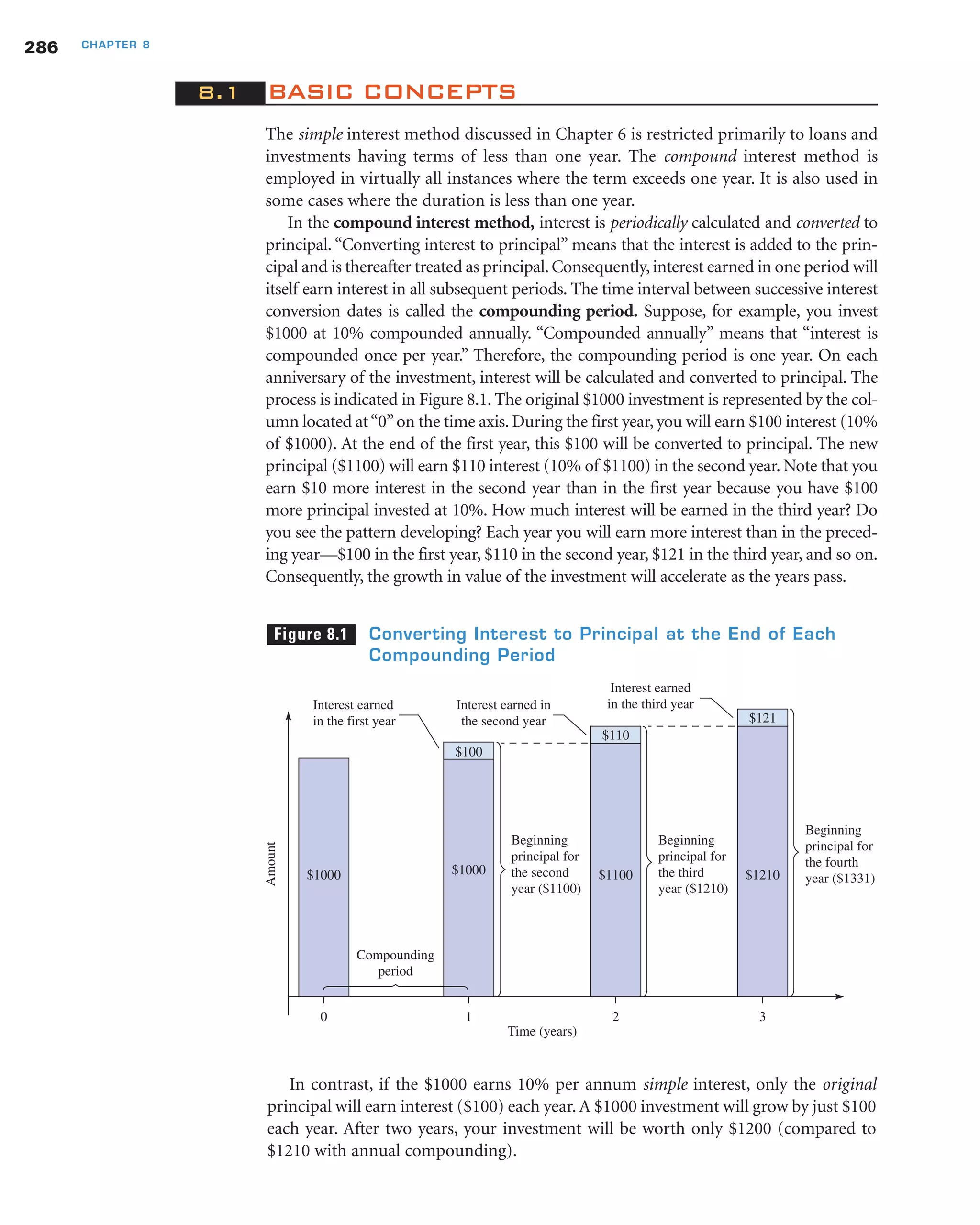
process is indicated in Figure 8.1. The original $1000 investment is represented by the col-
umn located at“0”on the time axis. During the first year, you will earn $100 interest (10%
of $1000). At the end of the first year, this $100 will be converted to principal. The new
principal ($1100) will earn $110 interest (10% of $1100) in the second year. Note that you
earn $10 more interest in the second year than in the first year because you have $100
more principal invested at 10%. How much interest will be earned in the third year? Do
you see the pattern developing? Each year you will earn more interest than in the preced-
ing year—$100 in the first year, $110 in the second year, $121 in the third year, and so on.
Consequently, the growth in value of the investment will accelerate as the years pass.
286 CHAPTER 8
Amount
0
$1000
Time (years)
1
$1000
2
$1100
Beginning
principal for
the second
year ($1100)
Beginning
principal for
the third
year ($1210)
Compounding
period
$110
$100
Interest earned in
the second year
Interest earned
in the first year
3
$1210
Beginning
principal for
the fourth
year ($1331)
$121
Interest earned
in the third year
Figure 8.1 Converting Interest to Principal at the End of Each
Compounding Period
In contrast, if the $1000 earns 10% per annum simple interest, only the original
principal will earn interest ($100) each year.A $1000 investment will grow by just $100
each year. After two years, your investment will be worth only $1200 (compared to
$1210 with annual compounding).
A compound interest rate is normally quoted with two components:
● A number for the annual interest rate (called the nominal1
interest rate).
● Words stating the compounding frequency.
For example, an interest rate of 8% compounded semiannually means that half of the
8% nominal annual rate is earned and compounded each six-month compounding
period. A rate of 9% compounded monthly means that 0.75% (one-twelfth of 9%) is
earned and compounded each month. We use the term periodic interest rate for the
interest rate per compounding period. In the two examples at hand, the periodic inter-
est rates are 4% and 0.75% respectively. In general,
If we define the following symbols:
j ϭ Nominal interest rate
m ϭ Number of compoundings per year
i ϭ Periodic interest rate
the simple relationship between the periodic interest rate and the nominal interest rate is:
(8-1) i ϭ
j
m
PERIODIC
INTEREST RATE
Periodic interest rate ϭ
Nominal interest rate
Number of compoundings per year
287COMPOUND INTEREST: FUTURE VALUE AND PRESENT VALUE
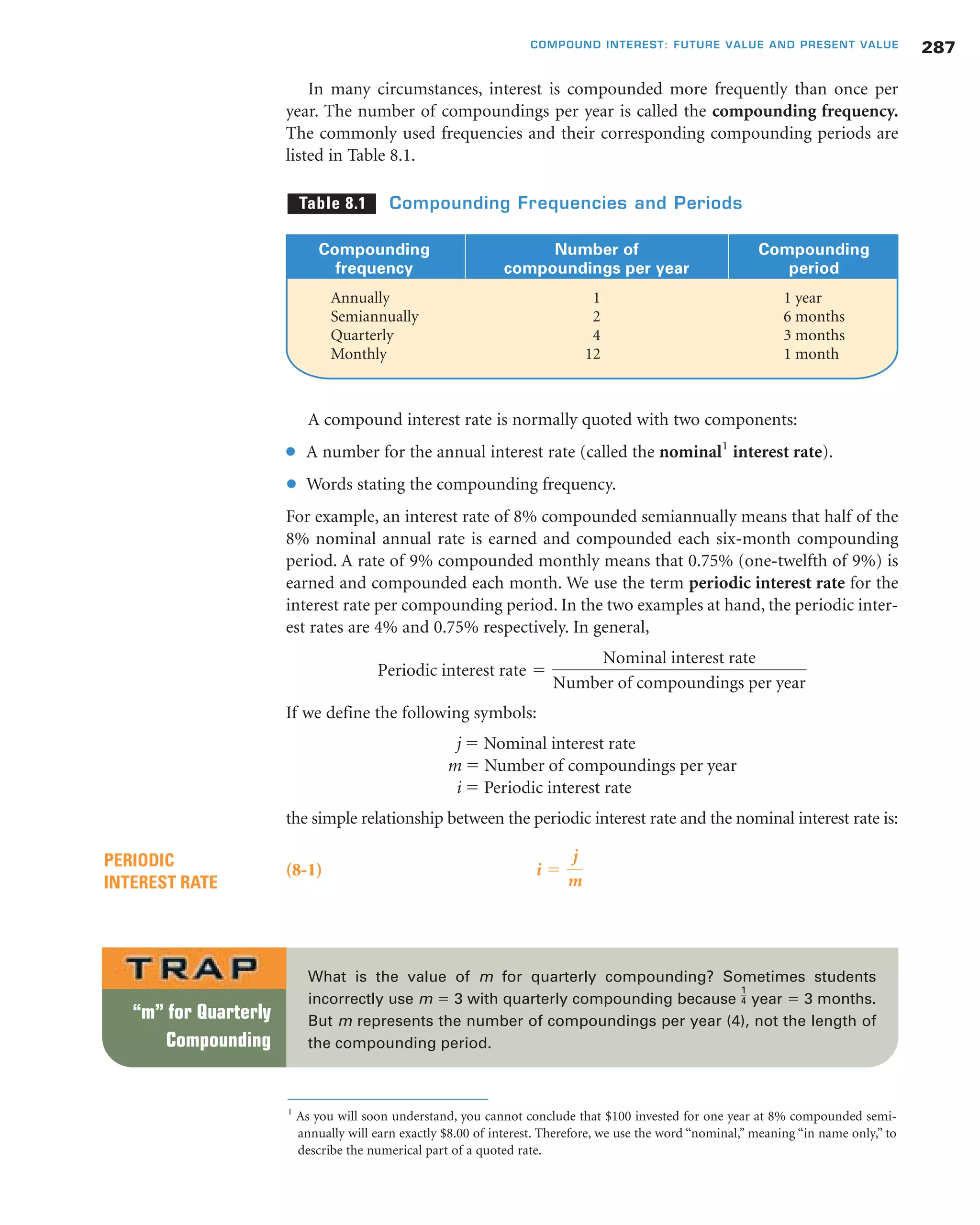
Compounding Number of Compounding
frequency compoundings per year period
Annually 1 1 year
Semiannually 2 6 months
Quarterly 4 3 months
Monthly 12 1 month
Table 8.1 Compounding Frequencies and Periods
What is the value of m for quarterly compounding? Sometimes students
incorrectly use m ϭ 3 with quarterly compounding because year ϭ 3 months.
But m represents the number of compoundings per year (4), not the length of
the compounding period.
1
4
“m” for Quarterly
Compounding
1
As you will soon understand, you cannot conclude that $100 invested for one year at 8% compounded semi-
annually will earn exactly $8.00 of interest. Therefore, we use the word “nominal,” meaning “in name only,” to
describe the numerical part of a quoted rate.
In many circumstances, interest is compounded more frequently than once per
year. The number of compoundings per year is called the compounding frequency.
The commonly used frequencies and their corresponding compounding periods are
listed in Table 8.1.
Example 8.1A CALCULATING THE PERIODIC INTEREST RATE
Calculate the periodic interest rate corresponding to:
a. 10.5% compounded annually. b. 9.75% compounded semiannually.
c. 9.0% compounded quarterly. d. 9.5% compounded monthly.
Solution
Employing formula (8-1), we obtain:
a. (per year) b. (per half year)
c. (per quarter) d. (per month)
Example 8.1B CALCULATING THE COMPOUNDING FREQUENCY
For a nominal interest rate of 8.4%, what is the compounding frequency if the periodic interest rate is:
a. 4.2%?
b. 8.4%?
c. 2.1%?
d. 0.70%?
Solution
The number of compoundings or conversions in a year is given by the value of m in formula (8-1).
Rearranging this formula to solve for m, we obtain
a. which corresponds to semiannual compounding.
b. which corresponds to annual compounding.m ϭ
8.4%
8.4%
ϭ 1
m ϭ
8.4%
4.2%
ϭ 2
m ϭ
j
i
i ϭ
9.5%
12
ϭ 0.7916%i ϭ
9.0%
4
ϭ 2.25%
i ϭ
9.75%
2
ϭ 4.875%i ϭ
j
m
ϭ
10.5%
1
ϭ 10.5%
288 CHAPTER 8
Whenever you are asked to calculate or state a nominal interest rate, it is
understood that you should include the compounding frequency in your
response. For example, an answer of just “8%” is incomplete. Rather, you
must state “8% compounded quarterly” if interest is compounded four times
per year.
Give the Complete
Description of an
Interest Rate
289COMPOUND INTEREST: FUTURE VALUE AND PRESENT VALUE
c. which corresponds to quarterly compounding.
d. which corresponds to monthly compounding.
Example 8.1C CALCULATING THE NOMINAL INTEREST RATE
Determine the nominal rate of interest if:
a. The periodic rate is 1.75% per quarter.
b. The periodic rate is per month.
Solution
Rearranging formula (8-1) to solve for j, the nominal interest rate, we obtain
j ϭ mi
a. j ϭ 4(1.75%) ϭ 7.0% b.
The nominal interest rates are 7.0% compounded quarterly and 10.0% compounded monthly, respectively.
Concept Questions
1. What does it mean to compound interest?
2. Explain the difference between “compounding period” and “compounding
frequency.”
3. Explain the difference between “nominal rate of interest” and “periodic rate of
interest.”
EXERCISE 8.1 Answers to the odd-numbered problems are at the end of the book.
Calculate the missing values in Problems 1 through 9.
jϭ 1210.83%2 ϭ 10.0%
0.83%
m ϭ
8.4%
0.7%
ϭ 12
m ϭ
8.4%
2.1%
ϭ 4
Nominal Compounding Periodic
Problem interest rate (%) frequency interest rate (%)
1. 10.8 Quarterly ?
2. 11.75 Semiannually ?
3. 10.5 Monthly ?
4. ? Semiannually 4.95
5. ? Monthly 0.91667
6. ? Quarterly 2.9375
7. 9.5 ? 2.375
8. 8.25 ? 4.125
9. 13.5 ? 1.125
8.2 FUTURE VALUE (OR MATURITY VALUE)
Calculating Future Value
Remember from our study of simple interest in Chapter 6 that the maturity value or
future value is the combined principal and interest due at the maturity date of a loan or
investment. We used S ϭ P(1 ϩ rt) to calculate future value in the simple interest case.
Now our task is to develop the corresponding formula for use with compound interest.
Financial calculators, spreadsheet software (such as Excel, Quattro Pro, and Lotus
1-2-3), and the majority of finance textbooks employ the following symbols in com-
pound interest functions:
FV ϭ Future value (or maturity value)
PV ϭ Principal amount of a loan or investment; Present value
The general question we want to answer is:
“What is the future value, FV, after n compounding periods of an initial princi-
pal, PV, if it earns a periodic interest rate, i?”
Before we answer this question, let’s be sure we understand the distinction between
the new variable
n ϭ Total number of compoundings
and the variable (from Section 8.1)
m ϭ Number of compoundings per year
Our intuition usually works better if we put numbers to the variables. Suppose a
$1000 investment earns 8% compounded semiannually for three years. From this
given information, we can “attach” numbers to variables as follows:
PV ϭ $1000 j ϭ 8% compounded semiannually Term ϭ 3 years
m ϭ 2 compoundings per year per half year
“n” represents the total number of compoundings in the entire term of the investment.
In our example, n is the number of compoundings in three years. Since there are two
compoundings per year, then n ϭ 2 ϫ 3 ϭ 6. In general,
(8-3) n ‫؍‬ m ؋ (Number of years in the term)
How can we calculate the future value of the $1000 investment? Think of the periodic
interest rate as the percentage change in the principal in each compounding period. To cal-
culate the future value of the initial $1000, we must compound a series of six percentage
changes of 4% each. Do you remember encountering this sort of question before?
In Section 2.7, we learned how to compound a series of percentage changes. If an
initial value, Vi, undergoes a series of n percentage changes, c1, c2, c3, . . ., cn, the final
value, Vf , is:
(2-3)
↑ ↑ ↑ ↑ ↑ ↑
FV PV i i i i
Vf ϭ Vi 11 ϩ c1 2 11 ϩ c2 2 11 ϩ c3 2 . . . 11 ϩ cn 2
TOTAL NUMBER OF
COMPOUNDING
PERIODS
i ϭ
j
m
ϭ
8%
2
ϭ 4%
290 CHAPTER 8
The corresponding compound interest variables are indicated under formula (2-3).
Making the substitutions, we obtain
Since the factor (1 ϩ i) occurs n times, then
(8-2) FV ‫؍‬ PV (1 ؉ i)n
In the particular case we have been considering,
FV ϭ $1000(1 ϩ 0.04)6
ϭ $1265.32
Example 8.2A CALCULATING THE MATURITY VALUE OF AN INVESTMENT
What will be the maturity value of $10,000 invested for five years at 9.75% compounded semiannually?
Solution
Given: PV ϭ $10,000, Term of investment ϭ 5 years, j ϭ 9.75%, m ϭ 2
The interest rate per six-month compounding period is
n ϭ m ϫ Term (in years) ϭ 2(5) ϭ 10
The maturity value will be
FV ϭ PV (1 ϩ i)n
ϭ $10,000(1 ϩ 0.04875)10
ϭ $10,000(1.6096066)
ϭ $16,096.07
The investment will grow to $16,096.07 after five years.
Example 8.2B COMPARING TWO NOMINAL RATES OF INTEREST
Other things being equal, would an investor prefer an interest rate of 10.5% compounded monthly or 11%
compounded annually for a two-year investment?
Solution
The preferred rate will be the one that results in the higher maturity value. Pick an arbitrary initial invest-
ment, say $1000, and calculate the maturity value at each rate.
With PV ϭ $1000, , and n ϭ m(Term) ϭ 12(2) ϭ 24,
FV ϭ PV(1 ϩ i)n
ϭ $1000 (1.00875)24
ϭ $1232.55
With , , and n ϭ m(Term) ϭ 1(2) ϭ 2,
FV ϭ PV(1 ϩ i)n
ϭ $1000(1.11)2
ϭ $1232.10
The rate of 10.5% compounded monthly is slightly better. The higher compounding frequency more than
offsets the lower nominal rate.
i ϭ j
m ϭ 11%
1 ϭ 11%PV ϭ $1000
i ϭ j
m ϭ 10.5%
12 ϭ 0.875%
i ϭ
j
m ϭ 9.75%
2 ϭ 4.875% 1per half year2
FUTURE VALUE OR
MATURITY VALUE
(COMPOUND INTEREST)
FV ϭ PV11 ϩ i2 11 ϩ i2 11 ϩ i2 . . . 11 ϩ i2
291COMPOUND INTEREST: FUTURE VALUE AND PRESENT VALUE
Example 8.2C CALCULATING THE MATURITY VALUE WHEN THE INTEREST
RATE CHANGES
George invested $5000 at 9.25% compounded quarterly. After 18 months, the rate changed to 9.75% com-
pounded semiannually. What amount will George have three years after the initial investment?
Solution
For the first 18 months,
For the next 18 months,
Because of the interest rate change, the solution should be done in two steps, as indicated by the following
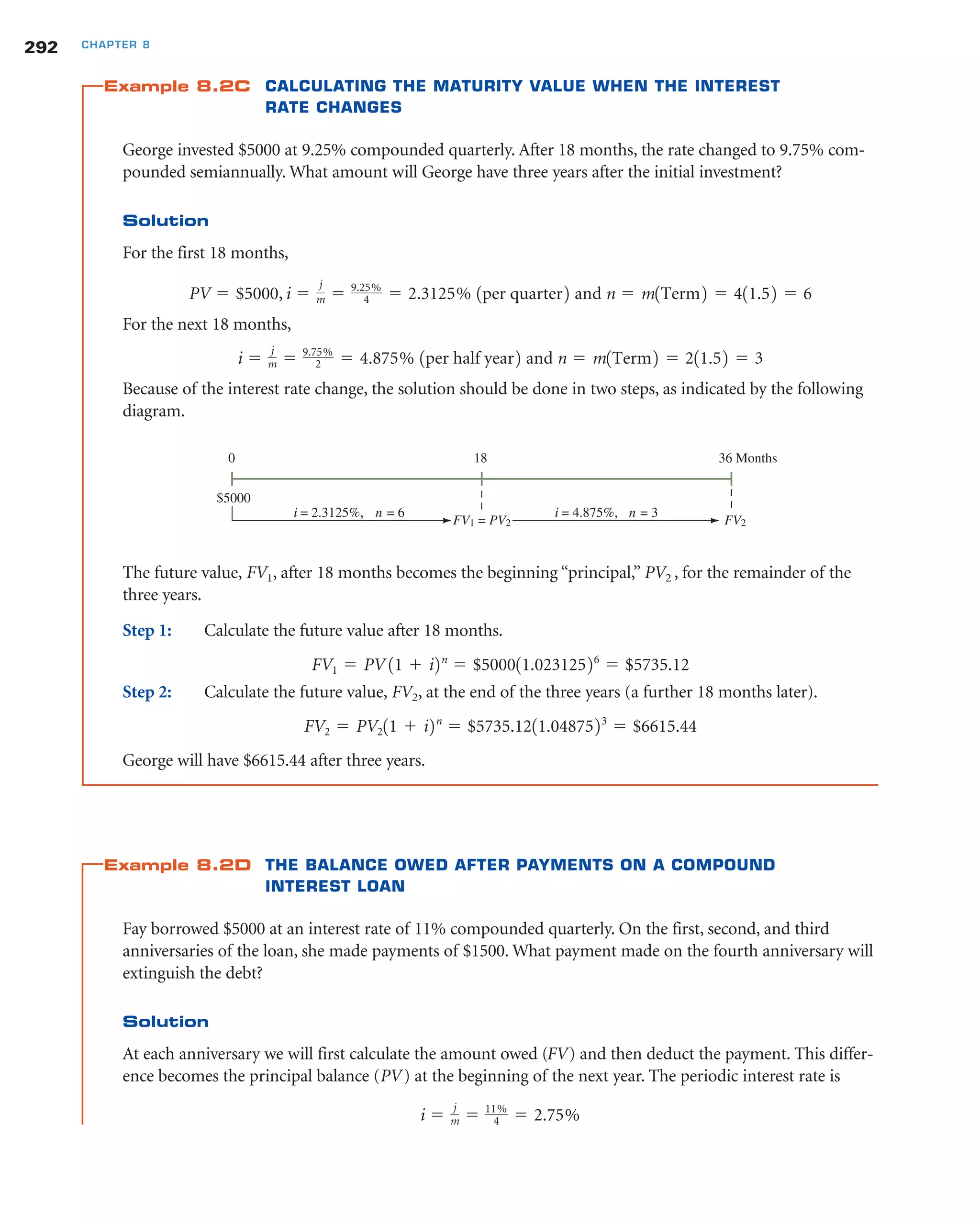
diagram.
The future value, FV1, after 18 months becomes the beginning “principal,” PV2 , for the remainder of the
three years.
Step 1: Calculate the future value after 18 months.
Step 2: Calculate the future value, FV2, at the end of the three years (a further 18 months later).
George will have $6615.44 after three years.
Example 8.2D THE BALANCE OWED AFTER PAYMENTS ON A COMPOUND
INTEREST LOAN
Fay borrowed $5000 at an interest rate of 11% compounded quarterly. On the first, second, and third
anniversaries of the loan, she made payments of $1500. What payment made on the fourth anniversary will
extinguish the debt?
Solution
At each anniversary we will first calculate the amount owed (FV) and then deduct the payment. This differ-
ence becomes the principal balance (PV) at the beginning of the next year. The periodic interest rate is
i ϭ
j
m ϭ 11%
4 ϭ 2.75%
FV2 ϭ PV211 ϩ i2n
ϭ $5735.1211.0487523
ϭ $6615.44
FV1 ϭ PV 11 ϩ i2n
ϭ $500011.02312526
ϭ $5735.12
0
$5000
i = 2.3125%, n = 6
36 Months18
FV1 = PV2 FV2
i = 4.875%, n = 3
i ϭ
j
m ϭ 9.75%
2 ϭ 4.875% 1per half year2 and n ϭ m1Term2 ϭ 211.52 ϭ 3
PV ϭ $5000,i ϭ
j
m ϭ 9.25%
4 ϭ 2.3125% 1per quarter2 and n ϭ m1Term2 ϭ 411.52 ϭ 6
292 CHAPTER 8
293COMPOUND INTEREST: FUTURE VALUE AND PRESENT VALUE
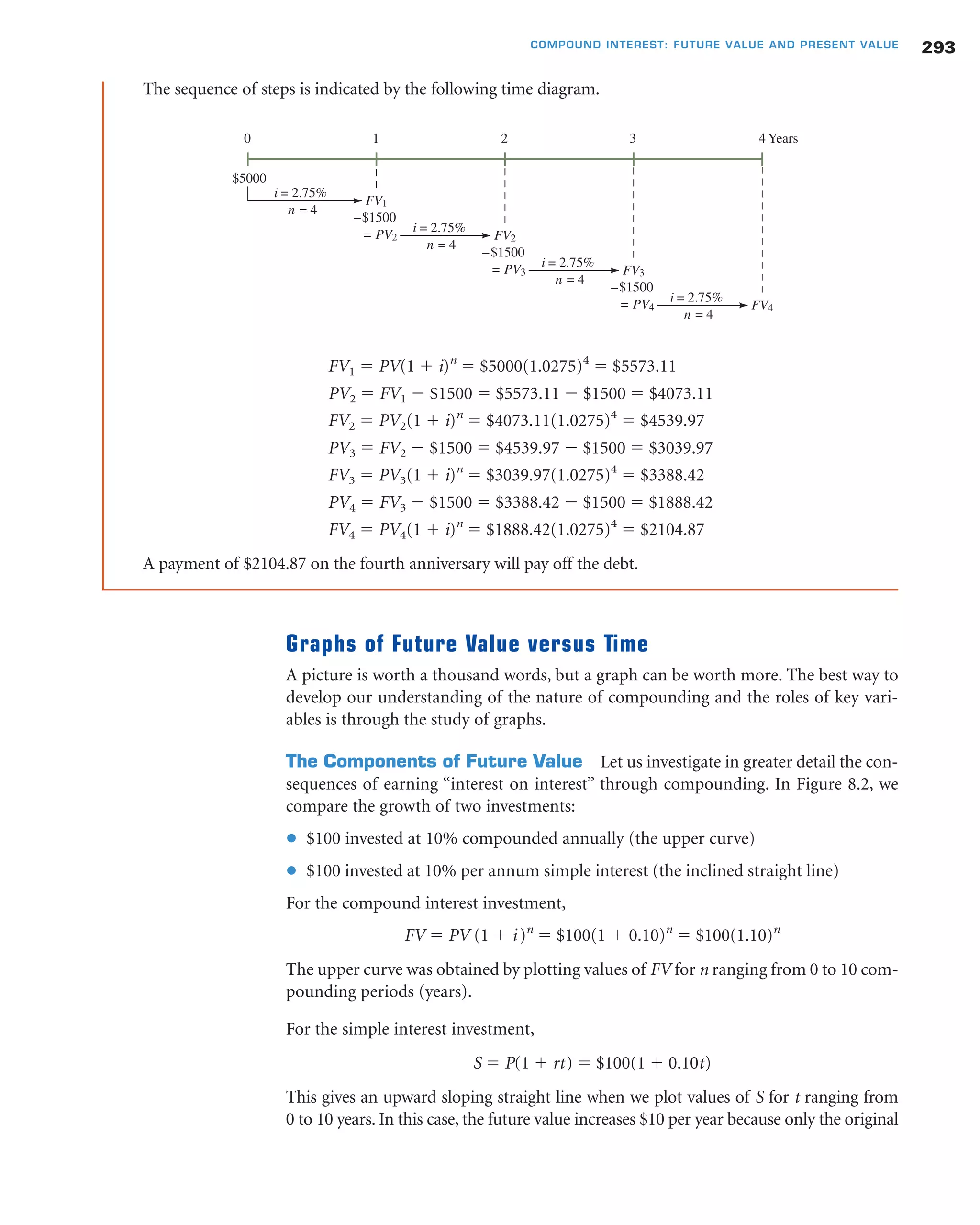
The sequence of steps is indicated by the following time diagram.
FV1 ϭ PV(1 ϩ i)n
ϭ $5000(1.0275)4
ϭ $5573.11
PV2 ϭ FV1 Ϫ $1500 ϭ $5573.11 Ϫ $1500 ϭ $4073.11
FV2 ϭ PV2(1 ϩ i)n
ϭ $4073.11(1.0275)4
ϭ $4539.97
PV3 ϭ FV2 Ϫ $1500 ϭ $4539.97 Ϫ $1500 ϭ $3039.97
FV3 ϭ PV3(1 ϩ i)n
ϭ $3039.97(1.0275)4
ϭ $3388.42
PV4 ϭ FV3 Ϫ $1500 ϭ $3388.42 Ϫ $1500 ϭ $1888.42
FV4 ϭ PV4(1 ϩ i)n
ϭ $1888.42(1.0275)4
ϭ $2104.87
A payment of $2104.87 on the fourth anniversary will pay off the debt.
Graphs of Future Value versus Time
A picture is worth a thousand words, but a graph can be worth more. The best way to
develop our understanding of the nature of compounding and the roles of key vari-
ables is through the study of graphs.
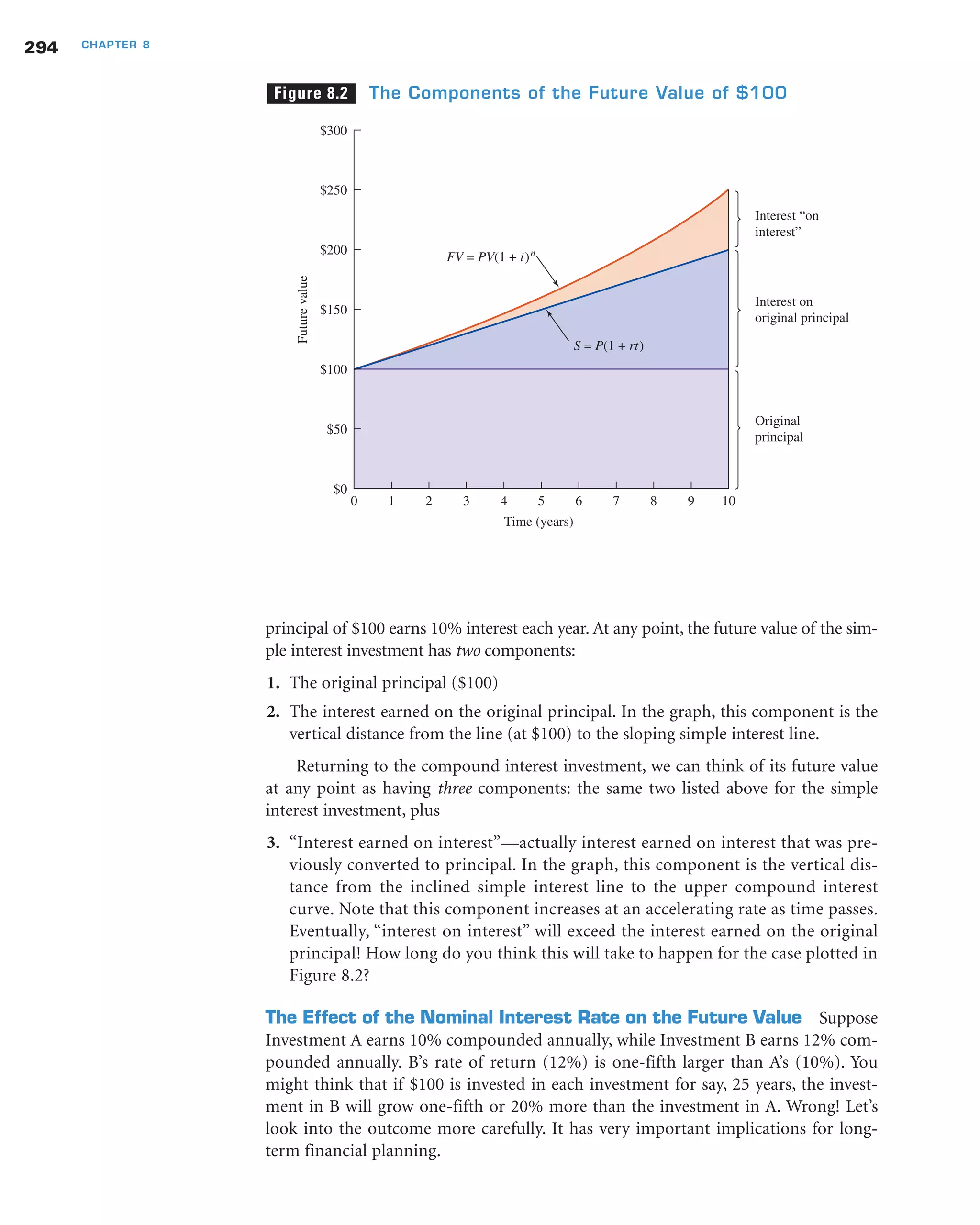
The Components of Future Value Let us investigate in greater detail the con-
sequences of earning “interest on interest” through compounding. In Figure 8.2, we
compare the growth of two investments:
● $100 invested at 10% compounded annually (the upper curve)
● $100 invested at 10% per annum simple interest (the inclined straight line)
For the compound interest investment,
FV ϭ PV (1 ϩ i)n
ϭ $100(1 ϩ 0.10)n
ϭ $100(1.10)n
The upper curve was obtained by plotting values of FV for n ranging from 0 to 10 com-
pounding periods (years).
For the simple interest investment,
S ϭ P(1 ϩ rt) ϭ $100(1 ϩ 0.10t)
This gives an upward sloping straight line when we plot values of S for t ranging from
0 to 10 years. In this case, the future value increases $10 per year because only the original
–$1500
=
–$1500
=
FV1
–$1500
= PV2 FV2
PV3 FV3
FV4PV4
0
$5000
i = 2.75%
n = 4
4 Years1 2 3
i = 2.75%
n = 4
i = 2.75%
n = 4
i = 2.75%
n = 4
principal of $100 earns 10% interest each year. At any point, the future value of the sim-
ple interest investment has two components:
1. The original principal ($100)
2. The interest earned on the original principal. In the graph, this component is the
vertical distance from the line (at $100) to the sloping simple interest line.
Returning to the compound interest investment, we can think of its future value
at any point as having three components: the same two listed above for the simple
interest investment, plus
3. “Interest earned on interest”—actually interest earned on interest that was pre-
viously converted to principal. In the graph, this component is the vertical dis-
tance from the inclined simple interest line to the upper compound interest
curve. Note that this component increases at an accelerating rate as time passes.
Eventually, “interest on interest” will exceed the interest earned on the original
principal! How long do you think this will take to happen for the case plotted in
Figure 8.2?
The Effect of the Nominal Interest Rate on the Future Value Suppose
Investment A earns 10% compounded annually, while Investment B earns 12% com-
pounded annually. B’s rate of return (12%) is one-fifth larger than A’s (10%). You
might think that if $100 is invested in each investment for say, 25 years, the invest-
ment in B will grow one-fifth or 20% more than the investment in A. Wrong! Let’s
look into the outcome more carefully. It has very important implications for long-
term financial planning.
294 CHAPTER 8
Figure 8.2 The Components of the Future Value of $100
Futurevalue
$0
$50
$100
$150
$200
$250
$300
Time (years)
0 1 2 3 4 5 6 7 8 9 10
Interest “on
interest”
Original
principal
Interest on
original principal
FV = PV(1 + i)n
S = P(1 + rt)
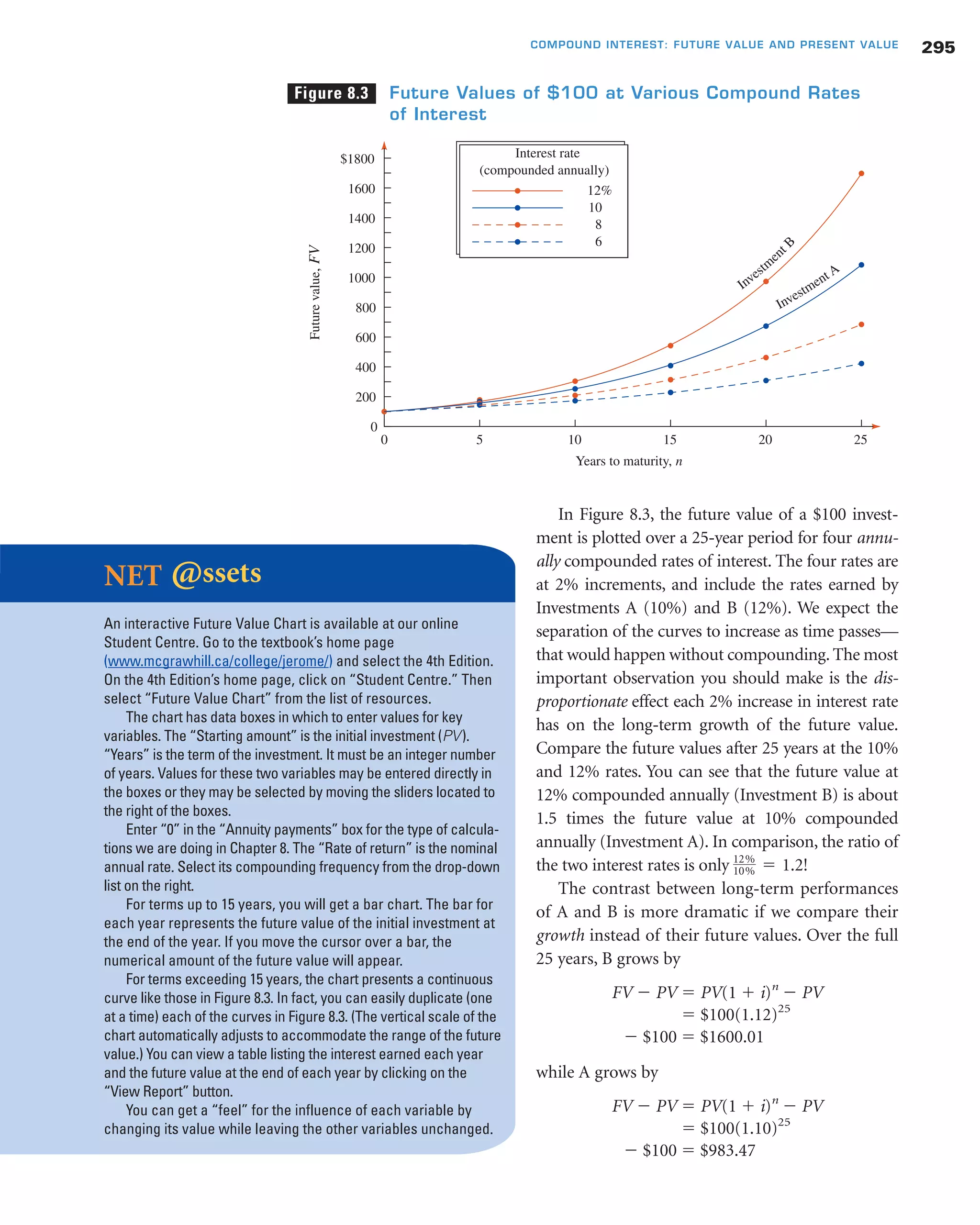
In Figure 8.3, the future value of a $100 invest-
ment is plotted over a 25-year period for four annu-
ally compounded rates of interest. The four rates are
at 2% increments, and include the rates earned by
Investments A (10%) and B (12%). We expect the
separation of the curves to increase as time passes—
that would happen without compounding. The most
important observation you should make is the dis-
proportionate effect each 2% increase in interest rate
has on the long-term growth of the future value.
Compare the future values after 25 years at the 10%
and 12% rates. You can see that the future value at
12% compounded annually (Investment B) is about
1.5 times the future value at 10% compounded
annually (Investment A). In comparison, the ratio of
the two interest rates is only !
The contrast between long-term performances
of A and B is more dramatic if we compare their
growth instead of their future values. Over the full
25 years, B grows by
FV Ϫ PV ϭ PV(1 ϩ i)n
Ϫ PV
ϭ $100(1.12)25
Ϫ $100 ϭ $1600.01
while A grows by
FV Ϫ PV ϭ PV(1 ϩ i)n
Ϫ PV
ϭ $100(1.10)25
Ϫ $100 ϭ $983.47
12%
10% ϭ 1.2
295COMPOUND INTEREST: FUTURE VALUE AND PRESENT VALUE
Figure 8.3 Future Values of $100 at Various Compound Rates
of Interest
Investm
ent
B
$1800
Futurevalue,FV
1600
1400
0
25
Years to maturity, n
20151050
1200
1000
800
600
400
200
Investment A
12%
10
8
6
Interest rate
(compounded annually)
NET @ssets
An interactive Future Value Chart is available at our online
Student Centre. Go to the textbook’s home page
(www.mcgrawhill.ca/college/jerome/) and select the 4th Edition.
On the 4th Edition’s home page, click on “Student Centre.” Then
select “Future Value Chart” from the list of resources.
The chart has data boxes in which to enter values for key
variables. The “Starting amount” is the initial investment (PV).
“Years” is the term of the investment. It must be an integer number
of years. Values for these two variables may be entered directly in
the boxes or they may be selected by moving the sliders located to
the right of the boxes.
Enter “0” in the “Annuity payments” box for the type of calcula-
tions we are doing in Chapter 8. The “Rate of return” is the nominal
annual rate. Select its compounding frequency from the drop-down
list on the right.
For terms up to 15 years, you will get a bar chart. The bar for
each year represents the future value of the initial investment at
the end of the year. If you move the cursor over a bar, the
numerical amount of the future value will appear.
For terms exceeding 15 years, the chart presents a continuous
curve like those in Figure 8.3. In fact, you can easily duplicate (one
at a time) each of the curves in Figure 8.3. (The vertical scale of the
chart automatically adjusts to accommodate the range of the future
value.) You can view a table listing the interest earned each year
and the future value at the end of each year by clicking on the
“View Report” button.
You can get a “feel” for the influence of each variable by
changing its value while leaving the other variables unchanged.
In summary, B’s growth is 1.63 times A’s growth, even though the interest rate
earned by B is only 1.2 times the rate earned by A. What a difference the extra 2% per
year makes, especially over longer time periods! The implications for planning and
managing your personal financial affairs are:
● You should begin an investment plan early in life in order to realize the dramatic
effects of compounding beyond a 20-year time horizon.
● You should try to obtain the best available rate of return (at your acceptable level of
risk). An extra 0.5% or 1% added to your annual rate of return has a disproportion-
ate effect on investment growth, particularly in the long run.
The Effect of the Compounding Frequency on the Future Value
What difference will it make if we invest $100 at 12% compounded monthly instead of
12% compounded annually? In the first case, the $1 interest (1% of $100) earned in
the first month gets converted to principal at the end of the month. We will then have
$101 earning interest in the second month, and so on. With annual compounding, the
$1 interest earned in the first month is not converted to principal. Just the original
principal ($100) will earn interest in the second through to the twelfth month. Only
then will the $12 interest earned during the year be converted to principal. Therefore,
the original $100 will grow faster with monthly compounding.
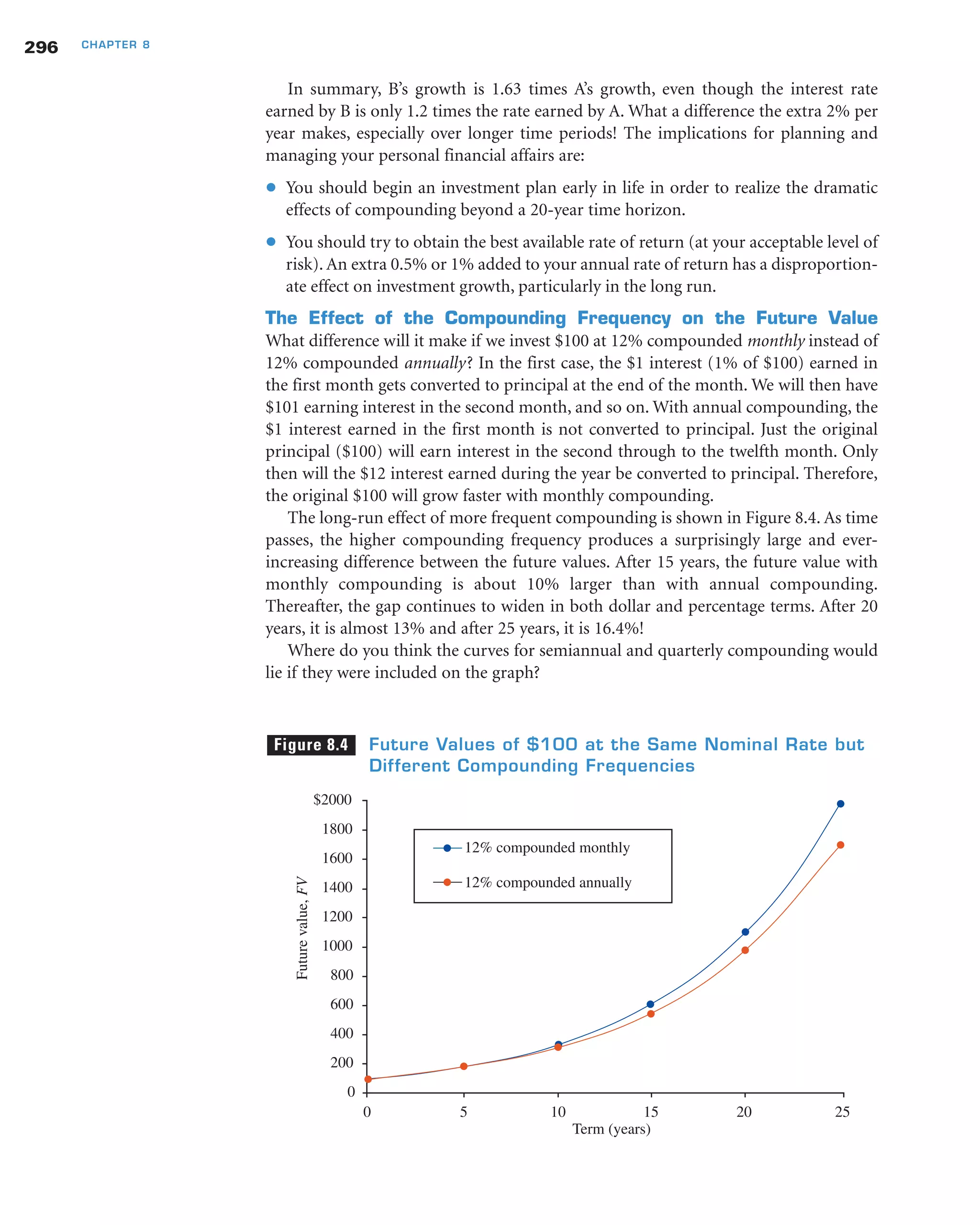
The long-run effect of more frequent compounding is shown in Figure 8.4. As time
passes, the higher compounding frequency produces a surprisingly large and ever-
increasing difference between the future values. After 15 years, the future value with
monthly compounding is about 10% larger than with annual compounding.
Thereafter, the gap continues to widen in both dollar and percentage terms. After 20
years, it is almost 13% and after 25 years, it is 16.4%!
Where do you think the curves for semiannual and quarterly compounding would
lie if they were included on the graph?
296 CHAPTER 8
Figure 8.4 Future Values of $100 at the Same Nominal Rate but
Different Compounding Frequencies
12% compounded monthly
12% compounded annually
$2000
1800
1600
1400
1200
1000
800
600
400
200
0
Futurevalue,FV
Term (years)
0 5 10 15 20 25
Equivalent Payments Recall from Section 6.4 that equivalent payments are
alternative payments that enable you to end up with the same dollar amount at a later
date. The concepts we developed in Section 6.4 still apply when the time frame exceeds
one year. The only change needed is to use the mathematics of compound interest when
calculating a present value (an equivalent payment at an earlier date) or a future value
(an equivalent payment at a later date). The rate of return employed in equivalent pay-
ment calculations should be the rate of return that can be earned from a low-risk
investment. In real life, the prevailing rate of return2
on Government of Canada bonds
is the customary standard.
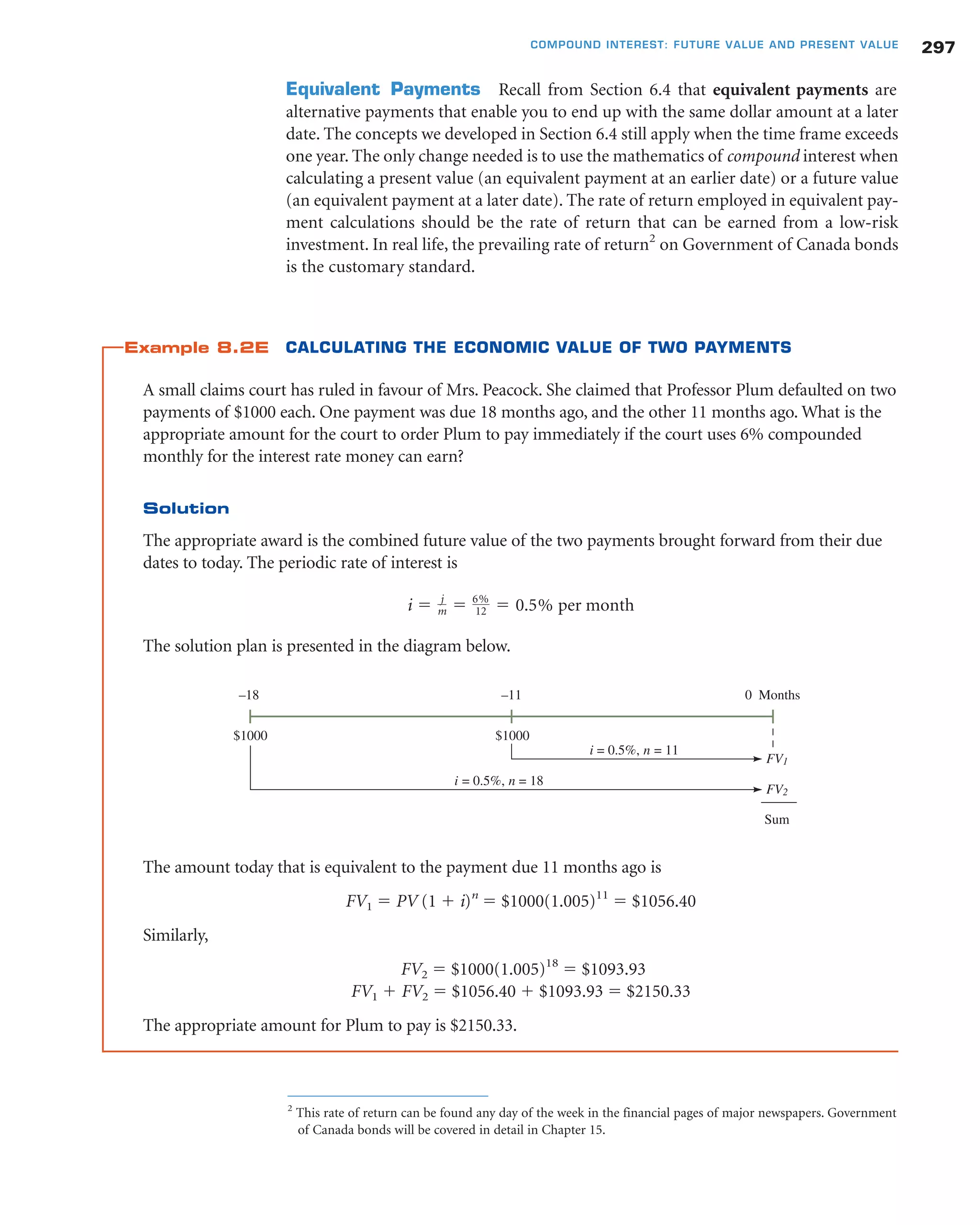
Example 8.2E CALCULATING THE ECONOMIC VALUE OF TWO PAYMENTS
A small claims court has ruled in favour of Mrs. Peacock. She claimed that Professor Plum defaulted on two
payments of $1000 each. One payment was due 18 months ago, and the other 11 months ago. What is the
appropriate amount for the court to order Plum to pay immediately if the court uses 6% compounded
monthly for the interest rate money can earn?
Solution
The appropriate award is the combined future value of the two payments brought forward from their due
dates to today. The periodic rate of interest is
The solution plan is presented in the diagram below.
The amount today that is equivalent to the payment due 11 months ago is
FV1 ϭ PV (1 ϩ i)n
ϭ $1000(1.005)11
ϭ $1056.40
Similarly,
FV2 ϭ $1000(1.005)18
ϭ $1093.93
FV1 ϩ FV2 ϭ $1056.40 ϩ $1093.93 ϭ $2150.33
The appropriate amount for Plum to pay is $2150.33.
–18 0 Months
$1000$1000
FV1
FV2
i = 0.5%, n = 11
i = 0.5%, n = 18
–11
Sum
i ϭ j
m ϭ 6%
12 ϭ 0.5% per month
297COMPOUND INTEREST: FUTURE VALUE AND PRESENT VALUE
2
This rate of return can be found any day of the week in the financial pages of major newspapers. Government
of Canada bonds will be covered in detail in Chapter 15.
Concept Questions
1. What is meant by the future value of an investment?
2. For a given nominal interest rate (say 10%) on a loan, would the borrower prefer
it to be compounded annually or compounded monthly? Which compounding
frequency would the lender prefer? Give a brief explanation.
3. For a six-month investment, rank the following interest rates (number one being
“most preferred”): 6% per annum simple interest, 6% compounded semiannually,
6% compounded quarterly. Explain your ranking.
298 CHAPTER 8
“I don’t know the names of the Seven Wonders of the World,
but I do know the Eighth Wonder: Compound Interest.”
Baron Rothschild
Many books and articles on personal financial
planning write with similar awe about the “mira-
cle” or “magic” of compound interest. The authors
make it appear that mysterious forces are involved.
The Wealthy Barber, a Canadian bestseller, says that
“it’s a real tragedy that most people don’t under-
stand compound interest and its wondrous pow-
ers.” Another book states that “one of the greatest
gifts that you can give your children is a compound
interest table” (which you will be able to construct
by the end of this chapter).
These books do have a legitimate point, even if it
seems overstated once you become familiar with
the mathematics of compound interest. Most
people really do underestimate the long-term
growth of compound-interest investments. Also,
they do not take seriously enough the advice to
start saving and investing early in life. As we noted
in Figure 8.3, compound growth accelerates rapid-
ly beyond the 20-year horizon.
The reason most people underestimate the long-
term effects of compounding is that they tend to
think in terms of proportional relationships. For
example, most would estimate that an investment
will earn about twice as much over 20 years as it
will earn over 10 years at the same rate of return.
Let’s check your intuition in this regard.
Questions
1. How do you think the growth of a $100
investment over 20 years compares to its
growth over 10 years? Assume a return of 8%
compounded annually. Will the former be
twice as large? Two-and-a-half times as large?
Make your best educated guess and then
work out the actual ratio. Remember, we
want the ratio for the growth, not the ratio
for the future value.
2. Will the growth ratio be larger, smaller, or
the same if we invest $1000 instead of $100 at
the start? After making your choice, calculate
the ratio.
3. Will the growth ratio be larger, smaller, or
the same if the rate of return is 10%
compounded annually instead of 8%
compounded annually? After making your
choice, calculate the ratio.
The “Magic” of Compound Interest
4. From a simple inspection, is it possible to rank the four interest rates in each of
parts (a) and (b)? If so, state the ranking. Take an investor’s point of view. Give a
brief explanation to justify your answer.
a. 9.0% compounded monthly, 9.1% compounded quarterly,
9.2% compounded semiannually, 9.3% compounded annually.
b. 9.0% compounded annually, 9.1% compounded semiannually,
9.2% compounded quarterly, 9.3% compounded monthly.
5. If an investment doubles in nine years, how long will it take to quadruple (at the
same rate of return)? (This problem does not require any detailed calculations.)
6. Suppose it took x years for an investment to grow from $100 to $200 at a fixed
compound rate of return. How many more years will it take to earn an additional
a. $100? b. $200? c. $300?
In each case, pick an answer from:
(i) more than x years, (ii) less than x years, (iii) exactly x years.
7. John and Mary both invest $1000 on the same date and at the same compound
interest rate. If the term of Mary’s investment is 10% longer than John’s, will
Mary’s maturity value be (pick one):
(i) 10% larger (ii) less than 10% larger (iii) more than 10% larger?
Explain.
8. John and Mary both invest $1000 on the same date for the same term to maturity.
John earns a nominal interest rate that is 1.1 times the rate earned by Mary (but
both have the same compounding frequency). Will John’s total interest earnings
be (pick one):
(i) 1.1 times (ii) less than 1.1 times (iii) more than 1.1 times
Mary’s earnings? Explain.
9. Why is $100 paid today worth more than $100 paid at a future date? Is inflation
the fundamental reason?
EXERCISE 8.2 Answers to the odd-numbered problems are at the end of the book.
Note: In Section 8.4, you will learn how to use special functions on a financial calcula-
tor to solve compound-interest problems. Exercise 8.4 will suggest that you return to
this Exercise to practise the financial calculator method.
Calculate the maturity value in Problems 1 through 4.
299COMPOUND INTEREST: FUTURE VALUE AND PRESENT VALUE
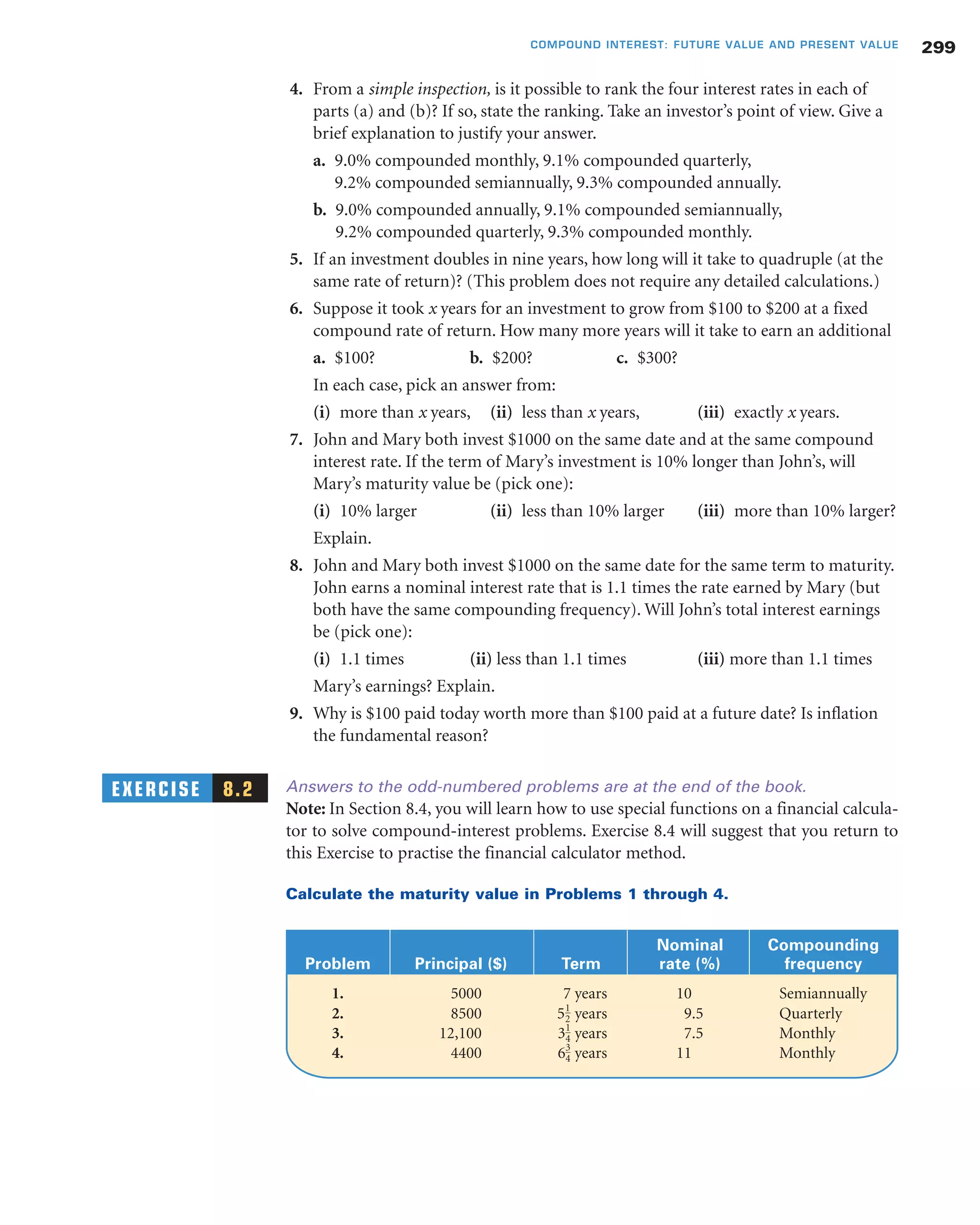
Nominal Compounding
Problem Principal ($) Term rate (%) frequency
1. 5000 7 years 10 Semiannually
2. 8500 years 9.5 Quarterly
3. 12,100 years 7.5 Monthly
4. 4400 years 11 Monthly63
4
31
4
51
2
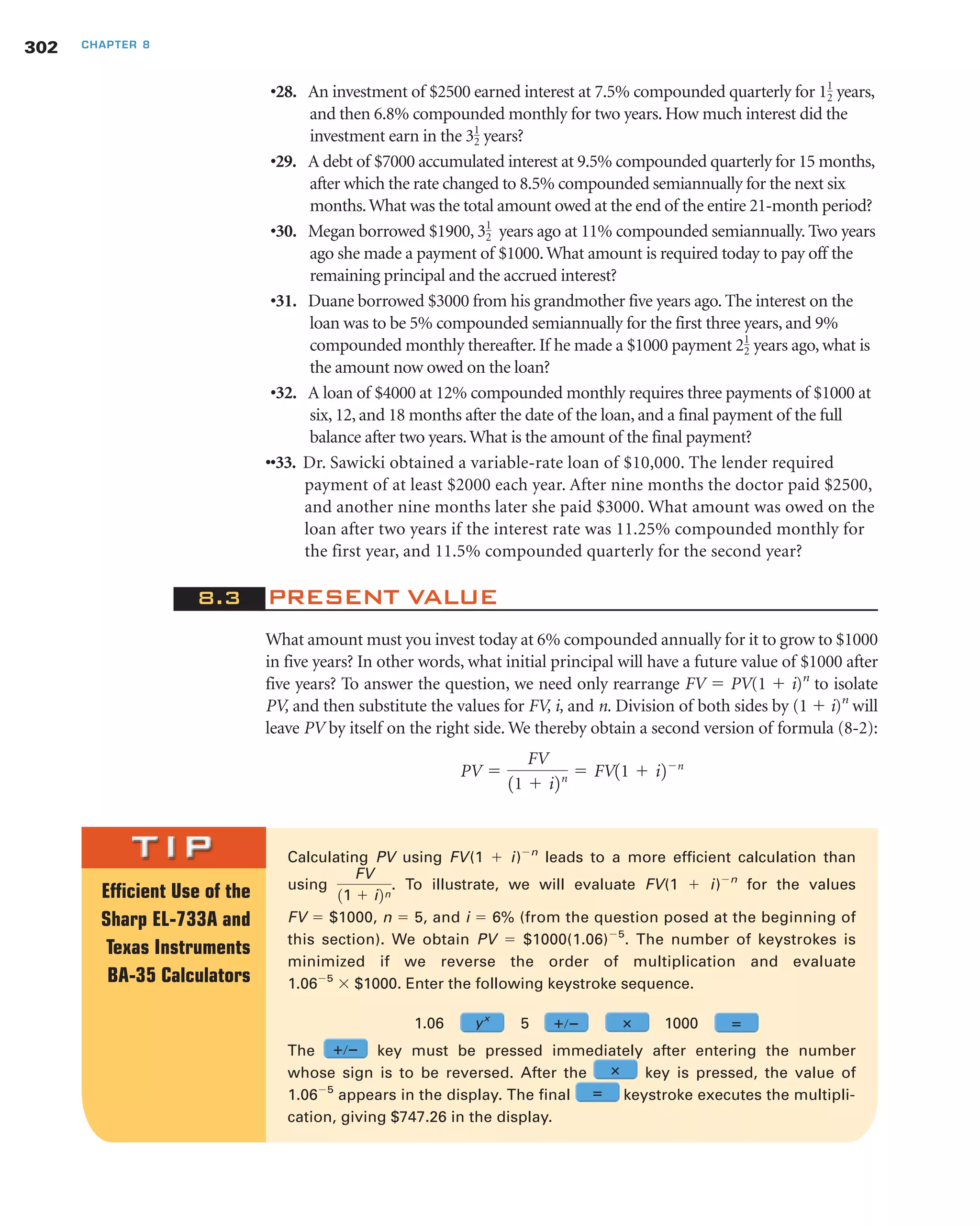
5. Calculate the maturity amount of a $1000 RRSP3
contribution after 25 years if it
earns a rate of return of 9% compounded:
a. Annually. b. Semiannually. c. Quarterly. d. Monthly.
6. Calculate the maturity amount of a $1000 RRSP contribution after five years if it
earns a rate of return of 9% compounded:
a. Annually. b. Semiannually. c. Quarterly. d. Monthly.
7. By calculating the maturity value of $100 invested for one year at each rate,
determine which rate of return an investor would prefer.
a. 8.0% compounded monthly.
b. 8.1% compounded quarterly.
c. 8.2% compounded semiannually.
d. 8.3% compounded annually.
8. By calculating the maturity value of $100 invested for one year at each rate,
determine which rate of return an investor would prefer.
a. 12.0% compounded monthly.
b. 12.1% compounded quarterly.
c. 12.2% compounded semiannually.
d. 12.3% compounded annually.
9. What is the maturity value of a $3000 loan for 18 months at 9.5% compounded
semiannually? How much interest is charged on the loan?
10. What total amount will be earned by $5000 invested at 7.5% compounded monthly
for years?
11. How much more will an investment of $1000 be worth after 25 years if it earns 11%
compounded annually instead of 10% compounded annually? Calculate the differ-
ence in dollars and as a percentage of the smaller maturity value.
12. How much more will an investment of $1000 be worth after 25 years if it earns 6%
compounded annually instead of 5% compounded annually? Calculate the differ-
ence in dollars and as a percentage of the smaller maturity value.
13. How much more will an investment of $1000 earning 9% compounded annually be
worth after 25 years than after 20 years? Calculate the difference in dollars and as a
percentage of the smaller maturity value.
14. How much more will an investment of $1000 earning 9% compounded annually be
worth after 15 years than after 10 years? Calculate the difference in dollars and as a
percentage of the smaller maturity value.
15. A $1000 investment is made today. Calculate its maturity values for the six combi-
nations of terms and annually compounded interest rates in the following table.
31
2
300 CHAPTER 8
3
Some features of Registered Retirement Savings Plans (RRSPs) will be discussed in Section 8.5. At this point,
simply view an RRSP contribution as an investment.
Interest Term
rate (%) 20 years 25 years 30 years
8 ? ? ?
10 ? ? ?
16. Suppose an individual invests $1000 at the beginning of each year for the next 30
years. Thirty years from now, how much more will the first $1000 investment be
worth than the sixteenth $1000 investment if both earn 8.5% compounded annually?
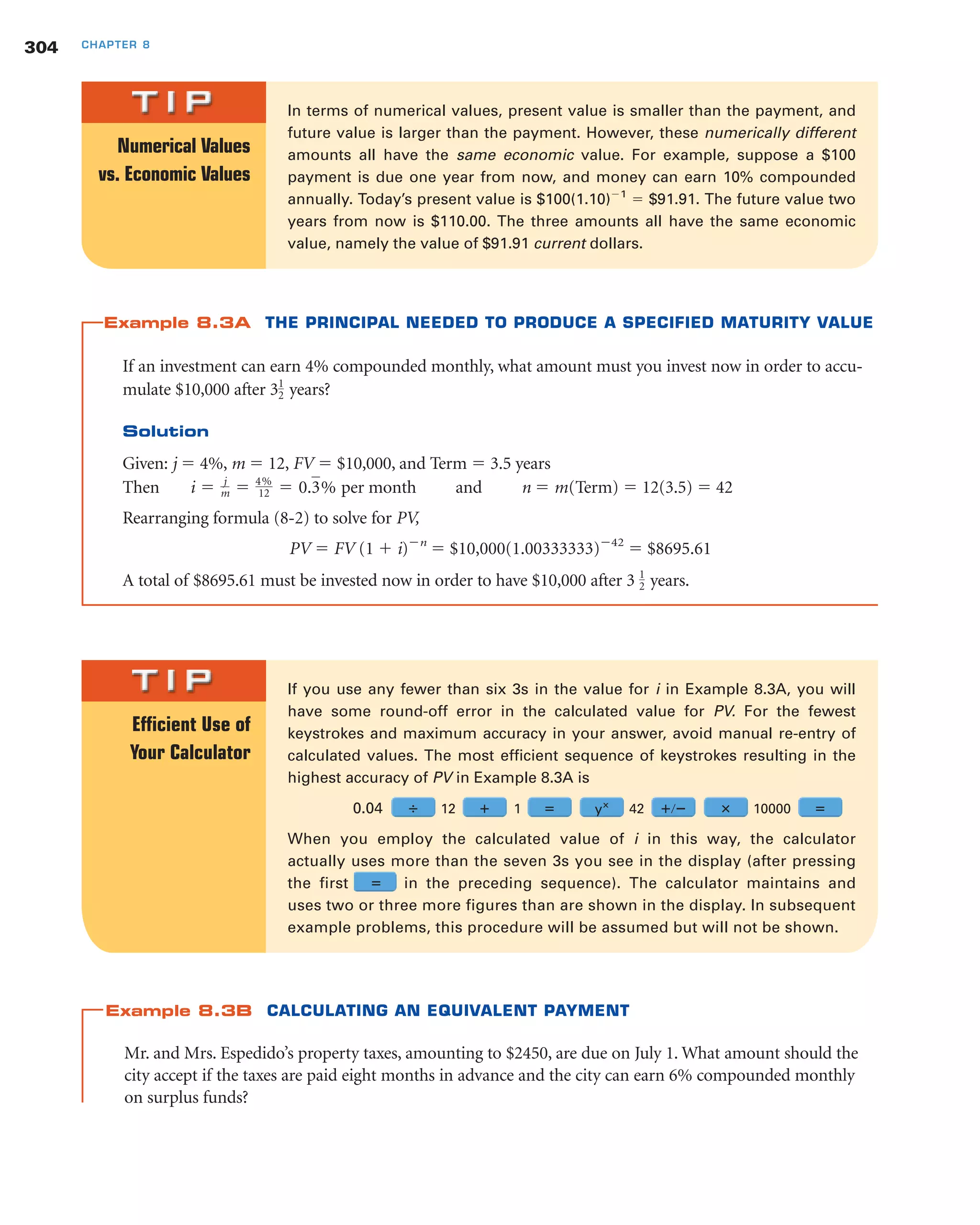
In Problems 17 through 20, calculate the combined equivalent value of the
scheduled payments on the indicated dates. The rate of return that money
can earn is given in the fourth column. Assume that payments due in the
past have not yet been made.
301COMPOUND INTEREST: FUTURE VALUE AND PRESENT VALUE
Scheduled Date of Money can Compounding
Problem payments equivalent value earn (%) frequency
17. $5000 due years ago years from now 8.25 Annually
18. $3000 due in 5 months 3 years from now 7.5 Monthly
19. $1300 due today, 4 years from now 6 Quarterly
$1800 due in years
20. $2000 due 3 years ago, years from now 6.8 Semiannually
$1000 due years ago11
2
11
2
13
4
21
211
2
21. What amount today is equivalent to $2000 four years ago, if money earned 10.5%
compounded semiannually over the last four years?
22. What amount two years from now will be equivalent to $2300 at a date years ago,
if money earns 9.25% compounded semiannually during the intervening time?
•23. Jeff borrowed $3000, $3500, and $4000 from his father on January 1 of three
successive years at college. Jeff and his father agreed that interest would accumulate
on each amount at the rate of 5% compounded semiannually. Jeff is to start
repaying the loan on the January 1 following graduation.What consolidated
amount will he owe at that time?
•24. You project that you will be able to invest $1000 this year, $1500 one year from now,
and $2000 two years from today.You hope to use the accumulated funds six years
from now to cover the $10,000 down payment on a house.Will you achieve your
objectives, if the investments earn 8% compounded semiannually? (Taken from
ICB course on Wealth Valuation.)
•25. Mrs. Vanderberg has just deposited $5000 in each of three savings plans for her
grandchildren. They will have access to the accumulated funds on their nine-
teenth birthdays. Their current ages are 12 years, seven months (Donna); 10
years, three months (Tim); and seven years, 11 months (Gary). If the plans earn
8% compounded monthly, what amount will each grandchild receive at age 19?
•26. Nelson borrowed $5000 for years. For the first years, the interest rate on the
loan was 8.4% compounded monthly. Then the rate became 7.5% compounded
semiannually.What total amount was required to pay off the loan if no payments
were made before the expiry of the -year term?
•27. Scott has just invested $60,000 in a five-year Guaranteed Investment Certificate
(GIC) earning 6% compounded semiannually.When the GIC matures, he will
reinvest its entire maturity value in a new five-year GIC.What will be the maturity
value of the second GIC if it yields:
a. The same rate as the current GIC?
b. 7% compounded semiannually?
c. 5% compounded semiannually?
41
2
21
241
2
11
2
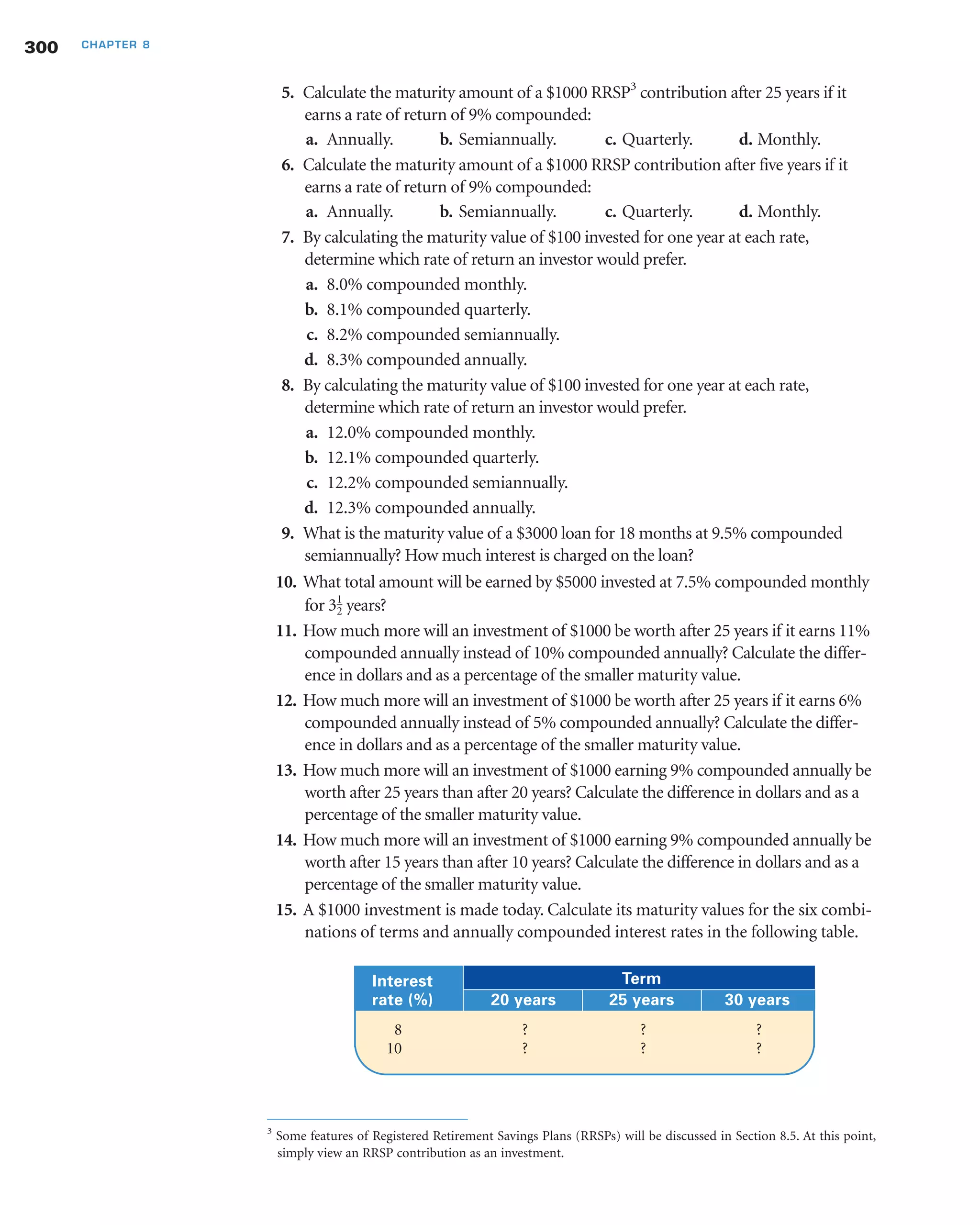
Calculating PV using FV(1 ϩ i)Ϫn
leads to a more efficient calculation than
using . To illustrate, we will evaluate FV(1 ϩ i)Ϫn
for the values
FV ϭ $1000, n ϭ 5, and i ϭ 6% (from the question posed at the beginning of
this section). We obtain PV ϭ $1000(1.06)Ϫ5
. The number of keystrokes is
minimized if we reverse the order of multiplication and evaluate
1.06Ϫ5
ϫ $1000. Enter the following keystroke sequence.
1.06 5 1000
The key must be pressed immediately after entering the number
whose sign is to be reversed. After the key is pressed, the value of
1.06Ϫ5
appears in the display. The final keystroke executes the multipli-
cation, giving $747.26 in the display.
FV
11 ϩ i2n
•28. An investment of $2500 earned interest at 7.5% compounded quarterly for years,
and then 6.8% compounded monthly for two years. How much interest did the
investment earn in the years?
•29. A debt of $7000 accumulated interest at 9.5% compounded quarterly for 15 months,
after which the rate changed to 8.5% compounded semiannually for the next six
months.What was the total amount owed at the end of the entire 21-month period?
•30. Megan borrowed $1900, years ago at 11% compounded semiannually. Two years
ago she made a payment of $1000.What amount is required today to pay off the
remaining principal and the accrued interest?
•31. Duane borrowed $3000 from his grandmother five years ago. The interest on the
loan was to be 5% compounded semiannually for the first three years, and 9%
compounded monthly thereafter. If he made a $1000 payment years ago, what is
the amount now owed on the loan?
•32. A loan of $4000 at 12% compounded monthly requires three payments of $1000 at
six, 12, and 18 months after the date of the loan, and a final payment of the full
balance after two years.What is the amount of the final payment?
••33. Dr. Sawicki obtained a variable-rate loan of $10,000. The lender required
payment of at least $2000 each year. After nine months the doctor paid $2500,
and another nine months later she paid $3000. What amount was owed on the
loan after two years if the interest rate was 11.25% compounded monthly for
the first year, and 11.5% compounded quarterly for the second year?
8.3 PRESENT VALUE
What amount must you invest today at 6% compounded annually for it to grow to $1000
in five years? In other words, what initial principal will have a future value of $1000 after
five years? To answer the question, we need only rearrange FV ϭ PV(1 ϩ i)n
to isolate
PV, and then substitute the values for FV, i, and n. Division of both sides by (1 ϩ i)n
will
leave PV by itself on the right side. We thereby obtain a second version of formula (8-2):
PV ϭ
FV
11 ϩ i2n ϭ FV11 ϩ i2Ϫn
21
2
31
2
31
2
11
2
302 CHAPTER 8
Efficient Use of the
Sharp EL-733A and
Texas Instruments
BA-35 Calculators
yx
؉ր؊ ؋ ‫؍‬
؋
‫؍‬
؉ր؊
Consider a second question. If money can earn 6% compounded annually, what
amount today is equivalent to $1000 paid five years from now? This is an example
of determining a payment’s present value—an economically equivalent amount at
an earlier date. In this instance, the present value is the (principal) amount you
would have to invest today in order to end up with $1000 after five years. In sum-
mary, PV ϭ FV (1 ϩ i)Ϫn
applies to two types of problems:
● Calculating the initial principal, and
● Calculating the present value.
The present value of a future payment will, of course, always be a smaller number
than the payment. This is why the process of calculating a payment’s present value is
sometimes described as discounting a payment. The interest rate used in the present
value calculation is then referred to as the discount rate.
The longer the time period before a scheduled payment, the smaller the present
value will be. Figure 8.5 shows the pattern of decreasing present value for longer peri-
ods before the payment date. The decline is rapid in the first ten years, but steadily
tapers off at longer periods. With a discount rate of 10% compounded annually, the
present value seven years before the payment is about half the numerical value of the
payment. Twenty-five years prior to the payment, the present value is less than one-
tenth of the payment’s size! In practical terms, payments that will be received more
than 25 years in the future have little economic value today.
How would Figure 8.5 change for a discount rate of 8% compounded annually?
And how would it differ for a discount rate of 12% compounded annually?
303COMPOUND INTEREST: FUTURE VALUE AND PRESENT VALUE
Figure 8.5 The Present Value of $1000 (Discounted at 10%
Compounded Annually)
Presentvalue
$0
$200
$400
$600
$800
$1,000
$1,200
25 years
earlier
20 years
earlier
15 years
earlier
10 years
earlier
5 years
earlier
Payment
date
Example 8.3A THE PRINCIPAL NEEDED TO PRODUCE A SPECIFIED MATURITY VALUE
If an investment can earn 4% compounded monthly, what amount must you invest now in order to accu-
mulate $10,000 after 3 years?
Solution
Given: j ϭ 4%, m ϭ 12, FV ϭ $10,000, and Term ϭ 3.5 years
Then per month and n ϭ m(Term) ϭ 12(3.5) ϭ 42
Rearranging formula (8-2) to solve for PV,
PV ϭ FV (1 ϩ i)Ϫn
ϭ $10,000(1.00333333)Ϫ42
ϭ $8695.61
A total of $8695.61 must be invested now in order to have $10,000 after 3 years.1
2
i ϭ j
m ϭ 4%
12 ϭ 0.3%
1
2
304 CHAPTER 8
In terms of numerical values, present value is smaller than the payment, and
future value is larger than the payment. However, these numerically different
amounts all have the same economic value. For example, suppose a $100
payment is due one year from now, and money can earn 10% compounded
annually. Today’s present value is $100(1.10)Ϫ1
ϭ $91.91. The future value two
years from now is $110.00. The three amounts all have the same economic
value, namely the value of $91.91 current dollars.
Numerical Values
vs. Economic Values
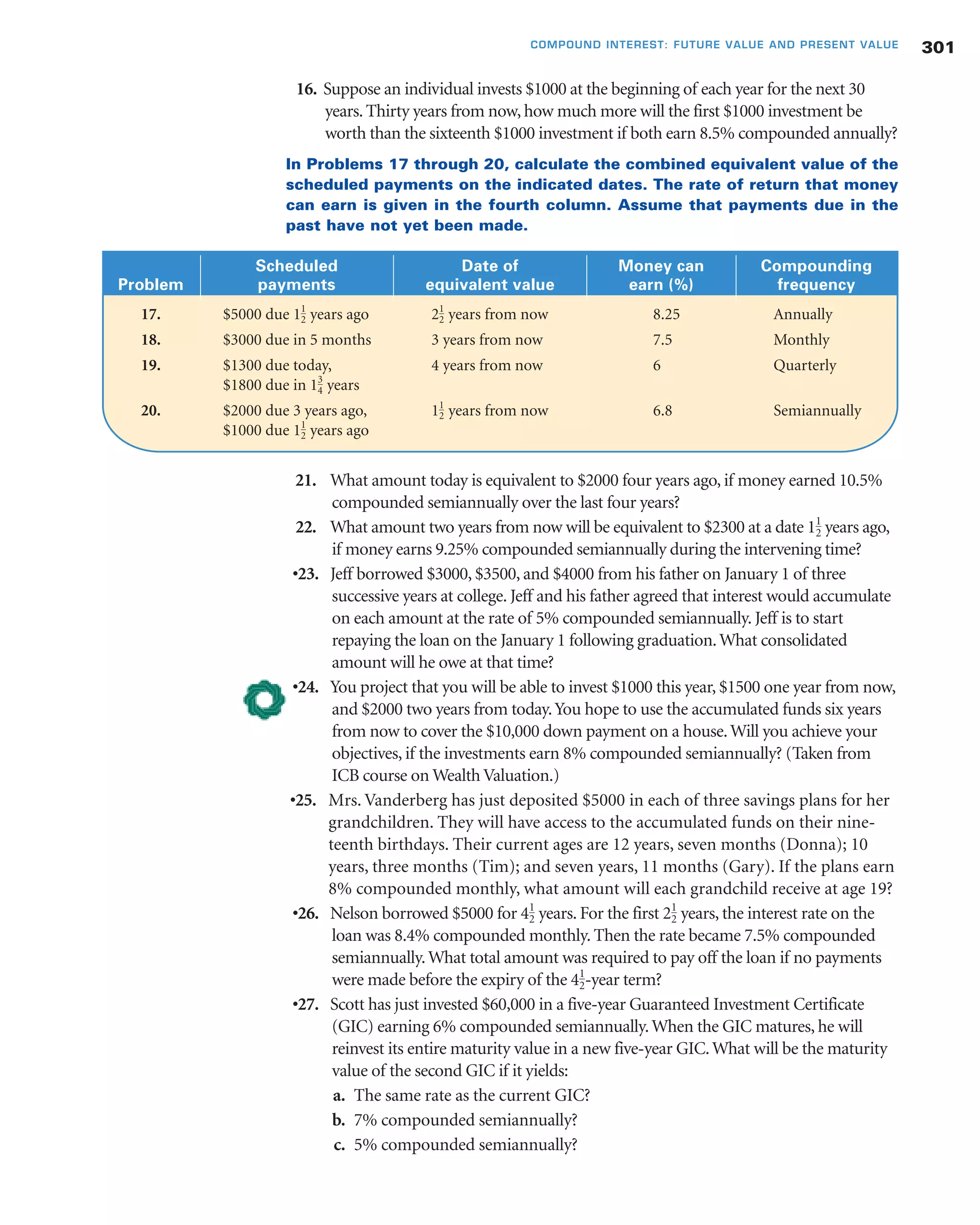
If you use any fewer than six 3s in the value for i in Example 8.3A, you will
have some round-off error in the calculated value for PV. For the fewest
keystrokes and maximum accuracy in your answer, avoid manual re-entry of
calculated values. The most efficient sequence of keystrokes resulting in the
highest accuracy of PV in Example 8.3A is
0.04 12 1 42 10000
When you employ the calculated value of i in this way, the calculator
actually uses more than the seven 3s you see in the display (after pressing
the first in the preceding sequence). The calculator maintains and
uses two or three more figures than are shown in the display. In subsequent
example problems, this procedure will be assumed but will not be shown.
Efficient Use of
Your Calculator
، yx
؋‫؍‬؉ ؉ր؊ ‫؍‬
‫؍‬
Example 8.3B CALCULATING AN EQUIVALENT PAYMENT
Mr. and Mrs. Espedido’s property taxes, amounting to $2450, are due on July 1. What amount should the
city accept if the taxes are paid eight months in advance and the city can earn 6% compounded monthly
on surplus funds?
Solution
The city should accept an amount that is equivalent to $2450, allowing for the rate of interest that the city
can earn on its surplus funds. This equivalent amount is the present value of $2450, eight months earlier.
Given: FV ϭ $2450, j ϭ 6% compounded monthly, m ϭ 12, and n ϭ 8.
Then
and Present value, PV ϭ FV(1 ϩ i)Ϫn
ϭ $2450(1.005)Ϫ8
ϭ $2354.17
The city should be willing to accept $2354.17 on a date eight months before the scheduled due date.
Example 8.3C CALCULATING THE EQUIVALENT VALUE OF TWO PAYMENTS
Two payments of $10,000 each must be made one year and four years from now. If money can earn 9%
compounded monthly, what single payment two years from now would be equivalent to the two sched-
uled payments?
Solution
When more than one payment is involved in a problem, it is helpful to present the given information in
a time diagram. Some of the calculations that need to be done may be indicated on the diagram. In this
case, we can indicate the calculation of the equivalent values by constructing arrows from the scheduled
payments to the date of the replacement payment. Then we write the relevant values for i and n on each
arrow.
The single equivalent payment will be PV ϩ FV.
FV ϭ Future value of $10,000, 12 months later
ϭ $10,000(1.0075)12
ϭ $10,938.07
PV ϭ Present value of $10,000, 24 months earlier
ϭ $10,000(1.0075)Ϫ24
ϭ $8358.31
The equivalent single payment is
$10,938.07 ϩ $8358.31 ϭ $19,296.38
0 4 Years
$10,000 $10,000
PV
FV
i = 0.75%
n = 12
1
i = 0.75%, n = 24
2
i ϭ
j
m ϭ 6%
12 ϭ 0.5% 1per month2
305COMPOUND INTEREST: FUTURE VALUE AND PRESENT VALUE
Example 8.3D DEMONSTRATING ECONOMIC EQUIVALENCE
Show why the recipient of the payments in Example 8.3C should be indifferent between receiving the
scheduled payments and receiving the replacement payment.
Solution
If the recipient ends up in the same economic position under either alternative, then he should not care
which alternative is used.
We will calculate how much money the recipient will have four years from now under each alternative,
assuming that any amounts received are invested at 9% compounded monthly.
The two alternatives are presented in the two following time diagrams.
With the scheduled payments, the total amount that the recipient will have after four years is
FV1 ϩ $10,000 ϭ $10,000(1.0075)36
ϩ $10,000
ϭ $13,086.45 ϩ $10,000
ϭ $23,086.45
With the single replacement payment, the recipient will have
FV2 ϭ $19,296.38(1.0075)24
ϭ $23,086.45
Under either alternative, the recipient will have $23,086.45 after four years. Therefore, the replacement pay-
ment is economically equivalent to the scheduled payments.
A General Principle Regarding the Present Value of Loan Payments
Let us work through a problem that will illustrate a very important principle. We will
use the data and results from Example 8.2D. In that example, we were told that three
payments of $1500 each were made on a $5000 loan at one-year intervals after the date
of the loan. The interest rate on the loan was 11% compounded quarterly. The prob-
lem was to determine the additional payment needed to pay off the loan at the end of
the fourth year. The answer was $2104.87.
We will now calculate the sum of the present values of all four payments at the date
on which the loan was granted. Use the interest rate on the loan as the discount rate.
The calculation of each payment’s present value is given in the following table.
0 4 Years
$19,296.38
FV2
i = 0.75%, n = 24
2
0 4 Years
$10,000 $10,000
FV1
i = 0.75%, n = 36
1
306 CHAPTER 8
Note that the sum of the present values is $5000.00, precisely the original principal
amount of the loan. This outcome will occur for all loans. The payments do not need to
be equal in size or to be at regular intervals. The fundamental principle is highlighted
below because we will use it repeatedly in later work.
307COMPOUND INTEREST: FUTURE VALUE AND PRESENT VALUE
Payment Amount, FV n i PV ‫؍‬ FV(1؉i)؊n
First $1500.00 4 2.75% PV1 ϭ $1500(1.0275)Ϫ4
ϭ $1345.75
Second $1500.00 8 2.75% PV2 ϭ $1500(1.0275)Ϫ8
ϭ $1207.36
Third $1500.00 12 2.75% PV3 ϭ $1500(1.0275)Ϫ12
ϭ $1083.20
Fourth $2104.87 16 2.75% PV4 ϭ $2104.87(1.0275)Ϫ16
ϭ $1363.69
Total: $5000.00
Present Value of Loan Payments
The sum of the present values of all of the payments required to pay off a
loan is equal to the original principal of the loan. The discount rate for the
present-value calculations is the rate of interest charged on the loan.
Example 8.3E CALCULATING TWO UNKNOWN LOAN PAYMENTS
Kramer borrowed $4000 from George at an interest rate of 7% compounded semiannually. The loan is to be
repaid by three payments. The first payment, $1000, is due two years after the date of the loan. The second
and third payments are due three and five years, respectively, after the initial loan. Calculate the amounts of
the second and third payments if the second payment is to be twice the size of the third payment.
Solution
In Example 8.2D, we solved a similar problem but only the last of four loan payments was unknown. In
this problem, two payments are unknown and it would be difficult to use the Example 8.2D approach.
However, the fundamental principle developed in this section may be used to solve a wide range of loan
problems (including Example 8.2D). Applying this principle to the problem at hand, we have
Sum of the present values of the three payments ϭ $4000
The given data are presented on the time line below. If we let x represent the third payment, then the sec-
ond payment must be 2x. Notice how the idea expressed by the preceding word equation can (and should)
be indicated on the diagram.
0
+ PV3
PV1
PV2
3 5 Years
x2x
2
$1000
n = 4, i = 3.5%
n = 6, i = 3.5%
n = 10, i = 3.5%
$4000
308 CHAPTER 8
Maturity Nominal Compounding
Problem value ($) Term rate (%) frequency
1. 10,000 10 years 9.9 Annually
2. 5437.52 27 months 8.5 Quarterly
3. 9704.61 42 months 7.5 Semiannually
4. 8000 18 months 5 Monthly
The second and third payments must be of sizes that will make
PV1 ϩ PV2 ϩ PV3 ϭ $4000 ➀
We can obtain a numerical value for PV1, but the best we can do for PV2 and PV3 is to express them in
terms of x. That is just fine—after we substitute these values into equation ➀, we will be able to solve for x.
PV1 ϭ FV(1 ϩ i)Ϫn
ϭ $1000(1.035)Ϫ4
ϭ $871.44
PV2 ϭ 2x(1.035)Ϫ6
ϭ 1.6270013x
PV3 ϭ x(1.035)Ϫ10
ϭ 0.7089188x
Now substitute these values into equation ➀ and solve for x.
$871.44 ϩ 1.6270013x ϩ 0.7089188x ϭ $4000
2.3359201x ϭ $3128.56
x ϭ $1339.33
Kramer’s second payment will be 2($1339.33) ϭ $2678.66, and the third payment will be $1339.33.
Concept Questions
1. What is the meaning of the term discount rate?
2. Does a smaller discount rate result in a larger or a smaller present value? Explain.
3. The process of discounting is the opposite of doing what?
4. Why does $100 have less economic value one year from now than $100 has today?
What do you need to know before you can determine the difference between the
economic values of the two payments?
5. If the present value of $X due eight years from now is 0.5$X, what is the present
value of $X due 16 years from now? Answer without using formula (8-2).
6. Suppose the future value of $1 after x years is $5.What is the present value of $1, x years
before its scheduled payment date? (Assume the same interest rate in both cases.)
EXERCISE 8.3 Answers to the odd-numbered problems are at the end of the book.
Note: In Section 8.4, you will learn how to use special functions on a financial calcu-
lator to solve compound-interest problems. Exercise 8.4 will invite you to return to this
Exercise to practise the financial calculator method.
In Problems 1 through 4, calculate the original principal that has the given
maturity value.
5. What amount must be invested for eight years at 7.5% compounded semiannually
to reach a maturity value of $10,000?
6. Ross has just been notified that the combined principal and interest on an amount
that he borrowed 27 months ago at 11% compounded quarterly is now $2297.78.
How much of this amount is principal and how much is interest?
7. What amount today is equivalent to $3500, years from now, if money can earn
9% compounded quarterly?
8. What amount 15 months ago is equivalent to $2600, years from now, if money
earns 9% compounded monthly during the intervening time?
9. If you owe $4000 at the end of five years, what amount should your creditor accept
in payment immediately, if she could earn 6% compounded semiannually on her
money? (Source: ICB course on Wealth Valuation.)
10. Gordon can receive a $77 discount if he pays his property taxes early.Alternatively,
he can pay the full amount of $2250 when payment is due in nine months.Which
alternative is to his advantage if he can earn 6% compounded monthly on short-
term investments? In current dollars, how much is the advantage?
11. Gwen is considering two offers on a residential building lot that she wishes to sell.
Mr.Araki’s offer is $58,000 payable immediately. Ms. Jorgensen’s offer is for $10,000
down and $51,000 payable in one year.Which offer has the greater economic value if
Gwen can earn 6.5% compounded semiannually on funds during the next year? In
current dollars, how much more is this offer worth?
12. A lottery winner is offered the choice between $20,000 paid now, or $11,000 now
and another $11,000 in five years.Which option should the winner choose, if money
can now earn 5% compounded semiannually over a five-year term? How much
more is the preferred choice worth in current dollars?
13. You have been offered $100 one year from now, $600 two years from now, and $400
three years from now. The price you are asked to pay in today’s dollars for these cash
flows is $964. If the rate of interest you are using to evaluate this deal is 10%
compounded annually, should you take it? (Source: ICB course on WealthValuation.)
In Problems 14 through 21, calculate the combined equivalent value of the
scheduled payments on the indicated dates. The rate of return that money
can earn is given in the fourth column. Assume that payments due in the
past have not yet been made.
11
2
31
2
309COMPOUND INTEREST: FUTURE VALUE AND PRESENT VALUE
Scheduled Date of Money can Compounding
Problem payments equivalent value earn (%) frequency
14. $7000 due in 8 years years from now 9.9 Semiannually
15. $1300 due in years 9 months from now 5.5 Quarterly
16. $1400 due today, 3 years from now 6 Quarterly
$1800 due in 5 years
17. $900 due today, 18 months from now 10 Monthly
$500 due in 22 months
18. $1000 due in 3 years, 1 year from now 7.75 Semiannually
$2000 due in 5 years
19. $1500 due 9 months ago, 2 years from now 9 Quarterly
$2500 due in 4 years
20. $2100 due 1 years ago, 6 months from now 4.5 Monthly
$1300 due today,
$800 due in 2 years
21. $750 today, 18 months from now 9.5 Semiannually
$1000 due in 2 years,
$1250 due in 4 years
1
2
1
2
1
4
1
2
1
2
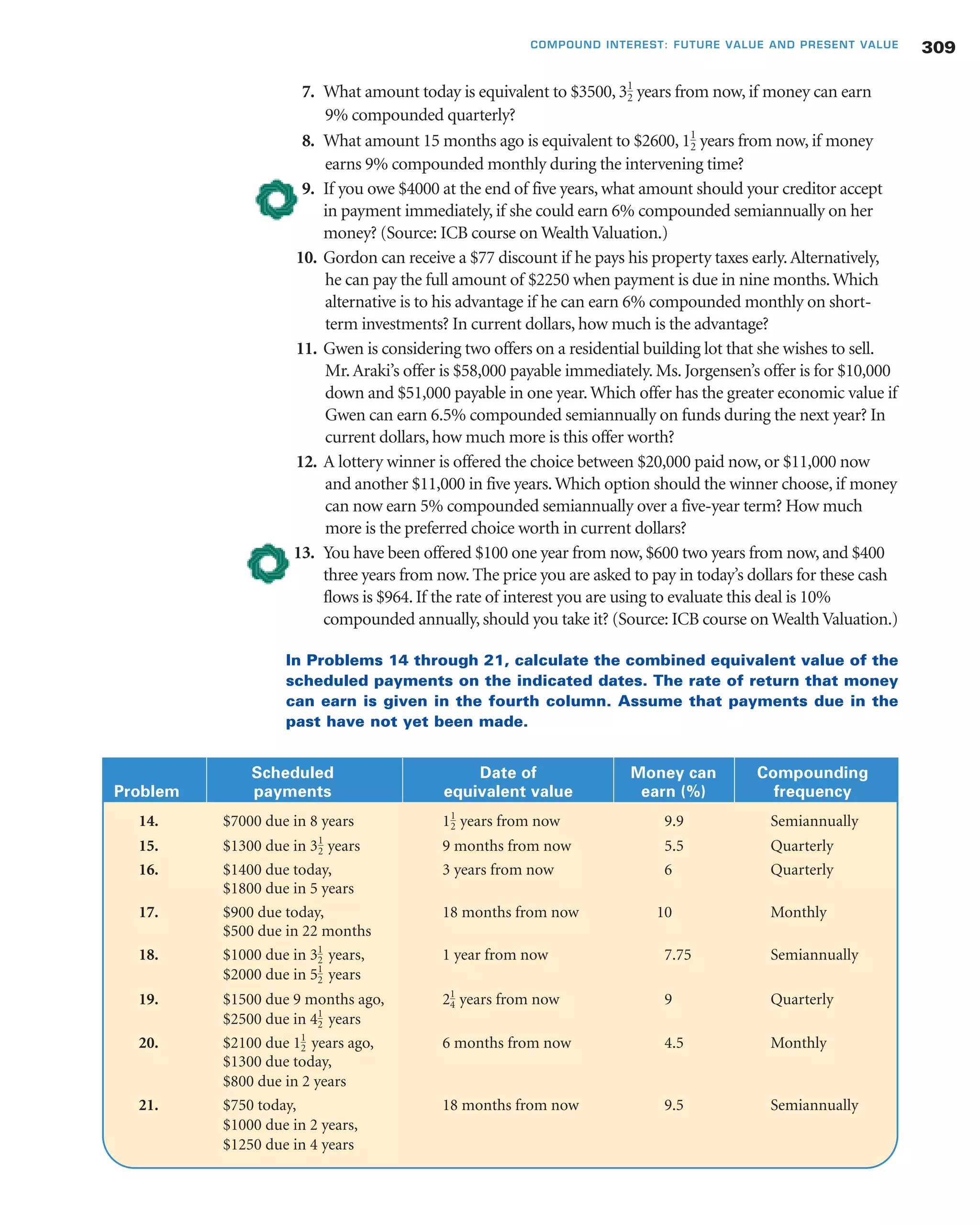
31
2
11
2
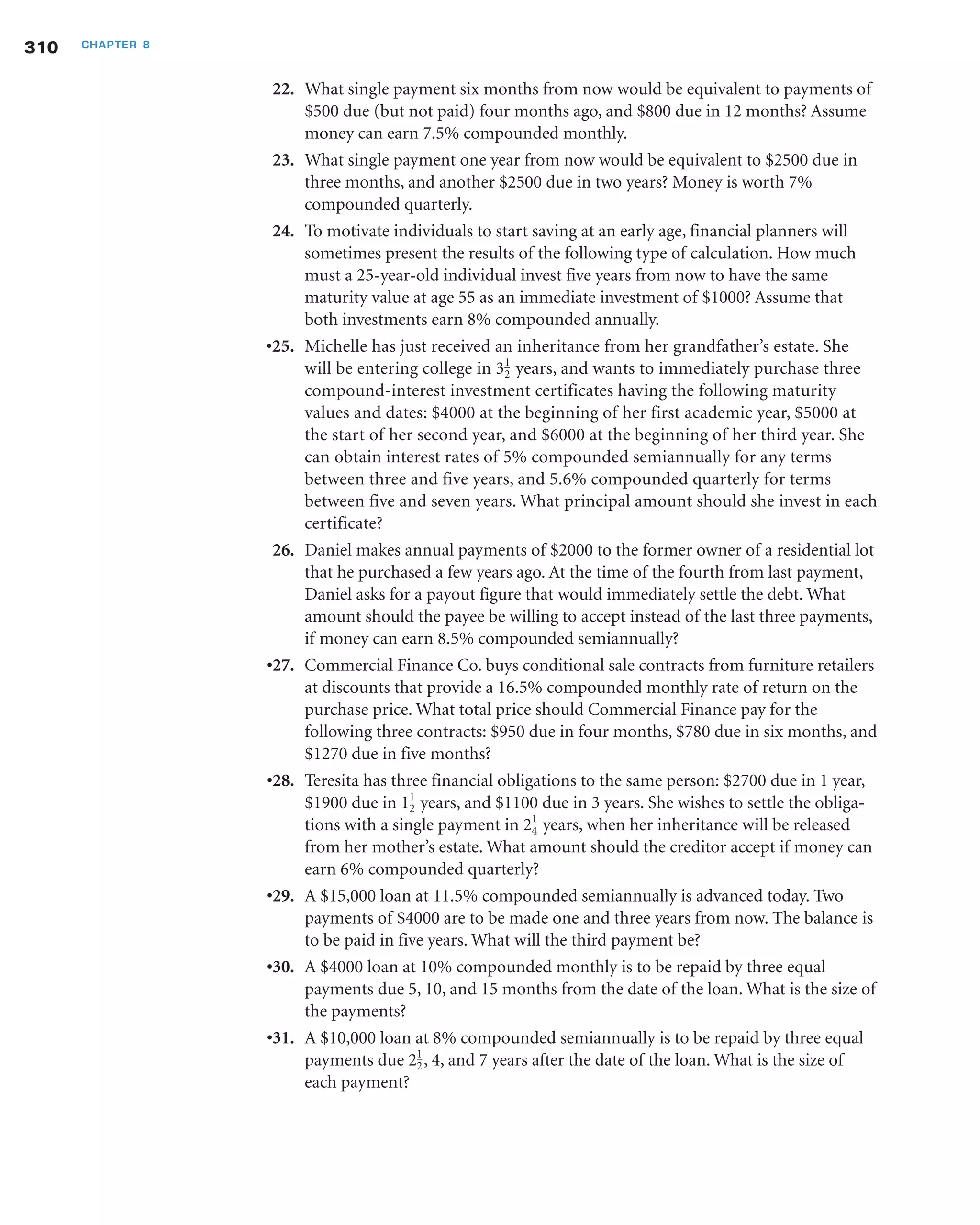
22. What single payment six months from now would be equivalent to payments of
$500 due (but not paid) four months ago, and $800 due in 12 months? Assume
money can earn 7.5% compounded monthly.
23. What single payment one year from now would be equivalent to $2500 due in
three months, and another $2500 due in two years? Money is worth 7%
compounded quarterly.
24. To motivate individuals to start saving at an early age, financial planners will
sometimes present the results of the following type of calculation. How much
must a 25-year-old individual invest five years from now to have the same
maturity value at age 55 as an immediate investment of $1000? Assume that
both investments earn 8% compounded annually.
•25. Michelle has just received an inheritance from her grandfather’s estate. She
will be entering college in 3 years, and wants to immediately purchase three
compound-interest investment certificates having the following maturity
values and dates: $4000 at the beginning of her first academic year, $5000 at
the start of her second year, and $6000 at the beginning of her third year. She
can obtain interest rates of 5% compounded semiannually for any terms
between three and five years, and 5.6% compounded quarterly for terms
between five and seven years. What principal amount should she invest in each
certificate?
26. Daniel makes annual payments of $2000 to the former owner of a residential lot
that he purchased a few years ago. At the time of the fourth from last payment,
Daniel asks for a payout figure that would immediately settle the debt. What
amount should the payee be willing to accept instead of the last three payments,
if money can earn 8.5% compounded semiannually?
•27. Commercial Finance Co. buys conditional sale contracts from furniture retailers
at discounts that provide a 16.5% compounded monthly rate of return on the
purchase price. What total price should Commercial Finance pay for the
following three contracts: $950 due in four months, $780 due in six months, and
$1270 due in five months?
•28. Teresita has three financial obligations to the same person: $2700 due in 1 year,
$1900 due in 1 years, and $1100 due in 3 years. She wishes to settle the obliga-
tions with a single payment in 2 years, when her inheritance will be released
from her mother’s estate. What amount should the creditor accept if money can
earn 6% compounded quarterly?
•29. A $15,000 loan at 11.5% compounded semiannually is advanced today. Two
payments of $4000 are to be made one and three years from now. The balance is
to be paid in five years. What will the third payment be?
•30. A $4000 loan at 10% compounded monthly is to be repaid by three equal
payments due 5, 10, and 15 months from the date of the loan. What is the size of
the payments?
•31. A $10,000 loan at 8% compounded semiannually is to be repaid by three equal
payments due 2 , 4, and 7 years after the date of the loan. What is the size of
each payment?
1
2
1
4
1
2
1
2
310 CHAPTER 8
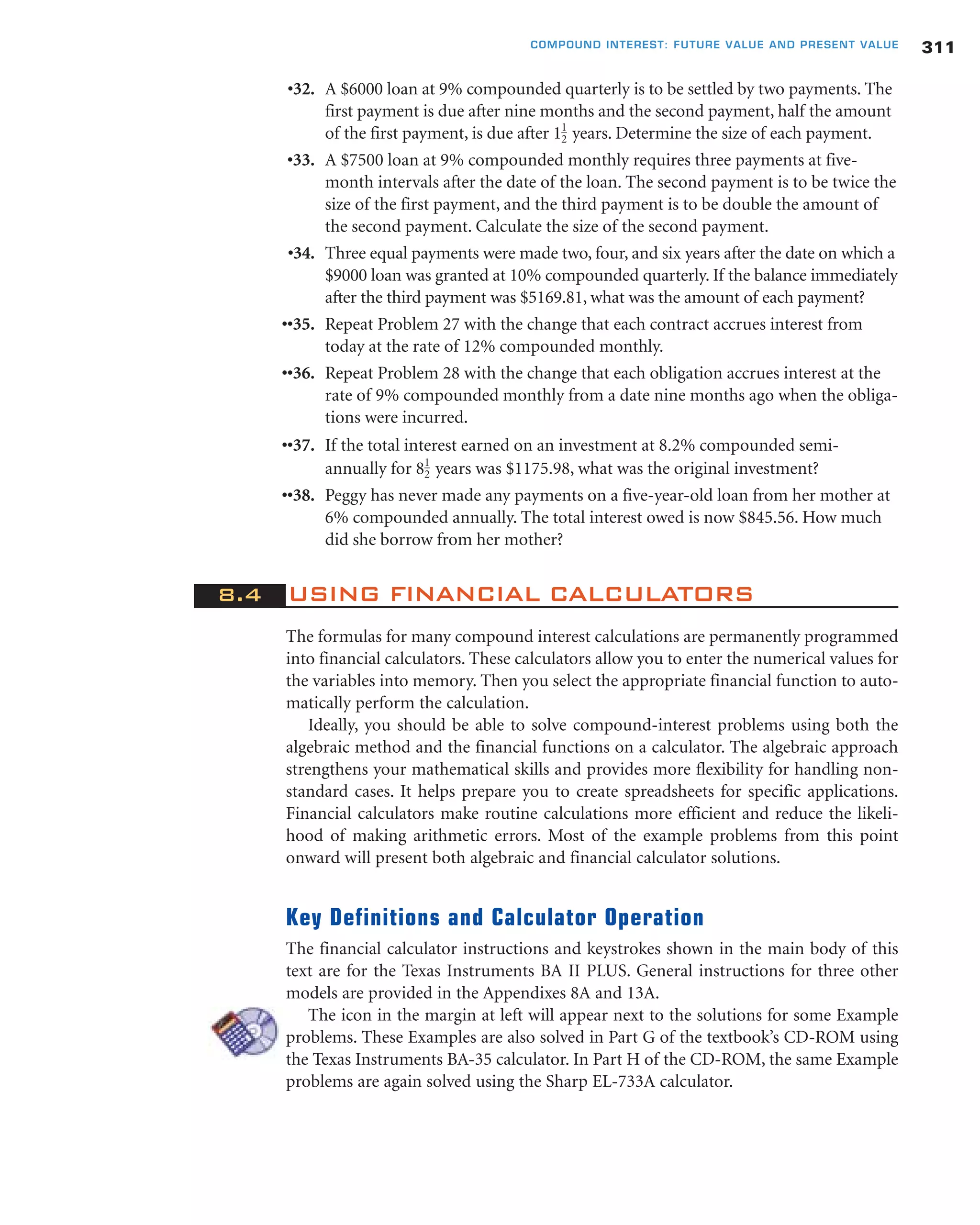
•32. A $6000 loan at 9% compounded quarterly is to be settled by two payments. The
first payment is due after nine months and the second payment, half the amount
of the first payment, is due after 1 years. Determine the size of each payment.
•33. A $7500 loan at 9% compounded monthly requires three payments at five-
month intervals after the date of the loan. The second payment is to be twice the
size of the first payment, and the third payment is to be double the amount of
the second payment. Calculate the size of the second payment.
•34. Three equal payments were made two, four, and six years after the date on which a
$9000 loan was granted at 10% compounded quarterly. If the balance immediately
after the third payment was $5169.81, what was the amount of each payment?
••35. Repeat Problem 27 with the change that each contract accrues interest from
today at the rate of 12% compounded monthly.
••36. Repeat Problem 28 with the change that each obligation accrues interest at the
rate of 9% compounded monthly from a date nine months ago when the obliga-
tions were incurred.
••37. If the total interest earned on an investment at 8.2% compounded semi-
annually for 8 years was $1175.98, what was the original investment?
••38. Peggy has never made any payments on a five-year-old loan from her mother at
6% compounded annually. The total interest owed is now $845.56. How much
did she borrow from her mother?
8.4 USING FINANCIAL CALCULATORS
The formulas for many compound interest calculations are permanently programmed
into financial calculators. These calculators allow you to enter the numerical values for
the variables into memory. Then you select the appropriate financial function to auto-
matically perform the calculation.
Ideally, you should be able to solve compound-interest problems using both the
algebraic method and the financial functions on a calculator. The algebraic approach
strengthens your mathematical skills and provides more flexibility for handling non-
standard cases. It helps prepare you to create spreadsheets for specific applications.
Financial calculators make routine calculations more efficient and reduce the likeli-
hood of making arithmetic errors. Most of the example problems from this point
onward will present both algebraic and financial calculator solutions.
Key Definitions and Calculator Operation
The financial calculator instructions and keystrokes shown in the main body of this
text are for the Texas Instruments BA II PLUS. General instructions for three other
models are provided in the Appendixes 8A and 13A.
The icon in the margin at left will appear next to the solutions for some Example
problems. These Examples are also solved in Part G of the textbook’s CD-ROM using
the Texas Instruments BA-35 calculator. In Part H of the CD-ROM, the same Example
problems are again solved using the Sharp EL-733A calculator.
1
2
1
2
311COMPOUND INTEREST: FUTURE VALUE AND PRESENT VALUE
312 CHAPTER 8
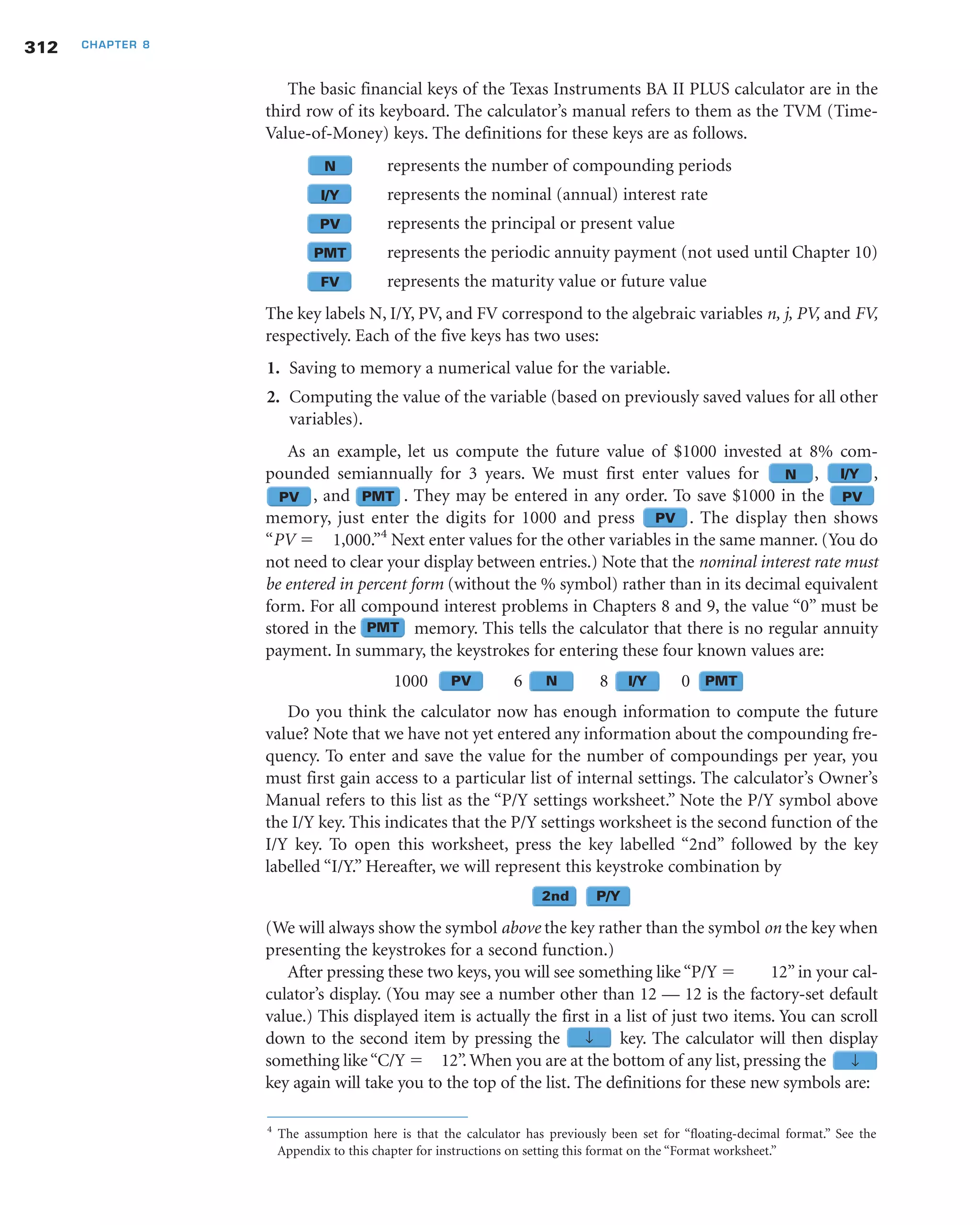
The basic financial keys of the Texas Instruments BA II PLUS calculator are in the
third row of its keyboard. The calculator’s manual refers to them as the TVM (Time-
Value-of-Money) keys. The definitions for these keys are as follows.
N represents the number of compounding periods
I/Y represents the nominal (annual) interest rate
PV represents the principal or present value
PMT represents the periodic annuity payment (not used until Chapter 10)
FV represents the maturity value or future value
The key labels N, I/Y, PV, and FV correspond to the algebraic variables n, j, PV, and FV,
respectively. Each of the five keys has two uses:
1. Saving to memory a numerical value for the variable.
2. Computing the value of the variable (based on previously saved values for all other
variables).
As an example, let us compute the future value of $1000 invested at 8% com-
pounded semiannually for 3 years. We must first enter values for , ,
, and . They may be entered in any order. To save $1000 in the
memory, just enter the digits for 1000 and press . The display then shows
“PV ϭ 1,000.”4
Next enter values for the other variables in the same manner. (You do
not need to clear your display between entries.) Note that the nominal interest rate must
be entered in percent form (without the % symbol) rather than in its decimal equivalent
form. For all compound interest problems in Chapters 8 and 9, the value “0” must be
stored in the memory. This tells the calculator that there is no regular annuity
payment. In summary, the keystrokes for entering these four known values are:
1000 6 8 0
Do you think the calculator now has enough information to compute the future
value? Note that we have not yet entered any information about the compounding fre-
quency. To enter and save the value for the number of compoundings per year, you
must first gain access to a particular list of internal settings. The calculator’s Owner’s
Manual refers to this list as the “P/Y settings worksheet.” Note the P/Y symbol above
the I/Y key. This indicates that the P/Y settings worksheet is the second function of the
I/Y key. To open this worksheet, press the key labelled “2nd” followed by the key
labelled “I/Y.” Hereafter, we will represent this keystroke combination by
(We will always show the symbol above the key rather than the symbol on the key when
presenting the keystrokes for a second function.)
After pressing these two keys, you will see something like “P/Y ϭ 12” in your cal-
culator’s display. (You may see a number other than 12 — 12 is the factory-set default
value.) This displayed item is actually the first in a list of just two items. You can scroll
down to the second item by pressing the key. The calculator will then display
something like“C/Y ϭ 12”. When you are at the bottom of any list, pressing the
key again will take you to the top of the list. The definitions for these new symbols are:
N I/Y
N↓
N2nd NP/Y
NPMTNI/YNNPV
PV
PVPMTPV
4
The assumption here is that the calculator has previously been set for “floating-decimal format.” See the
Appendix to this chapter for instructions on setting this format on the “Format worksheet.”
N↓
PMT
P/Y represents the number of annuity payments per year
C/Y represents the number of compoundings per year
Therefore, C/Y corresponds to the algebraic symbol m.
If the calculation does not involve an annuity, P/Y must be given the same value as
C/Y.5
This requirement applies to all problems in Chapters 8 and 9. In the current
example, we have semiannual compounding. Therefore, we need to set both P/Y and
C/Y equal to 2.To do that,scroll back to“P/Y ϭ 12”in your calculator’s display.Press
2
The calculator display now shows “P/Y ϭ 2”. Next, scroll down to C/Y. Observe that
its value has automatically changed to 2. Entering a new value for P/Y always causes C/Y
to change automatically to the same value. So for all problems in Chapters 8 and 9, we
need only set P/Y ϭ m. That will produce the desired result of making C/Y ϭ P/Y ϭ m.6
Before we can compute the future value of the $1000, we must close the P/Y settings
worksheet. Note that the second function of the key labelled CPT is QUIT. Pressing
will close any worksheet you have opened. Then, to execute the future value calcula-
tion, press
The calculator will display “FV ϭ Ϫ1,265.319018.” Rounded to the nearest cent, the
future value of the $1000 investment is $1265.32. The significance of the negative sign7
will be discussed in the next subsection.
Let’s summarize the complete sequence of keystrokes needed for the future value cal-
culation.
1000 6 8 0
2
313COMPOUND INTEREST: FUTURE VALUE AND PRESENT VALUE
NPV NN NI/Y NPMT
N2nd NP/Y NENTER NQUIT NCPT NFVN2nd
NQUIT
NFV
N2nd
NCPT
NENTER
5
This requirement does not come from any logic or line of reasoning. It is just a result of the particular way Texas
Instruments has programmed the calculator.
6
Later in Chapter 10, P/Y and C/Y will have differing values in some annuity problems. We will deal with this
matter when needed.
7
The Texas Instruments BA 35 does not display a negative sign at this point.
You can operate your calculator more efficiently if you take advantage of the
following features.
1. After any computation, all internal settings and numbers saved in memory
are retained until you change them or clear them. Therefore, you do not need
to re-enter a variable’s value if it is unchanged in a subsequent calculation.
2. Whenever you accidentally press one of the five financial keys, the number
in the display at that moment will be saved as the value of that financial
variable. At any time, you can check the value stored in a financial key’s
memory by pressing followed by the key.
3. When you turn the calculator off, it still retains the internal settings and the
values in memory. (When the calculator’s battery becomes weak, this
feature and other calculator operations are unreliable.)
Efficient Use of
Your Calculator
NRCL
Cash-Flow Sign Convention
Cash flow is a term frequently used in finance and accounting to refer to a cash pay-
ment. A cash inflow is a cash receipt; a cash outflow is a cash disbursement. A cash
inflow should be saved in a financial calculator’s memory as a positive value.A cash out-
flow should be entered as a negative number. These two simple rules have a rather
overblown name in finance—the cash-flow sign convention.
All financial calculators use the cash-flow convention.8
Finance courses and finance
textbooks use it. The financial functions in Microsoft’s Excel and Corel’s Quattro Pro
spreadsheet software employ it. The greatest benefits from using the sign convention
come in later chapters. However, we will introduce it now so you can become familiar
with it before moving on to more complex cases.
To use the cash-flow sign convention, you must treat a compound interest problem
as either an investment or a loan. The directions of the cash flows for these two cases
are compared in the following table. When you invest money, you pay it (cash outflow)
to some institution or individual. Later, you receive cash inflows from investment
income and from the sale or conclusion of the investment. In contrast, when you
receive a loan, it is a cash inflow for you. The subsequent cash flows in the loan trans-
action are the loan payments (cash outflows).
314 CHAPTER 8
Cash-Flow Sign Convention
Cash inflows (receipts) are positive.
Cash outflows (disbursements) are negative.
Transaction Initial cash flow Subsequent cash flows
Investment Outflow (negative) Inflows (positive)
Loan Inflow (positive) Outflows (negative)
Now you can understand why your calculator gave a negative future value earlier
in this section. Because we entered 1000 as a positive number in the memory,
the calculator interpreted the $1000 as a loan. The computed future value represents
the single payment required to pay off the loan. Since this payment is a cash outflow, the
calculator displayed it as a negative number. To properly employ the sign convention
for the initial $1000 investment, we should have entered 1000 in as a negative
number. The calculator would then compute a positive future value—the cash inflow
we will receive when the investment matures.
To illustrate the use of financial calculators, Example problems 8.3A, 8.3C, and 8.3E
will now be repeated as Examples 8.4A, 8.4B, and 8.4C, respectively.
8
The Texas Instruments BA 35 calculator employs a modified version of this sign convention. Users of the BA 35
are referred to the Appendix of this chapter for details.
PV
PV
Example 8.4A THE INVESTMENT NEEDED TO REACH A TARGET FUTURE VALUE
What amount must you invest now at 4% compounded monthly to accumulate $10,000 after 3 years?
Solution
Given: j ϭ 4%, m ϭ 12, FV ϭ $10,000, Term ϭ 3.5 years
Then n ϭ m ϫ Term ϭ 12(3.5) ϭ 42
Enter the known variables and then compute the present value.
42 4 0 10000
12 Answer: Ϫ8695.606596
Note that we entered the $10,000 as a positive value because it is the cash inflow you will receive 3.5 years
from now. The answer is negative because it represents the investment (cash outflow) that must be made
today. Rounded to the cent, the initial investment required is $8695.61.
Example 8.4B CALCULATING THE EQUIVALENT VALUE OF TWO PAYMENTS
Two payments of $10,000 each must be made one year and four years from now. If money can earn 9%
compounded monthly, what single payment two years from now would be equivalent to the two scheduled
payments?
Solution
Given: j ϭ 9% compounded monthly making m ϭ 12 and
Other data and the solution strategy are shown on the time line below. FV1 represents the future value of
the first scheduled payment and PV2 represents the present value of the second payment.
i ϭ j
m ϭ 9%
12 ϭ 0.75%
1
2
315COMPOUND INTEREST: FUTURE VALUE AND PRESENT VALUE
2nd
N PMT FVI/Y
ENTER 2nd QUIT CPT PVP/Y
0 4 Years
$10,000 $10,000
PV2
FV1
i = 0.75%, n = 12
1
i = 0.75%, n = 24
2
The single equivalent payment is FV1 ϩ PV2. Before we start crunching numbers, let’s exercise your
intuition. Do you think the equivalent payment will be greater or smaller than $20,000? It is clear that
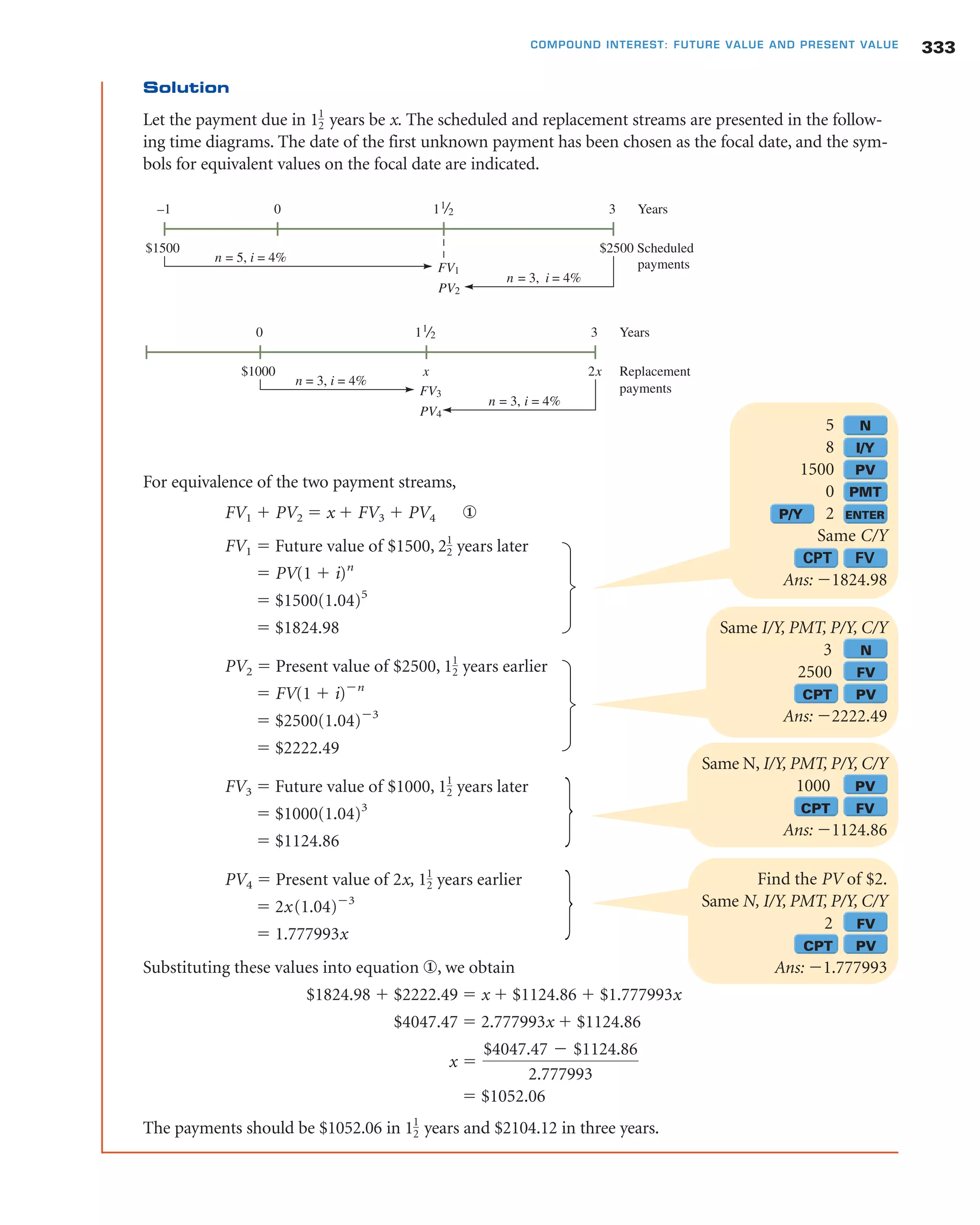
FV1 is greater than $10,000 and that PV2 is less than $10,000. When the two amounts are added, will the
sum be more than or less than $20,000? We can answer this question by comparing the time intervals
through which we “shift” each of the $10,000 payments. The first payment will have one year’s interest
added but the second payment will be discounted for two years’ interest.9
Therefore, PV2 is farther below
$10,000 than FV1 is above $10,000. Hence, the equivalent payment will be less than $20,000. So if your
9
You cannot conclude that the difference between $10,000 and PV1 will be twice the difference between FV2 and
$10,000. To illustrate this sort of effect, consider that at 10% compounded annually, the future value of $100
one year later is $110 while the present value of $100 one year earlier is $90.91. We see that the increase ($10)
when compounding ahead one year exceeds the decrease ($9.09) when discounting back one year.
equivalent payment turns out to be more than $20,000, you will know that your solution has an error.
Returning to the calculations,
FV1: 12 9 10000 0
12 Answer: Ϫ10,938.07
PV2: Do not clear the values and settings currently in memory. Then you need enter only those values and
settings that change.
24 10000 Answer: Ϫ8358.31
The equivalent payment two years from now is $10,938.07 ϩ $8358.31 ϭ $19,296.38.
Note: An equivalent payment problem is neither a loan nor an investment situation. Loans and investments
always involve at least one cash flow in each direction.10
An equivalent payment is a payment that can substitute
for one or more other payments. The substitute payment will flow in the same direction as the payment(s) it
replaces. So how should you apply the cash-flow sign convention to equivalent payment calculations? Just enter
the scheduled payments as positive numbers and ignore the opposite sign on the calculated equivalent value.
Example 8.4C CALCULATING TWO UNKNOWN LOAN PAYMENTS
Kramer borrowed $4000 from George at an interest rate of 7% compounded semiannually. The loan is to be
repaid by three payments. The first payment, $1000, is due two years after the date of the loan. The second
and third payments are due three and five years, respectively, after the initial loan. Calculate the amounts of
the second and third payments if the second payment is to be twice the size of the third payment.
Solution
Given: j ϭ 7% compounded semiannually making m ϭ 2 and
Let x represent the third payment. Then the second payment must be 2x. As indicated in the following dia-
gram, PV1, PV2, and PV3 represent the present values of the first, second, and third payments.
Since the sum of the present values of all payments equals the original loan, then
PV1 ϩ PV2 ϩ PV3 ϭ $4000 ①
PV1: 4 7 0 1000
2 Answer:Ϫ871.41
At first, we may be stumped as to how to proceed for PV2 and PV3. Let’s think about the third payment of x
dollars. We can compute the present value of just $1 from the x dollars.
0
+ PV3
PV1
PV2
3 5 Years
x2x
2
$1000
n = 4, i = 3.5%
n = 6, i = 3.5%
n = 10, i = 3.5%
$4000
i ϭ
j
m ϭ 7%
2 ϭ 3.5%
316 CHAPTER 8
N I/Y PMTPV
N
2nd ENTER 2nd QUIT CPT PVP/Y
I/Y PMT FV
N FV CPT PV
2nd ENTER 2nd QUIT CPT FVP/Y
10
At least, this is what lenders and investors hope will happen.
10 1 Answer: Ϫ0.7089188
The present value of $1 paid five years from now is $0.7089188 (almost $0.71). Consider the following
questions (Q) and their answers (A).
Q: What is the present value of $2? A: It’s about 2 ϫ $0.71 ϭ $1.42.
Q: What is the present value of $5? A: It’s about 5 ϫ $0.71 ϭ $3.55.
Q: What is the present value of $x? A: Extending the preceding pattern, the present value of
$x is about x ϫ $0.71 ϭ $0.71x. Precisely, it is
PV3 ϭ $0.7089188x.
Similarly, calculate the present value of $1 from the second payment of 2x dollars. The only variable that
changes from the previous calculation is .
6 Answer: Ϫ0.8135006
Hence, the present value of $2x is PV2 ϭ 2x($0.8135006) ϭ $1.6270013x
Now substitute the values for PV1, PV2 and PV3 into equation ➀ and solve for x.
$871.44 ϩ 1.6270013x ϩ 0.7089188x ϭ $4000
2.3359201x ϭ $3128.56
x ϭ $1339.33
Kramer’s second payment will be 2($1339.33) ϭ $2678.66 and the third payment will be $1339.33.
EXERCISE 8.4 Solve the problems in Exercises 8.2 and 8.3 using the financial functions on a cal-
culator.
8.5 OTHER APPLICATIONS OF COMPOUNDING
Compound-Interest Investments
The two most common types of compound interest investments owned by Canadians
are Guaranteed Investment Certificates and Canada Savings Bonds.11
Guaranteed Investment Certificates (GICs) GICs may be purchased
from banks, credit unions, trust companies, and caisses populaires (mostly in Quebec).
When you buy a GIC from a financial institution, you are in effect lending money to it
or to one of its subsidiaries. The financial institution uses the funds raised from selling
GICs to make loans—most commonly, mortgage loans. The interest rate charged on
mortgage loans is typically 1.5% to 2% higher than the interest rate paid to GIC
investors. The word “Guaranteed” in the name of this investment refers to the uncon-
ditional guarantee of principal and interest by the parent financial institution. In addi-
tion to this guarantee, there is usually some form of government-regulated deposit
insurance.
317COMPOUND INTEREST: FUTURE VALUE AND PRESENT VALUE
N
N
N
FV CPT
CPT
PV
PV
11
In recent years provincial savings bonds have been issued by the governments of Alberta, British Columbia,
Manitoba, Ontario, and Saskatchewan. Purchase of provincial bonds is usually restricted to residents of the
issuing province.
Most Guaranteed Investment Certificates are purchased with maturities in the
range of one to five years. Longer maturities (up to 10 years) are available, but are not
covered by deposit insurance. Most GICs are not redeemable before maturity. The fol-
lowing diagrams present alternative arrangements for structuring interest rates and for
paying interest on conventional GICs.
Structure of interest rates
Fixed rate: The Step-up rate: The Variable Rate: The
interest rate does not interest rate is interest rate is adjusted
change over the term increased every six every year or every six
of the GIC. months or every year months to reflect
according to a pre- prevailing market rates.
determined schedule. There may be a
minimum“floor” below
which rates cannot drop.
Payment of interest
Regular interest version: Compound interest version:
Interest is paid periodically Interest is periodically converted
to the investor. to principal and paid at
maturity.
The regular interest versions of GICs are not mathematically interesting since peri-
odic interest is paid out to the investor instead of being converted to principal. For
compound interest versions, there are two mathematically distinct cases.
1. If the interest rate is fixed, use FV ϭ PV(1 ϩ i)n
to calculate the maturity value.
2. If the interest rate is either a variable rate or a step-up rate, you must multiply the
individual (1 ϩ i) factors for all compounding periods. That is, use
(8-4) FV ‫؍‬ PV(1 ؉ i1)(1 ؉ i2)(1 ϩ i3) . . . (1 ؉ in )
Example 8.5A CALCULATING THE PAYMENT FROM A REGULAR INTEREST GIC
What periodic payment will an investor receive from a $9000, four-year, monthly payment GIC earning a
nominal rate of 5.25% compounded monthly?
Solution
The interest rate per payment interval is
The monthly payment will be
PV ϫ i ϭ $9000 ϫ 0.004375 ϭ $39.38
i ϭ
j
m ϭ 5.25%
12 ϭ 0.4375%
FUTURE VALUE
(VARIABLE AND STEP-
UP INTEREST RATES)
318 CHAPTER 8
NET @ssets
Information about the GICs
offered by a financial institution
is usually available on its Web
site. At any one time, a
chartered bank may have 10 or
12 varieties of GICs in its reper-
toire. In recent years, “financial
engineers” have created more
exotic forms of GICs. The rate of
return on some is linked to the
performance of a stock market.
Here are the Home Page URLs
of our largest financial institu-
tions:
RBC Royal Bank
(www.royalbank.com)
Bank of Montreal
(www.bmo.com)
CIBC
(www.cibc.com)
Scotiabank
(www.scotiabank.com)
TD Canada Trust
(www.tdcanadatrust.com)
Example 8.5B COMPARING GICS HAVING DIFFERENT NOMINAL RATES
Suppose a bank quotes nominal annual interest rates of 6.6% compounded annually, 6.5% compounded
semiannually, and 6.4% compounded monthly on five-year GICs. Which rate should an investor choose?
Solution
An investor should choose the rate that results in the highest maturity value. The given information may be
arranged in a table.
j m n
6.6% 1 6.6% 5
6.5 2 3.25 10
6.4 12 60
Choose an amount, say $1000, to invest. Calculate the maturity values for the three alternatives.
FV ϭ PV (1 ϩ i)n
ϭ $1000(1.066)5
ϭ $1376.53 for m ϭ 1
ϭ $1000(1.0325)10
ϭ $1376.89 for m ϭ 2
ϭ $1000( )60
ϭ $1375.96 for m ϭ 12
Hereafter, we will usually present the financial calculator keystrokes in a vertical format.
j ϭ 6.6% j ϭ 6.5% j ϭ 6.4%
compounded compounded compounded
annually semiannually monthly
1.0053
0.53
i ϭ
j
m
319COMPOUND INTEREST: FUTURE VALUE AND PRESENT VALUE
5 N
6.6 I/Y
1000 ؉/؊ PV
0 PMT
2nd P/Y
1 ENTER
2nd QUIT
CPT FV
Ans: 1376.53
Same PV, PMT
10 N
6.5 I/Y
P/Y 2 ENTER
Same C/Y
CPT FV
Ans: 1376.89
Same PV, PMT
60 N
6.4 I/Y
P/Y 12 ENTER
Same C/Y
CPT FV
Ans: 1375.96
In the second and third columns, we have shown only those values that change from the preceding step.
The previous values for and are automatically retained if you do not clear the TVM
memories. To shorten the presentation of solutions hereafter, we will indicate the value to be entered for
P/Y (and C/Y) as in the second and third columns above. As indicated by the brace, a single line in the sec-
ond and third columns replaces three lines in the first column. You must supply the omitted keystrokes.
The investor should choose the GIC earning 6.5% compounded semiannually since it produces the
highest maturity value.
PV PMT
Example 8.5C MATURITY VALUE OF A VARIABLE-RATE GIC
A chartered bank offers a five-year “Escalator Guaranteed Investment Certificate.” In successive years it pays
annual interest rates of 4%, 4.5%, 5%, 5.5%, and 6%, respectively, compounded at the end of each year. The
bank also offers regular five-year GICs paying a fixed rate of 5% compounded annually. Calculate and com-
pare the maturity values of $1000 invested in each type of GIC. (Note that 5% is the average of the five suc-
cessive one-year rates paid on the Escalator GIC.)
Solution
Using formula (8-4), the maturity value of the Escalator GIC is
FV ϭ $1000(1.04)(1.045)(1.05)(1.055)(1.06) ϭ $1276.14
Using formula (8-2), the maturity value of the regular GIC is
FV ϭ $1000(1.05)5
ϭ $1276.28
The Escalator GIC will mature at $1276.14, but the regular GIC will mature at $1276.28 ($0.14 more). We
can also conclude from this example that a series of compound interest rates does not produce the same
future value as the average rate compounded over the same period.
*
Canada Savings Bonds (CSBs) Although you may purchase CSBs from the
same financial institutions that issue GICs, your money goes to the federal government
to help finance its debt.12
The financial institution is merely an agent in the transaction.
Canada Savings Bonds sold in recent years have terms of 10 or 12 years. The batch of
bonds sold on a particular date is assigned a series number. For example, the CSBs issued
on November 1, 2000 are referred to as Series 66 (S66). All CSBs have variable interest
rates—the Finance Department changes the interest rate for a particular series on that
series’ anniversary date. The interest rate is adjusted to bring it into line with prevailing
rates. The interest rates paid on CSBs issued on November 1 each year are presented in
Table 8.2.
Canada Savings Bonds are issued in regular interest versions (that pay out the inter-
est on each anniversary date) and compound interest versions (that convert interest to
principal on each anniversary).
Canada Savings Bonds may be redeemed at any time.13
The following rules apply
to calculating the interest for the partial year since the most recent anniversary date.
● Interest is accrued to the first day of the month in which redemption occurs. (If you
redeem a CSB partway through a month, you receive no interest for the partial month.)
● Interest is calculated on a simple interest basis. That is, the additional interest for the
partial year is I ϭ Prt where
P ϭ The principal (including converted interest on compound interest bonds) at
the preceding anniversary date
r ϭ The prescribed annual interest rate for the current year
t ϭ The number of months (from the preceding anniversary date up to the first
day of the month in which redemption occurs) divided by 12
320 CHAPTER 8
NET @ssets
Canada Investment and Savings
is an agency of the federal
Department of Finance. It
maintains a Web site
(www.cis-pec.gc.ca) providing
information on Canada Savings
Bonds and Canada Premium
Bonds. Interest rates on all
unmatured issues are available
on the site. Calculators are
provided that allow you to
determine the amount you will
receive if you redeem a partic-
ular CSB on a specific date.
12
At the end of 2000, the total outstanding amount of CSBs was $26.9 billion. This represented less than 5% of
Canada’s net federal debt.
13
In 1997, the Government of Canada started to issue a new type of savings bond called Canada Premium Bonds.
They may be redeemed, but only on an anniversary date. Because of this restriction on redemption, Canada
Premium Bonds pay a higher interest rate than Canada Savings Bonds.
Example 8.5D CALCULATING THE REDEMPTION VALUE OF A COMPOUND INTEREST
CANADA SAVINGS BOND
A $1000 face value Series S50 compound interest Canada Savings Bond (CSB) was presented to a credit
union branch for redemption. What amount did the owner receive if the redemption was requested on:
a. November 1, 2000? b. January 17, 2001?
Solution
a. In Table 8.2, we note that Series S50 CSBs were issued on November 1, 1995. November 1, 2000 falls on
the fifth anniversary of the issue date. Substituting the annual interest rates for S50 bonds from Table 8.2
into formula (8-4), we have
FV ϭ PV(1 ϩ i1)(1 ϩ i2)(1 ϩ i3)(1 ϩ i4)(1 ϩ i5)
ϭ $1000(1.0525)(1.06)(1.0675)(1.04)(1.046)
ϭ $1295.57
The owner received $1295.57 on November 1, 2000.
b. For a redemption that took place on January 17, 2001, the bond’s owner would have been paid extra inter-
est at the rate of 4.85% pa for November 2000 and December 2000. The amount of the extra interest was
Therefore, the total amount the owner received on January 17, 2001 was
$1295.57 ϩ $10.47 ϭ $1306.04
Valuation of Investments
With many types of investments, the owner can sell the investment to another investor.
Such investments are said to be transferable.14
The key question is: What is the appro-
priate price at which the investment should be sold/purchased? We encountered the
same question in Chapter 7 for investments earning simple interest. (continued)
I ϭ Prt ϭ $1295.5710.04852 2
12 ϭ $10.47
321COMPOUND INTEREST: FUTURE VALUE AND PRESENT VALUE
Table 8.2 Interest Rates (%) on Canada Savings Bonds
Interest S46 S47 S48 S49 S50 S51 S52 S54 S60 S66
rate (issued (issued (issued (issued (issued (issued (issued (issued (issued (issued
effective Nov.1, Nov.1, Nov.1, Nov.1, Nov.1, Nov.1, Nov.1, Nov.1, Nov.1, Nov.1,
Nov. 1 of: 1991) 1992) 1993) 1994) 1995) 1996) 1997) 1998) 1999) 2000
1991 7.50
1992 6.00 6.00
1993 5.125 5.125 5.125
1994 6.375 6.375 6.375 6.375
1995 6.75 6.75 6.75 6.75 5.25
1996 7.50 7.50 7.50 7.50 6.00 3.00
1997 3.56 3.56 3.56 3.56 6.75 4.00 3.41
1998 4.25 4.25 4.25 4.25 4.00 5.00 4.00 4.00
1999 5.25 5.25 5.25 5.25 4.60 6.00 5.00 4.60 4.60
2000 5.50 5.50 5.50 5.50 4.85 6.50 5.25 4.85 4.85 4.85
Matures
Nov. 1 of: 2003 2004 2005 2006 2007 2008 2007 2008 2009 2010
14
Guaranteed Investment Certificates are generally not transferable. Canada Savings Bonds are not transferable
but, unlike GICs, they may be redeemed at any time.
322 CHAPTER 8
We often refer to Registered Retirement Savings
Plans (RRSPs) in Examples and Exercises. For
many individuals, particularly those who do not
belong to an employer-sponsored pension plan, an
RRSP is the central element of their retirement
planning. In this discussion, you will begin to
appreciate the advantages of investing within an
RRSP, rather than investing outside an RRSP.
An RRSP is not a type of investment. Instead,
think of an RRSP as a type of trust account to
which you can contribute money and then pur-
chase certain investments. The Income Tax Act sets
out strict rules governing the amount of money
you may contribute and the type of investments
you may hold within an RRSP. There are two main
advantages of using an RRSP to accumulate sav-
ings for retirement.
1. A contribution to an RRSP is deductible
from the contributor’s taxable income. In
effect, you do not pay income tax on the part
of your income that you contribute to an
RRSP. (There are some complicated rules
that determine the upper limit for your
contribution each year.)
2. Earnings on investments held within an
RRSP are not subject to income tax until
they are withdrawn from the RRSP.
Consider the case of Darren and Cathy, who are
both 30 years old and both earning salaries of
$50,000 per year. Both intend to invest their
$1000 year-end bonuses for their retirement.
Being very conservative investors, both intend to
build a portfolio of bonds and GICs. But Darren
intends to contribute his $1000 to an RRSP trust
account, and invest the money within his RRSP.
Cathy intends to hold her investments in her own
name.
Let us compare the outcomes, 30 years later, of
these alternative approaches for saving this year’s
$1000 bonuses. We will assume that their invest-
ments earn 6% compounded annually for the
entire 30 years. Canadians with a $50,000 annual
income are subject to a marginal income tax rate of
close to 35%. (The figure varies somewhat from
province to province.) This means that, if you earn
an additional $100, you will pay $35 additional
income tax and keep only $65 after tax. We will
assume the 35% rate applies to Darren and Cathy
for the next 30 years.
The consequence of the first advantage listed
above is that Darren will pay no tax on his $1000
bonus. Cathy will pay $350 tax on her bonus,
leaving her only $650 to invest. The second
advantage means that Darren will not pay tax
each year on the interest earned in his RRSP. In
contrast, Cathy will have to pay tax at a rate of
35% on her interest income each year. After tax,
her savings will grow at a compound annual rate
of only
6% Ϫ 0.35(6%) ϭ 6% Ϫ 2.1% ϭ 3.9%
In summary, Darren has a $1000 investment in
his RRSP growing at 6% compounded annually,
while Cathy has a $650 investment growing at
3.9% compounded annually after tax. Over the
next thirty years, Darren’s $1000 will grow to
FV ϭ PV(1 ϩ i)n
ϭ $1000(1.06)30
ϭ $5743.49
in his RRSP, while Cathy’s $650 will grow to
FV ϭ PV(1 ϩ i)n
ϭ $650(1.039)30
ϭ $2048.24
We should not directly compare these amounts.
Before Darren can enjoy the fruits of his RRSP sav-
ings, he must withdraw the funds from his RRSP
and pay tax on them. Darren’s marginal tax rate
may well be lower in retirement than while work-
ing. But even if we still use the 35% rate, Darren
will be left with
0.65 ϫ $5743.49 ϭ $3733.27
after tax. This is 82% more than the amount Cathy
accumulated outside an RRSP!
The RRSP Advantage
There we discussed the thinking behind the Valuation Principle (repeated below for
ease of reference).
For an investment with cash inflows extending beyond one year, the market-determined
rate of return is almost always a compound rate of return. In this section, we will apply
the Valuation Principle to two types of investments.
Strip Bonds Many investors hold strip bonds in their Registered Retirement
Savings Plans (RRSPs). The essential feature of a strip bond is that its owner will
receive a single payment (called the face value of the bond) on the bond’s maturity
date. The maturity date could be as much as 30 years in the future. No interest will
be received in the interim. Suppose, for example, a $1000 face value strip bond
matures 18 years from now. The owner of this bond will receive a payment of $1000
in 18 years. What is the appropriate price to pay for the bond today? Clearly, it will
be substantially less than $1000. The difference between the $1000 you will receive
at maturity and the price you pay today represents the earnings on your initial
investment (the purchase price). The situation is similar to the pricing of T-bills in
Chapter 7.
According to the Valuation Principle, the fair market price is the present value of the
bond’s face value. The discount rate you should use for “i” in PV ϭ FV(1 ϩ i)Ϫn
is the
prevailing rate of return in financial markets for bonds of similar risk and maturity.
The nominal rates quoted for strip bonds usually do not mention the compounding
frequency. The understanding in the financial world is that they are compounded
semiannually.
Note: From this point onward, we will present the financial calculator procedure in a
“call-out” box. A “curly bracket” or brace will indicate the algebraic calculations that
the procedure replaces.
323COMPOUND INTEREST: FUTURE VALUE AND PRESENT VALUE
Questions:
1. Repeat the calculations with the change that
Darren and Cathy are in a lower tax bracket
with a marginal tax rate of 26%.
2. Repeat the calculations with the change that
Darren and Cathy are in a higher tax bracket
with a marginal tax rate of 43%.
3. Summarize the pattern you observe. (Is the
“RRSP advantage” greater or lesser at higher
marginal tax rates?)
Valuation Principle
The fair market value of an investment is the sum of the present values
of the expected cash flows. The discount rate used should be the pre-
vailing market-determined rate of return required on this type of invest-
ment.
Example 8.5E CALCULATING THE PRICE OF A STRIP BOND
A $10,000 face value strip bond has 15 years remaining until maturity. If the prevailing market rate of
return is 6.5% compounded semiannually, what is the fair market value of the strip bond?
Solution
Given: FV ϭ $10,000 j ϭ 6.5% m ϭ 2 Term ϭ 15 years
Therefore, and n ϭ m(Term) ϭ 2(15.5) ϭ 31
Fair market value ϭ Present value of the face value
ϭ FV(1 ϩ i)Ϫn
ϭ $10,000(1.0325)Ϫ31
ϭ $3710.29
The fair market value of the strip bond is $3710.29.
*
Long-Term Promissory Notes A promissory note is a simple contract
between a debtor and creditor setting out the amount of the debt (face value), the
interest rate thereon, and the terms of repayment. A long-term promissory note is a
note whose term is longer than one year. Such notes usually accrue compound inter-
est on the face value.
The payee (creditor) on a promissory note may sell the note to an investor before
maturity. The debtor is then obligated to make the remaining payments to the new
owner of the note. To determine the note’s selling/purchase price, we need to apply the
Valuation Principle to the note’s maturity value. The two steps are:
1. Determine the note’s maturity value based on the contractual rate of interest on the
note.
2. Discount (that is, calculate the present value of) the Step 1 result back to the date
of sale/purchase. Since there is no “market” for private promissory notes, the seller
and purchaser must negotiate the discount rate.
Example 8.5F CALCULATING THE SELLING PRICE OF A LONG-TERM PROMISSORY
NOTE
A five-year promissory note with a face value of $3500, bearing interest at 11% compounded semiannually,
was sold 21 months after its issue date to yield the buyer 10% compounded quarterly. What amount was
paid for the note?
Solution
We should find the maturity value of the note and then discount the maturity value (at the required yield)
to the date of the sale.
i ϭ
j
m ϭ 6.5%
2 ϭ 3.25%
1
2
1
2
324 CHAPTER 8
31 N
6.5 I/Y
0 PMT
10000 FV
P/Y 2 ENTER
Same C/Y
CPT PV
Ans: Ϫ3710.29
1 3
⁄4 5 Years
Price
0
i = 2.5%, n = 13
Maturity
value
$3500
i = 5.5%, n = 10
Step 1: Given: PV ϭ $3500 j ϭ 11% m ϭ 2 Term ϭ 5 years
Therefore, and n ϭ m(Term) ϭ 2(5) ϭ 10
Maturity value ϭ PV(1 ϩ i)n
ϭ $3500(1.055)10
ϭ $5978.51
Step 2: Given: j ϭ 10% m ϭ 4 and
Term ϭ 5 years Ϫ 21 months ϭ 3.25 years
Therefore, and n ϭ m(Term) ϭ 4(3.25) ϭ 13
Price paid ϭ FV(1 ϩ i)Ϫn
ϭ $5978.51(1.025)Ϫ13
ϭ $4336.93
The amount paid for the note was $4336.93.
Compound Growth
The topic of compounding percent changes was introduced in Chapter 2. We revisit
the topic here to point out that FV ϭ PV(1 ϩ i)n
may be used in problems involving
compound growth at a fixed periodic rate. Furthermore, you can use the financial
functions of your calculator in such cases. Simply place the following interpretations
on the variables.
i ϭ j
m ϭ 10%
4 ϭ 2.5%
i ϭ j
m ϭ 11%
2 ϭ 5.5%
325COMPOUND INTEREST: FUTURE VALUE AND PRESENT VALUE
10 N
11 I/Y
3500 ؉/؊ PV
0 PMT
P/Y 2 ENTER
Same C/Y
CPT FV
Ans: 5978.5
Same FV, PMT
13 N
10 I/Y
P/Y 4 ENTER
Same C/Y
CPT PV
Ans: Ϫ4336.93
Variable General interpretation
PV Beginning value, size, or quantity
FV Ending value, size, or quantity
i Fixed periodic rate of growth
n Number of periods with growth rate i
If a quantity shrinks or contracts at a fixed periodic rate, it can be handled mathe-
matically by treating it as negative growth. For example, suppose a firm’s annual sales
volume is projected to decline for the next four years by 5% per year from last year’s
level of 100,000 units. The expected sales volume in the fourth year may be obtained
using FV ϭ PV(1 ϩ i)n
with n ϭ 4 and i ϭ (Ϫ5%) ϭ (Ϫ0.05). That is,
Sales (in Year 4) ϭ 100,000[1 ϩ (Ϫ0.05)]4
ϭ 100,000(0.95)4
ϭ 81,450 units
In the financial calculator approach, you would save “Ϫ5” in the memory. The
answer represents an overall decline of 18.55% in the annual volume of sales. Note that
the overall decline is less than 20%, an answer you might be tempted to reach by sim-
ply adding the percentage changes.
Inflation and Purchasing Power A useful application of compound growth
in financial planning is using forecast rates of inflation to estimate future prices and
I/Y
the purchasing power of money. As discussed in Chapter 3, the rate of inflation mea-
sures the annual percent change in the price level of goods and services. By com-
pounding the forecast rate of inflation over a number of years, we can estimate the
level of prices at the end of the period.
When prices rise, money loses its purchasing power—these are “two sides of the
same (depreciating) coin.” If price levels double, a given nominal amount of money
will purchase only half as much. We then say that the money has half its former pur-
chasing power. Similarly, if price levels triple, money retains only one-third of its for-
mer purchasing power. These examples demonstrate that price levels and purchasing
power have an inverse relationship. That is,
Let us push the reasoning one step further to answer this question: If price lev-
els rise 50% over a number of years, what will be the percent loss in purchasing
power? This gets a little tricky—the answer is not 50%. With an overall price
increase of 50%, the ratio of price levels (on the right side of the preceding pro-
portion) is
Therefore, money will retain of its purchasing power and lose the other or of
its purchasing power.
Example 8.5G THE LONG-TERM EFFECT OF INFLATION ON PURCHASING POWER
If the rate of inflation for the next 20 years is 2.5% per year, what annual income will be needed 20 years
from now to have the same purchasing power as a $30,000 annual income today?
Solution
The required income will be $30,000 compounded at 2.5% per year for 20 years.
Given: PV ϭ $30,000 j ϭ 2.5% m ϭ 1 Term ϭ 20 years
Hence, and n ϭ m(Term) ϭ 1(20) ϭ 20
FV ϭ PV(1 ϩ i)n
ϭ $30,000(1.025)20
ϭ $49,158.49
After 20 years of 2.5% annual inflation, an annual income of $49,158 will be need-
ed to have the same purchasing power as $30,000 today.
Example 8.5H COMPOUND ANNUAL DECREASE IN POPULATION
The population of a rural region is expected to fall by 2% per year for the next 10 years. If the region’s cur-
rent population is 100,000, what is the expected population 10 years from now?
i ϭ j
m ϭ 2.5%
1 ϭ 2.5%
331
3%1
3
2
3
100
150
or
2
3
Ending purchasing power
Beginning purchasing power
ϭ
Beginning price level
Ending price level
326 CHAPTER 8
20 N
2.5 I/Y
30000 PV
0 PMT
P/Y 1 ENTER
Same C/Y
CPT FV
Ans: Ϫ49,158.49
Solution
The 2% “negative growth” should be compounded for 10 years.
Given: PV ϭ 100,000 j ϭ Ϫ2% m ϭ 1 Term ϭ 10 years
Hence, and n ϭ m(Term) ϭ 1(10) ϭ 10
FV ϭ PV(1 ϩ i)n
ϭ 100,000[1 ϩ (Ϫ 0.02)]10
ϭ 100,000(0.98)10
ϭ 81,707
The region’s population is expected to drop to about 81,707 during the next 10 years.
Concept Questions
1. How, if at all, will the future value of a three-year variable-rate GIC differ if it earns
4%, 5%, and 6% in successive years instead of 6%, 5%, and 4% in successive years?
2. In general, do you think the interest rate on a new three-year fixed-rate GIC will
be more or less than the rate on a new five-year fixed-rate GIC? Why?
3. Why must the Finance Department keep the interest rates on existing CSBs at
least as high as the rate on a new CSB issue?
4. Should we conclude that the owner of a strip bond earns nothing until the full
face value is received at maturity? Explain.
5. If a quantity increases by x% per year (compounded) for two years, will the
overall percent increase be more or less than 2x%? Explain.
6. If a quantity declines by x% per year (compounded) for two years, will the overall
percent decrease be more or less than 2x%? Explain.
EXERCISE 8.5 Answers to the odd-numbered problems are at the end of the book.
Note: A few problems in this and later exercises have been taken (with permission)
from professional courses offered by the Canadian Institute of Financial Planning
and the Institute of Canadian Bankers. These problems are indicated by the organi-
zation’s logo in the margin next to the problems.
1. Krista invested $18,000 in a three-year regular-interest GIC earning 7.5%
compounded semiannually. What is each interest payment?
2. Eric invested $22,000 in a five-year regular-interest GIC earning 7.25%
compounded monthly. What is each interest payment?
3. Mr. Dickson purchased a seven-year, $30,000 compound-interest GIC with
funds in his RRSP. If the interest rate on the GIC is 5.25% compounded semian-
nually, what is the GIC’s maturity value?
4. Mrs. Sandhu placed $11,500 in a four-year compound-interest GIC earning
6.75% compounded monthly. What is the GIC’s maturity value?
5. A trust company offers three-year compound-interest GICs paying 7.2%
compounded monthly or 7.5% compounded semiannually. Which rate should
an investor choose?
i ϭ
j
m ϭ Ϫ2%
1 ϭ Ϫ2%
327COMPOUND INTEREST: FUTURE VALUE AND PRESENT VALUE
10 N
2 ؉ր؊ I/Y
100000 PV
0 PMT
P/Y 1 ENTER
Same C/Y
CPT FV
Ans: Ϫ81,707
6. If an investor has the choice between rates of 5.4% compounded semiannually and
5.5% compounded annually for a six-year GIC, which rate should she choose?
•7. For a given term of compound-interest GIC, the nominal interest rate with
annual compounding is typically 0.125% higher than the rate with semiannual
compounding and 0.25% higher than the rate with monthly compounding.
Suppose that the rates for five-year GICs are 5.00%, 4.875%, and 4.75% for annual,
semiannual, and monthly compounding, respectively. How much more will an
investor earn over five years on a $10,000 GIC at the most favourable rate than at the
least favourable rate?
8. A new issue of compound-interest Canada Savings Bonds guaranteed minimum
annual rates of 5.25%, 6%, and 6.75% in the first three years.At the same time, a new
issue of compound-interest British Columbia Savings Bonds guaranteed minimum
annual rates of 6.75%, 6%, and 6% in the first three years.Assuming that the rates
remain at the guaranteed minimums, how much more will $10,000 earn in the first
three years if invested in BC Savings Bonds instead of Canada Savings Bonds?
•9. Using the information given in Problem 8, calculate the interest earned in the
third year from a $10,000 investment in each savings bond.
10. Stan purchased a $15,000 compound-interest Canada Savings Bond on
December 1, 2000. The interest rate in the first year was 3.0% and in the second
year was 4.0%.What interest did Stan receive when he redeemed the CSB on May 1,
2002?
In problems 11 to 14, use Table 8.2 on page 321 to find the information you
need.
11. What amount did the owner of a $5000 face value compound-interest series S51
Canada Savings Bond receive when she redeemed the bond on:
a. November 1, 2000? b. August 21, 2001?
12. What amount did the owner of a $10,000 face value compound-interest series
S52 CSB receive when he redeemed the bond on:
a. November 1, 2000? b. May 19, 2001?
13. What was the redemption value of a $300 face value compound-interest series
S50 CSB on March 8, 2001?
14. What was the redemption value of a $500 face value compound-interest series
S49 CSB on June 12, 1998?
In each of Problems 15 through 18, calculate the maturity value of the five-
year compound-interest GIC whose interest rate for each year is given.
Also calculate the dollar amount of interest earned in the fourth year.
328 CHAPTER 8
Amount
Problem invested ($) Year 1(%) Year 2(%) Year 3(%) Year 4(%) Year 5(%)
15. 2000 7.5 7.5 7.5 7.5 7.5
16. 3000 5 5 6 6 6
17. 8000 4 4.5 5 5.5 6
18. 7500 4.125 4.25 4.5 4.875 5
Interest rate
19. A chartered bank advertised annual rates of 5.5%, 6.125%, 6.75%, 7.375%, and 8%
in successive years of its five-year compound-interest RateRiser GIC.At the same
time, the bank was selling fixed-rate five-year compound-interest GICs yielding
6.75% compounded annually.What total interest would be earned during the five-
year term on a $5000 investment in each type of GIC?
20. A bank advertised annual rates of 4%, 4.5%, 5%, 5.5%, 6%, 6.5%, and 7% in succes-
sive years of its seven-year compound-interest RateRiser GIC. The bank also offered
5.5% compounded annually on its seven-year fixed-rate GIC. How much more will
a $10,000 investment in the preferred alternative be worth at maturity?
21. Using the information given in Problem 20, calculate the interest earned in the
fourth year from a $10,000 investment in each GIC.
22. Using the information given in Problem 20, how much would have to be initially
invested in each GIC to have a maturity value of $20,000?
23. How much will you need 20 years from now to have the purchasing power of $100
today if the (compound annual) rate of inflation during the period is:
a. 2%? b. 3%? c. 4%?
24. How much money was needed 15 years ago to have the purchasing power of $1000
today if the (compound annual) rate of inflation has been:
a. 2%? b. 4%? c. 6%?
25. If the inflation rate for the next 10 years is 3.5% per year, what hourly rate of pay in
10 years will be equivalent to $15/hour today?
26. A city’s population stood at 120,000 after five years of 3% annual growth.What was
the population five years previously?
27. Mr. and Mrs. Stephens would like to retire in 15 years at an annual income level that
would be equivalent to $35,000 today.What is their retirement income goal if, in the
meantime, the annual rate of inflation is:
a. 2%? b. 3%? c. 5%?
28. In 1992 the number of workers in the forest industry was forecast to decline by 3%
per year, reaching 80,000 in 2002. How many were employed in the industry in
1992?
•29. A pharmaceutical company had sales of $28,600,000 in the year just completed. Sales
are expected to decline by 4% per year for the next three years until new drugs, now
under development, receive regulatory approval. Then sales should grow at 8% per
year for the next four years.What are the expected sales for the final year of the
seven-year period?
•30. A 1989 study predicted that the rural population of Saskatchewan would decline by
2% per year during the next decade. If this occurred, what fraction of the rural
population was lost during the 1990s?
31. A $1000 face value strip bond has 22 years remaining until maturity.What is its price
if the market rate of return on such bonds is 6.5% compounded semiannually?
32. What price should be paid for a $5000 face value strip bond with 19.5 years
remaining to maturity if it is to yield the buyer 6.1% compounded semiannually?
33. A client wants to buy a five-year Ontario Hydro strip bond yielding 7.5% with a
maturity value of $10,000.What is the current market value of the bond? (Taken
from ICB course on Wealth Valuation.)
329COMPOUND INTEREST: FUTURE VALUE AND PRESENT VALUE
34. If the current discount rate on 15-year strip bonds is 5.75% compounded semi-
annually, how many $1000 face value strips can be purchased with $10,000?
35. Mrs. Janzen wishes to purchase some 13-year-maturity strip bonds with the
$12,830 in cash she now has in her RRSP. If these strip bonds are currently
priced to yield 6.25% compounded semiannually, how many $1000 denomina-
tion bonds can she purchase?
36. Liz purchased a $100,000 face value strip bond with five years remaining until
maturity. If the bond was discounted to yield 8% compounded semiannually,
how much total interest will she earn over the five years? (Taken from CIFP
course on Strategic Investment Planning.)
•37. A four-year $8000 promissory note bearing interest at 13.5% compounded
monthly was discounted 21 months after issue to yield 12% compounded
quarterly. What were the proceeds from the sale of the note?
•38. An eight-year note for $3800 with interest at 11% compounded semiannually
was sold after three years and three months to yield the buyer 14% compounded
quarterly. What price did the buyer pay?
••39. A loan contract requires a payment after two years of $2000 plus interest (on this
$2000) at 9% compounded quarterly and, one year later, a second payment of
$1500 plus interest (on this $1500) at 9% compounded quarterly. What would
be the appropriate price to pay for the contract six months after the contract
date to yield the buyer 10% compounded semiannually?
••40. A loan contract requires two payments three and five years after the contract
date. Each payment is to include a principal amount of $2500 plus interest at
10% compounded annually on that $2500. What would an investor pay for the
contract 20 months after the contract date if the investor requires a rate of
return of 9% compounded monthly?
*8.6 EQUIVALENT PAYMENT STREAMS
Sometimes a scheduled payment stream is replaced by another payment stream. This
can happen, for example, in re-scheduling payments on a loan. In this section we will
learn how to make the new stream of payments economically equivalent to the stream
it replaces. In this way, neither the payer nor the payee gains any financial advantage
from the change.
The general principle we will develop is an extension of ideas from Sections 8.2 and
8.3. In those sections you learned how to obtain the equivalent value of a multiple-
payment stream at a particular focal date. It was a two-step procedure:
1. Calculate the equivalent value of each payment at the focal date.
2. Add up the equivalent values to obtain the stream’s equivalent value.
How, then, would you compare the economic values of two payment streams? Your
intuition should be a good guide here. First calculate the equivalent value of each
stream at the same focal date. Then compare the two equivalent values to rank them.
For two payment streams to be economically equivalent, they must meet the following
condition.
330 CHAPTER 8
You must impose this requirement when designing a payment stream that is to
be economically equivalent to a given payment stream. The criterion becomes the
basis for an equation that enables us to solve for an unknown payment in the new
stream.
331COMPOUND INTEREST: FUTURE VALUE AND PRESENT VALUE
Criterion for the Equivalence of Two Payment Streams
A payment stream’s equivalent value (at a focal date) is the sum of the
equivalent values of all of its payments. Two payment streams are eco-
nomically equivalent if they have the same equivalent value at the same
focal date.
Any interest conversion date may be chosen for the focal date in an equivalent-
payment stream problem. If two payment streams are equivalent at one
conversion date, they will be equivalent at any other conversion date.
Therefore, problems will generally not specify a particular focal date to be
used in the solution. Calculations will usually be simplified if you locate the
focal date at one of the unknown payments in the new stream. Then that
payment’s equivalent value on the focal date is simply its nominal value. But
be careful to use the same focal date for both payment streams.
Choosing a Focal
Date
Example 8.6A CALCULATING AN UNKNOWN PAYMENT IN A TWO-PAYMENT
REPLACEMENT STREAM
Payments of $2000 and $1000 were originally scheduled to be paid one year and five years, respec-
tively, from today. They are to be replaced by a $1500 payment due four years from today, and
another payment due two years from today. The replacement stream must be economically equiva-
lent to the scheduled stream. What is the unknown payment, if money can earn 7% compounded
semiannually?
Solution
The diagram below presents just the given information. Each payment stream has its own time line. The
unknown payment is represented by x. We must calculate a value for x such that the two streams satisfy the
Criterion for Equivalence.
5 Years0 1
$1000$2000
Years0 2
$1500x
4
Replacement payments
Scheduled payments
To satisfy the Criterion for Equivalence, we require
FV1 ϩ PV2 ϭ x ϩ PV3 ①
The equivalent values of the individual payments are calculated in the usual way.
FV1 ϭ Future value of $2000, 1 year later
ϭ PV (1 ϩ i)n
ϭ $2000(1.035)2
ϭ $2142.45
PV2 ϭ Present value of $1000, 3 years earlier
ϭ FV(1 ϩ i)Ϫn
ϭ $1000(1.035)Ϫ6
ϭ $813.50
PV3 ϭ Present value of $1500, 2 years earlier
ϭ $1500(1.035)Ϫ4
ϭ $1307.16
Substituting these amounts into equation ➀, we have
$2142.45 ϩ $813.50 ϭ x ϩ $1307.16
$2955.95 Ϫ $1307.16 ϭ x
x ϭ $1648.79
The first payment in the replacement stream must be $1648.79.
Example 8.6B CALCULATING TWO PAYMENTS IN A THREE-PAYMENT REPLACEMENT
STREAM
The original intention was to settle a financial obligation by two payments. The first payment of $1500 was
due one year ago. The second payment of $2500 is due three years from now. The debtor missed the first
payment, and now proposes three payments that will be economically equivalent to the two originally
scheduled payments. The replacement payments are $1000 today, a second payment in 1 years, and a third
payment (twice as large as the second) in three years. What should the second and third payments be if
money can earn 8% compounded annually?
1
2
332 CHAPTER 8
In the next diagram, the date of the unknown payment has been chosen as the focal date. Consequently, the
unknown payment’s equivalent value on the focal date is just x. The equivalent values of the other pay-
ments are represented by FV1, PV2, and PV3.
5 Years0
$1000$2000
n = 6, i = 3.5%
PV2
FV1
n = 2
i = 3.5%
Years0
x
n = 4, i = 3.5%
PV3
$1500
1 2
2 4
2 N
7 I/Y
2000 PV
0 PMT
P/Y 2 ENTER
CPT FV
Ans: Ϫ2142.45
Same I/Y, PMT, P/Y, C/Y
6 N
1000 FV
CPT PV
Ans: Ϫ813.50
Same I/Y, PMT, P/Y, C/Y
4 N
1500 FV
CPT PV
Ans: Ϫ1307.16
Solution
Let the payment due in 1 years be x. The scheduled and replacement streams are presented in the follow-
ing time diagrams. The date of the first unknown payment has been chosen as the focal date, and the sym-
bols for equivalent values on the focal date are indicated.
$1000
3
2x
n = 3, i = 4%
FV3
PV4
n = 3, i = 4%
0 11
2 Years
Replacement
payments
x
3–1
$2500 Scheduled$1500
n = 3, i = 4%
FV1
PV2
n = 5, i = 4%
0 11
2 Years
payments
1
2
333COMPOUND INTEREST: FUTURE VALUE AND PRESENT VALUE
For equivalence of the two payment streams,
FV1 ϩ PV2 ϭ x ϩ FV3 ϩ PV4 ①
FV1 ϭ Future value of $1500, years later
ϭ PV(1 ϩ i)n
ϭ $1500(1.04)5
ϭ $1824.98
PV2 ϭ Present value of $2500, years earlier
ϭ FV(1 ϩ i)Ϫn
ϭ $2500(1.04)Ϫ3
ϭ $2222.49
FV3 ϭ Future value of $1000, years later
ϭ $1000(1.04)3
ϭ $1124.86
PV4 ϭ Present value of 2x, years earlier
ϭ 2x(1.04)Ϫ3
ϭ 1.777993x
Substituting these values into equation ①, we obtain
$1824.98 ϩ $2222.49 ϭ x ϩ $1124.86 ϩ $1.777993x
$4047.47 ϭ 2.777993x ϩ $1124.86
ϭ $1052.06
The payments should be $1052.06 in 1 years and $2104.12 in three years.1
2
x ϭ
$4047.47 Ϫ $1124.86
2.777993
11
2
11
2
11
2
21
2
Same I/Y, PMT, P/Y, C/Y
3 N
2500 FV
CPT PV
Ans: Ϫ2222.49
Find the PV of $2.
Same N, I/Y, PMT, P/Y, C/Y
2 FV
CPT PV
Ans: Ϫ1.777993
Same N, I/Y, PMT, P/Y, C/Y
1000 PV
CPT FV
Ans: Ϫ1124.86
5 N
8 I/Y
1500 PV
0 PMT
P/Y 2 ENTER
Same C/Y
CPT FV
Ans: Ϫ1824.98
Concept Questions
1. If two payment streams are equivalent at one interest rate, will they be equivalent
at another interest rate?
2. List three examples of advertisements or news items that routinely ignore the time
value of money.
3. What would be the most convincing way to demonstrate that the replacement
stream in Example 8.6A is economically equivalent to the given stream?
4. Are two equal payments of size x equivalent to a single payment of 2x made
midway between the two scheduled payments? If not, is the equivalent payment
larger or smaller than 2x? Explain.
EXERCISE 8.6 Answers to the odd-numbered problems are at the end of the book.
In Problems 1 through 8, calculate the replacement payment(s) if money
can earn the rate of return indicated in the last two columns. Assume that
payments scheduled for dates before today have not been made.
334 CHAPTER 8
Scheduled Replacement Interest Compounding
Problem payments payments rate (%) frequency
1. $3000 today, $1500 in 15 months, and a payment 6 Quarterly
$2000 in 15 months in 24 months
2. $1750 today, A payment in 9 months, $3000 in 9 Monthly
$2900 in 18 months 19 months
•3. $1400 in 3 months, Two equal payments in 9 and 6.5 Semiannually
$2300 in 21 months 27 months
•4. $850 2 years ago, Two equal payments in 3 months 11 Quarterly
$1760 6 months ago and in 9 months
•5. $400 8 months ago, A payment in 2 months and another, 10.5 Monthly
$650 3 months ago twice as large, in 7 months
•6. $2000 in 6 months, A payment in 1 year and another, 12.5 Semiannually
$2000 in 2 years half as large, in 3 years
•7. $4500 today Three equal payments today, in 7.2 Monthly
4 months, and in 9 months
•8. $5000 today; Three equal payments in 1, 3, and 10.75 Annually
$10,000 in 5 years 5 years
•9. Repeat Problem 3 with the change that the scheduled payments consist of $1400
and $2300 principal portions plus interest on these respective principal amounts at
the rate of 8% compounded quarterly starting today.
•10. The owner of a residential building lot has received two purchase offers. Mrs. A is
offering a $20,000 down payment plus $40,000 payable in one year. Mr. B’s offer is
$15,000 down plus two $25,000 payments due one and two years from now.
Which offer has the greater economic value if money can earn 9.5% compounded
quarterly? How much more is it worth in current dollars?
•11. During its January sale, Furniture City is offering terms of 25% down with no
further payments and no interest charges for six months, when the balance is due.
Furniture City sells the conditional sale contracts from these credit sales to a
finance company. The finance company discounts the contracts to yield 18%
compounded monthly. What cash amount should Furniture City accept on a
$1595 item in order to end up in the same financial position as if the item had
been sold under the terms of the January sale?
•12. Henri has decided to purchase a $25,000 car. He can either liquidate some of his
investments and pay cash, or accept the dealer’s proposal that Henri pay $5000
down and $8000 at the end of each of the next three years.
a. Which choice should Henri make if he can earn 7% compounded semiannu-
ally on his investments? In current dollars, what is the economic advantage of
the preferred alternative?
b. Which choice should Henri make if he can earn 11% compounded semiannu-
ally on his investments? In current dollars, what is the economic advantage of
the preferred alternative?
(Hint: When choosing among alternative streams of cash inflows, we should select
the one with the greatest economic value.When choosing among alternative
streams of cash outflows, we should select the one with the least economic value.)
•13. A lottery prize gives the winner a choice between (1) $10,000 now and another
$10,000 in 5 years, or (2) four $7000 payments—now and in 5, 10, and 15 years.
a. Which alternative should the winner choose if money can earn 7%
compounded annually? In current dollars, what is the economic advantage of
the preferred alternative?
b. Which alternative should the winner choose if money can earn 11%
compounded annually? In current dollars, what is the economic advantage of
the preferred alternative?
•14. CompuSystems was supposed to pay a manufacturer $19,000 on a date four months
ago and another $14,000 on a date two months from now.Instead,CompuSystems is
proposing to pay $10,000 today and the balance in five months,when it will receive
payment on a major sale to the provincial government.What will the second payment
be if the manufacturer requires 12% compounded monthly on overdue accounts?
•15. Payments of $5000 and $7000 are due three and five years from today. They are to
be replaced by two payments due and four years from today. The first payment
is to be half the amount of the second payment. What should the payments be if
money can earn 7.5% compounded semiannually?
•16. Two payments of $3000 are due today and five years from today. The creditor has
agreed to accept three equal payments due one, three, and five years from now. If
the payments assume that money can earn 7.5% compounded monthly, what
payments will the creditor accept?
•17. Payments of $8000 due 15 months ago and $6000 due in six months are to be
replaced by a payment of $4000 today, a second payment in nine months, and a
third payment, three times as large as the second, in years. What should the last
two payments be if money is worth 6.4% compounded quarterly?
•18. The principal plus interest at 10% compounded quarterly on a $15,000 loan made
years ago is due in two years. The debtor is proposing to settle the debt by a
payment of $5000 today and a second payment in one year that will place the
lender in an equivalent financial position, given that money can now earn only 6%
compounded semiannually.
a. What should be the amount of the second payment?
b. Demonstrate that the lender will be in the same financial position two years
from now with either repayment alternative.
21
2
11
2
11
2
335COMPOUND INTEREST: FUTURE VALUE AND PRESENT VALUE
••19. Three years ago, Andrea loaned $2000 to Heather. The principal with interest at
13% compounded semiannually is to be repaid four years from the date of the
loan. Eighteen months ago, Heather borrowed another $1000 for years at 11%
compounded semiannually. Heather is now proposing to settle both debts with
two equal payments to be made one and three years from now. What should the
payments be if money now earns 10% compounded quarterly?
*APPENDIX 8A: Instructions for Specific Models of Financial
Calculators
31
2
336 CHAPTER 8
Sharp Texas Instruments Texas Instruments Hewlett
EL-733A BA-35 Solar BA II PLUS Packard 10B
Press
repeatedly until the
“FIN” indicator appears
in the upper right
corner of the display.
SETTING THE CALCULATOR IN THE FINANCIAL MODE
Press
repeatedly until the
“FIN” indicator appears
in the lower left corner
of the display.
Calculator is “ready to
go” for financial
calculations.
Calculator is “ready to
go” for financial
calculations.
2nd F MODE MODE
Sharp Texas Instruments Texas Instruments Hewlett
EL-733A BA-35 Solar BA II PLUS Packard 10B
9
SETTING THE NUMBER OF DECIMAL PLACES DISPLAYED AT 9
9 9 9
2nd F
TAB
2nd
Fix
2nd
Format DISP
ENTER
2nd
QUIT
Sharp Texas Instruments Texas Instruments Hewlett
EL-733A BA-35 Solar BA II PLUS Packard 10B
SETTING A FLOATING POINT DECIMAL15
Set for 9 decimal
places as in the
preceding table.
2nd F
TAB
• • •
2nd
Fix DISP
15
With this setting, the calculator will show all of the digits but no trailing zeros for a terminat-
ing decimal. Non-terminating decimals will be displayed with 10 digits.
Other Topics
The Texas Instruments BA-35’s Modified Cash-Flow Sign Convention
The Texas Instruments BA-35 employs a peculiar variation of the standard cash-flow
sign convention. It obeys the normal rules (inflows are positive, outflows are negative)
for the and values, but reverses the convention16
for the value of !
In other words, for the function only, cash inflows are negative and cash out-
flows are positive. When following the instructions in the text, remember to reverse the
sign used in the text for the value of .
Setting the Texas Instruments BA II PLUS So That Corresponds
to i Rather Than j Some users of this calculator prefer each of the five financial
keys ( , , , , and ) to represent exactly one of the five alge-
braic variables (n, i, PV, PMT, and FV). The existing mismatch is between i and .
The key can be used to save and calculate i if you maintain the following set-
ting permanently.
1
This setting will not change when you turn the calculator OFF. The key now
behaves as an key. The calculator then emulates a Sharp financial calculator
(for these basic financial functions.)
Setting the Hewlett Packard 10B So That Corresponds to i
Rather Than j. Some users of this calculator prefer each of the five financial keys
( , , , , and ) to represent exactly one of the five alge-
braic variables (n, i, PV, PMT, and FV). The existing mismatch is between i and .
The key can be used to save and calculate i if you maintain the following set-
ting permanently.
1
This setting will not change when you turn the calculator OFF. The key now
behaves as an key. The calculator then emulates a Sharp financial calculator (for
the basic financial functions.)
337COMPOUND INTEREST: FUTURE VALUE AND PRESENT VALUE
Sharp Texas Instruments Texas Instruments Hewlett
EL-733A BA-35 Solar BA II PLUS Packard 10B
CHECKING THE CONTENTS OF A FINANCIAL KEY’S MEMORY
(USING THE KEY AS AN EXAMPLE)
2nd F
RCL
PV
RCL
PV
RCL
PV
RCL
PV
FV
FV
FV
PMT
PMT
PMT
PV
PV
PV
PV
N
N
I/Y
I/YR
I/YR
I/YR
i
i
I/YR
I/Y
I/Y
2nd 2nd QUITP/Y
P/YR
ENTER
PV
16
The reason Texas Instruments has chosen to use an inconsistent sign convention with the BA-35 is that, for a lim-
ited range of basic problems, the user can get away with not using (or even being aware of) a cash-flow sign con-
vention. However, there are several cases where, if you do not employ the BA 35’s awkward sign convention, you
will get an incorrect answer or an “Error” message.
PV
I/Y
I/YR
I/Y
1. At the same time as compound-interest Canada
Savings Bonds were being sold with guaranteed min-
imum annual rates of 5.25%, 6%, and 6.75% in the
first 3 years of their 10-year term, a trust company
offered 3-year Bond-Beater GICs paying 5.75%,
6.5%, and 7.25% compounded annually in the 3 suc-
cessive years. If the CSBs earn their minimum inter-
est rates, how much more will $4000 earn over the 3
years if invested in the GIC?
2. In March 2001, Spectrum Investments advertised that,
for the 10-year period ended January 31, 2001, the
Spectrum Canadian Equity Fund had a compound
annual return of 14.6% while the Spectrum American
Equity Fund had a compound annual return of
15.5%. How much more would an initial $1000 in-
vestment have earned over the 10-year period in the
American Fund than in the Canadian Fund?
3. A credit union’s Rate-Climber GIC pays rates of 6%,
7%, and 8% compounded semiannually in successive
years of a three-year term.
a. What will be the maturity value of $12,000
invested in this GIC?
b. How much interest will be earned in the second
year?
4. Use the data in Table 8.2 to determine the redemp-
tion value of a $500 face value compound-interest
series S50 Canada Savings Bond on:
a. November 1, 2000 b. April 15, 2001.
5. Jacques has just been notified that the combined
principal and interest on an amount he borrowed 19
months ago at 8.4% compounded monthly is now
$2297.78. How much of this amount is principal and
how much is interest?
● 6. Marilyn borrowed $3000, $3500, and $4000 from her
grandmother on December 1 in each of three succes-
sive years at college. They agreed that interest would
accumulate at the rate of 4% compounded semi-
annually. Marilyn is to start repaying the loan on
June 1 following the third loan. What consolidated
amount will she owe at that time?
7. Accurate Accounting obtained a private loan of
$25,000 for five years. No payments were required,
but the loan accrued interest at the rate of 9% com-
pounded monthly for the first years and then at
8.25% compounded semiannually for the remainder
of the term. What total amount was required to pay
off the loan after 5 years?
8. Isaac borrowed $3000 at 10.5% compounded quar-
terly years ago. One year ago he made a payment of
$1200. What amount will extinguish the loan today?
9. What amount three years ago is equivalent to $4800
on a date years from now if money earns 8% com-
pounded semiannually during the intervening time?
● 10. If the total interest earned on an investment at 6.6%
compounded monthly for years was $1683.90,
what was the original investment?
● 11. Payments of $2400, $1200, and $3000 were originally
scheduled to be paid today, 18 months from today,
and 33 months from today, respectively. Using 6%
compounded quarterly as the rate of return money
can earn, what payment six months from now would
be equivalent to the three scheduled payments?
● 12. A furniture store is advertising television sets for
25% down and no interest on the balance, which is
payable in a lump amount six months after the date
of sale. When asked what discount would be given
for cash payment on an $1195 set, the salesclerk
offered $40. If you can earn 8% compounded
monthly on short-term funds:
a. Should you pay cash and take the discount, or
purchase the set on the advertised terms?
b. What is the economic advantage, in today’s dol-
lars, of the preferred alternative?
13. If an investor has the choice between rates of 7.5%
compounded semiannually and 7.75% compounded
annually for a six-year GIC, which rate should be
chosen?
● 14. A five-year, compound-interest GIC purchased for
$1000 earns 6% compounded annually.
a. How much interest will the GIC earn in the fifth
year?
b. If the rate of inflation during the five-year term is
2.5% per year, what will be the percent increase in
the purchasing power of the invested funds over
the entire five years?
31
2
11
2
31
2
21
2
REVIEW PROBLEMS
Answers to the odd-numbered review problems are at the end of the book.
338 CHAPTER 8
● 15. A $1000 face value strip bond has 19 years remaining
until maturity. What is its price if the market rate of
return on such bonds is 5.9% compounded semi-
annually? At this market rate of return, what will be
the increase in the value of the strip bond during the
fifth year of ownership?
16. A four-year $7000 promissory note bearing interest at
10.5% compounded monthly was discounted 18
months after issue to yield 9.5% compounded quar-
terly.What were the proceeds from the sale of the note?
● 17. A loan contract called for a payment after two years
of $1500 plus interest (on this $1500 only) at 8%
compounded quarterly, and a second payment after
four years of $2500 plus interest (on this $2500) at
8% compounded quarterly. What would you pay to
purchase the contract 18 months after the contract
date if you require a return of 10.5% compounded
semiannually?
18. If the inflation rate for the next 10 years is 3% per
year, what hourly rate of pay in 10 years will be
equivalent to $15 per hour today?
19. A 1995 study predicted that employment in base
metal mining would decline by 3.5% per year for the
next five years. What percentage of total base metal
mining jobs was expected to be lost during the five-
year period?
● 20. Two payments of $5000 are scheduled six months
and three years from now. They are to be replaced by
a payment of $3000 in two years, a second payment
in 42 months, and a third payment, twice as large as
the second, in five years. What should the last two
payments be if money is worth 9% compounded
semiannually?
● 21. Three equal payments were made one, two, and three
years after the date on which a $10,000 loan was
granted at 10.5% compounded monthly. If the bal-
ance immediately after the third payment was
$5326.94, what was the amount of each payment?
● 22. Carla has decided to purchase a $30,000 car. She can
either liquidate some of her investments and pay
cash, or accept the dealer’s terms of $7000 down and
successive payments of $10,000, $9000, and $8000 at
the end of each of the next three years.
a. Which choice should Carla make if she can earn
7% compounded semiannually on her invest-
ments? In current dollars, how much is the eco-
nomic advantage of the preferred alternative?
b. Which choice should Carla make if she can earn
10% compounded semiannually on her invest-
ments? In current dollars, how much is the eco-
nomic advantage of the preferred alternative?
●●23. Four years ago John borrowed $3000 from Arlette.
The principal with interest at 10% compounded
semiannually is to be repaid six years from the date
of the loan. Fifteen months ago, John borrowed
another $1500 for years at 9% compounded quar-
terly. John is now proposing to settle both debts with
two equal payments to be made 2 and years from
now. What should the payments be if money now
earns 8% compounded quarterly?
31
2
31
2
339COMPOUND INTEREST: FUTURE VALUE AND PRESENT VALUE
SELF-TEST EXERCISE
Answers to the self-test problems are at the end of the book.
1. On the same date that the Bank of Montreal was ad-
vertising rates of 6.5%, 7%, 7.5%, 8%, and 8.5% in
successive years of its five-year compound interest
“RateRiser GIC,”it offered 7.5% compounded annu-
ally on its five-year fixed-rate GIC.
a. What will be the maturity values of $10,000 in-
vested in each GIC?
b. How much interest will each GIC earn in the
third year?
2. For the 20 years ended December 31, 1998, the annu-
ally compounded rate of return on the portfolio of
stocks represented by the TSE 300 Index was 11.92%.
For the same period, the compound annual rate of
inflation (as measured by the increase in the Con-
sumer Price Index) was 4.50%.
a. What was $1000 invested in the TSE 300 stock
portfolio on December 31, 1978, worth 20 years
later?
b. What amount of money was needed on Decem-
ber 31, 1998, to have the same purchasing power
as $1000 on December 31, 1978?
c. For an investment in the TSE 300 stock portfolio,
what was the percent increase in purchasing
power of the original $1000?
3. A $1000 face value compound-interest series S51
Canada Savings Bond was redeemed on March 14,
2001.What amount did the bond’s owner receive?
(Obtain the issue date and the interest rates paid on
the bond from Table 8.2.)
4. Maynard Appliances is holding a“Fifty-Fifty Sale.”
Major appliances may be purchased for nothing
down and no interest to pay if the customer pays
50% of the purchase price in six months and the re-
maining 50% in 12 months. Maynard then sells the
conditional sale contracts at a discount to Con-
sumers Finance Co.What will the finance company
pay Maynard for a conditional sale contract in the
amount of $1085 if it requires a return of 14% com-
pounded quarterly?
● 5. On February 1 of three successive years, Roger con-
tributed $3000, $4000, and $3500, respectively, to his
RRSP. The funds in his plan earned 9% com-
pounded monthly for the first year, 8.5% com-
pounded quarterly for the second year, and 7.75%
compounded semiannually for the third year.What
was the value of his RRSP three years after the first
contribution?
● 6. Payments of $1800 and $2400 were made on a
$10,000 variable-rate loan 18 and 30 months after
the date of the loan. The interest rate was 11.5%
compounded semiannually for the first two years
and 10.74% compounded monthly thereafter.What
amount was owed on the loan after three years?
7. Donnelly Excavating has received two offers on a
used backhoe that Donnelly is advertising for sale.
Offer 1 is for $10,000 down, $15,000 in 6 months,
and $15,000 in 18 months. Offer 2 is for $8000
down, plus two $17,500 payments one and two years
from now.What is the economic value today of each
offer if money is worth 10.25% compounded semi-
annually? Which offer should be accepted?
8. For the five-year period ended December 31, 2000,
the Acuity Pooled Canadian Equity Fund had the
best performance of all diversified Canadian equity
funds. It had a compound annual return of 26.4%
compared to the average of 12.7% for all 320 diversi-
fied Canadian equity funds. How much more would
an initial $1000 investment in the Acuity Pooled
Canadian Equity Fund have earned over the 5-year
period than a $1000 investment in a fund earning
the average rate of return?
9. To satisfy more stringent restrictions on toxic waste
discharge, a pulp mill will have to reduce toxic wastes
by 10% from the previous year’s level every year for
the next five years.What fraction of the current dis-
charge level is the target level?
● 10. Payments of $2300 due 18 months ago and $3100
due in three years are to be replaced by an equivalent
stream of payments consisting of $2000 today and
two equal payments due two and four years from
now. If money can earn 9.75% compounded semi-
annually, what should be the amount of each of
these two payments?
● 11. A $6500 loan at 11.25% compounded monthly is to
be repaid by three equal payments due 3, 6, and 12
months after the date of the loan. Calculate the size
of each payment.
340 CHAPTER 8
WWW.EXERCISE.COM
1. Redemption Value of a Canada Savings Bond Go to
the Canada Investment and Savings Web site (www.cis-
pec.gc.ca) and link to the interest rate table for Canada
Savings Bonds. Update Table 8.2 for the Series 52 (S52)
CSB. If you own a $1000 face value S52 compound-
interest CSB, for what amount could you redeem it
at the beginning of next month? Do the calculation
mathematically and then check your answer using
the calculator available on the Web site. (There may
be a small difference because posted rates are
rounded to the nearest 0.01%.)
2. Shopping for GICs Visit www.canoe.ca/MoneyRates/
gics.html for a comprehensive comparison of current
rates available on GICs. How much more would you
earn on $10,000 invested for five years at the highest
available rate than at the lowest rate?
3. Using the Future Value Chart The Net Assets feature
under Figure 8.3 describes how to access and use the
Future Value Chart available in this textbook’s online
Student Centre. Use this chart to answer the following
problems. (Round your answer to the nearest dollar.)
a. Exercise 8.2, Problem 11
b. Exercise 8.2, Problem 13
c. Exercise 8.2, Problem 15
d. Exercise 8.5, Problem 23
e. Exercise 8.5, Problem 25
f. Exercise 8.2, Problem 27
341COMPOUND INTEREST: FUTURE VALUE AND PRESENT VALUE
SUMMARY OF NOTATION AND KEY FORMULAS
j ϭ Nominal annual interest rate
m ϭ Number of compoundings per year
i ϭ Periodic rate of interest
PV ϭ Principal amount of the loan or investment; Present value
FV ϭ Maturity value of the loan or investment; Future value
n ϭ Number of compounding periods
FORMULA (8-1)
Finding the periodic interest rate from the nom-
inal annual rate
FV ‫؍‬ PV(1 ؉ i)n
Finding the maturity value or future value
FORMULA (8-2)
PV ‫؍‬ FV(1 ؉ i)؊n
Finding the principal or present value
FORMULA (8-3) n ‫؍‬ m ؋ (Number of years in the term) Finding the number of compounding periods
FORMULA (8-4) FV ‫؍‬ PV(1 ؉ i1)(1 ؉ i2)(1 ؉ i3). . .(1 ؉ in) Finding the maturity value with compounding
at a variable interest rate
i ϭ
j
m
GLOSSARY
Cash flow Refers to a cash disbursement (cash out-
flow) or cash receipt (cash inflow). p. 314
Cash flow sign convention Rules for using an algebraic
sign to indicate the direction of cash movement. Cash
inflows (receipts) are positive, and cash outflows (dis-
bursements) are negative. p. 314
Compounding frequency The number of compound-
ings that take place per year. p. 287
Compounding period The time interval between
two successive conversions of interest to
principal. p. 286
Compound interest method The procedure for calculat-
ing interest wherein interest is periodically calculated
and added to principal. p. 286
Discounting a payment The process of calculating a
payment’s present value. p. 303
Discount rate The interest rate used in calculating the
present value of future cash flows. p. 303
Future value (1) A payment’s equivalent value at a sub-
sequent date, allowing for the time value of money.
(2) The total of principal plus the interest due on the
maturity date of a loan or investment. p. 290
Maturity value The total of principal plus the interest
due on the maturity date of a loan or investment. p. 290
Nominal interest rate The stated annual interest rate on
which the compound-interest calculation is based. p. 287
Periodic interest rate The rate of interest earned in
one compounding period. p. 287
Present value An economically equivalent amount at an
earlier date. p. 303
Strip bond An investment instrument entitling its owner
to receive only the face value of a bond at maturity. p. 323
Cash-Flow Sign Convention
Cash inflows (receipts) are positive.
Cash outflows (disbursements) are negative.
Present Value of Loan Payments
The sum of the present values of all of the payments required to pay off a loan is equal to the original princi-
pal of the loan. The discount rate for the present-value calculations is the rate of interest charged on the loan.
Criterion for the Equivalence of Two Payment Streams
A payment stream’s equivalent value (at a focal date) is the sum of the equivalent values of all of its pay-
ments. Two payment streams are economically equivalent if they have the same equivalent value at the
same focal date.

Jerome4 sample chap08

  • 1.
    LEARNING OBJECTIVES After completingthis chapter, you will be able to: ● Calculate maturity value, future value, and present value in com- pound interest applications, by both the algebraic method and the preprogrammed financial calculator method ● Calculate the maturity value of compound interest Guaranteed Investment Certificates (GICs) ● Calculate the price of strip bonds ● Calculate the redemption value of a compound interest Canada Savings Bond ● Adapt the concepts and equa- tions of compound interest to cases of compound growth ● Calculate the payment on any date that is equivalent to one or more payments on other dates ● Calculate the economic value of a payment stream Compound Interest: Future Value and Present Value CHAPTER OUTLINE 8.1 Basic Concepts 8.2 Future Value (or Maturity Value) 8.3 Present Value 8.4 Using Financial Calculators 8.5 Other Applications of Compounding * 8.6 Equivalent Payment Streams * Appendix 8A: Instructions for Specific Models of Financial Calculators chapter
  • 2.
    285 EXAMPLES OF COMPOUNDINTEREST are easy to find. If you obtain a loan to purchase a car, interest will be compounded monthly. The advertised interest rates on mortgage loans are semiannually com- pounded rates. Interest is always compounded in long-term finan- cial planning. So if you wish to take control of your personal financial affairs or to be involved in the financial side of a busi- ness, you must thoroughly understand compound interest and its applications. The remainder of this textbook is devoted to the mathematics and applications of compound interest. You will be able to hit the ground running! In Chapters 6 and 7, you learned the concepts of maturity value, time value of money, future value, and present value for the case of simple interest. These ideas transfer to compound interest. Now we just need to develop new mathematics for calculating future value and pres- ent value when interest is compounded. And there is good news in this regard! Most compound interest formulas are permanently programmed into financial calculators. After you become competent in the algebraic method for solving compound interest problems, your instructor may allow you to use a financial calculator to automate the computations. Before long, you will be impressed at the types of financial calculations you can handle!
  • 3.
    8.1 BASIC CONCEPTS Thesimple interest method discussed in Chapter 6 is restricted primarily to loans and investments having terms of less than one year. The compound interest method is employed in virtually all instances where the term exceeds one year. It is also used in some cases where the duration is less than one year. In the compound interest method, interest is periodically calculated and converted to principal. “Converting interest to principal” means that the interest is added to the prin- cipal and is thereafter treated as principal.Consequently,interest earned in one period will itself earn interest in all subsequent periods. The time interval between successive interest conversion dates is called the compounding period. Suppose, for example, you invest $1000 at 10% compounded annually. “Compounded annually” means that “interest is compounded once per year.” Therefore, the compounding period is one year. On each anniversary of the investment, interest will be calculated and converted to principal. The process is indicated in Figure 8.1. The original $1000 investment is represented by the col- umn located at“0”on the time axis. During the first year, you will earn $100 interest (10% of $1000). At the end of the first year, this $100 will be converted to principal. The new principal ($1100) will earn $110 interest (10% of $1100) in the second year. Note that you earn $10 more interest in the second year than in the first year because you have $100 more principal invested at 10%. How much interest will be earned in the third year? Do you see the pattern developing? Each year you will earn more interest than in the preced- ing year—$100 in the first year, $110 in the second year, $121 in the third year, and so on. Consequently, the growth in value of the investment will accelerate as the years pass. 286 CHAPTER 8 Amount 0 $1000 Time (years) 1 $1000 2 $1100 Beginning principal for the second year ($1100) Beginning principal for the third year ($1210) Compounding period $110 $100 Interest earned in the second year Interest earned in the first year 3 $1210 Beginning principal for the fourth year ($1331) $121 Interest earned in the third year Figure 8.1 Converting Interest to Principal at the End of Each Compounding Period In contrast, if the $1000 earns 10% per annum simple interest, only the original principal will earn interest ($100) each year.A $1000 investment will grow by just $100 each year. After two years, your investment will be worth only $1200 (compared to $1210 with annual compounding).
  • 4.
    A compound interestrate is normally quoted with two components: ● A number for the annual interest rate (called the nominal1 interest rate). ● Words stating the compounding frequency. For example, an interest rate of 8% compounded semiannually means that half of the 8% nominal annual rate is earned and compounded each six-month compounding period. A rate of 9% compounded monthly means that 0.75% (one-twelfth of 9%) is earned and compounded each month. We use the term periodic interest rate for the interest rate per compounding period. In the two examples at hand, the periodic inter- est rates are 4% and 0.75% respectively. In general, If we define the following symbols: j ϭ Nominal interest rate m ϭ Number of compoundings per year i ϭ Periodic interest rate the simple relationship between the periodic interest rate and the nominal interest rate is: (8-1) i ϭ j m PERIODIC INTEREST RATE Periodic interest rate ϭ Nominal interest rate Number of compoundings per year 287COMPOUND INTEREST: FUTURE VALUE AND PRESENT VALUE Compounding Number of Compounding frequency compoundings per year period Annually 1 1 year Semiannually 2 6 months Quarterly 4 3 months Monthly 12 1 month Table 8.1 Compounding Frequencies and Periods What is the value of m for quarterly compounding? Sometimes students incorrectly use m ϭ 3 with quarterly compounding because year ϭ 3 months. But m represents the number of compoundings per year (4), not the length of the compounding period. 1 4 “m” for Quarterly Compounding 1 As you will soon understand, you cannot conclude that $100 invested for one year at 8% compounded semi- annually will earn exactly $8.00 of interest. Therefore, we use the word “nominal,” meaning “in name only,” to describe the numerical part of a quoted rate. In many circumstances, interest is compounded more frequently than once per year. The number of compoundings per year is called the compounding frequency. The commonly used frequencies and their corresponding compounding periods are listed in Table 8.1.
  • 5.
    Example 8.1A CALCULATINGTHE PERIODIC INTEREST RATE Calculate the periodic interest rate corresponding to: a. 10.5% compounded annually. b. 9.75% compounded semiannually. c. 9.0% compounded quarterly. d. 9.5% compounded monthly. Solution Employing formula (8-1), we obtain: a. (per year) b. (per half year) c. (per quarter) d. (per month) Example 8.1B CALCULATING THE COMPOUNDING FREQUENCY For a nominal interest rate of 8.4%, what is the compounding frequency if the periodic interest rate is: a. 4.2%? b. 8.4%? c. 2.1%? d. 0.70%? Solution The number of compoundings or conversions in a year is given by the value of m in formula (8-1). Rearranging this formula to solve for m, we obtain a. which corresponds to semiannual compounding. b. which corresponds to annual compounding.m ϭ 8.4% 8.4% ϭ 1 m ϭ 8.4% 4.2% ϭ 2 m ϭ j i i ϭ 9.5% 12 ϭ 0.7916%i ϭ 9.0% 4 ϭ 2.25% i ϭ 9.75% 2 ϭ 4.875%i ϭ j m ϭ 10.5% 1 ϭ 10.5% 288 CHAPTER 8 Whenever you are asked to calculate or state a nominal interest rate, it is understood that you should include the compounding frequency in your response. For example, an answer of just “8%” is incomplete. Rather, you must state “8% compounded quarterly” if interest is compounded four times per year. Give the Complete Description of an Interest Rate
  • 6.
    289COMPOUND INTEREST: FUTUREVALUE AND PRESENT VALUE c. which corresponds to quarterly compounding. d. which corresponds to monthly compounding. Example 8.1C CALCULATING THE NOMINAL INTEREST RATE Determine the nominal rate of interest if: a. The periodic rate is 1.75% per quarter. b. The periodic rate is per month. Solution Rearranging formula (8-1) to solve for j, the nominal interest rate, we obtain j ϭ mi a. j ϭ 4(1.75%) ϭ 7.0% b. The nominal interest rates are 7.0% compounded quarterly and 10.0% compounded monthly, respectively. Concept Questions 1. What does it mean to compound interest? 2. Explain the difference between “compounding period” and “compounding frequency.” 3. Explain the difference between “nominal rate of interest” and “periodic rate of interest.” EXERCISE 8.1 Answers to the odd-numbered problems are at the end of the book. Calculate the missing values in Problems 1 through 9. jϭ 1210.83%2 ϭ 10.0% 0.83% m ϭ 8.4% 0.7% ϭ 12 m ϭ 8.4% 2.1% ϭ 4 Nominal Compounding Periodic Problem interest rate (%) frequency interest rate (%) 1. 10.8 Quarterly ? 2. 11.75 Semiannually ? 3. 10.5 Monthly ? 4. ? Semiannually 4.95 5. ? Monthly 0.91667 6. ? Quarterly 2.9375 7. 9.5 ? 2.375 8. 8.25 ? 4.125 9. 13.5 ? 1.125
  • 7.
    8.2 FUTURE VALUE(OR MATURITY VALUE) Calculating Future Value Remember from our study of simple interest in Chapter 6 that the maturity value or future value is the combined principal and interest due at the maturity date of a loan or investment. We used S ϭ P(1 ϩ rt) to calculate future value in the simple interest case. Now our task is to develop the corresponding formula for use with compound interest. Financial calculators, spreadsheet software (such as Excel, Quattro Pro, and Lotus 1-2-3), and the majority of finance textbooks employ the following symbols in com- pound interest functions: FV ϭ Future value (or maturity value) PV ϭ Principal amount of a loan or investment; Present value The general question we want to answer is: “What is the future value, FV, after n compounding periods of an initial princi- pal, PV, if it earns a periodic interest rate, i?” Before we answer this question, let’s be sure we understand the distinction between the new variable n ϭ Total number of compoundings and the variable (from Section 8.1) m ϭ Number of compoundings per year Our intuition usually works better if we put numbers to the variables. Suppose a $1000 investment earns 8% compounded semiannually for three years. From this given information, we can “attach” numbers to variables as follows: PV ϭ $1000 j ϭ 8% compounded semiannually Term ϭ 3 years m ϭ 2 compoundings per year per half year “n” represents the total number of compoundings in the entire term of the investment. In our example, n is the number of compoundings in three years. Since there are two compoundings per year, then n ϭ 2 ϫ 3 ϭ 6. In general, (8-3) n ‫؍‬ m ؋ (Number of years in the term) How can we calculate the future value of the $1000 investment? Think of the periodic interest rate as the percentage change in the principal in each compounding period. To cal- culate the future value of the initial $1000, we must compound a series of six percentage changes of 4% each. Do you remember encountering this sort of question before? In Section 2.7, we learned how to compound a series of percentage changes. If an initial value, Vi, undergoes a series of n percentage changes, c1, c2, c3, . . ., cn, the final value, Vf , is: (2-3) ↑ ↑ ↑ ↑ ↑ ↑ FV PV i i i i Vf ϭ Vi 11 ϩ c1 2 11 ϩ c2 2 11 ϩ c3 2 . . . 11 ϩ cn 2 TOTAL NUMBER OF COMPOUNDING PERIODS i ϭ j m ϭ 8% 2 ϭ 4% 290 CHAPTER 8
  • 8.
    The corresponding compoundinterest variables are indicated under formula (2-3). Making the substitutions, we obtain Since the factor (1 ϩ i) occurs n times, then (8-2) FV ‫؍‬ PV (1 ؉ i)n In the particular case we have been considering, FV ϭ $1000(1 ϩ 0.04)6 ϭ $1265.32 Example 8.2A CALCULATING THE MATURITY VALUE OF AN INVESTMENT What will be the maturity value of $10,000 invested for five years at 9.75% compounded semiannually? Solution Given: PV ϭ $10,000, Term of investment ϭ 5 years, j ϭ 9.75%, m ϭ 2 The interest rate per six-month compounding period is n ϭ m ϫ Term (in years) ϭ 2(5) ϭ 10 The maturity value will be FV ϭ PV (1 ϩ i)n ϭ $10,000(1 ϩ 0.04875)10 ϭ $10,000(1.6096066) ϭ $16,096.07 The investment will grow to $16,096.07 after five years. Example 8.2B COMPARING TWO NOMINAL RATES OF INTEREST Other things being equal, would an investor prefer an interest rate of 10.5% compounded monthly or 11% compounded annually for a two-year investment? Solution The preferred rate will be the one that results in the higher maturity value. Pick an arbitrary initial invest- ment, say $1000, and calculate the maturity value at each rate. With PV ϭ $1000, , and n ϭ m(Term) ϭ 12(2) ϭ 24, FV ϭ PV(1 ϩ i)n ϭ $1000 (1.00875)24 ϭ $1232.55 With , , and n ϭ m(Term) ϭ 1(2) ϭ 2, FV ϭ PV(1 ϩ i)n ϭ $1000(1.11)2 ϭ $1232.10 The rate of 10.5% compounded monthly is slightly better. The higher compounding frequency more than offsets the lower nominal rate. i ϭ j m ϭ 11% 1 ϭ 11%PV ϭ $1000 i ϭ j m ϭ 10.5% 12 ϭ 0.875% i ϭ j m ϭ 9.75% 2 ϭ 4.875% 1per half year2 FUTURE VALUE OR MATURITY VALUE (COMPOUND INTEREST) FV ϭ PV11 ϩ i2 11 ϩ i2 11 ϩ i2 . . . 11 ϩ i2 291COMPOUND INTEREST: FUTURE VALUE AND PRESENT VALUE
  • 9.
    Example 8.2C CALCULATINGTHE MATURITY VALUE WHEN THE INTEREST RATE CHANGES George invested $5000 at 9.25% compounded quarterly. After 18 months, the rate changed to 9.75% com- pounded semiannually. What amount will George have three years after the initial investment? Solution For the first 18 months, For the next 18 months, Because of the interest rate change, the solution should be done in two steps, as indicated by the following diagram. The future value, FV1, after 18 months becomes the beginning “principal,” PV2 , for the remainder of the three years. Step 1: Calculate the future value after 18 months. Step 2: Calculate the future value, FV2, at the end of the three years (a further 18 months later). George will have $6615.44 after three years. Example 8.2D THE BALANCE OWED AFTER PAYMENTS ON A COMPOUND INTEREST LOAN Fay borrowed $5000 at an interest rate of 11% compounded quarterly. On the first, second, and third anniversaries of the loan, she made payments of $1500. What payment made on the fourth anniversary will extinguish the debt? Solution At each anniversary we will first calculate the amount owed (FV) and then deduct the payment. This differ- ence becomes the principal balance (PV) at the beginning of the next year. The periodic interest rate is i ϭ j m ϭ 11% 4 ϭ 2.75% FV2 ϭ PV211 ϩ i2n ϭ $5735.1211.0487523 ϭ $6615.44 FV1 ϭ PV 11 ϩ i2n ϭ $500011.02312526 ϭ $5735.12 0 $5000 i = 2.3125%, n = 6 36 Months18 FV1 = PV2 FV2 i = 4.875%, n = 3 i ϭ j m ϭ 9.75% 2 ϭ 4.875% 1per half year2 and n ϭ m1Term2 ϭ 211.52 ϭ 3 PV ϭ $5000,i ϭ j m ϭ 9.25% 4 ϭ 2.3125% 1per quarter2 and n ϭ m1Term2 ϭ 411.52 ϭ 6 292 CHAPTER 8
  • 10.
    293COMPOUND INTEREST: FUTUREVALUE AND PRESENT VALUE The sequence of steps is indicated by the following time diagram. FV1 ϭ PV(1 ϩ i)n ϭ $5000(1.0275)4 ϭ $5573.11 PV2 ϭ FV1 Ϫ $1500 ϭ $5573.11 Ϫ $1500 ϭ $4073.11 FV2 ϭ PV2(1 ϩ i)n ϭ $4073.11(1.0275)4 ϭ $4539.97 PV3 ϭ FV2 Ϫ $1500 ϭ $4539.97 Ϫ $1500 ϭ $3039.97 FV3 ϭ PV3(1 ϩ i)n ϭ $3039.97(1.0275)4 ϭ $3388.42 PV4 ϭ FV3 Ϫ $1500 ϭ $3388.42 Ϫ $1500 ϭ $1888.42 FV4 ϭ PV4(1 ϩ i)n ϭ $1888.42(1.0275)4 ϭ $2104.87 A payment of $2104.87 on the fourth anniversary will pay off the debt. Graphs of Future Value versus Time A picture is worth a thousand words, but a graph can be worth more. The best way to develop our understanding of the nature of compounding and the roles of key vari- ables is through the study of graphs. The Components of Future Value Let us investigate in greater detail the con- sequences of earning “interest on interest” through compounding. In Figure 8.2, we compare the growth of two investments: ● $100 invested at 10% compounded annually (the upper curve) ● $100 invested at 10% per annum simple interest (the inclined straight line) For the compound interest investment, FV ϭ PV (1 ϩ i)n ϭ $100(1 ϩ 0.10)n ϭ $100(1.10)n The upper curve was obtained by plotting values of FV for n ranging from 0 to 10 com- pounding periods (years). For the simple interest investment, S ϭ P(1 ϩ rt) ϭ $100(1 ϩ 0.10t) This gives an upward sloping straight line when we plot values of S for t ranging from 0 to 10 years. In this case, the future value increases $10 per year because only the original –$1500 = –$1500 = FV1 –$1500 = PV2 FV2 PV3 FV3 FV4PV4 0 $5000 i = 2.75% n = 4 4 Years1 2 3 i = 2.75% n = 4 i = 2.75% n = 4 i = 2.75% n = 4
  • 11.
    principal of $100earns 10% interest each year. At any point, the future value of the sim- ple interest investment has two components: 1. The original principal ($100) 2. The interest earned on the original principal. In the graph, this component is the vertical distance from the line (at $100) to the sloping simple interest line. Returning to the compound interest investment, we can think of its future value at any point as having three components: the same two listed above for the simple interest investment, plus 3. “Interest earned on interest”—actually interest earned on interest that was pre- viously converted to principal. In the graph, this component is the vertical dis- tance from the inclined simple interest line to the upper compound interest curve. Note that this component increases at an accelerating rate as time passes. Eventually, “interest on interest” will exceed the interest earned on the original principal! How long do you think this will take to happen for the case plotted in Figure 8.2? The Effect of the Nominal Interest Rate on the Future Value Suppose Investment A earns 10% compounded annually, while Investment B earns 12% com- pounded annually. B’s rate of return (12%) is one-fifth larger than A’s (10%). You might think that if $100 is invested in each investment for say, 25 years, the invest- ment in B will grow one-fifth or 20% more than the investment in A. Wrong! Let’s look into the outcome more carefully. It has very important implications for long- term financial planning. 294 CHAPTER 8 Figure 8.2 The Components of the Future Value of $100 Futurevalue $0 $50 $100 $150 $200 $250 $300 Time (years) 0 1 2 3 4 5 6 7 8 9 10 Interest “on interest” Original principal Interest on original principal FV = PV(1 + i)n S = P(1 + rt)
  • 12.
    In Figure 8.3,the future value of a $100 invest- ment is plotted over a 25-year period for four annu- ally compounded rates of interest. The four rates are at 2% increments, and include the rates earned by Investments A (10%) and B (12%). We expect the separation of the curves to increase as time passes— that would happen without compounding. The most important observation you should make is the dis- proportionate effect each 2% increase in interest rate has on the long-term growth of the future value. Compare the future values after 25 years at the 10% and 12% rates. You can see that the future value at 12% compounded annually (Investment B) is about 1.5 times the future value at 10% compounded annually (Investment A). In comparison, the ratio of the two interest rates is only ! The contrast between long-term performances of A and B is more dramatic if we compare their growth instead of their future values. Over the full 25 years, B grows by FV Ϫ PV ϭ PV(1 ϩ i)n Ϫ PV ϭ $100(1.12)25 Ϫ $100 ϭ $1600.01 while A grows by FV Ϫ PV ϭ PV(1 ϩ i)n Ϫ PV ϭ $100(1.10)25 Ϫ $100 ϭ $983.47 12% 10% ϭ 1.2 295COMPOUND INTEREST: FUTURE VALUE AND PRESENT VALUE Figure 8.3 Future Values of $100 at Various Compound Rates of Interest Investm ent B $1800 Futurevalue,FV 1600 1400 0 25 Years to maturity, n 20151050 1200 1000 800 600 400 200 Investment A 12% 10 8 6 Interest rate (compounded annually) NET @ssets An interactive Future Value Chart is available at our online Student Centre. Go to the textbook’s home page (www.mcgrawhill.ca/college/jerome/) and select the 4th Edition. On the 4th Edition’s home page, click on “Student Centre.” Then select “Future Value Chart” from the list of resources. The chart has data boxes in which to enter values for key variables. The “Starting amount” is the initial investment (PV). “Years” is the term of the investment. It must be an integer number of years. Values for these two variables may be entered directly in the boxes or they may be selected by moving the sliders located to the right of the boxes. Enter “0” in the “Annuity payments” box for the type of calcula- tions we are doing in Chapter 8. The “Rate of return” is the nominal annual rate. Select its compounding frequency from the drop-down list on the right. For terms up to 15 years, you will get a bar chart. The bar for each year represents the future value of the initial investment at the end of the year. If you move the cursor over a bar, the numerical amount of the future value will appear. For terms exceeding 15 years, the chart presents a continuous curve like those in Figure 8.3. In fact, you can easily duplicate (one at a time) each of the curves in Figure 8.3. (The vertical scale of the chart automatically adjusts to accommodate the range of the future value.) You can view a table listing the interest earned each year and the future value at the end of each year by clicking on the “View Report” button. You can get a “feel” for the influence of each variable by changing its value while leaving the other variables unchanged.
  • 13.
    In summary, B’sgrowth is 1.63 times A’s growth, even though the interest rate earned by B is only 1.2 times the rate earned by A. What a difference the extra 2% per year makes, especially over longer time periods! The implications for planning and managing your personal financial affairs are: ● You should begin an investment plan early in life in order to realize the dramatic effects of compounding beyond a 20-year time horizon. ● You should try to obtain the best available rate of return (at your acceptable level of risk). An extra 0.5% or 1% added to your annual rate of return has a disproportion- ate effect on investment growth, particularly in the long run. The Effect of the Compounding Frequency on the Future Value What difference will it make if we invest $100 at 12% compounded monthly instead of 12% compounded annually? In the first case, the $1 interest (1% of $100) earned in the first month gets converted to principal at the end of the month. We will then have $101 earning interest in the second month, and so on. With annual compounding, the $1 interest earned in the first month is not converted to principal. Just the original principal ($100) will earn interest in the second through to the twelfth month. Only then will the $12 interest earned during the year be converted to principal. Therefore, the original $100 will grow faster with monthly compounding. The long-run effect of more frequent compounding is shown in Figure 8.4. As time passes, the higher compounding frequency produces a surprisingly large and ever- increasing difference between the future values. After 15 years, the future value with monthly compounding is about 10% larger than with annual compounding. Thereafter, the gap continues to widen in both dollar and percentage terms. After 20 years, it is almost 13% and after 25 years, it is 16.4%! Where do you think the curves for semiannual and quarterly compounding would lie if they were included on the graph? 296 CHAPTER 8 Figure 8.4 Future Values of $100 at the Same Nominal Rate but Different Compounding Frequencies 12% compounded monthly 12% compounded annually $2000 1800 1600 1400 1200 1000 800 600 400 200 0 Futurevalue,FV Term (years) 0 5 10 15 20 25
  • 14.
    Equivalent Payments Recallfrom Section 6.4 that equivalent payments are alternative payments that enable you to end up with the same dollar amount at a later date. The concepts we developed in Section 6.4 still apply when the time frame exceeds one year. The only change needed is to use the mathematics of compound interest when calculating a present value (an equivalent payment at an earlier date) or a future value (an equivalent payment at a later date). The rate of return employed in equivalent pay- ment calculations should be the rate of return that can be earned from a low-risk investment. In real life, the prevailing rate of return2 on Government of Canada bonds is the customary standard. Example 8.2E CALCULATING THE ECONOMIC VALUE OF TWO PAYMENTS A small claims court has ruled in favour of Mrs. Peacock. She claimed that Professor Plum defaulted on two payments of $1000 each. One payment was due 18 months ago, and the other 11 months ago. What is the appropriate amount for the court to order Plum to pay immediately if the court uses 6% compounded monthly for the interest rate money can earn? Solution The appropriate award is the combined future value of the two payments brought forward from their due dates to today. The periodic rate of interest is The solution plan is presented in the diagram below. The amount today that is equivalent to the payment due 11 months ago is FV1 ϭ PV (1 ϩ i)n ϭ $1000(1.005)11 ϭ $1056.40 Similarly, FV2 ϭ $1000(1.005)18 ϭ $1093.93 FV1 ϩ FV2 ϭ $1056.40 ϩ $1093.93 ϭ $2150.33 The appropriate amount for Plum to pay is $2150.33. –18 0 Months $1000$1000 FV1 FV2 i = 0.5%, n = 11 i = 0.5%, n = 18 –11 Sum i ϭ j m ϭ 6% 12 ϭ 0.5% per month 297COMPOUND INTEREST: FUTURE VALUE AND PRESENT VALUE 2 This rate of return can be found any day of the week in the financial pages of major newspapers. Government of Canada bonds will be covered in detail in Chapter 15.
  • 15.
    Concept Questions 1. Whatis meant by the future value of an investment? 2. For a given nominal interest rate (say 10%) on a loan, would the borrower prefer it to be compounded annually or compounded monthly? Which compounding frequency would the lender prefer? Give a brief explanation. 3. For a six-month investment, rank the following interest rates (number one being “most preferred”): 6% per annum simple interest, 6% compounded semiannually, 6% compounded quarterly. Explain your ranking. 298 CHAPTER 8 “I don’t know the names of the Seven Wonders of the World, but I do know the Eighth Wonder: Compound Interest.” Baron Rothschild Many books and articles on personal financial planning write with similar awe about the “mira- cle” or “magic” of compound interest. The authors make it appear that mysterious forces are involved. The Wealthy Barber, a Canadian bestseller, says that “it’s a real tragedy that most people don’t under- stand compound interest and its wondrous pow- ers.” Another book states that “one of the greatest gifts that you can give your children is a compound interest table” (which you will be able to construct by the end of this chapter). These books do have a legitimate point, even if it seems overstated once you become familiar with the mathematics of compound interest. Most people really do underestimate the long-term growth of compound-interest investments. Also, they do not take seriously enough the advice to start saving and investing early in life. As we noted in Figure 8.3, compound growth accelerates rapid- ly beyond the 20-year horizon. The reason most people underestimate the long- term effects of compounding is that they tend to think in terms of proportional relationships. For example, most would estimate that an investment will earn about twice as much over 20 years as it will earn over 10 years at the same rate of return. Let’s check your intuition in this regard. Questions 1. How do you think the growth of a $100 investment over 20 years compares to its growth over 10 years? Assume a return of 8% compounded annually. Will the former be twice as large? Two-and-a-half times as large? Make your best educated guess and then work out the actual ratio. Remember, we want the ratio for the growth, not the ratio for the future value. 2. Will the growth ratio be larger, smaller, or the same if we invest $1000 instead of $100 at the start? After making your choice, calculate the ratio. 3. Will the growth ratio be larger, smaller, or the same if the rate of return is 10% compounded annually instead of 8% compounded annually? After making your choice, calculate the ratio. The “Magic” of Compound Interest
  • 16.
    4. From asimple inspection, is it possible to rank the four interest rates in each of parts (a) and (b)? If so, state the ranking. Take an investor’s point of view. Give a brief explanation to justify your answer. a. 9.0% compounded monthly, 9.1% compounded quarterly, 9.2% compounded semiannually, 9.3% compounded annually. b. 9.0% compounded annually, 9.1% compounded semiannually, 9.2% compounded quarterly, 9.3% compounded monthly. 5. If an investment doubles in nine years, how long will it take to quadruple (at the same rate of return)? (This problem does not require any detailed calculations.) 6. Suppose it took x years for an investment to grow from $100 to $200 at a fixed compound rate of return. How many more years will it take to earn an additional a. $100? b. $200? c. $300? In each case, pick an answer from: (i) more than x years, (ii) less than x years, (iii) exactly x years. 7. John and Mary both invest $1000 on the same date and at the same compound interest rate. If the term of Mary’s investment is 10% longer than John’s, will Mary’s maturity value be (pick one): (i) 10% larger (ii) less than 10% larger (iii) more than 10% larger? Explain. 8. John and Mary both invest $1000 on the same date for the same term to maturity. John earns a nominal interest rate that is 1.1 times the rate earned by Mary (but both have the same compounding frequency). Will John’s total interest earnings be (pick one): (i) 1.1 times (ii) less than 1.1 times (iii) more than 1.1 times Mary’s earnings? Explain. 9. Why is $100 paid today worth more than $100 paid at a future date? Is inflation the fundamental reason? EXERCISE 8.2 Answers to the odd-numbered problems are at the end of the book. Note: In Section 8.4, you will learn how to use special functions on a financial calcula- tor to solve compound-interest problems. Exercise 8.4 will suggest that you return to this Exercise to practise the financial calculator method. Calculate the maturity value in Problems 1 through 4. 299COMPOUND INTEREST: FUTURE VALUE AND PRESENT VALUE Nominal Compounding Problem Principal ($) Term rate (%) frequency 1. 5000 7 years 10 Semiannually 2. 8500 years 9.5 Quarterly 3. 12,100 years 7.5 Monthly 4. 4400 years 11 Monthly63 4 31 4 51 2
  • 17.
    5. Calculate thematurity amount of a $1000 RRSP3 contribution after 25 years if it earns a rate of return of 9% compounded: a. Annually. b. Semiannually. c. Quarterly. d. Monthly. 6. Calculate the maturity amount of a $1000 RRSP contribution after five years if it earns a rate of return of 9% compounded: a. Annually. b. Semiannually. c. Quarterly. d. Monthly. 7. By calculating the maturity value of $100 invested for one year at each rate, determine which rate of return an investor would prefer. a. 8.0% compounded monthly. b. 8.1% compounded quarterly. c. 8.2% compounded semiannually. d. 8.3% compounded annually. 8. By calculating the maturity value of $100 invested for one year at each rate, determine which rate of return an investor would prefer. a. 12.0% compounded monthly. b. 12.1% compounded quarterly. c. 12.2% compounded semiannually. d. 12.3% compounded annually. 9. What is the maturity value of a $3000 loan for 18 months at 9.5% compounded semiannually? How much interest is charged on the loan? 10. What total amount will be earned by $5000 invested at 7.5% compounded monthly for years? 11. How much more will an investment of $1000 be worth after 25 years if it earns 11% compounded annually instead of 10% compounded annually? Calculate the differ- ence in dollars and as a percentage of the smaller maturity value. 12. How much more will an investment of $1000 be worth after 25 years if it earns 6% compounded annually instead of 5% compounded annually? Calculate the differ- ence in dollars and as a percentage of the smaller maturity value. 13. How much more will an investment of $1000 earning 9% compounded annually be worth after 25 years than after 20 years? Calculate the difference in dollars and as a percentage of the smaller maturity value. 14. How much more will an investment of $1000 earning 9% compounded annually be worth after 15 years than after 10 years? Calculate the difference in dollars and as a percentage of the smaller maturity value. 15. A $1000 investment is made today. Calculate its maturity values for the six combi- nations of terms and annually compounded interest rates in the following table. 31 2 300 CHAPTER 8 3 Some features of Registered Retirement Savings Plans (RRSPs) will be discussed in Section 8.5. At this point, simply view an RRSP contribution as an investment. Interest Term rate (%) 20 years 25 years 30 years 8 ? ? ? 10 ? ? ?
  • 18.
    16. Suppose anindividual invests $1000 at the beginning of each year for the next 30 years. Thirty years from now, how much more will the first $1000 investment be worth than the sixteenth $1000 investment if both earn 8.5% compounded annually? In Problems 17 through 20, calculate the combined equivalent value of the scheduled payments on the indicated dates. The rate of return that money can earn is given in the fourth column. Assume that payments due in the past have not yet been made. 301COMPOUND INTEREST: FUTURE VALUE AND PRESENT VALUE Scheduled Date of Money can Compounding Problem payments equivalent value earn (%) frequency 17. $5000 due years ago years from now 8.25 Annually 18. $3000 due in 5 months 3 years from now 7.5 Monthly 19. $1300 due today, 4 years from now 6 Quarterly $1800 due in years 20. $2000 due 3 years ago, years from now 6.8 Semiannually $1000 due years ago11 2 11 2 13 4 21 211 2 21. What amount today is equivalent to $2000 four years ago, if money earned 10.5% compounded semiannually over the last four years? 22. What amount two years from now will be equivalent to $2300 at a date years ago, if money earns 9.25% compounded semiannually during the intervening time? •23. Jeff borrowed $3000, $3500, and $4000 from his father on January 1 of three successive years at college. Jeff and his father agreed that interest would accumulate on each amount at the rate of 5% compounded semiannually. Jeff is to start repaying the loan on the January 1 following graduation.What consolidated amount will he owe at that time? •24. You project that you will be able to invest $1000 this year, $1500 one year from now, and $2000 two years from today.You hope to use the accumulated funds six years from now to cover the $10,000 down payment on a house.Will you achieve your objectives, if the investments earn 8% compounded semiannually? (Taken from ICB course on Wealth Valuation.) •25. Mrs. Vanderberg has just deposited $5000 in each of three savings plans for her grandchildren. They will have access to the accumulated funds on their nine- teenth birthdays. Their current ages are 12 years, seven months (Donna); 10 years, three months (Tim); and seven years, 11 months (Gary). If the plans earn 8% compounded monthly, what amount will each grandchild receive at age 19? •26. Nelson borrowed $5000 for years. For the first years, the interest rate on the loan was 8.4% compounded monthly. Then the rate became 7.5% compounded semiannually.What total amount was required to pay off the loan if no payments were made before the expiry of the -year term? •27. Scott has just invested $60,000 in a five-year Guaranteed Investment Certificate (GIC) earning 6% compounded semiannually.When the GIC matures, he will reinvest its entire maturity value in a new five-year GIC.What will be the maturity value of the second GIC if it yields: a. The same rate as the current GIC? b. 7% compounded semiannually? c. 5% compounded semiannually? 41 2 21 241 2 11 2
  • 19.
    Calculating PV usingFV(1 ϩ i)Ϫn leads to a more efficient calculation than using . To illustrate, we will evaluate FV(1 ϩ i)Ϫn for the values FV ϭ $1000, n ϭ 5, and i ϭ 6% (from the question posed at the beginning of this section). We obtain PV ϭ $1000(1.06)Ϫ5 . The number of keystrokes is minimized if we reverse the order of multiplication and evaluate 1.06Ϫ5 ϫ $1000. Enter the following keystroke sequence. 1.06 5 1000 The key must be pressed immediately after entering the number whose sign is to be reversed. After the key is pressed, the value of 1.06Ϫ5 appears in the display. The final keystroke executes the multipli- cation, giving $747.26 in the display. FV 11 ϩ i2n •28. An investment of $2500 earned interest at 7.5% compounded quarterly for years, and then 6.8% compounded monthly for two years. How much interest did the investment earn in the years? •29. A debt of $7000 accumulated interest at 9.5% compounded quarterly for 15 months, after which the rate changed to 8.5% compounded semiannually for the next six months.What was the total amount owed at the end of the entire 21-month period? •30. Megan borrowed $1900, years ago at 11% compounded semiannually. Two years ago she made a payment of $1000.What amount is required today to pay off the remaining principal and the accrued interest? •31. Duane borrowed $3000 from his grandmother five years ago. The interest on the loan was to be 5% compounded semiannually for the first three years, and 9% compounded monthly thereafter. If he made a $1000 payment years ago, what is the amount now owed on the loan? •32. A loan of $4000 at 12% compounded monthly requires three payments of $1000 at six, 12, and 18 months after the date of the loan, and a final payment of the full balance after two years.What is the amount of the final payment? ••33. Dr. Sawicki obtained a variable-rate loan of $10,000. The lender required payment of at least $2000 each year. After nine months the doctor paid $2500, and another nine months later she paid $3000. What amount was owed on the loan after two years if the interest rate was 11.25% compounded monthly for the first year, and 11.5% compounded quarterly for the second year? 8.3 PRESENT VALUE What amount must you invest today at 6% compounded annually for it to grow to $1000 in five years? In other words, what initial principal will have a future value of $1000 after five years? To answer the question, we need only rearrange FV ϭ PV(1 ϩ i)n to isolate PV, and then substitute the values for FV, i, and n. Division of both sides by (1 ϩ i)n will leave PV by itself on the right side. We thereby obtain a second version of formula (8-2): PV ϭ FV 11 ϩ i2n ϭ FV11 ϩ i2Ϫn 21 2 31 2 31 2 11 2 302 CHAPTER 8 Efficient Use of the Sharp EL-733A and Texas Instruments BA-35 Calculators yx ؉ր؊ ؋ ‫؍‬ ؋ ‫؍‬ ؉ր؊
  • 20.
    Consider a secondquestion. If money can earn 6% compounded annually, what amount today is equivalent to $1000 paid five years from now? This is an example of determining a payment’s present value—an economically equivalent amount at an earlier date. In this instance, the present value is the (principal) amount you would have to invest today in order to end up with $1000 after five years. In sum- mary, PV ϭ FV (1 ϩ i)Ϫn applies to two types of problems: ● Calculating the initial principal, and ● Calculating the present value. The present value of a future payment will, of course, always be a smaller number than the payment. This is why the process of calculating a payment’s present value is sometimes described as discounting a payment. The interest rate used in the present value calculation is then referred to as the discount rate. The longer the time period before a scheduled payment, the smaller the present value will be. Figure 8.5 shows the pattern of decreasing present value for longer peri- ods before the payment date. The decline is rapid in the first ten years, but steadily tapers off at longer periods. With a discount rate of 10% compounded annually, the present value seven years before the payment is about half the numerical value of the payment. Twenty-five years prior to the payment, the present value is less than one- tenth of the payment’s size! In practical terms, payments that will be received more than 25 years in the future have little economic value today. How would Figure 8.5 change for a discount rate of 8% compounded annually? And how would it differ for a discount rate of 12% compounded annually? 303COMPOUND INTEREST: FUTURE VALUE AND PRESENT VALUE Figure 8.5 The Present Value of $1000 (Discounted at 10% Compounded Annually) Presentvalue $0 $200 $400 $600 $800 $1,000 $1,200 25 years earlier 20 years earlier 15 years earlier 10 years earlier 5 years earlier Payment date
  • 21.
    Example 8.3A THEPRINCIPAL NEEDED TO PRODUCE A SPECIFIED MATURITY VALUE If an investment can earn 4% compounded monthly, what amount must you invest now in order to accu- mulate $10,000 after 3 years? Solution Given: j ϭ 4%, m ϭ 12, FV ϭ $10,000, and Term ϭ 3.5 years Then per month and n ϭ m(Term) ϭ 12(3.5) ϭ 42 Rearranging formula (8-2) to solve for PV, PV ϭ FV (1 ϩ i)Ϫn ϭ $10,000(1.00333333)Ϫ42 ϭ $8695.61 A total of $8695.61 must be invested now in order to have $10,000 after 3 years.1 2 i ϭ j m ϭ 4% 12 ϭ 0.3% 1 2 304 CHAPTER 8 In terms of numerical values, present value is smaller than the payment, and future value is larger than the payment. However, these numerically different amounts all have the same economic value. For example, suppose a $100 payment is due one year from now, and money can earn 10% compounded annually. Today’s present value is $100(1.10)Ϫ1 ϭ $91.91. The future value two years from now is $110.00. The three amounts all have the same economic value, namely the value of $91.91 current dollars. Numerical Values vs. Economic Values If you use any fewer than six 3s in the value for i in Example 8.3A, you will have some round-off error in the calculated value for PV. For the fewest keystrokes and maximum accuracy in your answer, avoid manual re-entry of calculated values. The most efficient sequence of keystrokes resulting in the highest accuracy of PV in Example 8.3A is 0.04 12 1 42 10000 When you employ the calculated value of i in this way, the calculator actually uses more than the seven 3s you see in the display (after pressing the first in the preceding sequence). The calculator maintains and uses two or three more figures than are shown in the display. In subsequent example problems, this procedure will be assumed but will not be shown. Efficient Use of Your Calculator ، yx ؋‫؍‬؉ ؉ր؊ ‫؍‬ ‫؍‬ Example 8.3B CALCULATING AN EQUIVALENT PAYMENT Mr. and Mrs. Espedido’s property taxes, amounting to $2450, are due on July 1. What amount should the city accept if the taxes are paid eight months in advance and the city can earn 6% compounded monthly on surplus funds?
  • 22.
    Solution The city shouldaccept an amount that is equivalent to $2450, allowing for the rate of interest that the city can earn on its surplus funds. This equivalent amount is the present value of $2450, eight months earlier. Given: FV ϭ $2450, j ϭ 6% compounded monthly, m ϭ 12, and n ϭ 8. Then and Present value, PV ϭ FV(1 ϩ i)Ϫn ϭ $2450(1.005)Ϫ8 ϭ $2354.17 The city should be willing to accept $2354.17 on a date eight months before the scheduled due date. Example 8.3C CALCULATING THE EQUIVALENT VALUE OF TWO PAYMENTS Two payments of $10,000 each must be made one year and four years from now. If money can earn 9% compounded monthly, what single payment two years from now would be equivalent to the two sched- uled payments? Solution When more than one payment is involved in a problem, it is helpful to present the given information in a time diagram. Some of the calculations that need to be done may be indicated on the diagram. In this case, we can indicate the calculation of the equivalent values by constructing arrows from the scheduled payments to the date of the replacement payment. Then we write the relevant values for i and n on each arrow. The single equivalent payment will be PV ϩ FV. FV ϭ Future value of $10,000, 12 months later ϭ $10,000(1.0075)12 ϭ $10,938.07 PV ϭ Present value of $10,000, 24 months earlier ϭ $10,000(1.0075)Ϫ24 ϭ $8358.31 The equivalent single payment is $10,938.07 ϩ $8358.31 ϭ $19,296.38 0 4 Years $10,000 $10,000 PV FV i = 0.75% n = 12 1 i = 0.75%, n = 24 2 i ϭ j m ϭ 6% 12 ϭ 0.5% 1per month2 305COMPOUND INTEREST: FUTURE VALUE AND PRESENT VALUE
  • 23.
    Example 8.3D DEMONSTRATINGECONOMIC EQUIVALENCE Show why the recipient of the payments in Example 8.3C should be indifferent between receiving the scheduled payments and receiving the replacement payment. Solution If the recipient ends up in the same economic position under either alternative, then he should not care which alternative is used. We will calculate how much money the recipient will have four years from now under each alternative, assuming that any amounts received are invested at 9% compounded monthly. The two alternatives are presented in the two following time diagrams. With the scheduled payments, the total amount that the recipient will have after four years is FV1 ϩ $10,000 ϭ $10,000(1.0075)36 ϩ $10,000 ϭ $13,086.45 ϩ $10,000 ϭ $23,086.45 With the single replacement payment, the recipient will have FV2 ϭ $19,296.38(1.0075)24 ϭ $23,086.45 Under either alternative, the recipient will have $23,086.45 after four years. Therefore, the replacement pay- ment is economically equivalent to the scheduled payments. A General Principle Regarding the Present Value of Loan Payments Let us work through a problem that will illustrate a very important principle. We will use the data and results from Example 8.2D. In that example, we were told that three payments of $1500 each were made on a $5000 loan at one-year intervals after the date of the loan. The interest rate on the loan was 11% compounded quarterly. The prob- lem was to determine the additional payment needed to pay off the loan at the end of the fourth year. The answer was $2104.87. We will now calculate the sum of the present values of all four payments at the date on which the loan was granted. Use the interest rate on the loan as the discount rate. The calculation of each payment’s present value is given in the following table. 0 4 Years $19,296.38 FV2 i = 0.75%, n = 24 2 0 4 Years $10,000 $10,000 FV1 i = 0.75%, n = 36 1 306 CHAPTER 8
  • 24.
    Note that thesum of the present values is $5000.00, precisely the original principal amount of the loan. This outcome will occur for all loans. The payments do not need to be equal in size or to be at regular intervals. The fundamental principle is highlighted below because we will use it repeatedly in later work. 307COMPOUND INTEREST: FUTURE VALUE AND PRESENT VALUE Payment Amount, FV n i PV ‫؍‬ FV(1؉i)؊n First $1500.00 4 2.75% PV1 ϭ $1500(1.0275)Ϫ4 ϭ $1345.75 Second $1500.00 8 2.75% PV2 ϭ $1500(1.0275)Ϫ8 ϭ $1207.36 Third $1500.00 12 2.75% PV3 ϭ $1500(1.0275)Ϫ12 ϭ $1083.20 Fourth $2104.87 16 2.75% PV4 ϭ $2104.87(1.0275)Ϫ16 ϭ $1363.69 Total: $5000.00 Present Value of Loan Payments The sum of the present values of all of the payments required to pay off a loan is equal to the original principal of the loan. The discount rate for the present-value calculations is the rate of interest charged on the loan. Example 8.3E CALCULATING TWO UNKNOWN LOAN PAYMENTS Kramer borrowed $4000 from George at an interest rate of 7% compounded semiannually. The loan is to be repaid by three payments. The first payment, $1000, is due two years after the date of the loan. The second and third payments are due three and five years, respectively, after the initial loan. Calculate the amounts of the second and third payments if the second payment is to be twice the size of the third payment. Solution In Example 8.2D, we solved a similar problem but only the last of four loan payments was unknown. In this problem, two payments are unknown and it would be difficult to use the Example 8.2D approach. However, the fundamental principle developed in this section may be used to solve a wide range of loan problems (including Example 8.2D). Applying this principle to the problem at hand, we have Sum of the present values of the three payments ϭ $4000 The given data are presented on the time line below. If we let x represent the third payment, then the sec- ond payment must be 2x. Notice how the idea expressed by the preceding word equation can (and should) be indicated on the diagram. 0 + PV3 PV1 PV2 3 5 Years x2x 2 $1000 n = 4, i = 3.5% n = 6, i = 3.5% n = 10, i = 3.5% $4000
  • 25.
    308 CHAPTER 8 MaturityNominal Compounding Problem value ($) Term rate (%) frequency 1. 10,000 10 years 9.9 Annually 2. 5437.52 27 months 8.5 Quarterly 3. 9704.61 42 months 7.5 Semiannually 4. 8000 18 months 5 Monthly The second and third payments must be of sizes that will make PV1 ϩ PV2 ϩ PV3 ϭ $4000 ➀ We can obtain a numerical value for PV1, but the best we can do for PV2 and PV3 is to express them in terms of x. That is just fine—after we substitute these values into equation ➀, we will be able to solve for x. PV1 ϭ FV(1 ϩ i)Ϫn ϭ $1000(1.035)Ϫ4 ϭ $871.44 PV2 ϭ 2x(1.035)Ϫ6 ϭ 1.6270013x PV3 ϭ x(1.035)Ϫ10 ϭ 0.7089188x Now substitute these values into equation ➀ and solve for x. $871.44 ϩ 1.6270013x ϩ 0.7089188x ϭ $4000 2.3359201x ϭ $3128.56 x ϭ $1339.33 Kramer’s second payment will be 2($1339.33) ϭ $2678.66, and the third payment will be $1339.33. Concept Questions 1. What is the meaning of the term discount rate? 2. Does a smaller discount rate result in a larger or a smaller present value? Explain. 3. The process of discounting is the opposite of doing what? 4. Why does $100 have less economic value one year from now than $100 has today? What do you need to know before you can determine the difference between the economic values of the two payments? 5. If the present value of $X due eight years from now is 0.5$X, what is the present value of $X due 16 years from now? Answer without using formula (8-2). 6. Suppose the future value of $1 after x years is $5.What is the present value of $1, x years before its scheduled payment date? (Assume the same interest rate in both cases.) EXERCISE 8.3 Answers to the odd-numbered problems are at the end of the book. Note: In Section 8.4, you will learn how to use special functions on a financial calcu- lator to solve compound-interest problems. Exercise 8.4 will invite you to return to this Exercise to practise the financial calculator method. In Problems 1 through 4, calculate the original principal that has the given maturity value. 5. What amount must be invested for eight years at 7.5% compounded semiannually to reach a maturity value of $10,000? 6. Ross has just been notified that the combined principal and interest on an amount that he borrowed 27 months ago at 11% compounded quarterly is now $2297.78. How much of this amount is principal and how much is interest?
  • 26.
    7. What amounttoday is equivalent to $3500, years from now, if money can earn 9% compounded quarterly? 8. What amount 15 months ago is equivalent to $2600, years from now, if money earns 9% compounded monthly during the intervening time? 9. If you owe $4000 at the end of five years, what amount should your creditor accept in payment immediately, if she could earn 6% compounded semiannually on her money? (Source: ICB course on Wealth Valuation.) 10. Gordon can receive a $77 discount if he pays his property taxes early.Alternatively, he can pay the full amount of $2250 when payment is due in nine months.Which alternative is to his advantage if he can earn 6% compounded monthly on short- term investments? In current dollars, how much is the advantage? 11. Gwen is considering two offers on a residential building lot that she wishes to sell. Mr.Araki’s offer is $58,000 payable immediately. Ms. Jorgensen’s offer is for $10,000 down and $51,000 payable in one year.Which offer has the greater economic value if Gwen can earn 6.5% compounded semiannually on funds during the next year? In current dollars, how much more is this offer worth? 12. A lottery winner is offered the choice between $20,000 paid now, or $11,000 now and another $11,000 in five years.Which option should the winner choose, if money can now earn 5% compounded semiannually over a five-year term? How much more is the preferred choice worth in current dollars? 13. You have been offered $100 one year from now, $600 two years from now, and $400 three years from now. The price you are asked to pay in today’s dollars for these cash flows is $964. If the rate of interest you are using to evaluate this deal is 10% compounded annually, should you take it? (Source: ICB course on WealthValuation.) In Problems 14 through 21, calculate the combined equivalent value of the scheduled payments on the indicated dates. The rate of return that money can earn is given in the fourth column. Assume that payments due in the past have not yet been made. 11 2 31 2 309COMPOUND INTEREST: FUTURE VALUE AND PRESENT VALUE Scheduled Date of Money can Compounding Problem payments equivalent value earn (%) frequency 14. $7000 due in 8 years years from now 9.9 Semiannually 15. $1300 due in years 9 months from now 5.5 Quarterly 16. $1400 due today, 3 years from now 6 Quarterly $1800 due in 5 years 17. $900 due today, 18 months from now 10 Monthly $500 due in 22 months 18. $1000 due in 3 years, 1 year from now 7.75 Semiannually $2000 due in 5 years 19. $1500 due 9 months ago, 2 years from now 9 Quarterly $2500 due in 4 years 20. $2100 due 1 years ago, 6 months from now 4.5 Monthly $1300 due today, $800 due in 2 years 21. $750 today, 18 months from now 9.5 Semiannually $1000 due in 2 years, $1250 due in 4 years 1 2 1 2 1 4 1 2 1 2 31 2 11 2
  • 27.
    22. What singlepayment six months from now would be equivalent to payments of $500 due (but not paid) four months ago, and $800 due in 12 months? Assume money can earn 7.5% compounded monthly. 23. What single payment one year from now would be equivalent to $2500 due in three months, and another $2500 due in two years? Money is worth 7% compounded quarterly. 24. To motivate individuals to start saving at an early age, financial planners will sometimes present the results of the following type of calculation. How much must a 25-year-old individual invest five years from now to have the same maturity value at age 55 as an immediate investment of $1000? Assume that both investments earn 8% compounded annually. •25. Michelle has just received an inheritance from her grandfather’s estate. She will be entering college in 3 years, and wants to immediately purchase three compound-interest investment certificates having the following maturity values and dates: $4000 at the beginning of her first academic year, $5000 at the start of her second year, and $6000 at the beginning of her third year. She can obtain interest rates of 5% compounded semiannually for any terms between three and five years, and 5.6% compounded quarterly for terms between five and seven years. What principal amount should she invest in each certificate? 26. Daniel makes annual payments of $2000 to the former owner of a residential lot that he purchased a few years ago. At the time of the fourth from last payment, Daniel asks for a payout figure that would immediately settle the debt. What amount should the payee be willing to accept instead of the last three payments, if money can earn 8.5% compounded semiannually? •27. Commercial Finance Co. buys conditional sale contracts from furniture retailers at discounts that provide a 16.5% compounded monthly rate of return on the purchase price. What total price should Commercial Finance pay for the following three contracts: $950 due in four months, $780 due in six months, and $1270 due in five months? •28. Teresita has three financial obligations to the same person: $2700 due in 1 year, $1900 due in 1 years, and $1100 due in 3 years. She wishes to settle the obliga- tions with a single payment in 2 years, when her inheritance will be released from her mother’s estate. What amount should the creditor accept if money can earn 6% compounded quarterly? •29. A $15,000 loan at 11.5% compounded semiannually is advanced today. Two payments of $4000 are to be made one and three years from now. The balance is to be paid in five years. What will the third payment be? •30. A $4000 loan at 10% compounded monthly is to be repaid by three equal payments due 5, 10, and 15 months from the date of the loan. What is the size of the payments? •31. A $10,000 loan at 8% compounded semiannually is to be repaid by three equal payments due 2 , 4, and 7 years after the date of the loan. What is the size of each payment? 1 2 1 4 1 2 1 2 310 CHAPTER 8
  • 28.
    •32. A $6000loan at 9% compounded quarterly is to be settled by two payments. The first payment is due after nine months and the second payment, half the amount of the first payment, is due after 1 years. Determine the size of each payment. •33. A $7500 loan at 9% compounded monthly requires three payments at five- month intervals after the date of the loan. The second payment is to be twice the size of the first payment, and the third payment is to be double the amount of the second payment. Calculate the size of the second payment. •34. Three equal payments were made two, four, and six years after the date on which a $9000 loan was granted at 10% compounded quarterly. If the balance immediately after the third payment was $5169.81, what was the amount of each payment? ••35. Repeat Problem 27 with the change that each contract accrues interest from today at the rate of 12% compounded monthly. ••36. Repeat Problem 28 with the change that each obligation accrues interest at the rate of 9% compounded monthly from a date nine months ago when the obliga- tions were incurred. ••37. If the total interest earned on an investment at 8.2% compounded semi- annually for 8 years was $1175.98, what was the original investment? ••38. Peggy has never made any payments on a five-year-old loan from her mother at 6% compounded annually. The total interest owed is now $845.56. How much did she borrow from her mother? 8.4 USING FINANCIAL CALCULATORS The formulas for many compound interest calculations are permanently programmed into financial calculators. These calculators allow you to enter the numerical values for the variables into memory. Then you select the appropriate financial function to auto- matically perform the calculation. Ideally, you should be able to solve compound-interest problems using both the algebraic method and the financial functions on a calculator. The algebraic approach strengthens your mathematical skills and provides more flexibility for handling non- standard cases. It helps prepare you to create spreadsheets for specific applications. Financial calculators make routine calculations more efficient and reduce the likeli- hood of making arithmetic errors. Most of the example problems from this point onward will present both algebraic and financial calculator solutions. Key Definitions and Calculator Operation The financial calculator instructions and keystrokes shown in the main body of this text are for the Texas Instruments BA II PLUS. General instructions for three other models are provided in the Appendixes 8A and 13A. The icon in the margin at left will appear next to the solutions for some Example problems. These Examples are also solved in Part G of the textbook’s CD-ROM using the Texas Instruments BA-35 calculator. In Part H of the CD-ROM, the same Example problems are again solved using the Sharp EL-733A calculator. 1 2 1 2 311COMPOUND INTEREST: FUTURE VALUE AND PRESENT VALUE
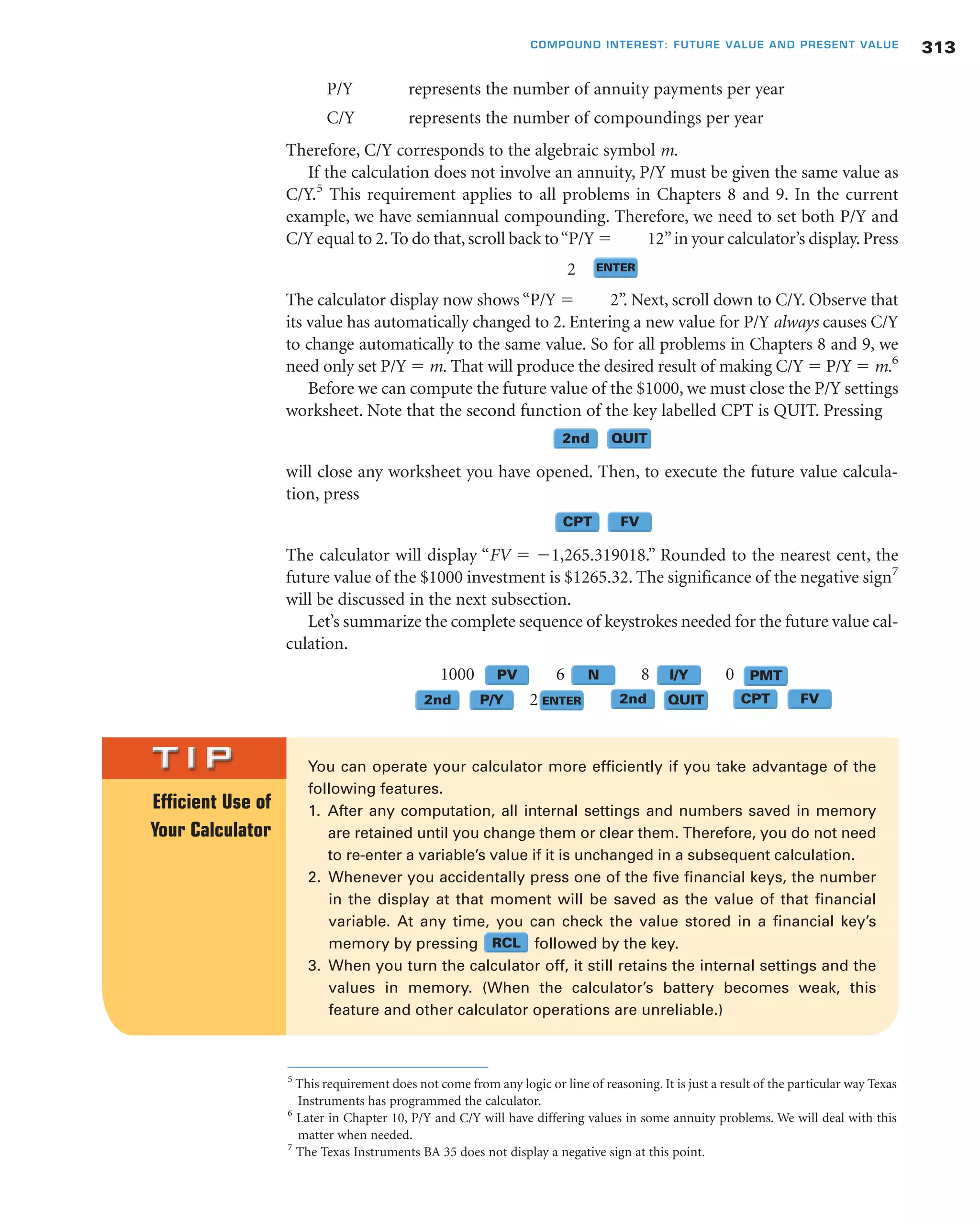
  • 29.
    312 CHAPTER 8 Thebasic financial keys of the Texas Instruments BA II PLUS calculator are in the third row of its keyboard. The calculator’s manual refers to them as the TVM (Time- Value-of-Money) keys. The definitions for these keys are as follows. N represents the number of compounding periods I/Y represents the nominal (annual) interest rate PV represents the principal or present value PMT represents the periodic annuity payment (not used until Chapter 10) FV represents the maturity value or future value The key labels N, I/Y, PV, and FV correspond to the algebraic variables n, j, PV, and FV, respectively. Each of the five keys has two uses: 1. Saving to memory a numerical value for the variable. 2. Computing the value of the variable (based on previously saved values for all other variables). As an example, let us compute the future value of $1000 invested at 8% com- pounded semiannually for 3 years. We must first enter values for , , , and . They may be entered in any order. To save $1000 in the memory, just enter the digits for 1000 and press . The display then shows “PV ϭ 1,000.”4 Next enter values for the other variables in the same manner. (You do not need to clear your display between entries.) Note that the nominal interest rate must be entered in percent form (without the % symbol) rather than in its decimal equivalent form. For all compound interest problems in Chapters 8 and 9, the value “0” must be stored in the memory. This tells the calculator that there is no regular annuity payment. In summary, the keystrokes for entering these four known values are: 1000 6 8 0 Do you think the calculator now has enough information to compute the future value? Note that we have not yet entered any information about the compounding fre- quency. To enter and save the value for the number of compoundings per year, you must first gain access to a particular list of internal settings. The calculator’s Owner’s Manual refers to this list as the “P/Y settings worksheet.” Note the P/Y symbol above the I/Y key. This indicates that the P/Y settings worksheet is the second function of the I/Y key. To open this worksheet, press the key labelled “2nd” followed by the key labelled “I/Y.” Hereafter, we will represent this keystroke combination by (We will always show the symbol above the key rather than the symbol on the key when presenting the keystrokes for a second function.) After pressing these two keys, you will see something like “P/Y ϭ 12” in your cal- culator’s display. (You may see a number other than 12 — 12 is the factory-set default value.) This displayed item is actually the first in a list of just two items. You can scroll down to the second item by pressing the key. The calculator will then display something like“C/Y ϭ 12”. When you are at the bottom of any list, pressing the key again will take you to the top of the list. The definitions for these new symbols are: N I/Y N↓ N2nd NP/Y NPMTNI/YNNPV PV PVPMTPV 4 The assumption here is that the calculator has previously been set for “floating-decimal format.” See the Appendix to this chapter for instructions on setting this format on the “Format worksheet.” N↓ PMT
  • 30.
    P/Y represents thenumber of annuity payments per year C/Y represents the number of compoundings per year Therefore, C/Y corresponds to the algebraic symbol m. If the calculation does not involve an annuity, P/Y must be given the same value as C/Y.5 This requirement applies to all problems in Chapters 8 and 9. In the current example, we have semiannual compounding. Therefore, we need to set both P/Y and C/Y equal to 2.To do that,scroll back to“P/Y ϭ 12”in your calculator’s display.Press 2 The calculator display now shows “P/Y ϭ 2”. Next, scroll down to C/Y. Observe that its value has automatically changed to 2. Entering a new value for P/Y always causes C/Y to change automatically to the same value. So for all problems in Chapters 8 and 9, we need only set P/Y ϭ m. That will produce the desired result of making C/Y ϭ P/Y ϭ m.6 Before we can compute the future value of the $1000, we must close the P/Y settings worksheet. Note that the second function of the key labelled CPT is QUIT. Pressing will close any worksheet you have opened. Then, to execute the future value calcula- tion, press The calculator will display “FV ϭ Ϫ1,265.319018.” Rounded to the nearest cent, the future value of the $1000 investment is $1265.32. The significance of the negative sign7 will be discussed in the next subsection. Let’s summarize the complete sequence of keystrokes needed for the future value cal- culation. 1000 6 8 0 2 313COMPOUND INTEREST: FUTURE VALUE AND PRESENT VALUE NPV NN NI/Y NPMT N2nd NP/Y NENTER NQUIT NCPT NFVN2nd NQUIT NFV N2nd NCPT NENTER 5 This requirement does not come from any logic or line of reasoning. It is just a result of the particular way Texas Instruments has programmed the calculator. 6 Later in Chapter 10, P/Y and C/Y will have differing values in some annuity problems. We will deal with this matter when needed. 7 The Texas Instruments BA 35 does not display a negative sign at this point. You can operate your calculator more efficiently if you take advantage of the following features. 1. After any computation, all internal settings and numbers saved in memory are retained until you change them or clear them. Therefore, you do not need to re-enter a variable’s value if it is unchanged in a subsequent calculation. 2. Whenever you accidentally press one of the five financial keys, the number in the display at that moment will be saved as the value of that financial variable. At any time, you can check the value stored in a financial key’s memory by pressing followed by the key. 3. When you turn the calculator off, it still retains the internal settings and the values in memory. (When the calculator’s battery becomes weak, this feature and other calculator operations are unreliable.) Efficient Use of Your Calculator NRCL
  • 31.
    Cash-Flow Sign Convention Cashflow is a term frequently used in finance and accounting to refer to a cash pay- ment. A cash inflow is a cash receipt; a cash outflow is a cash disbursement. A cash inflow should be saved in a financial calculator’s memory as a positive value.A cash out- flow should be entered as a negative number. These two simple rules have a rather overblown name in finance—the cash-flow sign convention. All financial calculators use the cash-flow convention.8 Finance courses and finance textbooks use it. The financial functions in Microsoft’s Excel and Corel’s Quattro Pro spreadsheet software employ it. The greatest benefits from using the sign convention come in later chapters. However, we will introduce it now so you can become familiar with it before moving on to more complex cases. To use the cash-flow sign convention, you must treat a compound interest problem as either an investment or a loan. The directions of the cash flows for these two cases are compared in the following table. When you invest money, you pay it (cash outflow) to some institution or individual. Later, you receive cash inflows from investment income and from the sale or conclusion of the investment. In contrast, when you receive a loan, it is a cash inflow for you. The subsequent cash flows in the loan trans- action are the loan payments (cash outflows). 314 CHAPTER 8 Cash-Flow Sign Convention Cash inflows (receipts) are positive. Cash outflows (disbursements) are negative. Transaction Initial cash flow Subsequent cash flows Investment Outflow (negative) Inflows (positive) Loan Inflow (positive) Outflows (negative) Now you can understand why your calculator gave a negative future value earlier in this section. Because we entered 1000 as a positive number in the memory, the calculator interpreted the $1000 as a loan. The computed future value represents the single payment required to pay off the loan. Since this payment is a cash outflow, the calculator displayed it as a negative number. To properly employ the sign convention for the initial $1000 investment, we should have entered 1000 in as a negative number. The calculator would then compute a positive future value—the cash inflow we will receive when the investment matures. To illustrate the use of financial calculators, Example problems 8.3A, 8.3C, and 8.3E will now be repeated as Examples 8.4A, 8.4B, and 8.4C, respectively. 8 The Texas Instruments BA 35 calculator employs a modified version of this sign convention. Users of the BA 35 are referred to the Appendix of this chapter for details. PV PV
  • 32.
    Example 8.4A THEINVESTMENT NEEDED TO REACH A TARGET FUTURE VALUE What amount must you invest now at 4% compounded monthly to accumulate $10,000 after 3 years? Solution Given: j ϭ 4%, m ϭ 12, FV ϭ $10,000, Term ϭ 3.5 years Then n ϭ m ϫ Term ϭ 12(3.5) ϭ 42 Enter the known variables and then compute the present value. 42 4 0 10000 12 Answer: Ϫ8695.606596 Note that we entered the $10,000 as a positive value because it is the cash inflow you will receive 3.5 years from now. The answer is negative because it represents the investment (cash outflow) that must be made today. Rounded to the cent, the initial investment required is $8695.61. Example 8.4B CALCULATING THE EQUIVALENT VALUE OF TWO PAYMENTS Two payments of $10,000 each must be made one year and four years from now. If money can earn 9% compounded monthly, what single payment two years from now would be equivalent to the two scheduled payments? Solution Given: j ϭ 9% compounded monthly making m ϭ 12 and Other data and the solution strategy are shown on the time line below. FV1 represents the future value of the first scheduled payment and PV2 represents the present value of the second payment. i ϭ j m ϭ 9% 12 ϭ 0.75% 1 2 315COMPOUND INTEREST: FUTURE VALUE AND PRESENT VALUE 2nd N PMT FVI/Y ENTER 2nd QUIT CPT PVP/Y 0 4 Years $10,000 $10,000 PV2 FV1 i = 0.75%, n = 12 1 i = 0.75%, n = 24 2 The single equivalent payment is FV1 ϩ PV2. Before we start crunching numbers, let’s exercise your intuition. Do you think the equivalent payment will be greater or smaller than $20,000? It is clear that FV1 is greater than $10,000 and that PV2 is less than $10,000. When the two amounts are added, will the sum be more than or less than $20,000? We can answer this question by comparing the time intervals through which we “shift” each of the $10,000 payments. The first payment will have one year’s interest added but the second payment will be discounted for two years’ interest.9 Therefore, PV2 is farther below $10,000 than FV1 is above $10,000. Hence, the equivalent payment will be less than $20,000. So if your 9 You cannot conclude that the difference between $10,000 and PV1 will be twice the difference between FV2 and $10,000. To illustrate this sort of effect, consider that at 10% compounded annually, the future value of $100 one year later is $110 while the present value of $100 one year earlier is $90.91. We see that the increase ($10) when compounding ahead one year exceeds the decrease ($9.09) when discounting back one year.
  • 33.
    equivalent payment turnsout to be more than $20,000, you will know that your solution has an error. Returning to the calculations, FV1: 12 9 10000 0 12 Answer: Ϫ10,938.07 PV2: Do not clear the values and settings currently in memory. Then you need enter only those values and settings that change. 24 10000 Answer: Ϫ8358.31 The equivalent payment two years from now is $10,938.07 ϩ $8358.31 ϭ $19,296.38. Note: An equivalent payment problem is neither a loan nor an investment situation. Loans and investments always involve at least one cash flow in each direction.10 An equivalent payment is a payment that can substitute for one or more other payments. The substitute payment will flow in the same direction as the payment(s) it replaces. So how should you apply the cash-flow sign convention to equivalent payment calculations? Just enter the scheduled payments as positive numbers and ignore the opposite sign on the calculated equivalent value. Example 8.4C CALCULATING TWO UNKNOWN LOAN PAYMENTS Kramer borrowed $4000 from George at an interest rate of 7% compounded semiannually. The loan is to be repaid by three payments. The first payment, $1000, is due two years after the date of the loan. The second and third payments are due three and five years, respectively, after the initial loan. Calculate the amounts of the second and third payments if the second payment is to be twice the size of the third payment. Solution Given: j ϭ 7% compounded semiannually making m ϭ 2 and Let x represent the third payment. Then the second payment must be 2x. As indicated in the following dia- gram, PV1, PV2, and PV3 represent the present values of the first, second, and third payments. Since the sum of the present values of all payments equals the original loan, then PV1 ϩ PV2 ϩ PV3 ϭ $4000 ① PV1: 4 7 0 1000 2 Answer:Ϫ871.41 At first, we may be stumped as to how to proceed for PV2 and PV3. Let’s think about the third payment of x dollars. We can compute the present value of just $1 from the x dollars. 0 + PV3 PV1 PV2 3 5 Years x2x 2 $1000 n = 4, i = 3.5% n = 6, i = 3.5% n = 10, i = 3.5% $4000 i ϭ j m ϭ 7% 2 ϭ 3.5% 316 CHAPTER 8 N I/Y PMTPV N 2nd ENTER 2nd QUIT CPT PVP/Y I/Y PMT FV N FV CPT PV 2nd ENTER 2nd QUIT CPT FVP/Y 10 At least, this is what lenders and investors hope will happen.
  • 34.
    10 1 Answer:Ϫ0.7089188 The present value of $1 paid five years from now is $0.7089188 (almost $0.71). Consider the following questions (Q) and their answers (A). Q: What is the present value of $2? A: It’s about 2 ϫ $0.71 ϭ $1.42. Q: What is the present value of $5? A: It’s about 5 ϫ $0.71 ϭ $3.55. Q: What is the present value of $x? A: Extending the preceding pattern, the present value of $x is about x ϫ $0.71 ϭ $0.71x. Precisely, it is PV3 ϭ $0.7089188x. Similarly, calculate the present value of $1 from the second payment of 2x dollars. The only variable that changes from the previous calculation is . 6 Answer: Ϫ0.8135006 Hence, the present value of $2x is PV2 ϭ 2x($0.8135006) ϭ $1.6270013x Now substitute the values for PV1, PV2 and PV3 into equation ➀ and solve for x. $871.44 ϩ 1.6270013x ϩ 0.7089188x ϭ $4000 2.3359201x ϭ $3128.56 x ϭ $1339.33 Kramer’s second payment will be 2($1339.33) ϭ $2678.66 and the third payment will be $1339.33. EXERCISE 8.4 Solve the problems in Exercises 8.2 and 8.3 using the financial functions on a cal- culator. 8.5 OTHER APPLICATIONS OF COMPOUNDING Compound-Interest Investments The two most common types of compound interest investments owned by Canadians are Guaranteed Investment Certificates and Canada Savings Bonds.11 Guaranteed Investment Certificates (GICs) GICs may be purchased from banks, credit unions, trust companies, and caisses populaires (mostly in Quebec). When you buy a GIC from a financial institution, you are in effect lending money to it or to one of its subsidiaries. The financial institution uses the funds raised from selling GICs to make loans—most commonly, mortgage loans. The interest rate charged on mortgage loans is typically 1.5% to 2% higher than the interest rate paid to GIC investors. The word “Guaranteed” in the name of this investment refers to the uncon- ditional guarantee of principal and interest by the parent financial institution. In addi- tion to this guarantee, there is usually some form of government-regulated deposit insurance. 317COMPOUND INTEREST: FUTURE VALUE AND PRESENT VALUE N N N FV CPT CPT PV PV 11 In recent years provincial savings bonds have been issued by the governments of Alberta, British Columbia, Manitoba, Ontario, and Saskatchewan. Purchase of provincial bonds is usually restricted to residents of the issuing province.
  • 35.
    Most Guaranteed InvestmentCertificates are purchased with maturities in the range of one to five years. Longer maturities (up to 10 years) are available, but are not covered by deposit insurance. Most GICs are not redeemable before maturity. The fol- lowing diagrams present alternative arrangements for structuring interest rates and for paying interest on conventional GICs. Structure of interest rates Fixed rate: The Step-up rate: The Variable Rate: The interest rate does not interest rate is interest rate is adjusted change over the term increased every six every year or every six of the GIC. months or every year months to reflect according to a pre- prevailing market rates. determined schedule. There may be a minimum“floor” below which rates cannot drop. Payment of interest Regular interest version: Compound interest version: Interest is paid periodically Interest is periodically converted to the investor. to principal and paid at maturity. The regular interest versions of GICs are not mathematically interesting since peri- odic interest is paid out to the investor instead of being converted to principal. For compound interest versions, there are two mathematically distinct cases. 1. If the interest rate is fixed, use FV ϭ PV(1 ϩ i)n to calculate the maturity value. 2. If the interest rate is either a variable rate or a step-up rate, you must multiply the individual (1 ϩ i) factors for all compounding periods. That is, use (8-4) FV ‫؍‬ PV(1 ؉ i1)(1 ؉ i2)(1 ϩ i3) . . . (1 ؉ in ) Example 8.5A CALCULATING THE PAYMENT FROM A REGULAR INTEREST GIC What periodic payment will an investor receive from a $9000, four-year, monthly payment GIC earning a nominal rate of 5.25% compounded monthly? Solution The interest rate per payment interval is The monthly payment will be PV ϫ i ϭ $9000 ϫ 0.004375 ϭ $39.38 i ϭ j m ϭ 5.25% 12 ϭ 0.4375% FUTURE VALUE (VARIABLE AND STEP- UP INTEREST RATES) 318 CHAPTER 8 NET @ssets Information about the GICs offered by a financial institution is usually available on its Web site. At any one time, a chartered bank may have 10 or 12 varieties of GICs in its reper- toire. In recent years, “financial engineers” have created more exotic forms of GICs. The rate of return on some is linked to the performance of a stock market. Here are the Home Page URLs of our largest financial institu- tions: RBC Royal Bank (www.royalbank.com) Bank of Montreal (www.bmo.com) CIBC (www.cibc.com) Scotiabank (www.scotiabank.com) TD Canada Trust (www.tdcanadatrust.com)
  • 36.
    Example 8.5B COMPARINGGICS HAVING DIFFERENT NOMINAL RATES Suppose a bank quotes nominal annual interest rates of 6.6% compounded annually, 6.5% compounded semiannually, and 6.4% compounded monthly on five-year GICs. Which rate should an investor choose? Solution An investor should choose the rate that results in the highest maturity value. The given information may be arranged in a table. j m n 6.6% 1 6.6% 5 6.5 2 3.25 10 6.4 12 60 Choose an amount, say $1000, to invest. Calculate the maturity values for the three alternatives. FV ϭ PV (1 ϩ i)n ϭ $1000(1.066)5 ϭ $1376.53 for m ϭ 1 ϭ $1000(1.0325)10 ϭ $1376.89 for m ϭ 2 ϭ $1000( )60 ϭ $1375.96 for m ϭ 12 Hereafter, we will usually present the financial calculator keystrokes in a vertical format. j ϭ 6.6% j ϭ 6.5% j ϭ 6.4% compounded compounded compounded annually semiannually monthly 1.0053 0.53 i ϭ j m 319COMPOUND INTEREST: FUTURE VALUE AND PRESENT VALUE 5 N 6.6 I/Y 1000 ؉/؊ PV 0 PMT 2nd P/Y 1 ENTER 2nd QUIT CPT FV Ans: 1376.53 Same PV, PMT 10 N 6.5 I/Y P/Y 2 ENTER Same C/Y CPT FV Ans: 1376.89 Same PV, PMT 60 N 6.4 I/Y P/Y 12 ENTER Same C/Y CPT FV Ans: 1375.96 In the second and third columns, we have shown only those values that change from the preceding step. The previous values for and are automatically retained if you do not clear the TVM memories. To shorten the presentation of solutions hereafter, we will indicate the value to be entered for P/Y (and C/Y) as in the second and third columns above. As indicated by the brace, a single line in the sec- ond and third columns replaces three lines in the first column. You must supply the omitted keystrokes. The investor should choose the GIC earning 6.5% compounded semiannually since it produces the highest maturity value. PV PMT
  • 37.
    Example 8.5C MATURITYVALUE OF A VARIABLE-RATE GIC A chartered bank offers a five-year “Escalator Guaranteed Investment Certificate.” In successive years it pays annual interest rates of 4%, 4.5%, 5%, 5.5%, and 6%, respectively, compounded at the end of each year. The bank also offers regular five-year GICs paying a fixed rate of 5% compounded annually. Calculate and com- pare the maturity values of $1000 invested in each type of GIC. (Note that 5% is the average of the five suc- cessive one-year rates paid on the Escalator GIC.) Solution Using formula (8-4), the maturity value of the Escalator GIC is FV ϭ $1000(1.04)(1.045)(1.05)(1.055)(1.06) ϭ $1276.14 Using formula (8-2), the maturity value of the regular GIC is FV ϭ $1000(1.05)5 ϭ $1276.28 The Escalator GIC will mature at $1276.14, but the regular GIC will mature at $1276.28 ($0.14 more). We can also conclude from this example that a series of compound interest rates does not produce the same future value as the average rate compounded over the same period. * Canada Savings Bonds (CSBs) Although you may purchase CSBs from the same financial institutions that issue GICs, your money goes to the federal government to help finance its debt.12 The financial institution is merely an agent in the transaction. Canada Savings Bonds sold in recent years have terms of 10 or 12 years. The batch of bonds sold on a particular date is assigned a series number. For example, the CSBs issued on November 1, 2000 are referred to as Series 66 (S66). All CSBs have variable interest rates—the Finance Department changes the interest rate for a particular series on that series’ anniversary date. The interest rate is adjusted to bring it into line with prevailing rates. The interest rates paid on CSBs issued on November 1 each year are presented in Table 8.2. Canada Savings Bonds are issued in regular interest versions (that pay out the inter- est on each anniversary date) and compound interest versions (that convert interest to principal on each anniversary). Canada Savings Bonds may be redeemed at any time.13 The following rules apply to calculating the interest for the partial year since the most recent anniversary date. ● Interest is accrued to the first day of the month in which redemption occurs. (If you redeem a CSB partway through a month, you receive no interest for the partial month.) ● Interest is calculated on a simple interest basis. That is, the additional interest for the partial year is I ϭ Prt where P ϭ The principal (including converted interest on compound interest bonds) at the preceding anniversary date r ϭ The prescribed annual interest rate for the current year t ϭ The number of months (from the preceding anniversary date up to the first day of the month in which redemption occurs) divided by 12 320 CHAPTER 8 NET @ssets Canada Investment and Savings is an agency of the federal Department of Finance. It maintains a Web site (www.cis-pec.gc.ca) providing information on Canada Savings Bonds and Canada Premium Bonds. Interest rates on all unmatured issues are available on the site. Calculators are provided that allow you to determine the amount you will receive if you redeem a partic- ular CSB on a specific date. 12 At the end of 2000, the total outstanding amount of CSBs was $26.9 billion. This represented less than 5% of Canada’s net federal debt. 13 In 1997, the Government of Canada started to issue a new type of savings bond called Canada Premium Bonds. They may be redeemed, but only on an anniversary date. Because of this restriction on redemption, Canada Premium Bonds pay a higher interest rate than Canada Savings Bonds.
  • 38.
    Example 8.5D CALCULATINGTHE REDEMPTION VALUE OF A COMPOUND INTEREST CANADA SAVINGS BOND A $1000 face value Series S50 compound interest Canada Savings Bond (CSB) was presented to a credit union branch for redemption. What amount did the owner receive if the redemption was requested on: a. November 1, 2000? b. January 17, 2001? Solution a. In Table 8.2, we note that Series S50 CSBs were issued on November 1, 1995. November 1, 2000 falls on the fifth anniversary of the issue date. Substituting the annual interest rates for S50 bonds from Table 8.2 into formula (8-4), we have FV ϭ PV(1 ϩ i1)(1 ϩ i2)(1 ϩ i3)(1 ϩ i4)(1 ϩ i5) ϭ $1000(1.0525)(1.06)(1.0675)(1.04)(1.046) ϭ $1295.57 The owner received $1295.57 on November 1, 2000. b. For a redemption that took place on January 17, 2001, the bond’s owner would have been paid extra inter- est at the rate of 4.85% pa for November 2000 and December 2000. The amount of the extra interest was Therefore, the total amount the owner received on January 17, 2001 was $1295.57 ϩ $10.47 ϭ $1306.04 Valuation of Investments With many types of investments, the owner can sell the investment to another investor. Such investments are said to be transferable.14 The key question is: What is the appro- priate price at which the investment should be sold/purchased? We encountered the same question in Chapter 7 for investments earning simple interest. (continued) I ϭ Prt ϭ $1295.5710.04852 2 12 ϭ $10.47 321COMPOUND INTEREST: FUTURE VALUE AND PRESENT VALUE Table 8.2 Interest Rates (%) on Canada Savings Bonds Interest S46 S47 S48 S49 S50 S51 S52 S54 S60 S66 rate (issued (issued (issued (issued (issued (issued (issued (issued (issued (issued effective Nov.1, Nov.1, Nov.1, Nov.1, Nov.1, Nov.1, Nov.1, Nov.1, Nov.1, Nov.1, Nov. 1 of: 1991) 1992) 1993) 1994) 1995) 1996) 1997) 1998) 1999) 2000 1991 7.50 1992 6.00 6.00 1993 5.125 5.125 5.125 1994 6.375 6.375 6.375 6.375 1995 6.75 6.75 6.75 6.75 5.25 1996 7.50 7.50 7.50 7.50 6.00 3.00 1997 3.56 3.56 3.56 3.56 6.75 4.00 3.41 1998 4.25 4.25 4.25 4.25 4.00 5.00 4.00 4.00 1999 5.25 5.25 5.25 5.25 4.60 6.00 5.00 4.60 4.60 2000 5.50 5.50 5.50 5.50 4.85 6.50 5.25 4.85 4.85 4.85 Matures Nov. 1 of: 2003 2004 2005 2006 2007 2008 2007 2008 2009 2010 14 Guaranteed Investment Certificates are generally not transferable. Canada Savings Bonds are not transferable but, unlike GICs, they may be redeemed at any time.
  • 39.
    322 CHAPTER 8 Weoften refer to Registered Retirement Savings Plans (RRSPs) in Examples and Exercises. For many individuals, particularly those who do not belong to an employer-sponsored pension plan, an RRSP is the central element of their retirement planning. In this discussion, you will begin to appreciate the advantages of investing within an RRSP, rather than investing outside an RRSP. An RRSP is not a type of investment. Instead, think of an RRSP as a type of trust account to which you can contribute money and then pur- chase certain investments. The Income Tax Act sets out strict rules governing the amount of money you may contribute and the type of investments you may hold within an RRSP. There are two main advantages of using an RRSP to accumulate sav- ings for retirement. 1. A contribution to an RRSP is deductible from the contributor’s taxable income. In effect, you do not pay income tax on the part of your income that you contribute to an RRSP. (There are some complicated rules that determine the upper limit for your contribution each year.) 2. Earnings on investments held within an RRSP are not subject to income tax until they are withdrawn from the RRSP. Consider the case of Darren and Cathy, who are both 30 years old and both earning salaries of $50,000 per year. Both intend to invest their $1000 year-end bonuses for their retirement. Being very conservative investors, both intend to build a portfolio of bonds and GICs. But Darren intends to contribute his $1000 to an RRSP trust account, and invest the money within his RRSP. Cathy intends to hold her investments in her own name. Let us compare the outcomes, 30 years later, of these alternative approaches for saving this year’s $1000 bonuses. We will assume that their invest- ments earn 6% compounded annually for the entire 30 years. Canadians with a $50,000 annual income are subject to a marginal income tax rate of close to 35%. (The figure varies somewhat from province to province.) This means that, if you earn an additional $100, you will pay $35 additional income tax and keep only $65 after tax. We will assume the 35% rate applies to Darren and Cathy for the next 30 years. The consequence of the first advantage listed above is that Darren will pay no tax on his $1000 bonus. Cathy will pay $350 tax on her bonus, leaving her only $650 to invest. The second advantage means that Darren will not pay tax each year on the interest earned in his RRSP. In contrast, Cathy will have to pay tax at a rate of 35% on her interest income each year. After tax, her savings will grow at a compound annual rate of only 6% Ϫ 0.35(6%) ϭ 6% Ϫ 2.1% ϭ 3.9% In summary, Darren has a $1000 investment in his RRSP growing at 6% compounded annually, while Cathy has a $650 investment growing at 3.9% compounded annually after tax. Over the next thirty years, Darren’s $1000 will grow to FV ϭ PV(1 ϩ i)n ϭ $1000(1.06)30 ϭ $5743.49 in his RRSP, while Cathy’s $650 will grow to FV ϭ PV(1 ϩ i)n ϭ $650(1.039)30 ϭ $2048.24 We should not directly compare these amounts. Before Darren can enjoy the fruits of his RRSP sav- ings, he must withdraw the funds from his RRSP and pay tax on them. Darren’s marginal tax rate may well be lower in retirement than while work- ing. But even if we still use the 35% rate, Darren will be left with 0.65 ϫ $5743.49 ϭ $3733.27 after tax. This is 82% more than the amount Cathy accumulated outside an RRSP! The RRSP Advantage
  • 40.
    There we discussedthe thinking behind the Valuation Principle (repeated below for ease of reference). For an investment with cash inflows extending beyond one year, the market-determined rate of return is almost always a compound rate of return. In this section, we will apply the Valuation Principle to two types of investments. Strip Bonds Many investors hold strip bonds in their Registered Retirement Savings Plans (RRSPs). The essential feature of a strip bond is that its owner will receive a single payment (called the face value of the bond) on the bond’s maturity date. The maturity date could be as much as 30 years in the future. No interest will be received in the interim. Suppose, for example, a $1000 face value strip bond matures 18 years from now. The owner of this bond will receive a payment of $1000 in 18 years. What is the appropriate price to pay for the bond today? Clearly, it will be substantially less than $1000. The difference between the $1000 you will receive at maturity and the price you pay today represents the earnings on your initial investment (the purchase price). The situation is similar to the pricing of T-bills in Chapter 7. According to the Valuation Principle, the fair market price is the present value of the bond’s face value. The discount rate you should use for “i” in PV ϭ FV(1 ϩ i)Ϫn is the prevailing rate of return in financial markets for bonds of similar risk and maturity. The nominal rates quoted for strip bonds usually do not mention the compounding frequency. The understanding in the financial world is that they are compounded semiannually. Note: From this point onward, we will present the financial calculator procedure in a “call-out” box. A “curly bracket” or brace will indicate the algebraic calculations that the procedure replaces. 323COMPOUND INTEREST: FUTURE VALUE AND PRESENT VALUE Questions: 1. Repeat the calculations with the change that Darren and Cathy are in a lower tax bracket with a marginal tax rate of 26%. 2. Repeat the calculations with the change that Darren and Cathy are in a higher tax bracket with a marginal tax rate of 43%. 3. Summarize the pattern you observe. (Is the “RRSP advantage” greater or lesser at higher marginal tax rates?) Valuation Principle The fair market value of an investment is the sum of the present values of the expected cash flows. The discount rate used should be the pre- vailing market-determined rate of return required on this type of invest- ment.
  • 41.
    Example 8.5E CALCULATINGTHE PRICE OF A STRIP BOND A $10,000 face value strip bond has 15 years remaining until maturity. If the prevailing market rate of return is 6.5% compounded semiannually, what is the fair market value of the strip bond? Solution Given: FV ϭ $10,000 j ϭ 6.5% m ϭ 2 Term ϭ 15 years Therefore, and n ϭ m(Term) ϭ 2(15.5) ϭ 31 Fair market value ϭ Present value of the face value ϭ FV(1 ϩ i)Ϫn ϭ $10,000(1.0325)Ϫ31 ϭ $3710.29 The fair market value of the strip bond is $3710.29. * Long-Term Promissory Notes A promissory note is a simple contract between a debtor and creditor setting out the amount of the debt (face value), the interest rate thereon, and the terms of repayment. A long-term promissory note is a note whose term is longer than one year. Such notes usually accrue compound inter- est on the face value. The payee (creditor) on a promissory note may sell the note to an investor before maturity. The debtor is then obligated to make the remaining payments to the new owner of the note. To determine the note’s selling/purchase price, we need to apply the Valuation Principle to the note’s maturity value. The two steps are: 1. Determine the note’s maturity value based on the contractual rate of interest on the note. 2. Discount (that is, calculate the present value of) the Step 1 result back to the date of sale/purchase. Since there is no “market” for private promissory notes, the seller and purchaser must negotiate the discount rate. Example 8.5F CALCULATING THE SELLING PRICE OF A LONG-TERM PROMISSORY NOTE A five-year promissory note with a face value of $3500, bearing interest at 11% compounded semiannually, was sold 21 months after its issue date to yield the buyer 10% compounded quarterly. What amount was paid for the note? Solution We should find the maturity value of the note and then discount the maturity value (at the required yield) to the date of the sale. i ϭ j m ϭ 6.5% 2 ϭ 3.25% 1 2 1 2 324 CHAPTER 8 31 N 6.5 I/Y 0 PMT 10000 FV P/Y 2 ENTER Same C/Y CPT PV Ans: Ϫ3710.29 1 3 ⁄4 5 Years Price 0 i = 2.5%, n = 13 Maturity value $3500 i = 5.5%, n = 10
  • 42.
    Step 1: Given:PV ϭ $3500 j ϭ 11% m ϭ 2 Term ϭ 5 years Therefore, and n ϭ m(Term) ϭ 2(5) ϭ 10 Maturity value ϭ PV(1 ϩ i)n ϭ $3500(1.055)10 ϭ $5978.51 Step 2: Given: j ϭ 10% m ϭ 4 and Term ϭ 5 years Ϫ 21 months ϭ 3.25 years Therefore, and n ϭ m(Term) ϭ 4(3.25) ϭ 13 Price paid ϭ FV(1 ϩ i)Ϫn ϭ $5978.51(1.025)Ϫ13 ϭ $4336.93 The amount paid for the note was $4336.93. Compound Growth The topic of compounding percent changes was introduced in Chapter 2. We revisit the topic here to point out that FV ϭ PV(1 ϩ i)n may be used in problems involving compound growth at a fixed periodic rate. Furthermore, you can use the financial functions of your calculator in such cases. Simply place the following interpretations on the variables. i ϭ j m ϭ 10% 4 ϭ 2.5% i ϭ j m ϭ 11% 2 ϭ 5.5% 325COMPOUND INTEREST: FUTURE VALUE AND PRESENT VALUE 10 N 11 I/Y 3500 ؉/؊ PV 0 PMT P/Y 2 ENTER Same C/Y CPT FV Ans: 5978.5 Same FV, PMT 13 N 10 I/Y P/Y 4 ENTER Same C/Y CPT PV Ans: Ϫ4336.93 Variable General interpretation PV Beginning value, size, or quantity FV Ending value, size, or quantity i Fixed periodic rate of growth n Number of periods with growth rate i If a quantity shrinks or contracts at a fixed periodic rate, it can be handled mathe- matically by treating it as negative growth. For example, suppose a firm’s annual sales volume is projected to decline for the next four years by 5% per year from last year’s level of 100,000 units. The expected sales volume in the fourth year may be obtained using FV ϭ PV(1 ϩ i)n with n ϭ 4 and i ϭ (Ϫ5%) ϭ (Ϫ0.05). That is, Sales (in Year 4) ϭ 100,000[1 ϩ (Ϫ0.05)]4 ϭ 100,000(0.95)4 ϭ 81,450 units In the financial calculator approach, you would save “Ϫ5” in the memory. The answer represents an overall decline of 18.55% in the annual volume of sales. Note that the overall decline is less than 20%, an answer you might be tempted to reach by sim- ply adding the percentage changes. Inflation and Purchasing Power A useful application of compound growth in financial planning is using forecast rates of inflation to estimate future prices and I/Y
  • 43.
    the purchasing powerof money. As discussed in Chapter 3, the rate of inflation mea- sures the annual percent change in the price level of goods and services. By com- pounding the forecast rate of inflation over a number of years, we can estimate the level of prices at the end of the period. When prices rise, money loses its purchasing power—these are “two sides of the same (depreciating) coin.” If price levels double, a given nominal amount of money will purchase only half as much. We then say that the money has half its former pur- chasing power. Similarly, if price levels triple, money retains only one-third of its for- mer purchasing power. These examples demonstrate that price levels and purchasing power have an inverse relationship. That is, Let us push the reasoning one step further to answer this question: If price lev- els rise 50% over a number of years, what will be the percent loss in purchasing power? This gets a little tricky—the answer is not 50%. With an overall price increase of 50%, the ratio of price levels (on the right side of the preceding pro- portion) is Therefore, money will retain of its purchasing power and lose the other or of its purchasing power. Example 8.5G THE LONG-TERM EFFECT OF INFLATION ON PURCHASING POWER If the rate of inflation for the next 20 years is 2.5% per year, what annual income will be needed 20 years from now to have the same purchasing power as a $30,000 annual income today? Solution The required income will be $30,000 compounded at 2.5% per year for 20 years. Given: PV ϭ $30,000 j ϭ 2.5% m ϭ 1 Term ϭ 20 years Hence, and n ϭ m(Term) ϭ 1(20) ϭ 20 FV ϭ PV(1 ϩ i)n ϭ $30,000(1.025)20 ϭ $49,158.49 After 20 years of 2.5% annual inflation, an annual income of $49,158 will be need- ed to have the same purchasing power as $30,000 today. Example 8.5H COMPOUND ANNUAL DECREASE IN POPULATION The population of a rural region is expected to fall by 2% per year for the next 10 years. If the region’s cur- rent population is 100,000, what is the expected population 10 years from now? i ϭ j m ϭ 2.5% 1 ϭ 2.5% 331 3%1 3 2 3 100 150 or 2 3 Ending purchasing power Beginning purchasing power ϭ Beginning price level Ending price level 326 CHAPTER 8 20 N 2.5 I/Y 30000 PV 0 PMT P/Y 1 ENTER Same C/Y CPT FV Ans: Ϫ49,158.49
  • 44.
    Solution The 2% “negativegrowth” should be compounded for 10 years. Given: PV ϭ 100,000 j ϭ Ϫ2% m ϭ 1 Term ϭ 10 years Hence, and n ϭ m(Term) ϭ 1(10) ϭ 10 FV ϭ PV(1 ϩ i)n ϭ 100,000[1 ϩ (Ϫ 0.02)]10 ϭ 100,000(0.98)10 ϭ 81,707 The region’s population is expected to drop to about 81,707 during the next 10 years. Concept Questions 1. How, if at all, will the future value of a three-year variable-rate GIC differ if it earns 4%, 5%, and 6% in successive years instead of 6%, 5%, and 4% in successive years? 2. In general, do you think the interest rate on a new three-year fixed-rate GIC will be more or less than the rate on a new five-year fixed-rate GIC? Why? 3. Why must the Finance Department keep the interest rates on existing CSBs at least as high as the rate on a new CSB issue? 4. Should we conclude that the owner of a strip bond earns nothing until the full face value is received at maturity? Explain. 5. If a quantity increases by x% per year (compounded) for two years, will the overall percent increase be more or less than 2x%? Explain. 6. If a quantity declines by x% per year (compounded) for two years, will the overall percent decrease be more or less than 2x%? Explain. EXERCISE 8.5 Answers to the odd-numbered problems are at the end of the book. Note: A few problems in this and later exercises have been taken (with permission) from professional courses offered by the Canadian Institute of Financial Planning and the Institute of Canadian Bankers. These problems are indicated by the organi- zation’s logo in the margin next to the problems. 1. Krista invested $18,000 in a three-year regular-interest GIC earning 7.5% compounded semiannually. What is each interest payment? 2. Eric invested $22,000 in a five-year regular-interest GIC earning 7.25% compounded monthly. What is each interest payment? 3. Mr. Dickson purchased a seven-year, $30,000 compound-interest GIC with funds in his RRSP. If the interest rate on the GIC is 5.25% compounded semian- nually, what is the GIC’s maturity value? 4. Mrs. Sandhu placed $11,500 in a four-year compound-interest GIC earning 6.75% compounded monthly. What is the GIC’s maturity value? 5. A trust company offers three-year compound-interest GICs paying 7.2% compounded monthly or 7.5% compounded semiannually. Which rate should an investor choose? i ϭ j m ϭ Ϫ2% 1 ϭ Ϫ2% 327COMPOUND INTEREST: FUTURE VALUE AND PRESENT VALUE 10 N 2 ؉ր؊ I/Y 100000 PV 0 PMT P/Y 1 ENTER Same C/Y CPT FV Ans: Ϫ81,707
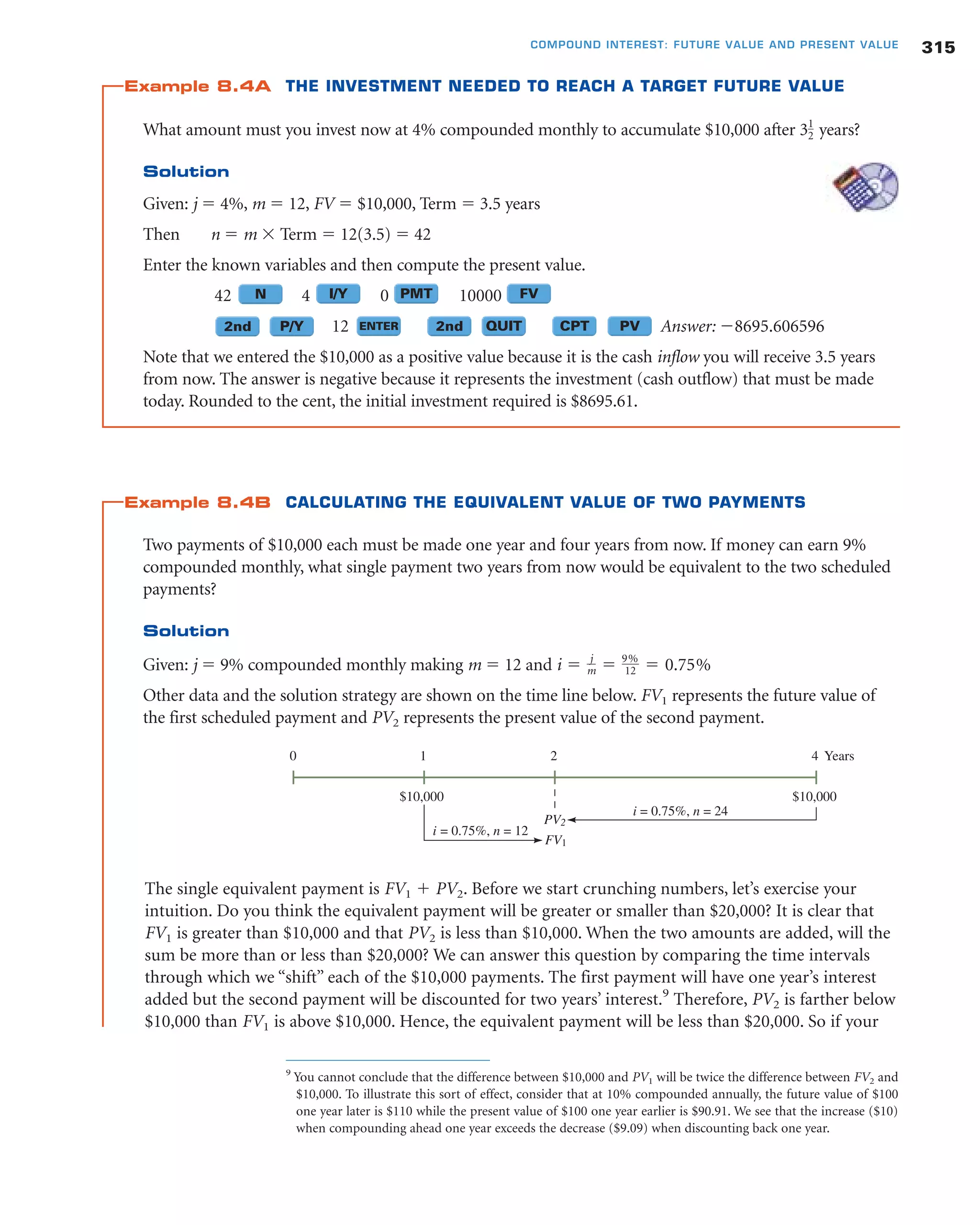
  • 45.
    6. If aninvestor has the choice between rates of 5.4% compounded semiannually and 5.5% compounded annually for a six-year GIC, which rate should she choose? •7. For a given term of compound-interest GIC, the nominal interest rate with annual compounding is typically 0.125% higher than the rate with semiannual compounding and 0.25% higher than the rate with monthly compounding. Suppose that the rates for five-year GICs are 5.00%, 4.875%, and 4.75% for annual, semiannual, and monthly compounding, respectively. How much more will an investor earn over five years on a $10,000 GIC at the most favourable rate than at the least favourable rate? 8. A new issue of compound-interest Canada Savings Bonds guaranteed minimum annual rates of 5.25%, 6%, and 6.75% in the first three years.At the same time, a new issue of compound-interest British Columbia Savings Bonds guaranteed minimum annual rates of 6.75%, 6%, and 6% in the first three years.Assuming that the rates remain at the guaranteed minimums, how much more will $10,000 earn in the first three years if invested in BC Savings Bonds instead of Canada Savings Bonds? •9. Using the information given in Problem 8, calculate the interest earned in the third year from a $10,000 investment in each savings bond. 10. Stan purchased a $15,000 compound-interest Canada Savings Bond on December 1, 2000. The interest rate in the first year was 3.0% and in the second year was 4.0%.What interest did Stan receive when he redeemed the CSB on May 1, 2002? In problems 11 to 14, use Table 8.2 on page 321 to find the information you need. 11. What amount did the owner of a $5000 face value compound-interest series S51 Canada Savings Bond receive when she redeemed the bond on: a. November 1, 2000? b. August 21, 2001? 12. What amount did the owner of a $10,000 face value compound-interest series S52 CSB receive when he redeemed the bond on: a. November 1, 2000? b. May 19, 2001? 13. What was the redemption value of a $300 face value compound-interest series S50 CSB on March 8, 2001? 14. What was the redemption value of a $500 face value compound-interest series S49 CSB on June 12, 1998? In each of Problems 15 through 18, calculate the maturity value of the five- year compound-interest GIC whose interest rate for each year is given. Also calculate the dollar amount of interest earned in the fourth year. 328 CHAPTER 8 Amount Problem invested ($) Year 1(%) Year 2(%) Year 3(%) Year 4(%) Year 5(%) 15. 2000 7.5 7.5 7.5 7.5 7.5 16. 3000 5 5 6 6 6 17. 8000 4 4.5 5 5.5 6 18. 7500 4.125 4.25 4.5 4.875 5 Interest rate
  • 46.
    19. A charteredbank advertised annual rates of 5.5%, 6.125%, 6.75%, 7.375%, and 8% in successive years of its five-year compound-interest RateRiser GIC.At the same time, the bank was selling fixed-rate five-year compound-interest GICs yielding 6.75% compounded annually.What total interest would be earned during the five- year term on a $5000 investment in each type of GIC? 20. A bank advertised annual rates of 4%, 4.5%, 5%, 5.5%, 6%, 6.5%, and 7% in succes- sive years of its seven-year compound-interest RateRiser GIC. The bank also offered 5.5% compounded annually on its seven-year fixed-rate GIC. How much more will a $10,000 investment in the preferred alternative be worth at maturity? 21. Using the information given in Problem 20, calculate the interest earned in the fourth year from a $10,000 investment in each GIC. 22. Using the information given in Problem 20, how much would have to be initially invested in each GIC to have a maturity value of $20,000? 23. How much will you need 20 years from now to have the purchasing power of $100 today if the (compound annual) rate of inflation during the period is: a. 2%? b. 3%? c. 4%? 24. How much money was needed 15 years ago to have the purchasing power of $1000 today if the (compound annual) rate of inflation has been: a. 2%? b. 4%? c. 6%? 25. If the inflation rate for the next 10 years is 3.5% per year, what hourly rate of pay in 10 years will be equivalent to $15/hour today? 26. A city’s population stood at 120,000 after five years of 3% annual growth.What was the population five years previously? 27. Mr. and Mrs. Stephens would like to retire in 15 years at an annual income level that would be equivalent to $35,000 today.What is their retirement income goal if, in the meantime, the annual rate of inflation is: a. 2%? b. 3%? c. 5%? 28. In 1992 the number of workers in the forest industry was forecast to decline by 3% per year, reaching 80,000 in 2002. How many were employed in the industry in 1992? •29. A pharmaceutical company had sales of $28,600,000 in the year just completed. Sales are expected to decline by 4% per year for the next three years until new drugs, now under development, receive regulatory approval. Then sales should grow at 8% per year for the next four years.What are the expected sales for the final year of the seven-year period? •30. A 1989 study predicted that the rural population of Saskatchewan would decline by 2% per year during the next decade. If this occurred, what fraction of the rural population was lost during the 1990s? 31. A $1000 face value strip bond has 22 years remaining until maturity.What is its price if the market rate of return on such bonds is 6.5% compounded semiannually? 32. What price should be paid for a $5000 face value strip bond with 19.5 years remaining to maturity if it is to yield the buyer 6.1% compounded semiannually? 33. A client wants to buy a five-year Ontario Hydro strip bond yielding 7.5% with a maturity value of $10,000.What is the current market value of the bond? (Taken from ICB course on Wealth Valuation.) 329COMPOUND INTEREST: FUTURE VALUE AND PRESENT VALUE
  • 47.
    34. If thecurrent discount rate on 15-year strip bonds is 5.75% compounded semi- annually, how many $1000 face value strips can be purchased with $10,000? 35. Mrs. Janzen wishes to purchase some 13-year-maturity strip bonds with the $12,830 in cash she now has in her RRSP. If these strip bonds are currently priced to yield 6.25% compounded semiannually, how many $1000 denomina- tion bonds can she purchase? 36. Liz purchased a $100,000 face value strip bond with five years remaining until maturity. If the bond was discounted to yield 8% compounded semiannually, how much total interest will she earn over the five years? (Taken from CIFP course on Strategic Investment Planning.) •37. A four-year $8000 promissory note bearing interest at 13.5% compounded monthly was discounted 21 months after issue to yield 12% compounded quarterly. What were the proceeds from the sale of the note? •38. An eight-year note for $3800 with interest at 11% compounded semiannually was sold after three years and three months to yield the buyer 14% compounded quarterly. What price did the buyer pay? ••39. A loan contract requires a payment after two years of $2000 plus interest (on this $2000) at 9% compounded quarterly and, one year later, a second payment of $1500 plus interest (on this $1500) at 9% compounded quarterly. What would be the appropriate price to pay for the contract six months after the contract date to yield the buyer 10% compounded semiannually? ••40. A loan contract requires two payments three and five years after the contract date. Each payment is to include a principal amount of $2500 plus interest at 10% compounded annually on that $2500. What would an investor pay for the contract 20 months after the contract date if the investor requires a rate of return of 9% compounded monthly? *8.6 EQUIVALENT PAYMENT STREAMS Sometimes a scheduled payment stream is replaced by another payment stream. This can happen, for example, in re-scheduling payments on a loan. In this section we will learn how to make the new stream of payments economically equivalent to the stream it replaces. In this way, neither the payer nor the payee gains any financial advantage from the change. The general principle we will develop is an extension of ideas from Sections 8.2 and 8.3. In those sections you learned how to obtain the equivalent value of a multiple- payment stream at a particular focal date. It was a two-step procedure: 1. Calculate the equivalent value of each payment at the focal date. 2. Add up the equivalent values to obtain the stream’s equivalent value. How, then, would you compare the economic values of two payment streams? Your intuition should be a good guide here. First calculate the equivalent value of each stream at the same focal date. Then compare the two equivalent values to rank them. For two payment streams to be economically equivalent, they must meet the following condition. 330 CHAPTER 8
  • 48.
    You must imposethis requirement when designing a payment stream that is to be economically equivalent to a given payment stream. The criterion becomes the basis for an equation that enables us to solve for an unknown payment in the new stream. 331COMPOUND INTEREST: FUTURE VALUE AND PRESENT VALUE Criterion for the Equivalence of Two Payment Streams A payment stream’s equivalent value (at a focal date) is the sum of the equivalent values of all of its payments. Two payment streams are eco- nomically equivalent if they have the same equivalent value at the same focal date. Any interest conversion date may be chosen for the focal date in an equivalent- payment stream problem. If two payment streams are equivalent at one conversion date, they will be equivalent at any other conversion date. Therefore, problems will generally not specify a particular focal date to be used in the solution. Calculations will usually be simplified if you locate the focal date at one of the unknown payments in the new stream. Then that payment’s equivalent value on the focal date is simply its nominal value. But be careful to use the same focal date for both payment streams. Choosing a Focal Date Example 8.6A CALCULATING AN UNKNOWN PAYMENT IN A TWO-PAYMENT REPLACEMENT STREAM Payments of $2000 and $1000 were originally scheduled to be paid one year and five years, respec- tively, from today. They are to be replaced by a $1500 payment due four years from today, and another payment due two years from today. The replacement stream must be economically equiva- lent to the scheduled stream. What is the unknown payment, if money can earn 7% compounded semiannually? Solution The diagram below presents just the given information. Each payment stream has its own time line. The unknown payment is represented by x. We must calculate a value for x such that the two streams satisfy the Criterion for Equivalence. 5 Years0 1 $1000$2000 Years0 2 $1500x 4 Replacement payments Scheduled payments
  • 49.
    To satisfy theCriterion for Equivalence, we require FV1 ϩ PV2 ϭ x ϩ PV3 ① The equivalent values of the individual payments are calculated in the usual way. FV1 ϭ Future value of $2000, 1 year later ϭ PV (1 ϩ i)n ϭ $2000(1.035)2 ϭ $2142.45 PV2 ϭ Present value of $1000, 3 years earlier ϭ FV(1 ϩ i)Ϫn ϭ $1000(1.035)Ϫ6 ϭ $813.50 PV3 ϭ Present value of $1500, 2 years earlier ϭ $1500(1.035)Ϫ4 ϭ $1307.16 Substituting these amounts into equation ➀, we have $2142.45 ϩ $813.50 ϭ x ϩ $1307.16 $2955.95 Ϫ $1307.16 ϭ x x ϭ $1648.79 The first payment in the replacement stream must be $1648.79. Example 8.6B CALCULATING TWO PAYMENTS IN A THREE-PAYMENT REPLACEMENT STREAM The original intention was to settle a financial obligation by two payments. The first payment of $1500 was due one year ago. The second payment of $2500 is due three years from now. The debtor missed the first payment, and now proposes three payments that will be economically equivalent to the two originally scheduled payments. The replacement payments are $1000 today, a second payment in 1 years, and a third payment (twice as large as the second) in three years. What should the second and third payments be if money can earn 8% compounded annually? 1 2 332 CHAPTER 8 In the next diagram, the date of the unknown payment has been chosen as the focal date. Consequently, the unknown payment’s equivalent value on the focal date is just x. The equivalent values of the other pay- ments are represented by FV1, PV2, and PV3. 5 Years0 $1000$2000 n = 6, i = 3.5% PV2 FV1 n = 2 i = 3.5% Years0 x n = 4, i = 3.5% PV3 $1500 1 2 2 4 2 N 7 I/Y 2000 PV 0 PMT P/Y 2 ENTER CPT FV Ans: Ϫ2142.45 Same I/Y, PMT, P/Y, C/Y 6 N 1000 FV CPT PV Ans: Ϫ813.50 Same I/Y, PMT, P/Y, C/Y 4 N 1500 FV CPT PV Ans: Ϫ1307.16
  • 50.
    Solution Let the paymentdue in 1 years be x. The scheduled and replacement streams are presented in the follow- ing time diagrams. The date of the first unknown payment has been chosen as the focal date, and the sym- bols for equivalent values on the focal date are indicated. $1000 3 2x n = 3, i = 4% FV3 PV4 n = 3, i = 4% 0 11 2 Years Replacement payments x 3–1 $2500 Scheduled$1500 n = 3, i = 4% FV1 PV2 n = 5, i = 4% 0 11 2 Years payments 1 2 333COMPOUND INTEREST: FUTURE VALUE AND PRESENT VALUE For equivalence of the two payment streams, FV1 ϩ PV2 ϭ x ϩ FV3 ϩ PV4 ① FV1 ϭ Future value of $1500, years later ϭ PV(1 ϩ i)n ϭ $1500(1.04)5 ϭ $1824.98 PV2 ϭ Present value of $2500, years earlier ϭ FV(1 ϩ i)Ϫn ϭ $2500(1.04)Ϫ3 ϭ $2222.49 FV3 ϭ Future value of $1000, years later ϭ $1000(1.04)3 ϭ $1124.86 PV4 ϭ Present value of 2x, years earlier ϭ 2x(1.04)Ϫ3 ϭ 1.777993x Substituting these values into equation ①, we obtain $1824.98 ϩ $2222.49 ϭ x ϩ $1124.86 ϩ $1.777993x $4047.47 ϭ 2.777993x ϩ $1124.86 ϭ $1052.06 The payments should be $1052.06 in 1 years and $2104.12 in three years.1 2 x ϭ $4047.47 Ϫ $1124.86 2.777993 11 2 11 2 11 2 21 2 Same I/Y, PMT, P/Y, C/Y 3 N 2500 FV CPT PV Ans: Ϫ2222.49 Find the PV of $2. Same N, I/Y, PMT, P/Y, C/Y 2 FV CPT PV Ans: Ϫ1.777993 Same N, I/Y, PMT, P/Y, C/Y 1000 PV CPT FV Ans: Ϫ1124.86 5 N 8 I/Y 1500 PV 0 PMT P/Y 2 ENTER Same C/Y CPT FV Ans: Ϫ1824.98
  • 51.
    Concept Questions 1. Iftwo payment streams are equivalent at one interest rate, will they be equivalent at another interest rate? 2. List three examples of advertisements or news items that routinely ignore the time value of money. 3. What would be the most convincing way to demonstrate that the replacement stream in Example 8.6A is economically equivalent to the given stream? 4. Are two equal payments of size x equivalent to a single payment of 2x made midway between the two scheduled payments? If not, is the equivalent payment larger or smaller than 2x? Explain. EXERCISE 8.6 Answers to the odd-numbered problems are at the end of the book. In Problems 1 through 8, calculate the replacement payment(s) if money can earn the rate of return indicated in the last two columns. Assume that payments scheduled for dates before today have not been made. 334 CHAPTER 8 Scheduled Replacement Interest Compounding Problem payments payments rate (%) frequency 1. $3000 today, $1500 in 15 months, and a payment 6 Quarterly $2000 in 15 months in 24 months 2. $1750 today, A payment in 9 months, $3000 in 9 Monthly $2900 in 18 months 19 months •3. $1400 in 3 months, Two equal payments in 9 and 6.5 Semiannually $2300 in 21 months 27 months •4. $850 2 years ago, Two equal payments in 3 months 11 Quarterly $1760 6 months ago and in 9 months •5. $400 8 months ago, A payment in 2 months and another, 10.5 Monthly $650 3 months ago twice as large, in 7 months •6. $2000 in 6 months, A payment in 1 year and another, 12.5 Semiannually $2000 in 2 years half as large, in 3 years •7. $4500 today Three equal payments today, in 7.2 Monthly 4 months, and in 9 months •8. $5000 today; Three equal payments in 1, 3, and 10.75 Annually $10,000 in 5 years 5 years •9. Repeat Problem 3 with the change that the scheduled payments consist of $1400 and $2300 principal portions plus interest on these respective principal amounts at the rate of 8% compounded quarterly starting today. •10. The owner of a residential building lot has received two purchase offers. Mrs. A is offering a $20,000 down payment plus $40,000 payable in one year. Mr. B’s offer is $15,000 down plus two $25,000 payments due one and two years from now. Which offer has the greater economic value if money can earn 9.5% compounded quarterly? How much more is it worth in current dollars? •11. During its January sale, Furniture City is offering terms of 25% down with no further payments and no interest charges for six months, when the balance is due. Furniture City sells the conditional sale contracts from these credit sales to a finance company. The finance company discounts the contracts to yield 18% compounded monthly. What cash amount should Furniture City accept on a
  • 52.
    $1595 item inorder to end up in the same financial position as if the item had been sold under the terms of the January sale? •12. Henri has decided to purchase a $25,000 car. He can either liquidate some of his investments and pay cash, or accept the dealer’s proposal that Henri pay $5000 down and $8000 at the end of each of the next three years. a. Which choice should Henri make if he can earn 7% compounded semiannu- ally on his investments? In current dollars, what is the economic advantage of the preferred alternative? b. Which choice should Henri make if he can earn 11% compounded semiannu- ally on his investments? In current dollars, what is the economic advantage of the preferred alternative? (Hint: When choosing among alternative streams of cash inflows, we should select the one with the greatest economic value.When choosing among alternative streams of cash outflows, we should select the one with the least economic value.) •13. A lottery prize gives the winner a choice between (1) $10,000 now and another $10,000 in 5 years, or (2) four $7000 payments—now and in 5, 10, and 15 years. a. Which alternative should the winner choose if money can earn 7% compounded annually? In current dollars, what is the economic advantage of the preferred alternative? b. Which alternative should the winner choose if money can earn 11% compounded annually? In current dollars, what is the economic advantage of the preferred alternative? •14. CompuSystems was supposed to pay a manufacturer $19,000 on a date four months ago and another $14,000 on a date two months from now.Instead,CompuSystems is proposing to pay $10,000 today and the balance in five months,when it will receive payment on a major sale to the provincial government.What will the second payment be if the manufacturer requires 12% compounded monthly on overdue accounts? •15. Payments of $5000 and $7000 are due three and five years from today. They are to be replaced by two payments due and four years from today. The first payment is to be half the amount of the second payment. What should the payments be if money can earn 7.5% compounded semiannually? •16. Two payments of $3000 are due today and five years from today. The creditor has agreed to accept three equal payments due one, three, and five years from now. If the payments assume that money can earn 7.5% compounded monthly, what payments will the creditor accept? •17. Payments of $8000 due 15 months ago and $6000 due in six months are to be replaced by a payment of $4000 today, a second payment in nine months, and a third payment, three times as large as the second, in years. What should the last two payments be if money is worth 6.4% compounded quarterly? •18. The principal plus interest at 10% compounded quarterly on a $15,000 loan made years ago is due in two years. The debtor is proposing to settle the debt by a payment of $5000 today and a second payment in one year that will place the lender in an equivalent financial position, given that money can now earn only 6% compounded semiannually. a. What should be the amount of the second payment? b. Demonstrate that the lender will be in the same financial position two years from now with either repayment alternative. 21 2 11 2 11 2 335COMPOUND INTEREST: FUTURE VALUE AND PRESENT VALUE
  • 53.
    ••19. Three yearsago, Andrea loaned $2000 to Heather. The principal with interest at 13% compounded semiannually is to be repaid four years from the date of the loan. Eighteen months ago, Heather borrowed another $1000 for years at 11% compounded semiannually. Heather is now proposing to settle both debts with two equal payments to be made one and three years from now. What should the payments be if money now earns 10% compounded quarterly? *APPENDIX 8A: Instructions for Specific Models of Financial Calculators 31 2 336 CHAPTER 8 Sharp Texas Instruments Texas Instruments Hewlett EL-733A BA-35 Solar BA II PLUS Packard 10B Press repeatedly until the “FIN” indicator appears in the upper right corner of the display. SETTING THE CALCULATOR IN THE FINANCIAL MODE Press repeatedly until the “FIN” indicator appears in the lower left corner of the display. Calculator is “ready to go” for financial calculations. Calculator is “ready to go” for financial calculations. 2nd F MODE MODE Sharp Texas Instruments Texas Instruments Hewlett EL-733A BA-35 Solar BA II PLUS Packard 10B 9 SETTING THE NUMBER OF DECIMAL PLACES DISPLAYED AT 9 9 9 9 2nd F TAB 2nd Fix 2nd Format DISP ENTER 2nd QUIT Sharp Texas Instruments Texas Instruments Hewlett EL-733A BA-35 Solar BA II PLUS Packard 10B SETTING A FLOATING POINT DECIMAL15 Set for 9 decimal places as in the preceding table. 2nd F TAB • • • 2nd Fix DISP 15 With this setting, the calculator will show all of the digits but no trailing zeros for a terminat- ing decimal. Non-terminating decimals will be displayed with 10 digits.
  • 54.
    Other Topics The TexasInstruments BA-35’s Modified Cash-Flow Sign Convention The Texas Instruments BA-35 employs a peculiar variation of the standard cash-flow sign convention. It obeys the normal rules (inflows are positive, outflows are negative) for the and values, but reverses the convention16 for the value of ! In other words, for the function only, cash inflows are negative and cash out- flows are positive. When following the instructions in the text, remember to reverse the sign used in the text for the value of . Setting the Texas Instruments BA II PLUS So That Corresponds to i Rather Than j Some users of this calculator prefer each of the five financial keys ( , , , , and ) to represent exactly one of the five alge- braic variables (n, i, PV, PMT, and FV). The existing mismatch is between i and . The key can be used to save and calculate i if you maintain the following set- ting permanently. 1 This setting will not change when you turn the calculator OFF. The key now behaves as an key. The calculator then emulates a Sharp financial calculator (for these basic financial functions.) Setting the Hewlett Packard 10B So That Corresponds to i Rather Than j. Some users of this calculator prefer each of the five financial keys ( , , , , and ) to represent exactly one of the five alge- braic variables (n, i, PV, PMT, and FV). The existing mismatch is between i and . The key can be used to save and calculate i if you maintain the following set- ting permanently. 1 This setting will not change when you turn the calculator OFF. The key now behaves as an key. The calculator then emulates a Sharp financial calculator (for the basic financial functions.) 337COMPOUND INTEREST: FUTURE VALUE AND PRESENT VALUE Sharp Texas Instruments Texas Instruments Hewlett EL-733A BA-35 Solar BA II PLUS Packard 10B CHECKING THE CONTENTS OF A FINANCIAL KEY’S MEMORY (USING THE KEY AS AN EXAMPLE) 2nd F RCL PV RCL PV RCL PV RCL PV FV FV FV PMT PMT PMT PV PV PV PV N N I/Y I/YR I/YR I/YR i i I/YR I/Y I/Y 2nd 2nd QUITP/Y P/YR ENTER PV 16 The reason Texas Instruments has chosen to use an inconsistent sign convention with the BA-35 is that, for a lim- ited range of basic problems, the user can get away with not using (or even being aware of) a cash-flow sign con- vention. However, there are several cases where, if you do not employ the BA 35’s awkward sign convention, you will get an incorrect answer or an “Error” message. PV I/Y I/YR I/Y
  • 55.
    1. At thesame time as compound-interest Canada Savings Bonds were being sold with guaranteed min- imum annual rates of 5.25%, 6%, and 6.75% in the first 3 years of their 10-year term, a trust company offered 3-year Bond-Beater GICs paying 5.75%, 6.5%, and 7.25% compounded annually in the 3 suc- cessive years. If the CSBs earn their minimum inter- est rates, how much more will $4000 earn over the 3 years if invested in the GIC? 2. In March 2001, Spectrum Investments advertised that, for the 10-year period ended January 31, 2001, the Spectrum Canadian Equity Fund had a compound annual return of 14.6% while the Spectrum American Equity Fund had a compound annual return of 15.5%. How much more would an initial $1000 in- vestment have earned over the 10-year period in the American Fund than in the Canadian Fund? 3. A credit union’s Rate-Climber GIC pays rates of 6%, 7%, and 8% compounded semiannually in successive years of a three-year term. a. What will be the maturity value of $12,000 invested in this GIC? b. How much interest will be earned in the second year? 4. Use the data in Table 8.2 to determine the redemp- tion value of a $500 face value compound-interest series S50 Canada Savings Bond on: a. November 1, 2000 b. April 15, 2001. 5. Jacques has just been notified that the combined principal and interest on an amount he borrowed 19 months ago at 8.4% compounded monthly is now $2297.78. How much of this amount is principal and how much is interest? ● 6. Marilyn borrowed $3000, $3500, and $4000 from her grandmother on December 1 in each of three succes- sive years at college. They agreed that interest would accumulate at the rate of 4% compounded semi- annually. Marilyn is to start repaying the loan on June 1 following the third loan. What consolidated amount will she owe at that time? 7. Accurate Accounting obtained a private loan of $25,000 for five years. No payments were required, but the loan accrued interest at the rate of 9% com- pounded monthly for the first years and then at 8.25% compounded semiannually for the remainder of the term. What total amount was required to pay off the loan after 5 years? 8. Isaac borrowed $3000 at 10.5% compounded quar- terly years ago. One year ago he made a payment of $1200. What amount will extinguish the loan today? 9. What amount three years ago is equivalent to $4800 on a date years from now if money earns 8% com- pounded semiannually during the intervening time? ● 10. If the total interest earned on an investment at 6.6% compounded monthly for years was $1683.90, what was the original investment? ● 11. Payments of $2400, $1200, and $3000 were originally scheduled to be paid today, 18 months from today, and 33 months from today, respectively. Using 6% compounded quarterly as the rate of return money can earn, what payment six months from now would be equivalent to the three scheduled payments? ● 12. A furniture store is advertising television sets for 25% down and no interest on the balance, which is payable in a lump amount six months after the date of sale. When asked what discount would be given for cash payment on an $1195 set, the salesclerk offered $40. If you can earn 8% compounded monthly on short-term funds: a. Should you pay cash and take the discount, or purchase the set on the advertised terms? b. What is the economic advantage, in today’s dol- lars, of the preferred alternative? 13. If an investor has the choice between rates of 7.5% compounded semiannually and 7.75% compounded annually for a six-year GIC, which rate should be chosen? ● 14. A five-year, compound-interest GIC purchased for $1000 earns 6% compounded annually. a. How much interest will the GIC earn in the fifth year? b. If the rate of inflation during the five-year term is 2.5% per year, what will be the percent increase in the purchasing power of the invested funds over the entire five years? 31 2 11 2 31 2 21 2 REVIEW PROBLEMS Answers to the odd-numbered review problems are at the end of the book. 338 CHAPTER 8
  • 56.
    ● 15. A$1000 face value strip bond has 19 years remaining until maturity. What is its price if the market rate of return on such bonds is 5.9% compounded semi- annually? At this market rate of return, what will be the increase in the value of the strip bond during the fifth year of ownership? 16. A four-year $7000 promissory note bearing interest at 10.5% compounded monthly was discounted 18 months after issue to yield 9.5% compounded quar- terly.What were the proceeds from the sale of the note? ● 17. A loan contract called for a payment after two years of $1500 plus interest (on this $1500 only) at 8% compounded quarterly, and a second payment after four years of $2500 plus interest (on this $2500) at 8% compounded quarterly. What would you pay to purchase the contract 18 months after the contract date if you require a return of 10.5% compounded semiannually? 18. If the inflation rate for the next 10 years is 3% per year, what hourly rate of pay in 10 years will be equivalent to $15 per hour today? 19. A 1995 study predicted that employment in base metal mining would decline by 3.5% per year for the next five years. What percentage of total base metal mining jobs was expected to be lost during the five- year period? ● 20. Two payments of $5000 are scheduled six months and three years from now. They are to be replaced by a payment of $3000 in two years, a second payment in 42 months, and a third payment, twice as large as the second, in five years. What should the last two payments be if money is worth 9% compounded semiannually? ● 21. Three equal payments were made one, two, and three years after the date on which a $10,000 loan was granted at 10.5% compounded monthly. If the bal- ance immediately after the third payment was $5326.94, what was the amount of each payment? ● 22. Carla has decided to purchase a $30,000 car. She can either liquidate some of her investments and pay cash, or accept the dealer’s terms of $7000 down and successive payments of $10,000, $9000, and $8000 at the end of each of the next three years. a. Which choice should Carla make if she can earn 7% compounded semiannually on her invest- ments? In current dollars, how much is the eco- nomic advantage of the preferred alternative? b. Which choice should Carla make if she can earn 10% compounded semiannually on her invest- ments? In current dollars, how much is the eco- nomic advantage of the preferred alternative? ●●23. Four years ago John borrowed $3000 from Arlette. The principal with interest at 10% compounded semiannually is to be repaid six years from the date of the loan. Fifteen months ago, John borrowed another $1500 for years at 9% compounded quar- terly. John is now proposing to settle both debts with two equal payments to be made 2 and years from now. What should the payments be if money now earns 8% compounded quarterly? 31 2 31 2 339COMPOUND INTEREST: FUTURE VALUE AND PRESENT VALUE SELF-TEST EXERCISE Answers to the self-test problems are at the end of the book. 1. On the same date that the Bank of Montreal was ad- vertising rates of 6.5%, 7%, 7.5%, 8%, and 8.5% in successive years of its five-year compound interest “RateRiser GIC,”it offered 7.5% compounded annu- ally on its five-year fixed-rate GIC. a. What will be the maturity values of $10,000 in- vested in each GIC? b. How much interest will each GIC earn in the third year? 2. For the 20 years ended December 31, 1998, the annu- ally compounded rate of return on the portfolio of stocks represented by the TSE 300 Index was 11.92%. For the same period, the compound annual rate of inflation (as measured by the increase in the Con- sumer Price Index) was 4.50%. a. What was $1000 invested in the TSE 300 stock portfolio on December 31, 1978, worth 20 years later? b. What amount of money was needed on Decem- ber 31, 1998, to have the same purchasing power as $1000 on December 31, 1978? c. For an investment in the TSE 300 stock portfolio, what was the percent increase in purchasing power of the original $1000? 3. A $1000 face value compound-interest series S51 Canada Savings Bond was redeemed on March 14,
  • 57.
    2001.What amount didthe bond’s owner receive? (Obtain the issue date and the interest rates paid on the bond from Table 8.2.) 4. Maynard Appliances is holding a“Fifty-Fifty Sale.” Major appliances may be purchased for nothing down and no interest to pay if the customer pays 50% of the purchase price in six months and the re- maining 50% in 12 months. Maynard then sells the conditional sale contracts at a discount to Con- sumers Finance Co.What will the finance company pay Maynard for a conditional sale contract in the amount of $1085 if it requires a return of 14% com- pounded quarterly? ● 5. On February 1 of three successive years, Roger con- tributed $3000, $4000, and $3500, respectively, to his RRSP. The funds in his plan earned 9% com- pounded monthly for the first year, 8.5% com- pounded quarterly for the second year, and 7.75% compounded semiannually for the third year.What was the value of his RRSP three years after the first contribution? ● 6. Payments of $1800 and $2400 were made on a $10,000 variable-rate loan 18 and 30 months after the date of the loan. The interest rate was 11.5% compounded semiannually for the first two years and 10.74% compounded monthly thereafter.What amount was owed on the loan after three years? 7. Donnelly Excavating has received two offers on a used backhoe that Donnelly is advertising for sale. Offer 1 is for $10,000 down, $15,000 in 6 months, and $15,000 in 18 months. Offer 2 is for $8000 down, plus two $17,500 payments one and two years from now.What is the economic value today of each offer if money is worth 10.25% compounded semi- annually? Which offer should be accepted? 8. For the five-year period ended December 31, 2000, the Acuity Pooled Canadian Equity Fund had the best performance of all diversified Canadian equity funds. It had a compound annual return of 26.4% compared to the average of 12.7% for all 320 diversi- fied Canadian equity funds. How much more would an initial $1000 investment in the Acuity Pooled Canadian Equity Fund have earned over the 5-year period than a $1000 investment in a fund earning the average rate of return? 9. To satisfy more stringent restrictions on toxic waste discharge, a pulp mill will have to reduce toxic wastes by 10% from the previous year’s level every year for the next five years.What fraction of the current dis- charge level is the target level? ● 10. Payments of $2300 due 18 months ago and $3100 due in three years are to be replaced by an equivalent stream of payments consisting of $2000 today and two equal payments due two and four years from now. If money can earn 9.75% compounded semi- annually, what should be the amount of each of these two payments? ● 11. A $6500 loan at 11.25% compounded monthly is to be repaid by three equal payments due 3, 6, and 12 months after the date of the loan. Calculate the size of each payment. 340 CHAPTER 8 WWW.EXERCISE.COM 1. Redemption Value of a Canada Savings Bond Go to the Canada Investment and Savings Web site (www.cis- pec.gc.ca) and link to the interest rate table for Canada Savings Bonds. Update Table 8.2 for the Series 52 (S52) CSB. If you own a $1000 face value S52 compound- interest CSB, for what amount could you redeem it at the beginning of next month? Do the calculation mathematically and then check your answer using the calculator available on the Web site. (There may be a small difference because posted rates are rounded to the nearest 0.01%.) 2. Shopping for GICs Visit www.canoe.ca/MoneyRates/ gics.html for a comprehensive comparison of current rates available on GICs. How much more would you earn on $10,000 invested for five years at the highest available rate than at the lowest rate? 3. Using the Future Value Chart The Net Assets feature under Figure 8.3 describes how to access and use the Future Value Chart available in this textbook’s online Student Centre. Use this chart to answer the following problems. (Round your answer to the nearest dollar.) a. Exercise 8.2, Problem 11 b. Exercise 8.2, Problem 13 c. Exercise 8.2, Problem 15 d. Exercise 8.5, Problem 23 e. Exercise 8.5, Problem 25 f. Exercise 8.2, Problem 27
  • 58.
    341COMPOUND INTEREST: FUTUREVALUE AND PRESENT VALUE SUMMARY OF NOTATION AND KEY FORMULAS j ϭ Nominal annual interest rate m ϭ Number of compoundings per year i ϭ Periodic rate of interest PV ϭ Principal amount of the loan or investment; Present value FV ϭ Maturity value of the loan or investment; Future value n ϭ Number of compounding periods FORMULA (8-1) Finding the periodic interest rate from the nom- inal annual rate FV ‫؍‬ PV(1 ؉ i)n Finding the maturity value or future value FORMULA (8-2) PV ‫؍‬ FV(1 ؉ i)؊n Finding the principal or present value FORMULA (8-3) n ‫؍‬ m ؋ (Number of years in the term) Finding the number of compounding periods FORMULA (8-4) FV ‫؍‬ PV(1 ؉ i1)(1 ؉ i2)(1 ؉ i3). . .(1 ؉ in) Finding the maturity value with compounding at a variable interest rate i ϭ j m GLOSSARY Cash flow Refers to a cash disbursement (cash out- flow) or cash receipt (cash inflow). p. 314 Cash flow sign convention Rules for using an algebraic sign to indicate the direction of cash movement. Cash inflows (receipts) are positive, and cash outflows (dis- bursements) are negative. p. 314 Compounding frequency The number of compound- ings that take place per year. p. 287 Compounding period The time interval between two successive conversions of interest to principal. p. 286 Compound interest method The procedure for calculat- ing interest wherein interest is periodically calculated and added to principal. p. 286 Discounting a payment The process of calculating a payment’s present value. p. 303 Discount rate The interest rate used in calculating the present value of future cash flows. p. 303 Future value (1) A payment’s equivalent value at a sub- sequent date, allowing for the time value of money. (2) The total of principal plus the interest due on the maturity date of a loan or investment. p. 290 Maturity value The total of principal plus the interest due on the maturity date of a loan or investment. p. 290 Nominal interest rate The stated annual interest rate on which the compound-interest calculation is based. p. 287 Periodic interest rate The rate of interest earned in one compounding period. p. 287 Present value An economically equivalent amount at an earlier date. p. 303 Strip bond An investment instrument entitling its owner to receive only the face value of a bond at maturity. p. 323 Cash-Flow Sign Convention Cash inflows (receipts) are positive. Cash outflows (disbursements) are negative. Present Value of Loan Payments The sum of the present values of all of the payments required to pay off a loan is equal to the original princi- pal of the loan. The discount rate for the present-value calculations is the rate of interest charged on the loan. Criterion for the Equivalence of Two Payment Streams A payment stream’s equivalent value (at a focal date) is the sum of the equivalent values of all of its pay- ments. Two payment streams are economically equivalent if they have the same equivalent value at the same focal date.