Interest Formulas for Time
Value of Money
Payment Series
The Time Value of Money
 Interest Rate
 Simple Interest
 Compound Interest
 Amortizing a Loan
 Compounding More Than Once per
Year
 “Compound interest is the eighth wonder of
the world. He who understands it, earns it ...
he who doesn't ... pays it.”
― Albert Einstein
Why TIME?
TIME allows you the opportunity to
postpone consumption and earn
INTEREST.
Why is TIME such an important
element in your decision?
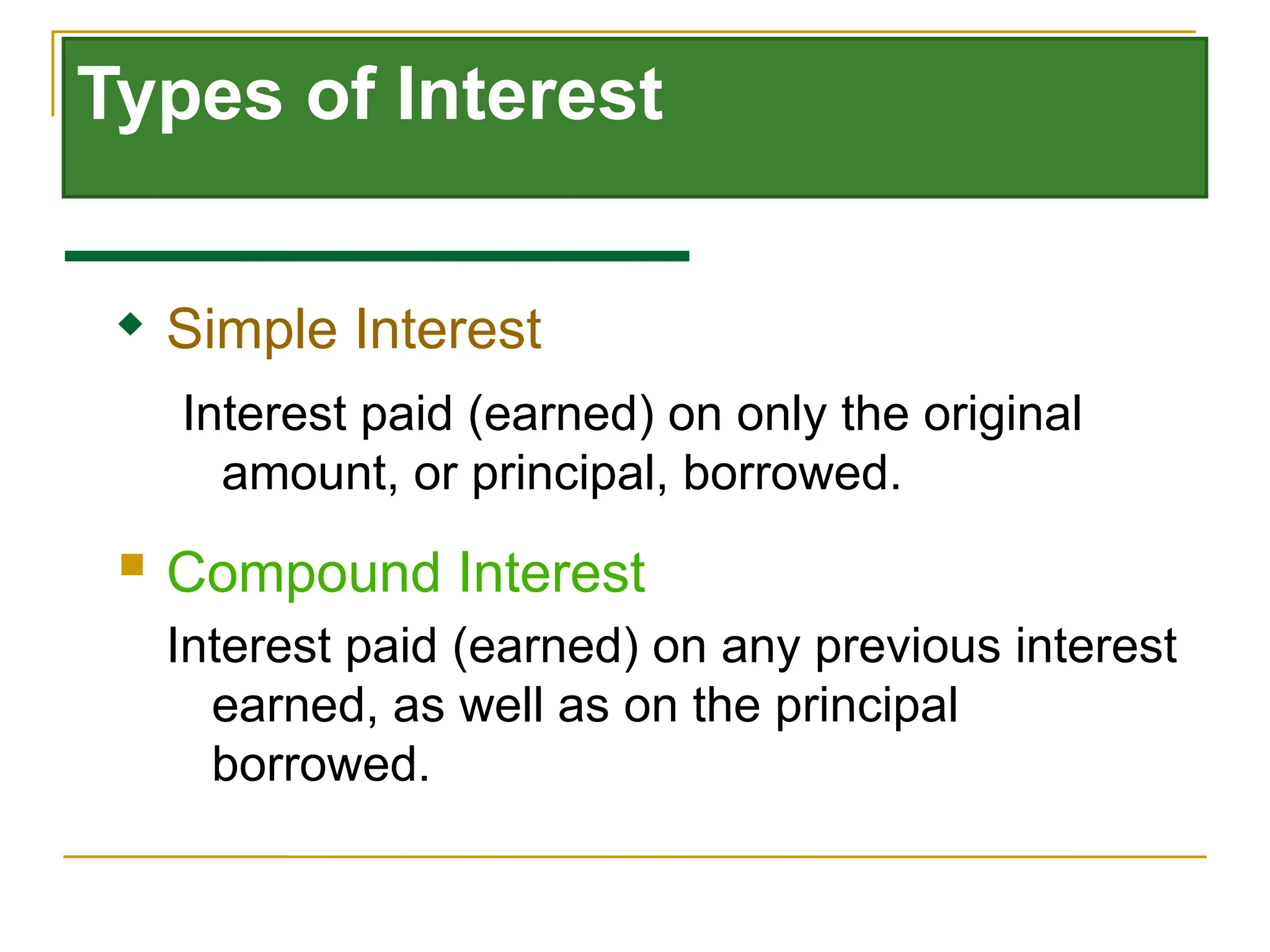
Types of Interest
 Compound Interest
Interest paid (earned) on any previous interest
earned, as well as on the principal
borrowed.
 Simple Interest
Interest paid (earned) on only the original
amount, or principal, borrowed.
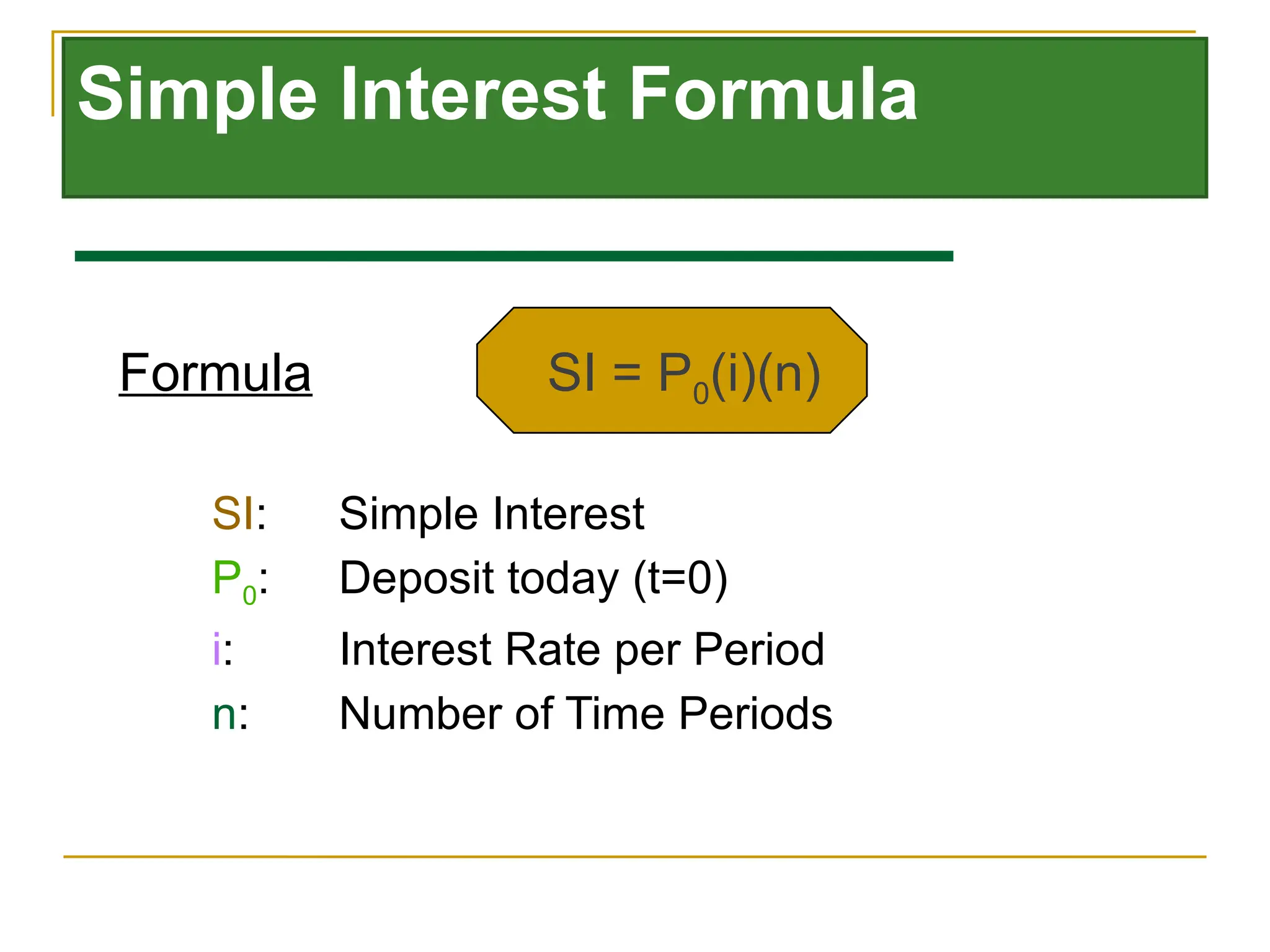
Simple Interest Formula
Formula SI = P0(i)(n)
SI: Simple Interest
P0: Deposit today (t=0)
i: Interest Rate per Period
n: Number of Time Periods
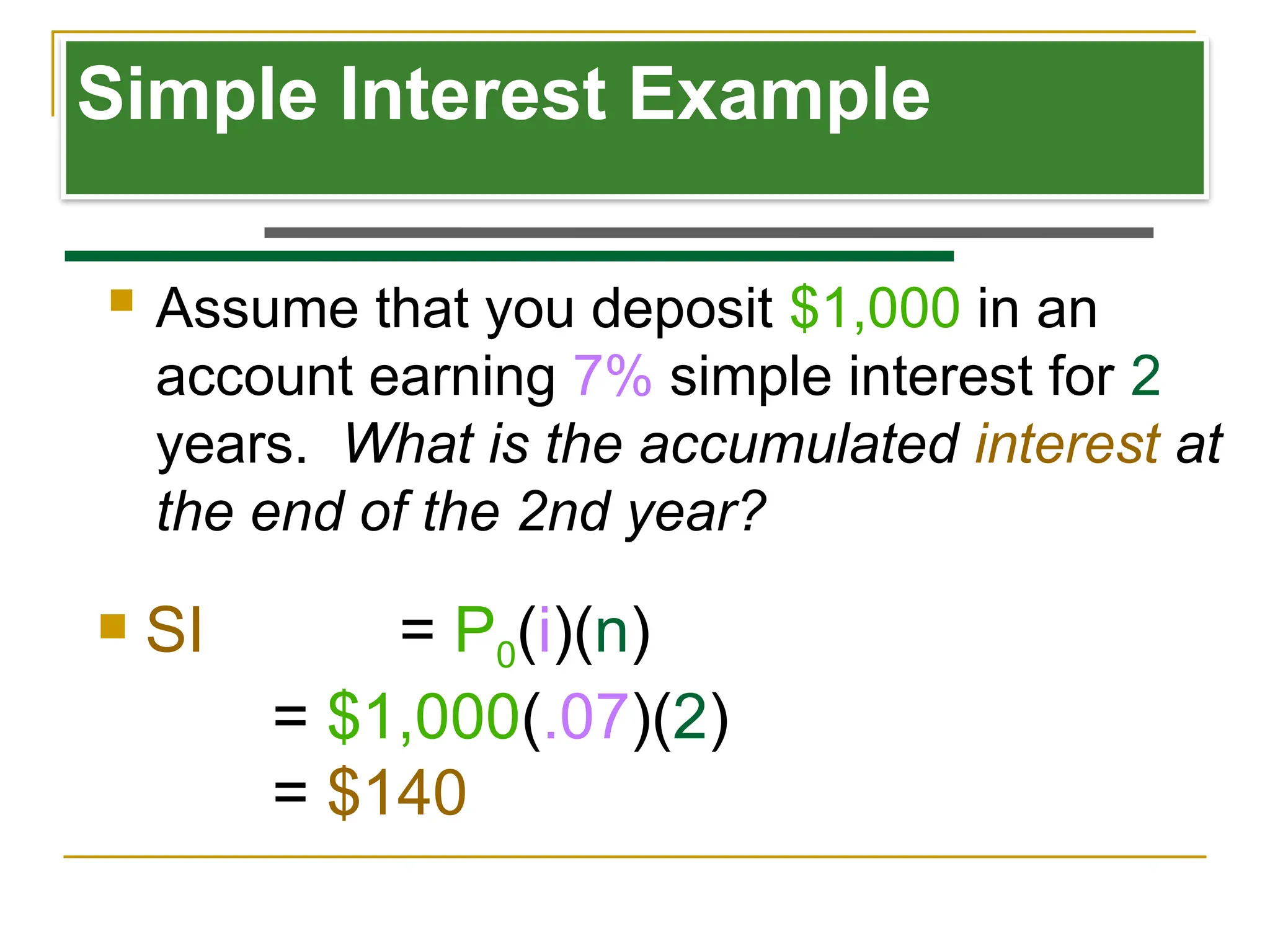
Simple Interest Example
 SI = P0(i)(n)
= $1,000(.07)(2)
= $140
 Assume that you deposit $1,000 in an
account earning 7% simple interest for 2
years. What is the accumulated interest at
the end of the 2nd year?
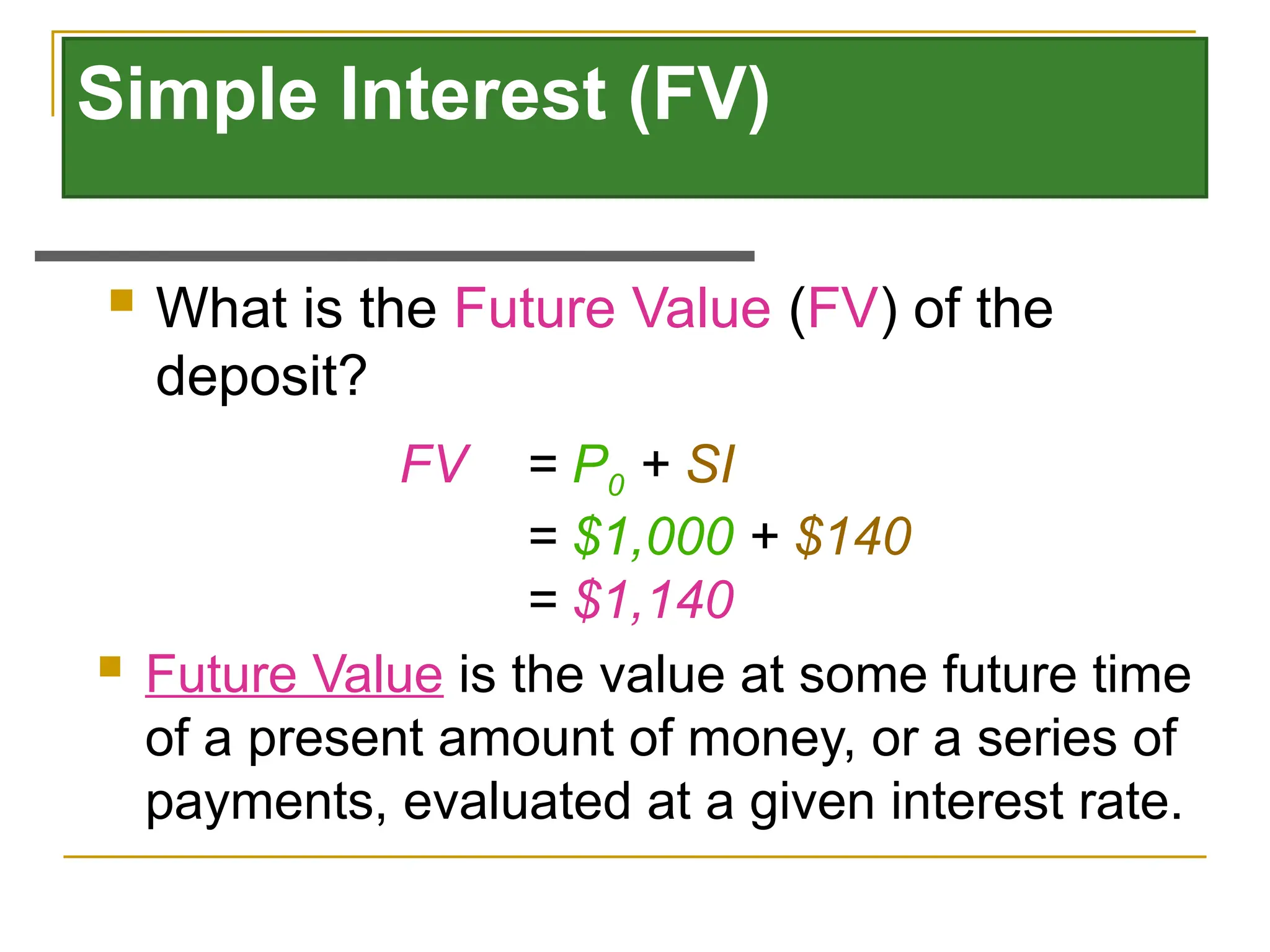
Simple Interest (FV)
FV = P0 + SI
= $1,000 + $140
= $1,140
 Future Value is the value at some future time
of a present amount of money, or a series of
payments, evaluated at a given interest rate.
 What is the Future Value (FV) of the
deposit?
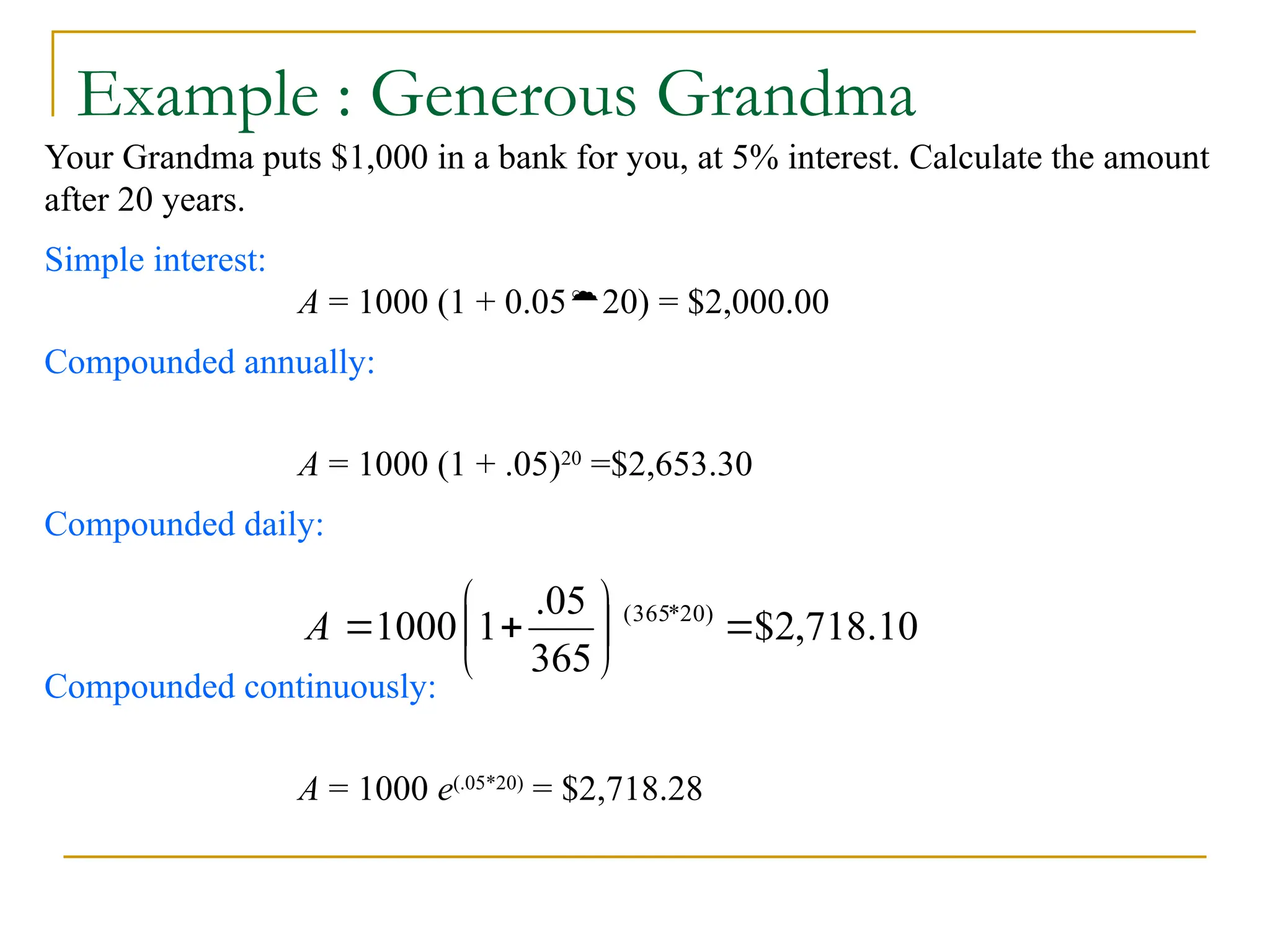
Example : Generous Grandma
Your Grandma puts $1,000 in a bank for you, at 5% interest. Calculate the amount
after 20 years.
Simple interest:
A = 1000 (1 + 0.0520) = $2,000.00
Compounded annually:
A = 1000 (1 + .05)20
=$2,653.30
Compounded daily:
Compounded continuously:
A = 1000 e(.05*20)
= $2,718.28
10
.
718
,
2
$
365
05
.
1
1000 )
20
*
365
(









A
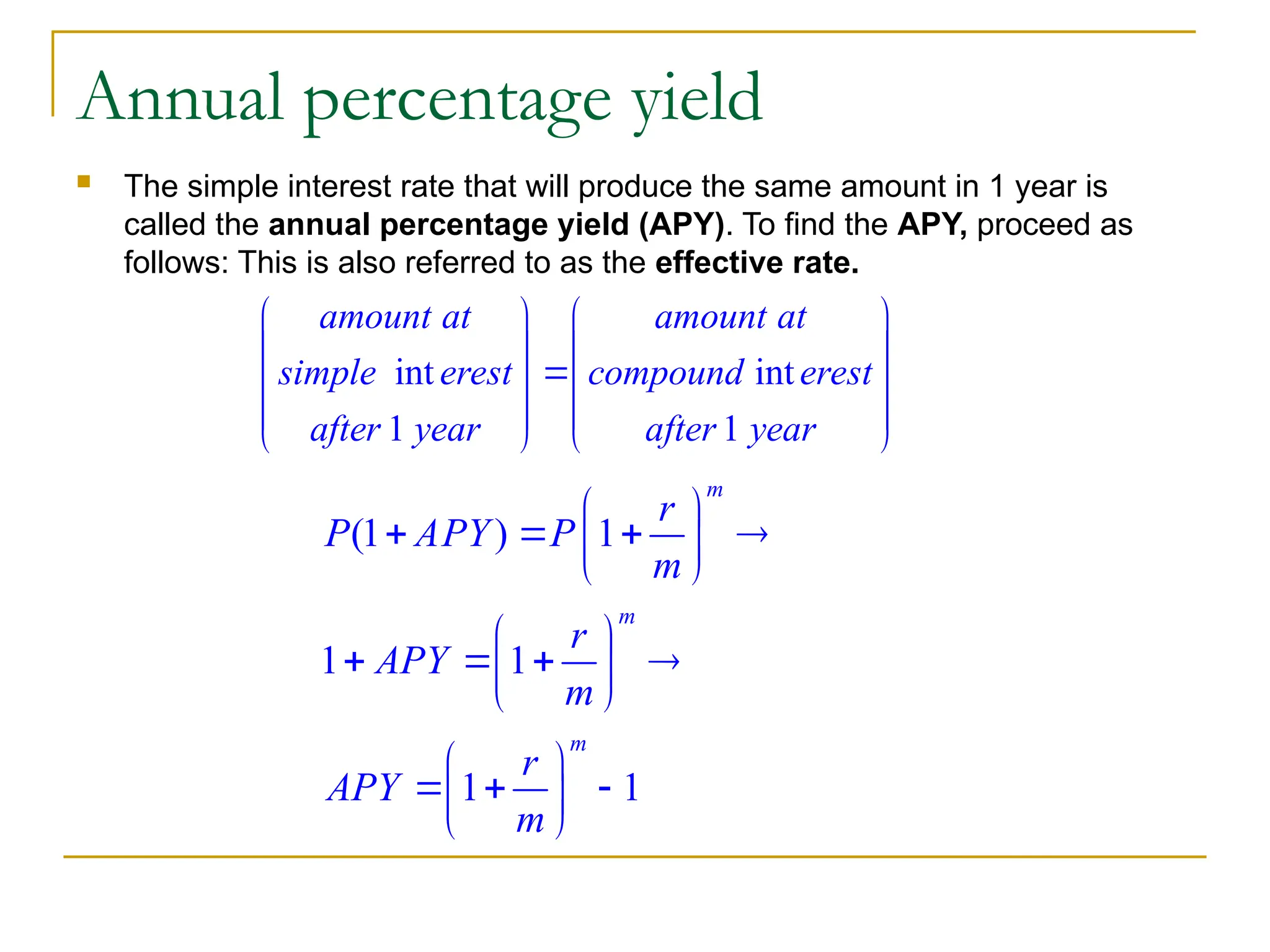
Annual percentage yield
 The simple interest rate that will produce the same amount in 1 year is
called the annual percentage yield (APY). To find the APY, proceed as
follows: This is also referred to as the effective rate.
int int
1 1
amount at amount at
simple erest compound erest
after year after year
   
   

   
   
   
(1 ) 1
1 1
1 1
m
m
m
r
P APY P
m
r
APY
m
r
APY
m
 
   
 
 
 
   
 
 
 
  
 
 
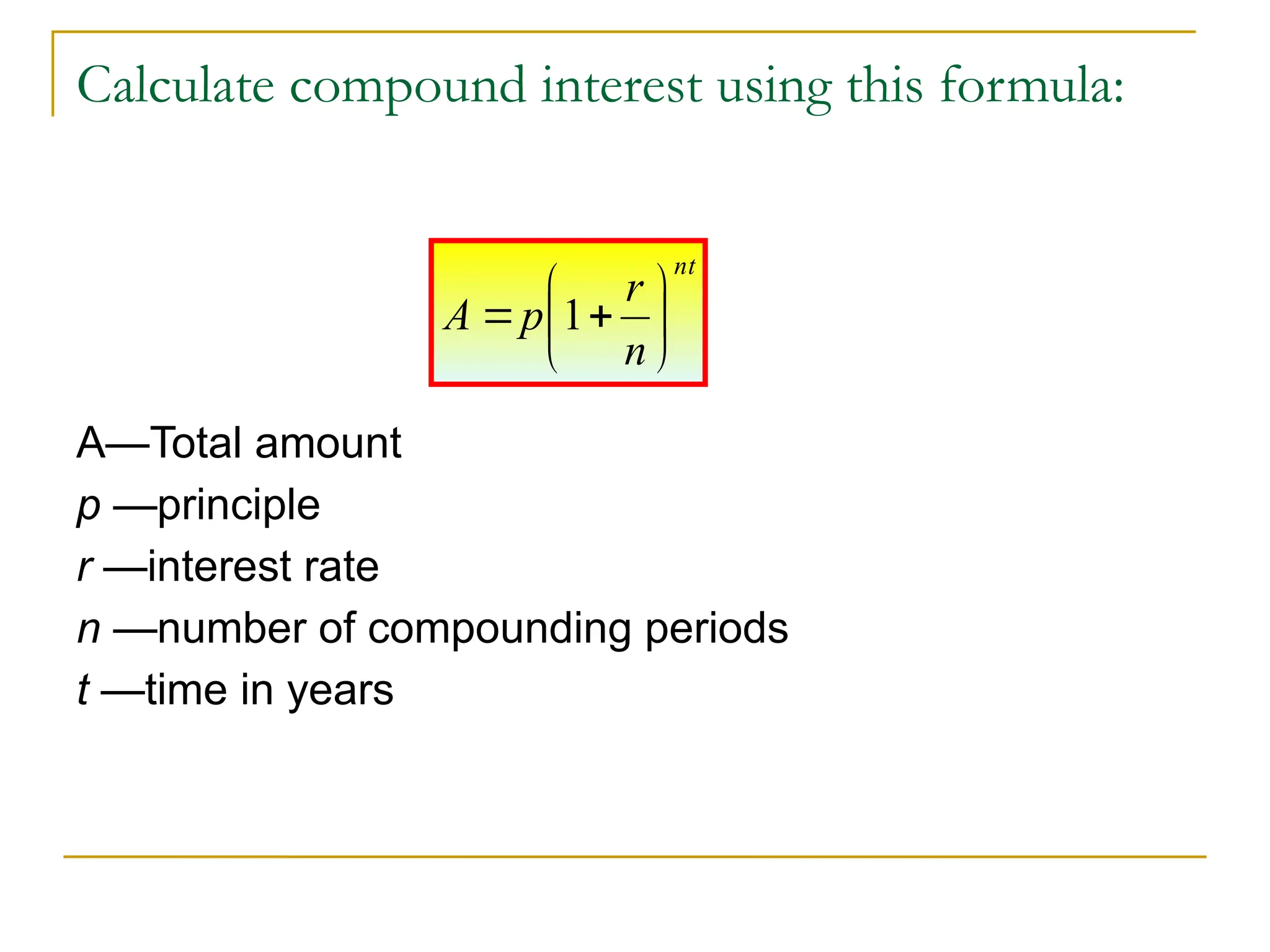
Calculate compound interest using this formula:
A—Total amount
p —principle
r —interest rate
n —number of compounding periods
t —time in years
nt
n
r
p
A 






 1
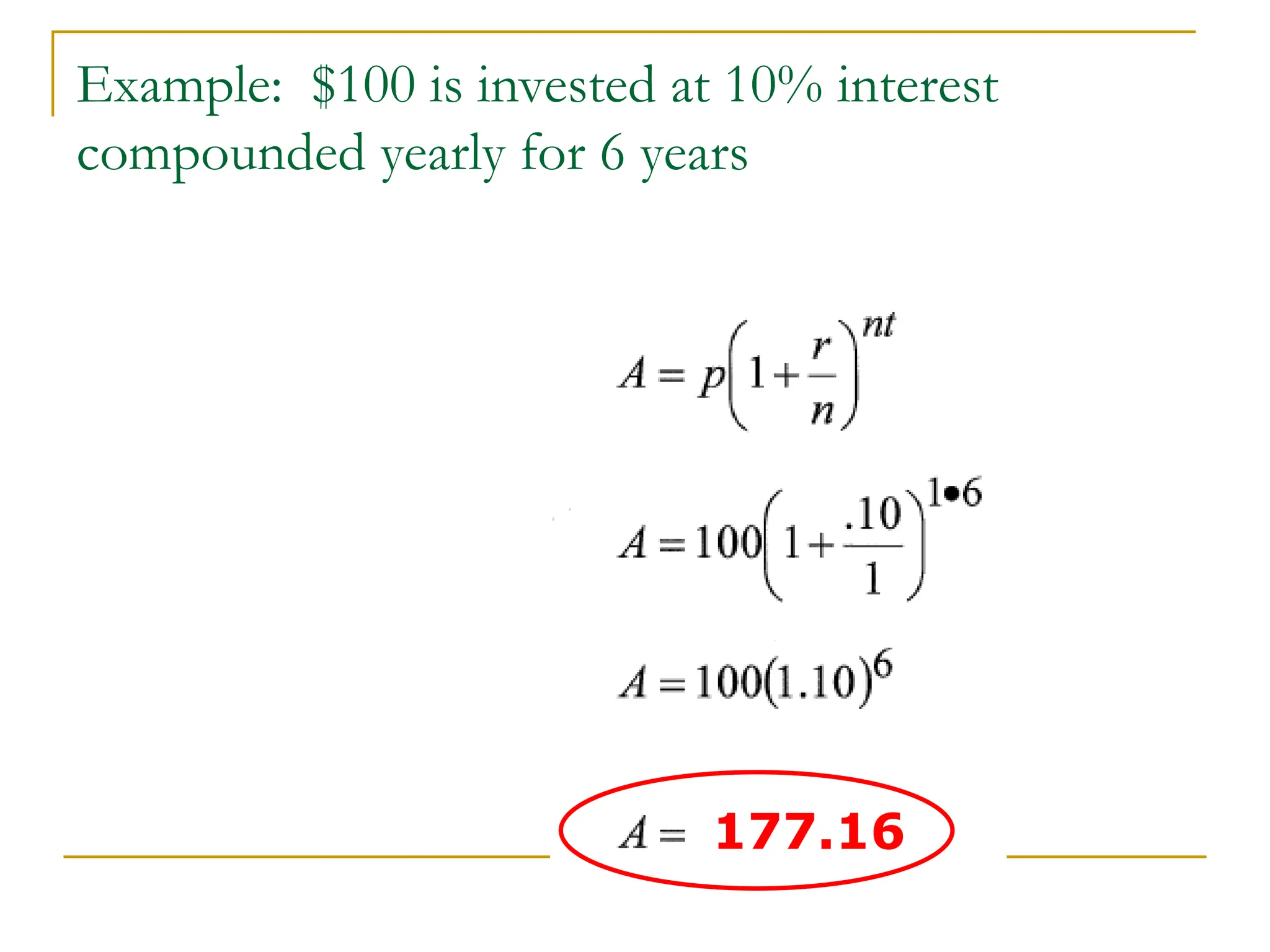
Example: $100 is invested at 10% interest
compounded yearly for 6 years
177.16
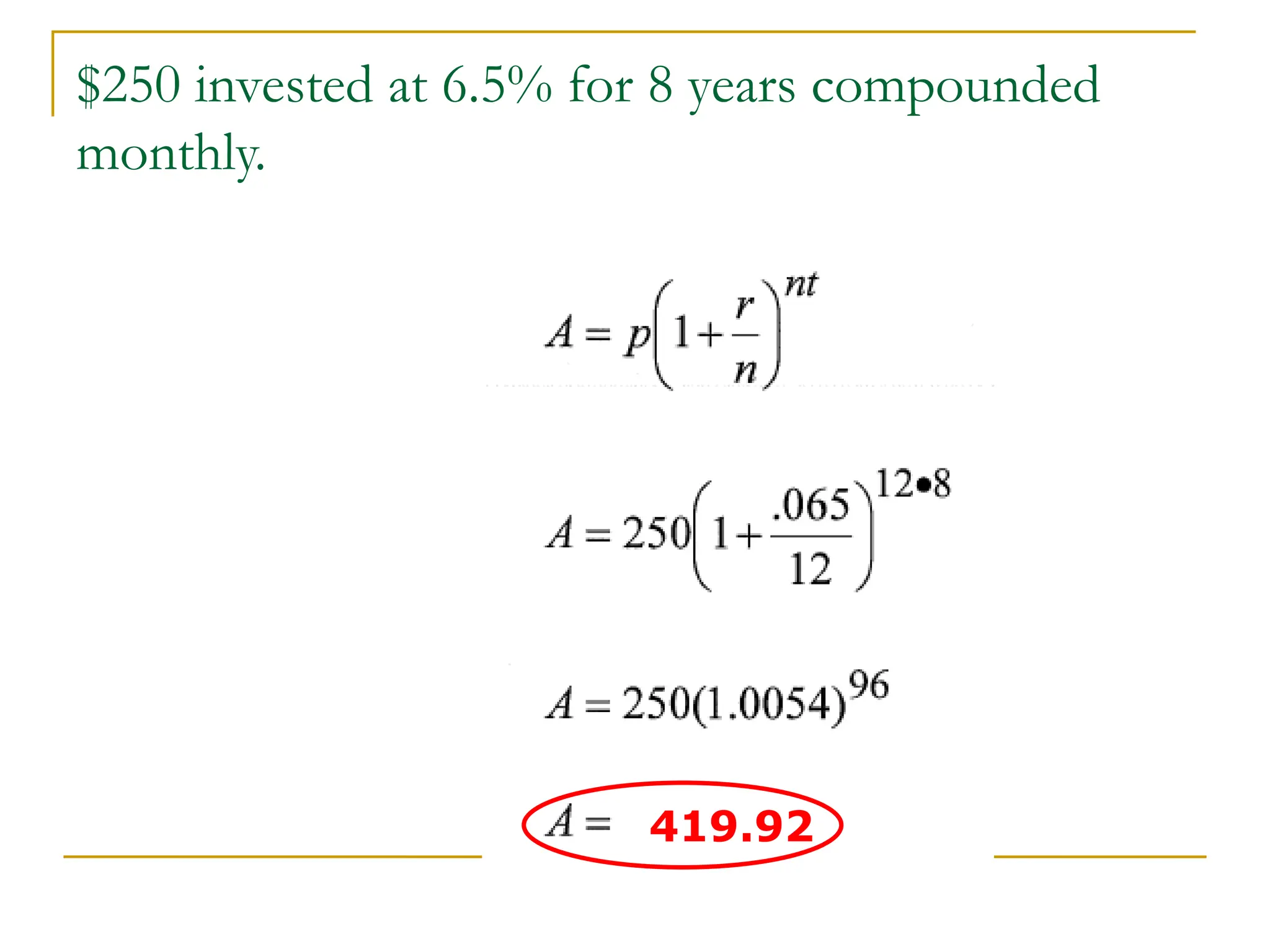
$250 invested at 6.5% for 8 years compounded
monthly.
419.92
Example……
 $500 invested at 12% for 10 years
compounded yearly.
Answer……
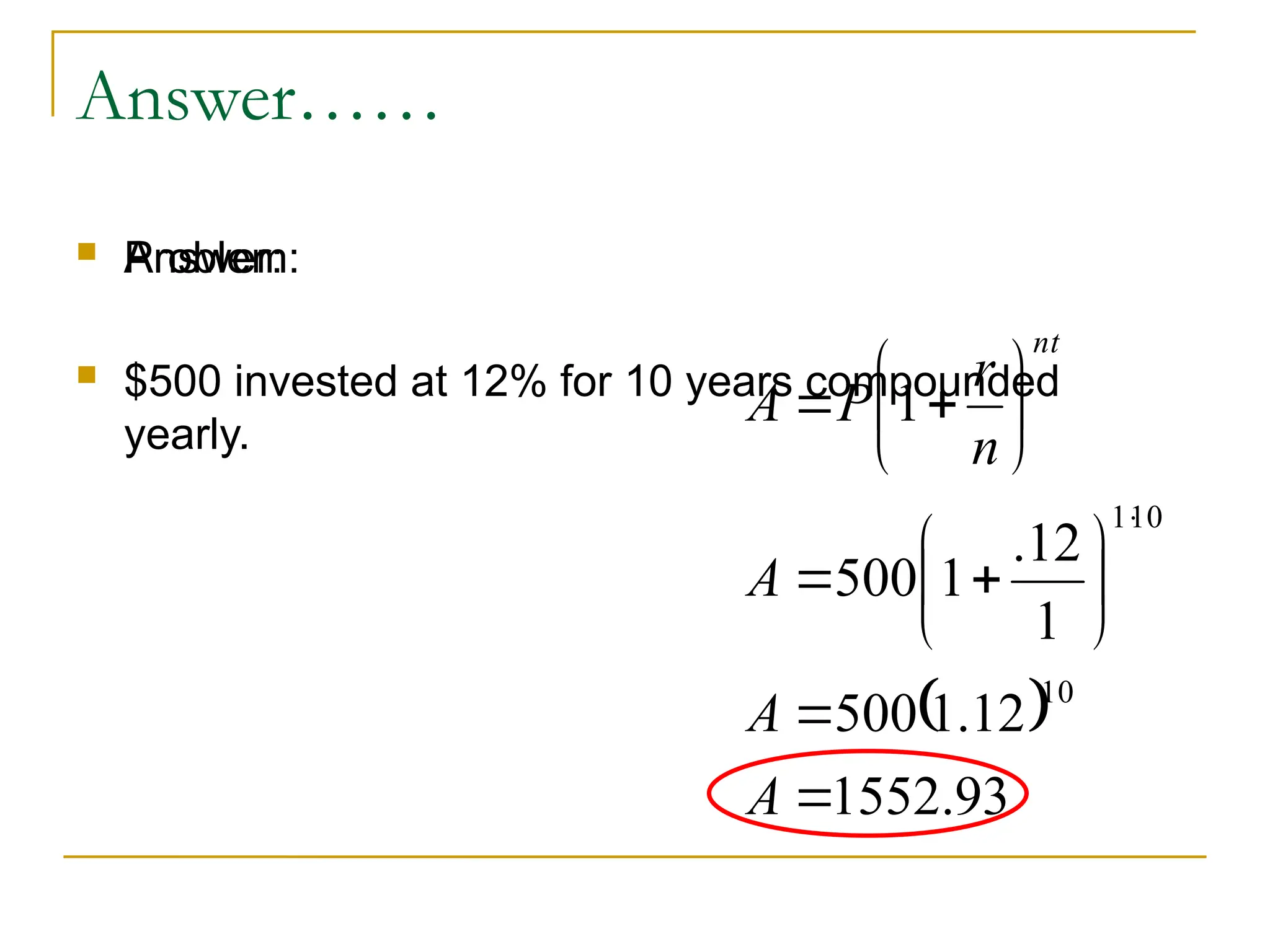
 Problem:
 $500 invested at 12% for 10 years compounded
yearly.
 Answer:
 
93
.
1552
12
.
1
500
1
12
.
1
500
1
10
10
1



















A
A
A
n
r
P
A
nt
Example……
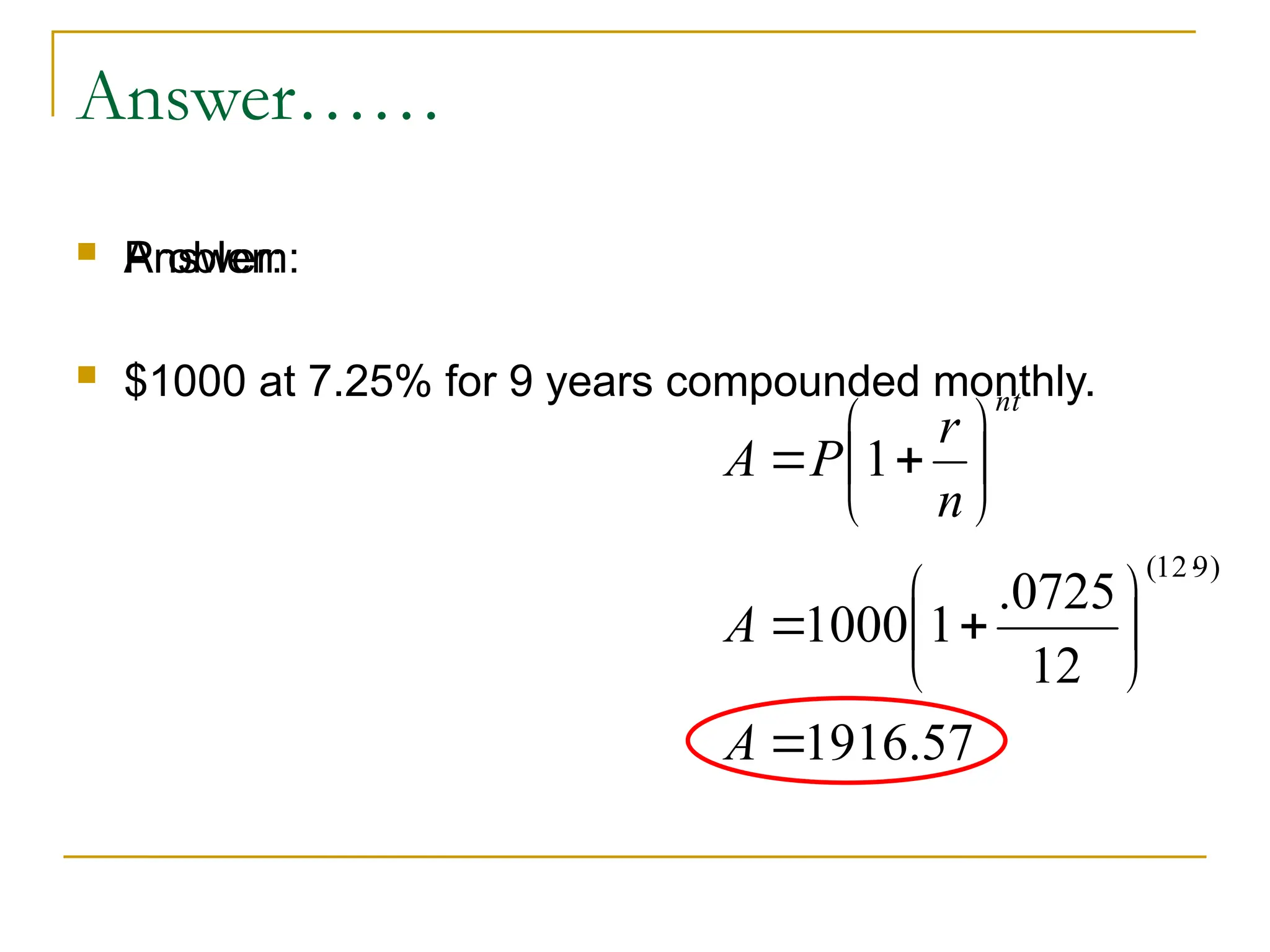
 $1000 at 7.25% for 9 years compounded
monthly.
Answer……
 Problem:
 $1000 at 7.25% for 9 years compounded monthly.
 Answer:
57
.
1916
12
0725
.
1
1000
1
)
9
12
(


















A
A
n
r
P
A
nt
18
Single Payment Future Amount
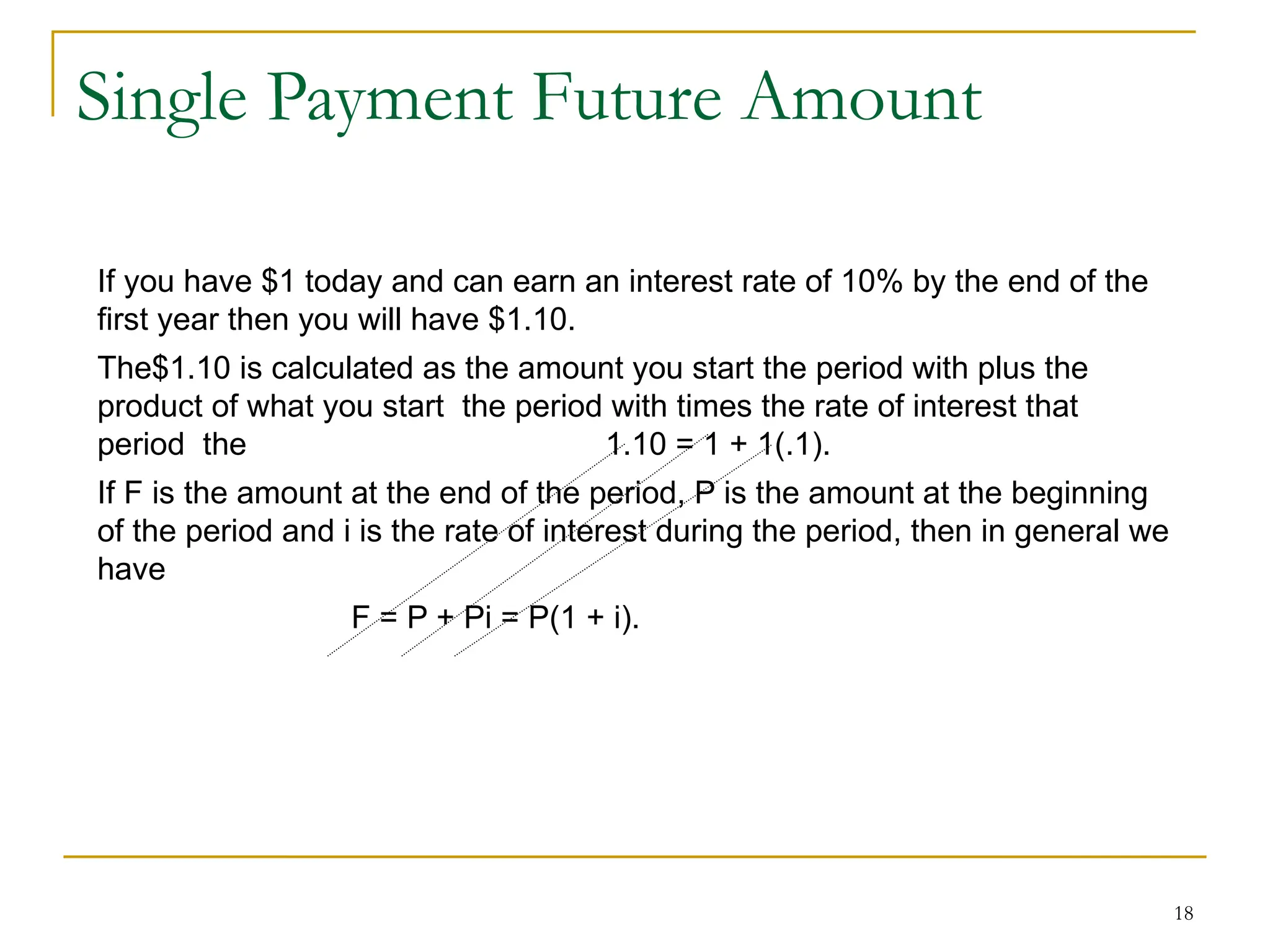
If you have $1 today and can earn an interest rate of 10% by the end of the
first year then you will have $1.10.
The$1.10 is calculated as the amount you start the period with plus the
product of what you start the period with times the rate of interest that
period the 1.10 = 1 + 1(.1).
If F is the amount at the end of the period, P is the amount at the beginning
of the period and i is the rate of interest during the period, then in general we
have
F = P + Pi = P(1 + i).
19
Growth in general
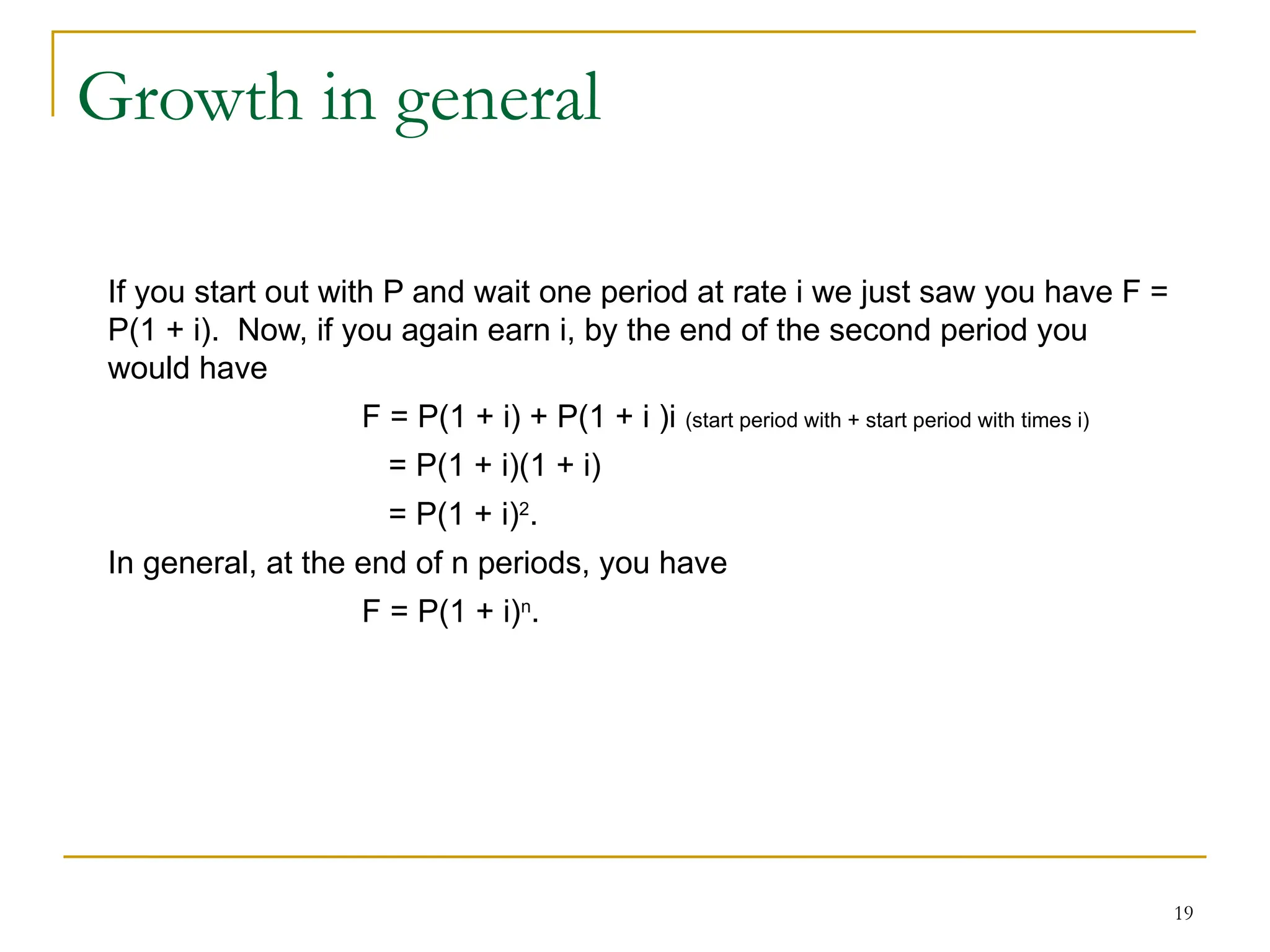
If you start out with P and wait one period at rate i we just saw you have F =
P(1 + i). Now, if you again earn i, by the end of the second period you
would have
F = P(1 + i) + P(1 + i )i (start period with + start period with times i)
= P(1 + i)(1 + i)
= P(1 + i)2
.
In general, at the end of n periods, you have
F = P(1 + i)n
.
20
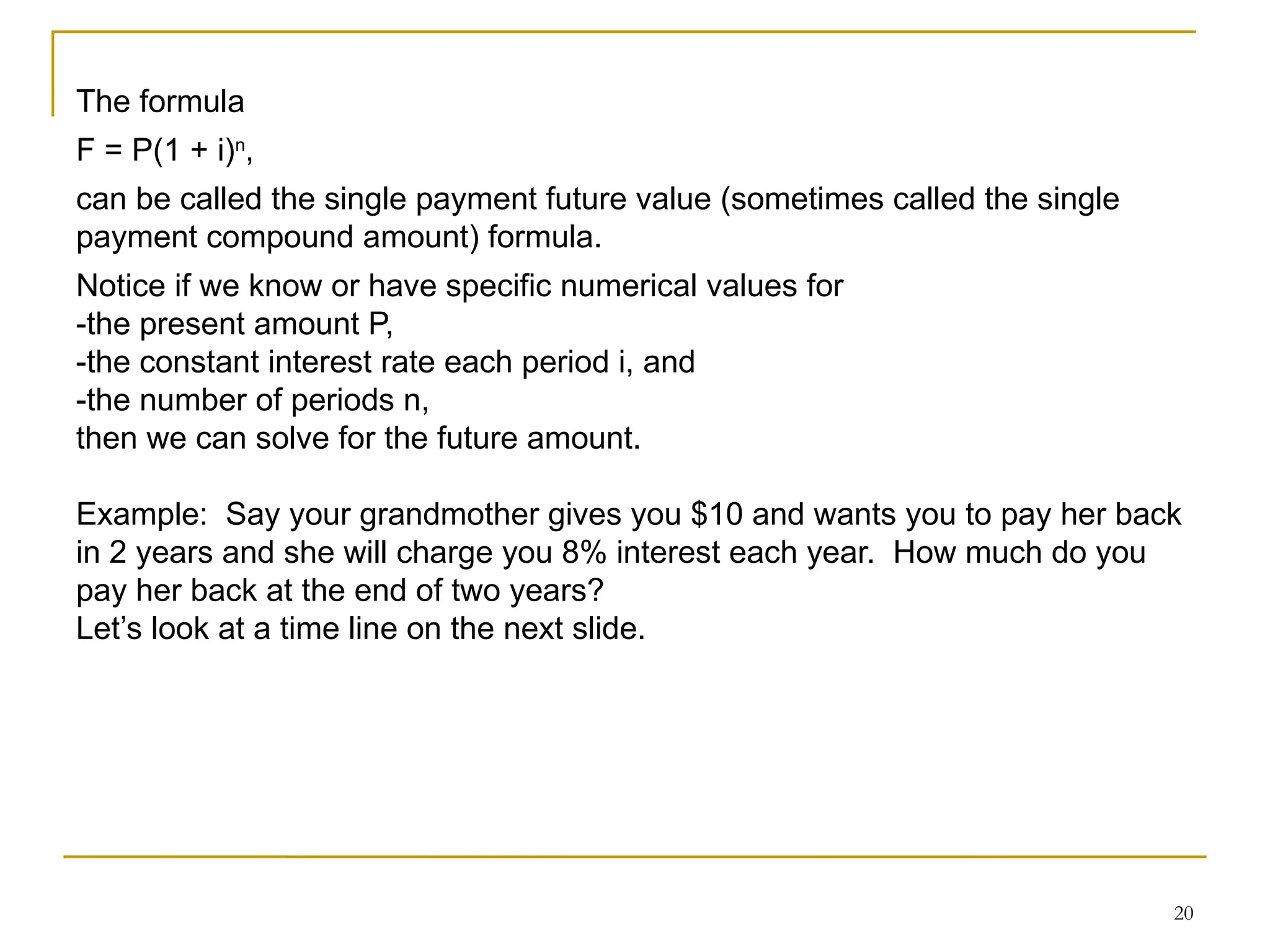
The formula
F = P(1 + i)n
,
can be called the single payment future value (sometimes called the single
payment compound amount) formula.
Notice if we know or have specific numerical values for
-the present amount P,
-the constant interest rate each period i, and
-the number of periods n,
then we can solve for the future amount.
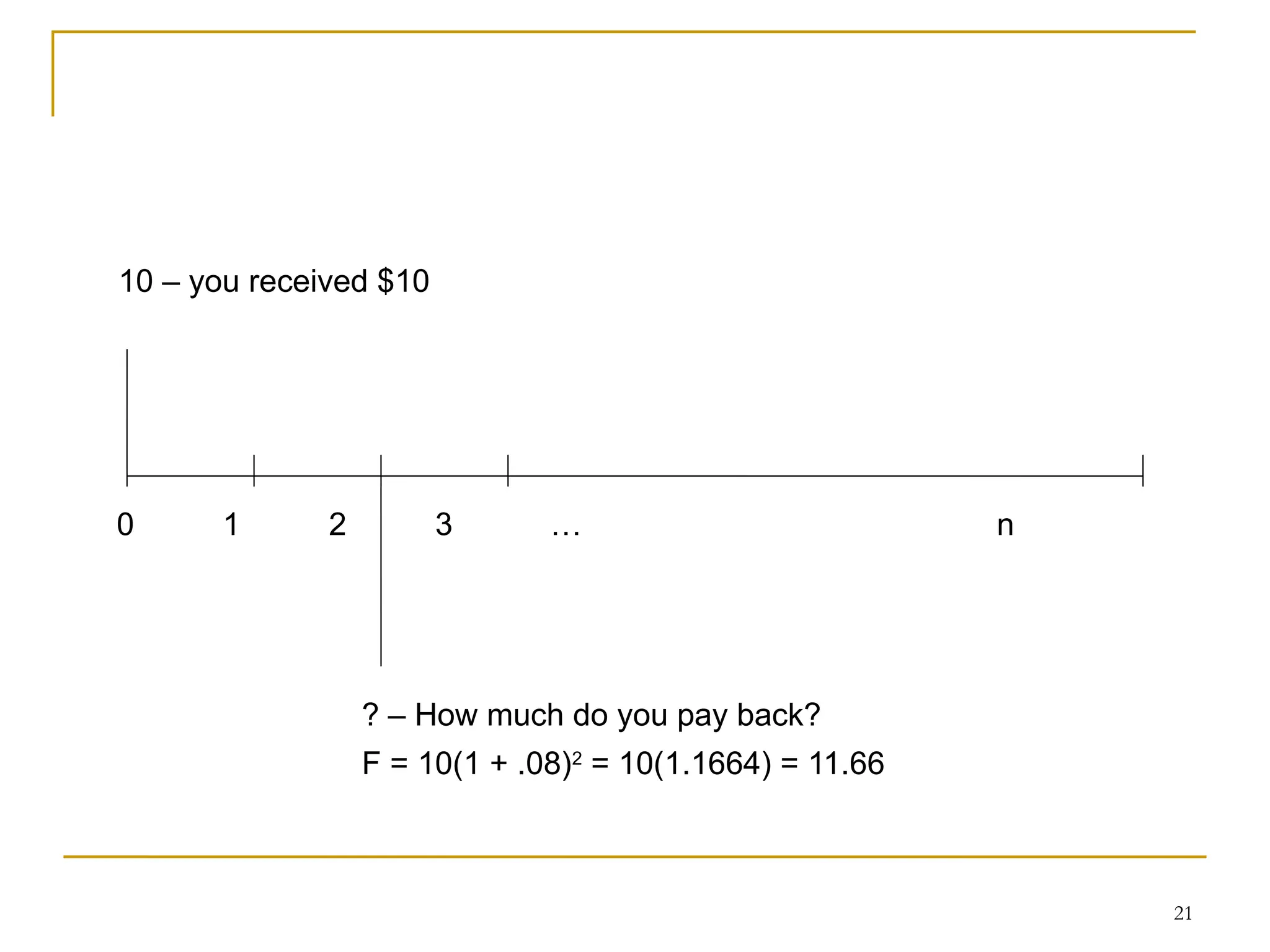
Example: Say your grandmother gives you $10 and wants you to pay her back
in 2 years and she will charge you 8% interest each year. How much do you
pay her back at the end of two years?
Let’s look at a time line on the next slide.
21
0 1 2 3 … n
10 – you received $10
? – How much do you pay back?
F = 10(1 + .08)2
= 10(1.1664) = 11.66
22
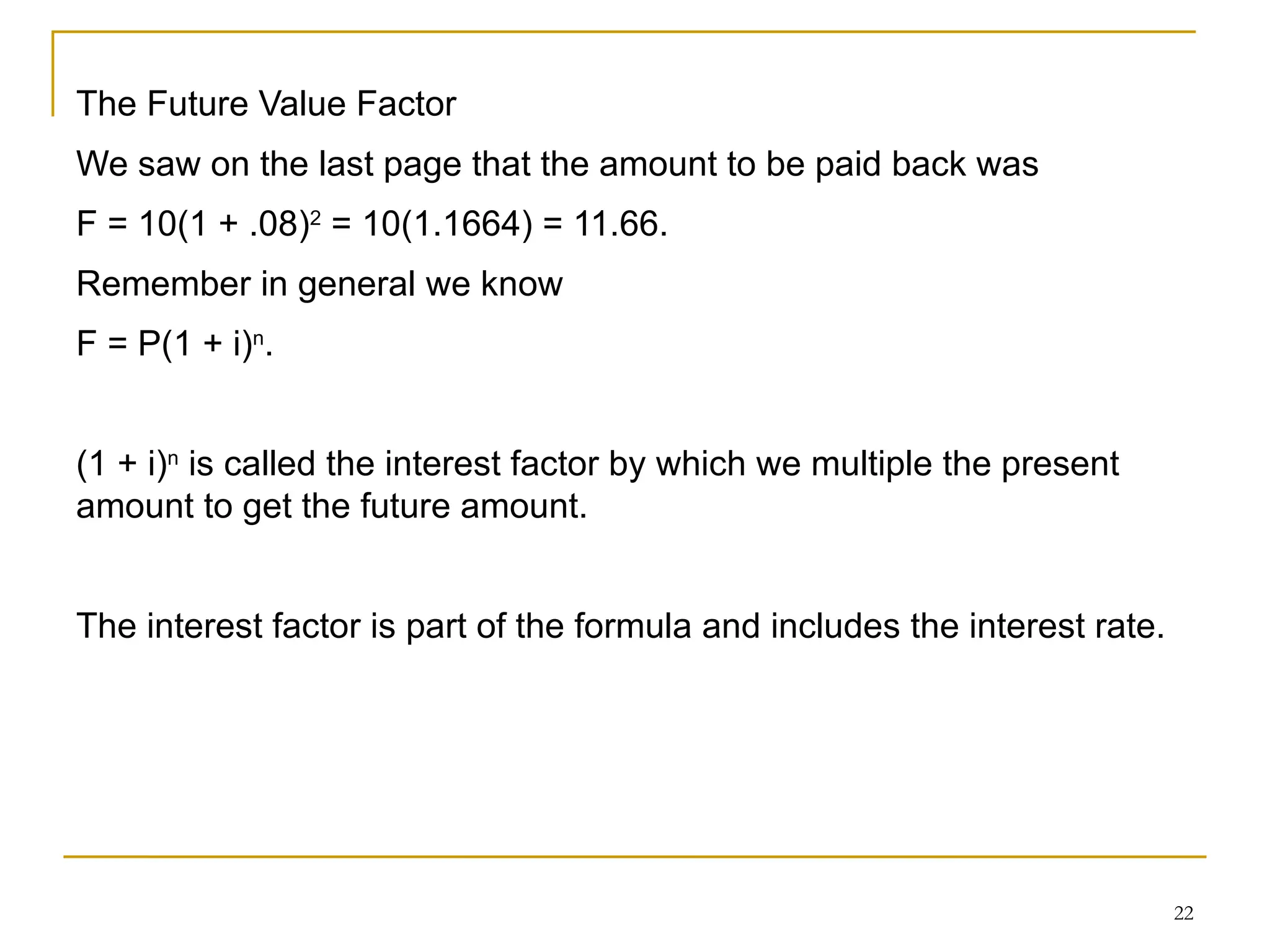
The Future Value Factor
We saw on the last page that the amount to be paid back was
F = 10(1 + .08)2
= 10(1.1664) = 11.66.
Remember in general we know
F = P(1 + i)n
.
(1 + i)n
is called the interest factor by which we multiple the present
amount to get the future amount.
The interest factor is part of the formula and includes the interest rate.
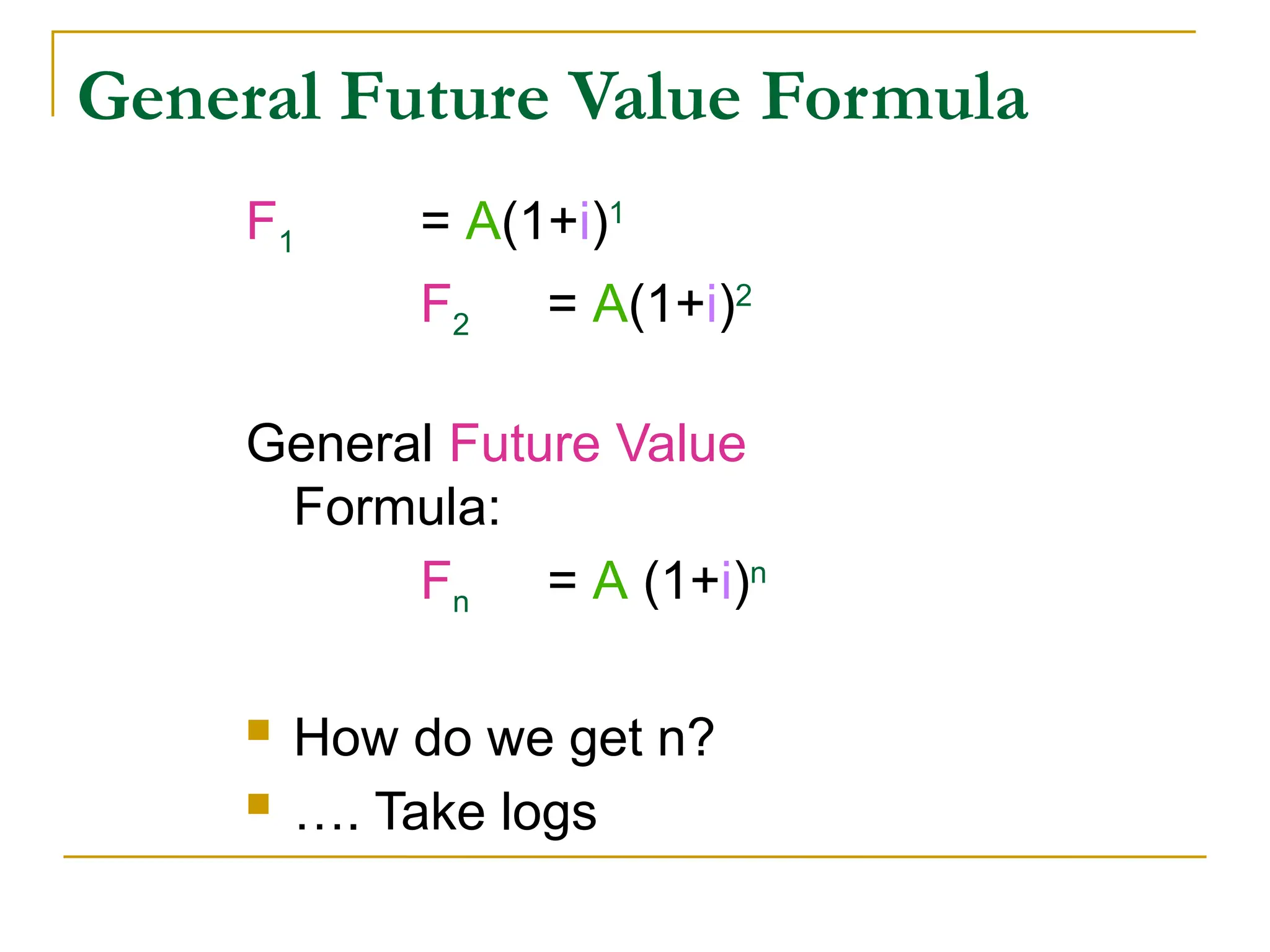
General Future Value Formula
F1 = A(1+i)1
F2 = A(1+i)2
General Future Value
Formula:
Fn = A (1+i)n
 How do we get n?
 …. Take logs
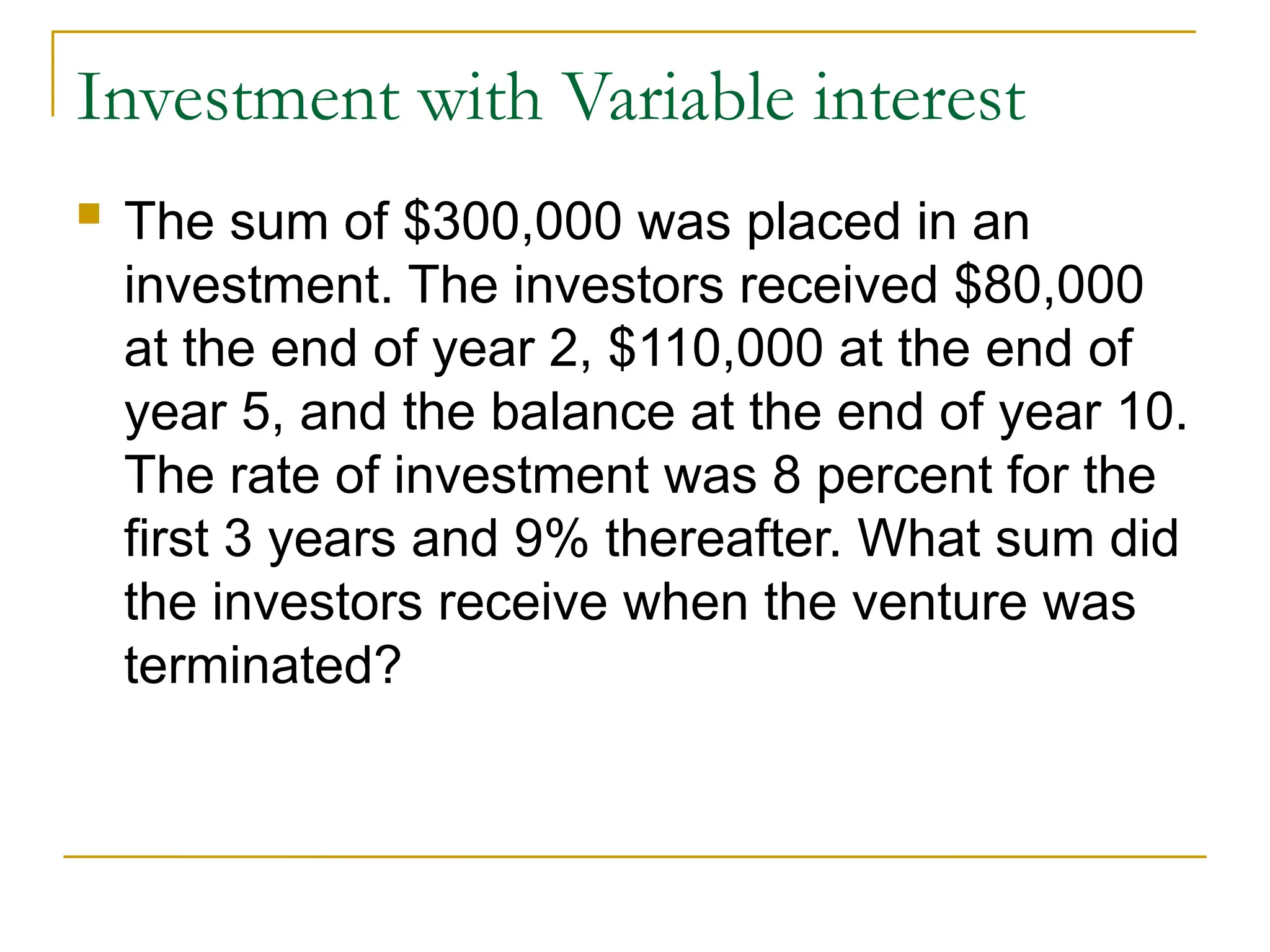
Investment with Variable interest
 The sum of $300,000 was placed in an
investment. The investors received $80,000
at the end of year 2, $110,000 at the end of
year 5, and the balance at the end of year 10.
The rate of investment was 8 percent for the
first 3 years and 9% thereafter. What sum did
the investors receive when the venture was
terminated?
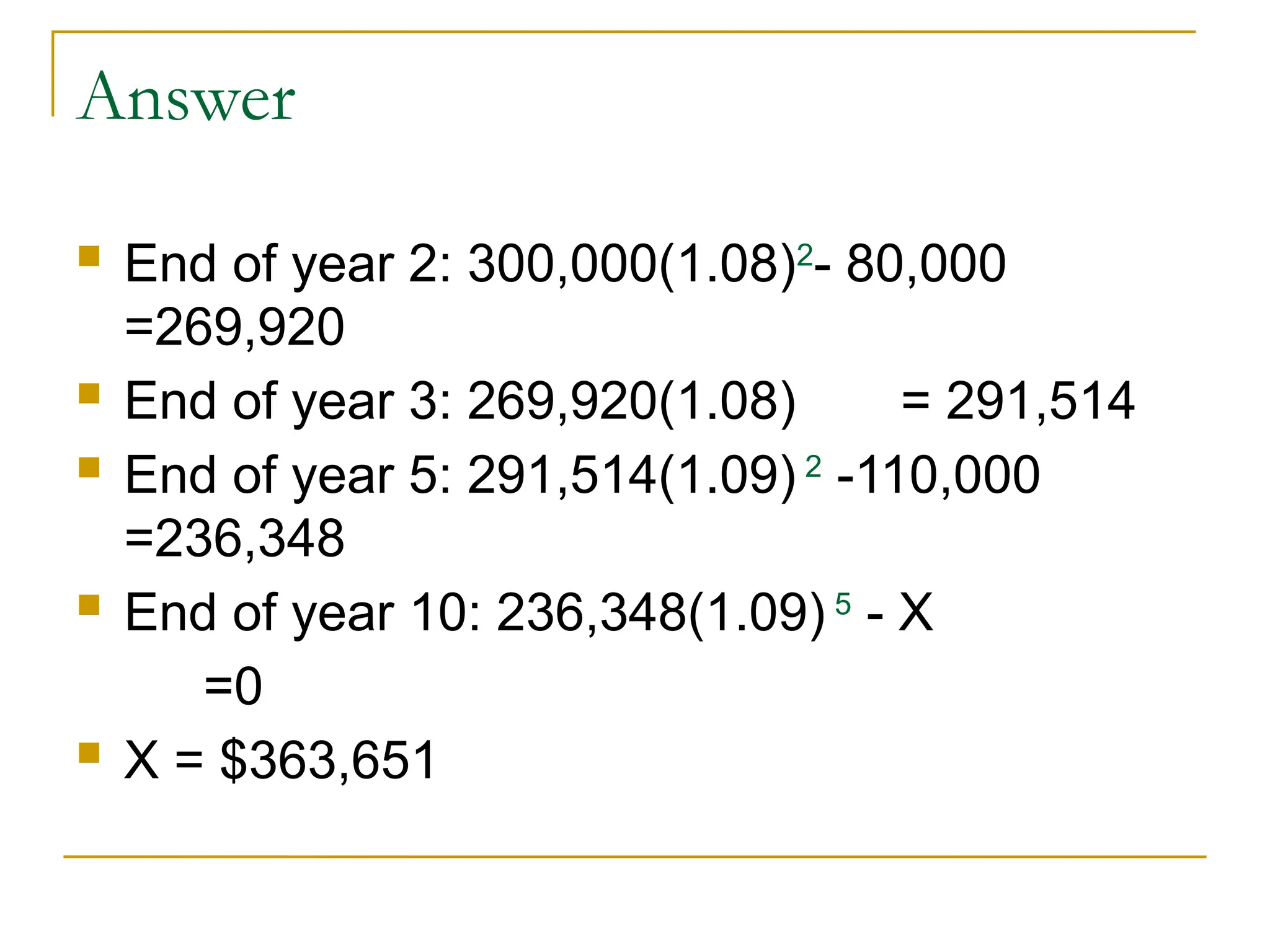
Answer
 End of year 2: 300,000(1.08)2
- 80,000
=269,920
 End of year 3: 269,920(1.08) = 291,514
 End of year 5: 291,514(1.09) 2
-110,000
=236,348
 End of year 10: 236,348(1.09) 5
- X
=0
 X = $363,651
Annuity
 When the sum of principal and interest is
equal for each period.
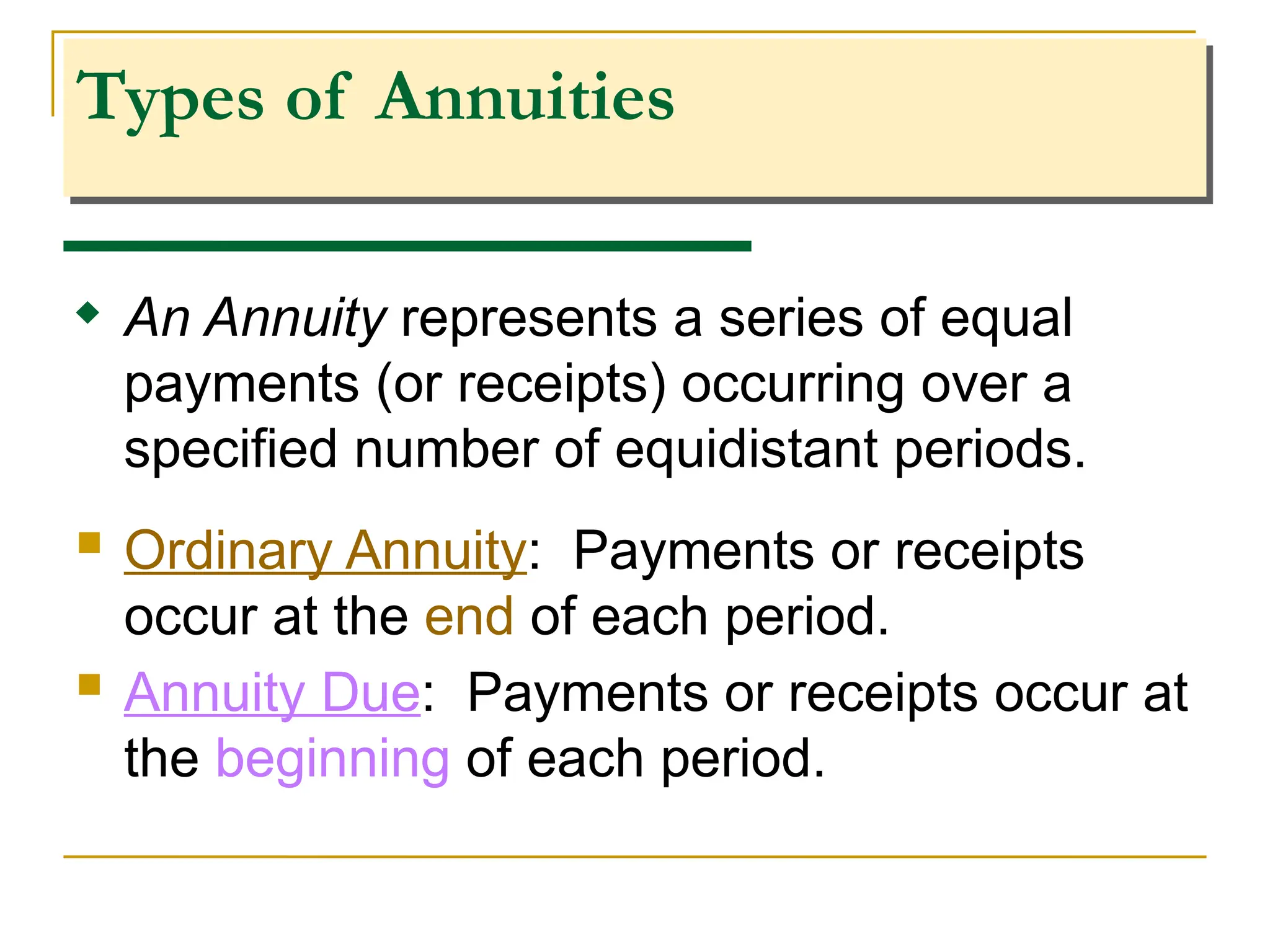
Types of Annuities
 Ordinary Annuity: Payments or receipts
occur at the end of each period.
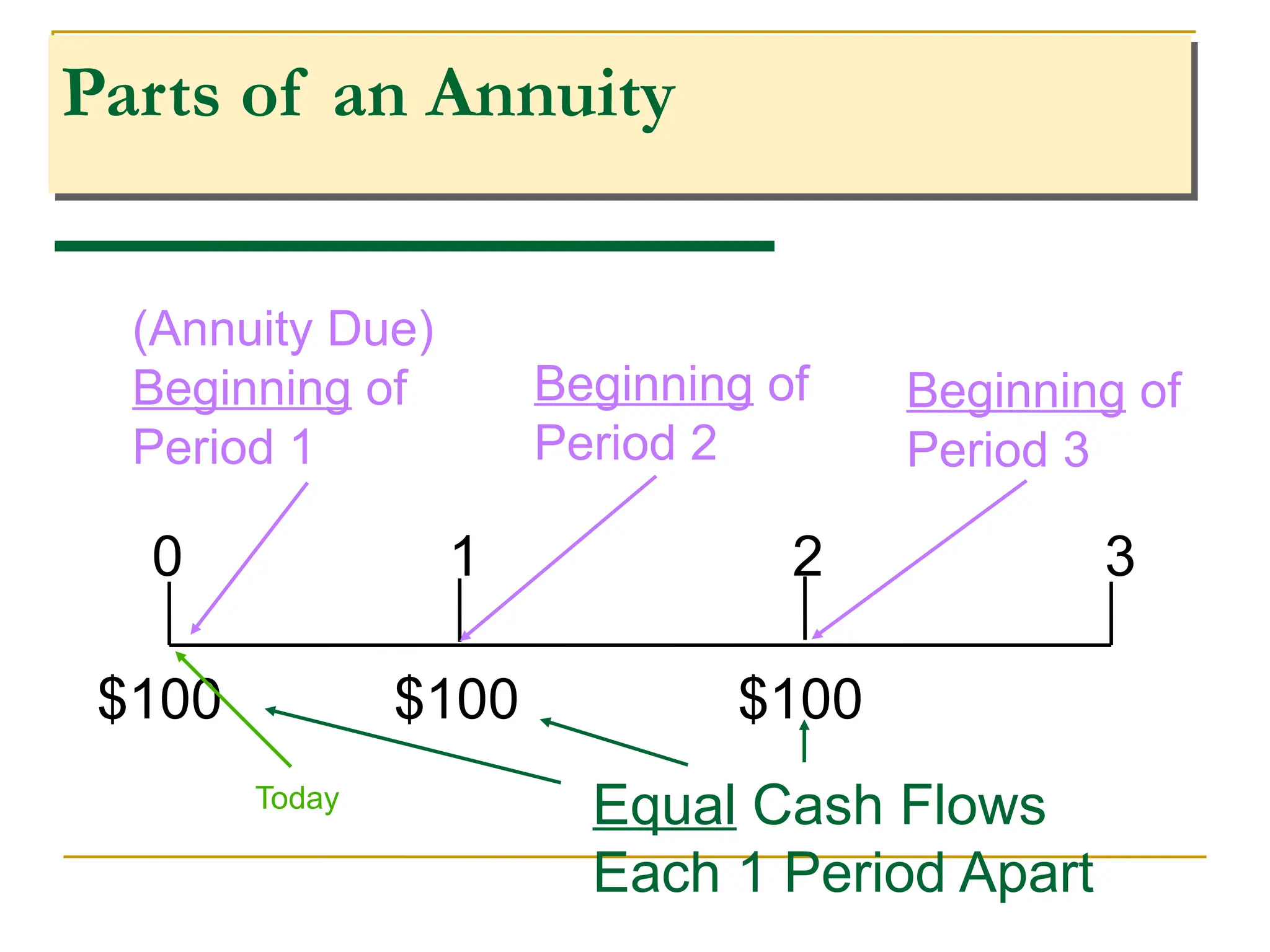
 Annuity Due: Payments or receipts occur at
the beginning of each period.
 An Annuity represents a series of equal
payments (or receipts) occurring over a
specified number of equidistant periods.
Examples of Annuities
 Student Loan Payments
 Car Loan Payments
 Insurance Premiums
 Mortgage Payments
 Retirement Savings
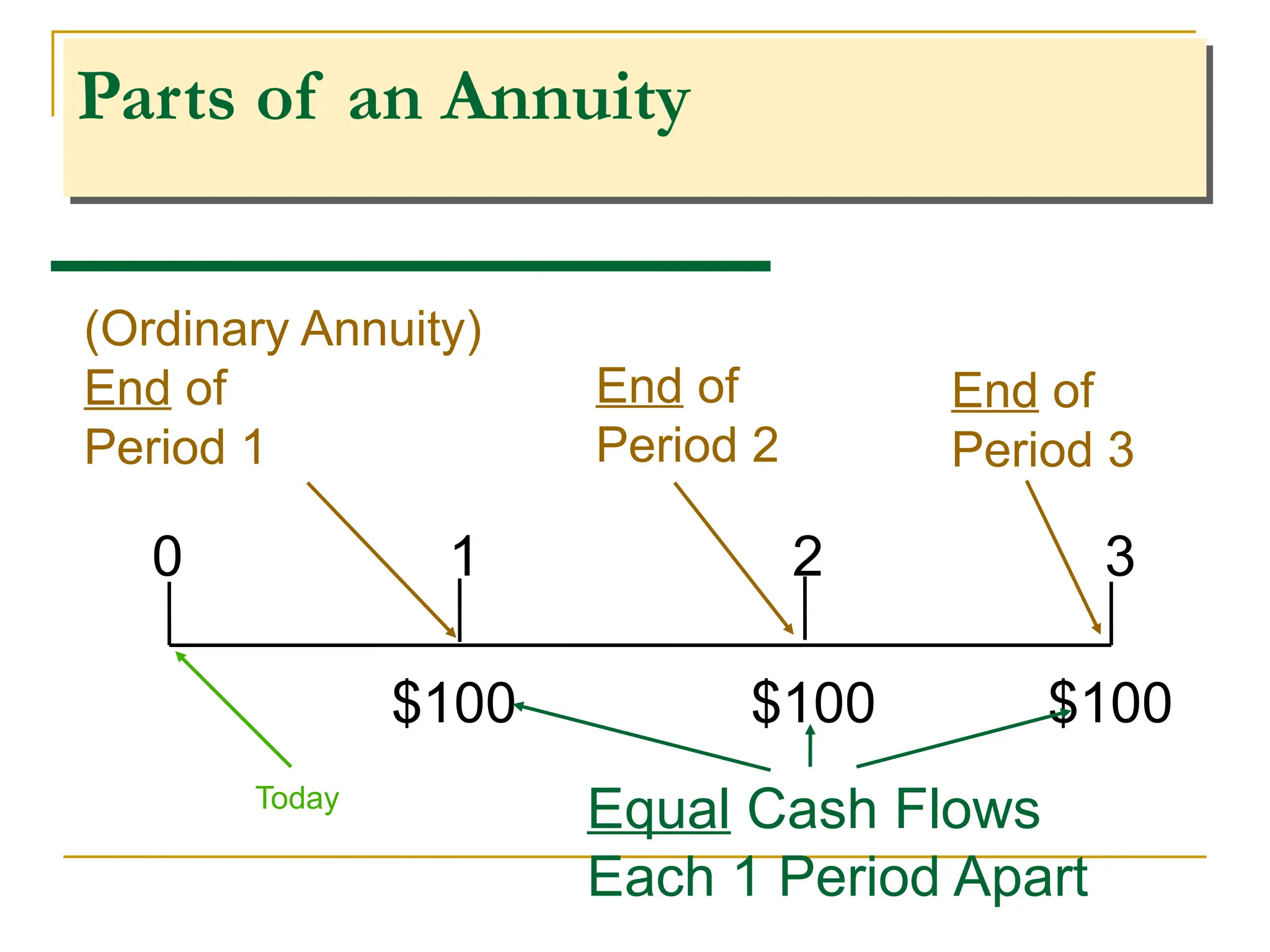
Parts of an Annuity
0 1 2 3
$100 $100 $100
(Ordinary Annuity)
End of
Period 1
End of
Period 2
Today
Equal Cash Flows
Each 1 Period Apart
End of
Period 3
Parts of an Annuity
0 1 2 3
$100 $100 $100
(Annuity Due)
Beginning of
Period 1
Beginning of
Period 2
Today Equal Cash Flows
Each 1 Period Apart
Beginning of
Period 3
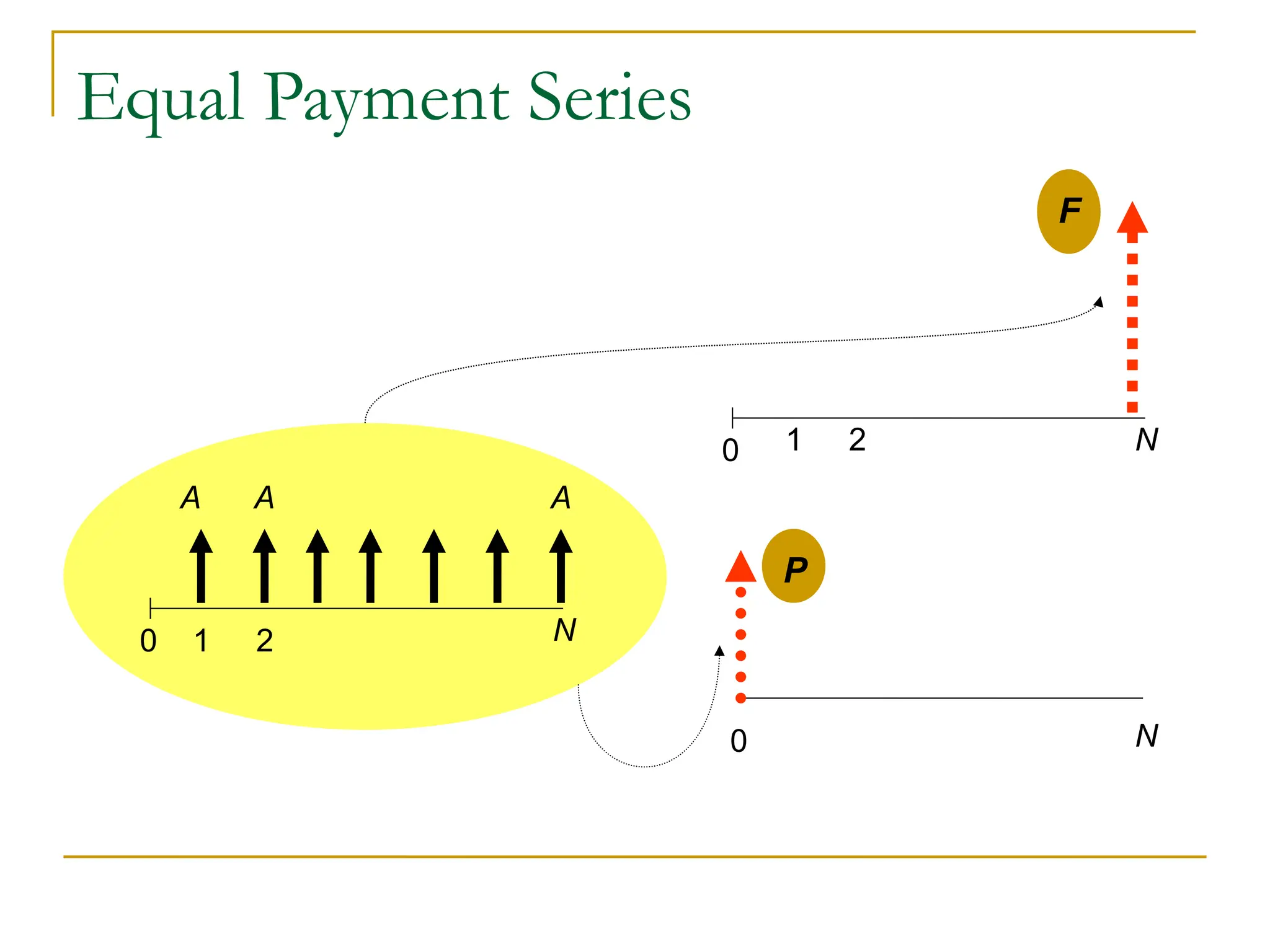
Equal Payment Series
0 1 2 N
0 1 2 N
A A A
F
P
0 N
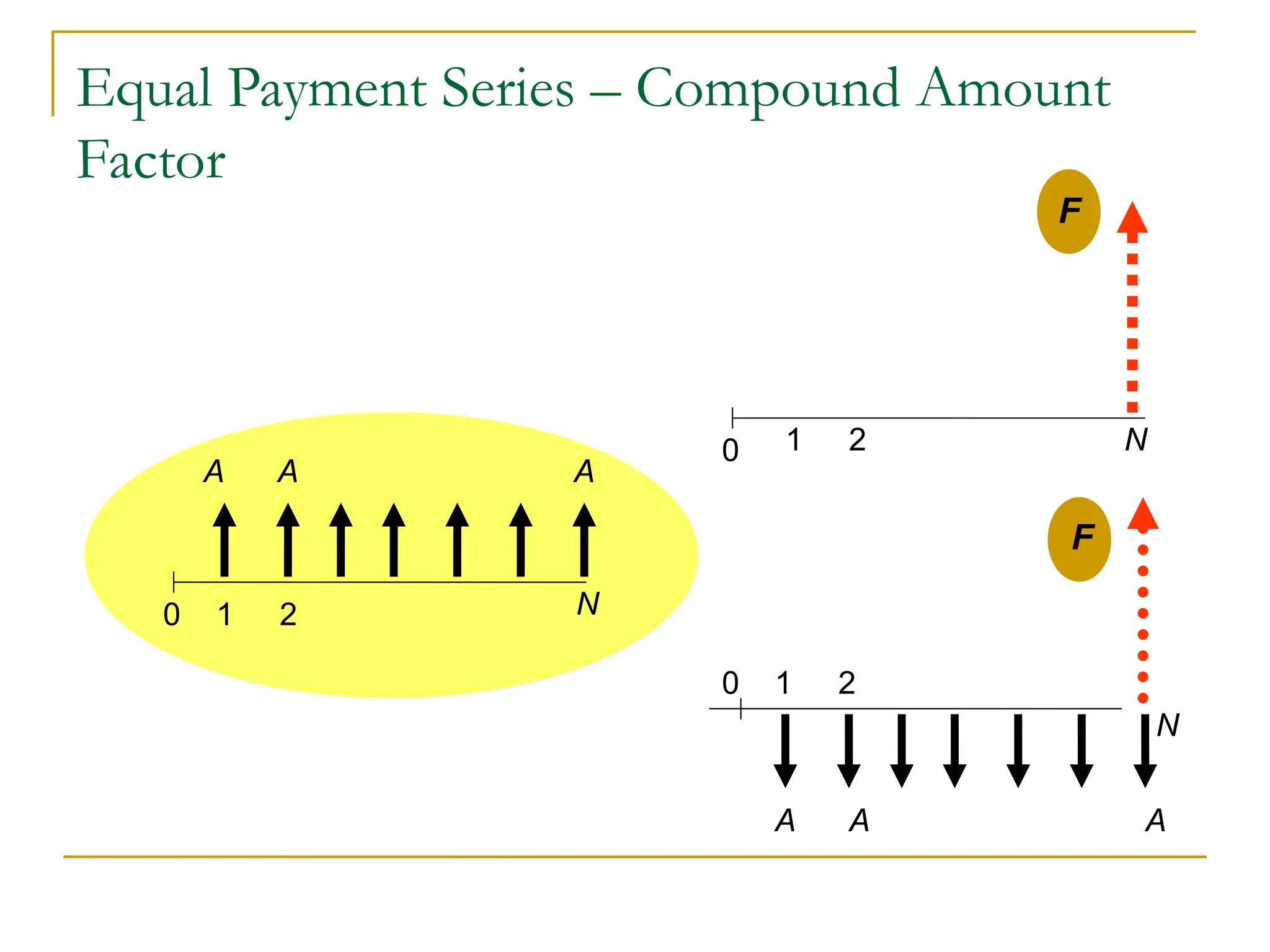
Equal Payment Series – Compound Amount
Factor
0 1 2 N
0 1 2 N
A A A
F
0 1 2
N
A A A
F
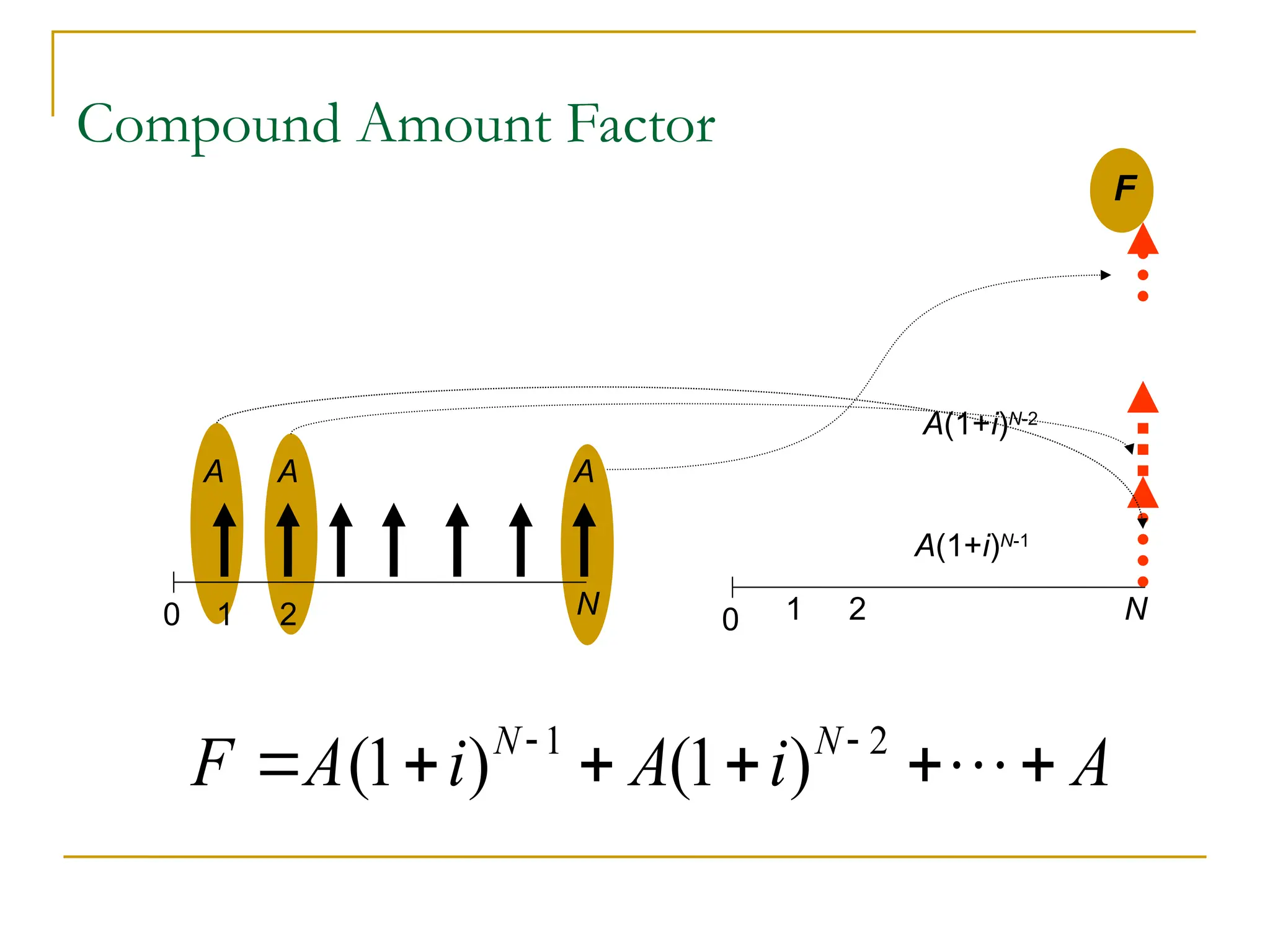
Compound Amount Factor
0 1 2 N 0 1 2 N
A A A
F
A(1+i)N-1
A(1+i)N-2
1 2
(1 ) (1 )
N N
F A i A i A
 
     

Uniform Series Compound Amount Factor
 This factor is used to calculate a future single
sum, F, that is equivalent to a uniform series
of equal end of period payments, A.
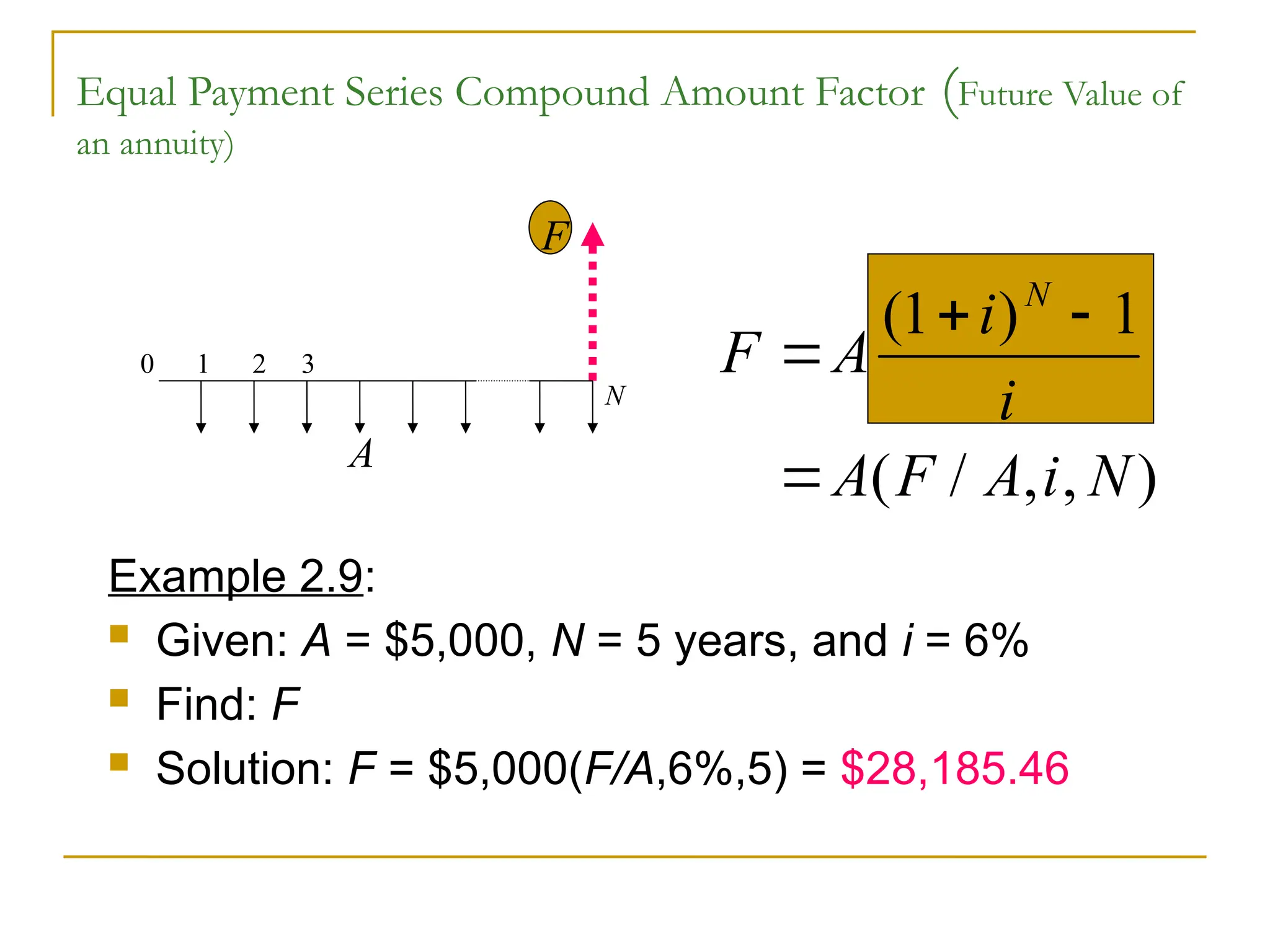
Equal Payment Series Compound Amount Factor (Future Value of
an annuity)
F A
i
i
A F A i N
N

 

( )
( / , , )
1 1
Example 2.9:
 Given: A = $5,000, N = 5 years, and i = 6%
 Find: F
 Solution: F = $5,000(F/A,6%,5) = $28,185.46
0 1 2 3
N
F
A
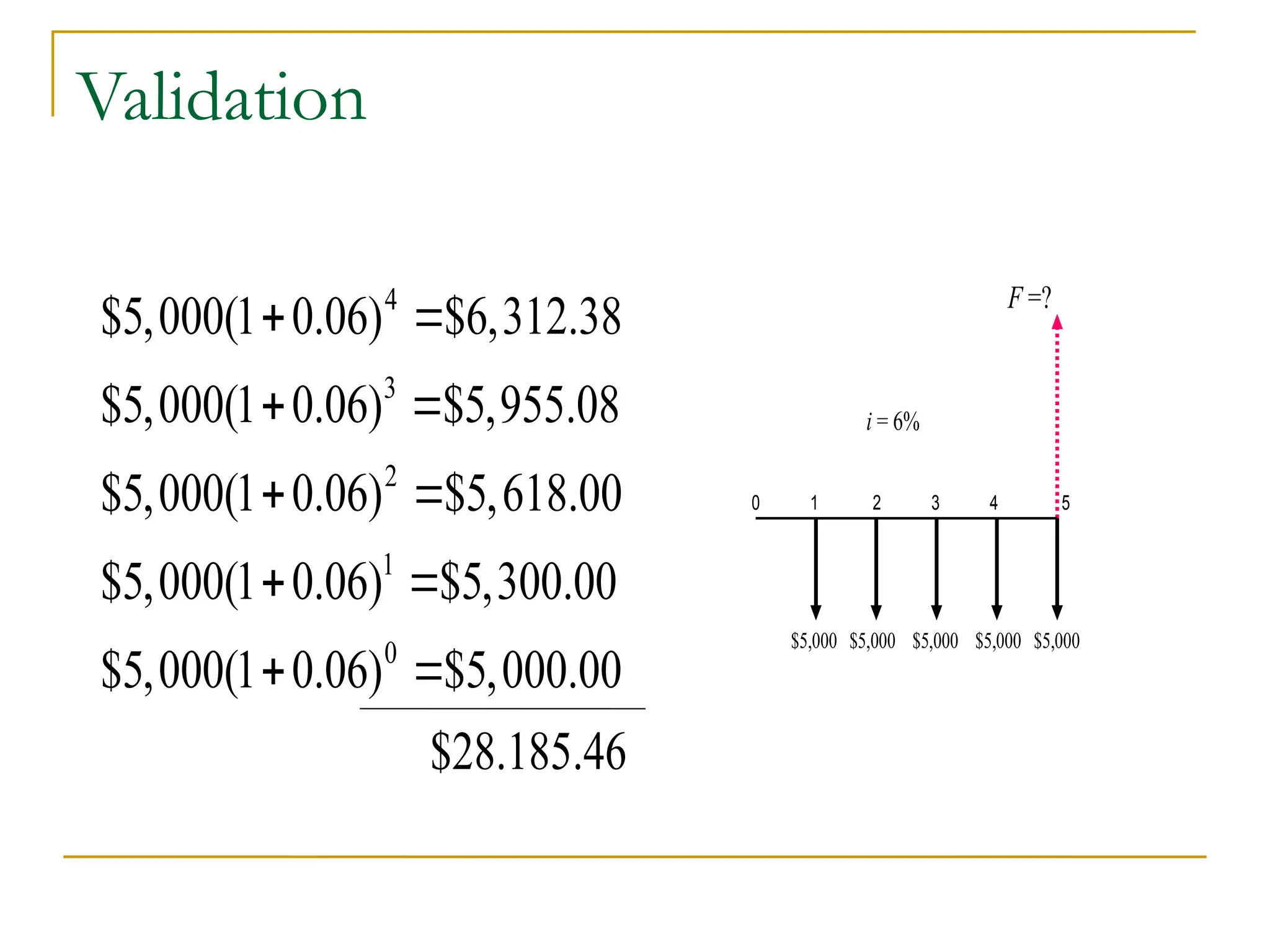
Validation
F =?
0 1 2 3 4 5
$5,000 $5,000 $5,000 $5,000 $5,000
i = 6%
4
3
2
1
0
$5,000(1 0.06) $6,312.38
$5,000(1 0.06) $5,955.08
$5,000(1 0.06) $5,618.00
$5,000(1 0.06) $5,300.00
$5,000(1 0.06) $5,000.00
$28.185.46
 
 
 
 
 
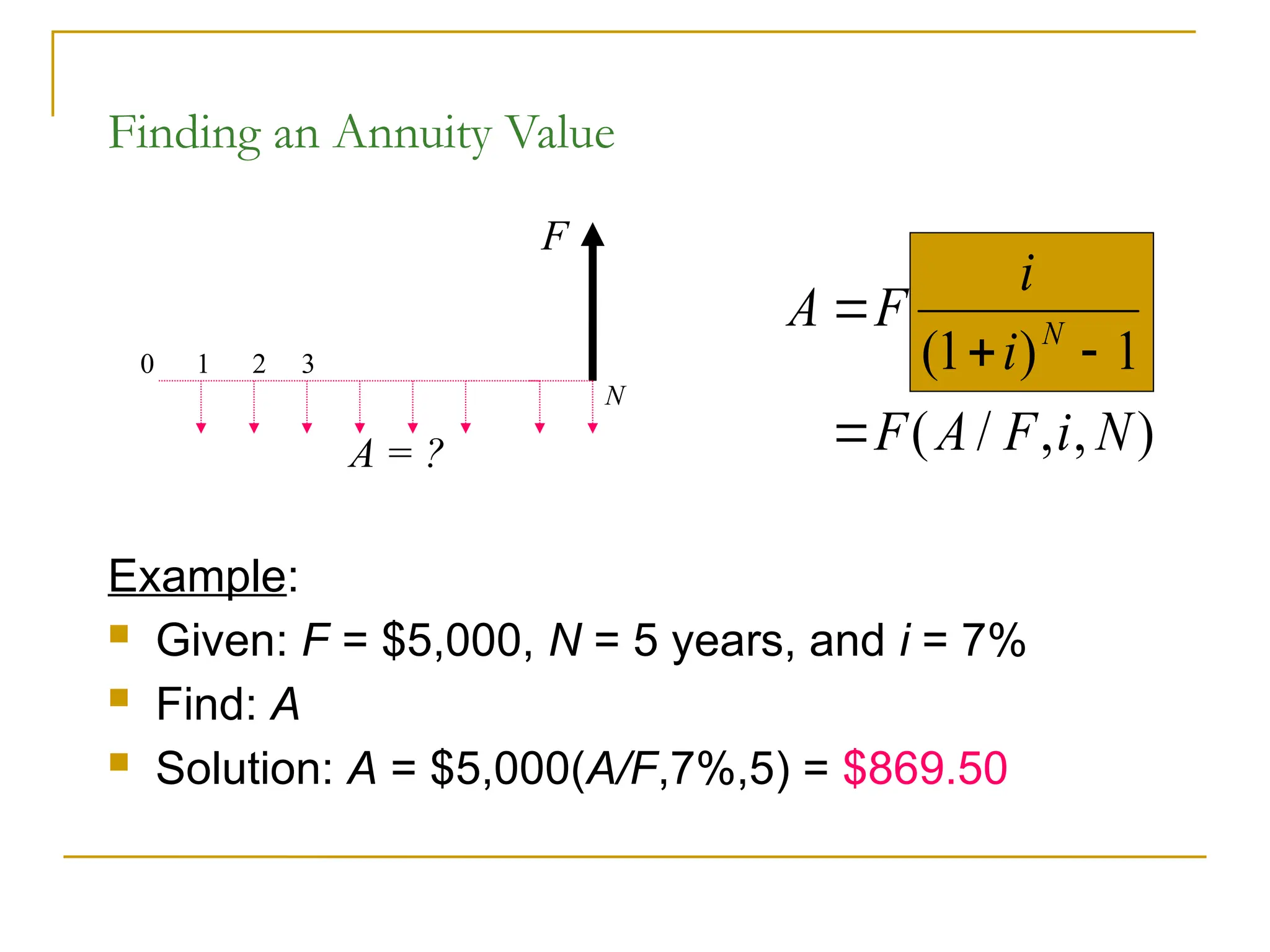
Finding an Annuity Value
Example:
 Given: F = $5,000, N = 5 years, and i = 7%
 Find: A
 Solution: A = $5,000(A/F,7%,5) = $869.50
0 1 2 3
N
F
A = ?
A F
i
i
F A F i N
N

 

( )
( / , , )
1 1
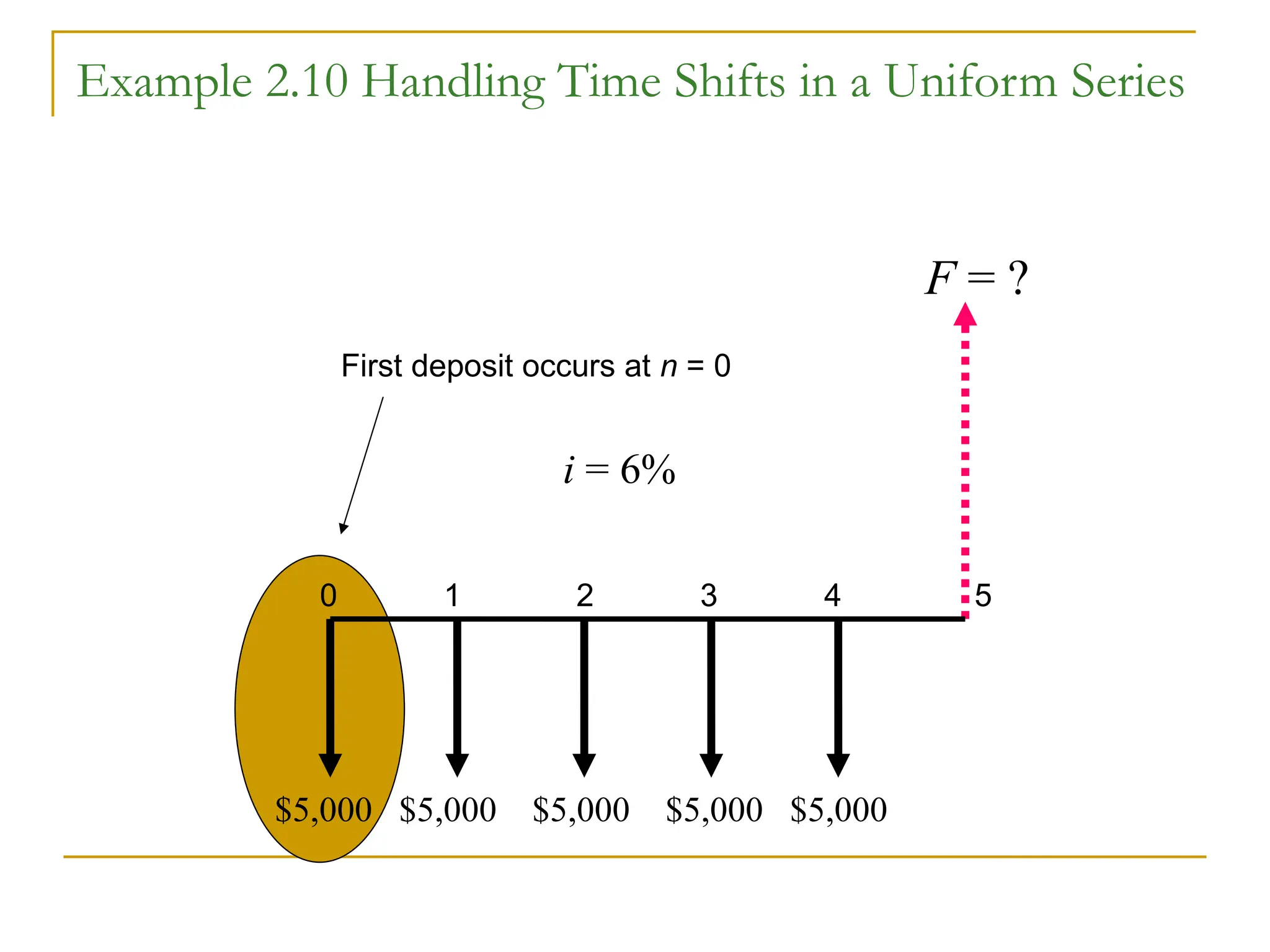
Example 2.10 Handling Time Shifts in a Uniform Series
F = ?
0 1 2 3 4 5
$5,000 $5,000 $5,000 $5,000 $5,000
i = 6%
First deposit occurs at n = 0
5 $5,000( / ,6%,5)(1.06)
$29,876.59
F F A


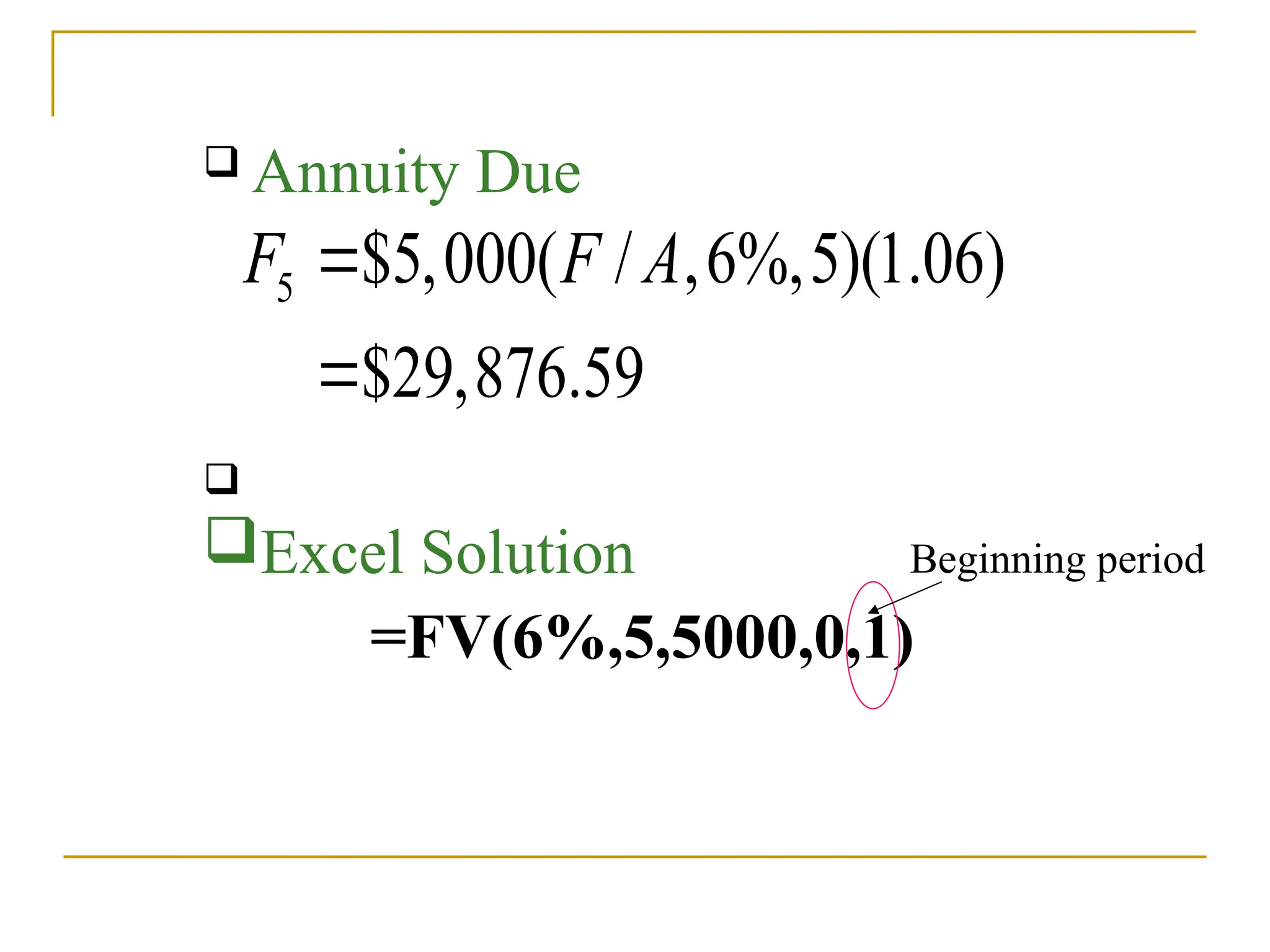
 Annuity Due

Excel Solution
=FV(6%,5,5000,0,1)
Beginning period
Sinking Fund
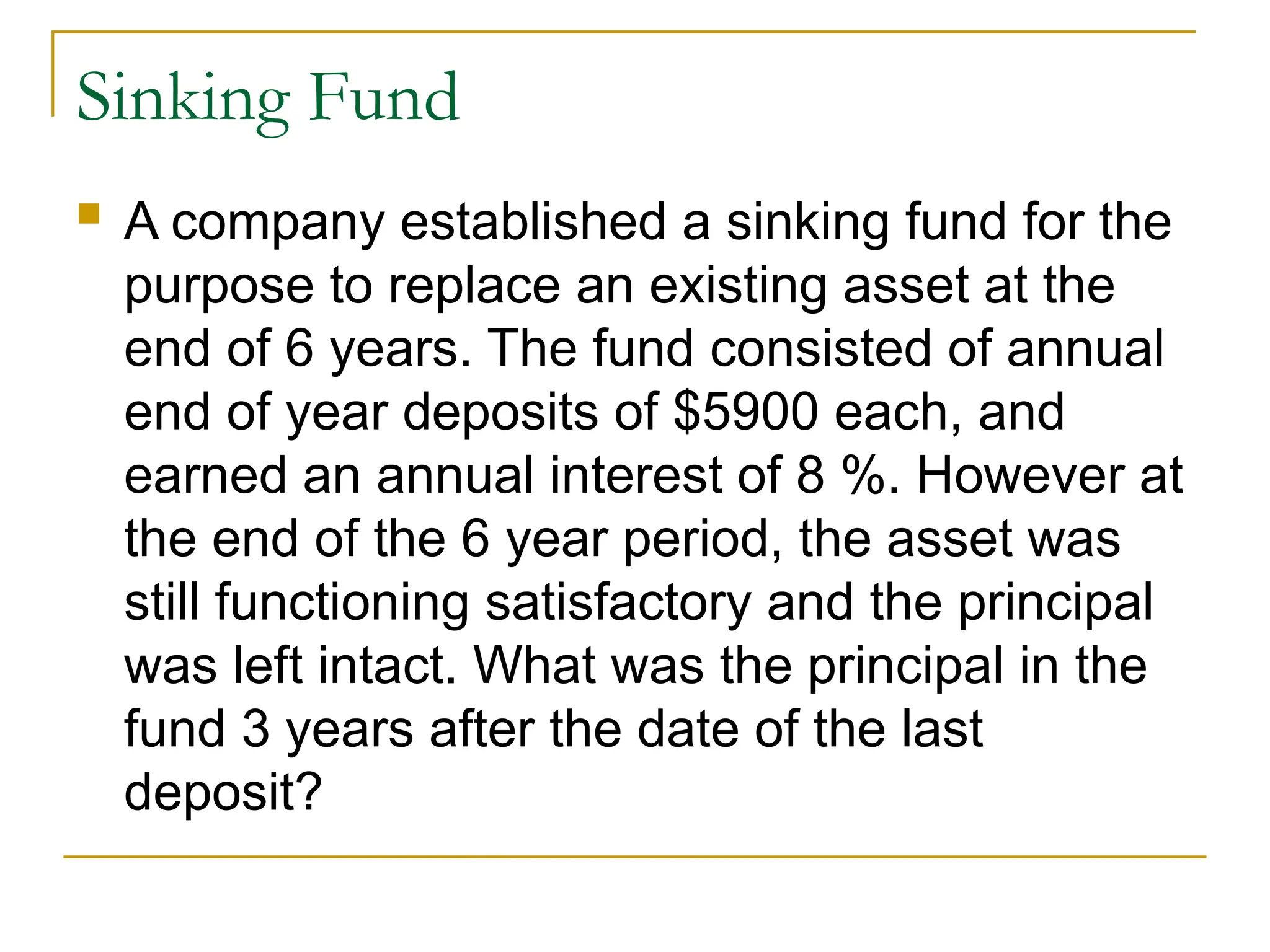
 A company established a sinking fund for the
purpose to replace an existing asset at the
end of 6 years. The fund consisted of annual
end of year deposits of $5900 each, and
earned an annual interest of 8 %. However at
the end of the 6 year period, the asset was
still functioning satisfactory and the principal
was left intact. What was the principal in the
fund 3 years after the date of the last
deposit?
Solution
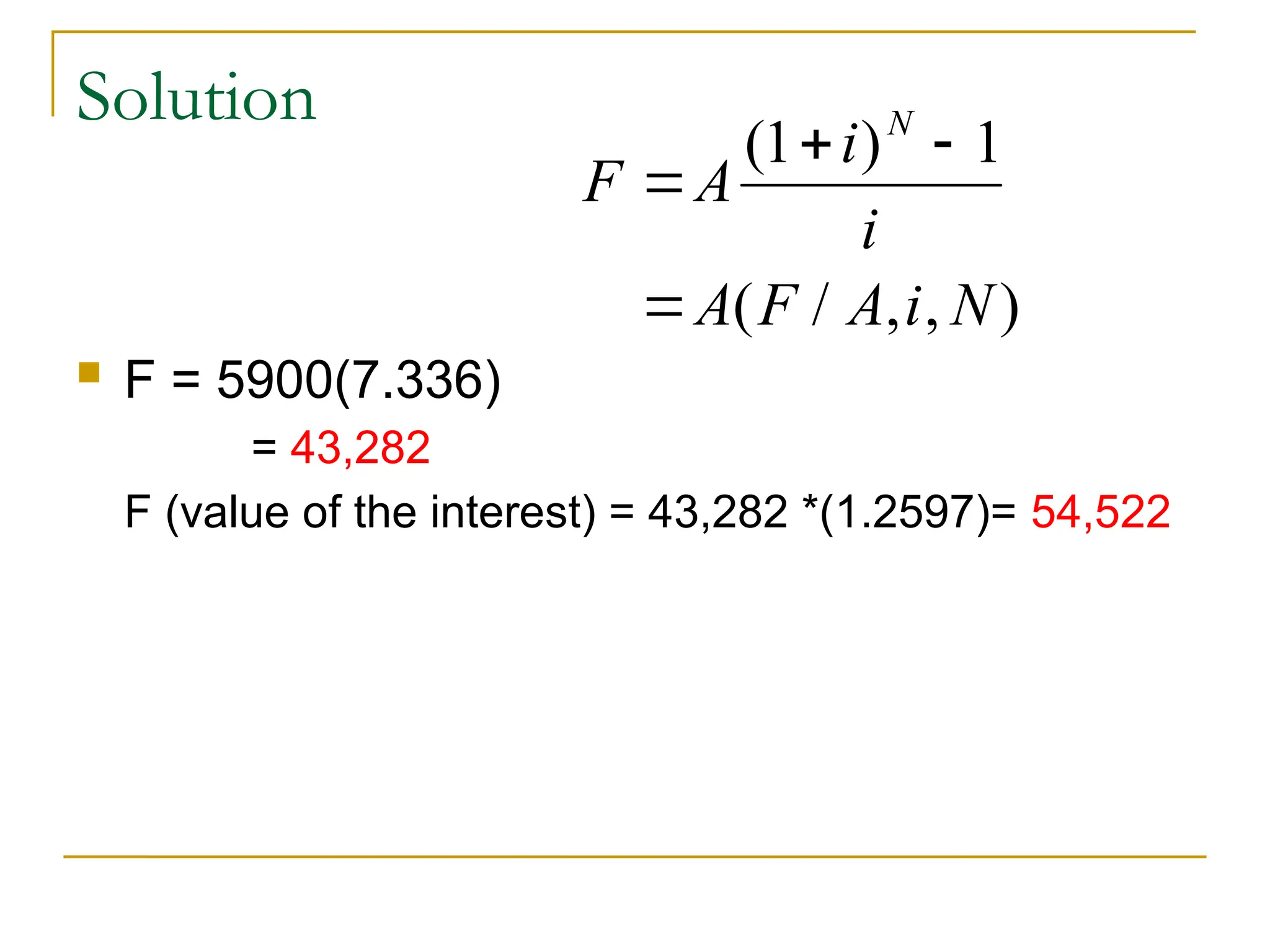
 F = 5900(7.336)
= 43,282
F (value of the interest) = 43,282 *(1.2597)= 54,522
F A
i
i
A F A i N
N

 

( )
( / , , )
1 1
Sinking Fund Deposit Factor
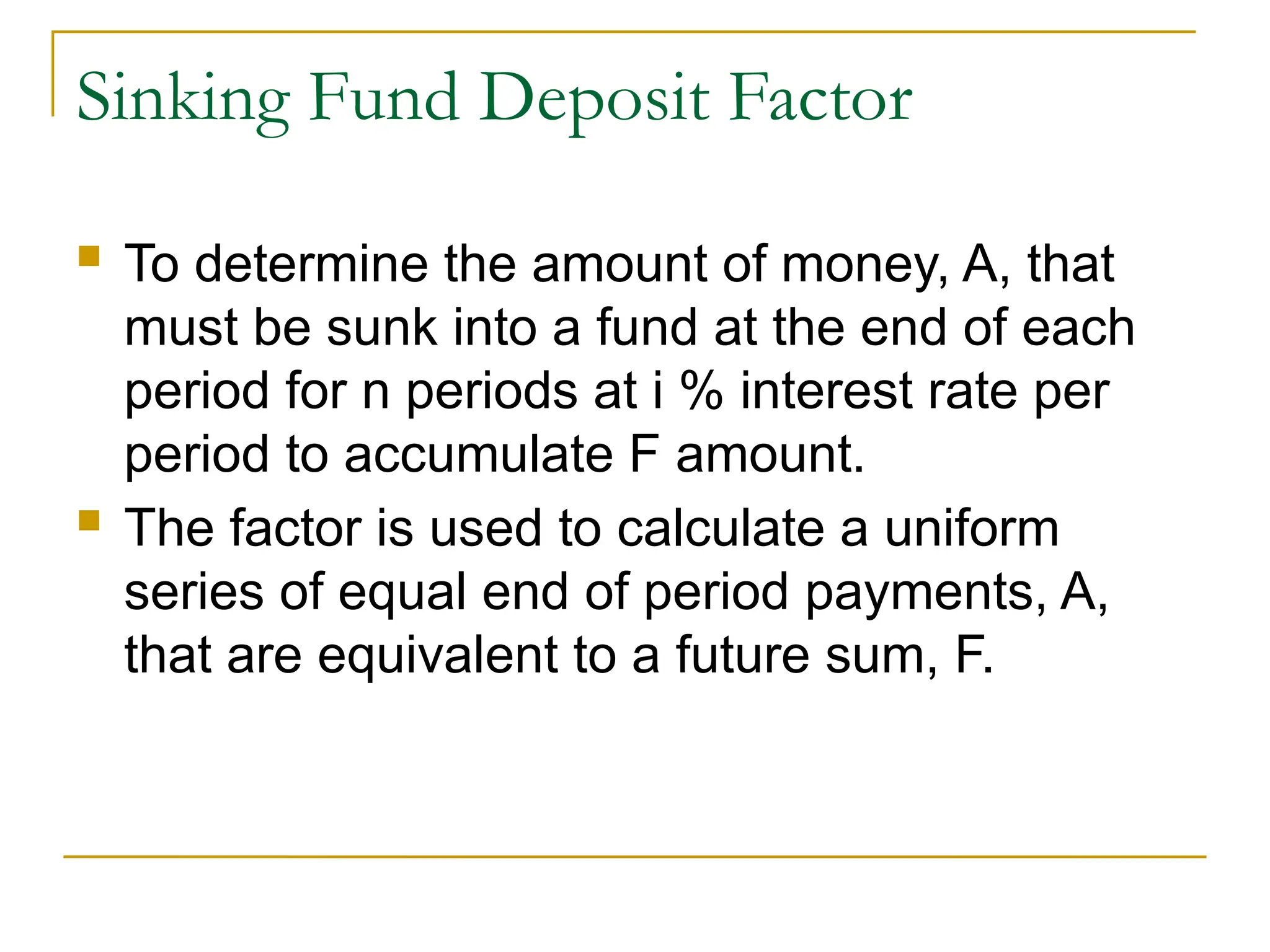
 To determine the amount of money, A, that
must be sunk into a fund at the end of each
period for n periods at i % interest rate per
period to accumulate F amount.
 The factor is used to calculate a uniform
series of equal end of period payments, A,
that are equivalent to a future sum, F.
Sinking Fund Factor
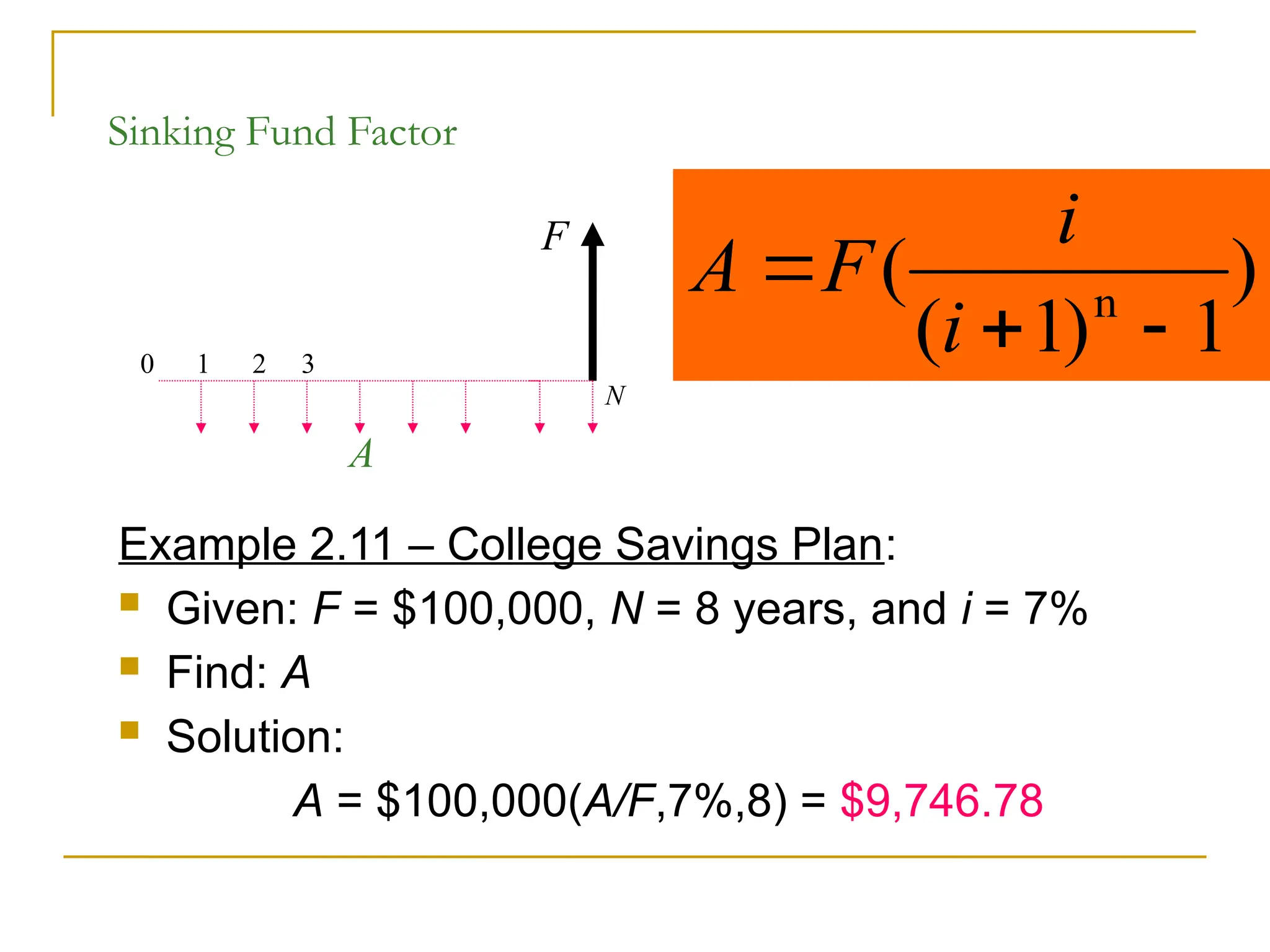
Example 2.11 – College Savings Plan:
 Given: F = $100,000, N = 8 years, and i = 7%
 Find: A
 Solution:
A = $100,000(A/F,7%,8) = $9,746.78
0 1 2 3
N
F
A
)
1
)
1
(
( n



i
i
F
A
Excel Solution
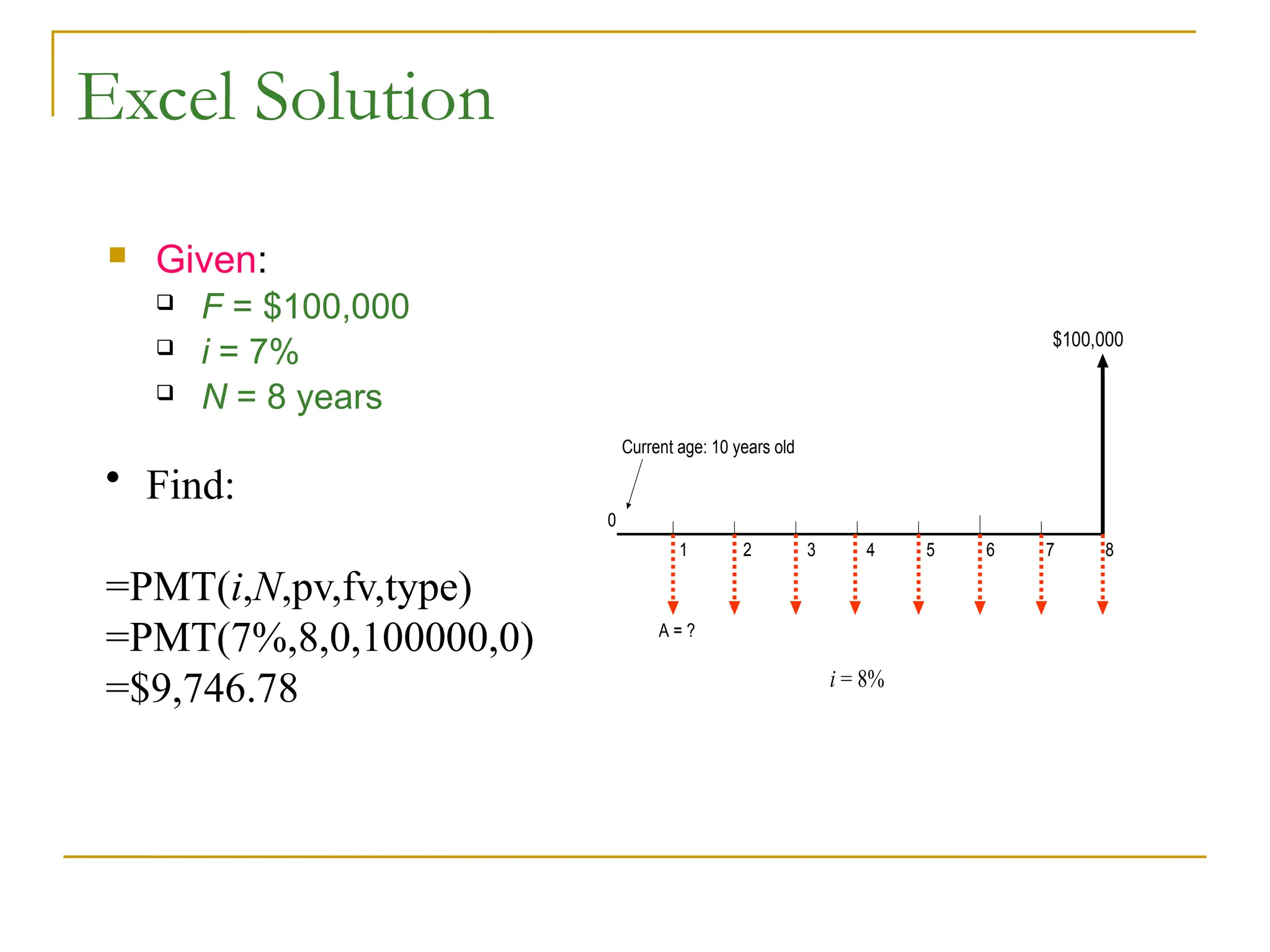
 Given:
 F = $100,000
 i = 7%
 N = 8 years
0
1 2 3 4 5 6 7 8
$100,000
i = 8%
A = ?
Current age: 10 years old
• Find:
=PMT(i,N,pv,fv,type)
=PMT(7%,8,0,100000,0)
=$9,746.78
Capital Recovery Factor
 To relate a uniform
series of end of
period payments, A,
to a present sum, P,
we calculate as
given overleaf
 This factor is used to
calculate a uniform
series of end of
period payments, A,
that are equivalent
to a single sum of
money, P.
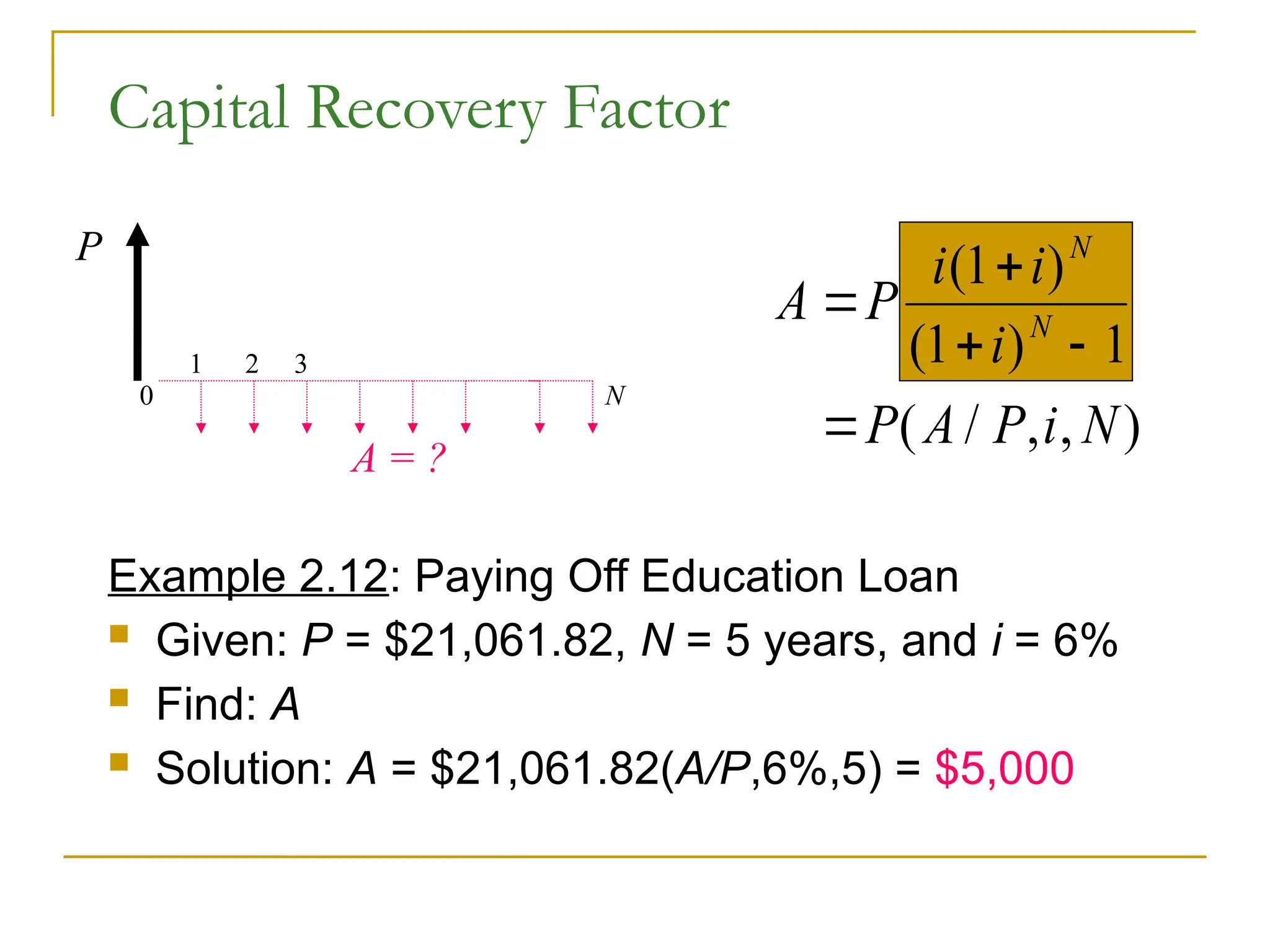
Capital Recovery Factor
Example 2.12: Paying Off Education Loan
 Given: P = $21,061.82, N = 5 years, and i = 6%
 Find: A
 Solution: A = $21,061.82(A/P,6%,5) = $5,000
1 2 3
N
P
A = ?
0
A P
i i
i
P A P i N
N
N


 

( )
( )
( / , , )
1
1 1
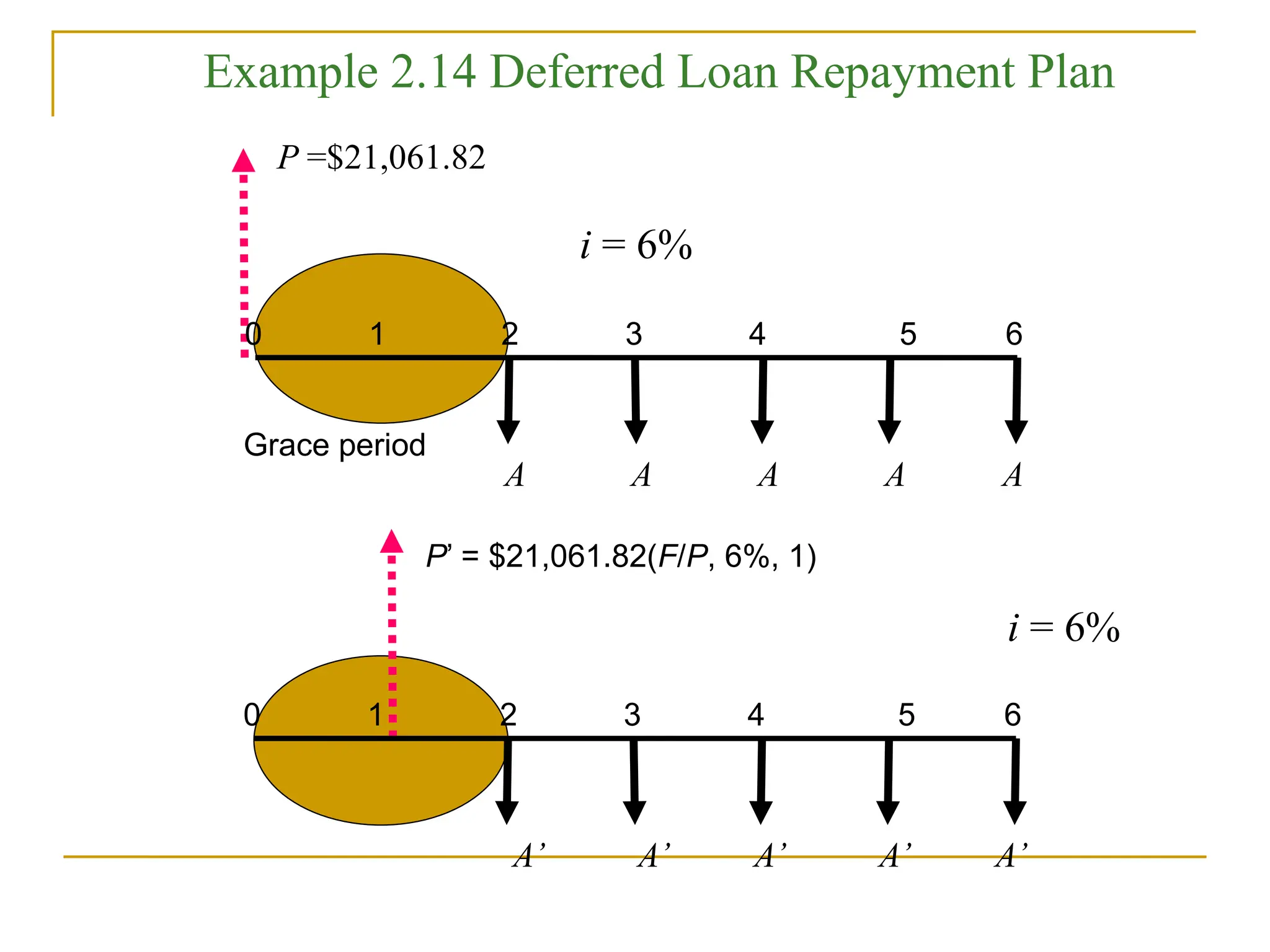
P =$21,061.82
0 1 2 3 4 5 6
A A A A A
i = 6%
0 1 2 3 4 5 6
A’ A’ A’ A’ A’
i = 6%
P’ = $21,061.82(F/P, 6%, 1)
Grace period
Example 2.14 Deferred Loan Repayment Plan
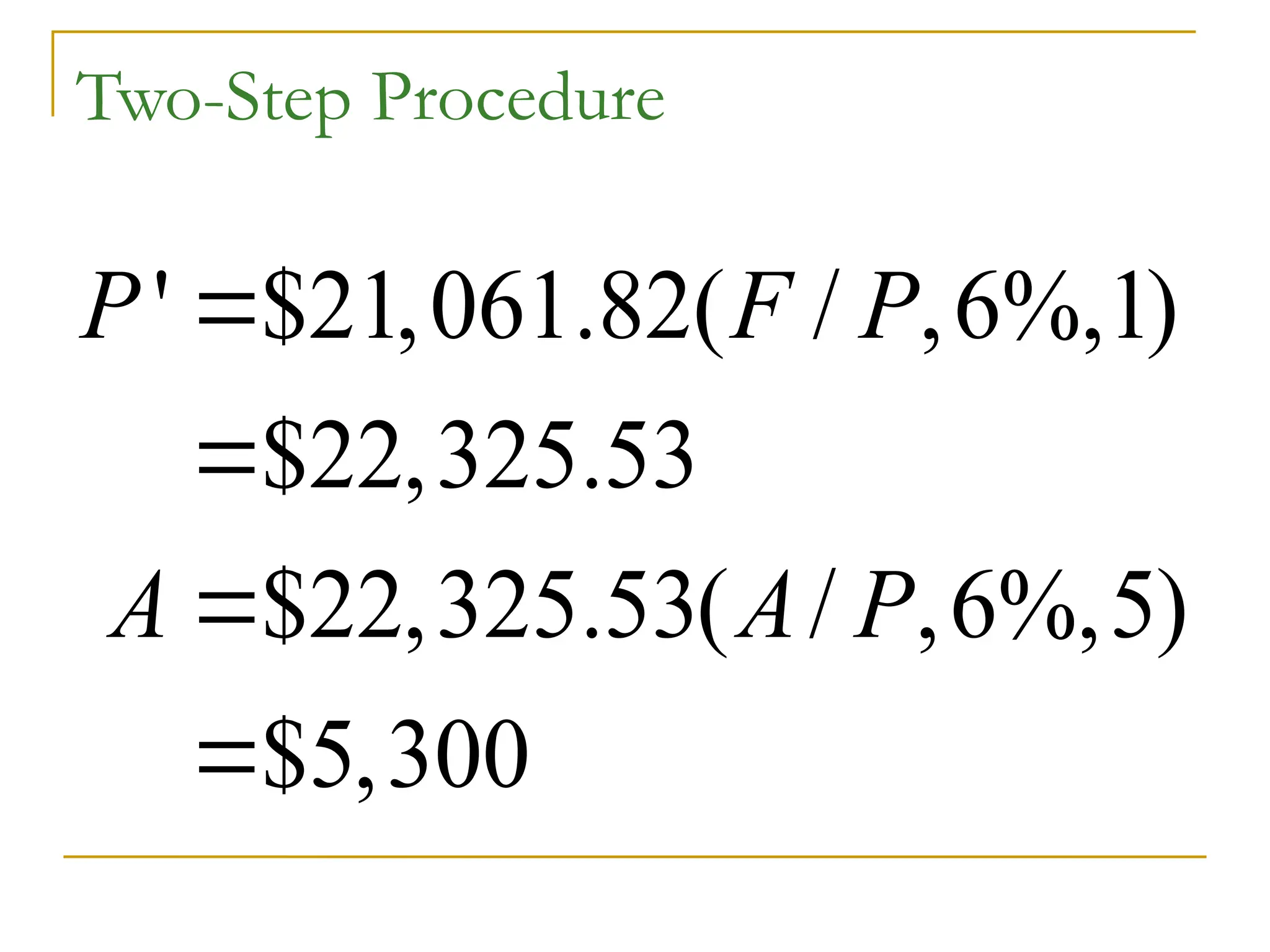
Two-Step Procedure
' $21,061.82( / ,6%,1)
$22,325.53
$22,325.53( / ,6%,5)
$5,300
P F P
A A P




Uniform Series Present Worth
 To determine the present single value sum of
money, P, that is equivalent to a uniform
series of equal payments, A, for n periods at i
% interest per period;
 This factor is used to calculate the present
sum, P, that is equivalent to a uniform series
of equal end of period payments, A.
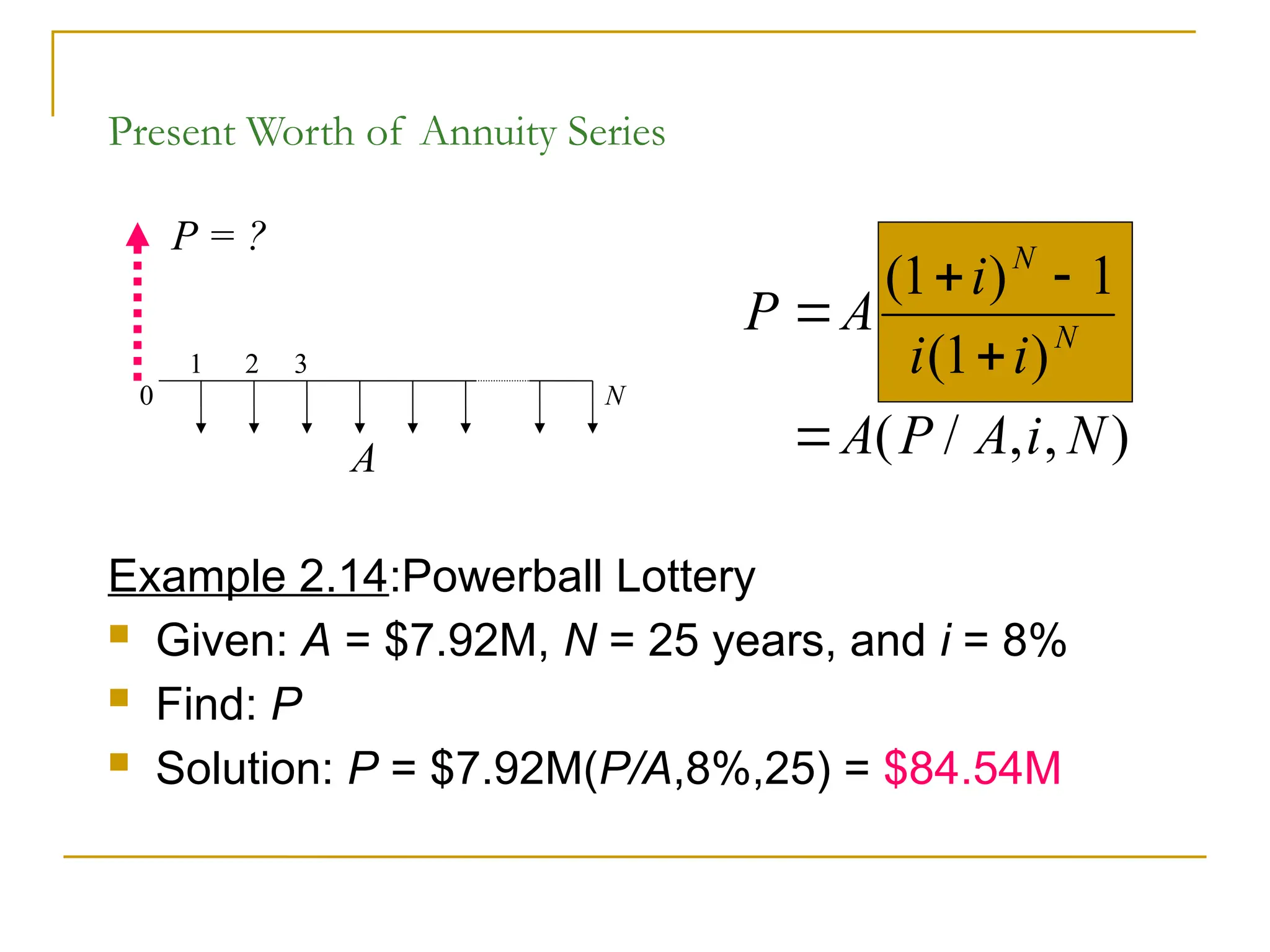
Present Worth of Annuity Series
Example 2.14:Powerball Lottery
 Given: A = $7.92M, N = 25 years, and i = 8%
 Find: P
 Solution: P = $7.92M(P/A,8%,25) = $84.54M
1 2 3
N
P = ?
A
0
P A
i
i i
A P A i N
N
N

 


( )
( )
( / , , )
1 1
1
Problem
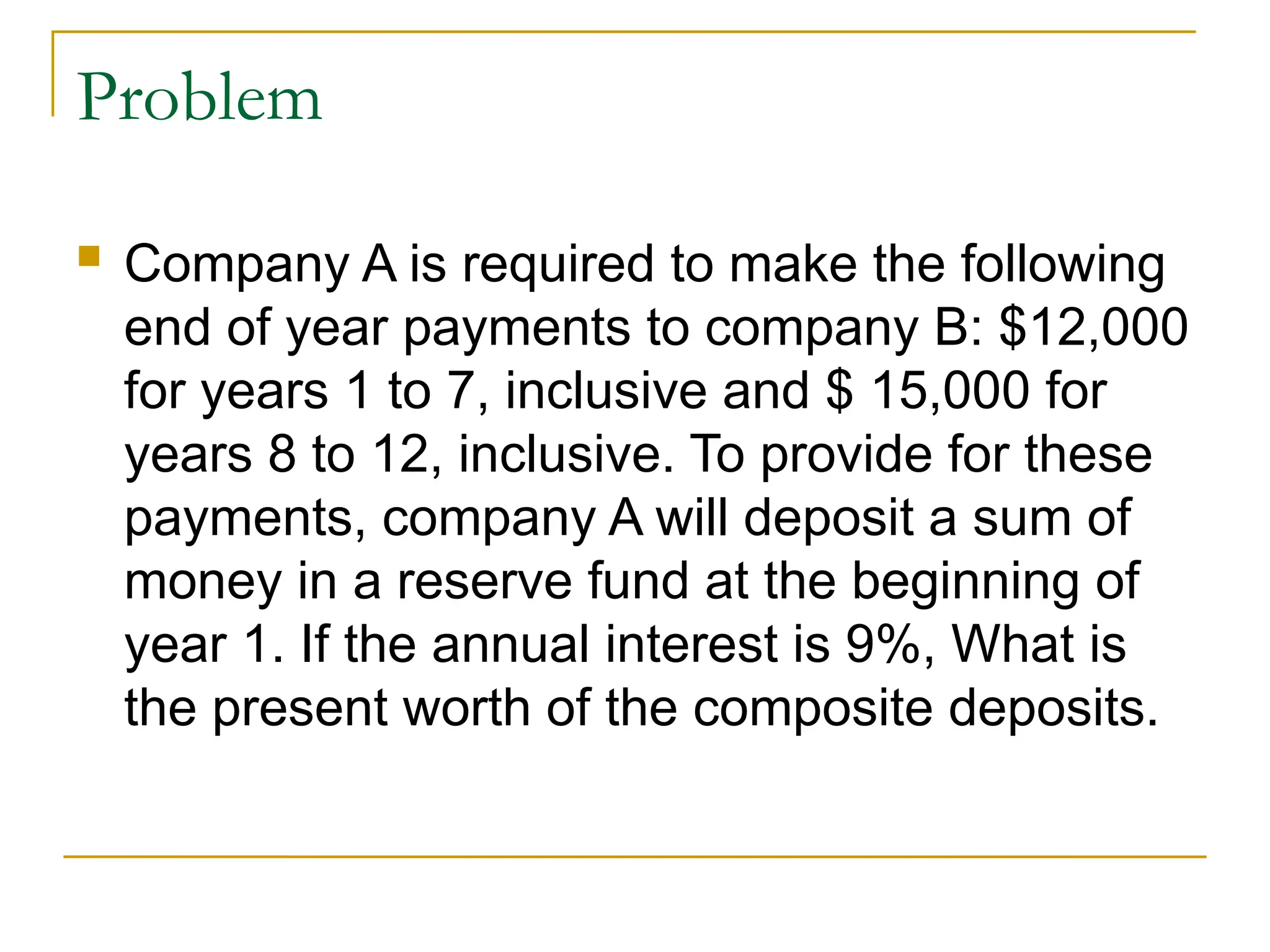
 Company A is required to make the following
end of year payments to company B: $12,000
for years 1 to 7, inclusive and $ 15,000 for
years 8 to 12, inclusive. To provide for these
payments, company A will deposit a sum of
money in a reserve fund at the beginning of
year 1. If the annual interest is 9%, What is
the present worth of the composite deposits.
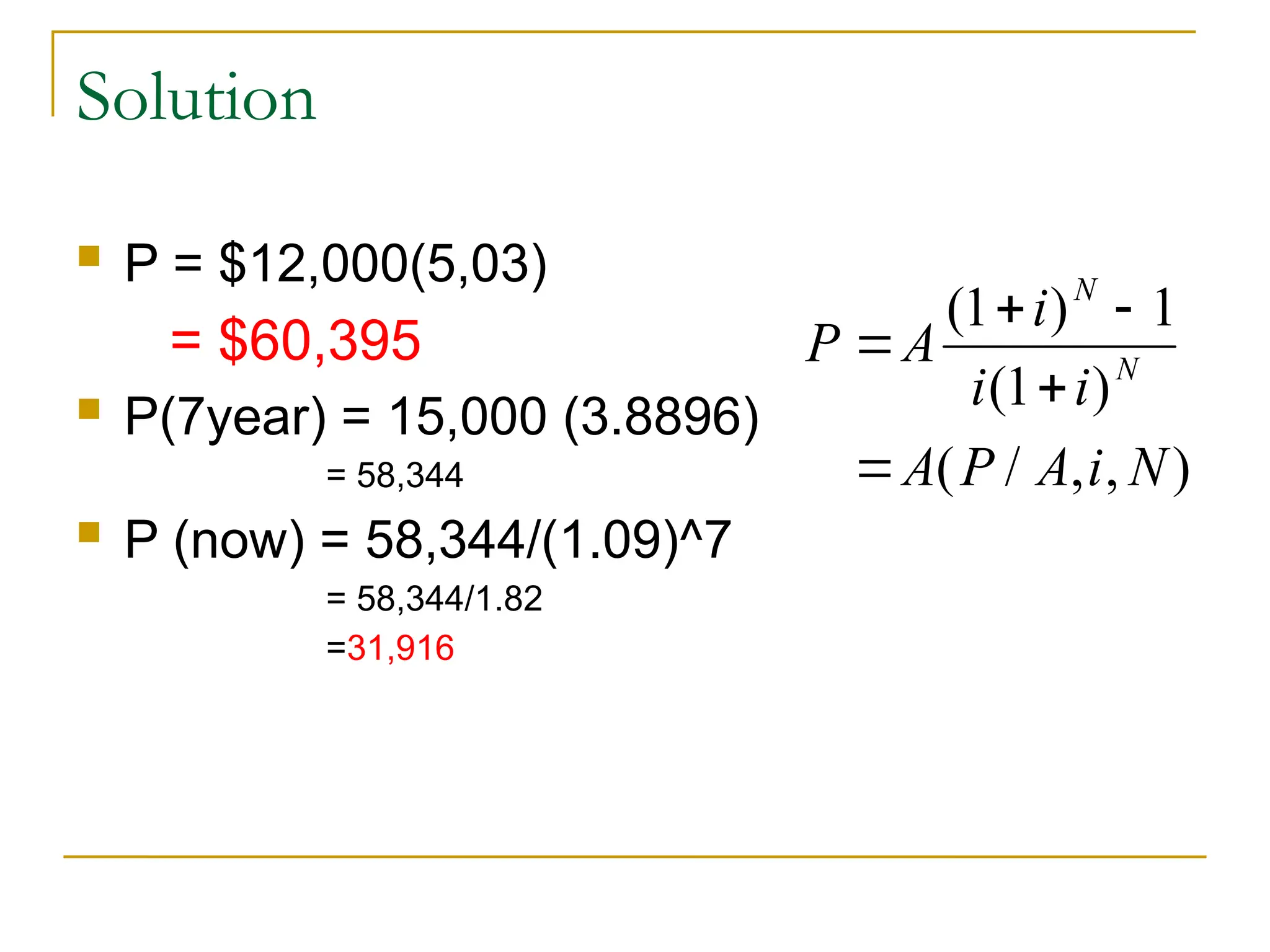
Solution
 P = $12,000(5,03)
= $60,395
 P(7year) = 15,000 (3.8896)
= 58,344
 P (now) = 58,344/(1.09)^7
= 58,344/1.82
=31,916
P A
i
i i
A P A i N
N
N

 


( )
( )
( / , , )
1 1
1
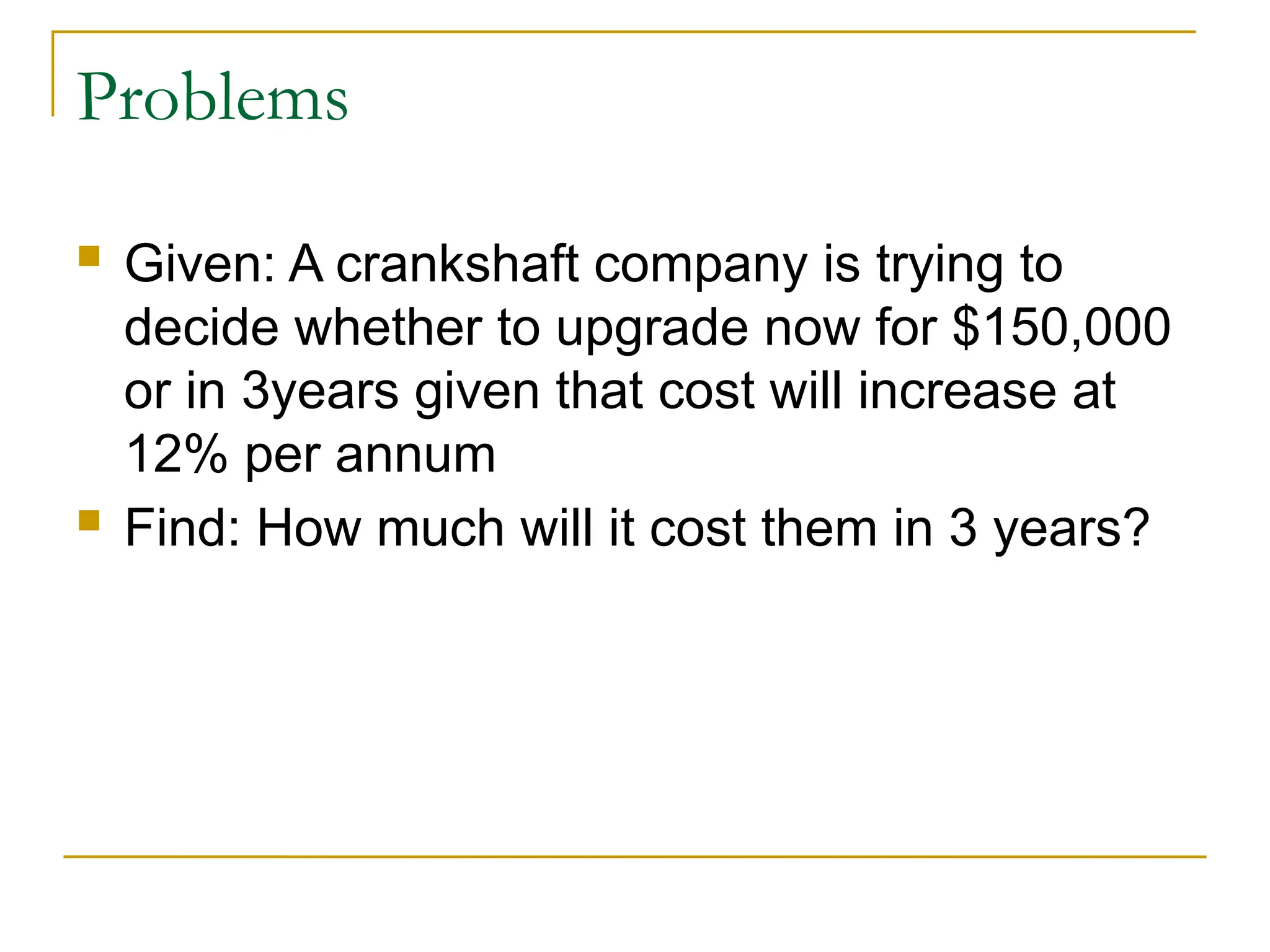
Problems
 Given: A crankshaft company is trying to
decide whether to upgrade now for $150,000
or in 3years given that cost will increase at
12% per annum
 Find: How much will it cost them in 3 years?
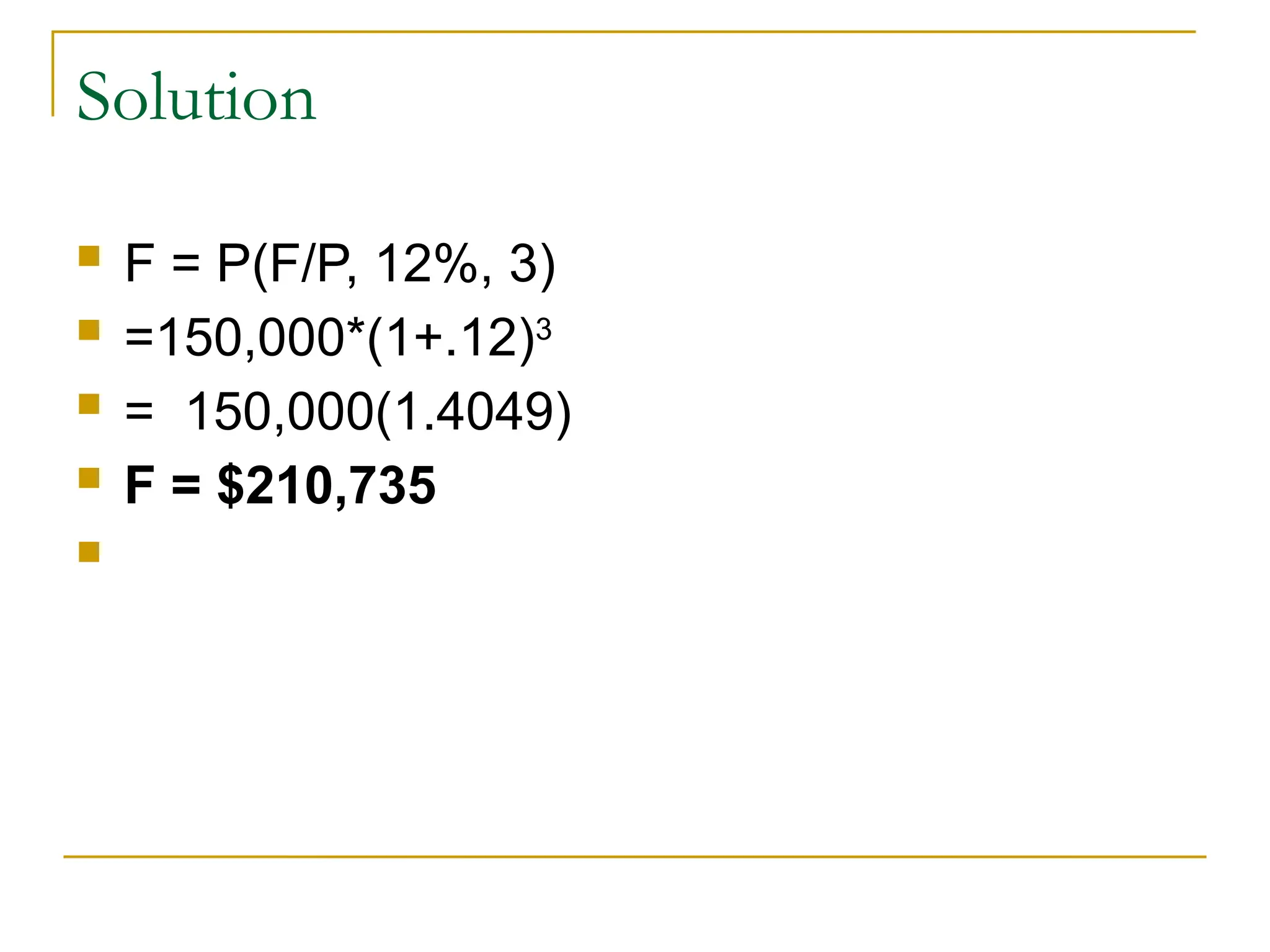
Solution
 F = P(F/P, 12%, 3)
 =150,000*(1+.12)3
 = 150,000(1.4049)
 F = $210,735

Problem
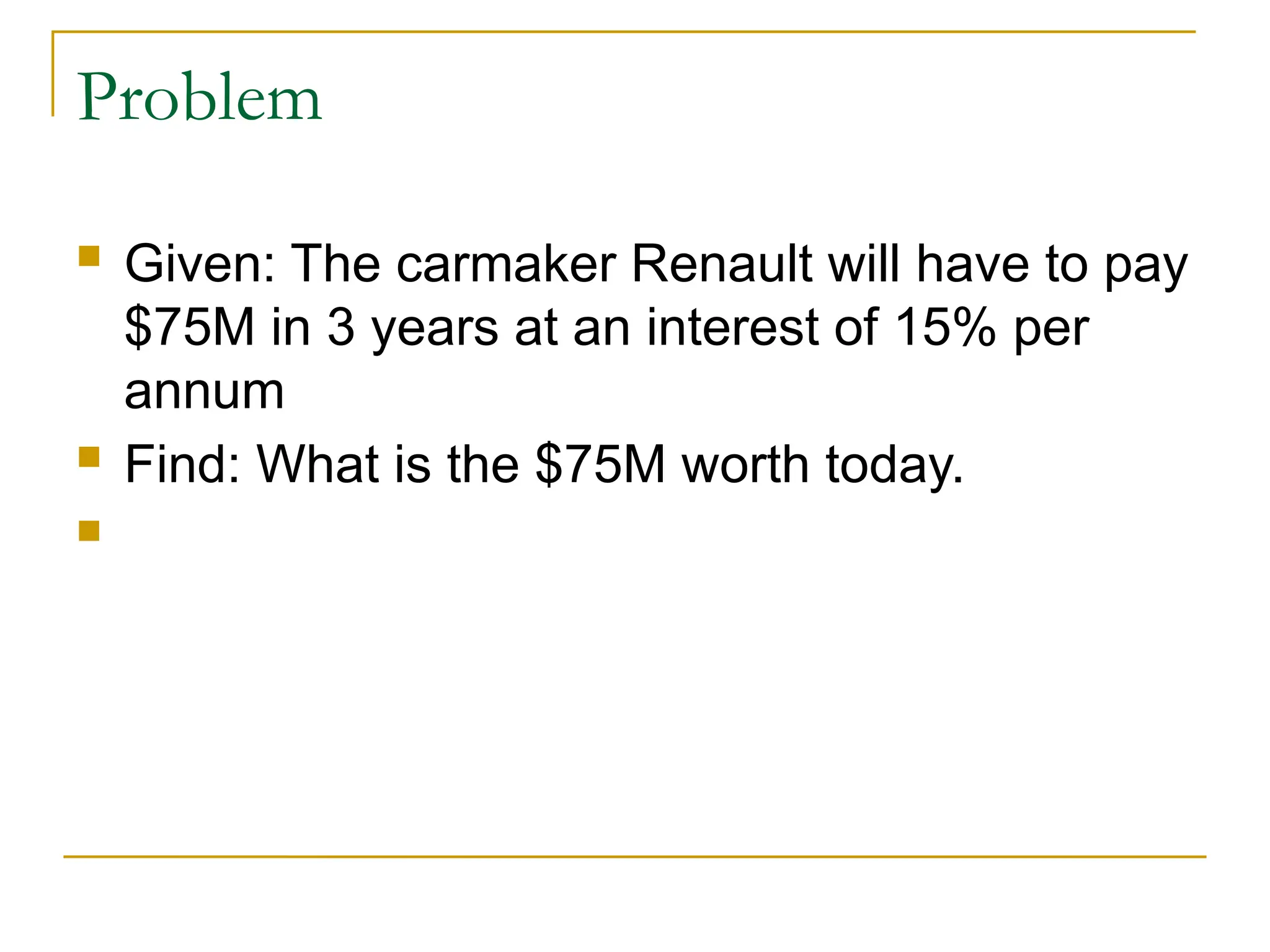
 Given: The carmaker Renault will have to pay
$75M in 3 years at an interest of 15% per
annum
 Find: What is the $75M worth today.

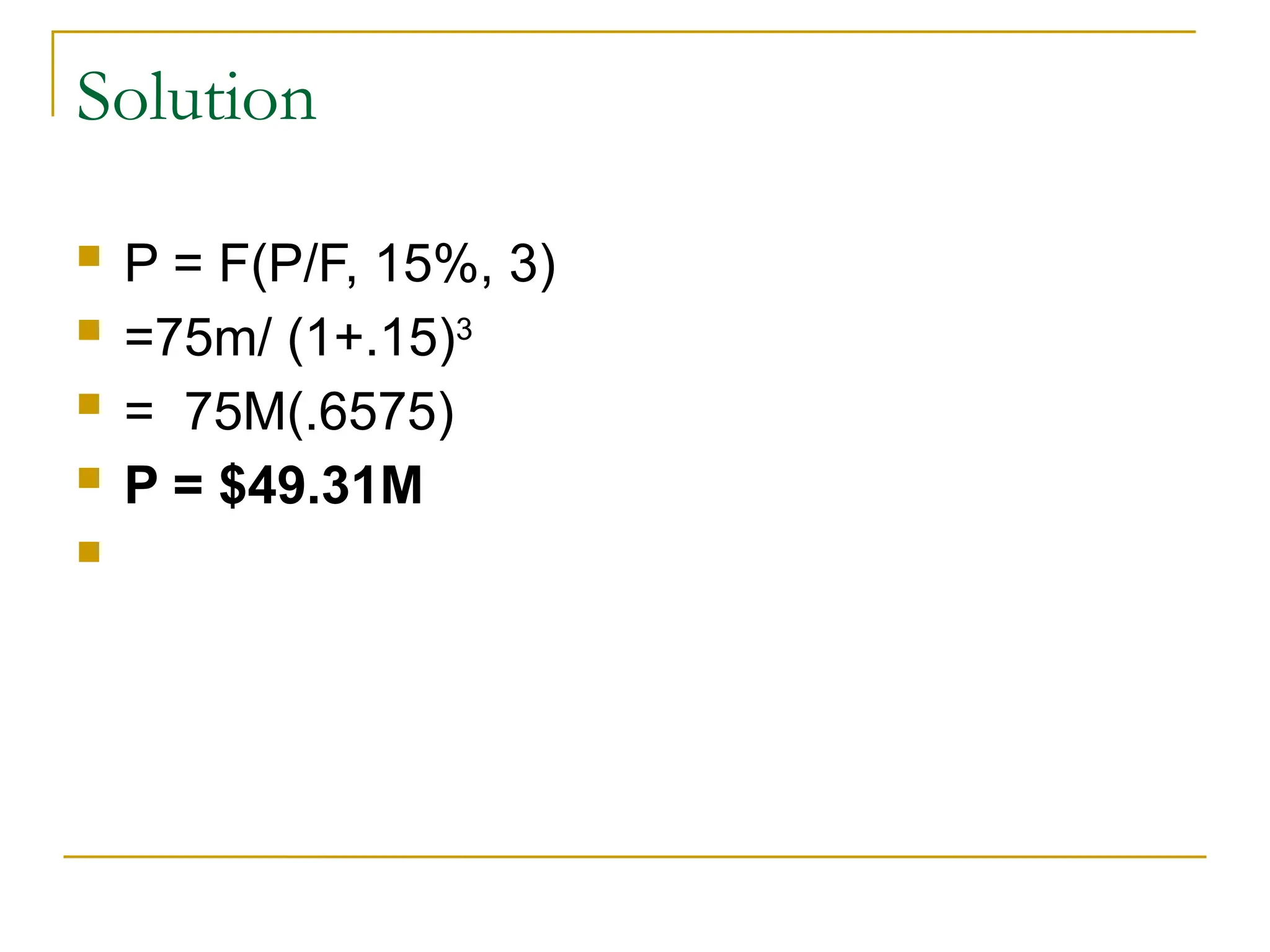
Solution
 P = F(P/F, 15%, 3)
 =75m/ (1+.15)3
 = 75M(.6575)
 P = $49.31M

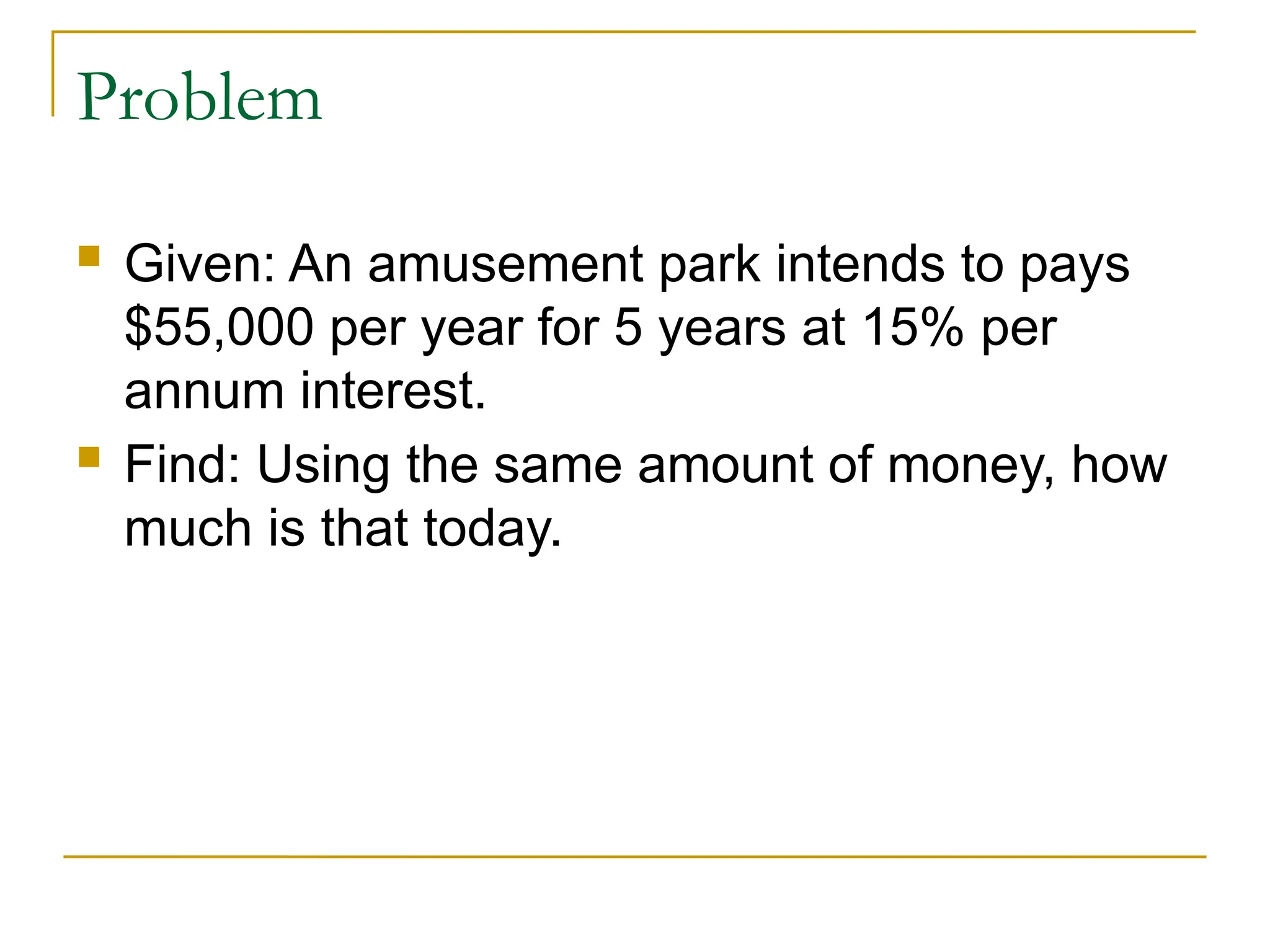
Problem
 Given: An amusement park intends to pays
$55,000 per year for 5 years at 15% per
annum interest.
 Find: Using the same amount of money, how
much is that today.
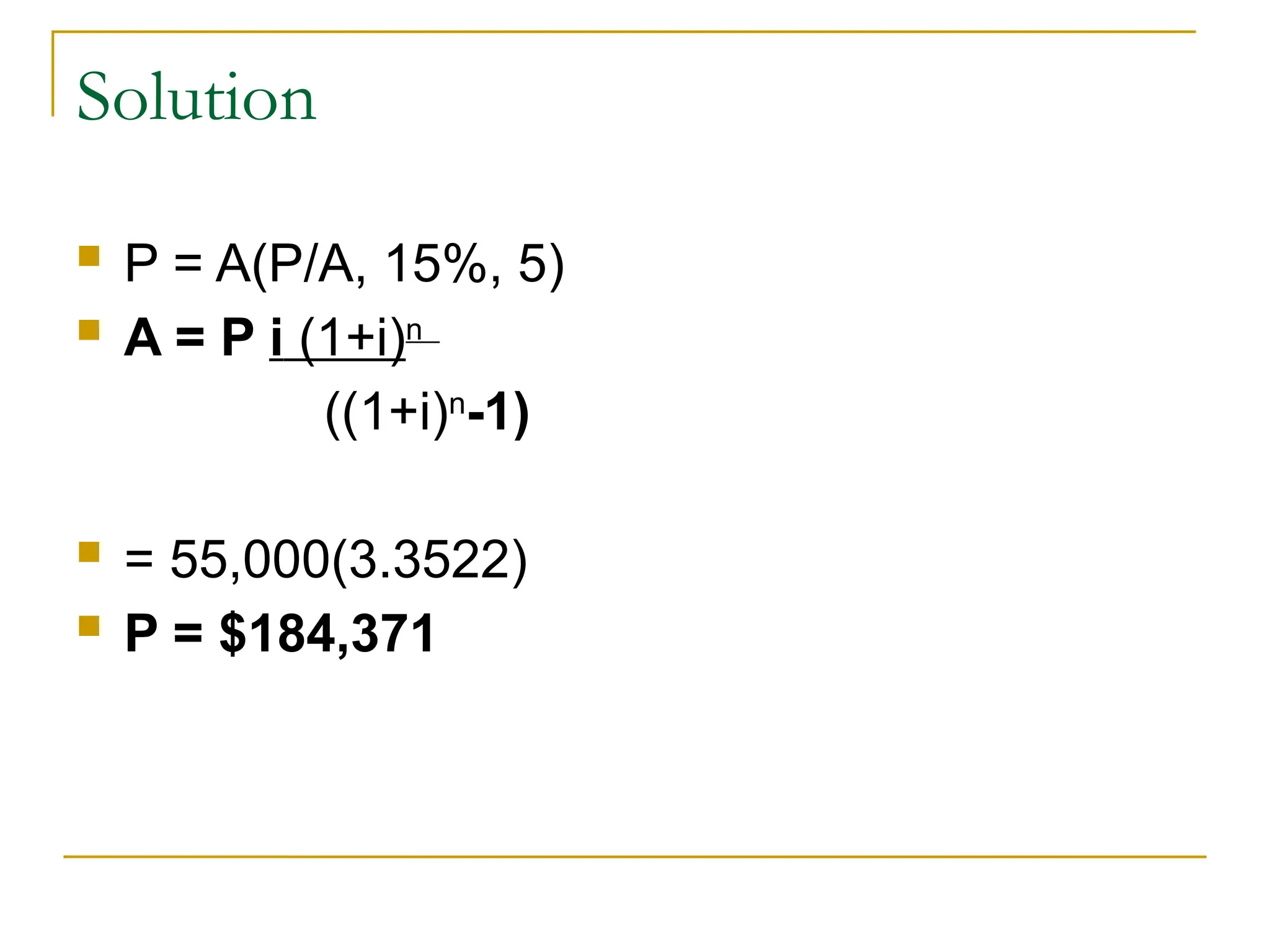
Solution
 P = A(P/A, 15%, 5)
 A = P i (1+i)n
((1+i)n
-1)
 = 55,000(3.3522)
 P = $184,371
Problem
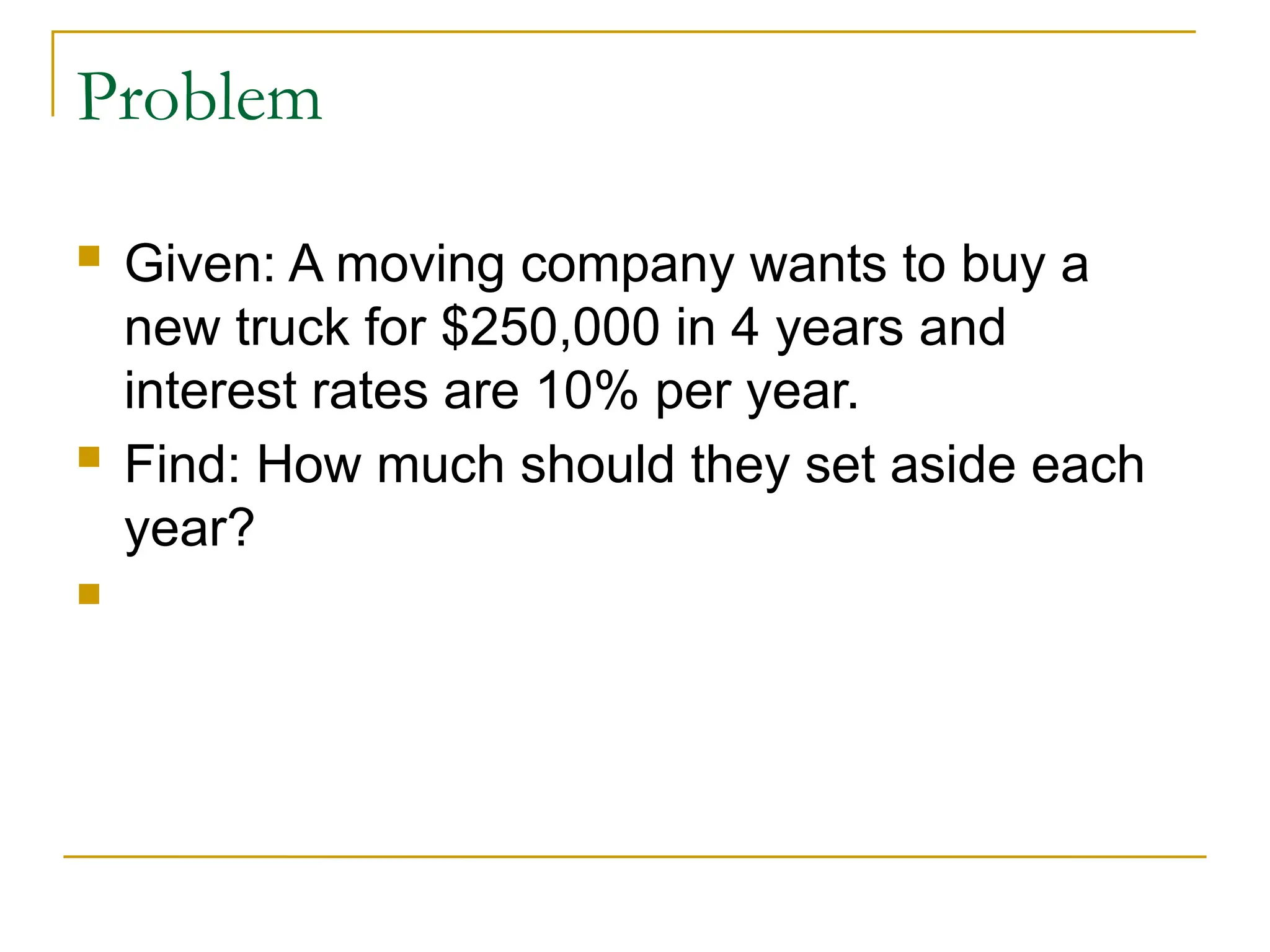
 Given: A moving company wants to buy a
new truck for $250,000 in 4 years and
interest rates are 10% per year.
 Find: How much should they set aside each
year?

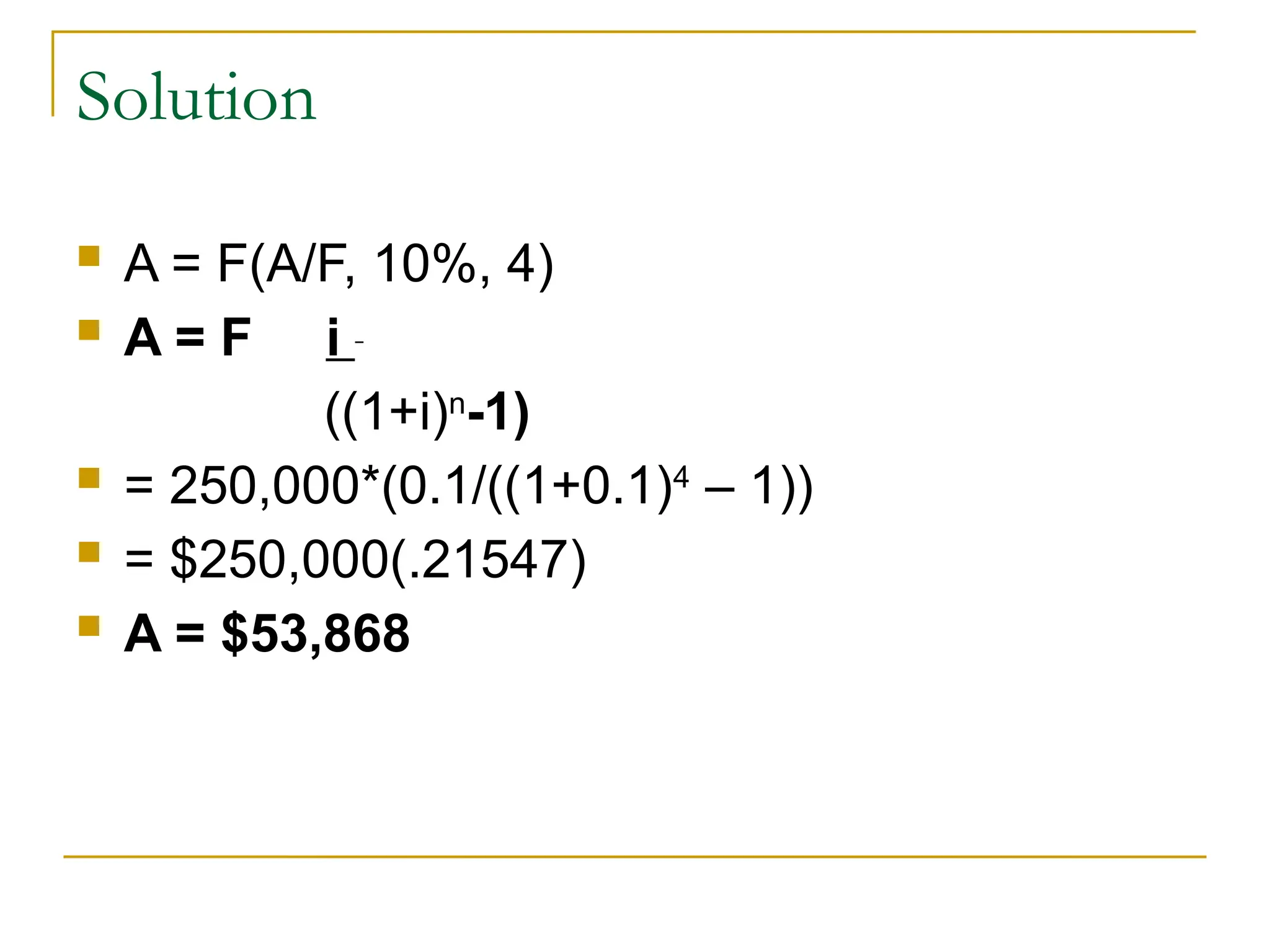
Solution
 A = F(A/F, 10%, 4)
 A = F i
((1+i)n
-1)
 = 250,000*(0.1/((1+0.1)4
– 1))
 = $250,000(.21547)
 A = $53,868
1-equalpaymentseries.pptx economics payment business slides wow

  • 1.
    Interest Formulas forTime Value of Money Payment Series
  • 2.
    The Time Valueof Money  Interest Rate  Simple Interest  Compound Interest  Amortizing a Loan  Compounding More Than Once per Year
  • 3.
     “Compound interestis the eighth wonder of the world. He who understands it, earns it ... he who doesn't ... pays it.” ― Albert Einstein
  • 4.
    Why TIME? TIME allowsyou the opportunity to postpone consumption and earn INTEREST. Why is TIME such an important element in your decision?
  • 5.
    Types of Interest Compound Interest Interest paid (earned) on any previous interest earned, as well as on the principal borrowed.  Simple Interest Interest paid (earned) on only the original amount, or principal, borrowed.
  • 6.
    Simple Interest Formula FormulaSI = P0(i)(n) SI: Simple Interest P0: Deposit today (t=0) i: Interest Rate per Period n: Number of Time Periods
  • 7.
    Simple Interest Example SI = P0(i)(n) = $1,000(.07)(2) = $140  Assume that you deposit $1,000 in an account earning 7% simple interest for 2 years. What is the accumulated interest at the end of the 2nd year?
  • 8.
    Simple Interest (FV) FV= P0 + SI = $1,000 + $140 = $1,140  Future Value is the value at some future time of a present amount of money, or a series of payments, evaluated at a given interest rate.  What is the Future Value (FV) of the deposit?
  • 9.
    Example : GenerousGrandma Your Grandma puts $1,000 in a bank for you, at 5% interest. Calculate the amount after 20 years. Simple interest: A = 1000 (1 + 0.0520) = $2,000.00 Compounded annually: A = 1000 (1 + .05)20 =$2,653.30 Compounded daily: Compounded continuously: A = 1000 e(.05*20) = $2,718.28 10 . 718 , 2 $ 365 05 . 1 1000 ) 20 * 365 (          A
  • 10.
    Annual percentage yield The simple interest rate that will produce the same amount in 1 year is called the annual percentage yield (APY). To find the APY, proceed as follows: This is also referred to as the effective rate. int int 1 1 amount at amount at simple erest compound erest after year after year                      (1 ) 1 1 1 1 1 m m m r P APY P m r APY m r APY m                             
  • 11.
    Calculate compound interestusing this formula: A—Total amount p —principle r —interest rate n —number of compounding periods t —time in years nt n r p A         1
  • 12.
    Example: $100 isinvested at 10% interest compounded yearly for 6 years 177.16
  • 13.
    $250 invested at6.5% for 8 years compounded monthly. 419.92
  • 14.
    Example……  $500 investedat 12% for 10 years compounded yearly.
  • 15.
    Answer……  Problem:  $500invested at 12% for 10 years compounded yearly.  Answer:   93 . 1552 12 . 1 500 1 12 . 1 500 1 10 10 1                    A A A n r P A nt
  • 16.
    Example……  $1000 at7.25% for 9 years compounded monthly.
  • 17.
    Answer……  Problem:  $1000at 7.25% for 9 years compounded monthly.  Answer: 57 . 1916 12 0725 . 1 1000 1 ) 9 12 (                   A A n r P A nt
  • 18.
    18 Single Payment FutureAmount If you have $1 today and can earn an interest rate of 10% by the end of the first year then you will have $1.10. The$1.10 is calculated as the amount you start the period with plus the product of what you start the period with times the rate of interest that period the 1.10 = 1 + 1(.1). If F is the amount at the end of the period, P is the amount at the beginning of the period and i is the rate of interest during the period, then in general we have F = P + Pi = P(1 + i).
  • 19.
    19 Growth in general Ifyou start out with P and wait one period at rate i we just saw you have F = P(1 + i). Now, if you again earn i, by the end of the second period you would have F = P(1 + i) + P(1 + i )i (start period with + start period with times i) = P(1 + i)(1 + i) = P(1 + i)2 . In general, at the end of n periods, you have F = P(1 + i)n .
  • 20.
    20 The formula F =P(1 + i)n , can be called the single payment future value (sometimes called the single payment compound amount) formula. Notice if we know or have specific numerical values for -the present amount P, -the constant interest rate each period i, and -the number of periods n, then we can solve for the future amount. Example: Say your grandmother gives you $10 and wants you to pay her back in 2 years and she will charge you 8% interest each year. How much do you pay her back at the end of two years? Let’s look at a time line on the next slide.
  • 21.
    21 0 1 23 … n 10 – you received $10 ? – How much do you pay back? F = 10(1 + .08)2 = 10(1.1664) = 11.66
  • 22.
    22 The Future ValueFactor We saw on the last page that the amount to be paid back was F = 10(1 + .08)2 = 10(1.1664) = 11.66. Remember in general we know F = P(1 + i)n . (1 + i)n is called the interest factor by which we multiple the present amount to get the future amount. The interest factor is part of the formula and includes the interest rate.
  • 23.
    General Future ValueFormula F1 = A(1+i)1 F2 = A(1+i)2 General Future Value Formula: Fn = A (1+i)n  How do we get n?  …. Take logs
  • 24.
    Investment with Variableinterest  The sum of $300,000 was placed in an investment. The investors received $80,000 at the end of year 2, $110,000 at the end of year 5, and the balance at the end of year 10. The rate of investment was 8 percent for the first 3 years and 9% thereafter. What sum did the investors receive when the venture was terminated?
  • 25.
    Answer  End ofyear 2: 300,000(1.08)2 - 80,000 =269,920  End of year 3: 269,920(1.08) = 291,514  End of year 5: 291,514(1.09) 2 -110,000 =236,348  End of year 10: 236,348(1.09) 5 - X =0  X = $363,651
  • 26.
    Annuity  When thesum of principal and interest is equal for each period.
  • 27.
    Types of Annuities Ordinary Annuity: Payments or receipts occur at the end of each period.  Annuity Due: Payments or receipts occur at the beginning of each period.  An Annuity represents a series of equal payments (or receipts) occurring over a specified number of equidistant periods.
  • 28.
    Examples of Annuities Student Loan Payments  Car Loan Payments  Insurance Premiums  Mortgage Payments  Retirement Savings
  • 29.
    Parts of anAnnuity 0 1 2 3 $100 $100 $100 (Ordinary Annuity) End of Period 1 End of Period 2 Today Equal Cash Flows Each 1 Period Apart End of Period 3
  • 30.
    Parts of anAnnuity 0 1 2 3 $100 $100 $100 (Annuity Due) Beginning of Period 1 Beginning of Period 2 Today Equal Cash Flows Each 1 Period Apart Beginning of Period 3
  • 31.
    Equal Payment Series 01 2 N 0 1 2 N A A A F P 0 N
  • 32.
    Equal Payment Series– Compound Amount Factor 0 1 2 N 0 1 2 N A A A F 0 1 2 N A A A F
  • 33.
    Compound Amount Factor 01 2 N 0 1 2 N A A A F A(1+i)N-1 A(1+i)N-2 1 2 (1 ) (1 ) N N F A i A i A         
  • 34.
    Uniform Series CompoundAmount Factor  This factor is used to calculate a future single sum, F, that is equivalent to a uniform series of equal end of period payments, A.
  • 35.
    Equal Payment SeriesCompound Amount Factor (Future Value of an annuity) F A i i A F A i N N     ( ) ( / , , ) 1 1 Example 2.9:  Given: A = $5,000, N = 5 years, and i = 6%  Find: F  Solution: F = $5,000(F/A,6%,5) = $28,185.46 0 1 2 3 N F A
  • 36.
    Validation F =? 0 12 3 4 5 $5,000 $5,000 $5,000 $5,000 $5,000 i = 6% 4 3 2 1 0 $5,000(1 0.06) $6,312.38 $5,000(1 0.06) $5,955.08 $5,000(1 0.06) $5,618.00 $5,000(1 0.06) $5,300.00 $5,000(1 0.06) $5,000.00 $28.185.46          
  • 37.
    Finding an AnnuityValue Example:  Given: F = $5,000, N = 5 years, and i = 7%  Find: A  Solution: A = $5,000(A/F,7%,5) = $869.50 0 1 2 3 N F A = ? A F i i F A F i N N     ( ) ( / , , ) 1 1
  • 38.
    Example 2.10 HandlingTime Shifts in a Uniform Series F = ? 0 1 2 3 4 5 $5,000 $5,000 $5,000 $5,000 $5,000 i = 6% First deposit occurs at n = 0
  • 39.
    5 $5,000( /,6%,5)(1.06) $29,876.59 F F A    Annuity Due  Excel Solution =FV(6%,5,5000,0,1) Beginning period
  • 40.
    Sinking Fund  Acompany established a sinking fund for the purpose to replace an existing asset at the end of 6 years. The fund consisted of annual end of year deposits of $5900 each, and earned an annual interest of 8 %. However at the end of the 6 year period, the asset was still functioning satisfactory and the principal was left intact. What was the principal in the fund 3 years after the date of the last deposit?
  • 41.
    Solution  F =5900(7.336) = 43,282 F (value of the interest) = 43,282 *(1.2597)= 54,522 F A i i A F A i N N     ( ) ( / , , ) 1 1
  • 42.
    Sinking Fund DepositFactor  To determine the amount of money, A, that must be sunk into a fund at the end of each period for n periods at i % interest rate per period to accumulate F amount.  The factor is used to calculate a uniform series of equal end of period payments, A, that are equivalent to a future sum, F.
  • 43.
    Sinking Fund Factor Example2.11 – College Savings Plan:  Given: F = $100,000, N = 8 years, and i = 7%  Find: A  Solution: A = $100,000(A/F,7%,8) = $9,746.78 0 1 2 3 N F A ) 1 ) 1 ( ( n    i i F A
  • 44.
    Excel Solution  Given: F = $100,000  i = 7%  N = 8 years 0 1 2 3 4 5 6 7 8 $100,000 i = 8% A = ? Current age: 10 years old • Find: =PMT(i,N,pv,fv,type) =PMT(7%,8,0,100000,0) =$9,746.78
  • 45.
    Capital Recovery Factor To relate a uniform series of end of period payments, A, to a present sum, P, we calculate as given overleaf  This factor is used to calculate a uniform series of end of period payments, A, that are equivalent to a single sum of money, P.
  • 46.
    Capital Recovery Factor Example2.12: Paying Off Education Loan  Given: P = $21,061.82, N = 5 years, and i = 6%  Find: A  Solution: A = $21,061.82(A/P,6%,5) = $5,000 1 2 3 N P A = ? 0 A P i i i P A P i N N N      ( ) ( ) ( / , , ) 1 1 1
  • 47.
    P =$21,061.82 0 12 3 4 5 6 A A A A A i = 6% 0 1 2 3 4 5 6 A’ A’ A’ A’ A’ i = 6% P’ = $21,061.82(F/P, 6%, 1) Grace period Example 2.14 Deferred Loan Repayment Plan
  • 48.
    Two-Step Procedure ' $21,061.82(/ ,6%,1) $22,325.53 $22,325.53( / ,6%,5) $5,300 P F P A A P    
  • 49.
    Uniform Series PresentWorth  To determine the present single value sum of money, P, that is equivalent to a uniform series of equal payments, A, for n periods at i % interest per period;  This factor is used to calculate the present sum, P, that is equivalent to a uniform series of equal end of period payments, A.
  • 50.
    Present Worth ofAnnuity Series Example 2.14:Powerball Lottery  Given: A = $7.92M, N = 25 years, and i = 8%  Find: P  Solution: P = $7.92M(P/A,8%,25) = $84.54M 1 2 3 N P = ? A 0 P A i i i A P A i N N N      ( ) ( ) ( / , , ) 1 1 1
  • 51.
    Problem  Company Ais required to make the following end of year payments to company B: $12,000 for years 1 to 7, inclusive and $ 15,000 for years 8 to 12, inclusive. To provide for these payments, company A will deposit a sum of money in a reserve fund at the beginning of year 1. If the annual interest is 9%, What is the present worth of the composite deposits.
  • 52.
    Solution  P =$12,000(5,03) = $60,395  P(7year) = 15,000 (3.8896) = 58,344  P (now) = 58,344/(1.09)^7 = 58,344/1.82 =31,916 P A i i i A P A i N N N      ( ) ( ) ( / , , ) 1 1 1
  • 53.
    Problems  Given: Acrankshaft company is trying to decide whether to upgrade now for $150,000 or in 3years given that cost will increase at 12% per annum  Find: How much will it cost them in 3 years?
  • 54.
    Solution  F =P(F/P, 12%, 3)  =150,000*(1+.12)3  = 150,000(1.4049)  F = $210,735 
  • 55.
    Problem  Given: Thecarmaker Renault will have to pay $75M in 3 years at an interest of 15% per annum  Find: What is the $75M worth today. 
  • 56.
    Solution  P =F(P/F, 15%, 3)  =75m/ (1+.15)3  = 75M(.6575)  P = $49.31M 
  • 57.
    Problem  Given: Anamusement park intends to pays $55,000 per year for 5 years at 15% per annum interest.  Find: Using the same amount of money, how much is that today.
  • 58.
    Solution  P =A(P/A, 15%, 5)  A = P i (1+i)n ((1+i)n -1)  = 55,000(3.3522)  P = $184,371
  • 59.
    Problem  Given: Amoving company wants to buy a new truck for $250,000 in 4 years and interest rates are 10% per year.  Find: How much should they set aside each year? 
  • 60.
    Solution  A =F(A/F, 10%, 4)  A = F i ((1+i)n -1)  = 250,000*(0.1/((1+0.1)4 – 1))  = $250,000(.21547)  A = $53,868