By:
Gaurav Godhwani,
Sushil Sinhal
CSE Department , IES IPS Academy
Before APIs like JDBC and ODBC, database connectivity was
tedious:
> Database vendor provided function libraries for database access.
> Connectivity library was proprietary.
> Data access portions had to be rewritten with changes in the
application.
> Application developers were stuck with a particular database
product for a given application
> Write once, run anywhere
> Multiple client and server platforms
> Object-relational mapping
> databases optimized for searching/indexing
> objects optimized for engineering/flexibility
> Network independence
> Works across Internet Protocol
> Database independence
> Java can access any database vendor
> Ease of administration
> A standard or open application programming interface (API) for
accessing a database
> Developed by SQL Access Group, chiefly Microsoft, in 1992
> Access to various kinds of Databases
> Allows programs to use SQL requests that will access databases
without knowledge of the proprietary interfaces to the databases
> Handles these requests and converts it into a request
understandable by an individual database system.
> An ODBC software for a particular OS.
> A separate module or driver for each database to be accessed
> Driver masks the heterogeneity of DBMS, operating system and
network protocol.
> Ex: Sybase Driver, Windows Driver, etc.
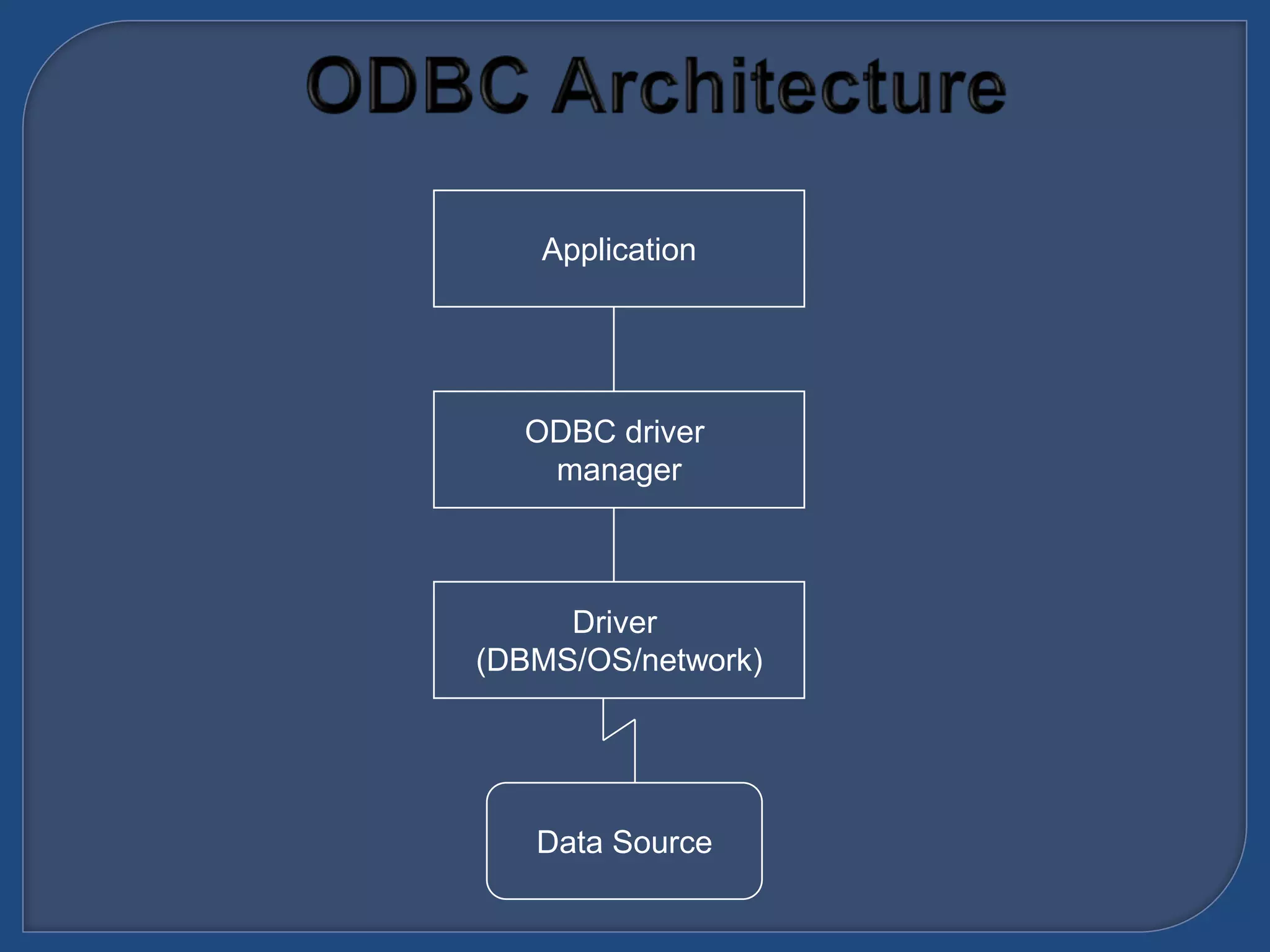
Application
ODBC driver
manager
Driver
(DBMS/OS/network)
Data Source
> Java API for connecting programs written in Java to the data in
relational databases
> The standard defined by Sun Microsystems, allowing individual
providers to implement and extend the standard with their own
JDBC drivers.
> Tasks of JDBC:
1) establishes a connection with a database
2) sends SQL statements
3) processes the results
> The JDBC API supports both two-tier and three-tier models for
database access.
> Two-tier model -- a Java applet or application interacts directly
with the database.
> Three-tier model -- introduces a middle-level server for execution
of business logic:
> the middle tier to maintain control over data access.
> the user can employ an easy-to-use higher-level API which is
translated by the middle tier into the appropriate low-level
calls.
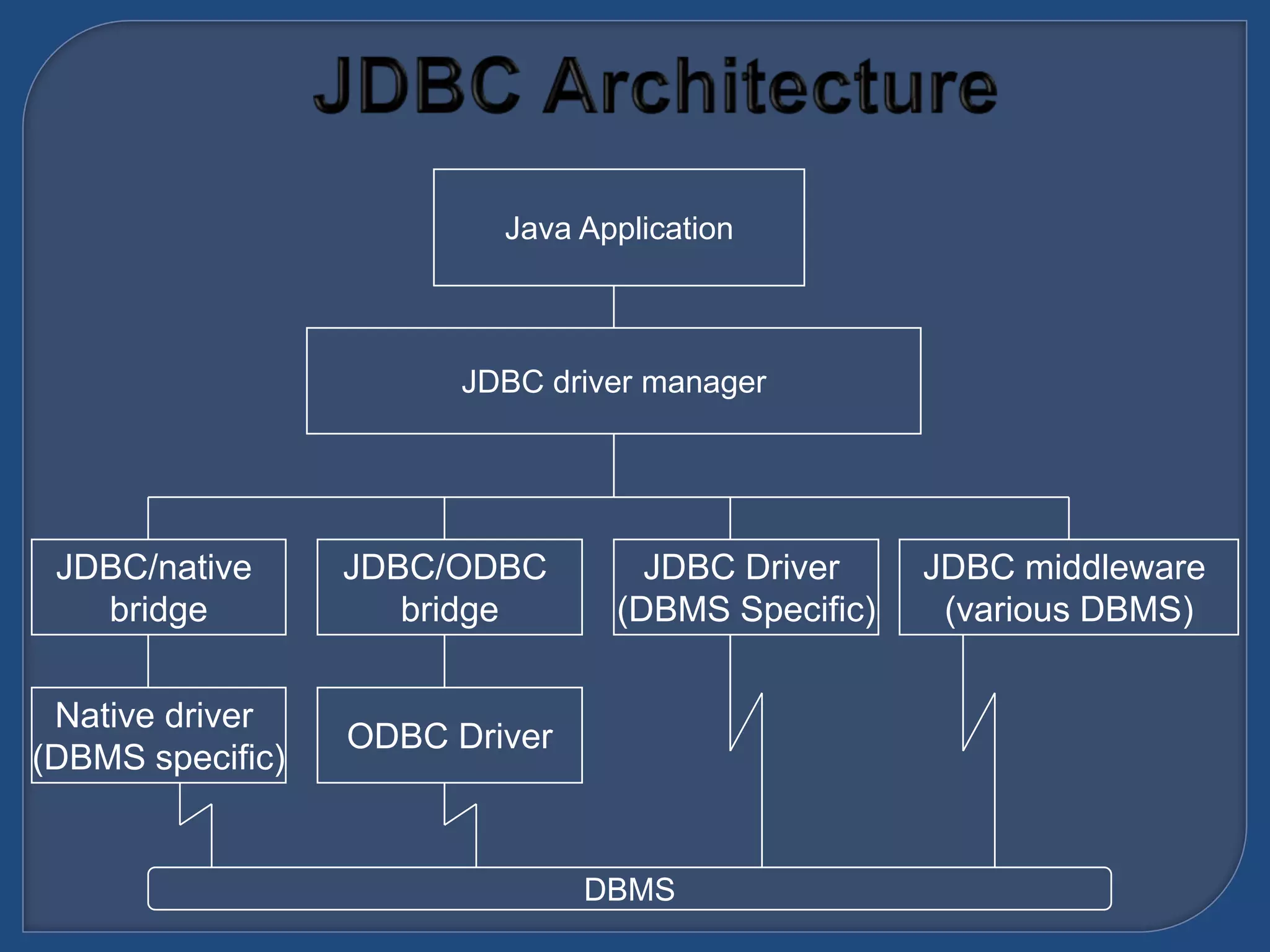
Java Application
JDBC driver manager
JDBC/native
bridge
DBMS
Native driver
(DBMS specific)
JDBC/ODBC
bridge
ODBC Driver
JDBC middleware
(various DBMS)
JDBC Driver
(DBMS Specific)
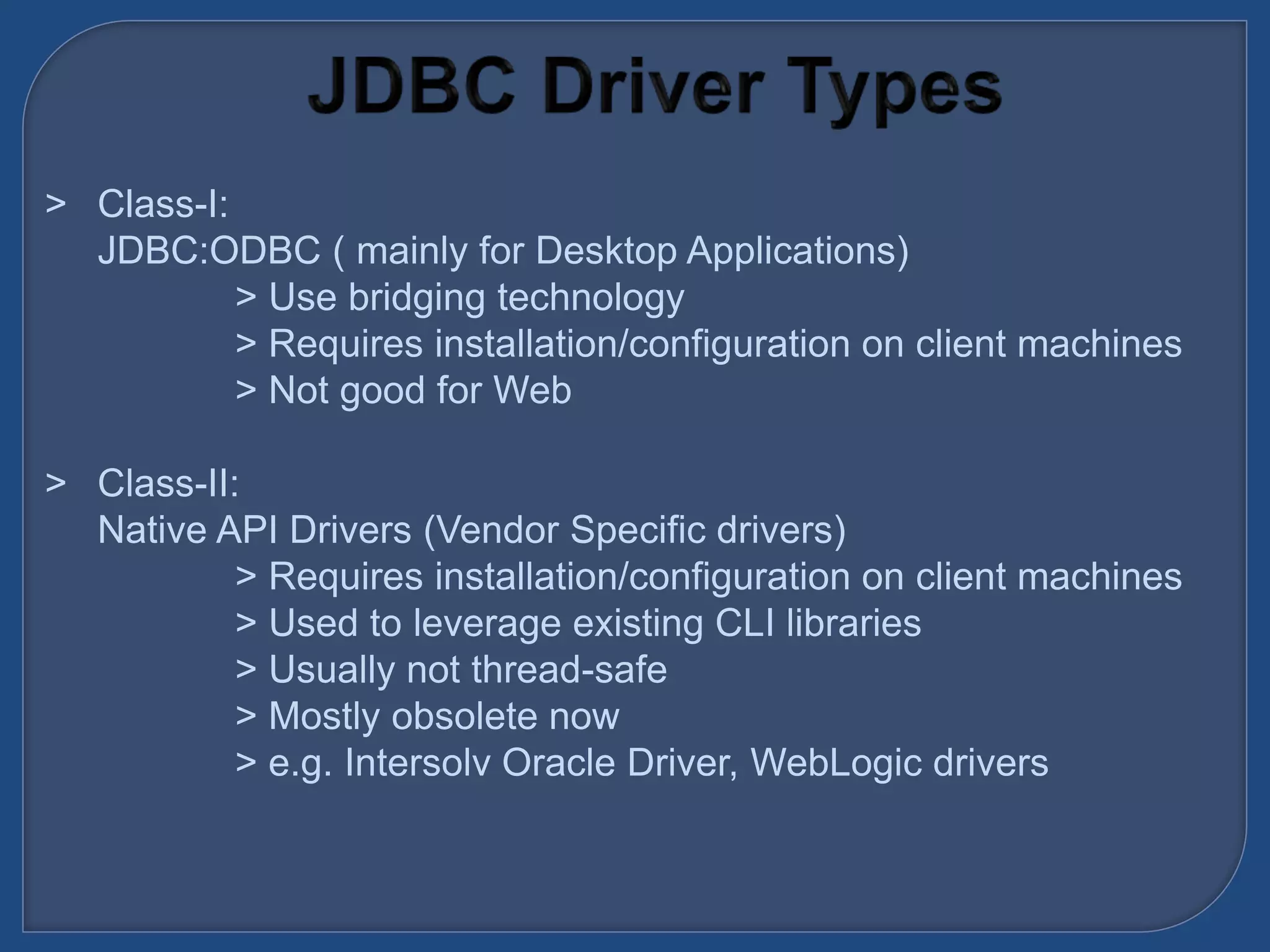
> Class-I:
JDBC:ODBC ( mainly for Desktop Applications)
> Use bridging technology
> Requires installation/configuration on client machines
> Not good for Web
> Class-II:
Native API Drivers (Vendor Specific drivers)
> Requires installation/configuration on client machines
> Used to leverage existing CLI libraries
> Usually not thread-safe
> Mostly obsolete now
> e.g. Intersolv Oracle Driver, WebLogic drivers
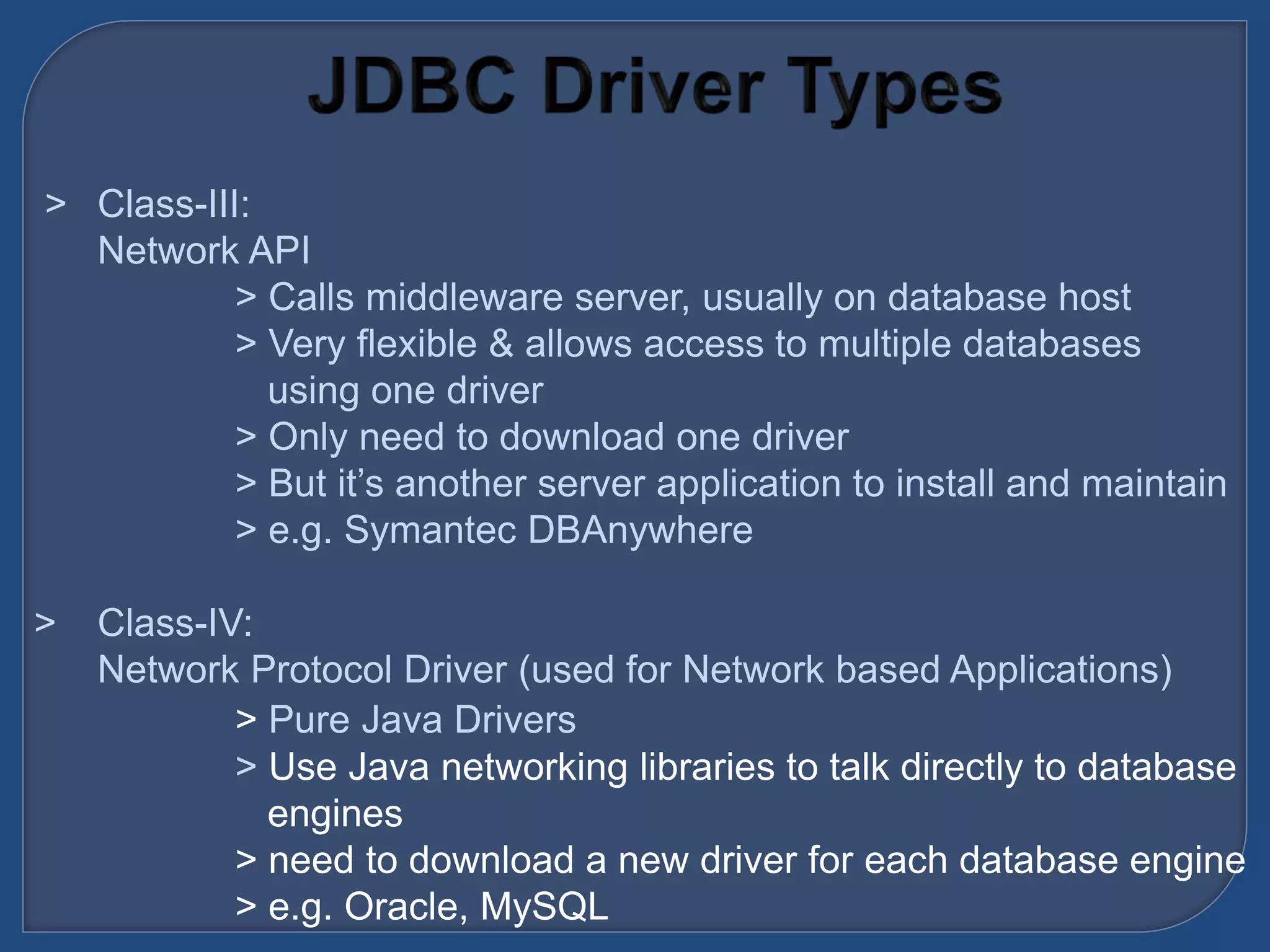
> Class-III:
Network API
> Calls middleware server, usually on database host
> Very flexible & allows access to multiple databases
using one driver
> Only need to download one driver
> But it’s another server application to install and maintain
> e.g. Symantec DBAnywhere
> Class-IV:
Network Protocol Driver (used for Network based Applications)
> Pure Java Drivers
> Use Java networking libraries to talk directly to database
engines
> need to download a new driver for each database engine
> e.g. Oracle, MySQL
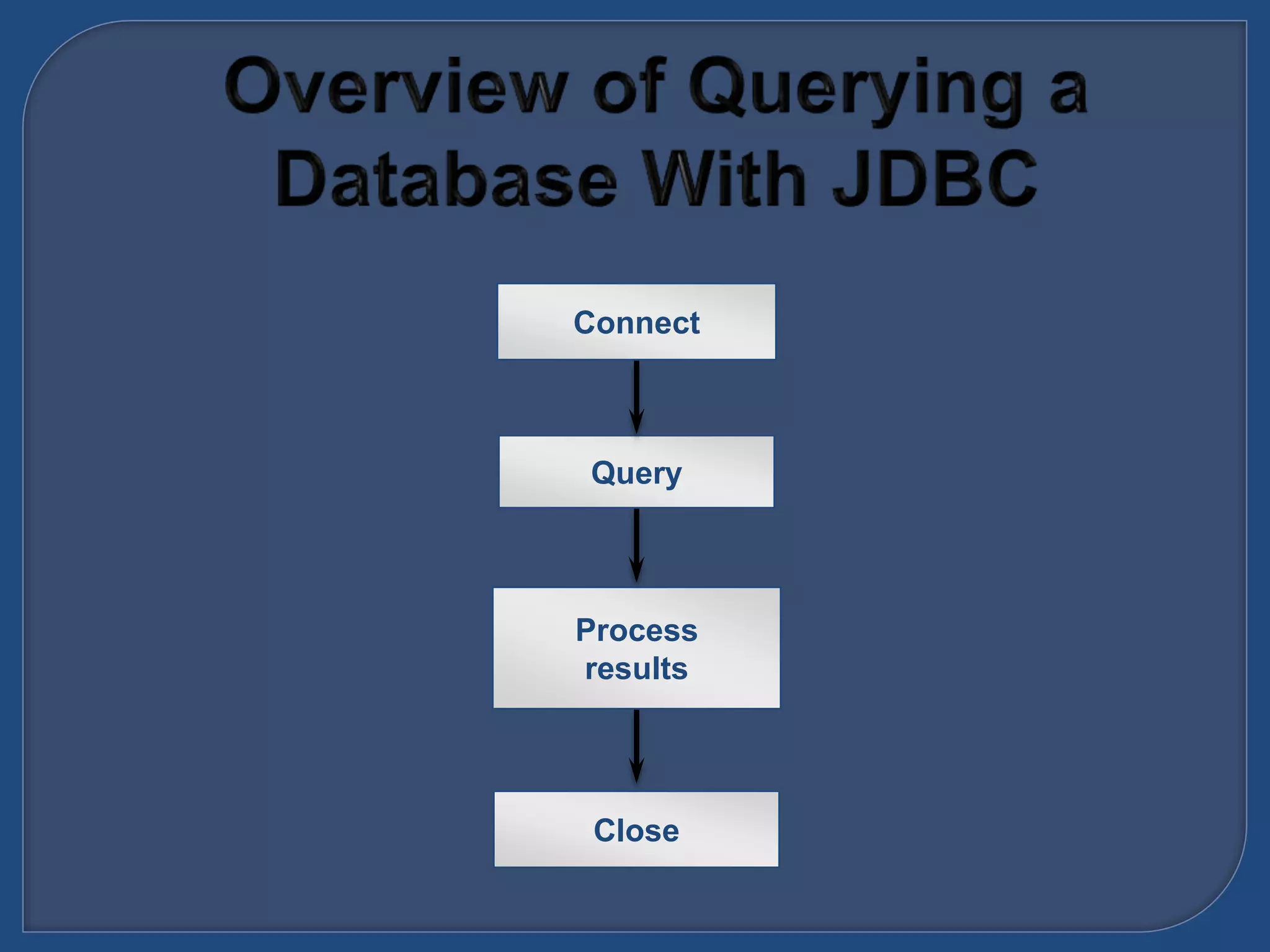
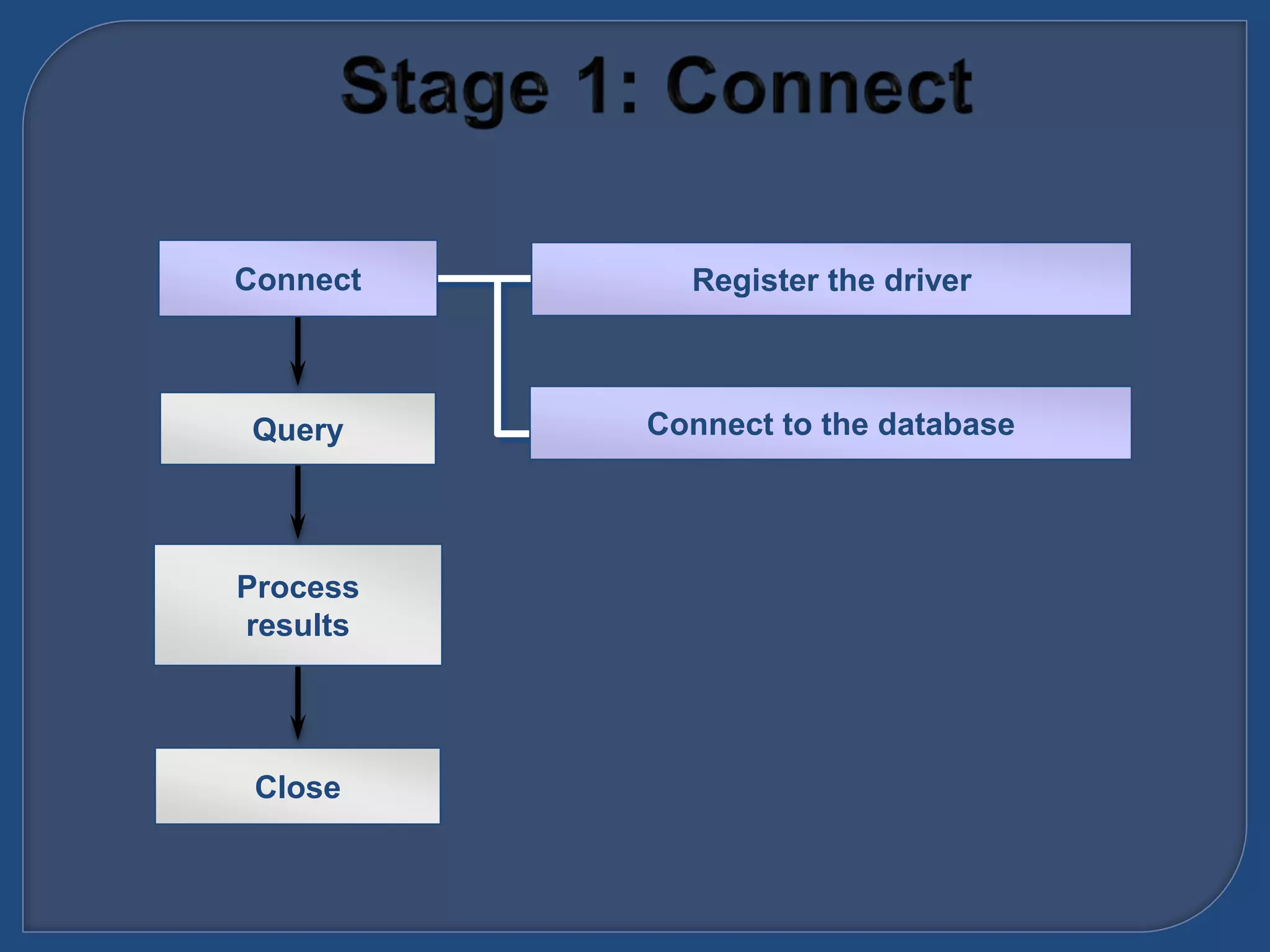
Query
Close
Connect
Process
results
Query
Close
Connect
Process
results
Register the driver
Connect to the database
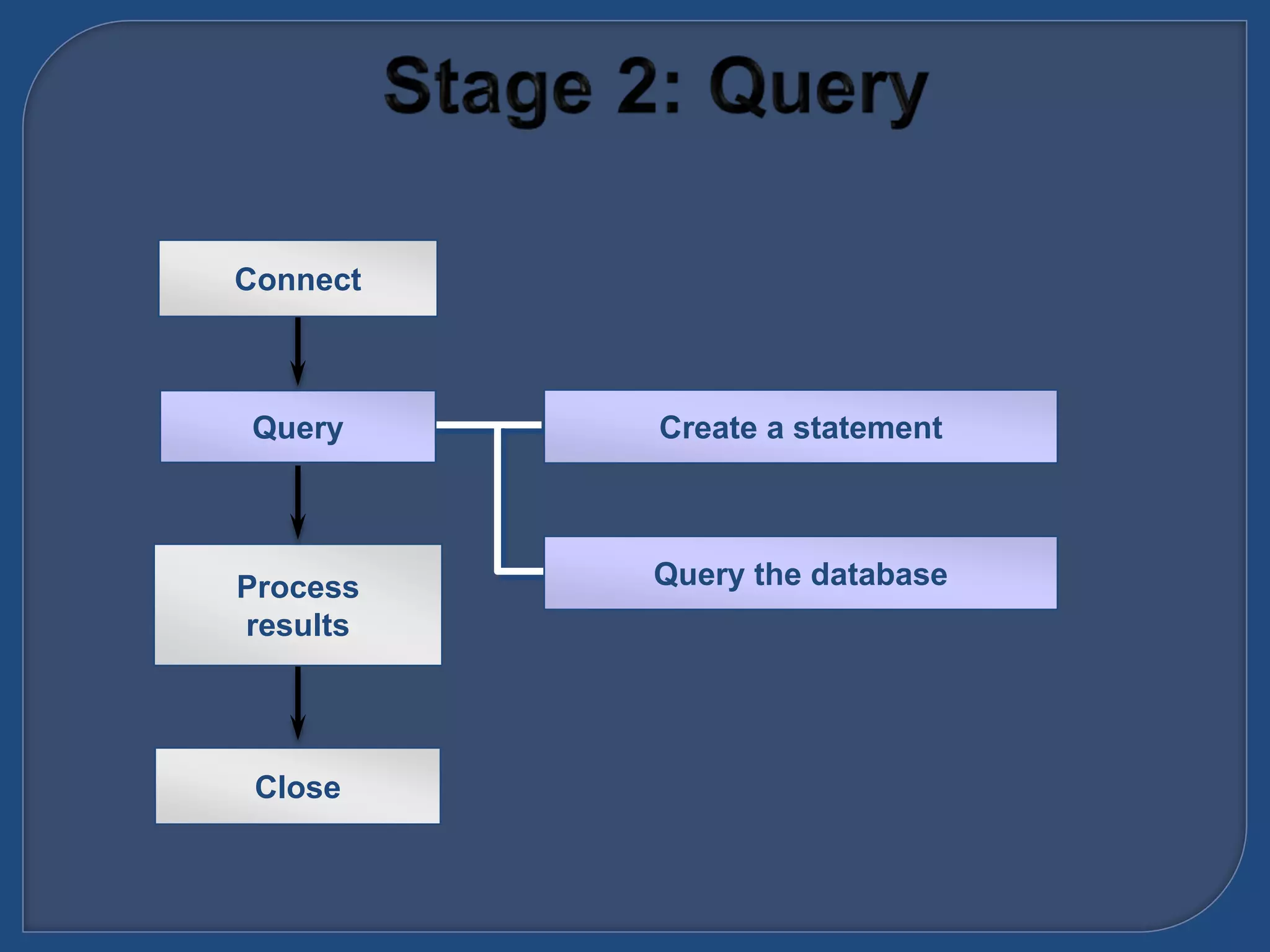
Close
Connect
Query Create a statement
Process
results
Query the database
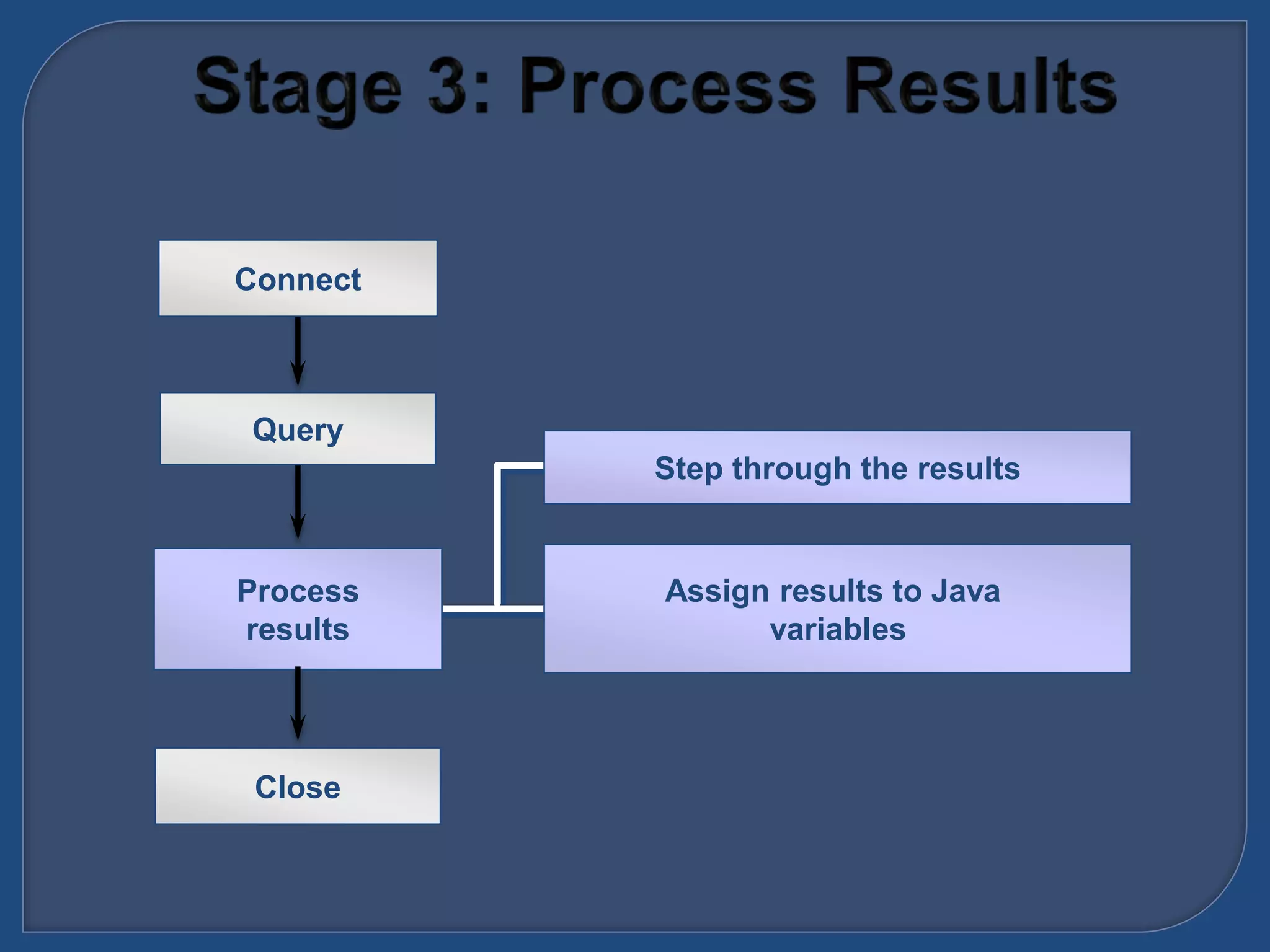
Close
Query
Step through the results
Process
results
Assign results to Java
variables
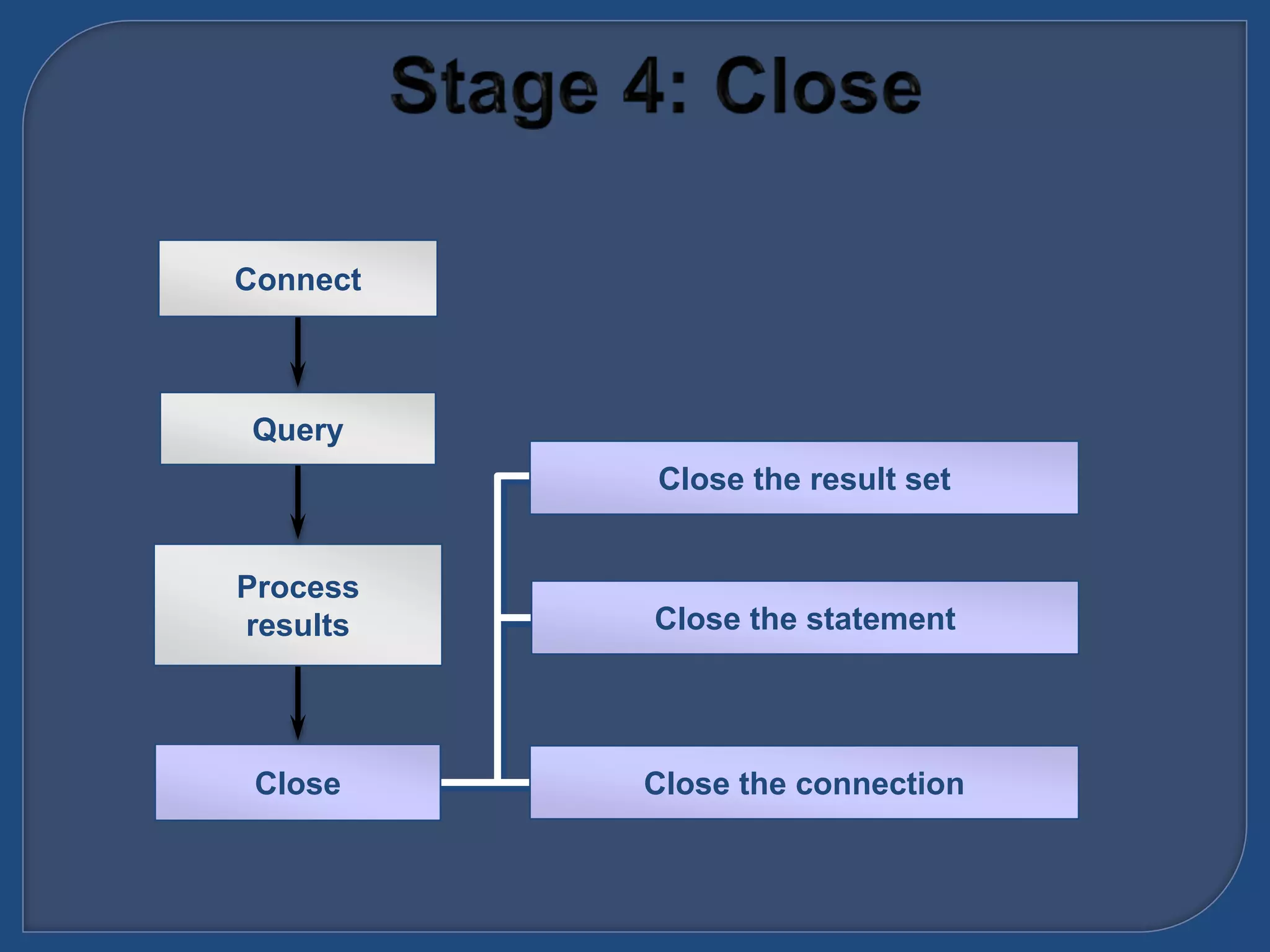
Connect
Connect
Query
Process
results
Close
Close the result set
Close the statement
Close the connection
Thank You !!!

Jdbc Ppt

  • 1.
    By: Gaurav Godhwani, Sushil Sinhal CSEDepartment , IES IPS Academy
  • 2.
    Before APIs likeJDBC and ODBC, database connectivity was tedious: > Database vendor provided function libraries for database access. > Connectivity library was proprietary. > Data access portions had to be rewritten with changes in the application. > Application developers were stuck with a particular database product for a given application
  • 3.
    > Write once,run anywhere > Multiple client and server platforms > Object-relational mapping > databases optimized for searching/indexing > objects optimized for engineering/flexibility > Network independence > Works across Internet Protocol > Database independence > Java can access any database vendor > Ease of administration
  • 4.
    > A standardor open application programming interface (API) for accessing a database > Developed by SQL Access Group, chiefly Microsoft, in 1992 > Access to various kinds of Databases > Allows programs to use SQL requests that will access databases without knowledge of the proprietary interfaces to the databases > Handles these requests and converts it into a request understandable by an individual database system.
  • 5.
    > An ODBCsoftware for a particular OS. > A separate module or driver for each database to be accessed > Driver masks the heterogeneity of DBMS, operating system and network protocol. > Ex: Sybase Driver, Windows Driver, etc.
  • 6.
  • 7.
    > Java APIfor connecting programs written in Java to the data in relational databases > The standard defined by Sun Microsystems, allowing individual providers to implement and extend the standard with their own JDBC drivers. > Tasks of JDBC: 1) establishes a connection with a database 2) sends SQL statements 3) processes the results
  • 8.
    > The JDBCAPI supports both two-tier and three-tier models for database access. > Two-tier model -- a Java applet or application interacts directly with the database. > Three-tier model -- introduces a middle-level server for execution of business logic: > the middle tier to maintain control over data access. > the user can employ an easy-to-use higher-level API which is translated by the middle tier into the appropriate low-level calls.
  • 9.
    Java Application JDBC drivermanager JDBC/native bridge DBMS Native driver (DBMS specific) JDBC/ODBC bridge ODBC Driver JDBC middleware (various DBMS) JDBC Driver (DBMS Specific)
  • 10.
    > Class-I: JDBC:ODBC (mainly for Desktop Applications) > Use bridging technology > Requires installation/configuration on client machines > Not good for Web > Class-II: Native API Drivers (Vendor Specific drivers) > Requires installation/configuration on client machines > Used to leverage existing CLI libraries > Usually not thread-safe > Mostly obsolete now > e.g. Intersolv Oracle Driver, WebLogic drivers
  • 11.
    > Class-III: Network API >Calls middleware server, usually on database host > Very flexible & allows access to multiple databases using one driver > Only need to download one driver > But it’s another server application to install and maintain > e.g. Symantec DBAnywhere > Class-IV: Network Protocol Driver (used for Network based Applications) > Pure Java Drivers > Use Java networking libraries to talk directly to database engines > need to download a new driver for each database engine > e.g. Oracle, MySQL
  • 12.
  • 13.
  • 14.
    Close Connect Query Create astatement Process results Query the database
  • 15.
    Close Query Step through theresults Process results Assign results to Java variables Connect
  • 16.
    Connect Query Process results Close Close the resultset Close the statement Close the connection
  • 24.