Java 17:
The Next LTS
Joseph Kuo (CyberJos)
Senior Director of Cloud
資深雲端技術總監
About Me
 22 年 Java 經驗、 25+ 年軟體開發經驗、 5+ 年開發管理經驗
 寫過 Java, Basic, C/C++, Mud, JavaScript, Python 相關專案
 JCConf 2014, 2016, 2017, 2018, 2020 講師
 Oracle Groundbreakers Taiwan 2019 講師
 曾在連鎖資訊教育機構、加值簡訊服務系統、雲端遊戲影音平台、
全球電子商務網站、資安防護、以及用戶行為管理等公司中任職
 負責架構規劃、系統開發、軟體設計、程式撰寫及技術教學,並參
與各式專案的需求分析、架構設計、開發實作與部署維護
 專長是軟體工程、系統架構、設計模式、雲端 / 邊緣運算、物聯網
 希望能一輩子玩技術寫程式到老
Taiwan Java User Group
 官方網站: http://www.twjug.org
 TWJUG 臉書: https://www.facebook.com/groups/twjug
 LINE 社群「 Java 程式語言討論區」:
https://line.me/ti/g2/qNtYt-2d5ssCd2tcPBpIPA
Agenda
 Overview
 JDK 16 & 17
 From 12 to 17
 Conclusion
Overview
TIOBE Index for November 2021
Source: https://www.tiobe.com/tiobe-index/
TIOBE Index for November 2021
Source: https://www.tiobe.com/tiobe-index/
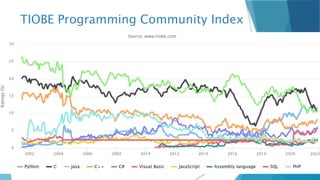
TIOBE Programming Community Index
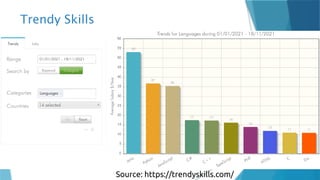
Trendy Skills
Source: https://trendyskills.com/
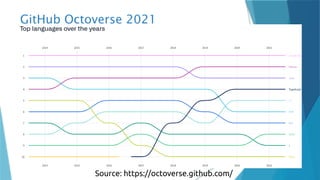
GitHub Octoverse 2021
Source: https://octoverse.github.com/
JDK 16 & 17
Briefing
 JDK 17 is the latest Long Term Support version
 Spring announces that Spring Framework 6 and Spring Boot
3 will support JDK 17 next year
 JDK 18 will be released in March 2022
 The interval between LTS versions is now two years instead
of three, making Java 21 (planned for September 2023)
probably the next LTS.
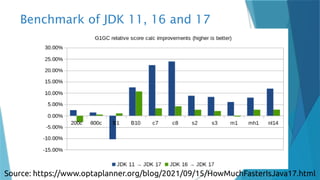
Benchmark of JDK 11, 16 and 17
Source: https://www.optaplanner.org/blog/2021/09/15/HowMuchFasterIsJava17.html
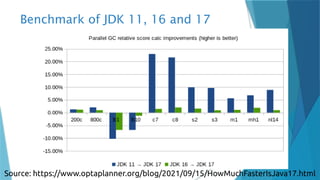
Benchmark of JDK 11, 16 and 17
Source: https://www.optaplanner.org/blog/2021/09/15/HowMuchFasterIsJava17.html
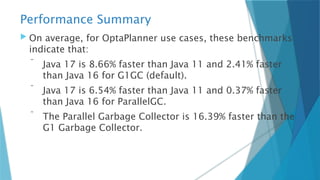
Performance Summary
 On average, for OptaPlanner use cases, these benchmarks
indicate that:
 Java 17 is 8.66% faster than Java 11 and 2.41% faster
than Java 16 for G1GC (default).
 Java 17 is 6.54% faster than Java 11 and 0.37% faster
than Java 16 for ParallelGC.
 The Parallel Garbage Collector is 16.39% faster than the
G1 Garbage Collector.
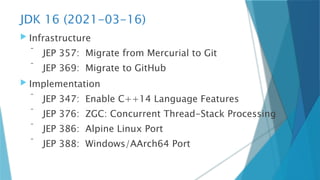
JDK 16 (2021-03-16)
 Infrastructure
 JEP 357: Migrate from Mercurial to Git
 JEP 369: Migrate to GitHub
 Implementation
 JEP 347: Enable C++14 Language Features
 JEP 376: ZGC: Concurrent Thread-Stack Processing
 JEP 386: Alpine Linux Port
 JEP 388: Windows/AArch64 Port
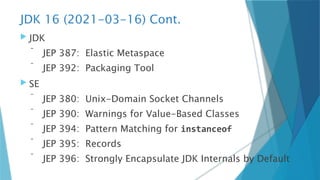
JDK 16 (2021-03-16) Cont.
 JDK
 JEP 387: Elastic Metaspace
 JEP 392: Packaging Tool
 SE
 JEP 380: Unix-Domain Socket Channels
 JEP 390: Warnings for Value-Based Classes
 JEP 394: Pattern Matching for instanceof
 JEP 395: Records
 JEP 396: Strongly Encapsulate JDK Internals by Default
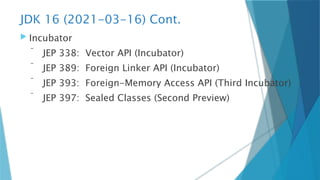
JDK 16 (2021-03-16) Cont.
 Incubator
 JEP 338: Vector API (Incubator)
 JEP 389: Foreign Linker API (Incubator)
 JEP 393: Foreign-Memory Access API (Third Incubator)
 JEP 397: Sealed Classes (Second Preview)
JDK 17 (2021-09-14)
 Infrastructure
 None
 Implementation
 JEP 391: macOS/AArch64 Port
JDK 17 (2021-09-14) Cont.
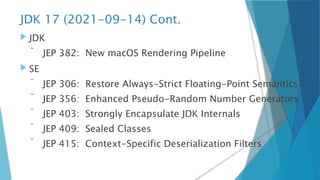
 JDK
 JEP 382: New macOS Rendering Pipeline
 SE
 JEP 306: Restore Always-Strict Floating-Point Semantics
 JEP 356: Enhanced Pseudo-Random Number Generators
 JEP 403: Strongly Encapsulate JDK Internals
 JEP 409: Sealed Classes
 JEP 415: Context-Specific Deserialization Filters
JDK 17 (2021-09-14) Cont.
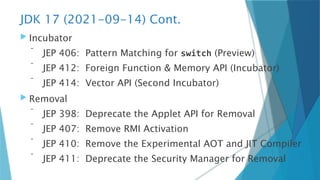
 Incubator
 JEP 406: Pattern Matching for switch (Preview)
 JEP 412: Foreign Function & Memory API (Incubator)
 JEP 414: Vector API (Second Incubator)
 Removal
 JEP 398: Deprecate the Applet API for Removal
 JEP 407: Remove RMI Activation
 JEP 410: Remove the Experimental AOT and JIT Compiler
 JEP 411: Deprecate the Security Manager for Removal
From 12 to 17
Text Blocks
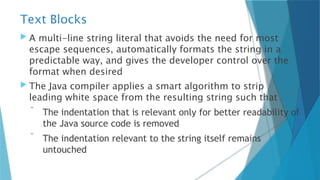
Text Blocks
 A multi-line string literal that avoids the need for most
escape sequences, automatically formats the string in a
predictable way, and gives the developer control over the
format when desired
 The Java compiler applies a smart algorithm to strip
leading white space from the resulting string such that
 The indentation that is relevant only for better readability of
the Java source code is removed
 The indentation relevant to the string itself remains
untouched
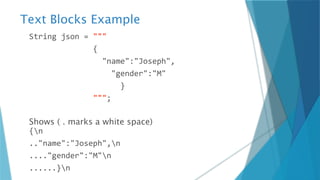
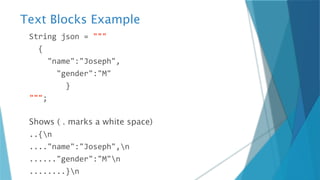
Text Blocks Example
String json = """
{
"name":"Joseph",
"gender":"M"
}
""";
Shows ( . marks a white space)
{n
.."name":"Joseph",n
...."gender":"M"n
......}n
Text Blocks Example
String json = """
{
"name":"Joseph",
"gender":"M"
}
""";
Shows ( . marks a white space)
..{n
...."name":"Joseph",n
......"gender":"M"n
........}n
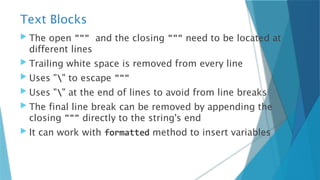
Text Blocks
 The open """ and the closing """ need to be located at
different lines
 Trailing white space is removed from every line
 Uses "" to escape """
 Uses "" at the end of lines to avoid from line breaks
 The final line break can be removed by appending the
closing """ directly to the string's end
 It can work with formatted method to insert variables
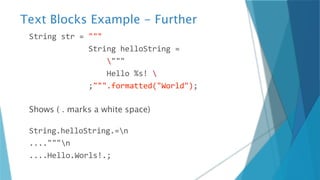
Text Blocks Example - Further
String str = """
String helloString =
"""
Hello %s! 
;""".formatted("World");
Shows ( . marks a white space)
String.helloString.=n
...."""n
....Hello.Worls!.;
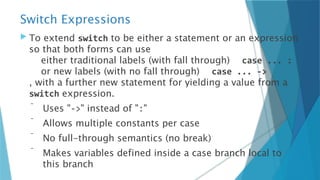
Switch Expressions
Switch Expressions
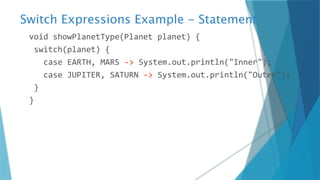
 To extend switch to be either a statement or an expression
so that both forms can use
either traditional labels (with fall through) case ... :
or new labels (with no fall through) case ... ->
, with a further new statement for yielding a value from a
switch expression.
 Uses "->" instead of ":"
 Allows multiple constants per case
 No full-through semantics (no break)
 Makes variables defined inside a case branch local to
this branch
Switch Expressions Example - Statement
void showPlanetType(Planet planet) {
switch(planet) {
case EARTH, MARS -> System.out.println("Inner");
case JUPITER, SATURN -> System.out.println("Outer");
}
}
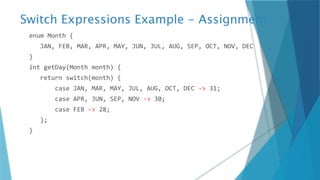
Switch Expressions Example - Assignment
enum Month {
JAN, FEB, MAR, APR, MAY, JUN, JUL, AUG, SEP, OCT, NOV, DEC
}
int getDay(Month month) {
return switch(month) {
case JAN, MAR, MAY, JUL, AUG, OCT, DEC -> 31;
case APR, JUN, SEP, NOV -> 30;
case FEB -> 28;
};
}
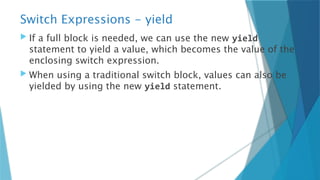
Switch Expressions - yield
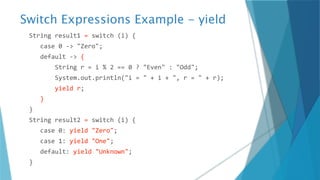
 If a full block is needed, we can use the new yield
statement to yield a value, which becomes the value of the
enclosing switch expression.
 When using a traditional switch block, values can also be
yielded by using the new yield statement.
Switch Expressions Example - yield
String result1 = switch (i) {
case 0 -> "Zero";
default -> {
String r = i % 2 == 0 ? "Even" : "Odd";
System.out.println("i = " + i + ", r = " + r);
yield r;
}
}
String result2 = switch (i) {
case 0: yield "Zero";
case 1: yield "One";
default: yield "Unknown";
}
Pattern Matching for
instanceof
Pattern Matching for instanceof
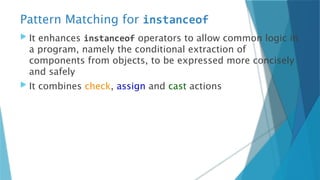
 It enhances instanceof operators to allow common logic in
a program, namely the conditional extraction of
components from objects, to be expressed more concisely
and safely
 It combines check, assign and cast actions
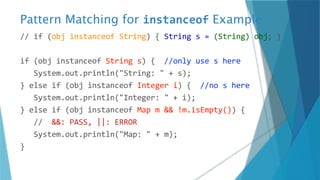
Pattern Matching for instanceof Example
// if (obj instanceof String) { String s = (String) obj; }
if (obj instanceof String s) { //only use s here
System.out.println("String: " + s);
} else if (obj instanceof Integer i) { //no s here
System.out.println("Integer: " + i);
} else if (obj instanceof Map m && !m.isEmpty()) {
// &&: PASS, ||: ERROR
System.out.println("Map: " + m);
}
Pattern Matching for
switch
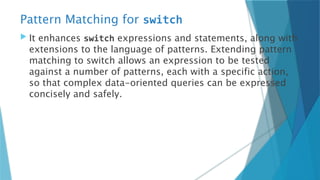
Pattern Matching for switch
 It enhances switch expressions and statements, along with
extensions to the language of patterns. Extending pattern
matching to switch allows an expression to be tested
against a number of patterns, each with a specific action,
so that complex data-oriented queries can be expressed
concisely and safely.
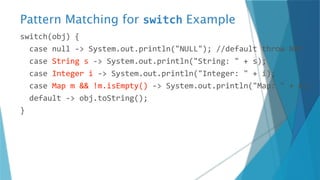
Pattern Matching for switch Example
switch(obj) {
case null -> System.out.println("NULL"); //default throw NPE
case String s -> System.out.println("String: " + s);
case Integer i -> System.out.println("Integer: " + i);
case Map m && !m.isEmpty() -> System.out.println("Map: " + m);
default -> obj.toString();
}
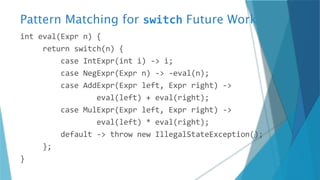
Pattern Matching for switch Future Work
int eval(Expr n) {
return switch(n) {
case IntExpr(int i) -> i;
case NegExpr(Expr n) -> -eval(n);
case AddExpr(Expr left, Expr right) ->
eval(left) + eval(right);
case MulExpr(Expr left, Expr right) ->
eval(left) * eval(right);
default -> throw new IllegalStateException();
};
}
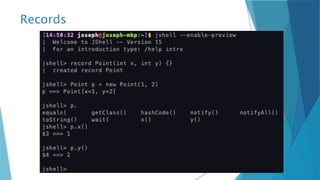
Records
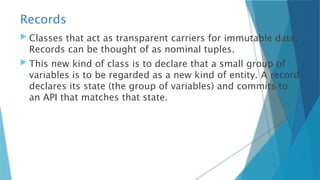
Records
 Classes that act as transparent carriers for immutable data.
Records can be thought of as nominal tuples.
 This new kind of class is to declare that a small group of
variables is to be regarded as a new kind of entity. A record

declares its state (the group of variables) and commits to
an API that matches that state.
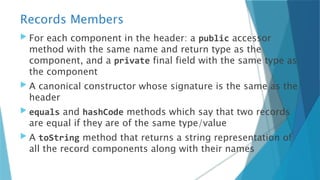
Records Members
 For each component in the header: a public accessor
method with the same name and return type as the
component, and a private final field with the same type as
the component
 A canonical constructor whose signature is the same as the
header
 equals and hashCode methods which say that two records
are equal if they are of the same type/value
 A toString method that returns a string representation of
all the record components along with their names
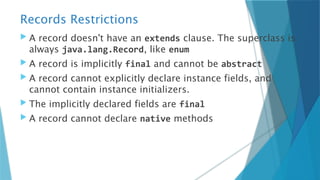
Records Restrictions
 A record doesn't have an extends clause. The superclass is
always java.lang.Record, like enum
 A record is implicitly final and cannot be abstract
 A record cannot explicitly declare instance fields, and
cannot contain instance initializers.
 The implicitly declared fields are final
 A record cannot declare native methods
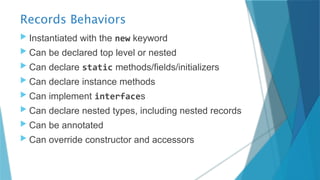
Records Behaviors
 Instantiated with the new keyword
 Can be declared top level or nested
 Can declare static methods/fields/initializers
 Can declare instance methods
 Can implement interfaces
 Can declare nested types, including nested records
 Can be annotated
 Can override constructor and accessors
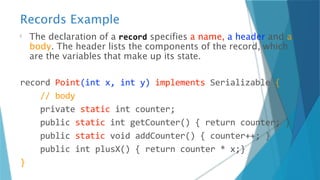
Records Example
The declaration of a record specifies a name, a header and a
body. The header lists the components of the record, which
are the variables that make up its state.
record Point(int x, int y) implements Serializable {
// body
private static int counter;
public static int getCounter() { return counter; }
public static void addCounter() { counter++; }
public int plusX() { return counter * x;}
}
Records
Sealed Classes
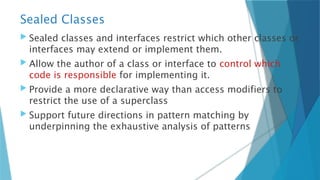
Sealed Classes
 Sealed classes and interfaces restrict which other classes or
interfaces may extend or implement them.
 Allow the author of a class or interface to control which
code is responsible for implementing it.
 Provide a more declarative way than access modifiers to
restrict the use of a superclass
 Support future directions in pattern matching by
underpinning the exhaustive analysis of patterns
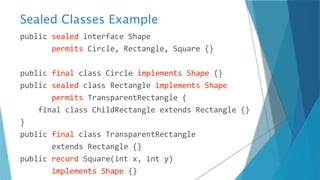
Sealed Classes Example
public sealed interface Shape
permits Circle, Rectangle, Square {}
public final class Circle implements Shape {}
public sealed class Rectangle implements Shape
permits TransparentRectangle {
final class ChildRectangle extends Rectangle {}
}
public final class TransparentRectangle
extends Rectangle {}
public record Square(int x, int y)
implements Shape {}
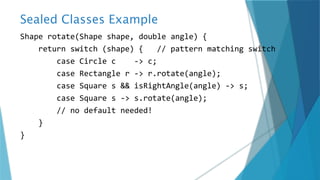
Sealed Classes Example
Shape rotate(Shape shape, double angle) {
return switch (shape) { // pattern matching switch
case Circle c -> c;
case Rectangle r -> r.rotate(angle);
case Square s && isRightAngle(angle) -> s;
case Square s -> s.rotate(angle);
// no default needed!
}
}
Packaging Tool
Packaging Tool
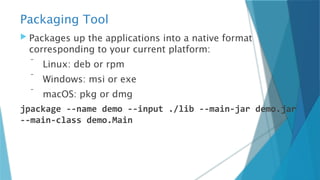
 Packages up the applications into a native format
corresponding to your current platform:
 Linux: deb or rpm
 Windows: msi or exe
 macOS: pkg or dmg
jpackage --name demo --input ./lib --main-jar demo.jar
--main-class demo.Main
Helpful NullPointerExceptions
 a.b.c.i = 99
 Exception in thread "main" java.lang.NullPointerException:
Cannot read field "c" because "a.b" is null
at Prog.main(Prog.java:5)
 a[i][j][k] = 99
 Exception in thread "main" java.lang.NullPointerException:
Cannot load from object array because "a[i][j]" is null
at Prog.main(Prog.java:5)
 a.i = b.j
 Exception in thread "main" java.lang.NullPointerException:
Cannot read field "j" because "b" is null
at Prog.main(Prog.java:5)
Vector API
Vector API Example
public void newVectorComputation(float[] a, float[] b, float[] c)
{
for (var i = 0; i < a.length; i += SPECIES.length()) {
var m = SPECIES.indexInRange(i, a.length);
var va = FloatVector.fromArray(SPECIES, a, i, m);
var vb = FloatVector.fromArray(SPECIES, b, i, m);
var vc = va.mul(vb);
vc.intoArray(c, i, m);
}
}
Enhanced Pseudo-Random
Number Generators
Enhanced PRNG
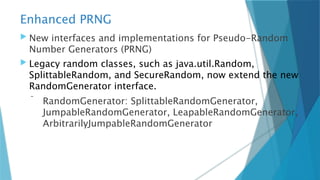
 New interfaces and implementations for Pseudo-Random
Number Generators (PRNG)
 Legacy random classes, such as java.util.Random,
SplittableRandom, and SecureRandom, now extend the new
RandomGenerator interface.
 RandomGenerator: SplittableRandomGenerator,
JumpableRandomGenerator, LeapableRandomGenerator,
ArbitrarilyJumpableRandomGenerator
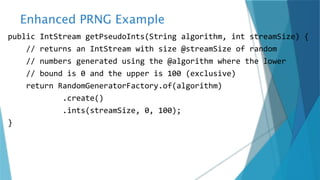
Enhanced PRNG Example
public IntStream getPseudoInts(String algorithm, int streamSize) {
// returns an IntStream with size @streamSize of random
// numbers generated using the @algorithm where the lower
// bound is 0 and the upper is 100 (exclusive)
return RandomGeneratorFactory.of(algorithm)
.create()
.ints(streamSize, 0, 100);
}
Conclusion
Thank you!

JCConf 2021 - Java17: The Next LTS

  • 1.
    Java 17: The NextLTS Joseph Kuo (CyberJos) Senior Director of Cloud 資深雲端技術總監
  • 2.
    About Me  22年 Java 經驗、 25+ 年軟體開發經驗、 5+ 年開發管理經驗  寫過 Java, Basic, C/C++, Mud, JavaScript, Python 相關專案  JCConf 2014, 2016, 2017, 2018, 2020 講師  Oracle Groundbreakers Taiwan 2019 講師  曾在連鎖資訊教育機構、加值簡訊服務系統、雲端遊戲影音平台、 全球電子商務網站、資安防護、以及用戶行為管理等公司中任職  負責架構規劃、系統開發、軟體設計、程式撰寫及技術教學,並參 與各式專案的需求分析、架構設計、開發實作與部署維護  專長是軟體工程、系統架構、設計模式、雲端 / 邊緣運算、物聯網  希望能一輩子玩技術寫程式到老
  • 3.
    Taiwan Java UserGroup  官方網站: http://www.twjug.org  TWJUG 臉書: https://www.facebook.com/groups/twjug  LINE 社群「 Java 程式語言討論區」: https://line.me/ti/g2/qNtYt-2d5ssCd2tcPBpIPA
  • 4.
    Agenda  Overview  JDK16 & 17  From 12 to 17  Conclusion
  • 5.
  • 6.
    TIOBE Index forNovember 2021 Source: https://www.tiobe.com/tiobe-index/
  • 7.
    TIOBE Index forNovember 2021 Source: https://www.tiobe.com/tiobe-index/
  • 8.
  • 9.
  • 10.
    GitHub Octoverse 2021 Source:https://octoverse.github.com/
  • 11.
  • 12.
    Briefing  JDK 17is the latest Long Term Support version  Spring announces that Spring Framework 6 and Spring Boot 3 will support JDK 17 next year  JDK 18 will be released in March 2022  The interval between LTS versions is now two years instead of three, making Java 21 (planned for September 2023) probably the next LTS.
  • 13.
    Benchmark of JDK11, 16 and 17 Source: https://www.optaplanner.org/blog/2021/09/15/HowMuchFasterIsJava17.html
  • 14.
    Benchmark of JDK11, 16 and 17 Source: https://www.optaplanner.org/blog/2021/09/15/HowMuchFasterIsJava17.html
  • 15.
    Performance Summary  Onaverage, for OptaPlanner use cases, these benchmarks indicate that:  Java 17 is 8.66% faster than Java 11 and 2.41% faster than Java 16 for G1GC (default).  Java 17 is 6.54% faster than Java 11 and 0.37% faster than Java 16 for ParallelGC.  The Parallel Garbage Collector is 16.39% faster than the G1 Garbage Collector.
  • 16.
    JDK 16 (2021-03-16) Infrastructure  JEP 357: Migrate from Mercurial to Git  JEP 369: Migrate to GitHub  Implementation  JEP 347: Enable C++14 Language Features  JEP 376: ZGC: Concurrent Thread-Stack Processing  JEP 386: Alpine Linux Port  JEP 388: Windows/AArch64 Port
  • 17.
    JDK 16 (2021-03-16)Cont.  JDK  JEP 387: Elastic Metaspace  JEP 392: Packaging Tool  SE  JEP 380: Unix-Domain Socket Channels  JEP 390: Warnings for Value-Based Classes  JEP 394: Pattern Matching for instanceof  JEP 395: Records  JEP 396: Strongly Encapsulate JDK Internals by Default
  • 18.
    JDK 16 (2021-03-16)Cont.  Incubator  JEP 338: Vector API (Incubator)  JEP 389: Foreign Linker API (Incubator)  JEP 393: Foreign-Memory Access API (Third Incubator)  JEP 397: Sealed Classes (Second Preview)
  • 19.
    JDK 17 (2021-09-14) Infrastructure  None  Implementation  JEP 391: macOS/AArch64 Port
  • 20.
    JDK 17 (2021-09-14)Cont.  JDK  JEP 382: New macOS Rendering Pipeline  SE  JEP 306: Restore Always-Strict Floating-Point Semantics  JEP 356: Enhanced Pseudo-Random Number Generators  JEP 403: Strongly Encapsulate JDK Internals  JEP 409: Sealed Classes  JEP 415: Context-Specific Deserialization Filters
  • 21.
    JDK 17 (2021-09-14)Cont.  Incubator  JEP 406: Pattern Matching for switch (Preview)  JEP 412: Foreign Function & Memory API (Incubator)  JEP 414: Vector API (Second Incubator)  Removal  JEP 398: Deprecate the Applet API for Removal  JEP 407: Remove RMI Activation  JEP 410: Remove the Experimental AOT and JIT Compiler  JEP 411: Deprecate the Security Manager for Removal
  • 22.
  • 23.
  • 24.
    Text Blocks  Amulti-line string literal that avoids the need for most escape sequences, automatically formats the string in a predictable way, and gives the developer control over the format when desired  The Java compiler applies a smart algorithm to strip leading white space from the resulting string such that  The indentation that is relevant only for better readability of the Java source code is removed  The indentation relevant to the string itself remains untouched
  • 25.
    Text Blocks Example Stringjson = """ { "name":"Joseph", "gender":"M" } """; Shows ( . marks a white space) {n .."name":"Joseph",n ...."gender":"M"n ......}n
  • 26.
    Text Blocks Example Stringjson = """ { "name":"Joseph", "gender":"M" } """; Shows ( . marks a white space) ..{n ...."name":"Joseph",n ......"gender":"M"n ........}n
  • 27.
    Text Blocks  Theopen """ and the closing """ need to be located at different lines  Trailing white space is removed from every line  Uses "" to escape """  Uses "" at the end of lines to avoid from line breaks  The final line break can be removed by appending the closing """ directly to the string's end  It can work with formatted method to insert variables
  • 28.
    Text Blocks Example- Further String str = """ String helloString = """ Hello %s! ;""".formatted("World"); Shows ( . marks a white space) String.helloString.=n ...."""n ....Hello.Worls!.;
  • 29.
  • 30.
    Switch Expressions  Toextend switch to be either a statement or an expression so that both forms can use either traditional labels (with fall through) case ... : or new labels (with no fall through) case ... -> , with a further new statement for yielding a value from a switch expression.  Uses "->" instead of ":"  Allows multiple constants per case  No full-through semantics (no break)  Makes variables defined inside a case branch local to this branch
  • 31.
    Switch Expressions Example- Statement void showPlanetType(Planet planet) { switch(planet) { case EARTH, MARS -> System.out.println("Inner"); case JUPITER, SATURN -> System.out.println("Outer"); } }
  • 32.
    Switch Expressions Example- Assignment enum Month { JAN, FEB, MAR, APR, MAY, JUN, JUL, AUG, SEP, OCT, NOV, DEC } int getDay(Month month) { return switch(month) { case JAN, MAR, MAY, JUL, AUG, OCT, DEC -> 31; case APR, JUN, SEP, NOV -> 30; case FEB -> 28; }; }
  • 33.
    Switch Expressions -yield  If a full block is needed, we can use the new yield statement to yield a value, which becomes the value of the enclosing switch expression.  When using a traditional switch block, values can also be yielded by using the new yield statement.
  • 34.
    Switch Expressions Example- yield String result1 = switch (i) { case 0 -> "Zero"; default -> { String r = i % 2 == 0 ? "Even" : "Odd"; System.out.println("i = " + i + ", r = " + r); yield r; } } String result2 = switch (i) { case 0: yield "Zero"; case 1: yield "One"; default: yield "Unknown"; }
  • 35.
  • 36.
    Pattern Matching forinstanceof  It enhances instanceof operators to allow common logic in a program, namely the conditional extraction of components from objects, to be expressed more concisely and safely  It combines check, assign and cast actions
  • 37.
    Pattern Matching forinstanceof Example // if (obj instanceof String) { String s = (String) obj; } if (obj instanceof String s) { //only use s here System.out.println("String: " + s); } else if (obj instanceof Integer i) { //no s here System.out.println("Integer: " + i); } else if (obj instanceof Map m && !m.isEmpty()) { // &&: PASS, ||: ERROR System.out.println("Map: " + m); }
  • 38.
  • 39.
    Pattern Matching forswitch  It enhances switch expressions and statements, along with extensions to the language of patterns. Extending pattern matching to switch allows an expression to be tested against a number of patterns, each with a specific action, so that complex data-oriented queries can be expressed concisely and safely.
  • 40.
    Pattern Matching forswitch Example switch(obj) { case null -> System.out.println("NULL"); //default throw NPE case String s -> System.out.println("String: " + s); case Integer i -> System.out.println("Integer: " + i); case Map m && !m.isEmpty() -> System.out.println("Map: " + m); default -> obj.toString(); }
  • 41.
    Pattern Matching forswitch Future Work int eval(Expr n) { return switch(n) { case IntExpr(int i) -> i; case NegExpr(Expr n) -> -eval(n); case AddExpr(Expr left, Expr right) -> eval(left) + eval(right); case MulExpr(Expr left, Expr right) -> eval(left) * eval(right); default -> throw new IllegalStateException(); }; }
  • 42.
  • 43.
    Records  Classes thatact as transparent carriers for immutable data. Records can be thought of as nominal tuples.  This new kind of class is to declare that a small group of variables is to be regarded as a new kind of entity. A record declares its state (the group of variables) and commits to an API that matches that state.
  • 44.
    Records Members  Foreach component in the header: a public accessor method with the same name and return type as the component, and a private final field with the same type as the component  A canonical constructor whose signature is the same as the header  equals and hashCode methods which say that two records are equal if they are of the same type/value  A toString method that returns a string representation of all the record components along with their names
  • 45.
    Records Restrictions  Arecord doesn't have an extends clause. The superclass is always java.lang.Record, like enum  A record is implicitly final and cannot be abstract  A record cannot explicitly declare instance fields, and cannot contain instance initializers.  The implicitly declared fields are final  A record cannot declare native methods
  • 46.
    Records Behaviors  Instantiatedwith the new keyword  Can be declared top level or nested  Can declare static methods/fields/initializers  Can declare instance methods  Can implement interfaces  Can declare nested types, including nested records  Can be annotated  Can override constructor and accessors
  • 47.
    Records Example The declarationof a record specifies a name, a header and a body. The header lists the components of the record, which are the variables that make up its state. record Point(int x, int y) implements Serializable { // body private static int counter; public static int getCounter() { return counter; } public static void addCounter() { counter++; } public int plusX() { return counter * x;} }
  • 48.
  • 49.
  • 50.
    Sealed Classes  Sealedclasses and interfaces restrict which other classes or interfaces may extend or implement them.  Allow the author of a class or interface to control which code is responsible for implementing it.  Provide a more declarative way than access modifiers to restrict the use of a superclass  Support future directions in pattern matching by underpinning the exhaustive analysis of patterns
  • 51.
    Sealed Classes Example publicsealed interface Shape permits Circle, Rectangle, Square {} public final class Circle implements Shape {} public sealed class Rectangle implements Shape permits TransparentRectangle { final class ChildRectangle extends Rectangle {} } public final class TransparentRectangle extends Rectangle {} public record Square(int x, int y) implements Shape {}
  • 52.
    Sealed Classes Example Shaperotate(Shape shape, double angle) { return switch (shape) { // pattern matching switch case Circle c -> c; case Rectangle r -> r.rotate(angle); case Square s && isRightAngle(angle) -> s; case Square s -> s.rotate(angle); // no default needed! } }
  • 53.
  • 54.
    Packaging Tool  Packagesup the applications into a native format corresponding to your current platform:  Linux: deb or rpm  Windows: msi or exe  macOS: pkg or dmg jpackage --name demo --input ./lib --main-jar demo.jar --main-class demo.Main
  • 55.
  • 56.
    Helpful NullPointerExceptions  a.b.c.i= 99  Exception in thread "main" java.lang.NullPointerException: Cannot read field "c" because "a.b" is null at Prog.main(Prog.java:5)  a[i][j][k] = 99  Exception in thread "main" java.lang.NullPointerException: Cannot load from object array because "a[i][j]" is null at Prog.main(Prog.java:5)  a.i = b.j  Exception in thread "main" java.lang.NullPointerException: Cannot read field "j" because "b" is null at Prog.main(Prog.java:5)
  • 57.
  • 58.
    Vector API Example publicvoid newVectorComputation(float[] a, float[] b, float[] c) { for (var i = 0; i < a.length; i += SPECIES.length()) { var m = SPECIES.indexInRange(i, a.length); var va = FloatVector.fromArray(SPECIES, a, i, m); var vb = FloatVector.fromArray(SPECIES, b, i, m); var vc = va.mul(vb); vc.intoArray(c, i, m); } }
  • 59.
  • 60.
    Enhanced PRNG  Newinterfaces and implementations for Pseudo-Random Number Generators (PRNG)  Legacy random classes, such as java.util.Random, SplittableRandom, and SecureRandom, now extend the new RandomGenerator interface.  RandomGenerator: SplittableRandomGenerator, JumpableRandomGenerator, LeapableRandomGenerator, ArbitrarilyJumpableRandomGenerator
  • 61.
    Enhanced PRNG Example publicIntStream getPseudoInts(String algorithm, int streamSize) { // returns an IntStream with size @streamSize of random // numbers generated using the @algorithm where the lower // bound is 0 and the upper is 100 (exclusive) return RandomGeneratorFactory.of(algorithm) .create() .ints(streamSize, 0, 100); }
  • 62.
  • 63.