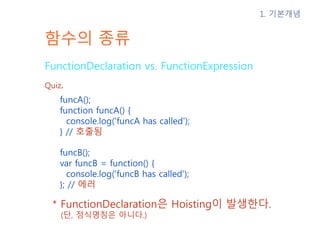
함수의 종류
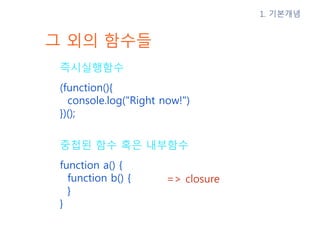
FunctionDeclaration vs.FunctionExpression
funcA();
function funcA() {
console.log('funcA has called');
} // 호출됨
* FunctionDeclaration은 Hoisting이 발생한다.
(단, 정식명칭은 아니다.)
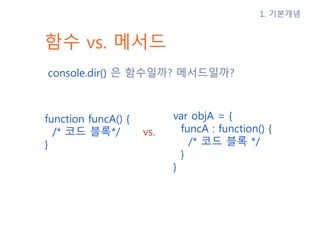
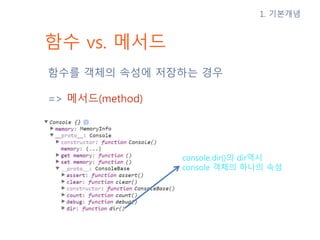
1. 기본개념
Quiz.
funcB();
var funcB = function() {
console.log('funcB has called');
}; // 에러
9.
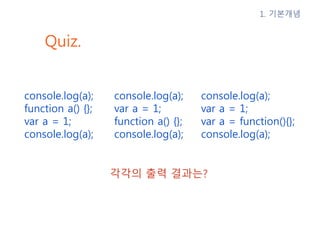
Quiz.
console.log(a);
var a =1;
var a = function(){};
console.log(a);
1. 기본개념
console.log(a);
var a = 1;
function a() {};
console.log(a);
console.log(a);
function a() {};
var a = 1;
console.log(a);
각각의 출력 결과는?
10.
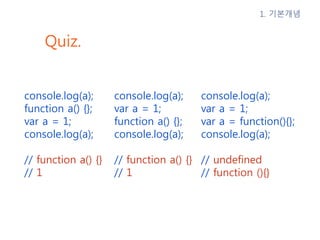
Quiz.
console.log(a);
var a =1;
var a = function(){};
console.log(a);
// undefined
// function (){}
1. 기본개념
console.log(a);
var a = 1;
function a() {};
console.log(a);
// function a() {}
// 1
console.log(a);
function a() {};
var a = 1;
console.log(a);
// function a() {}
// 1
함수 전달인자 -arguments
function maxNum(/* 어떤 값이 들어와도 상관 없음 */) {
var max = Number.NEGATIVE_INFINITY;
for(var idx in arguments) {
if(!isNaN(arguments[idx]) && arguments[idx]>max) {
max = Number(arguments[idx]);
}
}
return max;
}
maxNum(1, 21, 3, undefined, 5, 123, false, '1234', 'test');
=> 가변전달인자 varargs(variable length
arguments)
1. 기본개념
13.
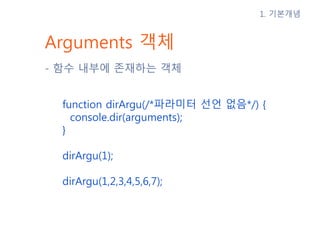
Arguments 객체
- 함수내부에 존재하는 객체
function dirArgu(/*파라미터 선언 없음*/) {
console.dir(arguments);
}
dirArgu(1);
dirArgu(1,2,3,4,5,6,7);
1. 기본개념
14.
1. 기본개념부터 잡아보자
2.호출패턴에따라 달라지는 this
3. 상속을 가능하게 해주는 Prototype
4. 다른 언어와 다른 유효범위 Scope
+@ 재귀함수를 구현하는 3가지 방법
15.
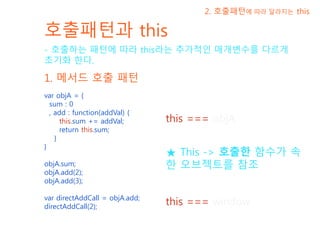
호출패턴과 this
1. 메서드호출 패턴
- 호출하는 패턴에 따라 this라는 추가적인 매개변수를 다르게
초기화 한다.
var objA = {
sum : 0
, add : function(addVal) {
this.sum += addVal;
return this.sum;
}
}
objA.sum;
objA.add(2);
objA.add(3);
var directAddCall = objA.add;
directAddCall(2);
this === objA
2. 호출패턴에 따라 달라지는 this
this === window
★ This -> 호출한 함수가 속
한 오브젝트를 참조
16.
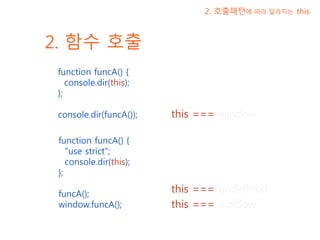
2. 함수 호출
functionfuncA() {
console.dir(this);
};
console.dir(funcA());
2. 호출패턴에 따라 달라지는 this
this === window
function funcA() {
"use strict";
console.dir(this);
};
funcA();
window.funcA();
this === undefined
this === window
17.
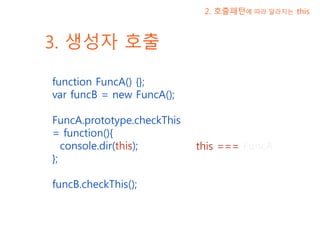
3. 생성자 호출
functionFuncA() {};
var funcB = new FuncA();
FuncA.prototype.checkThis
= function(){
console.dir(this);
};
funcB.checkThis();
2. 호출패턴에 따라 달라지는 this
this === FuncA
18.
4. call 과apply
function A(a,b,c) {
console.log(this.x, this.y, a, b, c);
}
A();
A.call({x:1,y:2});
A.apply({x:1,y:2},[3,4,5]);
명시적으로 this에
mapping시킬
프로퍼티들을 넘길 수 있다
2. 호출패턴에 따라 달라지는 this
19.
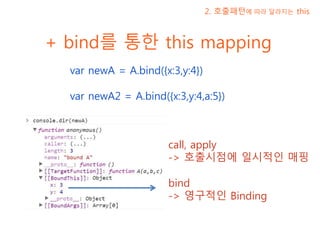
+ bind를 통한this mapping
var newA = A.bind({x:3,y:4})
var newA2 = A.bind({x:3,y:4,a:5})
2. 호출패턴에 따라 달라지는 this
call, apply
-> 호출시점에 일시적인 매핑
bind
-> 영구적인 Binding
20.
1. 기본개념부터 잡아보자
2.호출패턴에 따라 달라지는 this
3.상속을 가능하게 해주는 Prototype
4. 다른 언어와 다른 유효범위 Scope
+@ 재귀함수
21.
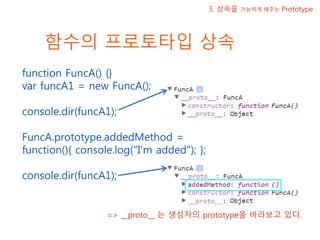
함수의 프로토타입 상속
functionFuncA() {}
var funcA1 = new FuncA();
console.dir(funcA1);
FuncA.prototype.addedMethod =
function(){ console.log("I'm added"); };
console.dir(funcA1);
3. 상속을 가능하게 해주는 Prototype
=> __proto__ 는 생성자의 prototype을 바라보고 있다.
22.
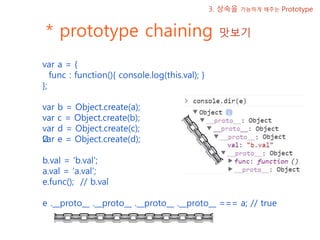
* prototype chaining맛보기
var a = {
func : function(){ console.log(this.val); }
};
var b = Object.create(a);
var c = Object.create(b);
var d = Object.create(c);
var e = Object.create(d);
b.val = 'b.val';
a.val = ‘a.val‘;
e.func(); // b.val
e .__proto__ .__proto__ .__proto__ .__proto__ === a; // true
3. 상속을 가능하게 해주는 Prototype
23.
1. 기본개념부터 잡아보자
2.호출패턴에 따라 달라지는 this
3. 상속을 가능하게 해주는 Prototype
4. 다른 언어와 다른 유효범위 Scope
+@ 재귀함수를 구현하는 3가지 방법
24.
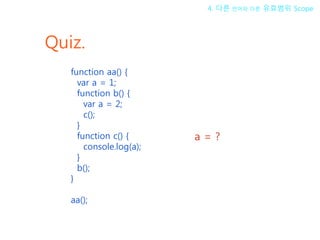
Quiz.
function aa() {
vara = 1;
function b() {
var a = 2;
c();
}
function c() {
console.log(a);
}
b();
}
aa();
a = ?
4. 다른 언어와 다른 유효범위 Scope
25.
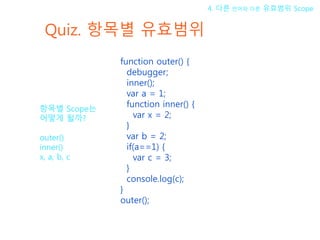
Quiz. 항목별 유효범위
4.다른 언어와 다른 유효범위 Scope
function outer() {
debugger;
inner();
var a = 1;
function inner() {
var x = 2;
}
var b = 2;
if(a==1) {
var c = 3;
}
console.log(c);
}
outer();
항목별 Scope는
어떻게 될까?
outer()
inner()
x, a, b, c
26.
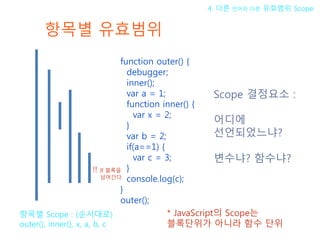
항목별 유효범위
Scope 결정요소:
어디에
선언되었느냐?
변수냐? 함수냐?
4. 다른 언어와 다른 유효범위 Scope
function outer() {
debugger;
inner();
var a = 1;
function inner() {
var x = 2;
}
var b = 2;
if(a==1) {
var c = 3;
}
console.log(c);
}
outer();
항목별 Scope : (순서대로)
outer(), inner(), x, a, b, c
!! If 블록을
넘어간다.
* JavaScript의 Scope는
블록단위가 아니라 함수 단위
27.
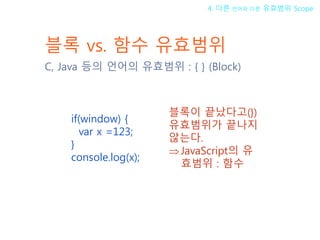
블록 vs. 함수유효범위
C, Java 등의 언어의 유효범위 : { } (Block)
if(window) {
var x =123;
}
console.log(x);
블록이 끝났다고(})
유효범위가 끝나지
않는다.
JavaScript의 유
효범위 : 함수
4. 다른 언어와 다른 유효범위 Scope
28.
1. 기본개념부터 잡아보자
2.호출패턴에 따라 달라지는 this
3. 상속을 가능하게 해주는 Prototype
4. 다른 언어와 다른 유효범위 Scope
+@ 재귀함수를 구현하는 3가지 방법
29.
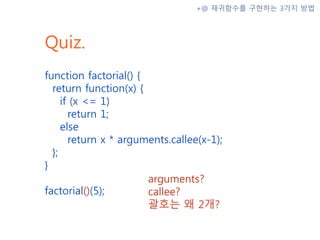
Quiz.
function factorial() {
returnfunction(x) {
if (x <= 1)
return 1;
else
return x * arguments.callee(x-1);
};
}
factorial()(5);
+@ 재귀함수를 구현하는 3가지 방법
arguments?
callee?
괄호는 왜 2개?
30.
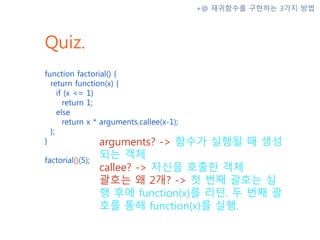
Quiz.
function factorial() {
returnfunction(x) {
if (x <= 1)
return 1;
else
return x * arguments.callee(x-1);
};
}
factorial()(5);
+@ 재귀함수를 구현하는 3가지 방법
arguments? -> 함수가 실행될 때 생성
되는 객체
callee? -> 자신을 호출한 객체
괄호는 왜 2개? -> 첫 번째 괄호는 실
행 후에 function(x)를 리턴. 두 번째 괄
호를 통해 function(x)를 실행.
31.
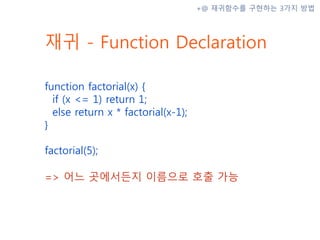
재귀 - FunctionDeclaration
function factorial(x) {
if (x <= 1) return 1;
else return x * factorial(x-1);
}
factorial(5);
=> 어느 곳에서든지 이름으로 호출 가능
+@ 재귀함수를 구현하는 3가지 방법
32.
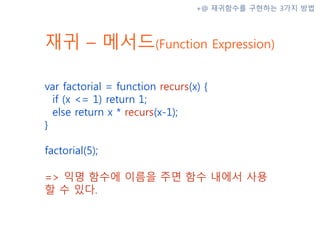
재귀 – 메서드(FunctionExpression)
var factorial = function recurs(x) {
if (x <= 1) return 1;
else return x * recurs(x-1);
}
factorial(5);
=> 익명 함수에 이름을 주면 함수 내에서 사용
할 수 있다.
+@ 재귀함수를 구현하는 3가지 방법
33.
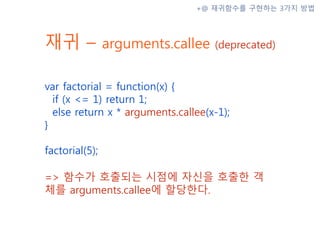
재귀 – arguments.callee(deprecated)
var factorial = function(x) {
if (x <= 1) return 1;
else return x * arguments.callee(x-1);
}
factorial(5);
=> 함수가 호출되는 시점에 자신을 호출한 객
체를 arguments.callee에 할당한다.
+@ 재귀함수를 구현하는 3가지 방법



![함수 전달인자 - arguments
function maxNum(/* 어떤 값이 들어와도 상관 없음 */) {
var max = Number.NEGATIVE_INFINITY;
for(var idx in arguments) {
if(!isNaN(arguments[idx]) && arguments[idx]>max) {
max = Number(arguments[idx]);
}
}
return max;
}
maxNum(1, 21, 3, undefined, 5, 123, false, '1234', 'test');
=> 가변전달인자 varargs(variable length
arguments)
1. 기본개념](https://image.slidesharecdn.com/e02-160220022129/85/Javascript-function-this-prototype-scope-12-320.jpg)
![4. call 과 apply
function A(a,b,c) {
console.log(this.x, this.y, a, b, c);
}
A();
A.call({x:1,y:2});
A.apply({x:1,y:2},[3,4,5]);
명시적으로 this에
mapping시킬
프로퍼티들을 넘길 수 있다
2. 호출패턴에 따라 달라지는 this](https://image.slidesharecdn.com/e02-160220022129/85/Javascript-function-this-prototype-scope-18-320.jpg)


![[D2 COMMUNITY] ECMAScript 2015 S67 seminar - 1. primitive](https://cdn.slidesharecdn.com/ss_thumbnails/1primitive-161207024601-thumbnail.jpg?width=640&height=640&fit=bounds)


![[하코사 세미나] 비전공자의 자바스크립트 도전기](https://cdn.slidesharecdn.com/ss_thumbnails/pthacosa3-160525065322-thumbnail.jpg?width=640&height=640&fit=bounds)


![[IT기술칼럼#2] 고급자바스크립트 for AngularJS, React_고급자바스크립트,AngularJS,React전문교육학원](https://cdn.slidesharecdn.com/ss_thumbnails/02ecmascript-170404072342-thumbnail.jpg?width=640&height=640&fit=bounds)


![[WEB UI BASIC] Javascript 2탄](https://cdn.slidesharecdn.com/ss_thumbnails/javascript2-150503130906-conversion-gate02-thumbnail.jpg?width=640&height=640&fit=bounds)