JAVASCRIPT
JavaScript is a programming language that
developers use to add interactivity to web
pages. It's a core technology of the World Wide
Web, and is used for many things.
It allows developers to create dynamically
updating content, use animations, pop-up menus,
clickable buttons, control multimedia, etc.
It is embedded in HTML.
Why use JavaScript?
 JavaScript enhances Web pages with dynamic
and interactive features.
 It supports cross-platform development, and
we can use it for both server-side and client-
side applications.
 Most widely-used JavaScript frameworks for
mobile apps include jQuery Mobile, React
Native, Apache Cordova and Titanium.
JavaScript Syntax
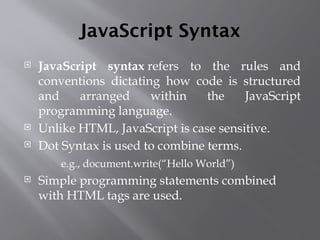
 JavaScript syntax refers to the rules and
conventions dictating how code is structured
and arranged within the JavaScript
programming language.
 Unlike HTML, JavaScript is case sensitive.
 Dot Syntax is used to combine terms.
e.g., document.write(“Hello World”)
 Simple programming statements combined
with HTML tags are used.
JavaScript statements
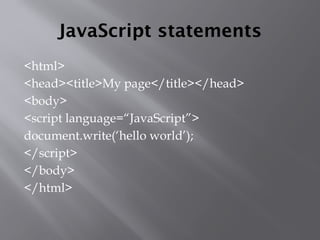
<html>
<head><title>My page</title></head>
<body>
<script language=“JavaScript”>
document.write(‘hello world’);
</script>
</body>
</html>
Variable and Data Types
Variable
In JavaScript, variables are
used to store data
values.
They are declared using
the ‘var’, ‘let’, or ‘const’
keywords.
Data Types
JavaScript has several data
types including:
String: used for text data
enclosed in single or double
quotes.
Number: Represents both
integer and floating-point
numbers
Boolean: Represents true or
false values.
Array: Used to store multiple
values in a single variable.

JAVASCRIPT a basic script knowledge .pptx

  • 1.
    JAVASCRIPT JavaScript is aprogramming language that developers use to add interactivity to web pages. It's a core technology of the World Wide Web, and is used for many things. It allows developers to create dynamically updating content, use animations, pop-up menus, clickable buttons, control multimedia, etc. It is embedded in HTML.
  • 2.
    Why use JavaScript? JavaScript enhances Web pages with dynamic and interactive features.  It supports cross-platform development, and we can use it for both server-side and client- side applications.  Most widely-used JavaScript frameworks for mobile apps include jQuery Mobile, React Native, Apache Cordova and Titanium.
  • 3.
    JavaScript Syntax  JavaScriptsyntax refers to the rules and conventions dictating how code is structured and arranged within the JavaScript programming language.  Unlike HTML, JavaScript is case sensitive.  Dot Syntax is used to combine terms. e.g., document.write(“Hello World”)  Simple programming statements combined with HTML tags are used.
  • 4.
    JavaScript statements <html> <head><title>My page</title></head> <body> <scriptlanguage=“JavaScript”> document.write(‘hello world’); </script> </body> </html>
  • 5.
    Variable and DataTypes Variable In JavaScript, variables are used to store data values. They are declared using the ‘var’, ‘let’, or ‘const’ keywords. Data Types JavaScript has several data types including: String: used for text data enclosed in single or double quotes. Number: Represents both integer and floating-point numbers Boolean: Represents true or false values. Array: Used to store multiple values in a single variable.