Syllabus : MSCHN 304 ( JAVA Programming Part I )

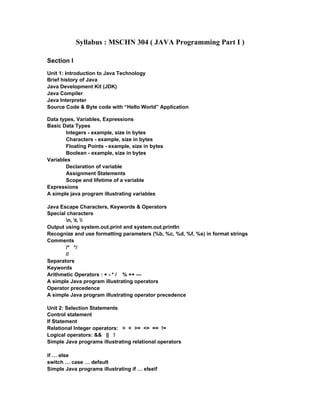
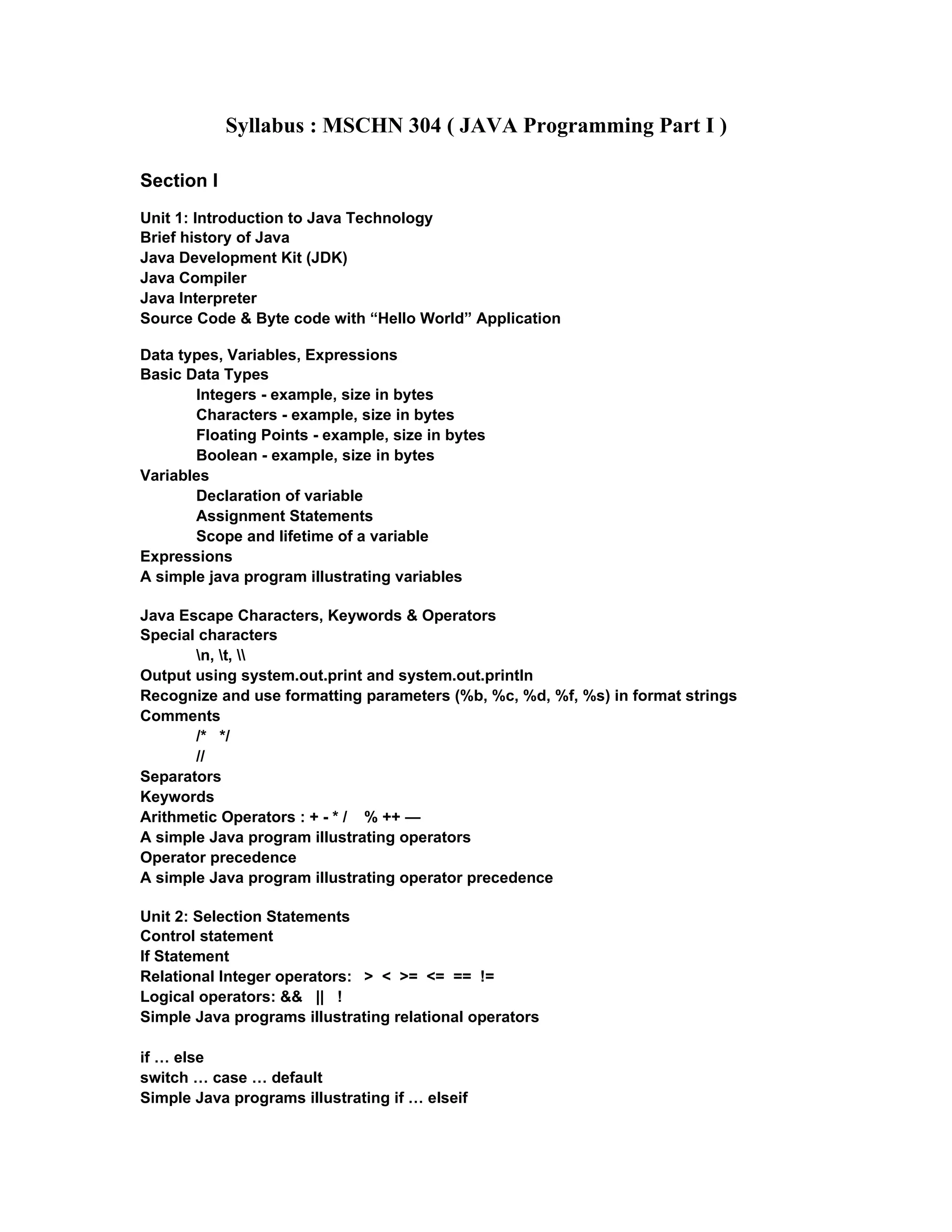
Section I
Unit 1: Introduction to Java Technology
Brief history of Java
Java Development Kit (JDK)
Java Compiler
Java Interpreter
Source Code & Byte code with “Hello World” Application

Data types, Variables, Expressions
Basic Data Types
       Integers - example, size in bytes
       Characters - example, size in bytes
       Floating Points - example, size in bytes
       Boolean - example, size in bytes
Variables
       Declaration of variable
       Assignment Statements
       Scope and lifetime of a variable
Expressions
A simple java program illustrating variables

Java Escape Characters, Keywords & Operators
Special characters
       n, t, 
Output using system.out.print and system.out.println
Recognize and use formatting parameters (%b, %c, %d, %f, %s) in format strings
Comments
       /* */
       //
Separators
Keywords
Arithmetic Operators : + - * / % ++ —
A simple Java program illustrating operators
Operator precedence
A simple Java program illustrating operator precedence

Unit 2: Selection Statements
Control statement
If Statement
Relational Integer operators: > < >= <= == !=
Logical operators: && || !
Simple Java programs illustrating relational operators

if … else
switch … case … default
Simple Java programs illustrating if … elseif
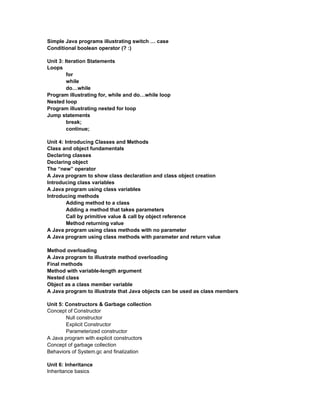
Simple Java programs illustrating switch … case
Conditional boolean operator (? :)

Unit 3: Iteration Statements
Loops
         for
         while
         do…while
Program illustrating for, while and do…while loop
Nested loop
Program illustrating nested for loop
Jump statements
         break;
         continue;

Unit 4: Introducing Classes and Methods
Class and object fundamentals
Declaring classes
Declaring object
The “new” operator
A Java program to show class declaration and class object creation
Introducing class variables
A Java program using class variables
Introducing methods
         Adding method to a class
         Adding a method that takes parameters
         Call by primitive value & call by object reference
         Method returning value
A Java program using class methods with no parameter
A Java program using class methods with parameter and return value

Method overloading
A Java program to illustrate method overloading
Final methods
Method with variable-length argument
Nested class
Object as a class member variable
A Java program to illustrate that Java objects can be used as class members

Unit 5: Constructors & Garbage collection
Concept of Constructor
        Null constructor
        Explicit Constructor
        Parameterized constructor
A Java program with explicit constructors
Concept of garbage collection
Behaviors of System.gc and finalization

Unit 6: Inheritance
Inheritance basics
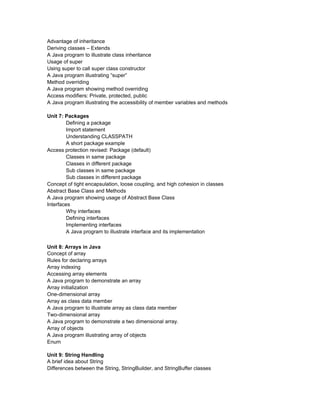
Advantage of inheritance
Deriving classes – Extends
A Java program to illustrate class inheritance
Usage of super
Using super to call super class constructor
A Java program illustrating “super”
Method overriding
A Java program showing method overriding
Access modifiers: Private, protected, public
A Java program illustrating the accessibility of member variables and methods

Unit 7: Packages
        Defining a package
        Import statement
        Understanding CLASSPATH
        A short package example
Access protection revised: Package (default)
        Classes in same package
        Classes in different package
        Sub classes in same package
        Sub classes in different package
Concept of tight encapsulation, loose coupling, and high cohesion in classes
Abstract Base Class and Methods
A Java program showing usage of Abstract Base Class
Interfaces
        Why interfaces
        Defining interfaces
        Implementing interfaces
        A Java program to illustrate interface and its implementation

Unit 8: Arrays in Java
Concept of array
Rules for declaring arrays
Array indexing
Accessing array elements
A Java program to demonstrate an array
Array initialization
One-dimensional array
Array as class data member
A Java program to illustrate array as class data member
Two-dimensional array
A Java program to demonstrate a two dimensional array.
Array of objects
A Java program illustrating array of objects
Enum

Unit 9: String Handling
A brief idea about String
Differences between the String, StringBuilder, and StringBuffer classes
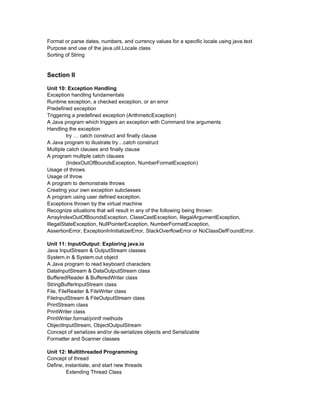
Format or parse dates, numbers, and currency values for a specific locale using java.text
Purpose and use of the java.util.Locale class
Sorting of String


Section II

Unit 10: Exception Handling
Exception handling fundamentals
Runtime exception, a checked exception, or an error
Predefined exception
Triggering a predefined exception (ArithmeticException)
A Java program which triggers an exception with Command line arguments
Handling the exception
         try … catch construct and finally clause
A Java program to illustrate try…catch construct
Multiple catch clauses and finally clause
A program multiple catch clauses
         (IndexOutOfBoundsException, NumberFormatException)
Usage of throws
Usage of throw
A program to demonstrate throws
Creating your own exception subclasses
A program using user defined exception.
Exceptions thrown by the virtual machine
Recognize situations that will result in any of the following being thrown:
ArrayIndexOutOfBoundsException, ClassCastException, IllegalArgumentException,
IllegalStateException, NullPointerException, NumberFormatException,
AssertionError, ExceptionInInitializerError, StackOverflowError or NoClassDefFoundError.

Unit 11: Input/Output: Exploring java.io
Java InputStream & OutputStream classes
System.in & System.out object
A Java program to read keyboard characters
DataInputStream & DataOutputStream class
BufferedReader & BufferedWriter class
StringBufferInputStream class
File, FileReader & FileWriter class
FileInputStream & FileOutputStream class
PrintStream class
PrintWriter class
PrintWriter.format/printf methods
ObjectInputStream, ObjectOutputStream
Concept of serializes and/or de-serializes objects and Serializable
Formatter and Scanner classes

Unit 12: Multithreaded Programming
Concept of thread
Define, instantiate, and start new threads
         Extending Thread Class
Implementing Runnable interface
Example illustrating multiple threads by Thread class & Runnable interface
Thread scheduling
Thread.isAlive() & Thread.join() method
Finalizer
Thread priorities
A Java program illustrating thread priorities
Synchronizing with other threads
Use of wait, notify, or notifyAll


Section III

Unit 13: Introducing the AWT: Working with Windows Graphics and Text
The AWT package
Windows fundamentals
        Component
        Container
        Panel
        Window
        Frame
        Canvas
Frame and Panel classes
Working with Frame windows
        Setting frame dimensions
        Hiding and showing a window
        Setting a frame title
A Java program illustrating the above subjects
Working with Frame windows
        Closing a frame window
        Displaying information within a window
A Java program illustrating frame window
Working with Graphics (Using Panel)
        Drawing lines, rectangles, ellipses, circles, polygons
Working with color and Font


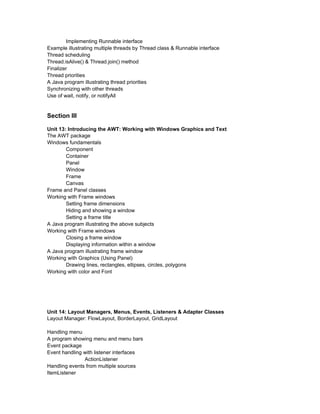
Unit 14: Layout Managers, Menus, Events, Listeners & Adapter Classes
Layout Manager: FlowLayout, BorderLayout, GridLayout

Handling menu
A program showing menu and menu bars
Event package
Event handling with listener interfaces
               ActionListener
Handling events from multiple sources
ItemListener
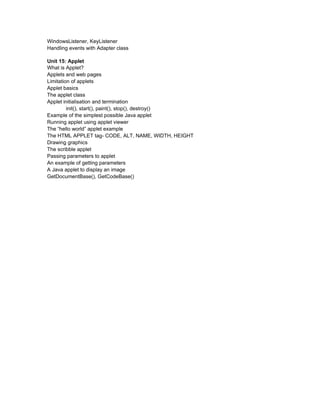
WindowsListener, KeyListener
Handling events with Adapter class

Unit 15: Applet
What is Applet?
Applets and web pages
Limitation of applets
Applet basics
The applet class
Applet initialisation and termination
         init(), start(), paint(), stop(), destroy()
Example of the simplest possible Java applet
Running applet using applet viewer
The “hello world” applet example
The HTML APPLET tag- CODE, ALT, NAME, WIDTH, HEIGHT
Drawing graphics
The scribble applet
Passing parameters to applet
An example of getting parameters
A Java applet to display an image
GetDocumentBase(), GetCodeBase()
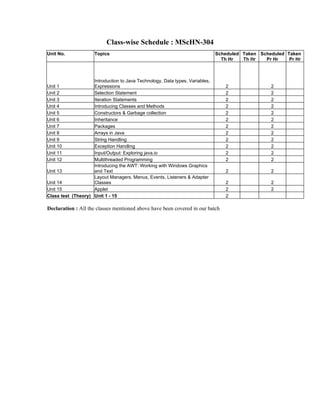
Class-wise Schedule : MScHN-304
Unit No.             Topics                                                   Scheduled Taken Scheduled Taken
                                                                                Th Hr   Th Hr   Pr Hr    Pr Hr


                    Introduction to Java Technology, Data types, Variables,
Unit 1              Expressions                                                  2                2
Unit 2              Selection Statement                                          2                2
Unit 3              Iteration Statements                                         2                2
Unit 4              Introducing Classes and Methods                              2                2
Unit 5              Constructors & Garbage collection                            2                2
Unit 6              Inheritance                                                  2                2
Unit 7              Packages                                                     2                2
Unit 8              Arrays in Java                                               2                2
Unit 9              String Handling                                              2                2
Unit 10             Exception Handling                                           2                2
Unit 11             Input/Output: Exploring java.io                              2                2
Unit 12             Multithreaded Programming                                    2                2
                    Introducing the AWT: Working with Windows Graphics
Unit 13             and Text                                                     2                2
                    Layout Managers, Menus, Events, Listeners & Adapter
Unit 14             Classes                                                      2                2
Unit 15             Applet                                                       2                2
Class test (Theory) Unit 1 - 15                                                  2

Declaration : All the classes mentioned above have been covered in our batch

Javamschn3

  • 1.
    Syllabus : MSCHN304 ( JAVA Programming Part I ) Section I Unit 1: Introduction to Java Technology Brief history of Java Java Development Kit (JDK) Java Compiler Java Interpreter Source Code & Byte code with “Hello World” Application Data types, Variables, Expressions Basic Data Types Integers - example, size in bytes Characters - example, size in bytes Floating Points - example, size in bytes Boolean - example, size in bytes Variables Declaration of variable Assignment Statements Scope and lifetime of a variable Expressions A simple java program illustrating variables Java Escape Characters, Keywords & Operators Special characters n, t, Output using system.out.print and system.out.println Recognize and use formatting parameters (%b, %c, %d, %f, %s) in format strings Comments /* */ // Separators Keywords Arithmetic Operators : + - * / % ++ — A simple Java program illustrating operators Operator precedence A simple Java program illustrating operator precedence Unit 2: Selection Statements Control statement If Statement Relational Integer operators: > < >= <= == != Logical operators: && || ! Simple Java programs illustrating relational operators if … else switch … case … default Simple Java programs illustrating if … elseif
  • 2.
    Simple Java programsillustrating switch … case Conditional boolean operator (? :) Unit 3: Iteration Statements Loops for while do…while Program illustrating for, while and do…while loop Nested loop Program illustrating nested for loop Jump statements break; continue; Unit 4: Introducing Classes and Methods Class and object fundamentals Declaring classes Declaring object The “new” operator A Java program to show class declaration and class object creation Introducing class variables A Java program using class variables Introducing methods Adding method to a class Adding a method that takes parameters Call by primitive value & call by object reference Method returning value A Java program using class methods with no parameter A Java program using class methods with parameter and return value Method overloading A Java program to illustrate method overloading Final methods Method with variable-length argument Nested class Object as a class member variable A Java program to illustrate that Java objects can be used as class members Unit 5: Constructors & Garbage collection Concept of Constructor Null constructor Explicit Constructor Parameterized constructor A Java program with explicit constructors Concept of garbage collection Behaviors of System.gc and finalization Unit 6: Inheritance Inheritance basics
  • 3.
    Advantage of inheritance Derivingclasses – Extends A Java program to illustrate class inheritance Usage of super Using super to call super class constructor A Java program illustrating “super” Method overriding A Java program showing method overriding Access modifiers: Private, protected, public A Java program illustrating the accessibility of member variables and methods Unit 7: Packages Defining a package Import statement Understanding CLASSPATH A short package example Access protection revised: Package (default) Classes in same package Classes in different package Sub classes in same package Sub classes in different package Concept of tight encapsulation, loose coupling, and high cohesion in classes Abstract Base Class and Methods A Java program showing usage of Abstract Base Class Interfaces Why interfaces Defining interfaces Implementing interfaces A Java program to illustrate interface and its implementation Unit 8: Arrays in Java Concept of array Rules for declaring arrays Array indexing Accessing array elements A Java program to demonstrate an array Array initialization One-dimensional array Array as class data member A Java program to illustrate array as class data member Two-dimensional array A Java program to demonstrate a two dimensional array. Array of objects A Java program illustrating array of objects Enum Unit 9: String Handling A brief idea about String Differences between the String, StringBuilder, and StringBuffer classes
  • 4.
    Format or parsedates, numbers, and currency values for a specific locale using java.text Purpose and use of the java.util.Locale class Sorting of String Section II Unit 10: Exception Handling Exception handling fundamentals Runtime exception, a checked exception, or an error Predefined exception Triggering a predefined exception (ArithmeticException) A Java program which triggers an exception with Command line arguments Handling the exception try … catch construct and finally clause A Java program to illustrate try…catch construct Multiple catch clauses and finally clause A program multiple catch clauses (IndexOutOfBoundsException, NumberFormatException) Usage of throws Usage of throw A program to demonstrate throws Creating your own exception subclasses A program using user defined exception. Exceptions thrown by the virtual machine Recognize situations that will result in any of the following being thrown: ArrayIndexOutOfBoundsException, ClassCastException, IllegalArgumentException, IllegalStateException, NullPointerException, NumberFormatException, AssertionError, ExceptionInInitializerError, StackOverflowError or NoClassDefFoundError. Unit 11: Input/Output: Exploring java.io Java InputStream & OutputStream classes System.in & System.out object A Java program to read keyboard characters DataInputStream & DataOutputStream class BufferedReader & BufferedWriter class StringBufferInputStream class File, FileReader & FileWriter class FileInputStream & FileOutputStream class PrintStream class PrintWriter class PrintWriter.format/printf methods ObjectInputStream, ObjectOutputStream Concept of serializes and/or de-serializes objects and Serializable Formatter and Scanner classes Unit 12: Multithreaded Programming Concept of thread Define, instantiate, and start new threads Extending Thread Class
  • 5.
    Implementing Runnable interface Exampleillustrating multiple threads by Thread class & Runnable interface Thread scheduling Thread.isAlive() & Thread.join() method Finalizer Thread priorities A Java program illustrating thread priorities Synchronizing with other threads Use of wait, notify, or notifyAll Section III Unit 13: Introducing the AWT: Working with Windows Graphics and Text The AWT package Windows fundamentals Component Container Panel Window Frame Canvas Frame and Panel classes Working with Frame windows Setting frame dimensions Hiding and showing a window Setting a frame title A Java program illustrating the above subjects Working with Frame windows Closing a frame window Displaying information within a window A Java program illustrating frame window Working with Graphics (Using Panel) Drawing lines, rectangles, ellipses, circles, polygons Working with color and Font Unit 14: Layout Managers, Menus, Events, Listeners & Adapter Classes Layout Manager: FlowLayout, BorderLayout, GridLayout Handling menu A program showing menu and menu bars Event package Event handling with listener interfaces ActionListener Handling events from multiple sources ItemListener
  • 6.
    WindowsListener, KeyListener Handling eventswith Adapter class Unit 15: Applet What is Applet? Applets and web pages Limitation of applets Applet basics The applet class Applet initialisation and termination init(), start(), paint(), stop(), destroy() Example of the simplest possible Java applet Running applet using applet viewer The “hello world” applet example The HTML APPLET tag- CODE, ALT, NAME, WIDTH, HEIGHT Drawing graphics The scribble applet Passing parameters to applet An example of getting parameters A Java applet to display an image GetDocumentBase(), GetCodeBase()
  • 7.
    Class-wise Schedule :MScHN-304 Unit No. Topics Scheduled Taken Scheduled Taken Th Hr Th Hr Pr Hr Pr Hr Introduction to Java Technology, Data types, Variables, Unit 1 Expressions 2 2 Unit 2 Selection Statement 2 2 Unit 3 Iteration Statements 2 2 Unit 4 Introducing Classes and Methods 2 2 Unit 5 Constructors & Garbage collection 2 2 Unit 6 Inheritance 2 2 Unit 7 Packages 2 2 Unit 8 Arrays in Java 2 2 Unit 9 String Handling 2 2 Unit 10 Exception Handling 2 2 Unit 11 Input/Output: Exploring java.io 2 2 Unit 12 Multithreaded Programming 2 2 Introducing the AWT: Working with Windows Graphics Unit 13 and Text 2 2 Layout Managers, Menus, Events, Listeners & Adapter Unit 14 Classes 2 2 Unit 15 Applet 2 2 Class test (Theory) Unit 1 - 15 2 Declaration : All the classes mentioned above have been covered in our batch