Abstract Class &
 Java Interface

                   1
Agenda
●   What is an Abstract method and an Abstract class?
●   What is Interface?
●   Why Interface?
●   Interface as a Type
●   Interface vs. Class
●   Defining an Interface
●   Implementing an Interface
●   Implementing multiple Interface's
●   Inheritance among Interface's
●   Interface and Polymorphism
●   Rewriting an Interface                          2
What is
an Abstract Class?
                     3
Abstract Methods
●   Methods that do not have implementation (body)
●   To create an abstract method, just write the method
    declaration without the body and use the abstract
    keyword
    –   No { }

●   For example,

        // Note that there is no body
        public abstract void someMethod();


                                                          4
Abstract Class

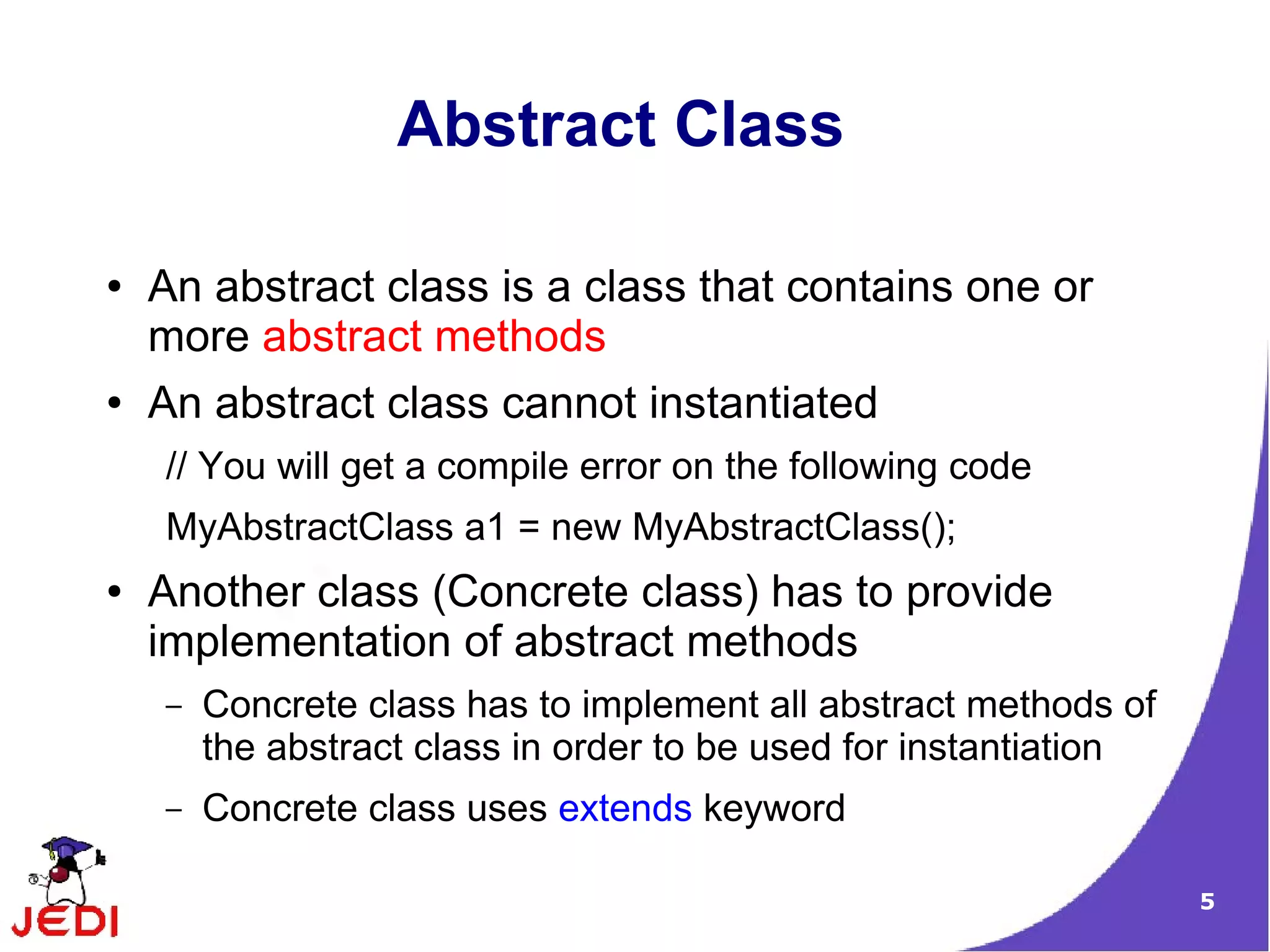
●   An abstract class is a class that contains one or
    more abstract methods
●   An abstract class cannot instantiated
    // You will get a compile error on the following code
    MyAbstractClass a1 = new MyAbstractClass();
●   Another class (Concrete class) has to provide
    implementation of abstract methods
    –   Concrete class has to implement all abstract methods of
        the abstract class in order to be used for instantiation
    –   Concrete class uses extends keyword

                                                                   5
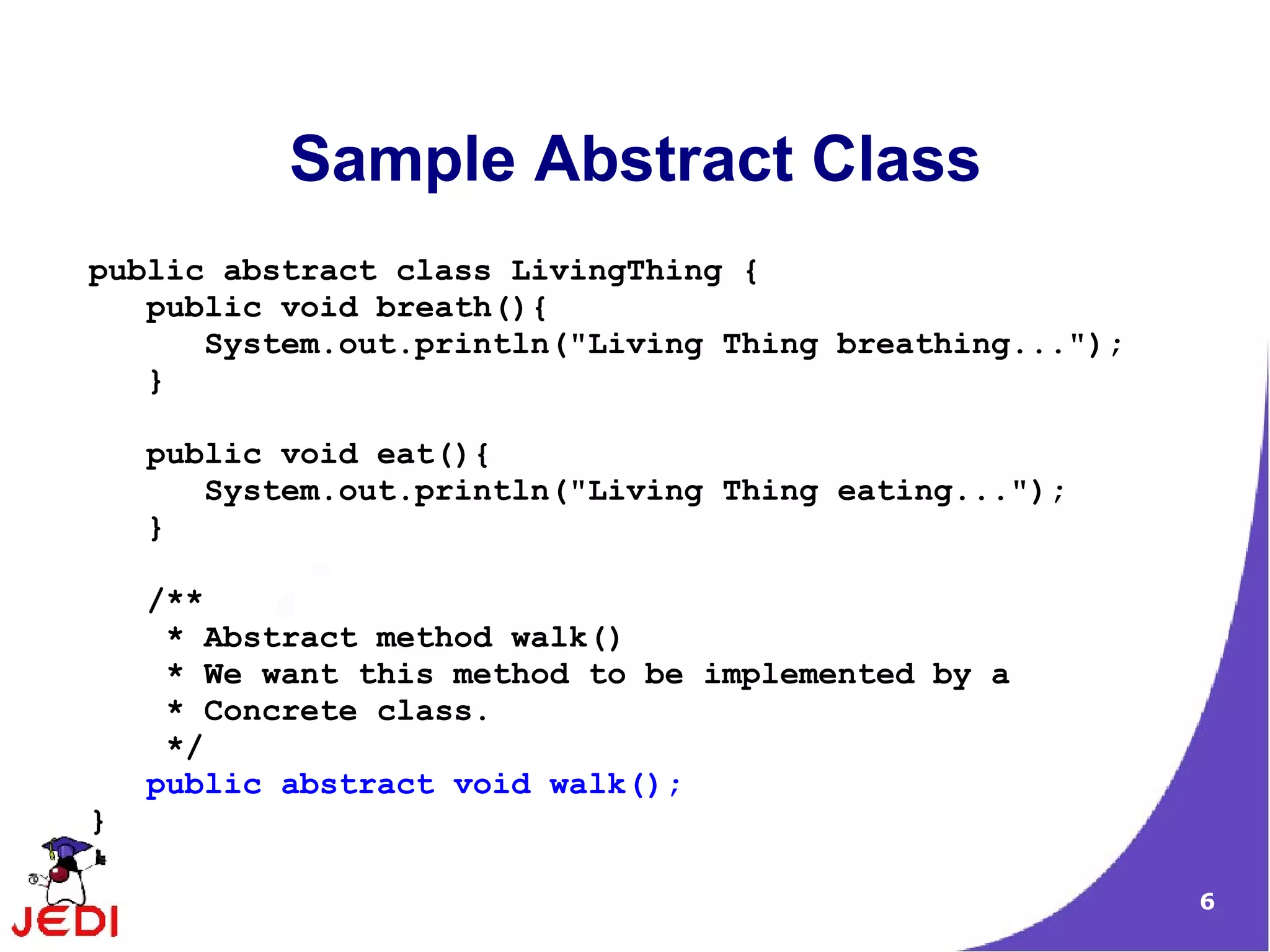
Sample Abstract Class
public abstract class LivingThing {
   public void breath(){
      System.out.println("Living Thing breathing...");
   }

    public void eat(){
       System.out.println("Living Thing eating...");
    }

    /**
     * Abstract method walk()
     * We want this method to be implemented by a
     * Concrete class.
     */
    public abstract void walk();
}

                                                         6
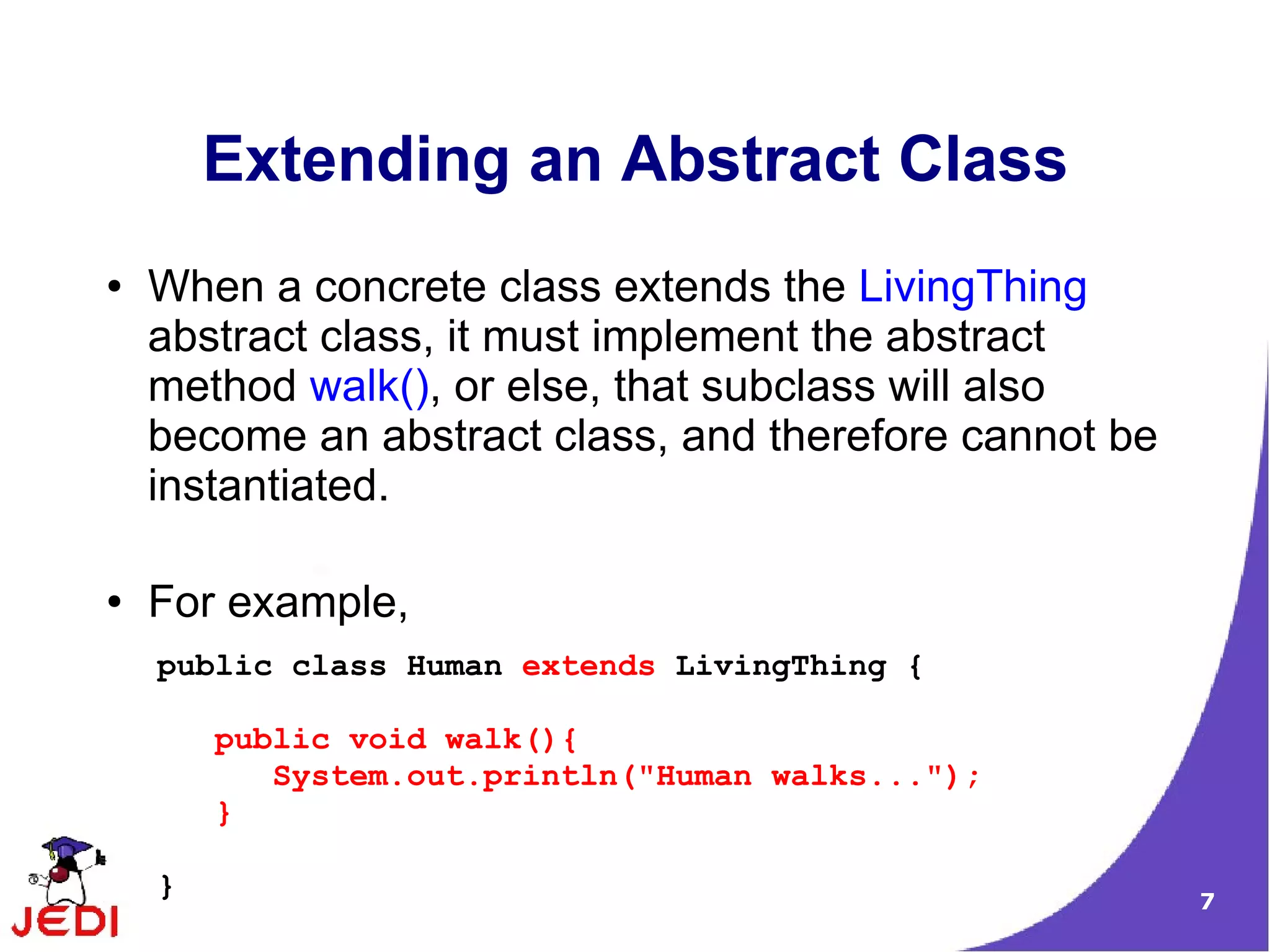
Extending an Abstract Class
●   When a concrete class extends the LivingThing
    abstract class, it must implement the abstract
    method walk(), or else, that subclass will also
    become an abstract class, and therefore cannot be
    instantiated.

●   For example,
    public class Human extends LivingThing {

        public void walk(){
           System.out.println("Human walks...");
        }

    }                                                   7
When to use Abstract Methods &
           Abstract Class?
●   Abstract methods are usually declared where two
    or more subclasses are expected to fulfill a similar
    role in different ways through different
    implementations
    –   These subclasses extend the same Abstract class and
        provide different implementations for the abstract
        methods
●   Use abstract classes to define broad types of
    behaviors at the top of an object-oriented
    programming class hierarchy, and use its
    subclasses to provide implementation details of the
    abstract class.
                                                              8
What is Interface?

                     9
What is an Interface?

●   It defines a standard and public way of specifying
    the behavior of classes
    –   Defines a contract
●   All methods of an interface are abstract methods
    –   Defines the signatures of a set of methods, without the
        body (implementation of the methods)
●   A concrete class must implement the interface (all
    the abstract methods of the Interface)
●   It allows classes, regardless of their locations in the
    class hierarchy, to implement common behaviors

                                                                  10
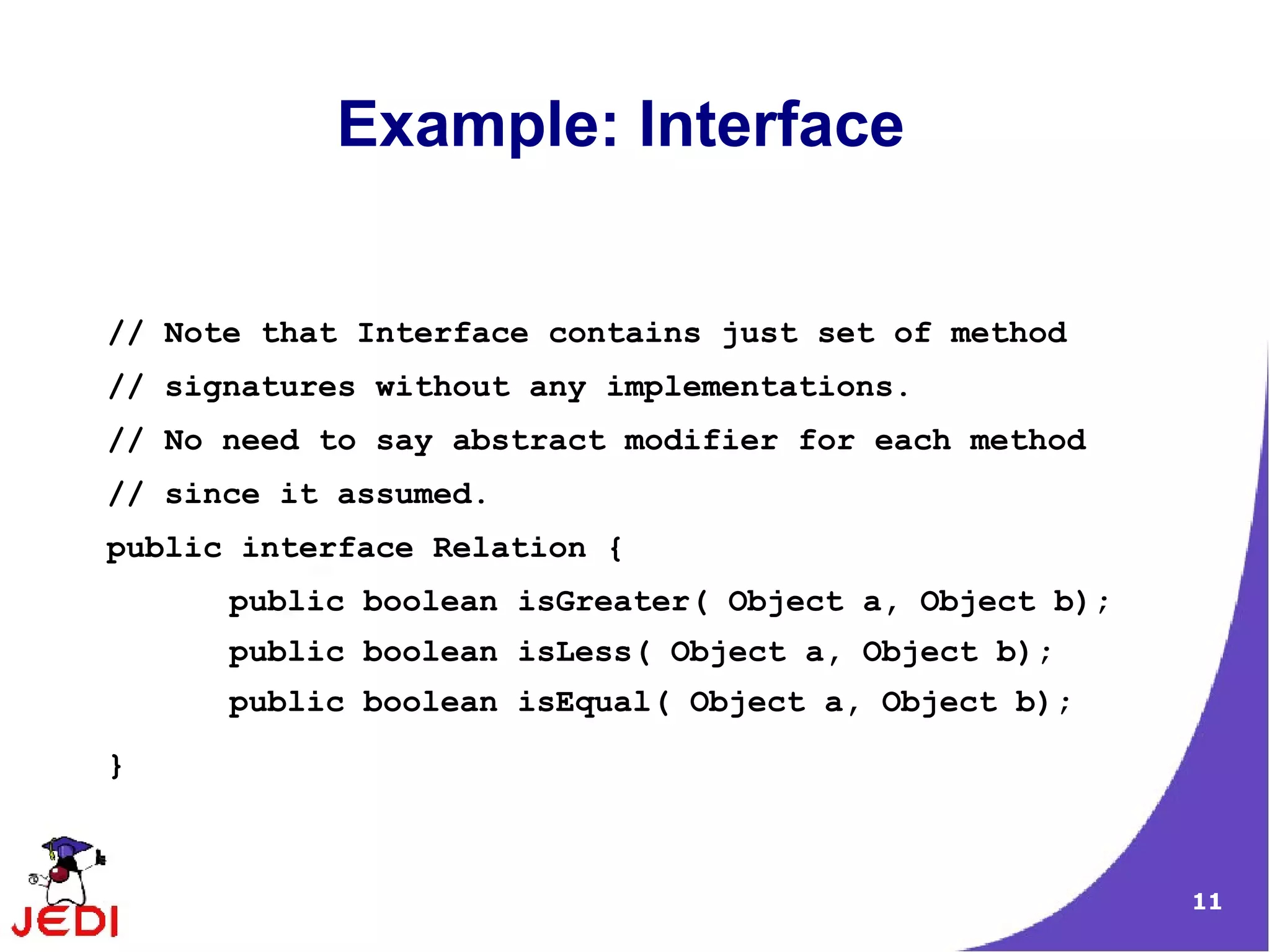
Example: Interface


// Note that Interface contains just set of method
// signatures without any implementations.
// No need to say abstract modifier for each method
// since it assumed.
public interface Relation {
      public boolean isGreater( Object a, Object b);
      public boolean isLess( Object a, Object b);
      public boolean isEqual( Object a, Object b);
}


                                                       11
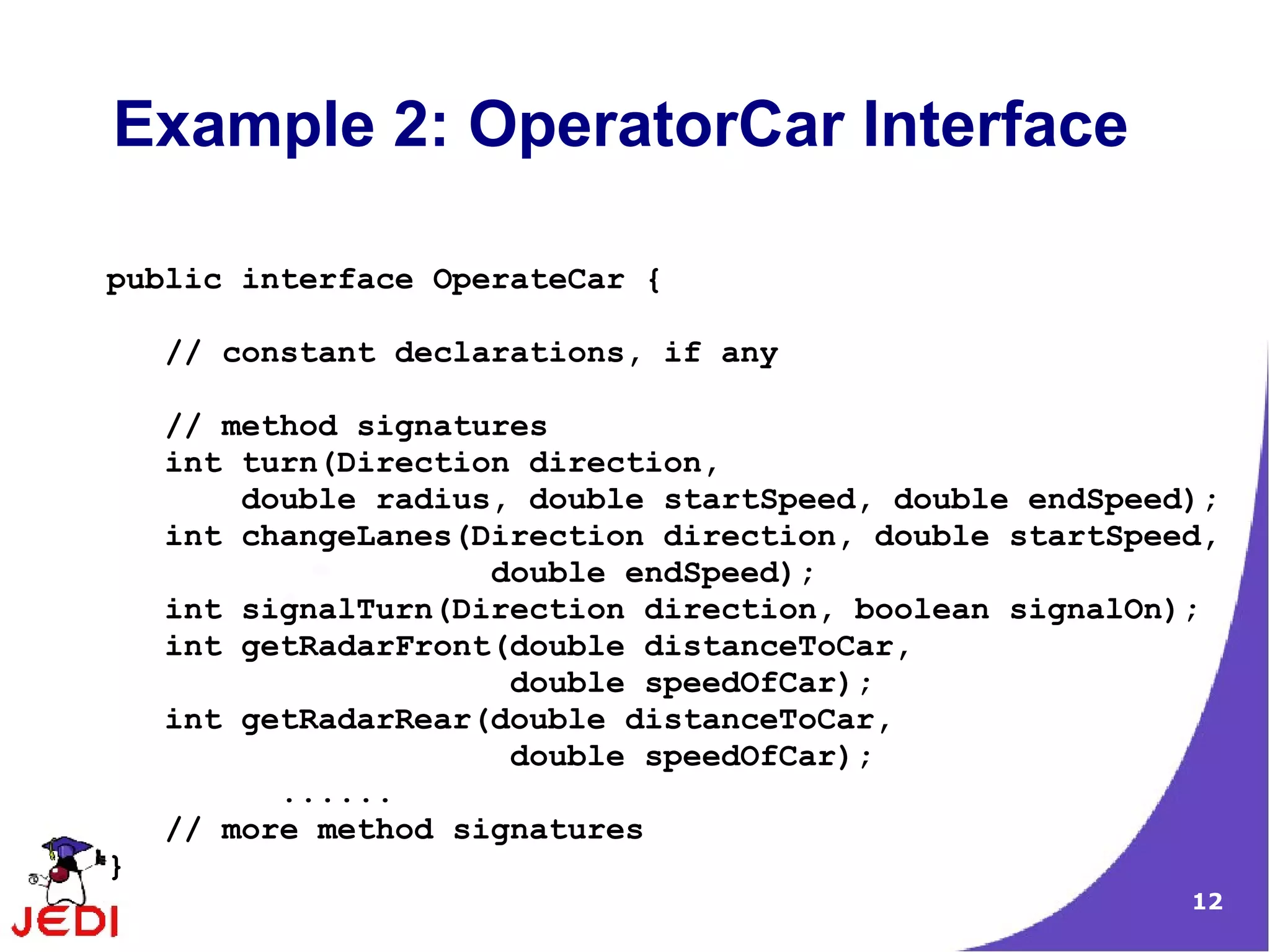
Example 2: OperatorCar Interface

public interface OperateCar {

    // constant declarations, if any

    // method signatures
    int turn(Direction direction,
        double radius, double startSpeed, double endSpeed);
    int changeLanes(Direction direction, double startSpeed,
                     double endSpeed);
    int signalTurn(Direction direction, boolean signalOn);
    int getRadarFront(double distanceToCar,
                      double speedOfCar);
    int getRadarRear(double distanceToCar,
                      double speedOfCar);
          ......
    // more method signatures
}
                                                         12
Why Interface?

                 13
Why do we use Interfaces?
               Reason #1
●   To reveal an object's programming interface
    (functionality of the object) without revealing its
    implementation
    –   This is the concept of encapsulation
    –   The implementation can change without affecting
        the caller of the interface
    –   The caller does not need the implementation at the
        compile time
         ●   It needs only the interface at the compile time
         ●   During runtime, actual object instance is associated
             with the interface type
                                                                    14
Why do we use Interfaces?
               Reason #2
●   To have unrelated classes implement similar
    methods (behaviors)
    –   One class is not a sub-class of another
●   Example:
    –   Class Line and class MyInteger
         ● They are not related through inheritance
         ● You want both to implement comparison methods


             – checkIsGreater(Object x, Object y)
             – checkIsLess(Object x, Object y)
             – checkIsEqual(Object x, Object y)
    –   Define Comparison interface which has the three
        abstract methods above                             15
Why do we use Interfaces?
               Reason #3
●   To model multiple inheritance
    –   A class can implement multiple interfaces while it can
        extend only one class


                                                                 16
Interface vs. Abstract Class

●   All methods of an Interface are abstract methods
    while some methods of an Abstract class are
    abstract methods
    –   Abstract methods of abstract class have abstract
        modifier
●   An interface can only define constants while
    abstract class can have fields
●   Interfaces have no direct inherited relationship with
    any particular class, they are defined independently
    –   Interfaces themselves have inheritance relationship
        among themselves
                                                              17
Interface as a
    Type
                 18
Interface as a Type

●   When you define a new interface, you are defining a
    new reference type
●   You can use interface names anywhere you can use
    any other type name
●   If you define a reference variable whose type is an
    interface, any object you assign to it must be an
    instance of a class that implements the interface


                                                          19
Example: Interface as a Type

●   Let's say Person class implements PersonInterface
    interface
●   You can do
     –   Person p1 = new Person();
     –   PersonInterface pi1 = p1;
     –   PersonInterface pi2 = new Person();


                                                        20
Interface vs. Class

                      21
Interface vs. Class: Commonality

●   Interfaces and classes are both types
    –   This means that an interface can be used in places
        where a class can be used
    –   For example:
         // Recommended practice
         PersonInterface     pi = new Person();
         // Not recommended practice
         Person        pc = new Person();
●   Interface and Class can both define methods


                                                             22
Interface vs. Class: Differences

●   The methods of an Interface are all abstract
    methods
    –   They cannot have bodies
●   You cannot create an instance from an interface
    –   For example:
         PersonInterface   pi = new PersonInterface(); //ERROR!
●   An interface can only be implemented by classes or
    extended by other interfaces


                                                                  23
Defining Interface

                     24
Defining Interfaces

●   To define an interface, we write:

    public interface [InterfaceName] {
          //some methods without the body
    }


                                            25
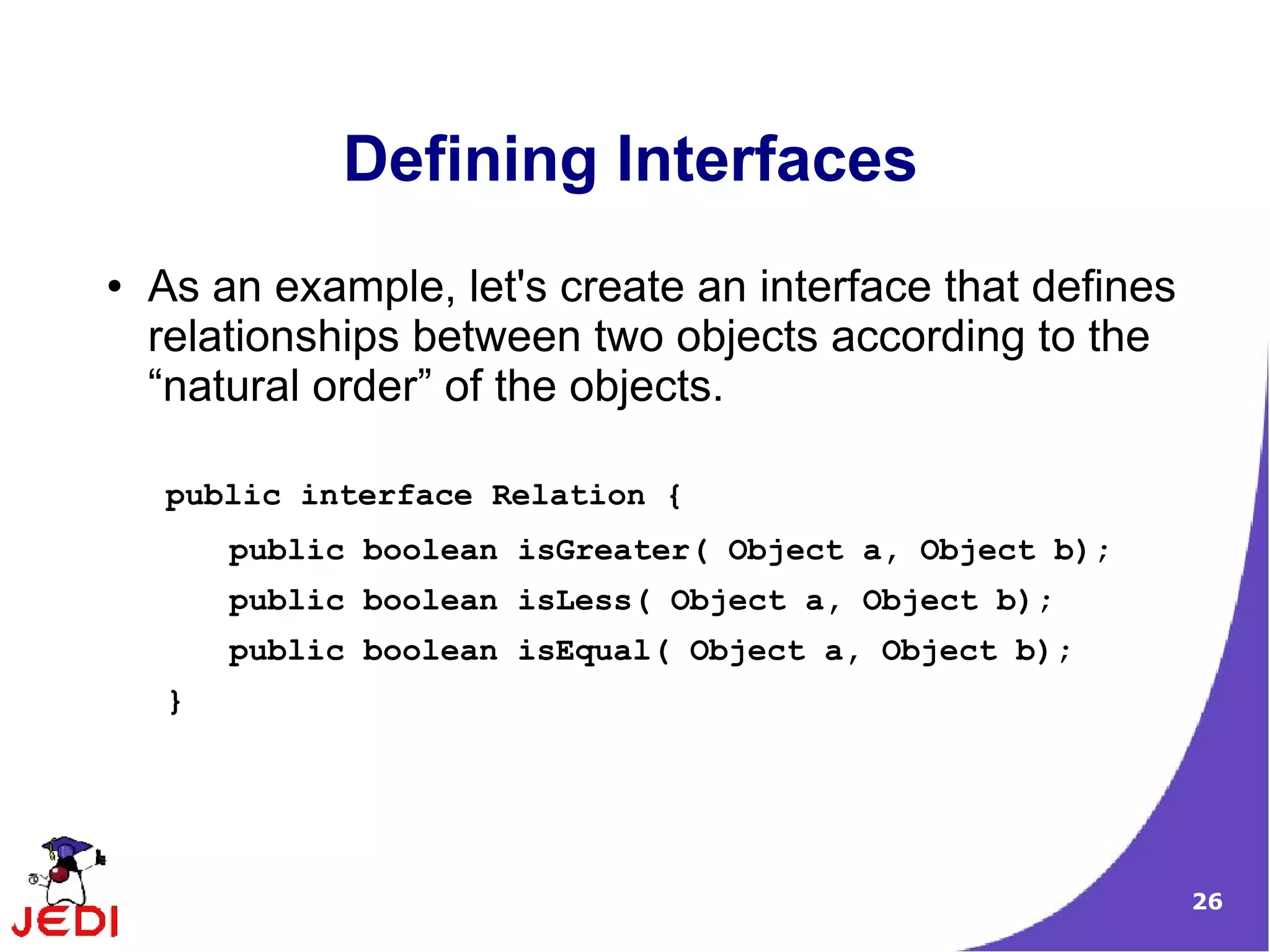
Defining Interfaces
●   As an example, let's create an interface that defines
    relationships between two objects according to the
    “natural order” of the objects.

    public interface Relation {
        public boolean isGreater( Object a, Object b);
        public boolean isLess( Object a, Object b);
        public boolean isEqual( Object a, Object b);
    }


                                                            26
Implementing
  Interface
               27
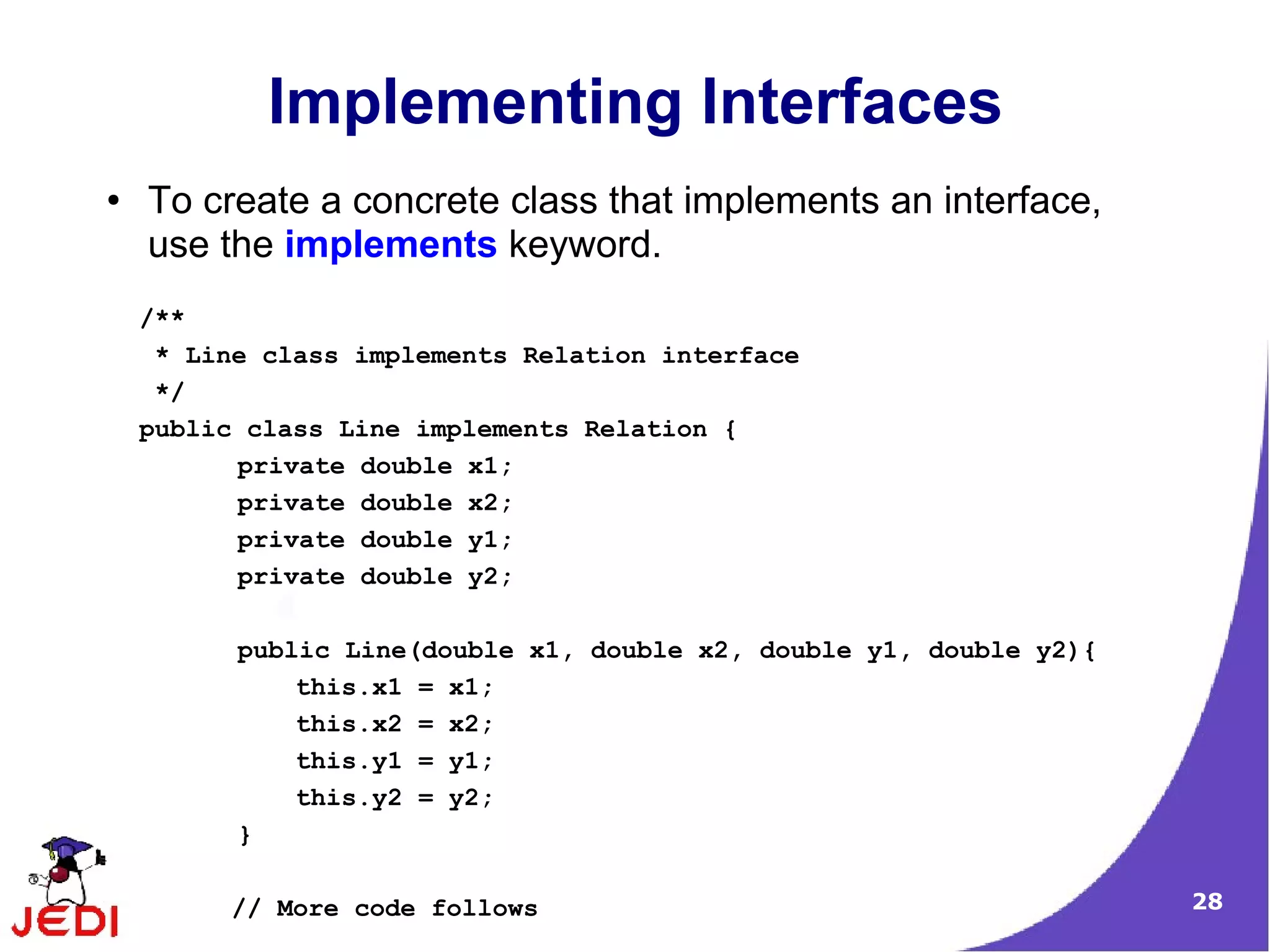
Implementing Interfaces
●   To create a concrete class that implements an interface,
    use the implements keyword.
    /**
     * Line class implements Relation interface
     */
    public class Line implements Relation {
          private double x1;
          private double x2;
          private double y1;
          private double y2;

          public Line(double x1, double x2, double y1, double y2){
              this.x1 = x1;
              this.x2 = x2;
              this.y1 = y1;
              this.y2 = y2;
          }

         // More code follows                                        28
Implementing Interfaces
public double getLength(){
       double length = Math.sqrt((x2-x1)*(x2-x1) +
                      (y2-y1)* (y2-y1));
       return length;
    }

    public boolean isGreater( Object a, Object b){
        double aLen = ((Line)a).getLength();
        double bLen = ((Line)b).getLength();
        return (aLen > bLen);
    }

    public boolean isLess( Object a, Object b){
        double aLen = ((Line)a).getLength();
        double bLen = ((Line)b).getLength();
        return (aLen < bLen);

    }

    public boolean isEqual( Object a, Object b){
        double aLen = ((Line)a).getLength();
        double bLen = ((Line)b).getLength();
        return (aLen == bLen);
    }
}
                                                     29
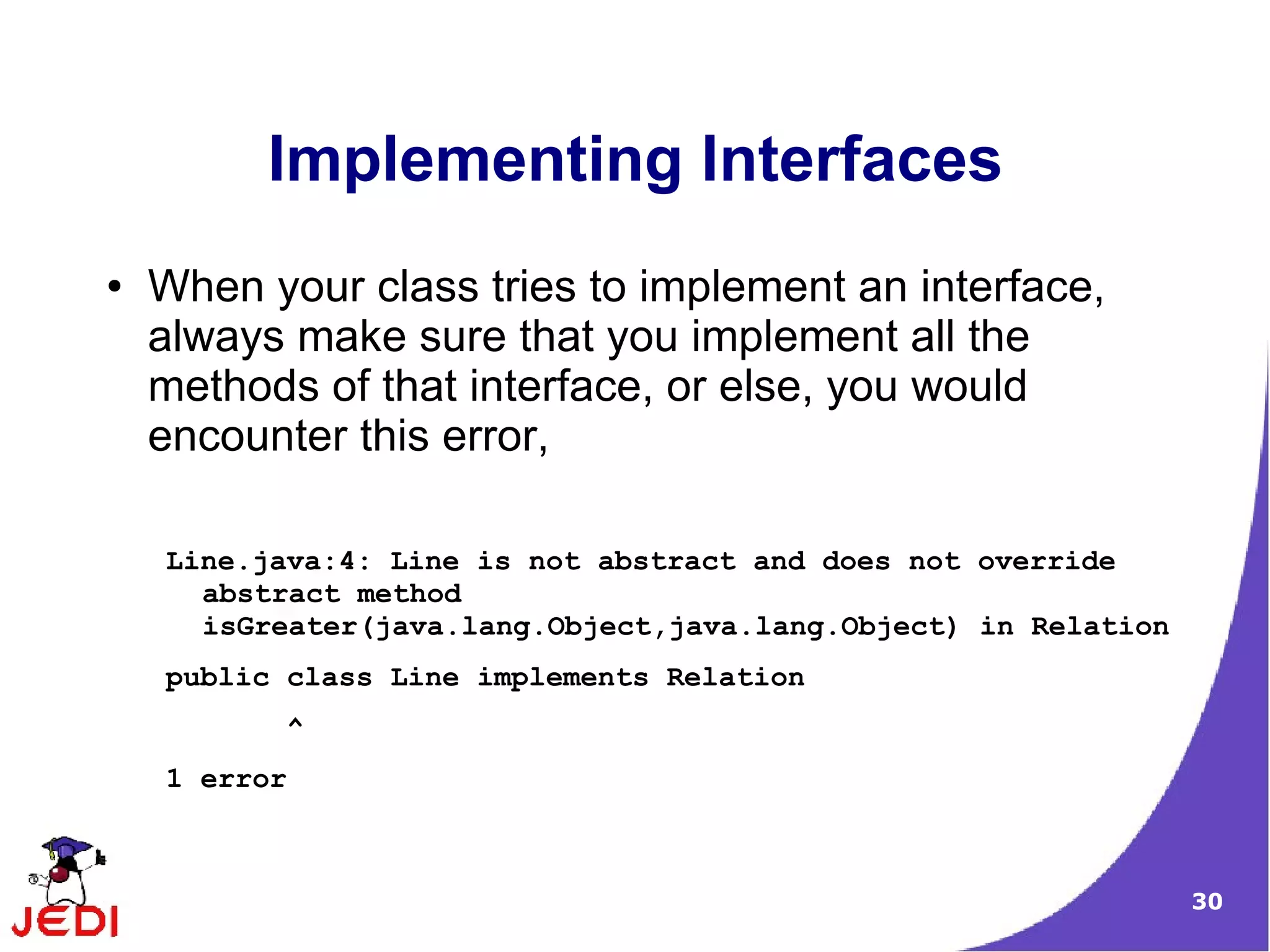
Implementing Interfaces
●   When your class tries to implement an interface,
    always make sure that you implement all the
    methods of that interface, or else, you would
    encounter this error,

    Line.java:4: Line is not abstract and does not override
      abstract method
      isGreater(java.lang.Object,java.lang.Object) in Relation
    public class Line implements Relation
          ^
    1 error


                                                                 30
Implementing Class
●   Implementing class can have its own methods
●   Implementing class extend a single super class or
    abstract class


                                                        31
Implementing
Multiple Interfaces
                      32
Relationship of an Interface to a
                 Class
●   A concrete class can only extend one super class,
    but it can implement multiple Interfaces
    –   The Java programming language does not permit
        multiple inheritance (inheritance is discussed later in
        this lesson), but interfaces provide an alternative.
●   All abstract methods of all interfaces have to be
    implemented by the concrete class


                                                                  33
Example: Implementing Multiple
              Interfaces
●   A concrete class extends one super class but
    multiple Interfaces:

    public class ComputerScienceStudent
                   extends Student
                   implements PersonInterface,
                              AnotherInterface,
                              Thirdinterface{

        // All abstract methods of all interfaces
        // need to be implemented.
    }


                                                    34
Inheritance
Among Interfaces
                   35
Inheritance Among Interfaces

●   Interfaces are not part of the class hierarchy
●   However, interfaces can have inheritance
    relationship among themselves


    public interface PersonInterface {
       void doSomething();
    }

    public interface StudentInterface
                     extends PersonInterface {
       void doExtraSomething();
    }


                                                     36
Interface &
Polymorphism
               37
Interface and Polymorphism

●   Interfaces exhibit polymorphism as well, since
    program may call an interface method, and the
    proper version of that method will be executed
    depending on the type of object instance passed to
    the interface method call


                                                         38
Rewriting Interfaces

                       39
Problem of Rewriting an Existing
                Interface
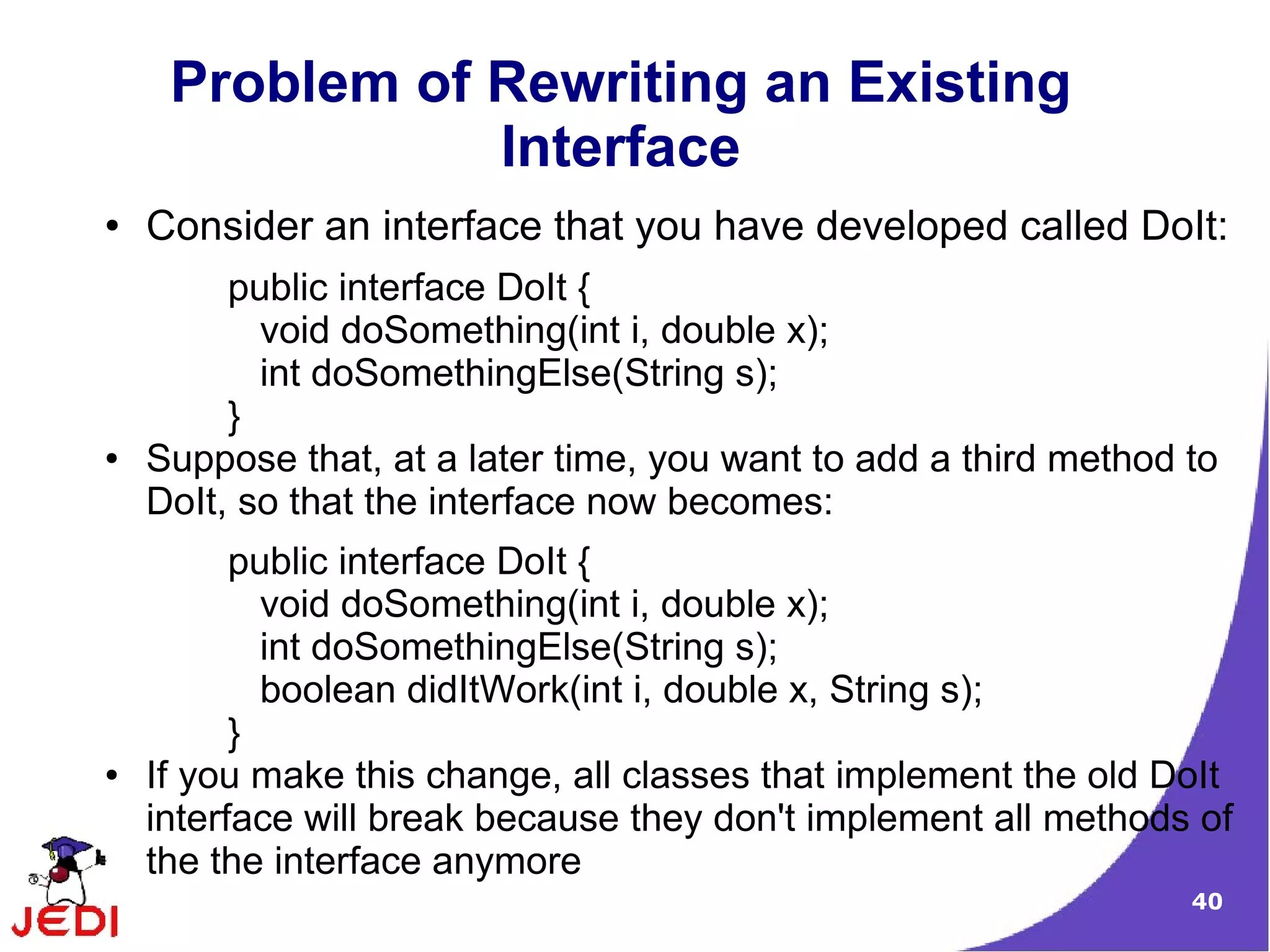
●   Consider an interface that you have developed called DoIt:
         public interface DoIt {
           void doSomething(int i, double x);
           int doSomethingElse(String s);
         }
●   Suppose that, at a later time, you want to add a third method to
    DoIt, so that the interface now becomes:
          public interface DoIt {
            void doSomething(int i, double x);
            int doSomethingElse(String s);
            boolean didItWork(int i, double x, String s);
          }
●   If you make this change, all classes that implement the old DoIt
    interface will break because they don't implement all methods of
    the the interface anymore
                                                                  40
Solution of Rewriting an Existing
                 Interface
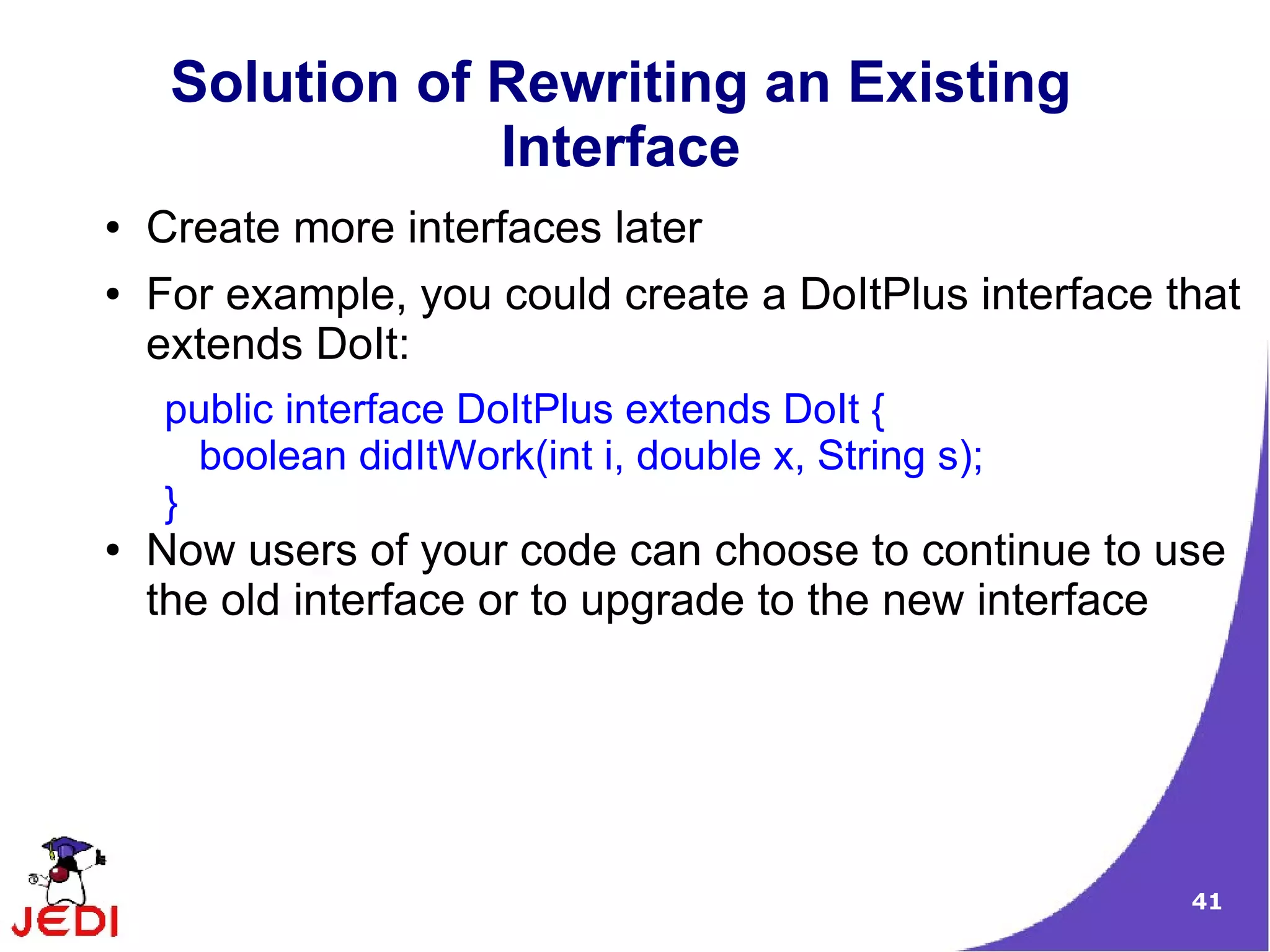
●   Create more interfaces later
●   For example, you could create a DoItPlus interface that
    extends DoIt:
    public interface DoItPlus extends DoIt {
      boolean didItWork(int i, double x, String s);
    }
●   Now users of your code can choose to continue to use
    the old interface or to upgrade to the new interface


                                                        41
When to Use an
Abstract Class over
   an Interface?
                      42
When to use an Abstract Class
           over Interface?
●   For non-abstract methods, you want to use them
    when you want to provide common implementation
    code for all sub-classes
    –   Reducing the duplication
●   For abstract methods, the motivation is the same
    with the ones in the interface – to impose a
    common behavior for all sub-classes without
    dictating how to implement it
●   Remember a concrete can extend only one super
    class whether that super class is in the form of
    concrete class or abstract class
                                                       43
Abstract Class &
 Java Interface

                   44

javainterface

  • 1.
    Abstract Class & Java Interface 1
  • 2.
    Agenda ● What is an Abstract method and an Abstract class? ● What is Interface? ● Why Interface? ● Interface as a Type ● Interface vs. Class ● Defining an Interface ● Implementing an Interface ● Implementing multiple Interface's ● Inheritance among Interface's ● Interface and Polymorphism ● Rewriting an Interface 2
  • 3.
  • 4.
    Abstract Methods ● Methods that do not have implementation (body) ● To create an abstract method, just write the method declaration without the body and use the abstract keyword – No { } ● For example, // Note that there is no body public abstract void someMethod(); 4
  • 5.
    Abstract Class ● An abstract class is a class that contains one or more abstract methods ● An abstract class cannot instantiated // You will get a compile error on the following code MyAbstractClass a1 = new MyAbstractClass(); ● Another class (Concrete class) has to provide implementation of abstract methods – Concrete class has to implement all abstract methods of the abstract class in order to be used for instantiation – Concrete class uses extends keyword 5
  • 6.
    Sample Abstract Class publicabstract class LivingThing { public void breath(){ System.out.println("Living Thing breathing..."); } public void eat(){ System.out.println("Living Thing eating..."); } /** * Abstract method walk() * We want this method to be implemented by a * Concrete class. */ public abstract void walk(); } 6
  • 7.
    Extending an AbstractClass ● When a concrete class extends the LivingThing abstract class, it must implement the abstract method walk(), or else, that subclass will also become an abstract class, and therefore cannot be instantiated. ● For example, public class Human extends LivingThing { public void walk(){ System.out.println("Human walks..."); } } 7
  • 8.
    When to useAbstract Methods & Abstract Class? ● Abstract methods are usually declared where two or more subclasses are expected to fulfill a similar role in different ways through different implementations – These subclasses extend the same Abstract class and provide different implementations for the abstract methods ● Use abstract classes to define broad types of behaviors at the top of an object-oriented programming class hierarchy, and use its subclasses to provide implementation details of the abstract class. 8
  • 9.
  • 10.
    What is anInterface? ● It defines a standard and public way of specifying the behavior of classes – Defines a contract ● All methods of an interface are abstract methods – Defines the signatures of a set of methods, without the body (implementation of the methods) ● A concrete class must implement the interface (all the abstract methods of the Interface) ● It allows classes, regardless of their locations in the class hierarchy, to implement common behaviors 10
  • 11.
    Example: Interface // Notethat Interface contains just set of method // signatures without any implementations. // No need to say abstract modifier for each method // since it assumed. public interface Relation { public boolean isGreater( Object a, Object b); public boolean isLess( Object a, Object b); public boolean isEqual( Object a, Object b); } 11
  • 12.
    Example 2: OperatorCarInterface public interface OperateCar { // constant declarations, if any // method signatures int turn(Direction direction, double radius, double startSpeed, double endSpeed); int changeLanes(Direction direction, double startSpeed, double endSpeed); int signalTurn(Direction direction, boolean signalOn); int getRadarFront(double distanceToCar, double speedOfCar); int getRadarRear(double distanceToCar, double speedOfCar); ...... // more method signatures } 12
  • 13.
  • 14.
    Why do weuse Interfaces? Reason #1 ● To reveal an object's programming interface (functionality of the object) without revealing its implementation – This is the concept of encapsulation – The implementation can change without affecting the caller of the interface – The caller does not need the implementation at the compile time ● It needs only the interface at the compile time ● During runtime, actual object instance is associated with the interface type 14
  • 15.
    Why do weuse Interfaces? Reason #2 ● To have unrelated classes implement similar methods (behaviors) – One class is not a sub-class of another ● Example: – Class Line and class MyInteger ● They are not related through inheritance ● You want both to implement comparison methods – checkIsGreater(Object x, Object y) – checkIsLess(Object x, Object y) – checkIsEqual(Object x, Object y) – Define Comparison interface which has the three abstract methods above 15
  • 16.
    Why do weuse Interfaces? Reason #3 ● To model multiple inheritance – A class can implement multiple interfaces while it can extend only one class 16
  • 17.
    Interface vs. AbstractClass ● All methods of an Interface are abstract methods while some methods of an Abstract class are abstract methods – Abstract methods of abstract class have abstract modifier ● An interface can only define constants while abstract class can have fields ● Interfaces have no direct inherited relationship with any particular class, they are defined independently – Interfaces themselves have inheritance relationship among themselves 17
  • 18.
  • 19.
    Interface as aType ● When you define a new interface, you are defining a new reference type ● You can use interface names anywhere you can use any other type name ● If you define a reference variable whose type is an interface, any object you assign to it must be an instance of a class that implements the interface 19
  • 20.
    Example: Interface asa Type ● Let's say Person class implements PersonInterface interface ● You can do – Person p1 = new Person(); – PersonInterface pi1 = p1; – PersonInterface pi2 = new Person(); 20
  • 21.
  • 22.
    Interface vs. Class:Commonality ● Interfaces and classes are both types – This means that an interface can be used in places where a class can be used – For example: // Recommended practice PersonInterface pi = new Person(); // Not recommended practice Person pc = new Person(); ● Interface and Class can both define methods 22
  • 23.
    Interface vs. Class:Differences ● The methods of an Interface are all abstract methods – They cannot have bodies ● You cannot create an instance from an interface – For example: PersonInterface pi = new PersonInterface(); //ERROR! ● An interface can only be implemented by classes or extended by other interfaces 23
  • 24.
  • 25.
    Defining Interfaces ● To define an interface, we write: public interface [InterfaceName] { //some methods without the body } 25
  • 26.
    Defining Interfaces ● As an example, let's create an interface that defines relationships between two objects according to the “natural order” of the objects. public interface Relation { public boolean isGreater( Object a, Object b); public boolean isLess( Object a, Object b); public boolean isEqual( Object a, Object b); } 26
  • 27.
  • 28.
    Implementing Interfaces ● To create a concrete class that implements an interface, use the implements keyword. /** * Line class implements Relation interface */ public class Line implements Relation { private double x1; private double x2; private double y1; private double y2; public Line(double x1, double x2, double y1, double y2){ this.x1 = x1; this.x2 = x2; this.y1 = y1; this.y2 = y2; } // More code follows 28
  • 29.
    Implementing Interfaces public doublegetLength(){ double length = Math.sqrt((x2-x1)*(x2-x1) + (y2-y1)* (y2-y1)); return length; } public boolean isGreater( Object a, Object b){ double aLen = ((Line)a).getLength(); double bLen = ((Line)b).getLength(); return (aLen > bLen); } public boolean isLess( Object a, Object b){ double aLen = ((Line)a).getLength(); double bLen = ((Line)b).getLength(); return (aLen < bLen); } public boolean isEqual( Object a, Object b){ double aLen = ((Line)a).getLength(); double bLen = ((Line)b).getLength(); return (aLen == bLen); } } 29
  • 30.
    Implementing Interfaces ● When your class tries to implement an interface, always make sure that you implement all the methods of that interface, or else, you would encounter this error, Line.java:4: Line is not abstract and does not override abstract method isGreater(java.lang.Object,java.lang.Object) in Relation public class Line implements Relation ^ 1 error 30
  • 31.
    Implementing Class ● Implementing class can have its own methods ● Implementing class extend a single super class or abstract class 31
  • 32.
  • 33.
    Relationship of anInterface to a Class ● A concrete class can only extend one super class, but it can implement multiple Interfaces – The Java programming language does not permit multiple inheritance (inheritance is discussed later in this lesson), but interfaces provide an alternative. ● All abstract methods of all interfaces have to be implemented by the concrete class 33
  • 34.
    Example: Implementing Multiple Interfaces ● A concrete class extends one super class but multiple Interfaces: public class ComputerScienceStudent extends Student implements PersonInterface, AnotherInterface, Thirdinterface{ // All abstract methods of all interfaces // need to be implemented. } 34
  • 35.
  • 36.
    Inheritance Among Interfaces ● Interfaces are not part of the class hierarchy ● However, interfaces can have inheritance relationship among themselves public interface PersonInterface { void doSomething(); } public interface StudentInterface extends PersonInterface { void doExtraSomething(); } 36
  • 37.
  • 38.
    Interface and Polymorphism ● Interfaces exhibit polymorphism as well, since program may call an interface method, and the proper version of that method will be executed depending on the type of object instance passed to the interface method call 38
  • 39.
  • 40.
    Problem of Rewritingan Existing Interface ● Consider an interface that you have developed called DoIt: public interface DoIt { void doSomething(int i, double x); int doSomethingElse(String s); } ● Suppose that, at a later time, you want to add a third method to DoIt, so that the interface now becomes: public interface DoIt { void doSomething(int i, double x); int doSomethingElse(String s); boolean didItWork(int i, double x, String s); } ● If you make this change, all classes that implement the old DoIt interface will break because they don't implement all methods of the the interface anymore 40
  • 41.
    Solution of Rewritingan Existing Interface ● Create more interfaces later ● For example, you could create a DoItPlus interface that extends DoIt: public interface DoItPlus extends DoIt { boolean didItWork(int i, double x, String s); } ● Now users of your code can choose to continue to use the old interface or to upgrade to the new interface 41
  • 42.
    When to Usean Abstract Class over an Interface? 42
  • 43.
    When to usean Abstract Class over Interface? ● For non-abstract methods, you want to use them when you want to provide common implementation code for all sub-classes – Reducing the duplication ● For abstract methods, the motivation is the same with the ones in the interface – to impose a common behavior for all sub-classes without dictating how to implement it ● Remember a concrete can extend only one super class whether that super class is in the form of concrete class or abstract class 43
  • 44.
    Abstract Class & Java Interface 44