START
MovieTime!
Andrzej Grzesik Konrad Malawski
JAVA 8
Andrzej Grzesik Konrad Malawski
JAVA 8
THE GOOD PARTS
Andrzej Grzesik Konrad Malawski
@ags313
andrzej@grzesik.it
andrzejgrzesik.info
Andrzej Grzesik
ABOUT:ME
 
Konrad `@ktosopl` Malawski
 
Konrad `@ktosopl` Malawski
OUR OPINIONS
ARE OUR OWN
disclaimer
QUESTIONS?
QUESTIONS?
ask them right away!
JAVA 8
is going to be amazing!
TWITTER SAYS:
JAVA 8 ISTHE NEW GUAVA
THE MOST EXCITING RELEASE IN HISTORY
DONE WITH COMMUNITY
ADOPT OPENJDK
adoptopenjdk.java.net
YOU CAN HELP!
FIX
TEST
HACK
DOCUMENT
ADOPTOPENJDK.JAVA.NET
ADOPTAJSR.JAVA.NET
HOW DO I CHECK JDK8?
JDK8.JAVA.NET
IDE SUPPORT
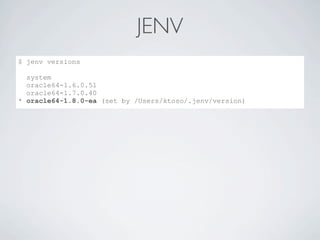
JENV
http://jenv.be
JENV
$ jenv versions
system
oracle64-1.6.0.51
oracle64-1.7.0.40
* oracle64-1.8.0-ea (set by /Users/ktoso/.jenv/version)

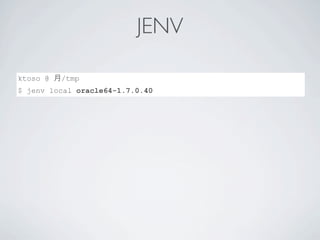
JENV
ktoso @ 月/tmp
$ jenv local oracle64-1.7.0.40
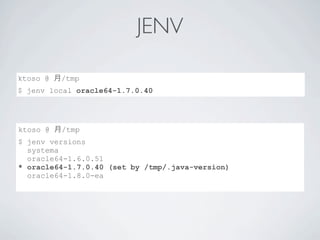
JENV
ktoso @ 月/tmp
$ jenv versions
systema
oracle64-1.6.0.51
* oracle64-1.7.0.40 (set by /tmp/.java-version)
oracle64-1.8.0-ea
ktoso @ 月/tmp
$ jenv local oracle64-1.7.0.40
NEWTIME API
jsr 310
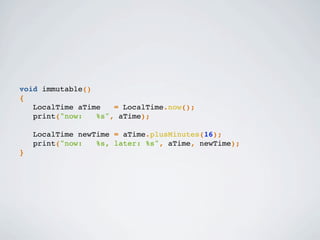
void immutable()
{
LocalTime aTime = LocalTime.now();
print("now: %s", aTime);
LocalTime newTime = aTime.plusMinutes(16);
print("now: %s, later: %s", aTime, newTime);
}
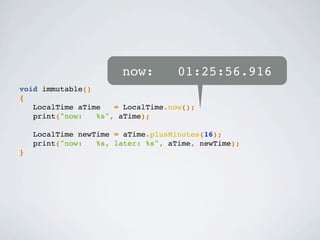
void immutable()
{
LocalTime aTime = LocalTime.now();
print("now: %s", aTime);
LocalTime newTime = aTime.plusMinutes(16);
print("now: %s, later: %s", aTime, newTime);
}
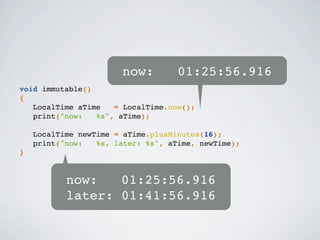
now: 01:25:56.916
now: 01:25:56.916
later: 01:41:56.916
void immutable()
{
LocalTime aTime = LocalTime.now();
print("now: %s", aTime);
LocalTime newTime = aTime.plusMinutes(16);
print("now: %s, later: %s", aTime, newTime);
}
now: 01:25:56.916
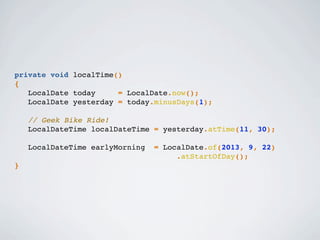
private void localTime()
{
LocalDate today = LocalDate.now();
LocalDate yesterday = today.minusDays(1);
// Geek Bike Ride!
LocalDateTime localDateTime = yesterday.atTime(11, 30);
LocalDateTime earlyMorning = LocalDate.of(2013, 9, 22)
.atStartOfDay();
}
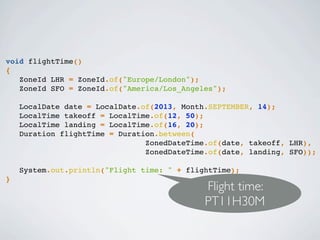
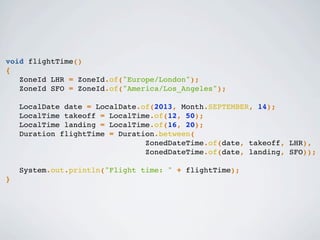
void flightTime()
{
ZoneId LHR = ZoneId.of("Europe/London");
ZoneId SFO = ZoneId.of("America/Los_Angeles");
LocalDate date = LocalDate.of(2013, Month.SEPTEMBER, 14);
LocalTime takeoff = LocalTime.of(12, 50);
LocalTime landing = LocalTime.of(16, 20);
Duration flightTime = Duration.between(
ZonedDateTime.of(date, takeoff, LHR),
ZonedDateTime.of(date, landing, SFO));
System.out.println("Flight time: " + flightTime);
}
void flightTime()
{
ZoneId LHR = ZoneId.of("Europe/London");
ZoneId SFO = ZoneId.of("America/Los_Angeles");
LocalDate date = LocalDate.of(2013, Month.SEPTEMBER, 14);
LocalTime takeoff = LocalTime.of(12, 50);
LocalTime landing = LocalTime.of(16, 20);
Duration flightTime = Duration.between(
ZonedDateTime.of(date, takeoff, LHR),
ZonedDateTime.of(date, landing, SFO));
System.out.println("Flight time: " + flightTime);
}
Flight time:
PT11H30M
ISO BY DEFAULT
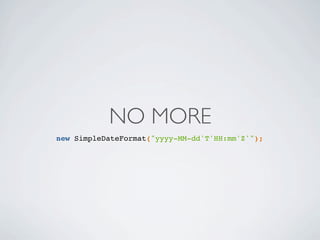
NO MORE
new SimpleDateFormat("yyyy-MM-dd'T'HH:mm'Z'");
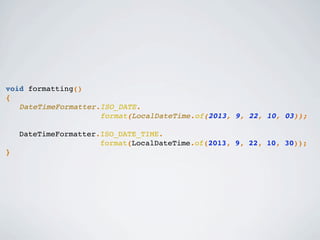
void formatting()
{
DateTimeFormatter.ISO_DATE.
format(LocalDateTime.of(2013, 9, 22, 10, 03));
DateTimeFormatter.ISO_DATE_TIME.
format(LocalDateTime.of(2013, 9, 22, 10, 30));
}
void formatting()
{
DateTimeFormatter.ISO_DATE.
format(LocalDateTime.of(2013, 9, 22, 10, 03));
DateTimeFormatter.ISO_DATE_TIME.
format(LocalDateTime.of(2013, 9, 22, 10, 30));
}
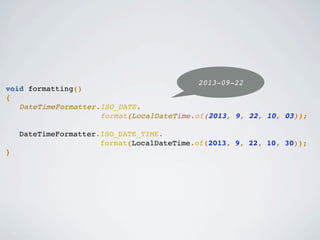
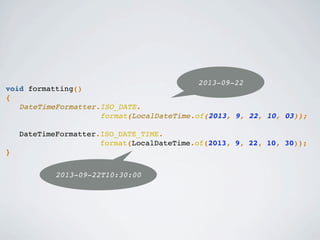
2013-09-22
void formatting()
{
DateTimeFormatter.ISO_DATE.
format(LocalDateTime.of(2013, 9, 22, 10, 03));
DateTimeFormatter.ISO_DATE_TIME.
format(LocalDateTime.of(2013, 9, 22, 10, 30));
}
2013-09-22
2013-09-22T10:30:00
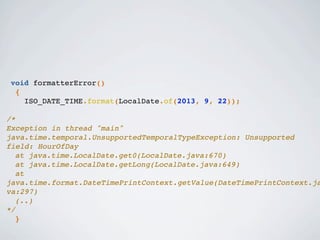
void formatterError()
{
ISO_DATE_TIME.format(LocalDate.of(2013, 9, 22));
/*
Exception in thread "main"
java.time.temporal.UnsupportedTemporalTypeException: Unsupported
field: HourOfDay
! at java.time.LocalDate.get0(LocalDate.java:670)
! at java.time.LocalDate.getLong(LocalDate.java:649)
! at
java.time.format.DateTimePrintContext.getValue(DateTimePrintContext.ja
va:297)
! (..)!
*/
}
TUTORIAL
http://docs.oracle.com/javase/tutorial/datetime/index.html
API
ENHANCEMENTS
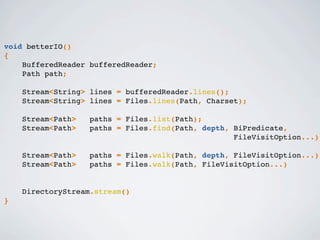
BETTER IO
void betterIO()
{
BufferedReader bufferedReader;
Path path;
Stream<String> lines = bufferedReader.lines();
Stream<String> lines = Files.lines(Path, Charset);
Stream<Path> paths = Files.list(Path);
Stream<Path> paths = Files.find(Path, depth, BiPredicate,
FileVisitOption...)
Stream<Path> paths = Files.walk(Path, depth, FileVisitOption...)
Stream<Path> paths = Files.walk(Path, FileVisitOption...)
DirectoryStream.stream()
}
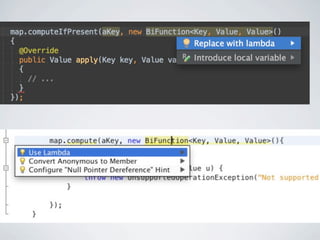
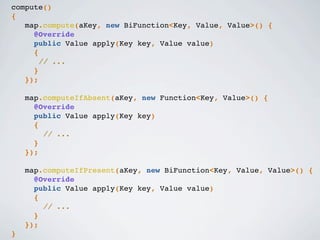
MAPS
compute()
{
map.compute(aKey, new BiFunction<Key, Value, Value>() {
@Override
public Value apply(Key key, Value value)
{
// ...
}
});
map.computeIfAbsent(aKey, new Function<Key, Value>() {
@Override
public Value apply(Key key)
{
// ...
}
});
map.computeIfPresent(aKey, new BiFunction<Key, Value, Value>() {
@Override
public Value apply(Key key, Value value)
{
// ...
}
});
}
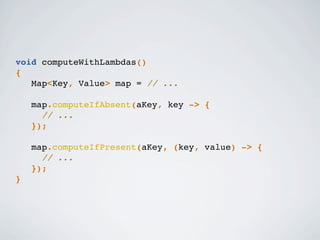
void computeWithLambdas()
{
Map<Key, Value> map = // ...
map.computeIfAbsent(aKey, key -> {
// ...
});
map.computeIfPresent(aKey, (key, value) -> {
// ...
});
}
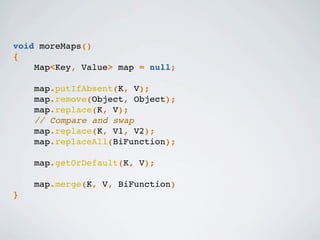
void moreMaps()
{
Map<Key, Value> map = null;
map.putIfAbsent(K, V);
map.remove(Object, Object);
map.replace(K, V);
// Compare and swap
map.replace(K, V1, V2);
map.replaceAll(BiFunction);
map.getOrDefault(K, V);
map.merge(K, V, BiFunction)
}
[5, 8, 6, 7, 2, 1, 4, 3]
void parallelSetAll()
{
int[] array = new int[8];
AtomicInteger i = new AtomicInteger();
Arrays.parallelSetAll(array, operand -> i.incrementAndGet());
}
void parallelPrefix()
{
int[] array = { 1, 2, 4, 8 };
Arrays.parallelPrefix(array, (left, right) -> {
return left + right;
});
}
LAMBDAS?
LAMBDAS!
(finally)
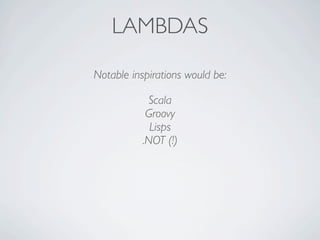
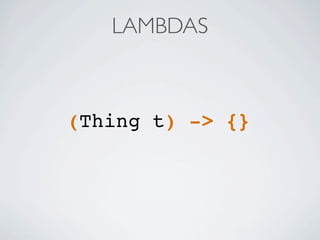
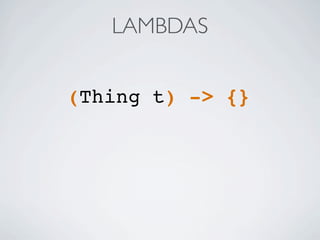
LAMBDAS
Notable inspirations would be:
Scala
Groovy
Lisps
.NOT (!)
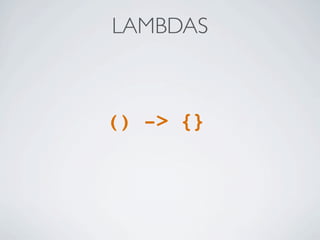
() -> {}
LAMBDAS
LAMBDAS
(Thing t) -> {}
LAMBDAS
LAMBDAS
(Thing t) -> {}
LAMBDAS
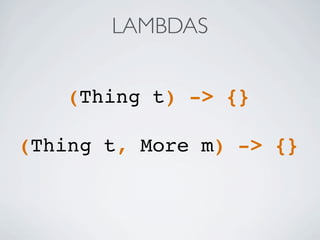
(Thing t) -> {}
(Thing t, More m) -> {}
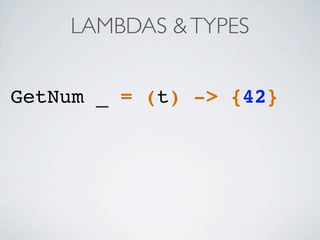
LAMBDAS &TYPES
LAMBDAS &TYPES
GetNum _ = (t) -> {42}
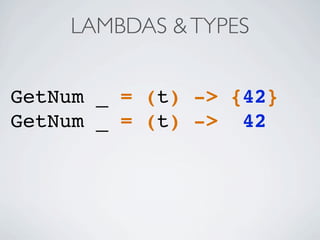
LAMBDAS &TYPES
GetNum _ = (t) -> {42}
GetNum _ = (t) -> 42
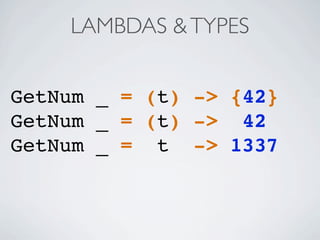
LAMBDAS &TYPES
GetNum _ = (t) -> {42}
GetNum _ = (t) -> 42
GetNum _ = t -> 1337
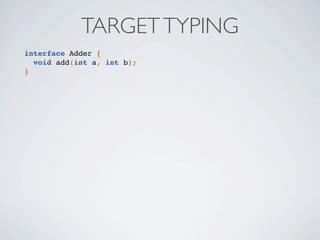
interface Adder {
void add(int a, int b);
}
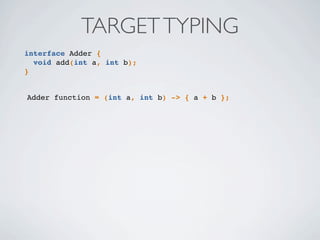
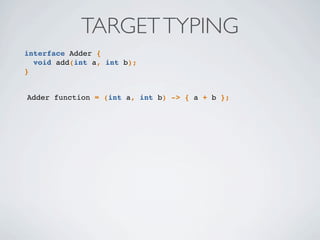
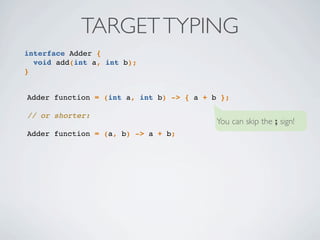
TARGETTYPING
interface Adder {
void add(int a, int b);
}
TARGETTYPING
Adder function = (int a, int b) -> { a + b };
interface Adder {
void add(int a, int b);
}
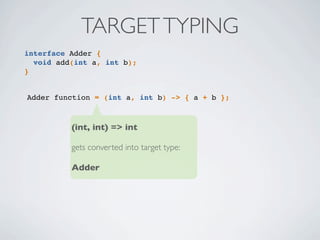
TARGETTYPING
Adder function = (int a, int b) -> { a + b };
interface Adder {
void add(int a, int b);
}
TARGETTYPING
Adder function = (int a, int b) -> { a + b };
(int, int) => int
gets converted into target type:
Adder
interface Adder {
void add(int a, int b);
}
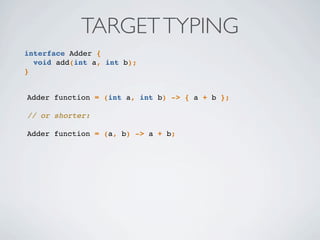
TARGETTYPING
Adder function = (int a, int b) -> { a + b };
// or shorter:
Adder function = (a, b) -> a + b;
interface Adder {
void add(int a, int b);
}
TARGETTYPING
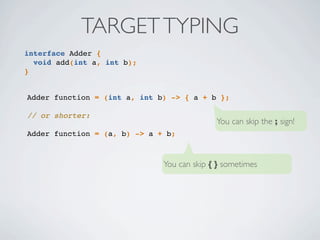
Adder function = (int a, int b) -> { a + b };
// or shorter:
Adder function = (a, b) -> a + b;
You can skip the ; sign!
interface Adder {
void add(int a, int b);
}
TARGETTYPING
Adder function = (int a, int b) -> { a + b };
// or shorter:
Adder function = (a, b) -> a + b;
You can skip { } sometimes
You can skip the ; sign!
interface Adder {
void add(int a, int b);
}
TARGETTYPING
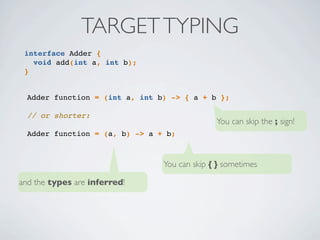
Adder function = (int a, int b) -> { a + b };
// or shorter:
Adder function = (a, b) -> a + b;
You can skip { } sometimes
You can skip the ; sign!
and the types are inferred!
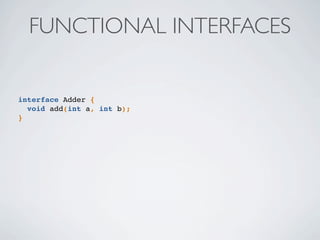
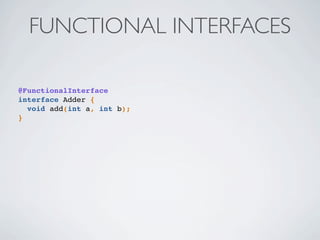
FUNCTIONAL INTERFACES
interface Adder {
void add(int a, int b);
}
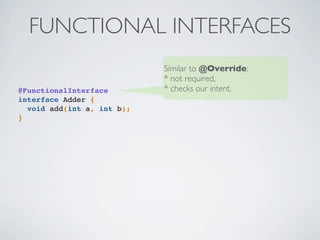
FUNCTIONAL INTERFACES
@FunctionalInterface
interface Adder {
void add(int a, int b);
}
FUNCTIONAL INTERFACES
@FunctionalInterface
interface Adder {
void add(int a, int b);
}
Similar to @Override:
* not required,
* checks our intent.
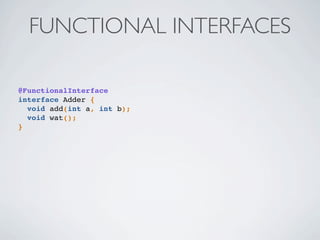
FUNCTIONAL INTERFACES
@FunctionalInterface
interface Adder {
void add(int a, int b);
void wat();
}
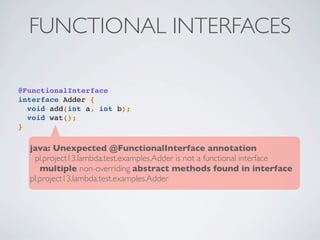
FUNCTIONAL INTERFACES
@FunctionalInterface
interface Adder {
void add(int a, int b);
void wat();
}
java: Unexpected @FunctionalInterface annotation
pl.project13.lambda.test.examples.Adder is not a functional interface
multiple non-overriding abstract methods found in interface
pl.project13.lambda.test.examples.Adder
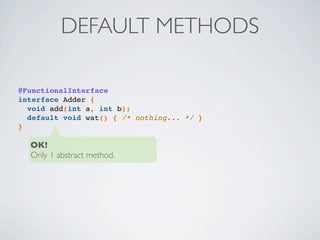
DEFAULT METHODS
@FunctionalInterface
interface Adder {
void add(int a, int b);
default void wat() { /* nothing... */ }
}
OK!
Only 1 abstract method.
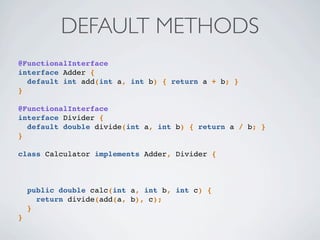
DEFAULT METHODS
@FunctionalInterface
interface Adder {
default int add(int a, int b) { return a + b; }
}
@FunctionalInterface
interface Divider {
default double divide(int a, int b) { return a / b; }
}
class Calculator implements Adder, Divider {
public double calc(int a, int b, int c) {
return divide(add(a, b), c);
}
}
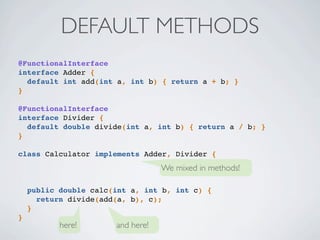
DEFAULT METHODS
We mixed in methods!
here! and here!
@FunctionalInterface
interface Adder {
default int add(int a, int b) { return a + b; }
}
@FunctionalInterface
interface Divider {
default double divide(int a, int b) { return a / b; }
}
class Calculator implements Adder, Divider {
public double calc(int a, int b, int c) {
return divide(add(a, b), c);
}
}
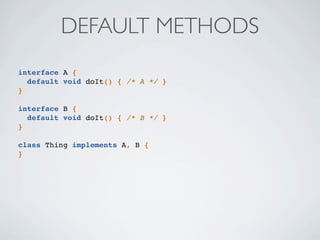
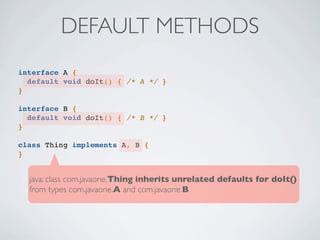
interface A {
default void doIt() { /* A */ }
}
interface B {
default void doIt() { /* B */ }
}
class Thing implements A, B {
}
DEFAULT METHODS
interface A {
default void doIt() { /* A */ }
}
interface B {
default void doIt() { /* B */ }
}
class Thing implements A, B {
}
DEFAULT METHODS
java: class com.javaone.Thing inherits unrelated defaults for doIt()
from types com.javaone.A and com.javaone.B
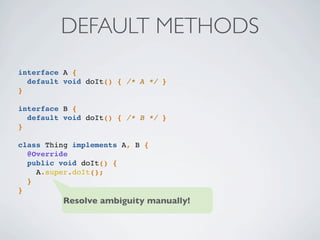
DEFAULT METHODS
interface A {
default void doIt() { /* A */ }
}
interface B {
default void doIt() { /* B */ }
}
class Thing implements A, B {
@Override
public void doIt() {
A.super.doIt();
}
}
Resolve ambiguity manually!
DEFAULT METHODS
interface A {
default void doIt() { /* A */ }
}
interface B {
default void doIt() { /* B */ }
}
class Thing implements A, B {
@Override
public void doIt() {
A.super.doIt();
}
}
Resolve ambiguity manually!
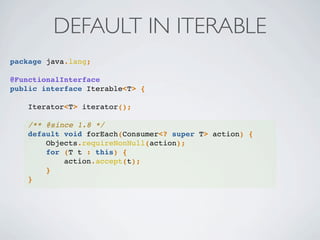
DEFAULT IN ITERABLE
package java.lang;
@FunctionalInterface
public interface Iterable<T> {
Iterator<T> iterator();
/** @since 1.8 */
default void forEach(Consumer<? super T> action) {
Objects.requireNonNull(action);
for (T t : this) {
action.accept(t);
}
}
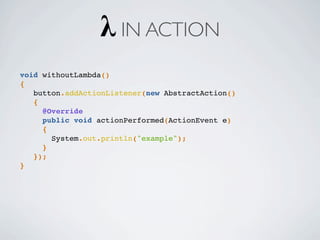
void withoutLambda()
{
button.addActionListener(new AbstractAction()
{
@Override
public void actionPerformed(ActionEvent e)
{
System.out.println("example");
}
});
}
λ IN ACTION
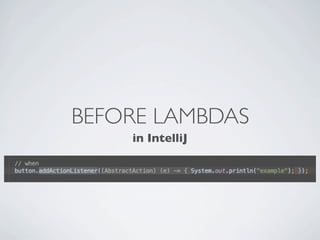
BEFORE LAMBDAS
in IntelliJ
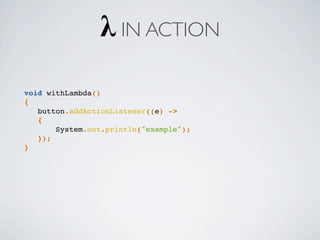
void withLambda()
{
button.addActionListener((e) ->
{
System.out.println("example");
});
}
λ IN ACTION
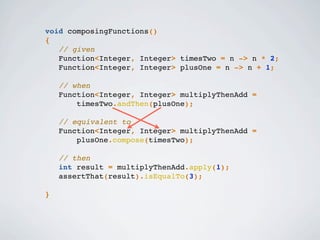
void composingFunctions()
{
// given
Function<Integer, Integer> timesTwo = n -> n * 2;
Function<Integer, Integer> plusOne = n -> n + 1;
// when
Function<Integer, Integer> multiplyThenAdd =
timesTwo.andThen(plusOne);
// equivalent to
Function<Integer, Integer> multiplyThenAdd =
plusOne.compose(timesTwo);
// then
int result = multiplyThenAdd.apply(1);
assertThat(result).isEqualTo(3);
}
REMOVING BOILERPLATE
STREAMS
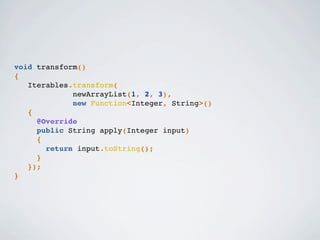
void transform()
{
Iterables.transform(
newArrayList(1, 2, 3),
new Function<Integer, String>()
{
@Override
public String apply(Integer input)
{
return input.toString();
}
});
}
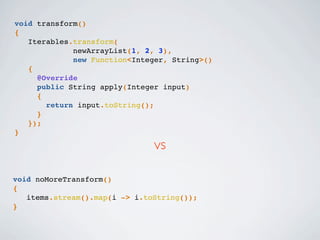
void transform()
{
Iterables.transform(
newArrayList(1, 2, 3),
new Function<Integer, String>()
{
@Override
public String apply(Integer input)
{
return input.toString();
}
});
}
void noMoreTransform()
{
items.stream().map(i -> i.toString());
}
vs
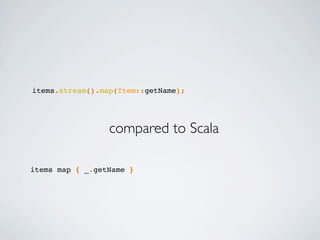
items.stream().map(Item::getName);
compared to Scala
items map { _.getName }
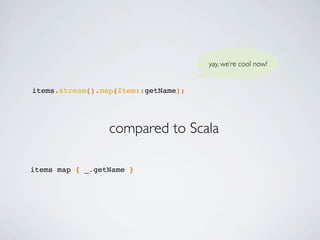
items.stream().map(Item::getName);
yay, we’re cool now!
compared to Scala
items map { _.getName }
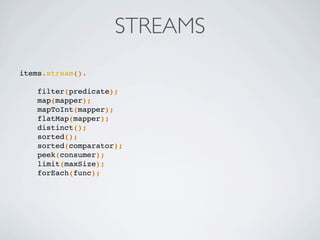
STREAMS
items.stream().
filter(predicate);
map(mapper);
mapToInt(mapper);
flatMap(mapper);
distinct();
sorted();
sorted(comparator);
peek(consumer);
limit(maxSize);
forEach(func);
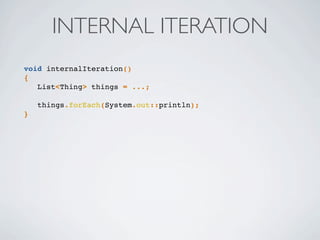
INTERNAL ITERATION
void internalIteration()
{
List<Thing> things = ...;
things.forEach(System.out::println);
}
PARALLELIZE?
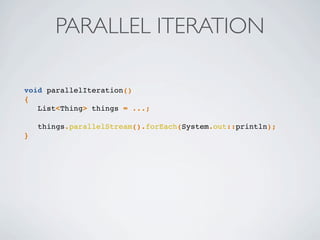
PARALLEL ITERATION
void parallelIteration()
{
List<Thing> things = ...;
things.parallelStream().forEach(System.out::println);
}
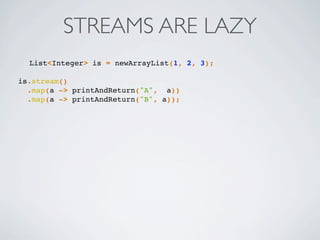
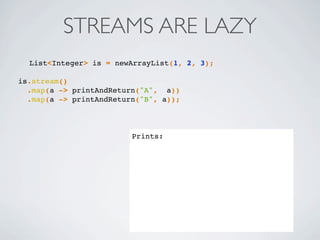
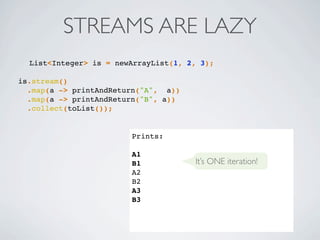
STREAMS ARE LAZY!
List<Integer> is = newArrayList(1, 2, 3);
is.stream()
.map(a -> printAndReturn("A", a))
.map(a -> printAndReturn("B", a));
STREAMS ARE LAZY
List<Integer> is = newArrayList(1, 2, 3);
is.stream()
.map(a -> printAndReturn("A", a))
.map(a -> printAndReturn("B", a));
Prints:
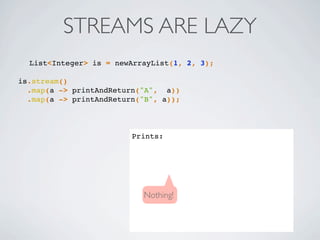
STREAMS ARE LAZY
List<Integer> is = newArrayList(1, 2, 3);
is.stream()
.map(a -> printAndReturn("A", a))
.map(a -> printAndReturn("B", a));
Prints:
STREAMS ARE LAZY
Nothing!
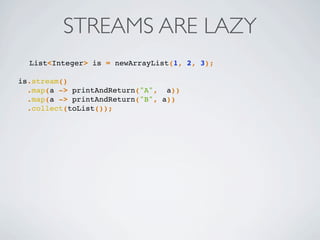
STREAMS ARE LAZY
List<Integer> is = newArrayList(1, 2, 3);
is.stream()
.map(a -> printAndReturn("A", a))
.map(a -> printAndReturn("B", a))
.collect(toList());
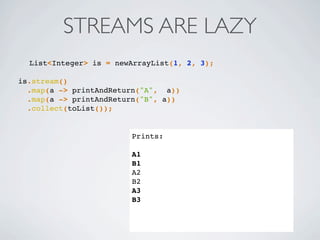
STREAMS ARE LAZY
List<Integer> is = newArrayList(1, 2, 3);
is.stream()
.map(a -> printAndReturn("A", a))
.map(a -> printAndReturn("B", a))
.collect(toList());
Prints:
A1
B1
A2
B2
A3
B3
STREAMS ARE LAZY
List<Integer> is = newArrayList(1, 2, 3);
is.stream()
.map(a -> printAndReturn("A", a))
.map(a -> printAndReturn("B", a))
.collect(toList());
Prints:
A1
B1
A2
B2
A3
B3
It’s ONE iteration!
METHOD HANDLES
think function pointers
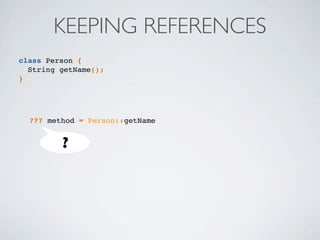
KEEPING REFERENCES
??? method = Person::getName
class Person {
String getName();
}
?
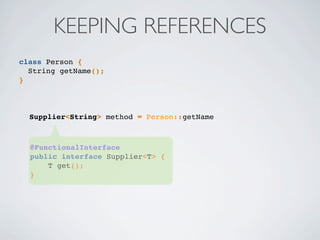
KEEPING REFERENCES
Supplier<String> method = Person::getName
@FunctionalInterface
public interface Supplier<T> {
T get();
}
class Person {
String getName();
}
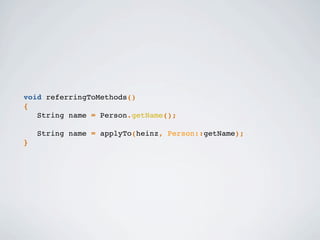
void referringToMethods()
{
String name = Person.getName();
String name = applyTo(heinz, Person::getName);
}
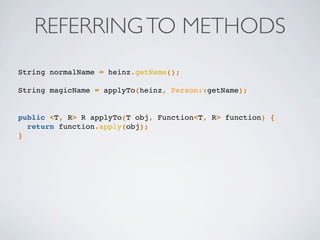
REFERRINGTO METHODS
String normalName = heinz.getName();
String magicName = applyTo(heinz, Person::getName);
public <T, R> R applyTo(T obj, Function<T, R> function) {
return function.apply(obj);
}
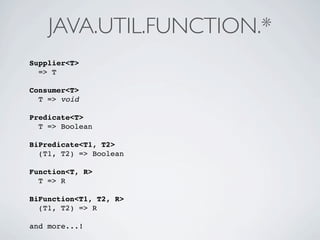
JAVA.UTIL.FUNCTION.*
Supplier<T>
=> T
Consumer<T>
T => void
Predicate<T>
T => Boolean
BiPredicate<T1, T2>
(T1, T2) => Boolean
Function<T, R>
T => R
BiFunction<T1, T2, R>
(T1, T2) => R
and more...!
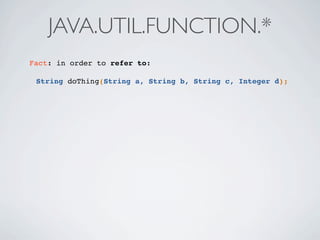
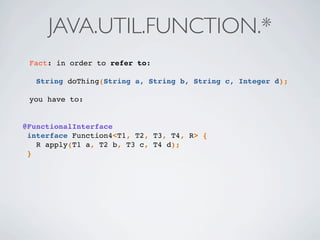
Fact: in order to refer to:
String doThing(String a, String b, String c, Integer d);
JAVA.UTIL.FUNCTION.*
Fact: in order to refer to:
String doThing(String a, String b, String c, Integer d);
you have to:
@FunctionalInterface
interface Function4<T1, T2, T3, T4, R> {
R apply(T1 a, T2 b, T3 c, T4 d);
}
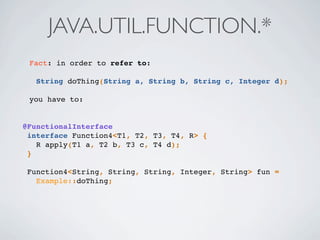
JAVA.UTIL.FUNCTION.*
Fact: in order to refer to:
String doThing(String a, String b, String c, Integer d);
you have to:
@FunctionalInterface
interface Function4<T1, T2, T3, T4, R> {
R apply(T1 a, T2 b, T3 c, T4 d);
}
Function4<String, String, String, Integer, String> fun =
Example::doThing;
JAVA.UTIL.FUNCTION.*
BACKTOTHE FUTURE!
● http://cr.openjdk.java.net/~briangoetz/
lambda/collections-overview.html
● http://docs.oracle.com/javase/tutorial/java/javaOO/
lambdaexpressions.html
● http://www.techempower.com/blog/2013/03/26/
everything-about-java-8/
● For fun, Lambda Spec:
github.com/ktoso/lambda-spec
THANKYOU!
@ags313
Andrzej Grzesik Konrad Malawski
@ktosopl
TWEET PLEASE!

Java 8: the good parts!