1
Java Collections
2
Java 2 Collections
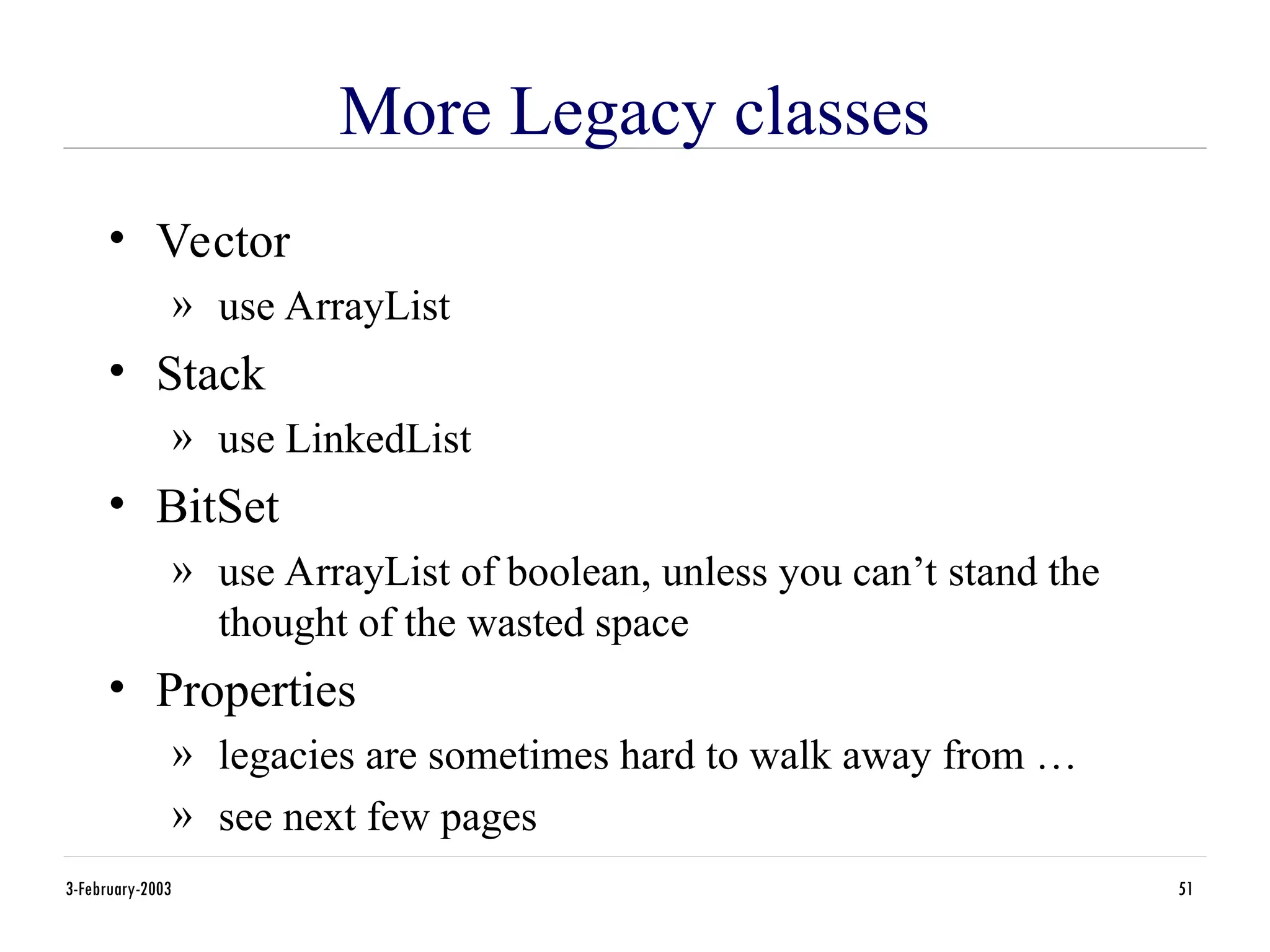
• A collection is an object that groups multiple
elements into a single unit
• Very useful
» store, retrieve and manipulate data
» transmit data from one method to another
• Java Collections can achieve all the operations that you
perform on a data such as searching, sorting, insertion,
manipulation, and deletion.
3-February-2003 3
Collections Framework
• Unified architecture for representing and
manipulating collections.
• A collections framework contains three things
» Interfaces
» Implementations
» Algorithms
3-February-2003 4
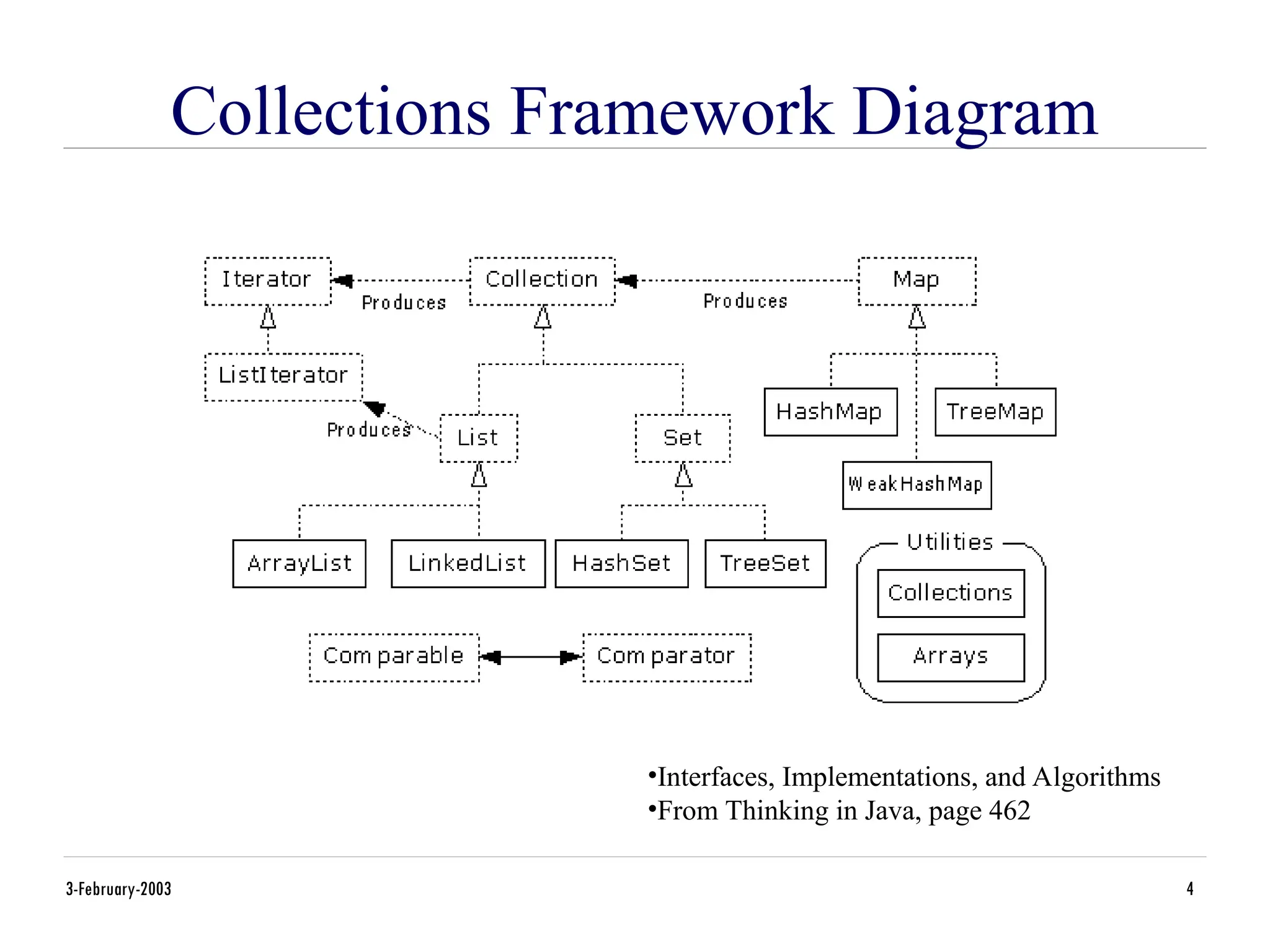
Collections Framework Diagram
•Interfaces, Implementations, and Algorithms
•From Thinking in Java, page 462
3-February-2003 5
Collection Interface
• Defines fundamental methods
» int size();
» boolean isEmpty();
» boolean contains(Object element);
» boolean add(Object element); // Optional
» boolean remove(Object element); // Optional
» Iterator iterator();
• These methods are enough to define the basic
behavior of a collection
• Provides an Iterator to step through the elements in
the Collection
3-February-2003 6
Iterator Interface
• Defines three fundamental methods
» Object next()
» boolean hasNext()
» void remove()
• These three methods provide access to the
contents of the collection
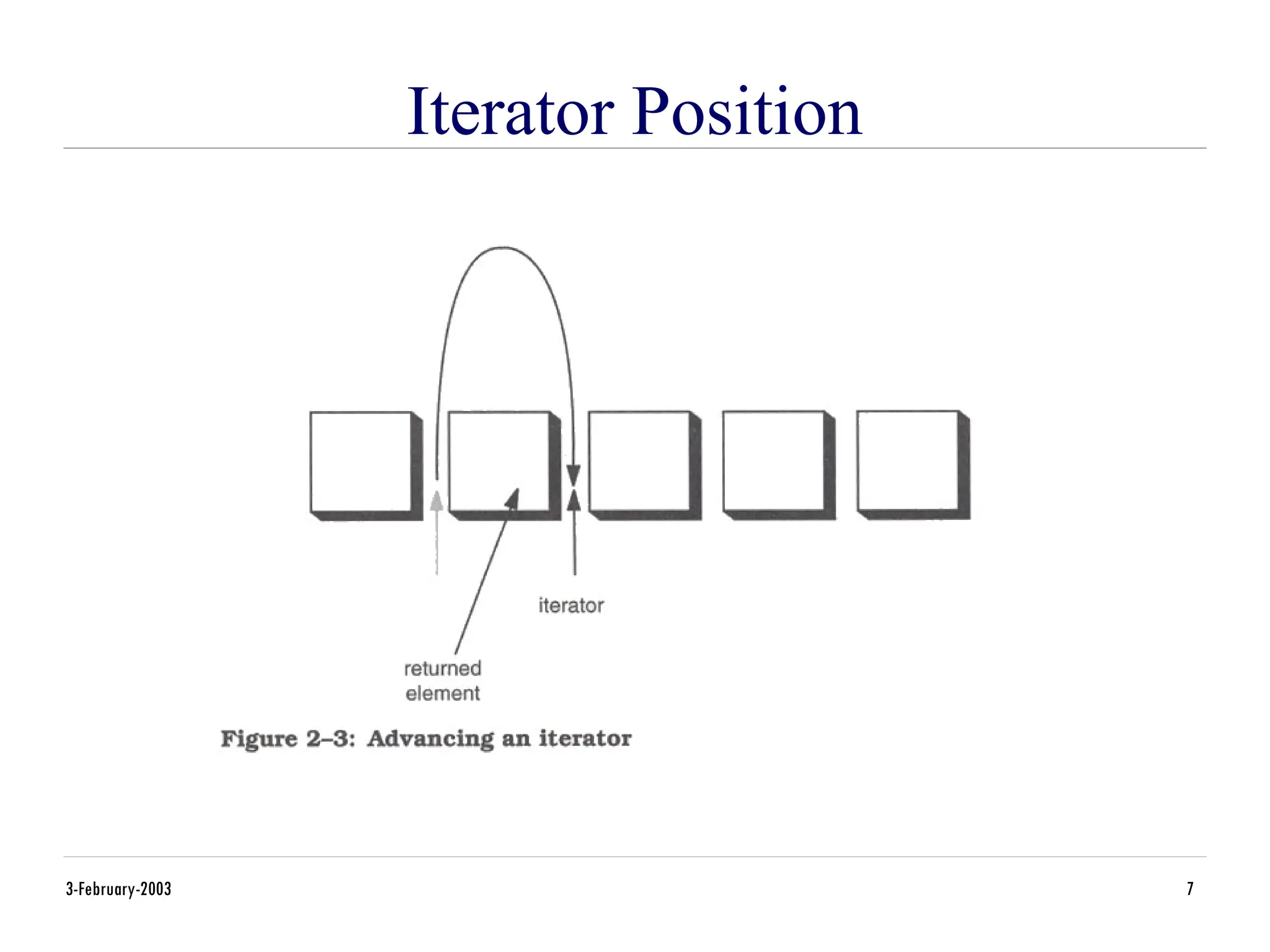
• An Iterator knows position within collection
• Each call to next() “reads” an element from the
collection
» Then you can use it or remove it
3-February-2003 7
Iterator Position
3-February-2003 8
Example - SimpleCollection
public class SimpleCollection {
public static void main(String[] args) {
Collection c;
c = new ArrayList();
System.out.println(c.getClass().getName());
for (int i=1; i <= 10; i++) {
c.add(i + " * " + i + " = "+i*i);
}
Iterator iter = c.iterator();
while (iter.hasNext())
System.out.println(iter.next());
}
}
List Interface
3-February-2003 9
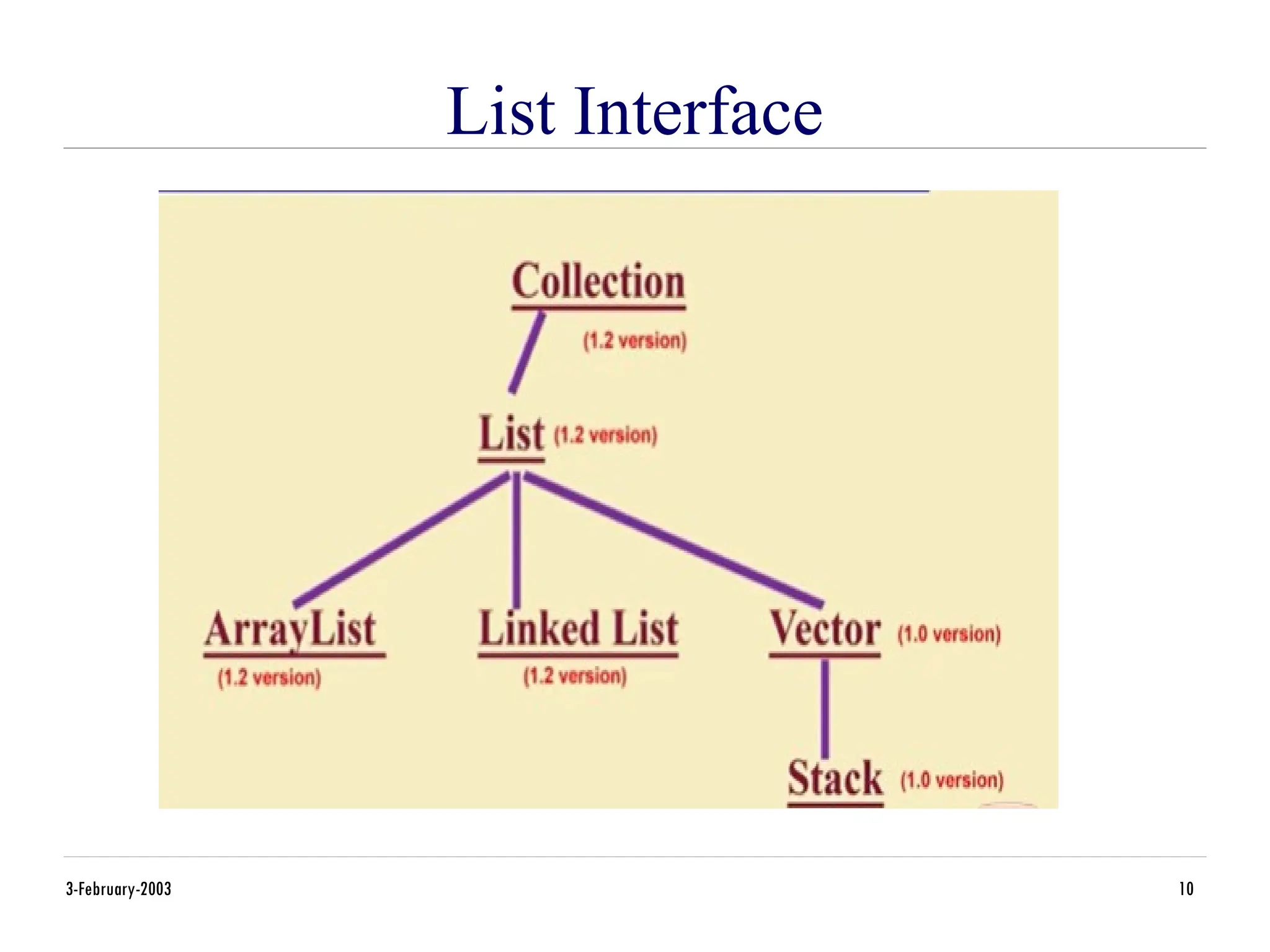
List Interface
3-February-2003 10
3-February-2003 11
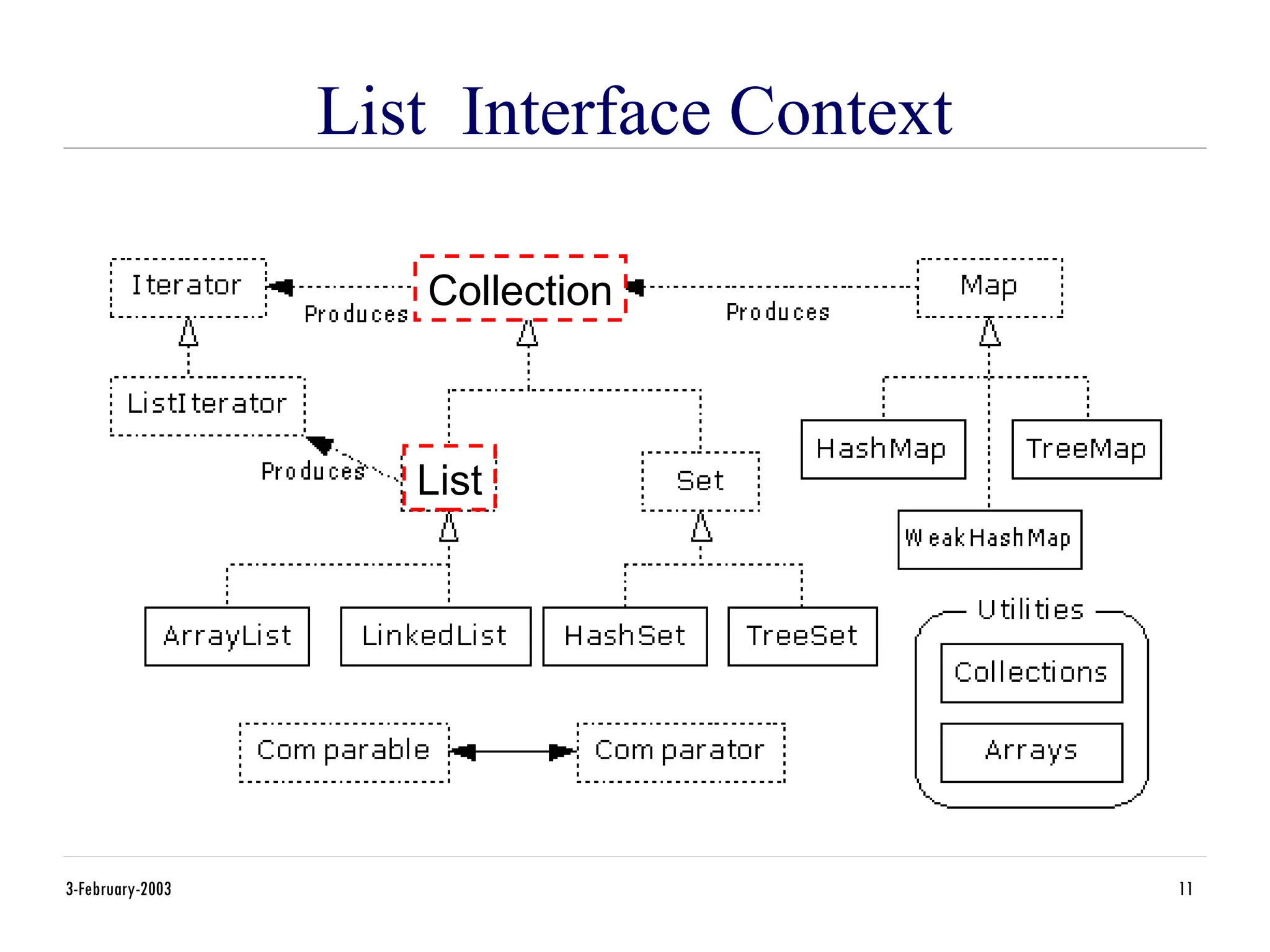
List Interface Context
Collection
List
3-February-2003 12
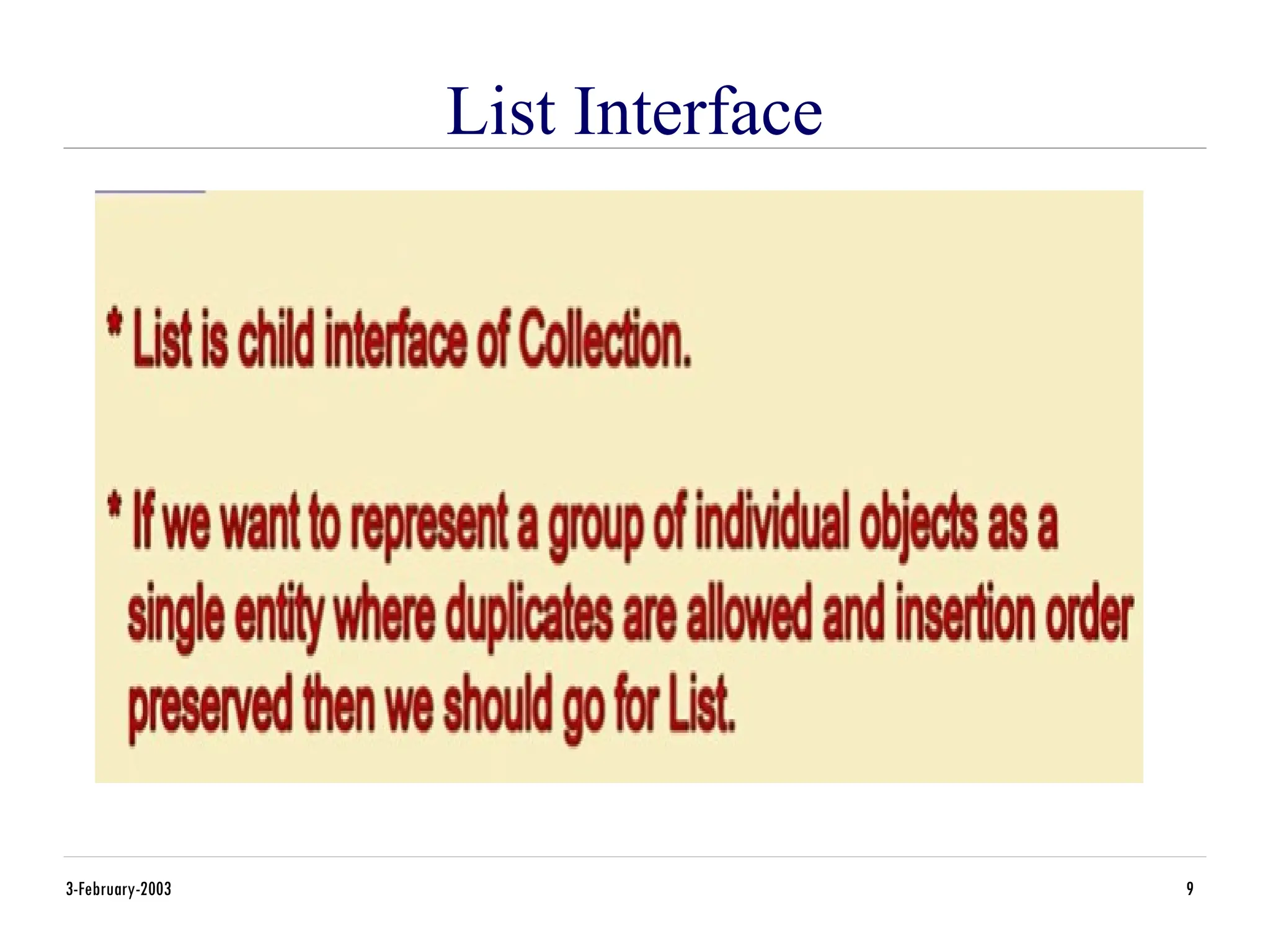
List Interface
• The List interface adds the notion of order to a
collection
• The user of a list has control over where an element is
added in the collection
• Lists typically allow duplicate elements
• Provides a ListIterator to step through the elements in
the list.
3-February-2003 13
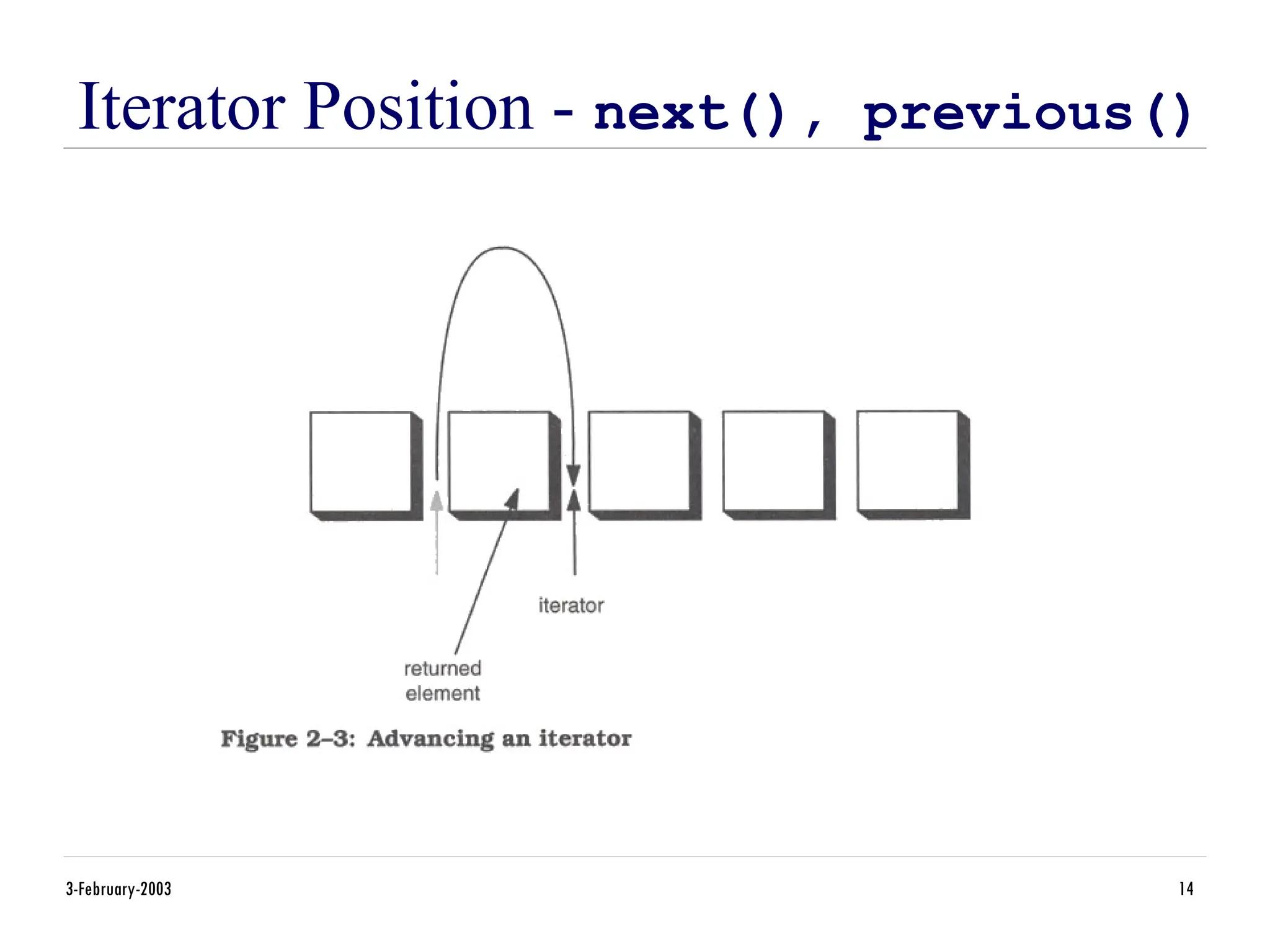
ListIterator Interface
• Extends the Iterator interface
• Defines three fundamental methods
» void add(Object o) - before current position
» boolean hasPrevious()
» Object previous()
• The addition of these three methods defines the basic
behavior of an ordered list
• A ListIterator knows position within list
3-February-2003 14
Iterator Position - next(), previous()
3-February-2003 15
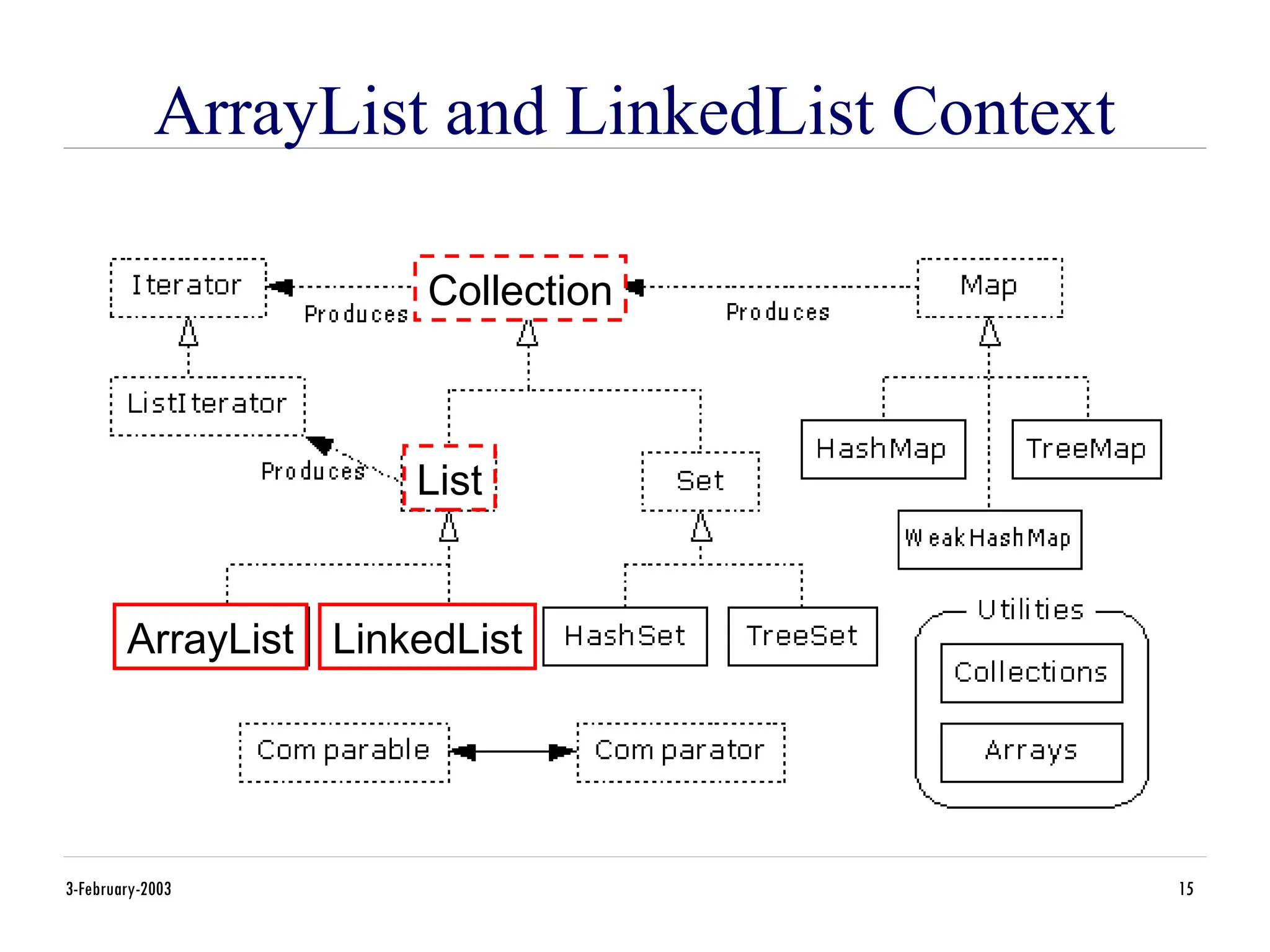
ArrayList and LinkedList Context
ArrayList LinkedList
Collection
List
3-February-2003 16
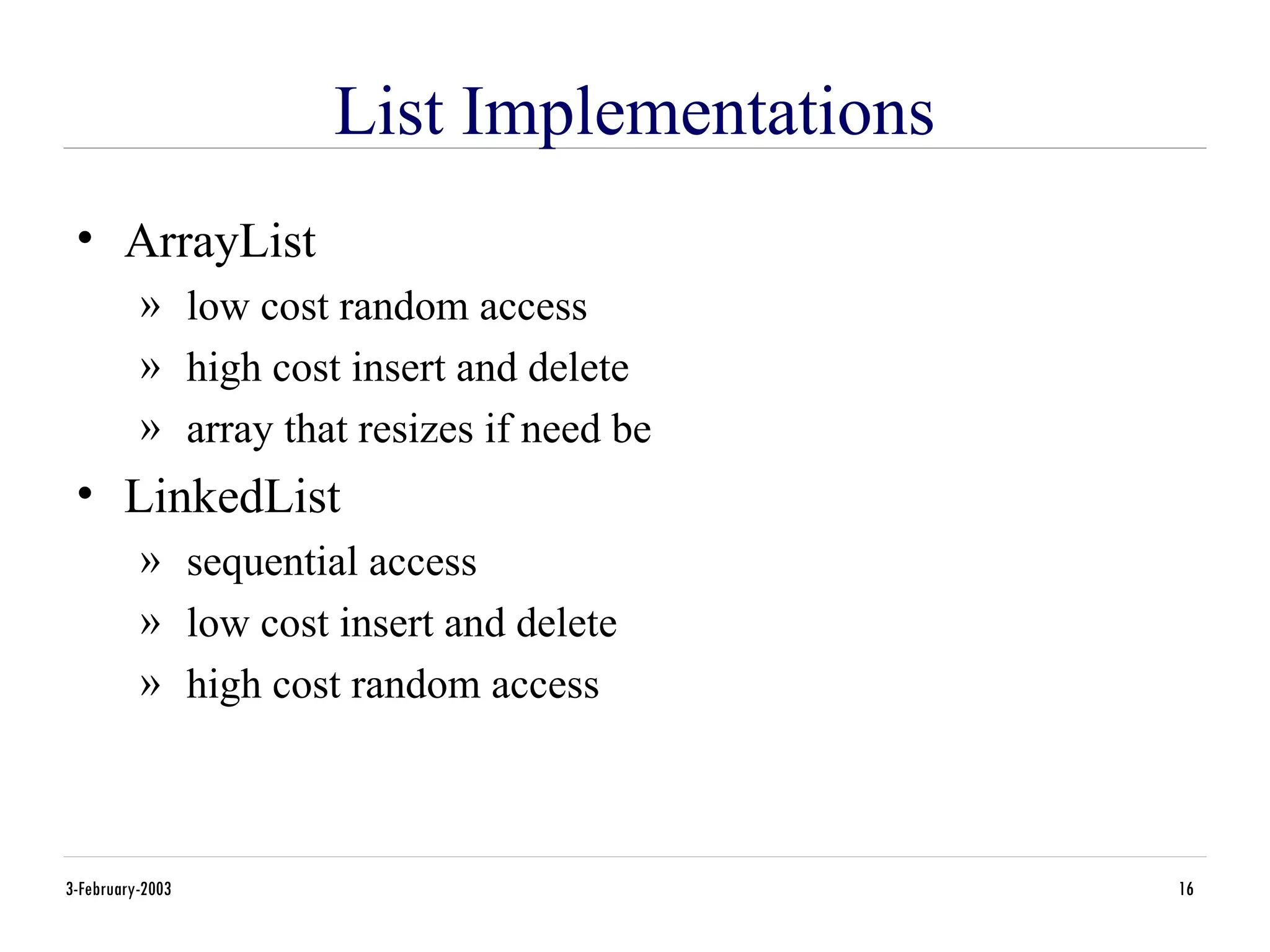
List Implementations
• ArrayList
» low cost random access
» high cost insert and delete
» array that resizes if need be
• LinkedList
» sequential access
» low cost insert and delete
» high cost random access
3-February-2003 17
ArrayList overview
• Constant time positional access (it’s an array)
• One tuning parameter, the initial capacity
public ArrayList(int initialCapacity) {
super();
if (initialCapacity < 0)
throw new IllegalArgumentException(
"Illegal Capacity: "+initialCapacity);
this.elementData = new Object[initialCapacity];
}
3-February-2003 18
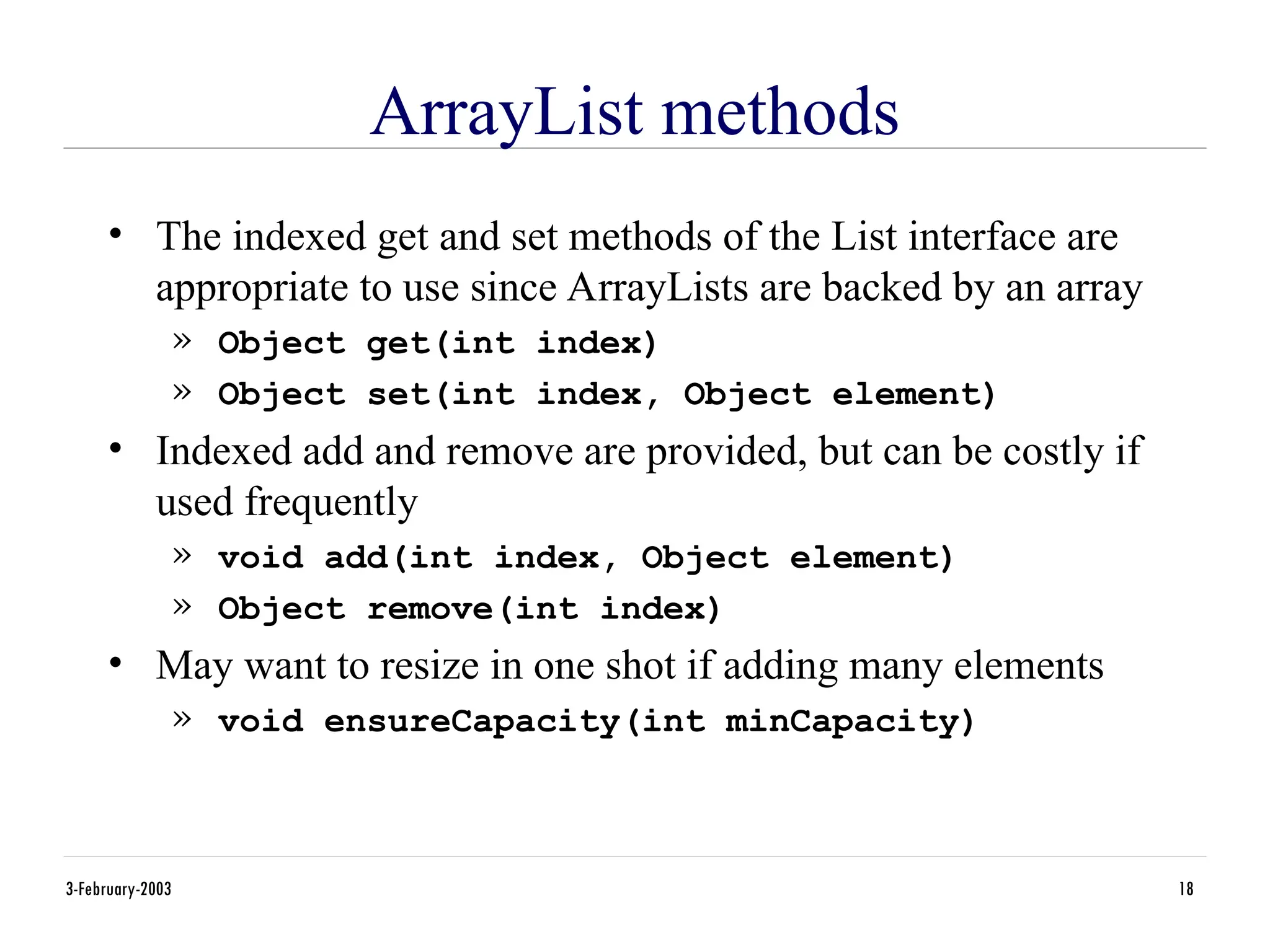
ArrayList methods
• The indexed get and set methods of the List interface are
appropriate to use since ArrayLists are backed by an array
» Object get(int index)
» Object set(int index, Object element)
• Indexed add and remove are provided, but can be costly if
used frequently
» void add(int index, Object element)
» Object remove(int index)
• May want to resize in one shot if adding many elements
» void ensureCapacity(int minCapacity)
3-February-2003 19
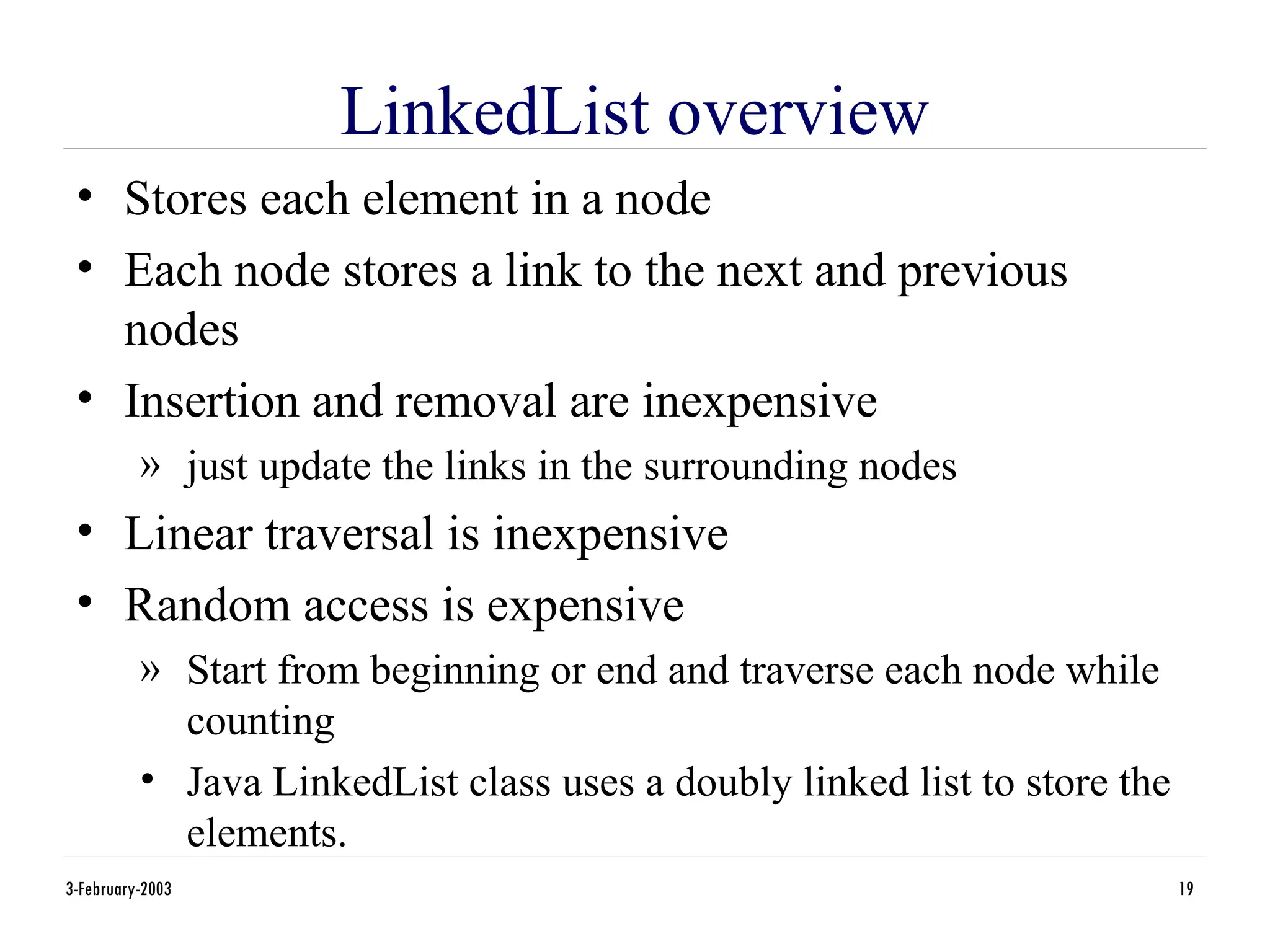
LinkedList overview
• Stores each element in a node
• Each node stores a link to the next and previous
nodes
• Insertion and removal are inexpensive
» just update the links in the surrounding nodes
• Linear traversal is inexpensive
• Random access is expensive
» Start from beginning or end and traverse each node while
counting
• Java LinkedList class uses a doubly linked list to store the
elements.
3-February-2003 20
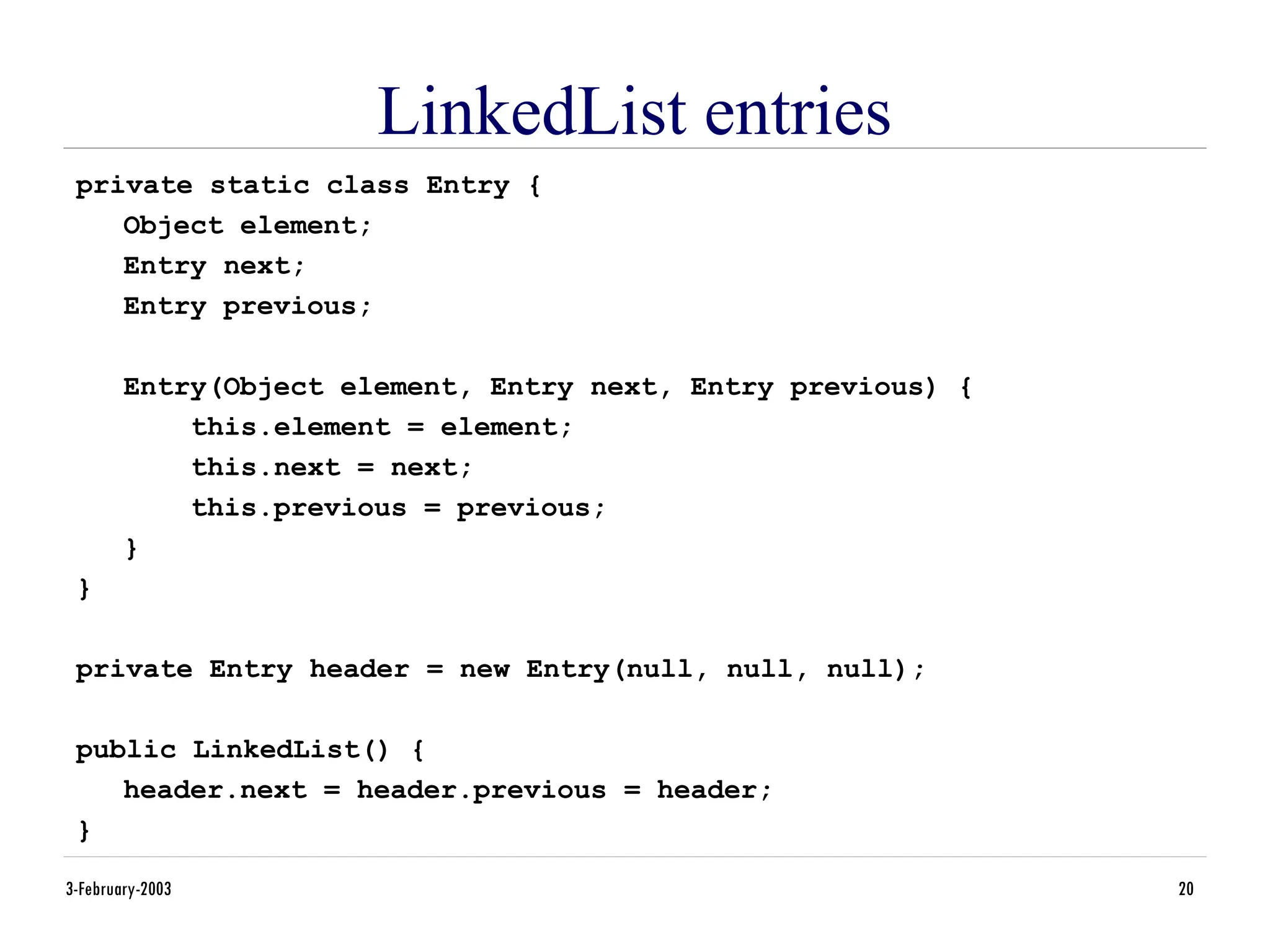
LinkedList entries
private static class Entry {
Object element;
Entry next;
Entry previous;
Entry(Object element, Entry next, Entry previous) {
this.element = element;
this.next = next;
this.previous = previous;
}
}
private Entry header = new Entry(null, null, null);
public LinkedList() {
header.next = header.previous = header;
}
3-February-2003 21
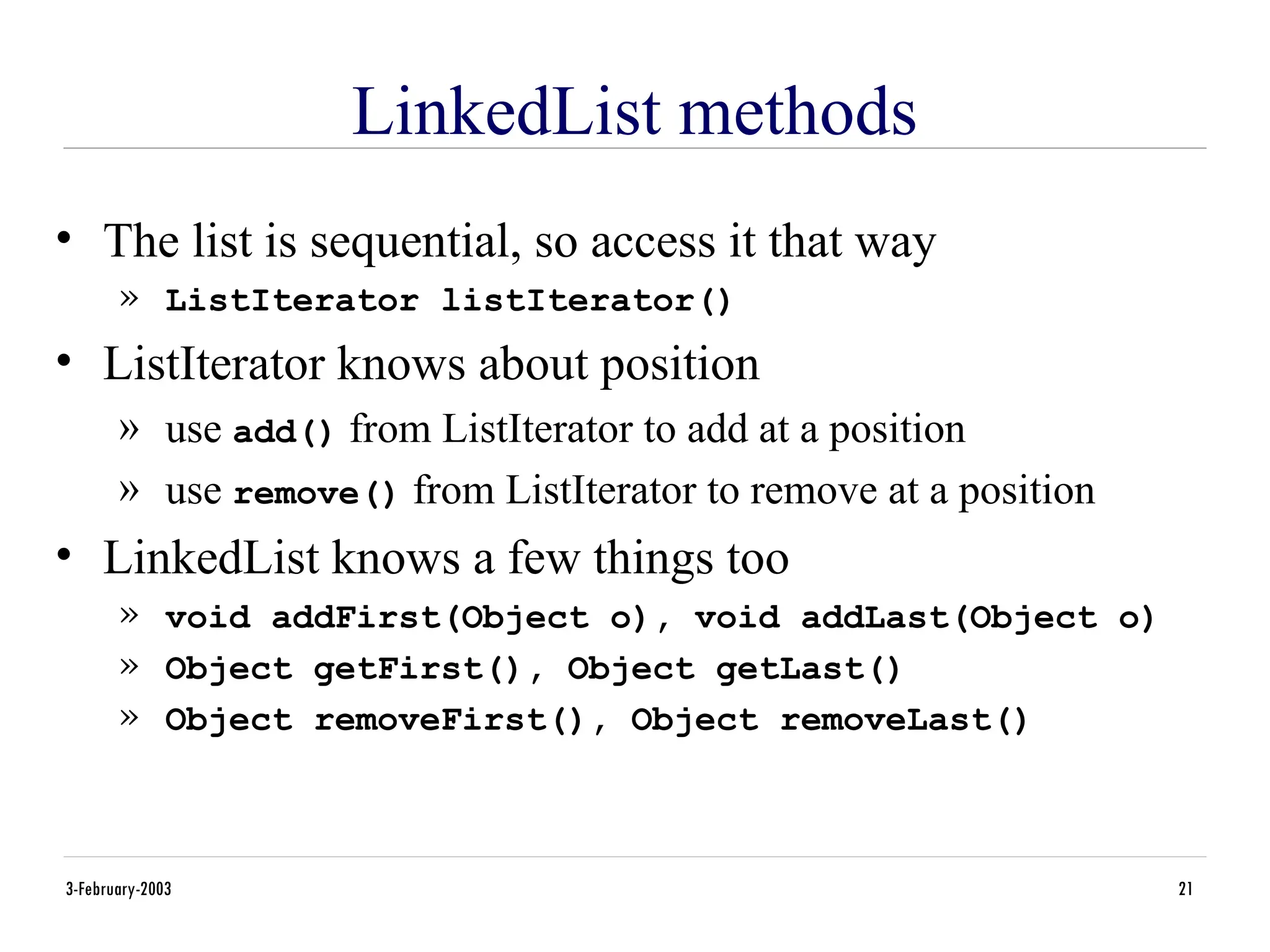
LinkedList methods
• The list is sequential, so access it that way
» ListIterator listIterator()
• ListIterator knows about position
» use add() from ListIterator to add at a position
» use remove() from ListIterator to remove at a position
• LinkedList knows a few things too
» void addFirst(Object o), void addLast(Object o)
» Object getFirst(), Object getLast()
» Object removeFirst(), Object removeLast()
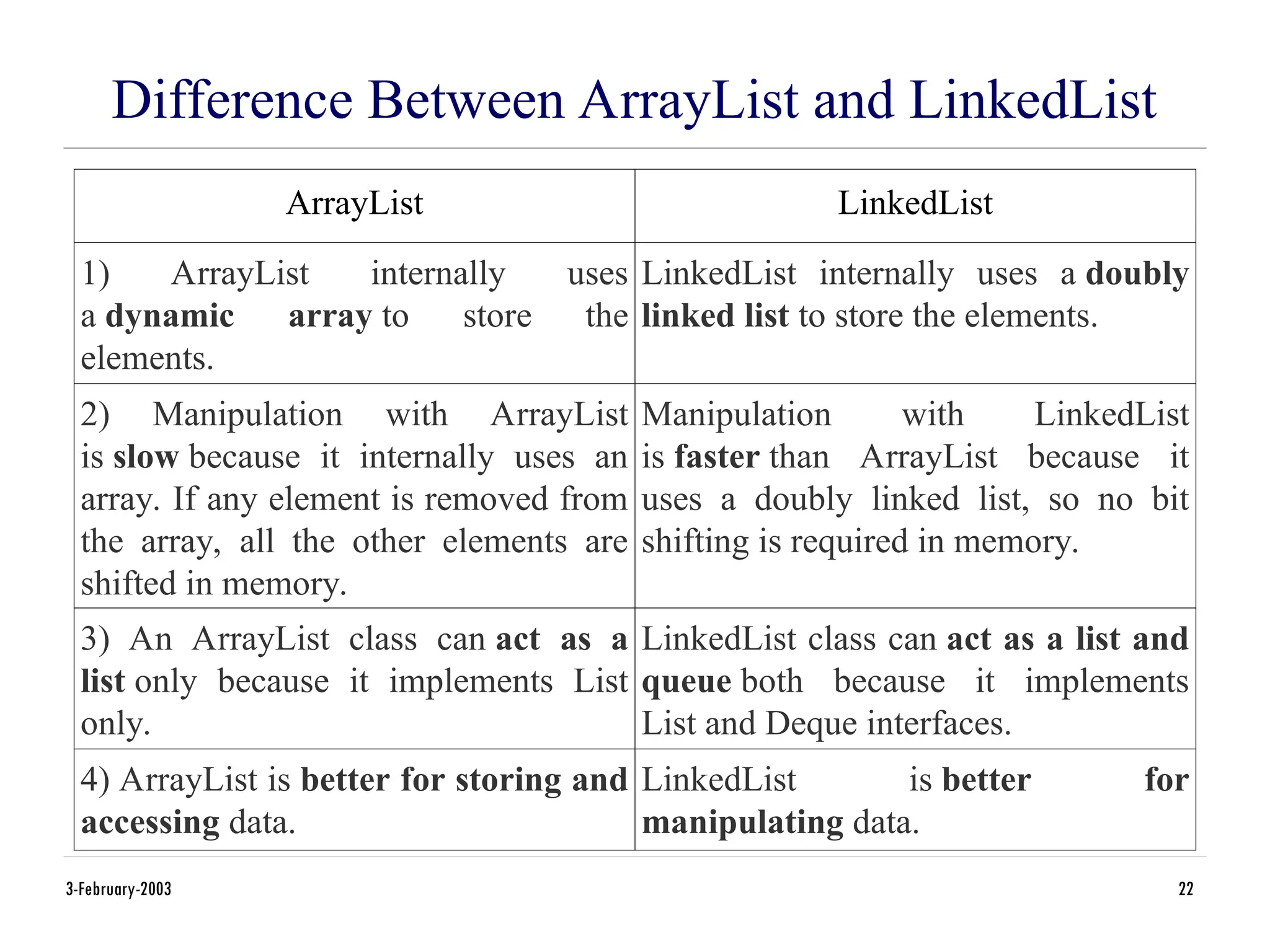
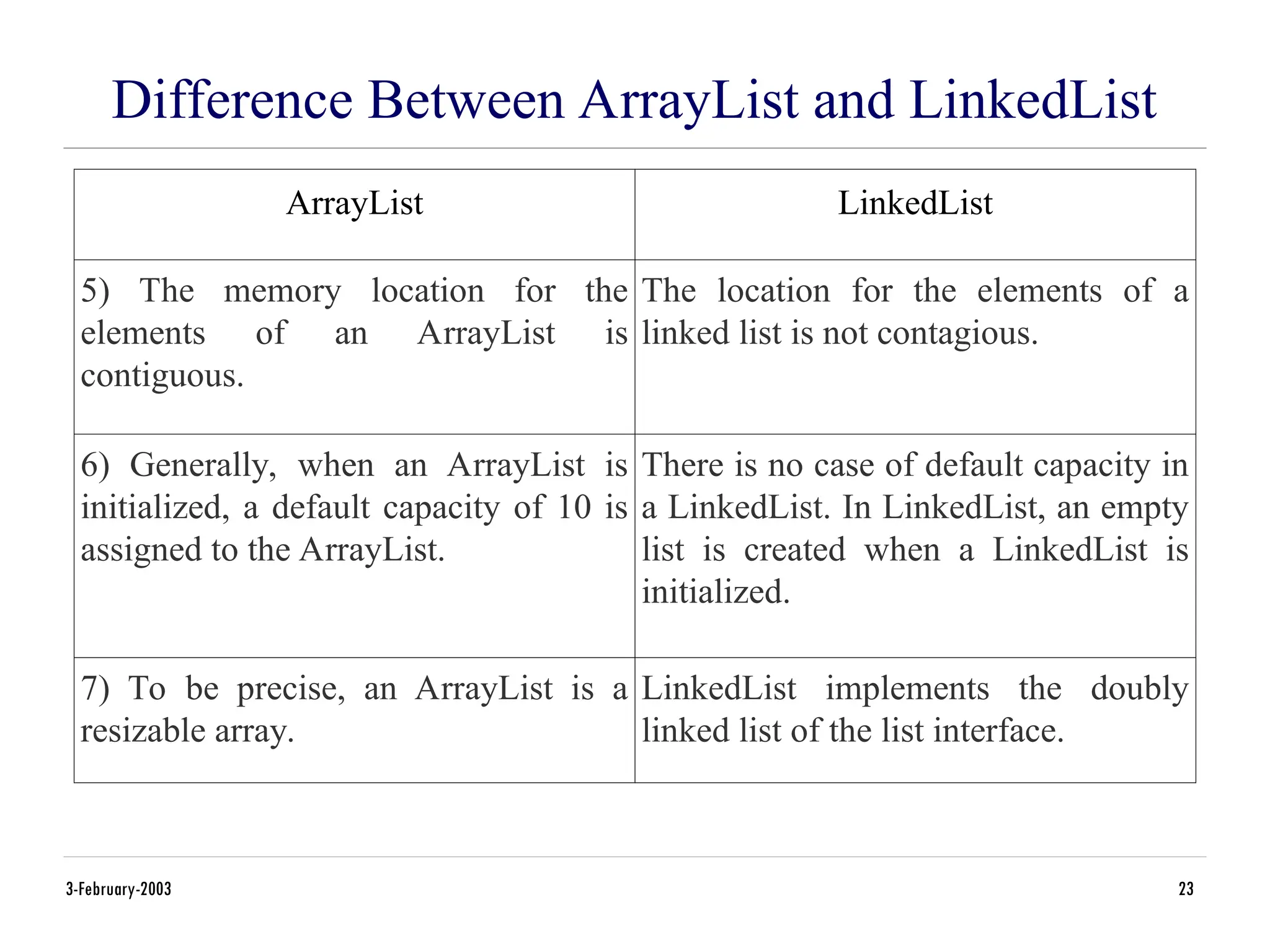
Difference Between ArrayList and LinkedList
3-February-2003 22
ArrayList LinkedList
1) ArrayList internally uses
a dynamic array to store the
elements.
LinkedList internally uses a doubly
linked list to store the elements.
2) Manipulation with ArrayList
is slow because it internally uses an
array. If any element is removed from
the array, all the other elements are
shifted in memory.
Manipulation with LinkedList
is faster than ArrayList because it
uses a doubly linked list, so no bit
shifting is required in memory.
3) An ArrayList class can act as a
list only because it implements List
only.
LinkedList class can act as a list and
queue both because it implements
List and Deque interfaces.
4) ArrayList is better for storing and
accessing data.
LinkedList is better for
manipulating data.
Difference Between ArrayList and LinkedList
3-February-2003 23
ArrayList LinkedList
5) The memory location for the
elements of an ArrayList is
contiguous.
The location for the elements of a
linked list is not contagious.
6) Generally, when an ArrayList is
initialized, a default capacity of 10 is
assigned to the ArrayList.
There is no case of default capacity in
a LinkedList. In LinkedList, an empty
list is created when a LinkedList is
initialized.
7) To be precise, an ArrayList is a
resizable array.
LinkedList implements the doubly
linked list of the list interface.
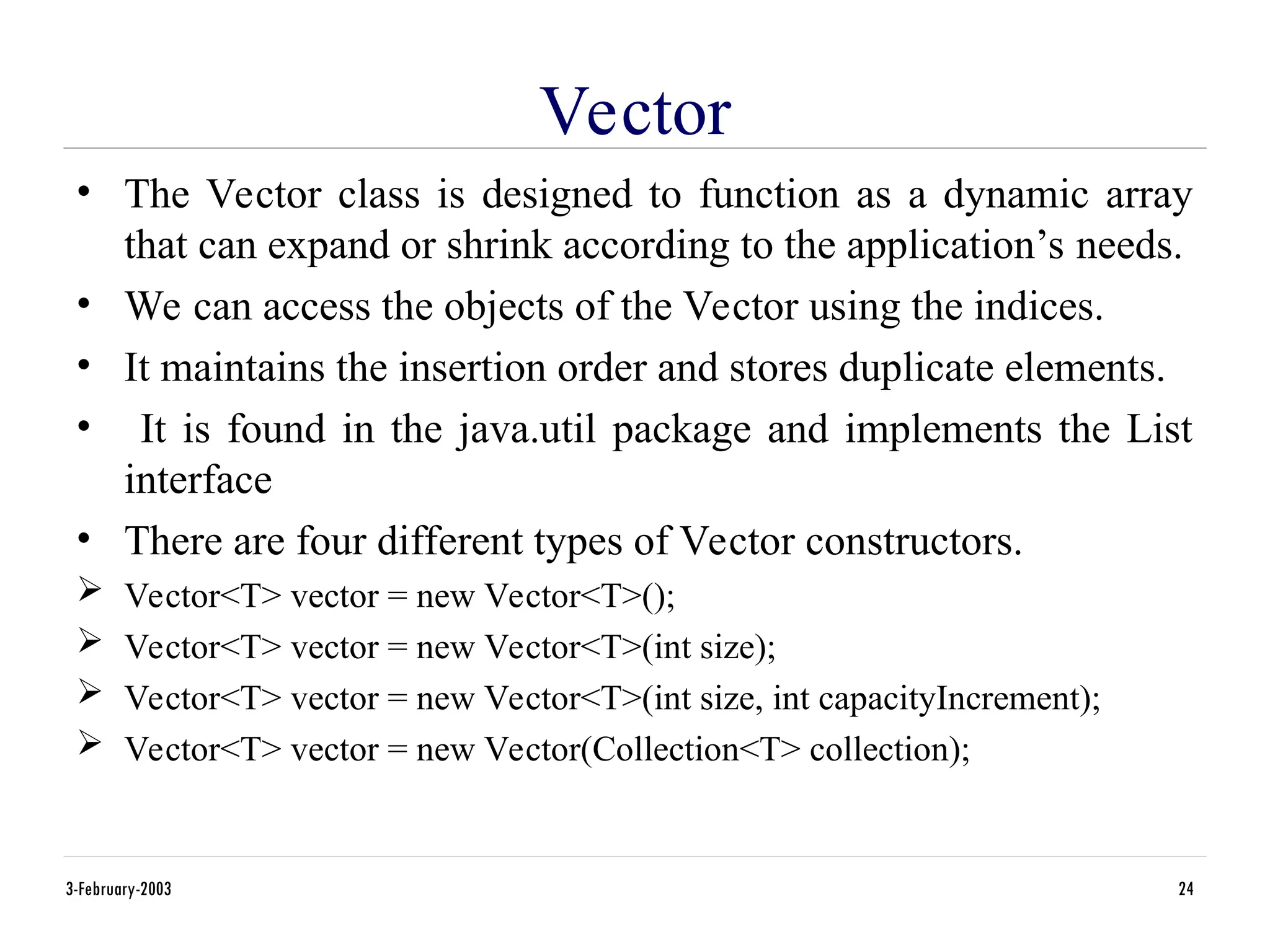
Vector
• The Vector class is designed to function as a dynamic array
that can expand or shrink according to the application’s needs.
• We can access the objects of the Vector using the indices.
• It maintains the insertion order and stores duplicate elements.
• It is found in the java.util package and implements the List
interface
• There are four different types of Vector constructors.
 Vector<T> vector = new Vector<T>();
 Vector<T> vector = new Vector<T>(int size);
 Vector<T> vector = new Vector<T>(int size, int capacityIncrement);
 Vector<T> vector = new Vector(Collection<T> collection);
3-February-2003 24
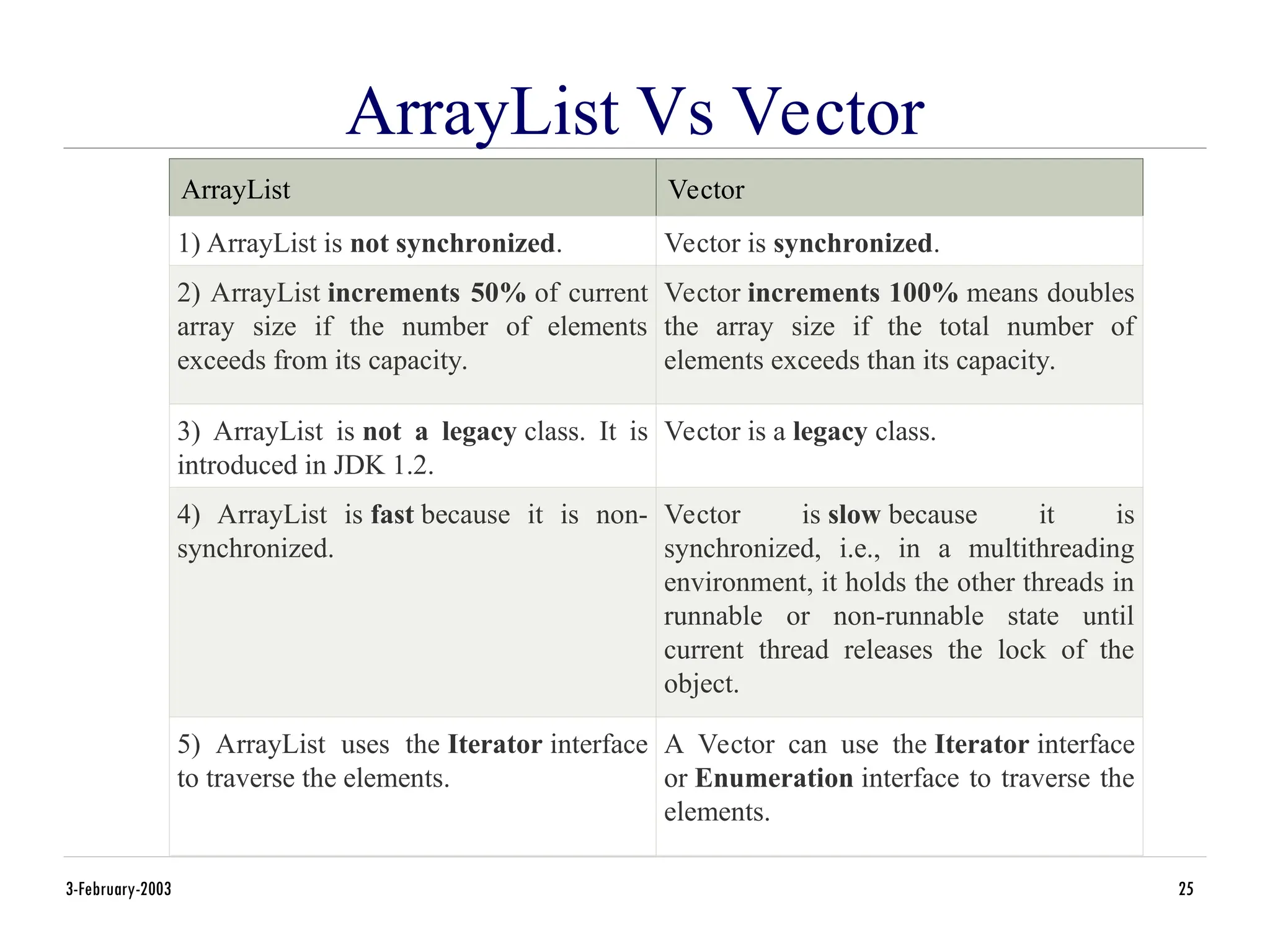
ArrayList Vs Vector
3-February-2003 25
ArrayList Vector
1) ArrayList is not synchronized. Vector is synchronized.
2) ArrayList increments 50% of current
array size if the number of elements
exceeds from its capacity.
Vector increments 100% means doubles
the array size if the total number of
elements exceeds than its capacity.
3) ArrayList is not a legacy class. It is
introduced in JDK 1.2.
Vector is a legacy class.
4) ArrayList is fast because it is non-
synchronized.
Vector is slow because it is
synchronized, i.e., in a multithreading
environment, it holds the other threads in
runnable or non-runnable state until
current thread releases the lock of the
object.
5) ArrayList uses the Iterator interface
to traverse the elements.
A Vector can use the Iterator interface
or Enumeration interface to traverse the
elements.
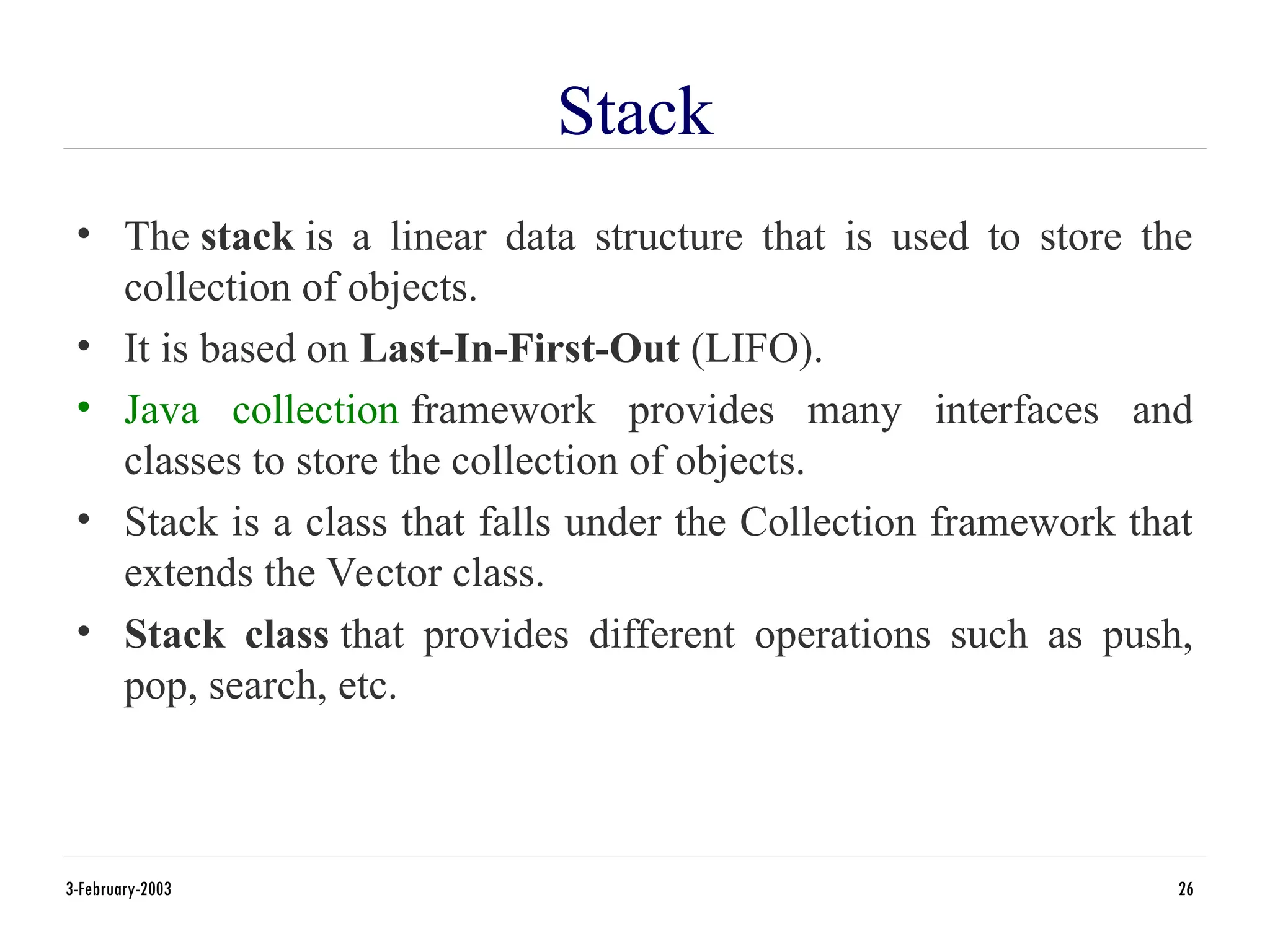
Stack
• The stack is a linear data structure that is used to store the
collection of objects.
• It is based on Last-In-First-Out (LIFO).
• Java collection framework provides many interfaces and
classes to store the collection of objects.
• Stack is a class that falls under the Collection framework that
extends the Vector class.
• Stack class that provides different operations such as push,
pop, search, etc.
3-February-2003 26
Set Interface
3-February-2003 27
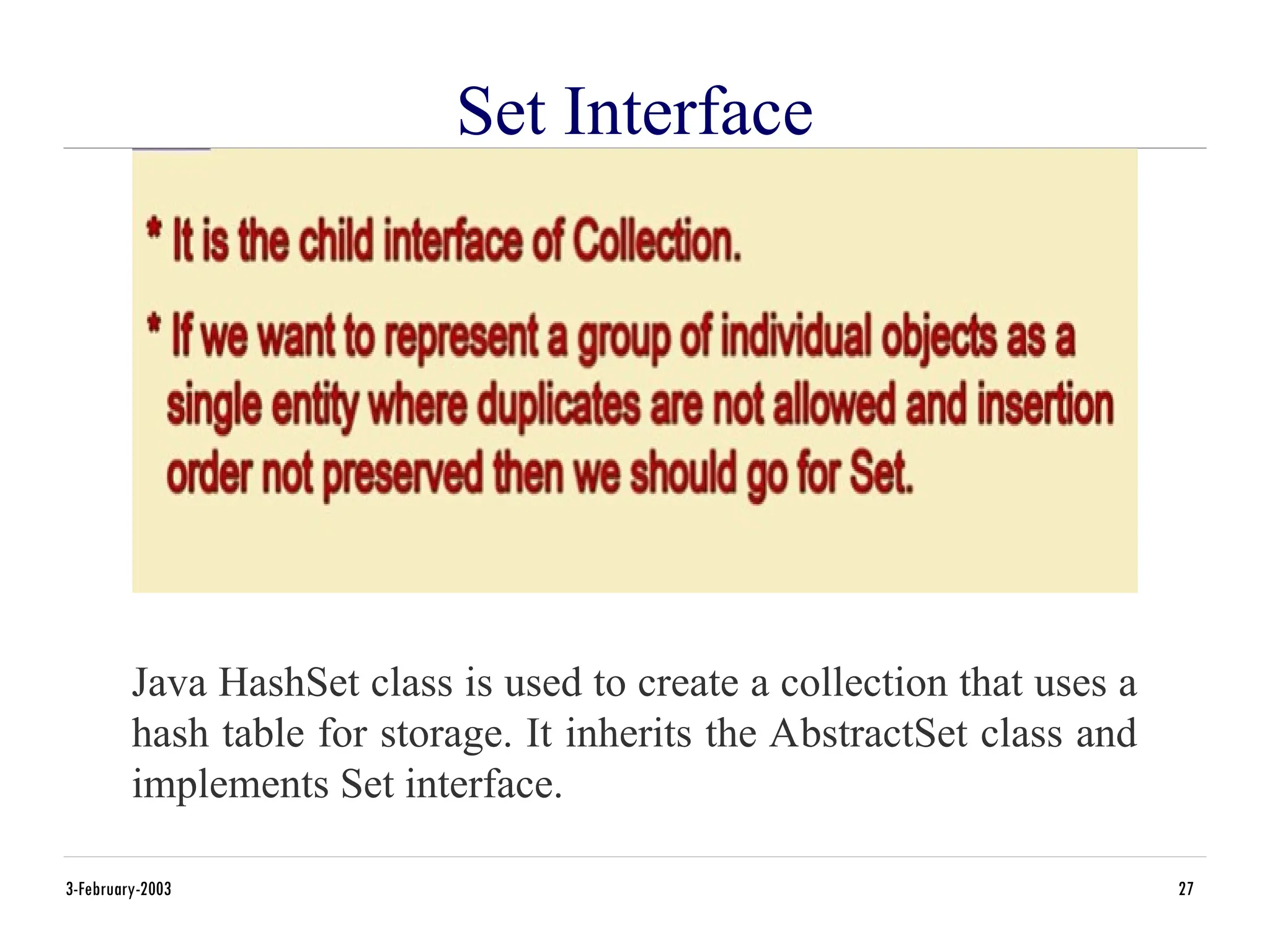
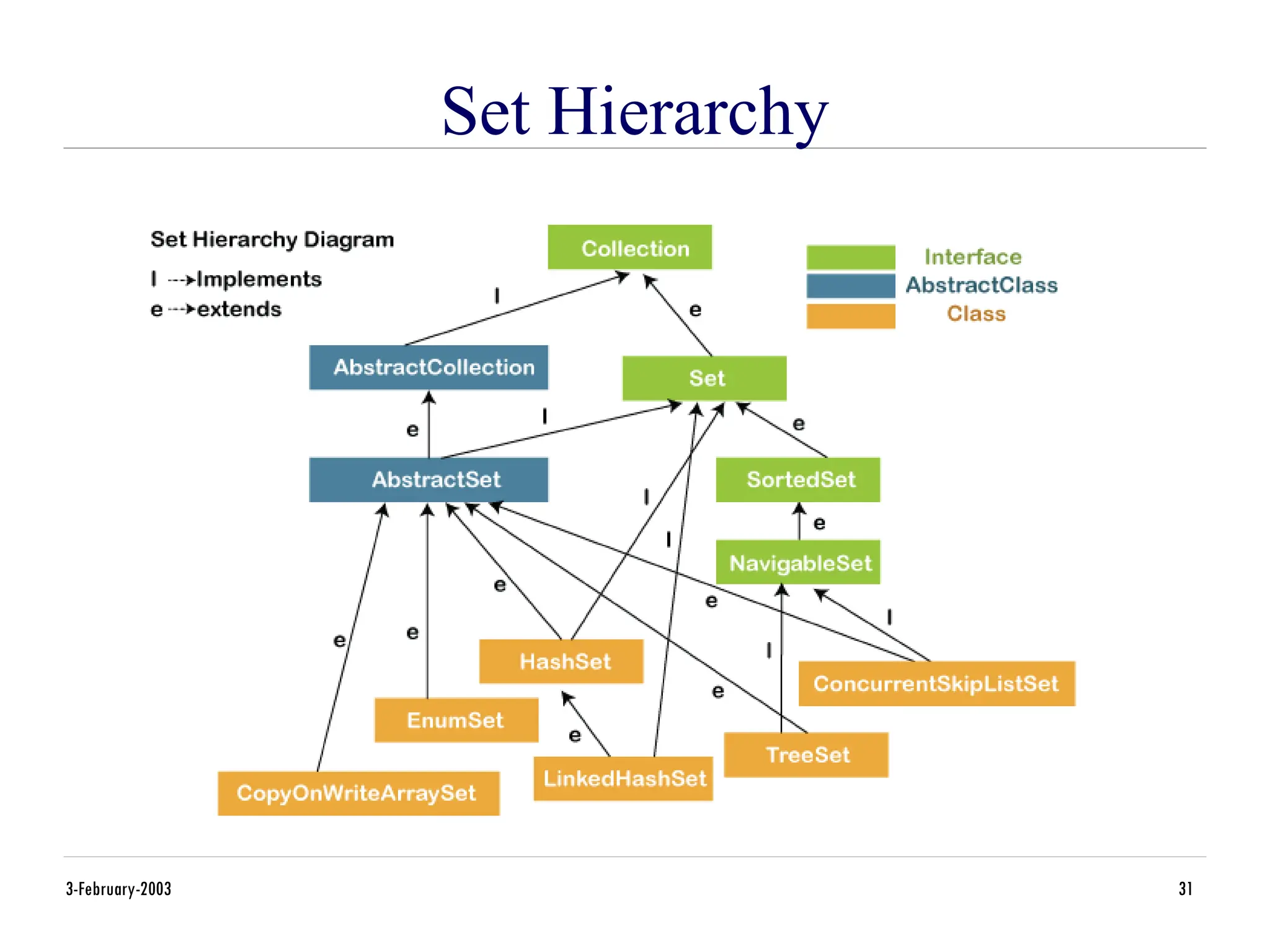
Java HashSet class is used to create a collection that uses a
hash table for storage. It inherits the AbstractSet class and
implements Set interface.
Set Interface
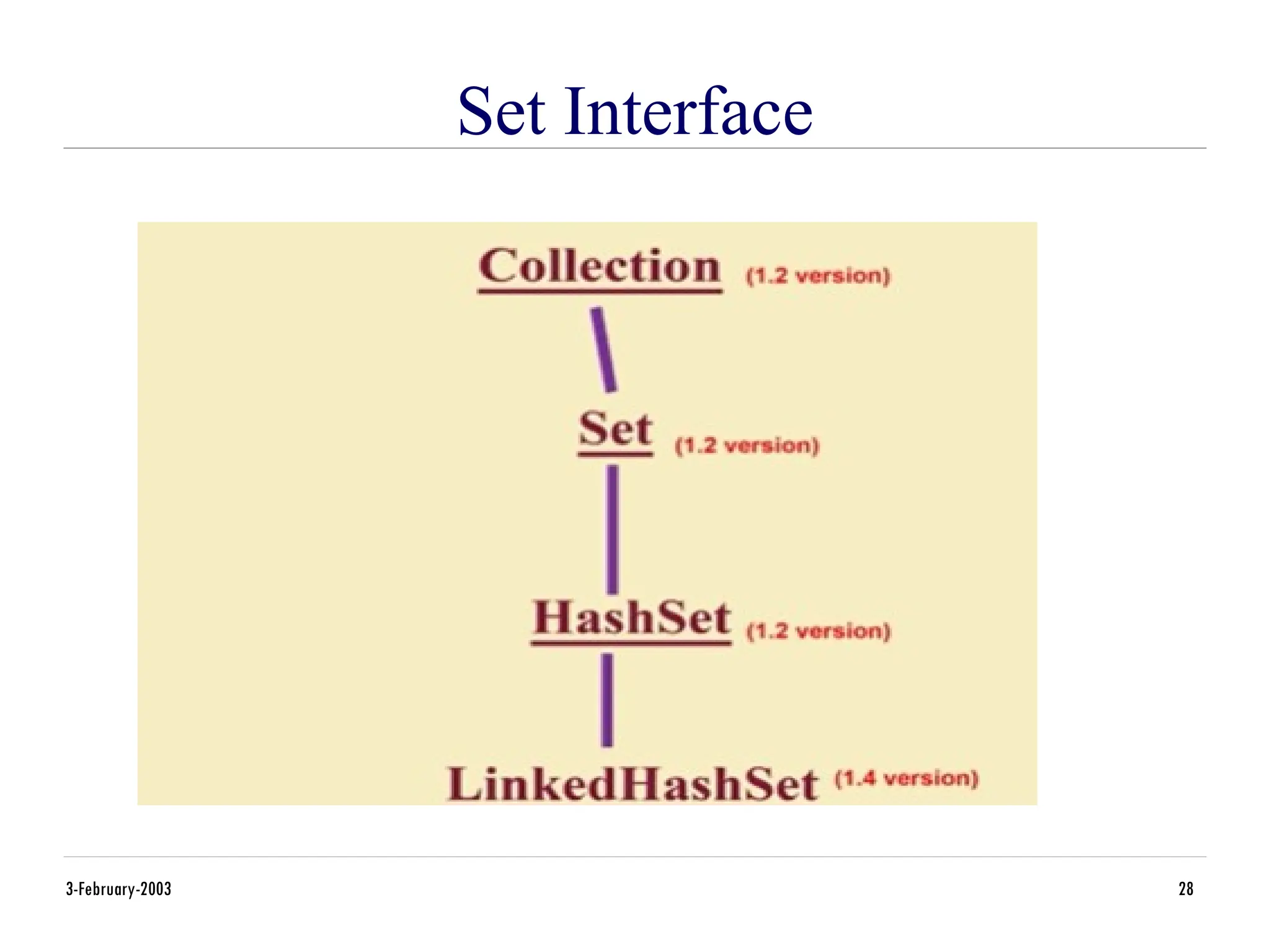
3-February-2003 28
3-February-2003 29
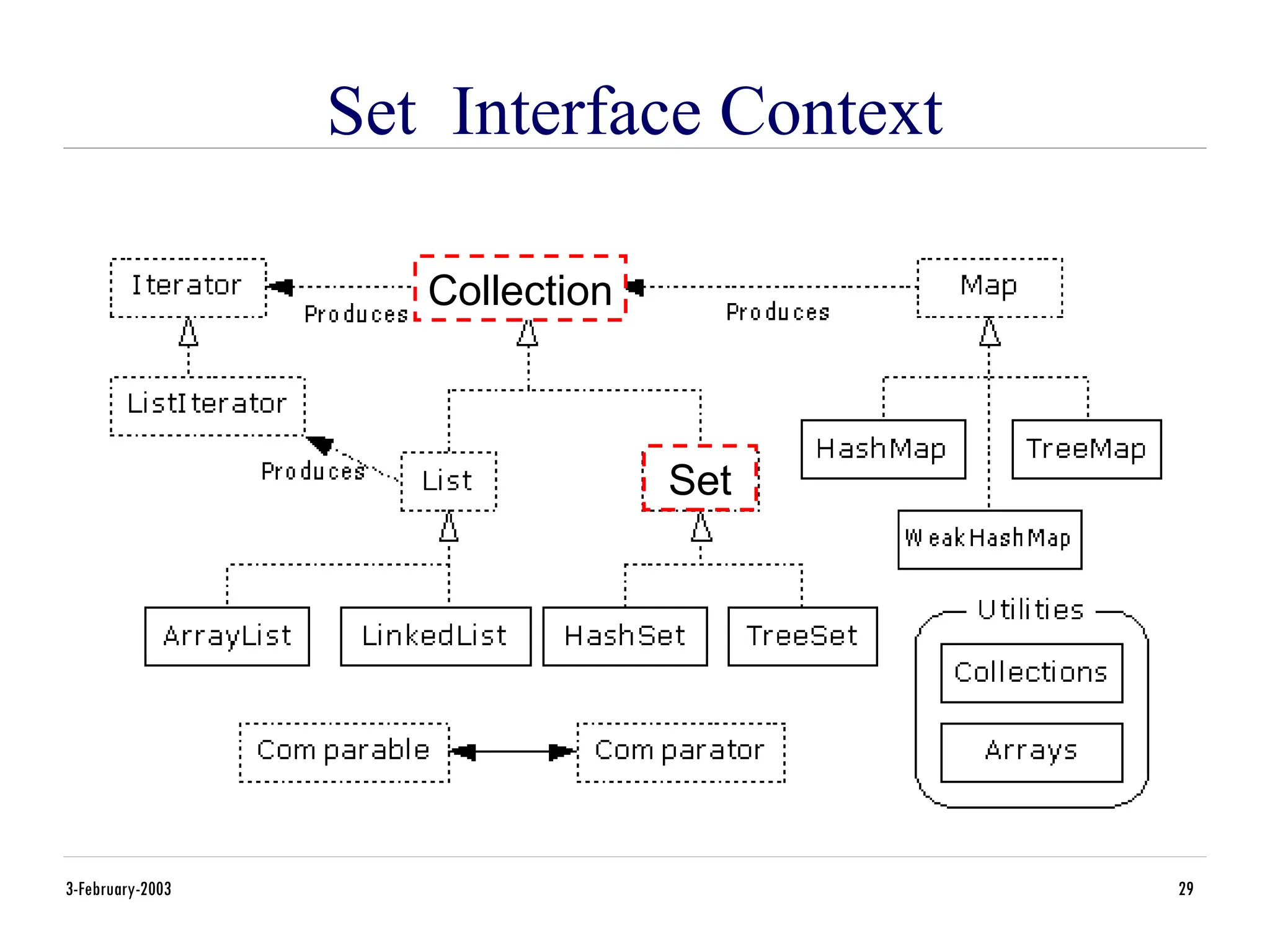
Set Interface Context
Collection
Set
3-February-2003 30
Set Interface
• Same methods as Collection
» different contract - no duplicate entries
• Defines two fundamental methods
» boolean add(Object o) - reject duplicates
» Iterator iterator()
• Provides an Iterator to step through the elements
in the Set
» No guaranteed order in the basic Set interface
» There is a SortedSet interface that extends Set
Set Hierarchy
3-February-2003 31
3-February-2003 32
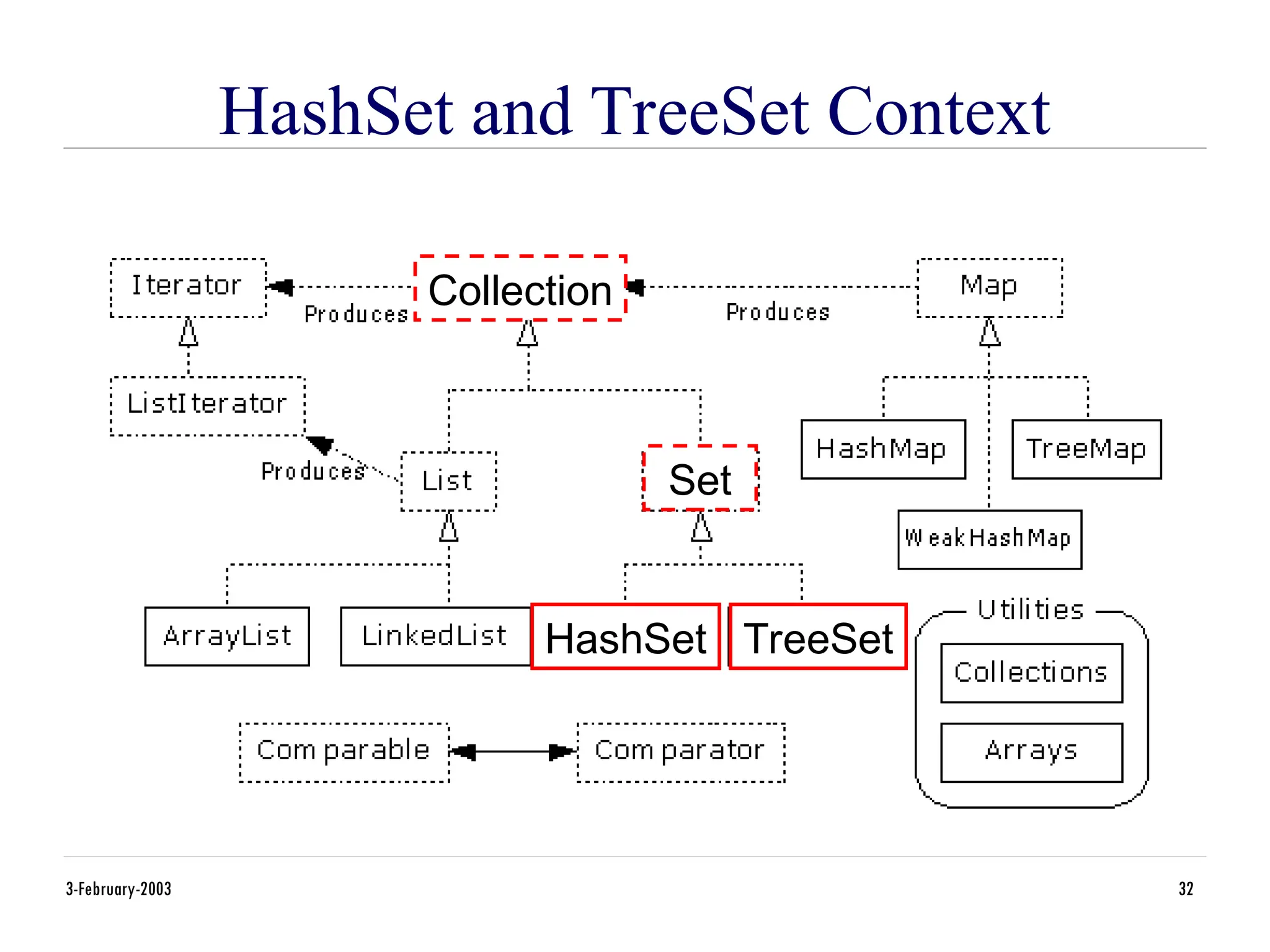
HashSet and TreeSet Context
HashSet TreeSet
Collection
Set
3-February-2003 33
HashSet
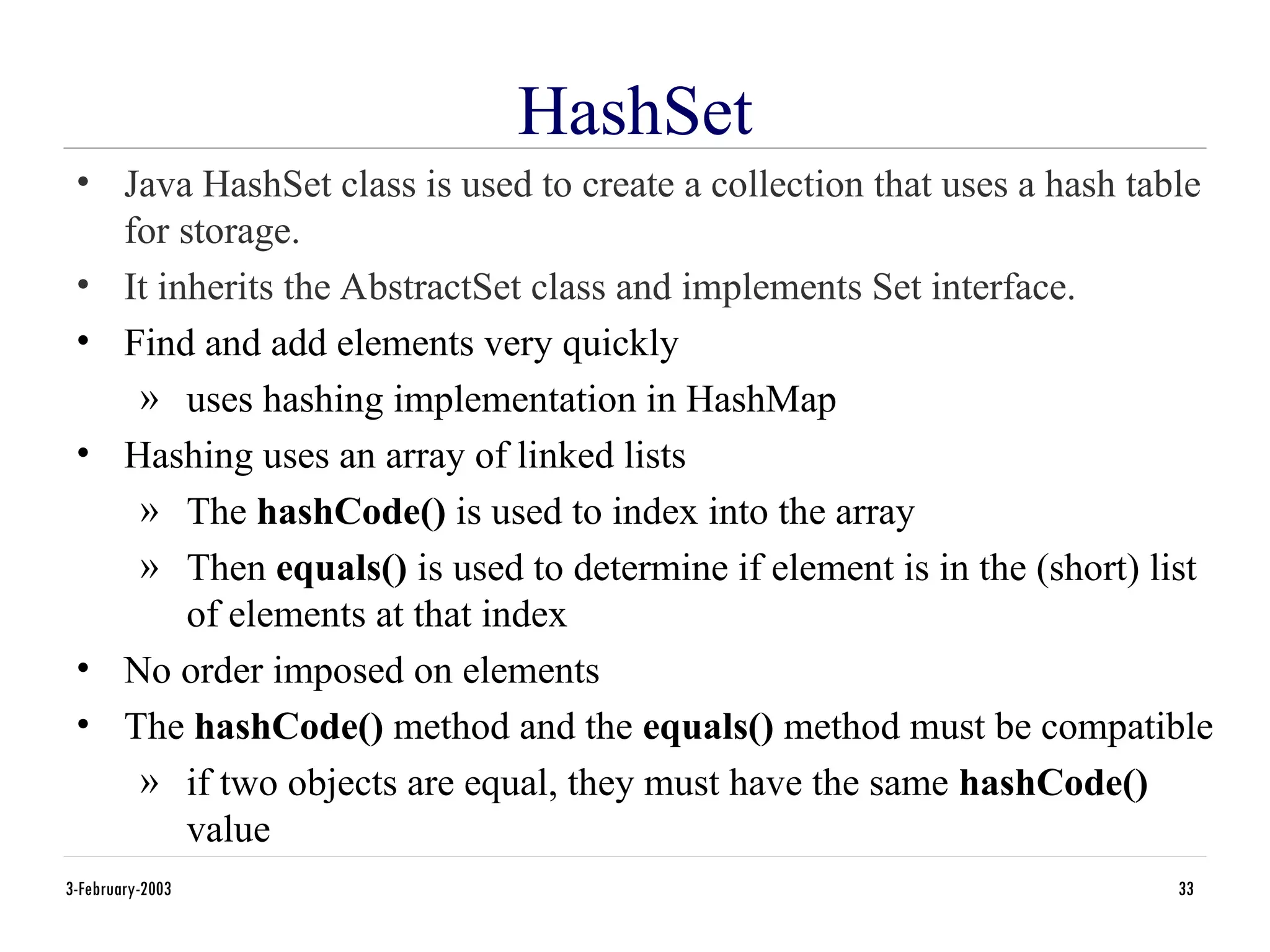
• Java HashSet class is used to create a collection that uses a hash table
for storage.
• It inherits the AbstractSet class and implements Set interface.
• Find and add elements very quickly
» uses hashing implementation in HashMap
• Hashing uses an array of linked lists
» The hashCode() is used to index into the array
» Then equals() is used to determine if element is in the (short) list
of elements at that index
• No order imposed on elements
• The hashCode() method and the equals() method must be compatible
» if two objects are equal, they must have the same hashCode()
value
LinkedHashSet
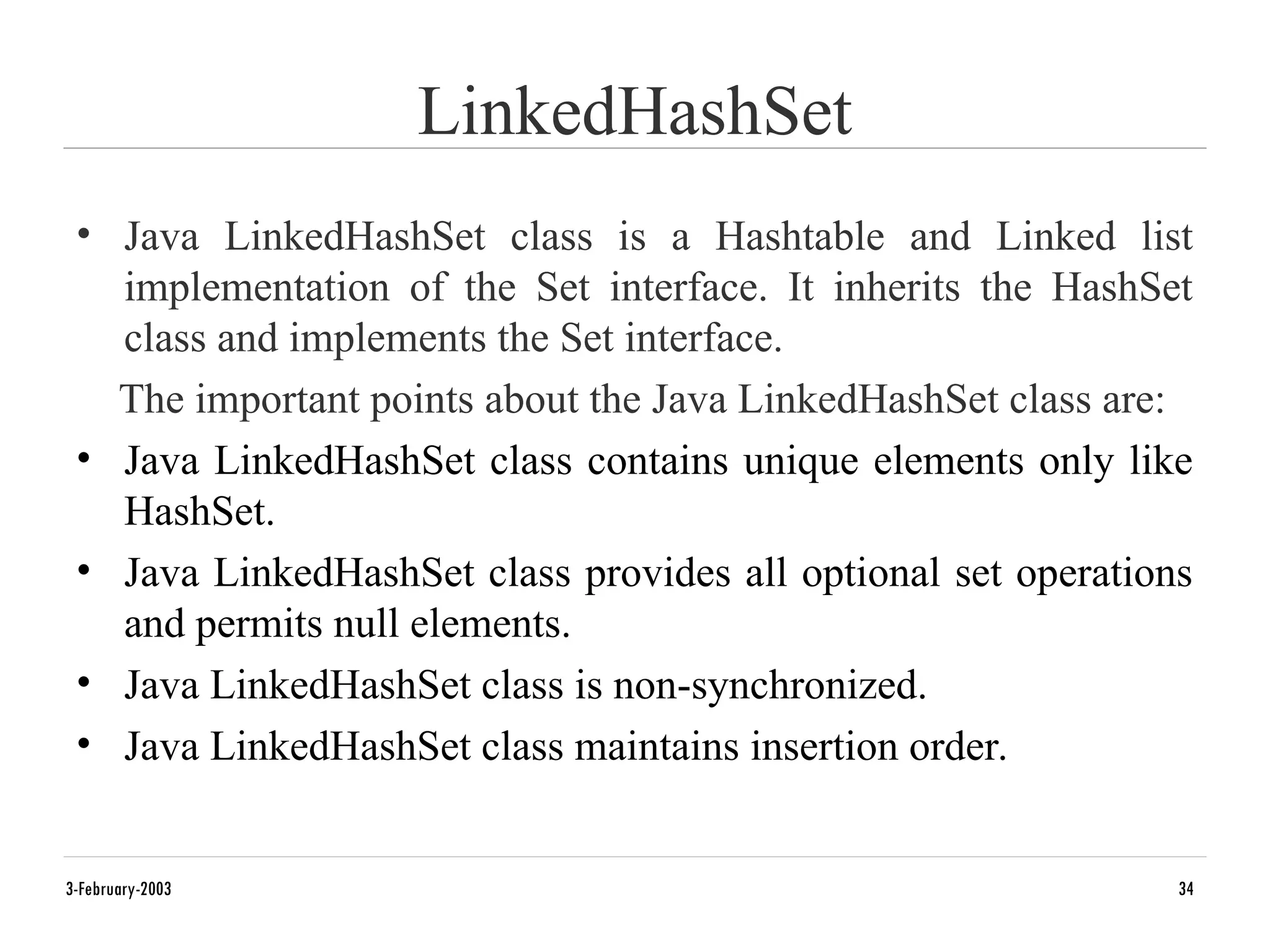
• Java LinkedHashSet class is a Hashtable and Linked list
implementation of the Set interface. It inherits the HashSet
class and implements the Set interface.
The important points about the Java LinkedHashSet class are:
• Java LinkedHashSet class contains unique elements only like
HashSet.
• Java LinkedHashSet class provides all optional set operations
and permits null elements.
• Java LinkedHashSet class is non-synchronized.
• Java LinkedHashSet class maintains insertion order.
3-February-2003 34
3-February-2003 35
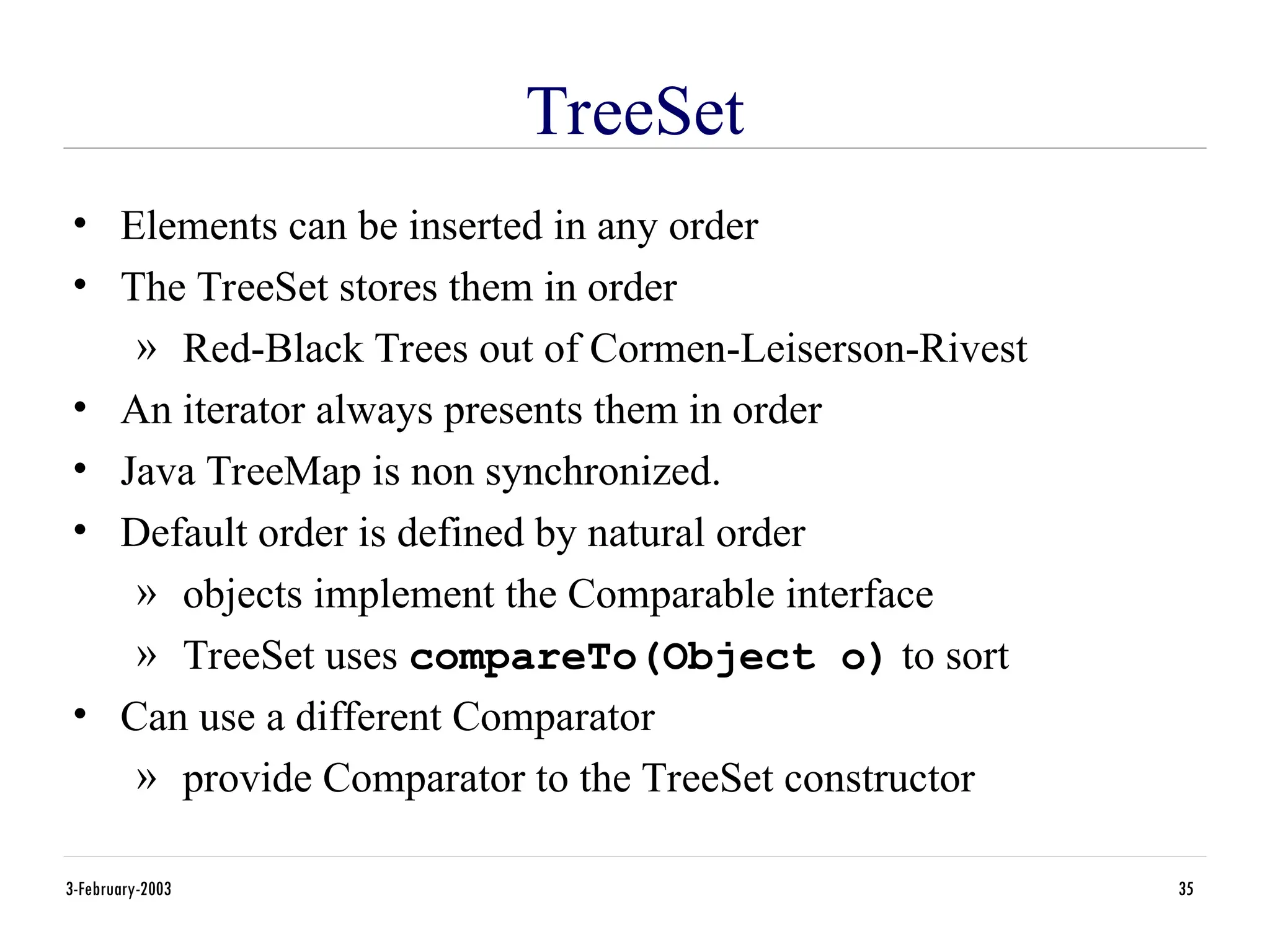
TreeSet
• Elements can be inserted in any order
• The TreeSet stores them in order
» Red-Black Trees out of Cormen-Leiserson-Rivest
• An iterator always presents them in order
• Java TreeMap is non synchronized.
• Default order is defined by natural order
» objects implement the Comparable interface
» TreeSet uses compareTo(Object o) to sort
• Can use a different Comparator
» provide Comparator to the TreeSet constructor
3-February-2003 36
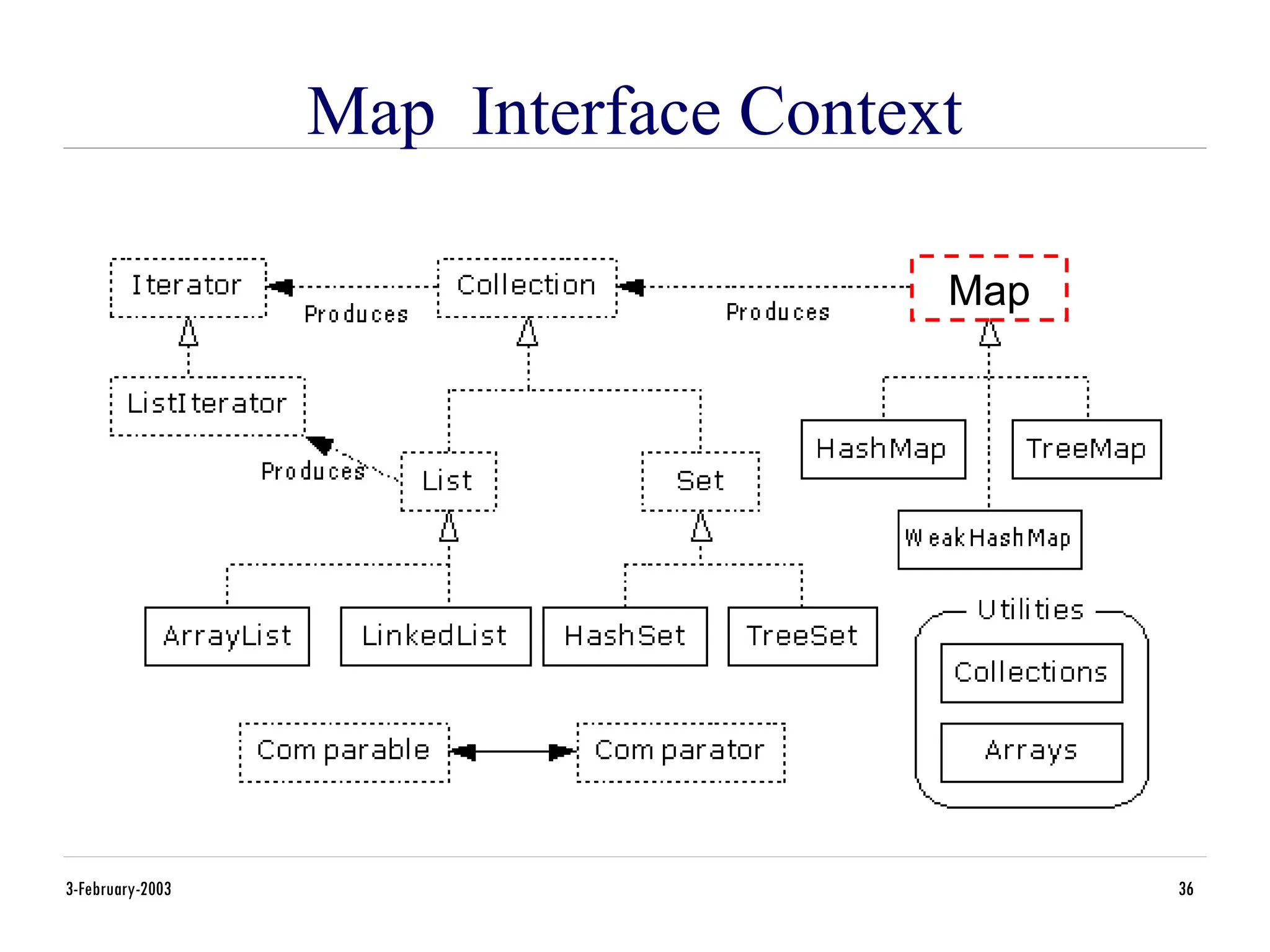
Map Interface Context
Map
3-February-2003 37
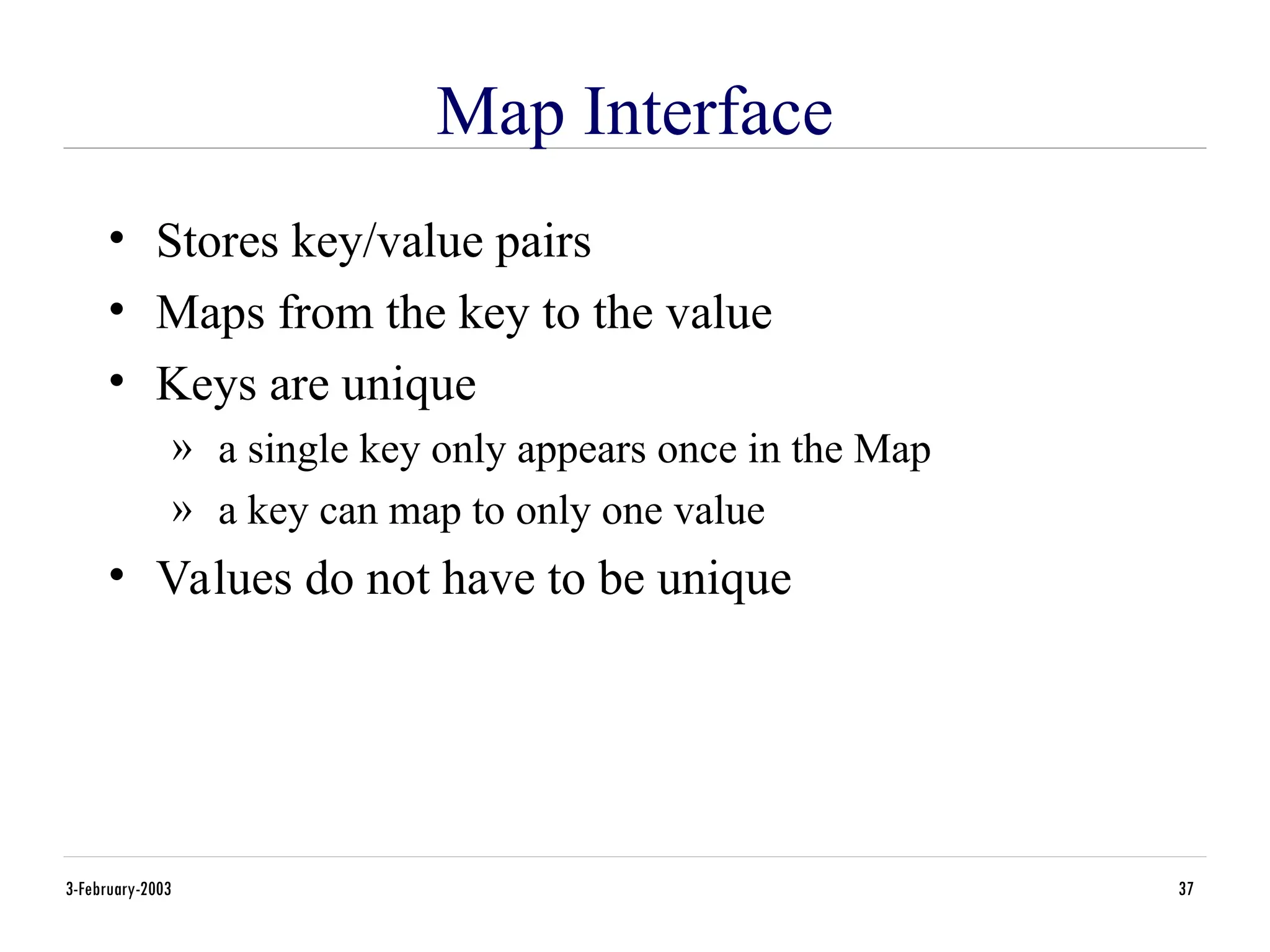
Map Interface
• Stores key/value pairs
• Maps from the key to the value
• Keys are unique
» a single key only appears once in the Map
» a key can map to only one value
• Values do not have to be unique
3-February-2003 38
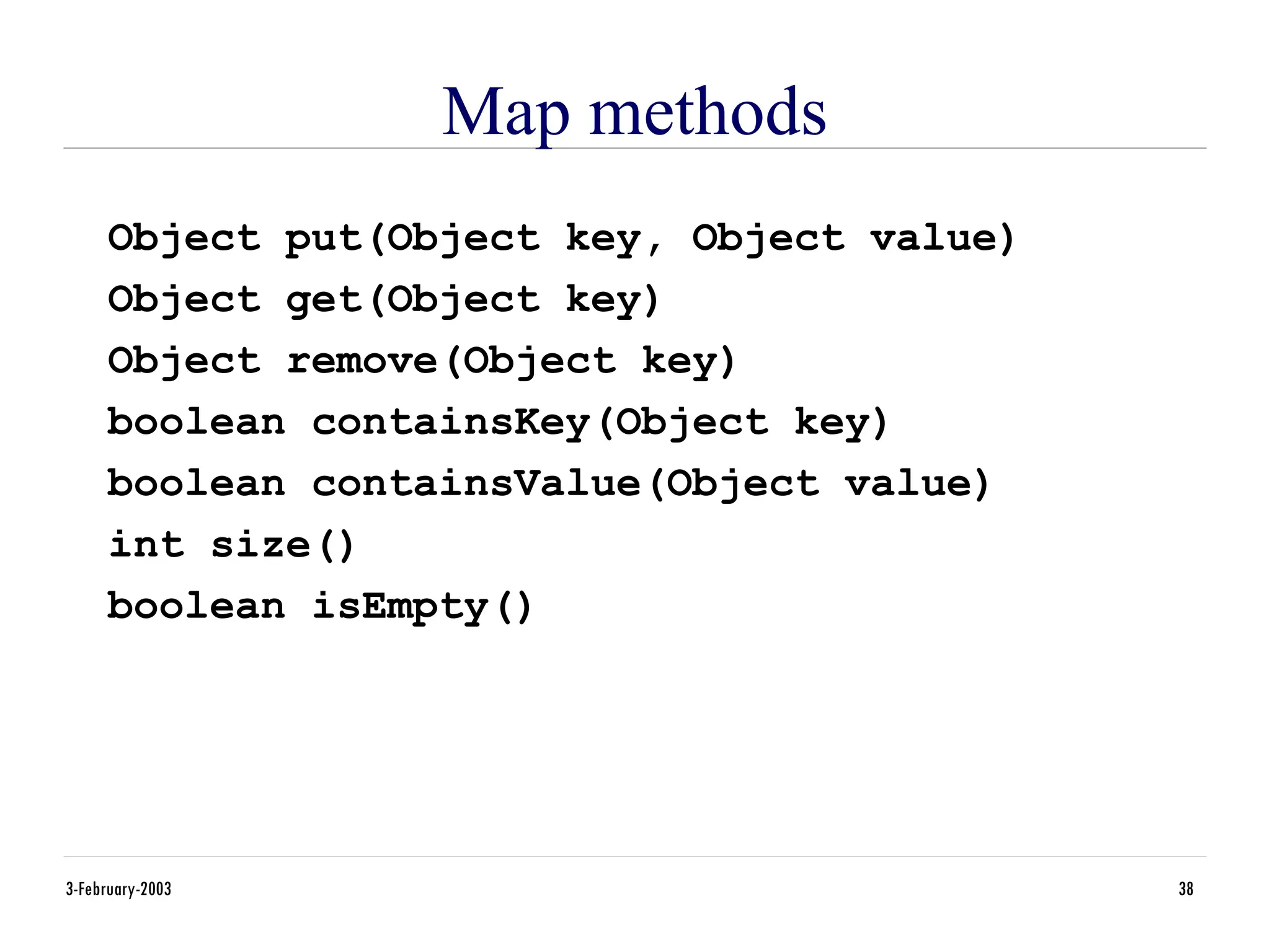
Map methods
Object put(Object key, Object value)
Object get(Object key)
Object remove(Object key)
boolean containsKey(Object key)
boolean containsValue(Object value)
int size()
boolean isEmpty()
3-February-2003 39
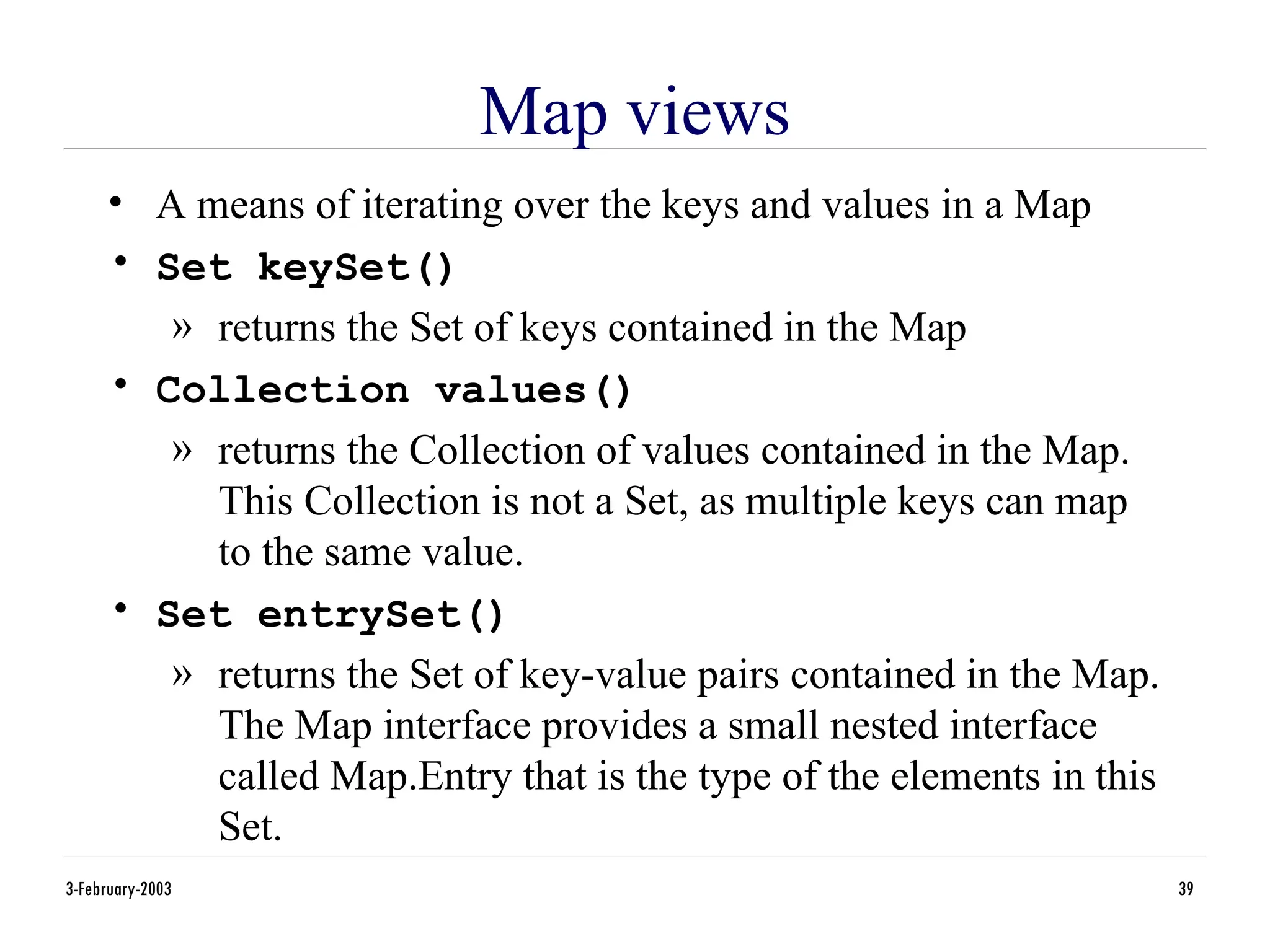
Map views
• A means of iterating over the keys and values in a Map
• Set keySet()
» returns the Set of keys contained in the Map
• Collection values()
» returns the Collection of values contained in the Map.
This Collection is not a Set, as multiple keys can map
to the same value.
• Set entrySet()
» returns the Set of key-value pairs contained in the Map.
The Map interface provides a small nested interface
called Map.Entry that is the type of the elements in this
Set.
3-February-2003 40
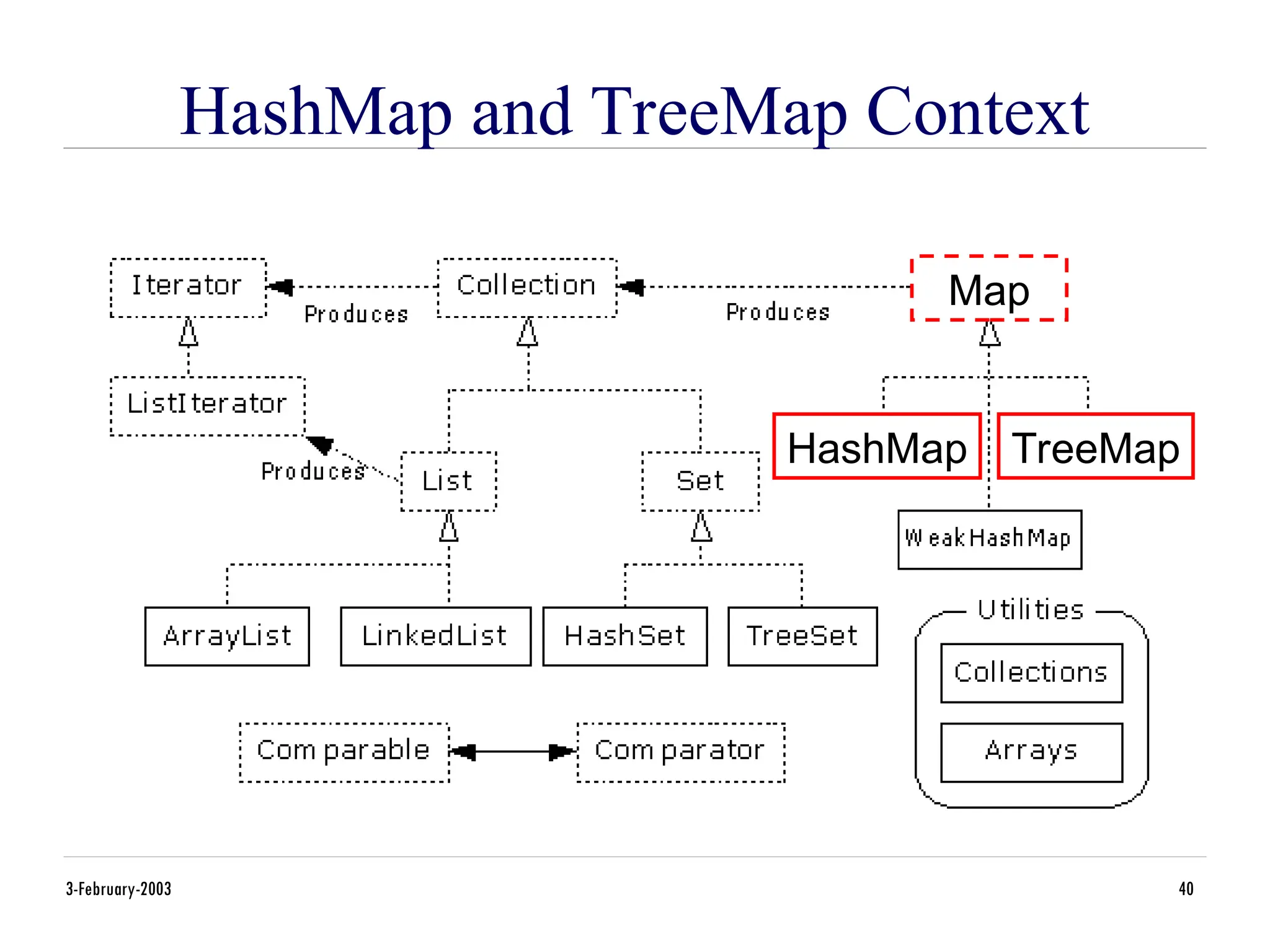
HashMap and TreeMap Context
HashMap TreeMap
Map
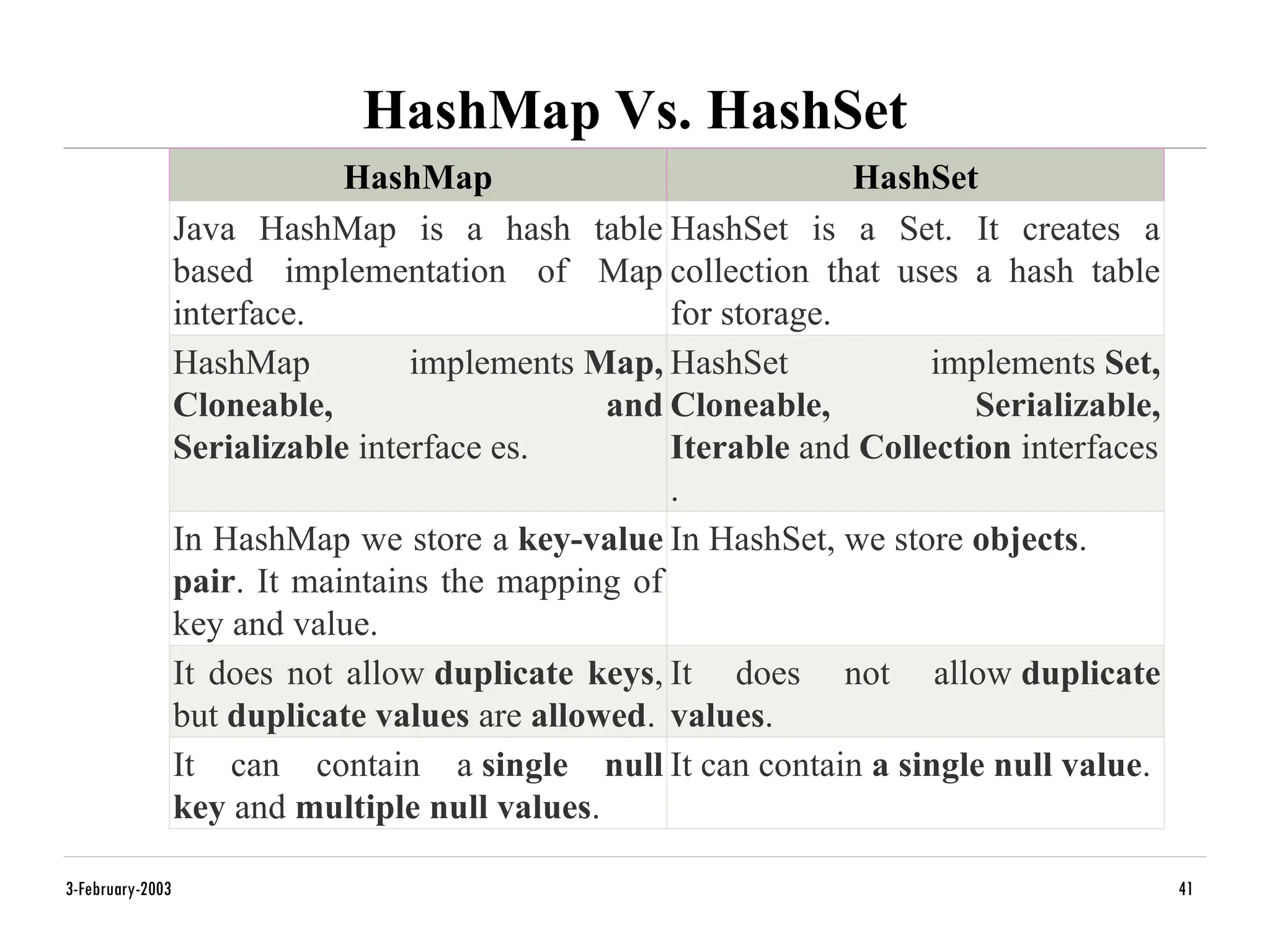
HashMap Vs. HashSet
3-February-2003 41
HashMap HashSet
Java HashMap is a hash table
based implementation of Map
interface.
HashSet is a Set. It creates a
collection that uses a hash table
for storage.
HashMap implements Map,
Cloneable, and
Serializable interface es.
HashSet implements Set,
Cloneable, Serializable,
Iterable and Collection interfaces
.
In HashMap we store a key-value
pair. It maintains the mapping of
key and value.
In HashSet, we store objects.
It does not allow duplicate keys,
but duplicate values are allowed.
It does not allow duplicate
values.
It can contain a single null
key and multiple null values.
It can contain a single null value.
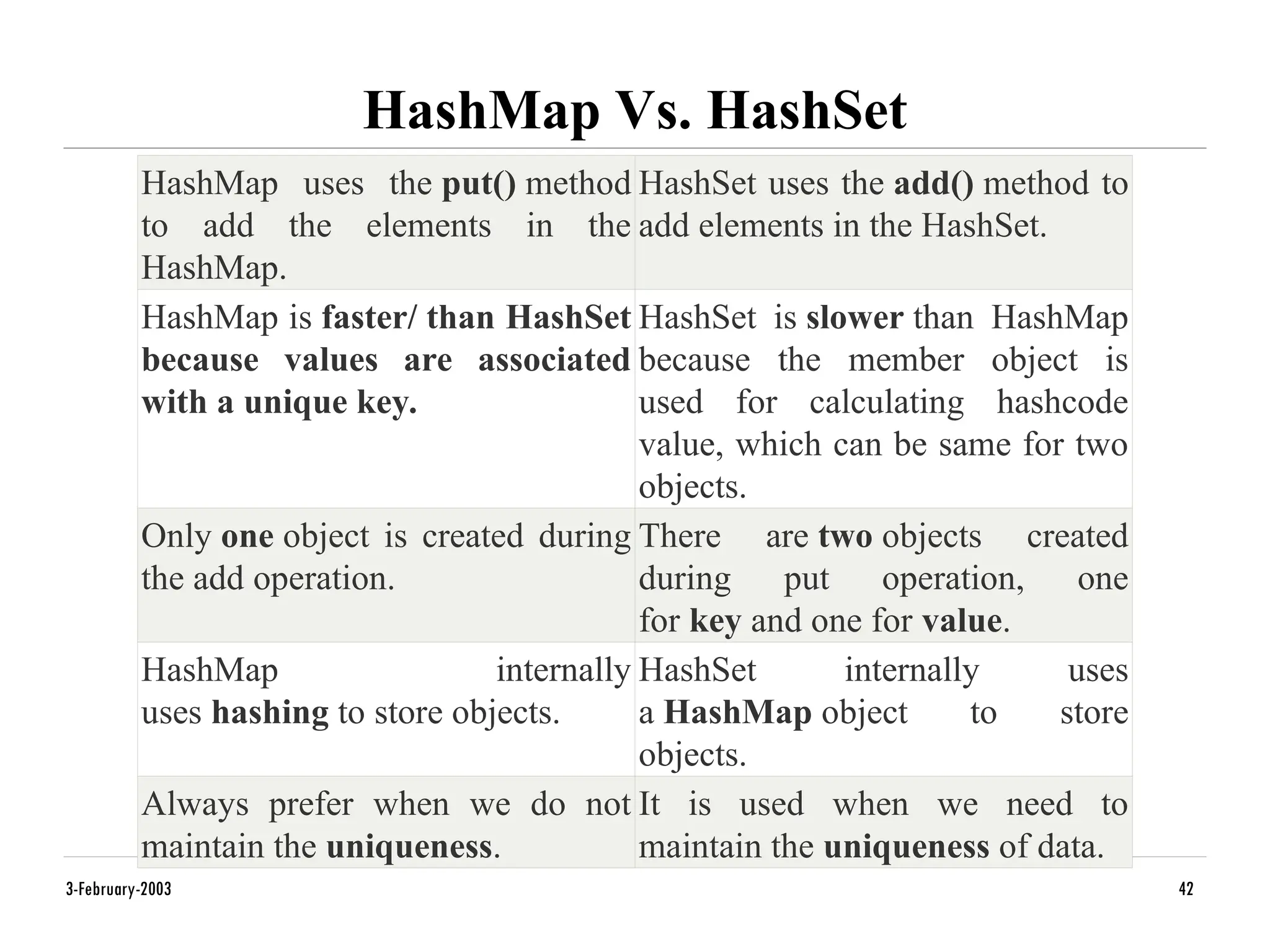
HashMap Vs. HashSet
3-February-2003 42
HashMap uses the put() method
to add the elements in the
HashMap.
HashSet uses the add() method to
add elements in the HashSet.
HashMap is faster/ than HashSet
because values are associated
with a unique key.
HashSet is slower than HashMap
because the member object is
used for calculating hashcode
value, which can be same for two
objects.
Only one object is created during
the add operation.
There are two objects created
during put operation, one
for key and one for value.
HashMap internally
uses hashing to store objects.
HashSet internally uses
a HashMap object to store
objects.
Always prefer when we do not
maintain the uniqueness.
It is used when we need to
maintain the uniqueness of data.
3-February-2003 43
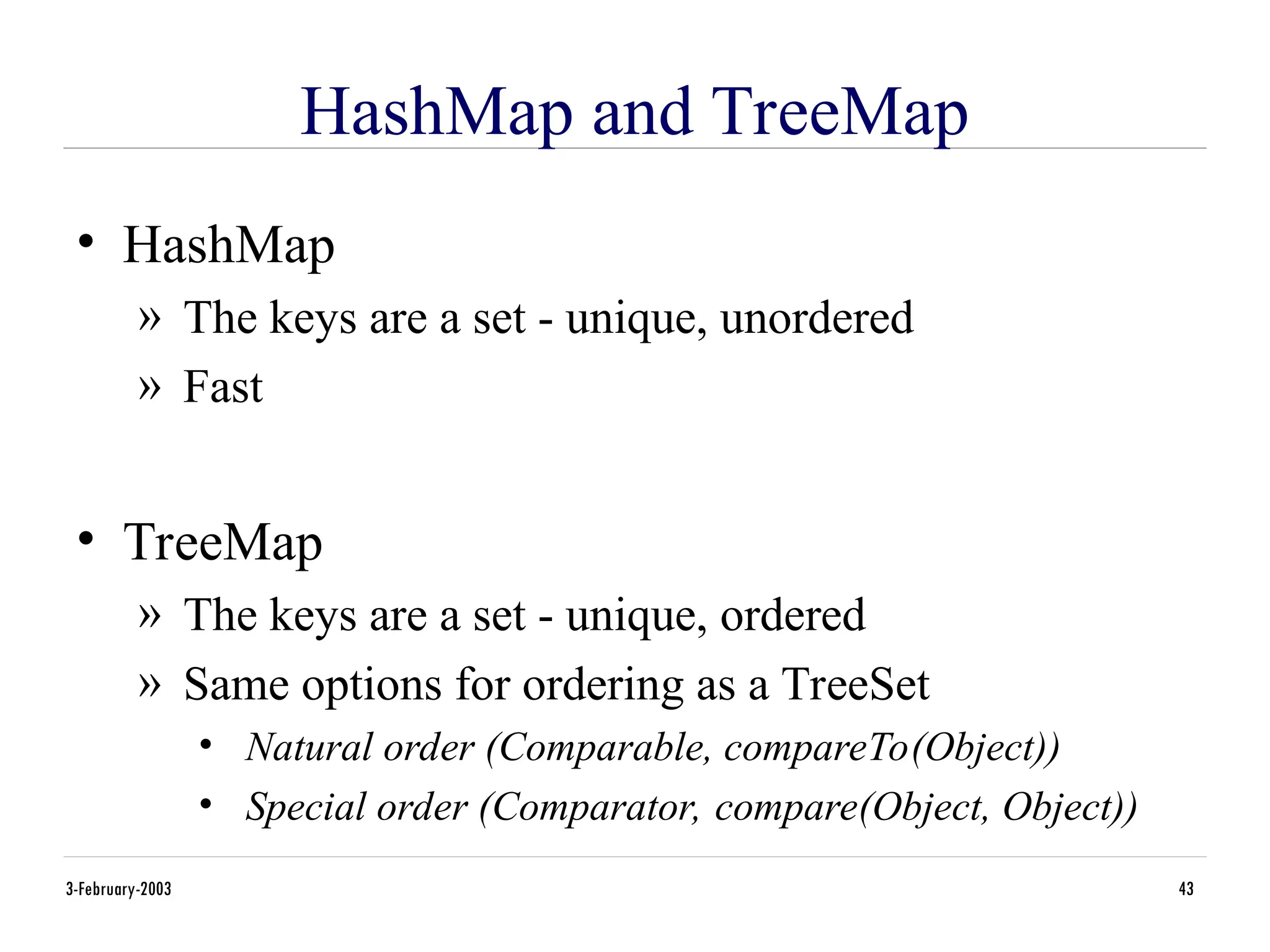
HashMap and TreeMap
• HashMap
» The keys are a set - unique, unordered
» Fast
• TreeMap
» The keys are a set - unique, ordered
» Same options for ordering as a TreeSet
• Natural order (Comparable, compareTo(Object))
• Special order (Comparator, compare(Object, Object))
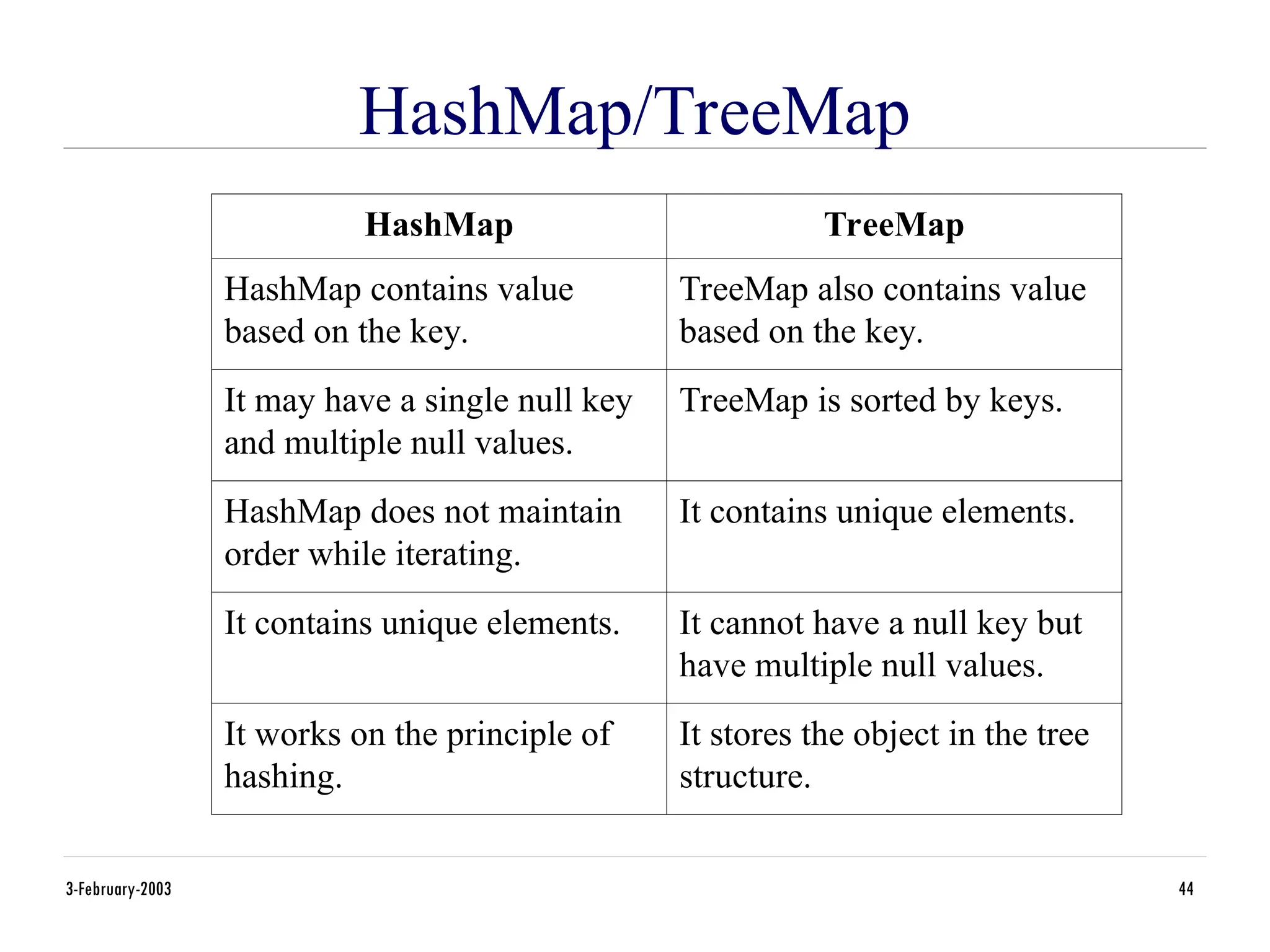
HashMap/TreeMap
3-February-2003 44
HashMap TreeMap
HashMap contains value
based on the key.
TreeMap also contains value
based on the key.
It may have a single null key
and multiple null values.
TreeMap is sorted by keys.
HashMap does not maintain
order while iterating.
It contains unique elements.
It contains unique elements. It cannot have a null key but
have multiple null values.
It works on the principle of
hashing.
It stores the object in the tree
structure.
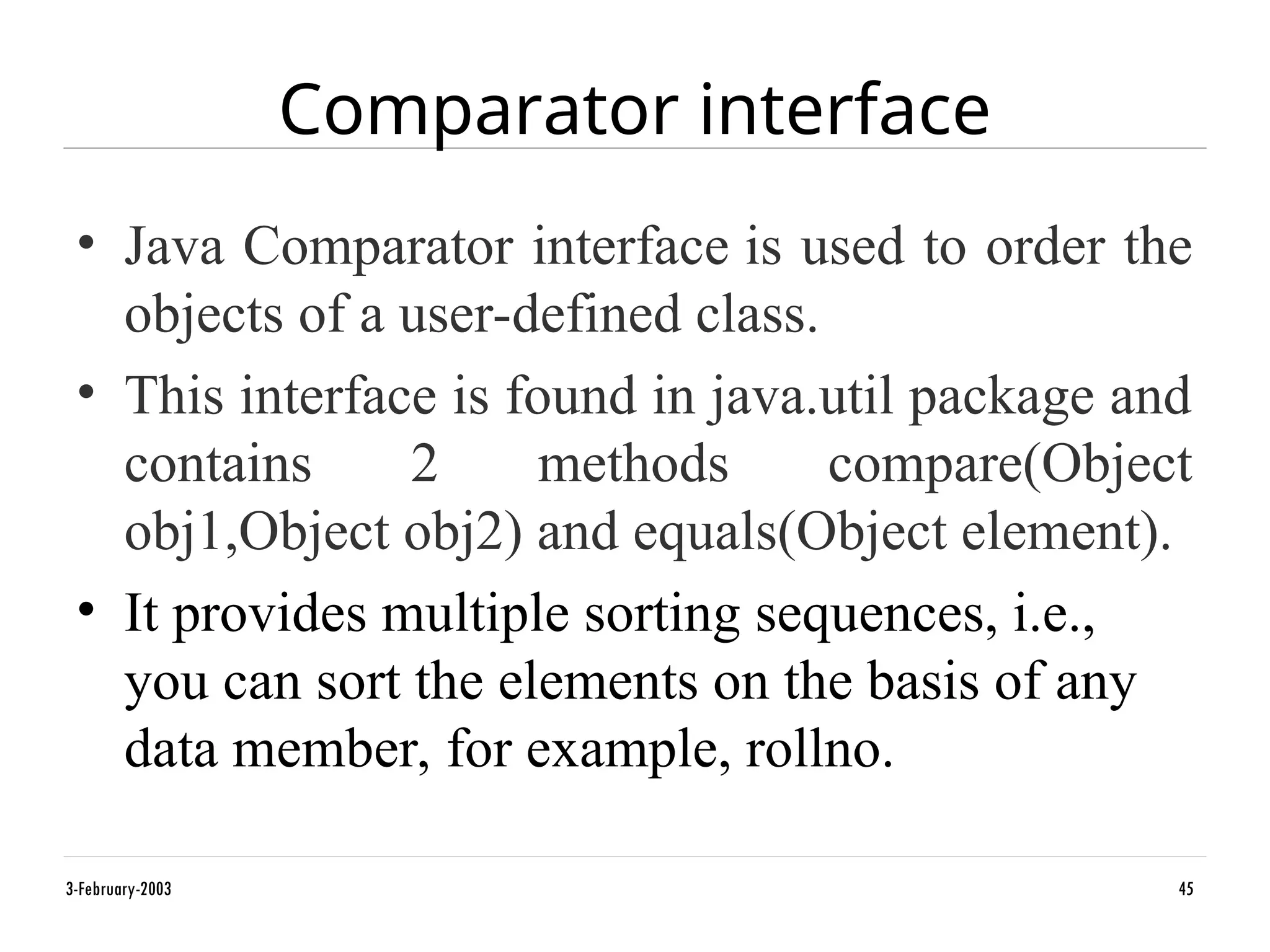
Comparator interface
• Java Comparator interface is used to order the
objects of a user-defined class.
• This interface is found in java.util package and
contains 2 methods compare(Object
obj1,Object obj2) and equals(Object element).
• It provides multiple sorting sequences, i.e.,
you can sort the elements on the basis of any
data member, for example, rollno.
3-February-2003 45
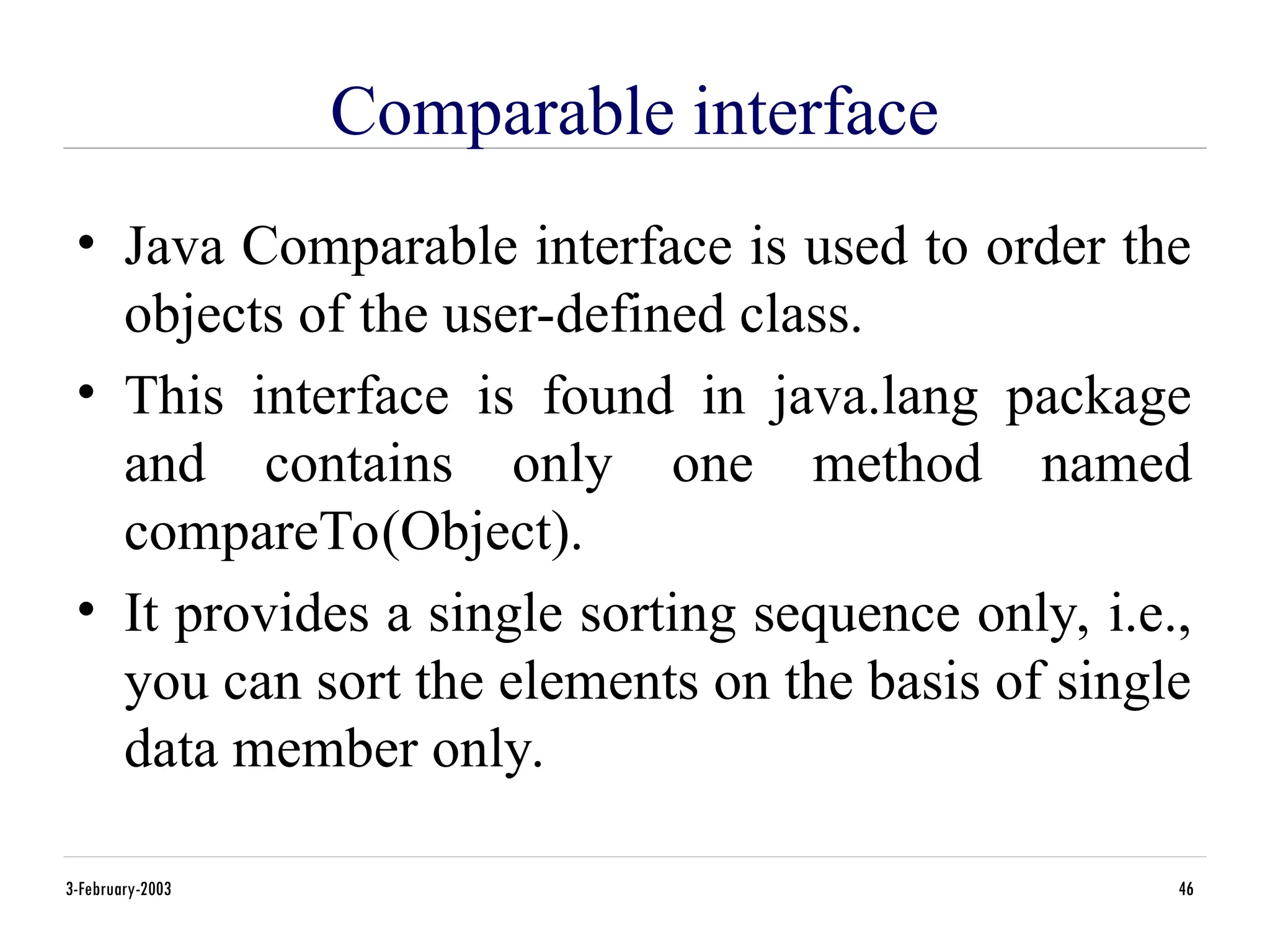
Comparable interface
• Java Comparable interface is used to order the
objects of the user-defined class.
• This interface is found in java.lang package
and contains only one method named
compareTo(Object).
• It provides a single sorting sequence only, i.e.,
you can sort the elements on the basis of single
data member only.
3-February-2003 46
compareTo method
• It is used to compare the current object with
the specified object.
• It returns positive integer, if the current object
is greater than the specified object.
• negative integer, if the current object is less
than the specified object.
• zero, if the current object is equal to the
specified object.
3-February-2003 47
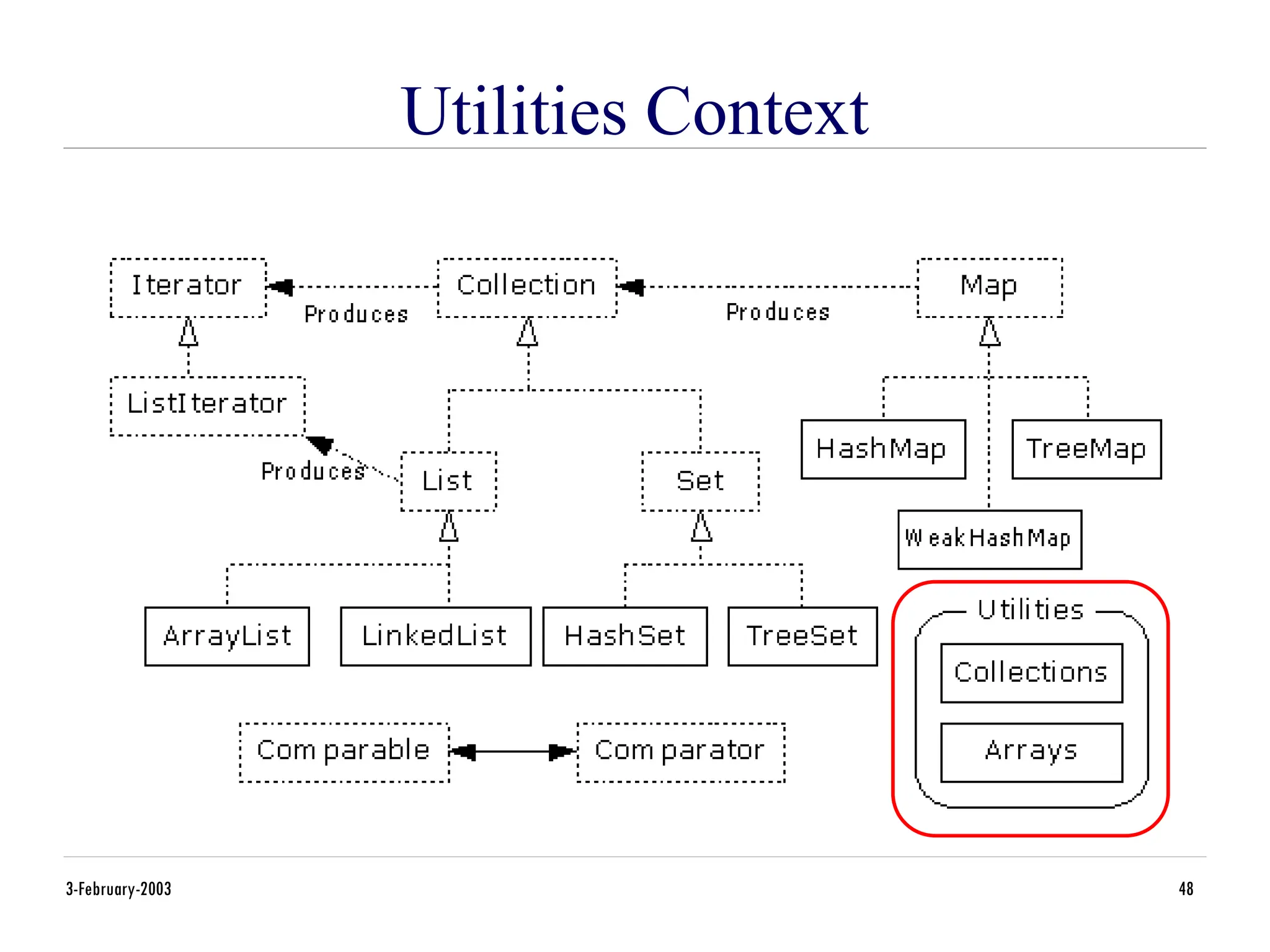
3-February-2003 48
Utilities Context
3-February-2003 49
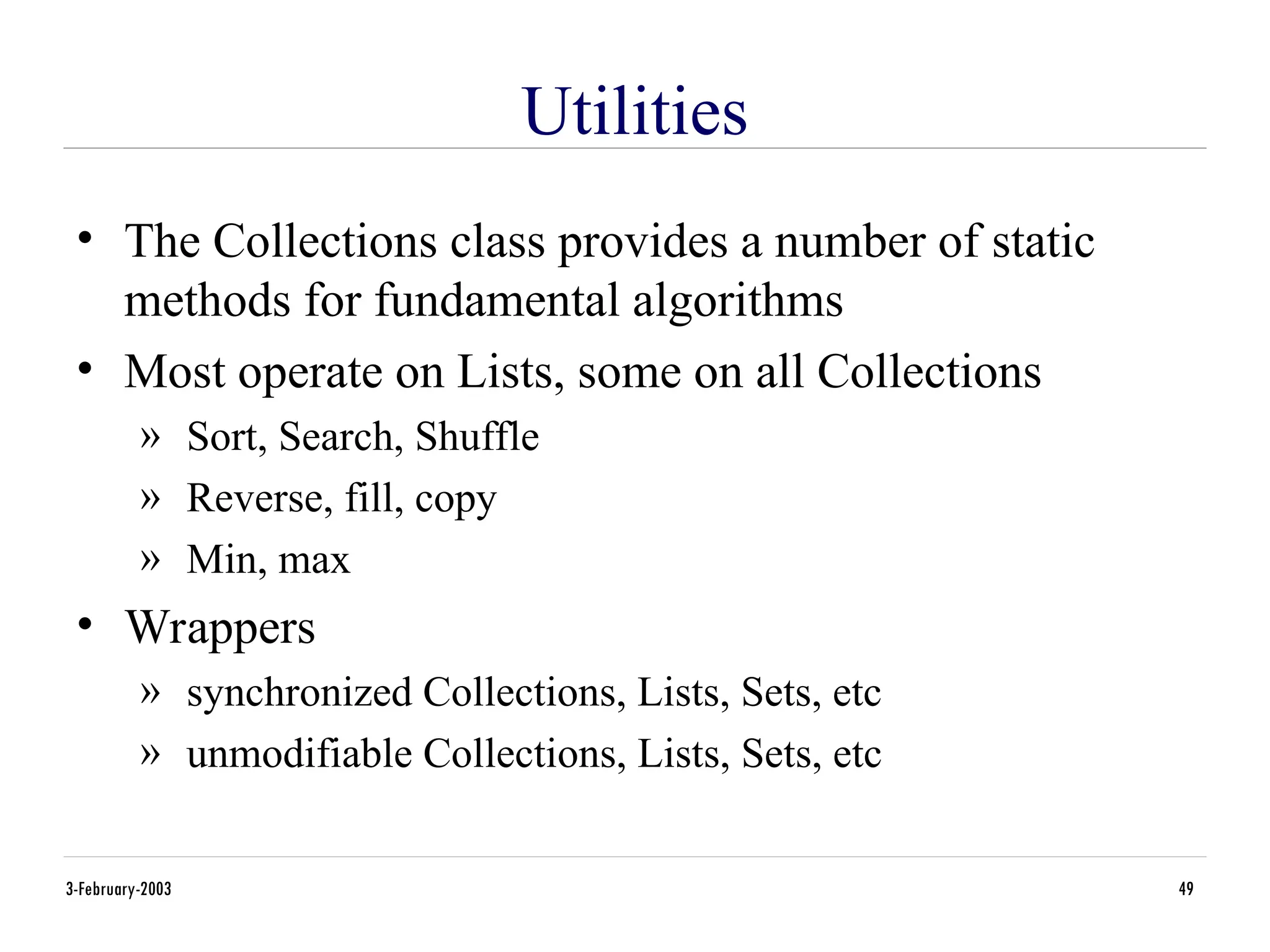
Utilities
• The Collections class provides a number of static
methods for fundamental algorithms
• Most operate on Lists, some on all Collections
» Sort, Search, Shuffle
» Reverse, fill, copy
» Min, max
• Wrappers
» synchronized Collections, Lists, Sets, etc
» unmodifiable Collections, Lists, Sets, etc
3-February-2003 50
Legacy classes
• Still available
• Don’t use for new development
» unless you have to, eg, J2ME, J2EE in some cases
• Retrofitted into Collections framework
• Hashtable
» use HashMap
• Enumeration
» use Collections and Iterators
» if needed, can get an Enumeration with
Collections.enumeration(Collection c)
3-February-2003 51
More Legacy classes
• Vector
» use ArrayList
• Stack
» use LinkedList
• BitSet
» use ArrayList of boolean, unless you can’t stand the
thought of the wasted space
• Properties
» legacies are sometimes hard to walk away from …
» see next few pages
3-February-2003 52
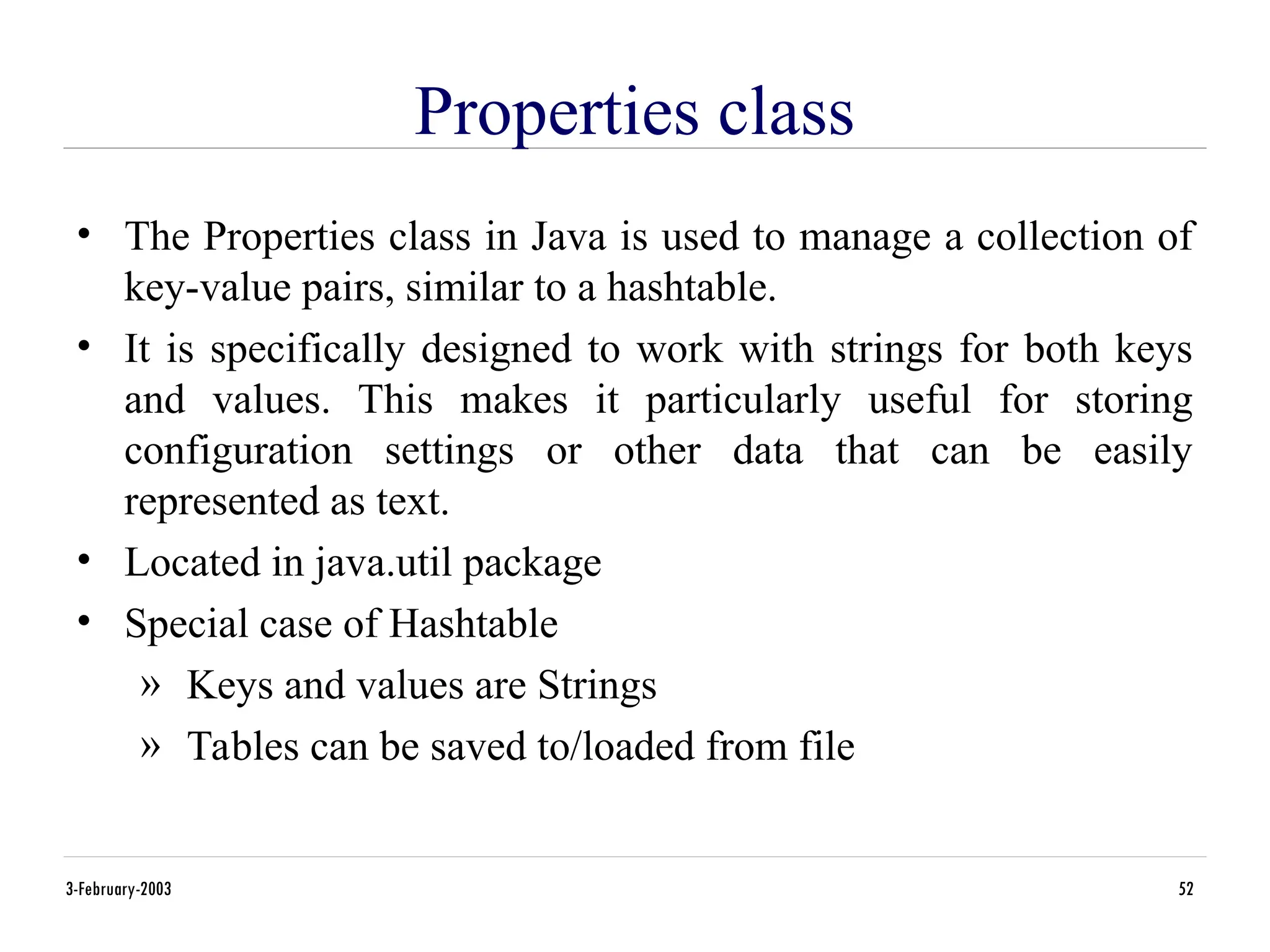
Properties class
• The Properties class in Java is used to manage a collection of
key-value pairs, similar to a hashtable.
• It is specifically designed to work with strings for both keys
and values. This makes it particularly useful for storing
configuration settings or other data that can be easily
represented as text.
• Located in java.util package
• Special case of Hashtable
» Keys and values are Strings
» Tables can be saved to/loaded from file
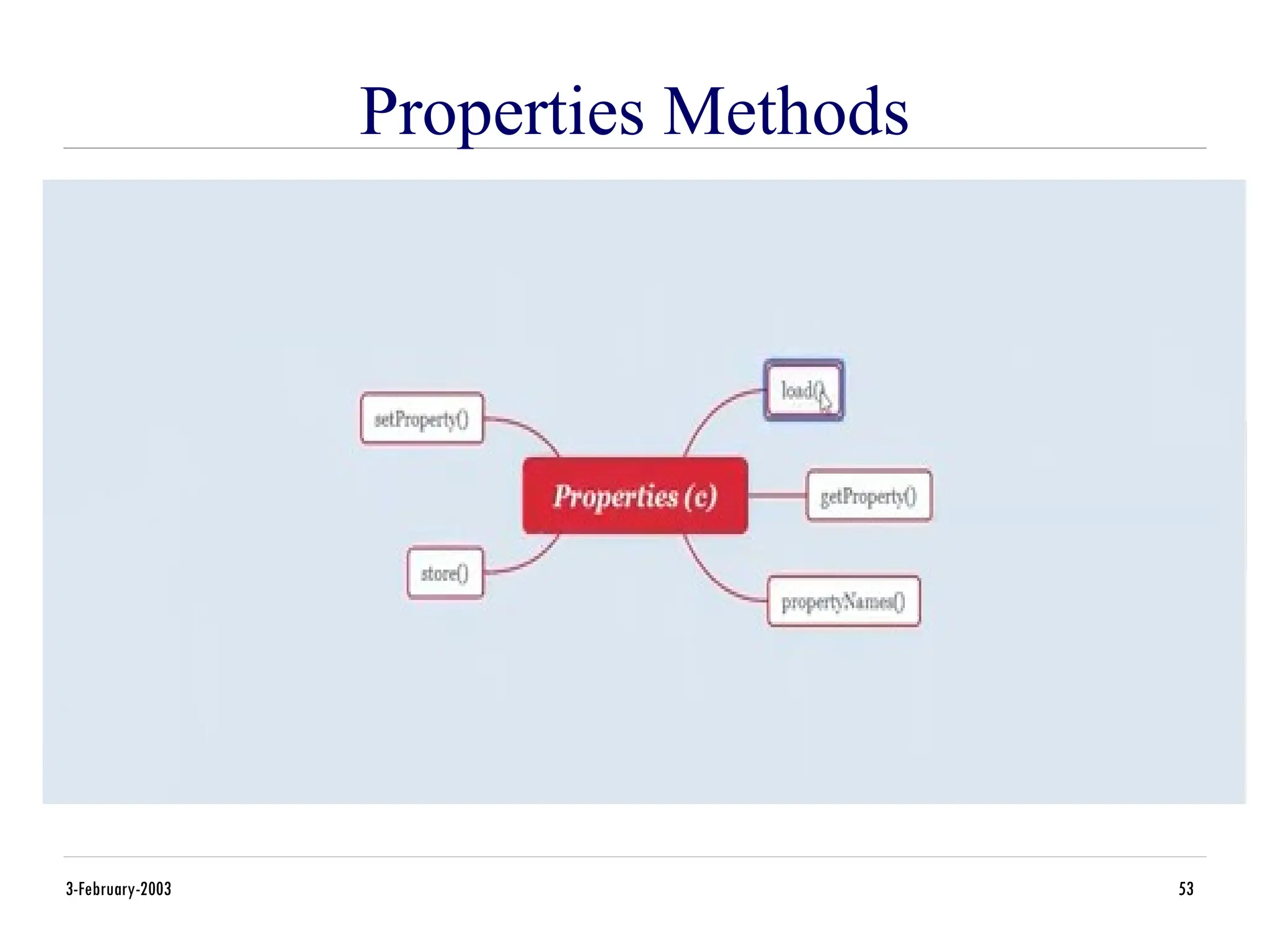
Properties Methods
3-February-2003 53
3-February-2003 54
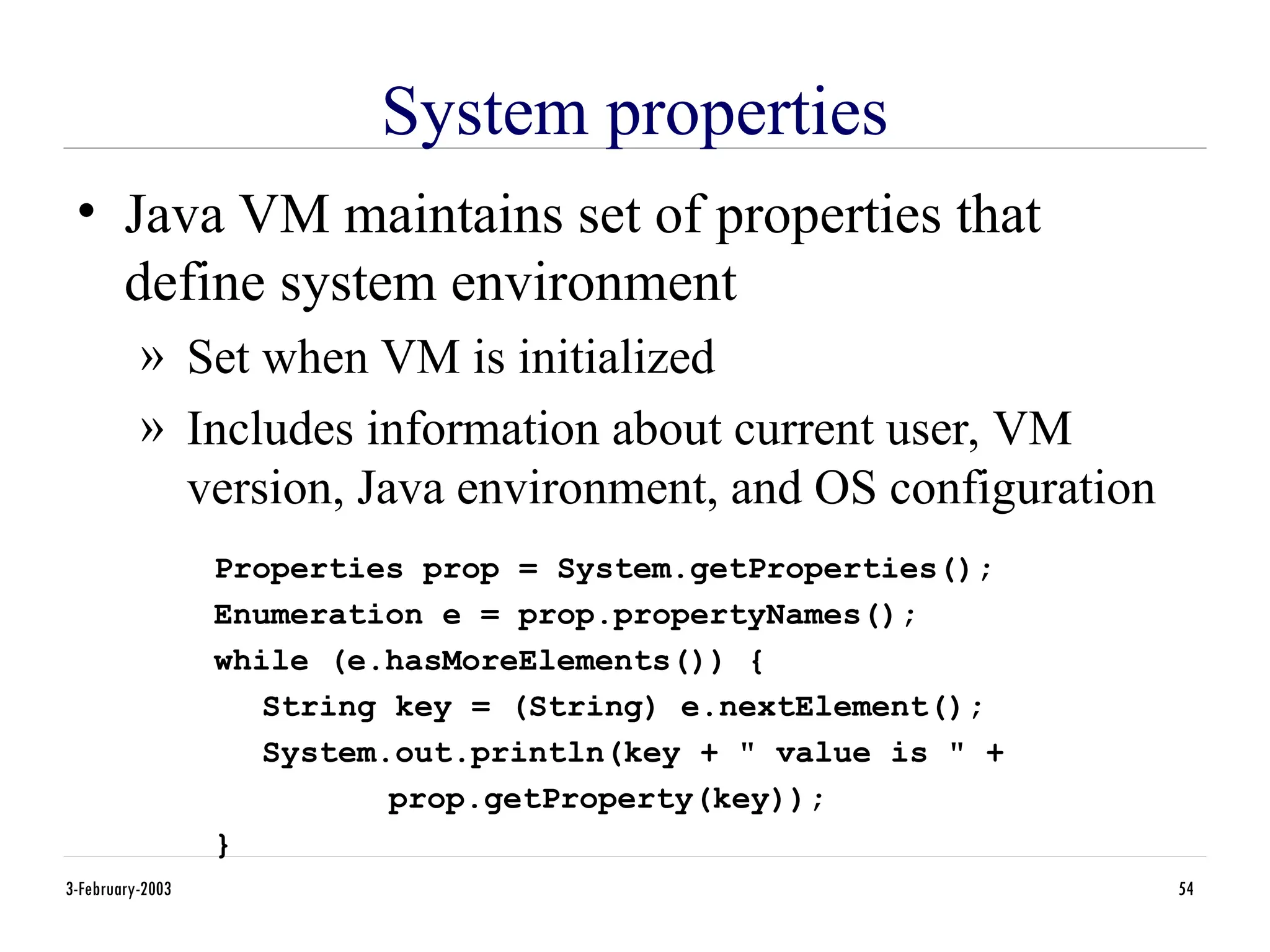
System properties
• Java VM maintains set of properties that
define system environment
» Set when VM is initialized
» Includes information about current user, VM
version, Java environment, and OS configuration
Properties prop = System.getProperties();
Enumeration e = prop.propertyNames();
while (e.hasMoreElements()) {
String key = (String) e.nextElement();
System.out.println(key + " value is " +
prop.getProperty(key));
}

Java Collection fundamentals and Uses Unit

  • 1.
  • 2.
    2 Java 2 Collections •A collection is an object that groups multiple elements into a single unit • Very useful » store, retrieve and manipulate data » transmit data from one method to another • Java Collections can achieve all the operations that you perform on a data such as searching, sorting, insertion, manipulation, and deletion.
  • 3.
    3-February-2003 3 Collections Framework •Unified architecture for representing and manipulating collections. • A collections framework contains three things » Interfaces » Implementations » Algorithms
  • 4.
    3-February-2003 4 Collections FrameworkDiagram •Interfaces, Implementations, and Algorithms •From Thinking in Java, page 462
  • 5.
    3-February-2003 5 Collection Interface •Defines fundamental methods » int size(); » boolean isEmpty(); » boolean contains(Object element); » boolean add(Object element); // Optional » boolean remove(Object element); // Optional » Iterator iterator(); • These methods are enough to define the basic behavior of a collection • Provides an Iterator to step through the elements in the Collection
  • 6.
    3-February-2003 6 Iterator Interface •Defines three fundamental methods » Object next() » boolean hasNext() » void remove() • These three methods provide access to the contents of the collection • An Iterator knows position within collection • Each call to next() “reads” an element from the collection » Then you can use it or remove it
  • 7.
  • 8.
    3-February-2003 8 Example -SimpleCollection public class SimpleCollection { public static void main(String[] args) { Collection c; c = new ArrayList(); System.out.println(c.getClass().getName()); for (int i=1; i <= 10; i++) { c.add(i + " * " + i + " = "+i*i); } Iterator iter = c.iterator(); while (iter.hasNext()) System.out.println(iter.next()); } }
  • 9.
  • 10.
  • 11.
    3-February-2003 11 List InterfaceContext Collection List
  • 12.
    3-February-2003 12 List Interface •The List interface adds the notion of order to a collection • The user of a list has control over where an element is added in the collection • Lists typically allow duplicate elements • Provides a ListIterator to step through the elements in the list.
  • 13.
    3-February-2003 13 ListIterator Interface •Extends the Iterator interface • Defines three fundamental methods » void add(Object o) - before current position » boolean hasPrevious() » Object previous() • The addition of these three methods defines the basic behavior of an ordered list • A ListIterator knows position within list
  • 14.
  • 15.
    3-February-2003 15 ArrayList andLinkedList Context ArrayList LinkedList Collection List
  • 16.
    3-February-2003 16 List Implementations •ArrayList » low cost random access » high cost insert and delete » array that resizes if need be • LinkedList » sequential access » low cost insert and delete » high cost random access
  • 17.
    3-February-2003 17 ArrayList overview •Constant time positional access (it’s an array) • One tuning parameter, the initial capacity public ArrayList(int initialCapacity) { super(); if (initialCapacity < 0) throw new IllegalArgumentException( "Illegal Capacity: "+initialCapacity); this.elementData = new Object[initialCapacity]; }
  • 18.
    3-February-2003 18 ArrayList methods •The indexed get and set methods of the List interface are appropriate to use since ArrayLists are backed by an array » Object get(int index) » Object set(int index, Object element) • Indexed add and remove are provided, but can be costly if used frequently » void add(int index, Object element) » Object remove(int index) • May want to resize in one shot if adding many elements » void ensureCapacity(int minCapacity)
  • 19.
    3-February-2003 19 LinkedList overview •Stores each element in a node • Each node stores a link to the next and previous nodes • Insertion and removal are inexpensive » just update the links in the surrounding nodes • Linear traversal is inexpensive • Random access is expensive » Start from beginning or end and traverse each node while counting • Java LinkedList class uses a doubly linked list to store the elements.
  • 20.
    3-February-2003 20 LinkedList entries privatestatic class Entry { Object element; Entry next; Entry previous; Entry(Object element, Entry next, Entry previous) { this.element = element; this.next = next; this.previous = previous; } } private Entry header = new Entry(null, null, null); public LinkedList() { header.next = header.previous = header; }
  • 21.
    3-February-2003 21 LinkedList methods •The list is sequential, so access it that way » ListIterator listIterator() • ListIterator knows about position » use add() from ListIterator to add at a position » use remove() from ListIterator to remove at a position • LinkedList knows a few things too » void addFirst(Object o), void addLast(Object o) » Object getFirst(), Object getLast() » Object removeFirst(), Object removeLast()
  • 22.
    Difference Between ArrayListand LinkedList 3-February-2003 22 ArrayList LinkedList 1) ArrayList internally uses a dynamic array to store the elements. LinkedList internally uses a doubly linked list to store the elements. 2) Manipulation with ArrayList is slow because it internally uses an array. If any element is removed from the array, all the other elements are shifted in memory. Manipulation with LinkedList is faster than ArrayList because it uses a doubly linked list, so no bit shifting is required in memory. 3) An ArrayList class can act as a list only because it implements List only. LinkedList class can act as a list and queue both because it implements List and Deque interfaces. 4) ArrayList is better for storing and accessing data. LinkedList is better for manipulating data.
  • 23.
    Difference Between ArrayListand LinkedList 3-February-2003 23 ArrayList LinkedList 5) The memory location for the elements of an ArrayList is contiguous. The location for the elements of a linked list is not contagious. 6) Generally, when an ArrayList is initialized, a default capacity of 10 is assigned to the ArrayList. There is no case of default capacity in a LinkedList. In LinkedList, an empty list is created when a LinkedList is initialized. 7) To be precise, an ArrayList is a resizable array. LinkedList implements the doubly linked list of the list interface.
  • 24.
    Vector • The Vectorclass is designed to function as a dynamic array that can expand or shrink according to the application’s needs. • We can access the objects of the Vector using the indices. • It maintains the insertion order and stores duplicate elements. • It is found in the java.util package and implements the List interface • There are four different types of Vector constructors.  Vector<T> vector = new Vector<T>();  Vector<T> vector = new Vector<T>(int size);  Vector<T> vector = new Vector<T>(int size, int capacityIncrement);  Vector<T> vector = new Vector(Collection<T> collection); 3-February-2003 24
  • 25.
    ArrayList Vs Vector 3-February-200325 ArrayList Vector 1) ArrayList is not synchronized. Vector is synchronized. 2) ArrayList increments 50% of current array size if the number of elements exceeds from its capacity. Vector increments 100% means doubles the array size if the total number of elements exceeds than its capacity. 3) ArrayList is not a legacy class. It is introduced in JDK 1.2. Vector is a legacy class. 4) ArrayList is fast because it is non- synchronized. Vector is slow because it is synchronized, i.e., in a multithreading environment, it holds the other threads in runnable or non-runnable state until current thread releases the lock of the object. 5) ArrayList uses the Iterator interface to traverse the elements. A Vector can use the Iterator interface or Enumeration interface to traverse the elements.
  • 26.
    Stack • The stackis a linear data structure that is used to store the collection of objects. • It is based on Last-In-First-Out (LIFO). • Java collection framework provides many interfaces and classes to store the collection of objects. • Stack is a class that falls under the Collection framework that extends the Vector class. • Stack class that provides different operations such as push, pop, search, etc. 3-February-2003 26
  • 27.
    Set Interface 3-February-2003 27 JavaHashSet class is used to create a collection that uses a hash table for storage. It inherits the AbstractSet class and implements Set interface.
  • 28.
  • 29.
    3-February-2003 29 Set InterfaceContext Collection Set
  • 30.
    3-February-2003 30 Set Interface •Same methods as Collection » different contract - no duplicate entries • Defines two fundamental methods » boolean add(Object o) - reject duplicates » Iterator iterator() • Provides an Iterator to step through the elements in the Set » No guaranteed order in the basic Set interface » There is a SortedSet interface that extends Set
  • 31.
  • 32.
    3-February-2003 32 HashSet andTreeSet Context HashSet TreeSet Collection Set
  • 33.
    3-February-2003 33 HashSet • JavaHashSet class is used to create a collection that uses a hash table for storage. • It inherits the AbstractSet class and implements Set interface. • Find and add elements very quickly » uses hashing implementation in HashMap • Hashing uses an array of linked lists » The hashCode() is used to index into the array » Then equals() is used to determine if element is in the (short) list of elements at that index • No order imposed on elements • The hashCode() method and the equals() method must be compatible » if two objects are equal, they must have the same hashCode() value
  • 34.
    LinkedHashSet • Java LinkedHashSetclass is a Hashtable and Linked list implementation of the Set interface. It inherits the HashSet class and implements the Set interface. The important points about the Java LinkedHashSet class are: • Java LinkedHashSet class contains unique elements only like HashSet. • Java LinkedHashSet class provides all optional set operations and permits null elements. • Java LinkedHashSet class is non-synchronized. • Java LinkedHashSet class maintains insertion order. 3-February-2003 34
  • 35.
    3-February-2003 35 TreeSet • Elementscan be inserted in any order • The TreeSet stores them in order » Red-Black Trees out of Cormen-Leiserson-Rivest • An iterator always presents them in order • Java TreeMap is non synchronized. • Default order is defined by natural order » objects implement the Comparable interface » TreeSet uses compareTo(Object o) to sort • Can use a different Comparator » provide Comparator to the TreeSet constructor
  • 36.
  • 37.
    3-February-2003 37 Map Interface •Stores key/value pairs • Maps from the key to the value • Keys are unique » a single key only appears once in the Map » a key can map to only one value • Values do not have to be unique
  • 38.
    3-February-2003 38 Map methods Objectput(Object key, Object value) Object get(Object key) Object remove(Object key) boolean containsKey(Object key) boolean containsValue(Object value) int size() boolean isEmpty()
  • 39.
    3-February-2003 39 Map views •A means of iterating over the keys and values in a Map • Set keySet() » returns the Set of keys contained in the Map • Collection values() » returns the Collection of values contained in the Map. This Collection is not a Set, as multiple keys can map to the same value. • Set entrySet() » returns the Set of key-value pairs contained in the Map. The Map interface provides a small nested interface called Map.Entry that is the type of the elements in this Set.
  • 40.
    3-February-2003 40 HashMap andTreeMap Context HashMap TreeMap Map
  • 41.
    HashMap Vs. HashSet 3-February-200341 HashMap HashSet Java HashMap is a hash table based implementation of Map interface. HashSet is a Set. It creates a collection that uses a hash table for storage. HashMap implements Map, Cloneable, and Serializable interface es. HashSet implements Set, Cloneable, Serializable, Iterable and Collection interfaces . In HashMap we store a key-value pair. It maintains the mapping of key and value. In HashSet, we store objects. It does not allow duplicate keys, but duplicate values are allowed. It does not allow duplicate values. It can contain a single null key and multiple null values. It can contain a single null value.
  • 42.
    HashMap Vs. HashSet 3-February-200342 HashMap uses the put() method to add the elements in the HashMap. HashSet uses the add() method to add elements in the HashSet. HashMap is faster/ than HashSet because values are associated with a unique key. HashSet is slower than HashMap because the member object is used for calculating hashcode value, which can be same for two objects. Only one object is created during the add operation. There are two objects created during put operation, one for key and one for value. HashMap internally uses hashing to store objects. HashSet internally uses a HashMap object to store objects. Always prefer when we do not maintain the uniqueness. It is used when we need to maintain the uniqueness of data.
  • 43.
    3-February-2003 43 HashMap andTreeMap • HashMap » The keys are a set - unique, unordered » Fast • TreeMap » The keys are a set - unique, ordered » Same options for ordering as a TreeSet • Natural order (Comparable, compareTo(Object)) • Special order (Comparator, compare(Object, Object))
  • 44.
    HashMap/TreeMap 3-February-2003 44 HashMap TreeMap HashMapcontains value based on the key. TreeMap also contains value based on the key. It may have a single null key and multiple null values. TreeMap is sorted by keys. HashMap does not maintain order while iterating. It contains unique elements. It contains unique elements. It cannot have a null key but have multiple null values. It works on the principle of hashing. It stores the object in the tree structure.
  • 45.
    Comparator interface • JavaComparator interface is used to order the objects of a user-defined class. • This interface is found in java.util package and contains 2 methods compare(Object obj1,Object obj2) and equals(Object element). • It provides multiple sorting sequences, i.e., you can sort the elements on the basis of any data member, for example, rollno. 3-February-2003 45
  • 46.
    Comparable interface • JavaComparable interface is used to order the objects of the user-defined class. • This interface is found in java.lang package and contains only one method named compareTo(Object). • It provides a single sorting sequence only, i.e., you can sort the elements on the basis of single data member only. 3-February-2003 46
  • 47.
    compareTo method • Itis used to compare the current object with the specified object. • It returns positive integer, if the current object is greater than the specified object. • negative integer, if the current object is less than the specified object. • zero, if the current object is equal to the specified object. 3-February-2003 47
  • 48.
  • 49.
    3-February-2003 49 Utilities • TheCollections class provides a number of static methods for fundamental algorithms • Most operate on Lists, some on all Collections » Sort, Search, Shuffle » Reverse, fill, copy » Min, max • Wrappers » synchronized Collections, Lists, Sets, etc » unmodifiable Collections, Lists, Sets, etc
  • 50.
    3-February-2003 50 Legacy classes •Still available • Don’t use for new development » unless you have to, eg, J2ME, J2EE in some cases • Retrofitted into Collections framework • Hashtable » use HashMap • Enumeration » use Collections and Iterators » if needed, can get an Enumeration with Collections.enumeration(Collection c)
  • 51.
    3-February-2003 51 More Legacyclasses • Vector » use ArrayList • Stack » use LinkedList • BitSet » use ArrayList of boolean, unless you can’t stand the thought of the wasted space • Properties » legacies are sometimes hard to walk away from … » see next few pages
  • 52.
    3-February-2003 52 Properties class •The Properties class in Java is used to manage a collection of key-value pairs, similar to a hashtable. • It is specifically designed to work with strings for both keys and values. This makes it particularly useful for storing configuration settings or other data that can be easily represented as text. • Located in java.util package • Special case of Hashtable » Keys and values are Strings » Tables can be saved to/loaded from file
  • 53.
  • 54.
    3-February-2003 54 System properties •Java VM maintains set of properties that define system environment » Set when VM is initialized » Includes information about current user, VM version, Java environment, and OS configuration Properties prop = System.getProperties(); Enumeration e = prop.propertyNames(); while (e.hasMoreElements()) { String key = (String) e.nextElement(); System.out.println(key + " value is " + prop.getProperty(key)); }

Editor's Notes

  • #47 We can sort the elements of: String objects Wrapper class objects User-defined class objects