ISTQB Foundation Level Flash Cards
www.istqb.guru
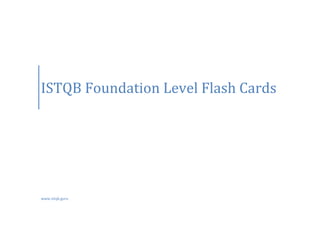
A Technical Review (also known as
a peer review), is considered to be a
formal review type, even though no
Managers are expected to attend. It
involves a structured encounter, in
which a peer/s analyse the work
with a view to improve the quality of
the original work.
 Ideally led by the Moderator
 Attended by peers /
technical experts
 Documentation is required
 No Management presence
 Decision making
 Solving technical problems
A walkthrough is a set of procedures
and techniques designed for a peer
group, lead by the author to review
software code. It is considered to be
a fairly informal type of review. The
walkthrough takes the form a
meeting, normally between one and
two hours in length.
 Led by the Author
 Attended by a peer group
 Varying level of formality
 Knowledge gathering
 Defect finding
An inspection is a formal type of
review. It requires preparation on
the part the review team members
before the inspection meeting takes
place. A follow-up stage is also a
requirement of the inspection. This
ensures that any re-working is
carried out correctly.
 Led by a Moderator
 Attended by specified roles
 Metrics are included
 Formal process
 Entry and Exit Criteria
 Defect finding
An informal review is an extremely
popular choice early on in the
development lifecycle of both
software and documentation. The
review is commonly performed by
peer or someone with relevant
experience, and should be informal
and brief.
 Low cost
 No formal process
 No documentation required
 Widely used review
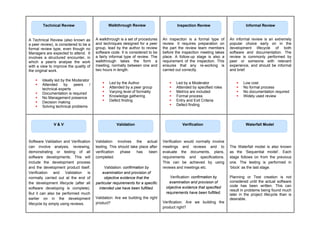
Software Validation and Verification
can involve analysis, reviewing,
demonstrating or testing of all
software developments. This will
include the development process
and the development product itself.
Verification and Validation is
normally carried out at the end of
the development lifecycle (after all
software developing is complete).
But it can also be performed much
earlier on in the development
lifecycle by simply using reviews.
Validation involves the actual
testing. This should take place after
verification phase has been
completed.
Validation: confirmation by
examination and provision of
objective evidence that the
particular requirements for a specific
intended use have been fulfilled.
Validation: Are we building the right
product?
Verification would normally involve
meetings and reviews and to
evaluate the documents, plans,
requirements and specifications.
This can be achieved by using
reviews and meetings etc.
Verification: confirmation by
examination and provision of
objective evidence that specified
requirements have been fulfilled.
Verification: Are we building the
product right?
The Waterfall model is also known
as the ‘Sequential model’. Each
stage follows on from the previous
one. The testing is performed in
‘block’ as the last stage.
Planning or Test creation is not
considered until the actual software
code has been written. This can
result in problems being found much
later in the project lifecycle than is
desirable.
Walkthrough Review
Technical Review Inspection Review Informal Review
V & V Validation Verification Waterfall Model
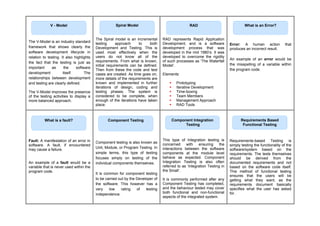
The V-Model is an industry standard
framework that shows clearly the
software development lifecycle in
relation to testing. It also highlights
the fact that the testing is just as
important as the software
development itself. The
relationships between development
and testing are clearly defined.
The V-Model improves the presence
of the testing activities to display a
more balanced approach.
The Spiral model is an incremental
testing approach to both
Development and Testing. This is
used most effectively when the
users do not know all of the
requirements. From what is known,
initial requirements can be defined.
Then from these the code and test
cases are created. As time goes on,
more details of the requirements are
known and implemented in further
iterations of design, coding and
testing phases. The system is
considered to be complete, when
enough of the iterations have taken
place.
RAD represents Rapid Application
Development, and is a software
development process that was
developed in the mid 1980’s. It was
developed to overcome the rigidity
of such processes as ‘The Waterfall
Model’.
Elements:
 Prototyping
 Iterative Development
 Time-boxing
 Team Members
 Management Approach
 RAD Tools
Error: A human action that
produces an incorrect result.
An example of an error would be
the misspelling of a variable within
the program code.
Fault: A manifestation of an error in
software. A fault, if encountered
may cause a failure.
An example of a fault would be a
variable that is never used within the
program code.
Component testing is also known as
Unit, Module, or Program Testing. In
simple terms, this type of testing
focuses simply on testing of the
individual components themselves.
It is common for component testing
to be carried out by the Developer of
the software. This however has a
very low rating of testing
independence.
This type of Integration testing is
concerned with ensuring the
interactions between the software
components at the module level
behave as expected. Component
Integration Testing is also often
referred to as ‘Integration Testing in
the Small’.
It is commonly performed after any
Component Testing has completed,
and the behaviour tested may cover
both functional and non-functional
aspects of the integrated system.
Requirements-based Testing is
simply testing the functionality of the
software/system based on the
requirements. The tests themselves
should be derived from the
documented requirements and not
based on the software code itself.
This method of functional testing
ensures that the users will be
getting what they want, as the
requirements document basically
specifies what the user has asked
for.
Spiral Model
V - Model RAD What is an Error?
What is a fault? Component Testing Component Integration
Testing
Requirements Based
Functional Testing
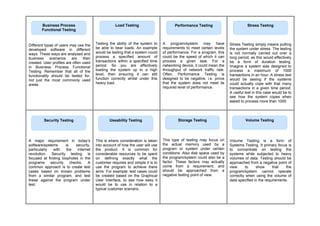
Different types of users may use the
developed software in different
ways. These ways are analysed and
business scenarios are then
created. User profiles are often used
in Business Process Functional
Testing. Remember that all of the
functionality should be tested for,
not just the most commonly used
areas.
Testing the ability of the system to
be able to bear loads. An example
would be testing that a system could
process a specified amount of
transactions within a specified time
period. So you are effectively
loading the system up to a high
level, then ensuring it can still
function correctly whilst under this
heavy load.
A program/system may have
requirements to meet certain levels
of performance. For a program, this
could be the speed of which it can
process a given task. For a
networking device, it could mean the
throughput of network traffic rate.
Often, Performance Testing is
designed to be negative, i.e. prove
that the system does not meet its
required level of performance.
Stress Testing simply means putting
the system under stress. The testing
is not normally carried out over a
long period, as this would effectively
be a form of duration testing.
Imagine a system was designed to
process a maximum of 1000
transactions in an hour. A stress test
would be seeing if the systems
could actually cope with that many
transactions in a given time period.
A useful test in this case would be to
see how the system copes when
asked to process more than 1000.
A major requirement in today’s
software/systems is security,
particularly with the internet
revolution. Security testing is
focused at finding loopholes in the
programs security checks. A
common approach is to create test
cases based on known problems
from a similar program, and test
these against the program under
test.
This is where consideration is taken
into account of how the user will use
the product. It is common for
considerable resources to be spent
on defining exactly what the
customer requires and simple it is to
use the program to achieve there
aims. For example; test cases could
be created based on the Graphical
User Interface, to see how easy it
would be to use in relation to a
typical customer scenario.
This type of testing may focus on
the actual memory used by a
program or system under certain
conditions. Also disk space used by
the program/system could also be a
factor. These factors may actually
come from a requirement, and
should be approached from a
negative testing point of view.
Volume Testing is a form of
Systems Testing. It primary focus is
to concentrate on testing the
systems while subjected to heavy
volumes of data. Testing should be
approached from a negative point of
view to show that the
program/system cannot operate
correctly when using the volume of
data specified in the requirements.
Load Testing
Business Process
Functional Testing
Performance Testing Stress Testing
Security Testing Useability Testing Storage Testing Volume Testing
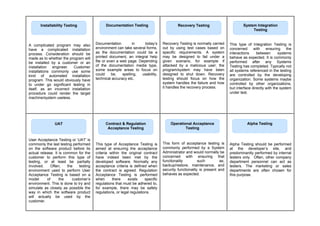
A complicated program may also
have a complicated installation
process. Consideration should be
made as to whether the program will
be installed by a customer or an
installation engineer. Customer
installations commonly use some
kind of automated installation
program. This would obviously have
to under go significant testing in
itself, as an incorrect installation
procedure could render the target
machine/system useless.
Documentation in today’s
environment can take several forms,
as the documentation could be a
printed document, an integral help
file or even a web page. Depending
of the documentation media type,
some example areas to focus on
could be, spelling, usability,
technical accuracy etc.
Recovery Testing is normally carried
out by using test cases based on
specific requirements. A system
may be designed to fail under a
given scenario, for example if
attacked by a malicious user; the
program/system may have been
designed to shut down. Recovery
testing should focus on how the
system handles the failure and how
it handles the recovery process.
This type of Integration Testing is
concerned with ensuring the
interactions between systems
behave as expected. It is commonly
performed after any Systems
Testing has completed. Typically not
all systems referenced in the testing
are controlled by the developing
organization. Some systems maybe
controlled by other organizations,
but interface directly with the system
under test.
User Acceptance Testing or ‘UAT’ is
commonly the last testing performed
on the software product before its
actual release. It is common for the
customer to perform this type of
testing, or at least be partially
involved. Often, the testing
environment used to perform User
Acceptance Testing is based on a
model of the customer’s
environment. This is done to try and
simulate as closely as possible the
way in which the software product
will actually be used by the
customer.
This type of Acceptance Testing is
aimed at ensuring the acceptance
criteria within the original contract
have indeed been met by the
developed software. Normally any
acceptance criteria is defined when
the contract is agreed. Regulation
Acceptance Testing is performed
when there exists specific
regulations that must be adhered to,
for example, there may be safety
regulations, or legal regulations.
This form of acceptance testing is
commonly performed by a System
Administrator and would normally be
concerned with ensuring that
functionality such as;
backup/restore, maintenance, and
security functionality is present and
behaves as expected.
Alpha Testing should be performed
at the developer’s site, and
predominantly performed by internal
testers only. Often, other company
department personnel can act as
testers. The marketing or sales
departments are often chosen for
this purpose.
Documentation Testing
Installability Testing Recovery Testing System Integration
Testing
UAT Contract & Regulation
Acceptance Testing
Operational Acceptance
Testing
Alpha Testing
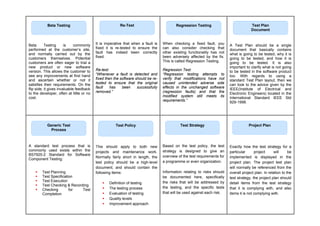
Beta Testing is commonly
performed at the customer’s site,
and normally carried out by the
customers themselves. Potential
customers are often eager to trial a
new product or new software
version. This allows the customer to
see any improvements at first hand
and ascertain whether or not it
satisfies their requirements. On the
flip side, it gives invaluable feedback
to the developer, often at little or no
cost.
It is imperative that when a fault is
fixed it is re-tested to ensure the
fault has indeed been correctly
fixed.
Re-test:
“Whenever a fault is detected and
fixed then the software should be re-
tested to ensure that the original
fault has been successfully
removed.”
When checking a fixed fault, you
can also consider checking that
other existing functionality has not
been adversely affected by the fix.
This is called Regression Testing.
Regression Test:
“Regression testing attempts to
verify that modifications have not
caused unintended adverse side
effects in the unchanged software
(regression faults) and that the
modified system still meets its
requirements.”
A Test Plan should be a single
document that basically contains
what is going to be tested, why it is
going to be tested, and how it is
going to be tested. It is also
important to clarify what is not going
to be tested in the software product
too. With regards to using a
standard Test Plan layout, then we
can look to the advice given by the
IEEE(Institute of Electrical and
Electronic Engineers) located in the
International Standard IEEE Std
929-1998.
A standard test process that is
commonly used exists within the
BS7925-2 Standard for Software
Component Testing:
 Test Planning
 Test Specification
 Test Execution
 Test Checking & Recording
 Checking for Test
Completion
This should apply to both new
projects and maintenance work.
Normally fairly short in length, the
test policy should be a high-level
document, and should contain the
following items:
 Definition of testing
 The testing process
 Evaluation of testing
 Quality levels
 Improvement approach
Based on the test policy, the test
strategy is designed to give an
overview of the test requirements for
a programme or even organization.
Information relating to risks should
be documented here, specifically
the risks that will be addressed by
the testing, and the specific tests
that will be used against each risk.
Exactly how the test strategy for a
particular project will be
implemented is displayed in the
project plan. The project test plan
will normally be referenced from the
overall project plan. In relation to the
test strategy, the project plan should
detail items from the test strategy
that it is complying with, and also
items it is not complying with.
Re-Test
Beta Testing Regression Testing Test Plan
Document
Generic Test
Process
Test Policy Test Strategy Project Plan
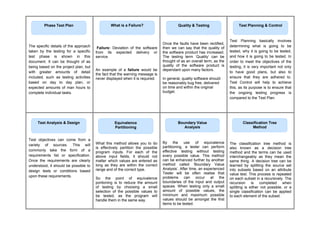
The specific details of the approach
taken by the testing for a specific
test phase is shown in this
document. It can be thought of as
being based on the project plan, but
with greater amounts of detail
included, such as testing activities
based on day to day plan, or
expected amounts of man hours to
complete individual tasks.
Failure: Deviation of the software
from its expected delivery or
service.
An example of a failure would be
the fact that the warning message is
never displayed when it is required.
Once the faults have been rectified,
then we can say that the quality of
the software product has increased.
The testing term ‘Quality’ can be
thought of as an overall term, as the
quality of the software product is
dependant upon many factors.
In general, quality software should
be reasonably bug free, delivered
on time and within the original
budget.
Test Planning basically involves
determining what is going to be
tested, why it is going to be tested,
and how it is going to be tested. In
order to meet the objectives of the
testing, it is very important not only
to have good plans, but also to
ensure that they are adhered to.
Test Control will help to achieve
this, as its purpose is to ensure that
the ongoing testing progress is
compared to the Test Plan.
Test objectives can come from a
variety of sources. This will
commonly take the form of a
requirements list or specification.
Once the requirements are clearly
understood, it should be possible to
design tests or conditions based
upon these requirements.
What this method allows you to do
is effectively partition the possible
program inputs. For each of the
above input fields, it should not
matter which values are entered as
long as they are within the correct
range and of the correct type.
So the point of equivalence
portioning is to reduce the amount
of testing by choosing a small
selection of the possible values to
be tested, as the program will
handle them in the same way.
By the use of equivalence
partitioning, a tester can perform
effective testing without testing
every possible value. This method
can be enhanced further by another
method called ‘Boundary Value
Analysis’. After time, an experienced
Tester will be often realise that
problems can occur at the
boundaries of the input and output
spaces. When testing only a small
amount of possible values, the
minimum and maximum possible
values should be amongst the first
items to be tested.
The classification tree method is
also known as a decision tree
method and the terms can be used
interchangeably as they mean the
same thing. A decision tree can be
learned by splitting the source set
into subsets based on an attribute
value test. This process is repeated
on each subset in a recursively. The
recursion is completed when
splitting is either not possible, or a
single classification can be applied
to each element of the subset.
What is a Failure?
Phase Test Plan Quality & Testing Test Planning & Control
Test Analysis & Design Equivalence
Partitioning
Boundary Value
Analysis
Classification Tree
Method
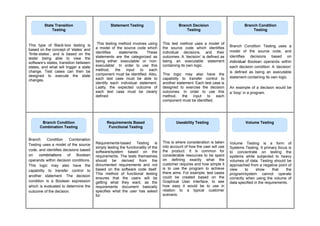
This type of Black-box testing is
based on the concept of ‘states’ and
‘finite-states’, and is based on the
tester being able to view the
software’s states, transition between
states, and what will trigger a state
change. Test cases can then be
designed to execute the state
changes.
This testing method involves using
a model of the source code which
identifies statements. These
statements are the categorized as
being either ‘executable’ or ‘non-
executable’. In order to use this
method, the input to each
component must be identified. Also,
each test case must be able to
identify each individual statement.
Lastly, the expected outcome of
each test case must be clearly
defined
This test method uses a model of
the source code which identifies
individual decisions, and their
outcomes. A ‘decision’ is defined as
being an executable statement
containing its own logic.
This logic may also have the
capability to transfer control to
another statement. Each test case is
designed to exercise the decision
outcomes. In order to use this
method, the input to each
component must be identified.
Branch Condition Testing uses a
model of the source code, and
identifies decisions based on
individual Boolean operands within
each decision condition. A ‘decision’
is defined as being an executable
statement containing its own logic.
An example of a decision would be
a ‘loop’ in a program.
Branch Condition Combination
Testing uses a model of the source
code, and identifies decisions based
on combinations of Boolean
operands within decision conditions.
This logic may also have the
capability to transfer control to
another statement. The decision
condition is a Boolean expression
which is evaluated to determine the
outcome of the decision.
Requirements-based Testing is
simply testing the functionality of the
software/system based on the
requirements. The tests themselves
should be derived from the
documented requirements and not
based on the software code itself.
This method of functional testing
ensures that the users will be
getting what they want, as the
requirements document basically
specifies what the user has asked
for.
This is where consideration is taken
into account of how the user will use
the product. It is common for
considerable resources to be spent
on defining exactly what the
customer requires and how simple it
is to use the program to achieve
there aims. For example; test cases
could be created based on the
Graphical User Interface, to see
how easy it would be to use in
relation to a typical customer
scenario.
Volume Testing is a form of
Systems Testing. It primary focus is
to concentrate on testing the
systems while subjected to heavy
volumes of data. Testing should be
approached from a negative point of
view to show that the
program/system cannot operate
correctly when using the volume of
data specified in the requirements.
Statement Testing
State Transition
Testing
Branch Decision
Testing
Branch Condition
Testing
Branch Condition
Combination Testing
Requirements Based
Functional Testing
Useability Testing Volume Testing
A program/system may have
requirements to meet certain levels
of performance. For a program, this
could be the speed of which it can
process a given task. For a
networking device, it could mean the
throughput of network traffic rate.
Often, Performance Testing is
designed to be negative, i.e. prove
that the system does not meet its
required level of performance.
Stress Testing simply means
putting the system under stress. The
testing is not normally carried out
over a long period, as this would
effectively be a form of duration
testing. Imagine a system was
designed to process a maximum of
1000 transactions in an hour. A
stress test would be seeing if the
systems could actually cope with
that many transactions in a given
time period. A useful test in this
case would be to see how the
system copes when asked to
process more than 1000.
Dynamic analysis is a testing
method that can provide information
on the state of software. It can
achieve this dynamically i.e. it
provides information when the
software is actually running. It is
commonly used to exercise parts of
the program that use memory
resources e.g.:
 Memory allocation
 Memory usage
 Memory de-allocation
 Memory leaks
 Unassigned pointers
Static Analysis is a set of methods
designed to analyse software code
in an effort to establish it is correct,
prior to actually running the
software. As we already know, the
earlier we find a fault the cheaper it
is to fix. So by using Static Analysis,
we can effectively test the program
even before it has been written. This
would obviously only find a limited
number of problems, but at least it is
something that can be done very
early on in the development
lifecycle.
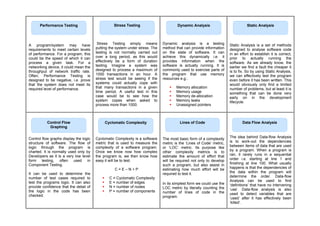
Control flow graphs display the logic
structure of software. The flow of
logic through the program is
charted. It is normally used only by
Developers as it is a very low level
form testing, often used in
Component Testing.
It can be used to determine the
number of test cases required to
test the programs logic. It can also
provide confidence that the detail of
the logic in the code has been
checked.
Cyclomatic Complexity is a software
metric that is used to measure the
complexity of a software program.
Once we know now how complex
the program is, we then know how
easy it will be to test.
C = E – N + P
 C = Cyclomatic Complexity
 E = number of edges
 N = number of nodes
 P = number of components
The most basic form of a complexity
metric is the ‘Lines of Code’ metric,
or ‘LOC’ metric. Its purpose like
other complexity metrics is to
estimate the amount of effort that
will be required not only to develop
such a program, but also assist in
estimating how much effort will be
required to test it.
In its simplest form we could use the
LOC metric by literally counting the
number of lines of code in the
program.
The idea behind Data-flow Analysis
is to work-out the dependencies
between items of data that are used
by a program. When a program is
ran, it rarely runs in a sequential
order i.e. starting at line 1 and
finishing at line 100. What usually
happens is that the dependencies of
the data within the program will
determine the order. Data-flow
Analysis can be used to find
‘definitions’ that have no intervening
‘use’. Data-flow analysis is also
used to detect variables that are
‘used’ after it has effectively been
‘killed’.
Stress Testing
Performance Testing Dynamic Analysis Static Analysis
Control Flow
Graphing
Cyclomatic Complexity Lines of Code Data Flow Analysis
Why can one Tester find more
errors than another Tester in the
same piece of software? More often
than not this is down to a technique
called ‘Error Guessing’. To be
successful at Error Guessing, a
certain level of knowledge and
experience is required. A Tester can
then make an educated guess at
where potential problems may arise.
This could be based on the Testers
experience with a previous iteration
of the software, or just a level of
knowledge in that area of
technology.
This type of testing is normally
governed by time. It consists of
using tests based on a test chapter
that contains test objectives. It is
most effective when there are little
or no specifications available. It
should only really be used to assist
with, or compliment a more formal
approach. It can basically ensure
that major functionality is working as
expected without fully testing it.
This type of testing is considered to
be the most informal, and by many it
is considered to be the least
effective. Ad-hoc testing is simply
making up the tests as you go
along. Often, it is used when there is
only a very small amount of time to
test something. A common mistake
to make with Ad-hoc testing is not
documenting the tests performed
and the test results. Even if this
information is included, more often
than not additional information is not
logged such as, software versions,
dates, test environment details etc.
A Tester normally selects test input
data from what is termed an ‘input
domain’. Random Testing is simply
when the Tester selects data from
the input domain ‘randomly’. As you
can tell, there is little structure
involved in ‘Random Testing’. In
order to avoid dealing with the
above questions, a more structured
Black-box Test Design could be
implemented instead. However,
using a random approach could
save valuable time and resources if
used in the right circumstances.
A Quality Assurance (QA) standard
simply specifies that testing should
be performed.
Example: ISO 9000
An industry specific standard will
detail exactly what level of testing is
to be performed.
Examples:
 Railway Signalling standard
 DO-178B
 Nuclear Industry standard
 MISRA guidelines for motor
vehicle software
 Pharmaceutical standards
Testing standards will detail how to
perform the testing. Ideally, a
testing standard should be
referenced from a QA or Industry
specific standard.
Example: BS7925-1, BS7925-2
Review: A process or meeting
during which a work product, or set
of work products, is presented to
project personnel, managers, users
or other interested parties for
comment or approval. [IEEE]
A review should be performed when
all of the supporting documentation
is available. This can include design
documents, requirements
documents, standards documents,
basically any documentation that
has either been influential or is
applicable to the document to be
reviewed.
Exploratory Testing
Error Guessing Ad-hoc Testing Random Testing
Quality Assurance
Standards
Industry Specific
Standards
Testing Standards Review Definition
Organisations will commonly have
different named roles than those
listed below, but this will give you an
idea of a commonly used set of
roles used throughout the world.
 Manager
 Moderator
 Author
 Reviewer
 Scribe
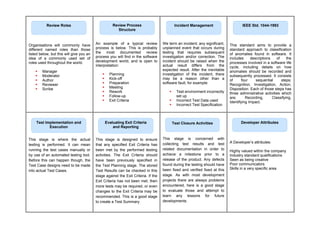
An example of a typical review
process is below. This is probably
the most documented review
process you will find in the software
development world, and is open to
interpretation:
 Planning
 Kick-off
 Preparation
 Meeting
 Rework
 Follow-up
 Exit Criteria
We term an incident; any significant,
unplanned event that occurs during
testing that requires subsequent
investigation and/or correction. The
incident should be raised when the
actual result differs from the
expected result. After the inevitable
investigation of the incident, there
may be a reason other than a
software fault, for example:
 Test environment incorrectly
set up
 Incorrect Test Data used
 Incorrect Test Specification
This standard aims to provide a
standard approach to classification
of anomalies found in software. It
includes descriptions of the
processes involved in a software life
cycle, including details on how
anomalies should be recorded and
subsequently processed. It consists
of four sequential steps;
Recognition, Investigation, Action,
Disposition. Each of those steps has
three administrative activities which
are; Recording, Classifying,
Identifying Impact.
This stage is where the actual
testing is performed. It can mean
running the test cases manually or
by use of an automated testing tool.
Before this can happen though, the
Test Case designs need to be made
into actual Test Cases.
This stage is designed to ensure
that any specified Exit Criteria has
been met by the performed testing
activities. The Exit Criteria should
have been previously specified in
the Test Planning stage. The stored
Test Results can be checked in this
stage against the Exit Criteria. If the
Exit Criteria has not been met, then
more tests may be required, or even
changes to the Exit Criteria may be
recommended. This is a good stage
to create a Test Summary.
This stage is concerned with
collecting test results and test
related documentation in order to
achieve a milestone prior to a
release of the product. Any defects
found during the testing should have
been fixed and verified fixed at this
stage. As with most development
projects there are always problems
encountered, here is a good stage
to evaluate those and attempt to
learn any lessons for future
developments.
A Developer’s attributes:
Highly valued within the company
Industry standard qualifications
Seen as being creative
Poor communicators
Skills in a very specific area
Review Process
Structure
Review Roles Incident Management IEEE Std. 1044-1993
Test Implementation and
Execution
Evaluating Exit Criteria
and Reporting
Test Closure Activities Developer Attributes
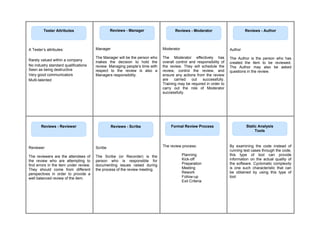
A Tester’s attributes:
Rarely valued within a company
No industry standard qualifications
Seen as being destructive
Very good communicators
Multi-talented
Manager
The Manager will be the person who
makes the decision to hold the
review. Managing people’s time with
respect to the review is also a
Managers responsibility.
Moderator
The Moderator effectively has
overall control and responsibility of
the review. They will schedule the
review, control the review, and
ensure any actions from the review
are carried out successfully.
Training may be required in order to
carry out the role of Moderator
successfully.
Author
The Author is the person who has
created the item to be reviewed.
The Author may also be asked
questions in the review.
Reviewer
The reviewers are the attendees of
the review who are attempting to
find errors in the item under review.
They should come from different
perspectives in order to provide a
well balanced review of the item.
Scribe
The Scribe (or Recorder) is the
person who is responsible for
documenting issues raised during
the process of the review meeting.
The review process:
Planning
Kick-off
Preparation
Meeting
Rework
Follow-up
Exit Criteria
By examining the code instead of
running test cases through the code,
this type of tool can provide
information on the actual quality of
the software. Cyclomatic complexity
is one such characteristic that can
be obtained by using this type of
tool.
Reviews - Manager
Tester Attributes Reviews - Moderator Reviews - Author
Reviews - Reviewer Reviews - Scribe Formal Review Process Static Analysis
Tools
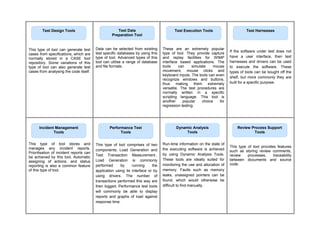
This type of tool can generate test
cases from specifications, which are
normally stored in a CASE tool
repository. Some variations of this
type of tool can also generate test
cases from analysing the code itself.
Data can be selected from existing
test specific databases by using this
type of tool. Advanced types of this
tool can utilise a range of database
and file formats.
These are an extremely popular
type of tool. They provide capture
and replay facilities for WIMP
interface based applications. The
tools can simulate mouse
movement, mouse clicks and
keyboard inputs. The tools can even
recognize windows and buttons,
thus making them extremely
versatile. The test procedures are
normally written in a specific
scripting language. This tool is
another popular choice for
regression testing.
If the software under test does not
have a user interface, then test
harnesses and drivers can be used
to execute the software. These
types of tools can be bought off the
shelf, but more commonly they are
built for a specific purpose.
This type of tool stores and
manages any incident reports.
Prioritisation of incident reports can
be achieved by this tool. Automatic
assigning of actions, and status
reporting is also a common feature
of this type of tool.
This type of tool comprises of two
components; Load Generation and
Test Transaction Measurement.,
Load Generation is commonly
performed by running the
application using its interface or by
using drivers. The number of
transactions performed this way are
then logged. Performance test tools
will commonly be able to display
reports and graphs of load against
response time.
Run-time information on the state of
the executing software is achieved
by using Dynamic Analysis Tools.
These tools are ideally suited for
monitoring the use and allocation of
memory. Faults such as memory
leaks, unassigned pointers can be
found, which would otherwise be
difficult to find manually.
This type of tool provides features
such as storing review comments,
review processes, traceability
between documents and source
code.
Test Data
Preparation Tool
Test Design Tools Test Execution Tools Test Harnesses
Incident Management
Tools
Performance Test
Tools
Dynamic Analysis
Tools
Review Process Support
Tools
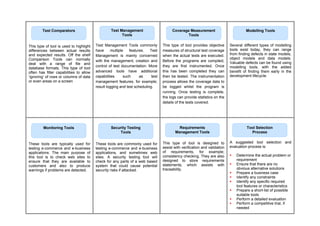
This type of tool is used to highlight
differences between actual results
and expected results. Off the shelf
Comparison Tools can normally
deal with a range of file and
database formats. This type of tool
often has filter capabilities to allow
‘ignoring’ of rows or columns of data
or even areas on a screen
Test Management Tools commonly
have multiple features. Test
Management is mainly concerned
with the management, creation and
control of test documentation. More
advanced tools have additional
capabilities such as test
management features, for example;
result logging and test scheduling.
This type of tool provides objective
measures of structural test coverage
when the actual tests are executed.
Before the programs are compiled,
they are first instrumented. Once
this has been completed they can
then be tested. The instrumentation
process allows the coverage data to
be logged whilst the program is
running. Once testing is complete,
the logs can provide statistics on the
details of the tests covered.
Several different types of modelling
tools exist today, they can range
from finding defects in state models,
object models and data models.
Valuable defects can be found using
modelling tools, with the added
benefit of finding them early in the
development lifecycle.
These tools are typically used for
testing e-commerce and e-business
applications. The main purpose of
this tool is to check web sites to
ensure that they are available to
customers and also to produce
warnings if problems are detected.
These tools are commonly used for
testing e-commerce and e-business
applications, and sometimes web
sites. A security testing tool will
check for any parts of a web based
system that could cause potential
security risks if attacked.
This type of tool is designed to
assist with verification and validation
of requirements, for example;
consistency checking. They are also
designed to store requirements
statements, which assists with
traceability.
A suggested tool selection and
evaluation process is:
 Determine the actual problem or
requirement
 Ensure that there are no
obvious alternative solutions
 Prepare a business case
 Identify any constraints
 Identify any specific required
tool features or characteristics
 Prepare a short-list of possible
suitable tools
 Perform a detailed evaluation
 Perform a competitive trial, if
needed
Test Management
Tools
Test Comparators Coverage Measurement
Tools
Modelling Tools
Monitoring Tools Security Testing
Tools
Requirements
Management Tools
Tool Selection
Process
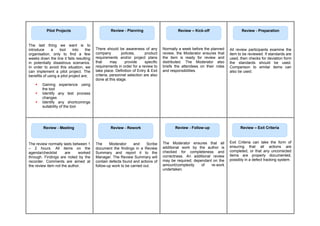
The last thing we want is to
introduce a tool into the
organisation, only to find a few
weeks down the line it fails resulting
in potentially disastrous scenarios.
In order to avoid this situation, we
can implement a pilot project. The
benefits of using a pilot project are;
 Gaining experience using
the tool
 Identify any test process
changes
 Identify any shortcomings
suitability of the tool
There should be awareness of any
company policies, product
requirements and/or project plans
that may provide specific
requirements in order for a review to
take place. Definition of Entry & Exit
criteria, personnel selection are also
done at this stage.
Normally a week before the planned
review, the Moderator ensures that
the item is ready for review and
distributed. The Moderator also
briefs the attendees on their roles
and responsibilities.
All review participants examine the
item to be reviewed. If standards are
used, then checks for deviation form
the standards should be used.
Comparison to similar items can
also be used.
The review normally lasts between 1
– 2 hours. All items on the
agenda/checklist are worked
through. Findings are noted by the
recorder. Comments are aimed at
the review item not the author.
The Moderator and Scribe
document the findings in a Review
Summary and report it to the
Manager. The Review Summary will
contain defects found and actions of
follow-up work to be carried out.
The Moderator ensures that all
additional work by the author is
checked for completeness and
correctness. An additional review
may be required; dependant on the
amount/complexity of re-work
undertaken.
Exit Criteria can take the form of
ensuring that all actions are
completed, or that any uncorrected
items are properly documented,
possibly in a defect tracking system.
Review - Planning
Pilot Projects Review – Kick-off Review - Preparation
Review - Meeting Review - Rework Review - Follow-up Review – Exit Criteria
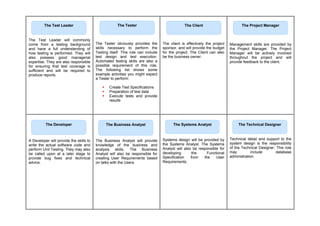
The Test Leader will commonly
come from a testing background
and have a full understanding of
how testing is performed. They will
also possess good managerial
expertise. They are also responsible
for ensuring that test coverage is
sufficient and will be required to
produce reports.
The Tester obviously provides the
skills necessary to perform the
Testing itself. This role can include
test design and test execution.
Automated testing skills are also a
possible requirement of this role.
The following list shows some
example activities you might expect
a Tester to perform:
 Create Test Specifications
 Preparation of test data
 Execute tests and provide
results
The client is effectively the project
sponsor, and will provide the budget
for the project. The Client can also
be the business owner.
Management skills are provided by
the Project Manager. The Project
Manager will be actively involved
throughout the project and will
provide feedback to the client.
A Developer will provide the skills to
write the actual software code and
perform Unit Testing. They may also
be called upon at a later stage to
provide bug fixes and technical
advice.
The Business Analyst will provide
knowledge of the business and
analysis skills. The Business
Analyst will also be responsible for
creating User Requirements based
on talks with the Users.
Systems design will be provided by
the Systems Analyst. The Systems
Analyst will also be responsible for
developing the Functional
Specification from the User
Requirements.
Technical detail and support to the
system design is the responsibility
of the Technical Designer. This role
may include database
administration.
The Tester
The Test Leader The Client The Project Manager
The Developer The Business Analyst The Systems Analyst The Technical Designer
ISTQB Self Learning Materials
www.istqb.guru

ISTQB-Foundation-Flashcards For Learning.pdf

  • 1.
    ISTQB Foundation LevelFlash Cards www.istqb.guru
  • 2.
    A Technical Review(also known as a peer review), is considered to be a formal review type, even though no Managers are expected to attend. It involves a structured encounter, in which a peer/s analyse the work with a view to improve the quality of the original work.  Ideally led by the Moderator  Attended by peers / technical experts  Documentation is required  No Management presence  Decision making  Solving technical problems A walkthrough is a set of procedures and techniques designed for a peer group, lead by the author to review software code. It is considered to be a fairly informal type of review. The walkthrough takes the form a meeting, normally between one and two hours in length.  Led by the Author  Attended by a peer group  Varying level of formality  Knowledge gathering  Defect finding An inspection is a formal type of review. It requires preparation on the part the review team members before the inspection meeting takes place. A follow-up stage is also a requirement of the inspection. This ensures that any re-working is carried out correctly.  Led by a Moderator  Attended by specified roles  Metrics are included  Formal process  Entry and Exit Criteria  Defect finding An informal review is an extremely popular choice early on in the development lifecycle of both software and documentation. The review is commonly performed by peer or someone with relevant experience, and should be informal and brief.  Low cost  No formal process  No documentation required  Widely used review Software Validation and Verification can involve analysis, reviewing, demonstrating or testing of all software developments. This will include the development process and the development product itself. Verification and Validation is normally carried out at the end of the development lifecycle (after all software developing is complete). But it can also be performed much earlier on in the development lifecycle by simply using reviews. Validation involves the actual testing. This should take place after verification phase has been completed. Validation: confirmation by examination and provision of objective evidence that the particular requirements for a specific intended use have been fulfilled. Validation: Are we building the right product? Verification would normally involve meetings and reviews and to evaluate the documents, plans, requirements and specifications. This can be achieved by using reviews and meetings etc. Verification: confirmation by examination and provision of objective evidence that specified requirements have been fulfilled. Verification: Are we building the product right? The Waterfall model is also known as the ‘Sequential model’. Each stage follows on from the previous one. The testing is performed in ‘block’ as the last stage. Planning or Test creation is not considered until the actual software code has been written. This can result in problems being found much later in the project lifecycle than is desirable. Walkthrough Review Technical Review Inspection Review Informal Review V & V Validation Verification Waterfall Model
  • 3.
    The V-Model isan industry standard framework that shows clearly the software development lifecycle in relation to testing. It also highlights the fact that the testing is just as important as the software development itself. The relationships between development and testing are clearly defined. The V-Model improves the presence of the testing activities to display a more balanced approach. The Spiral model is an incremental testing approach to both Development and Testing. This is used most effectively when the users do not know all of the requirements. From what is known, initial requirements can be defined. Then from these the code and test cases are created. As time goes on, more details of the requirements are known and implemented in further iterations of design, coding and testing phases. The system is considered to be complete, when enough of the iterations have taken place. RAD represents Rapid Application Development, and is a software development process that was developed in the mid 1980’s. It was developed to overcome the rigidity of such processes as ‘The Waterfall Model’. Elements:  Prototyping  Iterative Development  Time-boxing  Team Members  Management Approach  RAD Tools Error: A human action that produces an incorrect result. An example of an error would be the misspelling of a variable within the program code. Fault: A manifestation of an error in software. A fault, if encountered may cause a failure. An example of a fault would be a variable that is never used within the program code. Component testing is also known as Unit, Module, or Program Testing. In simple terms, this type of testing focuses simply on testing of the individual components themselves. It is common for component testing to be carried out by the Developer of the software. This however has a very low rating of testing independence. This type of Integration testing is concerned with ensuring the interactions between the software components at the module level behave as expected. Component Integration Testing is also often referred to as ‘Integration Testing in the Small’. It is commonly performed after any Component Testing has completed, and the behaviour tested may cover both functional and non-functional aspects of the integrated system. Requirements-based Testing is simply testing the functionality of the software/system based on the requirements. The tests themselves should be derived from the documented requirements and not based on the software code itself. This method of functional testing ensures that the users will be getting what they want, as the requirements document basically specifies what the user has asked for. Spiral Model V - Model RAD What is an Error? What is a fault? Component Testing Component Integration Testing Requirements Based Functional Testing
  • 4.
    Different types ofusers may use the developed software in different ways. These ways are analysed and business scenarios are then created. User profiles are often used in Business Process Functional Testing. Remember that all of the functionality should be tested for, not just the most commonly used areas. Testing the ability of the system to be able to bear loads. An example would be testing that a system could process a specified amount of transactions within a specified time period. So you are effectively loading the system up to a high level, then ensuring it can still function correctly whilst under this heavy load. A program/system may have requirements to meet certain levels of performance. For a program, this could be the speed of which it can process a given task. For a networking device, it could mean the throughput of network traffic rate. Often, Performance Testing is designed to be negative, i.e. prove that the system does not meet its required level of performance. Stress Testing simply means putting the system under stress. The testing is not normally carried out over a long period, as this would effectively be a form of duration testing. Imagine a system was designed to process a maximum of 1000 transactions in an hour. A stress test would be seeing if the systems could actually cope with that many transactions in a given time period. A useful test in this case would be to see how the system copes when asked to process more than 1000. A major requirement in today’s software/systems is security, particularly with the internet revolution. Security testing is focused at finding loopholes in the programs security checks. A common approach is to create test cases based on known problems from a similar program, and test these against the program under test. This is where consideration is taken into account of how the user will use the product. It is common for considerable resources to be spent on defining exactly what the customer requires and simple it is to use the program to achieve there aims. For example; test cases could be created based on the Graphical User Interface, to see how easy it would be to use in relation to a typical customer scenario. This type of testing may focus on the actual memory used by a program or system under certain conditions. Also disk space used by the program/system could also be a factor. These factors may actually come from a requirement, and should be approached from a negative testing point of view. Volume Testing is a form of Systems Testing. It primary focus is to concentrate on testing the systems while subjected to heavy volumes of data. Testing should be approached from a negative point of view to show that the program/system cannot operate correctly when using the volume of data specified in the requirements. Load Testing Business Process Functional Testing Performance Testing Stress Testing Security Testing Useability Testing Storage Testing Volume Testing
  • 5.
    A complicated programmay also have a complicated installation process. Consideration should be made as to whether the program will be installed by a customer or an installation engineer. Customer installations commonly use some kind of automated installation program. This would obviously have to under go significant testing in itself, as an incorrect installation procedure could render the target machine/system useless. Documentation in today’s environment can take several forms, as the documentation could be a printed document, an integral help file or even a web page. Depending of the documentation media type, some example areas to focus on could be, spelling, usability, technical accuracy etc. Recovery Testing is normally carried out by using test cases based on specific requirements. A system may be designed to fail under a given scenario, for example if attacked by a malicious user; the program/system may have been designed to shut down. Recovery testing should focus on how the system handles the failure and how it handles the recovery process. This type of Integration Testing is concerned with ensuring the interactions between systems behave as expected. It is commonly performed after any Systems Testing has completed. Typically not all systems referenced in the testing are controlled by the developing organization. Some systems maybe controlled by other organizations, but interface directly with the system under test. User Acceptance Testing or ‘UAT’ is commonly the last testing performed on the software product before its actual release. It is common for the customer to perform this type of testing, or at least be partially involved. Often, the testing environment used to perform User Acceptance Testing is based on a model of the customer’s environment. This is done to try and simulate as closely as possible the way in which the software product will actually be used by the customer. This type of Acceptance Testing is aimed at ensuring the acceptance criteria within the original contract have indeed been met by the developed software. Normally any acceptance criteria is defined when the contract is agreed. Regulation Acceptance Testing is performed when there exists specific regulations that must be adhered to, for example, there may be safety regulations, or legal regulations. This form of acceptance testing is commonly performed by a System Administrator and would normally be concerned with ensuring that functionality such as; backup/restore, maintenance, and security functionality is present and behaves as expected. Alpha Testing should be performed at the developer’s site, and predominantly performed by internal testers only. Often, other company department personnel can act as testers. The marketing or sales departments are often chosen for this purpose. Documentation Testing Installability Testing Recovery Testing System Integration Testing UAT Contract & Regulation Acceptance Testing Operational Acceptance Testing Alpha Testing
  • 6.
    Beta Testing iscommonly performed at the customer’s site, and normally carried out by the customers themselves. Potential customers are often eager to trial a new product or new software version. This allows the customer to see any improvements at first hand and ascertain whether or not it satisfies their requirements. On the flip side, it gives invaluable feedback to the developer, often at little or no cost. It is imperative that when a fault is fixed it is re-tested to ensure the fault has indeed been correctly fixed. Re-test: “Whenever a fault is detected and fixed then the software should be re- tested to ensure that the original fault has been successfully removed.” When checking a fixed fault, you can also consider checking that other existing functionality has not been adversely affected by the fix. This is called Regression Testing. Regression Test: “Regression testing attempts to verify that modifications have not caused unintended adverse side effects in the unchanged software (regression faults) and that the modified system still meets its requirements.” A Test Plan should be a single document that basically contains what is going to be tested, why it is going to be tested, and how it is going to be tested. It is also important to clarify what is not going to be tested in the software product too. With regards to using a standard Test Plan layout, then we can look to the advice given by the IEEE(Institute of Electrical and Electronic Engineers) located in the International Standard IEEE Std 929-1998. A standard test process that is commonly used exists within the BS7925-2 Standard for Software Component Testing:  Test Planning  Test Specification  Test Execution  Test Checking & Recording  Checking for Test Completion This should apply to both new projects and maintenance work. Normally fairly short in length, the test policy should be a high-level document, and should contain the following items:  Definition of testing  The testing process  Evaluation of testing  Quality levels  Improvement approach Based on the test policy, the test strategy is designed to give an overview of the test requirements for a programme or even organization. Information relating to risks should be documented here, specifically the risks that will be addressed by the testing, and the specific tests that will be used against each risk. Exactly how the test strategy for a particular project will be implemented is displayed in the project plan. The project test plan will normally be referenced from the overall project plan. In relation to the test strategy, the project plan should detail items from the test strategy that it is complying with, and also items it is not complying with. Re-Test Beta Testing Regression Testing Test Plan Document Generic Test Process Test Policy Test Strategy Project Plan
  • 7.
    The specific detailsof the approach taken by the testing for a specific test phase is shown in this document. It can be thought of as being based on the project plan, but with greater amounts of detail included, such as testing activities based on day to day plan, or expected amounts of man hours to complete individual tasks. Failure: Deviation of the software from its expected delivery or service. An example of a failure would be the fact that the warning message is never displayed when it is required. Once the faults have been rectified, then we can say that the quality of the software product has increased. The testing term ‘Quality’ can be thought of as an overall term, as the quality of the software product is dependant upon many factors. In general, quality software should be reasonably bug free, delivered on time and within the original budget. Test Planning basically involves determining what is going to be tested, why it is going to be tested, and how it is going to be tested. In order to meet the objectives of the testing, it is very important not only to have good plans, but also to ensure that they are adhered to. Test Control will help to achieve this, as its purpose is to ensure that the ongoing testing progress is compared to the Test Plan. Test objectives can come from a variety of sources. This will commonly take the form of a requirements list or specification. Once the requirements are clearly understood, it should be possible to design tests or conditions based upon these requirements. What this method allows you to do is effectively partition the possible program inputs. For each of the above input fields, it should not matter which values are entered as long as they are within the correct range and of the correct type. So the point of equivalence portioning is to reduce the amount of testing by choosing a small selection of the possible values to be tested, as the program will handle them in the same way. By the use of equivalence partitioning, a tester can perform effective testing without testing every possible value. This method can be enhanced further by another method called ‘Boundary Value Analysis’. After time, an experienced Tester will be often realise that problems can occur at the boundaries of the input and output spaces. When testing only a small amount of possible values, the minimum and maximum possible values should be amongst the first items to be tested. The classification tree method is also known as a decision tree method and the terms can be used interchangeably as they mean the same thing. A decision tree can be learned by splitting the source set into subsets based on an attribute value test. This process is repeated on each subset in a recursively. The recursion is completed when splitting is either not possible, or a single classification can be applied to each element of the subset. What is a Failure? Phase Test Plan Quality & Testing Test Planning & Control Test Analysis & Design Equivalence Partitioning Boundary Value Analysis Classification Tree Method
  • 8.
    This type ofBlack-box testing is based on the concept of ‘states’ and ‘finite-states’, and is based on the tester being able to view the software’s states, transition between states, and what will trigger a state change. Test cases can then be designed to execute the state changes. This testing method involves using a model of the source code which identifies statements. These statements are the categorized as being either ‘executable’ or ‘non- executable’. In order to use this method, the input to each component must be identified. Also, each test case must be able to identify each individual statement. Lastly, the expected outcome of each test case must be clearly defined This test method uses a model of the source code which identifies individual decisions, and their outcomes. A ‘decision’ is defined as being an executable statement containing its own logic. This logic may also have the capability to transfer control to another statement. Each test case is designed to exercise the decision outcomes. In order to use this method, the input to each component must be identified. Branch Condition Testing uses a model of the source code, and identifies decisions based on individual Boolean operands within each decision condition. A ‘decision’ is defined as being an executable statement containing its own logic. An example of a decision would be a ‘loop’ in a program. Branch Condition Combination Testing uses a model of the source code, and identifies decisions based on combinations of Boolean operands within decision conditions. This logic may also have the capability to transfer control to another statement. The decision condition is a Boolean expression which is evaluated to determine the outcome of the decision. Requirements-based Testing is simply testing the functionality of the software/system based on the requirements. The tests themselves should be derived from the documented requirements and not based on the software code itself. This method of functional testing ensures that the users will be getting what they want, as the requirements document basically specifies what the user has asked for. This is where consideration is taken into account of how the user will use the product. It is common for considerable resources to be spent on defining exactly what the customer requires and how simple it is to use the program to achieve there aims. For example; test cases could be created based on the Graphical User Interface, to see how easy it would be to use in relation to a typical customer scenario. Volume Testing is a form of Systems Testing. It primary focus is to concentrate on testing the systems while subjected to heavy volumes of data. Testing should be approached from a negative point of view to show that the program/system cannot operate correctly when using the volume of data specified in the requirements. Statement Testing State Transition Testing Branch Decision Testing Branch Condition Testing Branch Condition Combination Testing Requirements Based Functional Testing Useability Testing Volume Testing
  • 9.
    A program/system mayhave requirements to meet certain levels of performance. For a program, this could be the speed of which it can process a given task. For a networking device, it could mean the throughput of network traffic rate. Often, Performance Testing is designed to be negative, i.e. prove that the system does not meet its required level of performance. Stress Testing simply means putting the system under stress. The testing is not normally carried out over a long period, as this would effectively be a form of duration testing. Imagine a system was designed to process a maximum of 1000 transactions in an hour. A stress test would be seeing if the systems could actually cope with that many transactions in a given time period. A useful test in this case would be to see how the system copes when asked to process more than 1000. Dynamic analysis is a testing method that can provide information on the state of software. It can achieve this dynamically i.e. it provides information when the software is actually running. It is commonly used to exercise parts of the program that use memory resources e.g.:  Memory allocation  Memory usage  Memory de-allocation  Memory leaks  Unassigned pointers Static Analysis is a set of methods designed to analyse software code in an effort to establish it is correct, prior to actually running the software. As we already know, the earlier we find a fault the cheaper it is to fix. So by using Static Analysis, we can effectively test the program even before it has been written. This would obviously only find a limited number of problems, but at least it is something that can be done very early on in the development lifecycle. Control flow graphs display the logic structure of software. The flow of logic through the program is charted. It is normally used only by Developers as it is a very low level form testing, often used in Component Testing. It can be used to determine the number of test cases required to test the programs logic. It can also provide confidence that the detail of the logic in the code has been checked. Cyclomatic Complexity is a software metric that is used to measure the complexity of a software program. Once we know now how complex the program is, we then know how easy it will be to test. C = E – N + P  C = Cyclomatic Complexity  E = number of edges  N = number of nodes  P = number of components The most basic form of a complexity metric is the ‘Lines of Code’ metric, or ‘LOC’ metric. Its purpose like other complexity metrics is to estimate the amount of effort that will be required not only to develop such a program, but also assist in estimating how much effort will be required to test it. In its simplest form we could use the LOC metric by literally counting the number of lines of code in the program. The idea behind Data-flow Analysis is to work-out the dependencies between items of data that are used by a program. When a program is ran, it rarely runs in a sequential order i.e. starting at line 1 and finishing at line 100. What usually happens is that the dependencies of the data within the program will determine the order. Data-flow Analysis can be used to find ‘definitions’ that have no intervening ‘use’. Data-flow analysis is also used to detect variables that are ‘used’ after it has effectively been ‘killed’. Stress Testing Performance Testing Dynamic Analysis Static Analysis Control Flow Graphing Cyclomatic Complexity Lines of Code Data Flow Analysis
  • 10.
    Why can oneTester find more errors than another Tester in the same piece of software? More often than not this is down to a technique called ‘Error Guessing’. To be successful at Error Guessing, a certain level of knowledge and experience is required. A Tester can then make an educated guess at where potential problems may arise. This could be based on the Testers experience with a previous iteration of the software, or just a level of knowledge in that area of technology. This type of testing is normally governed by time. It consists of using tests based on a test chapter that contains test objectives. It is most effective when there are little or no specifications available. It should only really be used to assist with, or compliment a more formal approach. It can basically ensure that major functionality is working as expected without fully testing it. This type of testing is considered to be the most informal, and by many it is considered to be the least effective. Ad-hoc testing is simply making up the tests as you go along. Often, it is used when there is only a very small amount of time to test something. A common mistake to make with Ad-hoc testing is not documenting the tests performed and the test results. Even if this information is included, more often than not additional information is not logged such as, software versions, dates, test environment details etc. A Tester normally selects test input data from what is termed an ‘input domain’. Random Testing is simply when the Tester selects data from the input domain ‘randomly’. As you can tell, there is little structure involved in ‘Random Testing’. In order to avoid dealing with the above questions, a more structured Black-box Test Design could be implemented instead. However, using a random approach could save valuable time and resources if used in the right circumstances. A Quality Assurance (QA) standard simply specifies that testing should be performed. Example: ISO 9000 An industry specific standard will detail exactly what level of testing is to be performed. Examples:  Railway Signalling standard  DO-178B  Nuclear Industry standard  MISRA guidelines for motor vehicle software  Pharmaceutical standards Testing standards will detail how to perform the testing. Ideally, a testing standard should be referenced from a QA or Industry specific standard. Example: BS7925-1, BS7925-2 Review: A process or meeting during which a work product, or set of work products, is presented to project personnel, managers, users or other interested parties for comment or approval. [IEEE] A review should be performed when all of the supporting documentation is available. This can include design documents, requirements documents, standards documents, basically any documentation that has either been influential or is applicable to the document to be reviewed. Exploratory Testing Error Guessing Ad-hoc Testing Random Testing Quality Assurance Standards Industry Specific Standards Testing Standards Review Definition
  • 11.
    Organisations will commonlyhave different named roles than those listed below, but this will give you an idea of a commonly used set of roles used throughout the world.  Manager  Moderator  Author  Reviewer  Scribe An example of a typical review process is below. This is probably the most documented review process you will find in the software development world, and is open to interpretation:  Planning  Kick-off  Preparation  Meeting  Rework  Follow-up  Exit Criteria We term an incident; any significant, unplanned event that occurs during testing that requires subsequent investigation and/or correction. The incident should be raised when the actual result differs from the expected result. After the inevitable investigation of the incident, there may be a reason other than a software fault, for example:  Test environment incorrectly set up  Incorrect Test Data used  Incorrect Test Specification This standard aims to provide a standard approach to classification of anomalies found in software. It includes descriptions of the processes involved in a software life cycle, including details on how anomalies should be recorded and subsequently processed. It consists of four sequential steps; Recognition, Investigation, Action, Disposition. Each of those steps has three administrative activities which are; Recording, Classifying, Identifying Impact. This stage is where the actual testing is performed. It can mean running the test cases manually or by use of an automated testing tool. Before this can happen though, the Test Case designs need to be made into actual Test Cases. This stage is designed to ensure that any specified Exit Criteria has been met by the performed testing activities. The Exit Criteria should have been previously specified in the Test Planning stage. The stored Test Results can be checked in this stage against the Exit Criteria. If the Exit Criteria has not been met, then more tests may be required, or even changes to the Exit Criteria may be recommended. This is a good stage to create a Test Summary. This stage is concerned with collecting test results and test related documentation in order to achieve a milestone prior to a release of the product. Any defects found during the testing should have been fixed and verified fixed at this stage. As with most development projects there are always problems encountered, here is a good stage to evaluate those and attempt to learn any lessons for future developments. A Developer’s attributes: Highly valued within the company Industry standard qualifications Seen as being creative Poor communicators Skills in a very specific area Review Process Structure Review Roles Incident Management IEEE Std. 1044-1993 Test Implementation and Execution Evaluating Exit Criteria and Reporting Test Closure Activities Developer Attributes
  • 12.
    A Tester’s attributes: Rarelyvalued within a company No industry standard qualifications Seen as being destructive Very good communicators Multi-talented Manager The Manager will be the person who makes the decision to hold the review. Managing people’s time with respect to the review is also a Managers responsibility. Moderator The Moderator effectively has overall control and responsibility of the review. They will schedule the review, control the review, and ensure any actions from the review are carried out successfully. Training may be required in order to carry out the role of Moderator successfully. Author The Author is the person who has created the item to be reviewed. The Author may also be asked questions in the review. Reviewer The reviewers are the attendees of the review who are attempting to find errors in the item under review. They should come from different perspectives in order to provide a well balanced review of the item. Scribe The Scribe (or Recorder) is the person who is responsible for documenting issues raised during the process of the review meeting. The review process: Planning Kick-off Preparation Meeting Rework Follow-up Exit Criteria By examining the code instead of running test cases through the code, this type of tool can provide information on the actual quality of the software. Cyclomatic complexity is one such characteristic that can be obtained by using this type of tool. Reviews - Manager Tester Attributes Reviews - Moderator Reviews - Author Reviews - Reviewer Reviews - Scribe Formal Review Process Static Analysis Tools
  • 13.
    This type oftool can generate test cases from specifications, which are normally stored in a CASE tool repository. Some variations of this type of tool can also generate test cases from analysing the code itself. Data can be selected from existing test specific databases by using this type of tool. Advanced types of this tool can utilise a range of database and file formats. These are an extremely popular type of tool. They provide capture and replay facilities for WIMP interface based applications. The tools can simulate mouse movement, mouse clicks and keyboard inputs. The tools can even recognize windows and buttons, thus making them extremely versatile. The test procedures are normally written in a specific scripting language. This tool is another popular choice for regression testing. If the software under test does not have a user interface, then test harnesses and drivers can be used to execute the software. These types of tools can be bought off the shelf, but more commonly they are built for a specific purpose. This type of tool stores and manages any incident reports. Prioritisation of incident reports can be achieved by this tool. Automatic assigning of actions, and status reporting is also a common feature of this type of tool. This type of tool comprises of two components; Load Generation and Test Transaction Measurement., Load Generation is commonly performed by running the application using its interface or by using drivers. The number of transactions performed this way are then logged. Performance test tools will commonly be able to display reports and graphs of load against response time. Run-time information on the state of the executing software is achieved by using Dynamic Analysis Tools. These tools are ideally suited for monitoring the use and allocation of memory. Faults such as memory leaks, unassigned pointers can be found, which would otherwise be difficult to find manually. This type of tool provides features such as storing review comments, review processes, traceability between documents and source code. Test Data Preparation Tool Test Design Tools Test Execution Tools Test Harnesses Incident Management Tools Performance Test Tools Dynamic Analysis Tools Review Process Support Tools
  • 14.
    This type oftool is used to highlight differences between actual results and expected results. Off the shelf Comparison Tools can normally deal with a range of file and database formats. This type of tool often has filter capabilities to allow ‘ignoring’ of rows or columns of data or even areas on a screen Test Management Tools commonly have multiple features. Test Management is mainly concerned with the management, creation and control of test documentation. More advanced tools have additional capabilities such as test management features, for example; result logging and test scheduling. This type of tool provides objective measures of structural test coverage when the actual tests are executed. Before the programs are compiled, they are first instrumented. Once this has been completed they can then be tested. The instrumentation process allows the coverage data to be logged whilst the program is running. Once testing is complete, the logs can provide statistics on the details of the tests covered. Several different types of modelling tools exist today, they can range from finding defects in state models, object models and data models. Valuable defects can be found using modelling tools, with the added benefit of finding them early in the development lifecycle. These tools are typically used for testing e-commerce and e-business applications. The main purpose of this tool is to check web sites to ensure that they are available to customers and also to produce warnings if problems are detected. These tools are commonly used for testing e-commerce and e-business applications, and sometimes web sites. A security testing tool will check for any parts of a web based system that could cause potential security risks if attacked. This type of tool is designed to assist with verification and validation of requirements, for example; consistency checking. They are also designed to store requirements statements, which assists with traceability. A suggested tool selection and evaluation process is:  Determine the actual problem or requirement  Ensure that there are no obvious alternative solutions  Prepare a business case  Identify any constraints  Identify any specific required tool features or characteristics  Prepare a short-list of possible suitable tools  Perform a detailed evaluation  Perform a competitive trial, if needed Test Management Tools Test Comparators Coverage Measurement Tools Modelling Tools Monitoring Tools Security Testing Tools Requirements Management Tools Tool Selection Process
  • 15.
    The last thingwe want is to introduce a tool into the organisation, only to find a few weeks down the line it fails resulting in potentially disastrous scenarios. In order to avoid this situation, we can implement a pilot project. The benefits of using a pilot project are;  Gaining experience using the tool  Identify any test process changes  Identify any shortcomings suitability of the tool There should be awareness of any company policies, product requirements and/or project plans that may provide specific requirements in order for a review to take place. Definition of Entry & Exit criteria, personnel selection are also done at this stage. Normally a week before the planned review, the Moderator ensures that the item is ready for review and distributed. The Moderator also briefs the attendees on their roles and responsibilities. All review participants examine the item to be reviewed. If standards are used, then checks for deviation form the standards should be used. Comparison to similar items can also be used. The review normally lasts between 1 – 2 hours. All items on the agenda/checklist are worked through. Findings are noted by the recorder. Comments are aimed at the review item not the author. The Moderator and Scribe document the findings in a Review Summary and report it to the Manager. The Review Summary will contain defects found and actions of follow-up work to be carried out. The Moderator ensures that all additional work by the author is checked for completeness and correctness. An additional review may be required; dependant on the amount/complexity of re-work undertaken. Exit Criteria can take the form of ensuring that all actions are completed, or that any uncorrected items are properly documented, possibly in a defect tracking system. Review - Planning Pilot Projects Review – Kick-off Review - Preparation Review - Meeting Review - Rework Review - Follow-up Review – Exit Criteria
  • 16.
    The Test Leaderwill commonly come from a testing background and have a full understanding of how testing is performed. They will also possess good managerial expertise. They are also responsible for ensuring that test coverage is sufficient and will be required to produce reports. The Tester obviously provides the skills necessary to perform the Testing itself. This role can include test design and test execution. Automated testing skills are also a possible requirement of this role. The following list shows some example activities you might expect a Tester to perform:  Create Test Specifications  Preparation of test data  Execute tests and provide results The client is effectively the project sponsor, and will provide the budget for the project. The Client can also be the business owner. Management skills are provided by the Project Manager. The Project Manager will be actively involved throughout the project and will provide feedback to the client. A Developer will provide the skills to write the actual software code and perform Unit Testing. They may also be called upon at a later stage to provide bug fixes and technical advice. The Business Analyst will provide knowledge of the business and analysis skills. The Business Analyst will also be responsible for creating User Requirements based on talks with the Users. Systems design will be provided by the Systems Analyst. The Systems Analyst will also be responsible for developing the Functional Specification from the User Requirements. Technical detail and support to the system design is the responsibility of the Technical Designer. This role may include database administration. The Tester The Test Leader The Client The Project Manager The Developer The Business Analyst The Systems Analyst The Technical Designer
  • 17.
    ISTQB Self LearningMaterials www.istqb.guru