Statistical Analysis of Clustered Binary Response in
                Oral Health Research
Ronen Ofec*, DMD ; David M. Steinberg, PhD ; Devorah Schwartz-Arad, DND, PhD

* M.Sc. program in Biostatistics, School of Mathematical sciences, Tel-Aviv university
* Praviate dental practice, Tel-Aviv, Israel
The 4th International Meeting on Methodological Issues In Oral Health Research,
Istanbul , Turkey
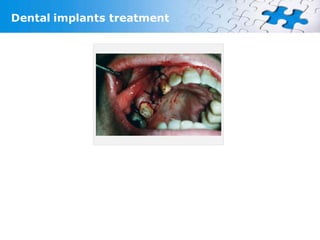
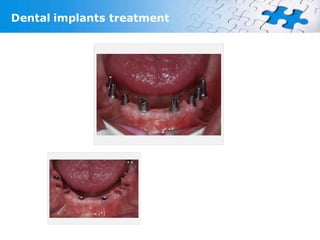
Dental implants treatment
The durability of
Dental implants treatment


 Failures (removal of an implant) do occur
 Marginal bone loss (MBL) can be an early sign for a failure
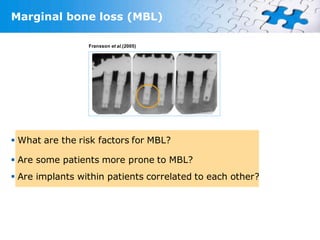
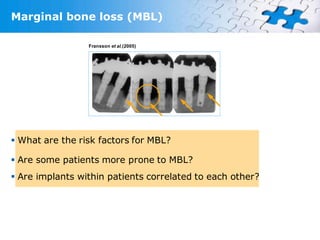
 MBL: The amount of bone an implant loses during function time
Marginal bone loss (MBL)

                 Fransson et al.(2005)


 What are the risk factors for MBL?

 Are some patients more prone to MBL?
 Are implants within patients correlated to each other?
Marginal bone loss (MBL)

                 Fransson et al.(2005)


 What are the risk factors for MBL?

 Are some patients more prone to MBL?
 Are implants within patients correlated to each other?
Marginal bone loss (MBL)

                 Fransson et al.(2005)


 What are the risk factors for MBL?

 Are some patients more prone to MBL?
 Are implants within patients correlated to each other?
Main question of interest and
Objectives of the study


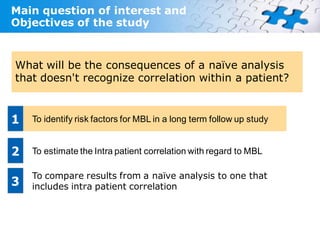
What will be the consequences of a naïve analysis
that doesn't recognize correlation within a patient?


1   To identify risk factors for MBL in a long term follow up study


2   To estimate the Intra patient correlation with regard to MBL

    To compare results from a naïve analysis to one that
3   includes intra patient correlation
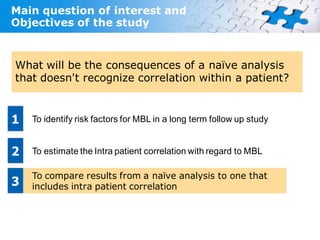
Main question of interest and
Objectives of the study


What will be the consequences of a naïve analysis
that doesn't recognize correlation within a patient?


1   To identify risk factors for MBL in a long term follow up study


2   To estimate the Intra patient correlation with regard to MBL

    To compare results from a naïve analysis to one that
3   includes intra patient correlation
Main question of interest and
Objectives of the study


What will be the consequences of a naïve analysis
that doesn't recognize correlation within a patient?


1   To identify risk factors for MBL in a long term follow up study


2   To estimate the Intra patient correlation with regard to MBL

    To compare results from a naïve analysis to one that
3   includes intra patient correlation
Main question of interest and
Objectives of the study


What will be the consequences of a naïve analysis
that doesn't recognize correlation within a patient?


1   To identify risk factors for MBL in a long term follow up study


2   To estimate the Intra patient correlation with regard to MBL

    To compare results from a naïve analysis to one that
3   includes intra patient correlation
Study design and participants


  Historical prospective cohort study design
  Schwartz-Arad Surgical center, between January
   1996, and July 1998 by a single surgeon (DSA)
  Follow-up time was up to 147 months with a mean
   of 70 months
The exposures,
Binary response and data set


 The exposures: Patient-specific and implant-specific
 Clustered response: MBL measurement at implant level
 Binary response: Acceptable vs. advanced bone loss
 Cut point at MBL=0.2 mm/year
 The data set: Multilevel data set
 195 Patients as the primary sample units (clusters)
 721 Implants as the Elementary units
 No. of implants per patient [1,16], mode=3
The Intra Patient Correlation


1 Way Random Effect ANOVA

Patient effect

Implant effect
Patient and implant effect
 are independent
The Intra Class Correlation (ICC)
The estimator and the estimate
for ICC


 Kappa type estimator proposed by Fleiss and Cuzick (1979)
 Confidence Intervals for the estimator formulated
  by Zou and Donner (2004)
 Simulation results: empirical coverage is close to nominal
  with C.I for the kappa type
 In our study:
The Generalized Estimating
Equations (GEE)


 Population average (Marginal) model Liang and Zeger (1986)
1. The mean model:
2. Working variance structure:
3. Working correlation structure:
 The empirical/sandwich estimator for the precision of estimates
Robustness of the
Sandwich estimator


 The estimator is robust to misspecification of the variance and
  correlation structures
 Our estimates are still valid (consistent) if we use a structure
  which is not reflecting reality
 Mancl and Leroux (1996): Gain of precision for the “right”
  correlation structure
The prevalence of advanced
bone loss by GEE
Risk factors for MBL
by GEE
                                                         0 *** 0.001 ** 0.01 * 0.05


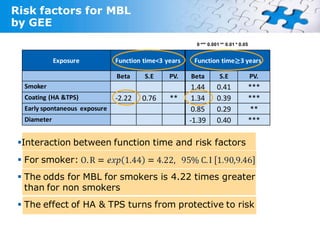
             Exposure          Function time<3 years    Function time≥3 years

                               Beta     S.E     PV.    Beta         S.E               PV.
  Smoker                                                1.44       0.41               ***
  Coating (HA &TPS)            -2.22   0.76     **      1.34       0.39               ***
  Early spontaneous exposure                            0.85       0.29               **
  Diameter                                             -1.39       0.40               ***

 Interaction between function time and risk factors
  For smoker:
  The odds for MBL for smokers is 4.22 times greater
   than for non smokers
  The effect of HA & TPS turns from protective to risk
Risk factors for MBL
by GEE
                                                         0 *** 0.001 ** 0.01 * 0.05


             Exposure          Function time<3 years    Function time≥3 years

                               Beta     S.E     PV.    Beta         S.E               PV.
  Smoker                                                1.44       0.41               ***
  Coating (HA &TPS)            -2.22   0.76     **      1.34       0.39               ***
  Early spontaneous exposure                            0.85       0.29               **
  Diameter                                             -1.39       0.40               ***

 Interaction between function time and risk factors
  For smoker:
  The odds for MBL for smokers is 4.22 times greater
   than for non smokers
  The effect of HA & TPS turns from protective to risk
Risk factors for MBL
by GEE
                                                         0 *** 0.001 ** 0.01 * 0.05


             Exposure          Function time<3 years    Function time≥3 years

                               Beta     S.E     PV.    Beta         S.E               PV.
  Smoker                                                1.44       0.41               ***
  Coating (HA &TPS)            -2.22   0.76     **      1.34       0.39               ***
  Early spontaneous exposure                            0.85       0.29               **
  Diameter                                             -1.39       0.40               ***

 Interaction between function time and risk factors
  For smoker:
  The odds for MBL for smokers is 4.22 times greater
   than for non smokers
  The effect of HA & TPS turns from protective to risk
The naïve estimation
and GEE

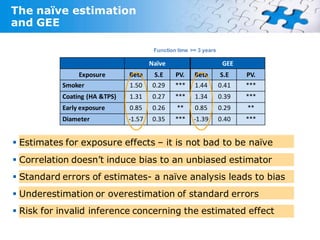
                                        Function time >= 3 years

                                       Naïve                        GEE
                Exposure       Beta     S.E     PV.    Beta        S.E    PV.
           Smoker              1.50     0.29    ***    1.44        0.41   ***
           Coating (HA &TPS)   1.31     0.27    ***    1.34        0.39   ***
           Early exposure      0.85     0.26    **     0.85        0.29   **
           Diameter            -1.57    0.35    ***    -1.39       0.40   ***


 Estimates for exposure effects – it is not bad to be naïve
 Correlation doesn’t induce bias to an unbiased estimator
 Standard errors of estimates- a naïve analysis leads to bias
 Underestimation or overestimation of standard errors
 Risk for invalid inference concerning the estimated effect
The naïve estimation
and GEE

                                        Function time >= 3 years

                                       Naïve                        GEE
                Exposure       Beta     S.E     PV.    Beta        S.E    PV.
           Smoker              1.50     0.29    ***    1.44        0.41   ***
           Coating (HA &TPS)   1.31     0.27    ***    1.34        0.39   ***
           Early exposure      0.85     0.26    **     0.85        0.29   **
           Diameter            -1.57    0.35    ***    -1.39       0.40   ***


 Estimates for exposure effects – it is not bad to be naïve
 Correlation doesn’t induce bias to an unbiased estimator
 Standard errors of estimates- a naïve analysis leads to bias
 Underestimation or overestimation of standard errors
 Risk for invalid inference concerning the estimated effect
The naïve estimation
and GEE

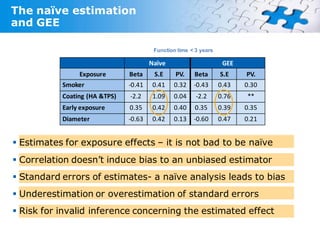
                                        Function time < 3 years

                                       Naïve                       GEE
                Exposure       Beta     S.E     PV.    Beta       S.E    PV.
           Smoker              -0.41    0.41   0.32    -0.43      0.43   0.30
           Coating (HA &TPS)   -2.2     1.09   0.04     -2.2      0.76   **
           Early exposure      0.35     0.42   0.40    0.35       0.39   0.35
           Diameter            -0.63    0.42   0.13    -0.60      0.47   0.21


 Estimates for exposure effects – it is not bad to be naïve
 Correlation doesn’t induce bias to an unbiased estimator
 Standard errors of estimates- a naïve analysis leads to bias
 Underestimation or overestimation of standard errors
 Risk for invalid inference concerning the estimated effect
The source of exposures
 variation

                        Source of exposure/treatment variation
    Between                                                          Within
  patient/cluster                                                patient/cluster


 Patient specific exposure: variation between patient
 Similar to treatment effect in Between cluster design
 Implant specific exposure: variation within and between patient
 Might be similar to treatment effect in Within/Between cluster
  design
 Depends on the source of variation of Implant specific exposure
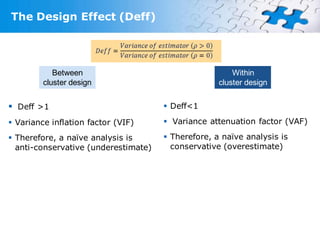
The Design Effect (Deff)


            Between                                     Within
         cluster design                             cluster design


 Deff >1                              Deff<1

 Variance inflation factor (VIF)      Variance attenuation factor (VAF)

 Therefore, a naïve analysis is       Therefore, a naïve analysis is
  anti-conservative (underestimate)     conservative (overestimate)
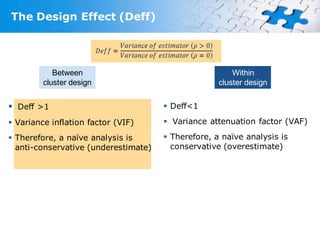
The Design Effect (Deff)


            Between                                     Within
         cluster design                             cluster design


 Deff >1                              Deff<1

 Variance inflation factor (VIF)      Variance attenuation factor (VAF)

 Therefore, a naïve analysis is       Therefore, a naïve analysis is
  anti-conservative (underestimate)     conservative (overestimate)
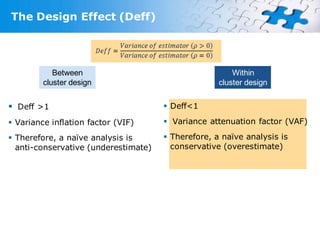
The Design Effect (Deff)


            Between                                     Within
         cluster design                             cluster design


 Deff >1                              Deff<1

 Variance inflation factor (VIF)      Variance attenuation factor (VAF)

 Therefore, a naïve analysis is       Therefore, a naïve analysis is
  anti-conservative (underestimate)     conservative (overestimate)
The answer to the main
question of interest

              What will be the consequences of a
              naïve analysis that doesn't recognize
              correlation within a patient?


 No problem with the estimated effect
 For a patient specific exposure: underestimation of standard
  errors
 For an implant specific exposure: underestimation if variance is
  from between patients
 But, overestimation if variance of exposure is from within patient
 Mancl, Leroux, DeRouen (2000) recommended to separate the
  effect of a site specific exposure, into within and between effect
Conclusions


1   Intra patient correlation for advanced MBL exists


2   The effect of some exposures isn’t constant during function time

    Ignoring ICC might bias the precision of estimated effect. Simulation
3   studies should confirm the direction of the bias
Conclusions


1   Intra patient correlation for advanced MBL exists


2   The effect of some exposures isn’t constant during function time

    Ignoring ICC might bias the precision of estimated effect. Simulation
3   studies should confirm the direction of the bias
Conclusions


1   Intra patient correlation for advanced MBL exists


2   The effect of some exposures isn’t constant during function time

    Ignoring ICC might bias the precision of estimated effect. Simulation
3   studies should confirm the direction of the bias
Thanks !
ofec@post.tau.ac.il

Statistical Analysis of Clustered Binary Response in Oral Health Research

  • 1.
    Statistical Analysis ofClustered Binary Response in Oral Health Research Ronen Ofec*, DMD ; David M. Steinberg, PhD ; Devorah Schwartz-Arad, DND, PhD * M.Sc. program in Biostatistics, School of Mathematical sciences, Tel-Aviv university * Praviate dental practice, Tel-Aviv, Israel The 4th International Meeting on Methodological Issues In Oral Health Research, Istanbul , Turkey
  • 2.
  • 3.
  • 4.
  • 5.
  • 6.
  • 7.
  • 8.
  • 9.
  • 10.
  • 11.
    The durability of Dentalimplants treatment  Failures (removal of an implant) do occur  Marginal bone loss (MBL) can be an early sign for a failure  MBL: The amount of bone an implant loses during function time
  • 12.
    Marginal bone loss(MBL) Fransson et al.(2005)  What are the risk factors for MBL?  Are some patients more prone to MBL?  Are implants within patients correlated to each other?
  • 13.
    Marginal bone loss(MBL) Fransson et al.(2005)  What are the risk factors for MBL?  Are some patients more prone to MBL?  Are implants within patients correlated to each other?
  • 14.
    Marginal bone loss(MBL) Fransson et al.(2005)  What are the risk factors for MBL?  Are some patients more prone to MBL?  Are implants within patients correlated to each other?
  • 15.
    Main question ofinterest and Objectives of the study What will be the consequences of a naïve analysis that doesn't recognize correlation within a patient? 1 To identify risk factors for MBL in a long term follow up study 2 To estimate the Intra patient correlation with regard to MBL To compare results from a naïve analysis to one that 3 includes intra patient correlation
  • 16.
    Main question ofinterest and Objectives of the study What will be the consequences of a naïve analysis that doesn't recognize correlation within a patient? 1 To identify risk factors for MBL in a long term follow up study 2 To estimate the Intra patient correlation with regard to MBL To compare results from a naïve analysis to one that 3 includes intra patient correlation
  • 17.
    Main question ofinterest and Objectives of the study What will be the consequences of a naïve analysis that doesn't recognize correlation within a patient? 1 To identify risk factors for MBL in a long term follow up study 2 To estimate the Intra patient correlation with regard to MBL To compare results from a naïve analysis to one that 3 includes intra patient correlation
  • 18.
    Main question ofinterest and Objectives of the study What will be the consequences of a naïve analysis that doesn't recognize correlation within a patient? 1 To identify risk factors for MBL in a long term follow up study 2 To estimate the Intra patient correlation with regard to MBL To compare results from a naïve analysis to one that 3 includes intra patient correlation
  • 19.
    Study design andparticipants  Historical prospective cohort study design  Schwartz-Arad Surgical center, between January 1996, and July 1998 by a single surgeon (DSA)  Follow-up time was up to 147 months with a mean of 70 months
  • 20.
    The exposures, Binary responseand data set  The exposures: Patient-specific and implant-specific  Clustered response: MBL measurement at implant level  Binary response: Acceptable vs. advanced bone loss  Cut point at MBL=0.2 mm/year  The data set: Multilevel data set  195 Patients as the primary sample units (clusters)  721 Implants as the Elementary units  No. of implants per patient [1,16], mode=3
  • 21.
    The Intra PatientCorrelation 1 Way Random Effect ANOVA Patient effect Implant effect Patient and implant effect are independent The Intra Class Correlation (ICC)
  • 22.
    The estimator andthe estimate for ICC  Kappa type estimator proposed by Fleiss and Cuzick (1979)  Confidence Intervals for the estimator formulated by Zou and Donner (2004)  Simulation results: empirical coverage is close to nominal with C.I for the kappa type  In our study:
  • 23.
    The Generalized Estimating Equations(GEE)  Population average (Marginal) model Liang and Zeger (1986) 1. The mean model: 2. Working variance structure: 3. Working correlation structure:  The empirical/sandwich estimator for the precision of estimates
  • 24.
    Robustness of the Sandwichestimator  The estimator is robust to misspecification of the variance and correlation structures  Our estimates are still valid (consistent) if we use a structure which is not reflecting reality  Mancl and Leroux (1996): Gain of precision for the “right” correlation structure
  • 25.
    The prevalence ofadvanced bone loss by GEE
  • 26.
    Risk factors forMBL by GEE 0 *** 0.001 ** 0.01 * 0.05 Exposure Function time<3 years Function time≥3 years Beta S.E PV. Beta S.E PV. Smoker 1.44 0.41 *** Coating (HA &TPS) -2.22 0.76 ** 1.34 0.39 *** Early spontaneous exposure 0.85 0.29 ** Diameter -1.39 0.40 *** Interaction between function time and risk factors  For smoker:  The odds for MBL for smokers is 4.22 times greater than for non smokers  The effect of HA & TPS turns from protective to risk
  • 27.
    Risk factors forMBL by GEE 0 *** 0.001 ** 0.01 * 0.05 Exposure Function time<3 years Function time≥3 years Beta S.E PV. Beta S.E PV. Smoker 1.44 0.41 *** Coating (HA &TPS) -2.22 0.76 ** 1.34 0.39 *** Early spontaneous exposure 0.85 0.29 ** Diameter -1.39 0.40 *** Interaction between function time and risk factors  For smoker:  The odds for MBL for smokers is 4.22 times greater than for non smokers  The effect of HA & TPS turns from protective to risk
  • 28.
    Risk factors forMBL by GEE 0 *** 0.001 ** 0.01 * 0.05 Exposure Function time<3 years Function time≥3 years Beta S.E PV. Beta S.E PV. Smoker 1.44 0.41 *** Coating (HA &TPS) -2.22 0.76 ** 1.34 0.39 *** Early spontaneous exposure 0.85 0.29 ** Diameter -1.39 0.40 *** Interaction between function time and risk factors  For smoker:  The odds for MBL for smokers is 4.22 times greater than for non smokers  The effect of HA & TPS turns from protective to risk
  • 29.
    The naïve estimation andGEE Function time >= 3 years Naïve GEE Exposure Beta S.E PV. Beta S.E PV. Smoker 1.50 0.29 *** 1.44 0.41 *** Coating (HA &TPS) 1.31 0.27 *** 1.34 0.39 *** Early exposure 0.85 0.26 ** 0.85 0.29 ** Diameter -1.57 0.35 *** -1.39 0.40 ***  Estimates for exposure effects – it is not bad to be naïve  Correlation doesn’t induce bias to an unbiased estimator  Standard errors of estimates- a naïve analysis leads to bias  Underestimation or overestimation of standard errors  Risk for invalid inference concerning the estimated effect
  • 30.
    The naïve estimation andGEE Function time >= 3 years Naïve GEE Exposure Beta S.E PV. Beta S.E PV. Smoker 1.50 0.29 *** 1.44 0.41 *** Coating (HA &TPS) 1.31 0.27 *** 1.34 0.39 *** Early exposure 0.85 0.26 ** 0.85 0.29 ** Diameter -1.57 0.35 *** -1.39 0.40 ***  Estimates for exposure effects – it is not bad to be naïve  Correlation doesn’t induce bias to an unbiased estimator  Standard errors of estimates- a naïve analysis leads to bias  Underestimation or overestimation of standard errors  Risk for invalid inference concerning the estimated effect
  • 31.
    The naïve estimation andGEE Function time < 3 years Naïve GEE Exposure Beta S.E PV. Beta S.E PV. Smoker -0.41 0.41 0.32 -0.43 0.43 0.30 Coating (HA &TPS) -2.2 1.09 0.04 -2.2 0.76 ** Early exposure 0.35 0.42 0.40 0.35 0.39 0.35 Diameter -0.63 0.42 0.13 -0.60 0.47 0.21  Estimates for exposure effects – it is not bad to be naïve  Correlation doesn’t induce bias to an unbiased estimator  Standard errors of estimates- a naïve analysis leads to bias  Underestimation or overestimation of standard errors  Risk for invalid inference concerning the estimated effect
  • 32.
    The source ofexposures variation Source of exposure/treatment variation Between Within patient/cluster patient/cluster  Patient specific exposure: variation between patient  Similar to treatment effect in Between cluster design  Implant specific exposure: variation within and between patient  Might be similar to treatment effect in Within/Between cluster design  Depends on the source of variation of Implant specific exposure
  • 33.
    The Design Effect(Deff) Between Within cluster design cluster design  Deff >1  Deff<1  Variance inflation factor (VIF)  Variance attenuation factor (VAF)  Therefore, a naïve analysis is  Therefore, a naïve analysis is anti-conservative (underestimate) conservative (overestimate)
  • 34.
    The Design Effect(Deff) Between Within cluster design cluster design  Deff >1  Deff<1  Variance inflation factor (VIF)  Variance attenuation factor (VAF)  Therefore, a naïve analysis is  Therefore, a naïve analysis is anti-conservative (underestimate) conservative (overestimate)
  • 35.
    The Design Effect(Deff) Between Within cluster design cluster design  Deff >1  Deff<1  Variance inflation factor (VIF)  Variance attenuation factor (VAF)  Therefore, a naïve analysis is  Therefore, a naïve analysis is anti-conservative (underestimate) conservative (overestimate)
  • 36.
    The answer tothe main question of interest What will be the consequences of a naïve analysis that doesn't recognize correlation within a patient?  No problem with the estimated effect  For a patient specific exposure: underestimation of standard errors  For an implant specific exposure: underestimation if variance is from between patients  But, overestimation if variance of exposure is from within patient  Mancl, Leroux, DeRouen (2000) recommended to separate the effect of a site specific exposure, into within and between effect
  • 37.
    Conclusions 1 Intra patient correlation for advanced MBL exists 2 The effect of some exposures isn’t constant during function time Ignoring ICC might bias the precision of estimated effect. Simulation 3 studies should confirm the direction of the bias
  • 38.
    Conclusions 1 Intra patient correlation for advanced MBL exists 2 The effect of some exposures isn’t constant during function time Ignoring ICC might bias the precision of estimated effect. Simulation 3 studies should confirm the direction of the bias
  • 39.
    Conclusions 1 Intra patient correlation for advanced MBL exists 2 The effect of some exposures isn’t constant during function time Ignoring ICC might bias the precision of estimated effect. Simulation 3 studies should confirm the direction of the bias
  • 40.