
Scaling Bitcoin workshop, Sept. 2015
Issues impacting
Block Size proposals
Jeff Garzik
Dunvegan Space Systems /
BitPay
History
❖ Bitcoin introduced as P2P electronic cash payments
❖ 1M block size hard limit set for anti-spam purposes
❖ Otherwise, trivial to create 32M+ blocks at low cost
Observations - System
❖ Process of finding distributed consensus takes time
❖ Bitcoin is a settlement system
❖ Settles on a stable timeline of transactions
❖ Core service: Censorship Resistance
❖ Enables permission-less innovation
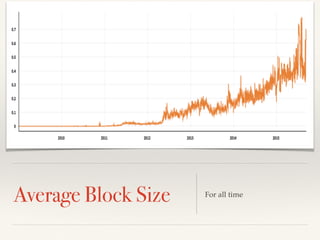
Average Block Size For all time
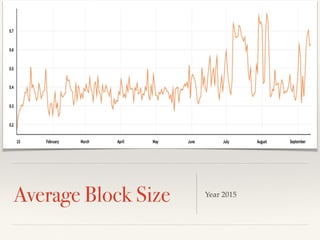
Average Block Size Year 2015
Observations - Block Size
❖ Provides DoS protection. Raises Cost-Of-Attack.
❖ 250k soft limit: 0.1.0(?)
❖ 350k soft limit: 0.8.6 (Dec 2013)
❖ 750k soft limit: 0.9.0 (March 2014)
❖ Trend: Headed towards 1M hard limit
❖ Blocks not full today*
❖ *Excluding long blocks, stress tests
Observations - Fee Market
❖ Zero fee competition*
❖ *On average. Excludes long blocks, traffic bursts (stress tests),
short periods prior to soft limit increase.
❖ Fee floor set by anti-“dust” relay limit
❖ Fees provide near-zero economic signaling today
❖ Users: Fee choice depends on TX size and block size
❖ Difficult to reason
❖ Miners: Fees unpredictable; below noise level vs. 25 BTC subsidy
Observations 3
❖ Non-contentious hard fork: User voting mechanism
❖ Check-and-balance
❖ Natural equilibrium block size exists, in absence of limit
❖ Rapid miner, mining pool turnover YoY
❖ Permission-less miner entry
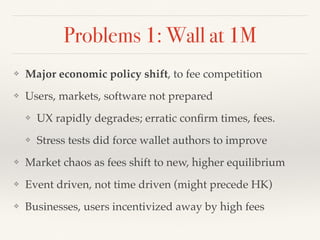
Problems 1: Wall at 1M
❖ Major economic policy shift, to fee competition
❖ Users, markets, software not prepared
❖ UX rapidly degrades; erratic confirm times, fees.
❖ Stress tests did force wallet authors to improve
❖ Market chaos as fees shift to new, higher equilibrium
❖ Event driven, not time driven (might precede HK)
❖ Businesses, users incentivized away by high fees
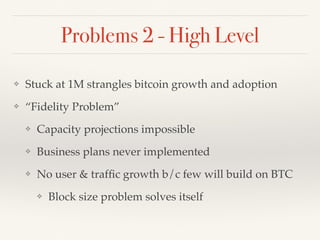
Problems 2 - High Level
❖ Stuck at 1M strangles bitcoin growth and adoption
❖ “Fidelity Problem”
❖ Capacity projections impossible
❖ Business plans never implemented
❖ No user & traffic growth b/c few will build on BTC
❖ Block size problem solves itself
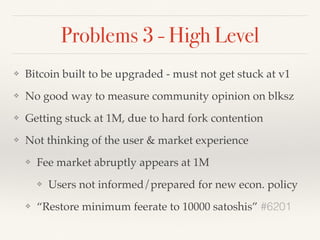
Problems 3 - High Level
❖ Bitcoin built to be upgraded - must not get stuck at v1
❖ No good way to measure community opinion on blksz
❖ Getting stuck at 1M, due to hard fork contention
❖ Not thinking of the user & market experience
❖ Fee market abruptly appears at 1M
❖ Users not informed/prepared for new econ. policy
❖ “Restore minimum feerate to 10000 satoshis” #6201
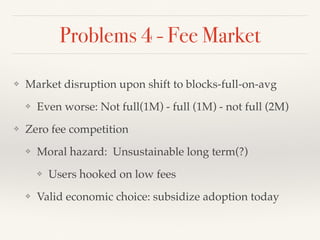
Problems 4 - Fee Market
❖ Market disruption upon shift to blocks-full-on-avg
❖ Even worse: Not full(1M) - full (1M) - not full (2M)
❖ Zero fee competition
❖ Moral hazard: Unsustainable long term(?)
❖ Users hooked on low fees
❖ Valid economic choice: subsidize adoption today
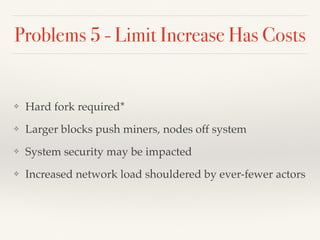
Problems 5 - Limit Increase Has Costs
❖ Hard fork required*
❖ Larger blocks push miners, nodes off system
❖ System security may be impacted
❖ Increased network load shouldered by ever-fewer actors
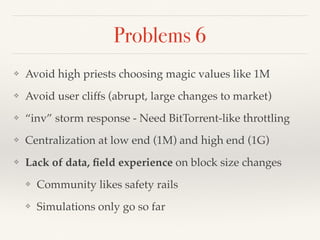
Problems 6
❖ Avoid high priests choosing magic values like 1M
❖ Avoid user cliffs (abrupt, large changes to market)
❖ “inv” storm response - Need BitTorrent-like throttling
❖ Centralization at low end (1M) and high end (1G)
❖ Lack of data, field experience on block size changes
❖ Community likes safety rails
❖ Simulations only go so far
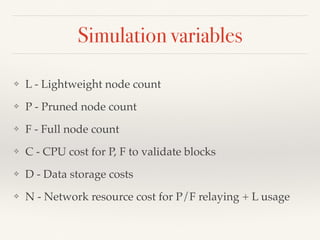
Simulation variables
❖ L - Lightweight node count
❖ P - Pruned node count
❖ F - Full node count
❖ C - CPU cost for P, F to validate blocks
❖ D - Data storage costs
❖ N - Network resource cost for P/F relaying + L usage
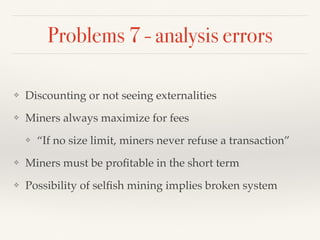
Problems 7 - analysis errors
❖ Discounting or not seeing externalities
❖ Miners always maximize for fees
❖ “If no size limit, miners never refuse a transaction”
❖ Miners must be profitable in the short term
❖ Possibility of selfish mining implies broken system
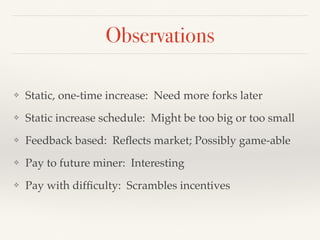
Observations
❖ Static, one-time increase: Need more forks later
❖ Static increase schedule: Might be too big or too small
❖ Feedback based: Reflects market; Possibly game-able
❖ Pay to future miner: Interesting
❖ Pay with difficulty: Scrambles incentives
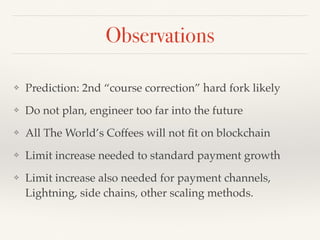
Observations
❖ Prediction: 2nd “course correction” hard fork likely
❖ Do not plan, engineer too far into the future
❖ All The World’s Coffees will not fit on blockchain
❖ Limit increase needed to standard payment growth
❖ Limit increase also needed for payment channels,
Lightning, side chains, other scaling methods.
Fini
Liberté, égalité, fraternité
JGarzik@DSS.co
JGarzik@BitPay.com

Issues impacting Bitcoin Block Size proposals - Garzik

  • 1.
    Scaling Bitcoin workshop,Sept. 2015 Issues impacting Block Size proposals Jeff Garzik Dunvegan Space Systems / BitPay
  • 2.
    History ❖ Bitcoin introducedas P2P electronic cash payments ❖ 1M block size hard limit set for anti-spam purposes ❖ Otherwise, trivial to create 32M+ blocks at low cost
  • 3.
    Observations - System ❖Process of finding distributed consensus takes time ❖ Bitcoin is a settlement system ❖ Settles on a stable timeline of transactions ❖ Core service: Censorship Resistance ❖ Enables permission-less innovation
  • 4.
    Average Block SizeFor all time
  • 5.
  • 6.
    Observations - BlockSize ❖ Provides DoS protection. Raises Cost-Of-Attack. ❖ 250k soft limit: 0.1.0(?) ❖ 350k soft limit: 0.8.6 (Dec 2013) ❖ 750k soft limit: 0.9.0 (March 2014) ❖ Trend: Headed towards 1M hard limit ❖ Blocks not full today* ❖ *Excluding long blocks, stress tests
  • 7.
    Observations - FeeMarket ❖ Zero fee competition* ❖ *On average. Excludes long blocks, traffic bursts (stress tests), short periods prior to soft limit increase. ❖ Fee floor set by anti-“dust” relay limit ❖ Fees provide near-zero economic signaling today ❖ Users: Fee choice depends on TX size and block size ❖ Difficult to reason ❖ Miners: Fees unpredictable; below noise level vs. 25 BTC subsidy
  • 8.
    Observations 3 ❖ Non-contentioushard fork: User voting mechanism ❖ Check-and-balance ❖ Natural equilibrium block size exists, in absence of limit ❖ Rapid miner, mining pool turnover YoY ❖ Permission-less miner entry
  • 9.
    Problems 1: Wallat 1M ❖ Major economic policy shift, to fee competition ❖ Users, markets, software not prepared ❖ UX rapidly degrades; erratic confirm times, fees. ❖ Stress tests did force wallet authors to improve ❖ Market chaos as fees shift to new, higher equilibrium ❖ Event driven, not time driven (might precede HK) ❖ Businesses, users incentivized away by high fees
  • 10.
    Problems 2 -High Level ❖ Stuck at 1M strangles bitcoin growth and adoption ❖ “Fidelity Problem” ❖ Capacity projections impossible ❖ Business plans never implemented ❖ No user & traffic growth b/c few will build on BTC ❖ Block size problem solves itself
  • 11.
    Problems 3 -High Level ❖ Bitcoin built to be upgraded - must not get stuck at v1 ❖ No good way to measure community opinion on blksz ❖ Getting stuck at 1M, due to hard fork contention ❖ Not thinking of the user & market experience ❖ Fee market abruptly appears at 1M ❖ Users not informed/prepared for new econ. policy ❖ “Restore minimum feerate to 10000 satoshis” #6201
  • 12.
    Problems 4 -Fee Market ❖ Market disruption upon shift to blocks-full-on-avg ❖ Even worse: Not full(1M) - full (1M) - not full (2M) ❖ Zero fee competition ❖ Moral hazard: Unsustainable long term(?) ❖ Users hooked on low fees ❖ Valid economic choice: subsidize adoption today
  • 13.
    Problems 5 -Limit Increase Has Costs ❖ Hard fork required* ❖ Larger blocks push miners, nodes off system ❖ System security may be impacted ❖ Increased network load shouldered by ever-fewer actors
  • 14.
    Problems 6 ❖ Avoidhigh priests choosing magic values like 1M ❖ Avoid user cliffs (abrupt, large changes to market) ❖ “inv” storm response - Need BitTorrent-like throttling ❖ Centralization at low end (1M) and high end (1G) ❖ Lack of data, field experience on block size changes ❖ Community likes safety rails ❖ Simulations only go so far
  • 15.
    Simulation variables ❖ L- Lightweight node count ❖ P - Pruned node count ❖ F - Full node count ❖ C - CPU cost for P, F to validate blocks ❖ D - Data storage costs ❖ N - Network resource cost for P/F relaying + L usage
  • 16.
    Problems 7 -analysis errors ❖ Discounting or not seeing externalities ❖ Miners always maximize for fees ❖ “If no size limit, miners never refuse a transaction” ❖ Miners must be profitable in the short term ❖ Possibility of selfish mining implies broken system
  • 17.
    Observations ❖ Static, one-timeincrease: Need more forks later ❖ Static increase schedule: Might be too big or too small ❖ Feedback based: Reflects market; Possibly game-able ❖ Pay to future miner: Interesting ❖ Pay with difficulty: Scrambles incentives
  • 18.
    Observations ❖ Prediction: 2nd“course correction” hard fork likely ❖ Do not plan, engineer too far into the future ❖ All The World’s Coffees will not fit on blockchain ❖ Limit increase needed to standard payment growth ❖ Limit increase also needed for payment channels, Lightning, side chains, other scaling methods.
  • 19.