ISRIC's Fruitful Meeting
21-Jan-2014

Alessandro Samuel Rosa
Guest Researcher

Working plan of visit
Jan-Dec2014
Origin
●

Descendant of Italian and German immigrants

●

Born in a small town in Southern Brazil
–

●

15.000 inhabitants

Raised in a small family farm
–

15 hectares

●

Lived many years in Southern Brazil

●

Last two years living near by Rio de Janeiro
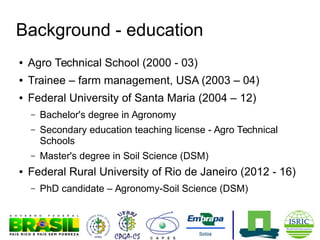
Background - education
●

Agro Technical School (2000 - 03)

●

Trainee – farm management, USA (2003 – 04)

●

Federal University of Santa Maria (2004 – 12)
–
–

Secondary education teaching license - Agro Technical
Schools

–
●

Bachelor's degree in Agronomy

Master's degree in Soil Science (DSM)

Federal Rural University of Rio de Janeiro (2012 - 16)
–

PhD candidate – Agronomy-Soil Science (DSM)
Background - experience
Farming: annual and
perennial crops,
dairy cattle, pigs,
chickens, and many
others
● Ferralsol with high
iron oxides content
and kaolinite (1:1
phylossilicate)
●

Source: Dr. Ricardo Dalmolin
Federal University of Santa Maria
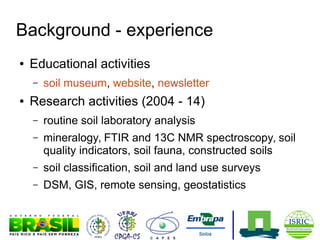
Background - experience
●

Educational activities
–

●

soil museum, website, newsletter

Research activities (2004 - 14)
–

routine soil laboratory analysis

–

mineralogy, FTIR and 13C NMR spectroscopy, soil
quality indicators, soil fauna, constructed soils

–

soil classification, soil and land use surveys

–

DSM, GIS, remote sensing, geostatistics
Sandwich program (2014)
●

●

Coordination for the Improvement of Higher
Education Personnel (CAPES)
Supervisors
–

–

Dr. Gustavo Vasques – Embrapa Soils

–
●

Dr. Lúcia Anjos – Federal Rural University of Rio
de Janeiro
Dr. Gerard Heuvelink – ISRIC (Why?)

Main collaborator
–

Dr. Ricardo Dalmolin – Federal University of
Santa Maria
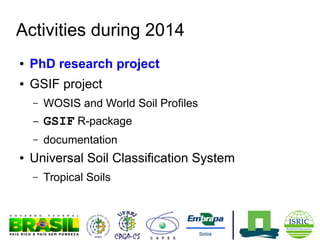
Activities during 2014
●

PhD research project

●

GSIF project
–

–

GSIF R-package

–
●

WOSIS and World Soil Profiles
documentation

Universal Soil Classification System
–

Tropical Soils
PhD research project
●

Evaluate the main sources of uncertainty in
DSM under different database scenarios
1) How accurate are freely available environmental
covariates? How much uncertainty reduction is
achieved when more accurate environmental
covariates are used?
2) How do calibration sample size and sampling
design affect model composition and prediction
accuracy? What is the trade-off between map
accuracy and monetary cost?
PhD research project
3) How strongly correlated are environmental
covariates? Is prediction accuracy improved when
they are transformed to their principal
components?
●
●
●

●
●

350 + 60 soil observations
topsoil
particle size distribution, ECEC, organic
carbon content
many environmental covariates
regression-kriging approach
Questions? Comments?
●

●

●

Presentation will be available at
http://pt.slideshare.net/alessandrosamuelrosa
Images were obtained from Wikipedia, my personal
archive, and from web profiles of cited researchers
Contact:
●
●

E-mail: alessandro.rosa@wur.nl
Phone number: 0031 06 4435 9563

ISRIC's Fruitfull Presentation

  • 1.
    ISRIC's Fruitful Meeting 21-Jan-2014 AlessandroSamuel Rosa Guest Researcher Working plan of visit Jan-Dec2014
  • 2.
    Origin ● Descendant of Italianand German immigrants ● Born in a small town in Southern Brazil – ● 15.000 inhabitants Raised in a small family farm – 15 hectares ● Lived many years in Southern Brazil ● Last two years living near by Rio de Janeiro
  • 4.
    Background - education ● AgroTechnical School (2000 - 03) ● Trainee – farm management, USA (2003 – 04) ● Federal University of Santa Maria (2004 – 12) – – Secondary education teaching license - Agro Technical Schools – ● Bachelor's degree in Agronomy Master's degree in Soil Science (DSM) Federal Rural University of Rio de Janeiro (2012 - 16) – PhD candidate – Agronomy-Soil Science (DSM)
  • 5.
    Background - experience Farming:annual and perennial crops, dairy cattle, pigs, chickens, and many others ● Ferralsol with high iron oxides content and kaolinite (1:1 phylossilicate) ● Source: Dr. Ricardo Dalmolin Federal University of Santa Maria
  • 6.
    Background - experience ● Educationalactivities – ● soil museum, website, newsletter Research activities (2004 - 14) – routine soil laboratory analysis – mineralogy, FTIR and 13C NMR spectroscopy, soil quality indicators, soil fauna, constructed soils – soil classification, soil and land use surveys – DSM, GIS, remote sensing, geostatistics
  • 7.
    Sandwich program (2014) ● ● Coordinationfor the Improvement of Higher Education Personnel (CAPES) Supervisors – – Dr. Gustavo Vasques – Embrapa Soils – ● Dr. Lúcia Anjos – Federal Rural University of Rio de Janeiro Dr. Gerard Heuvelink – ISRIC (Why?) Main collaborator – Dr. Ricardo Dalmolin – Federal University of Santa Maria
  • 8.
    Activities during 2014 ● PhDresearch project ● GSIF project – – GSIF R-package – ● WOSIS and World Soil Profiles documentation Universal Soil Classification System – Tropical Soils
  • 9.
    PhD research project ● Evaluatethe main sources of uncertainty in DSM under different database scenarios 1) How accurate are freely available environmental covariates? How much uncertainty reduction is achieved when more accurate environmental covariates are used? 2) How do calibration sample size and sampling design affect model composition and prediction accuracy? What is the trade-off between map accuracy and monetary cost?
  • 10.
    PhD research project 3)How strongly correlated are environmental covariates? Is prediction accuracy improved when they are transformed to their principal components?
  • 11.
    ● ● ● ● ● 350 + 60soil observations topsoil particle size distribution, ECEC, organic carbon content many environmental covariates regression-kriging approach
  • 12.
    Questions? Comments? ● ● ● Presentation willbe available at http://pt.slideshare.net/alessandrosamuelrosa Images were obtained from Wikipedia, my personal archive, and from web profiles of cited researchers Contact: ● ● E-mail: alessandro.rosa@wur.nl Phone number: 0031 06 4435 9563