BY
AKSHAY KUMAR N
(1KN12EC008)
UNDER THE GUIDANCE OF
MRS.DEEPIKA R
ASSISTANT PROFESSOR ,DEPARTMENT OF E.C.E
K.N.S.I.T
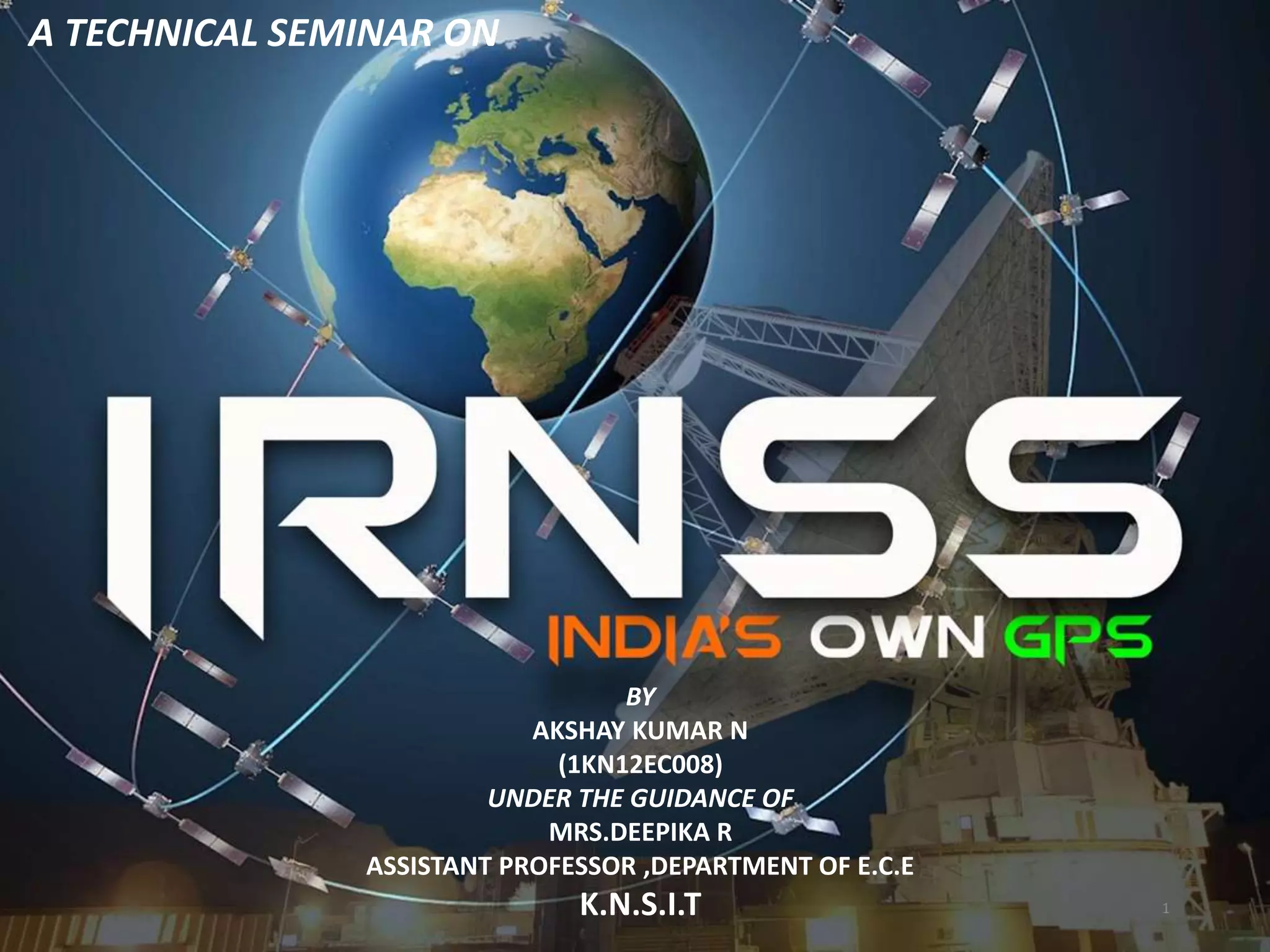
A TECHNICAL SEMINAR ON
1
CONTENTS
 INTRODUCTION
 IRNSS ARCHITECTURE
 IRNSS SIGNAL CHARATERISTICS
 IRNSS PRN CODES
 IRNSS DATA FORMATS
 IRNSS FRAME FORMATS
 IRNSS NAVIGATION DATA
 GENERAL APPLICATIONS
 CONCLUSION
2
INTRODUCTION
SATELLITE NAVIGATION
Satellite navigation or satnav system is a system of satellites that provide
autonomous geo-spatial positioning with global coverage.
SATNAV SYSTEMS – ITS HISTORY
 TRANSIT
 GPS
 GLONASS
 BeiDou
 GALELIO
 IRNSS
3
ABOUT IRNSS
IRNSS is an independent regional navigation satellite system being developed by India. It is
designed to provide accurate position information service to users in India as well as the
region extending up to 1500 km from its boundary, which is its primary service area.
SERVICES PROVIDED BY IRNSS
IRNSS will provide two types of services namely,
 Standard Positioning Service (SPS) which is provided to all the users and
 Restricted Service (RS), which is an encrypted service provided only to the authorized
users.
4
INTRODUCTION
IRNSS ARCHITECTURE
5
1. SPACE SEGMENT
Based on various considerations the minimum number of satellites required for IRNSS
constellation is worked out to be 7 (3 GSO and 4 IGSO). The 3 GSOs will be located at 32.5º
E, 83º E and 131.5º E and the 4 IGSOs have their longitude crossings 55º E and 111.75º E
(two in each plane).
2. USER SEGMENT
IRNSS ARCHITECTURE
SPACE VEHICLE (SV)
L5 S
IRNSS SPACE SEGMENT
USER SEGMENT
6
IRNSS ARCHITECTURE
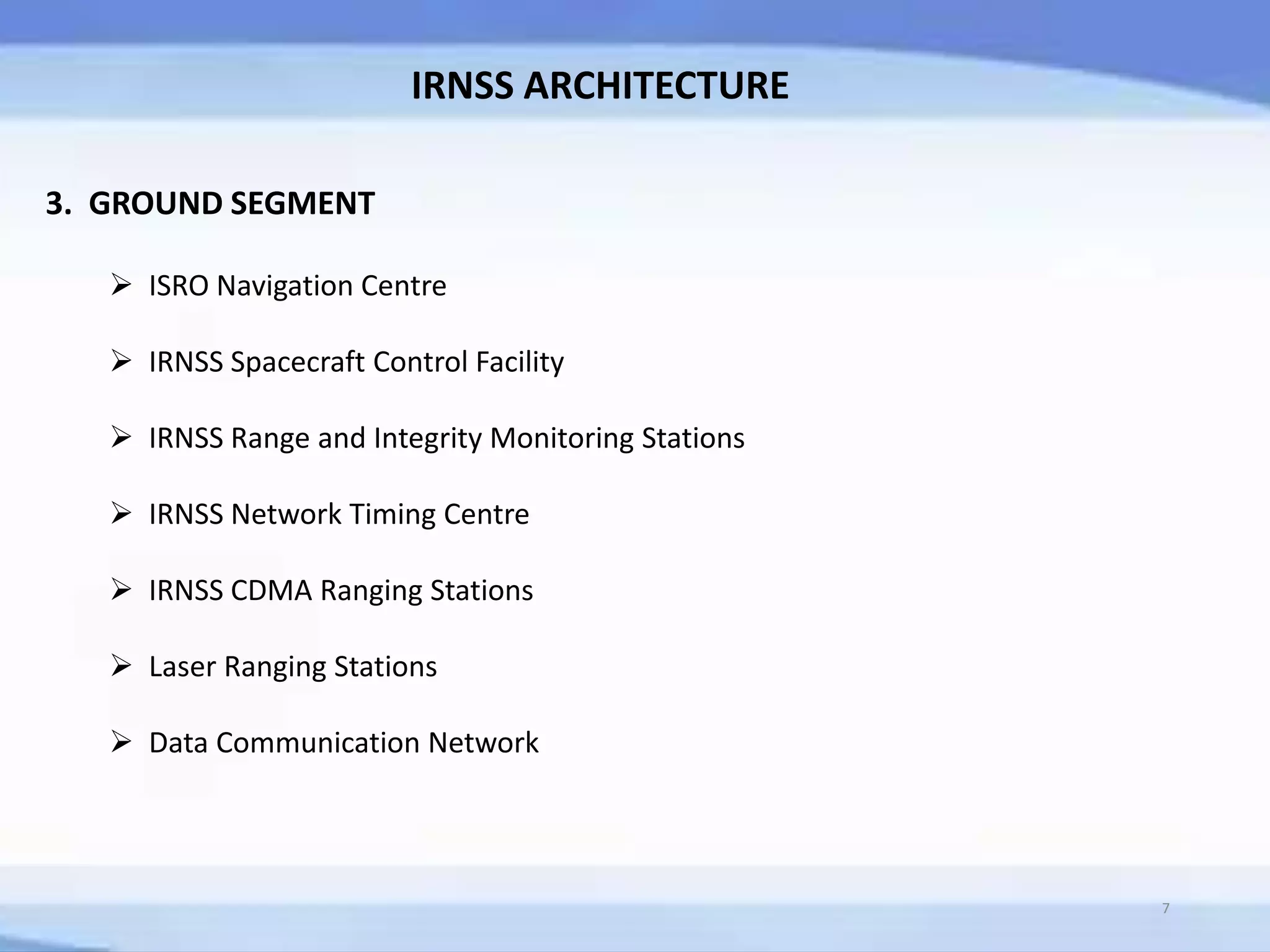
3. GROUND SEGMENT
 ISRO Navigation Centre
 IRNSS Spacecraft Control Facility
 IRNSS Range and Integrity Monitoring Stations
 IRNSS Network Timing Centre
 IRNSS CDMA Ranging Stations
 Laser Ranging Stations
 Data Communication Network
7
IRNSS SIGNAL CHARACTERISTICS
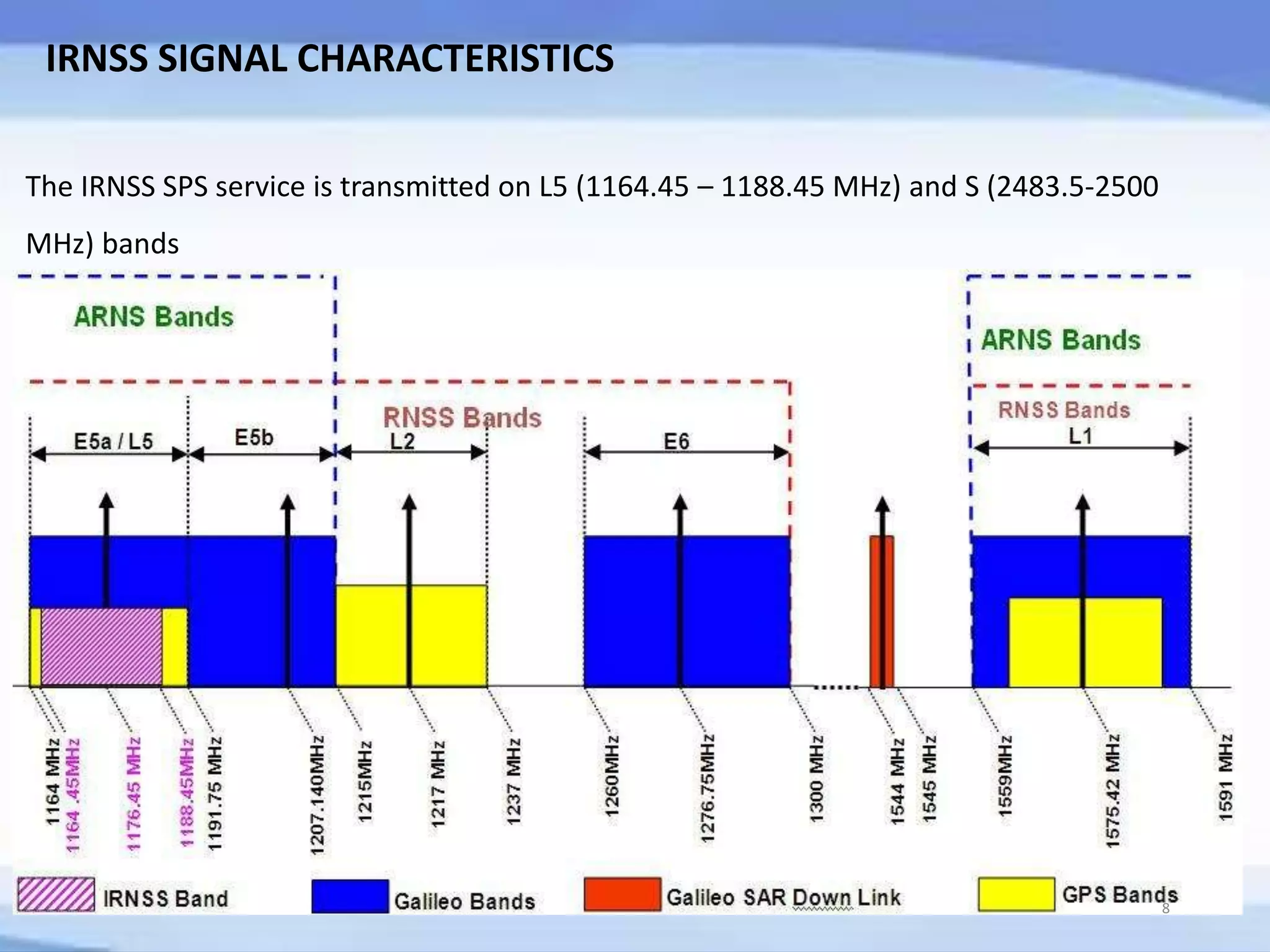
The IRNSS SPS service is transmitted on L5 (1164.45 – 1188.45 MHz) and S (2483.5-2500
MHz) bands
8
Signal Carrier Frequency Bandwidth
SPS – L5 1176.45 MHz 24 MHz (1164.45 -1188.45 MHz)
SPS – S 2492.028 MHz 16.5MHz (2483.50 – 2500.00MHz)
IRNSS SIGNAL CHARACTERISTICS
CARRIER FREQUENCIES AND BANDWIDTHS
FIG: Spectrum for IRNSS Signal in S Band
9
IRNSS SIGNAL CHARACTERISTICS
10
MODULATION SCHEME
The SPS signal is BPSK(1) modulated on L5 and S bands. The navigation data at data
rate of 50 sps (1/2 rate FEC encoded) is modulo 2 added to PRN code chipped at
1.023 Mcps identified for SPS service. The CDMA modulated code, modulates the L5
and S carriers at 1176.45MHz and 2492.028 MHz respectively.
INTERPLEX MODULATION
Each carrier is modulated by three signals namely, BPSK , Data channel BOC and Pilot
channel BOC . These signals when passed through power amplifier or TWTA operated
at saturation will produce a non constant envelope. Hence additional fourth signal
namely, interplex signal is added in order to have a constant envelope at the output
of TWTA RF spectrum.
IRNSS SIGNAL CHARACTERISTICS
SIGNAL LOSSSES
 TRANSMITTED SIGNAL PHASE NOISE The Phase Noise spectral density of the un-
modulated carrier will allow a second order phase locked loop with 10 Hz one sided
noise bandwidth to track the carrier to an accuracy of 0.1 radians RMS.
 CORRELATION LOSS Correlation loss is defined as the difference between the
transmitted power received in the specified signal bandwidth and the signal power
recovered in the ideal receiver of the same bandwidth, which perfectly correlates
using an exact replica of the waveform within an ideal band-pass filter with linear
phase. For all IRNSS signals, the correlation loss that occurs in the navigation payload
shall not exceed 0.6 db.
11
SPURIOUS CHARACTERISTICS
For all IRNSS signals, in-band spurious transmission shall be at least -50 dB with respect to
power level of un-modulated carrier wave.
GROUP DELAY
Channel group delay is defined as a time difference between transmitted RF signal (measured
at phase center of transmitting antenna) and signal at the output of the onboard frequency
source.
There are three different delay parameters:
 Fixed/Bias group delay,
 Differential group delay and
 Group delay uncertainty in bias and differential value.
IRNSS SIGNAL CHARACTERISTICS
12
IRNSS SIGNAL CHARACTERISTICS
13
IRNSS SIGNAL CHARACTERISTICS
RECEIVED POWER LEVELS
 MINIMUM RECEIVED POWER LEVEL
The minimum received power on ground is measured at the output of an ideally matched
RHCP 0 dBi user receiving antenna when the spacecraft elevation angle is higher than 5°.
14
IRNSS SIGNAL CHARACTERISTICS
RECEIVED POWER LEVELS
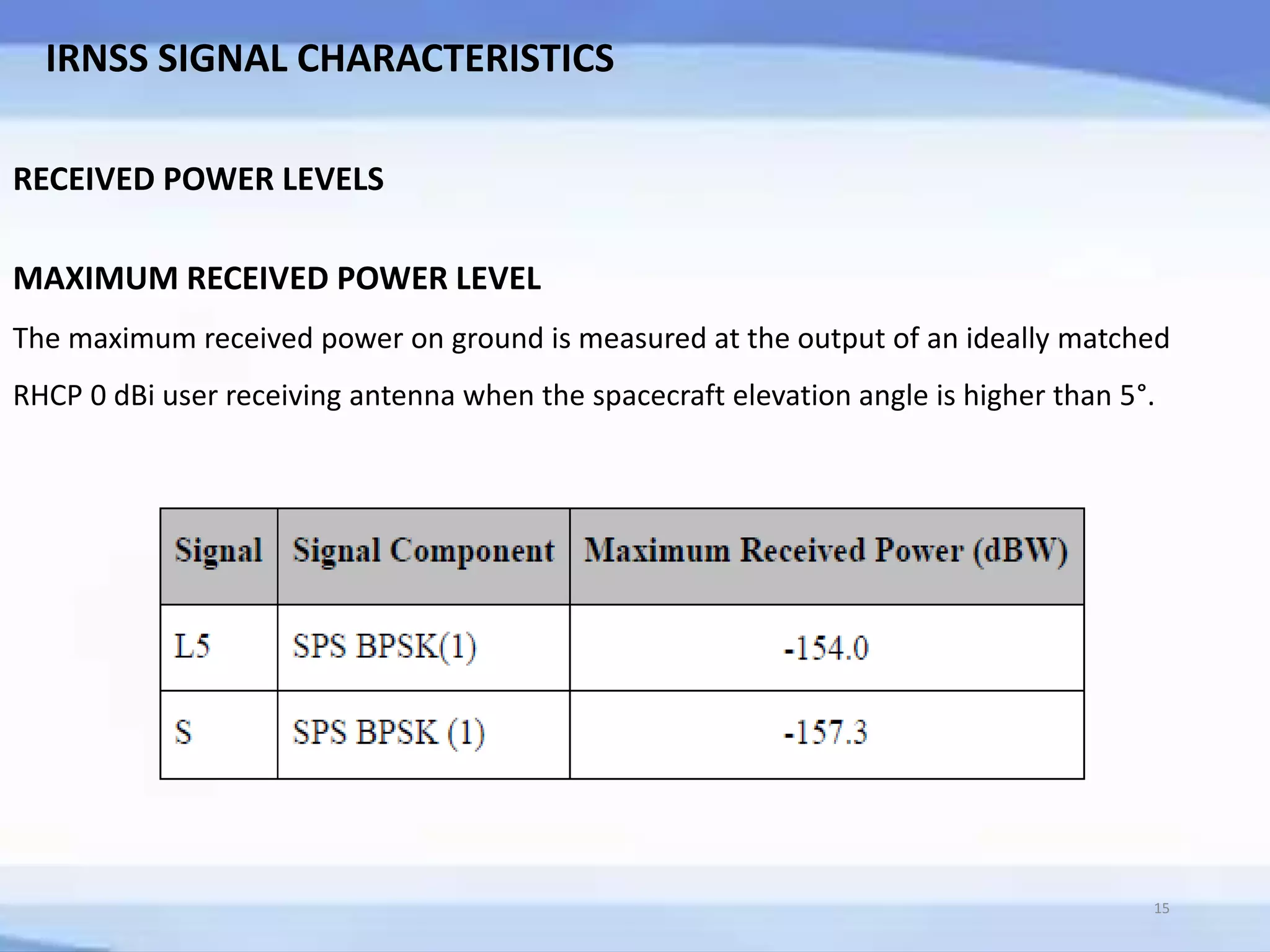
MAXIMUM RECEIVED POWER LEVEL
The maximum received power on ground is measured at the output of an ideally matched
RHCP 0 dBi user receiving antenna when the spacecraft elevation angle is higher than 5°.
15
IRNSS SIGNAL CHARACTERISTICS
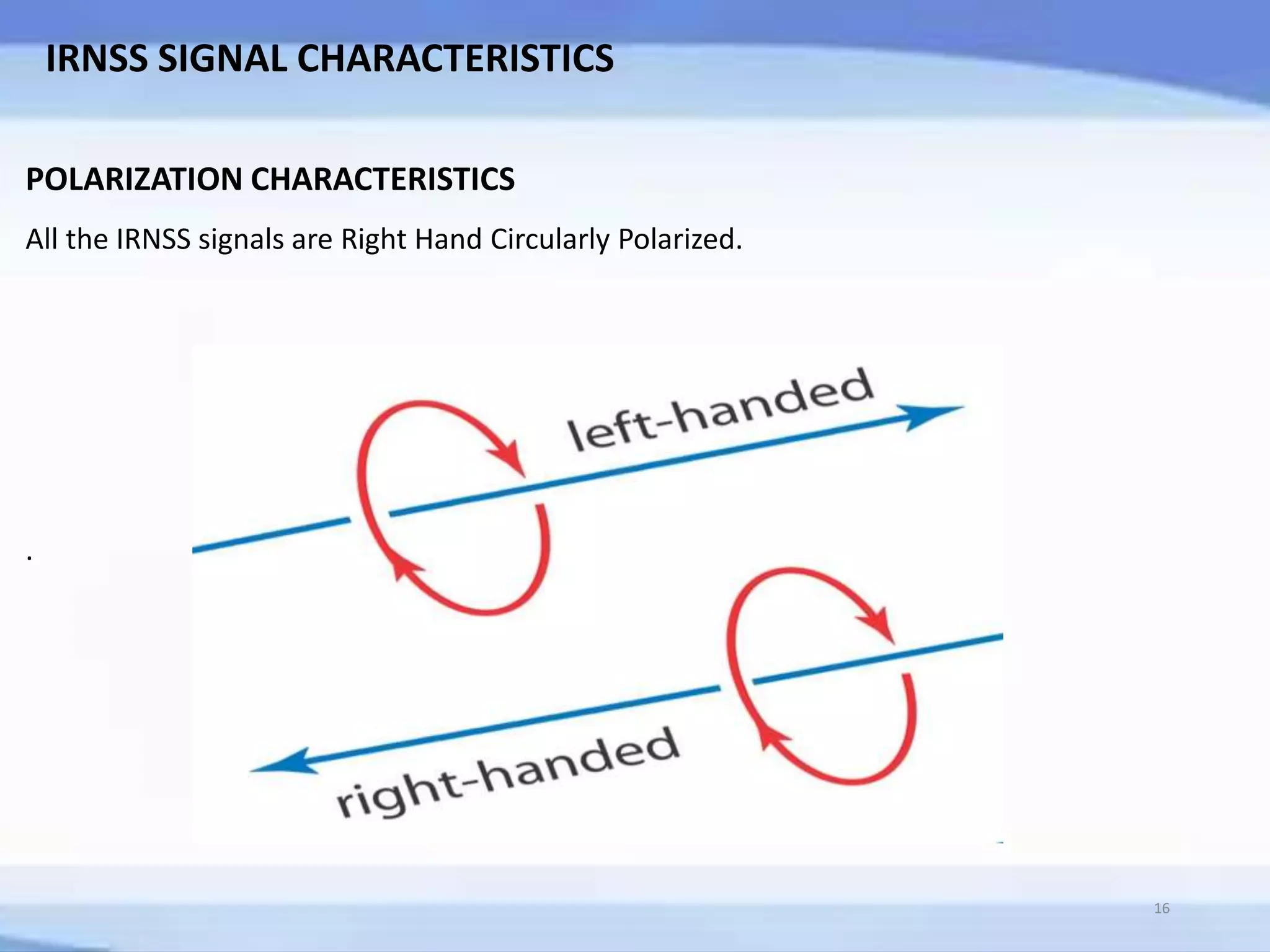
POLARIZATION CHARACTERISTICS
All the IRNSS signals are Right Hand Circularly Polarized.
.
16
SIGNAL COHERENCY
The spectral coherence is a statistic that can be used to examine the relation between
two signals or data sets.
The raising/ leading edge of each data symbol coincides with the starting edge of the PRN code
chip. The starting edge of each secondary code chip coincides with the starting edge of primary
code chip.
BROADCAST INTERVALS
Broadcast of subframes and messages is sequenced to provide optimum user performance.
Subframes 1 & 2 shall be broadcast at least once every 48 seconds. All other messages shall be
broadcast in-between as part of subframe 3/4, not exceeding the maximum broadcast interval.
IRNSS SIGNAL CHARACTERISTICS
17
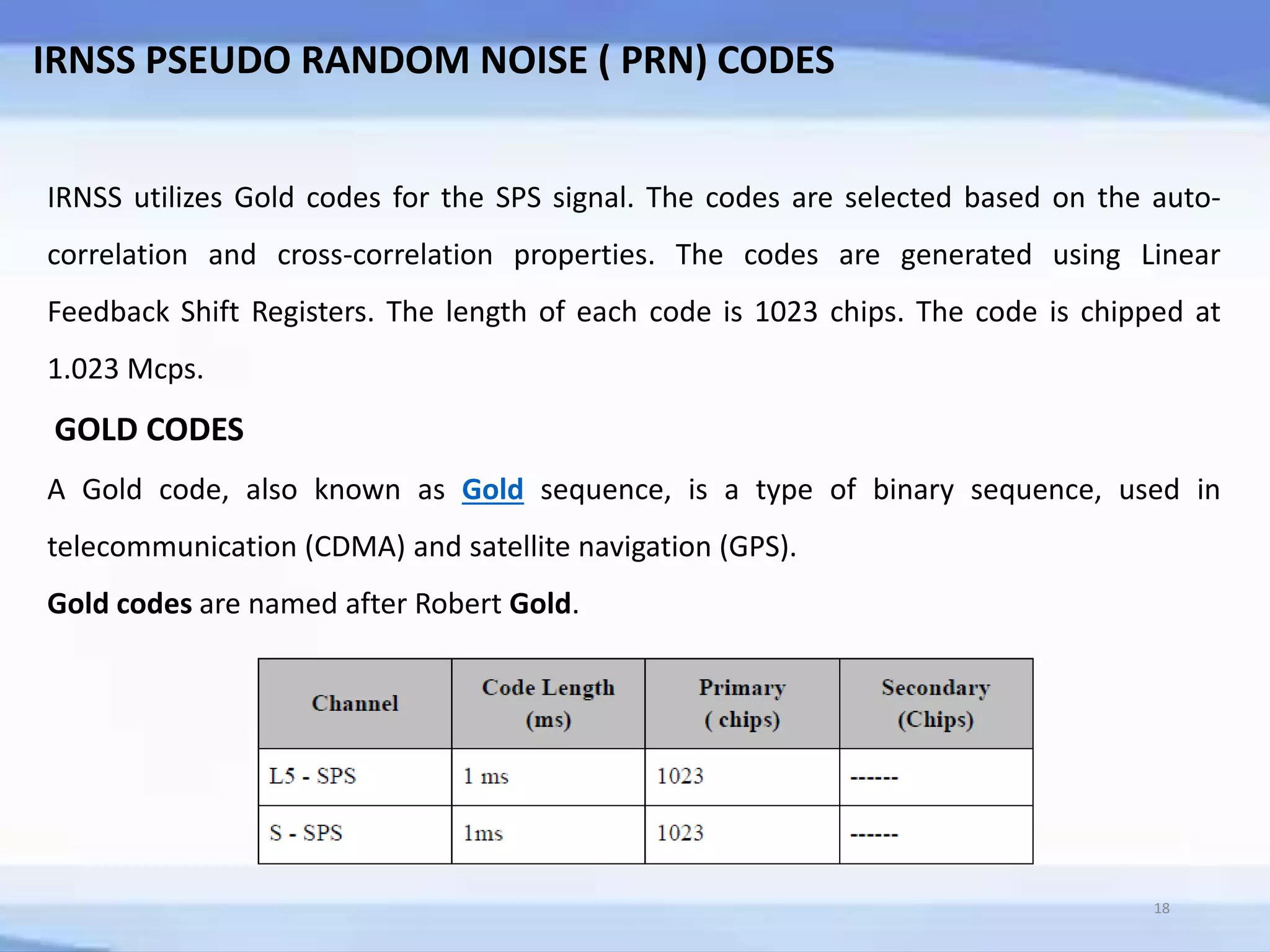
IRNSS PSEUDO RANDOM NOISE ( PRN) CODES
IRNSS utilizes Gold codes for the SPS signal. The codes are selected based on the auto-
correlation and cross-correlation properties. The codes are generated using Linear
Feedback Shift Registers. The length of each code is 1023 chips. The code is chipped at
1.023 Mcps.
GOLD CODES
A Gold code, also known as Gold sequence, is a type of binary sequence, used in
telecommunication (CDMA) and satellite navigation (GPS).
Gold codes are named after Robert Gold.
18
IRNSS PSEUDO RANDOM NOISE ( PRN) CODES
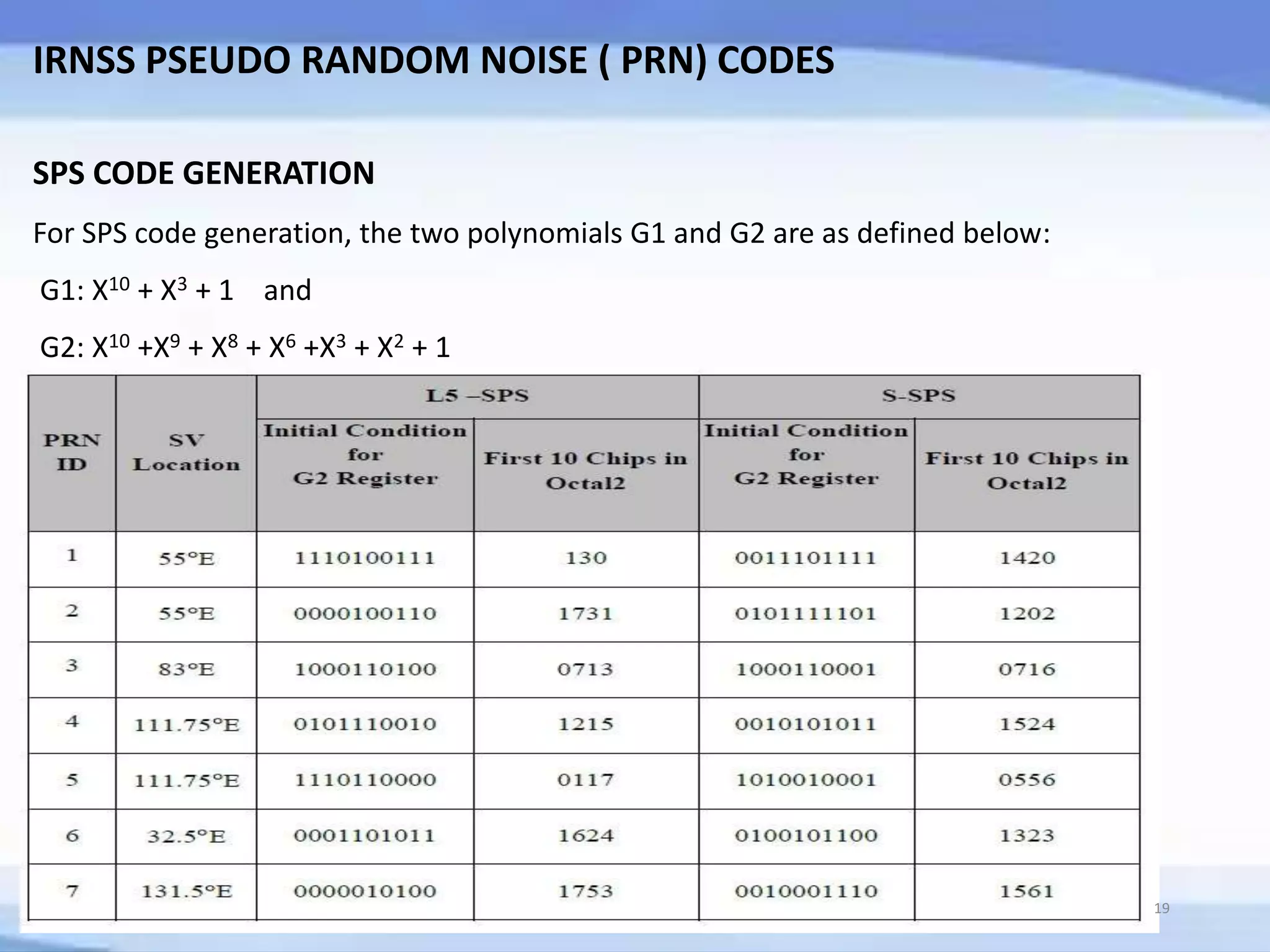
SPS CODE GENERATION
For SPS code generation, the two polynomials G1 and G2 are as defined below:
G1: X10 + X3 + 1 and
G2: X10 +X9 + X8 + X6 +X3 + X2 + 1
19
IRNSS PSEUDO RANDOM NOISE ( PRN) CODES
20
IRNSS DATA STRUCTURE
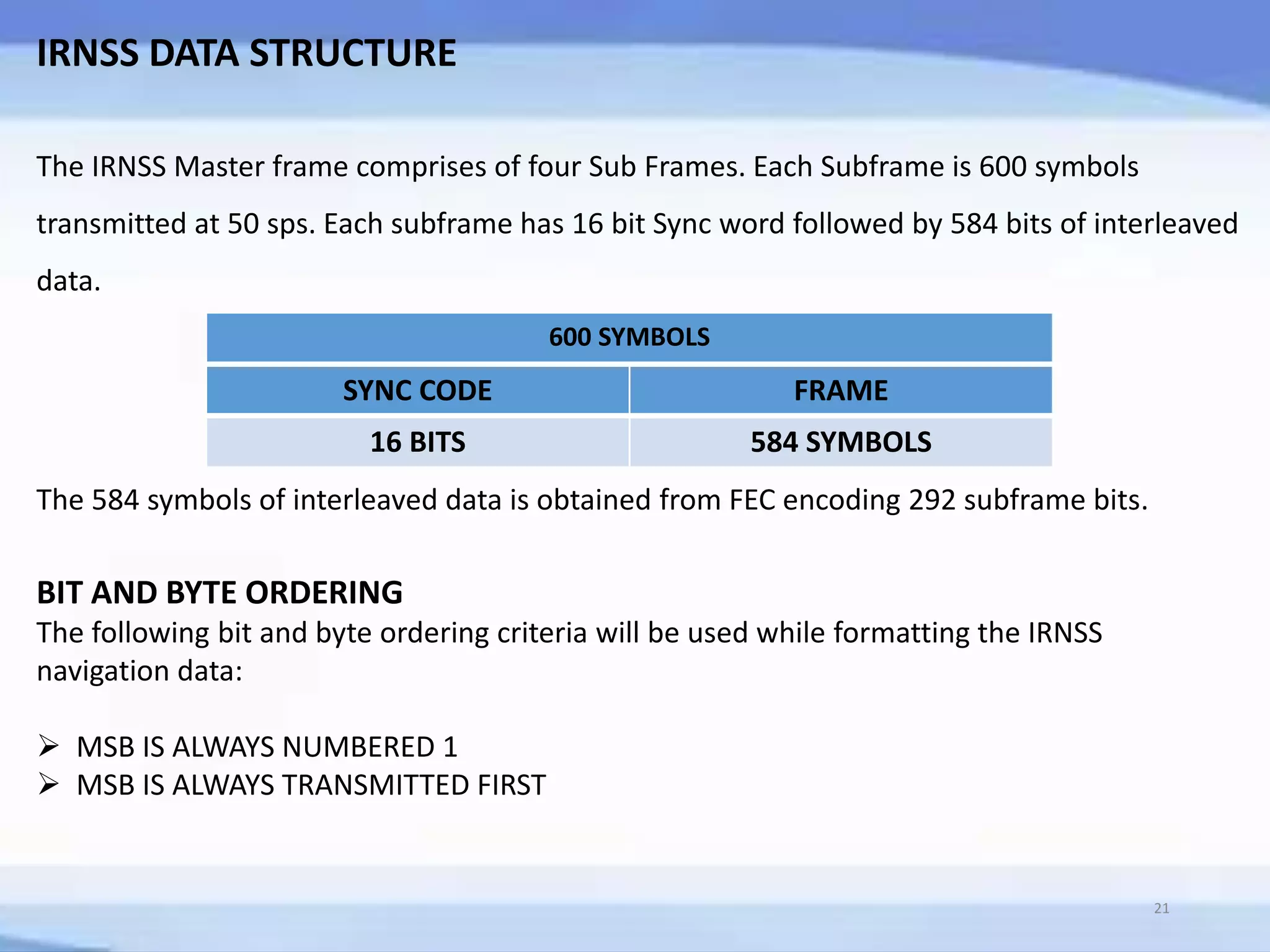
The IRNSS Master frame comprises of four Sub Frames. Each Subframe is 600 symbols
transmitted at 50 sps. Each subframe has 16 bit Sync word followed by 584 bits of interleaved
data.
SYNC CODE FRAME
16 BITS 584 SYMBOLS
600 SYMBOLS
The 584 symbols of interleaved data is obtained from FEC encoding 292 subframe bits.
BIT AND BYTE ORDERING
The following bit and byte ordering criteria will be used while formatting the IRNSS
navigation data:
 MSB IS ALWAYS NUMBERED 1
 MSB IS ALWAYS TRANSMITTED FIRST
21
IRNSS DATA STRUCTURE
The Navigation data subframe of 292 bits is rate 1/2 convolution FEC [ FORWARD EROOR
CORRECTION ] ENCODED and clocked at 50 symbols per second.
INTERLEAVE
The 584 symbols of FEC encoded navigation data is interleaved using a block interleaver with n
columns and k rows. Data is written in columns and then, read in rows.
SYNC WORD
The Synchronization pattern for each of the subframe is 16-bit word. The Synchronization word
is not encoded. The synchronization pattern allows the receiver to achieve synchronization to
the subframe. The Sync pattern is EB90 Hex.
22
IRNSS DATA STRUCTURE
DATA CONTENTS
 WEEK NUMBER - The Week Number is an integer counter that gives the sequential
week number from the origin of the IRNSS time. IRNSS Time is the reference time
generated by IRNWT located at INC. This parameter is coded in 10 bits which covers 1024
weeks (about 19 years).
 CLOCK PARAMETERS - The clock coefficients transmitted as part of subframe 1 are
used for IRNSS time and clock corrections. These estimated corrections account for the
deterministic Satellite clock error having characteristics of bias, drift and aging.
 ISSUE OF DATA EPHEMERIS AND CLOCK [IODEC] - For IRNSS satellites, the IODEC is a
8-bit number which indicates the issue number of the data set and thereby provides the
user with a convenient means of detecting any change in the ephemeris and clock
parameters.
23
IRNSS FRAME STRUCTURE
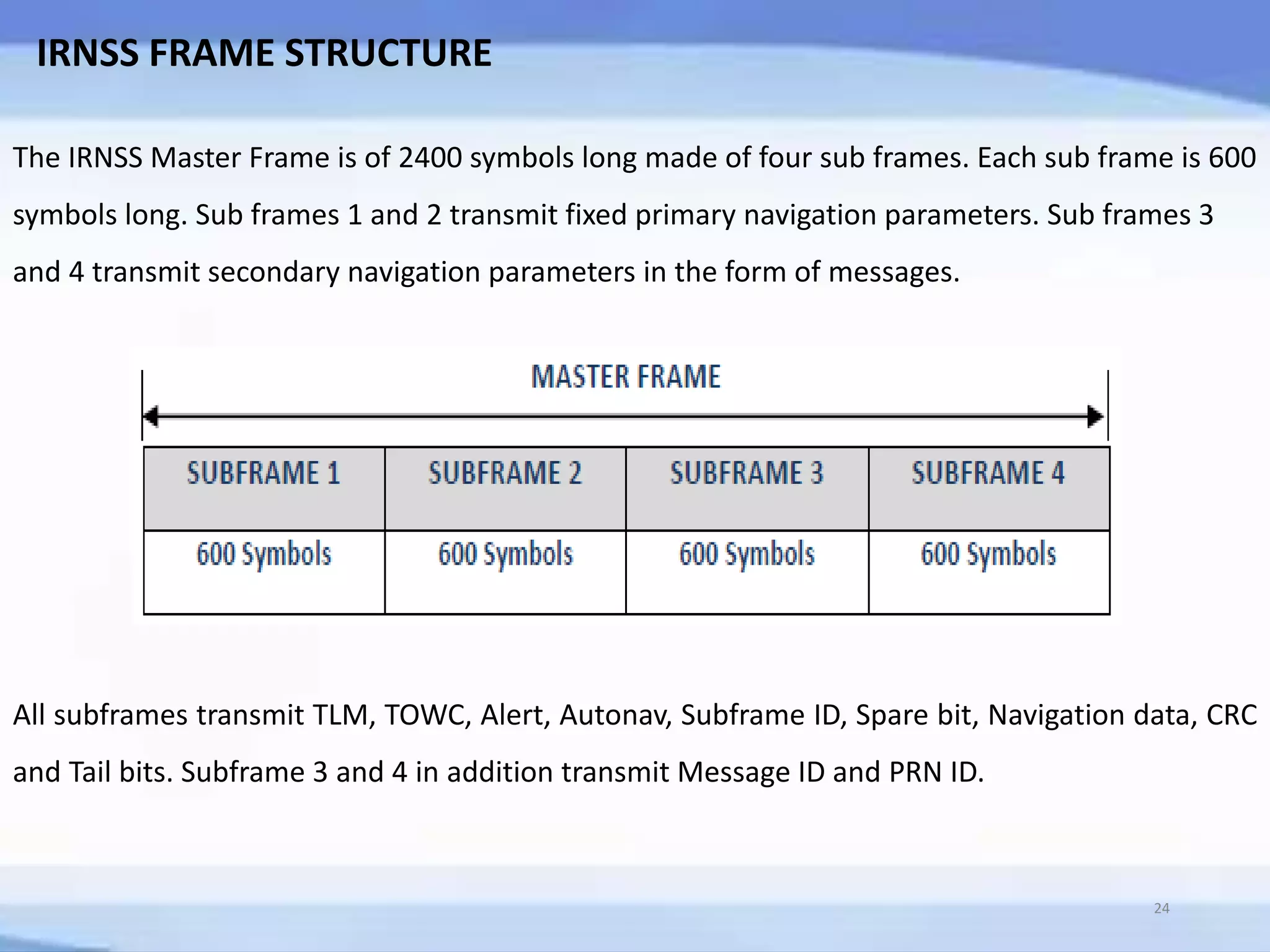
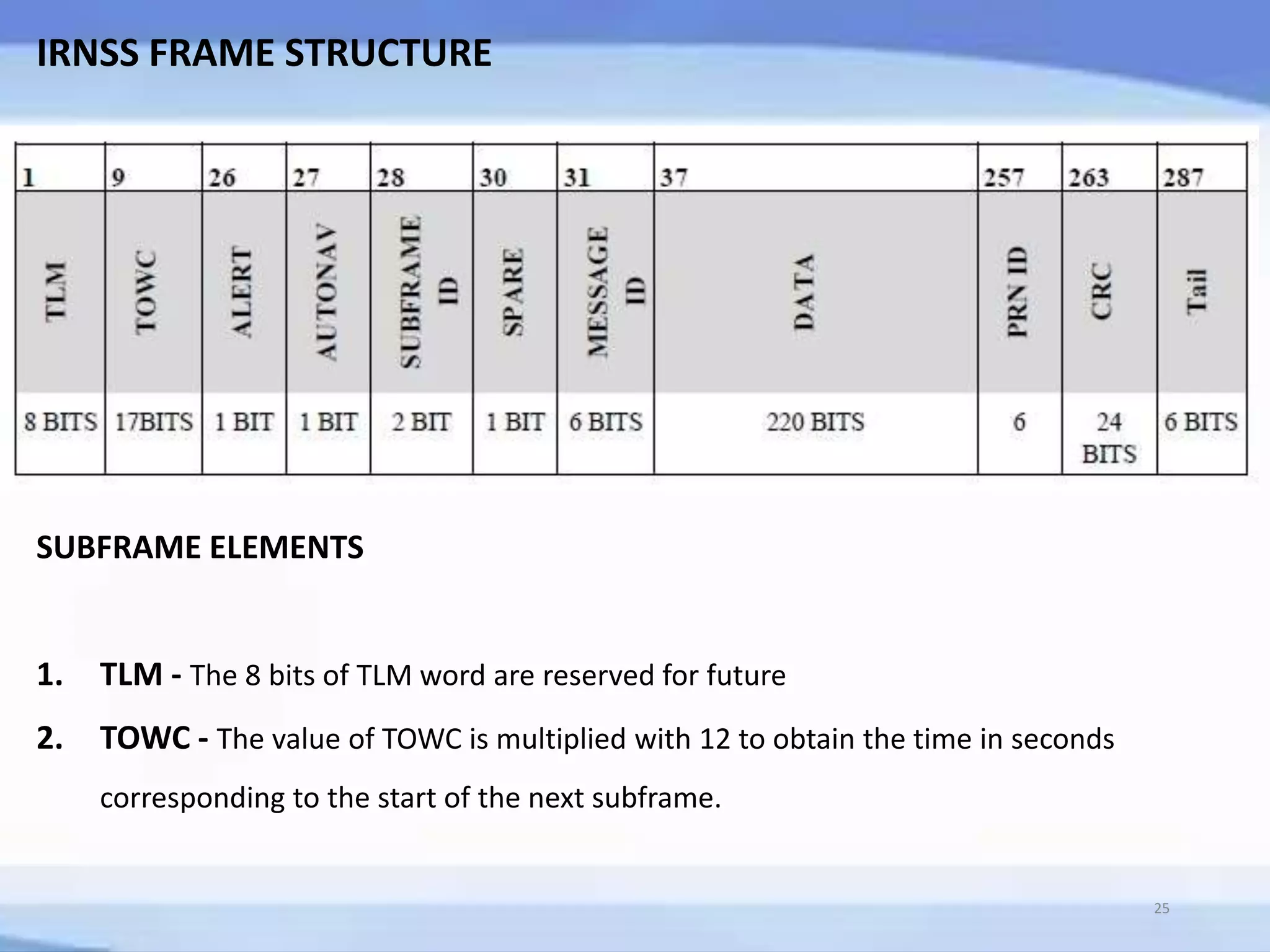
The IRNSS Master Frame is of 2400 symbols long made of four sub frames. Each sub frame is 600
symbols long. Sub frames 1 and 2 transmit fixed primary navigation parameters. Sub frames 3
and 4 transmit secondary navigation parameters in the form of messages.
All subframes transmit TLM, TOWC, Alert, Autonav, Subframe ID, Spare bit, Navigation data, CRC
and Tail bits. Subframe 3 and 4 in addition transmit Message ID and PRN ID.
24
IRNSS FRAME STRUCTURE
SUBFRAME ELEMENTS
1. TLM - The 8 bits of TLM word are reserved for future
2. TOWC - The value of TOWC is multiplied with 12 to obtain the time in seconds
corresponding to the start of the next subframe.
25
3. ALERT FLAG - Bit 26 is allotted to the Alert Flag. The Alert flag signifies to users that the
utilization of navigation data from that particular satellite shall be at the users‘ own risk.
4. AUTO-NAV - Bit 27 is allotted to the Autonav. Satellites store 7 days ephemeris and clock
parameter sets as AutoNav data sets. Satellite can support broadcast of primary navigation
parameters from AutoNav data sets with no uplink from ground for maximum of 7 days.
During AutoNav mode, the AutoNav flag is set to 1.
5. SUBFRAME ID - Each subframe in the master frame can be identified by the 2 bit subframe
ID allotted in bit number 28 and 29.
6. SPARE BIT - Bit 30 is identified as spare bit for future use.
7. MESSAGE ID - Each message in the subframe 3 and 4 has a 6 bit message identifier that
uniquely identifies the message type in the subframe. The bits allocated for the message
identifier are Bit 31 to Bit 36.
8. PRN ID - Each message in the subframe 3 and 4 has a 6 bit PRN identifier that uniquely
identifies the spacecraft transmitting the corresponding message.
IRNSS FRAME STRUCTURE
26
IRNSS NAVIGATION DATA
Navigation data modulated on top of the ranging codes can be identified as primary and
secondary navigation parameters.
1. PRIMARY NAVIGATION PARAMETERS
 Satellite Ephemeris
 Satellite clock correction parameters
 Satellite & signal health status
 User Range Accuracy
 Total group delay
27
IRNSS NAVIGATION DATA
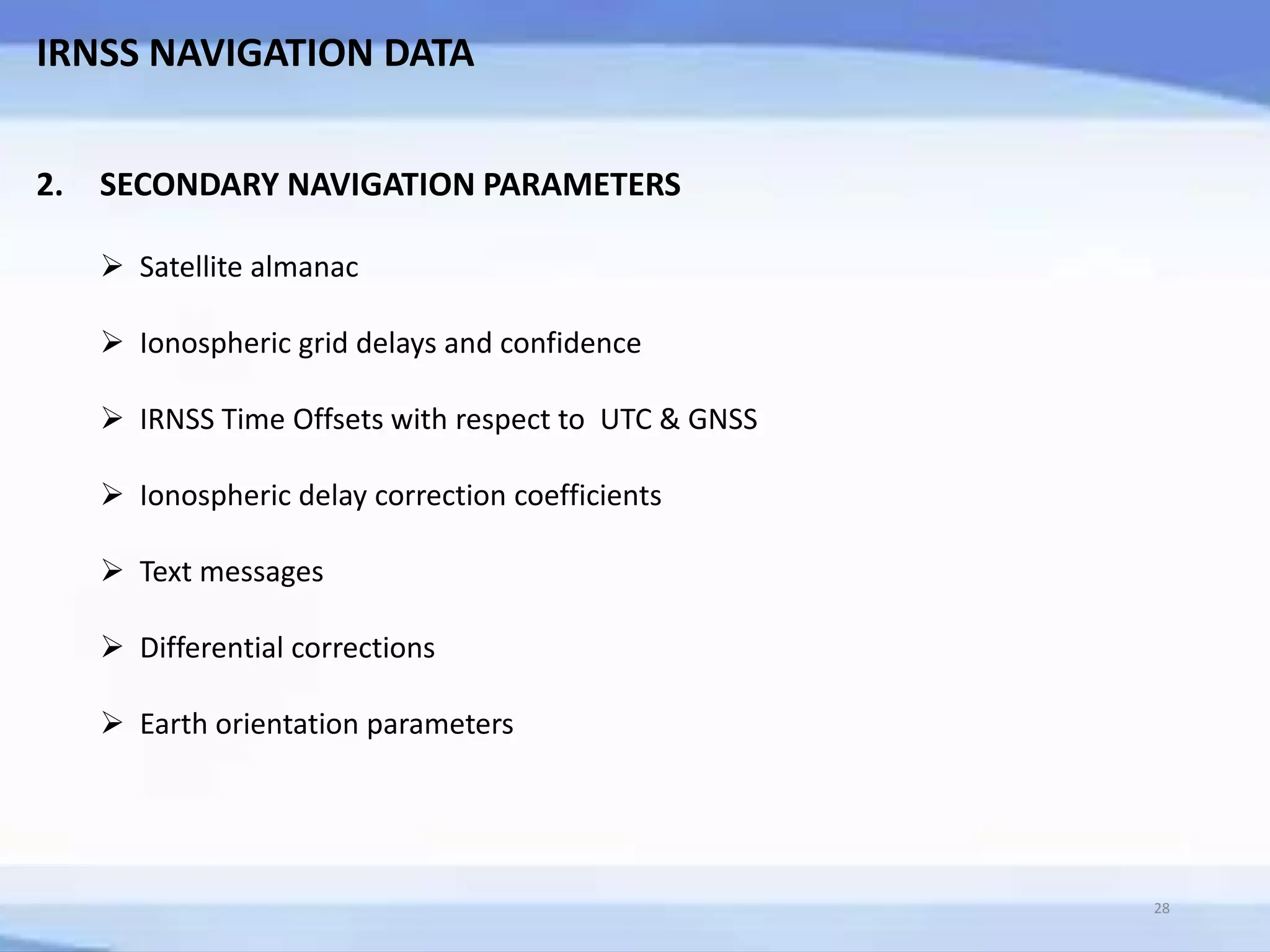
2. SECONDARY NAVIGATION PARAMETERS
 Satellite almanac
 Ionospheric grid delays and confidence
 IRNSS Time Offsets with respect to UTC & GNSS
 Ionospheric delay correction coefficients
 Text messages
 Differential corrections
 Earth orientation parameters
28
29
IRNSS NAVIGATION DATA
IONOSPHERIC DELAY CORRECTIONS
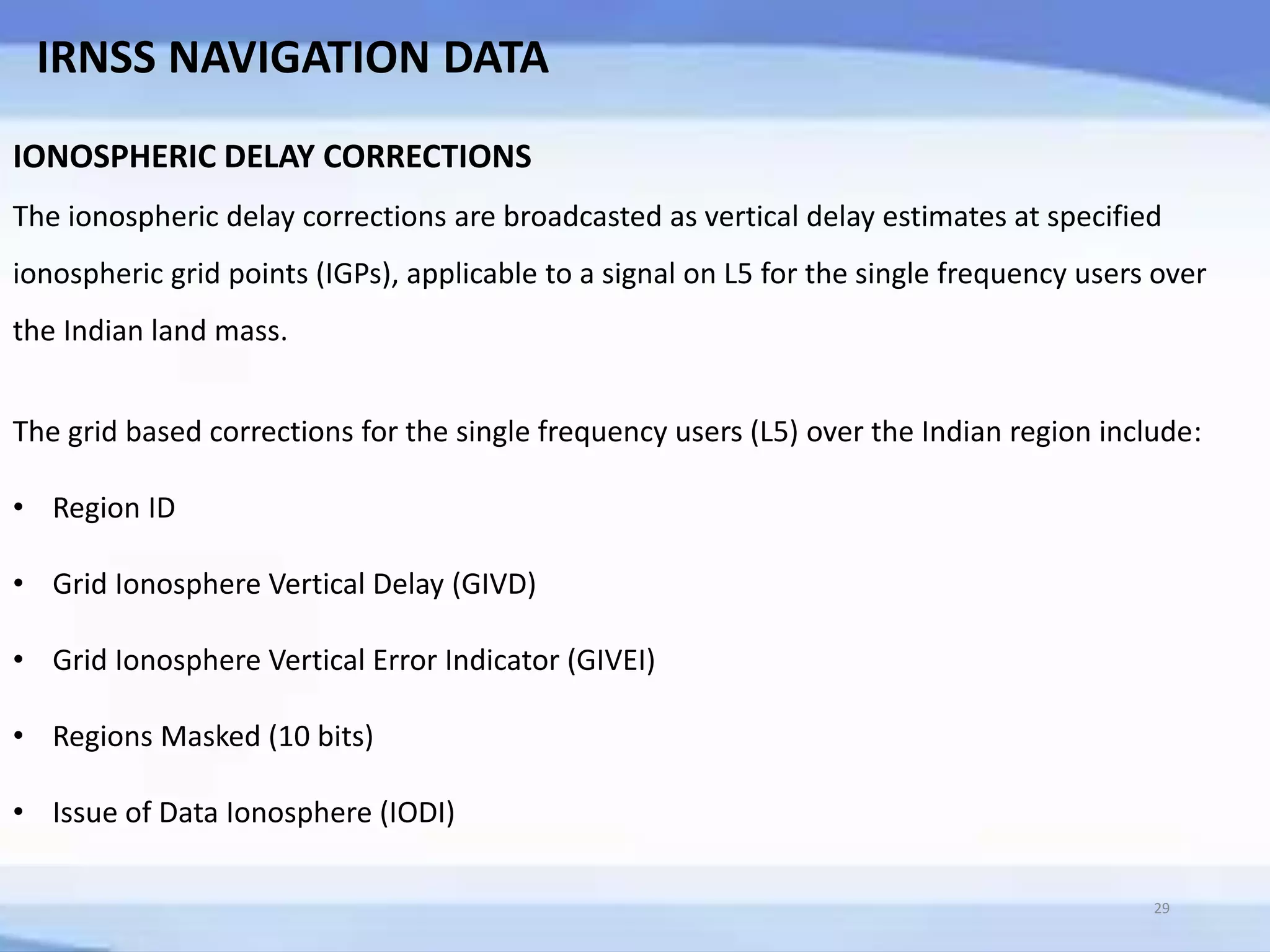
The ionospheric delay corrections are broadcasted as vertical delay estimates at specified
ionospheric grid points (IGPs), applicable to a signal on L5 for the single frequency users over
the Indian land mass.
The grid based corrections for the single frequency users (L5) over the Indian region include:
• Region ID
• Grid Ionosphere Vertical Delay (GIVD)
• Grid Ionosphere Vertical Error Indicator (GIVEI)
• Regions Masked (10 bits)
• Issue of Data Ionosphere (IODI)
30
IRNSS NAVIGATION DATA
LOCATIONS OF THE 90 IDENTIFIED IGP’S FOR OVER INDIAN REGION
31
APPLICATIONS
 Terrestrial, Aerial and Marine Navigation
 Disaster Management
 Vehicle tracking and fleet management
 Integration with mobile phones
 Precise Timing
 Mapping and Geodetic data capture
 Terrestrial navigation aid for hikers and travelers
 Visual and voice navigation for drivers
32
CONCLUSION
Hence I conclude here by giving a few technical aspects of the indigenous satellite
navigation system IRNSS developed by ISRO for the standard positioning service
accessible even by the general public over a period of time.
An initial assessment suggests that IRNSS will takeover the GLOBAL POSITIONING
SYSTEM as the frontrunner of the satellite navigation system over the Indian
subcontinent region thereby establishing SELF – RELIANCE in satellite navigation
service sector.
33
REFERENCES
[1] INDIAN REGIONAL NAVIGATIONAL SATELLITE SYSTEM SIGNAL IN SPACE ICD FOR STANDARD
POSITIONING SYSTEM VERSION 1.0 – ISRO- June 2014.
[2] Analysis of IRNSS over Indian Subcontinent Vyasaraj Guru Rao1, Gérard Lachapelle1, Vijay Kumar
SB21Position, Location And Navigation (PLAN) Group, Department of Geomatics Engineering University of
Calgary 2Accord Software & Systems Pvt. Ltd. Bangalore, India. http://plan.geomatics.ucalgary.ca
[3] Indian Regional Navigation Satellite system signal in space ICD,Nov 2009, ISRO-ISAC-IRNSS-SPS-RS/1.0,
2009.
[4] Global positioning system: Theory and applications. Bradford W.Parkinson, James J. Spilker Jr. (Ch: 18)
[5] Relativity and the Global Positioning System, Neil Ashby.
34
REFERENCES
[6] IRNSS-1/B/C Retroreflector Array Characteristics;
http://ilrs.gsfc.nasa.gov/missions/satellite_missions/current_missions/irna_reflector.html.
[7] Thoelert S., Montenbruck O., Meurer M. (2014)“IRNSS-1A: signal and clock characterization of the
Indian regional navigation system”, GPS Solutions 18(1):147-152, DOI 10.1007/s1029013-0351-7.
[8] Pearlman M.R., Degnan J.J., Bosworth J.M. (2002)“The International Laser Ranging Service”, Advances
inSpace Research 30(2):135-143, DOI 10.1016/S0273-1177(02)00277-6.
[9] Springer T., Beutler G., Rothacher M. (1999) “Anew solar radiation pressure model for GPS
satellites”,GPS Solutions 2(3):50–62.
[10] Montenbruck O. Steigenberger P., Hauschild A.(2014) “Broadcast versus Precise Ephemerides: a
Multi-GNSS Perspective”, GPS Solutions, DOI 10.1007/s10291-014-0390-8.
35THANK YOU

IRNSS

  • 1.
    BY AKSHAY KUMAR N (1KN12EC008) UNDERTHE GUIDANCE OF MRS.DEEPIKA R ASSISTANT PROFESSOR ,DEPARTMENT OF E.C.E K.N.S.I.T A TECHNICAL SEMINAR ON 1
  • 2.
    CONTENTS  INTRODUCTION  IRNSSARCHITECTURE  IRNSS SIGNAL CHARATERISTICS  IRNSS PRN CODES  IRNSS DATA FORMATS  IRNSS FRAME FORMATS  IRNSS NAVIGATION DATA  GENERAL APPLICATIONS  CONCLUSION 2
  • 3.
    INTRODUCTION SATELLITE NAVIGATION Satellite navigationor satnav system is a system of satellites that provide autonomous geo-spatial positioning with global coverage. SATNAV SYSTEMS – ITS HISTORY  TRANSIT  GPS  GLONASS  BeiDou  GALELIO  IRNSS 3
  • 4.
    ABOUT IRNSS IRNSS isan independent regional navigation satellite system being developed by India. It is designed to provide accurate position information service to users in India as well as the region extending up to 1500 km from its boundary, which is its primary service area. SERVICES PROVIDED BY IRNSS IRNSS will provide two types of services namely,  Standard Positioning Service (SPS) which is provided to all the users and  Restricted Service (RS), which is an encrypted service provided only to the authorized users. 4 INTRODUCTION
  • 5.
  • 6.
    1. SPACE SEGMENT Basedon various considerations the minimum number of satellites required for IRNSS constellation is worked out to be 7 (3 GSO and 4 IGSO). The 3 GSOs will be located at 32.5º E, 83º E and 131.5º E and the 4 IGSOs have their longitude crossings 55º E and 111.75º E (two in each plane). 2. USER SEGMENT IRNSS ARCHITECTURE SPACE VEHICLE (SV) L5 S IRNSS SPACE SEGMENT USER SEGMENT 6
  • 7.
    IRNSS ARCHITECTURE 3. GROUNDSEGMENT  ISRO Navigation Centre  IRNSS Spacecraft Control Facility  IRNSS Range and Integrity Monitoring Stations  IRNSS Network Timing Centre  IRNSS CDMA Ranging Stations  Laser Ranging Stations  Data Communication Network 7
  • 8.
    IRNSS SIGNAL CHARACTERISTICS TheIRNSS SPS service is transmitted on L5 (1164.45 – 1188.45 MHz) and S (2483.5-2500 MHz) bands 8
  • 9.
    Signal Carrier FrequencyBandwidth SPS – L5 1176.45 MHz 24 MHz (1164.45 -1188.45 MHz) SPS – S 2492.028 MHz 16.5MHz (2483.50 – 2500.00MHz) IRNSS SIGNAL CHARACTERISTICS CARRIER FREQUENCIES AND BANDWIDTHS FIG: Spectrum for IRNSS Signal in S Band 9
  • 10.
    IRNSS SIGNAL CHARACTERISTICS 10 MODULATIONSCHEME The SPS signal is BPSK(1) modulated on L5 and S bands. The navigation data at data rate of 50 sps (1/2 rate FEC encoded) is modulo 2 added to PRN code chipped at 1.023 Mcps identified for SPS service. The CDMA modulated code, modulates the L5 and S carriers at 1176.45MHz and 2492.028 MHz respectively. INTERPLEX MODULATION Each carrier is modulated by three signals namely, BPSK , Data channel BOC and Pilot channel BOC . These signals when passed through power amplifier or TWTA operated at saturation will produce a non constant envelope. Hence additional fourth signal namely, interplex signal is added in order to have a constant envelope at the output of TWTA RF spectrum.
  • 11.
    IRNSS SIGNAL CHARACTERISTICS SIGNALLOSSSES  TRANSMITTED SIGNAL PHASE NOISE The Phase Noise spectral density of the un- modulated carrier will allow a second order phase locked loop with 10 Hz one sided noise bandwidth to track the carrier to an accuracy of 0.1 radians RMS.  CORRELATION LOSS Correlation loss is defined as the difference between the transmitted power received in the specified signal bandwidth and the signal power recovered in the ideal receiver of the same bandwidth, which perfectly correlates using an exact replica of the waveform within an ideal band-pass filter with linear phase. For all IRNSS signals, the correlation loss that occurs in the navigation payload shall not exceed 0.6 db. 11
  • 12.
    SPURIOUS CHARACTERISTICS For allIRNSS signals, in-band spurious transmission shall be at least -50 dB with respect to power level of un-modulated carrier wave. GROUP DELAY Channel group delay is defined as a time difference between transmitted RF signal (measured at phase center of transmitting antenna) and signal at the output of the onboard frequency source. There are three different delay parameters:  Fixed/Bias group delay,  Differential group delay and  Group delay uncertainty in bias and differential value. IRNSS SIGNAL CHARACTERISTICS 12
  • 13.
  • 14.
    IRNSS SIGNAL CHARACTERISTICS RECEIVEDPOWER LEVELS  MINIMUM RECEIVED POWER LEVEL The minimum received power on ground is measured at the output of an ideally matched RHCP 0 dBi user receiving antenna when the spacecraft elevation angle is higher than 5°. 14
  • 15.
    IRNSS SIGNAL CHARACTERISTICS RECEIVEDPOWER LEVELS MAXIMUM RECEIVED POWER LEVEL The maximum received power on ground is measured at the output of an ideally matched RHCP 0 dBi user receiving antenna when the spacecraft elevation angle is higher than 5°. 15
  • 16.
    IRNSS SIGNAL CHARACTERISTICS POLARIZATIONCHARACTERISTICS All the IRNSS signals are Right Hand Circularly Polarized. . 16
  • 17.
    SIGNAL COHERENCY The spectralcoherence is a statistic that can be used to examine the relation between two signals or data sets. The raising/ leading edge of each data symbol coincides with the starting edge of the PRN code chip. The starting edge of each secondary code chip coincides with the starting edge of primary code chip. BROADCAST INTERVALS Broadcast of subframes and messages is sequenced to provide optimum user performance. Subframes 1 & 2 shall be broadcast at least once every 48 seconds. All other messages shall be broadcast in-between as part of subframe 3/4, not exceeding the maximum broadcast interval. IRNSS SIGNAL CHARACTERISTICS 17
  • 18.
    IRNSS PSEUDO RANDOMNOISE ( PRN) CODES IRNSS utilizes Gold codes for the SPS signal. The codes are selected based on the auto- correlation and cross-correlation properties. The codes are generated using Linear Feedback Shift Registers. The length of each code is 1023 chips. The code is chipped at 1.023 Mcps. GOLD CODES A Gold code, also known as Gold sequence, is a type of binary sequence, used in telecommunication (CDMA) and satellite navigation (GPS). Gold codes are named after Robert Gold. 18
  • 19.
    IRNSS PSEUDO RANDOMNOISE ( PRN) CODES SPS CODE GENERATION For SPS code generation, the two polynomials G1 and G2 are as defined below: G1: X10 + X3 + 1 and G2: X10 +X9 + X8 + X6 +X3 + X2 + 1 19
  • 20.
    IRNSS PSEUDO RANDOMNOISE ( PRN) CODES 20
  • 21.
    IRNSS DATA STRUCTURE TheIRNSS Master frame comprises of four Sub Frames. Each Subframe is 600 symbols transmitted at 50 sps. Each subframe has 16 bit Sync word followed by 584 bits of interleaved data. SYNC CODE FRAME 16 BITS 584 SYMBOLS 600 SYMBOLS The 584 symbols of interleaved data is obtained from FEC encoding 292 subframe bits. BIT AND BYTE ORDERING The following bit and byte ordering criteria will be used while formatting the IRNSS navigation data:  MSB IS ALWAYS NUMBERED 1  MSB IS ALWAYS TRANSMITTED FIRST 21
  • 22.
    IRNSS DATA STRUCTURE TheNavigation data subframe of 292 bits is rate 1/2 convolution FEC [ FORWARD EROOR CORRECTION ] ENCODED and clocked at 50 symbols per second. INTERLEAVE The 584 symbols of FEC encoded navigation data is interleaved using a block interleaver with n columns and k rows. Data is written in columns and then, read in rows. SYNC WORD The Synchronization pattern for each of the subframe is 16-bit word. The Synchronization word is not encoded. The synchronization pattern allows the receiver to achieve synchronization to the subframe. The Sync pattern is EB90 Hex. 22
  • 23.
    IRNSS DATA STRUCTURE DATACONTENTS  WEEK NUMBER - The Week Number is an integer counter that gives the sequential week number from the origin of the IRNSS time. IRNSS Time is the reference time generated by IRNWT located at INC. This parameter is coded in 10 bits which covers 1024 weeks (about 19 years).  CLOCK PARAMETERS - The clock coefficients transmitted as part of subframe 1 are used for IRNSS time and clock corrections. These estimated corrections account for the deterministic Satellite clock error having characteristics of bias, drift and aging.  ISSUE OF DATA EPHEMERIS AND CLOCK [IODEC] - For IRNSS satellites, the IODEC is a 8-bit number which indicates the issue number of the data set and thereby provides the user with a convenient means of detecting any change in the ephemeris and clock parameters. 23
  • 24.
    IRNSS FRAME STRUCTURE TheIRNSS Master Frame is of 2400 symbols long made of four sub frames. Each sub frame is 600 symbols long. Sub frames 1 and 2 transmit fixed primary navigation parameters. Sub frames 3 and 4 transmit secondary navigation parameters in the form of messages. All subframes transmit TLM, TOWC, Alert, Autonav, Subframe ID, Spare bit, Navigation data, CRC and Tail bits. Subframe 3 and 4 in addition transmit Message ID and PRN ID. 24
  • 25.
    IRNSS FRAME STRUCTURE SUBFRAMEELEMENTS 1. TLM - The 8 bits of TLM word are reserved for future 2. TOWC - The value of TOWC is multiplied with 12 to obtain the time in seconds corresponding to the start of the next subframe. 25
  • 26.
    3. ALERT FLAG- Bit 26 is allotted to the Alert Flag. The Alert flag signifies to users that the utilization of navigation data from that particular satellite shall be at the users‘ own risk. 4. AUTO-NAV - Bit 27 is allotted to the Autonav. Satellites store 7 days ephemeris and clock parameter sets as AutoNav data sets. Satellite can support broadcast of primary navigation parameters from AutoNav data sets with no uplink from ground for maximum of 7 days. During AutoNav mode, the AutoNav flag is set to 1. 5. SUBFRAME ID - Each subframe in the master frame can be identified by the 2 bit subframe ID allotted in bit number 28 and 29. 6. SPARE BIT - Bit 30 is identified as spare bit for future use. 7. MESSAGE ID - Each message in the subframe 3 and 4 has a 6 bit message identifier that uniquely identifies the message type in the subframe. The bits allocated for the message identifier are Bit 31 to Bit 36. 8. PRN ID - Each message in the subframe 3 and 4 has a 6 bit PRN identifier that uniquely identifies the spacecraft transmitting the corresponding message. IRNSS FRAME STRUCTURE 26
  • 27.
    IRNSS NAVIGATION DATA Navigationdata modulated on top of the ranging codes can be identified as primary and secondary navigation parameters. 1. PRIMARY NAVIGATION PARAMETERS  Satellite Ephemeris  Satellite clock correction parameters  Satellite & signal health status  User Range Accuracy  Total group delay 27
  • 28.
    IRNSS NAVIGATION DATA 2.SECONDARY NAVIGATION PARAMETERS  Satellite almanac  Ionospheric grid delays and confidence  IRNSS Time Offsets with respect to UTC & GNSS  Ionospheric delay correction coefficients  Text messages  Differential corrections  Earth orientation parameters 28
  • 29.
    29 IRNSS NAVIGATION DATA IONOSPHERICDELAY CORRECTIONS The ionospheric delay corrections are broadcasted as vertical delay estimates at specified ionospheric grid points (IGPs), applicable to a signal on L5 for the single frequency users over the Indian land mass. The grid based corrections for the single frequency users (L5) over the Indian region include: • Region ID • Grid Ionosphere Vertical Delay (GIVD) • Grid Ionosphere Vertical Error Indicator (GIVEI) • Regions Masked (10 bits) • Issue of Data Ionosphere (IODI)
  • 30.
    30 IRNSS NAVIGATION DATA LOCATIONSOF THE 90 IDENTIFIED IGP’S FOR OVER INDIAN REGION
  • 31.
    31 APPLICATIONS  Terrestrial, Aerialand Marine Navigation  Disaster Management  Vehicle tracking and fleet management  Integration with mobile phones  Precise Timing  Mapping and Geodetic data capture  Terrestrial navigation aid for hikers and travelers  Visual and voice navigation for drivers
  • 32.
    32 CONCLUSION Hence I concludehere by giving a few technical aspects of the indigenous satellite navigation system IRNSS developed by ISRO for the standard positioning service accessible even by the general public over a period of time. An initial assessment suggests that IRNSS will takeover the GLOBAL POSITIONING SYSTEM as the frontrunner of the satellite navigation system over the Indian subcontinent region thereby establishing SELF – RELIANCE in satellite navigation service sector.
  • 33.
    33 REFERENCES [1] INDIAN REGIONALNAVIGATIONAL SATELLITE SYSTEM SIGNAL IN SPACE ICD FOR STANDARD POSITIONING SYSTEM VERSION 1.0 – ISRO- June 2014. [2] Analysis of IRNSS over Indian Subcontinent Vyasaraj Guru Rao1, Gérard Lachapelle1, Vijay Kumar SB21Position, Location And Navigation (PLAN) Group, Department of Geomatics Engineering University of Calgary 2Accord Software & Systems Pvt. Ltd. Bangalore, India. http://plan.geomatics.ucalgary.ca [3] Indian Regional Navigation Satellite system signal in space ICD,Nov 2009, ISRO-ISAC-IRNSS-SPS-RS/1.0, 2009. [4] Global positioning system: Theory and applications. Bradford W.Parkinson, James J. Spilker Jr. (Ch: 18) [5] Relativity and the Global Positioning System, Neil Ashby.
  • 34.
    34 REFERENCES [6] IRNSS-1/B/C RetroreflectorArray Characteristics; http://ilrs.gsfc.nasa.gov/missions/satellite_missions/current_missions/irna_reflector.html. [7] Thoelert S., Montenbruck O., Meurer M. (2014)“IRNSS-1A: signal and clock characterization of the Indian regional navigation system”, GPS Solutions 18(1):147-152, DOI 10.1007/s1029013-0351-7. [8] Pearlman M.R., Degnan J.J., Bosworth J.M. (2002)“The International Laser Ranging Service”, Advances inSpace Research 30(2):135-143, DOI 10.1016/S0273-1177(02)00277-6. [9] Springer T., Beutler G., Rothacher M. (1999) “Anew solar radiation pressure model for GPS satellites”,GPS Solutions 2(3):50–62. [10] Montenbruck O. Steigenberger P., Hauschild A.(2014) “Broadcast versus Precise Ephemerides: a Multi-GNSS Perspective”, GPS Solutions, DOI 10.1007/s10291-014-0390-8.
  • 35.