INTERNATIONAL RESEARCH JOURNAL OF ENGINEERING AND TECHNOLOGY (IRJET) E-ISSN: 2395-0056
VOLUME: 08 ISSUE: 01 | JAN 2021 WWW.IRJET.NET P-ISSN: 2395-0072
© 2021, IRJET | Impact Factor value: 7.529 | ISO 9001:2008 Certified Journal | Page 34
DFIG Control Design for Preventing SSR Mode
Deodatta Y. Shingare1, Dr. Sunil Kumar T. K.2
1Research Scholar, Dept. of Electrical Engineering, National Institute of Technology, Calicut, India
2Assistant Professor, Dept. of Electrical Engineering, National Institute of Technology, Calicut, India
-----------------------------------------------------------------------------***----------------------------------------------------------------------------
Abstract - This paper presents novel approach to design the
controller for Doubly-fed induction generator (DFIG) in
Stator-Voltage-oriented (SVO) synchronous reference frame
for preventing sub-synchronous resonance. The state-space
model of DFIG including inner current closed loop dynamics
with different feed-forward compensation schemes is
developed. The inner current loop dynamics is usually
ignored when SVO control is employed. The effect of inner
current loop dynamics on the sub-synchronous resonance
(SSR) mode of the system is illustrated through analysis and
simulation. The analysis makes it clear that the stability of
DFIG and also the SSR mode excitation in SVO depends
mainly on the tuning of the proportional-integral (PI)
controllers. Erroneous tuning results into instability and also
excitation of SSR mode. This paper contributes the tuning
methodology of the PI-controllers in order to secure the
stability of DFIG and also the additional advantage of
preventing SSR mode under SVO vector control scheme.
Key Words: doubly-fed induction generator (DFIG);
stator-voltage-oriented (SVO) vector control;
proportional-integral (PI) controller, sub-synchronous
resonance (SSR) mode, feed-forward compensation
1. INTRODUCTION
The most preferred topology for high power (+5 MW)
wind applications and currently very popular is Doubly-fed
induction generator (DFIG). Its independent active and
reactive power control along with variable-speed
operation offer many advantages over other fixed-speed
topologies [1]. Commercially important advantages of
employing DFIG in wind power applications include lower
power rating of power electronic interface and ultimately
the lower cost. Depending on the orientation of the
synchronously rotating dq0 reference frame [2], vector
control schemes employed for DFIG are: (1) stator flux
orientation (SFO) – d-axis aligned to stator flux vector and
(2) stator voltage orientation (SVO) – q-axis aligned to
stator voltage vector.
The reactive power production of the DFIG limits the
stability [3], when SFO is employed. However, when SVO is
employed, such stability problems do not exist [4]. In the
analysis of these schemes, it is considered that the rotor
current tracks its reference perfectly, ignoring the effect of
controller tuning on the stability of DFIG. The dynamics of
inner current loop is taken into account in stability
analysis of SFO based various implementations of the
vector control schemes in [5].
In this paper the inner current loop dynamics are taken
into account and the impact of the tuning of PI controllers
on the stability of DFIG and SSR mode in SVO is
investigated. Pole-assignment technique is followed for
controller design. Both the mathematical analysis and
simulations reveal that the erroneous tuning of the PI
controllers lead to the unstable operation of DFIG and/or
can also lead to SSR mode excitation in SVO vector control.
The paper is organized as follows: Section II includes the
mathematical model of DFIG. The pole-assignment design
strategy is detailed in Section III. The state-space model of
DFIG system in SVO is presented in Section IV. The stability
analysis of DFIG in SVO is carried out in Section V.
Simulation evaluation is presented in Section VI and finally
the conclusion in Section VII.
2. MATHEMATICAL MODEL OF DFIG SYSTEM
2.1 Park-model of DFIG
The T-equivalent circuit representing the Park Model [6] of
DFIG in synchronous reference frame, is shown in Fig.1.
Based on the T-equivalent circuit, the mathematical model
of DFIG system in per unit of system base is represented as
DFIG equations in synchronously rotating d-q reference
frame:
(1)
(2)
(3)
(4)
(5)
(6)
Fig.1 Park Model (T-equivalent circuit) of DFIG in
synchronous reference frame
INTERNATIONAL RESEARCH JOURNAL OF ENGINEERING AND TECHNOLOGY (IRJET) E-ISSN: 2395-0056
VOLUME: 08 ISSUE: 01 | JAN 2021 WWW.IRJET.NET P-ISSN: 2395-0072
© 2021, IRJET | Impact Factor value: 7.529 | ISO 9001:2008 Certified Journal | Page 35
(7)
(8)
(9)
(10)
where,
̅ : Stator voltage space vector
̅ : Rotor voltage space vector referred to
stator
̅ : Stator current space vector
̅ : Rotor current space vector referred to
stator
̅
̅
̅
̅ : Stator flux-linkage space vector (11)
̅̅̅ : Rotor flux-linkage space vector referred
to stator (12)
: Stator and rotor resistance referred to stator
: Stator and rotor leakage inductance referred to
stator,
: Magnetizing inductance referred to stator,
2.2 RSC Inner Rotor Current Control Loop
Eliminating the stator current and rotor flux linkages from
the stator and rotor voltage equations, finally we get the
rotor voltage as balance of emfs in the rotor circuit, which
is used to derive the rotor current control law.
̅ ̅ ̅ ̅ ̅ ̅ (13)
Thus the rotor voltage equation includes:
The rotor voltage injection: ̅
A voltage drop across the rotor resistance
̅
A cross-coupling induced emf term
̅
An induced emf term associated with stator flux
̅
An induced emf term associated with stator transients
̅ ( ) ( )
An induced emf term in the Thevenin’s equivalent
inductance (as seen from the rotor with stator short
circuited):
̅ ( )
Laplace transform of equation (13) and subsequent
simplification yields,
[ ]
[ ( ) ]
(14)
The equation (14) represents the process or plant, how the
injected voltage Vr in rotor circuit causes the current Ir.
The block diagram of plant is shown in Fig.2. The plant or
process can be represented by,
[ ( ) ]
(15)
r
b
rr
R
s
)
L
(
1



3
2
1 E
E
E 

PLANT
(DFIG)
+
-
r
V r
I
The terms E1, E2 and E3 represent the internal
disturbances of the plant. From the stator flux-linkage
equations (5) & (6), the stator currents can be expressed
as:
(16)
(17)
Substituting these stator currents into stator voltage
equations (1) & (2) yields,
(18)
(19)
The equations (18) & (19) show that the stator flux and its
transients are function of both stator voltage and rotor
current, thus the terms E1, E2 and E3 depending on the
rotor current and stator flux are the internal disturbances.
For compensation of stator flux transient terms, the
following equations, derived from equations (18) & (19),
are used:
(20)
(21)
Fig.2 Block diagram of Plant (Open loop system)
INTERNATIONAL RESEARCH JOURNAL OF ENGINEERING AND TECHNOLOGY (IRJET) E-ISSN: 2395-0056
VOLUME: 08 ISSUE: 01 | JAN 2021 WWW.IRJET.NET P-ISSN: 2395-0072
© 2021, IRJET | Impact Factor value: 7.529 | ISO 9001:2008 Certified Journal | Page 36
For accurate determination of and the equations
(5) & (6) are used, which require measurement of stator
and rotor currents and parameter values of Lss and Lm to
be known. Using above equations (20) & (21) the stator
flux transients can be accurately determined.
In an SVO, the assumption is usually made that the stator
flux is equal in magnitude (for rated stator frequency) to
the stator voltage and lags it by 90. This assumption is
valid only under the following conditions:
Semi-steady state condition where the stator flux
transients are negligible, i.e ̅
̅
̅̅
Negligible stator resistance, i.e Rs = 0.
̅
̅
̅
̅
̅̅̅̅
(22)
In SVO, and
and (23)
For exact feed-forward compensation, an observer has to
be used based on eq. (5) & (6), i.e the flux is not assumed
constant, its variation during the transients is taken into
account by considering variations in currents.
The cross-coupling between the d- and q-axis components
of the rotor current can be decoupled by using feed-
forward compensation.
The generalized control law can be described as,
̅ ̅ + Feed-forward Compensation terms (24)
The feed-forward compensation terms simply reflect the
internal disturbances:
Cross-coupling term (̅ )
Stator flux associated induced emf terms (̅ )
Stator flux transients associated induced emf terms (̅ )
To provide exact compensation, we need to know the
following things accurately:
Machine inductances Lss, Lrr and Lm, which vary over the
life period of the machine. So usually estimation of
machine inductances is required.
Synchronous speed s and rotor speed r.
Rotor currents iqr and idr.
Stator flux: Exact determination of stator flux depends on
machine inductances and currents. The stator flux ̅
̅
̅
̅ is
close to d-axis. Hence, and . Thus for
we can use exact value or approximate value, but for
we have to use only exact value.
Accurate or approximate stator flux estimate can be used
in compensation. Thus various implementations of the
current control law can be described as,
̅ ̅ ̅ ̅ ̂ ̅
̂ ̅ ̂ ̅
̂ (25)
where ^ indicates an approximated quantity.
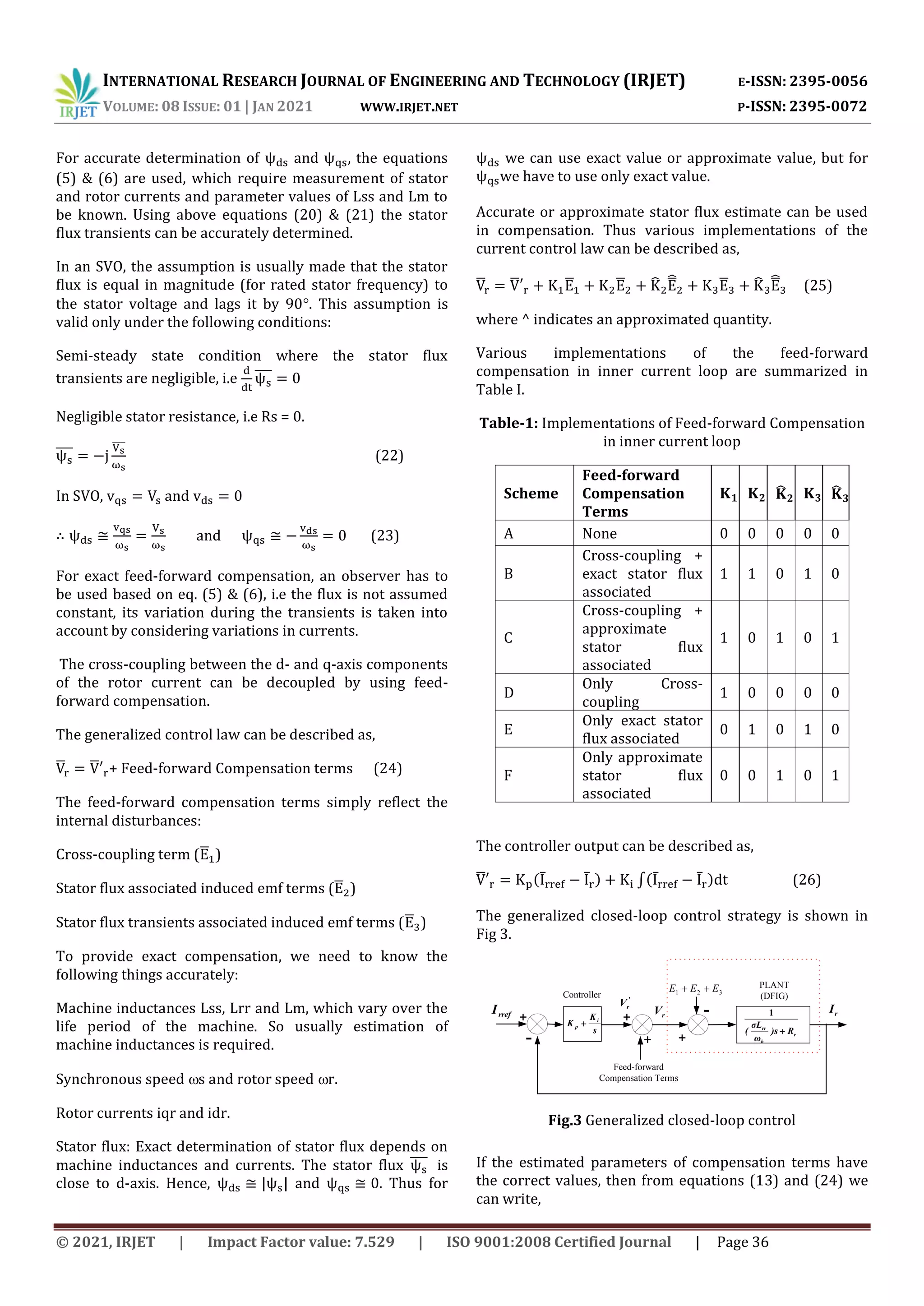
Various implementations of the feed-forward
compensation in inner current loop are summarized in
Table I.
Table-1: Implementations of Feed-forward Compensation
in inner current loop
Scheme
Feed-forward
Compensation
Terms
̂ ̂
A None 0 0 0 0 0
B
Cross-coupling +
exact stator flux
associated
1 1 0 1 0
C
Cross-coupling +
approximate
stator flux
associated
1 0 1 0 1
D
Only Cross-
coupling
1 0 0 0 0
E
Only exact stator
flux associated
0 1 0 1 0
F
Only approximate
stator flux
associated
0 0 1 0 1
The controller output can be described as,
̅ ̅ ̅ ∫ ̅ ̅ (26)
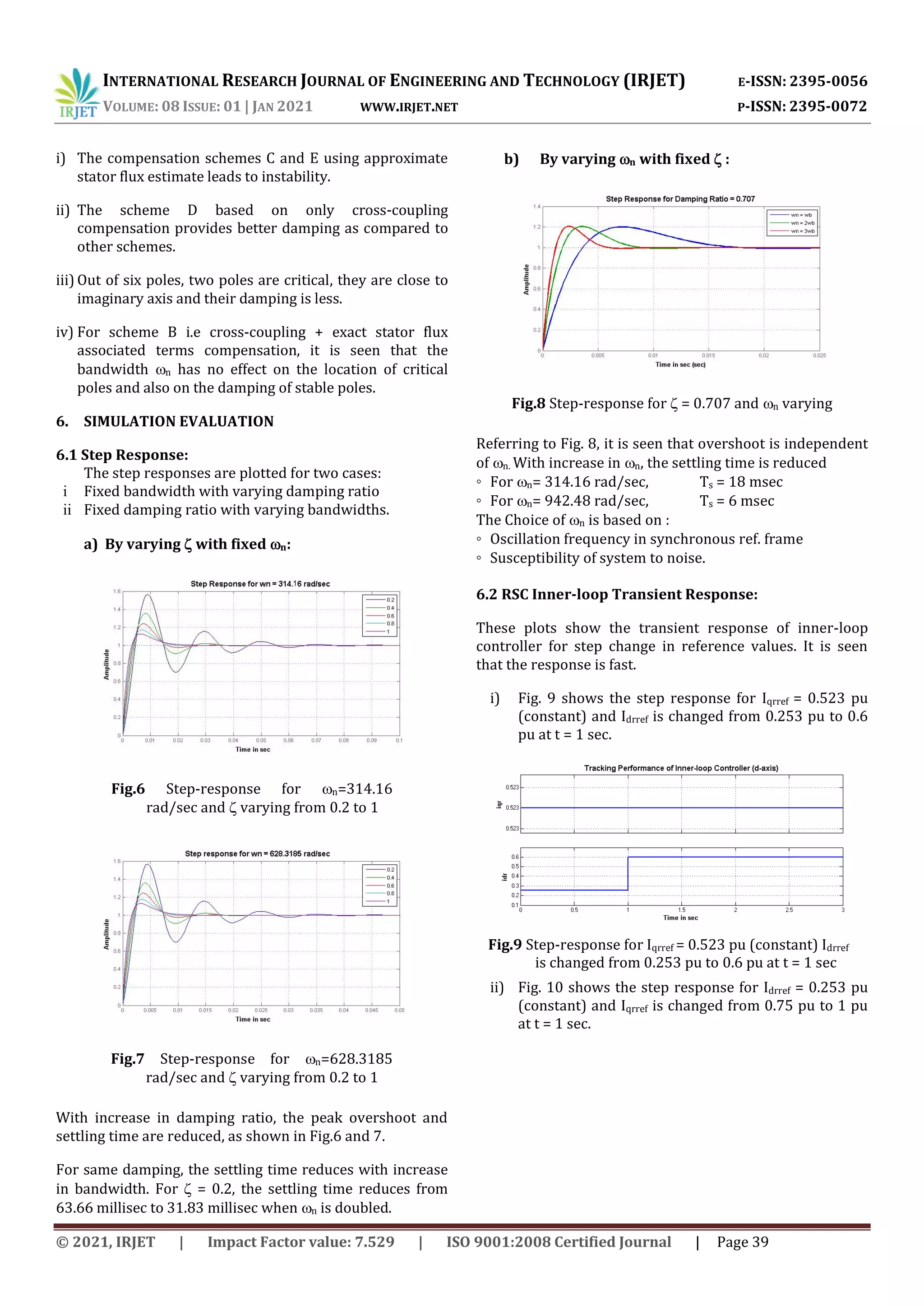
The generalized closed-loop control strategy is shown in
Fig 3.
Controller
s
K
K i
p 
'
r
V
Feed-forward
Compensation Terms
3
2
1 E
E
E 
 PLANT
(DFIG)
-
+
+
+
+ -
r
V
r
b
rr
R
)s
ω
σL
( 
1 r
I
rref
I
If the estimated parameters of compensation terms have
the correct values, then from equations (13) and (24) we
can write,
Fig.3 Generalized closed-loop control
strategy
INTERNATIONAL RESEARCH JOURNAL OF ENGINEERING AND TECHNOLOGY (IRJET) E-ISSN: 2395-0056
VOLUME: 08 ISSUE: 01 | JAN 2021 WWW.IRJET.NET P-ISSN: 2395-0072
© 2021, IRJET | Impact Factor value: 7.529 | ISO 9001:2008 Certified Journal | Page 37
̅ ̅ ̅ (27)
The transfer function between and is,
[ ( ) ]
(28)
Assuming that the feed-forward compensation nullifies
the effect of disturbances, we have .
The controller can be designed considering the process
model as,
[ ( ) ]
( )
* ( ) +
(29)
2.3 RSC Outer-loop Control Design:
2.3.1 Speed Control Loop:
Speed control of DFIG is essential for MPPT operation. The
inner current control loop dynamics is very fast as
compared to that of the outer speed control loop. Hence,
the effect of inner loop is ignored. The design technique is
same as that used for inner current control loop. In SVO,
electromagnetic torque is controlled by q-axis rotor
current
( ) (30)
The q-axis rotor current can control speed independently.
Transfer function between speed and q-axis rotor current
is given by:
[ ] (31)
Outer-loop
Controller
s
K
K io
po 
-
+ + qr
I
rref
PLANT
2
s
K
K i
p  PLANT
1
r
qrref
I
qr
V
Inner-loop
Controller
-
2.3.2 Reactive Power Control Loop:
Reactive Power control of DFIG is essential for maintaining
the power factor. The inner current control loop dynamics
is very fast as compared to that of the outer reactive power
control loop. Hence, the effect of inner loop is ignored. The
design technique is same as that used for inner current
control loop.
In SVO, Reactive Power is controlled by d-axis rotor
current
( ) ( ) (32)
The first term is constant under normal condition and
treated as disturbance.
Transfer function between Reactive power and rotor
current is given by:
* + (33)
Outer-loop
Controller
s
K
K io
po 
-
+ + dr
I
sref
Q
PLANT
2
s
K
K i
p  PLANT
1
s
Q
drref
I
dr
V
Inner-loop
Controller
-
3. PI-CONTROLLER DESIGN BASED ON POLE-
ASSIGNMENT TECHNIQUE
3.1 Pole-assignment design strategy:
The PI controller transfer function is expressed as,
* + (34)
The plant transfer function is,
( )
* ( ) +
(35)
The closed-loop transfer function T(s) is given by,
(36)
The characteristic equation is,
( )
( )
To determine the controller gains, the characteristic
equation is set to its standard form, .
The PI controller gains are:
and (37)
3.2 Selection of and
Actual system transfer function can be expressed as,
(38)
Fig. 4 Speed Control Loop
Fig. 5 Reactive Power Control Loop
INTERNATIONAL RESEARCH JOURNAL OF ENGINEERING AND TECHNOLOGY (IRJET) E-ISSN: 2395-0056
VOLUME: 08 ISSUE: 01 | JAN 2021 WWW.IRJET.NET P-ISSN: 2395-0072
© 2021, IRJET | Impact Factor value: 7.529 | ISO 9001:2008 Certified Journal | Page 38
Desired transfer function in standard form,
With known ‘a’ and ‘b’, if attempt is made to select and
n such that (2 n = a) making actual transfer function
same as desired one, the proportional gain becomes zero.
Therefore, this combination of and n is avoided.
Usually the damping coefficient is often chosen as 1 or
0.707 in practice. Therefore, with =0.707, the n is so
selected that the closed loop poles lie in the left-half of s-
plane, leading to system stability. Larger the n, wider is
the closed-loop bandwidth and faster is the system
response. The Bandwidth of the inner current loop
dynamics is considered as the tuning parameter for PI
controllers.
Here reduced order (first-order) model is used. Actually
system is complex (higher-order), so while selecting n, its
effect on closed-loop dominant poles is considered and
that n is selected which results in dominant closed-loop
poles sufficiently away from the imaginary axis in left-half
of s-plane.
It is also useful to choose n relative to the bandwidth of
the open-loop system * +. Here, a normalized
parameter 01 is proposed to be used where the desired
closed-loop bandwidth is calculated as:
* + (39)
The parameter  is often selected around 0.9 to give a
satisfactory performance.
4. STATE-SPACE MODEL OF DFIG SYSTEM IN SVO
By eliminating the stator and rotor fluxes in equations (1)
to (8), the open-loop state-space model of DFIG is obtained
as,
[ ] [ ]
[ ] (40)
Referring to equations (24) & (25), taking into account the
feed-forward compensation terms of the control law, the
open-loop state-space model can be modified to
[ ] [ ]
[ ] (41)
The state-space model of closed-loop DFIG system is
derived by substituting and from equation (26)
into equation (41) with
∫( ) (42)
∫ (43)
[ ] [ ]
[ ] (44)
The system has six state variables, hence has six poles,
which are obtained from the eigenvalues of the system
matrix . For the DFIG parameters mentioned in Table II,
the bandwidth is selected and controller gains are
computed from equation (37).
For different compensation schemes, the closed-loop poles
of the system are determined and found that the system
has two very lightly damped poles close to the imaginary
axis in s-plane. These are the critical poles that decide the
stability of the system.
Table–2: DFIG parameters
Parameter Value
Paramete
rs
Value
Power
Rating
2 MVA
0.09231
pu
Line
Voltage
690 V
0.09955
pu
Frequency 50 Hz
3.95279
pu
0.00488
pu
4.0451 pu
0.00549
pu
4.0523 pu
5. STABILITY ANALYSIS OF DFIG IN SVO
Here the bandwidth (n) of the inner current loop
dynamics is considered as the tuning parameter of the PI
controllers. In this section, the impact of the bandwidth on
the stability and SSR mode of the system is investigated. If
the real part of the critical poles becomes positive, the
system becomes unstable. The damping ratio (ζ) of the
conjugate pair of the critical poles is observed as the
measure of the stability. The zero damping ratio or negative
value refers to the instability. The eigenvalue analysis is
carried out for all feed-forward compensation schemes by
varying the speed of DFIG in the range 0.7 pu to 1.2 pu. The
observations are as follows:
INTERNATIONAL RESEARCH JOURNAL OF ENGINEERING AND TECHNOLOGY (IRJET) E-ISSN: 2395-0056
VOLUME: 08 ISSUE: 01 | JAN 2021 WWW.IRJET.NET P-ISSN: 2395-0072
© 2021, IRJET | Impact Factor value: 7.529 | ISO 9001:2008 Certified Journal | Page 39
i) The compensation schemes C and E using approximate
stator flux estimate leads to instability.
ii) The scheme D based on only cross-coupling
compensation provides better damping as compared to
other schemes.
iii) Out of six poles, two poles are critical, they are close to
imaginary axis and their damping is less.
iv) For scheme B i.e cross-coupling + exact stator flux
associated terms compensation, it is seen that the
bandwidth n has no effect on the location of critical
poles and also on the damping of stable poles.
6. SIMULATION EVALUATION
6.1 Step Response:
The step responses are plotted for two cases:
i Fixed bandwidth with varying damping ratio
ii Fixed damping ratio with varying bandwidths.
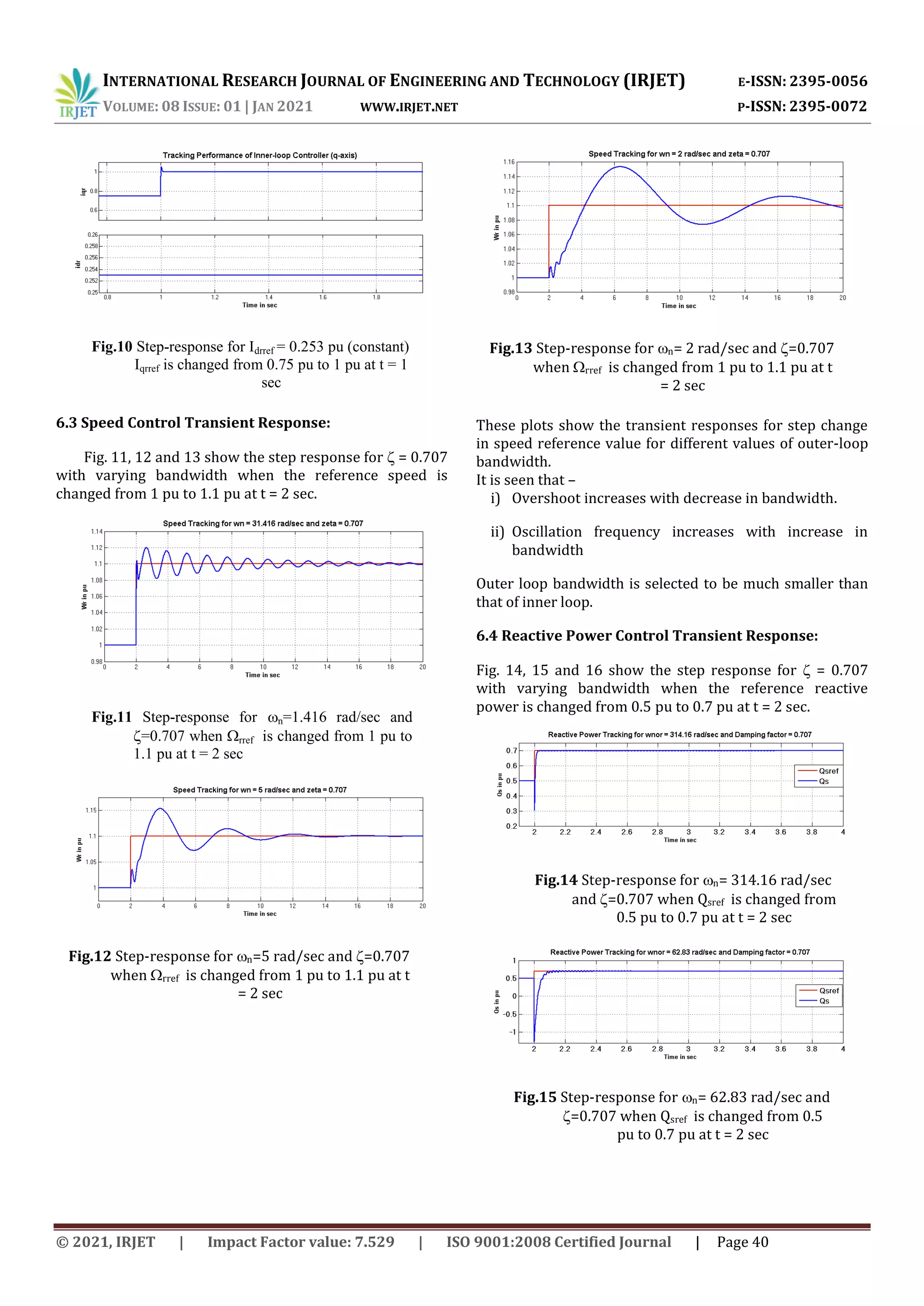
a) By varying with fixed n:
With increase in damping ratio, the peak overshoot and
settling time are reduced, as shown in Fig.6 and 7.
For same damping, the settling time reduces with increase
in bandwidth. For = 0.2, the settling time reduces from
63.66 millisec to 31.83 millisec when n is doubled.
b) By varying n with fixed :
Referring to Fig. 8, it is seen that overshoot is independent
of n. With increase in n, the settling time is reduced
◦ For n= 314.16 rad/sec, Ts = 18 msec
◦ For n= 942.48 rad/sec, Ts = 6 msec
The Choice of n is based on :
◦ Oscillation frequency in synchronous ref. frame
◦ Susceptibility of system to noise.
6.2 RSC Inner-loop Transient Response:
These plots show the transient response of inner-loop
controller for step change in reference values. It is seen
that the response is fast.
i) Fig. 9 shows the step response for Iqrref = 0.523 pu
(constant) and Idrref is changed from 0.253 pu to 0.6
pu at t = 1 sec.
ii) Fig. 10 shows the step response for Idrref = 0.253 pu
(constant) and Iqrref is changed from 0.75 pu to 1 pu
at t = 1 sec.
Fig.6 Step-response for n=314.16
rad/sec and varying from 0.2 to 1
Fig.7 Step-response for n=628.3185
rad/sec and varying from 0.2 to 1
Fig.8 Step-response for = 0.707 and n varying
Fig.9 Step-response for Iqrref = 0.523 pu (constant) Idrref
is changed from 0.253 pu to 0.6 pu at t = 1 sec
INTERNATIONAL RESEARCH JOURNAL OF ENGINEERING AND TECHNOLOGY (IRJET) E-ISSN: 2395-0056
VOLUME: 08 ISSUE: 01 | JAN 2021 WWW.IRJET.NET P-ISSN: 2395-0072
© 2021, IRJET | Impact Factor value: 7.529 | ISO 9001:2008 Certified Journal | Page 40
6.3 Speed Control Transient Response:
Fig. 11, 12 and 13 show the step response for = 0.707
with varying bandwidth when the reference speed is
changed from 1 pu to 1.1 pu at t = 2 sec.
These plots show the transient responses for step change
in speed reference value for different values of outer-loop
bandwidth.
It is seen that –
i) Overshoot increases with decrease in bandwidth.
ii) Oscillation frequency increases with increase in
bandwidth
Outer loop bandwidth is selected to be much smaller than
that of inner loop.
6.4 Reactive Power Control Transient Response:
Fig. 14, 15 and 16 show the step response for = 0.707
with varying bandwidth when the reference reactive
power is changed from 0.5 pu to 0.7 pu at t = 2 sec.
Fig.10 Step-response for Idrref = 0.253 pu (constant)
Iqrref is changed from 0.75 pu to 1 pu at t = 1
sec
Fig.11 Step-response for n=1.416 rad/sec and
=0.707 when rref is changed from 1 pu to
1.1 pu at t = 2 sec
Fig.12 Step-response for n=5 rad/sec and =0.707
when rref is changed from 1 pu to 1.1 pu at t
= 2 sec
Fig.13 Step-response for n= 2 rad/sec and =0.707
when rref is changed from 1 pu to 1.1 pu at t
= 2 sec
Fig.14 Step-response for n= 314.16 rad/sec
and =0.707 when Qsref is changed from
0.5 pu to 0.7 pu at t = 2 sec
Fig.15 Step-response for n= 62.83 rad/sec and
=0.707 when Qsref is changed from 0.5
pu to 0.7 pu at t = 2 sec
INTERNATIONAL RESEARCH JOURNAL OF ENGINEERING AND TECHNOLOGY (IRJET) E-ISSN: 2395-0056
VOLUME: 08 ISSUE: 01 | JAN 2021 WWW.IRJET.NET P-ISSN: 2395-0072
© 2021, IRJET | Impact Factor value: 7.529 | ISO 9001:2008 Certified Journal | Page 41
These plots show the transient response for step change in
reactive power reference value for different outer-loop
bandwidths. For lower bandwidth, much higher negative
pulse is observed. Therefore comparatiely higher
bandwidth is preferred.
The theoretical analysis is supported through simulations
in Matlab/Simulink. Thus the stability is accessed under a
small perturbation, which is the change in the reference
signal command. The instability of the inner current loop is
caused when the bandwidth is wrongly selected which
move the critical poles to the unstable region.
7. CONCLUSIONS
i) In SVO, independent control of speed and reactive
power is possible using q-axis and d-axis rotor current
control respectively employing decoupled control.
ii) For Inner-loop fast current control, higher bandwidth
is preferred to avoid the sub-synchronous oscillations
and for outer loop comparatively lower bandwidth is
chosen.
iii) While selecting bandwidth, the eigenvalue analysis is
used to identify the range of bandwidths causing sub-
synchronous resonance and oscillations.
iv) The compensation schemes based on approximate
stator flux estimation leads to instability.
v) The compensation scheme based on cross-coupling
and exact stator flux associated terms is found to be
better.
REFERENCES
[1] S. Muller, M. Deicke, R.W. de Doncker: “Doubly fed
induction generator systems for wind turbines”, IEEE
Ind. Appl. Mag., 2002, 8, (3), pp. 26–33
[2] Hopfensperger B., Atkinson D. J., Lakin R. A.: “Stator-
flux oriented control of doubly-fed induction machine
with and without position encoder”, IEE Proc. Electr.
Power Appl., 2007, 147, (4), pp. 241-250.
[3] Liu C., Weng H., Sun X., Li F.: “Research of stability of
double fed induction motor vector control system”,
Proc. Int. Conf. Elect. Machines and Systems 2001, 2,
(2), pp. 1203-1206.
[4] Petersson A., Harnefors L., Thiringer T.: “Comparison
between stator-flux and grid-flux-oriented rotor
current control of doubly-fed induction generators”,
IEEE 35th Annual Power Electronics Specialists Conf.
2004, vol. 1, pp. 482-486.
[5] Petersson A., Harnefors L., Thiringer T.: “Evaluation of
current control methods for wind turbines using
doubly-fed induction machines”, IEEE Trans, Power
Electron. 2005,20,(1), pp. 227-235.
[6] S. Chondrogiannis, M. Barnes: “Stability of doubly-fed
induction generator under SVO vector control”, IET
Renewable Power Generation, 2008, Vol. 2, N0. 3, pp.
170-180.
BIOGRAPHIES
1. Deodatta Y. Shingare, B.E. (Electrical), M. E. (Electrical
Power Systems), is presently persuing Ph. D. at National
Institute of Technology, Calicut, Kerla (India). His
research area includes DFIG-based wind farm control to
provide dynamic support to the grid under contingency
conditions.
2. Dr. Sunil Kumar T. K., B.Tech. (Electrical and
Electronics Engineering), N.S.S College of Engineering,
Palakkad, 1997, M.Tech. ( Power System), N.I.T.
Jamshedpur , Ph.D. I.I.T Kharagpur, is presently Assistant
Professor in the Department of Electrica Engineering,
National Institute of Technology, Calicut, Kerla (India).
His research area includes Model Matching Controller
Design Methods with Applications in Electric Power
Systems.
Fig.16 Step-response for n= 5 rad/sec and
=0.707 when Qsref is changed from 0.5
pu to 0.7 pu at t = 2 sec

IRJET - DFIG Control Design for Preventing SSR Mode

  • 1.
    INTERNATIONAL RESEARCH JOURNALOF ENGINEERING AND TECHNOLOGY (IRJET) E-ISSN: 2395-0056 VOLUME: 08 ISSUE: 01 | JAN 2021 WWW.IRJET.NET P-ISSN: 2395-0072 © 2021, IRJET | Impact Factor value: 7.529 | ISO 9001:2008 Certified Journal | Page 34 DFIG Control Design for Preventing SSR Mode Deodatta Y. Shingare1, Dr. Sunil Kumar T. K.2 1Research Scholar, Dept. of Electrical Engineering, National Institute of Technology, Calicut, India 2Assistant Professor, Dept. of Electrical Engineering, National Institute of Technology, Calicut, India -----------------------------------------------------------------------------***---------------------------------------------------------------------------- Abstract - This paper presents novel approach to design the controller for Doubly-fed induction generator (DFIG) in Stator-Voltage-oriented (SVO) synchronous reference frame for preventing sub-synchronous resonance. The state-space model of DFIG including inner current closed loop dynamics with different feed-forward compensation schemes is developed. The inner current loop dynamics is usually ignored when SVO control is employed. The effect of inner current loop dynamics on the sub-synchronous resonance (SSR) mode of the system is illustrated through analysis and simulation. The analysis makes it clear that the stability of DFIG and also the SSR mode excitation in SVO depends mainly on the tuning of the proportional-integral (PI) controllers. Erroneous tuning results into instability and also excitation of SSR mode. This paper contributes the tuning methodology of the PI-controllers in order to secure the stability of DFIG and also the additional advantage of preventing SSR mode under SVO vector control scheme. Key Words: doubly-fed induction generator (DFIG); stator-voltage-oriented (SVO) vector control; proportional-integral (PI) controller, sub-synchronous resonance (SSR) mode, feed-forward compensation 1. INTRODUCTION The most preferred topology for high power (+5 MW) wind applications and currently very popular is Doubly-fed induction generator (DFIG). Its independent active and reactive power control along with variable-speed operation offer many advantages over other fixed-speed topologies [1]. Commercially important advantages of employing DFIG in wind power applications include lower power rating of power electronic interface and ultimately the lower cost. Depending on the orientation of the synchronously rotating dq0 reference frame [2], vector control schemes employed for DFIG are: (1) stator flux orientation (SFO) – d-axis aligned to stator flux vector and (2) stator voltage orientation (SVO) – q-axis aligned to stator voltage vector. The reactive power production of the DFIG limits the stability [3], when SFO is employed. However, when SVO is employed, such stability problems do not exist [4]. In the analysis of these schemes, it is considered that the rotor current tracks its reference perfectly, ignoring the effect of controller tuning on the stability of DFIG. The dynamics of inner current loop is taken into account in stability analysis of SFO based various implementations of the vector control schemes in [5]. In this paper the inner current loop dynamics are taken into account and the impact of the tuning of PI controllers on the stability of DFIG and SSR mode in SVO is investigated. Pole-assignment technique is followed for controller design. Both the mathematical analysis and simulations reveal that the erroneous tuning of the PI controllers lead to the unstable operation of DFIG and/or can also lead to SSR mode excitation in SVO vector control. The paper is organized as follows: Section II includes the mathematical model of DFIG. The pole-assignment design strategy is detailed in Section III. The state-space model of DFIG system in SVO is presented in Section IV. The stability analysis of DFIG in SVO is carried out in Section V. Simulation evaluation is presented in Section VI and finally the conclusion in Section VII. 2. MATHEMATICAL MODEL OF DFIG SYSTEM 2.1 Park-model of DFIG The T-equivalent circuit representing the Park Model [6] of DFIG in synchronous reference frame, is shown in Fig.1. Based on the T-equivalent circuit, the mathematical model of DFIG system in per unit of system base is represented as DFIG equations in synchronously rotating d-q reference frame: (1) (2) (3) (4) (5) (6) Fig.1 Park Model (T-equivalent circuit) of DFIG in synchronous reference frame
  • 2.
    INTERNATIONAL RESEARCH JOURNALOF ENGINEERING AND TECHNOLOGY (IRJET) E-ISSN: 2395-0056 VOLUME: 08 ISSUE: 01 | JAN 2021 WWW.IRJET.NET P-ISSN: 2395-0072 © 2021, IRJET | Impact Factor value: 7.529 | ISO 9001:2008 Certified Journal | Page 35 (7) (8) (9) (10) where, ̅ : Stator voltage space vector ̅ : Rotor voltage space vector referred to stator ̅ : Stator current space vector ̅ : Rotor current space vector referred to stator ̅ ̅ ̅ ̅ : Stator flux-linkage space vector (11) ̅̅̅ : Rotor flux-linkage space vector referred to stator (12) : Stator and rotor resistance referred to stator : Stator and rotor leakage inductance referred to stator, : Magnetizing inductance referred to stator, 2.2 RSC Inner Rotor Current Control Loop Eliminating the stator current and rotor flux linkages from the stator and rotor voltage equations, finally we get the rotor voltage as balance of emfs in the rotor circuit, which is used to derive the rotor current control law. ̅ ̅ ̅ ̅ ̅ ̅ (13) Thus the rotor voltage equation includes: The rotor voltage injection: ̅ A voltage drop across the rotor resistance ̅ A cross-coupling induced emf term ̅ An induced emf term associated with stator flux ̅ An induced emf term associated with stator transients ̅ ( ) ( ) An induced emf term in the Thevenin’s equivalent inductance (as seen from the rotor with stator short circuited): ̅ ( ) Laplace transform of equation (13) and subsequent simplification yields, [ ] [ ( ) ] (14) The equation (14) represents the process or plant, how the injected voltage Vr in rotor circuit causes the current Ir. The block diagram of plant is shown in Fig.2. The plant or process can be represented by, [ ( ) ] (15) r b rr R s ) L ( 1    3 2 1 E E E   PLANT (DFIG) + - r V r I The terms E1, E2 and E3 represent the internal disturbances of the plant. From the stator flux-linkage equations (5) & (6), the stator currents can be expressed as: (16) (17) Substituting these stator currents into stator voltage equations (1) & (2) yields, (18) (19) The equations (18) & (19) show that the stator flux and its transients are function of both stator voltage and rotor current, thus the terms E1, E2 and E3 depending on the rotor current and stator flux are the internal disturbances. For compensation of stator flux transient terms, the following equations, derived from equations (18) & (19), are used: (20) (21) Fig.2 Block diagram of Plant (Open loop system)
  • 3.
    INTERNATIONAL RESEARCH JOURNALOF ENGINEERING AND TECHNOLOGY (IRJET) E-ISSN: 2395-0056 VOLUME: 08 ISSUE: 01 | JAN 2021 WWW.IRJET.NET P-ISSN: 2395-0072 © 2021, IRJET | Impact Factor value: 7.529 | ISO 9001:2008 Certified Journal | Page 36 For accurate determination of and the equations (5) & (6) are used, which require measurement of stator and rotor currents and parameter values of Lss and Lm to be known. Using above equations (20) & (21) the stator flux transients can be accurately determined. In an SVO, the assumption is usually made that the stator flux is equal in magnitude (for rated stator frequency) to the stator voltage and lags it by 90. This assumption is valid only under the following conditions: Semi-steady state condition where the stator flux transients are negligible, i.e ̅ ̅ ̅̅ Negligible stator resistance, i.e Rs = 0. ̅ ̅ ̅ ̅ ̅̅̅̅ (22) In SVO, and and (23) For exact feed-forward compensation, an observer has to be used based on eq. (5) & (6), i.e the flux is not assumed constant, its variation during the transients is taken into account by considering variations in currents. The cross-coupling between the d- and q-axis components of the rotor current can be decoupled by using feed- forward compensation. The generalized control law can be described as, ̅ ̅ + Feed-forward Compensation terms (24) The feed-forward compensation terms simply reflect the internal disturbances: Cross-coupling term (̅ ) Stator flux associated induced emf terms (̅ ) Stator flux transients associated induced emf terms (̅ ) To provide exact compensation, we need to know the following things accurately: Machine inductances Lss, Lrr and Lm, which vary over the life period of the machine. So usually estimation of machine inductances is required. Synchronous speed s and rotor speed r. Rotor currents iqr and idr. Stator flux: Exact determination of stator flux depends on machine inductances and currents. The stator flux ̅ ̅ ̅ ̅ is close to d-axis. Hence, and . Thus for we can use exact value or approximate value, but for we have to use only exact value. Accurate or approximate stator flux estimate can be used in compensation. Thus various implementations of the current control law can be described as, ̅ ̅ ̅ ̅ ̂ ̅ ̂ ̅ ̂ ̅ ̂ (25) where ^ indicates an approximated quantity. Various implementations of the feed-forward compensation in inner current loop are summarized in Table I. Table-1: Implementations of Feed-forward Compensation in inner current loop Scheme Feed-forward Compensation Terms ̂ ̂ A None 0 0 0 0 0 B Cross-coupling + exact stator flux associated 1 1 0 1 0 C Cross-coupling + approximate stator flux associated 1 0 1 0 1 D Only Cross- coupling 1 0 0 0 0 E Only exact stator flux associated 0 1 0 1 0 F Only approximate stator flux associated 0 0 1 0 1 The controller output can be described as, ̅ ̅ ̅ ∫ ̅ ̅ (26) The generalized closed-loop control strategy is shown in Fig 3. Controller s K K i p  ' r V Feed-forward Compensation Terms 3 2 1 E E E   PLANT (DFIG) - + + + + - r V r b rr R )s ω σL (  1 r I rref I If the estimated parameters of compensation terms have the correct values, then from equations (13) and (24) we can write, Fig.3 Generalized closed-loop control strategy
  • 4.
    INTERNATIONAL RESEARCH JOURNALOF ENGINEERING AND TECHNOLOGY (IRJET) E-ISSN: 2395-0056 VOLUME: 08 ISSUE: 01 | JAN 2021 WWW.IRJET.NET P-ISSN: 2395-0072 © 2021, IRJET | Impact Factor value: 7.529 | ISO 9001:2008 Certified Journal | Page 37 ̅ ̅ ̅ (27) The transfer function between and is, [ ( ) ] (28) Assuming that the feed-forward compensation nullifies the effect of disturbances, we have . The controller can be designed considering the process model as, [ ( ) ] ( ) * ( ) + (29) 2.3 RSC Outer-loop Control Design: 2.3.1 Speed Control Loop: Speed control of DFIG is essential for MPPT operation. The inner current control loop dynamics is very fast as compared to that of the outer speed control loop. Hence, the effect of inner loop is ignored. The design technique is same as that used for inner current control loop. In SVO, electromagnetic torque is controlled by q-axis rotor current ( ) (30) The q-axis rotor current can control speed independently. Transfer function between speed and q-axis rotor current is given by: [ ] (31) Outer-loop Controller s K K io po  - + + qr I rref PLANT 2 s K K i p  PLANT 1 r qrref I qr V Inner-loop Controller - 2.3.2 Reactive Power Control Loop: Reactive Power control of DFIG is essential for maintaining the power factor. The inner current control loop dynamics is very fast as compared to that of the outer reactive power control loop. Hence, the effect of inner loop is ignored. The design technique is same as that used for inner current control loop. In SVO, Reactive Power is controlled by d-axis rotor current ( ) ( ) (32) The first term is constant under normal condition and treated as disturbance. Transfer function between Reactive power and rotor current is given by: * + (33) Outer-loop Controller s K K io po  - + + dr I sref Q PLANT 2 s K K i p  PLANT 1 s Q drref I dr V Inner-loop Controller - 3. PI-CONTROLLER DESIGN BASED ON POLE- ASSIGNMENT TECHNIQUE 3.1 Pole-assignment design strategy: The PI controller transfer function is expressed as, * + (34) The plant transfer function is, ( ) * ( ) + (35) The closed-loop transfer function T(s) is given by, (36) The characteristic equation is, ( ) ( ) To determine the controller gains, the characteristic equation is set to its standard form, . The PI controller gains are: and (37) 3.2 Selection of and Actual system transfer function can be expressed as, (38) Fig. 4 Speed Control Loop Fig. 5 Reactive Power Control Loop
  • 5.
    INTERNATIONAL RESEARCH JOURNALOF ENGINEERING AND TECHNOLOGY (IRJET) E-ISSN: 2395-0056 VOLUME: 08 ISSUE: 01 | JAN 2021 WWW.IRJET.NET P-ISSN: 2395-0072 © 2021, IRJET | Impact Factor value: 7.529 | ISO 9001:2008 Certified Journal | Page 38 Desired transfer function in standard form, With known ‘a’ and ‘b’, if attempt is made to select and n such that (2 n = a) making actual transfer function same as desired one, the proportional gain becomes zero. Therefore, this combination of and n is avoided. Usually the damping coefficient is often chosen as 1 or 0.707 in practice. Therefore, with =0.707, the n is so selected that the closed loop poles lie in the left-half of s- plane, leading to system stability. Larger the n, wider is the closed-loop bandwidth and faster is the system response. The Bandwidth of the inner current loop dynamics is considered as the tuning parameter for PI controllers. Here reduced order (first-order) model is used. Actually system is complex (higher-order), so while selecting n, its effect on closed-loop dominant poles is considered and that n is selected which results in dominant closed-loop poles sufficiently away from the imaginary axis in left-half of s-plane. It is also useful to choose n relative to the bandwidth of the open-loop system * +. Here, a normalized parameter 01 is proposed to be used where the desired closed-loop bandwidth is calculated as: * + (39) The parameter  is often selected around 0.9 to give a satisfactory performance. 4. STATE-SPACE MODEL OF DFIG SYSTEM IN SVO By eliminating the stator and rotor fluxes in equations (1) to (8), the open-loop state-space model of DFIG is obtained as, [ ] [ ] [ ] (40) Referring to equations (24) & (25), taking into account the feed-forward compensation terms of the control law, the open-loop state-space model can be modified to [ ] [ ] [ ] (41) The state-space model of closed-loop DFIG system is derived by substituting and from equation (26) into equation (41) with ∫( ) (42) ∫ (43) [ ] [ ] [ ] (44) The system has six state variables, hence has six poles, which are obtained from the eigenvalues of the system matrix . For the DFIG parameters mentioned in Table II, the bandwidth is selected and controller gains are computed from equation (37). For different compensation schemes, the closed-loop poles of the system are determined and found that the system has two very lightly damped poles close to the imaginary axis in s-plane. These are the critical poles that decide the stability of the system. Table–2: DFIG parameters Parameter Value Paramete rs Value Power Rating 2 MVA 0.09231 pu Line Voltage 690 V 0.09955 pu Frequency 50 Hz 3.95279 pu 0.00488 pu 4.0451 pu 0.00549 pu 4.0523 pu 5. STABILITY ANALYSIS OF DFIG IN SVO Here the bandwidth (n) of the inner current loop dynamics is considered as the tuning parameter of the PI controllers. In this section, the impact of the bandwidth on the stability and SSR mode of the system is investigated. If the real part of the critical poles becomes positive, the system becomes unstable. The damping ratio (ζ) of the conjugate pair of the critical poles is observed as the measure of the stability. The zero damping ratio or negative value refers to the instability. The eigenvalue analysis is carried out for all feed-forward compensation schemes by varying the speed of DFIG in the range 0.7 pu to 1.2 pu. The observations are as follows:
  • 6.
    INTERNATIONAL RESEARCH JOURNALOF ENGINEERING AND TECHNOLOGY (IRJET) E-ISSN: 2395-0056 VOLUME: 08 ISSUE: 01 | JAN 2021 WWW.IRJET.NET P-ISSN: 2395-0072 © 2021, IRJET | Impact Factor value: 7.529 | ISO 9001:2008 Certified Journal | Page 39 i) The compensation schemes C and E using approximate stator flux estimate leads to instability. ii) The scheme D based on only cross-coupling compensation provides better damping as compared to other schemes. iii) Out of six poles, two poles are critical, they are close to imaginary axis and their damping is less. iv) For scheme B i.e cross-coupling + exact stator flux associated terms compensation, it is seen that the bandwidth n has no effect on the location of critical poles and also on the damping of stable poles. 6. SIMULATION EVALUATION 6.1 Step Response: The step responses are plotted for two cases: i Fixed bandwidth with varying damping ratio ii Fixed damping ratio with varying bandwidths. a) By varying with fixed n: With increase in damping ratio, the peak overshoot and settling time are reduced, as shown in Fig.6 and 7. For same damping, the settling time reduces with increase in bandwidth. For = 0.2, the settling time reduces from 63.66 millisec to 31.83 millisec when n is doubled. b) By varying n with fixed : Referring to Fig. 8, it is seen that overshoot is independent of n. With increase in n, the settling time is reduced ◦ For n= 314.16 rad/sec, Ts = 18 msec ◦ For n= 942.48 rad/sec, Ts = 6 msec The Choice of n is based on : ◦ Oscillation frequency in synchronous ref. frame ◦ Susceptibility of system to noise. 6.2 RSC Inner-loop Transient Response: These plots show the transient response of inner-loop controller for step change in reference values. It is seen that the response is fast. i) Fig. 9 shows the step response for Iqrref = 0.523 pu (constant) and Idrref is changed from 0.253 pu to 0.6 pu at t = 1 sec. ii) Fig. 10 shows the step response for Idrref = 0.253 pu (constant) and Iqrref is changed from 0.75 pu to 1 pu at t = 1 sec. Fig.6 Step-response for n=314.16 rad/sec and varying from 0.2 to 1 Fig.7 Step-response for n=628.3185 rad/sec and varying from 0.2 to 1 Fig.8 Step-response for = 0.707 and n varying Fig.9 Step-response for Iqrref = 0.523 pu (constant) Idrref is changed from 0.253 pu to 0.6 pu at t = 1 sec
  • 7.
    INTERNATIONAL RESEARCH JOURNALOF ENGINEERING AND TECHNOLOGY (IRJET) E-ISSN: 2395-0056 VOLUME: 08 ISSUE: 01 | JAN 2021 WWW.IRJET.NET P-ISSN: 2395-0072 © 2021, IRJET | Impact Factor value: 7.529 | ISO 9001:2008 Certified Journal | Page 40 6.3 Speed Control Transient Response: Fig. 11, 12 and 13 show the step response for = 0.707 with varying bandwidth when the reference speed is changed from 1 pu to 1.1 pu at t = 2 sec. These plots show the transient responses for step change in speed reference value for different values of outer-loop bandwidth. It is seen that – i) Overshoot increases with decrease in bandwidth. ii) Oscillation frequency increases with increase in bandwidth Outer loop bandwidth is selected to be much smaller than that of inner loop. 6.4 Reactive Power Control Transient Response: Fig. 14, 15 and 16 show the step response for = 0.707 with varying bandwidth when the reference reactive power is changed from 0.5 pu to 0.7 pu at t = 2 sec. Fig.10 Step-response for Idrref = 0.253 pu (constant) Iqrref is changed from 0.75 pu to 1 pu at t = 1 sec Fig.11 Step-response for n=1.416 rad/sec and =0.707 when rref is changed from 1 pu to 1.1 pu at t = 2 sec Fig.12 Step-response for n=5 rad/sec and =0.707 when rref is changed from 1 pu to 1.1 pu at t = 2 sec Fig.13 Step-response for n= 2 rad/sec and =0.707 when rref is changed from 1 pu to 1.1 pu at t = 2 sec Fig.14 Step-response for n= 314.16 rad/sec and =0.707 when Qsref is changed from 0.5 pu to 0.7 pu at t = 2 sec Fig.15 Step-response for n= 62.83 rad/sec and =0.707 when Qsref is changed from 0.5 pu to 0.7 pu at t = 2 sec
  • 8.
    INTERNATIONAL RESEARCH JOURNALOF ENGINEERING AND TECHNOLOGY (IRJET) E-ISSN: 2395-0056 VOLUME: 08 ISSUE: 01 | JAN 2021 WWW.IRJET.NET P-ISSN: 2395-0072 © 2021, IRJET | Impact Factor value: 7.529 | ISO 9001:2008 Certified Journal | Page 41 These plots show the transient response for step change in reactive power reference value for different outer-loop bandwidths. For lower bandwidth, much higher negative pulse is observed. Therefore comparatiely higher bandwidth is preferred. The theoretical analysis is supported through simulations in Matlab/Simulink. Thus the stability is accessed under a small perturbation, which is the change in the reference signal command. The instability of the inner current loop is caused when the bandwidth is wrongly selected which move the critical poles to the unstable region. 7. CONCLUSIONS i) In SVO, independent control of speed and reactive power is possible using q-axis and d-axis rotor current control respectively employing decoupled control. ii) For Inner-loop fast current control, higher bandwidth is preferred to avoid the sub-synchronous oscillations and for outer loop comparatively lower bandwidth is chosen. iii) While selecting bandwidth, the eigenvalue analysis is used to identify the range of bandwidths causing sub- synchronous resonance and oscillations. iv) The compensation schemes based on approximate stator flux estimation leads to instability. v) The compensation scheme based on cross-coupling and exact stator flux associated terms is found to be better. REFERENCES [1] S. Muller, M. Deicke, R.W. de Doncker: “Doubly fed induction generator systems for wind turbines”, IEEE Ind. Appl. Mag., 2002, 8, (3), pp. 26–33 [2] Hopfensperger B., Atkinson D. J., Lakin R. A.: “Stator- flux oriented control of doubly-fed induction machine with and without position encoder”, IEE Proc. Electr. Power Appl., 2007, 147, (4), pp. 241-250. [3] Liu C., Weng H., Sun X., Li F.: “Research of stability of double fed induction motor vector control system”, Proc. Int. Conf. Elect. Machines and Systems 2001, 2, (2), pp. 1203-1206. [4] Petersson A., Harnefors L., Thiringer T.: “Comparison between stator-flux and grid-flux-oriented rotor current control of doubly-fed induction generators”, IEEE 35th Annual Power Electronics Specialists Conf. 2004, vol. 1, pp. 482-486. [5] Petersson A., Harnefors L., Thiringer T.: “Evaluation of current control methods for wind turbines using doubly-fed induction machines”, IEEE Trans, Power Electron. 2005,20,(1), pp. 227-235. [6] S. Chondrogiannis, M. Barnes: “Stability of doubly-fed induction generator under SVO vector control”, IET Renewable Power Generation, 2008, Vol. 2, N0. 3, pp. 170-180. BIOGRAPHIES 1. Deodatta Y. Shingare, B.E. (Electrical), M. E. (Electrical Power Systems), is presently persuing Ph. D. at National Institute of Technology, Calicut, Kerla (India). His research area includes DFIG-based wind farm control to provide dynamic support to the grid under contingency conditions. 2. Dr. Sunil Kumar T. K., B.Tech. (Electrical and Electronics Engineering), N.S.S College of Engineering, Palakkad, 1997, M.Tech. ( Power System), N.I.T. Jamshedpur , Ph.D. I.I.T Kharagpur, is presently Assistant Professor in the Department of Electrica Engineering, National Institute of Technology, Calicut, Kerla (India). His research area includes Model Matching Controller Design Methods with Applications in Electric Power Systems. Fig.16 Step-response for n= 5 rad/sec and =0.707 when Qsref is changed from 0.5 pu to 0.7 pu at t = 2 sec