International Research Journal of Engineering and Technology (IRJET) e-ISSN: 2395-0056
Volume: 06 Issue: 11 | Nov 2019 www.irjet.net p-ISSN: 2395-0072
© 2019, IRJET | Impact Factor value: 7.34 | ISO 9001:2008 Certified Journal | Page 2211
CO2 Mitigation
Ganesh Ugale1, Pratik R. Borse2, Sanket J. Amrutkar3, Hemant R. Sonawane4
1, 2, 3, 4Chemical Engineer, Loni, Maharashtra, India
---------------------------------------------------------------------***---------------------------------------------------------------------
Abstract - Carbon Dioxide(CO2) with increasing the crisis for ecology and nourishing to extinguish the planet also known as the
greenhouse gas. The power plants play the major role to the emission of the flue gas containing CO2. Toevadesuchenvironmental
issue with its mitigation by the methods of pre as well as post combustion in various power plants for the capture of CO2 that uses
amine as base. More the CO2 accumulates in the atmosphere more the climate heats up, so to get rid of such crisis towards the
environment, there was an increase in the chase of research to capture CO2 from the environment. The postcombustionmethodis
the most widely used in various power plants and it’s quite similar to the desulphurization. To overcome such technique towards
future prospective by developing solid adsorbent with better stability and efficiency in the field of the nano technology, the DFNS-
oxyntrides can be used as the solid adsorbents for the CO2 capture was playing a crucial role in the CO2 mitigation with its
satisfactory fibrous morphology and at another sight the integrated solar fuel system where sunlight is used to convert CO2 and
water vapour into the hydrocarbon by using photocatalytic conversion. ThusurgetoremoveCO2 fromatmosphereandhavingthe
recent technology of conversion of direct air to methanol with its highest efficiency by homogeneous catalyst system using
pentaethylenehexamine (PEHA).
Key Words: carbon dioxide, greenhouse gas, amine, DFNS, photocatalyticconversion, methanol,homogeneouscatalyst,PEHA.
1. INTRODUCTION
 CO2 the main constituent which is contributing the green house effect upto 26%.
 After industrial revolution the climate change phenomenon has been accelerated with reliance in fossil fuels, coal and oil
across the world.
 In carbon capture and sequestration amine plays a good role with its reversible reaction with CO2 where pre and post
combustion method belongs too.
 The transformation of technologies or process towards nano-science the DFNS was playing crucial role to capture CO2.
 Overall this reusing and utilizing the CO2 to form the hydrocarbon from where it originated.
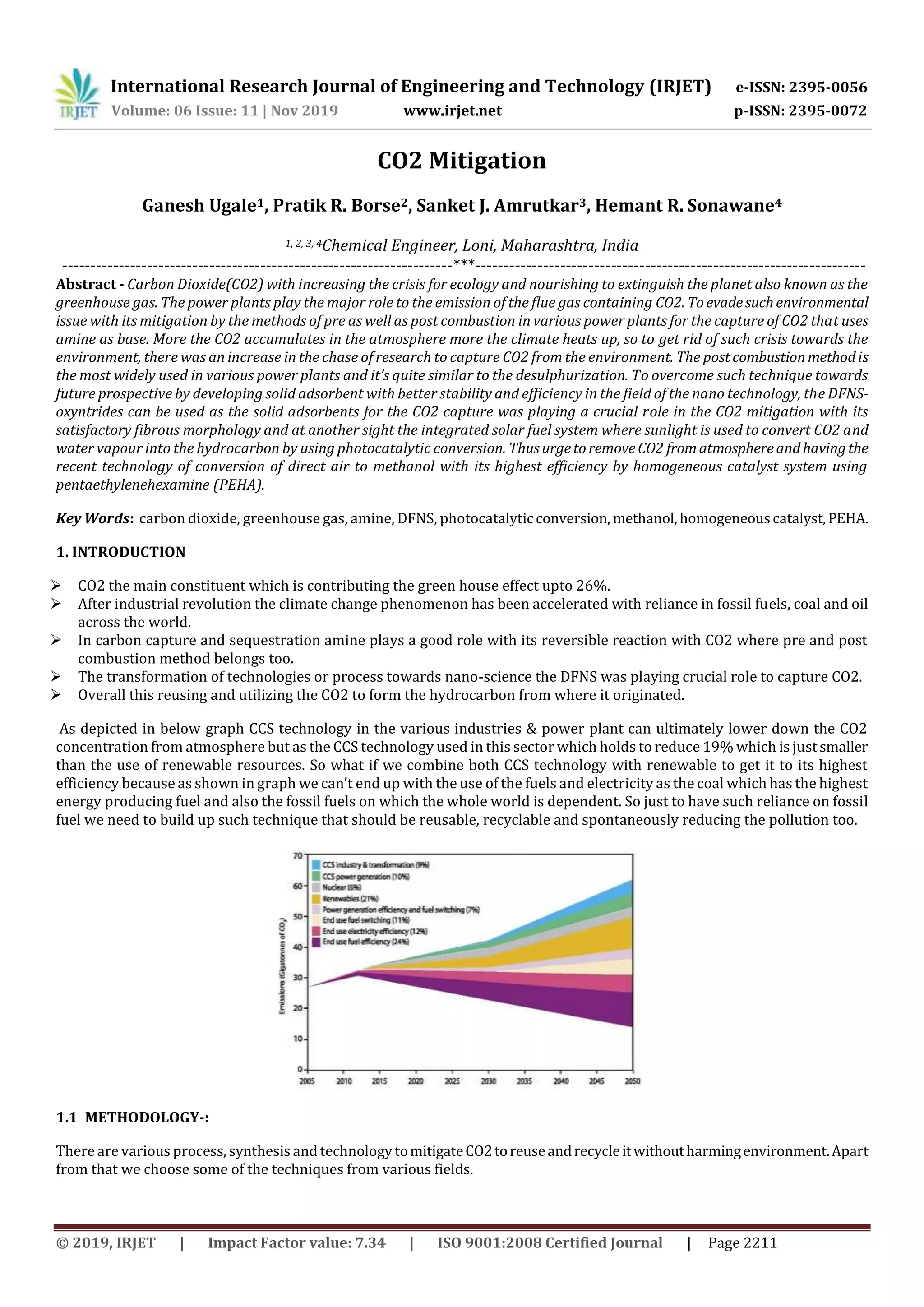
As depicted in below graph CCS technology in the various industries & power plant can ultimately lower down the CO2
concentration from atmosphere but as the CCS technology used in this sector which holds to reduce 19% which is justsmaller
than the use of renewable resources. So what if we combine both CCS technology with renewable to get it to its highest
efficiency because as shown in graph we can’t end up with the use of the fuels and electricity as the coal which has the highest
energy producing fuel and also the fossil fuels on which the whole world is dependent. So just to have such reliance on fossil
fuel we need to build up such technique that should be reusable, recyclable and spontaneously reducing the pollution too.
1.1 METHODOLOGY-:
There are various process, synthesis and technology tomitigateCO2toreuseandrecycleitwithoutharmingenvironment.Apart
from that we choose some of the techniques from various fields.
International Research Journal of Engineering and Technology (IRJET) e-ISSN: 2395-0056
Volume: 06 Issue: 11 | Nov 2019 www.irjet.net p-ISSN: 2395-0072
© 2019, IRJET | Impact Factor value: 7.34 | ISO 9001:2008 Certified Journal | Page 2212
PRE-COMBUSTION-: It allows us to capture CO2 and maximize power output an air separation unit produces a stream of
almost pure oxygen which flows into the gasifier and reacts with fuel to form syngas which is a mixture of hydrogen, carbon
monoxide (co)and water. Shift reactorconverting the co tohydrogen and carbon dioxide. The CO2 is captured from gas stream
after dehydration and compression, then it is ready for transport and storage. Today hydrogen is used as fuel and also used to
make electricity. The excess heat is used to power steam turbine optimizing energy output.
POST-COMBUSTION:- In post combustion method, capture of the flue gas from fossil fuels which are burned as normal but
before the free gas travels to chimney that passes through the absorber column which is filled with liquid solvent called as
amines which absorbs the CO2 before it enters the atmosphere with superheated steam is then passed through chimney this
releases CO2 from the amines and can be stored in the storage tank by evolving the remained flue gas through the chimney.
DFNS (Dendritic Fibrous Nanosilica):-As it’s an urgetoevadethe climatechange phenomenon. Therefore,theriseindemand
for CO2 sorbents with highcapture capacity and faster kinetics is continuously growing. This can be conceived bydevelopment
of solid sorbents with improved efficiency. Porous silica functionalization by various amines is one of the best way for CO2
sorbent materials. Ayan Maity and Vivek Polshettiwar envisioned that DFNS as a possible good support to design efficient CO2
sorbents. Due to its open and fibrous structure, it could have high amine loading, with minimum reduction in surface area and
improved amine sites accessibility. To study these hypotheses, functionalization of DFNS using various amines was carried out
(as depicted in figure). Range of amine molecules such as propylamine (PA), propylethylenediamine(PEDA),propyldiethylene
triamine (PDETA), tetraethylene pentamine (TEPA) and polyethylenimine (PEI) with both low and high molecular weights
(LMW and HMW) were loaded on DFNS by physisorption as well as by covalent attachment.
Figure 2: “Functionalization of DFNS with various amines”. [4]
Photocatalytic conversion of CO2 into Hydrocarbon.
Direct solar conversion of CO2 and water vapor into hydrocarbonfuelsusingsunlightisanattractiveprospect,servingtoreduce
atmospheric CO2 concentrations while providing on a renewable basis an energy dense portable fuel compatible with our
International Research Journal of Engineering and Technology (IRJET) e-ISSN: 2395-0056
Volume: 06 Issue: 11 | Nov 2019 www.irjet.net p-ISSN: 2395-0072
© 2019, IRJET | Impact Factor value: 7.34 | ISO 9001:2008 Certified Journal | Page 2213
current energy infrastructure. As depicted in Figure 1, we suggest a strategy of using the fuel on a closed-loop basis; fuel is
burned, the CO2 emissionsare collectedand passed intoa photocatalyticbedwheresolarenergy isusedtoconverttheCO2back
into fuel.
In 1979, Inoue and co-workers examined the use of semiconductor powders forCO2 reduction, including TiO2, ZnO,CdS, WO3,
etc suspended in CO2 saturated water illuminated by a Xenon lamp. Small amounts of formicacid,formaldehyde,methanol,and
methane were produced. AccordingtoInouesuggestedthatco2tomethaneconversioncanbetakeplacedinseveralmultistepas
follows-
H2O + 2h+ 1/2O2 + 2H+
CO2 (aq.) + 2H+ + 2e- HCOOH
HCOOH + 2H+ + 2e- HCHO + H2O
HCHO + 2H+ + 2e- CH3OH
CH3OH + 2H+ + 2e- CH4 + H2
Light Source Catalyst Reaction Medium Product
UV Hg Lamp TiO2 loaded zeolite CO2 and H2O vapor Methanol
UV Lamp TiO2 powder CO2 and H2O vapor Methane, Hydrogen, CO
Natural sunlight of
AM1.5 illumination
Cu, Pt co catalyzed N-doped
TiO2 nanotube arrays
CO2 and H2O vapor Methane, other alkanes, olefins,Br-
paraffins, H2, CO.
Table -1: “Photocatalytic Reduction of CO2”. [10]
Direct Air to Methanol using polyamine and homogeneous catalyst
There is one-pot CO2 capture and conversion to CH3OH at relatively mild temperatures (125−165 °C) involving
pentaethylenehexamine (PEHA) and a Ru-PNP complex.
It consists of directly capturing and converting a carbon dioxide from atmosphere and converting it into methanol. Thus a
homogeneous catalyst is being used for hydrogenation purpose inthereaction.Severalresultswereobtainedbymanipulatingthe
data as temperature, additive and time period. Firstly CO2 is captured from air with the help of polyamine in which the flow rate
was adjusted at 200 ml/min for 64 hr. Thus the proposed reaction for this is as given-
Figure 4: “CO2 Capture from Air and Conversion to CH3OH”. [12]
Hydrogenation with the helpof homogenous catalyst and carbon capture with PEHA which thenfurtherconvertedintomethanol
and the polyamine is again recovered for recycling. Following catalyst is being used for various results as shown in table no-1.
Figure 3: “Catalysts”. [12]
The results depicted in below table no-1 shows the production of methanol in terms of TON (turnovernumber).
International Research Journal of Engineering and Technology (IRJET) e-ISSN: 2395-0056
Volume: 06 Issue: 11 | Nov 2019 www.irjet.net p-ISSN: 2395-0072
© 2019, IRJET | Impact Factor value: 7.34 | ISO 9001:2008 Certified Journal | Page 2214
Table -2: “Catalyst Screening for Hydrogenation of CO2”. [14]
Reaction condition: PEHA=3.4 mmol, TMG = 8.5 mmol, DBU = 8.5 mmol, K3PO4 = 1 mmol, CO2/H2 (1:3) = 75 bar, catalyst = 20
μmol,and THF = 10 mL. Entries 1−7 and 9, 95 °C for 18 h and 155 °C for18 h. Entry 8, 95 °C for18 h. Entries10−12,155°C for40
h. Determined by 1H NMR.
This shows the production of methanol were there was problem of recovering from water with the help of distillation
process because of solventbeingused(THF)66ochavingboilingpointneartomethanol(64.7oc)whichhavinglowerefficiencyof
separation which then being changed to triglyme, 1,4-dioxane which having boiling point 216 and 101oc respectively which
changed its yield from 29 to 79% as shown in table no-3
Entry Amine CO2 captured (mmol) Solvent CH3OH (mmol) NMR yield(%)
1 PEHA 5.4 1,4-dioxane 2.1 39
2 PEHA 5.4 Triglyme 3.3 61
3 PEHA 5.4 Triglyme 4.3 79
Table-3: “CO2 Capture from Air and Conversion to CH3OH” [12]
Reaction conditions: PEHA = 3.4 mmol, catalyst 1 = 20μmol, H2 = 50 bar, t = 40 h, T = 155 °C, and organic solvent (10 mL)−H2O
(8 mL). bt = 55 h.
By implementing this method in a flow system, continuous production of CH3OH can be achieved.
3. CONCLUSION
This literature includes an overall CO2 capture methods and as the atmospheric CO2 level is increasing. As Pre and post
combustion are the traditional methods being used and are much costly and is limited up to thermal power plants. Where a
new technology of reducing CO2 with the help of renewable source and water which requires a purified carbon dioxide for
synthesis thus getting inspire from these technology we arehavinglatestCO2fromairtomethanol technique.Anintegrationto
build an environment friendly techniques for mitigation of carbon dioxide from atmosphere and converting back into useful
chemicals as well as fuels from where it is being originated.
REFERENCES
[1] Environmental Assessment of the Integration of Amine-based CO2 Capture UnittoCoal-firedPowerPlantsforGreenhouse
Gas Mitigation. Bhurisa Thitakamol, Amornvadee Veawab and Adisorn Aroonwilas Faculty of Engineering, University of
Regina, Regina, Saskatchewan, Canada S4S 0A2 Tel: (306) 585-5665, Fax: (306) 585-4855, Email: veawab@uregina.ca
[2] Bello, A. and R. O. Idem. Pathways for the Formation of Products of the Oxidative Degradation of CO2-loaded Concentrated
Aqueous Monoethanolamine Solutions during CO2 Absorption from Flue Gases. Industrial & Engineering Chemistry
Research 44(4): 945-969, 2005.
International Research Journal of Engineering and Technology (IRJET) e-ISSN: 2395-0056
Volume: 06 Issue: 11 | Nov 2019 www.irjet.net p-ISSN: 2395-0072
© 2019, IRJET | Impact Factor value: 7.34 | ISO 9001:2008 Certified Journal | Page 2215
[3] CO2 Capture and for Improving Heavy Oil Recovery. Lei Tao, Zhaomin Li China University of Petroleum (East China)
Dongying, China taolei2365@yahoo.com.cn Na Zhang Shengli Oilfield, Sinopec Dongying, China Henan Sun Heriot-Watt
University Edinburgh, UK.
[4] Dendritic Fibrous Nanosilica (DFNS) for Catalysis, Energy Harvesting, CO2 Mitigation, Drug Delivery and Sensing. Ayan
Maity, Vivek Polshettiwar* Nanocatalysis Laboratories (NanoCat), Department of Chemical Sciences, Tata Institute of
Fundamental Research (TIFR), Mumbai, India.Email: vivekpol@tifr.res.in,ChemSusChem10.1002/cssc.201701076.[Fig-2]
[5] Samanta, A.; Zhao, A.; Shimizu, G. K. H.; Sarkar, P.; Gupta, R. Post-Combustion CO2 Capture Using Solid Sorbents: A Review.
Ind. Eng. Chem. Res. 2011, 51, 1438-1463.
[6] Didas, S. A.; Choi, S.; Chaikittisilp, W.; Jones, C. W. Amine- Oxide Hybrid Materials for CO2 Capture from Ambient Air. Acc.
Chem. Res. 2015, 48, 2680-2687.
[7] Singh, B.; Polshettiwar, V. Design of CO2 Sorbents using Functionalized Fibrous Nanosilica (KCC-1): Insights intotheEffect
of the Silica Morphology (KCC-1 vs MCM-41). J. Mat. Chem. A. 2016, 4, 7005-7019.
[8] Patil, U.; Fihri, A.; Emwas, A.; Polshettiwar, V. Silicon Oxynitrides of KCC-1, SBA-15 and MCM-41: Unprecedented Materials
for CO2 Capture with Excellent Stability and Regenerability. Chem. Sci. 2012, 3, 2224-2229.
[9] Radu, D. R.; Pizzi, N. A.; Lai, C. -Y. Functionalized Stellate Macroporous Silica Nanospheres for CO2 Mitigation. J. Mater. Sci.
2016, 51, 10632-10640.
[10] Toward Solar Fuels: Photocatalytic Conversion of Carbon Dioxide to Hydrocarbons. Somnath C. Roy,† Oomman K.
Varghese,† Maggie Paulose, and Craig A. Grimes*, Department of Electrical Engineering, and Materials Research Institute,
The Pennsylvania State University, University Park, Pennsylvania16802. February 8, 2010. 10.1021/nn9015423.
[11] Inoue, T.; Fujishima, A.; Konishi, S.; Honda, K. PhotoelectrocatalyticReductionofCarbon-DioxideinAqueousSuspensionsof
Semiconductor Powders. Nature 1979, 277, 637–638.
[12] Conversion of CO2 from Air into Methanol Using a Polyamine and a Homogeneous Ruthenium Catalyst, Jotheeswari
Kothandaraman, Alain Goeppert, Miklos Czaun, George A. Olah,* and G. K. Surya Prakash*, Loker Hydrocarbon Research
Institute and Department of Chemistry, University of Southern California, University Park, Los Angeles, California 90089-
1661, United States. DOI: 10.1021/jacs.5b12354.[Fig-3, Fig-4]
[13] Alberico, E.; Nielsen, M. Chem. Commun. 2015, 51, 6714−6725.
[14] (a)Li,Y.-N.;He,L.-N.;Liu,A.-H.;Lang,X.-D.;Yang,Z.-Z.;Yu,B.; Luan, C.-R. GreenChem.2013,15,2825.(b)Li,Y.-N.;He,L.-N.;Lang,
X.-D.; Liu,X.-F.;Zhang,S.RSCAdv.2014,4,49995−50002.

IRJET- Co2 Mitigation

  • 1.
    International Research Journalof Engineering and Technology (IRJET) e-ISSN: 2395-0056 Volume: 06 Issue: 11 | Nov 2019 www.irjet.net p-ISSN: 2395-0072 © 2019, IRJET | Impact Factor value: 7.34 | ISO 9001:2008 Certified Journal | Page 2211 CO2 Mitigation Ganesh Ugale1, Pratik R. Borse2, Sanket J. Amrutkar3, Hemant R. Sonawane4 1, 2, 3, 4Chemical Engineer, Loni, Maharashtra, India ---------------------------------------------------------------------***--------------------------------------------------------------------- Abstract - Carbon Dioxide(CO2) with increasing the crisis for ecology and nourishing to extinguish the planet also known as the greenhouse gas. The power plants play the major role to the emission of the flue gas containing CO2. Toevadesuchenvironmental issue with its mitigation by the methods of pre as well as post combustion in various power plants for the capture of CO2 that uses amine as base. More the CO2 accumulates in the atmosphere more the climate heats up, so to get rid of such crisis towards the environment, there was an increase in the chase of research to capture CO2 from the environment. The postcombustionmethodis the most widely used in various power plants and it’s quite similar to the desulphurization. To overcome such technique towards future prospective by developing solid adsorbent with better stability and efficiency in the field of the nano technology, the DFNS- oxyntrides can be used as the solid adsorbents for the CO2 capture was playing a crucial role in the CO2 mitigation with its satisfactory fibrous morphology and at another sight the integrated solar fuel system where sunlight is used to convert CO2 and water vapour into the hydrocarbon by using photocatalytic conversion. ThusurgetoremoveCO2 fromatmosphereandhavingthe recent technology of conversion of direct air to methanol with its highest efficiency by homogeneous catalyst system using pentaethylenehexamine (PEHA). Key Words: carbon dioxide, greenhouse gas, amine, DFNS, photocatalyticconversion, methanol,homogeneouscatalyst,PEHA. 1. INTRODUCTION  CO2 the main constituent which is contributing the green house effect upto 26%.  After industrial revolution the climate change phenomenon has been accelerated with reliance in fossil fuels, coal and oil across the world.  In carbon capture and sequestration amine plays a good role with its reversible reaction with CO2 where pre and post combustion method belongs too.  The transformation of technologies or process towards nano-science the DFNS was playing crucial role to capture CO2.  Overall this reusing and utilizing the CO2 to form the hydrocarbon from where it originated. As depicted in below graph CCS technology in the various industries & power plant can ultimately lower down the CO2 concentration from atmosphere but as the CCS technology used in this sector which holds to reduce 19% which is justsmaller than the use of renewable resources. So what if we combine both CCS technology with renewable to get it to its highest efficiency because as shown in graph we can’t end up with the use of the fuels and electricity as the coal which has the highest energy producing fuel and also the fossil fuels on which the whole world is dependent. So just to have such reliance on fossil fuel we need to build up such technique that should be reusable, recyclable and spontaneously reducing the pollution too. 1.1 METHODOLOGY-: There are various process, synthesis and technology tomitigateCO2toreuseandrecycleitwithoutharmingenvironment.Apart from that we choose some of the techniques from various fields.
  • 2.
    International Research Journalof Engineering and Technology (IRJET) e-ISSN: 2395-0056 Volume: 06 Issue: 11 | Nov 2019 www.irjet.net p-ISSN: 2395-0072 © 2019, IRJET | Impact Factor value: 7.34 | ISO 9001:2008 Certified Journal | Page 2212 PRE-COMBUSTION-: It allows us to capture CO2 and maximize power output an air separation unit produces a stream of almost pure oxygen which flows into the gasifier and reacts with fuel to form syngas which is a mixture of hydrogen, carbon monoxide (co)and water. Shift reactorconverting the co tohydrogen and carbon dioxide. The CO2 is captured from gas stream after dehydration and compression, then it is ready for transport and storage. Today hydrogen is used as fuel and also used to make electricity. The excess heat is used to power steam turbine optimizing energy output. POST-COMBUSTION:- In post combustion method, capture of the flue gas from fossil fuels which are burned as normal but before the free gas travels to chimney that passes through the absorber column which is filled with liquid solvent called as amines which absorbs the CO2 before it enters the atmosphere with superheated steam is then passed through chimney this releases CO2 from the amines and can be stored in the storage tank by evolving the remained flue gas through the chimney. DFNS (Dendritic Fibrous Nanosilica):-As it’s an urgetoevadethe climatechange phenomenon. Therefore,theriseindemand for CO2 sorbents with highcapture capacity and faster kinetics is continuously growing. This can be conceived bydevelopment of solid sorbents with improved efficiency. Porous silica functionalization by various amines is one of the best way for CO2 sorbent materials. Ayan Maity and Vivek Polshettiwar envisioned that DFNS as a possible good support to design efficient CO2 sorbents. Due to its open and fibrous structure, it could have high amine loading, with minimum reduction in surface area and improved amine sites accessibility. To study these hypotheses, functionalization of DFNS using various amines was carried out (as depicted in figure). Range of amine molecules such as propylamine (PA), propylethylenediamine(PEDA),propyldiethylene triamine (PDETA), tetraethylene pentamine (TEPA) and polyethylenimine (PEI) with both low and high molecular weights (LMW and HMW) were loaded on DFNS by physisorption as well as by covalent attachment. Figure 2: “Functionalization of DFNS with various amines”. [4] Photocatalytic conversion of CO2 into Hydrocarbon. Direct solar conversion of CO2 and water vapor into hydrocarbonfuelsusingsunlightisanattractiveprospect,servingtoreduce atmospheric CO2 concentrations while providing on a renewable basis an energy dense portable fuel compatible with our
  • 3.
    International Research Journalof Engineering and Technology (IRJET) e-ISSN: 2395-0056 Volume: 06 Issue: 11 | Nov 2019 www.irjet.net p-ISSN: 2395-0072 © 2019, IRJET | Impact Factor value: 7.34 | ISO 9001:2008 Certified Journal | Page 2213 current energy infrastructure. As depicted in Figure 1, we suggest a strategy of using the fuel on a closed-loop basis; fuel is burned, the CO2 emissionsare collectedand passed intoa photocatalyticbedwheresolarenergy isusedtoconverttheCO2back into fuel. In 1979, Inoue and co-workers examined the use of semiconductor powders forCO2 reduction, including TiO2, ZnO,CdS, WO3, etc suspended in CO2 saturated water illuminated by a Xenon lamp. Small amounts of formicacid,formaldehyde,methanol,and methane were produced. AccordingtoInouesuggestedthatco2tomethaneconversioncanbetakeplacedinseveralmultistepas follows- H2O + 2h+ 1/2O2 + 2H+ CO2 (aq.) + 2H+ + 2e- HCOOH HCOOH + 2H+ + 2e- HCHO + H2O HCHO + 2H+ + 2e- CH3OH CH3OH + 2H+ + 2e- CH4 + H2 Light Source Catalyst Reaction Medium Product UV Hg Lamp TiO2 loaded zeolite CO2 and H2O vapor Methanol UV Lamp TiO2 powder CO2 and H2O vapor Methane, Hydrogen, CO Natural sunlight of AM1.5 illumination Cu, Pt co catalyzed N-doped TiO2 nanotube arrays CO2 and H2O vapor Methane, other alkanes, olefins,Br- paraffins, H2, CO. Table -1: “Photocatalytic Reduction of CO2”. [10] Direct Air to Methanol using polyamine and homogeneous catalyst There is one-pot CO2 capture and conversion to CH3OH at relatively mild temperatures (125−165 °C) involving pentaethylenehexamine (PEHA) and a Ru-PNP complex. It consists of directly capturing and converting a carbon dioxide from atmosphere and converting it into methanol. Thus a homogeneous catalyst is being used for hydrogenation purpose inthereaction.Severalresultswereobtainedbymanipulatingthe data as temperature, additive and time period. Firstly CO2 is captured from air with the help of polyamine in which the flow rate was adjusted at 200 ml/min for 64 hr. Thus the proposed reaction for this is as given- Figure 4: “CO2 Capture from Air and Conversion to CH3OH”. [12] Hydrogenation with the helpof homogenous catalyst and carbon capture with PEHA which thenfurtherconvertedintomethanol and the polyamine is again recovered for recycling. Following catalyst is being used for various results as shown in table no-1. Figure 3: “Catalysts”. [12] The results depicted in below table no-1 shows the production of methanol in terms of TON (turnovernumber).
  • 4.
    International Research Journalof Engineering and Technology (IRJET) e-ISSN: 2395-0056 Volume: 06 Issue: 11 | Nov 2019 www.irjet.net p-ISSN: 2395-0072 © 2019, IRJET | Impact Factor value: 7.34 | ISO 9001:2008 Certified Journal | Page 2214 Table -2: “Catalyst Screening for Hydrogenation of CO2”. [14] Reaction condition: PEHA=3.4 mmol, TMG = 8.5 mmol, DBU = 8.5 mmol, K3PO4 = 1 mmol, CO2/H2 (1:3) = 75 bar, catalyst = 20 μmol,and THF = 10 mL. Entries 1−7 and 9, 95 °C for 18 h and 155 °C for18 h. Entry 8, 95 °C for18 h. Entries10−12,155°C for40 h. Determined by 1H NMR. This shows the production of methanol were there was problem of recovering from water with the help of distillation process because of solventbeingused(THF)66ochavingboilingpointneartomethanol(64.7oc)whichhavinglowerefficiencyof separation which then being changed to triglyme, 1,4-dioxane which having boiling point 216 and 101oc respectively which changed its yield from 29 to 79% as shown in table no-3 Entry Amine CO2 captured (mmol) Solvent CH3OH (mmol) NMR yield(%) 1 PEHA 5.4 1,4-dioxane 2.1 39 2 PEHA 5.4 Triglyme 3.3 61 3 PEHA 5.4 Triglyme 4.3 79 Table-3: “CO2 Capture from Air and Conversion to CH3OH” [12] Reaction conditions: PEHA = 3.4 mmol, catalyst 1 = 20μmol, H2 = 50 bar, t = 40 h, T = 155 °C, and organic solvent (10 mL)−H2O (8 mL). bt = 55 h. By implementing this method in a flow system, continuous production of CH3OH can be achieved. 3. CONCLUSION This literature includes an overall CO2 capture methods and as the atmospheric CO2 level is increasing. As Pre and post combustion are the traditional methods being used and are much costly and is limited up to thermal power plants. Where a new technology of reducing CO2 with the help of renewable source and water which requires a purified carbon dioxide for synthesis thus getting inspire from these technology we arehavinglatestCO2fromairtomethanol technique.Anintegrationto build an environment friendly techniques for mitigation of carbon dioxide from atmosphere and converting back into useful chemicals as well as fuels from where it is being originated. REFERENCES [1] Environmental Assessment of the Integration of Amine-based CO2 Capture UnittoCoal-firedPowerPlantsforGreenhouse Gas Mitigation. Bhurisa Thitakamol, Amornvadee Veawab and Adisorn Aroonwilas Faculty of Engineering, University of Regina, Regina, Saskatchewan, Canada S4S 0A2 Tel: (306) 585-5665, Fax: (306) 585-4855, Email: veawab@uregina.ca [2] Bello, A. and R. O. Idem. Pathways for the Formation of Products of the Oxidative Degradation of CO2-loaded Concentrated Aqueous Monoethanolamine Solutions during CO2 Absorption from Flue Gases. Industrial & Engineering Chemistry Research 44(4): 945-969, 2005.
  • 5.
    International Research Journalof Engineering and Technology (IRJET) e-ISSN: 2395-0056 Volume: 06 Issue: 11 | Nov 2019 www.irjet.net p-ISSN: 2395-0072 © 2019, IRJET | Impact Factor value: 7.34 | ISO 9001:2008 Certified Journal | Page 2215 [3] CO2 Capture and for Improving Heavy Oil Recovery. Lei Tao, Zhaomin Li China University of Petroleum (East China) Dongying, China taolei2365@yahoo.com.cn Na Zhang Shengli Oilfield, Sinopec Dongying, China Henan Sun Heriot-Watt University Edinburgh, UK. [4] Dendritic Fibrous Nanosilica (DFNS) for Catalysis, Energy Harvesting, CO2 Mitigation, Drug Delivery and Sensing. Ayan Maity, Vivek Polshettiwar* Nanocatalysis Laboratories (NanoCat), Department of Chemical Sciences, Tata Institute of Fundamental Research (TIFR), Mumbai, India.Email: vivekpol@tifr.res.in,ChemSusChem10.1002/cssc.201701076.[Fig-2] [5] Samanta, A.; Zhao, A.; Shimizu, G. K. H.; Sarkar, P.; Gupta, R. Post-Combustion CO2 Capture Using Solid Sorbents: A Review. Ind. Eng. Chem. Res. 2011, 51, 1438-1463. [6] Didas, S. A.; Choi, S.; Chaikittisilp, W.; Jones, C. W. Amine- Oxide Hybrid Materials for CO2 Capture from Ambient Air. Acc. Chem. Res. 2015, 48, 2680-2687. [7] Singh, B.; Polshettiwar, V. Design of CO2 Sorbents using Functionalized Fibrous Nanosilica (KCC-1): Insights intotheEffect of the Silica Morphology (KCC-1 vs MCM-41). J. Mat. Chem. A. 2016, 4, 7005-7019. [8] Patil, U.; Fihri, A.; Emwas, A.; Polshettiwar, V. Silicon Oxynitrides of KCC-1, SBA-15 and MCM-41: Unprecedented Materials for CO2 Capture with Excellent Stability and Regenerability. Chem. Sci. 2012, 3, 2224-2229. [9] Radu, D. R.; Pizzi, N. A.; Lai, C. -Y. Functionalized Stellate Macroporous Silica Nanospheres for CO2 Mitigation. J. Mater. Sci. 2016, 51, 10632-10640. [10] Toward Solar Fuels: Photocatalytic Conversion of Carbon Dioxide to Hydrocarbons. Somnath C. Roy,† Oomman K. Varghese,† Maggie Paulose, and Craig A. Grimes*, Department of Electrical Engineering, and Materials Research Institute, The Pennsylvania State University, University Park, Pennsylvania16802. February 8, 2010. 10.1021/nn9015423. [11] Inoue, T.; Fujishima, A.; Konishi, S.; Honda, K. PhotoelectrocatalyticReductionofCarbon-DioxideinAqueousSuspensionsof Semiconductor Powders. Nature 1979, 277, 637–638. [12] Conversion of CO2 from Air into Methanol Using a Polyamine and a Homogeneous Ruthenium Catalyst, Jotheeswari Kothandaraman, Alain Goeppert, Miklos Czaun, George A. Olah,* and G. K. Surya Prakash*, Loker Hydrocarbon Research Institute and Department of Chemistry, University of Southern California, University Park, Los Angeles, California 90089- 1661, United States. DOI: 10.1021/jacs.5b12354.[Fig-3, Fig-4] [13] Alberico, E.; Nielsen, M. Chem. Commun. 2015, 51, 6714−6725. [14] (a)Li,Y.-N.;He,L.-N.;Liu,A.-H.;Lang,X.-D.;Yang,Z.-Z.;Yu,B.; Luan, C.-R. GreenChem.2013,15,2825.(b)Li,Y.-N.;He,L.-N.;Lang, X.-D.; Liu,X.-F.;Zhang,S.RSCAdv.2014,4,49995−50002.