IREP:
THE ISRAEL RELIGIOUS
EXPRESSION PLATFORM
About me:
 A lawyer specializing in
Religion and State
 LL.M. in International Law;
M.P.A. from Harvard
Kennedy School of
Government
 I live in Jerusalem with my
husband and two children
iRep
The Israel Religious Expression
Platform
Global Planning Table
iRep’s Mission
 To create sustained increase in religious
pluralism in Israel, and strengthen Israel’s
relationship with North American Jewry based
on mutual recognition of and respect for
diverse Jewish expressions.
 iRep acts by supporting Israeli civil society
organizations who do education and
awareness building to advance meaningful
change to the religion-state status quo.
Who we are?
iRep
Ann
Arbor Boston
Cincinnati
Colorado
Greensbor
o
Dallas
Kansas
City
Los
Angele
s
Metro
West
Miami
Milwaukee
Washingto
n DC
Western
Massachuset
ts
San
Francisc
o
New York
St.
Louis
Who we are?
iRep
Ann
Arbor Boston
Cincinnati
Colorado
Greensbor
o
Dallas
Kansas
City
Los
Angele
s
Metro
West
Miami
Milwaukee
Washingto
n DC
Western
Massachuset
ts
San
Francisc
o
New York
St.
Louis
Morningst
ar
Foundatio
n
Bronfman
Foundatio
n
Expanding the range of legally-recognized
options for marriage in Israel
Marriage
Why Marriage?
 Positive – we are adding options
 Touches every Jew, current or
potential resident of Israel
 Affects our joint project of Jewish
Peoplehood
 Important implications
Why is this important?
 About 660,000 people cannot marry
at all under Israeli law
 People can only marry within their
religion: an Oleh with (only) a
Jewish father cannot marry a Jew.
 No civil marriage, no marriage for
LGBT, and people cannot chose to
be married by their Reform or
Conservative Rabbi
Support for alternative marriage
options
66% support official
recognition of all forms of
marriage (Reform,
Conservative, and civil)
75% support civil marriage
Our goal
How?
Bottom up approach
Personal engagement
Create massive grass roots
movement to support change
in the marriage laws.
Partnering with Israeli
organizations
 71% of Israeli Jews believe the Rabbinate’s
monopoly distances Jews from Judaism
 76% believe Israel should allow same-sex
couples to get married or have civil unions
 60% of Israeli Jews welcome support from the
American Jewish community in promoting
marriage freedom in Israel.
What are
the
chances?
Things are starting to
move
Things are starting to
move
25% of national religious
public supports civil marriage
9% of couples not married
through the Rabbinate today
are orthodox.
What’s Next?
Forward trend needs to be
cultivated and supported
iRep will continue building
grassroots support within
targeted groups
General
44%
FSU
immigrants
15%
Religious
10%
Haredi
11%
Arab
20%
Population in Israel
Engagement with NA
 Bring the discussion on marriage freedom to
Federations
 Through educational tools, stories – create a
discourse within NA Jewry on the issue and
make you better delegates to discuss the issue
of marriage freedom on your visits to Israel
and meetings with Israeli decision makers
For more information contact
Einat.Hurvitz@JewishFederations.org
iRep- Israel Religious Expression
Platform

iRep Presentation BASIC Nov 2016

  • 1.
  • 2.
    About me:  Alawyer specializing in Religion and State  LL.M. in International Law; M.P.A. from Harvard Kennedy School of Government  I live in Jerusalem with my husband and two children
  • 4.
    iRep The Israel ReligiousExpression Platform Global Planning Table
  • 5.
    iRep’s Mission  Tocreate sustained increase in religious pluralism in Israel, and strengthen Israel’s relationship with North American Jewry based on mutual recognition of and respect for diverse Jewish expressions.  iRep acts by supporting Israeli civil society organizations who do education and awareness building to advance meaningful change to the religion-state status quo.
  • 6.
    Who we are? iRep Ann ArborBoston Cincinnati Colorado Greensbor o Dallas Kansas City Los Angele s Metro West Miami Milwaukee Washingto n DC Western Massachuset ts San Francisc o New York St. Louis
  • 7.
    Who we are? iRep Ann ArborBoston Cincinnati Colorado Greensbor o Dallas Kansas City Los Angele s Metro West Miami Milwaukee Washingto n DC Western Massachuset ts San Francisc o New York St. Louis Morningst ar Foundatio n Bronfman Foundatio n
  • 9.
    Expanding the rangeof legally-recognized options for marriage in Israel Marriage
  • 10.
    Why Marriage?  Positive– we are adding options  Touches every Jew, current or potential resident of Israel  Affects our joint project of Jewish Peoplehood  Important implications
  • 11.
    Why is thisimportant?  About 660,000 people cannot marry at all under Israeli law  People can only marry within their religion: an Oleh with (only) a Jewish father cannot marry a Jew.  No civil marriage, no marriage for LGBT, and people cannot chose to be married by their Reform or Conservative Rabbi
  • 12.
    Support for alternativemarriage options 66% support official recognition of all forms of marriage (Reform, Conservative, and civil) 75% support civil marriage
  • 14.
  • 15.
  • 16.
    Bottom up approach Personalengagement Create massive grass roots movement to support change in the marriage laws.
  • 17.
  • 19.
     71% ofIsraeli Jews believe the Rabbinate’s monopoly distances Jews from Judaism  76% believe Israel should allow same-sex couples to get married or have civil unions  60% of Israeli Jews welcome support from the American Jewish community in promoting marriage freedom in Israel.
  • 21.
  • 22.
  • 23.
    Things are startingto move 25% of national religious public supports civil marriage 9% of couples not married through the Rabbinate today are orthodox.
  • 25.
    What’s Next? Forward trendneeds to be cultivated and supported iRep will continue building grassroots support within targeted groups
  • 26.
  • 30.
    Engagement with NA Bring the discussion on marriage freedom to Federations  Through educational tools, stories – create a discourse within NA Jewry on the issue and make you better delegates to discuss the issue of marriage freedom on your visits to Israel and meetings with Israeli decision makers
  • 32.
    For more informationcontact Einat.Hurvitz@JewishFederations.org iRep- Israel Religious Expression Platform

Editor's Notes

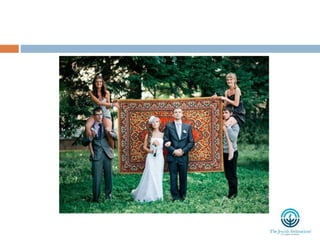
  • #4 This is where I got married! More later…
  • #7 iRep is a consortium of 16 federations: it’s a coalition of the willing - federations join iRep and provide support for our work, above and beyond their other support to Israel and Overseas.
  • #8 In addition there are two private foundation supporting us. The number of supporting federations is continuously growing.
  • #9 There is a whole host of issues that relate to religious pluralism that are within iRep’s mandate: Conversion, immersion in public Mikveh, the nature of the Shabat, Western Wall, recognition of Reform and Conservative Rabbis, The issue that was chosen for the first phase of iRep’s work is Freedom of choice in Marriage
  • #10 1st issue iRep has taken on is Expanding the range of legally-recognized options for marriage Israel . This obviously would impact the divorce laws as well. Israel operates the Millet system we inherited from the Ottoman Empire: each religious group performs the marriage and divorce of its people. This autonomy was a very progressive idea back in the 16th century, but today it creates many injustices and violates basic human liberties.
  • #11 Positive issue – not against the Rabinate Relevant to all of us – everyone has a part in the Jewish project of Jewish peoplehood and the Nation-State of the Jewish people. If many young American Jews can’t get married in Israel, it affects their connection to the state of Israel. In the longer term, the fact that your Reform or conservative Rabbi cannot perform the marriage of your son or daughter in Israel, makes the ties to Israel weaker.
  • #12 360,000 FSU immigrants and their children who are registered as “no religion” or can’t prove their Jewishness to the Rabbinate’s standards 284,000 gays and lesbians, 13,000 non-Orthodox converts to Judaism, 5,000 Israelis who are classified as "forbidden to marry” Other Halachic restrictions: Cohen and a divorced woman, on the Rabbinate black list (suspected of being Mamzer) The lack of marriage freedom has grave impacts: infringement of the right to freedom of religion and expression, adversely affecting the Jewish nature of the state: increasing numbers of Israelis feel the religious coercion drives them away from Judaism.
  • #13 Israelis show consistent support for instituting alternative marriage options besides the Rabbinate: Polls for 2016 show that 66% of Israeli Jews support official recognition of all forms of marriage, including Reform, Conservative, and civil. (This compared with 64% support last year. ) Support of Civil Marriage is higher at 75-78% support recognition of civil marriage in Israel, 25% of the National Religious public support civil marriage too. About my marriage – this is a picture of the town Hall of Arradipou where me and my husband got married in a civil marriage, just because we are both secular Jews and we didn’t did not want the Rabbinate to be a part of our wedding.
  • #14 What we see is Large scale support for Marriage Freedom, but the public doesn’t demand a solution. It is not an issue that is alive in the public arena yet. Politicians don’t have an incentive to promote a change to the marriage laws since it doesn’t pay off, the issue is not considered attractive to take on.
  • #15 Our Goal: close the Gap between passive support in civil marriage and active support in order to turn the issue into a core issue of Israeli public debate
  • #16 The big question is - How do we it? How do we get people moving from passive support of marriage alternatives to actively supporting it, and pushing the political system to solve the problem?
  • #17 Our understanding is that in the current political atmosphere there is no chance of the political system making changes in the marriage arena. Our strategy is to create a massive grass roots movement to support change in the marriage laws. Get the public engaged and personally involved in marriage alternatives.
  • #18 People need to envision the possibility of an aternative situation where every one can choose a different form of marriage and it will be recognized by the state. Our goal is to create massive movement of people who chose to get married outside the Rabbinate. This will create the public demand for a change, and will demonstrate to the leaders that they need to provide a legal solution to the situation.
  • #19 iRep partners with Israeli non-profit organizations who promote these issues and supports their work. One of our objectives is to empower Israeli civil society to be more effective in its work towards religious pluralism. Now I will move to describe the work done by our 5 grantees over the past year.
  • #20 Working together, Yisrael Hofsheet, the Israel Movement for Progressive Judaism and the Masorti Movement (the Trio) launched in July 2016 a public awareness campaign aimed at informing and strengthening public opinion on alternative marriage options. The campaign targeted the “parents’ generation” (55 and older) and emphasized the benefits, from their point of view, of a Jewish marriage ceremony not sanctioned by the Rabbinate.  This is a vey importatn and central demographic group that we are targeting – mainstream secular or traditional families. The campaign managed to raise the issue of alternative marriages and had a good reach for its relatively short duration.
  • #21 Hiddush is conducting monthly polls monitoring public opinion on various key aspects of the challenge of marriage freedom in Israel and provides analysis of the polling data. This achieves two important things: they get regular coverage of the issue in mainstream media, and the data is used as a tool to measure impact and inform future grant-making.
  • #22 Neemanei Tora VaAvoda is doing awareness-raising project amongst members of the Religious Zionist community about the problems and obstacles faced by many Israeli citizens under current marriage law and on halachic alternatives to the current policy guidelines set by the Chief Rabbinate. Add pic from NTA event
  • #24 This is what I am being asked often: what are the chances of seeing progress on the marriage issue? Well, we already start to see a shift in public opinion on this issue.
  • #25 Recently Hiddush did a survey as part of their 2016 Religion and State index and found shift in a very interesting indicator: among Israeli Jews, 47% would choose an alternative marriage ceremony if it were legalized. That’s 10% more than last year, when only 37% said they would choose an alternative marriage ceremony. This rise is not gradual – the increase over this one year can be best explained by the work of our partners. The issue already started to be discussed on social media, mainstream media, and the public is influenced by this and changes personal preferences. This is significant because up until now the issue of marriage freedom was considered a “theoretical” one – not something that israelis want for themselves. Now its becoming a personal issue for a large portion of Israeli society. More significant changes – increase in the support of “national religious” sector in civil marriage. 25% support means that the idea is supported not only by
  • #26  More significant changes – increase in the support of “national religious” sector in civil marriage (compared with 21% or 23% last year). 25% support means that the idea is supported not only by the so called “liberal modern orthodox”
  • #27 When we surveyed to public right after the campaign we did not see immediate results: those who supported instituting alternatives to marriage through the rabbinate supported it afterwards as well. Those who objected – still objected. But recently Hiddush did a survey as part of their 2016 Religion and State index and found shift in a very interesting indicator: among Israeli Jews, 47% woul choose an alternative marriage ceremony if it were legalized. That’s 10% more than last year, when only 37% said they would choose an alternative marriage ceremony. In addition. We see a rise in the level of support for civil marriage among the National Religious sector: this August 25% of them would support civil marriage (compared with 21% or 23% last year).
  • #28 This is a trend. Things have started to move forward and it is very important that this awakening in public opinion is cultivated so it continues to grow. It is very important that iRep has all the tools and capacity it needs to support budding initiatives to encourage marriage out-side the Rabbinate and to effectively support the effort to build public momentum to support a change in the marriage situation. Next steps: aim to raise 900K this year. Will allow us to expand the media campaign Target audiences: mainstream secular/traditional Orthodox public – with aim to encourage them also to choose alternative marriage options [like orthodox feminism, this is a powerful movement that can create significant change in how the orthodox sector behaves]
  • #29 In our strategy for the upcoming year we are going to diversify the way we approach each relevant sector in Israeli society. Israeli society is not one cloth – it’s made up of different groups with different preferences, and we aim to connect with partner organizations that are relevant to each key population group that is relevant to the marriage issue: Immigrants from former Soviet Union, Mainstream secular/traditional population, National religious, LGBT. Different messages, perhaps different language. This is a trend. Things have started to move forward and it is very important that this awakening in public opinion is cultivated so it continues to grow. It is very important that iRep has all the tools and capacity it needs to support budding initiatives to encourage marriage out-side the Rabbinate and to effectively support the effort to build public momentum to support a change in the marriage situation. Next steps: to expand the media campaign Target audiences: mainstream secular/traditional Orthodox public – with aim to encourage them also to choose alternative marriage options [like orthodox feminism, this is a powerful movement that can create significant change in how the orthodox sector behaves]
  • #30 Religious population : encourage more discussion of civil marriage by Rabbis Encourage new initiatives to provide Halachic private wedding ceremonies.
  • #31 Immigrants from Former Soviet Union – different subgroups that need to be addressed differently: Dor 1.5 young Russian and Hebrew speakers Non Hebrew older generation – tend to not be involved with politics..
  • #32 LGBT – hear their voice on the issues as well Another voice that will demand a solution. We plan to start to look at the Arab sector as well – first to collect data on where they stand on marriage freedom, then strategize how to engage them.
  • #34 Expanding marriage freedom in Israel is like a stone thrown in water: it will impact not only the freedoms of Israelis, On the wider circle – it will promote the legitimacy of diverse expressions of Judaism, And on an even wider circle – it will create real partnership between Israelis and North American Jews and help bridge the growing gap between these two biggest Jewish communities of our time.