IPSec Basics – Level-1
Avadhesh Agrawal (avagrawal@gmail.com)

V1.0/Dec-2013

1
What is IPSec?
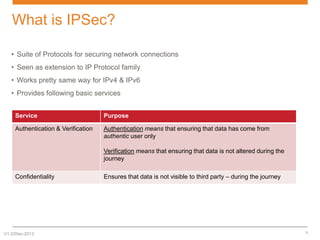
• Suite of Protocols for securing network connections
• Seen as extension to IP Protocol family
• Works pretty same way for IPv4 & IPv6
• Provides following basic services
Service

Purpose

Authentication & Verification

Authentication means that ensuring that data has come from
authentic user only
Verification means that ensuring that data is not altered during the
journey

Confidentiality

V1.0/Dec-2013

Ensures that data is not visible to third party – during the journey

2
IPSec Terminology (1/2)
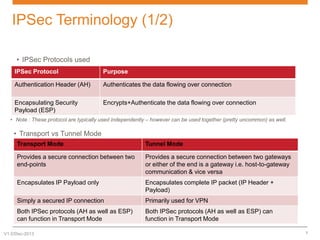
• IPSec Protocols used
IPSec Protocol

Purpose

Authentication Header (AH)

Authenticates the data flowing over connection

Encapsulating Security
Payload (ESP)

Encrypts+Authenticate the data flowing over connection

• Note : These protocol are typically used independently – however can be used together (pretty uncommon) as well.

• Transport vs Tunnel Mode
Transport Mode

Tunnel Mode

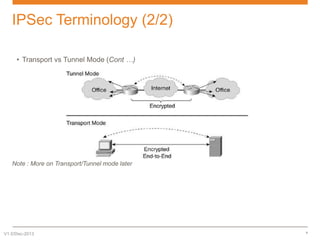
Provides a secure connection between two
end-points

Provides a secure connection between two gateways
or either of the end is a gateway i.e. host-to-gateway
communication & vice versa

Encapsulates IP Payload only

Encapsulates complete IP packet (IP Header +
Payload)

Simply a secured IP connection

Primarily used for VPN

Both IPSec protocols (AH as well as ESP)
can function in Transport Mode

Both IPSec protocols (AH as well as ESP) can
function in Transport Mode

V1.0/Dec-2013

3
IPSec Terminology (2/2)
• Transport vs Tunnel Mode (Cont …)

Note : More on Transport/Tunnel mode later

V1.0/Dec-2013

4
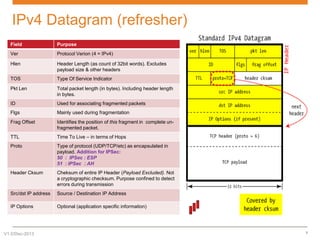
IPv4 Datagram (refresher)
Field

Purpose

Ver

Protocol Verion (4 = IPv4)

Hlen

Header Length (as count of 32bit words). Excludes
payload size & other headers

TOS

Type Of Service Indicator

Pkt Len

Total packet length (in bytes). Including header length
in bytes.

ID

Used for associating fragmented packets

Flgs

Mainly used during fragmentation

Frag Offset

Identifies the position of this fragment in complete unfragmented packet.

TTL

Time To Live – in terms of Hops

Proto

Type of protocol (UDP/TCP/etc) as encapsulated in
payload. Addition for IPSec:
50 : IPSec : ESP
51 : IPSec : AH

Header Cksum

Cheksum of entire IP Header (Payload Excluded). Not
a cryptographic checksum. Purpose confined to detect
errors during transmission

Src/dst IP address

Source / Destination IP Address

IP Options

Optional (application specific information)

V1.0/Dec-2013

5
AH – Overview(1/N)
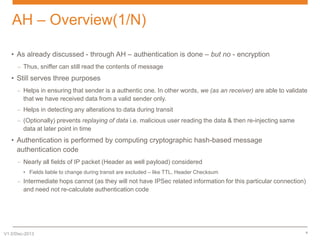
• As already discussed - through AH – authentication is done – but no - encryption
– Thus, sniffer can still read the contents of message

• Still serves three purposes
– Helps in ensuring that sender is a authentic one. In other words, we (as an receiver) are able to validate
that we have received data from a valid sender only.
– Helps in detecting any alterations to data during transit
– (Optionally) prevents replaying of data i.e. malicious user reading the data & then re-injecting same
data at later point in time

• Authentication is performed by computing cryptographic hash-based message
authentication code
– Nearly all fields of IP packet (Header as well payload) considered
• Fields liable to change during transit are excluded – like TTL, Header Checksum

– Intermediate hops cannot (as they will not have IPSec related information for this particular connection)
and need not re-calculate authentication code

V1.0/Dec-2013

6
AH – Header(2/N)

Field

Length
(Bytes)

Purpose

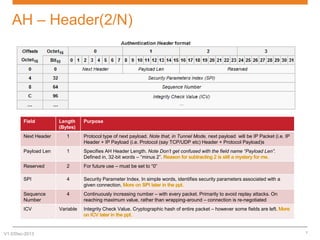
Next Header

1

Protocol type of next payload. Note that, in Tunnel Mode, next payload will be IP Packet (i.e. IP
Header + IP Payload (i.e. Protocol (say TCP/UDP etc) Header + Protocol Payload)s

Payload Len

1

Specifies AH Header Length. Note Don’t get confused with the field name “Payload Len”.
Defined in, 32-bit words – “minus 2”.

Reserved

2

For future use – must be set to “0”

SPI

4

Security Parameter Index. In simple words, identifies security parameters associated with a
given connection.

Sequence
Number

4

Continuously increasing number – with every packet. Primarily to avoid replay attacks. On
reaching maximum value, rather than wrapping-around – connection is re-negotiated

Variable

Integrity Check Value. Cryptographic hash of entire packet – however some fields are left.

ICV

V1.0/Dec-2013

7
AH – Transport Mode(3/N)

V1.0/Dec-2013

8
AH – Transport Mode(4/N)
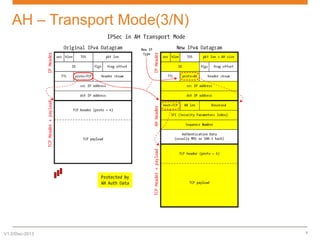
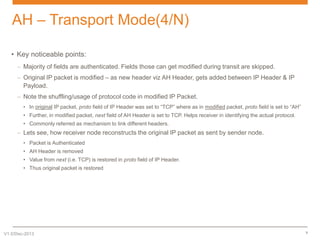
• Key noticeable points:
– Majority of fields are authenticated. Fields those can get modified during transit are skipped.
– Original IP packet is modified – as new header viz AH Header, gets added between IP Header & IP
Payload.
– Note the shuffling/usage of protocol code in modified IP Packet.
• In original IP packet, proto field of IP Header was set to “TCP” where as in modified packet, proto field is set to “AH”
• Further, in modified packet, next field of AH Header is set to TCP. Helps receiver in identifying the actual protocol.
• Commonly referred as mechanism to link different headers.

– Lets see, how receiver node reconstructs the original IP packet as sent by sender node.
• Packet is Authenticated
• AH Header is removed
• Value from next (i.e. TCP) is restored in proto field of IP Header.

• Thus original packet is restored

V1.0/Dec-2013

9
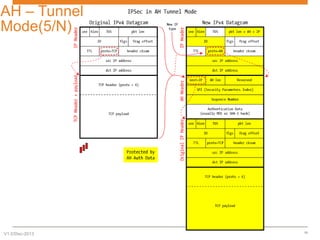
AH – Tunnel
Mode(5/N)

V1.0/Dec-2013

10
AH – Tunnel Mode(6/N)
• Key noticeable points:
– Entire IP packet (IP Header + IP Payload) is encapsulated within another IP packet.
– Thus, modified packet looks like as follows:
• New IP Header (say H1) followed by
• AH header followed by
• Original entire IP packet. Note that, original IP packet remains un-modified in Tunnel Model.

– Note the shuffling/usage of protocol code
• In new IP Header, proto field of IP Header is set to “AH” – indicating that – this packet is of IPSec:AH type
• Further, next field of AH Header is set to IP. This is required because entire original IP packet is encapsulated.

– Lets see, how receiver node reconstructs the original IP packet as sent by sender node.
• Packet is Authenticated
• New IP header & AH Header is removed

• That’s it.

– Suited for VPN kind of environment where tunnel needs to be simply created

V1.0/Dec-2013

11
AH – Transport vs Tunnel Mode(7/N)
• How to distinguish between Transport Mode and Tunnel mode?
– Mode information not added explicitly
– Answer lies in the value stored in next field of AH header
• If next = IP then Tunnel Mode
• If next = <proto i.e. UDP/TCP/etc> then Transport Mode

• Authentication Algorithms
– SHA-1
– MD5

V1.0/Dec-2013

12
ESP– Overview(1/N)
• More complex that AH
• Allows Authentication as well as Encryption
– Authentication – Optional

• Header format is different than AH – discussed later
– Even has a trailer as well

• Provides Tunnel as Transport Mode – as in AH
• ESP Encryption algorithms commonly used
– DES, DES3, AES, Blowfish
– Algorithm & key used during encryption, is already negotiated during connection establishment phase
(a new world in itself – discussed separately)

• ESP Authentication algorithms commonly used
– Same as used in AH i.e. SHA-1, MD5

V1.0/Dec-2013

13
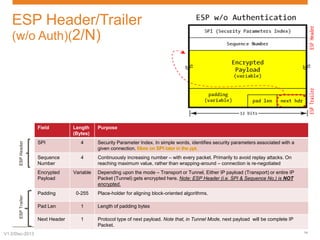
ESP Header/Trailer
(w/o Auth)(2/N)

Field

Length
(Bytes)

Purpose

ESP Header
ESP Trailer

4

Security Parameter Index. In simple words, identifies security parameters associated with a
given connection.

Sequence
Number

4

Continuously increasing number – with every packet. Primarily to avoid replay attacks. On
reaching maximum value, rather than wrapping-around – connection is re-negotiated

Encrypted
Payload

V1.0/Dec-2013

SPI

Variable

Depending upon the mode – Transport or Tunnel, Either IP payload (Transport) or entire IP
Packet (Tunnel) gets encrypted here. Note: ESP Header (i.e. SPI & Sequence No.) is NOT
encrypted.

Padding

0-255

Place-holder for aligning block-oriented algorithms.

Pad Len

1

Length of padding bytes

Next Header

1

Protocol type of next payload. Note that, in Tunnel Mode, next payload will be complete IP
Packet.
14
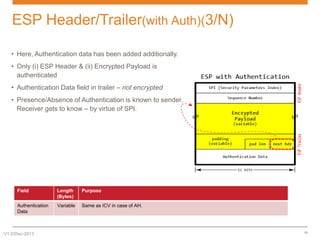
ESP Header/Trailer(with Auth)(3/N)
• Here, Authentication data has been added additionally.
• Only (i) ESP Header & (ii) Encrypted Payload is
authenticated
• Authentication Data field in trailer – not encrypted
• Presence/Absence of Authentication is known to sender.
Receiver gets to know – by virtue of SPI.

Field

Length
(Bytes)

Purpose

Authentication
Data

Variable

Same as ICV in case of AH.

V1.0/Dec-2013

15
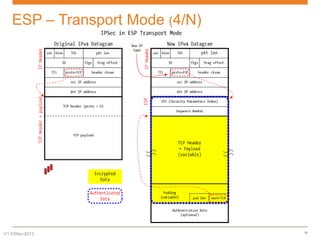
ESP – Transport Mode (4/N)

V1.0/Dec-2013

16
ESP– Transport Mode(5/N)
• Key noticeable points:
– Original IP packet is modified – as new header viz ESP Header, gets added between IP Header & IP
Payload.
– Additionally ESP Trailer (consisting of padding, pad_len, next) gets added
– Optionally, Authentication data may also be added at the end of packet
– IP payload (i.e. TCP Header + TCP payload from previous figure) along with ESP trailer is encrypted
• ESP Header and Authentication Data (if present) – are excluded from encryption

– In case if Authentication is needed then
• ESP Header + encrypted payload + ESP Trailer - authenticated. ICV stored as Authentication Data at the end of
packet
• IP Header - excluded

– Note the shuffling/usage of protocol code in modified IP Packet.
• In original IP packet, proto field of IP Header was set to “TCP” where as in modified packet, proto field is set to “ESP”
• Further, in modified packet, next field of ESP Trailer is set to TCP. Helps receiver in identifying the actual protocol.
• Note that, actual protocol type is encrypted – hence hidden from packet sniffers

V1.0/Dec-2013

17
ESP – Tunnel Mode (6/N)

V1.0/Dec-2013

18
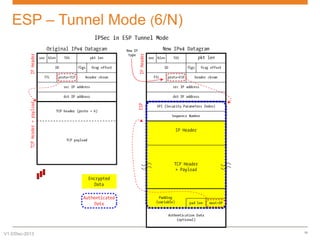
ESP– Tunnel Mode(7/N)
• Key noticeable points:
– Entire IP packet (IP Header + IP Payload) is encapsulated within another IP packet.
– Thus, modified packet looks like as follows:
• New IP Header (say H1) followed by
• ESP header followed by
• Original entire IP packet. Note that, original IP packet remains un-modified in Tunnel Model.

• Then ESP Trailer followed by
• Optional Authentication Data

– Key difference from ESP – Transport Mode is
• Original IP Header (along with IP payload) gets encrypted as well.

– Note the shuffling/usage of protocol code
• In new IP Header, proto field of IP Header is set to “ESP” – indicating that – this packet is of IPSec:ESP type
• Further, next field of ESP Trailer is set to IP. This is required because entire original IP packet is encapsulated.

V1.0/Dec-2013

19
More To Come …
• Security Association
• SPI
• Key Management - IKE

V1.0/Dec-2013

20
Resources
• Pretty good tutorial for beginners
– An illustrated guide to IPSec @ unixwiz.net

V1.0/Dec-2013

21

IP Sec - Basic Concepts

  • 1.
    IPSec Basics –Level-1 Avadhesh Agrawal (avagrawal@gmail.com) V1.0/Dec-2013 1
  • 2.
    What is IPSec? •Suite of Protocols for securing network connections • Seen as extension to IP Protocol family • Works pretty same way for IPv4 & IPv6 • Provides following basic services Service Purpose Authentication & Verification Authentication means that ensuring that data has come from authentic user only Verification means that ensuring that data is not altered during the journey Confidentiality V1.0/Dec-2013 Ensures that data is not visible to third party – during the journey 2
  • 3.
    IPSec Terminology (1/2) •IPSec Protocols used IPSec Protocol Purpose Authentication Header (AH) Authenticates the data flowing over connection Encapsulating Security Payload (ESP) Encrypts+Authenticate the data flowing over connection • Note : These protocol are typically used independently – however can be used together (pretty uncommon) as well. • Transport vs Tunnel Mode Transport Mode Tunnel Mode Provides a secure connection between two end-points Provides a secure connection between two gateways or either of the end is a gateway i.e. host-to-gateway communication & vice versa Encapsulates IP Payload only Encapsulates complete IP packet (IP Header + Payload) Simply a secured IP connection Primarily used for VPN Both IPSec protocols (AH as well as ESP) can function in Transport Mode Both IPSec protocols (AH as well as ESP) can function in Transport Mode V1.0/Dec-2013 3
  • 4.
    IPSec Terminology (2/2) •Transport vs Tunnel Mode (Cont …) Note : More on Transport/Tunnel mode later V1.0/Dec-2013 4
  • 5.
    IPv4 Datagram (refresher) Field Purpose Ver ProtocolVerion (4 = IPv4) Hlen Header Length (as count of 32bit words). Excludes payload size & other headers TOS Type Of Service Indicator Pkt Len Total packet length (in bytes). Including header length in bytes. ID Used for associating fragmented packets Flgs Mainly used during fragmentation Frag Offset Identifies the position of this fragment in complete unfragmented packet. TTL Time To Live – in terms of Hops Proto Type of protocol (UDP/TCP/etc) as encapsulated in payload. Addition for IPSec: 50 : IPSec : ESP 51 : IPSec : AH Header Cksum Cheksum of entire IP Header (Payload Excluded). Not a cryptographic checksum. Purpose confined to detect errors during transmission Src/dst IP address Source / Destination IP Address IP Options Optional (application specific information) V1.0/Dec-2013 5
  • 6.
    AH – Overview(1/N) •As already discussed - through AH – authentication is done – but no - encryption – Thus, sniffer can still read the contents of message • Still serves three purposes – Helps in ensuring that sender is a authentic one. In other words, we (as an receiver) are able to validate that we have received data from a valid sender only. – Helps in detecting any alterations to data during transit – (Optionally) prevents replaying of data i.e. malicious user reading the data & then re-injecting same data at later point in time • Authentication is performed by computing cryptographic hash-based message authentication code – Nearly all fields of IP packet (Header as well payload) considered • Fields liable to change during transit are excluded – like TTL, Header Checksum – Intermediate hops cannot (as they will not have IPSec related information for this particular connection) and need not re-calculate authentication code V1.0/Dec-2013 6
  • 7.
    AH – Header(2/N) Field Length (Bytes) Purpose NextHeader 1 Protocol type of next payload. Note that, in Tunnel Mode, next payload will be IP Packet (i.e. IP Header + IP Payload (i.e. Protocol (say TCP/UDP etc) Header + Protocol Payload)s Payload Len 1 Specifies AH Header Length. Note Don’t get confused with the field name “Payload Len”. Defined in, 32-bit words – “minus 2”. Reserved 2 For future use – must be set to “0” SPI 4 Security Parameter Index. In simple words, identifies security parameters associated with a given connection. Sequence Number 4 Continuously increasing number – with every packet. Primarily to avoid replay attacks. On reaching maximum value, rather than wrapping-around – connection is re-negotiated Variable Integrity Check Value. Cryptographic hash of entire packet – however some fields are left. ICV V1.0/Dec-2013 7
  • 8.
    AH – TransportMode(3/N) V1.0/Dec-2013 8
  • 9.
    AH – TransportMode(4/N) • Key noticeable points: – Majority of fields are authenticated. Fields those can get modified during transit are skipped. – Original IP packet is modified – as new header viz AH Header, gets added between IP Header & IP Payload. – Note the shuffling/usage of protocol code in modified IP Packet. • In original IP packet, proto field of IP Header was set to “TCP” where as in modified packet, proto field is set to “AH” • Further, in modified packet, next field of AH Header is set to TCP. Helps receiver in identifying the actual protocol. • Commonly referred as mechanism to link different headers. – Lets see, how receiver node reconstructs the original IP packet as sent by sender node. • Packet is Authenticated • AH Header is removed • Value from next (i.e. TCP) is restored in proto field of IP Header. • Thus original packet is restored V1.0/Dec-2013 9
  • 10.
  • 11.
    AH – TunnelMode(6/N) • Key noticeable points: – Entire IP packet (IP Header + IP Payload) is encapsulated within another IP packet. – Thus, modified packet looks like as follows: • New IP Header (say H1) followed by • AH header followed by • Original entire IP packet. Note that, original IP packet remains un-modified in Tunnel Model. – Note the shuffling/usage of protocol code • In new IP Header, proto field of IP Header is set to “AH” – indicating that – this packet is of IPSec:AH type • Further, next field of AH Header is set to IP. This is required because entire original IP packet is encapsulated. – Lets see, how receiver node reconstructs the original IP packet as sent by sender node. • Packet is Authenticated • New IP header & AH Header is removed • That’s it. – Suited for VPN kind of environment where tunnel needs to be simply created V1.0/Dec-2013 11
  • 12.
    AH – Transportvs Tunnel Mode(7/N) • How to distinguish between Transport Mode and Tunnel mode? – Mode information not added explicitly – Answer lies in the value stored in next field of AH header • If next = IP then Tunnel Mode • If next = <proto i.e. UDP/TCP/etc> then Transport Mode • Authentication Algorithms – SHA-1 – MD5 V1.0/Dec-2013 12
  • 13.
    ESP– Overview(1/N) • Morecomplex that AH • Allows Authentication as well as Encryption – Authentication – Optional • Header format is different than AH – discussed later – Even has a trailer as well • Provides Tunnel as Transport Mode – as in AH • ESP Encryption algorithms commonly used – DES, DES3, AES, Blowfish – Algorithm & key used during encryption, is already negotiated during connection establishment phase (a new world in itself – discussed separately) • ESP Authentication algorithms commonly used – Same as used in AH i.e. SHA-1, MD5 V1.0/Dec-2013 13
  • 14.
    ESP Header/Trailer (w/o Auth)(2/N) Field Length (Bytes) Purpose ESPHeader ESP Trailer 4 Security Parameter Index. In simple words, identifies security parameters associated with a given connection. Sequence Number 4 Continuously increasing number – with every packet. Primarily to avoid replay attacks. On reaching maximum value, rather than wrapping-around – connection is re-negotiated Encrypted Payload V1.0/Dec-2013 SPI Variable Depending upon the mode – Transport or Tunnel, Either IP payload (Transport) or entire IP Packet (Tunnel) gets encrypted here. Note: ESP Header (i.e. SPI & Sequence No.) is NOT encrypted. Padding 0-255 Place-holder for aligning block-oriented algorithms. Pad Len 1 Length of padding bytes Next Header 1 Protocol type of next payload. Note that, in Tunnel Mode, next payload will be complete IP Packet. 14
  • 15.
    ESP Header/Trailer(with Auth)(3/N) •Here, Authentication data has been added additionally. • Only (i) ESP Header & (ii) Encrypted Payload is authenticated • Authentication Data field in trailer – not encrypted • Presence/Absence of Authentication is known to sender. Receiver gets to know – by virtue of SPI. Field Length (Bytes) Purpose Authentication Data Variable Same as ICV in case of AH. V1.0/Dec-2013 15
  • 16.
    ESP – TransportMode (4/N) V1.0/Dec-2013 16
  • 17.
    ESP– Transport Mode(5/N) •Key noticeable points: – Original IP packet is modified – as new header viz ESP Header, gets added between IP Header & IP Payload. – Additionally ESP Trailer (consisting of padding, pad_len, next) gets added – Optionally, Authentication data may also be added at the end of packet – IP payload (i.e. TCP Header + TCP payload from previous figure) along with ESP trailer is encrypted • ESP Header and Authentication Data (if present) – are excluded from encryption – In case if Authentication is needed then • ESP Header + encrypted payload + ESP Trailer - authenticated. ICV stored as Authentication Data at the end of packet • IP Header - excluded – Note the shuffling/usage of protocol code in modified IP Packet. • In original IP packet, proto field of IP Header was set to “TCP” where as in modified packet, proto field is set to “ESP” • Further, in modified packet, next field of ESP Trailer is set to TCP. Helps receiver in identifying the actual protocol. • Note that, actual protocol type is encrypted – hence hidden from packet sniffers V1.0/Dec-2013 17
  • 18.
    ESP – TunnelMode (6/N) V1.0/Dec-2013 18
  • 19.
    ESP– Tunnel Mode(7/N) •Key noticeable points: – Entire IP packet (IP Header + IP Payload) is encapsulated within another IP packet. – Thus, modified packet looks like as follows: • New IP Header (say H1) followed by • ESP header followed by • Original entire IP packet. Note that, original IP packet remains un-modified in Tunnel Model. • Then ESP Trailer followed by • Optional Authentication Data – Key difference from ESP – Transport Mode is • Original IP Header (along with IP payload) gets encrypted as well. – Note the shuffling/usage of protocol code • In new IP Header, proto field of IP Header is set to “ESP” – indicating that – this packet is of IPSec:ESP type • Further, next field of ESP Trailer is set to IP. This is required because entire original IP packet is encapsulated. V1.0/Dec-2013 19
  • 20.
    More To Come… • Security Association • SPI • Key Management - IKE V1.0/Dec-2013 20
  • 21.
    Resources • Pretty goodtutorial for beginners – An illustrated guide to IPSec @ unixwiz.net V1.0/Dec-2013 21