
IoT Security
and Data
Privacy
Concerns
Overview of the key security and data privacy
concerns associated with the widespread adoption
of Internet of Things (IoT) devices.
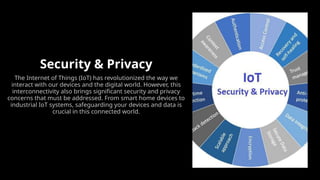
Security & Privacy
The Internet of Things (IoT) has revolutionized the way we
interact with our devices and the digital world. However, this
interconnectivity also brings significant security and privacy
concerns that must be addressed. From smart home devices to
industrial IoT systems, safeguarding your devices and data is
crucial in this connected world.
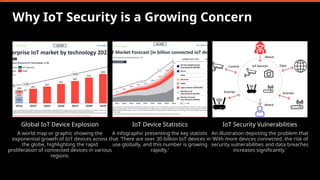
Why IoT Security is a Growing Concern
Global IoT Device Explosion
A world map or graphic showing the
exponential growth of IoT devices across
the globe, highlighting the rapid
proliferation of connected devices in various
regions.
IoT Device Statistics
A infographic presenting the key statistic
that 'There are over 30 billion IoT devices in
use globally, and this number is growing
rapidly.'
IoT Security Vulnerabilities
An illustration depicting the problem that
'With more devices connected, the risk of
security vulnerabilities and data breaches
increases significantly.'
Latest Threats to IoT Security
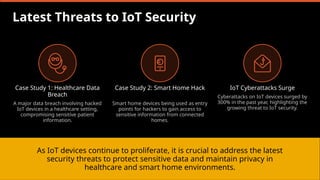
Case Study 1: Healthcare Data
Breach
A major data breach involving hacked
IoT devices in a healthcare setting,
compromising sensitive patient
information.
Case Study 2: Smart Home Hack
Smart home devices being used as entry
points for hackers to gain access to
sensitive information from connected
homes.
IoT Cyberattacks Surge
Cyberattacks on IoT devices surged by
300% in the past year, highlighting the
growing threat to IoT security.
As IoT devices continue to proliferate, it is crucial to address the latest
security threats to protect sensitive data and maintain privacy in
healthcare and smart home environments.
Common Vulnerabilities in IoT Devices
• Poor Password Protection
IoT devices often have default, weak, or easily
guessable passwords that can be exploited by
attackers to gain unauthorized access and
control the device.
• Lack of Encryption
Many IoT devices fail to implement proper
encryption, leaving the data transmitted
between the device and the server vulnerable to
eavesdropping and man-in-the-middle attacks.
• Software Vulnerabilities
IoT devices may contain unpatched software
vulnerabilities that can be exploited by attackers
to gain control of the device, steal data, or
perform other malicious activities.
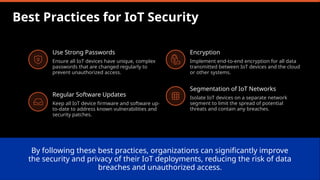
Best Practices for IoT Security
Use Strong Passwords
Ensure all IoT devices have unique, complex
passwords that are changed regularly to
prevent unauthorized access.
Regular Software Updates
Keep all IoT device firmware and software up-
to-date to address known vulnerabilities and
security patches.
Encryption
Implement end-to-end encryption for all data
transmitted between IoT devices and the cloud
or other systems.
Segmentation of IoT Networks
Isolate IoT devices on a separate network
segment to limit the spread of potential
threats and contain any breaches.
By following these best practices, organizations can significantly improve
the security and privacy of their IoT deployments, reducing the risk of data
breaches and unauthorized access.
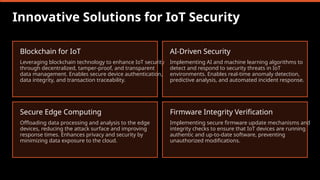
Innovative Solutions for IoT Security
Blockchain for IoT
Leveraging blockchain technology to enhance IoT security
through decentralized, tamper-proof, and transparent
data management. Enables secure device authentication,
data integrity, and transaction traceability.
AI-Driven Security
Implementing AI and machine learning algorithms to
detect and respond to security threats in IoT
environments. Enables real-time anomaly detection,
predictive analysis, and automated incident response.
Secure Edge Computing
Offloading data processing and analysis to the edge
devices, reducing the attack surface and improving
response times. Enhances privacy and security by
minimizing data exposure to the cloud.
Firmware Integrity Verification
Implementing secure firmware update mechanisms and
integrity checks to ensure that IoT devices are running
authentic and up-to-date software, preventing
unauthorized modifications.
How Blockchain Enhances
IoT Security
Blockchain technology can significantly enhance the
security of IoT (Internet of Things) systems. By leveraging
the distributed, decentralized, and tamper-resistant
nature of blockchain, IoT devices can benefit from
improved data integrity, secure communication, and
robust access control. Blockchain-based IoT solutions can
provide a secure platform for data sharing, device
authentication, and tamper-proof record-keeping,
addressing the key security challenges faced by traditional
IoT architectures.
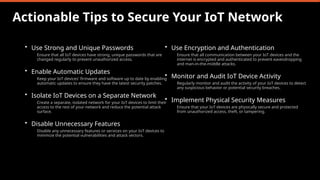
Actionable Tips to Secure Your IoT Network
• Use Strong and Unique Passwords
Ensure that all IoT devices have strong, unique passwords that are
changed regularly to prevent unauthorized access.
• Enable Automatic Updates
Keep your IoT devices' firmware and software up to date by enabling
automatic updates to ensure they have the latest security patches.
• Isolate IoT Devices on a Separate Network
Create a separate, isolated network for your IoT devices to limit their
access to the rest of your network and reduce the potential attack
surface.
• Disable Unnecessary Features
Disable any unnecessary features or services on your IoT devices to
minimize the potential vulnerabilities and attack vectors.
• Use Encryption and Authentication
Ensure that all communication between your IoT devices and the
internet is encrypted and authenticated to prevent eavesdropping
and man-in-the-middle attacks.
• Monitor and Audit IoT Device Activity
Regularly monitor and audit the activity of your IoT devices to detect
any suspicious behavior or potential security breaches.
• Implement Physical Security Measures
Ensure that your IoT devices are physically secure and protected
from unauthorized access, theft, or tampering.
Conclusion
The increasing prevalence of IoT devices has brought forth significant
security and data privacy concerns that must be addressed. As IoT
technology continues to permeate our daily lives, safeguarding sensitive
information and protecting against malicious attacks has become a critical
imperative for both individuals and organizations.

IoT Security and Data Privacy Concerns.pptx

  • 1.
    IoT Security and Data Privacy Concerns Overviewof the key security and data privacy concerns associated with the widespread adoption of Internet of Things (IoT) devices.
  • 2.
    Security & Privacy TheInternet of Things (IoT) has revolutionized the way we interact with our devices and the digital world. However, this interconnectivity also brings significant security and privacy concerns that must be addressed. From smart home devices to industrial IoT systems, safeguarding your devices and data is crucial in this connected world.
  • 3.
    Why IoT Securityis a Growing Concern Global IoT Device Explosion A world map or graphic showing the exponential growth of IoT devices across the globe, highlighting the rapid proliferation of connected devices in various regions. IoT Device Statistics A infographic presenting the key statistic that 'There are over 30 billion IoT devices in use globally, and this number is growing rapidly.' IoT Security Vulnerabilities An illustration depicting the problem that 'With more devices connected, the risk of security vulnerabilities and data breaches increases significantly.'
  • 4.
    Latest Threats toIoT Security Case Study 1: Healthcare Data Breach A major data breach involving hacked IoT devices in a healthcare setting, compromising sensitive patient information. Case Study 2: Smart Home Hack Smart home devices being used as entry points for hackers to gain access to sensitive information from connected homes. IoT Cyberattacks Surge Cyberattacks on IoT devices surged by 300% in the past year, highlighting the growing threat to IoT security. As IoT devices continue to proliferate, it is crucial to address the latest security threats to protect sensitive data and maintain privacy in healthcare and smart home environments.
  • 5.
    Common Vulnerabilities inIoT Devices • Poor Password Protection IoT devices often have default, weak, or easily guessable passwords that can be exploited by attackers to gain unauthorized access and control the device. • Lack of Encryption Many IoT devices fail to implement proper encryption, leaving the data transmitted between the device and the server vulnerable to eavesdropping and man-in-the-middle attacks. • Software Vulnerabilities IoT devices may contain unpatched software vulnerabilities that can be exploited by attackers to gain control of the device, steal data, or perform other malicious activities.
  • 6.
    Best Practices forIoT Security Use Strong Passwords Ensure all IoT devices have unique, complex passwords that are changed regularly to prevent unauthorized access. Regular Software Updates Keep all IoT device firmware and software up- to-date to address known vulnerabilities and security patches. Encryption Implement end-to-end encryption for all data transmitted between IoT devices and the cloud or other systems. Segmentation of IoT Networks Isolate IoT devices on a separate network segment to limit the spread of potential threats and contain any breaches. By following these best practices, organizations can significantly improve the security and privacy of their IoT deployments, reducing the risk of data breaches and unauthorized access.
  • 7.
    Innovative Solutions forIoT Security Blockchain for IoT Leveraging blockchain technology to enhance IoT security through decentralized, tamper-proof, and transparent data management. Enables secure device authentication, data integrity, and transaction traceability. AI-Driven Security Implementing AI and machine learning algorithms to detect and respond to security threats in IoT environments. Enables real-time anomaly detection, predictive analysis, and automated incident response. Secure Edge Computing Offloading data processing and analysis to the edge devices, reducing the attack surface and improving response times. Enhances privacy and security by minimizing data exposure to the cloud. Firmware Integrity Verification Implementing secure firmware update mechanisms and integrity checks to ensure that IoT devices are running authentic and up-to-date software, preventing unauthorized modifications.
  • 8.
    How Blockchain Enhances IoTSecurity Blockchain technology can significantly enhance the security of IoT (Internet of Things) systems. By leveraging the distributed, decentralized, and tamper-resistant nature of blockchain, IoT devices can benefit from improved data integrity, secure communication, and robust access control. Blockchain-based IoT solutions can provide a secure platform for data sharing, device authentication, and tamper-proof record-keeping, addressing the key security challenges faced by traditional IoT architectures.
  • 9.
    Actionable Tips toSecure Your IoT Network • Use Strong and Unique Passwords Ensure that all IoT devices have strong, unique passwords that are changed regularly to prevent unauthorized access. • Enable Automatic Updates Keep your IoT devices' firmware and software up to date by enabling automatic updates to ensure they have the latest security patches. • Isolate IoT Devices on a Separate Network Create a separate, isolated network for your IoT devices to limit their access to the rest of your network and reduce the potential attack surface. • Disable Unnecessary Features Disable any unnecessary features or services on your IoT devices to minimize the potential vulnerabilities and attack vectors. • Use Encryption and Authentication Ensure that all communication between your IoT devices and the internet is encrypted and authenticated to prevent eavesdropping and man-in-the-middle attacks. • Monitor and Audit IoT Device Activity Regularly monitor and audit the activity of your IoT devices to detect any suspicious behavior or potential security breaches. • Implement Physical Security Measures Ensure that your IoT devices are physically secure and protected from unauthorized access, theft, or tampering.
  • 10.
    Conclusion The increasing prevalenceof IoT devices has brought forth significant security and data privacy concerns that must be addressed. As IoT technology continues to permeate our daily lives, safeguarding sensitive information and protecting against malicious attacks has become a critical imperative for both individuals and organizations.