 Octet rule - _____8 electrons in the outer shell.
 atoms tend to gain, lose or share electrons to
try and have eight electrons in their outer shell.
 Noble gases are non-reactive because they
have 8 valence electrons.
IONIC
BONDING
•Its all about “I”
•Bonding by gaining or losing electrons to
achieve a full outer shell
Electrons in the outer most
shell
We use these to help with bonding
 Ion – charged atom (atom that has gained/lost
electron and has a positive or negative charge)
 Cation – ion with positive charge
 Anion – ion with negative charge
 An ion is a atom that has gained or lost
one or more electrons and has a positive or
negative charge.
 Atoms gain or lose electrons in order to
achieve the octet rule (8 valence electrons)
 NOTE – when you see a (+), the atom is
LOSING an electron.
 NOTE – when you see a (-), the atom is
GAINING an electron
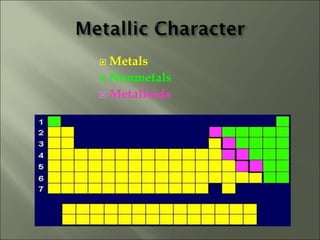
 Metals
 Nonmetals
 Metalloids
 Nearly all metals form cations.
 Mg has 2 valence electrons. It is much easier to
lose two electrons than gain six electrons.
 Mg 2+ …..cation
 Nearly all nonmetal elements form anions.
 Oxygen has 6 valence electrons
 It is much easier for Oxygen to gain two
electrons than to lose six.
 O 2- ……..anion
 Naming a Cation (positive ions, atoms
that lose electrons)
 Simply the name of the element
 Example: Na+ - sodium ion
Mg 2+ - Magnesium ion
 Naming an Anion – (negative ions,
atoms that gains electrons)
 The element name ends in –ide.
 Example: Cl- - chloride ion
O2- - oxide ion
 The force of attraction between a positive
charge and negative charge creates the ionic
bond.
 Ex: Wants to be neutral…Sodium ion (Na+)
has a +1 charge and Chloride ion (Cl-) has a -1
charge.
 Sodium Chloride…table salt
https://youtu.be/zp
aHPXVR8WU
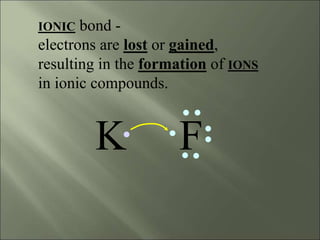
IONIC bond -
electrons are lost or gained,
resulting in the formation of IONS
in ionic compounds.
F
K
F
K
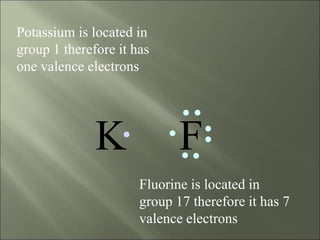
Potassium is located in
group 1 therefore it has
one valence electrons
Fluorine is located in
group 17 therefore it has 7
valence electrons
F
K
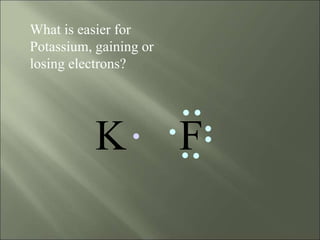
What is easier for
Potassium, gaining or
losing electrons?
F
K
F
K
F
K
F
K
F
K
+
_
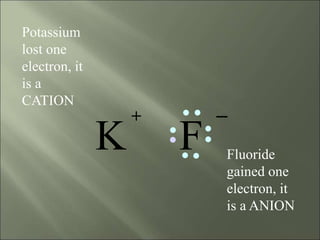
Potassium
lost one
electron, it
is a
CATION
Fluoride
gained one
electron, it
is a ANION
F
K
+
_
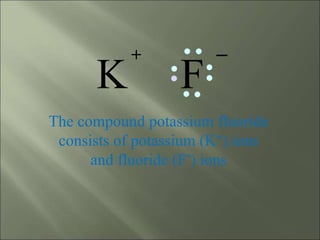
The compound potassium fluoride
consists of potassium (K+) ions
and fluoride (F-) ions
F
K
+
_
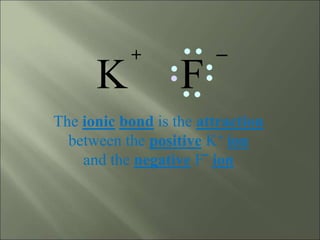
The ionic bond is the attraction
between the positive K+ ion
and the negative F- ion
COMPLETE THE WORKSHEET

Ionic bonding

  • 2.
     Octet rule- _____8 electrons in the outer shell.  atoms tend to gain, lose or share electrons to try and have eight electrons in their outer shell.  Noble gases are non-reactive because they have 8 valence electrons.
  • 3.
  • 4.
    •Its all about“I” •Bonding by gaining or losing electrons to achieve a full outer shell
  • 5.
    Electrons in theouter most shell We use these to help with bonding
  • 6.
     Ion –charged atom (atom that has gained/lost electron and has a positive or negative charge)  Cation – ion with positive charge  Anion – ion with negative charge
  • 7.
     An ionis a atom that has gained or lost one or more electrons and has a positive or negative charge.  Atoms gain or lose electrons in order to achieve the octet rule (8 valence electrons)
  • 8.
     NOTE –when you see a (+), the atom is LOSING an electron.  NOTE – when you see a (-), the atom is GAINING an electron
  • 9.
  • 10.
     Nearly allmetals form cations.  Mg has 2 valence electrons. It is much easier to lose two electrons than gain six electrons.  Mg 2+ …..cation
  • 11.
     Nearly allnonmetal elements form anions.  Oxygen has 6 valence electrons  It is much easier for Oxygen to gain two electrons than to lose six.  O 2- ……..anion
  • 12.
     Naming aCation (positive ions, atoms that lose electrons)  Simply the name of the element  Example: Na+ - sodium ion Mg 2+ - Magnesium ion
  • 13.
     Naming anAnion – (negative ions, atoms that gains electrons)  The element name ends in –ide.  Example: Cl- - chloride ion O2- - oxide ion
  • 14.
     The forceof attraction between a positive charge and negative charge creates the ionic bond.  Ex: Wants to be neutral…Sodium ion (Na+) has a +1 charge and Chloride ion (Cl-) has a -1 charge.  Sodium Chloride…table salt
  • 15.
  • 16.
    IONIC bond - electronsare lost or gained, resulting in the formation of IONS in ionic compounds. F K
  • 17.
    F K Potassium is locatedin group 1 therefore it has one valence electrons Fluorine is located in group 17 therefore it has 7 valence electrons
  • 18.
    F K What is easierfor Potassium, gaining or losing electrons?
  • 19.
  • 20.
  • 21.
  • 22.
  • 23.
    F K + _ Potassium lost one electron, it isa CATION Fluoride gained one electron, it is a ANION
  • 24.
    F K + _ The compound potassiumfluoride consists of potassium (K+) ions and fluoride (F-) ions
  • 25.
    F K + _ The ionic bondis the attraction between the positive K+ ion and the negative F- ion
  • 26.