B I N A R A M A M U R T H Y
4/15/2023
Copyright 2010 B. Ramamurthy
1
Distributed Systems
Introduction
4/15/2023
Copyright 2010 B. Ramamurthy
2
 A distributed system is a network of
autonomous computers cooperating to
accomplish a task.
 Hardware and software components of a
distributed system coordinate their activity by
sharing resources such as data, computation,
compute cycles, bandwidth and storage.
 Examples: Internet, intranet, grid and mobile
computing systems.
Topics
4/15/2023
Copyright 2010 B. Ramamurthy
3
 Some fundamental terms
 Advances in
 Client-side technologies
 Communication network
 Middleware concept
 Server-side technology
 Application models (web, web2.0, web3.0)
Copyright 2010 B. Ramamurthy 4/15/2023
4
Terminologies
Protocol
4/15/2023
Copyright 2010 B. Ramamurthy
5
 Protocol is a set of rules that end points in a
telecommunication system use when
exchanging information.
 IP: Internet protocol defines an unreliable packet
transfer protocol.
 TCP: Transmission Control Protocol builds on IP to
define a reliable data delivery protocol.
 LDAP: Lightweight Directory Access Protocol builds
on TCP to define a query-response protocol for
querying the state of a remote database.
 HTTP: Hyper Text Transfer Protocol builds on TCP
to facilitate hyper-text document exchange.
Service
4/15/2023
Copyright 2010 B. Ramamurthy
6
 Service is a network-enabled entity that provides a
specific capability.
 Service = Protocol + Behavior
 A service definition permits many
implementations.
 Examples: ability to move files, create processes,
verify access rights
 An FTP server speaks File Transfer Protocol and
supports remote read and write access to a
collection of files.
API
4/15/2023
Copyright 2010 B. Ramamurthy
7
 Application Program Interface (API) defines a
standard interface for invoking a specified set of
functionality.
 Examples: The Generic Security Service (GSS) API
defines standard functions for verifying identity of
communicating parties, encrypting messages and so
forth.
SDK
4/15/2023
Copyright 2010 B. Ramamurthy
8
 Software Development Kit (SDK) denotes a
set of code designed to be linked with, and invoked
from within, an application program to provide
specified functionality.
 An SDK typically implements an API.
 Example: Different SDKs implement GSS-API
using the Kerberos or PKI protocols, respectively.
Internet
4/15/2023
Copyright 2010 B. Ramamurthy
9
 Internet is a very large distributed system.
 Interconnection of a collection of heterogeneous
networks of computers.
 Protocols: IP, TCP, HTTP
 Services: world wide web (www), file transfers (ftp),
email, etc.
Copyright 2010 B. Ramamurthy 4/15/2023
10
Advances in Client-side
programming
Client programming
4/15/2023
Copyright 2010 B. Ramamurthy
11
 Simple programs written as a single module
 Single entry point typically in a “main” function
 Procedural, functional and object-oriented
 Applications, applets (web-based)
 More recently the focus is on rich content: Rich
Internet Application (RIA)
 Adobe Flash, Adobe Flex, Microsoft Silverlight, Ajax
 Model-View-Controller (MVC) model for design and
deployment flexibility. Ex: java swing, struts..
Client/Server
4/15/2023
Copyright 2010 B. Ramamurthy
12
 Server: refers to a process on a networked computer that
accepts requests from other (local or remote) processes to
perform a service and responds appropriately.
 Client: requesting process in the above is referred to as the
client.
 Request and response are in the form of messages.
 Request/response model
 Client is said to invoke an operation on the server.
 Many distributed systems today are constructed out of
interacting clients/servers.
 Issues: connectivity (speed and accessibility), addressing,
naming
Copyright 2010 B. Ramamurthy 4/15/2023
13
Advances in Networking
Internetworking
4/15/2023
Copyright 2010 B. Ramamurthy
14
 Internet stack
 Standardization
 IPV4, IPV6: Internet protocol version 4, 6
 Tremendous increase in network bandwidth:
measured in bits per second
 From few kilobits per second (56kb/s dial up lines to
1.5Mb/s T1 to 100Gb/s ethernet)
 What can you do with such fast delivery speed?
Connect them up.. Networked application models
Communication Network
4/15/2023
Pag
e 15
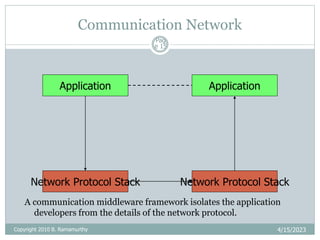
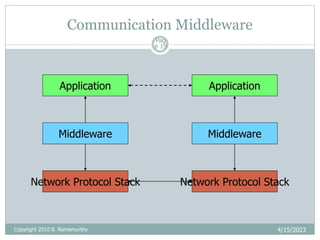
A communication middleware framework isolates the application
developers from the details of the network protocol.
Application Application
Network Protocol Stack Network Protocol Stack
Copyright 2010 B. Ramamurthy
Client/server Issues
4/15/2023
Copyright 2010 B. Ramamurthy
16
 Basic object-technology could not fulfill the promises
such as reusability and interoperability fully in the
context internet and enterprise level applications.
Deployment was still a major problem and as a result
portability and mobility were impaired.
Issues in networked systems
4/15/2023
Pag
e 17
 Heterogeneity in various aspects of a distributed
systems
 Communication modes different
 Synchronous: RPC
 Asynchronous: P2P, Publish and subscribe
 Variations in products
 Many vendors: IBM, IONA, TIBCO, Apache, Adobe
 Additional runtime features:
 fault tolerance, load balancing, transaction handling,
usage metering, auditing, ..
Copyright 2010 B. Ramamurthy
Copyright 2010 B. Ramamurthy 4/15/2023
18
Advances in Middleware
Communication Middleware
4/15/2023
Pag
e 19
Application Application
Network Protocol Stack Network Protocol Stack
Middleware Middleware
Copyright 2010 B. Ramamurthy
Remote procedure call (RPC)
4/15/2023
Pag
e 20
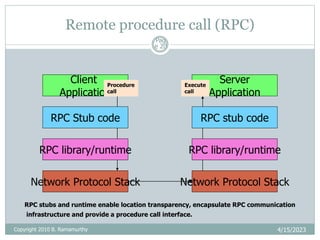
Client
Application
Server
Application
Network Protocol Stack Network Protocol Stack
RPC Stub code RPC stub code
RPC library/runtime
RPC library/runtime
Procedure
call
Execute
call
RPC stubs and runtime enable location transparency, encapsulate RPC communication
infrastructure and provide a procedure call interface.
Copyright 2010 B. Ramamurthy
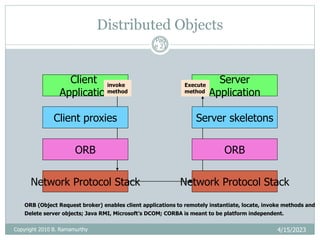
Distributed Objects
4/15/2023
Pag
e 21
Client
Application
Server
Application
Network Protocol Stack Network Protocol Stack
Client proxies Server skeletons
ORB
ORB
invoke
method
Execute
method
ORB (Object Request broker) enables client applications to remotely instantiate, locate, invoke methods and
Delete server objects; Java RMI, Microsoft’s DCOM; CORBA is meant to be platform independent.
Copyright 2010 B. Ramamurthy
22
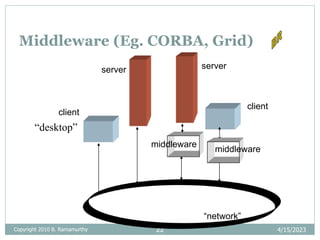
Middleware (Eg. CORBA, Grid)
“network”
client
server
middleware
middleware
client
server
“desktop”
4/15/2023
Copyright 2010 B. Ramamurthy
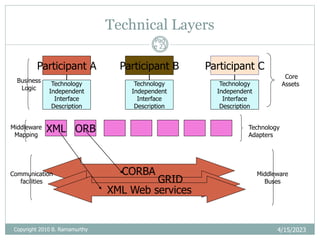
Technical Layers
4/15/2023
Pag
e 23
Participant A Participant C
Participant B
Technology
Independent
Interface
Description
Technology
Independent
Interface
Description
Technology
Independent
Interface
Description
Core
Assets
XML ORB Technology
Adapters
Middleware
Mapping
CORBA
XML Web services
Middleware
Buses
Communication
facilities
Business
Logic
GRID
Copyright 2010 B. Ramamurthy
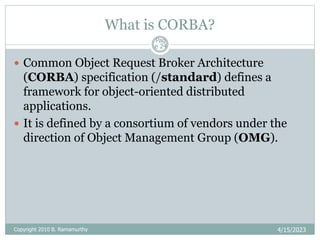
What is CORBA?
4/15/2023
Pag
e 24
 Common Object Request Broker Architecture
(CORBA) specification (/standard) defines a
framework for object-oriented distributed
applications.
 It is defined by a consortium of vendors under the
direction of Object Management Group (OMG).
Copyright 2010 B. Ramamurthy
What is CORBA? (contd.)
4/15/2023
Pag
e 25
 Allows distributed programs in different languages
and different platforms to interact as though they
were in a single programming language on one
computer.
 Brings advantages of OO to distributed systems.
 Allows you design a distributed application as a set
of cooperating objects and to reuse existing
objects.
Copyright 2010 B. Ramamurthy
Object Request Broker (ORB)
4/15/2023
Pag
e 26
 A software component that mediates transfer of
messages from a program to an object located on a
remote host.
 Hides underlying network communications from a
programmer.
 ORB allows you to create software objects whose
member functions can be invoked by client
programs located anywhere.
 A server program contains instances of CORBA
objects.
Copyright 2010 B. Ramamurthy
Clients, severs and objects
4/15/2023
Pag
e 27
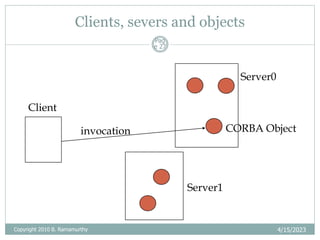
Client
Server0
Server1
CORBA Object
invocation
Copyright 2010 B. Ramamurthy
CORBA Objects and IDL
4/15/2023
Pag
e 28
 These are standard software objects implemented
in any supported language including Java, C++
and Smalltalk.
 Each CORBA object has a clearly defined interface
specified in CORBA interface definition
language (IDL).
 The interface definition specifies the member
functions available to the client without any
assumption about the implementation of the
object.
Copyright 2010 B. Ramamurthy
Client and IDL
4/15/2023
Pag
e 29
 To call a member function on a CORBA object the
client needs only the object’s IDL.
 Client need not know the object’s implementation,
location or operating system on which the object
runs.
Copyright 2010 B. Ramamurthy
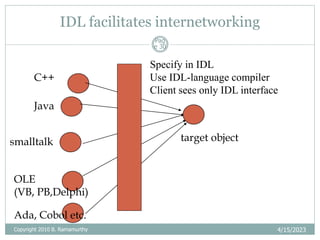
IDL facilitates internetworking
4/15/2023
Pag
e 30
C++
Java
smalltalk
OLE
(VB, PB,Delphi)
Ada, Cobol etc.
target object
Specify in IDL
Use IDL-language compiler
Client sees only IDL interface
Copyright 2010 B. Ramamurthy
Separation of Interface and Implementation
4/15/2023
Pag
e 31
 Interface and implementation can be in two different
languages.
 Interface abstracts and protects details (trade
secrets) from client
 Design by contract
 Interface offers a means of expressing design without
worrying about implementation.
Copyright 2010 B. Ramamurthy
ORB : Conceptual View
4/15/2023
Pag
e 32
 When a client invokes a member function on a
CORBA object, the ORB intercepts the function call.
 ORB directs the function call across the network to
the target object.
 The ORB then collects the results from the function
call returns these to the function call.
Copyright 2010 B. Ramamurthy
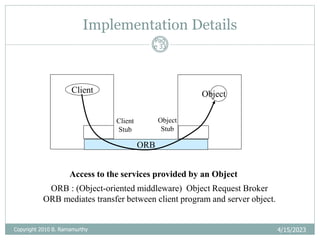
Implementation Details
4/15/2023
Pag
e 33
Access to the services provided by an Object
ORB : (Object-oriented middleware) Object Request Broker
ORB mediates transfer between client program and server object.
Client
ORB
Object
Object
Stub
Client
Stub
Copyright 2010 B. Ramamurthy
4/15/2023
Copyright 2010 B. Ramamurthy
34
What is a grid?
 Grid is a sophisticated framework that enables sharing
of a variety of resources among distributed applications.
 Open standard
 Large scale operations
 Automatic
 Intelligent
 Spontaneous
 Interoperable
 Service-oriented
4/15/2023
Copyright 2010 B. Ramamurthy
35
What is a grid? (A formal definition)
 Grid specifies a standard architecture, infrastructure,
protocols and application program interface (API) for
building an open enterprise system.
 It can provide
 Middleware supporting network of systems to facilitate
sharing, standardization and openness.
 Infrastructure and application model dealing with sharing
of compute cycles, data, storage and other resources.
 A framework for high reliability, availability and security.
 Interoperation of batch-oriented and service-based
architectures.
 Standard service level feature definitions and higher level
concepts for inter and intra-business collaboration.
4/15/2023 Copyright 2010 B. Ramamurthy
36
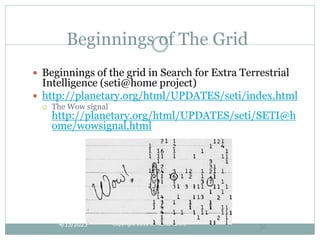
Beginnings of The Grid
 Beginnings of the grid in Search for Extra Terrestrial
Intelligence (seti@home project)
 http://planetary.org/html/UPDATES/seti/index.html
 The Wow signal
http://planetary.org/html/UPDATES/seti/SETI@h
ome/wowsignal.html
Message-oriented Middleware (MOM)
4/15/2023
Pag
e 37
 Made famous by IBM’s MQseries and TIBCO’s Rendezvous
products.
 Based on messages and queues.
 A message contains a header and a payload.
 A queue can store and distribute messages.
 Publish/subscribe model of communication:
 A topic offers another model of communication between subscribers
and publishers.
 MOM allows for loose coupling between message
consumers and message producers enabling dynamic,
reliable, flexible, high-performance systems to be built.
Copyright 2010 B. Ramamurthy
Copyright 2010 B. Ramamurthy 4/15/2023
38
Server-side Advances
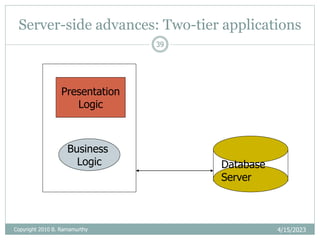
Server-side advances: Two-tier applications
4/15/2023
Copyright 2010 B. Ramamurthy
39
Presentation
Logic
Business
Logic Database
Server
Server-side: Three-tier Applications
4/15/2023
Copyright 2010 B. Ramamurthy
40
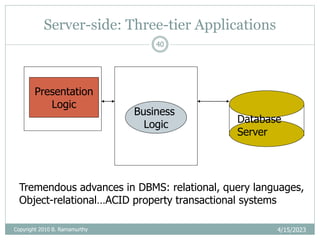
Presentation
Logic
Business
Logic Database
Server
Tremendous advances in DBMS: relational, query languages,
Object-relational…ACID property transactional systems
Programming Model for Web-based
applications
4/15/2023
Copyright 2010 B. Ramamurthy
41
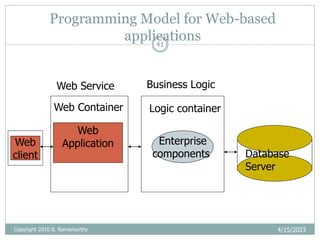
Web
client
Web
Application
Database
Server
Enterprise
components
Logic container
Web Container
Business Logic
Web Service
Components and Application Servers
4/15/2023
42
 An application server mediates between a web server and
backend systems.
 Request from a web client is passed onto an application
server by the web server.
 Programmer productivity, cost-effective deployment,
rapid time to market, seamless integration, application
portability, scalability, security are some of the challenges
that component technology tries to address head on.
 Enterprise Java Beans is Sun’s server component model
that provides portability across application servers, and
supports complex systems features such as transactions,
security, etc. on behalf of the application components.
 EJB is a specification provided by Sun and many third
party vendors have products compliant with this
specification: BEA systems (bought out by oracle), IONA,
IBM, Oracle, Sybase (bought out by IBM).
Copyright 2010 B. Ramamurthy
Application Programming Model for Three-
tier Applications
4/15/2023
Copyright 2010 B. Ramamurthy
43
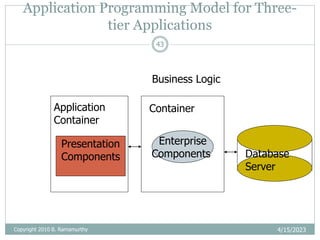
Presentation
Components Database
Server
Enterprise
Components
Container
Application
Container
Business Logic
Expectations of a Distributed System
4/15/2023
Copyright 2010 B. Ramamurthy
44
•Access transparency: enables local and remote resources to be accessed using
identical operations.
•Location transparency: enables resources to be accessed without knowledge of
their location.
•Concurrency transparency: enables several processes to operate concurrently
using shared resources without interference between them.
•Replication transparency: enables multiple instances of resources to be used to
increase reliability and performance without knowledge of the replicas by users or
application programmers.
•Failure transparency: enables the concealment of faults, allowing users and
application programs to complete their tasks despite the failure of hardware or
software components.
•Mobility transparency: allows the movement of resources and clients within a
system without affecting the operation of users or programs.
•Performance transparency: allows the system to be reconfigured to improve
performance as loads vary. “Scalability”
•Expansion transparency: allows the system and applications to expand in scale
without change to the system structure or the application algorithms.
Issues contd.
4/15/2023
Copyright 2010 B. Ramamurthy
45
 Heterogeneity of components
 Scalability : ability to perform well under
increased loads and data sizes
 Failure handling
 Concurrency
 Transparency
 Reliability
 Interoperability
 Performance
 Openness
 Security and protection
Copyright 2010 B. Ramamurthy 4/15/2023
46
Emerging Application Models
Large scale systems
4/15/2023
Copyright 2010 B. Ramamurthy
47
 Most emerging distributed applications are very large
demanding large amounts of storage and data resources
 E-commerce systems and online businesses
 Applications connecting communities: from search to social
networking
 See world’s 10 largest data bases
 Amount of data collected by various sources from terrorism
monitoring to environmental monitoring
 Data deluge: most of the data is write once read many
(WORM)  Analytics resulting in data-intensive computing
models and big-data computing (CSE487 material)
 We will look just one success story of distributed system:
amazon.com
Amazon.com
4/15/2023
Copyright 2010 B. Ramamurthy
48
 Werner Vogels’ talk “Order in the Chaos: Building the Amazon.com
Platform."
 1995: Started out with a single web service on a single server. Today
amazon has about 150 web services on its homepage alone.
 1 million merchant partners; 60 million customers
 One server of customers and inventory grew into two servers; more
database servers were added as the business expanded
 1999: A mistep during this exponential growth period was moving to
mainframe from distributed server. Failed to meet scalability, reliability
and performance; it was scratched in 2000.
Amazon (contd.)
4/15/2023
Copyright 2010 B. Ramamurthy
49
 Robustness: Shopping cart is tested for 20000 items by a single customer,
for example!
 Amazon’s secret sauce is “operating reliably at scale”.
 After “the denial of service” debacle in 1999, they decided to use Web
services to insulate the databases from being overwhelmed by direct
interaction with online applications.
 Each web service is the responsibility of a team of developers:
 “And they are not just responsible for writing the service and then tossing
it over the wall for testing and eventual entry into production where some
poor maintenance geek has to look after it.
 The Amazon CTO tells his Web services team members: "You build it.
You own it."
 That means the team is responsible for its Web service's on-going
operation. If a Web service stops working in the middle of the night, team
members are called to fix it.”
 Web services are kept simple: complexity is the notorious enemy of
reliability
 No attachment to one technology or standard: what ever customer
wants, give it.
Copyright 2010 B. Ramamurthy 4/15/2023
50
On to more fundamental
concepts
Synchrony
4/15/2023
51
 Synchronous and asynchronous communications
 Synchronous:
 immediate response of communicating partners
 Server process/thread blocks until response is completed
 Follows request/response pattern
 Used when servers are available all the time
 Typically communicating partners are tightly coupled
 Examples:
 request from web client to a web browser for “search” or for “information”
 CORBA procedure invocation
 Java RMI (remote method invocation)
 Traditional remote procedure call (RPC)
Copyright 2010 B. Ramamurthy
Asynchronous communication
4/15/2023
52
 Communicating partners are decoupled
 Message driven:
 sender creates a message and delivers it to a mediator who then
sends it to “a” recipient
 Server need not be available all the time
 Sender and receiver loosely coupled
 Can facilitate high-performance message-based system
 Example:
 Any event-driven system
 Any messaging system (instant messenger)
 Publish-subscribe mode communications
Copyright 2010 B. Ramamurthy
Interface vs Payload Semantics
4/15/2023
53
 Typically interaction between a client and a server
results in the execution of an activity (ot
transaction)
 Request needs to be specified by the request.
 Interface semantics: Requested activity can be encoded in
the operation signature in the server’s “interface” or
 Payload semantics: It can be embedded in the message
itself
Copyright 2010 B. Ramamurthy
Interface Semantics
4/15/2023
54
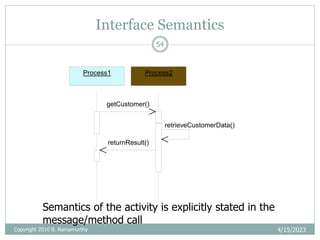
Process1 Process2
getCustomer()
retrieveCustomerData()
returnResult()
Semantics of the activity is explicitly stated in the
message/method call
Copyright 2010 B. Ramamurthy
Payload Semantics
4/15/2023
55
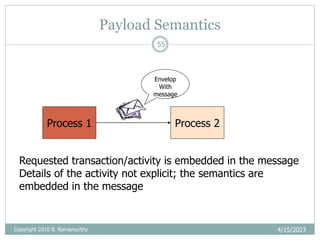
Process 1 Process 2
Envelop
With
message
Requested transaction/activity is embedded in the message
Details of the activity not explicit; the semantics are
embedded in the message
Copyright 2010 B. Ramamurthy
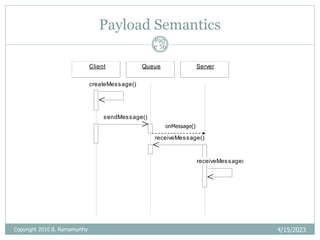
Payload Semantics
4/15/2023
Pag
e 56
Queue
Client Server
createMessage()
sendMessage()
receiveMessage()
receiveMessage()
onMessage()
Copyright 2010 B. Ramamurthy
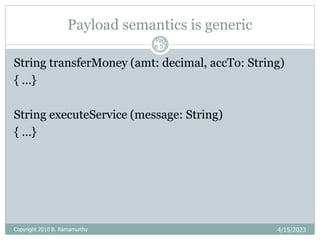
Payload semantics is generic
4/15/2023
Pag
e 57
String transferMoney (amt: decimal, accTo: String)
{ …}
String executeService (message: String)
{ …}
Copyright 2010 B. Ramamurthy
Document-centric Messages
4/15/2023
Pag
e 58
 With emergence of self-descriptive data structures
such as XML, document-centric has become
popular
 Semantically rich messages where operation name,
its parameters, return type are self descriptive.
 SOAP (Simple Object Access Protocol) over XML is
an example
 Lets look at XML, SOAP, WS evolution. WSSOA
Copyright 2010 B. Ramamurthy
Tight vs. Loose Coupling
4/15/2023
59
 An important characteristics of an SOA that is a loosely
coupled system.
 On the technology front this is driven by dynamic discovery
and binding enabled by Universal Description, Discovery
and Integration (UDDI)
 On the business front loose coupling addresses the growing
need for companies to be flexible and agile with respect
changes in their own processes and those of their partners
 How does loose coupling help in improving agility,
flexibility and performance?
Copyright 2010 B. Ramamurthy
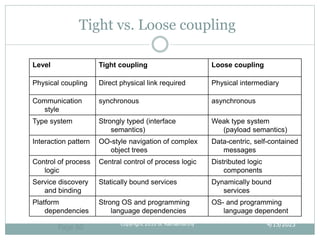
Tight vs. Loose coupling
Level Tight coupling Loose coupling
Physical coupling Direct physical link required Physical intermediary
Communication
style
synchronous asynchronous
Type system Strongly typed (interface
semantics)
Weak type system
(payload semantics)
Interaction pattern OO-style navigation of complex
object trees
Data-centric, self-contained
messages
Control of process
logic
Central control of process logic Distributed logic
components
Service discovery
and binding
Statically bound services Dynamically bound
services
Platform
dependencies
Strong OS and programming
language dependencies
OS- and programming
language dependent
4/15/2023
Page 60
Copyright 2010 B. Ramamurthy
Summary
4/15/2023
61
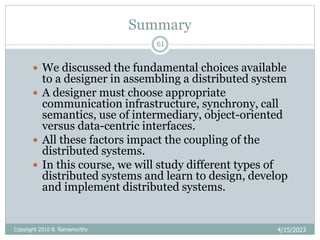
 We discussed the fundamental choices available
to a designer in assembling a distributed system
 A designer must choose appropriate
communication infrastructure, synchrony, call
semantics, use of intermediary, object-oriented
versus data-centric interfaces.
 All these factors impact the coupling of the
distributed systems.
 In this course, we will study different types of
distributed systems and learn to design, develop
and implement distributed systems.
Copyright 2010 B. Ramamurthy
Tools to explore
4/15/2023
62
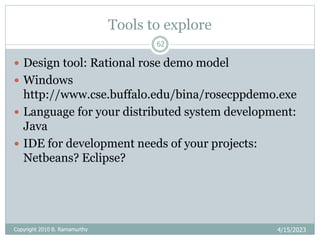
 Design tool: Rational rose demo model
 Windows
http://www.cse.buffalo.edu/bina/rosecppdemo.exe
 Language for your distributed system development:
Java
 IDE for development needs of your projects:
Netbeans? Eclipse?
Copyright 2010 B. Ramamurthy

IntroJan14.ppt

  • 1.
    B I NA R A M A M U R T H Y 4/15/2023 Copyright 2010 B. Ramamurthy 1 Distributed Systems
  • 2.
    Introduction 4/15/2023 Copyright 2010 B.Ramamurthy 2  A distributed system is a network of autonomous computers cooperating to accomplish a task.  Hardware and software components of a distributed system coordinate their activity by sharing resources such as data, computation, compute cycles, bandwidth and storage.  Examples: Internet, intranet, grid and mobile computing systems.
  • 3.
    Topics 4/15/2023 Copyright 2010 B.Ramamurthy 3  Some fundamental terms  Advances in  Client-side technologies  Communication network  Middleware concept  Server-side technology  Application models (web, web2.0, web3.0)
  • 4.
    Copyright 2010 B.Ramamurthy 4/15/2023 4 Terminologies
  • 5.
    Protocol 4/15/2023 Copyright 2010 B.Ramamurthy 5  Protocol is a set of rules that end points in a telecommunication system use when exchanging information.  IP: Internet protocol defines an unreliable packet transfer protocol.  TCP: Transmission Control Protocol builds on IP to define a reliable data delivery protocol.  LDAP: Lightweight Directory Access Protocol builds on TCP to define a query-response protocol for querying the state of a remote database.  HTTP: Hyper Text Transfer Protocol builds on TCP to facilitate hyper-text document exchange.
  • 6.
    Service 4/15/2023 Copyright 2010 B.Ramamurthy 6  Service is a network-enabled entity that provides a specific capability.  Service = Protocol + Behavior  A service definition permits many implementations.  Examples: ability to move files, create processes, verify access rights  An FTP server speaks File Transfer Protocol and supports remote read and write access to a collection of files.
  • 7.
    API 4/15/2023 Copyright 2010 B.Ramamurthy 7  Application Program Interface (API) defines a standard interface for invoking a specified set of functionality.  Examples: The Generic Security Service (GSS) API defines standard functions for verifying identity of communicating parties, encrypting messages and so forth.
  • 8.
    SDK 4/15/2023 Copyright 2010 B.Ramamurthy 8  Software Development Kit (SDK) denotes a set of code designed to be linked with, and invoked from within, an application program to provide specified functionality.  An SDK typically implements an API.  Example: Different SDKs implement GSS-API using the Kerberos or PKI protocols, respectively.
  • 9.
    Internet 4/15/2023 Copyright 2010 B.Ramamurthy 9  Internet is a very large distributed system.  Interconnection of a collection of heterogeneous networks of computers.  Protocols: IP, TCP, HTTP  Services: world wide web (www), file transfers (ftp), email, etc.
  • 10.
    Copyright 2010 B.Ramamurthy 4/15/2023 10 Advances in Client-side programming
  • 11.
    Client programming 4/15/2023 Copyright 2010B. Ramamurthy 11  Simple programs written as a single module  Single entry point typically in a “main” function  Procedural, functional and object-oriented  Applications, applets (web-based)  More recently the focus is on rich content: Rich Internet Application (RIA)  Adobe Flash, Adobe Flex, Microsoft Silverlight, Ajax  Model-View-Controller (MVC) model for design and deployment flexibility. Ex: java swing, struts..
  • 12.
    Client/Server 4/15/2023 Copyright 2010 B.Ramamurthy 12  Server: refers to a process on a networked computer that accepts requests from other (local or remote) processes to perform a service and responds appropriately.  Client: requesting process in the above is referred to as the client.  Request and response are in the form of messages.  Request/response model  Client is said to invoke an operation on the server.  Many distributed systems today are constructed out of interacting clients/servers.  Issues: connectivity (speed and accessibility), addressing, naming
  • 13.
    Copyright 2010 B.Ramamurthy 4/15/2023 13 Advances in Networking
  • 14.
    Internetworking 4/15/2023 Copyright 2010 B.Ramamurthy 14  Internet stack  Standardization  IPV4, IPV6: Internet protocol version 4, 6  Tremendous increase in network bandwidth: measured in bits per second  From few kilobits per second (56kb/s dial up lines to 1.5Mb/s T1 to 100Gb/s ethernet)  What can you do with such fast delivery speed? Connect them up.. Networked application models
  • 15.
    Communication Network 4/15/2023 Pag e 15 Acommunication middleware framework isolates the application developers from the details of the network protocol. Application Application Network Protocol Stack Network Protocol Stack Copyright 2010 B. Ramamurthy
  • 16.
    Client/server Issues 4/15/2023 Copyright 2010B. Ramamurthy 16  Basic object-technology could not fulfill the promises such as reusability and interoperability fully in the context internet and enterprise level applications. Deployment was still a major problem and as a result portability and mobility were impaired.
  • 17.
    Issues in networkedsystems 4/15/2023 Pag e 17  Heterogeneity in various aspects of a distributed systems  Communication modes different  Synchronous: RPC  Asynchronous: P2P, Publish and subscribe  Variations in products  Many vendors: IBM, IONA, TIBCO, Apache, Adobe  Additional runtime features:  fault tolerance, load balancing, transaction handling, usage metering, auditing, .. Copyright 2010 B. Ramamurthy
  • 18.
    Copyright 2010 B.Ramamurthy 4/15/2023 18 Advances in Middleware
  • 19.
    Communication Middleware 4/15/2023 Pag e 19 ApplicationApplication Network Protocol Stack Network Protocol Stack Middleware Middleware Copyright 2010 B. Ramamurthy
  • 20.
    Remote procedure call(RPC) 4/15/2023 Pag e 20 Client Application Server Application Network Protocol Stack Network Protocol Stack RPC Stub code RPC stub code RPC library/runtime RPC library/runtime Procedure call Execute call RPC stubs and runtime enable location transparency, encapsulate RPC communication infrastructure and provide a procedure call interface. Copyright 2010 B. Ramamurthy
  • 21.
    Distributed Objects 4/15/2023 Pag e 21 Client Application Server Application NetworkProtocol Stack Network Protocol Stack Client proxies Server skeletons ORB ORB invoke method Execute method ORB (Object Request broker) enables client applications to remotely instantiate, locate, invoke methods and Delete server objects; Java RMI, Microsoft’s DCOM; CORBA is meant to be platform independent. Copyright 2010 B. Ramamurthy
  • 22.
    22 Middleware (Eg. CORBA,Grid) “network” client server middleware middleware client server “desktop” 4/15/2023 Copyright 2010 B. Ramamurthy
  • 23.
    Technical Layers 4/15/2023 Pag e 23 ParticipantA Participant C Participant B Technology Independent Interface Description Technology Independent Interface Description Technology Independent Interface Description Core Assets XML ORB Technology Adapters Middleware Mapping CORBA XML Web services Middleware Buses Communication facilities Business Logic GRID Copyright 2010 B. Ramamurthy
  • 24.
    What is CORBA? 4/15/2023 Pag e24  Common Object Request Broker Architecture (CORBA) specification (/standard) defines a framework for object-oriented distributed applications.  It is defined by a consortium of vendors under the direction of Object Management Group (OMG). Copyright 2010 B. Ramamurthy
  • 25.
    What is CORBA?(contd.) 4/15/2023 Pag e 25  Allows distributed programs in different languages and different platforms to interact as though they were in a single programming language on one computer.  Brings advantages of OO to distributed systems.  Allows you design a distributed application as a set of cooperating objects and to reuse existing objects. Copyright 2010 B. Ramamurthy
  • 26.
    Object Request Broker(ORB) 4/15/2023 Pag e 26  A software component that mediates transfer of messages from a program to an object located on a remote host.  Hides underlying network communications from a programmer.  ORB allows you to create software objects whose member functions can be invoked by client programs located anywhere.  A server program contains instances of CORBA objects. Copyright 2010 B. Ramamurthy
  • 27.
    Clients, severs andobjects 4/15/2023 Pag e 27 Client Server0 Server1 CORBA Object invocation Copyright 2010 B. Ramamurthy
  • 28.
    CORBA Objects andIDL 4/15/2023 Pag e 28  These are standard software objects implemented in any supported language including Java, C++ and Smalltalk.  Each CORBA object has a clearly defined interface specified in CORBA interface definition language (IDL).  The interface definition specifies the member functions available to the client without any assumption about the implementation of the object. Copyright 2010 B. Ramamurthy
  • 29.
    Client and IDL 4/15/2023 Pag e29  To call a member function on a CORBA object the client needs only the object’s IDL.  Client need not know the object’s implementation, location or operating system on which the object runs. Copyright 2010 B. Ramamurthy
  • 30.
    IDL facilitates internetworking 4/15/2023 Pag e30 C++ Java smalltalk OLE (VB, PB,Delphi) Ada, Cobol etc. target object Specify in IDL Use IDL-language compiler Client sees only IDL interface Copyright 2010 B. Ramamurthy
  • 31.
    Separation of Interfaceand Implementation 4/15/2023 Pag e 31  Interface and implementation can be in two different languages.  Interface abstracts and protects details (trade secrets) from client  Design by contract  Interface offers a means of expressing design without worrying about implementation. Copyright 2010 B. Ramamurthy
  • 32.
    ORB : ConceptualView 4/15/2023 Pag e 32  When a client invokes a member function on a CORBA object, the ORB intercepts the function call.  ORB directs the function call across the network to the target object.  The ORB then collects the results from the function call returns these to the function call. Copyright 2010 B. Ramamurthy
  • 33.
    Implementation Details 4/15/2023 Pag e 33 Accessto the services provided by an Object ORB : (Object-oriented middleware) Object Request Broker ORB mediates transfer between client program and server object. Client ORB Object Object Stub Client Stub Copyright 2010 B. Ramamurthy
  • 34.
    4/15/2023 Copyright 2010 B.Ramamurthy 34 What is a grid?  Grid is a sophisticated framework that enables sharing of a variety of resources among distributed applications.  Open standard  Large scale operations  Automatic  Intelligent  Spontaneous  Interoperable  Service-oriented
  • 35.
    4/15/2023 Copyright 2010 B.Ramamurthy 35 What is a grid? (A formal definition)  Grid specifies a standard architecture, infrastructure, protocols and application program interface (API) for building an open enterprise system.  It can provide  Middleware supporting network of systems to facilitate sharing, standardization and openness.  Infrastructure and application model dealing with sharing of compute cycles, data, storage and other resources.  A framework for high reliability, availability and security.  Interoperation of batch-oriented and service-based architectures.  Standard service level feature definitions and higher level concepts for inter and intra-business collaboration.
  • 36.
    4/15/2023 Copyright 2010B. Ramamurthy 36 Beginnings of The Grid  Beginnings of the grid in Search for Extra Terrestrial Intelligence (seti@home project)  http://planetary.org/html/UPDATES/seti/index.html  The Wow signal http://planetary.org/html/UPDATES/seti/SETI@h ome/wowsignal.html
  • 37.
    Message-oriented Middleware (MOM) 4/15/2023 Pag e37  Made famous by IBM’s MQseries and TIBCO’s Rendezvous products.  Based on messages and queues.  A message contains a header and a payload.  A queue can store and distribute messages.  Publish/subscribe model of communication:  A topic offers another model of communication between subscribers and publishers.  MOM allows for loose coupling between message consumers and message producers enabling dynamic, reliable, flexible, high-performance systems to be built. Copyright 2010 B. Ramamurthy
  • 38.
    Copyright 2010 B.Ramamurthy 4/15/2023 38 Server-side Advances
  • 39.
    Server-side advances: Two-tierapplications 4/15/2023 Copyright 2010 B. Ramamurthy 39 Presentation Logic Business Logic Database Server
  • 40.
    Server-side: Three-tier Applications 4/15/2023 Copyright2010 B. Ramamurthy 40 Presentation Logic Business Logic Database Server Tremendous advances in DBMS: relational, query languages, Object-relational…ACID property transactional systems
  • 41.
    Programming Model forWeb-based applications 4/15/2023 Copyright 2010 B. Ramamurthy 41 Web client Web Application Database Server Enterprise components Logic container Web Container Business Logic Web Service
  • 42.
    Components and ApplicationServers 4/15/2023 42  An application server mediates between a web server and backend systems.  Request from a web client is passed onto an application server by the web server.  Programmer productivity, cost-effective deployment, rapid time to market, seamless integration, application portability, scalability, security are some of the challenges that component technology tries to address head on.  Enterprise Java Beans is Sun’s server component model that provides portability across application servers, and supports complex systems features such as transactions, security, etc. on behalf of the application components.  EJB is a specification provided by Sun and many third party vendors have products compliant with this specification: BEA systems (bought out by oracle), IONA, IBM, Oracle, Sybase (bought out by IBM). Copyright 2010 B. Ramamurthy
  • 43.
    Application Programming Modelfor Three- tier Applications 4/15/2023 Copyright 2010 B. Ramamurthy 43 Presentation Components Database Server Enterprise Components Container Application Container Business Logic
  • 44.
    Expectations of aDistributed System 4/15/2023 Copyright 2010 B. Ramamurthy 44 •Access transparency: enables local and remote resources to be accessed using identical operations. •Location transparency: enables resources to be accessed without knowledge of their location. •Concurrency transparency: enables several processes to operate concurrently using shared resources without interference between them. •Replication transparency: enables multiple instances of resources to be used to increase reliability and performance without knowledge of the replicas by users or application programmers. •Failure transparency: enables the concealment of faults, allowing users and application programs to complete their tasks despite the failure of hardware or software components. •Mobility transparency: allows the movement of resources and clients within a system without affecting the operation of users or programs. •Performance transparency: allows the system to be reconfigured to improve performance as loads vary. “Scalability” •Expansion transparency: allows the system and applications to expand in scale without change to the system structure or the application algorithms.
  • 45.
    Issues contd. 4/15/2023 Copyright 2010B. Ramamurthy 45  Heterogeneity of components  Scalability : ability to perform well under increased loads and data sizes  Failure handling  Concurrency  Transparency  Reliability  Interoperability  Performance  Openness  Security and protection
  • 46.
    Copyright 2010 B.Ramamurthy 4/15/2023 46 Emerging Application Models
  • 47.
    Large scale systems 4/15/2023 Copyright2010 B. Ramamurthy 47  Most emerging distributed applications are very large demanding large amounts of storage and data resources  E-commerce systems and online businesses  Applications connecting communities: from search to social networking  See world’s 10 largest data bases  Amount of data collected by various sources from terrorism monitoring to environmental monitoring  Data deluge: most of the data is write once read many (WORM)  Analytics resulting in data-intensive computing models and big-data computing (CSE487 material)  We will look just one success story of distributed system: amazon.com
  • 48.
    Amazon.com 4/15/2023 Copyright 2010 B.Ramamurthy 48  Werner Vogels’ talk “Order in the Chaos: Building the Amazon.com Platform."  1995: Started out with a single web service on a single server. Today amazon has about 150 web services on its homepage alone.  1 million merchant partners; 60 million customers  One server of customers and inventory grew into two servers; more database servers were added as the business expanded  1999: A mistep during this exponential growth period was moving to mainframe from distributed server. Failed to meet scalability, reliability and performance; it was scratched in 2000.
  • 49.
    Amazon (contd.) 4/15/2023 Copyright 2010B. Ramamurthy 49  Robustness: Shopping cart is tested for 20000 items by a single customer, for example!  Amazon’s secret sauce is “operating reliably at scale”.  After “the denial of service” debacle in 1999, they decided to use Web services to insulate the databases from being overwhelmed by direct interaction with online applications.  Each web service is the responsibility of a team of developers:  “And they are not just responsible for writing the service and then tossing it over the wall for testing and eventual entry into production where some poor maintenance geek has to look after it.  The Amazon CTO tells his Web services team members: "You build it. You own it."  That means the team is responsible for its Web service's on-going operation. If a Web service stops working in the middle of the night, team members are called to fix it.”  Web services are kept simple: complexity is the notorious enemy of reliability  No attachment to one technology or standard: what ever customer wants, give it.
  • 50.
    Copyright 2010 B.Ramamurthy 4/15/2023 50 On to more fundamental concepts
  • 51.
    Synchrony 4/15/2023 51  Synchronous andasynchronous communications  Synchronous:  immediate response of communicating partners  Server process/thread blocks until response is completed  Follows request/response pattern  Used when servers are available all the time  Typically communicating partners are tightly coupled  Examples:  request from web client to a web browser for “search” or for “information”  CORBA procedure invocation  Java RMI (remote method invocation)  Traditional remote procedure call (RPC) Copyright 2010 B. Ramamurthy
  • 52.
    Asynchronous communication 4/15/2023 52  Communicatingpartners are decoupled  Message driven:  sender creates a message and delivers it to a mediator who then sends it to “a” recipient  Server need not be available all the time  Sender and receiver loosely coupled  Can facilitate high-performance message-based system  Example:  Any event-driven system  Any messaging system (instant messenger)  Publish-subscribe mode communications Copyright 2010 B. Ramamurthy
  • 53.
    Interface vs PayloadSemantics 4/15/2023 53  Typically interaction between a client and a server results in the execution of an activity (ot transaction)  Request needs to be specified by the request.  Interface semantics: Requested activity can be encoded in the operation signature in the server’s “interface” or  Payload semantics: It can be embedded in the message itself Copyright 2010 B. Ramamurthy
  • 54.
    Interface Semantics 4/15/2023 54 Process1 Process2 getCustomer() retrieveCustomerData() returnResult() Semanticsof the activity is explicitly stated in the message/method call Copyright 2010 B. Ramamurthy
  • 55.
    Payload Semantics 4/15/2023 55 Process 1Process 2 Envelop With message Requested transaction/activity is embedded in the message Details of the activity not explicit; the semantics are embedded in the message Copyright 2010 B. Ramamurthy
  • 56.
    Payload Semantics 4/15/2023 Pag e 56 Queue ClientServer createMessage() sendMessage() receiveMessage() receiveMessage() onMessage() Copyright 2010 B. Ramamurthy
  • 57.
    Payload semantics isgeneric 4/15/2023 Pag e 57 String transferMoney (amt: decimal, accTo: String) { …} String executeService (message: String) { …} Copyright 2010 B. Ramamurthy
  • 58.
    Document-centric Messages 4/15/2023 Pag e 58 With emergence of self-descriptive data structures such as XML, document-centric has become popular  Semantically rich messages where operation name, its parameters, return type are self descriptive.  SOAP (Simple Object Access Protocol) over XML is an example  Lets look at XML, SOAP, WS evolution. WSSOA Copyright 2010 B. Ramamurthy
  • 59.
    Tight vs. LooseCoupling 4/15/2023 59  An important characteristics of an SOA that is a loosely coupled system.  On the technology front this is driven by dynamic discovery and binding enabled by Universal Description, Discovery and Integration (UDDI)  On the business front loose coupling addresses the growing need for companies to be flexible and agile with respect changes in their own processes and those of their partners  How does loose coupling help in improving agility, flexibility and performance? Copyright 2010 B. Ramamurthy
  • 60.
    Tight vs. Loosecoupling Level Tight coupling Loose coupling Physical coupling Direct physical link required Physical intermediary Communication style synchronous asynchronous Type system Strongly typed (interface semantics) Weak type system (payload semantics) Interaction pattern OO-style navigation of complex object trees Data-centric, self-contained messages Control of process logic Central control of process logic Distributed logic components Service discovery and binding Statically bound services Dynamically bound services Platform dependencies Strong OS and programming language dependencies OS- and programming language dependent 4/15/2023 Page 60 Copyright 2010 B. Ramamurthy
  • 61.
    Summary 4/15/2023 61  We discussedthe fundamental choices available to a designer in assembling a distributed system  A designer must choose appropriate communication infrastructure, synchrony, call semantics, use of intermediary, object-oriented versus data-centric interfaces.  All these factors impact the coupling of the distributed systems.  In this course, we will study different types of distributed systems and learn to design, develop and implement distributed systems. Copyright 2010 B. Ramamurthy
  • 62.
    Tools to explore 4/15/2023 62 Design tool: Rational rose demo model  Windows http://www.cse.buffalo.edu/bina/rosecppdemo.exe  Language for your distributed system development: Java  IDE for development needs of your projects: Netbeans? Eclipse? Copyright 2010 B. Ramamurthy