Introducing 3 ReflectivePractice
Models
• This exercise will introduce you to 3 models of
reflective practice
o Integrated Reflective Cycle
o What? So what? Now What?
o Gibbs Reflective Cycle
• You are encouraged to work through the sample
exercises and think about which is most
applicable to you and your goals
• Each model is followed by a brief
sample exercise on how to implement it which
will then form part of your journal for this
course
4.
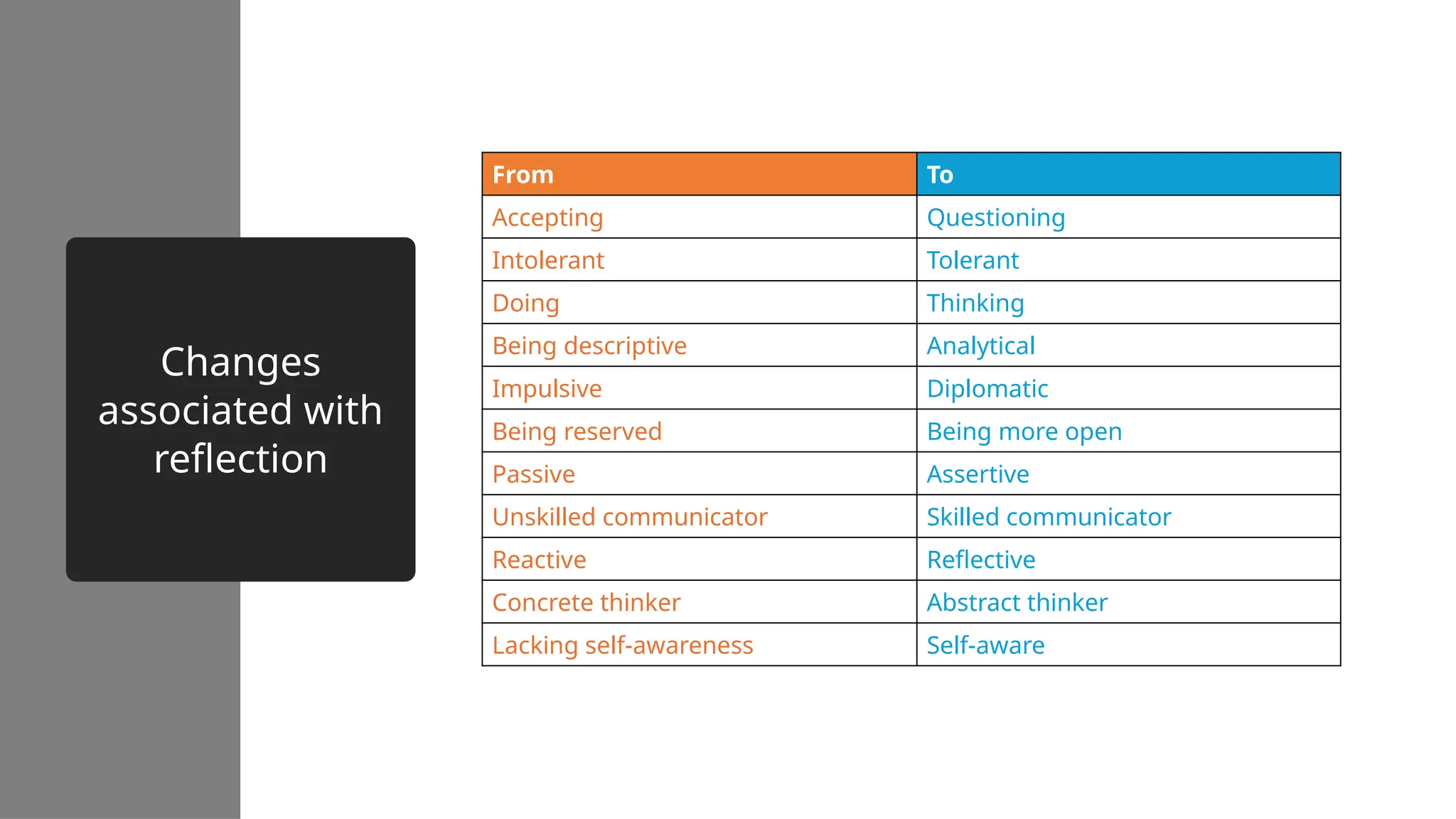
Changes
associated with
reflection
From To
AcceptingQuestioning
Intolerant Tolerant
Doing Thinking
Being descriptive Analytical
Impulsive Diplomatic
Being reserved Being more open
Passive Assertive
Unskilled communicator Skilled communicator
Reactive Reflective
Concrete thinker Abstract thinker
Lacking self-awareness Self-aware
5.
v
Preparing for
Reflective
Practice
Spend around10 minutes
familiarising yourself with the
models in this document
Over the coming weeks, you will
make use of the models to
undertake your own
independent reflections on the
topics provided.
You will then bring these to the
5 live sessions to share with
your reflective practice group.
6.
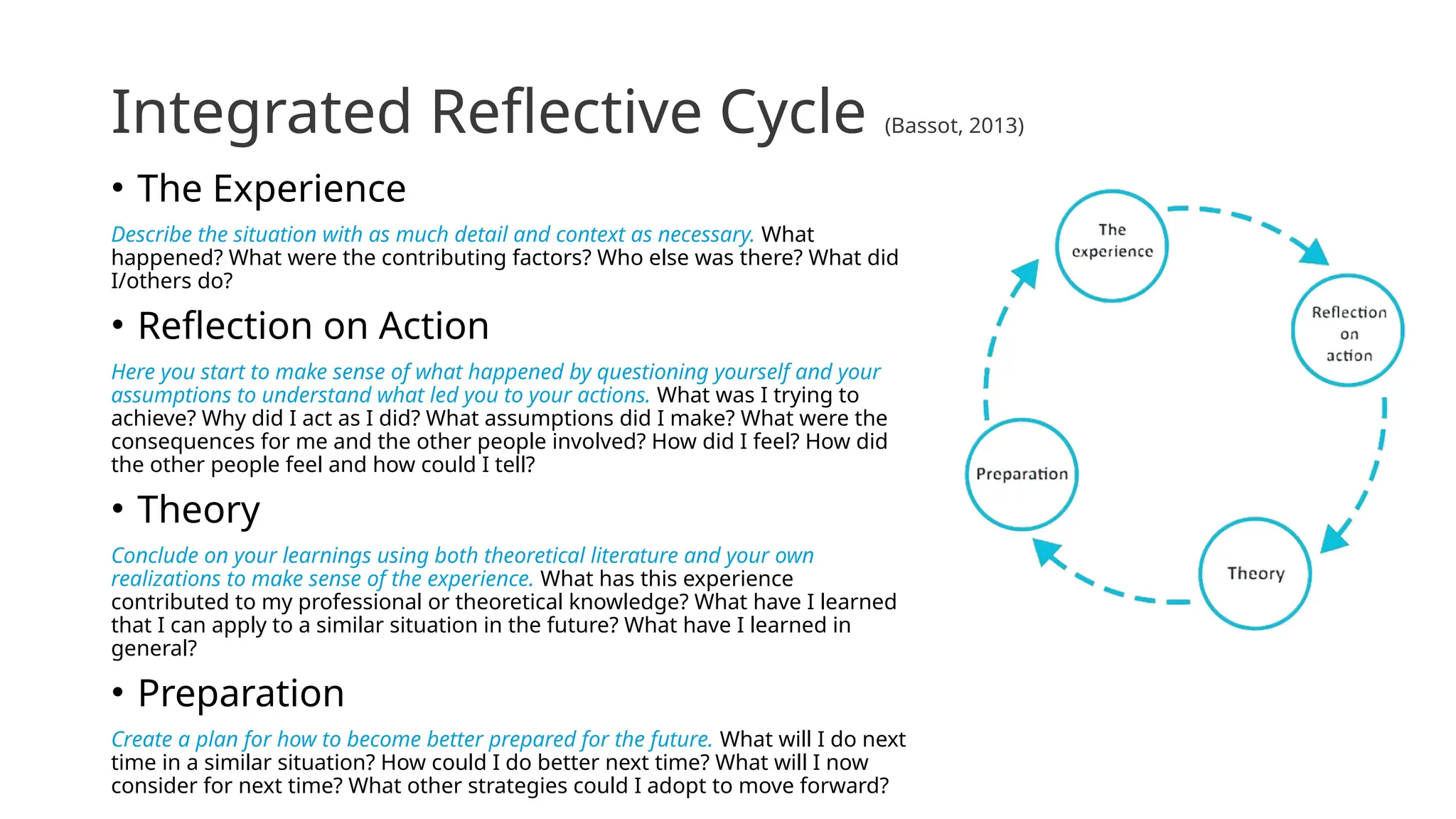
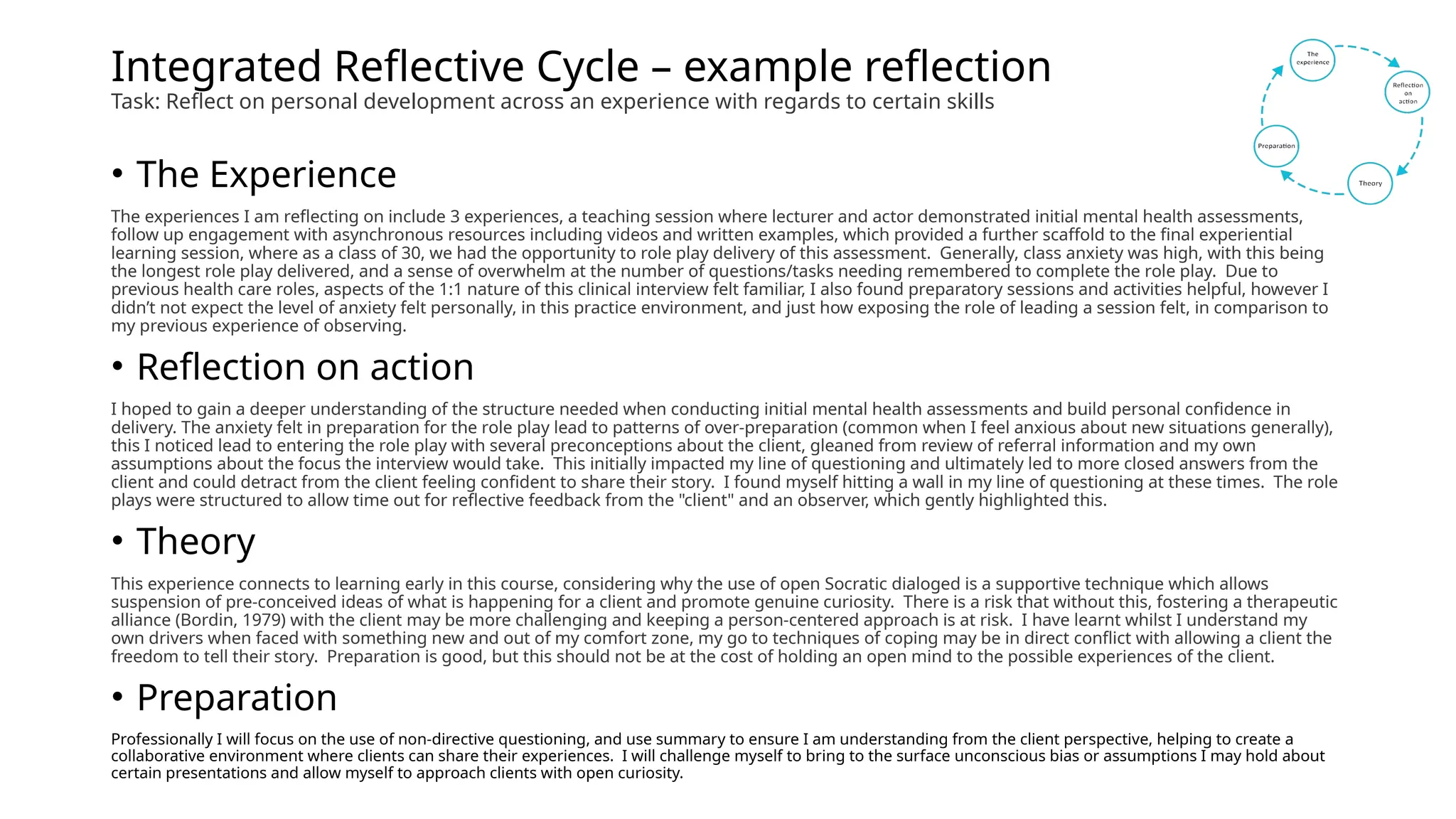
Integrated Reflective Cycle(Bassot, 2013)
• The Experience
Describe the situation with as much detail and context as necessary. What
happened? What were the contributing factors? Who else was there? What did
I/others do?
• Reflection on Action
Here you start to make sense of what happened by questioning yourself and your
assumptions to understand what led you to your actions. What was I trying to
achieve? Why did I act as I did? What assumptions did I make? What were the
consequences for me and the other people involved? How did I feel? How did
the other people feel and how could I tell?
• Theory
Conclude on your learnings using both theoretical literature and your own
realizations to make sense of the experience. What has this experience
contributed to my professional or theoretical knowledge? What have I learned
that I can apply to a similar situation in the future? What have I learned in
general?
• Preparation
Create a plan for how to become better prepared for the future. What will I do next
time in a similar situation? How could I do better next time? What will I now
consider for next time? What other strategies could I adopt to move forward?
7.
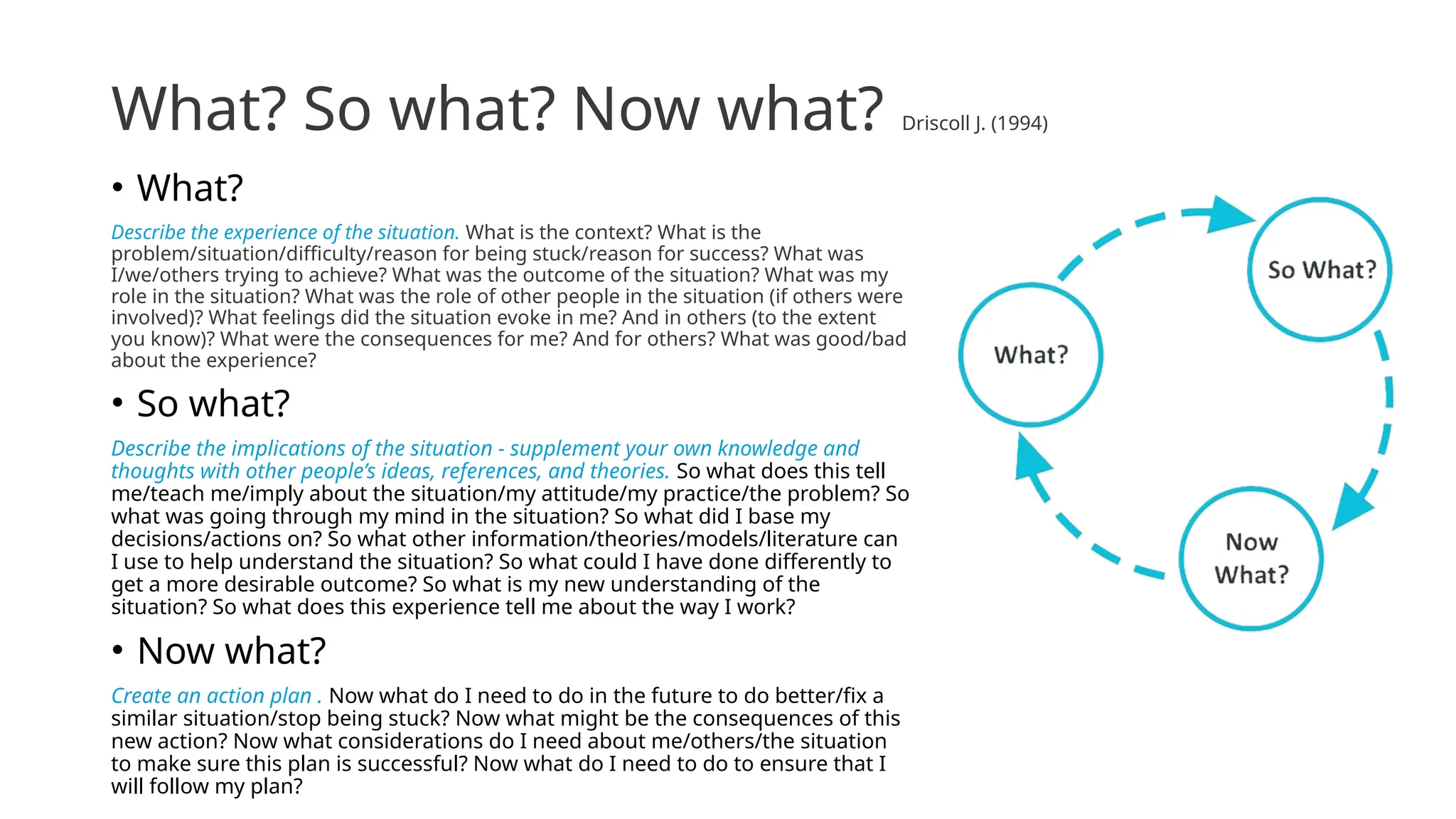
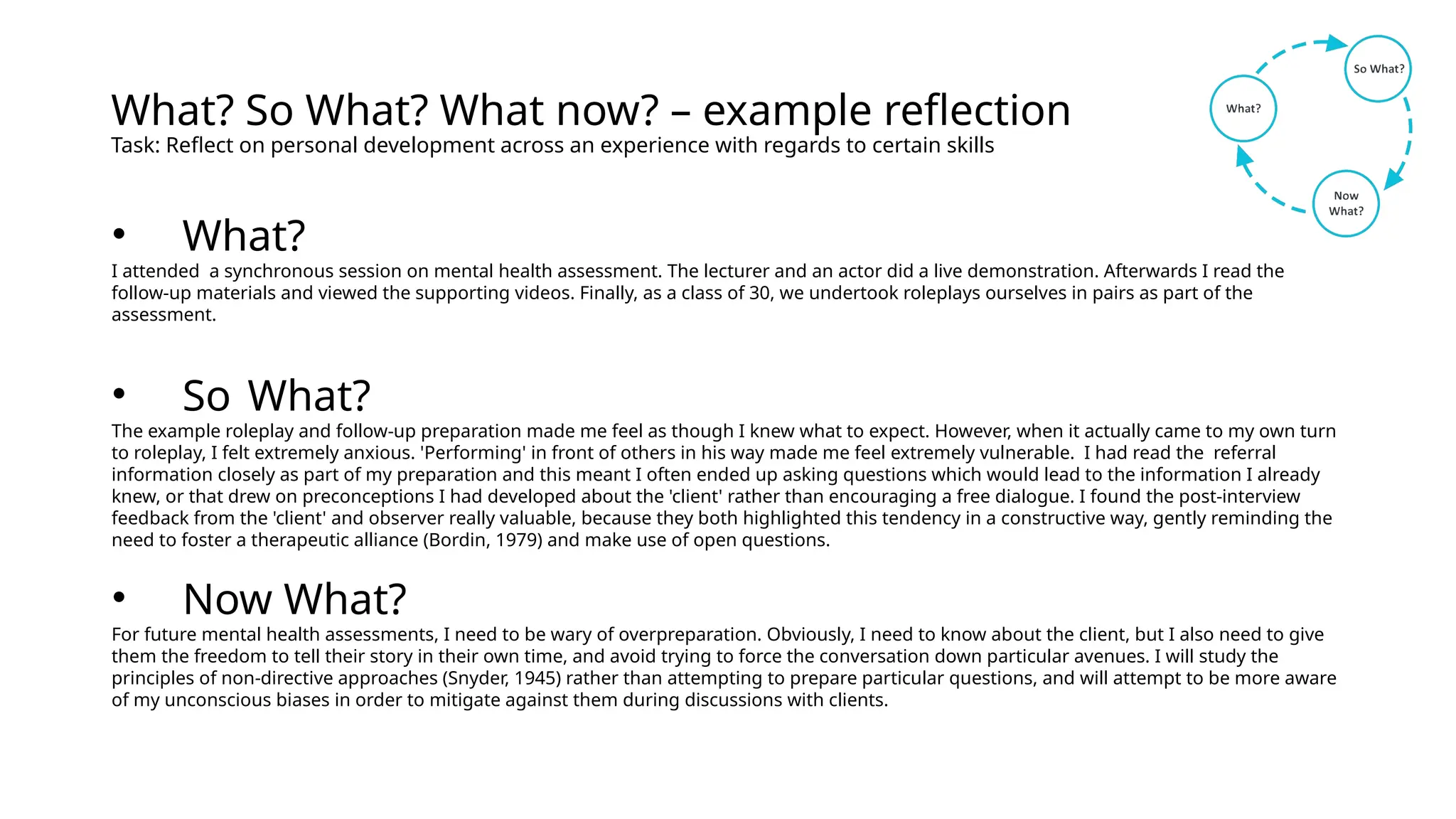
What? So what?Now what? Driscoll J. (1994)
• What?
Describe the experience of the situation. What is the context? What is the
problem/situation/difficulty/reason for being stuck/reason for success? What was
I/we/others trying to achieve? What was the outcome of the situation? What was my
role in the situation? What was the role of other people in the situation (if others were
involved)? What feelings did the situation evoke in me? And in others (to the extent
you know)? What were the consequences for me? And for others? What was good/bad
about the experience?
• So what?
Describe the implications of the situation - supplement your own knowledge and
thoughts with other people’s ideas, references, and theories. So what does this tell
me/teach me/imply about the situation/my attitude/my practice/the problem? So
what was going through my mind in the situation? So what did I base my
decisions/actions on? So what other information/theories/models/literature can
I use to help understand the situation? So what could I have done differently to
get a more desirable outcome? So what is my new understanding of the
situation? So what does this experience tell me about the way I work?
• Now what?
Create an action plan . Now what do I need to do in the future to do better/fix a
similar situation/stop being stuck? Now what might be the consequences of this
new action? Now what considerations do I need about me/others/the situation
to make sure this plan is successful? Now what do I need to do to ensure that I
will follow my plan?
8.
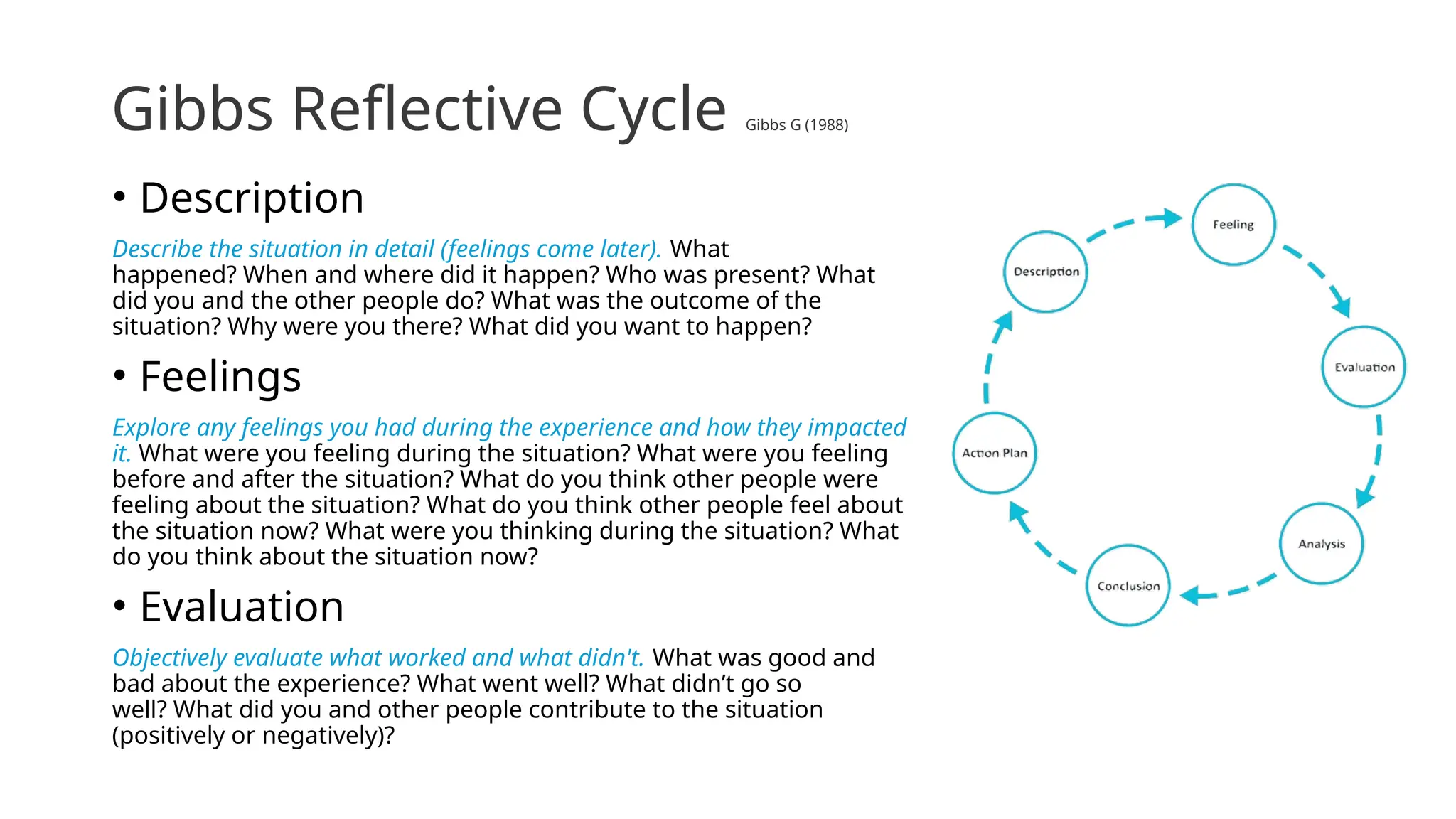
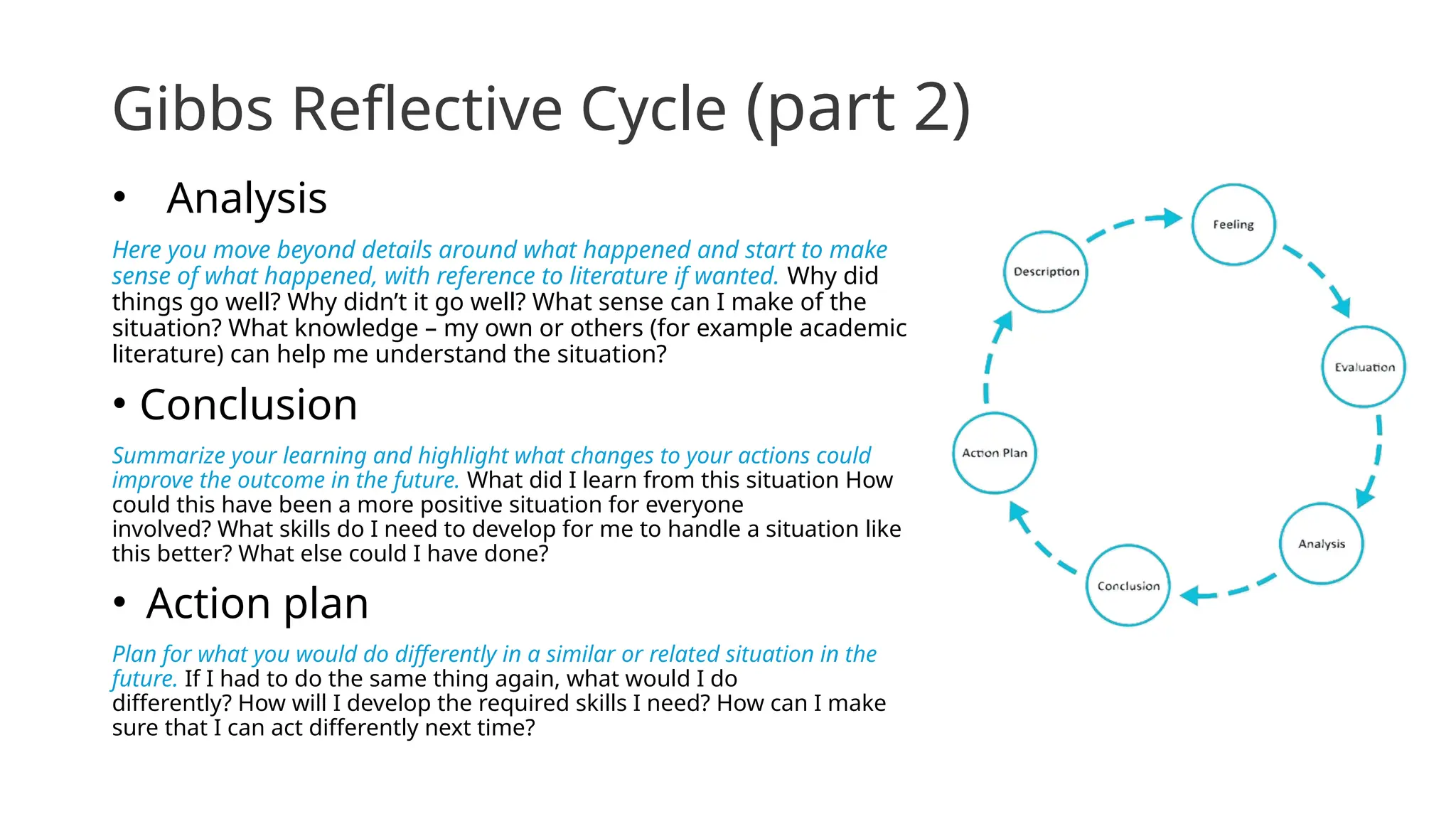
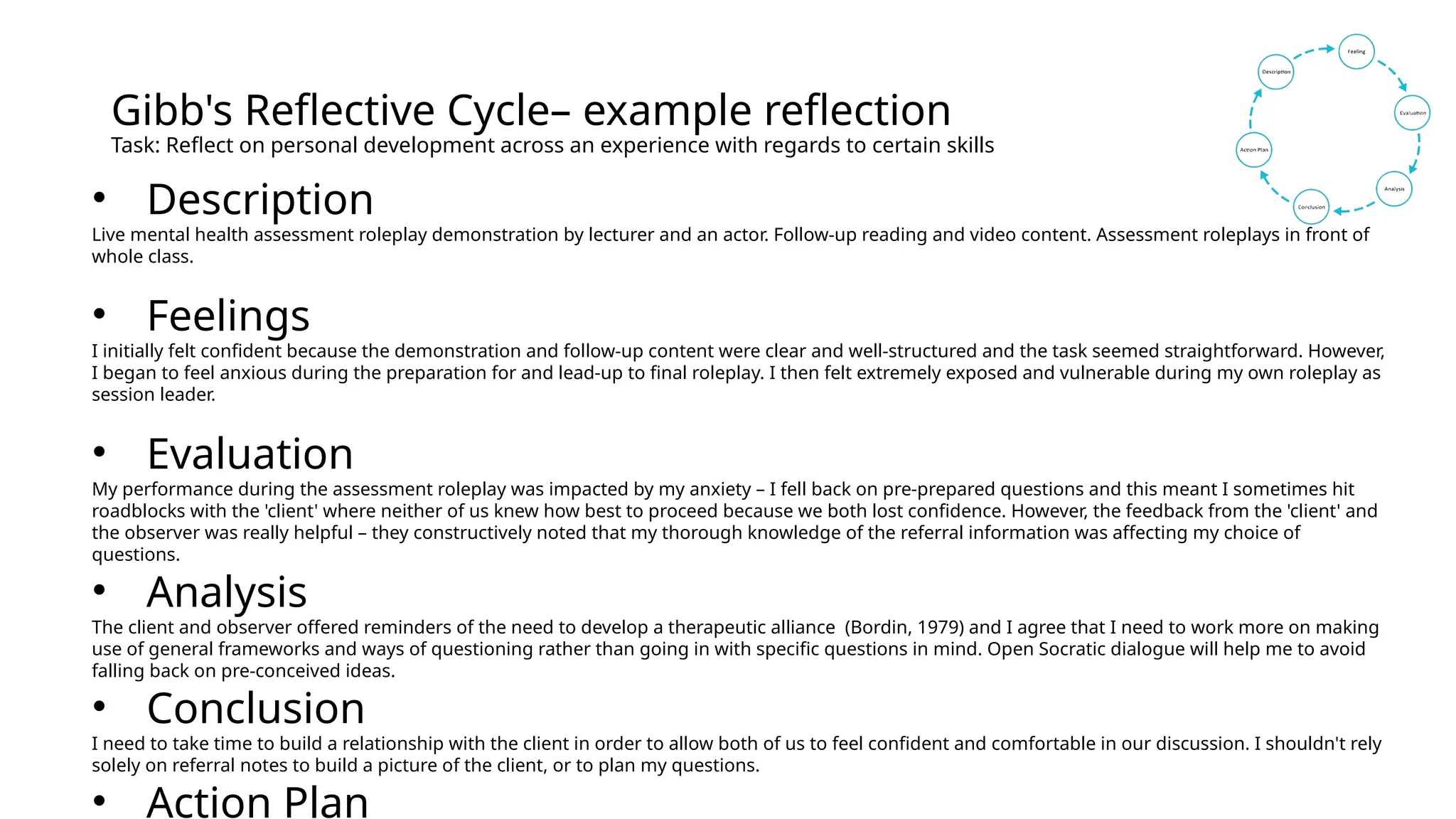
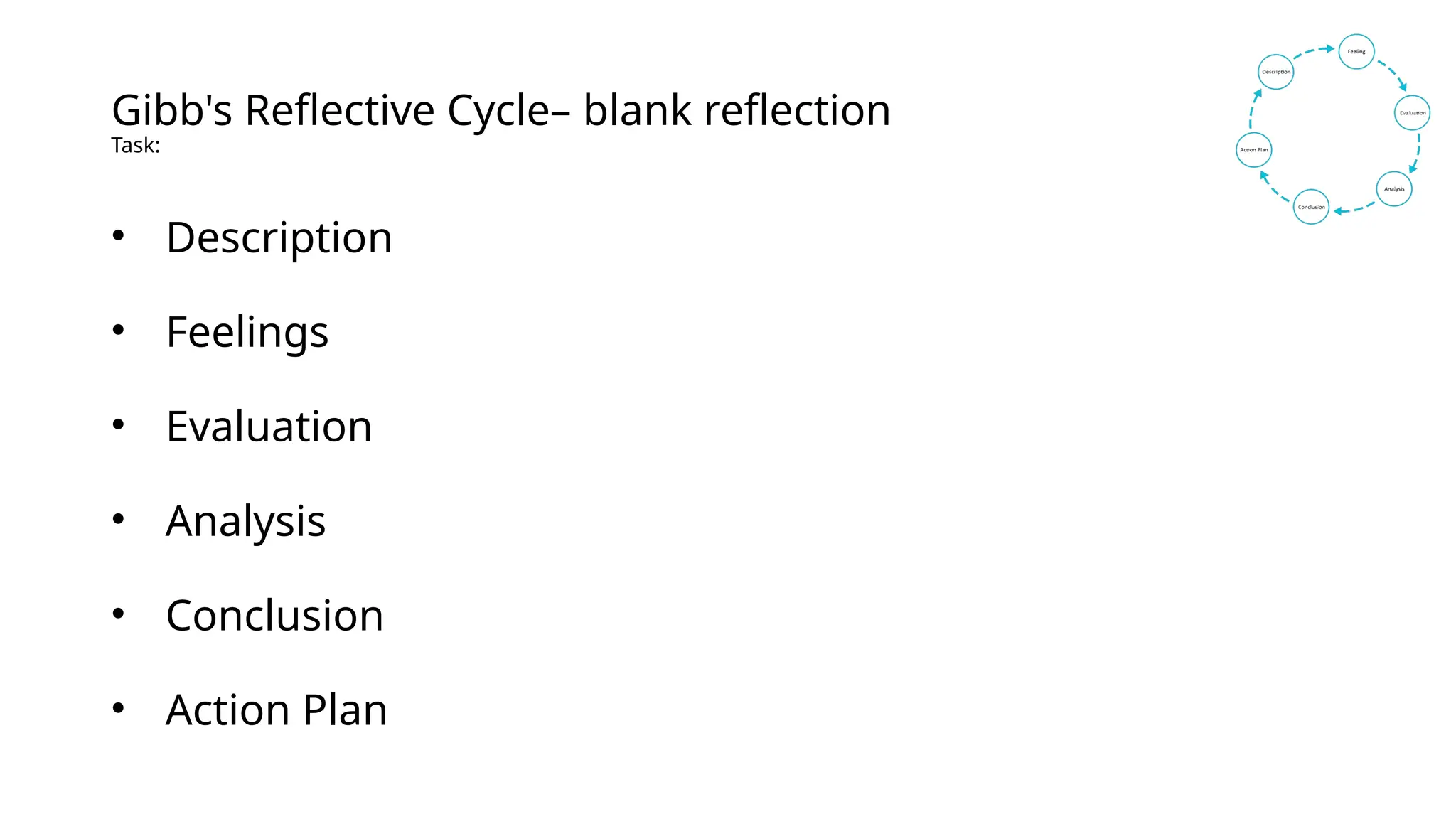
Gibbs Reflective CycleGibbs G (1988)
• Description
Describe the situation in detail (feelings come later). What
happened? When and where did it happen? Who was present? What
did you and the other people do? What was the outcome of the
situation? Why were you there? What did you want to happen?
• Feelings
Explore any feelings you had during the experience and how they impacted
it. What were you feeling during the situation? What were you feeling
before and after the situation? What do you think other people were
feeling about the situation? What do you think other people feel about
the situation now? What were you thinking during the situation? What
do you think about the situation now?
• Evaluation
Objectively evaluate what worked and what didn't. What was good and
bad about the experience? What went well? What didn’t go so
well? What did you and other people contribute to the situation
(positively or negatively)?
9.
Gibbs Reflective Cycle(part 2)
• Analysis
Here you move beyond details around what happened and start to make
sense of what happened, with reference to literature if wanted. Why did
things go well? Why didn’t it go well? What sense can I make of the
situation? What knowledge – my own or others (for example academic
literature) can help me understand the situation?
• Conclusion
Summarize your learning and highlight what changes to your actions could
improve the outcome in the future. What did I learn from this situation How
could this have been a more positive situation for everyone
involved? What skills do I need to develop for me to handle a situation like
this better? What else could I have done?
• Action plan
Plan for what you would do differently in a similar or related situation in the
future. If I had to do the same thing again, what would I do
differently? How will I develop the required skills I need? How can I make
sure that I can act differently next time?
10.
Integrated Reflective Cycle– example reflection
Task: Reflect on personal development across an experience with regards to certain skills
• The Experience
The experiences I am reflecting on include 3 experiences, a teaching session where lecturer and actor demonstrated initial mental health assessments,
follow up engagement with asynchronous resources including videos and written examples, which provided a further scaffold to the final experiential
learning session, where as a class of 30, we had the opportunity to role play delivery of this assessment. Generally, class anxiety was high, with this being
the longest role play delivered, and a sense of overwhelm at the number of questions/tasks needing remembered to complete the role play. Due to
previous health care roles, aspects of the 1:1 nature of this clinical interview felt familiar, I also found preparatory sessions and activities helpful, however I
didn’t not expect the level of anxiety felt personally, in this practice environment, and just how exposing the role of leading a session felt, in comparison to
my previous experience of observing.
• Reflection on action
I hoped to gain a deeper understanding of the structure needed when conducting initial mental health assessments and build personal confidence in
delivery. The anxiety felt in preparation for the role play lead to patterns of over-preparation (common when I feel anxious about new situations generally),
this I noticed lead to entering the role play with several preconceptions about the client, gleaned from review of referral information and my own
assumptions about the focus the interview would take. This initially impacted my line of questioning and ultimately led to more closed answers from the
client and could detract from the client feeling confident to share their story. I found myself hitting a wall in my line of questioning at these times. The role
plays were structured to allow time out for reflective feedback from the "client" and an observer, which gently highlighted this.
• Theory
This experience connects to learning early in this course, considering why the use of open Socratic dialoged is a supportive technique which allows
suspension of pre-conceived ideas of what is happening for a client and promote genuine curiosity. There is a risk that without this, fostering a therapeutic
alliance (Bordin, 1979) with the client may be more challenging and keeping a person-centered approach is at risk. I have learnt whilst I understand my
own drivers when faced with something new and out of my comfort zone, my go to techniques of coping may be in direct conflict with allowing a client the
freedom to tell their story. Preparation is good, but this should not be at the cost of holding an open mind to the possible experiences of the client.
• Preparation
Professionally I will focus on the use of non-directive questioning, and use summary to ensure I am understanding from the client perspective, helping to create a
collaborative environment where clients can share their experiences. I will challenge myself to bring to the surface unconscious bias or assumptions I may hold about
certain presentations and allow myself to approach clients with open curiosity.
11.
What? So What?What now? – example reflection
Task: Reflect on personal development across an experience with regards to certain skills
• What?
I attended a synchronous session on mental health assessment. The lecturer and an actor did a live demonstration. Afterwards I read the
follow-up materials and viewed the supporting videos. Finally, as a class of 30, we undertook roleplays ourselves in pairs as part of the
assessment.
• So What?
The example roleplay and follow-up preparation made me feel as though I knew what to expect. However, when it actually came to my own turn
to roleplay, I felt extremely anxious. 'Performing' in front of others in his way made me feel extremely vulnerable. I had read the referral
information closely as part of my preparation and this meant I often ended up asking questions which would lead to the information I already
knew, or that drew on preconceptions I had developed about the 'client' rather than encouraging a free dialogue. I found the post-interview
feedback from the 'client' and observer really valuable, because they both highlighted this tendency in a constructive way, gently reminding the
need to foster a therapeutic alliance (Bordin, 1979) and make use of open questions.
• Now What?
For future mental health assessments, I need to be wary of overpreparation. Obviously, I need to know about the client, but I also need to give
them the freedom to tell their story in their own time, and avoid trying to force the conversation down particular avenues. I will study the
principles of non-directive approaches (Snyder, 1945) rather than attempting to prepare particular questions, and will attempt to be more aware
of my unconscious biases in order to mitigate against them during discussions with clients.
12.
Gibb's Reflective Cycle–example reflection
Task: Reflect on personal development across an experience with regards to certain skills
• Description
Live mental health assessment roleplay demonstration by lecturer and an actor. Follow-up reading and video content. Assessment roleplays in front of
whole class.
• Feelings
I initially felt confident because the demonstration and follow-up content were clear and well-structured and the task seemed straightforward. However,
I began to feel anxious during the preparation for and lead-up to final roleplay. I then felt extremely exposed and vulnerable during my own roleplay as
session leader.
• Evaluation
My performance during the assessment roleplay was impacted by my anxiety – I fell back on pre-prepared questions and this meant I sometimes hit
roadblocks with the 'client' where neither of us knew how best to proceed because we both lost confidence. However, the feedback from the 'client' and
the observer was really helpful – they constructively noted that my thorough knowledge of the referral information was affecting my choice of
questions.
• Analysis
The client and observer offered reminders of the need to develop a therapeutic alliance (Bordin, 1979) and I agree that I need to work more on making
use of general frameworks and ways of questioning rather than going in with specific questions in mind. Open Socratic dialogue will help me to avoid
falling back on pre-conceived ideas.
• Conclusion
I need to take time to build a relationship with the client in order to allow both of us to feel confident and comfortable in our discussion. I shouldn't rely
solely on referral notes to build a picture of the client, or to plan my questions.
• Action Plan
13.
Please
explore the
models andfind
which one best
suits you. You
can then use this
for use in on-
going reflections.
You can do this by hovering on
the slide with your model of
choice and copy this slide as
many times as is needed.
You can refer back to the
prompt questions for each
section in the model.
Add to the end of this
document, which will then make
up your on-going reflective
journal for this course.
14.
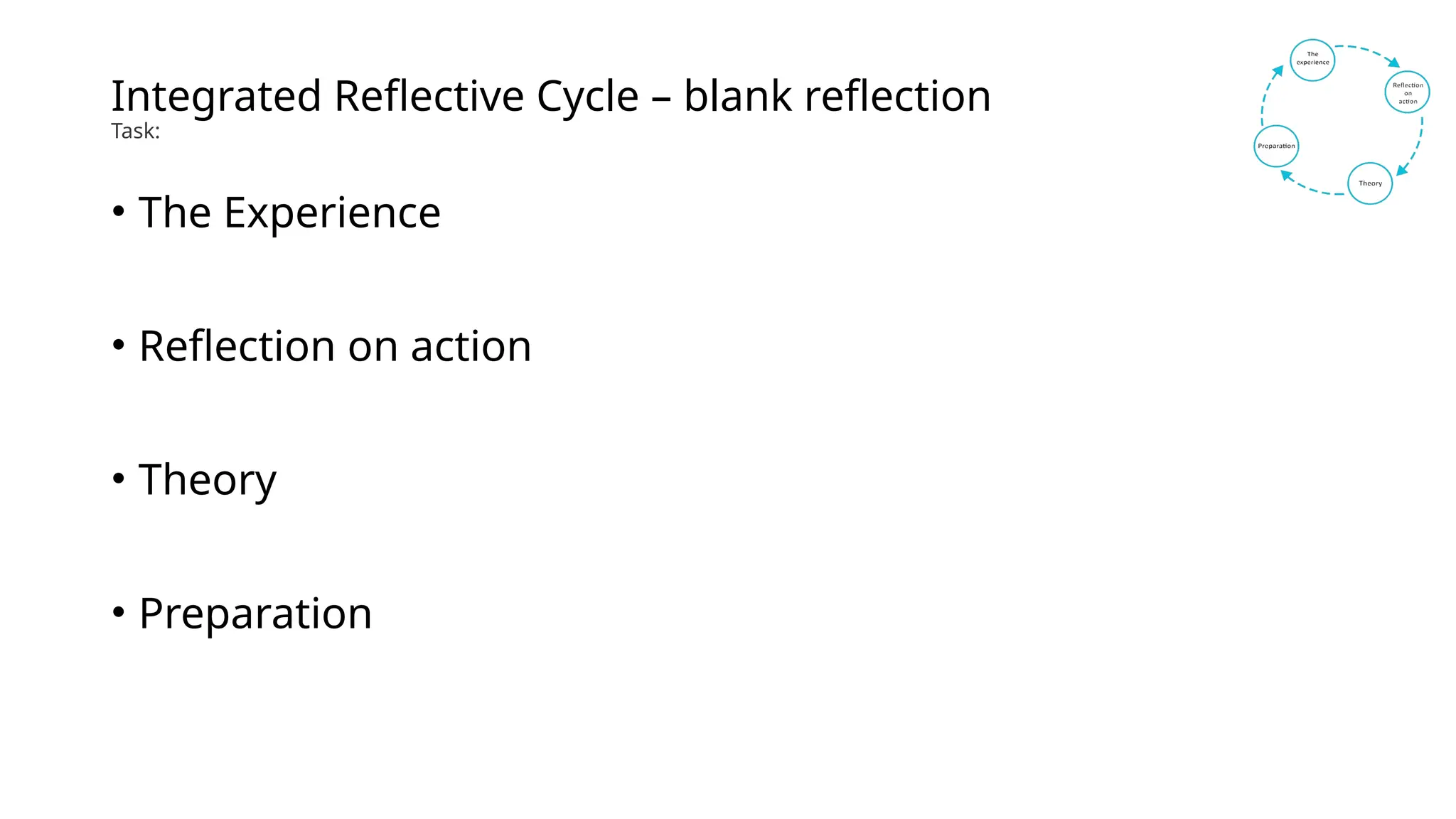
Integrated Reflective Cycle– blank reflection
Task:
• The Experience
• Reflection on action
• Theory
• Preparation
15.
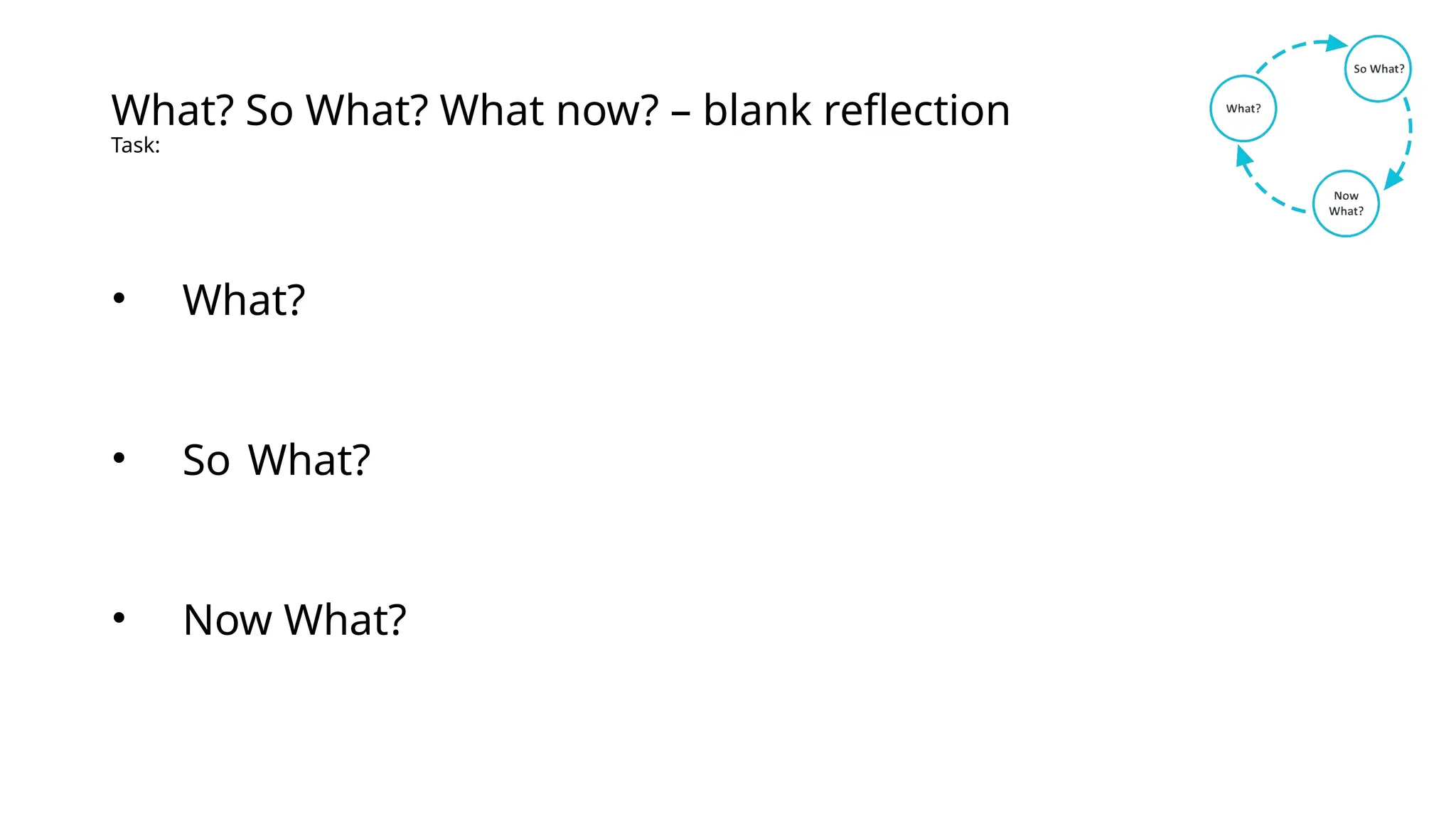
What? So What?What now? – blank reflection
Task:
• What?
• So What?
• Now What?
References and FurtherResources
• Bassot, B. (2013). The Reflective Journal. Basingstoke: Palgrave
• Driscoll J. (1994). Reflective practice for practise. Senior Nurse, 13, 47 -50
• Gibbs G (1988). Learning by Doing: A guide to teaching and learning methods. Further Education
Unit. Oxford Polytechnic: Oxford.
• Malthouse, R., Watts, M., & Roffey-Barentsen, J. (2015). Reflective questions, self-questioning
and managing professionally situated practice. Research in Education, 94, 71-87.
• Ryan, M. (2011). Improving reflective writing in higher education: a social semiotic
perspective. Teaching in Higher Education, 16(1), 99-111.
Please see this webpage for further resources including the reflective diagrams -
https://reflection.ed.ac.uk/reflectors-toolkit