 eXtensible Markup Language, is a
  specification for creating custom
  markup languages
 W3C Recommendation
 Primary purpose is to help computers to
  share data
 XML is meta-language. This means that
  you use it for creating languages.
 XML is an extensive concept.
 Every XML-document is text-based
 => sharing data between different
  computers!
 => sharing data in Internet!
 => platform independence!
   Problems with Binary format
    › Platform depence
    › Firewalls
    › Hard to debug
    › Inspecting the file can be hard
 Since XML is text-based, it does not have
  the problems mentioned above.
 What are the disadvantages in text
  format?
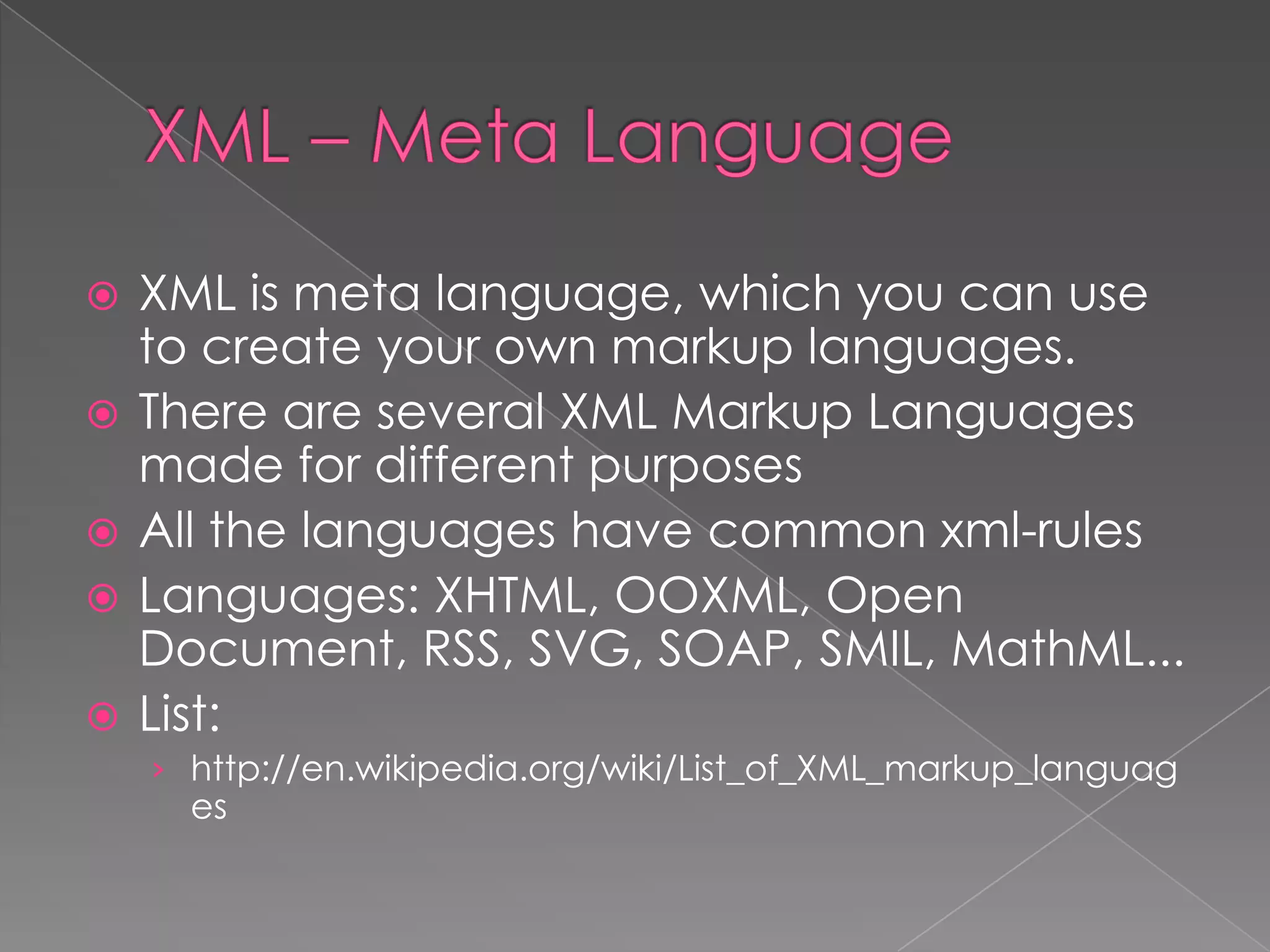
   XML is meta language, which you can use
    to create your own markup languages.
   There are several XML Markup Languages
    made for different purposes
   All the languages have common xml-rules
   Languages: XHTML, OOXML, Open
    Document, RSS, SVG, SOAP, SMIL, MathML...
   List:
    › http://en.wikipedia.org/wiki/List_of_XML_markup_languag
      es
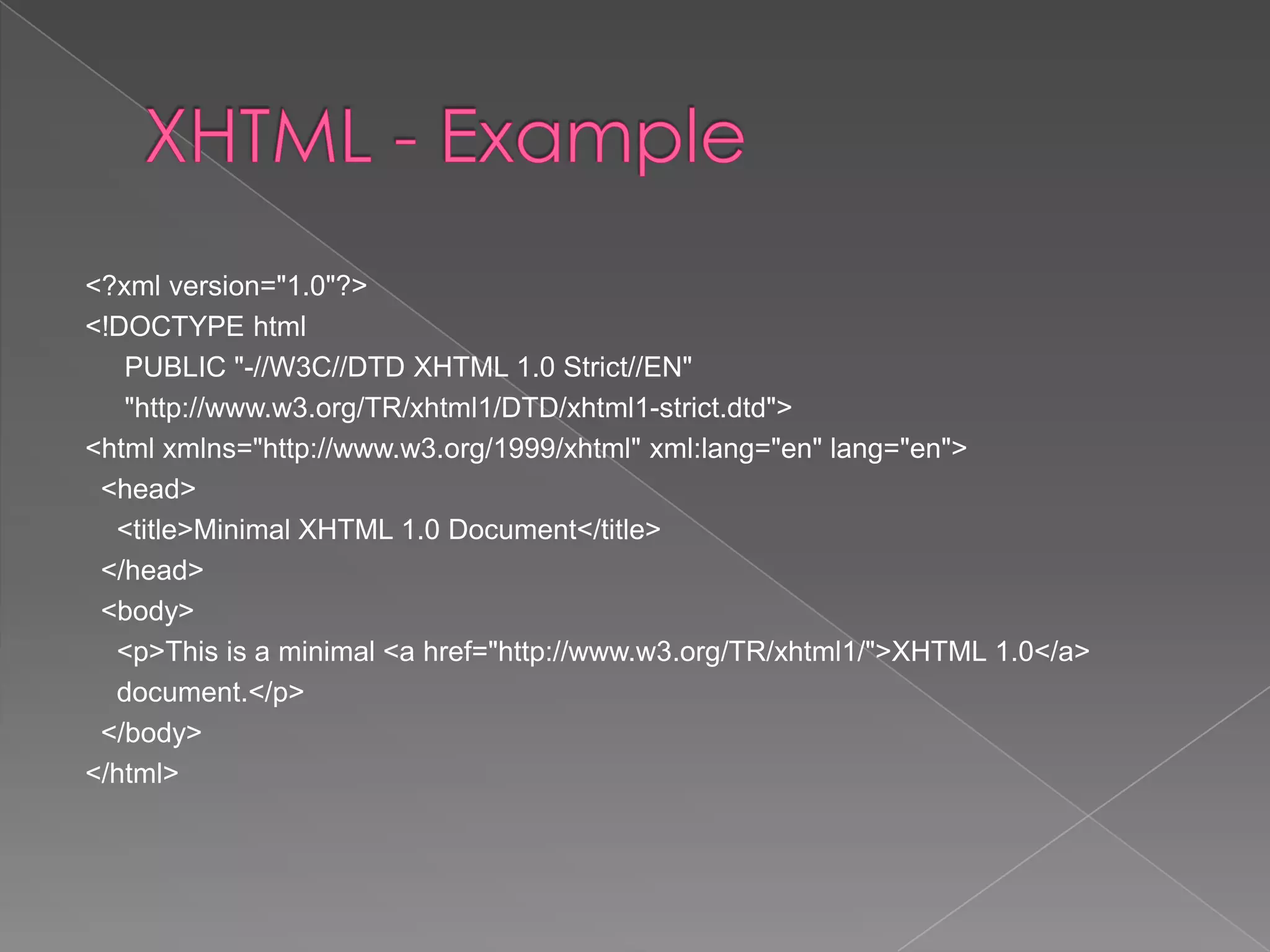
<?xml version="1.0"?>
<!DOCTYPE html
   PUBLIC "-//W3C//DTD XHTML 1.0 Strict//EN"
   "http://www.w3.org/TR/xhtml1/DTD/xhtml1-strict.dtd">
<html xmlns="http://www.w3.org/1999/xhtml" xml:lang="en" lang="en">
 <head>
  <title>Minimal XHTML 1.0 Document</title>
 </head>
 <body>
  <p>This is a minimal <a href="http://www.w3.org/TR/xhtml1/">XHTML 1.0</a>
  document.</p>
 </body>
</html>
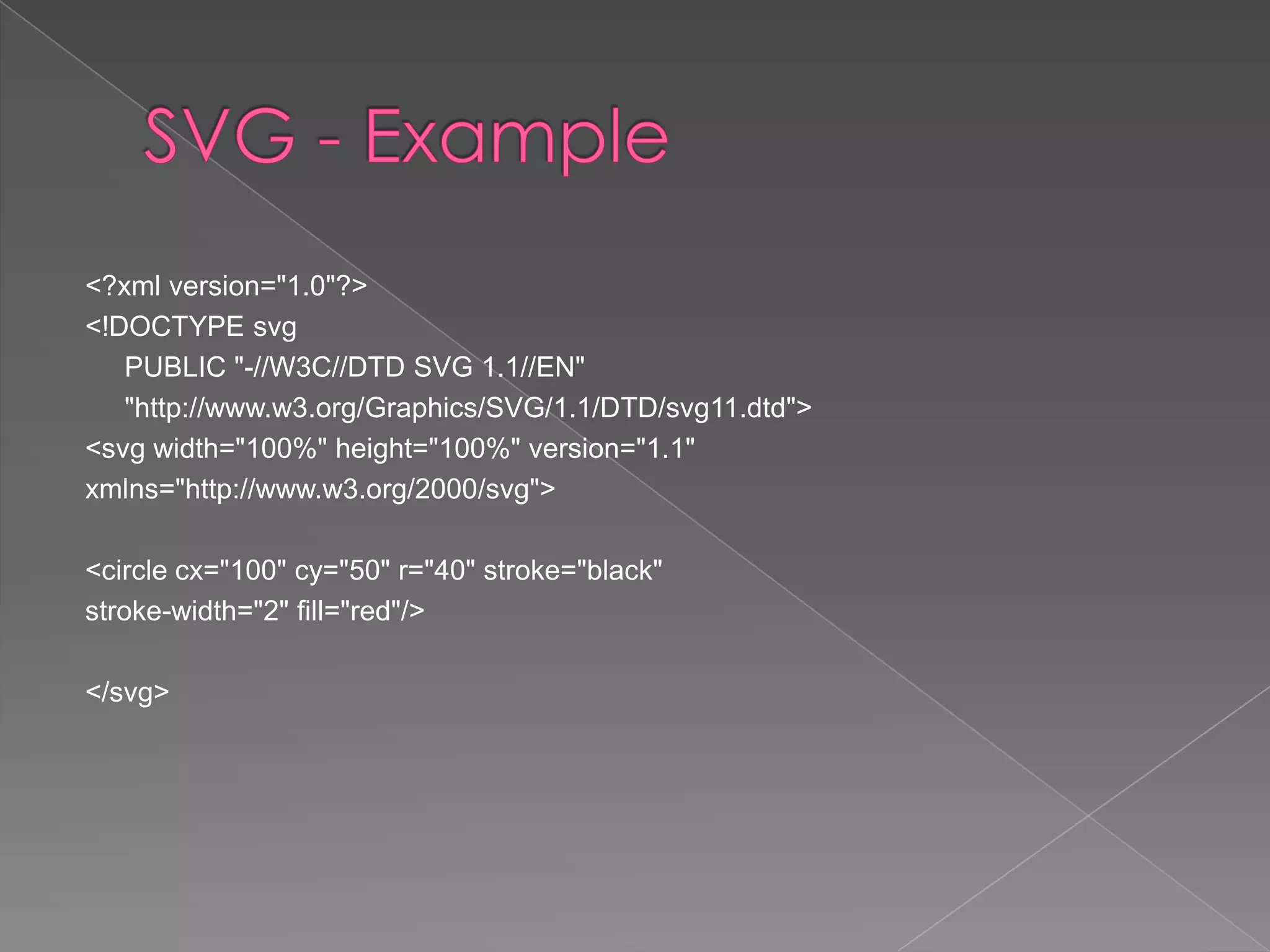
<?xml version="1.0"?>
<!DOCTYPE svg
   PUBLIC "-//W3C//DTD SVG 1.1//EN"
   "http://www.w3.org/Graphics/SVG/1.1/DTD/svg11.dtd">
<svg width="100%" height="100%" version="1.1"
xmlns="http://www.w3.org/2000/svg">

<circle cx="100" cy="50" r="40" stroke="black"
stroke-width="2" fill="red"/>

</svg>
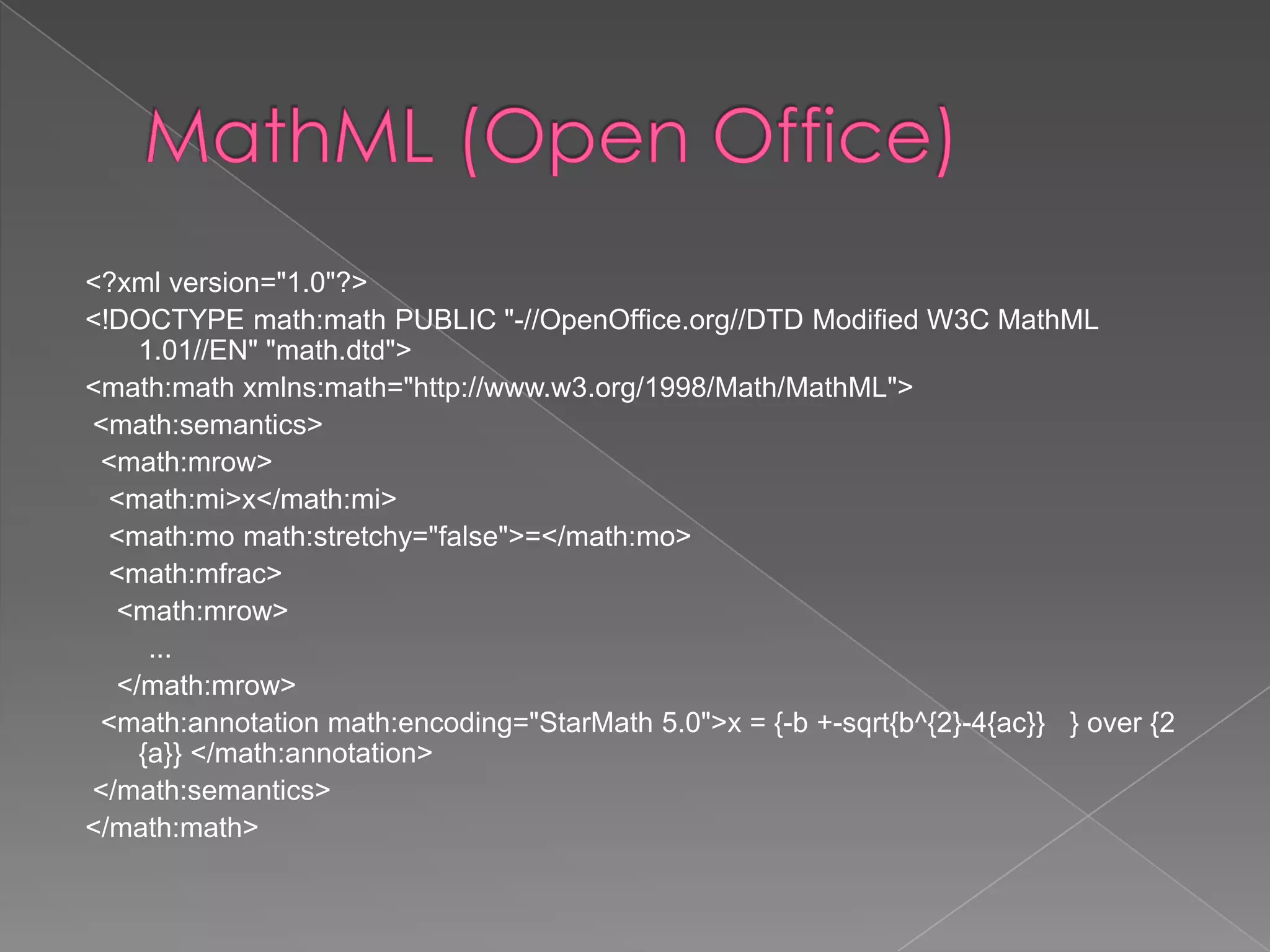
<?xml version="1.0"?>
<!DOCTYPE math:math PUBLIC "-//OpenOffice.org//DTD Modified W3C MathML
    1.01//EN" "math.dtd">
<math:math xmlns:math="http://www.w3.org/1998/Math/MathML">
<math:semantics>
 <math:mrow>
  <math:mi>x</math:mi>
  <math:mo math:stretchy="false">=</math:mo>
  <math:mfrac>
  <math:mrow>
     ...
  </math:mrow>
 <math:annotation math:encoding="StarMath 5.0">x = {-b +-sqrt{b^{2}-4{ac}} } over {2
    {a}} </math:annotation>
</math:semantics>
</math:math>
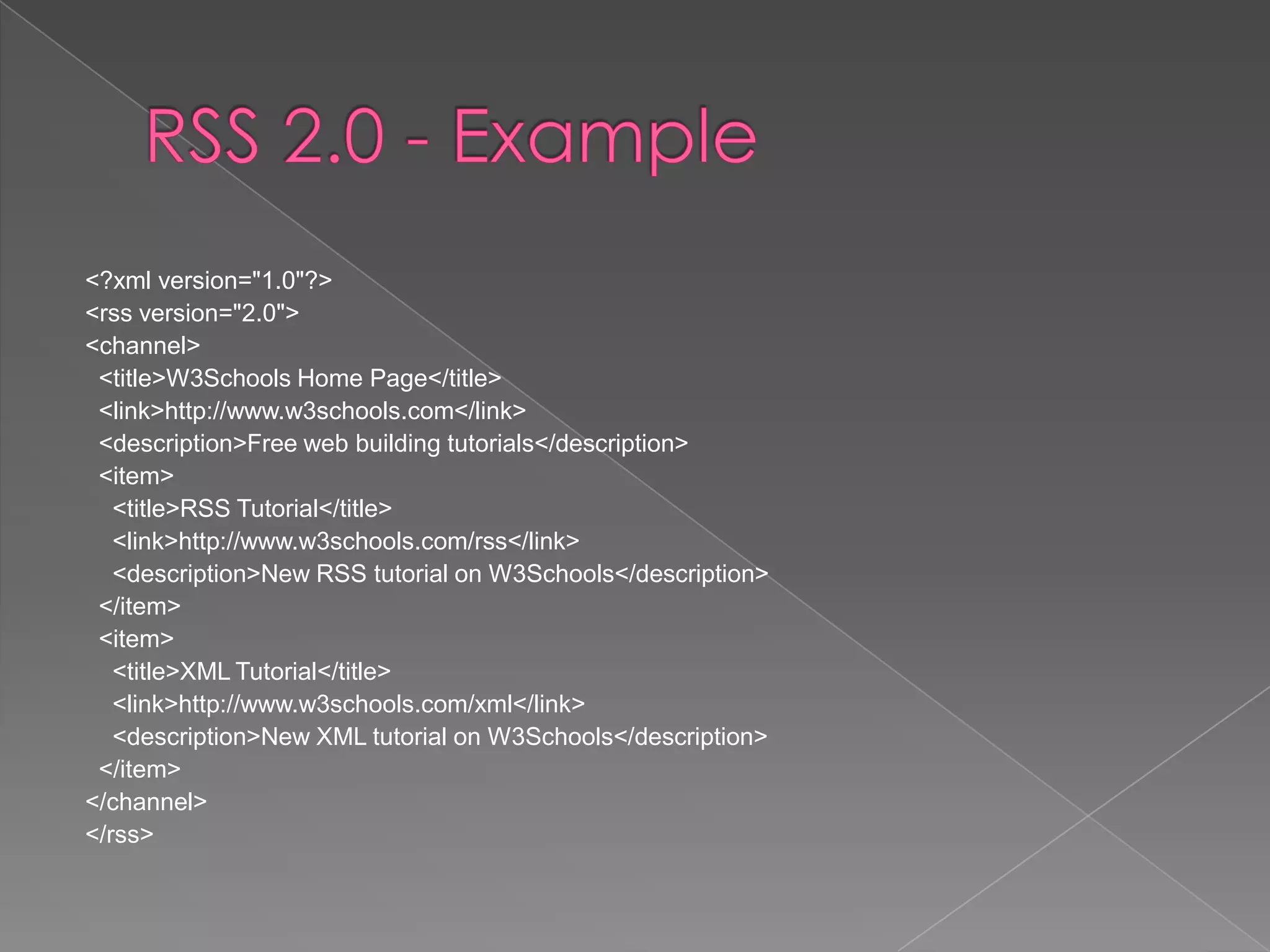
<?xml version="1.0"?>
<rss version="2.0">
<channel>
 <title>W3Schools Home Page</title>
 <link>http://www.w3schools.com</link>
 <description>Free web building tutorials</description>
 <item>
   <title>RSS Tutorial</title>
   <link>http://www.w3schools.com/rss</link>
   <description>New RSS tutorial on W3Schools</description>
 </item>
 <item>
   <title>XML Tutorial</title>
   <link>http://www.w3schools.com/xml</link>
   <description>New XML tutorial on W3Schools</description>
 </item>
</channel>
</rss>
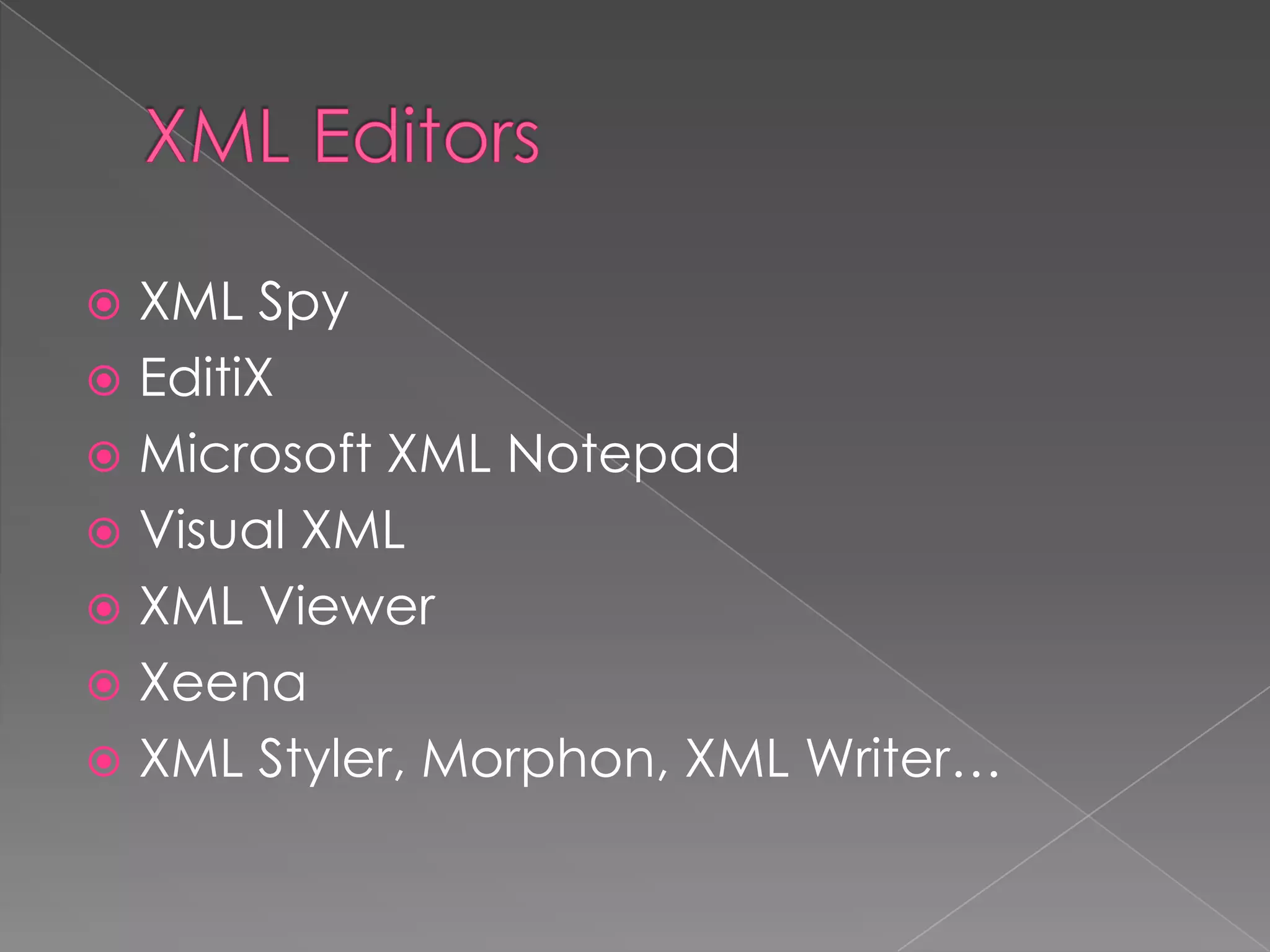
 XML Spy
 EditiX
 Microsoft XML Notepad
 Visual XML
 XML Viewer
 Xeena
 XML Styler, Morphon, XML Writer…
Rules that Apply to Every
XML-Document
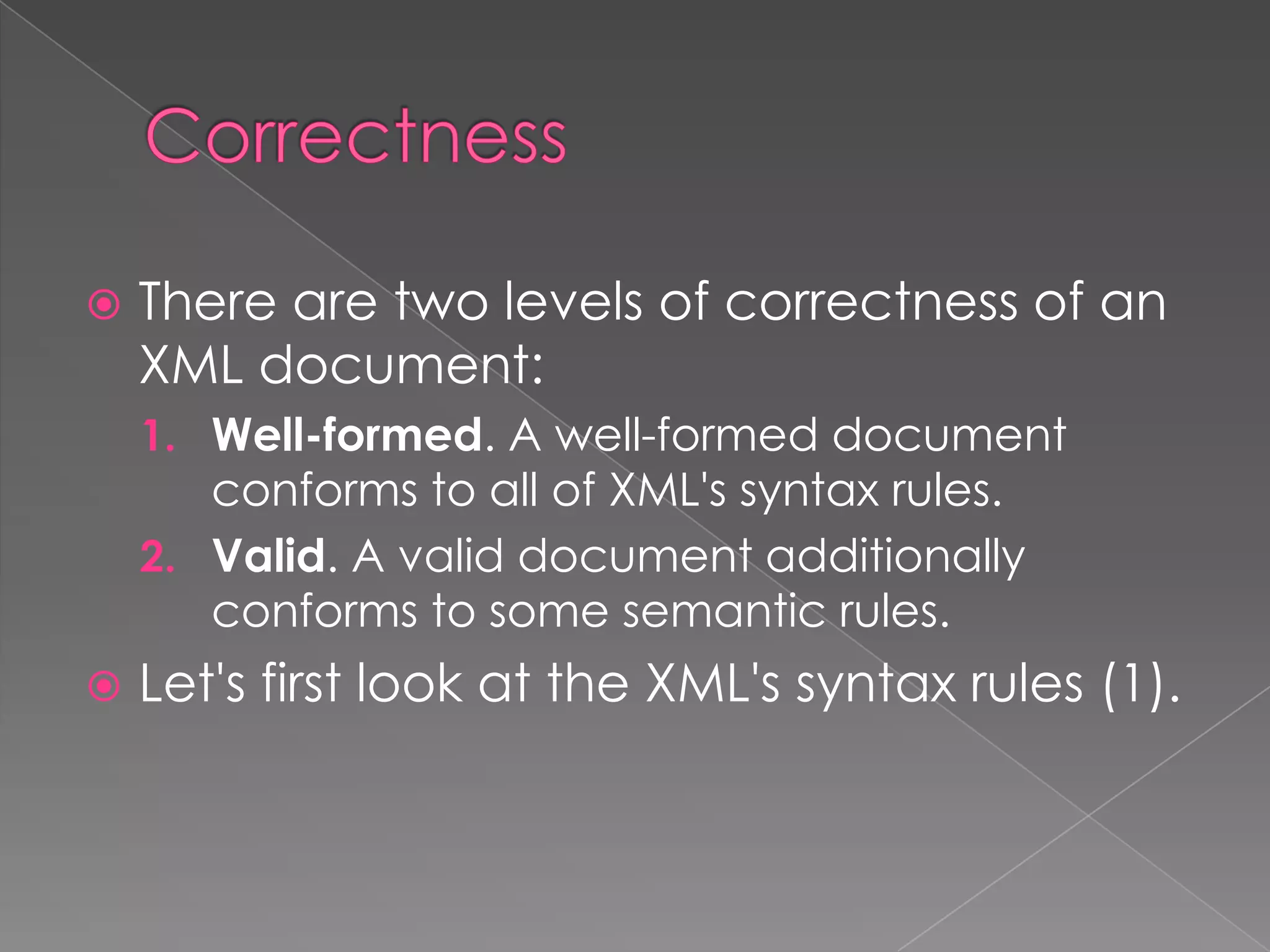
   There are two levels of correctness of an
    XML document:
    1. Well-formed. A well-formed document
       conforms to all of XML's syntax rules.
    2. Valid. A valid document additionally
       conforms to some semantic rules.
   Let's first look at the XML's syntax rules (1).
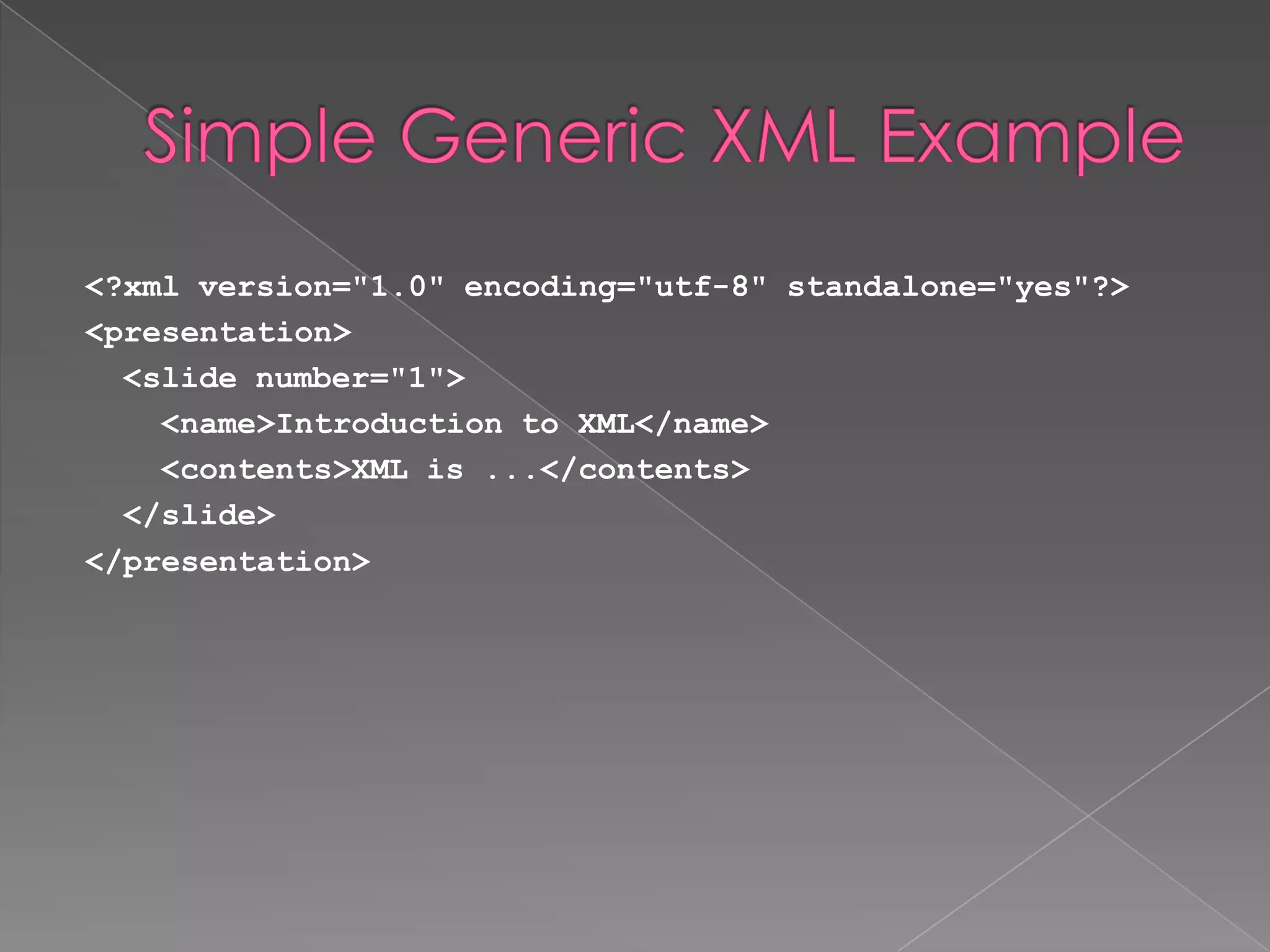
<?xml version="1.0" encoding="utf-8" standalone="yes"?>
<presentation>
  <slide number="1">
    <name>Introduction to XML</name>
    <contents>XML is ...</contents>
  </slide>
</presentation>
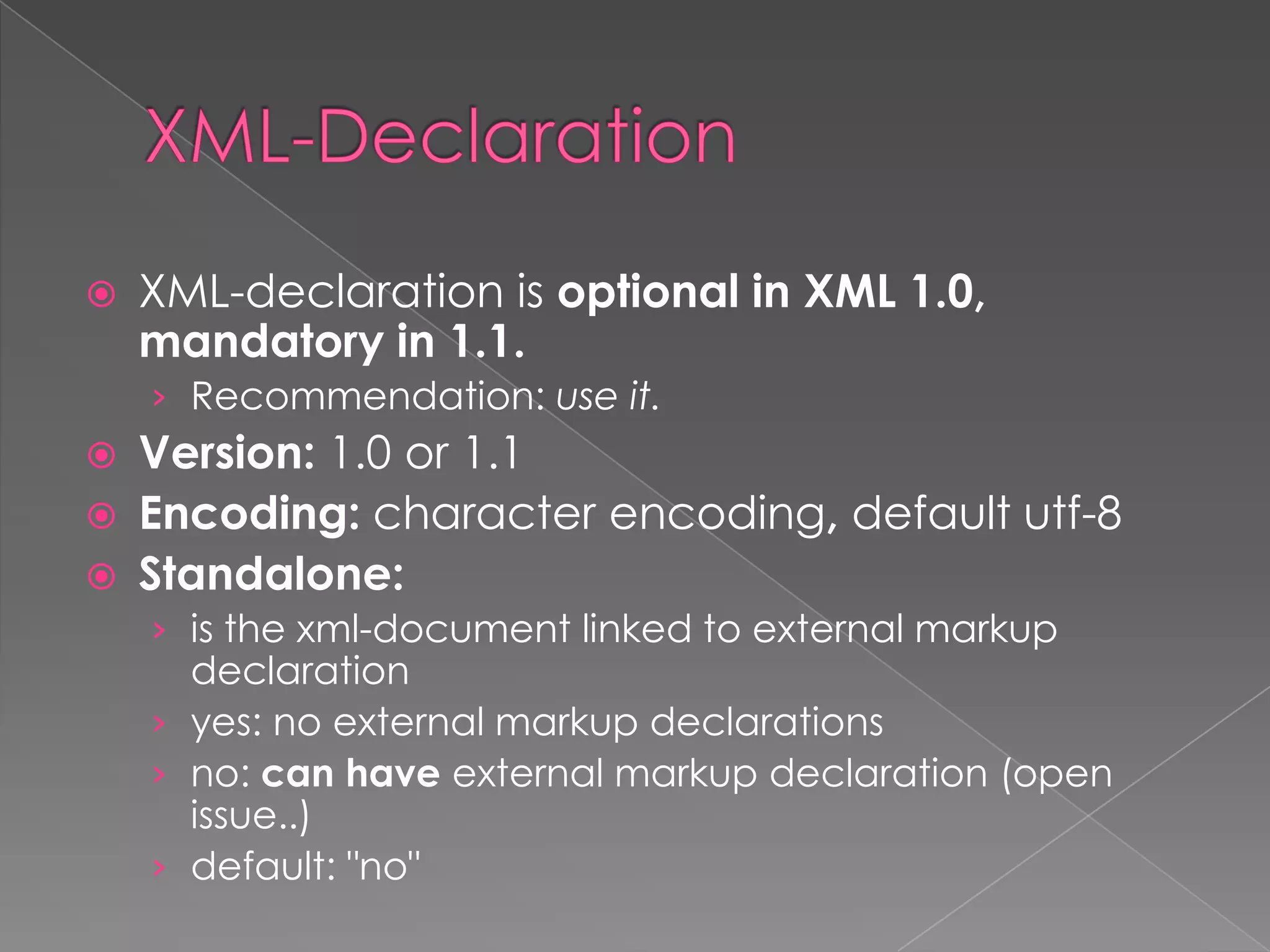
   XML-declaration is optional in XML 1.0,
    mandatory in 1.1.
    › Recommendation: use it.
   Version: 1.0 or 1.1
   Encoding: character encoding, default utf-8
   Standalone:
    › is the xml-document linked to external markup
      declaration
    › yes: no external markup declarations
    › no: can have external markup declaration (open
      issue..)
    › default: "no"
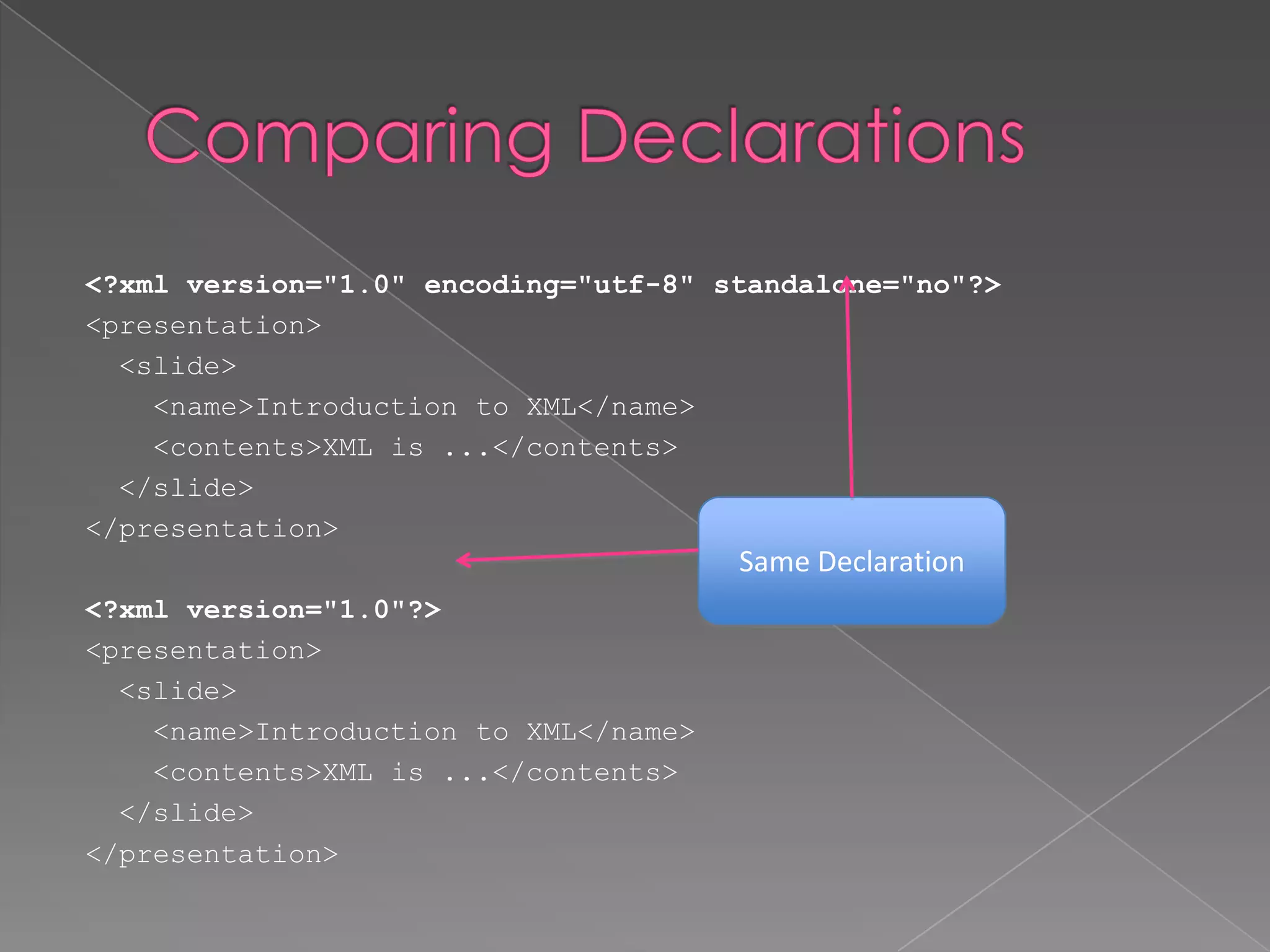
<?xml version="1.0" encoding="utf-8" standalone="no"?>
<presentation>
  <slide>
    <name>Introduction to XML</name>
    <contents>XML is ...</contents>
  </slide>
</presentation>
                                       Same Declaration
<?xml version="1.0"?>
<presentation>
  <slide>
    <name>Introduction to XML</name>
    <contents>XML is ...</contents>
  </slide>
</presentation>
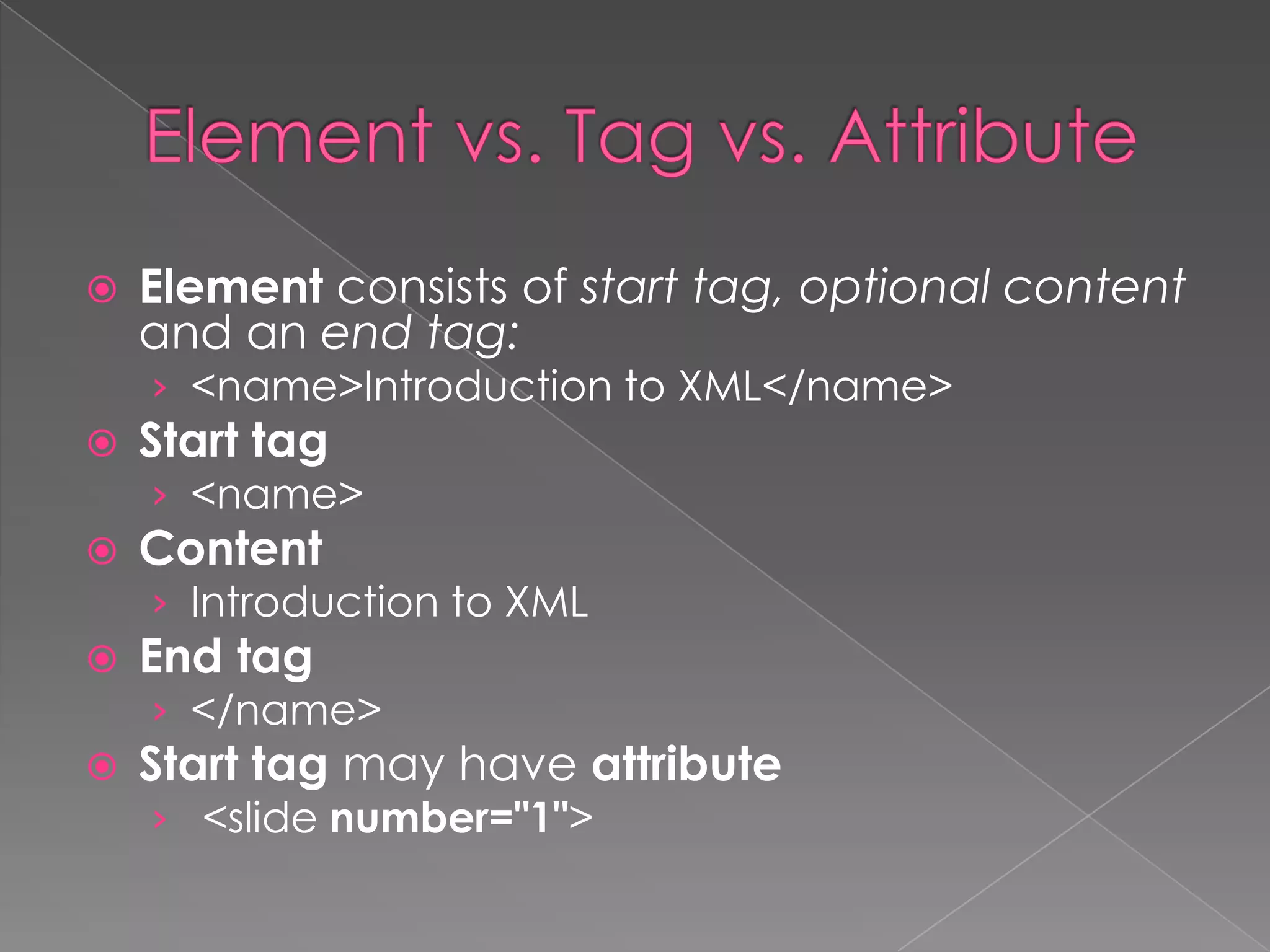
   Element consists of start tag, optional content
    and an end tag:
    › <name>Introduction to XML</name>
   Start tag
    › <name>
   Content
    › Introduction to XML
   End tag
    › </name>
   Start tag may have attribute
    › <slide number="1">
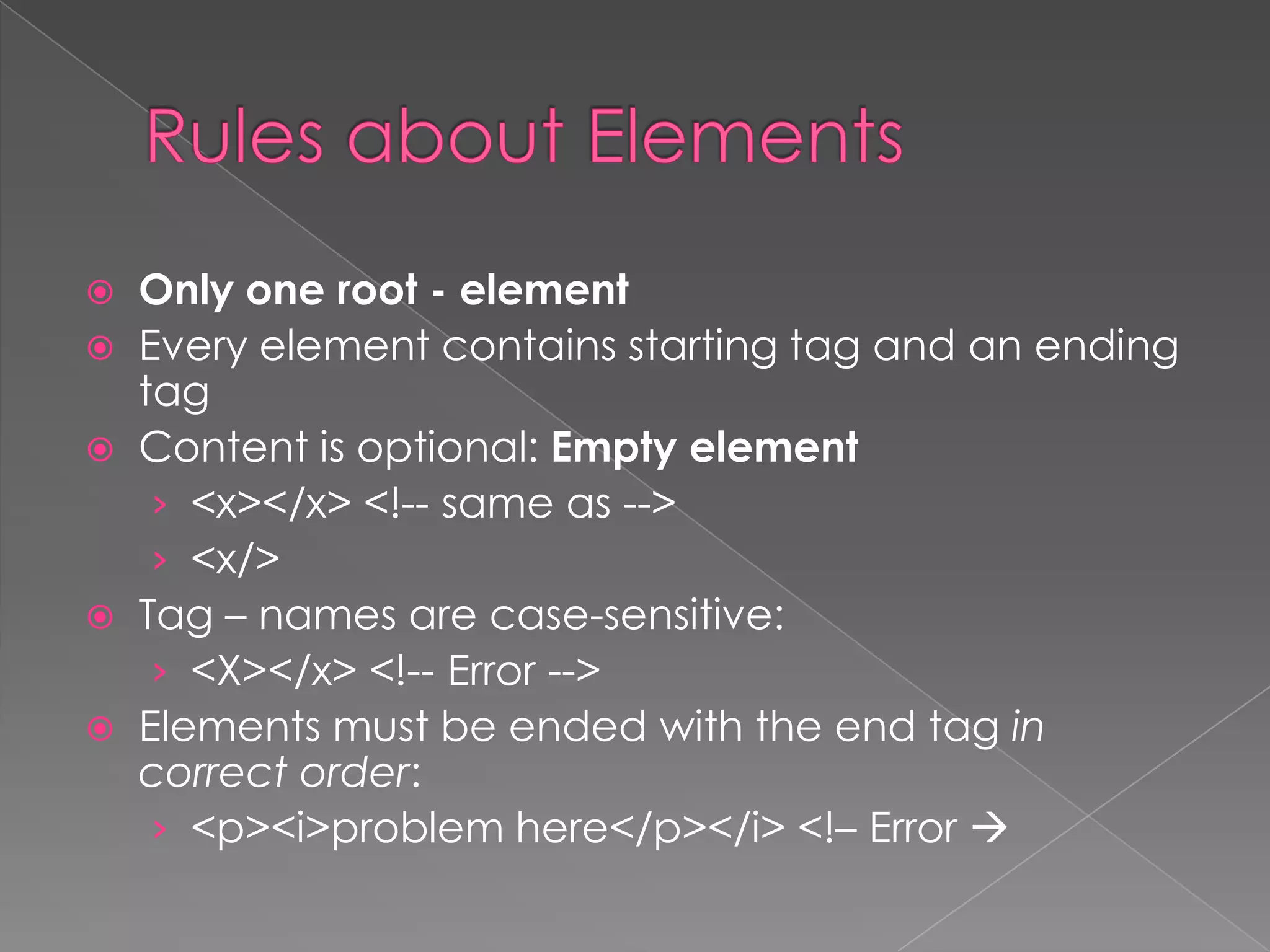
 Only one root - element
 Every element contains starting tag and an ending
  tag
 Content is optional: Empty element
   › <x></x> <!-- same as -->
   › <x/>
 Tag – names are case-sensitive:
   › <X></x> <!-- Error -->
 Elements must be ended with the end tag in
  correct order:
   › <p><i>problem here</p></i> <!– Error 
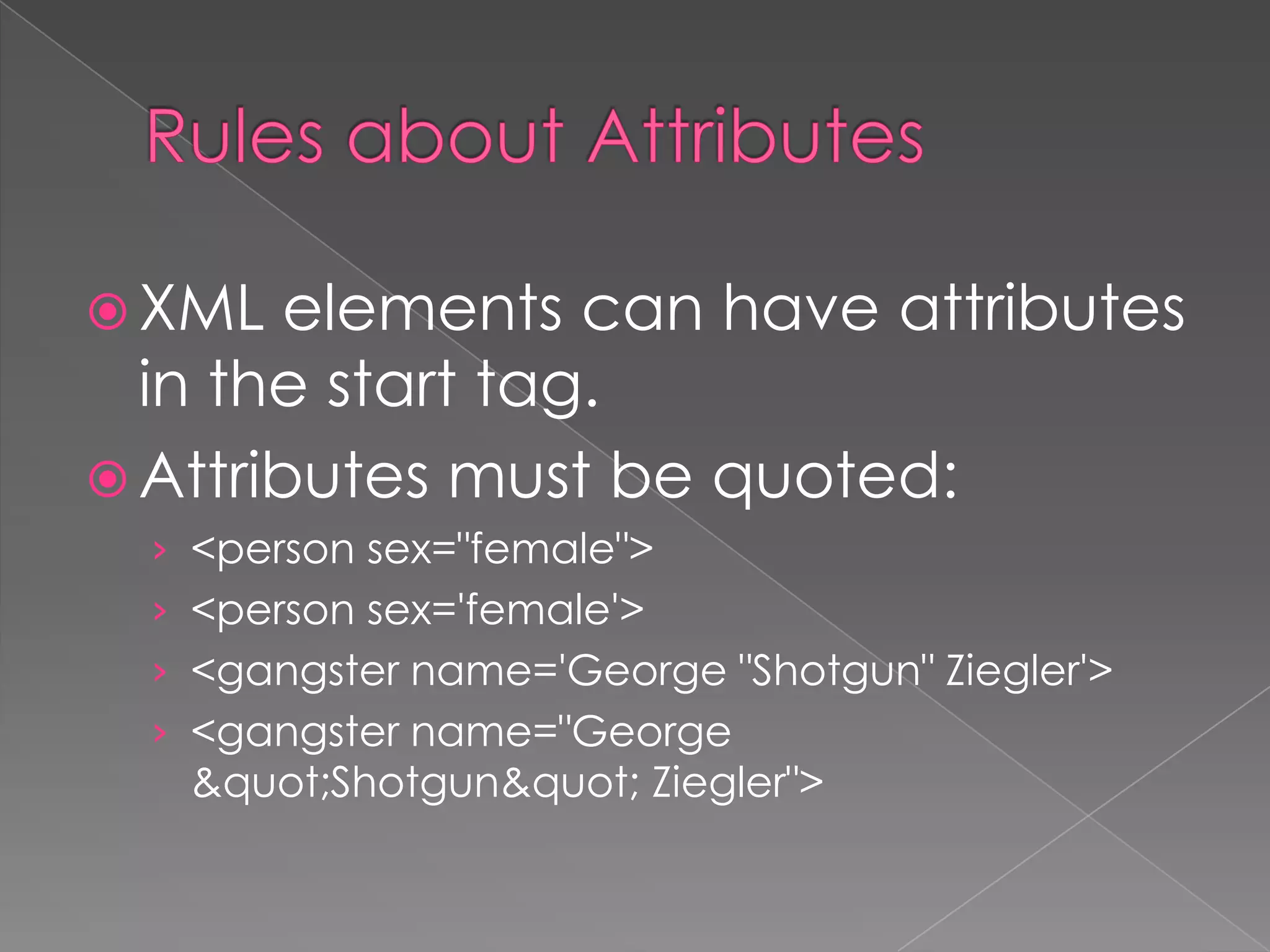
 XML   elements can have attributes
  in the start tag.
 Attributes must be quoted:
  › <person sex="female">
  › <person sex='female'>
  › <gangster name='George "Shotgun" Ziegler'>
  › <gangster name="George
   &quot;Shotgun&quot; Ziegler">
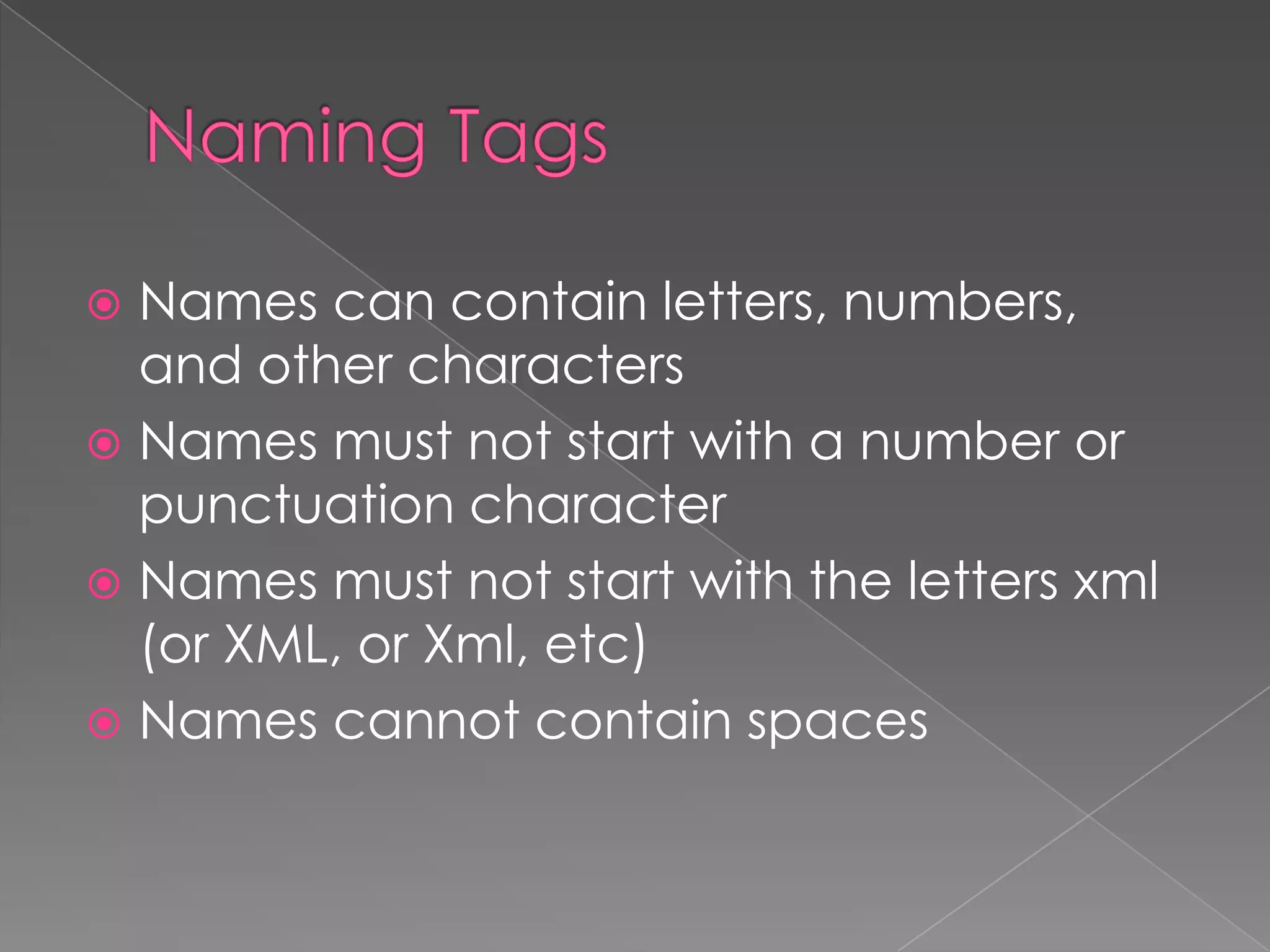
 Names can contain letters, numbers,
  and other characters
 Names must not start with a number or
  punctuation character
 Names must not start with the letters xml
  (or XML, or Xml, etc)
 Names cannot contain spaces
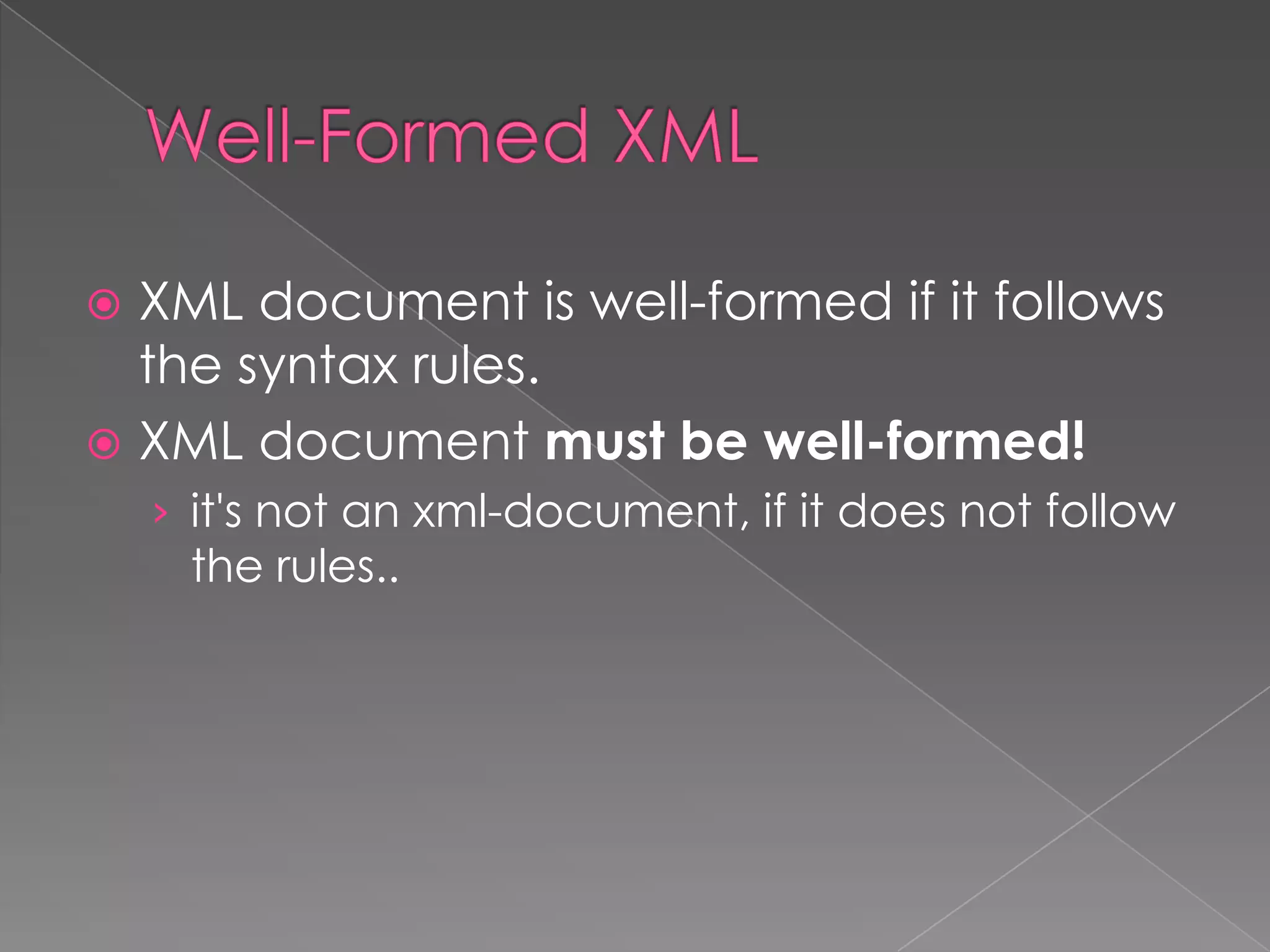
 XML document is well-formed if it follows
  the syntax rules.
 XML document must be well-formed!
    › it's not an xml-document, if it does not follow
     the rules..
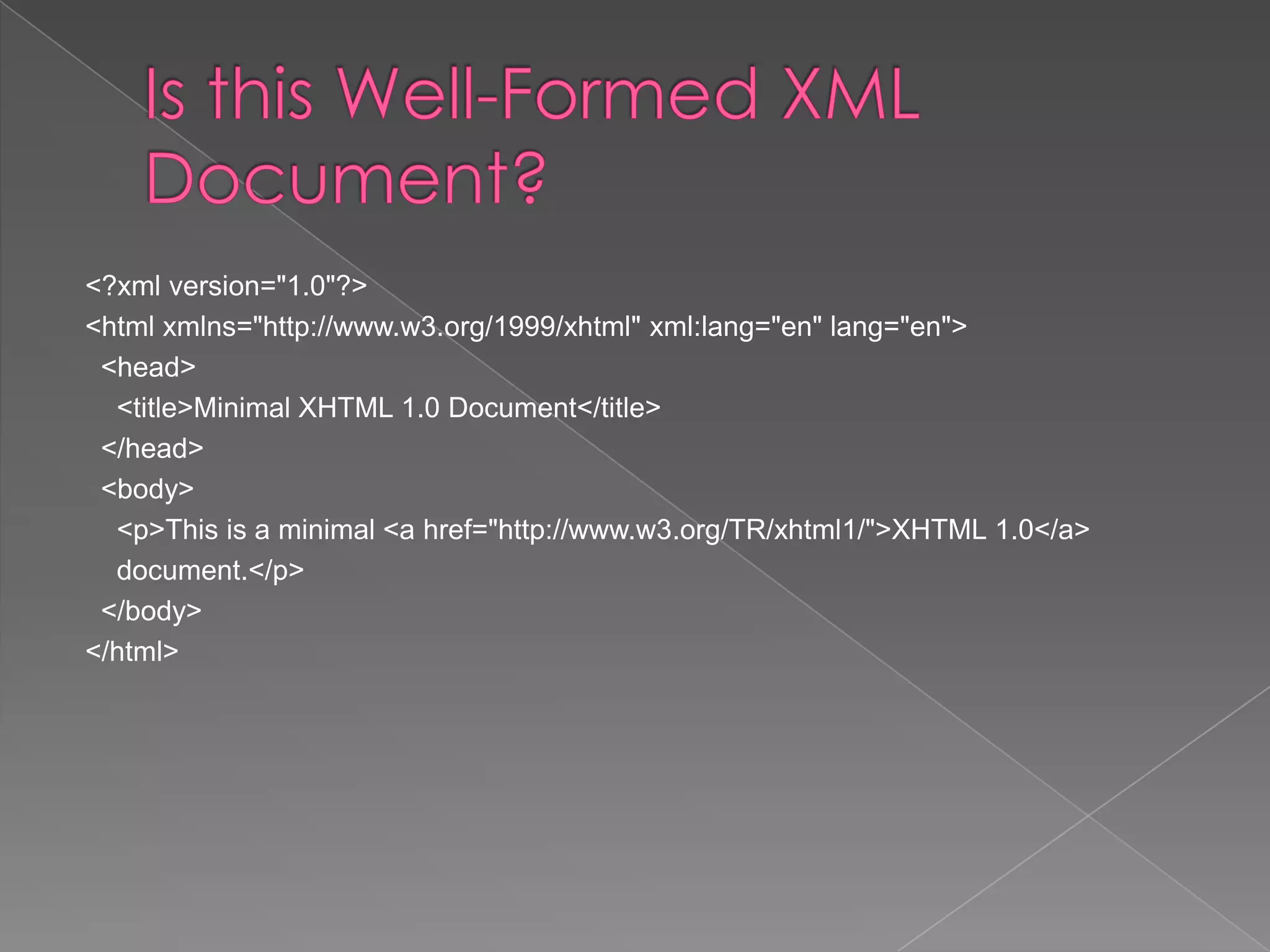
<?xml version="1.0"?>
<html xmlns="http://www.w3.org/1999/xhtml" xml:lang="en" lang="en">
 <head>
  <title>Minimal XHTML 1.0 Document</title>
 </head>
 <body>
  <p>This is a minimal <a href="http://www.w3.org/TR/xhtml1/">XHTML 1.0</a>
  document.</p>
 </body>
</html>
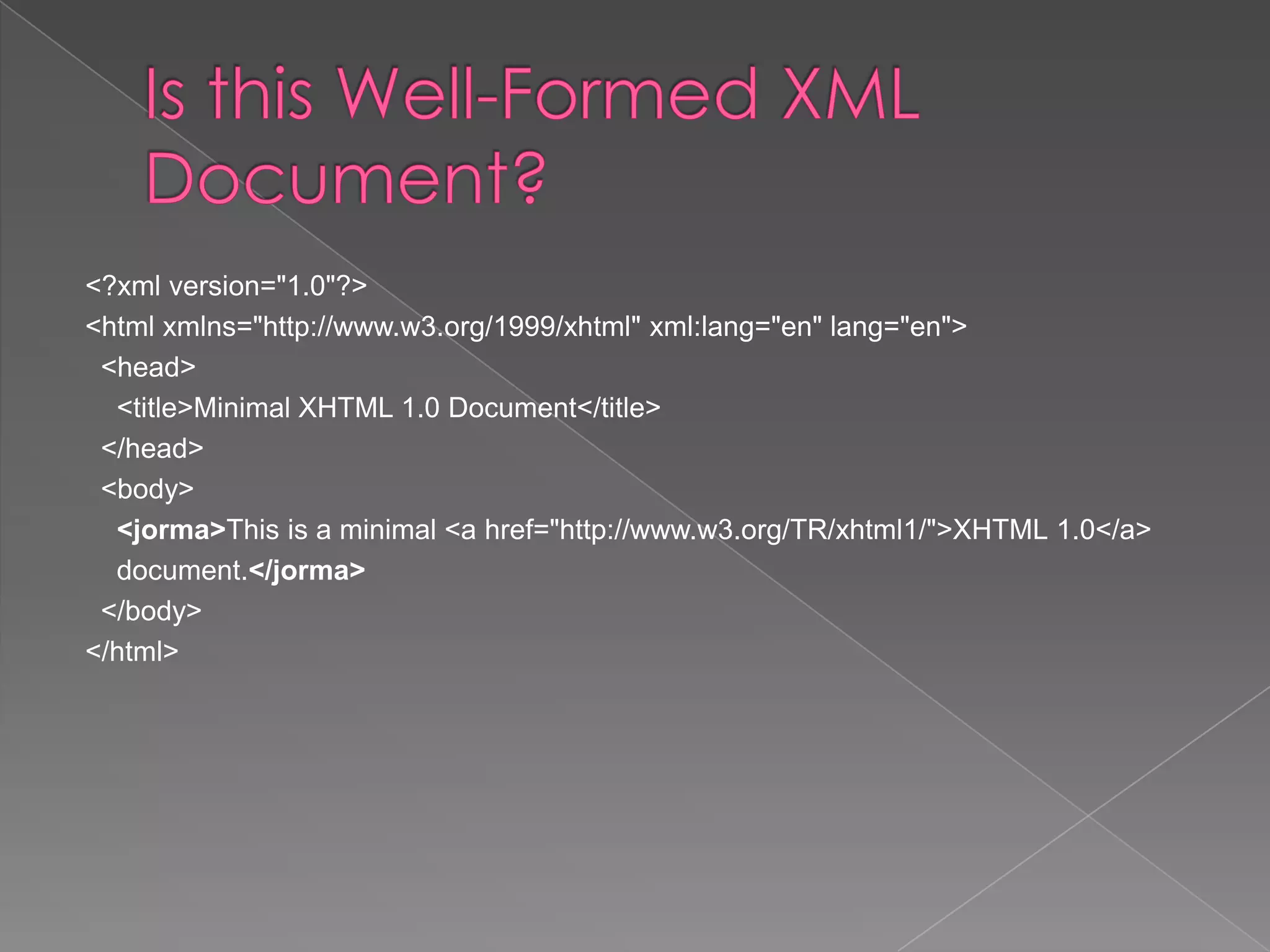
<?xml version="1.0"?>
<html xmlns="http://www.w3.org/1999/xhtml" xml:lang="en" lang="en">
 <head>
  <title>Minimal XHTML 1.0 Document</title>
 </head>
 <body>
  <jorma>This is a minimal <a href="http://www.w3.org/TR/xhtml1/">XHTML 1.0</a>
  document.</jorma>
 </body>
</html>
Defining the Structure for XML
documents
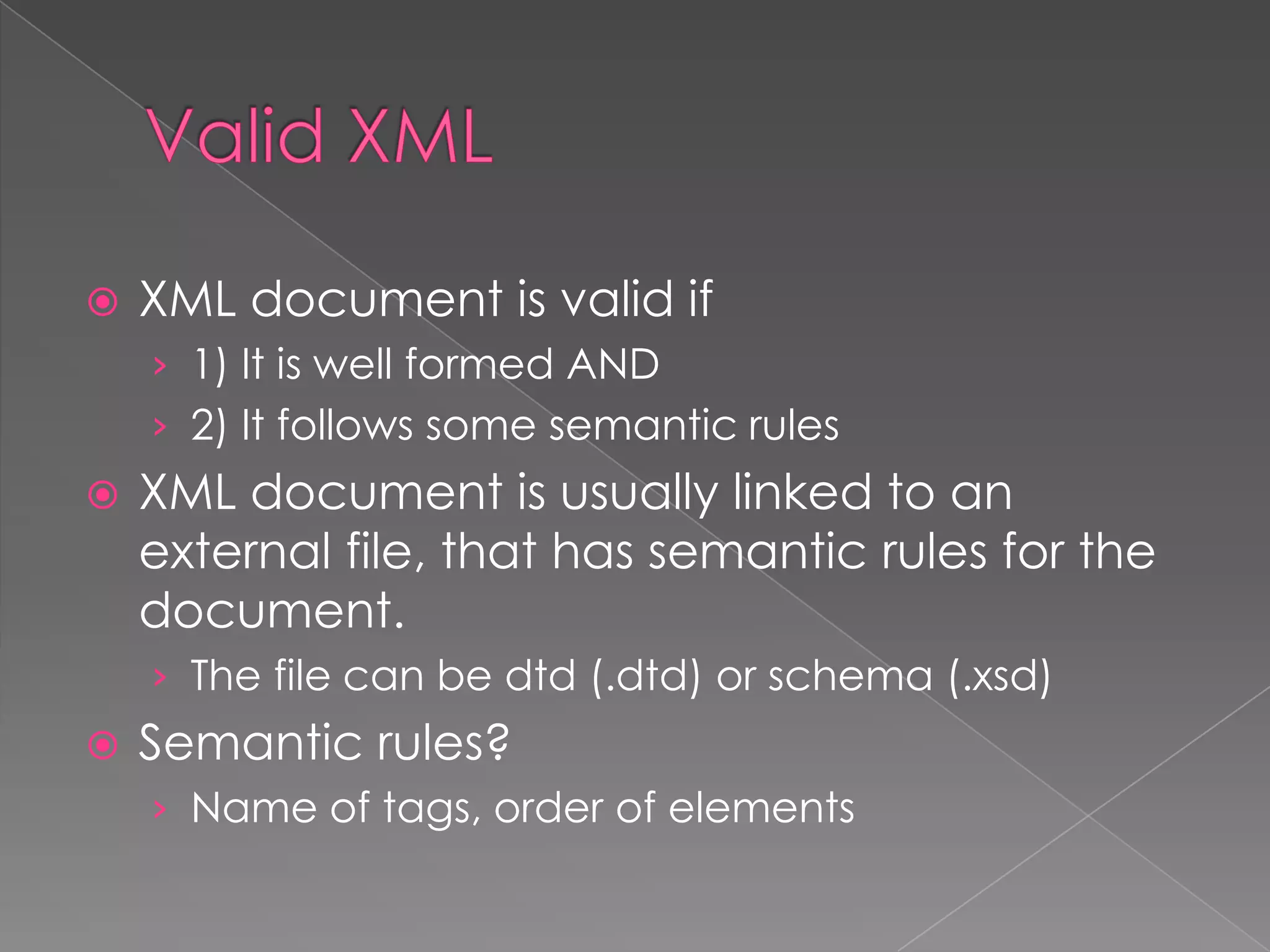
   XML document is valid if
    › 1) It is well formed AND
    › 2) It follows some semantic rules
   XML document is usually linked to an
    external file, that has semantic rules for the
    document.
    › The file can be dtd (.dtd) or schema (.xsd)
   Semantic rules?
    › Name of tags, order of elements
 Because of HTML heritage, browsers try
  to understand invalid XHTML-pages
 This is not the case in other XML-
  languages.
 In general, if XML-document is
  invalid, the processing of the document
  is cancelled.
 XML has strict rules for WF and Valid
 If application tries to manipulate xml-
  document it does not have to try to
  understand the possible errors in the
  document
 This means that handling xml-files via
  programming language is much easier
    › If the document is correctly formed,
      manipulate it
    › If it isn't display error
   For More Like Our Pages:
   https://www.facebook.com/allgtubooks
   https://www.facebook.com/gtumaterials
   https://www.facebook.com/GTU.Projects.Jobs

Introduction to xml

  • 2.
     eXtensible MarkupLanguage, is a specification for creating custom markup languages  W3C Recommendation  Primary purpose is to help computers to share data  XML is meta-language. This means that you use it for creating languages.  XML is an extensive concept.
  • 3.
     Every XML-documentis text-based  => sharing data between different computers!  => sharing data in Internet!  => platform independence!
  • 4.
    Problems with Binary format › Platform depence › Firewalls › Hard to debug › Inspecting the file can be hard  Since XML is text-based, it does not have the problems mentioned above.  What are the disadvantages in text format?
  • 5.
    XML is meta language, which you can use to create your own markup languages.  There are several XML Markup Languages made for different purposes  All the languages have common xml-rules  Languages: XHTML, OOXML, Open Document, RSS, SVG, SOAP, SMIL, MathML...  List: › http://en.wikipedia.org/wiki/List_of_XML_markup_languag es
  • 6.
    <?xml version="1.0"?> <!DOCTYPE html PUBLIC "-//W3C//DTD XHTML 1.0 Strict//EN" "http://www.w3.org/TR/xhtml1/DTD/xhtml1-strict.dtd"> <html xmlns="http://www.w3.org/1999/xhtml" xml:lang="en" lang="en"> <head> <title>Minimal XHTML 1.0 Document</title> </head> <body> <p>This is a minimal <a href="http://www.w3.org/TR/xhtml1/">XHTML 1.0</a> document.</p> </body> </html>
  • 7.
    <?xml version="1.0"?> <!DOCTYPE svg PUBLIC "-//W3C//DTD SVG 1.1//EN" "http://www.w3.org/Graphics/SVG/1.1/DTD/svg11.dtd"> <svg width="100%" height="100%" version="1.1" xmlns="http://www.w3.org/2000/svg"> <circle cx="100" cy="50" r="40" stroke="black" stroke-width="2" fill="red"/> </svg>
  • 8.
    <?xml version="1.0"?> <!DOCTYPE math:mathPUBLIC "-//OpenOffice.org//DTD Modified W3C MathML 1.01//EN" "math.dtd"> <math:math xmlns:math="http://www.w3.org/1998/Math/MathML"> <math:semantics> <math:mrow> <math:mi>x</math:mi> <math:mo math:stretchy="false">=</math:mo> <math:mfrac> <math:mrow> ... </math:mrow> <math:annotation math:encoding="StarMath 5.0">x = {-b +-sqrt{b^{2}-4{ac}} } over {2 {a}} </math:annotation> </math:semantics> </math:math>
  • 9.
    <?xml version="1.0"?> <rss version="2.0"> <channel> <title>W3Schools Home Page</title> <link>http://www.w3schools.com</link> <description>Free web building tutorials</description> <item> <title>RSS Tutorial</title> <link>http://www.w3schools.com/rss</link> <description>New RSS tutorial on W3Schools</description> </item> <item> <title>XML Tutorial</title> <link>http://www.w3schools.com/xml</link> <description>New XML tutorial on W3Schools</description> </item> </channel> </rss>
  • 10.
     XML Spy EditiX  Microsoft XML Notepad  Visual XML  XML Viewer  Xeena  XML Styler, Morphon, XML Writer…
  • 11.
    Rules that Applyto Every XML-Document
  • 12.
    There are two levels of correctness of an XML document: 1. Well-formed. A well-formed document conforms to all of XML's syntax rules. 2. Valid. A valid document additionally conforms to some semantic rules.  Let's first look at the XML's syntax rules (1).
  • 13.
    <?xml version="1.0" encoding="utf-8"standalone="yes"?> <presentation> <slide number="1"> <name>Introduction to XML</name> <contents>XML is ...</contents> </slide> </presentation>
  • 14.
    XML-declaration is optional in XML 1.0, mandatory in 1.1. › Recommendation: use it.  Version: 1.0 or 1.1  Encoding: character encoding, default utf-8  Standalone: › is the xml-document linked to external markup declaration › yes: no external markup declarations › no: can have external markup declaration (open issue..) › default: "no"
  • 15.
    <?xml version="1.0" encoding="utf-8"standalone="no"?> <presentation> <slide> <name>Introduction to XML</name> <contents>XML is ...</contents> </slide> </presentation> Same Declaration <?xml version="1.0"?> <presentation> <slide> <name>Introduction to XML</name> <contents>XML is ...</contents> </slide> </presentation>
  • 16.
    Element consists of start tag, optional content and an end tag: › <name>Introduction to XML</name>  Start tag › <name>  Content › Introduction to XML  End tag › </name>  Start tag may have attribute › <slide number="1">
  • 17.
     Only oneroot - element  Every element contains starting tag and an ending tag  Content is optional: Empty element › <x></x> <!-- same as --> › <x/>  Tag – names are case-sensitive: › <X></x> <!-- Error -->  Elements must be ended with the end tag in correct order: › <p><i>problem here</p></i> <!– Error 
  • 18.
     XML elements can have attributes in the start tag.  Attributes must be quoted: › <person sex="female"> › <person sex='female'> › <gangster name='George "Shotgun" Ziegler'> › <gangster name="George &quot;Shotgun&quot; Ziegler">
  • 19.
     Names cancontain letters, numbers, and other characters  Names must not start with a number or punctuation character  Names must not start with the letters xml (or XML, or Xml, etc)  Names cannot contain spaces
  • 20.
     XML documentis well-formed if it follows the syntax rules.  XML document must be well-formed! › it's not an xml-document, if it does not follow the rules..
  • 21.
    <?xml version="1.0"?> <html xmlns="http://www.w3.org/1999/xhtml"xml:lang="en" lang="en"> <head> <title>Minimal XHTML 1.0 Document</title> </head> <body> <p>This is a minimal <a href="http://www.w3.org/TR/xhtml1/">XHTML 1.0</a> document.</p> </body> </html>
  • 22.
    <?xml version="1.0"?> <html xmlns="http://www.w3.org/1999/xhtml"xml:lang="en" lang="en"> <head> <title>Minimal XHTML 1.0 Document</title> </head> <body> <jorma>This is a minimal <a href="http://www.w3.org/TR/xhtml1/">XHTML 1.0</a> document.</jorma> </body> </html>
  • 23.
    Defining the Structurefor XML documents
  • 24.
    XML document is valid if › 1) It is well formed AND › 2) It follows some semantic rules  XML document is usually linked to an external file, that has semantic rules for the document. › The file can be dtd (.dtd) or schema (.xsd)  Semantic rules? › Name of tags, order of elements
  • 25.
     Because ofHTML heritage, browsers try to understand invalid XHTML-pages  This is not the case in other XML- languages.  In general, if XML-document is invalid, the processing of the document is cancelled.
  • 26.
     XML hasstrict rules for WF and Valid  If application tries to manipulate xml- document it does not have to try to understand the possible errors in the document  This means that handling xml-files via programming language is much easier › If the document is correctly formed, manipulate it › If it isn't display error
  • 27.
    For More Like Our Pages:  https://www.facebook.com/allgtubooks  https://www.facebook.com/gtumaterials  https://www.facebook.com/GTU.Projects.Jobs