
INTRODUCTIONTO VALIDATION
Prepared by : Ashvin D. Bhoge
Roll No : 517
M.PHARM (PQA)
Subject : Pharmaceutical Validation
Dr.D.Y. Patil College of Pharmacy, Akurdi
CONTENTS
1. Definition
2. Scope of calibration
3. Scope of validation
4. Frequency of calibration
5. Importance/ purpose of calibration
6. Importance/ advantages of validation
7. Difference between calibration &
validation
PHARMACEUTICAL VALIDATION 2
DEFINATION
• VALIDATION
A “documented programme”, which provide
a high degree of assurance that a specific
process will consistently produce, a product
meeting its pre-deter mined specification and
a quality attributes.
PHARMACEUTICAL VALIDATION 3
TYPE OF VALIDATION
1. Process Validation
2. Cleaning Validation
3. Validation Of Analytical Method
a) Prospective
validation
b) Concurrent validation
c) Re-validation
d) Retrospective
validation
PHARMACEUTICAL VALIDATION 4
• CALIBRATION
Calibration is a process where a comparison is made
between two entities, one whose value has to be
measured and the other entity, known as the standard,
which is used as the reference in the comparison
 Methods for calibration:
1. Standard Calibration
2. Calibration with Data
3. ISO 17025Accredited
calibration
PHARMACEUTICAL VALIDATION 5
Methodsforcalibration
1. Standard Calibration: This method is mostly
preferred for calibrating instrument that are non-
critical to quality or not required for accreditation
and license purposes.
2. Calibration With Data: Procedure for calibration
with data are similar to that of accredited
calibration. Only exception being that these
procedure are not accredited to the ISO standard.
Moreover, they not accompanied by data on
measurement uncertainties.
PHARMACEUTICAL VALIDATION 6
3. ISO 17025 Accredited Calibration:
This has to be a strictest method of calibration.
Generally it requires a measurement reports which has
the details of the measurement that are maid against
the standard of "as found" (before calibration is
started) & "as left" (once the calibration is completed).
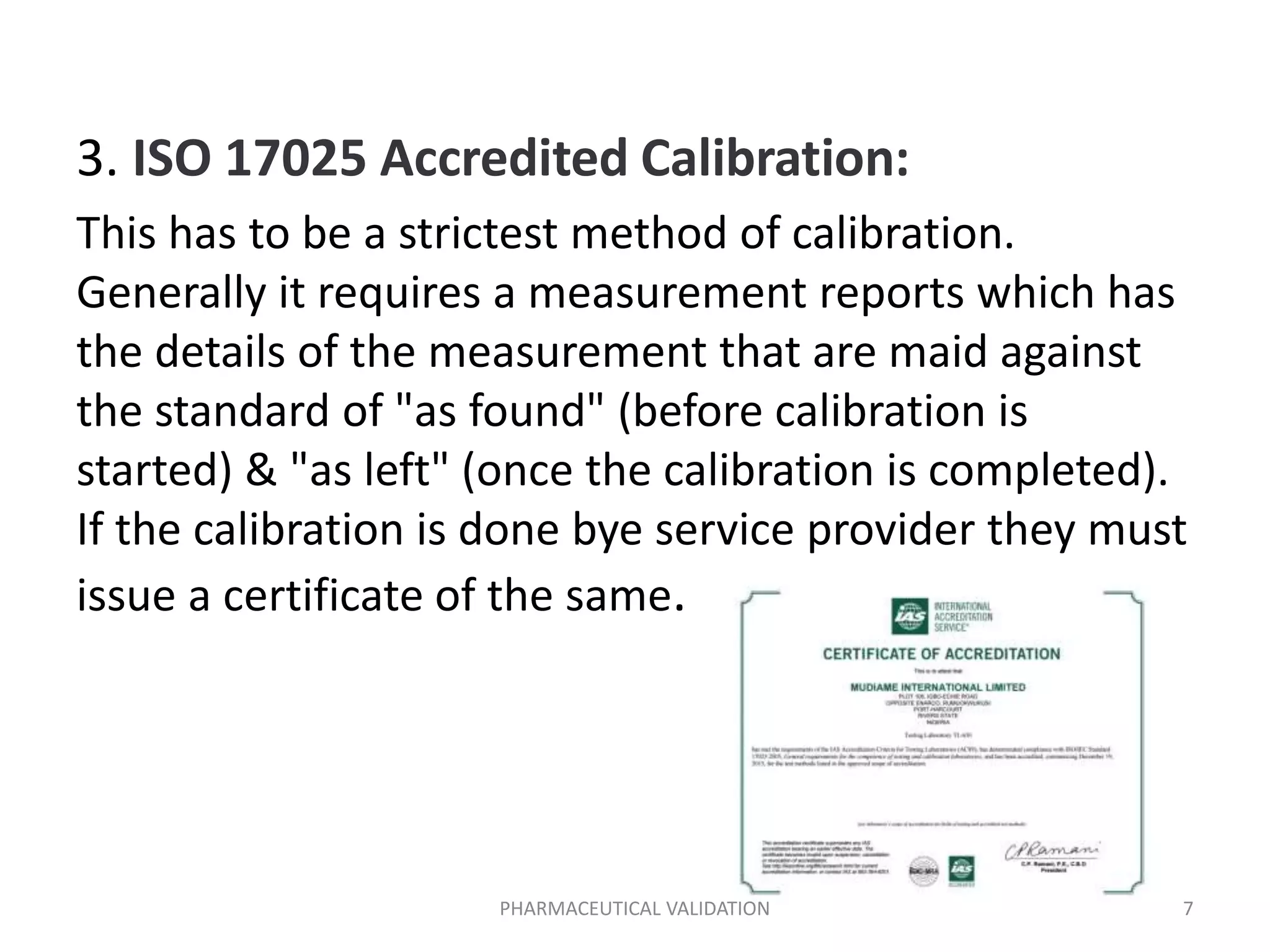
If the calibration is done bye service provider they must
issue a certificate of the same.
PHARMACEUTICAL VALIDATION 7
QULIFICATION
Qualification is a process of assurance that the specific
system, premises or equipment are able to achieve the
predetermined acceptance criteria to confirm the
attributes what it purpose to do.
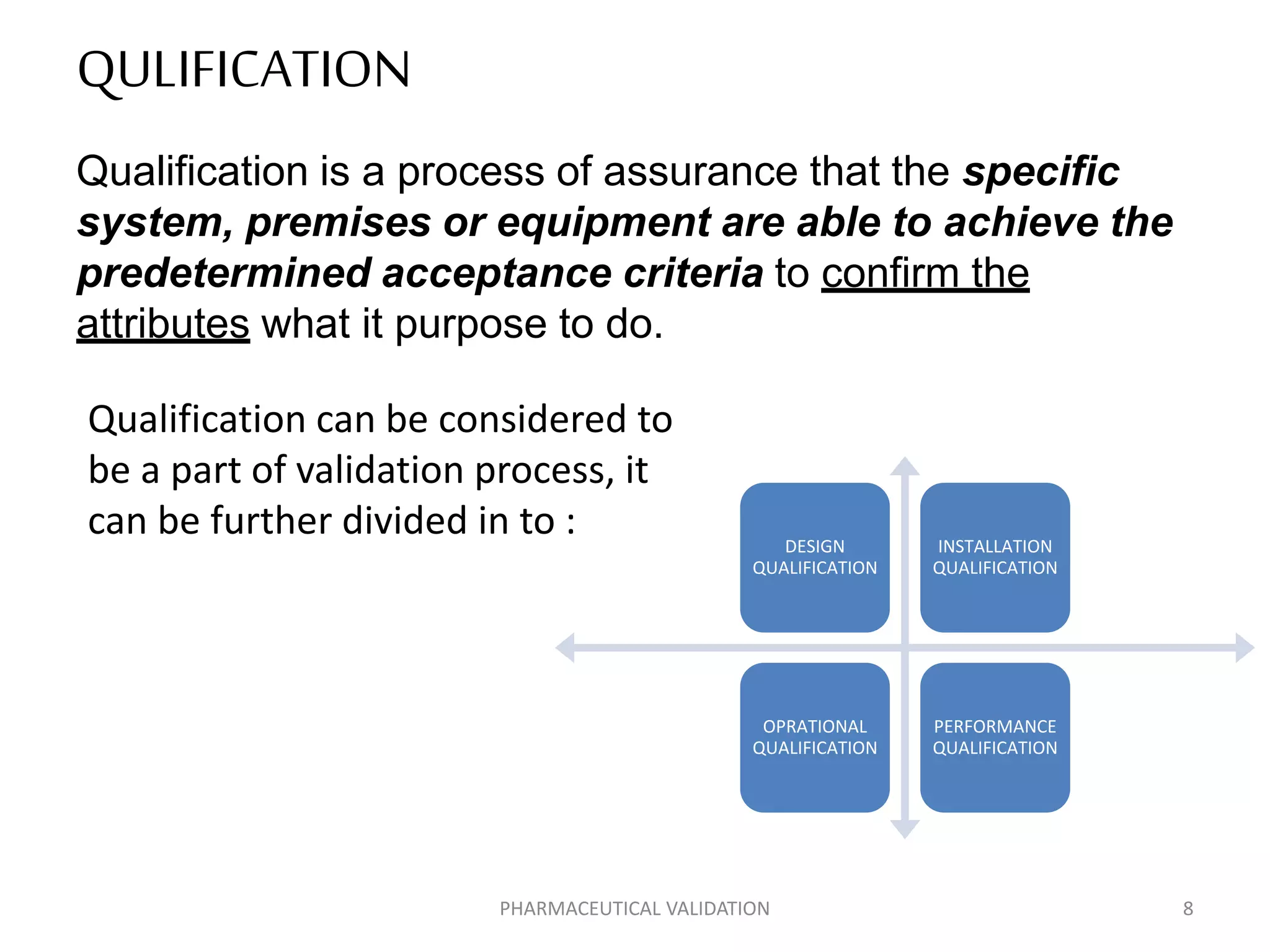
Qualification can be considered to
be a part of validation process, it
can be further divided in to : DESIGN
QUALIFICATION
INSTALLATION
QUALIFICATION
OPRATIONAL
QUALIFICATION
PERFORMANCE
QUALIFICATION
PHARMACEUTICAL VALIDATION 8
1.Design qualification(DQ): It is documented
evidence that proposed design of the facilities,
system and equipment is suitable for intended use.
Purpose: To ensure that all the requirements for the
final system have been clearly defined at the start.
PHARMACEUTICAL VALIDATION 9
2.Installation Qualification (IQ):It is
documented evidence that the premises, supporting
utilities, the equipment have been built and installed in
compliance with designspecifications.
Purpose: To check the installation site/ environment &
verifies the condition of installed equipment.
Also to ensure that allaspect of
equipment installed correctly and
complies with theoriginal design.
PHARMACEUTICAL VALIDATION 10
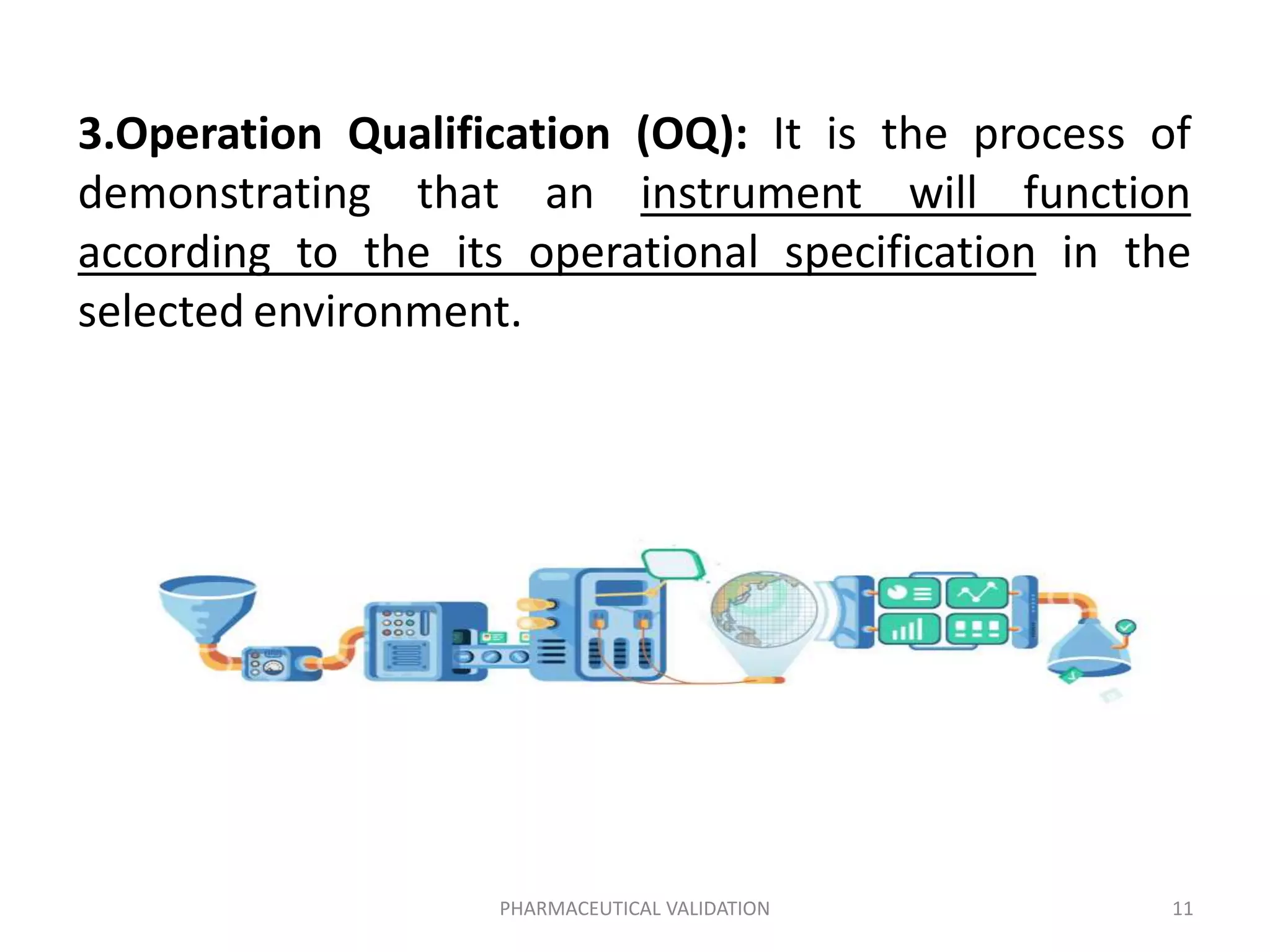
3.Operation Qualification (OQ): It is the process of
demonstrating that an instrument will function
according to the its operational specification in the
selected environment.
PHARMACEUTICAL VALIDATION 11
4. Performance Qualification (PQ): It is the
process that ensure the process under
anticipated conditions, consistently produces a
product which meets all pre-deter mined
requirements.
Purpose: It is ensure that the instrument is
performing within specified limits.
PHARMACEUTICAL VALIDATION 12
SCOPE ANDPURPOSE OF CALIBRATION
• To make sure that the readings of equipment or
instruments are consistent with other measurements
and display the correct readings every single time.
• To determine the accuracy, precision, reliability and
deviation of the measurements produced by all the
instruments.
PHARMACEUTICAL VALIDATION 13
• To establish the reliability of the instrument
being used and whether it can be trusted to
deliver repeatable results each time.
PHARMACEUTICAL VALIDATION 14
IMPORTANCEOF CALIBRATION
 Calibration is responsible for defining the accuracy of
any measurement and its quality that is recorded by any
instrument.
 Regularly calibration of any equipment can eliminate the
draft at its building stage instead of allowing it to grow till
it affects the measurement in significant ways.
 Calibration helps in quantifying and controlling errors and
uncertainties within various measurement process to an
acceptable level.
 Further, it helps in improving the accuracy of the
measuring device, which in turn improves the quality of
the FPP.
PHARMACEUTICAL VALIDATION 15
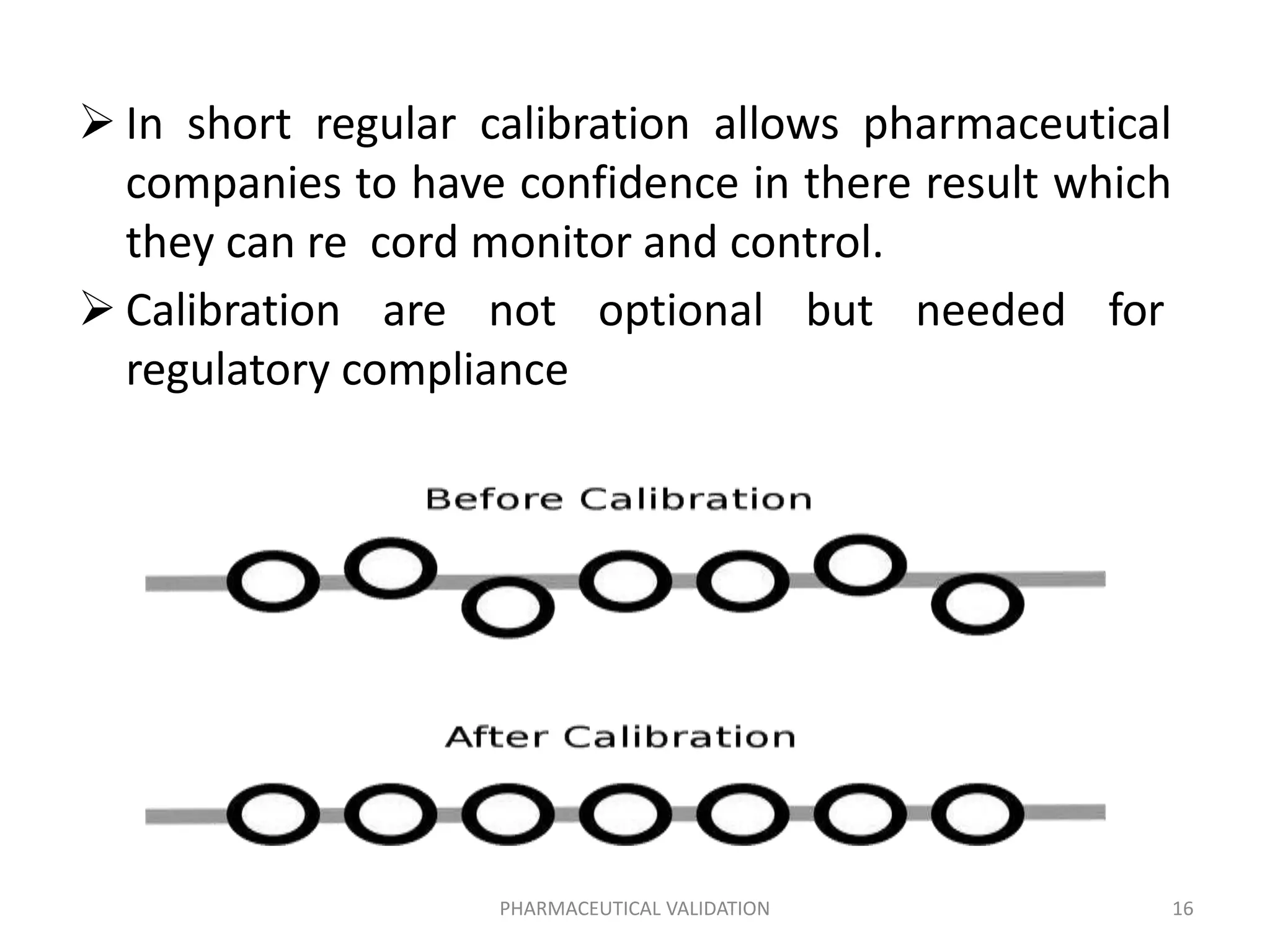
 In short regular calibration allows pharmaceutical
companies to have confidence in there result which
they can re cord monitor and control.
 Calibration are not optional but needed for
regulatory compliance
PHARMACEUTICAL VALIDATION 16
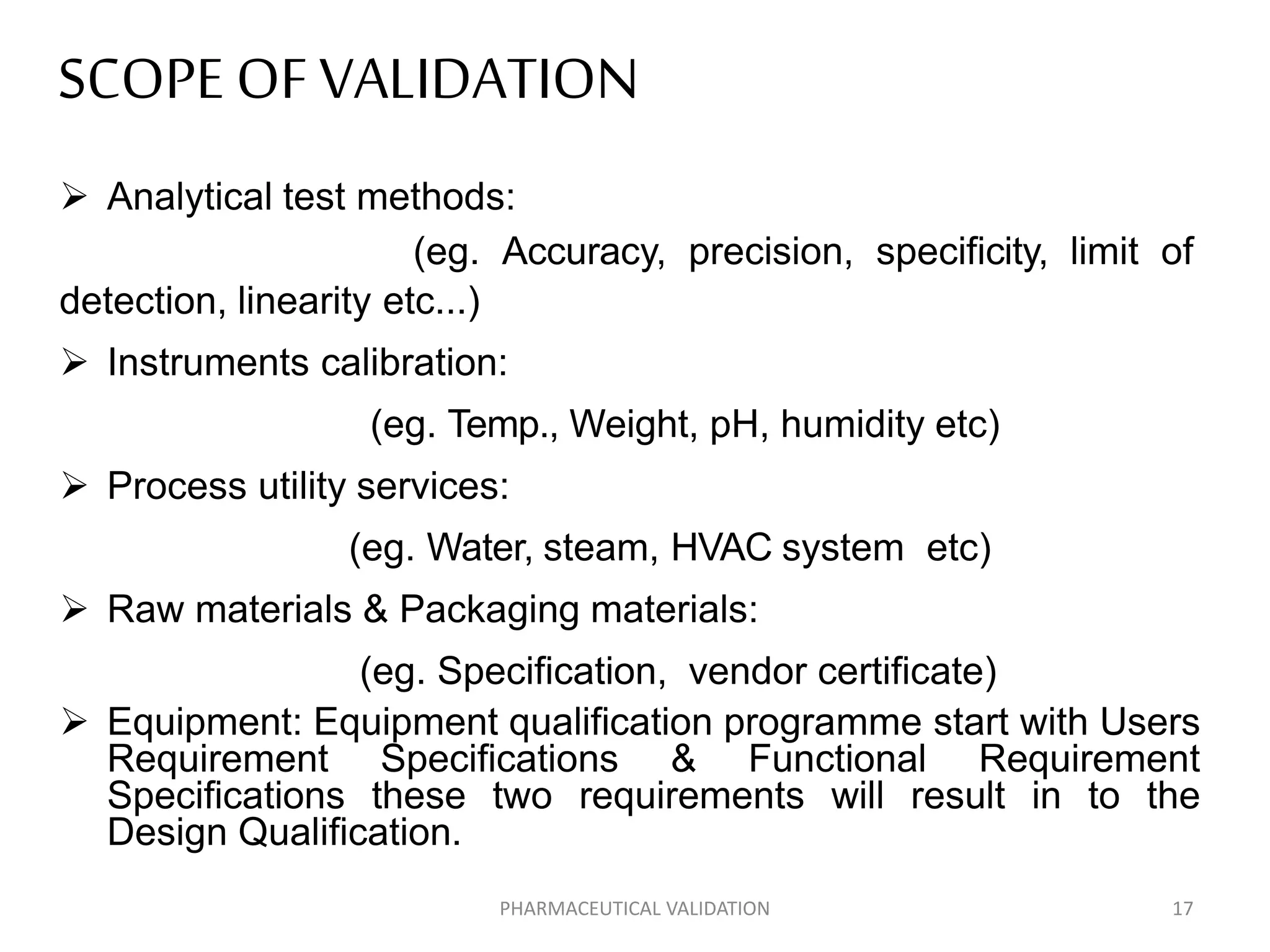
SCOPE OFVALIDATION
 Analytical test methods:
(eg. Accuracy, precision, specificity, limit of
detection, linearity etc...)
 Instruments calibration:
(eg. Temp., Weight, pH, humidity etc)
 Process utility services:
(eg. Water, steam, HVAC system etc)
 Raw materials & Packaging materials:
(eg. Specification, vendor certificate)
 Equipment: Equipment qualification programme start with Users
Requirement Specifications & Functional Requirement
Specifications these two requirements will result in to the
Design Qualification.
PHARMACEUTICAL VALIDATION 17
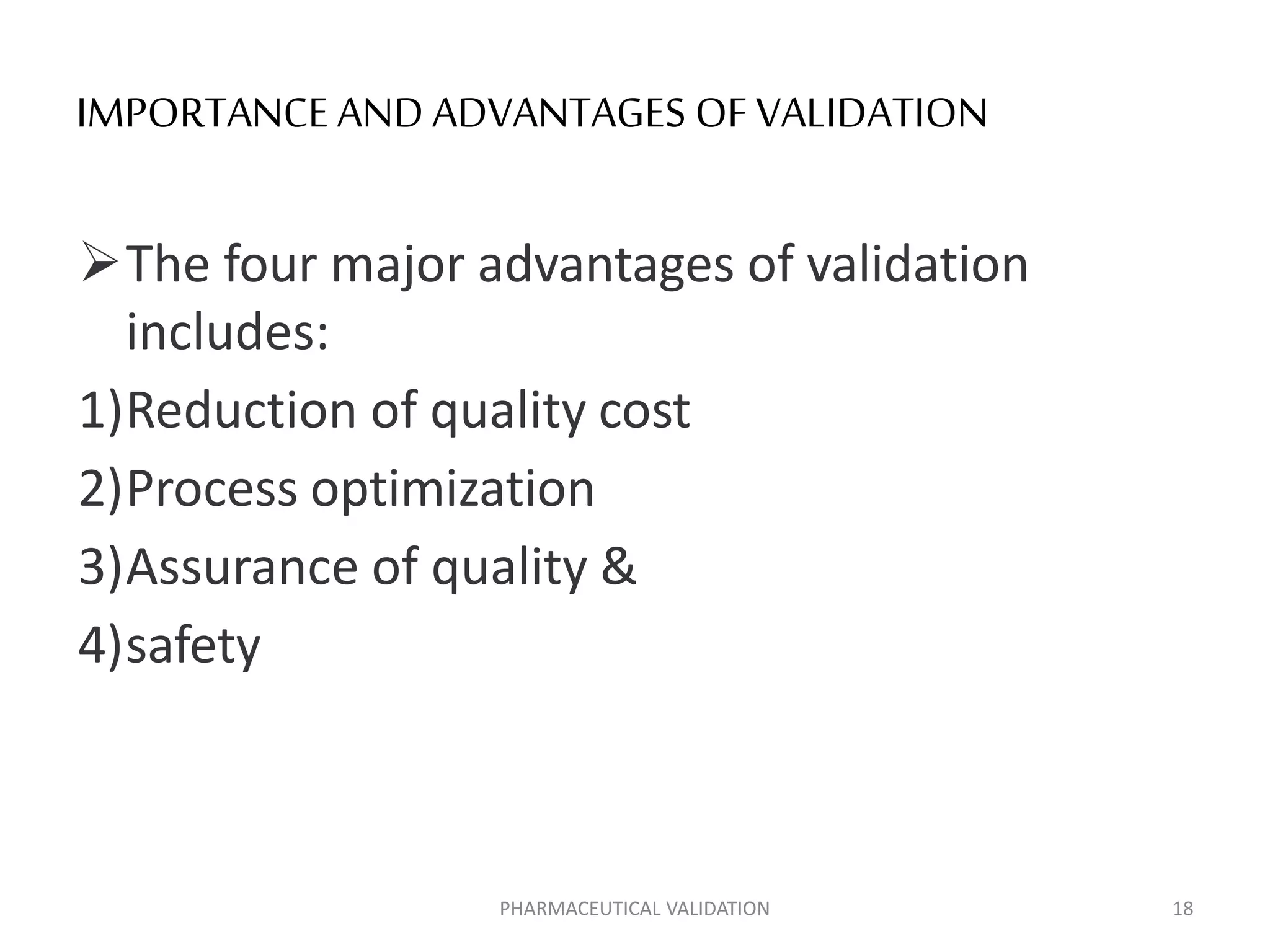
IMPORTANCE AND ADVANTAGES OF VALIDATION
The four major advantages of validation
includes:
1)Reduction of quality cost
2)Process optimization
3)Assurance of quality &
4)safety
PHARMACEUTICAL VALIDATION 18
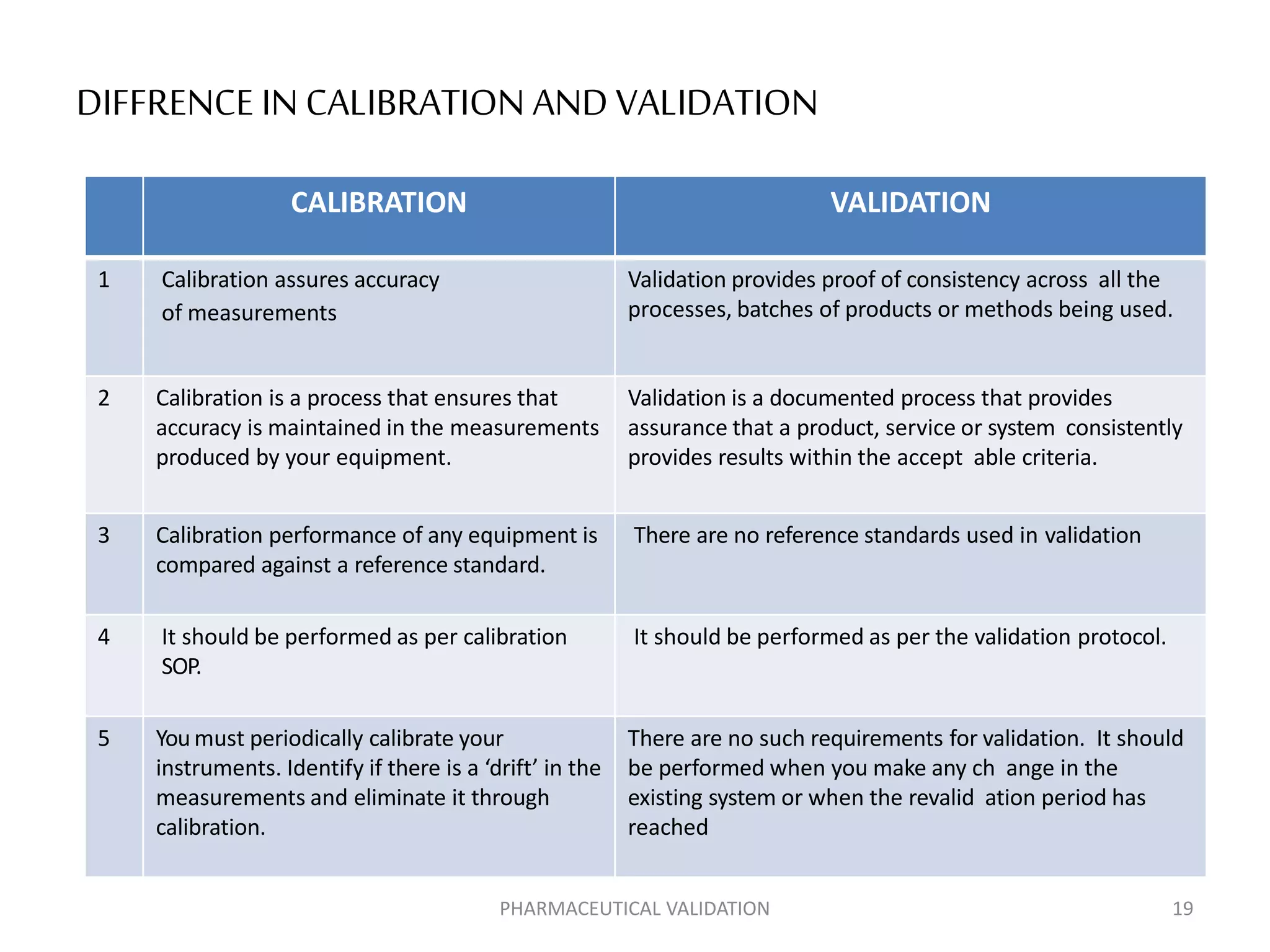
DIFFRENCE INCALIBRATION AND VALIDATION
CALIBRATION VALIDATION
1 Calibration assures accuracy
of measurements
Validation provides proof of consistency across all the
processes, batches of products or methods being used.
2 Calibration is a process that ensures that
accuracy is maintained in the measurements
produced by your equipment.
Validation is a documented process that provides
assurance that a product, service or system consistently
provides results within the accept able criteria.
3 Calibration performance of any equipment is
compared against a reference standard.
There are no reference standards used in validation
4 It should be performed as per calibration
SOP.
It should be performed as per the validation protocol.
5 You must periodically calibrate your
instruments. Identify if there is a ‘drift’ in the
measurements and eliminate it through
calibration.
There are no such requirements for validation. It should
be performed when you make any ch ange in the
existing system or when the revalid ation period has
reached
PHARMACEUTICAL VALIDATION 19
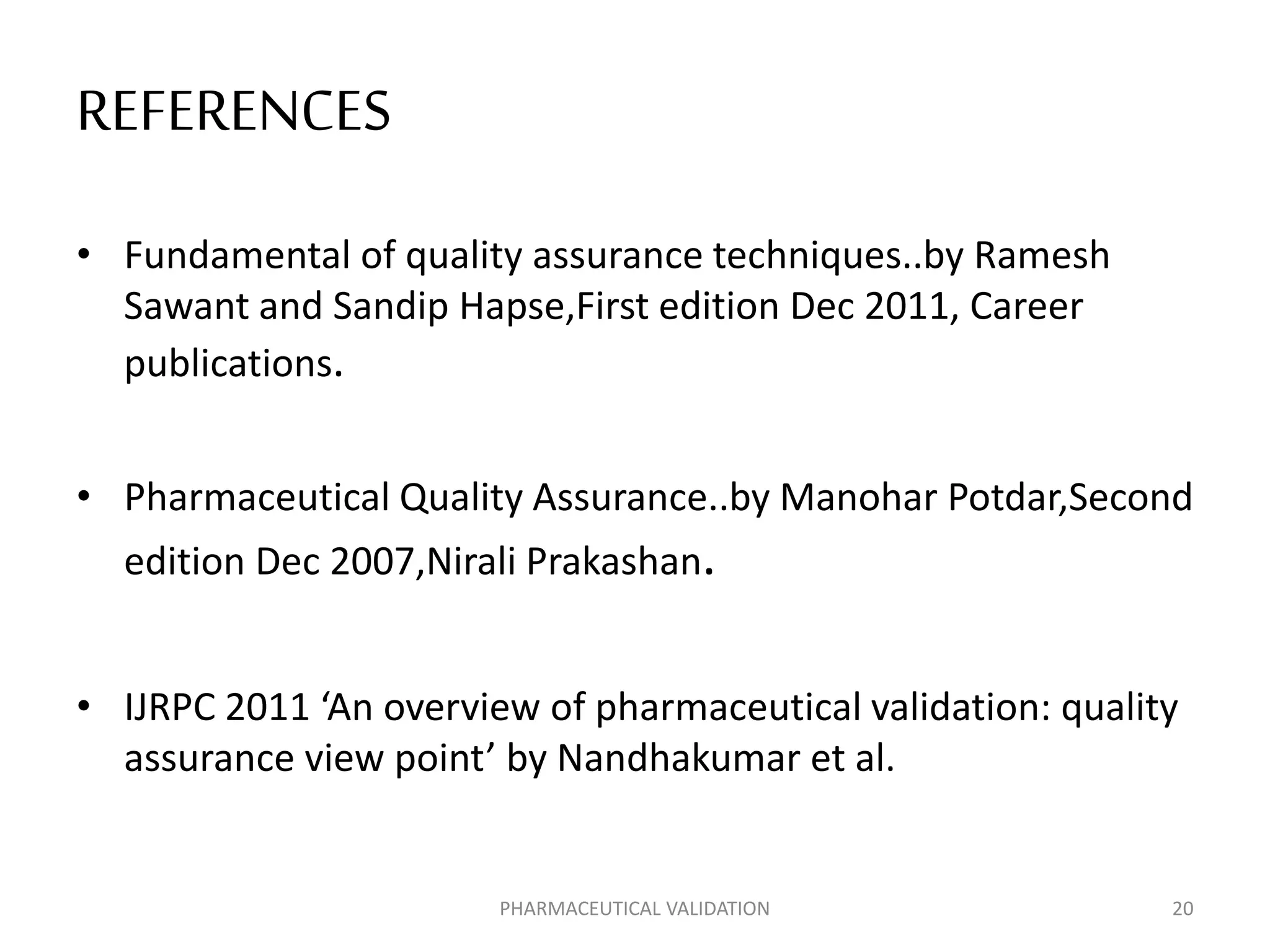
REFERENCES
• Fundamental of quality assurance techniques..by Ramesh
Sawant and Sandip Hapse,First edition Dec 2011, Career
publications.
• Pharmaceutical Quality Assurance..by Manohar Potdar,Second
edition Dec 2007,Nirali Prakashan.
• IJRPC 2011 ‘An overview of pharmaceutical validation: quality
assurance view point’ by Nandhakumar et al.
PHARMACEUTICAL VALIDATION 20
THANK YOU…………
PHARMACEUTICAL VALIDATION 21

Introduction to validation

  • 1.
    INTRODUCTIONTO VALIDATION Prepared by: Ashvin D. Bhoge Roll No : 517 M.PHARM (PQA) Subject : Pharmaceutical Validation Dr.D.Y. Patil College of Pharmacy, Akurdi
  • 2.
    CONTENTS 1. Definition 2. Scopeof calibration 3. Scope of validation 4. Frequency of calibration 5. Importance/ purpose of calibration 6. Importance/ advantages of validation 7. Difference between calibration & validation PHARMACEUTICAL VALIDATION 2
  • 3.
    DEFINATION • VALIDATION A “documentedprogramme”, which provide a high degree of assurance that a specific process will consistently produce, a product meeting its pre-deter mined specification and a quality attributes. PHARMACEUTICAL VALIDATION 3
  • 4.
    TYPE OF VALIDATION 1.Process Validation 2. Cleaning Validation 3. Validation Of Analytical Method a) Prospective validation b) Concurrent validation c) Re-validation d) Retrospective validation PHARMACEUTICAL VALIDATION 4
  • 5.
    • CALIBRATION Calibration isa process where a comparison is made between two entities, one whose value has to be measured and the other entity, known as the standard, which is used as the reference in the comparison  Methods for calibration: 1. Standard Calibration 2. Calibration with Data 3. ISO 17025Accredited calibration PHARMACEUTICAL VALIDATION 5
  • 6.
    Methodsforcalibration 1. Standard Calibration:This method is mostly preferred for calibrating instrument that are non- critical to quality or not required for accreditation and license purposes. 2. Calibration With Data: Procedure for calibration with data are similar to that of accredited calibration. Only exception being that these procedure are not accredited to the ISO standard. Moreover, they not accompanied by data on measurement uncertainties. PHARMACEUTICAL VALIDATION 6
  • 7.
    3. ISO 17025Accredited Calibration: This has to be a strictest method of calibration. Generally it requires a measurement reports which has the details of the measurement that are maid against the standard of "as found" (before calibration is started) & "as left" (once the calibration is completed). If the calibration is done bye service provider they must issue a certificate of the same. PHARMACEUTICAL VALIDATION 7
  • 8.
    QULIFICATION Qualification is aprocess of assurance that the specific system, premises or equipment are able to achieve the predetermined acceptance criteria to confirm the attributes what it purpose to do. Qualification can be considered to be a part of validation process, it can be further divided in to : DESIGN QUALIFICATION INSTALLATION QUALIFICATION OPRATIONAL QUALIFICATION PERFORMANCE QUALIFICATION PHARMACEUTICAL VALIDATION 8
  • 9.
    1.Design qualification(DQ): Itis documented evidence that proposed design of the facilities, system and equipment is suitable for intended use. Purpose: To ensure that all the requirements for the final system have been clearly defined at the start. PHARMACEUTICAL VALIDATION 9
  • 10.
    2.Installation Qualification (IQ):Itis documented evidence that the premises, supporting utilities, the equipment have been built and installed in compliance with designspecifications. Purpose: To check the installation site/ environment & verifies the condition of installed equipment. Also to ensure that allaspect of equipment installed correctly and complies with theoriginal design. PHARMACEUTICAL VALIDATION 10
  • 11.
    3.Operation Qualification (OQ):It is the process of demonstrating that an instrument will function according to the its operational specification in the selected environment. PHARMACEUTICAL VALIDATION 11
  • 12.
    4. Performance Qualification(PQ): It is the process that ensure the process under anticipated conditions, consistently produces a product which meets all pre-deter mined requirements. Purpose: It is ensure that the instrument is performing within specified limits. PHARMACEUTICAL VALIDATION 12
  • 13.
    SCOPE ANDPURPOSE OFCALIBRATION • To make sure that the readings of equipment or instruments are consistent with other measurements and display the correct readings every single time. • To determine the accuracy, precision, reliability and deviation of the measurements produced by all the instruments. PHARMACEUTICAL VALIDATION 13
  • 14.
    • To establishthe reliability of the instrument being used and whether it can be trusted to deliver repeatable results each time. PHARMACEUTICAL VALIDATION 14
  • 15.
    IMPORTANCEOF CALIBRATION  Calibrationis responsible for defining the accuracy of any measurement and its quality that is recorded by any instrument.  Regularly calibration of any equipment can eliminate the draft at its building stage instead of allowing it to grow till it affects the measurement in significant ways.  Calibration helps in quantifying and controlling errors and uncertainties within various measurement process to an acceptable level.  Further, it helps in improving the accuracy of the measuring device, which in turn improves the quality of the FPP. PHARMACEUTICAL VALIDATION 15
  • 16.
     In shortregular calibration allows pharmaceutical companies to have confidence in there result which they can re cord monitor and control.  Calibration are not optional but needed for regulatory compliance PHARMACEUTICAL VALIDATION 16
  • 17.
    SCOPE OFVALIDATION  Analyticaltest methods: (eg. Accuracy, precision, specificity, limit of detection, linearity etc...)  Instruments calibration: (eg. Temp., Weight, pH, humidity etc)  Process utility services: (eg. Water, steam, HVAC system etc)  Raw materials & Packaging materials: (eg. Specification, vendor certificate)  Equipment: Equipment qualification programme start with Users Requirement Specifications & Functional Requirement Specifications these two requirements will result in to the Design Qualification. PHARMACEUTICAL VALIDATION 17
  • 18.
    IMPORTANCE AND ADVANTAGESOF VALIDATION The four major advantages of validation includes: 1)Reduction of quality cost 2)Process optimization 3)Assurance of quality & 4)safety PHARMACEUTICAL VALIDATION 18
  • 19.
    DIFFRENCE INCALIBRATION ANDVALIDATION CALIBRATION VALIDATION 1 Calibration assures accuracy of measurements Validation provides proof of consistency across all the processes, batches of products or methods being used. 2 Calibration is a process that ensures that accuracy is maintained in the measurements produced by your equipment. Validation is a documented process that provides assurance that a product, service or system consistently provides results within the accept able criteria. 3 Calibration performance of any equipment is compared against a reference standard. There are no reference standards used in validation 4 It should be performed as per calibration SOP. It should be performed as per the validation protocol. 5 You must periodically calibrate your instruments. Identify if there is a ‘drift’ in the measurements and eliminate it through calibration. There are no such requirements for validation. It should be performed when you make any ch ange in the existing system or when the revalid ation period has reached PHARMACEUTICAL VALIDATION 19
  • 20.
    REFERENCES • Fundamental ofquality assurance techniques..by Ramesh Sawant and Sandip Hapse,First edition Dec 2011, Career publications. • Pharmaceutical Quality Assurance..by Manohar Potdar,Second edition Dec 2007,Nirali Prakashan. • IJRPC 2011 ‘An overview of pharmaceutical validation: quality assurance view point’ by Nandhakumar et al. PHARMACEUTICAL VALIDATION 20
  • 21.