SCHOOL OF ENGINEERING SCEINCES AND TECHNOLOGY
PRESENTATION
BY
VAMSI KRISHNA RENTALA
12ETMM10
I M.Tech
MATERIALS ENGINEERING
A SEMINAR ON
INTRODUCTION TO TURBOJET ENGINES
1
2
 INTRODUCTION.
 PRIMARY COMPONENTS OF TURBOJET ENGINE.
 WORKING OF TURBOJET ENGINE.
 AFTER BURNER.
 THRUST REVERSERS.
 MATERIALS USED.
 MERITS AND DEMERITS.
 APPLICATIONS.
 FUTURE VISION.
 CONCLUSION
 REFERENCES.
3
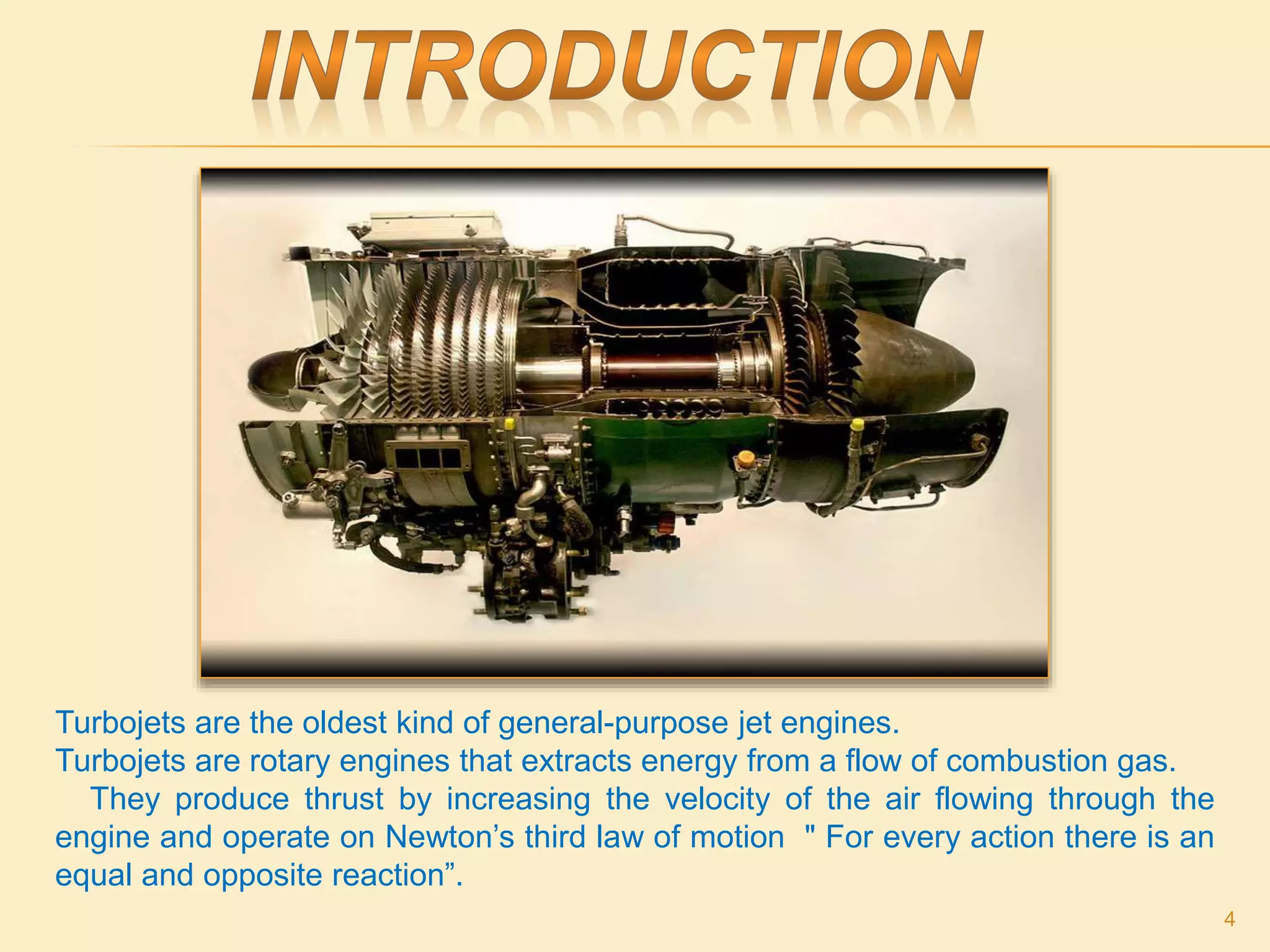
Turbojets are the oldest kind of general-purpose jet engines.
Turbojets are rotary engines that extracts energy from a flow of combustion gas.
They produce thrust by increasing the velocity of the air flowing through the
engine and operate on Newton’s third law of motion " For every action there is an
equal and opposite reaction”.
4
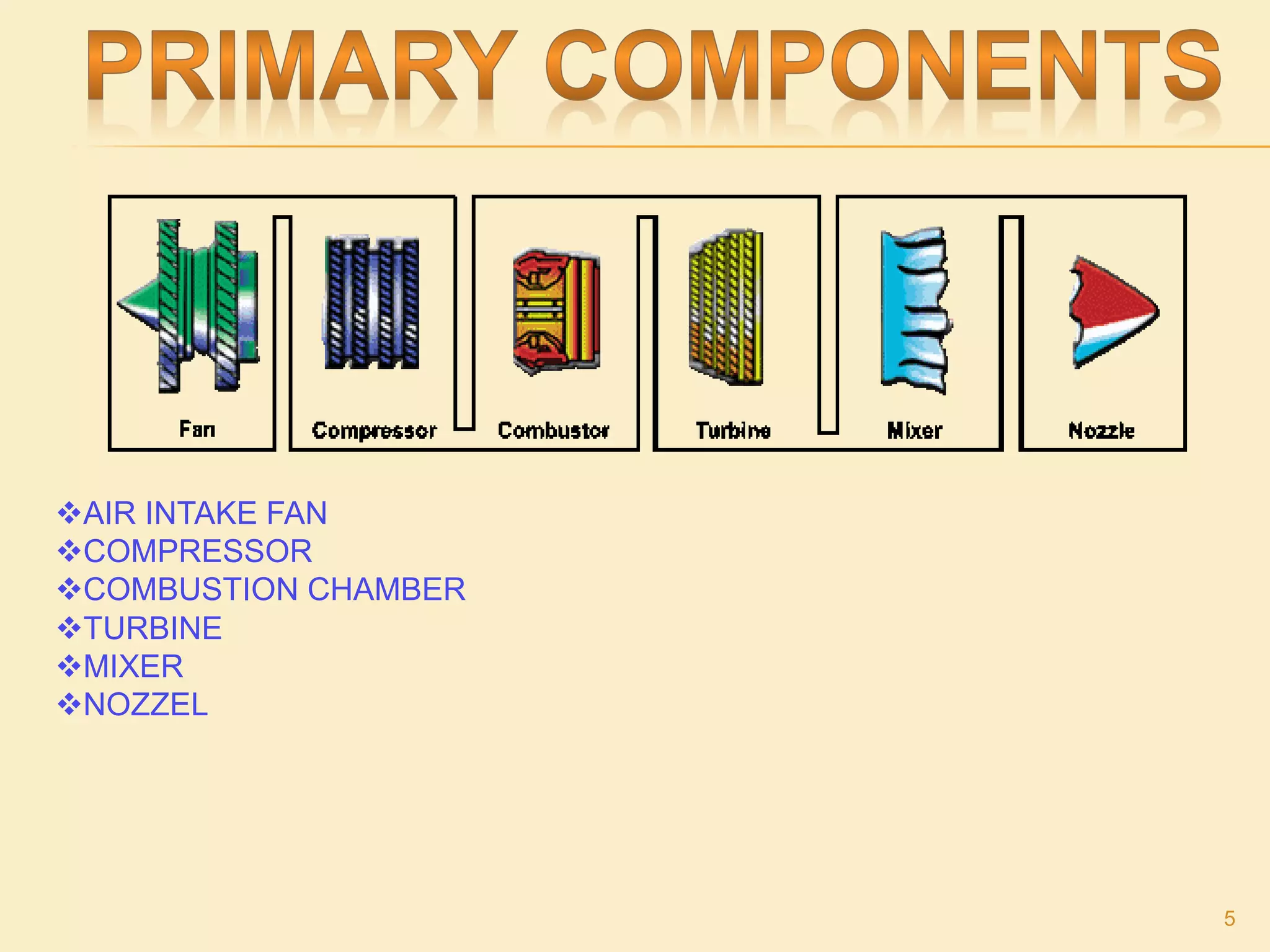
AIR INTAKE FAN
COMPRESSOR
COMBUSTION CHAMBER
TURBINE
MIXER
NOZZEL
5
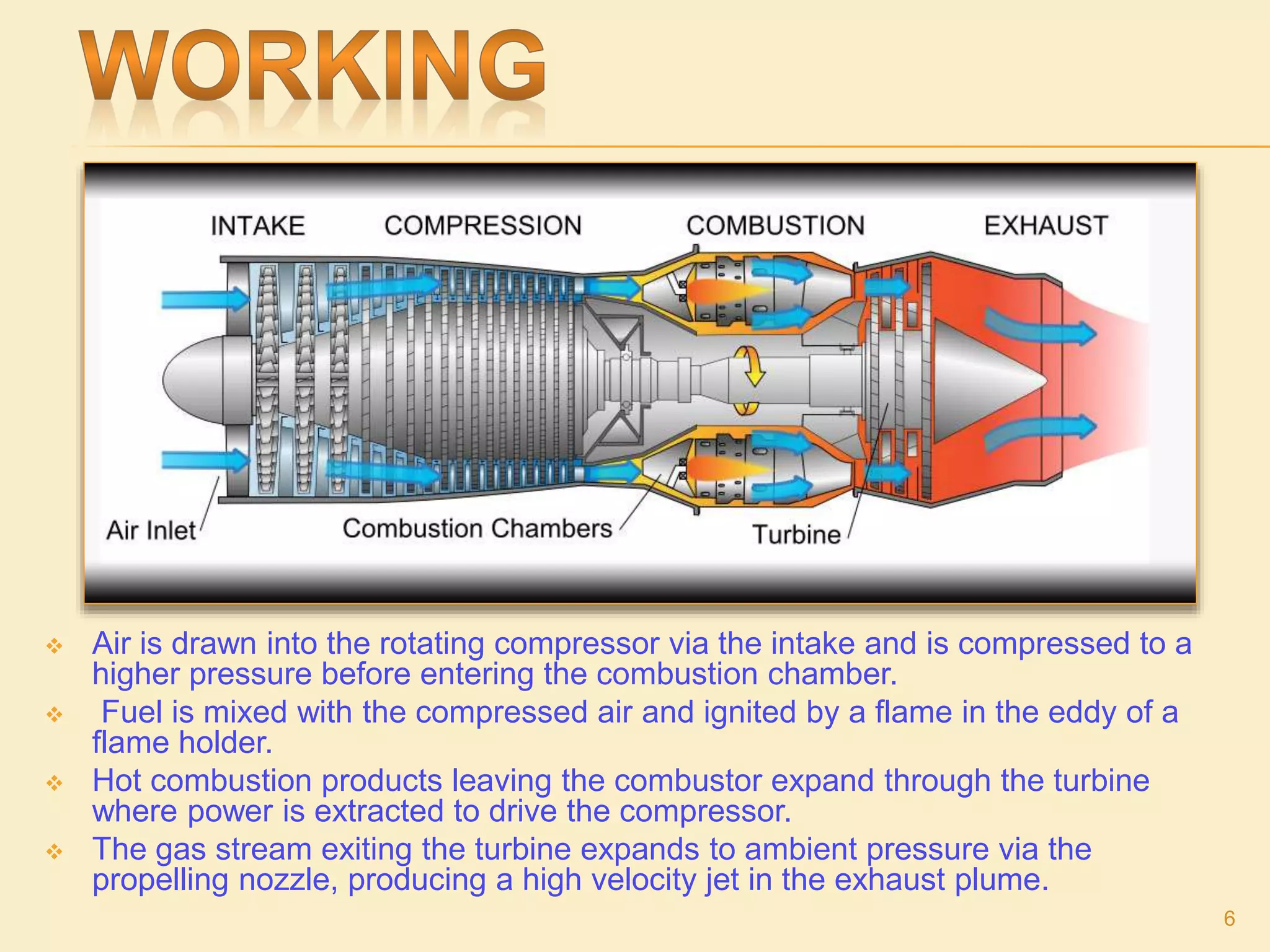
 Air is drawn into the rotating compressor via the intake and is compressed to a
higher pressure before entering the combustion chamber.
 Fuel is mixed with the compressed air and ignited by a flame in the eddy of a
flame holder.
 Hot combustion products leaving the combustor expand through the turbine
where power is extracted to drive the compressor.
 The gas stream exiting the turbine expands to ambient pressure via the
propelling nozzle, producing a high velocity jet in the exhaust plume.
6
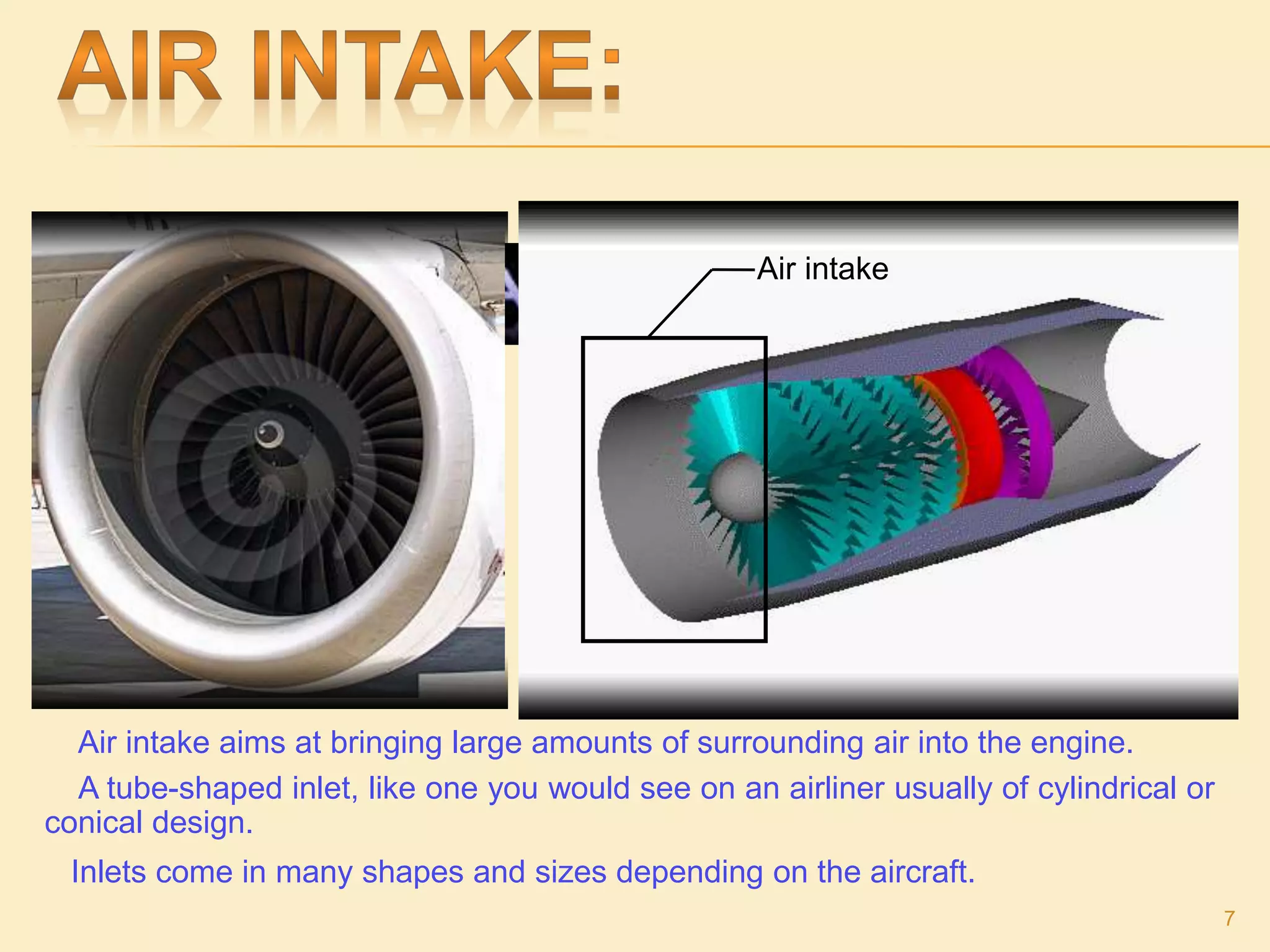
Air intake
Air intake aims at bringing large amounts of surrounding air into the engine.
A tube-shaped inlet, like one you would see on an airliner usually of cylindrical or
conical design.
Inlets come in many shapes and sizes depending on the aircraft.
7
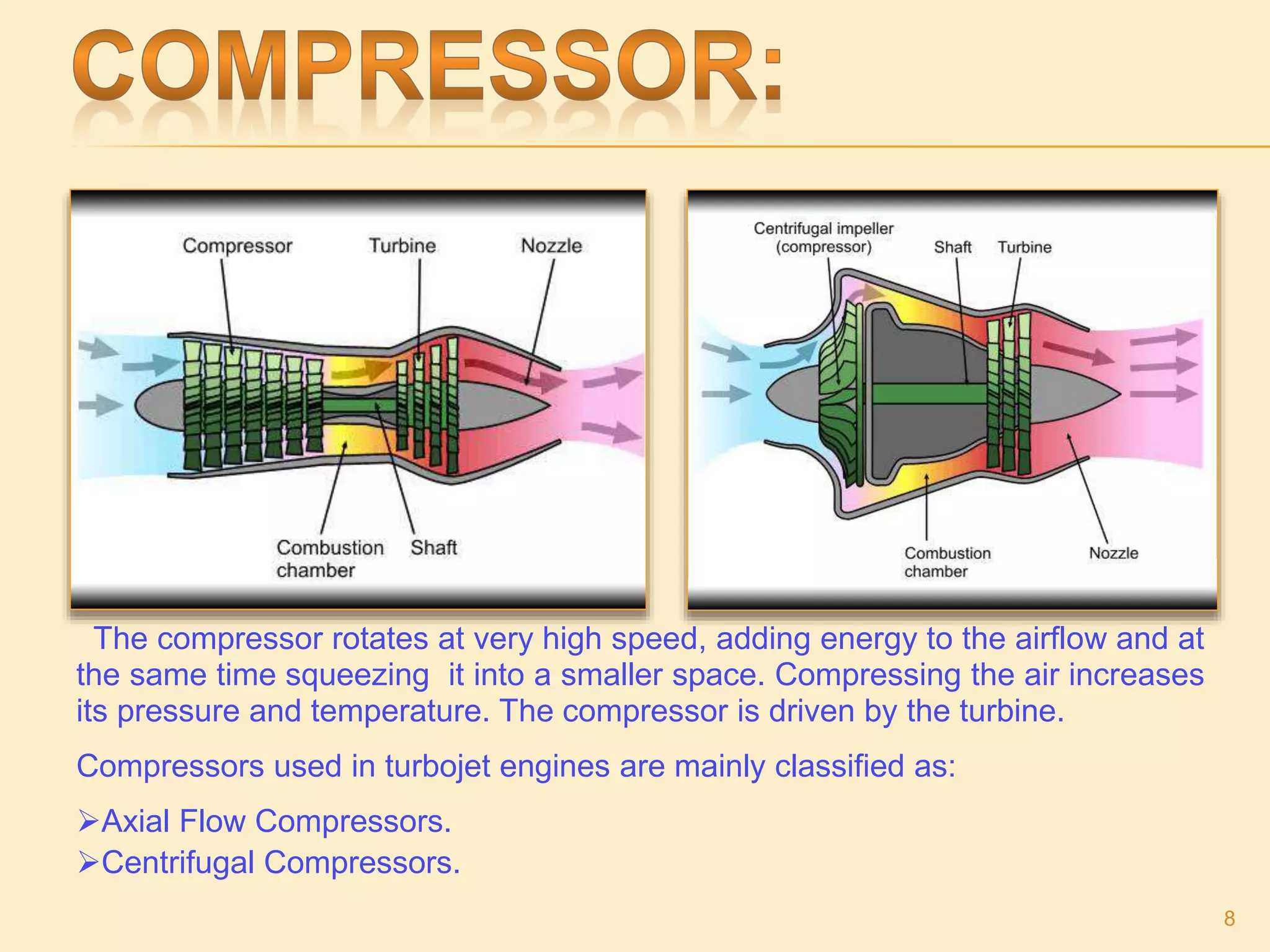
The compressor rotates at very high speed, adding energy to the airflow and at
the same time squeezing it into a smaller space. Compressing the air increases
its pressure and temperature. The compressor is driven by the turbine.
Compressors used in turbojet engines are mainly classified as:
Axial Flow Compressors.
Centrifugal Compressors.
8
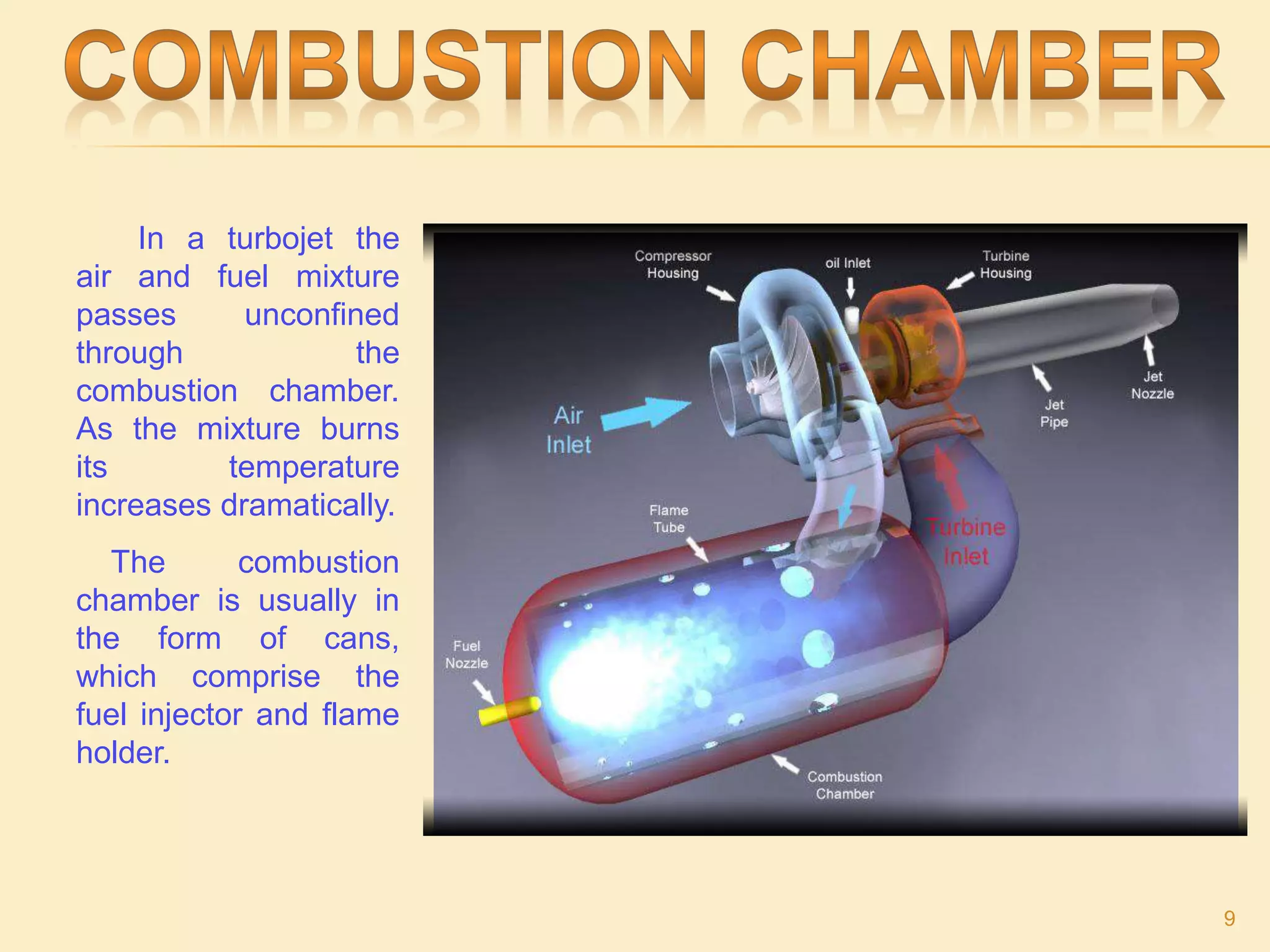
In a turbojet the
air and fuel mixture
passes unconfined
through the
combustion chamber.
As the mixture burns
its temperature
increases dramatically.
The combustion
chamber is usually in
the form of cans,
which comprise the
fuel injector and flame
holder.
9
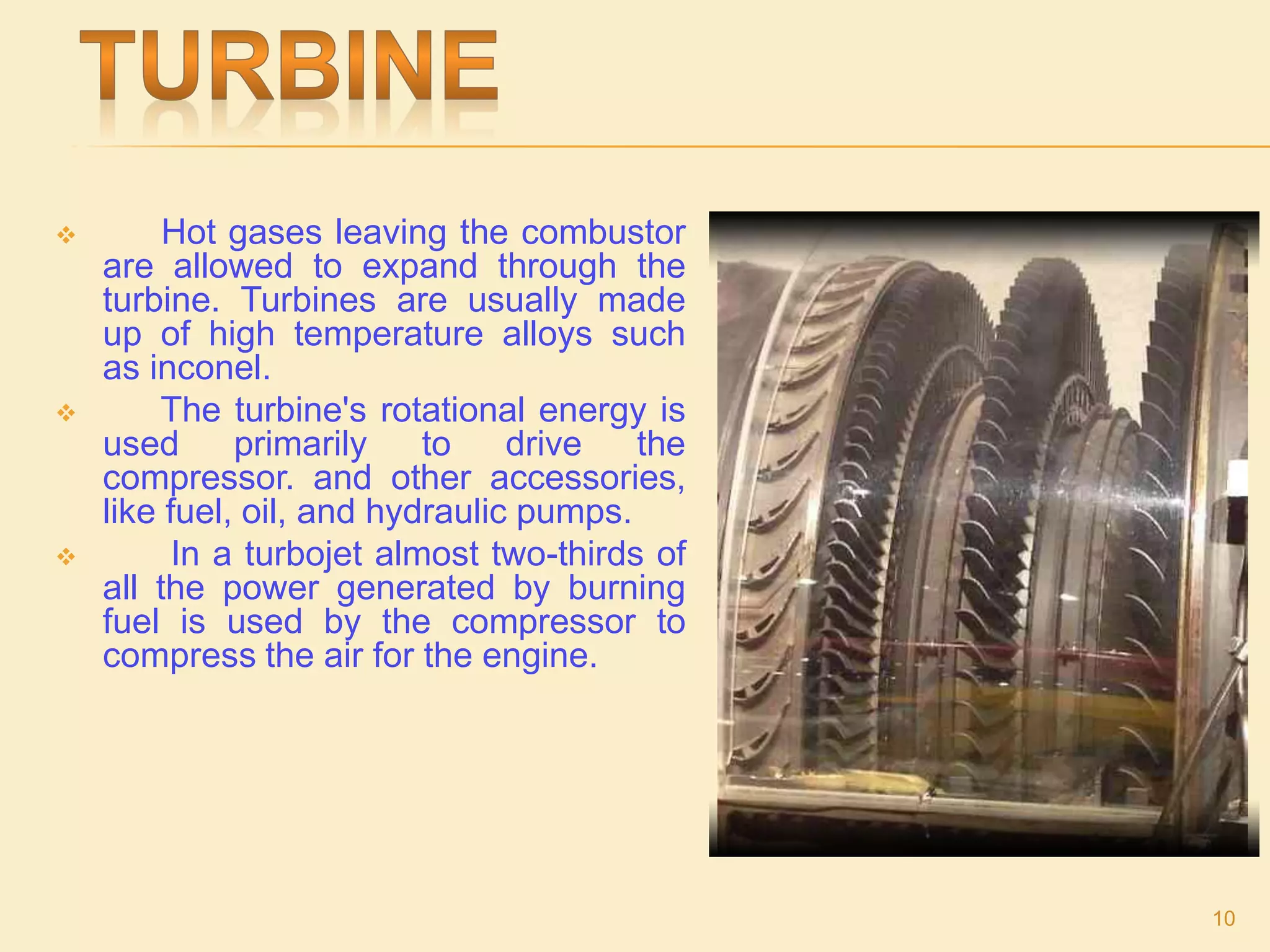
 Hot gases leaving the combustor
are allowed to expand through the
turbine. Turbines are usually made
up of high temperature alloys such
as inconel.
 The turbine's rotational energy is
used primarily to drive the
compressor. and other accessories,
like fuel, oil, and hydraulic pumps.
 In a turbojet almost two-thirds of
all the power generated by burning
fuel is used by the compressor to
compress the air for the engine.
10
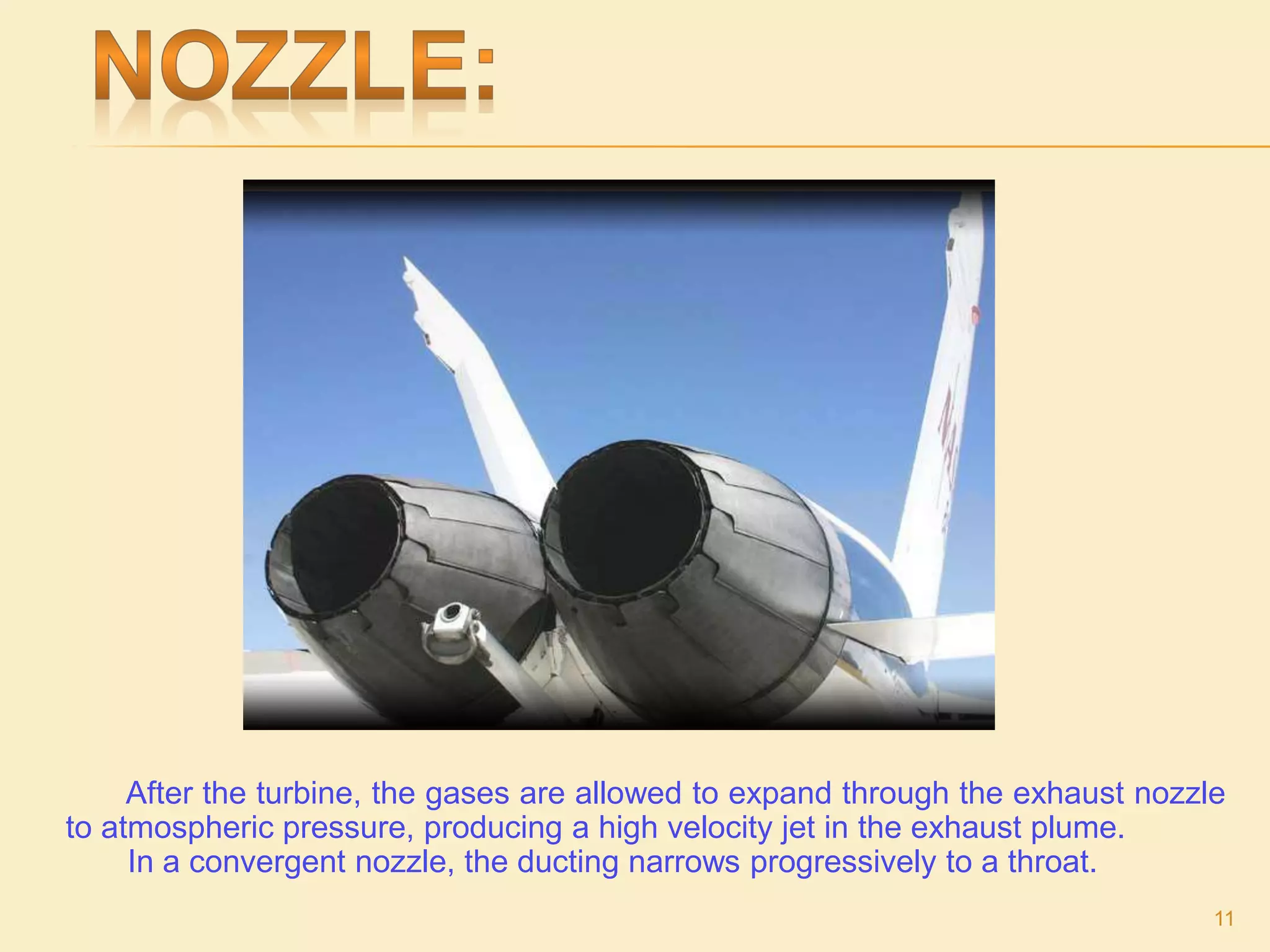
After the turbine, the gases are allowed to expand through the exhaust nozzle
to atmospheric pressure, producing a high velocity jet in the exhaust plume.
In a convergent nozzle, the ducting narrows progressively to a throat.
11
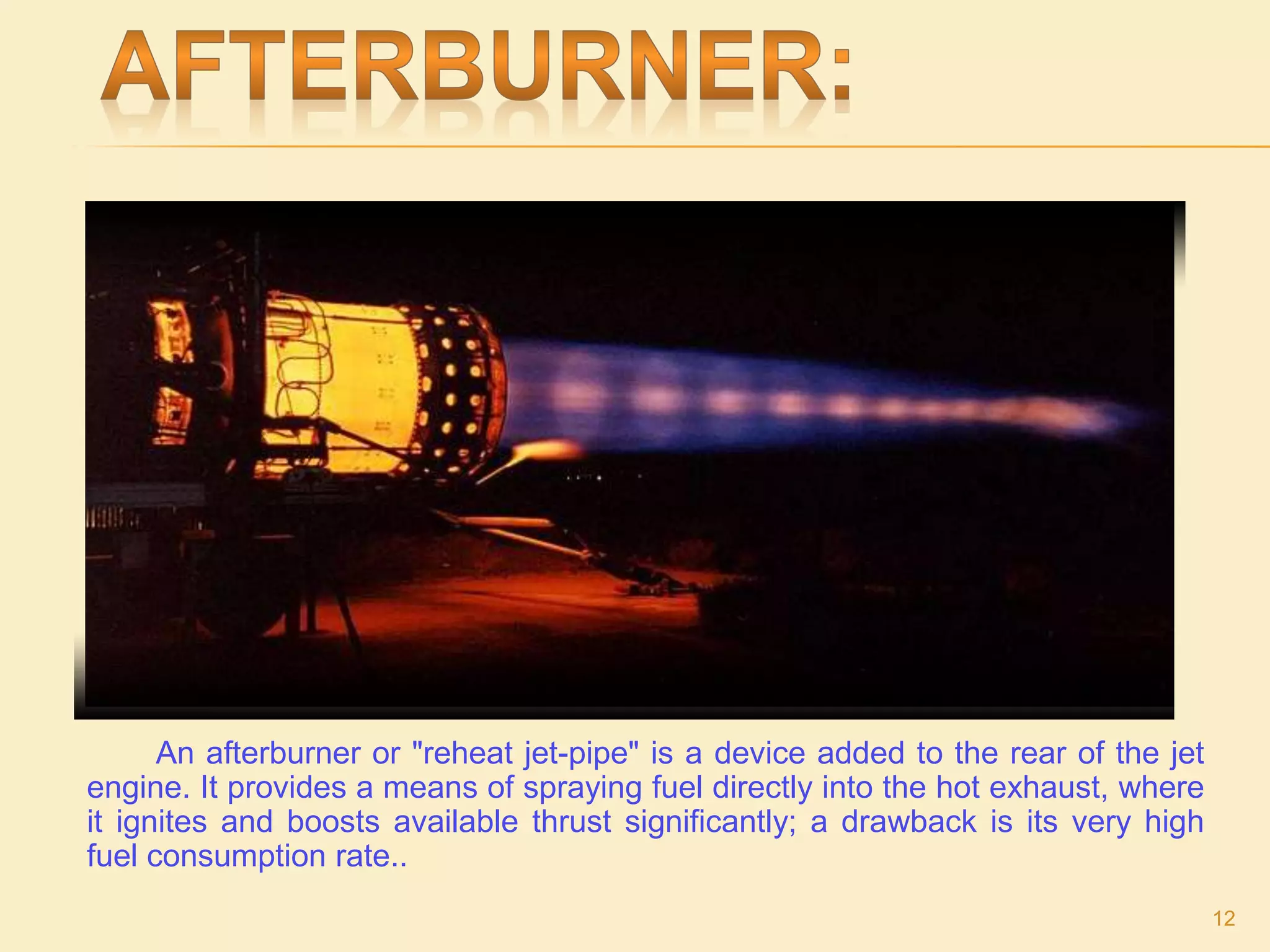
An afterburner or "reheat jet-pipe" is a device added to the rear of the jet
engine. It provides a means of spraying fuel directly into the hot exhaust, where
it ignites and boosts available thrust significantly; a drawback is its very high
fuel consumption rate..
12
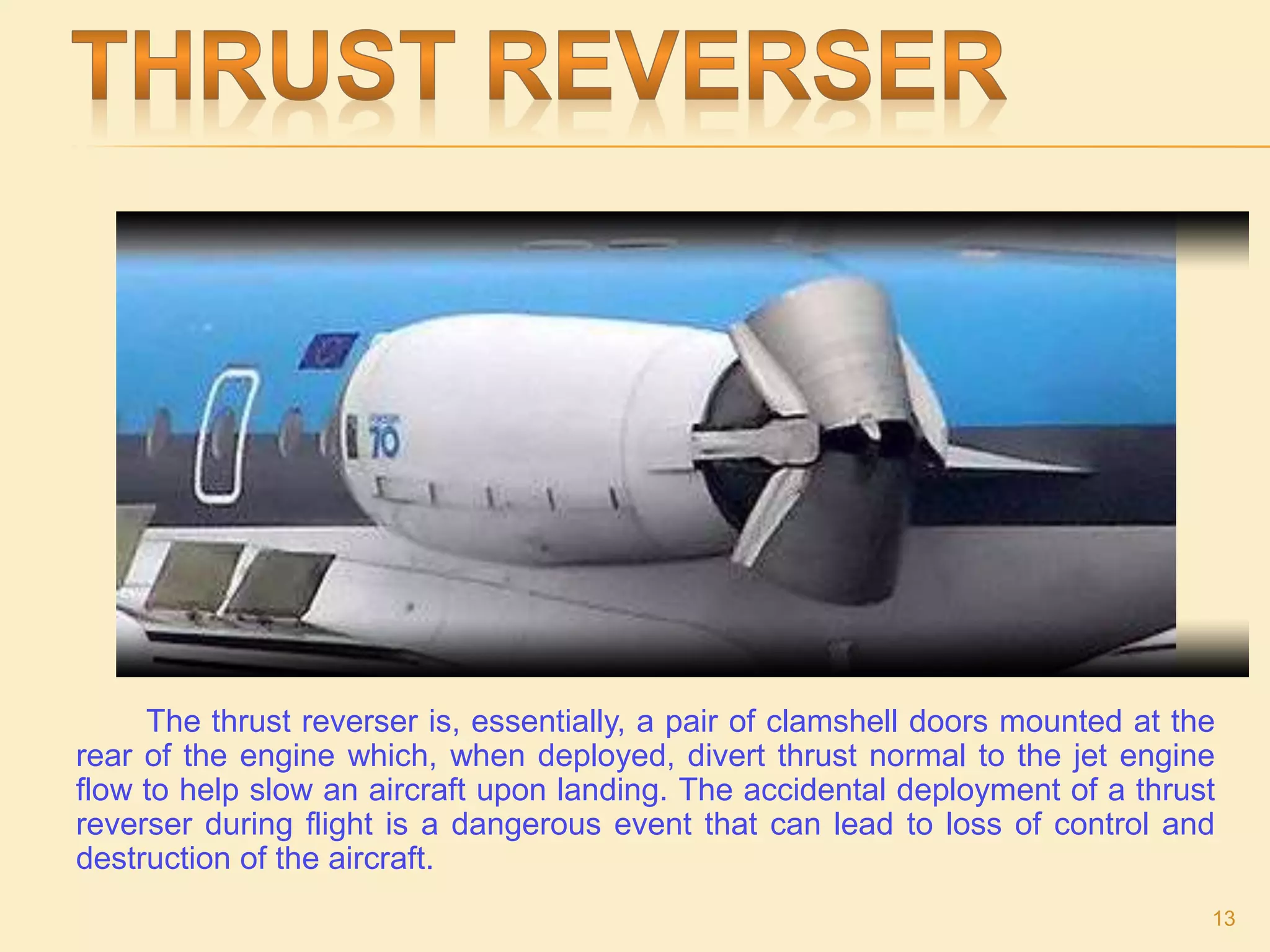
The thrust reverser is, essentially, a pair of clamshell doors mounted at the
rear of the engine which, when deployed, divert thrust normal to the jet engine
flow to help slow an aircraft upon landing. The accidental deployment of a thrust
reverser during flight is a dangerous event that can lead to loss of control and
destruction of the aircraft.
13
14
 Thousands of operating hours at temperatures up to 1,100°C
(2000 °F)
 High thermal stresses caused by rapid temperature changes and
large temperature gradients
 High mechanical stresses due to high rotational speeds and large
aerodynamic forces
 Low- and high-frequency vibration loading
 Oxidation resistance
 Corrosion resistance
 Time- , temperature- and stress-dependent effects such as creep,
stress rupture, and high- and low-cycle fatigue.
15
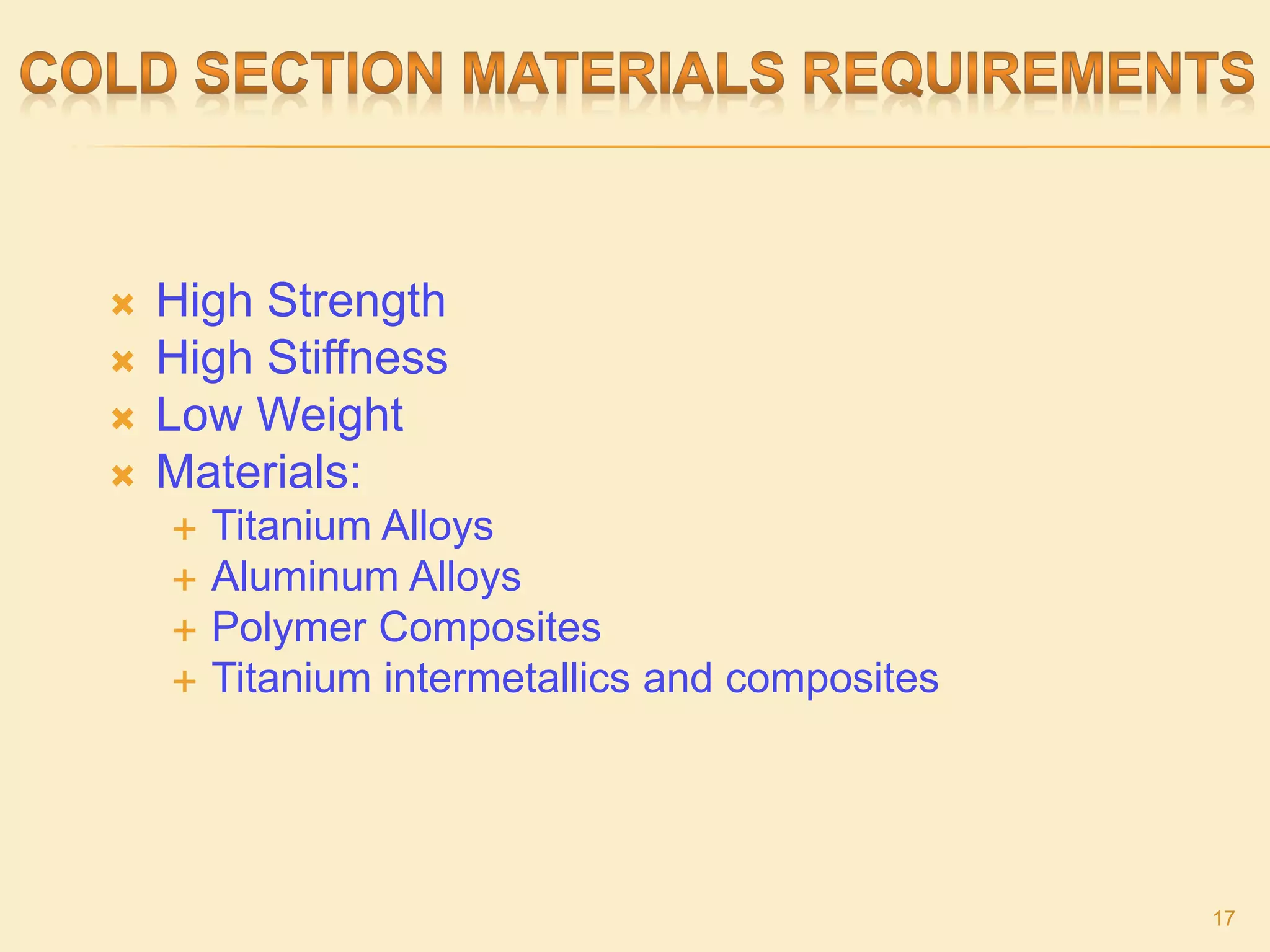
 Cold Sections
 Inlet/Fan
 Compressor
 Casing
 Hot Sections
 Combustor
 Turbine/Outlet
16
 High Strength
 High Stiffness
 Low Weight
 Materials:
 Titanium Alloys
 Aluminum Alloys
 Polymer Composites
 Titanium intermetallics and composites
17
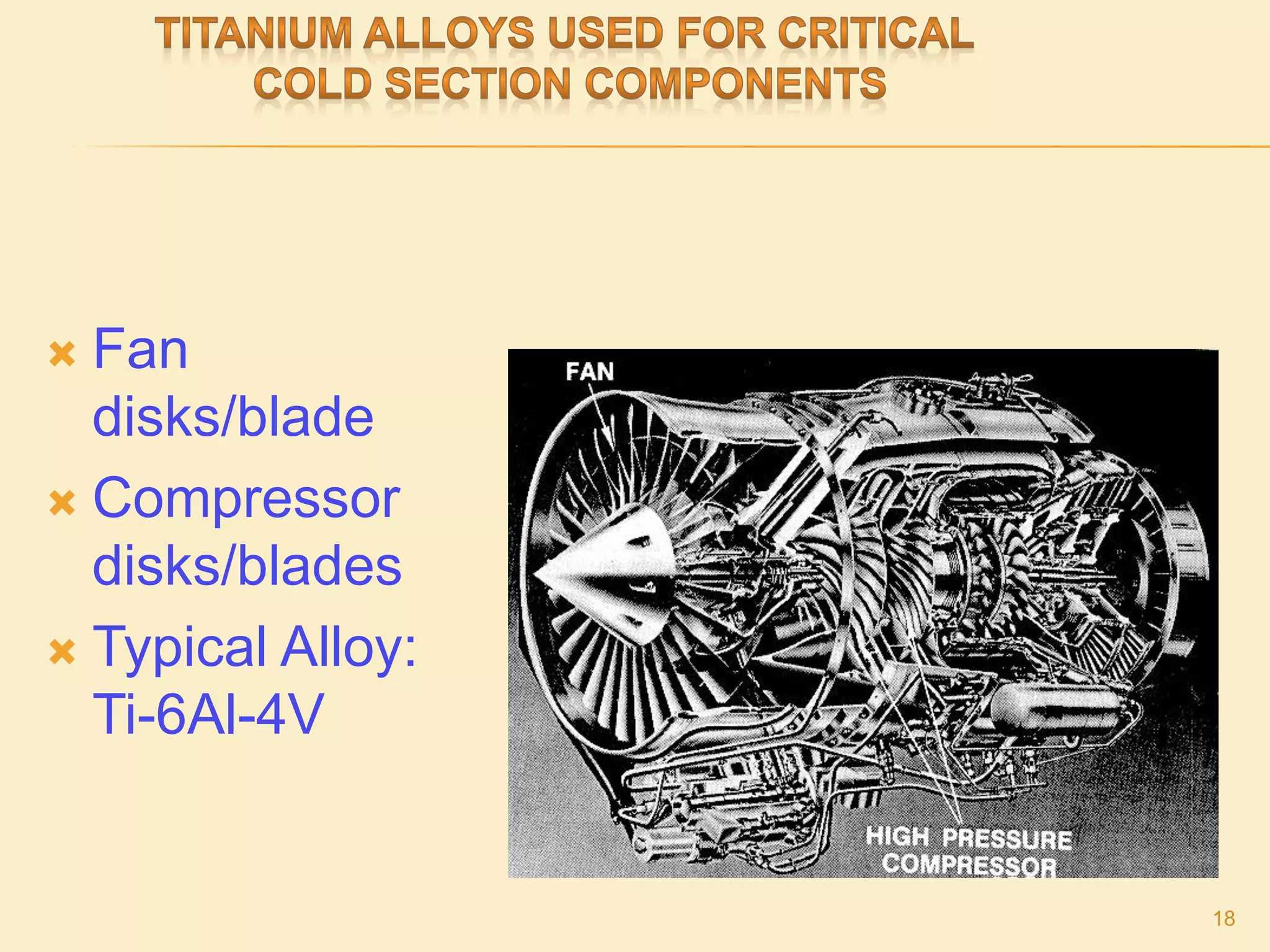
 Fan
disks/blade
 Compressor
disks/blades
 Typical Alloy:
Ti-6Al-4V
18
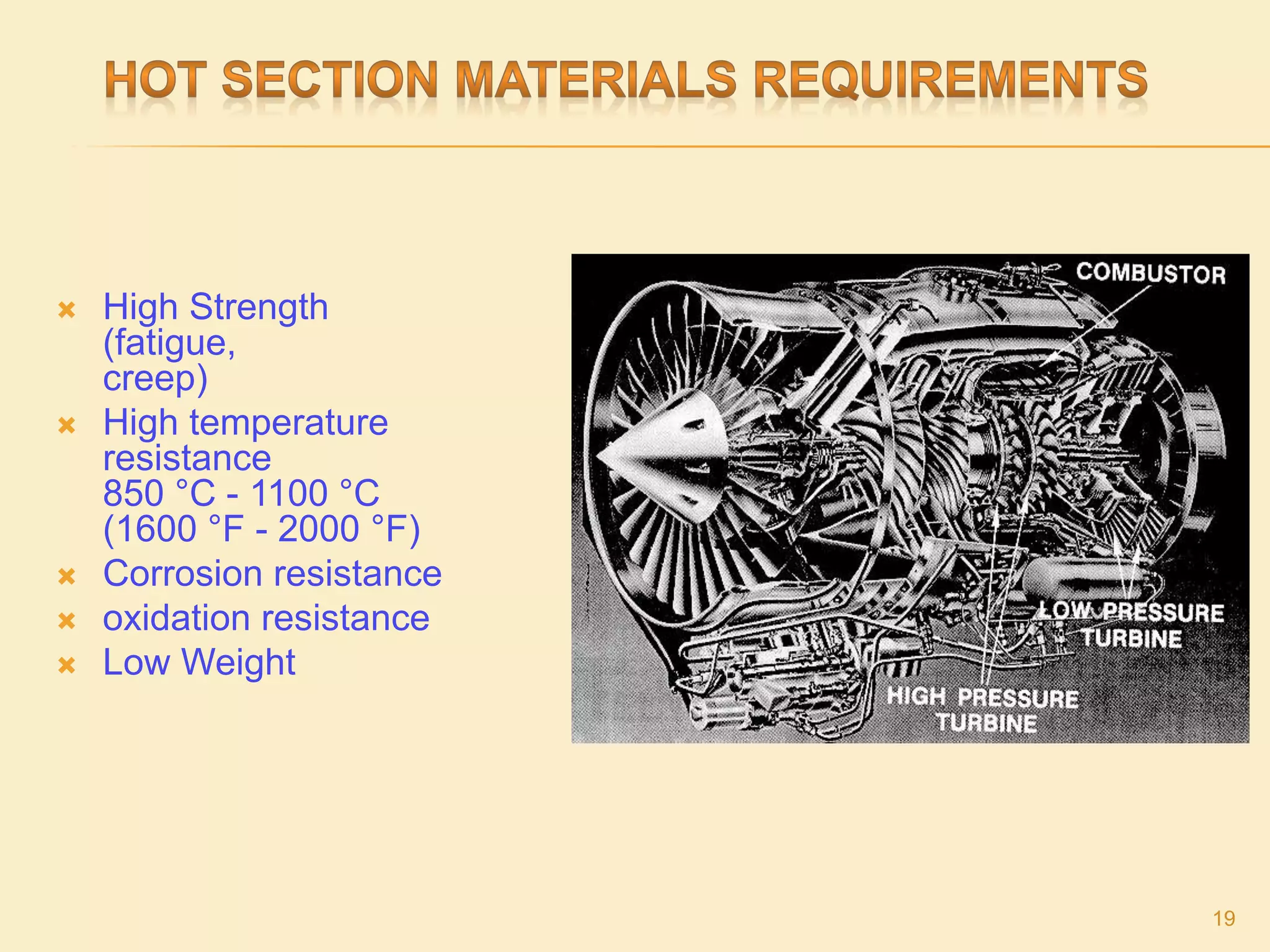
 High Strength
(fatigue,
creep)
 High temperature
resistance
850 °C - 1100 °C
(1600 °F - 2000 °F)
 Corrosion resistance
 oxidation resistance
 Low Weight
19
 Nickel (or Cobalt) based materials
 Can be used in load bearing
applications up to 0.8Tm - this fraction is
higher than for any other class of
engineering alloys!
 High strength
 Specific gravity ~8.8 (relatively heavy)
 Over 50% weight of current engines
20
 Higher Operating
Temperatures
 Higher Rotational
Speeds
 Lower Weight Engine
Components
 Longer Operating
Lifetime
 Decreased Failure
Occurrence
 These all adds up to:
Better Performance
and
Lower Life Cycle
Costs
21
Merits of Turbojet Engines:
Very high power-to-weight ratio.
Compact than most reciprocating engines
of the same power rating.
Fewer moving parts than reciprocating
engines.
High operation speeds.
Low lubricating oil cost and consumption.
Demerits of Turbojet Engines:
Cost
Longer startup than reciprocating engines
Less responsive to changes in power
demand compared to reciprocating engines.
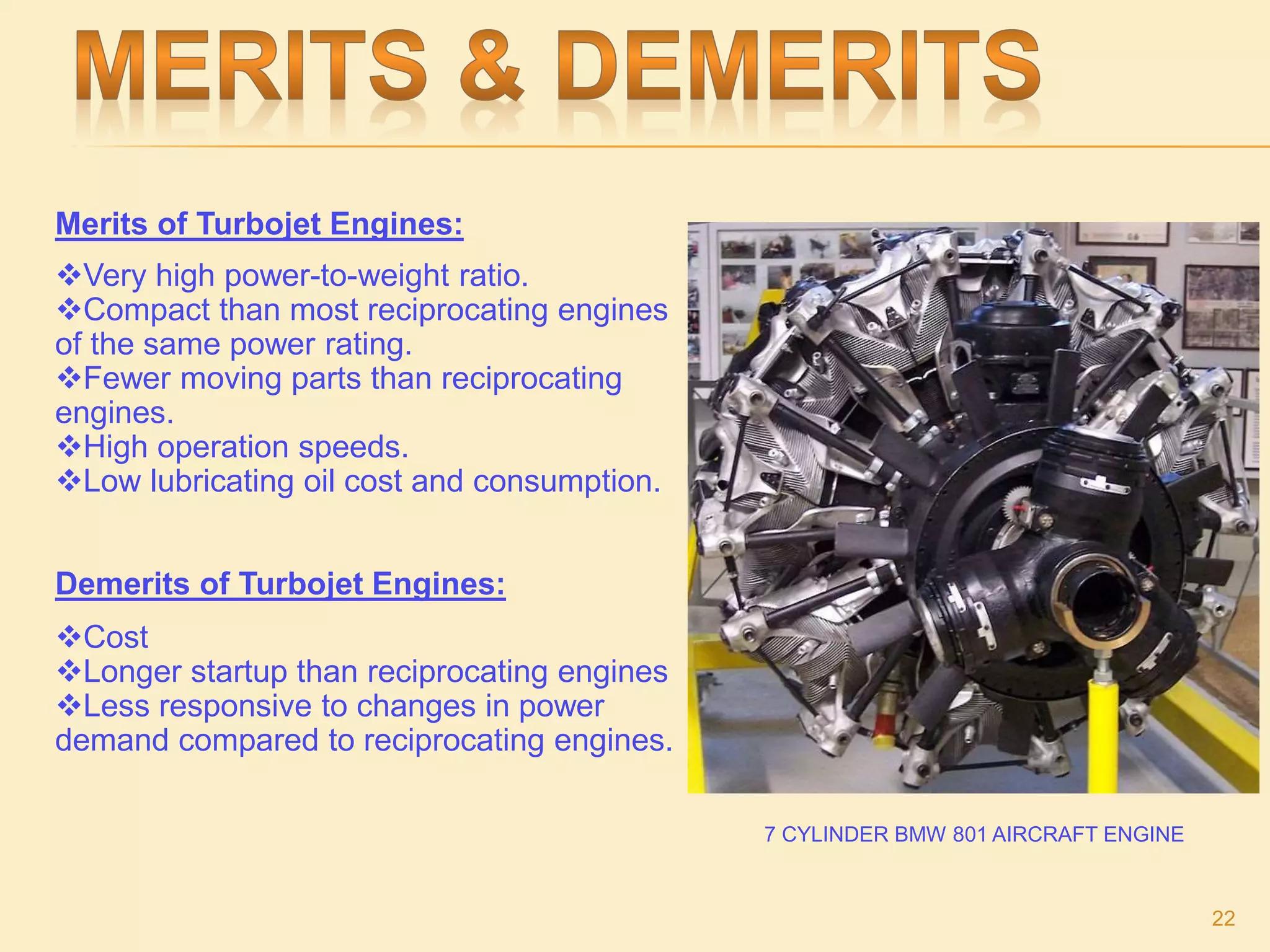
7 CYLINDER BMW 801 AIRCRAFT ENGINE
22
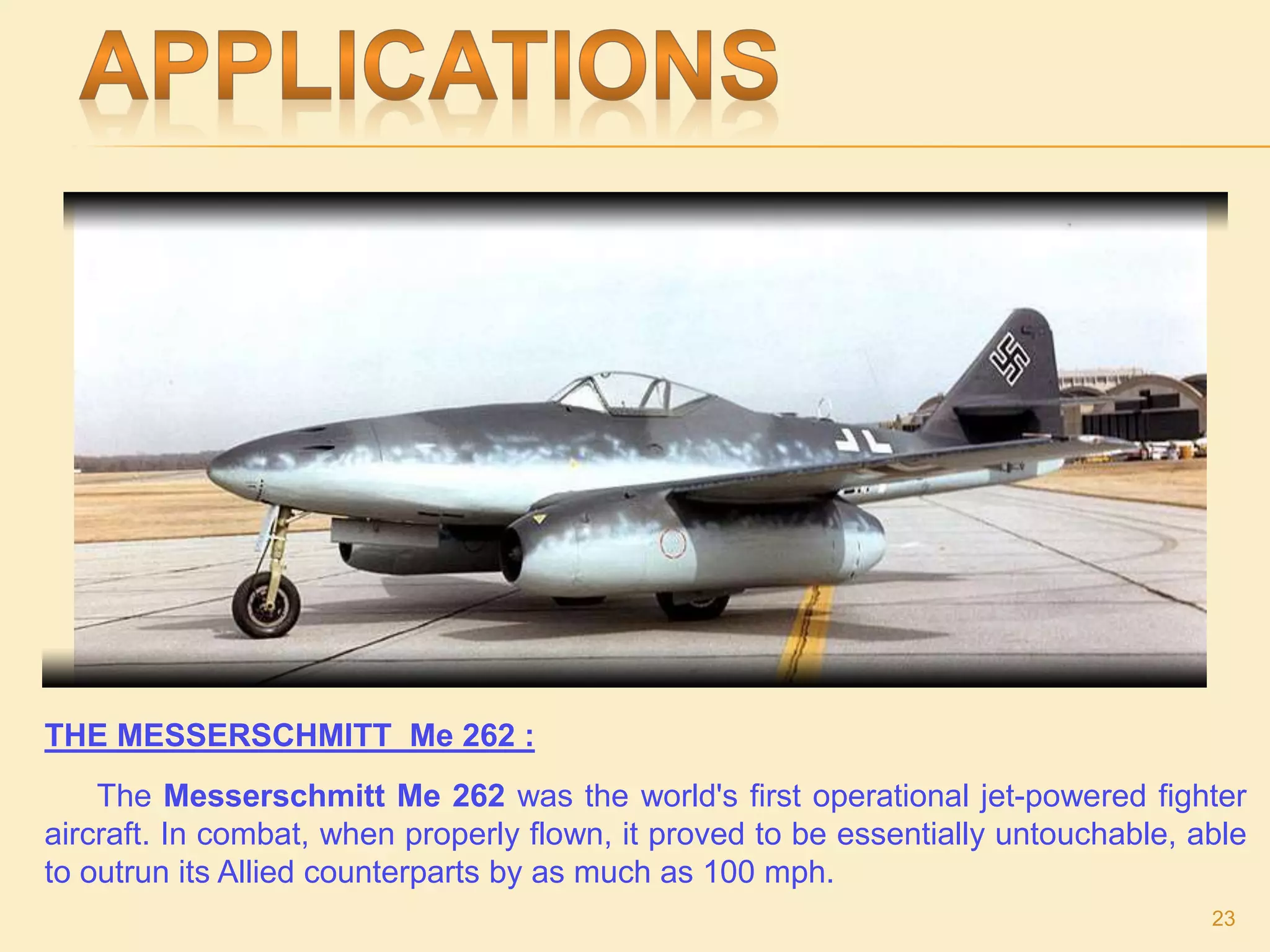
THE MESSERSCHMITT Me 262 :
The Messerschmitt Me 262 was the world's first operational jet-powered fighter
aircraft. In combat, when properly flown, it proved to be essentially untouchable, able
to outrun its Allied counterparts by as much as 100 mph.
23
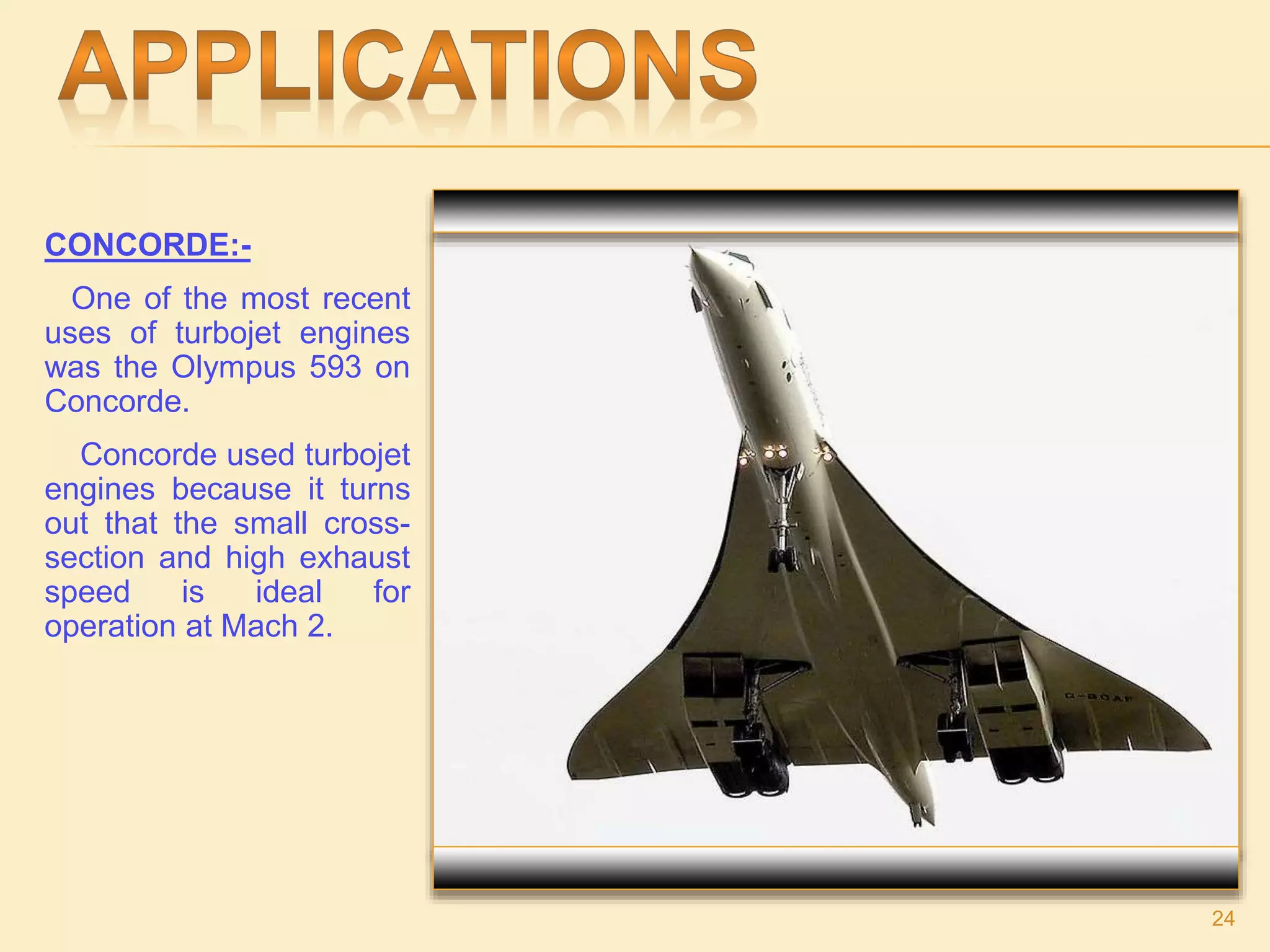
CONCORDE:-
One of the most recent
uses of turbojet engines
was the Olympus 593 on
Concorde.
Concorde used turbojet
engines because it turns
out that the small cross-
section and high exhaust
speed is ideal for
operation at Mach 2.
24
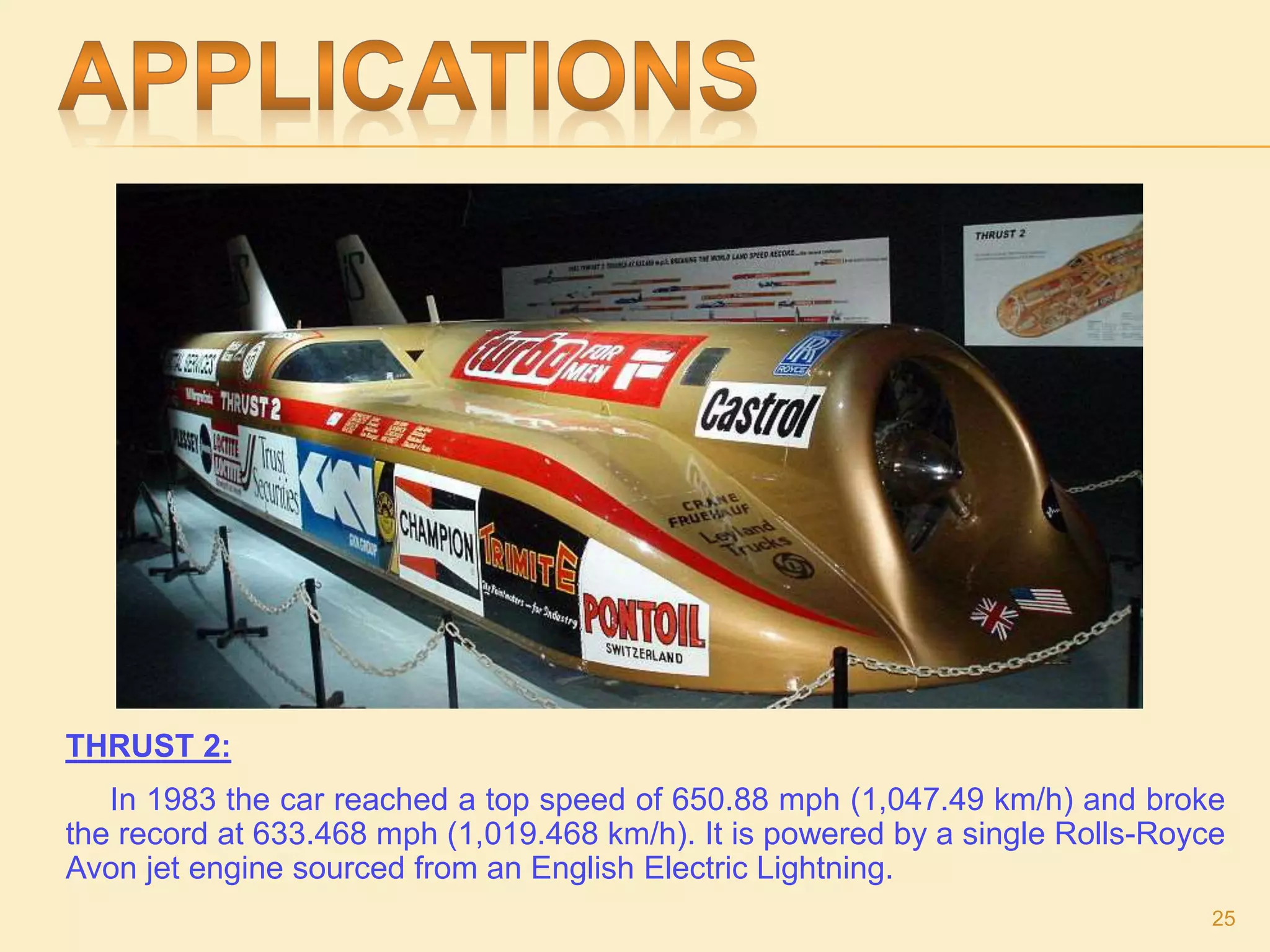
THRUST 2:
In 1983 the car reached a top speed of 650.88 mph (1,047.49 km/h) and broke
the record at 633.468 mph (1,019.468 km/h). It is powered by a single Rolls-Royce
Avon jet engine sourced from an English Electric Lightning.
25
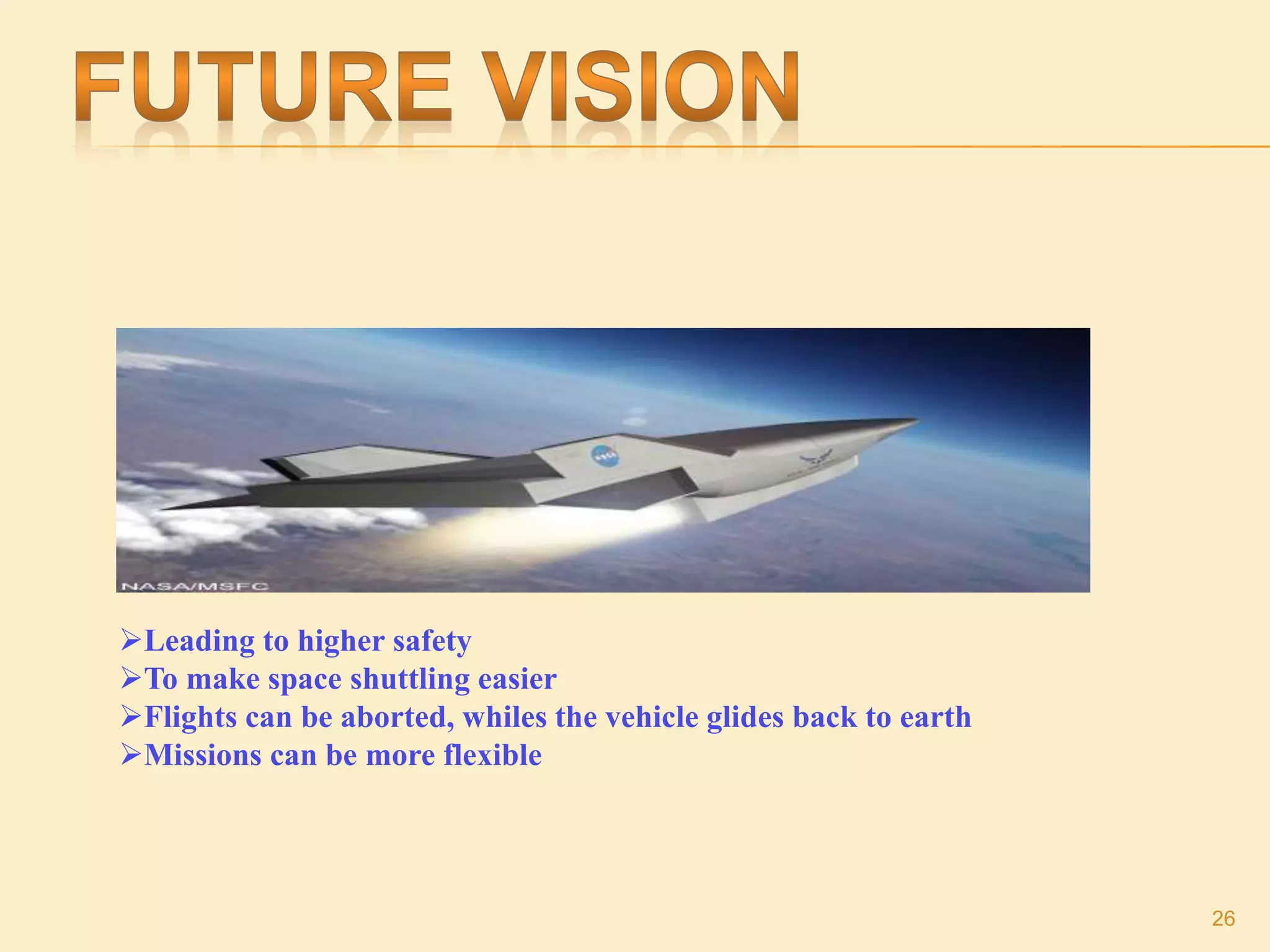
Leading to higher safety
To make space shuttling easier
Flights can be aborted, whiles the vehicle glides back to earth
Missions can be more flexible
26
CONCLUSION
 Turbojet engines are more complex.
 Materials used should satisfy many engine
criteria.
 Materials development should be with full
acceleration.
 Some new technologies have to be
developed in such a way that it should
increase the engine performance and reduce
life cycle cost.
27
REFERENCES
 Fundamentals of theory, design and
operation of jet engines by KLAUS
HUNECKE
 Aircraft gas turbine engines- operation,
components and system by J.VENNARD
 www.wikipedia.org
 www.specialmetals.com
 Mechanical metallurgy by GEORGE E.
DIETER
28
29

Introduction to turbojet engines

  • 1.
    SCHOOL OF ENGINEERINGSCEINCES AND TECHNOLOGY PRESENTATION BY VAMSI KRISHNA RENTALA 12ETMM10 I M.Tech MATERIALS ENGINEERING A SEMINAR ON INTRODUCTION TO TURBOJET ENGINES 1
  • 2.
  • 3.
     INTRODUCTION.  PRIMARYCOMPONENTS OF TURBOJET ENGINE.  WORKING OF TURBOJET ENGINE.  AFTER BURNER.  THRUST REVERSERS.  MATERIALS USED.  MERITS AND DEMERITS.  APPLICATIONS.  FUTURE VISION.  CONCLUSION  REFERENCES. 3
  • 4.
    Turbojets are theoldest kind of general-purpose jet engines. Turbojets are rotary engines that extracts energy from a flow of combustion gas. They produce thrust by increasing the velocity of the air flowing through the engine and operate on Newton’s third law of motion " For every action there is an equal and opposite reaction”. 4
  • 5.
    AIR INTAKE FAN COMPRESSOR COMBUSTIONCHAMBER TURBINE MIXER NOZZEL 5
  • 6.
     Air isdrawn into the rotating compressor via the intake and is compressed to a higher pressure before entering the combustion chamber.  Fuel is mixed with the compressed air and ignited by a flame in the eddy of a flame holder.  Hot combustion products leaving the combustor expand through the turbine where power is extracted to drive the compressor.  The gas stream exiting the turbine expands to ambient pressure via the propelling nozzle, producing a high velocity jet in the exhaust plume. 6
  • 7.
    Air intake Air intakeaims at bringing large amounts of surrounding air into the engine. A tube-shaped inlet, like one you would see on an airliner usually of cylindrical or conical design. Inlets come in many shapes and sizes depending on the aircraft. 7
  • 8.
    The compressor rotatesat very high speed, adding energy to the airflow and at the same time squeezing it into a smaller space. Compressing the air increases its pressure and temperature. The compressor is driven by the turbine. Compressors used in turbojet engines are mainly classified as: Axial Flow Compressors. Centrifugal Compressors. 8
  • 9.
    In a turbojetthe air and fuel mixture passes unconfined through the combustion chamber. As the mixture burns its temperature increases dramatically. The combustion chamber is usually in the form of cans, which comprise the fuel injector and flame holder. 9
  • 10.
     Hot gasesleaving the combustor are allowed to expand through the turbine. Turbines are usually made up of high temperature alloys such as inconel.  The turbine's rotational energy is used primarily to drive the compressor. and other accessories, like fuel, oil, and hydraulic pumps.  In a turbojet almost two-thirds of all the power generated by burning fuel is used by the compressor to compress the air for the engine. 10
  • 11.
    After the turbine,the gases are allowed to expand through the exhaust nozzle to atmospheric pressure, producing a high velocity jet in the exhaust plume. In a convergent nozzle, the ducting narrows progressively to a throat. 11
  • 12.
    An afterburner or"reheat jet-pipe" is a device added to the rear of the jet engine. It provides a means of spraying fuel directly into the hot exhaust, where it ignites and boosts available thrust significantly; a drawback is its very high fuel consumption rate.. 12
  • 13.
    The thrust reverseris, essentially, a pair of clamshell doors mounted at the rear of the engine which, when deployed, divert thrust normal to the jet engine flow to help slow an aircraft upon landing. The accidental deployment of a thrust reverser during flight is a dangerous event that can lead to loss of control and destruction of the aircraft. 13
  • 14.
  • 15.
     Thousands ofoperating hours at temperatures up to 1,100°C (2000 °F)  High thermal stresses caused by rapid temperature changes and large temperature gradients  High mechanical stresses due to high rotational speeds and large aerodynamic forces  Low- and high-frequency vibration loading  Oxidation resistance  Corrosion resistance  Time- , temperature- and stress-dependent effects such as creep, stress rupture, and high- and low-cycle fatigue. 15
  • 16.
     Cold Sections Inlet/Fan  Compressor  Casing  Hot Sections  Combustor  Turbine/Outlet 16
  • 17.
     High Strength High Stiffness  Low Weight  Materials:  Titanium Alloys  Aluminum Alloys  Polymer Composites  Titanium intermetallics and composites 17
  • 18.
  • 19.
     High Strength (fatigue, creep) High temperature resistance 850 °C - 1100 °C (1600 °F - 2000 °F)  Corrosion resistance  oxidation resistance  Low Weight 19
  • 20.
     Nickel (orCobalt) based materials  Can be used in load bearing applications up to 0.8Tm - this fraction is higher than for any other class of engineering alloys!  High strength  Specific gravity ~8.8 (relatively heavy)  Over 50% weight of current engines 20
  • 21.
     Higher Operating Temperatures Higher Rotational Speeds  Lower Weight Engine Components  Longer Operating Lifetime  Decreased Failure Occurrence  These all adds up to: Better Performance and Lower Life Cycle Costs 21
  • 22.
    Merits of TurbojetEngines: Very high power-to-weight ratio. Compact than most reciprocating engines of the same power rating. Fewer moving parts than reciprocating engines. High operation speeds. Low lubricating oil cost and consumption. Demerits of Turbojet Engines: Cost Longer startup than reciprocating engines Less responsive to changes in power demand compared to reciprocating engines. 7 CYLINDER BMW 801 AIRCRAFT ENGINE 22
  • 23.
    THE MESSERSCHMITT Me262 : The Messerschmitt Me 262 was the world's first operational jet-powered fighter aircraft. In combat, when properly flown, it proved to be essentially untouchable, able to outrun its Allied counterparts by as much as 100 mph. 23
  • 24.
    CONCORDE:- One of themost recent uses of turbojet engines was the Olympus 593 on Concorde. Concorde used turbojet engines because it turns out that the small cross- section and high exhaust speed is ideal for operation at Mach 2. 24
  • 25.
    THRUST 2: In 1983the car reached a top speed of 650.88 mph (1,047.49 km/h) and broke the record at 633.468 mph (1,019.468 km/h). It is powered by a single Rolls-Royce Avon jet engine sourced from an English Electric Lightning. 25
  • 26.
    Leading to highersafety To make space shuttling easier Flights can be aborted, whiles the vehicle glides back to earth Missions can be more flexible 26
  • 27.
    CONCLUSION  Turbojet enginesare more complex.  Materials used should satisfy many engine criteria.  Materials development should be with full acceleration.  Some new technologies have to be developed in such a way that it should increase the engine performance and reduce life cycle cost. 27
  • 28.
    REFERENCES  Fundamentals oftheory, design and operation of jet engines by KLAUS HUNECKE  Aircraft gas turbine engines- operation, components and system by J.VENNARD  www.wikipedia.org  www.specialmetals.com  Mechanical metallurgy by GEORGE E. DIETER 28
  • 29.