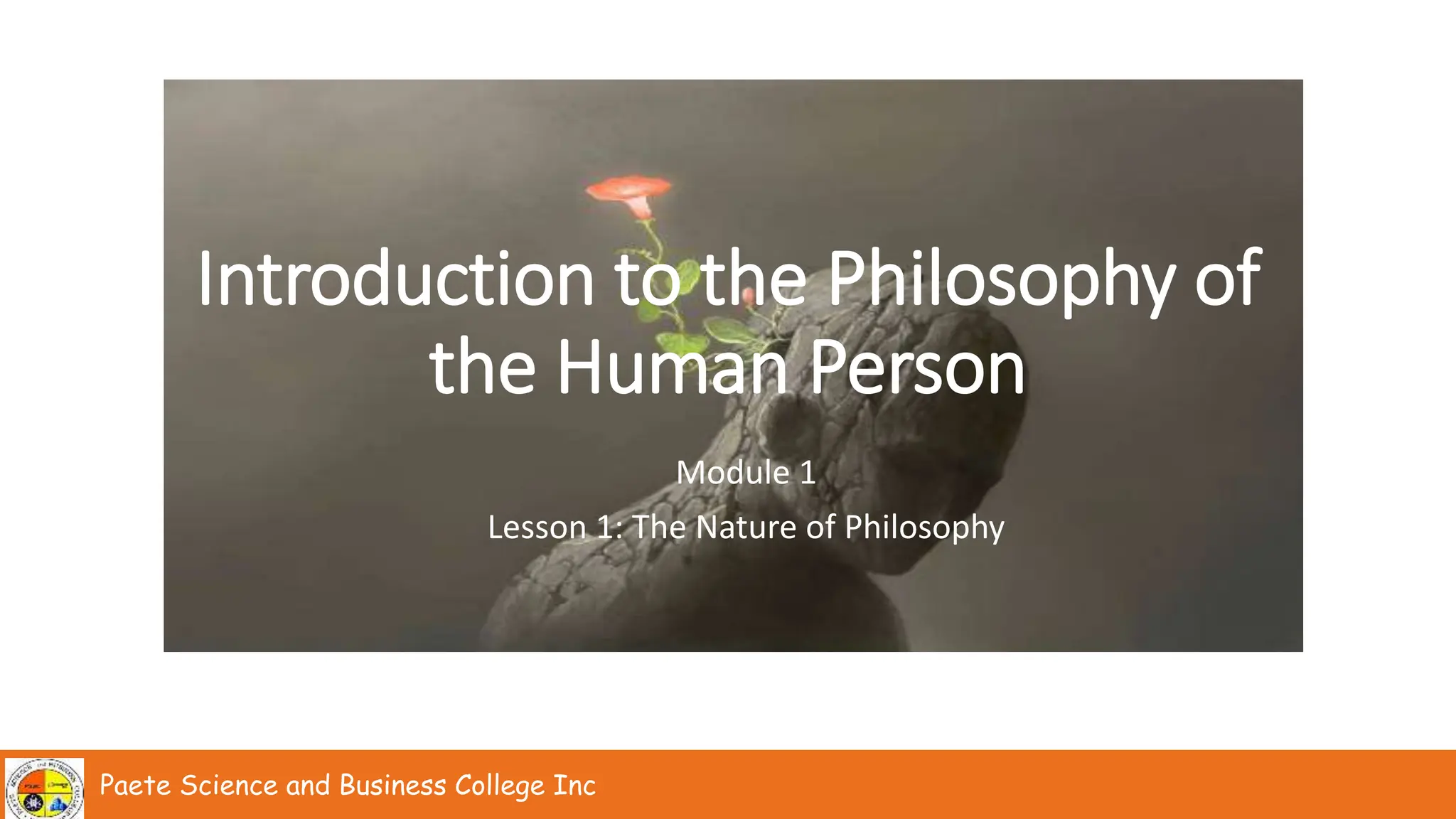
Introduction to the Philosophy of
the Human Person
Paete Science and Business College Inc
Module 1
Lesson 1: The Nature of Philosophy
Learning Objectives
Paete Science and Business College Inc
• Distinguish a holistic perspective from a partial
point of view.
• Recognize human activities that emanated from
deliberate reflection.
• Realize the value of doing philosophy in
obtaining a broad perspective on life.
• Do a philosophical reflection on a concrete
situation from a holistic point of view.
Activity 1.1: What is on your mind?
Paete Science and Business College Inc
Direction: Get one (1) sheet of short
bond paper and create a graphic
organizer to organize your initial thought
about philosophy.
Activity 1.1: What is on your mind?
Paete Science and Business College Inc
Philosophy
Paete Science and Business College Inc
Module 1-Lesson 1: The Nature of Philosophy
1.1 Philosophy as the Mother Discipline
Introduction to the Philosophy of the Human person
Etymology of Philosophy
Paete Science and Business College Inc
• Philosophy comes to the Greek word,
philosophia, which means “love of
wisdom”
• Philo/Phylos-love
• Sophia/Sophie-wisdom
• First used by Pythagoras at early 531 BC.
Introduction to the Philosophy of the Human Person: Module 1-Lesson 1-The Nature of Philosophy
Paete Science and Business College Inc
“There is only one thing
I know-and that is that I
know nothing”
-Socrates
Introduction to the Philosophy of the Human Person: Module 1-Lesson 1-The Nature of Philosophy
Paete Science and Business College Inc
“Everything is made of
water
-Thales
Introduction to the Philosophy of the Human Person: Module 1-Lesson 1-The Nature of Philosophy
The Nature of Philosophy
Paete Science and Business College Inc
• What is my purpose in life?
• Why I am here?
• Are aliens real?
• Is God real?
• How do I know that I am not dreaming?
• How do we know anything is true?
Introduction to the Philosophy of the Human Person: Module 1-Lesson 1-The Nature of Philosophy
Philosophy
Paete Science and Business College Inc
• Is the mother discipline out of which
the other sciences emerge.
• It emerged as something revolutionary
because it combat the mythological
explanation about the of the universe
(Warner).
Introduction to the Philosophy of the Human Person: Module 1-Lesson 1-The Nature of Philosophy
Thales of Miletus (650 B.C.)
Paete Science and Business College Inc
• A man dared to go against
methodological tradition.
• Father of the Western Philosophy.
• Assumed that it is within man’s rational
ability to abstract and explain reality.
Introduction to the Philosophy of the Human Person: Module 1-Lesson 1-The Nature of Philosophy
Thales of Miletus (650 B.C.)
Paete Science and Business College Inc
• A man dared to go against
methodological tradition.
• Father of the Western Philosophy.
• Assumed that it is within man’s rational
ability to abstract and explain reality.
Introduction to the Philosophy of the Human Person: Module 1-Lesson 1-The Nature of Philosophy
Paete Science and Business College Inc
Module 1-Lesson 1: The Nature of Philosophy
1.2 Characteristics of a
Philosophic Question
Introduction to the Philosophy of the Human person
Philosophic Questions (Isaiah Berlin)
Paete Science and Business College Inc
1. These questions are often very broad or
general.
2. There is no single methodology for
answering these questions.
3. All these questions may seem to be trivial
and general
Introduction to the Philosophy of the Human Person: Module 1-Lesson 1-The Nature of Philosophy
Philosophic Questions
Paete Science and Business College Inc
1. What is the primal substance that
constitutes reality? (Thales)
2. What is the purpose of my existence?
Answer:
-Is there really such anything as an objectively
given reality?
Introduction to the Philosophy of the Human Person: Module 1-Lesson 1-The Nature of Philosophy
Philosophic Questions
Paete Science and Business College Inc
Realism- assumes that an objective world
exist independent of the beliefs, perceptions
and experiences of the observers.
Constructivism- assumes that reality is
perceived by the observers subjectively
through one’s own senses, perception and
experiences.
Introduction to the Philosophy of the Human Person: Module 1-Lesson 1-The Nature of Philosophy
Philosophic Questions
Paete Science and Business College Inc
1. What is the primal substance that
constitutes reality? (Thales)
2. What is the purpose of my existence?
Answer:
-Is there really such anything as an objectively
given reality?
Introduction to the Philosophy of the Human Person: Module 1-Lesson 1-The Nature of Philosophy
Paete Science and Business College Inc
Module 1-Lesson 1: The Nature of Philosophy
1.3 Philosophy as a
Second-order Inquiry
Introduction to the Philosophy of the Human person
Introduction to the Philosophy of the Human Person: Module 1-Lesson 1-The Nature of Philosophy
Philosophy as a Second-order Inquiry
Paete Science and Business College Inc
1. What makes a philosopher different from a
scientist?
2. What is the difference between a first-
order inquiry done by a scientist as against
a second inquiry by a philosopher?
Introduction to the Philosophy of the Human Person: Module 1-Lesson 1-The Nature of Philosophy
Philosophy as a Second-order Inquiry
Paete Science and Business College Inc
• A physicist will follow the method of his science
strictly while doing his experiment in this
laboratory.
• A philosopher will ask general questions
regarding the underlying assumptions of the
scientist in doing his science and experiments.
Introduction to the Philosophy of the Human Person: Module 1-Lesson 1-The Nature of Philosophy
Philosophy as a Second-order Inquiry
Paete Science and Business College Inc
• A philosopher would ask, “What is your
justification for assuming that there causes and
effects in nature?
• The constant scrutiny and criticism often leads
to the refinement of a science and its
methodology.
Introduction to the Philosophy of the Human Person: Module 1-Lesson 1-The Nature of Philosophy
Philosophy as a Second-order Inquiry
Paete Science and Business College Inc
• Philosophy is considered as meta-discipline that
transcends and crosses over different areas and
disciplines.
• The self-awareness of the sciences and the
source from which all the sciences draw their
world view and methodological principles.
Introduction to the Philosophy of the Human Person: Module 1-Lesson 1-The Nature of Philosophy
Paete Science and Business College Inc
“Philosophy is a vision”
-Friedrich Waismann, Australian
Philosopher
Introduction to the Philosophy of the Human Person: Module 1-Lesson 1-The Nature of Philosophy
Fields of Philosophy
Paete Science and Business College Inc
1. Metaphysics- deals with the first principles of
things, including abstract concepts such as being,
knowing, substance, cause, identity, time and
space.
2. Epistemology- the philosophical study of the
nature, origin and limits of human knowledge.
3. Axiology- also known as value theory, the study
of the nature of value and valuation.
Introduction to the Philosophy of the Human Person: Module 1-Lesson 1-The Nature of Philosophy
Activity 1.2:
Paete Science and Business College Inc
Direction: Write an essay on a long bond
paper answering the question, what do
you think is your purpose in life?
Medium: English
No. of words: Minimum of 300 words and maximum of 500
words.

Introduction to the Philosophy-Module 1-Lesson 1.pptx

  • 1.
    Introduction to thePhilosophy of the Human Person Paete Science and Business College Inc Module 1 Lesson 1: The Nature of Philosophy
  • 2.
    Learning Objectives Paete Scienceand Business College Inc • Distinguish a holistic perspective from a partial point of view. • Recognize human activities that emanated from deliberate reflection. • Realize the value of doing philosophy in obtaining a broad perspective on life. • Do a philosophical reflection on a concrete situation from a holistic point of view.
  • 3.
    Activity 1.1: Whatis on your mind? Paete Science and Business College Inc Direction: Get one (1) sheet of short bond paper and create a graphic organizer to organize your initial thought about philosophy.
  • 4.
    Activity 1.1: Whatis on your mind? Paete Science and Business College Inc Philosophy
  • 5.
    Paete Science andBusiness College Inc Module 1-Lesson 1: The Nature of Philosophy 1.1 Philosophy as the Mother Discipline Introduction to the Philosophy of the Human person
  • 6.
    Etymology of Philosophy PaeteScience and Business College Inc • Philosophy comes to the Greek word, philosophia, which means “love of wisdom” • Philo/Phylos-love • Sophia/Sophie-wisdom • First used by Pythagoras at early 531 BC. Introduction to the Philosophy of the Human Person: Module 1-Lesson 1-The Nature of Philosophy
  • 7.
    Paete Science andBusiness College Inc “There is only one thing I know-and that is that I know nothing” -Socrates Introduction to the Philosophy of the Human Person: Module 1-Lesson 1-The Nature of Philosophy
  • 8.
    Paete Science andBusiness College Inc “Everything is made of water -Thales Introduction to the Philosophy of the Human Person: Module 1-Lesson 1-The Nature of Philosophy
  • 9.
    The Nature ofPhilosophy Paete Science and Business College Inc • What is my purpose in life? • Why I am here? • Are aliens real? • Is God real? • How do I know that I am not dreaming? • How do we know anything is true? Introduction to the Philosophy of the Human Person: Module 1-Lesson 1-The Nature of Philosophy
  • 10.
    Philosophy Paete Science andBusiness College Inc • Is the mother discipline out of which the other sciences emerge. • It emerged as something revolutionary because it combat the mythological explanation about the of the universe (Warner). Introduction to the Philosophy of the Human Person: Module 1-Lesson 1-The Nature of Philosophy
  • 11.
    Thales of Miletus(650 B.C.) Paete Science and Business College Inc • A man dared to go against methodological tradition. • Father of the Western Philosophy. • Assumed that it is within man’s rational ability to abstract and explain reality. Introduction to the Philosophy of the Human Person: Module 1-Lesson 1-The Nature of Philosophy
  • 12.
    Thales of Miletus(650 B.C.) Paete Science and Business College Inc • A man dared to go against methodological tradition. • Father of the Western Philosophy. • Assumed that it is within man’s rational ability to abstract and explain reality. Introduction to the Philosophy of the Human Person: Module 1-Lesson 1-The Nature of Philosophy
  • 13.
    Paete Science andBusiness College Inc Module 1-Lesson 1: The Nature of Philosophy 1.2 Characteristics of a Philosophic Question Introduction to the Philosophy of the Human person
  • 14.
    Philosophic Questions (IsaiahBerlin) Paete Science and Business College Inc 1. These questions are often very broad or general. 2. There is no single methodology for answering these questions. 3. All these questions may seem to be trivial and general Introduction to the Philosophy of the Human Person: Module 1-Lesson 1-The Nature of Philosophy
  • 15.
    Philosophic Questions Paete Scienceand Business College Inc 1. What is the primal substance that constitutes reality? (Thales) 2. What is the purpose of my existence? Answer: -Is there really such anything as an objectively given reality? Introduction to the Philosophy of the Human Person: Module 1-Lesson 1-The Nature of Philosophy
  • 16.
    Philosophic Questions Paete Scienceand Business College Inc Realism- assumes that an objective world exist independent of the beliefs, perceptions and experiences of the observers. Constructivism- assumes that reality is perceived by the observers subjectively through one’s own senses, perception and experiences. Introduction to the Philosophy of the Human Person: Module 1-Lesson 1-The Nature of Philosophy
  • 17.
    Philosophic Questions Paete Scienceand Business College Inc 1. What is the primal substance that constitutes reality? (Thales) 2. What is the purpose of my existence? Answer: -Is there really such anything as an objectively given reality? Introduction to the Philosophy of the Human Person: Module 1-Lesson 1-The Nature of Philosophy
  • 18.
    Paete Science andBusiness College Inc Module 1-Lesson 1: The Nature of Philosophy 1.3 Philosophy as a Second-order Inquiry Introduction to the Philosophy of the Human person Introduction to the Philosophy of the Human Person: Module 1-Lesson 1-The Nature of Philosophy
  • 19.
    Philosophy as aSecond-order Inquiry Paete Science and Business College Inc 1. What makes a philosopher different from a scientist? 2. What is the difference between a first- order inquiry done by a scientist as against a second inquiry by a philosopher? Introduction to the Philosophy of the Human Person: Module 1-Lesson 1-The Nature of Philosophy
  • 20.
    Philosophy as aSecond-order Inquiry Paete Science and Business College Inc • A physicist will follow the method of his science strictly while doing his experiment in this laboratory. • A philosopher will ask general questions regarding the underlying assumptions of the scientist in doing his science and experiments. Introduction to the Philosophy of the Human Person: Module 1-Lesson 1-The Nature of Philosophy
  • 21.
    Philosophy as aSecond-order Inquiry Paete Science and Business College Inc • A philosopher would ask, “What is your justification for assuming that there causes and effects in nature? • The constant scrutiny and criticism often leads to the refinement of a science and its methodology. Introduction to the Philosophy of the Human Person: Module 1-Lesson 1-The Nature of Philosophy
  • 22.
    Philosophy as aSecond-order Inquiry Paete Science and Business College Inc • Philosophy is considered as meta-discipline that transcends and crosses over different areas and disciplines. • The self-awareness of the sciences and the source from which all the sciences draw their world view and methodological principles. Introduction to the Philosophy of the Human Person: Module 1-Lesson 1-The Nature of Philosophy
  • 23.
    Paete Science andBusiness College Inc “Philosophy is a vision” -Friedrich Waismann, Australian Philosopher Introduction to the Philosophy of the Human Person: Module 1-Lesson 1-The Nature of Philosophy
  • 24.
    Fields of Philosophy PaeteScience and Business College Inc 1. Metaphysics- deals with the first principles of things, including abstract concepts such as being, knowing, substance, cause, identity, time and space. 2. Epistemology- the philosophical study of the nature, origin and limits of human knowledge. 3. Axiology- also known as value theory, the study of the nature of value and valuation. Introduction to the Philosophy of the Human Person: Module 1-Lesson 1-The Nature of Philosophy
  • 25.
    Activity 1.2: Paete Scienceand Business College Inc Direction: Write an essay on a long bond paper answering the question, what do you think is your purpose in life? Medium: English No. of words: Minimum of 300 words and maximum of 500 words.