
Introduction to Project Management
Waleed El-Naggar, MBA, PMP, MCP
https://www.facebook.com/waleed.naggar 1
 Understand what a project is, provide example of projects
 Understand what is project management
 Describe the triple constraint
 Discuss the relationship between projects, programs and portfolios
 Understand the project management domains
 Understand the project management knowledge areas
 Understand the different organizational Structures
Learning Objectives
https://www.facebook.com/waleed.naggar 2
“A project is a temporary endeavor undertaken to
create a unique product or service”
What is a Project?
 Operations is work done to sustain the business
 Projects end when their objectives have been reached
or the project has been terminated
 Projects can be large or small and take a short or long
time to complete
https://www.facebook.com/waleed.naggar 3
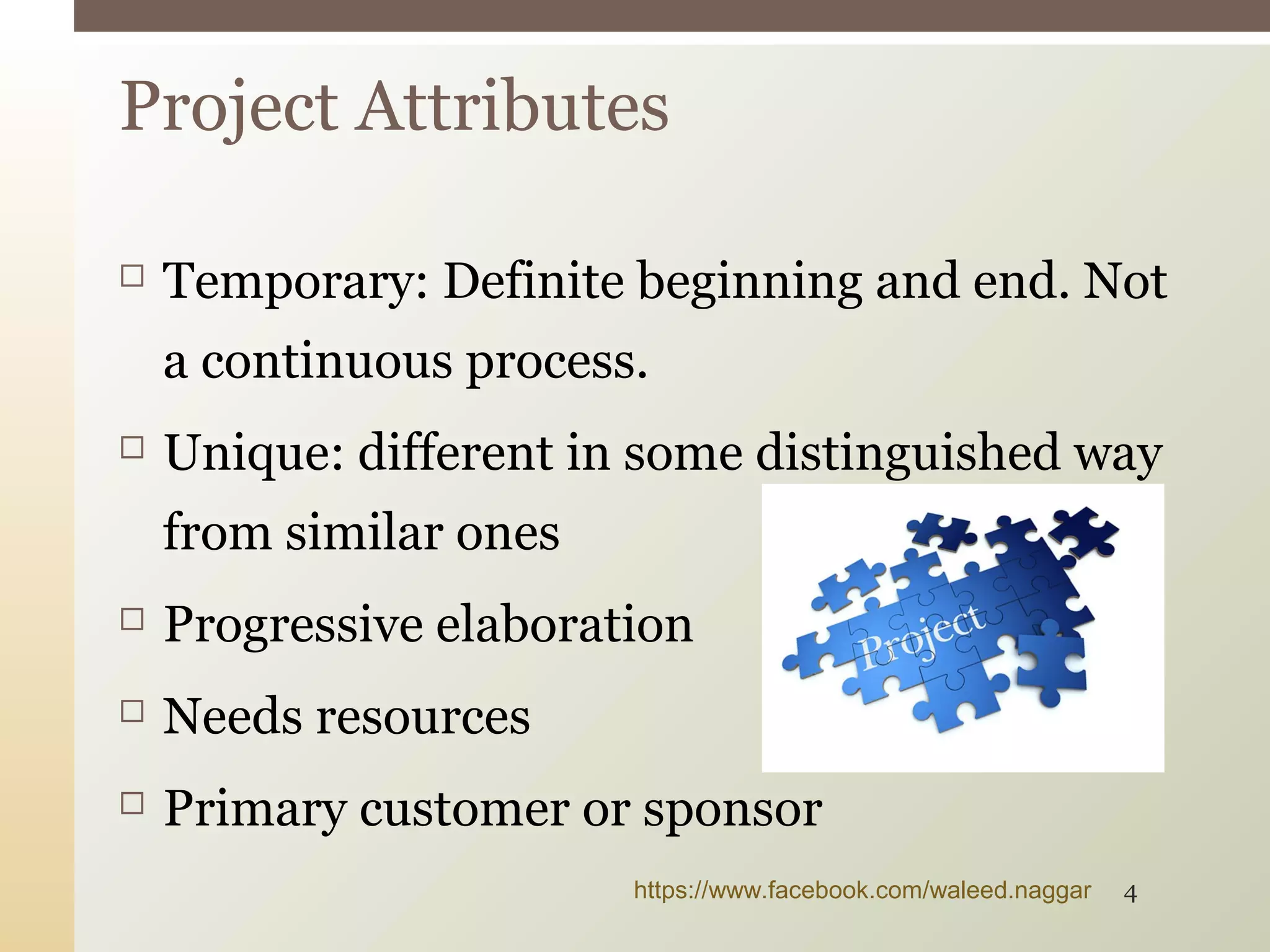
 Temporary: Definite beginning and end. Not
a continuous process.
 Unique: different in some distinguished way
from similar ones
 Progressive elaboration
 Needs resources
 Primary customer or sponsor
Project Attributes
https://www.facebook.com/waleed.naggar 4
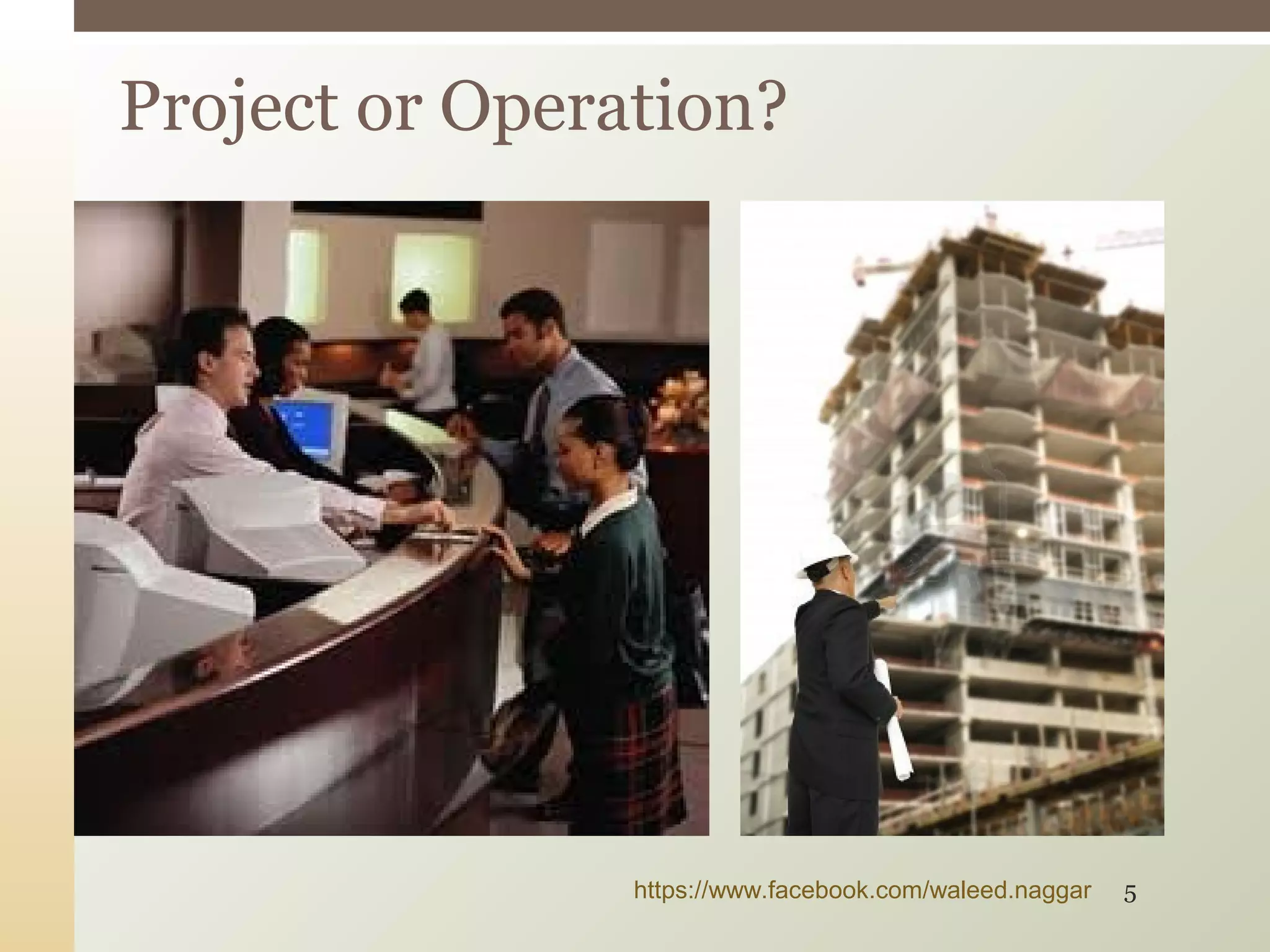
Project or Operation?
https://www.facebook.com/waleed.naggar 5
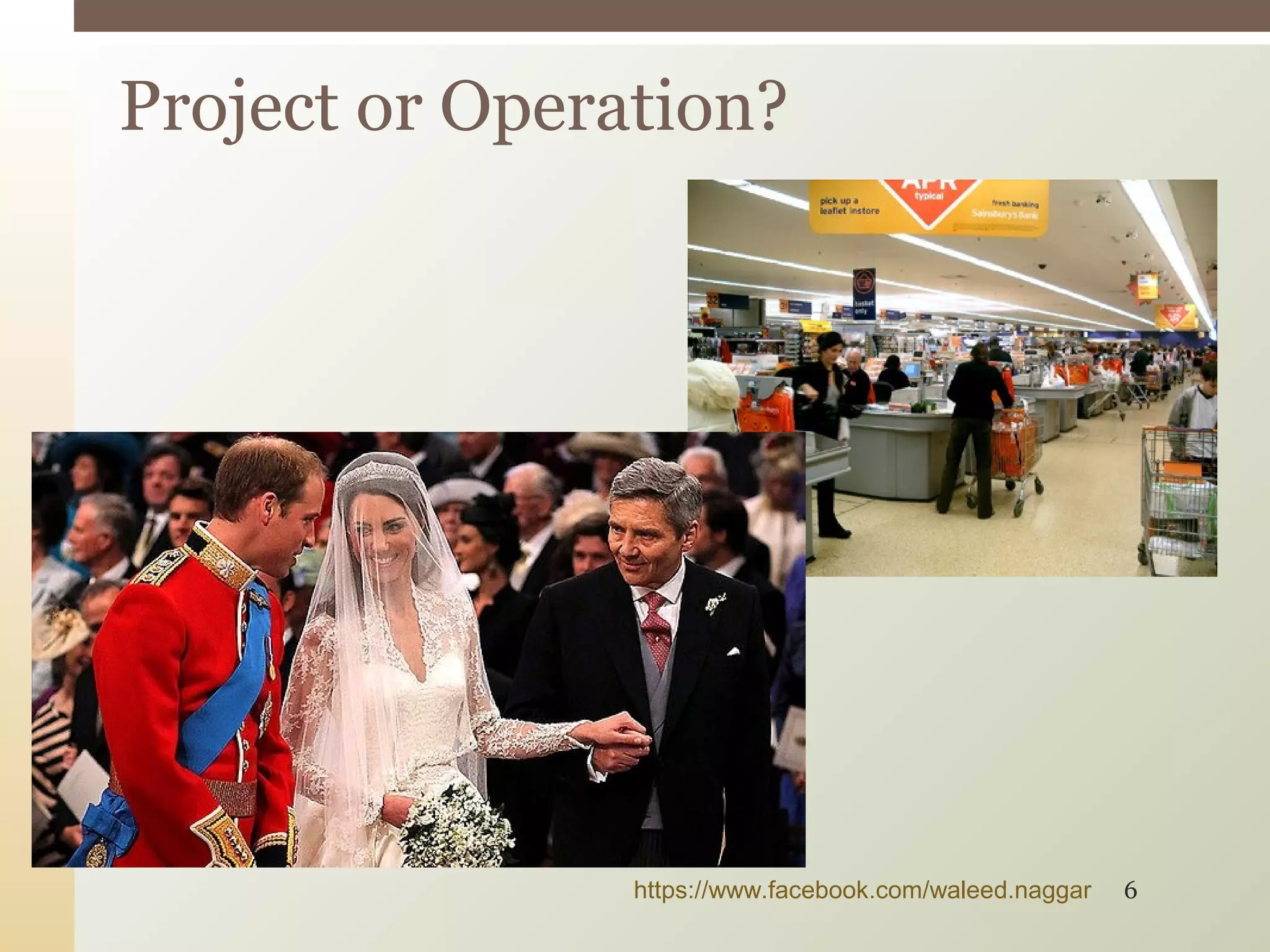
Project or Operation?
https://www.facebook.com/waleed.naggar 6
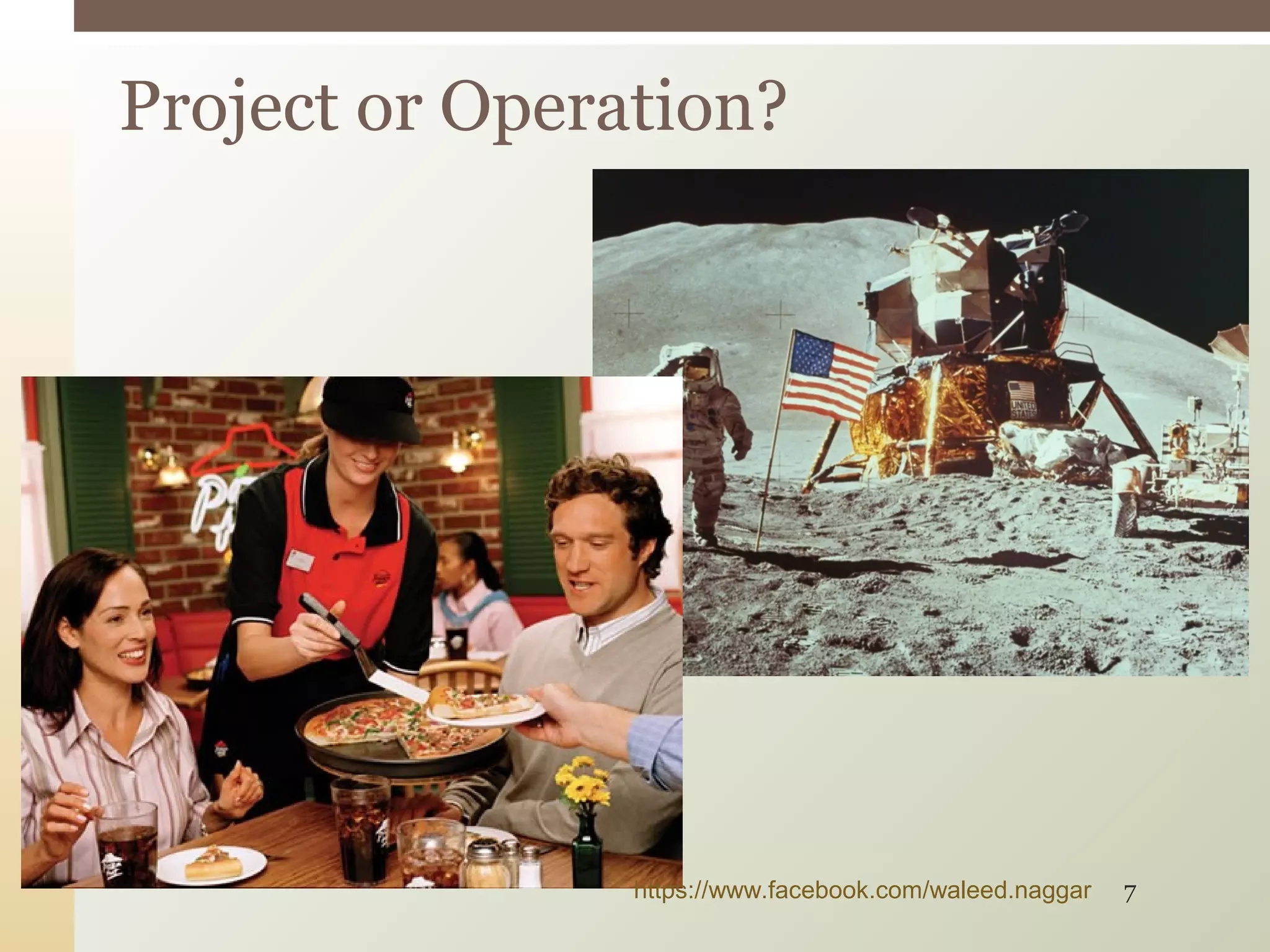
Project or Operation?
https://www.facebook.com/waleed.naggar 7
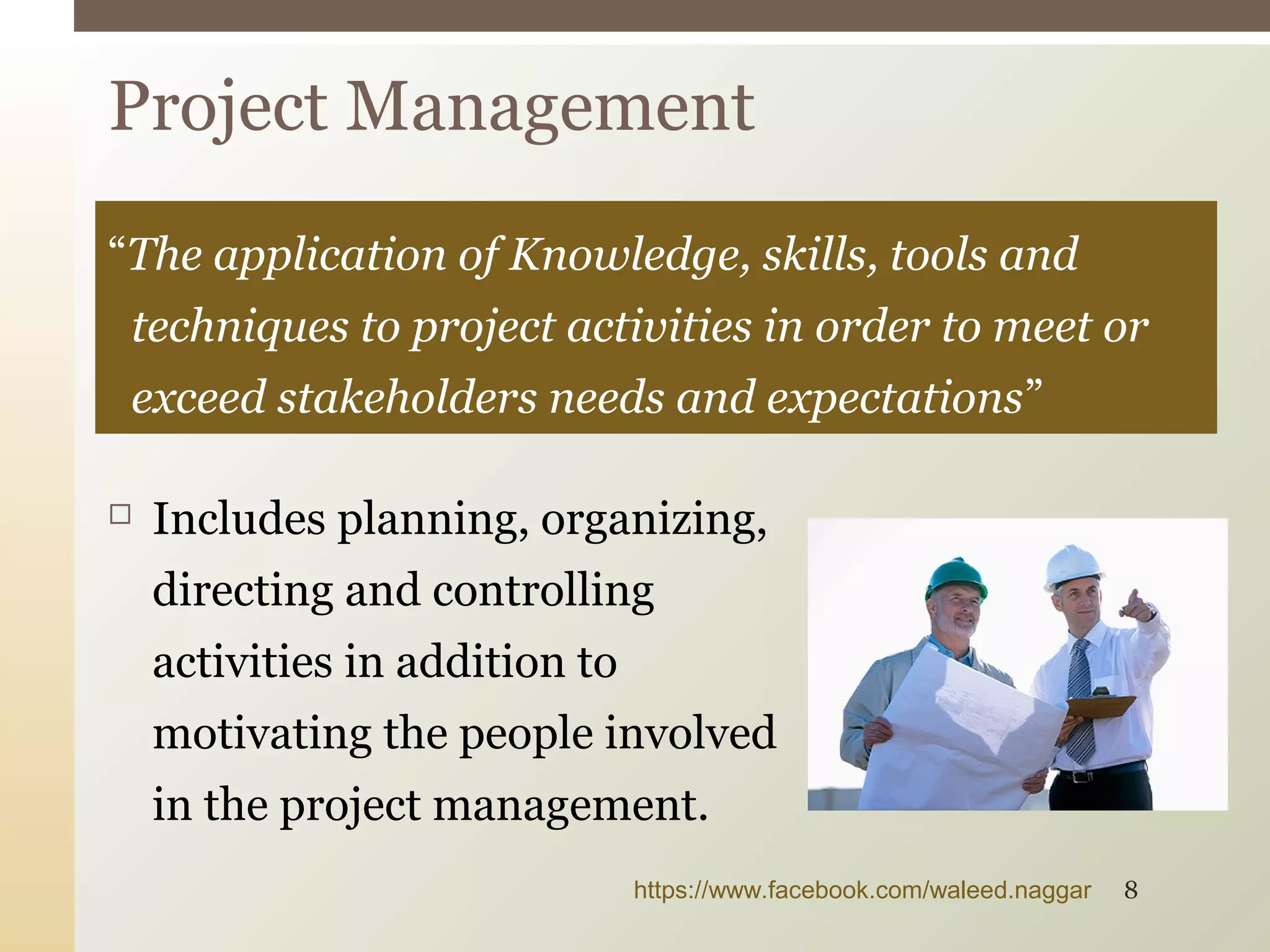
 Includes planning, organizing,
directing and controlling
activities in addition to
motivating the people involved
in the project management.
Project Management
“The application of Knowledge, skills, tools and
techniques to project activities in order to meet or
exceed stakeholders needs and expectations”
https://www.facebook.com/waleed.naggar 8
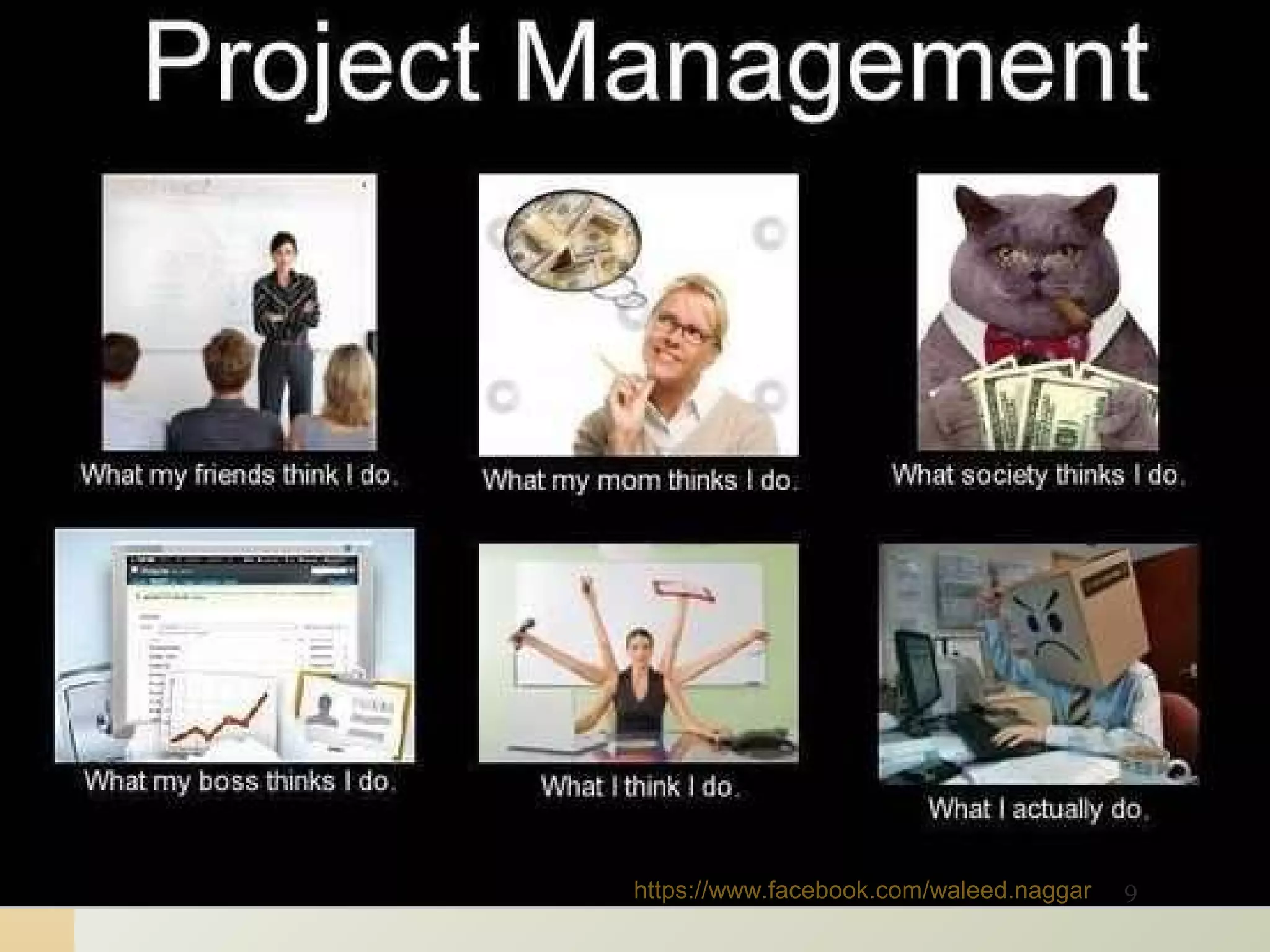
Project Management
https://www.facebook.com/waleed.naggar 9
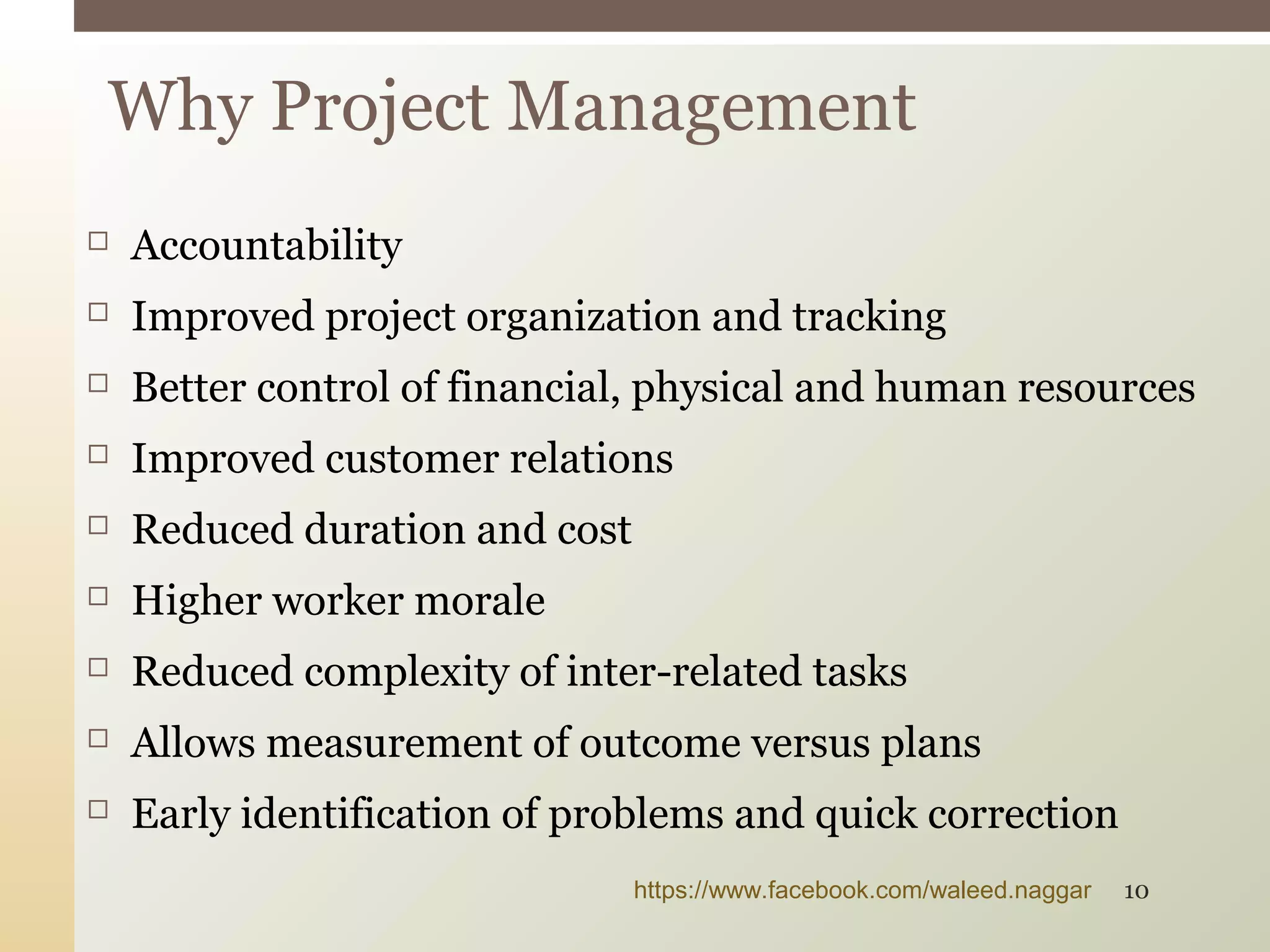
 Accountability
 Improved project organization and tracking
 Better control of financial, physical and human resources
 Improved customer relations
 Reduced duration and cost
 Higher worker morale
 Reduced complexity of inter-related tasks
 Allows measurement of outcome versus plans
 Early identification of problems and quick correction
Why Project Management
https://www.facebook.com/waleed.naggar 10
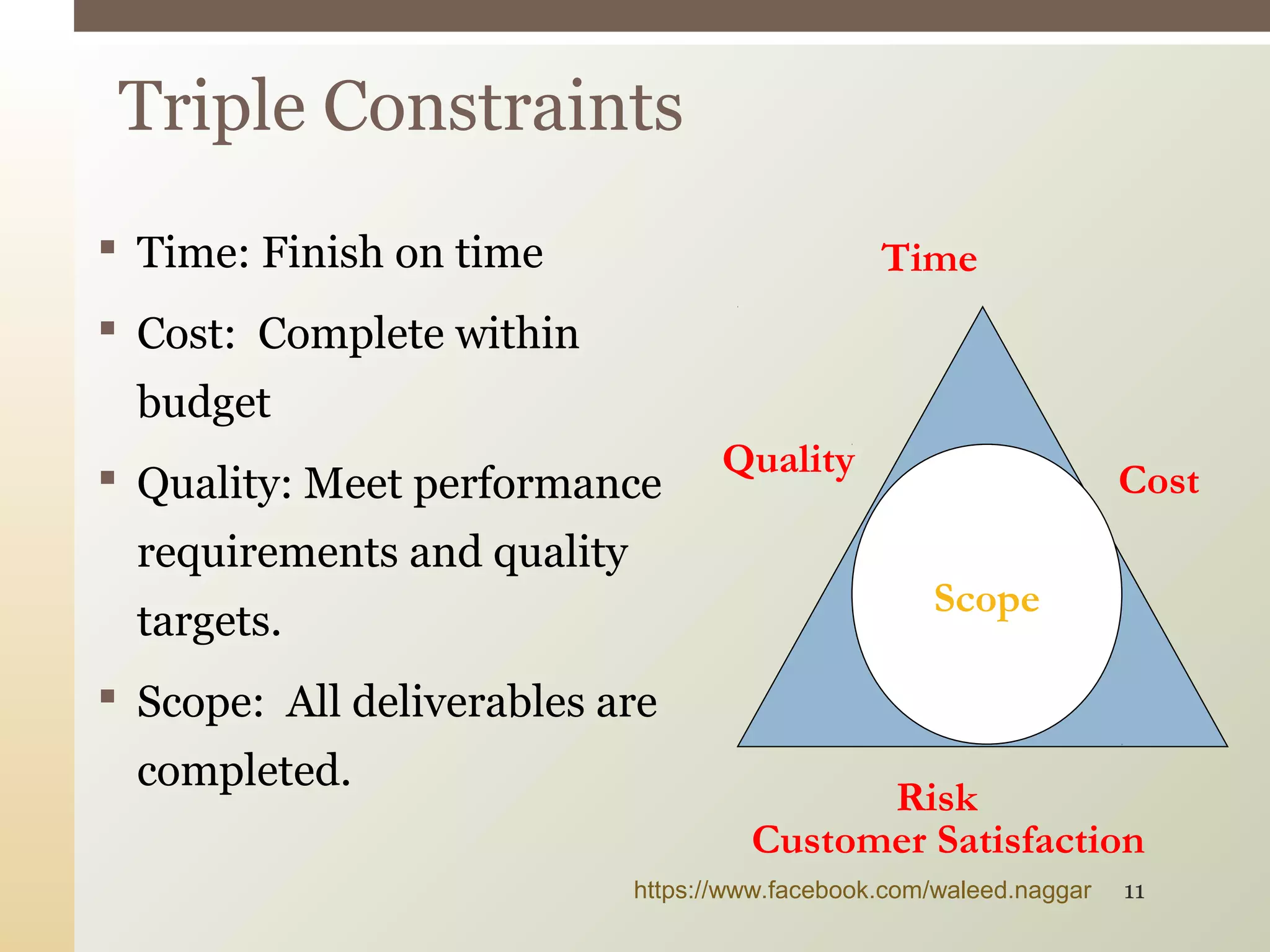
 Time: Finish on time
 Cost: Complete within
budget
 Quality: Meet performance
requirements and quality
targets.
 Scope: All deliverables are
completed.
Triple Constraints
Time
Quality
Scope
Risk
Customer Satisfaction
Cost
https://www.facebook.com/waleed.naggar 11
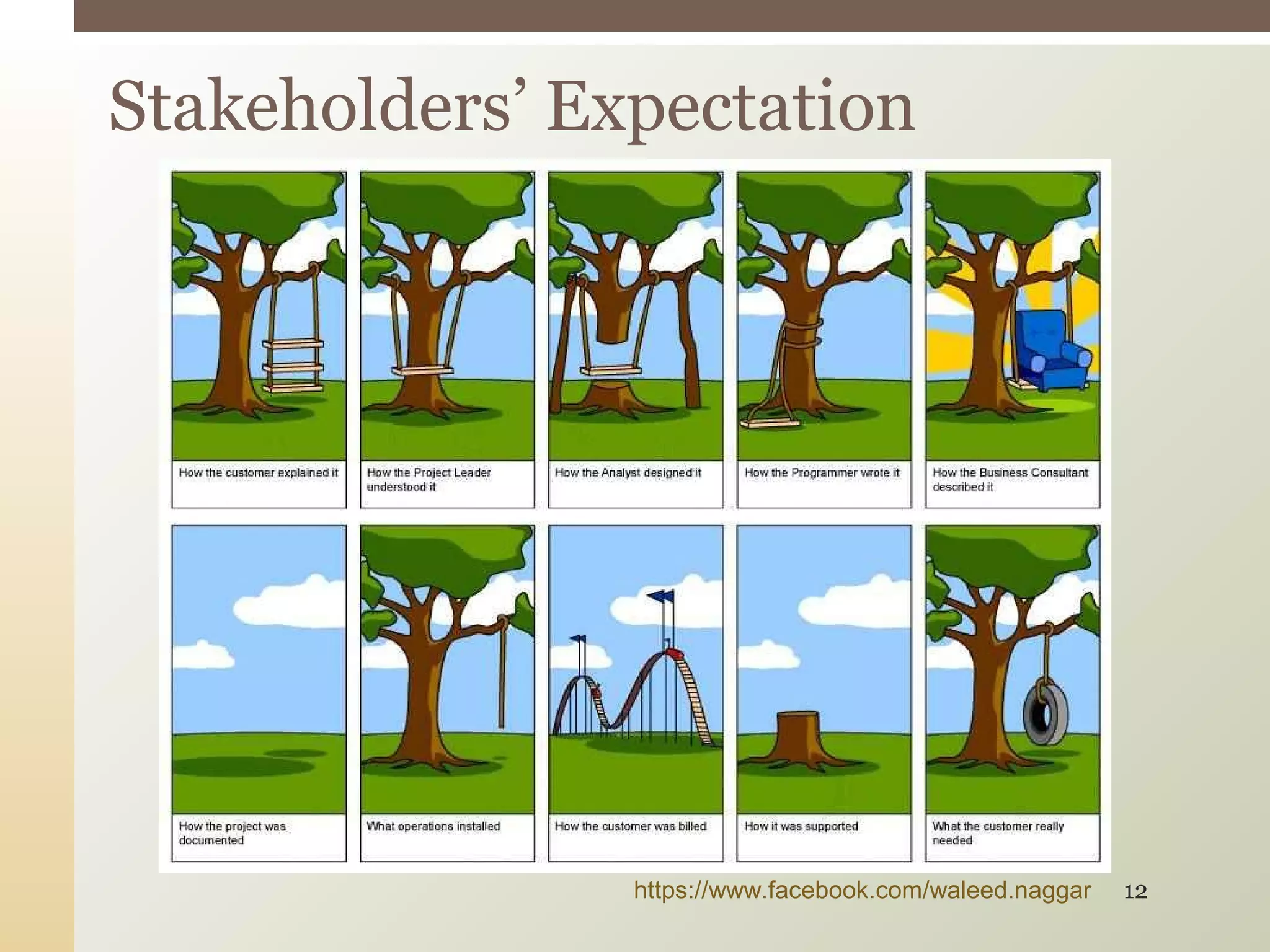
Stakeholders’ Expectation
https://www.facebook.com/waleed.naggar 12
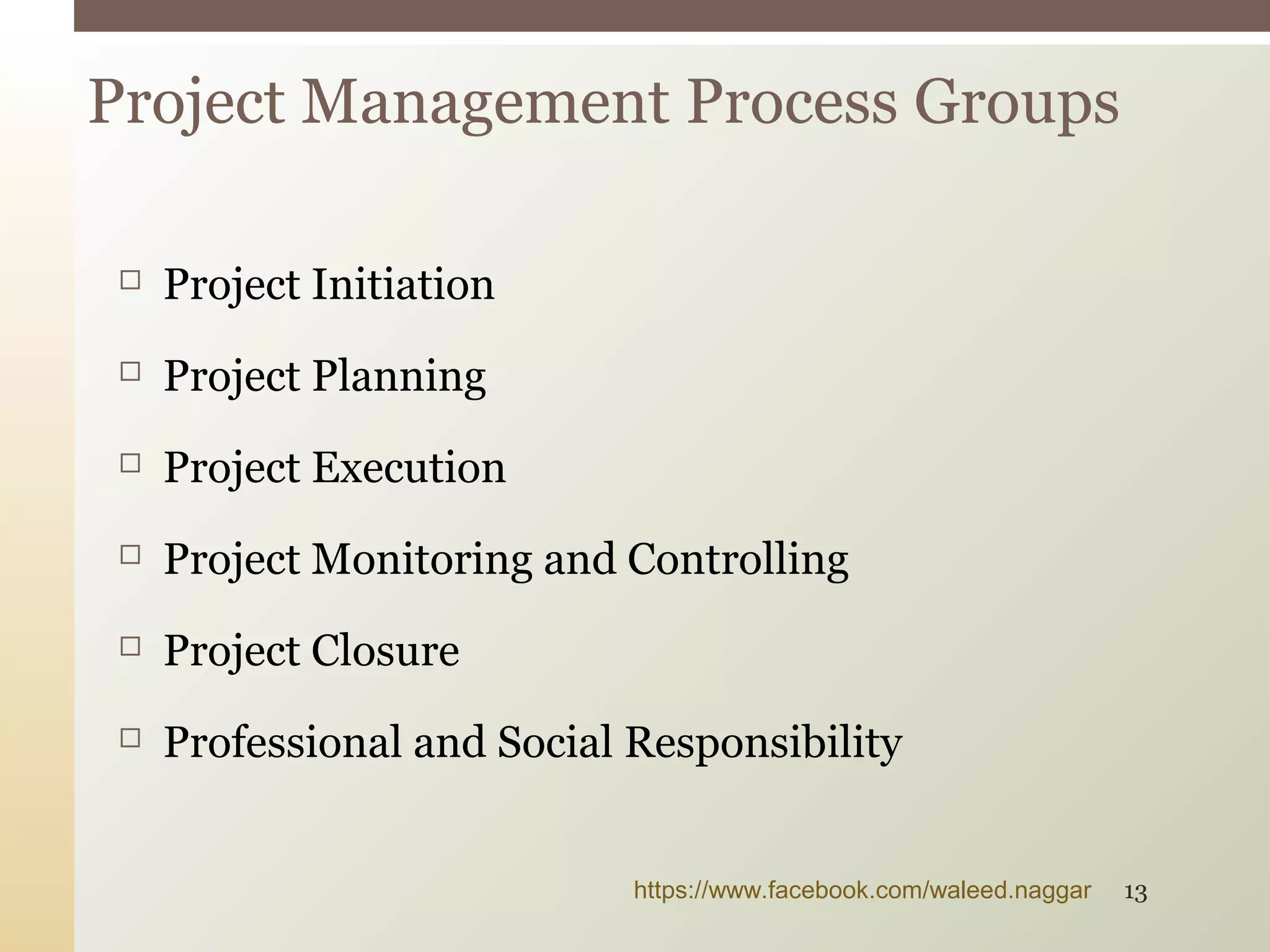
 Project Initiation
 Project Planning
 Project Execution
 Project Monitoring and Controlling
 Project Closure
 Professional and Social Responsibility
Project Management Process Groups
https://www.facebook.com/waleed.naggar 13
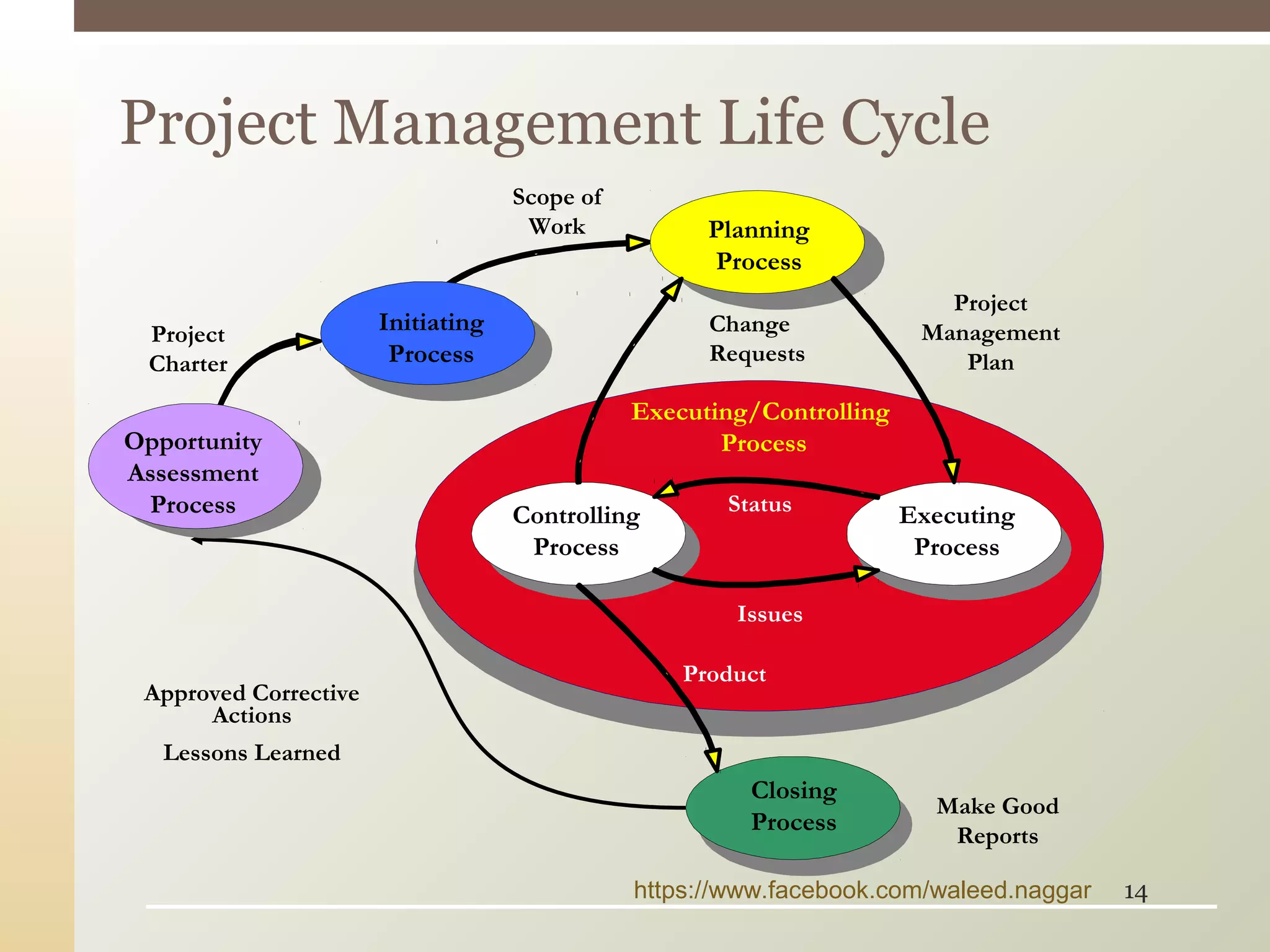
Project Management Life Cycle
Executing/Controlling
Process
Initiating
Process
Planning
Process
Controlling
Process
Executing
Process
Closing
Process
Scope of
Work
Status
Issues
Change
Requests
Project
Management
Plan
Product
Project
Charter
Approved Corrective
Actions
Lessons Learned
Make Good
Reports
Opportunity
Assessment
Process
https://www.facebook.com/waleed.naggar 14
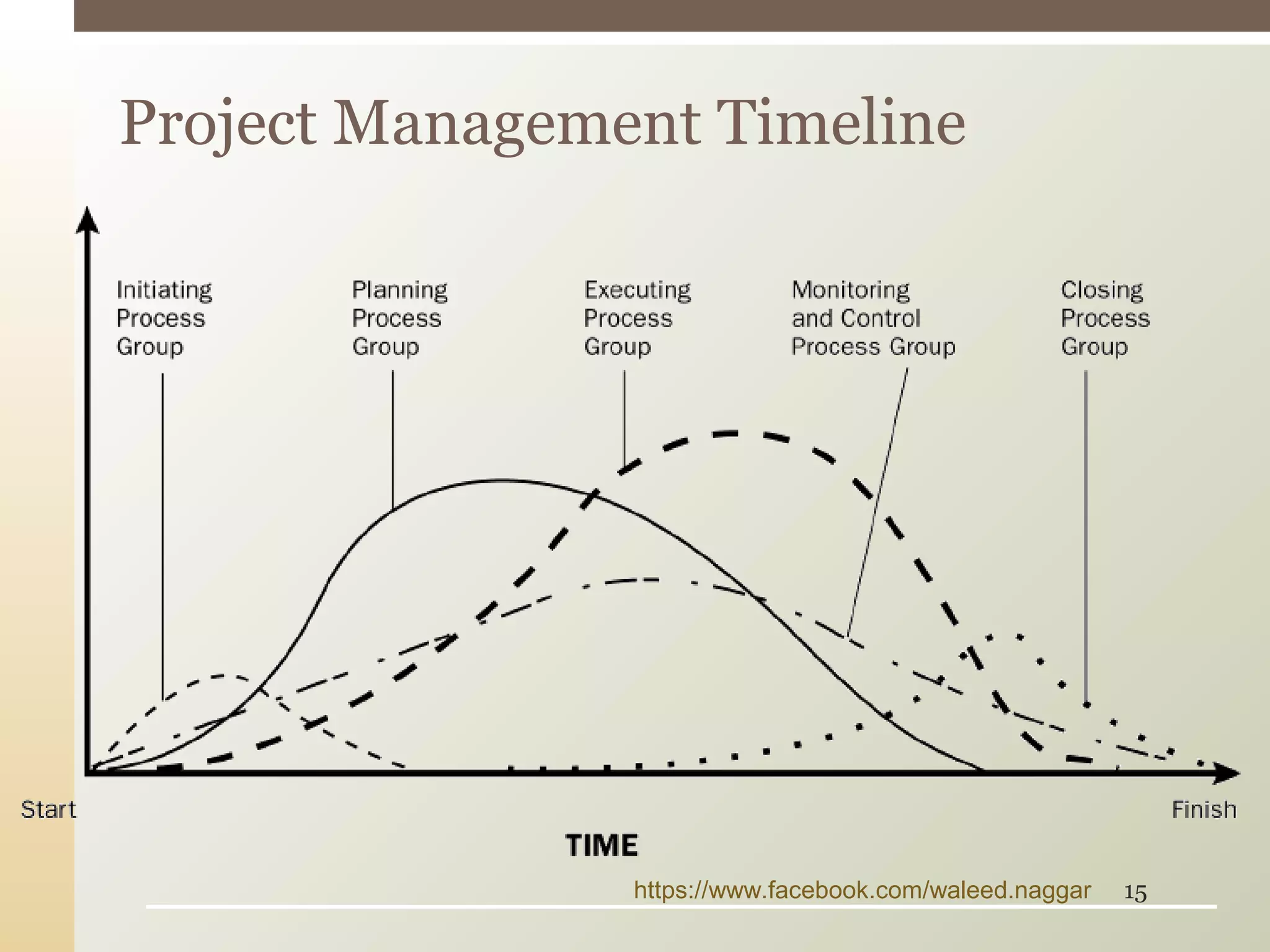
Project Management Timeline
https://www.facebook.com/waleed.naggar 15
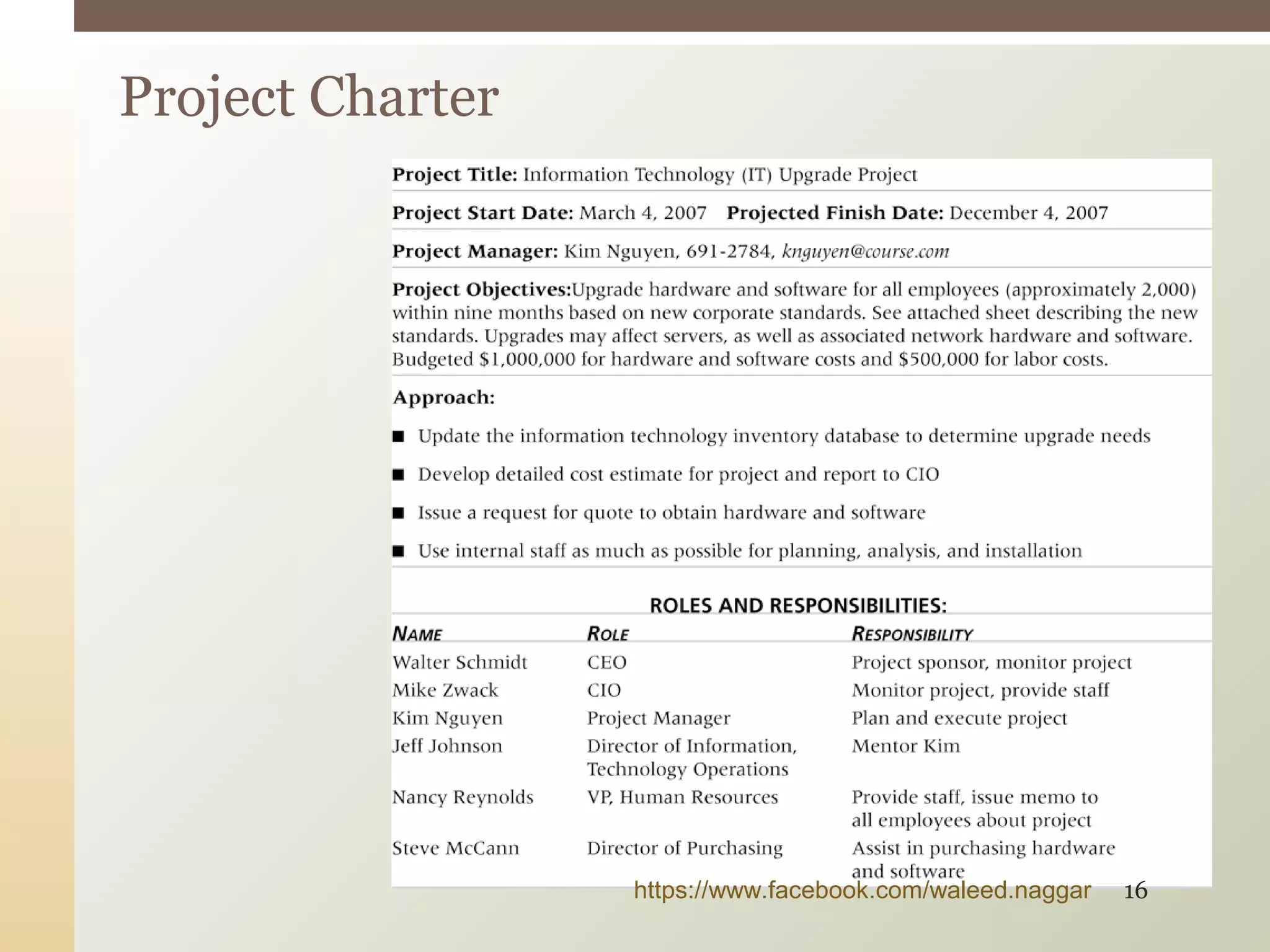
Project Charter
https://www.facebook.com/waleed.naggar 16
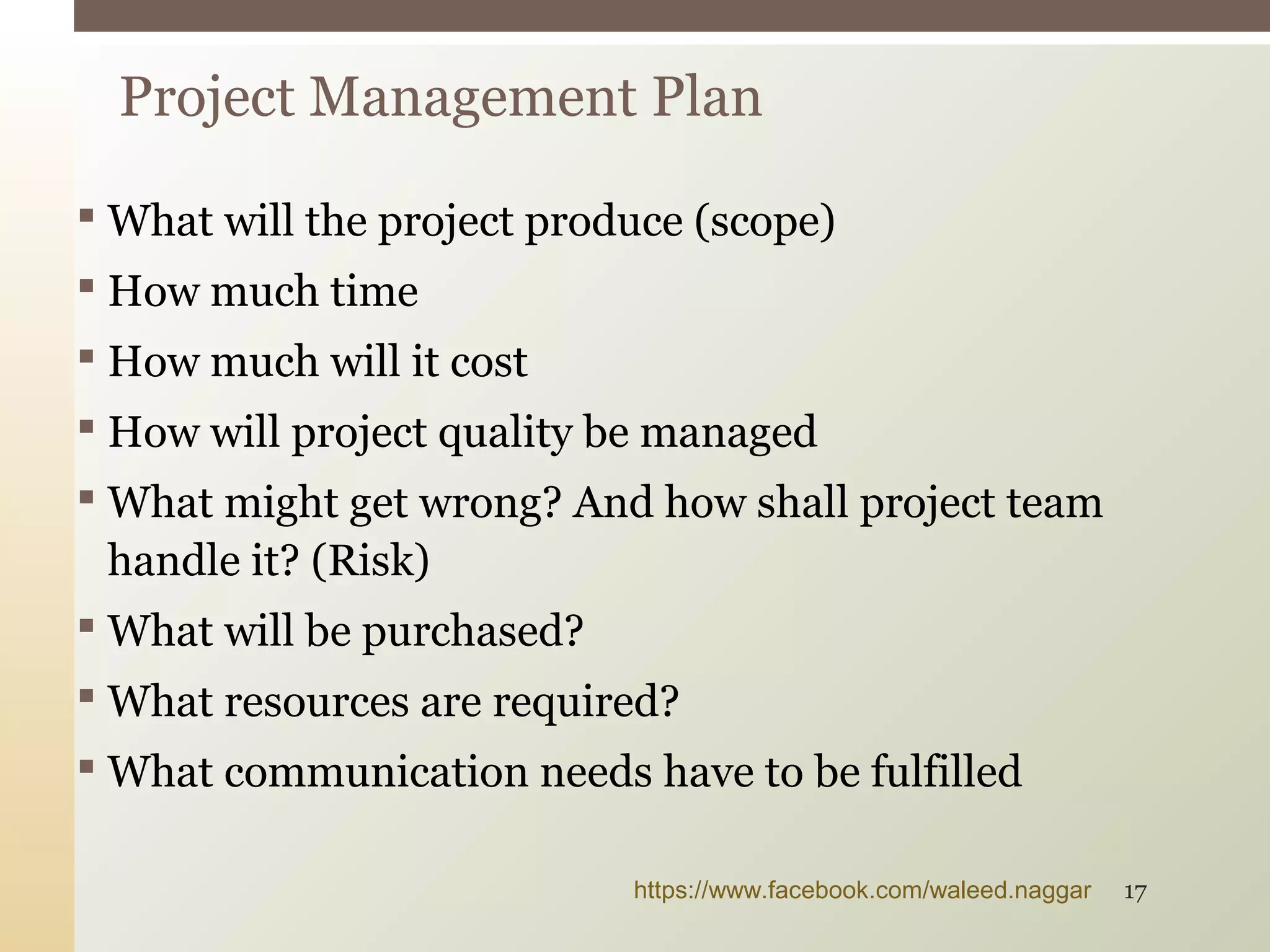
 What will the project produce (scope)
 How much time
 How much will it cost
 How will project quality be managed
 What might get wrong? And how shall project team
handle it? (Risk)
 What will be purchased?
 What resources are required?
 What communication needs have to be fulfilled
Project Management Plan
https://www.facebook.com/waleed.naggar 17
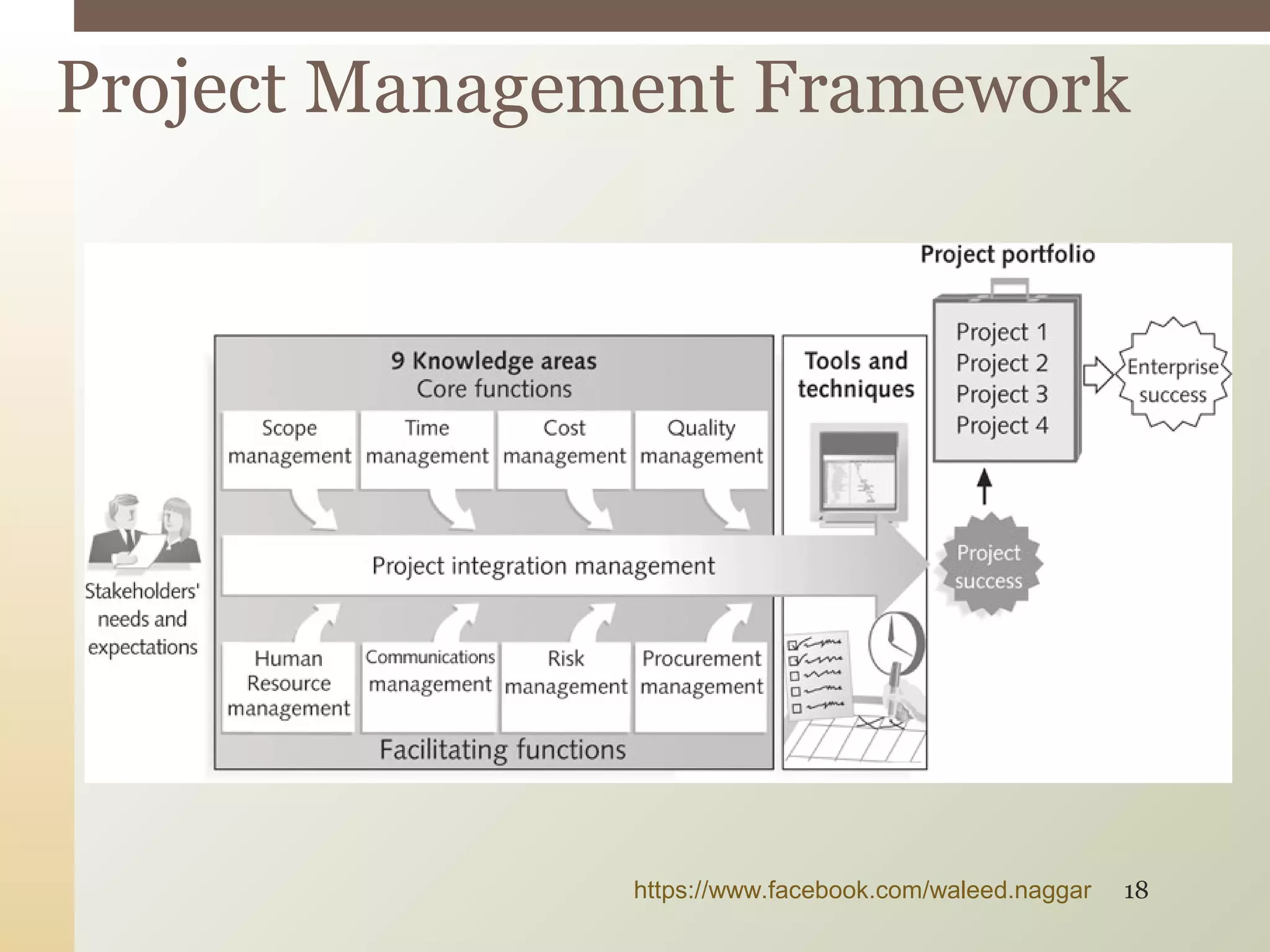
Project Management Framework
https://www.facebook.com/waleed.naggar 18
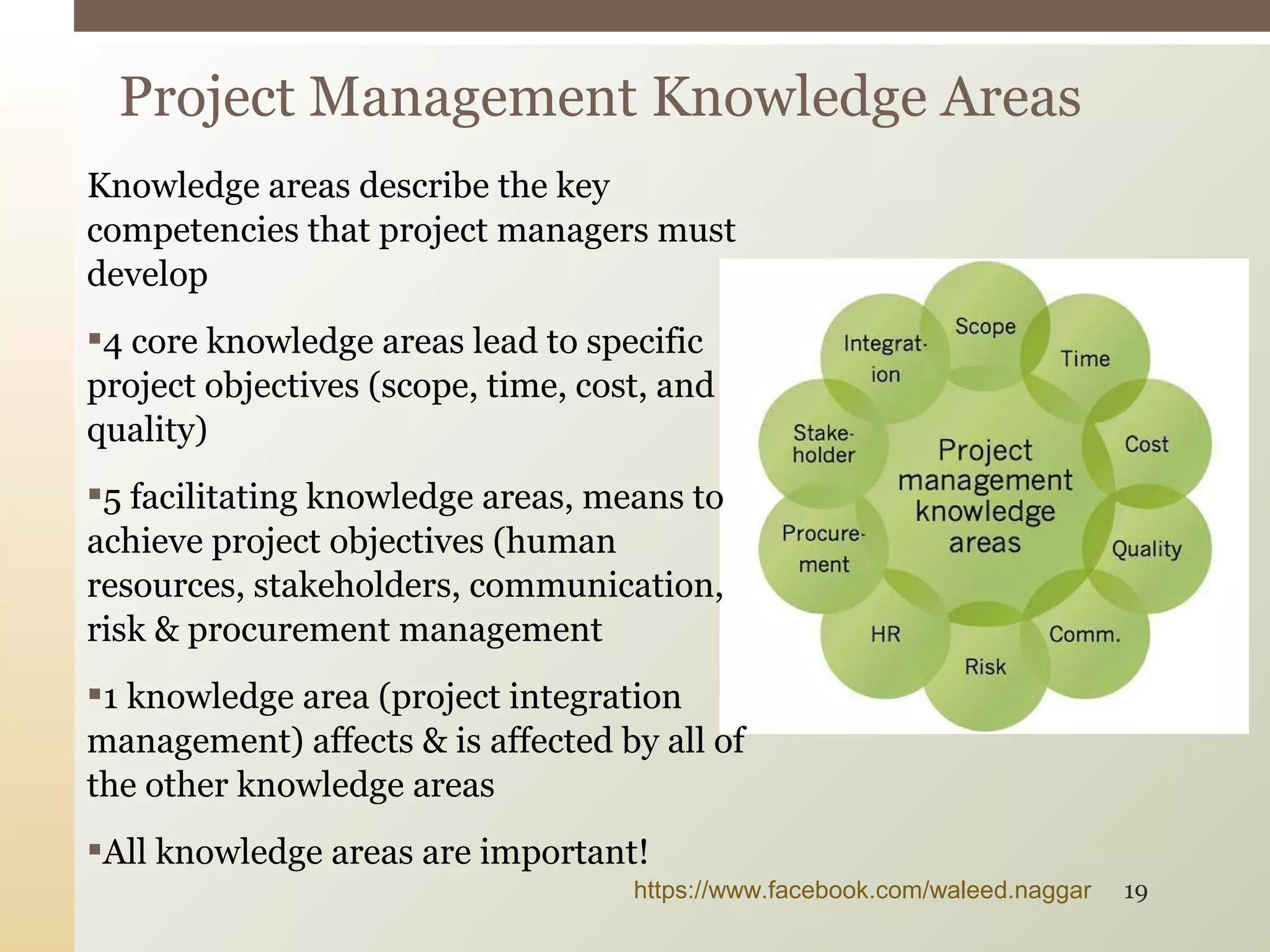
Knowledge areas describe the key
competencies that project managers must
develop
4 core knowledge areas lead to specific
project objectives (scope, time, cost, and
quality)
5 facilitating knowledge areas, means to
achieve project objectives (human
resources, stakeholders, communication,
risk & procurement management
1 knowledge area (project integration
management) affects & is affected by all of
the other knowledge areas
All knowledge areas are important!
Project Management Knowledge Areas
https://www.facebook.com/waleed.naggar 19
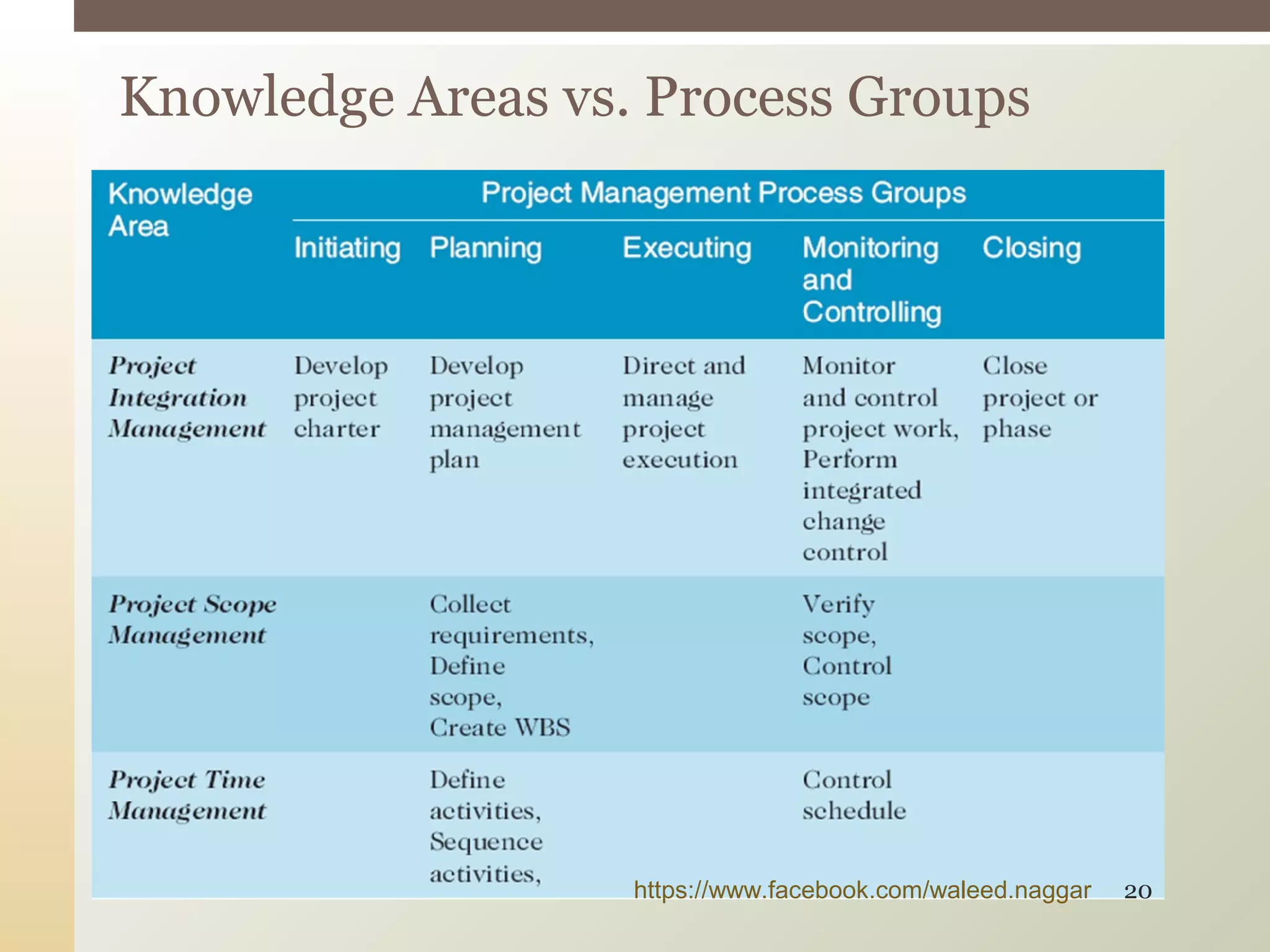
Knowledge Areas vs. Process Groups
https://www.facebook.com/waleed.naggar 20
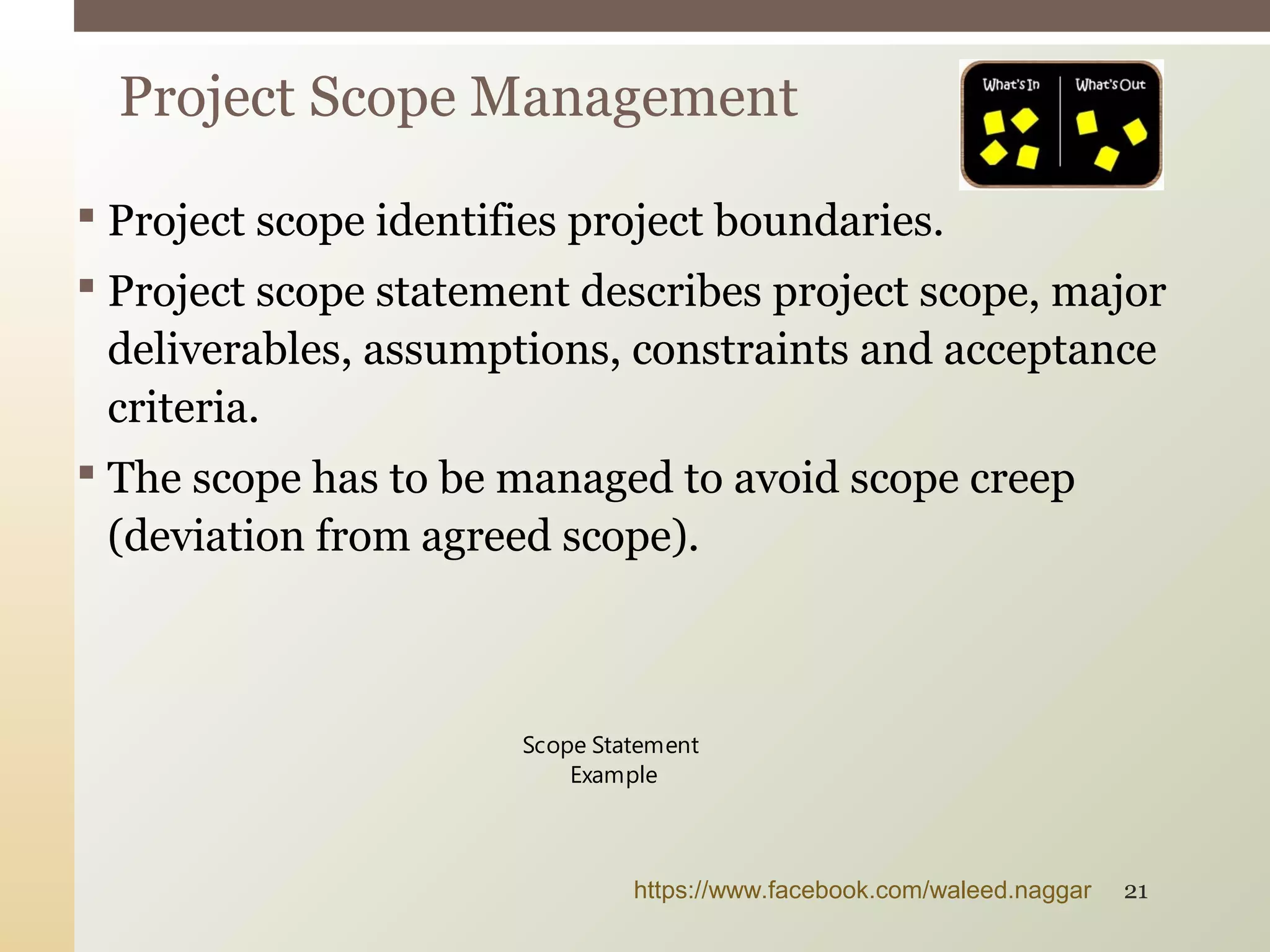
 Project scope identifies project boundaries.
 Project scope statement describes project scope, major
deliverables, assumptions, constraints and acceptance
criteria.
 The scope has to be managed to avoid scope creep
(deviation from agreed scope).
Project Scope Management
Scope Statement
Example
https://www.facebook.com/waleed.naggar 21
 Split in groups of 4-5
 Each group will select any project and describe its
scope
Exercise
https://www.facebook.com/waleed.naggar 22
 Identify the activities necessary to complete the
project.
 Estimate effort and duration
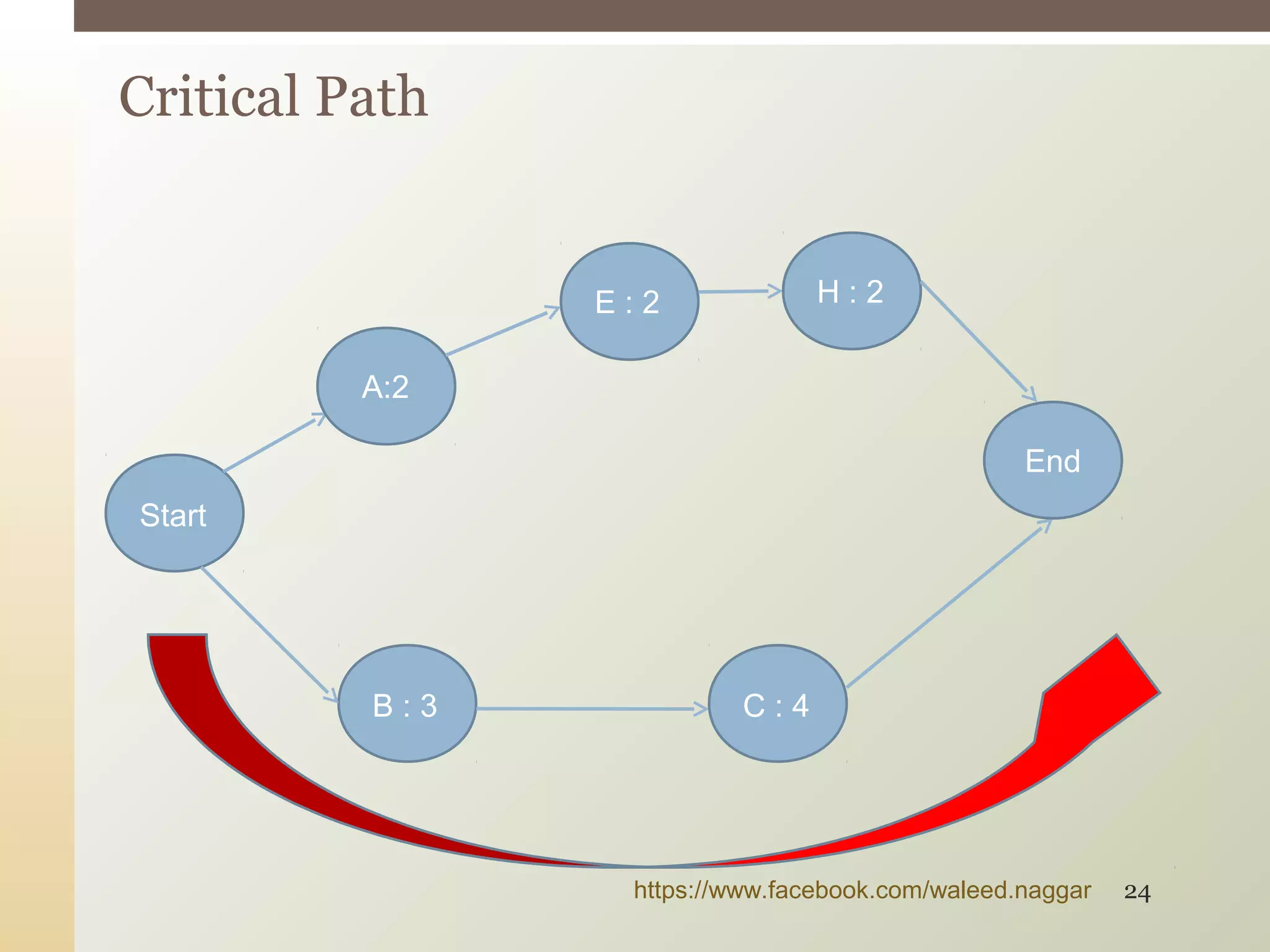
 Decide dependencies (sequence) of activities
 Identify critical path
Project Schedule Management
Project Schedule
https://www.facebook.com/waleed.naggar 23
Critical Path
B : 3 C : 4
Start
A:2
E : 2 H : 2
End
https://www.facebook.com/waleed.naggar 24
 Ensure the project is completed within approved budget
 Earned Value Management: a project performance
measurement technique that integrates scope, time and
cost data.
Project Cost Management
https://www.facebook.com/waleed.naggar 25
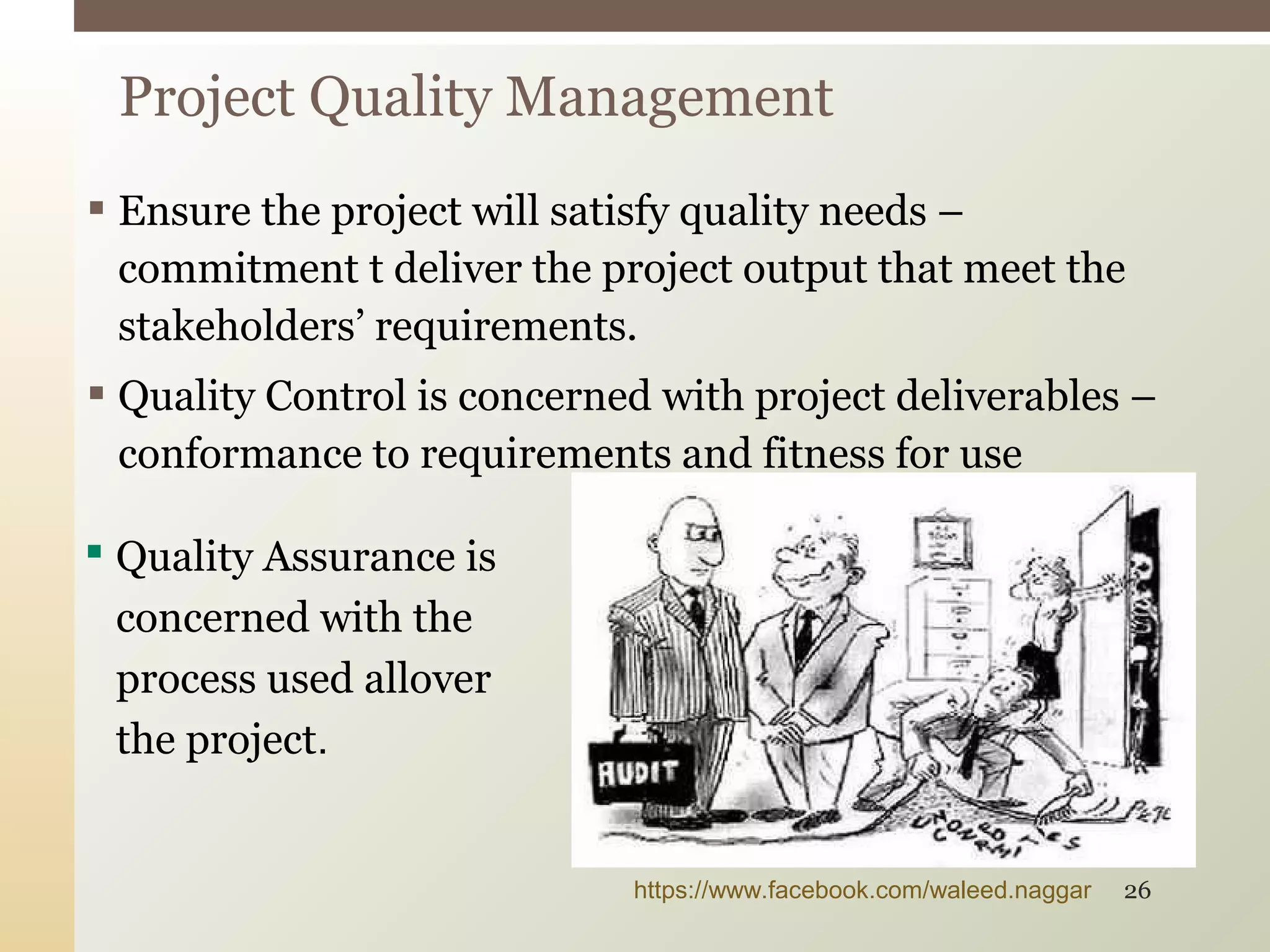
 Ensure the project will satisfy quality needs –
commitment t deliver the project output that meet the
stakeholders’ requirements.
 Quality Control is concerned with project deliverables –
conformance to requirements and fitness for use
Project Quality Management
 Quality Assurance is
concerned with the
process used allover
the project.
https://www.facebook.com/waleed.naggar 26
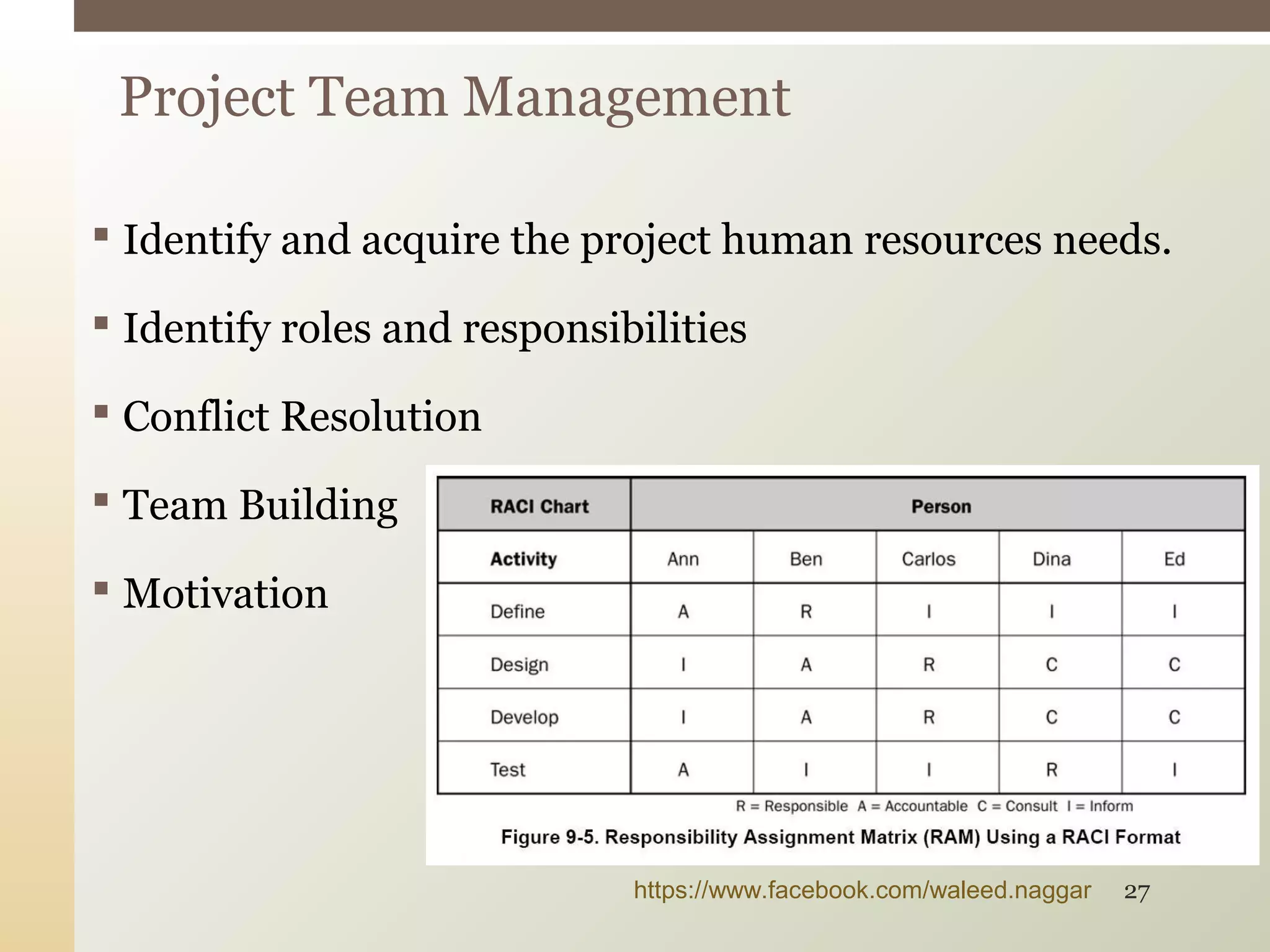
 Identify and acquire the project human resources needs.
 Identify roles and responsibilities
 Conflict Resolution
 Team Building
 Motivation
Project Team Management
https://www.facebook.com/waleed.naggar 27
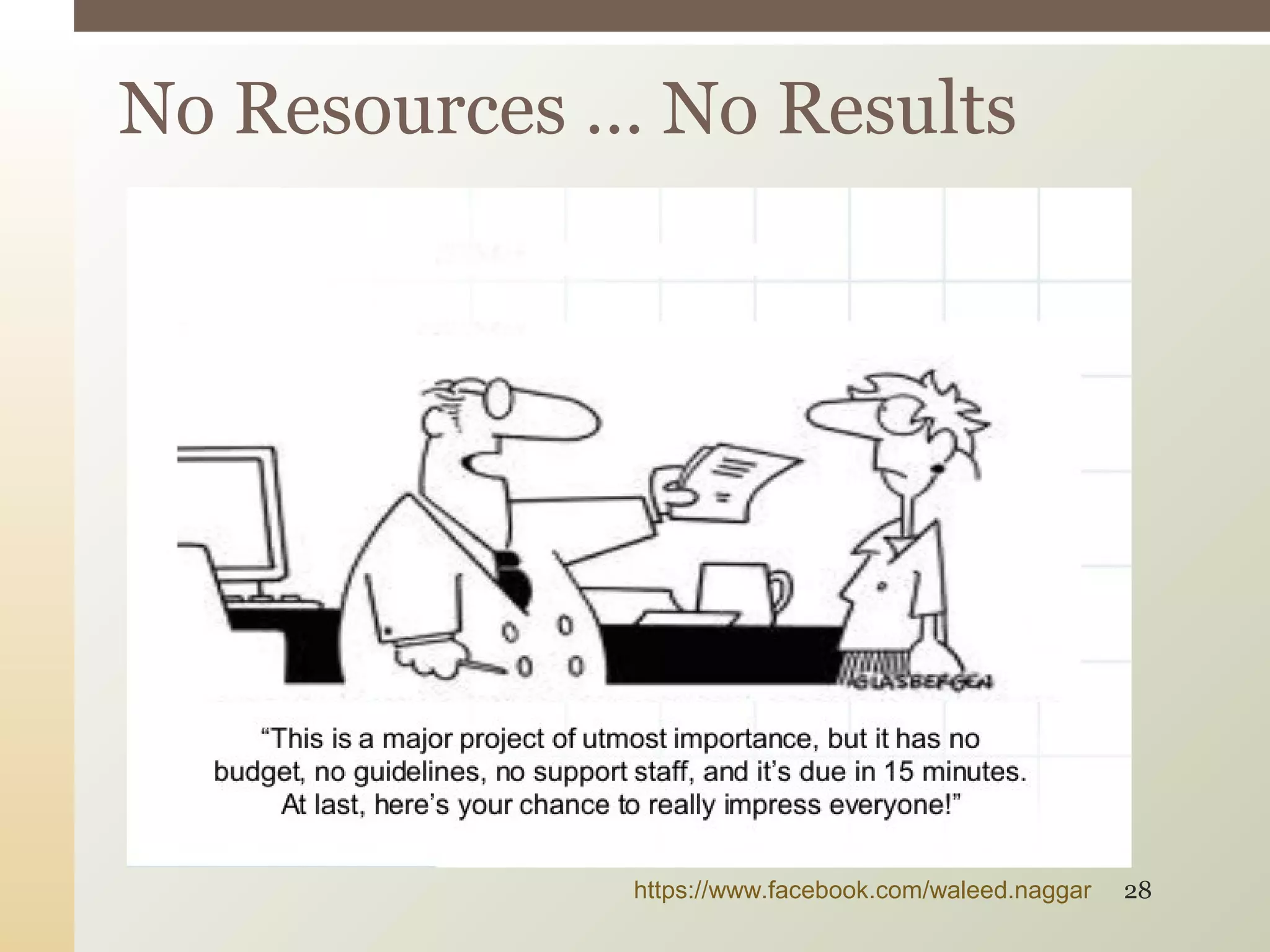
No Resources … No Results
https://www.facebook.com/waleed.naggar 28
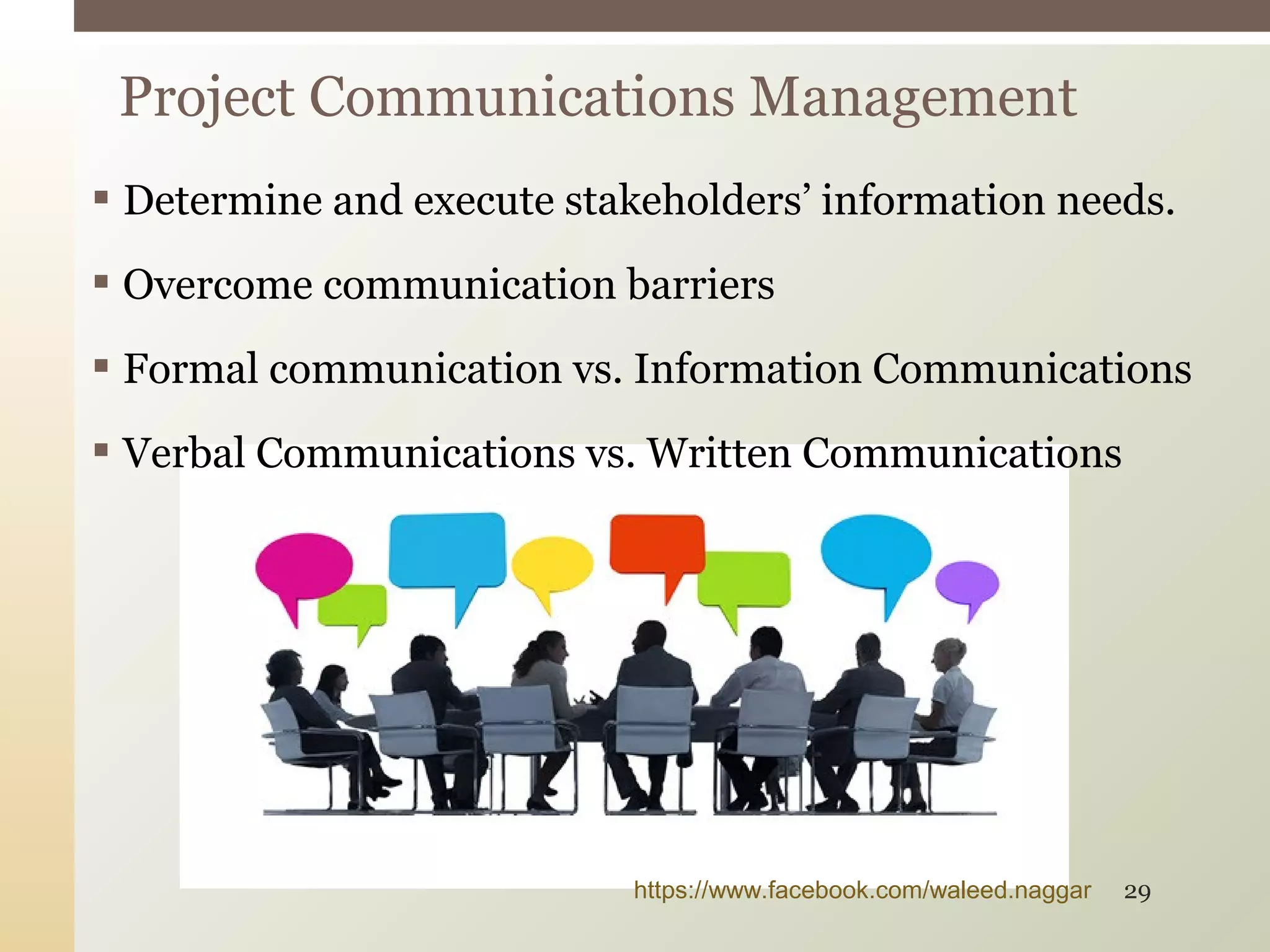
 Determine and execute stakeholders’ information needs.
 Overcome communication barriers
 Formal communication vs. Information Communications
 Verbal Communications vs. Written Communications
Project Communications Management
https://www.facebook.com/waleed.naggar 29
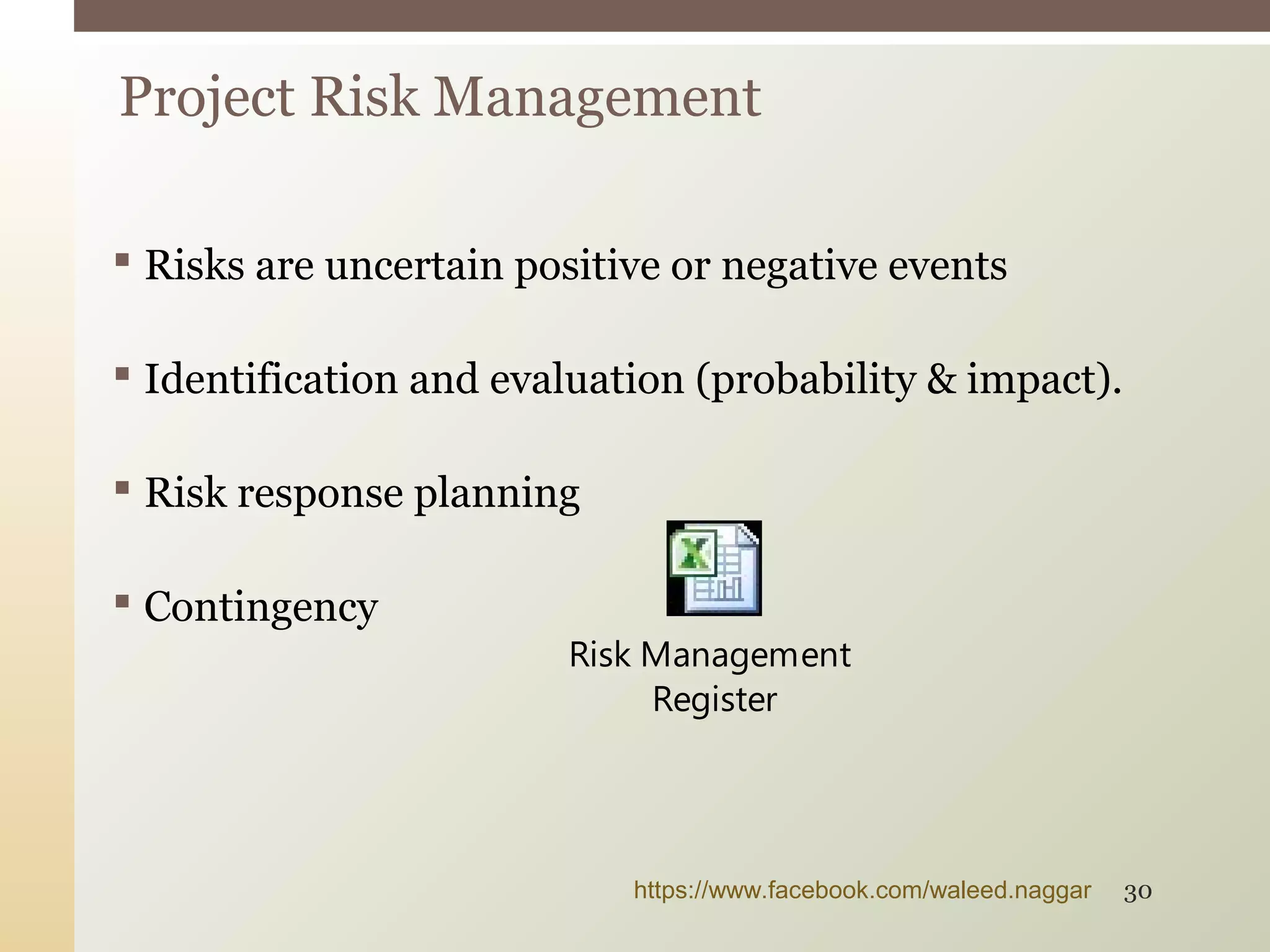
 Risks are uncertain positive or negative events
 Identification and evaluation (probability & impact).
 Risk response planning
 Contingency
Project Risk Management
Risk Management
Register
https://www.facebook.com/waleed.naggar 30
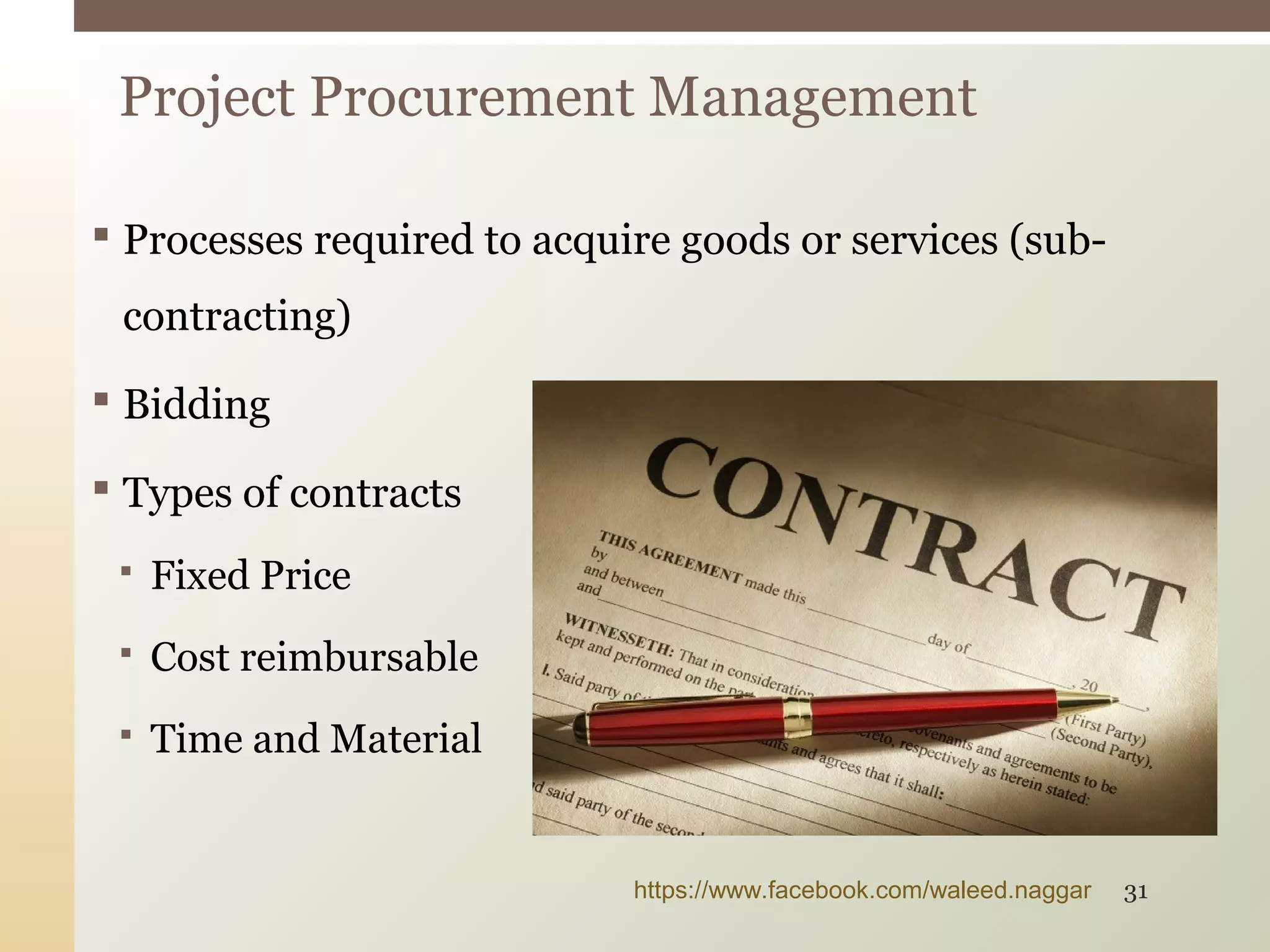
 Processes required to acquire goods or services (sub-
contracting)
 Bidding
 Types of contracts
 Fixed Price
 Cost reimbursable
 Time and Material
Project Procurement Management
https://www.facebook.com/waleed.naggar 31
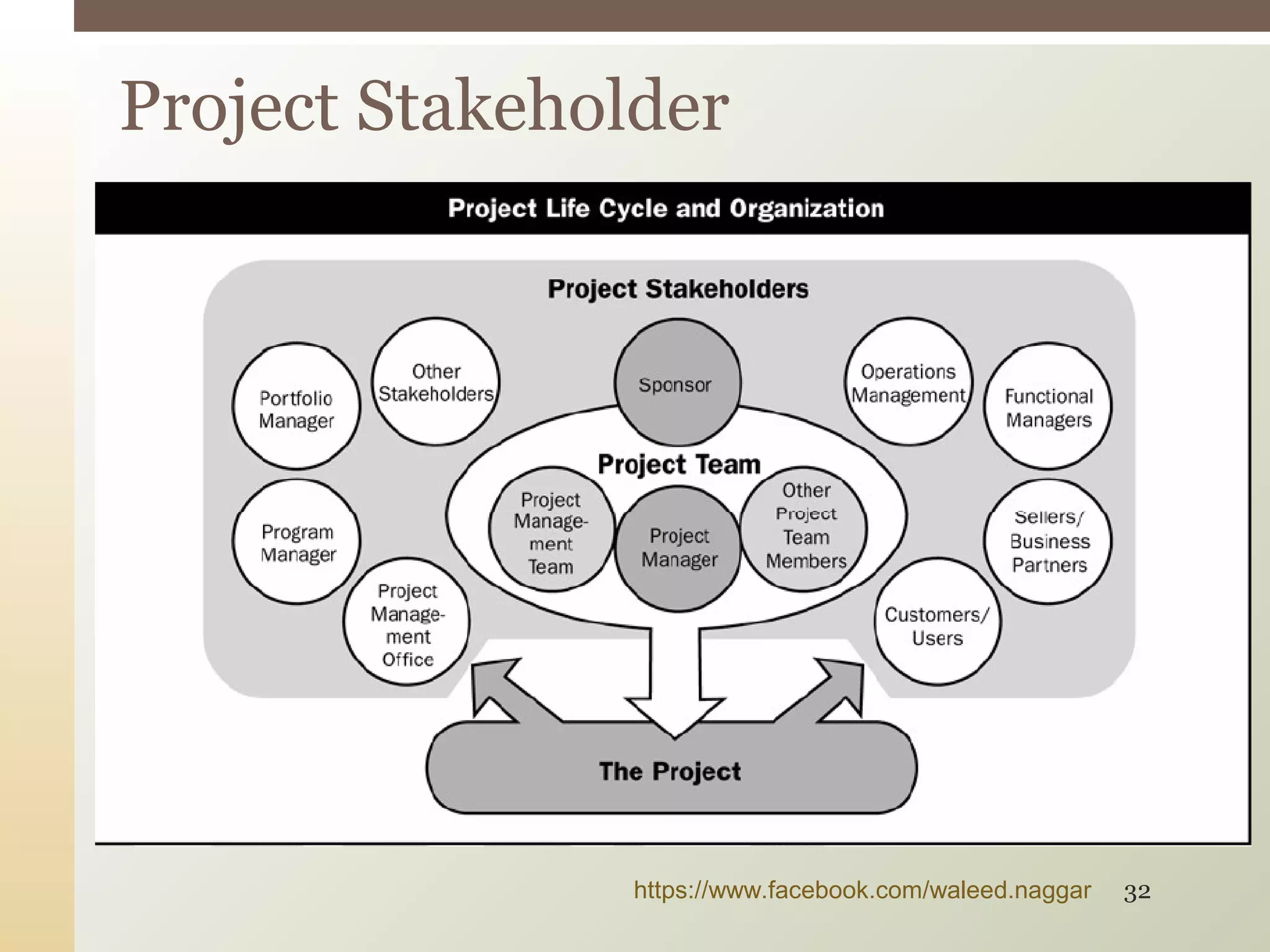
Project Stakeholder
https://www.facebook.com/waleed.naggar 32
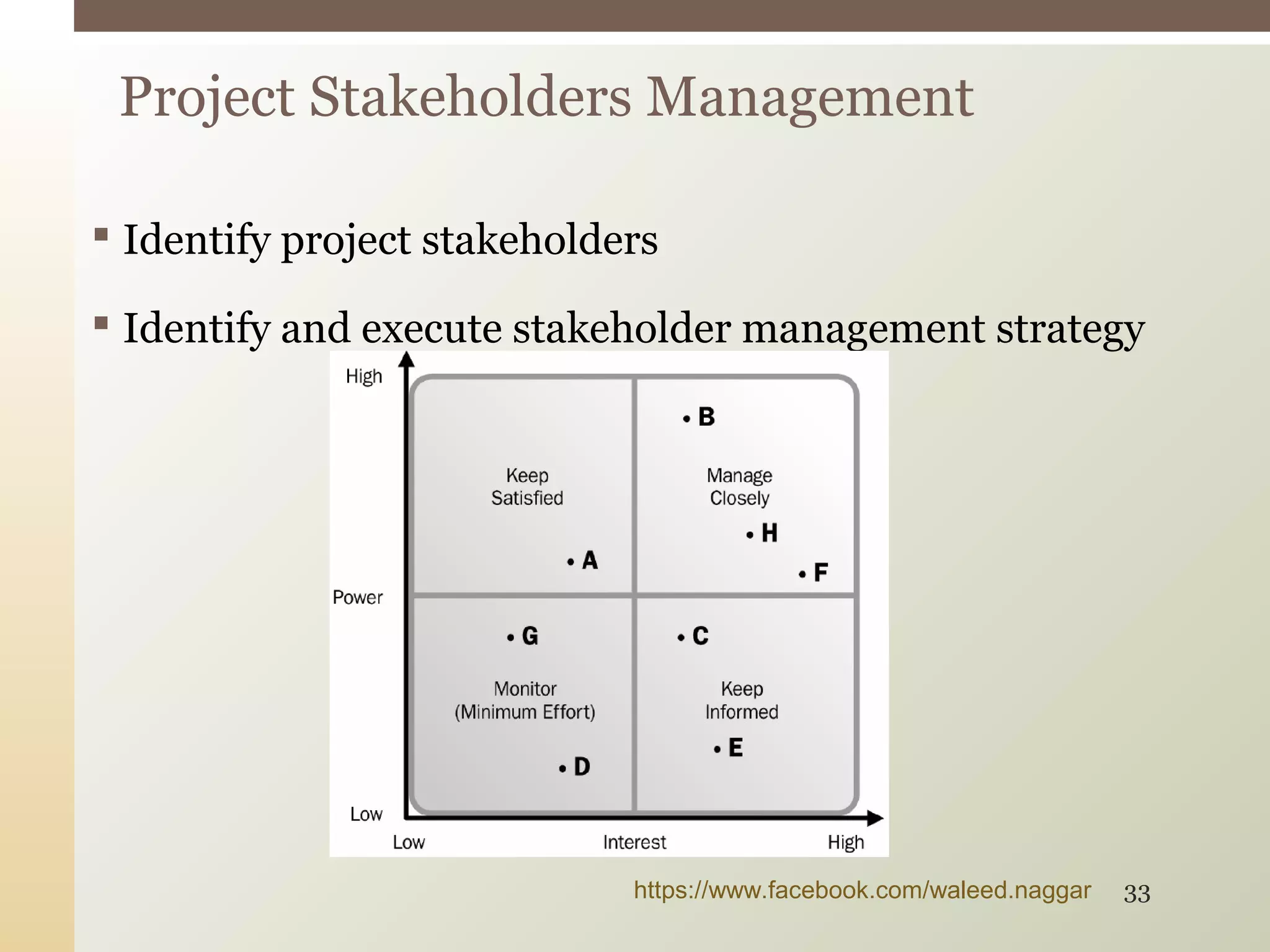
 Identify project stakeholders
 Identify and execute stakeholder management strategy
Project Stakeholders Management
https://www.facebook.com/waleed.naggar 33
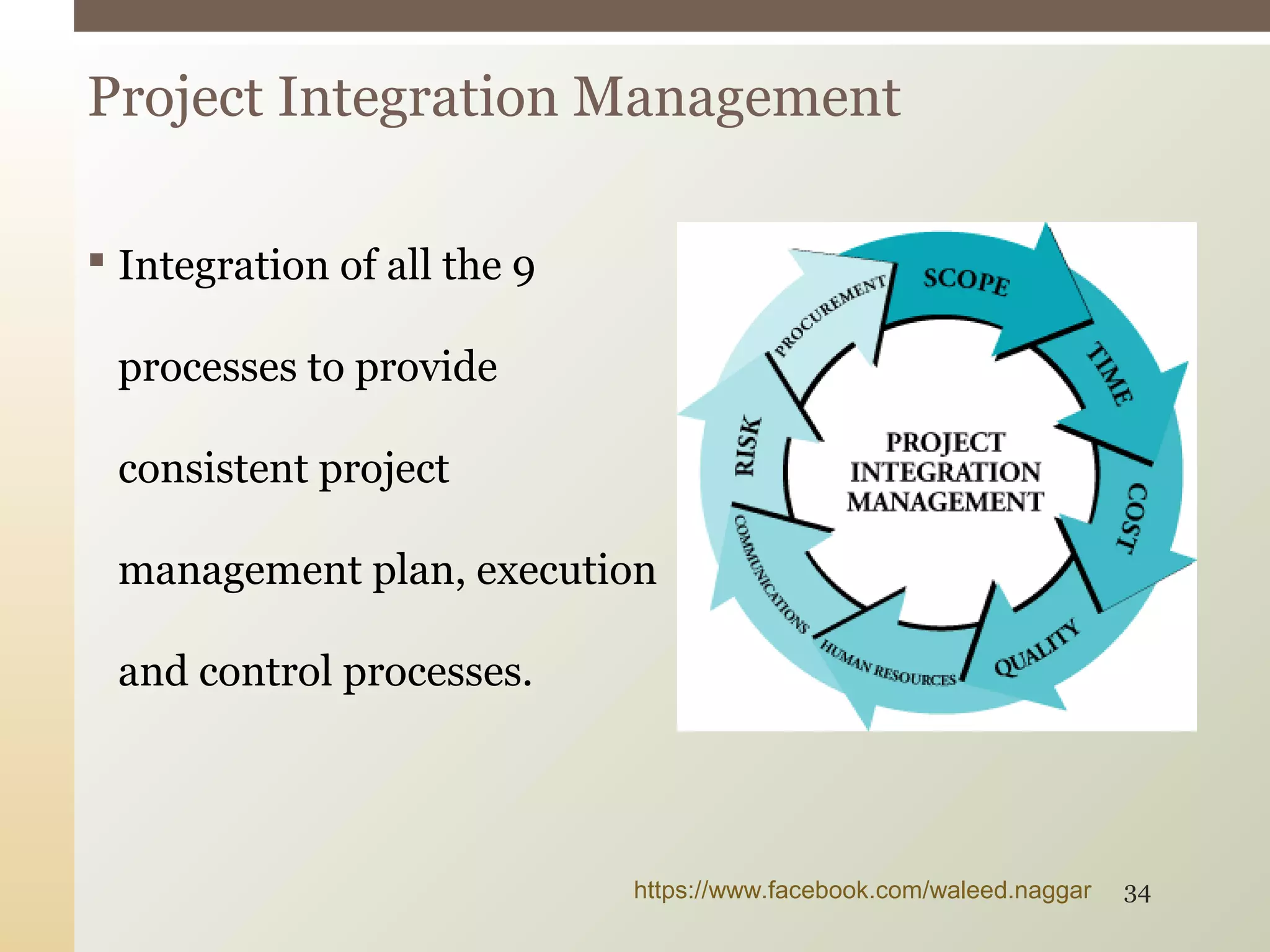
 Integration of all the 9
processes to provide
consistent project
management plan, execution
and control processes.
Project Integration Management
https://www.facebook.com/waleed.naggar 34
• Executive support
• User involvement
• Skilled and experienced project team
• Clear business objectives
• Well-defined scope
• Formal methodology
• Reliable estimates
• Other criteria, such as small milestones, proper
planning, competent staff, and ownership
What helps Project Success
https://www.facebook.com/waleed.naggar 35
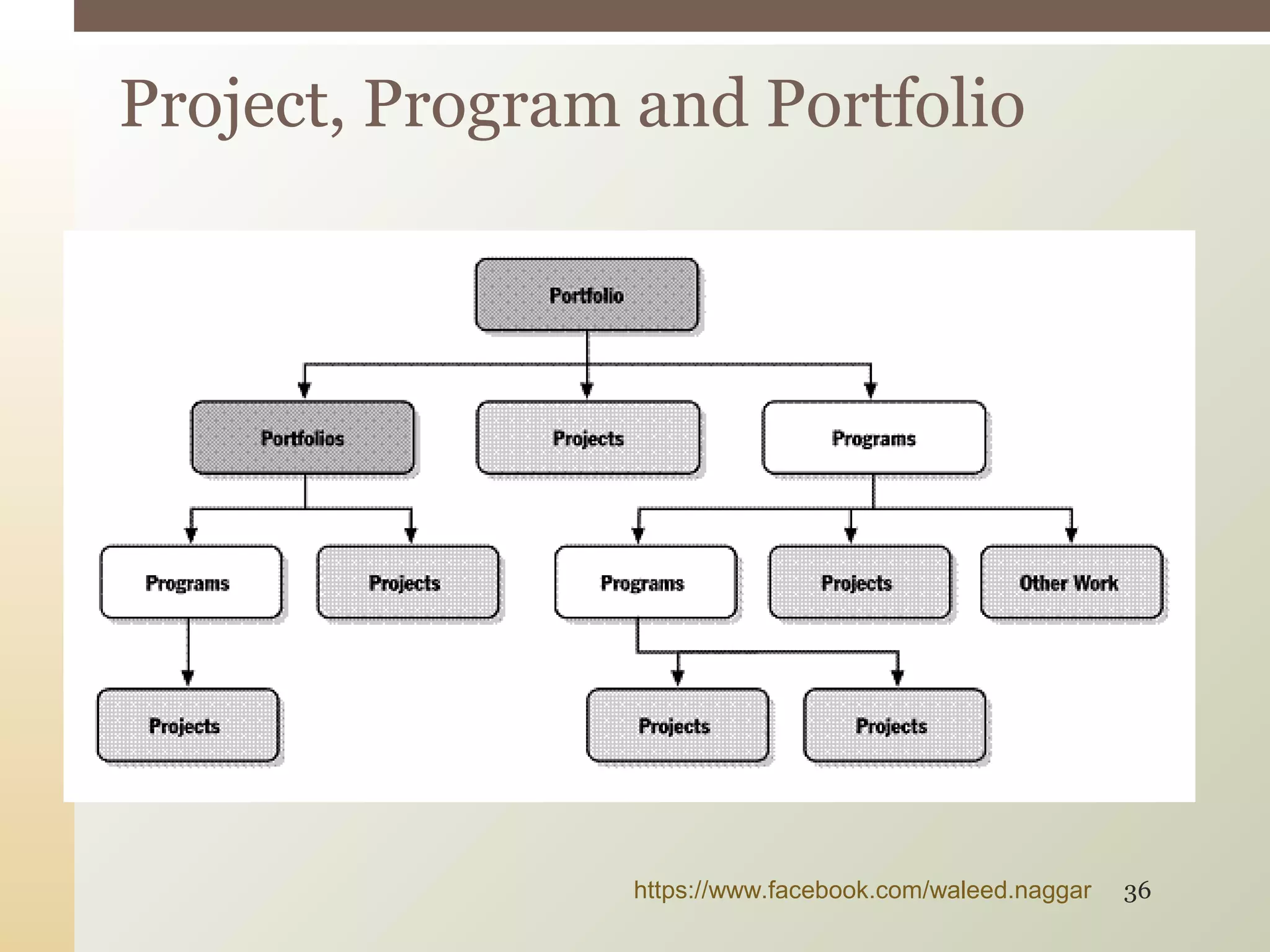
Project, Program and Portfolio
https://www.facebook.com/waleed.naggar 36
Program: A group of related projects managed in a
coordinated way.
Portfolio Management: managing a group of
programs to achieve a specific strategic business goal.
The programs may not be related other than the fact
that they help in reaching a common business goal.
Project, Program and Portfolio
https://www.facebook.com/waleed.naggar 37
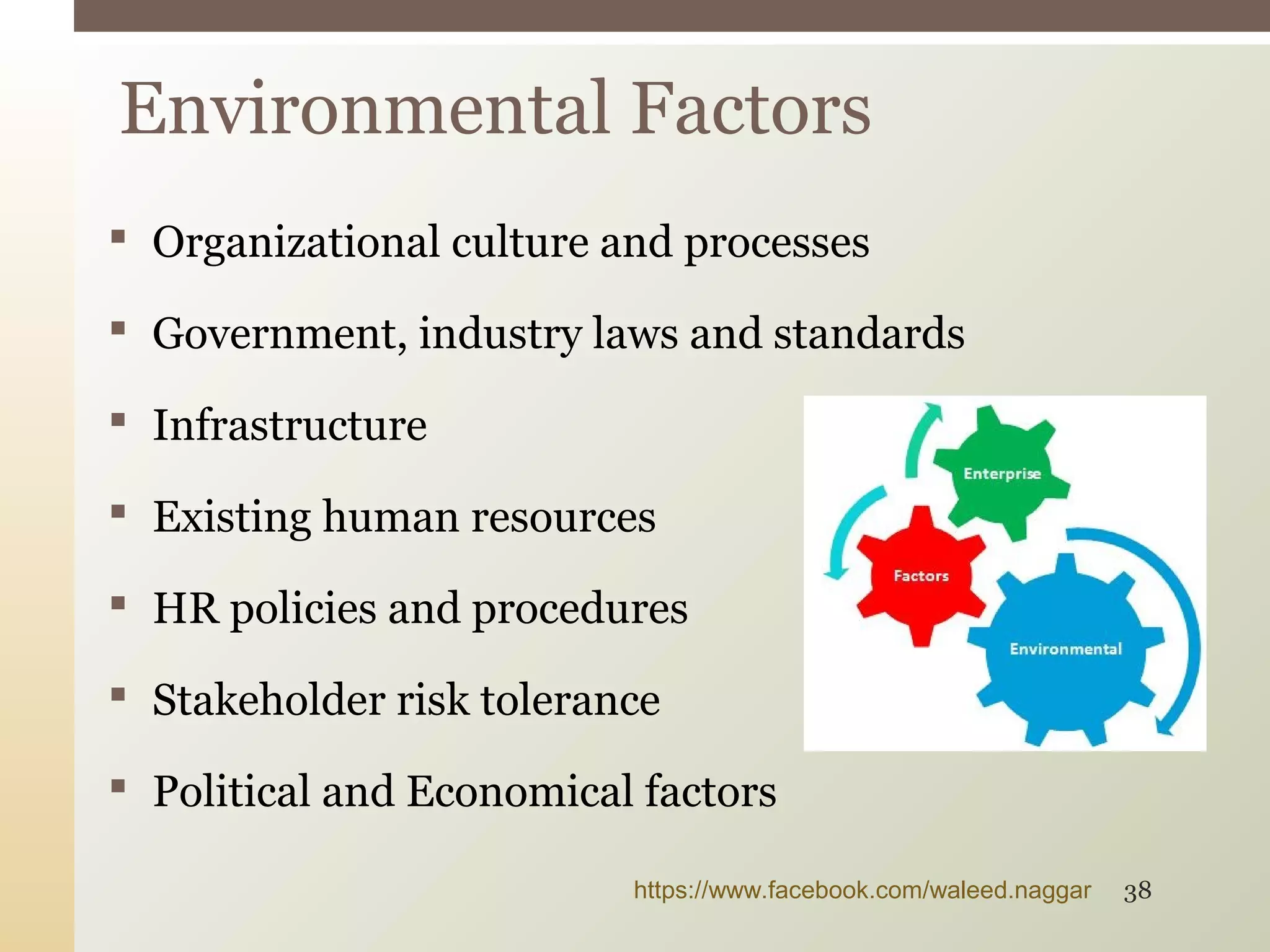
 Organizational culture and processes
 Government, industry laws and standards
 Infrastructure
 Existing human resources
 HR policies and procedures
 Stakeholder risk tolerance
 Political and Economical factors
Environmental Factors
https://www.facebook.com/waleed.naggar 38
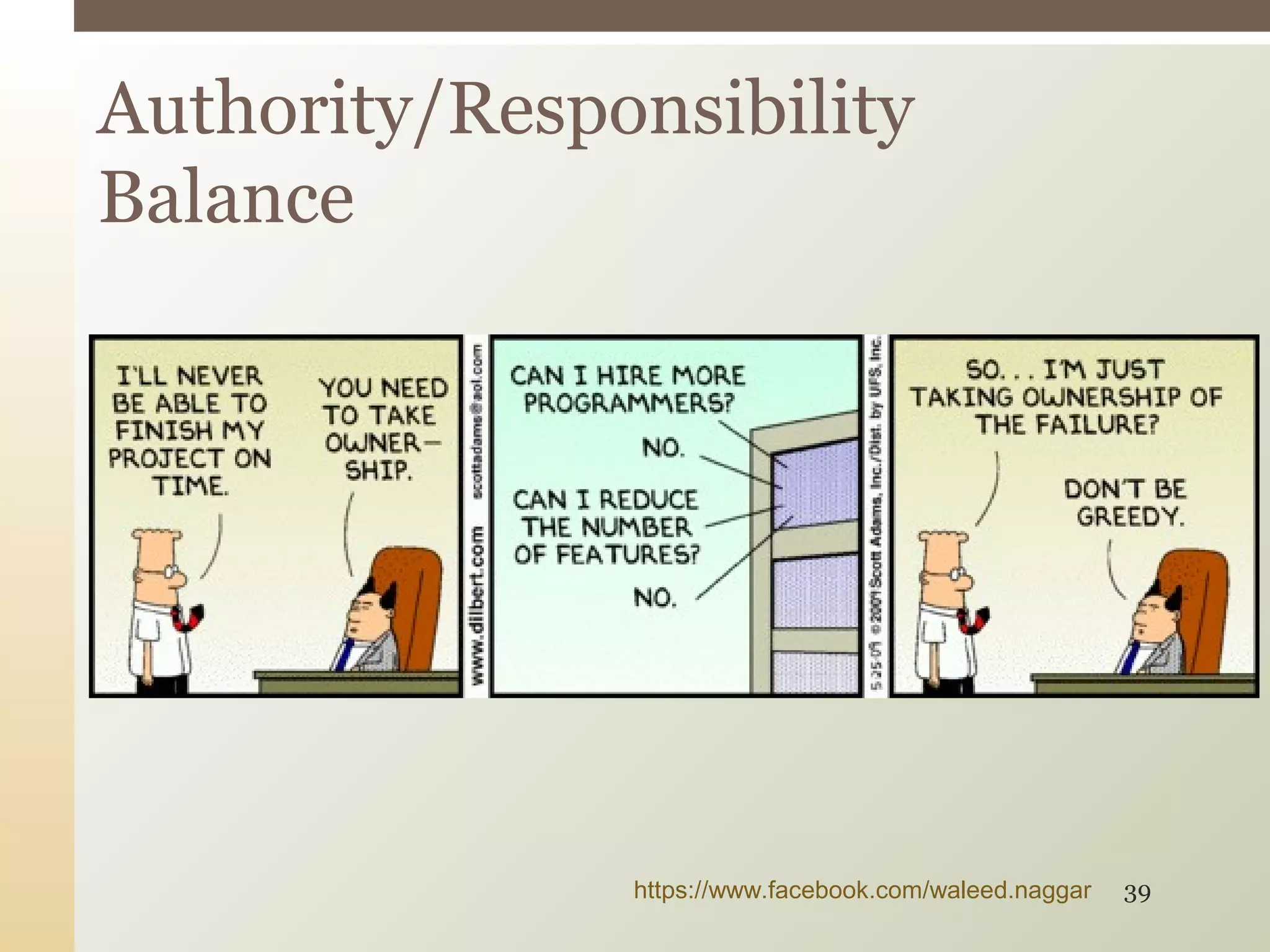
Authority/Responsibility
Balance
https://www.facebook.com/waleed.naggar 39
 Founded in 1969
 Advocacy for the profession, setting professional
standards, conducting research and providing access
to a wealth of information and resources.
 Promotes career and professional development and
offer certification, networking and community
involvement opportunities
 PMP ® credential is the most globally-recognized
certification in the profession.
 http://www.pmi.org
Project Management Institute (PMI)
https://www.facebook.com/waleed.naggar 40
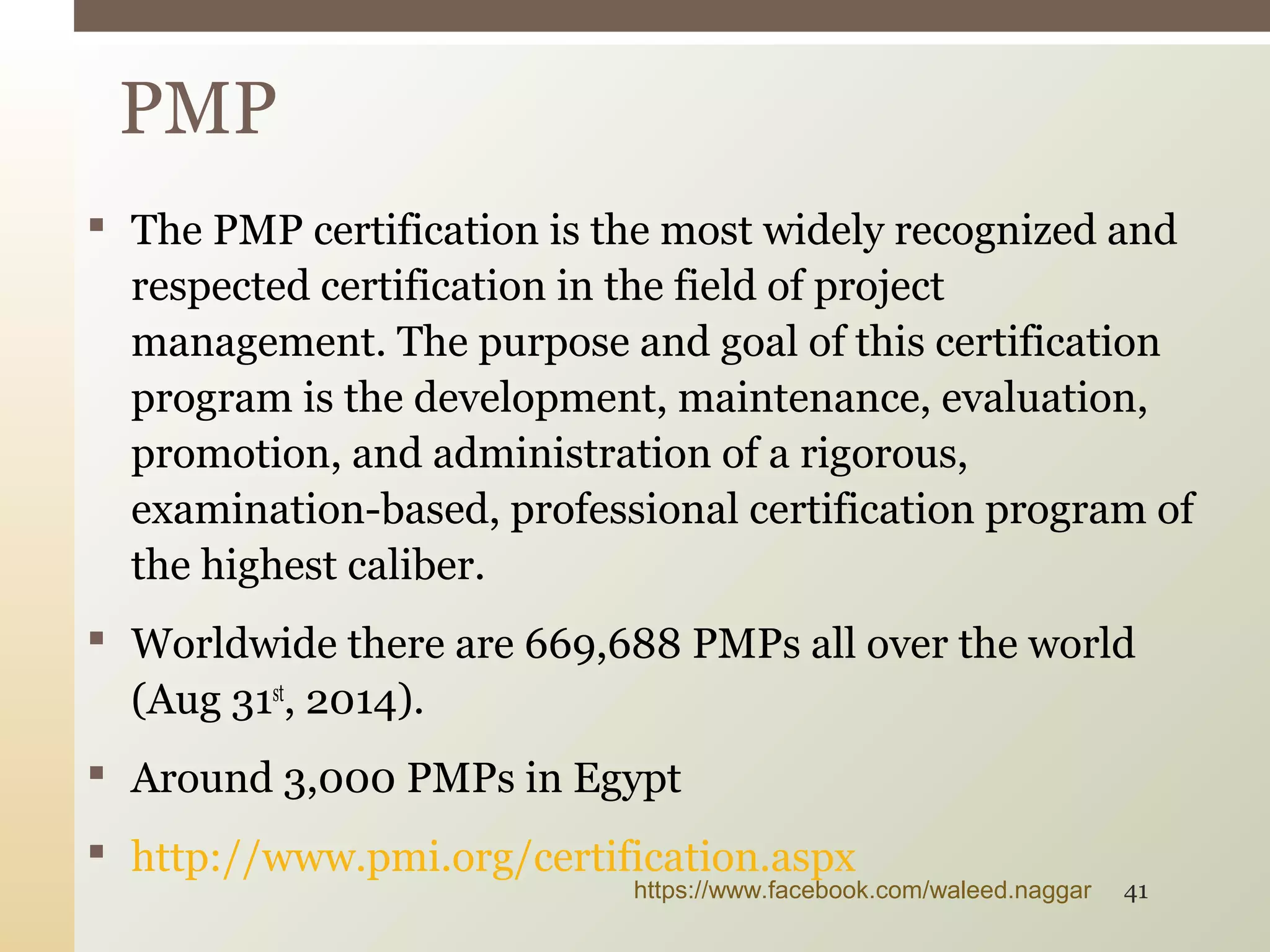
 The PMP certification is the most widely recognized and
respected certification in the field of project
management. The purpose and goal of this certification
program is the development, maintenance, evaluation,
promotion, and administration of a rigorous,
examination-based, professional certification program of
the highest caliber.
 Worldwide there are 669,688 PMPs all over the world
(Aug 31st
, 2014).
 Around 3,000 PMPs in Egypt
 http://www.pmi.org/certification.aspx
PMP
https://www.facebook.com/waleed.naggar 41
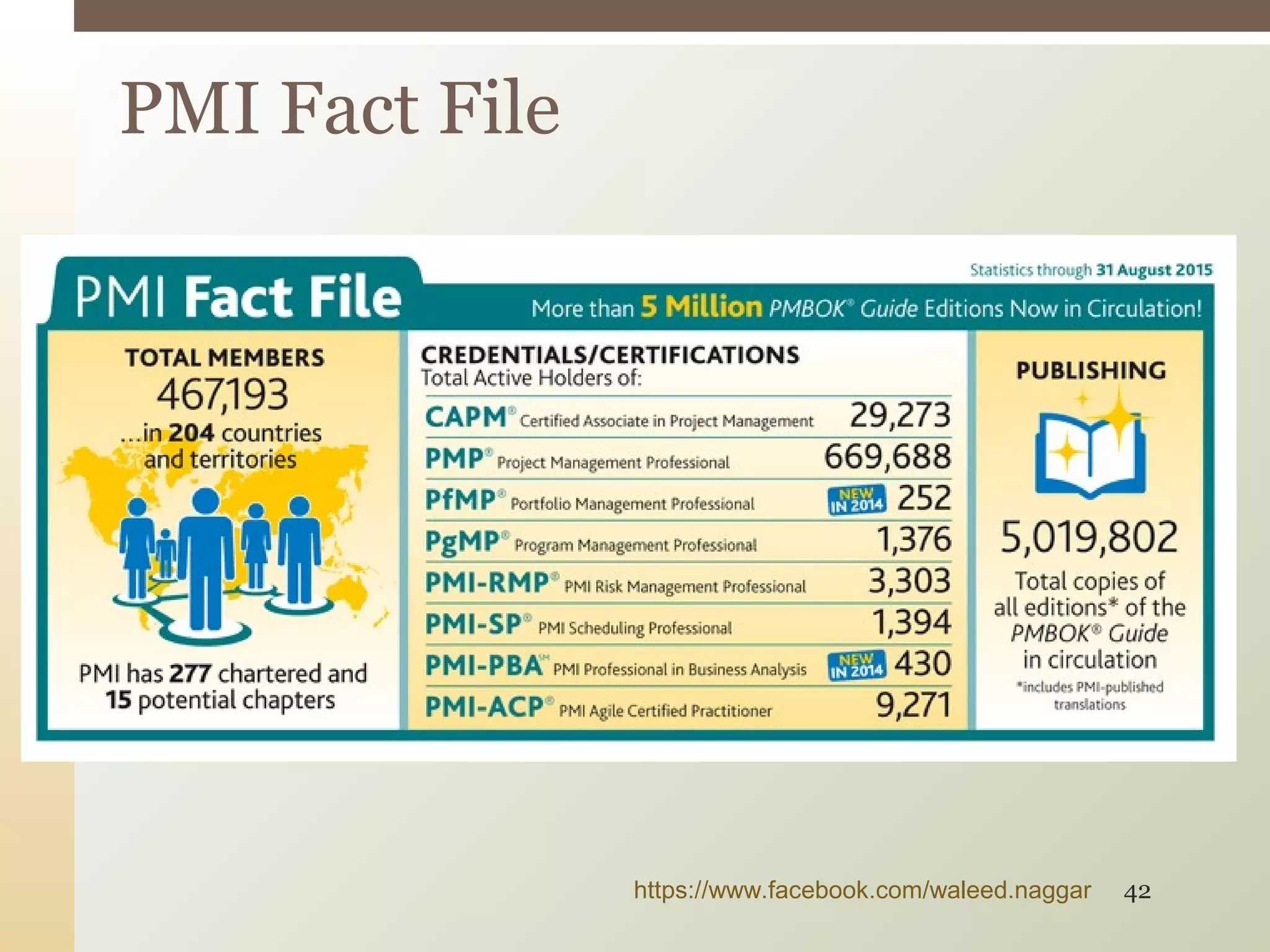
PMI Fact File
https://www.facebook.com/waleed.naggar 42
 PMI, http://www.pmi.org/certification.aspx
 https://www.projectmanager.com
 PMP Egypt Group,
https://www.facebook.com/groups/pmpegypt/
Useful Websites
https://www.facebook.com/waleed.naggar 43
https://www.facebook.com/waleed.naggar 44

Introduction to Project Management

  • 1.
    Introduction to ProjectManagement Waleed El-Naggar, MBA, PMP, MCP https://www.facebook.com/waleed.naggar 1
  • 2.
     Understand whata project is, provide example of projects  Understand what is project management  Describe the triple constraint  Discuss the relationship between projects, programs and portfolios  Understand the project management domains  Understand the project management knowledge areas  Understand the different organizational Structures Learning Objectives https://www.facebook.com/waleed.naggar 2
  • 3.
    “A project isa temporary endeavor undertaken to create a unique product or service” What is a Project?  Operations is work done to sustain the business  Projects end when their objectives have been reached or the project has been terminated  Projects can be large or small and take a short or long time to complete https://www.facebook.com/waleed.naggar 3
  • 4.
     Temporary: Definitebeginning and end. Not a continuous process.  Unique: different in some distinguished way from similar ones  Progressive elaboration  Needs resources  Primary customer or sponsor Project Attributes https://www.facebook.com/waleed.naggar 4
  • 5.
  • 6.
  • 7.
  • 8.
     Includes planning,organizing, directing and controlling activities in addition to motivating the people involved in the project management. Project Management “The application of Knowledge, skills, tools and techniques to project activities in order to meet or exceed stakeholders needs and expectations” https://www.facebook.com/waleed.naggar 8
  • 9.
  • 10.
     Accountability  Improvedproject organization and tracking  Better control of financial, physical and human resources  Improved customer relations  Reduced duration and cost  Higher worker morale  Reduced complexity of inter-related tasks  Allows measurement of outcome versus plans  Early identification of problems and quick correction Why Project Management https://www.facebook.com/waleed.naggar 10
  • 11.
     Time: Finishon time  Cost: Complete within budget  Quality: Meet performance requirements and quality targets.  Scope: All deliverables are completed. Triple Constraints Time Quality Scope Risk Customer Satisfaction Cost https://www.facebook.com/waleed.naggar 11
  • 12.
  • 13.
     Project Initiation Project Planning  Project Execution  Project Monitoring and Controlling  Project Closure  Professional and Social Responsibility Project Management Process Groups https://www.facebook.com/waleed.naggar 13
  • 14.
    Project Management LifeCycle Executing/Controlling Process Initiating Process Planning Process Controlling Process Executing Process Closing Process Scope of Work Status Issues Change Requests Project Management Plan Product Project Charter Approved Corrective Actions Lessons Learned Make Good Reports Opportunity Assessment Process https://www.facebook.com/waleed.naggar 14
  • 15.
  • 16.
  • 17.
     What willthe project produce (scope)  How much time  How much will it cost  How will project quality be managed  What might get wrong? And how shall project team handle it? (Risk)  What will be purchased?  What resources are required?  What communication needs have to be fulfilled Project Management Plan https://www.facebook.com/waleed.naggar 17
  • 18.
  • 19.
    Knowledge areas describethe key competencies that project managers must develop 4 core knowledge areas lead to specific project objectives (scope, time, cost, and quality) 5 facilitating knowledge areas, means to achieve project objectives (human resources, stakeholders, communication, risk & procurement management 1 knowledge area (project integration management) affects & is affected by all of the other knowledge areas All knowledge areas are important! Project Management Knowledge Areas https://www.facebook.com/waleed.naggar 19
  • 20.
    Knowledge Areas vs.Process Groups https://www.facebook.com/waleed.naggar 20
  • 21.
     Project scopeidentifies project boundaries.  Project scope statement describes project scope, major deliverables, assumptions, constraints and acceptance criteria.  The scope has to be managed to avoid scope creep (deviation from agreed scope). Project Scope Management Scope Statement Example https://www.facebook.com/waleed.naggar 21
  • 22.
     Split ingroups of 4-5  Each group will select any project and describe its scope Exercise https://www.facebook.com/waleed.naggar 22
  • 23.
     Identify theactivities necessary to complete the project.  Estimate effort and duration  Decide dependencies (sequence) of activities  Identify critical path Project Schedule Management Project Schedule https://www.facebook.com/waleed.naggar 23
  • 24.
    Critical Path B :3 C : 4 Start A:2 E : 2 H : 2 End https://www.facebook.com/waleed.naggar 24
  • 25.
     Ensure theproject is completed within approved budget  Earned Value Management: a project performance measurement technique that integrates scope, time and cost data. Project Cost Management https://www.facebook.com/waleed.naggar 25
  • 26.
     Ensure theproject will satisfy quality needs – commitment t deliver the project output that meet the stakeholders’ requirements.  Quality Control is concerned with project deliverables – conformance to requirements and fitness for use Project Quality Management  Quality Assurance is concerned with the process used allover the project. https://www.facebook.com/waleed.naggar 26
  • 27.
     Identify andacquire the project human resources needs.  Identify roles and responsibilities  Conflict Resolution  Team Building  Motivation Project Team Management https://www.facebook.com/waleed.naggar 27
  • 28.
    No Resources …No Results https://www.facebook.com/waleed.naggar 28
  • 29.
     Determine andexecute stakeholders’ information needs.  Overcome communication barriers  Formal communication vs. Information Communications  Verbal Communications vs. Written Communications Project Communications Management https://www.facebook.com/waleed.naggar 29
  • 30.
     Risks areuncertain positive or negative events  Identification and evaluation (probability & impact).  Risk response planning  Contingency Project Risk Management Risk Management Register https://www.facebook.com/waleed.naggar 30
  • 31.
     Processes requiredto acquire goods or services (sub- contracting)  Bidding  Types of contracts  Fixed Price  Cost reimbursable  Time and Material Project Procurement Management https://www.facebook.com/waleed.naggar 31
  • 32.
  • 33.
     Identify projectstakeholders  Identify and execute stakeholder management strategy Project Stakeholders Management https://www.facebook.com/waleed.naggar 33
  • 34.
     Integration ofall the 9 processes to provide consistent project management plan, execution and control processes. Project Integration Management https://www.facebook.com/waleed.naggar 34
  • 35.
    • Executive support •User involvement • Skilled and experienced project team • Clear business objectives • Well-defined scope • Formal methodology • Reliable estimates • Other criteria, such as small milestones, proper planning, competent staff, and ownership What helps Project Success https://www.facebook.com/waleed.naggar 35
  • 36.
    Project, Program andPortfolio https://www.facebook.com/waleed.naggar 36
  • 37.
    Program: A groupof related projects managed in a coordinated way. Portfolio Management: managing a group of programs to achieve a specific strategic business goal. The programs may not be related other than the fact that they help in reaching a common business goal. Project, Program and Portfolio https://www.facebook.com/waleed.naggar 37
  • 38.
     Organizational cultureand processes  Government, industry laws and standards  Infrastructure  Existing human resources  HR policies and procedures  Stakeholder risk tolerance  Political and Economical factors Environmental Factors https://www.facebook.com/waleed.naggar 38
  • 39.
  • 40.
     Founded in1969  Advocacy for the profession, setting professional standards, conducting research and providing access to a wealth of information and resources.  Promotes career and professional development and offer certification, networking and community involvement opportunities  PMP ® credential is the most globally-recognized certification in the profession.  http://www.pmi.org Project Management Institute (PMI) https://www.facebook.com/waleed.naggar 40
  • 41.
     The PMPcertification is the most widely recognized and respected certification in the field of project management. The purpose and goal of this certification program is the development, maintenance, evaluation, promotion, and administration of a rigorous, examination-based, professional certification program of the highest caliber.  Worldwide there are 669,688 PMPs all over the world (Aug 31st , 2014).  Around 3,000 PMPs in Egypt  http://www.pmi.org/certification.aspx PMP https://www.facebook.com/waleed.naggar 41
  • 42.
  • 43.
     PMI, http://www.pmi.org/certification.aspx https://www.projectmanager.com  PMP Egypt Group, https://www.facebook.com/groups/pmpegypt/ Useful Websites https://www.facebook.com/waleed.naggar 43
  • 44.