James Tam
Introduction To Object-Oriented
Programming
This section includes introductions to
fundamental object-oriented principles such as
information hiding, overloading, relationships
between classes as well the object-oriented
approach to design.
James Tam
Reminder: What You Know
•There are different paradigms (approaches) to implementing
computer programs.
•There are several different paradigms but the two you have been
introduced to thus far:
-Procedural
-Object-Oriented.
James Tam
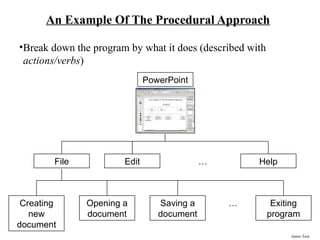
An Example Of The Procedural Approach
•Break down the program by what it does (described with
actions/verbs)
File Edit Help
…
Creating
new
document
Opening a
document
Saving a
document
… Exiting
program
PowerPoint
James Tam
Object-Oriented Programming
•Break down the program into ‘physical’ components (nouns).
•Each of these physical components is an ‘object’.
•Objects include operations (functions which are referred to as
‘methods’ in the Object-Oriented paradigm) but also data
(information about each object).
-The methods can be determined by the actions (verbs) that each object should
be able to complete.
-The data can be determined by examining the type of information that each
object needs to store.
•Example of an everyday object (from “Starting out with Python”
by Tony Gaddis): An Alarm clock
-What are the attributes of the alarm clock (information needed by the clock in
order to properly function)
-What are the methods of the alarm clock (operations that the clock must
perform).
James Tam
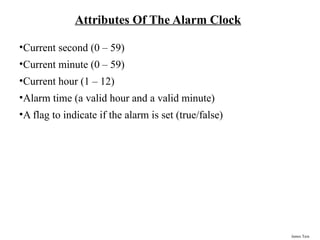
Attributes Of The Alarm Clock
•Current second (0 – 59)
•Current minute (0 – 59)
•Current hour (1 – 12)
•Alarm time (a valid hour and a valid minute)
•A flag to indicate if the alarm is set (true/false)
James Tam
Methods Of The Alarm Clock
•Set time
•Set alarm time
•Turn alarm on/off
James Tam
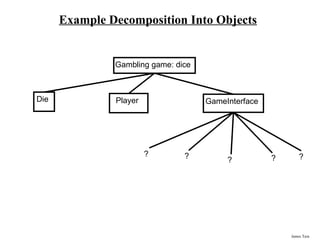
Example Decomposition Into Objects
Gambling game: dice
Die Player GameInterface
? ? ? ? ?
James Tam
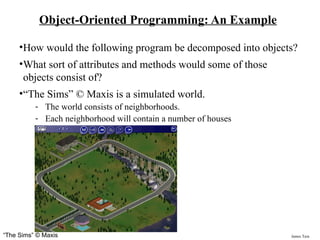
Object-Oriented Programming: An Example
•How would the following program be decomposed into objects?
•What sort of attributes and methods would some of those
objects consist of?
•“The Sims” © Maxis is a simulated world.
- The world consists of neighborhoods.
- Each neighborhood will contain a number of houses
“The Sims” © Maxis
James Tam
Object-Oriented Programming: An Example (2)
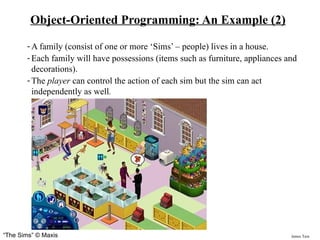
-A family (consist of one or more ‘Sims’ – people) lives in a house.
-Each family will have possessions (items such as furniture, appliances and
decorations).
-The player can control the action of each sim but the sim can act
independently as well.
“The Sims” © Maxis
James Tam
Should Something Be Implemented As Multiple
Objects?
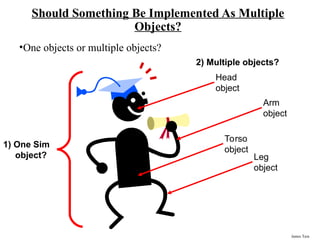
•One objects or multiple objects?
1) One Sim
object?
Arm
object
2) Multiple objects?
Leg
object
Torso
object
Head
object
James Tam
Details Of A Sim Object: Information
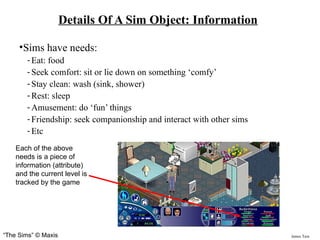
•Sims have needs:
-Eat: food
-Seek comfort: sit or lie down on something ‘comfy’
-Stay clean: wash (sink, shower)
-Rest: sleep
-Amusement: do ‘fun’ things
-Friendship: seek companionship and interact with other sims
-Etc
Each of the above
needs is a piece of
information (attribute)
and the current level is
tracked by the game
“The Sims” © Maxis
James Tam
Additional Resources
•A good description of the terms used in this section (and terms
used in some of the later sections).
http://docs.oracle.com/javase/tutorial/java/concepts/
•A good walk through of the process of designing an object-
oriented program, finding the candidate objects e.g., how to use
the ‘find a noun’ approach and some of the pitfalls of this
approach.
http://archive.eiffel.com/doc/manuals/technology/oosc/finding/page.html
James Tam
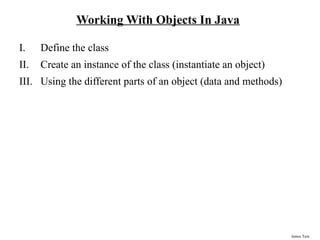
Working With Objects In Java
I. Define the class
II. Create an instance of the class (instantiate an object)
III. Using the different parts of an object (data and methods)
James Tam
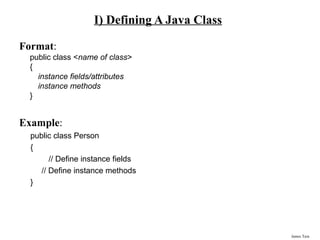
I) Defining A Java Class
Format:
public class <name of class>
{
instance fields/attributes
instance methods
}
Example:
public class Person
{
// Define instance fields
// Define instance methods
}
James Tam
Defining A Java Class (2)
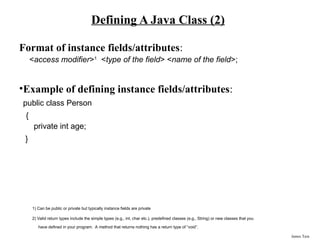
Format of instance fields/attributes:
<access modifier>1
<type of the field> <name of the field>;
•Example of defining instance fields/attributes:
public class Person
{
private int age;
}
1) Can be public or private but typically instance fields are private
2) Valid return types include the simple types (e.g., int, char etc.), predefined classes (e.g., String) or new classes that you
have defined in your program. A method that returns nothing has a return type of “void”.
James Tam
Defining A Java Class (3)
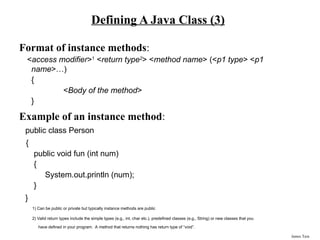
Format of instance methods:
<access modifier>1
<return type2
> <method name> (<p1 type> <p1
name>…)
{
<Body of the method>
}
Example of an instance method:
public class Person
{
public void fun (int num)
{
System.out.println (num);
}
}
1) Can be public or private but typically instance methods are public
2) Valid return types include the simple types (e.g., int, char etc.), predefined classes (e.g., String) or new classes that you
have defined in your program. A method that returns nothing has return type of “void”.
James Tam
Defining A Java Class (4)
Example (complete class definition):
public class Person
{
private int age;
public void setAge (int anAge)
{
age = anAge;
}
public int getAge ()
{
return age;
}
}
James Tam
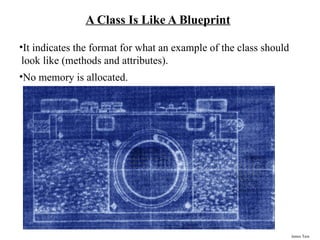
A Class Is Like A Blueprint
•It indicates the format for what an example of the class should
look like (methods and attributes).
•No memory is allocated.
James Tam
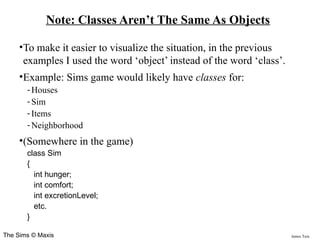
Note: Classes Aren’t The Same As Objects
•To make it easier to visualize the situation, in the previous
examples I used the word ‘object’ instead of the word ‘class’.
•Example: Sims game would likely have classes for:
-Houses
-Sim
-Items
-Neighborhood
•(Somewhere in the game)
class Sim
{
int hunger;
int comfort;
int excretionLevel;
etc.
}
The Sims © Maxis
James Tam
II) Creating/Instantiating Instances Of A Class
Format:
<class name> <instance name> = new <class name> ();
Example:
Person jim = new Person();
•Note: ‘jim’ is not an object of type ‘Person’ but a reference to an object of
type ‘Person’ (more on this in a later section).
James Tam
An Instance Is An Actual Example Of A Class
•Instantiation is when an actual example/instance of a class is
created.
James Tam
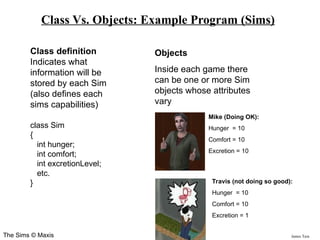
Class Vs. Objects: Example Program (Sims)
The Sims © Maxis
Class definition
Indicates what
information will be
stored by each Sim
(also defines each
sims capabilities)
class Sim
{
int hunger;
int comfort;
int excretionLevel;
etc.
}
Objects
Inside each game there
can be one or more Sim
objects whose attributes
vary
Mike (Doing OK):
Hunger = 10
Comfort = 10
Excretion = 10
Travis (not doing so good):
Hunger = 10
Comfort = 10
Excretion = 1
James Tam
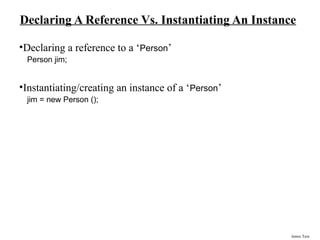
Declaring A Reference Vs. Instantiating An Instance
•Declaring a reference to a ‘Person’
Person jim;
•Instantiating/creating an instance of a ‘Person’
jim = new Person ();
James Tam
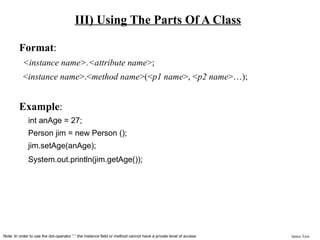
III) Using The Parts Of A Class
Format:
<instance name>.<attribute name>;
<instance name>.<method name>(<p1 name>, <p2 name>…);
Example:
int anAge = 27;
Person jim = new Person ();
jim.setAge(anAge);
System.out.println(jim.getAge());
Note: In order to use the dot-operator “.” the instance field or method cannot have a private level of access
James Tam
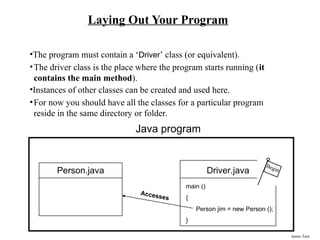
Laying Out Your Program
Java program
•The program must contain a ‘Driver’ class (or equivalent).
Driver.java
•The driver class is the place where the program starts running (it
contains the main method).
main ()
{
}
Person.java
•For now you should have all the classes for a particular program
reside in the same directory or folder.
•Instances of other classes can be created and used here.
Person jim = new Person ();
Accesses
James Tam
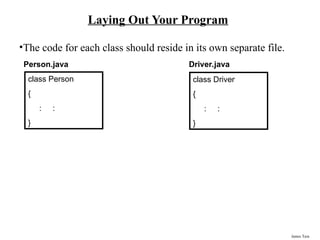
Laying Out Your Program
•The code for each class should reside in its own separate file.
class Person
{
: :
}
Person.java
class Driver
{
: :
}
Driver.java
James Tam
Putting It Altogether: First Object-Oriented
Example
•Example:
-The name of the online example is: firstOOExample.zip (extract
all the files into the same directory)
public class Driver
{
public static void main (String [] args)
{
int anAge = 27;
Person jim = new Person ();
jim.setAge(anAge);
System.out.println("Jim's current age is..." + jim.getAge());
}
}
James Tam
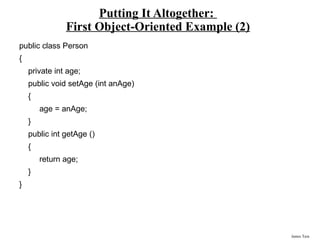
Putting It Altogether:
First Object-Oriented Example (2)
public class Person
{
private int age;
public void setAge (int anAge)
{
age = anAge;
}
public int getAge ()
{
return age;
}
}
James Tam
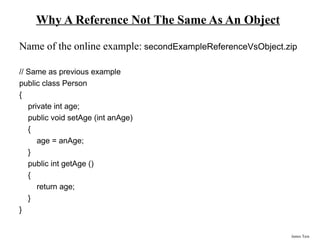
Why A Reference Not The Same As An Object
Name of the online example: secondExampleReferenceVsObject.zip
// Same as previous example
public class Person
{
private int age;
public void setAge (int anAge)
{
age = anAge;
}
public int getAge ()
{
return age;
}
}
James Tam
Why A Reference Not The Same As An Object (2)
public class Driver
{
public static void main(String [] args)
{
Person jim;
// Part I: Reference created
// Syntax error: initialize variables before using them.
// jim.setAge(30);
// Part II: Reference created and initialized
// Runtime error: object has not yet been created.
// jim = null;
// jim.setAge(30);
James Tam
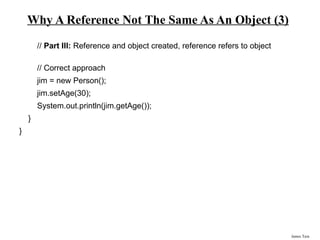
Why A Reference Not The Same As An Object (3)
// Part III: Reference and object created, reference refers to object
// Correct approach
jim = new Person();
jim.setAge(30);
System.out.println(jim.getAge());
}
}
James Tam
Compilation With Multiple Classes
•In the previous example there were two classes: ‘Driver’ and
‘Person’.
•One way (safest) to compile the program is to compile each
source code (dot-Java) file:
-javac Driver.java
-javac Person.java
-(Alternatively use the ‘wildcard’): javac *.java
•However in this program a method of the Driver class refers to
an instance of class Person.
public static void main (String [] args)
{
Person jim = new Person ();
}
•The Java compiler can detect that this dependency exists.
James Tam
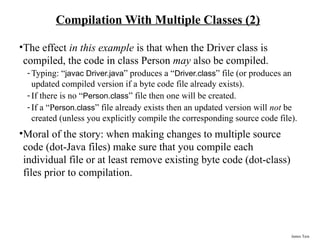
Compilation With Multiple Classes (2)
•The effect in this example is that when the Driver class is
compiled, the code in class Person may also be compiled.
-Typing: “javac Driver.java” produces a “Driver.class” file (or produces an
updated compiled version if a byte code file already exists).
-If there is no “Person.class” file then one will be created.
-If a “Person.class” file already exists then an updated version will not be
created (unless you explicitly compile the corresponding source code file).
•Moral of the story: when making changes to multiple source
code (dot-Java files) make sure that you compile each
individual file or at least remove existing byte code (dot-class)
files prior to compilation.
James Tam
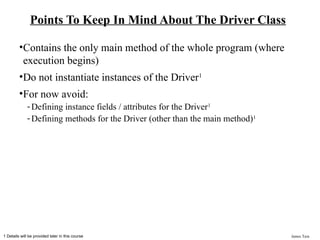
Points To Keep In Mind About The Driver Class
•Contains the only main method of the whole program (where
execution begins)
•Do not instantiate instances of the Driver1
•For now avoid:
-Defining instance fields / attributes for the Driver1
-Defining methods for the Driver (other than the main method)1
1 Details will be provided later in this course
James Tam
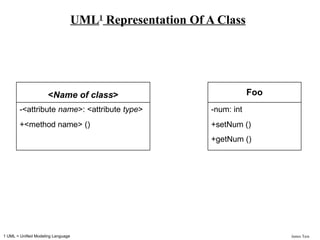
UML1
Representation Of A Class
Foo
-num: int
+setNum ()
+getNum ()
<Name of class>
-<attribute name>: <attribute type>
+<method name> ()
1 UML = Unified Modeling Language
James Tam
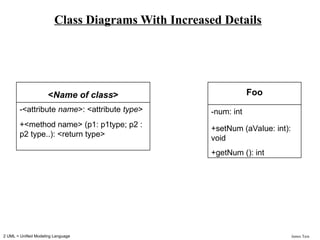
Class Diagrams With Increased Details
Foo
-num: int
+setNum (aValue: int):
void
+getNum (): int
<Name of class>
-<attribute name>: <attribute type>
+<method name> (p1: p1type; p2 :
p2 type..): <return type>
2 UML = Unified Modeling Language
James Tam
Why Bother With UML?
•It’s the standard way of specifying the major parts of a software
project.
•It combined a number of different approaches and has become
the standard notation.
James Tam
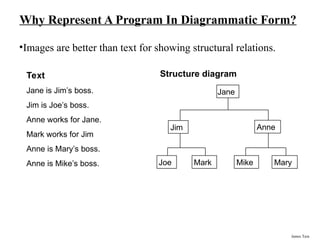
Why Represent A Program In Diagrammatic Form?
•Images are better than text for showing structural relations.
Text
Jane is Jim’s boss.
Jim is Joe’s boss.
Anne works for Jane.
Mark works for Jim
Anne is Mary’s boss.
Anne is Mike’s boss.
Structure diagram
Jane
Jim Anne
Joe Mark Mike Mary
James Tam
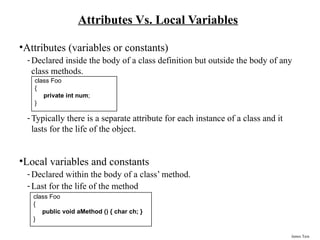
•Attributes (variables or constants)
-Declared inside the body of a class definition but outside the body of any
class methods.
-Typically there is a separate attribute for each instance of a class and it
lasts for the life of the object.
•Local variables and constants
-Declared within the body of a class’ method.
-Last for the life of the method
Attributes Vs. Local Variables
class Foo
{
private int num;
}
class Foo
{
public void aMethod () { char ch; }
}
James Tam
Examples Of An Attribute
public class Person
{
private int age;
public void setAge (int newAge)
{
int aLocal;
age = newAge;
}
:
}
:
main (String [] args)
{
Person jim = new Person ();
Person joe = new Person ();
}
“age”: Declared
within the definition
of a class
James Tam
Examples Of An Attribute
public class Person
{
private int age;
public void setAge (int anAge)
{
int aLocal;
age = anAge;
}
:
}
:
main (String [] args)
{
Person jim = new Person ();
Person joe = new Person ();
}
But declared outside of
the body of a method
James Tam
Example Of A Local Variable
public class Person
{
private int age;
public void setAge (int anAge)
{
int aLocal;
age = anAge;
}
:
}
:
main (String [] args)
{
Person jim = new Person ();
Person joe = new Person ();
jim.setAge (5);
joe.setAge (10);
}
“aLocal”: Declared
inside the body of a
method
James Tam
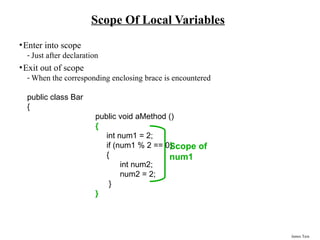
Scope Of Local Variables
•Enter into scope
- Just after declaration
•Exit out of scope
- When the corresponding enclosing brace is encountered
public class Bar
{
public void aMethod ()
{
int num1 = 2;
if (num1 % 2 == 0)
{
int num2;
num2 = 2;
}
}
Scope of
num1
James Tam
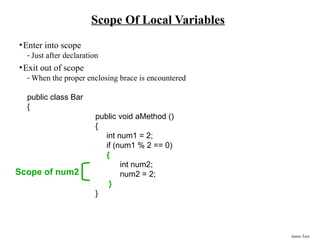
Scope Of Local Variables
•Enter into scope
- Just after declaration
•Exit out of scope
- When the proper enclosing brace is encountered
public class Bar
{
public void aMethod ()
{
int num1 = 2;
if (num1 % 2 == 0)
{
int num2;
num2 = 2;
}
}
Scope of num2
James Tam
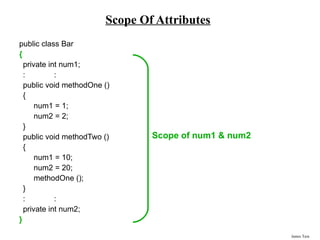
Scope Of Attributes
public class Bar
{
private int num1;
: :
public void methodOne ()
{
num1 = 1;
num2 = 2;
}
public void methodTwo ()
{
num1 = 10;
num2 = 20;
methodOne ();
}
: :
private int num2;
}
Scope of num1 & num2
James Tam
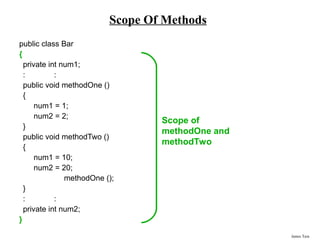
Scope Of Methods
public class Bar
{
private int num1;
: :
public void methodOne ()
{
num1 = 1;
num2 = 2;
}
public void methodTwo ()
{
num1 = 10;
num2 = 20;
methodOne ();
}
: :
private int num2;
}
Scope of
methodOne and
methodTwo
James Tam
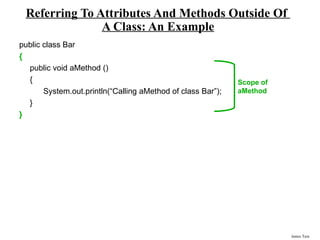
Referring To Attributes And Methods Outside Of
A Class: An Example
public class Bar
{
public void aMethod ()
{
System.out.println(“Calling aMethod of class Bar”);
}
}
Scope of
aMethod
James Tam
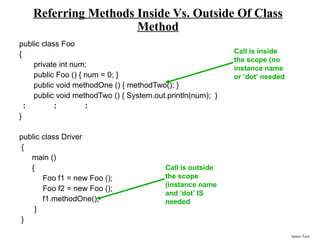
Referring Methods Inside Vs. Outside Of Class
Method
public class Foo
{
private int num;
public Foo () { num = 0; }
public void methodOne () { methodTwo(); }
public void methodTwo () { System.out.println(num); }
: : :
}
public class Driver
{
main ()
{
Foo f1 = new Foo ();
Foo f2 = new Foo ();
f1.methodOne();
}
}
Call is inside
the scope (no
instance name
or ‘dot’ needed
Call is outside
the scope
(instance name
and ‘dot’ IS
needed
James Tam
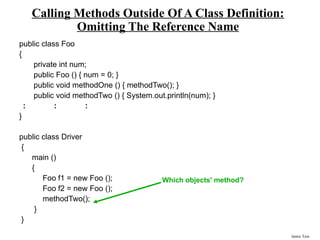
Calling Methods Outside Of A Class Definition:
Omitting The Reference Name
public class Foo
{
private int num;
public Foo () { num = 0; }
public void methodOne () { methodTwo(); }
public void methodTwo () { System.out.println(num); }
: : :
}
public class Driver
{
main ()
{
Foo f1 = new Foo ();
Foo f2 = new Foo ();
methodTwo();
}
}
Which objects' method?
James Tam
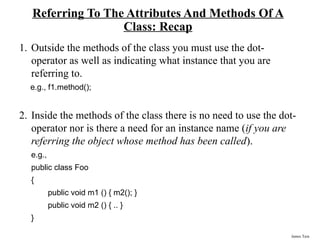
Referring To The Attributes And Methods Of A
Class: Recap
1. Outside the methods of the class you must use the dot-
operator as well as indicating what instance that you are
referring to.
e.g., f1.method();
2. Inside the methods of the class there is no need to use the dot-
operator nor is there a need for an instance name (if you are
referring the object whose method has been called).
e.g.,
public class Foo
{
public void m1 () { m2(); }
public void m2 () { .. }
}
James Tam
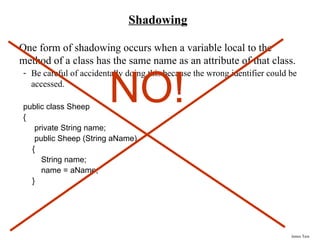
Shadowing
One form of shadowing occurs when a variable local to the
method of a class has the same name as an attribute of that class.
- Be careful of accidentally doing this because the wrong identifier could be
accessed.
public class Sheep
{
private String name;
public Sheep (String aName)
{
String name;
name = aName;
}
NO!
James Tam
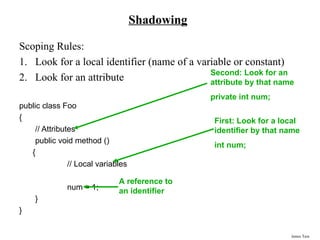
Shadowing
Scoping Rules:
1. Look for a local identifier (name of a variable or constant)
2. Look for an attribute
public class Foo
{
// Attributes
public void method ()
{
// Local variables
num = 1;
}
}
A reference to
an identifier
First: Look for a local
identifier by that name
int num;
Second: Look for an
attribute by that name
private int num;
James Tam
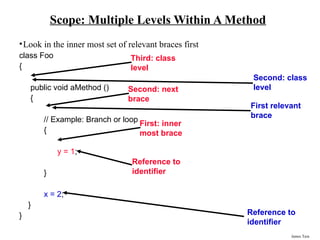
Scope: Multiple Levels Within A Method
•Look in the inner most set of relevant braces first
class Foo
{
public void aMethod ()
{
// Example: Branch or loop
{
y = 1;
}
x = 2;
}
}
Reference to
identifier
First: inner
most brace
Second: next
brace
Third: class
level
Reference to
identifier
First relevant
brace
Second: class
level
James Tam
Encapsulation
•In Java: The ability bundle information (attributes) and behavior
(methods) into a single entity.
•In Java this is done through a class definition.
•Other languages: C (“struct”), C++/Python (“class”), Pascal
(“record”) etc.
James Tam
Information Hiding
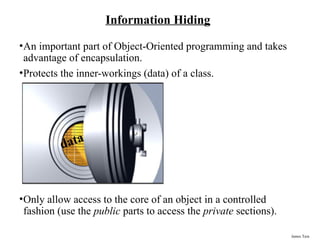
•An important part of Object-Oriented programming and takes
advantage of encapsulation.
•Protects the inner-workings (data) of a class.
•Only allow access to the core of an object in a controlled
fashion (use the public parts to access the private sections).
James Tam
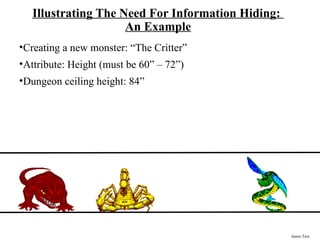
Illustrating The Need For Information Hiding:
An Example
•Creating a new monster: “The Critter”
•Attribute: Height (must be 60” – 72”)
•Dungeon ceiling height: 84”
James Tam
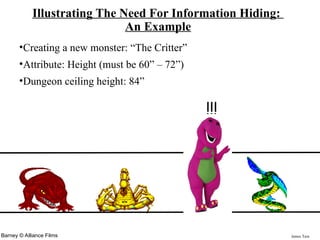
Illustrating The Need For Information Hiding:
An Example
•Creating a new monster: “The Critter”
•Attribute: Height (must be 60” – 72”)
•Dungeon ceiling height: 84”
!!!
Barney © Alliance Films
James Tam
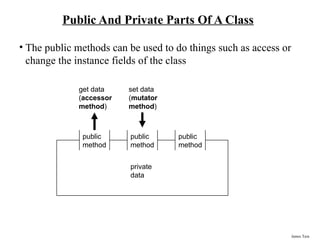
• The public methods can be used to do things such as access or
change the instance fields of the class
Public And Private Parts Of A Class
private
data
public
method
public
method
public
method
set data
(mutator
method)
get data
(accessor
method)
James Tam
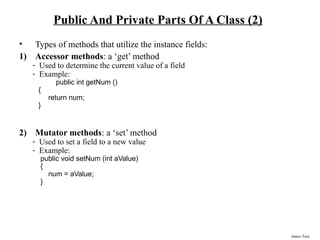
Public And Private Parts Of A Class (2)
• Types of methods that utilize the instance fields:
1) Accessor methods: a ‘get’ method
- Used to determine the current value of a field
- Example:
public int getNum ()
{
return num;
}
2) Mutator methods: a ‘set’ method
- Used to set a field to a new value
- Example:
public void setNum (int aValue)
{
num = aValue;
}
James Tam
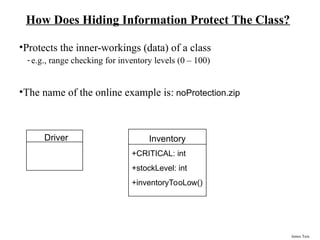
How Does Hiding Information Protect The Class?
•Protects the inner-workings (data) of a class
-e.g., range checking for inventory levels (0 – 100)
•The name of the online example is: noProtection.zip
Inventory
+CRITICAL: int
+stockLevel: int
+inventoryTooLow()
Driver
James Tam
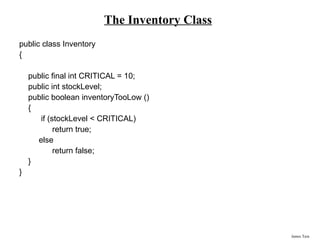
The Inventory Class
public class Inventory
{
public final int CRITICAL = 10;
public int stockLevel;
public boolean inventoryTooLow ()
{
if (stockLevel < CRITICAL)
return true;
else
return false;
}
}
James Tam
The Driver Class
public class Driver
{
public static void main (String [] args)
{
Inventory chinook = new Inventory ();
chinook.stockLevel = 10;
System.out.println ("Stock: " + chinook.stockLevel);
chinook.stockLevel = chinook.stockLevel + 10;
System.out.println ("Stock: " + chinook.stockLevel);
chinook.stockLevel = chinook.stockLevel + 100;
System.out.println ("Stock: " + chinook.stockLevel);
chinook.stockLevel = chinook.stockLevel - 1000;
System.out.println ("Stock: " + chinook.stockLevel);
}
}
James Tam
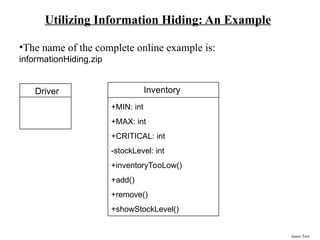
Utilizing Information Hiding: An Example
•The name of the complete online example is:
informationHiding.zip
Driver
+MIN: int
+MAX: int
+CRITICAL: int
-stockLevel: int
+inventoryTooLow()
+add()
+remove()
+showStockLevel()
Inventory
James Tam
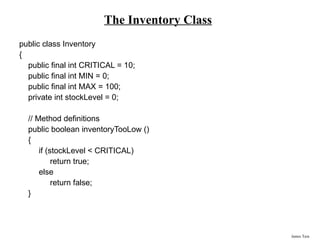
The Inventory Class
public class Inventory
{
public final int CRITICAL = 10;
public final int MIN = 0;
public final int MAX = 100;
private int stockLevel = 0;
// Method definitions
public boolean inventoryTooLow ()
{
if (stockLevel < CRITICAL)
return true;
else
return false;
}
James Tam
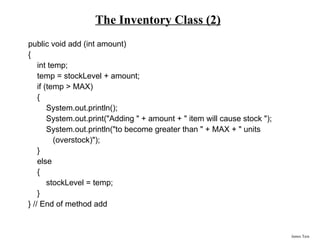
The Inventory Class (2)
public void add (int amount)
{
int temp;
temp = stockLevel + amount;
if (temp > MAX)
{
System.out.println();
System.out.print("Adding " + amount + " item will cause stock ");
System.out.println("to become greater than " + MAX + " units
(overstock)");
}
else
{
stockLevel = temp;
}
} // End of method add
James Tam
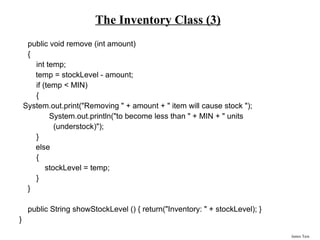
The Inventory Class (3)
public void remove (int amount)
{
int temp;
temp = stockLevel - amount;
if (temp < MIN)
{
System.out.print("Removing " + amount + " item will cause stock ");
System.out.println("to become less than " + MIN + " units
(understock)");
}
else
{
stockLevel = temp;
}
}
public String showStockLevel () { return("Inventory: " + stockLevel); }
}
James Tam
The Driver Class
public class Driver
{
public static void main (String [] args)
{
Inventory chinook = new Inventory ();
chinook.add (10);
System.out.println(chinook.showStockLevel ());
chinook.add (10);
System.out.println(chinook.showStockLevel ());
chinook.add (100);
System.out.println(chinook.showStockLevel ());
chinook.remove (21);
System.out.println(chinook.showStockLevel ());
// JT: The statement below won't work and for good reason!
// chinook.stockLevel = -999;
}
}
James Tam
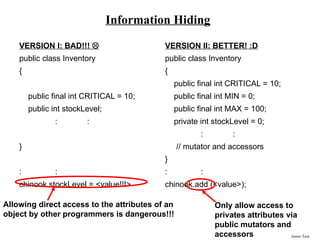
Information Hiding
VERSION I: BAD!!! 
public class Inventory
{
public final int CRITICAL = 10;
public int stockLevel;
: :
}
: :
chinook.stockLevel = <value!!!>
VERSION II: BETTER! :D
public class Inventory
{
public final int CRITICAL = 10;
public final int MIN = 0;
public final int MAX = 100;
private int stockLevel = 0;
: :
// mutator and accessors
}
: :
chinook.add (<value>);
Allowing direct access to the attributes of an
object by other programmers is dangerous!!!
Only allow access to
privates attributes via
public mutators and
accessors
James Tam
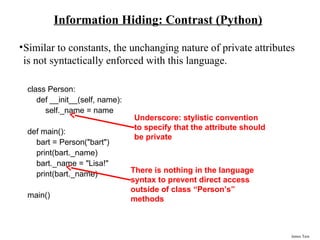
Information Hiding: Contrast (Python)
•Similar to constants, the unchanging nature of private attributes
is not syntactically enforced with this language.
class Person:
def __init__(self, name):
self._name = name
def main():
bart = Person("bart")
print(bart._name)
bart._name = "Lisa!"
print(bart._name)
main()
Underscore: stylistic convention
to specify that the attribute should
be private
There is nothing in the language
syntax to prevent direct access
outside of class “Person’s”
methods
James Tam
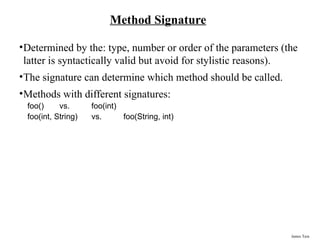
Method Signature
•Determined by the: type, number or order of the parameters (the
latter is syntactically valid but avoid for stylistic reasons).
•The signature can determine which method should be called.
•Methods with different signatures:
foo() vs. foo(int)
foo(int, String) vs. foo(String, int)
James Tam
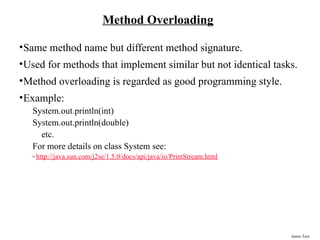
Method Overloading
•Same method name but different method signature.
•Used for methods that implement similar but not identical tasks.
•Method overloading is regarded as good programming style.
•Example:
System.out.println(int)
System.out.println(double)
etc.
For more details on class System see:
- http://java.sun.com/j2se/1.5.0/docs/api/java/io/PrintStream.html
James Tam
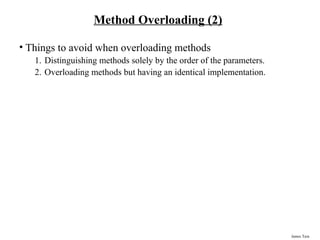
Method Overloading (2)
• Things to avoid when overloading methods
1. Distinguishing methods solely by the order of the parameters.
2. Overloading methods but having an identical implementation.
James Tam
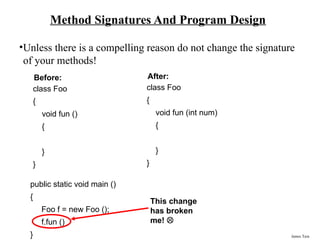
Method Signatures And Program Design
•Unless there is a compelling reason do not change the signature
of your methods!
class Foo
{
void fun ()
{
}
}
Before:
class Foo
{
void fun (int num)
{
}
}
After:
public static void main ()
{
Foo f = new Foo ();
f.fun ()
}
This change
has broken
me! 
James Tam
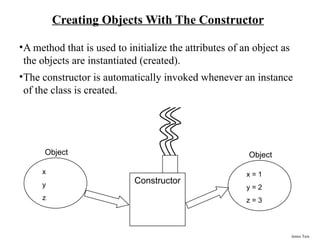
•A method that is used to initialize the attributes of an object as
the objects are instantiated (created).
•The constructor is automatically invoked whenever an instance
of the class is created.
Creating Objects With The Constructor
Constructor
Object
x
y
z
Object
x = 1
y = 2
z = 3
James Tam
Creating Objects With The Constructor (2)
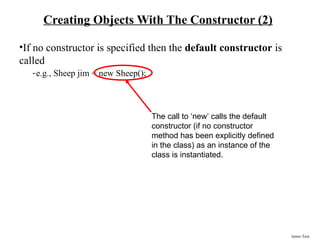
•If no constructor is specified then the default constructor is
called
-e.g., Sheep jim = new Sheep();
The call to ‘new’ calls the default
constructor (if no constructor
method has been explicitly defined
in the class) as an instance of the
class is instantiated.
James Tam
Writing Your Own Constructor
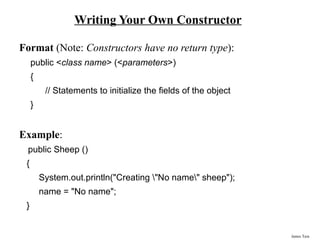
Format (Note: Constructors have no return type):
public <class name> (<parameters>)
{
// Statements to initialize the fields of the object
}
Example:
public Sheep ()
{
System.out.println("Creating "No name" sheep");
name = "No name";
}
James Tam
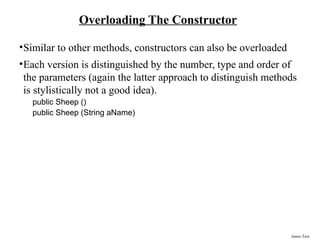
Overloading The Constructor
•Similar to other methods, constructors can also be overloaded
•Each version is distinguished by the number, type and order of
the parameters (again the latter approach to distinguish methods
is stylistically not a good idea).
public Sheep ()
public Sheep (String aName)
James Tam
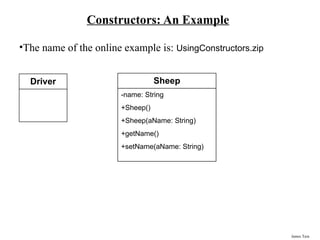
Constructors: An Example
•The name of the online example is: UsingConstructors.zip
Driver Sheep
-name: String
+Sheep()
+Sheep(aName: String)
+getName()
+setName(aName: String)
James Tam
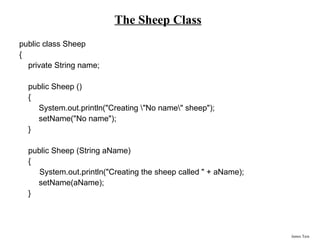
The Sheep Class
public class Sheep
{
private String name;
public Sheep ()
{
System.out.println("Creating "No name" sheep");
setName("No name");
}
public Sheep (String aName)
{
System.out.println("Creating the sheep called " + aName);
setName(aName);
}
James Tam
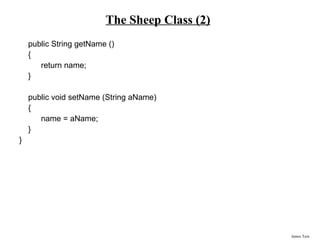
The Sheep Class (2)
public String getName ()
{
return name;
}
public void setName (String aName)
{
name = aName;
}
}
James Tam
The Driver Class
public class Driver
{
public static void main (String [] args)
{
Sheep nellie;
Sheep jim;
System.out.println();
System.out.println("Creating flock...");
nellie = new Sheep ("Nellie");
jim = new Sheep();
jim.setName("Jim");
System.out.println("Displaying updated flock");
System.out.println(" " + nellie.getName());
System.out.println(" " + jim.getName());
System.out.println();
}
}
James Tam
Messaging Passing
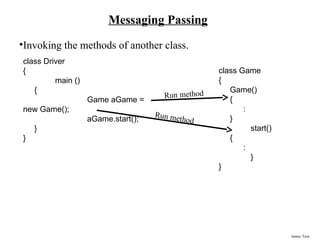
•Invoking the methods of another class.
class Driver
{
main ()
{
Game aGame =
new Game();
aGame.start();
}
}
class Game
{
Game()
{
:
}
start()
{
:
}
}
Run method
Run method
James Tam
Association Relations Between Classes
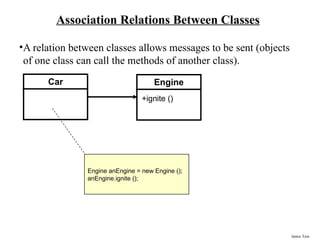
•A relation between classes allows messages to be sent (objects
of one class can call the methods of another class).
Car Engine
+ignite ()
Engine anEngine = new Engine ();
anEngine.ignite ();
James Tam
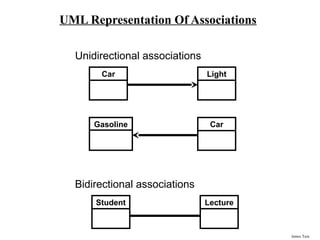
Associations Between Classes
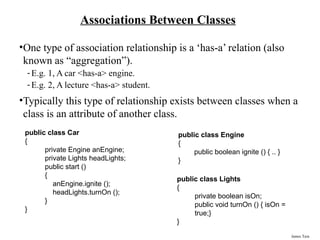
•One type of association relationship is a ‘has-a’ relation (also
known as “aggregation”).
-E.g. 1, A car <has-a> engine.
-E.g. 2, A lecture <has-a> student.
•Typically this type of relationship exists between classes when a
class is an attribute of another class.
public class Car
{
private Engine anEngine;
private Lights headLights;
public start ()
{
anEngine.ignite ();
headLights.turnOn ();
}
}
public class Engine
{
public boolean ignite () { .. }
}
public class Lights
{
private boolean isOn;
public void turnOn () { isOn =
true;}
}
James Tam
Directed Associations
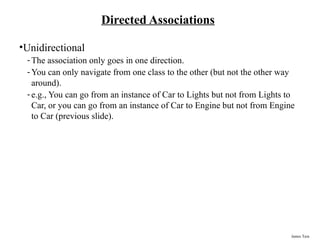
•Unidirectional
-The association only goes in one direction.
-You can only navigate from one class to the other (but not the other way
around).
-e.g., You can go from an instance of Car to Lights but not from Lights to
Car, or you can go from an instance of Car to Engine but not from Engine
to Car (previous slide).
James Tam
Directed Associations (2)
•Bidirectional
-The association goes in both directions
-You can navigate from either class to the other
-e.g.,
public class Student
{
private Lecture [] lectureList = new Lecture [5];
:
}
public class Lecture
{
private Student [] classList = new Student [250];
:
}
James Tam
UML Representation Of Associations
Car Light
Car
Student Lecture
Unidirectional associations
Bidirectional associations
Gasoline
James Tam
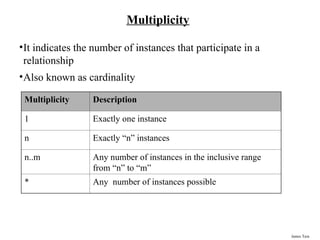
Multiplicity
•It indicates the number of instances that participate in a
relationship
•Also known as cardinality
Multiplicity Description
1 Exactly one instance
n Exactly “n” instances
n..m Any number of instances in the inclusive range
from “n” to “m”
* Any number of instances possible
James Tam
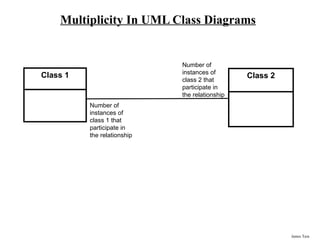
Multiplicity In UML Class Diagrams
Class 1 Class 2
Number of
instances of
class 1 that
participate in
the relationship
Number of
instances of
class 2 that
participate in
the relationship
James Tam
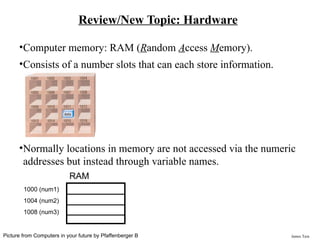
Review/New Topic: Hardware
•Computer memory: RAM (Random Access Memory).
•Consists of a number slots that can each store information.
•Normally locations in memory are not accessed via the numeric
addresses but instead through variable names.
Picture from Computers in your future by Pfaffenberger B
RAM
1000 (num1)
1004 (num2)
1008 (num3)
James Tam
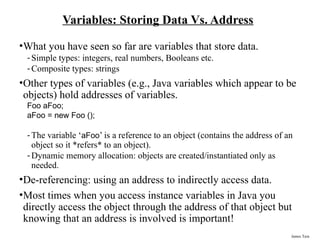
Variables: Storing Data Vs. Address
•What you have seen so far are variables that store data.
-Simple types: integers, real numbers, Booleans etc.
-Composite types: strings
•Other types of variables (e.g., Java variables which appear to be
objects) hold addresses of variables.
Foo aFoo;
aFoo = new Foo ();
-The variable ‘aFoo’ is a reference to an object (contains the address of an
object so it *refers* to an object).
-Dynamic memory allocation: objects are created/instantiated only as
needed.
•De-referencing: using an address to indirectly access data.
•Most times when you access instance variables in Java you
directly access the object through the address of that object but
knowing that an address is involved is important!
James Tam
Variables: Storing Data Vs. Address (2)
•Even with high-level languages like Java, there will be times
that programs will be working with the numeric address rather
than the variable that the address is referring to.
James Tam
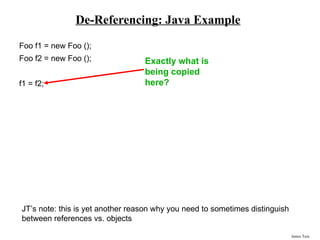
De-Referencing: Java Example
Foo f1 = new Foo ();
Foo f2 = new Foo ();
f1 = f2;
Exactly what is
being copied
here?
JT’s note: this is yet another reason why you need to sometimes distinguish
between references vs. objects
James Tam
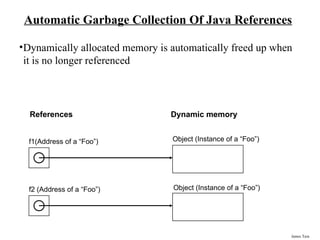
Automatic Garbage Collection Of Java References
•Dynamically allocated memory is automatically freed up when
it is no longer referenced
References Dynamic memory
f1(Address of a “Foo”)
f2 (Address of a “Foo”)
Object (Instance of a “Foo”)
James Tam
Automatic Garbage Collection Of
Java References (2)
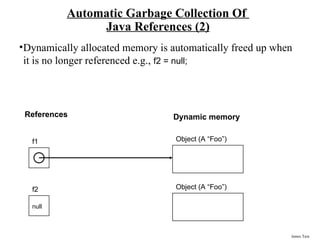
•Dynamically allocated memory is automatically freed up when
it is no longer referenced e.g., f2 = null;
References Dynamic memory
f1
f2
Object (A “Foo”)
Object (A “Foo”)
null
James Tam
Automatic Garbage Collection Of
Java References (2)
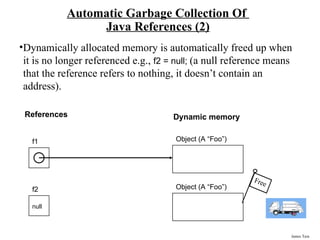
•Dynamically allocated memory is automatically freed up when
it is no longer referenced e.g., f2 = null; (a null reference means
that the reference refers to nothing, it doesn’t contain an
address).
References Dynamic memory
f1
f2
Object (A “Foo”)
Object (A “Foo”)
null
James Tam
Caution: Not All Languages Provide Automatic
Garbage Collection!
•Some languages do not provide automatic garbage collection
(e.g., C, C++, Pascal).
•In this case dynamically allocated memory must be manually
freed up by the programmer.
•Memory leak: memory that has been dynamically allocated but
has not been freed up after it’s no longer needed.
-Memory leaks are a sign of poor programming style and can result in
significant slowdowns.
James Tam
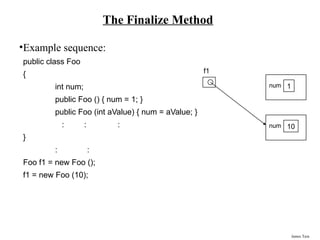
The Finalize Method
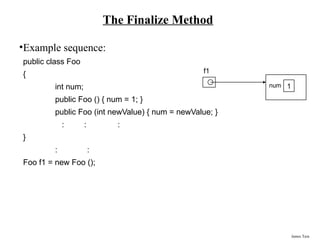
•Example sequence:
public class Foo
{
int num;
public Foo () { num = 1; }
public Foo (int newValue) { num = newValue; }
: : :
}
: :
Foo f1 = new Foo ();
f1
num 1
James Tam
The Finalize Method
•Example sequence:
public class Foo
{
int num;
public Foo () { num = 1; }
public Foo (int aValue) { num = aValue; }
: : :
}
: :
Foo f1 = new Foo ();
f1 = new Foo (10);
f1
num 1
num 10
James Tam
The Finalize Method
•Example sequence:
public class Foo
{
int num;
public Foo () { num = 1; }
public Foo (int newValue) { num = newValue; }
: : :
}
: :
Foo f1 = new Foo ();
f1 = new Foo (10);
f1
num 1
num 10
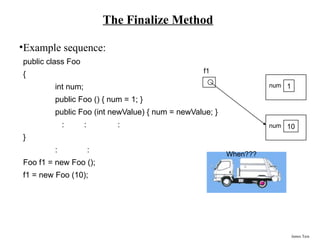
When???
James Tam
The Finalize Method
•Example sequence:
public class Foo
{
int num;
public Foo () { num = 1; }
public Foo (int newValue) { num = newValue; }
: : :
}
: :
Foo f1 = new Foo ();
f1 = new Foo (10);
f1
num 1
num 10
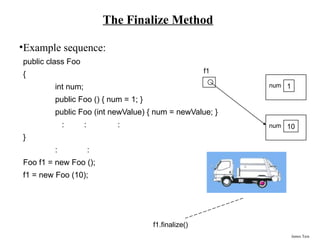
f1.finalize()
James Tam
The Finalize Method
•Example sequence:
public class Foo
{
int num;
public Foo () { num = 1; }
public Foo (int newValue) { num = newValue; }
: : :
}
: :
Foo f1 = new Foo ();
f1 = new Foo (10);
f1
num 1
num 10
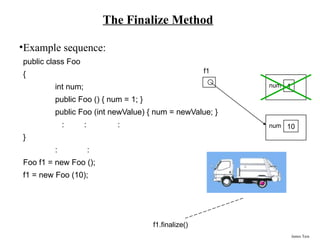
f1.finalize()
James Tam
The Finalize Method
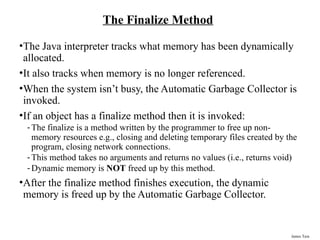
•The Java interpreter tracks what memory has been dynamically
allocated.
•It also tracks when memory is no longer referenced.
•When the system isn’t busy, the Automatic Garbage Collector is
invoked.
•If an object has a finalize method then it is invoked:
-The finalize is a method written by the programmer to free up non-
memory resources e.g., closing and deleting temporary files created by the
program, closing network connections.
-This method takes no arguments and returns no values (i.e., returns void)
-Dynamic memory is NOT freed up by this method.
•After the finalize method finishes execution, the dynamic
memory is freed up by the Automatic Garbage Collector.
James Tam
Common Errors When Using References
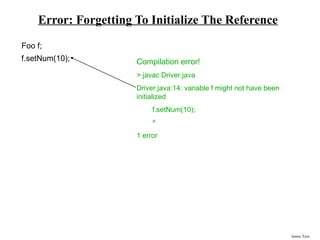
•Forgetting to initialize the reference
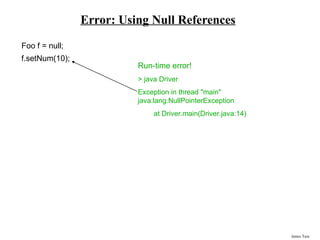
•Using a null reference
James Tam
Error: Forgetting To Initialize The Reference
Foo f;
f.setNum(10); Compilation error!
> javac Driver.java
Driver.java:14: variable f might not have been
initialized
f.setNum(10);
^
1 error
James Tam
Error: Using Null References
Foo f = null;
f.setNum(10);
Run-time error!
> java Driver
Exception in thread "main"
java.lang.NullPointerException
at Driver.main(Driver.java:14)
James Tam
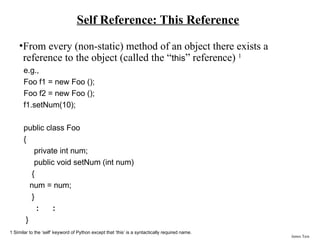
Self Reference: This Reference
•From every (non-static) method of an object there exists a
reference to the object (called the “this” reference) 1
e.g.,
Foo f1 = new Foo ();
Foo f2 = new Foo ();
f1.setNum(10);
public class Foo
{
private int num;
public void setNum (int num)
{
num = num;
}
: :
}
1 Similar to the ‘self’ keyword of Python except that ‘this’ is a syntactically required name.
James Tam
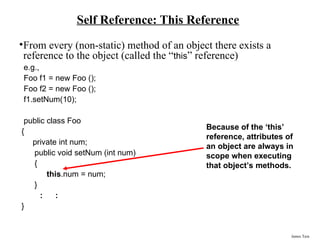
Self Reference: This Reference
•From every (non-static) method of an object there exists a
reference to the object (called the “this” reference)
e.g.,
Foo f1 = new Foo ();
Foo f2 = new Foo ();
f1.setNum(10);
public class Foo
{
private int num;
public void setNum (int num)
{
this.num = num;
}
: :
}
Because of the ‘this’
reference, attributes of
an object are always in
scope when executing
that object’s methods.
James Tam
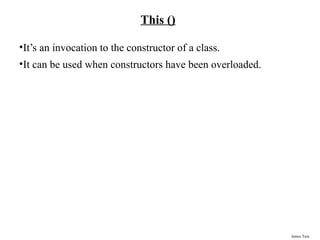
This ()
•It’s an invocation to the constructor of a class.
•It can be used when constructors have been overloaded.
James Tam
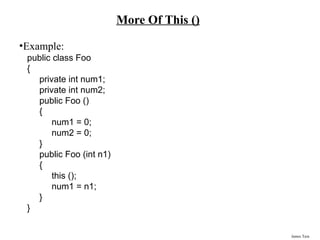
More Of This ()
•Example:
public class Foo
{
private int num1;
private int num2;
public Foo ()
{
num1 = 0;
num2 = 0;
}
public Foo (int n1)
{
this ();
num1 = n1;
}
}
James Tam
Important Terminology
•Procedural programming
•Object-Oriented programming
•class
•Object
•Instantiation
•Attributes
•Methods
•Local variables
•Scope
•Driver class
•Shadowing
•Encapsulation
James Tam
Important Terminology (2)
•Information hiding
•Accessor/mutator (get/set)
•Method overloading
•Method signature
•Constructor (Default constructor)
•Message passing
•Class association (unidirectional & bi-directional)
•Multiplicity/cardinality
•De-referencing (reference)
•Dynamic memory allocation
•Automatic garbage collection
James Tam
Important Terminology (3)
•Memory leak
•Information hiding
•Accessor/mutator (get/set)
•Method overloading
•Method signature
•Constructor (Default constructor)
•Message passing
•Class association (unidirectional & bi-directional)
•Multiplicity/cardinality
•De-referencing (reference)
James Tam
Important Terminology (3)
•Dynamic memory allocation
•Automatic garbage collection
•Memory leak
James Tam
After This Section You Should Now Know
•How to define classes, instantiate objects and access different
part of an object
•What is the difference between a class, a reference and an object
•How to represent a class using class diagrams (attributes,
methods and access permissions) and the relationships between
classes
•Scoping rules for attributes, methods and locals
•What is encapsulation and how is it done
•What is information hiding, how is it done and why is it
important to write programs that follow this principle
•What are accessor and mutator methods and how they can be
used in conjunction with information hiding
James Tam
After This Section You Should Now Know (2)
•What is method overloading and why is this regarded as good
style
•What is a constructor and how is it used
•What is an association, how do directed and non-directed
associations differ, how to represent associations and
multiplicity in UML
•What is multiplicity and what are kinds of multiplicity
relationships exist

Introduction to Object Oriented Programming

  • 1.
    James Tam Introduction ToObject-Oriented Programming This section includes introductions to fundamental object-oriented principles such as information hiding, overloading, relationships between classes as well the object-oriented approach to design.
  • 2.
    James Tam Reminder: WhatYou Know •There are different paradigms (approaches) to implementing computer programs. •There are several different paradigms but the two you have been introduced to thus far: -Procedural -Object-Oriented.
  • 3.
    James Tam An ExampleOf The Procedural Approach •Break down the program by what it does (described with actions/verbs) File Edit Help … Creating new document Opening a document Saving a document … Exiting program PowerPoint
  • 4.
    James Tam Object-Oriented Programming •Breakdown the program into ‘physical’ components (nouns). •Each of these physical components is an ‘object’. •Objects include operations (functions which are referred to as ‘methods’ in the Object-Oriented paradigm) but also data (information about each object). -The methods can be determined by the actions (verbs) that each object should be able to complete. -The data can be determined by examining the type of information that each object needs to store. •Example of an everyday object (from “Starting out with Python” by Tony Gaddis): An Alarm clock -What are the attributes of the alarm clock (information needed by the clock in order to properly function) -What are the methods of the alarm clock (operations that the clock must perform).
  • 5.
    James Tam Attributes OfThe Alarm Clock •Current second (0 – 59) •Current minute (0 – 59) •Current hour (1 – 12) •Alarm time (a valid hour and a valid minute) •A flag to indicate if the alarm is set (true/false)
  • 6.
    James Tam Methods OfThe Alarm Clock •Set time •Set alarm time •Turn alarm on/off
  • 7.
    James Tam Example DecompositionInto Objects Gambling game: dice Die Player GameInterface ? ? ? ? ?
  • 8.
    James Tam Object-Oriented Programming:An Example •How would the following program be decomposed into objects? •What sort of attributes and methods would some of those objects consist of? •“The Sims” © Maxis is a simulated world. - The world consists of neighborhoods. - Each neighborhood will contain a number of houses “The Sims” © Maxis
  • 9.
    James Tam Object-Oriented Programming:An Example (2) -A family (consist of one or more ‘Sims’ – people) lives in a house. -Each family will have possessions (items such as furniture, appliances and decorations). -The player can control the action of each sim but the sim can act independently as well. “The Sims” © Maxis
  • 10.
    James Tam Should SomethingBe Implemented As Multiple Objects? •One objects or multiple objects? 1) One Sim object? Arm object 2) Multiple objects? Leg object Torso object Head object
  • 11.
    James Tam Details OfA Sim Object: Information •Sims have needs: -Eat: food -Seek comfort: sit or lie down on something ‘comfy’ -Stay clean: wash (sink, shower) -Rest: sleep -Amusement: do ‘fun’ things -Friendship: seek companionship and interact with other sims -Etc Each of the above needs is a piece of information (attribute) and the current level is tracked by the game “The Sims” © Maxis
  • 12.
    James Tam Additional Resources •Agood description of the terms used in this section (and terms used in some of the later sections). http://docs.oracle.com/javase/tutorial/java/concepts/ •A good walk through of the process of designing an object- oriented program, finding the candidate objects e.g., how to use the ‘find a noun’ approach and some of the pitfalls of this approach. http://archive.eiffel.com/doc/manuals/technology/oosc/finding/page.html
  • 13.
    James Tam Working WithObjects In Java I. Define the class II. Create an instance of the class (instantiate an object) III. Using the different parts of an object (data and methods)
  • 14.
    James Tam I) DefiningA Java Class Format: public class <name of class> { instance fields/attributes instance methods } Example: public class Person { // Define instance fields // Define instance methods }
  • 15.
    James Tam Defining AJava Class (2) Format of instance fields/attributes: <access modifier>1 <type of the field> <name of the field>; •Example of defining instance fields/attributes: public class Person { private int age; } 1) Can be public or private but typically instance fields are private 2) Valid return types include the simple types (e.g., int, char etc.), predefined classes (e.g., String) or new classes that you have defined in your program. A method that returns nothing has a return type of “void”.
  • 16.
    James Tam Defining AJava Class (3) Format of instance methods: <access modifier>1 <return type2 > <method name> (<p1 type> <p1 name>…) { <Body of the method> } Example of an instance method: public class Person { public void fun (int num) { System.out.println (num); } } 1) Can be public or private but typically instance methods are public 2) Valid return types include the simple types (e.g., int, char etc.), predefined classes (e.g., String) or new classes that you have defined in your program. A method that returns nothing has return type of “void”.
  • 17.
    James Tam Defining AJava Class (4) Example (complete class definition): public class Person { private int age; public void setAge (int anAge) { age = anAge; } public int getAge () { return age; } }
  • 18.
    James Tam A ClassIs Like A Blueprint •It indicates the format for what an example of the class should look like (methods and attributes). •No memory is allocated.
  • 19.
    James Tam Note: ClassesAren’t The Same As Objects •To make it easier to visualize the situation, in the previous examples I used the word ‘object’ instead of the word ‘class’. •Example: Sims game would likely have classes for: -Houses -Sim -Items -Neighborhood •(Somewhere in the game) class Sim { int hunger; int comfort; int excretionLevel; etc. } The Sims © Maxis
  • 20.
    James Tam II) Creating/InstantiatingInstances Of A Class Format: <class name> <instance name> = new <class name> (); Example: Person jim = new Person(); •Note: ‘jim’ is not an object of type ‘Person’ but a reference to an object of type ‘Person’ (more on this in a later section).
  • 21.
    James Tam An InstanceIs An Actual Example Of A Class •Instantiation is when an actual example/instance of a class is created.
  • 22.
    James Tam Class Vs.Objects: Example Program (Sims) The Sims © Maxis Class definition Indicates what information will be stored by each Sim (also defines each sims capabilities) class Sim { int hunger; int comfort; int excretionLevel; etc. } Objects Inside each game there can be one or more Sim objects whose attributes vary Mike (Doing OK): Hunger = 10 Comfort = 10 Excretion = 10 Travis (not doing so good): Hunger = 10 Comfort = 10 Excretion = 1
  • 23.
    James Tam Declaring AReference Vs. Instantiating An Instance •Declaring a reference to a ‘Person’ Person jim; •Instantiating/creating an instance of a ‘Person’ jim = new Person ();
  • 24.
    James Tam III) UsingThe Parts Of A Class Format: <instance name>.<attribute name>; <instance name>.<method name>(<p1 name>, <p2 name>…); Example: int anAge = 27; Person jim = new Person (); jim.setAge(anAge); System.out.println(jim.getAge()); Note: In order to use the dot-operator “.” the instance field or method cannot have a private level of access
  • 25.
    James Tam Laying OutYour Program Java program •The program must contain a ‘Driver’ class (or equivalent). Driver.java •The driver class is the place where the program starts running (it contains the main method). main () { } Person.java •For now you should have all the classes for a particular program reside in the same directory or folder. •Instances of other classes can be created and used here. Person jim = new Person (); Accesses
  • 26.
    James Tam Laying OutYour Program •The code for each class should reside in its own separate file. class Person { : : } Person.java class Driver { : : } Driver.java
  • 27.
    James Tam Putting ItAltogether: First Object-Oriented Example •Example: -The name of the online example is: firstOOExample.zip (extract all the files into the same directory) public class Driver { public static void main (String [] args) { int anAge = 27; Person jim = new Person (); jim.setAge(anAge); System.out.println("Jim's current age is..." + jim.getAge()); } }
  • 28.
    James Tam Putting ItAltogether: First Object-Oriented Example (2) public class Person { private int age; public void setAge (int anAge) { age = anAge; } public int getAge () { return age; } }
  • 29.
    James Tam Why AReference Not The Same As An Object Name of the online example: secondExampleReferenceVsObject.zip // Same as previous example public class Person { private int age; public void setAge (int anAge) { age = anAge; } public int getAge () { return age; } }
  • 30.
    James Tam Why AReference Not The Same As An Object (2) public class Driver { public static void main(String [] args) { Person jim; // Part I: Reference created // Syntax error: initialize variables before using them. // jim.setAge(30); // Part II: Reference created and initialized // Runtime error: object has not yet been created. // jim = null; // jim.setAge(30);
  • 31.
    James Tam Why AReference Not The Same As An Object (3) // Part III: Reference and object created, reference refers to object // Correct approach jim = new Person(); jim.setAge(30); System.out.println(jim.getAge()); } }
  • 32.
    James Tam Compilation WithMultiple Classes •In the previous example there were two classes: ‘Driver’ and ‘Person’. •One way (safest) to compile the program is to compile each source code (dot-Java) file: -javac Driver.java -javac Person.java -(Alternatively use the ‘wildcard’): javac *.java •However in this program a method of the Driver class refers to an instance of class Person. public static void main (String [] args) { Person jim = new Person (); } •The Java compiler can detect that this dependency exists.
  • 33.
    James Tam Compilation WithMultiple Classes (2) •The effect in this example is that when the Driver class is compiled, the code in class Person may also be compiled. -Typing: “javac Driver.java” produces a “Driver.class” file (or produces an updated compiled version if a byte code file already exists). -If there is no “Person.class” file then one will be created. -If a “Person.class” file already exists then an updated version will not be created (unless you explicitly compile the corresponding source code file). •Moral of the story: when making changes to multiple source code (dot-Java files) make sure that you compile each individual file or at least remove existing byte code (dot-class) files prior to compilation.
  • 34.
    James Tam Points ToKeep In Mind About The Driver Class •Contains the only main method of the whole program (where execution begins) •Do not instantiate instances of the Driver1 •For now avoid: -Defining instance fields / attributes for the Driver1 -Defining methods for the Driver (other than the main method)1 1 Details will be provided later in this course
  • 35.
    James Tam UML1 Representation OfA Class Foo -num: int +setNum () +getNum () <Name of class> -<attribute name>: <attribute type> +<method name> () 1 UML = Unified Modeling Language
  • 36.
    James Tam Class DiagramsWith Increased Details Foo -num: int +setNum (aValue: int): void +getNum (): int <Name of class> -<attribute name>: <attribute type> +<method name> (p1: p1type; p2 : p2 type..): <return type> 2 UML = Unified Modeling Language
  • 37.
    James Tam Why BotherWith UML? •It’s the standard way of specifying the major parts of a software project. •It combined a number of different approaches and has become the standard notation.
  • 38.
    James Tam Why RepresentA Program In Diagrammatic Form? •Images are better than text for showing structural relations. Text Jane is Jim’s boss. Jim is Joe’s boss. Anne works for Jane. Mark works for Jim Anne is Mary’s boss. Anne is Mike’s boss. Structure diagram Jane Jim Anne Joe Mark Mike Mary
  • 39.
    James Tam •Attributes (variablesor constants) -Declared inside the body of a class definition but outside the body of any class methods. -Typically there is a separate attribute for each instance of a class and it lasts for the life of the object. •Local variables and constants -Declared within the body of a class’ method. -Last for the life of the method Attributes Vs. Local Variables class Foo { private int num; } class Foo { public void aMethod () { char ch; } }
  • 40.
    James Tam Examples OfAn Attribute public class Person { private int age; public void setAge (int newAge) { int aLocal; age = newAge; } : } : main (String [] args) { Person jim = new Person (); Person joe = new Person (); } “age”: Declared within the definition of a class
  • 41.
    James Tam Examples OfAn Attribute public class Person { private int age; public void setAge (int anAge) { int aLocal; age = anAge; } : } : main (String [] args) { Person jim = new Person (); Person joe = new Person (); } But declared outside of the body of a method
  • 42.
    James Tam Example OfA Local Variable public class Person { private int age; public void setAge (int anAge) { int aLocal; age = anAge; } : } : main (String [] args) { Person jim = new Person (); Person joe = new Person (); jim.setAge (5); joe.setAge (10); } “aLocal”: Declared inside the body of a method
  • 43.
    James Tam Scope OfLocal Variables •Enter into scope - Just after declaration •Exit out of scope - When the corresponding enclosing brace is encountered public class Bar { public void aMethod () { int num1 = 2; if (num1 % 2 == 0) { int num2; num2 = 2; } } Scope of num1
  • 44.
    James Tam Scope OfLocal Variables •Enter into scope - Just after declaration •Exit out of scope - When the proper enclosing brace is encountered public class Bar { public void aMethod () { int num1 = 2; if (num1 % 2 == 0) { int num2; num2 = 2; } } Scope of num2
  • 45.
    James Tam Scope OfAttributes public class Bar { private int num1; : : public void methodOne () { num1 = 1; num2 = 2; } public void methodTwo () { num1 = 10; num2 = 20; methodOne (); } : : private int num2; } Scope of num1 & num2
  • 46.
    James Tam Scope OfMethods public class Bar { private int num1; : : public void methodOne () { num1 = 1; num2 = 2; } public void methodTwo () { num1 = 10; num2 = 20; methodOne (); } : : private int num2; } Scope of methodOne and methodTwo
  • 47.
    James Tam Referring ToAttributes And Methods Outside Of A Class: An Example public class Bar { public void aMethod () { System.out.println(“Calling aMethod of class Bar”); } } Scope of aMethod
  • 48.
    James Tam Referring MethodsInside Vs. Outside Of Class Method public class Foo { private int num; public Foo () { num = 0; } public void methodOne () { methodTwo(); } public void methodTwo () { System.out.println(num); } : : : } public class Driver { main () { Foo f1 = new Foo (); Foo f2 = new Foo (); f1.methodOne(); } } Call is inside the scope (no instance name or ‘dot’ needed Call is outside the scope (instance name and ‘dot’ IS needed
  • 49.
    James Tam Calling MethodsOutside Of A Class Definition: Omitting The Reference Name public class Foo { private int num; public Foo () { num = 0; } public void methodOne () { methodTwo(); } public void methodTwo () { System.out.println(num); } : : : } public class Driver { main () { Foo f1 = new Foo (); Foo f2 = new Foo (); methodTwo(); } } Which objects' method?
  • 50.
    James Tam Referring ToThe Attributes And Methods Of A Class: Recap 1. Outside the methods of the class you must use the dot- operator as well as indicating what instance that you are referring to. e.g., f1.method(); 2. Inside the methods of the class there is no need to use the dot- operator nor is there a need for an instance name (if you are referring the object whose method has been called). e.g., public class Foo { public void m1 () { m2(); } public void m2 () { .. } }
  • 51.
    James Tam Shadowing One formof shadowing occurs when a variable local to the method of a class has the same name as an attribute of that class. - Be careful of accidentally doing this because the wrong identifier could be accessed. public class Sheep { private String name; public Sheep (String aName) { String name; name = aName; } NO!
  • 52.
    James Tam Shadowing Scoping Rules: 1.Look for a local identifier (name of a variable or constant) 2. Look for an attribute public class Foo { // Attributes public void method () { // Local variables num = 1; } } A reference to an identifier First: Look for a local identifier by that name int num; Second: Look for an attribute by that name private int num;
  • 53.
    James Tam Scope: MultipleLevels Within A Method •Look in the inner most set of relevant braces first class Foo { public void aMethod () { // Example: Branch or loop { y = 1; } x = 2; } } Reference to identifier First: inner most brace Second: next brace Third: class level Reference to identifier First relevant brace Second: class level
  • 54.
    James Tam Encapsulation •In Java:The ability bundle information (attributes) and behavior (methods) into a single entity. •In Java this is done through a class definition. •Other languages: C (“struct”), C++/Python (“class”), Pascal (“record”) etc.
  • 55.
    James Tam Information Hiding •Animportant part of Object-Oriented programming and takes advantage of encapsulation. •Protects the inner-workings (data) of a class. •Only allow access to the core of an object in a controlled fashion (use the public parts to access the private sections).
  • 56.
    James Tam Illustrating TheNeed For Information Hiding: An Example •Creating a new monster: “The Critter” •Attribute: Height (must be 60” – 72”) •Dungeon ceiling height: 84”
  • 57.
    James Tam Illustrating TheNeed For Information Hiding: An Example •Creating a new monster: “The Critter” •Attribute: Height (must be 60” – 72”) •Dungeon ceiling height: 84” !!! Barney © Alliance Films
  • 58.
    James Tam • Thepublic methods can be used to do things such as access or change the instance fields of the class Public And Private Parts Of A Class private data public method public method public method set data (mutator method) get data (accessor method)
  • 59.
    James Tam Public AndPrivate Parts Of A Class (2) • Types of methods that utilize the instance fields: 1) Accessor methods: a ‘get’ method - Used to determine the current value of a field - Example: public int getNum () { return num; } 2) Mutator methods: a ‘set’ method - Used to set a field to a new value - Example: public void setNum (int aValue) { num = aValue; }
  • 60.
    James Tam How DoesHiding Information Protect The Class? •Protects the inner-workings (data) of a class -e.g., range checking for inventory levels (0 – 100) •The name of the online example is: noProtection.zip Inventory +CRITICAL: int +stockLevel: int +inventoryTooLow() Driver
  • 61.
    James Tam The InventoryClass public class Inventory { public final int CRITICAL = 10; public int stockLevel; public boolean inventoryTooLow () { if (stockLevel < CRITICAL) return true; else return false; } }
  • 62.
    James Tam The DriverClass public class Driver { public static void main (String [] args) { Inventory chinook = new Inventory (); chinook.stockLevel = 10; System.out.println ("Stock: " + chinook.stockLevel); chinook.stockLevel = chinook.stockLevel + 10; System.out.println ("Stock: " + chinook.stockLevel); chinook.stockLevel = chinook.stockLevel + 100; System.out.println ("Stock: " + chinook.stockLevel); chinook.stockLevel = chinook.stockLevel - 1000; System.out.println ("Stock: " + chinook.stockLevel); } }
  • 63.
    James Tam Utilizing InformationHiding: An Example •The name of the complete online example is: informationHiding.zip Driver +MIN: int +MAX: int +CRITICAL: int -stockLevel: int +inventoryTooLow() +add() +remove() +showStockLevel() Inventory
  • 64.
    James Tam The InventoryClass public class Inventory { public final int CRITICAL = 10; public final int MIN = 0; public final int MAX = 100; private int stockLevel = 0; // Method definitions public boolean inventoryTooLow () { if (stockLevel < CRITICAL) return true; else return false; }
  • 65.
    James Tam The InventoryClass (2) public void add (int amount) { int temp; temp = stockLevel + amount; if (temp > MAX) { System.out.println(); System.out.print("Adding " + amount + " item will cause stock "); System.out.println("to become greater than " + MAX + " units (overstock)"); } else { stockLevel = temp; } } // End of method add
  • 66.
    James Tam The InventoryClass (3) public void remove (int amount) { int temp; temp = stockLevel - amount; if (temp < MIN) { System.out.print("Removing " + amount + " item will cause stock "); System.out.println("to become less than " + MIN + " units (understock)"); } else { stockLevel = temp; } } public String showStockLevel () { return("Inventory: " + stockLevel); } }
  • 67.
    James Tam The DriverClass public class Driver { public static void main (String [] args) { Inventory chinook = new Inventory (); chinook.add (10); System.out.println(chinook.showStockLevel ()); chinook.add (10); System.out.println(chinook.showStockLevel ()); chinook.add (100); System.out.println(chinook.showStockLevel ()); chinook.remove (21); System.out.println(chinook.showStockLevel ()); // JT: The statement below won't work and for good reason! // chinook.stockLevel = -999; } }
  • 68.
    James Tam Information Hiding VERSIONI: BAD!!!  public class Inventory { public final int CRITICAL = 10; public int stockLevel; : : } : : chinook.stockLevel = <value!!!> VERSION II: BETTER! :D public class Inventory { public final int CRITICAL = 10; public final int MIN = 0; public final int MAX = 100; private int stockLevel = 0; : : // mutator and accessors } : : chinook.add (<value>); Allowing direct access to the attributes of an object by other programmers is dangerous!!! Only allow access to privates attributes via public mutators and accessors
  • 69.
    James Tam Information Hiding:Contrast (Python) •Similar to constants, the unchanging nature of private attributes is not syntactically enforced with this language. class Person: def __init__(self, name): self._name = name def main(): bart = Person("bart") print(bart._name) bart._name = "Lisa!" print(bart._name) main() Underscore: stylistic convention to specify that the attribute should be private There is nothing in the language syntax to prevent direct access outside of class “Person’s” methods
  • 70.
    James Tam Method Signature •Determinedby the: type, number or order of the parameters (the latter is syntactically valid but avoid for stylistic reasons). •The signature can determine which method should be called. •Methods with different signatures: foo() vs. foo(int) foo(int, String) vs. foo(String, int)
  • 71.
    James Tam Method Overloading •Samemethod name but different method signature. •Used for methods that implement similar but not identical tasks. •Method overloading is regarded as good programming style. •Example: System.out.println(int) System.out.println(double) etc. For more details on class System see: - http://java.sun.com/j2se/1.5.0/docs/api/java/io/PrintStream.html
  • 72.
    James Tam Method Overloading(2) • Things to avoid when overloading methods 1. Distinguishing methods solely by the order of the parameters. 2. Overloading methods but having an identical implementation.
  • 73.
    James Tam Method SignaturesAnd Program Design •Unless there is a compelling reason do not change the signature of your methods! class Foo { void fun () { } } Before: class Foo { void fun (int num) { } } After: public static void main () { Foo f = new Foo (); f.fun () } This change has broken me! 
  • 74.
    James Tam •A methodthat is used to initialize the attributes of an object as the objects are instantiated (created). •The constructor is automatically invoked whenever an instance of the class is created. Creating Objects With The Constructor Constructor Object x y z Object x = 1 y = 2 z = 3
  • 75.
    James Tam Creating ObjectsWith The Constructor (2) •If no constructor is specified then the default constructor is called -e.g., Sheep jim = new Sheep(); The call to ‘new’ calls the default constructor (if no constructor method has been explicitly defined in the class) as an instance of the class is instantiated.
  • 76.
    James Tam Writing YourOwn Constructor Format (Note: Constructors have no return type): public <class name> (<parameters>) { // Statements to initialize the fields of the object } Example: public Sheep () { System.out.println("Creating "No name" sheep"); name = "No name"; }
  • 77.
    James Tam Overloading TheConstructor •Similar to other methods, constructors can also be overloaded •Each version is distinguished by the number, type and order of the parameters (again the latter approach to distinguish methods is stylistically not a good idea). public Sheep () public Sheep (String aName)
  • 78.
    James Tam Constructors: AnExample •The name of the online example is: UsingConstructors.zip Driver Sheep -name: String +Sheep() +Sheep(aName: String) +getName() +setName(aName: String)
  • 79.
    James Tam The SheepClass public class Sheep { private String name; public Sheep () { System.out.println("Creating "No name" sheep"); setName("No name"); } public Sheep (String aName) { System.out.println("Creating the sheep called " + aName); setName(aName); }
  • 80.
    James Tam The SheepClass (2) public String getName () { return name; } public void setName (String aName) { name = aName; } }
  • 81.
    James Tam The DriverClass public class Driver { public static void main (String [] args) { Sheep nellie; Sheep jim; System.out.println(); System.out.println("Creating flock..."); nellie = new Sheep ("Nellie"); jim = new Sheep(); jim.setName("Jim"); System.out.println("Displaying updated flock"); System.out.println(" " + nellie.getName()); System.out.println(" " + jim.getName()); System.out.println(); } }
  • 82.
    James Tam Messaging Passing •Invokingthe methods of another class. class Driver { main () { Game aGame = new Game(); aGame.start(); } } class Game { Game() { : } start() { : } } Run method Run method
  • 83.
    James Tam Association RelationsBetween Classes •A relation between classes allows messages to be sent (objects of one class can call the methods of another class). Car Engine +ignite () Engine anEngine = new Engine (); anEngine.ignite ();
  • 84.
    James Tam Associations BetweenClasses •One type of association relationship is a ‘has-a’ relation (also known as “aggregation”). -E.g. 1, A car <has-a> engine. -E.g. 2, A lecture <has-a> student. •Typically this type of relationship exists between classes when a class is an attribute of another class. public class Car { private Engine anEngine; private Lights headLights; public start () { anEngine.ignite (); headLights.turnOn (); } } public class Engine { public boolean ignite () { .. } } public class Lights { private boolean isOn; public void turnOn () { isOn = true;} }
  • 85.
    James Tam Directed Associations •Unidirectional -Theassociation only goes in one direction. -You can only navigate from one class to the other (but not the other way around). -e.g., You can go from an instance of Car to Lights but not from Lights to Car, or you can go from an instance of Car to Engine but not from Engine to Car (previous slide).
  • 86.
    James Tam Directed Associations(2) •Bidirectional -The association goes in both directions -You can navigate from either class to the other -e.g., public class Student { private Lecture [] lectureList = new Lecture [5]; : } public class Lecture { private Student [] classList = new Student [250]; : }
  • 87.
    James Tam UML RepresentationOf Associations Car Light Car Student Lecture Unidirectional associations Bidirectional associations Gasoline
  • 88.
    James Tam Multiplicity •It indicatesthe number of instances that participate in a relationship •Also known as cardinality Multiplicity Description 1 Exactly one instance n Exactly “n” instances n..m Any number of instances in the inclusive range from “n” to “m” * Any number of instances possible
  • 89.
    James Tam Multiplicity InUML Class Diagrams Class 1 Class 2 Number of instances of class 1 that participate in the relationship Number of instances of class 2 that participate in the relationship
  • 90.
    James Tam Review/New Topic:Hardware •Computer memory: RAM (Random Access Memory). •Consists of a number slots that can each store information. •Normally locations in memory are not accessed via the numeric addresses but instead through variable names. Picture from Computers in your future by Pfaffenberger B RAM 1000 (num1) 1004 (num2) 1008 (num3)
  • 91.
    James Tam Variables: StoringData Vs. Address •What you have seen so far are variables that store data. -Simple types: integers, real numbers, Booleans etc. -Composite types: strings •Other types of variables (e.g., Java variables which appear to be objects) hold addresses of variables. Foo aFoo; aFoo = new Foo (); -The variable ‘aFoo’ is a reference to an object (contains the address of an object so it *refers* to an object). -Dynamic memory allocation: objects are created/instantiated only as needed. •De-referencing: using an address to indirectly access data. •Most times when you access instance variables in Java you directly access the object through the address of that object but knowing that an address is involved is important!
  • 92.
    James Tam Variables: StoringData Vs. Address (2) •Even with high-level languages like Java, there will be times that programs will be working with the numeric address rather than the variable that the address is referring to.
  • 93.
    James Tam De-Referencing: JavaExample Foo f1 = new Foo (); Foo f2 = new Foo (); f1 = f2; Exactly what is being copied here? JT’s note: this is yet another reason why you need to sometimes distinguish between references vs. objects
  • 94.
    James Tam Automatic GarbageCollection Of Java References •Dynamically allocated memory is automatically freed up when it is no longer referenced References Dynamic memory f1(Address of a “Foo”) f2 (Address of a “Foo”) Object (Instance of a “Foo”) Object (Instance of a “Foo”)
  • 95.
    James Tam Automatic GarbageCollection Of Java References (2) •Dynamically allocated memory is automatically freed up when it is no longer referenced e.g., f2 = null; References Dynamic memory f1 f2 Object (A “Foo”) Object (A “Foo”) null
  • 96.
    James Tam Automatic GarbageCollection Of Java References (2) •Dynamically allocated memory is automatically freed up when it is no longer referenced e.g., f2 = null; (a null reference means that the reference refers to nothing, it doesn’t contain an address). References Dynamic memory f1 f2 Object (A “Foo”) Object (A “Foo”) null
  • 97.
    James Tam Caution: NotAll Languages Provide Automatic Garbage Collection! •Some languages do not provide automatic garbage collection (e.g., C, C++, Pascal). •In this case dynamically allocated memory must be manually freed up by the programmer. •Memory leak: memory that has been dynamically allocated but has not been freed up after it’s no longer needed. -Memory leaks are a sign of poor programming style and can result in significant slowdowns.
  • 98.
    James Tam The FinalizeMethod •Example sequence: public class Foo { int num; public Foo () { num = 1; } public Foo (int newValue) { num = newValue; } : : : } : : Foo f1 = new Foo (); f1 num 1
  • 99.
    James Tam The FinalizeMethod •Example sequence: public class Foo { int num; public Foo () { num = 1; } public Foo (int aValue) { num = aValue; } : : : } : : Foo f1 = new Foo (); f1 = new Foo (10); f1 num 1 num 10
  • 100.
    James Tam The FinalizeMethod •Example sequence: public class Foo { int num; public Foo () { num = 1; } public Foo (int newValue) { num = newValue; } : : : } : : Foo f1 = new Foo (); f1 = new Foo (10); f1 num 1 num 10 When???
  • 101.
    James Tam The FinalizeMethod •Example sequence: public class Foo { int num; public Foo () { num = 1; } public Foo (int newValue) { num = newValue; } : : : } : : Foo f1 = new Foo (); f1 = new Foo (10); f1 num 1 num 10 f1.finalize()
  • 102.
    James Tam The FinalizeMethod •Example sequence: public class Foo { int num; public Foo () { num = 1; } public Foo (int newValue) { num = newValue; } : : : } : : Foo f1 = new Foo (); f1 = new Foo (10); f1 num 1 num 10 f1.finalize()
  • 103.
    James Tam The FinalizeMethod •The Java interpreter tracks what memory has been dynamically allocated. •It also tracks when memory is no longer referenced. •When the system isn’t busy, the Automatic Garbage Collector is invoked. •If an object has a finalize method then it is invoked: -The finalize is a method written by the programmer to free up non- memory resources e.g., closing and deleting temporary files created by the program, closing network connections. -This method takes no arguments and returns no values (i.e., returns void) -Dynamic memory is NOT freed up by this method. •After the finalize method finishes execution, the dynamic memory is freed up by the Automatic Garbage Collector.
  • 104.
    James Tam Common ErrorsWhen Using References •Forgetting to initialize the reference •Using a null reference
  • 105.
    James Tam Error: ForgettingTo Initialize The Reference Foo f; f.setNum(10); Compilation error! > javac Driver.java Driver.java:14: variable f might not have been initialized f.setNum(10); ^ 1 error
  • 106.
    James Tam Error: UsingNull References Foo f = null; f.setNum(10); Run-time error! > java Driver Exception in thread "main" java.lang.NullPointerException at Driver.main(Driver.java:14)
  • 107.
    James Tam Self Reference:This Reference •From every (non-static) method of an object there exists a reference to the object (called the “this” reference) 1 e.g., Foo f1 = new Foo (); Foo f2 = new Foo (); f1.setNum(10); public class Foo { private int num; public void setNum (int num) { num = num; } : : } 1 Similar to the ‘self’ keyword of Python except that ‘this’ is a syntactically required name.
  • 108.
    James Tam Self Reference:This Reference •From every (non-static) method of an object there exists a reference to the object (called the “this” reference) e.g., Foo f1 = new Foo (); Foo f2 = new Foo (); f1.setNum(10); public class Foo { private int num; public void setNum (int num) { this.num = num; } : : } Because of the ‘this’ reference, attributes of an object are always in scope when executing that object’s methods.
  • 109.
    James Tam This () •It’san invocation to the constructor of a class. •It can be used when constructors have been overloaded.
  • 110.
    James Tam More OfThis () •Example: public class Foo { private int num1; private int num2; public Foo () { num1 = 0; num2 = 0; } public Foo (int n1) { this (); num1 = n1; } }
  • 111.
    James Tam Important Terminology •Proceduralprogramming •Object-Oriented programming •class •Object •Instantiation •Attributes •Methods •Local variables •Scope •Driver class •Shadowing •Encapsulation
  • 112.
    James Tam Important Terminology(2) •Information hiding •Accessor/mutator (get/set) •Method overloading •Method signature •Constructor (Default constructor) •Message passing •Class association (unidirectional & bi-directional) •Multiplicity/cardinality •De-referencing (reference) •Dynamic memory allocation •Automatic garbage collection
  • 113.
    James Tam Important Terminology(3) •Memory leak •Information hiding •Accessor/mutator (get/set) •Method overloading •Method signature •Constructor (Default constructor) •Message passing •Class association (unidirectional & bi-directional) •Multiplicity/cardinality •De-referencing (reference)
  • 114.
    James Tam Important Terminology(3) •Dynamic memory allocation •Automatic garbage collection •Memory leak
  • 115.
    James Tam After ThisSection You Should Now Know •How to define classes, instantiate objects and access different part of an object •What is the difference between a class, a reference and an object •How to represent a class using class diagrams (attributes, methods and access permissions) and the relationships between classes •Scoping rules for attributes, methods and locals •What is encapsulation and how is it done •What is information hiding, how is it done and why is it important to write programs that follow this principle •What are accessor and mutator methods and how they can be used in conjunction with information hiding
  • 116.
    James Tam After ThisSection You Should Now Know (2) •What is method overloading and why is this regarded as good style •What is a constructor and how is it used •What is an association, how do directed and non-directed associations differ, how to represent associations and multiplicity in UML •What is multiplicity and what are kinds of multiplicity relationships exist