Scilab Textbook Companion for
Introduction To Numerical Methods In
Chemical Engineering
by P. Ahuja1
Created by
Chandra Prakash Sipani
B.TECH Part-2
Chemical Engineering
IIT-BHU
College Teacher
Ahuja, Pradeep
Cross-Checked by
Pradeep Ahuja
May 21, 2016
1Funded by a grant from the National Mission on Education through ICT,
http://spoken-tutorial.org/NMEICT-Intro. This Textbook Companion and Scilab
codes written in it can be downloaded from the ”Textbook Companion Project”
section at the website http://scilab.in
Book Description
Title: Introduction To Numerical Methods In Chemical Engineering
Author: P. Ahuja
Publisher: PHI Learning, New Delhi
Edition: 1
Year: 2010
ISBN: 8120340183
1
Scilab numbering policy used in this document and the relation to the
above book.
Exa Example (Solved example)
Eqn Equation (Particular equation of the above book)
AP Appendix to Example(Scilab Code that is an Appednix to a particular
Example of the above book)
For example, Exa 3.51 means solved example 3.51 of this book. Sec 2.3 means
a scilab code whose theory is explained in Section 2.3 of the book.
2
Contents
List of Scilab Codes 4
1 linear algebraic equations 5
2 NONLINEAR ALGEBRAIC EQUATIONS 12
3 CHEMICAL ENGINEERING THERMODYNAMICS 17
4 INITIAL VALUE PROBLEMS 35
5 BOUNDARY VALUE PROBLEMS 56
6 CONVECTION DIFFUSION PROBLEMS 66
7 TUBULAR REACTOR WITH AXIAL DISPERSION 72
8 CHEMICAL REACTION AND DIFFUSION IN SPHERI-
CAL CATALYST PELLET 76
9 ONE DIMENSIONAL TRANSIENT HEAT CONDUCTION 81
10 TWO DIMENSIONAL STEADY AND TRANSIENT HEAT
CONDUCTION 88
3
List of Scilab Codes
Exa 1.1 TDMA method . . . . . . . . . . . . . . . . . . . . . . 5
Exa 1.2 gauss elimination method . . . . . . . . . . . . . . . . 6
Exa 1.3 gauss elimination method . . . . . . . . . . . . . . . . 7
Exa 1.4 gauss elimination method . . . . . . . . . . . . . . . . 8
Exa 1.5 gauss seidel method . . . . . . . . . . . . . . . . . . . 10
Exa 1.6 gauss seidel method . . . . . . . . . . . . . . . . . . . 10
Exa 2.1 algebraic equations . . . . . . . . . . . . . . . . . . . . 12
Exa 2.2 algebraic equations . . . . . . . . . . . . . . . . . . . . 13
Exa 2.3 algebraic equations . . . . . . . . . . . . . . . . . . . . 13
Exa 2.4 algebraic equations . . . . . . . . . . . . . . . . . . . . 14
Exa 2.5 algebraic equations . . . . . . . . . . . . . . . . . . . . 15
Exa 2.6 algebraic equations . . . . . . . . . . . . . . . . . . . . 16
Exa 3.1 thermodynamics . . . . . . . . . . . . . . . . . . . . . 17
Exa 3.2 thermodynamics . . . . . . . . . . . . . . . . . . . . . 19
Exa 3.3 flash calculations using Raoult law . . . . . . . . . . . 21
Exa 3.4 BPT and DPT calculation using modified raoult law . 22
Exa 3.5 flash calculations using modified Raoult law . . . . . . 25
Exa 3.6 vapour pressure calculation using cubic equation of state 27
Exa 3.7 pressure x y diagram using gamma phi approach . . . 29
Exa 3.9 chemical reaction engineering 2 simultaneous reactions 31
Exa 3.10 adiabatic flame temperature . . . . . . . . . . . . . . . 33
Exa 4.1 solution of ordinary differential equation . . . . . . . . 35
Exa 4.2 solution of ordinary differential equation . . . . . . . . 36
Exa 4.3 double pipe heat exchanger . . . . . . . . . . . . . . . 37
Exa 4.4 stirred tank with coil heater . . . . . . . . . . . . . . . 38
Exa 4.5 stirred tank with coil heater . . . . . . . . . . . . . . . 39
Exa 4.6 pneumatic conveying . . . . . . . . . . . . . . . . . . . 40
Exa 4.7 simultaneous ordinary differential equations . . . . . . 41
4
Exa 4.8 simultaneous ordinary differential equations . . . . . . 42
Exa 4.9 simultaneous ordinary differential equations . . . . . . 43
Exa 4.10 series of stirred tank with coil heater . . . . . . . . . . 44
Exa 4.11 batch and stirred tank reactor . . . . . . . . . . . . . 45
Exa 4.12 batch and stirred tank reactor . . . . . . . . . . . . . 46
Exa 4.13 batch and stirred tank reactor . . . . . . . . . . . . . 47
Exa 4.14 batch and stirred tank reactor . . . . . . . . . . . . . 48
Exa 4.15 plug flow reactor . . . . . . . . . . . . . . . . . . . . . 50
Exa 4.16 plug flow reactor . . . . . . . . . . . . . . . . . . . . . 50
Exa 4.17 plug flow reactor . . . . . . . . . . . . . . . . . . . . . 52
Exa 4.18 non isothermal plug flow reactor . . . . . . . . . . . . 53
Exa 5.1 discretization in 1 D space . . . . . . . . . . . . . . . . 56
Exa 5.2 discretization in 1 D space . . . . . . . . . . . . . . . . 57
Exa 5.3 discretization in 1 D space . . . . . . . . . . . . . . . . 57
Exa 5.4 discretization in 1 D space . . . . . . . . . . . . . . . . 58
Exa 5.5 discretization in 1 D space . . . . . . . . . . . . . . . . 60
Exa 5.6 1 D steady state heat conduction . . . . . . . . . . . . 61
Exa 5.7 1 D steady state heat conduction . . . . . . . . . . . . 62
Exa 5.8 chemical reaction and diffusion in pore . . . . . . . . . 64
Exa 6.1 upwind scheme . . . . . . . . . . . . . . . . . . . . . . 66
Exa 6.2 upwind scheme . . . . . . . . . . . . . . . . . . . . . . 69
Exa 7.1 boundary value problem in chemical reaction engineering 72
Exa 7.2 boundary value problem in chemical reaction engineer-
ing second order . . . . . . . . . . . . . . . . . . . . . 74
Exa 8.1 first order reaction . . . . . . . . . . . . . . . . . . . . 76
Exa 8.2 second order reaction . . . . . . . . . . . . . . . . . . 77
Exa 8.3 non isothermal condition . . . . . . . . . . . . . . . . 78
Exa 8.4 non isothermal condition . . . . . . . . . . . . . . . . 79
Exa 9.1 transient conduction in rectangular slab . . . . . . . . 81
Exa 9.2 transient conduction in rectangular slab . . . . . . . . 82
Exa 9.3 transient conduction in cylinder . . . . . . . . . . . . . 84
Exa 9.4 transient conduction in sphere . . . . . . . . . . . . . 85
Exa 9.5 transient diffusion in sphere . . . . . . . . . . . . . . . 86
Exa 10.1 discretization in 2 D space gauss seidel method . . . . 88
Exa 10.2 discretization in 2 D space gauss seidel method . . . . 89
Exa 10.3 discretization in 2 D space . . . . . . . . . . . . . . . . 90
Exa 10.8 discretization in 2 D space . . . . . . . . . . . . . . . . 91
Exa 10.9 discretization in 2 D space . . . . . . . . . . . . . . . . 92
5
Exa 10.10 ADI method . . . . . . . . . . . . . . . . . . . . . . . 93
Exa 10.11 ADI method for transient heat conduction . . . . . . . 94
6
Chapter 1
linear algebraic equations
Scilab code Exa 1.1 TDMA method
1 // ch 1 ex 1.1− s o l v i n g s e t of a l g e b r a i c equations by
Tri diagonal Matrix Algorithm Method .
2 clc
3 disp(” the s o l n of eg 1.1−−>”);
4 for i=2:7, a(i)=1; // sub diagonal
assignment
5 end
6 for j=1:7, b(j)=-2; // main diagonal
assignment
7 end
8 for k=1:6, c(k)=1; // super diagonal
assignment
9 end
10 d(1) =-240 // given v a l u e s
assignment
11 for l=2:6, d(l)=-40;
12 end
13 d(7)=-60
14
15 i=1;
16 n=7;
7
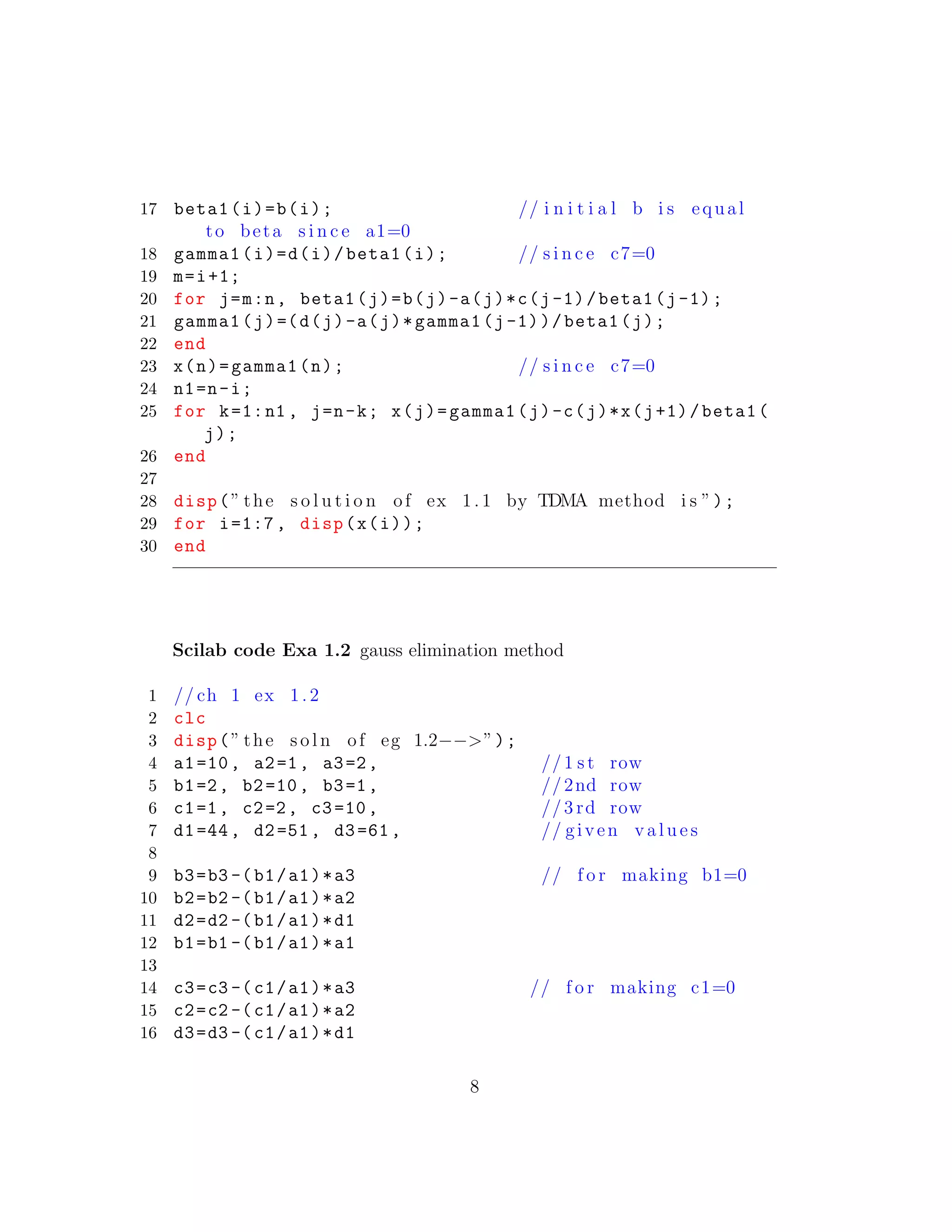
17 beta1(i)=b(i); // i n i t i a l b i s equal
to beta s i n c e a1=0
18 gamma1(i)=d(i)/beta1(i); // s i n c e c7=0
19 m=i+1;
20 for j=m:n, beta1(j)=b(j)-a(j)*c(j-1)/beta1(j-1);
21 gamma1(j)=(d(j)-a(j)*gamma1(j-1))/beta1(j);
22 end
23 x(n)=gamma1(n); // s i n c e c7=0
24 n1=n-i;
25 for k=1:n1 , j=n-k; x(j)=gamma1(j)-c(j)*x(j+1)/beta1(
j);
26 end
27
28 disp(” the s o l u t i o n of ex 1.1 by TDMA method i s ”);
29 for i=1:7, disp(x(i));
30 end
Scilab code Exa 1.2 gauss elimination method
1 // ch 1 ex 1. 2
2 clc
3 disp(” the s o l n of eg 1.2−−>”);
4 a1=10, a2=1, a3=2, //1 s t row
5 b1=2, b2=10, b3=1, //2nd row
6 c1=1, c2=2, c3=10, //3 rd row
7 d1=44, d2=51, d3=61, // given v a l u e s
8
9 b3=b3 -(b1/a1)*a3 // f o r making b1=0
10 b2=b2 -(b1/a1)*a2
11 d2=d2 -(b1/a1)*d1
12 b1=b1 -(b1/a1)*a1
13
14 c3=c3 -(c1/a1)*a3 // f o r making c1=0
15 c2=c2 -(c1/a1)*a2
16 d3=d3 -(c1/a1)*d1
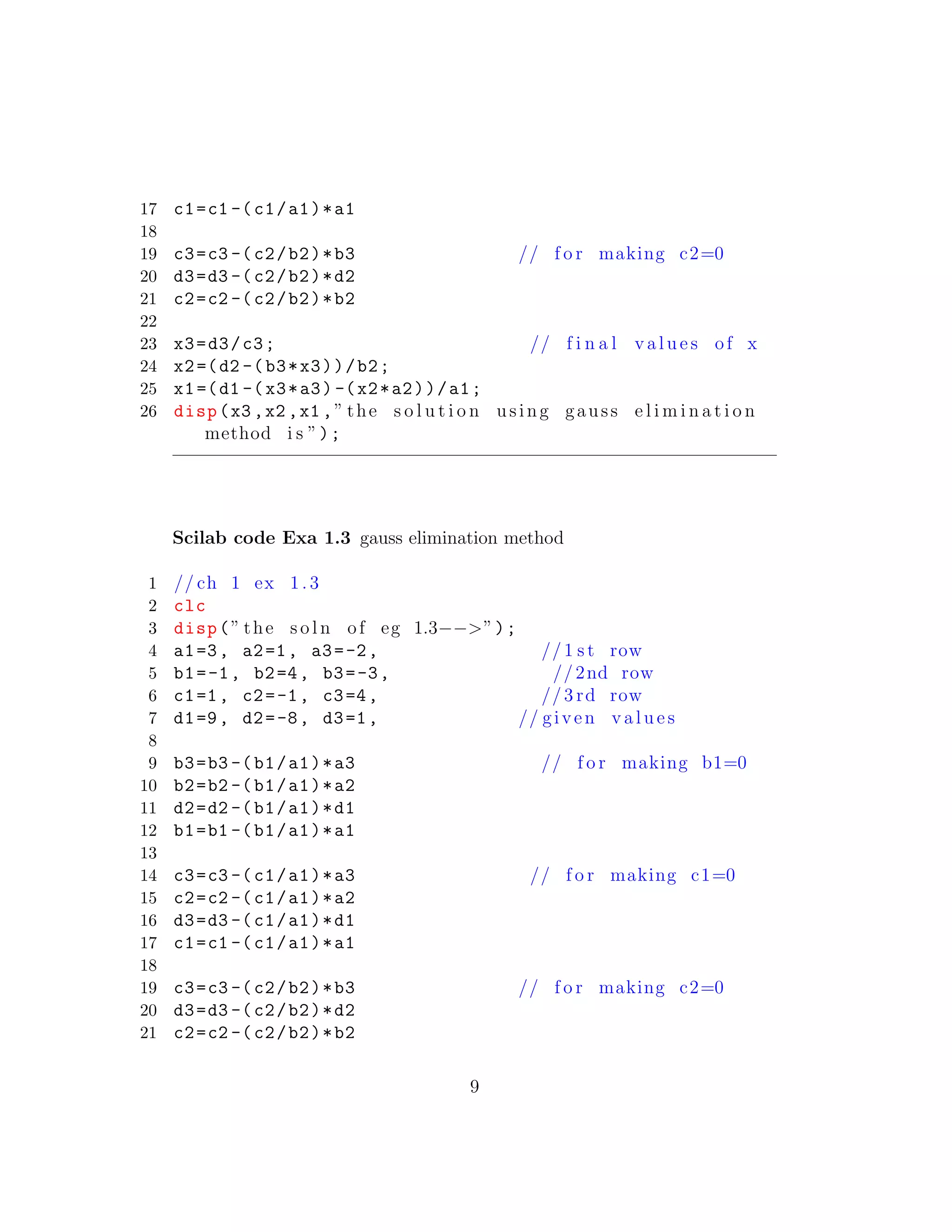
8
17 c1=c1 -(c1/a1)*a1
18
19 c3=c3 -(c2/b2)*b3 // f o r making c2=0
20 d3=d3 -(c2/b2)*d2
21 c2=c2 -(c2/b2)*b2
22
23 x3=d3/c3; // f i n a l v a l u e s of x
24 x2=(d2 -(b3*x3))/b2;
25 x1=(d1 -(x3*a3) -(x2*a2))/a1;
26 disp(x3 ,x2 ,x1 ,” the s o l u t i o n using gauss e l i m i n a t i o n
method i s ”);
Scilab code Exa 1.3 gauss elimination method
1 // ch 1 ex 1. 3
2 clc
3 disp(” the s o l n of eg 1.3−−>”);
4 a1=3, a2=1, a3=-2, //1 s t row
5 b1=-1, b2=4, b3=-3, //2nd row
6 c1=1, c2=-1, c3=4, //3 rd row
7 d1=9, d2=-8, d3=1, // given v a l u e s
8
9 b3=b3 -(b1/a1)*a3 // f o r making b1=0
10 b2=b2 -(b1/a1)*a2
11 d2=d2 -(b1/a1)*d1
12 b1=b1 -(b1/a1)*a1
13
14 c3=c3 -(c1/a1)*a3 // f o r making c1=0
15 c2=c2 -(c1/a1)*a2
16 d3=d3 -(c1/a1)*d1
17 c1=c1 -(c1/a1)*a1
18
19 c3=c3 -(c2/b2)*b3 // f o r making c2=0
20 d3=d3 -(c2/b2)*d2
21 c2=c2 -(c2/b2)*b2
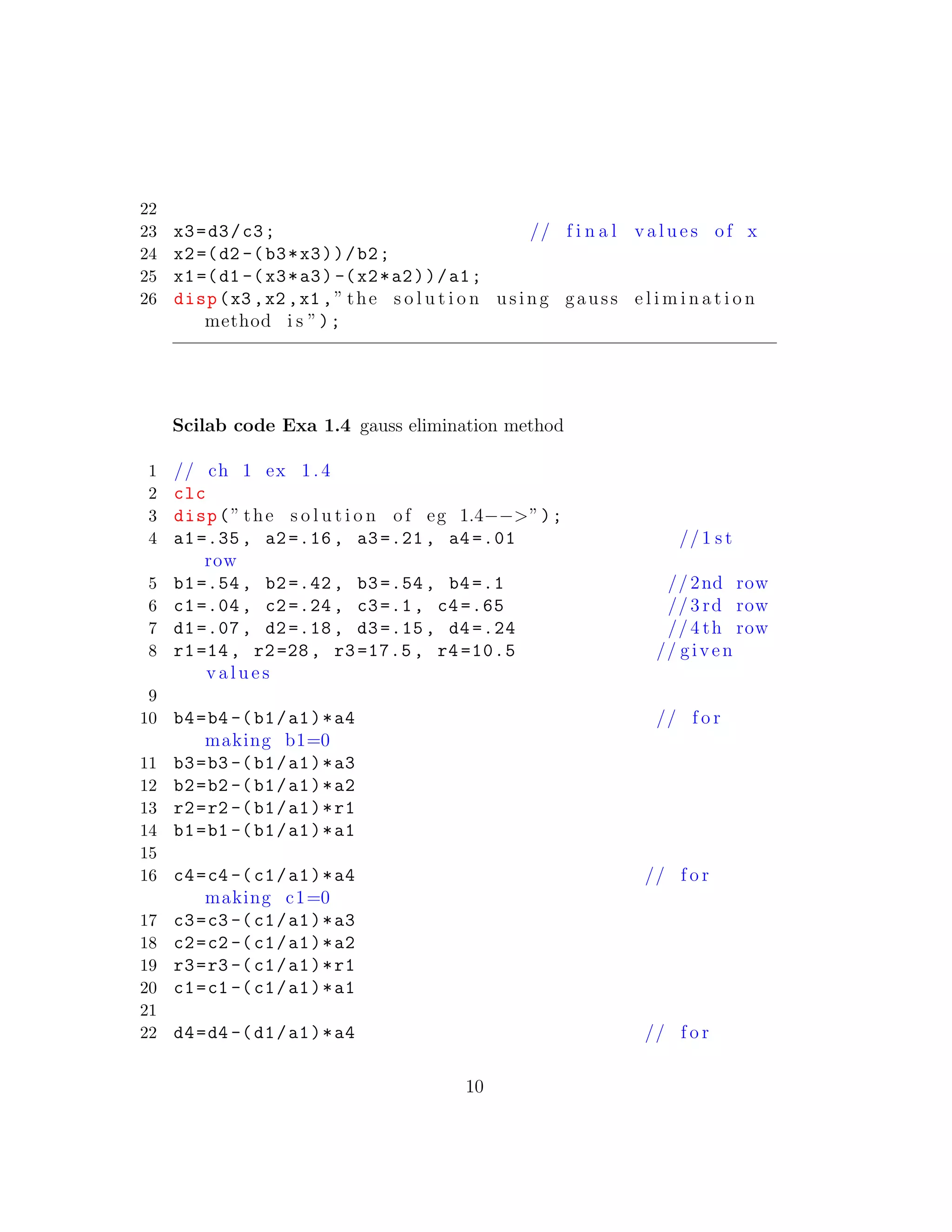
9
22
23 x3=d3/c3; // f i n a l v a l u e s of x
24 x2=(d2 -(b3*x3))/b2;
25 x1=(d1 -(x3*a3) -(x2*a2))/a1;
26 disp(x3 ,x2 ,x1 ,” the s o l u t i o n using gauss e l i m i n a t i o n
method i s ”);
Scilab code Exa 1.4 gauss elimination method
1 // ch 1 ex 1.4
2 clc
3 disp(” the s o l u t i o n of eg 1.4−−>”);
4 a1=.35, a2=.16, a3=.21, a4 =.01 //1 s t
row
5 b1=.54, b2=.42, b3=.54, b4=.1 //2nd row
6 c1=.04, c2=.24, c3=.1, c4 =.65 //3 rd row
7 d1=.07, d2=.18, d3=.15, d4 =.24 //4 th row
8 r1=14, r2=28, r3=17.5 , r4 =10.5 // given
v a l u e s
9
10 b4=b4 -(b1/a1)*a4 // f o r
making b1=0
11 b3=b3 -(b1/a1)*a3
12 b2=b2 -(b1/a1)*a2
13 r2=r2 -(b1/a1)*r1
14 b1=b1 -(b1/a1)*a1
15
16 c4=c4 -(c1/a1)*a4 // f o r
making c1=0
17 c3=c3 -(c1/a1)*a3
18 c2=c2 -(c1/a1)*a2
19 r3=r3 -(c1/a1)*r1
20 c1=c1 -(c1/a1)*a1
21
22 d4=d4 -(d1/a1)*a4 // f o r
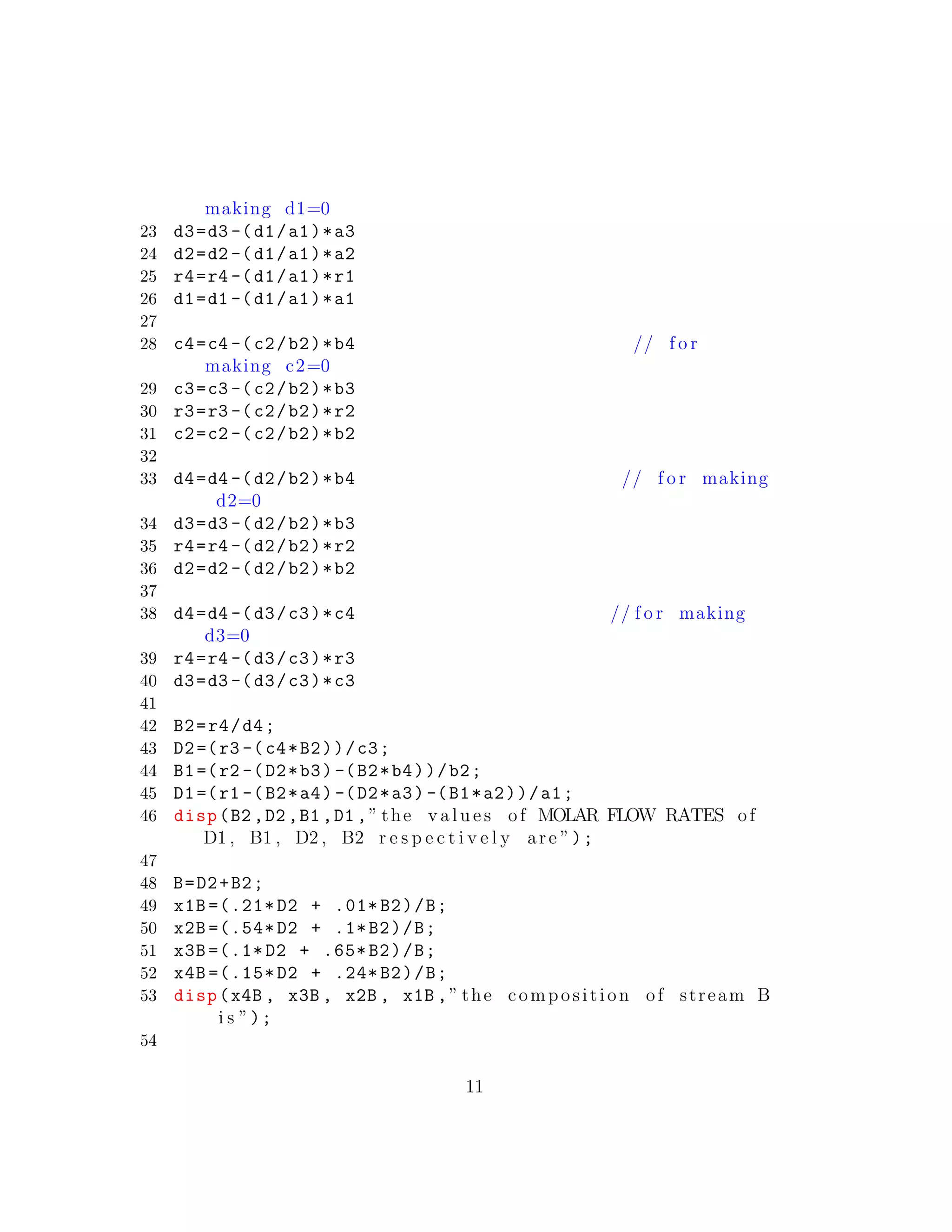
10
making d1=0
23 d3=d3 -(d1/a1)*a3
24 d2=d2 -(d1/a1)*a2
25 r4=r4 -(d1/a1)*r1
26 d1=d1 -(d1/a1)*a1
27
28 c4=c4 -(c2/b2)*b4 // f o r
making c2=0
29 c3=c3 -(c2/b2)*b3
30 r3=r3 -(c2/b2)*r2
31 c2=c2 -(c2/b2)*b2
32
33 d4=d4 -(d2/b2)*b4 // f o r making
d2=0
34 d3=d3 -(d2/b2)*b3
35 r4=r4 -(d2/b2)*r2
36 d2=d2 -(d2/b2)*b2
37
38 d4=d4 -(d3/c3)*c4 // f o r making
d3=0
39 r4=r4 -(d3/c3)*r3
40 d3=d3 -(d3/c3)*c3
41
42 B2=r4/d4;
43 D2=(r3 -(c4*B2))/c3;
44 B1=(r2 -(D2*b3) -(B2*b4))/b2;
45 D1=(r1 -(B2*a4) -(D2*a3) -(B1*a2))/a1;
46 disp(B2 ,D2 ,B1 ,D1 ,” the v a l u e s of MOLAR FLOW RATES of
D1 , B1 , D2 , B2 r e s p e c t i v e l y are ”);
47
48 B=D2+B2;
49 x1B =(.21* D2 + .01* B2)/B;
50 x2B =(.54* D2 + .1*B2)/B;
51 x3B =(.1* D2 + .65* B2)/B;
52 x4B =(.15* D2 + .24* B2)/B;
53 disp(x4B , x3B , x2B , x1B ,” the composition of stream B
i s ”);
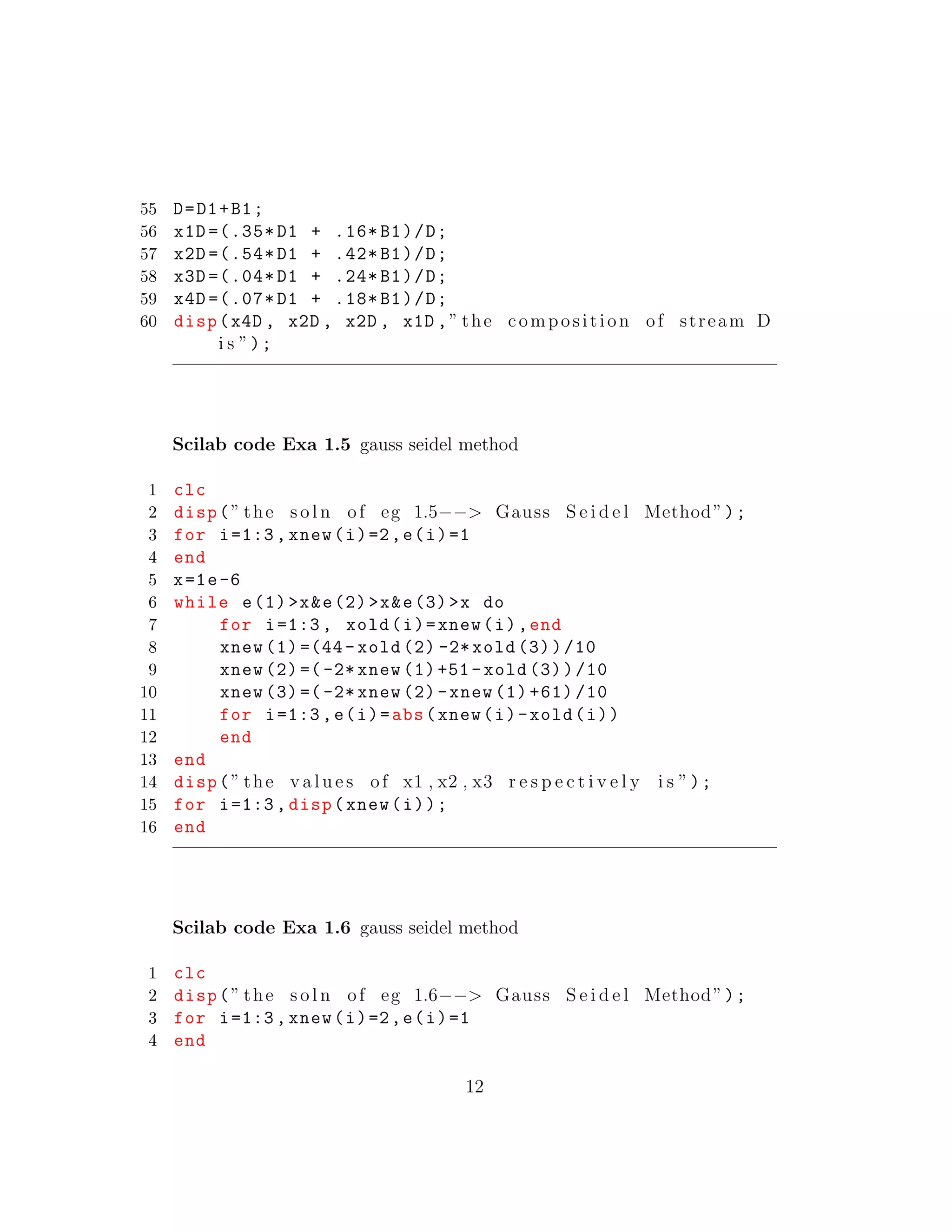
54
11
55 D=D1+B1;
56 x1D =(.35* D1 + .16* B1)/D;
57 x2D =(.54* D1 + .42* B1)/D;
58 x3D =(.04* D1 + .24* B1)/D;
59 x4D =(.07* D1 + .18* B1)/D;
60 disp(x4D , x2D , x2D , x1D ,” the composition of stream D
i s ”);
Scilab code Exa 1.5 gauss seidel method
1 clc
2 disp(” the s o l n of eg 1.5−−> Gauss S e i d e l Method”);
3 for i=1:3, xnew(i)=2,e(i)=1
4 end
5 x=1e-6
6 while e(1)>x&e(2)>x&e(3)>x do
7 for i=1:3, xold(i)=xnew(i),end
8 xnew (1) =(44- xold (2) -2*xold (3))/10
9 xnew (2) =(-2* xnew (1)+51- xold (3))/10
10 xnew (3) =(-2* xnew (2)-xnew (1) +61) /10
11 for i=1:3,e(i)=abs(xnew(i)-xold(i))
12 end
13 end
14 disp(” the v a l u e s of x1 , x2 , x3 r e s p e c t i v e l y i s ”);
15 for i=1:3, disp(xnew(i));
16 end
Scilab code Exa 1.6 gauss seidel method
1 clc
2 disp(” the s o l n of eg 1.6−−> Gauss S e i d e l Method”);
3 for i=1:3, xnew(i)=2,e(i)=1
4 end
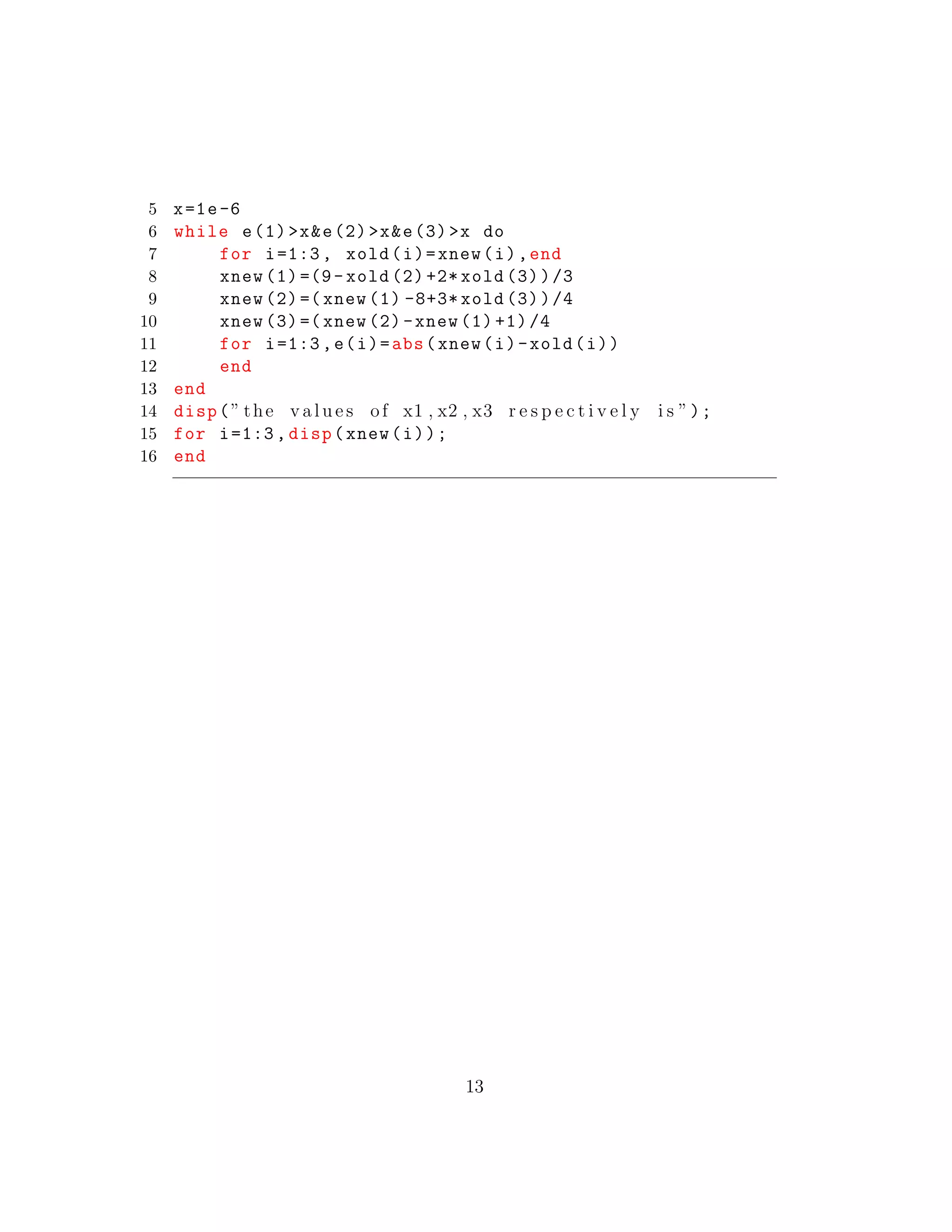
12
5 x=1e-6
6 while e(1)>x&e(2)>x&e(3)>x do
7 for i=1:3, xold(i)=xnew(i),end
8 xnew (1)=(9- xold (2) +2* xold (3))/3
9 xnew (2)=( xnew (1) -8+3* xold (3))/4
10 xnew (3)=( xnew (2)-xnew (1) +1)/4
11 for i=1:3,e(i)=abs(xnew(i)-xold(i))
12 end
13 end
14 disp(” the v a l u e s of x1 , x2 , x3 r e s p e c t i v e l y i s ”);
15 for i=1:3, disp(xnew(i));
16 end
13
Chapter 2
NONLINEAR ALGEBRAIC
EQUATIONS
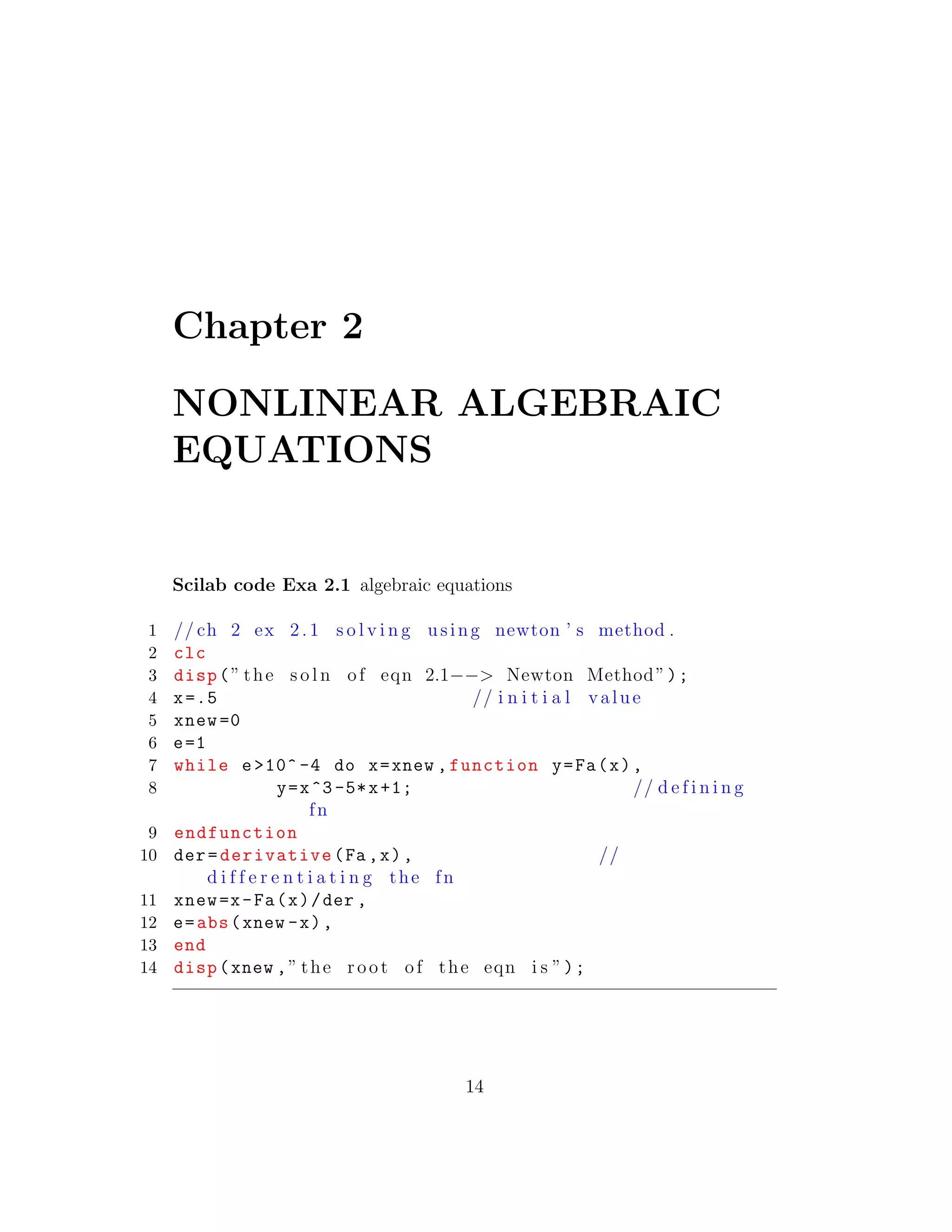
Scilab code Exa 2.1 algebraic equations
1 // ch 2 ex 2. 1 s o l v i n g using newton ’ s method .
2 clc
3 disp(” the s o l n of eqn 2.1−−> Newton Method”);
4 x=.5 // i n i t i a l value
5 xnew =0
6 e=1
7 while e>10^ -4 do x=xnew ,function y=Fa(x),
8 y=x^3-5*x+1; // d e f i n i n g
fn
9 endfunction
10 der=derivative(Fa ,x), //
d i f f e r e n t i a t i n g the fn
11 xnew=x-Fa(x)/der ,
12 e=abs(xnew -x),
13 end
14 disp(xnew ,” the root of the eqn i s ”);
14
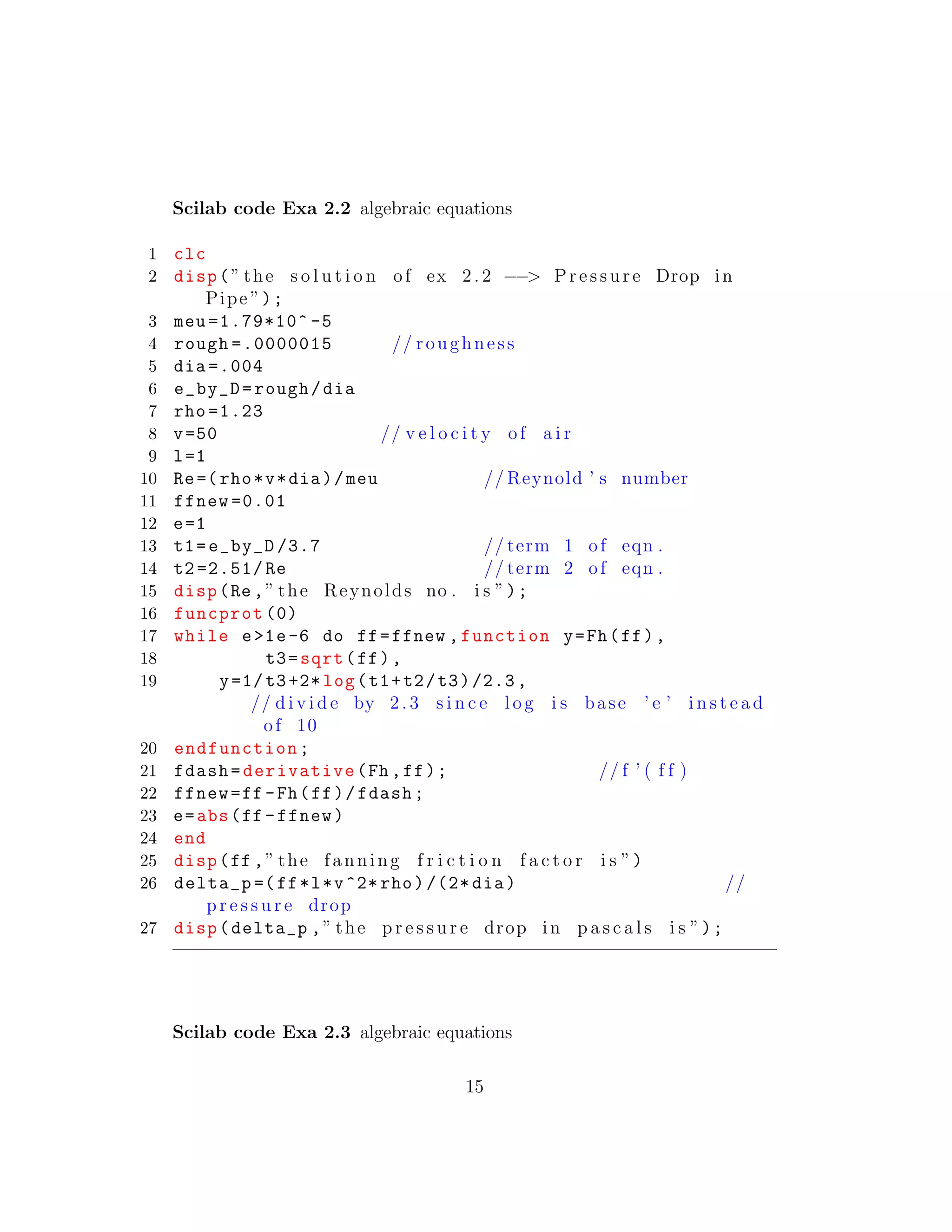
Scilab code Exa 2.2 algebraic equations
1 clc
2 disp(” the s o l u t i o n of ex 2.2 −−> Pressure Drop in
Pipe ”);
3 meu =1.79*10^ -5
4 rough =.0000015 // roughness
5 dia =.004
6 e_by_D=rough/dia
7 rho =1.23
8 v=50 // v e l o c i t y of a i r
9 l=1
10 Re=(rho*v*dia)/meu // Reynold ’ s number
11 ffnew =0.01
12 e=1
13 t1=e_by_D /3.7 // term 1 of eqn .
14 t2 =2.51/ Re // term 2 of eqn .
15 disp(Re ,” the Reynolds no . i s ”);
16 funcprot (0)
17 while e>1e-6 do ff=ffnew ,function y=Fh(ff),
18 t3=sqrt(ff),
19 y=1/t3+2* log(t1+t2/t3)/2.3,
// d i v i d e by 2. 3 s i n c e l og i s base ’ e ’ i n s t e a d
of 10
20 endfunction;
21 fdash=derivative(Fh ,ff); // f ’ ( f f )
22 ffnew=ff -Fh(ff)/fdash;
23 e=abs(ff -ffnew)
24 end
25 disp(ff ,” the fanning f r i c t i o n f a c t o r i s ”)
26 delta_p =(ff*l*v^2* rho)/(2* dia) //
p r e s s u r e drop
27 disp(delta_p ,” the p r e s s u r e drop in p a s c a l s i s ”);
Scilab code Exa 2.3 algebraic equations
15
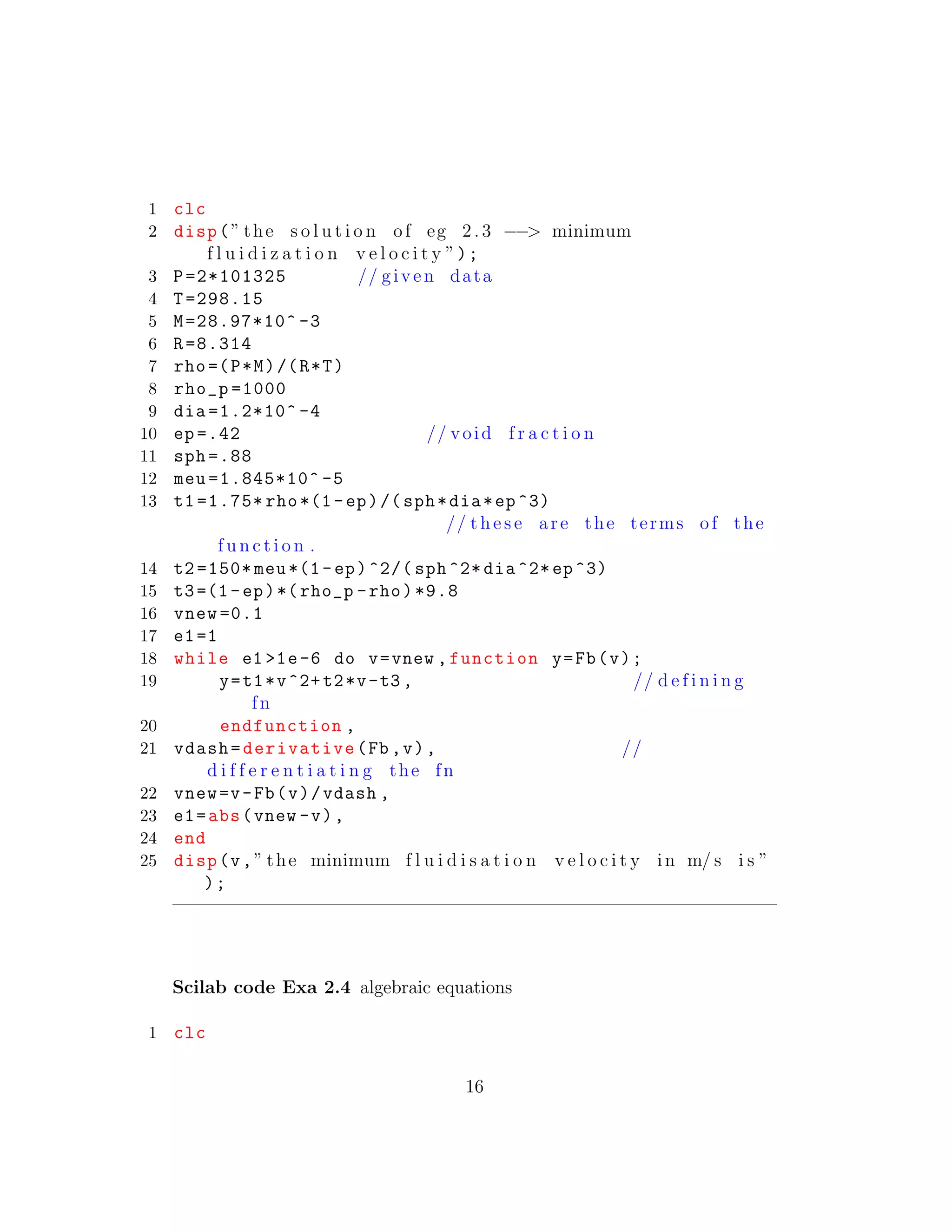
1 clc
2 disp(” the s o l u t i o n of eg 2. 3 −−> minimum
f l u i d i z a t i o n v e l o c i t y ”);
3 P=2*101325 // given data
4 T=298.15
5 M=28.97*10^ -3
6 R=8.314
7 rho=(P*M)/(R*T)
8 rho_p =1000
9 dia =1.2*10^ -4
10 ep =.42 // void f r a c t i o n
11 sph =.88
12 meu =1.845*10^ -5
13 t1 =1.75* rho*(1-ep)/(sph*dia*ep^3)
// t h e s e are the terms of the
f u n c t i o n .
14 t2 =150* meu*(1-ep)^2/( sph ^2* dia ^2*ep^3)
15 t3=(1-ep)*(rho_p -rho)*9.8
16 vnew =0.1
17 e1=1
18 while e1 >1e-6 do v=vnew ,function y=Fb(v);
19 y=t1*v^2+t2*v-t3 , // d e f i n i n g
fn
20 endfunction ,
21 vdash=derivative(Fb ,v), //
d i f f e r e n t i a t i n g the fn
22 vnew=v-Fb(v)/vdash ,
23 e1=abs(vnew -v),
24 end
25 disp(v,” the minimum f l u i d i s a t i o n v e l o c i t y in m/ s i s ”
);
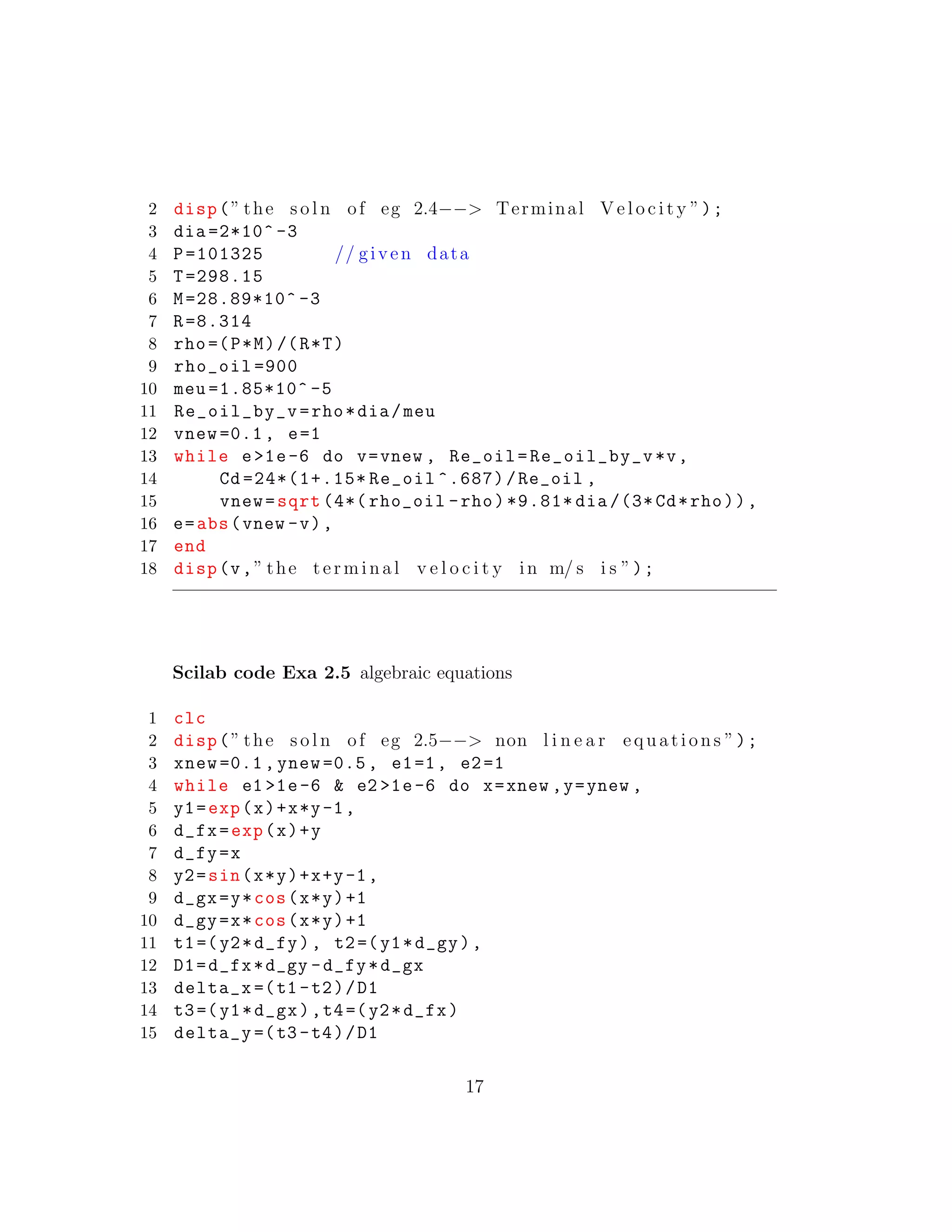
Scilab code Exa 2.4 algebraic equations
1 clc
16
2 disp(” the s o l n of eg 2.4−−> Terminal V e l o c i t y ”);
3 dia =2*10^ -3
4 P=101325 // given data
5 T=298.15
6 M=28.89*10^ -3
7 R=8.314
8 rho=(P*M)/(R*T)
9 rho_oil =900
10 meu =1.85*10^ -5
11 Re_oil_by_v=rho*dia/meu
12 vnew =0.1, e=1
13 while e>1e-6 do v=vnew , Re_oil=Re_oil_by_v*v,
14 Cd =24*(1+.15* Re_oil ^.687)/Re_oil ,
15 vnew=sqrt (4*( rho_oil -rho)*9.81* dia /(3* Cd*rho)),
16 e=abs(vnew -v),
17 end
18 disp(v,” the terminal v e l o c i t y in m/ s i s ”);
Scilab code Exa 2.5 algebraic equations
1 clc
2 disp(” the s o l n of eg 2.5−−> non l i n e a r equations ”);
3 xnew =0.1, ynew =0.5, e1=1, e2=1
4 while e1 >1e-6 & e2 >1e-6 do x=xnew ,y=ynew ,
5 y1=exp(x)+x*y-1,
6 d_fx=exp(x)+y
7 d_fy=x
8 y2=sin(x*y)+x+y-1,
9 d_gx=y*cos(x*y)+1
10 d_gy=x*cos(x*y)+1
11 t1=(y2*d_fy), t2=(y1*d_gy),
12 D1=d_fx*d_gy -d_fy*d_gx
13 delta_x =(t1 -t2)/D1
14 t3=(y1*d_gx),t4=(y2*d_fx)
15 delta_y =(t3 -t4)/D1
17
16 xnew=x+delta_x
17 ynew=y+delta_y
18 e1=abs(x-xnew)
19 e2=abs(y-ynew)
20 end
21 disp(y,x,” the v a l u e s of x and y r e s p e c t i v e l y are ”);
22 disp(” such small value of x can be c o n s i d e r e d as
zero . ”)
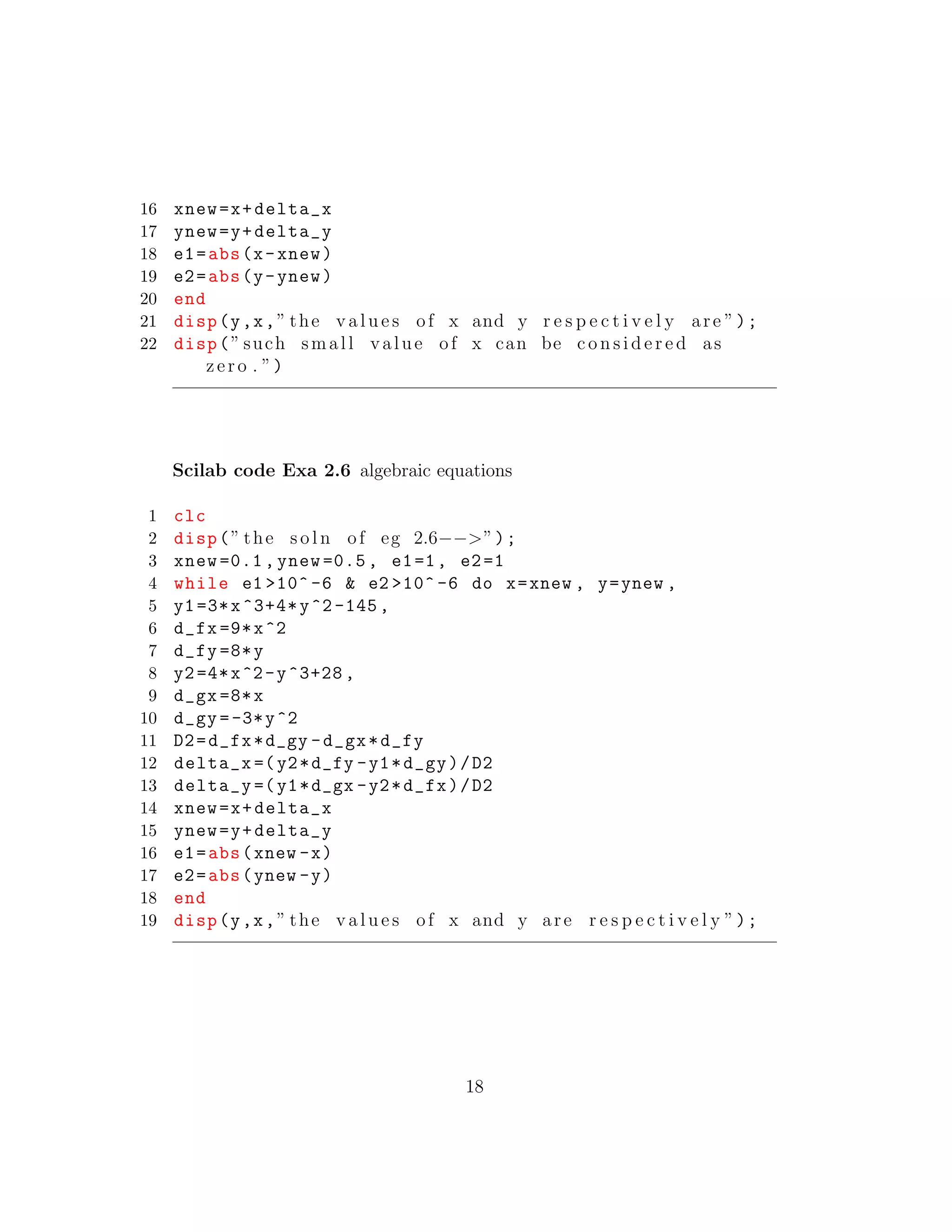
Scilab code Exa 2.6 algebraic equations
1 clc
2 disp(” the s o l n of eg 2.6−−>”);
3 xnew =0.1, ynew =0.5, e1=1, e2=1
4 while e1 >10^ -6 & e2 >10^ -6 do x=xnew , y=ynew ,
5 y1=3*x^3+4*y^2-145,
6 d_fx =9*x^2
7 d_fy =8*y
8 y2=4*x^2-y^3+28 ,
9 d_gx =8*x
10 d_gy =-3*y^2
11 D2=d_fx*d_gy -d_gx*d_fy
12 delta_x =(y2*d_fy -y1*d_gy)/D2
13 delta_y =(y1*d_gx -y2*d_fx)/D2
14 xnew=x+delta_x
15 ynew=y+delta_y
16 e1=abs(xnew -x)
17 e2=abs(ynew -y)
18 end
19 disp(y,x,” the v a l u e s of x and y are r e s p e c t i v e l y ”);
18
Chapter 3
CHEMICAL ENGINEERING
THERMODYNAMICS
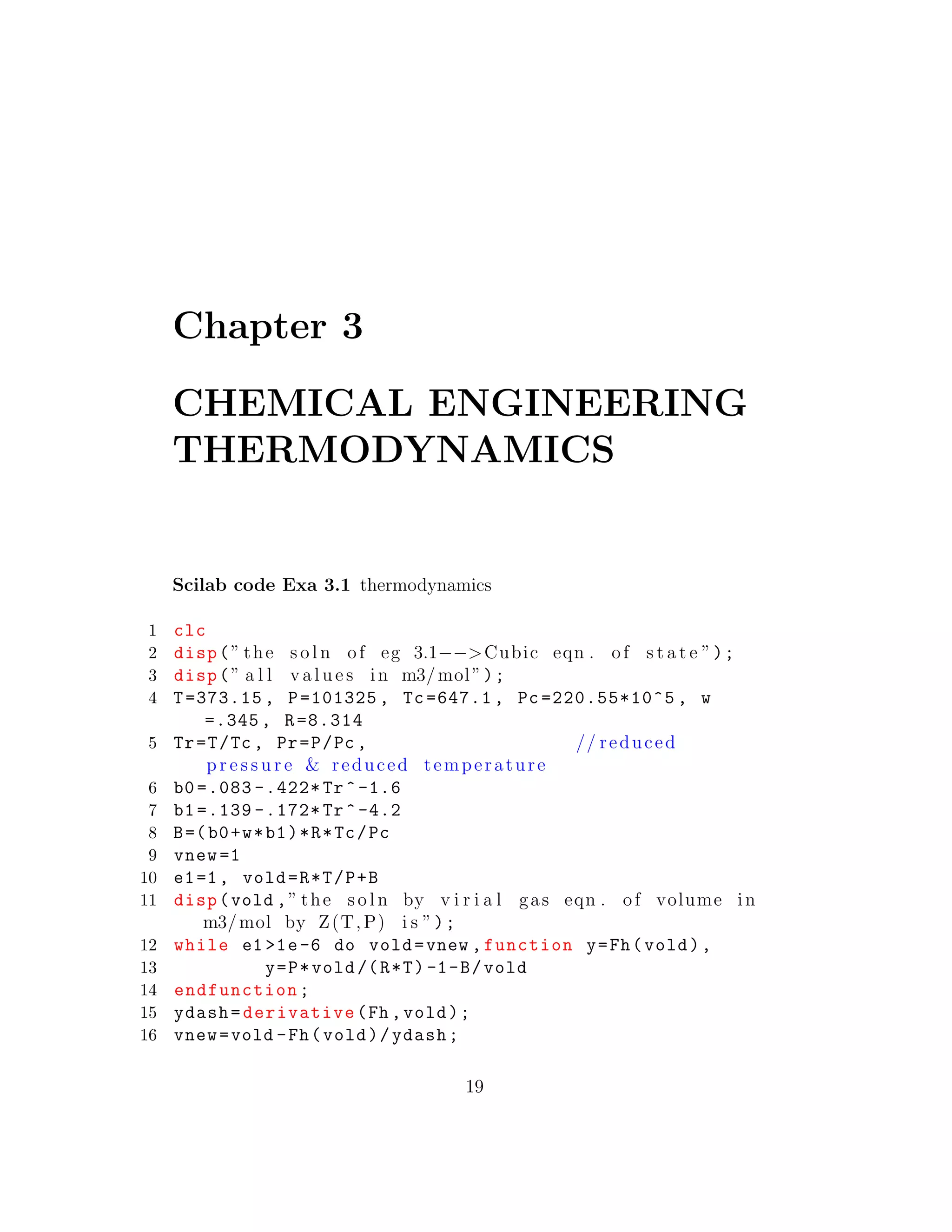
Scilab code Exa 3.1 thermodynamics
1 clc
2 disp(” the s o l n of eg 3.1−−>Cubic eqn . of s t a t e ”);
3 disp(” a l l v a l u e s in m3/mol”);
4 T=373.15 , P=101325 , Tc=647.1 , Pc =220.55*10^5 , w
=.345 , R=8.314
5 Tr=T/Tc , Pr=P/Pc , // reduced
p r e s s u r e & reduced temperature
6 b0 =.083 -.422* Tr^-1.6
7 b1 =.139 -.172* Tr^-4.2
8 B=(b0+w*b1)*R*Tc/Pc
9 vnew =1
10 e1=1, vold=R*T/P+B
11 disp(vold ,” the s o l n by v i r i a l gas eqn . of volume in
m3/mol by Z(T,P) i s ”);
12 while e1 >1e-6 do vold=vnew ,function y=Fh(vold),
13 y=P*vold/(R*T) -1-B/vold
14 endfunction;
15 ydash=derivative(Fh ,vold);
16 vnew=vold -Fh(vold)/ydash;
19
17 e1=abs(vold -vnew)
18 end
19 disp(vold ,” the s o l n by v i r i a l gas eqn . of volume in
m3/mol by Z(T,V) i s ”);
20 //by peng robinson method
21 k=.37464+1.54226*w -.26992*w^2
22 s=1+k*(1-Tr ^.5)
23 lpha=s^2
24 a=.45724*R^2*Tc^2* lpha/Pc
25 b=.0778*R*Tc/Pc
26 vnew=b,e2=1,
27 vol=b, fe=0, fd=0
28 disp(” the volume of s a t u r a t e d l i q . and s a t u r a t e d
vapour by peng−robinson method r e s p e c t i v e l y i s ”)
29 for i=0:2 do
30 vol=vnew
31 y2=vol ^3*P+vol ^2*(P*b-R*T)-vol *(3*P*b^2+2*b*
R*T-a)+P*b^3+b^2*R*T-a*b
32 ydash2 =3*P*vol ^2+(P*b-R*T)*2*vol -(3*P*b^2+2*b*R*T-a)
33 vnew=vol -y2/ydash2 ,
34 e2=abs(vol -vnew)
35 if i==1 & e2 <1e-6 then fd=vnew ,vnew=R*T/P,
36 end
37 end
38 disp(vol ,fd);
39 funcprot (0)
40 //by r e d l i c h −kwong method
41 i=0
42 a=.42748*R^2*Tc ^2.5/ Pc
43 b=.08664*R*Tc/Pc
44 Vnew=b,e3=1
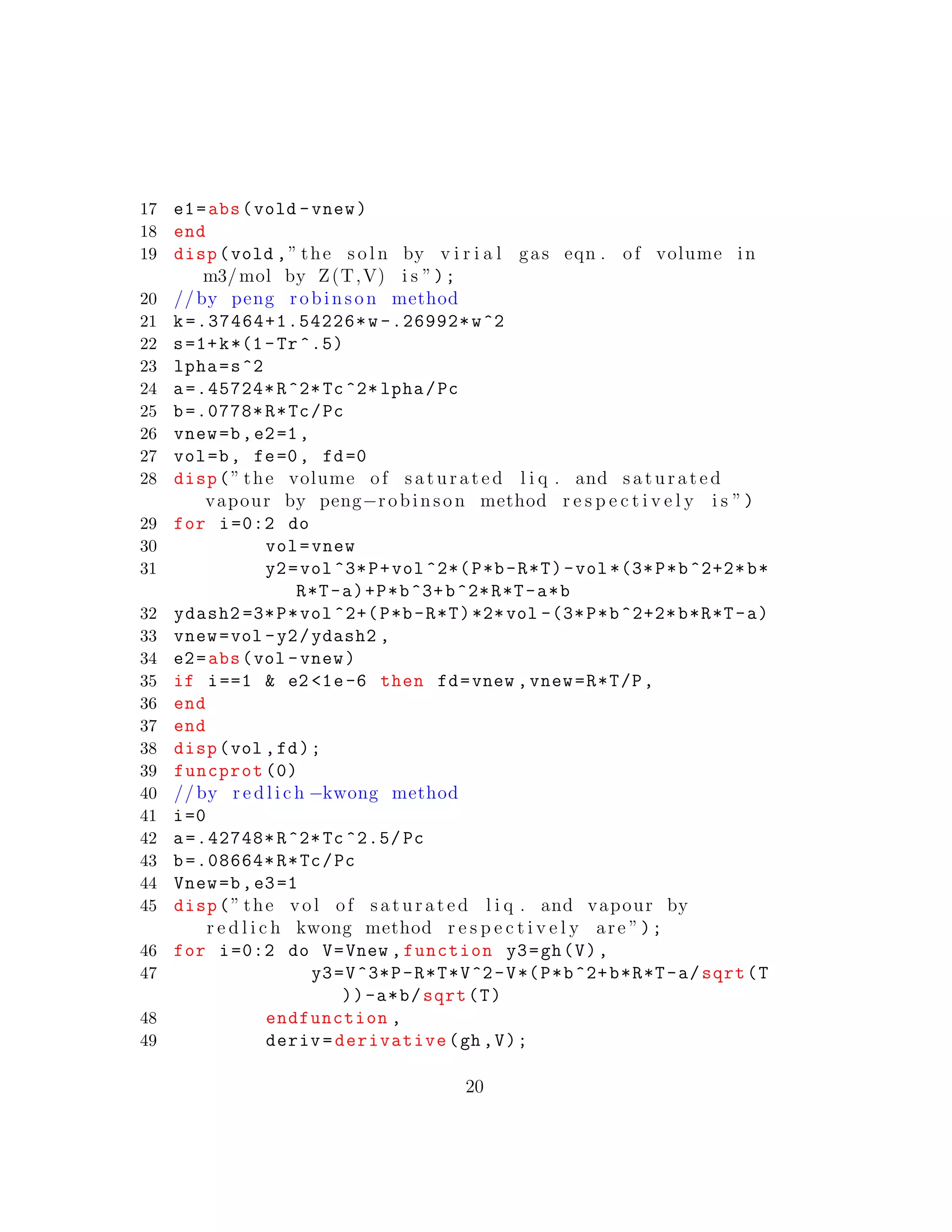
45 disp(” the vol of s a t u r a t e d l i q . and vapour by
r e d l i c h kwong method r e s p e c t i v e l y are ”);
46 for i=0:2 do V=Vnew ,function y3=gh(V),
47 y3=V^3*P-R*T*V^2-V*(P*b^2+b*R*T-a/sqrt(T
))-a*b/sqrt(T)
48 endfunction ,
49 deriv=derivative(gh ,V);
20
50 Vnew=V-gh(V)/deriv;
51 e3=abs(Vnew -V)
52 if i==1 & e3 <1e-6 then de=Vnew ,Vnew=R*T/P
// f o r s a t u r a t e d l i q .
53 end
54 end
55 disp(V,de);
56 // vander waals method
57 i=0
58 a=27*R^2*Tc ^2/(64* Pc)
59 b=R*Tc /(8* Pc)
60 vnew=b, v=b,e=1
61 for i=0:2 do v=vnew ,function v3=bh(v),
62 v3=v^3*P-v^2*(P*b+R*T)+a*v-a*b,
63 endfunction
64 deriva=derivative(bh ,v),
65 vnew=v-bh(v)/deriva
66 e4=abs(v-vnew),
67 if i==1 & e4 <10^ -6 then sol=vnew ,vnew=R*T/P
68 end
69 end
70 disp(” the vol of s a t u r a t e d l i q . and vapour by vander
waal method r e s p e c t i v e l y are ”);
71 disp(vnew ,sol);
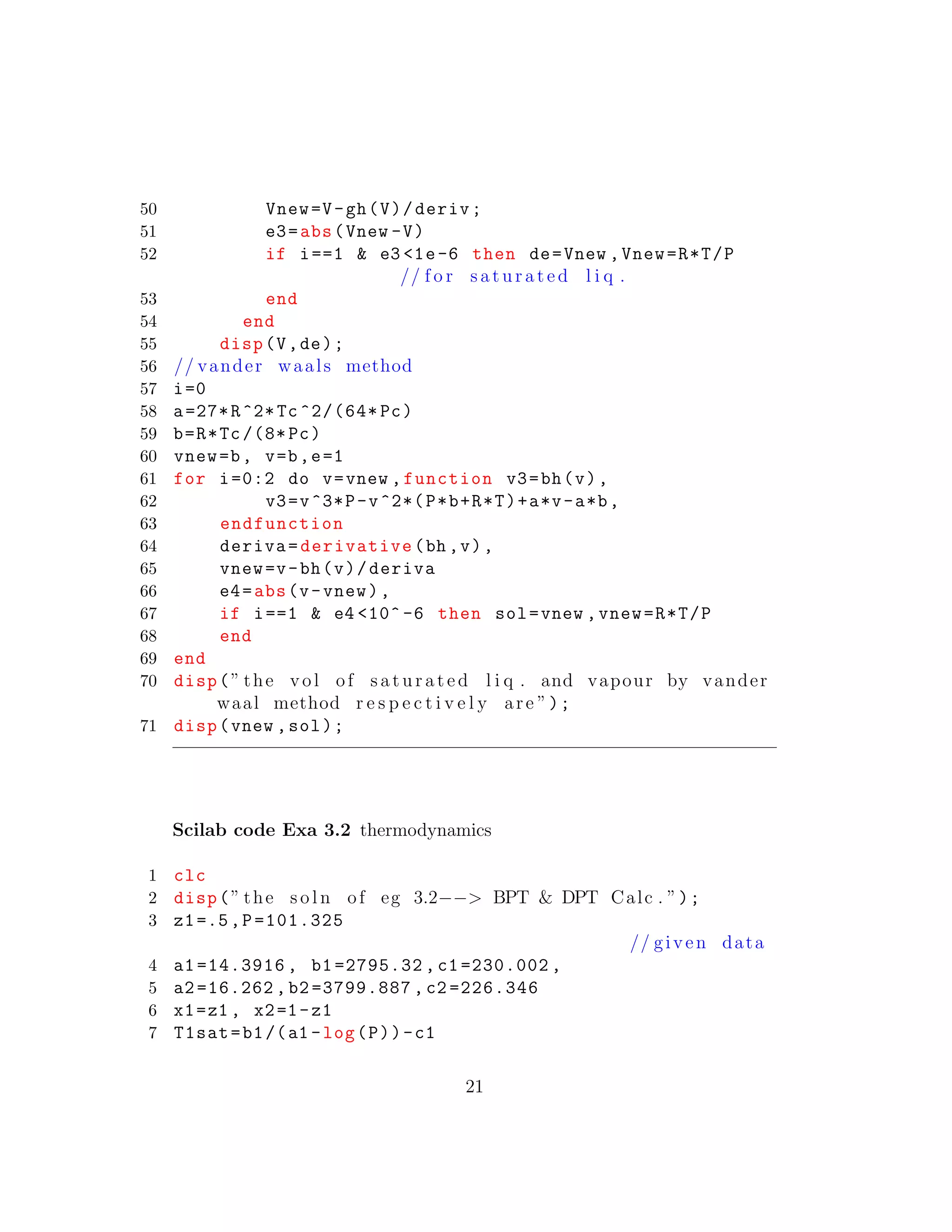
Scilab code Exa 3.2 thermodynamics
1 clc
2 disp(” the s o l n of eg 3.2−−> BPT & DPT Calc . ”);
3 z1=.5,P=101.325
// given data
4 a1 =14.3916 , b1 =2795.32 , c1 =230.002 ,
5 a2=16.262 , b2 =3799.887 , c2 =226.346
6 x1=z1 , x2=1-z1
7 T1sat=b1/(a1 -log(P))-c1
21
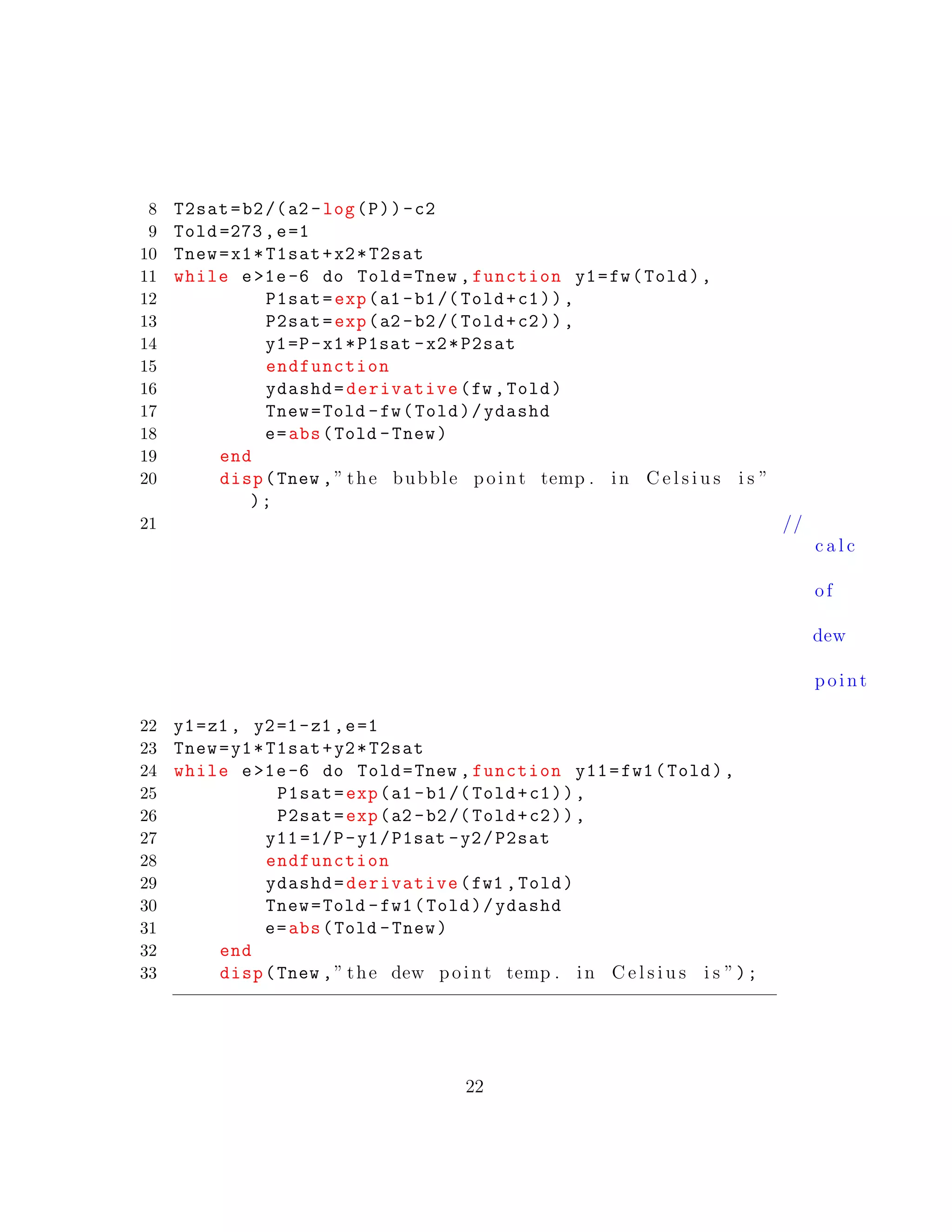
8 T2sat=b2/(a2 -log(P))-c2
9 Told =273,e=1
10 Tnew=x1*T1sat+x2*T2sat
11 while e>1e-6 do Told=Tnew ,function y1=fw(Told),
12 P1sat=exp(a1 -b1/( Told+c1)),
13 P2sat=exp(a2 -b2/( Told+c2)),
14 y1=P-x1*P1sat -x2*P2sat
15 endfunction
16 ydashd=derivative(fw ,Told)
17 Tnew=Told -fw(Told)/ydashd
18 e=abs(Told -Tnew)
19 end
20 disp(Tnew ,” the bubble point temp . in C e l s i u s i s ”
);
21 //
c a l c
of
dew
point
22 y1=z1 , y2=1-z1 ,e=1
23 Tnew=y1*T1sat+y2*T2sat
24 while e>1e-6 do Told=Tnew ,function y11=fw1(Told),
25 P1sat=exp(a1 -b1/( Told+c1)),
26 P2sat=exp(a2 -b2/( Told+c2)),
27 y11 =1/P-y1/P1sat -y2/P2sat
28 endfunction
29 ydashd=derivative(fw1 ,Told)
30 Tnew=Told -fw1(Told)/ydashd
31 e=abs(Told -Tnew)
32 end
33 disp(Tnew ,” the dew point temp . in C e l s i u s i s ”);
22
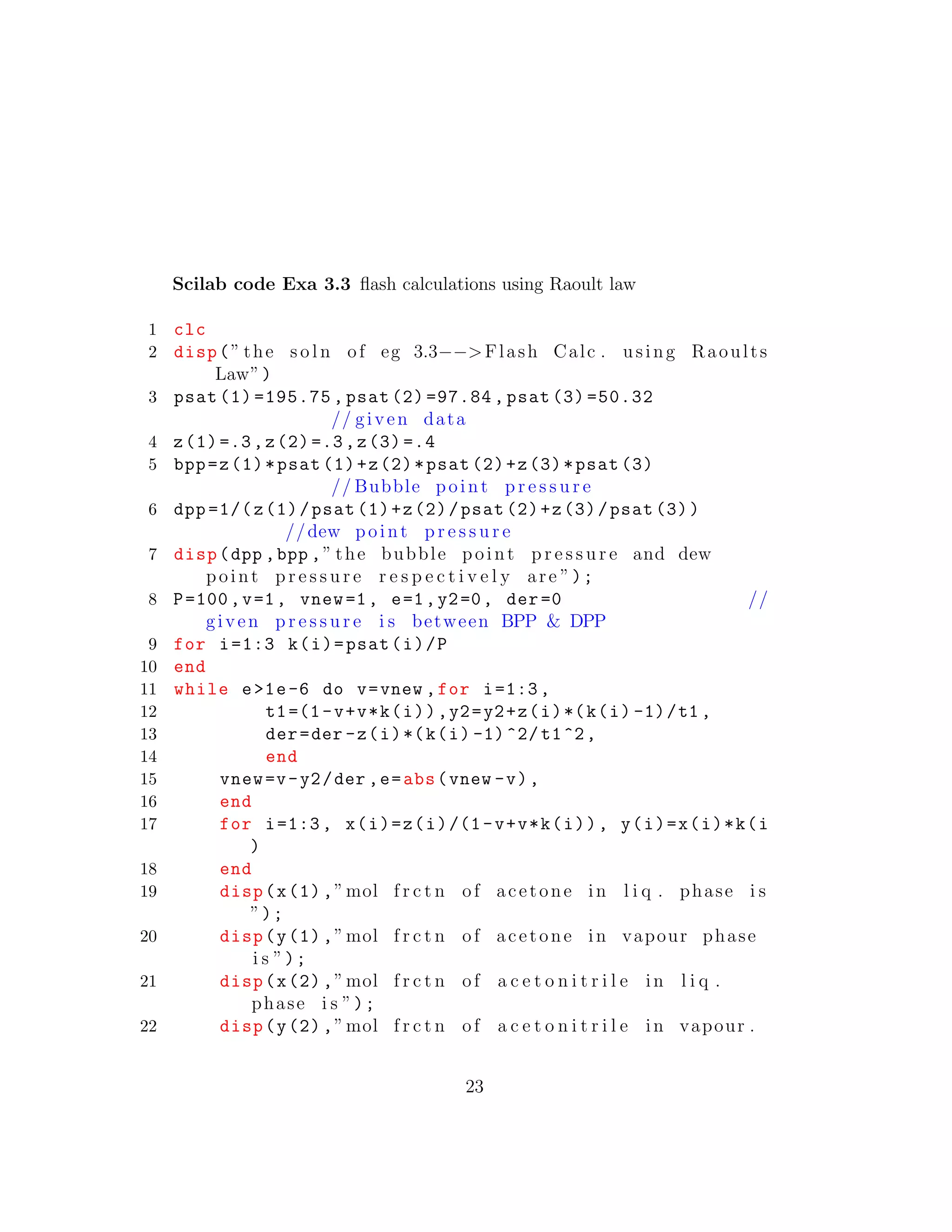
Scilab code Exa 3.3 flash calculations using Raoult law
1 clc
2 disp(” the s o l n of eg 3.3−−>Flash Calc . using Raoults
Law”)
3 psat (1) =195.75 , psat (2) =97.84 , psat (3) =50.32
// given data
4 z(1)=.3,z(2)=.3,z(3) =.4
5 bpp=z(1)*psat (1)+z(2)*psat (2)+z(3)*psat (3)
// Bubble point p r e s s u r e
6 dpp =1/(z(1)/psat (1)+z(2)/psat (2)+z(3)/psat (3))
//dew point p r e s s u r e
7 disp(dpp ,bpp ,” the bubble point p r e s s u r e and dew
point p r e s s u r e r e s p e c t i v e l y are ”);
8 P=100,v=1, vnew=1, e=1,y2=0, der=0 //
given p r e s s u r e i s between BPP & DPP
9 for i=1:3 k(i)=psat(i)/P
10 end
11 while e>1e-6 do v=vnew ,for i=1:3,
12 t1=(1-v+v*k(i)),y2=y2+z(i)*(k(i) -1)/t1 ,
13 der=der -z(i)*(k(i) -1)^2/t1^2,
14 end
15 vnew=v-y2/der ,e=abs(vnew -v),
16 end
17 for i=1:3, x(i)=z(i)/(1-v+v*k(i)), y(i)=x(i)*k(i
)
18 end
19 disp(x(1),”mol f r c t n of acetone in l i q . phase i s
”);
20 disp(y(1),”mol f r c t n of acetone in vapour phase
i s ”);
21 disp(x(2),”mol f r c t n of a c e t o n i t r i l e in l i q .
phase i s ”);
22 disp(y(2),”mol f r c t n of a c e t o n i t r i l e in vapour .
23
phase i s ”);
23 disp(x(3),”mol f r c t n of nitromethane in l i q .
phase i s ”);
24 disp(y(3),”mol f r c t n of nitromethane in vapour
phase i s ”);
Scilab code Exa 3.4 BPT and DPT calculation using modified raoult law
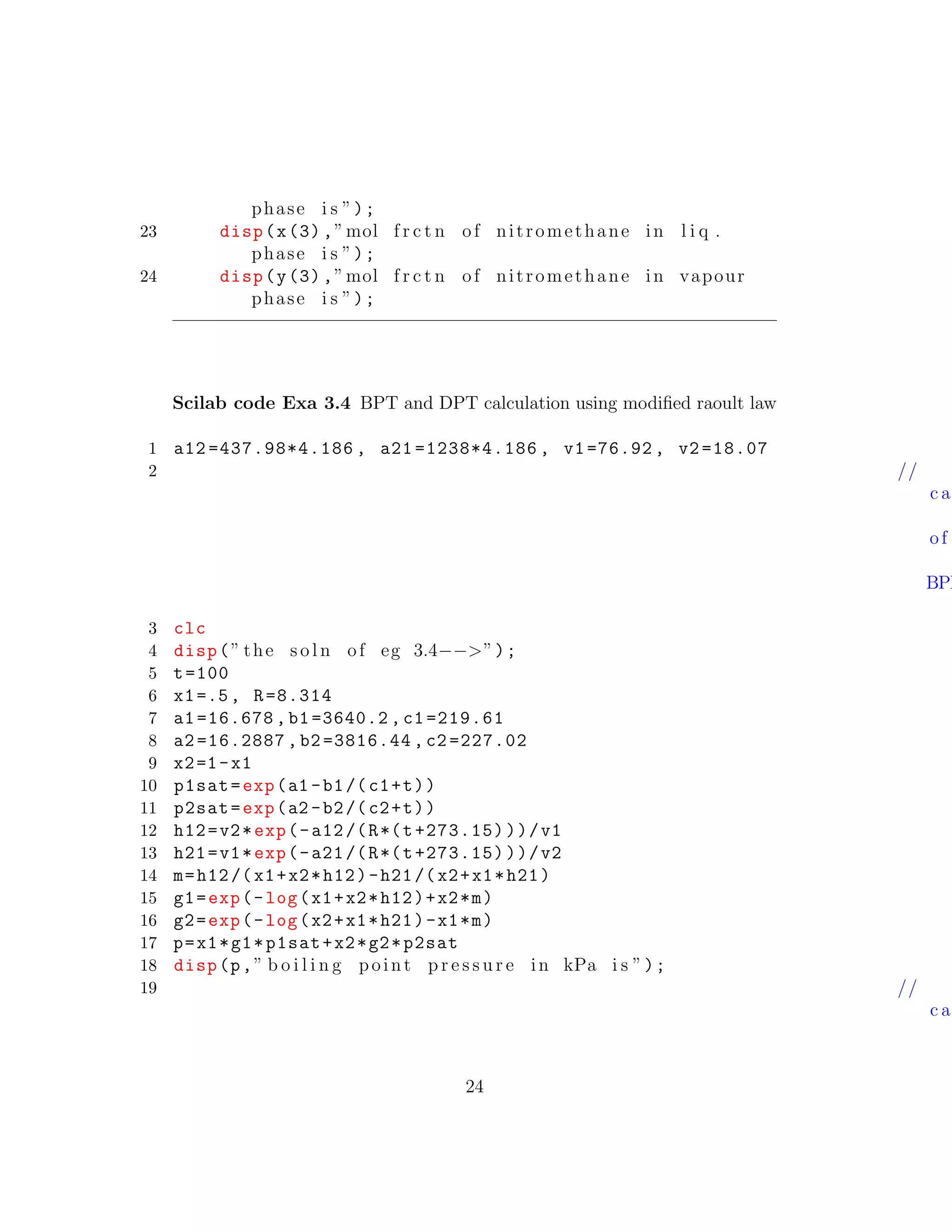
1 a12 =437.98*4.186 , a21 =1238*4.186 , v1=76.92 , v2 =18.07
2 //
c a
of
BPP
3 clc
4 disp(” the s o l n of eg 3.4−−>”);
5 t=100
6 x1=.5, R=8.314
7 a1 =16.678 , b1 =3640.2 , c1 =219.61
8 a2 =16.2887 , b2 =3816.44 , c2 =227.02
9 x2=1-x1
10 p1sat=exp(a1 -b1/(c1+t))
11 p2sat=exp(a2 -b2/(c2+t))
12 h12=v2*exp(-a12/(R*(t+273.15)))/v1
13 h21=v1*exp(-a21/(R*(t+273.15)))/v2
14 m=h12/(x1+x2*h12)-h21/(x2+x1*h21)
15 g1=exp(-log(x1+x2*h12)+x2*m)
16 g2=exp(-log(x2+x1*h21)-x1*m)
17 p=x1*g1*p1sat+x2*g2*p2sat
18 disp(p,” b o i l i n g point p r e s s u r e in kPa i s ”);
19 //
c a
24
of
BPT
20 p=101.325 , x1=.5, e=1
21 x2=1-x1
22 t1sat=b1/(a1 -log(p))-c1
23 t2sat=b2/(a2 -log(p))-c2
24 tnew=x1*t1sat+x2*t2sat
25 while e>10^ -4 do told=tnew ,
26 p1sat=exp(a1 -b1/(c1+told)),p2sat=exp(a2 -b2/(c2+
told)),
27 p1sat=p/(g1*x1+g2*x2*( p2sat/p1sat))
28 tnew=b1/(a1 -log(p1sat))-c1 ,
29 e=abs(tnew -told)
30 end
31 disp(tnew ,” b o i l i n g point temperature in C e l s i u s i s ”)
;
32 //
c a l c
of
dpp
33 e1=1, e2=1, e3=1, pold =1
34 t=100,y1=.5
35 y2=1-y1
36 p1sat=exp(a1 -b1/(c1+t))
37 p2sat=exp(a2 -b2/(c2+t))
38 g1=1, g2=1, g11=1, g22=1
39 pnew =1/( y1/(g1*p1sat)+y2/(g2*p2sat))
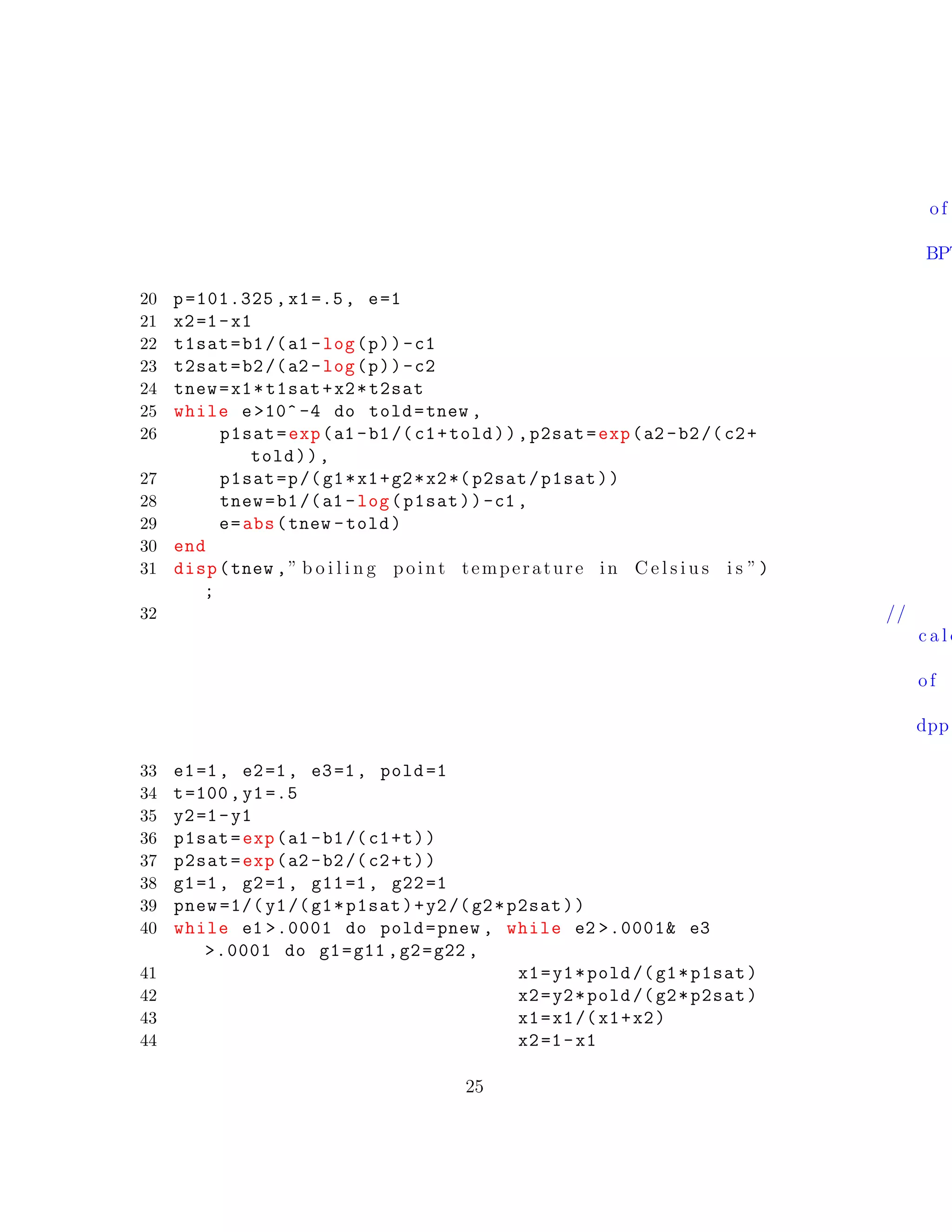
40 while e1 >.0001 do pold=pnew , while e2 >.0001& e3
>.0001 do g1=g11 ,g2=g22 ,
41 x1=y1*pold /(g1*p1sat)
42 x2=y2*pold /(g2*p2sat)
43 x1=x1/(x1+x2)
44 x2=1-x1
25
45 h12=v2*exp(-a12/(R*(t
+273.15)))/v1
46 h21=v1*exp(-a21/(R*(t
+273.15)))/v2
47 m=h12/(x1+x2*h12)-h21
/(x2+x1*h21)
48 g11=exp(-log(x1+x2*h12
)+x2*m)
49 g22=exp(-log(x2+x1*h21
)-x1*m)
50 e2=abs(g11 -g1), e3=abs
(g22 -g2)
51 end
52 pnew =1/( y1/(g1*p1sat)+y2/(g2*p2sat))
53 e1=abs(pnew -pold)
54 end
55 disp(pnew ,”dew point p r e s s u r e in kPa i s ”);
56 //
c a l c
dpt
57 p=101.325 , y1=.5, e4=1, e5=1,e6=1
58 y2=1-y1
59 t1sat=b1/(a1 -log(p))-c1
60 t2sat=b2/(a2 -log(p))-c2
61 tnew=y1*t1sat+y2*t2sat
62 g11=1, g22=1
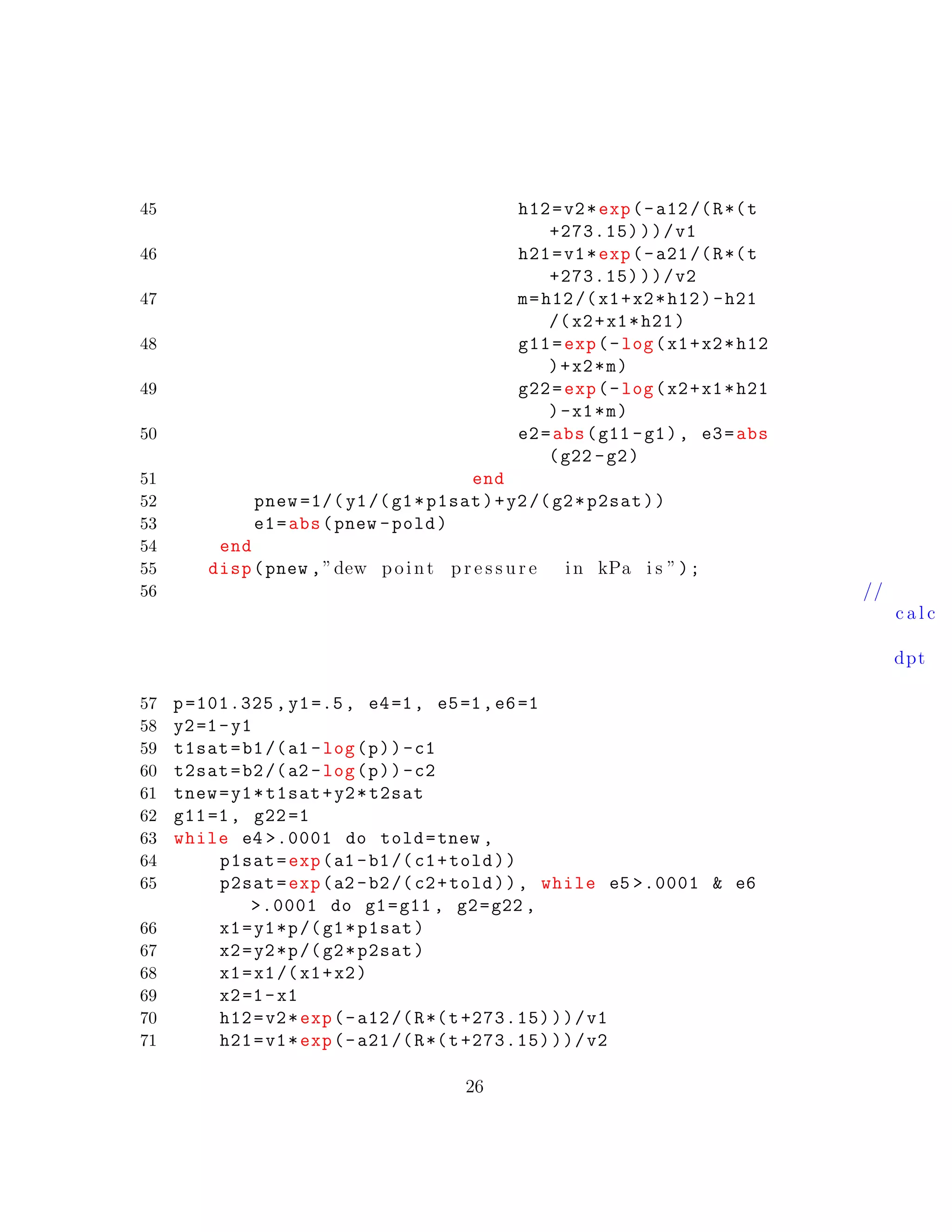
63 while e4 >.0001 do told=tnew ,
64 p1sat=exp(a1 -b1/(c1+told))
65 p2sat=exp(a2 -b2/(c2+told)), while e5 >.0001 & e6
>.0001 do g1=g11 , g2=g22 ,
66 x1=y1*p/(g1*p1sat)
67 x2=y2*p/(g2*p2sat)
68 x1=x1/(x1+x2)
69 x2=1-x1
70 h12=v2*exp(-a12/(R*(t+273.15)))/v1
71 h21=v1*exp(-a21/(R*(t+273.15)))/v2
26
72 m=h12/(x1+x2*h12)-h21
/(x2+x1*h21)
73 g11=exp(-log(x1+x2*h12
)+x2*m)
74 g22=exp(-log(x2+x1*h21
)-x1*m)
75 e5=abs(g11 -g1), e6=abs
(g22 -g2)
76 end
77
78 p1sat=p*(y1/g1+y2*p1sat /(g2*p2sat))
79 tnew=b1/(a1 -log(p1sat))-c1
80 e4=abs(tnew -told)
81 end
82 disp(tnew ,”dew point temperature in C e l s i u s i s ”)
;
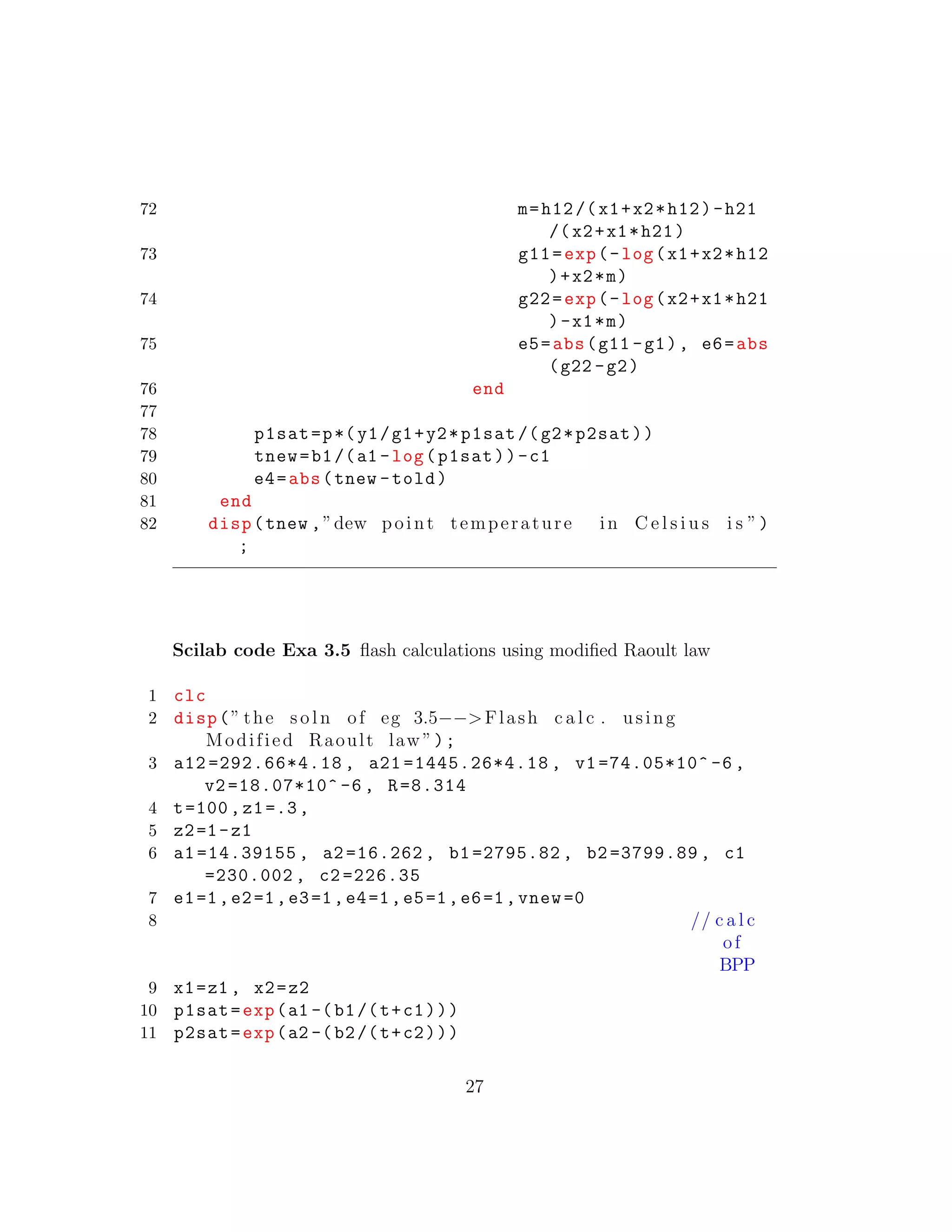
Scilab code Exa 3.5 flash calculations using modified Raoult law
1 clc
2 disp(” the s o l n of eg 3.5−−>Flash c a l c . using
Modified Raoult law ”);
3 a12 =292.66*4.18 , a21 =1445.26*4.18 , v1 =74.05*10^ -6 ,
v2 =18.07*10^ -6 , R=8.314
4 t=100,z1=.3,
5 z2=1-z1
6 a1 =14.39155 , a2 =16.262 , b1 =2795.82 , b2 =3799.89 , c1
=230.002 , c2 =226.35
7 e1=1,e2=1,e3=1,e4=1,e5=1,e6=1,vnew =0
8 // c a l c
of
BPP
9 x1=z1 , x2=z2
10 p1sat=exp(a1 -(b1/(t+c1)))
11 p2sat=exp(a2 -(b2/(t+c2)))
27
12 h12=v2*exp(-a12/(R*(t+273.15)))/v1
13 h21=v1*exp(-a21/(R*(t+273.15)))/v2
14 m=(h12/(x1+x2*h12)) -(h21/(x2+x1*h21))
15 g1=exp(-log(x1+x2*h12)+x2*m)
16 g2=exp(-log(x2+x1*h21)-x1*m)
17 p=x1*g1*p1sat+x2*g2*p2sat
18 disp(p,” the bubble point p r e s s u r e i s ”);
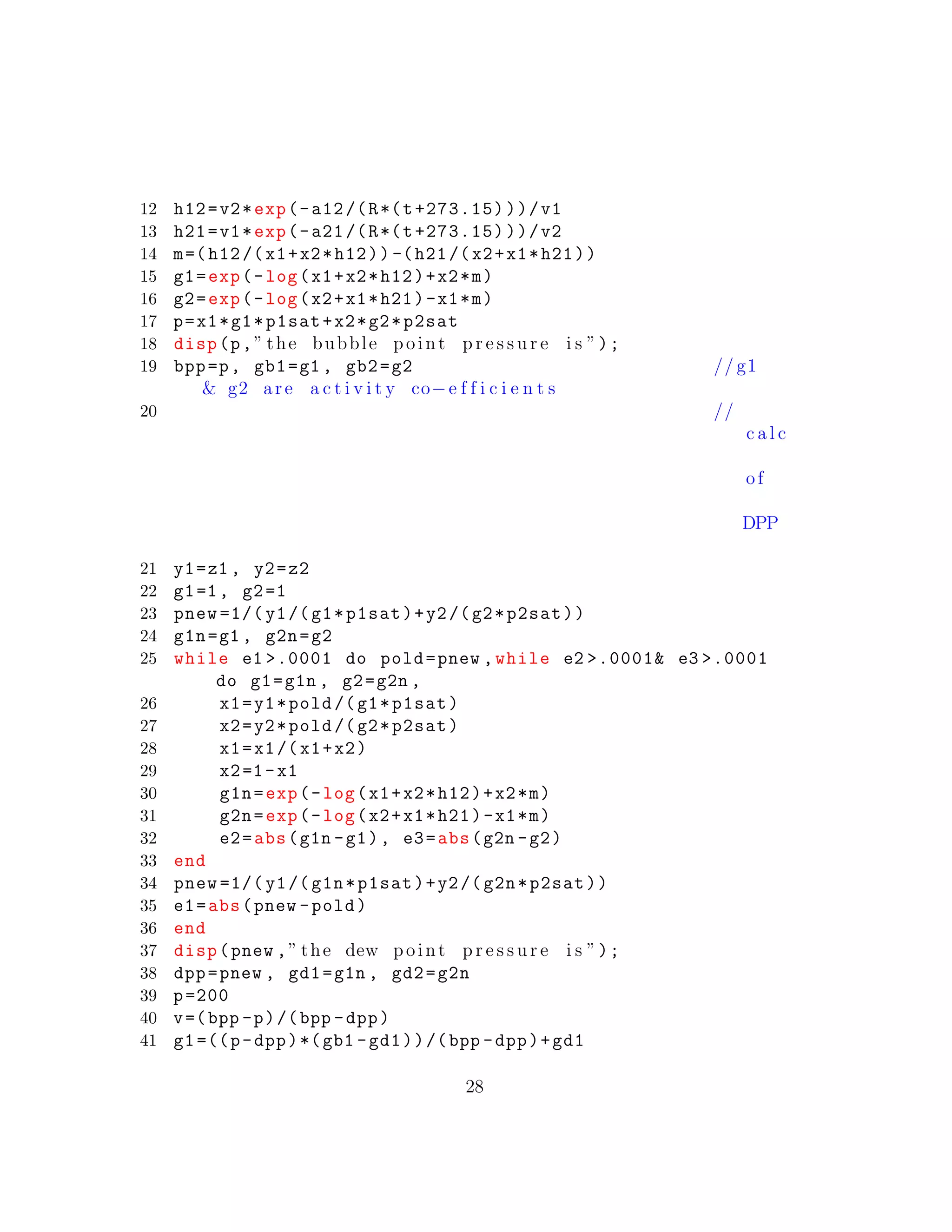
19 bpp=p, gb1=g1 , gb2=g2 // g1
& g2 are a c t i v i t y co−e f f i c i e n t s
20 //
c a l c
of
DPP
21 y1=z1 , y2=z2
22 g1=1, g2=1
23 pnew =1/(y1/(g1*p1sat)+y2/(g2*p2sat))
24 g1n=g1 , g2n=g2
25 while e1 >.0001 do pold=pnew ,while e2 >.0001& e3 >.0001
do g1=g1n , g2=g2n ,
26 x1=y1*pold /(g1*p1sat)
27 x2=y2*pold /(g2*p2sat)
28 x1=x1/(x1+x2)
29 x2=1-x1
30 g1n=exp(-log(x1+x2*h12)+x2*m)
31 g2n=exp(-log(x2+x1*h21)-x1*m)
32 e2=abs(g1n -g1), e3=abs(g2n -g2)
33 end
34 pnew =1/( y1/(g1n*p1sat)+y2/(g2n*p2sat))
35 e1=abs(pnew -pold)
36 end
37 disp(pnew ,” the dew point p r e s s u r e i s ”);
38 dpp=pnew , gd1=g1n , gd2=g2n
39 p=200
40 v=(bpp -p)/(bpp -dpp)
41 g1=((p-dpp)*(gb1 -gd1))/(bpp -dpp)+gd1
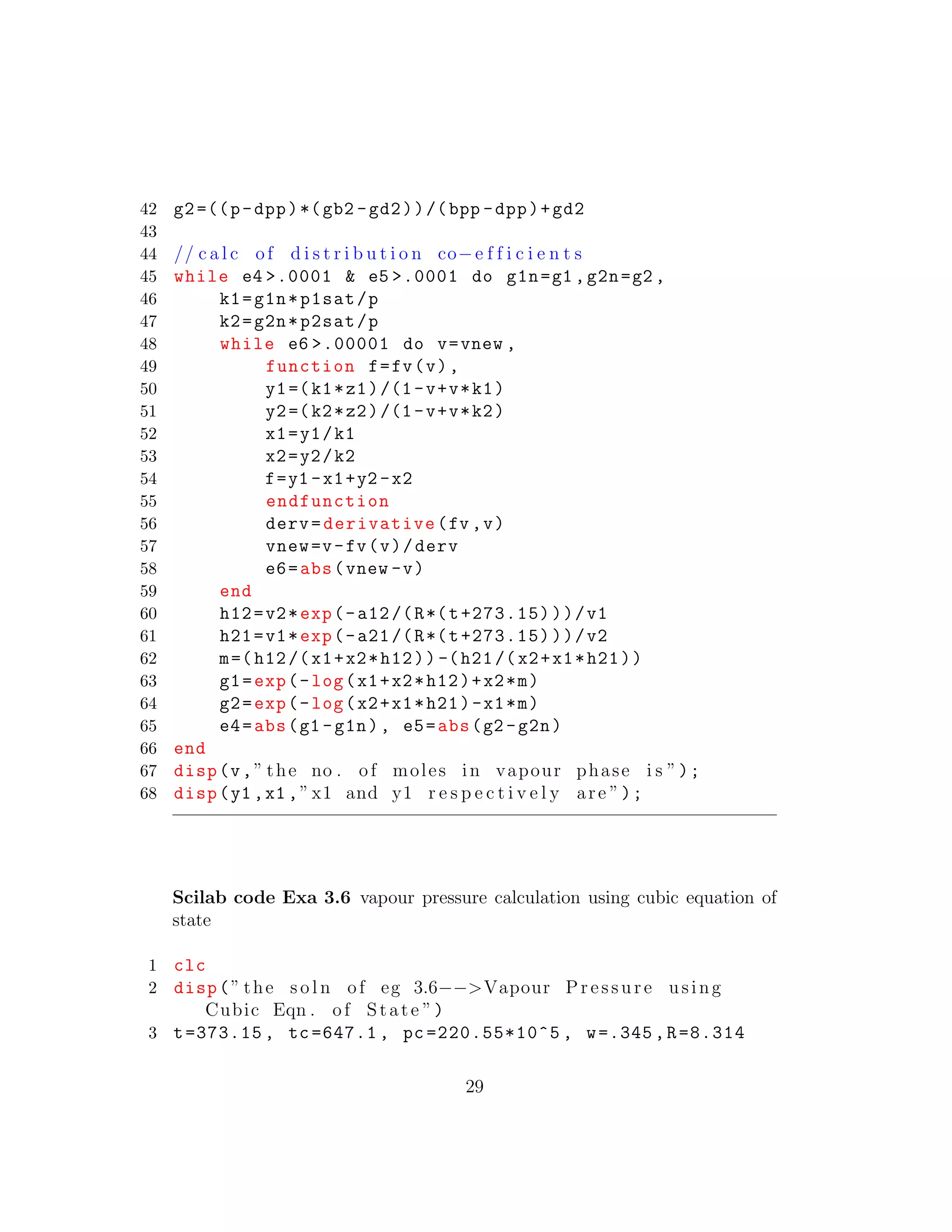
28
42 g2=((p-dpp)*(gb2 -gd2))/(bpp -dpp)+gd2
43
44 // c a l c of d i s t r i b u t i o n co−e f f i c i e n t s
45 while e4 >.0001 & e5 >.0001 do g1n=g1 ,g2n=g2 ,
46 k1=g1n*p1sat/p
47 k2=g2n*p2sat/p
48 while e6 >.00001 do v=vnew ,
49 function f=fv(v),
50 y1=(k1*z1)/(1-v+v*k1)
51 y2=(k2*z2)/(1-v+v*k2)
52 x1=y1/k1
53 x2=y2/k2
54 f=y1 -x1+y2 -x2
55 endfunction
56 derv=derivative(fv ,v)
57 vnew=v-fv(v)/derv
58 e6=abs(vnew -v)
59 end
60 h12=v2*exp(-a12/(R*(t+273.15)))/v1
61 h21=v1*exp(-a21/(R*(t+273.15)))/v2
62 m=(h12/(x1+x2*h12)) -(h21/(x2+x1*h21))
63 g1=exp(-log(x1+x2*h12)+x2*m)
64 g2=exp(-log(x2+x1*h21)-x1*m)
65 e4=abs(g1 -g1n), e5=abs(g2 -g2n)
66 end
67 disp(v,” the no . of moles in vapour phase i s ”);
68 disp(y1 ,x1 ,”x1 and y1 r e s p e c t i v e l y are ”);
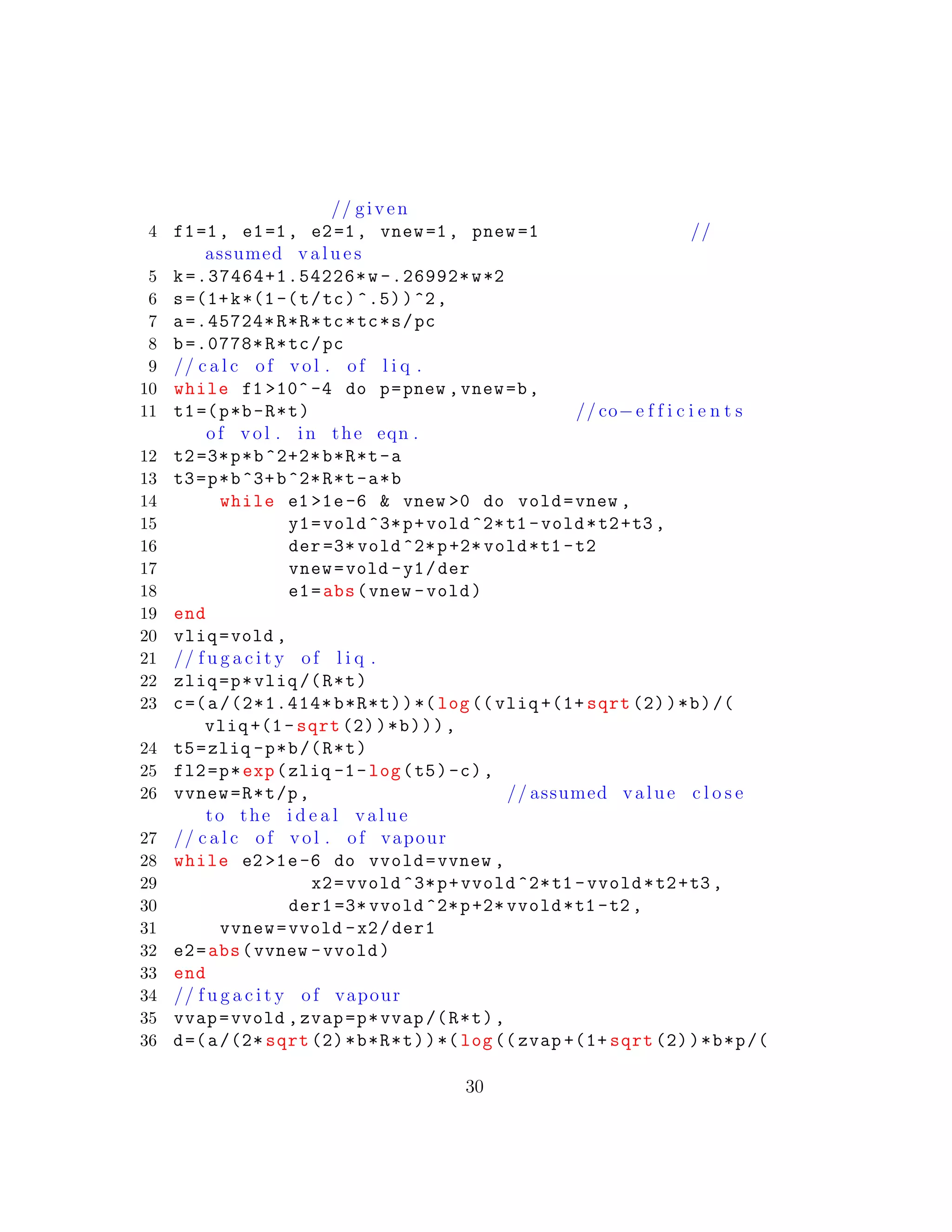
Scilab code Exa 3.6 vapour pressure calculation using cubic equation of
state
1 clc
2 disp(” the s o l n of eg 3.6−−>Vapour Pressure using
Cubic Eqn . of State ”)
3 t=373.15 , tc=647.1 , pc =220.55*10^5 , w=.345 ,R=8.314
29
// given
4 f1=1, e1=1, e2=1, vnew=1, pnew =1 //
assumed v a l u e s
5 k=.37464+1.54226*w -.26992*w*2
6 s=(1+k*(1-(t/tc)^.5))^2,
7 a=.45724*R*R*tc*tc*s/pc
8 b=.0778*R*tc/pc
9 // c a l c of vol . of l i q .
10 while f1 >10^ -4 do p=pnew ,vnew=b,
11 t1=(p*b-R*t) // co−e f f i c i e n t s
of vol . in the eqn .
12 t2=3*p*b^2+2*b*R*t-a
13 t3=p*b^3+b^2*R*t-a*b
14 while e1 >1e-6 & vnew >0 do vold=vnew ,
15 y1=vold ^3*p+vold ^2*t1 -vold*t2+t3 ,
16 der =3* vold ^2*p+2* vold*t1 -t2
17 vnew=vold -y1/der
18 e1=abs(vnew -vold)
19 end
20 vliq=vold ,
21 // f u g a c i t y of l i q .
22 zliq=p*vliq /(R*t)
23 c=(a/(2*1.414*b*R*t))*(log(( vliq +(1+ sqrt (2))*b)/(
vliq +(1- sqrt (2))*b))),
24 t5=zliq -p*b/(R*t)
25 fl2=p*exp(zliq -1-log(t5)-c),
26 vvnew=R*t/p, // assumed value c l o s e
to the i d e a l value
27 // c a l c of vol . of vapour
28 while e2 >1e-6 do vvold=vvnew ,
29 x2=vvold ^3*p+vvold ^2*t1 -vvold*t2+t3 ,
30 der1 =3* vvold ^2*p+2* vvold*t1 -t2 ,
31 vvnew=vvold -x2/der1
32 e2=abs(vvnew -vvold)
33 end
34 // f u g a c i t y of vapour
35 vvap=vvold ,zvap=p*vvap /(R*t),
36 d=(a/(2* sqrt (2)*b*R*t))*(log(( zvap +(1+ sqrt (2))*b*p/(
30
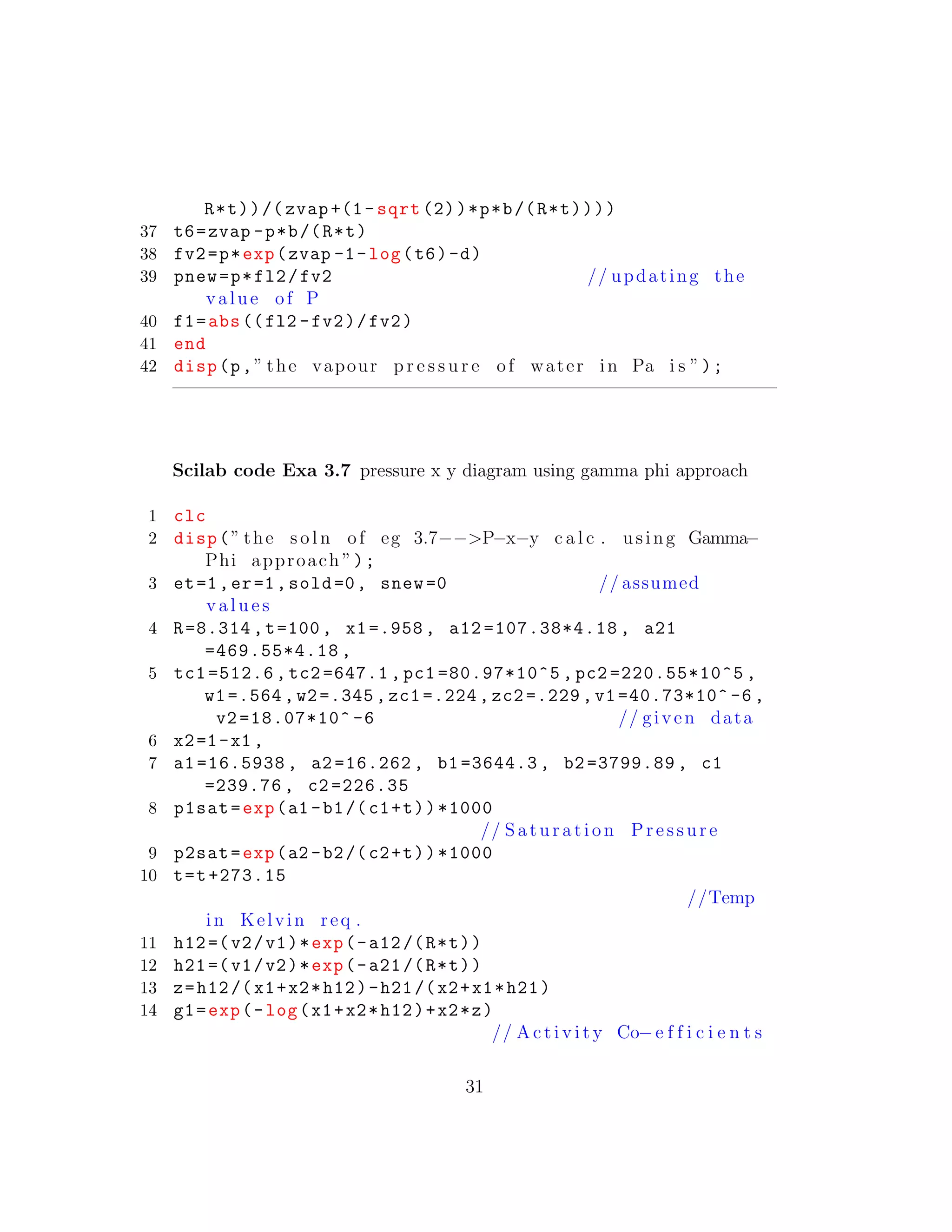
R*t))/( zvap +(1-sqrt (2))*p*b/(R*t))))
37 t6=zvap -p*b/(R*t)
38 fv2=p*exp(zvap -1-log(t6)-d)
39 pnew=p*fl2/fv2 // updating the
value of P
40 f1=abs((fl2 -fv2)/fv2)
41 end
42 disp(p,” the vapour p r e s s u r e of water in Pa i s ”);
Scilab code Exa 3.7 pressure x y diagram using gamma phi approach
1 clc
2 disp(” the s o l n of eg 3.7−−>P−x−y c a l c . using Gamma−
Phi approach ”);
3 et=1,er=1,sold=0, snew=0 // assumed
v a l u e s
4 R=8.314 ,t=100, x1=.958 , a12 =107.38*4.18 , a21
=469.55*4.18 ,
5 tc1 =512.6 , tc2 =647.1 , pc1 =80.97*10^5 , pc2 =220.55*10^5 ,
w1=.564 ,w2=.345 , zc1 =.224 , zc2 =.229 ,v1 =40.73*10^ -6 ,
v2 =18.07*10^ -6 // given data
6 x2=1-x1 ,
7 a1 =16.5938 , a2 =16.262 , b1 =3644.3 , b2 =3799.89 , c1
=239.76 , c2 =226.35
8 p1sat=exp(a1 -b1/(c1+t))*1000
// S a t u r a t i on Pressure
9 p2sat=exp(a2 -b2/(c2+t))*1000
10 t=t+273.15
//Temp
in Kelvin req .
11 h12=(v2/v1)*exp(-a12/(R*t))
12 h21=(v1/v2)*exp(-a21/(R*t))
13 z=h12/(x1+x2*h12)-h21/(x2+x1*h21)
14 g1=exp(-log(x1+x2*h12)+x2*z)
// A c t i v i t y Co−e f f i c i e n t s
31
15 g2=exp(-log(x2+x1*h21)-x1*z)
16 tr1=t/tc1 // Reduced
Temp .
17 b0 =.083 -.422* tr1^-1.6
18 b1 =.139 -.172* tr1^-4.2
19 b11=(R*tc1/pc1)*(b0+b1*w1)
20 tr2=t/tc2
21 b0 =.083 -.422* tr2^-1.6
22 b1 =.139 -.172* tr2^-4.2
23 b22=(R*tc2/pc2)*(b0+b1*w2)
24 w12=(w1+w2)^.5
25 tc12 =(tc1*tc2)^.5
26 zc12 =(zc1+zc2)^.5
27 vc1=zc1*R*tc1/pc1 , vc2=zc2*R*tc2/pc2
28 vc12 =(( vc1 ^.33+ vc2 ^.33) /2)^3
29 pc12=zc12*R*tc12/vc12
30 tr12=t/tc12
31 b0 =.083 -.422* tr12 ^-1.6
32 b1 =.139 -.172* tr12 ^-4.2
33 b12=(R*tc12/pc12)*(b0+b1*w12)
34 d12 =2*b12 -b11 -b22
35 p=x1*g1*p1sat+x2*p2sat*g2
36 y1=x1*g1*p1sat/p, y2=x2*g2*p2sat/p
37 pnew=p,
38 // c a l c of Pressure
39 while et >1e-6 do p=pnew ,
40 f1=p1sat *(exp(b11*p1sat /(R*t)))*(exp((v1*(p-
p1sat)/(R*t))))
41 f2=p2sat *(exp(b22*p2sat /(R*t)))*(exp((v2*(p-p2sat)/(
R*t))))
42 while er >1e-6 do sold=snew ,
43 fc1=exp((p/(R*t))*(b11+y2^2* d12))
44 fc2=exp((p/(R*t))*(b22+y1^2* d12))
45 k1=g1*f1/(fc1*p)
46 k2=g2*f2/(fc2*p)
47 snew=x1*k1+x2*k2
48 y1=x1*k1/snew
49 y2=x2*k2/snew
32
50 er=abs(snew -sold)
51 end
52 pnew =(x1*g1*f1/fc1)+(x2*g2*f2/fc2)
53 y1=x1*g1*f1/(fc1*pnew)
54 y2=x2*g2*f2/(fc2*pnew)
55 et=abs(pnew -p)
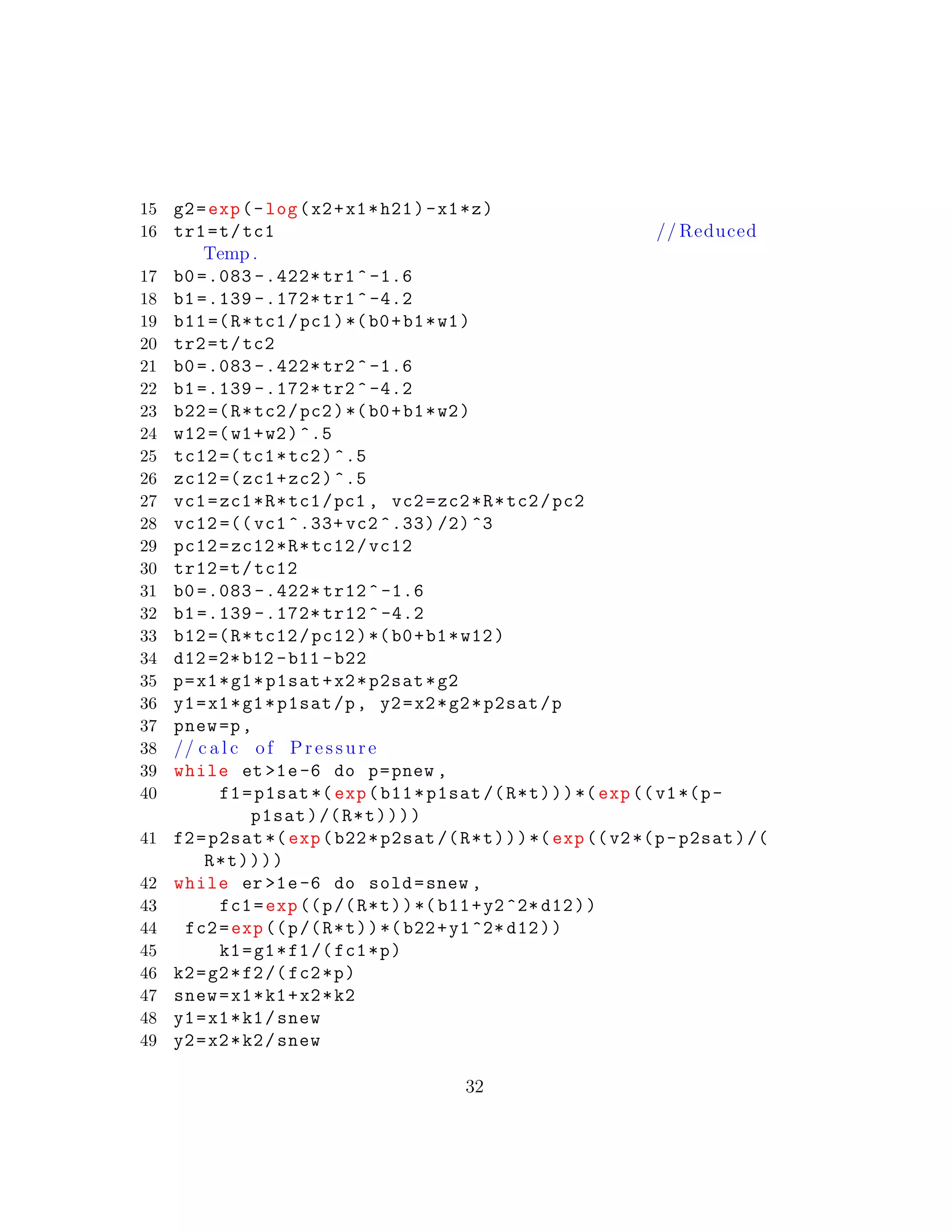
56 end
57 disp(p,y1 ,” the amt . of methanol in vapour phase and
system p r e s s u r e in Pa r e s p e c t i v e l y are ”)
Scilab code Exa 3.9 chemical reaction engineering 2 simultaneous reac-
tions
1 clc
2 disp(” the s o l n of eg 3.9−−>Chemical Reaction
Equilibrium −2 Simultaneous Reactions ”)
3 // l e t x1 and x2 be the r e a c t i o n co−o r d i n a t e f o r 1 s t
and 2nd r e a c t i o n s
4 x1new =.9, x2new =.6,r1=1,r2=1 // assumed
v a l u e s
5 Kp=1 // s i n c e P=1 atm
6 K1=.574 , K2 =2.21 // given
7 Kye1=K1 , Kye2=K2 // at eqm .
8 while r1 >1e-6 & r2 >1e-6, x1=x1new ,x2=x2new ,
9 m_CH4=1-x1 ,m_H2O=5-x1 -x2 ,m_CO=x1 -x2 ,m_H2 =3*x1+x2 ,
m_CO2=x2 // moles of r e a c t a n t s and products
at eqm .
10 total=m_CO2+m_H2+m_CO+m_H2O+m_CH4
11 Ky1=m_CO*m_H2 ^3/( m_CH4*m_H2O*total ^2)
12 Ky2=m_CO2*m_H2 /( m_CO*m_H2O)
13 f1=Ky1 -.574 //1 s t
f u n c t i o n in x1 and x2
14 f2=Ky2 -2.21 //2nd
f u n c t i o n in x1 and x2
15 d3 =((3* x1+x2)^2*(12*x1 -8*x2))/((1-x1)*(5-x1 -x2)
33
*(6+2* x1)^2)
16 d4 =(3*x1+x2)^3*(x1 -x2)*(8* x1 ^2+6* x1*x2 -24* x1+2*
x2 -16)
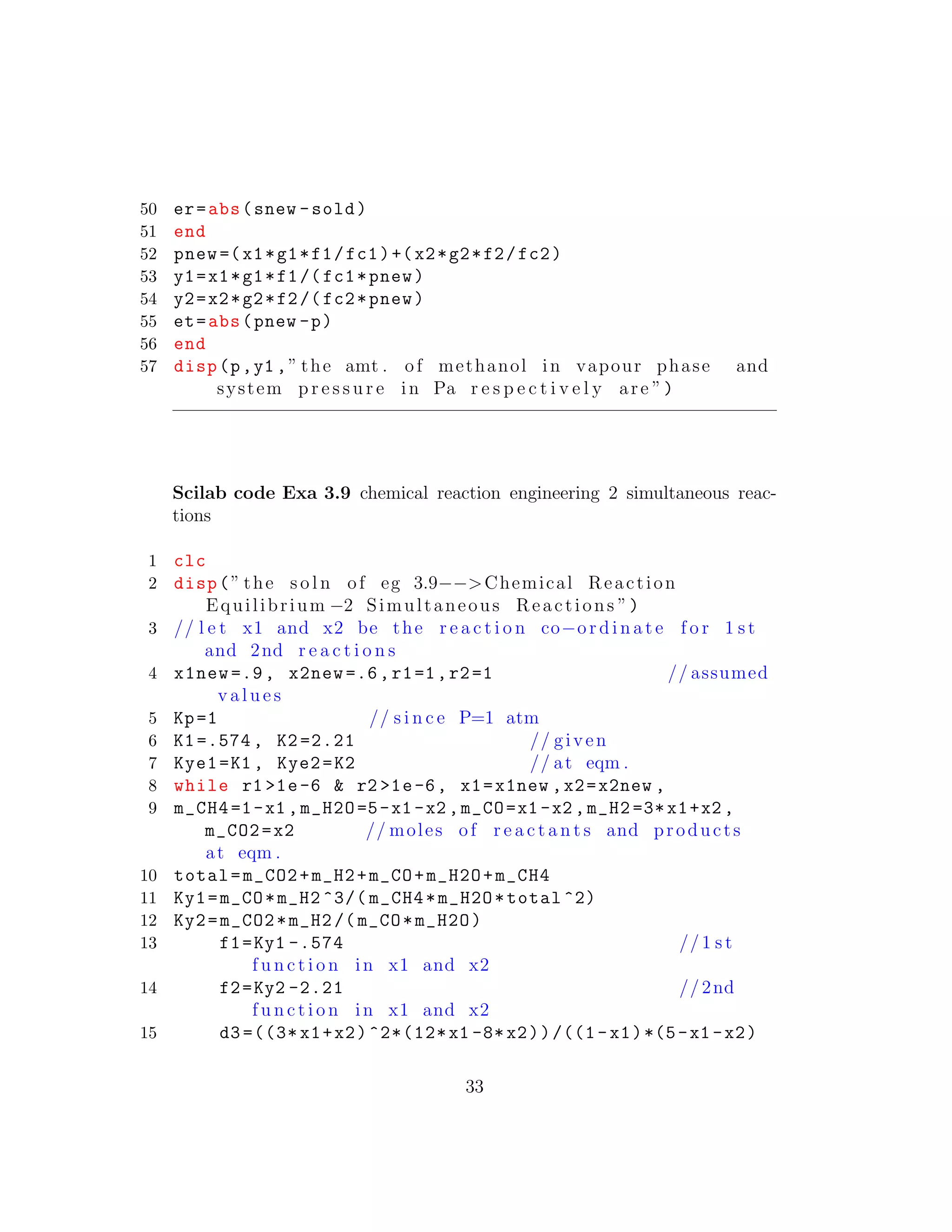
17 d5=((1-x1)^2) *((5-x1 -x2)^2) *((6+2* x1)^3)
18 df1_dx1=d3 -(d4/d5) // df1
/dx1− p a r t i a l d e r i v a t i v e of f1 wrt to x1
19 d6 =3*(x1 -x2)*((3* x1+x2)^2) -(3*x1+x2)^3
20 d7=(1-x1)*(5-x1 -x2)*((6+ x1*2) ^2)
21 d8=((x1 -x2)*(3* x1+x2)^3) /((1-x1)*((5-x1 -x2)^2)
*(6+2* x1)^2)
22 df1_dx2 =(d6/d7)+d8 // df1
/dx2− p a r t i a l d e r i v a t i v e of f1 wrt to x2
23 d9=(x1 -x2)*(5-x1 -x2)
24 df2_dx1 =3*x2/d9 -(x2 *(3* x1+x2)*(5 -2*x1))/(d9^2)
// df1 /dx2− p a r t i a l d e r i v a t i v e of f1
wrt to x2
25 d10 =(3* x1+2*x2)/d9
26 d11=x2 *(3*x1+x2)*(2*x2 -5)/(d9^2)
27 df2_dx2=d10 -d11 //
df1 /dx2− p a r t i a l d e r i v a t i v e of f1 wrt to x2
28 dm=df1_dx1*df2_dx2 -df1_dx2*df2_dx1
29 delta_x1 =(f2*df1_dx2 -f1*df2_dx2)/dm
30 delta_x2 =(f1*df2_dx1 -f2*df1_dx1)/dm
31 x1new=x1+delta_x1 // updating
the v a l u e s of x1 & x2
32 x2new=x2+delta_x2
33 r1=abs(x1 -x1new), r2=abs(x2new -x2)
34 end
35 disp(x2 ,x1 ,” the value of X1 and X2 r e s p e c t i v e l y i s ”)
;
36 m_CH4=1-x1 ,m_H2O=5-x1 -x2 ,m_CO=x1 -x2 ,m_H2 =3*x1+x2 ,
m_CO2=x2 // moles of r e a c t a n t s and products
at eqm .
37 total=m_CO2+m_H2+m_CO+m_H2O+m_CH4
38 disp(m_CO2 ,m_H2 ,m_CO ,m_H2O ,m_CH4 ,” the moles at eqm
of CH4,H2O,CO, H2 ,CO2 are ”)
39 disp(total ,” t o t a l number of moles at eqm . i s ”)
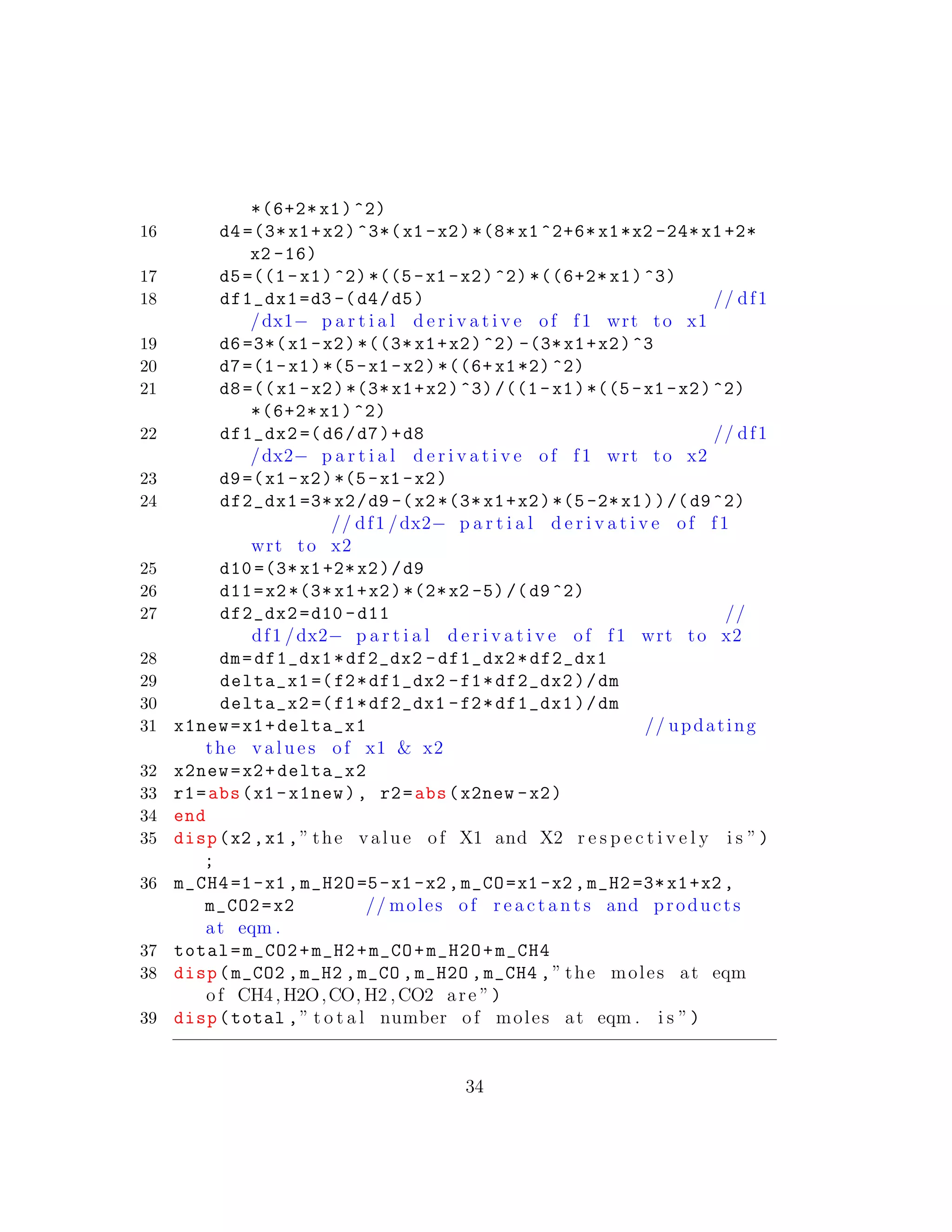
34
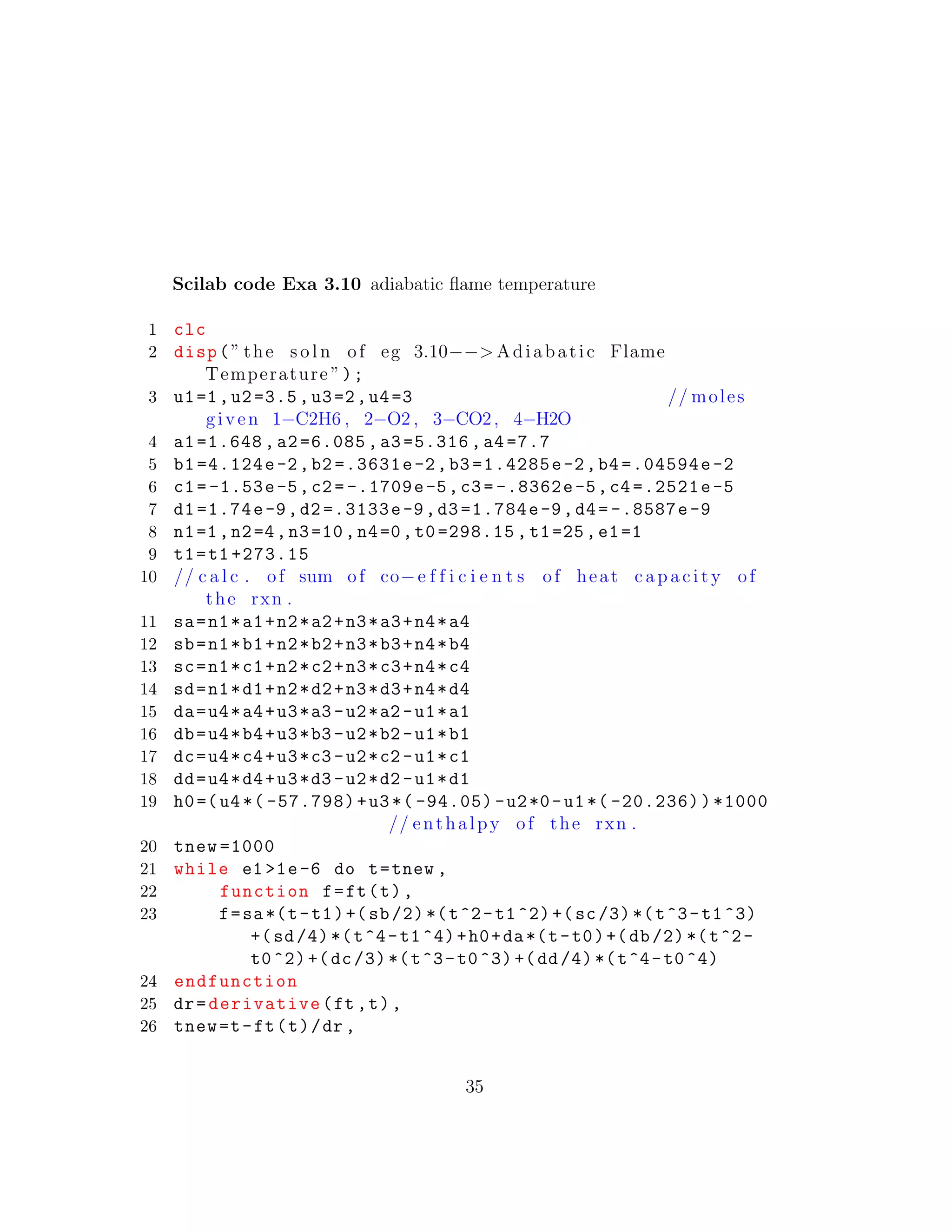
Scilab code Exa 3.10 adiabatic flame temperature
1 clc
2 disp(” the s o l n of eg 3.10−−> Adiabatic Flame
Temperature ”);
3 u1=1,u2=3.5,u3=2,u4=3 // moles
given 1−C2H6 , 2−O2 , 3−CO2, 4−H2O
4 a1=1.648 ,a2=6.085 ,a3=5.316 ,a4 =7.7
5 b1 =4.124e-2,b2 =.3631e-2,b3 =1.4285e-2,b4 =.04594e-2
6 c1= -1.53e-5,c2= -.1709e-5,c3= -.8362e-5,c4 =.2521e-5
7 d1 =1.74e-9,d2 =.3133e-9,d3 =1.784e-9,d4= -.8587e-9
8 n1=1,n2=4,n3=10,n4=0,t0 =298.15 , t1=25,e1=1
9 t1=t1 +273.15
10 // c a l c . of sum of co−e f f i c i e n t s of heat c a p a c i t y of
the rxn .
11 sa=n1*a1+n2*a2+n3*a3+n4*a4
12 sb=n1*b1+n2*b2+n3*b3+n4*b4
13 sc=n1*c1+n2*c2+n3*c3+n4*c4
14 sd=n1*d1+n2*d2+n3*d3+n4*d4
15 da=u4*a4+u3*a3 -u2*a2 -u1*a1
16 db=u4*b4+u3*b3 -u2*b2 -u1*b1
17 dc=u4*c4+u3*c3 -u2*c2 -u1*c1
18 dd=u4*d4+u3*d3 -u2*d2 -u1*d1
19 h0=(u4 *( -57.798)+u3 *( -94.05) -u2*0-u1 *( -20.236))*1000
// enthalpy of the rxn .
20 tnew =1000
21 while e1 >1e-6 do t=tnew ,
22 function f=ft(t),
23 f=sa*(t-t1)+(sb/2)*(t^2-t1^2)+(sc/3)*(t^3-t1^3)
+(sd/4)*(t^4-t1^4)+h0+da*(t-t0)+(db/2)*(t^2-
t0^2)+(dc/3)*(t^3-t0^3)+(dd/4)*(t^4-t0^4)
24 endfunction
25 dr=derivative(ft ,t),
26 tnew=t-ft(t)/dr ,
35
27 e1=abs((tnew -t)/tnew)
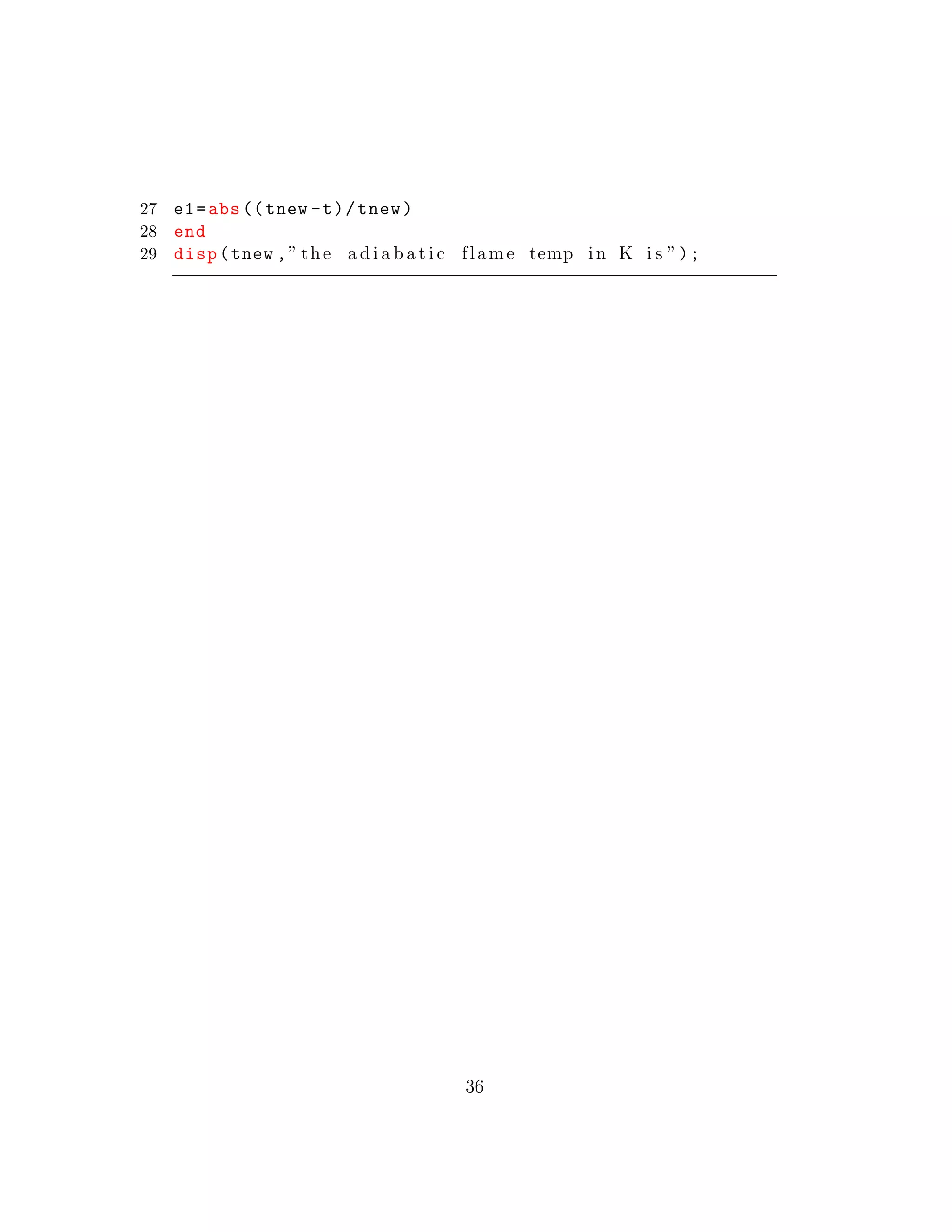
28 end
29 disp(tnew ,” the a d i a b a t i c flame temp in K i s ”);
36
Chapter 4
INITIAL VALUE PROBLEMS
Scilab code Exa 4.1 solution of ordinary differential equation
1 clc
2 disp(” the s o l u t i o n of e . g . 4. 1 −−>I n t e g r a t i o n of
Ordinary D i f f e r e n t i a l Equation ”)
3 // in t h i s problem dy/dx=x+y
4 x_0=0 // i n i t i a l v a l u e s given
5 y_0=0
6
7 function ydash=fs(x,y),
8 ydash=x+y,
9 endfunction
10
11 for x_0 =0:0.1:0.2 ,
12 h=0.1 // step
increment of 0 .1
13 f_0=fs(x_0 ,y_0)
14 k1=h*f_0
15 k2=h*fs(x_0+h/2,y_0+k1/2)
16 k3=h*fs(x_0+h/2,y_0+k2/2)
17 k4=h*fs(x_0+h,y_0+k3)
18 y_0=y_0+(k1+2*k2+2*k3+k4)/6
19 end
37
20 y_0=y_0 -(k1+2*k2+2*k3+k4)/6 // to
get value at x=0.2
21 disp(y_0 ,” the value of y at x=.2 using Runge Kutta
method i s ”);
22 ae=exp(x_0)-x_0 -1
// a n a l y t i c a l eqn given
23 disp(ae ,” the value of y at x=0.2 from a n a l y t i c a l eqn
i s ”);
Scilab code Exa 4.2 solution of ordinary differential equation
1 clc
2 disp(” the s o l u t i o n of e . g . 4. 2 −−>Ordinary
D i f f e r e n t i a l Eqn.−Runge Kutta method”)
3 // in t h i s problem dy/dx=−y/(1+x )
4 x_0=0 // i n i t i a l v a l u e s given
5 y_0=2
6 function ydash=fr(x,y),
7 ydash=-y/(1+x),
8 endfunction
9 for x_0 =0:0.01:2.5 ,
10 h=0.01 // step
increment of 0.01
11 f_0=fr(x_0 ,y_0)
12 k1=h*f_0
13 k2=h*fr(x_0+h/2,y_0+k1/2)
14 k3=h*fr(x_0+h/2,y_0+k2/2)
15 k4=h*fr(x_0+h,y_0+k3)
16 y_0=y_0+(k1+2*k2+2*k3+k4)/6
17 end
18 y_0=y_0 -(k1+2*k2+2*k3+k4)/6 //
f i n a l value at x=2.5
19 disp(y_0 ,” the value of y at x=2.5 using Runge Kutta
method i s ”);
38
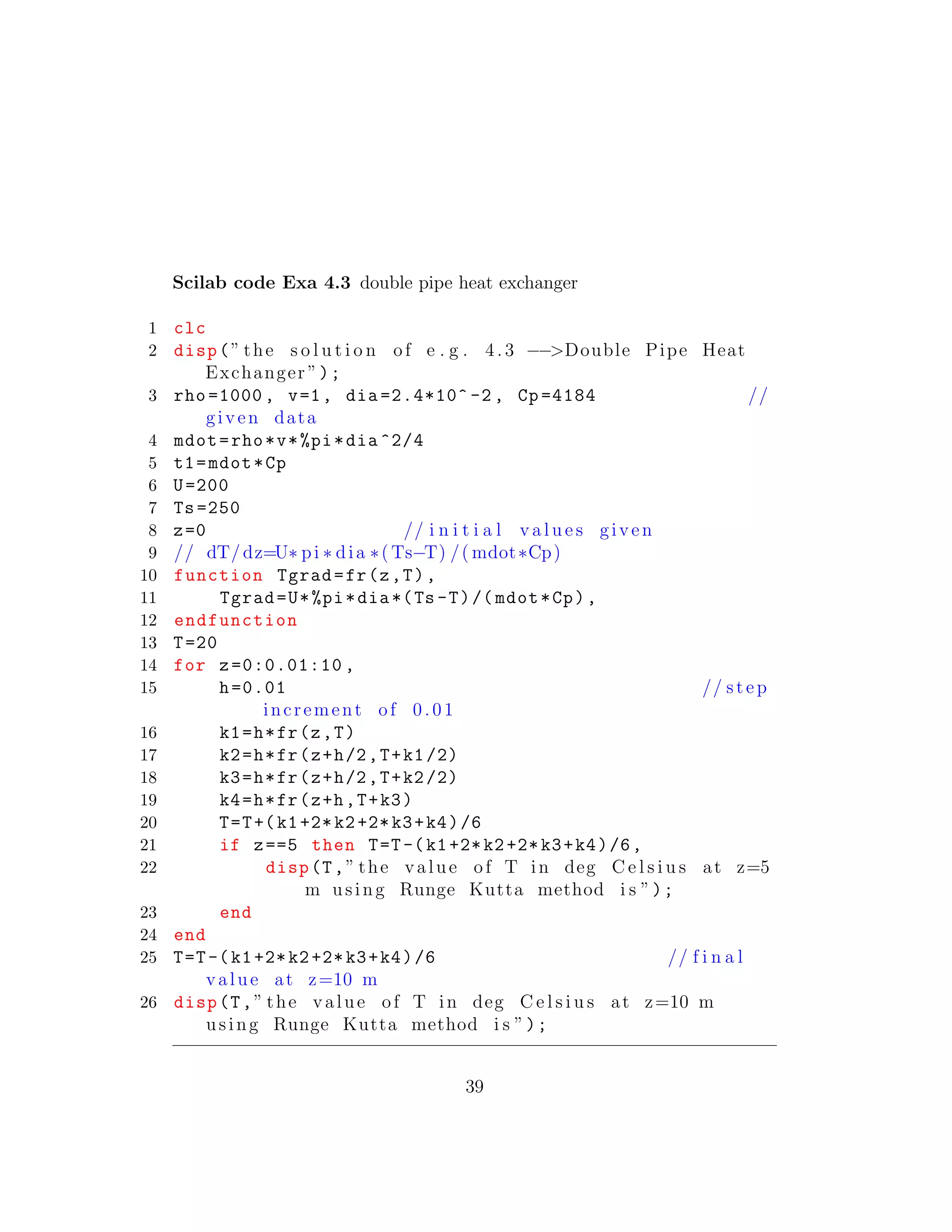
Scilab code Exa 4.3 double pipe heat exchanger
1 clc
2 disp(” the s o l u t i o n of e . g . 4. 3 −−>Double Pipe Heat
Exchanger ”);
3 rho =1000 , v=1, dia =2.4*10^ -2 , Cp =4184 //
given data
4 mdot=rho*v*%pi*dia ^2/4
5 t1=mdot*Cp
6 U=200
7 Ts=250
8 z=0 // i n i t i a l v a l u e s given
9 // dT/dz=U∗ pi ∗ dia ∗( Ts−T) /( mdot∗Cp)
10 function Tgrad=fr(z,T),
11 Tgrad=U*%pi*dia*(Ts -T)/( mdot*Cp),
12 endfunction
13 T=20
14 for z=0:0.01:10 ,
15 h=0.01 // step
increment of 0.01
16 k1=h*fr(z,T)
17 k2=h*fr(z+h/2,T+k1/2)
18 k3=h*fr(z+h/2,T+k2/2)
19 k4=h*fr(z+h,T+k3)
20 T=T+(k1+2*k2+2*k3+k4)/6
21 if z==5 then T=T-(k1+2*k2+2*k3+k4)/6,
22 disp(T,” the value of T in deg C e l s i u s at z=5
m using Runge Kutta method i s ”);
23 end
24 end
25 T=T-(k1+2*k2+2*k3+k4)/6 // f i n a l
value at z=10 m
26 disp(T,” the value of T in deg C e l s i u s at z=10 m
using Runge Kutta method i s ”);
39
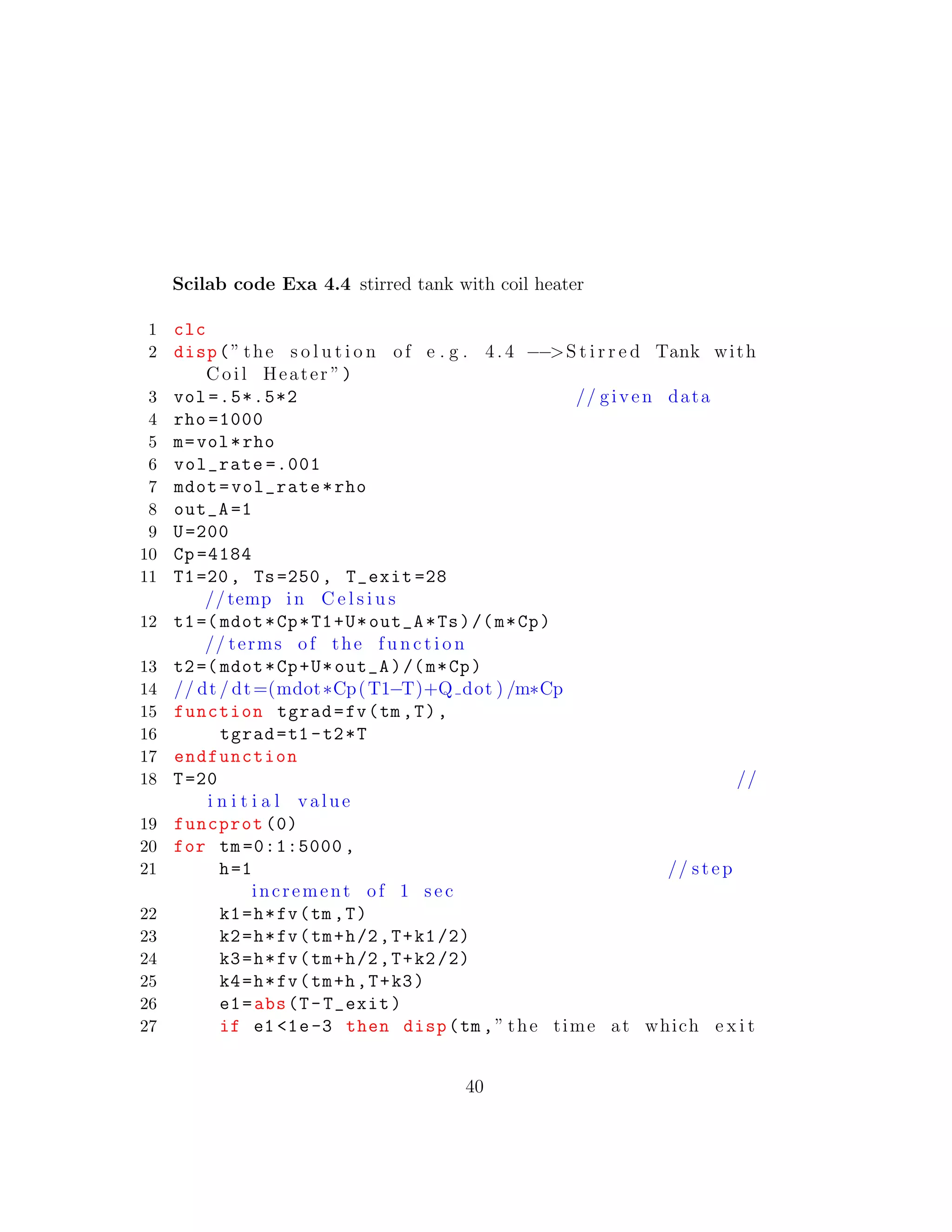
Scilab code Exa 4.4 stirred tank with coil heater
1 clc
2 disp(” the s o l u t i o n of e . g . 4. 4 −−>S t i r r e d Tank with
Coil Heater ”)
3 vol =.5*.5*2 // given data
4 rho =1000
5 m=vol*rho
6 vol_rate =.001
7 mdot=vol_rate*rho
8 out_A =1
9 U=200
10 Cp =4184
11 T1=20, Ts=250, T_exit =28
//temp in C e l s i u s
12 t1=( mdot*Cp*T1+U*out_A*Ts)/(m*Cp)
// terms of the f u n c t i o n
13 t2=( mdot*Cp+U*out_A)/(m*Cp)
14 // dt / dt=(mdot∗Cp(T1−T)+Q dot ) /m∗Cp
15 function tgrad=fv(tm ,T),
16 tgrad=t1 -t2*T
17 endfunction
18 T=20 //
i n i t i a l value
19 funcprot (0)
20 for tm =0:1:5000 ,
21 h=1 // step
increment of 1 sec
22 k1=h*fv(tm ,T)
23 k2=h*fv(tm+h/2,T+k1/2)
24 k3=h*fv(tm+h/2,T+k2/2)
25 k4=h*fv(tm+h,T+k3)
26 e1=abs(T-T_exit)
27 if e1 <1e-3 then disp(tm ,” the time at which e x i t
40
temp . in sec . i s 28 C i s ”)
28 end
29 T=T+(k1+2*k2+2*k3+k4)/6
30 end
31 T=T-(k1+2*k2+2*k3+k4)/6 // f i n a l
steady s t a t e temp .
32 disp(T,” the value of steady Temp in C e l s i u s i s ”);
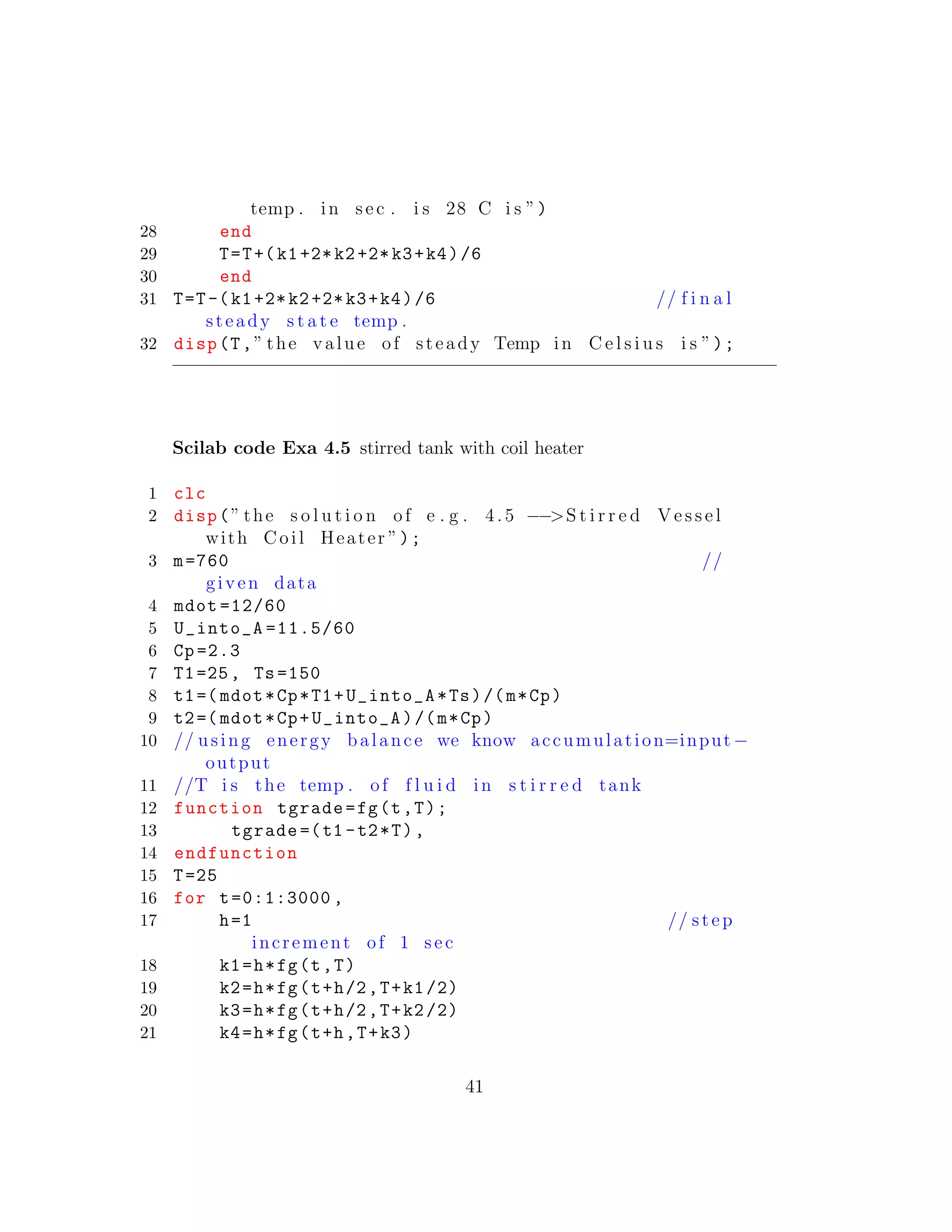
Scilab code Exa 4.5 stirred tank with coil heater
1 clc
2 disp(” the s o l u t i o n of e . g . 4. 5 −−>S t i r r e d V e s s e l
with Coil Heater ”);
3 m=760 //
given data
4 mdot =12/60
5 U_into_A =11.5/60
6 Cp =2.3
7 T1=25, Ts =150
8 t1=( mdot*Cp*T1+U_into_A*Ts)/(m*Cp)
9 t2=( mdot*Cp+U_into_A)/(m*Cp)
10 // using energy balance we know accumulation=input−
output
11 //T i s the temp . of f l u i d in s t i r r e d tank
12 function tgrade=fg(t,T);
13 tgrade =(t1 -t2*T),
14 endfunction
15 T=25
16 for t=0:1:3000 ,
17 h=1 // step
increment of 1 sec
18 k1=h*fg(t,T)
19 k2=h*fg(t+h/2,T+k1/2)
20 k3=h*fg(t+h/2,T+k2/2)
21 k4=h*fg(t+h,T+k3)
41
22 T=T+(k1+2*k2+2*k3+k4)/6
23 end
24 T=T-(k1+2*k2+2*k3+k4)/6 // to get
value at x=0.2
25 disp(T,” the value of T in deg C a f t e r 50 mins i s ”);
26 T_steady =( mdot*Cp*T1+U_into_A*Ts)/( mdot*Cp+U_into_A)
27 disp(T_steady ,” the steady s t a t e temp in deg C i s ”);
Scilab code Exa 4.6 pneumatic conveying
1 clc
2 disp(” the s o l n of eg 4.6−−>Pneumatic Conveying ”)
3 dia =3*10^ -4 // given data
4 v_sprfcl =12
5 rho_p =900
6 meu =1.8*10^ -5
7 P=101325
8 T=298.15
9 R=8.314
10 M=28.84*10^ -3
11 rho_air=P*M/(R*T)
12 proj_A=%pi*(dia ^2)/4
13 volm=%pi*(dia ^3)/6
14 t1=rho_air*proj_A /( volm*rho_p)
// terms of the f u n c t i o n
15 t2=(( rho_air/rho_p) -1) *9.81*2
16 y=0
17 for z=.01:.01:10 ,
18 h=.01
19 vn1=sqrt(y)
20 Re=rho_air *(12- vn1)*dia/meu
21 Cd =24*(1+.15* Re ^.687)/Re
22 function dy_by_dz=fy(z,y),
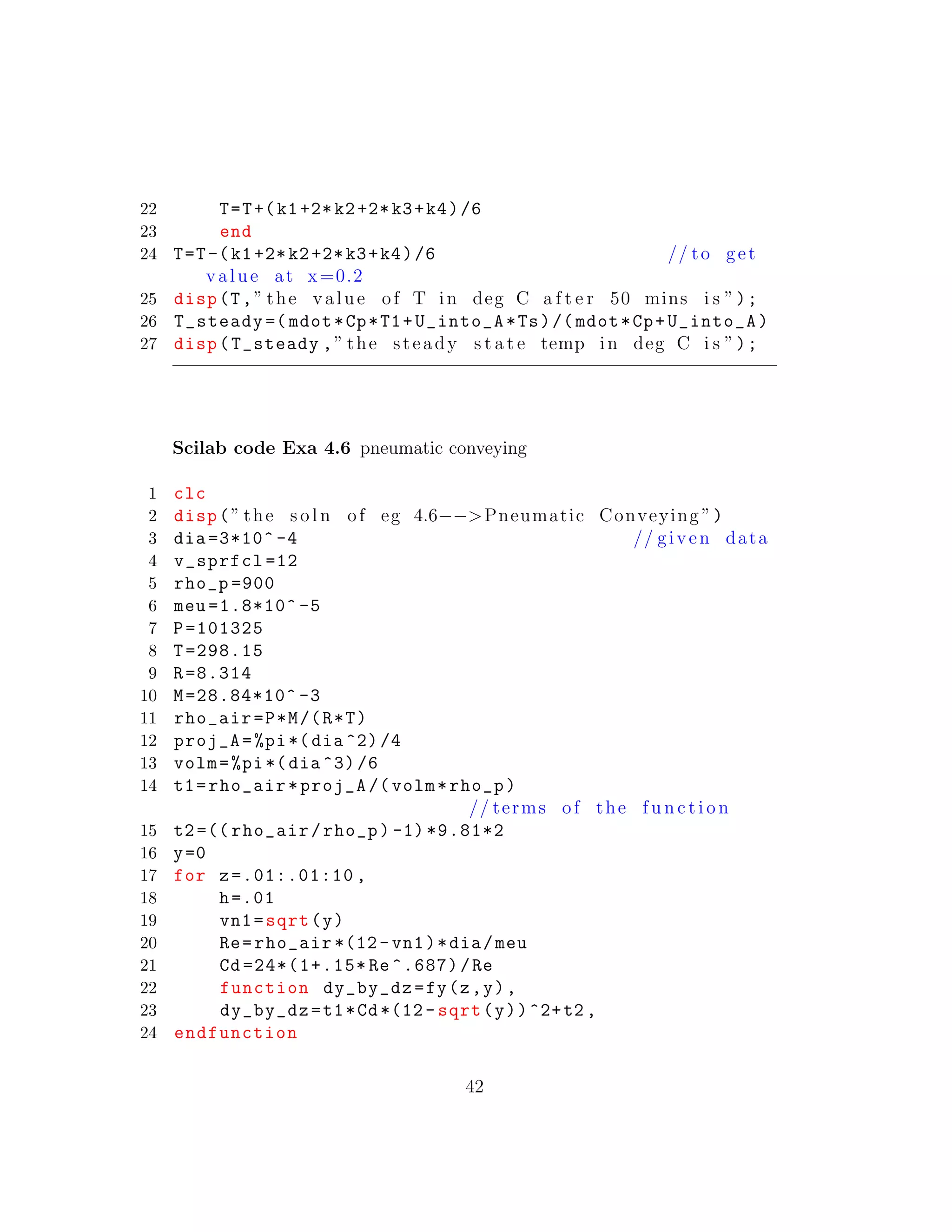
23 dy_by_dz=t1*Cd*(12- sqrt(y))^2+t2 ,
24 endfunction
42
25 kk1=h*fy(z,y)
26 kk2=h*fy(z+h/2,y+kk1 /2)
27 kk3=h*fy(z+h/2,y+kk2 /2)
28 kk4=h*fy(z+h,y+kk3)
29 y=y+(kk1 +2* kk2 +2* kk3+kk4)/6
30 end
31 v=sqrt(y) // f i n a l value of
v e l o c i t y
32 disp(v,” the value of v at the end of the pneumatic
conveyor i s ”);
Scilab code Exa 4.7 simultaneous ordinary differential equations
1 clc
2 disp(” the s o l n of eg 4.7−−>Simultaneous O.D.E. ”)
3 function dx_dt=fw(t,x,y);
4 dx_dt=x+2*y,
5 endfunction
6 function dy_dt=fq(t,x,y);
7 dy_dt =3*x+2*y
8 endfunction
9 y=4,x=6 // i n i t i a l v a l u e s
10 // s o l v i n g by Runge−Kutta method
11 for t=0:.1:.2 ,
12 h=.1 // step
increment of 0 .1
13 k1=h*fw(t,x,y)
14 l1=h*fq(t,x,y)
15 k2=h*fw(t+h/2,x+k1/2,y+l1/2)
16 l2=h*fq(t+h/2,x+k1/2,y+l1/2)
17 k3=h*fw(t+h/2,x+k2/2,y+l2/2)
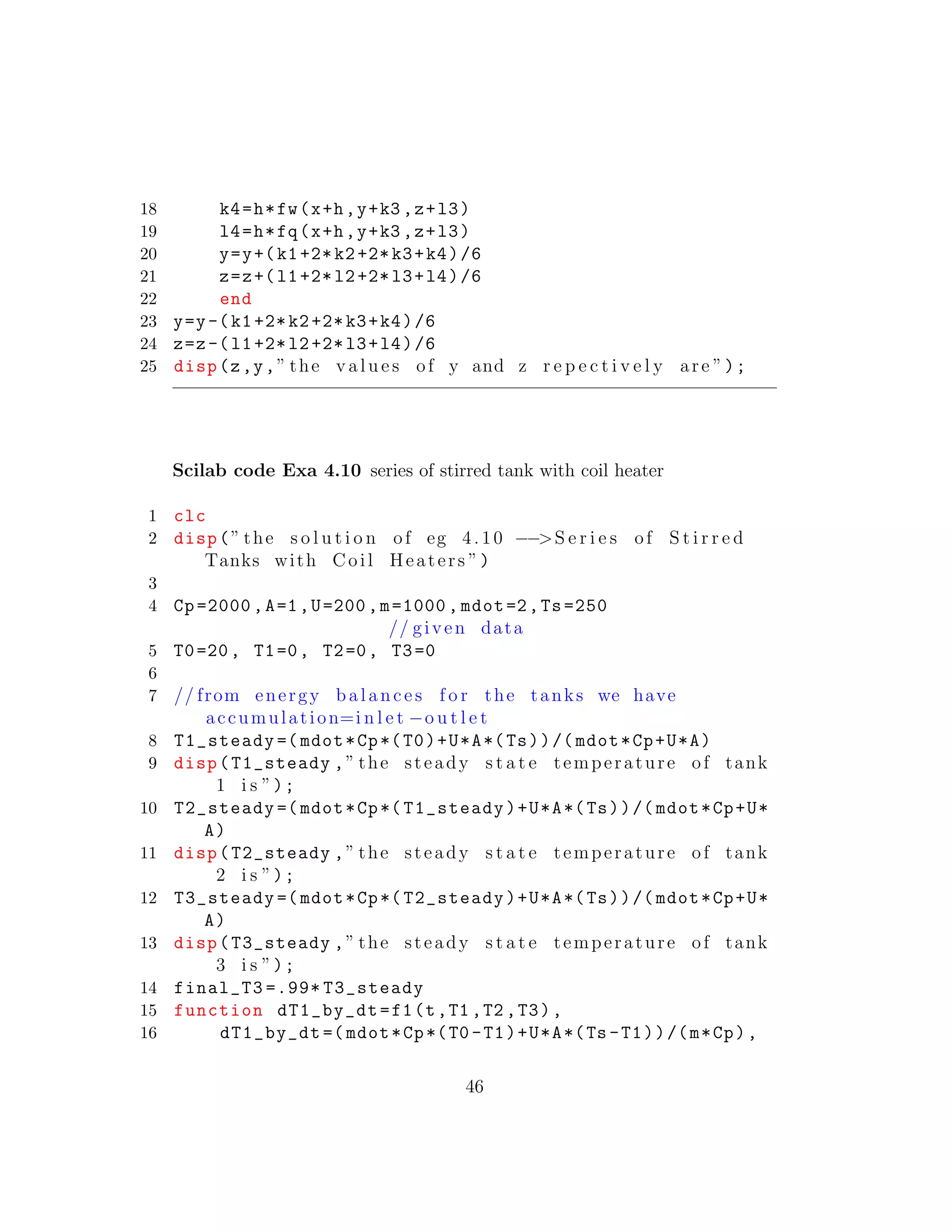
18 l3=h*fq(t+h/2,x+k2/2,y+l2/2)
19 k4=h*fw(t+h,x+k3 ,y+l3)
20 l4=h*fq(t+h,x+k3 ,y+l3)
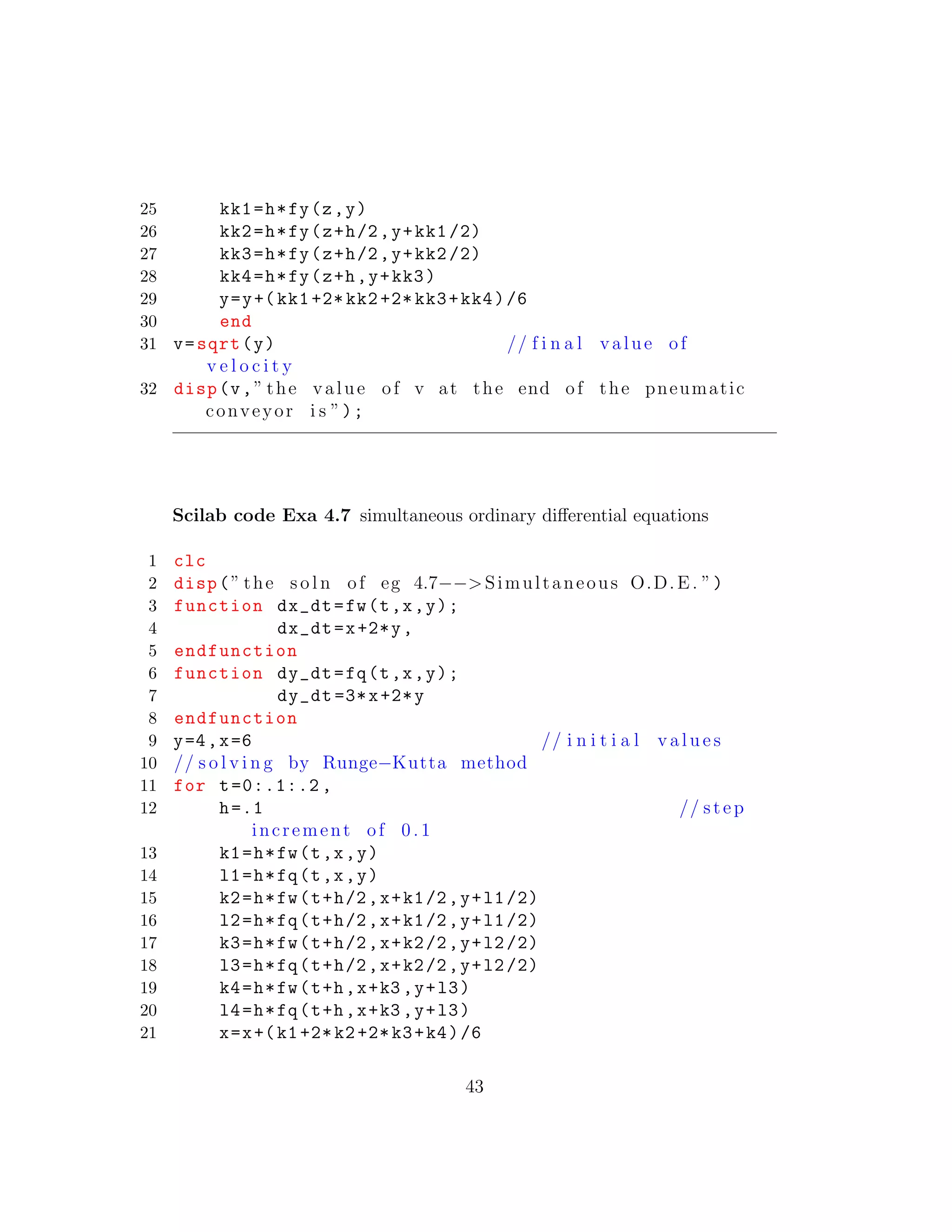
21 x=x+(k1+2*k2+2*k3+k4)/6
43
22 y=y+(l1+2*l2+2*l3+l4)/6
23 end
24 x=x-(k1+2*k2+2*k3+k4)/6
25 y=y-(l1+2*l2+2*l3+l4)/6
26 disp(y,x,” the v a l u e s of x and y r e p e c t i v e l y are ”);
27 t_an =.2
28 x_an =4* exp (4*t)+2* exp(-t)
29 y_an =6* exp (4*t) -2*exp(-t)
30 disp(y_an ,x_an ,” the a n a l y t i c a l v a l u e s of x and y are
r e s p e c t i v e l y ”);
Scilab code Exa 4.8 simultaneous ordinary differential equations
1 clc
2 disp(” the s o l n of eg 4.8−−>Simultaneous O.D.E. ”)
3 function dy_dx=fw(x,y,z);
4 dy_dx=z,
5 endfunction
6 function dz_dx=fq(x,y,z);
7 dz_dx=-y
8 endfunction
9 y=2,z=1 // i n i t i a l v a l u e s
10 for x=0:.1:3 ,
11 h=.1 // step
increment of 0 .1
12 k1=h*fw(x,y,z)
13 l1=h*fq(x,y,z)
14 k2=h*fw(x+h/2,y+k1/2,z+l1/2)
15 l2=h*fq(x+h/2,y+k1/2,z+l1/2)
16 k3=h*fw(x+h/2,y+k2/2,z+l2/2)
17 l3=h*fq(x+h/2,y+k2/2,z+l2/2)
18 k4=h*fw(x+h,y+k3 ,z+l3)
19 l4=h*fq(x+h,y+k3 ,z+l3)
20 y=y+(k1+2*k2+2*k3+k4)/6
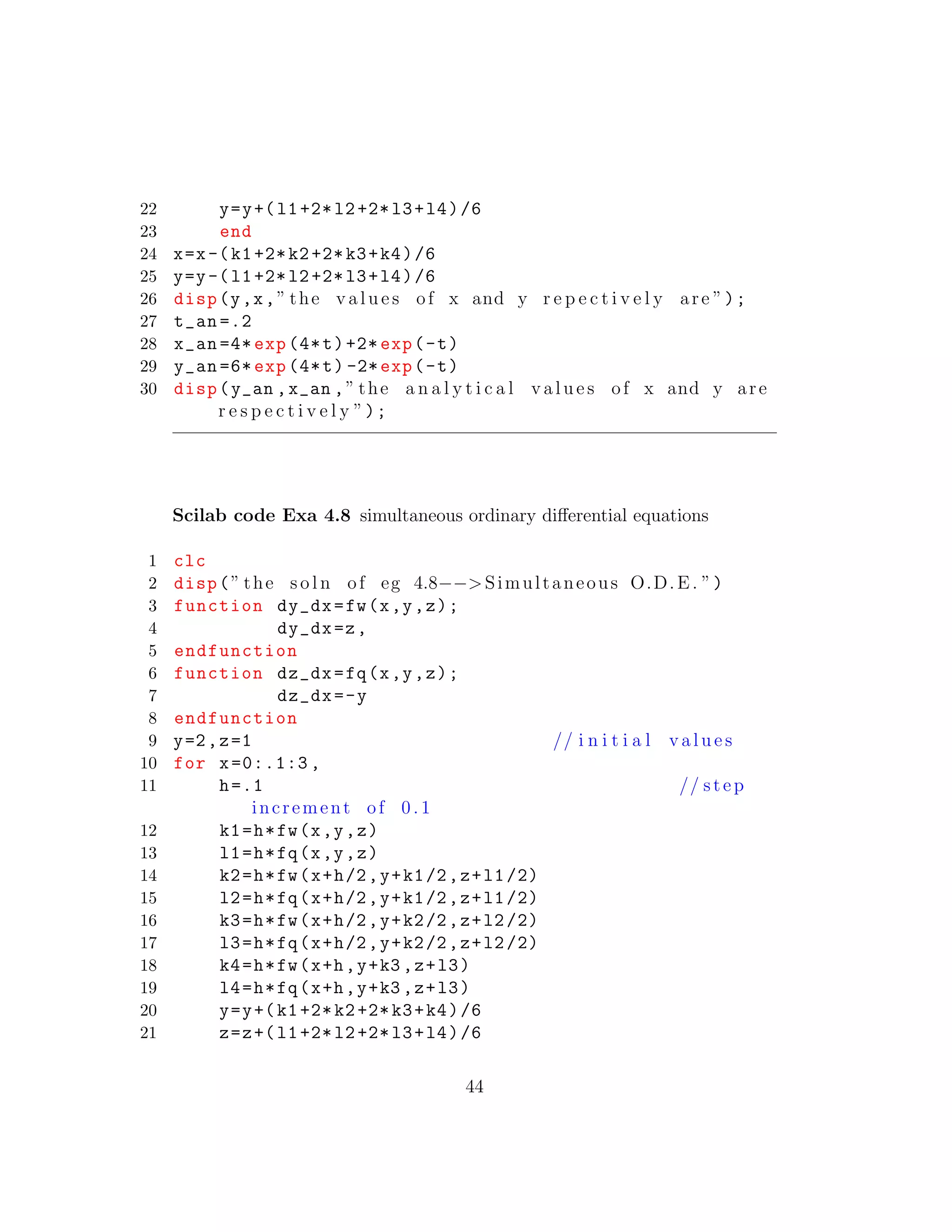
21 z=z+(l1+2*l2+2*l3+l4)/6
44
22 end
23 y=y-(k1+2*k2+2*k3+k4)/6
24 z=z-(l1+2*l2+2*l3+l4)/6
25 disp(z,y,” the v a l u e s of y and z r e s p e c t i v e l y are ”);
26 // f o r the given a n a l y t i c a l eqns the v a l u e s of A and
alpha can be determined using i n i t i a l v a l u e s of
y and z
27 alpha=atan (2)
28 A=2/ sin(alpha)
29 y_an=A*sin(alpha+x)
30 z_an=A*cos(alpha+x)
31 disp(z_an ,y_an ,” the a n a l y t i c a l v a l u e s of y and z are
”);
Scilab code Exa 4.9 simultaneous ordinary differential equations
1 clc
2 disp(” the s o l n of eg 4.9−−>Simultaneous O.D.E. ”)
3 function dy_dx=fw(x,y,z); // l e t us
have dy/dx=z , t h e r e f o r e d2y/dx2=dz/dx
4 dy_dx=z,
5 endfunction
6 function dz_dx=fq(x,y,z);
7 dz_dx=-y*x,
8 endfunction
9 y=2,z=1
10 for x=0:.1:3 ,
11 h=.1 // step
increment of 0 .1
12 k1=h*fw(x,y,z)
13 l1=h*fq(x,y,z)
14 k2=h*fw(x+h/2,y+k1/2,z+l1/2)
15 l2=h*fq(x+h/2,y+k1/2,z+l1/2)
16 k3=h*fw(x+h/2,y+k2/2,z+l2/2)
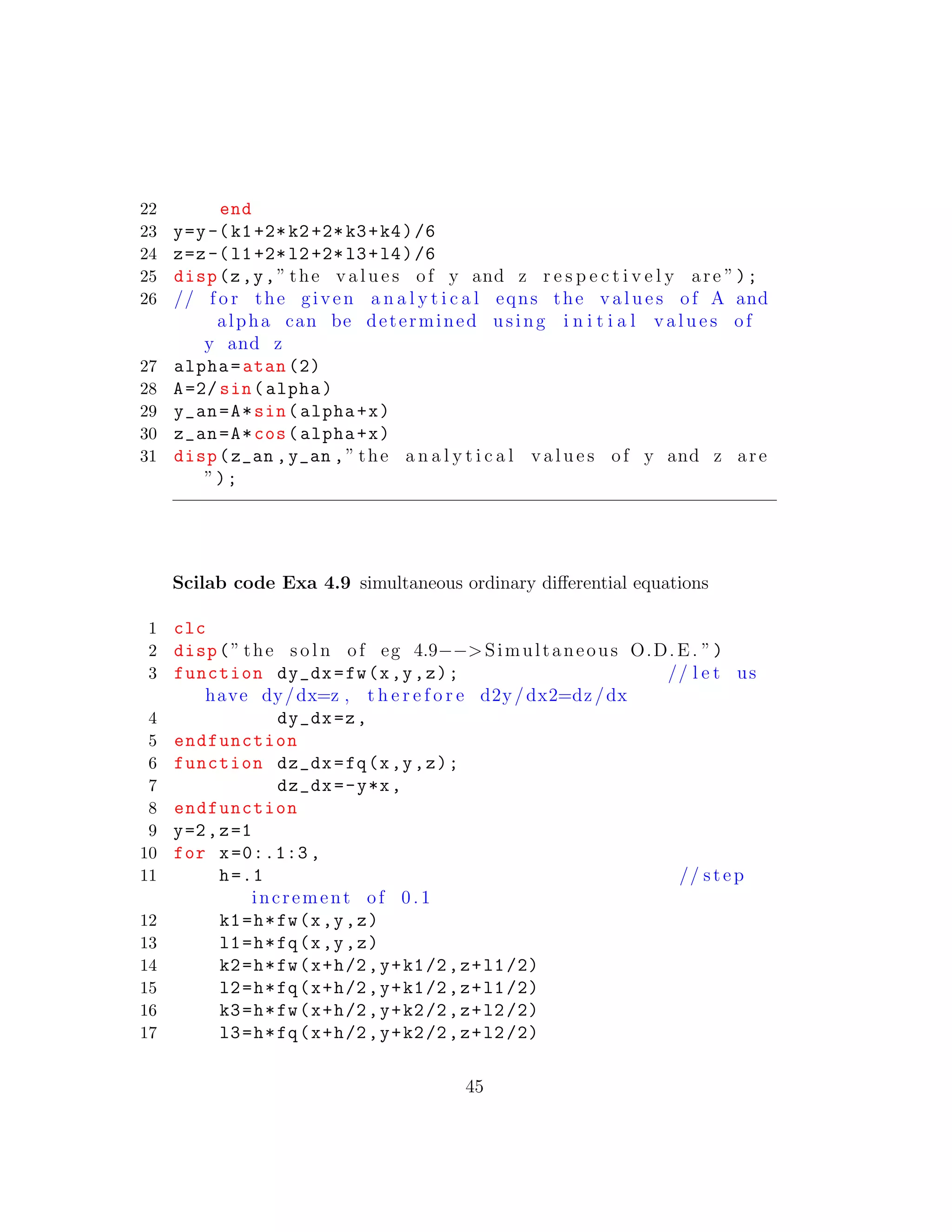
17 l3=h*fq(x+h/2,y+k2/2,z+l2/2)
45
18 k4=h*fw(x+h,y+k3 ,z+l3)
19 l4=h*fq(x+h,y+k3 ,z+l3)
20 y=y+(k1+2*k2+2*k3+k4)/6
21 z=z+(l1+2*l2+2*l3+l4)/6
22 end
23 y=y-(k1+2*k2+2*k3+k4)/6
24 z=z-(l1+2*l2+2*l3+l4)/6
25 disp(z,y,” the v a l u e s of y and z r e p e c t i v e l y are ”);
Scilab code Exa 4.10 series of stirred tank with coil heater
1 clc
2 disp(” the s o l u t i o n of eg 4.10 −−>S e r i e s of S t i r r e d
Tanks with Coil Heaters ”)
3
4 Cp=2000 ,A=1,U=200,m=1000 , mdot=2,Ts=250
// given data
5 T0=20, T1=0, T2=0, T3=0
6
7 // from energy balances f o r the tanks we have
accumulation=i n l e t −o u t l e t
8 T1_steady =( mdot*Cp*(T0)+U*A*(Ts))/( mdot*Cp+U*A)
9 disp(T1_steady ,” the steady s t a t e temperature of tank
1 i s ”);
10 T2_steady =( mdot*Cp*( T1_steady)+U*A*(Ts))/( mdot*Cp+U*
A)
11 disp(T2_steady ,” the steady s t a t e temperature of tank
2 i s ”);
12 T3_steady =( mdot*Cp*( T2_steady)+U*A*(Ts))/( mdot*Cp+U*
A)
13 disp(T3_steady ,” the steady s t a t e temperature of tank
3 i s ”);
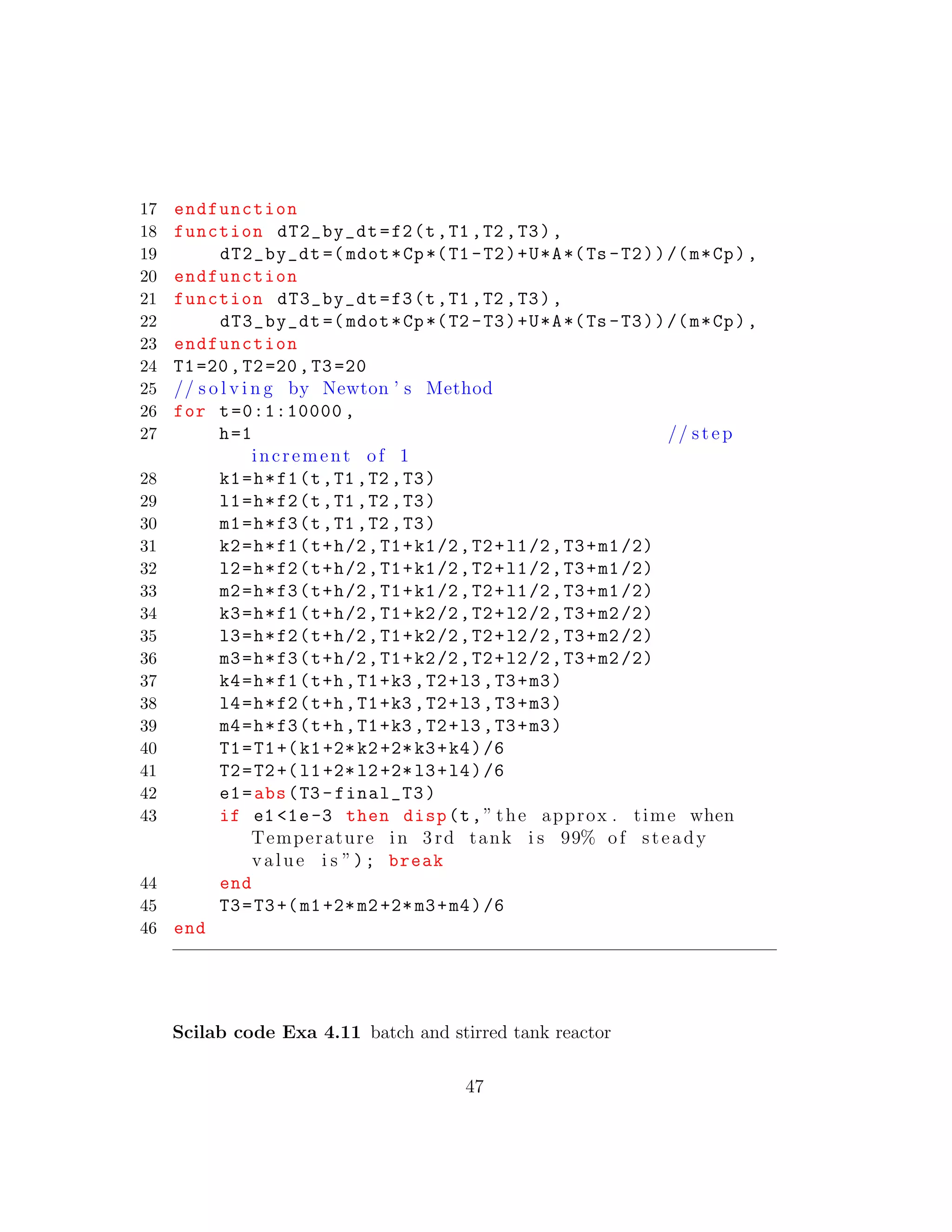
14 final_T3 =.99* T3_steady
15 function dT1_by_dt=f1(t,T1 ,T2 ,T3),
16 dT1_by_dt =( mdot*Cp*(T0 -T1)+U*A*(Ts -T1))/(m*Cp),
46
17 endfunction
18 function dT2_by_dt=f2(t,T1 ,T2 ,T3),
19 dT2_by_dt =( mdot*Cp*(T1 -T2)+U*A*(Ts -T2))/(m*Cp),
20 endfunction
21 function dT3_by_dt=f3(t,T1 ,T2 ,T3),
22 dT3_by_dt =( mdot*Cp*(T2 -T3)+U*A*(Ts -T3))/(m*Cp),
23 endfunction
24 T1=20,T2=20,T3=20
25 // s o l v i n g by Newton ’ s Method
26 for t=0:1:10000 ,
27 h=1 // step
increment of 1
28 k1=h*f1(t,T1 ,T2 ,T3)
29 l1=h*f2(t,T1 ,T2 ,T3)
30 m1=h*f3(t,T1 ,T2 ,T3)
31 k2=h*f1(t+h/2,T1+k1/2,T2+l1/2,T3+m1/2)
32 l2=h*f2(t+h/2,T1+k1/2,T2+l1/2,T3+m1/2)
33 m2=h*f3(t+h/2,T1+k1/2,T2+l1/2,T3+m1/2)
34 k3=h*f1(t+h/2,T1+k2/2,T2+l2/2,T3+m2/2)
35 l3=h*f2(t+h/2,T1+k2/2,T2+l2/2,T3+m2/2)
36 m3=h*f3(t+h/2,T1+k2/2,T2+l2/2,T3+m2/2)
37 k4=h*f1(t+h,T1+k3 ,T2+l3 ,T3+m3)
38 l4=h*f2(t+h,T1+k3 ,T2+l3 ,T3+m3)
39 m4=h*f3(t+h,T1+k3 ,T2+l3 ,T3+m3)
40 T1=T1+(k1+2*k2+2*k3+k4)/6
41 T2=T2+(l1+2*l2+2*l3+l4)/6
42 e1=abs(T3 -final_T3)
43 if e1 <1e-3 then disp(t,” the approx . time when
Temperature in 3 rd tank i s 99% of steady
value i s ”); break
44 end
45 T3=T3+(m1+2*m2+2*m3+m4)/6
46 end
Scilab code Exa 4.11 batch and stirred tank reactor
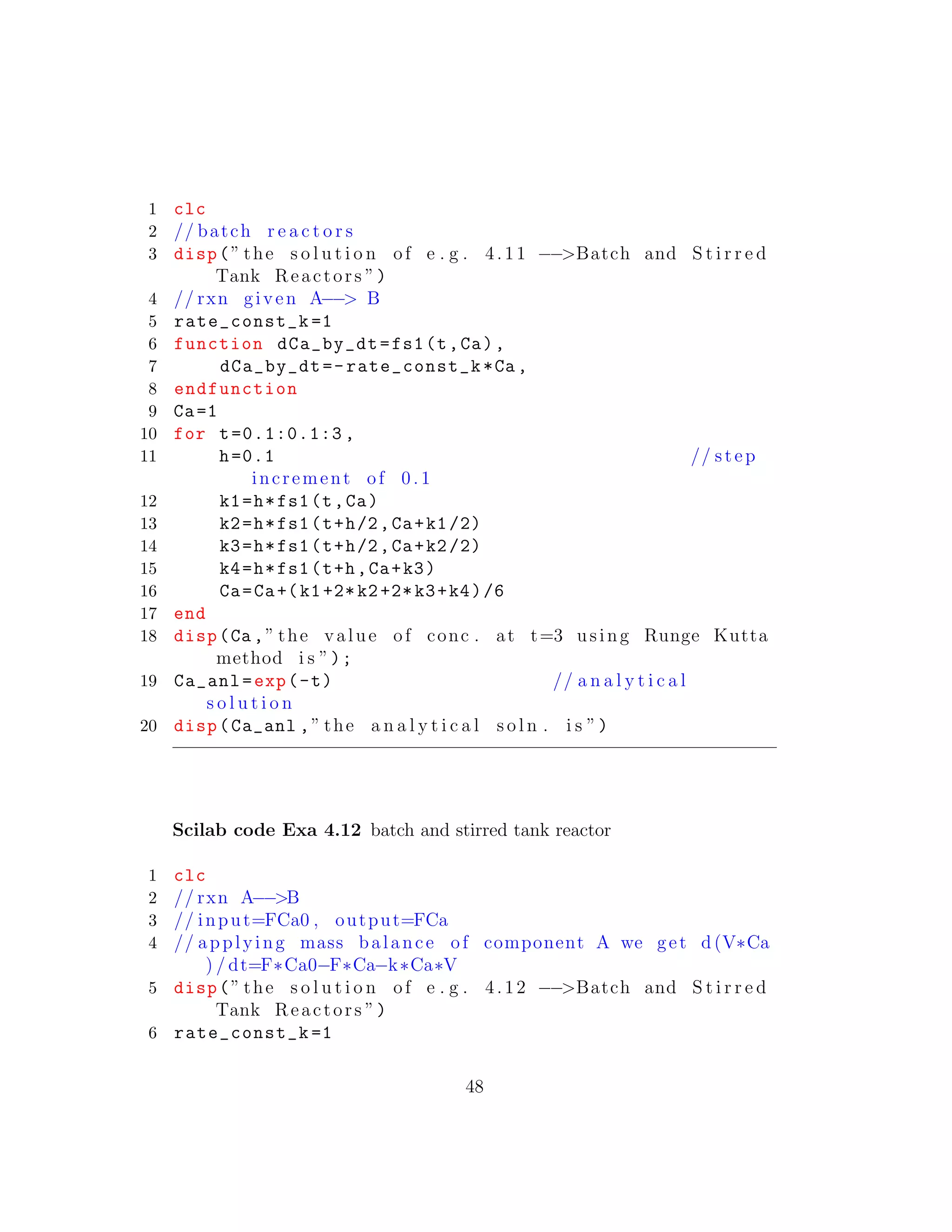
47
1 clc
2 // batch r e a c t o r s
3 disp(” the s o l u t i o n of e . g . 4.11 −−>Batch and S t i r r e d
Tank Reactors ”)
4 // rxn given A−−> B
5 rate_const_k =1
6 function dCa_by_dt=fs1(t,Ca),
7 dCa_by_dt=-rate_const_k*Ca ,
8 endfunction
9 Ca=1
10 for t=0.1:0.1:3 ,
11 h=0.1 // step
increment of 0 .1
12 k1=h*fs1(t,Ca)
13 k2=h*fs1(t+h/2,Ca+k1/2)
14 k3=h*fs1(t+h/2,Ca+k2/2)
15 k4=h*fs1(t+h,Ca+k3)
16 Ca=Ca+(k1+2*k2+2*k3+k4)/6
17 end
18 disp(Ca ,” the value of conc . at t=3 using Runge Kutta
method i s ”);
19 Ca_anl=exp(-t) // a n a l y t i c a l
s o l u t i o n
20 disp(Ca_anl ,” the a n a l y t i c a l s o l n . i s ”)
Scilab code Exa 4.12 batch and stirred tank reactor
1 clc
2 // rxn A−−>B
3 // input=FCa0 , output=FCa
4 // applying mass balance of component A we get d (V∗Ca
) / dt=F∗Ca0−F∗Ca−k∗Ca∗V
5 disp(” the s o l u t i o n of e . g . 4.12 −−>Batch and S t i r r e d
Tank Reactors ”)
6 rate_const_k =1
48
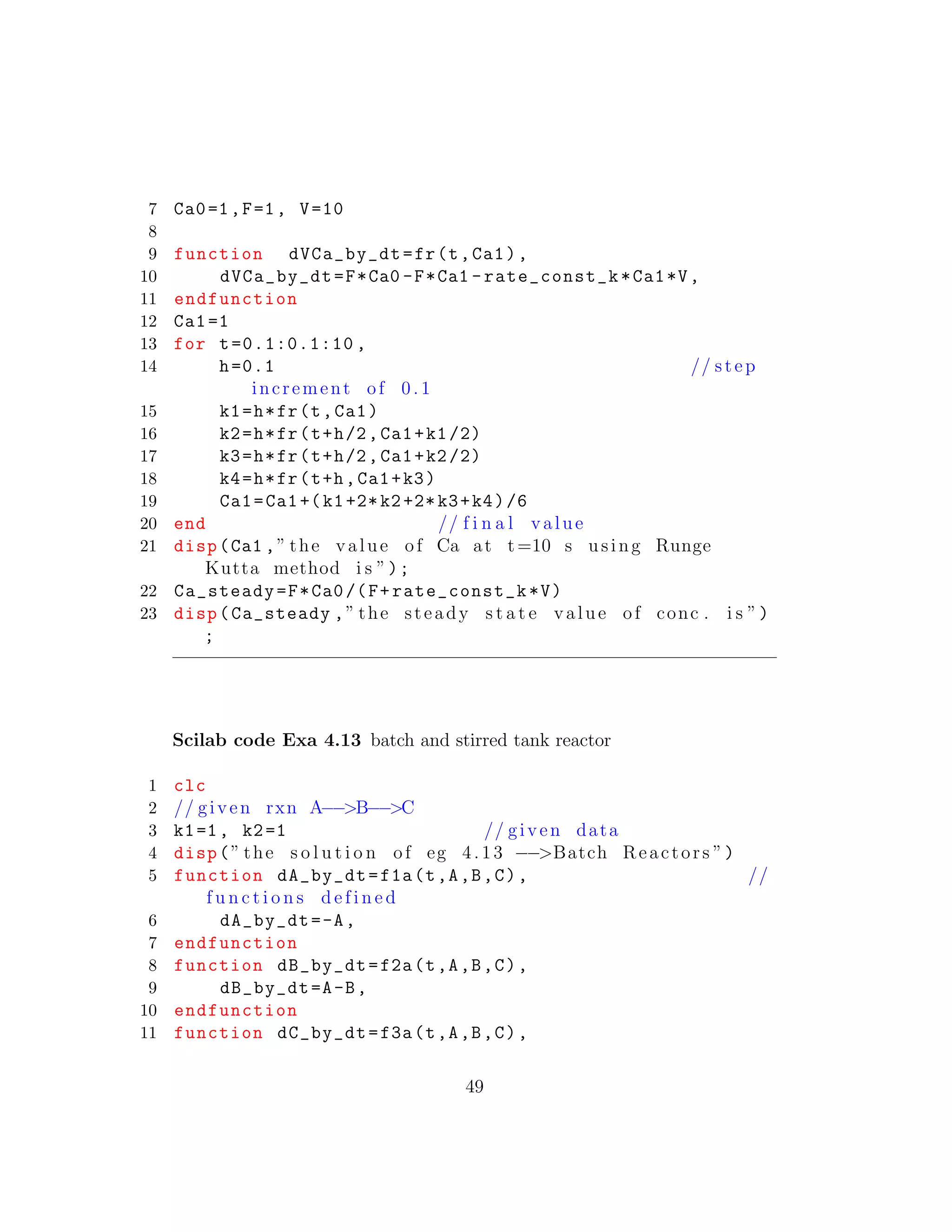
7 Ca0=1,F=1, V=10
8
9 function dVCa_by_dt=fr(t,Ca1),
10 dVCa_by_dt=F*Ca0 -F*Ca1 -rate_const_k*Ca1*V,
11 endfunction
12 Ca1=1
13 for t=0.1:0.1:10 ,
14 h=0.1 // step
increment of 0 .1
15 k1=h*fr(t,Ca1)
16 k2=h*fr(t+h/2,Ca1+k1/2)
17 k3=h*fr(t+h/2,Ca1+k2/2)
18 k4=h*fr(t+h,Ca1+k3)
19 Ca1=Ca1+(k1+2*k2+2*k3+k4)/6
20 end // f i n a l value
21 disp(Ca1 ,” the value of Ca at t=10 s using Runge
Kutta method i s ”);
22 Ca_steady=F*Ca0/(F+rate_const_k*V)
23 disp(Ca_steady ,” the steady s t a t e value of conc . i s ”)
;
Scilab code Exa 4.13 batch and stirred tank reactor
1 clc
2 // given rxn A−−>B−−>C
3 k1=1, k2=1 // given data
4 disp(” the s o l u t i o n of eg 4.13 −−>Batch Reactors ”)
5 function dA_by_dt=f1a(t,A,B,C), //
f u n c t i o n s d e f i n e d
6 dA_by_dt=-A,
7 endfunction
8 function dB_by_dt=f2a(t,A,B,C),
9 dB_by_dt=A-B,
10 endfunction
11 function dC_by_dt=f3a(t,A,B,C),
49
12 dC_by_dt=B,
13 endfunction
14 A=1,B=0,C=0 // i n i t i a l v a l u e s
15 for t=0.1:.1:10 ,
16 h=.1 // step
increment of 0 .1
17 k1=h*f1a(t,A,B,C)
18 l1=h*f2a(t,A,B,C)
19 m1=h*f3a(t,A,B,C)
20 k2=h*f1a(t+h/2,A+k1/2,B+l1/2,C+m1/2)
21 l2=h*f2a(t+h/2,A+k1/2,B+l1/2,C+m1/2)
22 m2=h*f3a(t+h/2,A+k1/2,B+l1/2,C+m1/2)
23 k3=h*f1a(t+h/2,A+k2/2,B+l2/2,C+m2/2)
24 l3=h*f2a(t+h/2,A+k2/2,B+l2/2,C+m2/2)
25 m3=h*f3a(t+h/2,A+k2/2,B+l2/2,C+m2/2)
26 k4=h*f1a(t+h,A+k3 ,B+l3 ,C+m3)
27 l4=h*f2a(t+h,A+k3 ,B+l3 ,C+m3)
28 m4=h*f3a(t+h,A+k3 ,B+l3 ,C+m3)
29 A=A+(k1+2*k2+2*k3+k4)/6
30 B=B+(l1+2*l2+2*l3+l4)/6
31 C=C+(m1+2*m2+2*m3+m4)/6
32 if t==.5 |t==1|t==2|t==5 then disp(C,B,A,” s e c s
i s ”,t,” the conc . of A,B,C a f t e r ”);
33 end
34 end
35 disp(C,B,A,” the conc . of A,B,C a f t e r 10 s e c s
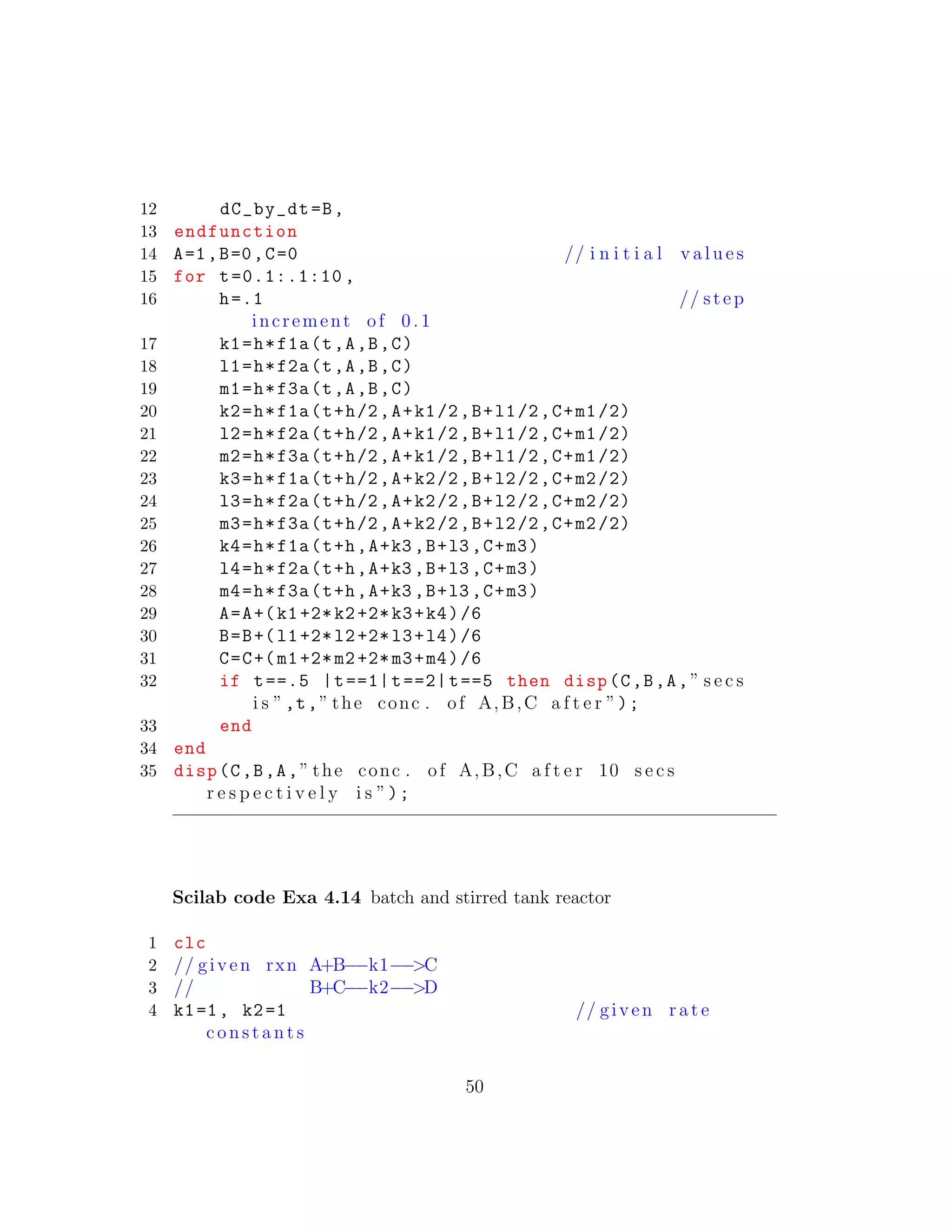
r e s p e c t i v e l y i s ”);
Scilab code Exa 4.14 batch and stirred tank reactor
1 clc
2 // given rxn A+B−−k1−−>C
3 // B+C−−k2−−>D
4 k1=1, k2=1 // given r a t e
c o n s t a n t s
50
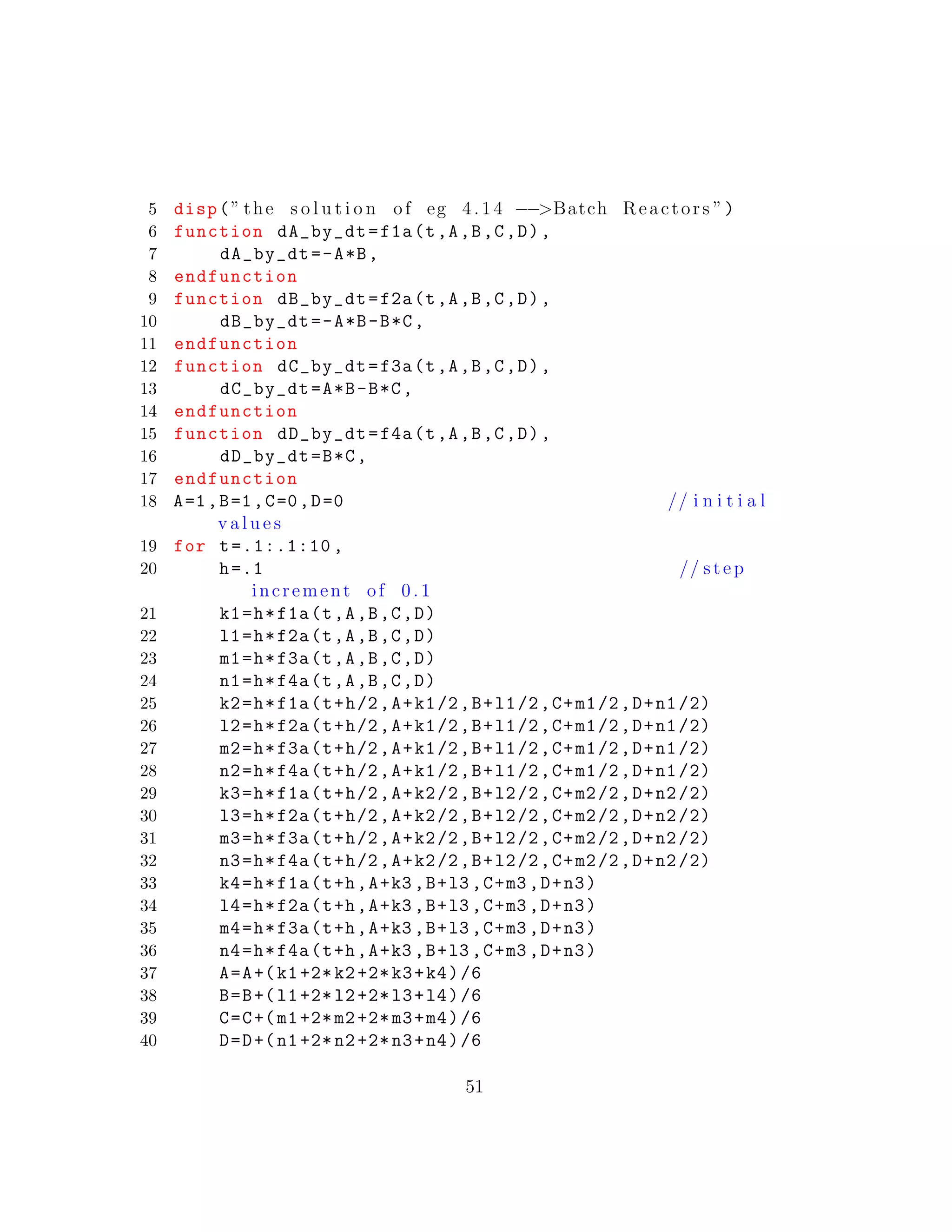
5 disp(” the s o l u t i o n of eg 4.14 −−>Batch Reactors ”)
6 function dA_by_dt=f1a(t,A,B,C,D),
7 dA_by_dt=-A*B,
8 endfunction
9 function dB_by_dt=f2a(t,A,B,C,D),
10 dB_by_dt=-A*B-B*C,
11 endfunction
12 function dC_by_dt=f3a(t,A,B,C,D),
13 dC_by_dt=A*B-B*C,
14 endfunction
15 function dD_by_dt=f4a(t,A,B,C,D),
16 dD_by_dt=B*C,
17 endfunction
18 A=1,B=1,C=0,D=0 // i n i t i a l
v a l u e s
19 for t=.1:.1:10 ,
20 h=.1 // step
increment of 0 .1
21 k1=h*f1a(t,A,B,C,D)
22 l1=h*f2a(t,A,B,C,D)
23 m1=h*f3a(t,A,B,C,D)
24 n1=h*f4a(t,A,B,C,D)
25 k2=h*f1a(t+h/2,A+k1/2,B+l1/2,C+m1/2,D+n1/2)
26 l2=h*f2a(t+h/2,A+k1/2,B+l1/2,C+m1/2,D+n1/2)
27 m2=h*f3a(t+h/2,A+k1/2,B+l1/2,C+m1/2,D+n1/2)
28 n2=h*f4a(t+h/2,A+k1/2,B+l1/2,C+m1/2,D+n1/2)
29 k3=h*f1a(t+h/2,A+k2/2,B+l2/2,C+m2/2,D+n2/2)
30 l3=h*f2a(t+h/2,A+k2/2,B+l2/2,C+m2/2,D+n2/2)
31 m3=h*f3a(t+h/2,A+k2/2,B+l2/2,C+m2/2,D+n2/2)
32 n3=h*f4a(t+h/2,A+k2/2,B+l2/2,C+m2/2,D+n2/2)
33 k4=h*f1a(t+h,A+k3 ,B+l3 ,C+m3 ,D+n3)
34 l4=h*f2a(t+h,A+k3 ,B+l3 ,C+m3 ,D+n3)
35 m4=h*f3a(t+h,A+k3 ,B+l3 ,C+m3 ,D+n3)
36 n4=h*f4a(t+h,A+k3 ,B+l3 ,C+m3 ,D+n3)
37 A=A+(k1+2*k2+2*k3+k4)/6
38 B=B+(l1+2*l2+2*l3+l4)/6
39 C=C+(m1+2*m2+2*m3+m4)/6
40 D=D+(n1+2*n2+2*n3+n4)/6
51
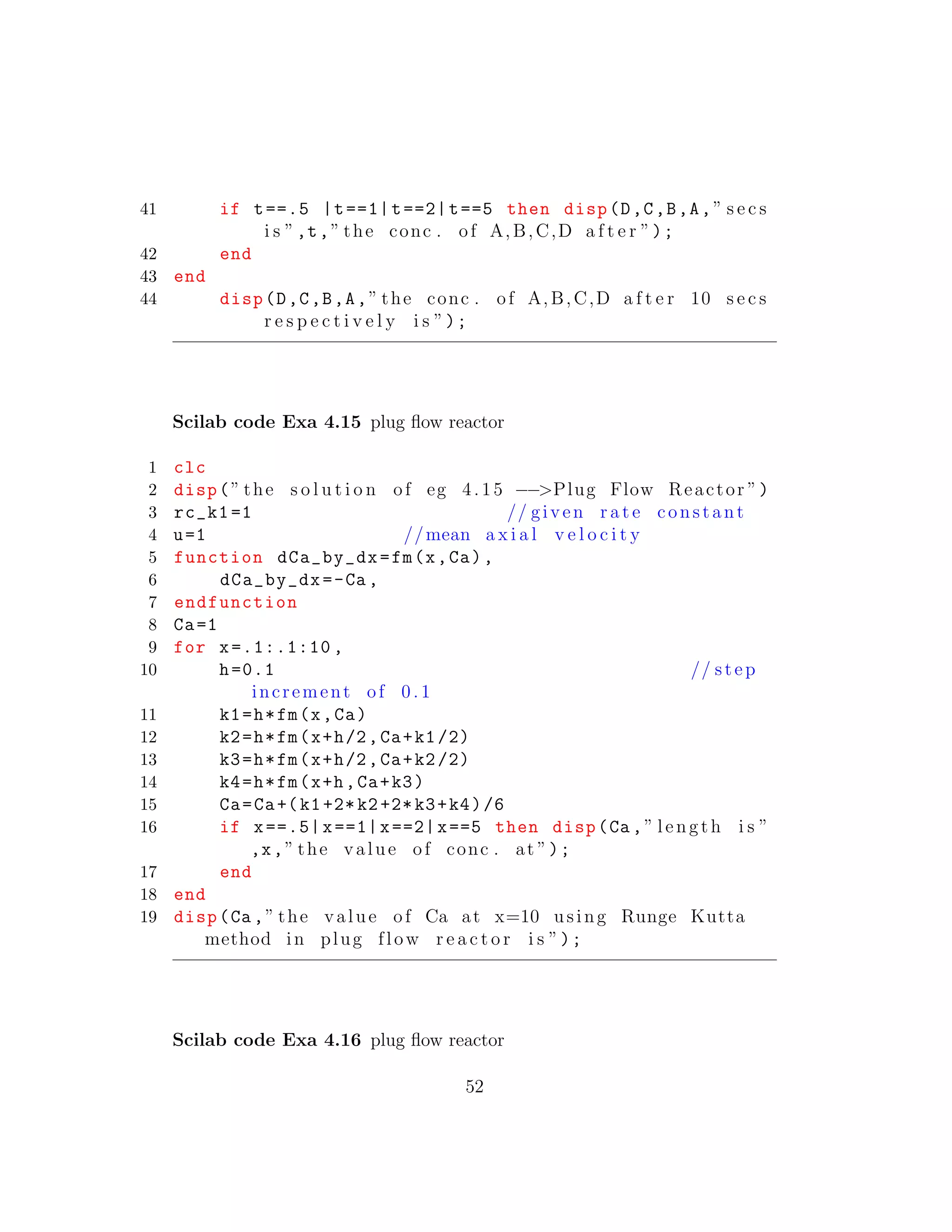
41 if t==.5 |t==1|t==2|t==5 then disp(D,C,B,A,” s e c s
i s ”,t,” the conc . of A,B,C,D a f t e r ”);
42 end
43 end
44 disp(D,C,B,A,” the conc . of A,B,C,D a f t e r 10 s e c s
r e s p e c t i v e l y i s ”);
Scilab code Exa 4.15 plug flow reactor
1 clc
2 disp(” the s o l u t i o n of eg 4.15 −−>Plug Flow Reactor ”)
3 rc_k1 =1 // given r a t e constant
4 u=1 //mean a x i a l v e l o c i t y
5 function dCa_by_dx=fm(x,Ca),
6 dCa_by_dx=-Ca ,
7 endfunction
8 Ca=1
9 for x=.1:.1:10 ,
10 h=0.1 // step
increment of 0 .1
11 k1=h*fm(x,Ca)
12 k2=h*fm(x+h/2,Ca+k1/2)
13 k3=h*fm(x+h/2,Ca+k2/2)
14 k4=h*fm(x+h,Ca+k3)
15 Ca=Ca+(k1+2*k2+2*k3+k4)/6
16 if x==.5|x==1|x==2|x==5 then disp(Ca ,” length i s ”
,x,” the value of conc . at ”);
17 end
18 end
19 disp(Ca ,” the value of Ca at x=10 using Runge Kutta
method in plug flow r e a c t o r i s ”);
Scilab code Exa 4.16 plug flow reactor
52
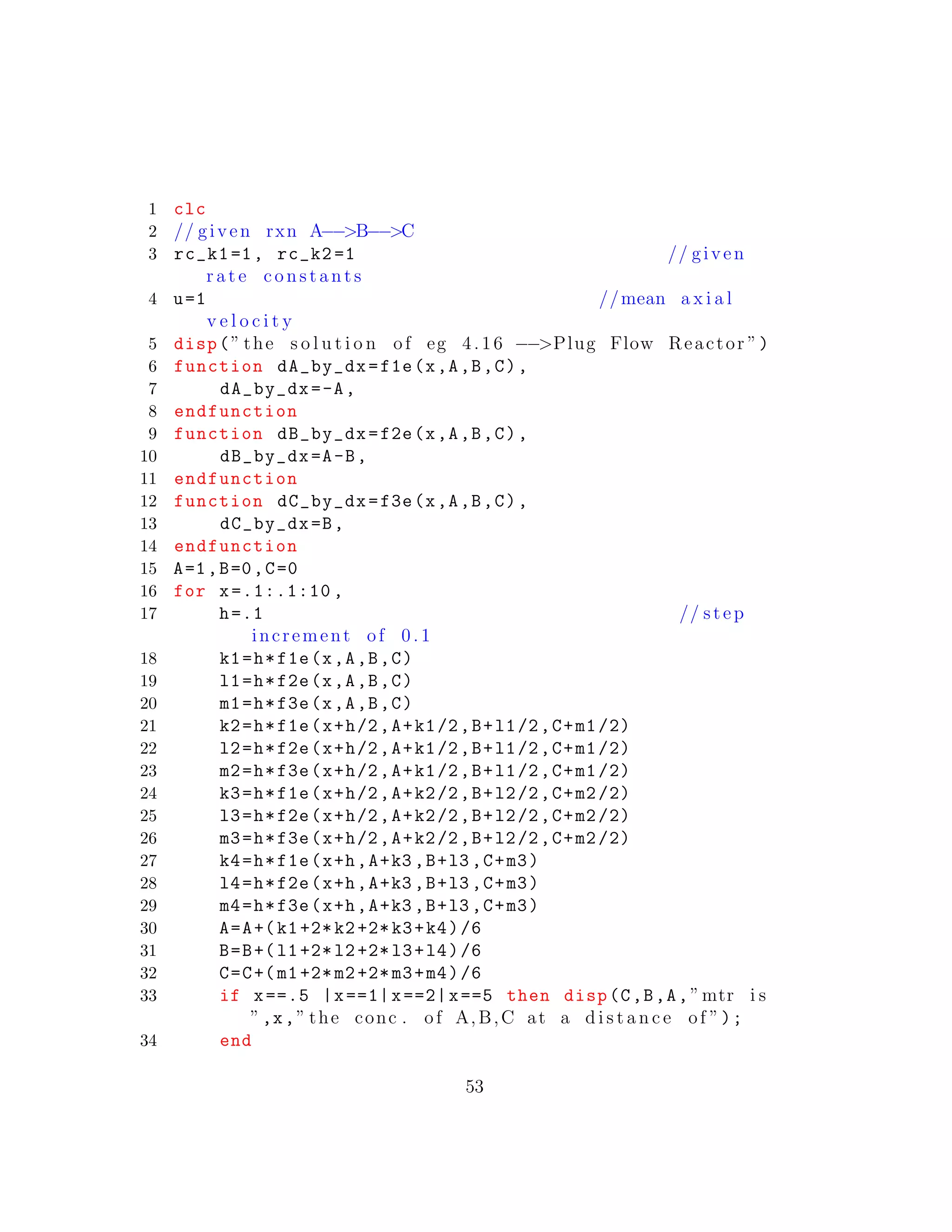
1 clc
2 // given rxn A−−>B−−>C
3 rc_k1=1, rc_k2 =1 // given
r a t e c o n s t a n t s
4 u=1 //mean a x i a l
v e l o c i t y
5 disp(” the s o l u t i o n of eg 4.16 −−>Plug Flow Reactor ”)
6 function dA_by_dx=f1e(x,A,B,C),
7 dA_by_dx=-A,
8 endfunction
9 function dB_by_dx=f2e(x,A,B,C),
10 dB_by_dx=A-B,
11 endfunction
12 function dC_by_dx=f3e(x,A,B,C),
13 dC_by_dx=B,
14 endfunction
15 A=1,B=0,C=0
16 for x=.1:.1:10 ,
17 h=.1 // step
increment of 0 .1
18 k1=h*f1e(x,A,B,C)
19 l1=h*f2e(x,A,B,C)
20 m1=h*f3e(x,A,B,C)
21 k2=h*f1e(x+h/2,A+k1/2,B+l1/2,C+m1/2)
22 l2=h*f2e(x+h/2,A+k1/2,B+l1/2,C+m1/2)
23 m2=h*f3e(x+h/2,A+k1/2,B+l1/2,C+m1/2)
24 k3=h*f1e(x+h/2,A+k2/2,B+l2/2,C+m2/2)
25 l3=h*f2e(x+h/2,A+k2/2,B+l2/2,C+m2/2)
26 m3=h*f3e(x+h/2,A+k2/2,B+l2/2,C+m2/2)
27 k4=h*f1e(x+h,A+k3 ,B+l3 ,C+m3)
28 l4=h*f2e(x+h,A+k3 ,B+l3 ,C+m3)
29 m4=h*f3e(x+h,A+k3 ,B+l3 ,C+m3)
30 A=A+(k1+2*k2+2*k3+k4)/6
31 B=B+(l1+2*l2+2*l3+l4)/6
32 C=C+(m1+2*m2+2*m3+m4)/6
33 if x==.5 |x==1|x==2|x==5 then disp(C,B,A,”mtr i s
”,x,” the conc . of A,B,C at a d i s t a n c e of ”);
34 end
53
35 end
36 disp(C,B,A,” the conc . of A,B,C at a d i s t a n c e of
10 mtr i s ”);
Scilab code Exa 4.17 plug flow reactor
1 clc
2 // given rxn A+B−−k1−−>C
3 // B+C−−k2−−>D
4 rc_k1=1,rc_k2 =1 // r a t e
c o n s t a n t s
5 disp(” the s o l u t i o n of eg 4.17 −−>Plug Flow Reactor ”)
6 function dA_by_dx=f1a(x,A,B,C,D),
7 dA_by_dx=-A*B,
8 endfunction
9 function dB_by_dx=f2a(x,A,B,C,D),
10 dB_by_dx=-A*B-B*C,
11 endfunction
12 function dC_by_dx=f3a(x,A,B,C,D),
13 dC_by_dx=A*B-B*C,
14 endfunction
15 function dD_by_dx=f4a(x,A,B,C,D),
16 dD_by_dx=B*C,
17 endfunction
18 A=1,B=1,C=0,D=0
19 for x=.1:.1:10 ,
20 h=.1 // step
increment of 0 .1
21 k1=h*f1a(x,A,B,C,D)
22 l1=h*f2a(x,A,B,C,D)
23 m1=h*f3a(x,A,B,C,D)
24 n1=h*f4a(x,A,B,C,D)
25 k2=h*f1a(x+h/2,A+k1/2,B+l1/2,C+m1/2,D+n1/2)
26 l2=h*f2a(x+h/2,A+k1/2,B+l1/2,C+m1/2,D+n1/2)
27 m2=h*f3a(x+h/2,A+k1/2,B+l1/2,C+m1/2,D+n1/2)
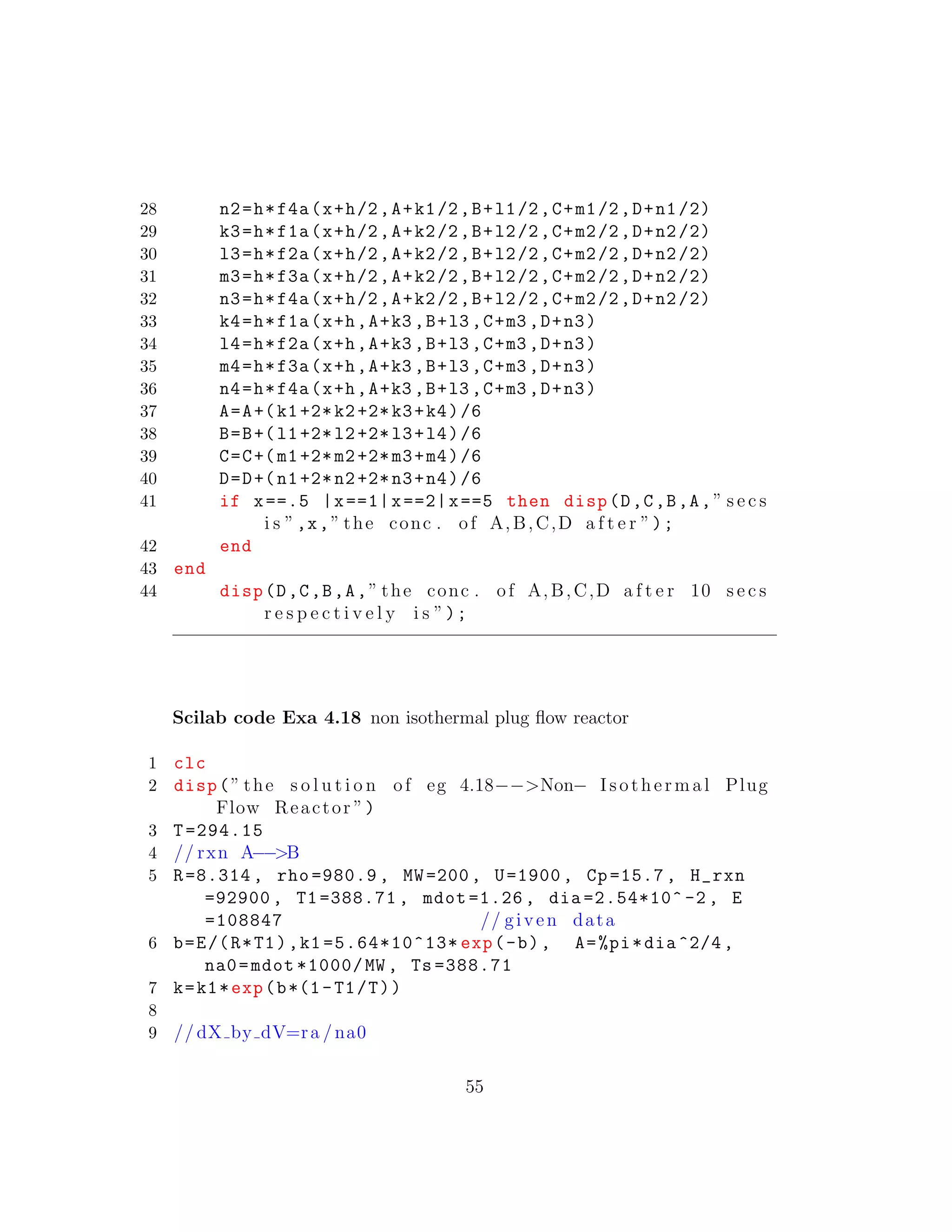
54
28 n2=h*f4a(x+h/2,A+k1/2,B+l1/2,C+m1/2,D+n1/2)
29 k3=h*f1a(x+h/2,A+k2/2,B+l2/2,C+m2/2,D+n2/2)
30 l3=h*f2a(x+h/2,A+k2/2,B+l2/2,C+m2/2,D+n2/2)
31 m3=h*f3a(x+h/2,A+k2/2,B+l2/2,C+m2/2,D+n2/2)
32 n3=h*f4a(x+h/2,A+k2/2,B+l2/2,C+m2/2,D+n2/2)
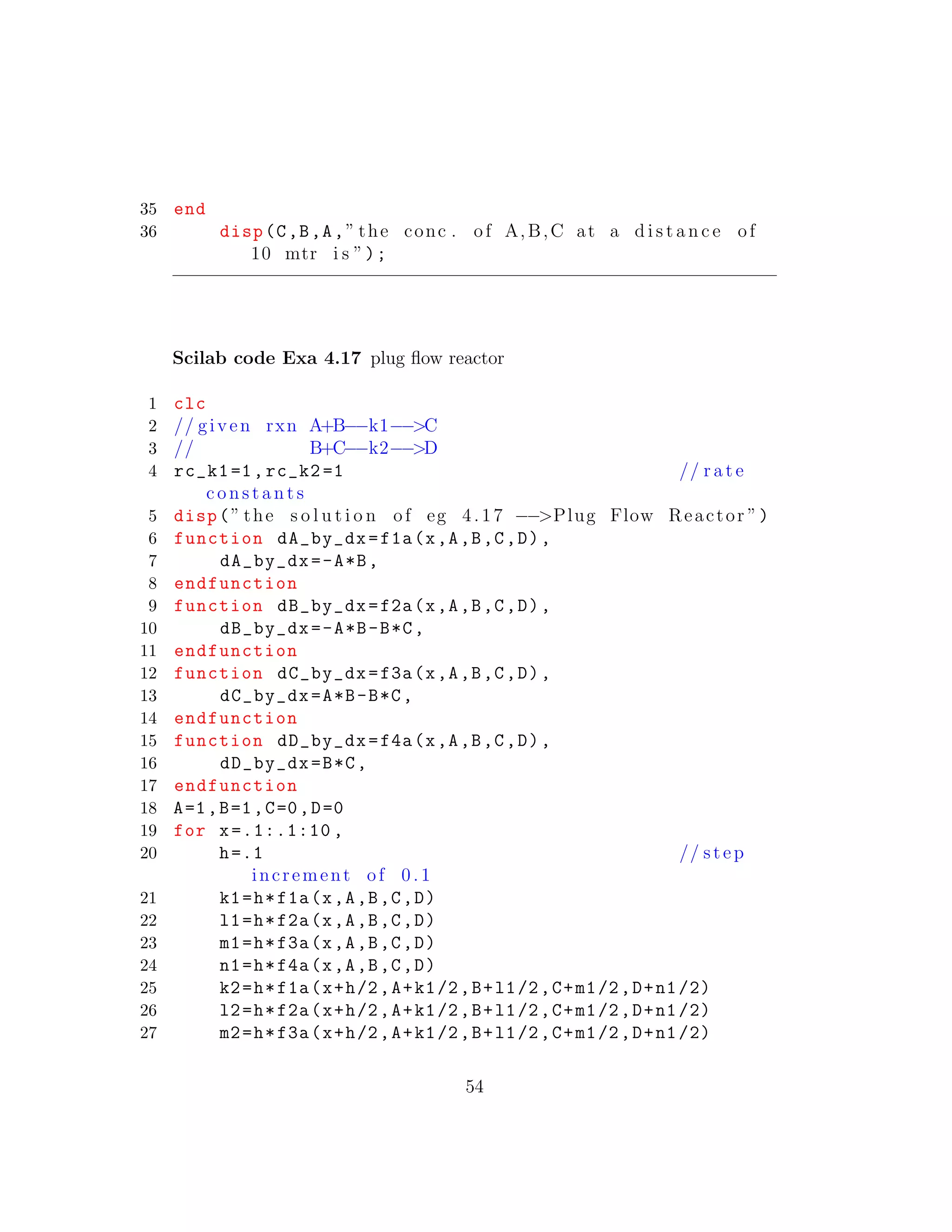
33 k4=h*f1a(x+h,A+k3 ,B+l3 ,C+m3 ,D+n3)
34 l4=h*f2a(x+h,A+k3 ,B+l3 ,C+m3 ,D+n3)
35 m4=h*f3a(x+h,A+k3 ,B+l3 ,C+m3 ,D+n3)
36 n4=h*f4a(x+h,A+k3 ,B+l3 ,C+m3 ,D+n3)
37 A=A+(k1+2*k2+2*k3+k4)/6
38 B=B+(l1+2*l2+2*l3+l4)/6
39 C=C+(m1+2*m2+2*m3+m4)/6
40 D=D+(n1+2*n2+2*n3+n4)/6
41 if x==.5 |x==1|x==2|x==5 then disp(D,C,B,A,” s e c s
i s ”,x,” the conc . of A,B,C,D a f t e r ”);
42 end
43 end
44 disp(D,C,B,A,” the conc . of A,B,C,D a f t e r 10 s e c s
r e s p e c t i v e l y i s ”);
Scilab code Exa 4.18 non isothermal plug flow reactor
1 clc
2 disp(” the s o l u t i o n of eg 4.18−−>Non− Isothermal Plug
Flow Reactor ”)
3 T=294.15
4 // rxn A−−>B
5 R=8.314 , rho =980.9 , MW=200, U=1900 , Cp=15.7 , H_rxn
=92900 , T1 =388.71 , mdot =1.26 , dia =2.54*10^ -2 , E
=108847 // given data
6 b=E/(R*T1),k1 =5.64*10^13* exp(-b), A=%pi*dia ^2/4,
na0=mdot *1000/MW , Ts =388.71
7 k=k1*exp(b*(1-T1/T))
8
9 // dX by dV=ra /na0
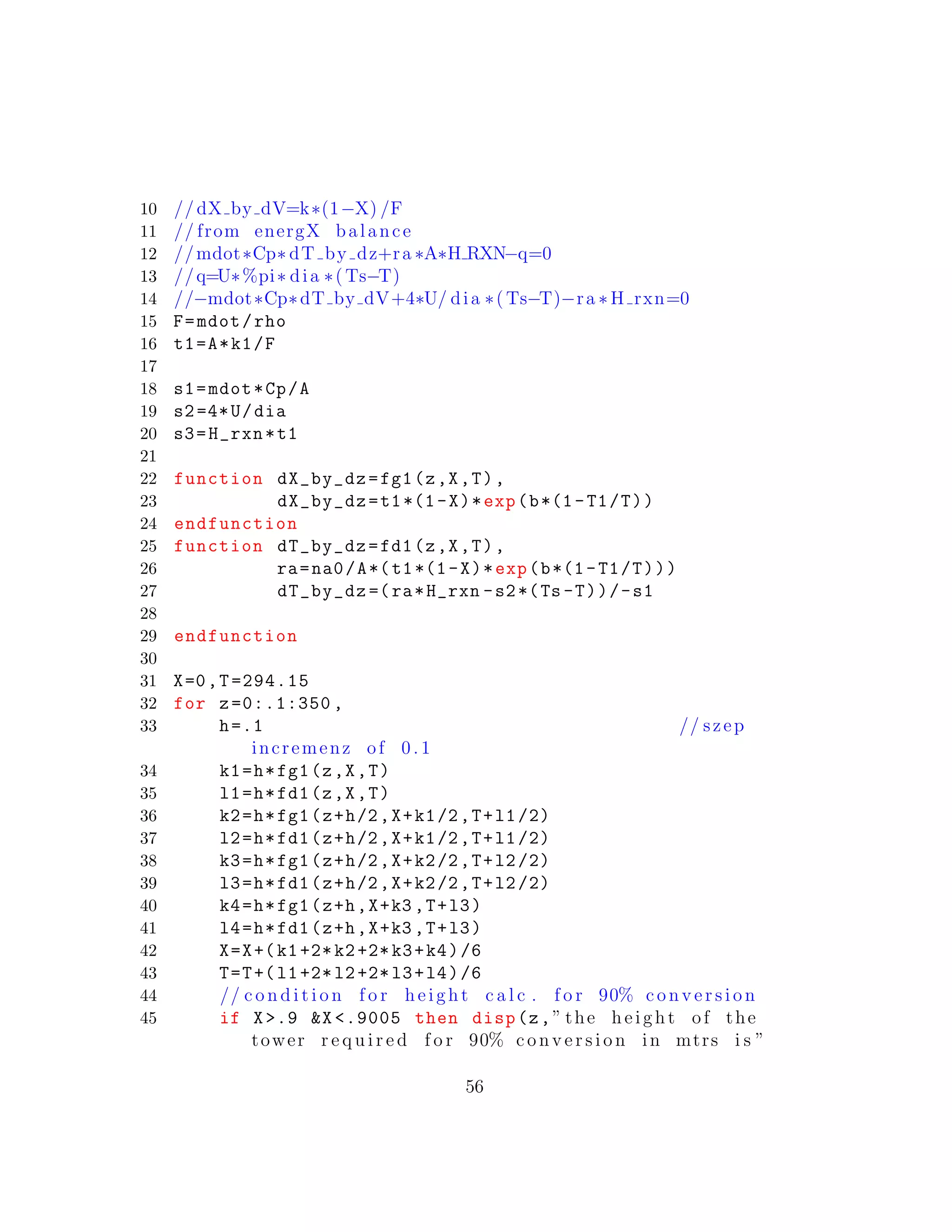
55
10 // dX by dV=k∗(1−X) /F
11 // from energX balance
12 //mdot∗Cp∗ dT by dz+ra ∗A∗H RXN−q=0
13 //q=U∗%pi∗ dia ∗( Ts−T)
14 //−mdot∗Cp∗dT by dV+4∗U/ dia ∗( Ts−T)−ra ∗ H rxn=0
15 F=mdot/rho
16 t1=A*k1/F
17
18 s1=mdot*Cp/A
19 s2=4*U/dia
20 s3=H_rxn*t1
21
22 function dX_by_dz=fg1(z,X,T),
23 dX_by_dz=t1*(1-X)*exp(b*(1-T1/T))
24 endfunction
25 function dT_by_dz=fd1(z,X,T),
26 ra=na0/A*(t1*(1-X)*exp(b*(1-T1/T)))
27 dT_by_dz =(ra*H_rxn -s2*(Ts -T))/-s1
28
29 endfunction
30
31 X=0,T=294.15
32 for z=0:.1:350 ,
33 h=.1 // szep
incremenz of 0 .1
34 k1=h*fg1(z,X,T)
35 l1=h*fd1(z,X,T)
36 k2=h*fg1(z+h/2,X+k1/2,T+l1/2)
37 l2=h*fd1(z+h/2,X+k1/2,T+l1/2)
38 k3=h*fg1(z+h/2,X+k2/2,T+l2/2)
39 l3=h*fd1(z+h/2,X+k2/2,T+l2/2)
40 k4=h*fg1(z+h,X+k3 ,T+l3)
41 l4=h*fd1(z+h,X+k3 ,T+l3)
42 X=X+(k1+2*k2+2*k3+k4)/6
43 T=T+(l1+2*l2+2*l3+l4)/6
44 // c o n d i t i o n f o r height c a l c . f o r 90% c o n v e r s i o n
45 if X>.9 &X <.9005 then disp(z,” the height of the
tower r e q u i r e d f o r 90% c o n v e r s i o n in mtrs i s ”
56
); break
46 end
47 end
57
Chapter 5
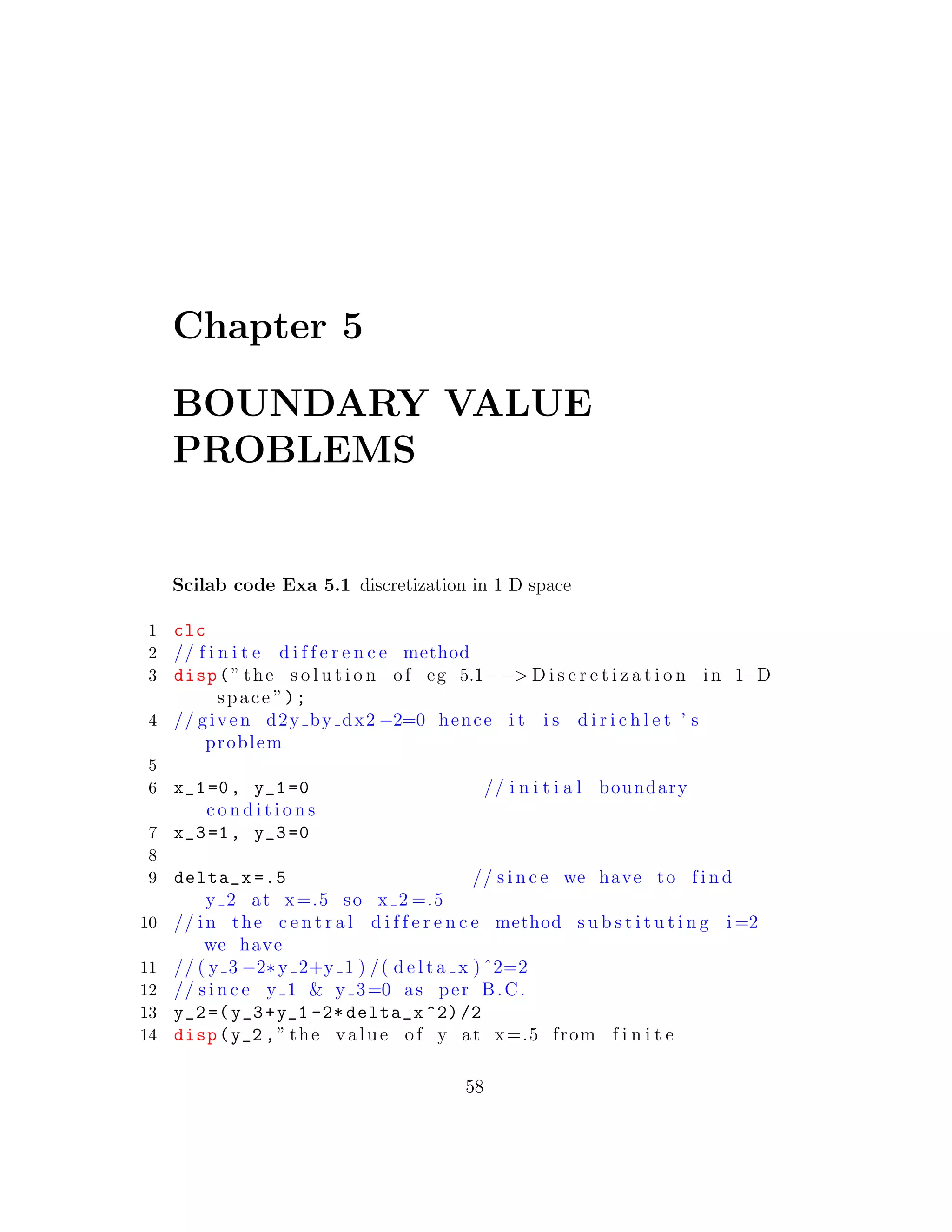
BOUNDARY VALUE
PROBLEMS
Scilab code Exa 5.1 discretization in 1 D space
1 clc
2 // f i n i t e d i f f e r e n c e method
3 disp(” the s o l u t i o n of eg 5.1−−> D i s c r e t i z a t i o n in 1−D
space ”);
4 // given d2y by dx2 −2=0 hence i t i s d i r i c h l e t ’ s
problem
5
6 x_1=0, y_1=0 // i n i t i a l boundary
c o n d i t i o n s
7 x_3=1, y_3=0
8
9 delta_x =.5 // s i n c e we have to f i n d
y 2 at x=.5 so x 2 =.5
10 // in the c e n t r a l d i f f e r e n c e method s u b s t i t u t i n g i =2
we have
11 // ( y 3 −2∗y 2+y 1 ) /( d e l t a x ) ˆ2=2
12 // s i n c e y 1 & y 3=0 as per B.C.
13 y_2=(y_3+y_1 -2* delta_x ^2)/2
14 disp(y_2 ,” the value of y at x=.5 from f i n i t e
58
d i f f e r e n c e method i s ”);
15 x=.5
16 y_exact=x^2-x
17 disp(y_exact ,” the value of y from exact s o l n at x=.5
i s ”);
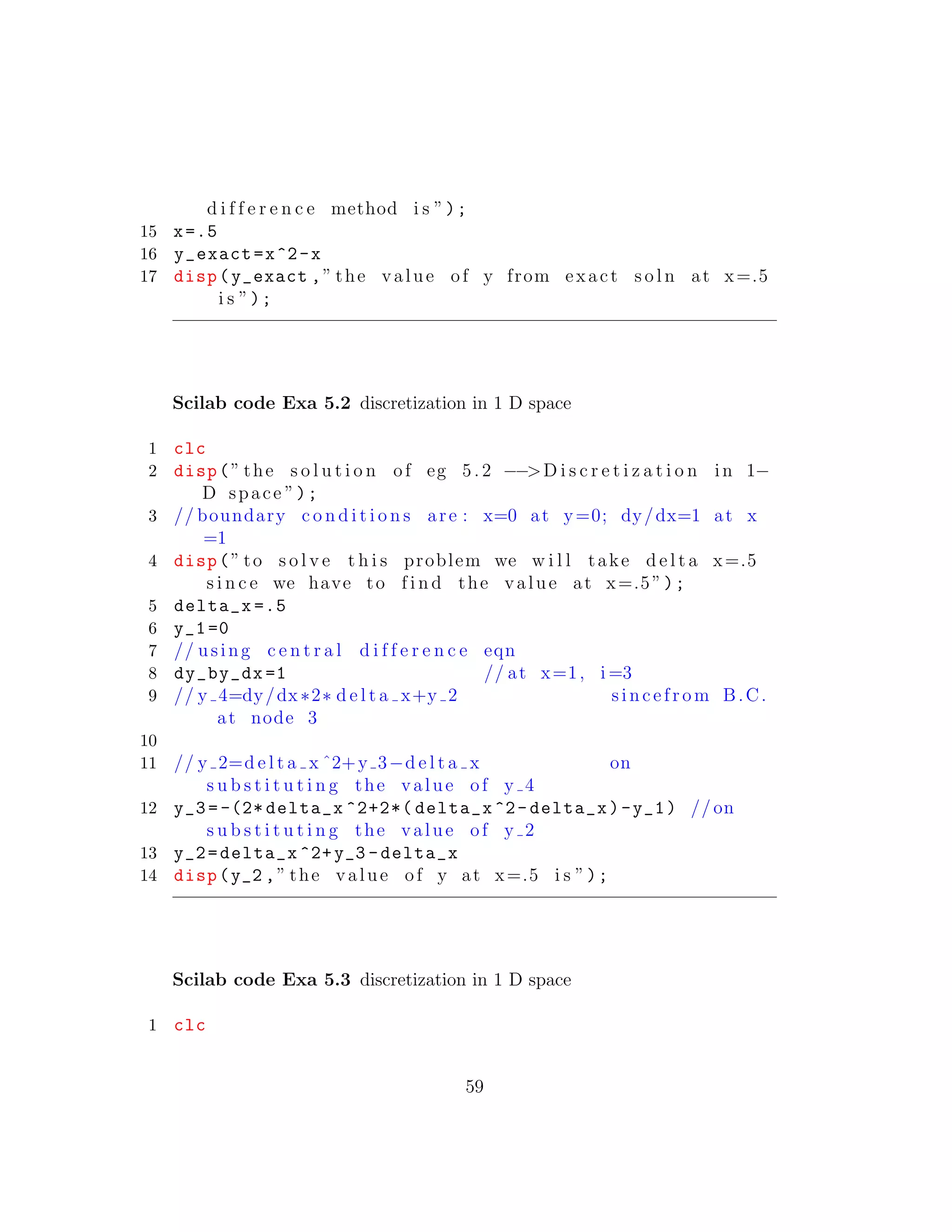
Scilab code Exa 5.2 discretization in 1 D space
1 clc
2 disp(” the s o l u t i o n of eg 5. 2 −−>D i s c r e t i z a t i o n in 1−
D space ”);
3 // boundary c o n d i t i o n s are : x=0 at y=0; dy/dx=1 at x
=1
4 disp(” to s o l v e t h i s problem we w i l l take d e l t a x=.5
s i n c e we have to f i n d the value at x=.5”);
5 delta_x =.5
6 y_1=0
7 // using c e n t r a l d i f f e r e n c e eqn
8 dy_by_dx =1 // at x=1, i =3
9 // y 4=dy/dx∗2∗ d e l t a x+y 2 sincefrom B.C.
at node 3
10
11 // y 2=d e l t a x ˆ2+y 3−d e l t a x on
s u b s t i t u t i n g the value of y 4
12 y_3 =-(2* delta_x ^2+2*( delta_x ^2- delta_x)-y_1) // on
s u b s t i t u t i n g the value of y 2
13 y_2=delta_x ^2+y_3 -delta_x
14 disp(y_2 ,” the value of y at x=.5 i s ”);
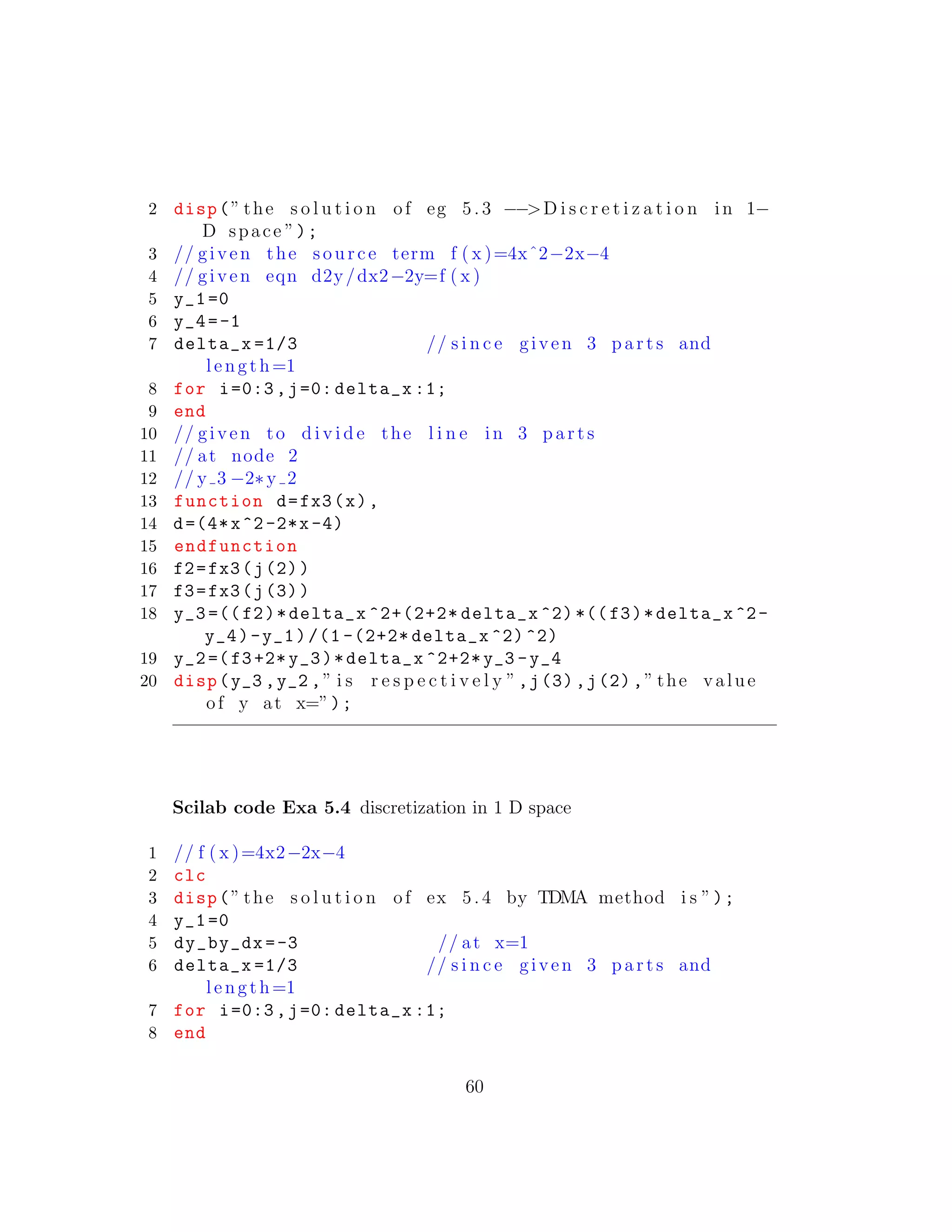
Scilab code Exa 5.3 discretization in 1 D space
1 clc
59
2 disp(” the s o l u t i o n of eg 5. 3 −−>D i s c r e t i z a t i o n in 1−
D space ”);
3 // given the source term f ( x )=4xˆ2−2x−4
4 // given eqn d2y/dx2−2y=f ( x )
5 y_1=0
6 y_4=-1
7 delta_x =1/3 // s i n c e given 3 p a r t s and
length=1
8 for i=0:3,j=0: delta_x :1;
9 end
10 // given to d i v i d e the l i n e in 3 p a r t s
11 // at node 2
12 // y 3 −2∗y 2
13 function d=fx3(x),
14 d=(4*x^2-2*x-4)
15 endfunction
16 f2=fx3(j(2))
17 f3=fx3(j(3))
18 y_3 =((f2)*delta_x ^2+(2+2* delta_x ^2) *((f3)*delta_x ^2-
y_4)-y_1)/(1 -(2+2* delta_x ^2) ^2)
19 y_2=(f3+2* y_3)*delta_x ^2+2*y_3 -y_4
20 disp(y_3 ,y_2 ,” i s r e s p e c t i v e l y ”,j(3),j(2),” the value
of y at x=”);
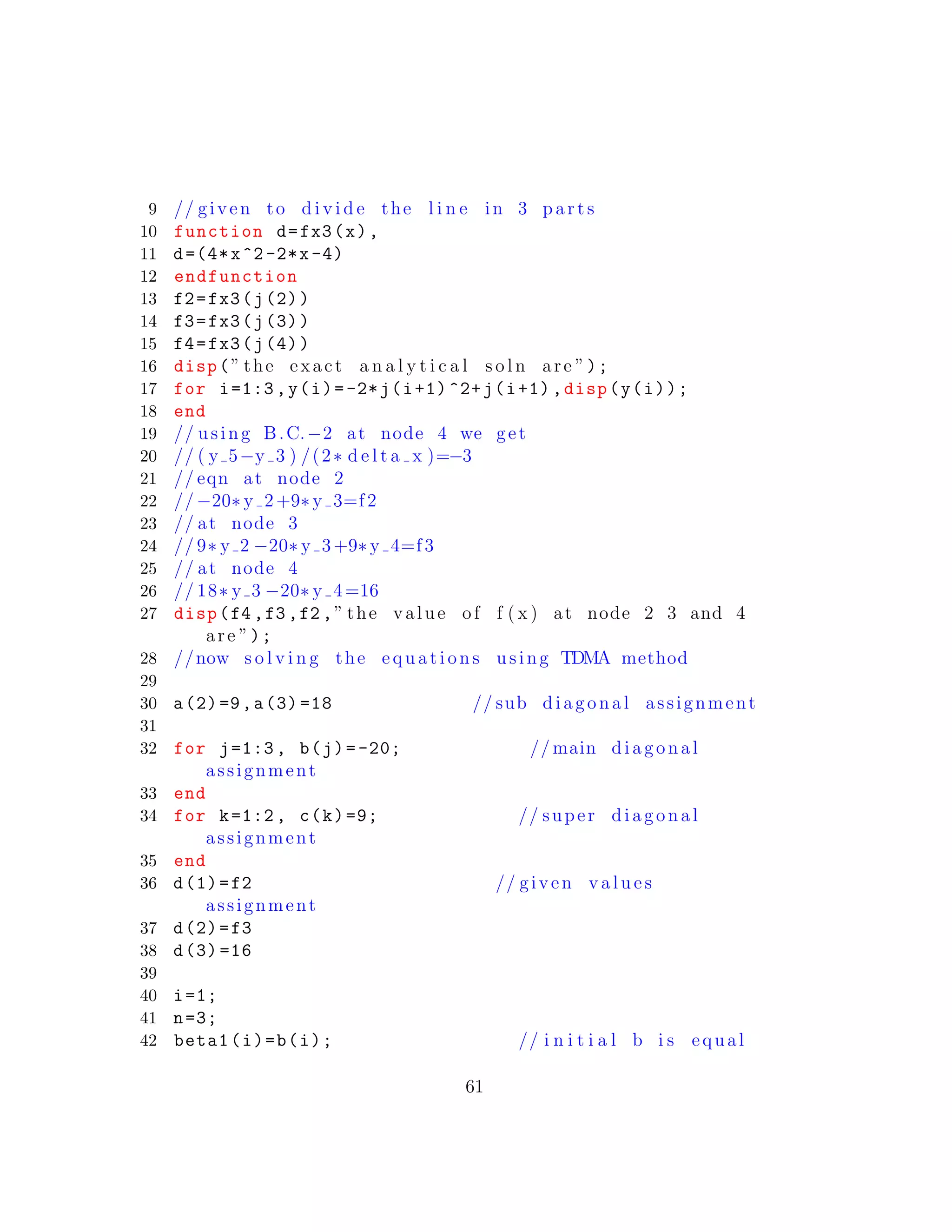
Scilab code Exa 5.4 discretization in 1 D space
1 // f ( x )=4x2−2x−4
2 clc
3 disp(” the s o l u t i o n of ex 5.4 by TDMA method i s ”);
4 y_1=0
5 dy_by_dx =-3 // at x=1
6 delta_x =1/3 // s i n c e given 3 p a r t s and
length=1
7 for i=0:3,j=0: delta_x :1;
8 end
60
9 // given to d i v i d e the l i n e in 3 p a r t s
10 function d=fx3(x),
11 d=(4*x^2-2*x-4)
12 endfunction
13 f2=fx3(j(2))
14 f3=fx3(j(3))
15 f4=fx3(j(4))
16 disp(” the exact a n a l y t i c a l s o l n are ”);
17 for i=1:3,y(i)=-2*j(i+1) ^2+j(i+1),disp(y(i));
18 end
19 // using B.C.−2 at node 4 we get
20 // ( y 5−y 3 ) /(2∗ d e l t a x )=−3
21 // eqn at node 2
22 // −20∗ y 2+9∗y 3=f2
23 // at node 3
24 // 9∗ y 2 −20∗ y 3+9∗y 4=f3
25 // at node 4
26 // 18∗ y 3 −20∗ y 4 =16
27 disp(f4 ,f3 ,f2 ,” the value of f ( x ) at node 2 3 and 4
are ”);
28 //now s o l v i n g the equations using TDMA method
29
30 a(2)=9,a(3) =18 // sub diagonal assignment
31
32 for j=1:3, b(j)=-20; // main diagonal
assignment
33 end
34 for k=1:2, c(k)=9; // super diagonal
assignment
35 end
36 d(1)=f2 // given v a l u e s
assignment
37 d(2)=f3
38 d(3) =16
39
40 i=1;
41 n=3;
42 beta1(i)=b(i); // i n i t i a l b i s equal
61
to beta s i n c e a1=0
43 gamma1(i)=d(i)/beta1(i); // s i n c e c7=0
44 m=i+1;
45 for j=m:n, beta1(j)=b(j)-a(j)*c(j-1)/beta1(j-1);
46 gamma1(j)=(d(j)-a(j)*gamma1(j-1))/beta1(j);
47 end
48 x(n)=gamma1(n); // s i n c e c7=0
49 n1=n-i;
50 for k=1:n1 , j=n-k; x(j)=gamma1(j)-c(j)*x(j+1)/beta1(
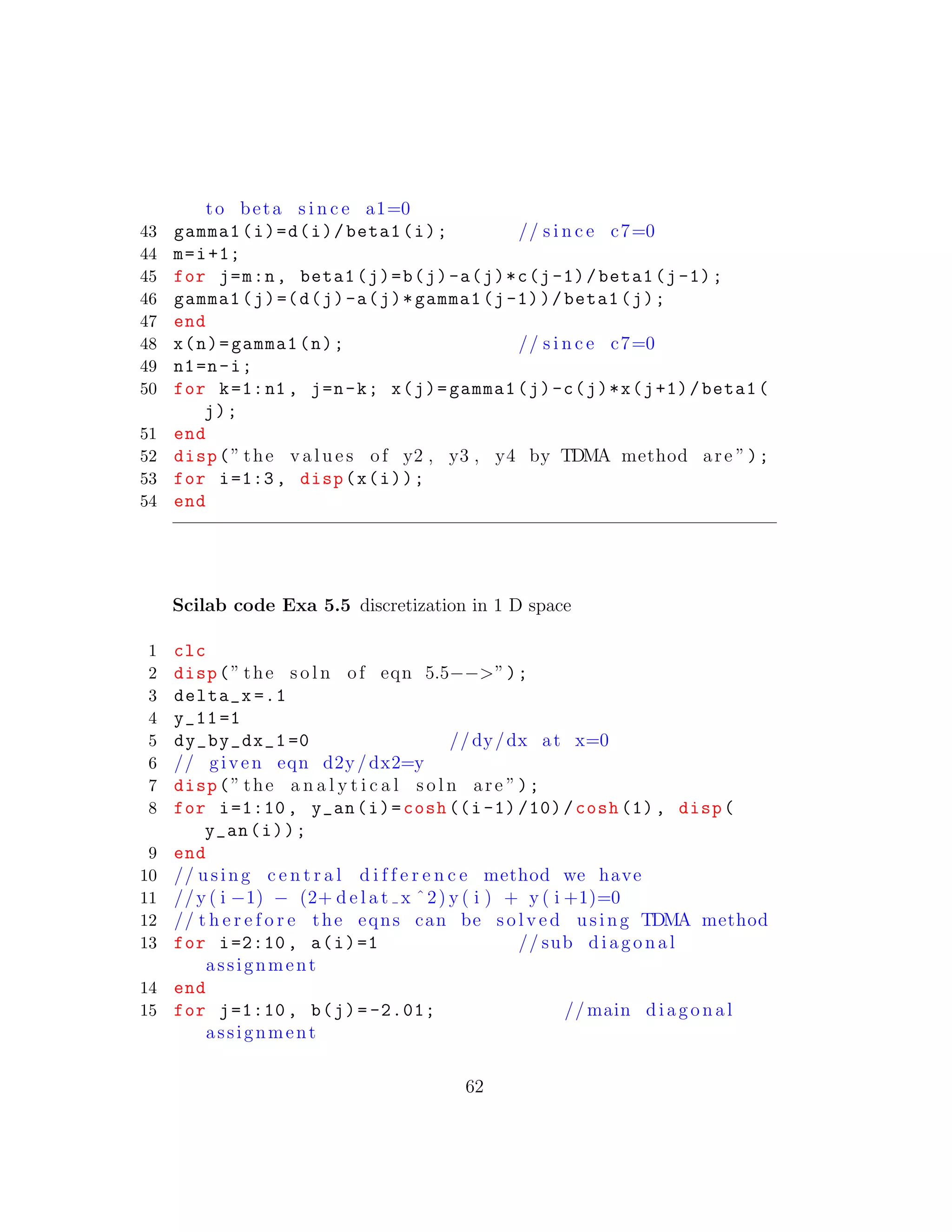
j);
51 end
52 disp(” the v a l u e s of y2 , y3 , y4 by TDMA method are ”);
53 for i=1:3, disp(x(i));
54 end
Scilab code Exa 5.5 discretization in 1 D space
1 clc
2 disp(” the s o l n of eqn 5.5−−>”);
3 delta_x =.1
4 y_11 =1
5 dy_by_dx_1 =0 //dy/dx at x=0
6 // given eqn d2y/dx2=y
7 disp(” the a n a l y t i c a l s o l n are ”);
8 for i=1:10 , y_an(i)=cosh ((i-1) /10)/cosh (1), disp(
y_an(i));
9 end
10 // using c e n t r a l d i f f e r e n c e method we have
11 //y ( i −1) − (2+ d e l a t x ˆ2) y ( i ) + y ( i +1)=0
12 // t h e r e f o r e the eqns can be s o l v e d using TDMA method
13 for i=2:10 , a(i)=1 // sub diagonal
assignment
14 end
15 for j=1:10 , b(j)= -2.01; // main diagonal
assignment
62
16 end
17 c(1)=2
18 for k=2:9, c(k)=1; // super diagonal
assignment
19 end
20 for l=1:9, d(l)=0;
21 end // given v a l u e s
assignment
22 d(10)=-1
23 i=1;
24 n=10;
25 beta1(i)=b(i); // i n i t i a l b i s equal
to beta s i n c e a1=0
26 gamma1(i)=d(i)/beta1(i); // s i n c e c7=0
27 m=i+1;
28 for j=m:n, beta1(j)=b(j)-a(j)*c(j-1)/beta1(j-1);
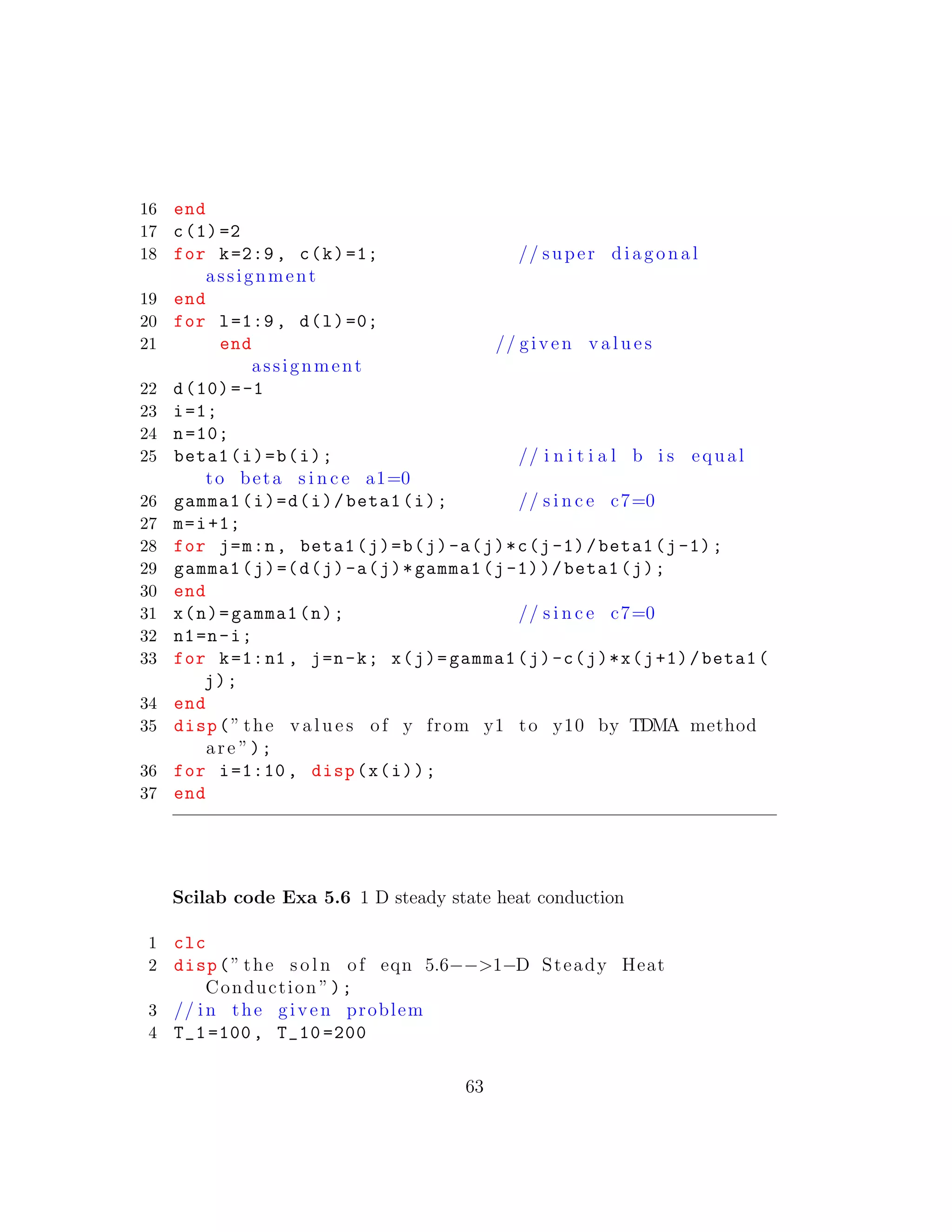
29 gamma1(j)=(d(j)-a(j)*gamma1(j-1))/beta1(j);
30 end
31 x(n)=gamma1(n); // s i n c e c7=0
32 n1=n-i;
33 for k=1:n1 , j=n-k; x(j)=gamma1(j)-c(j)*x(j+1)/beta1(
j);
34 end
35 disp(” the v a l u e s of y from y1 to y10 by TDMA method
are ”);
36 for i=1:10 , disp(x(i));
37 end
Scilab code Exa 5.6 1 D steady state heat conduction
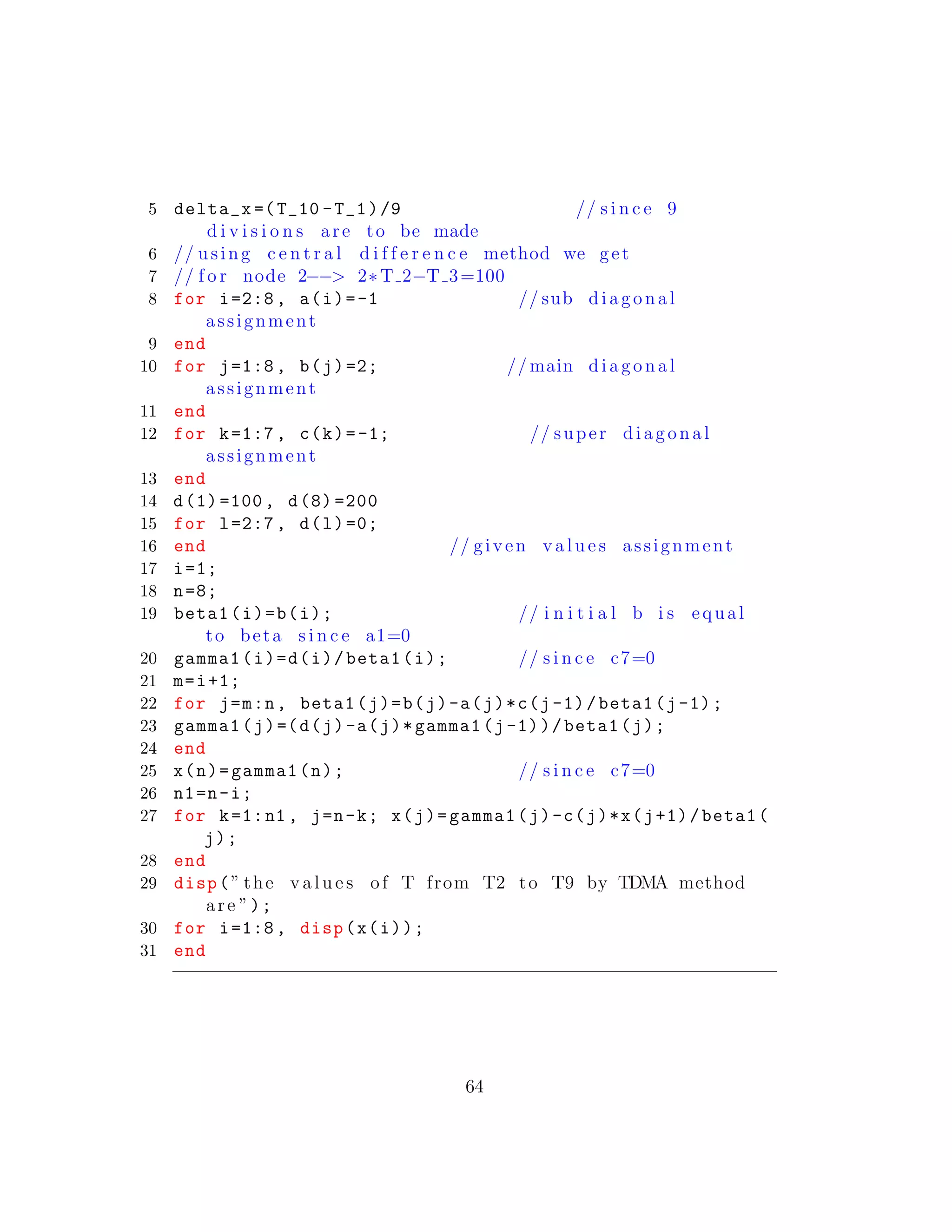
1 clc
2 disp(” the s o l n of eqn 5.6−−>1−D Steady Heat
Conduction ”);
3 // in the given problem
4 T_1 =100, T_10 =200
63
5 delta_x =(T_10 -T_1)/9 // s i n c e 9
d i v i s i o n s are to be made
6 // using c e n t r a l d i f f e r e n c e method we get
7 // f o r node 2−−> 2∗T 2−T 3=100
8 for i=2:8, a(i)=-1 // sub diagonal
assignment
9 end
10 for j=1:8, b(j)=2; // main diagonal
assignment
11 end
12 for k=1:7, c(k)=-1; // super diagonal
assignment
13 end
14 d(1) =100, d(8) =200
15 for l=2:7, d(l)=0;
16 end // given v a l u e s assignment
17 i=1;
18 n=8;
19 beta1(i)=b(i); // i n i t i a l b i s equal
to beta s i n c e a1=0
20 gamma1(i)=d(i)/beta1(i); // s i n c e c7=0
21 m=i+1;
22 for j=m:n, beta1(j)=b(j)-a(j)*c(j-1)/beta1(j-1);
23 gamma1(j)=(d(j)-a(j)*gamma1(j-1))/beta1(j);
24 end
25 x(n)=gamma1(n); // s i n c e c7=0
26 n1=n-i;
27 for k=1:n1 , j=n-k; x(j)=gamma1(j)-c(j)*x(j+1)/beta1(
j);
28 end
29 disp(” the v a l u e s of T from T2 to T9 by TDMA method
are ”);
30 for i=1:8, disp(x(i));
31 end
64
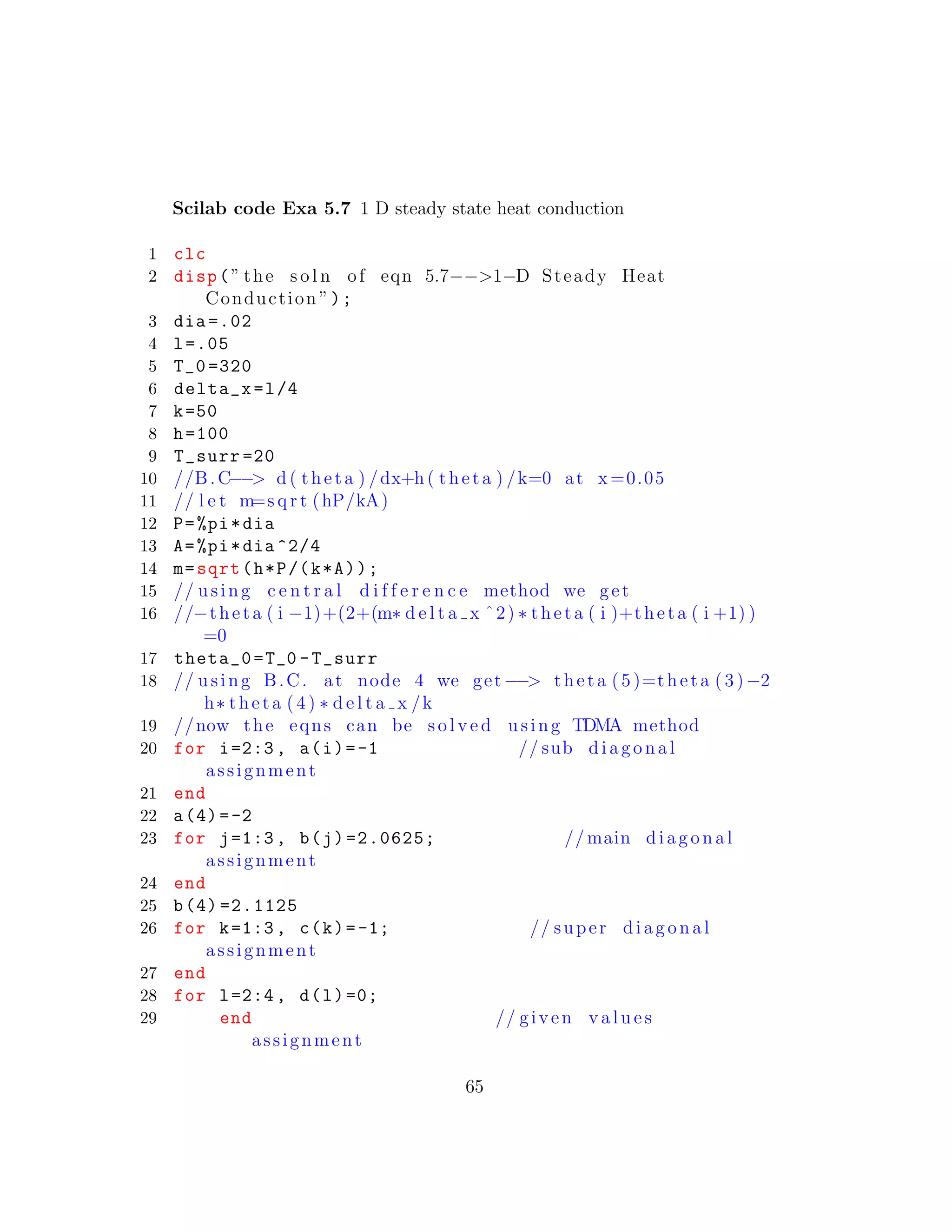
Scilab code Exa 5.7 1 D steady state heat conduction
1 clc
2 disp(” the s o l n of eqn 5.7−−>1−D Steady Heat
Conduction ”);
3 dia =.02
4 l=.05
5 T_0 =320
6 delta_x=l/4
7 k=50
8 h=100
9 T_surr =20
10 //B.C−−> d ( theta ) /dx+h ( theta ) /k=0 at x=0.05
11 // l e t m=s q r t (hP/kA)
12 P=%pi*dia
13 A=%pi*dia ^2/4
14 m=sqrt(h*P/(k*A));
15 // using c e n t r a l d i f f e r e n c e method we get
16 //−theta ( i −1)+(2+(m∗ d e l t a x ˆ2) ∗ theta ( i )+theta ( i +1) )
=0
17 theta_0=T_0 -T_surr
18 // using B.C. at node 4 we get−−> theta (5)=theta (3 )−2
h∗ theta (4) ∗ d e l t a x /k
19 //now the eqns can be s o l v e d using TDMA method
20 for i=2:3, a(i)=-1 // sub diagonal
assignment
21 end
22 a(4)=-2
23 for j=1:3, b(j)=2.0625; // main diagonal
assignment
24 end
25 b(4) =2.1125
26 for k=1:3, c(k)=-1; // super diagonal
assignment
27 end
28 for l=2:4, d(l)=0;
29 end // given v a l u e s
assignment
65
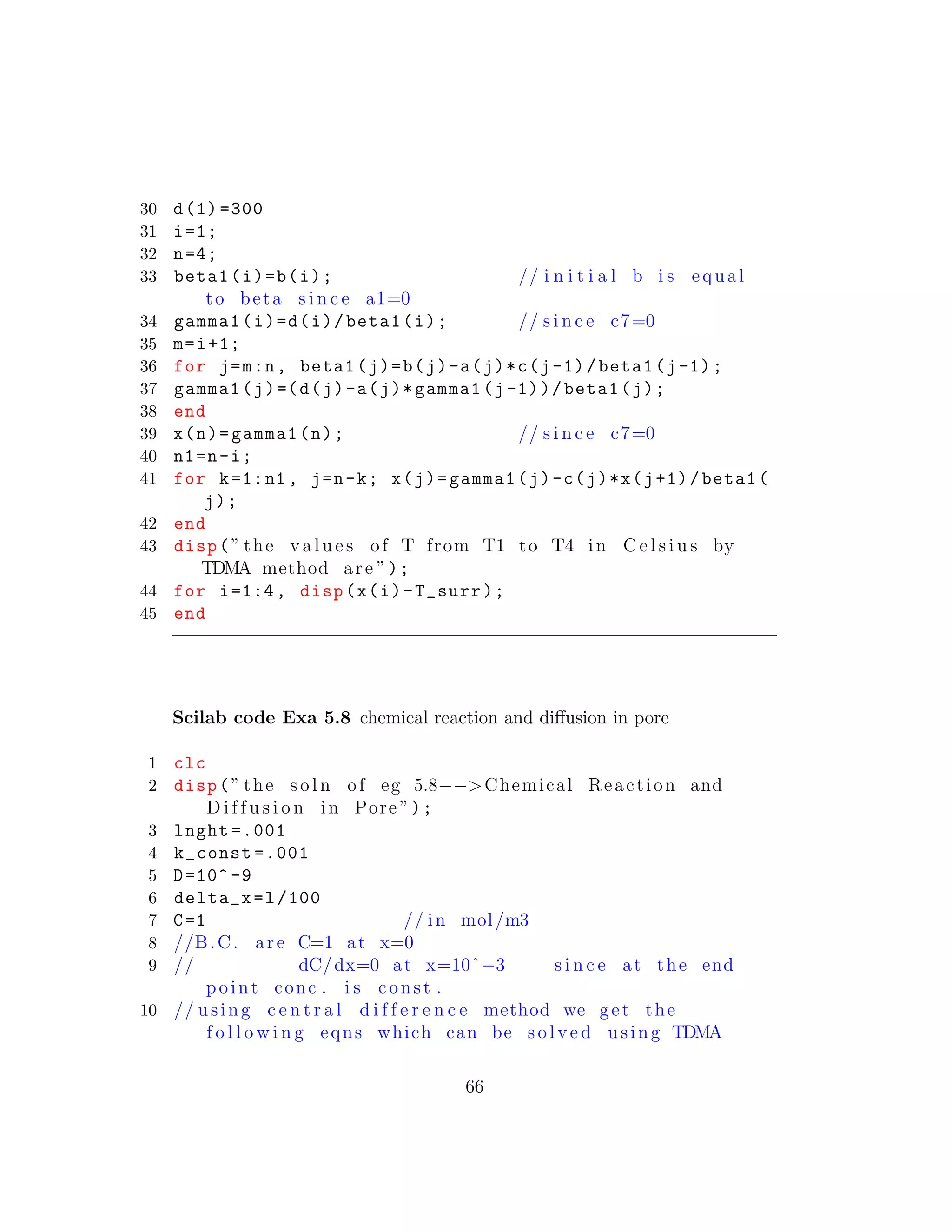
30 d(1) =300
31 i=1;
32 n=4;
33 beta1(i)=b(i); // i n i t i a l b i s equal
to beta s i n c e a1=0
34 gamma1(i)=d(i)/beta1(i); // s i n c e c7=0
35 m=i+1;
36 for j=m:n, beta1(j)=b(j)-a(j)*c(j-1)/beta1(j-1);
37 gamma1(j)=(d(j)-a(j)*gamma1(j-1))/beta1(j);
38 end
39 x(n)=gamma1(n); // s i n c e c7=0
40 n1=n-i;
41 for k=1:n1 , j=n-k; x(j)=gamma1(j)-c(j)*x(j+1)/beta1(
j);
42 end
43 disp(” the v a l u e s of T from T1 to T4 in C e l s i u s by
TDMA method are ”);
44 for i=1:4, disp(x(i)-T_surr);
45 end
Scilab code Exa 5.8 chemical reaction and diffusion in pore
1 clc
2 disp(” the s o l n of eg 5.8−−>Chemical Reaction and
D i f f u s i o n in Pore ”);
3 lnght =.001
4 k_const =.001
5 D=10^ -9
6 delta_x=l/100
7 C=1 // in mol/m3
8 //B.C. are C=1 at x=0
9 // dC/dx=0 at x=10ˆ−3 s i n c e at the end
point conc . i s const .
10 // using c e n t r a l d i f f e r e n c e method we get the
f o l l o w i n g eqns which can be s o l v e d using TDMA
66
method
11 for i=2:99 , a(i)=1 // sub diagonal
assignment
12 end
13 a(100) =2 // s i n c e C99=C100 using B.C
.
14 for j=1:100 , b(j)= -2.0001 , // main diagonal
assignment
15 end
16 for k=1:99 , c(k)=1; // super diagonal
assignment
17 end
18 d(1)=-1
19 for l=2:100 , d(l)=0;
20 end // given v a l u e s assignment
21 i=1;
22 n=100;
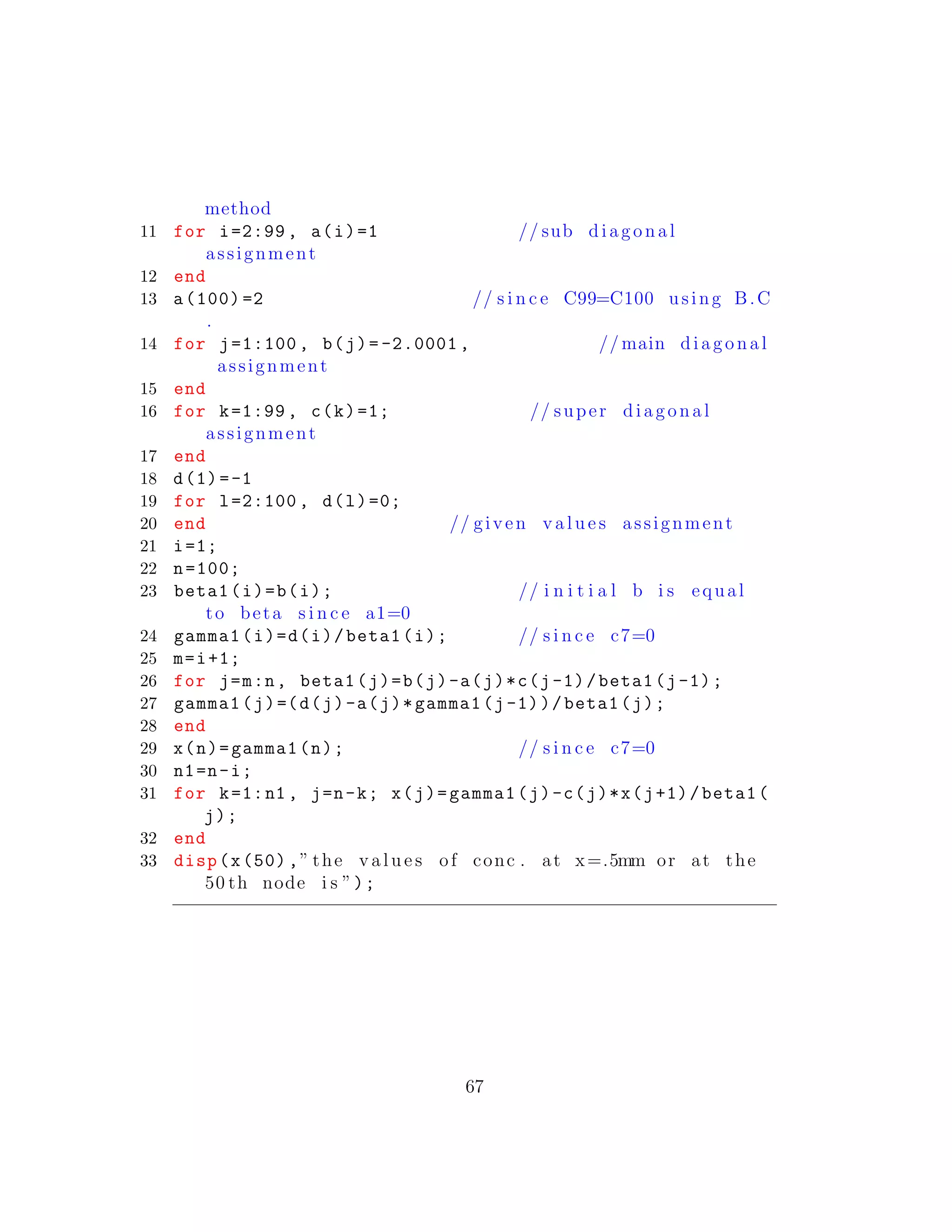
23 beta1(i)=b(i); // i n i t i a l b i s equal
to beta s i n c e a1=0
24 gamma1(i)=d(i)/beta1(i); // s i n c e c7=0
25 m=i+1;
26 for j=m:n, beta1(j)=b(j)-a(j)*c(j-1)/beta1(j-1);
27 gamma1(j)=(d(j)-a(j)*gamma1(j-1))/beta1(j);
28 end
29 x(n)=gamma1(n); // s i n c e c7=0
30 n1=n-i;
31 for k=1:n1 , j=n-k; x(j)=gamma1(j)-c(j)*x(j+1)/beta1(
j);
32 end
33 disp(x(50) ,” the v a l u e s of conc . at x=.5mm or at the
50 th node i s ”);
67
Chapter 6
CONVECTION DIFFUSION
PROBLEMS
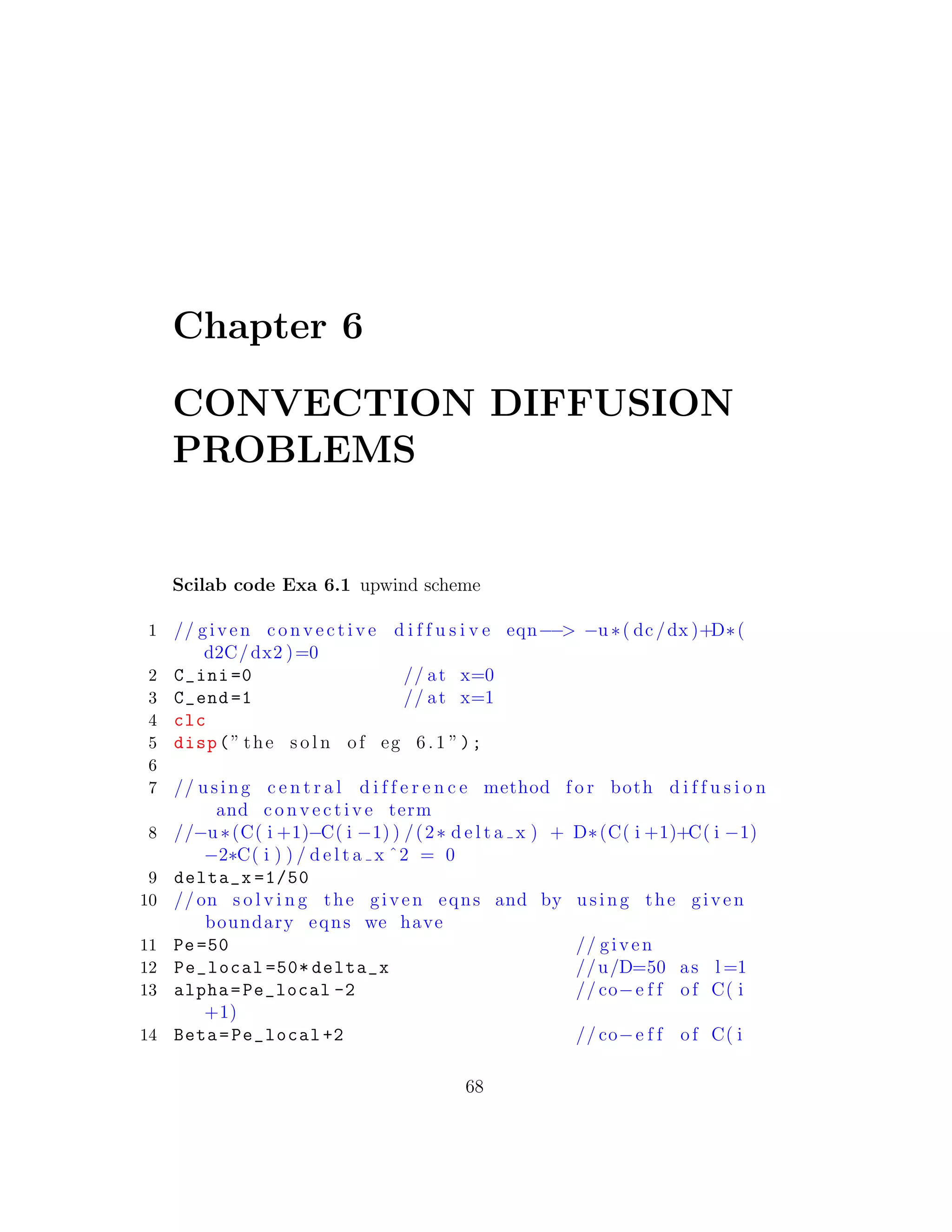
Scilab code Exa 6.1 upwind scheme
1 // given c o n v e c t i v e d i f f u s i v e eqn−−> −u ∗( dc/dx )+D∗(
d2C/dx2 )=0
2 C_ini =0 // at x=0
3 C_end =1 // at x=1
4 clc
5 disp(” the s o l n of eg 6 .1 ”);
6
7 // using c e n t r a l d i f f e r e n c e method f o r both d i f f u s i o n
and c o n v e c t i v e term
8 //−u ∗(C( i +1)−C( i −1) ) /(2∗ d e l t a x ) + D∗(C( i +1)+C( i −1)
−2∗C( i ) ) / d e l t a x ˆ2 = 0
9 delta_x =1/50
10 // on s o l v i n g the given eqns and by using the given
boundary eqns we have
11 Pe=50 // given
12 Pe_local =50* delta_x //u/D=50 as l =1
13 alpha=Pe_local -2 // co−e f f of C( i
+1)
14 Beta=Pe_local +2 // co−e f f of C( i
68
−1)
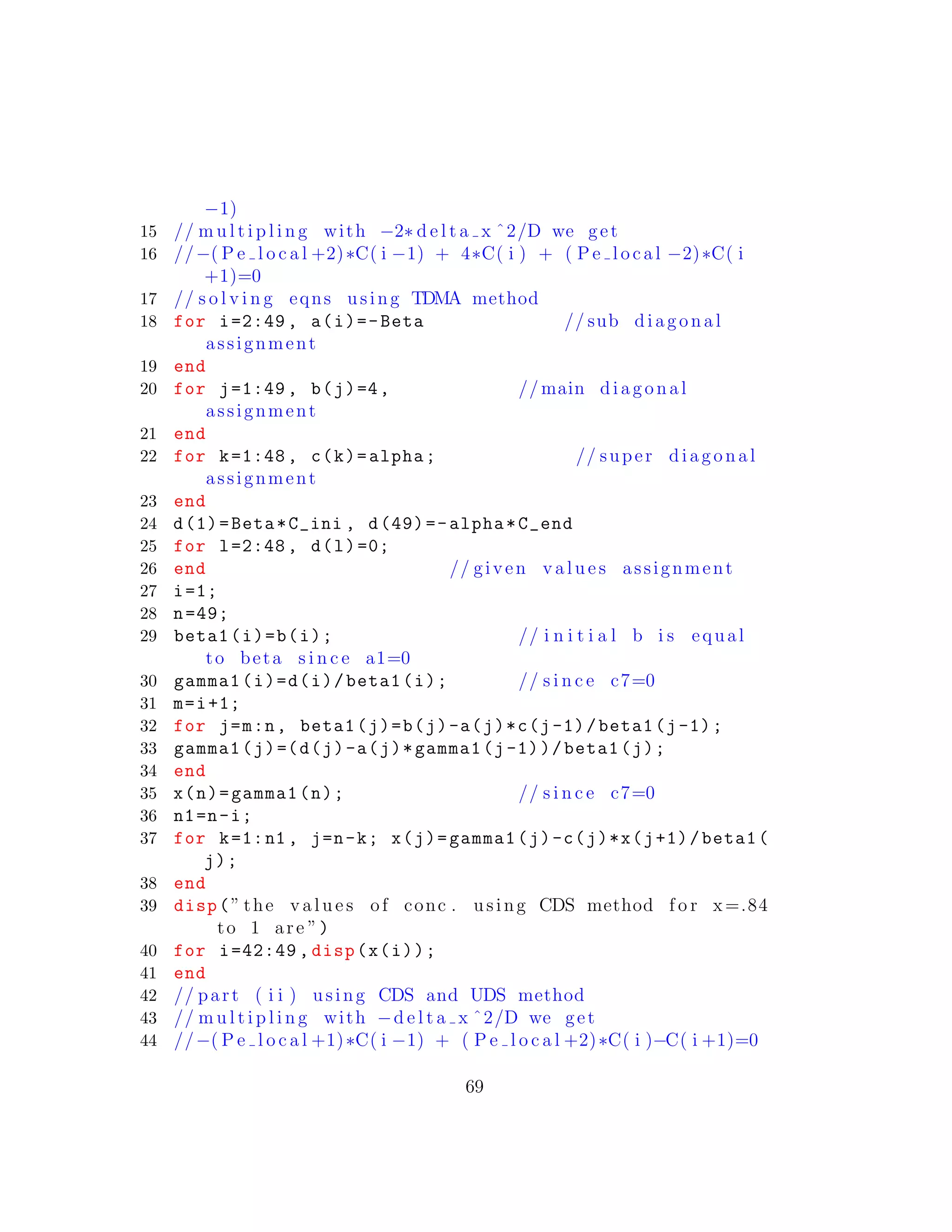
15 // m u l t i p l i n g with −2∗ d e l t a x ˆ2/D we get
16 //−( P e l o c a l +2)∗C( i −1) + 4∗C( i ) + ( P e l o c a l −2)∗C( i
+1)=0
17 // s o l v i n g eqns using TDMA method
18 for i=2:49 , a(i)=-Beta // sub diagonal
assignment
19 end
20 for j=1:49 , b(j)=4, // main diagonal
assignment
21 end
22 for k=1:48 , c(k)=alpha; // super diagonal
assignment
23 end
24 d(1)=Beta*C_ini , d(49)=-alpha*C_end
25 for l=2:48 , d(l)=0;
26 end // given v a l u e s assignment
27 i=1;
28 n=49;
29 beta1(i)=b(i); // i n i t i a l b i s equal
to beta s i n c e a1=0
30 gamma1(i)=d(i)/beta1(i); // s i n c e c7=0
31 m=i+1;
32 for j=m:n, beta1(j)=b(j)-a(j)*c(j-1)/beta1(j-1);
33 gamma1(j)=(d(j)-a(j)*gamma1(j-1))/beta1(j);
34 end
35 x(n)=gamma1(n); // s i n c e c7=0
36 n1=n-i;
37 for k=1:n1 , j=n-k; x(j)=gamma1(j)-c(j)*x(j+1)/beta1(
j);
38 end
39 disp(” the v a l u e s of conc . using CDS method f o r x=.84
to 1 are ”)
40 for i=42:49 , disp(x(i));
41 end
42 // part ( i i ) using CDS and UDS method
43 // m u l t i p l i n g with −d e l t a x ˆ2/D we get
44 //−( P e l o c a l +1)∗C( i −1) + ( P e l o c a l +2)∗C( i )−C( i +1)=0
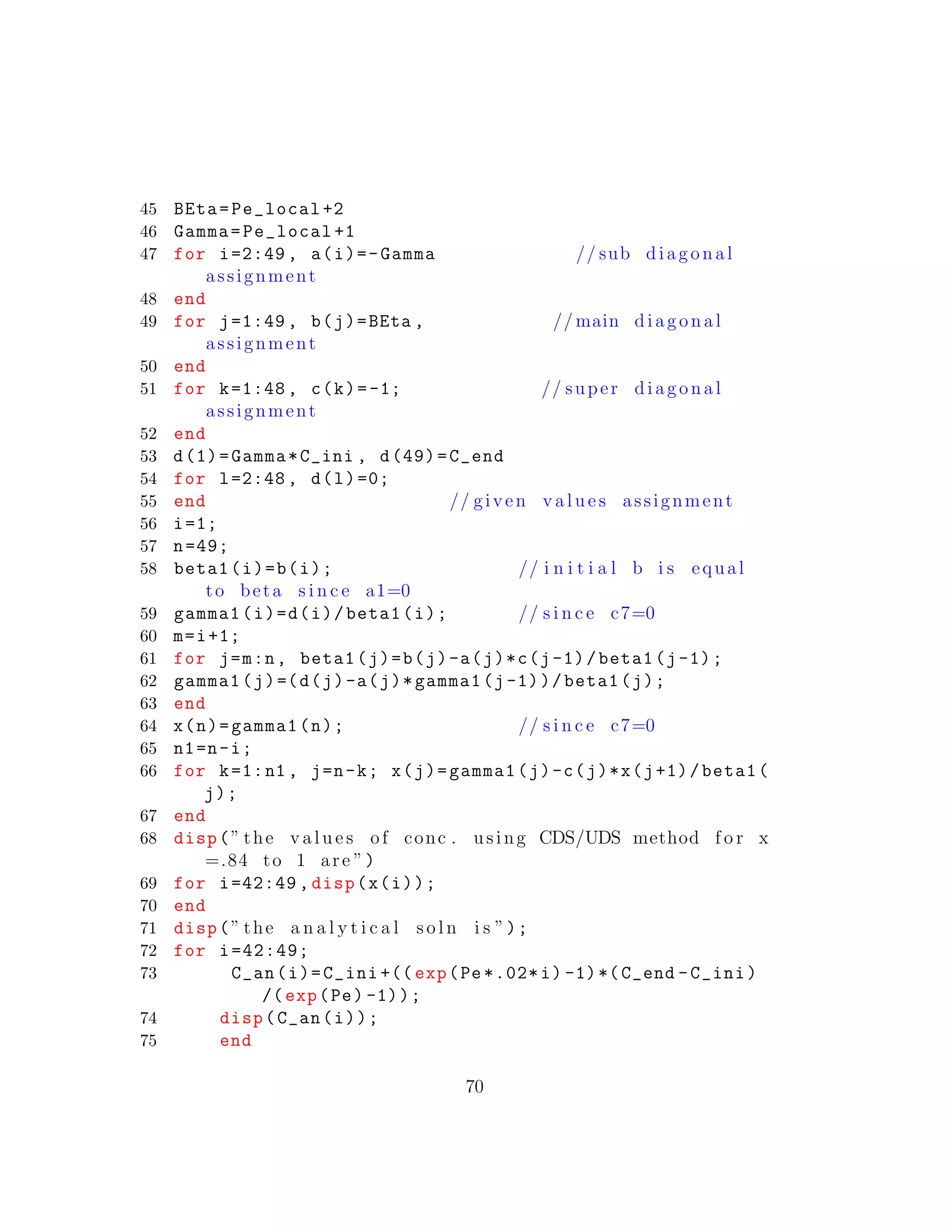
69
45 BEta=Pe_local +2
46 Gamma=Pe_local +1
47 for i=2:49 , a(i)=-Gamma // sub diagonal
assignment
48 end
49 for j=1:49 , b(j)=BEta , // main diagonal
assignment
50 end
51 for k=1:48 , c(k)=-1; // super diagonal
assignment
52 end
53 d(1)=Gamma*C_ini , d(49)=C_end
54 for l=2:48 , d(l)=0;
55 end // given v a l u e s assignment
56 i=1;
57 n=49;
58 beta1(i)=b(i); // i n i t i a l b i s equal
to beta s i n c e a1=0
59 gamma1(i)=d(i)/beta1(i); // s i n c e c7=0
60 m=i+1;
61 for j=m:n, beta1(j)=b(j)-a(j)*c(j-1)/beta1(j-1);
62 gamma1(j)=(d(j)-a(j)*gamma1(j-1))/beta1(j);
63 end
64 x(n)=gamma1(n); // s i n c e c7=0
65 n1=n-i;
66 for k=1:n1 , j=n-k; x(j)=gamma1(j)-c(j)*x(j+1)/beta1(
j);
67 end
68 disp(” the v a l u e s of conc . using CDS/UDS method f o r x
=.84 to 1 are ”)
69 for i=42:49 , disp(x(i));
70 end
71 disp(” the a n a l y t i c a l s o l n i s ”);
72 for i=42:49;
73 C_an(i)=C_ini +(( exp(Pe *.02*i) -1)*(C_end -C_ini)
/(exp(Pe) -1));
74 disp(C_an(i));
75 end
70
Scilab code Exa 6.2 upwind scheme
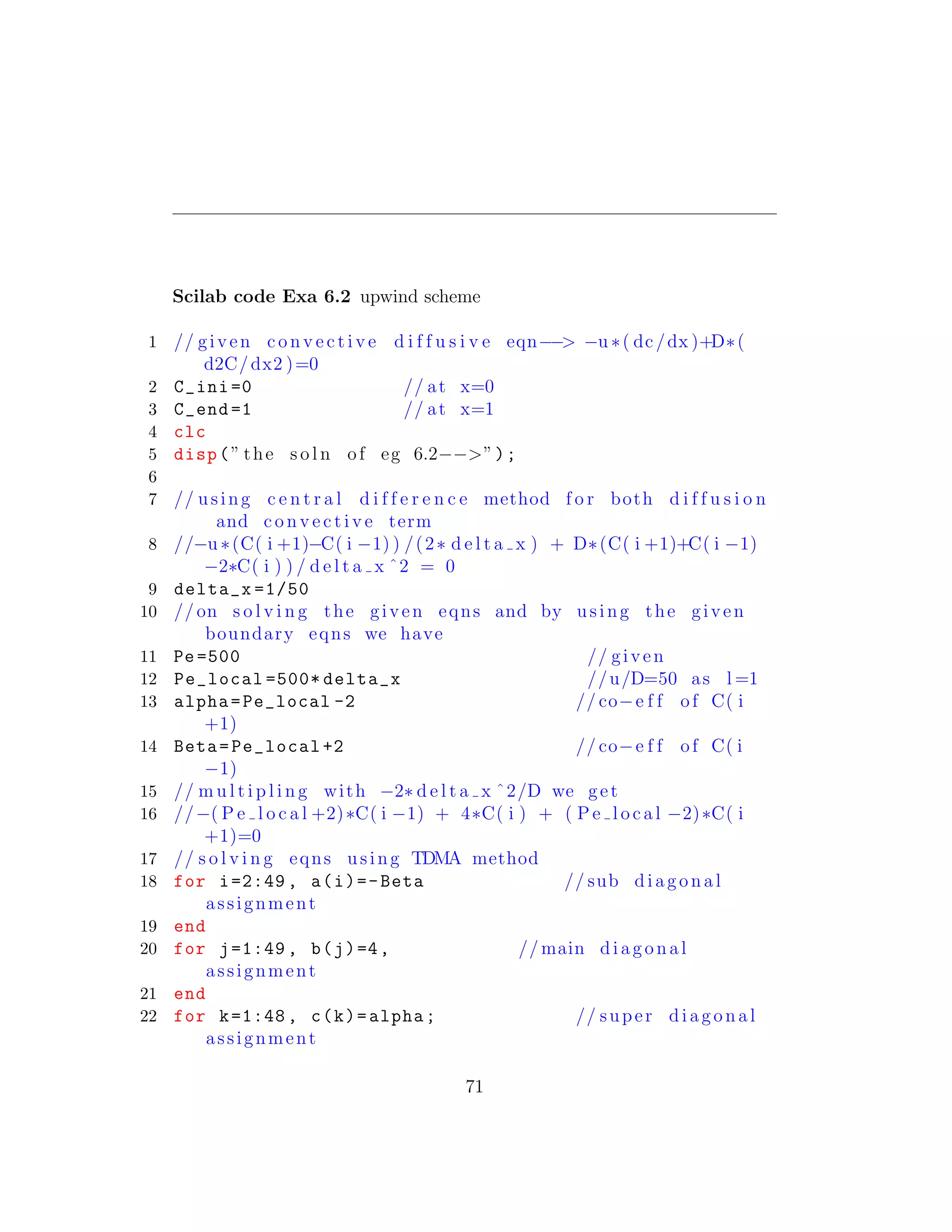
1 // given c o n v e c t i v e d i f f u s i v e eqn−−> −u ∗( dc/dx )+D∗(
d2C/dx2 )=0
2 C_ini =0 // at x=0
3 C_end =1 // at x=1
4 clc
5 disp(” the s o l n of eg 6.2−−>”);
6
7 // using c e n t r a l d i f f e r e n c e method f o r both d i f f u s i o n
and c o n v e c t i v e term
8 //−u ∗(C( i +1)−C( i −1) ) /(2∗ d e l t a x ) + D∗(C( i +1)+C( i −1)
−2∗C( i ) ) / d e l t a x ˆ2 = 0
9 delta_x =1/50
10 // on s o l v i n g the given eqns and by using the given
boundary eqns we have
11 Pe =500 // given
12 Pe_local =500* delta_x //u/D=50 as l =1
13 alpha=Pe_local -2 // co−e f f of C( i
+1)
14 Beta=Pe_local +2 // co−e f f of C( i
−1)
15 // m u l t i p l i n g with −2∗ d e l t a x ˆ2/D we get
16 //−( P e l o c a l +2)∗C( i −1) + 4∗C( i ) + ( P e l o c a l −2)∗C( i
+1)=0
17 // s o l v i n g eqns using TDMA method
18 for i=2:49 , a(i)=-Beta // sub diagonal
assignment
19 end
20 for j=1:49 , b(j)=4, // main diagonal
assignment
21 end
22 for k=1:48 , c(k)=alpha; // super diagonal
assignment
71
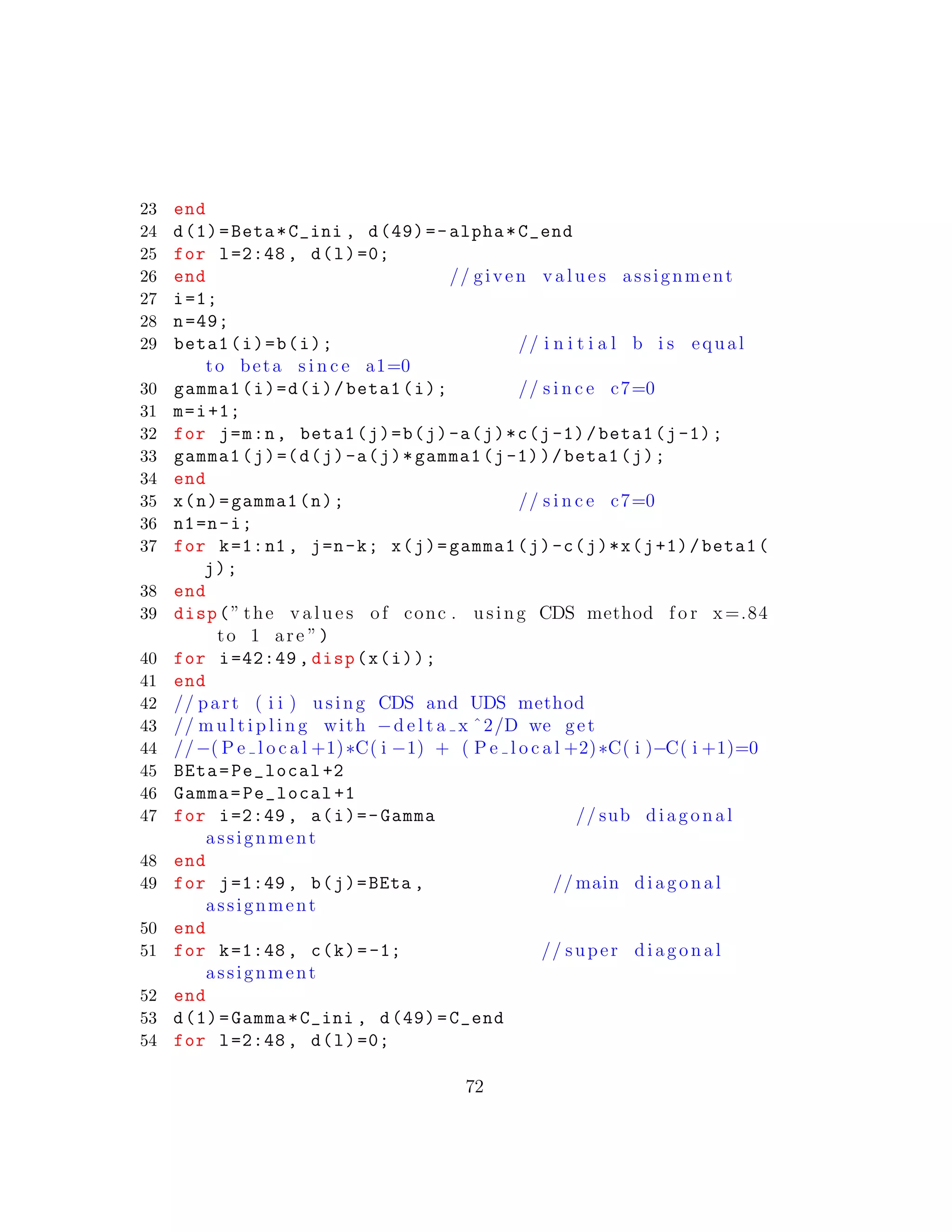
23 end
24 d(1)=Beta*C_ini , d(49)=-alpha*C_end
25 for l=2:48 , d(l)=0;
26 end // given v a l u e s assignment
27 i=1;
28 n=49;
29 beta1(i)=b(i); // i n i t i a l b i s equal
to beta s i n c e a1=0
30 gamma1(i)=d(i)/beta1(i); // s i n c e c7=0
31 m=i+1;
32 for j=m:n, beta1(j)=b(j)-a(j)*c(j-1)/beta1(j-1);
33 gamma1(j)=(d(j)-a(j)*gamma1(j-1))/beta1(j);
34 end
35 x(n)=gamma1(n); // s i n c e c7=0
36 n1=n-i;
37 for k=1:n1 , j=n-k; x(j)=gamma1(j)-c(j)*x(j+1)/beta1(
j);
38 end
39 disp(” the v a l u e s of conc . using CDS method f o r x=.84
to 1 are ”)
40 for i=42:49 , disp(x(i));
41 end
42 // part ( i i ) using CDS and UDS method
43 // m u l t i p l i n g with −d e l t a x ˆ2/D we get
44 //−( P e l o c a l +1)∗C( i −1) + ( P e l o c a l +2)∗C( i )−C( i +1)=0
45 BEta=Pe_local +2
46 Gamma=Pe_local +1
47 for i=2:49 , a(i)=-Gamma // sub diagonal
assignment
48 end
49 for j=1:49 , b(j)=BEta , // main diagonal
assignment
50 end
51 for k=1:48 , c(k)=-1; // super diagonal
assignment
52 end
53 d(1)=Gamma*C_ini , d(49)=C_end
54 for l=2:48 , d(l)=0;
72
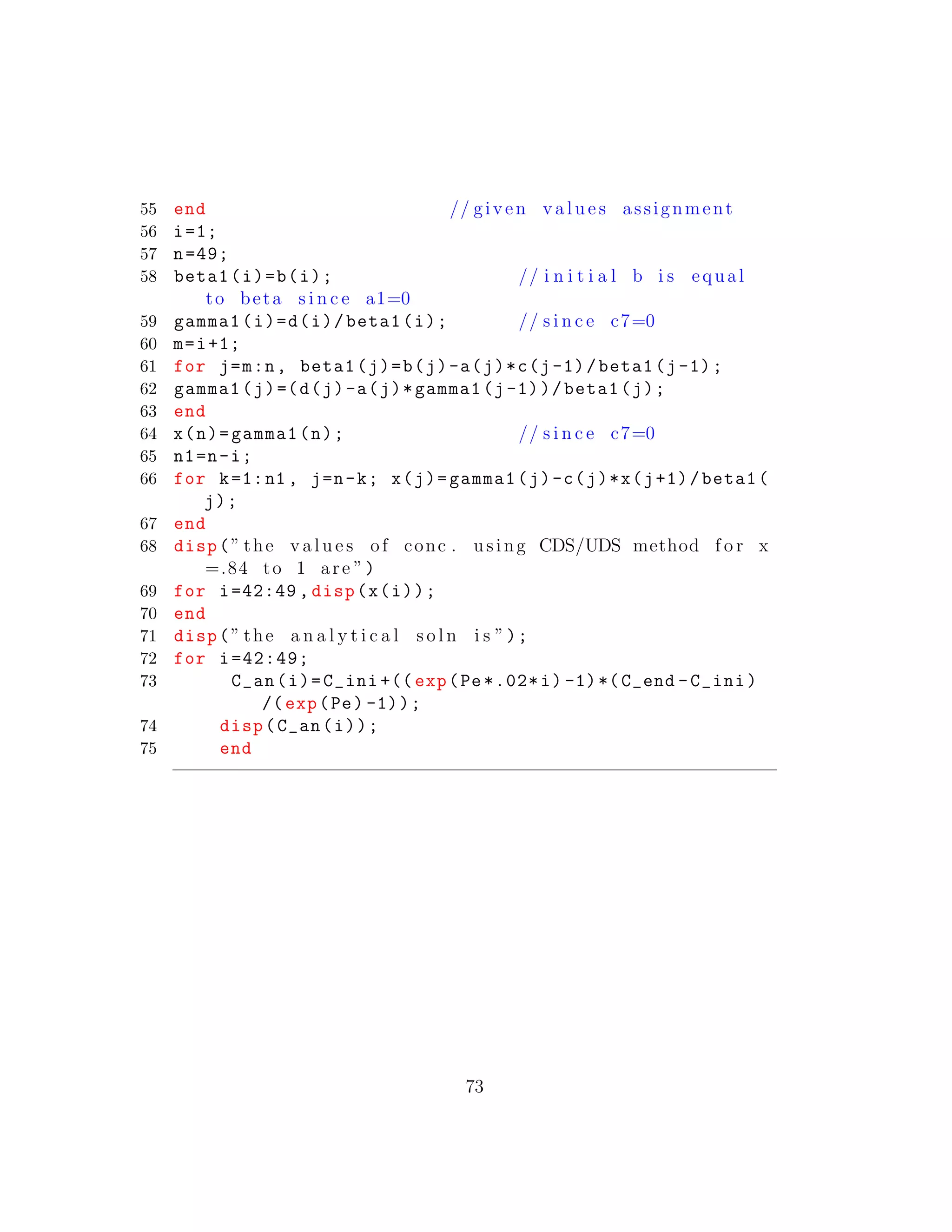
55 end // given v a l u e s assignment
56 i=1;
57 n=49;
58 beta1(i)=b(i); // i n i t i a l b i s equal
to beta s i n c e a1=0
59 gamma1(i)=d(i)/beta1(i); // s i n c e c7=0
60 m=i+1;
61 for j=m:n, beta1(j)=b(j)-a(j)*c(j-1)/beta1(j-1);
62 gamma1(j)=(d(j)-a(j)*gamma1(j-1))/beta1(j);
63 end
64 x(n)=gamma1(n); // s i n c e c7=0
65 n1=n-i;
66 for k=1:n1 , j=n-k; x(j)=gamma1(j)-c(j)*x(j+1)/beta1(
j);
67 end
68 disp(” the v a l u e s of conc . using CDS/UDS method f o r x
=.84 to 1 are ”)
69 for i=42:49 , disp(x(i));
70 end
71 disp(” the a n a l y t i c a l s o l n i s ”);
72 for i=42:49;
73 C_an(i)=C_ini +(( exp(Pe *.02*i) -1)*(C_end -C_ini)
/(exp(Pe) -1));
74 disp(C_an(i));
75 end
73
Chapter 7
TUBULAR REACTOR WITH
AXIAL DISPERSION
Scilab code Exa 7.1 boundary value problem in chemical reaction engi-
neering
1 clc
2 disp(” s o l n of eg 7.1−−> F i r s t Order Reaction −50 p a r t s
”)
3 e1=1,e2=1
// assumed v a l u e s
4 u=1,D=10^-4,k=1,C_a_in=1, delta_x =10/50
// given data
5 cf_ca1_n1 =-2*D/delta_x ^2-3*u/delta_x -k-2*u^2/D
// co−e f f i c i e n t of C−A1 at node 1
6 cf_ca2_n1 =2*D/delta_x ^2+u/delta_x
7 cf_da1_n1 =-(2*u^2/D+2*u/delta_x)*C_a_in
// r i g h t hand s i d e co−
e f f i c i e n t
8 cf_ca1_n2=D/delta_x ^2+u/delta_x
9 cf_ca2_n2 =-2*D/delta_x ^2-u/delta_x -k
10 cf_ca3_n2=D/delta_x ^2
11 cf_da1_n2 =0
74
12 cf_ca2_n3=cf_ca1_n2
13 cf_ca3_n3=cf_ca2_n2
14 cf_ca4_n3=cf_ca3_n2
15 cf_da1_n3 =0
16 cf_ca50_n51 =2*D/delta_x ^2+u/delta_x
// co−e f f i c i e n t of C−A50
at node 51
17 cf_ca51_n51 =-2*D/delta_x ^2-u/delta_x -k
18 cf_da51_n51 =0
19 for i=2:50 , a(i)=cf_ca1_n2 ,
20 end
21 a(51)=cf_ca2_n1 ,c(1)=cf_ca2_n1
22 for i=2:50 ,c(i)=cf_ca3_n2 ,
23 end
24 d(1)=cf_da1_n1
25 for i=2:51 ,d(i)=cf_da1_n2
26 end
27 for i=1:51 ,x(i)=0,
28 end
29 b(1)=cf_ca1_n1 ,
30 for i=2:51 ,b(i)=cf_ca2_n2 ,end
31 while e1 >1e-6 & e2 >1e-6 do for i=1:51 ,x1(i)=x(i),end
,
32 i=1, n=51, Beta(i)=b(i),
33 Gamma(i)=d(i)/Beta(i)
34 i1=i+1,
35 for j=i1:n, Beta(j)=b(j)-a(j)*c(j-1)/Beta(j-1),
36 Gamma(j)=(d(j)-a(j)*Gamma(j-1))/Beta(j),
37 end
38 x(n)=Gamma(n)
39 n1=n-i,
40 for k=1:n1 , j=n-k,x(j)=Gamma(j)-c(j)*x(j+1)/Beta
(j)
41 end
42 e1=abs(x(42) -x1 (42)), e2=abs(x(18) -x1 (18))
43 end
44 for i=1:51 , disp(x(i))
45 end
75
Scilab code Exa 7.2 boundary value problem in chemical reaction engi-
neering second order
1 clc
2 disp(” s o l n of eg 7.2−−>Second Order Reaction −20
p a r t s ”)
3 e1=1,e2=1
4 u=1,D=10^-4,k=1,C_a_in=1, delta_x =10/20
5 cff_ca2_n1 =2*D/delta_x ^2+u/delta_x
// co−e f f i c i e n t of C−A2 at
node 1
6 cff_da1_n1 =-(2*u^2/D+2*u/delta_x)*C_a_in
// r i g h t hand s i d e co−e f f i c i e n t
7 cff_ca1_n2=D/delta_x ^2+u/delta_x
8 cff_ca3_n2=D/delta_x ^2
// co−e f f i c i e n t
of C−A3 at node 2
9 cff_da1_n2 =0
10 cff_ca2_n3=cf_ca1_n2
11 cff_ca4_n3=cf_ca3_n2
12 cff_da1_n3 =0
13 cff_ca20_n21 =2*D/delta_x ^2+u/delta_x
// co−e f f i c i e n t of C−A20 at
node 21
14 cff_da21_n21 =0
15 for i=2:20 , a(i)=cff_ca1_n2 ,
16 end
17 a(21)=cff_ca2_n1 ,c(1)=cff_ca2_n1
18 for i=2:20 ,c(i)=cff_ca3_n2 ,
19 end
20 d(1)=cff_da1_n1
21 for i=2:21 ,d(i)=cff_da1_n2
22 end
23 for i=1:21 ,x(i)=0,
76
24 end
25 while e1 >1e-6 & e2 >1e-6 do for i=1:21 ,x1(i)=x(i),end
,
26 cff_ca1_n1 =-2*D/delta_x ^2-3*u/delta_x -x1(1) -2*u
^2/D // main diagonal elements
dependence on conc .
27 b(1)=cff_ca1_n1 ,
28 for i=2:21 ,b(i)=-2*D/delta_x ^2-u/delta_x -x(i),end
29
30 // s o l v i n g by TDMA method
31 i=1, n=21, Beta(i)=b(i),
32 Gamma(i)=d(i)/Beta(i)
33 i1=i+1,
34 for j=i1:n, Beta(j)=b(j)-a(j)*c(j-1)/Beta(j-1),
35 Gamma(j)=(d(j)-a(j)*Gamma(j-1))/Beta(j),
36 end
37 x(n)=Gamma(n)
38 n1=n-i,
39 for k=1:n1 , j=n-k,x(j)=Gamma(j)-c(j)*x(j+1)/Beta
(j)
40 end
41 e1=abs(x(1)-x1(1)), e2=abs(x(21) -x1 (21))
42 end
43 for i=1:21 , disp(x(i))
44 end
77
Chapter 8
CHEMICAL REACTION AND
DIFFUSION IN SPHERICAL
CATALYST PELLET
Scilab code Exa 8.1 first order reaction
1 clc
2 disp(” the s o l n of eg 8.1−−>”);
3 for i=1:100 , x(i)=0
4 end
5 iter=0, e1=1, f=1
6 while e1 >1e-6 & f>1e-6 do iter=iter+1,for i=1:100 ,
x1(i)=x(i),
7 end , for i=2:100 , a(i)=1 -(1/(i-1))
8 end , b(1)=-6.01, for i=2:100 , b(i)= -2.01
9 end , c(1)=6, for i=2:99 ,c(i)=1+(1/(i-1))
10 end , for i=1:99 ,d(i)=0, end , d(100) = -100/99 ,
11 i=1, n=100, Beta(i)=b(i),
12 Gamma(i)=d(i)/Beta(i)
13 i1=i+1,
14 for j=i1:n, Beta(j)=b(j)-a(j)*c(j-1)/Beta(j-1),
15 Gamma(j)=(d(j)-a(j)*Gamma(j-1))/Beta(j),
16 end
78
17 x(n)=Gamma(n)
18 n1=n-i,
19 for k=1:n1 , j=n-k,x(j)=Gamma(j)-c(j)*x(j+1)/Beta
(j)
20 end
21 e1=abs(x(1)-x1(1)),
22 f=abs(x(100) -x1 (100)),
23 end
24 disp(iter ,” the s o l u t i o n by TDMA of node 77 to 99 by
1 s t order rxn . i s ”);
25 for i=78:100 ,
26 disp(x(i));
27 end
Scilab code Exa 8.2 second order reaction
1 clc
2 disp(” the s o l n of eg 8.2−−>”);
3 for i=1:100 , x(i)=0
4 end
5 iter=0, e1=1, f=1
6 k=.1,D=10^-9,r=.01, delta_r=r/10,t1=k*delta_r ^2/D
7 while e1 >1e-6 & f>1e-6 do iter=iter+1,for i=1:100 ,
x1(i)=x(i),
8 end , for i=2:100 , a(i)=1 -(1/(i-1))
9 end , b(1)=-6-.t1*x1(1), for i=2:100 , b(i)=-2-t1*
x1(i)
10 end , c(1)=6, for i=2:99 ,c(i)=1+(1/(i-1))
11 end , for i=1:99 ,d(i)=0, end , d(100) = -100/99 ,
12 i=1, n=100, Beta(i)=b(i),
13 Gamma(i)=d(i)/Beta(i)
14 i1=i+1,
15 for j=i1:n, Beta(j)=b(j)-a(j)*c(j-1)/Beta(j-1),
16 Gamma(j)=(d(j)-a(j)*Gamma(j-1))/Beta(j),
17 end
79
18 x(n)=Gamma(n)
19 n1=n-i,
20 for k=1:n1 , j=n-k,x(j)=Gamma(j)-c(j)*x(j+1)/Beta
(j)
21 end
22 e1=abs(x(1)-x1(1)),
23 f=abs(x(100) -x1 (100)),
24 end
25 disp(” the s o l u t i o n by TDMA of node 77 to 99 by 2nd
order rxn . i s ”);
26 for i=77:100 ,
27 disp(x(i));
28 end
Scilab code Exa 8.3 non isothermal condition
1 clc
2 disp(” the s o l n of eg 8.3−−>”);
3 for i=1:100 , x(i)=0 // i n i t i a l
v a l u e s
4 end
5 e2=1, f1=1,iter =0 // assumed
v a l u e s
6 k=.1*10^ -2 , D=10^-9,r=.01, delta_r=r/100,t1=k*delta_r
^2/D // given data
7 //now s o l v i n g the eqns f o r a l l the nodes and then
s i m p l i f y i n g we get the f o l l o w i n g r e l a t i o n s
8 while e2 >1e-6 & f1 >1e-6 do iter=iter+1,for i=1:100 ,
x1(i)=x(i),
9 end , for i=2:100 , a(i)=1 -(1/(i-1))
10 end , b(1)=-6-t1*exp((1-x1(1))/(2-x1(1))), for i
=2:100 , b(i)=-2-t1*exp((1-x(i))/(2-x(i)))
11 end , c(1)=6, for i=2:99 ,c(i)=1+(1/(i-1))
12 end , for i=1:99 ,d(i)=0, end , d(100) = -100/99 ,
13 i=1, n=100, Beta(i)=b(i),
80
14 Gamma(i)=d(i)/Beta(i)
15 i1=i+1,
16 for j=i1:n, Beta(j)=b(j)-a(j)*c(j-1)/Beta(j-1),
17 Gamma(j)=(d(j)-a(j)*Gamma(j-1))/Beta(j),
18 end
19 x(n)=Gamma(n)
20 n1=n-i,
21 for k=1:n1 , j=n-k,x(j)=Gamma(j)-c(j)*x(j+1)/Beta
(j)
22 end
23 e2=abs(x(1)-x1(1)),
24 f1=abs(x(100) -x1 (100)),
25 end
26 disp(” the s o l u t i o n by TDMA of node 77 to 100 by 1 s t
order rxn . i s ”);
27 for i=76:100 ,
28 disp(x(i));
29 end
Scilab code Exa 8.4 non isothermal condition
1 clc
2 disp(” the s o l n of eg 8.4−−>”);
3 for i=1:100 , x(i)=0
4 end
5 iter=0, e1=1, f1=1
6 while e1 >1e-6 & f1 >1e-6 do iter=iter+1,for i=1:100 ,
x1(i)=x(i),
7 end , for i=2:100 , a(i)=1 -(1/(i-1))
8 end , b(1) =-6-.01* exp ((10 -10* x1(1))/(11 -10*x1(1))
), for i=2:100 , b(i)=-2-.01* exp ((10 -10* x1(i))
/(11 -10* x1(i)))
9 end , c(1)=6, for i=2:99 ,c(i)=1+(1/(i-1))
10 end , for i=1:99 ,d(i)=0, end , d(100) = -100/99 ,
11 i=1, n=100, Beta(i)=b(i),
81
12 Gamma(i)=d(i)/Beta(i)
13 i1=i+1,
14 for j=i1:n, Beta(j)=b(j)-a(j)*c(j-1)/Beta(j-1),
15 Gamma(j)=(d(j)-a(j)*Gamma(j-1))/Beta(j),
16 end
17 x(n)=Gamma(n)
18 n1=n-i,
19 for k=1:n1 , j=n-k,x(j)=Gamma(j)-c(j)*x(j+1)/Beta
(j)
20 end
21 e1=abs(x(1)-x1(1)),
22 f1=abs(x(100) -x1 (100)),
23 end
24 disp(” the s o l u t i o n by TDMA of node 77 to 99 by 1 s t
order rxn . i s ”);
25 for i=76:100 ,
26 disp(x(i));
27 end
82
Chapter 9
ONE DIMENSIONAL
TRANSIENT HEAT
CONDUCTION
Scilab code Exa 9.1 transient conduction in rectangular slab
1 clc
2 disp(” the s o l n of eg 9.1−−> Transient heat conduction
in a Rectangular s l a b ”)
3 disp(” the v a l u e s of Temp measured from c e n t r e at the
gap of . 2 cm are ”)
4 alpha =10^-5, delta_t =.1, delta_x =10^ -3 //
given data
5 m=alpha*delta_t /( delta_x ^2)
6 for i=2:4, a(i)=m //
sub−diagonal
7 end
8 b(1) =(-2*m-1)/2
9 for i=2:4,b(i)=-2*m-1
// diagonal
10 end
11 for i=1:3, c(i)=m //
super−diagonal
83
12 end
13 for i=1:4, x(i)=20 //
i n i t i a l temperature
14 end
15 for t=0.1:.1:3.1 , for i=1:4, y(i)=x(i), end
//TDMA method
16 d(1) =-.5*y(1),
17 d(2)=-y(2)
18 d(3)=-y(3)
19 d(4)=-y(4) -300
20 i=1, n=4
21 Beta(i)=b(i),
22 Gamma(i)=d(i)/Beta(i)
23 i1=i+1,
24 for j=i1:n, Beta(j)=b(j)-a(j)*c(j-1)/Beta(j-1),
25 Gamma(j)=(d(j)-a(j)*Gamma(j-1))/Beta(j),
26 end
27 x(n)=Gamma(n)
28 n1=n-i,
29 for k=1:n1 , j=n-k,x(j)=Gamma(j)-c(j)*x(j+1)/Beta
(j)
30 end
31 for i=1:4, disp(x(i));
// s o l u t i o n of
temperature
32 end
33 disp(”−−−−−−−−−−−−−−−−−”)
34 end
35 disp(”−−−−−−−−−−END−−−−−−−−−”);
Scilab code Exa 9.2 transient conduction in rectangular slab
1 clc
2 disp(” the s o l n of eg 9.2−−> Transient Conduction in
Rectangular Slab ”);
84
3 delta_t =1, delta_x =.05, alpha =10^ -5
4 t1=alpha*delta_t/delta_x ^2
5 for i=2:9, a(i)=-t1
6 end
7 for i=1:9,b(i)=1+2* t1
8 end
9 for i=1:8, c(i)=-t1
10 end
11 t=1,tf =3000
12 for i=1:9, x(i)=300
13 end
14 e1=425,
15 disp(” time when c e n t r e temp i s 425 K in s e c s . i s ”)
16 for t=1:1:tf ,for i=1:9, y(i)=x(i),end
17 d(1)=y(1)+1.7,
18 d(9)=y(9)+2.4,
19 for i=2:8,d(i)=y(i)
20 end
21 i=1, n=9
22 Beta(i)=b(i),
23 Gamma(i)=d(i)/Beta(i)
24 i1=i+1,
25 for j=i1:n, Beta(j)=b(j)-a(j)*c(j-1)/Beta(j-1),
26 Gamma(j)=(d(j)-a(j)*Gamma(j-1))/Beta(j),
27 end
28 x(n)=Gamma(n)
29 n1=n-i,
30 for k=1:n1 , j=n-k,x(j)=Gamma(j)-c(j)*x(j+1)/Beta
(j)
31 end
32 if abs(x(5)-e1) >0 & abs(x(5)-e1) <.1 then disp(t)
; break;
33 end
34 end
35 disp(” the v a l u e s of temp . at req . time i s ”);
36 for i=1:9, disp(x(i)); end
85
Scilab code Exa 9.3 transient conduction in cylinder
1 clc
2 disp(” the s o l n of eg 9.3−−> Transient Conduction in
c y l i n d e r ”);
3 delta_t =.1, delta_r =.001 , alpha =10^ -5
// given data
4 t1=alpha*delta_t/delta_r ^2
5 a(2) =.5*t1 ,a(3) =.75*t1 ,a(4) =.833* t1
// sub−diagonal
6 b(1)=-4*t1 -1
7 for i=2:4,b(i)=-2*t1 -1
// main diagonal
8 end
9 c(1) =4*t1 ,c(2) =1.5*t1 ,c(3) =1.25* t1
// super−diagonal
10 for i=1:4, x(i)=20
11 end
12 disp(”T1 , T2 , T2 & T4 at time i n t e r v a l of . 1 sec i s ”)
13 for t=.1:.1:2.1 , for i=1:4, y(i)=x(i),end
//TDMA Method
14 d(4)=-y(4) -7*t1*300/6 ,
15 for i=1:3,d(i)=-y(i)
16 end
17 i=1, n=4
18 Beta(i)=b(i),
19 Gamma(i)=d(i)/Beta(i)
20 i1=i+1,
21 for j=i1:n, Beta(j)=b(j)-a(j)*c(j-1)/Beta(j-1),
22 Gamma(j)=(d(j)-a(j)*Gamma(j-1))/Beta(j),
23 end
24 x(n)=Gamma(n)
25 n1=n-i,
26 for k=1:n1 , j=n-k,x(j)=Gamma(j)-c(j)*x(j+1)/Beta
86
(j)
27 end
28 disp(x(4),x(3),x(2),x(1));
29 disp(”−−−−−−−−−−−−−−−−−−−−”);
30 end
Scilab code Exa 9.4 transient conduction in sphere
1 clc
2 disp(” the s o l n of eg 9.4−−> Transient conduction in
Sphere ”);
3 delta_t =.1, delta_r =.001 , alpha =10^ -5
4 t1=alpha*delta_t/delta_r ^2
5 a(2)=0,a(3)=.5,a(4) =.667
6 b(1)=-7*t1
7 for i=2:4,b(i)=-3
8 end
9 c(1)=6,c(2)=2,c(3) =1.5
10 for i=1:4, x(i)=20
11 end
12 disp(”T1 , T2 , T2 & T4 at time i n t e r v a l of . 1 sec i s ”)
13 for t=.1:.1:1.4 , for i=1:4, y(i)=x(i),end
14 d(4)=-y(4) -400,
15 for i=1:3,d(i)=-y(i)
16 end
17 i=1, n=4
18 Beta(i)=b(i),
19 Gamma(i)=d(i)/Beta(i)
20 i1=i+1,
21 for j=i1:n, Beta(j)=b(j)-a(j)*c(j-1)/Beta(j-1),
22 Gamma(j)=(d(j)-a(j)*Gamma(j-1))/Beta(j),
23 end
24 x(n)=Gamma(n)
25 n1=n-i,
26 for k=1:n1 , j=n-k,x(j)=Gamma(j)-c(j)*x(j+1)/Beta
87
(j)
27 end
28 disp(x(4),x(3),x(2),x(1));
29 disp(”−−−−−−−−−−−−−−−−−−−”);
30 end
Scilab code Exa 9.5 transient diffusion in sphere
1 clc
2 disp(” the s o l n of eg 9.5−−>”);
3 R=.326 , D=3*10^ -7
4 delta_t =1, delta_r =.0326 , conc_ini =10/(1.33* %pi*R^3)
5 t1=D*delta_t/delta_r ^2
6 disp(conc_ini ,” the i n i t i a l conc . of drug i s ”);
7 for i=2:10 , a(i)=-(1-1/(i-1))
8 end
9 b(1) =591.4
10 for i=2:10 ,b(i)=3544.5
11 end
12 c(1)=-1,for i=2:9, c(i)= -(1+1/(i-1))
13 end
14 for i=1:10 , x(i)=conc_ini
15 end
16 disp(”Conc . at c e n t r e at t=3hr , 12 hr , 24 hr ,48 hr
i s ”);
17 for t=1: delta_t :172800 , for i=1:10 , y(i)=x(i),end
18 d(1)=y(1) *590.4 ,
19 for i=2:10 ,d(i)=3542.5*y(i)
20 end
21 i=1, n=10
22 Beta(i)=b(i),
23 Gamma(i)=d(i)/Beta(i)
24 i1=i+1,
25 for j=i1:n, Beta(j)=b(j)-a(j)*c(j-1)/Beta(j-1),
26 Gamma(j)=(d(j)-a(j)*Gamma(j-1))/Beta(j),
88
27 end
28 x(n)=Gamma(n)
29 n1=n-i,
30 for k=1:n1 , j=n-k,x(j)=Gamma(j)-c(j)*x(j+1)/Beta
(j)
31 end
32 if t==10800| t==43200| t==86400|t==172800 then
disp(x(6));
33 end
34 end
89
Chapter 10
TWO DIMENSIONAL
STEADY AND TRANSIENT
HEAT CONDUCTION
Scilab code Exa 10.1 discretization in 2 D space gauss seidel method
1 clc
2 disp(” the s o l n of eg 10.1−−>2−D steady heat
conduction −Gauss S e i d e l method ”);
3 for i=1:9, tnew(i)=101,e(i)=1
// assumed v a l u e s
4 end
5 t=1e-6
6 // s i n c e a l l the nodes are i n t e r i o r nodes so
d i s c r e t i z e d eqn used i s eqn 10.10
7 while e(1)>t&e(2)>t&e(3)>t&e(4)>t&e(5)>t &e(6)>t& e
(7)>t& e(8)>t & e(9)>t do
8 for i=1:9, told(i)=tnew(i),end
9 tnew (1)=( told (2) +40+ told (4))/4
// on s o l v i n g eqns f o r
v a r i o u s nodes we get ,
10 tnew (2)=( tnew (1)+told (3)+told (5) +20) /4
11 tnew (3)=( tnew (2)+told (6) +420) /4
90
12 tnew (4)=( told (5)+tnew (1)+told (7) +20) /4
13 tnew (5)=( tnew (2)+told (8)+told (6)+tnew (4))/4
14 tnew (6)=( tnew (3)+tnew (5)+told (9) +400) /4
15 tnew (7)=( tnew (4)+told (8) +40) /4
16 tnew (8)=( tnew (5)+tnew (7)+told (9) +20) /4
17 tnew (9)=( tnew (6) +420+ tnew (8))/4
18 for i=1:9,e(i)=abs(tnew(i)-told(i))
19 end
20 end
21 disp(” the v a l u e s of T from 1 s t element to l a s t i s ”);
22 for i=1:9, disp(tnew(i));
23 end
Scilab code Exa 10.2 discretization in 2 D space gauss seidel method
1 clc
2 disp(” the s o l n of eg 10.2−−>”);
3 for i=1:5, tnew(i)=101,e(i)=1
4 end
5 t=1e-6
6 // s i n c e t h e r e i s no source term so we get the
f o l l o w i n g eqns .
7 while e(1)>t&e(2)>t&e(3)>t&e(4)>t&e(5)>t do
8 for i=1:5, told(i)=tnew(i),end
9 tnew (1)=( told (2) *2+300) /4
10 tnew (2)=( tnew (1)+told (3) +300) /4
11 tnew (3)=( tnew (2)+told (4) +200) /4
12 tnew (4)=( told (5)+tnew (3) +300) /4
13 tnew (5) =(2* tnew (4) +300) /4
14 for i=1:5,e(i)=abs(tnew (1)-told(i))
15 end
16 end
17 disp(” the v a l u e s of T from 1 s t element to l a s t i s ”);
18 for i=1:5, disp(tnew(i));
19 end
91
Scilab code Exa 10.3 discretization in 2 D space
1 clc
2 disp(” the s o l n of eg 10.3−−>Red−Black Gauss−S e i d e l
Method”);
3 for j=1:5,tn(j,1)=400, end //
d e f i n i n g c o n d i t i o n s
4 for j=2:4,tn(1,j)=20,tn(5,j)=20,tn(j,5)=20, end
5 for i=1:9,e(i)=1
6 end
7 for i=2:4,j=2:4,tn(i,j)=60
8 end
9 t1=1e-6
10 while e(1)>t1&e(2)>t1&e(3)>t1&e(4)>t1&e(5)>t1 &e(6)>
t1& e(7)>t1& e(8)>t1 & e(9)>t1 do for i=2:4,j
=2:4,t(i,j)=tn(i,j),end
11 // using red−black gauss−s e i d e l method
12 for i=2:4,j=2:4,tn(i,j)=(tn(i+1,j)+tn(i-1,j)+tn(i,j
+1)+tn(i,j-1))/4, end
13 //now g e t t i n g the a b s o l u t e d i f f e r e n c e of the 9
v a r i a b l e s
14 e(1)=abs(t(2,2)-tn(2,2)),e(2)=abs(t(2,3)-tn(2,3)),e
(3)=abs(t(2,4)-tn(2,4)),e(4)=abs(t(3,2)-tn(3,2)),
e(5)=abs(t(3,3)-tn(3,3)),e(6)=abs(t(3,4)-tn(3,4))
,e(7)=abs(t(4,2)-tn(4,2)),e(8)=abs(t(4,3)-tn(4,3)
),e(9)=abs(t(4,4)-tn(4,4)),
15 end
16 //now d e f i n i n g p o s i t i o n s of the v a r i o u s nodes
according to red black combination
17 R1=t(2,4),R2=t(4,4),R3=t(3,3),R4=t(2,2),R5=t(2,4),B1
=t(4,3),B2=t(3,2),B3=t(3,4),B4=t(2,3)
18 disp(R5 ,R4 ,R3 ,R2 ,R1 ,” the value of RED p o i n t s
r e s p e c t i v e l y i s ”);
19 disp(B4 ,B3 ,B2 ,B1 ,” the value of BLUE p o i n t s
92
r e s p e c t i v e l y i s ”);
Scilab code Exa 10.8 discretization in 2 D space
1 clc
2 disp(” the s o l n of eg 10.8−−>Gauss S e i d e l Method”);
3 for i=1:9, tnew(i)=101,e(i)=1 //
assumed v a l u e s
4 end
5 t=1e-6
6 while e(1)>t&e(2)>t&e(3)>t&e(4)>t&e(5)>t &e(6)>t& e
(7)>t& e(8)>t & e(9)>t do
7 for i=1:9, told(i)=tnew(i),end
8 // using eqn 10.10 f o r the i n t e r i o r nodes and
c o n v e c t i v e boundary c o n d i t i o n s f o r corner
nodes
9 tnew (1)=( told (2) +50+.5* told (4) +100/3) *3/7
10 tnew (2)=( tnew (1)+told (3)+told (5) +100) /4
11 tnew (3)=( tnew (2)+told (6) +600) /4
12 tnew (4)=( told (5) +.5* tnew (1) +.5* told (7) +100/3)
*3/7
13 tnew (5)=( tnew (2)+told (8)+told (6)+tnew (4))/4
14 tnew (6)=( tnew (3)+tnew (5)+told (9) +500) /4
15 tnew (7) =(.5* tnew (4) +.5* told (8) +100/3) *3/4
16 tnew (8)=( tnew (5) +.5* tnew (7) +.5* told (9) +100/3)
*3/7
17 tnew (9)=( tnew (6) +100/3+.5* tnew (8) +250) *3/7
18 for i=1:9,e(i)=abs(tnew(i)-told(i))
19 end
20 end
21 disp(” the v a l u e s of T from 1 s t element to l a s t i s ”);
22 for i=1:9, disp(tnew(i));
23 end
93
Scilab code Exa 10.9 discretization in 2 D space
1 clc
2 disp(” the s o l n of eg 10.9−−>Steady s t a t e heat
conduction in L−shaped body”);
3 for i=1:9, tnew(i)=101,e(i)=1 // assumed
v a l u e s
4 end
5 t=1e-6
6 while e(1)>t&e(2)>t&e(3)>t&e(4)>t&e(5)>t &e(6)>t& e
(7)>t& e(8)>t & e(9)>t do
7 for i=1:9, told(i)=tnew(i),end
8 // using the b a s i c d i s c r e t i z a t i o n eqn . f o r a l l
the nodes s i n c e the boundary c o n d i t i o n s vary
f o r each point
9 tnew (1)=( told (2) +1.25+ told (4))/2.05
10 tnew (2) =(.5* tnew (1) +.5* told (3)+told (5) +1.25)
/2.05
11 tnew (3) =(.5* tnew (2) +.5* told (6) +1.25) /1.05
12 tnew (4)=( told (5) +.5* tnew (1) +45) /2
13 tnew (5)=( tnew (2)+told (8) +90+ tnew (4))/4
14 tnew (6) =(.5* tnew (3)+tnew (5) +.5* told (7) +91.25)
/3.05
15 tnew (7) =(.5* tnew (6) +.5* told (8) +91.25) /2.05
16 tnew (8) =(91.25+.5* tnew (7) +.5* told (9))/2.05
17 tnew (9) =(47.125+.5* tnew (8))/1.025
18 for i=1:9,e(i)=abs(tnew(i)-told(i))
19 end
20 end
21 disp(” the v a l u e s of T from 1 s t element to l a s t i s ”);
22 for i=1:9, disp(told(i));
23 end
94
Scilab code Exa 10.10 ADI method
1 clc
2 disp(” the s o l n of eg 10.10−−> A l t e r n a t i n g D i r e c t i o n
I m p l i c i t Method”);
3 nmax =25
4 a(2)=1, a(3)=1, //
d e f i n i n g v a r i a b l e s
5 b(1)=-4,b(2)=-4,b(3)=-4
6 c(1)=1,c(2)=1
7 t(1,2)=20,t(1,3)=20,t(1,4)=20,t(2,1)=20,t(3,1)=20,t
(4,1)=20,t(5,2)=20,t(5,3)=20,t(5,4)=20,t(2,5)
=400,t(3,5)=400,t(4,5) =400
8 tstar (1,2)=20, tstar (1,3)=20, tstar (1,4)=20, tstar (2,1)
=20, tstar (3,1)=20, tstar (4,1)=20, tstar (5,2)=20,
tstar (5,3)=20, tstar (5,4)=20, tstar (2,5)=400, tstar
(3,5)=400, tstar (4,5) =400
9 for i=2:4, for j=2:4 t(i,j)=20
10 end
11 end
12 // s o l v i n g by TDMA Method
13 for nn=1:nmax , for jj=2:4,d(1)=-t(1,jj)-t(2,jj+1)-
tstar(2,jj -1),
14 d(2)=-t(3,jj+1)-tstar(3,jj -1),
15 d(3)=-t(5,jj)-t(4,jj+1)-tstar(4,jj -1)
16 i=1,n=3
17 Beta(i)=b(i),
18 Gamma(i)=d(i)/Beta(i)
19 i1=i+1,
20 for j=i1:n, Beta(j)=b(j)-a(j)*c(j-1)/Beta(j-1),
21 Gamma(j)=(d(j)-a(j)*Gamma(j-1))/Beta(j),
22 end
23 x(n)=Gamma(n)
24 n1=n-i,
95
25 for k=1:n1 , j=n-k,x(j)=Gamma(j)-c(j)*x(j+1)/Beta
(j)
26 end
27 tstar(2,jj)=x(1)
28 tstar(3,jj)=x(2)
29 tstar(4,jj)=x(3)
30 end
31 for ii=2:4,d(1)=-t(ii ,1)-tstar(ii+1,2)-tstar(ii -1,2)
,
32 d(2)=-tstar(ii+1,3)-tstar(ii -1,3)
33 d(3)=-t(ii ,5)-tstar(ii+1,4)-tstar(ii -1,4)
34 i=1,n=3
35 Beta(i)=b(i),
36 Gamma(i)=d(i)/Beta(i)
37 i1=i+1,
38 for j=i1:n, Beta(j)=b(j)-a(j)*c(j-1)/Beta(j-1),
39 Gamma(j)=(d(j)-a(j)*Gamma(j-1))/Beta(j),
40 end
41 x(n)=Gamma(n)
42 n1=n-i,
43 for k=1:n1 , j=n-k,x(j)=Gamma(j)-c(j)*x(j+1)/Beta
(j)
44 end
45 t(ii ,2)=x(1)
46 t(ii ,3)=x(2)
47 t(ii ,4)=x(3)
48 end
49 end
50 disp(” the s o l n by ADI method i s ”);
51 disp(t(2,4),t(2,3),t(2,2));
52 disp(”−−−−−−−−−−−−−−”);
53 disp(t(3,4),t(3,3),t(3,2));
54 disp(”−−−−−−−−−−−−−−”);
55 disp(t(4,4),t(4,3),t(4,2));
96
Scilab code Exa 10.11 ADI method for transient heat conduction
1 clc
2 disp(” the s o l n of eg 10.11−−>”);
3 for k=2:10 , a(k)=-1, b(k)=2.4, c(k)=-1
4 end
5 alpha=1, delta_t =.05, delta_x =.1
6 m=alpha*delta_t/delta_x ^2
7 b(1) =2.4
8 c(1)=-2
9 for k=1:11 , t(11,k)=400, tstar (11,k)=400, t(k ,11)
=400, tstar(k ,11) =400
10 end
11 for i=1:10 , for j=1:10 , t(i,j)=0, tstar(i,j)=0
12 end
13 end
14 for tm =.05:.05:.5 , for jj=1:10 ,if jj==1 then for ii
=1:10 ,d(ii)=2*t(ii ,2) -1.6*t(ii ,1),end ,d(10)=d(10)
+400, else for ii=1:10 , d(ii)=t(ii ,jj+1)+t(ii ,jj
-1) -1.6*t(ii ,jj),end ,d(10)=d(10) +400,end ,
15 i=1, n=10
16 Beta(i)=b(i),
17 Gamma(i)=d(i)/Beta(i)
18 i1=i+1,
19 for j=i1:n, Beta(j)=b(j)-a(j)*c(j-1)/Beta(j-1),
20 Gamma(j)=(d(j)-a(j)*Gamma(j-1))/Beta(j),
21 end
22 x(n)=Gamma(n)
23 n1=n-i,
24 for k=1:n1 , j=n-k,x(j)=Gamma(j)-c(j)*x(j+1)/Beta
(j)
25 end , for count =1:10 , tstar(count ,jj)=x(count),
end
26 end
27 for ii=1:10 ,
28 if ii==1 then for jj=1:10 ,d(jj)=2* tstar(ii
+1,1) -1.6* tstar(ii ,1),end , d(10)=d(10)
+400, else for jj=1:10 ,d(jj)=tstar(ii -1,jj
97
)+tstar(ii+1,jj) -1.6* tstar(ii ,jj), end , d
(10)=d(10) +400, end
29 i=1, n=10
30 Beta(i)=b(i),
31 Gamma(i)=d(i)/Beta(i)
32 i1=i+1,
33 for j=i1:n, Beta(j)=b(j)-a(j)*c(j-1)/Beta(j-1),
34 Gamma(j)=(d(j)-a(j)*Gamma(j-1))/Beta(j),
35 end
36 x(n)=Gamma(n)
37 n1=n-i,
38 for k=1:n1 , j=n-k,x(j)=Gamma(j)-c(j)*x(j+1)/Beta
(j)
39 end ,
40 for count =1:10 , t(ii ,count)=x(count), end
41 end
42 end
43 disp(” the s o l n by ADI i s ”);
44 for i=1:10 ,j=1:10 , disp(t(i,j));
45 end
46 disp(” the t a b l e i s a c t u a l l y interchanged row &
column . . h o r i z o n t a l l y are the elements of the
column”);
98

Introduction to numerical methods in chemical engineering p. ahuja

  • 1.
    Scilab Textbook Companionfor Introduction To Numerical Methods In Chemical Engineering by P. Ahuja1 Created by Chandra Prakash Sipani B.TECH Part-2 Chemical Engineering IIT-BHU College Teacher Ahuja, Pradeep Cross-Checked by Pradeep Ahuja May 21, 2016 1Funded by a grant from the National Mission on Education through ICT, http://spoken-tutorial.org/NMEICT-Intro. This Textbook Companion and Scilab codes written in it can be downloaded from the ”Textbook Companion Project” section at the website http://scilab.in
  • 2.
    Book Description Title: IntroductionTo Numerical Methods In Chemical Engineering Author: P. Ahuja Publisher: PHI Learning, New Delhi Edition: 1 Year: 2010 ISBN: 8120340183 1
  • 3.
    Scilab numbering policyused in this document and the relation to the above book. Exa Example (Solved example) Eqn Equation (Particular equation of the above book) AP Appendix to Example(Scilab Code that is an Appednix to a particular Example of the above book) For example, Exa 3.51 means solved example 3.51 of this book. Sec 2.3 means a scilab code whose theory is explained in Section 2.3 of the book. 2
  • 4.
    Contents List of ScilabCodes 4 1 linear algebraic equations 5 2 NONLINEAR ALGEBRAIC EQUATIONS 12 3 CHEMICAL ENGINEERING THERMODYNAMICS 17 4 INITIAL VALUE PROBLEMS 35 5 BOUNDARY VALUE PROBLEMS 56 6 CONVECTION DIFFUSION PROBLEMS 66 7 TUBULAR REACTOR WITH AXIAL DISPERSION 72 8 CHEMICAL REACTION AND DIFFUSION IN SPHERI- CAL CATALYST PELLET 76 9 ONE DIMENSIONAL TRANSIENT HEAT CONDUCTION 81 10 TWO DIMENSIONAL STEADY AND TRANSIENT HEAT CONDUCTION 88 3
  • 5.
    List of ScilabCodes Exa 1.1 TDMA method . . . . . . . . . . . . . . . . . . . . . . 5 Exa 1.2 gauss elimination method . . . . . . . . . . . . . . . . 6 Exa 1.3 gauss elimination method . . . . . . . . . . . . . . . . 7 Exa 1.4 gauss elimination method . . . . . . . . . . . . . . . . 8 Exa 1.5 gauss seidel method . . . . . . . . . . . . . . . . . . . 10 Exa 1.6 gauss seidel method . . . . . . . . . . . . . . . . . . . 10 Exa 2.1 algebraic equations . . . . . . . . . . . . . . . . . . . . 12 Exa 2.2 algebraic equations . . . . . . . . . . . . . . . . . . . . 13 Exa 2.3 algebraic equations . . . . . . . . . . . . . . . . . . . . 13 Exa 2.4 algebraic equations . . . . . . . . . . . . . . . . . . . . 14 Exa 2.5 algebraic equations . . . . . . . . . . . . . . . . . . . . 15 Exa 2.6 algebraic equations . . . . . . . . . . . . . . . . . . . . 16 Exa 3.1 thermodynamics . . . . . . . . . . . . . . . . . . . . . 17 Exa 3.2 thermodynamics . . . . . . . . . . . . . . . . . . . . . 19 Exa 3.3 flash calculations using Raoult law . . . . . . . . . . . 21 Exa 3.4 BPT and DPT calculation using modified raoult law . 22 Exa 3.5 flash calculations using modified Raoult law . . . . . . 25 Exa 3.6 vapour pressure calculation using cubic equation of state 27 Exa 3.7 pressure x y diagram using gamma phi approach . . . 29 Exa 3.9 chemical reaction engineering 2 simultaneous reactions 31 Exa 3.10 adiabatic flame temperature . . . . . . . . . . . . . . . 33 Exa 4.1 solution of ordinary differential equation . . . . . . . . 35 Exa 4.2 solution of ordinary differential equation . . . . . . . . 36 Exa 4.3 double pipe heat exchanger . . . . . . . . . . . . . . . 37 Exa 4.4 stirred tank with coil heater . . . . . . . . . . . . . . . 38 Exa 4.5 stirred tank with coil heater . . . . . . . . . . . . . . . 39 Exa 4.6 pneumatic conveying . . . . . . . . . . . . . . . . . . . 40 Exa 4.7 simultaneous ordinary differential equations . . . . . . 41 4
  • 6.
    Exa 4.8 simultaneousordinary differential equations . . . . . . 42 Exa 4.9 simultaneous ordinary differential equations . . . . . . 43 Exa 4.10 series of stirred tank with coil heater . . . . . . . . . . 44 Exa 4.11 batch and stirred tank reactor . . . . . . . . . . . . . 45 Exa 4.12 batch and stirred tank reactor . . . . . . . . . . . . . 46 Exa 4.13 batch and stirred tank reactor . . . . . . . . . . . . . 47 Exa 4.14 batch and stirred tank reactor . . . . . . . . . . . . . 48 Exa 4.15 plug flow reactor . . . . . . . . . . . . . . . . . . . . . 50 Exa 4.16 plug flow reactor . . . . . . . . . . . . . . . . . . . . . 50 Exa 4.17 plug flow reactor . . . . . . . . . . . . . . . . . . . . . 52 Exa 4.18 non isothermal plug flow reactor . . . . . . . . . . . . 53 Exa 5.1 discretization in 1 D space . . . . . . . . . . . . . . . . 56 Exa 5.2 discretization in 1 D space . . . . . . . . . . . . . . . . 57 Exa 5.3 discretization in 1 D space . . . . . . . . . . . . . . . . 57 Exa 5.4 discretization in 1 D space . . . . . . . . . . . . . . . . 58 Exa 5.5 discretization in 1 D space . . . . . . . . . . . . . . . . 60 Exa 5.6 1 D steady state heat conduction . . . . . . . . . . . . 61 Exa 5.7 1 D steady state heat conduction . . . . . . . . . . . . 62 Exa 5.8 chemical reaction and diffusion in pore . . . . . . . . . 64 Exa 6.1 upwind scheme . . . . . . . . . . . . . . . . . . . . . . 66 Exa 6.2 upwind scheme . . . . . . . . . . . . . . . . . . . . . . 69 Exa 7.1 boundary value problem in chemical reaction engineering 72 Exa 7.2 boundary value problem in chemical reaction engineer- ing second order . . . . . . . . . . . . . . . . . . . . . 74 Exa 8.1 first order reaction . . . . . . . . . . . . . . . . . . . . 76 Exa 8.2 second order reaction . . . . . . . . . . . . . . . . . . 77 Exa 8.3 non isothermal condition . . . . . . . . . . . . . . . . 78 Exa 8.4 non isothermal condition . . . . . . . . . . . . . . . . 79 Exa 9.1 transient conduction in rectangular slab . . . . . . . . 81 Exa 9.2 transient conduction in rectangular slab . . . . . . . . 82 Exa 9.3 transient conduction in cylinder . . . . . . . . . . . . . 84 Exa 9.4 transient conduction in sphere . . . . . . . . . . . . . 85 Exa 9.5 transient diffusion in sphere . . . . . . . . . . . . . . . 86 Exa 10.1 discretization in 2 D space gauss seidel method . . . . 88 Exa 10.2 discretization in 2 D space gauss seidel method . . . . 89 Exa 10.3 discretization in 2 D space . . . . . . . . . . . . . . . . 90 Exa 10.8 discretization in 2 D space . . . . . . . . . . . . . . . . 91 Exa 10.9 discretization in 2 D space . . . . . . . . . . . . . . . . 92 5
  • 7.
    Exa 10.10 ADImethod . . . . . . . . . . . . . . . . . . . . . . . 93 Exa 10.11 ADI method for transient heat conduction . . . . . . . 94 6
  • 8.
    Chapter 1 linear algebraicequations Scilab code Exa 1.1 TDMA method 1 // ch 1 ex 1.1− s o l v i n g s e t of a l g e b r a i c equations by Tri diagonal Matrix Algorithm Method . 2 clc 3 disp(” the s o l n of eg 1.1−−>”); 4 for i=2:7, a(i)=1; // sub diagonal assignment 5 end 6 for j=1:7, b(j)=-2; // main diagonal assignment 7 end 8 for k=1:6, c(k)=1; // super diagonal assignment 9 end 10 d(1) =-240 // given v a l u e s assignment 11 for l=2:6, d(l)=-40; 12 end 13 d(7)=-60 14 15 i=1; 16 n=7; 7
  • 9.
    17 beta1(i)=b(i); //i n i t i a l b i s equal to beta s i n c e a1=0 18 gamma1(i)=d(i)/beta1(i); // s i n c e c7=0 19 m=i+1; 20 for j=m:n, beta1(j)=b(j)-a(j)*c(j-1)/beta1(j-1); 21 gamma1(j)=(d(j)-a(j)*gamma1(j-1))/beta1(j); 22 end 23 x(n)=gamma1(n); // s i n c e c7=0 24 n1=n-i; 25 for k=1:n1 , j=n-k; x(j)=gamma1(j)-c(j)*x(j+1)/beta1( j); 26 end 27 28 disp(” the s o l u t i o n of ex 1.1 by TDMA method i s ”); 29 for i=1:7, disp(x(i)); 30 end Scilab code Exa 1.2 gauss elimination method 1 // ch 1 ex 1. 2 2 clc 3 disp(” the s o l n of eg 1.2−−>”); 4 a1=10, a2=1, a3=2, //1 s t row 5 b1=2, b2=10, b3=1, //2nd row 6 c1=1, c2=2, c3=10, //3 rd row 7 d1=44, d2=51, d3=61, // given v a l u e s 8 9 b3=b3 -(b1/a1)*a3 // f o r making b1=0 10 b2=b2 -(b1/a1)*a2 11 d2=d2 -(b1/a1)*d1 12 b1=b1 -(b1/a1)*a1 13 14 c3=c3 -(c1/a1)*a3 // f o r making c1=0 15 c2=c2 -(c1/a1)*a2 16 d3=d3 -(c1/a1)*d1 8
  • 10.
    17 c1=c1 -(c1/a1)*a1 18 19c3=c3 -(c2/b2)*b3 // f o r making c2=0 20 d3=d3 -(c2/b2)*d2 21 c2=c2 -(c2/b2)*b2 22 23 x3=d3/c3; // f i n a l v a l u e s of x 24 x2=(d2 -(b3*x3))/b2; 25 x1=(d1 -(x3*a3) -(x2*a2))/a1; 26 disp(x3 ,x2 ,x1 ,” the s o l u t i o n using gauss e l i m i n a t i o n method i s ”); Scilab code Exa 1.3 gauss elimination method 1 // ch 1 ex 1. 3 2 clc 3 disp(” the s o l n of eg 1.3−−>”); 4 a1=3, a2=1, a3=-2, //1 s t row 5 b1=-1, b2=4, b3=-3, //2nd row 6 c1=1, c2=-1, c3=4, //3 rd row 7 d1=9, d2=-8, d3=1, // given v a l u e s 8 9 b3=b3 -(b1/a1)*a3 // f o r making b1=0 10 b2=b2 -(b1/a1)*a2 11 d2=d2 -(b1/a1)*d1 12 b1=b1 -(b1/a1)*a1 13 14 c3=c3 -(c1/a1)*a3 // f o r making c1=0 15 c2=c2 -(c1/a1)*a2 16 d3=d3 -(c1/a1)*d1 17 c1=c1 -(c1/a1)*a1 18 19 c3=c3 -(c2/b2)*b3 // f o r making c2=0 20 d3=d3 -(c2/b2)*d2 21 c2=c2 -(c2/b2)*b2 9
  • 11.
    22 23 x3=d3/c3; //f i n a l v a l u e s of x 24 x2=(d2 -(b3*x3))/b2; 25 x1=(d1 -(x3*a3) -(x2*a2))/a1; 26 disp(x3 ,x2 ,x1 ,” the s o l u t i o n using gauss e l i m i n a t i o n method i s ”); Scilab code Exa 1.4 gauss elimination method 1 // ch 1 ex 1.4 2 clc 3 disp(” the s o l u t i o n of eg 1.4−−>”); 4 a1=.35, a2=.16, a3=.21, a4 =.01 //1 s t row 5 b1=.54, b2=.42, b3=.54, b4=.1 //2nd row 6 c1=.04, c2=.24, c3=.1, c4 =.65 //3 rd row 7 d1=.07, d2=.18, d3=.15, d4 =.24 //4 th row 8 r1=14, r2=28, r3=17.5 , r4 =10.5 // given v a l u e s 9 10 b4=b4 -(b1/a1)*a4 // f o r making b1=0 11 b3=b3 -(b1/a1)*a3 12 b2=b2 -(b1/a1)*a2 13 r2=r2 -(b1/a1)*r1 14 b1=b1 -(b1/a1)*a1 15 16 c4=c4 -(c1/a1)*a4 // f o r making c1=0 17 c3=c3 -(c1/a1)*a3 18 c2=c2 -(c1/a1)*a2 19 r3=r3 -(c1/a1)*r1 20 c1=c1 -(c1/a1)*a1 21 22 d4=d4 -(d1/a1)*a4 // f o r 10
  • 12.
    making d1=0 23 d3=d3-(d1/a1)*a3 24 d2=d2 -(d1/a1)*a2 25 r4=r4 -(d1/a1)*r1 26 d1=d1 -(d1/a1)*a1 27 28 c4=c4 -(c2/b2)*b4 // f o r making c2=0 29 c3=c3 -(c2/b2)*b3 30 r3=r3 -(c2/b2)*r2 31 c2=c2 -(c2/b2)*b2 32 33 d4=d4 -(d2/b2)*b4 // f o r making d2=0 34 d3=d3 -(d2/b2)*b3 35 r4=r4 -(d2/b2)*r2 36 d2=d2 -(d2/b2)*b2 37 38 d4=d4 -(d3/c3)*c4 // f o r making d3=0 39 r4=r4 -(d3/c3)*r3 40 d3=d3 -(d3/c3)*c3 41 42 B2=r4/d4; 43 D2=(r3 -(c4*B2))/c3; 44 B1=(r2 -(D2*b3) -(B2*b4))/b2; 45 D1=(r1 -(B2*a4) -(D2*a3) -(B1*a2))/a1; 46 disp(B2 ,D2 ,B1 ,D1 ,” the v a l u e s of MOLAR FLOW RATES of D1 , B1 , D2 , B2 r e s p e c t i v e l y are ”); 47 48 B=D2+B2; 49 x1B =(.21* D2 + .01* B2)/B; 50 x2B =(.54* D2 + .1*B2)/B; 51 x3B =(.1* D2 + .65* B2)/B; 52 x4B =(.15* D2 + .24* B2)/B; 53 disp(x4B , x3B , x2B , x1B ,” the composition of stream B i s ”); 54 11
  • 13.
    55 D=D1+B1; 56 x1D=(.35* D1 + .16* B1)/D; 57 x2D =(.54* D1 + .42* B1)/D; 58 x3D =(.04* D1 + .24* B1)/D; 59 x4D =(.07* D1 + .18* B1)/D; 60 disp(x4D , x2D , x2D , x1D ,” the composition of stream D i s ”); Scilab code Exa 1.5 gauss seidel method 1 clc 2 disp(” the s o l n of eg 1.5−−> Gauss S e i d e l Method”); 3 for i=1:3, xnew(i)=2,e(i)=1 4 end 5 x=1e-6 6 while e(1)>x&e(2)>x&e(3)>x do 7 for i=1:3, xold(i)=xnew(i),end 8 xnew (1) =(44- xold (2) -2*xold (3))/10 9 xnew (2) =(-2* xnew (1)+51- xold (3))/10 10 xnew (3) =(-2* xnew (2)-xnew (1) +61) /10 11 for i=1:3,e(i)=abs(xnew(i)-xold(i)) 12 end 13 end 14 disp(” the v a l u e s of x1 , x2 , x3 r e s p e c t i v e l y i s ”); 15 for i=1:3, disp(xnew(i)); 16 end Scilab code Exa 1.6 gauss seidel method 1 clc 2 disp(” the s o l n of eg 1.6−−> Gauss S e i d e l Method”); 3 for i=1:3, xnew(i)=2,e(i)=1 4 end 12
  • 14.
    5 x=1e-6 6 whilee(1)>x&e(2)>x&e(3)>x do 7 for i=1:3, xold(i)=xnew(i),end 8 xnew (1)=(9- xold (2) +2* xold (3))/3 9 xnew (2)=( xnew (1) -8+3* xold (3))/4 10 xnew (3)=( xnew (2)-xnew (1) +1)/4 11 for i=1:3,e(i)=abs(xnew(i)-xold(i)) 12 end 13 end 14 disp(” the v a l u e s of x1 , x2 , x3 r e s p e c t i v e l y i s ”); 15 for i=1:3, disp(xnew(i)); 16 end 13
  • 15.
    Chapter 2 NONLINEAR ALGEBRAIC EQUATIONS Scilabcode Exa 2.1 algebraic equations 1 // ch 2 ex 2. 1 s o l v i n g using newton ’ s method . 2 clc 3 disp(” the s o l n of eqn 2.1−−> Newton Method”); 4 x=.5 // i n i t i a l value 5 xnew =0 6 e=1 7 while e>10^ -4 do x=xnew ,function y=Fa(x), 8 y=x^3-5*x+1; // d e f i n i n g fn 9 endfunction 10 der=derivative(Fa ,x), // d i f f e r e n t i a t i n g the fn 11 xnew=x-Fa(x)/der , 12 e=abs(xnew -x), 13 end 14 disp(xnew ,” the root of the eqn i s ”); 14
  • 16.
    Scilab code Exa2.2 algebraic equations 1 clc 2 disp(” the s o l u t i o n of ex 2.2 −−> Pressure Drop in Pipe ”); 3 meu =1.79*10^ -5 4 rough =.0000015 // roughness 5 dia =.004 6 e_by_D=rough/dia 7 rho =1.23 8 v=50 // v e l o c i t y of a i r 9 l=1 10 Re=(rho*v*dia)/meu // Reynold ’ s number 11 ffnew =0.01 12 e=1 13 t1=e_by_D /3.7 // term 1 of eqn . 14 t2 =2.51/ Re // term 2 of eqn . 15 disp(Re ,” the Reynolds no . i s ”); 16 funcprot (0) 17 while e>1e-6 do ff=ffnew ,function y=Fh(ff), 18 t3=sqrt(ff), 19 y=1/t3+2* log(t1+t2/t3)/2.3, // d i v i d e by 2. 3 s i n c e l og i s base ’ e ’ i n s t e a d of 10 20 endfunction; 21 fdash=derivative(Fh ,ff); // f ’ ( f f ) 22 ffnew=ff -Fh(ff)/fdash; 23 e=abs(ff -ffnew) 24 end 25 disp(ff ,” the fanning f r i c t i o n f a c t o r i s ”) 26 delta_p =(ff*l*v^2* rho)/(2* dia) // p r e s s u r e drop 27 disp(delta_p ,” the p r e s s u r e drop in p a s c a l s i s ”); Scilab code Exa 2.3 algebraic equations 15
  • 17.
    1 clc 2 disp(”the s o l u t i o n of eg 2. 3 −−> minimum f l u i d i z a t i o n v e l o c i t y ”); 3 P=2*101325 // given data 4 T=298.15 5 M=28.97*10^ -3 6 R=8.314 7 rho=(P*M)/(R*T) 8 rho_p =1000 9 dia =1.2*10^ -4 10 ep =.42 // void f r a c t i o n 11 sph =.88 12 meu =1.845*10^ -5 13 t1 =1.75* rho*(1-ep)/(sph*dia*ep^3) // t h e s e are the terms of the f u n c t i o n . 14 t2 =150* meu*(1-ep)^2/( sph ^2* dia ^2*ep^3) 15 t3=(1-ep)*(rho_p -rho)*9.8 16 vnew =0.1 17 e1=1 18 while e1 >1e-6 do v=vnew ,function y=Fb(v); 19 y=t1*v^2+t2*v-t3 , // d e f i n i n g fn 20 endfunction , 21 vdash=derivative(Fb ,v), // d i f f e r e n t i a t i n g the fn 22 vnew=v-Fb(v)/vdash , 23 e1=abs(vnew -v), 24 end 25 disp(v,” the minimum f l u i d i s a t i o n v e l o c i t y in m/ s i s ” ); Scilab code Exa 2.4 algebraic equations 1 clc 16
  • 18.
    2 disp(” thes o l n of eg 2.4−−> Terminal V e l o c i t y ”); 3 dia =2*10^ -3 4 P=101325 // given data 5 T=298.15 6 M=28.89*10^ -3 7 R=8.314 8 rho=(P*M)/(R*T) 9 rho_oil =900 10 meu =1.85*10^ -5 11 Re_oil_by_v=rho*dia/meu 12 vnew =0.1, e=1 13 while e>1e-6 do v=vnew , Re_oil=Re_oil_by_v*v, 14 Cd =24*(1+.15* Re_oil ^.687)/Re_oil , 15 vnew=sqrt (4*( rho_oil -rho)*9.81* dia /(3* Cd*rho)), 16 e=abs(vnew -v), 17 end 18 disp(v,” the terminal v e l o c i t y in m/ s i s ”); Scilab code Exa 2.5 algebraic equations 1 clc 2 disp(” the s o l n of eg 2.5−−> non l i n e a r equations ”); 3 xnew =0.1, ynew =0.5, e1=1, e2=1 4 while e1 >1e-6 & e2 >1e-6 do x=xnew ,y=ynew , 5 y1=exp(x)+x*y-1, 6 d_fx=exp(x)+y 7 d_fy=x 8 y2=sin(x*y)+x+y-1, 9 d_gx=y*cos(x*y)+1 10 d_gy=x*cos(x*y)+1 11 t1=(y2*d_fy), t2=(y1*d_gy), 12 D1=d_fx*d_gy -d_fy*d_gx 13 delta_x =(t1 -t2)/D1 14 t3=(y1*d_gx),t4=(y2*d_fx) 15 delta_y =(t3 -t4)/D1 17
  • 19.
    16 xnew=x+delta_x 17 ynew=y+delta_y 18e1=abs(x-xnew) 19 e2=abs(y-ynew) 20 end 21 disp(y,x,” the v a l u e s of x and y r e s p e c t i v e l y are ”); 22 disp(” such small value of x can be c o n s i d e r e d as zero . ”) Scilab code Exa 2.6 algebraic equations 1 clc 2 disp(” the s o l n of eg 2.6−−>”); 3 xnew =0.1, ynew =0.5, e1=1, e2=1 4 while e1 >10^ -6 & e2 >10^ -6 do x=xnew , y=ynew , 5 y1=3*x^3+4*y^2-145, 6 d_fx =9*x^2 7 d_fy =8*y 8 y2=4*x^2-y^3+28 , 9 d_gx =8*x 10 d_gy =-3*y^2 11 D2=d_fx*d_gy -d_gx*d_fy 12 delta_x =(y2*d_fy -y1*d_gy)/D2 13 delta_y =(y1*d_gx -y2*d_fx)/D2 14 xnew=x+delta_x 15 ynew=y+delta_y 16 e1=abs(xnew -x) 17 e2=abs(ynew -y) 18 end 19 disp(y,x,” the v a l u e s of x and y are r e s p e c t i v e l y ”); 18
  • 20.
    Chapter 3 CHEMICAL ENGINEERING THERMODYNAMICS Scilabcode Exa 3.1 thermodynamics 1 clc 2 disp(” the s o l n of eg 3.1−−>Cubic eqn . of s t a t e ”); 3 disp(” a l l v a l u e s in m3/mol”); 4 T=373.15 , P=101325 , Tc=647.1 , Pc =220.55*10^5 , w =.345 , R=8.314 5 Tr=T/Tc , Pr=P/Pc , // reduced p r e s s u r e & reduced temperature 6 b0 =.083 -.422* Tr^-1.6 7 b1 =.139 -.172* Tr^-4.2 8 B=(b0+w*b1)*R*Tc/Pc 9 vnew =1 10 e1=1, vold=R*T/P+B 11 disp(vold ,” the s o l n by v i r i a l gas eqn . of volume in m3/mol by Z(T,P) i s ”); 12 while e1 >1e-6 do vold=vnew ,function y=Fh(vold), 13 y=P*vold/(R*T) -1-B/vold 14 endfunction; 15 ydash=derivative(Fh ,vold); 16 vnew=vold -Fh(vold)/ydash; 19
  • 21.
    17 e1=abs(vold -vnew) 18end 19 disp(vold ,” the s o l n by v i r i a l gas eqn . of volume in m3/mol by Z(T,V) i s ”); 20 //by peng robinson method 21 k=.37464+1.54226*w -.26992*w^2 22 s=1+k*(1-Tr ^.5) 23 lpha=s^2 24 a=.45724*R^2*Tc^2* lpha/Pc 25 b=.0778*R*Tc/Pc 26 vnew=b,e2=1, 27 vol=b, fe=0, fd=0 28 disp(” the volume of s a t u r a t e d l i q . and s a t u r a t e d vapour by peng−robinson method r e s p e c t i v e l y i s ”) 29 for i=0:2 do 30 vol=vnew 31 y2=vol ^3*P+vol ^2*(P*b-R*T)-vol *(3*P*b^2+2*b* R*T-a)+P*b^3+b^2*R*T-a*b 32 ydash2 =3*P*vol ^2+(P*b-R*T)*2*vol -(3*P*b^2+2*b*R*T-a) 33 vnew=vol -y2/ydash2 , 34 e2=abs(vol -vnew) 35 if i==1 & e2 <1e-6 then fd=vnew ,vnew=R*T/P, 36 end 37 end 38 disp(vol ,fd); 39 funcprot (0) 40 //by r e d l i c h −kwong method 41 i=0 42 a=.42748*R^2*Tc ^2.5/ Pc 43 b=.08664*R*Tc/Pc 44 Vnew=b,e3=1 45 disp(” the vol of s a t u r a t e d l i q . and vapour by r e d l i c h kwong method r e s p e c t i v e l y are ”); 46 for i=0:2 do V=Vnew ,function y3=gh(V), 47 y3=V^3*P-R*T*V^2-V*(P*b^2+b*R*T-a/sqrt(T ))-a*b/sqrt(T) 48 endfunction , 49 deriv=derivative(gh ,V); 20
  • 22.
    50 Vnew=V-gh(V)/deriv; 51 e3=abs(Vnew-V) 52 if i==1 & e3 <1e-6 then de=Vnew ,Vnew=R*T/P // f o r s a t u r a t e d l i q . 53 end 54 end 55 disp(V,de); 56 // vander waals method 57 i=0 58 a=27*R^2*Tc ^2/(64* Pc) 59 b=R*Tc /(8* Pc) 60 vnew=b, v=b,e=1 61 for i=0:2 do v=vnew ,function v3=bh(v), 62 v3=v^3*P-v^2*(P*b+R*T)+a*v-a*b, 63 endfunction 64 deriva=derivative(bh ,v), 65 vnew=v-bh(v)/deriva 66 e4=abs(v-vnew), 67 if i==1 & e4 <10^ -6 then sol=vnew ,vnew=R*T/P 68 end 69 end 70 disp(” the vol of s a t u r a t e d l i q . and vapour by vander waal method r e s p e c t i v e l y are ”); 71 disp(vnew ,sol); Scilab code Exa 3.2 thermodynamics 1 clc 2 disp(” the s o l n of eg 3.2−−> BPT & DPT Calc . ”); 3 z1=.5,P=101.325 // given data 4 a1 =14.3916 , b1 =2795.32 , c1 =230.002 , 5 a2=16.262 , b2 =3799.887 , c2 =226.346 6 x1=z1 , x2=1-z1 7 T1sat=b1/(a1 -log(P))-c1 21
  • 23.
    8 T2sat=b2/(a2 -log(P))-c2 9Told =273,e=1 10 Tnew=x1*T1sat+x2*T2sat 11 while e>1e-6 do Told=Tnew ,function y1=fw(Told), 12 P1sat=exp(a1 -b1/( Told+c1)), 13 P2sat=exp(a2 -b2/( Told+c2)), 14 y1=P-x1*P1sat -x2*P2sat 15 endfunction 16 ydashd=derivative(fw ,Told) 17 Tnew=Told -fw(Told)/ydashd 18 e=abs(Told -Tnew) 19 end 20 disp(Tnew ,” the bubble point temp . in C e l s i u s i s ” ); 21 // c a l c of dew point 22 y1=z1 , y2=1-z1 ,e=1 23 Tnew=y1*T1sat+y2*T2sat 24 while e>1e-6 do Told=Tnew ,function y11=fw1(Told), 25 P1sat=exp(a1 -b1/( Told+c1)), 26 P2sat=exp(a2 -b2/( Told+c2)), 27 y11 =1/P-y1/P1sat -y2/P2sat 28 endfunction 29 ydashd=derivative(fw1 ,Told) 30 Tnew=Told -fw1(Told)/ydashd 31 e=abs(Told -Tnew) 32 end 33 disp(Tnew ,” the dew point temp . in C e l s i u s i s ”); 22
  • 24.
    Scilab code Exa3.3 flash calculations using Raoult law 1 clc 2 disp(” the s o l n of eg 3.3−−>Flash Calc . using Raoults Law”) 3 psat (1) =195.75 , psat (2) =97.84 , psat (3) =50.32 // given data 4 z(1)=.3,z(2)=.3,z(3) =.4 5 bpp=z(1)*psat (1)+z(2)*psat (2)+z(3)*psat (3) // Bubble point p r e s s u r e 6 dpp =1/(z(1)/psat (1)+z(2)/psat (2)+z(3)/psat (3)) //dew point p r e s s u r e 7 disp(dpp ,bpp ,” the bubble point p r e s s u r e and dew point p r e s s u r e r e s p e c t i v e l y are ”); 8 P=100,v=1, vnew=1, e=1,y2=0, der=0 // given p r e s s u r e i s between BPP & DPP 9 for i=1:3 k(i)=psat(i)/P 10 end 11 while e>1e-6 do v=vnew ,for i=1:3, 12 t1=(1-v+v*k(i)),y2=y2+z(i)*(k(i) -1)/t1 , 13 der=der -z(i)*(k(i) -1)^2/t1^2, 14 end 15 vnew=v-y2/der ,e=abs(vnew -v), 16 end 17 for i=1:3, x(i)=z(i)/(1-v+v*k(i)), y(i)=x(i)*k(i ) 18 end 19 disp(x(1),”mol f r c t n of acetone in l i q . phase i s ”); 20 disp(y(1),”mol f r c t n of acetone in vapour phase i s ”); 21 disp(x(2),”mol f r c t n of a c e t o n i t r i l e in l i q . phase i s ”); 22 disp(y(2),”mol f r c t n of a c e t o n i t r i l e in vapour . 23
  • 25.
    phase i s”); 23 disp(x(3),”mol f r c t n of nitromethane in l i q . phase i s ”); 24 disp(y(3),”mol f r c t n of nitromethane in vapour phase i s ”); Scilab code Exa 3.4 BPT and DPT calculation using modified raoult law 1 a12 =437.98*4.186 , a21 =1238*4.186 , v1=76.92 , v2 =18.07 2 // c a of BPP 3 clc 4 disp(” the s o l n of eg 3.4−−>”); 5 t=100 6 x1=.5, R=8.314 7 a1 =16.678 , b1 =3640.2 , c1 =219.61 8 a2 =16.2887 , b2 =3816.44 , c2 =227.02 9 x2=1-x1 10 p1sat=exp(a1 -b1/(c1+t)) 11 p2sat=exp(a2 -b2/(c2+t)) 12 h12=v2*exp(-a12/(R*(t+273.15)))/v1 13 h21=v1*exp(-a21/(R*(t+273.15)))/v2 14 m=h12/(x1+x2*h12)-h21/(x2+x1*h21) 15 g1=exp(-log(x1+x2*h12)+x2*m) 16 g2=exp(-log(x2+x1*h21)-x1*m) 17 p=x1*g1*p1sat+x2*g2*p2sat 18 disp(p,” b o i l i n g point p r e s s u r e in kPa i s ”); 19 // c a 24
  • 26.
    of BPT 20 p=101.325 ,x1=.5, e=1 21 x2=1-x1 22 t1sat=b1/(a1 -log(p))-c1 23 t2sat=b2/(a2 -log(p))-c2 24 tnew=x1*t1sat+x2*t2sat 25 while e>10^ -4 do told=tnew , 26 p1sat=exp(a1 -b1/(c1+told)),p2sat=exp(a2 -b2/(c2+ told)), 27 p1sat=p/(g1*x1+g2*x2*( p2sat/p1sat)) 28 tnew=b1/(a1 -log(p1sat))-c1 , 29 e=abs(tnew -told) 30 end 31 disp(tnew ,” b o i l i n g point temperature in C e l s i u s i s ”) ; 32 // c a l c of dpp 33 e1=1, e2=1, e3=1, pold =1 34 t=100,y1=.5 35 y2=1-y1 36 p1sat=exp(a1 -b1/(c1+t)) 37 p2sat=exp(a2 -b2/(c2+t)) 38 g1=1, g2=1, g11=1, g22=1 39 pnew =1/( y1/(g1*p1sat)+y2/(g2*p2sat)) 40 while e1 >.0001 do pold=pnew , while e2 >.0001& e3 >.0001 do g1=g11 ,g2=g22 , 41 x1=y1*pold /(g1*p1sat) 42 x2=y2*pold /(g2*p2sat) 43 x1=x1/(x1+x2) 44 x2=1-x1 25
  • 27.
    45 h12=v2*exp(-a12/(R*(t +273.15)))/v1 46 h21=v1*exp(-a21/(R*(t +273.15)))/v2 47m=h12/(x1+x2*h12)-h21 /(x2+x1*h21) 48 g11=exp(-log(x1+x2*h12 )+x2*m) 49 g22=exp(-log(x2+x1*h21 )-x1*m) 50 e2=abs(g11 -g1), e3=abs (g22 -g2) 51 end 52 pnew =1/( y1/(g1*p1sat)+y2/(g2*p2sat)) 53 e1=abs(pnew -pold) 54 end 55 disp(pnew ,”dew point p r e s s u r e in kPa i s ”); 56 // c a l c dpt 57 p=101.325 , y1=.5, e4=1, e5=1,e6=1 58 y2=1-y1 59 t1sat=b1/(a1 -log(p))-c1 60 t2sat=b2/(a2 -log(p))-c2 61 tnew=y1*t1sat+y2*t2sat 62 g11=1, g22=1 63 while e4 >.0001 do told=tnew , 64 p1sat=exp(a1 -b1/(c1+told)) 65 p2sat=exp(a2 -b2/(c2+told)), while e5 >.0001 & e6 >.0001 do g1=g11 , g2=g22 , 66 x1=y1*p/(g1*p1sat) 67 x2=y2*p/(g2*p2sat) 68 x1=x1/(x1+x2) 69 x2=1-x1 70 h12=v2*exp(-a12/(R*(t+273.15)))/v1 71 h21=v1*exp(-a21/(R*(t+273.15)))/v2 26
  • 28.
    72 m=h12/(x1+x2*h12)-h21 /(x2+x1*h21) 73 g11=exp(-log(x1+x2*h12 )+x2*m) 74g22=exp(-log(x2+x1*h21 )-x1*m) 75 e5=abs(g11 -g1), e6=abs (g22 -g2) 76 end 77 78 p1sat=p*(y1/g1+y2*p1sat /(g2*p2sat)) 79 tnew=b1/(a1 -log(p1sat))-c1 80 e4=abs(tnew -told) 81 end 82 disp(tnew ,”dew point temperature in C e l s i u s i s ”) ; Scilab code Exa 3.5 flash calculations using modified Raoult law 1 clc 2 disp(” the s o l n of eg 3.5−−>Flash c a l c . using Modified Raoult law ”); 3 a12 =292.66*4.18 , a21 =1445.26*4.18 , v1 =74.05*10^ -6 , v2 =18.07*10^ -6 , R=8.314 4 t=100,z1=.3, 5 z2=1-z1 6 a1 =14.39155 , a2 =16.262 , b1 =2795.82 , b2 =3799.89 , c1 =230.002 , c2 =226.35 7 e1=1,e2=1,e3=1,e4=1,e5=1,e6=1,vnew =0 8 // c a l c of BPP 9 x1=z1 , x2=z2 10 p1sat=exp(a1 -(b1/(t+c1))) 11 p2sat=exp(a2 -(b2/(t+c2))) 27
  • 29.
    12 h12=v2*exp(-a12/(R*(t+273.15)))/v1 13 h21=v1*exp(-a21/(R*(t+273.15)))/v2 14m=(h12/(x1+x2*h12)) -(h21/(x2+x1*h21)) 15 g1=exp(-log(x1+x2*h12)+x2*m) 16 g2=exp(-log(x2+x1*h21)-x1*m) 17 p=x1*g1*p1sat+x2*g2*p2sat 18 disp(p,” the bubble point p r e s s u r e i s ”); 19 bpp=p, gb1=g1 , gb2=g2 // g1 & g2 are a c t i v i t y co−e f f i c i e n t s 20 // c a l c of DPP 21 y1=z1 , y2=z2 22 g1=1, g2=1 23 pnew =1/(y1/(g1*p1sat)+y2/(g2*p2sat)) 24 g1n=g1 , g2n=g2 25 while e1 >.0001 do pold=pnew ,while e2 >.0001& e3 >.0001 do g1=g1n , g2=g2n , 26 x1=y1*pold /(g1*p1sat) 27 x2=y2*pold /(g2*p2sat) 28 x1=x1/(x1+x2) 29 x2=1-x1 30 g1n=exp(-log(x1+x2*h12)+x2*m) 31 g2n=exp(-log(x2+x1*h21)-x1*m) 32 e2=abs(g1n -g1), e3=abs(g2n -g2) 33 end 34 pnew =1/( y1/(g1n*p1sat)+y2/(g2n*p2sat)) 35 e1=abs(pnew -pold) 36 end 37 disp(pnew ,” the dew point p r e s s u r e i s ”); 38 dpp=pnew , gd1=g1n , gd2=g2n 39 p=200 40 v=(bpp -p)/(bpp -dpp) 41 g1=((p-dpp)*(gb1 -gd1))/(bpp -dpp)+gd1 28
  • 30.
    42 g2=((p-dpp)*(gb2 -gd2))/(bpp-dpp)+gd2 43 44 // c a l c of d i s t r i b u t i o n co−e f f i c i e n t s 45 while e4 >.0001 & e5 >.0001 do g1n=g1 ,g2n=g2 , 46 k1=g1n*p1sat/p 47 k2=g2n*p2sat/p 48 while e6 >.00001 do v=vnew , 49 function f=fv(v), 50 y1=(k1*z1)/(1-v+v*k1) 51 y2=(k2*z2)/(1-v+v*k2) 52 x1=y1/k1 53 x2=y2/k2 54 f=y1 -x1+y2 -x2 55 endfunction 56 derv=derivative(fv ,v) 57 vnew=v-fv(v)/derv 58 e6=abs(vnew -v) 59 end 60 h12=v2*exp(-a12/(R*(t+273.15)))/v1 61 h21=v1*exp(-a21/(R*(t+273.15)))/v2 62 m=(h12/(x1+x2*h12)) -(h21/(x2+x1*h21)) 63 g1=exp(-log(x1+x2*h12)+x2*m) 64 g2=exp(-log(x2+x1*h21)-x1*m) 65 e4=abs(g1 -g1n), e5=abs(g2 -g2n) 66 end 67 disp(v,” the no . of moles in vapour phase i s ”); 68 disp(y1 ,x1 ,”x1 and y1 r e s p e c t i v e l y are ”); Scilab code Exa 3.6 vapour pressure calculation using cubic equation of state 1 clc 2 disp(” the s o l n of eg 3.6−−>Vapour Pressure using Cubic Eqn . of State ”) 3 t=373.15 , tc=647.1 , pc =220.55*10^5 , w=.345 ,R=8.314 29
  • 31.
    // given 4 f1=1,e1=1, e2=1, vnew=1, pnew =1 // assumed v a l u e s 5 k=.37464+1.54226*w -.26992*w*2 6 s=(1+k*(1-(t/tc)^.5))^2, 7 a=.45724*R*R*tc*tc*s/pc 8 b=.0778*R*tc/pc 9 // c a l c of vol . of l i q . 10 while f1 >10^ -4 do p=pnew ,vnew=b, 11 t1=(p*b-R*t) // co−e f f i c i e n t s of vol . in the eqn . 12 t2=3*p*b^2+2*b*R*t-a 13 t3=p*b^3+b^2*R*t-a*b 14 while e1 >1e-6 & vnew >0 do vold=vnew , 15 y1=vold ^3*p+vold ^2*t1 -vold*t2+t3 , 16 der =3* vold ^2*p+2* vold*t1 -t2 17 vnew=vold -y1/der 18 e1=abs(vnew -vold) 19 end 20 vliq=vold , 21 // f u g a c i t y of l i q . 22 zliq=p*vliq /(R*t) 23 c=(a/(2*1.414*b*R*t))*(log(( vliq +(1+ sqrt (2))*b)/( vliq +(1- sqrt (2))*b))), 24 t5=zliq -p*b/(R*t) 25 fl2=p*exp(zliq -1-log(t5)-c), 26 vvnew=R*t/p, // assumed value c l o s e to the i d e a l value 27 // c a l c of vol . of vapour 28 while e2 >1e-6 do vvold=vvnew , 29 x2=vvold ^3*p+vvold ^2*t1 -vvold*t2+t3 , 30 der1 =3* vvold ^2*p+2* vvold*t1 -t2 , 31 vvnew=vvold -x2/der1 32 e2=abs(vvnew -vvold) 33 end 34 // f u g a c i t y of vapour 35 vvap=vvold ,zvap=p*vvap /(R*t), 36 d=(a/(2* sqrt (2)*b*R*t))*(log(( zvap +(1+ sqrt (2))*b*p/( 30
  • 32.
    R*t))/( zvap +(1-sqrt(2))*p*b/(R*t)))) 37 t6=zvap -p*b/(R*t) 38 fv2=p*exp(zvap -1-log(t6)-d) 39 pnew=p*fl2/fv2 // updating the value of P 40 f1=abs((fl2 -fv2)/fv2) 41 end 42 disp(p,” the vapour p r e s s u r e of water in Pa i s ”); Scilab code Exa 3.7 pressure x y diagram using gamma phi approach 1 clc 2 disp(” the s o l n of eg 3.7−−>P−x−y c a l c . using Gamma− Phi approach ”); 3 et=1,er=1,sold=0, snew=0 // assumed v a l u e s 4 R=8.314 ,t=100, x1=.958 , a12 =107.38*4.18 , a21 =469.55*4.18 , 5 tc1 =512.6 , tc2 =647.1 , pc1 =80.97*10^5 , pc2 =220.55*10^5 , w1=.564 ,w2=.345 , zc1 =.224 , zc2 =.229 ,v1 =40.73*10^ -6 , v2 =18.07*10^ -6 // given data 6 x2=1-x1 , 7 a1 =16.5938 , a2 =16.262 , b1 =3644.3 , b2 =3799.89 , c1 =239.76 , c2 =226.35 8 p1sat=exp(a1 -b1/(c1+t))*1000 // S a t u r a t i on Pressure 9 p2sat=exp(a2 -b2/(c2+t))*1000 10 t=t+273.15 //Temp in Kelvin req . 11 h12=(v2/v1)*exp(-a12/(R*t)) 12 h21=(v1/v2)*exp(-a21/(R*t)) 13 z=h12/(x1+x2*h12)-h21/(x2+x1*h21) 14 g1=exp(-log(x1+x2*h12)+x2*z) // A c t i v i t y Co−e f f i c i e n t s 31
  • 33.
    15 g2=exp(-log(x2+x1*h21)-x1*z) 16 tr1=t/tc1// Reduced Temp . 17 b0 =.083 -.422* tr1^-1.6 18 b1 =.139 -.172* tr1^-4.2 19 b11=(R*tc1/pc1)*(b0+b1*w1) 20 tr2=t/tc2 21 b0 =.083 -.422* tr2^-1.6 22 b1 =.139 -.172* tr2^-4.2 23 b22=(R*tc2/pc2)*(b0+b1*w2) 24 w12=(w1+w2)^.5 25 tc12 =(tc1*tc2)^.5 26 zc12 =(zc1+zc2)^.5 27 vc1=zc1*R*tc1/pc1 , vc2=zc2*R*tc2/pc2 28 vc12 =(( vc1 ^.33+ vc2 ^.33) /2)^3 29 pc12=zc12*R*tc12/vc12 30 tr12=t/tc12 31 b0 =.083 -.422* tr12 ^-1.6 32 b1 =.139 -.172* tr12 ^-4.2 33 b12=(R*tc12/pc12)*(b0+b1*w12) 34 d12 =2*b12 -b11 -b22 35 p=x1*g1*p1sat+x2*p2sat*g2 36 y1=x1*g1*p1sat/p, y2=x2*g2*p2sat/p 37 pnew=p, 38 // c a l c of Pressure 39 while et >1e-6 do p=pnew , 40 f1=p1sat *(exp(b11*p1sat /(R*t)))*(exp((v1*(p- p1sat)/(R*t)))) 41 f2=p2sat *(exp(b22*p2sat /(R*t)))*(exp((v2*(p-p2sat)/( R*t)))) 42 while er >1e-6 do sold=snew , 43 fc1=exp((p/(R*t))*(b11+y2^2* d12)) 44 fc2=exp((p/(R*t))*(b22+y1^2* d12)) 45 k1=g1*f1/(fc1*p) 46 k2=g2*f2/(fc2*p) 47 snew=x1*k1+x2*k2 48 y1=x1*k1/snew 49 y2=x2*k2/snew 32
  • 34.
    50 er=abs(snew -sold) 51end 52 pnew =(x1*g1*f1/fc1)+(x2*g2*f2/fc2) 53 y1=x1*g1*f1/(fc1*pnew) 54 y2=x2*g2*f2/(fc2*pnew) 55 et=abs(pnew -p) 56 end 57 disp(p,y1 ,” the amt . of methanol in vapour phase and system p r e s s u r e in Pa r e s p e c t i v e l y are ”) Scilab code Exa 3.9 chemical reaction engineering 2 simultaneous reac- tions 1 clc 2 disp(” the s o l n of eg 3.9−−>Chemical Reaction Equilibrium −2 Simultaneous Reactions ”) 3 // l e t x1 and x2 be the r e a c t i o n co−o r d i n a t e f o r 1 s t and 2nd r e a c t i o n s 4 x1new =.9, x2new =.6,r1=1,r2=1 // assumed v a l u e s 5 Kp=1 // s i n c e P=1 atm 6 K1=.574 , K2 =2.21 // given 7 Kye1=K1 , Kye2=K2 // at eqm . 8 while r1 >1e-6 & r2 >1e-6, x1=x1new ,x2=x2new , 9 m_CH4=1-x1 ,m_H2O=5-x1 -x2 ,m_CO=x1 -x2 ,m_H2 =3*x1+x2 , m_CO2=x2 // moles of r e a c t a n t s and products at eqm . 10 total=m_CO2+m_H2+m_CO+m_H2O+m_CH4 11 Ky1=m_CO*m_H2 ^3/( m_CH4*m_H2O*total ^2) 12 Ky2=m_CO2*m_H2 /( m_CO*m_H2O) 13 f1=Ky1 -.574 //1 s t f u n c t i o n in x1 and x2 14 f2=Ky2 -2.21 //2nd f u n c t i o n in x1 and x2 15 d3 =((3* x1+x2)^2*(12*x1 -8*x2))/((1-x1)*(5-x1 -x2) 33
  • 35.
    *(6+2* x1)^2) 16 d4=(3*x1+x2)^3*(x1 -x2)*(8* x1 ^2+6* x1*x2 -24* x1+2* x2 -16) 17 d5=((1-x1)^2) *((5-x1 -x2)^2) *((6+2* x1)^3) 18 df1_dx1=d3 -(d4/d5) // df1 /dx1− p a r t i a l d e r i v a t i v e of f1 wrt to x1 19 d6 =3*(x1 -x2)*((3* x1+x2)^2) -(3*x1+x2)^3 20 d7=(1-x1)*(5-x1 -x2)*((6+ x1*2) ^2) 21 d8=((x1 -x2)*(3* x1+x2)^3) /((1-x1)*((5-x1 -x2)^2) *(6+2* x1)^2) 22 df1_dx2 =(d6/d7)+d8 // df1 /dx2− p a r t i a l d e r i v a t i v e of f1 wrt to x2 23 d9=(x1 -x2)*(5-x1 -x2) 24 df2_dx1 =3*x2/d9 -(x2 *(3* x1+x2)*(5 -2*x1))/(d9^2) // df1 /dx2− p a r t i a l d e r i v a t i v e of f1 wrt to x2 25 d10 =(3* x1+2*x2)/d9 26 d11=x2 *(3*x1+x2)*(2*x2 -5)/(d9^2) 27 df2_dx2=d10 -d11 // df1 /dx2− p a r t i a l d e r i v a t i v e of f1 wrt to x2 28 dm=df1_dx1*df2_dx2 -df1_dx2*df2_dx1 29 delta_x1 =(f2*df1_dx2 -f1*df2_dx2)/dm 30 delta_x2 =(f1*df2_dx1 -f2*df1_dx1)/dm 31 x1new=x1+delta_x1 // updating the v a l u e s of x1 & x2 32 x2new=x2+delta_x2 33 r1=abs(x1 -x1new), r2=abs(x2new -x2) 34 end 35 disp(x2 ,x1 ,” the value of X1 and X2 r e s p e c t i v e l y i s ”) ; 36 m_CH4=1-x1 ,m_H2O=5-x1 -x2 ,m_CO=x1 -x2 ,m_H2 =3*x1+x2 , m_CO2=x2 // moles of r e a c t a n t s and products at eqm . 37 total=m_CO2+m_H2+m_CO+m_H2O+m_CH4 38 disp(m_CO2 ,m_H2 ,m_CO ,m_H2O ,m_CH4 ,” the moles at eqm of CH4,H2O,CO, H2 ,CO2 are ”) 39 disp(total ,” t o t a l number of moles at eqm . i s ”) 34
  • 36.
    Scilab code Exa3.10 adiabatic flame temperature 1 clc 2 disp(” the s o l n of eg 3.10−−> Adiabatic Flame Temperature ”); 3 u1=1,u2=3.5,u3=2,u4=3 // moles given 1−C2H6 , 2−O2 , 3−CO2, 4−H2O 4 a1=1.648 ,a2=6.085 ,a3=5.316 ,a4 =7.7 5 b1 =4.124e-2,b2 =.3631e-2,b3 =1.4285e-2,b4 =.04594e-2 6 c1= -1.53e-5,c2= -.1709e-5,c3= -.8362e-5,c4 =.2521e-5 7 d1 =1.74e-9,d2 =.3133e-9,d3 =1.784e-9,d4= -.8587e-9 8 n1=1,n2=4,n3=10,n4=0,t0 =298.15 , t1=25,e1=1 9 t1=t1 +273.15 10 // c a l c . of sum of co−e f f i c i e n t s of heat c a p a c i t y of the rxn . 11 sa=n1*a1+n2*a2+n3*a3+n4*a4 12 sb=n1*b1+n2*b2+n3*b3+n4*b4 13 sc=n1*c1+n2*c2+n3*c3+n4*c4 14 sd=n1*d1+n2*d2+n3*d3+n4*d4 15 da=u4*a4+u3*a3 -u2*a2 -u1*a1 16 db=u4*b4+u3*b3 -u2*b2 -u1*b1 17 dc=u4*c4+u3*c3 -u2*c2 -u1*c1 18 dd=u4*d4+u3*d3 -u2*d2 -u1*d1 19 h0=(u4 *( -57.798)+u3 *( -94.05) -u2*0-u1 *( -20.236))*1000 // enthalpy of the rxn . 20 tnew =1000 21 while e1 >1e-6 do t=tnew , 22 function f=ft(t), 23 f=sa*(t-t1)+(sb/2)*(t^2-t1^2)+(sc/3)*(t^3-t1^3) +(sd/4)*(t^4-t1^4)+h0+da*(t-t0)+(db/2)*(t^2- t0^2)+(dc/3)*(t^3-t0^3)+(dd/4)*(t^4-t0^4) 24 endfunction 25 dr=derivative(ft ,t), 26 tnew=t-ft(t)/dr , 35
  • 37.
    27 e1=abs((tnew -t)/tnew) 28end 29 disp(tnew ,” the a d i a b a t i c flame temp in K i s ”); 36
  • 38.
    Chapter 4 INITIAL VALUEPROBLEMS Scilab code Exa 4.1 solution of ordinary differential equation 1 clc 2 disp(” the s o l u t i o n of e . g . 4. 1 −−>I n t e g r a t i o n of Ordinary D i f f e r e n t i a l Equation ”) 3 // in t h i s problem dy/dx=x+y 4 x_0=0 // i n i t i a l v a l u e s given 5 y_0=0 6 7 function ydash=fs(x,y), 8 ydash=x+y, 9 endfunction 10 11 for x_0 =0:0.1:0.2 , 12 h=0.1 // step increment of 0 .1 13 f_0=fs(x_0 ,y_0) 14 k1=h*f_0 15 k2=h*fs(x_0+h/2,y_0+k1/2) 16 k3=h*fs(x_0+h/2,y_0+k2/2) 17 k4=h*fs(x_0+h,y_0+k3) 18 y_0=y_0+(k1+2*k2+2*k3+k4)/6 19 end 37
  • 39.
    20 y_0=y_0 -(k1+2*k2+2*k3+k4)/6// to get value at x=0.2 21 disp(y_0 ,” the value of y at x=.2 using Runge Kutta method i s ”); 22 ae=exp(x_0)-x_0 -1 // a n a l y t i c a l eqn given 23 disp(ae ,” the value of y at x=0.2 from a n a l y t i c a l eqn i s ”); Scilab code Exa 4.2 solution of ordinary differential equation 1 clc 2 disp(” the s o l u t i o n of e . g . 4. 2 −−>Ordinary D i f f e r e n t i a l Eqn.−Runge Kutta method”) 3 // in t h i s problem dy/dx=−y/(1+x ) 4 x_0=0 // i n i t i a l v a l u e s given 5 y_0=2 6 function ydash=fr(x,y), 7 ydash=-y/(1+x), 8 endfunction 9 for x_0 =0:0.01:2.5 , 10 h=0.01 // step increment of 0.01 11 f_0=fr(x_0 ,y_0) 12 k1=h*f_0 13 k2=h*fr(x_0+h/2,y_0+k1/2) 14 k3=h*fr(x_0+h/2,y_0+k2/2) 15 k4=h*fr(x_0+h,y_0+k3) 16 y_0=y_0+(k1+2*k2+2*k3+k4)/6 17 end 18 y_0=y_0 -(k1+2*k2+2*k3+k4)/6 // f i n a l value at x=2.5 19 disp(y_0 ,” the value of y at x=2.5 using Runge Kutta method i s ”); 38
  • 40.
    Scilab code Exa4.3 double pipe heat exchanger 1 clc 2 disp(” the s o l u t i o n of e . g . 4. 3 −−>Double Pipe Heat Exchanger ”); 3 rho =1000 , v=1, dia =2.4*10^ -2 , Cp =4184 // given data 4 mdot=rho*v*%pi*dia ^2/4 5 t1=mdot*Cp 6 U=200 7 Ts=250 8 z=0 // i n i t i a l v a l u e s given 9 // dT/dz=U∗ pi ∗ dia ∗( Ts−T) /( mdot∗Cp) 10 function Tgrad=fr(z,T), 11 Tgrad=U*%pi*dia*(Ts -T)/( mdot*Cp), 12 endfunction 13 T=20 14 for z=0:0.01:10 , 15 h=0.01 // step increment of 0.01 16 k1=h*fr(z,T) 17 k2=h*fr(z+h/2,T+k1/2) 18 k3=h*fr(z+h/2,T+k2/2) 19 k4=h*fr(z+h,T+k3) 20 T=T+(k1+2*k2+2*k3+k4)/6 21 if z==5 then T=T-(k1+2*k2+2*k3+k4)/6, 22 disp(T,” the value of T in deg C e l s i u s at z=5 m using Runge Kutta method i s ”); 23 end 24 end 25 T=T-(k1+2*k2+2*k3+k4)/6 // f i n a l value at z=10 m 26 disp(T,” the value of T in deg C e l s i u s at z=10 m using Runge Kutta method i s ”); 39
  • 41.
    Scilab code Exa4.4 stirred tank with coil heater 1 clc 2 disp(” the s o l u t i o n of e . g . 4. 4 −−>S t i r r e d Tank with Coil Heater ”) 3 vol =.5*.5*2 // given data 4 rho =1000 5 m=vol*rho 6 vol_rate =.001 7 mdot=vol_rate*rho 8 out_A =1 9 U=200 10 Cp =4184 11 T1=20, Ts=250, T_exit =28 //temp in C e l s i u s 12 t1=( mdot*Cp*T1+U*out_A*Ts)/(m*Cp) // terms of the f u n c t i o n 13 t2=( mdot*Cp+U*out_A)/(m*Cp) 14 // dt / dt=(mdot∗Cp(T1−T)+Q dot ) /m∗Cp 15 function tgrad=fv(tm ,T), 16 tgrad=t1 -t2*T 17 endfunction 18 T=20 // i n i t i a l value 19 funcprot (0) 20 for tm =0:1:5000 , 21 h=1 // step increment of 1 sec 22 k1=h*fv(tm ,T) 23 k2=h*fv(tm+h/2,T+k1/2) 24 k3=h*fv(tm+h/2,T+k2/2) 25 k4=h*fv(tm+h,T+k3) 26 e1=abs(T-T_exit) 27 if e1 <1e-3 then disp(tm ,” the time at which e x i t 40
  • 42.
    temp . insec . i s 28 C i s ”) 28 end 29 T=T+(k1+2*k2+2*k3+k4)/6 30 end 31 T=T-(k1+2*k2+2*k3+k4)/6 // f i n a l steady s t a t e temp . 32 disp(T,” the value of steady Temp in C e l s i u s i s ”); Scilab code Exa 4.5 stirred tank with coil heater 1 clc 2 disp(” the s o l u t i o n of e . g . 4. 5 −−>S t i r r e d V e s s e l with Coil Heater ”); 3 m=760 // given data 4 mdot =12/60 5 U_into_A =11.5/60 6 Cp =2.3 7 T1=25, Ts =150 8 t1=( mdot*Cp*T1+U_into_A*Ts)/(m*Cp) 9 t2=( mdot*Cp+U_into_A)/(m*Cp) 10 // using energy balance we know accumulation=input− output 11 //T i s the temp . of f l u i d in s t i r r e d tank 12 function tgrade=fg(t,T); 13 tgrade =(t1 -t2*T), 14 endfunction 15 T=25 16 for t=0:1:3000 , 17 h=1 // step increment of 1 sec 18 k1=h*fg(t,T) 19 k2=h*fg(t+h/2,T+k1/2) 20 k3=h*fg(t+h/2,T+k2/2) 21 k4=h*fg(t+h,T+k3) 41
  • 43.
    22 T=T+(k1+2*k2+2*k3+k4)/6 23 end 24T=T-(k1+2*k2+2*k3+k4)/6 // to get value at x=0.2 25 disp(T,” the value of T in deg C a f t e r 50 mins i s ”); 26 T_steady =( mdot*Cp*T1+U_into_A*Ts)/( mdot*Cp+U_into_A) 27 disp(T_steady ,” the steady s t a t e temp in deg C i s ”); Scilab code Exa 4.6 pneumatic conveying 1 clc 2 disp(” the s o l n of eg 4.6−−>Pneumatic Conveying ”) 3 dia =3*10^ -4 // given data 4 v_sprfcl =12 5 rho_p =900 6 meu =1.8*10^ -5 7 P=101325 8 T=298.15 9 R=8.314 10 M=28.84*10^ -3 11 rho_air=P*M/(R*T) 12 proj_A=%pi*(dia ^2)/4 13 volm=%pi*(dia ^3)/6 14 t1=rho_air*proj_A /( volm*rho_p) // terms of the f u n c t i o n 15 t2=(( rho_air/rho_p) -1) *9.81*2 16 y=0 17 for z=.01:.01:10 , 18 h=.01 19 vn1=sqrt(y) 20 Re=rho_air *(12- vn1)*dia/meu 21 Cd =24*(1+.15* Re ^.687)/Re 22 function dy_by_dz=fy(z,y), 23 dy_by_dz=t1*Cd*(12- sqrt(y))^2+t2 , 24 endfunction 42
  • 44.
    25 kk1=h*fy(z,y) 26 kk2=h*fy(z+h/2,y+kk1/2) 27 kk3=h*fy(z+h/2,y+kk2 /2) 28 kk4=h*fy(z+h,y+kk3) 29 y=y+(kk1 +2* kk2 +2* kk3+kk4)/6 30 end 31 v=sqrt(y) // f i n a l value of v e l o c i t y 32 disp(v,” the value of v at the end of the pneumatic conveyor i s ”); Scilab code Exa 4.7 simultaneous ordinary differential equations 1 clc 2 disp(” the s o l n of eg 4.7−−>Simultaneous O.D.E. ”) 3 function dx_dt=fw(t,x,y); 4 dx_dt=x+2*y, 5 endfunction 6 function dy_dt=fq(t,x,y); 7 dy_dt =3*x+2*y 8 endfunction 9 y=4,x=6 // i n i t i a l v a l u e s 10 // s o l v i n g by Runge−Kutta method 11 for t=0:.1:.2 , 12 h=.1 // step increment of 0 .1 13 k1=h*fw(t,x,y) 14 l1=h*fq(t,x,y) 15 k2=h*fw(t+h/2,x+k1/2,y+l1/2) 16 l2=h*fq(t+h/2,x+k1/2,y+l1/2) 17 k3=h*fw(t+h/2,x+k2/2,y+l2/2) 18 l3=h*fq(t+h/2,x+k2/2,y+l2/2) 19 k4=h*fw(t+h,x+k3 ,y+l3) 20 l4=h*fq(t+h,x+k3 ,y+l3) 21 x=x+(k1+2*k2+2*k3+k4)/6 43
  • 45.
    22 y=y+(l1+2*l2+2*l3+l4)/6 23 end 24x=x-(k1+2*k2+2*k3+k4)/6 25 y=y-(l1+2*l2+2*l3+l4)/6 26 disp(y,x,” the v a l u e s of x and y r e p e c t i v e l y are ”); 27 t_an =.2 28 x_an =4* exp (4*t)+2* exp(-t) 29 y_an =6* exp (4*t) -2*exp(-t) 30 disp(y_an ,x_an ,” the a n a l y t i c a l v a l u e s of x and y are r e s p e c t i v e l y ”); Scilab code Exa 4.8 simultaneous ordinary differential equations 1 clc 2 disp(” the s o l n of eg 4.8−−>Simultaneous O.D.E. ”) 3 function dy_dx=fw(x,y,z); 4 dy_dx=z, 5 endfunction 6 function dz_dx=fq(x,y,z); 7 dz_dx=-y 8 endfunction 9 y=2,z=1 // i n i t i a l v a l u e s 10 for x=0:.1:3 , 11 h=.1 // step increment of 0 .1 12 k1=h*fw(x,y,z) 13 l1=h*fq(x,y,z) 14 k2=h*fw(x+h/2,y+k1/2,z+l1/2) 15 l2=h*fq(x+h/2,y+k1/2,z+l1/2) 16 k3=h*fw(x+h/2,y+k2/2,z+l2/2) 17 l3=h*fq(x+h/2,y+k2/2,z+l2/2) 18 k4=h*fw(x+h,y+k3 ,z+l3) 19 l4=h*fq(x+h,y+k3 ,z+l3) 20 y=y+(k1+2*k2+2*k3+k4)/6 21 z=z+(l1+2*l2+2*l3+l4)/6 44
  • 46.
    22 end 23 y=y-(k1+2*k2+2*k3+k4)/6 24z=z-(l1+2*l2+2*l3+l4)/6 25 disp(z,y,” the v a l u e s of y and z r e s p e c t i v e l y are ”); 26 // f o r the given a n a l y t i c a l eqns the v a l u e s of A and alpha can be determined using i n i t i a l v a l u e s of y and z 27 alpha=atan (2) 28 A=2/ sin(alpha) 29 y_an=A*sin(alpha+x) 30 z_an=A*cos(alpha+x) 31 disp(z_an ,y_an ,” the a n a l y t i c a l v a l u e s of y and z are ”); Scilab code Exa 4.9 simultaneous ordinary differential equations 1 clc 2 disp(” the s o l n of eg 4.9−−>Simultaneous O.D.E. ”) 3 function dy_dx=fw(x,y,z); // l e t us have dy/dx=z , t h e r e f o r e d2y/dx2=dz/dx 4 dy_dx=z, 5 endfunction 6 function dz_dx=fq(x,y,z); 7 dz_dx=-y*x, 8 endfunction 9 y=2,z=1 10 for x=0:.1:3 , 11 h=.1 // step increment of 0 .1 12 k1=h*fw(x,y,z) 13 l1=h*fq(x,y,z) 14 k2=h*fw(x+h/2,y+k1/2,z+l1/2) 15 l2=h*fq(x+h/2,y+k1/2,z+l1/2) 16 k3=h*fw(x+h/2,y+k2/2,z+l2/2) 17 l3=h*fq(x+h/2,y+k2/2,z+l2/2) 45
  • 47.
    18 k4=h*fw(x+h,y+k3 ,z+l3) 19l4=h*fq(x+h,y+k3 ,z+l3) 20 y=y+(k1+2*k2+2*k3+k4)/6 21 z=z+(l1+2*l2+2*l3+l4)/6 22 end 23 y=y-(k1+2*k2+2*k3+k4)/6 24 z=z-(l1+2*l2+2*l3+l4)/6 25 disp(z,y,” the v a l u e s of y and z r e p e c t i v e l y are ”); Scilab code Exa 4.10 series of stirred tank with coil heater 1 clc 2 disp(” the s o l u t i o n of eg 4.10 −−>S e r i e s of S t i r r e d Tanks with Coil Heaters ”) 3 4 Cp=2000 ,A=1,U=200,m=1000 , mdot=2,Ts=250 // given data 5 T0=20, T1=0, T2=0, T3=0 6 7 // from energy balances f o r the tanks we have accumulation=i n l e t −o u t l e t 8 T1_steady =( mdot*Cp*(T0)+U*A*(Ts))/( mdot*Cp+U*A) 9 disp(T1_steady ,” the steady s t a t e temperature of tank 1 i s ”); 10 T2_steady =( mdot*Cp*( T1_steady)+U*A*(Ts))/( mdot*Cp+U* A) 11 disp(T2_steady ,” the steady s t a t e temperature of tank 2 i s ”); 12 T3_steady =( mdot*Cp*( T2_steady)+U*A*(Ts))/( mdot*Cp+U* A) 13 disp(T3_steady ,” the steady s t a t e temperature of tank 3 i s ”); 14 final_T3 =.99* T3_steady 15 function dT1_by_dt=f1(t,T1 ,T2 ,T3), 16 dT1_by_dt =( mdot*Cp*(T0 -T1)+U*A*(Ts -T1))/(m*Cp), 46
  • 48.
    17 endfunction 18 functiondT2_by_dt=f2(t,T1 ,T2 ,T3), 19 dT2_by_dt =( mdot*Cp*(T1 -T2)+U*A*(Ts -T2))/(m*Cp), 20 endfunction 21 function dT3_by_dt=f3(t,T1 ,T2 ,T3), 22 dT3_by_dt =( mdot*Cp*(T2 -T3)+U*A*(Ts -T3))/(m*Cp), 23 endfunction 24 T1=20,T2=20,T3=20 25 // s o l v i n g by Newton ’ s Method 26 for t=0:1:10000 , 27 h=1 // step increment of 1 28 k1=h*f1(t,T1 ,T2 ,T3) 29 l1=h*f2(t,T1 ,T2 ,T3) 30 m1=h*f3(t,T1 ,T2 ,T3) 31 k2=h*f1(t+h/2,T1+k1/2,T2+l1/2,T3+m1/2) 32 l2=h*f2(t+h/2,T1+k1/2,T2+l1/2,T3+m1/2) 33 m2=h*f3(t+h/2,T1+k1/2,T2+l1/2,T3+m1/2) 34 k3=h*f1(t+h/2,T1+k2/2,T2+l2/2,T3+m2/2) 35 l3=h*f2(t+h/2,T1+k2/2,T2+l2/2,T3+m2/2) 36 m3=h*f3(t+h/2,T1+k2/2,T2+l2/2,T3+m2/2) 37 k4=h*f1(t+h,T1+k3 ,T2+l3 ,T3+m3) 38 l4=h*f2(t+h,T1+k3 ,T2+l3 ,T3+m3) 39 m4=h*f3(t+h,T1+k3 ,T2+l3 ,T3+m3) 40 T1=T1+(k1+2*k2+2*k3+k4)/6 41 T2=T2+(l1+2*l2+2*l3+l4)/6 42 e1=abs(T3 -final_T3) 43 if e1 <1e-3 then disp(t,” the approx . time when Temperature in 3 rd tank i s 99% of steady value i s ”); break 44 end 45 T3=T3+(m1+2*m2+2*m3+m4)/6 46 end Scilab code Exa 4.11 batch and stirred tank reactor 47
  • 49.
    1 clc 2 //batch r e a c t o r s 3 disp(” the s o l u t i o n of e . g . 4.11 −−>Batch and S t i r r e d Tank Reactors ”) 4 // rxn given A−−> B 5 rate_const_k =1 6 function dCa_by_dt=fs1(t,Ca), 7 dCa_by_dt=-rate_const_k*Ca , 8 endfunction 9 Ca=1 10 for t=0.1:0.1:3 , 11 h=0.1 // step increment of 0 .1 12 k1=h*fs1(t,Ca) 13 k2=h*fs1(t+h/2,Ca+k1/2) 14 k3=h*fs1(t+h/2,Ca+k2/2) 15 k4=h*fs1(t+h,Ca+k3) 16 Ca=Ca+(k1+2*k2+2*k3+k4)/6 17 end 18 disp(Ca ,” the value of conc . at t=3 using Runge Kutta method i s ”); 19 Ca_anl=exp(-t) // a n a l y t i c a l s o l u t i o n 20 disp(Ca_anl ,” the a n a l y t i c a l s o l n . i s ”) Scilab code Exa 4.12 batch and stirred tank reactor 1 clc 2 // rxn A−−>B 3 // input=FCa0 , output=FCa 4 // applying mass balance of component A we get d (V∗Ca ) / dt=F∗Ca0−F∗Ca−k∗Ca∗V 5 disp(” the s o l u t i o n of e . g . 4.12 −−>Batch and S t i r r e d Tank Reactors ”) 6 rate_const_k =1 48
  • 50.
    7 Ca0=1,F=1, V=10 8 9function dVCa_by_dt=fr(t,Ca1), 10 dVCa_by_dt=F*Ca0 -F*Ca1 -rate_const_k*Ca1*V, 11 endfunction 12 Ca1=1 13 for t=0.1:0.1:10 , 14 h=0.1 // step increment of 0 .1 15 k1=h*fr(t,Ca1) 16 k2=h*fr(t+h/2,Ca1+k1/2) 17 k3=h*fr(t+h/2,Ca1+k2/2) 18 k4=h*fr(t+h,Ca1+k3) 19 Ca1=Ca1+(k1+2*k2+2*k3+k4)/6 20 end // f i n a l value 21 disp(Ca1 ,” the value of Ca at t=10 s using Runge Kutta method i s ”); 22 Ca_steady=F*Ca0/(F+rate_const_k*V) 23 disp(Ca_steady ,” the steady s t a t e value of conc . i s ”) ; Scilab code Exa 4.13 batch and stirred tank reactor 1 clc 2 // given rxn A−−>B−−>C 3 k1=1, k2=1 // given data 4 disp(” the s o l u t i o n of eg 4.13 −−>Batch Reactors ”) 5 function dA_by_dt=f1a(t,A,B,C), // f u n c t i o n s d e f i n e d 6 dA_by_dt=-A, 7 endfunction 8 function dB_by_dt=f2a(t,A,B,C), 9 dB_by_dt=A-B, 10 endfunction 11 function dC_by_dt=f3a(t,A,B,C), 49
  • 51.
    12 dC_by_dt=B, 13 endfunction 14A=1,B=0,C=0 // i n i t i a l v a l u e s 15 for t=0.1:.1:10 , 16 h=.1 // step increment of 0 .1 17 k1=h*f1a(t,A,B,C) 18 l1=h*f2a(t,A,B,C) 19 m1=h*f3a(t,A,B,C) 20 k2=h*f1a(t+h/2,A+k1/2,B+l1/2,C+m1/2) 21 l2=h*f2a(t+h/2,A+k1/2,B+l1/2,C+m1/2) 22 m2=h*f3a(t+h/2,A+k1/2,B+l1/2,C+m1/2) 23 k3=h*f1a(t+h/2,A+k2/2,B+l2/2,C+m2/2) 24 l3=h*f2a(t+h/2,A+k2/2,B+l2/2,C+m2/2) 25 m3=h*f3a(t+h/2,A+k2/2,B+l2/2,C+m2/2) 26 k4=h*f1a(t+h,A+k3 ,B+l3 ,C+m3) 27 l4=h*f2a(t+h,A+k3 ,B+l3 ,C+m3) 28 m4=h*f3a(t+h,A+k3 ,B+l3 ,C+m3) 29 A=A+(k1+2*k2+2*k3+k4)/6 30 B=B+(l1+2*l2+2*l3+l4)/6 31 C=C+(m1+2*m2+2*m3+m4)/6 32 if t==.5 |t==1|t==2|t==5 then disp(C,B,A,” s e c s i s ”,t,” the conc . of A,B,C a f t e r ”); 33 end 34 end 35 disp(C,B,A,” the conc . of A,B,C a f t e r 10 s e c s r e s p e c t i v e l y i s ”); Scilab code Exa 4.14 batch and stirred tank reactor 1 clc 2 // given rxn A+B−−k1−−>C 3 // B+C−−k2−−>D 4 k1=1, k2=1 // given r a t e c o n s t a n t s 50
  • 52.
    5 disp(” thes o l u t i o n of eg 4.14 −−>Batch Reactors ”) 6 function dA_by_dt=f1a(t,A,B,C,D), 7 dA_by_dt=-A*B, 8 endfunction 9 function dB_by_dt=f2a(t,A,B,C,D), 10 dB_by_dt=-A*B-B*C, 11 endfunction 12 function dC_by_dt=f3a(t,A,B,C,D), 13 dC_by_dt=A*B-B*C, 14 endfunction 15 function dD_by_dt=f4a(t,A,B,C,D), 16 dD_by_dt=B*C, 17 endfunction 18 A=1,B=1,C=0,D=0 // i n i t i a l v a l u e s 19 for t=.1:.1:10 , 20 h=.1 // step increment of 0 .1 21 k1=h*f1a(t,A,B,C,D) 22 l1=h*f2a(t,A,B,C,D) 23 m1=h*f3a(t,A,B,C,D) 24 n1=h*f4a(t,A,B,C,D) 25 k2=h*f1a(t+h/2,A+k1/2,B+l1/2,C+m1/2,D+n1/2) 26 l2=h*f2a(t+h/2,A+k1/2,B+l1/2,C+m1/2,D+n1/2) 27 m2=h*f3a(t+h/2,A+k1/2,B+l1/2,C+m1/2,D+n1/2) 28 n2=h*f4a(t+h/2,A+k1/2,B+l1/2,C+m1/2,D+n1/2) 29 k3=h*f1a(t+h/2,A+k2/2,B+l2/2,C+m2/2,D+n2/2) 30 l3=h*f2a(t+h/2,A+k2/2,B+l2/2,C+m2/2,D+n2/2) 31 m3=h*f3a(t+h/2,A+k2/2,B+l2/2,C+m2/2,D+n2/2) 32 n3=h*f4a(t+h/2,A+k2/2,B+l2/2,C+m2/2,D+n2/2) 33 k4=h*f1a(t+h,A+k3 ,B+l3 ,C+m3 ,D+n3) 34 l4=h*f2a(t+h,A+k3 ,B+l3 ,C+m3 ,D+n3) 35 m4=h*f3a(t+h,A+k3 ,B+l3 ,C+m3 ,D+n3) 36 n4=h*f4a(t+h,A+k3 ,B+l3 ,C+m3 ,D+n3) 37 A=A+(k1+2*k2+2*k3+k4)/6 38 B=B+(l1+2*l2+2*l3+l4)/6 39 C=C+(m1+2*m2+2*m3+m4)/6 40 D=D+(n1+2*n2+2*n3+n4)/6 51
  • 53.
    41 if t==.5|t==1|t==2|t==5 then disp(D,C,B,A,” s e c s i s ”,t,” the conc . of A,B,C,D a f t e r ”); 42 end 43 end 44 disp(D,C,B,A,” the conc . of A,B,C,D a f t e r 10 s e c s r e s p e c t i v e l y i s ”); Scilab code Exa 4.15 plug flow reactor 1 clc 2 disp(” the s o l u t i o n of eg 4.15 −−>Plug Flow Reactor ”) 3 rc_k1 =1 // given r a t e constant 4 u=1 //mean a x i a l v e l o c i t y 5 function dCa_by_dx=fm(x,Ca), 6 dCa_by_dx=-Ca , 7 endfunction 8 Ca=1 9 for x=.1:.1:10 , 10 h=0.1 // step increment of 0 .1 11 k1=h*fm(x,Ca) 12 k2=h*fm(x+h/2,Ca+k1/2) 13 k3=h*fm(x+h/2,Ca+k2/2) 14 k4=h*fm(x+h,Ca+k3) 15 Ca=Ca+(k1+2*k2+2*k3+k4)/6 16 if x==.5|x==1|x==2|x==5 then disp(Ca ,” length i s ” ,x,” the value of conc . at ”); 17 end 18 end 19 disp(Ca ,” the value of Ca at x=10 using Runge Kutta method in plug flow r e a c t o r i s ”); Scilab code Exa 4.16 plug flow reactor 52
  • 54.
    1 clc 2 //given rxn A−−>B−−>C 3 rc_k1=1, rc_k2 =1 // given r a t e c o n s t a n t s 4 u=1 //mean a x i a l v e l o c i t y 5 disp(” the s o l u t i o n of eg 4.16 −−>Plug Flow Reactor ”) 6 function dA_by_dx=f1e(x,A,B,C), 7 dA_by_dx=-A, 8 endfunction 9 function dB_by_dx=f2e(x,A,B,C), 10 dB_by_dx=A-B, 11 endfunction 12 function dC_by_dx=f3e(x,A,B,C), 13 dC_by_dx=B, 14 endfunction 15 A=1,B=0,C=0 16 for x=.1:.1:10 , 17 h=.1 // step increment of 0 .1 18 k1=h*f1e(x,A,B,C) 19 l1=h*f2e(x,A,B,C) 20 m1=h*f3e(x,A,B,C) 21 k2=h*f1e(x+h/2,A+k1/2,B+l1/2,C+m1/2) 22 l2=h*f2e(x+h/2,A+k1/2,B+l1/2,C+m1/2) 23 m2=h*f3e(x+h/2,A+k1/2,B+l1/2,C+m1/2) 24 k3=h*f1e(x+h/2,A+k2/2,B+l2/2,C+m2/2) 25 l3=h*f2e(x+h/2,A+k2/2,B+l2/2,C+m2/2) 26 m3=h*f3e(x+h/2,A+k2/2,B+l2/2,C+m2/2) 27 k4=h*f1e(x+h,A+k3 ,B+l3 ,C+m3) 28 l4=h*f2e(x+h,A+k3 ,B+l3 ,C+m3) 29 m4=h*f3e(x+h,A+k3 ,B+l3 ,C+m3) 30 A=A+(k1+2*k2+2*k3+k4)/6 31 B=B+(l1+2*l2+2*l3+l4)/6 32 C=C+(m1+2*m2+2*m3+m4)/6 33 if x==.5 |x==1|x==2|x==5 then disp(C,B,A,”mtr i s ”,x,” the conc . of A,B,C at a d i s t a n c e of ”); 34 end 53
  • 55.
    35 end 36 disp(C,B,A,”the conc . of A,B,C at a d i s t a n c e of 10 mtr i s ”); Scilab code Exa 4.17 plug flow reactor 1 clc 2 // given rxn A+B−−k1−−>C 3 // B+C−−k2−−>D 4 rc_k1=1,rc_k2 =1 // r a t e c o n s t a n t s 5 disp(” the s o l u t i o n of eg 4.17 −−>Plug Flow Reactor ”) 6 function dA_by_dx=f1a(x,A,B,C,D), 7 dA_by_dx=-A*B, 8 endfunction 9 function dB_by_dx=f2a(x,A,B,C,D), 10 dB_by_dx=-A*B-B*C, 11 endfunction 12 function dC_by_dx=f3a(x,A,B,C,D), 13 dC_by_dx=A*B-B*C, 14 endfunction 15 function dD_by_dx=f4a(x,A,B,C,D), 16 dD_by_dx=B*C, 17 endfunction 18 A=1,B=1,C=0,D=0 19 for x=.1:.1:10 , 20 h=.1 // step increment of 0 .1 21 k1=h*f1a(x,A,B,C,D) 22 l1=h*f2a(x,A,B,C,D) 23 m1=h*f3a(x,A,B,C,D) 24 n1=h*f4a(x,A,B,C,D) 25 k2=h*f1a(x+h/2,A+k1/2,B+l1/2,C+m1/2,D+n1/2) 26 l2=h*f2a(x+h/2,A+k1/2,B+l1/2,C+m1/2,D+n1/2) 27 m2=h*f3a(x+h/2,A+k1/2,B+l1/2,C+m1/2,D+n1/2) 54
  • 56.
    28 n2=h*f4a(x+h/2,A+k1/2,B+l1/2,C+m1/2,D+n1/2) 29 k3=h*f1a(x+h/2,A+k2/2,B+l2/2,C+m2/2,D+n2/2) 30l3=h*f2a(x+h/2,A+k2/2,B+l2/2,C+m2/2,D+n2/2) 31 m3=h*f3a(x+h/2,A+k2/2,B+l2/2,C+m2/2,D+n2/2) 32 n3=h*f4a(x+h/2,A+k2/2,B+l2/2,C+m2/2,D+n2/2) 33 k4=h*f1a(x+h,A+k3 ,B+l3 ,C+m3 ,D+n3) 34 l4=h*f2a(x+h,A+k3 ,B+l3 ,C+m3 ,D+n3) 35 m4=h*f3a(x+h,A+k3 ,B+l3 ,C+m3 ,D+n3) 36 n4=h*f4a(x+h,A+k3 ,B+l3 ,C+m3 ,D+n3) 37 A=A+(k1+2*k2+2*k3+k4)/6 38 B=B+(l1+2*l2+2*l3+l4)/6 39 C=C+(m1+2*m2+2*m3+m4)/6 40 D=D+(n1+2*n2+2*n3+n4)/6 41 if x==.5 |x==1|x==2|x==5 then disp(D,C,B,A,” s e c s i s ”,x,” the conc . of A,B,C,D a f t e r ”); 42 end 43 end 44 disp(D,C,B,A,” the conc . of A,B,C,D a f t e r 10 s e c s r e s p e c t i v e l y i s ”); Scilab code Exa 4.18 non isothermal plug flow reactor 1 clc 2 disp(” the s o l u t i o n of eg 4.18−−>Non− Isothermal Plug Flow Reactor ”) 3 T=294.15 4 // rxn A−−>B 5 R=8.314 , rho =980.9 , MW=200, U=1900 , Cp=15.7 , H_rxn =92900 , T1 =388.71 , mdot =1.26 , dia =2.54*10^ -2 , E =108847 // given data 6 b=E/(R*T1),k1 =5.64*10^13* exp(-b), A=%pi*dia ^2/4, na0=mdot *1000/MW , Ts =388.71 7 k=k1*exp(b*(1-T1/T)) 8 9 // dX by dV=ra /na0 55
  • 57.
    10 // dXby dV=k∗(1−X) /F 11 // from energX balance 12 //mdot∗Cp∗ dT by dz+ra ∗A∗H RXN−q=0 13 //q=U∗%pi∗ dia ∗( Ts−T) 14 //−mdot∗Cp∗dT by dV+4∗U/ dia ∗( Ts−T)−ra ∗ H rxn=0 15 F=mdot/rho 16 t1=A*k1/F 17 18 s1=mdot*Cp/A 19 s2=4*U/dia 20 s3=H_rxn*t1 21 22 function dX_by_dz=fg1(z,X,T), 23 dX_by_dz=t1*(1-X)*exp(b*(1-T1/T)) 24 endfunction 25 function dT_by_dz=fd1(z,X,T), 26 ra=na0/A*(t1*(1-X)*exp(b*(1-T1/T))) 27 dT_by_dz =(ra*H_rxn -s2*(Ts -T))/-s1 28 29 endfunction 30 31 X=0,T=294.15 32 for z=0:.1:350 , 33 h=.1 // szep incremenz of 0 .1 34 k1=h*fg1(z,X,T) 35 l1=h*fd1(z,X,T) 36 k2=h*fg1(z+h/2,X+k1/2,T+l1/2) 37 l2=h*fd1(z+h/2,X+k1/2,T+l1/2) 38 k3=h*fg1(z+h/2,X+k2/2,T+l2/2) 39 l3=h*fd1(z+h/2,X+k2/2,T+l2/2) 40 k4=h*fg1(z+h,X+k3 ,T+l3) 41 l4=h*fd1(z+h,X+k3 ,T+l3) 42 X=X+(k1+2*k2+2*k3+k4)/6 43 T=T+(l1+2*l2+2*l3+l4)/6 44 // c o n d i t i o n f o r height c a l c . f o r 90% c o n v e r s i o n 45 if X>.9 &X <.9005 then disp(z,” the height of the tower r e q u i r e d f o r 90% c o n v e r s i o n in mtrs i s ” 56
  • 58.
  • 59.
    Chapter 5 BOUNDARY VALUE PROBLEMS Scilabcode Exa 5.1 discretization in 1 D space 1 clc 2 // f i n i t e d i f f e r e n c e method 3 disp(” the s o l u t i o n of eg 5.1−−> D i s c r e t i z a t i o n in 1−D space ”); 4 // given d2y by dx2 −2=0 hence i t i s d i r i c h l e t ’ s problem 5 6 x_1=0, y_1=0 // i n i t i a l boundary c o n d i t i o n s 7 x_3=1, y_3=0 8 9 delta_x =.5 // s i n c e we have to f i n d y 2 at x=.5 so x 2 =.5 10 // in the c e n t r a l d i f f e r e n c e method s u b s t i t u t i n g i =2 we have 11 // ( y 3 −2∗y 2+y 1 ) /( d e l t a x ) ˆ2=2 12 // s i n c e y 1 & y 3=0 as per B.C. 13 y_2=(y_3+y_1 -2* delta_x ^2)/2 14 disp(y_2 ,” the value of y at x=.5 from f i n i t e 58
  • 60.
    d i ff e r e n c e method i s ”); 15 x=.5 16 y_exact=x^2-x 17 disp(y_exact ,” the value of y from exact s o l n at x=.5 i s ”); Scilab code Exa 5.2 discretization in 1 D space 1 clc 2 disp(” the s o l u t i o n of eg 5. 2 −−>D i s c r e t i z a t i o n in 1− D space ”); 3 // boundary c o n d i t i o n s are : x=0 at y=0; dy/dx=1 at x =1 4 disp(” to s o l v e t h i s problem we w i l l take d e l t a x=.5 s i n c e we have to f i n d the value at x=.5”); 5 delta_x =.5 6 y_1=0 7 // using c e n t r a l d i f f e r e n c e eqn 8 dy_by_dx =1 // at x=1, i =3 9 // y 4=dy/dx∗2∗ d e l t a x+y 2 sincefrom B.C. at node 3 10 11 // y 2=d e l t a x ˆ2+y 3−d e l t a x on s u b s t i t u t i n g the value of y 4 12 y_3 =-(2* delta_x ^2+2*( delta_x ^2- delta_x)-y_1) // on s u b s t i t u t i n g the value of y 2 13 y_2=delta_x ^2+y_3 -delta_x 14 disp(y_2 ,” the value of y at x=.5 i s ”); Scilab code Exa 5.3 discretization in 1 D space 1 clc 59
  • 61.
    2 disp(” thes o l u t i o n of eg 5. 3 −−>D i s c r e t i z a t i o n in 1− D space ”); 3 // given the source term f ( x )=4xˆ2−2x−4 4 // given eqn d2y/dx2−2y=f ( x ) 5 y_1=0 6 y_4=-1 7 delta_x =1/3 // s i n c e given 3 p a r t s and length=1 8 for i=0:3,j=0: delta_x :1; 9 end 10 // given to d i v i d e the l i n e in 3 p a r t s 11 // at node 2 12 // y 3 −2∗y 2 13 function d=fx3(x), 14 d=(4*x^2-2*x-4) 15 endfunction 16 f2=fx3(j(2)) 17 f3=fx3(j(3)) 18 y_3 =((f2)*delta_x ^2+(2+2* delta_x ^2) *((f3)*delta_x ^2- y_4)-y_1)/(1 -(2+2* delta_x ^2) ^2) 19 y_2=(f3+2* y_3)*delta_x ^2+2*y_3 -y_4 20 disp(y_3 ,y_2 ,” i s r e s p e c t i v e l y ”,j(3),j(2),” the value of y at x=”); Scilab code Exa 5.4 discretization in 1 D space 1 // f ( x )=4x2−2x−4 2 clc 3 disp(” the s o l u t i o n of ex 5.4 by TDMA method i s ”); 4 y_1=0 5 dy_by_dx =-3 // at x=1 6 delta_x =1/3 // s i n c e given 3 p a r t s and length=1 7 for i=0:3,j=0: delta_x :1; 8 end 60
  • 62.
    9 // givento d i v i d e the l i n e in 3 p a r t s 10 function d=fx3(x), 11 d=(4*x^2-2*x-4) 12 endfunction 13 f2=fx3(j(2)) 14 f3=fx3(j(3)) 15 f4=fx3(j(4)) 16 disp(” the exact a n a l y t i c a l s o l n are ”); 17 for i=1:3,y(i)=-2*j(i+1) ^2+j(i+1),disp(y(i)); 18 end 19 // using B.C.−2 at node 4 we get 20 // ( y 5−y 3 ) /(2∗ d e l t a x )=−3 21 // eqn at node 2 22 // −20∗ y 2+9∗y 3=f2 23 // at node 3 24 // 9∗ y 2 −20∗ y 3+9∗y 4=f3 25 // at node 4 26 // 18∗ y 3 −20∗ y 4 =16 27 disp(f4 ,f3 ,f2 ,” the value of f ( x ) at node 2 3 and 4 are ”); 28 //now s o l v i n g the equations using TDMA method 29 30 a(2)=9,a(3) =18 // sub diagonal assignment 31 32 for j=1:3, b(j)=-20; // main diagonal assignment 33 end 34 for k=1:2, c(k)=9; // super diagonal assignment 35 end 36 d(1)=f2 // given v a l u e s assignment 37 d(2)=f3 38 d(3) =16 39 40 i=1; 41 n=3; 42 beta1(i)=b(i); // i n i t i a l b i s equal 61
  • 63.
    to beta si n c e a1=0 43 gamma1(i)=d(i)/beta1(i); // s i n c e c7=0 44 m=i+1; 45 for j=m:n, beta1(j)=b(j)-a(j)*c(j-1)/beta1(j-1); 46 gamma1(j)=(d(j)-a(j)*gamma1(j-1))/beta1(j); 47 end 48 x(n)=gamma1(n); // s i n c e c7=0 49 n1=n-i; 50 for k=1:n1 , j=n-k; x(j)=gamma1(j)-c(j)*x(j+1)/beta1( j); 51 end 52 disp(” the v a l u e s of y2 , y3 , y4 by TDMA method are ”); 53 for i=1:3, disp(x(i)); 54 end Scilab code Exa 5.5 discretization in 1 D space 1 clc 2 disp(” the s o l n of eqn 5.5−−>”); 3 delta_x =.1 4 y_11 =1 5 dy_by_dx_1 =0 //dy/dx at x=0 6 // given eqn d2y/dx2=y 7 disp(” the a n a l y t i c a l s o l n are ”); 8 for i=1:10 , y_an(i)=cosh ((i-1) /10)/cosh (1), disp( y_an(i)); 9 end 10 // using c e n t r a l d i f f e r e n c e method we have 11 //y ( i −1) − (2+ d e l a t x ˆ2) y ( i ) + y ( i +1)=0 12 // t h e r e f o r e the eqns can be s o l v e d using TDMA method 13 for i=2:10 , a(i)=1 // sub diagonal assignment 14 end 15 for j=1:10 , b(j)= -2.01; // main diagonal assignment 62
  • 64.
    16 end 17 c(1)=2 18for k=2:9, c(k)=1; // super diagonal assignment 19 end 20 for l=1:9, d(l)=0; 21 end // given v a l u e s assignment 22 d(10)=-1 23 i=1; 24 n=10; 25 beta1(i)=b(i); // i n i t i a l b i s equal to beta s i n c e a1=0 26 gamma1(i)=d(i)/beta1(i); // s i n c e c7=0 27 m=i+1; 28 for j=m:n, beta1(j)=b(j)-a(j)*c(j-1)/beta1(j-1); 29 gamma1(j)=(d(j)-a(j)*gamma1(j-1))/beta1(j); 30 end 31 x(n)=gamma1(n); // s i n c e c7=0 32 n1=n-i; 33 for k=1:n1 , j=n-k; x(j)=gamma1(j)-c(j)*x(j+1)/beta1( j); 34 end 35 disp(” the v a l u e s of y from y1 to y10 by TDMA method are ”); 36 for i=1:10 , disp(x(i)); 37 end Scilab code Exa 5.6 1 D steady state heat conduction 1 clc 2 disp(” the s o l n of eqn 5.6−−>1−D Steady Heat Conduction ”); 3 // in the given problem 4 T_1 =100, T_10 =200 63
  • 65.
    5 delta_x =(T_10-T_1)/9 // s i n c e 9 d i v i s i o n s are to be made 6 // using c e n t r a l d i f f e r e n c e method we get 7 // f o r node 2−−> 2∗T 2−T 3=100 8 for i=2:8, a(i)=-1 // sub diagonal assignment 9 end 10 for j=1:8, b(j)=2; // main diagonal assignment 11 end 12 for k=1:7, c(k)=-1; // super diagonal assignment 13 end 14 d(1) =100, d(8) =200 15 for l=2:7, d(l)=0; 16 end // given v a l u e s assignment 17 i=1; 18 n=8; 19 beta1(i)=b(i); // i n i t i a l b i s equal to beta s i n c e a1=0 20 gamma1(i)=d(i)/beta1(i); // s i n c e c7=0 21 m=i+1; 22 for j=m:n, beta1(j)=b(j)-a(j)*c(j-1)/beta1(j-1); 23 gamma1(j)=(d(j)-a(j)*gamma1(j-1))/beta1(j); 24 end 25 x(n)=gamma1(n); // s i n c e c7=0 26 n1=n-i; 27 for k=1:n1 , j=n-k; x(j)=gamma1(j)-c(j)*x(j+1)/beta1( j); 28 end 29 disp(” the v a l u e s of T from T2 to T9 by TDMA method are ”); 30 for i=1:8, disp(x(i)); 31 end 64
  • 66.
    Scilab code Exa5.7 1 D steady state heat conduction 1 clc 2 disp(” the s o l n of eqn 5.7−−>1−D Steady Heat Conduction ”); 3 dia =.02 4 l=.05 5 T_0 =320 6 delta_x=l/4 7 k=50 8 h=100 9 T_surr =20 10 //B.C−−> d ( theta ) /dx+h ( theta ) /k=0 at x=0.05 11 // l e t m=s q r t (hP/kA) 12 P=%pi*dia 13 A=%pi*dia ^2/4 14 m=sqrt(h*P/(k*A)); 15 // using c e n t r a l d i f f e r e n c e method we get 16 //−theta ( i −1)+(2+(m∗ d e l t a x ˆ2) ∗ theta ( i )+theta ( i +1) ) =0 17 theta_0=T_0 -T_surr 18 // using B.C. at node 4 we get−−> theta (5)=theta (3 )−2 h∗ theta (4) ∗ d e l t a x /k 19 //now the eqns can be s o l v e d using TDMA method 20 for i=2:3, a(i)=-1 // sub diagonal assignment 21 end 22 a(4)=-2 23 for j=1:3, b(j)=2.0625; // main diagonal assignment 24 end 25 b(4) =2.1125 26 for k=1:3, c(k)=-1; // super diagonal assignment 27 end 28 for l=2:4, d(l)=0; 29 end // given v a l u e s assignment 65
  • 67.
    30 d(1) =300 31i=1; 32 n=4; 33 beta1(i)=b(i); // i n i t i a l b i s equal to beta s i n c e a1=0 34 gamma1(i)=d(i)/beta1(i); // s i n c e c7=0 35 m=i+1; 36 for j=m:n, beta1(j)=b(j)-a(j)*c(j-1)/beta1(j-1); 37 gamma1(j)=(d(j)-a(j)*gamma1(j-1))/beta1(j); 38 end 39 x(n)=gamma1(n); // s i n c e c7=0 40 n1=n-i; 41 for k=1:n1 , j=n-k; x(j)=gamma1(j)-c(j)*x(j+1)/beta1( j); 42 end 43 disp(” the v a l u e s of T from T1 to T4 in C e l s i u s by TDMA method are ”); 44 for i=1:4, disp(x(i)-T_surr); 45 end Scilab code Exa 5.8 chemical reaction and diffusion in pore 1 clc 2 disp(” the s o l n of eg 5.8−−>Chemical Reaction and D i f f u s i o n in Pore ”); 3 lnght =.001 4 k_const =.001 5 D=10^ -9 6 delta_x=l/100 7 C=1 // in mol/m3 8 //B.C. are C=1 at x=0 9 // dC/dx=0 at x=10ˆ−3 s i n c e at the end point conc . i s const . 10 // using c e n t r a l d i f f e r e n c e method we get the f o l l o w i n g eqns which can be s o l v e d using TDMA 66
  • 68.
    method 11 for i=2:99, a(i)=1 // sub diagonal assignment 12 end 13 a(100) =2 // s i n c e C99=C100 using B.C . 14 for j=1:100 , b(j)= -2.0001 , // main diagonal assignment 15 end 16 for k=1:99 , c(k)=1; // super diagonal assignment 17 end 18 d(1)=-1 19 for l=2:100 , d(l)=0; 20 end // given v a l u e s assignment 21 i=1; 22 n=100; 23 beta1(i)=b(i); // i n i t i a l b i s equal to beta s i n c e a1=0 24 gamma1(i)=d(i)/beta1(i); // s i n c e c7=0 25 m=i+1; 26 for j=m:n, beta1(j)=b(j)-a(j)*c(j-1)/beta1(j-1); 27 gamma1(j)=(d(j)-a(j)*gamma1(j-1))/beta1(j); 28 end 29 x(n)=gamma1(n); // s i n c e c7=0 30 n1=n-i; 31 for k=1:n1 , j=n-k; x(j)=gamma1(j)-c(j)*x(j+1)/beta1( j); 32 end 33 disp(x(50) ,” the v a l u e s of conc . at x=.5mm or at the 50 th node i s ”); 67
  • 69.
    Chapter 6 CONVECTION DIFFUSION PROBLEMS Scilabcode Exa 6.1 upwind scheme 1 // given c o n v e c t i v e d i f f u s i v e eqn−−> −u ∗( dc/dx )+D∗( d2C/dx2 )=0 2 C_ini =0 // at x=0 3 C_end =1 // at x=1 4 clc 5 disp(” the s o l n of eg 6 .1 ”); 6 7 // using c e n t r a l d i f f e r e n c e method f o r both d i f f u s i o n and c o n v e c t i v e term 8 //−u ∗(C( i +1)−C( i −1) ) /(2∗ d e l t a x ) + D∗(C( i +1)+C( i −1) −2∗C( i ) ) / d e l t a x ˆ2 = 0 9 delta_x =1/50 10 // on s o l v i n g the given eqns and by using the given boundary eqns we have 11 Pe=50 // given 12 Pe_local =50* delta_x //u/D=50 as l =1 13 alpha=Pe_local -2 // co−e f f of C( i +1) 14 Beta=Pe_local +2 // co−e f f of C( i 68
  • 70.
    −1) 15 // mu l t i p l i n g with −2∗ d e l t a x ˆ2/D we get 16 //−( P e l o c a l +2)∗C( i −1) + 4∗C( i ) + ( P e l o c a l −2)∗C( i +1)=0 17 // s o l v i n g eqns using TDMA method 18 for i=2:49 , a(i)=-Beta // sub diagonal assignment 19 end 20 for j=1:49 , b(j)=4, // main diagonal assignment 21 end 22 for k=1:48 , c(k)=alpha; // super diagonal assignment 23 end 24 d(1)=Beta*C_ini , d(49)=-alpha*C_end 25 for l=2:48 , d(l)=0; 26 end // given v a l u e s assignment 27 i=1; 28 n=49; 29 beta1(i)=b(i); // i n i t i a l b i s equal to beta s i n c e a1=0 30 gamma1(i)=d(i)/beta1(i); // s i n c e c7=0 31 m=i+1; 32 for j=m:n, beta1(j)=b(j)-a(j)*c(j-1)/beta1(j-1); 33 gamma1(j)=(d(j)-a(j)*gamma1(j-1))/beta1(j); 34 end 35 x(n)=gamma1(n); // s i n c e c7=0 36 n1=n-i; 37 for k=1:n1 , j=n-k; x(j)=gamma1(j)-c(j)*x(j+1)/beta1( j); 38 end 39 disp(” the v a l u e s of conc . using CDS method f o r x=.84 to 1 are ”) 40 for i=42:49 , disp(x(i)); 41 end 42 // part ( i i ) using CDS and UDS method 43 // m u l t i p l i n g with −d e l t a x ˆ2/D we get 44 //−( P e l o c a l +1)∗C( i −1) + ( P e l o c a l +2)∗C( i )−C( i +1)=0 69
  • 71.
    45 BEta=Pe_local +2 46Gamma=Pe_local +1 47 for i=2:49 , a(i)=-Gamma // sub diagonal assignment 48 end 49 for j=1:49 , b(j)=BEta , // main diagonal assignment 50 end 51 for k=1:48 , c(k)=-1; // super diagonal assignment 52 end 53 d(1)=Gamma*C_ini , d(49)=C_end 54 for l=2:48 , d(l)=0; 55 end // given v a l u e s assignment 56 i=1; 57 n=49; 58 beta1(i)=b(i); // i n i t i a l b i s equal to beta s i n c e a1=0 59 gamma1(i)=d(i)/beta1(i); // s i n c e c7=0 60 m=i+1; 61 for j=m:n, beta1(j)=b(j)-a(j)*c(j-1)/beta1(j-1); 62 gamma1(j)=(d(j)-a(j)*gamma1(j-1))/beta1(j); 63 end 64 x(n)=gamma1(n); // s i n c e c7=0 65 n1=n-i; 66 for k=1:n1 , j=n-k; x(j)=gamma1(j)-c(j)*x(j+1)/beta1( j); 67 end 68 disp(” the v a l u e s of conc . using CDS/UDS method f o r x =.84 to 1 are ”) 69 for i=42:49 , disp(x(i)); 70 end 71 disp(” the a n a l y t i c a l s o l n i s ”); 72 for i=42:49; 73 C_an(i)=C_ini +(( exp(Pe *.02*i) -1)*(C_end -C_ini) /(exp(Pe) -1)); 74 disp(C_an(i)); 75 end 70
  • 72.
    Scilab code Exa6.2 upwind scheme 1 // given c o n v e c t i v e d i f f u s i v e eqn−−> −u ∗( dc/dx )+D∗( d2C/dx2 )=0 2 C_ini =0 // at x=0 3 C_end =1 // at x=1 4 clc 5 disp(” the s o l n of eg 6.2−−>”); 6 7 // using c e n t r a l d i f f e r e n c e method f o r both d i f f u s i o n and c o n v e c t i v e term 8 //−u ∗(C( i +1)−C( i −1) ) /(2∗ d e l t a x ) + D∗(C( i +1)+C( i −1) −2∗C( i ) ) / d e l t a x ˆ2 = 0 9 delta_x =1/50 10 // on s o l v i n g the given eqns and by using the given boundary eqns we have 11 Pe =500 // given 12 Pe_local =500* delta_x //u/D=50 as l =1 13 alpha=Pe_local -2 // co−e f f of C( i +1) 14 Beta=Pe_local +2 // co−e f f of C( i −1) 15 // m u l t i p l i n g with −2∗ d e l t a x ˆ2/D we get 16 //−( P e l o c a l +2)∗C( i −1) + 4∗C( i ) + ( P e l o c a l −2)∗C( i +1)=0 17 // s o l v i n g eqns using TDMA method 18 for i=2:49 , a(i)=-Beta // sub diagonal assignment 19 end 20 for j=1:49 , b(j)=4, // main diagonal assignment 21 end 22 for k=1:48 , c(k)=alpha; // super diagonal assignment 71
  • 73.
    23 end 24 d(1)=Beta*C_ini, d(49)=-alpha*C_end 25 for l=2:48 , d(l)=0; 26 end // given v a l u e s assignment 27 i=1; 28 n=49; 29 beta1(i)=b(i); // i n i t i a l b i s equal to beta s i n c e a1=0 30 gamma1(i)=d(i)/beta1(i); // s i n c e c7=0 31 m=i+1; 32 for j=m:n, beta1(j)=b(j)-a(j)*c(j-1)/beta1(j-1); 33 gamma1(j)=(d(j)-a(j)*gamma1(j-1))/beta1(j); 34 end 35 x(n)=gamma1(n); // s i n c e c7=0 36 n1=n-i; 37 for k=1:n1 , j=n-k; x(j)=gamma1(j)-c(j)*x(j+1)/beta1( j); 38 end 39 disp(” the v a l u e s of conc . using CDS method f o r x=.84 to 1 are ”) 40 for i=42:49 , disp(x(i)); 41 end 42 // part ( i i ) using CDS and UDS method 43 // m u l t i p l i n g with −d e l t a x ˆ2/D we get 44 //−( P e l o c a l +1)∗C( i −1) + ( P e l o c a l +2)∗C( i )−C( i +1)=0 45 BEta=Pe_local +2 46 Gamma=Pe_local +1 47 for i=2:49 , a(i)=-Gamma // sub diagonal assignment 48 end 49 for j=1:49 , b(j)=BEta , // main diagonal assignment 50 end 51 for k=1:48 , c(k)=-1; // super diagonal assignment 52 end 53 d(1)=Gamma*C_ini , d(49)=C_end 54 for l=2:48 , d(l)=0; 72
  • 74.
    55 end //given v a l u e s assignment 56 i=1; 57 n=49; 58 beta1(i)=b(i); // i n i t i a l b i s equal to beta s i n c e a1=0 59 gamma1(i)=d(i)/beta1(i); // s i n c e c7=0 60 m=i+1; 61 for j=m:n, beta1(j)=b(j)-a(j)*c(j-1)/beta1(j-1); 62 gamma1(j)=(d(j)-a(j)*gamma1(j-1))/beta1(j); 63 end 64 x(n)=gamma1(n); // s i n c e c7=0 65 n1=n-i; 66 for k=1:n1 , j=n-k; x(j)=gamma1(j)-c(j)*x(j+1)/beta1( j); 67 end 68 disp(” the v a l u e s of conc . using CDS/UDS method f o r x =.84 to 1 are ”) 69 for i=42:49 , disp(x(i)); 70 end 71 disp(” the a n a l y t i c a l s o l n i s ”); 72 for i=42:49; 73 C_an(i)=C_ini +(( exp(Pe *.02*i) -1)*(C_end -C_ini) /(exp(Pe) -1)); 74 disp(C_an(i)); 75 end 73
  • 75.
    Chapter 7 TUBULAR REACTORWITH AXIAL DISPERSION Scilab code Exa 7.1 boundary value problem in chemical reaction engi- neering 1 clc 2 disp(” s o l n of eg 7.1−−> F i r s t Order Reaction −50 p a r t s ”) 3 e1=1,e2=1 // assumed v a l u e s 4 u=1,D=10^-4,k=1,C_a_in=1, delta_x =10/50 // given data 5 cf_ca1_n1 =-2*D/delta_x ^2-3*u/delta_x -k-2*u^2/D // co−e f f i c i e n t of C−A1 at node 1 6 cf_ca2_n1 =2*D/delta_x ^2+u/delta_x 7 cf_da1_n1 =-(2*u^2/D+2*u/delta_x)*C_a_in // r i g h t hand s i d e co− e f f i c i e n t 8 cf_ca1_n2=D/delta_x ^2+u/delta_x 9 cf_ca2_n2 =-2*D/delta_x ^2-u/delta_x -k 10 cf_ca3_n2=D/delta_x ^2 11 cf_da1_n2 =0 74
  • 76.
    12 cf_ca2_n3=cf_ca1_n2 13 cf_ca3_n3=cf_ca2_n2 14cf_ca4_n3=cf_ca3_n2 15 cf_da1_n3 =0 16 cf_ca50_n51 =2*D/delta_x ^2+u/delta_x // co−e f f i c i e n t of C−A50 at node 51 17 cf_ca51_n51 =-2*D/delta_x ^2-u/delta_x -k 18 cf_da51_n51 =0 19 for i=2:50 , a(i)=cf_ca1_n2 , 20 end 21 a(51)=cf_ca2_n1 ,c(1)=cf_ca2_n1 22 for i=2:50 ,c(i)=cf_ca3_n2 , 23 end 24 d(1)=cf_da1_n1 25 for i=2:51 ,d(i)=cf_da1_n2 26 end 27 for i=1:51 ,x(i)=0, 28 end 29 b(1)=cf_ca1_n1 , 30 for i=2:51 ,b(i)=cf_ca2_n2 ,end 31 while e1 >1e-6 & e2 >1e-6 do for i=1:51 ,x1(i)=x(i),end , 32 i=1, n=51, Beta(i)=b(i), 33 Gamma(i)=d(i)/Beta(i) 34 i1=i+1, 35 for j=i1:n, Beta(j)=b(j)-a(j)*c(j-1)/Beta(j-1), 36 Gamma(j)=(d(j)-a(j)*Gamma(j-1))/Beta(j), 37 end 38 x(n)=Gamma(n) 39 n1=n-i, 40 for k=1:n1 , j=n-k,x(j)=Gamma(j)-c(j)*x(j+1)/Beta (j) 41 end 42 e1=abs(x(42) -x1 (42)), e2=abs(x(18) -x1 (18)) 43 end 44 for i=1:51 , disp(x(i)) 45 end 75
  • 77.
    Scilab code Exa7.2 boundary value problem in chemical reaction engi- neering second order 1 clc 2 disp(” s o l n of eg 7.2−−>Second Order Reaction −20 p a r t s ”) 3 e1=1,e2=1 4 u=1,D=10^-4,k=1,C_a_in=1, delta_x =10/20 5 cff_ca2_n1 =2*D/delta_x ^2+u/delta_x // co−e f f i c i e n t of C−A2 at node 1 6 cff_da1_n1 =-(2*u^2/D+2*u/delta_x)*C_a_in // r i g h t hand s i d e co−e f f i c i e n t 7 cff_ca1_n2=D/delta_x ^2+u/delta_x 8 cff_ca3_n2=D/delta_x ^2 // co−e f f i c i e n t of C−A3 at node 2 9 cff_da1_n2 =0 10 cff_ca2_n3=cf_ca1_n2 11 cff_ca4_n3=cf_ca3_n2 12 cff_da1_n3 =0 13 cff_ca20_n21 =2*D/delta_x ^2+u/delta_x // co−e f f i c i e n t of C−A20 at node 21 14 cff_da21_n21 =0 15 for i=2:20 , a(i)=cff_ca1_n2 , 16 end 17 a(21)=cff_ca2_n1 ,c(1)=cff_ca2_n1 18 for i=2:20 ,c(i)=cff_ca3_n2 , 19 end 20 d(1)=cff_da1_n1 21 for i=2:21 ,d(i)=cff_da1_n2 22 end 23 for i=1:21 ,x(i)=0, 76
  • 78.
    24 end 25 whilee1 >1e-6 & e2 >1e-6 do for i=1:21 ,x1(i)=x(i),end , 26 cff_ca1_n1 =-2*D/delta_x ^2-3*u/delta_x -x1(1) -2*u ^2/D // main diagonal elements dependence on conc . 27 b(1)=cff_ca1_n1 , 28 for i=2:21 ,b(i)=-2*D/delta_x ^2-u/delta_x -x(i),end 29 30 // s o l v i n g by TDMA method 31 i=1, n=21, Beta(i)=b(i), 32 Gamma(i)=d(i)/Beta(i) 33 i1=i+1, 34 for j=i1:n, Beta(j)=b(j)-a(j)*c(j-1)/Beta(j-1), 35 Gamma(j)=(d(j)-a(j)*Gamma(j-1))/Beta(j), 36 end 37 x(n)=Gamma(n) 38 n1=n-i, 39 for k=1:n1 , j=n-k,x(j)=Gamma(j)-c(j)*x(j+1)/Beta (j) 40 end 41 e1=abs(x(1)-x1(1)), e2=abs(x(21) -x1 (21)) 42 end 43 for i=1:21 , disp(x(i)) 44 end 77
  • 79.
    Chapter 8 CHEMICAL REACTIONAND DIFFUSION IN SPHERICAL CATALYST PELLET Scilab code Exa 8.1 first order reaction 1 clc 2 disp(” the s o l n of eg 8.1−−>”); 3 for i=1:100 , x(i)=0 4 end 5 iter=0, e1=1, f=1 6 while e1 >1e-6 & f>1e-6 do iter=iter+1,for i=1:100 , x1(i)=x(i), 7 end , for i=2:100 , a(i)=1 -(1/(i-1)) 8 end , b(1)=-6.01, for i=2:100 , b(i)= -2.01 9 end , c(1)=6, for i=2:99 ,c(i)=1+(1/(i-1)) 10 end , for i=1:99 ,d(i)=0, end , d(100) = -100/99 , 11 i=1, n=100, Beta(i)=b(i), 12 Gamma(i)=d(i)/Beta(i) 13 i1=i+1, 14 for j=i1:n, Beta(j)=b(j)-a(j)*c(j-1)/Beta(j-1), 15 Gamma(j)=(d(j)-a(j)*Gamma(j-1))/Beta(j), 16 end 78
  • 80.
    17 x(n)=Gamma(n) 18 n1=n-i, 19for k=1:n1 , j=n-k,x(j)=Gamma(j)-c(j)*x(j+1)/Beta (j) 20 end 21 e1=abs(x(1)-x1(1)), 22 f=abs(x(100) -x1 (100)), 23 end 24 disp(iter ,” the s o l u t i o n by TDMA of node 77 to 99 by 1 s t order rxn . i s ”); 25 for i=78:100 , 26 disp(x(i)); 27 end Scilab code Exa 8.2 second order reaction 1 clc 2 disp(” the s o l n of eg 8.2−−>”); 3 for i=1:100 , x(i)=0 4 end 5 iter=0, e1=1, f=1 6 k=.1,D=10^-9,r=.01, delta_r=r/10,t1=k*delta_r ^2/D 7 while e1 >1e-6 & f>1e-6 do iter=iter+1,for i=1:100 , x1(i)=x(i), 8 end , for i=2:100 , a(i)=1 -(1/(i-1)) 9 end , b(1)=-6-.t1*x1(1), for i=2:100 , b(i)=-2-t1* x1(i) 10 end , c(1)=6, for i=2:99 ,c(i)=1+(1/(i-1)) 11 end , for i=1:99 ,d(i)=0, end , d(100) = -100/99 , 12 i=1, n=100, Beta(i)=b(i), 13 Gamma(i)=d(i)/Beta(i) 14 i1=i+1, 15 for j=i1:n, Beta(j)=b(j)-a(j)*c(j-1)/Beta(j-1), 16 Gamma(j)=(d(j)-a(j)*Gamma(j-1))/Beta(j), 17 end 79
  • 81.
    18 x(n)=Gamma(n) 19 n1=n-i, 20for k=1:n1 , j=n-k,x(j)=Gamma(j)-c(j)*x(j+1)/Beta (j) 21 end 22 e1=abs(x(1)-x1(1)), 23 f=abs(x(100) -x1 (100)), 24 end 25 disp(” the s o l u t i o n by TDMA of node 77 to 99 by 2nd order rxn . i s ”); 26 for i=77:100 , 27 disp(x(i)); 28 end Scilab code Exa 8.3 non isothermal condition 1 clc 2 disp(” the s o l n of eg 8.3−−>”); 3 for i=1:100 , x(i)=0 // i n i t i a l v a l u e s 4 end 5 e2=1, f1=1,iter =0 // assumed v a l u e s 6 k=.1*10^ -2 , D=10^-9,r=.01, delta_r=r/100,t1=k*delta_r ^2/D // given data 7 //now s o l v i n g the eqns f o r a l l the nodes and then s i m p l i f y i n g we get the f o l l o w i n g r e l a t i o n s 8 while e2 >1e-6 & f1 >1e-6 do iter=iter+1,for i=1:100 , x1(i)=x(i), 9 end , for i=2:100 , a(i)=1 -(1/(i-1)) 10 end , b(1)=-6-t1*exp((1-x1(1))/(2-x1(1))), for i =2:100 , b(i)=-2-t1*exp((1-x(i))/(2-x(i))) 11 end , c(1)=6, for i=2:99 ,c(i)=1+(1/(i-1)) 12 end , for i=1:99 ,d(i)=0, end , d(100) = -100/99 , 13 i=1, n=100, Beta(i)=b(i), 80
  • 82.
    14 Gamma(i)=d(i)/Beta(i) 15 i1=i+1, 16for j=i1:n, Beta(j)=b(j)-a(j)*c(j-1)/Beta(j-1), 17 Gamma(j)=(d(j)-a(j)*Gamma(j-1))/Beta(j), 18 end 19 x(n)=Gamma(n) 20 n1=n-i, 21 for k=1:n1 , j=n-k,x(j)=Gamma(j)-c(j)*x(j+1)/Beta (j) 22 end 23 e2=abs(x(1)-x1(1)), 24 f1=abs(x(100) -x1 (100)), 25 end 26 disp(” the s o l u t i o n by TDMA of node 77 to 100 by 1 s t order rxn . i s ”); 27 for i=76:100 , 28 disp(x(i)); 29 end Scilab code Exa 8.4 non isothermal condition 1 clc 2 disp(” the s o l n of eg 8.4−−>”); 3 for i=1:100 , x(i)=0 4 end 5 iter=0, e1=1, f1=1 6 while e1 >1e-6 & f1 >1e-6 do iter=iter+1,for i=1:100 , x1(i)=x(i), 7 end , for i=2:100 , a(i)=1 -(1/(i-1)) 8 end , b(1) =-6-.01* exp ((10 -10* x1(1))/(11 -10*x1(1)) ), for i=2:100 , b(i)=-2-.01* exp ((10 -10* x1(i)) /(11 -10* x1(i))) 9 end , c(1)=6, for i=2:99 ,c(i)=1+(1/(i-1)) 10 end , for i=1:99 ,d(i)=0, end , d(100) = -100/99 , 11 i=1, n=100, Beta(i)=b(i), 81
  • 83.
    12 Gamma(i)=d(i)/Beta(i) 13 i1=i+1, 14for j=i1:n, Beta(j)=b(j)-a(j)*c(j-1)/Beta(j-1), 15 Gamma(j)=(d(j)-a(j)*Gamma(j-1))/Beta(j), 16 end 17 x(n)=Gamma(n) 18 n1=n-i, 19 for k=1:n1 , j=n-k,x(j)=Gamma(j)-c(j)*x(j+1)/Beta (j) 20 end 21 e1=abs(x(1)-x1(1)), 22 f1=abs(x(100) -x1 (100)), 23 end 24 disp(” the s o l u t i o n by TDMA of node 77 to 99 by 1 s t order rxn . i s ”); 25 for i=76:100 , 26 disp(x(i)); 27 end 82
  • 84.
    Chapter 9 ONE DIMENSIONAL TRANSIENTHEAT CONDUCTION Scilab code Exa 9.1 transient conduction in rectangular slab 1 clc 2 disp(” the s o l n of eg 9.1−−> Transient heat conduction in a Rectangular s l a b ”) 3 disp(” the v a l u e s of Temp measured from c e n t r e at the gap of . 2 cm are ”) 4 alpha =10^-5, delta_t =.1, delta_x =10^ -3 // given data 5 m=alpha*delta_t /( delta_x ^2) 6 for i=2:4, a(i)=m // sub−diagonal 7 end 8 b(1) =(-2*m-1)/2 9 for i=2:4,b(i)=-2*m-1 // diagonal 10 end 11 for i=1:3, c(i)=m // super−diagonal 83
  • 85.
    12 end 13 fori=1:4, x(i)=20 // i n i t i a l temperature 14 end 15 for t=0.1:.1:3.1 , for i=1:4, y(i)=x(i), end //TDMA method 16 d(1) =-.5*y(1), 17 d(2)=-y(2) 18 d(3)=-y(3) 19 d(4)=-y(4) -300 20 i=1, n=4 21 Beta(i)=b(i), 22 Gamma(i)=d(i)/Beta(i) 23 i1=i+1, 24 for j=i1:n, Beta(j)=b(j)-a(j)*c(j-1)/Beta(j-1), 25 Gamma(j)=(d(j)-a(j)*Gamma(j-1))/Beta(j), 26 end 27 x(n)=Gamma(n) 28 n1=n-i, 29 for k=1:n1 , j=n-k,x(j)=Gamma(j)-c(j)*x(j+1)/Beta (j) 30 end 31 for i=1:4, disp(x(i)); // s o l u t i o n of temperature 32 end 33 disp(”−−−−−−−−−−−−−−−−−”) 34 end 35 disp(”−−−−−−−−−−END−−−−−−−−−”); Scilab code Exa 9.2 transient conduction in rectangular slab 1 clc 2 disp(” the s o l n of eg 9.2−−> Transient Conduction in Rectangular Slab ”); 84
  • 86.
    3 delta_t =1,delta_x =.05, alpha =10^ -5 4 t1=alpha*delta_t/delta_x ^2 5 for i=2:9, a(i)=-t1 6 end 7 for i=1:9,b(i)=1+2* t1 8 end 9 for i=1:8, c(i)=-t1 10 end 11 t=1,tf =3000 12 for i=1:9, x(i)=300 13 end 14 e1=425, 15 disp(” time when c e n t r e temp i s 425 K in s e c s . i s ”) 16 for t=1:1:tf ,for i=1:9, y(i)=x(i),end 17 d(1)=y(1)+1.7, 18 d(9)=y(9)+2.4, 19 for i=2:8,d(i)=y(i) 20 end 21 i=1, n=9 22 Beta(i)=b(i), 23 Gamma(i)=d(i)/Beta(i) 24 i1=i+1, 25 for j=i1:n, Beta(j)=b(j)-a(j)*c(j-1)/Beta(j-1), 26 Gamma(j)=(d(j)-a(j)*Gamma(j-1))/Beta(j), 27 end 28 x(n)=Gamma(n) 29 n1=n-i, 30 for k=1:n1 , j=n-k,x(j)=Gamma(j)-c(j)*x(j+1)/Beta (j) 31 end 32 if abs(x(5)-e1) >0 & abs(x(5)-e1) <.1 then disp(t) ; break; 33 end 34 end 35 disp(” the v a l u e s of temp . at req . time i s ”); 36 for i=1:9, disp(x(i)); end 85
  • 87.
    Scilab code Exa9.3 transient conduction in cylinder 1 clc 2 disp(” the s o l n of eg 9.3−−> Transient Conduction in c y l i n d e r ”); 3 delta_t =.1, delta_r =.001 , alpha =10^ -5 // given data 4 t1=alpha*delta_t/delta_r ^2 5 a(2) =.5*t1 ,a(3) =.75*t1 ,a(4) =.833* t1 // sub−diagonal 6 b(1)=-4*t1 -1 7 for i=2:4,b(i)=-2*t1 -1 // main diagonal 8 end 9 c(1) =4*t1 ,c(2) =1.5*t1 ,c(3) =1.25* t1 // super−diagonal 10 for i=1:4, x(i)=20 11 end 12 disp(”T1 , T2 , T2 & T4 at time i n t e r v a l of . 1 sec i s ”) 13 for t=.1:.1:2.1 , for i=1:4, y(i)=x(i),end //TDMA Method 14 d(4)=-y(4) -7*t1*300/6 , 15 for i=1:3,d(i)=-y(i) 16 end 17 i=1, n=4 18 Beta(i)=b(i), 19 Gamma(i)=d(i)/Beta(i) 20 i1=i+1, 21 for j=i1:n, Beta(j)=b(j)-a(j)*c(j-1)/Beta(j-1), 22 Gamma(j)=(d(j)-a(j)*Gamma(j-1))/Beta(j), 23 end 24 x(n)=Gamma(n) 25 n1=n-i, 26 for k=1:n1 , j=n-k,x(j)=Gamma(j)-c(j)*x(j+1)/Beta 86
  • 88.
    (j) 27 end 28 disp(x(4),x(3),x(2),x(1)); 29disp(”−−−−−−−−−−−−−−−−−−−−”); 30 end Scilab code Exa 9.4 transient conduction in sphere 1 clc 2 disp(” the s o l n of eg 9.4−−> Transient conduction in Sphere ”); 3 delta_t =.1, delta_r =.001 , alpha =10^ -5 4 t1=alpha*delta_t/delta_r ^2 5 a(2)=0,a(3)=.5,a(4) =.667 6 b(1)=-7*t1 7 for i=2:4,b(i)=-3 8 end 9 c(1)=6,c(2)=2,c(3) =1.5 10 for i=1:4, x(i)=20 11 end 12 disp(”T1 , T2 , T2 & T4 at time i n t e r v a l of . 1 sec i s ”) 13 for t=.1:.1:1.4 , for i=1:4, y(i)=x(i),end 14 d(4)=-y(4) -400, 15 for i=1:3,d(i)=-y(i) 16 end 17 i=1, n=4 18 Beta(i)=b(i), 19 Gamma(i)=d(i)/Beta(i) 20 i1=i+1, 21 for j=i1:n, Beta(j)=b(j)-a(j)*c(j-1)/Beta(j-1), 22 Gamma(j)=(d(j)-a(j)*Gamma(j-1))/Beta(j), 23 end 24 x(n)=Gamma(n) 25 n1=n-i, 26 for k=1:n1 , j=n-k,x(j)=Gamma(j)-c(j)*x(j+1)/Beta 87
  • 89.
    (j) 27 end 28 disp(x(4),x(3),x(2),x(1)); 29disp(”−−−−−−−−−−−−−−−−−−−”); 30 end Scilab code Exa 9.5 transient diffusion in sphere 1 clc 2 disp(” the s o l n of eg 9.5−−>”); 3 R=.326 , D=3*10^ -7 4 delta_t =1, delta_r =.0326 , conc_ini =10/(1.33* %pi*R^3) 5 t1=D*delta_t/delta_r ^2 6 disp(conc_ini ,” the i n i t i a l conc . of drug i s ”); 7 for i=2:10 , a(i)=-(1-1/(i-1)) 8 end 9 b(1) =591.4 10 for i=2:10 ,b(i)=3544.5 11 end 12 c(1)=-1,for i=2:9, c(i)= -(1+1/(i-1)) 13 end 14 for i=1:10 , x(i)=conc_ini 15 end 16 disp(”Conc . at c e n t r e at t=3hr , 12 hr , 24 hr ,48 hr i s ”); 17 for t=1: delta_t :172800 , for i=1:10 , y(i)=x(i),end 18 d(1)=y(1) *590.4 , 19 for i=2:10 ,d(i)=3542.5*y(i) 20 end 21 i=1, n=10 22 Beta(i)=b(i), 23 Gamma(i)=d(i)/Beta(i) 24 i1=i+1, 25 for j=i1:n, Beta(j)=b(j)-a(j)*c(j-1)/Beta(j-1), 26 Gamma(j)=(d(j)-a(j)*Gamma(j-1))/Beta(j), 88
  • 90.
    27 end 28 x(n)=Gamma(n) 29n1=n-i, 30 for k=1:n1 , j=n-k,x(j)=Gamma(j)-c(j)*x(j+1)/Beta (j) 31 end 32 if t==10800| t==43200| t==86400|t==172800 then disp(x(6)); 33 end 34 end 89
  • 91.
    Chapter 10 TWO DIMENSIONAL STEADYAND TRANSIENT HEAT CONDUCTION Scilab code Exa 10.1 discretization in 2 D space gauss seidel method 1 clc 2 disp(” the s o l n of eg 10.1−−>2−D steady heat conduction −Gauss S e i d e l method ”); 3 for i=1:9, tnew(i)=101,e(i)=1 // assumed v a l u e s 4 end 5 t=1e-6 6 // s i n c e a l l the nodes are i n t e r i o r nodes so d i s c r e t i z e d eqn used i s eqn 10.10 7 while e(1)>t&e(2)>t&e(3)>t&e(4)>t&e(5)>t &e(6)>t& e (7)>t& e(8)>t & e(9)>t do 8 for i=1:9, told(i)=tnew(i),end 9 tnew (1)=( told (2) +40+ told (4))/4 // on s o l v i n g eqns f o r v a r i o u s nodes we get , 10 tnew (2)=( tnew (1)+told (3)+told (5) +20) /4 11 tnew (3)=( tnew (2)+told (6) +420) /4 90
  • 92.
    12 tnew (4)=(told (5)+tnew (1)+told (7) +20) /4 13 tnew (5)=( tnew (2)+told (8)+told (6)+tnew (4))/4 14 tnew (6)=( tnew (3)+tnew (5)+told (9) +400) /4 15 tnew (7)=( tnew (4)+told (8) +40) /4 16 tnew (8)=( tnew (5)+tnew (7)+told (9) +20) /4 17 tnew (9)=( tnew (6) +420+ tnew (8))/4 18 for i=1:9,e(i)=abs(tnew(i)-told(i)) 19 end 20 end 21 disp(” the v a l u e s of T from 1 s t element to l a s t i s ”); 22 for i=1:9, disp(tnew(i)); 23 end Scilab code Exa 10.2 discretization in 2 D space gauss seidel method 1 clc 2 disp(” the s o l n of eg 10.2−−>”); 3 for i=1:5, tnew(i)=101,e(i)=1 4 end 5 t=1e-6 6 // s i n c e t h e r e i s no source term so we get the f o l l o w i n g eqns . 7 while e(1)>t&e(2)>t&e(3)>t&e(4)>t&e(5)>t do 8 for i=1:5, told(i)=tnew(i),end 9 tnew (1)=( told (2) *2+300) /4 10 tnew (2)=( tnew (1)+told (3) +300) /4 11 tnew (3)=( tnew (2)+told (4) +200) /4 12 tnew (4)=( told (5)+tnew (3) +300) /4 13 tnew (5) =(2* tnew (4) +300) /4 14 for i=1:5,e(i)=abs(tnew (1)-told(i)) 15 end 16 end 17 disp(” the v a l u e s of T from 1 s t element to l a s t i s ”); 18 for i=1:5, disp(tnew(i)); 19 end 91
  • 93.
    Scilab code Exa10.3 discretization in 2 D space 1 clc 2 disp(” the s o l n of eg 10.3−−>Red−Black Gauss−S e i d e l Method”); 3 for j=1:5,tn(j,1)=400, end // d e f i n i n g c o n d i t i o n s 4 for j=2:4,tn(1,j)=20,tn(5,j)=20,tn(j,5)=20, end 5 for i=1:9,e(i)=1 6 end 7 for i=2:4,j=2:4,tn(i,j)=60 8 end 9 t1=1e-6 10 while e(1)>t1&e(2)>t1&e(3)>t1&e(4)>t1&e(5)>t1 &e(6)> t1& e(7)>t1& e(8)>t1 & e(9)>t1 do for i=2:4,j =2:4,t(i,j)=tn(i,j),end 11 // using red−black gauss−s e i d e l method 12 for i=2:4,j=2:4,tn(i,j)=(tn(i+1,j)+tn(i-1,j)+tn(i,j +1)+tn(i,j-1))/4, end 13 //now g e t t i n g the a b s o l u t e d i f f e r e n c e of the 9 v a r i a b l e s 14 e(1)=abs(t(2,2)-tn(2,2)),e(2)=abs(t(2,3)-tn(2,3)),e (3)=abs(t(2,4)-tn(2,4)),e(4)=abs(t(3,2)-tn(3,2)), e(5)=abs(t(3,3)-tn(3,3)),e(6)=abs(t(3,4)-tn(3,4)) ,e(7)=abs(t(4,2)-tn(4,2)),e(8)=abs(t(4,3)-tn(4,3) ),e(9)=abs(t(4,4)-tn(4,4)), 15 end 16 //now d e f i n i n g p o s i t i o n s of the v a r i o u s nodes according to red black combination 17 R1=t(2,4),R2=t(4,4),R3=t(3,3),R4=t(2,2),R5=t(2,4),B1 =t(4,3),B2=t(3,2),B3=t(3,4),B4=t(2,3) 18 disp(R5 ,R4 ,R3 ,R2 ,R1 ,” the value of RED p o i n t s r e s p e c t i v e l y i s ”); 19 disp(B4 ,B3 ,B2 ,B1 ,” the value of BLUE p o i n t s 92
  • 94.
    r e sp e c t i v e l y i s ”); Scilab code Exa 10.8 discretization in 2 D space 1 clc 2 disp(” the s o l n of eg 10.8−−>Gauss S e i d e l Method”); 3 for i=1:9, tnew(i)=101,e(i)=1 // assumed v a l u e s 4 end 5 t=1e-6 6 while e(1)>t&e(2)>t&e(3)>t&e(4)>t&e(5)>t &e(6)>t& e (7)>t& e(8)>t & e(9)>t do 7 for i=1:9, told(i)=tnew(i),end 8 // using eqn 10.10 f o r the i n t e r i o r nodes and c o n v e c t i v e boundary c o n d i t i o n s f o r corner nodes 9 tnew (1)=( told (2) +50+.5* told (4) +100/3) *3/7 10 tnew (2)=( tnew (1)+told (3)+told (5) +100) /4 11 tnew (3)=( tnew (2)+told (6) +600) /4 12 tnew (4)=( told (5) +.5* tnew (1) +.5* told (7) +100/3) *3/7 13 tnew (5)=( tnew (2)+told (8)+told (6)+tnew (4))/4 14 tnew (6)=( tnew (3)+tnew (5)+told (9) +500) /4 15 tnew (7) =(.5* tnew (4) +.5* told (8) +100/3) *3/4 16 tnew (8)=( tnew (5) +.5* tnew (7) +.5* told (9) +100/3) *3/7 17 tnew (9)=( tnew (6) +100/3+.5* tnew (8) +250) *3/7 18 for i=1:9,e(i)=abs(tnew(i)-told(i)) 19 end 20 end 21 disp(” the v a l u e s of T from 1 s t element to l a s t i s ”); 22 for i=1:9, disp(tnew(i)); 23 end 93
  • 95.
    Scilab code Exa10.9 discretization in 2 D space 1 clc 2 disp(” the s o l n of eg 10.9−−>Steady s t a t e heat conduction in L−shaped body”); 3 for i=1:9, tnew(i)=101,e(i)=1 // assumed v a l u e s 4 end 5 t=1e-6 6 while e(1)>t&e(2)>t&e(3)>t&e(4)>t&e(5)>t &e(6)>t& e (7)>t& e(8)>t & e(9)>t do 7 for i=1:9, told(i)=tnew(i),end 8 // using the b a s i c d i s c r e t i z a t i o n eqn . f o r a l l the nodes s i n c e the boundary c o n d i t i o n s vary f o r each point 9 tnew (1)=( told (2) +1.25+ told (4))/2.05 10 tnew (2) =(.5* tnew (1) +.5* told (3)+told (5) +1.25) /2.05 11 tnew (3) =(.5* tnew (2) +.5* told (6) +1.25) /1.05 12 tnew (4)=( told (5) +.5* tnew (1) +45) /2 13 tnew (5)=( tnew (2)+told (8) +90+ tnew (4))/4 14 tnew (6) =(.5* tnew (3)+tnew (5) +.5* told (7) +91.25) /3.05 15 tnew (7) =(.5* tnew (6) +.5* told (8) +91.25) /2.05 16 tnew (8) =(91.25+.5* tnew (7) +.5* told (9))/2.05 17 tnew (9) =(47.125+.5* tnew (8))/1.025 18 for i=1:9,e(i)=abs(tnew(i)-told(i)) 19 end 20 end 21 disp(” the v a l u e s of T from 1 s t element to l a s t i s ”); 22 for i=1:9, disp(told(i)); 23 end 94
  • 96.
    Scilab code Exa10.10 ADI method 1 clc 2 disp(” the s o l n of eg 10.10−−> A l t e r n a t i n g D i r e c t i o n I m p l i c i t Method”); 3 nmax =25 4 a(2)=1, a(3)=1, // d e f i n i n g v a r i a b l e s 5 b(1)=-4,b(2)=-4,b(3)=-4 6 c(1)=1,c(2)=1 7 t(1,2)=20,t(1,3)=20,t(1,4)=20,t(2,1)=20,t(3,1)=20,t (4,1)=20,t(5,2)=20,t(5,3)=20,t(5,4)=20,t(2,5) =400,t(3,5)=400,t(4,5) =400 8 tstar (1,2)=20, tstar (1,3)=20, tstar (1,4)=20, tstar (2,1) =20, tstar (3,1)=20, tstar (4,1)=20, tstar (5,2)=20, tstar (5,3)=20, tstar (5,4)=20, tstar (2,5)=400, tstar (3,5)=400, tstar (4,5) =400 9 for i=2:4, for j=2:4 t(i,j)=20 10 end 11 end 12 // s o l v i n g by TDMA Method 13 for nn=1:nmax , for jj=2:4,d(1)=-t(1,jj)-t(2,jj+1)- tstar(2,jj -1), 14 d(2)=-t(3,jj+1)-tstar(3,jj -1), 15 d(3)=-t(5,jj)-t(4,jj+1)-tstar(4,jj -1) 16 i=1,n=3 17 Beta(i)=b(i), 18 Gamma(i)=d(i)/Beta(i) 19 i1=i+1, 20 for j=i1:n, Beta(j)=b(j)-a(j)*c(j-1)/Beta(j-1), 21 Gamma(j)=(d(j)-a(j)*Gamma(j-1))/Beta(j), 22 end 23 x(n)=Gamma(n) 24 n1=n-i, 95
  • 97.
    25 for k=1:n1, j=n-k,x(j)=Gamma(j)-c(j)*x(j+1)/Beta (j) 26 end 27 tstar(2,jj)=x(1) 28 tstar(3,jj)=x(2) 29 tstar(4,jj)=x(3) 30 end 31 for ii=2:4,d(1)=-t(ii ,1)-tstar(ii+1,2)-tstar(ii -1,2) , 32 d(2)=-tstar(ii+1,3)-tstar(ii -1,3) 33 d(3)=-t(ii ,5)-tstar(ii+1,4)-tstar(ii -1,4) 34 i=1,n=3 35 Beta(i)=b(i), 36 Gamma(i)=d(i)/Beta(i) 37 i1=i+1, 38 for j=i1:n, Beta(j)=b(j)-a(j)*c(j-1)/Beta(j-1), 39 Gamma(j)=(d(j)-a(j)*Gamma(j-1))/Beta(j), 40 end 41 x(n)=Gamma(n) 42 n1=n-i, 43 for k=1:n1 , j=n-k,x(j)=Gamma(j)-c(j)*x(j+1)/Beta (j) 44 end 45 t(ii ,2)=x(1) 46 t(ii ,3)=x(2) 47 t(ii ,4)=x(3) 48 end 49 end 50 disp(” the s o l n by ADI method i s ”); 51 disp(t(2,4),t(2,3),t(2,2)); 52 disp(”−−−−−−−−−−−−−−”); 53 disp(t(3,4),t(3,3),t(3,2)); 54 disp(”−−−−−−−−−−−−−−”); 55 disp(t(4,4),t(4,3),t(4,2)); 96
  • 98.
    Scilab code Exa10.11 ADI method for transient heat conduction 1 clc 2 disp(” the s o l n of eg 10.11−−>”); 3 for k=2:10 , a(k)=-1, b(k)=2.4, c(k)=-1 4 end 5 alpha=1, delta_t =.05, delta_x =.1 6 m=alpha*delta_t/delta_x ^2 7 b(1) =2.4 8 c(1)=-2 9 for k=1:11 , t(11,k)=400, tstar (11,k)=400, t(k ,11) =400, tstar(k ,11) =400 10 end 11 for i=1:10 , for j=1:10 , t(i,j)=0, tstar(i,j)=0 12 end 13 end 14 for tm =.05:.05:.5 , for jj=1:10 ,if jj==1 then for ii =1:10 ,d(ii)=2*t(ii ,2) -1.6*t(ii ,1),end ,d(10)=d(10) +400, else for ii=1:10 , d(ii)=t(ii ,jj+1)+t(ii ,jj -1) -1.6*t(ii ,jj),end ,d(10)=d(10) +400,end , 15 i=1, n=10 16 Beta(i)=b(i), 17 Gamma(i)=d(i)/Beta(i) 18 i1=i+1, 19 for j=i1:n, Beta(j)=b(j)-a(j)*c(j-1)/Beta(j-1), 20 Gamma(j)=(d(j)-a(j)*Gamma(j-1))/Beta(j), 21 end 22 x(n)=Gamma(n) 23 n1=n-i, 24 for k=1:n1 , j=n-k,x(j)=Gamma(j)-c(j)*x(j+1)/Beta (j) 25 end , for count =1:10 , tstar(count ,jj)=x(count), end 26 end 27 for ii=1:10 , 28 if ii==1 then for jj=1:10 ,d(jj)=2* tstar(ii +1,1) -1.6* tstar(ii ,1),end , d(10)=d(10) +400, else for jj=1:10 ,d(jj)=tstar(ii -1,jj 97
  • 99.
    )+tstar(ii+1,jj) -1.6* tstar(ii,jj), end , d (10)=d(10) +400, end 29 i=1, n=10 30 Beta(i)=b(i), 31 Gamma(i)=d(i)/Beta(i) 32 i1=i+1, 33 for j=i1:n, Beta(j)=b(j)-a(j)*c(j-1)/Beta(j-1), 34 Gamma(j)=(d(j)-a(j)*Gamma(j-1))/Beta(j), 35 end 36 x(n)=Gamma(n) 37 n1=n-i, 38 for k=1:n1 , j=n-k,x(j)=Gamma(j)-c(j)*x(j+1)/Beta (j) 39 end , 40 for count =1:10 , t(ii ,count)=x(count), end 41 end 42 end 43 disp(” the s o l n by ADI i s ”); 44 for i=1:10 ,j=1:10 , disp(t(i,j)); 45 end 46 disp(” the t a b l e i s a c t u a l l y interchanged row & column . . h o r i z o n t a l l y are the elements of the column”); 98